www.lg.com
Copyright © 2020 LG Electronics Inc. All Rights Reserved
OWNER'S MANUAL
WASHING MACHINE
Before beginning installation, read these instructions carefully. This will simplify
installation and ensure that the product is installed correctly and safely. Leave
these instructions near the product after installation for future reference.
EN ENGLISH
F*V509*
MFL71712877
Rev.00_072420

TABLE OF CONTENTS
This manual may contain images or content
different from the model you purchased.
This manual is subject to revision by the
manufacturer.
IMPORTANT SAFETY INSTRUCTIONS ........................................3
READ ALL INSTRUCTIONS BEFORE USE ..................................................... 3
WARNING
.........................................................................................................3
CARING FOR THE ENVIRONMENT
................................................................8
Disposal of Your Old Appliance
.........................................................................8
INSTALLATION ...............................................................................9
Parts and Specifications....................................................................................9
Installation Place Requirements......................................................................10
Unpacking the Appliance.................................................................................12
Levelling the Appliance
...................................................................................12
Connecting the Water Inlet Hose
....................................................................13
Installing the Drain Hose
.................................................................................14
OPERATION .................................................................................15
Operation Overview ........................................................................................15
Preparing the Laundry.....................................................................................15
Adding Detergents and Softeners
...................................................................16
Control Panel
..................................................................................................18
Programme Table
............................................................................................ 19
Consumption Data
..........................................................................................22
Extra Options and Functions
........................................................................... 23
SMART FUNCTIONS ....................................................................25
LG ThinQ Application ......................................................................................25
Smart Diagnosis..............................................................................................28
MAINTENANCE ............................................................................ 29
Cleaning After Every Wash .............................................................................29
Cleaning the Appliance Periodically
................................................................30
TROUBLESHOOTING .................................................................. 32
Before Calling for Service ...............................................................................32
OPERATING DATA .......................................................................39
Product Fiche ..................................................................................................39
3
EN
IMPORTANT SAFETY INSTRUCTIONS
READ ALL INSTRUCTIONS BEFORE USE
The following safety guidelines are intended to prevent unforeseen
risks or damage from unsafe or incorrect operation of the
appliance.
The guidelines are separated into ‘WARNING’ and ‘CAUTION’ as
described below.
Safety Messages
This symbol is displayed to indicate matters and operations
that can cause risk. Read the part with this symbol carefully
and follow the instructions in order to avoid risk.
WARNING
This indicates that the failure to follow the instructions can cause
serious injury or death.
CAUTION
This indicates that the failure to follow the instructions can cause the
minor injury or damage to the product.
WARNING
WARNING
To reduce the risk of explosion, fire, death, electric shock,
injury or scalding to persons when using this product, follow
basic precautions, including the following:

4
EN
Technical Safety
• This appliance can be used by children aged from 8 years and above
and persons with reduced physical, sensory or mental capabilities or
lack of experience and knowledge if they have been given supervision
or instruction concerning use of the appliance in a safe way and
understand the hazards involved. Children shall not play with the
appliance. Cleaning and user maintenance shall not be made by
children without supervision.
• Children of less than 3 years should be kept away unless continuously
supervised.
• If the power cord is damaged, it must be replaced by the
manufacturer, its service agent or similarly qualified persons in order
to avoid a hazard.
• Ventilation openings must not be obstructed by a carpet.
• This appliance is intended to be used in household only and not in
applications such as;
− Staff kitchen areas in shops, offices and other working environments;
− Farm houses;
− By clients in hotels, motels and other residential type environments;
− Bed and breakfast type environments;
− Areas for communal use in blocks of flats or in launderettes
• Use a new hose or hose-set supplied with the appliance. Reusing old
hoses can cause a water leak and subsequent property damage.
• The water pressure must be between 100 kPa and 1000 kPa.
• The maximum capacity in some cycles for dry clothes to be washed
is 9 kg.
Installation
• Never attempt to operate the appliance if it is damaged,
malfunctioning, partially disassembled, or has missing or broken
parts, including a damaged cord or plug.
The recommended maximum capacity for each washing programme
may differ. To get good wash results, please refer to Programme
Table in OPERATION chapter for further details.
•

5
EN
• Do not install the appliance in a damp and dusty place. Do not install
or store the appliance in any outdoor area, or any area that is subject
to weathering conditions such as direct sunlight, wind, or rain or
temperatures below freezing.
• Tighten the drain hose to avoid separation.
• If the power cord is damaged or the hole of the socket outlet is loose,
do not use the power cord and contact an authorized service centre.
• Do not plug the appliance into multiple outlet sockets, power boards,
or an extension power cable.
• This appliance must not be installed behind a lockable door, a
sliding door or a door with a hinge on the opposite side to that of the
appliance, in such a way that a full opening of the appliance door is
restricted.
• This appliance must be grounded. In the event of malfunction or
breakdown, grounding will reduce the risk of electric shock by
providing a path of least resistance for electric current.
• This appliance is equipped with a power cord having an equipment
grounding conductor and a grounding power plug. The power plug
must be plugged into an appropriate socket outlet that is installed and
grounded in accordance with all local codes and ordinances.
• Improper connection of the equipment-grounding conductor can
result in risk of electric shock. Check with a qualified electrician or
service personnel if you are in doubt as to whether the appliance is
properly grounded.
• Do not modify the power plug provided with the appliance. If it
does not fit the outlet, have a proper outlet installed by a qualified
electrician.
Operation
• Do not attempt to separate any panels or disassemble the appliance.
• Do not apply any sharp objects to the control panel in order to
operate the appliance.

6
EN
• Do not repair or replace any part of the appliance. All repairs
and servicing must be performed by qualified service personnel
unless specifically recommended in this Owner’s Manual. Use only
authorized factory parts.
• Do not put animals, such as pets into the appliance.
• Keep the area underneath and around the appliance free of
combustible materials such as lint, paper, rags, chemicals, etc.
• Do not leave the appliance door open. Children may hang on the
door or crawl inside the appliance, causing damage or injury.
• Use new hose or hose-set supplied with the appliance. Reusing old
hoses can cause a water leak and subsequent property damage.
• Do not put in, wash or dry articles that have been cleaned in, washed
in, soaked in, or spotted with combustible or explosive substances
(such as waxes, wax removers, oil, paint, gasoline, degreasers,
drycleaning solvents, kerosene, petrol, spot removers, turpentine,
vegetable oil, cooking oil, acetone, alcohol, etc.). Improper use can
cause fire or explosion.
• Never reach into the appliance while it is operating. Wait until the
drum has completely stopped.
• In case of flood, disconnect the power plug and contact the LG
Electronics customer information centre.
• Do not push down the door excessively, when the appliance door is
open.
• Do not touch the door during a high temperature programme.
• Do not use flammable gas and combustible substances (benzene,
gasoline, thinner, petroleum, alcohol, etc.) near the appliance.
• If the drain hose or inlet hose is frozen during winter, use it only after
thawing.
• Keep all washing detergents, softener and bleach away from children.
• Do not touch the power plug or the appliance controls with wet hands.
• Do not bend the power cable excessively or place a heavy object on
it.
• Do not wash rugs, mats, shoes or pet blankets, or any other items
other than clothes or sheets, in this machine.

7
EN
• This appliance must only be used for domestic household purposes
and should not be used in mobile applications.
• If there is a gas leakage (isobutane, propane, natural gas, etc.),
do not touch the appliance or power plug and ventilate the area
immediately.
Maintenance
• Securely plug the power plug in the socket outlet after completely
removing any moisture and dust.
• Disconnect the appliance from the power supply before cleaning the
appliance. Setting the controls to the OFF or stand by position does
not disconnect this appliance from the power supply.
• Do not spray water inside or outside the appliance to clean it.
• Never unplug the appliance by pulling on the power cable. Always
grip the power plug firmly and pull straight out from the socket outlet.
Disposal
• Before discarding an old appliance, unplug it. Cut off the cable
directly behind the appliance to prevent misuse.
• Dispose of all packaging materials (such as plastic bags and
styrofoam) away from children. The packaging materials can cause
suffocation.
• Remove the door before disposing of or discarding this appliance to
avoid the danger of children or small animals getting trapped inside.
8
EN
CARING FOR THE ENVIRONMENT
Disposal of Your Old Appliance
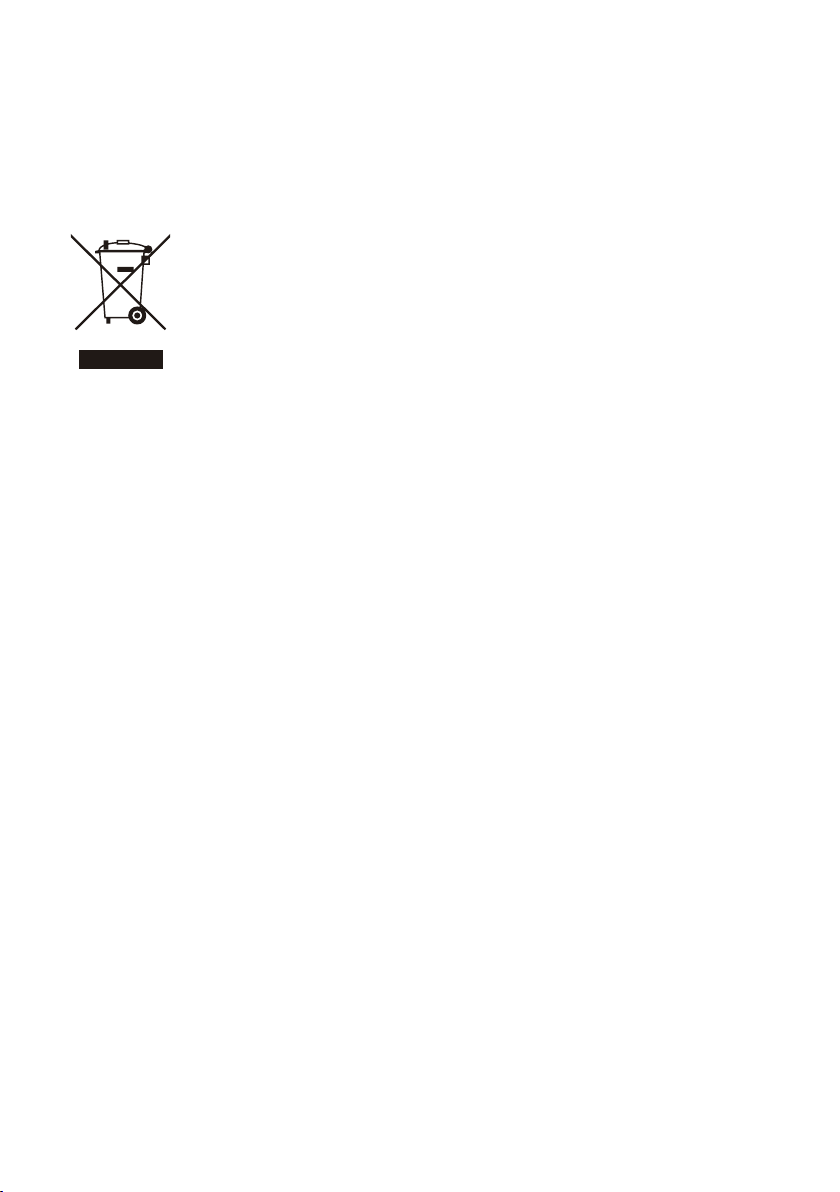
• This crossed-out wheeled bin symbol indicates that waste electrical and electronic
products (WEEE) should be disposed of separately from the municipal waste
stream.
• Old electrical products can contain hazardous substances so correct disposal
of your old appliance will help prevent potential negative consequences for the
environment and human health. Your old appliance may contain reusable parts that
could be used to repair other products, and other valuable materials that can be
recycled to conserve limited resources.
• You can take your appliance either to the shop where you purchased the product,
or contact your local government waste office for details of your nearest authorised
WEEE collection point. For the most up to date information for your country, please
see www.lg.com/global/recycling.
9
EN
INSTALLATION
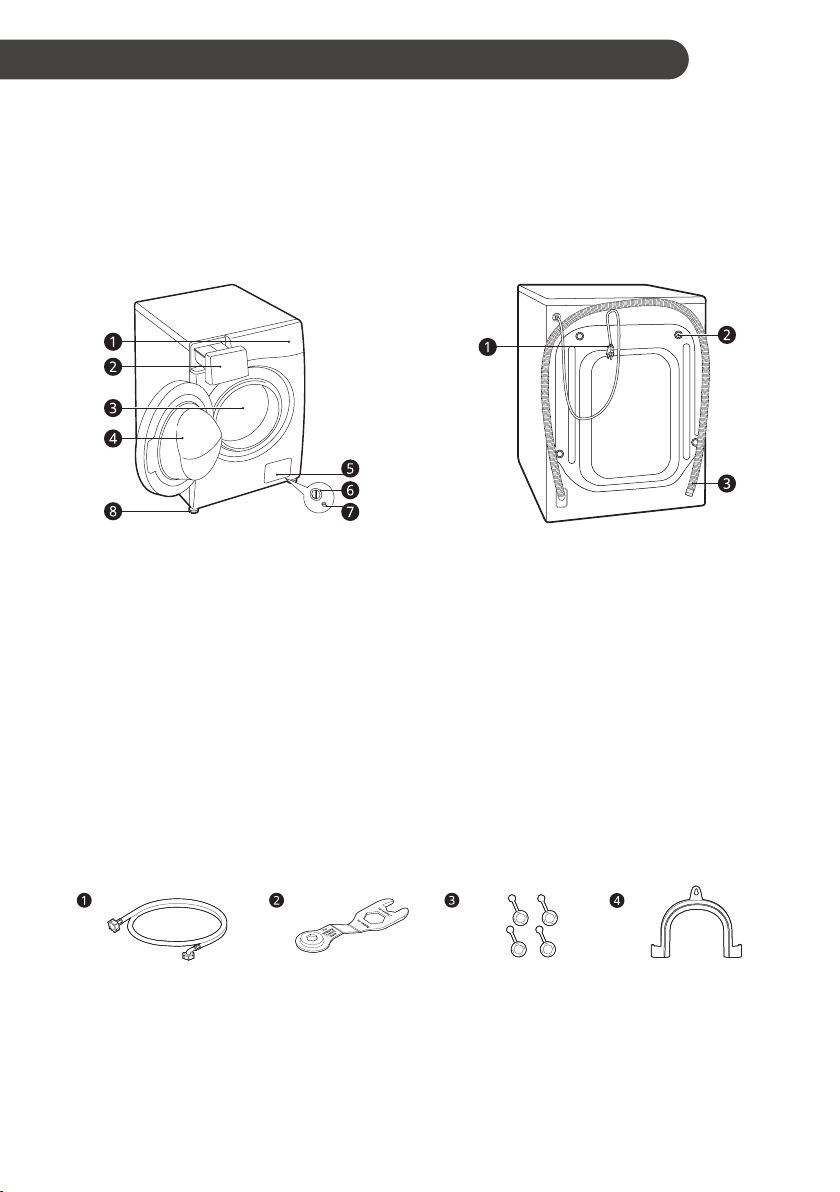
Front View
a Control panel
b Detergent dispenser drawer
c Drum
d Door
e Cover cap
f Drain pump filter
g Drain plug
h Adjustable feet
Rear View
a Power plug
b Transit bolts
c Drain hose
Parts and Specifications
NOTE
• Appearance and specifications may change without notice to improve the quality of the appliance.
Accessories
* This feature is only available on some models.
a Cold water inlet hose*
b Spanner
c Caps for covering transit bolt holes*
d Elbow bracket for securing drain hose*
10
EN
Specifications
Model F*V509*
Power Supply 220 - 240 V~, 50 Hz
Dimension
(Width x Depth x Height)
600 mm X 560 mm X 850 mm
Product Weight 63 kg
• No further backflow protection required for connection to the water inlet.
Installation Place
Requirements
Before installing the appliance, check the following
information to make sure that the appliance should
be installed in a correct place.
Installation Location
• Install the appliance on a flat floor. (Allowable
slope under the appliance: 1°)
• Never try to level any uneven floor by putting
pieces of wood, cardboard or similar materials
under the appliance.
• If it is impossible to avoid positioning the
appliance next to a gas cooker or coal burning
stove, an insulation (850 X 600 mm) covered
with aluminium foil on the side facing the cooker
or stove must be inserted between the two
appliances.
• Ensure that when the appliance is installed, it is
easily accessible for an engineer in the event of
a breakdown.
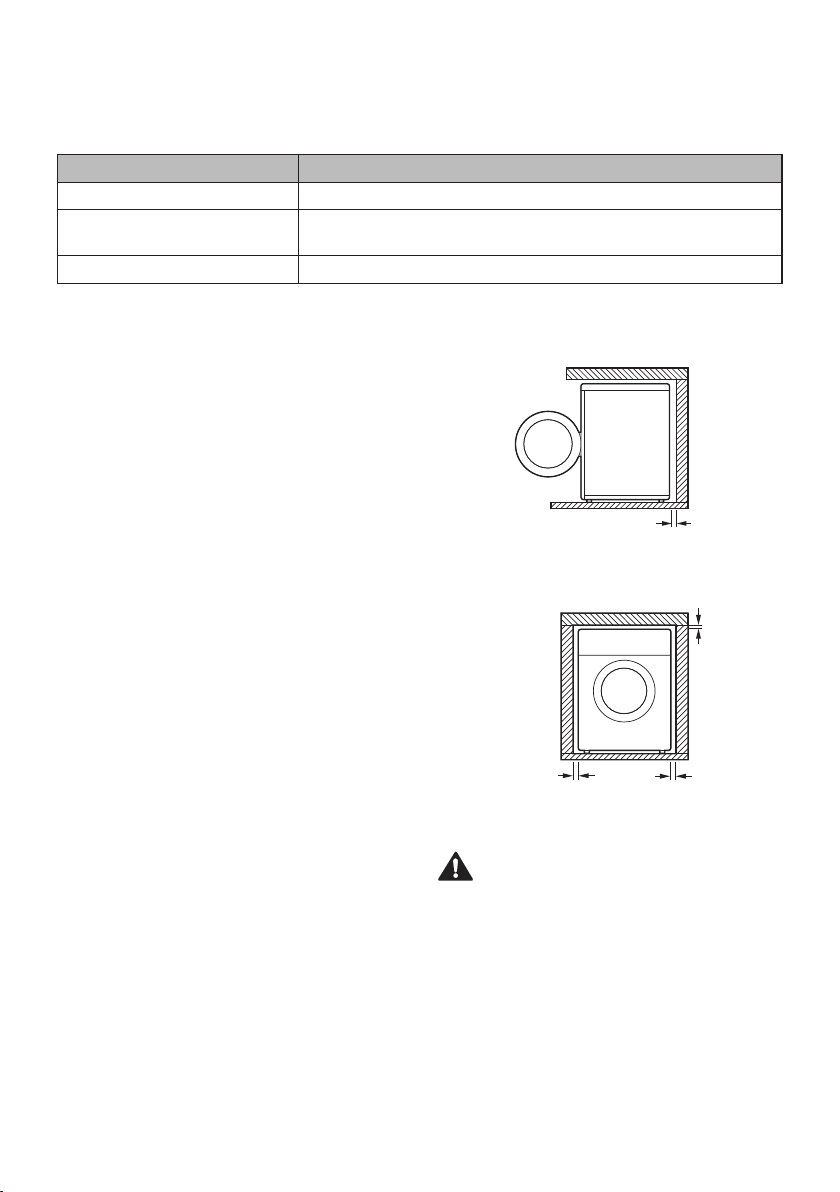
•
•
When installing the appliance, adjust all four feet
using the transit bolt spanner which makes the
appliance stable, and leave approximate 5 mm
for a clearance between the top of the appliance
and the underside of any worktop.
To ensure sufficient clearance for water inlet
hoses, drain hose and airflow, allow minimum
clearances of at least 20 mm at the sides and
100 mm behind the appliance. Be sure to allow
for wall, door, or floor moldings that may increase
the required clearances.
100 mm
20 mm
5 mm
20 mm
WARNING
• This appliance must only be used for domestic
household purposes and should not be used in
mobile applications.
NOTE
• If the appliance is installed on a raised platform,
it must be securely fastened in order to eliminate
the risk of falling off.
11
EN
Wooden Floors (Suspended
Floors)
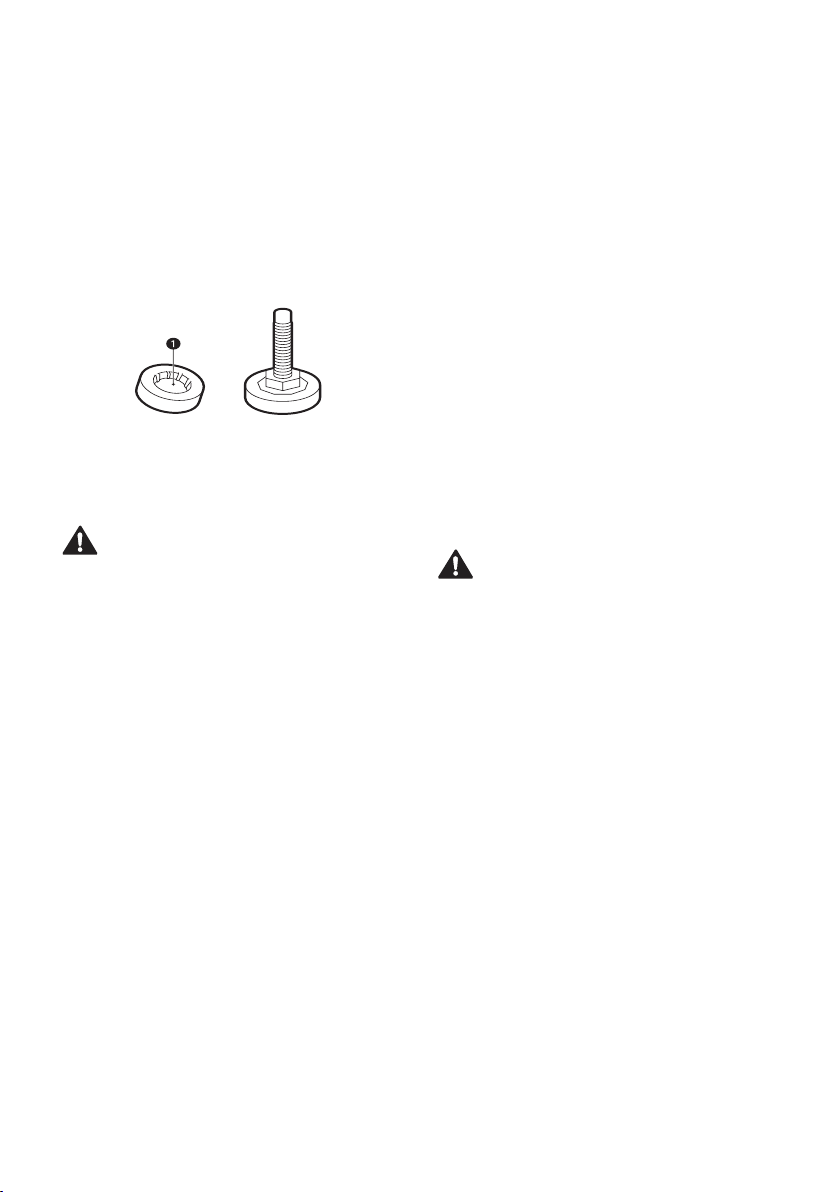
When installing the appliance on wooden floors,
use rubber cups to prevent the appliance from
excessive vibration and unbalance.
• To prevent vibration, we recommend you to
place rubber cups a at least 15 mm thick of the
each foot of the appliance, secured to at least
two floor beams with screws.
• If possible, install the appliance in one of the
corners of the room, where the floor is more
stable.
• Fit the rubber cups to reduce vibration.
CAUTION
• This appliance must only be used for domestic
household purposes and should not be used in
mobile applications.
• If the appliance is installed on the unstable
floor (e.g. wooden floor), the warranty does not
cover any damages and cost occured due to the
installation on the unstable floor.
NOTE
• You can purchase rubber cups (Part No.
4620ER4002B) from the LG Electronics service
centre.
Ventilation
• Make sure that air circulation around the
appliance should not be impeded by carpets,
rugs, etc.
Ambient Temperature
• Do not install the appliance in rooms where
freezing temperatures may occur. Frozen hoses
may burst under pressure. The reliability of
the electronic control unit may be impaired at
temperatures below freezing point.
• If the appliance is delivered in winter and
temperatures are below freezing, place the
appliance at room temperature for a few hours
before putting it into operation.
Electrical Connection
• Do not use an extension cord or double adapter.
• Always unplug the appliance and turn off the
water inlet after use.
• Connect the appliance to an earthed socket in
accordance with current wiring regulations.
• The appliance must be positioned so that the
plug is easily accessible.
• Power outlet must be at least 1 meter of either
side of the appliance.
WARNING
• Repairs to the appliance must only be carried
out by the qualified personnel. Repairs carried
out by inexperienced persons may cause injury
or serious malfunctioning. Contact your LG
Electronics service centre.
• The power plug must be plugged into an
appropriate socket outlet that is installed and
grounded in accordance with all local codes and
ordinances.
12
EN
Unpacking the Appliance
Lifting the Appliance Off the Foam
Base
* This feature is only available on some models.
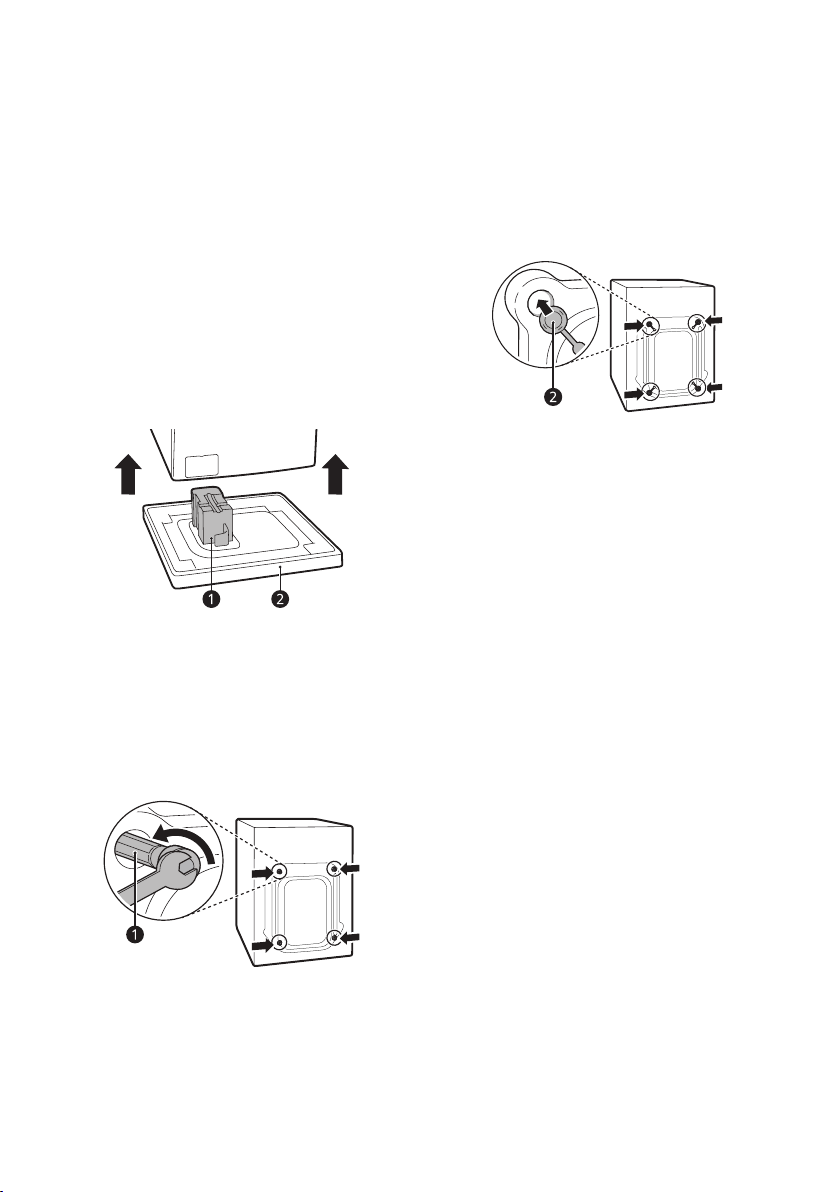
After removing the carton and shipping material, lift
the appliance off the foam base.
• Make sure the tub support a* comes off with
the base and is not stuck to the bottom of the
appliance.
• If you must lay the appliance down to remove
the carton base b, always protect the side of
the appliance and lay it carefully on its side. Do
not lay the appliance on its front or back.
*
Removing the Bolt Assemblies
1
Starting with the bottom transit bolts a, use
the spanner (included) to fully loosen all transit
bolts by turning them counterclockwise.
2
Remove the bolt assemblies by wiggling them
slightly while pulling them out.
3
Install the hole caps.
• Locate the hole caps b included in the
accessory pack or attached on the back.
Levelling the Appliance
Checking the Level
Levelling the appliance prevents unnecessary
noise and vibration. Check whether the appliance is
perfectly level after installation.
• If the appliance rocks when pushing the top
plate of the appliance diagonally, adjust the feet
again.
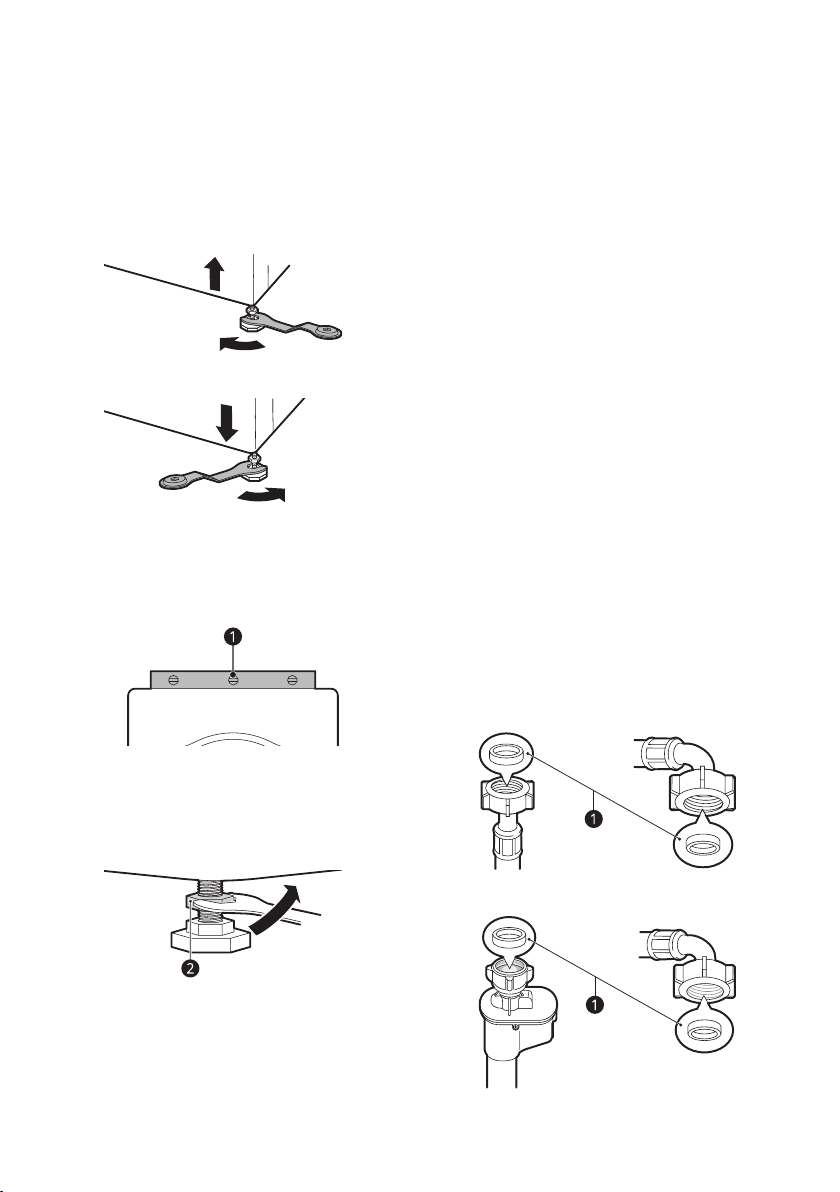
Adjusting and Levelling the Feet
When installing the appliance, the appliance should
be aligned and perfectly level.
• If the appliance is not aligned and level properly,
the appliance may be damaged or may not
operate properly.
13
EN
1
Turn the adjustable feet as required if the floor
is uneven.
• Do not insert pieces of wood etc. under the
feet.
• Make sure that all four feet should be stable
and resting on the floor.
2
Check if the appliance is perfectly level using a
spirit level a.
3
Secure the adjusting feet with the lock nuts b
by turning counterclockwise against the bottom
of the appliance.
4
Check if all lock nuts at the bottom of the
appliance are secured properly.
NOTE
• Proper placement and levelling of the appliance
will ensure long, regular, and reliable operation.
• The appliance must be level and stand firmly in
position.
• It must not ‘Seesaw’ across corners under the
load.
• Do not let the feet of the appliance get wet.
Failure to do so may cause vibration or noise.
Connecting the Water Inlet
Hose
Note for Connection
• Water pressure must be between 100 kPa
and 1000 kPa (1.0 - 10.0 kgf/cm²). If the
water pressure is more than 1000 kPa, a
decompression device should be installed.
• Do not overtighten the water inlet hose to all
valves.
• Periodically check the condition of the hose and
replace the hose if necessary.
Checking the Rubber Seal on the
Water Inlet Hose
Two rubber seals a are supplied with the water
inlet hoses. They are used to prevent water leaks.
Make sure that the connection to taps should be
sufficiently tight.
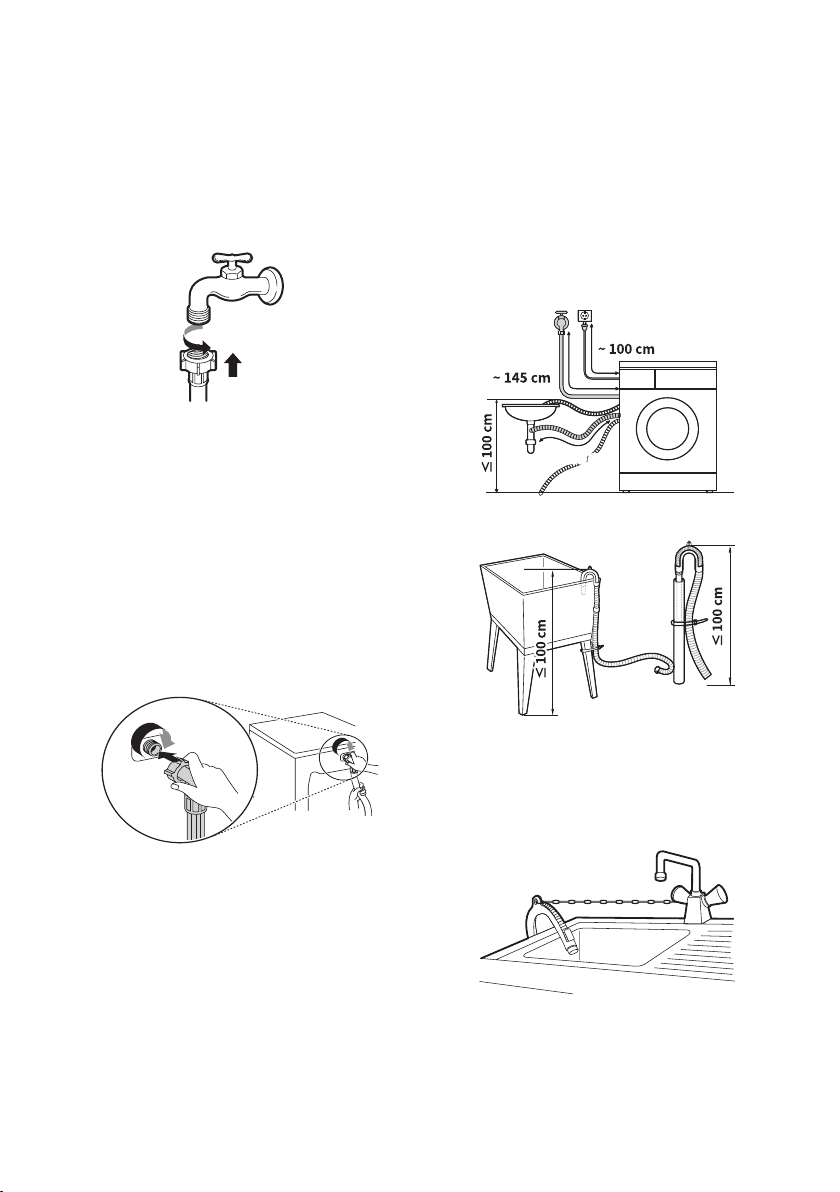
14
EN
Connecting Hose to Water Tap
Screw - Type Hose to Tap with Thread
Screw the hose connector to the water supply,
which has ¾” threaded union.
NOTE
• Before connecting the inlet hose to the water
tap, turn on the water tap to flush out foreign
substances (dirt, sand, sawdust, and etc.) in the
water lines. Let the water drain into a bucket,
and check the water temperature.
Connecting Hose to the Appliance
Screw the water line to the water supply on the
back of the appliance.
NOTE
• After completing connection, if water leaks from
the hose, repeat the same steps. Use the most
conventional type of tap for the water supply. If
the tap is square or too big, remove the guide
plate before inserting the tap into the adaptor.
• Make sure that the hose should not be kinked or
trapped.
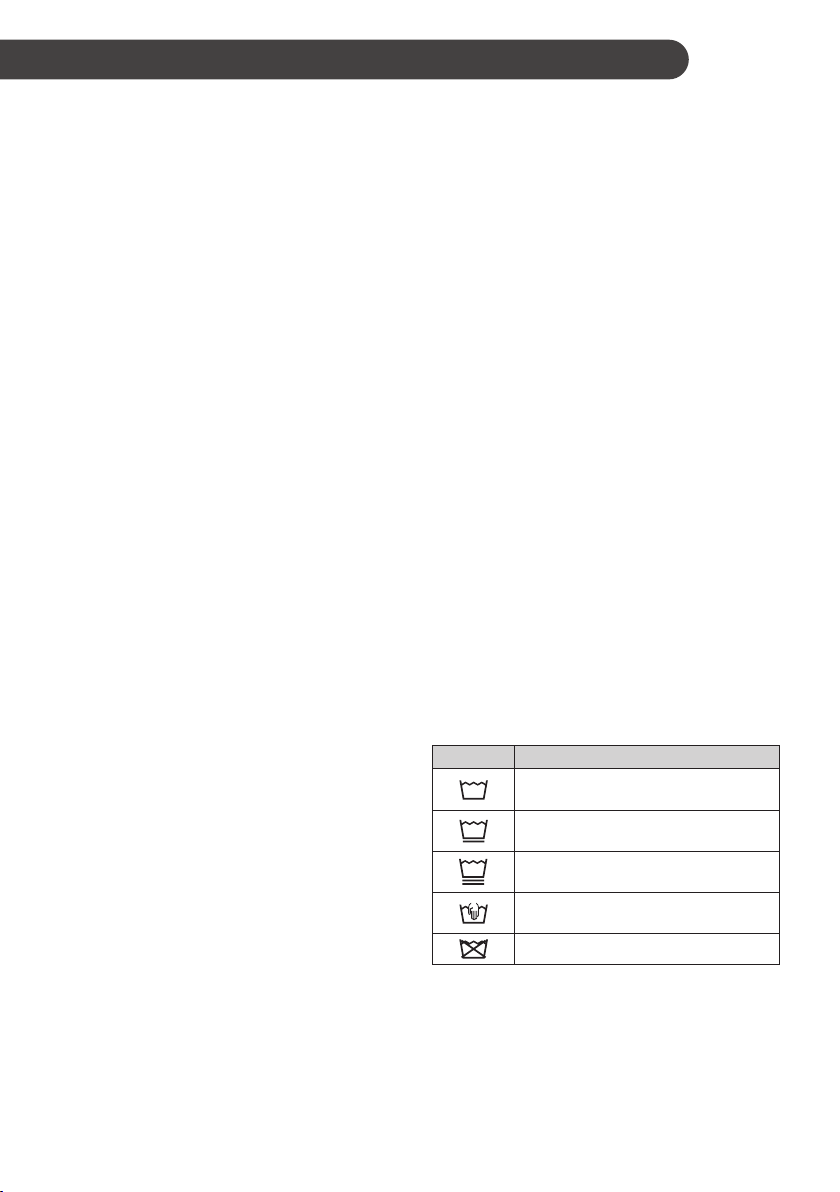
Installing the Drain Hose
For Model with Drain Pump
The drain hose should not be placed higher than
100 cm above the floor. Water in the appliance may
not drain or may drain slowly.
• Securing the drain hose correctly will protect the
floor from damage due to water leakage.
_DN
• If the drain hose is too long, do not force it back
into the appliance. This will cause abnormal
noise.
• When installing the drain hose to a sink, secure
it tightly with string.
15
EN
OPERATION
Operation Overview
Using the Appliance
Before the first wash, select the Cotton wash
programme and add a half amount of the detergent.
Start the appliance without laundry. This will remove
possible residues and water from the drum that may
have been left during manufacturing.
1
Sort laundry and load items.
• Sort laundry by fabric type, soil level, colour
and load size as needed. Open the door and
load items into the appliance.
2
Add detergent or softener.
• Add the proper amount of detergent to the
detergent dispenser drawer. If desired, add
bleach or fabric softener to the appropriate
areas of the dispenser.
3
Turn on the appliance.
• Press the Power button to turn on the
appliance.
4
Choose the desired cycle.
• Press the cycle button repeatedly or turn the
cycle selector knob until the desired cycle is
selected.
• Now select a wash temperature and spin
speed. Pay attention to a fabric care label of
your clothes.
5
Begin cycle.
• Press the Start/Pause button to begin the
cycle. The appliance will agitate briefly
without water to measure the weight of the
load. If the Start/Pause button is not pressed
within 15 minutes, the appliance will shut off
and all settings will be lost.
6
End of cycle.
• When the cycle is finished, a melody will
sound. Immediately remove your clothing
from the appliance to reduce wrinkling.
Check around the door seal when removing
the load for small items that may be caught
in the seal.
Preparing the Laundry
Sort laundry for best washing results, and then
prepare laundry according to the symbols on the
care labels.
Sorting the Clothes
• For best washing results, sort your clothes
according to a care label stating fabric type and
washing temperature. Adjust the spin speed to
wash them.
• Soil level (Heavy, Normal, Light): Separate
clothes according to soil level. If possible, do
not wash heavily soiled items with lightly soiled
ones.
• Colour (White, Lights, Darks): Wash separately
dark or dyed clothes from whites or light colours.
Mixing dyed clothes with light clothes can
result in dye transfer or discolouration of lighter
clothes.
• Lint (Lint producers, Collectors): Wash
separately lint producing fabrics from lint
collecting fabrics. Lint producers can result in
pilling and linting on the lint collectors.
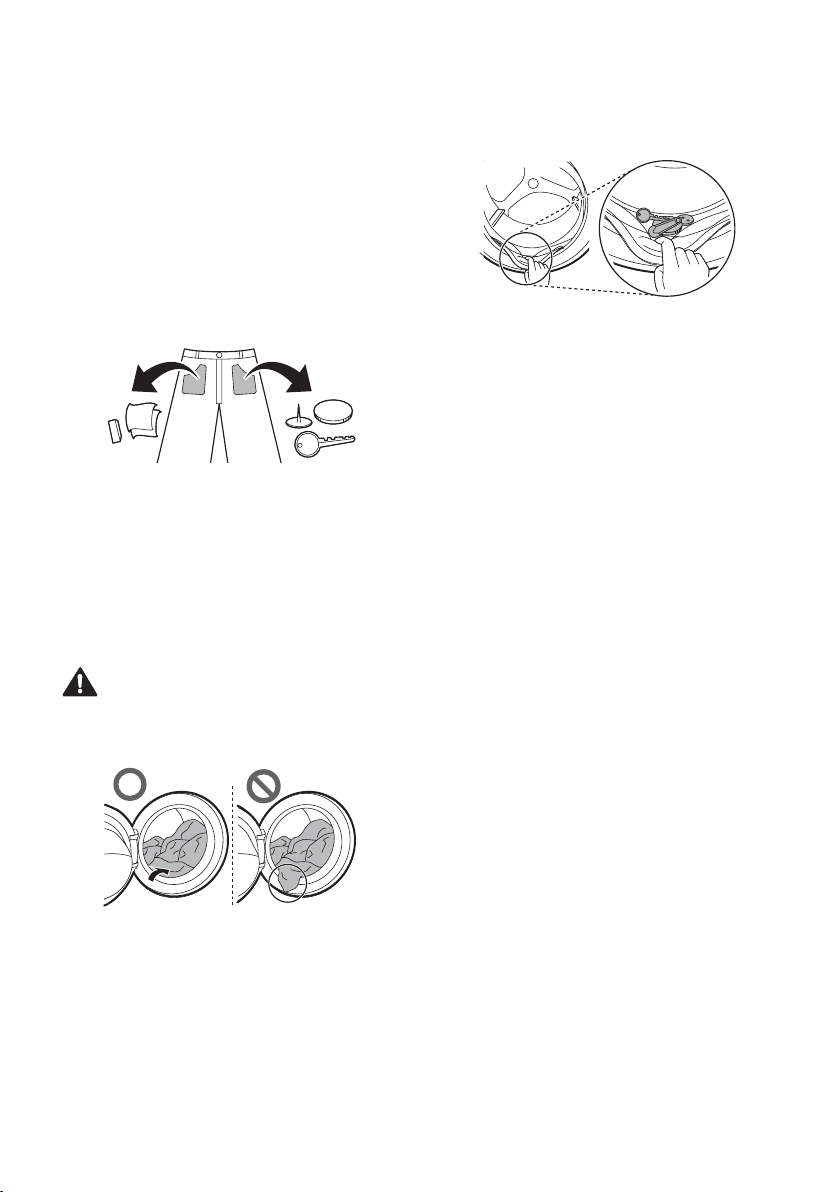
Checking the Fabric Care Label
Symbols on the care labels
The symbols tell you about the fabric content of
your clothes and how it should be washed.
Symbol Wash / Fabric type
• Normal Wash
• Cotton, Mixed Fabrics
• Easy Care
• Synthetic, Mixed Fabrics
• Special Delicate Wash
• Delicates
• Hand Wash Only
• Wool, Silk
• Do not wash
NOTE
• The dashes under the symbol give you
information about the type of fabric and the
maximum allowance of mechanical stress.
16
EN
Checking the Clothes before
Loading
• Combine large and small items in a load. Load
large items first. Large items should not be more
than half of total load.
• Do not wash single small items. Add 1-2 similar
items to the load to prevent an out-of-balance
load.
• Make sure to empty all pockets. Items such as
nails, hair clips, matches, pens, coins and keys
can damage both your appliance and clothes.
• Wash delicates (stockings, underwired bras) in
a wash net.
• Close zippers, hooks and strings to make sure
that these items do not snag other clothes.
• Pre-treat dirt and stains by saturating the
dirt and stains with dissolved detergent and
brushing them in order to remove dirt.
• Check the folds of the flexible gasket (gray) and
remove any small items.
CAUTION
• Check if the laundry gets stuck between the
door and the seal, otherwise the laundry may
get damaged while washing.
• Remove items from the flexible gasket to prevent
clothing and door seal damage.
Adding Detergents and
Softeners
Detergent Dosage
• Detergent should be used according to the
instruction of the detergent manufacturer and
selected according to type, colour, soiling of the
fabric and the washing temperature.
• Reduce the amount of detergent if too many
suds are formed.
• Too much detergent results in excessive suds
which cause poor washing.
• When you use liquid detergent, follow
the guidelines provided by the detergent
manufacturer.
• You can pour liquid detergent directly into the
main detergent drawer if you are starting the
wash cycle immediately.
• Do not use liquid detergent if you are using
Delay End function, or if you have selected
Pre Wash option, as the liquid may harden.
• Detergent usage may need to be adjusted for
water temperature, water hardness, size and
soil level of the laundry. For best results, avoid
oversudsing.
• Refer to the label of the clothes, before choosing
the detergent and water temperature.
• Use only suitable detergents for the respective
type of clothing:
− Liquid detergent is often designed for special
applications, e.g. for coloured fabric, wool,
delicate or dark laundry.
− Powdered detergent is suitable for all types
of fabric.
− For better washing results of white and pale
clothes, use powdered detergent with bleach.
− Detergent is dispensed from the dispenser at
the beginning of the wash cycle.
17
EN
NOTE
• Do not let the detergent harden. Doing so may
lead to blockages, poor rinse performance or
odour.
• Full load: According to manufacturer’s
recommendation
• Part load: ¾ of the normal amount
• Minimum load: ½ of full load
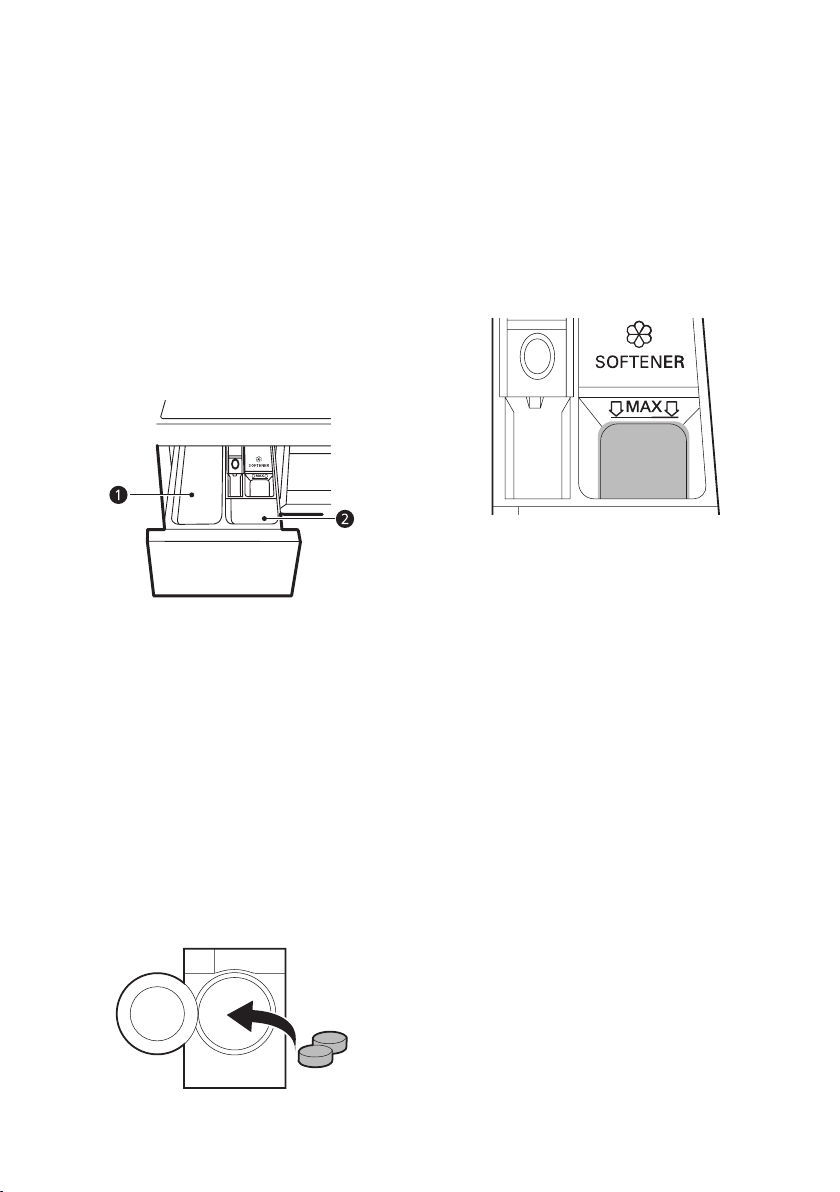
Adding Detergent
• Detergent for main wash a only ~ J
• Detergent for pre wash b and main wash a ~
d # J
NOTE
• Use the appropriate amount of detergent. Too
much detergent, bleach or softener may cause
an overflow.
• When selecting Pre Wash, divide the dosage
into ⅓ for pre wash and ⅔ for main wash.
Adding Detergent Tablet
Detergent tablet is also available when washing
laundry.
1
Open the door and put detergent tablets into
the drum.
2
Load the laundry into the drum and close the
door.
NOTE
• Do not put tablets into the drawer.
Adding Fabric Softener
• Add a fabric softener to the maximum fill line.
• Close the dispenser drawer gently.
• Do not leave the fabric softener in the detergent
drawer for more than 2 days. Fabric softener
may harden.
• Softener will automatically be added during the
last rinse cycle.
• Do not open the drawer when water is being
supplied.
• Solvents (e.g. benzene, etc.) must not be used.
NOTE
• Pouring excessive fabric softener over the
maximum fill line can cause it to dispense too
early, which may stain clothes.
• Do not pour fabric softener directly onto the
laundry, which may stain the laundry.
Adding Water Softener
A water softener, such as anti-limescale can be
used to cut down on the use of detergent in areas
with high water hardness level.
• First add detergent, and then the water softener.
Dispense according to the amount specified on
the packaging.
18
EN
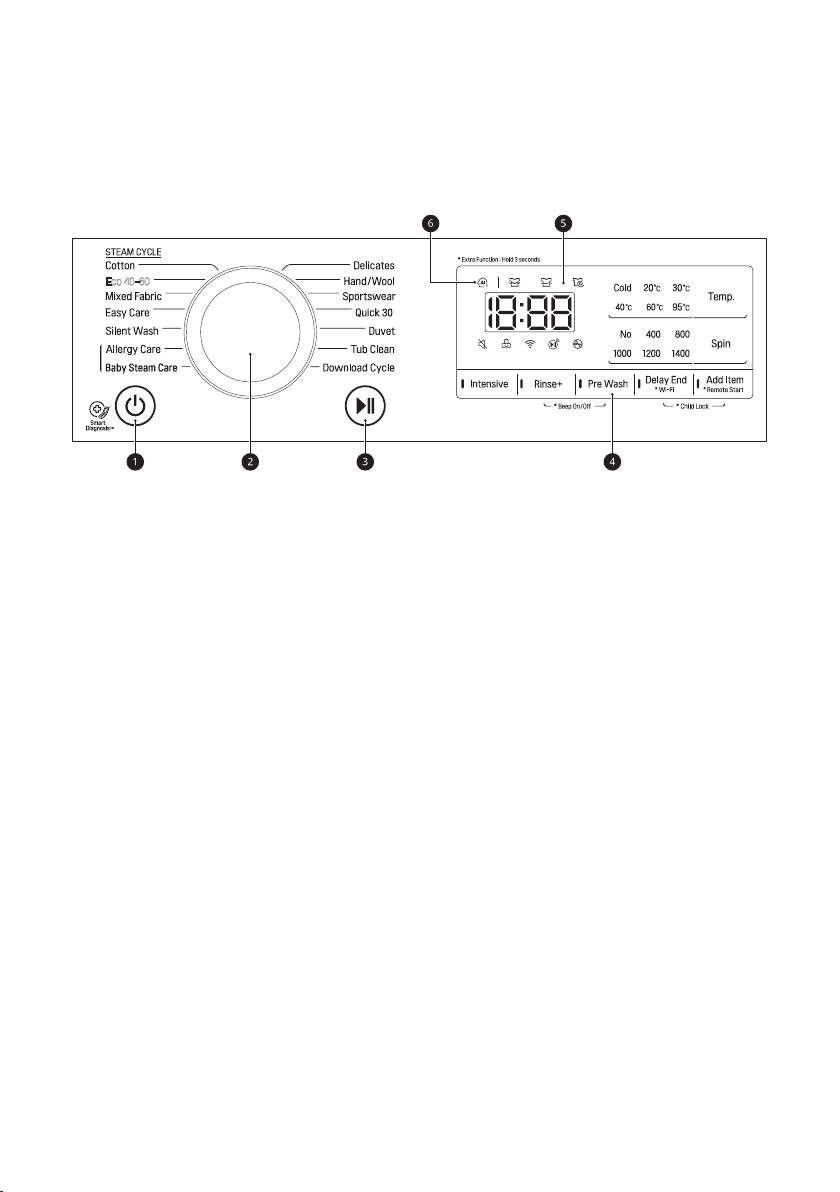
Control Panel
Control Panel Features
a Power Button
• Press the Power button to turn on or off the appliance.
b Programme Knob
• Programmes are available according to the laundry type.
• The lamp will light up to indicate the selected programme.
c Start/Pause Button
• Press the Start/Pause button to start or pause a wash cycle.
• Press the Start/Pause button to stop a wash cycle temporarily.
d Extra Options and Functions
• You can use the extra options and functions to customize the programmes.
• To use the extra functions, press and hold the corresponding button for 3 seconds. The
corresponding symbol lights up in the display.
• In order to use the Remote Start function, refer to SMART FUNCTIONS.
• This allows you to select an additional programmes and will light when selected.
− f : This icon turns on when the appliance is connected to Wi-Fi network at home.
e Display
• The display shows the settings, remaining estimated time, options, and status messages. When the
appliance is turned on, the default settings in the display will light up.
− 18:88: When a programme is selected, the default time for that programme is displayed. The default
time can be changed according to the selected option.
− k : When the laundry is being washed, this icon is illuminated.
− l : When the laundry is being rinsed after completion of washing programme, this icon is
illuminated.
− p : When the laundry is spun to remove the water in the laundry, this icon is illuminated.
− H : When this icon is illuminated, the door cannot be opened.
f AI DD
• AI DD M provides the desired washing and spinning.
Eco 40-60
19
EN
• M is activated when Cotton, Mixed Fabric and Easy Care programmes are selected and operated.
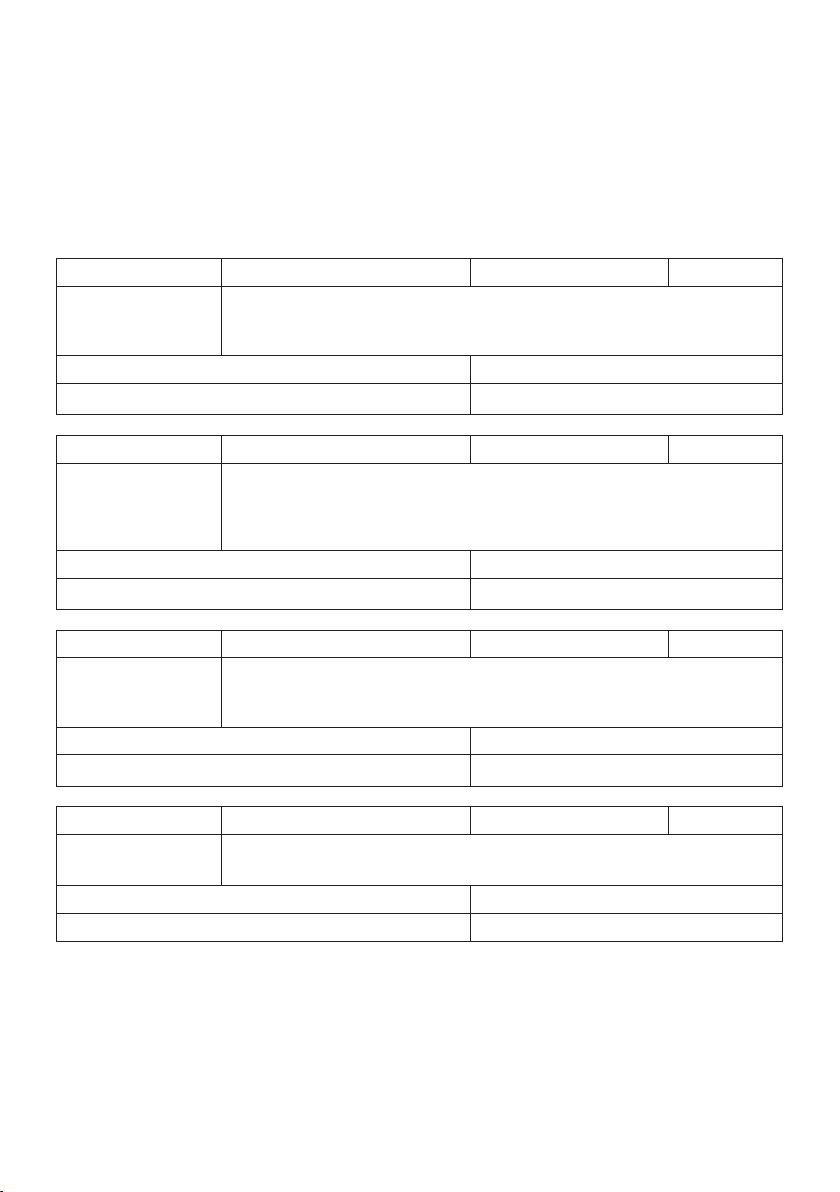
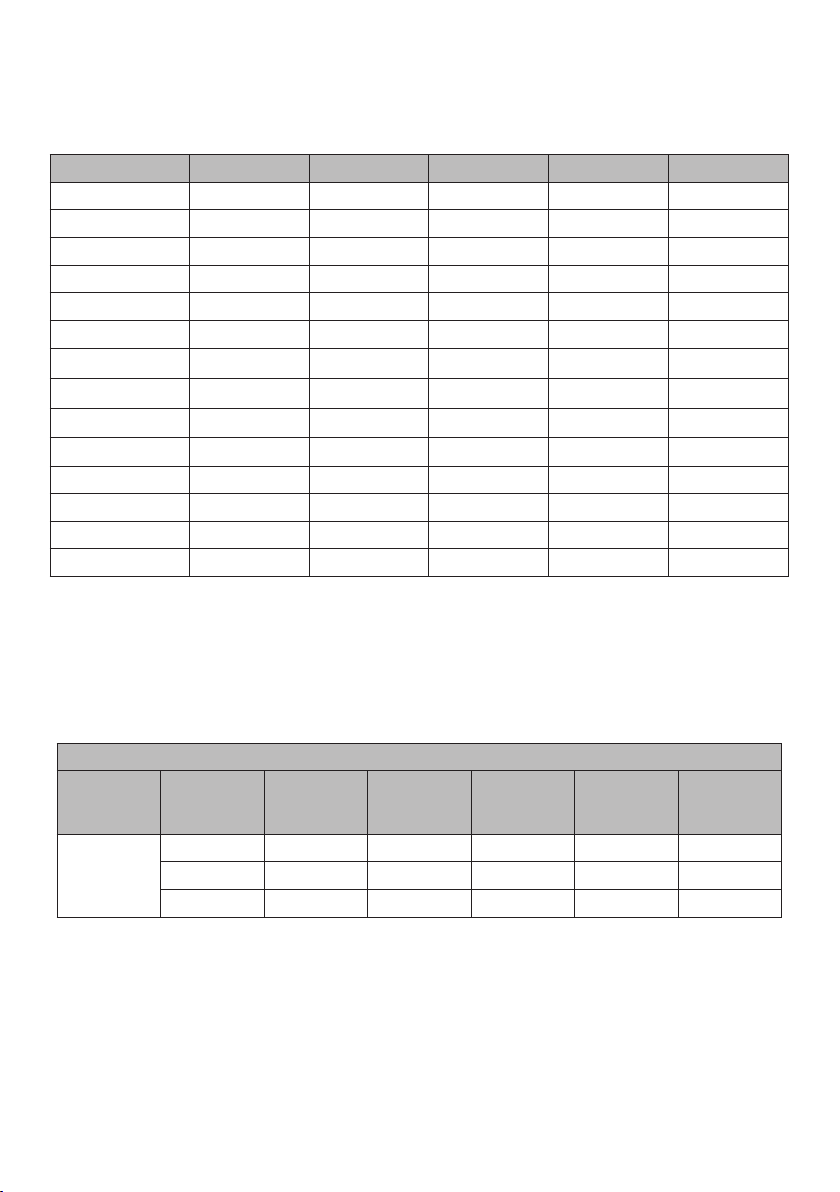
Programme Table
Washing Programme
Programme Cotton Max. Load Rating
Description
Washes the laundry by combining various drum motions.
Use for coloured fast items (shirts, nightdresses, pajamas, etc.) and
normally soiled cotton load (underwear).
Proper Temperature 40 °C (Cold to 95 °C)
Max. Spin Speed 1400 rpm
Programme
Eco 40-60
Max. Load Rating
Description
Washes the large amount of laundry with less energy consumption than other
washing programmes.
Use for coloured fast items (shirts, nightdresses, pajamas, etc.) and
normally soiled cotton load (underwear).
Proper Temperature 60 °C (Cold to 60 °C)
Max. Spin Speed 1400 rpm
Programme Mixed Fabric Max. Load 3 kg
Description Enables various fabrics to be washed simultaneously.
Use for various kind of fabrics except special items (silk/delicate, sports wear,
dark clothes, wool, duvet/curtains).
Proper Temperature 40 °C (Cold to 60 °C)
Max. Spin Speed 1400 rpm
Programme Easy Care Max. Load 3 kg
Description
Washes laundry that do not need ironing after washing.
Use for Polyamide, acrylic, polyester.
Proper Temperature 40 °C (cold to 60 °C)
Max. Spin Speed 1400 rpm
20
EN
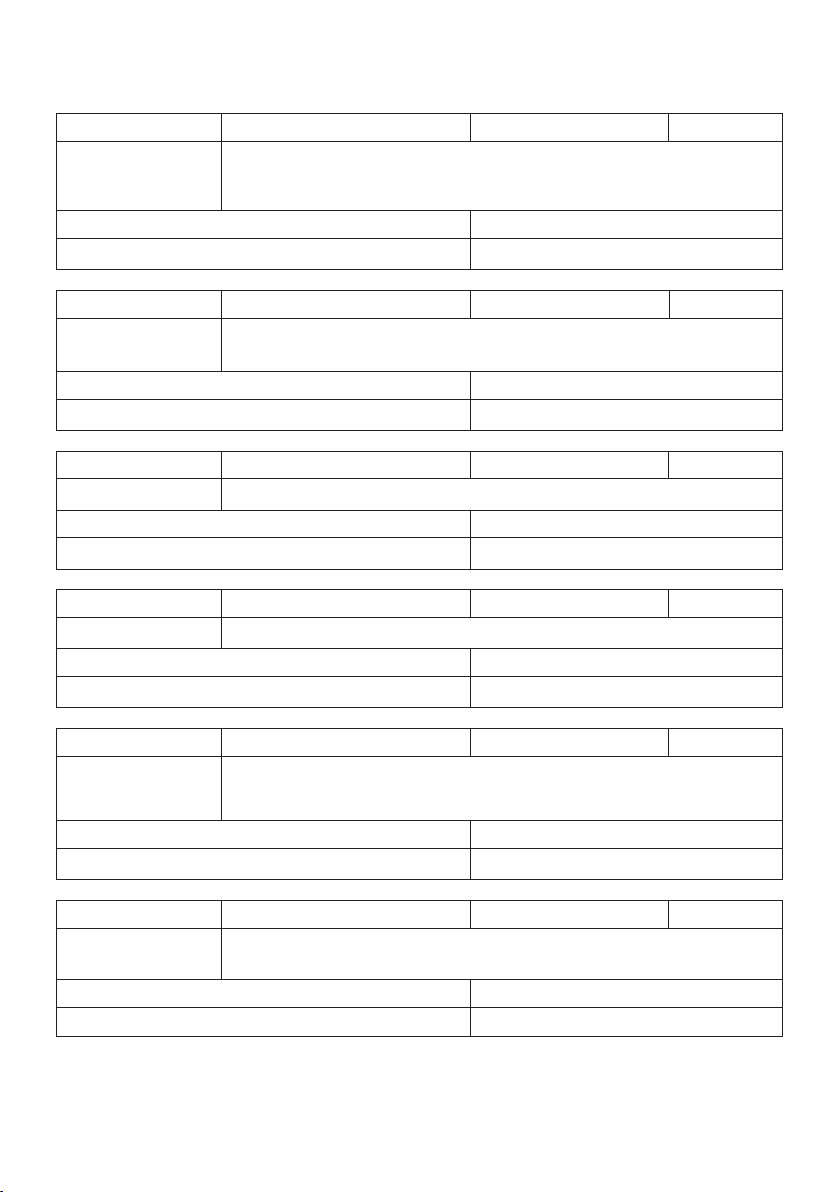
Programme Silent Wash Max. Load 4.5 kg
Description Provides less noise and vibration and saves money by using overnight electricity.
Use for coloured fast garments (shirts, nightdresses, pajamas, etc.) and lightly
soiled white cotton (underwear).
Proper Temperature 40 °C (Cold to 60 °C)
Max. Spin Speed 1000 rpm
Programme Allergy Care Max. Load 3.0 kg
Description
Reduces house dust mite allergens.
Use for cotton, underwear, pillow covers, bed sheets, baby wear.
Proper Temperature 60 °C
Max. Spin Speed 1400 rpm
Programme Baby Steam Care Max. Load 4.5 kg
Description Provides clothes care with gentle motion and better performance by steam.
Proper Temperature 60 °C
Max. Spin Speed 1000 rpm
Programme Delicates Max. Load 2 kg
Description Suitable for delicate clothes such as underwear, blouse, etc
Proper Temperature 20 °C (Cold to 40 °C)
Max. Spin Speed 800 rpm
Programme Hand/Wool Max. Load 2.0 kg
Description For hand and machine washable delicate clothes such as washable wool,
lingerie, dresses etc. (Use detergent for machine washable woolens).Use for
Wool, Silk, hand washable clothes, delicate, easily damaged laundry.
Proper Temperature 30 °C (Cold to 40 °C)
Max. Spin Speed 800 rpm
Programme Sportswear Max. Load 3 kg
Description Suitable for special items like sports and outdoor wear.
Use for Coolmax, gore-tex, fleece and sympatex.
Proper Temperature 40 °C (Cold to 40 °C)
Max. Spin Speed 800 rpm
21
EN
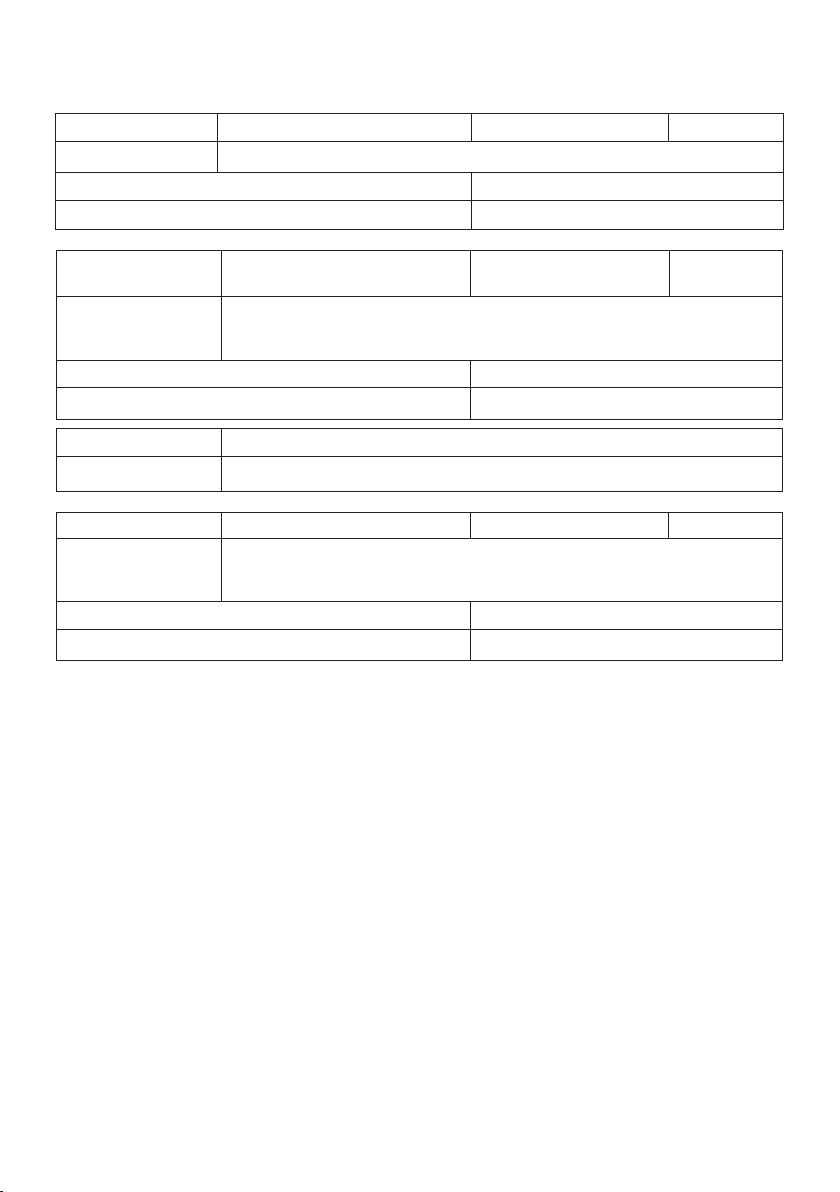
Programme Quick 30 Max. Load 2 kg
Description Provides fast washing time for small loads and lightly soiled clothes.
Proper Temperature 20 °C (Cold to 40 °C)
Max. Spin Speed 1400 rpm
Programme Duvet Max. Load 2.5 kg (down
duvet)
Description For large items such as bed covers, pillows, sofa covers, etc. Use for cotton
bedding except special items (delicates, wool, silk, etc.) with filling: duvets,
pillows, blankets, sofa covers with light filling.
Proper Temperature Cold (Cold to 40 °C)
Max. Spin Speed 1000 rpm
Programme Tub Clean
Description This is a special function to clean inside of your appliance.
Programme Download Cycle Max. Load
Description The Download Cycle programme allows you to download new and special
washing programs to your washing machine with a smartphone. The default
program is on Rinse + Spin.
Proper Temperature -
Max. Spin Speed
NOTE
• Select the proper wash temperature and spin speed for the desired programmes.
• When washing, always pay attention to the care label of your clothes.
• Actual maximum spin speed may vary depending on the model, programme, and load conditions.
-
-
22
EN
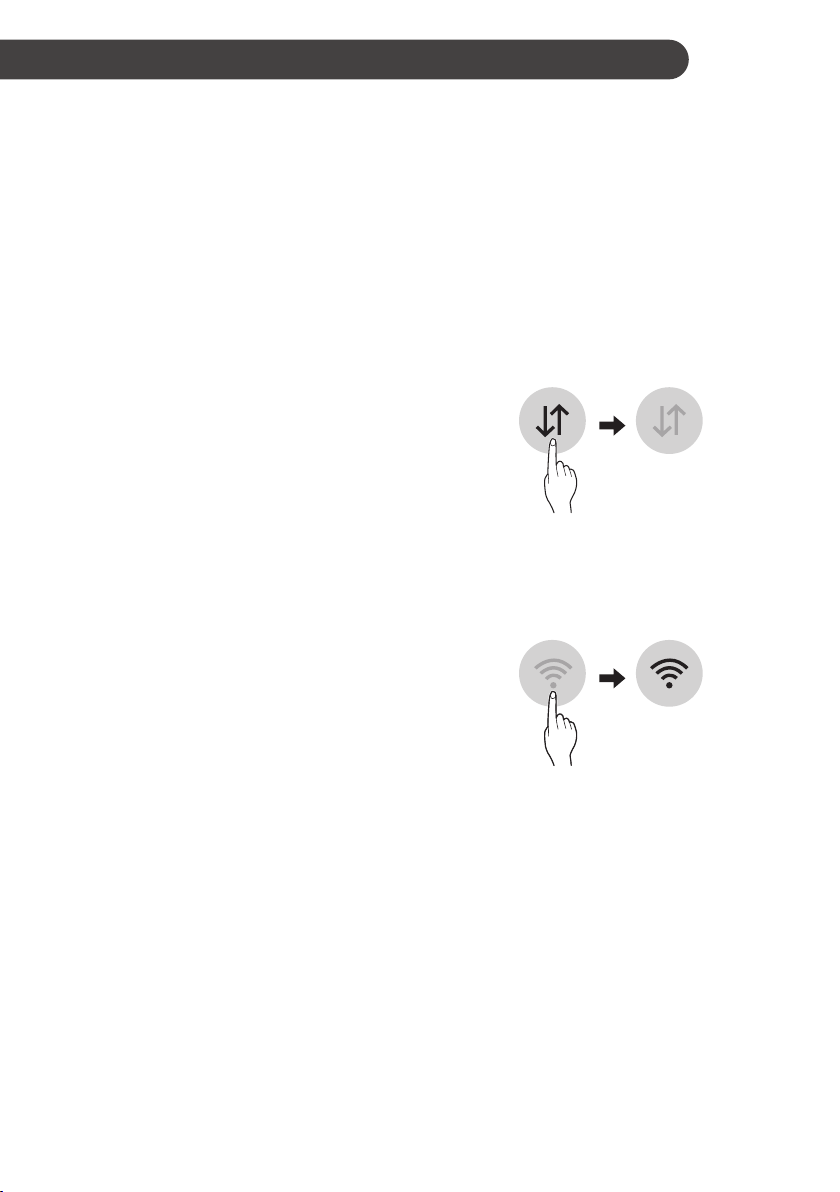
Extra Options
Programme Pre Wash Delay End Add Item Rinse+ Intensive
Cotton
# # # # #
Eco 40-60
# # # #
Mixed Fabric
# # # # #
Easy Care
# # # # #
Silent Wash
# # # #
Allergy Care
# # # #
Delicates
# # # #
Hand/Wool
# # # #
Sportswear
# # # #
Baby Steam Care
# # # #
Quick 30
# # # #
Duvet
# # # #
Tub Clean
Download Cycle
# # #
* This option is automatically inserted in the programme and cannot be deselected.
Consumption Data
Main Washing Programmes
F*V509*
Programme Temp. (°C) Load (kg)
Duration
(h:mm)
Water (L)
Energy
(kWh)
Residual
moisture
(%)
Eco 40-60*
9 04:43 41 0.79 44
4.5 03:55 34 0.60 44
4.5 03:46 34 0.56 44
* The standard cotton programme is Eco 40-60 +Intensive, 60 °C full load, Eco 40-60 +Intensive, 60 °C
half load, and Eco 40-60 +Intensive, 40 °C half load in accordance with Regulations (EU) No. 1061/2010
and EN 60456.
NOTE
• The test results depend on water pressure, water hardness, water inlet temperature, room temperature,
type and amount of laundry, type and amount of detergent and fluctuations in the main electricity supply
and chosen additional options.
• Neutral detergent is recommended.
• The actual washing temperature may differ from the temperature of washing programmes stated in the
table.
#
60 °C
60 °C
40 °C

23
EN
Extra Options and
Functions
You can use the extra options and functions to
customize the programmes.
Rinse l
Use this option to select the number of rinse
by pressing the Rinse+ button. This option is
recommended for people with detergent allergies.
Rinse+ G
Use this option to add rinse once.
Pre Wash
Use this option to wash the heavily soiled laundry.
1
Press the Power button.
2
Select a washing programme.
3
Press the Pre Wash button.
4
Press the Start/Pause button.
Intensive
Use this option to wash normally and heavily
soiled laundry.
1
Press the Power button.
2
Select a washing programme.
3
Press the Intensive button for 3 seconds.
4
Press the Start/Pause button.
Delay End
Use this function to automatically start and finish
the appliance after a specified time interval.
1
Press the Power button.
2
Select a washing programme.
3
Press the Delay End button to set a required
time.
4
Press the Start/Pause button.
NOTE
• The delay time is the time to the end of the
programme, not the start. The actual running
time may vary due to water temperature,
laundry and other factors.
• To cancel the function, the Power button
should be pressed.
• Avoid using liquid detergent for this function.
Wi-Fi f
When WLAN is connected, the Wi-Fi icon on the
control panel is lit.
Add Item
Use this option to add or remove the laundry after
the washing programme is started.
1
Press the Add Item button when the LED is
turned on.
2
Open the door after it unlocks itself.
3
Add or remove laundry.
4
Close the door and press the Start/Pause
button.NOTE
• For safety reasons, the door remains locked
when the water level or temperature inside
of the drum is high. It is not possible to add
laundry at this time.
Temp.
Use this option to select the wash and rinse
temperature in combination for the selected
programme. Press this button until the desired
setting is lit. Cold tap water is used for all rinses.
• Select the water temperature suitable for the
type of laundry you are washing. Follow the
fabric care labels for best results.

24
EN
Spin p
Use this option to change the spin strength. Press
the Spin button repeatedly to change the speed
level.
1
Press the Power button.
2
Select a washing programme.
3
Press the Spin button to select spin speed.
4
Press the Start/Pause button.
NOTE
• When you select No, it will still rotate for a short
time to drain quickly.
Beep On/Off q
This function operates only when the appliance is
in operation.
• Press and hold the Rinse+ and Pre Wash
button simultaneously for 3 seconds to set the
this function.
NOTE
• Once this function is set, the setting is
memorized even after the power is turned off.
• If you want to turn the beeper off, simply repeat
this process.
Child Lock i
Use this function to disable the controls. This
function can prevent children from changing cycles
or operating this appliance.
NOTE
• Once this function is set, all buttons are locked
except the POWER button.
• When the controls are locked, CL and the
remaining time are alternatively shown on the
display during the wash while the child lock is
engaged.
• Turning off the power will not reset this
function. You must deactivate this function
before you can access any other functions.
Locking the Control Panel
1
Turn on the power.
2
Press and hold the Delay End and Add Item
button for 3 seconds to activate this function.
• A beeper will sound, and CL will appear on the
display.
Unlocking the Control Panel
1
Turn on the power.
2
Press and hold the Delay End and Add Item
button for 3 seconds to deactivate this
function.
25
EN
SMART FUNCTIONS
LG ThinQ Application
The LG ThinQ application allows you to
communicate with the appliance using a
smartphone.
LG ThinQ Application Features
Communicate with the appliance from a
smartphone using the convenient smart features.
Washer Cycle (Remote Start,
Download Cycle)
Set or download any preferred cycle and operate
by remote control.
Tub Clean Coach
This function shows how many cycles remain
before running the Tub Clean function.
Energy Monitoring
This function checks the energy consumption of
the recently used cycles and monthly average.
Smart Diagnosis
This function provides useful information for
diagnosing and solving issues with the appliance
based on the pattern of use.
Settings
Allows you to set various options on the appliance
and in the application.
Push Alert
When the cycle is complete or the appliance has
problems, you have the option of receiving push
notifications on a smartphone. The notifications
are triggered even if the LG ThinQ application is
off.
NOTE
• If you change your wireless router, Internet
service provider, or password, delete the
registered appliance from the LG ThinQ
application and register it again.
• The application is subject to change for
appliance improvement purposes without
notice to users.
• Functions may vary by model.
Before Using LG ThinQ
Application
1
Check the distance between the appliance
and the wireless router (Wi-Fi network).
• If the distance between the appliance and
the wireless router is too far, the signal
strength becomes weak. It may take a long
time to register or installation may fail.
2
Turn off the Mobile data or Cellular Data on
your smartphone.
3
Connect your smartphone to the wireless
router.
NOTE
• To verify the Wi-Fi connection, check that f
icon on the control panel is lit.
• The appliance supports 2.4 GHz Wi-Fi
networks only. To check your network
frequency, contact your Internet service
provider or refer to your wireless router manual.
• LG ThinQ is not responsible for any
network connection problems or any faults,
malfunctions, or errors caused by network
connection.

26
EN
NOTE
• If the appliance is having trouble connecting
to the Wi-Fi network, it may be too far from
the router. Purchase a Wi-Fi repeater (range
extender) to improve the Wi-Fi signal strength.
• The Wi-Fi connection may not connect or may
be interrupted because of the home network
environment.
• The network connection may not work properly
depending on the Internet service provider.
• The surrounding wireless environment can
make the wireless network service run slowly.
• The appliance cannot be registered due to
problems with the wireless signal transmission.
Unplug the appliance and wait about a minute
before trying again.
• If the firewall on your wireless router is enabled,
disable the firewall or add an exception to it.
• The wireless network name (SSID) should be
a combination of English letters and numbers.
(Do not use special characters.)
• Smartphone user interface (UI) may vary
depending on the mobile operating system
(OS) and the manufacturer.
• If the security protocol of the router is set
to WEP, you may fail to set up the network.
Please change it to other security protocols
(WPA2 is recommended) and register the
product again.
Installing the LG ThinQ
Application
Search for the LG ThinQ application from the
Google Play Store or Apple App Store on a
smartphone. Follow instructions to download and
install the application.
Using the Appliance Remotely
Remote Start
Use a smartphone to control your appliance
remotely. You can also monitor your cycle
operation so you know how much time is left in the
cycle.
Using this function
1
Put the laundry into the drum and add
detergent into the detergent dispenser drawer.
• If desired, add bleach or fabric softener to
the appropriate areas of the dispenser.
2
Press the Power button.
3
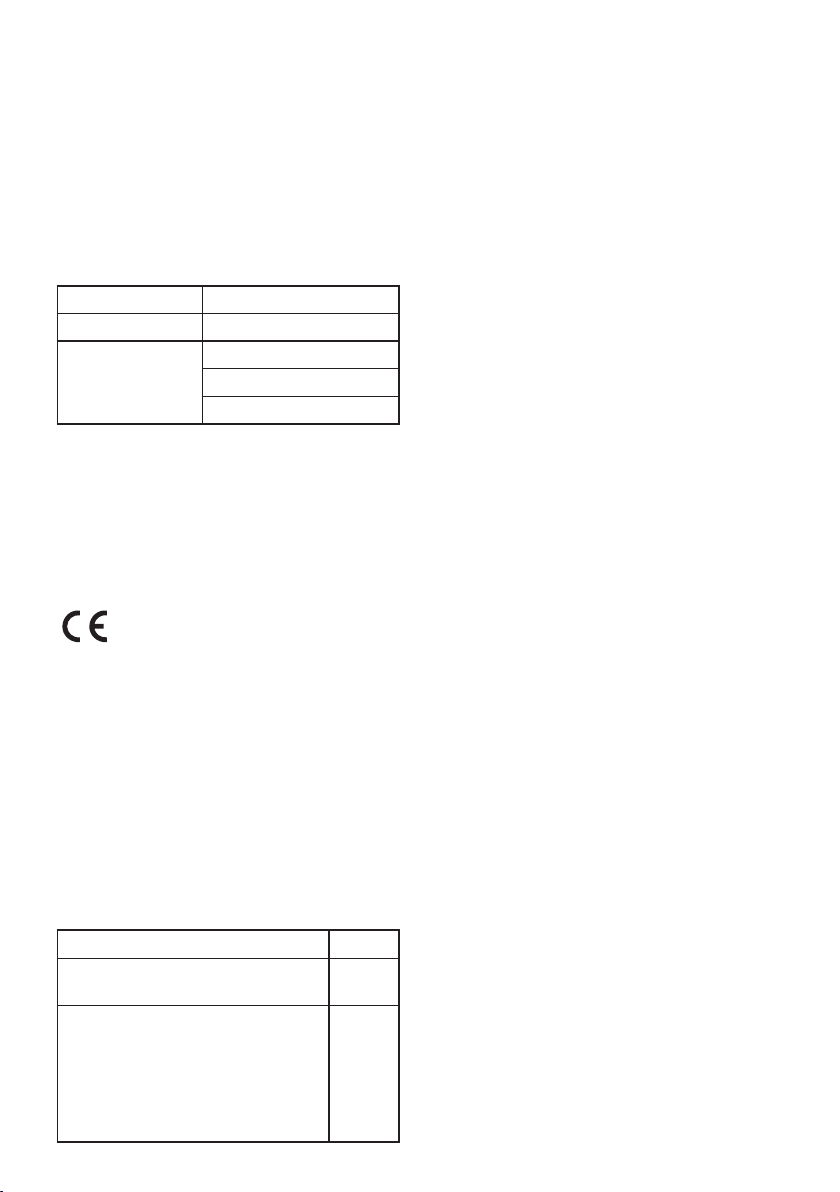
Press and hold Remote Start button for 3
seconds to enable the remote control function.
4
Start a cycle from the LG ThinQ application
on your smartphone.
NOTE
• Once this function is enabled, you can only
start a cycle from the LG ThinQ smartphone
application. If the cycle is not started, the
appliance will wait to start the cycle until it is
turned off remotely from the application or this
function is disabled.
• If the door has been opened, you can not start
a cycle remotely.
Disable this function manually
When this function is activated, press and hold the
Remote Start button for 3 seconds.
Download Cycle
You can download new and special cycles that are
not included in the basic cycles on the appliance.
Appliances that have been successfully registered
can download a variety of specialty cycles specific
to the appliance.
Once cycle download is completed in the
appliance, the product keeps the downloaded
cycle until a new cycle is downloaded.
27
EN
NOTE
• Only one downloaded cycle can be stored on
the appliance at a time.
Wireless LAN Module
Specifications
Model LCW-004
Frequency
Range
2412 to 2472 MHz
Output Power
(Max.)
IEEE 802.11b: 17.82 dBm
IEEE 802.11g: 17.72 dBm
IEEE 802.11n: 16.61 dBm
Wireless function S/W version: V 1.0
For consideration of the user, this device should be
installed and operated with a minimum distance of
20 cm between the device and the body.
Declaration of Conformity
Hereby, LG Electronics declares that the radio
equipment type Washing Machine is in compliance
with Directive 2014/53/EU. The full text of the
EU declaration of conformity is available at the
following internet address:
http://www.lg.com/global/support/cedoc/cedoc#
LG Electronics European Shared Service Centre
B.V. Krijgsman 1, 1186 DM Amstelveen, The
Netherlands
Standby Power Consumption
Standby power consumption
0.45 W
Network standby power
consumption
2.0 W
The period of time after which
the power management function,
or a similar function, switches
the equipment automatically into
standby and/or off mode and/or
the condition providing networked
standby
20 min.
Open Source Software Notice
Information
To obtain the source code under GPL, LGPL, MPL,
and other open source licenses, that is contained
in this product, please visit http:// opensource.lge.
com.
In addition to the source code, all referred license
terms, warranty disclaimers and copyright notices
are available for download.
LG Electronics will also provide open source code
to you on CD-ROM for a charge covering the cost
of performing such distribution (such as the cost of
media, shipping, and handling) upon email request
to [email protected]. This offer is valid for
a period of three years after our last shipment of
this product. This offer is valid to anyone in receipt
of this information.
Smart Diagnosis
This feature is only available on models with the c
or d logo.
Use this feature to help you diagnose and solve
problems with your appliance.
NOTE
• For reasons not attributable to LGE’s
negligence, the service may not operate due to
external factors such as, but not limited to, Wi-
Fi unavailability, Wi-Fi disconnection, local app
store policy, or app unavailability.
• The feature may be subject to change without
prior notice and may have a different form
depending on where you are located.
Using LG ThinQ to Diagnose
Issues
If you experience a problem with your Wi-Fi
equipped appliance, it can transmit troubleshooting
data to a smartphone using the LG ThinQ
application.
• Launch the LG ThinQ application and select
the Smart Diagnosis feature in the menu.
Follow the instructions provided in the
LG ThinQ application.
28
EN
Using Audible Diagnosis to
Diagnose Issues
Follow the instructions below to use the audible
diagnosis method.
• Launch the LG ThinQ application and select
the Smart Diagnosis feature in the menu.
Follow the instructions for audible diagnosis
provided in the LG ThinQ application.
1
Press the Power button to turn on the
appliance.
• Do not press any other buttons.
2
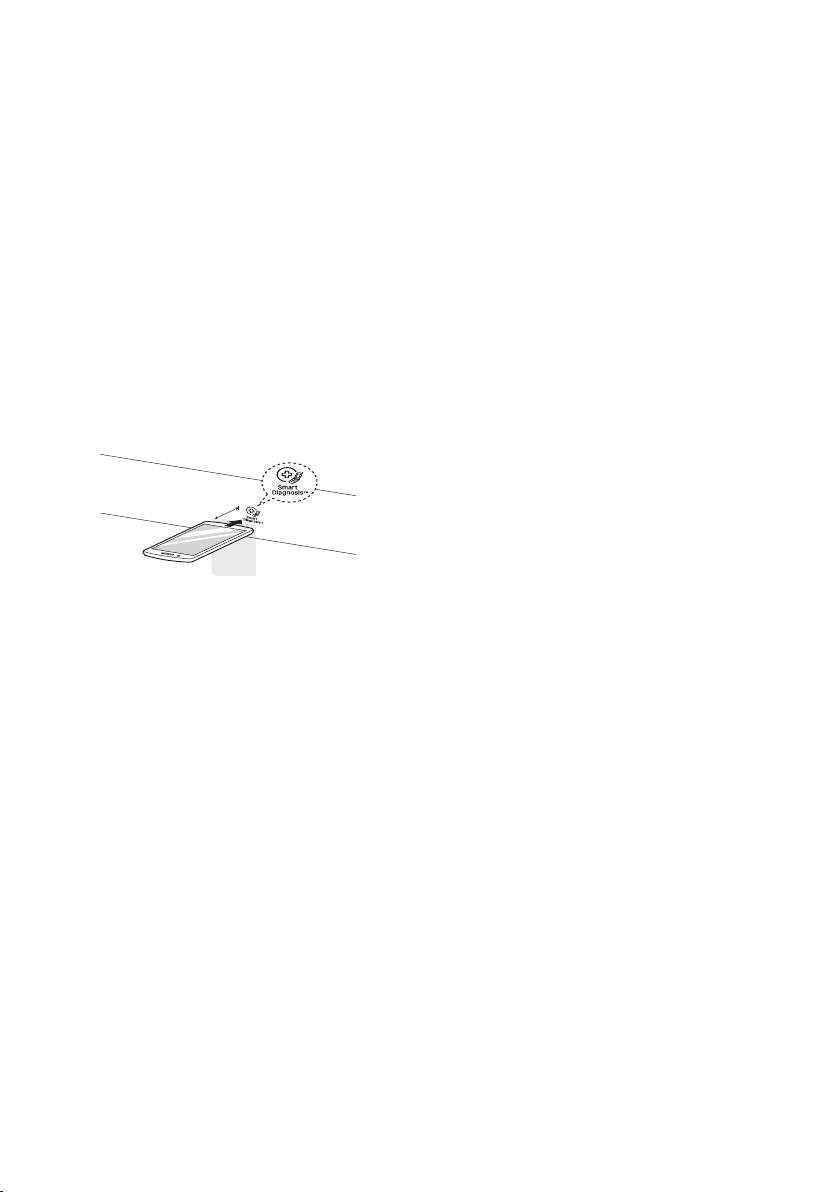
Place the mouthpiece of your smartphone
close to the c or d logo.
Max.
10 mm
3
Press and hold the Cold Wash button
for 3 seconds or longer while holding the
smartphone mouthpiece to the logo until the
data transfer is complete.
• Keep the smartphone in place until the data
transfer has finished. Time remaining for
data transfer is displayed.
4
4 After the data transfer is complete, the
diagnosis will be displayed in the application.
NOTE
• For best results, do not move the smartphone
while the tones are being transmitted.
29
EN
MAINTENANCE
WARNING
• Unplug the appliance before cleaning to avoid the risk of electric shock. Failure to follow this warning
may result in serious injury, fire, electric shock, or death.
• Never use harsh chemicals, abrasive cleaners, or solvents to clean the appliance. They may damage
the finish.
Cleaning After Every Wash
Care After Wash
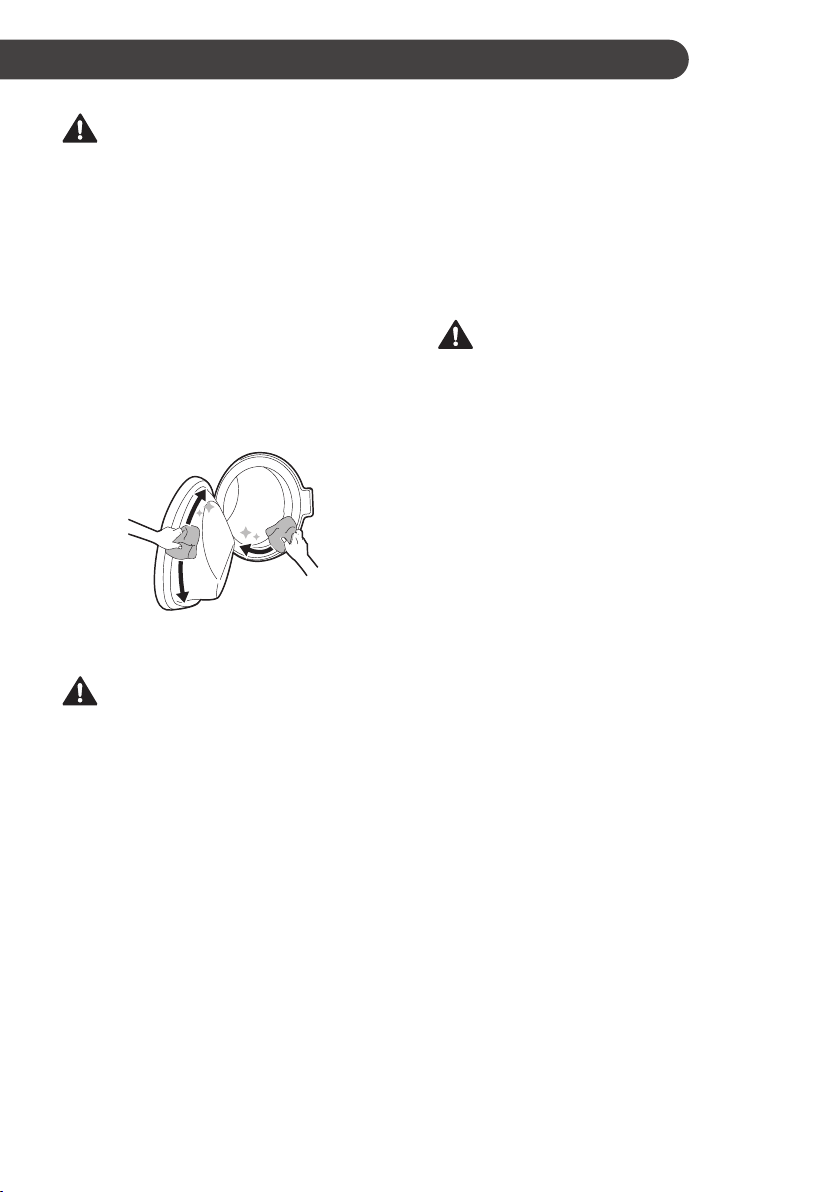
• After the wash cycle is finished, wipe the door
and door seal to remove any moisture.
• Leave the door slightly open to dry the drum.
• Wipe the appliance with a dry cloth to remove
any moisture.
WARNING
• Leave the door open to dry the drum interior but
only if it is safe and any children are supervised.
Cleaning the Exterior
Proper care of the appliance can extend the service
life.
Exterior
• Immediately wipe off any spills. Wipe with a
damp cloth.
• Wipe with a damp cloth and then again with a
dry cloth ensuring there is no moisture in cabinet
joints or crevices.
• Do not press on the surface on the display with
sharp objects.
Door
• Wash with a damp cloth on the outside and
inside and then dry with a soft cloth.
WARNING
• Do not attempt to separate any panels or
disassemble the appliance. Do not apply any
sharp objects to the control panel in order to
operate the appliance.
Cleaning the Interior
• Use a towel or soft cloth to wipe around the door
opening and door glass.
• Always remove items from the appliance as
soon as the cycle is complete. Leaving damp
items in the appliance can cause wrinkling,
colour transfer, and odour.
30
EN
Cleaning the Appliance
Periodically
Tub Clean
Use this function to clean inside of the appliance.
A higher water level is used in this programme at
higher spin speed. Run this function once a month
(or more often if needed) to remove detergent
buildup and other residue.
1
Remove any clothing or items from the
appliance and close the door.
2
Open the dispenser drawer and add
anti-limescale powder to the main wash
compartment.
• Put tablets into the drum.
3
Close the dispenser drawer slowly.
4
Turn on the power, and then select the
Tub Clean.
• tcL will be displayed on the display.
5
Press the Start/Pause button to start.
6
After the programme is complete, leave the
door open to dry the door opening, gasket, and
door glass.
WARNING
• Leave the door open to dry inside of the
appliance only if the children are supervised at
home.
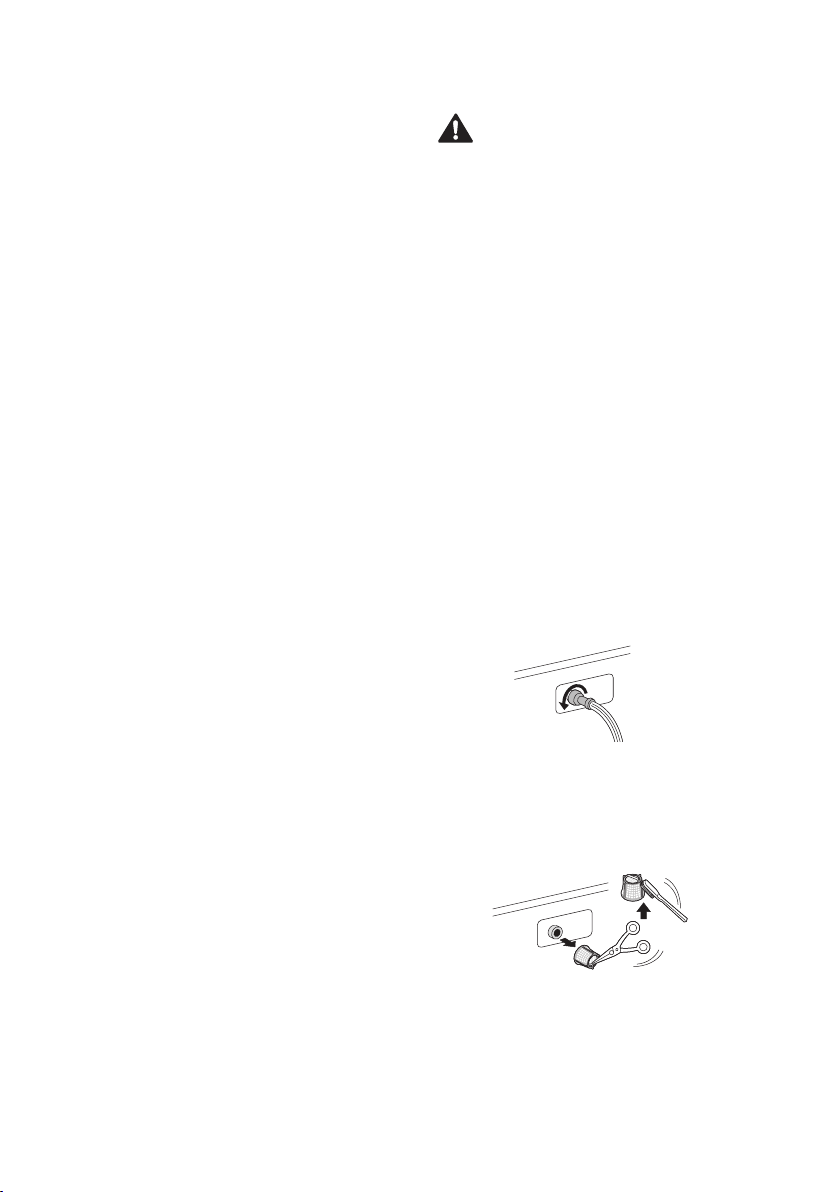
Cleaning the Water Inlet Filter
Water inlet filter collects lime or any small objects
that may be in water supplied to the appliance.
Clean the water inlet filter regularly.
NOTE
• Turn off the supply tap to the appliance if the
appliance is to be left for a certain period of time
(e.g. holiday), especially if there is no floor drain
(gully) in the immediate vicinity.
• 1E error message will be displayed on the
control panel when water is not entering the
detergent drawer.
• If the water is very hard or contains traces of
limescale, the filter on the water inlet may be
clogged.
1
Turn off the water tap and unscrew the water
inlet hose.
2
Clean the filter using a medium bristle tooth
brush.
31
EN
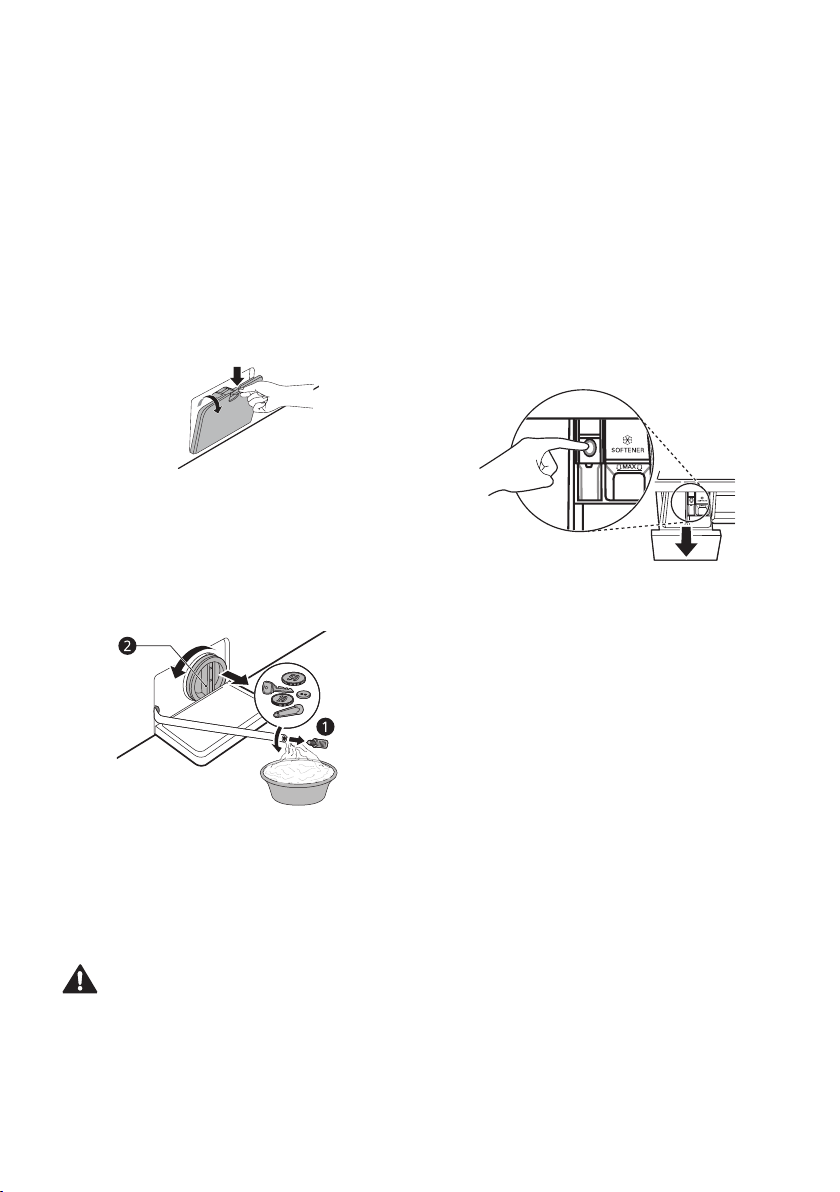
Cleaning the Drain Pump Filter
The drain filter collects threads and small objects
left in the laundry. Check regularly that the filter is
clean to ensure smooth running of your appliance.
Allow the water to cool before cleaning the drain
pump filter. Open the door in an emergency or
perform a emergency evacuation.
1
Unplug the appliance.
2
Open the cover cap and pull out the hose.
3
Unscrew the drain plug a , and then drain the
water. Slowly unscrew the drain pump filter b
to drain the water and remove small objects.
4
After cleaning the drain pump filter, take the
drain pump filter out and insert the drain plug.
5
Close the cover cap.
CAUTION
• Be careful when draining, as the water may be
hot.
• Run the drum cleaning programme once a
month (or more often, as needed) to remove
excess detergent and other debris.
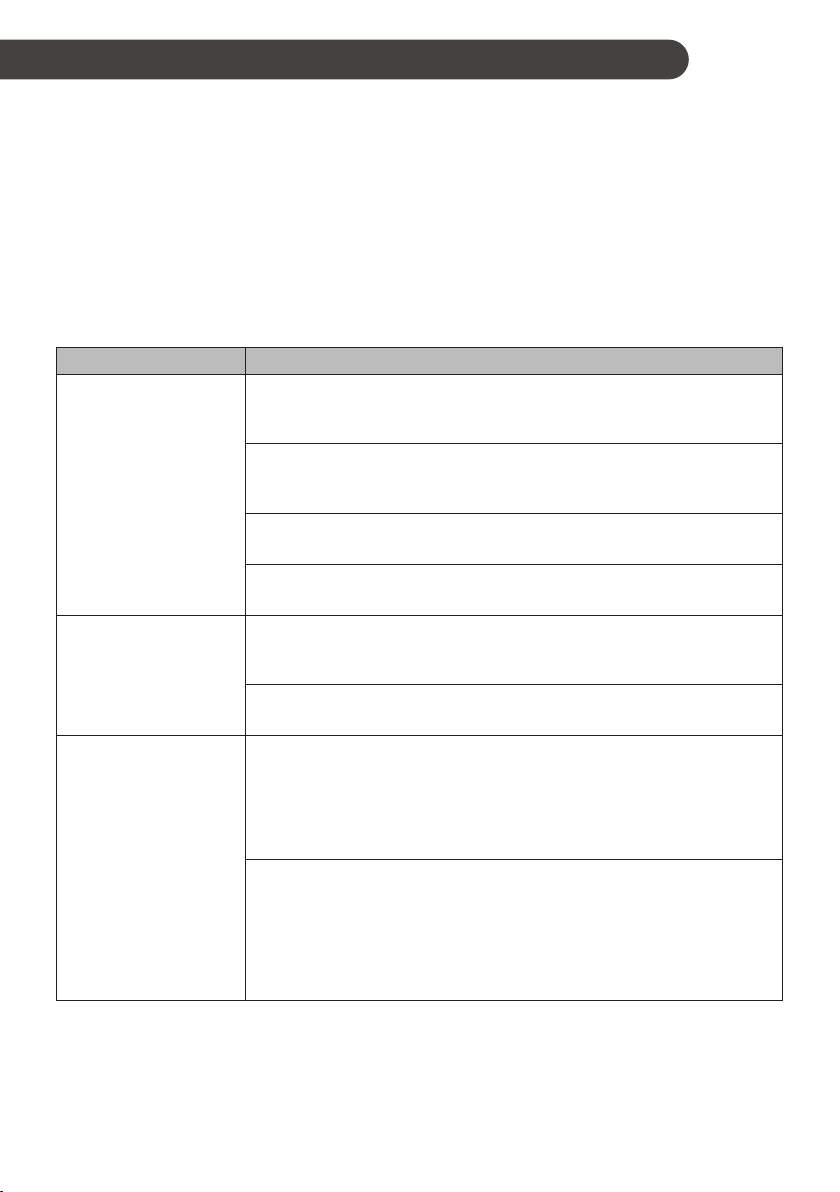
Cleaning the Dispenser Drawer
Detergent and fabric softener may build up in the
dispenser drawer. Remove the drawer and the
components of the drawer in the drawer and check
for build-up of detergents or softeners once or twice
a month.
1
Remove the detergent dispenser drawer by
pulling the drawer straight out until the drawer
stops.
• Remove the drawer while pressing the
release button on the inside of the detergent
drawer.
2
Remove the build-up of detergent and softener.
• Rinse the drawer and the components of the
drawer with warm water to remove the build-
up from detergent and softener. Use only
water to clean the dispenser drawer. Dry the
drawer and the components of the drawer
with a soft cloth or towel.
3
To clean the drawer opening, use a cloth or
small, non-metal brush to clean the recess.
• Remove all residue from the upper and lower
parts of the recess.
4
Wipe any moisture off the detergent drawer
recess with a soft cloth or towel.
5
Re-assemble the components of the drawer to
the proper compartments and insert the drawer.
32
EN
TROUBLESHOOTING
Before Calling for Service
Operation of the appliance can lead to errors and malfunctions. The following tables contain possible
causes and notes for resolving an error message or malfunction. You can remedy most of the problems by
yourself, consequently save time and money, since you do not need to call LG Electronics service centre.
The following table should assist you by troubleshooting.
Error Messages
The appliance is equipped with an automatic error-monitoring system to detect and diagnose problems at
an early stage. If this appliance does not function properly or does not function at all, check the following
before you call LG Electronics service centre.
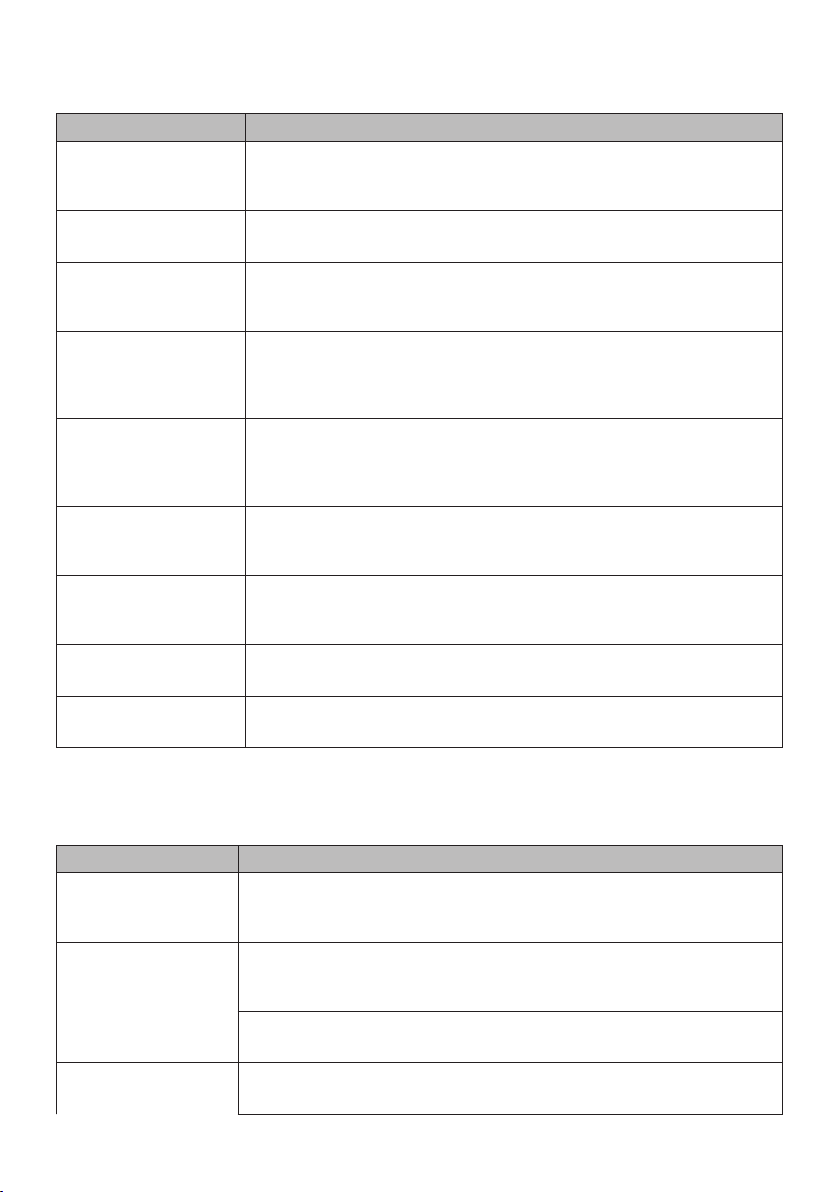
Symptoms Possible Cause & Solution
1E
INLET ERROR
Water supply is not adequate in that location. Water does not enter
appliance or it enters slowly.
• Check another tap in the house.
Water supply tap is not completely open. Water does not enter the
appliance or it enters slowly.
• Open fully tap.
Water supply hose(s) are kinked.
• Straighten hose or reinstall the water inlet hose
The filter of the supply hose(s) are clogged.
• Check and clean the filter of the inlet hose.
OE
WATER OUTLET
ERROR
Drain hose is kinked or clogged. Water in the appliance does not drain
or drains slowly.
• Clean and straighten the drain hose.
The drain filter is clogged.
• Check and clean the drain filter.
UE
UNBALANCE ERROR
The appliance has a system which detects and corrects the unbalance
of the appliance.
• The laundry may be too wet at the end of the cycle, rearrange the laundry
to allow proper spinning. Close the door and press Start/Pause button.
It may take a few moments before the appliance begins to spin. The door
must be locked before spin can be achieved.
Load is too small. This system may stop spinning or even interrupt the
spin cycle altogether if individual heavy items (e.g. bath mat, bath robe,
etc.) are loaded.
•
Add 1
or 2 similar items or items to help balance the laundry. Close the
door and press Start/Pause button. It may take a few moments before
the appliance begins to spin. The door must be locked before spin can be
achieved.
33
EN
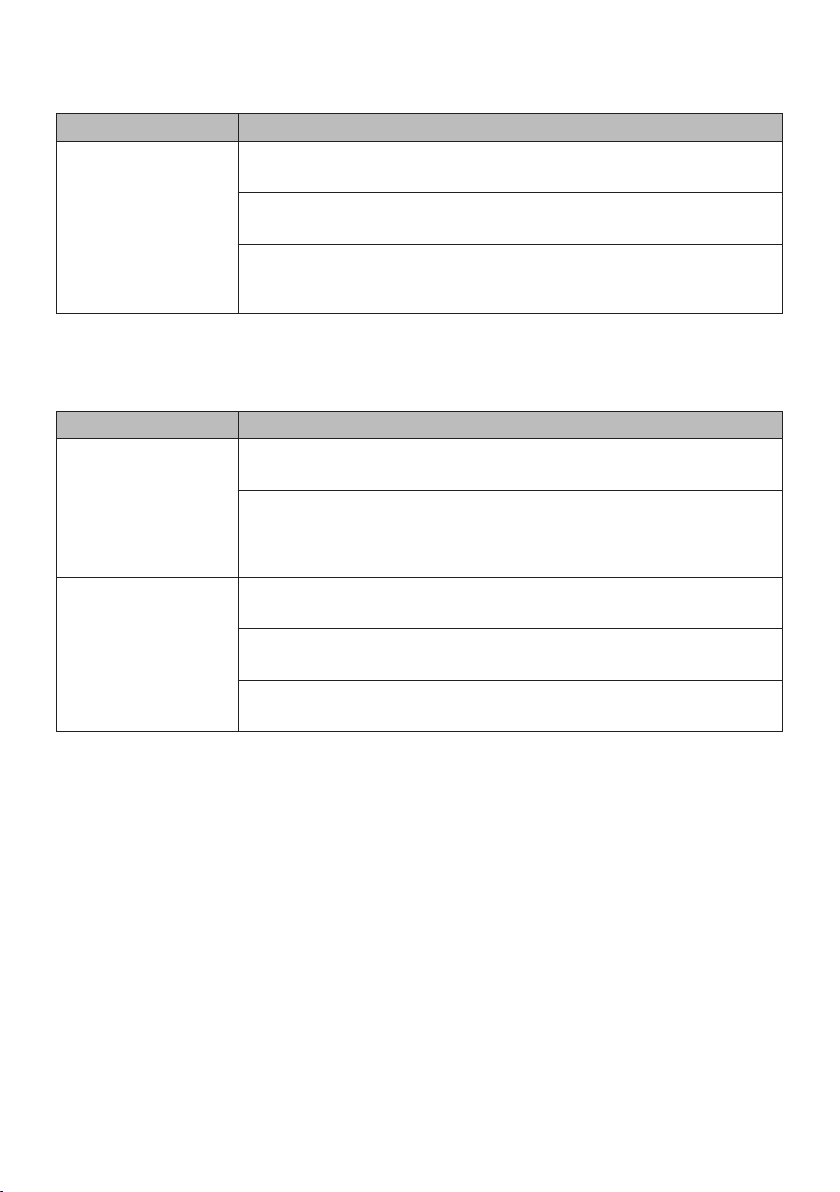
Symptoms Possible Cause & Solution
dE dE1 dEz dE4
DOOR ERROR
Door sensor malfunctions.
• Please call LG Electronics service centre. You can find your local LG
Electronics service centre phone number in the warranty card.
tE
CONTROL ERROR
This is a control error.
• Unplug the power plug and call for service.
LE
MOTOR LOCKED
ERROR
Over load in motor
• Let the appliance wait for 30 minutes until the motor is cooled down and
then, restart the cycle
FE
OVERFLOW ERROR
Water overfills due to the faulty water valve.
• Close the water tap.
• Unplug the power plug.
• Call for service.
PE
PRESSURE SENSOR
ERROR
Water level sensor malfunctions.
• Close the water tap.
• Unplug the power plug.
• Call for service.
vs
VIBRATION SENSOR
ERROR
Vibration sensor malfunctions.
• Call for service.
FF
FROZEN FAILURE
Is supply/drain hose or drain pump frozen?
• Supply warm water into the drum in order to unfreeze the drain hose and
the drain pump. Cover the supply hose with wet and warm towel.
AE
WATER LEAKAGE
Water leaks.
• Call for service.
PF
POWER FAILURE
The appliance experienced a power failure.
• Restart the cycle.
Noises You Might Hear
Symptoms Possible Cause & Solution
Rattling and clanking
noise
Foreign objects, such as keys, coins, or safety pins may be in the drum.
• Stop the appliance, check the drum for foreign objects. If the noise
continues after the appliance is restarted, call for service.
Thumping sound Heavy laundry may produce a thumping sound. This is usually normal.
• If the sound continues, the appliance is probably out of balance. Stop and
redistribute the laundry.
The laundry may be out of balance.
• Pause the cycle and redistribute the laundry after the door unlocks.
Vibrating noise Package materials are not removed.
• Remove package materials.
34
EN
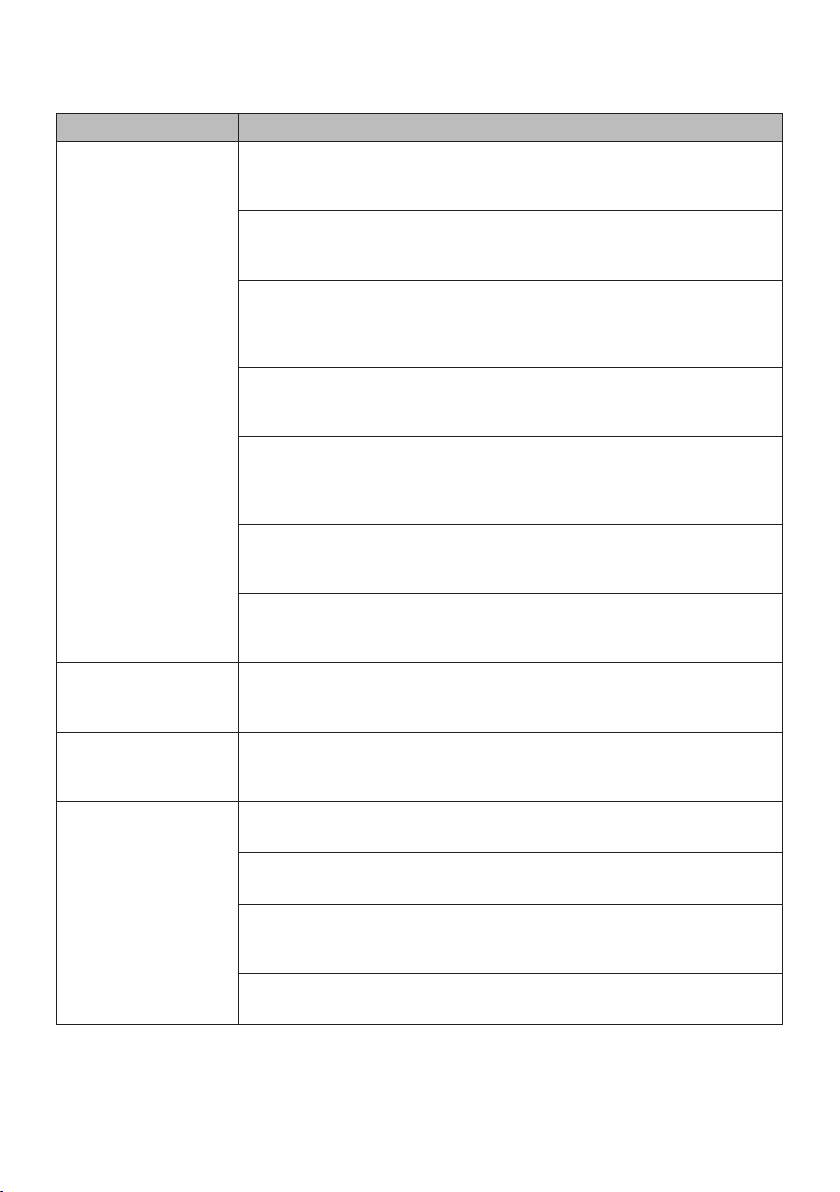
Symptoms Possible Cause & Solution
The laundry may be unevenly distributed in the drum.
• Pause the cycle and redistribute the laundry after the door unlocks.
Not all leveling feet are resting firmly and evenly on the floor.
• See the Leveling the Appliance to adjust the leveling of the appliance.
Floor not rigid enough.
• Check if the floor is sold and does not flex. See the Installation Place
Requirements to select the proper location.
Operation
Symptoms Possible Cause & Solution
Water is leaking. House drain pipes are clogged.
• Unclog the drain pipe. Contact plumber if necessary.
Leakage is caused by improper installation of drain hose or clogged
drain hose.
• Clean and straighten the drain hose. Check and clean the drain filter
regularly.
Appliance does not
operate.
Control panel has powered off due to inactivity.
• This is normal. Press the Power button to turn the appliance on.
Appliance is unplugged.
• Make sure that the cord should be plugged securely into a working outlet.
Water supply is turned off.
• Turn the water supply tap completely.
35
EN
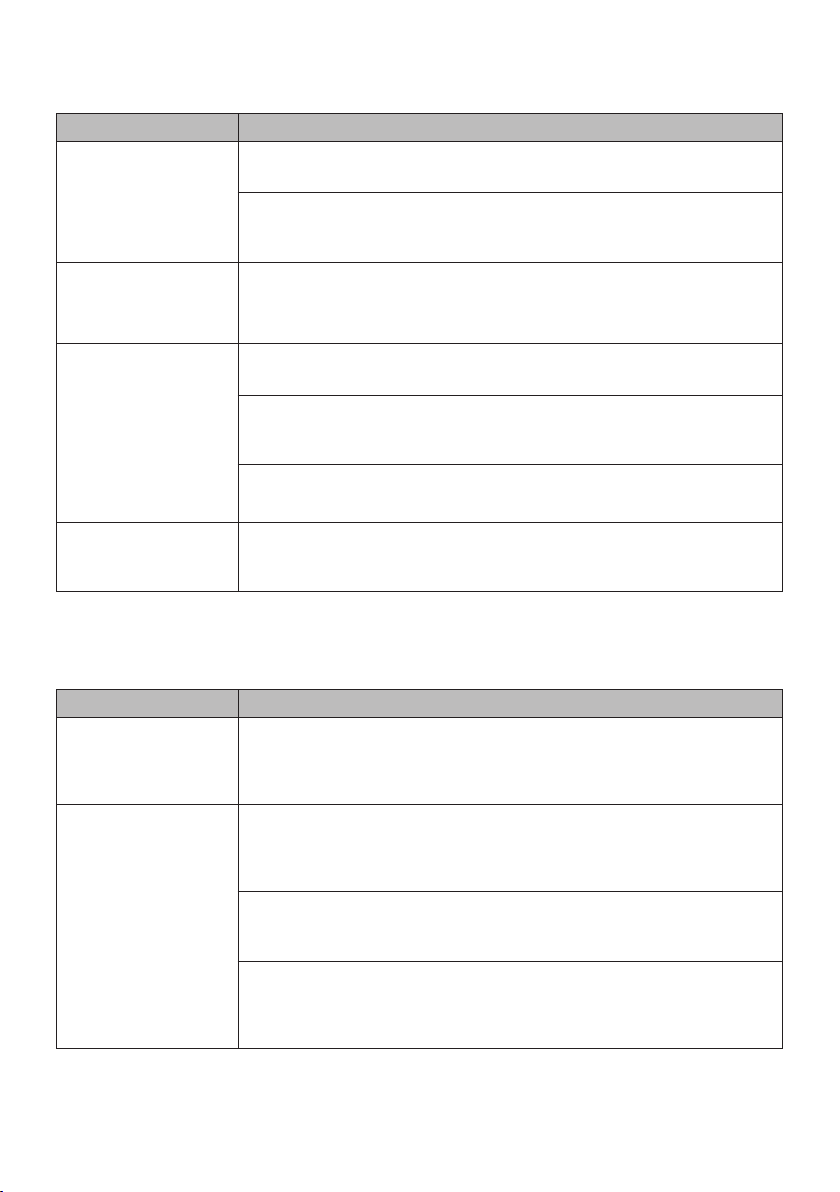
Symptoms Possible Cause & Solution
Appliance does not
operate.
Controls are not set properly.
• Make sure that the cycle should be correctly set. Close the door and press
the Start/Pause button.
Door is open.
• Close the door and make sure that nothing should be caught under the
door preventing it from closing completely.
Circuit breaker/fuse is tripped/blown.
• Check house circuit breakers/fuses. Replace fuses or reset breaker. The
appliance should be on a dedicated branch circuit. The appliance will
resume the cycle where it stopped once power is restored.
Control needs to be reset.
• Press the Power button, then reselect the desired programme and press
the Start/Pause button.
Start/Pause was not pressed after a cycle was set.
• Press the Power button, then reselect the desired programme and press
the Start/Pause button. The appliance is turned off if the Start/Pause
button is not pressed within 15 minutes.
Extremely low water pressure.
• Check another tap in the house to make sure that household water
pressure should be adequate.
Appliance is heating the water or making steam.
• The drum may stop operating temporarily during certain cycles, while
water is safely heated to a set temperature.
Buttons may not
function properly.
The door cannot be opened for safety reasons once the appliance starts.
• Check if the CL is illuminated. You can safely open the door after the
Door Lock icon turns off.
Door does not open. The door cannot be opened for safety reasons once the appliance starts.
• Check if the H icon is illuminated. You can safely open the door after the
H icon turns off.
Appliance is not filling
properly.
Filter clogged.
• Make sure the inlet filters on the fill valves are not clogged.
Inlet hoses may be kinked.
• Check that inlet hoses are not kinked or clogged.
Insufficient water supply.
• Make sure that both hot and cold water taps should be turned on all the
way.
Hot and cold inlet hoses are reversed.
• Check inlet hose connections.
36
EN
Symptoms Possible Cause & Solution
Appliance does not
drain water.
Kinked drain hose.
• Ensure that the drain hose is not kinked.
Drain located higher than 1.2 m above the floor.
• Make sure that the drain hose should not be higher than 1.2 m above the
bottom of the appliance.
Detergent is
not dispensed
incompletely or not
dispensed at all.
Too much detergent is used.
• Follow the guidelines provided by the detergent manufacturer.
Cycle time is longer
than usual.
The load is too small.
• Add more items to allow the appliance to balance the laundry.
Heavy items are mixed with lighter items.
• Always try to wash items with similar weight in order to allow the appliance
to evenly distribute the weight of the laundry for spinning.
The load is out of balance.
• Manually redistribute the laundry if items have become tangled.
Duration is delayed Unbalance is detected or suds removing programme is on.
• This is normal. The time remaining shown on the display is only an
estimated duration. Actual time may vary.
Performance
Symptoms Possible Cause & Solution
Poor stain removal Previously set stains.
• Items that have been previously washed may have stains which have
been set. These stains may be difficult to remove and may require hand
washing or pre-treating to aid in stain removal.
Staining Bleach or softener is dispensed too soon.
• Dispenser compartment is overfilled. It makes bleach or softer dispensed
rapidly. Always measure bleach or softener to prevent overfilling.
• Close the dispenser drawer gently.
Bleach or softener was added directly to the laundry in the drum.
• Always use the dispensers to ensure that laundry products are properly
dispensed at the right time in the cycle.
Clothes were not properly sorted.
• Always wash dark colours separately from light colours and whites to
prevent discolouration.
• Never wash heavily soiled items with lightly soiled items.
37
EN
Symptoms Possible Cause & Solution
Wrinkling Appliance is not unloaded promptly.
• Always remove items from the appliance as soon as the cycle is complete.
Appliance is overloaded.
• The appliance can be fully loaded, but the drum should not be tightly
packed with items. The door of the appliance should be closed easily.
Hot and cold water inlet hoses are reversed.
• Hot water rinse can set wrinkles in garments. Check the inlet hose
connections.
Musty or mildewy
odour in appliance
Inside of drum is not cleaned properly.
• Run the Tub Clean function regularly.
The drain hose is not properly installed, causing siphoning (water
flowing back inside of the appliance).
• When installing the drain hose, make sure that it does not get kinked or
blocked.
The detergent dispenser drawer is not cleaned regularly.
• Clean the detergent dispenser drawer, especially the top and the bottom of
the drawer’s opening.
Odours can occur if the drain hose is not properly installed, causing
siphoning (water flowing back inside of the appliance).
• When installing the drain hose, make sure that it does not get kinked or
blocked.
If the detergent dispenser drawer is not cleaned regularly, odours can
occur from mold or foreign substances.
• Clean the detergent dispenser drawer, especially the top and bottom of the
drawer’s opening.
38
EN
Wi-Fi
Symptoms Possible Cause & Solution
Your home appliance
and smart phone is
not connected to the
Wi-Fi network.
The password for the Wi-Fi that you are trying to connect to is incorrect.
• Find the Wi-Fi network connected to your smartphone and remove it, then
register your appliance on LG ThinQ.
Mobile data for your smartphone is turned on.
• Turn off the Mobile data of your smartphone and register the appliance
using the Wi-Fi network.
The wireless network name (SSID) is set incorrectly.
• The wireless network name (SSID) should be a combination of English
letters and numbers. (Do not use special characters).
The router frequency is not 2.4 GHz.
• Only a 2.4 GHz router frequency is supported. Set the wireless router to
2.4 GHz and connect the appliance to the wireless router. To check the
router frequency, check with your internet service provider or the router
manufacturer.
The distance between the appliance and the router is too far.
• If the distance between the appliance and the router is too far, the signal
may be weak and the connection may not be configured correctly. Move
the location of the router so that it is closer to the appliance.
39
EN
OPERATING DATA
Product Fiche
Commission Delegated Regulation (EU) No 1061/2010
Supplier’s name or trade mark LG
Supplier’s model F*V509*
Rated capacity kg 9
Energy efficiency class A+++
Awarded an “EU Ecolabel award” under
regulation [(EC) No 66/2010]
No
Weighted annual energy consumption (AEC)
kWh per year
*1
kWh/year 152
Energy consumption
The standard 60 ºC cotton programme at full
load
kWh 0.79
The standard 60 ºC cotton programme at partial
load
kWh 0.60
The standard 40 ºC cotton programme at partial
load
kWh 0.56
Weighted power consumption of the off-mode
and of the left-on mode
W 0.45
Weighted annual water consumption (AWC) in
litres per year
*2
litres/year 8800
Spin-drying efficiency class on a scale from G
(least efficient) to A (most efficient).
A
Maximum spin speed
*3
rpm 1360
Remaining moisture
*3
% 44
The standard cotton programmes
*4
Eco 40-60 +Intensive, 60 °C / 40 °C
The programme time
The standard 60 ºC cotton programme at full
load
*5
min. 283
The standard 60 ºC cotton programme at partial
load
*5
min. 235
The standard 40 ºC cotton programme at partial
load
*5
min. 226
The duration of the left-on mode (TI) min. 10
Airborne acoustical noise emissions
Washing phase
*6
dB(A) 52
Spinning phase
*6
dB(A) 75
Free-Standing

40
EN
*1: Based on 220 standard washing cycles for cotton programmes at 60 ºC and 40 ºC at full and partial
load, and the consumption of the low-power modes. Actual energy consumption will depend on how the
appliance is used.
*2: Based on 220 standard washing cycles for cotton programmes at 60 ºC and 40 ºC at full and partial
load. Actual water consumption will depend on how the appliance is used.
*3: Attained for the standard 60 ºC cotton programme at full load or the standard 40 ºC cotton programme
at partial load, whichever is the lower, and remaining moisture content attained for the standard 60 ºC
cotton programme at full load or the standard 40 ºC cotton programme at partial load, whichever is the
greater.
*4: To which the information in the label and in the fiche relates, that these programmes are suitable
to clean normally soiled cotton laundry and that they are the most efficient programmes in terms of
combined energy and water consumption.
*5: The standard cotton programme is Eco 40-60 +Intensive, 60 °C full load, Eco 40-60 +Intensive, 60 °C
half load, and Eco 40-60 +Intensive, 40 °C half load in accordance with Regulations (EU) No. 1061/2010
and EN 60456.
*6: Expressed in dB(A) re 1 pW and rounded to the nearest integer during the washing and spinning
phases for the standard 60 ºC cotton programme at full load.
Memo
Memo
Memo