4-229-644-15(1)
Compact Disc
MiniDisc Deck
2000 by Sony Corporation
MXD-D40
MXD-D4
Operating Instructions
2
WARNING
To prevent fire or shock
hazard, do not expose the unit
to rain or moisture.
To avoid electrical shock, do
not open the cabinet. Refer
servicing to qualified
personnel only.
The laser component in this product
is capable of emitting radiation
exceeding the limit for Class 1.
This appliance is classified as a CLASS 1
LASER product. The CLASS 1 LASER
PRODUCT MARKING is located on the
rear exterior.
To prevent fire, do not Cover the
ventilation of the apparatus with news
papers, table-cloths, curtains, etc. And
don’t place lighted candles on the
apparatus.
To prevent fire or shock hazard, do not
place vases on the apparatus.
The following caution label is located
inside of the unit.
Don’t throw a battery,
dispose it as the injurious
wastes.
IN NO EVENT SHALL SELLER BE
LIABLE FOR ANY DIRECT,
INCIDENTAL OR
CONSEQUENTIAL DAMAGES OF
ANY NATURE, OR LOSSES OR
EXPENSES RESULTING FROM ANY
DEFECTIVE PRODUCT OR THE USE
OF ANY PRODUCT.
CAUTION
The use of optical instruments with this
product will increase eye hazard.
For the customers in the U.S.A.
This symbol is intended to alert
the user to the presence of
uninsulated “dangerous voltage”
within the product’s enclosure
that may be of sufficient
magnitude to constitute a risk of
electric shock to persons.
This symbol is intended to alert
the user to the presence of
important operating and
maintenance (servicing)
instructions in the literature
accompanying the appliance.
CAUTION
You are cautioned that any changes or
modification not expressly approved in
this manual could void your authority
to operate this equipment.
INFORMATION
This equipment has been tested and
found to comply with the limits for a
Class B digital device, pursuant to Part
15 of the FCC Rules. These limits are
designed to provide reasonable
protection against harmful interference
in a residential installation. This
equipment generates, uses, and can
radiate radio frequency energy and, if
not installed and used in accordance
with the instructions, may cause
harmful interference to radio
communications. However, there is no
guarantee that interference will not
occur in a particular installation. If this
equipment does cause harmful
interference to radio or television
reception, which can be determined by
turning the equipment off and on, the
user is encouraged to try to correct the
interference by one or more of the
following measures:
• Reorient or relocate the receiving
antenna.
• Increase the separation between the
equipment and receiver.
• Connect the equipment into an outlet
on a circuit different from that to
which the receiver is connected.
• Consult the dealer or an experienced
radio/TV technician for help.
Owner’s Record
The model and serial numbers are
located on the rear of the unit. Record
the serial number in the space provided
below. Refer to them whenever you call
upon your Sony dealer regarding this
product.
Model No. MXD-D40/MXD-D4
Serial No. ___________
ENERGY STAR
®
ia a U.S. registered
mark.
As an ENERGY STAR
®
Partner, Sony
Corporation has determined that this
product meets the ENERGY STAR
®
guidelines for energy efficiency.
For the customers in Canada
This Class B digital apparatus complies
With Canadian ICES-003.
CAUTION
TO PREVENT ELECTRIC SHOCK, DO
NOT USE THIS POLARIZED AC PLUG
WITH AN EXTENSION CORD,
RECEPTACLE OR OTHER OUTLET
UNLESS THE BLADES CAN BE FULLY
INSERTED TO PREVENT BLADE
EXPOSURE.
About This Manual
The instructions in this manual are for
models MXD-D40 and MXD-D4.
The MXD-D40 is the model used for
illustration purposes. Any difference in
operation is clearly indicated in the text,
for example, “MXD-D40 only”.
Conventions
• Before operating the deck, connect
your deck by referring to “Getting
Started.”
• For basic operations, see “Playing a
CD,” “Playing an MD,” “Recording a
CD to an MD” and “Recording a CD
to an MD at High Speed.”
• Controls in the instructions are those
on the deck; these may, however, be
substituted by controls on the remote
that are similarly named or, when
different, appear in the instructions
within brackets.
• The following icons are used in this
manual:
Z
Indicates a procedure that
requires use of the remote.
z
Indicates tips for making the
task easier and hints.

3
TABLE OF CONTENTS
Getting Started
Unpacking ........................................................................... 4
Hooking Up the System ....................................................4
Playing a CD............................................................ 6
Playing an MD ........................................................ 7
Recording a CD to an MD
(CD-MD Synchro-Recording) ............................. 8
Recording a CD to an MD at High Speed
(High-Speed CD-MD Synchro-Recording)... 10
Playing CDs and MDs
Using the Display ............................................................ 12
Locating a Specific Track ............................................... 14
Locating a Particular Point in a Track ......................... 15
Playing Tracks Repeatedly (Repeat Play) ................... 15
Playing in Random Order (Shuffle Play) .................... 16
Creating Your Own Program (Program Play) ........... 16
Falling Asleep to Music (Sleep Timer) ........................ 17
Changing the Pitch of the MD
(Pitch Control Function)............................................. 18
Recording on MDs
Notes on Recording ........................................................ 19
Useful Tips for Recording.............................................. 20
Recording on an MD Manually .................................... 21
Recording for Long Times ............................................. 22
Adjusting the Recording Level ..................................... 23
Marking Track Numbers While Recording ................ 24
Recording the Current CD Track
(REC-IT Function) ....................................................... 25
Synchro-Recording With an External Audio
Equipment (Music Synchro-Recording) .................. 26
Starting Recording With Prestored Audio Data
(Time Machine Recording) ........................................ 26
Fading In and Out (Fader) ............................................. 27
Editing Recorded MDs
Notes on Editing.............................................................. 28
Erasing Recordings ......................................................... 28
Erasing a Part of a Track (A-B Erase Function) ......... 29
Dividing Recorded Tracks (Divide Function) ............ 30
Combining Recorded Tracks (Combine Function).... 31
Moving Recorded Tracks (Move Function) ................ 32
Labeling Recordings (Name Function) ....................... 33
Undoing the Last Edit (Undo Function) ..................... 37
Changing the Recorded Level After Recording
(S.F Edit Function)....................................................... 38
Additional Information
Precautions ....................................................................... 40
Display Messages ............................................................ 41
System Limitations ......................................................... 42
Troubleshooting .............................................................. 43
Specifications ................................................................... 44
Guide to the Serial Copy Management System ......... 45
Index .................................................................................. 47
Table of Setup Menus ..................................................... 49
Self-Diagnosis Function ................................................. 50
Notes on CDs ................................................................... 51
Handling MDs ................................................................. 51

Getting Started
4
Unpacking
Check that you received the following items:
• Audio connecting cords (2)
• Remote commander (remote) (1)
• Sony R6 (size-AA) batteries (2)
• Power plug adaptor (1) (Singaporian model only)
Inserting batteries into the remote
You can control the deck using the supplied remote.
Insert two R6 (size-AA) batteries by matching the +
and – on the batteries. When using the remote, point it
at the remote sensor g on the deck.
D.SKIP on the remote cannot be used with this deck.
z When to replace batteries
With normal use, the batteries should last for about six
months. When the remote no longer operates the deck,
replace all the batteries with new ones.
Notes
• Do not leave the remote near an extremely hot or humid
place.
• Do not drop any foreign object into the remote casing,
particularly when replacing the batteries.
• Do not expose the remote sensor to direct sunlight or
lighting apparatuses. Doing so may cause a malfunction.
• If you don’t use the remote for an extended period of time,
remove the batteries to avoid possible damage from
battery leakage and corrosion.
Hooking Up the System
Overview
This section describes how to hook up the deck to an
amplifier or other components such as a CD player or
DAT deck. Be sure to turn off the power of each
component before connection.
ç
ç
ç
REC
OUT
TAPE/MD
IN
DIGITAL
OPTICAL OUT
çç
çç
ç: Signal flow
What cords will I need?
• Audio connecting cords (supplied) (2)
• Optical cable (not supplied) (1)
White
(L)
Red
(R)
White
(L)
Red
(R)
Getting Started
to a wall outlet
Amplifier
CD player, DAT deck,
or MD deck, etc.
PC-LINK (MXD-D40 only)

5
Getting Started
Hookups
Connecting the deck to an amplifier
Connect the amplifier to the ANALOG IN/OUT jacks
using the audio connecting cords (supplied), making
sure to match the color-coded cords to the appropriate
jacks on the components: red (right) to red and white
(left) to white. Be sure to make connections firmly to
prevent hum and noise.
MXD-D40/D4 Amplifier
ç
Ç
TAPE / MD
L
R
INOUT
R
L
OUT
IN
ANALOG
çç
çç
ç: Signal flow
Connecting the deck to a digital component such as
a CD player, DAT deck, or an MD deck
Connect the component through the DIGITAL
OPTICAL IN connector with the optical cable (not
supplied).
Take the caps off the connectors and then insert the
plugs parallelly until they click into place.
Be sure not to bend or tie the optical cable.
MXD-D40/D4 Digital component
Ç
DIGITAL
OUT
OPTICAL
DIGITAL
IN
OPTICAL
çç
çç
ç: Signal flow
z If “Din Unlock” and “C71” alternate in the display
The optical cable is not connected properly. Check that
the connections are secure.
z Automatic conversion of digital sampling rates
during recording
A built-in sampling rate converter automatically
converts the sampling frequency of various digital
sources to the 44.1 kHz sampling rate of this deck.
This allows you to record sources such as 32- and 48-
kHz DAT or satellite broadcasts, as well as compact
discs and MDs.
Note
If “Din Unlock” or “Cannot Copy” flashes in the display,
recording through the DIGITAL OPTICAL IN connector is
not possible. In this case, record the program source
through the ANALOG IN jacks with “ANALOG” selected by
INPUT.
Setting the voltage selector (only on
models supplied with a voltage selector)
Check that the voltage selector on the rear panel of the
deck is set to the local power line voltage. If not, set
the selector to the correct position using a screwdriver
before connecting the AC power cord to an AC outlet.
220—240V110—120V
VOLTAGE
SELECTOR
Connecting the AC power cord
Connect the AC power cord to a wall outlet.
Note
Do not connect the AC power cord to a switched outlet.
Connecting a PC (MXD-D40 only)
Use the PCLK-MN10A PC connecting kit (not
supplied) to connect a PC to the deck. By connecting
the deck to a PC, you will be able to select and play
MD tracks and do various MD editing operations on
the PC. For details, refer to the manual supplied with
the PC connecting kit.
Demonstration mode
When you turn on the deck and there is no CD or MD
in the deck, demonstration mode is activated
automatically after about ten minutes. To deactivate
the demonstration mode, press any button on the deck
or on the remote.
z To turn off the demonstration mode
Press p on the left of the front panel and CLEAR on the
right of the front panel simultaneously.
Demonstration mode is turned off until you unplug the
power cord of the deck and plug it in again.
Basic Operations
6
Basic Operations
Playing a CD
1/u
§§
0)
≠±≠±
r
pP
·
0)
pP
·
PHONE LEVEL
PHONES
MIN MAX
MENU/
NO
YES
CLEAR
PUSH ENTER
REC
AMS
EJECT
OPEN/CLOSE
NORMAL
CD SYNCHRO
HIGH
CLEAR
TIME PLAY MODE DISPLAY INPUT PLAY MODE TIME/CHAR
PUSH ENTER
CD
AMS
REC-IT
STANDBY
MD
MD LP
REC MODE
2
34
1
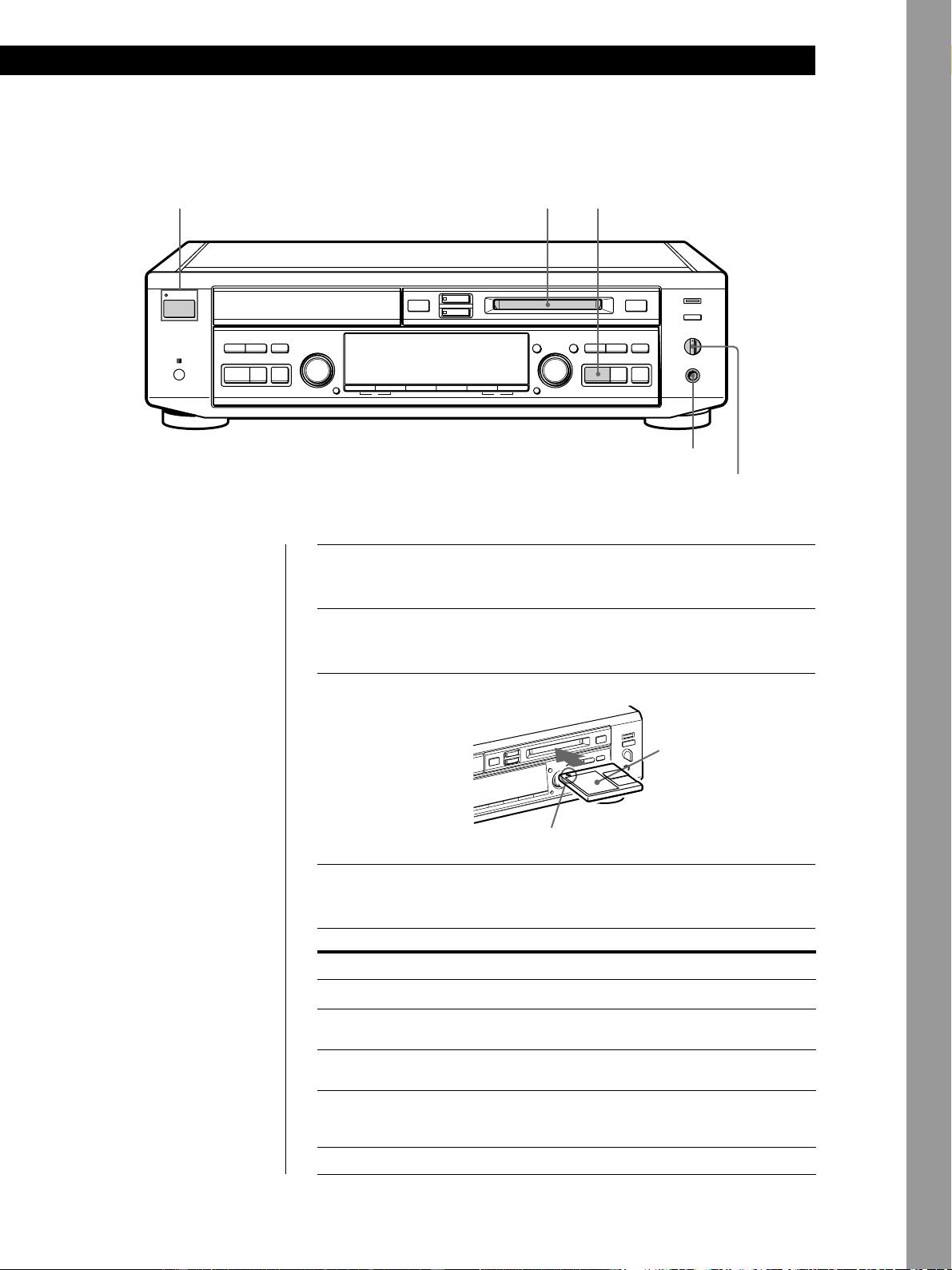
Turn on the amplifier and set the source selector to the position
for this deck.
2
Press 1/u.
The STANDBY indicator turns off.
3
Press § OPEN/CLOSE to insert a CD. Press the button again
to close the CD tray.
When you play an 8-cm CD, place it on the inner circle of the
tray.
With the label side up
4
Press ·.
The deck starts playing. Adjust the volume on the amplifier.
To Do the following:
Connect the headphones.
Adjust the headphone volume.
When using the controls on the
deck
Use the CD player controls located
to the left of the front panel.
When using the remote Z
Set SELECT to CD.
Audio output
Output switches automatically to
the audio of the CD.
z You can start playing with
the track selected in step 4
1 Turn AMS (or press = or
+) to select the track you
want to play using the
display*.
2 Press AMS or ·.
* See “Using the Display” on
page 12.
Stop playing Press p.
Pause playing Press P. Press the button again or press · to
resume playing.
Go to the next track Turn AMS clockwise (or press + on the
remote).
Go to the beginning of the
current track or the
preceding track
Turn AMS counterclockwise (or press = on the
remote).
Take out the CD Press § OPEN/CLOSE after stopping playing.
Basic Operations
Basic Operations
7
Playing an MD
1/u
§§
0)
≠±≠±
r
pP
·
0)
pP
·
PHONE LEVEL
PHONES
MIN MAX
MENU/
NO
YES
CLEAR
PUSH ENTER
REC
AMS
EJECT
OPEN/CLOSE
NORMAL
CD SYNCHRO
HIGH
CLEAR
TIME PLAY MODE DISPLAY INPUT PLAY MODE TIME/CHAR
PUSH ENTER
CD
AMS
REC-IT
STANDBY
MD
MD LP
REC MODE
2
3 4
1
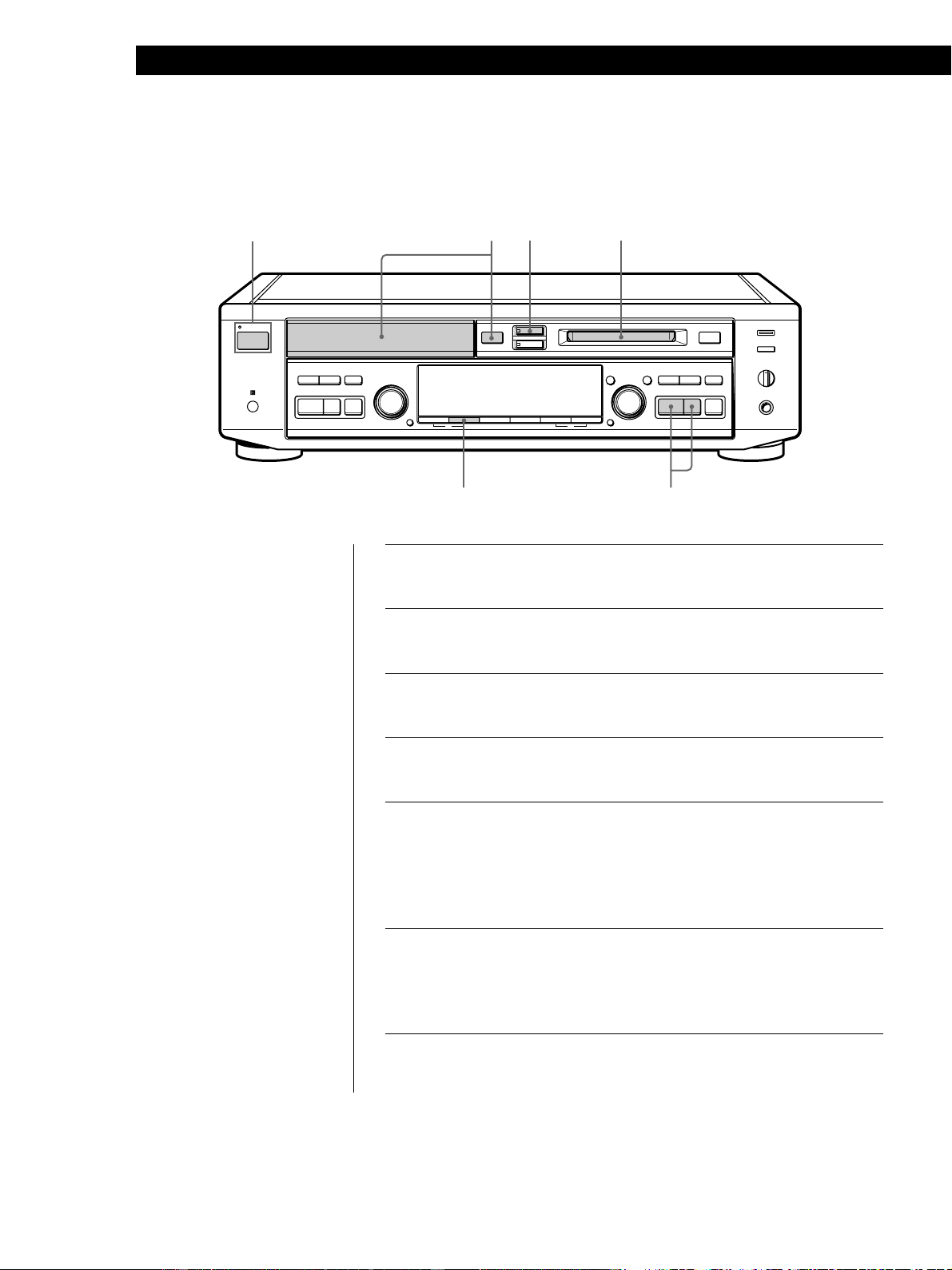
Turn on the amplifier and set the source selector to the position
for this deck.
2
Press 1/u.
The STANDBY indicator turns off.
3
Insert an MD.
With the arrow pointing this way
4
Press ·.
The deck starts playing. Adjust the volume on the amplifier.
To Do the following:
Connect the headphones.
Adjust the headphone volume.
With the label side up
Press p.
Turn AMS counterclockwise (or press = on the
remote).
Take out the MD
When using the controls on the
deck
Use the MD deck controls located
to the right of the front panel.
When using the remote Z
Set SELECT to MD.
Audio output
Output switches automatically to
the audio of the MD.
z You can start playing with
the track selected in step 4
1 Turn AMS (or press = or
+) to select the track you
want to play using the
display*.
2 Press AMS or ·.
* See “Using the Display” on
page 12 and 13.
z You can change the MD
playback speed
See “Changing the Pitch of the
MD” on page 18.
Stop playing
Pause playing Press P. Press the button again or press · to
resume playing.
Go to the next track Turn AMS clockwise (or press + on the
remote).
Go to the beginning of the
current track or the
preceding track
Press § EJECT after stopping playing.
Basic Operations
8
Recording a CD to an MD
(CD-MD Synchro-Recording)
1/u
§§
0)
≠±≠±
r
pP
·
0)
pP
·
PHONE LEVEL
PHONES
MIN MAX
MENU/
NO
YES
CLEAR
PUSH ENTER
REC
AMS
EJECT
OPEN/CLOSE
NORMAL
CD SYNCHRO
HIGH
CLEAR
TIME PLAY MODE DISPLAY INPUT PLAY MODE TIME/CHAR
PUSH ENTER
CD
AMS
REC-IT
STANDBY
MD
MD LP
REC MODE
1
253
4 6
1
Press 1/u.
The STANDBY indicator turns off.
2
Insert a recordable MD.
3
Press § OPEN/CLOSE to insert a CD. Press the button again
to close the CD tray.
4
Press PLAY MODE to select the playing mode of the CD
(normal play or Program Play).
5
Press CD SYNCHRO NORMAL.
“CD SYNCHRO” appears and “–Normal–” flashes in the
display.
The MD deck section stands by for recording, and the CD
player section stands by for playing.
6
After “CD SYNCHRO” and “–Normal–” turn off, press · or
P on the right of the front panel.
Recording starts. The MD deck section and the CD player
section will automatically stop after recording.
To stop recording
Press p on the right of the front panel.
You can easily make digital
recordings from a CD to an
MD, marking track numbers in
the same sequence as the
original CD.
Before recording, see “Notes on
Recording” on page 19.
z CD text is copied to the MD
automatically
When the CD to be recorded
using the CD-MD Synchro-
Recording Function contains
track names, this information
is recorded onto the MD
automatically.
Note that CD text on some
CDs is copy-protected and
thus may not be copied to the
MD.
z You can play back tracks just
recorded
If “TRACK” lights up in the
display when recording has
finished, press ·
immediately to play back from
the first track of the material
just recorded.

Basic Operations
Basic Operations
9
Rear of the disc
Do not disconnect the deck from the power source immediately after
recording
If you do, recorded material may not be saved to the MD. To save the
material, after recording, press § EJECT to take out the MD or turn off the
deck. “TOC Writing” will flash at this time.
After “TOC Writing” goes out, you can pull out the AC power cord.
To protect an MD against accidental erasure
To make it impossible to record on an MD, slide the tab in the direction of
arrow, opening the slot. To allow recording, close the slot.
Notes
• You cannot record over existing
material. The deck automatically
starts recording from the end of
the existing material.
• Make sure that the remaining
recordable time on the MD is
longer than the playing time of
the CD, especially if you want to
record all the tracks on the CD.
• You cannot pause recording.
• If the play mode is set to Repeat
Play or Shuffle Play, it
automatically switches to normal
play at step 5.
• The recording level specified in
the Setup Menu (page 23) is not
applied. The initial reference
level (0.0 dB) is used instead.
When “TOC Writing” flashes in
the display
The deck is currently updating the
Table Of Contents (TOC). Do not
move the deck or pull out the AC
power cord. Changes to an MD
made through recording are saved
only when you update the TOC by
ejecting the MD or turning off the
deck.
Slide the tab in the
direction of arrow
Record-protect tab

Basic Operations
10
Recording a CD to an MD at
High Speed
(High-Speed CD-MD Synchro-Recording)
1
Press 1/u.
The STANDBY indicator turns off.
2
Insert a recordable MD.
3
Press § OPEN/CLOSE to insert a CD. Press the button again
to close the CD tray.
4
Press PLAY MODE to select the playing mode of the CD
(normal play or Program Play).
5
Press CD SYNCHRO HIGH.
“CD SYNCHRO” appears and “–High–” flashes in the display.
The MD deck section stands by for recording and the CD
player section stands by for playing.
6
After “CD SYNCHRO” and “–High–” turn off, press · or P
on the right of the front panel.
High-speed recording starts. The MD deck section and the CD
player section will automatically stop after recording.
To stop recording
Press p on the right of the front panel.
1/u
§§
0)
≠±≠±
r
pP
·
0)
pP·
PHONE LEVEL
PHONES
MIN MAX
MENU/
NO
YES
CLEAR
PUSH ENTER
REC
AMS
EJECT
OPEN/CLOSE
NORMAL
CD SYNCHRO
HIGH
CLEAR
TIME PLAY MODE DISPLAY INPUT PLAY MODE TIME/CHAR
PUSH ENTER
CD
AMS
REC-IT
STANDBY
MD
MD LP
REC MODE
1
253
4 6
You can easily make digital
recordings from a CD to an MD
faster than normal CD-MD
Synchro-Recording, marking
track numbers in the same
sequence as the original CD.
Before recording, see “Notes on
Recording” on page 19.
z CD text is copied to the MD
automatically
When the CD to be recorded
using the High-Speed CD-MD
Synchro-Recording Function
contains track names, this
information is recorded onto
the MD automatically.
Note that CD text on some
CDs is copy-protected and
thus may not be copied to the
MD.
z You can play back tracks just
recorded
If “TRACK” lights up in the
display when recording has
finished, press ·
immediately to play back from
the first track of the material
just recorded.

Basic Operations
Basic Operations
11
If “–Retry–” flashes in the display after you press · or P in step 6
A reading failure has occurred, and the deck is trying to read the data again.
• If the retry was successful, the deck continues with High-Speed CD-MD
Synchro-Recording.
• If the condition of the inserted CD or the deck is poor, and retry fails, High-
Speed CD-MD Synchro-Recording is disabled. In this case, the indicator on
the CD SYNCHRO NORMAL button flashes and the deck automaticaly
starts recording in normal CD-MD Synchro-Recording. Note that
monitoring of the recorded signal is not possible when this occurs.
Do not disconnect the deck from the power source immediately after
recording
If you do, recorded material may not be saved to the MD. To save the
material, after recording, press § EJECT to take out the MD or turn off the
deck. “TOC Writing” will flash at this time.
After “TOC Writing” goes out, you can pull out the AC power cord.
When “TOC Writing” flashes in the display
The deck is currently updating the Table Of Contents (TOC). Do not move
the deck or pull out the AC power cord. Changes to an MD made through
recording are saved only when you update the TOC by ejecting the MD or
turning off the deck.
z You can label a track currently being recorded
You can use either the controls on the deck or the buttons on the remote (see
pages 33 to 36).
Notes
• If the following occurs during CD playback or recording, a reading error may occur
or noise may be produced in the recorded results:
— The CD tray or other part of the system is bumped.
— The system is placed on an uneven or soft surface.
— The system is located near a speaker, door, or other source of vibration.
• If the above reading errors occur, a extra soundless track may be created. You can
erase these extra tracks using the edit function of the MD deck.
Notes
• You cannot record over existing
material. The system
automatically starts recording
from the end of the exisiting
material.
• Make sure that the remaining
recordable time on the MD is
longer than the playing time of
the CD, especially if you want to
record all the tracks on the CD.
• You cannot pause recording.
• If the play mode is set to Repeat
Play or Shuffle Play, it
automatically switches to normal
play at step 5.
• The recording level specified in
the Setup Menu (page 23) is not
applied. The initial reference
level (0.0 dB) is used instead.
• When recording in LP2 or LP4
Stereo mode, recording takes
approximately twice as long as
normal high-speed recording.
• The Auto Cut Function does not
work.
• With the following kinds of CDs,
you may experience a reading
failure or noise when recorded to
an MD:
— CDs with adhesive labels
attached to them
— Irregularly shaped CDs (for
example, heart- or star-
shaped)
— CDs with printed text
concentrated on one side only
— Old CDs
— Scratched CDs
— Dirty CDs
— Warped CDs

Playing CDs and MDs
12
Playing CDs and MDs
Using the Display
You can use the display to check disc and track
information such as the total track number, total
playing time of the tracks, track number and remaining
time of the current track, remaining recordable time of
the MD, and disc name.
AMS DISPLAY
TIME TIME/CHAR
AMS
1 / u
SELECT
Changing the display
Each time you press DISPLAY while the deck is
stopped or playing, you can change the display as
follows:
n CD/MD divided display
↓
Detailed display for CD player section
↓
Detailed display for MD deck section
CD/MD divided display
Detailed display for CD player section
Detailed display for MD deck section
z The display changes automatically
Whenever you change the operation status of the deck,
the display automatically changes to reflect that status.
For example, if you change to CD playback, details
about CD playback, such as track number and playing
time of the current track, will automatically appear.
z The disc name and track names are displayed as
follows
When either of the detailed display is selected, the disc
name appears whenever the deck is stopped. The name
of the current track appears when a track is playing.
If the CD has no text information or no title is recorded
on the MD, “No Name” appears instead.
To label a recordable MD and its tracks, see “Labeling
Recordings” on page 33.
z You can scroll a title of 12 or more characters Z
Press SCROLL.
Since the display shows up to 11 characters at a time,
press SCROLL to see the rest of the title if the title has
12 characters or more.
Press SCROLL again to pause scrolling, and again to
continue scrolling.
z To check the playing time of a track
Turn AMS while the deck is stopped to select the track.
When the track number appears, its playing time is also
displayed.
Detailed display for CD player section
When using the remote, set SELECT to CD.
Checking the total number of tracks and total
playing time of the CD
While the deck is stopped, the information appears as
follows:
Disc name
Total number of track Total playing time
z If you insert a CD containing CD TEXT data
“CD TEXT” lights up in the display.

Playing CDs and MDs
13
Checking the track number and remaining time of
the current track
Press TIME repeatedly while playing a CD.
Each time you press the button, the display changes as
follows:
Detailed display for MD deck section
When using the remote, set SELECT to MD.
Checking the total track number, total disc playing
time and remaining recordable time of the MD
Each time you press TIME/CHAR while the deck is
stopped, you can change the display as follows:
When you insert an MD, the disc name, total number
of tracks and total disc playing time appear in the
display as follows:
Disc name
Total number of tracks Total disc playing time
Checking the playing time, remaining time, and
track number
Each time you press TIME/CHAR while playing an
MD, you can change the display as follows:
Press
Press
Press
Track number and playing
time of the current track
(normal display)
Track number and
remaining time of the
current track
Total remaining time of
the disc (appears only
during normal play)
Total track number and
total playing time of all
recorded tracks
(normal display)
Total track number and remaining recordable
time of the disc (recordable MDs only)
Press
The remaining recordable time of the disc is
not shown for premastered MDs.
Track name, track number,
and playing time of the
current track
(normal display)
Press
Track name, track number, and remaining time
of the current track
Press
Press
Total remaining playing time of the disc
(appears only during normal play)
Press

Playing CDs and MDs
14
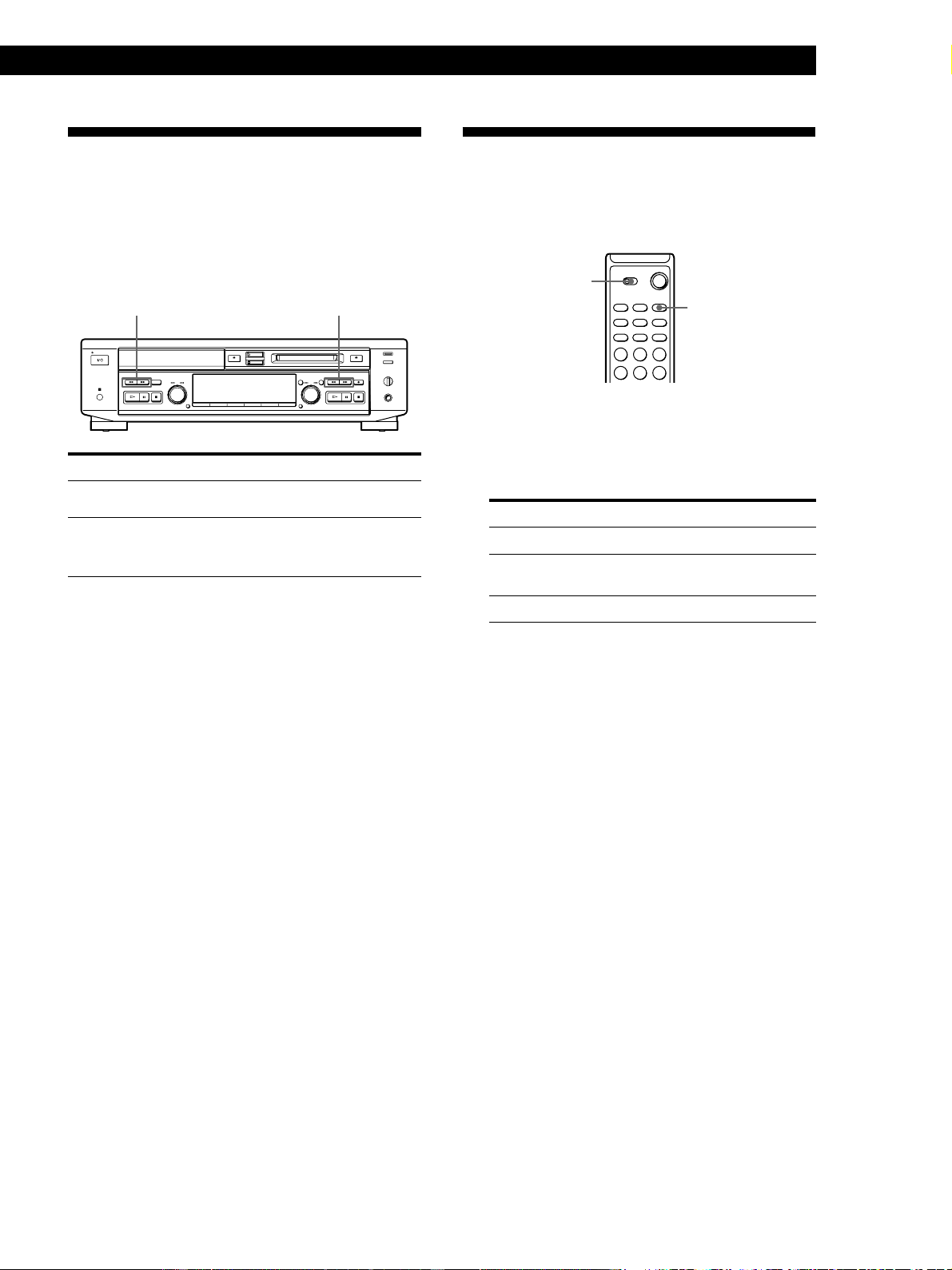
Number buttons
Locating a Specific Track
You can quickly locate any track while playing a disc
by using the AMS (Automatic Music Sensor) control on
the deck, = and + buttons on the remote, or
number buttons on the remote.
When using the remote, set SELECT to CD or MD.
·
AMS
·
1 / u
><
^
^
SELECT
>10
=/+
To locate Do the following:
z To pause playing at the beginning of a track
Turn AMS (or press = or +) after pausing
playback.
z To go quickly to the beginning of the last track
Turn AMS counterclockwise (or press =) while the
display shows the total track number, total disc playing
time or remaining recordable time of the disc
(recordable MD only), or disc name (see page 12).
The next or succeeding
tracks
During playback, turn AMS clockwise
(or press + repeatedly) until you
find the track.
The beginning of the
current or preceding
tracks
During playback, turn AMS
counterclockwise (or press =
repeatedly) until you find the track.
A specific track
directly Z
Press number button(s) to enter the
track number.
A specific track by
using AMS
1 While the deck is stopped, turn
AMS until the track number you
want to locate appears.
2 Press AMS or ·.
z When you directly locate a track with a number over
10 Z
Press >10 before entering the corresponding digits.
Press >10 once if it is a 2-digit track number, and twice
if it is a 3-digit track number (for MD only).
To enter “0”, press 10/0.
Examples: •To play track number 30
Press >10 once, then 3 and 10/0.
•To play track number 100
Press >10 twice, then 1, 10/0 and 10/0.
Playing CDs and MDs
15
Playing Tracks Repeatedly
(Repeat Play) Z
You can play tracks repeatedly in any play mode.
1 / u
SELECT
REPEAT
1 Set SELECT to CD or MD.
2 Press REPEAT repeatedly until “REPEAT”
appears in the display.
The deck repeats the tracks as follows:
When the disc is played in The deck repeats
Normal play (pages 6 and 7) All the tracks
Shuffle Play (page 16) All the tracks in random
order
Program Play (page 16) The same program
To stop Repeat Play
Press p.
To cancel Repeat Play
Press REPEAT repeatedly until “REPEAT” disappears.
Repeating the current track only
While the track you want to repeat is playing in
normal, Shuffle or Program Play, press REPEAT
repeatedly until “REPEAT 1” appears in the display.
If you select “REPEAT 1” while the deck is stopped,
the deck repeats the track that you locate to play.
While monitoring the
sound
) (forward) or 0 (backward)
until you find the point.
Quickly by observing
the display during
playback pause
) or 0 until you find the point.
There is no sound output during this
operation.
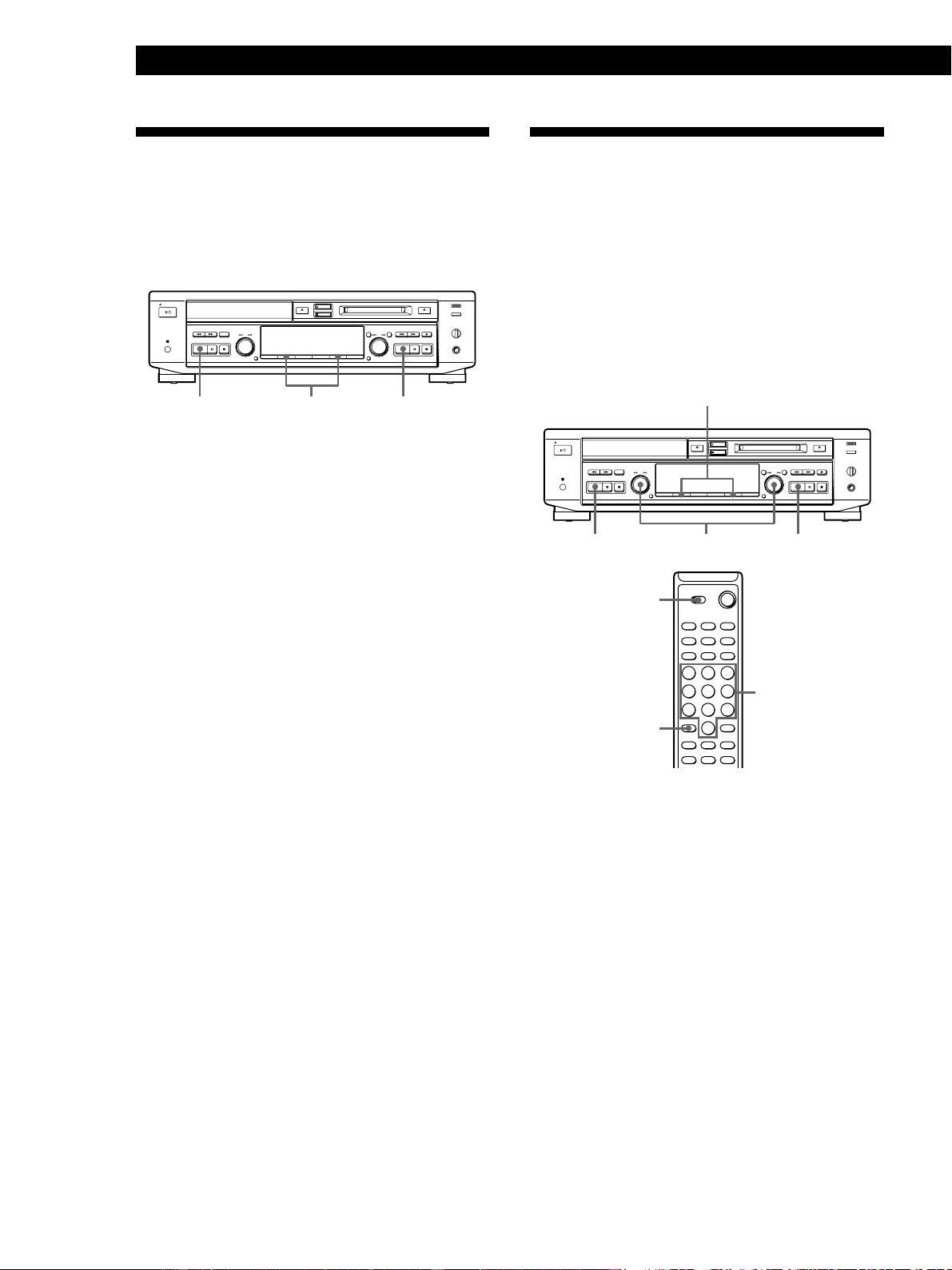
Locating a Particular Point in a
Track
You can also use the 0 and ) buttons to locate a
particular point in a track during playback or playback
pause.
When using the remote, set SELECT to CD or MD.
0/) 0/)
To locate a point Keep pressing
z If “– Over –” appears while you are pressing )
The disc has reached to its end. Turn AMS
counterclockwise (or press =) or press 0 to go
back.
Notes
• If the disc reaches the end while you are pressing )
during sound monitoring, the deck stops.
• Tracks that are only a few seconds long may be too short
to scan using the search function. For such tracks, it is
better to play the disc at normal speed.
Playing CDs and MDs
16
Number buttons
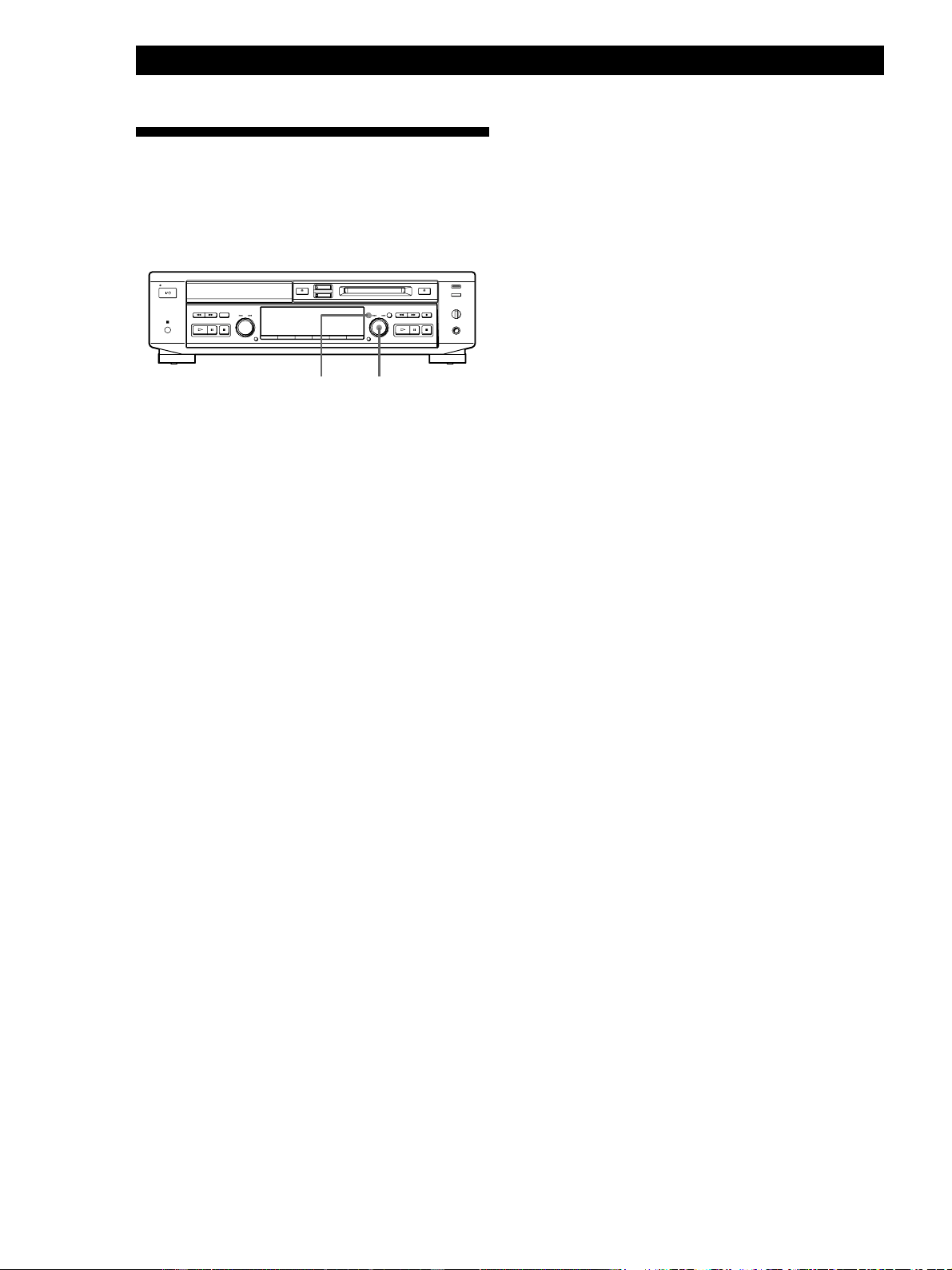
Playing in Random Order
(Shuffle Play)
You can have the deck “shuffle” tracks and play them
in random order.
When using the remote, set SELECT to CD or MD.
·
PLAY MODE
·
1 While the deck is stopped, press PLAY MODE
repeatedly until “SHUFFLE” appears in the
display.
2 Press · to start Shuffle Play.
“– Shuffle –” or “J” appears in the display while
the deck is “Shuffling” the tracks.
To stop Shuffle Play
Press p.
To cancel Shuffle Play
While the deck is stopped, press PLAY MODE
repeatedly until “SHUFFLE” disappears.
z You can specify tracks during Shuffle Play
• To play the next track, turn AMS clockwise (or press
+).
• To play from the beginning of the current track again,
turn AMS counterclockwise (or press =). You
cannot use AMS (or =) to go back to tracks that
have already been played.
Creating Your Own Program
(Program Play)
You can specify the playback order of the tracks on a
disc and create your own programs containing up to
25 tracks.
When using the remote, set SELECT to CD or MD.
Note
You cannot create a program containing tracks from both CD
and MD.
·
AMS
PLAY MODE
·
1 / u
SELECT
>10
1 While the deck is stopped, press PLAY MODE
repeatedly until “PROGRAM” appears in the
display.

Playing CDs and MDs
17
2 Turn AMS until the desired track appears.
3 Press AMS.
The track is programed. The number of the last
programed track appears, followed by the total
playing time of the program.
4 To program additional tracks, repeat steps 2 and
3.
5 Press · to start Program Play.
To stop Program Play
Press p.
To cancel Program Play
While the deck is stopped, press PLAY MODE
repeatedly until “PROGRAM” disappears.
To select the desired track using the number
buttons
Press number buttons instead of performing steps 2
and 3.
To enter track numbers 10 or over, press >10 and the
track number. To enter 0, use the 10/0 button.
To erase the last programed track
Press CLEAR. Each time you press the button, the last
programed track is erased.
z The program remains even after Program Play ends
When you press ·, you can play the same program
again.
Notes
• The display shows “- - . - -” instead of the total playing
time when the total playing time of the program exceeds
99 minutes (999 minutes for MD).
•“Step Full!” appears when you program over 25 tracks.
Erase the unnecessary tracks to enter other tracks.
• The program is erased when you disconnect the AC power
cord.
• You cannot use D.SKIP on the remote.
Falling Asleep to Music (Sleep
Timer)
You can let the deck turn off after the specified time, so
you can sleep to the music.
You can specify the time until the deck turns off by 30
minutes.
1 / u
SLEEP
Press SLEEP.
Each time you press the button, the minute display (the
turn-off time) changes as follows, and then returns to
the original display after a short time. When the Sleep
Timer is activated, “SLEEP” appears in the display and
the deck turns off after the displayed time has passed.
n Off (Sleep Timer canceled) n 30min
120min N 90min N 60min N
To check the remaining time
Press SLEEP once.
To change the time to turn off
Press SLEEP repeatedly to select the desired time.
To cancel the Sleep Timer operation
Press SLEEP repeatedly until “Off” appears.
Playing CDs and MDs
18
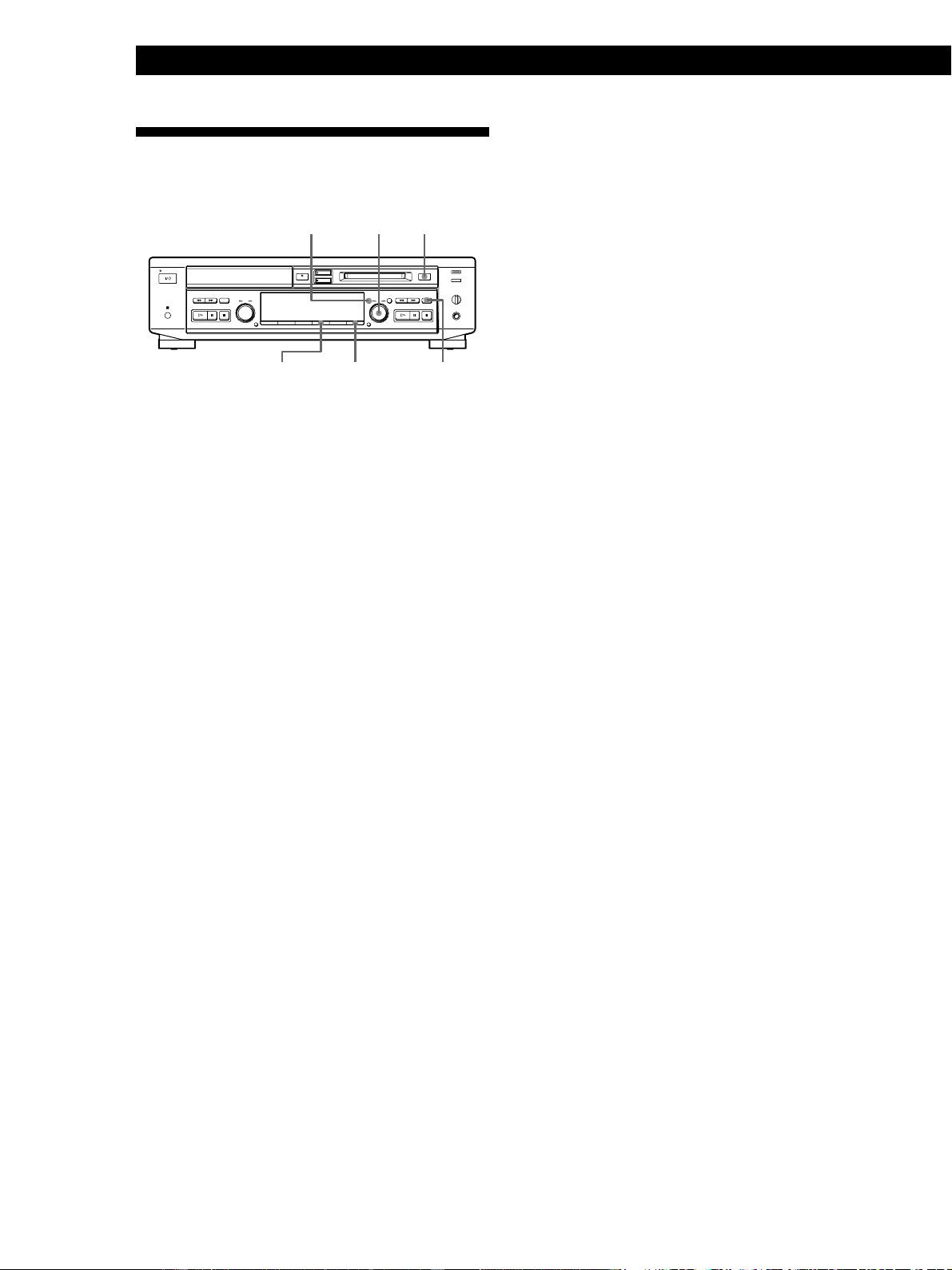
Changing the Pitch of the MD
(Pitch Control Function)
You can change the pitch of the MD by lowering the
playback speed. The tone falls at lower pitches.
AMSMENU/NO
Setting the pitch automatically in steps
(Auto Step Control Function)
You can lower the pitch by up to 36 steps*.
* One octave equals 12 steps.
1 Press MENU/NO twice to display “Setup Menu.”
2 Turn AMS to select “Pitch,” then press AMS.
3 Turn AMS to select the desired step value, then
press AMS.
4 Press MENU/NO.
To recall the factory setting
Press CLEAR while setting the value.
Notes
• When you change the step value, the playing sound drops
out momentarily.
• The step value returns to “0” (factory setting) when you
turn off the deck or eject the MD.
• When a dot (.) appears to the right of the step value in the
pitch display, this indicates that you have performed fine
adjustment (see this page) and the pitch value is between
steps. (The step and fine control values are linked.)
Finely controlling the pitch (Fine Control
Function)
You can fine control the playing speed in 0.1%
increments from –87.5% to 0.0%.
1 Press MENU/NO twice to display “Setup Menu.”
2 Turn AMS to select “Pfine,” then press AMS.
3 Turn AMS to select the desired value, then press
AMS.
4 Press MENU/NO.
To recall the factory setting
Press CLEAR while setting the value.
Notes
• The playing sound drops out momentarily when you
change the fine control value.
• The fine control value reverts to “0.0%” (factory setting)
when you turn off the deck or eject the MD.
• The step and fine control values are linked; changing one
value also changes the other.

19
Recording on MDsRecording on MDs
• Even while recording an analog source or a DAT or
satellite broadcast, you can mark track numbers if
“T.Mark LSyn” is selected in Setup Menu (see
“Marking Track Numbers While Recording” on
page 24).
• When recording from DAT or satellite broadcasts
with “OPT” selected by the INPUT button, the deck
automatically marks a track number whenever the
sampling frequency of the input signal changes
regardless of track marking setting (“T.Mark LSyn”
or “T.Mark Off”).
z You can mark track numbers during or after
recording
For details, see “Marking Track Numbers While
Recording” (page 24) and “Dividing Recorded Tracks”
(page 30).
When “TOC Writing” flashes in the display
The deck is currently updating the Table Of Contents
(TOC). Do not move the deck or pull out the AC
power cord. Changes to an MD made through
recording are saved only when you update the TOC by
ejecting the MD or changing the deck to standby by
pressing the 1/u switch.
The deck uses the SCMS (Serial Copy Management
System on page 45)
The contents of MDs recorded through digital input
connector cannot be recorded by this deck through the
DIGITAL OPTICAL IN connector.
Notes on Recording
If “Protected” and “C11” alternate in the display
The MD is record-protected. Close the slot to record
on the disc (see “To protect an MD against accidental
erasure” on page 9).
If “Din Unlock” and “C71” alternate in the display
• The digital program source is not connected as you
selected with the INPUT button in step 3 on page 21.
To continue, connect the program source properly.
• The program source is not on. Turn on the program
source.
Depending on the Setup Menu settings and source
being recorded, track numbers are marked in
following ways:
• When recording from a CD on the deck or from a CD
player or MD deck connected through the DIGITAL
OPTICAL IN connector:
The deck automatically marks track numbers in the
same sequence as the original.
However, the deck may not automatically mark track
numbers in the following cases:
— When you consecutively record the same track
two or more times using single-track repeat play.
— When you consecutively record two or more
tracks with the same track number but from
different CDs or MDs.
— When you record tracks less than 4 seconds long
during stereo, monaural, or LP2 Stereo recording
(less than 8 seconds long during LP4 Stereo
recording).
• When recording from some CD players and multi
disc players connected through the DIGITAL
OPTICAL IN connector with “OPT” selected by the
INPUT button:
The deck may not automatically mark track
numbers. In these cases, mark the track numbers
after recording, using the deck’s Divide Function (see
“Dividing Recorded Tracks” on page 30).
• When recording from a source connected through
the ANALOG IN jacks with “ANALOG” selected by
the INPUT button or when recording from a DAT or
satellite broadcast connected through the DIGITAL
OPTICAL IN connector with “OPT” selected by the
INPUT button and “T.Mark Off” is selected in Setup
Menu:
The source will be recorded as a single track.
Recording on MDs
20
Useful Tips for Recording
When using the remote, set SELECT to MD.
REC r
TIME/CHAR
§ EJECT
INPUT
AMSMENU/NO
Checking the remaining recordable time on
the MD
Press TIME/CHAR.
• When you press the button repeatedly while the
deck is stopped, the display alternates between total
disc playing time and remaining recordable time on
the MD (see page 13).
• When you press the button repeatedly while
recording, the display alternates between the
recording time of the current track and the
remaining recordable time on the MD.
Monitoring the input signal (Input Monitor)
Before starting recording, you can monitor the selected
input signal through the deck’s output jacks.
1 Press § EJECT to remove the MD.
2 Press INPUT to select the input signal you want
to monitor.
3 Press REC r.
When “ANALOG” is selected
The input analog signal is output to the ANALOG
OUT jacks and the PHONES jack after A/D and
D/A conversion.
“AD – DA” appears in the display at this time.
When “OPT” is selected
After passing through the Sampling Rate
Converter (SRC), the digital signal input from the
DIGITAL OPTICAL IN connector is output to the
ANALOG OUT jacks and PHONES jack after D/A
conversion.
“– DA” appears in the display at this time.
When “CD” is selected
After passing through the Sampling Rate
Converter (SRC), the digital signal input from the
CD is output to the ANALOG OUT jacks and
PHONES jack after D/A conversion.
“– DA” appears in the display at this time.
To stop monitoring the signal
Press p.
If “Auto Cut” appears in the display
(Auto Cut)
There has been no sound input for about 30 seconds
during recording. The 30 seconds of silence are
replaced by a blank of about 3 seconds and the deck
changes to recording pause.
If the deck continues pausing for about 10 minutes
after the Auto Cut Function activated, recording stops
automatically.
Note that this function does not activate even if there
has been no sound input for about 30 seconds when
the deck started recording from the blank portion.
Also, this function does not work when recording from
the CD player section of this deck.
z You can turn off the Auto Cut Function
For details, see “To turn off the Smart Space Function
and Auto Cut Function” below. Note that when you
turn off the Auto Cut Function, the Smart Space
Function is turned off automatically.
If “Smart Space” appears in the display
(Smart Space)
There has been an extended silence of 4 to 30 seconds
in length during recording. The silence is replaced
with a blank of about 3 seconds and the deck continues
recording. Note that new track numbers may not be
marked for portions recorded while this function is
activated. Also, the Smart Space Function does not
activate even if there has been an extended silence of 4
to 30 seconds in length when the deck started
recording from the blank portion.
To turn off the Smart Space Function and Auto Cut
Function
1 While the deck is stopped, press MENU/NO twice
to display “Setup Menu.”
2 Turn AMS to select “S.Space On,” then press AMS.
3 Turn AMS to select “S.Space Off,” then press AMS.
4 Press MENU/NO.
21
Recording on MDs
To turn on the Smart Space Function and Auto Cut
Function again
1 While the deck is stopped, press MENU/NO twice
to display “Setup Menu.”
2 Turn AMS to select “S.Space Off,” then press AMS.
3 Turn AMS to select “S.Space On,” then press AMS.
4 Press MENU/NO.
Notes
• When you turn off the Smart Space Function, the Auto Cut
Function is also turned off automatically.
• The Smart Space Function and Auto Cut Function are
factory set to on.
• If you turn off the deck or disconnect the AC power cord,
the deck will recall the last setting (On or Off) of the Smart
Space and Auto Cut Functions the next time you turn on
the deck.
Recording on an MD Manually
You can start recording from the end of the existing
material or record over the existing tracks just as you
would on an analog cassette tape.
When using the remote, set SELECT to CD or MD.
To perform CD-MD Synchro-Recording, see
“Recording a CD to an MD” on page 8 or “Recording a
CD to an MD at High Speed” on page 10.
REC r
INPUT
AMS
·
P
1 Turn on the amplifier and set the source selector
to the position for the sound source you want to
record.
2 Insert a recordable MD.
3 Press INPUT repeatedly to select the input
connector.
To record through Select
DIGITAL OPTICAL IN OPT
ANALOG IN ANALOG
To record from the CD player section manually
Press INPUT repeatedly to select CD.
4 Decide a point on the MD where you want to start
recording.
To record on a brand new MD or start recording
from the end of the existing material
Skip this step.
To record from a specific point of a recorded
track
Press · to start playback, and press P at the
point where you want to start recording.
To record erasing the previously recorded tracks
Turn AMS (or press = or + repeatedly) until
the number of the track to be recorded over
appears in the display.
(Continued)

Recording on MDs
22
5
Press REC r.
The deck stands by for recording.
6 Adjust the recording level, if necessary.
For details, see “Adjusting the Recording Level”
on page 23.
7 Press · or P.
Recording starts.
8 Start playing the sound source you want to
record.
To pause recording
Press P. To resure recording, press the button again or
press ·.
Note
Whenever you pause recording, the track number increases
by one. For example, if you paused recording while
recording on track 4, the track number increases by one and
recording continues on the new track when restarted.
To stop recording
Press p.
z When “Overwrite” flashes in the display in step 5
above
This indicates that the deck will start recording erasing
the existing material.
z You can play back tracks just recorded
If “TRACK” lights up in the display when recording has
finished, press · immediately to play back from the
first track of the material just recorded.
Notes
• You cannot record over the existing material when
“PROGRAM” or “SHUFFLE” appears in the display.
• You cannot operate the CD player section while the deck
is recording or standing by for recording with “OPT” or
“ANALOG” selected with the INPUT button.
Recording for Long Times
This deck has two long time recording modes: LP2 and
LP4 (MDLP recording). When recording in LP2 Stereo
mode, you can record 2 times the normal recordable
time, and in LP4 Stereo mode, you can record 4 times
the normal recordable time. In addition, the recordable
time for monaural recording is approximately double
the stereo recording time.
LP4 Stereo mode (4× long time recording mode)
achieves a long stereo recording time by use of a
special compression system. When placing emphasis
on sound quality, Stereo recording or LP2 Stereo
recording (2× long time recording mode) is
recommended.
Note
Tracks recorded in MDLP (LP2 or LP4 Stereo) mode cannot
be played back on a deck that does not support MDLP mode.
In addition, you cannot use S.F Edit and some other MD edit
functions for tracks recorded in MDLP mode.
REC MODE
1 Do steps 1 to 3 in “Recording on an MD
Manually” on page 21.
2 Press REC MODE repeatedly to select the
recording mode you want to record in.
To record in Select Recording time*
Stereo Blank 60 minutes
(No indicator)
LP2 Stereo LP2 120 minutes
LP4 Stereo LP4 240 minutes
Monaural MONO 120 minutes
* Maximum recording time using a 60-minute MD
3 Do steps 4 to 8 in “Recording on an MD
Manually” on page 21.

23
Recording on MDs
Adjusting the Recording Level
You can adjust the recording level before starting
recording.
AMSMENU/NO
1 Do steps 1 to 5 in “Recording on an MD
Manually” on page 21.
2 Play the portion of the sound source with the
strongest signal level.
3 Press MENU/NO twice to display “Setup Menu.”
4 Turn AMS to select the program source.
To select Turn AMS to display
CD player section of the deck CD
a component connected to the
DIGITAL OPTICAL IN connector
Opt
Anlg
5 Press AMS.
6 While monitoring the sound, turn AMS to adjust
the recording level so that the OVER indication
(red) of the peak level meters does not turn on,
then press AMS.
Recording level can be adjusted within a range of
– ∞ to +12 dB.
a component connected to the
ANALOG IN jacks
To record in CD-MD Synchro-Recording
Do step 2 above and do the procedure in “Recording a
CD to an MD” on page 8 or “Recording a CD to an MD
at High Speed” on page 10. The recording speed
changes according to the recording mode during High-
Speed CD-MD Synchro Recording.
Recording mode Recording speed
Stereo Quadruple speed
LP2 Stereo Double speed
LP4 Stereo Double speed
Monaural Quadruple speed
To stop recording
Press p.
z When you record on an MD in LP2 or LP4 Stereo
mode
The MDLP indicator lights up when you press REC
MODE in Step 2 on page 22.
Notes
• MDs recorded in MDLP (LP2 or LP4 Stereo) mode should
be played back on a deck that supports MDLP mode.
These MDs cannot be played back on other decks.
• Even if you press REC MODE during recording or
recording pause, you cannot change the recording mode.
• Even if you press REC MODE repeatedly to select MONO,
the monitor signal during recording does not become
monaural.
To add “LP:” at the beginning of a track name
during MDLP recording
“LP:” appears when you try to play the MD on a deck
that does not support MDLP mode. This convenient
function lets you know at a glance that the MD cannot
be played back. The factory setting is “On”.
1 Press MENU/NO twice to display “Setup Menu”.
2 Turn AMS to select “LPstamp On”, then press AMS.
Notes
• The recorded “LP:” is a stamp which appears to indicate
that the MD cannot be played back when you try to play
the MD on a deck that does not support MDLP mode. It
does not appear for decks that support MDLP mode.
• When set to “On”, “LP:” is recorded as the track name, so
the number of characters that can be input to an MD is
reduced. In addition, when you copy a track name with
“LP:” added, “LP:” is automatically added to the copied
track name. If you divide an “LP:” track using the Divide
function, “LP:” is also added to the latter track.
OVER indication
(Continued)

Recording on MDs
24
7
Press MENU/NO.
8 Stop playing the sound source.
9 To start recording, do the procedure starting from
step 7 in “Recording on an MD Manually” on
page 21.
z You can also change the recording level by using the
remote Z
During recording pause, press REC LEVEL +/–
repeatedly.
Note that the level cannot go above +12 dB.
Note
You cannot adjust the recording level while playing an
MD.
Marking Track Numbers While
Recording
You can mark track numbers either manually or
automatically. By marking track numbers at specific
points, you can quickly locate the points later using the
AMS Function or Editing Functions.
AMSMENU/NO
REC r
Marking track numbers manually
You can mark track numbers at any time while
recording on an MD.
Press REC r at the place you want to add a track mark
while recording.
Marking track numbers automatically
(Track Marking Function)
The deck adds track marks differently in the following
cases:
• When recording from CDs or MDs with “OPT”
selected by the INPUT button (when recording from
a CD or MD connected through the DIGITAL
OPTICAL IN connector):
The deck marks track numbers automatically
according to the information contained in the source
being recorded.
However, the deck may not automatically mark track
numbers when recording from some CD players and
multi disc players.
• In all other cases:
If “T.Mark LSyn” is selected in Setup Menu, the deck
marks a new track number whenever the signal
drops to the specified level or below for about
1.5 seconds or longer, then rises to a specified level.

25
Recording on MDs
Set “T.Mark” in Setup Menu to “LSyn” or “Off” as
follows:
1 Press MENU/NO twice to display “Setup Menu”
while the deck is stopped.
2 Turn AMS to select “T.Mark LSyn,” then press
AMS.
3 Turn AMS to select “T.Mark LSyn” or “T.Mark
Off,” then press AMS.
If you select “T.Mark LSyn,” “L.SYNC” lights up
in the display.
4 Press MENU/NO.
To change the trigger level for Track
Marking Function
Do the procedure below to change the signal level that
triggers Track Marking Function.
1 Press MENU/NO twice to display “Setup Menu”
while the deck is stopped.
2 Turn AMS to display “LS(T)”, then press AMS.
3 Turn AMS to select the level, then press AMS.
You can set the level at any value between –72 dB
and 0 dB, in 2 dB increments.
4 Press MENU/NO.
Note
If you turn off the deck or disconnect the AC power cord, the
deck will recall the last setting of the track marking function
(“LSyn” or “Off”) the next time you turn on the deck.
Recording the Current CD Track
(REC-IT Function)
You can record specific tracks on a CD while listening
to them. This function allows you to put only the tracks
you like onto the MD.
When using the remote, set SELECT to CD.
·
REC-IT
1 Press · on the CD player section.
Make sure that the MD deck section is stopped.
2 Press REC-IT when you hear a track you want to
record.
Play returns to the start of the track and recording
starts. The recording stops at the end of the track,
but CD playback continues from the next track.
To stop recording
Press p on the CD player section.
Notes
• You cannot record over existing material during REC-IT
Recording. The deck automatically starts recording from
the end of the existing material.
• Make sure that the remaining recordable time on the MD
is longer than the playing time of the CD track.
• The recording level specified in the Setup Menu (page 23)
is not applied during REC-IT Recording. The initial
reference level (0.0 dB) is used instead.
While “TOC Writing” is flashing
Do not move the deck or pull out the AC power cord to
ensure the complete recording. The deck is currently
updating the Table Of Contents (TOC) of the MD.

Recording on MDs
26
Synchro-Recording With an
External Audio Equipment
(Music Synchro-Recording) Z
By using the MUSIC SYNC button on the remote, you
can automatically start recording in sync with a CD in
the deck or the signal input from the program source
connected to the deck.
The method of marking track numbers differs,
depending on the program source being recorded and
the track marking setting (see “Notes on Recording” on
page 19).
1 / u
SELECT
MUSIC SYNC
1 Do steps 1 to 4 in “Recording on an MD
Manually” on page 21.
2 Set SELECT to MD.
3 Press MUSIC SYNC.
The deck changes to recording pause.
4 Start playing the program source you want to
record.
The deck starts recording automatically.
To stop Music Synchro-Recording
Press p.
Note
When Music Synchro-Recording, the Smart Space Function
and the Auto Cut Function turn on automatically regardless
of their setting (“On” or “Off”).
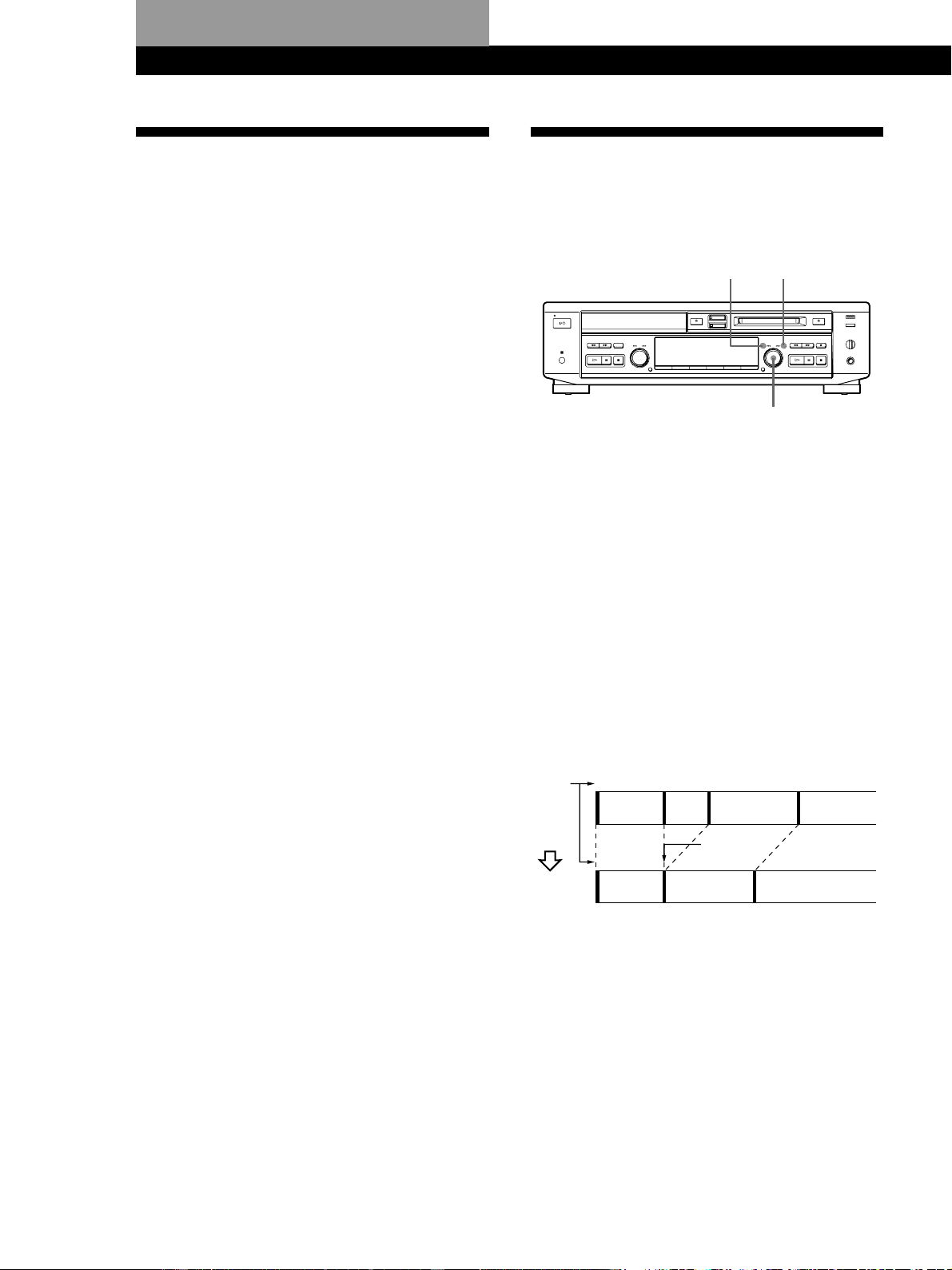
Starting Recording With
Prestored Audio Data
(Time Machine Recording)
When recording from an FM or satellite broadcast, the
first few seconds of material are often lost due to the
time it takes you to ascertain the contents and press the
record button. To prevent the loss of this material, the
Time Machine Recording Function constantly stores
6 seconds of the most recent audio data in a buffer
memory so that when you begin recording the
program source using this function, the recording
actually begins with the 6 seconds of audio data stored
in the buffer memory in advance as shown in the
illustration below.
AMS
><
^
^
T.REC
1 Do steps 1 to 5 in “Recording on an MD
Manually” on page 21.
The deck changes to recording pause.
Beginning of the program
source to be recorded
Recorded
portion
When you press
AMS in step 3
End of the program
source to be recorded
Time
Audio data in buffer memory
27
Recording on MDs
2
Start playing the program source you want to
record.
The most recent 6 seconds of audio data is stored
in the buffer memory.
3 Press AMS (or T.REC) to start Time Machine
Recording.
Recording of the program source starts with the
audio data stored in the buffer memory.
To stop Time Machine Recording
Press p.
Note
The deck starts storing audio data when the deck is in
recording pause and you start playing the program source.
With less than 6 seconds of playing of the program source
and audio data stored in the buffer memory, Time Machine
Recording starts with less than 6 seconds of audio data.
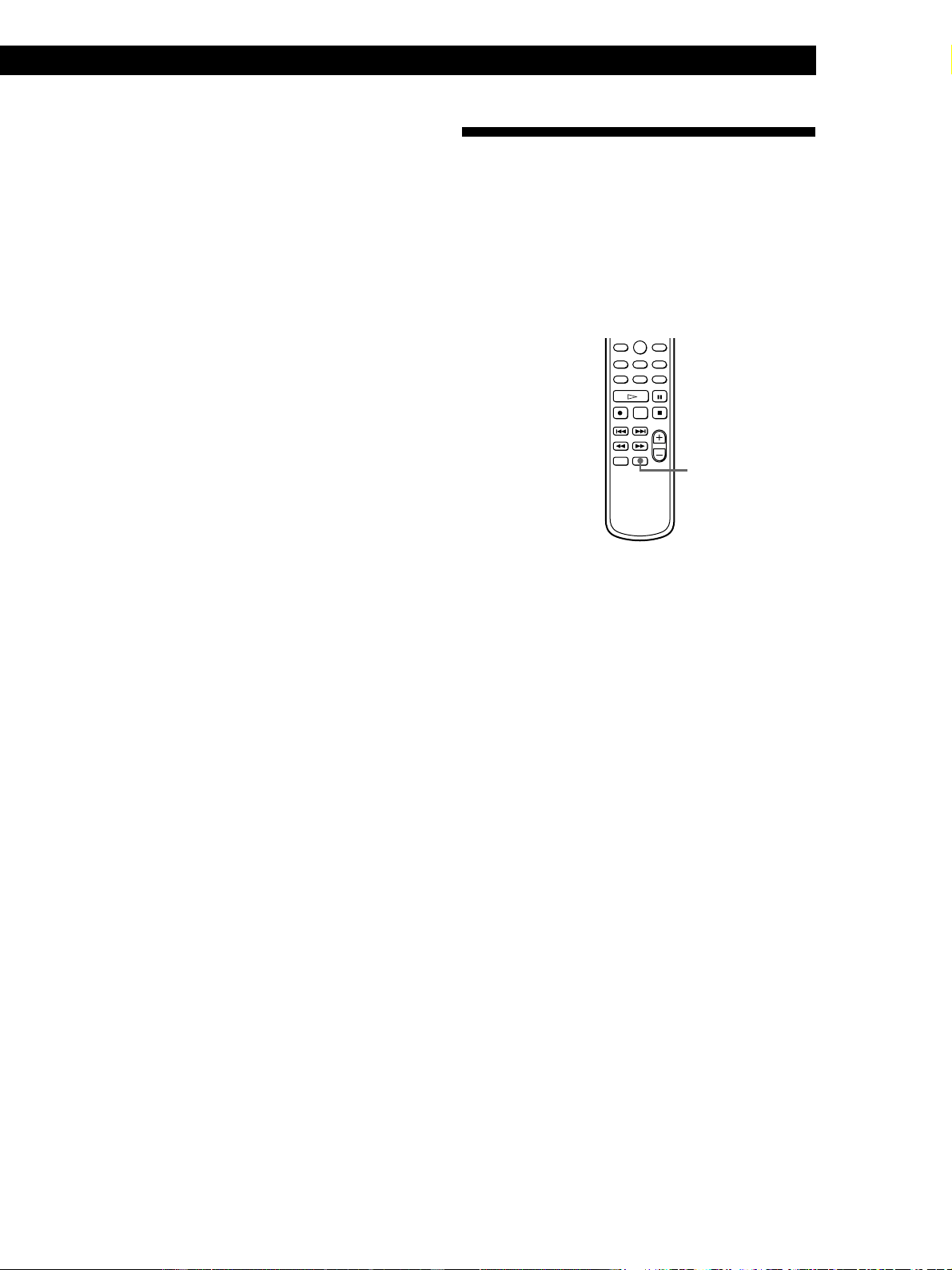
Fading In and Out (Fader) Z
You can gradually increase the recording level at the
beginning of a recording (fade-in recording) or
gradually decrease the recording level at the end of a
recording (fade-out recording).
This function is convenient when, for example, you
don’t want the track cut off abruptly when the disc
reaches to its end.
><
^
^
FADER
Fade-in recording
During recording pause, press FADER at the position
where you want to start fade-in recording.
Z flashes and the deck performs the fade-in recording
until the counter reaches “0.0s.”
Fade-out recording
During recording, press FADER at the position where
you want to start fade-out recording.
z flashes and the deck performs the fade-out recording
until the counter reaches “0.0s.”
The deck changes to recording pause when fade-out
recording finishes.
z You can set the duration of fade-in and fade-out
recording independently
1 While the deck is stopped, press MENU/NO twice to
display “Setup Menu.”
2 To set duration of fade-in recording:
Turn AMS to select “F.in,” then press AMS.
To set duration of fade-out recording:
Turn AMS to select “F.out,” then press AMS.
3 Turn AMS to set the duration.
Both the fade-in and fade-out recording duration can
be set within a range of 1.0 second to 15.0 seconds (in
0.1-second steps).
4 Press AMS.
5 Press MENU/NO.
Editing Recorded MDs
28
Editing Recorded MDs
Notes on Editing
You can edit the recorded tracks after recording, using
the following functions:
• Track Erase Function allows you to erase recorded
tracks simply by specifying the corresponding track
number.
• All Erase Function allows you to erase the contents
of an entire MD.
• A-B Erase Function allows you to specify a portion
within a track to erase it.
• Divide Function allows you to divide tracks at
specified points so that you can quickly locate those
points afterwards, using the AMS function.
• Combine Function allows you to combine two tracks
into one.
• Move Function allows you to change the order of
tracks by moving a specific track to a track position
you want.
• Name Function allows you to create and edit titles
for your recorded MDs and tracks.
• Undo Function allows you to cancel the last edit.
• S.F Edit Function allows you to change the recorded
level after recording.
To enter Edit Menu
1 While the deck is stopped, playing, or pausing,
press MENU/NO to display “Edit Menu.”
2 Turn AMS to select the desired editing function,
then press AMS.
If “Protected” or “Cannot Edit” appears in the
display
The deck could not edit because the record-protect slot
on the MD is open. Edit after closing the slot.
When “TOC” and “TOC Writing” flash in the display
Do not move the deck or pull out the AC power cord.
After editing, “TOC” lights continuously until you
eject the MD or turn off the deck. “TOC” and “TOC
Writing” flash while the deck is updating the TOC.
When the deck finishes updating the TOC, “TOC” and
“TOC writing” turn off.
Track
number
Erasing Recordings
Do the procedures below to erase following:
• A single track (Track Erase)
• All tracks (All Erase)
AMS
MENU/NO YES
Erasing a single track (Track Erase
Function)
You can erase a track simply by specifying the
respective track number. When you erase a track, the
total number of tracks on the MD decreases by one and
all tracks following the erased one are renumbered.
Since erasing merely updates the TOC, there is no need
to record over material.
z To avoid confusion when erasing multiple tracks,
you should proceed in order of high to low track
number to prevent the renumbering of tracks that
have not been erased yet.
Example: Erasing B
123 4
AB C D
12 3
AC D
1 While the deck is stopped, playing, or pausing,
press MENU/NO to display “Edit Menu.”
2 Turn AMS until “Tr Erase ?” appears in the
display.
Track
Erase
B is erased

29
Editing Recorded MDs
3
Press AMS or YES.
The display for erasing tracks appears and
playback of the displayed track starts.
4 Turn AMS to select the track to be erased.
5 Press AMS or YES.
When the track selected in step 4 has been erased,
“Complete!” appears for a few seconds.
The track following the erased track begins
playing. (If you erase the last track, the track
preceding the erased track starts playing.)
6 Repeat steps 1 to 5 to erase more tracks.
To cancel the Track Erase Function
Press MENU/NO or p.
Erasing all tracks on an MD (All Erase
Function)
Erasing a recordable MD deletes the disc name, all
recorded tracks, and titles.
1 While the deck is stopped, playing, or pausing,
press MENU/NO to display “Edit Menu.”
2 Turn AMS until “All Erase ?” appears in the
display.
3 Press AMS or YES.
“All Erase??” appears in the display.
4 Press AMS or YES.
When the disc name, all recorded tracks, and titles
on the MD have been erased, “Complete!” appears
for a few seconds.
To cancel the All Erase Function
Press MENU/NO or p to turn off the “All Erase??”
indication.
z You can undo the Track Erase or All Erase Function
Use the Undo Function immediately after you erased
the track (see page 37).
Erasing a Part of a Track (A-B
Erase Function)
You can specify a portion within a track and erase the
portion with ease. It is convenient when erasing
unnecessary sections after recording satellite broadcast
or FM broadcast.
Example: Erasing a part of track A
1
A
#1
A
#2
A
#3
23
BC
BA (#1+#3) C
123
AMS
MENU/NO YES
0/)
1 While the deck is stopped, playing, or pausing,
press MENU/NO to display “Edit Menu.”
2 Turn AMS until “A-B Erase ?” appears in the
display, then press AMS or YES.
3 Turn AMS to select the number of the track, then
press AMS or YES.
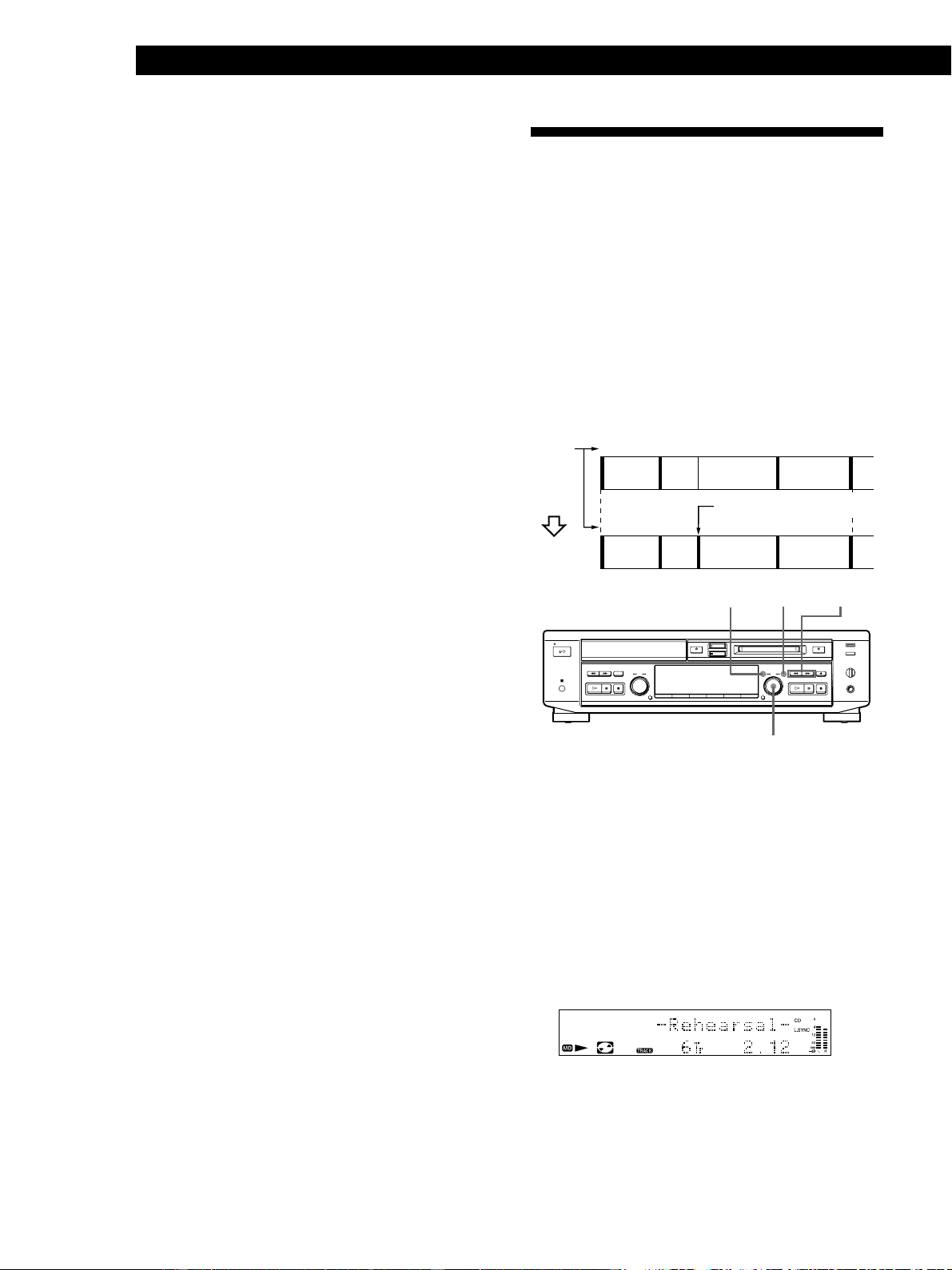
“–Rehearsal–” and “Point A ok?” appear
alternately while the deck plays the selected track
from the beginning to point A.
Track
number
Point a
Point b
A-B
Erase
(Continued)
Editing Recorded MDs
30
Dividing Recorded Tracks
(Divide Function)
With the Divide Function you can mark a track
number at places that you want to randomly access
afterwards. Use this function to add tracks to MDs
recorded from an analog source (and therefore contain
no track numbers), or to divide an existing track into
multiple portions for locating positions in the middle
of a track. When you divide a track, the total number
of tracks on the MD increases by one and all tracks
following the divided track are renumbered.
Example: Dividing track 2 to create a new track for C
12 3 4
123 4 5
AB C D
AB C D
AMS
MENU/NO YES
0/)
Dividing a track after selecting the track
1 While the deck is stopped, playing, or pausing,
press MENU/NO to display “Edit Menu.”
2 Turn AMS until “Divide ?” appears in the display,
then press AMS or YES.
3 Turn AMS to select the track to be divided and
press AMS or YES.
“–Rehearsal–” appears and the portion to be
divided is played repeatedly.
4 While monitoring the sound, turn AMS to find the
starting point of the portion to be erased (point
A).
You can shift the starting point by 1-frame* (f)
intervals (1 frame = 1/86 second).
To shift the point by minute or second intervals,
press 0 or ) so that minute or second flashes.
* When recording in Stereo mode, you can shift the
starting point by 2-frame intervals (in LP2 Stereo
mode) or by 4-frame intervals (in LP4 Stereo mode).
5 If point A is still incorrect, repeat step 4 until it is
correct.
6 Press AMS or YES if point A is correct.
“Point B set” appears in the display and playback
for setting the end point of the portion to be erased
(point B) starts.
7 Continue playback (or press 0 or )) until the
deck reaches point B, then press AMS or YES.
“A-B Ers” and “Point B ok?” alternate in the
display while the deck repeats a portion of a few
seconds before point A and after point B
successively.
8 Repeat step 4 if point B is not correct.
9 Press AMS or YES when point B is correct.
“Complete!” appears for a few seconds and the
portion between point A and B is erased.
To cancel the A-B Erase Function
Press MENU/NO or p.
z You can undo the A-B Erase Function
Use the Undo Function immediately after you erased
the part of the track (see page 37).
Note
If “Impossible” appears in the display, the specified portion
cannot be erased.
This sometimes happens when you’ve edited the same track
many times, and is due to a technical limitation of the MD
system, not a mechanical error.
Track
number
Track 2 is divided and a
new track is created for C
Divide

31
Editing Recorded MDs
Combining Recorded Tracks
(Combine Function)
Use the Combine Function to combine tracks on a
recorded MD. The two tracks to be combined need not
to be consecutive and the latter track to be combined
can be the track which comes before the former one in
the track number order. This function is useful for
combining several songs into a single medley, or
several independently recorded portions into a single
track. When you combine two tracks, the total number
of tracks decreases by one and all tracks following the
combined tracks are renumbered.
Example: Combining B and D
12 435
12 34
AB D C
AB C D
AMS
MENU/NO YES
1 While the deck is stopped, playing, or pausing,
press MENU/NO to display “Edit Menu.”
2 Turn AMS to select “Combine ?,” then press AMS
or YES.
4 While monitoring the sound, turn AMS to find the
point to divide the track.
You can shift the starting point by 1-frame* (f)
intervals (1 frame = 1/86 second)
To shift the point by minute or second intervals,
press 0 or ) so that minute or second flashes.
* When recording in Stereo mode, you can shift the
starting point by 2-frame intervals (in LP2 Stereo
mode) or by 4-frame intervals (in LP4 Stereo mode).
5 Press AMS or YES when the position is correct.
“Complete!” appears for a few seconds and the
newly created track begins playing. The new track
will have no track title even if the original track
was labeled.
To cancel the Divide Function
Press MENU/NO or p.
z You can undo the Divide Function
Use the Undo Function immediately after you divided
the track (see page 37).
z You can divide a track while recording
Mark the track numbers manually or use the Track
Marking Function (see page 24).
Dividing a track after selecting the dividing
point
1 While playing the MD, press AMS at the point
where you want to create a new track.
“– Divide –” and “–Rehearsal–” alternate in the
display and playback continues from the position
you selected.
2 To make fine adjustment on the dividing position,
do step 4 in “Dividing a track after selecting the
track” on page 30.
3 Press YES.
“Complete!” appears for a few seconds and the
newly created track begins playing.
To cancel the Divide Function
Press AMS, MENU/NO or p.
Track
number
B and D are combined into
one track
Combine
(Continued)
Editing Recorded MDs
32
Moving Recorded Tracks
(Move Function)
Use the Move Function to change the order of any
track. After you move a track, the track numbers
between the new and old track positions are
automatically renumbered.
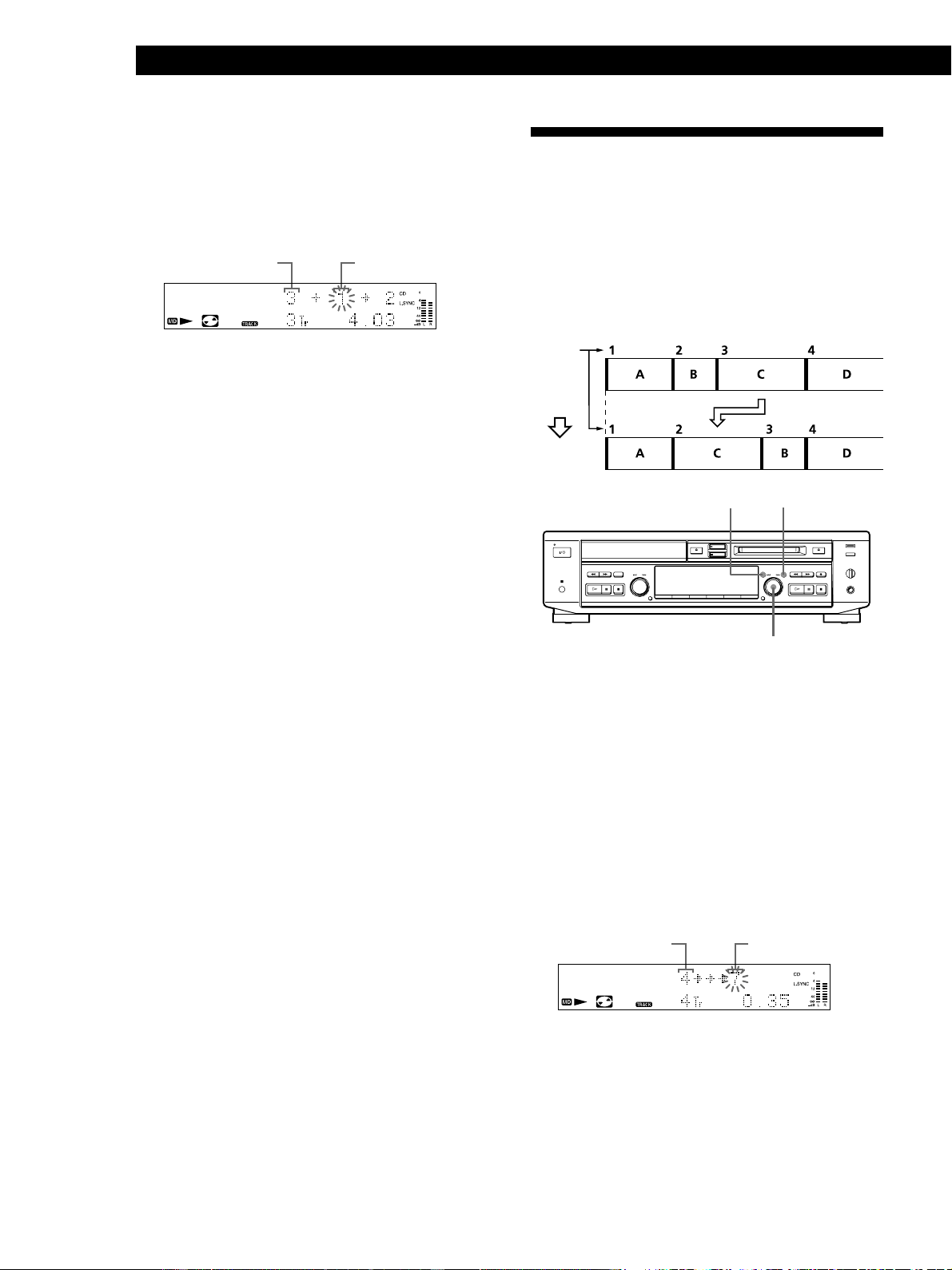
Example: Moving track C to track position 2
AMS
MENU/NO YES
1 While the deck is stopped, playing, or pausing,
press MENU/NO to display “Edit Menu.”
2 Turn AMS to select “Move ?,” then press AMS or
YES.
3 Turn AMS to select the track to be moved and
press AMS or YES.
4 Turn AMS until the new track position appears.
The deck plays the track to be moved during this
time.
3 Turn AMS to select the first track of the two to be
combined and press AMS or YES.
The display for selecting the second track appears
and the deck repeats the portion where the two
tracks will join (i.e., the end of the first track and
the beginning of the succeeding track).
4 Turn AMS to select the second track of the two to
be combined and press AMS or YES.
“Complete!” appears for a few seconds.
If both of the combined tracks have track titles, the
title of the second track is erased.
To cancel the Combine Function
Press MENU/NO or p.
z You can undo the Combine Function
Use the Undo Function immediately after you combined
the tracks (see page 37).
Notes
• Tracks recorded in different modes (stereo, LP2, LP4 or
MONO) cannot be combined.
• If “Impossible” appears in the display, the tracks cannot
be combined. This sometimes happens when you’ve
edited the same track many times, and is due to a
technical limitation of the MD system, not a mechanical
error.
First track Succeeding track
Track
number
New track position
Track number
to be moved
Track C moves to
track position 2
Move
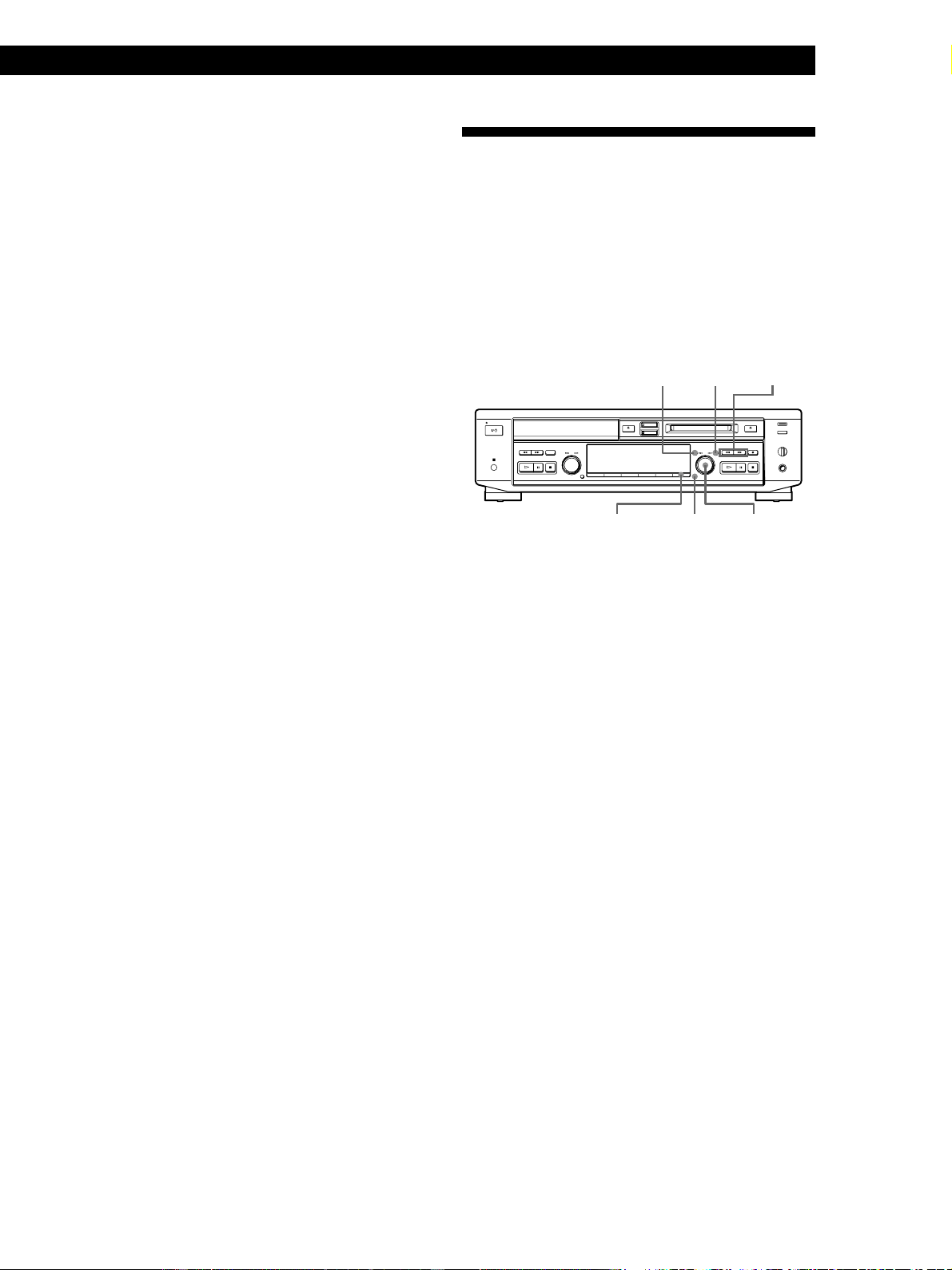
33
Editing Recorded MDs
5
Press AMS or YES.
“Complete!” appears for a few seconds and the
moved track begins playing back.
To cancel the Move Function
Press MENU/NO or p.
z You can undo the Move Function
Use the Undo Function immediately after you moved
the track (see page 37).
Labeling Recordings
(Name Function)
You can create titles for your recorded MDs and tracks.
Titles — which may consist of uppercase and
lowercase letters, numbers and symbols for a
maximum of about 1,700 characters per disc — appear
in the display during MD operation. You can also use
the remote to label a track or an MD (see “Labeling
tracks and MDs with the remote” on page 35).
AMS
MENU/NO YES
0/)
TIME/CHAR CLEAR
Use the following procedure to label a track or an MD.
You can label a track while it is playing, pausing,
recording, or stopped. If the track is recording, be
sure to finish labeling before the track ends. If the
track ends before you’ve completed the labeling
procedure, the characters already entered are not
recorded and the track will remain unlabeled.
1 Press MENU/NO to display “Edit Menu.”
2 Turn AMS until “Name ?” appears in the display
and press AMS or YES.
Skip this step while recording.
3 Turn AMS until “Nm In ?” appears in the display,
then press AMS or YES.
4 Turn AMS to select “Disc” to label an MD, or to
specify the track to label.
While recording, go to step 6.
(Continued)
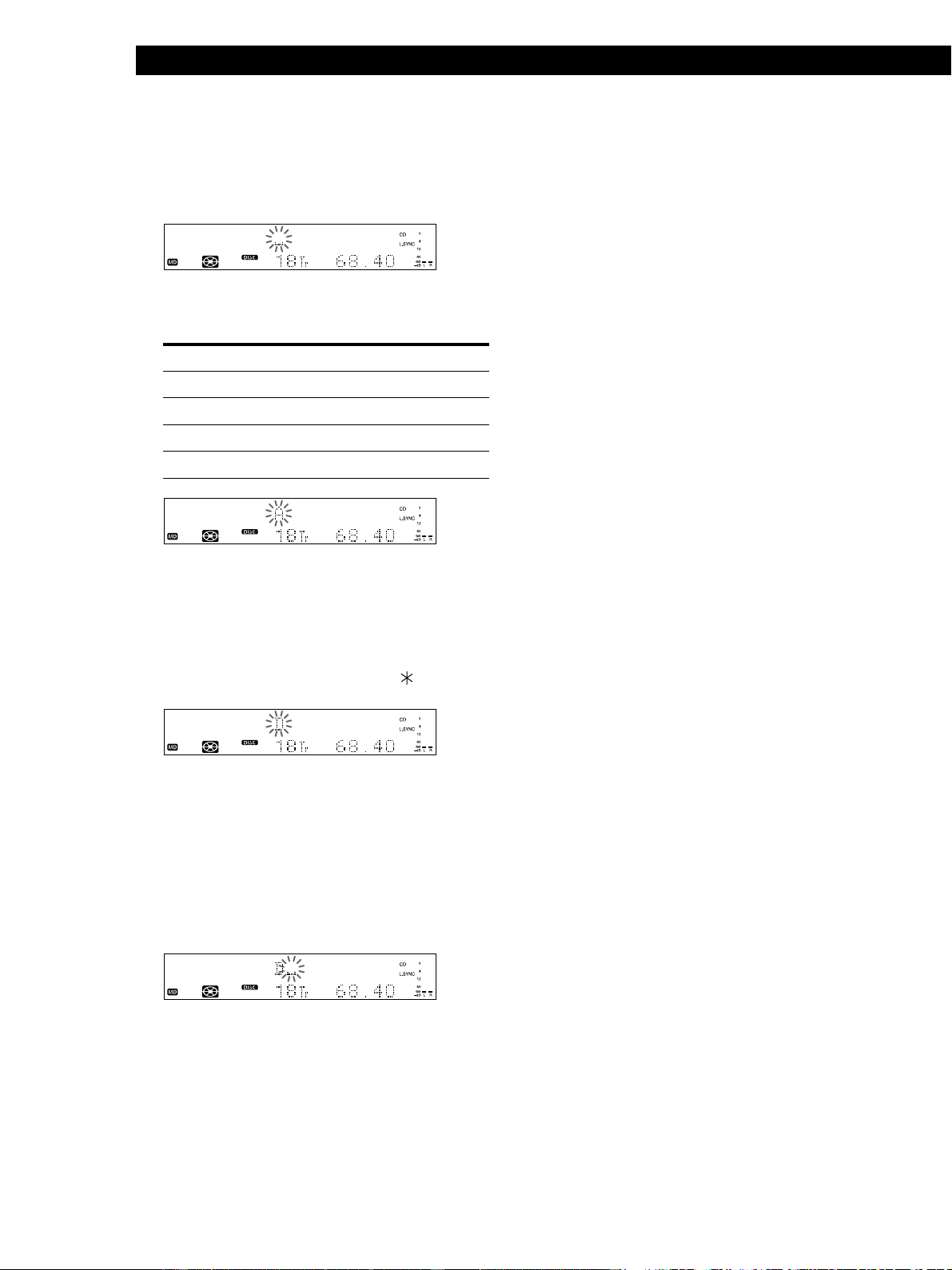
Editing Recorded MDs
34
5
Press AMS or YES.
A flashing cursor appears in the display.
The deck starts playing and you can name a track
while monitoring the sound.
6 Press TIME/CHAR to select the character type as
follows:
To select Press TIME/CHAR repeatedly until
Uppercase letters “A” appears in the display
Lowercase letters “a” appears in the display
Numbers “0” appears in the display
Symbols “ ’ ” appears in the display
7 Turn AMS to select the character.
The selected character flashes.
Letters, numbers, symbols, and a space appear in
sequential order as you turn AMS.
You can use the following symbols in titles:
’ – / , . ( ) : ! ? & + < > _ = ” ; # $ % @
`
You can press TIME/CHAR to change the
character type at any time during step 7 (see step 6
above).
8 Press AMS to enter the selected character.
The selected character stops flashing and the
cursor flashes waiting for the input of the next
character.
9 Repeat steps 7 and 8 until you have entered the
entire title.
If you entered the wrong character
Press 0 or ) until the character to be corrected
starts flashing, and repeat steps 7 and 8 to enter the
correct character.
To erase a character
Press 0 or ) until the character to be erased
starts flashing, then press CLEAR.
To enter a space*
Press AMS while the cursor is flashing. To enter a
space after the title, press AMS or ).
* You cannot select a space for the first character of the
title.
10Press YES.
To cancel labeling
Press MENU/NO or p.
Notes
• You cannot label an MD during recording.
• You cannot label a track or an MD while you are recording
over an existing track.

35
Editing Recorded MDs
Copying a track or disc title within an MD
(Name Copy Function)
You can copy a track or disc title to use it as a title of
another track or the disc title within a disc.
1 Press MENU/NO to display “Edit Menu.”
2 Turn AMS to select “Name ?,” then press AMS or
YES.
3 Turn AMS to select “Nm Copy ?,” then press
AMS or YES.
4 Turn AMS to select “Disc” (when copying the disc
title) or the track number (when copying the track
title), and press AMS or YES to copy the selected
title.
If “No Name” appears in the display
The disc or the track has no name.
5 Turn AMS to select “Disc” (when naming the
disc) or the track number (when naming a track),
and press AMS or YES to enter the copied title.
“Complete!” appears for a few seconds to indicate
that the copying operation is completed.
If “Overwrite??” appears in the display
The disc or track you selected already has a title. If
you continue the title copying, press AMS or YES.
If the track has been recorded in MD LP mode
with the “LPstamp On” setting (page 23),
“Overwrite??” also appears even if a track name is
not assigned. In this case if you copy the track
name, the “LP:” indication disappears from the
track name.
To cancel the Name Copy Function
Press MENU/NO or p.
Labeling tracks and MDs with the remote Z
1 / u
><
^
^
NAME EDIT
/SELECT
CLEAR
=/+
0/)
1 Press NAME EDIT/SELECT.
A flashing cursor appears in the display, then do
the following:
To label Make sure that the deck is
A track Playing, pausing, recording the
track to be labeled, or stopped after
locating the track to be labeled
An MD Stopped with no track number
appearing in the display
2 Press NAME EDIT/SELECT repeatedly to select
the character type as follows:
To select Press NAME EDIT/SELECT
repeatedly until
Uppercase letters “Selected AB” appears in the
and symbols* display
Lowercase letters “Selected ab” appears in the
and symbols* display
Numbers “Selected 12” appears in the display
* Only ’ – / , . ( ) : ! ? can be selected.
You can press 10/0 to enter a space.
Alphabet/number
buttons
(Continued)

Editing Recorded MDs
36
3
Press an alphabet/number button to enter a
character.
If you selected uppercase or lowercase letters
1 Press the corresponding letter/number button
repeatedly until the character to be entered
flashes.
Or, press the button once and press =/+
repeatedly.
2 Press ).
The flashing character is entered and lights
continuously and the cursor shifts to the right.
4 Repeat steps 2 and 3 until you have entered the
entire title.
If you entered the wrong character
Press 0 or ) until the character to be corrected
starts flashing.
Press CLEAR to erase the incorrect character, then
enter the correct one.
5 Press YES.
To cancel labeling
Press MENU/NO or p.
Changing an existing title Z
1 Press NAME EDIT/SELECT, then do the
following:
To change Make sure that the deck is
A track title Playing, pausing or recording the
track whose title is to be changed,
or stopped after locating the track
whose title is to be changed
A disc name Stopped with no track number
appearing in the display
2 Press down CLEAR until the current title is
erased.
3 Enter the new title.
Do steps 6 to 9 of “Labeling Recordings” on page
33, or steps 2 to 4 of “Labeling tracks and MDs
with the remote” on page 35.
4 Press YES.
Erasing a title on a disc (Name Erase
Function)
Use this function to erase a title on a disc.
1 While the deck is stopped, playing, recording, or
pausing, press MENU/NO to display “Edit
Menu.”
2 Turn AMS to select “Name ?,” then press AMS or
YES.
3 Turn AMS to select “Nm Erase ?,” then press
AMS or YES.
4 Turn AMS to select “Disc” to erase the disc title,
or the track whose title you want to erase and
press AMS or YES.
“Complete!” appears for a few seconds and the
title is erased.
To cancel the Name Erase Function
Press MENU/NO or p.

37
Editing Recorded MDs
Erasing all titles on an MD (Name All Erase
Function)
Use this function to erase all titles on an MD
simultaneously.
1 While the deck is stopped, playing, or pausing,
press MENU/NO to display “Edit Menu.”
2 Turn AMS to select “Name ?”, then press AMS or
YES.
3 Turn AMS to select “Nm AllErs?”, then press
AMS or YES.
“Nm AllErs??” appears in the display.
4 Press AMS or YES again.
“Complete!” appears for a few seconds and all
titles are erased.
To cancel the Name All Erase Function
Press MENU/NO or p.
z You can undo the Name Erase Function and the
Name All Erase Function
See “Undoing the Last Edit” on this page.
z You can erase all recorded tracks and titles
See “Erasing all tracks on an MD” on page 29.
Undoing the Last Edit (Undo
Function)
You can use the Undo Function to cancel the last edit
and restore the contents of the MD to the condition that
existed before editing was done. Note, however, that
you cannot undo an edit if you do any of the following
after the edit:
• Do another edit.
• Press REC r on the front panel of the deck or
otherwise perform the recording operation.
• Update the TOC by turning off the deck or ejecting
the MD.
• Disconnect the AC power cord.
You cannot undo the S.F Edit Function even if you use
the Undo Function.
AMS
MENU/NO YES
1 With the deck stopped and no track number
appearing in the display, press MENU/NO to
display “Edit Menu.”
2 Turn AMS until “Undo ?” appears in the display.
“Undo ?” does not appear if no editing has been
done.
(Continued)

Editing Recorded MDs
38
3
Press AMS or YES.
One of the following messages appears in the
display, depending on the type of editing to be
undone:
Editing done Message
Erasing a single track
Erasing all tracks on an MD “Erase Undo?”
Erasing a part of a track
Dividing a track “DivideUndo?”
Combining tracks “CombinUndo?”
Moving a track “Move Undo?”
Labeling a track or an MD
Copying a title
Changing an existing title “Name Undo?”
Erasing a title
Erasing all titles on an MD
4 Press AMS or YES again.
“Complete!” appears for a few seconds and the
contents of the MD are restored to the condition
that existed before the edit.
To cancel the Undo Function
Press MENU/NO or p.
Changing the Recorded Level
After Recording
(S.F Edit Function)
You can change the volume of recorded tracks using
S.F (Scale Factor) Edit. The original track is recorded
over at the new recording level. When changing the
recording level, you can select Fade-in Recording to
gradually increase the signal level at the start of
recording, or Fade-out Recording to gradually decrease
the signal level at the end of recording.
AMS
MENU/NO YES
Changing the overall recording level
1 While the deck is stopped, press MENU/NO to
display “Edit Menu.”
2 Turn AMS to select “S.F Edit?”, then press AMS
or YES.
3 Turn AMS to select “Tr Level?”, then press AMS
or YES.
4 Turn AMS until the track number you want to
change the recording level appears in the display ,
then press AMS or YES.
“Level 0dB” appears in the display.
5 While monitoring the sound, turn AMS to change
the recorded level so that the OVER indication
(red) of the peak level meters does not turn on.
You can set the level at any value between –12 dB
and +12 dB, in 2 dB increments.
OVER indication

39
Editing Recorded MDs
6
Press AMS or YES.
“Edit OK?” appears in the display.
7 Press AMS or YES.
The deck starts recording over the existing track.
“S.F Edit ** %” appears while the track is being
recorded. An amount of time that is roughly equal
to or longer than the playback time of the track is
required when recording over the track. When the
recording finishes, “Complete!” appears in the
display for a few seconds.
Fade-in and Fade-out Recording
1 While the deck is stopped, press MENU/NO to
display “Edit Menu.”
2 Turn AMS to select “S.F Edit?”, then press AMS
or YES.
3 Turn AMS to select “Fade in ?” or “Fade out ?”,
then press AMS or YES.
4 Turn AMS until the track number you want to
change the recording level appears in the display,
then press AMS or YES.
“Time 5.0s” appears in the display.
5 While monitoring the sound, turn AMS to change
the Fade-in or Fade-out Recording time.
The deck plays the portion that will be recorded
over using Fade-in or Fade-out Recording.
You can set the time at any value between 1 second
and 15 seconds, in 0.1 second increments. You
cannot set the time longer than the track.
6 Press AMS or YES.
“Edit OK?” appears in the display.
7 Press AMS or YES.
The deck starts recording over the existing track.
“S.F Edit ** %” appears while the track is being
recorded. When the recording finishes,
“Complete!” appears in the display for a few
seconds.
To cancel the operation
Press MENU/NO or p in steps 1 to 6. If you press
AMS or YES in step 7 and recording starts, you cannot
interrupt the operation.
Notes
• You cannot change the recorded level of a track recorded
in LP2 or LP4 Stereo mode.
• Do not disconnect the AC power cord or move the deck
while recording is in progress. This may damage the
recording data preventing recording from being
performed properly.
• Do not use an MD that is damaged or dirty. This may
prevent recording data from being recorded properly.
• Repeatedly changing the recording level results in poor
sound quality.
• The recording level will not return to the exact original
level once the recording level has been changed even if it
returned to the original level.
• You cannot undo the S.F Edit Function even if you use the
Undo Function.

Additional Information
40
Precautions
On safety
Should any solid object or liquid fall into the cabinet, unplug
the deck and have it checked by qualified personnel before
operating it any further.
On power sources
• Before operating the deck, check that the operating
voltage of the deck is identical with your local power
supply. The operating voltage is indicated on the
nameplate at the rear of the deck.
• The voltage selector is located at the rear of the apparatus.
• The unit is not disconnected from the AC power source
(mains) as long as it is connected to the wall outlet, even if
the unit itself has been turned off.
• If you are not going to use the deck for a long time, be
sure to disconnect the deck from the wall outlet. To
disconnect the AC power cord, grasp the plug itself;
never pull the cord.
• AC power cord must be changed only at the qualified
service shop.
On condensation in the deck
If the deck is brought directly from a cold to a warm
location, or is placed in a very damp room, moisture may
condense on the lenses inside the deck. Should this occur,
the deck may not operate properly. In this case, remove the
CD or MD and leave the deck turned on for about an hour
until the moisture evaporates.
On handling CDs
• To keep the CD clean, handle the CD by its edge. Do not
touch the surface.
• Do not stick paper or tape onto the CD.
• Do not expose the CD to direct sunlight or heat sources
such as hot air ducts, nor leave it in a car parked in direct
sunlight as there can be a considerable rise in temperature
inside the car.
• Sticky adhesives or inks from the CD label, if present, may
become attached to internal parts, causing jamming of the
CD or malfunction of the unit. Always check the CD label
carefully for sticky substances before inserting the CD. Do
not use the following types of CDs:
— Rental or used CDs with adhesive extending out from
the edge of the sticker. Check along the edge of the
sticker for stickiness.
— CDs with labels printed with special inks that are
sticky to the touch.
Additional Information
On the MiniDisc cartridge
• Do not open the shutter to expose the MD.
• Do not place the cartridge where it will be subject to
extremes of sunlight, temperature, moisture or dust.
On cleaning
Clean the cabinet, panel and controls with a soft cloth
slightly moistened with a mild detergent solution. Do not
use any type of abrasive pad, scouring powder or solvent
such as alcohol or benzine.
If you have any questions or problems concerning your
deck, please consult your nearest Sony dealer.

Additional Information
41
Display Messages
The following table explains the various messages that
appear in the display. Also, the deck has a Self-
Diagnosis Function (see page 50).
Message Meaning
Blank Disc A new (blank) or erased MD has been
inserted.
Cannot Copy An attempt was made to make a second
copy from a digitally dubbed MD (see
page 45).
Cannot Edit An attempt was made to edit the MD
during Program or Shuffle Play or to
change the recording level of an MD
recorded in LP2 or LP4 Stereo mode. Or
the MD is record-protected.
CD Error! An operational error has occurred in the
CD player section. Wait a few seconds,
and then try the operation again.
Disc Full! The MD is full (see “System Limitations”
on page 42).
Edit NOW You pressed 1/u while in S.F Edit
(changing the recording level after
recording, Fade-in, Fade-out) mode.
If you turn off the deck while in S.F Edit
mode, any changes that you have made
will not be made properly. Finish the
changes and leave S.F Edit mode before
turning off the deck.
Impossible The deck cannot do the specified editing
operation (see pages 30 and 32).
Incomplete! The S.F Edit (changing the recording level
after recording, Fade-in, Fade-out)
operation was not performed properly
because the deck was moved while
recording was in progress or the MD is
damaged or dirty.
Message Meaning
–Retry– The deck is retrying reading data from the
CD (see page 11).
Step Full! The program contains the maximum
number of tracks. You cannot set
additional tracks.
TextProtect There is information in the CD text that
cannot be recorded to an MD.
Initialize (flashing
when you turn on
the deck)
This happens when the deck has been
disconnected from the AC power source
for certain period of time.
Name Full! The titling capacity of the MD has reached
its limit (about 1,700 characters).
No Change While attempting to change the recording
level after recording, you pressed AMS or
YES without actually changing the
recording level, so no change was made.
No Disc There is no MD in the deck.
No Name The disc or track has not been labeled.
Premastered An attempt was made to record on the
premastered MD.

Additional Information
42
Track numbers are not recorded correctly
Incorrect assignment or recording of track numbers may
result when CD tracks are divided into several smaller tracks
during digital recording. Also, when the Track Marking
Function is activated during recording, track numbers may
not marked as in the original depending on the program
source.
Extra tracks are created
When there is a long silence between CD tracks, an extra
track may be created.
“TOC Reading” appears for a long time
If the inserted recordable MD is brand new, “TOC Reading”
appears in the display longer than for MDs that have been
used.
Limitations when recording over an existing track
• The correct remaining recording time may not be
displayed.
• You may find it impossible to record over a track if that
track has been recorded over several times already. If this
happens, erase the track using the Track Erase Function
(see page 28).
• The remaining recording time may be shortened out of
proportion to the total recorded time.
• Recording over a track to eliminate noise is not
recommended since this may shorten the duration of the
track.
• You may find it impossible to label a track while recording
over it.
The correct recorded/playing time may not be displayed
during playback of monaural-format MDs.
System Limitations
The recording system in your deck is radically different
from those used in cassette and DAT decks and is
characterized by the limitations described below.
Note, however, that these limitations are due to the
inherent nature of the MD recording system itself and
not to mechanical causes.
“Disc Full!” lights up even before the MD has reached
the maximum recording time
When 255 tracks have been recorded on the MD, “Disc Full!”
lights up regardless of the total recorded time. More than
255 tracks cannot be recorded on the MD. To continue
recording, erase unnecessary tracks or use another
recordable MD.
“Disc Full!” lights up before the maximum number of
tracks is reached
Fluctuations in emphasis within tracks are sometimes
interpreted as track intervals, incrementing the track count
and causing “Disc Full!” to light up.
The remaining recording time does not increase even
after erasing numerous short tracks
Tracks under 12 seconds* in length are not counted and so
erasing them may not lead to an increase in the recording
time.
* During stereo recording. (approximately 24 seconds
during monaural and LP2 stereo recording, or 48 seconds
during LP4 stereo recording)
Some tracks cannot be combined with others
Track combination may become impossible when tracks are
edited.
The total recorded time and the remaining time on the
MD may not total the maximum recording time
Recording is done in minimum units of 2 seconds* each, no
matter how short the material. The contents recorded may
thus be shorter than the maximum recording capacity. Disc
space may also be further reduced by scratches.
* During stereo recording. (approximately 4 seconds during
monaural and LP2 stereo recording, or 8 seconds during
LP4 stereo recording)
Tracks created through editing may exhibit sound
dropout during search operations.

Additional Information
43
Troubleshooting
If you experience any of the following difficulties while
using the deck, use this troubleshooting guide to help
you remedy the problem.
CD player section
The player does not start playing.
/ Insert a CD.
/ Place the CD properly.
/ Clean the CD.
/ Moisture condensation has formed inside the deck.
Take the CD out and leave the deck turned on for
about an hour until the moisture evaporates.
MD deck section
The deck does not operate or operates poorly.
/ The MD may be damaged (“Read Error” appears).
Take the MD out and insert it again.
If “Read Error” remains, replace the MD.
The deck does not play back.
/ Moisture has formed inside the deck. Take the MD out
and leave the deck in a warm place for several hours
until the moisture evaporates.
/ Press 1/u to turn the deck on.
/ Slide the MD into the disc slot with the label side up
and the arrow pointing towards the opening.
/ Replace the disc with one that has been recorded.
The deck does not record.
/ The MD is record-protected (“Protected” and “C11”
alternate).
Close the record-protect slot (see page 9).
/ Make connections properly to the sound source.
/ The sound source is not connected to the selected input
connector. Select the correct input connector using
INPUT.
/ The recording level is not adjusted properly. Adjust
the recording level properly (see page 23).
/ A premastered MD is inserted. Replace it with a
recordable MD.
/ There is not enough time left on the MD. Replace it
with another recordable MD with fewer recorded
tracks, or erase unnecessary tracks.
/ There has been a power failure or the AC power cord
has been disconnected during recording. Data
recorded to that point may be lost. Repeat the
recording procedure.
The deck does not edit.
/ Press PLAY MODE repeatedly until “PROGRAM” and
“SHUFFLE” disappear.
/ Close the record-protect slot.
The sound has a lot of static.
/ Strong magnetism from a television or a similar device
is interfering with operations. Move the deck away
from the source of strong magnetism.
The three- or five-digit display appears.
/ The Self-Diagnosis Function is on.
Check the table on page 50.
Others
No sound is output.
/ Make the connections properly.
/ Operate the amplifier properly.
/ When using the headphones, turn PHONE LEVEL to
turn up the output level.
The remote does not operate the deck.
/ Make sure that there is no obstacles between the deck
and the remote.
/ Point the remote at the remote sensor on the deck.
/ Replace the batteries in the remote.
After you’ve attempted the prescribed
remedies
If the deck still does not operate properly, or if other
problems not described above occur, turn off the deck,
then reinsert the plug into the power outlet.
If the problem persists, reset the system as follows:
1 Turn off the deck and unplug the AC power cord.
2 Reinsert the plug into the power outlet while
pressing down 1/u.
Should any problem persist even after resetting the
system, consult your nearest Sony dealer.

Additional Information
44
Specifications
To prevent fire, do not Cover the ventilation of the
apparatus with news papers, table-cloths, curtains, etc.
And don’t place lighted candles on the apparatus.
CD player section
System Compact Disc digital audio system
Laser Semiconductor laser (λ = 780 nm)
Emission duration: continuous
Laser output Less than 44.6 µW*
* This output is the value measured at a
distance of 200 mm from the objective
lens surface on the Optical Pick-up
Block with 7 mm aperture.
Frequency response 5 to 20,000 Hz ±0.5 dB
Signal-to-noise ratio More than 98 dB
Wow and flutter Below measurable limit
MD deck section
System MiniDisc digital audio system
Disc MiniDisc
Laser Semiconductor laser (λ = 780 nm)
Emission duration: continuous
Laser output Less than 44.6 µW*
* This output is the value measured at a
distance of 200 mm from the objective
lens surface on the Optical Pick-up
Block with 7 mm aperture.
Laser diode properties Material: GaAlAs
Revolutions (CLV) 800 rpm to 1,800 rpm
Error correction Advanced Cross Interleave Reed
Solomon Code (ACIRC)
Sampling frequency 44.1 kHz
Coding Adaptive TRansform Acoustic Coding
(ATRAC)/ATRAC 3
Modulation system EFM (Eight-to-Fourteen Modulation)
Number of channels 2 stereo channels
Frequency response 5 to 20,000 Hz ±0.5 dB
Signal-to-noise ratio Over 98 dB during playback
Wow and flutter Below measurable limit
Inputs
General
Power requirements
Where purchased Power requirements
U.S.A. and Canada 120 V AC, 60 Hz
Europe 220 - 230 V AC, 50/60 Hz
Certain countries in Asia 220 - 240 V AC, 50/60 Hz
Other countries 110 - 120 or 220 - 240 V AC
selectable, 50/60 Hz
Power consumption 22 W (less than 1 W at standby)
Dimensions (approx.) (w/h/d) incl. projecting parts and controls
430 × 120 × 290 mm
Mass (approx.) 4.7 kg
Supplied accessories
See page 4.
US and foreign patents licensed from Dolby Laboratories.
Design and specifications are subject to change without
notice.
Outputs
Jack type Rated output Load impedance
PHONES
Stereo phone
jack
10 mW 32 ohms
ANALOG
OUT
Phono jacks 2 Vrms
(at 50 kilohms)
Over 10 kilohms
Jack type Input
impedance
Rated
input
Minimum
input
ANALOG IN
Phono
jacks
47 kilohms 500 mVrms 125 mVrms
DIGITAL
OPTICAL IN
Square
optical
connector
jack
Optical wave
length:
660 nm
——
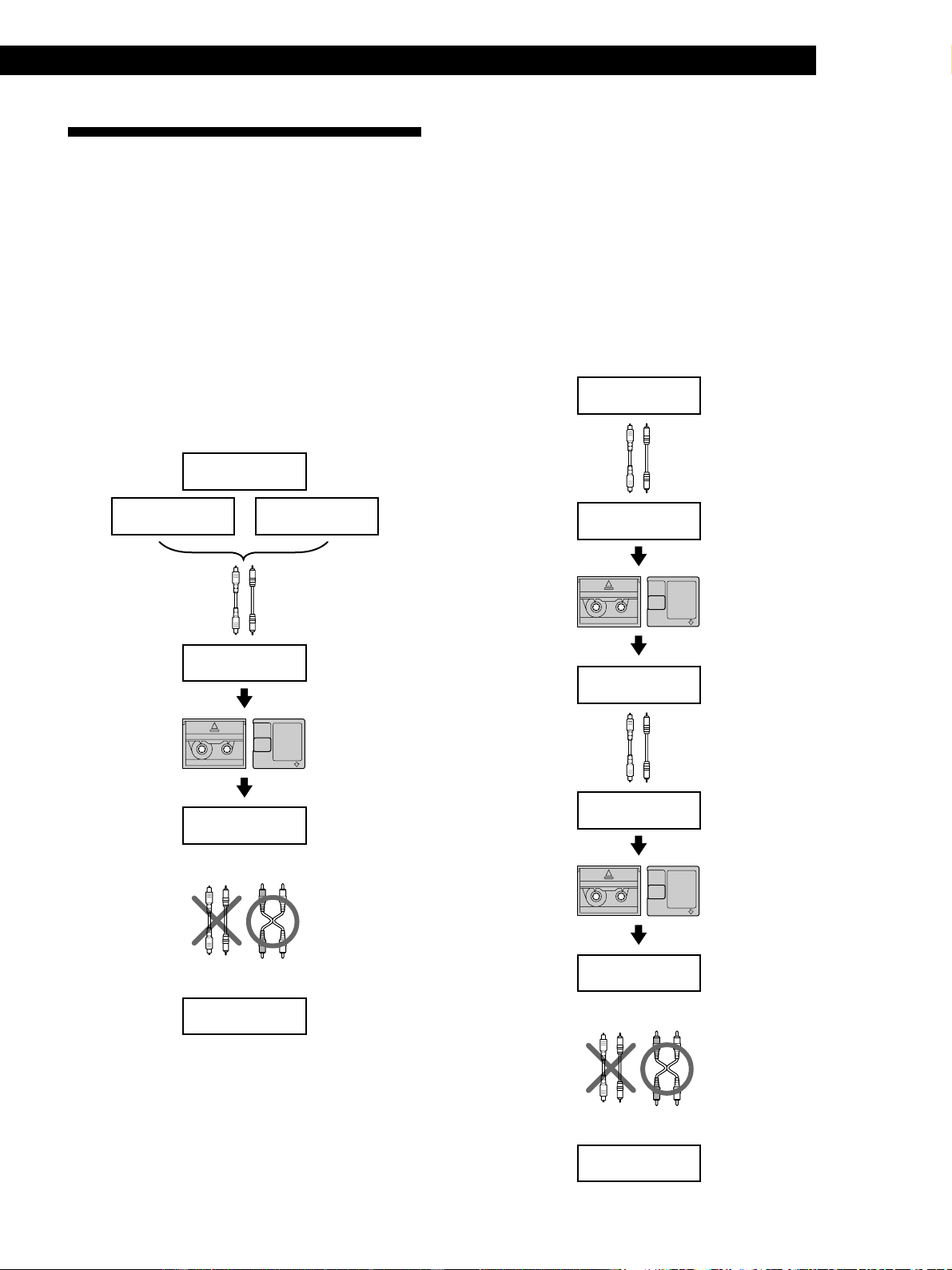
Additional Information
45
Guide to the Serial Copy
Management System
This MD deck uses the Serial Copy Management
System, which allows only first-generation digital
copies to be made of premastered software via the
deck’s digital input jack. An outline of this system
appears below:
1 You can record from digital program sources (CDs, DATs
or premastered MDs) onto a DAT tape or recordable MD
via digital input jack on the DAT or MD deck.
You cannot, however, record from this recorded DAT tape
or MD onto another DAT tape or recordable MD via the
digital input jack on the DAT or MD deck.
MD deck
DAT deck
CD player
Digital output jack
Digital input jack
DAT deck or
MD deck
First-generation
DAT tape or MD
recorded via
digital-to-digital
connection
DAT or MD
DAT deck or
MD deck
Digital output jack Line (analog) output jacks
DAT deck or
MD deck
Digital input jack Line (analog) input jacks
Playing
Playback
Recording
Optical cable or
coaxial digital
connecting cable
Recording
Audio connecting
cord
Optical cable or
coaxial digital
connecting cable
Playing
Optical cable or
coaxial digital
connecting cable
Recording
DAT deck or
MD deck
First-generation
DAT tape or MD
recorded via
digital-to-digital
connection
Playback
Recording DAT deck or
MD deck
Digital input jack
Digital output jack
Digital input jack
Optical cable or
coaxial digital
connecting cable
DAT or MD
Second-
generation DAT
tape or MD
recorded via
digital-to-digital
connection
Playback
DAT deck or
MD deck
DAT deck or
MD deck
Audio connecting
cord
Optical cable or
coaxial digital
connecting cable
DAT or MD
BS/CS tuner
Digital output jack
Line (analog) output jacks
Recording
Digital input jack Line (analog) input jacks
Digital output jack
DAT deck or
MD deck
2 You can record the digital input signal of a digital satellite
broadcast onto a DAT tape or recordable MD via the
digital input jack on the DAT or MD deck which is capable
of handling a sampling frequency of 32 kHz or 48 kHz.
You can then record the contents of this recorded DAT
tape or MD (first-generation) onto another DAT tape or
recordable MD via digital input jack on the DAT or MD
deck to create a second-generation digital copy.
Subsequent recording from the second-generation copy
onto another recordable DAT tape or MD is possible only
through the analog input jack on the DAT or MD deck.
Note, however, that on some BS/CS tuners, second-
generation digital copying may not be possible.
(Continued)
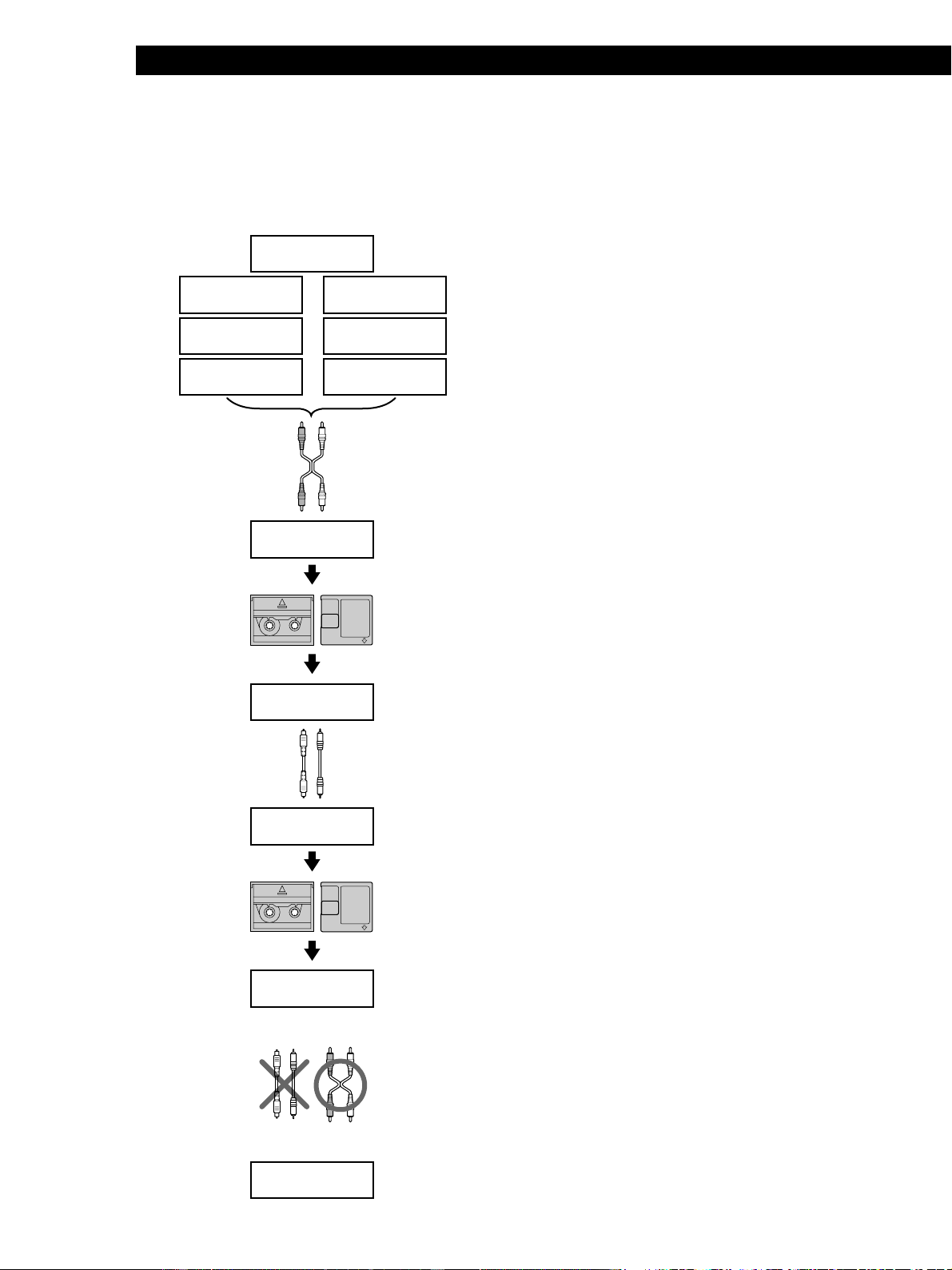
Additional Information
46
3 You can record a DAT tape or MD recorded via the DAT
or MD deck’s analog input jack onto another DAT tape or
MD via the DAT or MD deck’s digital output jack. You
cannot, however, make a second-generation DAT tape or
MD copy via the DAT or MD deck’s digital output jack.
Digital input jack
Line (analog) input jacks
MD deck
CD playerTuner
Turntable
Cassette deck DAT deck
Line (analog)
output jacks
Audio connecting cord
Recording
Playback
Recording
Playback
Digital output jack
DAT deck or
MD deck
DAT deck or
MD deck
DAT deck or
MD deck
Recording
DAT deck or
MD deck
DAT deck or
MD deck
Microphone
amplifier
DAT or MD
Optical cable or
coaxial digital
connecting cable
DAT or MD
First-generation
DAT tape or MD
recorded via
digital-to-digital
connection
Line (analog) output jacksDigital output jack
Digital input jack
Audio connecting
cord
Optical cable or
coaxial digital
connecting cable
Playing
Line (analog)
input jacks
DAT tape or MD
recorded via
analog-to-digital
connection

Additional Information
47
Index
A, B
AMS (Automatic Music Sensor)
14
Audio connecting cord 4, 45
Auto cut 20
C
CD
inserting 6
taking out 6
text 8, 10
Changing
an existing title 36
display 12
Checking
remaining time 13
playing time 12, 13
total number of tracks 12, 13
track name 12, 13
track number 12, 13
Cleaning 40, 51
Combining 31
D
Display messages 41
Dividing
after selecting the dividing
point 31
after selecting the track 30
E
Erasing
all titles 37
all tracks 29
a part of a track 29
a single track 28
a title 36
F, G
Fade-in recording 27
Fade-out recording 27
H
Hooking up
a digital component 4
an analog component 4
I, J, K
Input monitor 20
L
Labeling
an MD 33
a track 33
copying a title within an MD
35
with the remote 35
Locating
a particular point in a track
15
a specific track 14
M, N
MD
inserting 7
premastered 13
recordable 8, 10
taking out 7
Moving 32
O
Optical cable 4, 45
P, Q
PC LINK 5
Pitch control 18
Playing
CD 6
MD 7
normal play 6, 7
program play 16
repeat play 15
shuffle play 16
R
Recording
CD-MD synchro-recording 8
erasing tracks 28
high-speed CD-MD synchro-
recording 10
level 23
manual recording 21
music synchro-recording 26
REC-IT function 25
time machine recording 26
long time recording 22
Recording mode 22
Record-protect tab 9
Remote commander (remote) 4
S
Sampling frequency 5, 45
Sampling rate converter 5, 20
SCMS (Serial Copy
Management System) 19, 45
Self-diagnosis 50
Setup Menu 49
Sleep Timer 17
Smart space 20
Specifications 44
Supplied accessories 4
System limitations 42
T
Track marking
automatic track marking 24
manual track marking 24
Troubleshooting 43
U, V, W, X, Y, Z
Undoing the last edit 37
(Continued)

Additional Information
48
Names of controls
Buttons
Alphabet/Number 14, 35
CD SYNCHRO HIGH 10
CD SYNCHRO NORMAL 8
CLEAR 17, 33
DISPLAY 12
§ EJECT 7, 20
FADER 27
INPUT 20
MENU/NO 18, 23, 28
MUSIC SYNC 26
NAME EDIT/SELECT 35
§ OPEN/CLOSE 6
PLAY MODE 8
REC r (recording) 20
REC-IT 25
REC LEVEL +/– 24
REC MODE 22
REPEAT 15
SCROLL 12
SLEEP 17
TIME(/CHAR) 12, 20, 33
T.REC 26
YES 28
· (play) 6 , 7, 14, 21
P (pause) 6, 7, 21
p (stop) 6, 7, 15, 20, 29
0/) (manual search)
15, 29
=/+ (AMS: Automatic
Music Sensor) 6, 14
>10 14
Connector
DIGITAL OPTICAL IN 21, 44
Controls
AMS 6, 7, 12, 20, 28
PHONE LEVEL 6, 7
Indicators
MD LP 22
STANDBY 6
Jacks
ANALOG IN/OUT 5, 21, 44
PHONES 6, 7, 44
Switches
SELECT 6, 7, 14, 26
1/u (power) 6, 7
Others
Display 12
TOC 28
TOC Writing 9, 19, 28
g 4

Additional Information
49
Table of Setup Menus
You can make various settings on this deck by using Setup Menus. Operation related to each menu were explained
in the previous sections. The table below outlines each menu, including the various parameters and initial settings.
Note
The menus you can use while the deck is stopped, playing or recording differ.
To enter the Setup Menu
While the deck is stopped, press MENU/NO twice to display “Setup Menu.”
Menu
Function Parameters Initial setting See
T.Mark Sets the Track Marking Function. LSyn/Off LSyn page 24
LS (T) Changes the trigger level for Track
Marking Function.
–72 to 0dB –50dB page 25
S.Space Sets the Smart Space and Auto Cut
Functions.
On/Off On page 20
F.in Sets the fade-in time. 1.0s to 15.0s 5.0s page 27
F.out Sets the fade-out time. 1.0s to 15.0s 5.0s page 27
Pfine Fine controls the playing speed. –87.5 to 0.0% 0.0% page 18
Pitch
Changes the playing speed by auto
steps.
–36 to 0
0 page 18
CD Adjusts the input level from the CD
player section.
–∞dB to +12.0dB 0.0dB page 23
Opt Adjusts the input level from the
DIGITAL OPTICAL IN connector.
–∞dB to +12.0dB 0.0dB
page 23
Anlg Adjusts the input level from the
ANALOG IN jacks.
–∞dB to +12.0dB 0.0dB page 23
LPstamp Sets whether to automatically add
“LP:” at the beginning of a track name
during a long time recording.
On/Off On page 23
To reset to the initial setting
Press CLEAR while the respective Setup Menu is displayed.

Additional Information
50
Self-Diagnosis Function
The deck has a self-diagnosis display. This function shows a three- or five-digit display (a combination of a letter and
figures) and the corresponding message, so you can check the deck’s condition.
If such a display appears, check the following table in order to resolve the problem.
Should any problem persist, consult your nearest Sony dealer.
Three- or five-digit display/Message Cause/Remedy
C11/Protected The inserted MD is record-protected.
/ Take out the MD, and close the record-protect tab (page 9).
C13/Rec Error The recording was not made properly.
/ Set the deck in a stable place, and repeat the recording procedure.
The inserted MD is dirty (with smudges, fingerprints, etc.), scratched, or not up to
standards.
/ Replace the disc, and repeat the recording procedure.
C14/Toc Error The deck could not read the TOC of the MD properly.
/ Insert another disc.
/ If possible, erase all tracks on the MD using the All Erase Function on page 29.
While recording from a digital component connected through the DIGITAL
OPTICAL IN connector, the digital connecting cable was unplugged or the digital
component turned off.
/ Connect the cable or turn the digital component back on.
C12/Cannot Copy An attempt was made to play a disc that is not compatible with this deck (CD-
ROM, MD data disc, etc.).
/ Replace the disc.
C13/Read Error The deck could not read the TOC of the MD properly.
/ Eject the disc, then insert it again.
C41/Cannot Copy The digitally dubbed material cannot be recorded digitally (page 45).
C71/Din Unlock A moment’s lighting is due to the signals of the digital program being recorded.
This does not affect the recorded material.
E0001/MEMORY NG There is an error in the internal data that the deck needs in order to operate.
/ Consult your nearest Sony dealer.
E0101/LASER NG There ia a problem with the optical pickup.
/ The optical pickup may have failed. Consult your nearest Sony dealer.
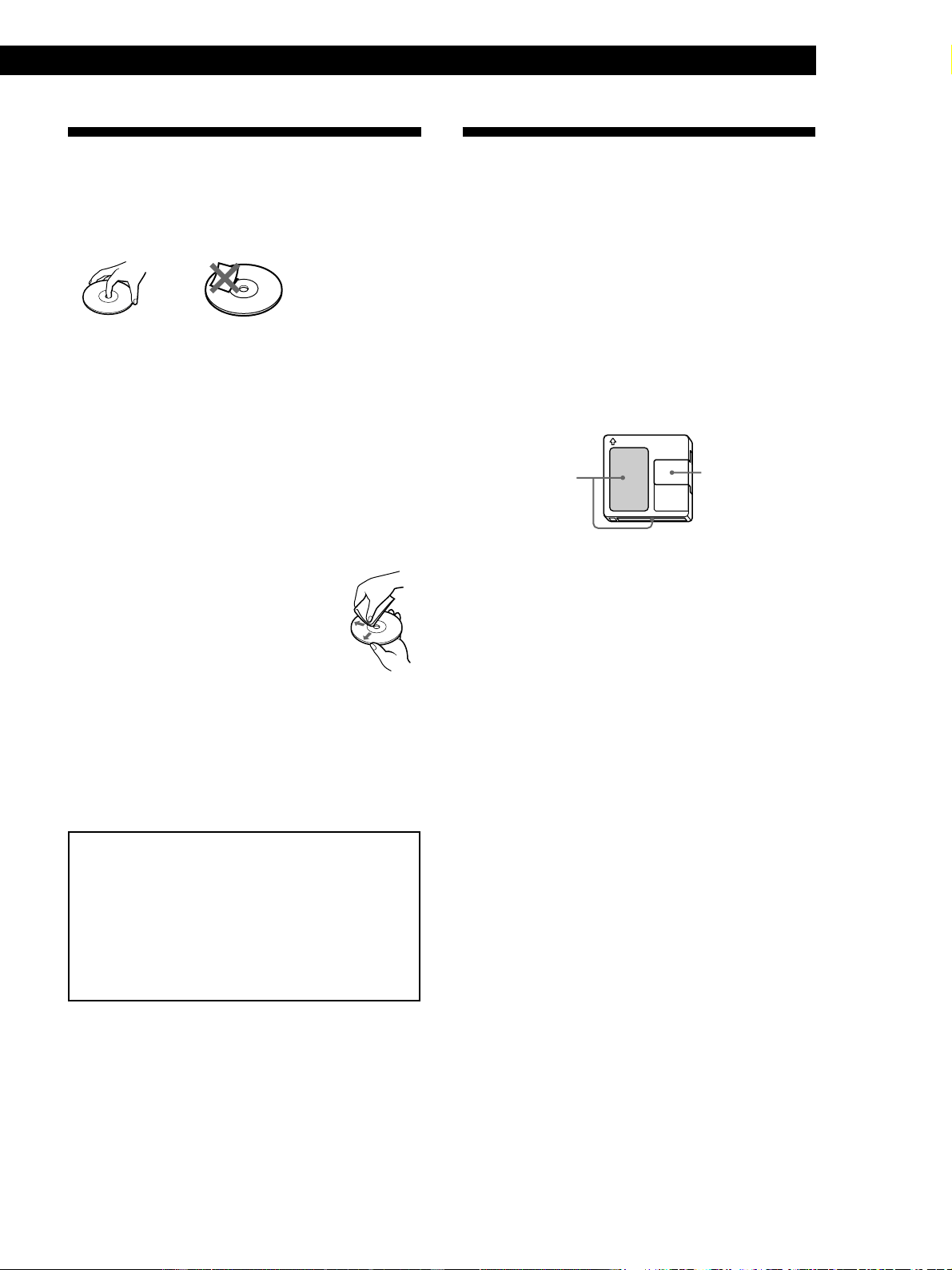
Additional Information
51
Notes on CDs
On handling CDs
• To keep the disc clean, hold it along its edges only.
Do not leave fingerprints on the surface.
• Do not stick adhesive papers or tapes onto the disc.
• Only regular circular discs can be used in this deck.
Irregularly shaped discs, such as star- or heart-
shaped discs, may damage the deck.
• If there is glue or a similar substance on the disc,
remove it completely before using the disc.
On storage
• Do not expose the disc to direct sunlight, heat
sources, or high humidity.
• Store discs in their cases. Do not store discs either
stacked horizontally or standing vertically without
their cases.
On cleaning
• Fingerprints or dust on the CD may cause
poor sound reproduction or sound
dropout.
• Before playing a disc, clean it with a cleaning
cloth. Wipe the disc from the center out.
• If the disc is still dirty after being wiped with a
cleaning cloth, wipe it again with a slightly
moistened cloth. Then wipe off the residual moisture
with a dry cloth.
• Do not use solvents such as benzene, thinner,
commercially available cleaners or antistatic spray
intended for vinyl LPs.
Note on High-Speed CD-MD Synchro-
Recording
Certain CD conditions may cause sound dropout or
noise in the recording results, or even create
unwanted tracks on the MD. If this happens, clean
the CD as instructed on “On cleaning” above, and
record material to the MD using normal-speed CD-
MD Synchro-Recording only.
Proper location
of the labels
Shutter
Handling MDs
The MD is enclosed in a cartridge to protect the disc
from debris or fingerprints and to make it easy to
handle.
However, the presence of debris or a warped cartridge
may inhibit the disc from operating properly. To
ensure that you can always listen to the highest quality
music, follow the precautions below:
• Do not touch the internal disc directly. Forcing the
shutter open may damage the internal disc.
• Be sure to stick the labels supplied with the MD to
the appropriate positions. The shape of the labels
may vary depending on the MD brand.
Where to keep the MDs
Do not place the cartridge where it may be exposed to
direct sunlight or extremely high heat and humidity.
Regular maintenance
Wipe dust and debris from the surface of the cartridge
with a dry cloth.

Sony Corporation Printed in Malaysia