1
229C4053P562
31-10570 06-03 JR
Installation
24” Gas
Built-In
Oven
Instructions
JGRS14
BEFORE YOU BEGIN
Read these instructions and warnings
completely and carefully.
IN THE COMMONWEALTH OF
MASSACHUSETTS:
• This product must be installed by a licensed
plumber or gas fitter.
• When using ball-type gas shut-off valves,
they shall be the T-handle type.
• A flexible gas connector, when used, must
not exceed 3 feet.
•
IMPORTANT — Save these
instructions for local inspector’s use.
•
IMPORTANT — Observe all
governing codes and ordinances.
• Note to Installer – Be sure to leave these
instructions with the Consumer.
• Note to Consumer – Keep these
instructions for future reference.
• Skill level – Installation of this appliance
requires basic mechanical skills.
• Completion time – 1 to 3 hours
• Proper installation is the responsibility of
the installer.
• Product failure due to improper installation
is not covered under the Warranty.
WARNING — This appliance must
be properly grounded.
FOR YOUR SAFETY:
WARNING — If the information
in this manual is not followed exactly, a fire,
explosion, or gas leak may result causing
property damage, personal injury, or death.
DO NOT STORE OR USE GASOLINE OR
OTHER FLAMMABLE VAPORS AND LIQUIDS
IN THE VICINITY OF THIS OR ANY OTHER
APPLIANCE!
WHAT TO DO IF YOU SMELL
GAS:
• Do not try to light any appliance.
• Do not touch any electrical switch; do not
use any phone in your building.
• Immediately call your gas supplier from a
neighbor’s phone. Follow the gas supplier’s
instructions.
• If you cannot reach your gas supplier, call
the fire department. Installation and service
must be performed by a qualified installer,
service agency or the gas supplier.
• Be sure your oven is installed properly by
a qualified installer or service technician.
• Be sure the oven is securely installed in a
cabinet that is firmly attached to the house
structure. Weight on the oven door could
cause the oven to tip, resulting in serious
personal injury or death. Never allow
anyone to climb, sit, lean, stand, or hang
on the oven door.
Questions? Call 800.GE.CARES (800.432.2737) or Visit our Website at: www.GEAppliances.com
2
Installation Instructions
PREPARE TO INSTALL THE OVEN
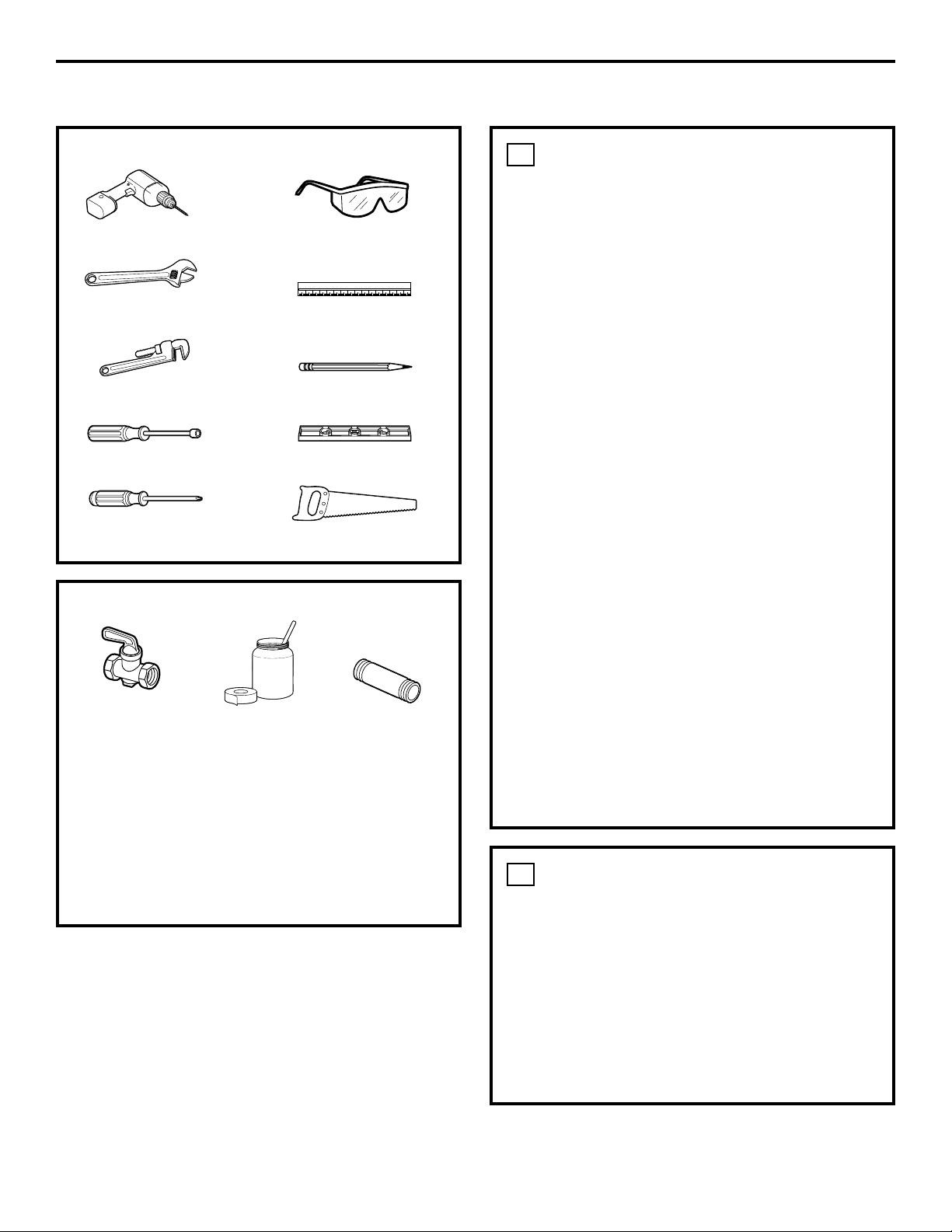
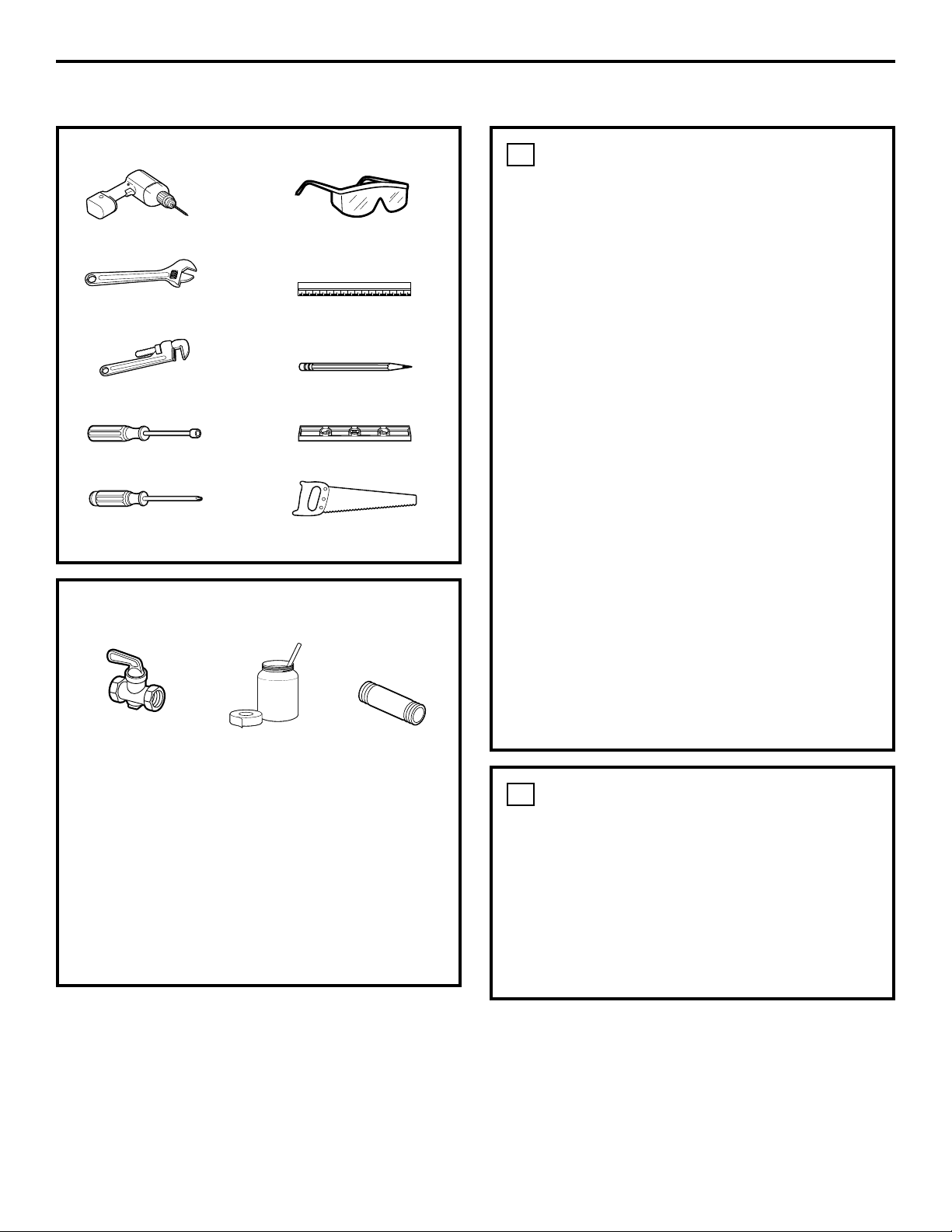
TOOLS YOU WILL NEED
MATERIALS YOU MAY NEED
FOR FLEXIBLE CONNECTION WHERE
LOCAL CODES PERMIT:
• Coated and approved flexible metal tubing
(same 3/4″ or 1/2″ I.D. as gas supply line)
• Adaptor or connector
FOR RIGID CONNECTION:
• Pipe fittings or union as required
Adjustable Wrench
12” Spirit Level
3/16” Hex Socket
Driver
#1 or #2
Phillips Screwdriver
Gas line
shut-off valve
Pipe joint sealant
1/2″ pipe nipple
Drill with 1/8” Bit
Pencil
Safety Glasses
Ruler or Straightedge
Hand or Saber Saw
Pipe Wrench
GAS REQUIREMENTS
You must follow local codes when installing
your built-in oven. Check with your local
utilities for codes and ordinances that apply
in your area. If there are no local codes, you
must follow the National Fuel Gas Code
ANSI/Z223.1 – Latest Edition. To get a copy
write to:
American Gas Association
1515 Wilson Boulevard
Arlington (Rosslyn), VA 22209
This standard does not cover the thermal
efficiency of household cooking gas
appliances since it is regulated by the
Energy Policy and Conservation Act of 1975,
the National Energy Conservation Policy Act
of 1978 and the National Appliance Energy
Conservation Act of 1987.
If the oven is to be installed in a mobile
home, the installation must conform to the
Manufactured Home Construction and
Safety Standard, Title 24, CFR, Part 3280 or,
when not applicable, the Standard for
Manufactured Home Installations ANSI/
A225.1 – Latest Edition and Manufactured
Home Installations, Sites, and Communities
ANSI/NFPA 501A, or with local codes. You
can get a copy of the Federal Standard by
writing:
Office of Mobile Home Standards
HUD Building
451 7th Street, S.W.
Washington, D.C. 24010
1
ELECTRICAL REQUIREMENTS
This appliance must be electrically
grounded. Check with your local codes
which apply in your area. If no local
codes apply, the National Electrical Code,
ANSI/NFPA No. 70 – Latest Edition must
be followed. Write to:
NATIONAL FIRE PROTECTION
ASSOCIATION
BATTERYMARCH PARK
QUINCY, MA 02269
2
3
Installation Instructions
PREPARE THE OPENING
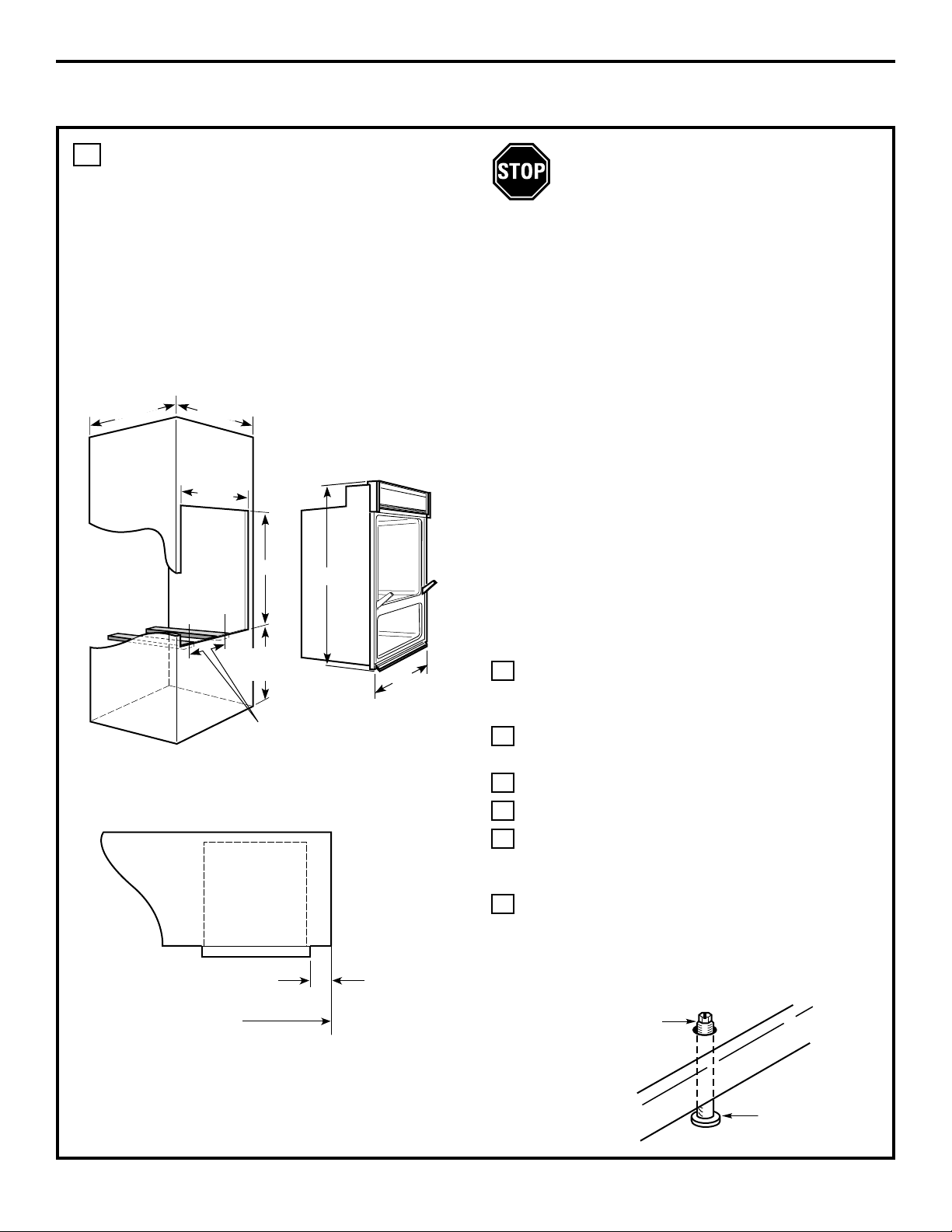
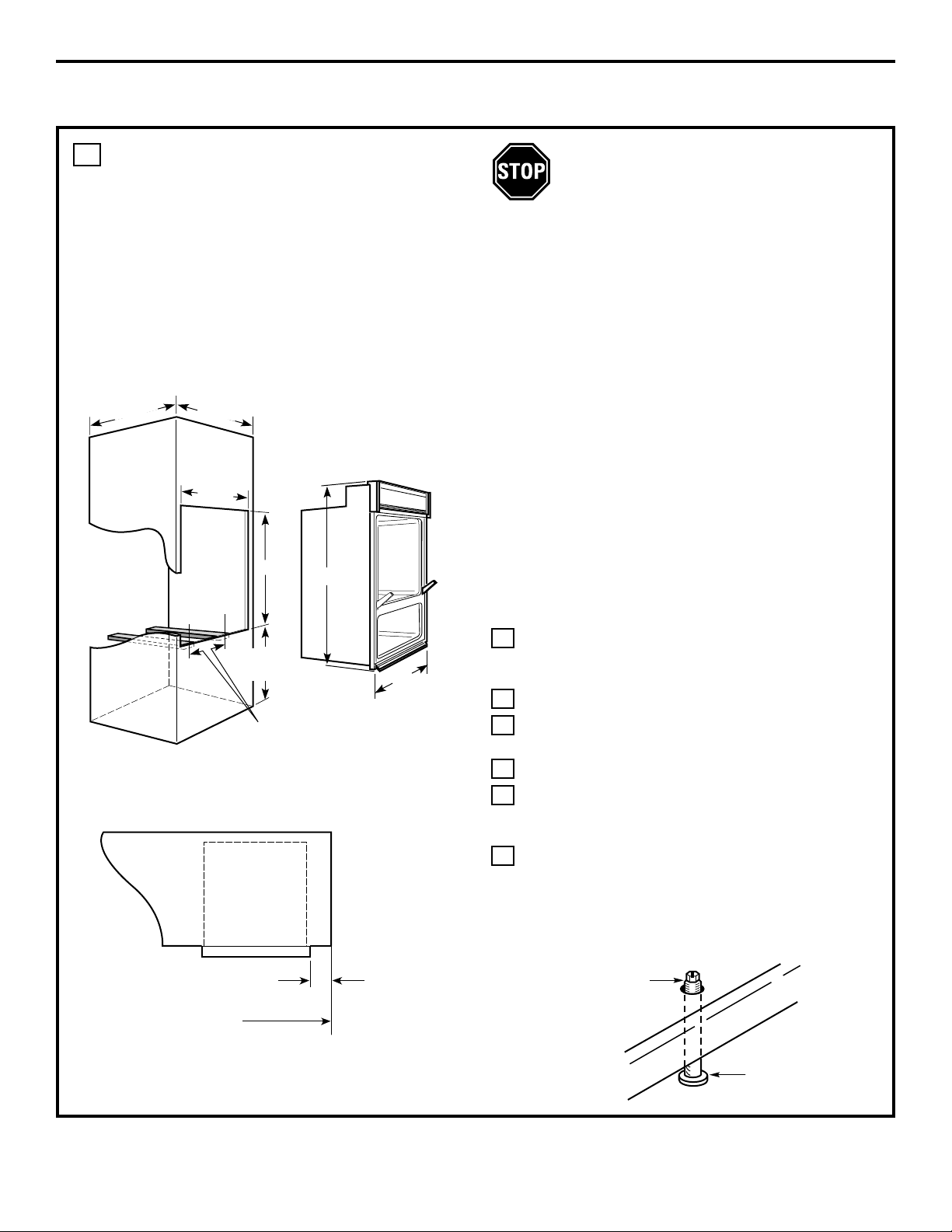
Cabinet space: 24″ min. depth
24″ min. width
Cutout: 22 3/16″ width
38″ height
3/8″ min. on either side
(See Fig. 2)
It's best to use a template to make a straight cut.
Place the template on a level base line, 22
″
to 28
″
above the floor. This will place the oven cavity 36
″
or 42
″
above the floor.
The cabinet must have solid sides,
back, and bottom. The bottom must
be solid either at floor level or with
the bottom edge of the cutout. Any
openings around the gas or electrical outlets
must be sealed. All cabinet openings must be
sealed at the time of installation to prevent
drafts. Drafts will affect safe use of the oven.
SPECIAL NOTES:
•
Make sure the oven is installed at the specified
height. The unit has been tested and approved for
installation, in accordance with safety standards at
this height.
•
If the floor is to be the solid bottom, two runners,
centered within the cutout opening 11″ apart may
be used to support the oven. These runners must
support 130 lbs. and must be level and straight.
•
The wall coverings, countertops, and cabinets
around the oven should be able to withstand
temperatures of up to 200°F generated by
the oven.
IF YOU ARE REPLACING A UNIT
THAT HAS A CUTOUT HEIGHT
OF MORE THAN 38″:
Shut off the main gas supply before removing
the existing oven. Leave the gas off until the
new hookup is complete.
Measure how much your cutout height
exceeds 38
″
.
Raise your gas inlet pipe if necessary.
Remove the storage drawer.
Extend the leg levelers (using a 3/16
″
hex
socket driver) by the amount measured in
Step B.
Insert the oven into the cutout and adjust the
levelers so that the oven racks are level and
the top of the control panel overlaps the top of
the cutout.
F
E
D
C
B
A
3
Fig. 1
Fig. 2
Fig. 3
24″
MIN.
24″
MIN.
22 3/16″
23 3/4″
38″
38 3/8″
22″ TO
28″*
* SHOULD BE ADJUSTED TO SUIT BOTH STANDARD
CABINETRY AND DESIRED OVEN WORKING HEIGHT.
3/8″ MIN.
Wall or
Cabinet
3/16″ Slotted
Hex Head
Leg Leveler
Oven
2 Runners
on 11″ Centers
4
Installation Instructions
INSTALL THE OVEN
GAS CONNECTIONS
WARNING:
Do not operate
the burners of this oven when using L.P.
(bottled) gas before converting the pressure
regulator and burner orifice for L.P. gas
usage.
See page 2 for all gas requirements.
Shut off the gas supply at the shut-off valve.
Remove the existing oven (if necessary).
Discard any old or used connectors.
WARNING:
Never reuse old
flexible connectors. The use of old flexible
connectors can cause gas leaks and
personal injury. Always use new connectors
when installing a gas appliance.
Be sure no strain has been placed on the
connecting line assembly.
To prevent any leaks, use a pipe joint
compound that resists the action of L.P. gas
on the male outside threads.
Use a 1/2
″
gas inlet pipe.
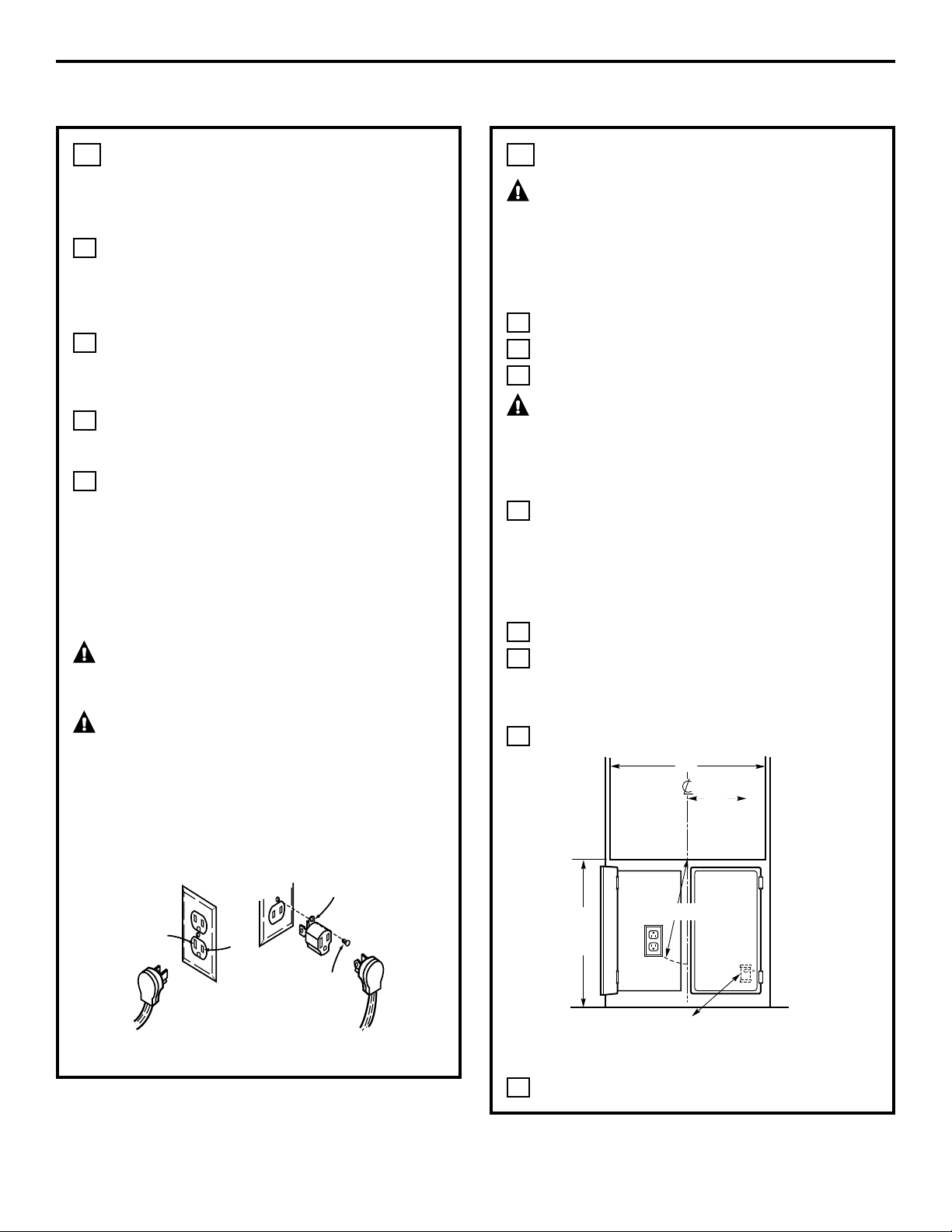
The hole for the inlet pipe should be 8 1/2
″
min. to 9 5/8
″
max. right of the centerline
and 23
″
behind the front surface of the
cabinet.
Install a shut-off valve to the pipe.
Remove the storage drawer and the oven
door.
H
G
F
E
D
C
B
A
5
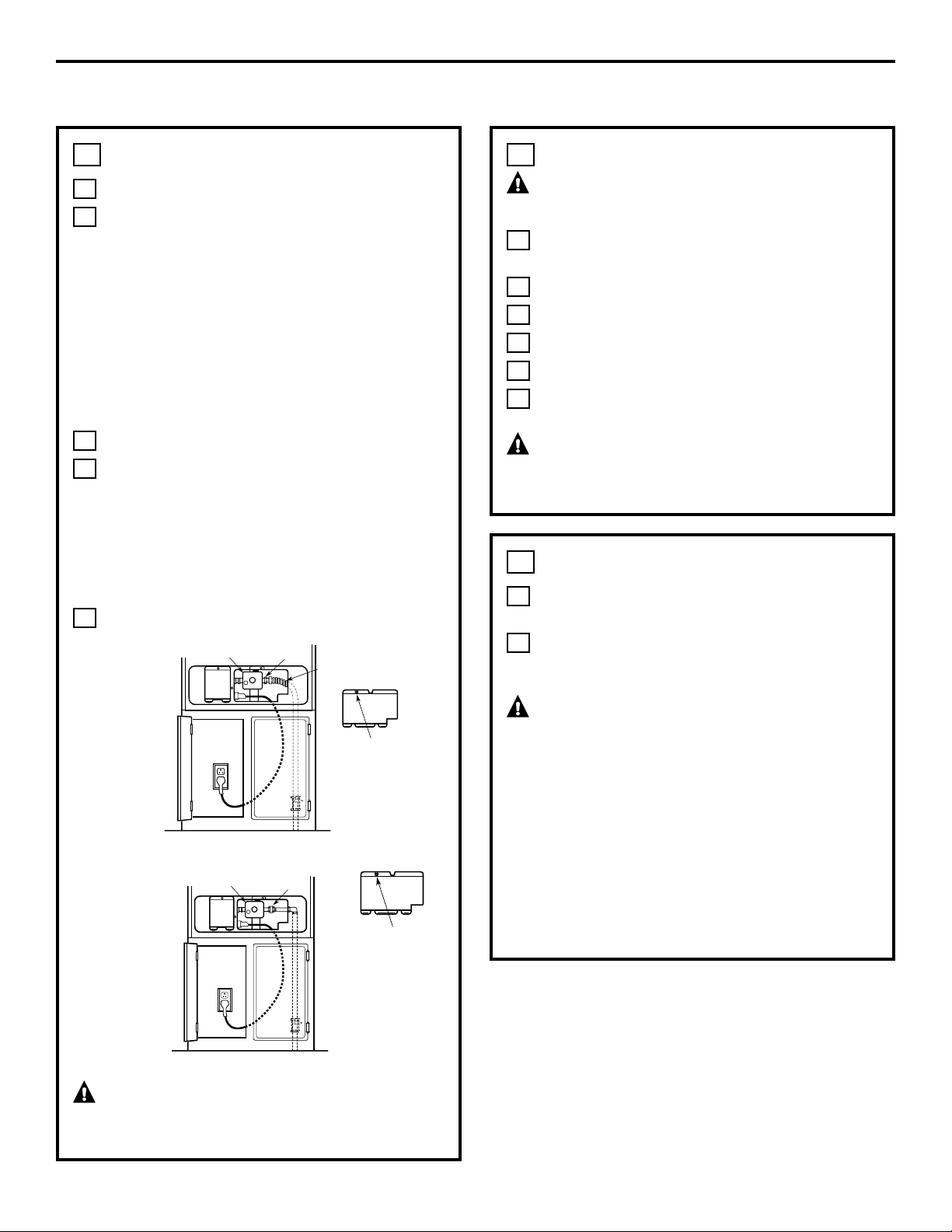
ELECTRICAL CONNECTIONS
An adequate electrical supply and outlet must be
used to operate the electrical parts of your oven.
The oven cord has a three-prong plug and
must be used with a properly grounded
three-hole outlet with a standard 120 Volt,
60 cycle AC household current.
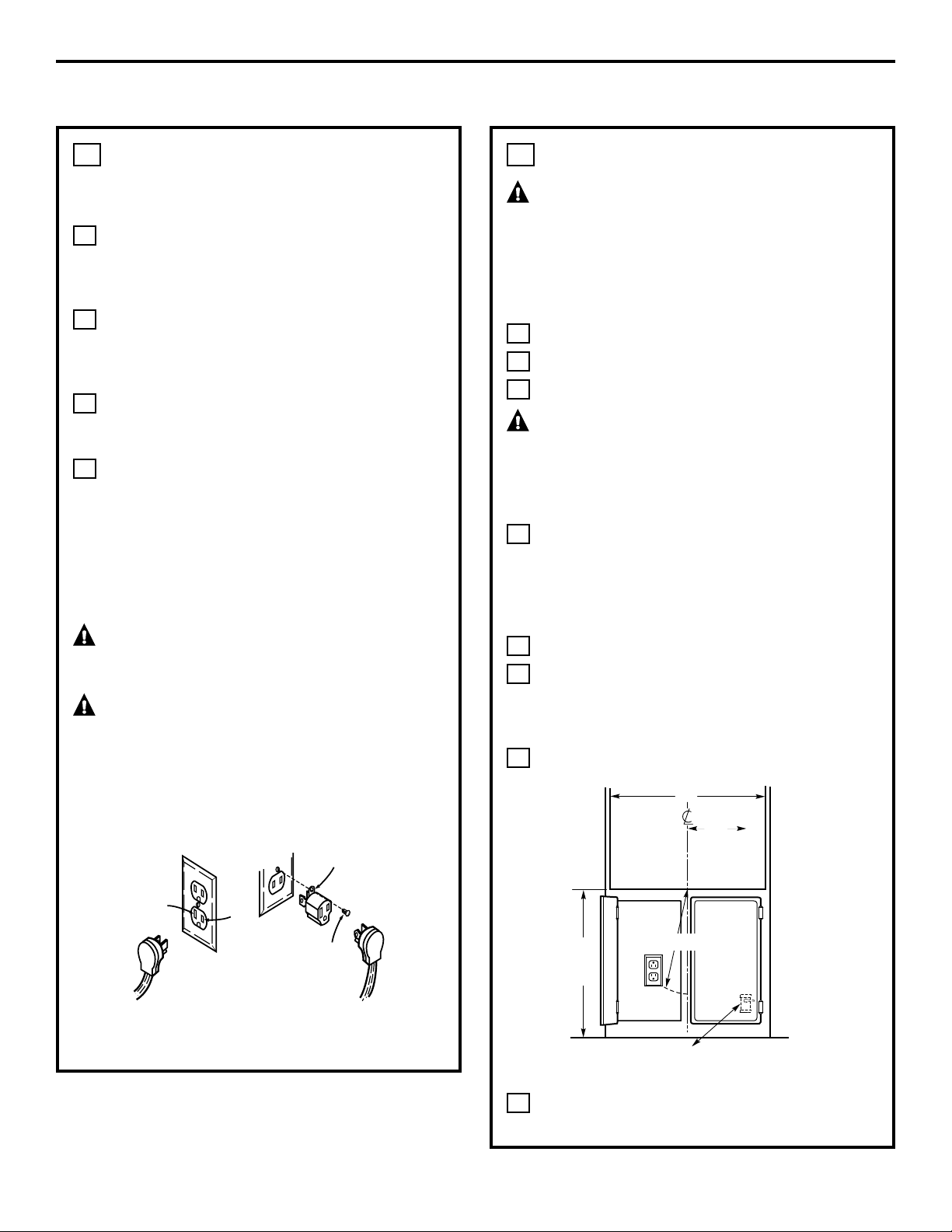
Install the electrical outlet below the oven
on the left side, in a location that is easily
reached through the cabinet doors.
(See Fig. 6).
If you do not have a three-hole grounded
outlet, have a qualified electrician change
your old one.
A grounding adaptor will be needed to
convert the old one until the outlet can be
replaced. This method is only temporary,
and a qualified electrician should test it to
be sure it meets requirements.
Always unplug the oven cord before making any
electrical repairs to the oven. When unplugging
the oven, always grasp the plug, never the cord.
WARNING:
NEVER USE AN
EXTENSION CORD TO CONNECT THE OVEN
TO THE ELECTRICAL SUPPLY.
WARNING:
Do not under any
circumstances cut or remove grounding
prong from oven cord. Failure to provide
proper polarization may create a hazardous
condition.
D
C
B
A
4
Fig. 4 Fig. 5
Fig. 6
L
N
Plug with ground prong
properly polarized and
grounded receptacle
Polarized receptacle
properly grounded
Metal Eyelet
Ground
22″
22″
TO
28″
13 1/2″
8 1/2″
MIN.
9 5/8″
MAX.
Receptacle
Plate Mounting
Screw
Prefered Method Temporary Method
Recommended Main Shut-OFF Location
(The regulator also has a shut-off lever)
5
Installation Instructions
GAS CONNECTIONS (cont.)
Place the oven in the cutout.
Level the oven:
1. Place a spirit level on one of the oven
racks.
2. If the oven is not level, adjust the leg
levelers.
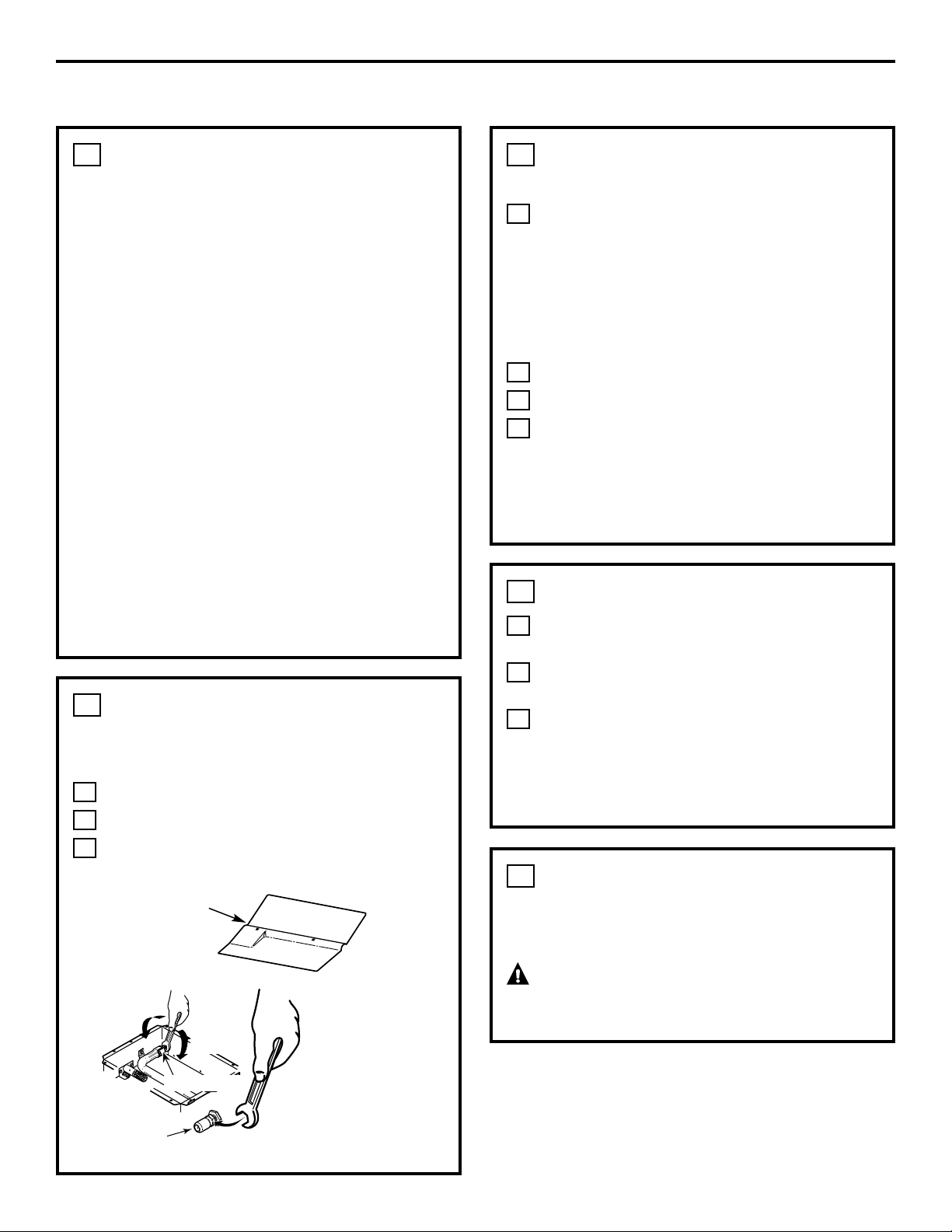
With the oven in place, remove the regulator
cover by carefully grasping the left side and
pull until the spring clip is released. The
pressure regulator inlet is accessible through
the opening in the main back.
Remove regulator cover.
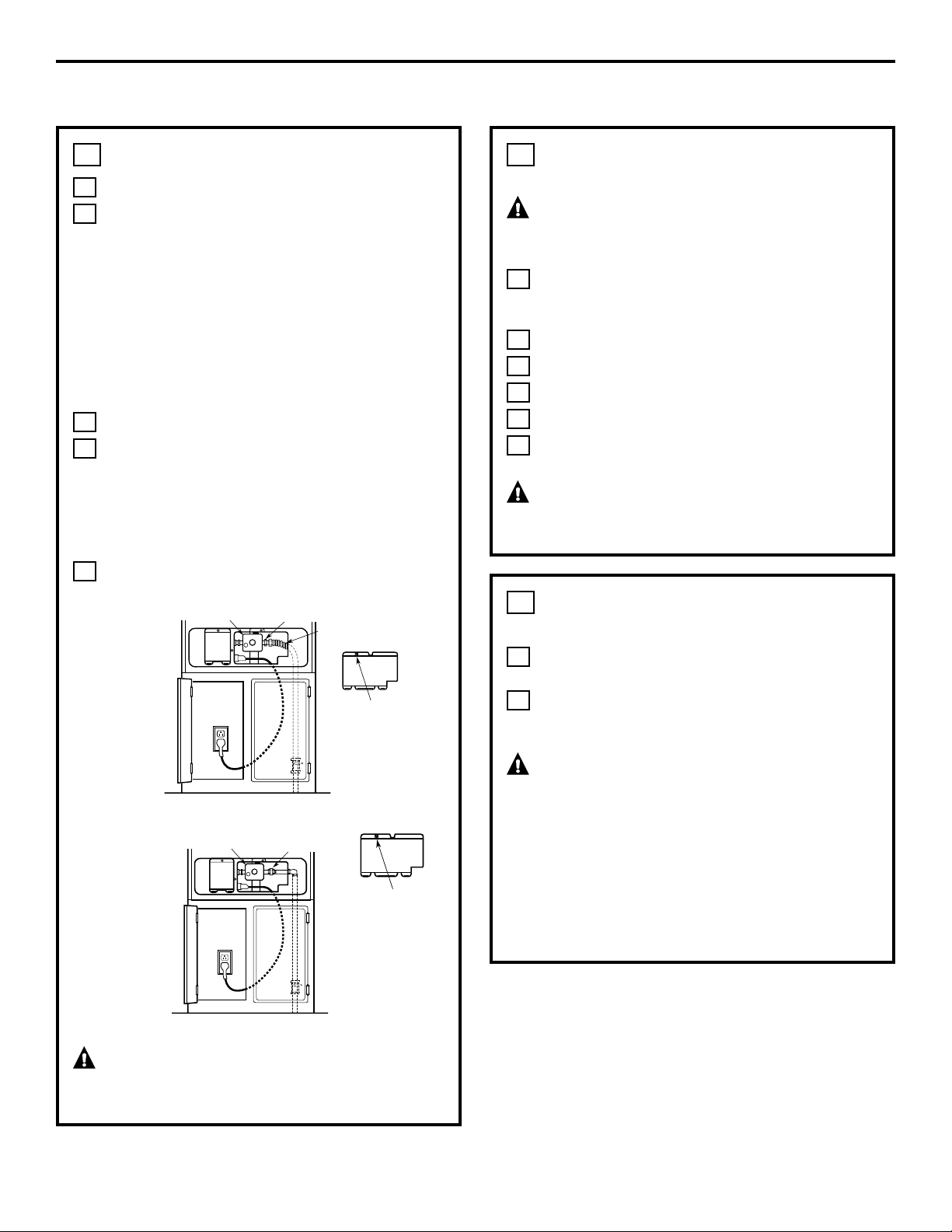
Through this opening connect:
1. The flexible connection and the adaptor
(see Fig. 7).
or
2. The rigid pipe connection and union to the
shutoff valve (see Fig. 8).
Tighten the fitting.
WARNING:
DO NOT FORCE!
FORCING COULD DAMAGE THE FITTING,
TUBING, OR CAUSE LEAKING.
M
L
K
J
I
5
CHECK FOR LEAKS
WARNING:
DO NOT USE OPEN
FLAME TO CHECK FOR LEAKS!
Apply a soap solution to all connections:
supply line, manifold and oven.
Turn on the main gas supply.
Check for any bubbles to form.
Turn off main gas supply.
Stop any leaks found.
Turn main gas supply on to make sure all
leaks were stopped.
WARNING:
ALL LEAKS MUST BE
STOPPED BEFORE ATTEMPTING TO LIGHT
BURNERS.
F
E
D
C
B
A
6
PRESSURE TEST INFORMATION
The maximum allowable pressure for the
regulator is 14
″
W.C.
The minimum pressure needed to check the
regulator setting is 11
″
W.C. for L.P. gas and
5
″
W.C. for Natural.
CAUTION:
The range and its
individual shutoff valve must be
disconnected from the gas supply piping
system during any pressure testing of the
gas supply system at test pressures in
excess of 1/2 psig (pound per square inch
gauge).
The range must be isolated from the gas supply
piping system by closing its individual manual
shut-off valve during any pressure testing of the
gas supply system at test pressures equal to or
less than 1/2 psig.
B
A
7
Fig. 7
Fig. 8
Regulator
Cover
Regulator
Cover
Flexible
Connection
Adaptor
Pressure Regulator
Adaptor
Pressure Regulator
FLEXIBLE HOOK-UP
RIGID HOOK-UP
6
Installation Instructions
INSTALL THE OVEN
(CONT.)
MAKE THE BURNER FLAME
ADJUSTMENTS (
CONT.)
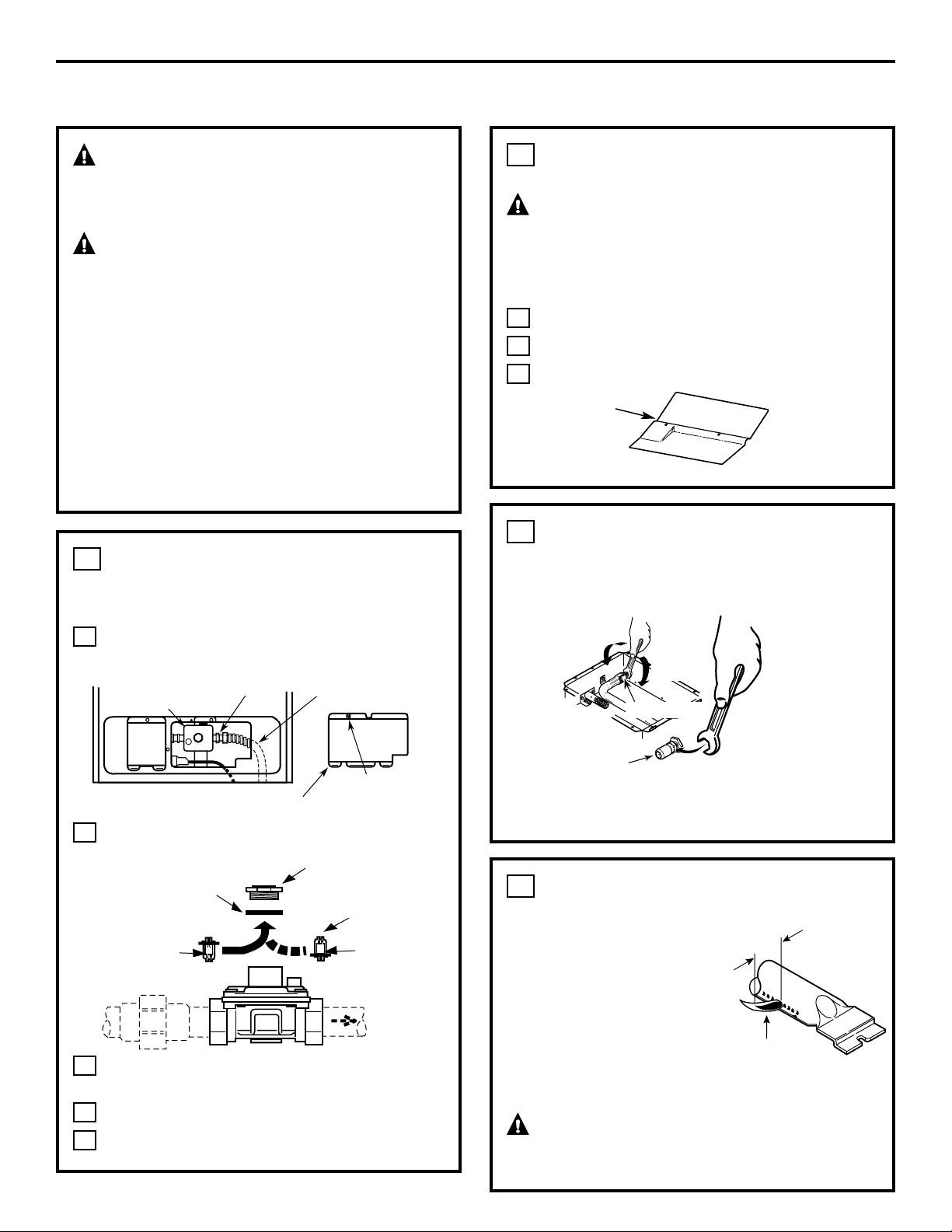
Use a screwdriver to loosen the air shutter
screw.
1. If the flames were yellow, open the air
shutter more than the original setting.
2. If the flames blew away or fluttered from
the burner, close the air shutter more than
the original setting.
Make the adjustment.
Retighten the air shutter screw.
Close the door and recheck the flame.
When the results are satisfactory:
1. Replace the oven baffle (flame spreader).
2. Replace the oven bottom.
G
F
E
D
9
MAKE THE BURNER FLAME
ADJUSTMENTS
OVEN BURNER
Open the oven door.
Remove the oven bottom.
Remove 2 screws to remove baffle (flame
spreader).
C
B
A
9
CHECK THE BURNER FLAMES
FOR NATURAL GAS
The oven is factory-adjusted for use with Natural
Gas in most areas. But, since the gas in some
areas may vary, you should check all adjustments
described below. If you are to use L.P. Gas see L.P.
Adjustments at the back of this guide.
NOTE: Bake and broil flame must be checked
with the door closed to properly check flame
characteristics. To properly check the burner, the
oven bottom and oven baffle must be removed.
Turn on bake or broil.
As you watch the flame with the oven door
closed check the following through the oven
door window:
1. Burner flames should not flutter or blow
away from the burner.
2. They should be blue in color with no trace
of yellow.
3. The inner cone of the flame should be
approximately 1/2
″
to 3/4
″
long.
BURNERS SHOULD BE CHECKED FREQUENTLY
8
SECURE THE OVEN
Using a 1/8
″
drill bit, drill holes through the
side trim and into the cabinet front.
With the screws provided, secure the oven
to the wall.
If the cabinet cutout is 38
″
high use the short
trim and attach to the bottom of the front
frame, with screws provided.
(If the cutout is higher than 38
″
use
the taller trim).
C
B
A
10
RECHECK STEPS
Double check to make sure everything in this
guide has been completed. Rechecking steps will
ensure safe use of the oven.
WARNING:
The trim permits air
entry into the cabinet below the unit and
must not be blocked.
11
Oven Bottom
Burner Baffle
Fig. 9
NAT. – L.P.
Adjustment
Made To Orifice Hood
L.P.
NAT.
Air Shutter
Fig. 10
7
Installation Instructions
MAKE THE L.P. GAS CONVERSION
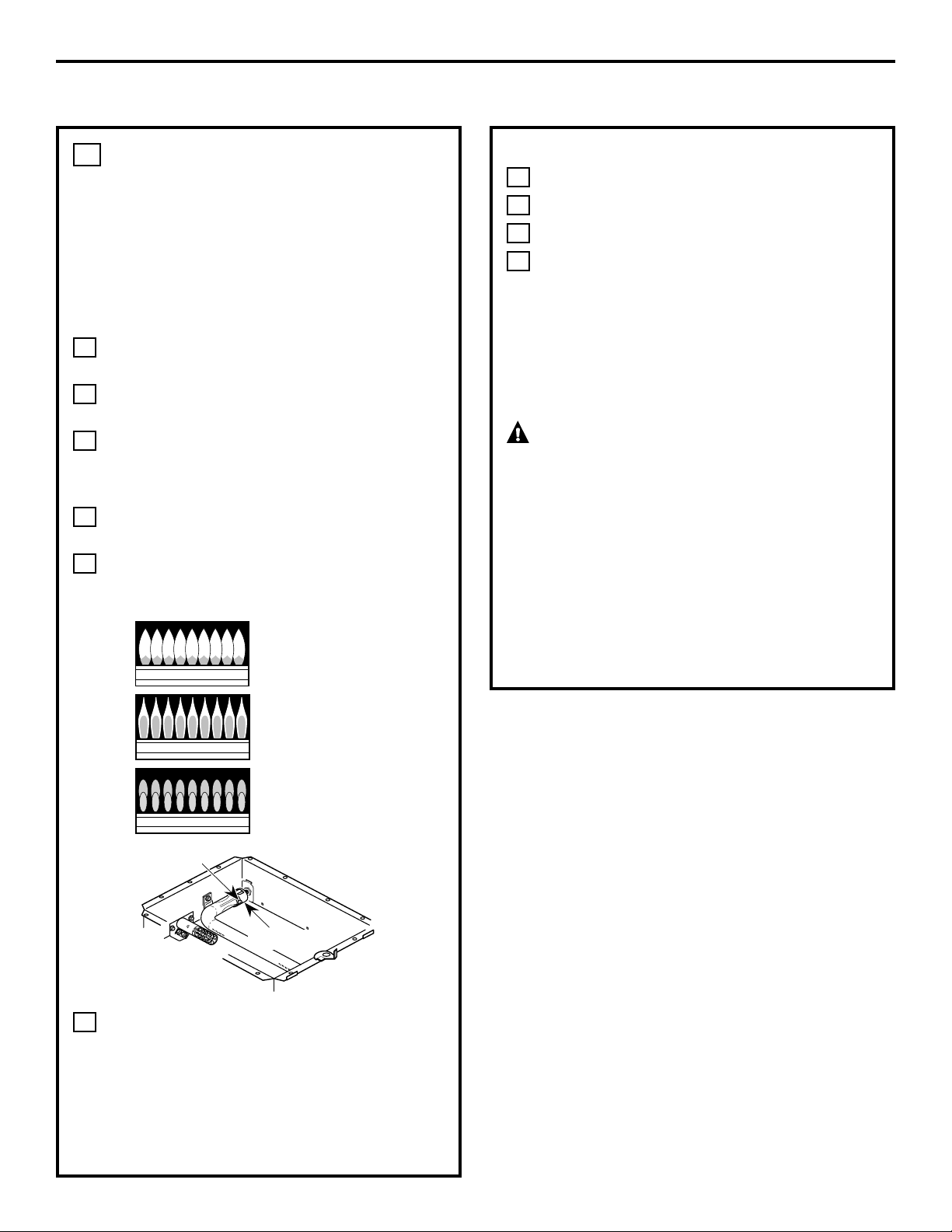
CHECK FLAME SIZE
Check the inner cone of
the flame. It should be
approximately 1/2
″
to 3/4
″
long for the oven and
broil burners.
If the flame size is too
long, use a 1/2
″
open end
wrench or adjustable joint
pliers to adjust the orifice
hood, by turning in the natural direction.
WARNING:
If you attempt to
measure the inner cone of the flame,
please use caution; burns could result.
4
WARNING:
If you are using L.P.
(bottled) gas all the adjustments described
below must be made before you make any
burner adjustments or use the oven.
WARNING: This
conversion must
be performed by a qualified installer or gas
supplier in accordance with the
manufacturer’s instructions and all codes
and requirements of the authority having
jurisdiction. Failure to follow instructions
could result in serious injury or property
damage. The qualified agency performing
this work assumes responsibility for the
conversion.
NOTE: Disconnect all electrical power and turn
off the gas supply at the shut-off valve before
beginning the conversion.
ADJUST PRESSURE
REGULATOR FROM NATURAL
GAS TO L.P.
Locate and remove regulator cover and wire
clip.
Locate the regulator and unscrew the cap.
Turn the retainer over so L.P. is showing on
the bottom of the retainer.
Replace the cap.
Replace the regulator cover.
E
D
C
B
A
1
NAT.
l..P.
ADJUST BURNER ORIFICE
FROM NATURAL TO L.P. GAS
CAUTION:
The adjustments in the
next column must be made before turning
on the burners. Failure to do so could result
in serious injury due to high flames and
toxic fumes.
Open the oven door.
Remove the oven bottom.
Remove the oven baffle (flame spreader).
C
B
A
2
ADJUST OVEN BURNER
Use a 1/2
″
open end or adjustable wrench to turn
the orifice hood in the L.P. direction, about 1 1/2
turns, until snug.
IMPORTANT: Do not overtighten or you may
bend the orifice hood or needle.
3
Oven Bottom
Burner Baffle
NAT. – L.P.
Adjustment
Made To Orifice Hood
L.P.
NAT.
Air Shutter
1/2″
to 3/4″
Inner Cone
of Flame
Pressure
Regulator
Adaptor
Flexible Connection
Remove
Wire Clip
Spring
Retainer
Gasket
NAT.
Cap
L.P.
Remove Regulator Cover
8
Installation Instructions
MAKE THE L.P. GAS CONVERSION
(CONT.)
TO ADJUST (CONT
.):
Make the adjustment.
Retighten the air shutter screw.
Close the oven door and recheck the flame.
When all adjustments are made and the
results are satisfactory:
1. Replace the oven baffle (flame spreader).
2. Replace the oven bottom.
SPECIAL NOTE: To convert the oven back to
natural gas, reverse the instructions given in
making L.P. Adjustments.
WARNING:
Once the conversion
is complete and checks ok, fill out the
LP sticker located in the pre-pack shipped
with your appliance and include your name,
organization and date conversion was
made. Apply the sticker to the range front
frame opposite the name and number plate
behind the broiler drawer to alert others in
the future that this appliance has been
converted to LP. If converting back to
natural gas from LP, please remove the
sticker so others know the appliance is
set to use natural gas.
E
D
C
B
ADJUST AIR SHUTTER
NOTE: The oven burner flame must be checked
with the door closed to properly check flame
characteristics.
Turn on bake or broil.
As you watch the flame with the oven door
closed check the following through the oven door
window:
Burner flames should not flutter or blow
away from the burner.
They should be blue in color with no trace of
yellow.
The inner cone of the flame should be
approximately 1/2
″
to 3/4
″
long.
IN SOME CASES
With L.P. gas, some yellow tipping on the
outer cone is normal.
Foreign particles in the gas line may cause
an orange flame at first, but this will soon
disappear.
TO ADJUST:
Use a screwdriver to loosen the air shutter
screw.
1. If the flames were yellow, open the air
shutter more than the original setting.
2. If the flames blew away or fluttered from
the burner, close the air shutter more than
the original setting.
A
B
A
C
B
A
5
“A”
Yellow Flames
Call for Service
“B”
Yellow Tipping
Normal for LP Gas
“C”
Soft Blue Flames
Normal for Natural Gas
Air Shutter
Air Shutter Screw

1
229C4053P562
31-10570 06-03 JR
Instructions
Horno A Gas
de Instalacion
Empotrado de 24”
JGRS14
ANTES DE EMPEZAR:
Lea estas instrucciones y las advertencias completa
y cuidadosamente.
EN LA MANCOMUNIDAD DE
MASSACHUSETTS:
•
Este producto debe ser instalado por un plomero
licenciado o por un técnico de gas.
•
Cuando se encuentre usando válvulas de
desconexión de gas tipo bola, deben ser del tipo T.
•
Un conectador de gas flexible, cuando se use, no
debe exceder los 3 pies.
• IMPORTANTE
— Guarde estas
instrucciones para su uso por el inspector local.
• IMPORTANTE
— Observe todos los
codigos y ordenanzas vigentes.
•
Nota al instalador – Asegúrese de dejar estas
instrucciones con el cliente.
•
Nota al consumidor – Guarde estas instrucciones
con el Manual de Uso y Cuidado para referencia
futura.
•
Nivel de destreza – La instalación de este aparato
requiere de destrezas mecánicas básicas.
•
Complección time – 1 a 3 horas
•
La instalación apropiada es la responsabilidad del
instalador.
•
La falla del producto debido a una instalación
inadecuada no está cubierta por la garantía.
ADVERTENCIA
— Este aparato
debe hacer tierra adecuadamente.
PARA SU SEGURIDAD:
¡ADVERTENCIA!
— Si la
información en este manual no se sigue exactamente,
podría resultar un incendio, una explosión, o un
escape de gas que causen daño a la propiedad,
heridas personales, o muerte.
¡NO ALMACENE O USE GASOLINA U OTROS
VAPORES O LIQUIDOS INFLAMABLES CERCA DE
ESTE O CUALQUIER APARATO ELECTRODOMESTICO!
QUE HACER SI HUELE GAS:
•
No trate de encender ningún aparato.
•
No toque ningún interruptor eléctrico; no use ningún
teléfono en su edificio.
•
Inmediatamente llame a su abastecedor de gas
usando el teléfono de un vecino. Siga las
instrucciones del abastecedor de gas.
•
Si no puede comunicarse con el abastecedor de gas,
llame a la compañía de bomberos. La instalación y el
servicio deben ser llevados a cabo por un instalador
calificado, una agencia de servicios o por un
proveedor de gas.
•
Asegúrese que su horno sea instalado
adecuadamente por un instalador competente o un
técnico de servicio.
•
Asegúrese que el horno quede bien instalado en un
gabinete que esté firmemente pegado a la estructura
de la casa. Peso sobre la puerta puede causar que el
horno se vuelque resultando en serias heridas
personales o muerte. Nunca permita que alguien se
suba, se afirme, se pare, o se cuelgue de la puerta
del horno.
¿Preguntas? Llame al 1.800.GE.CARES (800.432.2737) o bien visite nuestra página Web: www.GEAppliances.com
2
Instrucciones de Instalacion
PREPARACIÓN DE LA INSTALACIÓN DEL HORNO
LISTA DE HERRAMIENTAS
MATERIALES ADICIONALES QUE
PODRIA NECESITAR:
PARA CONEXIONES FLEXIBLES DONDE
LAS PERMITAN LOS CÓDIGOS LOCALES:
• Tubería flexible de metal revestida y aprobada
(3/4
″
o 1/2
″
I.D. igual a la línea abastecedora del
gas).
• Adaptador o conector.
PARA CONEXIONES RÍGIDAS:
• Junturas o uniones para cañerías requeridas.
Llave inglesa
ajustable
Nivel de espíritu de 12″
Soquete hexagonal
de 3/16″
Destornillador
Phillips No. 1 o No. 2
Válvula de cierre
para la línea del gas
Sello para las
uniones de
cañerías
Tubo de 1/2″
Taladro con Punta de 1/8″
Lápiz
Gafas de Seguridad
Regla
Sierra manual o
eléctrica
Llave inglesa para
cañerías
REQUERIMIENTOS DE GAS
Usted debe cumplir con los códigos locales
cuando instale su horno. Consulte con su
compañía de gas local acerca de las leyes y
ordenanzas locales que se aplican en su área. Si
no existen códigos locales, usted debe cumplir
con el National Fuel Gas Code ANSI/Z223.1 –
Latest Edition. Para obtener una copia escriba a:
American Gas Association
1515 Wilson Boulevard
Arlington (Rosslyn), VA 22209
Esta norma no cubre la eficiencia termal de los
aparatos para cocinar a gas de la casa ya que
esto es regulado por la Energy Policy and
Conservation Act de 1975, la National Energy
Conservation Policy Act de 1978 y la National
Appliance Energy Conservation Act de 1987.
Si el horno va a ser instalado en una casa móvil,
la instalación debe cumplir con Manufactured
Home Construction and Safety Standard, Title 24,
CFR, Part 3280 o, cuando no es aplicable, el
Standard for Manufactured Home Installations
ANSI/A225.1 – Latest Edition and Manufactured
Home Installations, Sites, and Communities
ANSI/NFPA 501A, o con los códigos locales.
Usted Puede obtener una copia del Federal
Standard escribiendo a:
Office of Mobile Home Standards
HUD Building
451 7th Street, S.W.
Washington, D.C. 24010
1
REQUERIMIENTOS ELECTRICOS
Este aparato debe hacer tierra. Consulte los
códigos locales que se aplican en su área. Si no
existen códigos locales, debe cumplir con el
National Electrical Code, ANSI/NFPA No. 70 –
Latest Edition. Escriba a:
NATIONAL FIRE PROTECTION
ASSOCIATION
BATTERYMARCH PARK
QUINCY, MA 02269
2
3
Instrucciones de Instalacion
PREPARACION DE LA ABERTURA
Espacio del gabinete: 24
″
mín. de profundidad
24
″
mín. de anchura
Abertura: 22 3/16
″
de anchura
38
″
de altura
3/8
″
mín. en ambos lados
(Vea Fig. 2)
Es buena idea usar un modelo para hacer un corte
derecho. Coloque el modelo sobre una línea base
nivelada, 22
″
a 28
″
del piso. Esto colocará la cavidad
del horno a 36
″
o 42
″
del piso.
El gabinete debe tener un fondo sólido, al
nivel del piso o en la orilla de abajo del corte.
Cualquier abertura alrededor de las entradas
eléctricas o de gas deben estar selladas.
Todas las otras aberturas deben ser selladas al momento
de la instalación para prevenir corrientes de aire. Las
corrientes de aire pueden afectar el uso seguro del
horno.
NOTAS ESPECIALES:
•
Asegúrese de instalar el horno a la altura especificada.
La unidad ha sido probada y aprobada para la
instalación de acuerdo a las normas de seguridad a
esta altura.
•
Si el piso va a ser el fondo sólido, dos soportes,
centrados a 11
″
uno del otro dentro del corte pueden
ser usados para sujetar el horno. Estos soportes deben
sostener 130 libras y deben ser nivelados y derechos.
•
Los revestimientos de las paredes, la superficie de los
mesones y los gabinetes alrededor del horno deberían
soportar temperaturas hasta 200°F generadas por el
horno.
SI ESTA REEMPLAZANDO UNA
UNIDAD QUE TIENE UN CORTE DE
MAS DE 38″ DE ALTURA:
Cierre el paso de gas principal antes de sacar el
horno existente. Deje el gas apagado hasta que
la nueva conexión haya sido completada.
Mida la cantidad del corte que excede 38
″
.
Levante la cañería de entrada del gas si es
necesario.
Saque el cajón.
Extienda los niveladores de las patas (con un
soquete hexagonal de 3/16
″
) por la cantidad
medida en Piso B.
Encaje el horno en el corte y ajuste los niveladores
de manera que las parrillas del horno queden
niveladas y que la parte de arriba del panel de
control quede sobre la parte superior del corte.
F
E
D
C
B
A
3
Fig. 1
Fig. 2
Fig. 3
24″
MIN.
24″
MIN.
22 3/16″
23 3/4″
2 Soportes
Centrados a 11″
38″
38 3/8″
22″ a
28″*
* DEBERIA SER AJUSTADO PARA ACOMODAR LOS
GABINETES NORMALES Y LA ALTURA DEL HORNO.
3/8″ MIN.
Pared o
Gabinete
Cabeza
Hexagonal de
3/16″
Nivelador de
Pata
Horno
4
Instrucciones de Instalacion
INSTALACIÓN DEL HORNO
CONEXIONES DEL GAS
ADVERTENCIA:
No haga
funcionar los quemadores de este horno cuando
use gas L.P. (embotellado) antes de convertir el
regulador de presión y el orificio del quemador
para uso con gas L.P.
Vea la página 2 para todos los requerimientos de gas.
Cierre el paso del gas en la válvula de cierre.
Saque el horno existente (si es necesario).
Bote todos los conectores viejos o usados.
ADVERTENCIA:
Nunca reutilice
conectores flexibles viejos. El uso de conectores
flexibles viejos puede causar escapes de gas y
heridas personales. Siempre utilice conectores
nuevos cuando instale una estufa a gas.
Asegúrese de no ejercer presión sobre el juego
de la línea de conexión.
Para prevenir cualquier escape, use un
compuesto para unión de cañerías que sea
resistente al gas L.P. sobre los hilos machos
exteriores.
Use una cañería de entrada de 1/2
″
.
El hoyo para la cañería de entrada debería ser de
8 1/2
″
mín. a 9 5/8
″
máx. a la derecha de la línea
de centro y 23
″
detrás del frente de la superficie
del gabinete.
Instale la válvula de cierre en la cañería.
Saque el cajón y la puerta del horno.
H
G
F
E
D
C
B
A
5
CONEXIONES ELECTRICAS
Un abastecimiento y receptáculo eléctrico adecuado
debe ser usado para operar las partes eléctricas de su
horno.
El cordón del horno tiene un enchufe de tres
patas y debe ser usado con un recéptaculo de
tres hoyos que haga tierra adecuadamente con
corriente alterna normal de casa de 120 Voltios,
60 Ciclos.
Instale el receptáculo eléctrico más abajo del
horno en el lado izquierdo, en un lugar donde se
pueda alcanzar fácilmente a través de las puertas
del gabinete. (Vea Fig. 6).
Si no tiene un receptáculo de tres hoyos que
haga tierra, haga que un electricista calificado le
cambie el antiguo.
Un adaptador para hacer tierra se necesitará para
convertir el receptáculo viejo hasta que pueda
ser reemplazado. Este método es sólo provisorio,
y un electricista calificado lo debería probar para
estar seguro que cumple con los requerimientos.
Siempre desenchufe el cordón del horno antes
de hacer cualquier reparación al horno. Cuando
desenchufe el horno, siempre tome el enchufe, nunca
el cordón.
ADVERTENCIA:
NUNCA USE UN
CORDON DE-EXTENSION PARA CONECTAR EL
HORNO A LA ELECTRICIDAD
ADVERTENCIA:
Bajo ninguna
circunstancia corte o saque la pata para hacer
tierra del cordón del horno. No proveer una
polarización adecuada podría crear una
condición peligrosa.
D
C
B
A
4
Fig. 4
Fig. 5
Fig. 6
L
N
Enchufe con pata para
hacer tierra polarizado
adecuadamente y
receptaculo que hace
tierra
Receptaculo polarizado
que hace tierra
adecuadamente
Ojo de metal para
hacer tierra
22″
22″
a
28″
13 1/2″
8 1/2″
MIN.
9 5/8″
MAX.
Tornillo de
montaje para la
placa del
receptaculo
Metodo Preferido Metodo Provisorio
Ubicacion Recomendada del Cierre Principal
(El regulador también tiene una manilla de cierre)
5
Instrucciones de Instalacion
CONEXIONES DEL GAS (cont.)
Coloque el horno en el corte.
Nivele el horno:
1. Coloque el nivel de espíritu sobre una de las
parrillas del horno.
2. Si el horno no está nivelado, ajuste los
niveladores de las patas.
Con el horno en su lugar, saque la cubierta de
regulador tomando cuidadosamente el lado
izquierdo y tirando hasta que el gancho se suelte.
La entrada de regulador de presión es accesible a
través de la abertura en la espalda principal.
Remove regulator cover.
A través de esta abertura conecte:
1. La conexión flexible y el adaptador (vea Fig. 7).
o
2. La conexión de cañerías rígidas y la unión a la
válvula de cierre (vea Fig. 8).
Apriete las conexiones.
ADVERTENCIA:
¡NO FUERCE!
SI FUERZA PODRÍA DAÑAR LAS UNIONES, LAS
CAÑERÍAS, O CAUSAR ESCAPES.
M
L
K
J
I
5
REVISE QUE NO HAYAN
ESCAPES
ADVERTENCIA:
¡NO USE UNA
LLAMA ABIERTA PARA VER SI EXISTEN
ESCAPES DE GAS!
Aplique una solución de jabón a todas las
conexiones: línea de abastecimiento, cañerías
y horno.
Abra el paso principal del gas.
Vea si se forman burbujas.
Cierre la línea principal del gas.
Detenga cualquier escape que haya encontrado.
Abra la línea principal del gas para asegurarse
que todos los escapes han sido dentenidos.
ADVERTENCIA:
Todos los
escapes de gas deben ser detenidos antes
de tratar de encender los quemadores.
F
E
D
C
B
A
6
Fig. 7
Fig. 8
Cubierta Del
Regulador
Cubierta Del
Regulador
Conexion Flexible
Adaptador
Regulador de Presion
Union
Regulador de Presion
INSTALACION CON CONEXION FLEXIBLE
INSTALACION CON CONEXION RIGIDA
INFORMACION PARA PRUEBAS
DE PRESION
La presión permisible máxima para el regulador
es de 14
″
W.C. (Columna de Agua).
La presión mínima necesitada para probar la
calibración del regulador es de 11
″
W.C. para gas
L.P. y 5
″
W.C. para gas natural.
PRECAUCION:
El horno y
su válvula de cierre individual debe ser
desconectado del sistema de la línea
abastecedora de gas durante cualquier
prueba de presión en exceso de 1/2 psig
(libra por pulgada cuadrada gauge).
El horno debe ser aislado del sistema de
abastecimiento de gas cerrando su válvula de cierre
manual durante cualquier prueba al sistema de
abastecimiento de gas igual o menor a 1/2
″
psig.
B
A
7
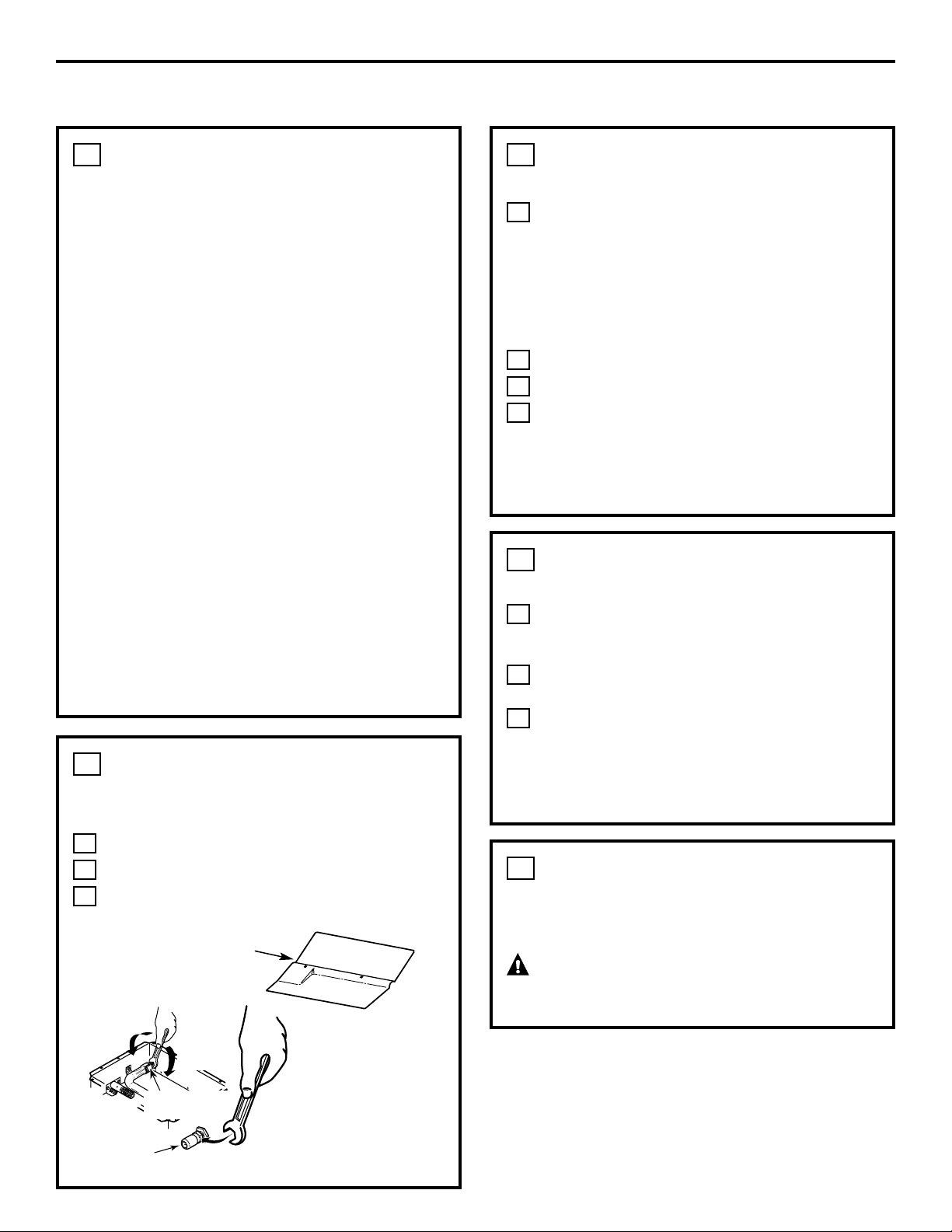
6
Instrucciones de Instalacion
INSTALACIÓN DEL HORNO
(CONT.)
COMO AJUSTAR LAS LLAMAS
DEL QUEMADOR (
CONT.)
Use un destornillador para soltar el tornillo del
obturador de aire.
1. Si las llamas estaban amarillas o pestañeaban,
abra el obturador más que la posición original.
2. Si las llamas soplaban en dirección opuesta al
quemador, cierre el obturador más que la
posición original.
Haga el ajuste.
Apriete nuevamente los tornillos del obturador.
Cierre la puerta y revise nuevamente la llama.
Cuando los resultados son satisfactorios:
1. Coloque nuevamente la cubierta del orificio.
2. Coloque nuevamente el fondo del horno.
G
F
E
D
9
COMO AJUSTAR LAS LLAMAS
DEL QUEMADOR
QUEMADOR DEL HORNO
Abra la puerta del horno.
Saque el fondo del horno.
Saque los 2 tornillos para remover el esparcidor
de llamas.
C
B
A
9
COMO REVISAR LA LLAMAS
DE LOS QUEMADORES A GAS
NATURAL
El horno viene ajustado de fábrica para ser usado con
gas natural en la mayoría de las áreas. Pero, como el
gas en algunas áreas varía, usted debe revisar todos
los ajustes que se describen más abajo. Si usted va a
usar gas L.P. mire los Ajustes para Gas L.P. en la parte
final de esta guía.
NOTA: La llama para hornear y asar a la parrilla debe
ser revisada con la puerta cerrada para revisar
adecuadamente las características de la llama. Para
revisar correctamente el quemador para hornear, el
fondo del horno y el esparcidor de llamas deben ser
removidos.
Encienda el quemador para hornear o asar:
Mientras mire la llama con la puerta del horno
cerrada revise lo siguiente a través de la ventana
de la puerta:
1. Las llamas del quemador no deberían
pestañear o soplar en dirección opuesta
al quemador.
2. Deberían ser de color azul sin muestras
de amarillo.
3. El cono interior de la llama debería ser
de 1/2
″
a 3/4
″
de longitud.
LOS QUEMADORES DEBERIAN SER REVISADOS
FRECUENTEMENTE
8
COMO COLOCAR BIEN EL
HORNO
Usando un barreno de 1/8
″
haga hoyos a través
de las moldras laterales y en el frente del
gabinete.
Con los tornillos que se proveen, asegure el
horno a la pared.
Si el corte del gabinete es de 38
″
de altura, utilice
la moldura corta y péguela al fondo del marco
frontal con los tornillos que se proveen.
(Si el corte es de más de 38
″
de altura,
use la moldura más alta).
C
B
A
10
REVISE LOS PASOS
Revise varias veces para asegurarse que todo en esta
guía ha sido completado. El revisar los pasos le
asegurará la utilización segura del horno.
ADVERTENCIA:
La moldura
permite la entrada del aire al gabinete bajo
la unidad y no debe ser obstruida.
11
Fondo del Horno
Expandidor de
Llamas
Fig. 9
Ajustes de Gas
NAT. - L.P.
Hechos a la Tapa del Orificio
L.P.
NAT.
Fig. 10
Obturado de
Aire
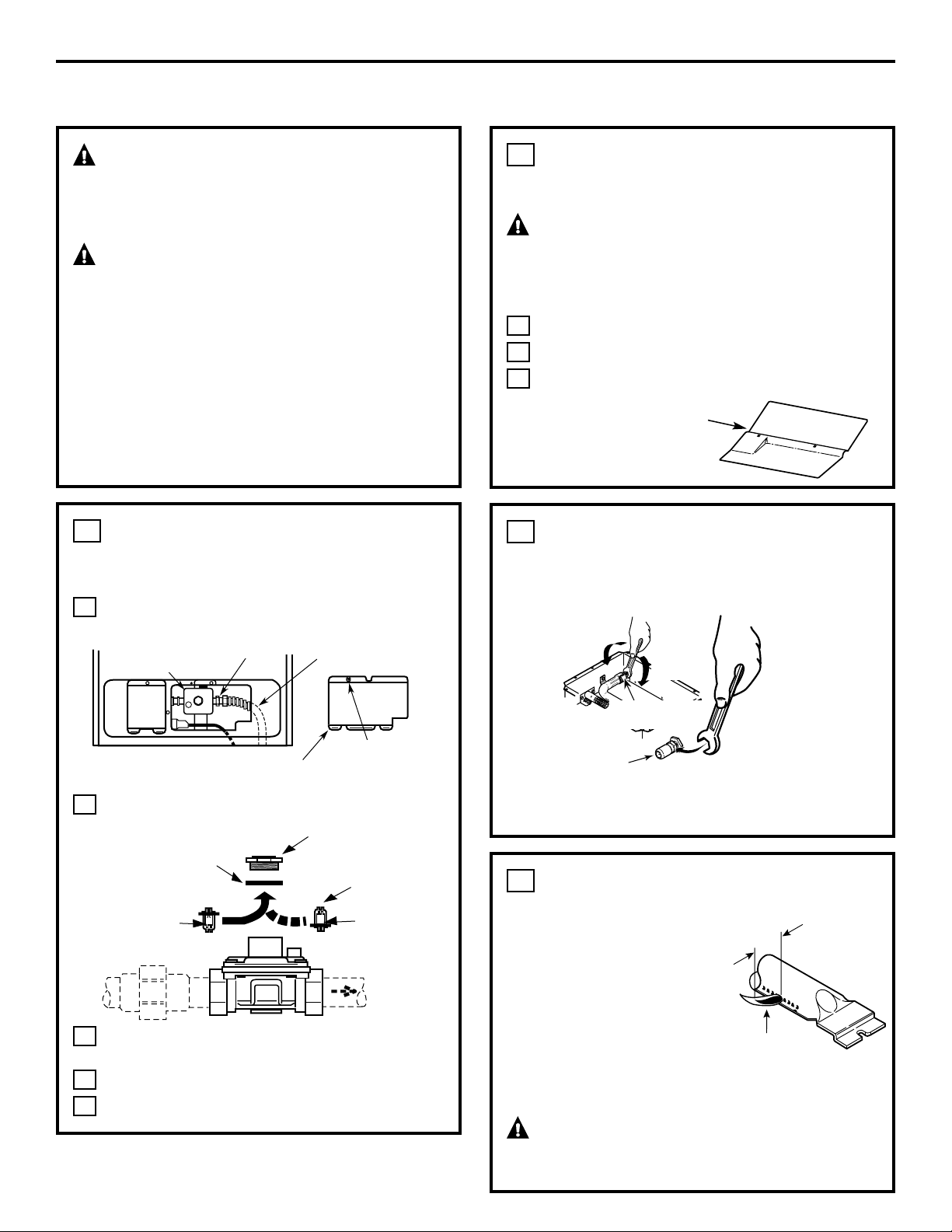
7
Instrucciones de Instalacion
COMO HACER LA CONVERSION PARA GAS L.P.
CÓMO REVISAR EL TAMAÑO
DE LA LLAMA
Revise el cono interior de la
llama. Debería ser de aprox.
1/2
″
a 3/4
″
de longitud para
los quemadores para
hornear y para asar.
Si el tamaño de la llama está
para alargar, use una llave
abierta de 1/2
″
o un alicate
ajustable para ajustar la tapa del orificio, haciéndola
girar hacia L.P.
ADVERTENCIA:
Si trata de
medir el cono interior de la llama, por favor
use precaución; se podría quemar.
4
ADVERTENCIA:
Si usted va
a usar gas L.P. (embotellado) todos los ajustes
descritos más abajo deben hacer antes de
hacer cualquier ajuste a los quemadores o
usar el horno.
ADVERTENCIA:
Esta conversión
debe ser hecha por un instalador competente o
por el abastecedor de gas de acuerdo con las
instrucciones del fabricante y todos los códigos
y requerimientos de las autoridades que tienen
jurisdicción. El no seguir las instrucciones podría
resultar en serias heridas o daño a la propiedad.
La agencia calificada que hace este trabajo
asume la responsabilidad de la conversión.
NOTA: Desconecte toda la electricidad y cierre el paso
del gas en la válvula de cierre antes de empezar la
conversión.
AJUSTE EL REGULADOR DE
PRESIÓN DE GAS NATURAL
A GAS L.P. COMO SIGUE
Ubique e saque la cubierta del regulador e el
gancho del alambre.
Ubique el regulador e desatornille la tapa.
Haga girar el sujetador de manera que L.P. se vea
al fondo del sujetador.
Coloque la nuevamente la tapa.
Coloque nuevamente la cubierta de acceso.
E
D
C
B
A
1
NAT.
l..P.
CÓMO AJUSTAR EL ORIFICIO
DEL QUEMADOR DE GAS
NATURAL A GAS L.P.
PRECAUCION:
Los ajustes en la
siguiente columna se deben hacer antes de
encender los quemadores. Si no se hace de esa
manera podrían resultar heridas serias debido a
llamas altas y vapores tóxicos.
Abra la puerta del horno.
Saque el fondo del horno.
Saque la pantalla del horno (expandidor de
llamas).
C
B
A
2
QUEMADOR DEL HORNO
Use una llave de 1/2
″
o una llave ajustable para hacer
girar la tapa del orificio en dirección de L.P., aprox.
1 1/2 vuelta, hasta que quede apretada.
IMPORTANTE: No apriete demasiado o podría doblar
la tapa del orificio o la aguja.
3
1/2″
a 3/4″
Cono Interior
de la Llama
Regulador
de Pressure
Adaptador
Conexion Flexible
Saque el
Gancho del
Alambre
Sujetado de
Resorte
Sello
NAT.
Tapa
L.P.
Saque la Cubierta del Regulador
Ajustes de Gas
NAT. - L.P.
Hechos a la Tapa del Orificio
L.P.
NAT.
Obturador de
Aire
Fondo del Horno
Expandidor de
Llamas
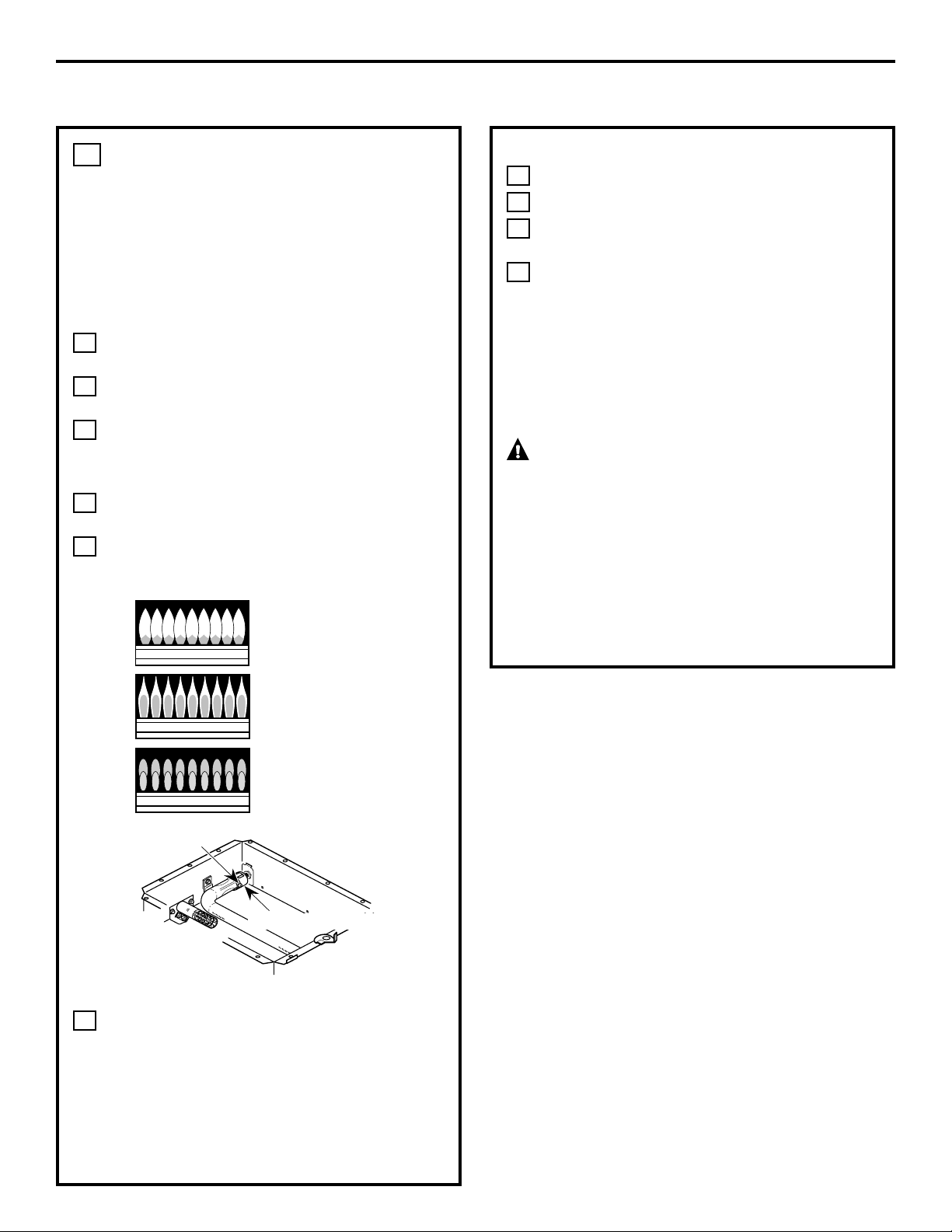
8
Instrucciones de Instalacion
COMO HACER LA CONVERSION PARA GAS L.P.
(CONT.)
ADJUSTER (CONT
.):
Haga el ajuste.
Apriete nuevamente el tornillo del obturador.
Cierre la puerta del horno y revise nuevamente
la llama.
Cuando todos los ajustes sean hechos y los
resultados son satisfactorios:
1. Ponga en su lugar el esparcidor de llamas.
2. Coloque el fondo del horno nuevamente
en su lugar.
NOTA ESPECIAL: Para convertir el horno de vuelta a
gas natural, invierta las instrucciones dadas para hacer
los ajustes para gas L.P.
ADVERTENCIA:
Una vez que la
conversión esté terminada y funcionando bien,
llene la etiqueta de LP localizada en el paquete
enviado con su estufa e incluya su nombre,
organización y la fecha en que la cinversión fue
hecha. Pegue la etiqueta a la estufa cerca del
regulador y advierta a otros en el futuro que esta
estufa ha sido convertida para ser usada con gas
LP. Si se convierte de vuelta de gas LP a gas
natural, por favor saque la etiqueta para que
otros sepan que la estufa está programada para
ser usada con gas natural.
E
D
C
B
ADJUSTES AL OBTURADOR
DE AIRE.
NOTA: Las llamas para hornear y asar se deberían
revisar con la puerta cerrada para revisar
correctamente las características de la llama.
Encienda el quemador para hornear y para asar.
Mientras mira la llama con la puerta cerrada, revise lo
siguiente a través de la ventana de la puerta:
Las llamas del quemador no deberían pestañear
o soplar en dirección opuesta al quemador.
Deberían ser de color azul sin muestras de
amarillo.
El cono interior de la llama debería ser de aprox.
1/2
″
a 3/4
″
de longitud.
EN ALGUNOS CASOS
Con el gas L.P. un poco de amarillo en las puntas
es normal.
Partículas extrañas en la línea del gas podrían
causar una llama anaranjada al principio, pero
esto desaparecerá pronto.
ADJUSTER
Use un destornillador para soltar el tornillo del
obturador.
1. Si las llamas estaban amarillas o pestañeaban,
abra el obturador de aire más que la posición
original.
2. Si las llamas soplaban en dirección opuesta al
quemador, cierre el obturador de aire más que
la posición original.
A
B
A
C
B
A
5
“A”
Llama Amarillas
Llame para un Servicio
“B”
Puntas Amarillas
Normal para Gas LP
“C”
Llamas de Azul Suave
Normal para Gas Natural
Obturador de Aire
Tornillo del
Obturador de Aire

