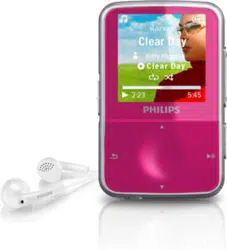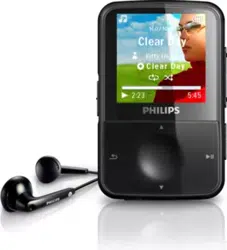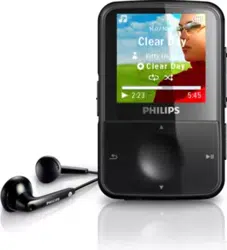
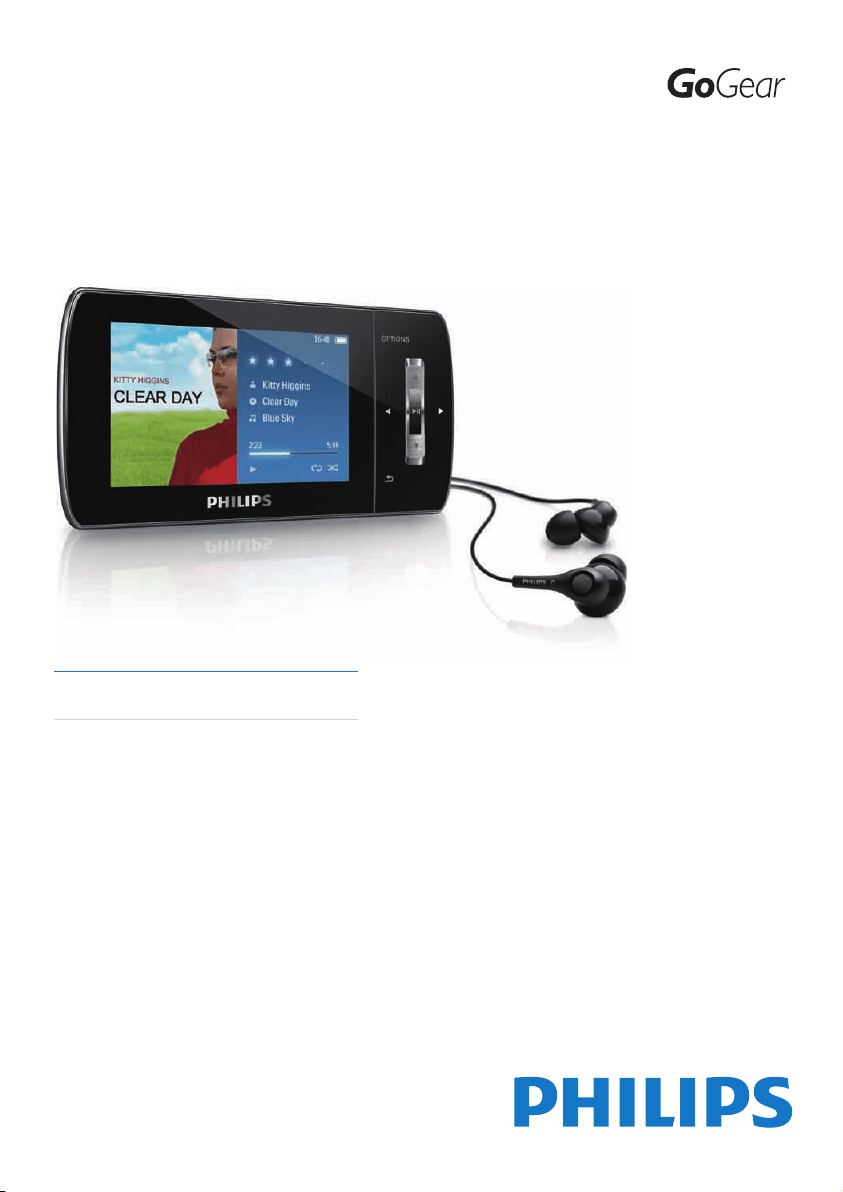
SA1MUS08
SA1MUS16
SA1MUS32
Register your product and get support at
www.philips.com/welcome
EN User manual

1
Contents
English
EN
Contents
1 Important safety information 3
General maintenance 3
Recycling the product 5
2 Your new MUSE 7
What’s in the box 7
3 Getting started 8
Overview of the controls and
connections 8
Overview of the main menu 8
Install software 9
Connect and charge 9
Connect MUSE to a computer 9
Play while MUSE charges 9
Battery level indication 10
Battery level indication 10
Disconnect MUSE safely 10
Turn MUSE on and off 10
Automatic standby and shut-down 10
4 UseMUSEtocarryles 11
5 Napster Player (available in the UK
and Germany only) 12
Activate / Deactivate a PC for Napster 12
Transfer Napster music to MUSE 12
6 Music 14
Listen to music 14
Reduce background noise 14
Find your music 14
Delete music tracks 15
7 Windows Media Player 11
(WMP11) 16
Install Windows Media Player 11
(WMP11) 16
Transfer music and picture les to
WMP11 library 16
Switch between music and pictures
library in WMP and MUSE 17
Rip songs from a CD 17
Buy music online 18
Sync your Windows Media content to
MUSE 18
Set up MUSE for WMP11 19
Switch between automatic and
manual sync 19
Select and prioritize what syncs
automatically 19
Select les and playlists for manual
sync 20
Copy les from MUSE to your
computer 21
WMP11 playlists 21
Create a regular playlist 21
Create an auto playlist 21
Edit playlist 22
Transfer playlists to MUSE 22
Search for music or pictures with
WMP11 22
Delete les and playlists from WMP11
library 23
Delete les and playlists from MUSE 23
Edit song information with WMP11 23
Format MUSE with WMP11 24
8 Playlists 25
Add music tracks to a playlist 25
Play music tracks from a playlist 25
Create a ‘Playlist-on-the-go’ 25
Remove music tracks from a playlist 25
Delete a playlist 25
9 Audiobooks 26
Add audiobooks to MUSE 26
Audiobook controls 26
Select audiobook by book title 26
Adjust audiobook play speed 27
Add a bookmark in an audiobook 27
Find a bookmark in an audiobook 27
Delete a bookmark in an audiobook 27

2
Need help?
Please visit
www.philips.com/welcome
where you can access a full set of supporting
materials such as the user manual, the latest
software updates, and answers to frequently
asked questions.
EN
10 BBC iPlayer (available in the UK
only) 28
11 Video 30
Download, convert and transfer
videos 30
Play videos 30
Delete videos 30
12 Pictures 31
View pictures 31
View slideshow 31
Transfer pictures to MUSE 31
Delete pictures 31
13 Radio 32
Listen to FM radio 32
Auto-tune preset radio station 32
Manually tune a radio station 32
Play a preset radio station 32
14 Recordings 33
Record from FM radio 33
Record audio/voices 33
Listen to FM recordings 33
Listen to voice/audio recordings 34
Upload your recordings to a computer 34
Delete recordings 34
15 Settings 35
16 Update MUSE 38
Manually verify / update rmware 38
17 Troubleshooting 39
18 Technical data 40
System requirements 40
Supported music le formats 41
Supported video le formats 41
Supported picture le formats 41
Supported audiobook le formats 41
19 Glossary 42

3
Hearing Safety
Listen at a moderate volume:
Using headphones at a high volume can impair
your hearing. This product can produce sounds
in decibel ranges that may cause hearing loss for
a normal person, even for exposure less than
a minute. The higher decibel ranges are offered
for those that may have already experienced
some hearing loss.
Sound can be deceiving. Over time your hearing
‘comfort level’ adapts to higher volumes of
sound. So after prolonged listening, what sounds
‘normal’ can actually be loud and harmful to
your hearing. To guard against this, set your
volume to a safe level before your hearing
adapts and leave it there.
To establish a safe volume level:
Set your volume control at a low setting.
Slowly increase the sound until you can hear it
comfortably and clearly, without distortion.
Listen for reasonable periods of time:
Prolonged exposure to sound, even at normally
‘safe’ levels, can also cause hearing loss.
Be sure to use your equipment reasonably and
take appropriate breaks.
Be sure to observe the following guidelines
when using your headphones.
Listen at reasonable volumes for reasonable
periods of time.
Be careful not to adjust the volume as your
hearing adapts.
Do not turn up the volume so high that you
can’t hear what’s around you.
You should use caution or temporarily
discontinue use in potentially hazardous
situations.
Do not use headphones while operating a
motorized vehicle, cycling, skateboarding, etc.; it
may create a trafc hazard and is illegal in many
areas.
Background noise levels and active noise
cancelation
1 Important safety
information
General maintenance
Caution
To avoid damage or malfunction: •
Do not expose the product to excessive heat •
caused by heating equipment or direct sunlight.
Do not drop the product or allow objects to
•
fall on your player.
Do not allow the product to be submerged
•
in water. Do not expose headphone socket
or battery compartment to water, as water
entering the set may cause major damage.
Active mobile phones in the vicinity may cause
•
interference.
Back up your les. Ensure that you retain the
•
original les you have downloaded to your
device. Philips is not responsible for any loss of
data if the product becomes damaged or not
readable / legible.
Manage (transfer, delete, etc.) your music les
•
only with the supplied music software to avoid
problems.
Do not use any cleaning agents containing
•
alcohol, ammonia, benzene, or abrasives as
these may harm the product.
About operating and storage temperatures
Operate in a place where temperature is •
always between 0 and 35ºC (32 to 95ºF)
Store in a place where temperature is •
always between -20 and 45ºC (-4 to
113ºF ).
Battery life may be shortened in low •
temperature conditions.
Replacement parts/accessories:
Visit www.philips.com/support to order
replacement parts/accessories.
English
EN
4
Modications
Modications not authorized by the
manufacturer may void user’s authority to
operate the product.
Copyright information
All other brands and product names are
trademarks of their respective companies or
organizations.
Unauthorized duplication of any recordings
whether downloaded from the Internet or
made from audio CDs is a violation of copyright
laws and international treaties.
The making of unauthorized copies of copy-
protected material, including computer
programs, les, broadcasts and sound
recordings, may be an infringement of
copyrights and constitute a criminal offense.
This equipment should not be used for such
purposes.
The Windows Media and the Windows logo are
registered trademarks of Microsoft Corporation
in the United States and/or other countries.
Be responsible! Respect copyrights.
Philips respects the intellectual property of
others, and we ask our users to do the same.
Multimedia content on the internet may have
been created and/or distributed without the
original copyright owner’s authorization.
Copying or distributing unauthorized content
may violate copyright laws in various countries
including yours.
Compliance with copyright laws remains your
responsibility.
The recording and transfer to the portable
player of video streams downloaded to your
computer is intended only for use with public
domain or properly licensed content. You
may only use such content for your private,
non-commercial use and shall respect eventual
copyright instructions provided by the copyright
owner of the work. Such instruction may
A noisy environment can severely impair
our wellbeing and add to stress. Active noise
cancelation technology enables the listener to
strongly reduce low frequency sounds, and thus
can contribute to the reduction of stress.
The full benets of the active noise cancelation
feature of MUSE require that the special
supplied earphones are used and that the
earplugs are worn correctly:
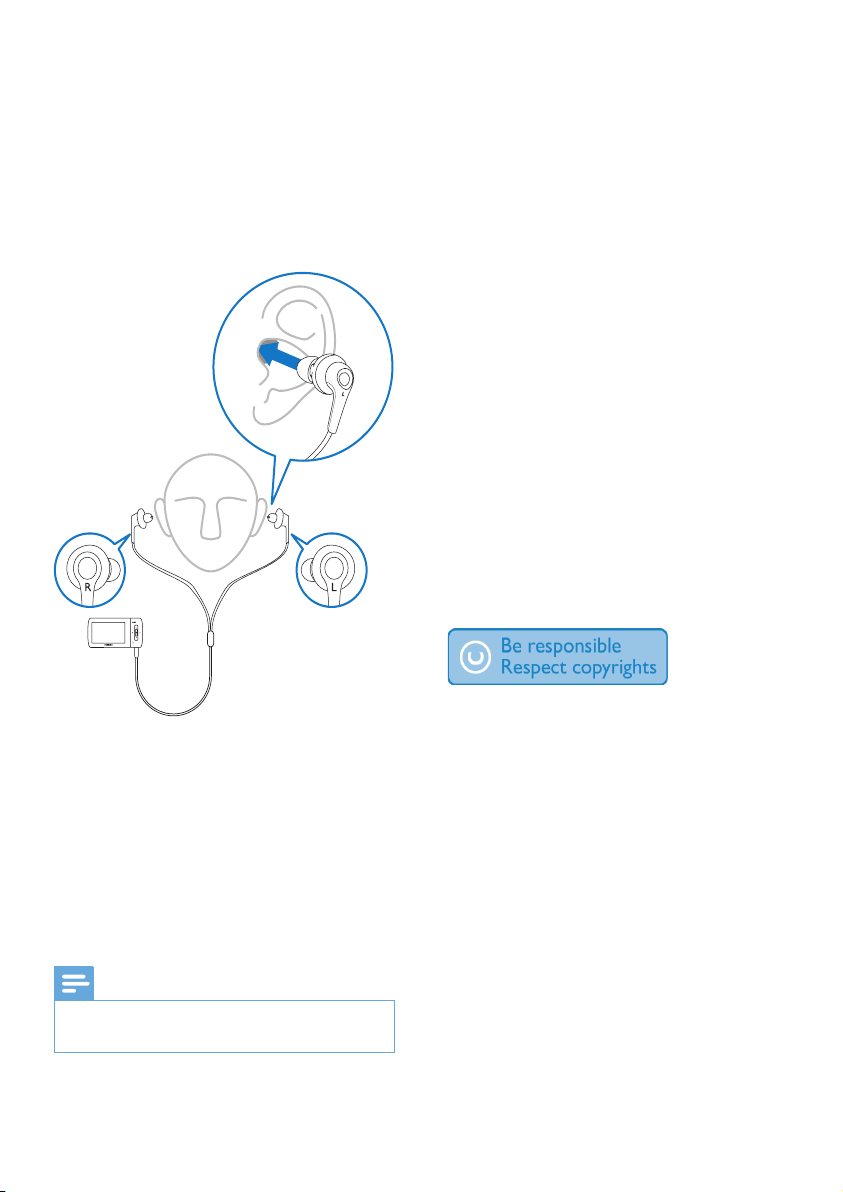
The earplugs of the supplied earphones are
inserted into the ear. A close t helps block out
disturbing external sounds and improve the
noise cancelation effect. The synthetic earplug
covers of the supplied earphones are designed
to t most ears. For maximum comfort you can
exchange the earplug covers with covers of a
different shape / size that best suits your ears.
(There are 3 different types included with the
product.)
Note
It is important that listeners remain alert and •
aware of their surroundings.
EN
5
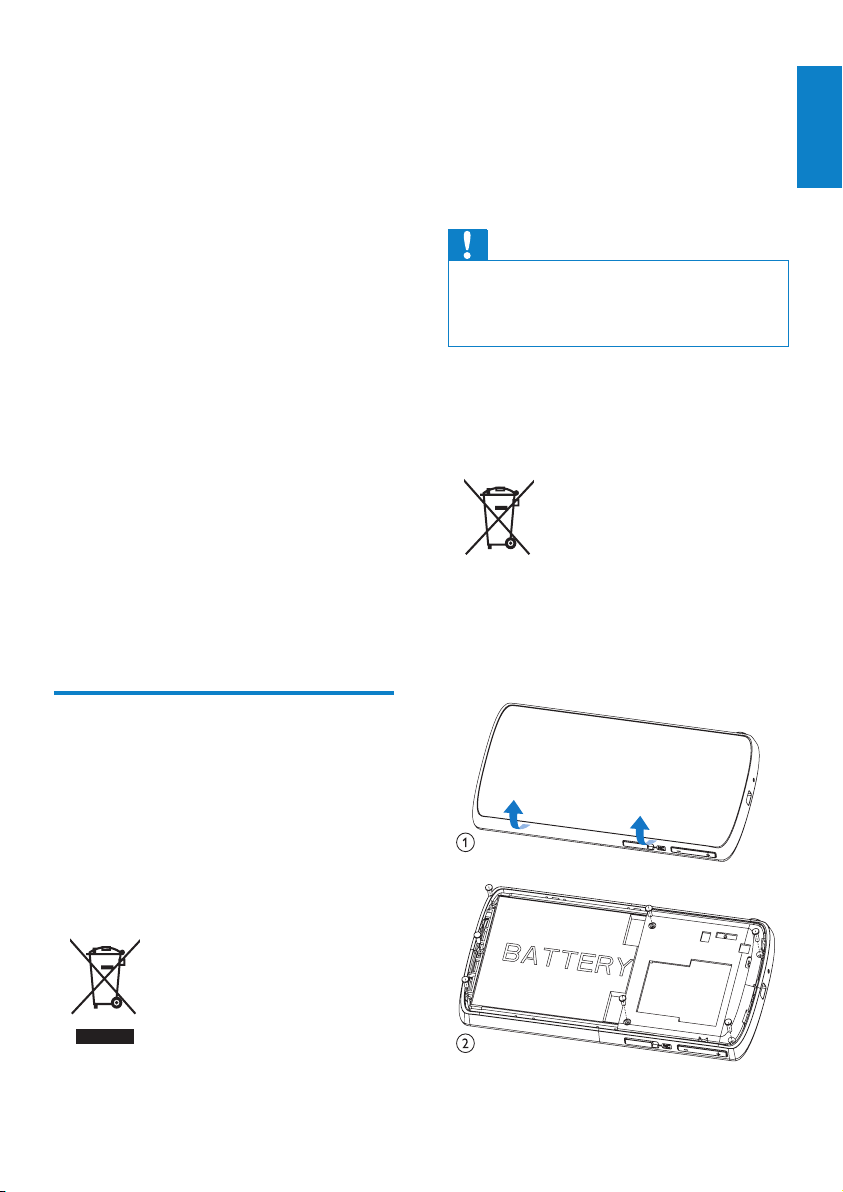
Never dispose of your product with other
household waste. Please inform yourself about
the local rules on the separate collection of
electrical and electronic products. The correct
disposal of your old product helps prevent
potentially negative consequences on the
environment and human health.
Caution
Removal of the built-in battery invalidates the •
warranty and may destroy the product. The
following instructions are disposal instructions
at the end of product life.
Your product contains a built-in rechargeable
battery covered by the European Directive
2006/66/EC, which cannot be disposed of with
normal household waste.
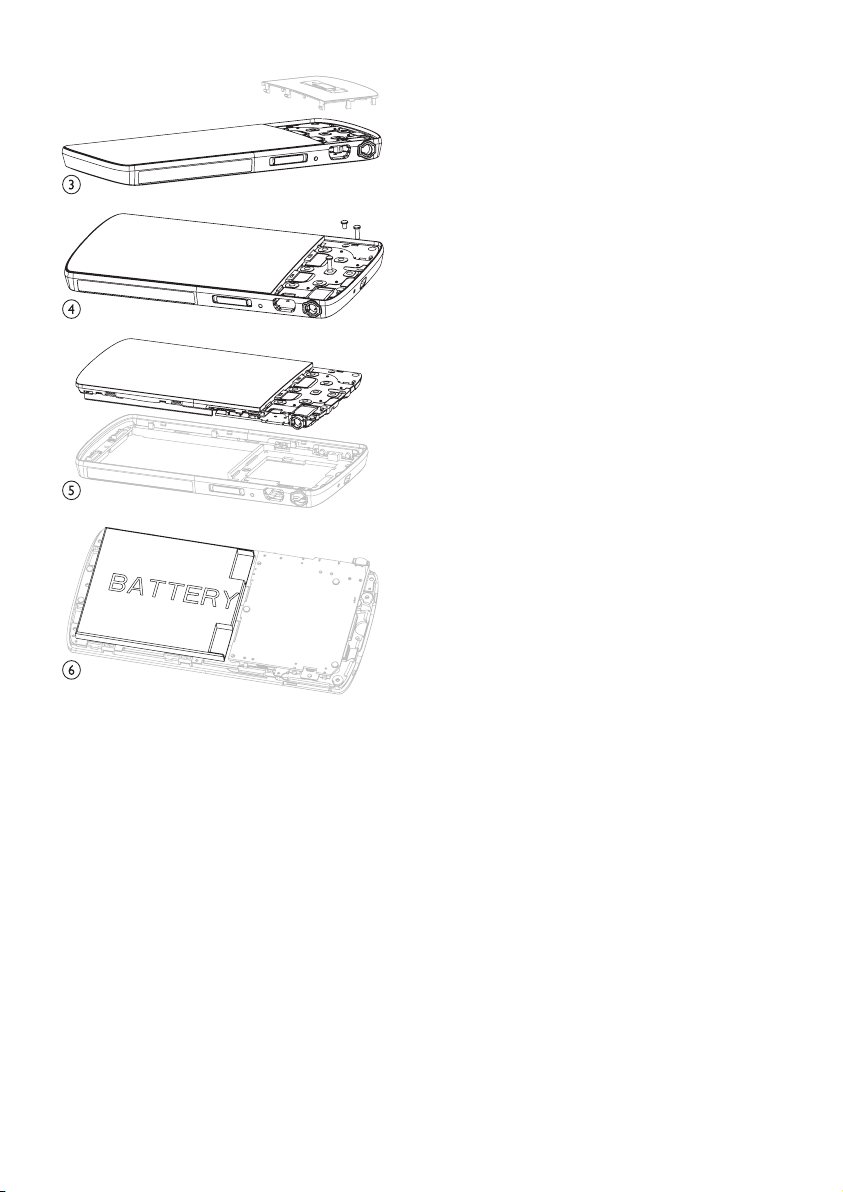
To safeguard the functionality and safety of
your product, take your product to an ofcial
collection point or service centre where a
professional can remove or replace the battery
as shown:
state that no further copies shall be made.
Video streams may include copy protection
technology that prohibits further copying. For
such situations the recording function will not
work and you will be notied with a message.
Data logging
Philips is committed to improving the quality
of your product and enhancing the Philips user
experience. To understand the usage prole of
this device, this device logs some info / data to
the non-volatile memory region of the device.
These data are used to identify and detect
any failures or problems you as a user may
experience while using the device. The data
stored, for example, will be the duration of
playback in music mode, duration of playback
in turner mode, how many times battery low
was encountered, etc. The data stored do not
reveal the content or media used on the device
or the source of downloads. The data stored on
the device are retrieved and used ONLY if the
user returns the device to the Philips service
center and ONLY to simplify error detection
and prevention. The data stored shall be made
available to user on user’s rst request.
Recycling the product
Your product is designed and manufactured
with high quality materials and components,
which can be recycled and reused.
When you see the crossed-out wheel bin
symbol attached to a product, it means the
product is covered by the European Directive
2002/96/EC:
English
EN
6
Please inform yourself about the local rules on
separate collection of batteries. The correct
disposal of batteries helps prevent potentially
negative consequences on the environment and
human health.
Notice for the European Union
This product complies with the radio
interference requirements of the European
Union.
EN
7
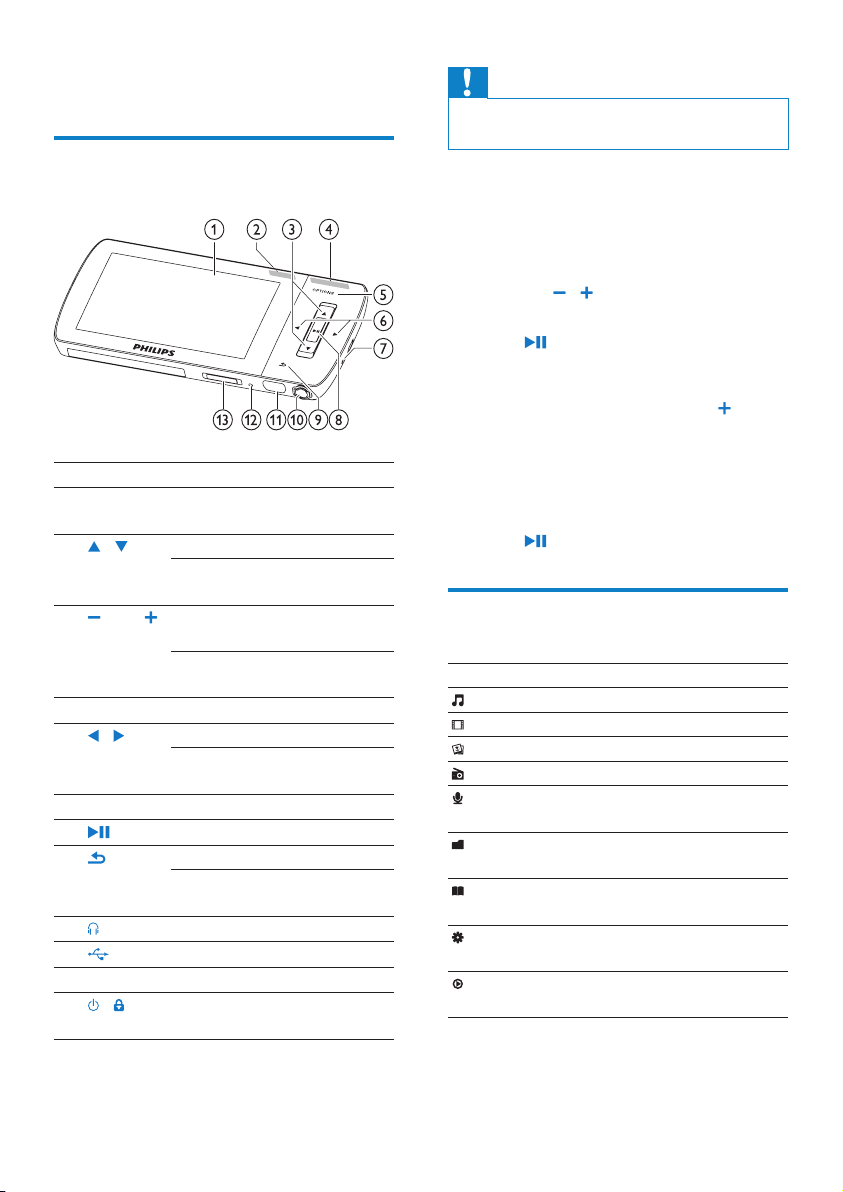
CD-ROM
Quick start guide
Note
The images serve as reference only. Philips •
reserves the right to change color/design
without notice.
Philips GoGear audio player
Quick start guide
2 Your new MUSE
MUSE allows you to
view video les•
play MP3, unprotected WMA, and •
unprotected AAC (M4A) les
listen to FM radio•
make recordings•
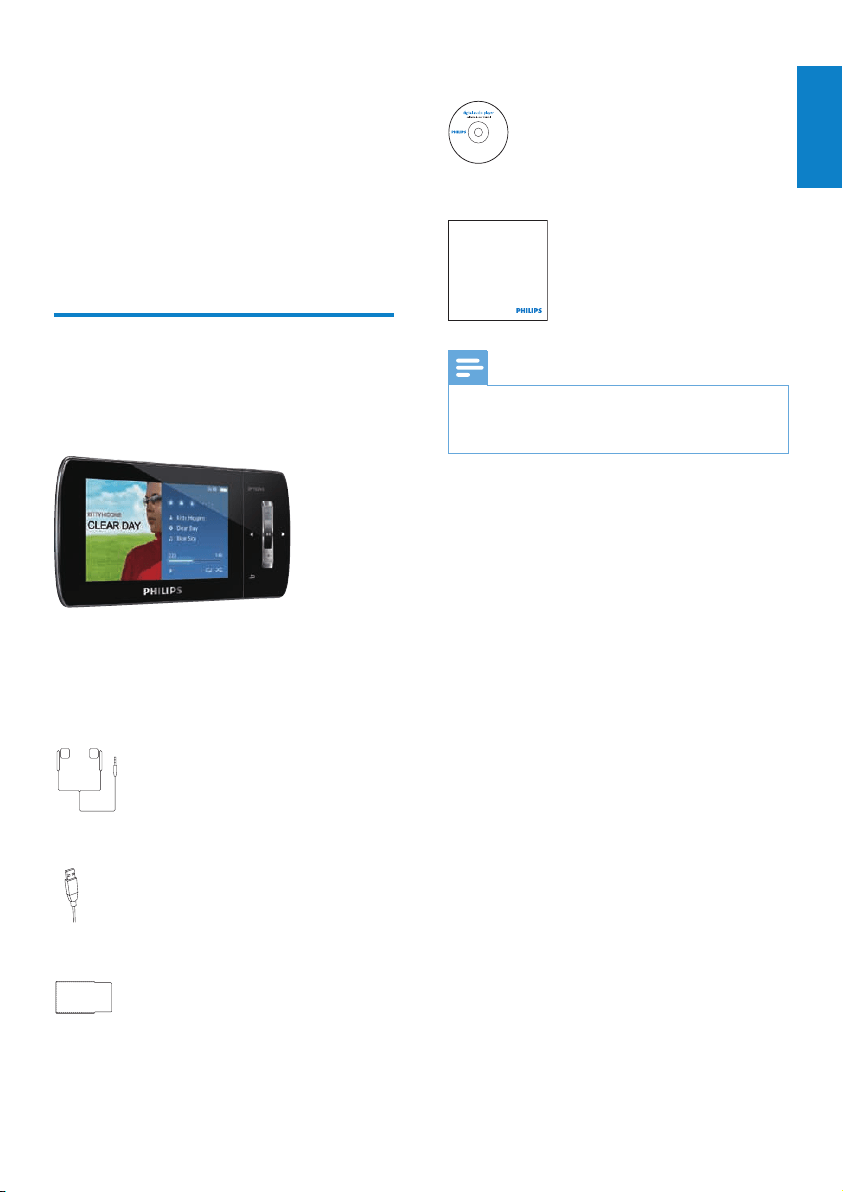
What’s in the box
Check that you have received the following
items:
Player
Earphones
USB cable
Pouch
English
EN
8
Caution
Listening to loud sounds for longer than a •
moment can be harmful to the listener.
You can set the volume level of MUSE to limit
the maximum volume output.
1 From the main menu, select
[Settings]>[Sound settings] > [Volume
limit].
2 Press the / volume controls to adjust
the level.
3 Press to conrm.
When you set a volume limit, MUSE »
can no longer exceed the set volume,
even if you press the volume
button.
To enable maximum volume again:
1 Select [Settings] > [Sound settings]
>[Volume limit].
2 Set the volume limit to maximum.
3 Press to conrm.
Overview of the main menu
Menu Mode To
Music play music tracks
Video play videos
Pictures view pictures
FM radio listen to FM radio
Recording create or listen to
recordings
Folder
view
view les in folders
Text
reader
read text les
Settings customize the
settings of MUSE
Now
playing
show the current
play screen
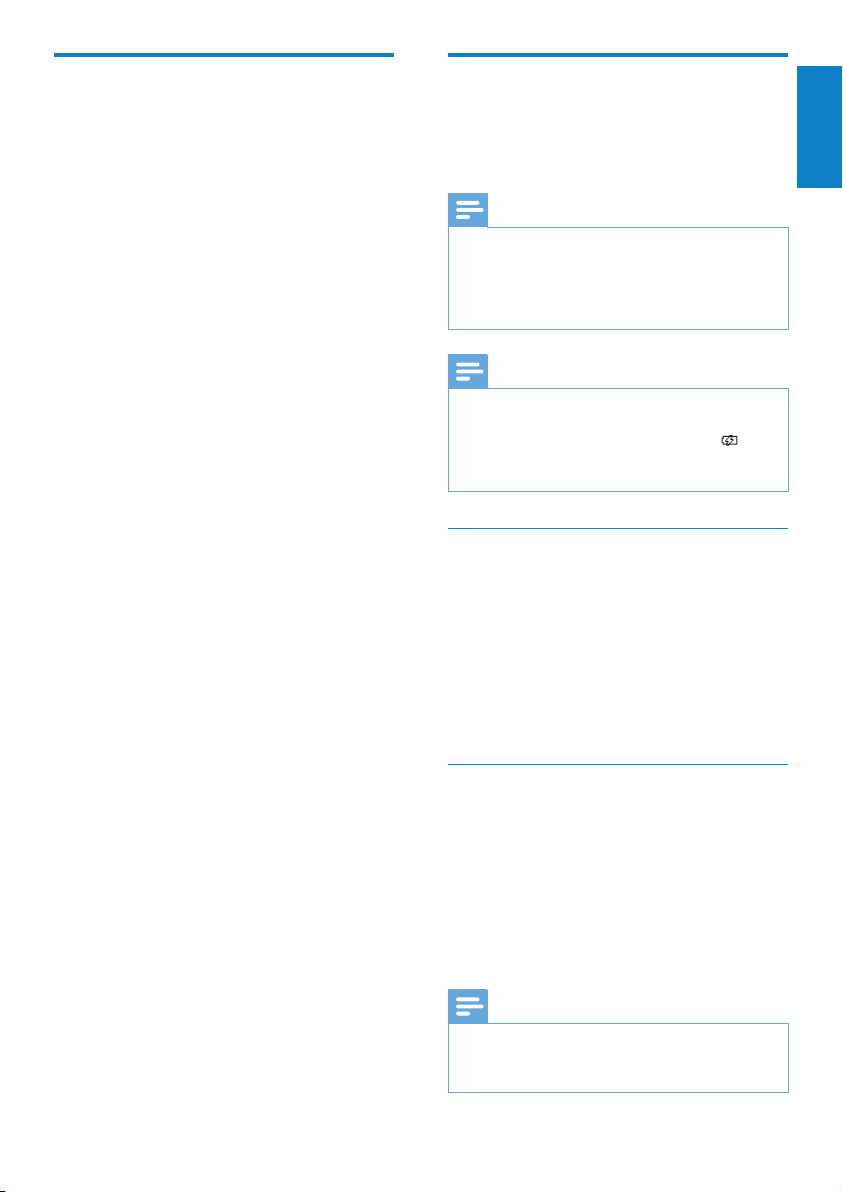
3 Getting started
Overview of the controls and
connections
a
display
b
NC slide: activate/deactivate
active noise-cancelation
c
/ press: scroll up/down
press and hold: scroll up/
down at high speed
d
VOL press: increase/decrease the
volume
press and hold: increase/
decrease fast
e
OPTIONS view available options
f
/ press: skip to next/previous
press and hold: scroll back/
forward at high speed
g
MIC microphone
h
press: play/pause/conrm
i
press: back one level
press and hold: return to
main menu
j
headphone jack
k
USB connection jack
l
RESET press: reset MUSE
m
/ slide and hold: turn MUSE
on/off
EN
9
Connect and charge
MUSE has a built-in battery that can be charged
through the USB port of a computer (USB
cable included).
Note
When you connect MUSE to a computer, you •
are briey prompted to select:
• [Charge & transfer] or [Charge & play].
MUSE automatically applies
• [Charge &
transfer], if no new selection is made.
Note
For rst-time use, allow MUSE to charge for •
3 hours.
The charging animation stops and the
•
icon is displayed when the charging process is
completed.
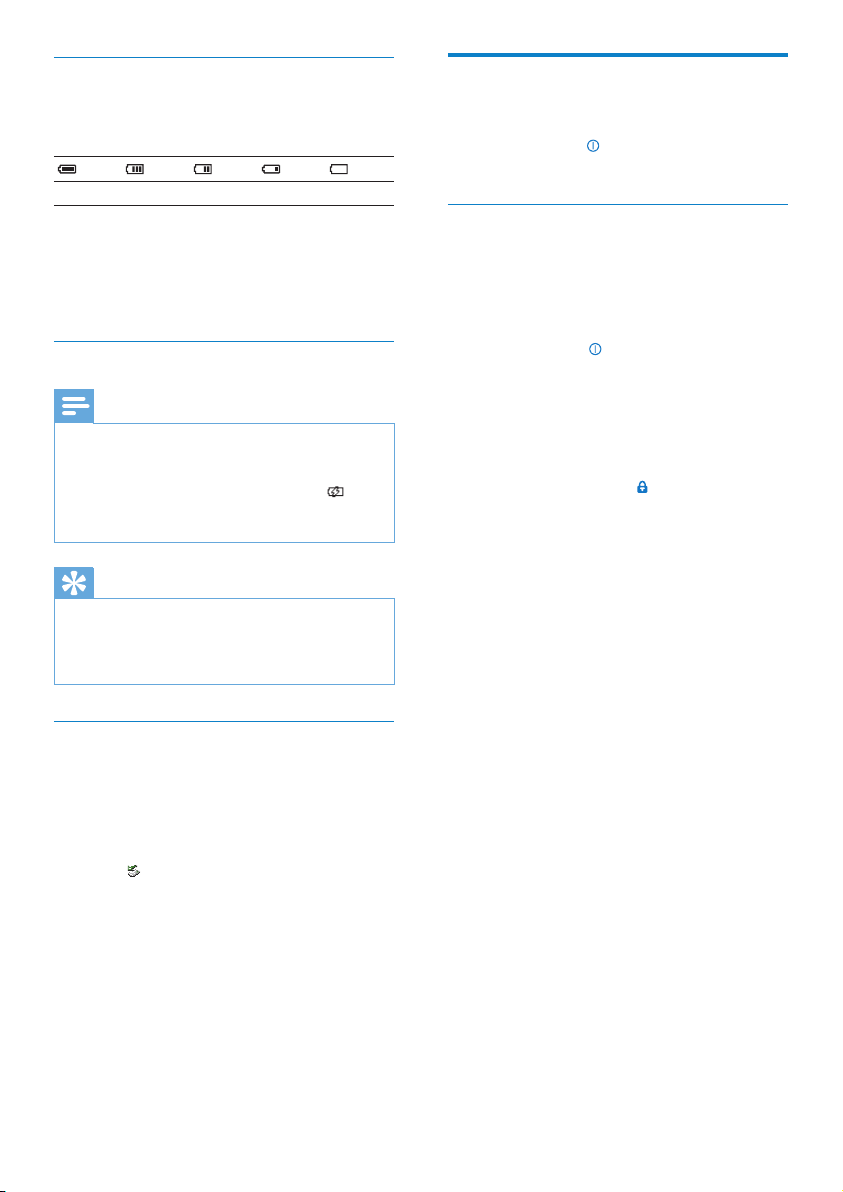
Connect MUSE to a computer
1 Connect the USB plug of the supplied
USB cable to a spare USB port on your
computer.
2 Connect the small USB plug of the USB
cable to the small USB jack on MUSE.
3 Turn on your computer.
MUSE charges. »
Play while MUSE charges
You can view and play your content while
MUSE charges:
1 Connect MUSE to the PC.
2 When prompted for the PC connection
preference, select [Charge & play].
MUSE charges and you can operate »
the controls as normal.
Note
If no selection is made within a few seconds, •
MUSE automatically applies option [Charge &
transfer].
Install software
MUSE comes with the following software:
• Philips Device Manager (helps you get
rmware updates for MUSE)
• Media Converter for Philips (helps
you convert and transfer video les for
MUSE)
• Windows Media Player (helps you
convert and transver music and picture
les for MUSE)
• Napster player (helps you convert and
transfer music les for MUSE)
Important:
Remember to install the software provided in
the supplied CD-ROM for music and/or video
transfer.
Important: Before installing the software,
check that your computer meets the
requirements (see section System
requirements in this user manual).
1 Connect MUSE to your computer.
2 Insert the CD that comes with MUSE into
the CD-ROM drive of your computer.
3 Follow the on-screen instructions to
complete the installation of the software.
If the installation program fails to start
automatically:
1 Browse the CD contents with Windows
Explorer.
2 Double click on the le that ends with
‘.exe’.
English
EN
10
Turn MUSE on and off
1
To toggle between modes on and off,
slide and hold
for approximately 2
seconds.
Automatic standby and shut-down
MUSE has an automatic standby and shut-
down feature that can save battery power.
After 10 minutes in idle mode (no music plays,
no button is pressed), MUSE turns off.
1 Slide and hold for approximately 2
seconds to turn MUSE on again.
MUSE has a lock switch to prevent accidental
operation.
1 To lock the buttons when you play, move
the slider to position
.
All buttons except the volume keys are »
locked and the display shows a lock
icon.
2 To unlock the buttons again, move the
slider to the center position.
Battery level indication
The display indicates the approximate levels of
the battery status as follows:
100% 75% 50% 25% 0%
A ashing battery screen indicates that »
the battery is low. The player saves
all settings and switches off within 60
seconds.
Battery level indication
Note
Rechargeable batteries have a limited number •
of charge cycles. Battery life and number of
charge cycles vary by use and settings.
The charging animation stops and the
•
icon is displayed when the charging process is
completed.
Tip
You can conserve battery power and increase •
the play time of MUSE: Go to the Settings >
Display settings and set Backlight timer to the
shortest time setting.
Disconnect MUSE safely
To avoid data loss, disconnect MUSE from
your computer as follows:
1 On your computer, exit all applications
that are working with MUSE.
2 Click in the task tray of your computer.
3 Wait for the conrmation that MUSE
can be safely removed, then disconnect
MUSE from the USB port.
EN

11
4 Use MUSE to
carry files
MUSE allows you to carry les in Windows
Explorer.
1 With MUSE connected to the USB
port of the computer, open Windows
Explorer.
2 Create folders in MUSE.
3 Use drag and drop actions to sort your
les into the folders.
English
EN

12
Activate / Deactivate a PC for
Napster
Activate a PC:
When you download Napster subscription
track to a PC, the PC is automatically activated.
You can activate only a limited number of
PCs, so activation of another PC may require
deactivation of a previously activated PC.
Deactivate a PC:
1 From the pull-down menu at the top of
the screen, select My Accounts, then click
on Manage PCs/Devices.
2 Follow the menu instructions to complete
the deactivation.
Tip
For more in-depth instructions select Help •
from the pull-down menu and click on Tutorial
or User Guide.
Transfer Napster music to
MUSE
The Napster software installation must be
completed, before you can transfer music from
Napster to MUSE.
Here’s how to transfer Napster music:
1 Connect MUSE to the computer.
2 The Transfer to Device window is
displayed in the Napster player.
3 Select music, then drag and drop music
into Transfer to Device dialog box.
4 In the My Library menu, select the device
and see Transfer Status folder to check
the progress.
Note
For more in-depth instructions select Help •
from the pull-down menu and click on Tutorial
or User Guide.
5 Napster Player
(available in
the UK and
Germany only)
Napster online music service offers a variety of
purchase and subscription models.
Napster player supplied with MUSE helps you
search Napster for music by name•
browse the Napster catalogue•
purchase Napster music•
play Napster music on your computer•
convert and transfer your Napster music •
for MUSE
Here’s how you can search for music by name:
1 Ensure that your computer is connected
to the Internet.
2 Launch the Napster player on your
computer.
3 From the Search drop-down menu,
select the type of search.
4 In the search eld, enter the search
criteria (for example name of artist or
title of song).
5 Click Search to start the search.
Here’s how you can browse the Napster
catalogue:
1 Ensure that your computer is connected
to the Internet.
2 Launch the Napster player on your
computer.
3 In the Navigation pane, click on the tab
Explore Napster.
4 Follow the on-screen instructions.
EN

13
© 2003-2009 Napster LLC, Napster, Napster
To Go and the Napster logos are trademarks
of Napster LLC, that may be registered in the
UK and/or other countries.
Portions utilize Microsoft Windows Media
Technologies. Copyright © 1999-2002
Microsoft Corporation. All Rights Reserved.
Music recognition technology and related data
are provided by Gracenote®. Gracenote is
the industry standard in music recognition
technology and related content delivery. For
more information, please visit www.gracenote.
com.
CD and music-related data from Gracenote,
Inc., copyright © 2000-2007 Gracenote.
Gracenote Software, copyright © 2000-
2007 Gracenote. This product and service
may practice one or more of the following
U.S. Patents: #5,987,525; #6,061,680;
#6,154,773, #6,161,132, #6,230,192,
#6,230,207, #6,240,459, #6,304,523,
#6,330,593, #7,167,857, and other patents
issued or pending. Gracenote and CDDB
are registered trademarks of Gracenote.
The Gracenote logo and logotype, and the
“Powered by Gracenote” logo are trademarks
of Gracenote.
Gracenote® is a registered trademark of
Gracenote, Inc. The Gracenote logo and
logotype, and the “Powered by Gracenote”
logo are trademarks of Gracenote.
English
EN
14
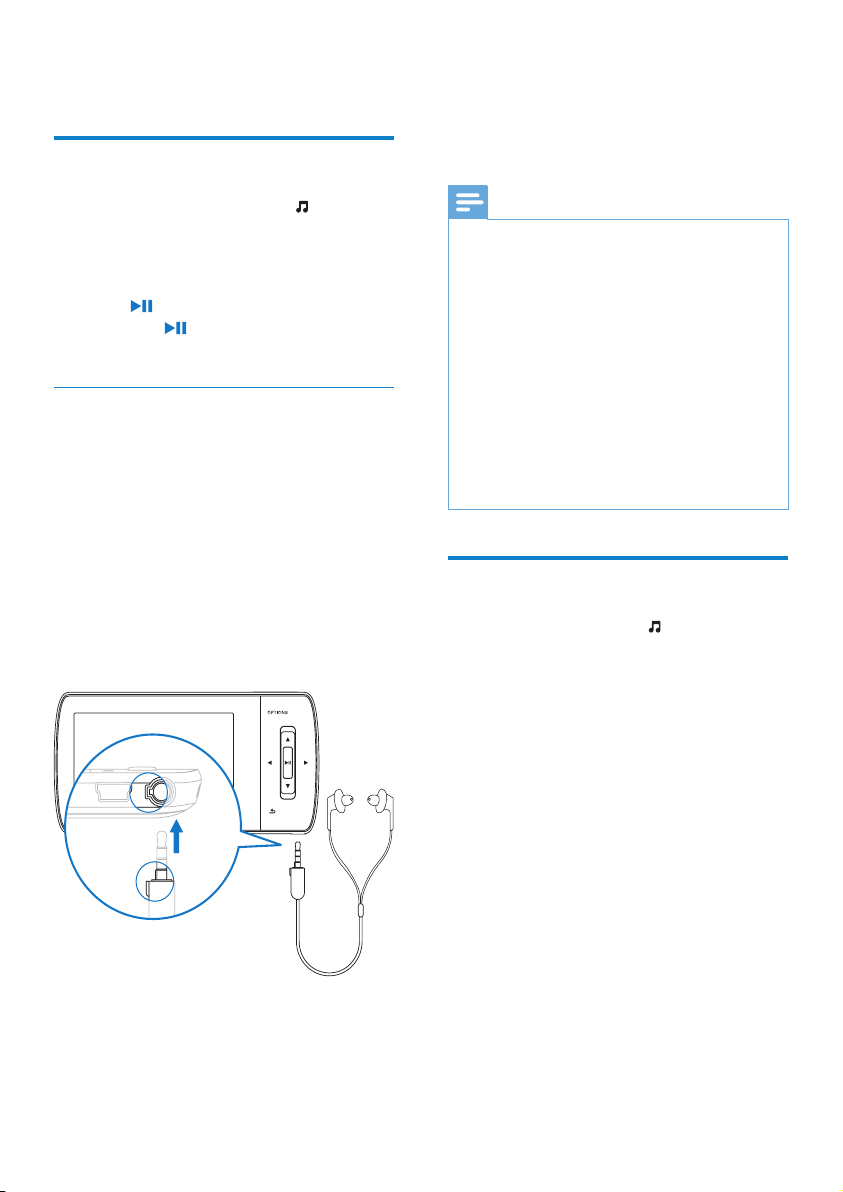
(noise cancelation) mark, to activate the
noise canceling feature.
To deactivate the noise canceling •
feature, push the slider back again
(away from the NC mark)
Note
The noise canceling feature requires that •
you connect the supplied noise canceling
earphones. Other earphones can be
connected, but they do not support the noise
canceling feature.
For information on hearing safety, see the
•
notes about Hearing Safety at the beginning of
this user manual.
For more information on how to wear the
•
noise cancelation earphones, see the notes
about Background noise levels and active
noise cancelation at the beginning of this user
manual.
For more information on how to optimize the
•
noise cancelation, refer to the chapter Settings
in this user manual.
Find your music
From the main menu, select to enter music
mode.
MUSE offers the following menu options:
[All songs]
Alphabetically listed tracks•
[All songs]
All tracks in preferential* random order.•
* The software monitors and analyzes
behavior patterns such as skipping, rating, or
repeating tracks. Based on this analysis the
software determines the most likely order in
which you want to listen to your tracks. The
tracks are grouped into parcels of different
preference levels, and the tracks within each
parcel are then shufed.
[Artists]
Alphabetically listed artists•
Alphabetically listed albums•
Tracks listed in album order•
6 Music
Listen to music
1
From the main menu, select to enter
music mode.
2 Navigate the sub-menus to select your
music.
3 Press to play.
Press •
to toggle between pause
and play.
Reduce background noise
MUSE incorporates an active noise canceling
feature that lets you listen to your music and
videos with less background noise. When
activated, the feature can strongly reduce low
frequency sounds such as the engine noise of
an airplane or the rumble of a train.
This is how you activate and control the noise
canceling feature:
1 Connect the supplied noise canceling
earphones.
2 With the supplied noise canceling
earphones connected and the earplugs
correctly tted, push the slider to the NC
EN
15
[Album art]
Alphanumerically listed album art•
[Albums]
Alphanumerically listed albums•
Tracks listed in album order•
[Genres]
Alphanumerically listed genres•
Alphanumerically listed artists•
Alphanumerically listed albums•
Tracks listed in album order•
[Playlists]
• [Playlist-on-the-go]
Tracks listed in playlist order•
[Audiobooks]
Audiobook titles listed in alphanumerical •
order
Note
Alternatively, you can select • from the main
menu and nd your les in folder view.
Delete music tracks
1
From the main menu, select .
2 Press / to locate a track.
3 Press OPTIONS to view options menu.
4 Select the delete option to delete the
track.
English
EN
16
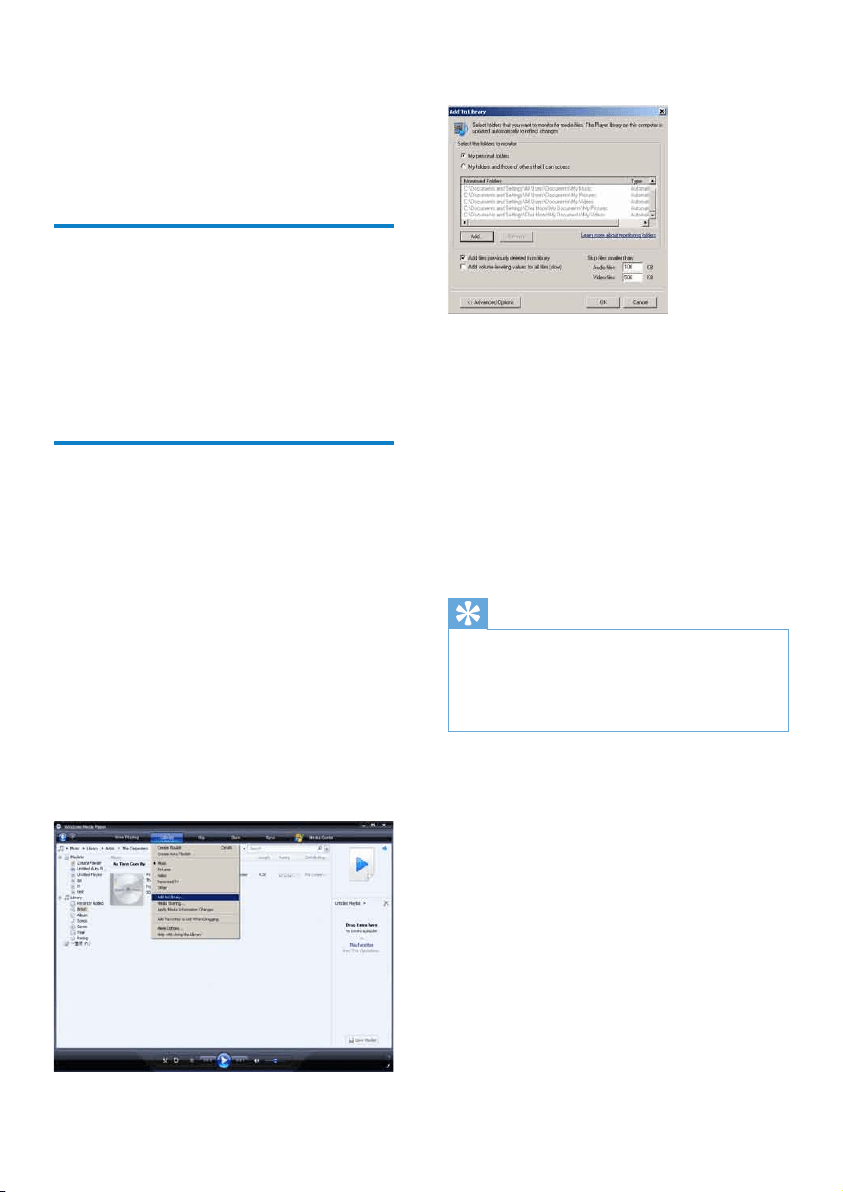
Add to Library dialog box appears. »
3 Click << Advanced Options to expand
the dialog box.
4 Click Add....
Add folder dialog box appears. »
5 Select a folder that contains your music
or picture les, then click OK.
6 WMP11 starts scanning the folder and
adds available music or picture les to the
library.
7 Click Close when done.
Tip
•
WMP11 is congured to skip audio les that
are smaller than 100 KB. To include les
smaller than 100 KB, you can change the
default settings within the Add to library dialog
box.
7 Windows
Media Player 11
(WMP11)
Install Windows Media Player
11 (WMP11)
1
Insert the supplied CD into the CD-ROM
drive of your computer.
2 Follow the on-screen instructions to
complete the installation of WMP11.
Transfer music and picture
lestoWMP11library
By default, WMP11 automatically loads all the
music and picture les that are stored in your
computer. The new les are also automatically
added to the WMP11 library. The following
steps show how you can add music and
picture les that are stored elsewhere on your
computer or computer network:
1 Select Start > All Programs > Windows
Media Player to launch the WMP11
program.
2 Click the down arrow beneath the
Library tab, then select Add to Library....
EN
17
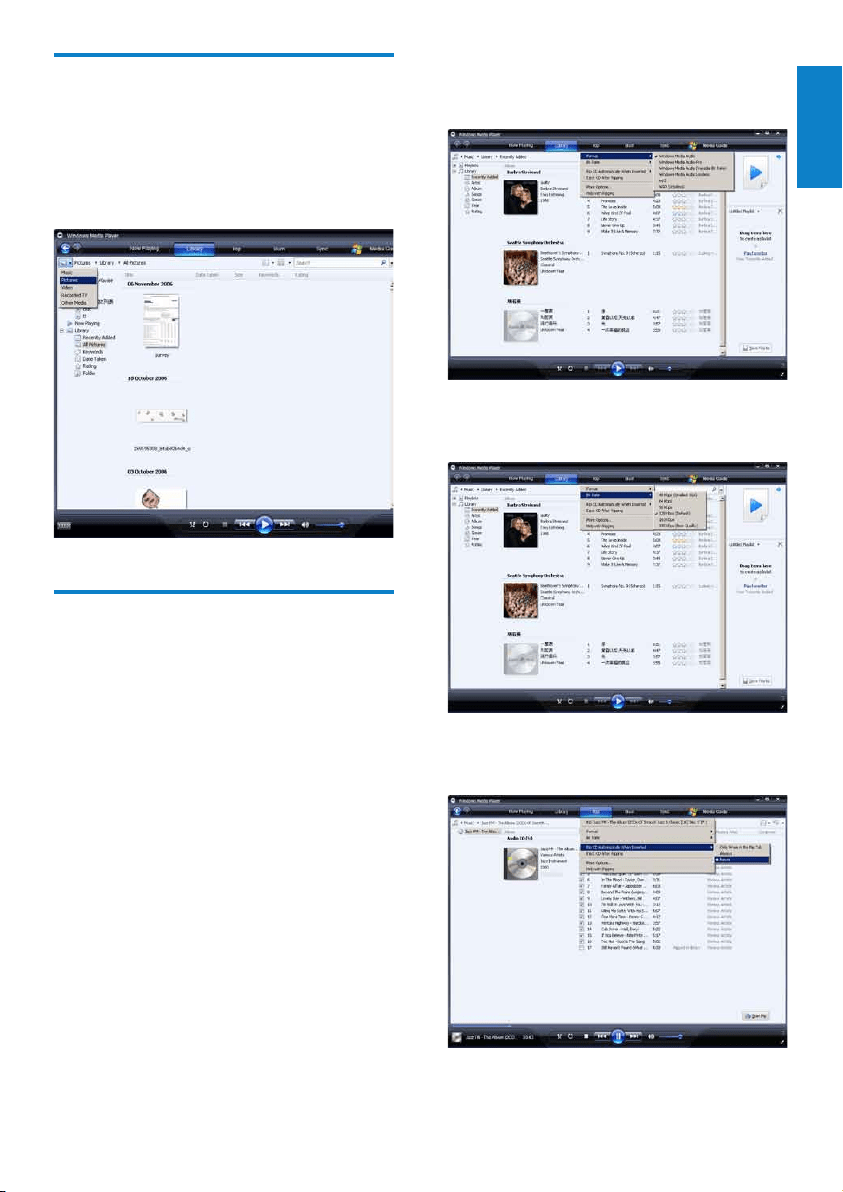
3 Click the down arrow beneath the Rip
tab and select the Format.
4 Click on the down arrow beneath the Rip
tab and select the Bit Rate.
5 Insert the audio CD into the CD drive of
the computer.
All the tracks from the CD are listed. »
Switch between music and
pictures library in WMP and
MUSE
1
Click the arrow on the top left of
WMP11,then select the category.
Rip songs from a CD
You can transfer music from a CD to MUSE.
The transfer requires that you create a digital
copy of the music on your computer rst. This is
called ripping.
1 Ensure that the computer is connected to
the Internet.
2 Start WMP11.
English
EN
18
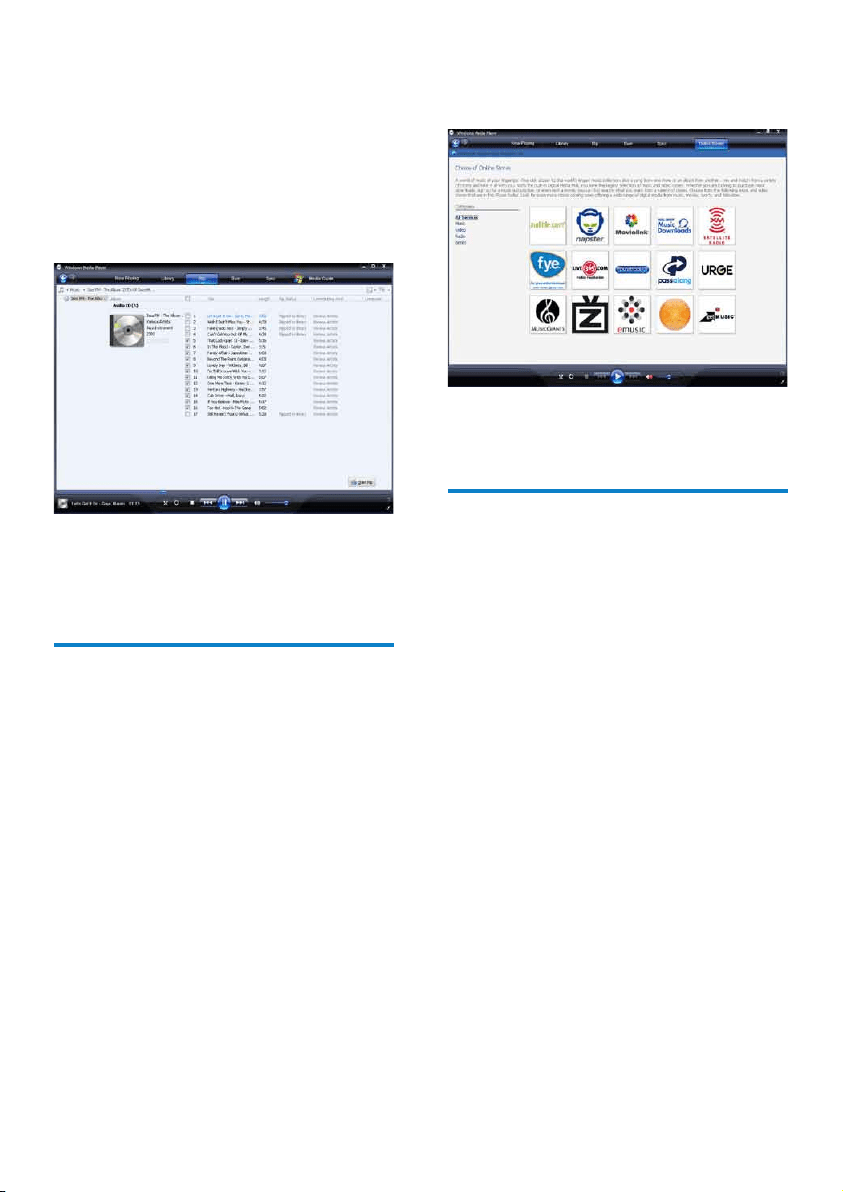
3 Choose a store and follow the on-screen
instructions.
You can nd the albums or songs you »
purchase in the WMP11 library.
Sync your Windows Media
content to MUSE
You can sync your music and pictures to
MUSE using WMP11. When you connect
MUSE to the computer for the rst time,
WMP11 automatically selects the sync method
(automatic or manual) that works best for
MUSE.
Automatic: If MUSE has sufcient storage space
(at least 4GB of free space) and your entire
media library can t on MUSE, your entire
media library is automatically copied to MUSE
when connected to the computer.
Manual: If your entire media library cannot t
on MUSE, you are prompted to manually select
les or playlists for transfer to MUSE.
By default, WMP11 starts to rip all the
songs from the CD.
To modify this option, click the down »
arrow beneath the Rip tab and select
Rip CD Automatically When Inserted
> Never.
6 Click on the check boxes to select the
songs that you want to rip.
7 Click Start Rip.
The selected tracks are converted and »
added to the WMP11 library.
Buy music online
You can select a music store and buy music
online.
1 Start WMP11.
2 Click the down arrow beneath the Media
Guide tab and select Browse all Online
Stores.
EN
19
Select and prioritize what syncs
automatically
If WMP11 selects to sync MUSE automatically,
you can choose not to sync your entire media
library. You can choose what to sync from
existing playlists or create new playlists. The
playlists you select sync to MUSE every time
you connect MUSE to the computer.
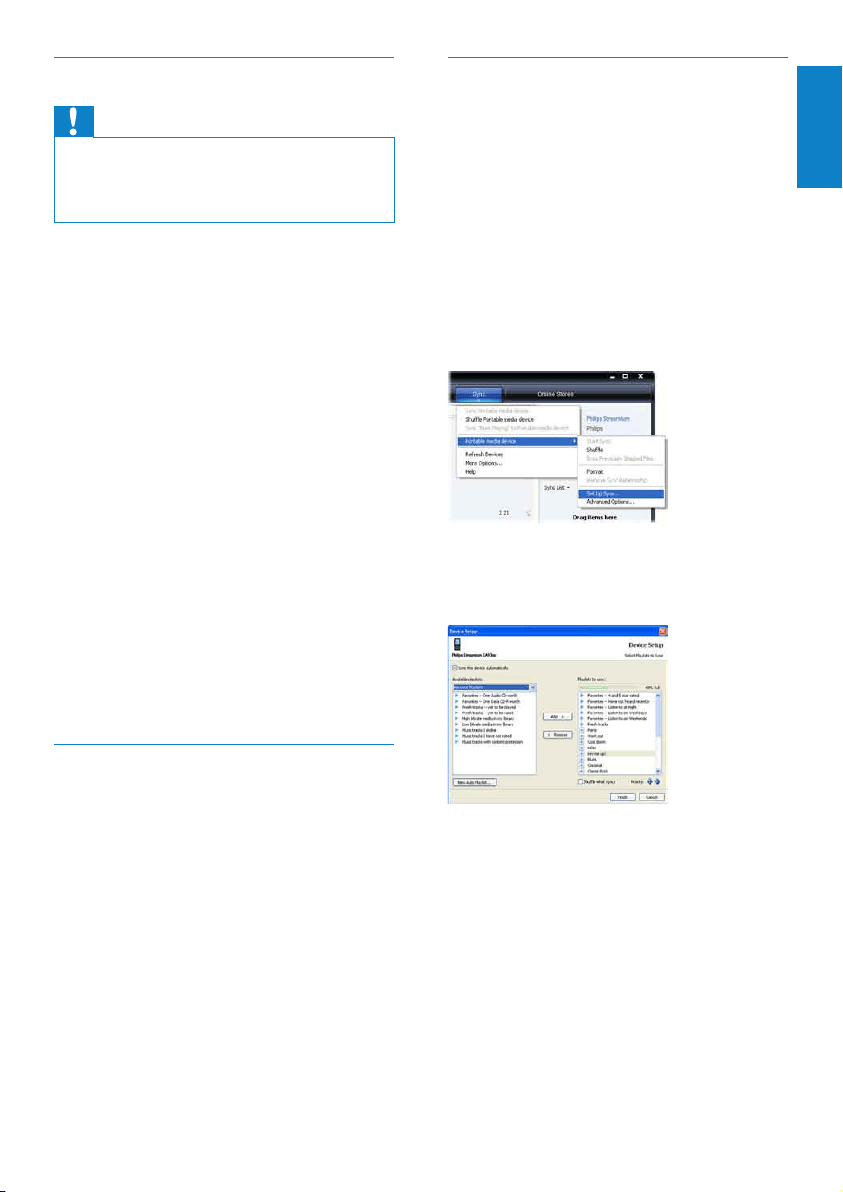
1 Click the down arrow beneath the Sync
tab and select Philips MUSE > Set Up
Sync.
The Device Setup dialog box appears. »
2 In the Available playlists pane, select the
existing playlists you want to sync, then
click Add.
3 To create a playlist, click New Auto
Playlist, then follow the steps on the
screen to specify criteria. (See also
section Create an Auto Playlist).
4 To remove a playlist, click the playlist
in the list of Playlists to sync, then click
Remove.
Set up MUSE for WMP11
Caution
Do not disconnect MUSE while transfer is in •
progress. If you disconnect MUSE, the transfer
is incomplete and Windows may not be able
to recognize MUSE afterwards.
1 Start WMP11.
2 Turn on MUSE.
3 Connect MUSE to the computer.
4 Set up sync:
If you are prompted: select the •
option to sync MUSE using WMP11.
If • WMP11 selects to sync MUSE
automatically: click Finish.
Your entire library syncs to •
MUSE. Thereafter, MUSE syncs
automatically when connected to the
computer.
You can also choose what syncs •
automatically (see section Select and
prioritize what syncs automatically).
If • WMP11 selects to sync MUSE
manually, click Finish.
You are required to click the • Sync
tab and manually select the les and
playlists for sync (see section Select
lesandplaylistsformanualsync).
Switch between automatic and
manual sync
After the rst sync setup, you can switch
between automatic and manual sync:
1 Click the down arrow beneath the Sync
tab, then select PhilipsMUSE > Set Up
Sync.
2 Select or deselect the Sync this device
automatically check box.
English
EN
20
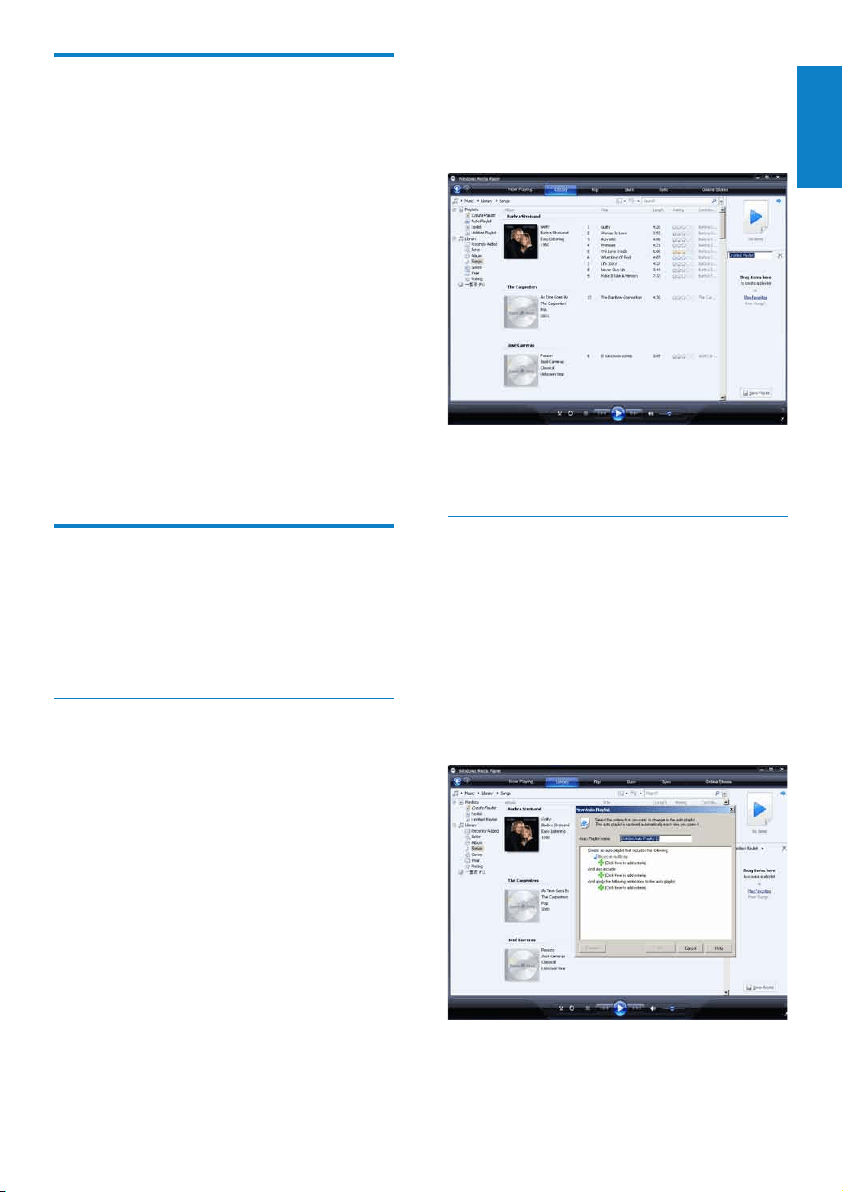
5 Drag the les and playlists that you want
to sync from the Contents pane to the
Sync List pane.
You can also click on the le or •
playlist and select Add to ‘Sync List’.
6 In the Sync List pane, verify that the items
you have selected to sync can all t on
MUSE.
If necessary, remove items from the •
list.
7 To remove items, right click on the item
in the Sync List pane, then select Remove
from List.
8 Click Start Sync button to transfer the
Sync List items to MUSE.
The progress is displayed on the »
bottom right of WMP11.
Click » Stop Sync to stop the transfer.
Tip
If the tracks to sync are protected, you are •
prompted to upgrade the security components
on your computer. When this happens, you
can play the track in WMP11 and when
prompted, follow the steps on the screen to
upgrade the security components. After you
have upgraded your security components, you
can sync the le to MUSE.
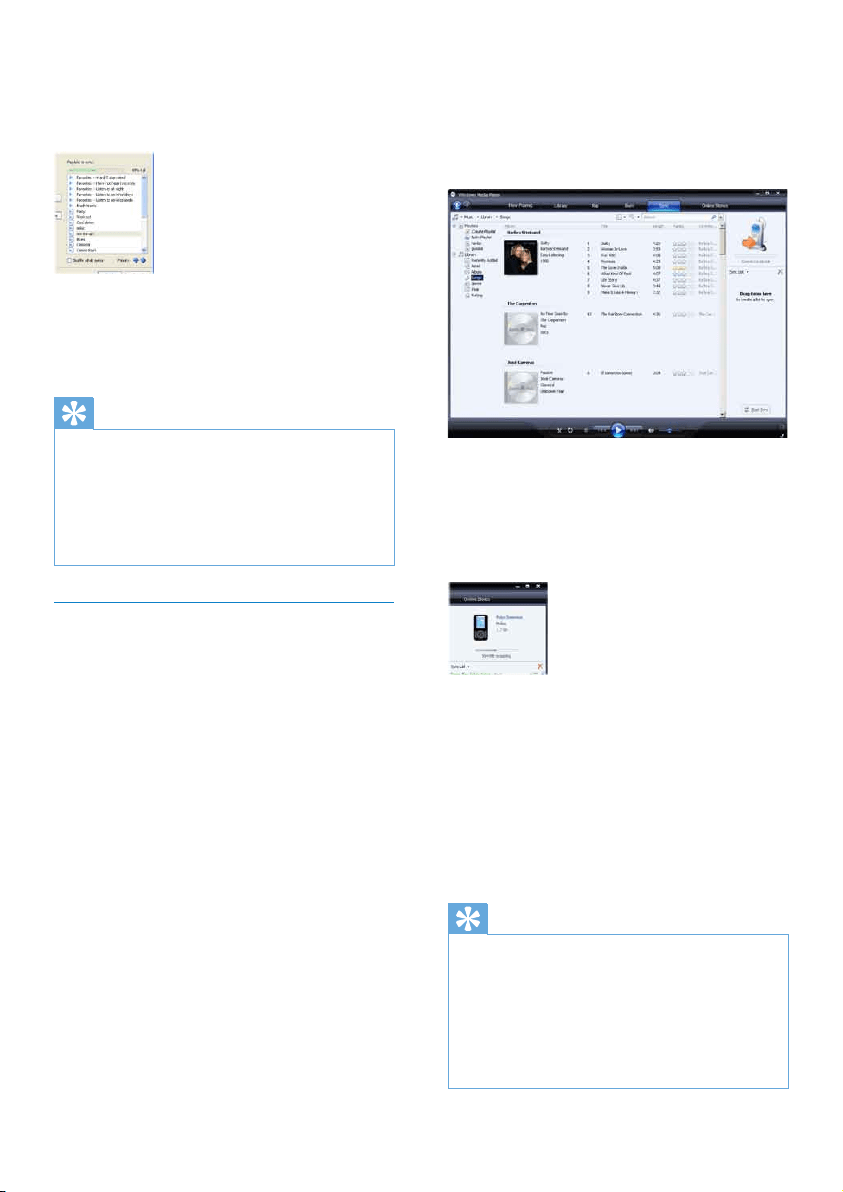
5 In the Playlist to sync pane, select the
Priority arrows to arrange them in the
order that you want them to sync.
If MUSE is full before sync is complete, »
the les and playlists that are lower in
priority on the list are omitted from
sync.
Tip
If your media library is too large to t on •
MUSE, you can select the Shufewhatsyncs
check box, to shufe the les that are in the
playlists to sync. Thereafter, the les on MUSE
are replaced with a new set of les (from the
Playlists to sync pane) whenever MUSE is
connected to the computer.
Selectlesandplaylistsformanual
sync
If you want to sync manually, you are required
to a list of les and playlists you want to sync.
You can also shufe which les from your
playlists to sync to MUSE.
1 Start WMP11.
2 Turn on MUSE.
3 Connect MUSE to the computer.
4 Click the Sync tab.
EN
21
3 To add items to your playlist, drag them
from the Contents pane to the List pane.
(Your playlist can contain both songs and
pictures.)
4 When you have nished adding items to
the playlist, click Save Playlist.
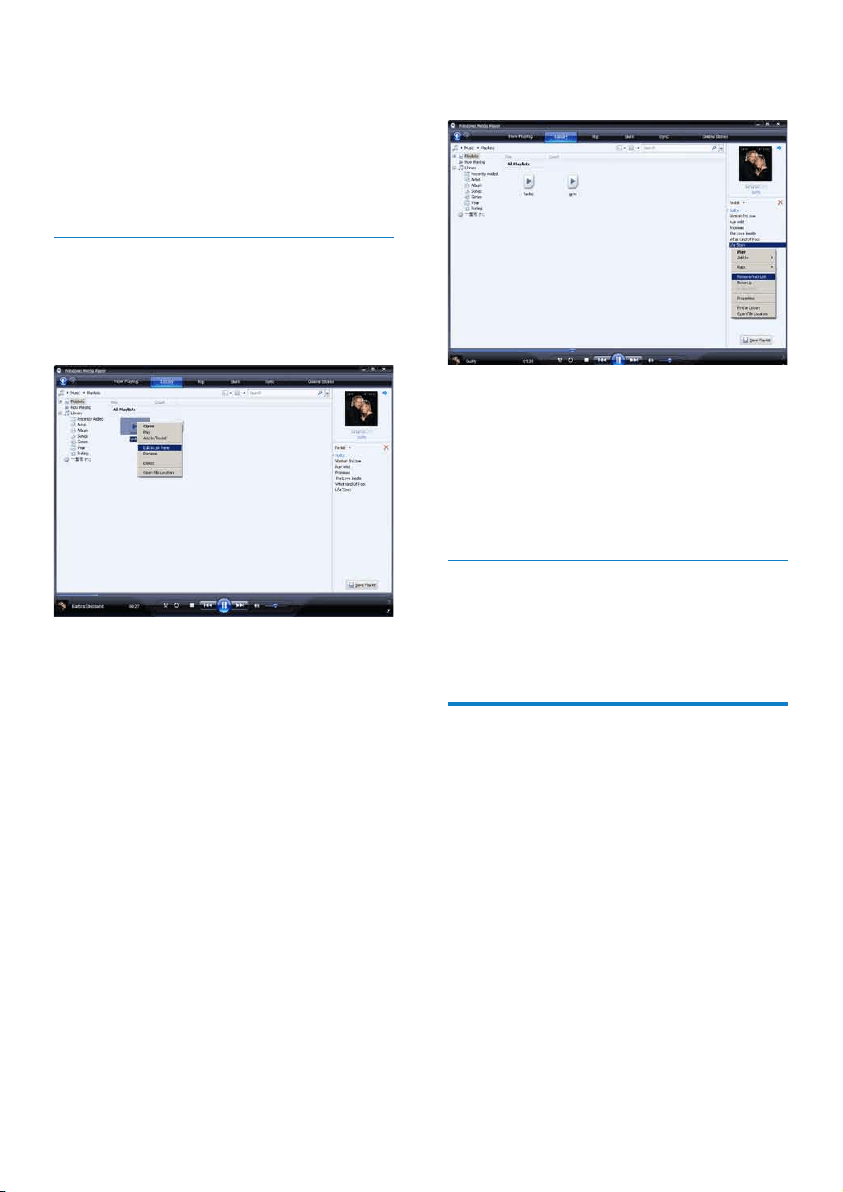
Create an auto playlist
WMP11 can automatically generate playlists
based on various criteria.
1 Click the down arrow beneath the
Library tab, then select Create Auto
Playlist.
A New Auto Playlist dialog box »
appears.
2 Enter a name for the auto playlist.
3 Click the rst green plus sign and select
your rst criteria from the pull-down list.
CopylesfromMUSEto
your computer
MUSE supports reverse sync, which lets you
copy les from MUSE to your computer with
WMP11.
1 Start WMP11.
2 Turn on MUSE.
3 Connect MUSE to the computer.
4 Click on Philips MUSE in the left
Navigation pane.
The content on MUSE is listed in the »
Contents pane.
5 Navigate to the le or playlist you want to
copy from MUSE to the computer.
6 Right click on the le or playlist, then
select Copy from Device.
WMP11 playlists
Playlists allow you to mix any combination of
songs or pictures you want. You can create
regular or auto playlists in WMP11. These
playlists can contain songs, pictures, or both.
Create a regular playlist
1 Click the down arrow beneath the
Library tab and select Create Playlist.
Untitled Playlist appears on the List »
pane.
2 Click on Untitled Playlist and enter a new
name for the playlist.
English
EN
22
To remove an item from the playlist, right click
on the item, then select Remove from List.
To change the order of the items in the
playlist, click and drag any item to a new
position within the List pane.
To add a new item to the playlist, select it
from the library and drag it to the List pane.
When you have nished editing the playlist,
click the Save Playlist button.
Transfer playlists to MUSE
The section Selectlesandplaylistsfor
manual sync in this user manual shows how to
transfer of playlists to MUSE.
Search for music or pictures
with WMP11
1
Click the Library tab.
2 Click the arrow on the top left of
WMP11, then select Music or Pictures to
search.
3 Type a few keywords of the le, such as
song title or artist in the search box.
The search results appear in the »
Contents pane as you type. Results are
updated as you enter each new letter
4 To rene your search results, enter more
keywords.
4 Click on the underlined words to rene
your criteria.
5 Click the second and third green plus
signs to select and dene more criteria
for your auto playlist.
6 Click OK button when done.
Edit playlist
You can edit your existing playlists at any time.
1 In the left Navigation pane, click on
Playlists.
All your playlists are displayed in the »
Contents pane.
Right click on the playlist you want to
edit, then select Edit in List Pane from
the pop-up menu.
The content in the playlist appears in »
the List pane.
EN
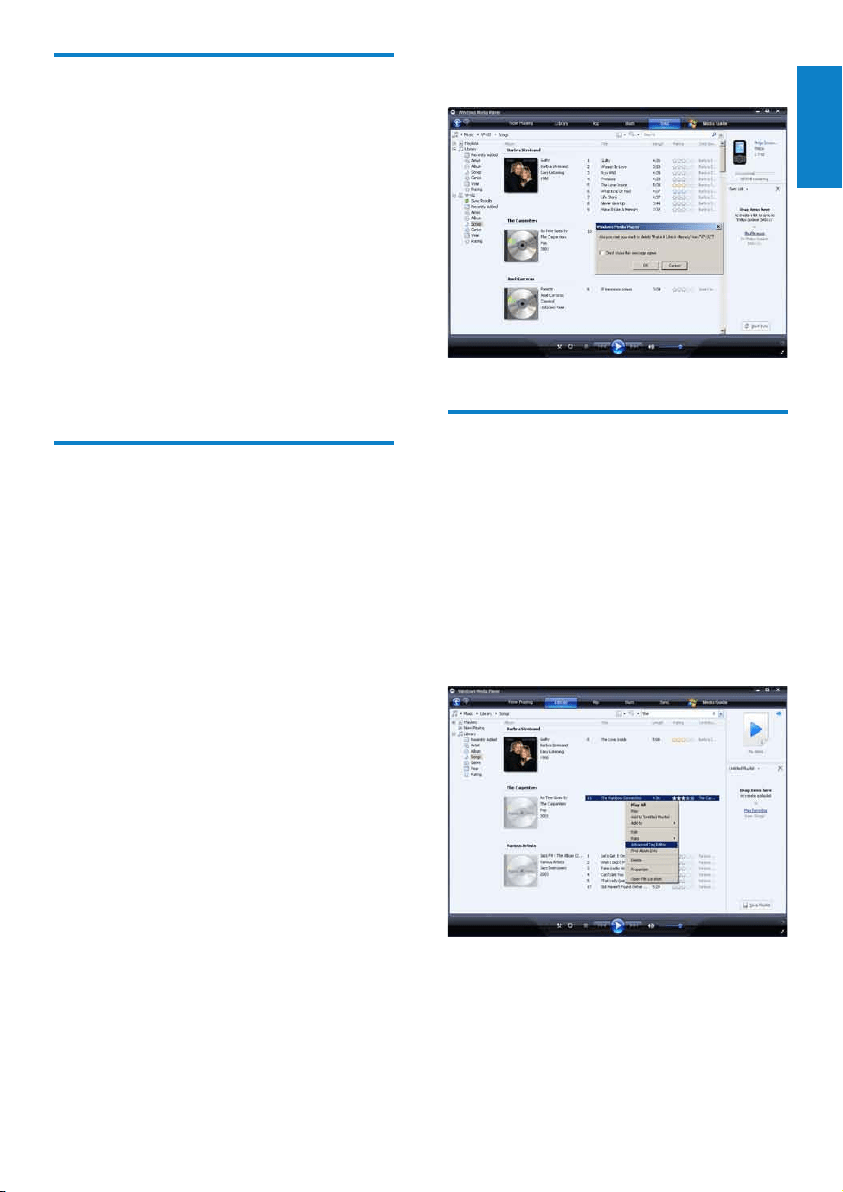
23
7 Click OK.
Edit song information with
WMP11
1
Click the Library tab.
2 Navigate to the song you want to edit.
3 Right click on the song, then select
Advanced Tag Editor from the pop-up
menu.
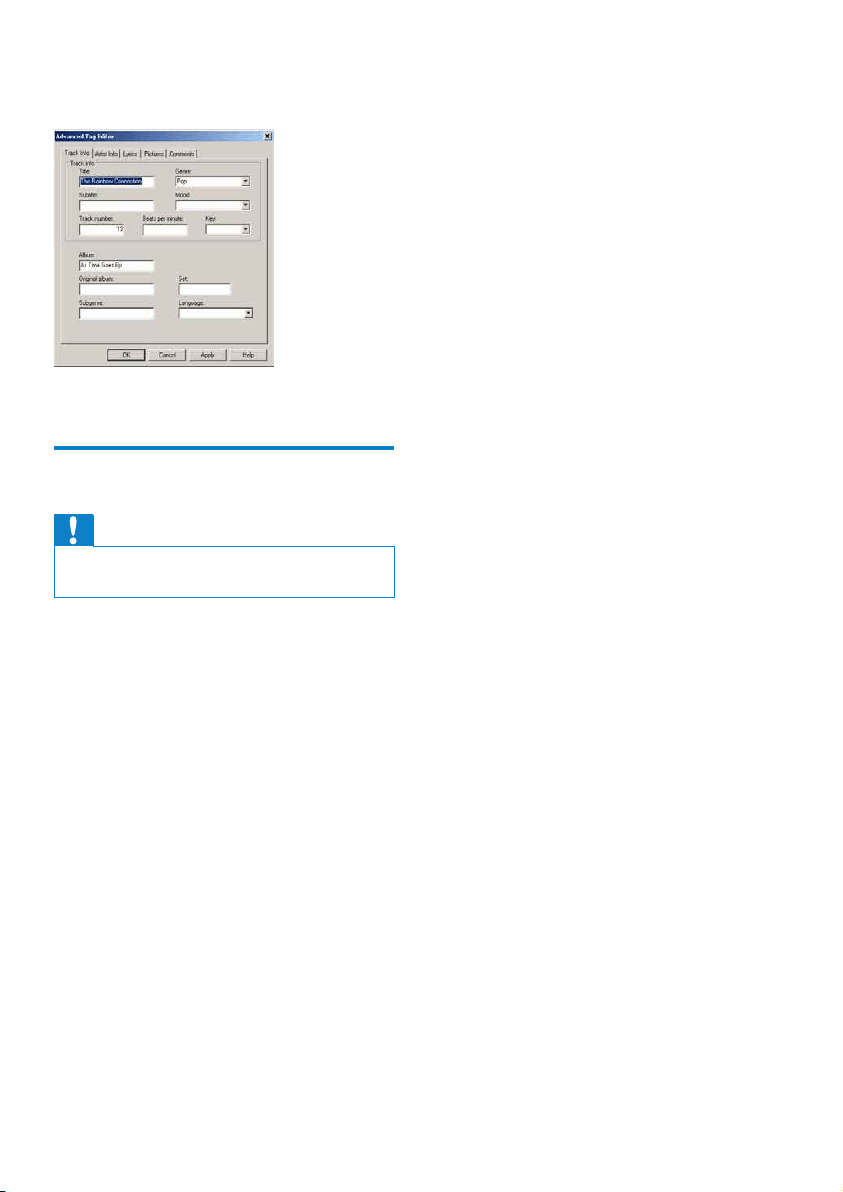
The advanced Tag Editor dialog box »
appears.
Deletelesandplaylistsfrom
WMP11 library
1
Click the Library tab.
2 Click the arrow on the top left of
WMP11, then select Music or Pictures
for deletion.
3 Navigate to the le or playlist you want to
delete.
4 Right click on the le or playlist, then
select Delete.
5 Select Delete from library only or
Delete from library and my computer,
then click OK.
Deletelesandplaylistsfrom
MUSE
You can use WMP11 to manage the les stored
on MUSE. When you connect MUSE to the
computer, the contents on MUSE is displayed in
WMP11. You can delete les or playlists, just like
any other les displayed in WMP11.
1 In the left Navigation pane, click on
Philips MUSE.
2 You can browse the contents of MUSE
in a variety of views, such as Recently
Added or Artists.
3 The contents on MUSE is listed in the
Contents pane.
4 To delete music or picture les, click the
arrow on the top left of WMP11, then
select Music or Pictures.
5 Navigate to the le or playlist you want to
delete.
6 Right click on the le or playlist, then
select Delete.
English
EN
24
4 Select the appropriate tab, then enter or
edit the information.
5 Click OK to save your changes.
Format MUSE with WMP11
Caution
This procedure reformats the storage on •
MUSE and erases all data.
1 Start WMP11.
2 Turn on MUSE.
3 Connect MUSE to the computer.
4 Click the down arrow beneath the Sync
tab, then select Philips MUSE > Format.
EN

25
Remove music tracks from a
playlist
1
In music play mode, press OPTIONS.
2 Press or to select [Remove from
Playlist].
3 Press to remove the current music
track from the playlist.
The current music track is removed »
from the playlist.
Delete a playlist
1
In playlist play mode, press OPTIONS.
2 Press or to select [Delete a playlist].
3 Press to delete the current playlist.
The current playlist is deleted, the »
tracks remain in the [All songs] list.
8 Playlists
Add music tracks to a playlist
1
In music play mode, press OPTIONS.
2 Press or to select [Add to playlist],
then
to conrm.
3 Press or to select the playlist, then
to conrm.
The current track is added to the »
selected playlist.
Play music tracks from a
playlist
1
From the main menu, select >
[Playlists].
2 Press or , then to select the
playlist.
3 Press to play the selected playlist.
The music tracks in selected playlist are »
played.
Create a ‘Playlist-on-the-go’
MUSE lets you create ‘Playlists on the go’.
‘Playlists on the go’ that allow you to add and
remove tracks while you listen to your tracks.
1 Select > [Playlists], then press
OPTIONS.
2 Press or to select [Create new
‘Playlist on the go’], then
to conrm.
A new ‘Playlist on the go’ is created. »
English
EN
26
Audiobook controls
MUSE offers the following audiobook mode
controls:
Goal Action
Play / pause Press
Skip forward to beginning
of new section / chapter
Press
Skip back to beginning of
current section / chapter
Press
Fast skip forwards through
audiobook
Press and hold
Fast skip backwards
through audiobook
Press and hold
Access options menu Press OPTIONS
Return to browsing menu Press
Increase / decrease volume Press VOL
Tip
You can resume play after navigating away •
from audiobooks (see section Resume play in
this user manual).
Select audiobook by book
title
1
From the main menu, select to enter
music mode.
2 Press or , then to select
[Audiobooks].
3 Press or to select title, then to
play.
To exit, press »
.
9 Audiobooks
MUSE supports books in audio format. The
use of this feature requires that you download
AudibleManager from audible.com. With
AudibleManager you can manage the digital
contents of your audiobooks.
Visit audible.com/gogear and register. The
onscreen instructions guide you through
AudibleManager software download process.
Add audiobooks to MUSE
• Important: MUSE supports audiobook
format
or format .
1 On your computer, launch
AudibleManager.
2 Follow the online instructions to
download your audiobooks in format
or format
.
3 Follow the AudibleManager on-screen
instructions to activate MUSE for your
audiobooks.
4 Follow the AudibleManager on-screen
instructions to transfer your audiobooks
to MUSE.
Note
MUSE can only play audiobooks for which it is •
activated.
EN

27
Delete a bookmark in an
audiobook
1
In audiobook play mode, press
OPTIONS.
2 Press or , then to select
[Bookmark [x]].
3 Press or , then to select [Delete
bookmark].
4 Press or to select the bookmark in
the list.
5 Press to delete the selected
bookmark.
To exit, press •
.
Adjust audiobook play speed
1
In audiobook play mode, press
OPTIONS.
2 Press or , then to select [Playback
speed].
3 Press or , then to select [Slower],
[Normal], or [Faster].
To exit, press •
.
Add a bookmark in an
audiobook
1
In audiobook play mode, press
OPTIONS.
2 Press or , then to select
[Bookmarks].
3 Press or , then to select [Add
bookmark].
The display shows a conrmation »
screen.
To exit, press »
.
Find a bookmark in an
audiobook
1
In audiobook play mode, press
OPTIONS.
2 Press or , then to select
[Bookmarks].
3 Press or , then to select [Go to
bookmark].
4 Press or to select the bookmark in
the list.
5 Press to go to the selected bookmark.
To exit, press •
.
English
EN
28
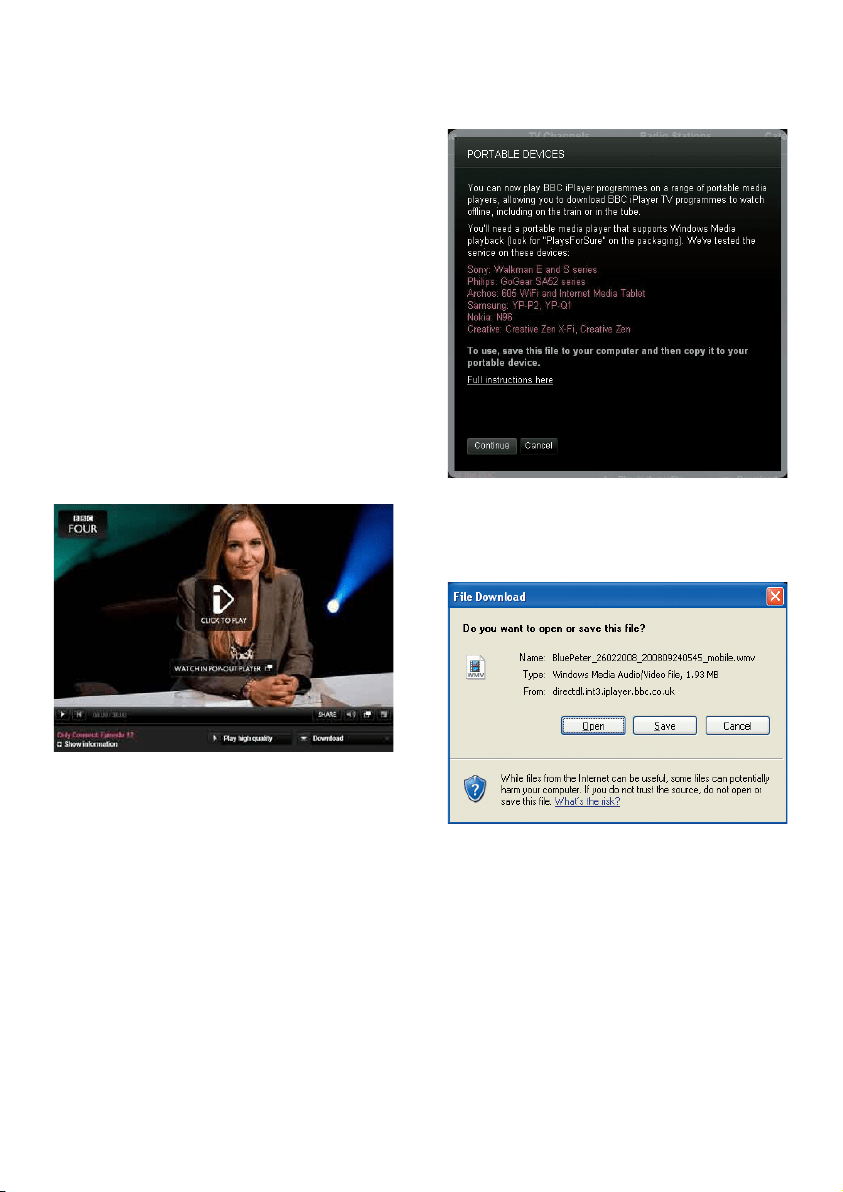
5 When you see a screen like this, click
Continue.
6 After a short while, you should see the
download option. Click Download to
save the program on your computer.
After going through this process your »
le should have been successfully
downloaded.
Once the le has been
downloaded, you can use Windows
ExplorerorWindows Media Player
11to transfer the le to MUSE.
7 Connect MUSE to your computer
and transfer the le with A. Windows
Explorer or B. Windows Media Player
11.
10 BBC iPlayer
(available in the
UK only)
With BBC iPlayer you can now catch up on
your favourite BBC programs from the past 7
days on MUSE.
Here is how to use BBC iPlayer on Philips
MUSE:
1 On your computer, open your browser
and go to www.bbc.co.uk/iplayer
2 Click on a program to select it.
3 Move your mouse over the Download
button at the bottom right hand side of
the screen.
4 Click the option: For portable devices to
start the download.
EN
29
Follow the link provided in the message
Software Upgrade Required to update your
Windows Media Player installation.
I don’t see a download option in the program
that I want to watch.
Some programs are not available for
download at this moment in time.
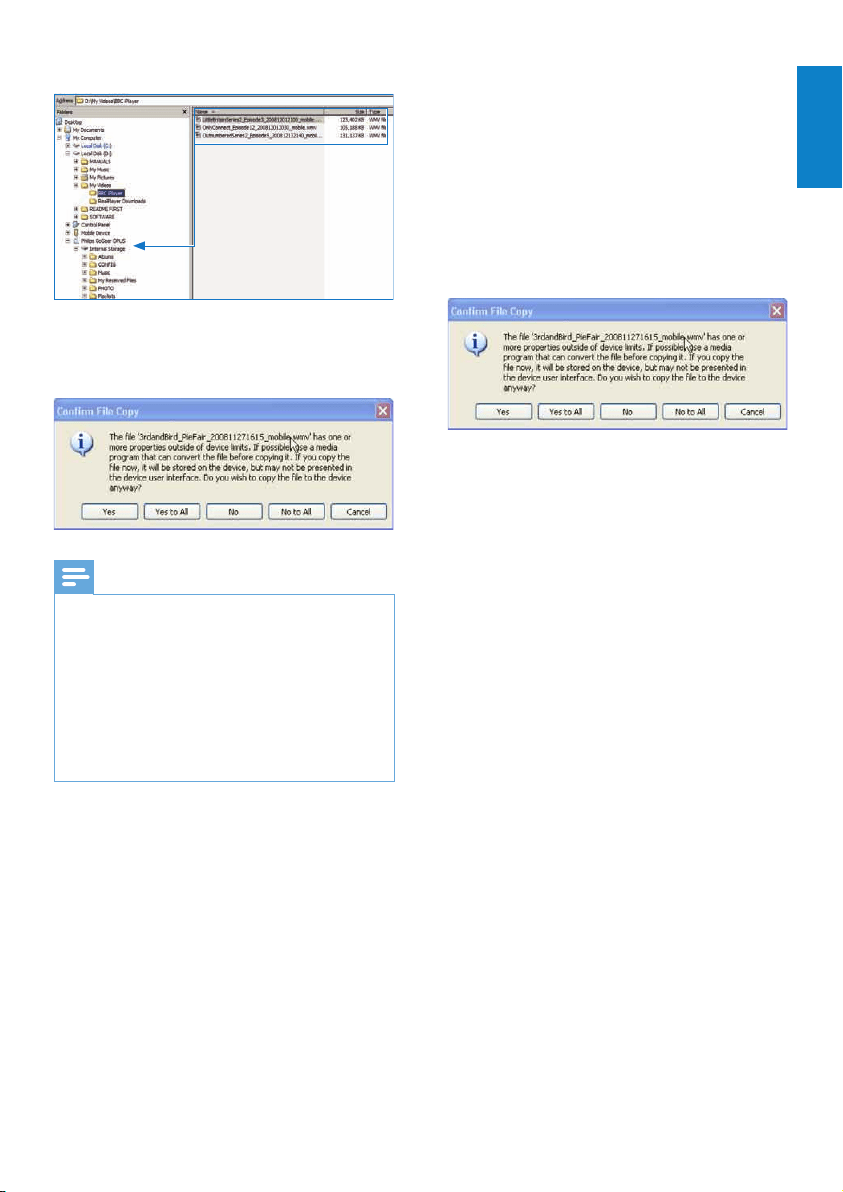
WhenIdraganddropavideolethatI
downloaded, I get the following message.
What do I do?
Ignore this error (click Yes or Yes to All).
The le will transfer and play on your device
without problem.
For more help with the BBC iPlayer, visit
http://iplayerhelp.external.bbc.co.uk/help/
download_programmes/sideloading.
A Transfer with Windows Explorer
During transfer, the following Windows prompt
may pop up. Click on Yes or Yes to All to
continue.
Note
Each BBC iPlayer program is protected with a •
digital license and can only be synchronized up
to 5 times to any portable device.
For information system requirements, please
•
consult the user manual or quick start guide.
BBC iPlayer downloads work only with
•
computers running Windows XP (SP2 or
above) and with a Windows Media Player 11
installation.
• BBC iPlayer is only available in the UK.
When I try to download a program I’m asked
to install an add-on; should I?
If you encounter the above message in your
browser, follow the instructions on screen:
Install the active-X object that your browser
needs to carry out this operation. (Click the
yellow part at the top of the screen that
gives you this message.) After this installation,
you should be able to download programs
normally.
When I try to download a program I’m
asked to upgrade my Windows Media Player
software…
English
EN

30
Play videos
1
From the main menu, select to enter
video mode.
2 Navigate the sub-menus to select your
video.
3 Press to play.
Press •
to toggle between pause
and play.
1 During video play, press and hold or
to scan fast forward or backward.
Press •
to resume play.
Delete videos
1
From the main menu, select to enter
video mode.
2 Select the video you want to delete.
3 Press OPTIONS to view options menu.
4 Select the delete option to delete the
video.
Note
Alternatively, you can select • from the main
menu and nd your les in folder view.
11 Video
Download, convert and
transfer videos
MediaConverter™ for Philips enables you to
download videos from the Internet to •
your PC at the click of a button.
convert video les on your PC to the •
correct screen size of MUSE.
transfer converted videos from your PC •
to MUSE.
Note
Video conversion and transfer can take a long •
time, depending on your PC conguration.
About PC connection preferences...
When you connect MUSE to your PC, MUSE
prompts you to select one of the following PC
connection preferences:
• [Charge & transfer]
• [Charge & play]
1 Select [Charge & transfer].
A pop-up window on your computer »
helps you open the device content.
2 Open the device to view its content.
3 In the Explorer program of your
computer, transfer video les through
drag and drop actions.
Note
If no selection is made within a few seconds, •
MUSE automatically applies option [Charge &
transfer].
EN
31
Delete pictures
1
From the main menu, select to enter
picture mode.
2 Select the picture you want to delete.
3 Press OPTIONS to view options menu.
4 Select the delete option to delete the
picture.
Note
Alternatively, you can select • from the main
menu and nd your les in folder view.
12 Pictures
View pictures
MUSE supports a range of picture formats (see
section Supported formats in this user manual).
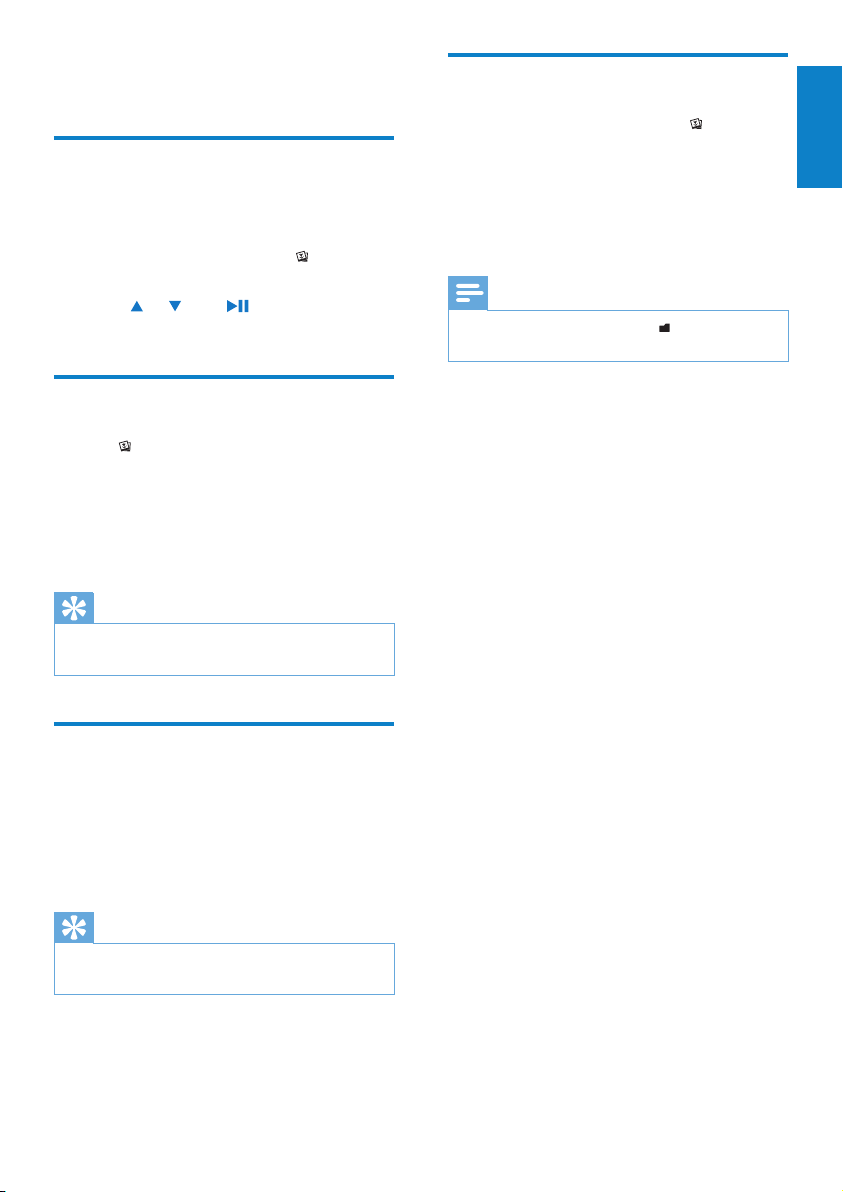
1 From the main menu, select to enter
picture mode.
2 Press or , then to navigate and
select.
View slideshow
While in mode, you can view your pictures as
a slideshow:
1 Press OPTIONS to view the options
menu.
2 Select [Start slideshow] to start the
slideshow.
Tip
The options menu offers various slideshow •
settings.
Transfer pictures to MUSE
1
With MUSE connected to the USB port
of your PC, open Windows® Explorer.
2 Use drag and drop actions to transfer
your picture les to the Pictures folder of
the internal storage of MUSE.
Tip
You can create your own folders in MUSE and •
sort your les into the folders.
English
EN

32
Play a preset radio station
1
In mode, you can play previously set
radio stations (presets):
2 Press OPTIONS to view options menu.
3 Select preset.
4 Press / to change to another preset.
5 To search for the next stronger signal,
press and hold
/ for 2 seconds.
To exit radio, press and hold •
for
2 seconds.
Note
You can play presets only after you have •
stored radio stations under presets. (See
Auto-tune preset radio stations or Manually
tune a radio station in this user manual.)
13 Radio
Listen to FM radio
1
Connect earphones.
2 From the main menu, select to enter
radio mode.
The earphones cable acts as FM •
antenna.
Auto-tune preset radio
station
The auto-tune feature of MUSE helps you nd
radio stations and save them under the preset
numbers.
1 Connect earphones.
2 From the main menu, select to enter
radio mode.
3 Press OPTIONS to see the options
menu.
4 Select [Auto tune].
The radio automatically tunes radio »
stations and saves the 20 strongest
frequencies to presets.
To stop auto tuning, press »
.
To exit radio, press and hold »
for 2
seconds.
Manually tune a radio station
While in mode, you can manually tune to a
radio station:
1 To search for the next stronger signal,
press and hold
/ .
2 To ne tune the frequency, briey press
/ .
EN
33
Record audio/voices
This is how you can record audio/voices with
the built-in microphone (see section Overview
for location of built-in microphone):
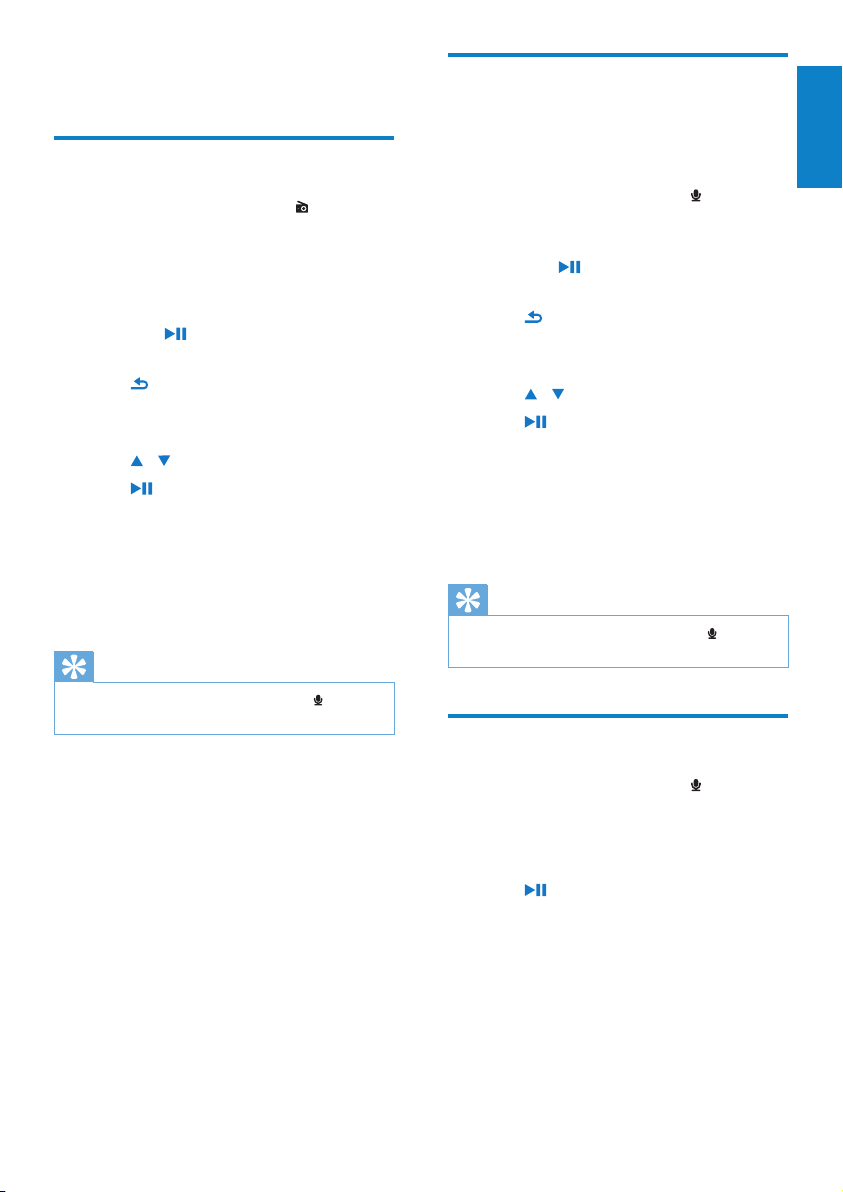
1 From the main menu, select to enter
recordings mode.
2 Select [Start voice recording].
Press •
to toggle between pause
and record.
3 Press to stop.
The screen prompts you to save the »
recording.
4 Press / to select [ Yes] / [No].
5 Press to save the recording.
Recordings are saved on the player. »
(Filename format: VOICE_XX_XX_
XX_##, where XX_XX_XX is
the recording date and ## is the
recording number that is generated
automatically.)
Tip
You can nd your recordings under • >
[Recordings library] > [Voice recordings].
Listen to FM recordings
1
From the main menu, select to enter
recordings mode.
2 Select [Recordings library] > [FM radio].
3 Select a recording.
4 Press to play.
14 Recordings
Record from FM radio
1
From the main menu, select to enter
radio mode.
2 Select radio station (preset).
3 Press OPTIONS to view options menu.
4 Select [Start FM radio recording].
Press •
to toggle between pause
and record.
5 Press to stop.
The screen prompts you to save the »
recording.
6 Press / to select [ Yes] / [No].
7 Press to conrm.
Recordings are saved on the player. »
(Filename format: FM_XX_XX_
XX.##, where XX_XX_XX is
the recording date and ## is the
recording number that is generated
automatically.)
Tip
You can nd your recordings under • >
[Recordings library] > [FM radio].
English
EN

34
Listen to voice/audio
recordings
1
From the menu, select [Recordings
library] > [Voice].
2 Select a recording.
3 Press to play your recording.
Upload your recordings to a
computer
1
Connect MUSE to the computer (see
section Connect and charge in this user
manual).
2 On the computer, in Windows®
Explorer select MUSE.
3 Select Recordings > Voice or FM radio.
4 Copy and paste the recordings to any
location on the computer.
Delete recordings
1
From the main menu, select to enter
recordings mode.
2 Select the recordings library.
3 Select the recording you want to delete.
4 Press OPTIONS to view options menu.
5 Select the delete option to delete the
recording.
EN

35
15 Settings
This is how you customize MUSE:
From the main menu, select
to enter settings
mode.
In the
menu, navigate as follows:
1 Press / to select an option.
2 Press to conrm a selection and go to
the next level (when available).
3 Press to return to the previous level.
4 Press and hold to exit the menu.
In the
menu, the following options are
available:
Settings Options menu Sub-options menu
[Sound
settings]
Active noise cancelation* Bar adjustment indicator. Press
or to nd the noise reduction setting that works
best for you, then
to conrm.
* Attention! For effective adjustment of this feature
you need to be in a noisy environment.
For more information on active noise cancelation, see
chapter Reduce background noise in this user manual.
FullSound On (default)•
Off•
[Equalizer] • [Off] (default)
• [Pop]
• [Funk]
• [Hip hop]
• [Jazz]
• [Dance]
• [Electronica]
• [Lounge]
RNB•
• [Techno]
• [Spoken Word]
• [Custom]
[Volume limit] Bar indicator. Press
VOL to adjust volume limit,
then press
to conrm.
[Sleep timer] • [Off] (default)
xx • [mins]
English
EN

36
[Display
settings]
[Theme] Theme 1 (default)•
Theme 2•
Theme 3•
[Brightness] Level 1•
Level 2•
Level 3•
Level 4•
Level 5•
[Backlight timer] [[x] seconds]
[Screensaver] • [Off] (default)
• [Song title]
• [Album art]
• [Digital clock]
Font size Small•
Normal (default)•
Large•
[Date and
time]
Date Press
or to change value.
Press
to move to next value.
Press
to conrm setting.
Date format Press
to toggle between settings:
DD MM YY (default)•
MM DD YY•
YY MM DD•
Time Press
or to change value.
Press
to move to next value.
Press
to conrm setting.
Time format Press
to toggle between settings:
12-hours (default)•
24-hours•
Show time in header Off (default)•
On•
[Slideshow
settings]
[Time per slide] [[x] seconds]
[Repeat] • [Off] (default)
• [On]
[Shufe] • [Off] (default)
• [On]
[Language] Czech•
German•
• [English] (default)
Spanish•
French•
Italian•
Hungarian•
Dutch•
Norwegian•
Polish•
Portuguese•
Portuguese (Brazilian)•
Slovak•
Finnish•
Swedish•
Turkish•
Greek•
Russian•
Simplied Chinese•
Traditional Chinese•
Japanese•
Korean•
Thai (/97 version only)•
EN

37
[PC connection
preference]
MSC (default)•
MTP•
[Information] • [Capacity:]
• [Free space:]
• [Firmware version:]
• [Model:]
• [Support site:]
[Factory
settings]
[Restore factory settings?
(Files transferred to
player will not be
affected.)]
• [ Yes]
• [No]
English
EN

38
16 Update MUSE
MUSE is controlled by an internal program
called rmware. Newer versions of the
rmware may have been released after you
have purchased MUSE.
The software program called Philips Device
Manager can use your computer to check for
rmware updates that are available on the
Internet.
Install Philips Device Manager on your
computer from MUSE or download the latest
version from www.philips.com/support.
Note
Your music les are not affected by a rmware •
update.
Manually verify / update
rmware
1
Ensure that your computer is connected
to the Internet.
2 Connect MUSE to the computer
(see section Connect and charge for
instructions).
3 On your computer, click Start >
Programs > Philips Digital Audio Player
> Muse Device Manager to launch Philips
Device Manager.
4 Click Update
» Philips GoGear Muse Device Manager
checks for updates and installs new
rmware from the Internet, if available.
5 When the display shows Update
completed, click OK.
6 Disconnect MUSE from the computer.
The display of MUSE shows » Updating
rmware
MUSE restarts after the rmware is »
updated and is ready for use again.
EN

39
17 Troubleshooting
If MUSE is not working properly or the display
freezes, you can reset it without losing data:
How do I reset MUSE?
Insert a pen tip or other object into •
the reset hole located at the bottom of
MUSE. Hold until the player shuts down.
If the reset option is unsuccessful, follow •
the steps how to recover MUSE with the
Philips Device Manager:
1 On your computer, select Start >
Programs > Philips Digital Audio Player
> Muse Device Manager > Philips Device
Manager to launch the Philips Device
Manager.
2 Turn off MUSE before you continue.
3 Press and hold the volume button
while you connect MUSE to your
computer.
4 Keep holding the key until the Philips
Device Manager acknowledges MUSE
and enters the recovery mode.
5 On the computer, click the Repair
button and follow the instructions of the
Philips Device Manager to complete the
recovery process.
6 When the recovery is completed,
disconnect MUSE from your computer.
7 Restart MUSE.
English
EN

40
Storage media
Built-in memory capacity²:
SA1MUS08 8GB NAND Flash
SA1MUS16 16GB NAND Flash
SA1MUS32 32GB NAND Flash
Music transfer³
Drag and drop in Windows® Explorer
Display
Backlight
Type: LCD
Diagonal screen size: 3.0 inches
Resolution: WQVGA 400 x 240 pixels, 262K
colors
¹ Rechargeable batteries have a limited number
of charge cycles. Battery life and number of
charge cycles vary by use and settings.
² 1GB = 1 billion bytes; available storage
capacity is less. Full memory capacity may not
be available as some memory is reserved
for the player. Storage capacity is based on 4
minutes per song and 128 kbps MP3 encoding.
³ Transfer speed depends on operating system
and software conguration.
System requirements
Windows® XP (SP2 or above) / Vista•
Pentium III 800 MHz processor or higher•
512 MB RAM•
500 MB hard disk space•
Internet connection•
Windows® Internet Explorer 6.0 or later•
CD-ROM drive•
USB port•
18 Technical data
Power
Power supply: 750 mAh Li-ion polymer
internal rechargeable battery
Play time¹ (music): 25 hours
Play time¹ (video): 5 hours
Connectivity
Headphone 3.5 mm
USB 2.0 High speed
Sound
Channel separation: 45 dB
Frequency Response: 20 Hz - 18 kHz
Output power: 2 x 1.4 mW
Signal to noise ratio: > 84 dB
THD 0.05 % at 1 kHz
Sound enhancement: FullSound™, active
noise cancelation
Audio playback
Compression format: MP3, WAV, WMA,
AAC, Ogg Vorbis, FLAC, APE, Real Audio
ID3 tag support: song title, artist, album
MP3 bit rates: 8 - 320 kps and VBR
WMA bit rates: 5 - 192 kbps
MP3 sample rates: 8, 11.025, 16, 22.050, 24,
32, 44.1, 48 kHz
WMA sample rates: 8, 11.025, 16, 22.050, 24,
32, 44.1, 48 kHz
Video playback
Digital Rights Management: Windows
Media DRM for portable devices supports
download, subscription rental video services.
MPEG4 SP / ASP: Up to D1 resolution, 30
fps, bit rates up to 4 Mbps in .avi and .mp4
containers
MPEG4 AVC / H.264 BP: Up to VGA
resolution (600 x 400 pixels), 30 fps, bit rates
up to 1.5 Mbps in .mp4 containers
WMV9: VGA resolution (600 x 400 pixels),
30 fps, bit rate up to 1 Mbps in .wmv
container
RMVB: VGA resolution (600 x 400 pixels), 30
fps, bit rate up to 1 Mbps in .rmvb container
EN

41
Supportedmusicleformats
MUSE supports the following music formats:
.mp3•
.wma•
.aac•
.ape•
.ac•
.ogg•
.wav•
.ra / .rm•
Supportedvideoleformats
MUSE supports the following video formats:
.avi•
.mp4•
.rmvb•
.wmv•
Supportedpicturele
formats
MUSE supports the following picture formats:
.jpg / .jpeg•
.bmp•
.png•
.gif•
Supportedaudiobookle
formats
MUSE supports the following audiobook
formats:
.aa•
.aax•
English
EN

42
F
FM (Frequency Modulation)
In radio broadcasting: a method of modulation
in which the frequency of the carrier voltage
is varied with the frequency of the modulation
voltage.
FullSound
FullSound™ is an innovative technology
designed by Philips. FullSound™ faithfully
restores sonic details to compressed music,
enhancing it to provide a full sound experience
without any distortion.
J
JPEG
A very common digital still picture format.
A still-picture data compression system
proposed by the Joint Photographic Expert
Group, which features small decrease in image
quality in spite of its high compression ratio.
Files are recognized by their le extension
‘.jpg’ or ‘.jpeg.’
K
Kbps
Kilobits per second. A digital-data-rate
measurement system which is often used
with highly compressed formats such as AAC,
DAB, MP3 etc. The higher the amount, the
better the quality generally is.
L
LCD (Liquid Crystal Display)
Probably the most common way to show
visual information on non-computer electronic
equipment.
M
MHz (Mega Hertz)
One million cycles per second.
19 Glossary
A
Active noise cancelation
Active noise control (ANC) (also known as
noise cancelation, active noise reduction, or
antinoise) is a method for reducing unwanted
sound. The active noise cancellation system
cancels unwanted sound by generating an
antisound (antinoise). The original, unwanted
sound and the antinoise acoustically combine,
resulting in the cancelation of both sounds.
Album art
Album art is a feature that displays the
artwork (cover picture) of a music album. This
display enables the user to quickly identify
a music album. The artwork les for music
albums can be downloaded from the Internet.
C
Compression
In audio terms, this is a process of temporarily
or permanently reducing audio data for more
efcient storage or transmission. A temporary
reduction in le size is called ‘non-lossy’
compression, and no information is lost. A
permanent reduction in le size (such as with
MP3 les) is called ‘lossy’ compression, and
involves discarding unnecessary information
which is irretrievably lost.
D
Decibel (dB)
A unit of measure used to express relative
difference in power or intensity of sound.
Digital Audio
Digital Audio is a sound signal that has been
converted into numerical values. Digital sound
can be transmitted through multiple channels.
Analog sound can only be transmitted through
two channels.
EN

43
SMV [SigmaTel Motion Video Format]
A partially compressed video format by
SigmaTel that allows conversion of common
PC motion video les for play on a portable
multimedia player.
Stereo
Literally means solid. Usually taken to refer to
two channel stereo, though developments in
digital audio facilitate multichannel stereo.
SuperScroll
SuperScroll™ is a navigation feature of the
double-action search keys of the MUSE.
SuperScroll™ allows easy speed control when
scrolling through large libraries to swiftly nd
items within large libraries. Longer press of the
button results in faster scroll speed.
T
Thumbnail
A thumbnail is reduced-size versions of a
picture that is used to make it easier to
recognize an them. Thumbnails serve the
same role for images as a normal text index
does for words.
V
Volume
Volume is the most common word used to
specify the control of relative loudness of
sounds. It also pertains to the function on
many electronic devices that is used to control
the loudness.
W
WAV
A format for sound les developed jointly by
Microsoft and IBM. Built into Windows 95
to XP, which made it the de facto standard
for sound on PCs. WAV sound les end with
a ‘.wav’ extension and works with nearly all
Windows applications that support sound.
MP3
A le format with a sound data compression
system. MP3 is the abbreviation of Motion
Picture Experts Group 1 (or MPEG-1) Audio
Layer 3. With the MP3 format, one CD-R or
CD-RW can contain about 10 times more
data than a regular CD.
MSC [Mass Storage Class]
The USB mass storage device class (or
USB MSC or UMS) is a set of computing
communications protocols that provide an
interface to storage devices. Devices that
support this standard are referred to as MSC
(Mass Storage Class) devices.
MTP [Media Transfer Protocol]
Media Transfer Protocol supports the transfer
of music and video les to portable audio and
video players.
N
Napster
Napster is an online music service offering
unlimited music you can easily transfer to your
MUSE player.
P
PCM (Pulse Code Modulation)
Pioneering form of digital recording.
PlaysForSure*
PlaysForSure* is a Philips GoGear feature
that ensures compatibility with Windows
Media Player 10 and Windows XP. The
PlaysForSure* logo assures the consumer
that the music purchased at an online shop
with this logo is compatible with the Philips
GoGear player.
S
Shufe
A feature that plays audio les (tracks) in
random order.
English
EN

44
WMA (Windows Media Audio)
An audio format owned by Microsoft, is a
part of Microsoft Windows Media technology.
Includes Microsoft Digital Rights Management
tools, Windows Media Video encoding
technology, and Windows Media Audio
encoding technology.
WMV [Windows Media Video]
Refers to a video compression technology
developed by Microsoft Corporation. WMV
content can be encoded by using Windows
Media® Encoder 9 series. Files are recognised
by their le extension ‘.wmv’.
EN

SA1MUS_02_UM_V2.0
wk9265
© 2009 Koninklijke Philips Electronics N.V.
All rights reserved.