Register your product and get support at
www.philips.com/welcome
EN
User manual
EN For further assistance, please call the customer support in your
country or check the Philips website for chat support.
• To obtain assistance, contact Philips customer care center;
In the U.S.A., Canada, Puerto Rico, or the U.S. Virgin Islands
1 866 309 5962
Mexico city and Metropolitan area; 58 87 97 36
Interior de la republica; 01 800 839 19 89
• Displays and illustrations may dier depending on the product you purchase.
Chat with us:
https://tinyurl.com/y2e29xsq
Scan to chat with us:
Know these safety symbols
The lightning ash with arrowhead symbol, within an
equilateral triangle, is intended to alert the user to the
presence of uninsulated “dangerous voltage” within
the apparatus’s enclosure that may be of sucient
magnitude to constitute a risk of electric shock to
persons.
The exclamation point within an equilateral triangle
is
intended to alert the user to the presence of important
operating and maintenance (servicing) instructions
in
the literature accompanying the apparatus.
CAUTION: TO REDUCE THE RISK OF ELECTRIC SHOCK, DO NOT
REMOVE COVER (OR BACK). NO USER-SERVICEABLE PARTS ARE
INSIDE. REFER SERVICING TO QUALIFIED SERVICE PERSONNEL.
RISK OF ELECTRIC SHOCK
DO NOT OPEN
The caution marking is located on the rear or bottom of the cabinet.
CAUTION
Registering your model with Philips makes you eligible for all of the valuable benefits listed below, so don't miss out.
Register online at www.philips.com/support
to ensure:
Register online today at www.philips.com/support today
to get the most benets from your purchase.
*Product safety notication *Additional benets
By registering your product,you'll receive
notication - directly from the manufacturer - in
the rare case of a product recall or safety defect.
Registering your product guarantees that you'll
receive all of the privileges to which you're
entitled, including special money-saving oers.
W
ARNING: To reduce the risk of re or electric shock, do not expose this apparatus to rain or moisture.
Apparatus shall not be exposed to dripping or splashing and no objects lled with liquids,
such as vases, shall be placed on the apparatus.
CA
UTION: To prevent electric shock, match wide blade of plug to wide slot, fully insert.
For fastest support visit us online for chat and self service
solutions at www.philips.com/support
CHILD SAFETY:
PROPER TELEVISION PLACEMENT MATTERS
THE CONSUMER ELECTRONICS INDUSTRY CARES
•
Manufacturers, retailers and the rest of the consumer
electronics industry are committed to making home
entertainment safe and enjoyable.
•
As you enjoy your television, please note that all
televisions – new and old- must be supported on
proper stands or installed according to the
manufacturer’s recommendations. Televisions that are
inappropriately situated on dressers, bookcases,
shelves, desks, speakers, chests, carts, etc., may fall
over, resulting in injury.
TUNE IN TO SAFETY
•
ALWAYS follow the manufacturer’s recommendations
for the safe installation of your television.
•
ALWAYS read and follow all instructions for proper
use of your television.
•
NEVER allow children to climb on or play on the
television or the furniture on which the television is
placed.
•
NEVER place the television on furniture that can
easily be used as steps, such as a chest of drawers.
•
ALWAYS install the television where it cannot be
pushed, pulled over or knocked down.
•
ALWAYS route cords and cables connected to the
television so that they cannot be tripped over, pulled
or grabbed.
WALL OR CEILING MOUNT YOUR TELEVISION
• ALWAYS contact your retailer about professional
installation if you have any doubts about your ability
to safely mount your television.
• ALWAYS use a mount that has been recommended
by the television manufacturer and has a safety
certication by an independent laboratory (such as
UL, CSA, ETL).
• ALWAYS follow all instructions supplied by the
television and mount manufacturers.
• ALWAYS
make sure that the wall or ceiling where you
are mounting the television is appropriate. Some
mounts are not designed to be mounted to walls and
ceilings with steel studs or cinder block construction.
If you are unsure, contact a professional installer.
• Televisions can be heavy. A minimum of two people
is required for a wall or ceiling mount installation.
MOVING AN OLDER TELEVISION TO A NEW PLACE
IN YOUR HOME
• Many new television buyers move their older CRT
televisions into a secondary room after the purchase
of a at-panel television. Special care should be
made in the placement of older CRT televisions.
• ALWAYS place your older CRT television on furniture
that is sturdy and appropriate for its size and weight.
• NEVER place your older CRT television on a dresser
where children may be tempted to use the drawers
to climb.
• ALWAYS make sure your older CRT television does
not hang over the edge of your furniture.
CTA.tech/safety
Important safety instructions
Read these instructions.
Keep these instructions.
Heed all warnings.
Follow all instructions.
Do not use this apparatus near water.
Clean only with dry cloth.
Do not block any ventilation openings. Install in
accordance with the manufacturer’s instructions.
Do not install near any heat sources such as
radiators, heat registers, stoves, or other apparatus
(including ampliers) that produce heat.
Do not defeat the safety purpose of the polarized
or grounding-type plug. A polarized plug has two
blades with one wider than the other. A grounding
type plug has two blades and a third grounding
prong. The wide blade or the third prong are
provided for your safety. If the provided plug does
not t into your outlet, consult an electrician for
replacement of the obsolete outlet.
Protect the power cord from being walked on or
pinched particularly at plugs, convenience
receptacles, and the point where they exit from
the apparatus.
Only use attachments / accessories specied by
the manufacturer.
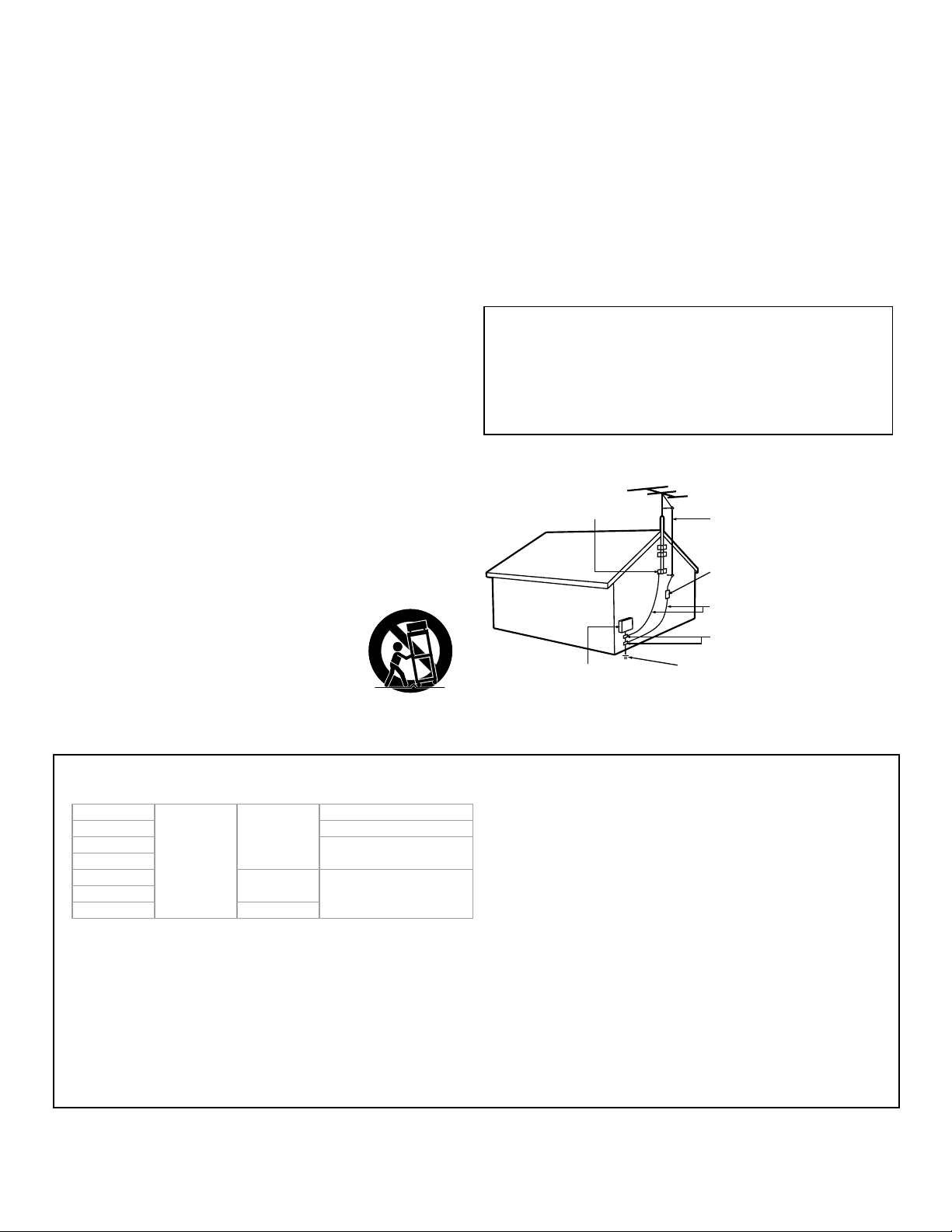
Use only with the cart, stand,
tripod, bracket, or table specied
by the manufacturer, or sold with
the apparatus. When a cart is
used, use caution when moving
the cart / apparatus combination
to avoid injury from tip-over.
1.
2.
3.
4.
5.
6.
7.
8.
9.
10
.
1 1.
12.
Unplug this apparatus during lightning storms or
when unused for long periods of time.
Refer all servicing to qualied service personnel.
Servicing is required
when the apparatus has been
damaged in any way, such as power-supply cord
or plug is damaged, liquid has been spilled or
objects have fallen into the apparatus, the
apparatus has been exposed to rain or moisture,
does not operate normally, or has been dropped.
13.
14.
Note to the CATV system installer:
This reminder is provided to call the CATV system
installer’s attention to Article 820-40 of the NEC that
provides guidelines for proper grounding and, in
particular, species that the cable ground shall be
connected to the grounding system of the building,
as close to the point of cable entry as practical.
Example of antenna grounding as per NEC -
National Electric Code
ANTENNA LEAD IN WIRE
GROUND CLAMP
ANTENNA DISCHARGE UNIT
(NEC SECTION 810-20)
ELECTRIC SERVICE EQUIPMENT
GROUNDING CONDUCTORS
(NEC SECTION 810-21)
POWER SERVICE GROUNDING
ELECTRODE SYSTEM (NEC ART 250,
PART H)
GROUND CLAMPS
Wall mount bracket kit
Brand Model # Screw dimension
75 ”
SANUS
F80b
M8 x 0.787 ” (20 mm)
65 ” M6 x 0.472 ” (12 mm)
55 ”
M6 x 1.378 ” (35 mm)
50 ”
43 ”
SAN-25BB
M4 x 1.378 ” (35 mm) 40 ”
32 ” AST16
●
Your TV meets the VESA standard for wall mounting. Consult
with your local dealer for a wall mount bracket which is com-
patible with your TV model.
●
The recommended wall mount bracket kit (sold separately)
allows the mounting of the TV on the wall.
●
For detailed information on installing the wall mount, refer to
the wall mount Instruction book.
●
Funai Corporation is not responsible for any damage to the prod-
uct or injury to yourself or others if you elect to install the TV wall
mount bracket or mount the TV onto the bracket on your own.
●
The wall mount bracket must be installed by experts.
Funai Corporation is not liable for these types of accidents or
injuries noted below.
●
Install the wall mount bracket on a sturdy vertical wall.
●
If installed onto a ceiling or slanted wall, the TV and wall mount
bracket may fall which could result in a severe injury.
●
Do not use screws that are longer or shorter than their speci-
ed length. If screws too long are used this may cause me-
chanical or electrical damage inside the TV set. If screws too
short are used this may cause the TV set to fall.
●
Do not fasten the screws by excessive force. This may damage
the product or cause the product to fall, leading to an injury.
●
For safety reasons use 2 people to mount the TV onto a wall
mounting bracket.
●
Do not mount the TV onto the wall mounting bracket while
your TV is plugged in or turned on. It may result in an electrical
shock injury.
When installing the unit on the wall, allow this much space.
Top : 1 1.8 ” (30 cm)
Left and right side : 5.9 ” (15 cm)
Bottom : 3.9 ” (10 cm)

Notice
Trademarks are the property of Koninklijke Philips N.V. or their respective
owners.
Funai Corporation reserves the right to change products at any time
without being obliged to adjust earlier supplies accordingly.
The material in this Owner’s manual is believed adequate for the
intended use of the system. If the product or its individual modules or
procedures are used for purposes other than those specified herein,
confirmation of their validity and suitability must be obtained. Fu-
nai Corporation warrants that the material itself does not infringe any
United States patents. No further warranty is expressed or implied.
Funai Corporation cannot be held responsible neither for any errors in
the content of this document nor for any problems as a result of the
content in this document. Errors reported to Funai Corporation will be
adapted and published on the Funai Corporation support website as
soon as possible.
Pixel characteristics
This LCD product has a high number of color pixels. Although it has ef-
fective pixels of 99.999% or more, black dots or bright points of light (red,
green or blue) may appear constantly on the screen. This is a structural
property of the display (within common industry standards) and is not a
malfunction.
Warranty
No components are user serviceable. Do not open or remove covers to
the inside of the product. Repairs may only be done by service centers
and official repair shops. Failure to do so shall void any warranty, stated
or implied.
Any operation expressly prohibited in this manual, any adjustments or
assembly procedures not recommended or authorized in this manual
shall void the warranty.
Federal communications commission notice
This equipment has been tested and found to comply with the limits
for a Class B digital device, pursuant to part 15 of the FCC Rules.
These limits are designed to provide reasonable protection against
harmful interference in a residential installation. This equipment
generates, uses and can radiate radio frequency energy and, if not
installed and used in accordance with the instructions, may cause
harmful interference to radio communications. However, there is no
guarantee that interference will not occur in a particular installation.
If this equipment does cause harmful interference to radio or
television reception, which can be determined by turning the
equipment off and on, the user is encouraged to try to correct the
interference by one or more of the following measures:
●
Reorient or relocate the receiving antenna.
●
Increase the separation between the equipment and the receiver.
●
Connect the equipment into an outlet on a circuit different from that
to which the receiver is connected.
●
Consult the dealer or an experienced radio or television technician for
help.
Modifications
This apparatus may generate or use radio frequency energy. Changes
or modifications to this apparatus may cause harmful interference.
Any modifications to the apparatus must be approved by Funai Corpo-
ration.
The user could lose the authority to operate this apparatus if an unau-
thorized change or modification is made.
Cables
Connections to this device must be made with shielded cables with
metallic RFI / EMI connector hoods to maintain compliance with FCC
Rules and regulations.
Canadian notice
CAN ICES-3 (B) / NMB-3 (B)
Analog and digital television receiving apparatus, Canada BETS-7 /
NTMR-7.
The following FCC/IC RSS applies to the wireless LAN
adapter included in this product.
FCC caution: Any changes or modifications not expressly ap-
proved by the party responsible for compliance could void the
user’s authority to operate this equipment.
This transmitter must not be co-located or operated in conjunc-
tion with any other antenna or transmitter.
FCC/IC RF Exposure Compliance
This equipment complies with FCC/IC radiation exposure limits set
forth for an uncontrolled environment and meets the FCC radio
frequency (RF) Exposure Guidelines and RSS-102 of the IC radio
frequency (RF) Exposure rules.
This equipment should be installed and operated keeping the
radiator at least 20cm or more away from your body.
This device complies with Part 15 of FCC Rules and Industry
Canada licence-exempt RSS standard(s). Operation is subject
to the following two conditions: (1) this device may not cause
interference, and (2) this device must accept any interference,
including interference that may cause undesired operation of
this device.
5150-5250 MHz band is restricted to indoor operations only.
High-power radars are allocated as primary users (i.e. priority
users) of the bands 5250-5350 MHz and 5650-5850 MHz and
that these radars could cause interference and/or damage to
LE-LAN devices.
Compliance with FCC requirement 15.407(c) and IC
requirement RSS-210 A9.4.4
Data transmission is always initiated by software, which is the
passed down through the MAC, through the digital and analog
baseband, and finally to the RF chip. Several special packets
are initiated by the MAC. These are the only ways the digital
baseband portion will turn on the RF transmitter, which it then
turns off at the end of the packet. Therefore, the transmitter will
be on only while one of the aforementioned packets is being
transmitted. In other words, this device automatically discon-
tinue transmission in case of either absence of information to
transmit or operational failure.
Positioning the TV
●
Large screen TVs are heavy. 2 people are required to carry and handle
a large screen TV.
●
Make sure to hold the upper and
bottom frames of the unit rmly as
illustrated.
●
Install the unit in a horizontal and
stable position.
●
Do not install the unit in direct sunlight
or in a place subject to dust or strong
vibration.
●
Depending on the environment, the temperature of this unit may
increase slightly. This is not a malfunction.
●
When installing this unit in a temperate environment, avoid a place
with rapid temperature changes.
–
Operating temperature: 41°F (5°C) to 104°F (40°C)
●
This unit should not be used in a tropical environment as it has not
been evaluated under such conditions.
●
No objects should be placed directly on or under this unit, especially
lighted candles or other aming objects.
●
Depending on your external devices, noise or disturbance of the pic-
ture and/or sound may be generated if the unit is placed too close to
them. In this case, please ensure enough space between the external
devices and the unit.
●
Do not insert the AC power cord into the power socket outlet before
all the connections are made.
●
Ensure that you always have easy access to the AC power cord and
outlet to disconnect the TV from the AC outlet.
●
Before you move the TV, disconnect attached cables to prevent dam-
age to connectors, especially the TV tuner.
●
Be sure to unplug the AC power plug from the AC outlet before mov-
ing or carrying the unit.
●
When moving the TV and then setting it down, please be careful not
to pinch the AC power cord under the unit.
●
Do not place this unit in an area where it may be exposed to water, oil
or grease such as:
near a bathtub, basin, kitchen sink, washing tub, swimming pool,
kitchen exhaust fan, etc., or in a damp basement.
Regulatory notices
WARNING : To prevent injury, this apparatus must be securely attached
to the furniture / wall in accordance with the instructions.
Tipping, shaking or rocking the unit may cause injury /
death.
WARNING : Never place a TV in an unstable location. A TV may fall,
causing serious personal injury or death. Many injuries,
particularly to children, can be avoided by taking simple
precautions such as:
–
Using cabinets or stands recommended by the manu-
facturer of the TV.
–
Only using furniture that can safely support the TV.
–
Ensuring the TV is not overhanging the edge of the sup-
porting furniture.
–
Not placing the TV on tall furniture (for example, cup-
boards or bookcases) without anchoring both the furni-
ture and the TV to a suitable support.
–
Not placing the TV on cloth or other materials that may
be located between the TV and supporting furniture.
–
Educating the children about the dangers of climbing on
furniture to reach the TV or its controls.
If your existing TV is being retained and relocated, the same consider-
ations as above should be applied.
Do not place the unit on the furniture that is capable of being tilted by
a child and an adult leaning, pulling, standing or climbing on it. A falling
unit can cause serious injury or even death.
In order to avoid interruption of ventilation, this unit should not be
placed in built-in equipment such as a book cabinet, rack, etc., and the
vents of this unit should not be covered with anything such as a table-
cloth, curtain, newspaper, etc. Make sure that there is enough ventila-
tion space (4 ” / 10 cm or more) around this unit.
Press
B
to turn the unit on and go into standby mode. To completely
turn o the unit, you must unplug the AC power plug from the AC power
outlet.
Disconnect the AC power plug to shut the unit o when trouble is found
or not in use. The AC plug shall remain readily available.
Never use a gas duster on this TV.
The gas trapped inside of this unit may cause ignition and explosion.
Environmental care
The packaging of this product is intended to be recycled.
Contact your local authorities for information about how to recycle the
packaging.
For product recycling information, please visit - www.recycle.philips.
com
End of life directives
Philips pays a lot of attention to produce environmental-friendly prod-
ucts in green focal areas. Your new TV contains materials which can be
recycled and reused. At the end of its life, specialized companies can
dismantle the discarded TV to concentrate the reusable materials and
to minimize the amount of materials to be disposed of. Please ensure
you dispose of your old TV according to local regulations.
#
Batteries usage
CAUTION : Danger of explosion if battery is incorrectly replaced. Re-
place only with the same or equivalent type.
WARNING : Batteries (battery pack or battery installed) should not be
exposed to excessive heat such as sunshine, re or the
like.
●
Do not mix old and new batteries.
●
Do not mix alkaline, standard (carbon-zinc) or rechargeable (ni-cad,
nimh, Li-ion, etc.) batteries.
Disposal of used batteries
The batteries included do not contain the heavy metals mercury
and cadmium, however in certain localities, disposing batteries with
household waste is not permitted. Please ensure you dispose of bat-
teries according to local regulations.
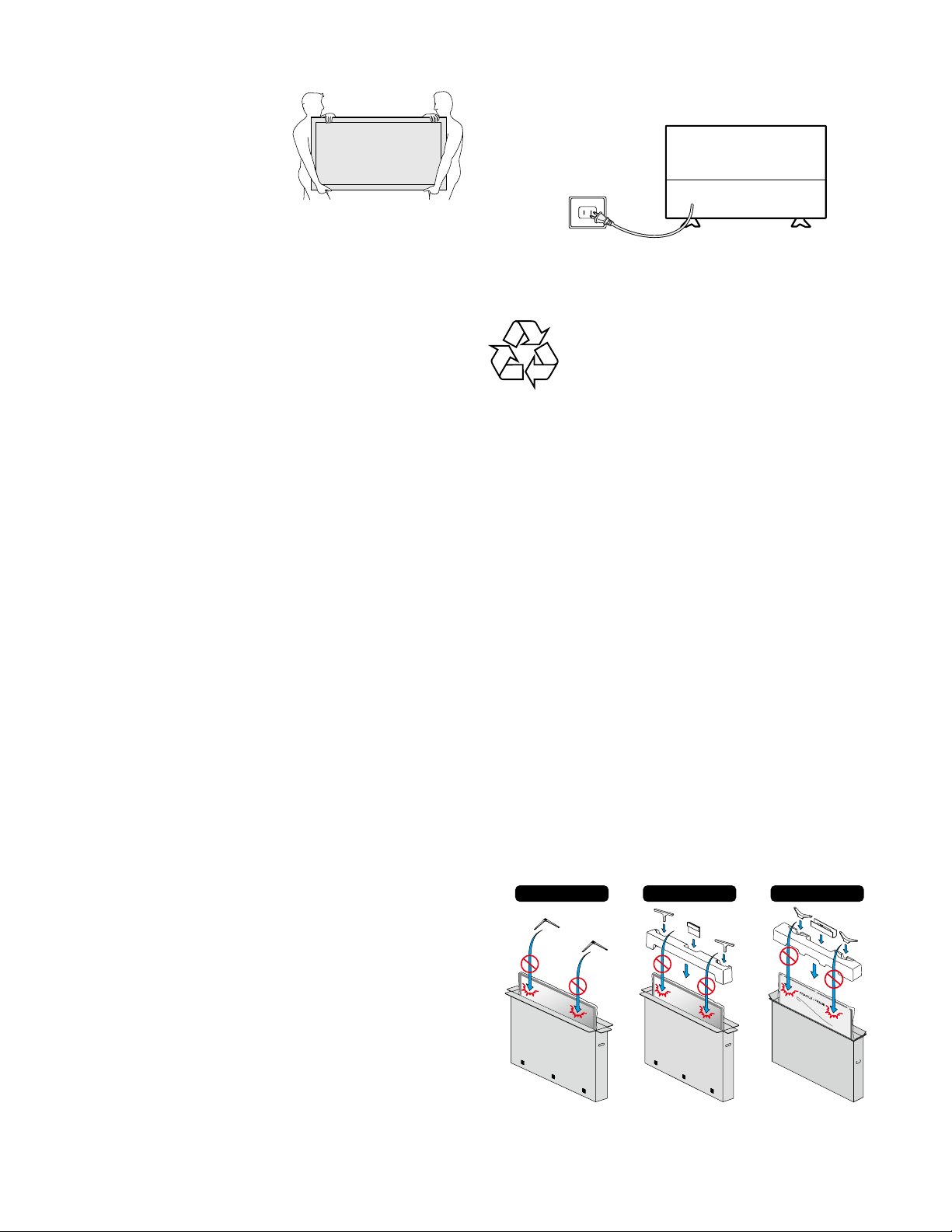
Preparing to move / ship the unit
Please pack the unit properly by following the diagram on the carton (as
noted below).
50 ” / 43 ” / 32 ”65 ” / 55 ”75 ”
●
To avoid damage to the screen, do not pack the stand on the same
side as the TV screen, refer to the illustration above.
AC power plug
Copyright
All other registered and unregistered trademarks are the property of
their respective owners.
The terms HDMI and HDMI High-
Definition Multimedia Interface,
and the HDMI Logo are trademarks
or registered trademarks of HDMI
Licensing Administrator, Inc. in the
United States and other countries.
Manufactured under license from
Dolby Laboratories. Dolby, Dolby
Audio, and the double-D symbol
are trademarks of Dolby Laborato-
ries Licensing Corporation.
Sonic Emotion and the Sonic Emo-
tion logo symbol are registered
trademarks of sonic emotion ag.
Portions of this software are copyright © The FreeType Project
(www.freetype.org).
The American Academy of Pediatrics discourages television viewing
for children younger than two years of age.
Some apps are not pre-installed, internet connection is required for
download.
Some features may require an always-on broadband internet con-
nection, firmware update and/or a minimum bandwidth. Internet
services vary by location.
Funai Corporation Inc. does not warrant access to the portal or to any of
the services, content, software and advertising. Funai Corporation Inc.
may, in its sole discretion, add or remove access to any specific services,
content, software and advertising at any time. Although Funai Corpora-
tion Inc.
will strive to provide a good selection of services, content or software,
Funai Corporation Inc. does not warrant continued access to any specific
services, and content or software.
Funai Corporation Inc. does not warrant Wireless Screencasting
compatibility with all source devices such as smartphones, tablets,
laptops, etc. due to large variability in hardware, firmware, drivers,
software and implementation of wireless casting applications on these
source devices. Although Funai Corporation Inc. will strive to enhance
compatibility and performance across a range of source devices, Funai
Corporation Inc. does not warrant compatibility with specific source
devices.
Channel Specification
Channel coverage Antenna DTV (ATSC)
Antenna Analog (NTSC)
Cable DTV (QAM)
Cable Analog (NTSC)
VHF: 2-13
UHF: 14-69
VHF: 2-13
UHF: 14-69
2-135
2-135
Tuning system Channel frequency synthesized tuning system

Copyright
© 2020 Roku, Inc. All rights reserved. ROKU, the ROKU Logo, and “NOW THIS IS TV” are trademarks and/or registered
trademarks of Roku, Inc. Material in this User Manual is the property of Roku, Inc., and is protected under US and International
copyright and/or other intellectual property laws. Reproduction or transmission of the materials, in whole or in part, in any
manner, electronic, print, or otherwise, without the prior written consent of Roku, Inc., is a violation of Roku, Inc.’s, rights under
the aforementioned laws.
No part of this publication may be stored, reproduced, transmitted or distributed, in whole or in part, in any manner, electronic
or otherwise, whether or not for a charge or other or no consideration, without the prior written permission of Roku, Inc.
Requests for permission to store, reproduce, transmit or distribute materials shall be made to both of the following address:
Roku, Inc.
1155 Coleman Avenue,
San Jose, CA 95110
Product name: Roku TV™
Document name: Roku TV™ User Guide
Document revision: 9.3 – United States and Canada, English
Publication date: 7/10/2020

Contents
Welcome................................................................................................................................................... 1
The new standard in Smart TVs ................................................................................................................................. 1
Get the most out of your new TV ............................................................................................................................. 1
Connections and setup .................................................................................................................... 5
Connecting an antenna, cable, or satellite box ..................................................................................................5
Connecting external equipment with a composite AV video cable ........................................................ 5
Connecting external equipment with an HDMI® cable ...................................................................................6
Connecting headphones or analog soundbar ....................................................................................................6
Connecting headphones to the Roku Enhanced Voice Remote ............................................................... 7
Connecting an AV receiver or digital soundbar ................................................................................................ 7
Preparing for Internet connectivity ......................................................................................................................... 8
AC power ..............................................................................................................................................................................8
Roku remote batteries ................................................................................................................................................... 8
Roku TV remote ................................................................................................................................................................ 9
Panel buttons ....................................................................................................................................................................12
Single button ................................................................................................................................................................13
Three buttons ...............................................................................................................................................................13
Game-pad style joystick ..........................................................................................................................................13
Four buttons ................................................................................................................................................................ 14
Five buttons (with mute) ....................................................................................................................................... 14
Five buttons (without mute) ................................................................................................................................ 14
Seven buttons ..............................................................................................................................................................15
Guided Setup .......................................................................................................................................16
Starting Guided Setup ..................................................................................................................................................17
Guided Setup.....................................................................................................................................................................18
Network connection ................................................................................................................................................ 20
Activation ..................................................................................................................................................................... 24
Connect your devices ..............................................................................................................................................25
The Home screen ..............................................................................................................................28
Personalize your Home screen........................................................................................................................... 29
Benefits of connecting ....................................................................................................................31
Connecting brings out your TV’s full potential! ................................................................................................ 31
Take advantage of awesome features ............................................................................................................32
What is streaming? ....................................................................................................................................................... 34
What if I didn’t connect my TV? .............................................................................................................................35
ii

Setting up live TV ............................................................................................................................ 36
How do I set up the TV tuner? ................................................................................................................................37
Using your TV ......................................................................................................................................41
Status indicator ................................................................................................................................................................41
Standby mode energy savings ............................................................................................................................... 42
Getting help .................................................................................................................................................................... 42
Opting in to Smart TV experience (U.S. only) ................................................................................................ 43
Disable Smart TV experience ............................................................................................................................. 43
Disable Auto Notifications ...................................................................................................................................44
Watching live TV channels ........................................................................................................................................44
Changing channels ...................................................................................................................................................44
Favorite Channels in the channel list ............................................................................................................. 45
Smart Guide (U.S. only) .........................................................................................................................................46
Viewing program information ............................................................................................................................49
Adjusting settings while watching a program .......................................................................................... 50
Pausing live TV ...............................................................................................................................................................50
Requirements ............................................................................................................................................................. 50
Enabling Live TV Pause ...........................................................................................................................................51
Using Live TV Pause .................................................................................................................................................. 51
Notes about Live TV Pause ..................................................................................................................................52
More Ways to Watch (U.S. only) .............................................................................................................................52
Using More Ways to Watch ..................................................................................................................................53
Getting the most from More Ways to Watch ...............................................................................................55
Switching TV inputs ......................................................................................................................................................55
Auto-detecting devices ..........................................................................................................................................55
Adjusting audio/video settings...........................................................................................................................55
Setting preferred audio language for streaming channels ................................................................. 56
Playing content from USB storage devices ...................................................................................................... 56
Auto player launch .................................................................................................................................................... 57
Playing content from local network media servers .......................................................................................57
Setting up a payment method................................................................................................................................ 58
Using your TV in a hotel or dorm room ............................................................................................................. 58
About using your TV on a restricted public network ............................................................................. 58
Getting your Roku TV on line on a restricted public network ............................................................ 59
Roku voice remotes (select models only) ........................................................................................................... 61
Re-pairing your Roku voice remote ...................................................................................................................61
Checking the Roku voice remote battery level ............................................................................................61
Finding your Roku Enhanced Voice Remote .............................................................................................. 62
Changing and previewing the Enhanced Voice Remote finder sound ......................................... 62
Adjusting TV settings .................................................................................................................... 64
Settings menu .................................................................................................................................................................64
Options menu.................................................................................................................................................................. 65
Options menu settings ............................................................................................................................................... 66
Accessibility (U.S. only) ...............................................................................................................................................67
Accessibility menu settings ..................................................................................................................................67
Video description through Secondary Audio Program (SAP) ................................................................ 68
iii

Picture settings ............................................................................................................................................................. 69
Picture settings menu options .......................................................................................................................... 69
Auto Low Latency Mode (ALLM) ...................................................................................................................... 71
Variable refresh rate (VRR) ..................................................................................................................................71
Sound settings ...............................................................................................................................................................71
Roku Smart Soundbar (U.S. only) ....................................................................................................................72
Volume mode (select models only) ................................................................................................................73
Sound settings – Dolby® Audio Processing (select models only) ....................................................74
Sound settings – DTS® TruSurround / DTS® Studio Sound (select models only) ......................75
Sound settings – Sonic Emotion™ Premium (select models only) ....................................................76
Sonic Emotion™ settings ........................................................................................................................................ 77
Expert Picture Settings (4K models only) ........................................................................................................ 77
Changing privacy settings .........................................................................................................................................78
Advertising ....................................................................................................................................................................78
Microphone ...................................................................................................................................................................79
Featured Free (U.S. only) .............................................................................................................. 81
My Feed .................................................................................................................................................82
Movies Coming Soon (U.S. only) ...........................................................................................................................82
Movies, TV programs, and people..........................................................................................................................82
Searching for something to watch ...........................................................................................83
How do I search? ........................................................................................................................................................... 83
Keyboard search using the remote .................................................................................................................. 84
Voice Search from a Roku voice remote ....................................................................................................... 84
Searching from the Roku mobile app ........................................................................................................... 85
Searching with Google Assistant ...................................................................................................................... 85
Searching with Amazon Alexa ........................................................................................................................... 86
Direct-to-playback search results ................................................................................................................... 86
Searching for free content .................................................................................................................................. 86
I searched for a program. Now what? ................................................................................................................87
Follow on Roku ................................................................................................................................................................87
Recent Searches ............................................................................................................................................................ 88
Roku Zones (U.S. only) .............................................................................................................................................. 88
Using the Roku Channel Store ................................................................................................... 89
Automatic Account Link ...........................................................................................................................................90
Customizing your TV ......................................................................................................................91
Add TV inputs ...................................................................................................................................................................91
Add streaming channels ............................................................................................................................................ 92
Rename inputs ................................................................................................................................................................ 92
Remove unwanted tiles .............................................................................................................................................. 93
Rearrange tiles ................................................................................................................................................................ 94
Change the look and feel with themes .............................................................................................................. 95
Edit live TV channel lineup ....................................................................................................................................... 96
Change menu volume ................................................................................................................................................. 96
iv

Configure power settings ...........................................................................................................................................97
Power on settings ......................................................................................................................................................97
Auto power savings ..................................................................................................................................................97
Standby LED On/O .............................................................................................................................................. 98
Fast TV start................................................................................................................................................................ 98
Configure accessibility (U.S. only) ........................................................................................................................ 98
Captions mode........................................................................................................................................................... 98
Captions preferred language .............................................................................................................................. 99
Captions style ............................................................................................................................................................. 99
Audio Guide settings ............................................................................................................................................ 100
Change caption settings (Canada only) ............................................................................................................101
Customize the Home screen .................................................................................................................................103
Parental controls ........................................................................................................................... 104
Creating a parental control PIN ............................................................................................................................ 104
Blocking broadcast TV programs ...................................................................................................................... 104
Enabling parental control of TV programs ................................................................................................105
Blocking based on US TV ratings ....................................................................................................................105
Blocking based on US movie ratings ............................................................................................................ 106
Blocking based on Other ratings ..................................................................................................................... 107
Blocking based on Canadian English ratings .............................................................................................107
Blocking based on Canadian French ratings .............................................................................................108
Blocking unrated programs ................................................................................................................................108
What happens when a TV program is blocked? .......................................................................................... 109
Changing the parental control PIN .......................................................................................................................110
Resetting parental controls ....................................................................................................................................... 111
More settings ...................................................................................................................................... 112
Guest Mode ...................................................................................................................................................................... 112
Network settings ...........................................................................................................................................................114
ZIP Code or postal code ...........................................................................................................................................114
Time settings ................................................................................................................................................................... 115
Scan again for live TV channels .............................................................................................................................116
HDMI® mode (4K models only) ..............................................................................................................................116
Control by mobile apps ..............................................................................................................................................116
Roku TV premium audio ........................................................................................................................................... 117
Home theater configuration .....................................................................................................................................118
Turning o the TV speakers for home theater use ..................................................................................118
Setting up a digital audio connection ............................................................................................................118
Choosing an audio format ..................................................................................................................................119
Turning o the TV screen while listening to music ................................................................................. 120
Controlling other devices through CEC........................................................................................................120
Restart the TV ................................................................................................................................................................. 121
Reset the TV ................................................................................................................................................................... 122
Reset audio/video settings ................................................................................................................................. 122
Factory reset everything ...................................................................................................................................... 122
What if I can’t access the Factory Reset option? .................................................................................... 122
Network connection reset ...................................................................................................................................123
v

Roku account PIN .........................................................................................................................................................124
Update the TV ...............................................................................................................................................................124
Checking for updates on a connected TV ..................................................................................................125
Getting updates on a non-connected TV ..................................................................................................126
Other devices .................................................................................................................................... 128
Mirror your phone or tablet .....................................................................................................................................128
Roku mobile app ...........................................................................................................................................................129
Private Listening on the Roku mobile app .................................................................................................. 129
Universal remotes .........................................................................................................................................................129
FAQ ........................................................................................................................................................130
vi

Welcome
Congratulations on the purchase of your new Roku TV! Discover the joy of endless
entertainment. After it’s set up, you’ll be able to access a world of streaming content channels
that may include paid subscription channels and thousands of free channels.
Important: Your TV receives automatic updates from time to time, enabling new content
and features. This edition of the User Guide describes Roku TV version 9.3. To determine the
current version of your Roku TV, go to Settings > System > About after you complete Guided
Setup.
The new standard in Smart TVs
Welcome to TV like you’ve most likely never seen before—a home screen that you can
personalize with your favorite devices and streaming channels. Choose from hundreds of
thousands of streaming movies and TV episodes, plus music, sports, kids, family, international
and much more. You should never run out of things to watch.
Note: A paid subscription or other payments may be required for some channel content.
Channel availability is subject to change and varies by country.
Get the most out of your new TV
Follow these steps to get the most out of your new TV.
•
Connect to the Internet
•
It’s easy, and it will unlock a world of entertainment. All you need is a network
connection. There are hundreds of free streaming channels, paid subscription services,
and convenient ways to rent or buy a favorite movie or program.
•
Pick your favorite streaming channels
•
Find the entertainment you love. From the latest blockbuster movies to your favorite
TV programs, with tons of live sports, a broad selection of music streaming channels,
popular programming in a dozen international languages, 24x7 live news and so much
more, your new Roku TV has your sweet spot. A paid subscription or other payments
may be required for some channels.
1

•
Find live TV programs in the Smart Guide
•
Only in the United States, use the Smart Guide to see not only what’s on TV right now,
but what will be on in the coming two weeks. And for many over-the-air programs, if
you start watching the program after it is already in progress, or you see something
you missed in the Smart Guide, you can use More Ways to Watch to find streaming
channels where you can see the program from the beginning, find other episodes, or
entire seasons of the program, if applicable.
•
Use Roku’s Smart TV experience to discover More Ways to Watch
•
Only in the United States, enables you to stream TV programs from the beginning, find
more episodes of the TV program, discover similar programs and movies, and see the
full description of the TV program.
•
Personalize your Home screen
•
Put your favorite streaming channels, and TV inputs front-and-center on the Home
screen. No more flipping through inputs or wading through complicated menus. You
can even customize the names of each input and move tiles around so your most-
often used devices and streaming channels are only a click away.
•
Search for your favorite movie, TV program, actor, or director
•
Once you’re connected to the internet, you can easily search across top streaming
channels and live TV channels. Search by movie or TV program title, actor or director—
all from one place. Search by typing words or phrases using the on-screen keyboard or
on your mobile device or speak words or phrases in a conversational tone using Voice
Search. Some channels and content require payment.
•
Only in the United States, receive a Roku Zone when you search by popular genres
or subjects. A Roku Zone is a collection of relevant entertainment organized into
browsable rows such as New Releases, Free, and Rent or Buy. On 4K TVs, include “4K”
in your search to see 4K movies and programs in the 4K Movies & TV Zone.
•
Pause live TV
•
Pause, resume, fast forward, and rewind TV programs by connecting your own USB
drive to the TV and pause live TV for up to 90 minutes.
Note: Live TV Pause is available on digital TV programs received on the ANT input, and
only when the TV is linked to a valid Roku account.
2

•
Watch the Roku Tips & Tricks channel
•
Only in the United States, tune in to the Roku Tips & Tricks channel to watch videos
and learn more about your TV’s features, new products, and popular support topics.
•
Control your TV with voice commands
•
Use your Roku Voice Remote (select models), Enhanced Voice Remote (select
models), or the free Roku mobile app to control your Roku TV. Use conversational
voice commands to search for programs by title, actor, director, or genre. Also, use
voice commands to launch streaming channels, switch inputs, or change live TV
channels
1
.
While you’re at it, explore these additional voice features:
•
Set sleep timers. For example, say “Turn the TV o in 30 minutes”, or “Go to sleep
at 11 p.m.”
•
Go directly to playing a program whenever your search command can be uniquely
identified and the requested content is available at no additional cost to you.
2
•
Search for movies based on popular quotes. For example, say “What movie is this
from – ‘Here’s looking at you, kid’.”
•
Only on 4K TVs, say “Show me 4K movies” to see a list of 4K movies available
across participating streaming channels.
•
Use voice commands to turn the display o (for enjoying streaming music), turn
captions on or o, and to replay the last few seconds of a movie or TV program.
•
Control the Roku Media Player to play your personal music and show movies and
photos. Say commands like, “Play classic rock on Roku Media Player,” “Skip ahead
20 seconds,” or “Play the next song.”
•
Only in the United States, use your voice to open the Smart Guide to see what’s
currently playing on your TV or on select live streaming channels.
•
Use Google Home, Google Pixel phone, or the Google Home mobile app to control
your Roku TV. You can search for movies and TV programs, launch most channels,
control playback, adjust the volume, switch inputs, turn the TV on and o, and
more. Control multiple Roku devices by including the location of the device in your
commands. For example, say “Hey Google, turn o Roku in the bedroom.”
•
Use Amazon Echo Dot, Echo Plus, Echo Show, or the Amazon Alexa mobile app to
control your Roku TV. You can search for movies and TV programs, launch most
channels, control playback, adjust the volume, switch inputs, turn the TV on and o,
and more. Control multiple Roku devices by including the location of the device in
your commands. For example, say “Hey Alexa, pause Roku in the living room.”
1 Voice features support English and Spanish languages when the corresponding TV language is selected.
2 Direct-to-playback commands work with selected streaming channels. Direct playback occurs only when there
is a high confidence of match, the content is free or you are already subscribed, and the channel is already
added to your Home screen.
3

•
Send your personal media to the big screen
•
Send personal photos, videos, and music from your compatible smartphone or tablet
to the TV screen in just a few taps. Plus, with certain channels, you can send movies,
programs, sport highlights, and more directly to your TV.
•
Watch for content and follow movies coming soon
•
Use My Feed to get updates on movies, TV programs, and actors that you are
following. Only in the United States, use My Feed to choose from and follow a list of
upcoming movies, and then watch for alerts each time one of your followed movies
becomes available or changes price.
•
Take charge with a smartphone or tablet
•
Control your TV from your compatible smartphone or tablet with the free mobile
app for iOS® and Android™ mobile devices
1
. Browse channels, view My Feed, listen
to audio from live TV and streaming channels. Search more easily using your mobile
device’s keyboard and Voice Search.
2
•
Mirror your compatible smartphone or tablet on your TV. Share videos, photos, web
pages, and more from compatible devices.
•
Connect your Roku TV to networks found in hotels and college dorms
•
Temporarily link your smartphone or tablet to your TV to agree to any terms, enter
codes, or provide required information before you can get Internet access in locations
that require these additional steps (also known as restricted public networks.
Note: Using your Roku TV on a restricted public network requires wireless availability
and use of your network-connected smartphone, tablet, or computer to authenticate
access to your account. You must use your Roku TV remote, and not the Roku mobile
app, to initiate the connection process. Streaming content might be limited due to
your geographic location or due of restrictions imposed by the network host.
Go to support.roku.com for device compatibility information.
Let’s get started.
1 iOS® is a trademark or registered trademark of Cisco in the U.S. and other countries and is used under license.
Android™ is a trademark of Google Inc.
2 Voice features support English and Spanish languages when the corresponding TV language is selected.
4

Connections and setup
Refer to your TV’s Quick Start Guide or other provided documentation to for model-specific
information about attaching the base or a wall mount and making connections to AC power
and to your other audio/video devices. The following information applies to all Roku TV
models.
Connecting an antenna, cable, or satellite box
If you are using an antenna, CATV cable without a set-top box, or a cable or satellite box that
has only an antenna output, connect a 75-ohm coaxial cable (not provided) from the device
to the ANT/CABLE input on the TV.
Tip: If you are using an antenna with a 300-ohm twin-lead cable, you need to use a 300-to-
75-ohm adapter (not provided) to adapt the twin-lead cable to a connection that is
compatible with the TV’s antenna input.
Tip: If you receive your TV stations through a set top box from a cable or satellite TV provider,
connect it to the TV using the best connection method available. From most to least desirable:
•
HDMI® input – Digital HD and SD video
•
AV input – analog SD video
•
Antenna input – analog SD video using NTSC
Connecting external equipment with a composite AV
video cable
If the best connection available on your device is AV or composite video output, connect it to
the TV using a composite AV cable (not provided). Composite AV cables typically have three
RCA-type plugs on each end, color coded as follows:
•
Yellow – Video
•
Red – Audio, right channel
•
White or black – Audio, left channel
Connect each plug to the corresponding connector on the device and on the TV.
Note: Select models have an AV Input that looks like a headphone jack. Use the breakout
cable (included) to adapt this input to the three RCA-type plugs on your composite cable.
5

Connecting external equipment with an HDMI® cable
If possible, connect your devices using HDMI® cables (not provided). They help to provide the
best video quality and also carry audio signals, so that only one cable is needed. For better
picture quality, we recommend that you use cables designated as High Speed HDMI® Cables.
Tip: You might need to configure the device to send its signal through its HDMI® connector.
The connector labeled HDMI (ARC) has the additional ability to use the audio return channel
to send digital audio to a receiver or soundbar, as explained in Connecting an AV receiver or
digital soundbar. Only on select models: The connector labeled HDMI (eARC) provides the
same functionality as the HDMI ARC connector, plus the ability to pass through full-resolution
sound formats such as Dolby Atmos and DTS:X from and to devices that support these
formats, without additional processing by the TV.
Additional details are provided in Choosing an audio format.
Connecting headphones or analog soundbar
You can connect headphones or an analog soundbar (not provided) to the TV’s headphone
jack.
Tip: Inserting a plug in the headphone jack disables the sound from the TV’s built-in speakers.
Warning: Loud noise can damage your hearing. When using headphones, use the lowest
volume setting on your headphones that still lets you hear the sound.
Select models also have an audio line out connection that is not aected by TV volume or
mute settings and does not disable the TV speakers. Use this connection when you want
to use your amplifier or soundbar to control the TV volume. To turn o the TV’s built-in
speakers, from the Home screen menu, navigate to Settings > Audio > TV speakers and
change the setting.
6

Connecting headphones to the Roku Enhanced Voice
Remote
Select Roku TVs come with the Roku Enhanced Voice Remote. On these models, you can
connect headphones to the jack on the left side of the remote.
Tip: Inserting a plug in the remote’s headphone jack disables the sound from the TV’s built-in
speakers or attached receiver or soundbar. The volume and mute controls on the right side of
the remote adjust the volume level of the connected headphones.
Warning: Loud noise can damage your hearing. When using headphones, use the lowest
volume setting on your headphones that still lets you hear the sound. You might notice that
connecting headphones to your remote shortens the remote’s battery life somewhat.
Connecting an AV receiver or digital soundbar
You can enjoy Dolby Audio™ multichannel sound from your TV if you connect a digital
amplifier or soundbar (not provided) in either of two ways:
Digital optical audio out (S/PDIF) – Connect a TOSLINK optical cable (not provided) from
the TV to the Optical input on your receiver or soundbar.
HDMI® ARC – Connect an HDMI® cable (not provided) from the HDMI (ARC) connector to the
HDMI® input on your receiver or soundbar. This connection uses the Audio Return Channel
(ARC) feature of HDMI® to output sound from the TV to a compatible device. To use this
feature, you must configure the TV to enable HDMI® ARC, as explained in Enable HDMI® ARC
or eARC.
HDMI® eARC – Select models only: Connect an HDMI® cable (not provided) from the HDMI
(eARC) connector to the HDMI (ARC) or HDMI (eARC) input on your receiver or soundbar. If
your receiver or soundbar supports HDMI enhanced ARC (eARC), the TV can pass through
full-resolution sound from programs containing enhanced audio. If your receiver or soundbar
does not support eARC, use the TV’s eARC port to make the ARC connection. The eARC
port is backward compatible with the ARC standard.
7

Preparing for Internet connectivity
If you want to watch streaming content and take advantage of most of the cool features
of your Roku TV, connect it to the Internet through a wireless modem/router or a wireless
access point (not provided). The TV has a built-in wireless LAN adapter.
Note: The TV supports only its internal wireless network adapter—it does not support the use
of a USB network adapter.
Select models have both wired and wireless network connectivity. To use the wired network
connection, connect an RJ-45 Ethernet cable (not provided) from the jack on the back of
your TV to your network router or switch. The wired connection automatically supports both
10 Base-T and 100 Base-T Ethernet.
AC power
Plug your TV into a power outlet. You can tell that the TV has power because the status
indicator lights up when the TV is o.
The topic Status indicator explains how the status indicator shows what is happening with
the TV.
Roku remote batteries
Open the back of your Roku remote and insert the included batteries, observing the proper
orientation as indicated in the battery compartment. Reattach the back cover.
8
Roku TV remote
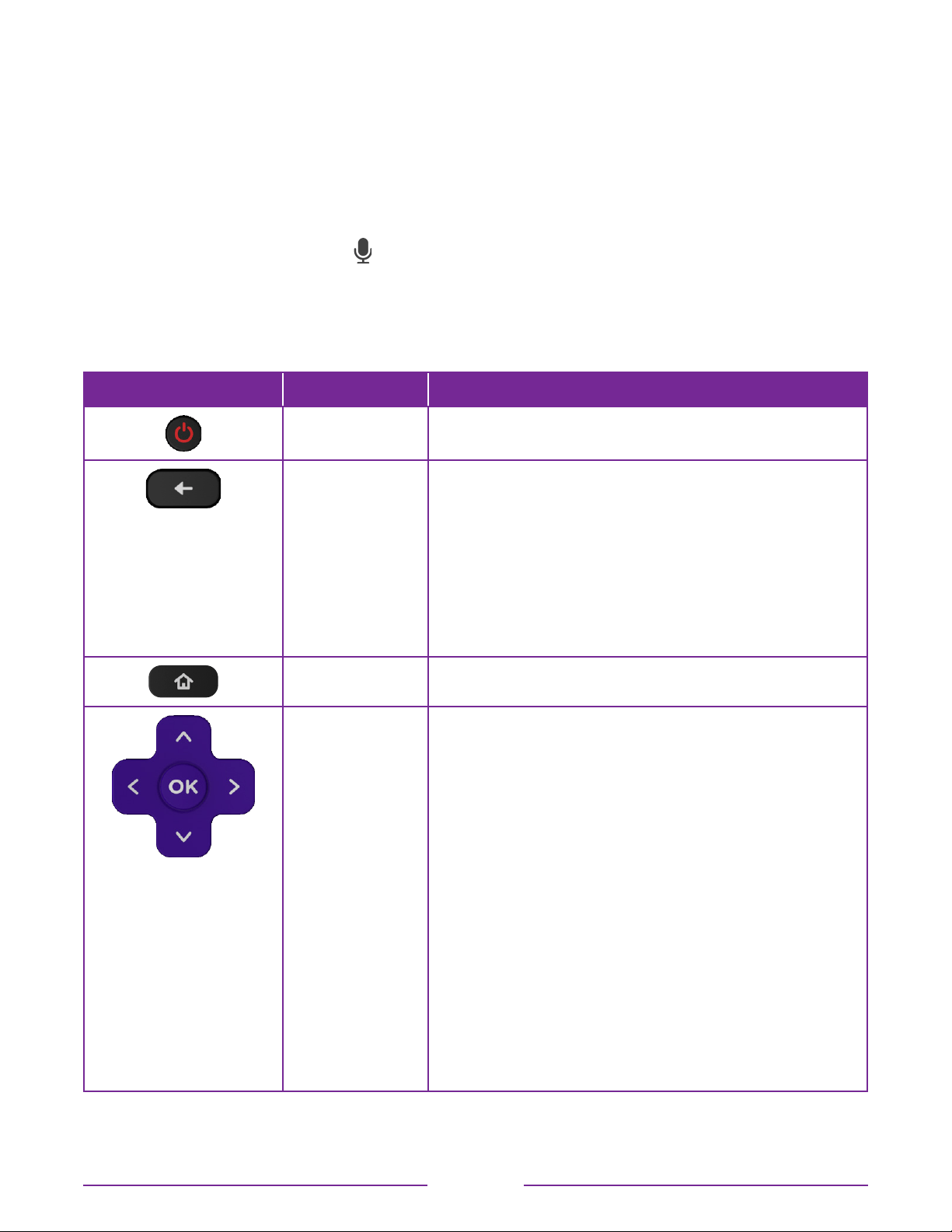
Use the following information to identify the buttons on your Roku remote.
Note: Remote buttons and features vary somewhat by model. Your remote might not have all
buttons or features listed.
•
If your remote has a VOICE just below the purple pad, you have a Roku Voice Remote.
•
If your remote has a headphone jack on its left edge, you have a Roku Enhanced Voice
Remote.
Roku voice remotes have additional capabilities as described in the following table.
BUTTON FUNCTION DESCRIPTION
POWER Turns TV on and o.
BACK
•
Menu: Goes back to previous menu/screen.
•
Home screen tile: Moves highlight back to the Home
screen option.
•
Watching live TV or a TV input: Returns to Home screen.
•
Playing streaming content: Stops playing stream and
returns to the previous menu or screen.
•
Browsing streaming content: Goes to the previous level in
the content tree.
HOME Immediately returns to the Home screen.
DIRECTIONAL
PAD
•
Moves the highlight in the corresponding direction.
•
OK chooses the highlighted option.
While watching TV:
•
UP/DOWN changes channel.
•
LEFT displays the Smart Guide (connected mode) or
channel list (non-connected mode).
•
LEFT/RIGHT TVs operating in non-connected mode:
while in the channel list switches between ALL CHANNELS
and FAVORITE CHANNELS.
•
TVs with Live TV Pause enabled: when the program is
paused, moves backward/forward approximately 10
seconds in the program buer.
•
While in the channel list, OK selects the highlighted
channel. While watching live TV: displays the program
information banner.
9
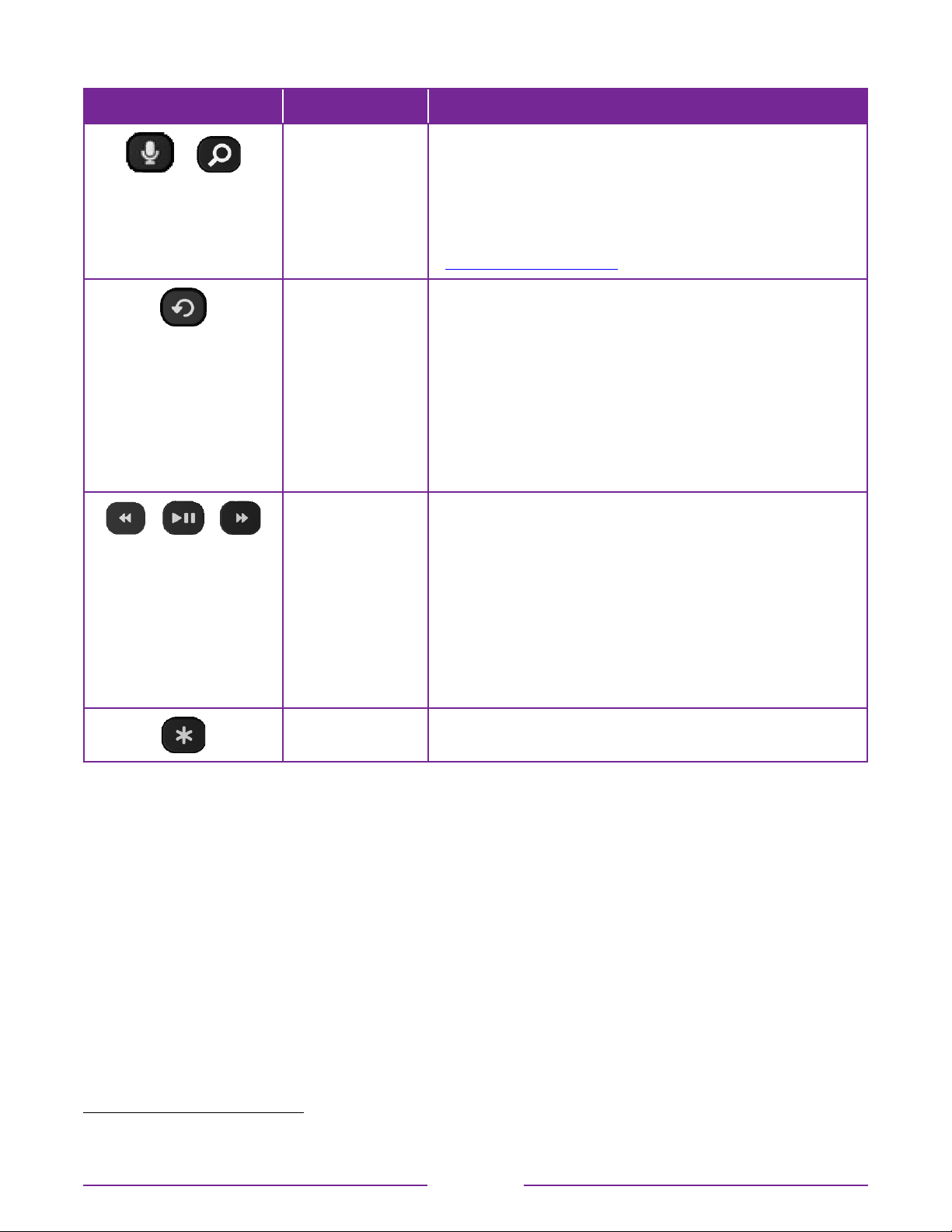
BUTTON FUNCTION DESCRIPTION
or
VOICE or SEARCH Only on select models with Roku voice remotes, hold and
say the name of a movie, TV program, actor, director, or
genre, including the special genres “free” and “4K.” Or, say a
command to start streaming, change a channel, and more
1
.
For more information, go to:
go.roku.com/voicesearch
REPLAY Select models. Streaming programs that support this feature
and TVs with Live TV Pause enabled, jumps back a few
seconds with each press and resumes playing.
If Live TV Pause is disabled, jumps to previous channel.
When using an on-screen keyboard: Backspaces in the text
you are entering.
In the Smart Guide
2
: Returns to the current day and time.
p
REWIND
o
PLAY/PAUSE
q
FAST FWD
Scan backward, pause, play, and scan forward in streaming
content and live TV channels (if Live TV Pause is enabled).
Press REWIND
p
or FAST FWD
q
one, two, or three times to
control the speed of the operation.
REWIND
p
and FAST FWD
q
also jump backward and
forward one screen at a time when viewing long lists, such as
when you are browsing programs in the channel list or Smart
Guide
2
.
STAR Displays additional options when available. On-screen hints
let you know when this button is active.
1 Voice features support English and Spanish languages when the corresponding TV language is selected
2 Smart Guide is available only in the United States.
10
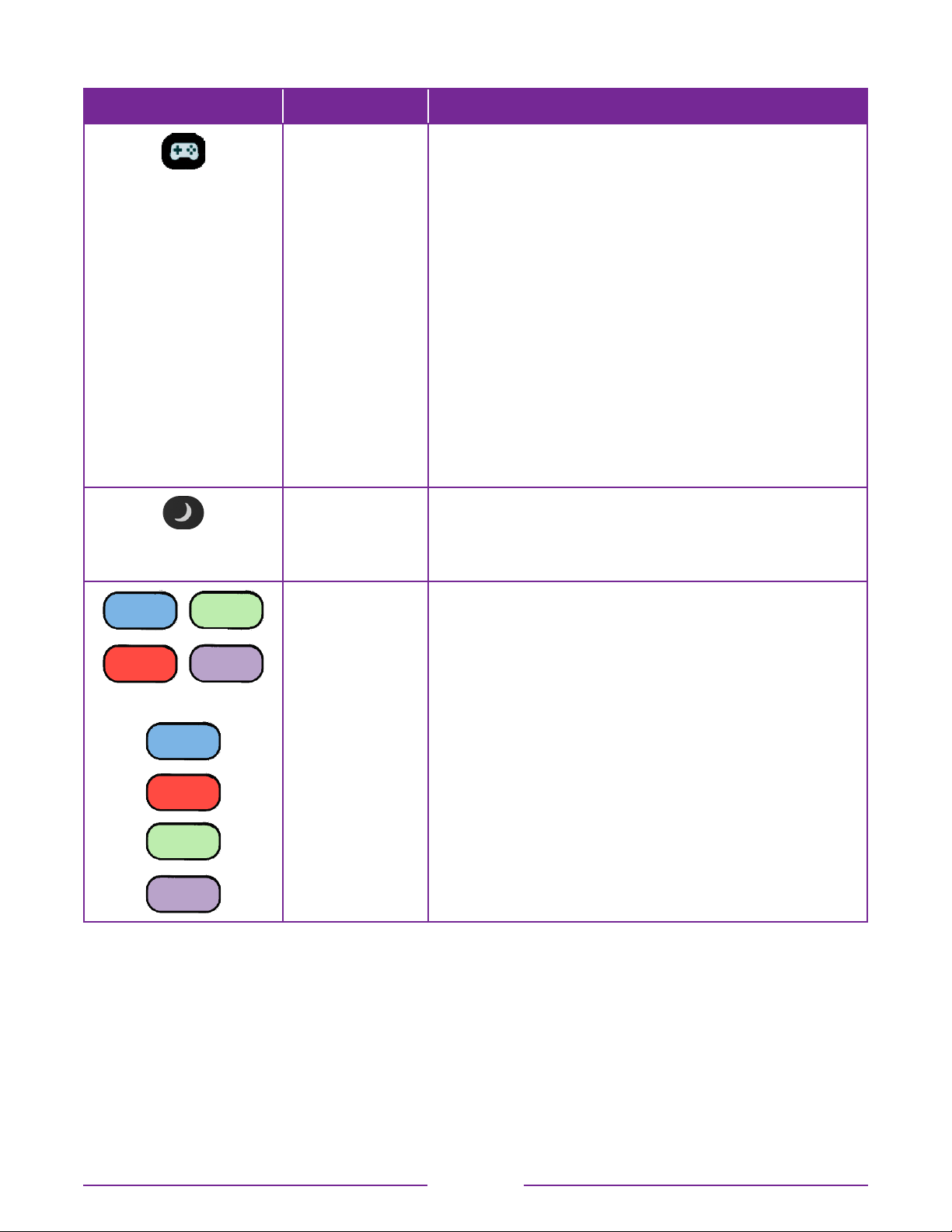
BUTTON FUNCTION DESCRIPTION
GAME MODE Only on HDMI and AV inputs on select models. Displays a
banner showing whether Game mode is on or o, or “Not
available at this time.” Subsequent presses toggle Game
mode. When On, the TV performs less image processing and
has less input lag, producing a better experience with action
games.
Select models. Auto Low Latency Mode (ALLM) detects
certain game consoles connected to an HDMI input and
automatically switches to the best settings for action games.
When ALLM is active, the manual Game mode setting is
unavailable.
Select models: Variable refresh rate (VRR) allows a
compatible game console or computer to control the refresh
rate of the TV. The result is smoother image animation with a
lower instance of stutter or tearing.
SLEEP Select models. Displays a banner showing the remaining
sleep time, if any, or “Sleep timer is o.” Subsequent presses
cycle among the preset sleep time intervals. Once set, the
sleep timer remains in eect unless you cancel it.
or
FACTORY
ASSIGNED
CHANNEL
SHORTCUT
Dedicated buttons show the logo of a preset streaming
content provider. Dedicated content providers vary by model
and region. Pressing a button:
•
Displays the streaming channel’s main page if you have
already added the channel to your Home screen.
•
Displays the streaming channel’s sign-up page if you have
not already added the channel.
11
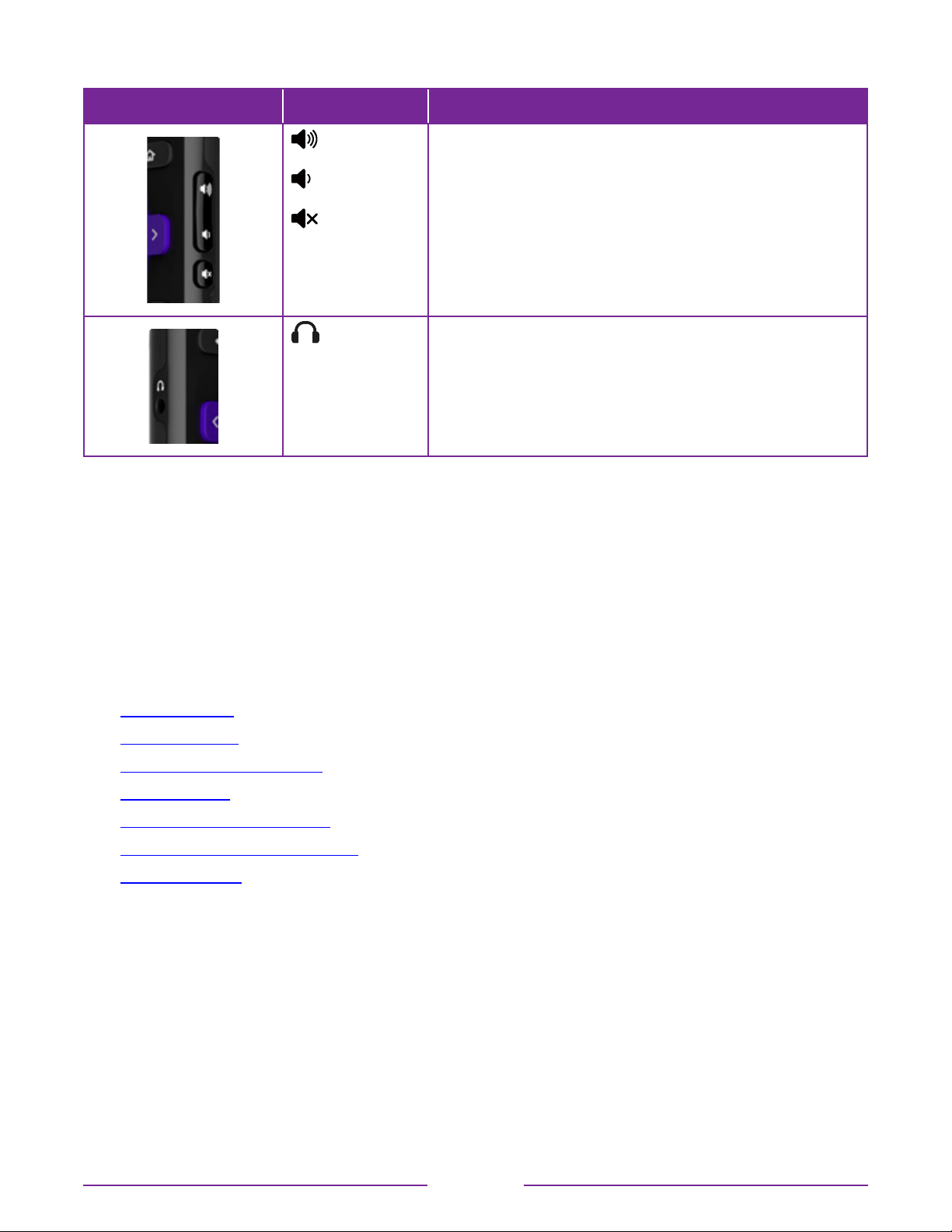
BUTTON FUNCTION DESCRIPTION
UP
DOWN
MUTE
Located on the right edge of the remote. Increases/decreases
volume and mutes the TV sound.
Note: If the TV is muted, pressing VOLUME UP unmutes.
Pressing VOLUME DOWN does not unmute the sound.
HEADPHONE Select models with Roku Enhanced Voice Remote. Connect
headphones to the jack on the left edge of the remote
to listen privately. Plugging in headphones mutes the TV
speakers.
Panel buttons
Your TV has buttons on its side, bottom, or back panel that perform simple control functions.
The TV panel buttons are not a substitute for the remote, as they do not give you access to
all TV functions.
Depending on model, your TV model has one of several dierent panel button designs.
Choose the one that applies to your TV from the following list:
•
Single button
•
Three buttons
•
Game-pad style joystick
•
Four buttons
•
Five buttons (with mute)
•
Five buttons (without mute)
•
Seven buttons
12

Single button
If your TV has this style of panel button, you can perform the following functions:
•
Turn TV on: short press.
•
Display the Input List: short press when TV is on.
•
Select the next input in the Input List: short press while the TV is showing the Input
List.
•
Dismiss the Input List without changing inputs: no press.
•
Turn TV o: long press.
Short press = less than two seconds
Long press = more than two seconds
No press = no press within two seconds
Three buttons
If your TV has this style of panel buttons, you can perform the following functions:
•
Turn TV on: middle button, short or long press.
•
Volume up: right button when Input List is not active.
•
Volume down: left button when Input List is not active.
•
Display Input List: middle button, short press when TV is on.
•
Highlight next input in the Input List: right button when Input List is active.
•
Highlight previous input in the Input List: left button when Input List is active.
•
Select highlighted item in the Input List: middle button, short press, or no press.
•
Turn TV o: middle button, long press.
Short press = less than two seconds
Long press = more than two seconds
No press = no press within four seconds
Game-pad style joystick
If your TV has this style of panel button, you can perform the following functions:
•
Press in: Toggle between power ON and Standby.
•
Press up or down: Increase/decrease the volume.
•
Press left or right: Switch inputs. Each press moves the highlight up or down one item.
Pausing for a few moments selects the highlighted item.
13

Four buttons
If your TV has this style of panel buttons, you can perform the following functions:
•
Power: Turns the power on and o.
•
Input: Selects among TV inputs. Each press moves down one item. Pausing for a few
moments selects the highlighted item.
•
Volume +: Increases the volume.
•
Volume –: Decreases the volume.
Five buttons (with mute)
If your TV has this style of panel buttons, you can perform the following functions. Note that
the order of the buttons might vary from model to model. Examine the panel button labels to
determine your TV model’s layout.
•
Power: Turns the power on and o.
•
Input: Selects among TV inputs. Each press moves down one item. Pausing for a few
moments selects the highlighted item.
•
Volume +: Increases the volume.
•
Volume –: Decreases the volume.
•
Mute: Mutes and unmutes the sound.
Five buttons (without mute)
If your TV has this style of panel buttons, you can perform the following functions. Note that
the order of the buttons might vary from model to model. Examine the panel button labels to
determine your TV model’s layout.
•
Power: Turns the power on and o.
•
Input +: Selects the next TV input. Each press moves down one item. Pausing for a few
moments selects the highlighted item.
•
Input -: Selects the previous TV input. Each press moves up one item. Pausing for a few
moments selects the highlighted item.
•
Volume +: Increases the volume.
•
Volume –: Decreases the volume.
14
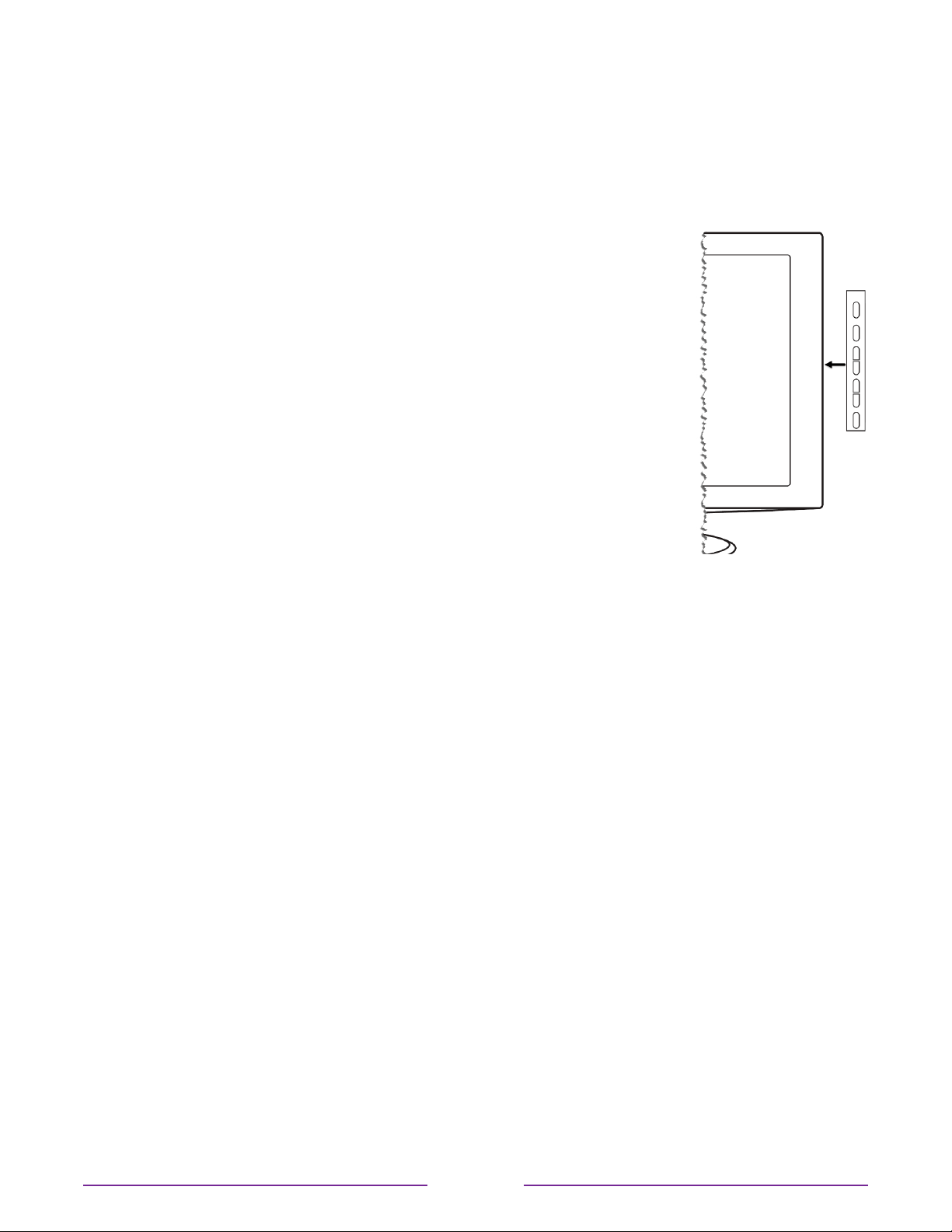
Seven buttons
If your TV has this style of panel buttons, you can perform the following functions. Note that
the order of the buttons might vary from model to model. Examine the panel button labels to
determine your TV model’s layout.
•
Input: Selects among TV inputs. Each press moves down one item.
Pressing Channel + or Channel – moves the highlight up or
down. Pausing for a few moments selects the highlighted item.
•
Channel +: Moves the highlighted item up in the current menu.
•
Channel –: Moves the highlighted item down in the current menu.
•
Volume +: Increases the volume.
•
Volume –: Decreases the volume.
•
Mute: Mutes and unmutes the sound.
•
Power: Turns the power on and o.
15

Guided Setup
With the preliminaries out of the way, it’s time to turn on your TV. As the TV starts for the first
time, it leads you through Guided Setup, which configures the TV before you start to use it.
During Guided Setup, you’ll:
•
Answer a few questions
•
Provide network connection information
•
Get a software update
•
Link your TV to your Roku account.
•
Connect devices such as a DVD player, game console, or cable box.
16
Starting Guided Setup
To start Guided Setup, press POWER on the remote to turn on your TV.
Note: Guided Setup normally runs only once, the first time you turn on your TV. If you need
to run Guided Setup again, you must perform a factory reset, as explained in Factory reset
everything.
When you first turn on your TV, it will take a few seconds to get itself ready. You’ll notice the
following things happening:
1. The status indicator blinks every time the TV is busy doing something; in this case it’s
powering up and getting ready for you.
2. The splash screen appears and the status indicator blinks slowly for a few more
seconds. The power-on screen shows a brand logo while the TV starts up.
3. After a few seconds, Guided Setup starts.
17
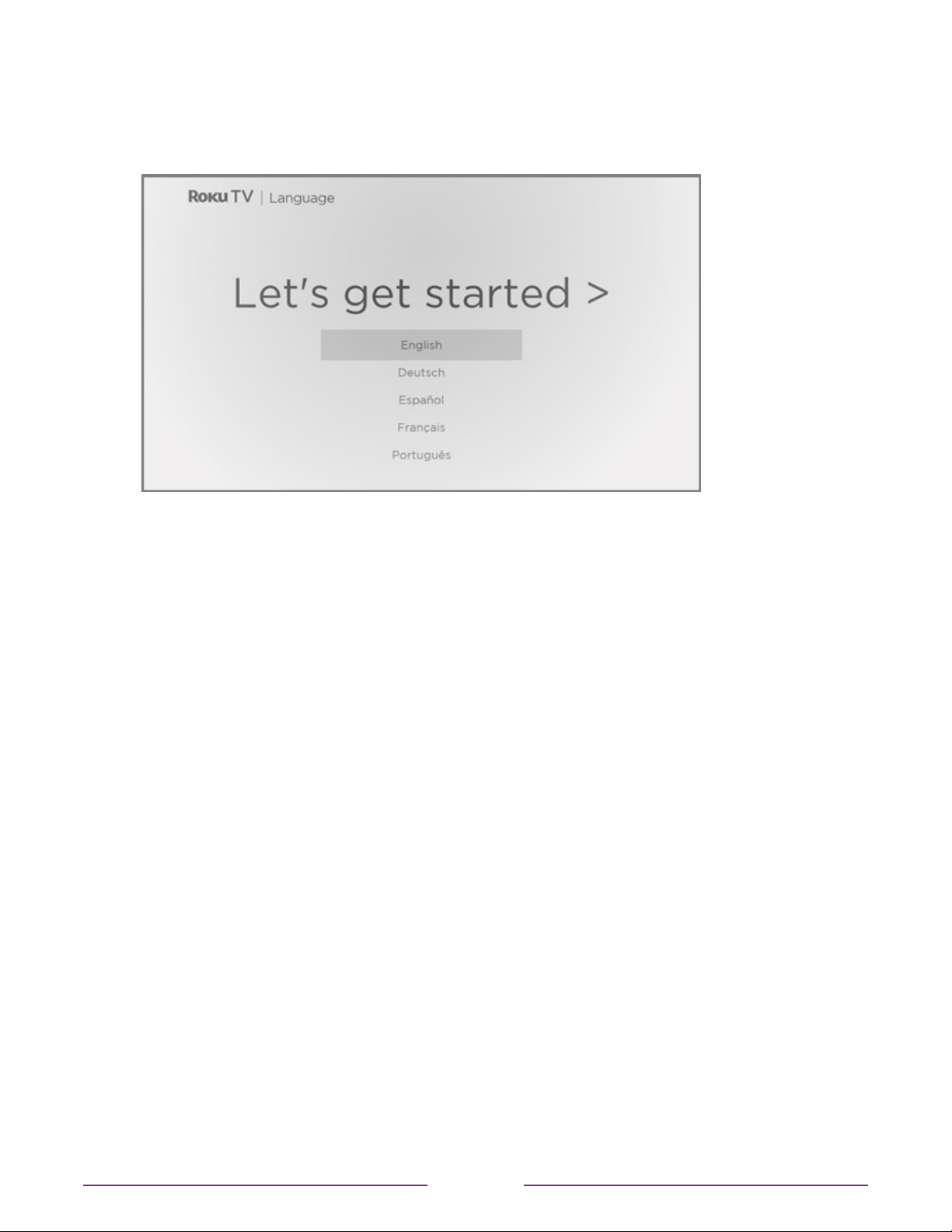
Guided Setup
At this point, you should be seeing the Language screen.
1. Only on models that have a Roku voice remote: A few moments after the Let’s get
started screen appears, Guided Setup starts the pairing process for the voice remote.
(You’ll know if you have this type of remote because it has a VOICE
D
or SEARCH
E
button just below the purple directional pad.) If the voice remote does not pair
automatically, follow the instructions on the screen to complete the pairing process.
Accessibility: If you have selected United States and English language, you can
activate Audio Guide, a text-to-speech screen reader to help those with vision
impairments to navigate the TV’s menus and commands. To enable the Audio Guide,
press STAR
four times in rapid succession. Repeat to disable Audio Guide.
(STAR
is located directly below the purple directional pad on the right side of the
Roku remote.)
If you enabled Audio Guide, choosing any language other than English disables it.
2. Press DOWN on the purple directional pad to highlight your preferred language, and
then press OK.
18
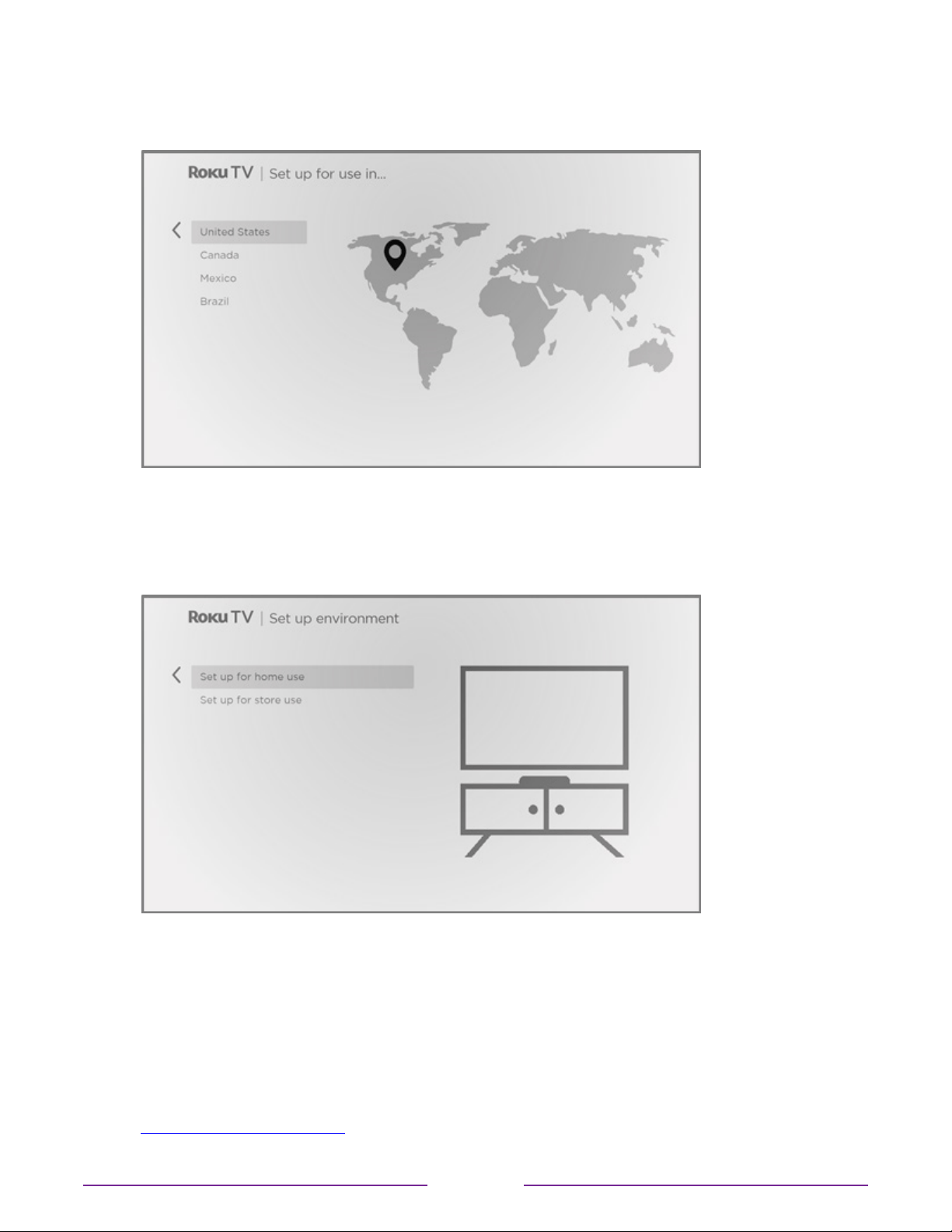
3. Some models have a country selection screen: If you don’t see this screen, skip ahead
to the next step.
If you see this screen, select your country, and then press OK.
Accessibility: If you enabled Audio Guide, choosing any country other than United
States disables it.
Note: Some models show the title First things first instead of Set up environment.
4. Press OK to select Set up for home use. This is the right choice for enjoying your TV
at home. It provides energy saving options as well as access to all features of the TV.
Note: Set up for store use configures the TV for retail display and is not recommended
for any other use. In store mode, some features of the TV are missing or limited. To
switch from one mode to the other, you have to perform a factory reset as explained in
Factory reset everything, and then repeat Guided Setup.
19
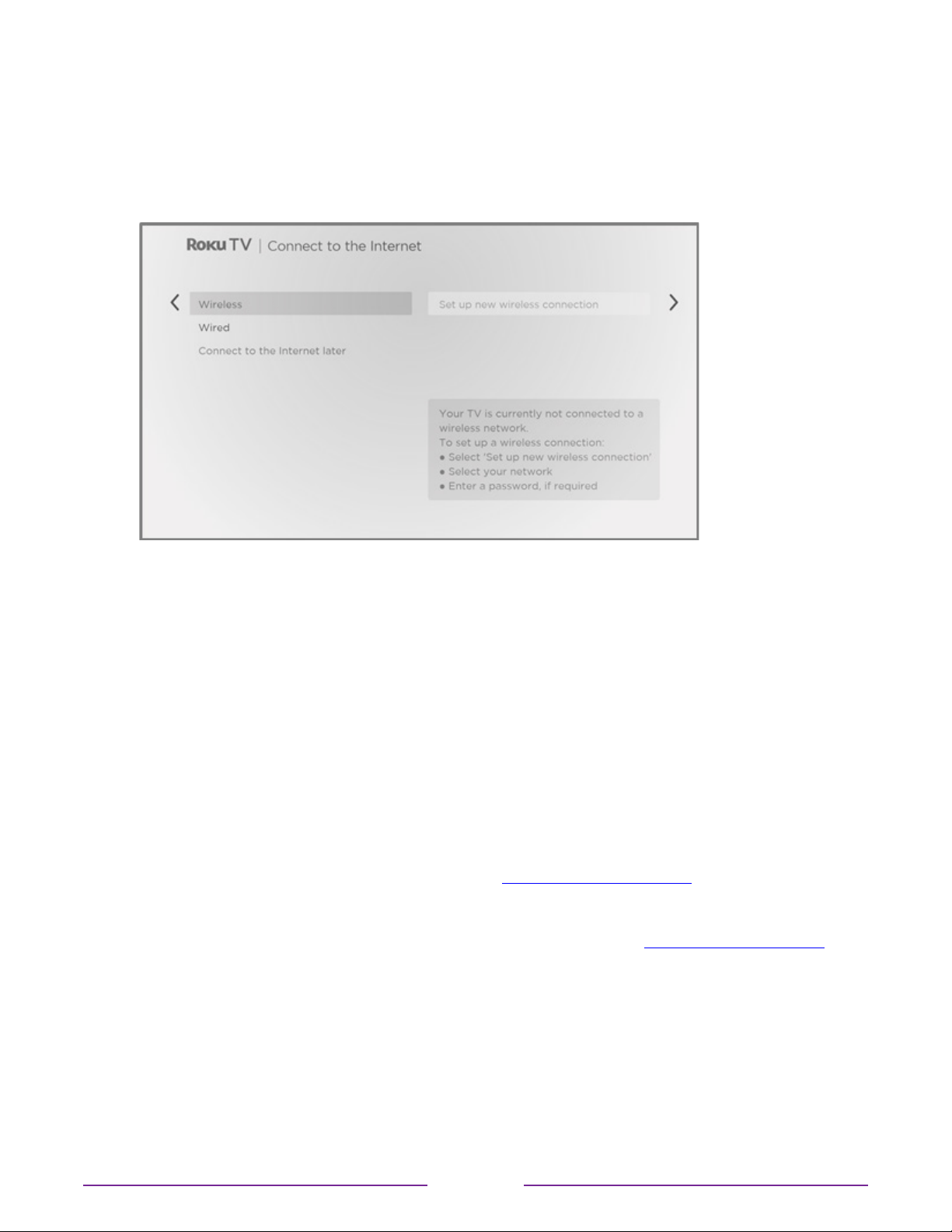
Network connection
After you select Set up for home use, the TV prompts you to make a network connection.
If your TV has both wired and wireless connections, you’ll see the following screen.
If your TV has only wireless connectivity, skip the following step.
5. Only on models that display the Connect to the Internet screen: Make a selection:
•
Wireless connection – Highlight Set up new wireless connection and press OK. The
TV prompts you through wireless setup. Skip ahead to the next step for help with
the process.
•
Wired connection – Highlight Connect to wired network and press OK. The TV
immediately attempts to connect to your wired network, your local network, and
then the Internet. Go to Step 9 to continue with Guided Setup.
•
Connect to the Internet later – If you don’t want to connect to the Internet right
now, you can select this option, and then press OK. You can still use the TV to watch
live TV channels, and connect your devices to play games, watch DVDs, or watch
channels from a cable box or another streaming device. When you’re ready to
connect, it’s easy. We’ll show you how in Benefits of connecting.
Note: If you decide not to connect, Guided Setup skips ahead to setting up the
devices that you’ve connected to your TV. Jump ahead to Connect your devices to
complete Guided Setup.
20
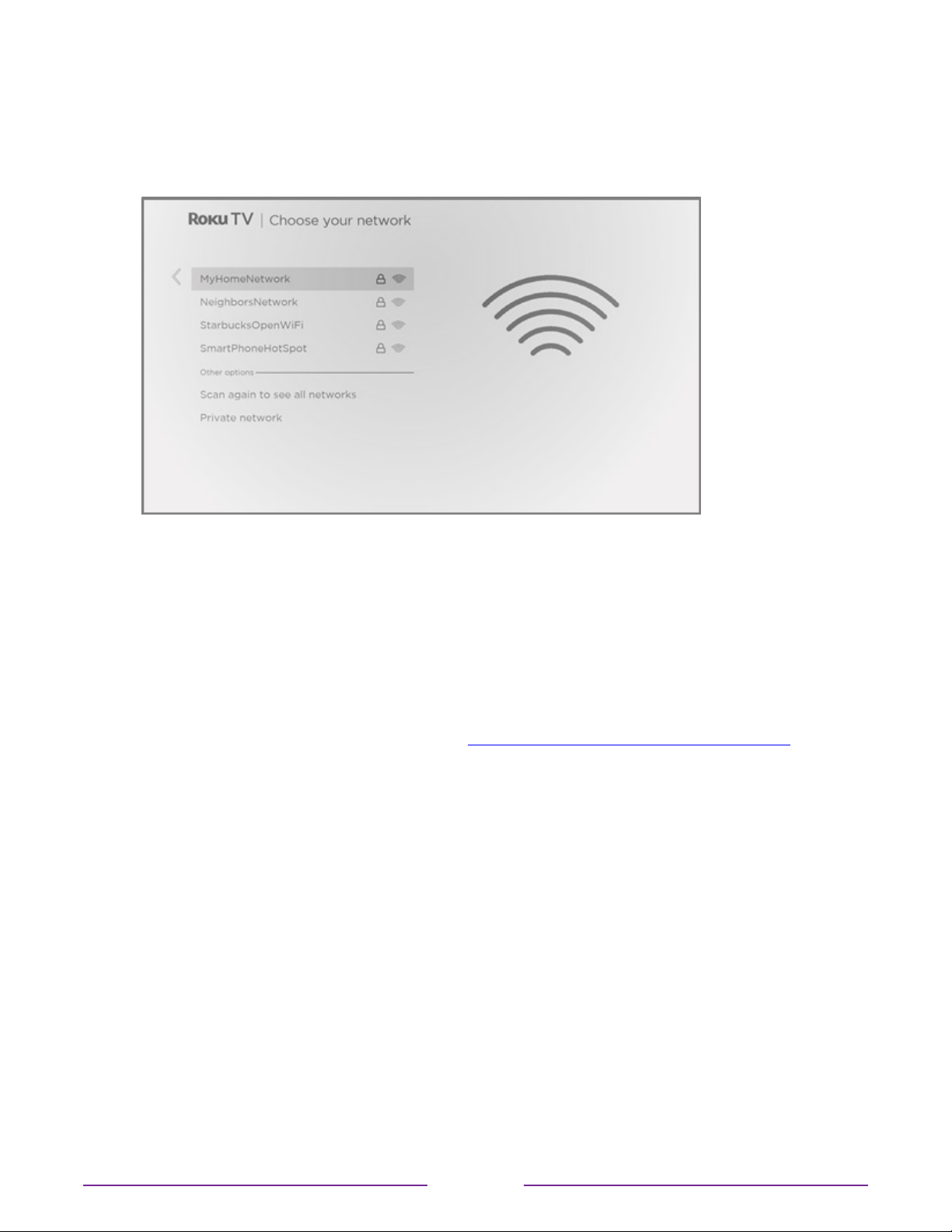
6. On models that have wireless only, and models with both wired and wireless when
you’ve selected Wireless: The TV scans for the wireless networks within range and
displays them in order, with the strongest signals first. In addition to your own wireless
signal, the TV might pick up signals from your neighbors.
Press UP or DOWN to highlight the name of your wireless network, and then press OK
to select it.
Note: Some networks, such as those often found in dorm rooms, hotels, and other
public places, require you to read and agree to terms, enter a code, or provide
identifying information before letting you connect to the Internet. If your Roku
TV detects that you are connecting to such a network, it prompts you through
the connection process using your smartphone or tablet to provide the needed
information. For more information, see Using your TV in a hotel or dorm room.
Other options
•
Scan again / Scan again to see all networks – The name of this option depends on
the number of wireless networks within range.
•
Scan again appears if the list already shows all available wireless networks within
range. If you don’t see your wireless network name in the list, you might need to
adjust the location of your wireless router or the TV, turn on your router, or make
other changes. When everything is ready, select Scan again to see if your network
name now appears in the list.
•
Scan again to see all networks appears if there are more wireless networks than
the strongest ones it initially listed. If you don’t see your wireless network name
in the list, this option displays the complete list. If you still don’t see your network
name, you might have your router configured to provide wireless service as a
“private network.”
21
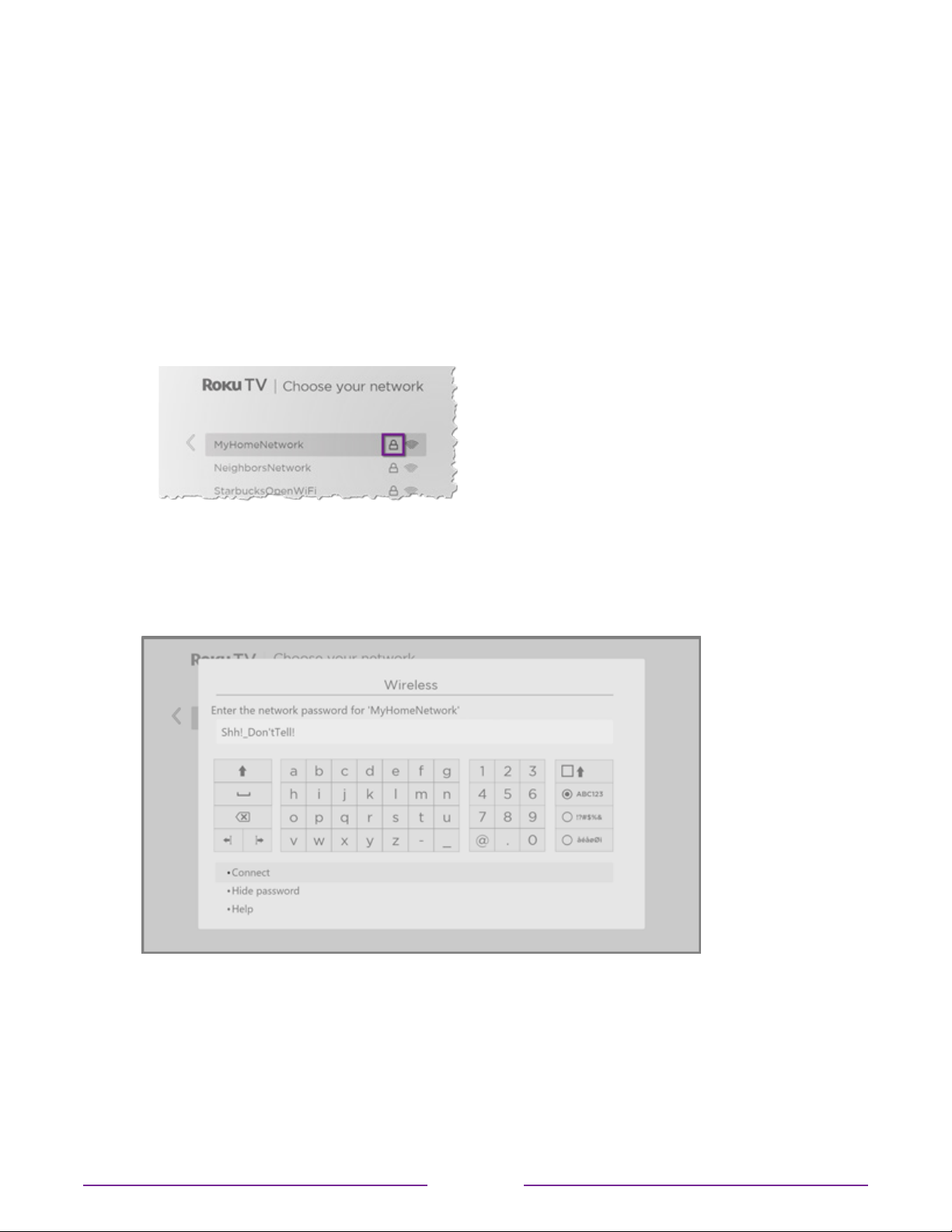
Note: Highlighting either of these options displays an informational panel with the
unique media access control (MAC) address of your Roku TV. You will need the
MAC address if your wireless router is configured to use MAC address filtering.
•
Private network – If your wireless network name is hidden, it won’t appear in the
list. Select Private network and then press OK to display an on-screen keyboard.
Use the keyboard to enter your network name. Unless you changed the factory-set
network name, you can find the name (also called SSID) on a label on the router.
Tip: Wireless networks that are password-protected display a “padlock” icon
adjacent to the name. This icon enables you to know that you are going to be
prompted to enter a password after you select that network.
7. Only if you select a password protected wireless network: An on-screen keyboard
appears. Enter your wireless network password by using the purple directional pad
to navigate the keyboard, and pressing OK to select a highlighted letter, number, or
symbol. When you finish, press DOWN to select Connect, and then press OK.
After you select Connect, the TV displays progress messages as it connects to your
wireless network, your local network, and the Internet.
22
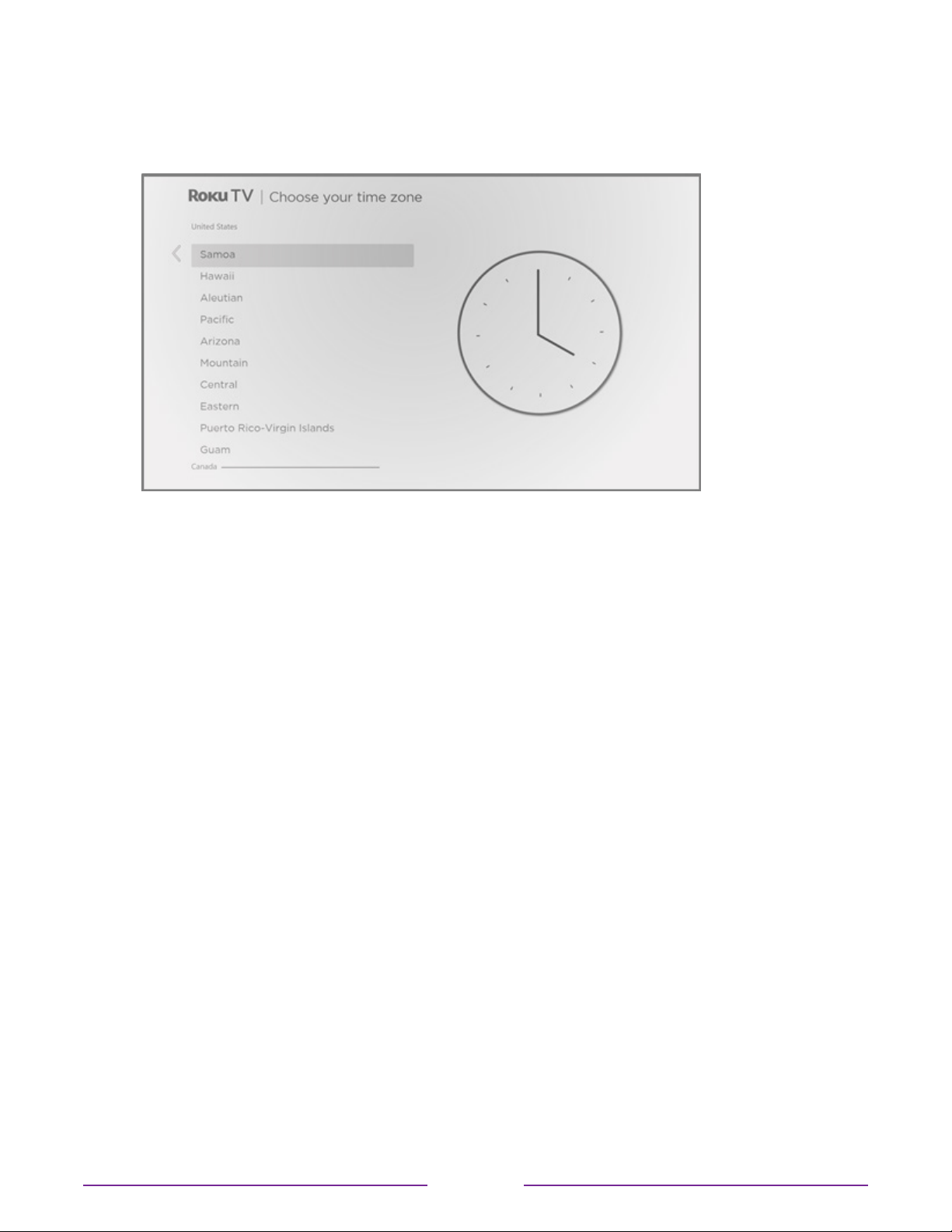
8. Only if your TV cannot get the correct time zone and current time from your network
service provider: The Choose your time zone screen appears. Press UP or DOWN to
highlight your time zone, and then press OK.
Tips: Your TV needs to know the local time zone so that it can correctly display
information about the program you are currently watching.
Your TV automatically checks for updates periodically. These updates provide new
features and improve your overall experience with the TV. After an update, you might
notice that some options have moved, and that there are new options or features. This
User Guide describes version 9.3. To determine your current Roku TV software version,
go to Settings > System > About after you complete Guided Setup. You can download
an updated User Guide that matches your Roku TV software version from the Roku TV
web site.
23

Activation
After the TV restarts, it prompts you through activation.
9. Use a computer, tablet, or smartphone with an Internet connection to link to a new or
existing Roku account.
Note: Roku does not charge for activation support – beware of scams.
Why do I need a Roku account?
You need a Roku account for several reasons:
•
It links you, your Roku TV, and your other Roku streaming devices to the Roku Channel
Store and billing service.
•
Streaming content providers know that it’s OK to send content you request to your Roku
TV.
•
Roku can automatically send updates to your device.
You need a Roku account to activate your device and access entertainment across thousands
of streaming channels. Linking to a Roku account also activates several advanced features on
your TV, such as Guest Mode, the Roku mobile app, and Live TV Pause, to name just a few.
Roku accounts are free, and while a valid credit card number is not required to create your
account, providing your credit card information makes renting, purchasing, and subscribing to
entertainment from the Roku Channel Store fast and convenient.
24
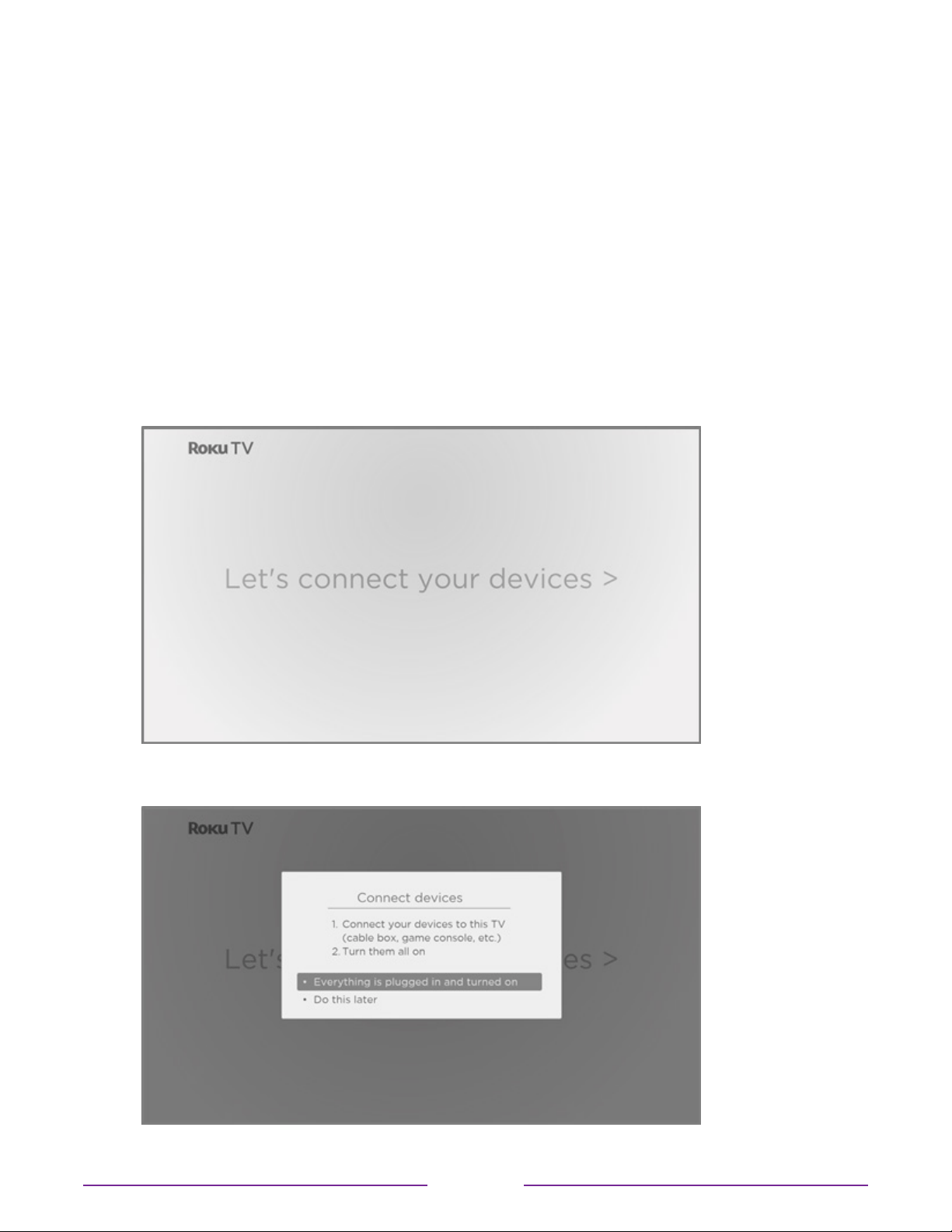
After you activate your TV, the TV gets an acknowledgement, and then adds your
newly-selected and pre-existing streaming channels from other Roku devices on the
same account. This process is automatic and takes a few moments—a little longer if
you have added a lot of streaming channels.
Tip: Streaming channels from all of the Roku streaming devices associated with your
account are synchronized periodically. All of your Roku streaming devices therefore
display the same set of channels (subject to compatibility with the device).
Connect your devices
Next, Guided Setup helps you set up the external devices that you want to use with it,
such as a cable box, Blu-ray™ player, or game console.
10. Press OK to proceed:
25
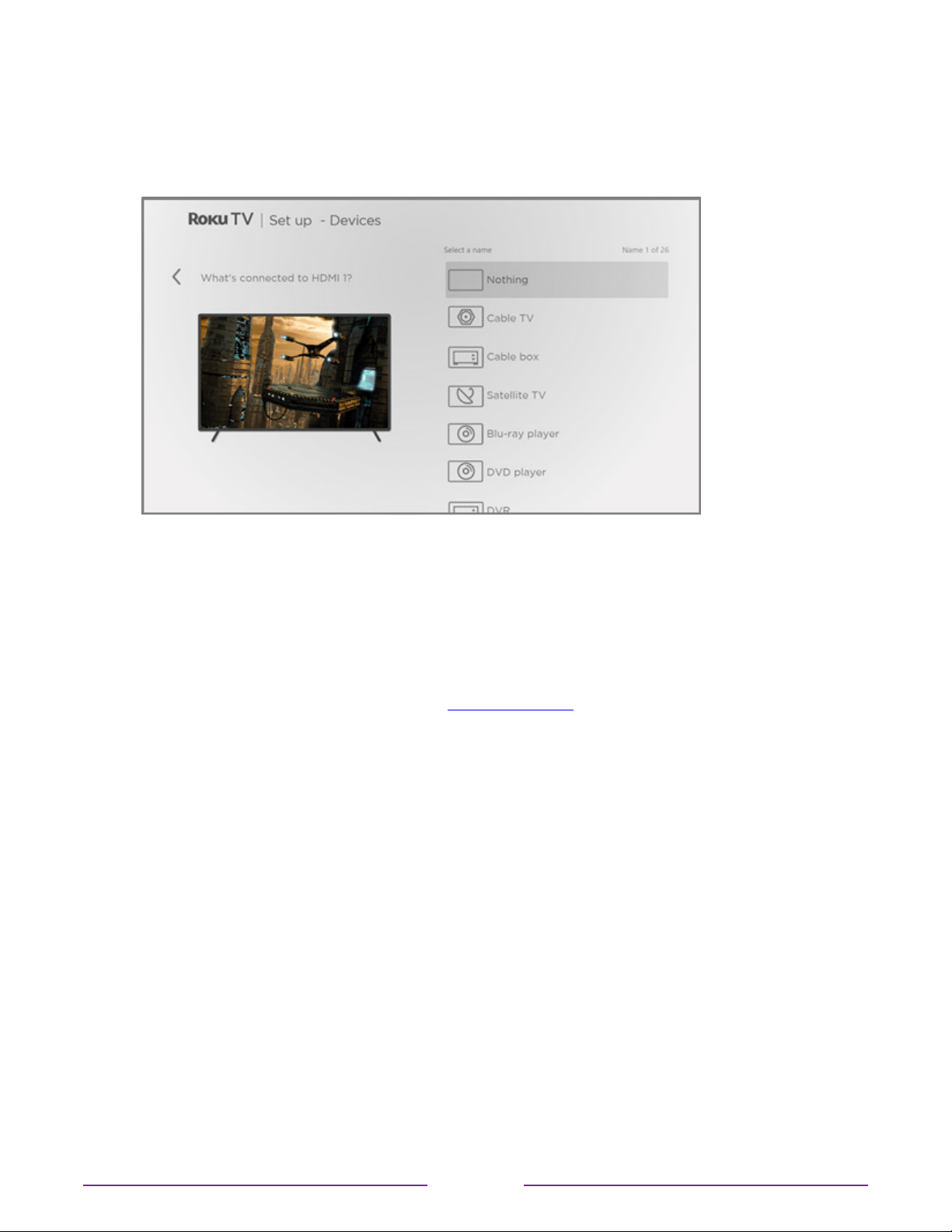
11. Connect all the devices you plan to use with your TV, turn them all on, and then select
Everythingispluggedin and turned on. The TV now takes you step by step through
each of its inputs and asks what kind of device you have connected. For each input
that has a connected and active device, you can see its picture and hear its sound.
12. Press UP or DOWN to highlight the label you want to associate with the input, and
then press OK. If you are not using the input, select Nothing, and the input won’t
appear on the Home screen.
13. While setting up your devices, rather than using the predefined names and icons, you
can set a custom name and icon. To do so, scroll up or down to highlight Set custom
name & icon, and then press OK. Follow the instructions on the screen to enter a name
and select an icon for the input. See Rename inputs for more information.
Note: If you specify a custom name for an input, voice commands will not reliably
switch to that input. Voice commands typically can only switch among inputs that use
built-in names, such as “AV,” and “Cable Box,” and “DVR.”
14. Repeat the previous step for each input.
You’re done with Guided Setup.
26
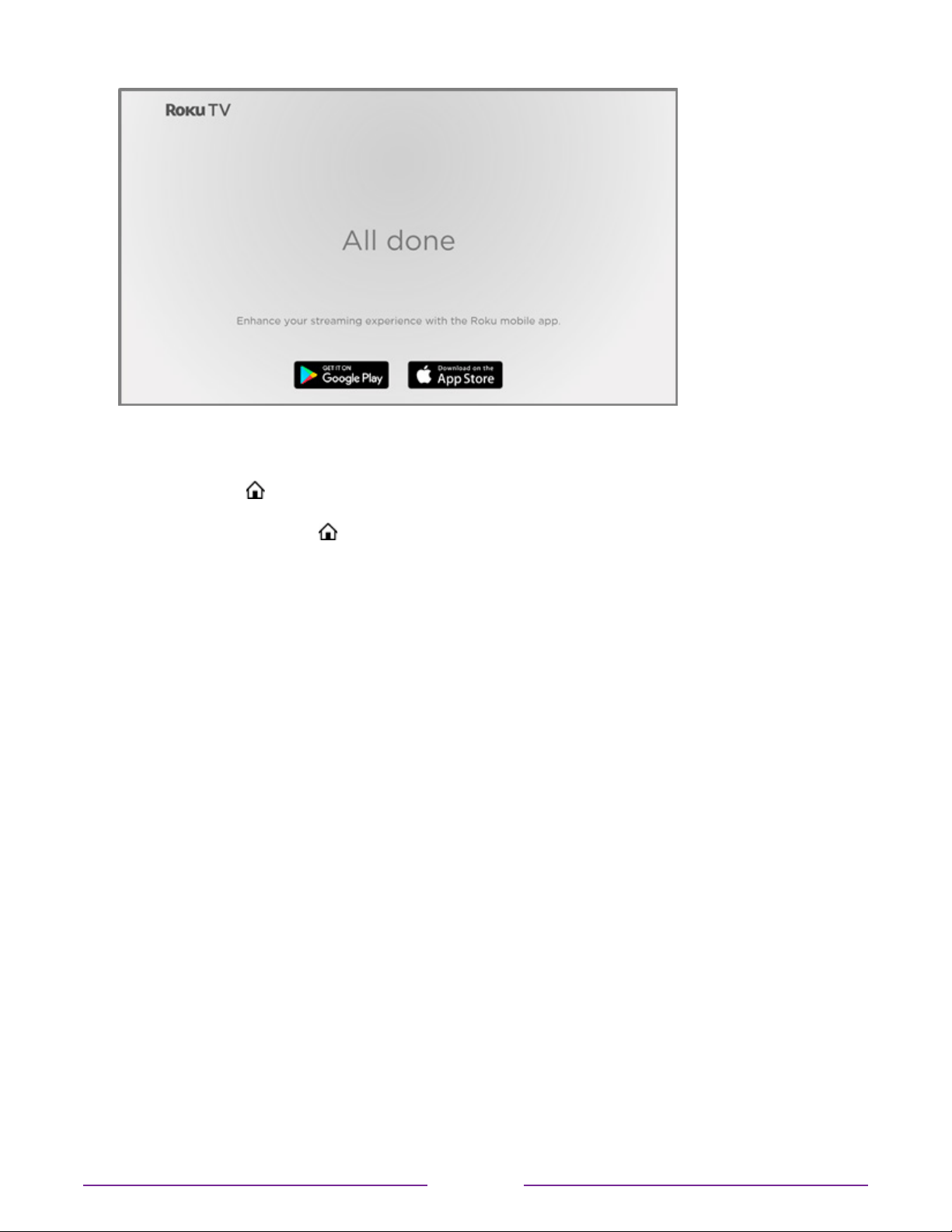
Note: Some Roku TVs, depending on where you live and other factors, show you an
introductory video filled with some great hints and tips. If you’re not interested in viewing this
video, press HOME
on the remote to go to the Roku TV Home screen.
Whenever you press HOME
the Home screen greets you.
From here, you can explore everything your TV has to oer. Use the purple directional pad
to move around, and then press OK to select a highlighted item. We’ve designed the TV
to encourage you to explore, and you can probably figure out most of the capabilities and
settings on your own. If you have any questions or diculties, you can find answers and
solutions in this guide.
27
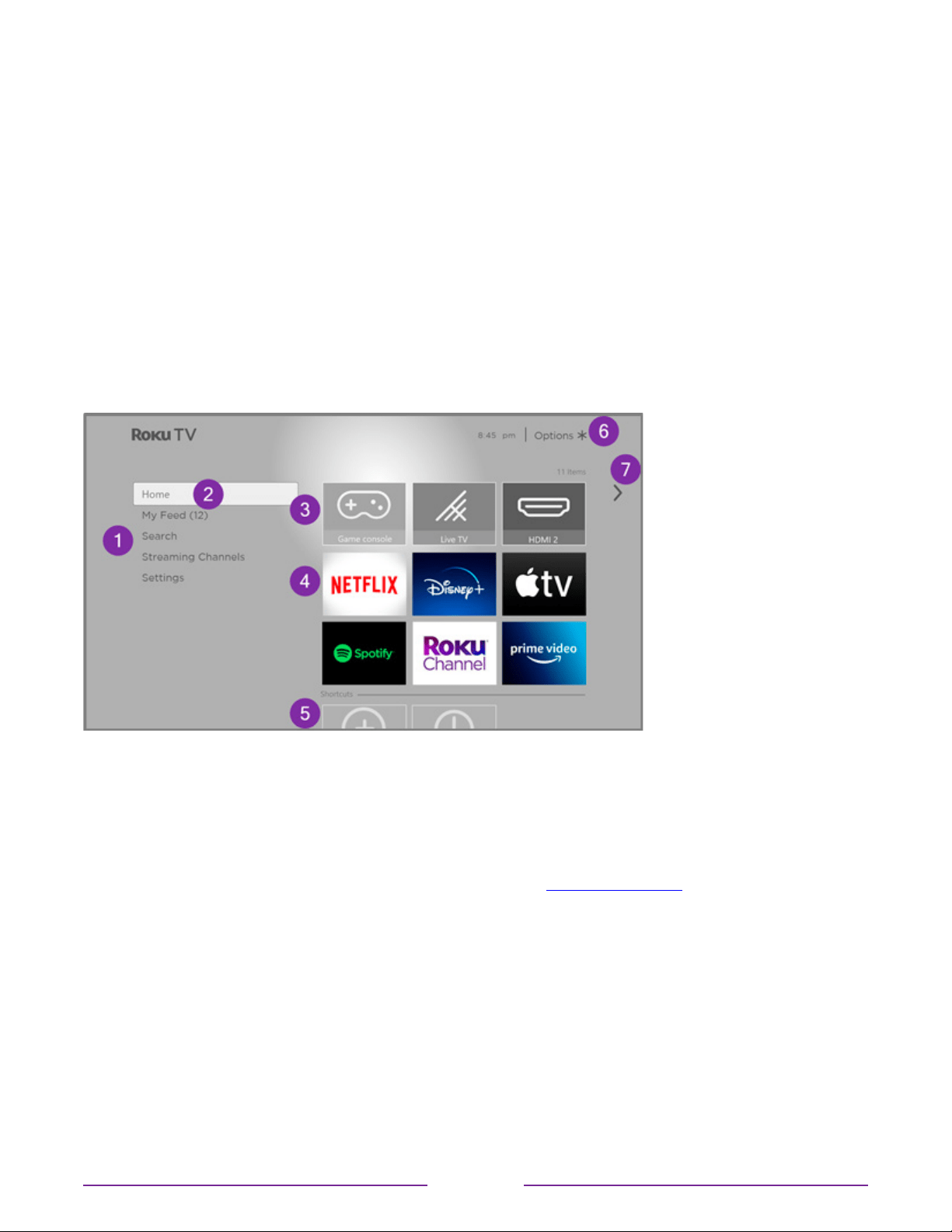
The Home screen
The following illustrations show typical Home screens, which vary depending on location,
connected mode, selected theme, number of TV inputs enabled, and streaming channels and
apps added.
Note: A paid subscription or other payments may be required for some channel content.
Channel availability is subject to change and varies by country. Not all content is available in
countries or regions where Roku® products are sold.
Typical connected Home screen
1. Home screen menu—shows options available to you when you are on the Home screen.
2. Highlighted option—press OK to select.
3. TV input tiles—select an input to watch the connected device.
4. Streaming channel and app tiles—select a tile and press OK to go to the indicated streaming channel or
application. You can add any number of channels from the Roku Channel Store.
5. Direct access tiles – shortcuts to often used features.
6. Options hint—press STAR
to see options when this symbol is present.
7. Next screen hint—press RIGHT to see the next screen.
28
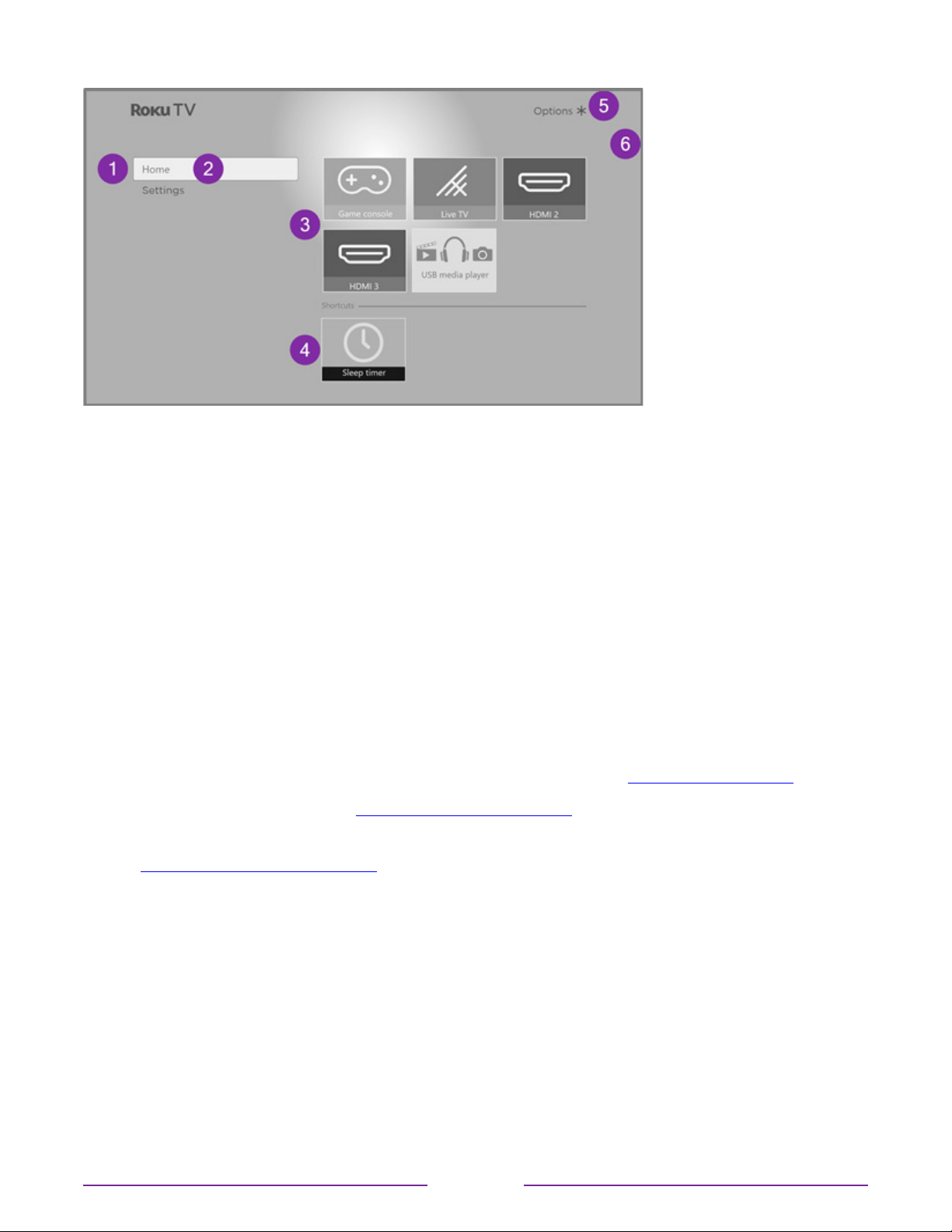
Typical non-connected Home screen
1. Home screen menu—shows options available to you when you are on the Home screen.
2. Highlighted option—press OK to select.
3. TV input tiles—select an input and press OK to watch the connected device.
4. Direct access tiles – shortcuts to often used features.
5. Options hint—press STAR
for options when this symbol is present.
6. Next screen hint—press RIGHT to see the next screen.
Personalize your Home screen
There are many things you can do to personalize your Home screen and make it just right for
you and your family:
•
Only in connected mode: Add streaming channels by using the Streaming Channels
menu option or the Add Channels shortcut to browse the Roku Channel Store.
•
Only in connected mode: Change the screen theme by going to Settings > Themes to
find and pick one to suit your mood.
•
Customize the Home screen. Hide or show the shortcut tiles that appear at the bottom
of your Home screen grid. Only in connected mode in the United States, hide Featured
Free or hide Movie Store and TV Store.
•
Remove a tile by highlighting it and pressing STAR . Then highlight Remove input or
Remove channel and press OK.
•
Move a tile by highlighting it and pressing STAR
. Then highlight Move input or Move
channel and press OK. Use the purple directional pad to move the tile, and then press
OK to lock it in its new location. Move the shortcut tiles within the shortcut area only.
Shortcuts are designed to always appear at the very bottom of the grid, so you can
access them quickly by pressing UP once when you’re at the top of the grid
29

•
Rename a TV input tile by highlighting it and pressing STAR
. Then highlight Rename
input and press OK. Highlight a new name in the list, and then press OK to assign that
name to the tile.
Rather than using the predefined names and icons, you can set a custom name and
icon. To do so, scroll up or down to highlight Set custom name & icon, and then press
OK. Follow the instructions on the screen to enter a name and select an icon for the
input.
Note: If you specify a custom name for an input, voice commands will not reliably
switch to that input. Voice commands typically can only switch among inputs that use
built-in names, such as “AV,” and “Cable Box,” and “DVR.”
30

Benefits of connecting
Connecting brings out your TV’s full potential!
Make any night a movie night
Thousands of movies to choose from, across all major streaming movie channels
1
.
You’ll never
run out of something new to watch.
Check out The Roku Channel
Use The Roku Channel as your new home page for a huge assortment of free on-demand and
streaming movies, programs, live news, and kid’s TV. Only in the United States, add premium
subscriptions to watch many of your favorite channels in one place, and manage them all
through your Roku account. Use the live TV Channel Guide to see what’s on live streaming
channels right now.
Get in the groove
Stream endless hours of music from free and subscription-based channels. With almost
instant access to thousands of music artists, your favorite beats are just as close as your
remote.
Explore your passions
In addition to the most popular streaming channels, your Roku TV also oers hundreds of
other streaming channels to fuel your passions—including fitness, cooking, religion, outdoors,
international programming and much more.
1 A paid subscription or other payments may be required for some channels. Channel availability is subject to
change and varies by country. Not all content is available in countries or regions where Roku® products are sold.
31

Enjoy FREE trials of popular channels
Your Roku TV comes loaded with special oers, including free trials (if eligible) from popular
streaming channels. REMEMBER THAT YOU MUST CANCEL BEFORE THE FREE TRIAL ENDS
TO AVOID SUBSCRIPTION FEES.
Take advantage of awesome features
Powerful, voice-enabled search lets you use voice commands to find movies and TV
programs by title, actor, director, or genre across multiple streaming channels
1
. Additionally,
your search commands can include popular movie quotes, and words like “free” and “4K.” In
addition to streaming channels, your search results include live TV programs airing in your
region.
Automatic account linking keeps track of supported streaming subscriptions on other Roku
devices, so that you won’t have to re-enter your user name and password when adding the
same channel on your newly-activated Roku TV.
2
Smart Guide, only in the United States, is an electronic program guide that is available any
time you are watching live broadcast programs and live streaming programs on The Roku
Channel. You can scroll up and down to see your channels. If you highlight a program that
has a purple asterisk (
), you can press STAR
to see More Ways to Watch. And you can
make your recently-watched channels easier to find by grouping them together in the Smart
Guide.
More Ways to Watch, only in the United States, gives you recommendations about the
program you are watching on the Live TV, HDMI, or AV input, gives you options to stream the
current program from the beginning, the entire season, or the entire series, and recommends
other programs with similar themes. It also uses the shows you watch to display ads that are
more relevant to you.
1 Voice features support English and Spanish languages.
2 Not all streaming channels currently support automatic account linking.
32

Roku Zones, only in the United States, organize your search results into browsable rows, such
as New Release, Free, and Rent or Buy, so you can see at a glance how a program is oered.
If you have a 4K Roku TV, results also include a 4K Spotlight Zone.
4K Spotlight Channel, only in the United States, now has a new look and simpler navigation
to help you find 4K entertainment quickly. Launching the channel takes you to the 4K
Movies and TV Zone, where you’ll find a regularly updated, hand-curated selection of 4K
entertainment from channels across the Roku platform. You can browse a wide variety of
4K titles across a number of categories such as Most Popular, Action, and more, to find the
perfect movie or program to enjoy in beautiful 4K resolution.
Live TV Pause lets you connect a USB drive (not provided) and pause live TV for up to 90
minutes. After pausing, you can play, fast-forward, rewind, and pause again to any
point within the rolling 90-minute window.
Voice commands with multiple device support let you use your Roku Voice Remote, Roku
Enhanced Voice Remote, Google Assistant, Amazon Alexa, or the Roku mobile app to change
stations, TV inputs, launch streaming channels, and more. Include a location in your command
such as “in the bedroom” to specify which Roku device you want to control.
Tips & Tricks channel, only in the United States, is packed with videos created by Roku to
help you learn more about features, new products, and popular support topics.
My Oers, only in the United States, show up in the Home screen menu if you are eligible for
special oers or discounts on Roku products.
Mobile Private Listening on the Roku mobile app lets you listen to streaming programs and
live TV programs on headphones (not provided) plugged into your IOS® or Android™ mobile
device.
33

What is streaming?
Streaming is viewing or listening to video or audio content that is sent over the Internet, or
located on a network-connected media server or on a USB device plugged into the TV’s USB
port.
With streaming, you can buy or rent most programs on demand, when it’s convenient for you,
and you can also watch live streaming channels and events. Also, you can play, pause, rewind,
and fast forward most on-demand streaming programs.
Tip: Some content cannot be paused or skipped. For example, if you are viewing live
programming or a program that is supported by ads, you might not be allowed to skip the ads.
Your Roku TV lets you choose from thousands of streaming channels that oer a huge
selection of entertainment:
•
Thousands of movies and TV episodes, both live and on-demand
•
Unlimited music, live and on-demand
•
Tons of live and on-demand sports
•
Commercial-free programming for kids and family
•
International programming in 22 languages
•
24x7 news and in-depth news commentary
Many streaming channels are free. Some streaming channels let you purchase or rent the
latest movie releases or popular TV series. Some channels charge a monthly subscription
fee and others are available at no additional cost if you subscribe to a companion service
through your cable or satellite provider.
If you have an existing subscription to a streaming provider, you can just sign in with your
existing user name and password.
To play streaming content, add one or more streaming channels to your Home screen. Use
the Add Channels shortcut on the Home screen or the Streaming Channels option on the
Home screen menu to go to the Channel Store, and then select the streaming channel you
want to add. The channel remains on your Home screen unless you remove it, and you can
watch it at any time.
For more information on using the Roku Channel Store feature, see Using the Roku Channel
Store.
Note: A paid subscription or other payments may be required for some channels. Channel
availability is subject to change and varies by country. Not all content is available in countries
or regions where Roku® products are sold.
34

What if I didn’t connect my TV?
What if you went through Guided Setup and chose Connect to the Internet later? No
worries. Your Roku TV makes it easy to connect whenever you want. As you move around
the Home screen, you’ll see several places where you can start the connection process. For
example:
•
Now and then you’ll see a message appear on the panel to the right of the Home screen
oering a Connect Now option. You can highlight and select the Connect Now option to
get started.
•
Use the Connect and activate now option. From the Home screen menu, select Settings,
then Network, and then Connect and activate now.
•
If you want to start over from the beginning, do a Factory reset, and then go through
Guided Setup again. This time, select your home network when prompted.
35

Setting up live TV
In addition to the other entertainment possibilities of your Roku TV, you might want to
watch broadcast channels from an antenna or cable TV service connected to the ANT input.
On your Roku TV, you can watch broadcast TV in much the same way you watch other
entertainment choices: select the LiveTV tile from the Home screen.
The first time you select the LiveTV tile, you have to set up the TV tuner. Setting up the TV
tuner scans for active channels and adds them to your Live TV channel list.
Why do I have to set up the TV tuner?
Not everyone needs to use the TV tuner. For example, you might have a set top box provided by a
cable or satellite company that receives all of your channels. Most of these set top boxes use an HDMI®
connection.
More and more people are watching only streaming TV and do not have a TV antenna or cable/satellite
service. If you don’t need the TV tuner, you can bypass setting it up and instead remove it from the
Home screen as explained in Remove unwanted tiles.
When you set up live TV, the TV scans the signals on its antenna input for channels with a good signal,
and adds those to the channel list, skipping dead channels and channels with a very weak signal.
The TV lets you add two analog channels, even if they have no signal, for the purpose of using an older
set top box, VCR, or game console that can only output a signal on analog channel 3 or 4. Typically,
you’ll only need one of these channels, but both are provided to make setup simpler. You can hide the
one you don’t want as explained in Edit live TV channel lineup.
36
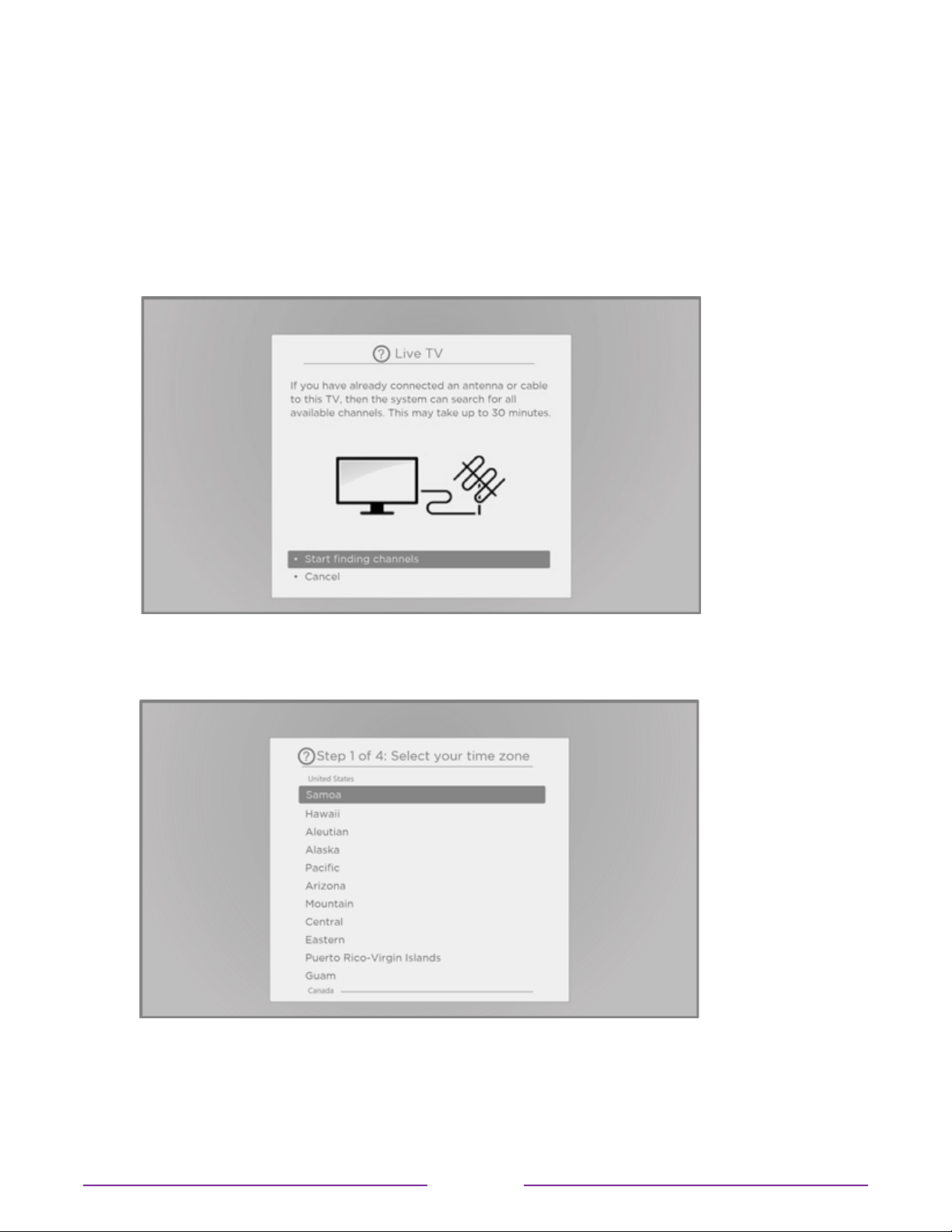
How do I set up the TV tuner?
1. Make sure your antenna (not provided) or TV cable is connected to the TV’s ANT/
CABLE input.
2. On the Home screen, select the Live TV tile. If it is not on your Home screen, go to
Settings>TVInputs to add it.
3. Read the simple on-screen instructions, and then select Start finding channels.
4. If prompted, select your time zone. You’ll only need to do this if the TV can’t figure out
your time zone from your Internet connection.
37
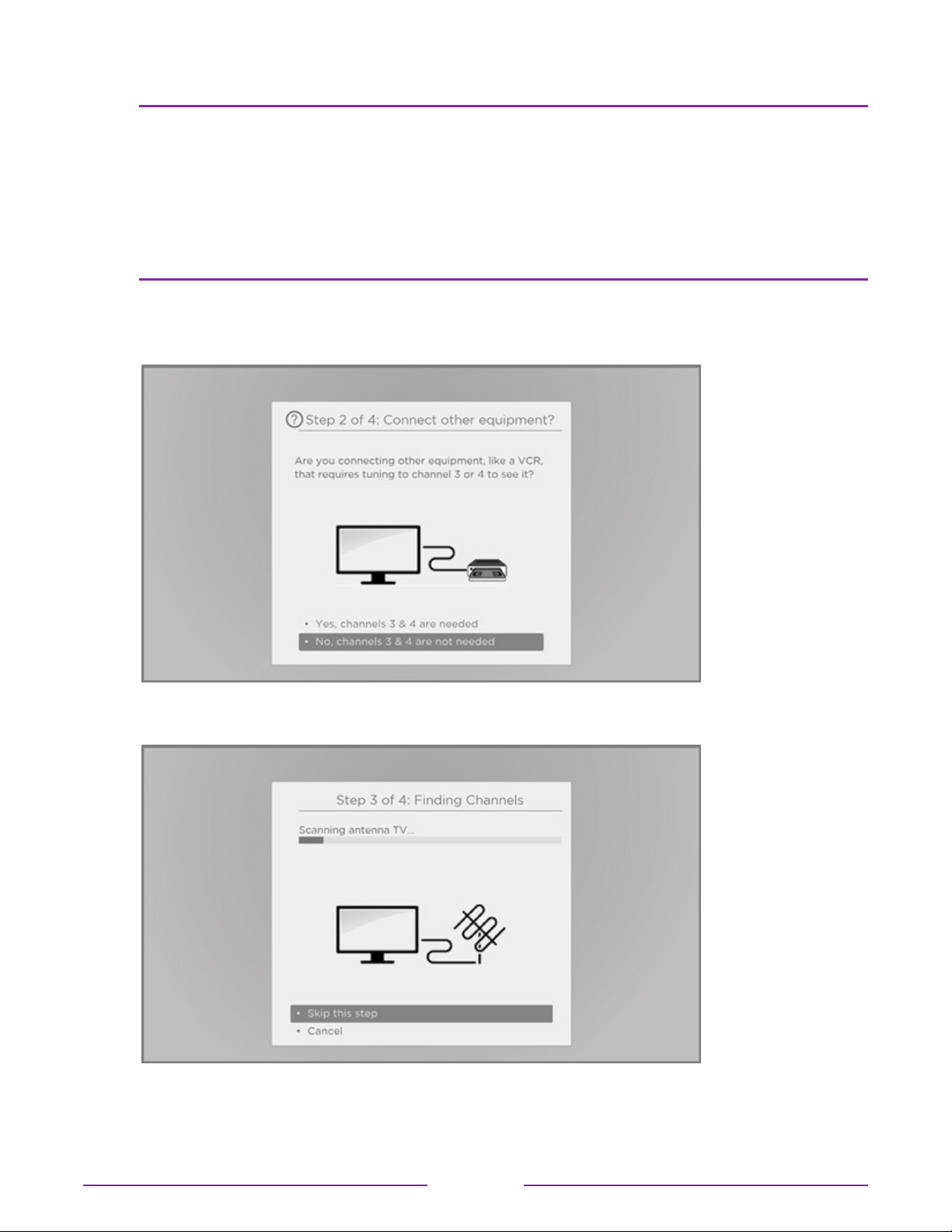
Why does the TV need my time zone?
The TV needs to know your time zone so that it can correctly display time information about
the program you are currently watching. In most cases, it can get the time zone automatically
and skips this step.
5. When prompted, select whether to add analog channels 3 and 4. These channels
enable you to connect older set top boxes, VCRs, or game consoles.
6. Wait while your TV scans for live TV stations…
38
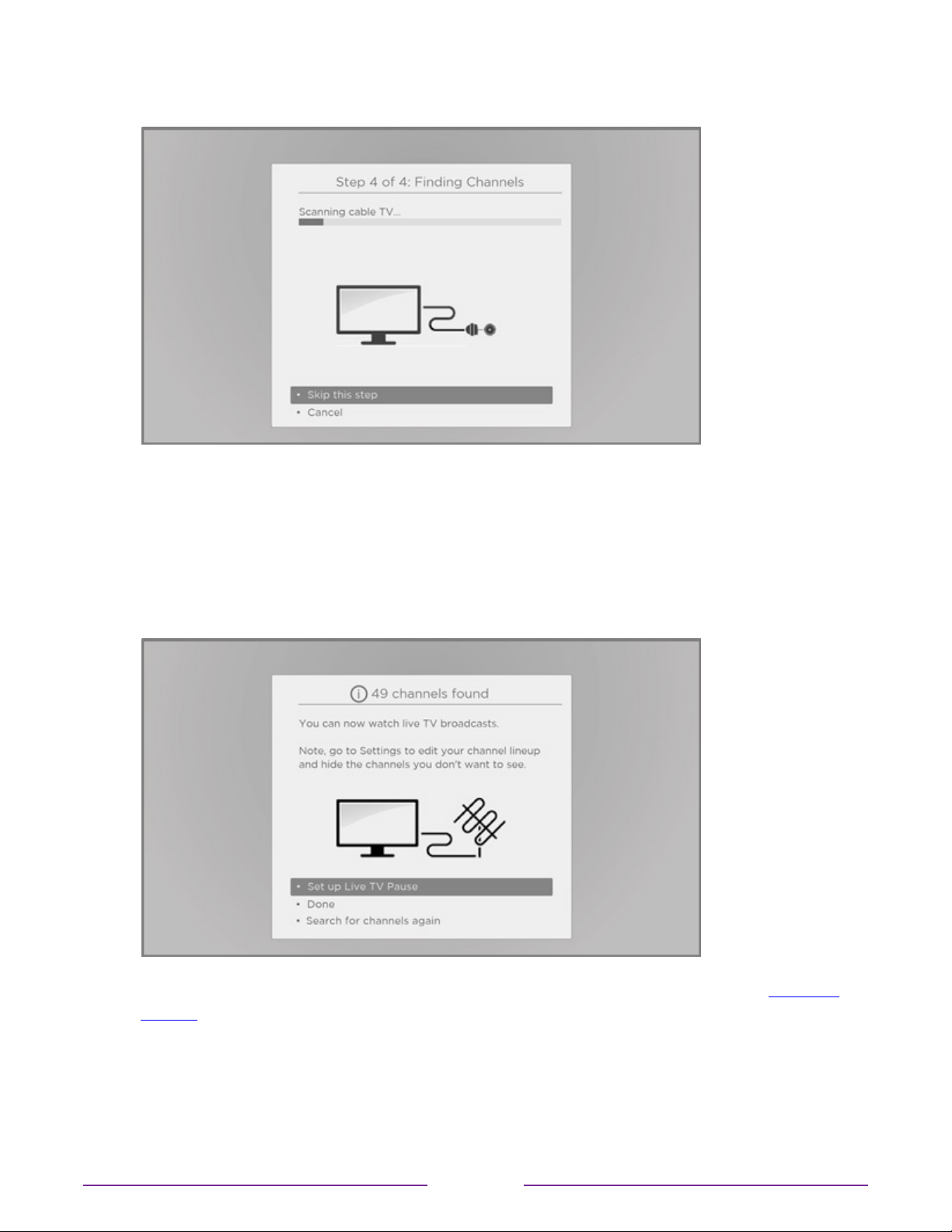
… and then cable TV channels.
Scanning for channels can take several minutes.
Tip: If you use a set-top box to receive cable TV channels (and don’t have your cable
connected directly to the TV’s ANT input), you can save time by skipping the cable TV
portion of the channel scan.
7. When the channel scans finish, the TV shows the number of channels it added.
8. Only in connected mode, you have the option of setting up Live TV Pause. Pausing
live TV explains how to set up and use this feature. If you don’t want to set up Live TV
Pause, or if this option is not available to you, select Done to start watching live TV.
Tip: Repeat the channel scan from time to time to make sure you are receiving all of the
latest channels. Broadcasters add and remove channels, move channels to dierent parts
of the spectrum, and change the power levels of their channels periodically. Your antenna
39

reception and picture quality depend on the position of your antenna and on your location
relative to the antennas of broadcasters in your area. To repeat the channel scan, use the
purple directional pad to highlight the LiveTV tile, press STAR
, select Scanforchannels,
and then press OK.
You’ll also have to repeat the channel scan if you remove and re-add the LiveTV tile from
the Home screen or perform a factory reset.
Now, you’re ready to watch live TV! While you’re watching, try the following tips:
•
Press UP or DOWN to change channels.
•
Press LEFT to display the channel list (non-connected mode) or Smart Guide
(connected mode), and then press UP or DOWN to select a channel to watch. Or press
REWIND
p
or FASTFWD
q
to jump through the channel list or Smart Guide
1
a page at
a time.
•
Press OK to display information about the current program.
•
Press STAR
to see options for picture and sound settings.
•
Only in connected mode, use a Roku Voice Remote, the Roku mobile app, Google
Assistant, or Amazon Alexa to search for programs by title, actor, director, or the genre
you want to add
2
. The TV or the Roku mobile app displays the results along with the
streaming channels that oer the requested content. Only in the United States, the
results also include Live TV programs.
Note: If your TV did not come with a Roku Voice Remote, you can order one in the United
States from https://www.roku.com/products/accessories/roku-tv.
1 Smart Guide is available only in the United States.
2 Voice features support English and Spanish languages when the corresponding TV language is selected.
40

Using your TV
This section provides information on using the day-to-day features of your TV.
Status indicator
Your TV has a single status indicator. It goes on and o and blinks in dierent ways
depending on the status of the TV, as shown in the following table:
TV CONDITION STATUS INDICATOR MEANING
On (screen is active) O Screen is communicating that TV is on.
Screensaver (screen is active) O Screen is communicating that TV is on.
O (no power) O TV is not connected to power.
O (standby) On TV is connected to power and is ready to use.
Starting up from o state Slow pulsing blink until startup
completes
TV is doing something.
On (receiving update from USB) Slow pulsing blink until update
completes
TV is doing something.
Remote command received Dims on/o once TV has received your command.
Network connection lost Two short blinks, pause, repeat TV was connected and paired with a Roku
account and now has no network connection.
Powering down to standby
mode
Slow pulsing blink until the TV
reaches standby.
TV is doing something.
41

Standby mode energy savings
When you turn o your TV, it remains in a higher power mode for a few minutes, after which
it goes into a very low power standby mode. If you turn on the TV again before it has entered
the very low power mode, it turns on immediately. After the TV goes into the lower power
standby mode, it takes a few seconds longer to start up.
Only in connected mode, you can optionally enable FastTVstart. When this option is
enabled, your TV starts up almost immediately regardless of how long it has been turned
o, but uses somewhat more power in standby mode. Fast TV start also gives you access to
some additional features, such as turning on the TV with voice commands and turning o the
screen when listening to music. For more information, see Fast TV start.
Getting help
Only in connected mode in the United States, the Roku Tips & Tricks channel has helpful
videos about many aspects of using your TV. You can access the channel in two ways:
•
Select the RokuTips&Tricks channel on the Home screen.
•
Navigate from the Home screen menu to Settings>Help and select LaunchRokuTips
& Tricks.
42
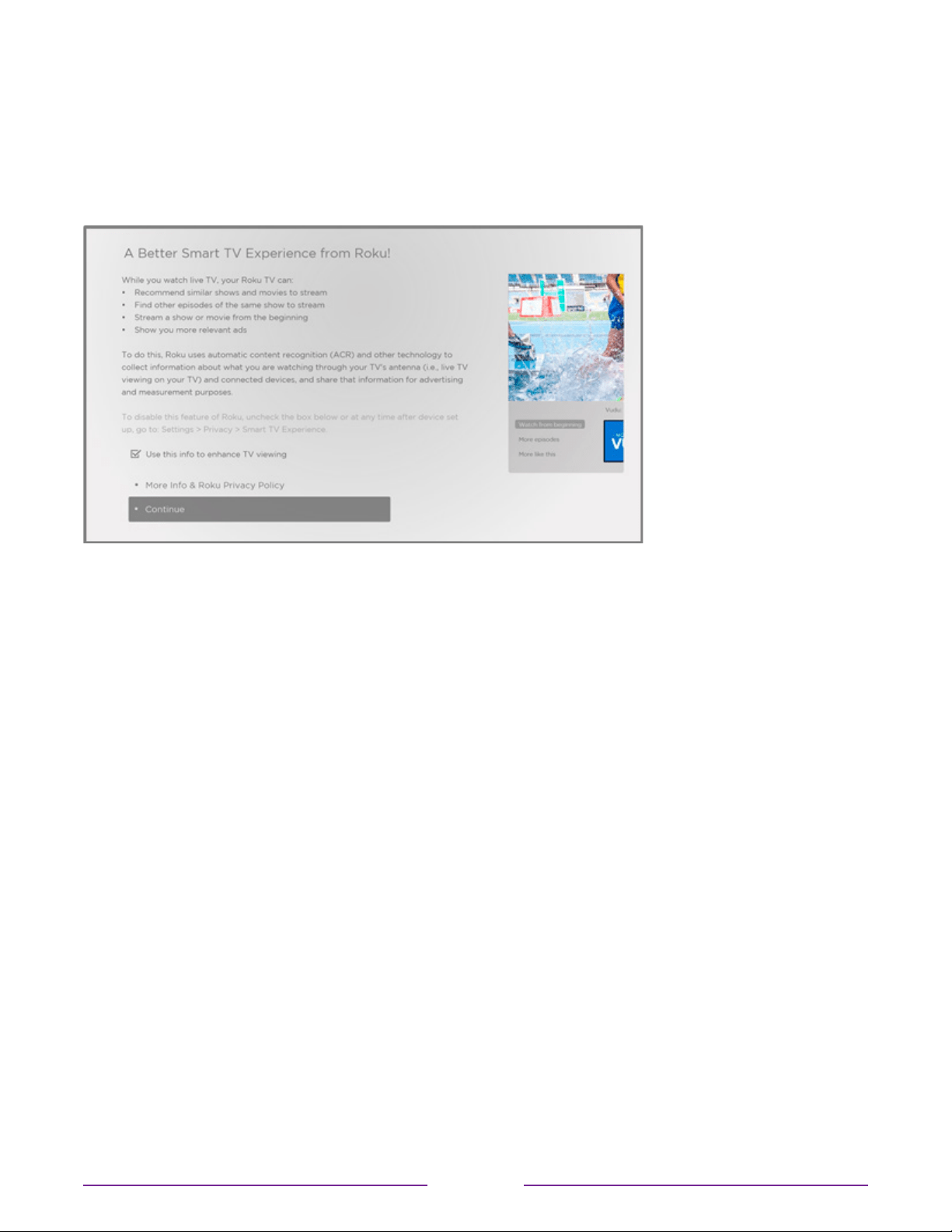
Opting in to Smart TV experience (U.S. only)
Only in connected mode in the United States, the first time you select live TV, an HDMI input,
or AV input, your TV oers to enable the Smart TV experience. If you decide to enable it at
this time, you’re all set to enjoy its recommendations and features.
The Smart TV experience uses automatic content recognition (ACR) and other technology to
collect information about what you watch on live TV, and on devices like media players and
cable boxes connected to the HDMI or AV inputs. Opting in means that you give permission
to analyze the programs you watch for the purpose of making recommendations, as well as
showing ads that are more relevant to you.
If you decide not to enable the Smart TV experience at this first opportunity, you can enable
it later. Or, if you decide you’d rather not use the feature, you can disable it, but be aware that
previously collected information is retained and not deleted.
Disable Smart TV experience
If you decide you want to disable Smart TV experience, follow these steps:
1. From the Home screen menu, go to Settings > Privacy > Smart TV experience.
2. Navigate to the right to highlight Use info from TV inputs.
3. Press OK on the remote to clear the check box.
Smart TV experience
43

Disable Auto Notifications
If you want to keep the Smart TV experience enabled, but you do not want to see
notifications while you are watching programs, you can disable notifications. To do so, follow
these steps:
1. From the Home screen menu, go to Settings > Privacy > Smart TV experience.
2. Navigate to the right to highlight Use info from TV inputs.
3. Press DOWN to highlight Enableautonotifications.
4. Press OK to clear the check box.
Note: These settings do not aect recommendations for More Ways to Watch that you see in
the Smart Guide when watching live TV channels. Those recommendations show up only in
the Smart Guide and do not rely on ACR technology.
Watching live TV channels
Select the Live TV tile in the Home screen. Your TV remembers the last channel you watched
and starts with that channel playing.
Changing channels
To change channels, you can do any of the following:
•
Press UP to change to the next higher channel.
•
Press DOWN to change to the next lower channel.
•
Press LEFT to display the channel list or Smart Guide
1
, and then press the arrow keys to
select the channel or program you want to watch. Press REWIND
p
or FASTFWD
q
to move through the list one page at a time. When you’ve highlighted the channel
or program you want to watch, press OK. (If you decide you don’t want to change
channels, press BACK
.)
•
Only if Live TV Pause is not enabled, press REPLAY to jump to the previous channel.
Press again to return to the channel you were watching before you pressed REPLAY
.
Note: If the REPLAY
is not available on your remote, you can use this feature in the
Roku mobile app. For more information, see Roku mobile app.
1 Smart Guide is available only in connected mode and only in the United States.
44

Favorite Channels in the channel list
In the United States in non-connected mode, and in Canada in both non-connected and
connected modes, you can quickly change from surfing among all channels or only your
favorite channels. First, you have to mark one or more channels as your favorites.
Mark your favorite channels in the channel list
You can make any channel a favorite whenever you’re watching live TV channels.
1. Press LEFT to display the channel list. Notice that the words All channels appear at
the top of the channel list.
2. Scroll up or down to highlight a channel that you want to make a favorite.
3. Press STAR
. At this point, you’ll see two options:
•
Add to favorites
•
Back
4. With Add to favorites highlighted, press OK. A FAVORITE symbol
appears
adjacent to the channel to indicate that it is now a favorite.
5. Repeat these steps to add more favorite channels.
Surf only your favorite channels
After you’ve marked one or more channels as favorites, you can switch to your
favorite channels whenever you’re watching live TV channels.
1. Press LEFT to display the channel list.
2. Press LEFT or RIGHT once to switch to Favorites. Notice that the word Favorites
appears at the top of the channel list.
3. Highlight a channel and press OK to select one of the channels in the Favorites
channel list, or wait a few moments until the channel list disappears.
4. Press UP or DOWN to change to the previous or next favorite channel. Each channel
you select in this way is a favorite channel. Your channel surfing is limited to favorite
channels only.
Your favorite channel list remains in eect even if you turn o or unplug your TV, until you
switch back to all channels.
45

Note that when you press OK to view the program information banner while watching a
program, a FAVORITE
symbol appears below the channel number.
Surf all channels again
You can switch back to all channels whenever you’re watching live TV channels.
1. Press LEFT to display the channel list.
2. Press LEFT or RIGHT once to switch to All channels. Notice that the words All
channels appear at the top of the channel list.
3. Highlight a channel and press OK to select one of the channels in the All channels list,
or wait a few moments until the channel list disappears.
4. Press UP or DOWN to change to the previous or next channel among all your available
channels. You can surf among all channels in your channel list.
Remove a channel from your favorites
You can remove a channel from your favorites whenever you’re watching the Live TV input.
1. Press LEFT to display either channel list—All channels or Favorites.
2. Scroll up or down to highlight a favorite channel that you want to remove from your
favorites.
3. Press STAR
on your remote. At this point, you’ll see two options:
•
Remove from favorites
•
Back
4. With Remove from favorites highlighted, press OK. The FAVORITE
symbol
adjacent to the channel disappears.
5. Repeat these steps to remove other channels from Favorites.
Smart Guide (U.S. only)
Only in connected mode and only in the United States, use the Smart Guide to find both
over-the-air and live streaming TV programs. The Smart Guide lets you scroll through all
the TV channels you receive (except those you have hidden, if any), plus a large number of
live streaming programs from The Roku Channel. You can see what’s on right now and the
upcoming 14 days.
For live, over-the-air TV programs, you can use More Ways to Watch to find the program
you’re watching and start watching it from the beginning from one of your streaming
channels. Your clue that there are More Ways to Watch a program is a purple star (
) next to
Smart Guide
46
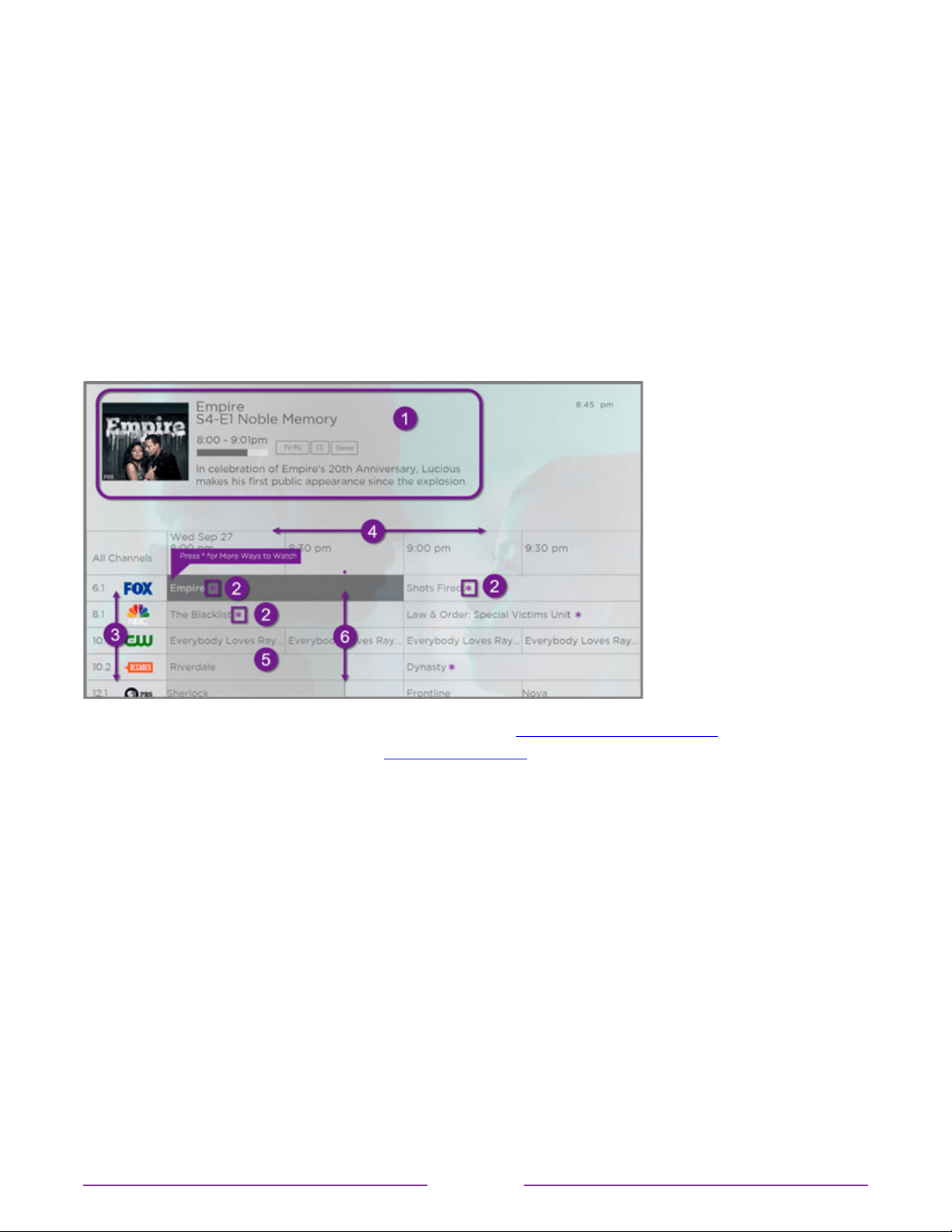
the program name in the guide.
For example, you might turn on your TV at 10 minutes past the hour and discover you are
missing the current episode of Empire. But there is a purple star next to the program title,
so you can press STAR
and find that there are several streaming channels where you can
watch the current episode from the beginning. You also can find more episodes of Empire,
and other programs that have a similar theme.
Note: A paid subscription or other payments may be required for some streaming channels.
To view the Smart Guide, press LEFT while watching live TV. The Smart Guide opens with the
name of the current program highlighted, and a lot more information.
1. Program information for the highlighted program. See Viewing program information for details.
2. More Ways to Watch indicator. See More Ways to Watch for more information.
3. Channel list. Navigate with UP and DOWN.
4. Time slots. Navigate with LEFT and RIGHT. Press FAST FWD
q
or REWIND
p
to skip ahead or back a
screen at a time.
5. Program list
6. Progress bar showing the approximate time with respect to the time slots.
When you are viewing the current time slot, notice that the Smart Guide shows a light gray
background for portions of programs before the current time, and a dark background for
programs and portions of programs that have not yet aired. The line dividing these two zones
is the progress bar.
47

Navigating the Smart Guide
•
Use the purple directional pad to move up, down, left, and right.
•
To switch to a program that is currently in progress, highlight it, and then press OK. (Note
that pressing OK on a past or future program does nothing.)
•
To return to the current time after navigating to a dierent time slot, press REPLAY .
•
To return to the currently airing program without causing a channel change, press
BACK
.
•
To see More Ways to Watch, highlight any program that has a purple asterisk (
), and
then press STAR
.
Recently watched channels in the Smart Guide
By default, the Smart Guide lists channels in channel number order, with broadcast TV
channels first, followed by live streaming channels. You can instead list channels in order of
recently watched.
Switch between all channels and recent channels
1. While viewing the Smart Guide, navigate all the way to the left until you highlight the
channel logo.
2. Press STAR
.
3. In the ViewOptions box, press OK to switch to the other option. That is, if you are
viewing AllChannels, press OK to switch to RecentChannels, and if you are viewing
RecentChannels, press OK to switch to AllChannels.
RecentChannels holds a maximum of 50 recent channels, so you might not see all of your
channels listed in this mode.
48
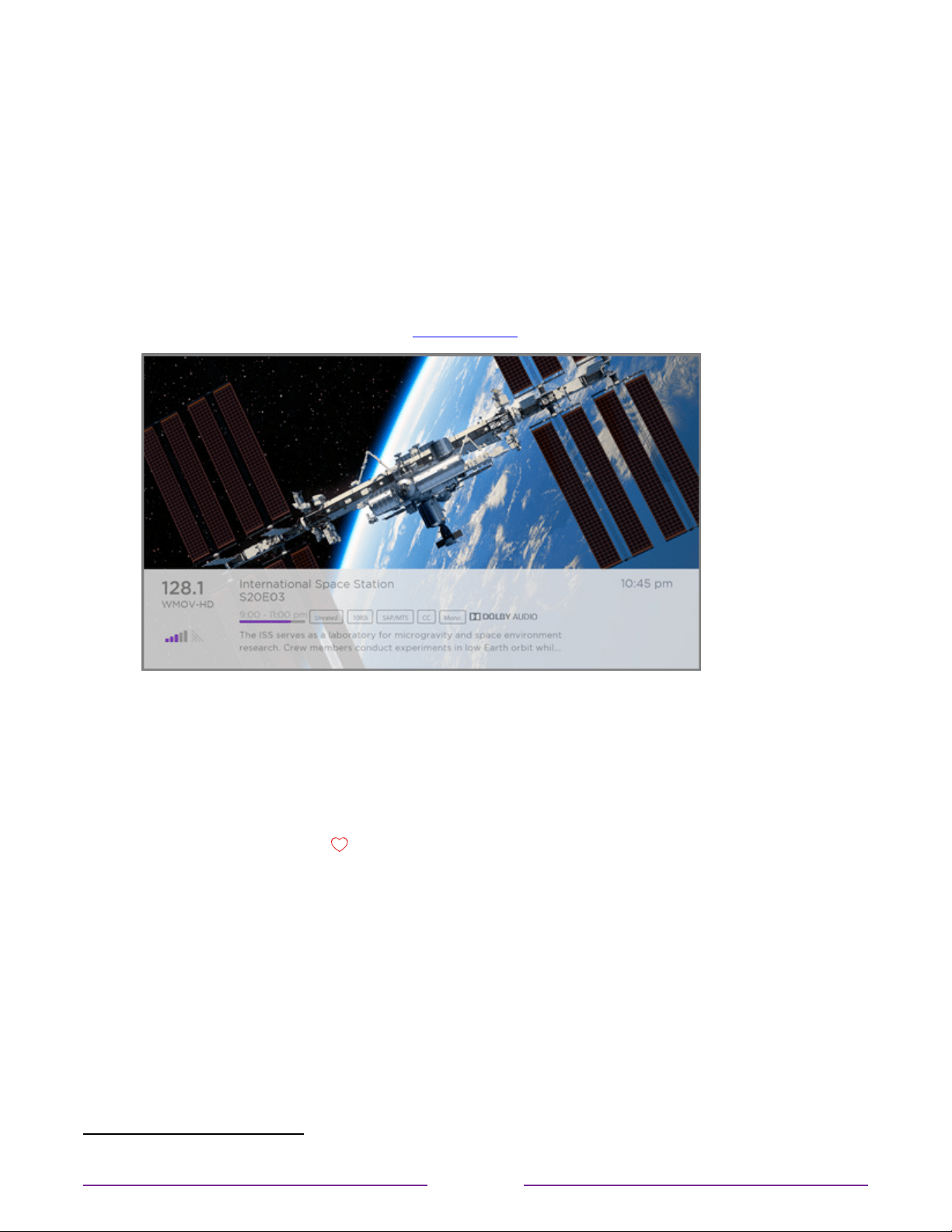
Viewing program information
You can view program information in dierent ways:
•
Whenever you are viewing a program and no other guides or menus are open, press
OK to view program information in a banner at the bottom of the screen. This program
information appears both in connected and non-connected modes. The following
illustration shows the information that is available:
•
Only in connected mode in the United States, view program information for any
program listed in the Smart Guide. Press LEFT while watching live TV to see the Smart
Guide. For more information, see Smart Guide.
Program information banner
Program information might include any or all of the following, depending on availability within
the broadcast information:
•
Channel number
•
Channel call sign
•
Favorite channel icon
•
Signal strength
•
Program title and episode name/number
•
Start time, end time, and graph of program length showing current position
•
Content rating
•
Video resolution (480i, 480p, 720p, 1080i, 1080p, 4K)
•
Frame rate (24Hz, 30Hz, 60Hz for television sources, 60Hz, 70Hz, 72Hz, 75Hz for computer sources)
•
Audio format (Mono, Stereo, Dolby Audio™ logo)
•
Audio features (SAP/MTS)
•
Only on select 4K models: HDR or Dolby Vision™
1
logo (HDMI® and streaming sources)
•
Closed captioning (CC)
•
Current time
•
Program description.
1
The Dolby Vision™ logo appears only on Dolby Vision™-certified models when displaying Dolby Vision™ content.
49

Tip: If you’ve set up Live TV Pause and you’re watching live TV, you’ll also see a progress bar
showing the current playback position within the rolling 90-minute pause time. For more
information, see Pausing live TV.
Adjusting settings while watching a program
Press
STAR
to display the
Options
menu. Press
UP
or
DOWN
to highlight an option, and then
press
LEFT
or
RIGHT
to change the setting. The topic
Adjusting TV settings
explains each of the
settings in detail.
Pausing live TV
Live TV Pause gives your Roku TV the ability to pause, play, fast forward, and rewind live TV
received on the ANT input. You can pause live TV for up to 90 minutes.
Requirements
To use this feature, you need to:
1. Connect your TV to the Internet. If you didn’t connect during Guided Setup, see What
if I didn’t connect my TV?.
2. Provide your own dedicated USB flash drive (thumb drive) with the following minimum
specifications.
•
16 GB
•
15 Mbps read/write speed
•
USB 2.0 compliant
A USB flash drive (thumb drive) meeting the minimum requirements is highly
recommended over an externally-powered hard disk drive. Note that you can use any
larger size drive—there is no limit to the maximum size—but using a larger drive does
not extend the 90-minute pause time.
Important: After warning you and giving you a chance to cancel Live TV Pause setup,
all existing content on your USB drive is erased when you enable this feature.
3. Connect your USB drive to the TV’s USB port.
Important: Some TV models have more than one USB port. You can connect your Live
TV Pause USB drive to any port, but make sure that nothing is connected to other
USB ports while enabling Live TV Pause. Reconnect other USB devices after you have
finished enabling Live TV Pause.
4. Enable Live TV Pause, as explained in the following topic.
50

Enabling Live TV Pause
You can start setting up Live TV Pause in any of the following ways:
•
After completing a channel scan, select Set up Live TV Pause from the available
options.
•
Press PLAY/PAUSE
o
on the Roku remote while watching a live TV channel.
•
Highlight the Live TV tile on the Home screen, press STAR
on the remote, and then
select Enable Live TV Pause.
After starting setup of Live TV Pause in any of these ways, the TV prompts you through the
steps needed to enable this feature. Setup takes only a few moments.
Note: Use of a USB hub is not supported.
Using Live TV Pause
If you have used the Roku remote to watch streaming channels, using Live TV Pause should
be very familiar to you.
•
While watching a digital live TV channel, press PLAY/PAUSE
o
to pause or play the
content. After the TV program has been paused for 90 minutes, the TV resumes playing
from the point in the program where it was paused.
•
After watching a channel for a while, press REWIND p to jump back up to the point
where you first started watching the channel, up to 90 minutes.
•
After pausing or rewinding, press FAST FWD q to jump ahead up to the point where
you are once again watching the live TV program.
•
Press FAST FWD q or REWIND p repeatedly to cycle through 1x, 2x, and 3x skip speeds.
Press REPLAY
to play back the last several seconds of the program.
•
When the program is paused, press LEFT and RIGHT to move backward or forward
through the program approximately 10 seconds per press. Small frames appear across
the screen to identify your location in the program.
Note: If REPLAY
is not available on your remote, you can use the Roku mobile app. For
more information, see Roku mobile app.
Whenever you use any of the Live TV Pause features, the TV momentarily displays a progress
bar:
51
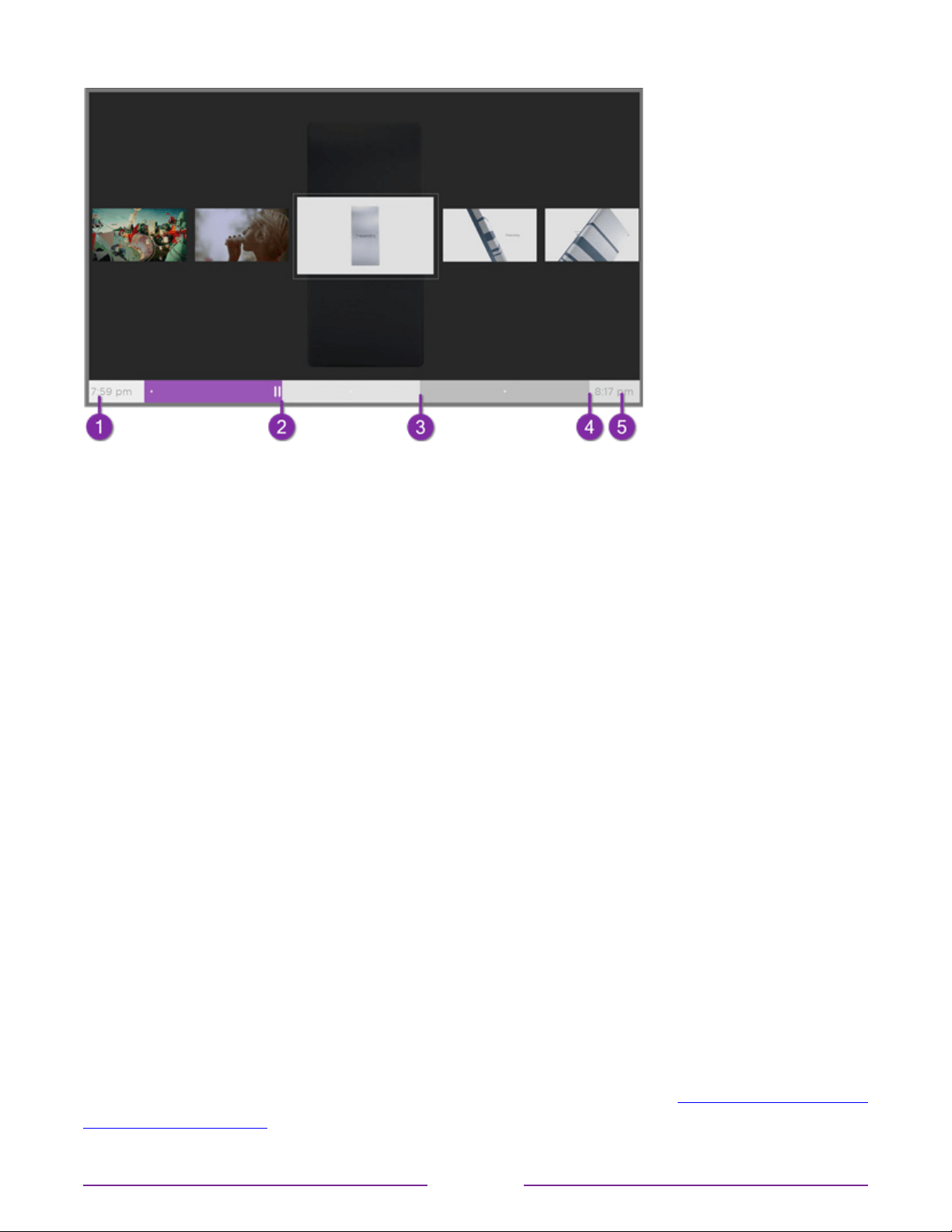
1. Time at current playback position.
2. Current playback position
3. Extent of pause time, representing the amount of time this channel has been buered, up to 90 minutes.
4. 90-minute mark, representing the maximum extent of pause time.
5. Current time.
The progress bar also shows tick marks at each half hour point, to help you locate the
boundaries where one program ends and a new one begins.
Notes about Live TV Pause
•
You can use Live TV Pause only with digital broadcast and cable channels received
through the TV’s ANT input (ATSC and Clear QAM channels).
•
Changing channels erases and restarts the Live TV Pause buer.
•
Returning to the Home screen, selecting another input, or turning o the TV erases and
resets the Live TV Pause buer.
•
Disconnecting the USB drive erases the Live TV Pause buer.
More Ways to Watch (U.S. only)
Only in connected mode in the United States, More Ways to Watch gives you
recommendations about the programs you’re watching on the ANT, HDMI, and AV inputs.
You will automatically get these recommendations in the Smart Guide for live TV programs.
However, before you can get recommendations for programs you’re watching through the
HDMI or AV inputs, you must opt into the Smart TV experience to acknowledge that you
want to allow the TV to use automatic content recognition (ACR). See Opting in to Smart TV
experience (U.S. only) for details.
More Ways to Watch
52
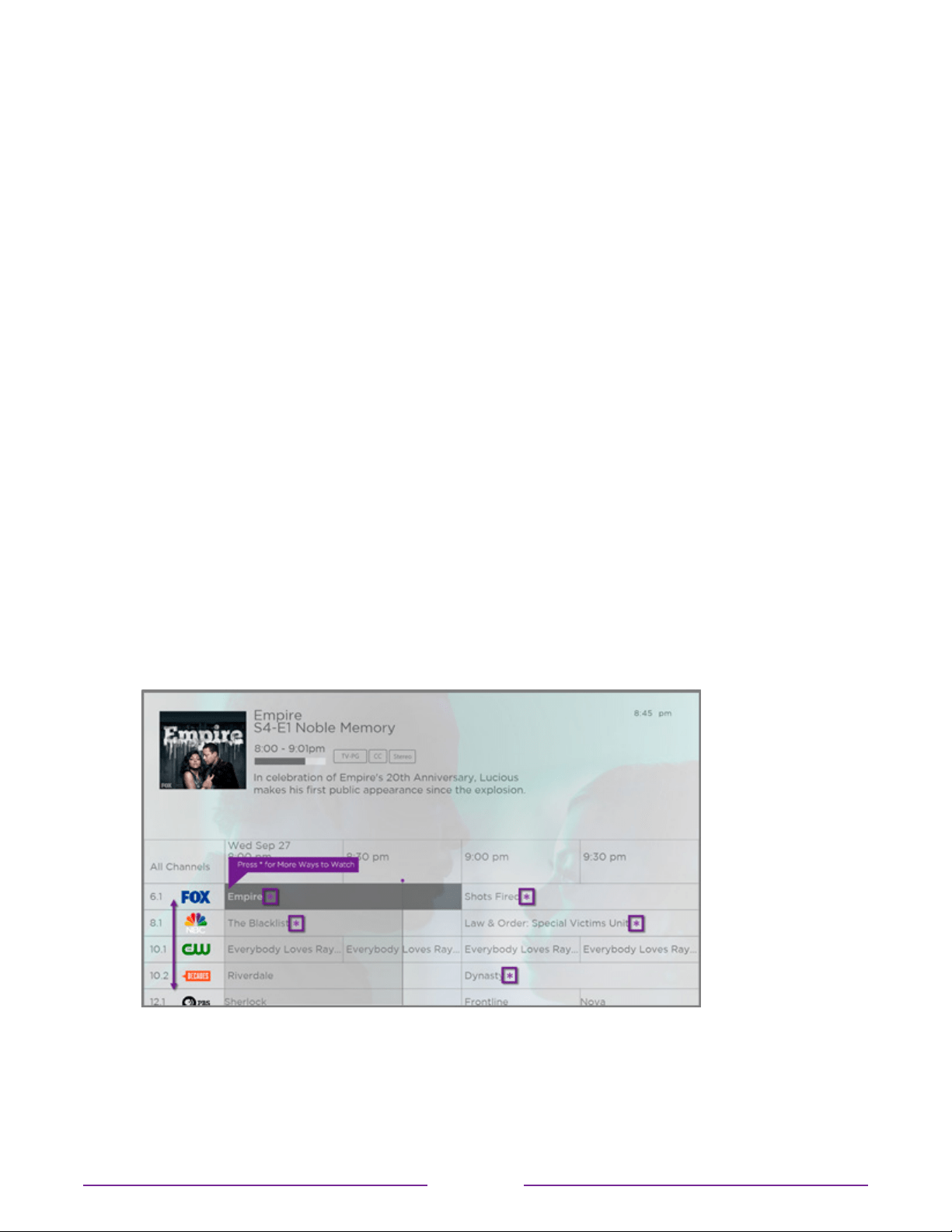
Using More Ways to Watch
Not every program provides recommendations. As you use More Ways to Watch, be aware
that you’ll only see suggestions on your TV when all of the following conditions are met:
•
Your TV is operating in connected mode in the United States.
•
You have enabled SmartTVexperience if you are watching programs through an
HDMI or AV input. (If you are watching live TV from the ANT input, this setting does
not matter.)
•
The program you’re watching contains the information needed to identify it. Note that
some programs, such as the daily news, typically do not activate More Ways to Watch.
•
At least one participating streaming channel oers the movie or TV program you are
watching, or other episodes, or more programs like the one you are watching.
If all of these conditions are met, you can view the suggestions. More Ways to Watch
recommendations appear in two dierent places:
•
When watching the HDMI and AV inputs, you’ll see a More Ways to Watch notification
in the lower right corner of the screen for a few seconds unless you have disabled
Enable auto notifications. Press STAR
to see the list of matching programs.
Note: After this banner disappears, you can restore the More Ways to Watch prompt
by pressing OK.
•
In the Smart Guide, all programs that meet the criteria for More Ways to Watch display
a purple asterisk
next to their titles:
Highlight the program of interest and press STAR
to see recommendations.
53
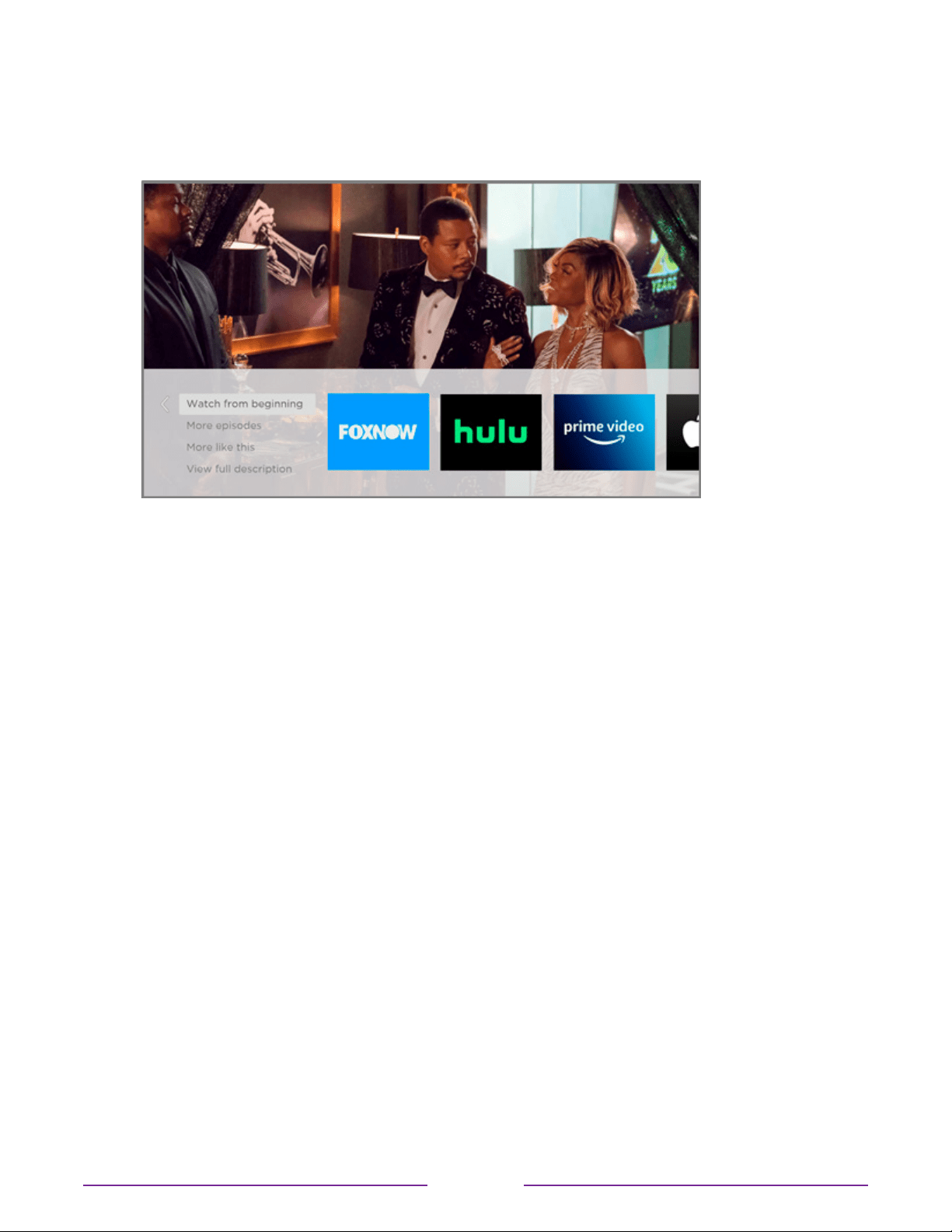
Regardless of how you got to this point, the options you’ll see depend on the type of
program you’re watching and the available ways there are to watch, so you might see any or
all of the following:
•
Watchfrombeginning – Streaming channels on which the same TV program or movie
is available. Generally, this option does not appear on first run programs, because
streaming content is not available until a later date.
•
Moreepisodes – Streaming channels where you can find other episodes of the TV
program you are watching. Does not apply to movies.
•
Morelikethis –TV programs or movies with a similar theme.
•
Viewfulldescription– Full description of the selected program.
54

Press DOWN to select an option, and then press RIGHT to select the streaming channel you
want to watch.
Assuming you’ve already added the channel and completed any required sign-in, More Ways
to Watch takes you directly to the program in the streaming channel where you can select
and watch the program. Otherwise, it prompts you to add the channel and, if you do, then
takes you to the program.
Getting the most from More Ways to Watch
•
Streaming channels you’ve already installed appear first in the list of suggestions.
•
When you select a streaming channel, you leave the program you are currently watching.
•
If you’ve used the Live TV Pause feature to pause the program, your paused program
buer is deleted. In other words, you cannot return to a live TV channel and resume
watching from where you left o.
Switching TV inputs
Switch TV inputs to access the device connected to that input, for example, a Blu-ray™ player.
Switching inputs is as easy as highlighting the input’s tile in the Home screen, and pressing
OK. The video signal on the input, if any, plays on the screen.
Tip: To learn how to add, remove, rename, and rearrange the tiles on your Home screen, see
Customizing your TV.
Auto-detecting devices
Your TV automatically detects when you connect a new device to an HDMI input and turn on
its power. The input is automatically added to the Home screen if it isn’t already present.
Adjusting audio/video settings
While watching video content on any input, press STAR
to display the Options menu. Press
UP or DOWN to highlight an option, and then press LEFT or RIGHT to change the setting. To
learn about each of the audio and video settings, see Adjusting TV settings.
55

Setting preferred audio language for streaming channels
You can select the preferred language for the audio played by streaming channels. If the
selected language is available in the streaming content, the TV plays that language.
To set the preferred audio language:
1. From the Home screen menu, navigate to Settings>Audio>Audiopreferredlanguage.
2. Press RIGHT to highlight one of the languages.
3. Press UP or DOWN to highlight the language you want to use.
4. Press OK.
Note: Many streaming channels have an option to select the language while you are
watching a program. The Audiopreferredlanguage setting sets the default for that
option.
Playing content from USB storage devices
Only in connected mode, your Home screen has the RokuMediaPlayer tile. Otherwise, the
Home screen has the USBMediaPlayer tile. With either player, you can play personal music,
video, and photo files from a personal USB flash drive or hard disk connected to the TV’s
USB port.
To use this feature, make sure your media files are compatible with the Roku/USB Media
Player. To see the latest list of supported formats, view Help in the Media Player
1
. The Roku/
USB Media Player displays supported file types only, and hides file types it knows it cannot
play.
Note: If you do not see the Roku Media Player on your Home screen, it might have been
uninstalled. You can reinstall it from the Roku Channel Store by using the StreamingChannels
menu option or the AddChannels shortcut. The USB Media Player in non-connected mode
cannot be uninstalled.
For more information about playing back your personal videos, music, and photos, go to the
following link on the Roku web site:
go.roku.com/rokumediaplayer
1
There are many variants of each supported media format. Some variants may not play at all or may have issues or
inconsistencies during playback.
56

Auto player launch
Only in connected mode, you can set your TV to automatically open the Roku Media Player
when you connect a USB drive with a recognizable file system (such as FAT16/32, NTFS,
HFS+ or EXT2/3). To configure this setting, from the Home screen menu, navigate to
Settings>System>USBmedia. At this point, the following options are available:
•
Auto-launch – Select Prompt, On, or O, as desired.
•
Prompt – (default) Display a prompt each time a recognized USB drive is
connected. The prompt provides options to launch the Roku Media Player as well
as to change future auto-play behavior.
•
On – Always launch the Roku Media Player whenever you connect a recognized
USB drive.
•
O – Never launch the Roku Media Player automatically.
•
Launch channel – Select the app you want to use to play back media files.
Playing content from local network media servers
Only in connected mode, your TV can play personal video, music, and photo files from a
media server on your local network. Media servers include personal computers running media
server software such as Plex or Windows Media Player, network file storage systems that have
built-in media server software, and other devices that implement the specifications of the
Digital Living Network Alliance. Some servers do not fully implement the DLNA specification
but are UPNP (Universal Plug and Play) compatible. The Roku Media Player can connect to
them as well.
Some media servers can convert files into Roku compatible formats. Digital Rights
Management (DRM) protected content is not supported.
57

Setting up a payment method
For Movie Store, TV Store, and other channels that allow you to pay through your linked Roku
account, you can enter a payment method directly on your TV. Entering a payment method
on your TV means that you don’t need to go to a computer or mobile device to set up a
payment method.
To add a payment method:
1. From the Home screen menu, navigate to Settings > Payment method > Add
payment method.
2. Use the on-screen number pad to enter your credit/debit card number, expiration
date, CVV number, and ZIP Code or postal code.
Note: If you have already set up a payment method on my.roku.com, that payment
method is identified here in such a way as not to expose any personal data. You can
use this screen to change your payment method, if desired.
3. Select Save Card, and then press OK.
To manage your saved payment method and to see other payment methods, log into your
account at go.roku.com/pay.
Using your TV in a hotel or dorm room
Hotels, school dorms, conference facilities, and similar locations with public wireless Internet
access often require you to interact with a web page to authenticate your access. These
types or networks are called restricted public networks. When you select a network of this
type, the TV automatically detects that additional information is needed and prompts you
through using another wireless device to supply the requested information.
About using your TV on a restricted public network
Here are some points to keep in mind when using your TV on a restricted public network:
•
Using your Roku TV on a hotel or dorm room network requires wireless availability and
a network-connected smartphone, tablet, or computer to authenticate access to your
wireless access point.
•
You will need your Roku TV remote.
•
Some content might be limited or unavailable if you try to connect outside your home
country due to geo-filtering.
58
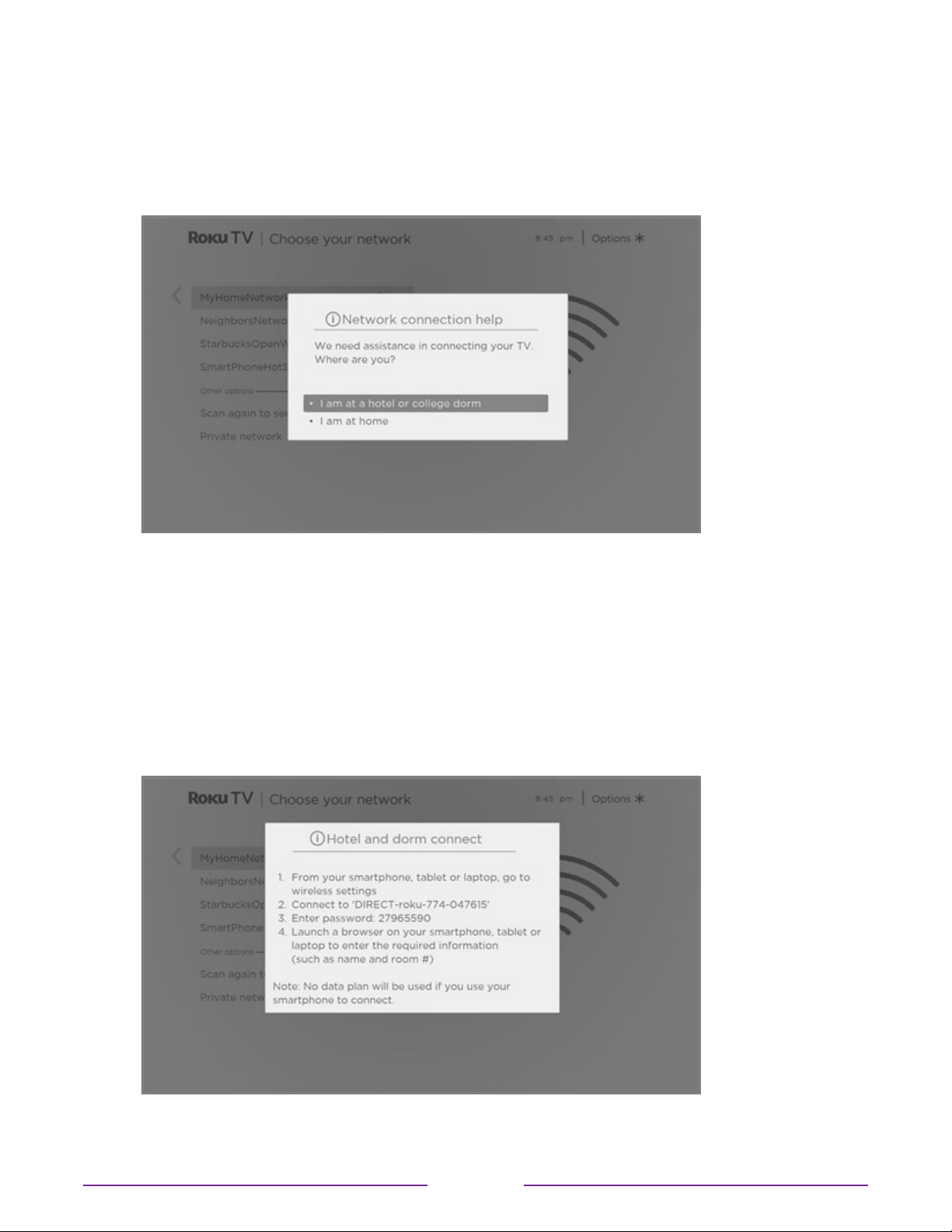
Getting your Roku TV on line on a restricted public network
1. Either during Guided Setup or after using the Settings > Network menu to set up a
new connection, the TV automatically detects that you are connecting to a restricted
network and displays the following prompt:
Tip: Your TV can connect to a restricted network only if Enable ‘Device connect’ is
selected in Settings > System > Advanced system settings. (Device connect is enabled
by default, but if you have disabled it, the TV cannot complete the connection.)
Note: Device connect is not present if the TV is in non-connected mode.
2. After selecting the correct network, highlight I am at a hotel or college dorm, and
then press OK. The TV prompts you to use your smartphone, tablet, or laptop to
complete the connection.
59

3. Use a smartphone, tablet, or wireless-enabled computer to detect wireless networks.
In most cases, you can simply open the device’s Wi-Fi Settings or Network Settings
screen to start scanning.
Note: The mobile phone, tablet, or computer must be on the same wireless network to
which you are connecting the TV.
4. Connect to the network named on your TV screen. The actual network name varies.
Note: The previous step connects your smartphone, tablet, or computer directly to the
TV. No connection charges apply and the connection does not impact your device’s
data plan.
5. The wireless connection process prompts you for a password. Enter the password as
shown on the TV screen. The actual password varies.
6. Start the web browser on your mobile phone, tablet, or computer. When you attempt
to open any web page, the restricted connection will prompt you for whatever
information it needs. In most cases, you must agree to terms and conditions, provide
identifying information, or enter a password, PIN, or room number to proceed.
The information requested depends on the organization that controls the wireless
connection.
7. After you enter the requested information, the TV automatically proceeds to complete
its connection and resumes normal operation.
8. If the TV prompts you to link to your Roku account, use your mobile phone, tablet, or
computer to activate your Roku TV.
60

Roku voice remotes (select models only)
Only on TVs with the Roku voice remotes: The following topics explain how to get the most
out of your TV when it includes a Roku Voice Remote or Roku Enhanced Voice Remote.
Re-pairing your Roku voice remote
The Roku voice remotes operate with wireless radio-frequency signals and must be paired
with your TV. You initially paired the remote when you set up your TV during Guided Setup.
But if your remote loses its pairing with the TV for some reason, you can easily re-pair it
using either of the following methods:
1. Remove the battery cover from the back of the remote.
2. Press and hold down the pairing button for 3 seconds or longer, until the adjacent LED
lights up.
3. Do one of the following:
•
Turn on the TV using the power button on the TV side or back panel. Pairing occurs
as the TV starts up.
•
Use the Roku mobile app or a dierent remote to navigate to Settings > Remotes &
devices > Pair new device > Remote.
Tip: If the remote fails to pair with the TV, try installing new batteries. Also, it’s helpful to hold
the remote within two to three feet of the TV to ensure successful pairing.
Checking the Roku voice remote battery level
You can check the condition of the batteries in your Roku voice remote at any time by
navigating to Settings>Remotes & devices, and then pressing OK to select your remote
below My paired devices. With your remote selected, navigate right to About > Remote to
view its Battery level. The resulting screen displays not only the battery level, but also other
information that can be useful when you need technical support with your remote.
Tip: When you first turn on the TV, a battery level indicator appears in the upper right corner
of the screen for a few seconds.
61
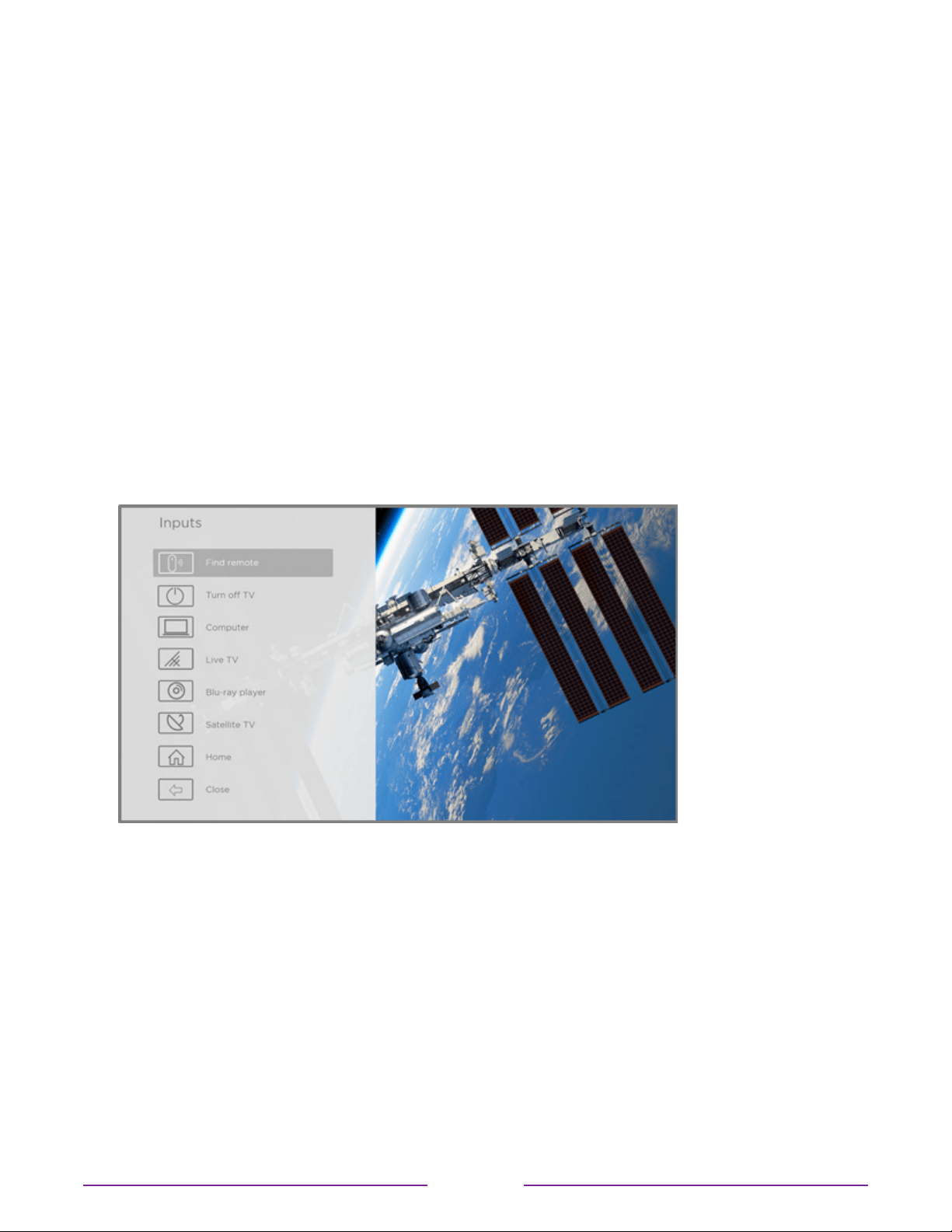
Finding your Roku Enhanced Voice Remote
Only on TVs with the Roku Enhanced Voice Remote, when your remote has found its way
down into the sofa cushions or your dog has hidden it in the corner, you can use the Find
Remote feature to find out where it’s hiding. This feature has a limited range, and is designed
to find your Enhanced Voice Remote somewhere in the same room as the TV.
Select Find Remote on the Settings > Remotes & devices > Remote settings menu to see
brief instructions on how to activate the Find Remote feature. Note, however, that selecting
this option doesn’t actually activate the feature. Here are the complete instructions:
Activate Find Remote
•
If your TV has a joystick-style control, press to the Left or Right to open the Inputs
menu, and then press Right to scroll down to Find Remote.
•
If your TV has a column of labeled panel buttons, press the INPUT button to open the
Inputs menu, and then press the INPUT button again until you highlight Find Remote.
A moment or two after highlighting Find Remote, the Roku Enhanced Voice Remote starts
playing your selected Find Remote sound to let you know where it is hiding. The sound
automatically stops after a minute, or after you find the remote and press any button.
Changing and previewing the Enhanced Voice Remote finder sound
Only on TVs with the Roku Enhanced Voice Remote, you can customize the sound your
remote makes when you use the Find Remote feature. To customize the sound, navigate to
Settings > Remotes & devices > Remote settings > Change remote finder sound. Select the
sound you want to use from the available settings.
To preview the sound you have chosen, select Preview remote finder sound, and then hold
62

down OK on the remote to play the sound. When you release the OK button, the sound will
stop.
63

Adjusting TV settings
You can adjust most picture and sound settings while you are watching a program by
pressing STAR
to open the Options menu. There are some additional picture and sound
settings in the Settings menu.
In most cases, the changes you make apply only to the input you are using. Live TV, each
HDMI® input, and the AV input have their own settings that the TV remembers when you
return to that input. The TV also separately remembers the settings you specify while viewing
streaming content.
Settings menu
Use the Settings menu to adjust overall TV settings. Press HOME to go to the Home
screen menu, and then navigate to Settings > TV picture settings.
You can adjust the following overall TV picture settings from the Settings screen:
•
TV brightness – Provide a better viewing experience in darker or brighter rooms.
Increases or decreases the TV’s general brightness across all TV inputs.
Note: This setting is identical to the TV brightness setting you can access in the Options
menu while watching a program.
•
HDR notification – On select models only: Controls whether the TV displays a notification
in the upper right corner of the screen for a few seconds when HDR or Dolby Vision
content begins to play.
•
On – The TV displays a notification when HDR or Dolby Vision content begins to play.
•
O – The TV does not display a notification when HDR or Dolby Vision content begins
to play.
Note: This setting does not aect the HDR or Dolby Vision notification that always
appears in the program information banner. Press OK while watching a program to open
the program information banner.
•
Settings per input – Lists each TV input. Select an input, and then press STAR
to
display the Options menu where you can adjust the input’s settings while watching a live
picture and listening to the sound from that input.
Tip: You don’t have to go to the Settings menu first—you can display an input’s Options
menu and adjust its settings whenever you are watching the input by pressing STAR
.
64
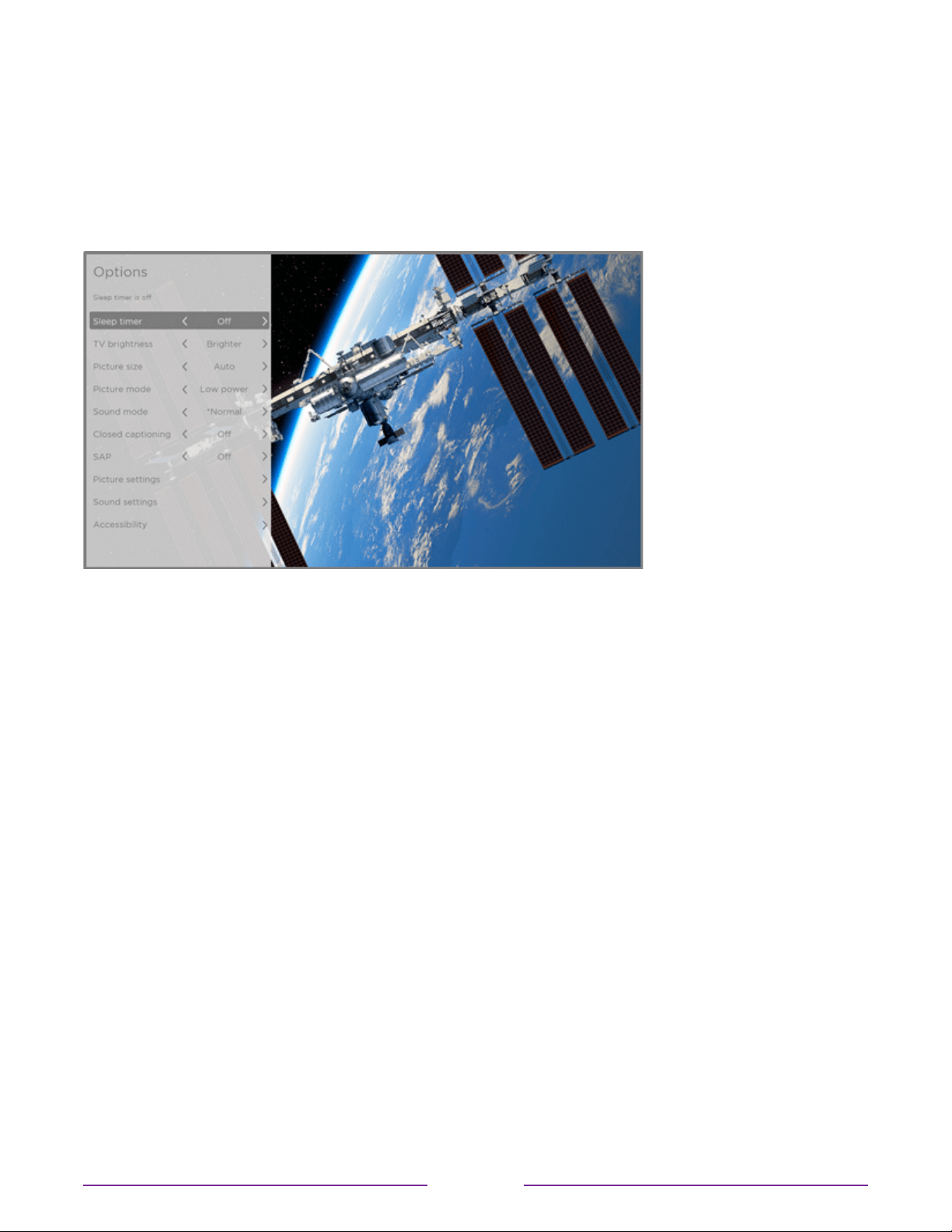
Options menu
The Options menu for each TV input provides many settings for controlling the appearance of
the picture and the quality of the audio. To view the Options menu, press STAR
whenever
you are watching a TV input or streaming a video (except when you are viewing the program
information banner). The Options menu is a panel that appears over the left side of the screen:
Typical Options menu, U.S. version
To adjust the settings on the Options menu, press UP or DOWN to highlight a setting, and
then press LEFT or RIGHT to change the setting. You’ll see the changes you make right away
in picture appearance or audio quality.
Tip: When you highlight a setting, the header text explains the eect of its current value.
When you begin to adjust a setting, the other options are hidden so you can see more of the
screen. Even though the other settings are hidden, you can move the highlight up or down
to adjust the other settings. As soon as you press UP or DOWN, the other settings become
visible again.
Note: Some streaming channels assign STAR
to a dierent function (or no function at
all), meaning it will not open the Options menu. In these cases, use a dierent channel,
such as The Roku Channel, to configure options. The selected settings remain active for all
streaming channels.
65

Options menu settings
•
Sleeptimer– Sets a timer that turns o the TV after the specific amount of time.
This setting remains in eect even if you stop watching the current input.
•
TV brightness – Aects the overall brightness of the picture. This setting applies across
the entire TV; that is, to all TV inputs and is identical to the TV brightness setting under
Settings > TV picture settings.
•
Picturesize – Adjusts the aspect ratio of the picture, enabling you to view a picture in its
original format, or zoom or stretch it to fill the screen. The Auto setting has been found
to produce the best picture in most cases.
•
Picture mode – Provides picture presets for various viewing preferences. This setting
applies to the currently-selected input only.
•
Sound mode – Adjusts the sound quality output from the TV speakers. This setting
applies across the entire TV; that is, to all TV inputs. It does not aect the sound quality
for headphones, HDMI(ARC)HDMI(eARC), or S/PDIF (TOSLINK) connectors.
•
Closed captioning – Controls when you see captions. This setting is only oered for live
TV, the AV input, streaming content and videos played in the media player. Any set value
remains in eect across only these inputs.
•
Live TV – Set captions to o, always on, on only when the TV sound is muted, or on
only during instant replay (when Live TV Pause has been enabled).
•
AV input – Set captions to o, always on, or on only when the TV sound is muted.
•
Streaming video channel or media player – For streaming content that provides
closed captions, set captions to o, always on, on only when the TV sound is muted, or
on only during instant replay (for streaming content that supports instant replay). Note
that some streaming channels have other methods for turning captions on and o. In
these cases, the Closed captioning option does not appear on the Options menu.
Note: If REPLAY
button is not available on your remote, you can use this feature in
the Roku mobile app. For more information, see Roku mobile app.
•
Captioning track – Only in Canada: Selects which caption track to display when closed
captioning is on. This setting remains in eect on all inputs that provide captions.
Note: In the United States, the Captioning track setting is located under Accessibility.
•
SAP – Selects whether to play a secondary audio program or multichannel television sound,
and which choice to play. This setting applies only to live TV on digital channels.
•
Picturesettings–Shows the Picture settings menu.
•
Soundsettings– Only on select models: Shows the Soundsettings menu.
Tip: To dismiss the Options menu, just wait a few seconds without pressing any buttons. Or
press STAR
again to dismiss the menu immediately.
66
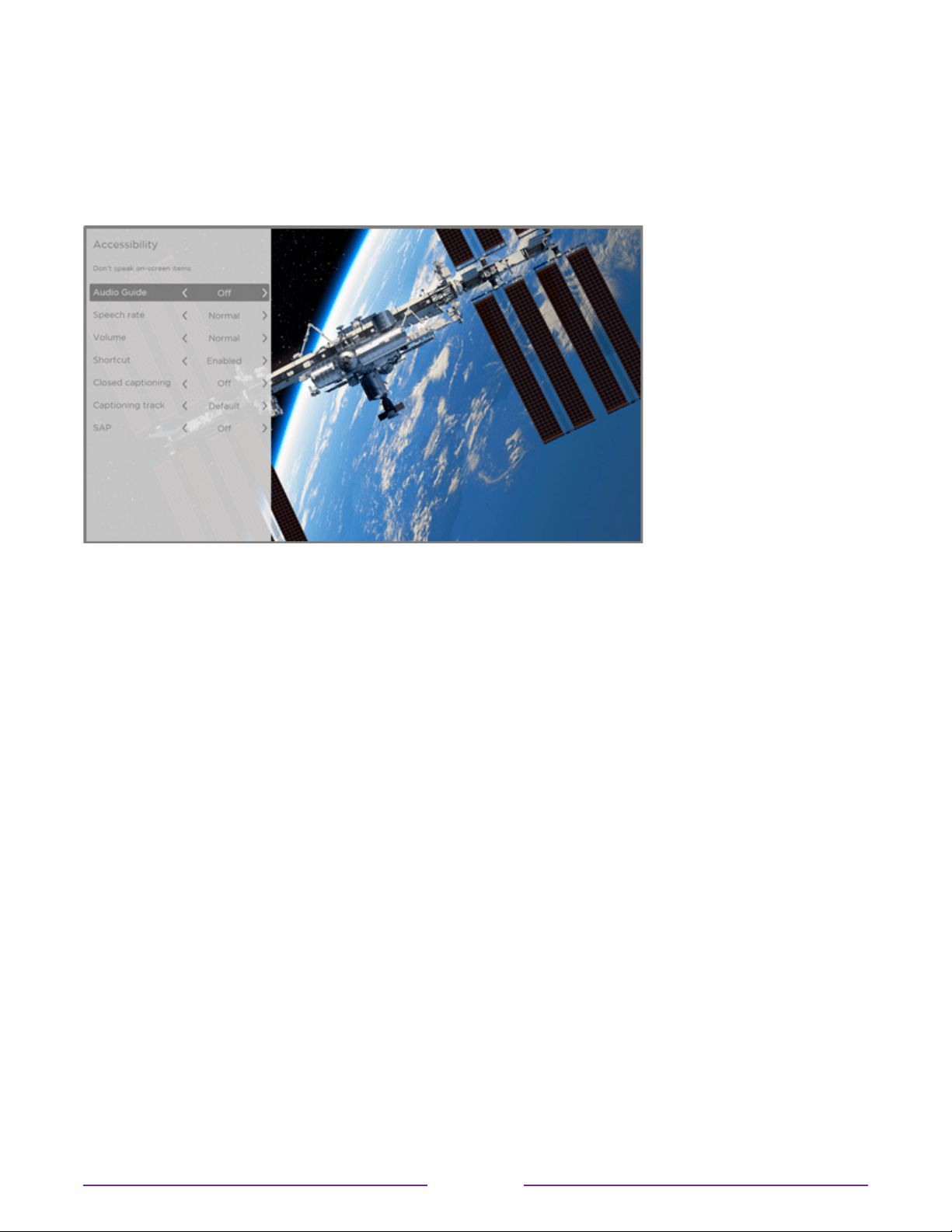
Accessibility (U.S. only)
Only in the United States, the settings on the Accessibility menu enable you to change the
TV’s accessibility settings without leaving the program you are watching. These settings are
also available on the Home screen menu under Settings > Accessibility.
Note: Some streaming channels assign STAR
to a dierent function, meaning it will not
open the Options menu. In these cases, use a dierent streaming channel to configure
accessibility options.
Accessibility menu settings
•
Audio Guide – Turn the Audio Guide on or o. The Audio Guide is a text-to-speech
screen reader that helps blind and low-vision users navigate the Roku user interface and
on-screen menus. When enabled, the Audio Guide reads out text, menus, and other on-
screen items.
Accessibility: If Shortcut is enabled, you can enable or disable the Audio Guide by
pressing the STAR
four times in quick succession. (STAR
is located directly below
the purple directional pad on the right side of the Roku remote.)
•
Speech rate – Select the speed at which the TV speaks Audio Guide prompts.
•
Volume – Set the volume of the Audio Guide in relation to the main TV volume.
•
Shortcut – Enable or disable the shortcut feature. When disabled, pressing STAR
four
times in quick succession does not enable or disable the Audio Guide.
•
Closed captioning – Controls when you see captions. This setting is only oered for the
ANT and AVinputs, and streaming/media player videos. Any set value remains in eect
across only these inputs.
67

•
Live TV – Set captions to o, always on, on only when the TV sound is muted, or on
only during instant replay (when Live TV Pause has been enabled).
•
AV input – Set captions to o, always on, or on only when the TV sound is muted.
•
Streaming video channel or media player – For streaming content that provides
closed captions, set captions to o, always on, on only when the TV sound is muted,
or on only during instant replay (for streaming content that supports instant replay).
Note that some streaming channels have other methods for turning captions on and
o. In these cases, the Closed captioning option does not appear on the Options
menu.
Note: If REPLAY
is not available on your remote, you can use this feature in the
Roku mobile app. For more information, see Roku mobile app.
•
Captioning track – Selects which caption track to display when closed captioning is on.
This setting remains in eect on all inputs that provide captions.
•
SAP – Selects whether to play a secondary audio program or multichannel television
sound, and which choice to play. This setting applies only to live TV on digital channels.
Video description through Secondary Audio Program
(SAP)
Video description of the action in a program helps individuals who are blind or visually
impaired enjoy programs. You enable video description by selecting one of the Secondary
Audio Program (SAP) options.
To hear video description narrations in programs that have them, turn on SAP. If there are
multiple SAP options for a channel, such as Spanish and French, try each one to determine
which setting carries the video description track.
Accessibility: Broadcasters provide video descriptions only on a small number of programs. If
you are unable to hear video descriptions after following these instructions, the program you
are viewing does not provide them.
For more details about video description, go to:
United States: https://www.fcc.gov/consumers/guides/audio-description
Canada: https://crtc.gc.ca/eng/info_sht/b322.htm
Picture settings
The Picturesettings menu for each TV input provides settings for fine tuning the appearance
of the picture. All of the settings in this menu apply only to the currently-selected input.
68
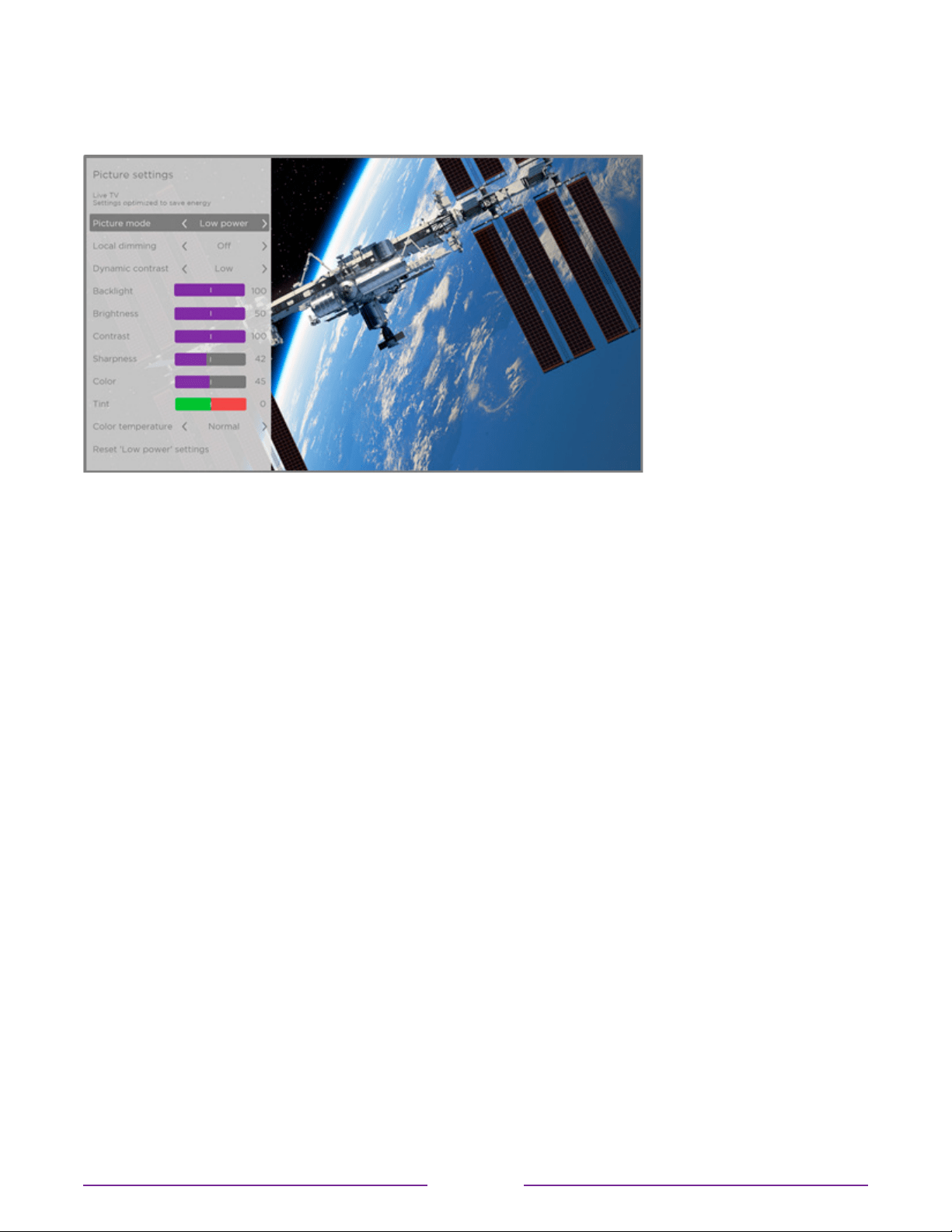
To use the Picturesettings menu, first press STAR
to display the Options menu. Then
select Picturesettings.
Typical Picture settings menu
Note: Some streaming channels assign STAR
to a dierent function, meaning it will not
open the Options menu. In these cases, use a dierent channel, such as The Roku Channel,
to configure Picture settings. The selected settings remain active for all streaming
channels.
Picture settings menu options
Note: Picture settings vary by brand and model. Not all settings are available on all TVs.
Names of certain settings also vary by brand and might dier from the names listed here.
•
Picture mode – Provides picture presets for various viewing preferences. This setting
duplicates the one on the Options menu. When you change the Picture mode, other
picture settings adjust accordingly. For example, setting the Picture mode to Vivid sets
Brightness, Contrast, Sharpness, and other values to produce a very vibrant picture.
Setting Picture mode to Movie changes the settings to produce a picture suitable for
enjoying movies in a darkened room. If you make changes to the individual picture
settings—for example, Contrast, or Sharpness—these settings are saved for the current
input and the current picture mode. In this way, you can set HDMI 1 input’s Movie picture
mode to use dierent settings than the HDMI2 input’s Movie picture mode and the
LiveTVinput’s Movie picture mode. Use Resetpicturesettings, described below, to
return the input’s selected picture mode to its original values.
69

•
Local dimming – Only on select models: Sets the amount of dimming applied to multiple
areas of the screen’s backlight intensity. This setting can make dark areas darker without
aecting the brightness of light areas.
•
Dynamic contrast – Only on select models: Automatically adjusts the backlight level to
achieve the optimum contrast and prevent excessive dierences between light and dark
areas of the screen.
•
Micro contrast – Only on select models: Improves image contrast.
•
Backlight – Adjusts the overall light intensity of the screen.
•
Brightness – Adjusts the dark level of the picture.
•
Contrast – Adjusts the white level of the picture.
•
Sharpness – Adjusts the sharpness of edges in the picture.
•
Color – Adjusts the saturation of colors in the picture. A setting of 0 removes all color
and displays a black and white picture.
•
Tint – Adjusts the color balance from green to red to obtain accurate colors in the
picture.
•
Color temperature – Adjusts the overall color tones in the picture from Normal to slightly
more bluish (Cool) to slightly more reddish (Warm).
•
Frame rate conversion – Only on select models. Each TV brand uses a dierent name
for this option. Adjusts the amount of motion processing applied to the video signal. A
higher setting results in more smoothing, but can cause undesirable picture artifacts in
certain types of content. Each Picture mode has a dierent default setting.
•
Film mode – Only on select models. Each TV brand uses a dierent name for this option.
When enabled, this feature reduces “judder” that is often present when 24 frame-per-
second movies are upscaled to 60Hz TV standards. Film mode is On by default in Movie
and HDR Dark picture modes, and O by default in other picture modes.
•
Blur reduction – Only on select 120Hz models. Each TV brand uses a dierent name for
this option. Reduces blur, especially for fast-moving images such as sports.
•
Black frame insertion – Only on select models that also have the local dimming feature.
Each TV brand uses a dierent name for this option. Reduces motion blur caused by the
refresh rate of the screen. Enabling this feature inserts black frames between picture
frames in a way that improves the clarity of fast moving objects. It provides an improved
viewing experience for video games and sporting events, but reduces the brightness of
the picture. You can choose settings of Low, Medium, High, or O to achieve the desired
picture quality.
•
Game mode – Only on HDMI® and AV inputs: Controls whether Game mode is enabled.
When On, the TV performs less image processing and has less input lag. When O, the
TV performs more image processing and has more input lag, which is less desirable for
action games.
•
Reset picture settings – Returns all picture settings for the input’s currently-selected
Picturemode to their original values.
70

Auto Low Latency Mode (ALLM)
Only on select models: Auto Low Latency Mode (ALLM) detects when certain game consoles
are connected to an HDMI input, and then automatically configures the best settings for
action games when that input is selected. When ALLM is active, the manual Game mode
setting is not available.
Variable refresh rate (VRR)
Only on select models: Variable refresh rate (VRR) allows a compatible game console or
computer connected via HDMI to control the refresh rate of the TV. This feature helps
to ensure that the TV does not begin to display a video frame until the video source has
completely rendered it. The result is smoother image animation with a lower instance of
stutter or tearing. Use of this feature requires that:
•
Variablerefreshrate is turned On in the HDMI settings for the input. This setting is O by
default.
•
The HDMImode is set to Auto or HDMI2.0 in the HDMI settings for the input.
•
Gamemode is enabled.
•
The connected device supports VRR.
Tip: To dismiss the Picturesettingsmenu, just wait a few seconds without pressing any
buttons. Or press STAR
again to dismiss the menu immediately.
Sound settings
Your TV model might have any one of the following premium sound settings available in the
Options menu:
•
No Sound settings
•
Roku Smart Soundbar (U.S. only)
•
Volume mode
•
Dolby® Audio Processing
•
DTS® TruSurround
•
DTS® Studio Sound
•
Sonic Emotion™ Premium
71
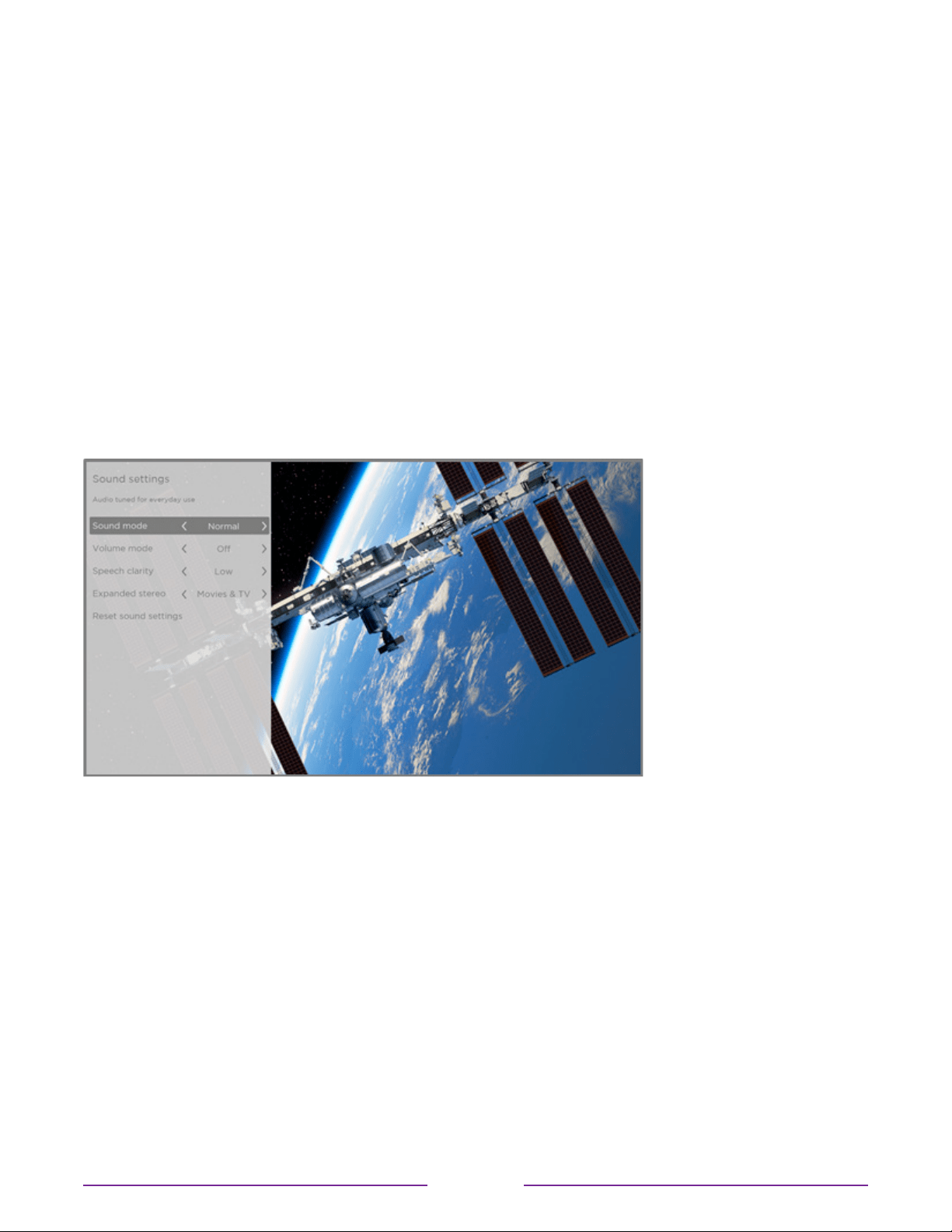
Roku Smart Soundbar (U.S. only)
Only in the United States, you can purchase and connect a Roku Smart Soundbar to the
HDMIARC or HDMIeARC port on any model of Roku TV. When you do, you can put away
your Roku Smart Soundbar remote control, because the Soundsettings menu on the TV
provides direct access to the soundbar settings. These settings replace the premium sound
settings, if any, that might be available when the Roku Smart Soundbar is not connected.
Tip: When you are using the TV in connected mode, it automatically hides the HDMI port to
which you connect your Roku Smart Soundbar on the basis that you never will need to worry
about accessing it directly. If you want to access the soundbar directly rather than through
your Roku TV, you can add the HDMIARC or HDMIeARC input to your Home screen.
To access Roku Smart Soundbar settings, first press STAR
to display the Options menu,
then select Soundsettings.
Sound settings menu – Roku Smart Soundbar (U.S. only)
•
Soundmode – Select from among various preset sound modes to make shows and
music sound its best.
•
Volumemode– Select from among modes for normal listening, volume leveling, and
night listening.
•
Speechclarity– Select O, Low, or High to make voices easier to hear above the rest of
the program.
•
Expandedstereo – Select one of the available settings to simulate surround sound or,
only with Roku Wireless TV Speakers in the rear channel position, to play stereo sound
from all speakers.
•
Resetsoundsettings– Returns all sound settings to their defaults.
72
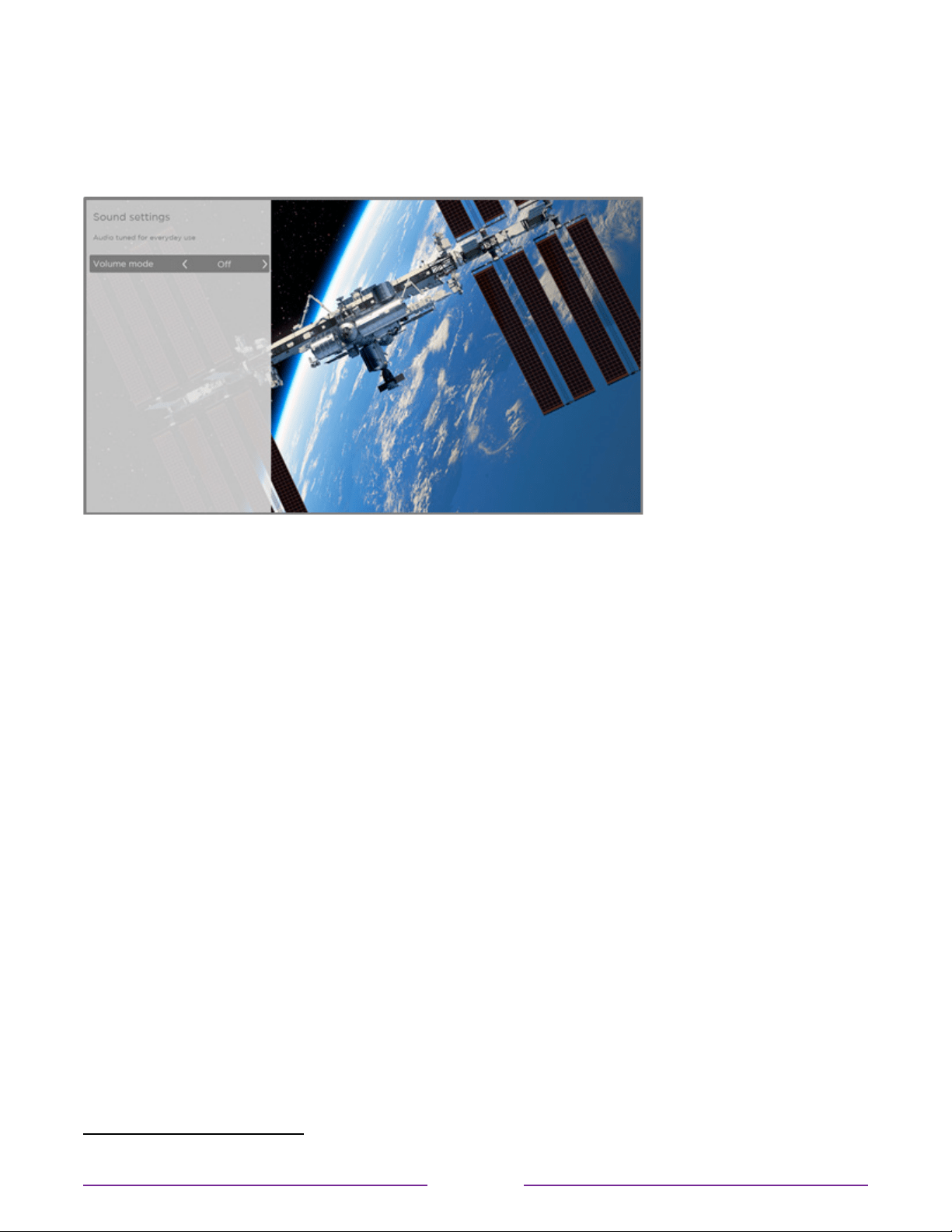
Volume mode (select models only)
To access Volume mode, first press STAR
to display the Options menu, then select
Soundsettings
1
.
Sound settings menu for models with Volume mode
Tip: Some streaming channels assign STAR
to a dierent function, meaning it will not open
the Options menu. In these cases, use a dierent streaming channel to set the Volume mode.
The selected mode remains active for all streaming channels.
Sound settings menu - Volume mode
•
O – Volume mode is inactive and content volume is unmodified.
•
Leveling – Provides a consistent volume level across dierent types of content, so that
you need not change the volume every time you switch channels or when a commercial
comes on.
•
Night – Soft sounds, such as whispers, are increased while loud sounds, such as
explosions, are decreased, making it easier to hear your TV at night without disturbing
others.
1 On some models the Volumemode option is in the Options menu rather than in Soundsettings.
73
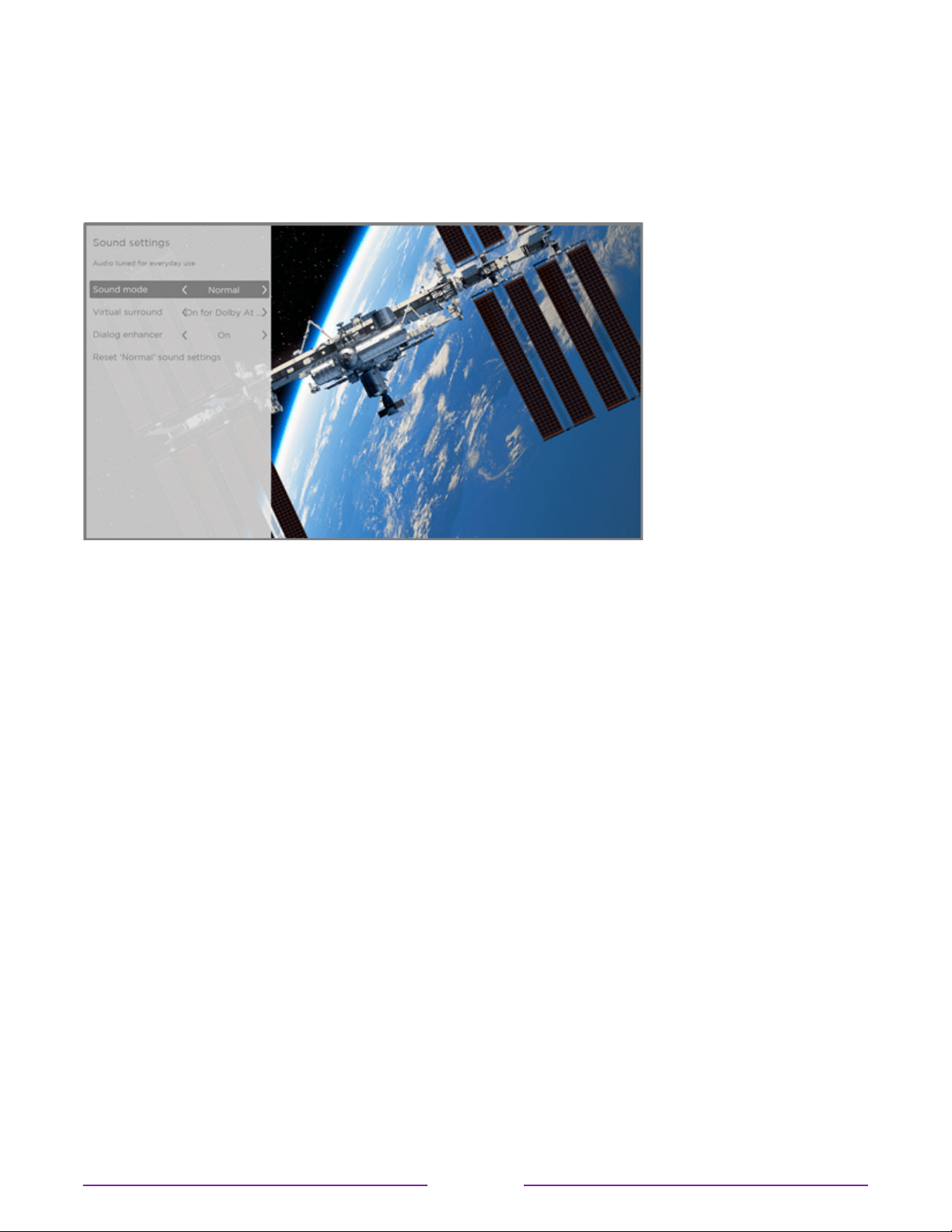
Sound settings – Dolby® Audio Processing (select models only)
Each TV input has separate settings for fine tuning sound quality. All of the settings in this
menu apply only to the currently-selected input. To access the DAP settings, first press
STAR
to display the Options menu, then select Soundsettings.
Sound settings menu for models with Dolby® Audio Processing
Tip: Some streaming channels assign STAR
to a dierent function, meaning it will not open
the Options menu. In these cases, use a dierent streaming channel to configure Dolby®
Audio Processing. The selected settings remain active for all streaming channels.
Sound settings menu– Dolby® Audio Processing
•
Soundmode – Select from among various preset sound modes to improve
speech, make music sound its best, boost bass or treble, or simulate a theater. Use
Resetaudiosettings, described below, to return the input’s current settings to their
original values.
•
Virtualsurround(Only on select models)– Options vary by TV model. Simulates
surround sound that otherwise would require installation of a surround sound audio
system. Sometimes, the eect interferes with dialog clarity. Use the Dialog enhancer
option to compensate.
•
Dialogenhancer– Improves the clarity of speech when on.
•
Resetsoundsettings– Returns Virtualsurroundand Dialogenhancersettings to their
default settings for the selected Soundmode.
74
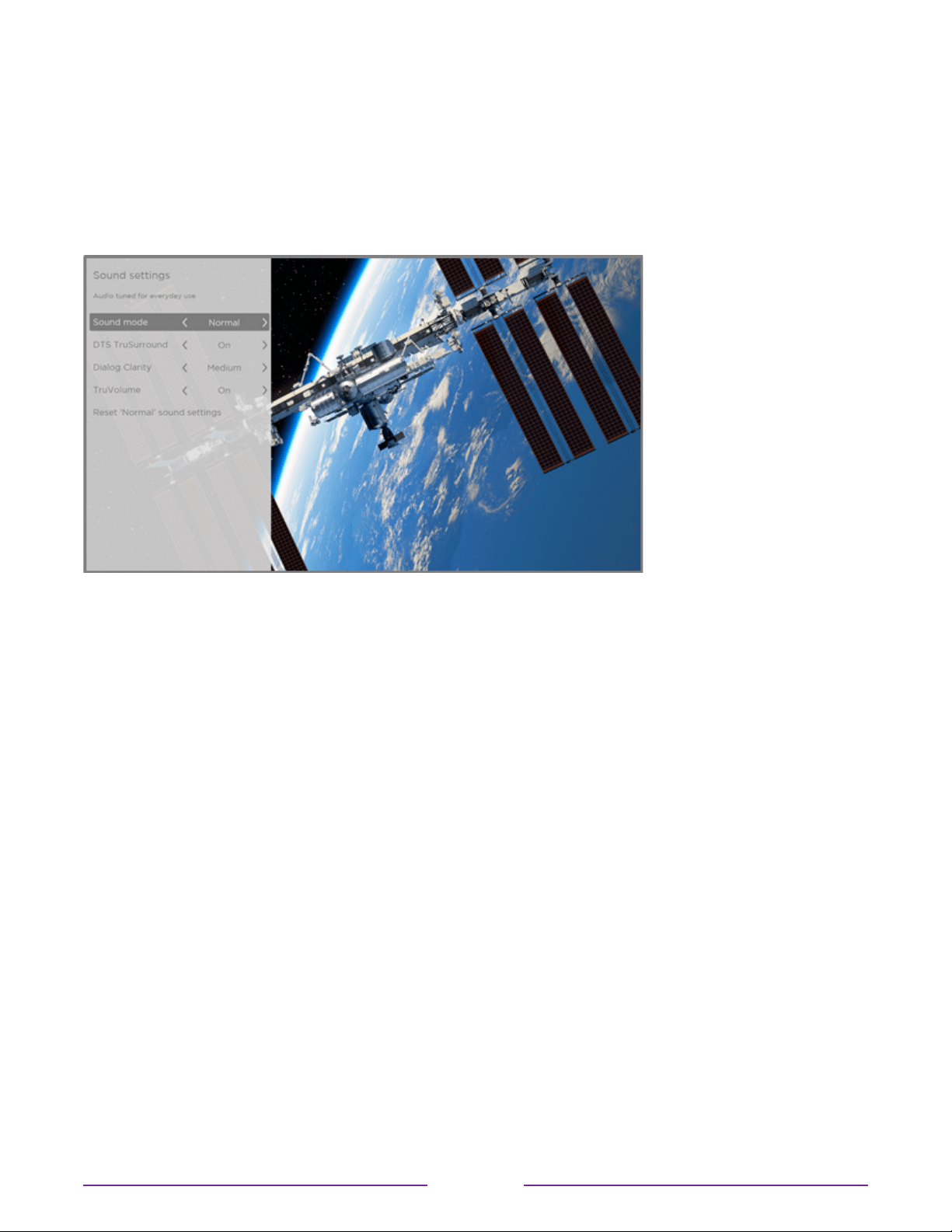
Sound settings – DTS® TruSurround / DTS® Studio Sound
(select models only)
Each TV input has separate settings for fine tuning sound quality. All of the settings in this
menu apply only to the currently-selected input. To access the DTS® settings, first press
STAR
to display the Options menu, then select Soundsettings.
Sound settings menu for models with DTS® TruSurround/Studio Sound
Tip: Some streaming channels assign STAR
to a dierent function, meaning it will not open
the Options menu. In these cases, use a dierent streaming channel to configure DTS® Studio
Sound. The selected settings remain active for all streaming channels.
Sound settings menu– DTS® TruSurround / DTS® Studio Sound
•
Soundmode – Select from among various preset sound modes to improve speech, make
music sound its best, boost bass or treble, or simulate a theater. Use Resetaudiosettings,
described below, to return the input’s current settings to their original values.
•
DTSTruSurround–Simulates surround sound that otherwise would require installation of
a surround sound audio system. Sometimes, the eect interferes with dialog clarity. Use
the Dialogclarity option to compensate.
•
DialogClarity– Available only when DTSTruSurround is On. Choose among Low,
Medium, and High settings to improve the clarity of dialog when you are using the
TruSurround feature.
•
TruVolume– Minimizes annoying volume fluctuations in programs.
•
Resetsoundsettings– Returns DTSTruSurround, DialogClarity,and
TruVolumesettings, to their default settings for the selected Soundmode.
75
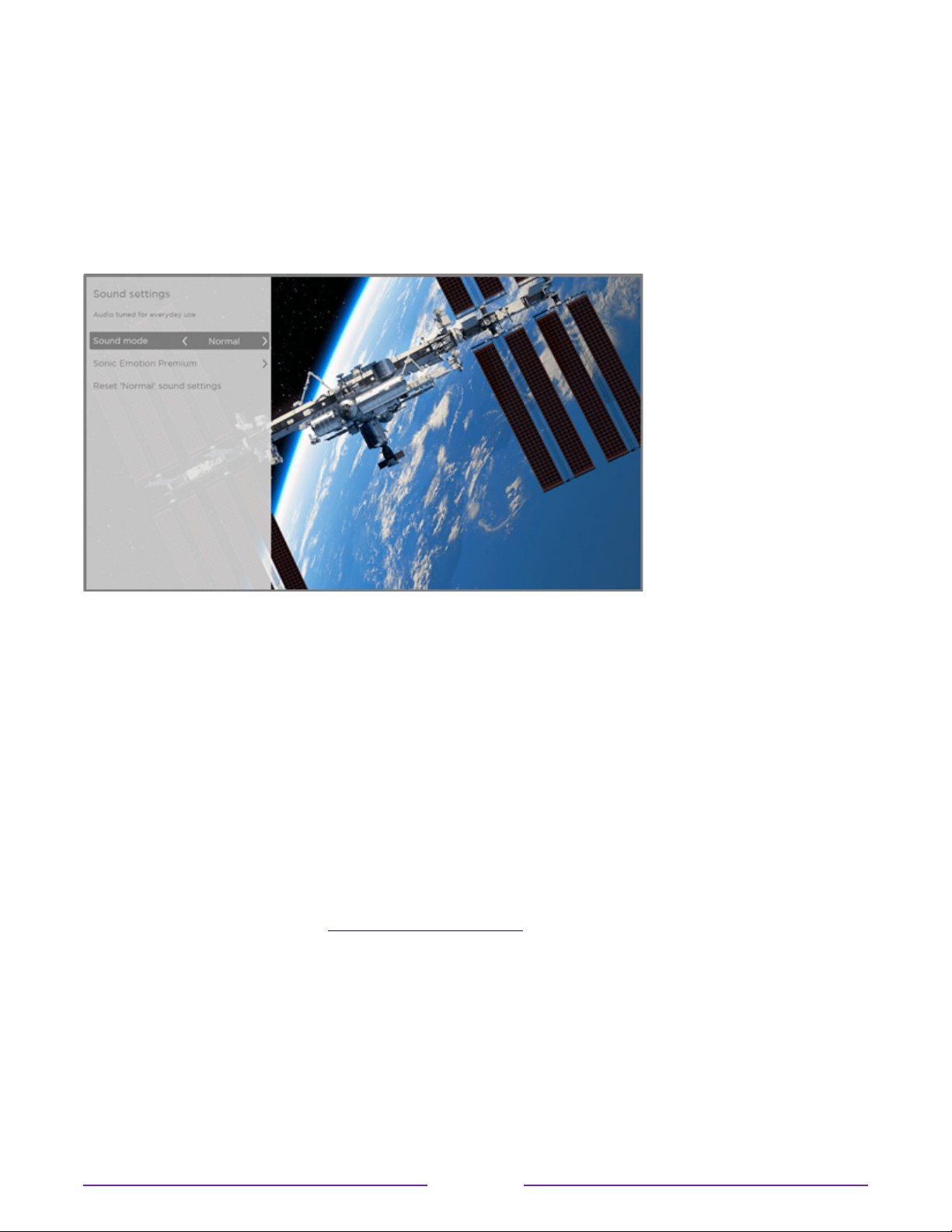
Sound settings – Sonic Emotion™ Premium (select models only)
Sonic Emotion™ Premium is an audio technology that enables your TV to produce a more
immersive sound experience. Each TV input has separate settings for fine tuning sound
quality. All of the settings in this menu apply only to the currently-selected input. To access
the Sonic Emotion™ settings, first press STAR
to display the Options menu, then select
Soundsettings.
Sound settings menu for models with Sonic Emotion™ Premium
Tip: Some streaming channels assign STAR
to a dierent function, meaning it will not
open the Options menu. In these cases, use a dierent streaming channel to configure Sonic
Emotion™. The selected settings remain active for all streaming channels.
Sound settings menu– Sonic Emotion™ Premium
•
Soundmode – Select from among various preset sound modes to improve
speech, make music sound its best, boost bass or treble, or simulate a theater. Use
Resetaudiosettings, described below, to return the input’s current settings to their
original values.
•
SonicEmotionPremium – Displays a menu with individual Sonic Emotion™ audio
settings, as described in Sonic Emotion settings.
•
Resetsoundsettings– Returns Sonicemotionsettings to their default settings for the
selected Soundmode.
76
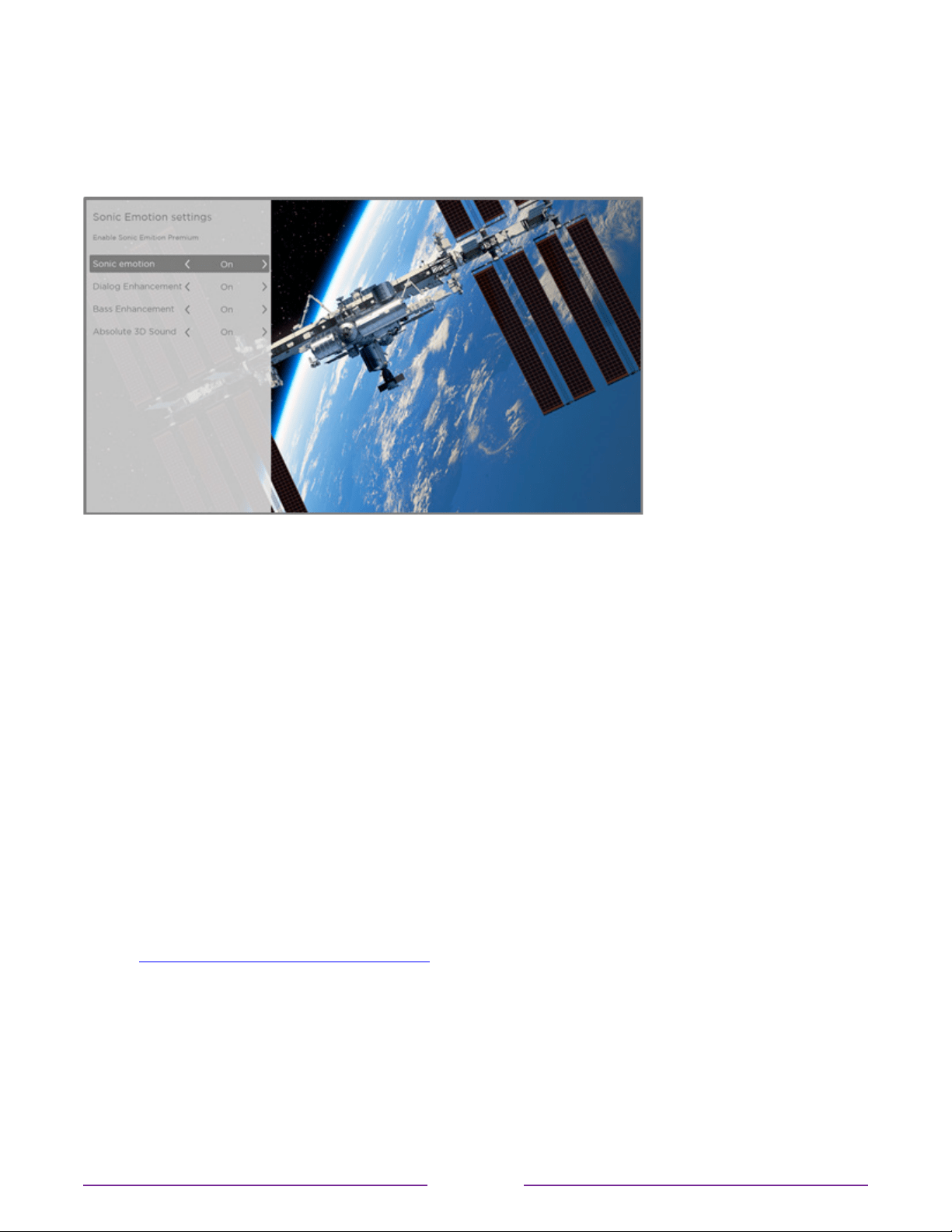
Sonic Emotion™ settings
When you select SonicEmotionPremium from the Soundsettings menu, these additional
settings become available:
Sonic Emotion settings menu for models with Sonic Emotion™ Premium
•
DialogEnhancement – Enhances your ability to hear and understand dialog in the
program.
•
BassEnhancement – Enhances the low frequency sound component in the program.
•
Absolute3DSound – Simulates sound from multiple speakers that would otherwise
require installation of a surround sound audio system.
Expert Picture Settings (4K models only)
4K (UHD) TV models have additional picture settings for demanding home theater
enthusiasts. Expert Picture Settings include gamma, noise reduction, 11-point white balance
adjustment, and extended color space management.
You can access Expert Picture Settings only by using the Roku mobile app on an iOS® or
Android™ mobile device. For more information, go to the following link on the Roku web site:
go.roku.com/expertpicturesettings
77

Changing privacy settings
Note: Privacy settings are not present on TVs operating in non-connected mode.
Advertising
Only in connected mode, by default your TV uses an advertising identifier to track your TV
usage. You can change the privacy settings on your TV in two ways: resetting the advertising
identifier and limiting ad tracking.
Reset the advertising identifier
Resetting the advertising identifier clears the prior usage history that your TV stores, and
then begins tracking again. From that point forward, your new usage patterns aect the
advertisements you see on your TV.
1. From the Home screen menu, navigate to Settings>Privacy>Advertising.
2. Highlight Resetadvertisingidentifier. Press STAR
to view more information about
this option. When you finish reading the information, press OK to close the More
Information window.
3. Press OKto reset the advertising identifier, and then press OK again to dismiss the
verification message.
Limit ad tracking
You can limit Roku’s tracking of your usage behavior by limiting ad tracking. When you do,
your TV will display ads that are not personalized based on your TV’s advertising identifier.
1. From the Home screen menu, navigate to Settings>Privacy>Advertising.
2. Highlight Limitadtracking. Press STAR
to view more information about this option.
When you finish reading the information, press OKto close the More Information
window.
3. Press OK to select the Limit ad tracking check box.
Note: If you perform a factory reset and then reconnect your TV, ad tracking is restored until
you repeat these steps.
78

Microphone
Your Roku TV does not have a built-in microphone. However streaming channel providers can
use the microphone on Roku voice remotes (only on select models) or on your mobile device
when the Roku mobile app is running. You can control whether streaming channels have
permission to use the microphone.
Note: These settings aect only streaming channel access to the microphone. They do not
aect your Roku TV’s Voice Search feature.
Channel microphone access
You can control which streaming channels have permission to use the microphone, giving
you control over how the microphone is used by each streaming channel. The default setting
is Prompt, so channels will not be able to turn on the microphone without your permission.
To change microphone access settings:
1. From the Home screen menu, navigate to Settings > Privacy > Microphone.
2. Select Channel microphone access.
3. Choose one of the following settings:
•
Prompt – Display a notification the first time a streaming channel requests the
use of the microphone. When such a notification appears, you can select either
Allowmicrophoneaccess or Denymicrophoneaccess on a per-channel basis. If
you choose to allow microphone access, you’ll be prompted to confirm your choice
by entering a numeric code that appears on the screen.
•
Alwaysallow – Do not prompt, but always allow any streaming channel to use the
microphone.
•
Neverallow – Do not prompt, but never allow any streaming channel to use the
microphone.
79

Channel permissions
After granting or denying microphone access on a per-channel basis, you can reset channel
permissions to enable them to follow the system-wide setting you specify under Channel
microphone access.
To reset channel permissions:
1. From the Home screen menu, navigate to Settings>Privacy>Microphone.
2. Select Channel permissions.
3. Highlight Resetchannelpermissions, or highlight a specific listed channel, and then
press OK to deny microphone access to all or to a specific channel.
Smart TV experience (U.S. only)
Only in the United States, if you have connected your TV to the Internet, your TV prompts
you to opt in to the Smart TV experience when you first start watching TV programs.
Regardless of your decision at that time, you can change your decision later.
To change your Smart TV experience choices:
1. From the Home screen menu, navigate to Settings>Privacy>SmartTVexperience.
2. Highlight the setting you want to change, and then press OK to enable or disable it.
•
UseinfofromTVinputs– Authorizes Roku to collect and share information about
what, when, and how you are watching and use this to make recommendations.
•
Enableautonotifications – Displays brief notifications from the Smart TV
experience across the bottom of the screen when recommendations are available.
Note: These settings do not aect recommendations for More Ways to Watch that you
see in the Smart Guide when watching live TV channels.
80

Featured Free (U.S. only)
Only in connected mode in the United States, use Featured Free to discover content that is
free to watch.
As you browse through the programs, the featured channel’s icon appears in the upper left
corner of the screen. Use the purple directional pad to highlight a program, and then press
OK to see more information about it.
Once you are viewing a program’s details, press OK to start playing the program. If you’ve
already added the channel, you’ll be taken directly to the channel and the program will
begin to play. If you have not added the channel, it will be added for you before playing the
program.
If you don't want to see Featured Free on the Home screen menu, you can hide it.
To hide Featured Free:
1. From the Home Screen menu, navigate to Settings > Home screen, and then press
RIGHT.
2. Select Featured Free.
3. Highlight Hide, and then press OK.
81

My Feed
Only in connected mode, use My Feed to find out when you can watch movies coming soon,
and to get updates on movies, TV programs, and actors that you are following.
Movies Coming Soon (U.S. only)
Only in the United States, My Feed gives you updates on your list of movies that are coming
soon to theaters. With My Feed, you’ll know when your favorite movie is ready to stream, the
channels it is on, and how much it will cost.
Select the movies you want to follow by going to My Feed > Movies Coming Soon. You’ll
then see a list of newly released movies that are not yet available on Roku streaming devices.
Select a movie, and then select Follow this movie on Roku. When you return to the main My
Feed screen, you’ll see banners for each of your newly-followed movies along with banners
for movies and TV programs you’re already following.
Movies, TV programs, and people
In addition to following movies coming soon, you can follow any movie, TV program, or actor
across top streaming channels. To follow a program, search to find the movie, TV program, or
name that you want to follow, and then select Followthismovie/TV show/persononRoku.
For more information, see Searching for something to watch.
Note: The TV takes a bit of time to update your newly-followed programs. Until it finds at
least one channel oering the movie, the content banner in My Feed shows Check back later
for updates.
My Feed alerts you any time a movie or TV program you are following becomes available on
another channel and whenever its price changes. A number in parentheses next to My Feed in
the Home screen menu means that My Feed has updated information that you haven’t viewed
yet. For example, if three of your followed programs have updates, you’ll see My Feed (3).
Note: When a movie or TV program you are following becomes available, the streaming
channel oering the movie might require that you subscribe or pay a fee to view it.
82

Searching for something
to watch
Searching for movies and programs across streaming channels and live TV is one of the
unique features of your Roku TV. Within a single search operation, you can search by:
•
Movie name
•
TV program name
•
Actor or director name
•
Streaming channel name
•
Interactive game name
•
Popular quotes, such as “May the Force be with you.”
•
Genre, including the special genres, “free” and “4K.”
Note: Roku Search is only available if your TV is operating in connected mode and linked to a
Roku account. Roku Search doesn’t search across all streaming channels, but searches across
lots of popular streaming channels. The actual channels it searches vary by locale.
How do I search?
You can search in several dierent ways:
•
By using an on-screen keyboard that you navigate using the purple directional pad on
your remote
•
By typing on the Roku mobile app on your phone or tablet
•
By speaking search phrases in English or Spanish using a Roku voice remote, the Roku
mobile app, Alexa, or Google Home Assistant.
For more information about Voice Search, go to go.roku.com/voicesearch
.
83

Keyboard search using the remote
1. Select Search on the Home screen menu.
2. Use the purple directional pad to navigate the on-screen keyboard, entering a few
characters of the search term.
Each additional character you enter narrows down the search, making the search
results more relevant. You’ll often see the results you are seeking after entering only a
few letters.
3. When you see the program you are searching for, press RIGHT to highlight it. Continue
pressing RIGHT to see more details about how to watch the program.
Voice Search from a Roku voice remote
Only with models that have a Roku Voice Remote or Roku Enhanced Voice Remote:
1. Press and hold either VOICE
D
or SEARCH
E
, depending on your remote.
Hint: Tap the button to see on-screen tips about searching. Repeat to see a dierent
set of tips.
2. While holding down the button, say the name of a movie, TV program, actor, director,
or genre (including the special genres, “free” and “4K”). Or say, for example, “What
movie is this from ‘May the Force be with you’,” to search for a movie based on a
popular quote. You also can search for news programs. Say things like, “Show the
news,” “Play news,” or “Play news on newsy.”
Note: You can use either English or Spanish for voice searches, according to the TV
language you set in Settings>System>Language.
The TV lists the results of your search across many streaming channels and, only in the
United States, live TV channels.
3. Press RIGHT to move the highlight into the list of search results.
4. Press UP or DOWN to scroll through the list of search results to highlight the item you
want to view.
84

Searching from the Roku mobile app
Use the free Roku mobile app on your compatible smartphone or tablet to make searching
even faster. Use your mobile device’s keypad to type more quickly and easily than with the
on-screen keyboard on your TV. Or, search by touching the Voice Search icon and saying the
name of the movie, TV program, actor, director, genre, streaming channel, or game.
When you use the Roku mobile app to search, search results are shown on your mobile
device instead of on the TV screen. When you make a selection from the search results, the
TV starts playing the selected program.
For more information, see Roku mobile app.
Searching with Google Assistant
1
Use your Google Home, Google Pixel phone, or the Google Home mobile app to search for
programs:
1. Link your Roku account to your Google account using the Google Home mobile app
on your iOS or Android device.
2. Start your command with “Hey Google” or “OK Google,” and follow the command with
“on Roku.” Some examples:
•
“Hey Google, show me documentaries on Roku.”
•
“OK Google, show me comedies on Roku.”
Note: You also can issue commands to control your Roku TV. And, if you have enabled
FastTVStart on your TV, you can turn on your TV by saying, “OK Google, turn on Roku.”
For more information about setting up and using Google Assistant with your Roku Tv in the
United States, see https://support.roku.com/article/360009649613-how-do-i-control-my-
roku-streaming-device-with-the-google-assistant-.
1 Voice features support English and Spanish languages when the corresponding TV language is selected.
85

Searching with Amazon Alexa
1
Use your Amazon Echo Dot, Echo Plus, Echo Show, or the Amazon Alexa mobile app to
search for programs:
1. Link your Roku account to your Amazon account using the Amazon Alexa app on your
iOS or Android device.
2. Start your command with “Alexa,” and follow the command with “on Roku.” Some
examples:
•
“Alexa, turn up the volume on Roku.”
•
“Alexa, show me documentaries on Roku.”
Note: You also can issue commands to control your Roku TV. And, if you have enabled
Fast TV Start on your TV, you can turn on your TV by saying, “Alexa, turn on Roku.”
For more information about setting up and using Google Assistant with your Roku TV in the
United States, see https://support.roku.com/article/360017961074-how-do-i-use-amazon-
alexa-with-my-roku-streaming-device-.
Direct-to-playback search results
With direct-to-playback, voice search results jump directly to and start playing the program
whenever your search command can be uniquely identified and the requested content is
available at no additional cost to you.
2
Searching for free content
You’ll discover an almost endless list of content through your Roku TV, and much of it is free.
You can easily find free content by including the word “free” in your search. For example:
•
RokuVoiceRemoteorRokumobileapp—Say, “Show me free comedies” or “Show me
free romance,” or simply, “Show me free shows.”
•
GoogleHome,GooglePixelphone,ortheGoogleHomemobileapp—Say “OK Google,
show me free programs on Roku,” or “Hey Google, show me free documentaries on
Roku.”
•
AmazonAlexa—Say “Alexa, show me free miniseries on Roku” or “Alexa, show me free
dramas on Roku.”
1 Voice features support English and Spanish languages when the corresponding TV language is selected.
2 Direct-to-playback commands work with selected streaming channels. Direct playback occurs only when there
is a high confidence of match, the content is free or you are already subscribed, and the channel is already
added to your Home screen.
86
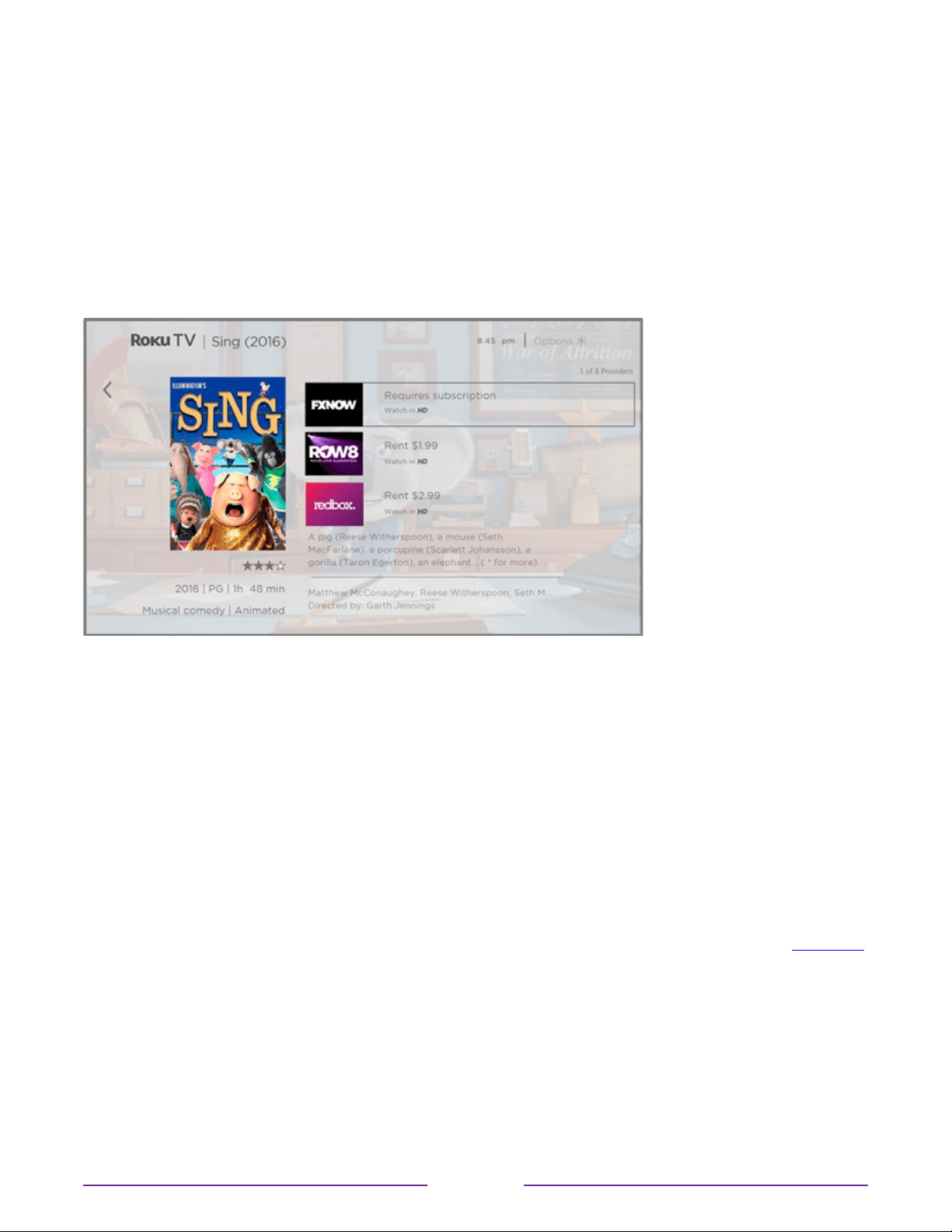
I searched for a program. Now what?
Now that you’ve highlighted the program, movie, actor, game, or streaming channel you were
looking for, press RIGHT.
If your search result was an actor, director, or other item that does not represent a single
item of content, you’ll see another list to narrow down your search. Only in the United States,
if you do a Roku Voice search, the TV shows visual search results rather than a list of text
results. In all cases, use the purple directional pad to find the program you want to watch.
If your search result was a game or a streaming channel, you will see detailed information,
images, and available actions, such as a list of results and the cost, if any, of using the item or
channel.
Note: Some channels may require a paid subscription.
Follow on Roku
Rather than watch the program you found in Search, you can add it to My Feed and wait until
it’s available on a particular streaming channel or available at a better price. From the search
results screen, select Follow on Roku. Then go to My Feed periodically to check for updates
to each of your followed movies, TV programs, or people. For more information, see My Feed.
87

Recent Searches
The next time you use Search from the Home screen menu, the Search screen displays a list
of recent search selections in place of the search instructions.
Using the recent search selections list makes it easy to quickly get to a previously found item,
for example, to find another movie with the same actor, or another TV program in the same
series.
Roku Zones (U.S. only)
Only in the United States, Roku Zones are search results grouped within popular genres, for
example, “action,” “comedy,” and “horror." To see Roku Zones in search results, search for
a genre name and look for the word Zone added to the end of a search result. Or, to see
all Roku Zones, search for “zone” and then scroll down in the results until you pass other
programs beginning with “zone.”
When you open a Roku Zone, the results are organized into browsable rows such as “New
Releases,” “Included With Subscription,” “Free,” “Rent / Buy,” “Rent for $3 or less,” “Classic
Movies & TV Shows,” and others. If you’re searching on a 4K Roku TV, results also include an
“Available in 4k” row.
You can select a title to view channel availability and pricing information, and then select the
channel to watch. To go back without making a selection, press BACK
.
88

Using the Roku Channel
Store
Only in connected mode, either the StreamingChannels menu option or the AddChannels
shortcut takes you to the Roku Channel Store, where you can add new subscription based
and free streaming channels to your TV.
Tip: Search for streaming channels by using the Search option, as explained in Searching
for something to watch. Use Roku Voice Search if you prefer. When you use Voice Search, if
your TV recognizes a channel name, it launches the channel if you already have installed it.
Otherwise, it oers to install it for you. At that point, you can choose to install or cancel.
To make it easier to find what you want, the streaming channels in the Roku Channel Store are
categorized by topic. Press UP and DOWN to highlight the category you want, and then press
RIGHT to move the highlight into the grid of streaming channel tiles.
When you find a streaming channel you want to add or learn more about, highlight it and
press OK to display more details.
•
If the streaming channel you are adding is free, you can select Go to channel to start
watching it immediately.
•
If there is a one-time or recurring fee associated with using the streaming channel, you
must agree to the terms and conditions, accept the fee, and—if you created one when
you activated your Roku TV—enter your Roku PIN code to authorize the charges.
•
If you already have a subscription to the channel—for example, you already subscribe
to Netflix or you receive HBO through your cable TV provider—you must complete a
dierent, simple authorization step to add the streaming channel.
You need only complete the authorization or activation step one time, when you initially add
the streaming channel. After that, you just select the streaming channel tile from the Home
screen to start watching. (Channel and content availability are subject to change. Charges
may apply to your selection.)
Tip: New streaming channels are added continuously to the Roku Channel Store, so be sure
to check back frequently for new options.
Note: If you don’t remember your PIN, or if you want to change whether you need to use a
PIN to make purchases on your Roku account, see Roku account PIN.
Roku Channel Store
89

Automatic Account Link
Some subscription channels take advantage of Automatic Account Link. If you have multiple
Roku devices, channels that support this feature require you to supply your user name and
password on only one device. For a growing list of channels that support this feature in the
United States, see:
https://support.roku.com/article/360021586854-how-do-i-set-up-my-subscription-
channels-on-a-second-roku-streaming-device-
90

Customizing your TV
There are several things you can do to personalize your TV.
Add TV inputs
As you use your TV, you might find that you need to add a TV input tile that you did not add
during Guided Setup. To add a TV input:
1. From the Home screen menu, navigate to Settings > TV inputs. Notice that the list of
inputs is divided into two sections: Inputs being used and Inputs not used.
2. Press UP or DOWN to highlight an input in the Inputsnotused section of the list.
3. Press RIGHT to move the highlight to Setupinput.
4. Press OK to add the input.
5. Press HOME
to return to the Home screen. Notice that the input has been added to
the top of the Home screen. If you want to move the input tile to a dierent position in
the grid, see Rearrange tiles.
Tip: Only in the United States, if you purchase and connect a Roku Smart Soundbar, your
Roku TV and the TV is in connected mode, it automatically controls all required sound
settings, power, volume, and mute through your TV’s remote control, and hides the HDMI port
to which you connected it. If you want to access the soundbar directly rather than through
your Roku TV, you can add its HDMI input to your Home screen.
91

Add streaming channels
You can add streaming channels by searching in the Roku Channel Store from any of the
following locations:
•
Streamingchannels option
•
Search (including Roku Voice Search)
•
AddChannels shortcut
New streaming channels are added to the bottom of the Home screen. If you want to move
the channel tile to a dierent position in the grid, see Rearrange tiles.
Hint: If you have multiple Roku devices, they all show the same set of streaming channels
after their next daily update, unless the channel is not compatible with the device. So don’t be
surprised when you add a channel to your Roku TV and then see it the next day on your other
Roku devices.
Rename inputs
Rather than trying to remember that your Blu-ray™ player is connected to HDMI 1 and
your game console is connected to HDMI 3, you can rename the TV inputs to match the
connected device.
Note: Renaming an input also changes the icon associated with it.
To rename an input, you can either:
•
Highlight the input tile in the Home screen, and then press STAR
to display a list of
options. From the list of options, select Rename input. Then select a new name and
icon.
or
•
From the Home screen menu, navigate to Settings>TVinputs. On the TVinputs
screen, select the input you want to rename, select Rename, and then select a new
name and icon from the provided list.
Rather than using the predefined names and icons, you can set a custom name and icon. To
do so, scroll up or down to highlight Set custom name & icon, and then press OK. Follow the
instructions on the screen to enter a name and select an icon for the input.
Press HOME
to return to the Home screen. The new name and icon are now in eect.
92

Remove unwanted tiles
It’s easy to remove unused TV inputs and unwanted channel or app tiles. For example, if you
never use the HDMI 3 input, or if you don’t like the weather app you added from the Roku
Channel Store, you can remove them from your Home screen.
Note: You also can remove the Live TV tile if you never use the TV tuner. But be aware that
removing the Live TV tile also deletes the channel list. You’ll have to set up the TV tuner again
next time you want to view live TV. Instructions for setting up the TV tuner can be found in
Setting up live TV.
•
To remove any tile, highlight the tile in the Home screen, and then press STAR
to
display a list of options. From the list of options, select Removeinput. In the screen that
follows, confirm you want to remove the input.
•
Alternatively, to remove a TV input tile, navigate to Settings>TVinputs. On the TV
inputs screen, select the input you want to remove, and then select Remove> Confirm.
Then press HOME
to return to the Home screen.
93
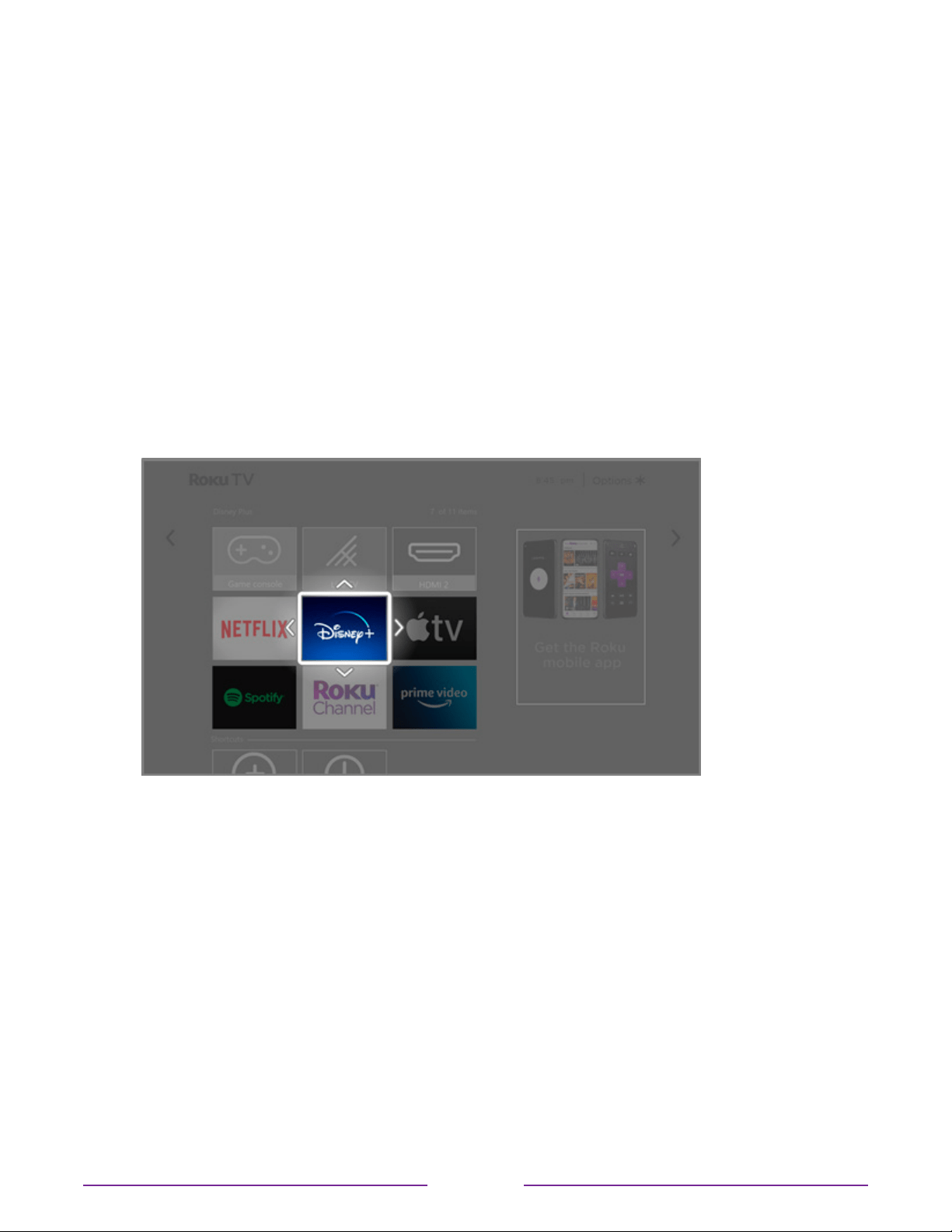
Rearrange tiles
When you add a TV input tile, it’s added at the top of your Home screen. When you add a
new streaming channel, it’s added at the bottom of your Home screen.
You can easily rearrange the order of the tiles on the Home screen to suit your viewing
preferences. For example, you might want Live TV to be the first tile in your Home screen.
But if you mostly watch one streaming channel, you might want its tile to be the first one on
your Home screen.
1. On the Home screen, highlight one of the tiles you want to move.
2. Press STAR
to display a list of options for the type of tile you selected.
3. Select Move input or Move channel. The list of options disappears and the highlighted
tile shows arrows indicating how it can be moved.
Note: A paid subscription or other payments may be required for some channels.
Channel availability is subject to change and varies by country. Not all content is
available in countries or regions where Roku® products are sold.
4. Use the purple directional pad to move the highlighted tile to its new position. As you
move the tile, it pushes other tiles out of its way.
5. Press OK to lock the tile into its new position.
6. Repeat these steps to move other tiles until you have arranged your Home screen to
your liking.
94

Change the look and feel with themes
Only in connected mode, another way to customize your TV is to change its theme. The
theme establishes the look and feel of the TV through colors, designs, fonts, wallpaper
(background) and screensaver.
To change the theme, from the Home screen menu navigate to Settings>Theme. In the
Themes screen, choose from the following options:
•
Wallpapers – Select a wallpaper of your choice.
•
Screensavers – Select a screensaver of your choice.
•
Themepacks – Only in the United States, choose from a selection of packages that
include coordinated wallpapers and screensavers.
•
Seasonalthemes – Turn seasonal themes on or o. When this feature is on, Roku
overrides your selected theme with a theme of their own choosing for various holidays
and significant events. After the holiday or event passes, the TV reverts to your selected
theme.
•
Screensaverwaittime – Select the idle time after which you want your selected
screensaver to appear.
•
Restoredefaulttheme – Every Roku TV has a theme based on the TV brand and
model. Use this option to restore that default theme.
Change the screen theme
95
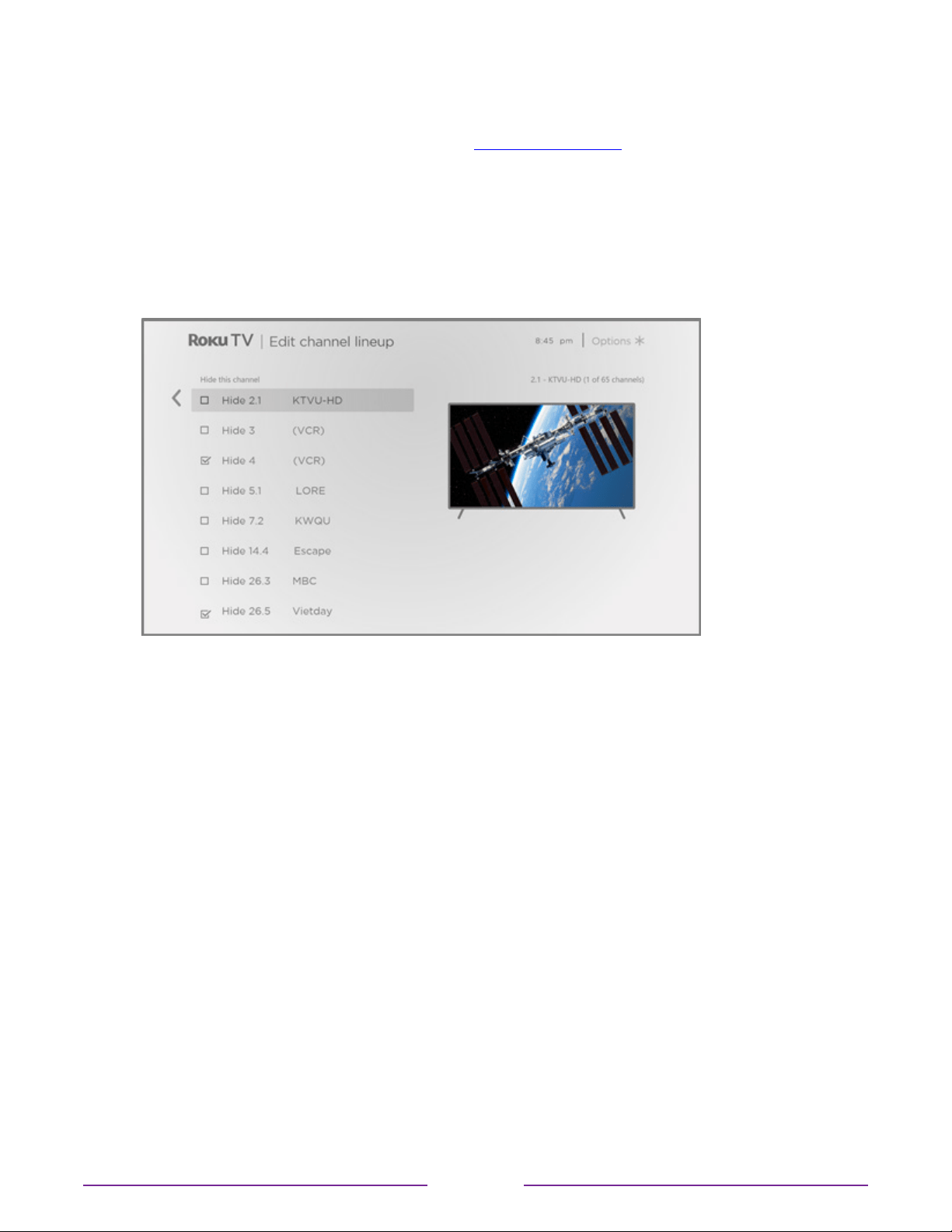
Edit live TV channel lineup
When you set up the TV tuner as described in Setting up live TV, the TV adds all the channels
with good signals that it can detect in your area. It’s likely that you now have more channels
than you want in your channel list.
To edit the channel lineup, from the Home screen, navigate to Settings > TV inputs >
LiveTV> Edit channel lineup. You’ll see a screen listing all of your channels. Adjacent to the
list of channels is a miniature TV screen playing the highlighted channel’s picture and sound.
For each channel you want to hide, highlight it, and then press OK to select its check box.
Tip: If you need to view the highlighted channel to decide whether to hide it, wait a couple of
seconds for the TV to start playing the channel’s picture and sound. If you’ve enabled parental
controls and the program on the current channel is blocked, you won’t see a picture or hear
sound while editing the channel lineup.
Note: Repeating the live TV channel scan unhides all hidden channels.
Change menu volume
Menu sounds are the noises the TV makes to let you know it received your command. You
can change the volume of these menu sounds or turn them o.
To adjust the menu volume, from the Home screen menu, navigate to Settings> Audio>
Menuvolume. Navigate to the right and then change the setting to High, Medium, Low, or
O.
96
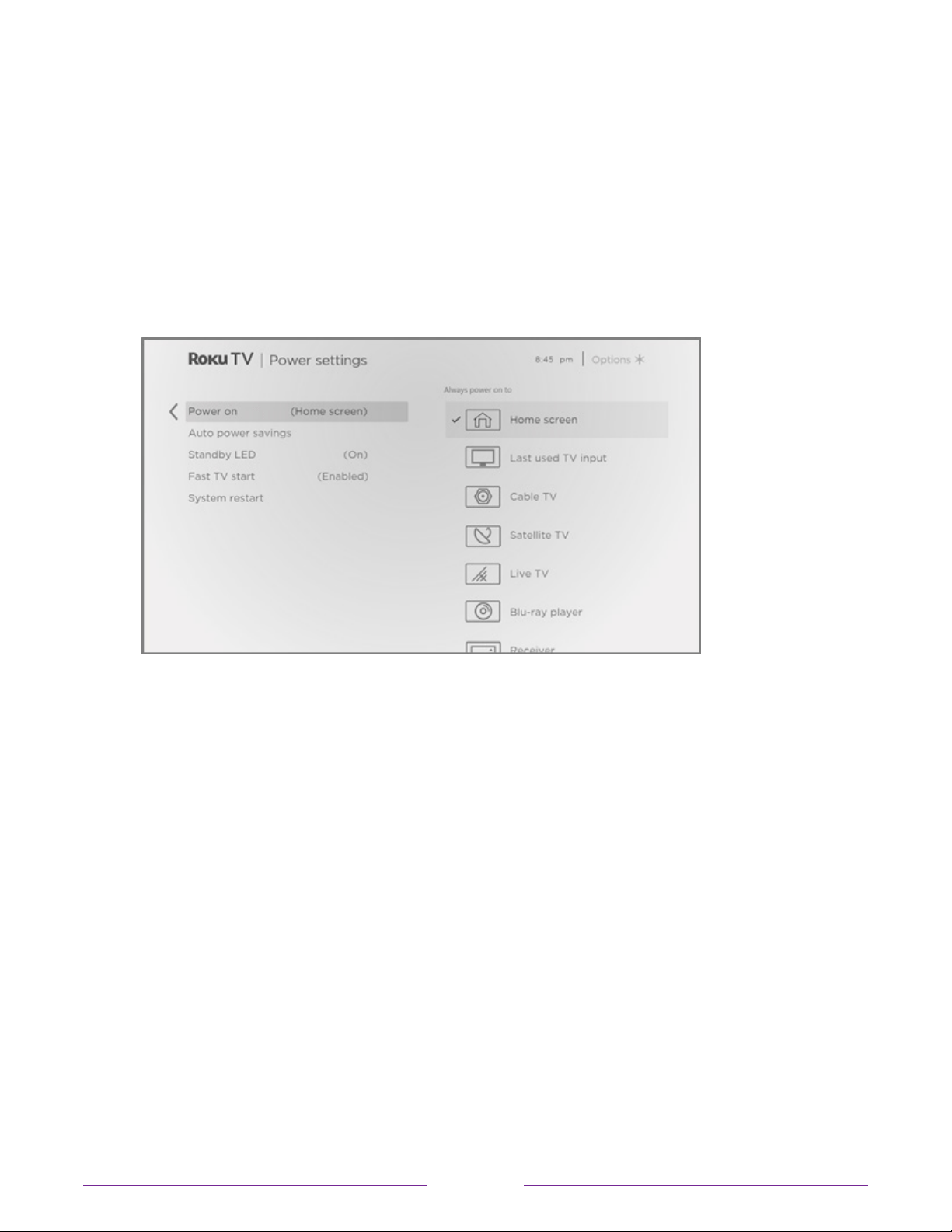
Configure power settings
Power settings configure features related to how your TV’s power settings work.
Power on settings
Power on settings tell the TV what to do when you turn on the power. To configure the power
on settings, from the Home screen, navigate to Settings > System > Power > Power on.
Highlight the preferred power on location in the list, and then press OK.
Auto power savings
To help you save energy, your TV can automatically turn itself o after a period of inactivity
or a period during which no signal has been detected. It is factory-configured to do both of
these things, but you can change these settings if needed.
To configure automatic power o, from the Home screen menu navigate to Settings >
System > Power > Auto power savings. In the Power settings screen, highlight the following
options and press OK to turn them on or o:
•
Reduce power after 15 minutes – If no video or audio activity and no user interaction
occur for 15 minutes, the TV automatically turns o the screen and sound.
•
Turn o after 4 hours – If no video or audio activity and no user interaction occur for 4
hours, the TV goes into standby mode.
97

Standby LED On/O
Normally, the status indicator is lit whenever the TV is in standby mode. If you prefer the
status indicator to not be lit in standby mode, you can turn it o. To do so, from the Home
screen menu, navigate to Settings>System>Power> StandbyLED, and then select O.
After making this change, the status indicator still performs all other indication functions.
Fast TV start
Only in connected mode, you can enable FastTVstart. As you might expect, FastTVstart
lets you start watching your TV almost instantly after turning it on. But it also enables other
convenient features, such as the ability to listen to certain music channels with the TV screen
o and the convenience of being able to turn on and control your TV using voice commands.
Be aware that enabling Fast TV start makes your TV use somewhat more power when it is
powered o to standby mode.
Configure accessibility (U.S. only)
Only in the United States, accessibility settings enable those with vision or hearing
impairment to use the TV more eectively. Accessibility settings are located under
Settings>Accessibility. (In Canada, captions settings are located under Settings>Captions.)
Captions mode
TheCaptionsmode settings specify when closed captions appear. Change caption settings
from the Home screen menu by selecting Settings>Accessibility>Captionsmode. At this
point, you can choose among the following options:
•
O – No captions appear.
•
On always– Captions appear whenever they are available from the program source.
•
On replay– Captions appear only when you use the replay feature, and only when you are
watching a streaming program that supports instant replay, watching a video through the
Roku or USB media player, or watching a TV channel after enabling Live TV Pause.
•
On mute – Captions appear only when the TV is muted.
98

Tip: You can change the captions mode while watching a program. Press STAR
to display
the Options menu, and then select Closedcaptioning. However, some streaming channels
require you to enable captions through a setting within their channel even though you have
turned on captions elsewhere.
Note: Once enabled, the selected captions mode applies to all inputs that support captions
and remains enabled until you turn it o.
Captions preferred language
Use theCaptionspreferredlanguage setting to select the language in which you want
closed captioning to appear, when that language is available. If your preferred language is
not available, then captioning reverts to the default language for the program, which usually
is English.
Highlight the language you prefer, and then press OK to select it.
Captions style
Use theCaptionsstyle settings to control how closed captions look when displayed
on your TV. Access caption style settings from the Home screen menu by selecting
Settings>Accessibility>Captionsstyle. At this point, you can choose among the following
options:
•
Text style – Choose from a list of fonts. As you move the highlight to each font, you can
see a sample of the result in an adjacent panel.
•
Text edge eect – Choose from a list of edge eect styles, such as raised, depressed,
and various shadows. As you move the highlight to each eect, you can see a sample of
the result in an adjacent panel.
•
Text size – Choose from a list of sizes. As you move the highlight to each size, you can
see a sample of the result in an adjacent panel.
•
Textcolor - Choose from a list of colors for the text. As you move the highlight to each
color, you can see a sample of the result in an adjacent panel.
•
Textopacity - Choose from a list of opacity settings for the text. This setting determines
how much the area behind the text shows through the text. A value of 100% blocks all
of the content behind the text. As you move the highlight to each setting, you can see a
sample of the result in an adjacent panel.
•
Background color - Choose from a list of colors for the background area behind the
text. As you move the highlight to each color, you can see a sample of the result in an
adjacent panel. Note that you won’t see any change unless you set the Background
opacity to a value other than O.
99

•
Backgroundopacity - Choose from a list of opacity settings for the background of the
caption. This setting determines how much the area behind the caption background
shows through the background. A value of 100% blocks all of the content behind the
background. As you move the highlight to each setting, you can see a sample of the
result in an adjacent panel.
•
Windowcolor - Choose from a list of colors for the window rectangle surrounding
the entire caption. As you move the highlight to each color, you can see a sample of
the result in an adjacent panel. Note that you won’t see any change unless you set the
Windowopacity to a value other than Default or O.
•
Windowopacity - Choose from a list of opacity settings for the window rectangle
surrounding the entire caption. This setting determines how much the area behind the
caption window shows through the window. A value of 100% blocks all of the content
behind the window. As you move the highlight to each setting, you can see a sample of
the result in an adjacent panel.
Audio Guide settings
Only in the United States with English language, Audio Guide settings help users who are
blind or visually impaired to configure the text-to-speech reader, enabling them to operate
their TV more easily. Audio Guide uses voice prompts that speak volume and channel
changes, menu options, and setting changes. Access Audio Guide settings from the Home
screen menu by navigating to Settings>Accessibility, and then select from the following
options in the AudioGuide section:
•
Audio Guide – Turn Audio Guide on or o.
•
Speech rate – Select one of four speeds at which to hear spoken guide information:
Slow, Normal, Fast, or Very Fast.
•
Volume – Select the volume at which to hear spoken guide information, relative to the
main TV volume.
•
Shortcut – Enable or disable the shortcut feature. When enabled (the default), pressing
STAR
four times in quick succession enables or disables the Audio Guide.
100

Change caption settings (Canada only)
Only in Canada, captions settings are located under Settings>Captions. (In the United
States, caption settings under Settings>Accessibility>Captionsmode and Captionsstyle.)
Captions mode
•
O – No captions appear.
•
Onalways – Captions appear whenever they are available from the program source.
•
Onreplay– Captions appear only when you use the replay feature, and only when
you are watching a streaming program that supports instant replay, watching a video
through the Roku or USB media player, or watching a TV channel after enabling Live TV
Pause.
•
Onmute – Captions appear only when the TV is muted.
Tips
•
You can change the captions mode while watching a program. Press STAR
to display
the Options menu, and then select Closed captioning.
•
Some streaming channels require you to enable captions through a setting within their
channel even though you have turned on captions in the TV settings.
Note: Once enabled, the selected captions mode applies to all inputs that support captions
and remains enabled until you turn it o.
Captions preferred language
Use theCaptionspreferredlanguage setting to select the language in which you want
closed captioning to appear, when that language is available. If your preferred language is
not available, then captioning reverts to the default language for the program, which usually
is English.
Highlight the language you prefer, and then press OK to select it.
Other caption settings
•
Textstyle– Choose from a list of fonts. As you move the highlight to each font, you can
see a sample of the result in an adjacent panel.
•
Textedgeeect– Choose from a list of edge eect styles, such as raised, depressed,
and various shadows. As you move the highlight to each eect, you can see a sample of
the result in an adjacent panel.
•
Textsize– Choose from a list of sizes. As you move the highlight to each size, you can
see a sample of the result in an adjacent panel.
101

•
Textcolor - Choose from a list of colors for the text. As you move the highlight to each
color, you can see a sample of the result in an adjacent panel.
•
Textopacity - Choose from a list of opacity settings for the text. This setting determines
how much the area behind the text shows through the text. A value of 100% blocks all
of the content behind the text. As you move the highlight to each setting, you can see a
sample of the result in an adjacent panel.
•
Backgroundcolor - Choose from a list of colors for the background area behind the text.
As you move the highlight to each color, you can see a sample of the result in an adjacent
panel. Note that you won’t see any change unless you set the Backgroundopacity to a
value other than O.
•
Backgroundopacity - Choose from a list of opacity settings for the background of the
caption. This setting determines how much the area behind the caption background
shows through the background. A value of 100% blocks all of the content behind the
background. As you move the highlight to each setting, you can see a sample of the
result in an adjacent panel.
•
Windowcolor - Choose from a list of colors for the window rectangle surrounding
the entire caption. As you move the highlight to each color, you can see a sample of
the result in an adjacent panel. Note that you won’t see any change unless you set the
Windowopacity to a value other than Default or O.
•
Windowopacity - Choose from a list of opacity settings for the window rectangle
surrounding the entire caption. This setting determines how much the area behind the
caption window shows through the window. A value of 100% blocks all of the content
behind the window. As you move the highlight to each setting, you can see a sample of
the result in an adjacent panel.
102

Customize the Home screen
If you prefer to not see certain features on the Home screen, you can hide them.
To hide Shortcuts:
1. From the Home Screen menu, navigate to Settings>Homescreen, and then press
RIGHT.
2. Select Shortcuts.
3. Highlight Hide, and then press OK.
Only in the United States, to hide Featured Free:
1. From the Home Screen menu, navigate to Settings>Homescreen, and then press
RIGHT.
2. Select Featured Free.
3. Highlight Hide, and then press OK.
Only in the United States, to hide Movie Store and TV Store:
1. From the Home Screen menu, navigate to Settings > Home screen, and then press
RIGHT.
2. Select Movie Store and TV Store.
3. Highlight Hide, and then press OK.
Once hidden, you can restore any or all of these features by following the same steps,
replacing Hide with Show.
103

Parental controls
Parental controls enable you to control whether the members of your household can view
certain kinds of broadcast TV programs. When a program or feature is blocked, you can
unblock it by entering a parental control PIN that only you know.
Note: Parental controls block content from the TV tuner and from streaming options, if any,
on the Home screen menu. Parental controls do not block content on other TV inputs or
content from streaming channels you add to your TV.
Creating a parental control PIN
The first time you access the Parental controls screen, you must create a new parental
control PIN. Thereafter, whenever you want to change parental control settings, unblock
programming that has been blocked, change the PIN, or disable parental controls, you must
enter your parental control PIN.
Tip: Your parental control PIN has no connection to your Roku account PIN. You can make
them the same if you want—this is entirely your choice.
To create a new parental control PIN, from the Home screen menu navigate to Settings >
Parental controls. The screen displays a numeric keypad. Use the purple directional pad to
enter a four-digit code, and then press OK. Then repeat the process to enter the same PIN
again, just to make sure you correctly entered the PIN you want to use.
Important: If you forget your parental control PIN, theonlywaytorecoveristoperforma
factoryresetoperation, as explained in Factory reset everything.
Blocking broadcast TV programs
For broadcast TV, parental controls use information embedded in the broadcast signal
to determine whether to allow a program to be displayed. Parents can configure parental
controls to block broadcast TV programs that meet or exceed a specific rating, so they
cannot be viewed or heard unless the correct parental control PIN is entered.
Note: Rating standards dier by country.
104

Enabling parental control of TV programs
The first step in blocking TV programs is to enable parental control of TV programs.
This setting is provided separately to make it easier for you to turn parental control of TV
programs on and o without disturbing their settings. For example, your kids are going to
summer camp for two weeks, and while they are gone, you don’t want to have to deal with
unblocking programs that you want to watch by entering your parental control PIN. All you
need to do is clear Enableparentalcontrols, and all TV programs are unblocked. When the
kids return, select Enableparentalcontrols again, and all of your parental control settings are
restored in a single operation.
To enable parental control of TV programs:
1. In the Home screen menu, navigate to Settings > Parental controls, and then enter
your parental control PIN.
2. In the Parental controls screen, navigate to TV tuner > Parental control of TV shows.
3. Make sure the check box next to Enable parental controls is checked. If not, highlight
it and press OK.
Blocking based on US TV ratings
Most broadcast US TV programs—other than movies—contain rating data that enables
parental controls to block programs that parents don’t want others to view. The ratings are
divided into two groups that function independently:
•
Youth group – TV-Y, TV-Y7
•
Main group – TV-G, TV-PG, TV-14, TV-MA
Within each of these groups, the ratings interact such that if you block a particular level
of content, the TV also blocks all content with a higher rating. Conversely, if you unblock
a particular level of content, the TV also unblocks all content with a lower rating. For
example, if you block TV-PG programs, the TV also blocks TV-14 and TV-MA programs. If
you subsequently unblock TV-14 programs, TV-PG programs are also unblocked, but TV-MA
programs remain blocked.
Similarly, within the main group, content types can be individually blocked. For example,
you can block just coarse language in programs with a TV-PG rating. If you do, then the
TV also blocks programs with coarse language in the higher ratings (TV-14 and TV-MA).
Subsequently unblocking coarse language in TV-14 ratings does not unblock coarse language
in TV-MA programs, but it does unblock coarse language in TV-PG programs.
105

To block TV programs based on US television ratings:
1. From the Home screen menu, navigate to Settings > Parental controls, and then enter
your parental control PIN.
2. In the Parental controls screen, navigate to TV tuner > TV ratings. Choose among the
following settings:
•
Entire ratings – Highlight the rating you want to block, and then navigate to the
right and select the first option that blocks the entire rating level (and all higher
rating levels).
•
Individual content types – Highlight the rating that contains the content type you
want to block, and then select the content types you want to block from among
those listed. Remember that blocking a content type in one rating blocks the
equivalent content type in all higher rating levels.
Blocking based on US movie ratings
Most movies in the US are rated by the Motion Picture Association of America, or MPAA, so the
ratings are known as MPAA ratings. TV broadcast signals carry movie rating data that enables
parental controls to block programs that parents don’t want others to see. The ratings are:
•
G – General audiences
•
PG – Parental guidance suggested
•
PG-13 – Parents strongly cautioned for children age 13 or younger
•
R – Restricted
•
NC-17 – Not for age 17 or younger
Unlike US TV ratings, there are no individual content types within the ratings. But like TV
ratings, blocking movies with a particular rating also blocks movies with a higher rating, and
unblocking movies with a particular rating also unblocks movies with a lower rating.
Tip: Blocking movies with an NC-17 rating also blocks programs with the now-obsolete X
rating, which can still occur in the program data of older movies.
To block movies based on MPAA ratings:
1. From the Home screen menu, navigate to Settings > Parental controls, and then enter
your parental control PIN.
2. In the Parental controls screen, navigate to TV Tuner > Movie ratings.
3. Select the rating level you want to block. You need only select one rating level, and all
higher levels are automatically blocked.
106

Blocking based on Other ratings
Your TV can block programs having ratings that had not been defined when the TV was
manufactured. It does this by detecting a new Rating Region Table in a program and then
downloading the new table and displaying its rating in the Parental controls.
When the TV downloads a new Rating Region Table, it adds a new option to the list of rating
types: Other ratings. If you see this option in the Parental controls screen, you have tuned
to a station that has implemented a new rating table. Once the new rating table has been
downloaded to the TV, it remains in the TV until it is factory reset, and you can configure
blocking based on the new ratings.
New Region Rating Tables can have independent rating levels, or rating levels that interact in
the same ways as the built-in US TV and MPAA Movie ratings.
Tip: If your TV downloads a new Region Rating Table, you’ll have to experiment with its
settings to understand how to use it.
Blocking based on Canadian English ratings
Canadian-English language and third-language programs that are broadcast in Canada are
rated by the Action Group on Violence on Television, or AGVOT. TV broadcast signals carry
rating data that enables parental controls to block programs that parents don’t want others
to view based on content containing violence, language, sex, or nudity. The ratings are:
•
C – Children under 8 years
•
C8 – Children 8 years and older
•
G – Generally suitable for all age groups
•
PG – Parental guidance suggested for viewers under 14 years
•
14+ – Generally not suitable for viewers under 14 years
•
18+ – Generally not suitable for viewers under 18 years
Blocking content with a particular rating also blocks content with a higher rating, and
unblocking content with a particular rating also unblocks movies with a lower rating.
To block programs based on AGVOT ratings:
1. From the Home screen menu, navigate to Settings > Parental controls, and then enter
your parental control PIN.
2. In the Parental controls screen, navigate to TV tuner > Canadian English ratings.
3. Select the rating level you want to block. You need only select one rating level, and all
higher levels are automatically blocked.
107

Blocking based on Canadian French ratings
Canadian-French language programs that are broadcast in Canada are rated by Québec’s
Ministry of Culture and Communications. TV broadcast signals carry rating data that enables
parental controls to block programs that parents don’t want others to view based on content
containing violence, language, sex, or nudity. The ratings are:
•
G – Generally suitable for all age groups
•
8+ – Viewers 8 years and older
•
13+ – Viewers 13 years and older
•
16+ – Viewers 16 years and older
•
18+ – Adults only
Blocking content with a particular rating also blocks content with a higher rating, and
unblocking content with a particular rating also unblocks movies with a lower rating.
To block programs based on Canadian-French ratings:
1. From the Home screen menu, navigate to Settings > Parental controls, and then enter
your parental control PIN.
2. In the Parental controls screen, navigate to TV tuner > Canadian French ratings.
3. Select the rating level you want to block. You need only select one rating level, and all
higher levels are automatically blocked.
Blocking unrated programs
Some broadcast TV programs and movies do not have an assigned rating, and are considered
to be “Unrated”. Whether or not such programs contain content that is objectionable to you
cannot be determined. However, you can choose to block such programs.
To block all unrated broadcasts:
1. From the Home screen menu, navigate to Settings > Parental controls, and then enter
your parental control PIN.
2. In the Parental controls screen, navigate to TV tuner > Block all unrated programs.
3. Highlight Unrated programs and press OK. When blocking is enabled, the adjacent
padlock icon changes from unlocked to locked.
Tip: Blocking programs that have not been assigned a rating does not block programs that
specifically have been assigned a US TV rating of “None” (for example a broadcast of a local
town council meeting). Programs that do not have an assigned rating display Rating NA (for
“not applicable,” meaning a rating is not needed).
108
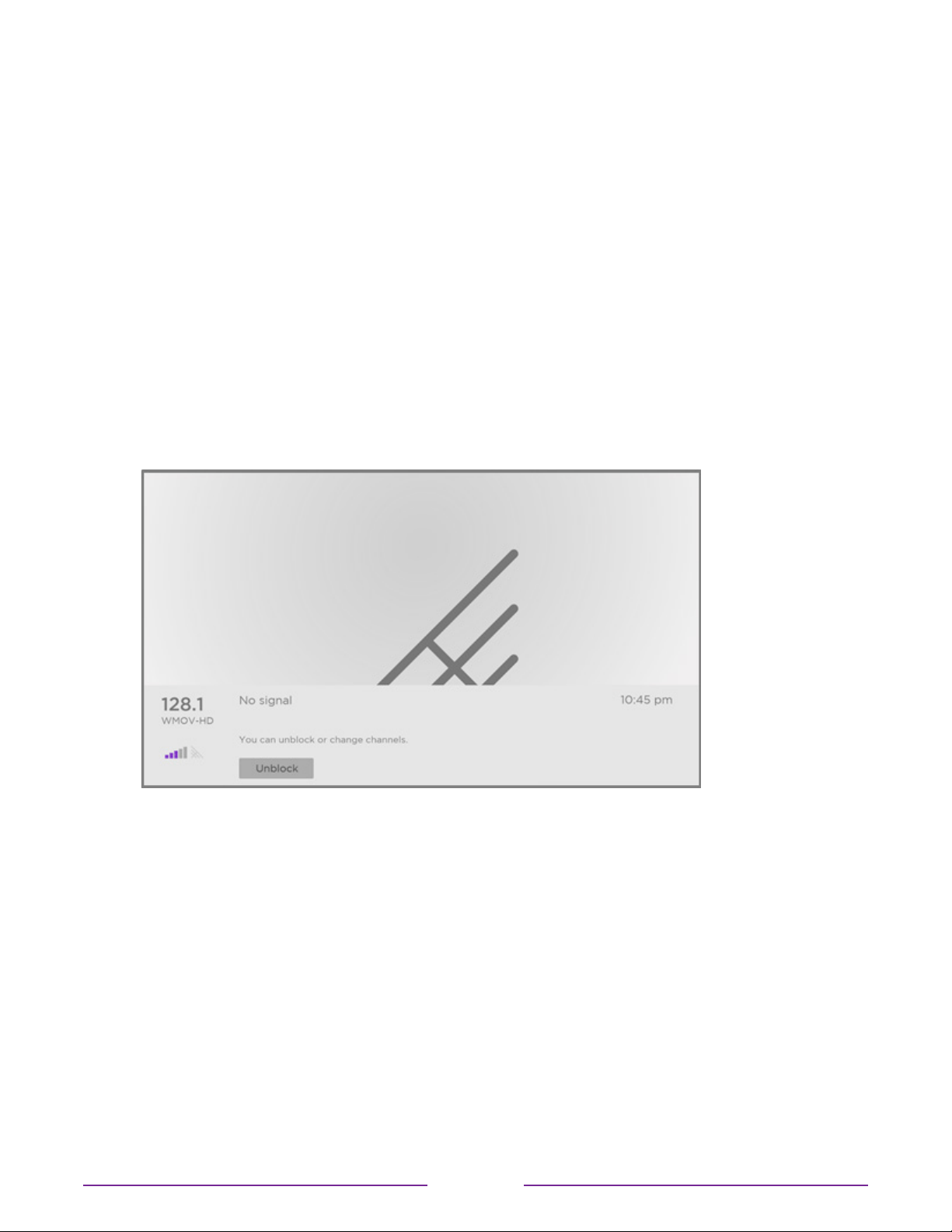
In the absence of other ratings for a program, the parental controls do not consider the MPAA
US movie rating N/A (MPAA rating not applicable to this content) and NR (applicable content
not rated by the MPAA) to be ratings. In these cases, the TV handles the program as though it
is unrated, blocking the program if Unrated programs blocking is enabled.
What happens when a TV program is blocked?
After you’ve set up parental controls, TV programs and movies are blocked:
•
When you change channels and the new channel is playing a program whose rating
exceeds your settings.
•
When a new program comes on the channel you are watching and its rating exceeds
your settings.
When a program is blocked by parental control settings, the TV displays a blocked message:
Whenever this blocked message appears, both the video and audio of the program are
blocked, as well as program data that would normally appear in the area at the bottom of the
screen. Only in connected mode: program title and information show as “Blocked” as well.
109
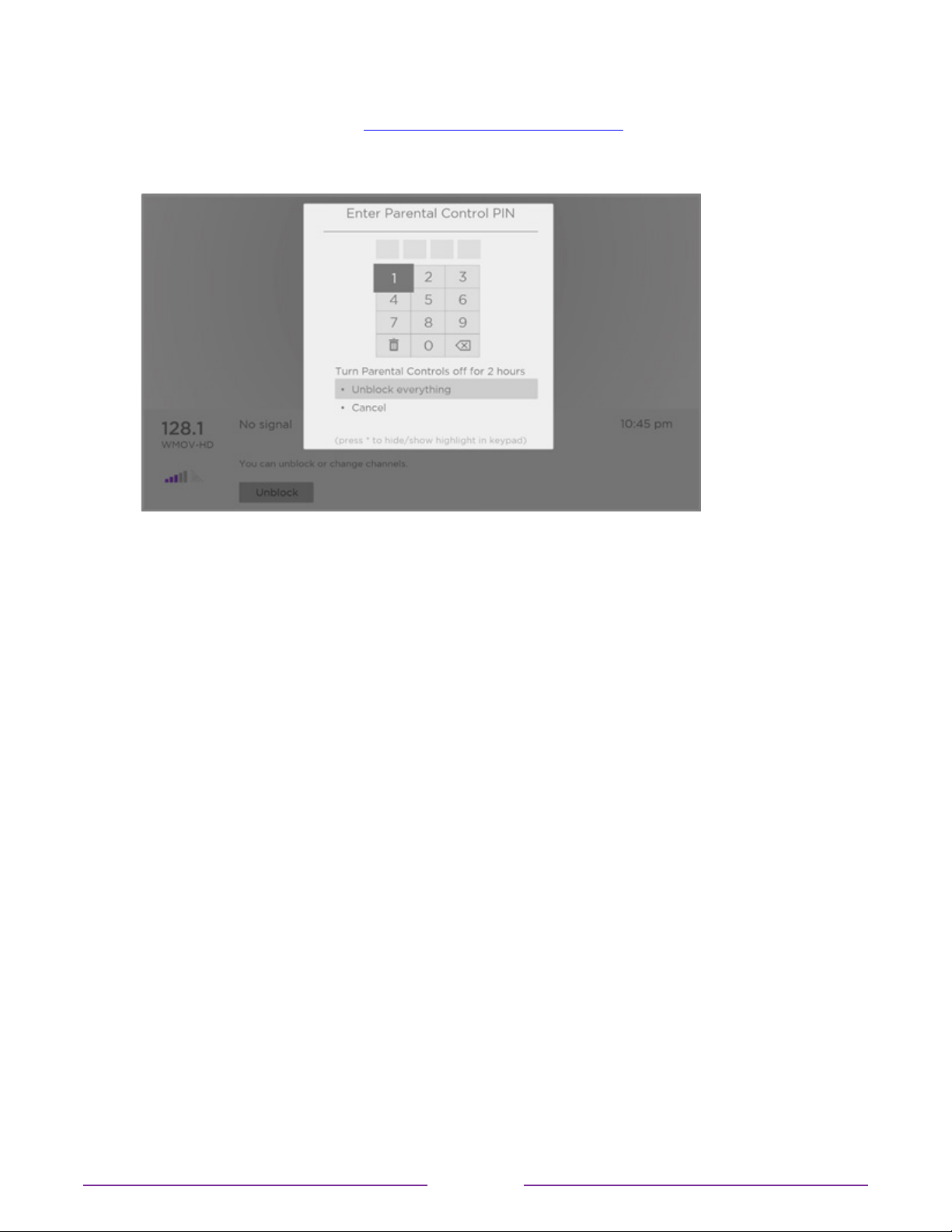
To watch the blocked program, you need to know the PIN code defined when you enabled
parental controls, as explained in Creating a parental control PIN.
1. Press OK to select Unblock. The Parental Control PIN pad appears.
2. Use the purple directional pad to enter your parental control PIN code, and then press
OK to select Unblockeverything.
Tip: To shield your parental control PIN from others in the room, press STAR
to hide the
highlighted number. When you hide the highlight, you will have to count key presses to keep
track of which number is selected.
After unblocking programs that have been blocked, all blocking is disabled for two hours or
until you turn o the TV.
Changing the parental control PIN
To change your parental control PIN:
1. From the Home screen menu, navigate to Settings > Parental controls, and then enter
your parental control PIN.
2. In the Parental controls screen, highlight Change PIN.
3. Move the highlight into the adjacent keypad, and then use the purple directional pad
to enter a four-digit code, and then press OK. Then repeat the process to enter the
same PIN again, just to make sure you correctly entered the PIN you want to use.
110

Resetting parental controls
So now your kids have grown up and gone away to college, and you no longer want to deal
with blocked programs.
To erase all parental control settings:
1. From the Home screen menu, navigate to Settings > Parental controls, and then enter
your parental control PIN.
2. In the Parental controls screen, highlight Reset parental controls.
3. Follow the instructions on the screen to confirm that you want to erase all parental
control settings.
Tip: Resetting parental controls also erases your parental control PIN.
111

More settings
This section describes the features and settings of the TV that were not covered in the other
parts of this guide.
Guest Mode
Only in connected mode, when you enable Guest Mode, your guests can sign in to
subscription channels using their own account credentials instead of using yours. Your
guests’ credentials are then automatically removed on the date they specify.
By enabling Guest Mode, your guests won’t have access to your personal streaming channel
accounts and won’t be able use your Roku account to make purchases. Instead, your guests
can safely access their own subscription channels. And they won’t have to remember to sign
out before they leave.
To enable Guest Mode:
1. From the Home screen menu, navigate to Settings > System > Guest Mode.
2. Select Enter Guest Mode.
3. Use the purple directional pad to enter your Roku account PIN in the on-screen
keypad.
4. Select OK to confirm and put the TV into Guest Mode.
Note: You also can enable and disable Guest Mode remotely logging in to my.roku.com
on your computer or smart phone, logging in to your account, scrolling down to My
linkeddevices, and then selecting EnableGuestMode or DisableGuestMode, respectively.
After you put your TV into Guest Mode, it is ready to welcome your guests, allowing them
to select a sign-out date. On the home screen, they will find an assortment of default
subscription channels They can enjoy free content from The Roku Channel and many others,
or sign-in and watch movies and TV programs from their own subscriptions and saved
content libraries. Your guests can use the Roku Channel Store to find and add channels they
watch at home with confidence that they automatically will be removed on their sign-out
date.
112

For more information about the experience your guests will have when Guest Mode is
enabled in the United States, see:
https://support.roku.com/article/360015612834--how-do-i-set-up-auto-sign-out-mode-
for-my-guests-
To disable Guest Mode:
1. Press Home
to return to the Home screen menu.
2. Navigate to Settings > System > Guest Mode.
3. Select Exit Guest Mode.
4. Use the purple directional pad to enter your Roku account PIN in the on-screen
keypad.
5. Select OK and confirm that you want to disable Guest Mode.
After you disable Guest Mode, all of your original settings are restored and your channels
are reinstalled. You might need to sign in to your subscription channels again to access your
content.
Note: Any game data that was stored on your Roku device is not restored.
113

Network settings
If needed, you can change your network settings at any time. For example, if you change the
name of your wireless network (its SSID) or its password, you will need to change your TV’s
settings so that it can continue to connect. Also, if you decided not to connect to the Internet
in Guided Setup, you can use network settings to connect at a later time.
To change network settings, from the Home screen menu, navigate to Settings > Network,
and then press RIGHT. At this point, you can choose from among the following options:
•
About – Lists important information about your current network connection, such as
status, connection type, IP addresses, and MAC address. This information is often useful
when contacting customer support with connection issues.
•
Check connection – Select your existing network connection type, and then press OK to
start checking the network connection. The TV uses your current network information to
reconfirm the wireless or wired network connection to the local network and the Internet
connection.
•
Set up connection – Select a network connection type, and then select the option to
set up a new connection. Follow the on-screen instructions to complete the network
connection. For help with each of the steps, see Network connection.
•
Bandwidthsaver – Enable or disable this feature as appropriate. If On, your TV prompts
you to stop streaming if you haven’t used the remote control within the past four hours.
If you do not respond, streaming stops to save your data allocation and increase the
network bandwidth available to other devices in your home. Change to O to disable the
automatic bandwidth saving feature.
Note: Some networks, such as those found in dorm rooms, hotels, and other public
places, may require you to read and agree to terms, enter a code, or provide identifying
information before letting you connect to the Internet. For more information, see Using
your TV in a hotel or dorm room.
ZIP Code or postal code
Your TV needs to know your ZIP Code (United States) or postal code (Canada) so that it
can display the correct channels and program guide information. It attempts to determine
your location by using information from your Internet connection; however, the information
available from this source is not always accurate.
To ensure you have the most accurate program guide information, set your correct ZIP
Code or postal code. From the Home screen menu, navigate to Settings>System>
ZIPCode(orPostalcode), and then press RIGHT. Use the purple directional pad to enter
your code in the on-screen keypad, and then select OK.
114

Time settings
You can change time settings to suit your preferences. You can find the following settings by
navigating from the Home screen menu to Settings > System > Time:
•
Sleep timer – Set a time delay after which the TV will automatically shut o. This setting
reflects the setting you can make in the Options menu from any TV input, as explained
in Options menu settings.
Note: The sleep timer setting is not input specific, and also can be set by using the
Sleeptimershortcut in the Home screen grid.
•
Time zone – Correct time zone information is needed to correctly display program data.
Choose whether to set the time zone automatically or manually, and if set manually,
select your current time zone. Usually, a TV connected to the Internet can discover its
own time zone automatically, but sometimes a TV that is not connected to the Internet
cannot and so must be set manually. Initially, this setting is made when you set up the TV
tuner, as explained in Setting up live TV.
•
Clock format – Choose whether to display time in a 12-hour or 24-hour format, or to turn
o time display. This setting is available only on TVs that are connected to the Internet.
Non-connected TVs do not display the time.
115

Scan again for live TV channels
There will be times when you need to create a new channel list. For example, you:
•
Change cable providers
•
Reorient your TV antenna
•
Move to a dierent city with dierent channels
Whenever you need to update your TV channel list, you can repeat the channel scan.
Tip: Even if you don’t change anything related to your TV channel reception, you should
repeat the channel scan from time to time to make sure you are receiving all of the latest
channels. Broadcasters add and remove channels, move channels to dierent parts of the
spectrum, and change the power levels of their channels periodically.
Note: Repeating the tuner channel scan unhides all hidden channels.
To repeat the channel scan, highlight the LiveTV tile on the Home screen, and then press
STAR
. Next, select Scanforchannels and press OK. After that, the screens and options that
appear during this process are identical to those described in How do I set up the TV tuner?
HDMI® mode (4K models only)
On 4K (UHD) TVs, you can independently configure each HDMI input to match the
capabilities of the connected device. From the Home screen menu, navigate to Settings>
TVinputs, and then select an enabled HDMI input. Next, select HDMImode and then select
one of the following settings:
•
Auto – Let the TV determine the best setting. Use this option unless your HDMI® device
does not correctly communicate its HDMI® version information.
•
HDMI 1.4 – Configure the input for compatibility with HDMI® version 1.4, which supports
a maximum refresh rate of 30 Hz at full UHD resolution. Most HDMI® devices will work
correctly with the TV in this mode.
•
HDMI 2.0 – Configure the input for compatibility with HDMI® version 2.0, which supports
a maximum refresh rate of 60 Hz at full UHD resolution. You must use this mode to view
HDR content from the device connected to this HDMI input. However, note that many
older HDMI® devices do not work correctly when the TV’s HDMI input is set to this mode.
Control by mobile apps
You can choose the level of control you want to allow your TV to accept from external
devices, such as smart phones, tablets, and virtual assistants. Device connect settings enable
other devices, including the Roku mobile app, to control your TV over the local area network
in your home.
116

To adjust the level of external control access:
1. From the Home screen menu, navigate to Settings > System > Advanced system
settings > Control by mobile apps.
2. Select Network access.
3. Select one of the following settings:
•
Default – Devices can connect only through a private network address, and accept
commands only from other private network addresses on your home network. This
setting is suitable for most cases, including use of the Roku mobile app on your
smartphone.
•
Permissive – Devices can connect under all conditions, but accept commands only
from private network addresses or the same subnetwork within your home network.
This setting might be required when attempting to operate the TV from a third-
party application, for example, one of the Internet of Things (IoT) applications such
as ifttt.com.
•
Disabled – Device connection is completely disabled. The TV does not accept
external commands from any source, including the Roku mobile app.
Roku TV premium audio
Your Roku TV works with several Roku premium audio products, including Roku TV Wireless
Speakers and the Roku Wireless Subwoofer. Just plug the speakers into a power outlet, and
then on the TV remote, hold down HOME
for a few seconds. Follow the instructions on
your TV screen to complete pairing.
With Roku TV Wireless Speakers, you can listen to all of your TV programs as well as the
sound from any streaming channel. Certain audio-only channels even let you listen to music
with the TV screen turned o.
After you have paired your Roku TV Wireless Speakers with your Roku TV, all sound normally
comes from the Roku Wireless Speakers instead of the internal TV speakers.
Note: Roku TV Wireless Speakers work only when your TV is operating in connected mode.
117

Home theater configuration
Your TV has several features that make it an ideal TV for a home theater. But you might not
notice them because they remain in the background until you decide to use them.
Turning o the TV speakers for home theater use
You can turn o the TV’s built-in speakers if desired by changing the setting under
Settings>Audio>Speakers and change the setting. However, if you use an HDMIARC or
HDMIeARC connection with CEC enabled, the TV automatically mutes its internal speakers
when it sends sound to an external device. It also mutes all sound when you use the
headphone jack on the TV, private listening through the Roku Enhanced Remote Control or
the Roku mobile app.
Setting up a digital audio connection
To take advantage of your TV’s advanced audio capabilities, connect it to an external
amplifier, receiver, or soundbar by using either of these two digital audio connections:
•
HDMIARCorHDMIeARC – The HDMI® Audio Return Channel (ARC) or on
select TVs only, the HDMI® Enhanced ARC (eARC) connector enablesthe TV to
output digital audio on one of its HDMI® connectors. Theconnected amplifier
then can function simultaneously as an input source to the TV, if needed,
without the need to use additional cables.
To use the ARC or eARC capability, you must connect an HDMI® cable from your
amplifier’s HDMI® ARC or eARC connector to the HDMIARC or HDMIeARC connector
on the TV. You also must do the following:
•
Be sure your HDMI® cable is HDMI® certified.
•
Enable HDMI ARC under Settings > System > Control other devices (CEC), as
explained in Enable HDMI® ARC.
•
S/PDIFoptical – The S/PDIF optical connector outputs a digital audio signal.
To use the optical output, connect a TOSLINK optical cable from the
amplifier to the Optical or S/PDIF connector on the TV.
Important: To make sure the S/PDIF outputs audio reliably, you must
turn o the TV’s speakers. To do so, from the Home screen menu, navigate to
Settings>Audio>Speakers and change the setting to O.
Note: Dolby Audio™ support for Dolby Digital Plus™ format is not available through the
S/ PDIF optical output. This format is only available through the HDMIARC connection.
HDMI (ARC)
DIGITAL AUDIO
OUT (S/PDIF)
118

Tip: Even when you use S/PDIF for audio, the TV can correctly detect more audio
formats if you connect an HDMI® cable between the TV’s HDMIARC or HDMI eARC port
and the receiver’s ARC or eARC port.
Choosing an audio format
After making the required HDMI® ARC, eARC, or S/PDIF optical connection, go to
Settings>Audio>S/PDIFandARC option and select the audio format to use.
Choosing Autodetect is the easy solution, and generally provides good results. However, if
you have a high-end sound system and want to make sure you are getting the best sound
quality available in the programs you are watching, you can choose another setting.
•
Autodetect – Automatically detects the incoming audio format and transcodes it to a
compatible available format for the audio output (ARC, eARC, or S/PDIF).
•
Autopassthrough – Passes through the input audio to the connected receiver without
transcoding, sometimes resulting in better audio quality especially for high-end audio
formats such as those that take advantage of the higher bandwidth of eARC, including
Dolby MAT and Dolby Digital Plus 7.1, among others.
•
PCM-Stereo – Always outputs pulse-code modulated stereo, regardless of input audio
format.
•
DolbyDigital – Converts all input formats to Dolby Digital.
•
DolbyDigitalPlus – Converts all input formats to Dolby Digital Plus.
•
DolbyDigital–DTS – Converts all inputs except DTS to Dolby Digital. If DTS is detected
and the receiver supports DTS, passes through the DTS audio without modification.
•
DolbyDigitalPlus–DTS – Converts all input formats except DTS to Dolby Digital
Plus. If DTS is detected and the receiver supports DTS, passes through the DTS audio
without modification.
Note: DTS audio formats are meant to be used with ARC, eARC, or S/PDIF connections
to a DTS-capable home theater receiver. If you use one of the DTS options with the TV
speakers, you might not hear any audio.
119

Turning o the TV screen while listening to music
Certain music channels enable you to turn o the TV screen while streaming music to your
TV speakers, soundbar, home theater receiver, or Roku TV Wireless Speakers.
To turn o the TV screen on supported channels:
1. Press STAR
to display the Options menu.
2. Press DOWN to highlight Turn o display.
3. Press OK.
Note: This feature is available only on select streaming audio channels, and only when the TV
is operating in connected mode with FastTVStart enabled. To enable FastTVStart, from the
Home screen menu, navigate to Settings>System>Power.
Controlling other devices through CEC
Consumer Electronics Control (CEC) enables your TV and other CEC-compatible home
entertainment devices to control one another in various ways. First, the CEC-compatible
devices must “discover” one another and report their capabilities. After this, one device can
control another according to the features you enable. For example, playing a disc on a Blu-
ray™ player could switch the TV to the Blu-ray™ player’s input. Or, powering o the TV could
also power o the Blu-ray™ player and the home theater receiver.
Discover connected CEC devices
To discover CEC devices:
1. Make sure that your CEC-compatible devices are connected to the TV with a suitable
certified HDMI® Cable that supports HDMI® ARC and CEC control.
2. Turn on each device and make sure all devices are CEC enabled.
Tip: Some manufacturers have their own branded names for CEC functionality, so you
might need to read the product documentation to correctly identify the CEC features
of the device.
3. On the TV’s Home screen menu, navigate to Settings > System > Control other
devices (CEC) and then select Search for CEC devices. Press OK to repeat the
discovery process, if necessary.
When finished, the TV displays a list of CEC devices that are connected to each HDMI input,
as well as any devices that had previously been connected. The TV remembers the names of
multiple CEC devices even when they are no longer connected. If the list is longer than the
allowed space, press STAR
to see a complete list in a scrollable window.
120

Enable HDMI® ARC or eARC
HDMI® ARC, or on selected TVs, eARC, is the audio return channel that is available on one of
the TV’s HDMI® ports. The audio return channel enables you to send Dolby Audio™ content or
DTS audio content back to a home theater receiver that is also sending an audio and video
signal into the TV. Using HDMI® ARC or eARC reduces the number of cables needed and
controls the volume and mute state of the receiver while watching TV.
HDMI® ARC or eARC is disabled by default. To enable it, in the Home screen menu, navigate
to Settings > System > Control other devices (CEC), and then highlight HDMI ARC. Press OK
to enable or disable the feature.
Enable 1-touch play
1-touch play enables a device to control which TV input is active. For example, pressing Play
on your Blu-ray™ player switches the TV to the Blu-ray™ input.
1-touch play is disabled by default. To enable 1-touch play, from the Home screen menu,
navigate to Settings>System>Controlotherdevices(CEC) and highlight 1-touchplay.
Press OK to enable or disable the feature.
Enable system standby
The system standby feature causes other devices to power o when you power o your TV.
Depending on the CEC System Standby implementation, it also might enable connected
devices to power o your TV when you power o the device.
System standby is disabled by default. To enable system standby, in the Home screen menu,
navigate to Settings > System > Control other devices (CEC) and highlight System standby.
Press OK to enable or disable the feature.
Restart the TV
You can restart the TV when necessary. Restarting has the same eect as unplugging the TV
power and then plugging it in again.
To restart the TV, navigate to Settings > System > Power, and then select System restart.
Highlight Restart, and then press OK to confirm restart.
While the TV restarts, the screen goes dark for a few seconds, and then displays the startup
screen for a few more seconds. When the restart operation completes, the TV displays the
activity you selected in Power on settings.
Enable HDMI® ARC
121

Reset the TV
You can choose to reset only the TV picture and audio settings to their original values, or
perform a full factory reset to return the TV to the state it was in when you first unpacked
and turned it on.
Reset audio/video settings
To reset only the TV picture and audio settings to their original values, navigate to Settings >
System > Advanced system settings > Factory reset, and then highlight Reset TV audio/video
settings. Read the information on the screen to make sure you understand what the reset
operation does.
To proceed with the reset operation, press PLAY/PAUSE
o
three times in a row.
Factory reset everything
A full factory reset returns the TV’s settings to their original state and removes all personally
identifiable information from the TV. When finished, you must repeat Guided Setup,
reconnecting to the Internet, re-linking your Roku account, and reloading any streaming
channels. You also must repeat live TV setup and input configuration.
Factory reset is the recommended choice if you want to transfer the TV to another owner,
and it is the only choice if you want to switch from Store mode to Home mode (if you
inadvertently selected Store mode during Guided Setup).
To perform a factory reset, navigate to Settings > System > Advanced system settings >
Factory reset, and then highlight Factory reset everything. Read the information on the
screen to make sure you understand what this reset operation does.
To proceed with the full factory reset, use the on-screen number pad to enter the code
displayed on the screen, and then select OK to proceed.
When the factory reset operation completes, the TV restarts and displays the first Guided
Setup screen.
What if I can’t access the Factory Reset option?
It is possible for your TV to get into a state where you cannot access the various menus,
including the menu option that lets you perform a factory reset operation. If that happens,
you can force the TV to reset by following these steps.
122

Models with a RESET button
1. Using a straightened paper clip or ball-point pen, press and hold the recessed RESET
button on the TV connector panel.
2. Continue to hold the RESET button for approximately 12 seconds.
When the reset cycle completes, the status indicator comes on dim.
3. Release the RESET button. The TV is now powered o.
4. Turn on the TV and proceed through Guided Setup. See Guided Setup.
Models without a RESET button
1. On the TV panel (not the remote) press and hold down the MUTE and POWER
buttons.
2. Unplug the TV power, and then plug it in while continuing to hold down the MUTE and
POWER buttons.
3. When you see the startup screen appear on the TV, release the buttons.
4. Turn on the TV and proceed through Guided Setup. See Guided Setup.
Network connection reset
If you want to remove your network connection information without disturbing other
settings, navigate from the Home screen menu to Settings>System>Advancedsystems
settings>Networkconnectionreset, and then select Resetconnection.
When you select this option, the TV removes your wireless network information, including the
name of the connection (its SSID) and your wireless password, if any, and then it restarts. After
restarting, your TV retains all of its other settings including its association with your Roku
account.
After resetting your network connection, navigate from the Home screen menu to
Settings>Network>Setupnewconnection to set up your network connection and enjoy all
of the benefits of your connected TV.
123

Roku account PIN
When you created your Roku account, you were given the opportunity to create a PIN code
and to specify when it must be used. Roku lets you optionally require that users enter your
PIN as an additional verification method when making purchases through the TV or adding
items from the Roku Channel Store. In addition, you must have a Roku account PIN before
you can enable or disable Guest Mode.
If you created a Roku account PIN and want to change it, or you don’t remember your PIN,
or if you didn’t create a Roku account PIN and want to add one, you can easily make these
changes.
1. On a computer, tablet, or smartphone, use your web browser to go to https://my.roku.
com and sign in.
After signing in, the My account page appears.
2. Under PIN preference, click Update to open the Choose your PIN preferences page.
3. Skip this step if you just want to change your PIN. Otherwise, choose the option you
prefer from among those listed:
•
Require a PIN to make purchases or to add any item from the Channel Store.
•
Require a PIN to make purchases.
•
Do not require a PIN to make purchases.
4. If you choose either of the first two options, enter your PIN twice in the appropriate
boxes.
5. Click Save Changes to save your changes and return to the My Account page. Note
that your current setting is described under PIN preference.
Update the TV
If your TV is operating in connected mode, it will automatically get updates from time to
time. You don’t need to do anything. But if you are aware that an update is available and you
don’t want to wait until the TV updates itself, you can manually check for updates.
If your TV is operating in non-connected mode, you can still get updates by using a USB flash
drive.
You can download an updated User Guide that matches your Roku TV software version from
the Roku web site at:
www.roku.com/support
To determine your current Roku TV software version, go to Settings > System > About, and
then press OK or navigate to the right.
124

Checking for updates on a connected TV
If you’re one of those people who has to have the latest, most up-to-date features the
moment they are available, you can check for updates as often as you want.
To check for updates, navigate to Settings > System > System update, and then select Check
now. The TV responds either with a message saying that your TV is up to date, or with a
message saying that an update is available.
Follow the instructions on the screen to install the system update.
Note: Sometimes system updates install new system software, and other times they install
new features for streaming channels. Therefore, you won’t always see a change in the
behavior of your TV after a system update.
125
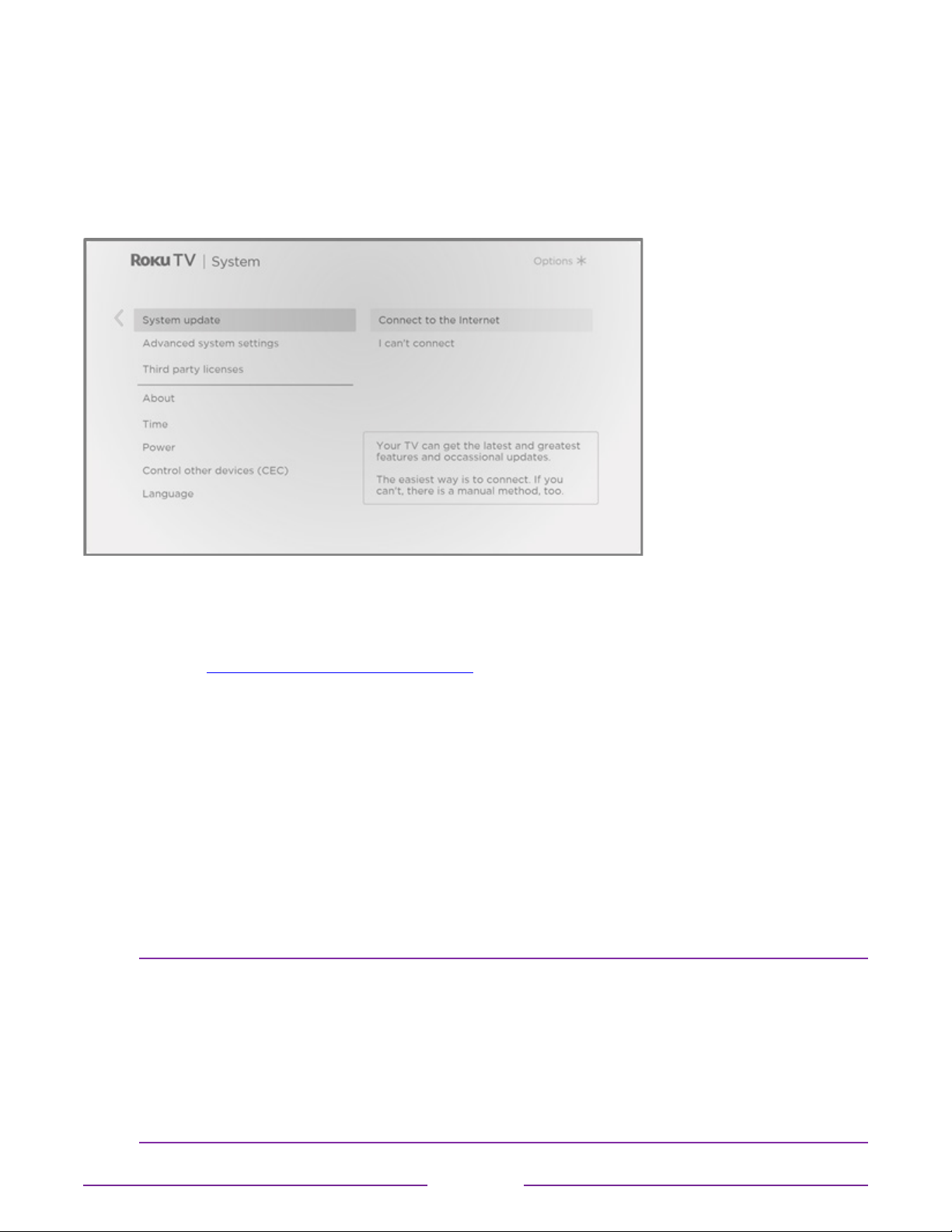
Getting updates on a non-connected TV
If your TV is not connected to the Internet, you can still get system updates by using a USB
flash drive and a computer with an Internet connection.
To get a system update, navigate to Settings > System > System update:
The System update screen on a non-connected TV gives you the opportunity to connect
your TV to the Internet to automatically receive updates. We recommend this option if
it is possible in your situation. To proceed, select Connect to the Internet and follow the
instructions in What if I didn’t connect my TV?.
Otherwise, if you can’t connect to the Internet, select I can’t connect, and then follow the
instructions on the screen. Here’s a summary:
1. On an Internet-connected computer, go to the web site displayed on the System
update screen.
2. On the USB Update web page, select the correct brand and model, and then click
Next.
3. Click Download Software, and then save the file to the root folder of a standard USB
flash drive.
USB flash drive
Any normal USB flash drive will work, provided it has a FAT-16 or FAT-32 file system format.
(This is the default for most flash drives.)
The size of the download is small—usually less than 100 MB—and so will fit on most any size
flash drive you might have.
126

4. When the download finishes, take the USB flash drive to the TV and plug it into the
USB port. When you do, the TV validates the files on the flash drive and displays a
12-digit code.
5. Write down the code and the web address, and take this information back to your
Internet-connected computer.
6. On the 12-digit code page, enter the code your TV displayed, and then click Next.
7. On the 6-digit code page, write down the 6-digit code that appears, and then take it
back to your TV.
12- and 6-digit codes
The USB update process uses a pair of codes to validate that you are authorized to install an
update, and to ensure you are not attempting to install an old, unsupported version of the
system software.
8. Using the TV remote, select Next to move to the next screen, and then use the on-
screen keyboard to enter the 6-digit code. When finished, select OK. The system
update begins. Do not remove the USB flash drive until the TV restarts.
When the update finishes, the TV restarts. You can check the new version number by
navigating to Settings > System > About.
127

Other devices
Mirror your phone or tablet
Only in connected mode, your TV has a feature called screen mirroring that lets you mirror
your compatible smartphone or tablet on your TV. Share videos, photos, web pages, and
more from compatible devices.
By default, your TV’s screen mirroring mode is set to Prompt. In this mode, when your TV
receives a screen mirroring request, it prompts you with the following options, unless you
have previously selected Alwaysallow or Neverallowfor the device:
•
Always accept – Always accept mirrored content from the mobile device without
additional prompting in the future for this device.
•
Accept – Accept mirrored content from the mobile device this time only. Prompt again
next time this device attempts to mirror content.
•
Ignore – Do not accept mirrored content from the mobile device at this time. Prompt
again next time this device attempts to mirror content.
•
Always ignore – Never accept mirrored content from this mobile device.
Note: You can manage and change the list of devices that are set to Alwaysallowor
Neverallow by navigating from the Home screen menu to Settings>System>Screen
mirroring>Screenmirroringdevices.
•
If you prefer to always allow all screen mirroring attempts without prompting, go to
Settings > System > Screen mirroring, and then change the Screen mirroring mode to
Always allow.
•
If you prefer to never allow screen mirroring from any device, change the Screen
mirroring mode to Never allow.
For information on which devices may work with screen mirroring and instructions on how to
use it, go to the following link on the Roku web site:
go.roku.com/screenmirroring
128

Roku mobile app
Roku makes the Roku mobile app free for compatible iOS® and Android™ mobile devices.
The Roku mobile app is an alternative control center for your Roku TV, plus a way to stream
Roku content while you are on the go. The Roku mobile app helps you find and add new
Roku Channels, more easily search and find something to watch and even use your voice to
search without typing.
Find more information and get the Roku mobile app by using the following link to the Roku
web site:
go.roku.com/mobileapp
Private Listening on the Roku mobile app
Only on compatible Apple and Android devices, the Roku mobile app enables you to use
headphones connected to your device to listen to streaming programs and live digital TV
channels. Make sure you have the latest version of the Roku mobile app before using this
feature.
For more information, go to the following link on the Roku web site:
go.roku.com/privatelistening
Universal remotes
In many cases, you can program your cable or satellite universal remote to also control your
TV. You will need to have instructions for programming the remote handy. Check with your
cable or satellite provider for instructions.
For details on how to set up the TV to work with universal remotes, go to the following link
on the Roku web site:
go.roku.com/universalremote
129


Legal statement
Please note—Use of the Roku TV is governed by the Roku TV End User License Agreement (see below). In addition, an end
user online profile and billing account with Roku, Inc. (“Roku”) on Roku’s website (“Roku Account”) is required to stream
content via the Internet using your Roku TV. A Roku Account gives you access to movies, television shows, and other audio-
visual entertainment in the “Roku Channel Store,” a storefront of applications provided by Roku via your device’s on-screen
menu. After your Roku Account is created, you can link your Roku TV to your account. By using the Roku TV, you agree to these
statements. For the avoidance of doubt, the content disclaimer set forth herein shall refer to all content and channels accessible
and available on the Roku TV, including those available via the Roku® streaming platform, as well as broadcast cable.
Due to the various capabilities of the Roku TV, as well as limitations in the available content available therein, certain features,
applications, and services may not be available on all Roku TV s, or in all territories. Some features on the Roku TV may also
require additional peripheral devices or membership fees that are sold separately. Please visit the Roku, Inc. website for more
information on the Roku TV and content availability. The services and availability of content on the Roku TV are subject to
change from time to time without prior notice.
All content and services accessible through the Roku TV belong to Roku, Inc. or third parties and are protected by copyright,
patent, trademark and/or other intellectual property laws. Such content and services are provided solely for your personal
noncommercial use. You may not use any content or services in a manner that has not been authorized by the content owner or
service provider. Without limiting the foregoing, you may not modify, copy, republish, upload, post, transmit, translate, sell, create
derivative works, exploit, or distribute in any manner or medium any content or services displayed through the Roku TV.
Third party services may be changed, suspended, removed, terminated or interrupted, or access may be disabled at any time,
without notice, and Roku makes no representation or warranty that any content or service will remain available for any period
of time. Content and services are transmitted by third parties by means of networks and transmission facilities over which Roku
has no control. Without limiting the generality of this statement, Roku expressly disclaims any responsibility or liability for any
change, interruption, disabling, removal of or suspension of any content or service made available through the Roku TV. Roku,
the content providers, or the service providers may impose limits on the use of or access to certain services or content, in any
case and without notice or liability. Any questions or requests for service relating to the content or services made available on
the Roku TV should be submitted to the respective cable content or service provider or as described in the Roku TV User Guide.
In the event of a conflict between the Roku TV End User Agreement and the terms set forth in this Legal Statement, the Roku
TV End User Agreement shall prevail and control in all circumstances.
END USER LICENSE AGREEMENT (FOR ROKU TV)
IMPORTANT: READ THIS END USER LICENSE AGREEMENT CAREFULLY BEFORE YOU USE A ROKU TV. ALSO
REVIEW THE IMPORTANT PRODUCT INFORMATION THAT MAY HAVE BEEN PROVIDED WITH YOUR ROKU TV.
Overview
This End User License Agreement (“EULA”) between you and Roku, Inc. (“Roku”) governs the use of: (a)your television which
uses the Roku platform to play digital content over the Internet (“Television”), and (b)any firmware and software that have
been pre-installed on the Television and the firmware and software updates Roku provides to you for the Television (collectively,
the “Software”). By linking the Television to your account on Roku’s website (“Roku Account”) or using the Television, you are
agreeing to this EULA. If you are a resident of the European Economic Area, by agreeing to this EULA, you expressly agree to
waive your right to withdraw.
If you do not agree to this EULA, you do not have the right to use the Television or the Software. If you are within the allowable
time period for returns under the applicable return policy, you may return the Television to your seller for a refund, subject to
the terms of such return policy. You should perform a factory reset before you return it to erase data that may be stored on the
Television. For instructions on how to reset your Television, please visit www.roku.com/support.
In this EULA, “Channel” means an application in the Roku Channel Store; “Content” means movies, television shows, music and
other audio and visual materials and entertainment; “Content Provider” means any provider of Content; and “Roku Channel
Store” means the storefront of applications provided by Roku via the Television’s on-screen menu.
Changes to This EULA
Roku may amend this EULA at any time in its discretion. Such amendments shall be eective immediately upon posting of
the amended EULA on Roku’s website or via the Television or your Roku Account, whichever occurs first. If you have a Roku
Account that is linked to your Television, then in its option, Roku may also notify you of the amended EULA by sending a notice
to the last email address you have provided to Roku. You agree to provide accurate and complete information if and when
you set up your Roku Account, and you agree to promptly update your account information (including contact information)
to keep it accurate and complete. You can do this at any time by signing in to your Roku Account. Following such posting or
notice by any of the methods described above, continued use of your Television or Roku Account means you accept and agree
to the amended EULA. If you do not agree to the amended EULA, Roku may not be able to provide updates, upgrades or
enhancements to your Television, and you may not be able to continue using your Television or Roku Account.
131

Permitted Use and Restrictions
The Television and the Software are for personal, non-commercial use only. Copying or redistribution of any Content delivered
via the Television is strictly prohibited and we may prevent or restrict you from copying or re-distributing any elements of
the Software or Content using digital rights management or other technologies. The Television and the Software are for use
only in those countries where the manufacturer of your Television has authorized its sale. If you are using the Television and
the Software outside of these countries, the rights granted under this EULA do not apply. Some of the Content Providers use
technologies to verify your geographic location, and you may not be able to use the Television or the Software to access any
Content outside of the country or location authorized by Roku or the Content Provider. Except as expressly provided under
this EULA, you do not acquire any intellectual property or other proprietary rights in or to the Television, the Software or the
Content, including any rights in patents, inventions, improvements, designs, trademarks, database rights or copyrights, nor do
you acquire any rights in any confidential information or trade-secrets. All rights not expressly granted to you in this EULA are
reserved by Roku or its applicable licensors. You may not remove, obscure, alter or conceal any trademark, logo, copyright or
other proprietary notice in or on any Television, Software or Content.
The Software is proprietary to Roku or its third party licensors and may be used only with the Television. Subject to this EULA
and, where appropriate, the applicable third party licenses, you have a non-exclusive, non-transferable license to run the
Software and any updated versions provided to you by Roku, only in and as incorporated in the Television. This is a license
and not a sale. You may not (a)copy, assign, sublicense, lease, sell or rent the Software, (b)distribute or otherwise transfer
the Software except as incorporated in the Television, provided that, you do not retain any copies of the Software and the
recipient reads and agrees to this EULA (including all amendments); (c)modify, adapt, translate, or create derivative works of
the Software (except only to the extent any of the foregoing restriction is prohibited by applicable law or as may be permitted
by the license terms governing any Separately Licensed Code included with the Software); (d)decompile, disassemble, reverse
engineer or otherwise derive source code from the Software, except to the extent such actions cannot be prohibited under
applicable law because they are essential to achieve inter-operability of the Software with another software program, and
provided that the information obtained by you during such activities is (i)used only to achieve such inter-operability; (ii)not
disclosed without Roku’s prior written consent; and (iii)not used to create any software that is substantially similar to the
Software; (e)defeat, bypass, circumvent or interfere with any security mechanism or access control measures, or (f)have any
of the foregoing done for you by a third party. This license does not include the right to receive Software upgrades or updates.
Your right to use the Television and the Software will immediately terminate upon your breach of this EULA.
Software Updates
IN ITS SOLE DISCRETION, ROKU MAY PROVIDE UPDATES TO YOUR PLAYER VIA THE INTERNET, INCLUDING BUG FIXES AND
UPDATES, CHANGES IN THE USER INTERFACE OR HOW YOU ACCESS CONTENT, AND OTHER CHANGES THAT MAY ADD,
ALTER OR REMOVE FUNCTIONALITIES AND FEATURES. YOU ACKNOWLEDGE THAT THESE UPDATES: (A)MAY HAPPEN
AUTOMATICALLY IN THE BACKGROUND AT ANY TIME (AND THAT THEY CANNOT BE DISABLED BY YOU); AND (B)WILL
REQUIRE AN INTERNET CONNECTION AND YOU MAY INCUR ADDITIONAL DATA CHARGES FROM THE PROVIDER OF THE
INTERNET CONNECTION. YOU UNDERSTAND THAT THESE UPDATES ARE NECESSARY TO MAINTAIN COMPATIBILITY WITH
OTHER UPDATES TO ROKU’S PRODUCTS OR SERVICES AND MAY BE REQUIRED FOR SECURITY REASONS. BY USING THE
PLAYER, YOU HEREBY AGREE TO RECEIVE SUCH UPDATES.
Separately Licensed Code
Certain software components of the Software are provided under separate third party license terms (“Separately
Licensed Code”) and your right to use such components is governed by such license terms. Please visit go.roku.com/
seperatelylicensedcode for more information.
132

Voice Services
You can use your voice to control your Television (e.g., search for content, switch inputs, launch channels, and launch Smart
Guide) via (i) the Roku mobile app, if you have downloaded the Roku mobile app to your phone or mobile device; or (ii) a
compatible voice remote if your Television supports voice services in your country of residence. When you choose to use your
voice to control your Television, you agree that Roku and third parties who fulfill your requests and/or provide services for us
have your consent to record, process and store your voice inputs (e.g., a recording and the interpretation of what was said), and
use such voice inputs with other information about your Television (e.g., device identifier) to provide services to you, to improve
the accuracy and quality of the service, and as described in Roku’s Privacy Policy. To learn more about voice services, visit the
FAQ pages of Roku’s website at www.roku.com/support.
NO WARRANTY FROM ROKU; LIMITATION OF LIABILITY
YOUR WARRANTY WITH RESPECT TO THE TELEVISION IS PROVIDED BY THE TELEVISION’S MANUFACTURER, and not
by Roku. ROKU OFFERS NO WARRANTY TO YOU UNDER THIS EULA. WITHOUT LIMITING THE GENERALITY OF THE
FOREGOING DISCLAIMER, TO THE MAXIMUM EXTENT PERMITTED BY APPLICABLE LAW:
(A)
THE SEPARATELY LICENSED CODE AND THE SOFTWARE ARE PROVIDED “AS IS”, WITH ALL FAULTS AND
WITHOUT WARRANTY OF ANY KIND. ROKU DISCLAIMS ALL OTHER WARRANTIES AND CONDITIONS, INCLUDING
THE IMPLIED WARRANTY OF MERCHANTABILITY, SATISFACTORY QUALITY, FITNESS FOR A PARTICULAR PURPOSE
AND NON-INFRINGEMENT. ROKU DOES NOT GUARANTEE, REPRESENT, OR WARRANT THAT THE TELEVISION,
THE SEPARATELY LICENSED CODE AND THE SOFTWARE WILL BE: (I)SECURE, VIRUS-FREE OR ERROR-FREE, OR
(II)FREE FROM ATTACK OR SECURITY INTRUSION.
(B)
IN NO EVENT SHALL ROKU, ITS DIRECTORS, OFFICERS OR EMPLOYEES BE LIABLE TO YOU FOR PERSONAL
INJURY OR PROPERTY DAMAGE, OR ANY SPECIAL, INCIDENTAL, EXEMPLARY, PUNITIVE, INDIRECT OR
CONSEQUENTIAL DAMAGES OF ANY KIND ARISING OUT OF ANY TELEVISION, THE SEPARATELY LICENSED CODE,
THE SOFTWARE, OR YOUR USE THEREOF; AND
(C)
YOU AGREE THAT (I)THE TOTAL CUMULATIVE LIABILITY OF ROKU, ITS DIRECTORS, OFFICERS AND EMPLOYEES
UNDER THIS EULA, INCLUDING LIABILITY RELATING TO ALL TELEVISIONS LINKED TO YOUR ROKU ACCOUNT,
AND THE SEPARATELY LICENSED CODE AND THE SOFTWARE IN SUCH TELEVISIONS, AND YOUR USE THEREOF,
SHALL NOT EXCEED THE AMOUNT SET FORTH IN THE ROKU ACCOUNT TERMS AND CONDITIONS YOU AGREED
TO FOR YOUR ROKU ACCOUNT, AND (II)ROKU, ITS DIRECTORS, OFFICERS AND EMPLOYEES SHALL NOT BE
LIABLE TO YOU UNDER THIS EULA FOR ANY DIRECT DAMAGES ARISING OUT OF, OR IN CONNECTION WITH THE
TELEVISION. THE FOREGOING LIMITATIONS SHALL APPLY EVEN IF THE REMEDY PROVIDED HEREIN FAILS ITS
ESSENTIAL PURPOSE AND EVEN IF ROKU, ITS DIRECTORS, OFFICERS OR EMPLOYEES HAVE BEEN ADVISED OF
THE POSSIBILITY OF SUCH LIABILITY.
Some jurisdictions do not allow exclusions OF CERTAIN warranties OR LIMITATIONS OF LIABILITY FOR CERTAIN TYPES OF
DAMAGES, so SOME OF the ABOVE LIMITATIONS IN THIS SECTION MAY NOT apply to You. NOTHING IN THESE TERMS OF
USE SHALL AFFECT ANY NON-WAIVABLE STATUTORY RIGHTS THAT APPLY TO YOU, AND You may also have other rights
that vary from jurisdiction to jurisdiction.
Export Controls
You agree not to download any Content or Software, nor otherwise export or re-export any Television or the Software into (or
to a national or resident of) Cuba, Iraq, Libya, North Korea, Iran, Syria or any other country as to which the United States or your
country has embargoed goods, or to anyone on the U.S. Treasury Department's List of Specially Designated Nationals or the U.S.
Commerce Department's Table of Denial Orders or on similar restricted lists published by your government from time to time.
By using any Television or the Software, you are representing and warranting that you are not located in, under the control of, or
a national or resident of any such country or on any such list.
133

Choice of Law; Dispute Resolution
A. If you are a consumer and a resident in any country in the European Economic Area where the sale of the Television is
expressly authorized by its manufacturer, this EULA does not apply to you.
B. In all other cases, including if you are a resident of the United States (and its possessions and territories) or Canada,
you agree that this EULA shall be governed by the laws of the State of California without regard to any conflict of laws
principles that may provide the application of the law of another jurisdiction; and:
1. You and Roku agree to be bound by the procedures set forth below to resolve any and all claims between you
and Roku arising out of or relating to any aspect of this EULA, whether based in contract, tort, statute, fraud,
misrepresentation or any other legal theory, including but not limited to, claims between you and Roku related to
the Television and the Software. Each such claim is referred to individually as “Claim” and collectively as “Claims”.
2. YOU AND ROKU AGREE THAT, EXCEPT FOR THE CLAIMS IDENTIFIED IN PARAGRAPH4 OF THIS SECTION
BELOW, ANY AND ALL CLAIMS BETWEEN YOU AND ROKU SHALL BE FINALLY SETTLED BY BINDING
ARBITRATION. The arbitration shall take place in Santa Clara County, California and shall be administered by the
American Arbitration Association (“AAA”) pursuant to the AAA’s then-current rules, including (if applicable) the
AAA’s Supplementary Procedures for Consumer-Related Disputes. Please be aware there is no judge or jury in
arbitration. Arbitration procedures are simpler and more limited than the rules applicable in court, and review
of the arbitrator’s decision by a court is limited. YOU AND ROKU FURTHER AGREE THAT EACH OF YOU MAY
BRING CLAIMS AGAINST THE OTHER ONLY ON AN INDIVIDUAL BASIS AND NOT AS A PLAINTIFF OR CLASS
MEMBER IN ANY PURPORTED CLASS OR REPRESENTATIVE ACTION OR PROCEEDING. The arbitrator may not
consolidate or join more than one person’s claim and may not preside over any consolidated, representative
or class proceeding. Also, the arbitrator may award relief (including monetary, injunctive or declaratory relief)
only on an individual basis and may not award any form of consolidated, representative or class-wide relief.
Notwithstanding any provision in these terms to the contrary, if the class-action waiver in this provision is deemed
invalid or unenforceable, or if an arbitration is allowed to proceed on a class basis, then neither you nor Roku are
entitled to arbitrate the Claims. This arbitration provision is subject to the Federal Arbitration Act. The arbitrator’s
award shall be binding on you and Roku, and may be entered in any court of competent jurisdiction.
3. Information on AAA and how arbitration is initiated can be found at www.adr.org or by calling 800-778-7879. For
Claims between You and Roku of $75,000 or less, you will be responsible for the initial arbitration filing fee, up to
the amount of the initial filing fee if you were to initiate a lawsuit against Roku based on such Claims in court. If the
arbitrator finds such Claims to be non-frivolous, Roku will pay any dierence in such filing fees plus the arbitrator
fees. For Claims between You and Roku in excess of $75,000, if you are able to demonstrate that the costs of
arbitration will be prohibitive as compared to the costs of litigation, Roku will pay as much of your actual filing fees
and the arbitrator fees for the arbitration as the arbitrator deems necessary to prevent the arbitration from being
cost-prohibitive as compared to the cost of litigation.
4. This agreement to arbitrate does not apply to any Claim (a)in which a party is attempting to protect its intellectual
property rights (such as its patent, copyright, trademark, trade secret, or moral rights, but not including its privacy
or publicity rights), or (b)that may be brought in small-claims court.
5. If the agreement to arbitrate in this provision is found to be invalid, unenforceable or inapplicable to a given
Claim between You and Roku, then any and all proceedings to resolve such Claim must be brought exclusively
in a federal court of competent jurisdiction in the Northern District of California or in a state court in Santa Clara
County, California. You hereby irrevocably consent to the exclusive jurisdiction and venue of such courts.
6. 30-DayRighttoOptOut: You have the right to opt out of this agreement to arbitrate by sending a written notice
of your decision to opt out to the following address: Legal Department, Roku, Inc. 1155 Coleman Avenue, San Jose,
CA 95110, USA; provided that, such notice must be postmarked on or before the 30th day after the first to occur of
the following events if you do not already have a Roku Account: (a) the date of purchase of Your Television, or (b) the
date you create your Roku Account. If you have an existing Roku Account, all devices you choose to link to your Roku
Account, and all services provided by Roku which are accessed using these devices, will be subject to this agreement
to arbitrate. Your notice should include your full name, your current postal address, telephone number and email
address, the product name and serial number for Your Television, and a copy of the original proof of purchase for your
Television. If you timely send a notice in compliance with this paragraph 6, the agreement to arbitrate will not apply to
either you or Roku. If you do not timely send this notice, then you agree to be bound by this agreement to arbitrate.
7. Notwithstanding any provision in this EULA to the contrary, you agree that, if Roku seeks to delete or materially
modify the agreement to arbitrate described herein, any such deletion or modification will not apply to any
individual Claim of which you have notified Roku prior to such modification.
134

Miscellaneous
Roku may transfer its rights and obligations under this EULA to another organization. You may only transfer your rights or
your obligations under this EULA to another person if Roku agrees in writing. This EULA is between you and Roku. No other
person shall have any rights to enforce these terms. Each of the paragraphs of this EULA operates separately. If any court or
relevant authority decides that any of them are unlawful, the remaining paragraphs will remain in full force and eect. If Roku
fails to insist that you perform any of your obligations under this EULA, or if Roku does not enforce its rights against you, or
if Roku delays in doing so, that will not mean that Roku has waived its rights against you, or that you do not have to comply
with those obligations. If Roku does waive a default by you, Roku will only do so in writing, but that will not mean that Roku will
automatically waive any later default by you.
Contact Information
If you wish to contact Roku, please send your correspondence by mail to Roku, Inc. 1155 Coleman Avenue, San Jose, CA 95110,
USA, or by email to customerservice@roku.com.
Last Updated: 20 Aug-2018
CONTRAT DE LICENCE D’UTILISATEUR FINAL (POUR ROKU TV)
IMPORTANT : LIRE ATTENTIVEMENT CE CONTRAT DE LICENCE D’UTILISATEUR FINAL AVANT D’UTILISER UN
TÉLÉVISEUR ROKU TV. PASSER ÉGALEMENT EN REVUE LES RENSEIGNEMENTS IMPORTANTS RELATIFS AU
PRODUIT QUI PEUVENT AVOIR ÉTÉ FOURNIS AVEC VOTRE TÉLÉVISEUR ROKU TV.
Aperçu
Le présent contrat de licence d’utilisateur final (« CLUF ») conclu entre vous et Roku, Inc. (« Roku ») régit l’utilisation de : (a)
votre téléviseur qui se sert de la plateforme Roku pour lire du contenu numérique sur Internet (« Téléviseur ») et (b) tous les
microprogrammes et logiciels qui ont été préinstallés sur le Téléviseur, ainsi que les mises à jour des microprogrammes et
logiciels que Roku met à votre disposition pour le Téléviseur (collectivement le « Logiciel »). Lier le Téléviseur à votre compte
sur le site Web de Roku (« Compte Roku ») ou utiliser le Téléviseur signifie que vous acceptez ce CLUF. Si vous résidez sur le
territoire économique européen et acceptez ce CLUF, vous acceptez expressément de renoncer à votre droit de rétractation.
Si vous n’acceptez pas le présent CLUF, vous ne pouvez pas utiliser le Téléviseur ni le Logiciel. Si le délai autorisé pour les retours
n’est toujours pas échu en vertu de la politique de retour applicable, vous pouvez retourner le Téléviseur à votre vendeur pour
obtenir un remboursement, sous réserve des modalités d’une telle politique de retour. Vous devez eectuer une réinitialisation
d’usine avant de retourner l’appareil afin d’eacer les données pouvant être stockées sur le Téléviseur. Pour obtenir des
renseignements sur la façon de réinitialiser votre Téléviseur, veuillez visiter la page www.roku.com/support.
Dans le présent CLUF, « Canal » désigne une application de la boutique de canaux Roku; « Contenu » désigne des films, des
séries télévisées, de la musique et tout autre contenu et divertissement audiovisuel; « Fournisseur de contenu » désigne tout
fournisseur de Contenu et « Boutique de canaux Roku » désigne la vitrine d’applications fournies par Roku par l’intermédiaire du
menu à l’écran du Téléviseur.
Modifications au présent CLUF
Roku peut modifier ce CLUF à tout moment à sa discrétion. Ces modifications entreront en vigueur immédiatement après
la publication du CLUF modifié sur le site Web de Roku, le Téléviseur ou votre compte Roku, selon la première éventualité.
Si vous disposez d’un compte Roku associé à votre Téléviseur, Roku peut également, à sa discrétion, vous informer du CLUF
modifié en envoyant un avis à la dernière adresse électronique que vous avez indiqué à Roku. Vous acceptez de fournir des
renseignements exacts et complets lorsque vous configurez votre compte Roku et vous vous engagez à mettre rapidement à
jour les renseignements de votre compte, y compris vos coordonnées, afin qu’ils soient exacts et complets. Vous pouvez le faire
à tout moment en vous connectant à votre compte Roku. À la suite d’une telle annonce ou d’un tel avis par l’une des méthodes
décrites ci-dessus, continuer à utiliser votre Téléviseur ou votre compte Roku signifie que vous acceptez le CLUF modifié. Si
vous n’acceptez pas le CLUF modifié, Roku ne sera peut-être pas en mesure de fournir des mises à jour, des mises à niveau ou
des améliorations pour votre Téléviseur, et vous pourriez ne plus être en mesure de continuer à utiliser votre Téléviseur ou votre
compte Roku.
135

Utilisation autorisée et restrictions
Le Téléviseur et le Logiciel sont destinés à un usage personnel et non commercial uniquement. Toute reproduction ou toute
redistribution du contenu oert par le Téléviseur est strictement interdite et nous pourrions vous empêcher de copier ou
de redistribuer tout élément du Logiciel ou du contenu à l’aide d’un système de gestion des droits numériques ou d’autres
technologies. Le Téléviseur et le Logiciel sont uniquement destinés à une utilisation dans les pays dans lesquels le fabricant de
votre Téléviseur a autorisé leur vente. Si vous utilisez le Téléviseur et le Logiciel en dehors de ces pays, les droits accordés en
vertu du présent CLUF ne s’appliquent pas. Certains des Fournisseurs de contenu utilisent des technologies qui permettent de
vérifier votre situation géographique et vous pourriez ne pas être en mesure d’utiliser le Téléviseur ou le Logiciel pour accéder
au Contenu en dehors du pays ou de l’emplacement autorisé par Roku ou le Fournisseur de contenu. Sauf dans la mesure
expressément indiquée dans le présent CLUF, vous n’acquérez aucune propriété intellectuelle ou aucun autre droit de propriété
de quelque nature sur le Téléviseur, le Logiciel ou le Contenu, y compris les droits de brevets, les inventions, les améliorations,
les conceptions, les marques, les droits de base de données ou les droits d’auteur, et vous n’acquérez aucun droit sur tout
renseignement confidentiel ou secret commercial. Tous les droits qui vous ne sont pas expressément concédés dans le présent
CLUF sont réservés par Roku ou ses concédants de licence applicables. Vous ne pouvez pas supprimer, obscurcir, modifier ou
dissimuler toute marque, tout logo, tout droit d’auteur ou toute autre mention de droit de propriété dans ou sur n’importe tout
Téléviseur, Logiciel ou Contenu.
Le Logiciel est la propriété de Roku ou d’une tierce partie licenciée et peut être utilisé uniquement avec le Téléviseur. Sous
réserve du présent CLUF et, le cas échéant, des licences applicables de tiers, vous détenez une licence non exclusive et non
transférable d’utilisation du Logiciel et de toute version mise à jour qui vous est fournie par Roku, seulement dans le Téléviseur
et sous la forme qu’il incorpore. Ceci constitue une licence et non une vente. Vous ne pouvez pas (a) copier, céder, louer ou
vendre le Logiciel ou accorder une sous-licence pour ce dernier; (b) distribuer ou autrement transférer le Logiciel, sauf comme
incorporé dans le Téléviseur, pourvu que vous ne conserviez aucune copie du Logiciel et que le destinataire lit et s’engage à
respecter cet accord de licence (y compris tous les amendements); (c) modifier, adapter, traduire ou créer des œuvres dérivées
du Logiciel (sauf dans la mesure où toute restriction qui précède est interdite par la loi applicable ou jugée
acceptable par les termes de la licence régissant tout code utilisé avec autorisation fourni avec le Logiciel); (d) décompiler,
désassembler, désosser ou autrement extraire le code source du Logiciel, sauf dans la mesure où ces gestes ne peuvent
être interdits en vertu de la loi applicable parce qu’ils sont essentiels à l’interopérabilité du Logiciel avec un autre logiciel, et
pourvu que les renseignements obtenus par vous au cours de ces activités sont (i) utilisés uniquement pour réaliser cette
interopérabilité; (ii) non divulgués sans le consentement écrit de Roku obtenu préalablement; et (iii) ne sont pas utilisés pour
créer un logiciel qui est substantiellement similaire au Logiciel; (e) usurper, contourner ou gêner tout mécanisme de sécurité ou
toute mesure de contrôle d’accès, ou (f) faire eectuer ce qui précède pour vous par un tiers. Cette licence n’inclut pas le droit
de recevoir des mises à jour ou des mises à niveau logicielles. Votre droit d’utiliser le Téléviseur et le Logiciel sera immédiatement
annulé sur violation du présent CLUF.
Mises à jour logicielles
À SA SEULE DISCRETION, ROKU PEUT FOURNIR DES MISES À JOUR SUR VOTRE TÉLÉVISEUR PAR INTERNET, Y COMPRIS
DES CORRECTIFS, DES MISES À JOUR, DES MODIFICATIONS DE L’INTERFACE OU DE LA MANIÈRE D’ACCÉDER AU
CONTENU, ET D’AUTRES CHANGEMENTS QUI PEUVENT AJOUTER, ALTÉRER OU SUPPRIMER DES FONCTIONNALITES ET
DES CARACTERISTIQUES. VOUS RECONNAISSEZ QUE CES MISES A JOUR (A) PEUVENT SE PRODUIRE AUTOMATIQUEMENT
EN ARRIERE-PLAN A TOUT MOMENT (ET QU’ELLES NE PEUVENT PAS ETRE DESACTIVEES PAR VOUS) ; ET (B)
NECESSITENT UNE CONNEXION INTERNET ET QUE VOUS POURRIEZ DEVOIR PAYER DES FRAIS DE DONNEES
SUPPLEMENTAIRES A VOTRE FOURNISSEUR DE CONNEXION INTERNET. VOUS COMPRENEZ QUE CES MISES A JOUR SONT
NECESSAIRES POUR MAINTENIR LA COMPATIBILITE AVEC LES AUTRES MISES A JOUR DE PRODUITS OU DE SERVICES
DE ROKU ET QU’ELLES PEUVENT ETRE NECESSAIRES POUR DES RAISONS DE SECURITE. EN UTILISANT LE TÉLÉVISEUR,
VOUS ACCEPTEZ DE RECEVOIR CES MISES A JOUR.
Code sous licence distincte
Certains composants du Logiciel sont fournis sous les termes distincts de licence de tiers (« Code sous licence distincte »)
et votre droit d’utiliser ces composants est régi par les modalités de cette licence. Veuillez visiter le https://www.roku.com/
separatelylicensedcode pour obtenir de plus amples renseignements.
Services vocaux
Vous pouvez utiliser votre voix pour contrôler votre téléviseur (par exemple, rechercher du contenu, changer d'entrée, lancer
des canaux et lancer Smart Guide) via (i) l'application mobile Roku, si vous avez téléchargé l'application mobile Roku sur votre
téléphone ou appareil mobile ; ou (ii) une télécommande vocale compatible si votre téléviseur prend en charge les services
vocaux dans votre pays de résidence. Lorsque vous choisissez d'utiliser votre voix pour contrôler votre Télévision, vous acceptez
que Roku et les tiers qui répondent à vos demandes et / ou fournissent des services pour nous aient votre consentement pour
enregistrer, traiter et stocker vos entrées vocales (par exemple, un enregistrement et l'interprétation de ce qui a été dit), et
utiliser ces entrées vocales avec d'autres informations sur votre téléviseur (par exemple, identifiant de l'appareil) pour vous
fournir des services, améliorer la précision et la qualité du service, et comme décrit dans la politique de confidentialité de Roku.
Pour en savoir plus sur les services vocaux, consultez les pages FAQ du site Web de Roku à l'adresse www.roku.com/support.
136

AUCUNE GARANTIE DE LA PART DE ROKU; LIMITATION DE RESPONSABILITÉ
VOTRE garantie relative au téléviseur est fournie par le FABRICANT DU Téléviseur et non pas par Roku. ROKU NE VOUS OFFRE
AUCUNE GARANTIE EN VERTU DU PRÉSENT CLUF. SANS RESTREINDRE LA PORTÉE GÉNÉRALE DU PRÉSENT AVIS DE
NON-RESPONSABILITÉ, DANS LES LIMITES PERMISES PAR LES LOIS APPLICABLES :
(A)
LE CODE SOUS LICENCE DISTINCTE ET LE LOGICIEL SONT FOURNIS « TELS QUELS », ERREURS COMPRISES, SANS
GARANTIE D’AUCUNE SORTE. ROKU RENONCE À TOUTES LES AUTRES GARANTIES ET CONDITIONS, Y COMPRIS
LA GARANTIE IMPLICITE DE QUALITÉ MARCHANDE, DE QUALITÉ SATISFAISANTE, D’ADÉQUATION À UN USAGE
PARTICULIER ET D’ABSENCE DE CONTREFAÇON. ROKU NE PEUT GARANTIR, DÉCLARER NI CERTIFIER QUE LE
TÉLÉVISEUR, LE CODE SOUS LICENCE DISTINCTE ET LE LOGICIEL SERONT : (I) SÉCURISÉS, SANS VIRUS OU SANS
ERREUR, OU (II) DÉNUÉS DE TOUTE ATTAQUE OU INTRUSION DE SÉCURITÉ.
(B)
EN AUCUN CAS ROKU, SES ADMINISTRATEURS, SES DIRIGEANTS OU SES EMPLOYÉS NE SERONT RESPONSABLES
ENVERS VOUS POUR TOUTE LÉSION CORPORELLE OU TOUT DOMMAGE MATÉRIEL, OU TOUT DOMMAGE
PARTICULIER, ACCESSOIRE, EXEMPLAIRE, PUNITIF, INDIRECT OU IMMATÉRIEL DE QUELQUE NATURE DÉCOULANT
DE TOUT TÉLÉVISEUR, CODE SOUS LICENCE DISTINCTE, LOGICIEL OU DE VOTRE UTILISATION DE CEUX-CI; ET
(C)
VOUS ACCEPTEZ QUE (I) LA RESPONSABILITÉ CUMULATIVE DE ROKU, DE SES ADMINISTRATEURS, SES
DIRIGEANTS OU SES EMPLOYÉS, EN VERTU DU PRÉSENT CLUF, NOTAMMENT SA RESPONSABILITÉ CONCERNANT
TOUS LES TÉLÉVISEURS ASSOCIÉS À VOTRE COMPTE ROKU, AINSI QUE LE CODE SOUS LICENCE DISTINCTE ET LE
LOGICIEL INSTALLÉ SUR DE TELS TÉLÉVISEURS, et votre utilisation de ceux-ci, NE DÉPASSERA PAS LE MONTANT
SPÉCIFIÉ DANS LES CONDITIONS GÉNÉRALES DU COMPTE ROKU QUE VOUS AVEZ ACCEPTÉES POUR VOTRE
COMPTE ROKU, ET QUE (II) ROKU, SES ADMINISTRATEURS, SES DIRIGEANTS ET SES EMPLOYÉS NE SERONT PAS
RESPONSABLES ENVERS VOUS, EN VERTU DU PRÉSENT CLUF, POUR LES DOMMAGES DIRECTS DÉCOULANT
DU TÉLÉVISEUR OU EN LIEN AVEC CELUI-CI. LES LIMITATIONS CI-DESSUS S’APPLIQUENT MÊME SI LE RECOURS
PRÉVU AUX PRÉSENTES ÉCHOUE DANS SON OBJECTIF PRINCIPAL ET MÊME SI ROKU, SES ADMINISTRATEURS,
DIRIGEANTS OU SES EMPLOYÉS ONT ÉTÉ AVISÉS DE LA POSSIBILITÉ D’UNE TELLE RESPONSABILITÉ.
CERTAINS TERRITOIRES N’AUTORISENT PAS L’EXCLUSION DE CERTAINES GARANTIES OU LA LIMITATION DE
RESPONSABILITÉ POUR CERTAINS TYPES DE DOMMAGES, CERTAINES LIMITATIONS MENTIONNÉES DANS CETTE SECTION
PEUVENT NE PAS VOUS CONCERNER. RIEN DANS LES PRÉSENTES CONDITIONS D’UTILISATION NE DOIT AFFECTER
TOUT DROIT ACCORDÉ PAR LA LOI QUI S’APPLIQUE À VOUS ET VOUS POURRIEZ AUSSI DISPOSER D’AUTRES DROITS QUI
VARIENT D’UN TERRITOIRE À L’AUTRE.
Contrôles à l’exportation
Vous acceptez de ne pas télécharger tout Contenu ou Logiciel, ni autrement exporter ou réexporter tout Téléviseur ou Logiciel
dans (ou à un ressortissant ou un résident de) Cuba, Irak, Libye, Corée du Nord, Iran, Syrie ou tout autre pays contre lequel les
États-Unis ou votre pays tient un embargo, ou à toute personne figurant sur la List of Specially Designated Nationals du Treasury
Department des États-Unis ou du Table of Denial Orders du Commerce Department des États-Unis ou toute autre liste restreinte
similaire publiée par votre gouvernement de temps à autre. En utilisant un Téléviseur ou le Logiciel, vous représentez un pays
autre que ceux figurant sur une telle liste et vous garantissez que vous n’êtes pas situé dans un tel pays, sous le contrôle d’un tel
pays, ou que vous n’êtes pas un ressortissant ou un résident d’un tel pays.
137

Choix de compétence; règlement des litiges
A. Si vous êtes un consommateur ou un résident d’un pays appartenant au territoire économique européen dans lequel la
vente du Téléviseur est expressément autorisée par son fabricant, le présent CLUF ne s’applique pas à votre cas.
B. Dans tous les autres cas, notamment si vous êtes un résident des États-Unis (et de ses possessions et territoires) ou
du Canada, vous acceptez que cet accord de licence soit régi par les lois de l’état de la Californie, sans tenir compte de
tout conflit de principes de droit qui peut s’appliquer à la loi d’un autre territoire; et :
1. Vous et Roku acceptez d’être liés par les modalités énoncées ci-dessous pour résoudre toute réclamation entre
vous et Roku résultant de tout aspect du présent CLUF ou relative à celle-ci, qu’elle se fonde sur un contrat, un
délit civil, une loi, une fraude, une fausse déclaration ou toute autre théorie juridique, y compris, mais sans s’y
limiter, à des réclamations entre vous et Roku liées au Téléviseur et au Logiciel. Chaque réclamation est dénommée
individuellement en tant que « Réclamation » et collectivement en tant que « Réclamations ».
2. Vous et Roku consentez à ce que toute RÉCLAMATION ENTRE VOUS ET ROKU soit tranchée de façon définitive
par arbitrage, à l’exception des réclamations qui figurent au paragraphe 4ci-après de la présente section.
L’arbitrage doit avoir lieu dans le comté de Santa Clara, en Californie, et doit être administré par l’American
Arbitration Association (l’« AAA ») suivant les règles en vigueur de l’AAA, incluant (le cas échéant) les Procédures
Additionnelles de l’AAA concernant les diérends de consommateurs. Soyez informé qu’il n’y a aucun juge ni
jury en arbitrage. Les procédures d’arbitrage sont simplifiées et plus limitées que les règles applicables devant
les tribunaux et la révision des décisions de l’arbitre par un tribunal est limitée. VOUS ET ROKU CONSENTEZ EN
OUTRE À CE QUE VOUS ET ROKU PUISSIEZ PRÉSENTER UNE RÉCLAMATION À L’ENCONTRE DE L’AUTRE
PARTIE UNIQUEMENT SUR UNE BASE INDIVIDUELLE ET NON À TITRE DE REQUÉRANT OU DE MEMBRE D’UN
GROUPE DANS TOUTE ACTION OU TOUT RECOURS COLLECTIF. L’arbitre ne peut consolider ou joindre plus
d’une réclamation par personne et ne peut présider aucun recours consolidé ou collectif. L’arbitre peut accorder
toute forme de réparation (incluant une réparation monétaire, injonction ou mesure déclaratoire) sur une base
individuelle seulement et ne peut accorder aucune forme de réparation consolidée ou collective. Nonobstant
toute disposition contraire, si la renonciation au recours collectif prévue au présent paragraphe est jugée invalide
ou non exécutoire ou si un arbitrage est autorisé à procéder sur une base collective, ni vous ni Roku ne serez dès
lors autorisés à soumettre les Réclamations à l’arbitrage. La présente clause d’arbitrage est assujettie au Federal
Arbitration Act. La décision de l’arbitre liera vous et Roku et peut être homologuée par tout tribunal compétent.
3. Vous trouverez les renseignements concernant l’AAA et la façon dont l’arbitrage est initié à l’adresse www.adr.org
ou en téléphonant au 800-778-7879. Pour toute Réclamation entre Vous et Roku de 75 000 USD et moins, vous
serez responsable des frais initiaux de demande d’arbitrage, jusqu’à concurrence du montant des frais initiaux de
la demande que vous auriez été appelé à payer pour une poursuite judiciaire initiée pour ces mêmes Réclamations
à l’encontre de Roku devant les tribunaux. Si l’arbitre juge les Réclamations non frivoles, Roku paiera la diérence
entre de tels frais plus les frais de l’arbitrage. Pour toute Réclamation entre vous et Roku qui excède 75 000 USD,
si vous êtes en mesure de démontrer que les frais de l’arbitrage sont prohibitifs par rapport aux frais de justice,
Roku paiera le montant de vos frais de demande réels et les frais de l’arbitrage, jugés nécessaires par l’arbitre afin
d’éviter que les frais d’arbitrage ne deviennent prohibitifs par rapport aux frais de justice.
4. Cette convention d’arbitrage ne concerne pas toute revendication (a) dans laquelle une partie tente de protéger
ses droits de propriété intellectuelle (tels que son brevet, copyright, marque déposée, secret commercial, ou des
droits moraux, mais ne comprenant pas sa vie privée ou les droits de publicité ), ou (b) qui peut être intentée
devant le tribunal des petites créances.
5. Si cette entente d’arbitrage est jugée invalide, non exécutoire ou inapplicable pour une Réclamation donnée entre
Vous et Roku, toute procédure visant à résoudre telle Réclamation devra dès lors être présentée exclusivement
devant un tribunal fédéral ayant juridiction dans le District Nord de Californie ou un tribunal d’État du comté de
Santa Clara en Californie. Vous consentez irrévocablement à la juridiction exclusive de ces tribunaux.
6. Droit de retrait de 30 jours : vous avez le droit de vous retirer de cette entente d’arbitrage en envoyant un avis
écrit de votre décision de vous retirer à l’adresse suivante : Legal Department, Roku, Inc. 1155 Coleman Avenue,
San Jose, CA 95110, États-Unis; à condition que le cachet d’un tel avis soit daté du 30e jour, ou moins, suivant
le premier événement se produisant parmi les choix ci-après, si vous ne possédez pas encore de Compte Roku
Account : (a) la date d’achat de Votre Téléviseur ou (b) la date de création de votre Compte Roku. Si vous
possédez un compte Roku, tous les appareils que vous choisissez de lier à votre compte Roku et tous les services
fournis par Roku qui sont accessibles à l’aide de ces appareils seront soumis à cette convention d’arbitrage. Votre
avis doit indiquer votre prénom et nom complets, votre adresse postale, votre numéro de téléphone et votre
adresse courriel actuels, le nom du produit et le numéro de série aérent à votre Téléviseur, ainsi qu’une copie de
la preuve originale de l’achat de votre Téléviseur. Si vous envoyez en temps opportun un avis en conformité avec
le présent paragraphe 6, la convention d’arbitrage ne pourra pas s’appliquer à vous-même ou à Roku. Si vous ne
transmettez pas cet avis dans les délais impartis, alors vous consentez à être lié par cette entente d’arbitrage.
7. Nonobstant toute disposition contraire de ce CLUF, vous reconnaissez que si Roku veut supprimer ou modifier
substantiellement l’entente d’arbitrage ci-devant, ladite suppression ou modification ne s’appliquera pas à une
Réclamation individuelle pour laquelle vous avez avisé Roku préalablement à ladite suppression ou modification.
138
Divers
En vertu de ce CLUF, Roku peut transférer ses droits et ses obligations à une autre organisation. Vous pouvez uniquement
transférer vos droits ou vos obligations en vertu de ce CLUF à une autre personne si Roku y consent par écrit. Ce CLUF est
entre vous et Roku. Aucune autre personne n’aura le droit de faire respecter ces conditions. Chacun des paragraphes du présent
CLUF a eet séparément. Si un tribunal ou une autre autorité compétente décide que l’un d’entre eux est illicite, les paragraphes
restants resteront en vigueur. Si Roku ne parvient pas à s’assurer que vous respectez vos obligations aux termes du présent
CLUF ou si Roku n’applique pas ses droits contre vous, ou si Roku tarde à le faire, cela ne signifiera pas que Roku a renoncé à
ses droits contre vous, ou que vous n’avez pas à vous conformer à ces obligations. Si Roku renonce à intenter un recours en cas
de manquement de votre part, Roku ne le fera que par écrit, mais cela ne signifiera pas que Roku renoncera automatiquement à
tout manquement ultérieur de vous.
Coordonnées
Si vous désirez communiquer avec Roku, veuillez nous envoyer votre courrier à l’adresse suivante Roku, Inc. 1155 Coleman
Avenue, San Jose, CA 95110, États-Unis ou par courriel à l’adresse customerservice@roku.com.
Dernière mise à jour : 20 août 2018
Dolby Audio™
Manufactured under license from Dolby Laboratories. Dolby, Dolby Audio, and the double-D symbol
are trademarks of Dolby Laboratories. Copyright 1992-2015 Dolby Laboratories. All rights reserved.
Dolby Vision™
Dolby, Dolby Vision, and the double-D symbol are trademarks of Dolby Laboratories. Manufactured
under license from Dolby Laboratories. Confidential unpublished works. Copyright © 2013-2015
Dolby Laboratories. All rights reserved.
HDMI®
The terms HDMI® and HDMI® High-Definition Multimedia Interface, and the HDMI® Logo are
trademarks or registered trademarks of HDMI® Licensing LLC in the United States and other
countries.
Roku
ROKU, ROKU TV and the ROKU logo are the trademarks or registered trademarks of Roku, Inc. All
other trademarks and logos herein are the property of their respective owners.
139

Warranty
This warranty gives you specific legal rights. You may have other rights which vary from state/province to state/province.
LIMITED WARRANTY
ONE (1) YEAR
Funai Service Corporation, 2425 Spiegel Drive, Groveport, OH 43125, USA
WARRANTY COVERAGE:
This warranty obligation is limited to the terms as set forth below.
WHO IS COVERED:
This product warranty is issued to the original purchaser or the
person receiving the product as a gift against defects in materials
and workmanship as based on the date of original purchase
(“Warranty Period”) from an Authorized Dealer. The original sales
receipt showing the product name and the purchase date from an
authorized retailer is considered such proof.
WHAT IS COVERED:
This warranty covers new products if a defect in material or
workmanship occurs and a valid claim is received within the
Warranty Period. At its option, the company will either (1) repair the
product at no charge, using new or refurbished replacement parts,
or (2) exchange the product with a product that is new or which has
been manufactured from new, or serviceable used parts and is at
least functionally equivalent or most comparable to the original
product in current inventory, or (3) refund the original purchase
price of the product.
Replacement products or parts provided under this warranty are
covered against defects in materials and workmanship from the
date of the replacement or repair for ninety (90) days or for the
remaining portion of the original product’s warranty, whichever
provides longer coverage for you. When a product or part is
exchanged, any replacement item becomes your property and the
replaced item becomes company property. When a refund is given,
your product becomes company property.
Note: Any product sold and identied as refurbished or renewed
carries a ninety (90) day limited warranty.
Replacement product can only be sent if all warranty requirements
are met. Failure to follow all requirements can result in delay.
WHAT IS NOT COVERED - EXCLUSIONS AND LIMITATIONS:
This Limited Warranty applies only to new company manufactured
products that can be identied by the trademark, trade name, or
logo axed to it. This Limited Warranty does not apply to any
hardware product or any software, even if packaged or sold with
the product, as manufacturers, suppliers, or publishers may provide
a separate warranty for their own products packaged with the
bundled product.
The company is not liable for any damage to or loss of any
programs, data, or other information stored on any media contained
within the product, or other additional product or part not covered
by this warranty. Recovery or reinstallation of programs, data or
other information is not covered under this Limited Warranty.
This warranty does not apply (a) to damage caused by accident,
abuse, misuse, neglect, misapplication, or non-supplied product,
(b) to damage caused by service performed by anyone other than
company approved Authorized Service Location, (c) to a product or
a part that has been modied without written company permission,
or (d) if any serial number has been removed or defaced, or (e)
product, accessories or consumables sold “AS IS” without warranty
of any kind by including refurbished product sold “AS IS” by some
retailers.
This Limited Warranty does not cover:
• Shipping charges to return defective product.
• Labor charges for installation or setup of the product,
adjustment of customer controls on the product, and installation
or repair of antenna/signal source systems outside of the
product.
• Product repair and/or part replacement because of improper
installation or maintenance, connections to improper voltage
supply, power line surge, lightning damage, retained images or
screen markings resulting from viewing xed stationary content
for extended periods, product cosmetic appearance items due
to normal wear and tear, unauthorized repair or other cause not
within the control of the company.
• Damage or claims for products not being available for use, or for
lost data or lost software.
• Damage from mishandled shipments or transit accidents when
returning product.
• A product that requires modication or adaptation to enable it
to operate in any country other than the country for which it was
designed, manufactured, approved and/or authorized, or repair
of products damaged by these modications.
• A product used for commercial or institutional purposes
(including but not limited to rental purposes).
• Product lost in shipment and no signature verication receipt
can be provided.
• Failure to operate per User manual.
TO OBTAIN ASSISTANCE…
Contact the Customer Care Center at:
1-866-309-5962
or chat with us via the Philips website...
REPAIR OR REPLACEMENT AS PROVIDED UNDER THIS
WARRANTY IS THE EXCLUSIVE REMEDY FOR THE CONSUMER,
WITH THE ISSUING COMPANY NOT LIABLE FOR ANY INCIDENTAL
OR CONSEQUENTIAL DAMAGES FOR BREACH OF ANY EXPRESS
OR IMPLIED WARRANTY ON THIS PRODUCT. EXCEPT TO THE
EXTENT PROHIBITED BY APPLICABLE LAW, ANY IMPLIED
WARRANTY OF MERCHANTABILITY OR FITNESS FOR A
PARTICULAR PURPOSE ON THIS PRODUCT IS LIMITED IN
DURATION TO THE DURATION OF THIS WARRANTY.
Some states do not allow the exclusions or limitation of incidental
or consequential damages, or allow limitations on how long an
implied warranty lasts, so the above limitations or exclusions may
not apply to you.

License
Funai Corporation, Inc. hereby offers to deliver, upon request, a copy
of the complete corresponding source code for the copyrighted open
source code packages, on an “AS IS” basis, used in this product for
which such offer is requested by the respective licenses. This offer is
valid up to three years after the product purchase to anyone in receipt
of this information. To obtain source code, please contact Funai Corpo-
ration, Inc. You should write to Funai Service Corporation OSS Request,
2425 Spiegel Drive, Groveport, OH 43125, USA
Funai Corporation, Inc. disclaims any and all warranties and represen-
tations with respect to such software and related source code includ-
ing quality, reliability, usability, and accuracy, and further disclaim all ex-
press, implied, statutory or otherwise, including without limitation, any
implied warranties of title, non-infringement, merchantability, or fitness
for a particular purpose. Funai Corporation, Inc. shall not be liable to
make any corrections to the open source software or source code or to
provide any support or assistance with respect to it. Funai Corporation,
Inc. disclaims any and all liability arising out of or in connection with the
use of this software and/or source code.

This product has been manufactured by and is sold
under the responsibility of Funai Corporation, Inc.,
and Funai Corporation, Inc. is the warrantor in relation
to this product.
The Philips trademark and the Philips Shield Emblem
are registered trademarks of Koninklijke Philips N.V.
used under license.
Funai Corporation, Inc.
12489 Lakeland Road, Santa Fe Springs, CA 90670, USA
★★★★