
3FHJTUFS
\RXU
QHZGHYLFHRQ
0\%RVFKQRZDQG
JHWIUHHEHQHILWV
CPTDIIPNFDPN
XFMDPNF
[en] Instruction manual Built-in oven
Built-in oven
HRG675B.1B


en
3
Table of contents
[en]I ns t r u ct i on manual Bui l t - i n oven
8 Intended use . . . . . . . . . . . . . . . . . . . . . . . . . . . . . 4
( Important safety information . . . . . . . . . . . . . . . 5
General information . . . . . . . . . . . . . . . . . . . . . . . . . . . 5
Steam. . . . . . . . . . . . . . . . . . . . . . . . . . . . . . . . . . . . . . 6
Halogen lamp. . . . . . . . . . . . . . . . . . . . . . . . . . . . . . . . 6
Cleaning function . . . . . . . . . . . . . . . . . . . . . . . . . . . . . 6
] Causes of damage . . . . . . . . . . . . . . . . . . . . . . . . 7
General information . . . . . . . . . . . . . . . . . . . . . . . . . . . 7
Steam. . . . . . . . . . . . . . . . . . . . . . . . . . . . . . . . . . . . . . 7
7 Environmental protection . . . . . . . . . . . . . . . . . . 8
Saving energy . . . . . . . . . . . . . . . . . . . . . . . . . . . . . . . 8
Environmentally-friendly disposal . . . . . . . . . . . . . . . . . 8
* Getting to know your appliance . . . . . . . . . . . . . 9
Control panel . . . . . . . . . . . . . . . . . . . . . . . . . . . . . . . . 9
Controls . . . . . . . . . . . . . . . . . . . . . . . . . . . . . . . . . . . . 9
Display . . . . . . . . . . . . . . . . . . . . . . . . . . . . . . . . . . . . 10
Operating modes . . . . . . . . . . . . . . . . . . . . . . . . . . . . 10
Types of heating. . . . . . . . . . . . . . . . . . . . . . . . . . . . . 10
Further information . . . . . . . . . . . . . . . . . . . . . . . . . . . 11
Cooking compartment functions . . . . . . . . . . . . . . . . 12
Water tank . . . . . . . . . . . . . . . . . . . . . . . . . . . . . . . . . 12
_ Accessories . . . . . . . . . . . . . . . . . . . . . . . . . . . . 12
Accessories included . . . . . . . . . . . . . . . . . . . . . . . . . 12
Inserting accessories . . . . . . . . . . . . . . . . . . . . . . . . . 12
Optional accessories . . . . . . . . . . . . . . . . . . . . . . . . . 13
K Before using for the first time. . . . . . . . . . . . . . 14
Before using for the first time . . . . . . . . . . . . . . . . . . . 14
Initial use . . . . . . . . . . . . . . . . . . . . . . . . . . . . . . . . . . 14
Cleaning the cooking compartment and accessories 14
1 Operating the appliance . . . . . . . . . . . . . . . . . . 15
Switching the appliance on and off . . . . . . . . . . . . . . 15
Starting the operation. . . . . . . . . . . . . . . . . . . . . . . . . 15
Selecting an operating mode . . . . . . . . . . . . . . . . . . . 15
Setting the type of heating and temperature . . . . . . . 15
Rapid heating. . . . . . . . . . . . . . . . . . . . . . . . . . . . . . . 16
O Time-setting options . . . . . . . . . . . . . . . . . . . . . 16
Setting the cooking time . . . . . . . . . . . . . . . . . . . . . . 16
Setting the end time . . . . . . . . . . . . . . . . . . . . . . . . . . 17
Setting the timer . . . . . . . . . . . . . . . . . . . . . . . . . . . . . 18
` Steam . . . . . . . . . . . . . . . . . . . . . . . . . . . . . . . . . 18
Noise . . . . . . . . . . . . . . . . . . . . . . . . . . . . . . . . . . . . .18
Steam baking – Steam-assisted cooking . . . . . . . . . .18
Reheating . . . . . . . . . . . . . . . . . . . . . . . . . . . . . . . . . .19
Dough proving setting . . . . . . . . . . . . . . . . . . . . . . . .19
Filling the water tank. . . . . . . . . . . . . . . . . . . . . . . . . .19
After every steam operation . . . . . . . . . . . . . . . . . . . .20
A Childproof lock. . . . . . . . . . . . . . . . . . . . . . . . . . 22
Activating and deactivating. . . . . . . . . . . . . . . . . . . . .22
Q Basic settings. . . . . . . . . . . . . . . . . . . . . . . . . . . 22
Changing the basic settings . . . . . . . . . . . . . . . . . . .22
List of basic settings. . . . . . . . . . . . . . . . . . . . . . . . . .22
Power cut . . . . . . . . . . . . . . . . . . . . . . . . . . . . . . . . . .23
Changing the time . . . . . . . . . . . . . . . . . . . . . . . . . . .23
F Sabbath mode . . . . . . . . . . . . . . . . . . . . . . . . . . 23
Starting Sabbath mode. . . . . . . . . . . . . . . . . . . . . . . .23
D Cleaning agent . . . . . . . . . . . . . . . . . . . . . . . . . . 24
Suitable cleaning agents . . . . . . . . . . . . . . . . . . . . . .24
Keeping the appliance clean . . . . . . . . . . . . . . . . . . .25
. Cleaning function. . . . . . . . . . . . . . . . . . . . . . . . 25
Descaling . . . . . . . . . . . . . . . . . . . . . . . . . . . . . . . . . .25
Pyrolytic self-cleaning . . . . . . . . . . . . . . . . . . . . . . . . .26
p Rails. . . . . . . . . . . . . . . . . . . . . . . . . . . . . . . . . . . 28
Detaching and refitting the rails . . . . . . . . . . . . . . . . .28
q Appliance door . . . . . . . . . . . . . . . . . . . . . . . . . . 28
Removing and fitting the appliance door . . . . . . . . . .28
Removing the door cover . . . . . . . . . . . . . . . . . . . . . .29
Removing and installing the door panels . . . . . . . . . .29
3 Trouble shooting . . . . . . . . . . . . . . . . . . . . . . . . 31
Rectifying faults yourself . . . . . . . . . . . . . . . . . . . . . . .31
Maximum operating time . . . . . . . . . . . . . . . . . . . . . .32
Replacing the bulb in the top of the cooking
compartment . . . . . . . . . . . . . . . . . . . . . . . . . . . . . . .33
Glass cover . . . . . . . . . . . . . . . . . . . . . . . . . . . . . . . .33
4 Customer service . . . . . . . . . . . . . . . . . . . . . . . . 33
E number and FD number . . . . . . . . . . . . . . . . . . . . .33

en Intended use
4
P Dishes . . . . . . . . . . . . . . . . . . . . . . . . . . . . . . . . . 34
Information on the setting. . . . . . . . . . . . . . . . . . . . . . 34
Selecting a dish . . . . . . . . . . . . . . . . . . . . . . . . . . . . .34
Applying settings for dishes . . . . . . . . . . . . . . . . . . . . 34
J Tested for you in our cooking studio. . . . . . . . 35
Silicone moulds . . . . . . . . . . . . . . . . . . . . . . . . . . . . . 35
Baking . . . . . . . . . . . . . . . . . . . . . . . . . . . . . . . . . . . .35
Roasting and braising . . . . . . . . . . . . . . . . . . . . . . . .38
Grilling . . . . . . . . . . . . . . . . . . . . . . . . . . . . . . . . . . . . 42
Convenience products . . . . . . . . . . . . . . . . . . . . . . . . 45
Yogurt . . . . . . . . . . . . . . . . . . . . . . . . . . . . . . . . . . . .47
Eco heating functions. . . . . . . . . . . . . . . . . . . . . . . . .47
Acrylamide in foodstuffs . . . . . . . . . . . . . . . . . . . . . . . 48
Slow cook . . . . . . . . . . . . . . . . . . . . . . . . . . . . . . . . . 48
Drying. . . . . . . . . . . . . . . . . . . . . . . . . . . . . . . . . . . . . 50
Preserving . . . . . . . . . . . . . . . . . . . . . . . . . . . . . . . . . 50
Allowing the dough to prove at dough proving
setting . . . . . . . . . . . . . . . . . . . . . . . . . . . . . . . . . . . .51
Defrosting. . . . . . . . . . . . . . . . . . . . . . . . . . . . . . . . . . 52
Reheating. . . . . . . . . . . . . . . . . . . . . . . . . . . . . . . . . .53
Keeping warm . . . . . . . . . . . . . . . . . . . . . . . . . . . . . . 53
Test dishes. . . . . . . . . . . . . . . . . . . . . . . . . . . . . . . . . 54
Produktinfo
Additional information on products, accessories,
replacement parts and services can be found at
www.bosch-home.com and in the online shop
www.bosch-eshop.com
8Intended use
I nt ended use
Read these instructions carefully. Only then
will you be able to operate your appliance
safely and correctly. Retain the instruction
manual and installation instructions for future
use or for subsequent owners.
This appliance is only intended to be fully fitted
in a kitchen. Observe the special installation
instructions.
Check the appliance for damage after
unpacking it. Do not connect the appliance if it
has been damaged in transport.
Only a licensed professional may connect
appliances without plugs. Damage caused by
incorrect connection is not covered under
warranty.
This appliance is intended for domestic use
only. The appliance must only be used for the
preparation of food and drink. The appliance
must be supervised during operation. Only
use this appliance indoors.
This appliance is intended for use up to a
maximum height of 4000 metres above sea
level.
This appliance may be used by children over
the age of 8 years old and by persons with
reduced physical, sensory or mental
capabilities or by persons with a lack of
experience or knowledge if they are
supervised or are instructed by a person
responsible for their safety how to use the
appliance safely and have understood the
associated hazards.
Children must not play with, on, or around the
appliance. Children must not clean the
appliance or carry out general maintenance
unless they are at least 15 years old and are
being supervised.
Keep children below the age of 8 years old at
a safe distance from the appliance and power
cable.
Always slide accessories into the cooking
compartment the right way round.
~ "Accessories" on page 12

en Intended use
4
P Dishes . . . . . . . . . . . . . . . . . . . . . . . . . . . . . . . . . 34
Information on the setting. . . . . . . . . . . . . . . . . . . . . . 34
Selecting a dish . . . . . . . . . . . . . . . . . . . . . . . . . . . . .34
Applying settings for dishes . . . . . . . . . . . . . . . . . . . . 34
J Tested for you in our cooking studio. . . . . . . . 35
Silicone moulds . . . . . . . . . . . . . . . . . . . . . . . . . . . . . 35
Baking . . . . . . . . . . . . . . . . . . . . . . . . . . . . . . . . . . . .35
Roasting and braising . . . . . . . . . . . . . . . . . . . . . . . .38
Grilling . . . . . . . . . . . . . . . . . . . . . . . . . . . . . . . . . . . . 42
Convenience products . . . . . . . . . . . . . . . . . . . . . . . . 45
Yogurt . . . . . . . . . . . . . . . . . . . . . . . . . . . . . . . . . . . .47
Eco heating functions. . . . . . . . . . . . . . . . . . . . . . . . .47
Acrylamide in foodstuffs . . . . . . . . . . . . . . . . . . . . . . . 48
Slow cook . . . . . . . . . . . . . . . . . . . . . . . . . . . . . . . . . 48
Drying. . . . . . . . . . . . . . . . . . . . . . . . . . . . . . . . . . . . . 50
Preserving . . . . . . . . . . . . . . . . . . . . . . . . . . . . . . . . . 50
Allowing the dough to prove at dough proving
setting . . . . . . . . . . . . . . . . . . . . . . . . . . . . . . . . . . . .51
Defrosting. . . . . . . . . . . . . . . . . . . . . . . . . . . . . . . . . . 52
Reheating. . . . . . . . . . . . . . . . . . . . . . . . . . . . . . . . . .53
Keeping warm . . . . . . . . . . . . . . . . . . . . . . . . . . . . . . 53
Test dishes. . . . . . . . . . . . . . . . . . . . . . . . . . . . . . . . . 54
Produktinfo
Additional information on products, accessories,
replacement parts and services can be found at
www.bosch-home.com and in the online shop
www.bosch-eshop.com
8Intended use
I nt ended use
Read these instructions carefully. Only then
will you be able to operate your appliance
safely and correctly. Retain the instruction
manual and installation instructions for future
use or for subsequent owners.
This appliance is only intended to be fully fitted
in a kitchen. Observe the special installation
instructions.
Check the appliance for damage after
unpacking it. Do not connect the appliance if it
has been damaged in transport.
Only a licensed professional may connect
appliances without plugs. Damage caused by
incorrect connection is not covered under
warranty.
This appliance is intended for domestic use
only. The appliance must only be used for the
preparation of food and drink. The appliance
must be supervised during operation. Only
use this appliance indoors.
This appliance is intended for use up to a
maximum height of 4000 metres above sea
level.
This appliance may be used by children over
the age of 8 years old and by persons with
reduced physical, sensory or mental
capabilities or by persons with a lack of
experience or knowledge if they are
supervised or are instructed by a person
responsible for their safety how to use the
appliance safely and have understood the
associated hazards.
Children must not play with, on, or around the
appliance. Children must not clean the
appliance or carry out general maintenance
unless they are at least 15 years old and are
being supervised.
Keep children below the age of 8 years old at
a safe distance from the appliance and power
cable.
Always slide accessories into the cooking
compartment the right way round.
~ "Accessories" on page 12
Important safety information en
5
(Important safety
information
Impor t ant saf et y i nf or mat i on
General information
:Warning – Risk of fire!
■ Combustible items stored in the cooking
compartment may catch fire. Never store
combustible items in the cooking
compartment. Never open the appliance
door if there is smoke inside. Switch off the
appliance and unplug it from the mains or
switch off the circuit breaker in the fuse box.
Risk of fire!
■ Loose food remnants, fat and meat juices
may catch fire. Before using the appliance,
remove the worst of the food remnants from
the cooking compartment, heating elements
and accessories.
Risk of fire!
■ A draught is created when the appliance
door is opened. Greaseproof paper may
come into contact with the heating element
and catch fire. Do not place greaseproof
paper loosely over accessories during
preheating. Always weight down the
greaseproof paper with a dish or a baking
tin. Only cover the surface required with
greaseproof paper. Greaseproof paper
must not protrude over the accessories.
:Warning – Risk of burns!
■ The appliance becomes very hot. Never
touch the interior surfaces of the cooking
compartment or the heating elements.
Always allow the appliance to cool down.
Keep children at a safe distance.
Risk of serious burns!
■ Accessories and ovenware become very
hot. Always use oven gloves to remove
accessories or ovenware from the cooking
compartment.
Risk of burns!
■ Alcoholic vapours may catch fire in the hot
cooking compartment. Never prepare food
containing large quantities of drinks with a
high alcohol content. Only use small
quantities of drinks with a high alcohol
content. Open the appliance door with care.
:Warning – Risk of scalding!
■ The accessible parts become hot during
operation. Never touch the hot parts. Keep
children at a safe distance.
Risk of scalding!
■ When you open the appliance door, hot
steam can escape. Steam may not be
visible, depending on its temperature. When
opening, do not stand too close to the
appliance. Open the appliance door
carefully. Keep children away.
Risk of scalding!
■ Water in a hot cooking compartment may
create hot steam. Never pour water into the
cooking compartment when the cooking
compartment is hot.
:Warning – Risk of injury!
■ Scratched glass in the appliance door may
develop into a crack. Do not use a glass
scraper, sharp or abrasive cleaning aids or
detergents.
Risk of injury!
■ The hinges on the appliance door move
when opening and closing the door, and
you may be trapped. Keep your hands away
from the hinges.
:Warning – Risk of electric shock!
■ Incorrect repairs are dangerous. Repairs
may only be carried out and damaged
power cables replaced by one of our
trained after-sales technicians. If the
appliance is defective, unplug the appliance
from the mains or switch off the circuit
breaker in the fuse box. Contact the after-
sales service.
Risk of electric shock and serious injury!
■ The cable insulation on electrical
appliances may melt when touching hot
parts of the appliance. Never bring
electrical appliance cables into contact with
hot parts of the appliance.
Risk of electric shock!
■ Do not use any high-pressure cleaners or
steam cleaners, which can result in an
electric shock.
Risk of electric shock!
■ A defective appliance may cause electric
shock. Never switch on a defective
appliance. Unplug the appliance from the
mains or switch off the circuit breaker in the
fuse box. Contact the after-sales service.
:Warning – Hazard due to magnetism!
Permanent magnets are used in the control
panel or in the control elements. They may
affect electronic implants, e.g. heart
pacemakers or insulin pumps. Wearers of
electronic implants must stay at least 10 cm
away from the control panel.

en Important safety information
6
Steam
:Warning – Risk of scalding!
■ The water in the water tank may become
very hot if you continue to operate the
appliance. Empty the water tank after every
operation with steam.
Risk of scalding!
■ Hot steam is generated in the cooking
compartment. Do not reach into the
cooking compartment during any operation
with steam.
Risk of scalding!
■ Hot liquid may spill over the sides of the
accessory when it is removed from the
cooking compartment. Remove hot
accessories with care and always wear
oven gloves.
:Warning – Risk of injury and risk of fire!
Flammable liquids can catch fire in the
cooking compartment when it is hot
(explosion). Do not fill the water tank with any
flammable fluids (e.g. alcoholic drinks). Only
fill the water tank with water or with the
descaling solution that is recommended by us.
Halogen lamp
:Warning – Risk of burns!
The bulbs in the cooking compartment
become very hot. There is still a risk of burning
your skin for some time after they have been
switched off. Do not touch the glass cover.
Avoid contact with your skin when cleaning.
:Warning – Risk of electric shock!
When replacing the cooking compartment
bulb, the bulb socket contacts are live. Before
replacing the bulb, unplug the appliance from
the mains or switch off the circuit breaker in
the fuse box.
Cleaning function
:Warning – Risk of fire!
■ Loose food residues, grease and meat
juices may catch fire during the cleaning
function. Before starting the cleaning
function, remove coarse dirt from the
cooking compartment and from the
accessories.
Risk of fire!
■ The appliance will become very hot on the
outside during the cleaning function. Never
hang combustible objects, e.g. tea towels,
on the door handle. Do not place anything
against the front of the appliance. Keep
children away from the appliance.
Risk of fire!
■ If the door seal is damaged, a large amount
of heat will be generated around the door.
Do not scrub or remove the seal. Never
operate the appliance if the seal is
damaged or missing.
:Warning – Risk of serious damage to
health!
The appliance will become very hot during the
cleaning function. The non-stick coating on
baking trays and tins is destroyed and noxious
gases are released. Never clean non-stick
baking trays and baking tins using the
cleaning function. Only clean enamelled
accessories using the cleaning function.
:Warning – Risk of harm to health!
The cleaning function heats up the cooking
compartment to a very high temperature so
that food remnants left over from roasting,
grilling and baking will burn off.This process
releases vapours, which can irritate the
mucous membranes. While the cleaning
function is running, keep the kitchen well
ventilated. Do not remain in the room for long
periods. Keep children and pets away. Follow
the instructions even when using the Delayed
start function with a delayed end time.
:Warning – Risk of burns!
■ The cooking compartment becomes
extremely hot during the cleaning function.
Never open the appliance door. Allow the
appliance to cool down. Keep children
away from the appliance.
Risk of burns!
■ ; The appliance becomes very hot on the
outside during the cleaning function. Never
touch the appliance door. Allow the
appliance to cool down. Keep children at a
safe distance.

en Important safety information
6
Steam
:Warning – Risk of scalding!
■ The water in the water tank may become
very hot if you continue to operate the
appliance. Empty the water tank after every
operation with steam.
Risk of scalding!
■ Hot steam is generated in the cooking
compartment. Do not reach into the
cooking compartment during any operation
with steam.
Risk of scalding!
■ Hot liquid may spill over the sides of the
accessory when it is removed from the
cooking compartment. Remove hot
accessories with care and always wear
oven gloves.
:Warning – Risk of injury and risk of fire!
Flammable liquids can catch fire in the
cooking compartment when it is hot
(explosion). Do not fill the water tank with any
flammable fluids (e.g. alcoholic drinks). Only
fill the water tank with water or with the
descaling solution that is recommended by us.
Halogen lamp
:Warning – Risk of burns!
The bulbs in the cooking compartment
become very hot. There is still a risk of burning
your skin for some time after they have been
switched off. Do not touch the glass cover.
Avoid contact with your skin when cleaning.
:Warning – Risk of electric shock!
When replacing the cooking compartment
bulb, the bulb socket contacts are live. Before
replacing the bulb, unplug the appliance from
the mains or switch off the circuit breaker in
the fuse box.
Cleaning function
:Warning – Risk of fire!
■ Loose food residues, grease and meat
juices may catch fire during the cleaning
function. Before starting the cleaning
function, remove coarse dirt from the
cooking compartment and from the
accessories.
Risk of fire!
■ The appliance will become very hot on the
outside during the cleaning function. Never
hang combustible objects, e.g. tea towels,
on the door handle. Do not place anything
against the front of the appliance. Keep
children away from the appliance.
Risk of fire!
■ If the door seal is damaged, a large amount
of heat will be generated around the door.
Do not scrub or remove the seal. Never
operate the appliance if the seal is
damaged or missing.
:Warning – Risk of serious damage to
health!
The appliance will become very hot during the
cleaning function. The non-stick coating on
baking trays and tins is destroyed and noxious
gases are released. Never clean non-stick
baking trays and baking tins using the
cleaning function. Only clean enamelled
accessories using the cleaning function.
:Warning – Risk of harm to health!
The cleaning function heats up the cooking
compartment to a very high temperature so
that food remnants left over from roasting,
grilling and baking will burn off.This process
releases vapours, which can irritate the
mucous membranes. While the cleaning
function is running, keep the kitchen well
ventilated. Do not remain in the room for long
periods. Keep children and pets away. Follow
the instructions even when using the Delayed
start function with a delayed end time.
:Warning – Risk of burns!
■ The cooking compartment becomes
extremely hot during the cleaning function.
Never open the appliance door. Allow the
appliance to cool down. Keep children
away from the appliance.
Risk of burns!
■ ; The appliance becomes very hot on the
outside during the cleaning function. Never
touch the appliance door. Allow the
appliance to cool down. Keep children at a
safe distance.
Causes of damage en
7
]Causes of damage
Caus es of damage
General information
Caution!
■ Accessories, foil, greaseproof paper or ovenware on
the cooking compartment floor: do not place
accessories on the cooking compartment floor. Do
not cover the cooking compartment floor with any
sort of foil or greaseproof paper. Do not place
ovenware on the cooking compartment floor if a
temperature of over 50 ºC has been set. This will
cause heat to accumulate. The baking and roasting
times will no longer be correct and the enamel will
be damaged.
■ Aluminium foil: Aluminium foil in the cooking
compartment must not come into contact with the
door glass. This could cause permanent
discolouration of the door glass.
■ Water in a hot cooking compartment: do not pour
water into the cooking compartment when it is hot.
This will cause steam. The temperature change can
cause damage to the enamel.
■ Moisture in the cooking compartment: Over an
extended period of time, moisture in the cooking
compartment may lead to corrosion. Allow the
cooking compartment to dry after use. Do not keep
moist food in the closed cooking compartment for
extended periods of time. Do not store food in the
cooking compartment.
■ Cooling with the appliance door open: Following
operation at high temperatures, only allow the
cooking compartment to cool down with the door
closed. Do not trap anything in the appliance door.
Even if the door is only left open a crack, the front of
nearby furniture may become damaged over time.
Only leave the cooking compartment to dry with the
door open if a lot of moisture was produced whilst
the oven was operating.
■ Fruit juice: when baking particularly juicy fruit pies,
do not pack the baking tray too generously. Fruit
juice dripping from the baking tray leaves stains that
cannot be removed. If possible, use the deeper
universal pan.
■ Extremely dirty seal: If the seal is very dirty, the
appliance door will no longer close properly during
operation. The fronts of adjacent units could be
damaged. Always keep the seal clean. Never
operate the appliance if the seal is damaged or
missing.
■ Appliance door as a seat, shelf or worktop: Do not
sit on the appliance door, or place or hang anything
on it. Do not place any cookware or accessories on
the appliance door.
■ Inserting accessories: depending on the appliance
model, accessories can scratch the door panel
when closing the appliance door. Always insert the
accessories into the cooking compartment as far as
they will go.
■ Carrying the appliance: do not carry or hold the
appliance by the door handle. The door handle
cannot support the weight of the appliance and
could break.
Steam
Caution!
■ Baking tins: Ovenware must be heat and steam
resistant. Silicone baking tins are not suitable for
combined operation with steam.
■ Ovenware with areas of rust: Do not use any
ovenware which displays areas of rust. Even the
smallest spots of rust can lead to corrosion in the
cooking compartment.
■ Dripping liquids: When steaming with a perforated
cooking container, always insert the baking tray, the
universal pan or the solid cooking container
underneath. Dripping liquid is caught.
■ Hot water in the water tank: Hot water can damage
the pump. Only fill the water tank with cold water.
■ Enamel damage: Do not start any operations when
there is water on the cooking compartment floor.
Before operation, wipe away the water from the
cooking compartment floor.
■ Descaling solution: Do not allow any descaling
solution to come into contact with the control panel
or other surfaces on the appliance. This damages
the surfaces. If this does happen, remove the
descaling solution immediately with water.
■ Cleaning the water tank: Do not clean the water tank
in the dishwasher. Otherwise, the water tank will be
damaged. Clean the water tank with a soft cloth and
standard washing-up liquid.
en Environmental protection
8
7Environmental protection
Envi r onment al pr ot ec t i on
Your new appliance is particularly energy-efficient.
Here you can find tips on how to save even more
energy when using the appliance, and how to dispose
of your appliance properly.
Saving energy
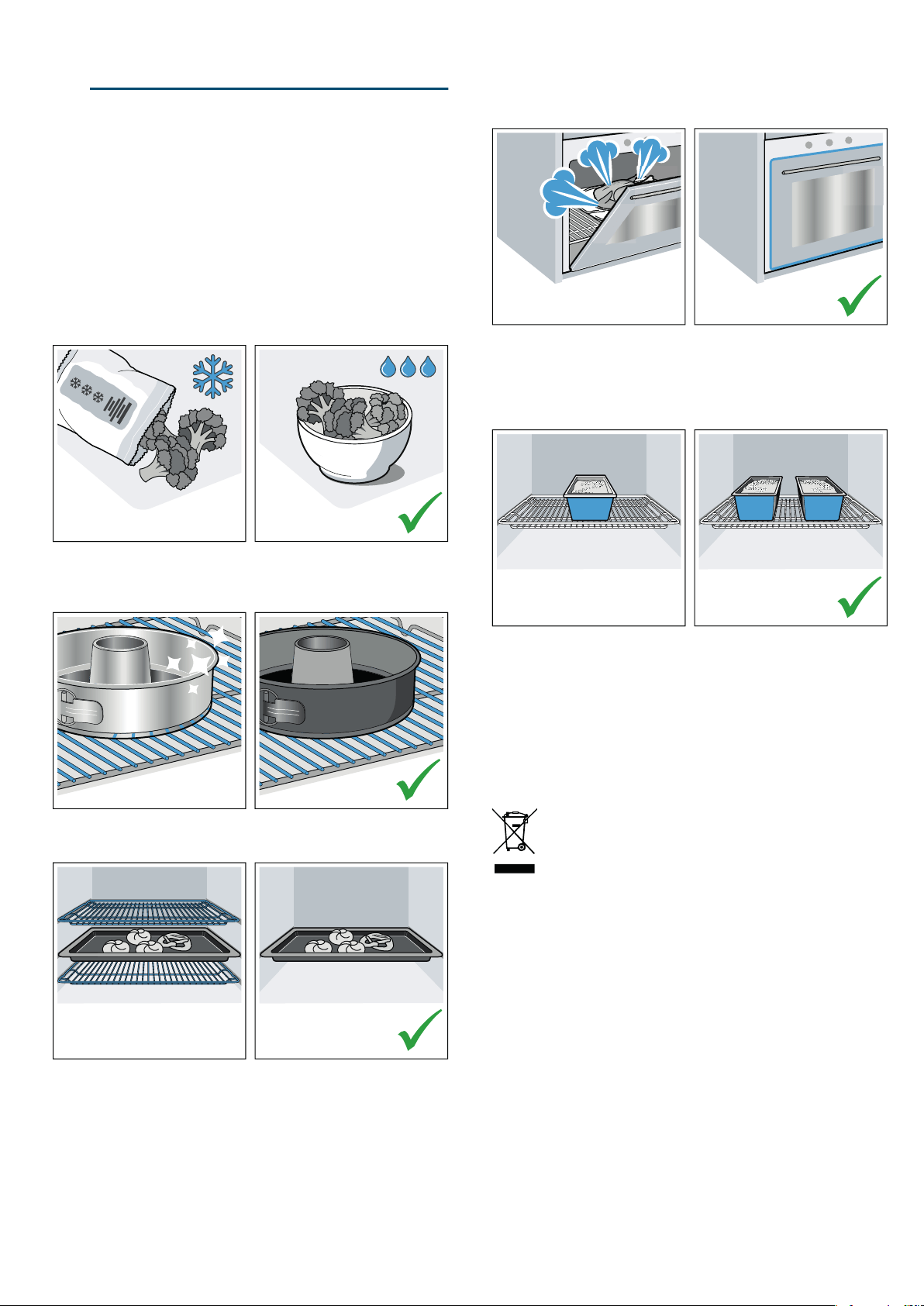
■ Only preheat the appliance if this is specified in the
recipe or in the tables in the operating instructions.
■ Leave frozen food to defrost before placing it in the
cooking compartment.
■ Use baking tins that are dark-coloured, painted black
or have an enamel coating. These absorb the heat
particularly well.
■ Remove any unnecessary accessories from the
cooking compartment.
■ Open the appliance door as infrequently as possible
when the appliance is in use.
■ It is best to bake several cakes one after the other.
The cooking compartment stays warm. This reduces
the baking time for the second cake. You can place
two cake tins next to each other in the cooking
compartment.
■ For longer cooking times, you can switch the
appliance off 10 minutes before the end of the
cooking time and use the residual heat to finish
cooking.
Environmentally-friendly disposal
Dispose of packaging in an environmentally-friendly
manner.
This appliance is labelled in accordance with
European Directive 2012/19/EU concerning
used electrical and electronic appliances
(waste electrical and electronic equipment -
WEEE). The guideline determines the
framework for the return and recycling of used
appliances as applicable throughout the EU.
en Environmental protection
8
7Environmental protection
Envi r onment al pr ot ec t i on
Your new appliance is particularly energy-efficient.
Here you can find tips on how to save even more
energy when using the appliance, and how to dispose
of your appliance properly.
Saving energy
■ Only preheat the appliance if this is specified in the
recipe or in the tables in the operating instructions.
■ Leave frozen food to defrost before placing it in the
cooking compartment.
■ Use baking tins that are dark-coloured, painted black
or have an enamel coating. These absorb the heat
particularly well.
■ Remove any unnecessary accessories from the
cooking compartment.
■ Open the appliance door as infrequently as possible
when the appliance is in use.
■ It is best to bake several cakes one after the other.
The cooking compartment stays warm. This reduces
the baking time for the second cake. You can place
two cake tins next to each other in the cooking
compartment.
■ For longer cooking times, you can switch the
appliance off 10 minutes before the end of the
cooking time and use the residual heat to finish
cooking.
Environmentally-friendly disposal
Dispose of packaging in an environmentally-friendly
manner.
This appliance is labelled in accordance with
European Directive 2012/19/EU concerning
used electrical and electronic appliances
(waste electrical and electronic equipment -
WEEE). The guideline determines the
framework for the return and recycling of used
appliances as applicable throughout the EU.
Getting to know your appliance en
9
*Getting to know your
appliance
Get t i ng to know your appl i anc e
In this section, we will explain the indicators and
controls. You will also find out about the various
functions of your appliance.
Note: Depending on the appliance model, individual
details and colours may differ.
Control panel
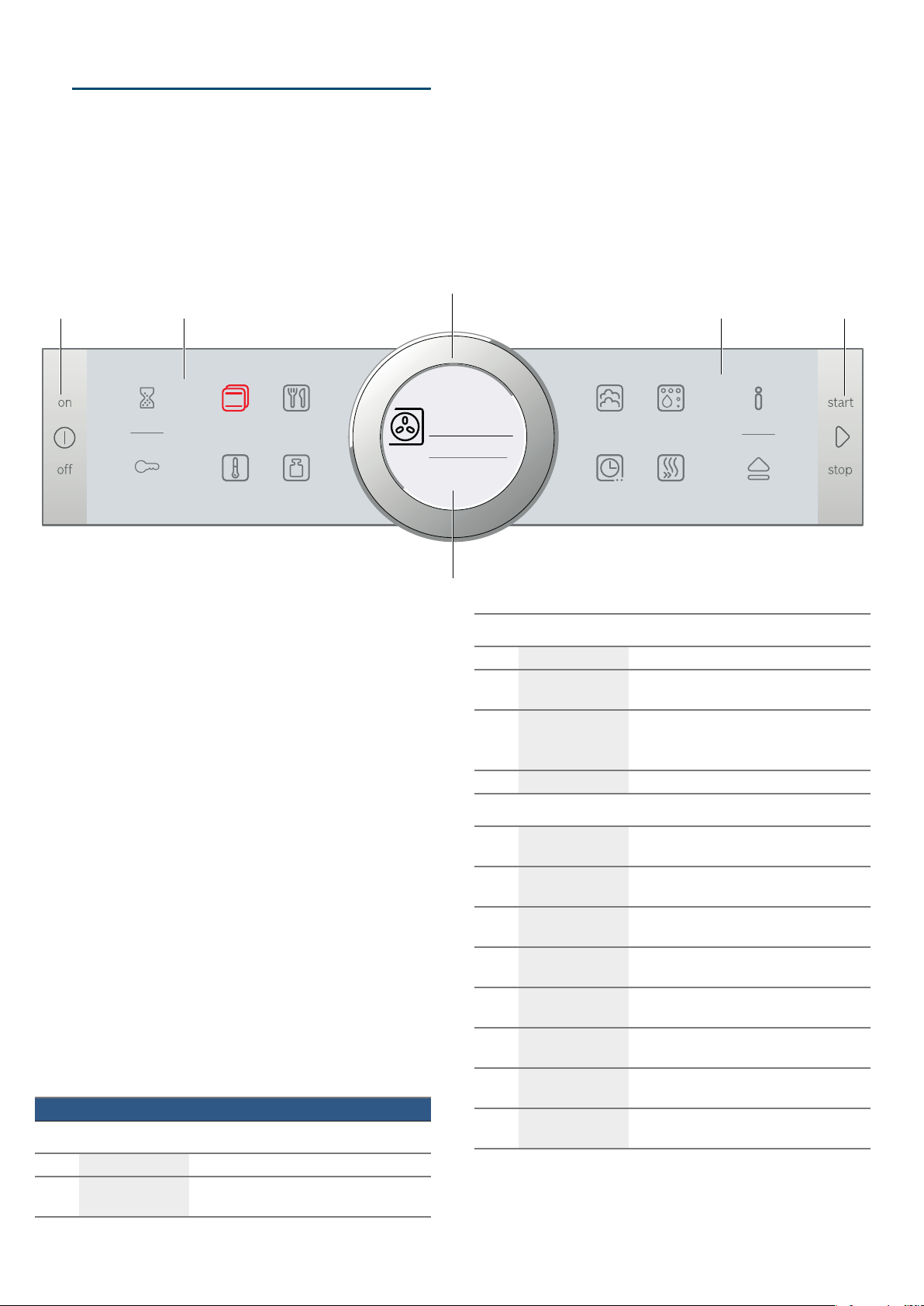
In the control panel, you can use the various buttons,
touch fields and the rotary selector to set the different
appliance functions. The current settings are shown on
the display.
The overview shows the control panel when the
appliance is switched on with a selected heating type.
Controls
The individual controls are adapted for the various
functions of your appliance. You can set your appliance
simply and directly.
Buttons and touch fields
Here you can find a short explanation of the various
buttons and touch fields.
--------
The touch field, which has a value on the display that
can be changed or displayed in the foreground, lights
up red.
#
a &
'
KRWDLU
( Buttons
The buttons on the left- and right-hand side of the
control panel have a pressure point. Press these
buttons to activate them.
For appliances that do not have a stainless steel
front, these two button touch fields do not have a
pressure point.
0 Touch fields
There are sensors under the touch fields. Simply
touch the respective symbol to select the function.
8 Rotary selector
The rotary selector is fitted so that you can turn it
indefinitely to the left or right. Press it lightly and
move it in the direction required using your finger.
@ Display
You can see the current adjustment values,
options or notes in the display.
Symbol Meaning
Buttons
ÿ on/off Switching the appliance on and off
l Start/Stop Starting, pausing or cancelling (hold down
for approx. 3 secs) an operation
External touch fields
t Timer Selects the timer
D Childproof lock Activating and deactivating (hold down for
approx. 4 secs) the childproof lock
° Information Display notes
Hold down (approx. 3 secs) to call up the
basic settings
v Open cover Filling or emptying the water tank
Internal touch fields
! Heating types Selects the "heating types" operating
mode
} Temperature Selects the temperature in the cooking
compartment
% AutoCook Selects the operating mode for dishes
with cooking programmes
a Weight Selects the weight for the operating mode
for dishes
S Steam Selects "Steam" mode with steam assis-
tance
s Time-setting
options
Select time-setting options
O Cleaning Selects the "Cleaning function" operating
mode
F Rapid heating Starts or cancels Rapid heating for the
cooking compartment
en Getting to know your appliance
10
Rotary selector
You can use the rotary selector to change the
adjustment values shown on the display.
In most selection lists, such as the temperature, you
have to turn the rotary selector back the other way if
you reach the minimum or maximum value. However,
for the heating types for example, the first selection
follows the last.
Display
The display is structured so that the information can be
read at a glance in any situation.
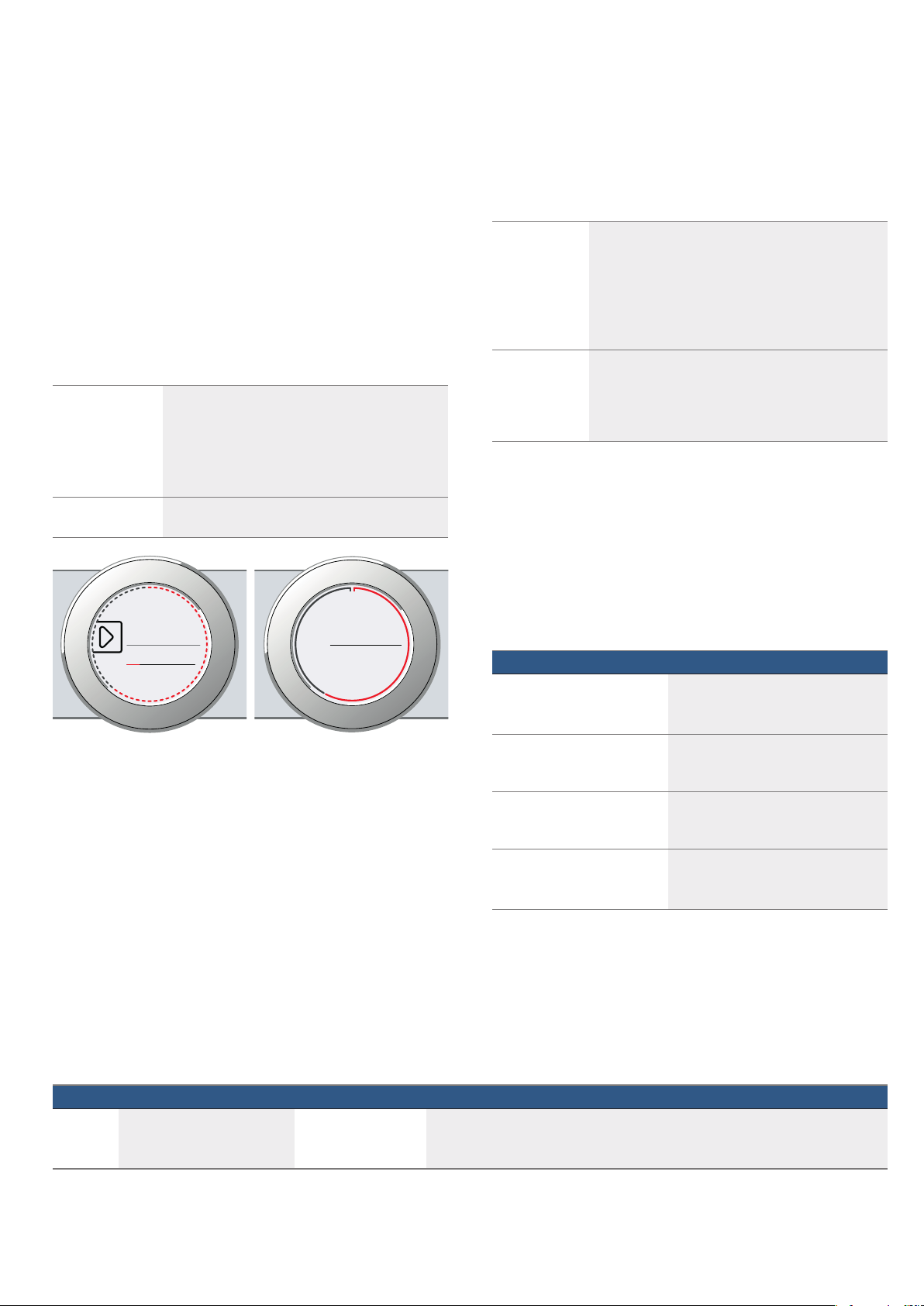
The value that you can currently set is in focus. It is
displayed in white lettering and underlined in white. The
value in the background is displayed in grey.
Display ring
The display ring can be found around the outside of the
display.
If you change a value, the display ring shows you where
you are in the selection list. Depending on the settings
area and length of the selection list, the display ring
may be continuous or divided into segments.
During operation, the display ring turns red at second-
long intervals. After every full minute, the segments turn
red again from the beginning. As the cooking time
counts down, one segment disappears every second.
Temperature display
After the operation has started, the current cooking
compartment temperature is displayed graphically on
the display.
Note: Due to thermal inertia, the temperature displayed
may be slightly different to the actual temperature inside
the oven.
Operating modes
Your appliance has various operating modes which
make your appliance easier to use.
You can find more precise descriptions of these in the
corresponding sections.
--------
Types of heating
To make sure that you always use the right type of
heating to cook your food, we have explained the
differences and applications below.
The symbols for each type of heating help you to
remember them.
For temperature settings above 275 °C and grill
setting 3, the appliance reduces the temperature to
approx. 275 °C or grill setting 1 after approx.
40 minutes.
Focus The value in focus can be changed directly with-
out first being selected.
After starting an operation, either the temperature
or the level is always in focus. At the same time,
the white line is the heating line and gradually
turns red.
Enlargement As you change the value in focus using the rotary
selector, only this value is displayed larger.
`
&
7HPSH
UDWXUH
P
V
a
&
Heating line The white line under the temperature turns red from
left to right as the cooking compartment heats up.
When you are preheating the appliance, the optimal
time to place the food in the cooking compartment
is when the line has completely turned red.
For set levels, e.g. the grill setting, the heating line
turns red immediately.
Residual heat
indicator
When the appliance is switched off, the display ring
shows the residual heat in the cooking compart-
ment. As the residual heat cools down, the display
ring becomes darker and disappears completely at
some point.
Operating mode Use
Heating types
~ "Operating the appliance"
on page 15
There are various finely tuned heating
types for the optimal preparation of
your food.
AutoCook
~ "Dishes" on page 34
There are preprogrammed setting val-
ues which are suitable for many
dishes.
Steam
~ "Steam" on page 18
There are various finely tuned steam
types of heating for the optimal prepa-
ration of your food.
Cleaning
~ "Cleaning function"
on page 25
Different cleaning functions are avail-
able: Descaling and pyrolytic self
cleaning.
Type of heating Temperature Use
<
4D hot air * 30-275 °C For baking and roasting on one or more levels.
The fan distributes the heat from the ring heating element in the back panel
evenly around the cooking compartment.

en Getting to know your appliance
10
Rotary selector
You can use the rotary selector to change the
adjustment values shown on the display.
In most selection lists, such as the temperature, you
have to turn the rotary selector back the other way if
you reach the minimum or maximum value. However,
for the heating types for example, the first selection
follows the last.
Display
The display is structured so that the information can be
read at a glance in any situation.
The value that you can currently set is in focus. It is
displayed in white lettering and underlined in white. The
value in the background is displayed in grey.
Display ring
The display ring can be found around the outside of the
display.
If you change a value, the display ring shows you where
you are in the selection list. Depending on the settings
area and length of the selection list, the display ring
may be continuous or divided into segments.
During operation, the display ring turns red at second-
long intervals. After every full minute, the segments turn
red again from the beginning. As the cooking time
counts down, one segment disappears every second.
Temperature display
After the operation has started, the current cooking
compartment temperature is displayed graphically on
the display.
Note: Due to thermal inertia, the temperature displayed
may be slightly different to the actual temperature inside
the oven.
Operating modes
Your appliance has various operating modes which
make your appliance easier to use.
You can find more precise descriptions of these in the
corresponding sections.
--------
Types of heating
To make sure that you always use the right type of
heating to cook your food, we have explained the
differences and applications below.
The symbols for each type of heating help you to
remember them.
For temperature settings above 275 °C and grill
setting 3, the appliance reduces the temperature to
approx. 275 °C or grill setting 1 after approx.
40 minutes.
Focus The value in focus can be changed directly with-
out first being selected.
After starting an operation, either the temperature
or the level is always in focus. At the same time,
the white line is the heating line and gradually
turns red.
Enlargement As you change the value in focus using the rotary
selector, only this value is displayed larger.
`
&
7HPSH
UDWXUH
P
V
a
&
Heating line The white line under the temperature turns red from
left to right as the cooking compartment heats up.
When you are preheating the appliance, the optimal
time to place the food in the cooking compartment
is when the line has completely turned red.
For set levels, e.g. the grill setting, the heating line
turns red immediately.
Residual heat
indicator
When the appliance is switched off, the display ring
shows the residual heat in the cooking compart-
ment. As the residual heat cools down, the display
ring becomes darker and disappears completely at
some point.
Operating mode Use
Heating types
~ "Operating the appliance"
on page 15
There are various finely tuned heating
types for the optimal preparation of
your food.
AutoCook
~ "Dishes" on page 34
There are preprogrammed setting val-
ues which are suitable for many
dishes.
Steam
~ "Steam" on page 18
There are various finely tuned steam
types of heating for the optimal prepa-
ration of your food.
Cleaning
~ "Cleaning function"
on page 25
Different cleaning functions are avail-
able: Descaling and pyrolytic self
cleaning.
Type of heating Temperature Use
<
4D hot air * 30-275 °C For baking and roasting on one or more levels.
The fan distributes the heat from the ring heating element in the back panel
evenly around the cooking compartment.
Getting to know your appliance en
11
--------
Default values
For each heating type, the appliance specifies a default
temperature or level. You can accept this value or
change it in the appropriate area.
Further information
In most cases, the appliance provides notes and further
information on the action just carried out.
Touch the ° field. The note is shown in the display for a
few seconds. Use the rotary selector to scroll to the end
of longer notes.
Some notes are displayed automatically, for example as
confirmation, or to provide an instruction or warning.
%
Top/bottom heating * 30-300 °C For traditional baking and roasting on one level. Especially suitable for cakes with
moist toppings.
Heat is emitted evenly from the top and bottom.
.
Hot air eco 30-275 °C For gently cooking selected types of food on one level without preheating.
The fan distributes the heat from the ring-shaped heating element in the back
panel around the cooking compartment.
This heating function is most effective between 125 and 275 °C.
This heating function is used to measure both the energy consumption in air recir-
culation mode and the energy efficiency class.
#
Top/bottom heating eco 30-300 °C For gently cooking selected types of food.
Heat is emitted from above and below.
This heating function is most effective between 150 and 250 °C.
This heating function is used to measure the energy consumption in the conven-
tional mode.
7
Hot air grilling * 30-300 °C For roasting poultry, whole fish and larger pieces of meat.
The grill element and the fan switch on and off alternately. The fan circulates the
hot air around the food.
(
Grill, large area Grill settings:
1 = low
2 = medium
3 = high
For grilling flat items for grilling, such as steaks and sausages, for making toast,
and for cooking au gratin.
The whole area below the grill element becomes hot.
*
Grill, small area Grill settings:
1 = low
2 = medium
3 = high
For grilling small amounts of steaks or sausages, for making toast, and for cook-
ing au gratin.
The centre area under the grill heating element becomes hot.
$
Pizza setting 30-275 °C For preparing pizza and dishes which require a lot of heat from underneath.
The bottom heating element and the ring heating element in the back panel heat
up.
.
Slow cooking 70-120 °C For gentle and slow cooking of seared, tender pieces of meat in ovenware without
a lid.
The heat is emitted evenly from the top and bottom at low temperatures.
$
Bottom heating 30-250 °C For cooking in a bain marie and for the final baking stage.
The heat is emitted from below.
B
Defrosting 30-60 °C For gently defrosting frozen food.
O
Keeping warm * 60-100 °C For keeping cooked food warm.
P
Preheating ovenware 30-70 °C For preheating ovenware.
U
Reheating 80-180 °C For plated meals and baked items
Cooked food is gently reheated. The steam ensures that the food does not dry out.
T
Dough proving 30-50 °C For yeast dough and sourdough
Dough will rise considerably more quickly than at room temperature. The surface
of the dough does not dry out.
Z
Drying 150 °C Each time you use the appliance with steam, dry the cooking compartment after-
wards so that no moisture remains.
* Steam assistance possible with this type of heating (water reservoir MUST be full before appliance is operated)
en Accessories
12
Cooking compartment functions
The functions in the cooking compartment make your
appliance easier to use. This, for example, enables the
cooking compartment to be well lit and a cooling fan to
prevent the appliance from overheating.
Opening the appliance door
If you open the appliance door during an on-going
operation, the operation is paused. The operation
continues to run when you close the door.
Interior lighting
When you open the appliance door, the interior lighting
switches on. If the door remains open for longer than
around 15 minutes, the lighting switches off again.
For most operating modes, the interior lighting switches
on as soon as the operation is started. When the
operation has finished, the lighting switches off.
Note: You can set the interior lighting not to come on
during the operation in the basic settings. ~ "Basic
settings" on page 22
Cooling fan
The cooling fan switches on and off as required. The
hot air escapes above the door.
Caution!
Do not cover the ventilation slots. Otherwise, the
appliance may overheat.
So that the cooking compartment cools down more
quickly after the operation, the cooling fan continues to
run for a certain period afterwards.
Note: You can change how long the cooling fan
continues to run in the basic settings. ~ "Basic
settings" on page 22
Water tank
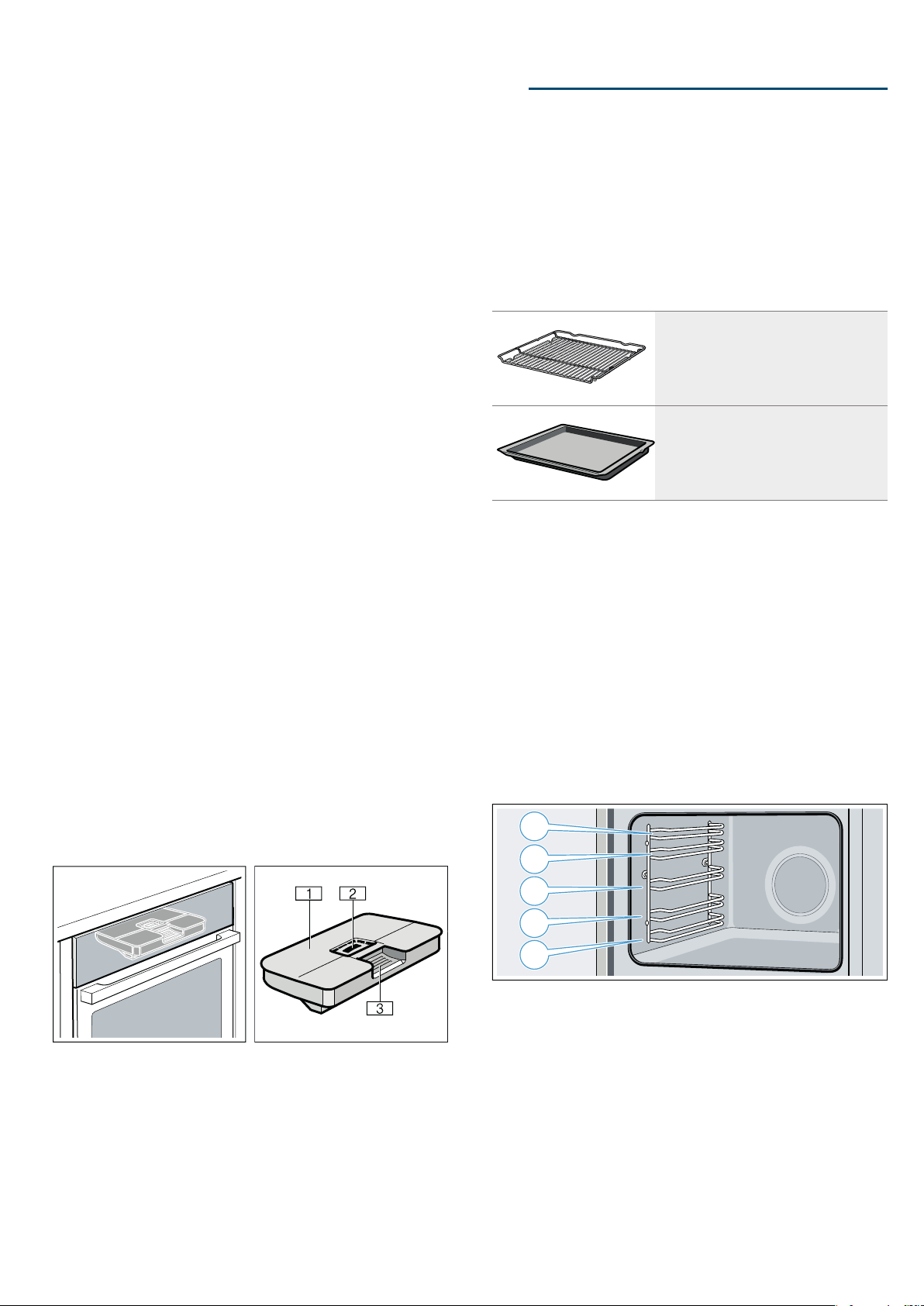
The appliance is fitted with a water tank. The water tank
is behind the panel. For operations with steam, fill the
water tank with water. ~ "Steam" on page 18
_Accessories
Acc essor i es
Your appliance is accompanied by a range of
accessories. Here, you can find an overview of the
accessories included and information on how to use
them correctly.
Accessories included
Your appliance is equipped with the following
accessories:
--------
Only use original accessories. They are specially
adapted for your appliance.
You can buy accessories from the after-sales service,
from specialist retailers or online.
Note: The accessories may deform when they become
hot. This does not affect their function. Once they have
cooled down again, they regain their original shape.
Inserting accessories
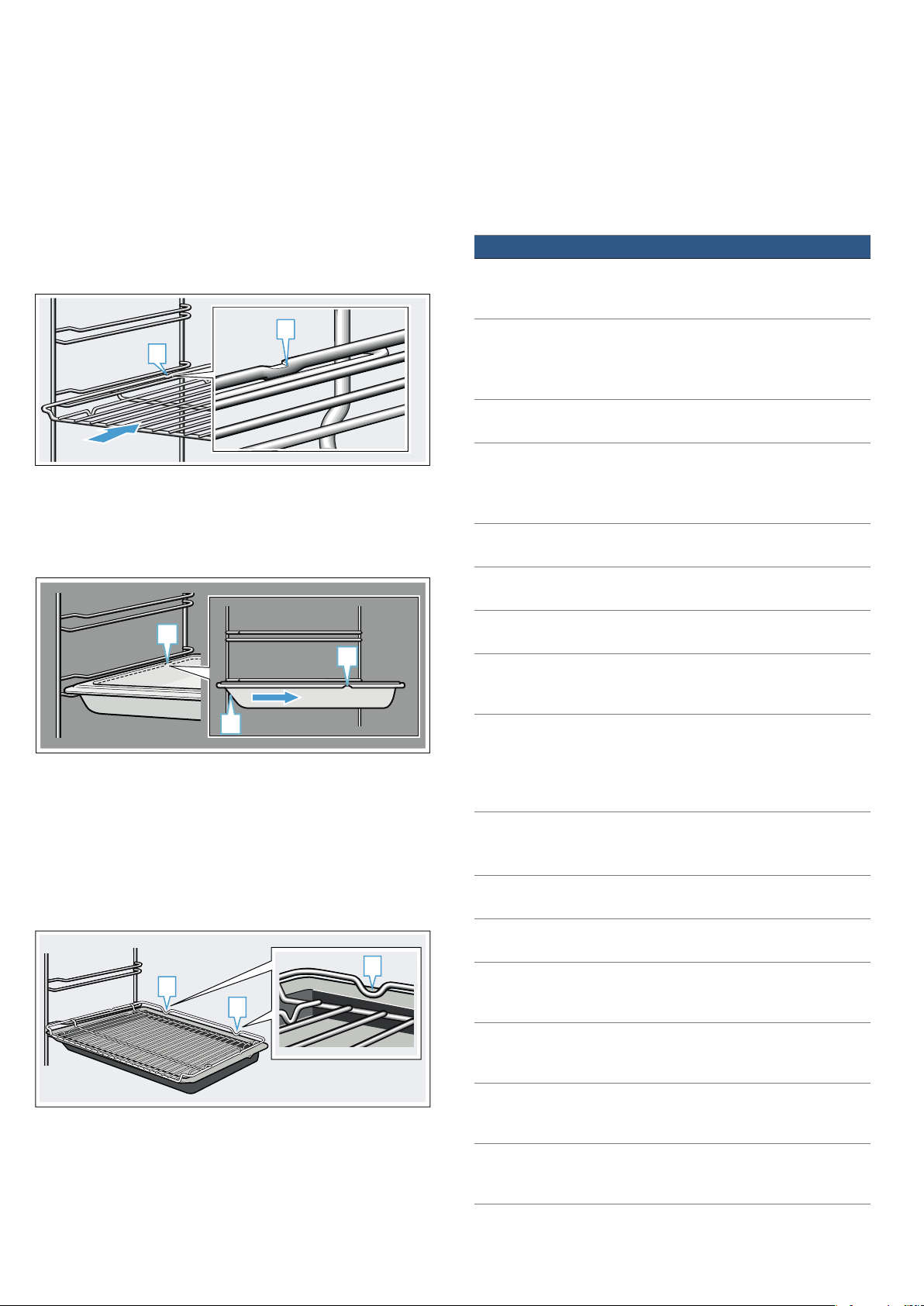
The cooking compartment has five shelf positions. The
shelf positions are counted from the bottom up.
In some appliances, the highest shelf position is
marked on the cooking compartment with the grill
symbol.
Always insert the accessory between the two guide bars
for a shelf position.
Accessories can be pulled out approximately halfway
without tipping.
Notes
■ Make sure that you always insert the accessories
into the cooking compartment the right way round.
■ Always insert accessories fully into the cooking
compartment so that they do not touch the appliance
door.
■ Take any accessories that you will not be using out
of the cooking compartment.
( Tank cover
0 Filling opening
8 Handle for removing and inserting the water tank
Wire rack
For ovenware, cake tins and ovenproof
dishes.
For roasts, grilled items and frozen
meals.
Universal pan
For moist cakes, pastries, frozen meals
and large roasts.
It can be used to catch dripping fat when
you are grilling directly on the wire rack.
en Accessories
12
Cooking compartment functions
The functions in the cooking compartment make your
appliance easier to use. This, for example, enables the
cooking compartment to be well lit and a cooling fan to
prevent the appliance from overheating.
Opening the appliance door
If you open the appliance door during an on-going
operation, the operation is paused. The operation
continues to run when you close the door.
Interior lighting
When you open the appliance door, the interior lighting
switches on. If the door remains open for longer than
around 15 minutes, the lighting switches off again.
For most operating modes, the interior lighting switches
on as soon as the operation is started. When the
operation has finished, the lighting switches off.
Note: You can set the interior lighting not to come on
during the operation in the basic settings. ~ "Basic
settings" on page 22
Cooling fan
The cooling fan switches on and off as required. The
hot air escapes above the door.
Caution!
Do not cover the ventilation slots. Otherwise, the
appliance may overheat.
So that the cooking compartment cools down more
quickly after the operation, the cooling fan continues to
run for a certain period afterwards.
Note: You can change how long the cooling fan
continues to run in the basic settings. ~ "Basic
settings" on page 22
Water tank
The appliance is fitted with a water tank. The water tank
is behind the panel. For operations with steam, fill the
water tank with water. ~ "Steam" on page 18
_Accessories
Acc essor i es
Your appliance is accompanied by a range of
accessories. Here, you can find an overview of the
accessories included and information on how to use
them correctly.
Accessories included
Your appliance is equipped with the following
accessories:
--------
Only use original accessories. They are specially
adapted for your appliance.
You can buy accessories from the after-sales service,
from specialist retailers or online.
Note: The accessories may deform when they become
hot. This does not affect their function. Once they have
cooled down again, they regain their original shape.
Inserting accessories
The cooking compartment has five shelf positions. The
shelf positions are counted from the bottom up.
In some appliances, the highest shelf position is
marked on the cooking compartment with the grill
symbol.
Always insert the accessory between the two guide bars
for a shelf position.
Accessories can be pulled out approximately halfway
without tipping.
Notes
■ Make sure that you always insert the accessories
into the cooking compartment the right way round.
■ Always insert accessories fully into the cooking
compartment so that they do not touch the appliance
door.
■ Take any accessories that you will not be using out
of the cooking compartment.
( Tank cover
0 Filling opening
8 Handle for removing and inserting the water tank
Wire rack
For ovenware, cake tins and ovenproof
dishes.
For roasts, grilled items and frozen
meals.
Universal pan
For moist cakes, pastries, frozen meals
and large roasts.
It can be used to catch dripping fat when
you are grilling directly on the wire rack.
Accessories en
13
Locking function
The accessories can be pulled out approximately
halfway until they lock in place. The locking function
prevents the accessories from tilting when they are
pulled out. The accessories must be inserted into the
cooking compartment correctly for the tilt protection to
work properly.
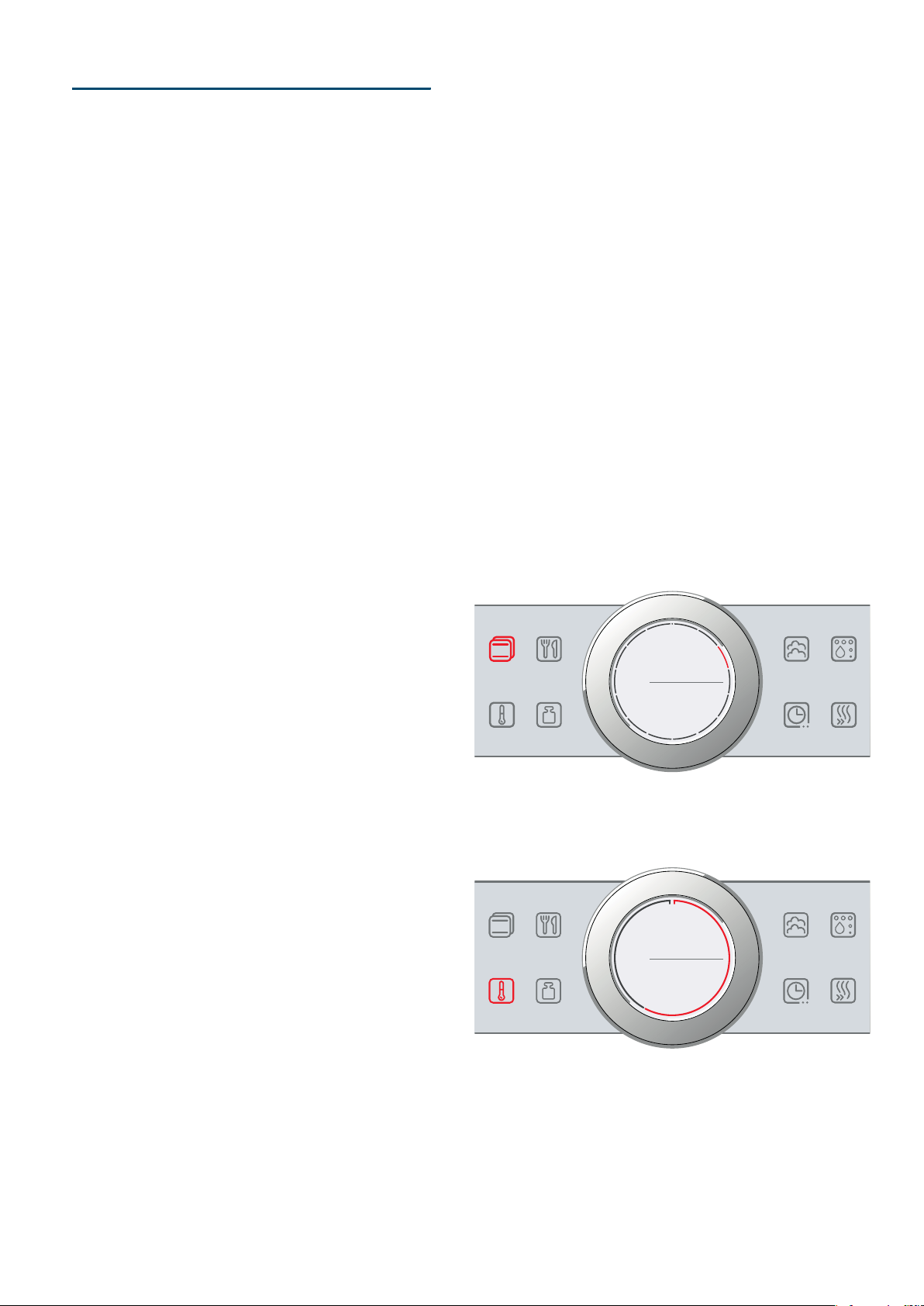
When inserting the wire rack, ensure that lug ‚ is at the
rear and is facing downwards. The open side must be
facing the appliance door and the outer rail must be
facing downwards ¾.
When inserting baking trays, make sure that the recess
‚ is at the rear and is facing downwards. The sloping
edge of the accessory ƒ must be facing towards the
appliance door.
Example in the picture: Universal pan
Combining accessories
You can insert the wire rack and the universal pan at
the same time to catch drops of liquid.
When inserting the wire rack, ensure that both spacers
‚ are at the rear edge. When inserting the universal
pan, the wire rack is on top of the upper guide rod of
the shelf position.
Example in the picture: Universal pan
Optional accessories
You can buy optional accessories from the after-sales
service, from specialist retailers or online. *You will find
a comprehensive range of products for your appliance
in our brochures and online.
Both availability and whether it is possible to order
online differ between countries. Please see your sales
brochures for more details.
Note: Not all optional accessories are suitable for every
appliance. When purchasing, please always quote the
exact identification number (E-no.) of your appliance.
~ "Customer service" on page 33
--------
D
D
D
D
E
D
D
D
Optional accessories
Wire rack
For ovenware, cake tins and ovenproof dishes, and for roasts and
grilled food.
Universal pan, Pyrolytic
For moist cakes, pastries, frozen meals and large roasts.
It can be used to catch dripping fat when you are grilling directly on
the wire rack.
Baking tray, Pyrolytic
For tray bakes and small baked products.
Wire insert
For meat, poultry and fish.
For inserting into the universal pan to catch dripping fat and meat
juices.
Profi pan
For preparing large quantities.
Lid for the Profi pan
The lid turns the Profi pan into a Profi roasting dish.
Pizza tray
For pizzas and large round cakes.
Grill tray, Pyrolytic
Use for grilling in place of the wire rack or as a splatter guard.Only use
in the universal pan.
Bread-baking stone, Pyrolytic
For home-made bread, bread rolls and pizzas that require a crispy
base.
The baking stone must be preheated to the recommended tempera-
ture.
Glass roasting dish (5.1 litres)
For stews and bakes.
Particularly suitable for the "Meals" operating mode.
Glass tray
For large roasts, moist cakes and bakes.
Glass tray
For bakes, vegetable dishes and baked goods.
Pull-out system, 1 level, Pyrolytic,
The pull-out rails at level 2 allow you to pull the accessories out further
without them tipping.
Pull-out system, 2 levels, Pyrolytic
The pull-out rails at levels 2 and 3 allow you to pull the accessories out
further without them tipping.
Pull-out system, 3 levels, Pyrolytic
The pull-out rails at levels 1, 2 and 3 allow you to pull the accessories
out further without them tipping.
Decorative trims
For concealing the lower shelf of the unit and the base of the appli-
ance.

en Before using for the first time
14
KBefore using for the first
time
Bef or e usi ng f or t he f i r st ti me
Before you can use your new appliance, you must
make some settings. You must also clean the cooking
compartment and accessories.
Before using for the first time
Before using the appliance for the first time, ask your
water supplier about the hardness of your tap water.
To ensure that the appliance can reliably remind you to
descale it when required, you must set your water
hardness range correctly.
Caution!
■ The appliance may become damaged due to the
use of unsuitable liquids.
Do not use distilled water, highly chlorinated tap
water (>40 mg/l) or other liquids.
Only use cold, fresh tap water, softened water or
non-carbonated mineral water.
■ Malfunctions may occur when using filtered or
demineralised water.
The appliance may request that you top up the water
tank even though it may be full, or operation with
steam is cancelled after approx. two minutes.
If required, mix filtered or demineralised water with
the bottled non-carbonated mineral water with a ratio
of one to one.
Notes
■ If your water is very hard, we recommend that you
use softened water.
■ If you only use softened water, you can set the water
hardness range to "softened".
■ If you use mineral water, set the water hardness
range to "4 very hard".
■ If you use mineral water, you must only use non-
carbonated mineral water.
Initial use
After connecting the appliance to the power or following
a power cut, the settings for initial use are shown on the
display. It may take a few seconds for the instruction to
appear.
Note: You can change these settings at any time in the
basic settings. ~ "Basic settings" on page 22
Setting the language
1. Turn the rotary selector to set the required language.
2. Touch the s field to confirm.
The next setting appears.
Setting the time
1. Set the time using the rotary selector.
2. Touch the s field to confirm.
The next setting appears.
Setting the water hardness
1. Use the rotary selector to set the water hardness.
2. Touch the s field to confirm.
A note appears in the display confirming that the initial
use has been completed. The current time is displayed.
Switch the appliance off using the ÿ On/Off button if
you do not need to use it.
Cleaning the cooking compartment and
accessories
Before using the appliance to prepare food for the first
time, you must clean the cooking compartment and
accessories.
Cleaning the cooking compartment
To eliminate the new-appliance smell, heat up the
cooking compartment without anything in it and with the
oven door closed.
1. Remove the accessories from the cooking
compartment.
2. Remove any leftover packaging, such as polystyrene
pellets, from the cooking compartment and remove
the adhesive tape that is in or on the appliance.
3. Before heating the appliance, wipe the smooth
surfaces in the cooking compartment with a soft,
damp cloth.
4. Press the on/off button ÿ to switch on the
appliance.
5. Fill the water tank. ~ "Filling the water tank"
on page 19
6. Set the specified type of heating, temperature and
steam injection, then start the appliance. ~ "Steam
baking – Steam-assisted cooking" on page 18
7. Keep the kitchen ventilated while the appliance is
heating.
8. Use the on/off button ÿ to switch off the appliance
once the specified time has elapsed.
9. Wait for the cooking compartment to cool down.
10. Clean the smooth surfaces with soapy water and a
dish cloth.
11. Empty the water tank and dry the cooking
compartment. ~ "After every steam operation"
on page 20
Cleaning the accessories
Clean the accessories thoroughly using soapy water
and a dish cloth or soft brush.
Water hardness range Setting
0 00 softened
1 (up to 1.3 mmol/l) 01 soft
2 (1.3 - 2.5 mmol/l) 02 medium
3 (2.5 - 3.8 mmol/l) 03 hard
4 (above 3.8 mmol/l) 04 very hard
Settings
Type of heating 4D hot air < with added steam, setting 03
(high)
Temperature Maximum
Cooking time 1 hour
en Before using for the first time
14
KBefore using for the first
time
Bef or e usi ng f or t he f i r st ti me
Before you can use your new appliance, you must
make some settings. You must also clean the cooking
compartment and accessories.
Before using for the first time
Before using the appliance for the first time, ask your
water supplier about the hardness of your tap water.
To ensure that the appliance can reliably remind you to
descale it when required, you must set your water
hardness range correctly.
Caution!
■ The appliance may become damaged due to the
use of unsuitable liquids.
Do not use distilled water, highly chlorinated tap
water (>40 mg/l) or other liquids.
Only use cold, fresh tap water, softened water or
non-carbonated mineral water.
■ Malfunctions may occur when using filtered or
demineralised water.
The appliance may request that you top up the water
tank even though it may be full, or operation with
steam is cancelled after approx. two minutes.
If required, mix filtered or demineralised water with
the bottled non-carbonated mineral water with a ratio
of one to one.
Notes
■ If your water is very hard, we recommend that you
use softened water.
■ If you only use softened water, you can set the water
hardness range to "softened".
■ If you use mineral water, set the water hardness
range to "4 very hard".
■ If you use mineral water, you must only use non-
carbonated mineral water.
Initial use
After connecting the appliance to the power or following
a power cut, the settings for initial use are shown on the
display. It may take a few seconds for the instruction to
appear.
Note: You can change these settings at any time in the
basic settings. ~ "Basic settings" on page 22
Setting the language
1. Turn the rotary selector to set the required language.
2. Touch the s field to confirm.
The next setting appears.
Setting the time
1. Set the time using the rotary selector.
2. Touch the s field to confirm.
The next setting appears.
Setting the water hardness
1. Use the rotary selector to set the water hardness.
2. Touch the s field to confirm.
A note appears in the display confirming that the initial
use has been completed. The current time is displayed.
Switch the appliance off using the ÿ On/Off button if
you do not need to use it.
Cleaning the cooking compartment and
accessories
Before using the appliance to prepare food for the first
time, you must clean the cooking compartment and
accessories.
Cleaning the cooking compartment
To eliminate the new-appliance smell, heat up the
cooking compartment without anything in it and with the
oven door closed.
1. Remove the accessories from the cooking
compartment.
2. Remove any leftover packaging, such as polystyrene
pellets, from the cooking compartment and remove
the adhesive tape that is in or on the appliance.
3. Before heating the appliance, wipe the smooth
surfaces in the cooking compartment with a soft,
damp cloth.
4. Press the on/off button ÿ to switch on the
appliance.
5. Fill the water tank. ~ "Filling the water tank"
on page 19
6. Set the specified type of heating, temperature and
steam injection, then start the appliance. ~ "Steam
baking – Steam-assisted cooking" on page 18
7. Keep the kitchen ventilated while the appliance is
heating.
8. Use the on/off button ÿ to switch off the appliance
once the specified time has elapsed.
9. Wait for the cooking compartment to cool down.
10. Clean the smooth surfaces with soapy water and a
dish cloth.
11. Empty the water tank and dry the cooking
compartment. ~ "After every steam operation"
on page 20
Cleaning the accessories
Clean the accessories thoroughly using soapy water
and a dish cloth or soft brush.
Water hardness range Setting
0 00 softened
1 (up to 1.3 mmol/l) 01 soft
2 (1.3 - 2.5 mmol/l) 02 medium
3 (2.5 - 3.8 mmol/l) 03 hard
4 (above 3.8 mmol/l) 04 very hard
Settings
Type of heating 4D hot air < with added steam, setting 03
(high)
Temperature Maximum
Cooking time 1 hour
Operating the appliance en
15
1Operating the appliance
Oper at i ng t he appl i anc e
You have already learnt about the controls and how
they work. Now we will explain how to set your
appliance. You will learn about what happens when you
switch the appliance on and off, and how to select the
operating mode.
Switching the appliance on and off
Before you are able to set the appliance, you must
switch it on.
Note: The childproof lock and the timer can also be set
when the appliance is switched off. Certain displays and
notes, such as those relating to the residual heat in the
cooking compartment, remain visible on the display
after the appliance has been switched off.
Switch off your appliance when you do not need to use
it. If no settings are applied for a long time, the
appliance switches itself off automatically.
Switching on the appliance
Press the ÿ On/Off button to switch on the appliance.
All touch fields light up red. The Bosch logo appears on
the display, and then the first heating type in the
selection list.
Note: In the basic settings, you can specify which
operating mode should appear after the appliance is
switched on. ~ "Basic settings" on page 22
Switching off the appliance
Press the ÿ On/Off button to switch off the appliance.
Any functions that may be running are cancelled.
The time, or if applicable, the residual heat indicator,
appears on the display.
Note: In the basic settings, you can set whether the
clock should be displayed when the appliance is
switched off. ~ "Basic settings" on page 22
Starting the operation
You must press the l Start/Stop button to start each
operation.
After starting the appliance, the time display is shown
on the display along with the settings. The display ring
and the heating line also appear.
Pausing the operation
You can also interrupt and then continue an operation
using the l Start/Stop button.
If you press and hold the l Start/Stop button for
approx. 3 seconds, the operation is cancelled and all
settings are reset.
Note: The fan may continue to run after an operation
has been paused or cancelled.
Selecting an operating mode
Once the appliance is switched on, the default
operating mode is displayed. You can start this setting
immediately using the l Start/Stop button.
If you want to select a different operating mode, you
can find detailed descriptions of these modes in the
relevant chapters.
The following always applies:
1. Touch the appropriate field.
The symbol lights up red.
2. Turn the rotary selector to change the highlighted
selection.
3. If necessary, apply other settings.
To do this, touch the appropriate field and change
the value using the rotary selector.
4. Press the l Start/Stop button to start.
The appliance starts the operation.
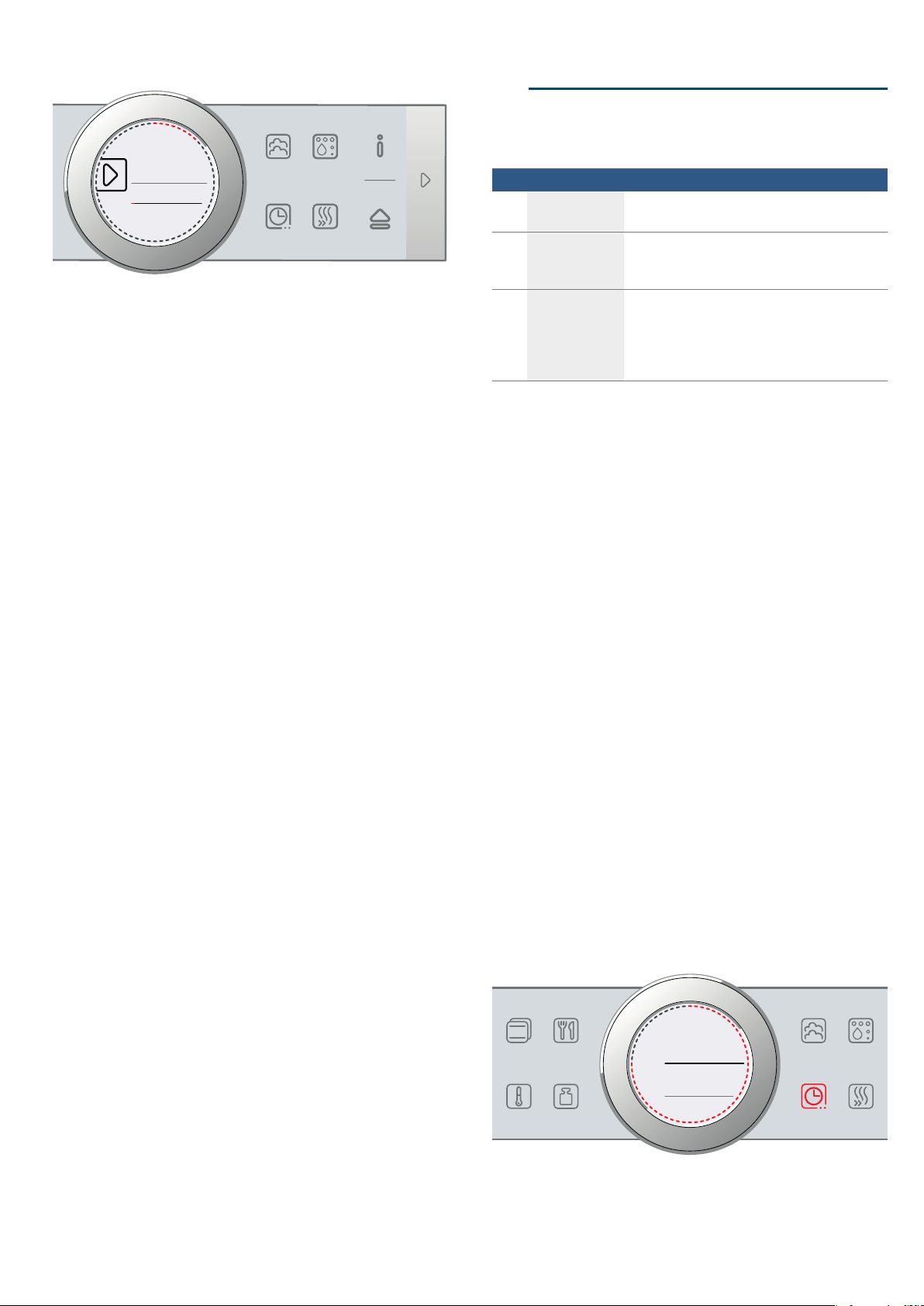
Setting the type of heating and temperature
If the "Types of heating" operating mode has not been
selected, touch the ! field. The symbol lights up red
and the first type of heating appears in the display with
a default temperature.
Example in the picture: Hot air eco . at 195 °C.
1. Turn the rotary selector to set the type of heating.
2. Touch the } field.
The temperature is highlighted in white in the
display.
3. Turn the rotary selector to set the temperature.
4. Press the l Start/Stop button to start.
The time in the display shows how long the
operation has already been running.
7\SHVRI
KHDWLQJ
+RWDLU
HFR
`
&
7HPSH
UDWXUH
en Time-setting options
16
The appliance begins to heat up.
When your dish is ready, use the ÿ On/Off button to
switch off the appliance.
Note: You can set both a cooking time and an end time
for the operation on the appliance. ~ "Time-setting
options" on page 16
Changing
After starting the appliance, the temperature is
highlighted. When you move the rotary selector, the
temperature is changed and applied immediately.
To change the type of heating, first press the l Start/
Stop button to interrupt the operation and then touch
the ! field. The first type of heating appears with the
corresponding default temperature. Use the rotary
selector to change the type of heating.
Note: When you change the type of heating, the other
settings are also reset.
Rapid heating
With Rapid heating, you can shorten the heat-up time
for some heating types.
The heating types suitable for Rapid heating are:
■ < 4D hot air
■ % Top/bottom heating
To achieve an even cooking result, do not place your
food or accessories into the cooking compartment until
"Rapid heating" is complete.
Adjusting settings
Ensure you have selected a suitable heating type and
set a temperature of at least 100 °C. Otherwise, Rapid
heating cannot be activated.
1. Set the heating type and temperature.
2. Touch the F field.
The symbol lights up red. A confirmation note appears
on the display.
When Rapid heating comes to an end, an audible
signal sounds and a note appears on the display. The
symbol is no longer lit up. Place your dish in the
cooking compartment.
Note: The "cooking time" time-setting option starts at
the same time as Rapid heating. Therefore, only set a
cooking time when Rapid heating has come to an end.
Cancelling
To cancel Rapid heating, touch the F field again. The
symbol is no longer lit up.
OTime-setting options
Ti me- set t i ng opt i ons
Your appliance has different time-setting options.
You can call up the cooking time and the end time after
setting a operation using the s field. The timer has a
separate t field and can be adjusted at any time.
A signal sounds after a cooking time or timed period
has elapsed. You can cancel the signal early by
touching the s field.
Note: You can change how long the signal sounds for
in the basic settings. ~ "Basic settings" on page 22
Setting the cooking time
You can set the cooking time for your dish on the
appliance. This means that the cooking time is not
unintentionally exceeded and you do not need to
interrupt other work in order to end the operation.
Setting
Depending on which direction you turn the rotary
selector first, the cooking time starts at a particular
default value: Left = 10 minutes, right = 30 minutes.
The cooking time can be set in one-minute increments
up to one hour, and then in five-minute increments.
The maximum time that can be set is 23 hours and 59
minutes.
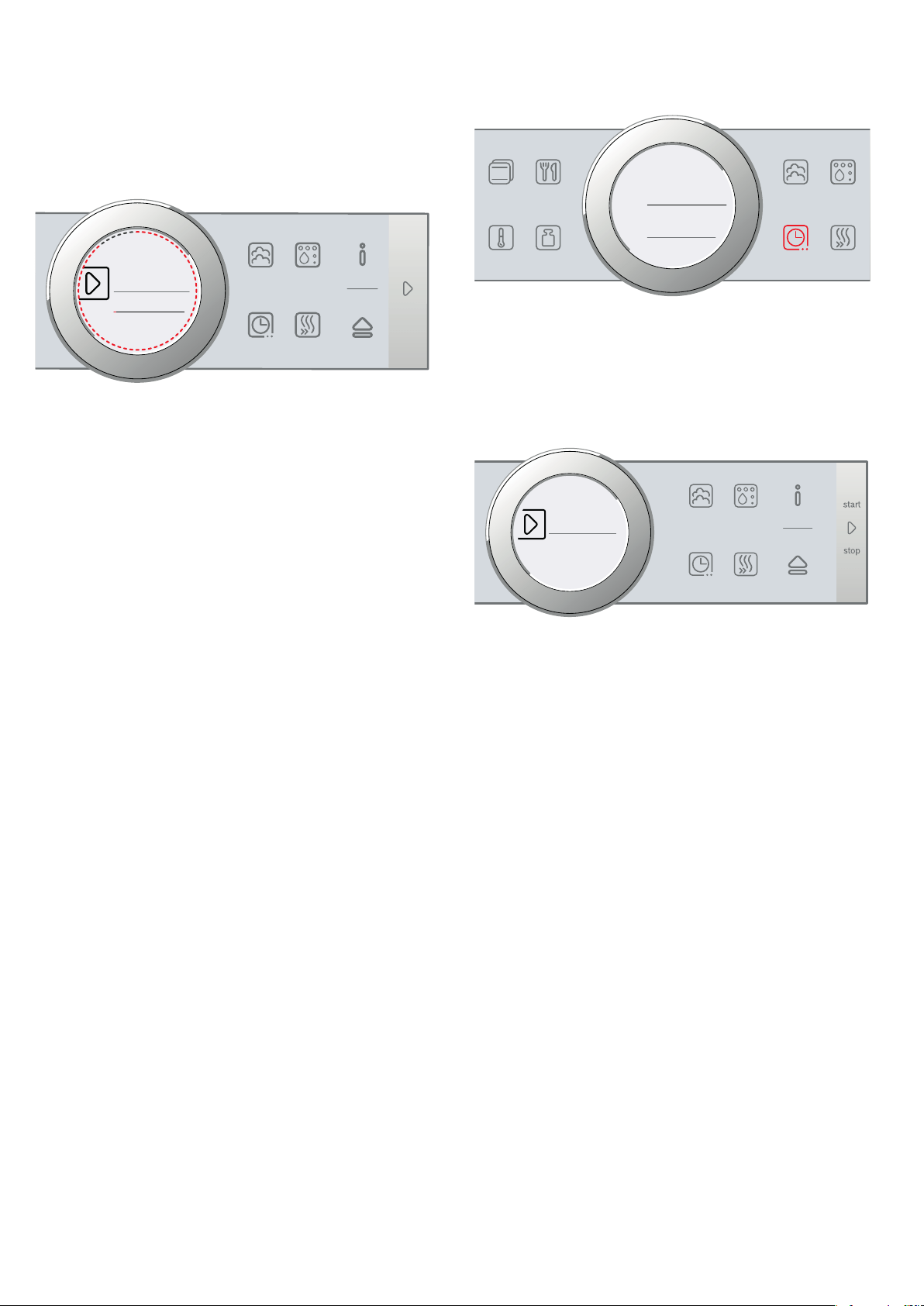
Example in the picture: Cooking time of 45 minutes.
1. Set the operating mode and temperature or level.
2. Touch the s field before starting.
The cooking time is highlighted in white in the
display.
3. Turn the rotary selector to set the cooking time.
P
V
a
&
VWDU
W
VWRS
Time-setting option Use
q Cooking time After the set cooking time has elapsed, the
appliance ends the operation automatically.
r End Enter a cooking time and the required end
time. The appliance starts automatically so
that the operation ends at the required time.
t Timer The timer functions like an egg timer. It runs
independently from the operation and the
other time-setting options. After the set time
has elapsed, the appliance does not switch on
or off automatically.
T
¿
P
V
(QG
&WLPH
en Time-setting options
16
The appliance begins to heat up.
When your dish is ready, use the ÿ On/Off button to
switch off the appliance.
Note: You can set both a cooking time and an end time
for the operation on the appliance. ~ "Time-setting
options" on page 16
Changing
After starting the appliance, the temperature is
highlighted. When you move the rotary selector, the
temperature is changed and applied immediately.
To change the type of heating, first press the l Start/
Stop button to interrupt the operation and then touch
the ! field. The first type of heating appears with the
corresponding default temperature. Use the rotary
selector to change the type of heating.
Note: When you change the type of heating, the other
settings are also reset.
Rapid heating
With Rapid heating, you can shorten the heat-up time
for some heating types.
The heating types suitable for Rapid heating are:
■ < 4D hot air
■ % Top/bottom heating
To achieve an even cooking result, do not place your
food or accessories into the cooking compartment until
"Rapid heating" is complete.
Adjusting settings
Ensure you have selected a suitable heating type and
set a temperature of at least 100 °C. Otherwise, Rapid
heating cannot be activated.
1. Set the heating type and temperature.
2. Touch the F field.
The symbol lights up red. A confirmation note appears
on the display.
When Rapid heating comes to an end, an audible
signal sounds and a note appears on the display. The
symbol is no longer lit up. Place your dish in the
cooking compartment.
Note: The "cooking time" time-setting option starts at
the same time as Rapid heating. Therefore, only set a
cooking time when Rapid heating has come to an end.
Cancelling
To cancel Rapid heating, touch the F field again. The
symbol is no longer lit up.
OTime-setting options
Ti me- set t i ng opt i ons
Your appliance has different time-setting options.
You can call up the cooking time and the end time after
setting a operation using the s field. The timer has a
separate t field and can be adjusted at any time.
A signal sounds after a cooking time or timed period
has elapsed. You can cancel the signal early by
touching the s field.
Note: You can change how long the signal sounds for
in the basic settings. ~ "Basic settings" on page 22
Setting the cooking time
You can set the cooking time for your dish on the
appliance. This means that the cooking time is not
unintentionally exceeded and you do not need to
interrupt other work in order to end the operation.
Setting
Depending on which direction you turn the rotary
selector first, the cooking time starts at a particular
default value: Left = 10 minutes, right = 30 minutes.
The cooking time can be set in one-minute increments
up to one hour, and then in five-minute increments.
The maximum time that can be set is 23 hours and 59
minutes.
Example in the picture: Cooking time of 45 minutes.
1. Set the operating mode and temperature or level.
2. Touch the s field before starting.
The cooking time is highlighted in white in the
display.
3. Turn the rotary selector to set the cooking time.
P
V
a
&
VWDU
W
VWRS
Time-setting option Use
q Cooking time After the set cooking time has elapsed, the
appliance ends the operation automatically.
r End Enter a cooking time and the required end
time. The appliance starts automatically so
that the operation ends at the required time.
t Timer The timer functions like an egg timer. It runs
independently from the operation and the
other time-setting options. After the set time
has elapsed, the appliance does not switch on
or off automatically.
T
¿
P
V
(QG
&WLPH
Time-setting options en
17
The value is applied after a few seconds, or you can
touch the s field twice. The cooking time is shown
in the display under the operating mode and
temperature or level.
4. Press the l Start/Stop button to start.
The cooking time counts down in the display.
The appliance begins to heat up.
Once the cooking time has elapsed, an audible signal
sounds. The appliance stops heating up. The cooking
time 00 m 00 s is shown in the display.
You can use the s field to set another cooking time, or
use the l Start/Stop button to continue the operation
without a cooking time.
When your dish is ready, use the ÿ On/Off button to
switch off the appliance.
Changing and cancelling
To change the cooking time, touch the s field. The
cooking time is highlighted white and can be changed
using the rotary selector. Use the s field to accept the
change.
If you want to cancel the cooking time, reset the
cooking time to zero. After the change has been
applied, you can continue the operation without a
cooking time using the l Start/Stop button.
Setting the end time
You can delay the time that the cooking time ends. You
can, for example, put your dish in the cooking
compartment in the morning and set the cooking time
so that it is ready at lunch time.
Notes
■ Ensure that food is not left in the cooking
compartment for too long as it may spoil.
■ Do not adjust the end time once the operation has
started. The cooking result would no longer be
satisfactory.
Setting
The end of the cooking time can be delayed by a
maximum of 23 hours and 59 minutes.
Example in the picture: The set cooking time is 45
minutes and you want the dish to be ready at 12.00
p.m.
1. Set the operating mode and temperature or level.
2. Set the cooking time.
3. Before starting, touch the s field once again.
The end time is highlighted in white in the display.
4. Turn the rotary selector to set a later end time.
The value is applied after a few seconds, or you can
touch the s field again. The end time is shown in
the display under the operating mode and
temperature or level.
5. Press the l Start/Stop button to start.
The time at which the appliance will start is shown in
the display.
The appliance is in standby mode. When the appliance
starts, the cooking time counts down in the display.
Once the cooking time has elapsed, an audible signal
sounds. The appliance stops heating up. The cooking
time 00 m 00 s is shown in the display.
You can use the s field to set another cooking time, or
use the l Start/Stop button to continue the operation
without a cooking time.
When your dish is ready, use the ÿ On/Off button to
switch off the appliance.
Changing and cancelling
To change the end time, interrupt the operation using
the l Start/Stop button and then touch the s field
twice. The end time is highlighted white and can be
changed using the rotary selector. Continue the
operation using the l Start/Stop button.
If you want to cancel the end time, reset the end time to
zero. You can start the set cooking time immediately
using the l Start/Stop button.
Note: The end time can only be changed if the cooking
time has not elapsed. Otherwise the cooking result
would no longer be satisfactory.
P
V
a
&
VWDU
W
VWRS
U
¿
(QG
&WLPH
6WDUW

en Steam
18
Setting the timer
The timer runs alongside other settings. You can set it
at any time, even if the appliance is switched off. It has
its own audible signal so that you can tell whether it is
the timer or a cooking time which has elapsed.
Adjusting settings
The timer duration always starts at zero minutes.
The higher the value, the greater the time steps when
setting the timer.
The maximum setting is 24 hours.
1. Touch the t field.
The symbol lights up red. On the display, the timer
duration is shown in white and in focus.
2. Set the timer duration using the rotary selector.
3. Press the t field to start.
Note: After a few seconds, the timer also starts
automatically.
The timer duration counts down.
The timer remains visible on the display if the appliance
is switched off. When an operation is running, the
settings for this operation are shown in the foreground.
When you touch the t field, the timer duration is
displayed for a few seconds.
When the timer duration comes to an end, an audible
signal sounds and a note appears on the display. The
symbol is no longer lit up.
Tip: If the set timer duration relates to the appliance
operation, use the cooking time. The time is visible in
the foreground and the appliance switches off
automatically.
Changing and cancelling
To change the timer duration, touch the t field. The
timer duration is displayed in white and in focus, and
can be changed by using the rotary selector.
If you want to cancel the timer, reset the timer duration
to zero. Once the change has been applied, the symbol
is no longer lit up.
`Steam
St e a m
With some heating modes, you can prepare food with
steam assistance. In addition, the Dough proving and
Reheat heating modes are available.
:Warning – Risk of scalding!
When you open the appliance door, hot steam can
escape. Steam may not be visible, depending on its
temperature. When opening, do not stand too close to
the appliance. Open the appliance door carefully. Keep
children away.
Noise
Pump
You will hear a humming noise while the pump is in
operation and after switching it off. This noise is caused
by the pump function test. It is a normal operating
noise.
Control panel
You will hear a humming or clicking noise when
opening the control panel. These noises are caused by
the control panel being pushed out. They are normal
operating noises.
Steam baking – Steam-assisted cooking
When you cook with steam assistance, steam is
introduced into the cooking compartment at various
intervals and with varying degrees of intensity. This
gives you a better cooking result.
Your food
■ Becomes crispy on the outside
■ Develops a shiny surface
■ Is succulent and tender on the inside
■ Only undergoes a minimum reduction in volume
You set the type of heating and steam intensity
combination that you want. Use the information in the
tables to select a suitable type of heating and steam
intensity, or select a programme.
Steam intensity
Different intensity levels are available when adding
steam:
Suitable types of heating
You can switch on steam assistance for these types of
heating:
■ 4D hot air <
■ Top/bottom heating %
■ Hot air grilling 7
■ Keeping warm O
Intensity Setting
Low 01
Medium 02
High 03

en Steam
18
Setting the timer
The timer runs alongside other settings. You can set it
at any time, even if the appliance is switched off. It has
its own audible signal so that you can tell whether it is
the timer or a cooking time which has elapsed.
Adjusting settings
The timer duration always starts at zero minutes.
The higher the value, the greater the time steps when
setting the timer.
The maximum setting is 24 hours.
1. Touch the t field.
The symbol lights up red. On the display, the timer
duration is shown in white and in focus.
2. Set the timer duration using the rotary selector.
3. Press the t field to start.
Note: After a few seconds, the timer also starts
automatically.
The timer duration counts down.
The timer remains visible on the display if the appliance
is switched off. When an operation is running, the
settings for this operation are shown in the foreground.
When you touch the t field, the timer duration is
displayed for a few seconds.
When the timer duration comes to an end, an audible
signal sounds and a note appears on the display. The
symbol is no longer lit up.
Tip: If the set timer duration relates to the appliance
operation, use the cooking time. The time is visible in
the foreground and the appliance switches off
automatically.
Changing and cancelling
To change the timer duration, touch the t field. The
timer duration is displayed in white and in focus, and
can be changed by using the rotary selector.
If you want to cancel the timer, reset the timer duration
to zero. Once the change has been applied, the symbol
is no longer lit up.
`Steam
St e a m
With some heating modes, you can prepare food with
steam assistance. In addition, the Dough proving and
Reheat heating modes are available.
:Warning – Risk of scalding!
When you open the appliance door, hot steam can
escape. Steam may not be visible, depending on its
temperature. When opening, do not stand too close to
the appliance. Open the appliance door carefully. Keep
children away.
Noise
Pump
You will hear a humming noise while the pump is in
operation and after switching it off. This noise is caused
by the pump function test. It is a normal operating
noise.
Control panel
You will hear a humming or clicking noise when
opening the control panel. These noises are caused by
the control panel being pushed out. They are normal
operating noises.
Steam baking – Steam-assisted cooking
When you cook with steam assistance, steam is
introduced into the cooking compartment at various
intervals and with varying degrees of intensity. This
gives you a better cooking result.
Your food
■ Becomes crispy on the outside
■ Develops a shiny surface
■ Is succulent and tender on the inside
■ Only undergoes a minimum reduction in volume
You set the type of heating and steam intensity
combination that you want. Use the information in the
tables to select a suitable type of heating and steam
intensity, or select a programme.
Steam intensity
Different intensity levels are available when adding
steam:
Suitable types of heating
You can switch on steam assistance for these types of
heating:
■ 4D hot air <
■ Top/bottom heating %
■ Hot air grilling 7
■ Keeping warm O
Intensity Setting
Low 01
Medium 02
High 03
Steam en
19
Setting
Before applying the settings, fill up the water reservoir.
1. Select a suitable type of heating and temperature.
2. Touch the S field.
The steam level will be highlighted in white next to
the temperature on the display.
3. Turn the rotary selector to set the steam level.
4. Press the l Start/Stop button to start.
The appliance begins to heat up.
Note: If the water tank runs dry during an operation with
steam assistance, a message appears on the display
prompting you to fill up the water tank. The operation
continues without adding steam.
Changing and cancelling
To change the steam level, touch the S symbol. The
steam level will be highlighted in white, and can be
changed using the control ring. The change will be
applied immediately.
If you want to cancel steam assistance, touch the
S symbol again. The appliance will continue to operate,
but steam will not be injected into the cooking
compartment.
Reheating
With the "Reheating U" type of heating, you can gently
reheat food that has already been cooked or crisp up
day-old baked goods. Steam is switched on
automatically.
Note: If the water tank runs dry during the operation
with the Reheating setting, the operation is interrupted.
Fill the water tank.
Setting
A cooking time must always be set for the steam
heating types.
Before applying the settings, fill up the water reservoir.
1. Set the type of heating.
2. Touch the } field.
The temperature is highlighted in white in the
display.
3. Turn the rotary selector to set the temperature.
4. Touch the s field.
The cooking time is highlighted in white in the
display.
5. Turn the rotary selector to set the cooking time.
6. Press the l Start/Stop button to start.
The cooking time counts down in the display.
The appliance begins to heat up.
Once the cooking time has elapsed, an audible signal
sounds. The appliance stops heating up. The cooking
time 00 m 00 s is shown on the display.
When your dish is ready, use the ÿ On/Off button to
switch off the appliance.
Change
After starting the appliance, the temperature remains
highlighted. When you move the rotary selector, the
temperature is changed and applied immediately.
Touch the s symbol and turn the control ring to change
the cooking time. The change is applied immediately.
To change the type of heating, interrupt the operation
beforehand using the l Start/Stop button.
Note: When you change the type of heating, the other
settings will also be reset.
Dough proving setting
Dough will prove considerably more quickly using the
"Dough proving T" type of heating than at room
temperature and does not dry out.
Use the information in the tables to select the
appropriate setting. ~ "Tested for you in our cooking
studio" on page 35
Note: If the water tank runs dry during the operation
with the Dough proving setting, the operation is
interrupted. Fill the water tank.
Setting
A cooking time must always be set for the steam
heating types.
Before applying the settings, fill up the water reservoir.
1. Set the type of heating.
2. Touch the } field.
The temperature is highlighted in white in the
display.
3. Turn the rotary selector to set the temperature.
4. Touch the s field.
The cooking time is highlighted in white in the
display.
5. Turn the rotary selector to set the cooking time.
6. Press the l Start/Stop button to start.
The cooking time counts down in the display.
The appliance begins to heat up.
Once the cooking time has elapsed, an audible signal
sounds. The appliance stops heating up. The cooking
time 00 m 00 s is shown on the display.
When your dish is ready, use the ÿ On/Off button to
switch off the appliance.
Change
After starting the appliance, the temperature remains
highlighted. When you move the rotary selector, the
temperature is changed and applied immediately.
Touch the s symbol and turn the control ring to change
the cooking time. The change is applied immediately.
To change the type of heating, interrupt the operation
beforehand using the l Start/Stop button.
Note: When you change the type of heating, the other
settings will also be reset.
Filling the water tank
The water tank is located behind the control panel.
Before starting an operation with steam, open the
control panel and fill the water tank with water.
Make sure that you have set the water hardness range
correctly. ~ "Basic settings" on page 22
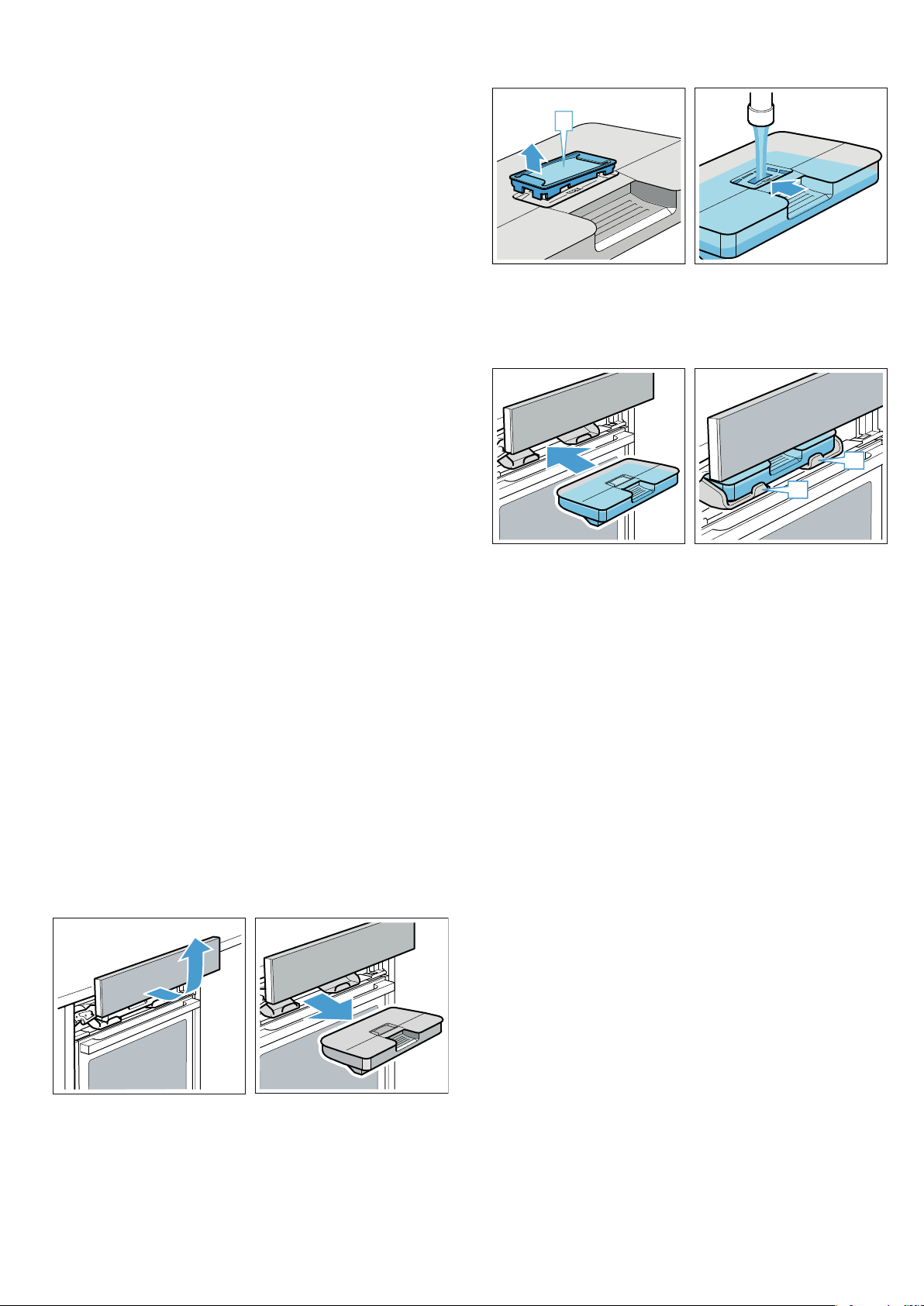
en Steam
20
:Warning – Risk of injury and risk of fire!
Only fill the water tank with water or with the descaling
solution that is recommended by us. Do not pour any
flammable liquids (e.g. alcoholic drinks) into the water
tank. Due to hot surfaces, vapours from flammable
liquids may catch fire in the cooking compartment
(explosion). The appliance door may spring open. Hot
steam and jets of flame may escape.
:Warning – Risk of burns!
The water tank may heat up while the appliance is in
operation. Wait until the water tank has cooled down
after the previous appliance operation. Remove the
water tank from the water tank recess.
Caution!
The appliance may become damaged due to the use of
unsuitable liquids.
Do not use distilled water, highly chlorinated tap water
(> 40 mg/l) or other liquids.
Only use cold, fresh tap water, softened water or
uncarbonated mineral water.
Caution!
Malfunctions may occur when using filtered or
demineralised water.
The appliance may request that you top up the water
tank even though it may be full, or operation with steam
is cancelled after approx. two minutes.
If required, mix filtered or demineralised water with the
bottled non-carbonated mineral water with a ratio of
one to one.
Notes
■ If your water is very hard, we recommend that you
use softened water.
■ If you use only softened water, you can set your
appliance to the "softened" water hardness range.
■ If you use mineral water, set the water hardness
range to "4 very hard".
■ If you use mineral water, you must only use non-
carbonated mineral water.
1. Touch the v field.
The control panel is pushed forwards automatically.
2. Pull the control panel forwards with both hands and
then push it upwards until it locks into place (Fig. !).
3. Lift the water tank and remove it from the water tank
recess (Fig. ").
4. Press down on the cover along the seal to prevent
water from leaking out of the water tank.
5. Take out the cover ‚ (Fig. #).
Note: Whether or not there is a cover ‚ depends on
the appliance type.
6. Fill the water tank with cold water up to the "max."
mark (Fig. $).
7. Put the cover ‚ back into the opening on the water
tank.
8. Insert the filled water tank (Fig. %). Ensure that the
water tank locks into place behind both holders ƒ
(Fig. &).
9. Slowly slide the control panel downwards and then
push it towards the rear until it is closed completely.
The water tank has been filled. You can start using
operating modes with steam.
Refilling the water tank
Notes
■ Steam-assisted operations continue without adding
steam.
■ If the water tank runs dry during the operation with
the Dough proving or Reheating settings, the
operation is interrupted. Fill the water tank.
1. Open the control panel.
2. Remove and refill the water tank.
3. Insert the filled water tank and close the control
panel.
After every steam operation
:Warning – Risk of scalding!
When you open the appliance door, hot steam can
escape. Steam may not be visible, depending on its
temperature. When opening, do not stand too close to
the appliance. Open the appliance door carefully. Keep
children away.
:Warning – Risk of burns!
The appliance becomes hot during operation. Allow the
appliance to cool down before cleaning.
Caution!
Enamel damage: Do not start any operations when
there is water on the cooking compartment floor. Before
operation, wipe away the water from the cooking
compartment floor.
2I
1
D
E
E
I
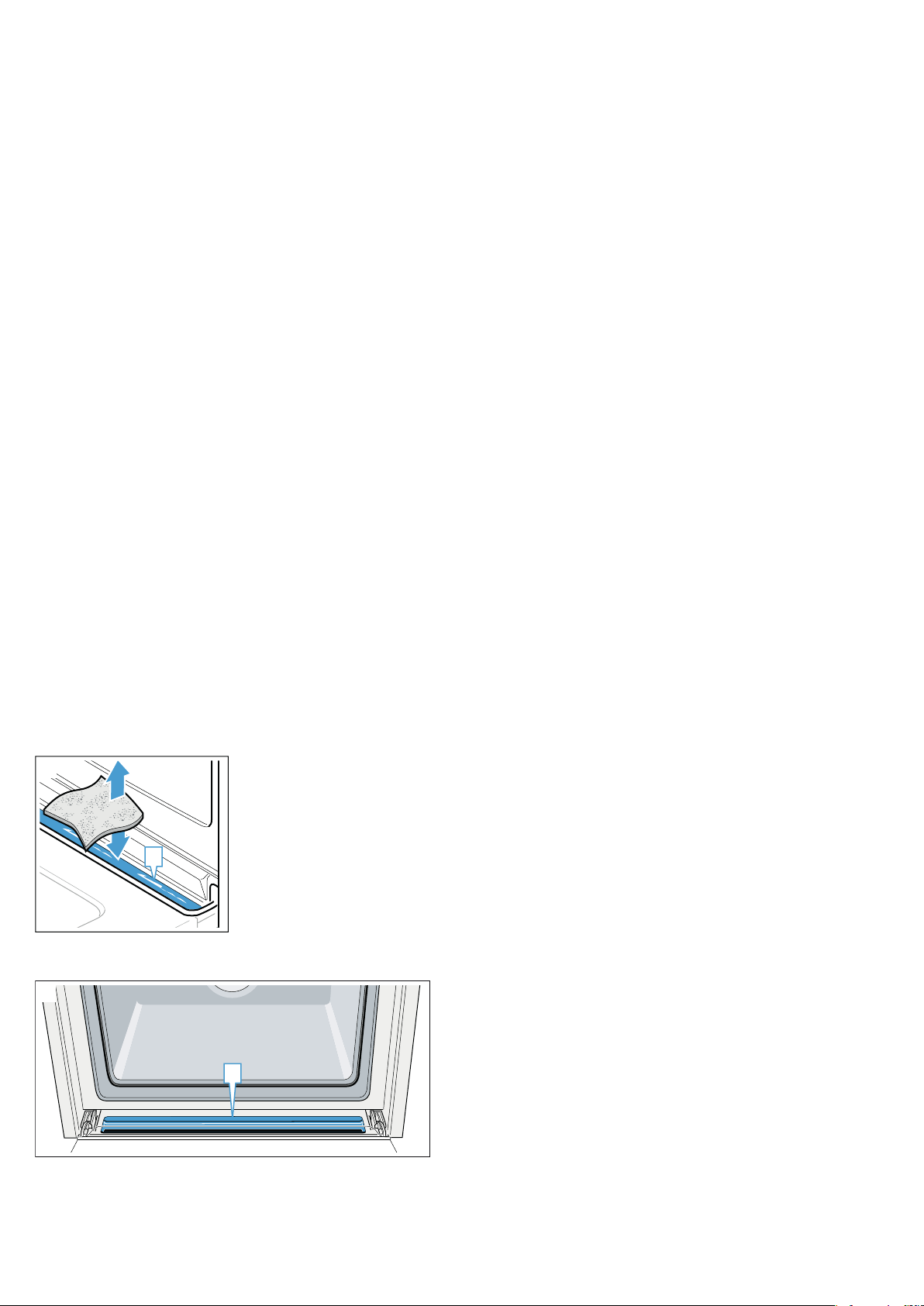
en Steam
20
:Warning – Risk of injury and risk of fire!
Only fill the water tank with water or with the descaling
solution that is recommended by us. Do not pour any
flammable liquids (e.g. alcoholic drinks) into the water
tank. Due to hot surfaces, vapours from flammable
liquids may catch fire in the cooking compartment
(explosion). The appliance door may spring open. Hot
steam and jets of flame may escape.
:Warning – Risk of burns!
The water tank may heat up while the appliance is in
operation. Wait until the water tank has cooled down
after the previous appliance operation. Remove the
water tank from the water tank recess.
Caution!
The appliance may become damaged due to the use of
unsuitable liquids.
Do not use distilled water, highly chlorinated tap water
(> 40 mg/l) or other liquids.
Only use cold, fresh tap water, softened water or
uncarbonated mineral water.
Caution!
Malfunctions may occur when using filtered or
demineralised water.
The appliance may request that you top up the water
tank even though it may be full, or operation with steam
is cancelled after approx. two minutes.
If required, mix filtered or demineralised water with the
bottled non-carbonated mineral water with a ratio of
one to one.
Notes
■ If your water is very hard, we recommend that you
use softened water.
■ If you use only softened water, you can set your
appliance to the "softened" water hardness range.
■ If you use mineral water, set the water hardness
range to "4 very hard".
■ If you use mineral water, you must only use non-
carbonated mineral water.
1. Touch the v field.
The control panel is pushed forwards automatically.
2. Pull the control panel forwards with both hands and
then push it upwards until it locks into place (Fig. !).
3. Lift the water tank and remove it from the water tank
recess (Fig. ").
4. Press down on the cover along the seal to prevent
water from leaking out of the water tank.
5. Take out the cover ‚ (Fig. #).
Note: Whether or not there is a cover ‚ depends on
the appliance type.
6. Fill the water tank with cold water up to the "max."
mark (Fig. $).
7. Put the cover ‚ back into the opening on the water
tank.
8. Insert the filled water tank (Fig. %). Ensure that the
water tank locks into place behind both holders ƒ
(Fig. &).
9. Slowly slide the control panel downwards and then
push it towards the rear until it is closed completely.
The water tank has been filled. You can start using
operating modes with steam.
Refilling the water tank
Notes
■ Steam-assisted operations continue without adding
steam.
■ If the water tank runs dry during the operation with
the Dough proving or Reheating settings, the
operation is interrupted. Fill the water tank.
1. Open the control panel.
2. Remove and refill the water tank.
3. Insert the filled water tank and close the control
panel.
After every steam operation
:Warning – Risk of scalding!
When you open the appliance door, hot steam can
escape. Steam may not be visible, depending on its
temperature. When opening, do not stand too close to
the appliance. Open the appliance door carefully. Keep
children away.
:Warning – Risk of burns!
The appliance becomes hot during operation. Allow the
appliance to cool down before cleaning.
Caution!
Enamel damage: Do not start any operations when
there is water on the cooking compartment floor. Before
operation, wipe away the water from the cooking
compartment floor.
2I
1
D
E
E
I
Steam en
21
The remaining water is pumped back into the water
tank after every operation with steam. Then empty and
dry the water tank. Moisture remains in the cooking
compartment. To dry the cooking compartment, you
can either use the "Drying" operating mode or dry the
cooking compartment by hand.
Notes
■ Once the appliance has been switched off, the v
field remains lit for a little longer to remind you to
empty the water tank.
■ Remove limescale marks with a cloth soaked in
vinegar, then wipe with clean water and dry with a
soft cloth.
Emptying the water tank
Caution!
■ Do not dry the water tank in the hot cooking
compartment. This will damage the water tank.
■ Do not clean the water tank in the dishwasher. This
will damage the water tank.
1. Open the control panel.
2. Remove water tank.
3. Carefully remove the lid of the water tank.
4. Empty the water tank, clean it with detergent and
then rinse it thoroughly with clean water.
5. Dry all parts with a soft cloth.
6. Rub the seal on the lid until dry.
7. Leave to dry with the lid open.
8. Place the lid on the water tank and push it down.
9. Insert the water tank and close the control panel.
Cleaning the drip trough
1. Allow the appliance to cool down.
2. Open the appliance door.
3. Soak up the water in the drip trough ‚ with a sponge
cloth and wipe it carefully (figure !).
The drip trough ‚ is located below the cooking
compartment (figure ").
Starting drying
To dry the cooking compartment, it is heated up so that
the moisture in the cooking compartment evaporates.
You will then need to open the appliance door to allow
the steam to escape from the cooking compartment.
1. Allow the appliance to cool down.
2. Remove the worst dirt from the cooking
compartment immediately and wipe away moisture
from the cooking compartment floor.
3. If necessary, press the # On/Off button to switch on
the appliance.
4. Touch the ! field.
The first type of heating appears in the display.
5. Turn the rotary selector to set the Z Dry type of
heating.
Note: The temperature and duration are preset to
fixed values and cannot be changed.
6. Press the l Start/Stop button to start.
The drying function starts and ends automatically
after 10 minutes.
7. Open the appliance door and leave it open for 1 to 2
minutes so that the moisture in the cooking
compartment can escape.
Drying the cooking compartment by hand
1. Allow the appliance to cool down.
2. Remove any food remnants from the walls of the
cooking compartment.
3. Dry the cooking compartment with a sponge.
4. Leave the appliance door open for 1 hour so that the
cooking compartment dries completely.
D
1
D
2

en Childproof lock
22
AChildproof lock
Chi l dpr oof l oc k
Your appliance is equipped with a childproof lock so
that children cannot switch it on accidentally or change
any settings.
The control panel is locked and no settings can be
made. The appliance can only be switched off using the
ÿ On/Off button.
Activating and deactivating
You can activate and deactivate the childproof lock
when the appliance is switched on or off.
In each case, press the D field for approx. 4 seconds.
A confirmation note appears on the display.
The D field lights up red when the appliance is
switched on. The D field does not light up when the
appliance is switched off.
QBasic settings
Ba s i c set t i ngs
There are various settings available to you in order to
help use your appliance effectively and simply. You can
change these settings as required.
Changing the basic settings
The appliance must be switched off.
1. Touch the ° field for approx. 3 seconds.
Notes on the process appear on the display.
2. Press the s field to confirm the notes.
The first setting "language" appears on the display.
3. Turn the rotary selector to change the setting as
required.
4. Touch the s field.
The next setting is shown on the display and can be
changed using the rotary selector.
5. Touch the s field to go through all the settings and
use the rotary selector to make changes as required.
6. When finished, press and hold the ° field for approx.
3 seconds to confirm the settings.
A note is shown on the display to confirm that the
settings have been saved.
Cancelling
If you do not want to save the settings, you can press
the ÿ On/Off button to cancel. A note is shown on the
display to confirm that the settings have not been
saved.
List of basic settings
Depending on the features of your appliance, not all
basic settings are accessible.
Setting Options
Language Additional languages are possible.
Clock Clock in 24-hour format
Water hardness 00 (softened)
01 (soft)
02 (medium)
03 (hard)
04 (very hard)*
Audible signal
Short cooking time (30 sec.)
Medium cooking time (1 min.)*
Long cooking time (5 min.)
Button tone Switched on
Switched off* (tone remains for ÿ On/
Off)
Display brightness 5 levels
Clock display Off
Digital*
Lighting Off during operation
On during operation*
Childproof lock Button lock only*
Door lock and button lock

en Childproof lock
22
AChildproof lock
Chi l dpr oof l oc k
Your appliance is equipped with a childproof lock so
that children cannot switch it on accidentally or change
any settings.
The control panel is locked and no settings can be
made. The appliance can only be switched off using the
ÿ On/Off button.
Activating and deactivating
You can activate and deactivate the childproof lock
when the appliance is switched on or off.
In each case, press the D field for approx. 4 seconds.
A confirmation note appears on the display.
The D field lights up red when the appliance is
switched on. The D field does not light up when the
appliance is switched off.
QBasic settings
Ba s i c set t i ngs
There are various settings available to you in order to
help use your appliance effectively and simply. You can
change these settings as required.
Changing the basic settings
The appliance must be switched off.
1. Touch the ° field for approx. 3 seconds.
Notes on the process appear on the display.
2. Press the s field to confirm the notes.
The first setting "language" appears on the display.
3. Turn the rotary selector to change the setting as
required.
4. Touch the s field.
The next setting is shown on the display and can be
changed using the rotary selector.
5. Touch the s field to go through all the settings and
use the rotary selector to make changes as required.
6. When finished, press and hold the ° field for approx.
3 seconds to confirm the settings.
A note is shown on the display to confirm that the
settings have been saved.
Cancelling
If you do not want to save the settings, you can press
the ÿ On/Off button to cancel. A note is shown on the
display to confirm that the settings have not been
saved.
List of basic settings
Depending on the features of your appliance, not all
basic settings are accessible.
Setting Options
Language Additional languages are possible.
Clock Clock in 24-hour format
Water hardness 00 (softened)
01 (soft)
02 (medium)
03 (hard)
04 (very hard)*
Audible signal Short cooking time (30 sec.)
Medium cooking time (1 min.)*
Long cooking time (5 min.)
Button tone Switched on
Switched off* (tone remains for ÿ On/
Off)
Display brightness 5 levels
Clock display Off
Digital*
Lighting Off during operation
On during operation*
Childproof lock Button lock only*
Door lock and button lock
Sabbath mode en
23
--------
Note: Changes to the language, button tone and
display brightness settings take effect immediately. All
other changes take effect after the settings have been
changed.
Power cut
The changes you make to the settings are saved even
after a power cut.
You only have to reset the settings for the initial use
following a long-term power cut. The appliance can
bridge a short-term power cut.
Changing the time
If you want to change the time, for example from
summer to winter time, you have to change the basic
setting.
The appliance must be switched off.
1. Touch the ° field for approx. 3 seconds.
Notes on the process appear on the display.
2. Press the s field to confirm the notes.
The first setting "language" appears in the display.
3. Touch the s field.
The setting for the clock appears.
4. Turn the rotary selector to change the clock time.
5. Press and hold the ° field for approx. 3 seconds to
confirm the setting.
A note is shown on the display to confirm that the
settings have been saved.
FSabbath mode
Sabbat h mode
With the Sabbath mode, a cooking time of up to 74
hours can be set. You can keep the food in the cooking
compartment warm without having to switch the oven
on or off.
Starting Sabbath mode
Before you are able to use the Sabbath mode, you must
activate it in the basic settings. ~ "Basic settings"
on page 22
When the basic setting has been changed accordingly,
Sabbath mode is listed with the types of heating as the
last type of heating.
The appliance heats up with top/bottom heating. You
can set a temperature between 85 °C and 140 °C.
1. Set the 0 Sabbath mode type of heating using the
rotary selector.
2. Touch the } field.
The temperature is highlighted white in the display.
3. Set the required temperature using the rotary
selector.
4. Touch the s field before starting.
The cooking time is highlighted white in the display.
5. Set the required cooking time using the rotary
selector.
Note: The end time cannot be delayed.
6. Press the l Start/Stop button to start.
The cooking time counts down on the display.
The appliance begins to heat up.
When the cooking time for Sabbath mode has ended,
an audible signal sounds. The appliance stops heating.
The cooking time 00 m 00 s is shown on the display.
Press the ÿ On/Off button to switch off the appliance.
Note: The operation is not interrupted if you open the
appliance door.
Changing and cancelling
After starting the appliance, the settings can no longer
be changed.
If you would like to cancel Sabbath mode, switch the
appliance off using the ÿ On/Off button. You can no
longer pause the operation using the l Start/Stop
button.
Operation after switching
on
Types of heating*
AutoCook
Night-time darkening Switched off*
Switched on
Brand logo Display*
Do not display
Fan run-on time Recommended*
Minimum
Pull-out system Not retrofitted* (for rails and single pull-
out system)
Retrofitted (for double and triple pull-out
systems)
Sabbath mode Switched on
Switched off*
Factory settings Restore
Do not restore*
* Factory setting (factory settings may vary depending on the appli-
ance model)

en Cleaning agent
24
DCleaning agent
Cl eani ng agent
With good care and cleaning, your appliance will retain
its appearance and remain fully functioning for a long
time to come. We will explain here how you should
correctly care for and clean your appliance.
Suitable cleaning agents
To ensure that the different surfaces are not damaged
by using the wrong cleaning agent, observe the
information in the table. Depending on the appliance
model, not all of the areas listed may be on/in your
appliance.
Caution!
Risk of surface damage
Do not use:
■ Harsh or abrasive cleaning agents,
■ Cleaning agents with a high alcohol content,
■ Hard scouring pads or cleaning sponges,
■ High-pressure cleaners or steam cleaners,
■ Special cleaners for cleaning the appliance while it is
hot.
Wash new sponge cloths thoroughly before use.
Tip: Highly recommended cleaning and care products
can be purchased through the after-sales service.
Observe the respective manufacturer's instructions.
:Warning – Risk of burns!
The appliance becomes very hot. Never touch the
interior surfaces of the cooking compartment or the
heating elements. Always allow the appliance to cool
down. Keep children at a safe distance.
Area Cleaning
Appliance exterior
Stainless steel
front
Hot soapy water:
Clean with a dish cloth and then dry with a soft
cloth.
Remove flecks of limescale, grease, starch and
albumin (e.g. egg white) immediately. Corrosion
can form under such flecks.
Special stainless steel cleaning products suitable
for hot surfaces are available from our after-sales
service or from specialist retailers. Apply a very
thin layer of the cleaning product with a soft cloth.
Plastic Hot soapy water:
Clean with a dish cloth and then dry with a soft
cloth.
Do not use glass cleaner or a glass scraper.
Painted surfaces Hot soapy water:
Clean with a dish cloth and then dry with a soft
cloth.
Control panel Hot soapy water:
Clean with a dish cloth and dry with a soft cloth.
Do not use glass cleaner or a glass scraper.
If descaler comes into contact with the control
panel, wipe it off immediately. If you leave it, it may
stain the control panel.
Door panels Hot soapy water:
Clean with a dish cloth and then dry with a soft
cloth.
Do not use a glass scraper or a stainless steel
scouring pad.
Door handle Hot soapy water:
Clean with a dish cloth and then dry with a soft
cloth.
If descaler comes into contact with the door han-
dle, wipe it off immediately. Otherwise, any stains
will not be able to be removed.
Appliance interior
Enamelled sur-
faces
Hot soapy water or a vinegar solution:
Clean with a dish cloth and then dry with a soft
cloth.
Soften baked-on food remnants with a damp cloth
and soapy water. Use stainless steel wire wool or
oven cleaner to remove stubborn dirt.
Caution!
Never use oven cleaner in the cooking compart-
ment when it is still warm. This may damage the
enamel. Remove all food remnants from the cook-
ing compartment and the appliance door before
you next heat up the appliance.
Leave the cooking compartment open to dry after
cleaning it.
It is best to use the cleaning function.
~ "Cleaning function" on page 25
Note: Food residues can cause white deposits to
form. These are harmless and do not affect how
the appliance works.
Remove using lemon juice if required.
Glass cover for
the interior light-
ing
Hot soapy water:
Clean with a dish cloth and then dry with a soft
cloth.
If the cooking compartment is heavily soiled, use
oven cleaner.
Door cover made from stainless steel:
Use stainless steel cleaner. Follow the manufac-
turers' instructions. Do not use stainless steel
care products.
made from plastic:
Clean using hot soapy water and a dish cloth. Dry
with a soft cloth. Do not use glass cleaner or a
glass scraper.
Remove the door cover for cleaning.
Rails Hot soapy water:
Soak and clean with a dish cloth or brush.
Pull-out system Hot soapy water:
Clean with a dish cloth or a brush.
Do not remove the lubricant while the pull-out rails
are pulled out – it is best to clean them when they
are pushed in. Do not clean in the dishwasher.
Accessories Hot soapy water:
Soak and clean with a dish cloth or brush.
If there are heavy deposits of dirt, use a stainless
steel scouring pad.

en Cleaning agent
24
DCleaning agent
Cl eani ng agent
With good care and cleaning, your appliance will retain
its appearance and remain fully functioning for a long
time to come. We will explain here how you should
correctly care for and clean your appliance.
Suitable cleaning agents
To ensure that the different surfaces are not damaged
by using the wrong cleaning agent, observe the
information in the table. Depending on the appliance
model, not all of the areas listed may be on/in your
appliance.
Caution!
Risk of surface damage
Do not use:
■ Harsh or abrasive cleaning agents,
■ Cleaning agents with a high alcohol content,
■ Hard scouring pads or cleaning sponges,
■ High-pressure cleaners or steam cleaners,
■ Special cleaners for cleaning the appliance while it is
hot.
Wash new sponge cloths thoroughly before use.
Tip: Highly recommended cleaning and care products
can be purchased through the after-sales service.
Observe the respective manufacturer's instructions.
:Warning – Risk of burns!
The appliance becomes very hot. Never touch the
interior surfaces of the cooking compartment or the
heating elements. Always allow the appliance to cool
down. Keep children at a safe distance.
Area Cleaning
Appliance exterior
Stainless steel
front
Hot soapy water:
Clean with a dish cloth and then dry with a soft
cloth.
Remove flecks of limescale, grease, starch and
albumin (e.g. egg white) immediately. Corrosion
can form under such flecks.
Special stainless steel cleaning products suitable
for hot surfaces are available from our after-sales
service or from specialist retailers. Apply a very
thin layer of the cleaning product with a soft cloth.
Plastic Hot soapy water:
Clean with a dish cloth and then dry with a soft
cloth.
Do not use glass cleaner or a glass scraper.
Painted surfaces Hot soapy water:
Clean with a dish cloth and then dry with a soft
cloth.
Control panel Hot soapy water:
Clean with a dish cloth and dry with a soft cloth.
Do not use glass cleaner or a glass scraper.
If descaler comes into contact with the control
panel, wipe it off immediately. If you leave it, it may
stain the control panel.
Door panels Hot soapy water:
Clean with a dish cloth and then dry with a soft
cloth.
Do not use a glass scraper or a stainless steel
scouring pad.
Door handle Hot soapy water:
Clean with a dish cloth and then dry with a soft
cloth.
If descaler comes into contact with the door han-
dle, wipe it off immediately. Otherwise, any stains
will not be able to be removed.
Appliance interior
Enamelled sur-
faces
Hot soapy water or a vinegar solution:
Clean with a dish cloth and then dry with a soft
cloth.
Soften baked-on food remnants with a damp cloth
and soapy water. Use stainless steel wire wool or
oven cleaner to remove stubborn dirt.
Caution!
Never use oven cleaner in the cooking compart-
ment when it is still warm. This may damage the
enamel. Remove all food remnants from the cook-
ing compartment and the appliance door before
you next heat up the appliance.
Leave the cooking compartment open to dry after
cleaning it.
It is best to use the cleaning function.
~ "Cleaning function" on page 25
Note: Food residues can cause white deposits to
form. These are harmless and do not affect how
the appliance works.
Remove using lemon juice if required.
Glass cover for
the interior light-
ing
Hot soapy water:
Clean with a dish cloth and then dry with a soft
cloth.
If the cooking compartment is heavily soiled, use
oven cleaner.
Door cover made from stainless steel:
Use stainless steel cleaner. Follow the manufac-
turers' instructions. Do not use stainless steel
care products.
made from plastic:
Clean using hot soapy water and a dish cloth. Dry
with a soft cloth. Do not use glass cleaner or a
glass scraper.
Remove the door cover for cleaning.
Rails Hot soapy water:
Soak and clean with a dish cloth or brush.
Pull-out system Hot soapy water:
Clean with a dish cloth or a brush.
Do not remove the lubricant while the pull-out rails
are pulled out – it is best to clean them when they
are pushed in. Do not clean in the dishwasher.
Accessories Hot soapy water:
Soak and clean with a dish cloth or brush.
If there are heavy deposits of dirt, use a stainless
steel scouring pad.
Cleaning function en
25
--------
Notes
■ Slight differences in colour on the front of the
appliance are caused by the use of different
materials, such as glass, plastic and metal.
■ Shadows on the door panels, which look like
streaks, are caused by reflections made by the
interior lighting.
■ Enamel is baked on at very high temperatures.This
can cause some slight colour variation. This is
normal and does not affect operation.
The edges of thin trays cannot be completely
enamelled. As a result, these edges can be rough.
This does not impair the anti-corrosion protection.
Keeping the appliance clean
Always keep the appliance clean and remove dirt
immediately so that stubborn deposits of dirt do not
build up.
:Warning – Risk of fire!
Loose food remnants, fat and meat juices may catch
fire. Before using the appliance, remove the worst of the
food remnants from the cooking compartment, heating
elements and accessories.
Tips
■ Clean the cooking compartment after each use. This
will ensure that dirt cannot be baked on.
■ Always remove flecks of limescale, grease, starch
and albumin (e.g. egg white) immediately.
■ Use the universal pan for baking very moist cakes.
■ Use suitable ovenware for roasting, e.g. a roasting
dish.
.Cleaning function
Cl eani ng f unc t i on
Your appliance has the "Pyrolytic self cleaning" and
"Descaling" cleaning functions. You can use the
"Pyrolytic self cleaning" function to clean the cooking
compartment with no effort at all. You can use the
"Descaling" function to remove limescale from the
evaporator.
Descaling
To ensure that your appliance continues to operate
correctly, it must be descaled regularly.
Descaling comprises a number of different steps. For
hygiene reasons, the descaling programme must be
run through completely before the appliance is ready
for operation again. In total, the descaling programme
runs for approx. 70–95 minutes.
■ Descale (approx. 55–70 minutes), then empty and
refill the water tank
■ First rinsing cycle (approx. 9–12 minutes), then
empty and refill the water tank
■ Second rinsing cycle (approx. 9–12 minutes), then
empty and dry the water tank
If descaling is interrupted (e.g. due to a power failure or
because the appliance is switched off), you will be
prompted to rinse the appliance twice when you switch
it back on. The appliance cannot be used until the
second rinsing cycle has finished.
The frequency with which the appliance must be
descaled depends on the hardness of the water used.
When only another five or fewer steam-assisted
operations are possible, the appliance reminds you to
descale it with a message on the display. The number
of remaining operations is displayed after the appliance
is switched on. You can therefore prepare for the
descaling in good time.
Setting
Caution!
■ Risk of damage to the appliance: Only use liquid
descalers recommended by us for the descaling
programme. The time the product needs to work
during descaling depends on the type of descaler
used. Other descalers may damage the appliance.
Descaler order no. 311 680
■ Descaling solution: Do not allow any descaling
solution or descaler to come into contact with the
control panel or other surfaces on the appliance.
This damages the surfaces. If this does happen,
remove the descaling solution immediately with
water.
If you have used a steam-assisted operation
immediately before descaling, you must first switch the
appliance off so that the residual water is pumped out
of the evaporator system.
Water tank Hot soapy water:
Clean with a dish cloth and rinse thoroughly to
remove residual detergent.
Then dry with a soft cloth. Leave the water tank to
dry with the lid open. Rub the seal on the lid until
dry.
Do not clean in the dishwasher.

en Cleaning function
26
1. Mix 400 ml water with 200 ml liquid descaler to
make a descaling solution.
2. Remove the water reservoir, fill it with descaling
solution and push it back in again fully.
Close the control panel.
3. Touch the O field.
The "Descaling" cleaning function appears in the
display.
The duration of the descaling programme is
displayed. It cannot be changed.
4. Press the Start/Stop button l to start.
The cooking time counts down in the display.
The appliance's descaling programme begins.
Once the cooking time has elapsed, an audible signal
sounds.
First rinsing cycle
1. Open the control panel.
2. Remove the water tank, rinse thoroughly, fill with
water and reinsert.
3. Close the control panel.
4. Press the l Start/Stop button to start.
The appliance rinses.
Once the duration has elapsed, an audible signal
sounds.
Second rinsing cycle
1. Open the control panel.
2. Remove the water tank, rinse thoroughly, fill with
water and reinsert.
3. Close the control panel.
4. Press the l Start/Stop button to start.
The appliance rinses.
Once the duration has elapsed, an audible signal
sounds.
Rinsing
1. Open the control panel.
2. Empty and dry the water tank.
3. Press the # On/Off button to switch off the
appliance.
Descaling is complete and the appliance is ready for
use again.
Pyrolytic self-cleaning
Use the "Pyrolytic self-cleaning" function to clean the
cooking compartment.
You can choose from three cleaning settings.
The dirtier the cooking compartment and the longer the
dirt has been there, the higher the cleaning setting
should be. It is sufficient to clean the cooking
compartment every two to three months. If required, you
can clean the oven more frequently. A cleaning cycle
requires only approx. 2.5 – 4.7 kilowatt hours.
Notes
■ For safety reasons, the appliance door locks
automatically once a certain temperature is reached.
It cannot be reopened until the n symbol for the
locking mechanism on the display goes out.
■ The interior lighting does not come on during the
cleaning function.
:Warning
Risk of burns!
■ The cooking compartment becomes extremely hot
during the cleaning function. Never open the
appliance door. Allow the appliance to cool down.
Keep children away from the appliance.
Risk of burns!
■ ; The appliance becomes very hot on the outside
during the cleaning function. Never touch the
appliance door. Allow the appliance to cool down.
Keep children at a safe distance.
:Warning
Risk of harm to health!
The cleaning function heats up the cooking
compartment to a very high temperature so that food
remnants left over from roasting, grilling and baking will
burn off.This process releases vapours, which can
irritate the mucous membranes. While the cleaning
function is running, keep the kitchen well ventilated. Do
not remain in the room for long periods. Keep children
and pets away. Follow the instructions even when using
the Delayed start function with a delayed end time.
Before running the cleaning function
Caution!
Before cleaning starts, remove the water tank from the
appliance. ~ "Steam" on page 18
When using the cleaning function, you can clean an
accessory at the same time, e.g. the universal pan or
the baking tray. Remove any coarse food remnants
manually before starting the cleaning function. Slide the
accessory in at level 2.
Clean the appliance door and along the edges of the
cooking compartment in the area around the seal. Do
not scrub or remove the seal.
Clean the inner door panel using hot soapy water and a
dish cloth. Dry with a soft cloth. If the cooking
compartment is heavily soiled, use oven cleaner.
Note: You can clean the enamelled accessory supplied
in the cooking compartment when the cleaning function
is cleaning the cooking compartment. You cannot clean
any of the wire racks when using the cleaning function.
The wire racks are not suitable for the cleaning function
and will become discoloured. Further accessories that
can be cleaned using the cleaning function are listed in
the table for special accessories. ~ "Accessories"
on page 12
Setting Cleaning level Duration
1 Light Approx. 1 hour, 15 minutes
2 Medium Approx. 1 hour, 30 minutes
3 Intensive Approx. 2 hours

en Cleaning function
26
1. Mix 400 ml water with 200 ml liquid descaler to
make a descaling solution.
2. Remove the water reservoir, fill it with descaling
solution and push it back in again fully.
Close the control panel.
3. Touch the O field.
The "Descaling" cleaning function appears in the
display.
The duration of the descaling programme is
displayed. It cannot be changed.
4. Press the Start/Stop button l to start.
The cooking time counts down in the display.
The appliance's descaling programme begins.
Once the cooking time has elapsed, an audible signal
sounds.
First rinsing cycle
1. Open the control panel.
2. Remove the water tank, rinse thoroughly, fill with
water and reinsert.
3. Close the control panel.
4. Press the l Start/Stop button to start.
The appliance rinses.
Once the duration has elapsed, an audible signal
sounds.
Second rinsing cycle
1. Open the control panel.
2. Remove the water tank, rinse thoroughly, fill with
water and reinsert.
3. Close the control panel.
4. Press the l Start/Stop button to start.
The appliance rinses.
Once the duration has elapsed, an audible signal
sounds.
Rinsing
1. Open the control panel.
2. Empty and dry the water tank.
3. Press the # On/Off button to switch off the
appliance.
Descaling is complete and the appliance is ready for
use again.
Pyrolytic self-cleaning
Use the "Pyrolytic self-cleaning" function to clean the
cooking compartment.
You can choose from three cleaning settings.
The dirtier the cooking compartment and the longer the
dirt has been there, the higher the cleaning setting
should be. It is sufficient to clean the cooking
compartment every two to three months. If required, you
can clean the oven more frequently. A cleaning cycle
requires only approx. 2.5 – 4.7 kilowatt hours.
Notes
■ For safety reasons, the appliance door locks
automatically once a certain temperature is reached.
It cannot be reopened until the n symbol for the
locking mechanism on the display goes out.
■ The interior lighting does not come on during the
cleaning function.
:Warning
Risk of burns!
■ The cooking compartment becomes extremely hot
during the cleaning function. Never open the
appliance door. Allow the appliance to cool down.
Keep children away from the appliance.
Risk of burns!
■ ; The appliance becomes very hot on the outside
during the cleaning function. Never touch the
appliance door. Allow the appliance to cool down.
Keep children at a safe distance.
:Warning
Risk of harm to health!
The cleaning function heats up the cooking
compartment to a very high temperature so that food
remnants left over from roasting, grilling and baking will
burn off.This process releases vapours, which can
irritate the mucous membranes. While the cleaning
function is running, keep the kitchen well ventilated. Do
not remain in the room for long periods. Keep children
and pets away. Follow the instructions even when using
the Delayed start function with a delayed end time.
Before running the cleaning function
Caution!
Before cleaning starts, remove the water tank from the
appliance. ~ "Steam" on page 18
When using the cleaning function, you can clean an
accessory at the same time, e.g. the universal pan or
the baking tray. Remove any coarse food remnants
manually before starting the cleaning function. Slide the
accessory in at level 2.
Clean the appliance door and along the edges of the
cooking compartment in the area around the seal. Do
not scrub or remove the seal.
Clean the inner door panel using hot soapy water and a
dish cloth. Dry with a soft cloth. If the cooking
compartment is heavily soiled, use oven cleaner.
Note: You can clean the enamelled accessory supplied
in the cooking compartment when the cleaning function
is cleaning the cooking compartment. You cannot clean
any of the wire racks when using the cleaning function.
The wire racks are not suitable for the cleaning function
and will become discoloured. Further accessories that
can be cleaned using the cleaning function are listed in
the table for special accessories. ~ "Accessories"
on page 12
Setting Cleaning level Duration
1 Light Approx. 1 hour, 15 minutes
2 Medium Approx. 1 hour, 30 minutes
3 Intensive Approx. 2 hours
Cleaning function en
27
:Warning
Risk of fire!
■ Loose food residues, grease and meat juices may
catch fire during the cleaning function. Before
starting the cleaning function, remove coarse dirt
from the cooking compartment and from the
accessories.
Risk of fire!
■ The appliance will become very hot on the outside
during the cleaning function. Never hang
combustible objects, e.g. tea towels, on the door
handle. Do not place anything against the front of
the appliance. Keep children away from the
appliance.
Risk of fire!
■ If the door seal is damaged, a large amount of heat
will be generated around the door. Do not scrub or
remove the seal. Never operate the appliance if the
seal is damaged or missing.
:Warning – Risk of serious damage to health!
The appliance will become very hot during the cleaning
function. The non-stick coating on baking trays and tins
is destroyed and noxious gases are released. Never
clean non-stick baking trays and baking tins using the
cleaning function. Only clean enamelled accessories
using the cleaning function.
Setting the cleaning function
Before setting the cleaning function, ensure that you
have followed all instructions for preparation.
The duration of each cleaning setting is preset and
cannot be changed.
1. Touch the O field.
The first cleaning function, "Descaling", will appear
on the display.
2. Touch the O field again.
"Pyrolytic self-cleaning" will be shown on the display.
The cleaning setting will be highlighted in white.
3. Turn the rotary selector to set the cleaning setting.
4. Confirm using the l Start/Stop button.
A note appears relating to the preparations required
for the cleaning function.
5. Press the l Start/Stop button to start.
The duration counts down in the display. The heating
line does not appear for the cleaning function.
The cleaning function starts.
Ventilate the kitchen when the cleaning function is
running.
The appliance door locks shortly after the function starts
running. A message and the n symbol appear on the
display.
When the cleaning function has ended, an audible
signal sounds. The duration 00 m 00 s is shown in the
display. Press the ÿ On/Off button to switch off the
appliance.
The appliance door cannot be reopened until the n
symbol for the locking mechanism goes out.
Setting a later end time
You can set a later end time. Before starting the
appliance, touch the s field and set a later end time
using the rotary selector.
The appliance switches to standby after it is started. The
end time can no longer be changed.
Changing and cancelling
After starting the appliance, the cleaning setting can no
longer be changed.
If you would like to cancel the cleaning function, switch
the appliance off using the ÿ On/Off button. You can
no longer pause the operation using the l Start/Stop
button.
The appliance door remains locked until the n symbol
for the locking mechanism on the display goes out.
Once the cleaning function has ended
Once the cooking compartment has cooled down, use
a damp cloth to wipe off the ash that has been left
behind in the cooking compartment and around the
appliance door.
Note: Very bad soiling may cause white deposits to
remain on the enamel surfaces. This is residue from the
food and is harmless. It does not affect performance.
You can remove these residues using lemon juice if
required.
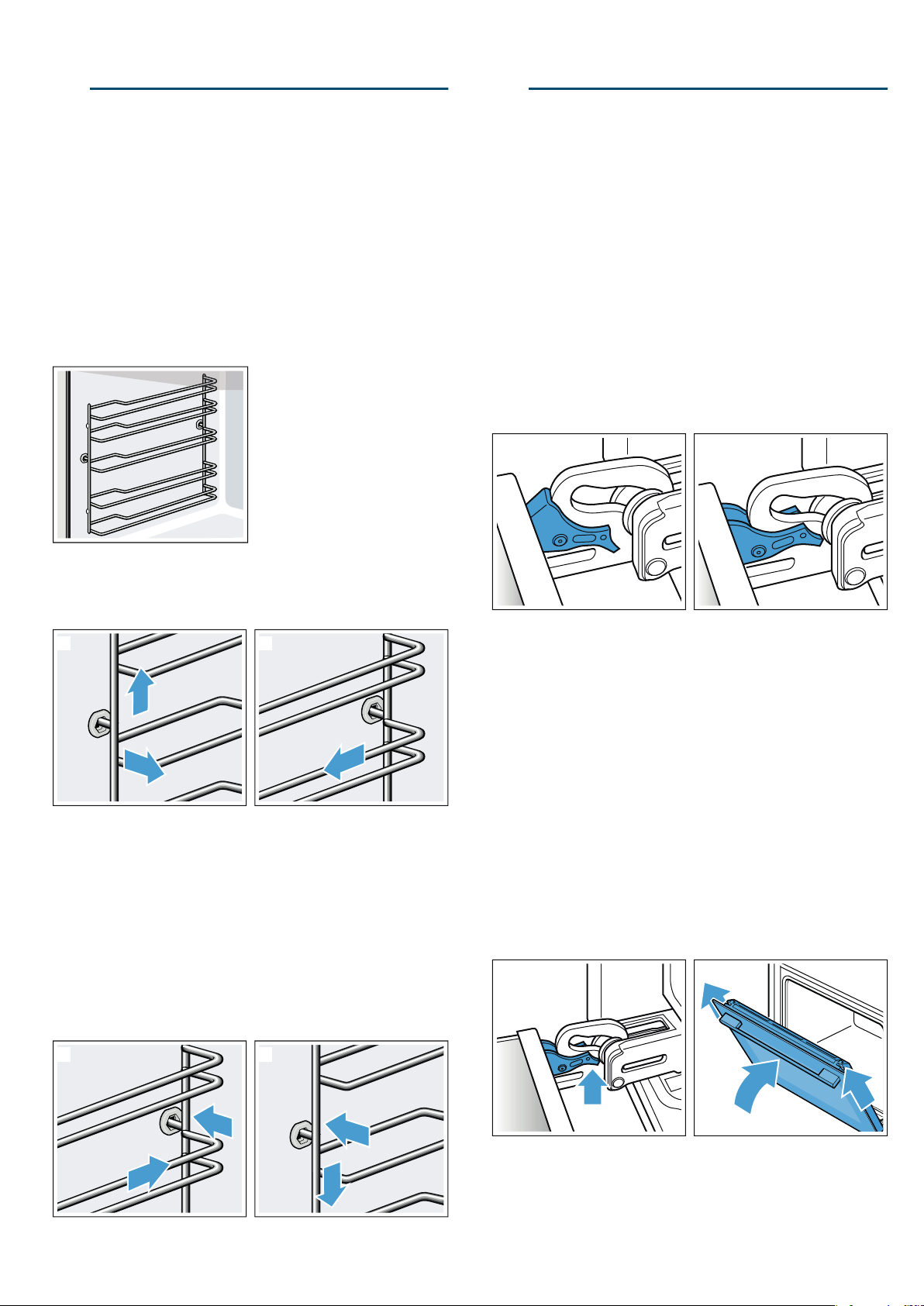
en Rails
28
pRails
Rails
With good care and cleaning, your appliance will retain
its appearance and remain fully functional for a long
time to come. This will tell you how to remove the
shelves and clean them.
Detaching and refitting the rails
:Warning – Risk of burns!
The rails become very hot. Never touch the hot rails.
Always allow the appliance to cool down. Keep children
away from the appliance.
Detaching the rails
1. Lift the rail slightly at the front ‚ and detach it ƒ
(figure !).
2. Then pull the whole rail towards you and take it out
(figure ").
Clean the rails with cleaning agent and a sponge. For
stubborn deposits of dirt, use a brush.
Attaching the rails
The rails only fit on the right or the left side. For both
rails, ensure that the curved rods are at the front.
1. First, insert the rail in the middle of the rear socket ‚,
until the rail rests against the cooking compartment
wall, and push it back ƒ (figure !).
2. Then insert the rail into the front socket „, until the
rail also rests against the cooking compartment wall
here, and press it downwards … (figure ").
qAppliance door
Appl i ance door
With good care and cleaning, your appliance will retain
its appearance and remain fully functional for a long
time to come. This will tell you how to remove the
appliance door and clean it.
Removing and fitting the appliance door
For cleaning purposes and to remove the door panels,
you can detach the appliance door.
The appliance door hinges each have a locking lever.
When the locking levers are closed (figure !), the
appliance door is secured in place. It cannot be
detached.
When the locking levers are open in order to detach the
appliance door (figure "), the hinges are locked. They
cannot snap shut.
:Warning
Risk of injury!
■ If the hinges are not locked, they can snap shut with
great force. Ensure that the locking levers are always
fully closed or, when detaching the appliance door,
fully open.
Risk of injury!
■ The hinges on the appliance door move when
opening and closing the door, and you may be
trapped. Keep your hands away from the hinges.
Removing the appliance door
1. Open the appliance door fully and push it in the
direction of the appliance.
2. Fold up the two locking levers on the left and right
(figure !).
3. Close the appliance door as far as it goes ‚. With
both hands, grip the door on the left- and right-hand
side and pull it up and out (figure ").
21
D
E
2
F
G
1
D
E
21
2
E
E
D
1I
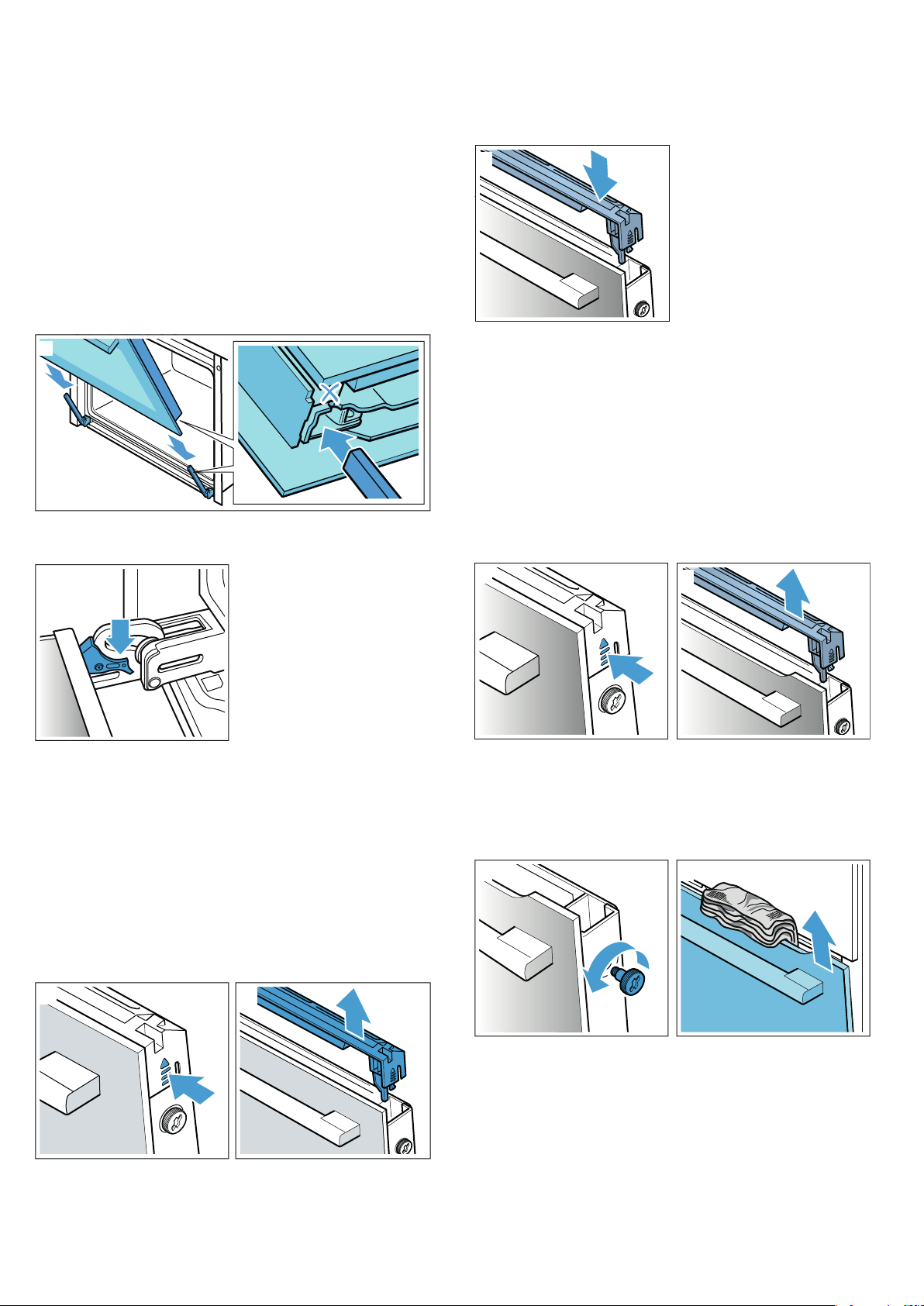
en Rails
28
pRails
Rails
With good care and cleaning, your appliance will retain
its appearance and remain fully functional for a long
time to come. This will tell you how to remove the
shelves and clean them.
Detaching and refitting the rails
:Warning – Risk of burns!
The rails become very hot. Never touch the hot rails.
Always allow the appliance to cool down. Keep children
away from the appliance.
Detaching the rails
1. Lift the rail slightly at the front ‚ and detach it ƒ
(figure !).
2. Then pull the whole rail towards you and take it out
(figure ").
Clean the rails with cleaning agent and a sponge. For
stubborn deposits of dirt, use a brush.
Attaching the rails
The rails only fit on the right or the left side. For both
rails, ensure that the curved rods are at the front.
1. First, insert the rail in the middle of the rear socket ‚,
until the rail rests against the cooking compartment
wall, and push it back ƒ (figure !).
2. Then insert the rail into the front socket „, until the
rail also rests against the cooking compartment wall
here, and press it downwards … (figure ").
qAppliance door
Appl i ance door
With good care and cleaning, your appliance will retain
its appearance and remain fully functional for a long
time to come. This will tell you how to remove the
appliance door and clean it.
Removing and fitting the appliance door
For cleaning purposes and to remove the door panels,
you can detach the appliance door.
The appliance door hinges each have a locking lever.
When the locking levers are closed (figure !), the
appliance door is secured in place. It cannot be
detached.
When the locking levers are open in order to detach the
appliance door (figure "), the hinges are locked. They
cannot snap shut.
:Warning
Risk of injury!
■ If the hinges are not locked, they can snap shut with
great force. Ensure that the locking levers are always
fully closed or, when detaching the appliance door,
fully open.
Risk of injury!
■ The hinges on the appliance door move when
opening and closing the door, and you may be
trapped. Keep your hands away from the hinges.
Removing the appliance door
1. Open the appliance door fully and push it in the
direction of the appliance.
2. Fold up the two locking levers on the left and right
(figure !).
3. Close the appliance door as far as it goes ‚. With
both hands, grip the door on the left- and right-hand
side and pull it up and out (figure ").
21
D
E
2
F
G
1
D
E
21
2
E
E
D
1I
Appliance door en
29
Fitting the appliance door
Reattach the appliance door in the opposite sequence
to removal.
1. When attaching the appliance door, ensure that both
hinges are inserted straight into the opening (figure
!).
Place both hinges at the bottom on the outer panel
and use this as a guide.
Ensure that the hinges are inserted into the correct
opening. You must be able to insert them easily and
without resistance. If you can feel any resistance,
check that the hinges are inserted into the correct
opening.
2. Open the appliance door fully. Fold both locking
levers closed again (figure ").
3. Close the cooking compartment door.
Removing the door cover
The stainless steel inlay in the door cover may become
discoloured. To carry out thorough cleaning, you can
remove the cover.
1. Open the appliance door slightly.
2. Press on the right and left side of the cover (figure
!).
3. Remove the cover (figure ").
Close the appliance door carefully.
Note: Clean the stainless steel inlay in the cover with
stainless steel cleaner. Clean the rest of the door
cover with soapy water and a soft cloth.
4. Open the appliance door again slightly. Put the
cover back in place and press on it until it clicks
audibly into place (figure #).
5. Close the appliance door.
Removing and installing the door panels
To facilitate cleaning, you can remove the glass panels
from the appliance door.
Removing the door from the appliance
1. Open the appliance door slightly.
2. Press on the right and left side of the cover (figure
!).
3. Remove the cover (figure ").
4. Loosen and remove the screws on the left and right
of the appliance door (figure #).
5. Before closing the door again, trap a tea towel which
has been folded several times in the door (figure $).
Pull out the front panel upwards and lay it on a flat
surface with the door handle facing downwards.
1
2I
2
1
21
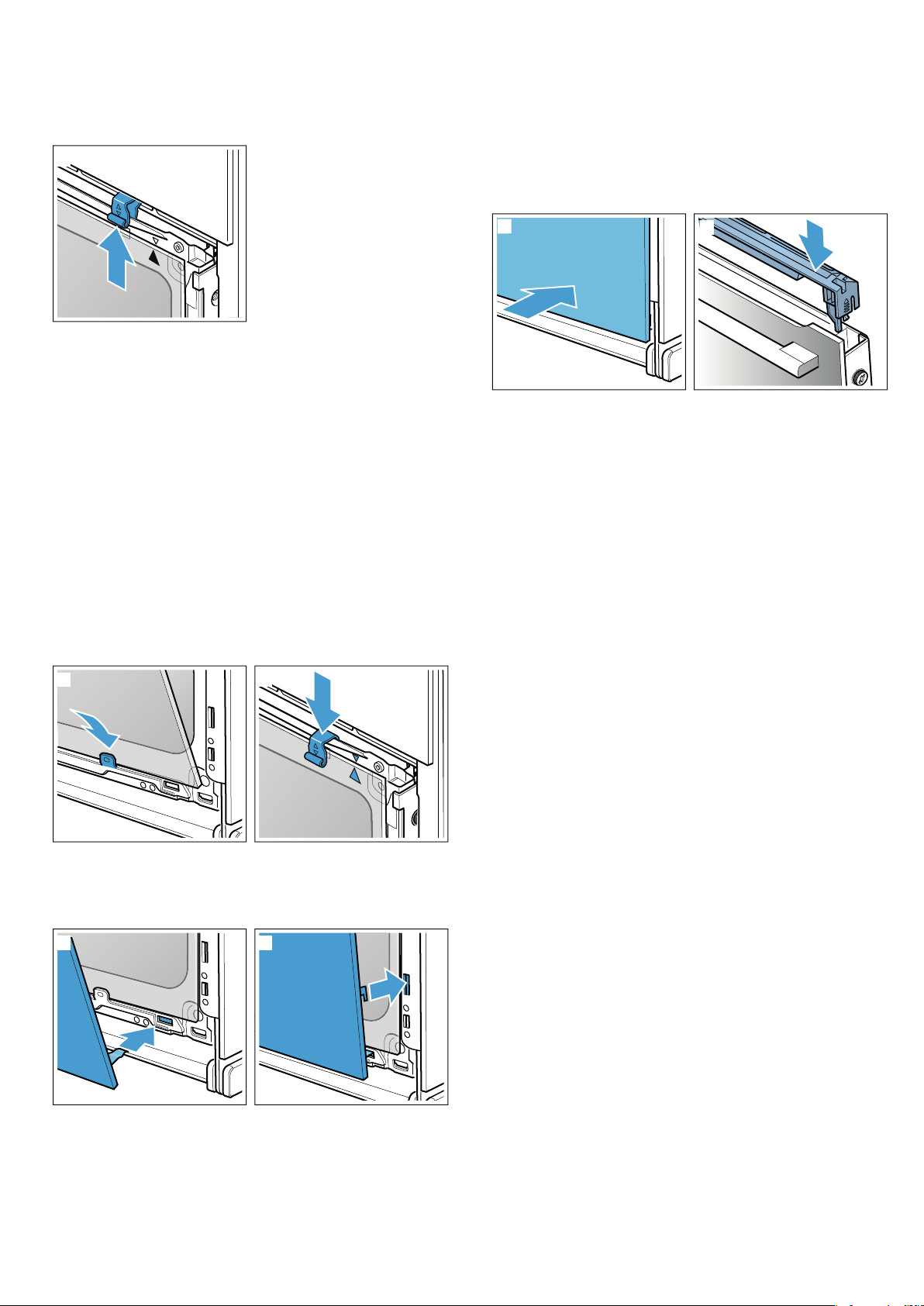
en Appliance door
30
6. Push both retainers on the intermediate panel
upwards, but do not remove it (figure %). Hold the
panel with one hand. Remove the panel.
Clean the panels with glass cleaner and a soft cloth.
:Warning
Risk of injury!
■ Scratched glass in the appliance door may develop
into a crack. Do not use a glass scraper, sharp or
abrasive cleaning aids or detergents.
Risk of injury!
■ The hinges on the appliance door move when
opening and closing the door, and you may be
trapped. Keep your hands away from the hinges.
Fitting the door on the appliance
When fitting the intermediate panel, make sure that the
arrow is in the top right of the panel and that it aligns
with the arrow on the metal panel.
1. Insert the intermediate panel at the bottom into the
retainer and push it in firmly at the top (figure !).
2. Push both retainers downwards (figure ").
3. Insert the front panel at the bottom into the retainers
(figure #).
4. Close the front panel until both upper hooks are
opposite the opening (figure
$).
5. Press the front panel at the bottom until it clicks
audibly into place (figure %).
6. Open the appliance door again slightly and remove
the tea towel.
7. Screw both screws back in on the left and right.
8. Put the cover back in place and press on it until it
clicks audibly into place (figure &).
9. Close the appliance door.
Caution!
Do not use the cooking compartment again until the
panels have been correctly fitted.
2
1

en Appliance door
30
6. Push both retainers on the intermediate panel
upwards, but do not remove it (figure %). Hold the
panel with one hand. Remove the panel.
Clean the panels with glass cleaner and a soft cloth.
:Warning
Risk of injury!
■ Scratched glass in the appliance door may develop
into a crack. Do not use a glass scraper, sharp or
abrasive cleaning aids or detergents.
Risk of injury!
■ The hinges on the appliance door move when
opening and closing the door, and you may be
trapped. Keep your hands away from the hinges.
Fitting the door on the appliance
When fitting the intermediate panel, make sure that the
arrow is in the top right of the panel and that it aligns
with the arrow on the metal panel.
1. Insert the intermediate panel at the bottom into the
retainer and push it in firmly at the top (figure !).
2. Push both retainers downwards (figure ").
3. Insert the front panel at the bottom into the retainers
(figure #).
4. Close the front panel until both upper hooks are
opposite the opening (figure
$).
5. Press the front panel at the bottom until it clicks
audibly into place (figure %).
6. Open the appliance door again slightly and remove
the tea towel.
7. Screw both screws back in on the left and right.
8. Put the cover back in place and press on it until it
clicks audibly into place (figure &).
9. Close the appliance door.
Caution!
Do not use the cooking compartment again until the
panels have been correctly fitted.
2
1
Trouble shooting en
31
3Trouble shooting
Tr oubl e s hoot i ng
If a fault occurs, there is often a simple explanation.
Before calling the after-sales service, please refer to the
fault table and attempt to correct the fault yourself.
Rectifying faults yourself
You can often easily rectify technical faults on the
appliance yourself.
If a dish does not turn out exactly as you wanted, you
can find many tips and instructions for preparation at
the end of the operating manual. ~ "Tested for you in
our cooking studio" on page 35
Fault Possible cause Notes/remedy
The appliance does not work. Faulty fuse. Check the circuit breaker in the fuse box.
Power cut Check whether the kitchen light or other kitchen appliances are working.
"Sprache Deutsch" appears on the
display.
Power cut Reset the language and the time.
The time does not appear when the
appliance is switched off.
Basic setting is changed. Change the basic setting for the clock display.
The appliance door cannot be
opened.
The appliance door is locked
with the childproof lock.
Deactivate the childproof lock by pressing the D field for approx. 4 seconds.
The lock can be switched off in the basic settings.
The appliance door cannot be
opened; the n symbol lights up on
the display.
The appliance door is locked
due to the cleaning function.
Wait until the cooking compartment has cooled and the n symbol goes out.
The appliance does not heat up; the
m symbol lights up on the display.
Demo mode is activated in the
basic settings.
Briefly disconnect the appliance from the mains (switch off the circuit breaker
in the fuse box) and then deactivate demo mode in the basic settings within 3
minutes.
The rotary selector has fallen out of
the support in the control panel.
The rotary selector has been
accidentally disengaged.
The rotary selector can be removed. Simply place the rotary selector back in
its support in the control panel and push it in so that it engages and can be
turned as usual.
The rotary selector can no longer be
turned easily.
There is dirt under the rotary
selector.
The rotary selector can be removed. To disengage the rotary selector, simply
remove it from the support. Alternatively, press on the outer edge of the rotary
selector so that it tips and can be picked up easily.
Carefully clean the rotary selector and its support on the appliance using a
cloth and soapy water. Dry with a soft cloth. Do not use any sharp or abrasive
materials. Do not soak or clean in the dishwasher.
Do not remove the rotary selector too often so that the support remains sta-
ble.
Operations with steam or descaling
do not start or do not continue
Water tank empty Refill water tank
The panel is open Close the panel
Descaling locks operations
with steam
Carry out descaling
Faulty sensor Call the after-sales service
The appliance prompts you to rinse The power supply was inter-
rupted or the appliance was
switched off during the desca-
ling process
Once the appliance is switched on again, rinse it twice
The appliance prompts you to descale
without the counter appearing before-
hand
The set water hardness range
is too low
Carry out descaling
Check the set water hardness range and adjust it, if necessary
Buttons flash Normal occurrence caused by
condensation behind the con-
trol panel
As soon as the condensation has evaporated, the buttons no longer flash
Cooked dishes turn out too moist or
too dry when cooking with steam-
assisted applications
The wrong steam intensity
was selected
Select a higher or lower steam intensity

en Trouble shooting
32
--------
:Warning – Risk of injury!
Incorrect repairs are dangerous. Do not attempt to
repair the appliance yourself. Repairs must only be
carried out by one of our trained after-sales engineers. If
the appliance is defective, call the after-sales service.
:Warning – Risk of electric shock!
Incorrect repairs are dangerous. Repairs may only be
carried out and damaged power cables replaced by
one of our trained after-sales technicians. If the
appliance is defective, unplug the appliance from the
mains or switch off the circuit breaker in the fuse box.
Contact the after-sales service.
Error messages on the display
When an error message appears on the display with "D"
or "E", e.g. D0111 or E0111, switch the appliance off
and on again using the ÿ On/Off button.
If it was a one-off error, the display goes out. If the error
message appears again, call the after-sales service and
quote the exact error message.
Maximum operating time
If you do not change the settings on your appliance for
several hours, the appliance stops heating up
automatically. This prevents unwanted continuous
operation.
The respective settings for the operating mode govern
when the maximum operating time is reached.
Maximum operating time reached
A note appears on the display confirming that the
maximum operating time has been reached.
To continue operation, touch any field or turn the rotary
selector.
Switch the appliance off using the ÿ On/Off button if
you do not need to use it.
Tip: Set a cooking time so that the appliance does not
switch off when you do not want it to, e.g. with an
extremely long preparation time. The appliance heats
up until the set cooking time has elapsed.
The "Fill water tank" message
appears even though the water tank
is full
The panel is open Close the panel
The water tank is not clicked
into place
Click the water tank into place
~ "Steam" on page 18
Faulty sensor Call the after-sales service
The water tank has fallen off.
Due to the impact, compo-
nents inside the water tank
have come loose, and the
tank is leaking.
Order a new water tank
The panel for removing the tank does
not open
The plug is not plugged into
the mains
Connect the appliance to the electricity supply
Power cut Check whether other kitchen appliances are working
The circuit breaker is faulty Check in the fuse box to make sure that the fuse for the appliance is in work-
ing order
v field sensor faulty Call the after-sales service
If required, empty the water tank: Open the appliance door, take hold of the
lower part of the panel on the left and right with your fingers and pull out the
panel
There is a "pop" noise during cooking Cold/warm effect with frozen
food, caused by the steam
Not possible
The appliance will not start and
"Cooking compartment too hot"
appears on the display
The cooking compartment is
too hot for the selected dish
or type of heating
Allow the cooking compartment to cool down and start again
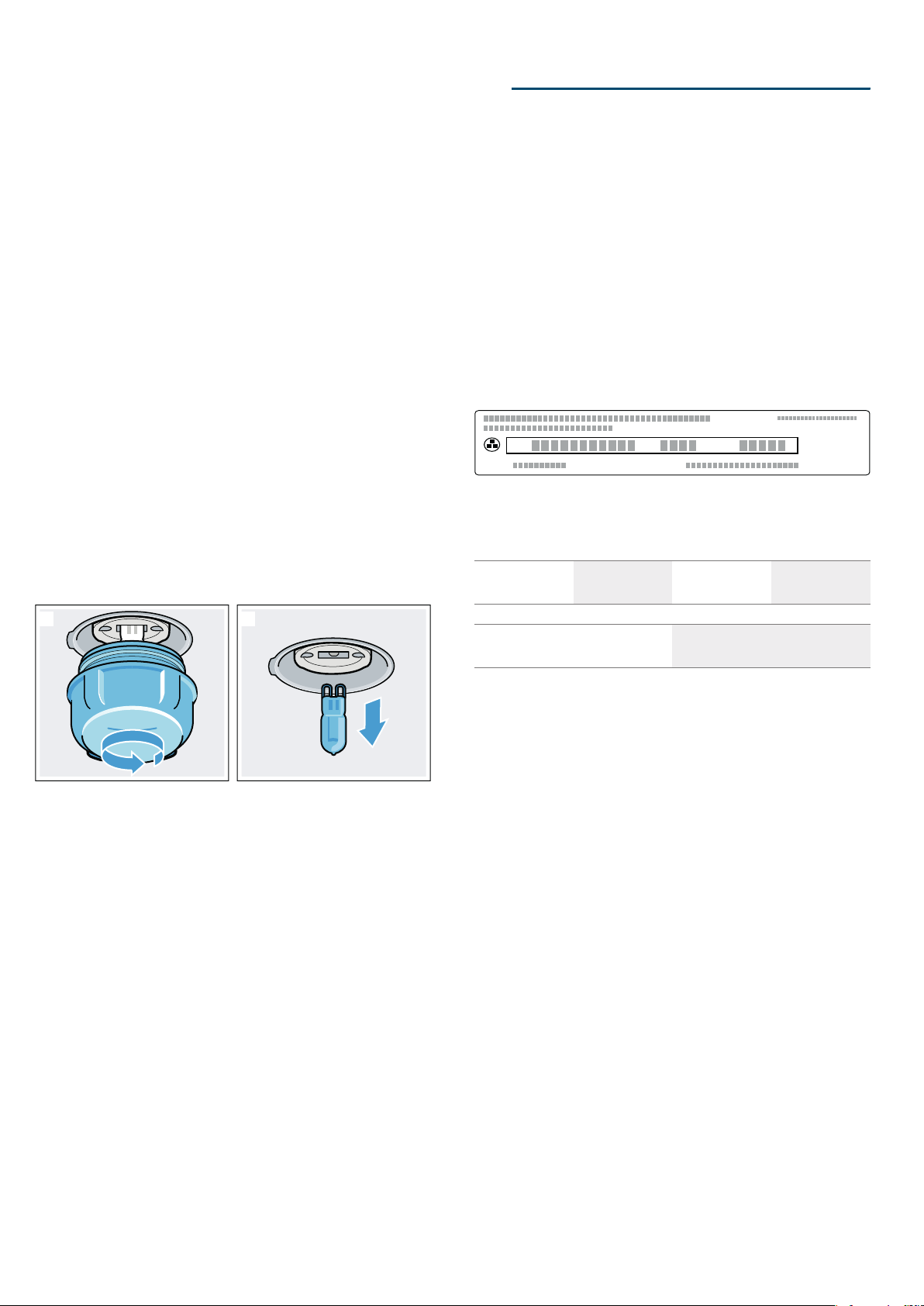
en Trouble shooting
32
--------
:Warning – Risk of injury!
Incorrect repairs are dangerous. Do not attempt to
repair the appliance yourself. Repairs must only be
carried out by one of our trained after-sales engineers. If
the appliance is defective, call the after-sales service.
:Warning – Risk of electric shock!
Incorrect repairs are dangerous. Repairs may only be
carried out and damaged power cables replaced by
one of our trained after-sales technicians. If the
appliance is defective, unplug the appliance from the
mains or switch off the circuit breaker in the fuse box.
Contact the after-sales service.
Error messages on the display
When an error message appears on the display with "D"
or "E", e.g. D0111 or E0111, switch the appliance off
and on again using the ÿ On/Off button.
If it was a one-off error, the display goes out. If the error
message appears again, call the after-sales service and
quote the exact error message.
Maximum operating time
If you do not change the settings on your appliance for
several hours, the appliance stops heating up
automatically. This prevents unwanted continuous
operation.
The respective settings for the operating mode govern
when the maximum operating time is reached.
Maximum operating time reached
A note appears on the display confirming that the
maximum operating time has been reached.
To continue operation, touch any field or turn the rotary
selector.
Switch the appliance off using the ÿ On/Off button if
you do not need to use it.
Tip: Set a cooking time so that the appliance does not
switch off when you do not want it to, e.g. with an
extremely long preparation time. The appliance heats
up until the set cooking time has elapsed.
The "Fill water tank" message
appears even though the water tank
is full
The panel is open Close the panel
The water tank is not clicked
into place
Click the water tank into place
~ "Steam" on page 18
Faulty sensor Call the after-sales service
The water tank has fallen off.
Due to the impact, compo-
nents inside the water tank
have come loose, and the
tank is leaking.
Order a new water tank
The panel for removing the tank does
not open
The plug is not plugged into
the mains
Connect the appliance to the electricity supply
Power cut Check whether other kitchen appliances are working
The circuit breaker is faulty Check in the fuse box to make sure that the fuse for the appliance is in work-
ing order
v field sensor faulty Call the after-sales service
If required, empty the water tank: Open the appliance door, take hold of the
lower part of the panel on the left and right with your fingers and pull out the
panel
There is a "pop" noise during cooking Cold/warm effect with frozen
food, caused by the steam
Not possible
The appliance will not start and
"Cooking compartment too hot"
appears on the display
The cooking compartment is
too hot for the selected dish
or type of heating
Allow the cooking compartment to cool down and start again
Customer service en
33
Replacing the bulb in the top of the cooking
compartment
If the cooking compartment light bulb fails, it must be
replaced. Heat-resistant, 40 watt, 230 V halogen bulbs
are available from the after-sales service or specialist
retailers.
When handling the halogen bulb, use a dry cloth. This
will increase the service life of the bulb. Only use these
bulbs.
:Warning – Risk of electric shock!
When replacing the cooking compartment bulb, the
bulb socket contacts are live. Before replacing the bulb,
unplug the appliance from the mains or switch off the
circuit breaker in the fuse box.
:Warning – Risk of burns!
The appliance becomes very hot. Never touch the
interior surfaces of the cooking compartment or the
heating elements. Always allow the appliance to cool
down. Keep children at a safe distance.
1. Place a tea towel in the cold cooking compartment
to prevent damage.
2. Turn the glass cover anti-clockwise to remove it
(figure !).
3. Pull out the bulb – do not turn it (figure ").
Insert the new bulb, making sure that the pins are in
the correct position. Push the bulb in firmly.
4. Screw the glass cover back on.
Depending on the appliance model, the glass cover
may have a sealing ring. If the glass cover has a
sealing ring, put it back in place before screwing the
cover back on.
5. Remove the tea towel and switch on the circuit
breaker.
Glass cover
If the glass cover of the halogen bulb is damaged, it
must be replaced. You can obtain a new glass cover
from the after-sales service. Please specify the E
number and FD number of your appliance.
4Customer service
Cus t omer ser vi ce
Our after-sales service is there for you if your appliance
needs to be repaired. We will always find an
appropriate solution, also in order to avoid after-sales
personnel having to make unnecessary visits.
E number and FD number
When calling us, please quote the full product number
(E no.) and the production number (FD no.) so that we
can provide you with the correct advice. The rating plate
bearing these numbers can be found when you open
the appliance door.
On some appliances with a steam-assisted cooking
function, you will find the rating plate behind the control
panel.
To save time, you can make a note of the numbers for
your appliance and the telephone number of the after-
sales service in the space below in case you need
them.
Please note that a visit from an after-sales service
engineer is not free of charge in the event that the
appliance has been misused, even during the warranty
period.
Please find the contact data of all countries in the
enclosed customer service list.
To book an engineer visit and product advice
Rely on the professionalism of the manufacturer. You
can therefore be sure that the repair is carried out by
trained service technicians who carry original spare
parts for your appliances.
2
1
E no.
FD no.
After-sales service O
GB 0344 892 8979
Calls charged at local or mobile rate.
IE 01450 2655
0.03 € per minute at peak. Off peak 0.0088 €
per minute.
=1U)'(1U
7\SH

en Dishes
34
PDishes
Di s hes
With the “AutoCook” operating mode, you can cook a
wide range of dishes. The appliance selects most
settings for you automatically.
To achieve good results, the cooking compartment
must not be too hot for the type of food you have
selected. If it is, a message will appear on the display.
Allow the cooking compartment to cool down and start
again.
Information on the setting
■ The cooking result depends on the quality of the
food and the type of cookware. For an optimal
cooking result, use food that is in good condition
and chilled meat only.
■ The appliance chooses the optimal heating mode
and the time and temperature setting for you. You
will only be asked to enter the weight. It is not
possible to set weights outside of the intended
weight range.
■ When roasting dishes for which the appliance will
apply the temperature selection for you,
temperatures of up to 300 °C can be saved.
Therefore, make sure that you use cookware that is
sufficiently heat resistant.
■ Information is provided, e.g. on cookware, shelf
position or the addition of liquid when cooking meat.
Some food requires turning or stirring, etc., during
cooking. This is shown on the display shortly after
operation starts. An audible signal will remind you at
the right time.
■ Information on the right kind of cookware to use and
tips and tricks for the preparation can be found at
the end of the instruction manual.
Steam-assisted cooking
For some food, the steam function is automatically
activated. General information on the steam function
can be found in the relevant section. ~ "Steam"
on page 18
:Warning – Risk of scalding!
When you open the appliance door, hot steam can
escape. Steam may not be visible, depending on its
temperature. When opening, do not stand too close to
the appliance. Open the appliance door carefully. Keep
children away.
Selecting a dish
The dishes are arranged in a uniform structure:
■ Category
■ Food
■ Dish
The following table lists the categories with the
corresponding food. One or more dishes are listed
beside each food.
Applying settings for dishes
You will be guided through the entire setting process for
your chosen food.
1. Touch the % field.
The first dish is highlighted white in the display.
2. Turn the rotary selector to set the required dish.
3. Touch the a field.
The weight is highlighted white in the display.
4. Turn the rotary selector to set the weight of your
dish.
The cooking time is calculated automatically.
5. Confirm using the l Start/Stop button.
A note appears on accessories and shelf position.
6. Press the l Start/Stop button to start.
The cooking time counts down on the display. The
heating line does not appear for dishes.
The appliance begins to heat up.
Once the cooking time has elapsed, an audible signal
sounds. The appliance stops heating.
When your dish is ready, switch off the appliance using
the ÿ On/Off button.
Continue cooking
After the cooking time has ended, you can leave some
dishes to continue cooking if you are not satisfied with
the cooking result.
A query appears on the display, which asks if you want
to continue cooking. If you want to continue cooking,
press the l Start/Stop button. A cooking time is
suggested, which can be changed. Press the l Start/
Stop button to start.
Note: You can extend the cooking time as often as
required.
When you are satisfied with the cooking result, touch
the % field.
Press the ÿ On/Off button to switch off the appliance.
Dishes
Fatless sponge cake
Plaited loaf, savarin
Wheat bread on a baking tray
Flatbread
Chicken, unstuffed
Chicken portions
Duck, unstuffed
Pork neck joint, boned
Leg of lamb, boned, well-done
Meat loaf made from fresh minced meat
Fish, whole
Steam fish fillet
Reheat plated meal

en Dishes
34
PDishes
Di s hes
With the “AutoCook” operating mode, you can cook a
wide range of dishes. The appliance selects most
settings for you automatically.
To achieve good results, the cooking compartment
must not be too hot for the type of food you have
selected. If it is, a message will appear on the display.
Allow the cooking compartment to cool down and start
again.
Information on the setting
■ The cooking result depends on the quality of the
food and the type of cookware. For an optimal
cooking result, use food that is in good condition
and chilled meat only.
■ The appliance chooses the optimal heating mode
and the time and temperature setting for you. You
will only be asked to enter the weight. It is not
possible to set weights outside of the intended
weight range.
■ When roasting dishes for which the appliance will
apply the temperature selection for you,
temperatures of up to 300 °C can be saved.
Therefore, make sure that you use cookware that is
sufficiently heat resistant.
■ Information is provided, e.g. on cookware, shelf
position or the addition of liquid when cooking meat.
Some food requires turning or stirring, etc., during
cooking. This is shown on the display shortly after
operation starts. An audible signal will remind you at
the right time.
■ Information on the right kind of cookware to use and
tips and tricks for the preparation can be found at
the end of the instruction manual.
Steam-assisted cooking
For some food, the steam function is automatically
activated. General information on the steam function
can be found in the relevant section. ~ "Steam"
on page 18
:Warning – Risk of scalding!
When you open the appliance door, hot steam can
escape. Steam may not be visible, depending on its
temperature. When opening, do not stand too close to
the appliance. Open the appliance door carefully. Keep
children away.
Selecting a dish
The dishes are arranged in a uniform structure:
■ Category
■ Food
■ Dish
The following table lists the categories with the
corresponding food. One or more dishes are listed
beside each food.
Applying settings for dishes
You will be guided through the entire setting process for
your chosen food.
1. Touch the % field.
The first dish is highlighted white in the display.
2. Turn the rotary selector to set the required dish.
3. Touch the a field.
The weight is highlighted white in the display.
4. Turn the rotary selector to set the weight of your
dish.
The cooking time is calculated automatically.
5. Confirm using the l Start/Stop button.
A note appears on accessories and shelf position.
6. Press the l Start/Stop button to start.
The cooking time counts down on the display. The
heating line does not appear for dishes.
The appliance begins to heat up.
Once the cooking time has elapsed, an audible signal
sounds. The appliance stops heating.
When your dish is ready, switch off the appliance using
the ÿ On/Off button.
Continue cooking
After the cooking time has ended, you can leave some
dishes to continue cooking if you are not satisfied with
the cooking result.
A query appears on the display, which asks if you want
to continue cooking. If you want to continue cooking,
press the l Start/Stop button. A cooking time is
suggested, which can be changed. Press the l Start/
Stop button to start.
Note: You can extend the cooking time as often as
required.
When you are satisfied with the cooking result, touch
the % field.
Press the ÿ On/Off button to switch off the appliance.
Dishes
Fatless sponge cake
Plaited loaf, savarin
Wheat bread on a baking tray
Flatbread
Chicken, unstuffed
Chicken portions
Duck, unstuffed
Pork neck joint, boned
Leg of lamb, boned, well-done
Meat loaf made from fresh minced meat
Fish, whole
Steam fish fillet
Reheat plated meal
Tested for you in our cooking studio en
35
Setting a later end time
You can set a later end time for some dishes. Before
starting the appliance, touch the s field and set a later
end time using the rotary selector.
The appliance switches to standby after it is started. The
end time can no longer be changed.
Changing and cancelling
After starting the appliance, the settings can no longer
be changed.
If you would like to cancel the operation, switch the
appliance off using the ÿ On/Off button. You can no
longer pause the operation using the l Start/Stop
button.
JTested for you in our
cooking studio
Test ed f or y ou in our cook i ng s t udi o
Here, you can find a selection of dishes and the ideal
settings for them. We will show you which type of
heating and temperature are best suited to your dish.
You will get information on suitable cooking
accessories and the height at which they should be
placed in the oven. You will also get tips about
cookware and preparation methods.
Note: A lot of steam can build up in the cooking
compartment when cooking food.
Your appliance is very energy-efficient and radiates very
little heat to its surroundings during operation. Due to
the high difference in temperature between the
appliance interior and the external parts of the
appliance, condensation may build up on the door,
control panel or adjacent kitchen cabinet panels. This is
a normal physical phenomenon. Condensation can be
reduced by preheating the oven or opening the door
carefully.
During operation with steam assistance, it is desirable
that there is a significant build-up of steam in the
cooking compartment. Wipe the cooking compartment
clean after cooking, once it has cooled off.
Silicone moulds
We recommend dark-coloured metal baking tins for
ideal cooking results.
Nevertheless, if you wish to use silicone moulds, follow
the manufacturer's instructions and recipes. Silicone
moulds are often smaller than normal baking tins.
Quantity and recipe specifications may vary.
Silicone moulds are unsuitable for steam-assisted
cooking.
Baking
Here, you can find recommended settings for many
dishes.
Also refer to the notes in the section on allowing dough
to rise.
Only use original accessories supplied with your
appliance. These have been tailored to the cooking
compartment and the operating modes of your
appliance.
Steam- assisted baking
Certain types of baked item (e.g. yeast-risen pastries)
get a more crispy crust and a more glossy surface if
baked with the steam assist mode. The baked item
does not dry out as much.
Steam-assisted baking is only possible on one level.
Some food turns out better if it is baked in several
stages. These dishes are indicated in the table.

en Tested for you in our cooking studio
36
Shelf positions
Use the indicated shelf positions.
Baking on one level
When baking on one level, use the following shelf
positions:
■ Tall baked items: Level 2
■ Flat baked items: Level 3
If you are using 4D Hot air as the type of heating, you
can choose between levels 1, 2, 3 and 4.
You can also prepare soufflés in a water bath in the
universal pan. To do so, slide the universal pan in at
level 2.
Baking on two levels
Use 4D hot air. Baked items that are placed into the
oven on trays or in baking tins/dishes at the same time
will not necessarily be ready at the same time.
■ Universal pan: Level 3
Baking tray: Level 1
■ Baking tins/dishes on the wire rack
First wire rack: Level 3
Second wire rack: Level 1
By preparing several dishes at the same time, you can
make energy savings of up to 45 per cent. Position
baking tins/dishes next to one another or offset and
vertically stacked in the cooking compartment.
Accessories
Ensure that you always use suitable accessories and
that they are placed in the oven the right way around.
Wire rack
Insert the wire rack with the open side facing the
appliance door and the curved lip pointing downwards.
Always place ovenware, tins and dishes on the wire
rack.
Universal pan or baking tray
Slide the universal pan or the baking tray in carefully as
far as the limit stop with the bevelled edge facing the
appliance door.
When baking moist cakes or pastries with many
toppings, use the universal pan so that any excess
liquid does not overflow and make the cooking
compartment dirty.
Baking tins
Dark- coloured metal baking tins are most suitable.
Tinplate baking tins, ceramic dishes and glass dishes
extend baking time and mean that the baked item will
not brown evenly. If you wish to bake using these
baking tins/dishes and using top/bottom heating, slide
in the tin/dish at level 1.
The baking tins must be resistant to heat and steam for
use in steam-assisted baking.
Greaseproof paper
Only use greaseproof paper that is suitable for the
selected temperature. Always cut greaseproof paper to
size.
Recommended setting values
The table lists the optimal heating type for various
baked items. The temperature and baking time depend
on the amount and consistency of the dough/mixture.
For this reason, the table specifies setting ranges. Try
using the lower values to start with. A lower temperature
will result in more even browning. You can use a higher
setting next time if necessary.
Note: Baking times cannot be reduced by using higher
temperatures. Cakes or small baked items would only
be cooked on the outside, and would not be fully baked
in the middle.
The setting values apply to food that is placed into a
cold cooking compartment; by doing this, you can
make energy savings of up to 20 per cent.If you preheat
the oven, you can reduce the indicated baking times by
several minutes.
Preheating is necessary for selected food, and this is
indicated in the table. Do not place your food or
accessories into the cooking compartment until it has
finished preheating.
If you wish to follow one of your own recipes when
baking, you should use the setting values listed for
similar baked items in the table as reference.Additional
information can be found in the baking tips listed after
the settings table.
Remove unused accessories from the cooking
compartment. This will ensure that you achieve the best
possible cooking results and energy savings of up to
20 per cent.
Types of heating used:
■ < 4D hot air
■ % Top/bottom heating
■ $ Pizza setting
The levels of steam intensity are indicated as numbers
in the table:
■ 1 = Low
■ 2 = Medium
■ 3 = High
Dish Accessories/cookware Shelf po-
sition
Type of
heating
Tempera-
ture in °C
Steam in-
tensity
Cooking
time in mins.
One level baking
Victoria sponge cake 2x Ø20 cm tins 2 < 160-170* - 20-25
Victoria sponge cake 2x Ø20 cm tins 2 < 150-160 1 25-35
Light fruit cake high Ø20 cm tin 2 < 140-160 - 70-90
Light fruit cake high Ø20 cm tin 2 < 140-150 1 90-100
* Preheat

en Tested for you in our cooking studio
36
Shelf positions
Use the indicated shelf positions.
Baking on one level
When baking on one level, use the following shelf
positions:
■ Tall baked items: Level 2
■ Flat baked items: Level 3
If you are using 4D Hot air as the type of heating, you
can choose between levels 1, 2, 3 and 4.
You can also prepare soufflés in a water bath in the
universal pan. To do so, slide the universal pan in at
level 2.
Baking on two levels
Use 4D hot air. Baked items that are placed into the
oven on trays or in baking tins/dishes at the same time
will not necessarily be ready at the same time.
■ Universal pan: Level 3
Baking tray: Level 1
■ Baking tins/dishes on the wire rack
First wire rack: Level 3
Second wire rack: Level 1
By preparing several dishes at the same time, you can
make energy savings of up to 45 per cent. Position
baking tins/dishes next to one another or offset and
vertically stacked in the cooking compartment.
Accessories
Ensure that you always use suitable accessories and
that they are placed in the oven the right way around.
Wire rack
Insert the wire rack with the open side facing the
appliance door and the curved lip pointing downwards.
Always place ovenware, tins and dishes on the wire
rack.
Universal pan or baking tray
Slide the universal pan or the baking tray in carefully as
far as the limit stop with the bevelled edge facing the
appliance door.
When baking moist cakes or pastries with many
toppings, use the universal pan so that any excess
liquid does not overflow and make the cooking
compartment dirty.
Baking tins
Dark- coloured metal baking tins are most suitable.
Tinplate baking tins, ceramic dishes and glass dishes
extend baking time and mean that the baked item will
not brown evenly. If you wish to bake using these
baking tins/dishes and using top/bottom heating, slide
in the tin/dish at level 1.
The baking tins must be resistant to heat and steam for
use in steam-assisted baking.
Greaseproof paper
Only use greaseproof paper that is suitable for the
selected temperature. Always cut greaseproof paper to
size.
Recommended setting values
The table lists the optimal heating type for various
baked items. The temperature and baking time depend
on the amount and consistency of the dough/mixture.
For this reason, the table specifies setting ranges. Try
using the lower values to start with. A lower temperature
will result in more even browning. You can use a higher
setting next time if necessary.
Note: Baking times cannot be reduced by using higher
temperatures. Cakes or small baked items would only
be cooked on the outside, and would not be fully baked
in the middle.
The setting values apply to food that is placed into a
cold cooking compartment; by doing this, you can
make energy savings of up to 20 per cent.If you preheat
the oven, you can reduce the indicated baking times by
several minutes.
Preheating is necessary for selected food, and this is
indicated in the table. Do not place your food or
accessories into the cooking compartment until it has
finished preheating.
If you wish to follow one of your own recipes when
baking, you should use the setting values listed for
similar baked items in the table as reference.Additional
information can be found in the baking tips listed after
the settings table.
Remove unused accessories from the cooking
compartment. This will ensure that you achieve the best
possible cooking results and energy savings of up to
20 per cent.
Types of heating used:
■ < 4D hot air
■ % Top/bottom heating
■ $ Pizza setting
The levels of steam intensity are indicated as numbers
in the table:
■ 1 = Low
■ 2 = Medium
■ 3 = High
Dish Accessories/cookware Shelf po-
sition
Type of
heating
Tempera-
ture in °C
Steam in-
tensity
Cooking
time in mins.
One level baking
Victoria sponge cake 2x Ø20 cm tins 2 < 160-170* - 20-25
Victoria sponge cake 2x Ø20 cm tins 2 < 150-160 1 25-35
Light fruit cake high Ø20 cm tin 2 < 140-160 - 70-90
Light fruit cake high Ø20 cm tin 2 < 140-150 1 90-100
* Preheat
Tested for you in our cooking studio en
37
Rich fruit cake high Ø23 cm tin 2 < 130-150 - 150-180
Fruit crumble flat glass dish 3 < 150-170* - 35-45
Sponge Cake (fatless), 3 eggs springform cake tin Ø26 cm 2 < 160-170* - 25-35
Sponge Cake (fatless), 3 eggs springform cake tin Ø26 cm 2 < 150-160 1 10
- 20-25
Sponge flan, 6 eggs springform cake tin Ø28 cm 2 < 150-170* - 30-50
Sponge flan, 6 eggs springform cake tin Ø28 cm 2 < 150-160 1 10
- 30-35
Swiss roll swiss roll tin 3 < 180-190* - 10-15
Swiss roll swiss roll tin 3 < 180-190* 1 10-15
Fruit Pie plate Ø20 cm or pie tin 2 $ 160-170 - 55-65
Quiche quiche tin (dark coated) 3 $ 190-210 - 30-40
(White) Bread loaf tin (1x 900 g or 2x 450 g) 2 < 180-200* - 20-30
(White) Bread loaf tin (1x 900 g or 2x 450 g) 2 < 190-200 2 30-40
Scones baking tray 3 < 180-200* - 10-14
Biscuits baking tray 3 < 140-160* - 10-25
Small Cakes 12-cup-tin 3 < 140-160* - 20-30
Puff pastry slices baking tray 3 < 170-190* - 20-35
Puff pastry slices baking tray 3 < 200-220* 1 15-25
Jam tarts 12-cup-tin 3 < 170-190* - 15-30
Meringue baking tray 3 < 80-90* - 120-150
Pavlova baking tray 3 < 90-100* - 120-180
Soufflé 1,2L-soufflé dish 2 < 160-170* - 35-45
Soufflé 1,2L-soufflé dish 2 < 160-180 2 35-45
Soufflé individual moulds 2 % 170-190 - 65-75
Choux pastry baking tray 3 < 190-210* - 30-40
Choux pastry baking tray 3 < 200-220* 1 25-35
Meat Pie rectangular pie tin 2 < 180-190 - 40-50
Meat Pie rectangular pie tin 2 < 170-180 2 40-50
Yorkshire pudding 12-cup-tin 3 < 200-220* - 15-25
Jacket potatoes baking tray 3 < 150-170 - 75-90
Jacket potatoes universal pan 3 < 180-190 2 40-50
Pizza, homemade baking tray 3 $ 200-220 - 25-35
Pizza, homemade, thin base pizza tray 2 % 250-270 - 20-25
Pizza, homemade, thin base pizza tray 2 $ 210-220 - 25-30
Multishelf baking
Victoria Sponge Cake, 2 levels 4x Ø20 cm tins 3+1 < 160-170* - 25-35
Scones, 2 levels 2 baking trays 3+1 < 170-190* - 12-16
Biscuits, 2 levels 2 baking trays 3+1 < 140-160* - 10-25
Biscuits, 3 levels 3 baking trays 5+3+1 < 140-160* - 15-30
Small cakes, 2 levels 2x 12-cup-tins 3+1 < 140-160* - 22-32
Puff pastry slices, 2 levels 2 baking trays 3+1 < 170-190* - 25-45
Puff pastry slices, 3 levels 3 baking trays 5+3+1 < 170-190* - 25-45
Jam tarts, 2 levels 2x 12-cup-tins 3+1 < 170-190* - 20-35
Meringues, 2 levels 2 baking trays 3+1 < 80-90* - 120-150
Dish Accessories/cookware Shelf po-
sition
Type of
heating
Tempera-
ture in °C
Steam in-
tensity
Cooking
time in mins.
* Preheat

en Tested for you in our cooking studio
38
Tips on baking
Roasting and braising
Here, you can find information on roasting and braising
poultry and meat. You can find the ideal settings for
many dishes in the settings tables.
Poultry
For duck or goose, pierce the skin on the underside of
the wings. This allows the fat to run out.
If using duck breast, score the skin. Do not turn duck
breasts.
When you turn poultry, ensure that the breast side or
the skin side is underneath at first.
Poultry will turn out particularly crispy and brown if you
baste it towards the end of the roasting time with butter,
salted water or orange juice.
Meat
Baste lean meat with fat as required or cover it with
strips of bacon.
Score the rind crosswise. If you turn the joint when
cooking, ensure that the rind is underneath at first.
When the joint is ready, turn off the oven and allow it to
rest for another 10 minutes in the cooking
compartment. This allows the meat juices to be better
distributed. Wrap the joint in aluminium foil if necessary.
The recommended resting time is not included in the
cooking time indicated.
Jacket potatoes, 2 levels universal pan + baking tray 3+1 < 150-170* - 75-90
(White) Bread, 2 levels 4x loaf tins 3+1 < 170-190* - 30-40
Pizza, homemade, 2 levels universal pan + baking tray 3+1 < 180-200 - 35-45
Dish Accessories/cookware Shelf po-
sition
Type of
heating
Tempera-
ture in °C
Steam in-
tensity
Cooking
time in mins.
* Preheat
You want to find out whether the cake
is completely cooked in the middle.
Push a cocktail stick into the highest point on the cake. If the cocktail stick comes out clean with no dough res-
idue, the cake is ready.
The cake collapses. Next time, use less liquid. Alternatively, set the temperature to be 10 °C lower and extend the baking time.
Adhere to the specified ingredients and preparation instructions in the recipe.
The cake has risen in the middle but
is lower around the edge.
Only grease the base of the springform cake tin. After baking, loosen the cake carefully with a knife.
The fruit juice overflows. Next time, use the universal pan.
Small baked items stick to one
another during baking.
There should be a gap of approx. 2 cm around each item. This gives enough space for the baked items to
expand well and brown on all sides.
The cake is too dry. Set the temperature 10 °C higher and shorten the baking time.
The cake is generally too light in col-
our.
If the shelf position and the cookware are correct, then you should increase the temperature if necessary or
extend the baking time.
The cake is too light on top, and too
dark underneath.
Bake the cake one level higher in the oven the next time.
The cake is too dark on top, and too
light underneath.
Bake the cake one level lower in the oven the next time. Select a lower temperature and extend the baking
time.
Cakes baked in a tray or tin are too
brown at the back.
Place the baking tray in the middle of the accessories, not directly against the back wall.
The whole cake is too dark. Select a lower temperature next time and extend the baking time if necessary.
The cake is unevenly browned. Select a slightly lower temperature.
Protruding greaseproof paper can affect the air circulation. Always cut greaseproof paper to size.
Ensure that the baking tin does not stand directly in front of the openings in the cooking compartment back
wall.
When baking small items, you should use similar sizes and thicknesses wherever possible.
You were baking on several levels.
The items on the top baking tray are
darker than those on the lower baking
tray.
Always select 4D hot air when baking on several levels. Baked items that are placed into the oven on trays or
in baking tins/dishes at the same time will not necessarily be ready at the same time.
The cake looks good, but is not
cooked properly in the middle.
Use a lower temperature and bake slightly longer; if necessary, add slightly less liquid. For cakes with a moist
topping, bake the base first. Sprinkle it with almonds or breadcrumbs and then place the topping on top.
The cake cannot be turned out of the
dish when it is turned upside down.
Allow the cake to cool down for 5 to 10 minutes after baking. If it still sticks, carefully loosen the cake around
the edges again using a knife. Turn the cake tin upside down again and cover it several times with a cold, wet
cloth. Next time, grease the baking tin/dish and sprinkle with breadcrumbs.

en Tested for you in our cooking studio
38
Tips on baking
Roasting and braising
Here, you can find information on roasting and braising
poultry and meat. You can find the ideal settings for
many dishes in the settings tables.
Poultry
For duck or goose, pierce the skin on the underside of
the wings. This allows the fat to run out.
If using duck breast, score the skin. Do not turn duck
breasts.
When you turn poultry, ensure that the breast side or
the skin side is underneath at first.
Poultry will turn out particularly crispy and brown if you
baste it towards the end of the roasting time with butter,
salted water or orange juice.
Meat
Baste lean meat with fat as required or cover it with
strips of bacon.
Score the rind crosswise. If you turn the joint when
cooking, ensure that the rind is underneath at first.
When the joint is ready, turn off the oven and allow it to
rest for another 10 minutes in the cooking
compartment. This allows the meat juices to be better
distributed. Wrap the joint in aluminium foil if necessary.
The recommended resting time is not included in the
cooking time indicated.
Jacket potatoes, 2 levels universal pan + baking tray 3+1 < 150-170* - 75-90
(White) Bread, 2 levels 4x loaf tins 3+1 < 170-190* - 30-40
Pizza, homemade, 2 levels universal pan + baking tray 3+1 < 180-200 - 35-45
Dish Accessories/cookware Shelf po-
sition
Type of
heating
Tempera-
ture in °C
Steam in-
tensity
Cooking
time in mins.
* Preheat
You want to find out whether the cake
is completely cooked in the middle.
Push a cocktail stick into the highest point on the cake. If the cocktail stick comes out clean with no dough res-
idue, the cake is ready.
The cake collapses. Next time, use less liquid. Alternatively, set the temperature to be 10 °C lower and extend the baking time.
Adhere to the specified ingredients and preparation instructions in the recipe.
The cake has risen in the middle but
is lower around the edge.
Only grease the base of the springform cake tin. After baking, loosen the cake carefully with a knife.
The fruit juice overflows. Next time, use the universal pan.
Small baked items stick to one
another during baking.
There should be a gap of approx. 2 cm around each item. This gives enough space for the baked items to
expand well and brown on all sides.
The cake is too dry. Set the temperature 10 °C higher and shorten the baking time.
The cake is generally too light in col-
our.
If the shelf position and the cookware are correct, then you should increase the temperature if necessary or
extend the baking time.
The cake is too light on top, and too
dark underneath.
Bake the cake one level higher in the oven the next time.
The cake is too dark on top, and too
light underneath.
Bake the cake one level lower in the oven the next time. Select a lower temperature and extend the baking
time.
Cakes baked in a tray or tin are too
brown at the back.
Place the baking tray in the middle of the accessories, not directly against the back wall.
The whole cake is too dark. Select a lower temperature next time and extend the baking time if necessary.
The cake is unevenly browned. Select a slightly lower temperature.
Protruding greaseproof paper can affect the air circulation. Always cut greaseproof paper to size.
Ensure that the baking tin does not stand directly in front of the openings in the cooking compartment back
wall.
When baking small items, you should use similar sizes and thicknesses wherever possible.
You were baking on several levels.
The items on the top baking tray are
darker than those on the lower baking
tray.
Always select 4D hot air when baking on several levels. Baked items that are placed into the oven on trays or
in baking tins/dishes at the same time will not necessarily be ready at the same time.
The cake looks good, but is not
cooked properly in the middle.
Use a lower temperature and bake slightly longer; if necessary, add slightly less liquid. For cakes with a moist
topping, bake the base first. Sprinkle it with almonds or breadcrumbs and then place the topping on top.
The cake cannot be turned out of the
dish when it is turned upside down.
Allow the cake to cool down for 5 to 10 minutes after baking. If it still sticks, carefully loosen the cake around
the edges again using a knife. Turn the cake tin upside down again and cover it several times with a cold, wet
cloth. Next time, grease the baking tin/dish and sprinkle with breadcrumbs.
Tested for you in our cooking studio en
39
Roasting on the wire rack
On the wire rack, poultry and meat will become very
crispy on all sides. Roasting on the wire rack is well
suited for larger poultry or for multiple pieces at the
same time.
Depending on the size and type of the meat, add up to
^ litres of water to the universal pan. Any dripping fat
and meat juices will be caught. You can prepare a
sauce using these meat juices. In addition, less smoke
is generated, and the cooking compartment stays
cleaner.
Slide the universal pan into the oven at the indicated
shelf position with the wire rack attached. Ensure that
the wire rack is correctly positioned on the universal
pan. ~ "Accessories" on page 12
Roasting and braising in cookware
It is more convenient to roast and braise meat in
cookware. You can take the joint out of the cooking
compartment more easily in the cookware, and prepare
the sauce in the cookware itself.
Only use cookware which is suitable for use in an oven.
Check whether the cookware fits in the cooking
compartment.
Glass cookware is most suitable. Place hot glass
cookware onto a dry mat after cooking. If the surface is
damp or cold, the glass may crack.
Add in a little liquid for roasting if the meat is lean. A
covering of approx. ^ cm depth should be applied to
the base of any glass cookware.
The amount of liquid is dependent on the type of meat,
the cookware material and also on whether or not a lid
is used. If preparing meat in an enamelled or dark metal
roasting dish, it will need a little more liquid than if
cooked in glass cookware.
The steam evaporates in the cookware when roasting.
Carefully pour in more liquid if required.
Shiny roasting dishes made from stainless steel or
aluminium reflect heat like a mirror and are therefore
not particularly suitable. The meat cooks more slowly
and will not brown so much. Use a higher temperature
and/or a longer cooking time.
Observe the manufacturer's instructions for your
roasting cookware.
Roasting in uncovered cookware
It is best to use a deep roasting tin/dish for roasting
poultry and meat. Place the tin/dish onto the wire rack.
If you do not have any suitable cookware, use the
universal pan.
Braising in covered cookware
When preparing food with covered cookware, the
cooking compartment remains considerably cleaner.
Ensure that the lid fits well and closes properly. Place
the cookware onto the wire rack.
The distance between the meat and the lid must be at
least 3 cm. The meat may rise.
Very hot steam may escape when opening the lid after
cooking. Lift the lid at the rear, so that the hot steam
can escape away from you.
If necessary, braise the meat first by searing it. Add
water, wine, vinegar or a similar liquid to the braising
liquid. A covering at least 2 cm deep should be applied
to the base of the cookware.
The steam evaporates in the cookware when roasting.
Carefully pour in more liquid if required.
Steam- assisted roasting and braising
Certain dishes become crispier if cooked using steam,
and do not dry out as much.
Use uncovered cookware. Cookware must be heat- and
steam-resistant.
The joints do not have to be turned.
Use steam-assisted cooking if it is indicated in the
settings table. Some dishes turn out best if they are
cooked in several stages. These are indicated in the
table.
Meat thermometer
You can cook accurately using a meat thermometer.
Read important notes on using the meat thermometer in
the corresponding chapter. There, you can find notes
on inserting the meat thermometer, the possible heating
types and additional information.
Recommended setting values
In the table, you can find the ideal heating type for
poultry and meat. Temperature and cooking time
depend on the quantity, composition and temperature
of the food. Different settings ranges are indicated for
this reason. Try using the lower values at first. You can
increase the temperature next time if necessary.
The setting values are based on the assumption that
unstuffed, chilled, ready-to-roast poultry and meat are
placed into a cold cooking compartment. By doing so,
you can make energy savings of up to 20 per cent. If
you preheat the oven, the indicated cooking times will
be reduced by several minutes.
In the table, you can find specifications for poultry and
meat with default values for the weight. If you wish to
prepare heavier poultry or meat, use the lower
temperature in every case. If roasting several joints, use
the weight of the heaviest piece as a basis for
determining the cooking time. The individual pieces
should be approximately equal in size.
A general rule: the larger the poultry or piece of meat is,
the lower the cooking temperature and the longer the
cooking time.
Turn the poultry and meat after approx. ^ to Z of the
indicated time.
Remove unused accessories from the cooking
compartment. This will achieve the best possible
cooking results and energy savings of up to 20 per
cent.
Cooking time calculation (e. g. 20+35):
Please calculate the cooking time with 20 minutes per
500 g meat + 35 minutes additional time. For 1,5 kg
the calculated cooking time would be 95 minutes.
Cooking time range (e. g. 10-15):
The food is done within the stated minutes.

en Tested for you in our cooking studio
40
Type of heating used:
■ < 4D hot air
The levels of steam intensity are indicated as numbers
in the table:
■ 1 = Low
■ 2 = Medium
■ 3 = High
Dish Accessories/cookware Shelf po-
sition
Type of
heating
Tempera-
ture in °C
Steam in-
tensity
Time in min.
Beef
Slow roasting joint wire rack 2 < 140-150 - 35+40
Slow roasting joint, 1.5 kg wire rack 2 < 130-140 1 70-80
- 40-50
Top side / Top rump wire rack 2 < 160-170 - 30+25
Top side / Top rump, 1.5 kg wire rack 2 < 170-180 1 100-120
Lamb
Leg (bone-in) wire rack 2 < 160-170 - 25+25
Leg (bone-in), 1.5 kg wire rack 2 < 180-190 1 80-90
Shoulder (bone-in) wire rack 2 < 160-170 - 25+20
Shoulder (boned and rolled) wire rack 2 < 170-180 - 25+25
Rack of lamb** wire rack 2 < 180-190* - 15+25
Rack of lamb (each 700 g) wire rack 2 < 200 - 20
170-180 1 25-30
Pork
Roasting joint wire rack 2 < 180-190 - 30+35
Roasting joint, 1.5 kg wire rack 2 < 120 3 30
190-200 - 30
160-170 1 80-100
Loin joint wire rack 2 < 180-190 - 35+35
Loin joint, 1 kg wire rack 2 < 180-190 - 25-30
170-180 1 70-80
Belly wire rack 2 < 170-180 - 30+25
Gammon joint wire rack 2 < 160-170 - 30+30
Gammon joint, 1.5 kg wire rack 2 < 170-180 2 100-120
Poultry
Chicken, whole wire rack 2 < 170-180 - 25+15
Chicken, whole, 1.5 kg wire rack 2 < 180-190 2 65-75
Chicken, portion (each 200-250 g)*** wire rack 2 < 190-200 - 35-45
Chicken, portion (each 200-250 g)*** wire rack 2 < 200-210 2 35-45
Duck wire rack 2 < 180-190 - 25+20
Duck, 2-3 kg wire rack 2 < 160-170 2 70-90
170-180 - 30-40
Turkey, crown**** wire rack 2 < 150-160 - 20+15
Turkey, crown, 3 kg wire rack 2 < 140-150 2 100-140
Turkey, thighs wire rack 2 < 170-180 - 25+30
* Preheat
** Without fat layer (best and neck), do not turn
*** Skin side down
**** Bone side down
***** Turn after app. 1 hour
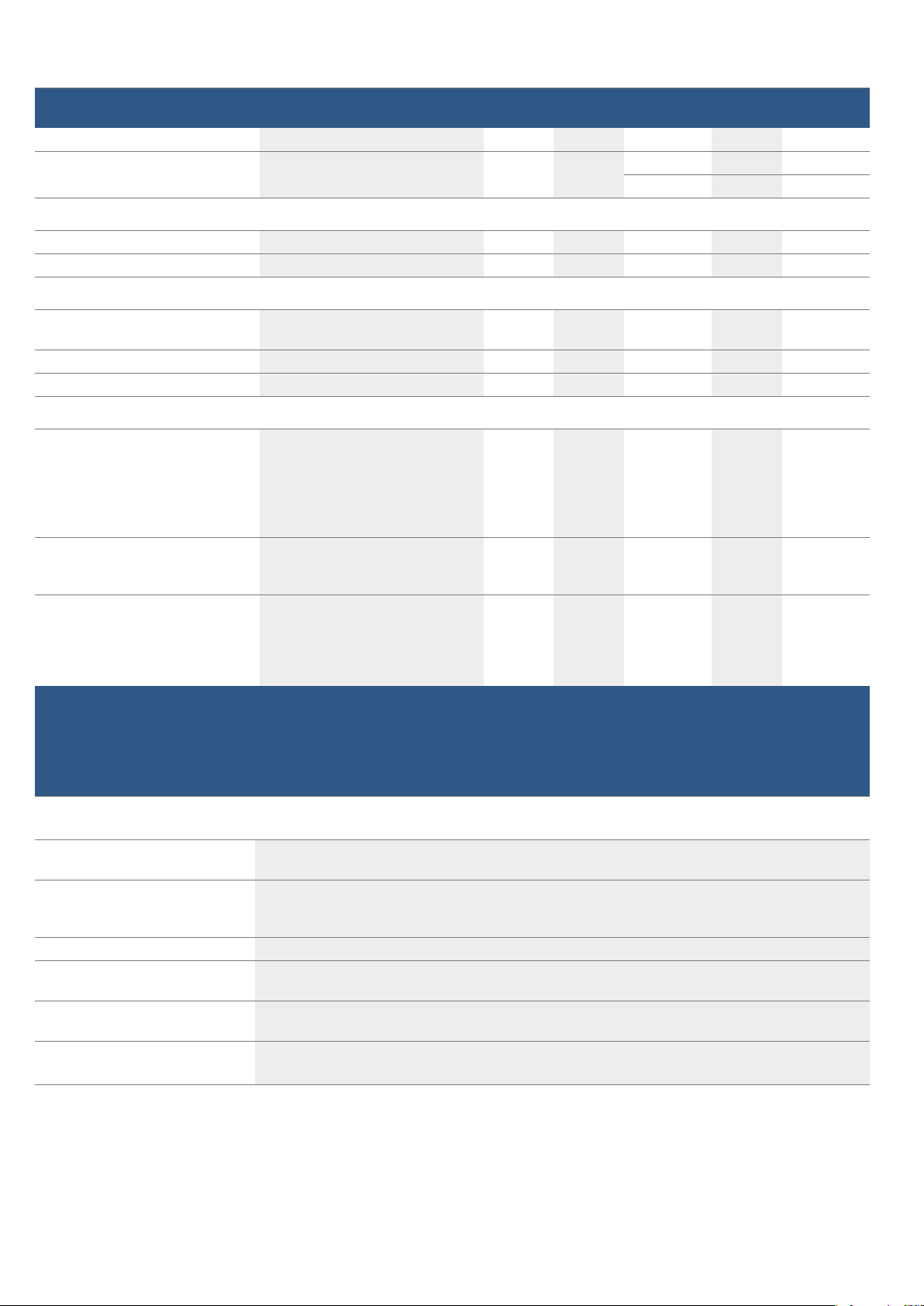
en Tested for you in our cooking studio
40
Type of heating used:
■ < 4D hot air
The levels of steam intensity are indicated as numbers
in the table:
■ 1 = Low
■ 2 = Medium
■ 3 = High
Dish Accessories/cookware Shelf po-
sition
Type of
heating
Tempera-
ture in °C
Steam in-
tensity
Time in min.
Beef
Slow roasting joint wire rack 2 < 140-150 - 35+40
Slow roasting joint, 1.5 kg wire rack 2 < 130-140 1 70-80
- 40-50
Top side / Top rump wire rack 2 < 160-170 - 30+25
Top side / Top rump, 1.5 kg wire rack 2 < 170-180 1 100-120
Lamb
Leg (bone-in) wire rack 2 < 160-170 - 25+25
Leg (bone-in), 1.5 kg wire rack 2 < 180-190 1 80-90
Shoulder (bone-in) wire rack 2 < 160-170 - 25+20
Shoulder (boned and rolled) wire rack 2 < 170-180 - 25+25
Rack of lamb** wire rack 2 < 180-190* - 15+25
Rack of lamb (each 700 g) wire rack 2 < 200 - 20
170-180 1 25-30
Pork
Roasting joint wire rack 2 < 180-190 - 30+35
Roasting joint, 1.5 kg wire rack 2 < 120 3 30
190-200 - 30
160-170 1 80-100
Loin joint wire rack 2 < 180-190 - 35+35
Loin joint, 1 kg wire rack 2 < 180-190 - 25-30
170-180 1 70-80
Belly wire rack 2 < 170-180 - 30+25
Gammon joint wire rack 2 < 160-170 - 30+30
Gammon joint, 1.5 kg wire rack 2 < 170-180 2 100-120
Poultry
Chicken, whole wire rack 2 < 170-180 - 25+15
Chicken, whole, 1.5 kg wire rack 2 < 180-190 2 65-75
Chicken, portion (each 200-250 g)*** wire rack 2 < 190-200 - 35-45
Chicken, portion (each 200-250 g)*** wire rack 2 < 200-210 2 35-45
Duck wire rack 2 < 180-190 - 25+20
Duck, 2-3 kg wire rack 2 < 160-170 2 70-90
170-180 - 30-40
Turkey, crown**** wire rack 2 < 150-160 - 20+15
Turkey, crown, 3 kg wire rack 2 < 140-150 2 100-140
Turkey, thighs wire rack 2 < 170-180 - 25+30
* Preheat
** Without fat layer (best and neck), do not turn
*** Skin side down
**** Bone side down
***** Turn after app. 1 hour
Tested for you in our cooking studio en
41
Tips on roasting and braising
Turkey, whole, 4-8 kg***** wire rack 2 < 150-160 - 12+12
Turkey, whole, 7 kg wire rack 1 < 140-150 2 120-150
170-180 - 30-40
Meat dishes
Meat loaf cookware, uncovered 2 < 170-180 - 20+35
Meat loaf, 1 kg cookware, uncovered 2 < 190-200 1 70-80
Casserole
Diced meat (beef, pork, lamb), 500 g
meat
cookware, covered 2 < 140* - 100-120
Diced chicken (boned), 500 g meat cookware, covered 2 < 140* - 90-100
Braising steak cookware, covered 2 < 140 - 65+60
Complete meal
With beef wire rack + wire rack 4+1 < 160, then
200 (York-
shire Pud-
ding)
- calculation for
meat (see
table above)
+ 15-25 for
Yorkshire
Pudding
With chicken wire rack + wire rack 4+1 < 180 - calculation for
chicken (see
table above)
With chicken, 1.5 kg wire rack + wire rack 4+1 < 180 low (steam
0 when
Yorkshire
Pudding is
inserted)
65-75
Dish Accessories/cookware Shelf po-
sition
Type of
heating
Tempera-
ture in °C
Steam in-
tensity
Time in min.
* Preheat
** Without fat layer (best and neck), do not turn
*** Skin side down
**** Bone side down
***** Turn after app. 1 hour
The cooking compartment becomes
very dirty.
Prepare your food in an enclosed roasting dish with higher temperature or use the grill tray. You will achieve
the best roasting results if you use the grill tray. The grill tray can be bought later as a special accessory.
The roast is too dark and the crack-
ling is burned in places, and/or the
roast is too dry.
Check the shelf position and temperature. Select a lower temperature the next time and reduce the roasting
time if necessary.
The crackling is too thin. Increase the temperature or switch on the grill briefly at the end of the roasting time.
The roast looks good but the juices
are burnt.
Next time, use a smaller roasting dish and add more liquid if necessary.
The roast looks good but the juices
are too clear and watery.
Next time, use a larger roasting dish and add less liquid if necessary.
The meat gets burned during brais-
ing.
The roasting dish and lid must fit together well and close properly.
Reduce the temperature and add more liquid when braising if necessary.

en Tested for you in our cooking studio
42
Grilling
Here, you can find information on grilling poultry, meat
and fish, as well as toast. You can find the ideal settings
for certain dishes in the settings tables.
Grilling with circulated air
Circulated air grilling is very well suited to the
preparation of whole poultry, fish, and also meat, e.g.
roast pork with crackling.
Poultry
For duck or goose, pierce the skin on the underside of
the wings. This allows the fat to run out.
If using duck breast, score the skin. Do not turn duck
breasts.
When you turn poultry, ensure that the breast side or
the skin side is underneath at first.
Poultry will turn out particularly crispy and brown if you
baste it towards the end of the roasting time with butter,
salted water or orange juice.
Meat
Baste lean meat with fat as required or cover it with
strips of bacon.
Score the rind crosswise. If you turn the joint when
cooking, ensure that the rind is underneath at first.
When the joint is ready, turn off the oven and allow it to
rest for another 10 minutes in the cooking
compartment. This allows the meat juices to be better
distributed. Wrap the joint in aluminium foil if necessary.
The recommended resting time is not included in the
cooking time indicated.
Fish
Fish cooked whole does not have to be turned. Place
the whole fish into the cooking compartment in
swimming position with the dorsal fin facing upwards.
Placing half a potato or a small oven-proof container in
the stomach cavity of the fish will provide stability.
You can tell when the fish is cooked because the dorsal
fin can be removed easily.
Roasting on the wire rack
On the wire rack, poultry and meat will become very
crispy on all sides. Roasting on the wire rack is well
suited for larger poultry or for multiple pieces at the
same time.
Depending on the size and type of the meat, add up to
^ litres of water to the universal pan. Any dripping fat
and meat juices will be caught. You can prepare a
sauce using these meat juices. In addition, less smoke
is generated, and the cooking compartment stays
cleaner.
Slide the universal pan into the oven at the indicated
shelf position with the wire rack attached. Ensure that
the wire rack is correctly positioned on the universal
pan. ~ "Accessories" on page 12
Roasting in cookware
It is more convenient to roast and braise meat in
cookware. You can take the joint out of the cooking
compartment more easily in the cookware, and prepare
the sauce in the cookware itself.
Only use cookware which is suitable for use in an oven.
Check whether the cookware fits in the cooking
compartment.
Glass cookware is most suitable. Place hot glass
cookware onto a dry mat after cooking. If the surface is
damp or cold, the glass may crack.
Add in a little liquid if the meat is lean. A covering of
approx. ^ cm depth should be applied to the base of
any glass cookware.
The quantity of liquid is dependent on the type of meat,
the cookware material and also on whether or not a lid
is used. If preparing poultry, meat or fish in an
enamelled or dark metal roasting dish, it will need a
little more liquid than if cooked in glass cookware.
The steam evaporates in the cookware when roasting.
Carefully pour in more liquid if required.
Shiny roasting dishes made from stainless steel or
aluminium reflect heat like a mirror and are therefore
not particularly suitable. The meat cooks more slowly
and will not brown so much. Use a higher temperature
and/or a longer cooking time.
Observe the manufacturer's instructions for your
roasting cookware.
Uncovered cookware
Use a deep roasting tin/dish for roasting meat. Place
the tin/dish onto the wire rack. If you do not have any
suitable cookware, use the universal pan.
Covered cookware
When cooking with covered cookware, the cooking
compartment remains considerably cleaner. Ensure that
the lid fits well and closes properly. Place the cookware
onto the wire rack.
The distance between the meat and the lid must be at
least 3 cm. The meat may rise.
Very hot steam may escape when opening the lid after
cooking. Lift the lid at the rear, so that the hot steam
can escape away from you.
If necessary, braise the meat first by searing it. Add
water, wine, vinegar or a similar liquid to the braising
liquid. A covering approx. 1-2 cm deep should be
applied to the base of the cookware.
The steam evaporates in the cookware when roasting.
Carefully pour in more liquid if required.
Meat can also become crispy in a covered roasting
dish. To do so, use a roasting dish with a glass lid and
set a higher temperature.
Steam- assisted roasting
Certain foodstuffs will become crispier during steam-
assisted cooking. Their surface becomes glossier and
they dry out less.
Use uncovered cookware. Cookware must be heat- and
steam-resistant.
Use steam-assisted cooking if it is indicated in the
settings table. Some dishes turn out best if they are
cooked in several stages. These are indicated in the
table.

en Tested for you in our cooking studio
42
Grilling
Here, you can find information on grilling poultry, meat
and fish, as well as toast. You can find the ideal settings
for certain dishes in the settings tables.
Grilling with circulated air
Circulated air grilling is very well suited to the
preparation of whole poultry, fish, and also meat, e.g.
roast pork with crackling.
Poultry
For duck or goose, pierce the skin on the underside of
the wings. This allows the fat to run out.
If using duck breast, score the skin. Do not turn duck
breasts.
When you turn poultry, ensure that the breast side or
the skin side is underneath at first.
Poultry will turn out particularly crispy and brown if you
baste it towards the end of the roasting time with butter,
salted water or orange juice.
Meat
Baste lean meat with fat as required or cover it with
strips of bacon.
Score the rind crosswise. If you turn the joint when
cooking, ensure that the rind is underneath at first.
When the joint is ready, turn off the oven and allow it to
rest for another 10 minutes in the cooking
compartment. This allows the meat juices to be better
distributed. Wrap the joint in aluminium foil if necessary.
The recommended resting time is not included in the
cooking time indicated.
Fish
Fish cooked whole does not have to be turned. Place
the whole fish into the cooking compartment in
swimming position with the dorsal fin facing upwards.
Placing half a potato or a small oven-proof container in
the stomach cavity of the fish will provide stability.
You can tell when the fish is cooked because the dorsal
fin can be removed easily.
Roasting on the wire rack
On the wire rack, poultry and meat will become very
crispy on all sides. Roasting on the wire rack is well
suited for larger poultry or for multiple pieces at the
same time.
Depending on the size and type of the meat, add up to
^ litres of water to the universal pan. Any dripping fat
and meat juices will be caught. You can prepare a
sauce using these meat juices. In addition, less smoke
is generated, and the cooking compartment stays
cleaner.
Slide the universal pan into the oven at the indicated
shelf position with the wire rack attached. Ensure that
the wire rack is correctly positioned on the universal
pan. ~ "Accessories" on page 12
Roasting in cookware
It is more convenient to roast and braise meat in
cookware. You can take the joint out of the cooking
compartment more easily in the cookware, and prepare
the sauce in the cookware itself.
Only use cookware which is suitable for use in an oven.
Check whether the cookware fits in the cooking
compartment.
Glass cookware is most suitable. Place hot glass
cookware onto a dry mat after cooking. If the surface is
damp or cold, the glass may crack.
Add in a little liquid if the meat is lean. A covering of
approx. ^ cm depth should be applied to the base of
any glass cookware.
The quantity of liquid is dependent on the type of meat,
the cookware material and also on whether or not a lid
is used. If preparing poultry, meat or fish in an
enamelled or dark metal roasting dish, it will need a
little more liquid than if cooked in glass cookware.
The steam evaporates in the cookware when roasting.
Carefully pour in more liquid if required.
Shiny roasting dishes made from stainless steel or
aluminium reflect heat like a mirror and are therefore
not particularly suitable. The meat cooks more slowly
and will not brown so much. Use a higher temperature
and/or a longer cooking time.
Observe the manufacturer's instructions for your
roasting cookware.
Uncovered cookware
Use a deep roasting tin/dish for roasting meat. Place
the tin/dish onto the wire rack. If you do not have any
suitable cookware, use the universal pan.
Covered cookware
When cooking with covered cookware, the cooking
compartment remains considerably cleaner. Ensure that
the lid fits well and closes properly. Place the cookware
onto the wire rack.
The distance between the meat and the lid must be at
least 3 cm. The meat may rise.
Very hot steam may escape when opening the lid after
cooking. Lift the lid at the rear, so that the hot steam
can escape away from you.
If necessary, braise the meat first by searing it. Add
water, wine, vinegar or a similar liquid to the braising
liquid. A covering approx. 1-2 cm deep should be
applied to the base of the cookware.
The steam evaporates in the cookware when roasting.
Carefully pour in more liquid if required.
Meat can also become crispy in a covered roasting
dish. To do so, use a roasting dish with a glass lid and
set a higher temperature.
Steam- assisted roasting
Certain foodstuffs will become crispier during steam-
assisted cooking. Their surface becomes glossier and
they dry out less.
Use uncovered cookware. Cookware must be heat- and
steam-resistant.
Use steam-assisted cooking if it is indicated in the
settings table. Some dishes turn out best if they are
cooked in several stages. These are indicated in the
table.
Tested for you in our cooking studio en
43
Grilling flat pieces
Flat pieces of poultry, meat and fish, such as steaks,
drumsticks and burgers, can be prepared well using the
"Grill" heating type. Excellent results are also achieved
when grilling toast.
Grilling
Keep the appliance door closed when using the grill.
Never grill with the appliance door open.
Place the food to be grilled on the wire rack. In addition,
slide the universal pan in at least one shelf position
lower, with the slanted edge facing the appliance door.
Any dripping fat will be caught.
When grilling, try wherever possible to use pieces of
food which are of a similar thickness and weight. This
will allow them to brown evenly and remain succulent
and juicy. Place the food to be grilled directly onto the
wire rack.
Use tongs to turn the pieces of food you are grilling. If
you pierce the meat with a fork, the juices will run out
and it will become dry.
Do not add salt until after the meat has been grilled.
Salt draws water from the meat.
Notes
■ The grill element switches itself continuously on and
off; this is normal. The grill setting determines how
frequently this occurs.
■ Smoke may be produced when grilling.
Meat thermometer
You can cook accurately using a meat thermometer.
Read important notes on using the meat thermometer in
the corresponding chapter. There, you can find notes
on inserting the meat thermometer, the possible heating
types and additional information.
Recommended setting values
In the table, you can find the ideal heating type for your
poultry, meat and fish, in addition to toast. Temperature
and cooking time depend on the quantity, composition
and temperature of the food. Settings ranges are
indicated for this reason. Try using the lower values at
first. You can use a higher setting next time if
necessary.
The setting values are based on the assumption that
unstuffed, chilled, ready-to-roast poultry, meat and fish
are placed into a cold cooking compartment.
In the table, you can find specifications for poultry, meat
and fish with default values for the weight. If you wish to
prepare heavier poultry, meat or fish, use the lower
temperature in every case. If roasting several joints, use
the weight of the heaviest piece as a basis for
determining the cooking time. The individual pieces
should be approximately equal in size.
A general rule: the larger the poultry, meat or fish is, the
lower the cooking temperature and the longer the
cooking time.
Turn the poultry, meat and fish after approx.^ to Z of
the indicated time.
Remove unused accessories from the cooking
compartment. This will achieve the best possible
cooking results and energy savings of up to 20 per
cent.
Cooking time calculation (e. g. 20+35):
Please calculate the cooking time with 20 minutes per
500 g meat + 35 minutes additional time. For 1,5 kg
the calculated cooking time would be 95 minutes.
Cooking time range (e. g. 10-15):
The food is done within the stated minutes.
Types of heating used:
■ 7 Circulated air grilling
■ ( Grill, large area
The levels of steam intensity are indicated as numbers
in the table:
■ 1 = Low
■ 2 = Medium
■ 3 = High
Dish Accessories Shelf po-
sition
Type of
heating
Temperature in C /
Grill setting
Steam in-
tensity
Time in min.
Beef
Steaks, height 2-3 cm** wire rack 3 ( 3 - 1st side 10-12
2nd side 3-5
Burger, height 1-2 cm wire rack 3 ( 3* - 1st side 6-8
2nd side 4-6
Top side / Top rump wire rack 2 7 150-160 - 30+30
* Preheat
** Do not preheat
*** Preheat 3 minutes
**** Preheat 3 minutes, turn over several times
***** Preheat 5 minutes
****** Skin side down

en Tested for you in our cooking studio
44
Lamb
Steaks, height 2-3 cm wire rack 3 ( 3* - 1st side 8-10
2nd side 4-6
Chops, height 2-3 cm wire rack 3 ( 3 - 1st side 6-8
2nd side 6-8
Leg (bone-in) wire rack 2 7 170-180 - 25+30
Leg (bone-in), 1.5 kg wire rack 2 7 170-180 1 80-90
Shoulder (bone-in) wire rack 2 7 170-190 - 25+15
Shoulder (boned and rolled) wire rack 2 7 170-180 - 20+15
Rack of lamb wire rack 2 7 190-200 - 15+25
Pork
Steaks, height 2 cm wire rack 5 ( 2 - 1st side 10-12
2nd side 5-7
Chops, height 2-3 cm wire rack 3 ( 3* - 1st side 10-12
2nd side 9-10
Burger, height 1-2 cm wire rack 3 ( 3*** - 1st side 6-8
2nd side 4-6
Bacon rashers wire rack 3 ( 3***** - 1st side 4-5
2nd side 3-4
Sausages, thickness 2 4 cm wire rack 3 ( 3**** - 10-15
Roasting joint wire rack 2 7 180-200 - 30+40
Loin joint wire rack 2 7 180-200 - 35+35
Belly wire rack 2 7 200-220 - 30+25
Belly, 1 kg wire rack 2 7 170-180 1 50-60
190-200 - 25-35
Gammon joint wire rack 2 7 180-200 - 30+25
Poultry
Chicken drumstick, 150 g each wire rack 3 7 210-230 - 20-30
Chicken drumstick, 150 g each wire rack 3 7 210-220 2 30-40
Chicken breast, boned, 150 g
each
wire rack 3 ( 3*** - 1st side 10-15
2nd side 10-15
Chicken breast, boned, 150 g
each
wire rack 3 7 200-210 2 20-30
Chicken, whole wire rack 2 7 200-220 - 20+15
Chicken, whole, 1.5 kg wire rack 2 7 180-190 2 65-75
Chicken, portion, bone-in 200-
250 g each******
wire rack 3 7 200-220 - 30-45
Chicken, portion, bone-in 200-
250 g each******
wire rack 3 7 200-210 2 35-45
Duck, 2-3 kg wire rack 2 7 190-200 - 20+20
Duck, 2-3 kg wire rack 2 7 150-160 2 100-120
Dish Accessories Shelf po-
sition
Type of
heating
Temperature in C /
Grill setting
Steam in-
tensity
Time in min.
* Preheat
** Do not preheat
*** Preheat 3 minutes
**** Preheat 3 minutes, turn over several times
***** Preheat 5 minutes
****** Skin side down

en Tested for you in our cooking studio
44
Lamb
Steaks, height 2-3 cm wire rack 3 ( 3* - 1st side 8-10
2nd side 4-6
Chops, height 2-3 cm wire rack 3 ( 3 - 1st side 6-8
2nd side 6-8
Leg (bone-in) wire rack 2 7 170-180 - 25+30
Leg (bone-in), 1.5 kg wire rack 2 7 170-180 1 80-90
Shoulder (bone-in) wire rack 2 7 170-190 - 25+15
Shoulder (boned and rolled) wire rack 2 7 170-180 - 20+15
Rack of lamb wire rack 2 7 190-200 - 15+25
Pork
Steaks, height 2 cm wire rack 5 ( 2 - 1st side 10-12
2nd side 5-7
Chops, height 2-3 cm wire rack 3 ( 3* - 1st side 10-12
2nd side 9-10
Burger, height 1-2 cm wire rack 3 ( 3*** - 1st side 6-8
2nd side 4-6
Bacon rashers wire rack 3 ( 3***** - 1st side 4-5
2nd side 3-4
Sausages, thickness 2 4 cm wire rack 3 ( 3**** - 10-15
Roasting joint wire rack 2 7 180-200 - 30+40
Loin joint wire rack 2 7 180-200 - 35+35
Belly wire rack 2 7 200-220 - 30+25
Belly, 1 kg wire rack 2 7 170-180 1 50-60
190-200 - 25-35
Gammon joint wire rack 2 7 180-200 - 30+25
Poultry
Chicken drumstick, 150 g each wire rack 3 7 210-230 - 20-30
Chicken drumstick, 150 g each wire rack 3 7 210-220 2 30-40
Chicken breast, boned, 150 g
each
wire rack 3 ( 3*** - 1st side 10-15
2nd side 10-15
Chicken breast, boned, 150 g
each
wire rack 3 7 200-210 2 20-30
Chicken, whole wire rack 2 7 200-220 - 20+15
Chicken, whole, 1.5 kg wire rack 2 7 180-190 2 65-75
Chicken, portion, bone-in 200-
250 g each******
wire rack 3 7 200-220 - 30-45
Chicken, portion, bone-in 200-
250 g each******
wire rack 3 7 200-210 2 35-45
Duck, 2-3 kg wire rack 2 7 190-200 - 20+20
Duck, 2-3 kg wire rack 2 7 150-160 2 100-120
Dish Accessories Shelf po-
sition
Type of
heating
Temperature in C /
Grill setting
Steam in-
tensity
Time in min.
* Preheat
** Do not preheat
*** Preheat 3 minutes
**** Preheat 3 minutes, turn over several times
***** Preheat 5 minutes
****** Skin side down
Tested for you in our cooking studio en
45
Convenience products
Here, you can find the ideal settings for preparing
chilled and frozen food.
Only use original accessories supplied with your
appliance. These have been tailored to the cooking
compartment and the operating modes of your
appliance.
Tips
■ The cooking result greatly depends on the quality of
the food. Pre-browning and unevenness may already
be present on the packaged product.
■ Do not use frozen products that are heavily frosted.
Remove any ice on the food.
■ Distribute foods which are in pieces, such as bread
rolls and potato products, so that they are spread
flat and evenly on the accessories. Leave a little
space between the individual pieces.
■ Observe the instructions on the packaging.
Steam- assisted baking
Certain types of baked item (e.g. yeast-risen pastries)
get a more crispy crust and a more glossy surface if
baked with the steam assist mode. The baked item
does not dry out as much.
Steam-assisted baking is only possible on one level.
Shelf positions
Use the indicated shelf positions.
Baking on one level
When baking on one level, use the following shelf
positions:
■ Tall baked items: Level 2
■ Flat baked items: Level 3
If you are using 4D Hot air as the type of heating, you
can choose between levels 1, 2, 3 and 4.
Baking on two levels
Use 4D hot air. Baked items that are placed into the
oven on trays or in baking tins/dishes at the same time
will not necessarily be ready at the same time.
■ Universal pan: Level 3
Baking tray: Level 1
Accessories
Ensure that you always use suitable accessories and
that they are placed in the oven the right way around.
Wire rack
Insert the wire rack with the open side facing the
appliance door and the curved lip pointing downwards.
Always place ovenware, tins and dishes on the wire
rack.
Universal pan or baking tray
Slide the universal pan or the baking tray in carefully as
far as the limit stop with the bevelled edge facing the
appliance door.
Greaseproof paper
Only use greaseproof paper that is suitable for the
selected temperature. Always cut greaseproof paper to
size.
Recommended setting values
In the table, you can find the ideal heating type for
various dishes. Temperature and cooking time depend
on the quantity and composition of the product. Setting
ranges are indicated for this reason. Try using the lower
values at first. A lower temperature results in more even
browning. You can use a higher setting next time if
necessary.
Note: Cooking times cannot be reduced by using
higher temperatures. The dish would only be cooked on
the outside, but would not be fully cooked in the middle.
Turkey, thighs wire rack 2 7 180-190 - 25+30
Turkey, whole, 4-8 kg wire rack 2 7 140-160 - 12+12
Turkey, whole, 7 kg wire rack 1 7 140-150 2 120-150
170-180 - 30-40
Fish
Trout, whole, 300 g each wire rack 2 7 170-190 - 20-30
Fillets, each 150 g wire rack 4 ( 1*** - 1st side 5-10
2nd side 5-10
Toast
Grilling white bread** wire rack 5 ( 3 - 4-6
Dish Accessories Shelf po-
sition
Type of
heating
Temperature in C /
Grill setting
Steam in-
tensity
Time in min.
* Preheat
** Do not preheat
*** Preheat 3 minutes
**** Preheat 3 minutes, turn over several times
***** Preheat 5 minutes
****** Skin side down

en Tested for you in our cooking studio
46
The setting values apply to dishes placed into a cold
cooking compartment. By doing so, you can make
energy savings of up to 20 per cent. If you preheat the
oven, the indicated cooking times will be reduced by
several minutes.
Preheating is necessary for selected dishes, and this is
indicated in the table.
Remove unused accessories from the cooking
compartment. This will achieve the best possible
cooking results and energy savings of up to 20 per
cent.
Types of heating used:
■ < 4D hot air
■ % Top/bottom heating
■ $ Pizza setting
The levels of steam intensity are indicated as numbers
in the table:
■ 1 = Low
■ 2 = Medium
■ 3 = High
Dish Accessories/cookware Shelf po-
sition
Type of
heating
Tempera-
ture in °C
Steam in-
tensity
Cooking
time in mins.
Pizza, chilled
Pizza, chilled wire rack 3 $ 190-210 - 10-15
Pizza, frozen
Pizza, thin base wire rack 3 $ 190-210 - 15-20
Pizza, thin base, 2 levels universal pan + wire rack 3+1 < 190-210 - 20-25
Pizza, thick base wire rack 3 $ 180-200 - 20-25
Pizza, thick base, 2 levels universal pan + wire rack 3+1 < 190-210 - 20-30
Pizza baguette wire rack 3 $ 200-220 - 15-20
Potatoe products, frozen
Oven chips universal pan 3 $ 190-210 - 25-35
Oven chips, 2 levels universal pan + baking tray 3+1 < 190-210 - 30-40
Croquettes universal pan 3 $ 200-220 - 25-35
Hash browns universal pan 3 $ 200-220 - 25-35
Potatoe wedges universal pan 3 $ 190-210 - 25-35
Baked goods, frozen, prebaked
Rolls, baguettes universal pan 3 $ 180-200 - 10-15
Rolls, baguettes universal pan 3 % 180-200 1 15-25
Fried food, frozen
Fish fingers* universal pan 3 % 200-220 - 20-30
Chicken nuggets universal pan 3 $ 190-210 - 20-25
Food, chilled
Lasagna, 500 g ovenproof dish on wire rack 2 $ 190-210 - 25-35
Lasagna, 500 g ovenproof dish on wire rack 2 < 180-190 2 30-40
Lasagna, 1,5 kg ovenproof dish on wire rack 2 $ 180-200 - 30-40
Lasagna, 1,5 kg ovenproof dish on wire rack 2 < 160-170 2 35-45
Food, frozen
Lasagna, 500 g ovenproof dish on wire rack 2 $ 190-210 - 30-40
Lasagna, 500 g ovenproof dish on wire rack 2 < 180-190 2 40-50
Lasagna, 1,5 kg ovenproof dish on wire rack 2 $ 180-200 - 50-70
Lasagna, 1,5 kg ovenproof dish on wire rack 2 < 160-170 2 45-55
* Turn during cooking

en Tested for you in our cooking studio
46
The setting values apply to dishes placed into a cold
cooking compartment. By doing so, you can make
energy savings of up to 20 per cent. If you preheat the
oven, the indicated cooking times will be reduced by
several minutes.
Preheating is necessary for selected dishes, and this is
indicated in the table.
Remove unused accessories from the cooking
compartment. This will achieve the best possible
cooking results and energy savings of up to 20 per
cent.
Types of heating used:
■ < 4D hot air
■ % Top/bottom heating
■ $ Pizza setting
The levels of steam intensity are indicated as numbers
in the table:
■ 1 = Low
■ 2 = Medium
■ 3 = High
Dish Accessories/cookware Shelf po-
sition
Type of
heating
Tempera-
ture in °C
Steam in-
tensity
Cooking
time in mins.
Pizza, chilled
Pizza, chilled wire rack 3 $ 190-210 - 10-15
Pizza, frozen
Pizza, thin base wire rack 3 $ 190-210 - 15-20
Pizza, thin base, 2 levels universal pan + wire rack 3+1 < 190-210 - 20-25
Pizza, thick base wire rack 3 $ 180-200 - 20-25
Pizza, thick base, 2 levels universal pan + wire rack 3+1 < 190-210 - 20-30
Pizza baguette wire rack 3 $ 200-220 - 15-20
Potatoe products, frozen
Oven chips universal pan 3 $ 190-210 - 25-35
Oven chips, 2 levels universal pan + baking tray 3+1 < 190-210 - 30-40
Croquettes universal pan 3 $ 200-220 - 25-35
Hash browns universal pan 3 $ 200-220 - 25-35
Potatoe wedges universal pan 3 $ 190-210 - 25-35
Baked goods, frozen, prebaked
Rolls, baguettes universal pan 3 $ 180-200 - 10-15
Rolls, baguettes universal pan 3 % 180-200 1 15-25
Fried food, frozen
Fish fingers* universal pan 3 % 200-220 - 20-30
Chicken nuggets universal pan 3 $ 190-210 - 20-25
Food, chilled
Lasagna, 500 g ovenproof dish on wire rack 2 $ 190-210 - 25-35
Lasagna, 500 g ovenproof dish on wire rack 2 < 180-190 2 30-40
Lasagna, 1,5 kg ovenproof dish on wire rack 2 $ 180-200 - 30-40
Lasagna, 1,5 kg ovenproof dish on wire rack 2 < 160-170 2 35-45
Food, frozen
Lasagna, 500 g ovenproof dish on wire rack 2 $ 190-210 - 30-40
Lasagna, 500 g ovenproof dish on wire rack 2 < 180-190 2 40-50
Lasagna, 1,5 kg ovenproof dish on wire rack 2 $ 180-200 - 50-70
Lasagna, 1,5 kg ovenproof dish on wire rack 2 < 160-170 2 45-55
* Turn during cooking
Tested for you in our cooking studio en
47
Yogurt
You can make your own yogurt using your appliance.
Making yoghurt
Remove accessories and shelf supports from the
cooking compartment. The cooking compartment must
be empty. Do not open the appliance door while the
appliance is in operation.
1. Heat 1 litre of milk (3.5% fat) to 90 °C on the hob
and then leave it to cool down to 40 °C.
It is sufficient to heat UHT milk to 40 °C.
2. Stir in 150 g (chilled) yoghurt.
3. Pour into cups or small jars and cover with cling film.
4. Place the cups or jars onto the cooking
compartment floor and use the settings indicated in
the table.
5. After making the yoghurt, leave it to cool in the
refrigerator.
Type of heating used:
■ T Dough proving
Eco heating functions
Hot air eco and Top/bottom heating eco are intelligent
heating functions that allow you to gently cook meat,
fish and baked items. The appliance optimally controls
the supply of energy to the cooking compartment.The
food is cooked in phases using residual heat. This
means that it remains more succulent and browns less.
Depending on the method of preparation and the type
of food, it is possible to save energy. If you open the
appliance door before the food has finished cooking or
if you preheat the appliance, you may not be able to
achieve this result.
Only use genuine accessories for your appliance.
These have been tailored to the cooking compartment
and the operating modes of your appliance.Remove
any accessories that are not being used from the
cooking compartment.
Place the food into the empty cooking compartment
before the oven is heated up. For Hot air eco, select a
temperature of between 125 and 275 °C, and for Top/
bottom heating eco, select a temperature of between
150 and 250 °C. Always keep the appliance door
closed when cooking. Only cook on one level when
using this function.
The Hot air eco heating function is used to measure
both the energy consumption in air recirculation mode
and the energy efficiency class. The Top/bottom
heating eco heating function is used to measure the
energy consumption in the conventional mode.
Accessories
Ensure that you always use suitable accessories and
that they are placed in the oven the right way around.
Wire rack
Insert the wire rack with the open side facing the
appliance door and the curved lip pointing downwards.
Always place ovenware, tins and dishes on the wire
rack.
Universal pan or baking tray
Slide the universal pan or the baking tray in carefully as
far as the limit stop with the bevelled edge facing the
appliance door.
Baking tins and cookware
Dark- coloured metal baking tins are most suitable.
These allow you to make energy savings of up to 35
per cent.
Cookware made from stainless steel or aluminium
reflects heat like a mirror. Non-reflective cookware
made from enamel, heat-resistant glass or coated, die-
cast aluminium is more suitable.
Tinplate baking tins, ceramic dishes or glass dishes
prolong baking time, and the cake will not brown so
evenly.
Greaseproof paper
Only use greaseproof paper that is suitable for the
selected temperature. Always cut greaseproof paper to
size.
Recommended setting values
Here, you can find specifications for various dishes. The
temperature and baking time are dependent on the
quantity and composition of the dough. Different
settings ranges are indicated for this reason. Try using
the lower values at first. A lower temperature results in
more even browning. If necessary, use a higher setting
the next time.
Note: Baking times can not be reduced by using higher
temperatures. Cakes or baked items would only be
cooked on the outside, but would not be cooked
completely in the middle.
Types of heating used:
■ . Hotair Eco
■ # Top/bottom heating Eco
Dish Cookware Shelf position Type of
heating
Tempera-
ture in °C
Cooking
time in hours
Yoghurt individual moulds cooking compartment floor T 35-40 5-6
Dish Accessories/cookware Shelf po-
sition
Type of
heating
Tempera-
ture in °C
Cooking
time in mins.
Baking
Victoria Sponge Cake 2x Ø20 cm tins 2 . 170-180 25-35
Light Fruit Cake high Ø20 cm tin 2 . 150-170 70-90
en Tested for you in our cooking studio
48
Acrylamide in foodstuffs
Acrylamide is mainly produced in grain and potato
products prepared at high temperatures, such as potato
crisps, chips, sliced bread, bread rolls, bread or fine
baked goods (biscuits, gingerbread, spiced biscuit).
Slow cook
Slow cooking is a technique for cooking food over a
long period at low temperatures. For this reason, it is
also called "low-temperature cooking".
Slow cooking is ideal for all prime cuts (e.g. tender
portions of beef, veal, pork, lamb or poultry) which are
to be cooked "à point". The meat will remain succulent
and tender.
The benefit of this cooking method is that it allows lots
of scope for menu planning because slow-cooked meat
is easy to keep warm. You do not have to turn the meat
when cooking. Keep the appliance door closed in order
to maintain an even cooking climate.
Only use fresh, clean and hygienic meat without bones.
Carefully remove sinews and fat from around the edge.
Fat develops a strong, distinct flavour during slow
cooking. You can also use seasoned or marinated
meat. Do not use defrosted meat.
Meat can be carved immediately following slow
cooking. No standing time is required. Due to the
special cooking method, the meat looks pink, but is not
raw or undercooked.
Note: Delayed-start operation with an end time is not
possible for the slow cooking heating type.
Rich Fruit Cake high Ø23 cm tin 2 . 140-160 120-180
Fruit crumble flat glass dish 3 . 160-180 40-70
Sponge Cake (fatless), 3 eggs springform cake tin Ø26 cm 2 . 160-170 25-40
Swiss Roll swiss roll tin 3 . 180-190 15-25
Fruit Pie plate Ø20 cm or pie tin 2 . 170-190 60-75
Quiche quiche tin (dark coated) 3 . 190-210 35-45
(White) Bread loaf tin (1x 900 g or 2x 450 g) 2 . 190-200 40-50
Scones baking tray 3 . 190-210 15-20
Jam tarts 12-cup-tin 3 . 180-200 20-30
Soufflé 1,2L-soufflé dish 2 . 160-170 40-50
Meat Pie rectangular pie tin 2 . 190-200 40-55
Jacket Potatoes baking tray 3 . 150-170 60-90
Meat
Beef, slow roast joint wire rack 2 . 140-150 35+40
Casserole
Diced meat (beef, pork, lamb), 500 g meat cookware, covered 2 . 140 100-120
Braising steak cookware, covered 2 . 140 65+60
Fish
Fish, braised, whole 300 g, e. g. trout cookware, covered 2 # 190-210 25-35
Fish, braised, whole 1,5kg, e. g. salmon cookware, covered 2 # 190-210 45-55
Fish fillet, plain, braised, 100 g cookware, covered 2 # 190-210 15-25
Dish Accessories/cookware Shelf po-
sition
Type of
heating
Tempera-
ture in °C
Cooking
time in mins.
Tips for keeping acrylamide to a minimum
General ■ Keep cooking times as short as possible.
■ Cook food until it is golden brown, but not too dark.
■ Large, thick pieces of food contain less acrylamide.
Baking With top/bottom heating at max. 200 °C.
With hot air at max. 180 °C.
Biscuits With top/bottom heating at max. 190 °C.
With hot air at max. 170 °C.
Egg or egg yolk reduces the production of acrylamide.
Oven chips Spread out a single layer evenly on the baking tray. Cook at least 400 g at once on a baking tray so that
the chips do not dry out.
en Tested for you in our cooking studio
48
Acrylamide in foodstuffs
Acrylamide is mainly produced in grain and potato
products prepared at high temperatures, such as potato
crisps, chips, sliced bread, bread rolls, bread or fine
baked goods (biscuits, gingerbread, spiced biscuit).
Slow cook
Slow cooking is a technique for cooking food over a
long period at low temperatures. For this reason, it is
also called "low-temperature cooking".
Slow cooking is ideal for all prime cuts (e.g. tender
portions of beef, veal, pork, lamb or poultry) which are
to be cooked "à point". The meat will remain succulent
and tender.
The benefit of this cooking method is that it allows lots
of scope for menu planning because slow-cooked meat
is easy to keep warm. You do not have to turn the meat
when cooking. Keep the appliance door closed in order
to maintain an even cooking climate.
Only use fresh, clean and hygienic meat without bones.
Carefully remove sinews and fat from around the edge.
Fat develops a strong, distinct flavour during slow
cooking. You can also use seasoned or marinated
meat. Do not use defrosted meat.
Meat can be carved immediately following slow
cooking. No standing time is required. Due to the
special cooking method, the meat looks pink, but is not
raw or undercooked.
Note: Delayed-start operation with an end time is not
possible for the slow cooking heating type.
Rich Fruit Cake high Ø23 cm tin 2 . 140-160 120-180
Fruit crumble flat glass dish 3 . 160-180 40-70
Sponge Cake (fatless), 3 eggs springform cake tin Ø26 cm 2 . 160-170 25-40
Swiss Roll swiss roll tin 3 . 180-190 15-25
Fruit Pie plate Ø20 cm or pie tin 2 . 170-190 60-75
Quiche quiche tin (dark coated) 3 . 190-210 35-45
(White) Bread loaf tin (1x 900 g or 2x 450 g) 2 . 190-200 40-50
Scones baking tray 3 . 190-210 15-20
Jam tarts 12-cup-tin 3 . 180-200 20-30
Soufflé 1,2L-soufflé dish 2 . 160-170 40-50
Meat Pie rectangular pie tin 2 . 190-200 40-55
Jacket Potatoes baking tray 3 . 150-170 60-90
Meat
Beef, slow roast joint wire rack 2 . 140-150 35+40
Casserole
Diced meat (beef, pork, lamb), 500 g meat cookware, covered 2 . 140 100-120
Braising steak cookware, covered 2 . 140 65+60
Fish
Fish, braised, whole 300 g, e. g. trout cookware, covered 2 # 190-210 25-35
Fish, braised, whole 1,5kg, e. g. salmon cookware, covered 2 # 190-210 45-55
Fish fillet, plain, braised, 100 g cookware, covered 2 # 190-210 15-25
Dish Accessories/cookware Shelf po-
sition
Type of
heating
Tempera-
ture in °C
Cooking
time in mins.
Tips for keeping acrylamide to a minimum
General ■ Keep cooking times as short as possible.
■ Cook food until it is golden brown, but not too dark.
■ Large, thick pieces of food contain less acrylamide.
Baking With top/bottom heating at max. 200 °C.
With hot air at max. 180 °C.
Biscuits With top/bottom heating at max. 190 °C.
With hot air at max. 170 °C.
Egg or egg yolk reduces the production of acrylamide.
Oven chips Spread out a single layer evenly on the baking tray. Cook at least 400 g at once on a baking tray so that
the chips do not dry out.
Tested for you in our cooking studio en
49
Cookware
Use shallow cookware, e.g. a glass/porcelain serving
dish. Place the cookware into the cooking compartment
to preheat it.
Always place the uncovered cookware onto the wire
rack at level 2.
You can find additional information in the tips on slow
cooking attached to the settings table.
Your appliance features the heating type "Slow cook".
Only start operation when the cooking compartment
has fully cooled down. Allow the cooking compartment
to warm up for approx. 15 minutes with the cookware
inside.
Sear the meat on the hotplate at a very high heat and
for a sufficiently long time on all sides, even on the
ends. Place into the preheated cookware right away.
Place the cookware containing the meat into the
cooking compartment once again and cook slowly.
Recommended setting values
The slow cooking temperature and cooking time are
dependent on the size, thickness and quality of the
meat. Different settings ranges are indicated for this
reason.
Type of heating used:
■ . Slow cooking
Tips for slow cooking
Dish Cookware Shelf posi-
tion
Heating
function
Searing time
in mins
Tempera-
ture in °C
Cooking
time in
mins
Poultry
Duck breast, medium rare, 300 g each Cookware, uncovered 2 . 6-8 90* 45-60
Chicken breast fillet, 200 g each, well
done
Cookware, uncovered 2 . 4 120* 45-60
Turkey breast, boned, 1 kg, well done Cookware, uncovered 2 . 6-8 120* 110-130
Pork
Pork tenderloin steak, 5-6 cm thick,
1.5 kg
Cookware, uncovered 2 . 6-8 80* 130-180
Fillet of pork, whole Cookware, uncovered 2 . 4-6 80* 45-70
Beef
Joint of beef (rump), 6-7 cm thick,
1.5 kg
Cookware, uncovered 2 . 6-8 100* 150-180
Fillet of beef, 1 kg Cookware, uncovered 2 . 4-6 80* 90-120
Sirloin, 5-6 cm thick Cookware, uncovered 2 . 6-8 80* 120-180
Beef medallions/rump steak, 4 cm
thick
Cookware, uncovered 2 . 4 80* 30-60
Veal
Joint of veal, 4-5 cm thick, 1.5 kg Cookware, uncovered 2 . 6-8 80* 80-140
Joint of veal, 7-10 cm thick, 1.5 kg Cookware, uncovered 2 . 6-8 80* 140-200
Fillet of veal, whole, 800 g Cookware, uncovered 2 . 4-6 80* 70-120
Veal medallions, 4 cm thick Cookware, uncovered 2 . 4 80* 30-50
Lamb
Saddle of lamb, boneless, 200 g each Cookware, uncovered 2 . 4 80* 30-45
Leg of lamb, boned, medium, 1 kg, tied Cookware, uncovered 2 . 6-8 95* 120-180
* Preheat
Slow-cooking duck breast. Place the cold duck breast into a pan and fry the skin side first. After slow cooking, grill for 3 to 5 minutes until
crispy.
The slow-cooked meat is not as hot as
conventionally roasted meat.
So that the roasted meat does not cool so quickly, warm the plates and serve the sauces very hot.

en Tested for you in our cooking studio
50
Drying
With 4D hot air, you can dry foods with outstanding
results. With this type of preserving, flavourings are
concentrated by the dehydration.
Only use unblemished fruit, vegetables and herbs and
wash them thoroughly. Line the wire rack with
greaseproof paper or parchment paper. Drain the
excess water from the fruit and dry it.
If necessary, cut it into equal chunks or thin slices.
Place unpeeled fruit onto the dish with the sliced
surfaces facing upwards. Ensure that neither fruit nor
mushrooms overlap on the wire rack.
Grate vegetables and then blanch them. Allow the
blanched vegetables to drain off and distribute them
evenly on the wire rack.
Dry herbs on the stem. Position the herbs evenly and
slightly heaped on the wire rack.
Use the following shelf positions for drying:
■ 1 wire rack: Level 3
■ 2 wire racks: Level 3+1
Turn very juicy fruit and vegetables several times. After
drying, remove the dried products from the paper
immediately.
Recommended setting values
In the table, you can find settings for drying various
foodstuffs. The temperature and cooking time are
dependent on the type, moisture, ripeness and
thickness of the food to be dried. The longer you leave
the food to be dried, the better it will be preserved. The
thinner the slices are, the quicker the drying process
will be and the more aromatic the dried food will
remain. Setting ranges are indicated for this reason.
If you wish to dry additional foodstuffs, you should use
similar foodstuffs in the table as a reference.
Type of heating used:
■ < 4D hot air
Preserving
You can preserve fruit and vegetables using your
appliance.
:Warning – Risk of injury!
If the food is preserved incorrectly, the preserving jars
may burst. Follow the instructions for preserving.
Jars
Use only clean and undamaged preserving jars. Only
use heat-resistant, clean and undamaged rubber rings.
Check clips and clamps in advance.
For each preserving process, only use preserving jars
that are the same size and contain the same food. In
the cooking compartment, you can preserve the
contents of a maximum of six ^, 1 or 1^-litre
preserving jars at the same time. Do not use jars that
are larger or taller than this. The lids could rupture.
Preserving jars must not touch one another in the
cooking compartment during the preserving process.
Preparing fruit and vegetables
Only use fruit and vegetables that are in good condition.
Wash them thoroughly.
Peel, core and chop fruit and vegetables appropriate to
their type and fill the preserving jars with them up to
approx. 2 cm below the rim.
Fruit
Fill the preserving jars with the fruit along with a hot,
skimmed sugar solution (approx. 400 ml for a 1-litre
jar). For one litre of water:
■ Approx. 250 g sugar for sweet fruit
■ Approx. 500 g sugar for sour fruit
Vegetables
Fill the jars with the vegetables along with hot, boiled
water.
Wipe the rims of the jars, as they must be clean. Place
a damp rubber ring and a lid on each jar. Seal the jars
with clamps. Place the jars into the universal pan so
that they do not touch each other. Pour 500 ml hot
water (approx. 80 °C) into the universal pan. Use the
settings indicated in the table.
Ending the preserving process
Fruit
After a short while, small bubbles will form at short
intervals. Switch off the appliance once all preserving
jars are bubbling. Remove the jars from the cooking
compartment after the indicated cooling time.
Vegetables
After a short while, small bubbles will form at short
intervals. As soon as all preserving jars are bubbling,
reduce the temperature to 120 °C and allow the jars to
continue to bubble in the closed cooking compartment
as indicated in the table. After this time has elapsed,
switch off the appliance and make use of the residual
heat for several minutes as indicated in the table.
Fruit, vegetables and herbs Accessories Type of
heating
Tempera-
ture in °C
Cooking
time in
hours
Pomes (apple rings, 3 mm thick, 200 g per wire rack) 1-2 wire racks < 80 5-9
Stone fruit (plums) 1-2 wire racks < 80 8-10
Root vegetables (carrots), grated, blanched 1-2 wire racks < 80 5-8
Sliced mushrooms 1-2 wire racks < 60 6-9
Herbs, washed 1-2 wire racks < 60 2-6
en Tested for you in our cooking studio
50
Drying
With 4D hot air, you can dry foods with outstanding
results. With this type of preserving, flavourings are
concentrated by the dehydration.
Only use unblemished fruit, vegetables and herbs and
wash them thoroughly. Line the wire rack with
greaseproof paper or parchment paper. Drain the
excess water from the fruit and dry it.
If necessary, cut it into equal chunks or thin slices.
Place unpeeled fruit onto the dish with the sliced
surfaces facing upwards. Ensure that neither fruit nor
mushrooms overlap on the wire rack.
Grate vegetables and then blanch them. Allow the
blanched vegetables to drain off and distribute them
evenly on the wire rack.
Dry herbs on the stem. Position the herbs evenly and
slightly heaped on the wire rack.
Use the following shelf positions for drying:
■ 1 wire rack: Level 3
■ 2 wire racks: Level 3+1
Turn very juicy fruit and vegetables several times. After
drying, remove the dried products from the paper
immediately.
Recommended setting values
In the table, you can find settings for drying various
foodstuffs. The temperature and cooking time are
dependent on the type, moisture, ripeness and
thickness of the food to be dried. The longer you leave
the food to be dried, the better it will be preserved. The
thinner the slices are, the quicker the drying process
will be and the more aromatic the dried food will
remain. Setting ranges are indicated for this reason.
If you wish to dry additional foodstuffs, you should use
similar foodstuffs in the table as a reference.
Type of heating used:
■ < 4D hot air
Preserving
You can preserve fruit and vegetables using your
appliance.
:Warning – Risk of injury!
If the food is preserved incorrectly, the preserving jars
may burst. Follow the instructions for preserving.
Jars
Use only clean and undamaged preserving jars. Only
use heat-resistant, clean and undamaged rubber rings.
Check clips and clamps in advance.
For each preserving process, only use preserving jars
that are the same size and contain the same food. In
the cooking compartment, you can preserve the
contents of a maximum of six ^, 1 or 1^-litre
preserving jars at the same time. Do not use jars that
are larger or taller than this. The lids could rupture.
Preserving jars must not touch one another in the
cooking compartment during the preserving process.
Preparing fruit and vegetables
Only use fruit and vegetables that are in good condition.
Wash them thoroughly.
Peel, core and chop fruit and vegetables appropriate to
their type and fill the preserving jars with them up to
approx. 2 cm below the rim.
Fruit
Fill the preserving jars with the fruit along with a hot,
skimmed sugar solution (approx. 400 ml for a 1-litre
jar). For one litre of water:
■ Approx. 250 g sugar for sweet fruit
■ Approx. 500 g sugar for sour fruit
Vegetables
Fill the jars with the vegetables along with hot, boiled
water.
Wipe the rims of the jars, as they must be clean. Place
a damp rubber ring and a lid on each jar. Seal the jars
with clamps. Place the jars into the universal pan so
that they do not touch each other. Pour 500 ml hot
water (approx. 80 °C) into the universal pan. Use the
settings indicated in the table.
Ending the preserving process
Fruit
After a short while, small bubbles will form at short
intervals. Switch off the appliance once all preserving
jars are bubbling. Remove the jars from the cooking
compartment after the indicated cooling time.
Vegetables
After a short while, small bubbles will form at short
intervals. As soon as all preserving jars are bubbling,
reduce the temperature to 120 °C and allow the jars to
continue to bubble in the closed cooking compartment
as indicated in the table. After this time has elapsed,
switch off the appliance and make use of the residual
heat for several minutes as indicated in the table.
Fruit, vegetables and herbs Accessories Type of
heating
Tempera-
ture in °C
Cooking
time in
hours
Pomes (apple rings, 3 mm thick, 200 g per wire rack) 1-2 wire racks < 80 5-9
Stone fruit (plums) 1-2 wire racks < 80 8-10
Root vegetables (carrots), grated, blanched 1-2 wire racks < 80 5-8
Sliced mushrooms 1-2 wire racks < 60 6-9
Herbs, washed 1-2 wire racks < 60 2-6
Tested for you in our cooking studio en
51
After preserving, remove the jars from the cooking
compartment and place them onto a clean cloth. Do not
place these hot jars onto a cold or damp surface, as
they may crack. Cover the preserving jars to protect
them from draughts. Only remove the clamps once the
jars are cold.
Recommended setting values
The indicated times in the settings table are average
values for preserving fruit and vegetables. They may be
influenced by room temperature, the number of jars,
quantity, heat and quality of the jar contents. The
specifications are based on 1-litre round jars. Before
you switch off the appliance or change the cooking
mode, check whether the contents of the jars are
bubbling as they should. The bubbling process starts
after approx. 30-60 minutes.
Type of heating used:
■ < 4D hot air
Allowing the dough to prove at dough
proving setting
Yeast dough will prove considerably more quickly using
the "Dough proving" heating type than at room
temperature and does not dry out. Only start operation
when the cooking compartment has fully cooled down.
Always allow yeast dough to prove twice. Observe the
specifications in the settings tables for the 1st and 2nd
proving processes (dough fermentation and final
fermentation).
Dough fermentation
Position the dough bowl on the wire rack for the dough
fermentation. Use the settings indicated in the table.
Do not open the appliance door during the proving
process, as moisture will escape. Do not cover the
dough.
Final fermentation
Place your baked item into the oven at the shelf position
indicated in the table.
Wipe moisture from the cooking compartment before
baking.
Recommended setting values
The temperature and proving time are dependent on
the type and quantity of the ingredients. The values in
the table are therefore only meant to be average values.
Type of heating used:
■ T Dough proving
Preserving Cookware Shelf posi-
tion
Type of
heating
Tempera-
ture in °C
Cooking time in mins.
Vegetables, e.g. carrots 1-litre preserving jars 1 < 160-170 Before it starts bubbling:30-40
120 When it starts to bubble: 30-40
- Residual heat: 30
Vegetables, e.g. cucumbers 1-litre preserving jars 1 < 160-170 Before it starts bubbling: 30-40
- Residual heat: 30
Stone fruit, e.g. cherries, damsons 1-litre preserving jars 1 < 160-170 Before it starts bubbling:30-40
- Residual heat:35
Pomes, e.g. apples, strawberries 1-litre preserving jars 1 < 160-170 Before it starts bubbling:30-40
- Residual heat: 25
Dish Accessories/cookware Shelf posi-
tion
Type of
heating
Step Tempera-
ture in °C
Cooking
time in
mins.
Yeast dough, sweet
E.g. small baked items Bowl 2 T Dough fer-
mentation
35-40 30-45
Universal pan 2 T Final fermen-
tation
35-40 10-20
Rich dough, e.g. panettone Bowl 2 T Dough fer-
mentation
40-45 40-90
Tin on wire rack 2 T Final fermen-
tation
40-45 30-60
en Tested for you in our cooking studio
52
Defrosting
The defrost heating type is suitable for defrosting frozen
fruit, vegetables and baked items. Poultry, meat and fish
should ideally be defrosted in the refrigerator.
Use the following shelf positions when defrosting:
■ 1 wire rack: Level 2
■ 2 wire racks: Level 3+1
Recommended setting values
The times in the table are average values. They are
dependent on the quality, freezing temperature (-18 °C)
and composition of the food. Time ranges are indicated.
Set the shortest time first and then extend the time if
necessary.
Tip: Items which were frozen flat or portioned defrost
faster than those frozen in a block.
Remove frozen food from the packaging and place it in
suitable cookware onto the wire rack.
Stir the food or turn it once or twice in between. Large
pieces of food should be turned several times.
Occasionally split the food or remove items which have
already defrosted from the cooking compartment.
Leave the defrosted food to rest for another 10 to 30
minutes in the appliance whilst it is switched off, so that
the temperature balances out.
Type of heating used:
■ B Defrosting
Yeast dough, savoury
E.g. pizza Bowl 2 T Dough fer-
mentation
35-40 20-30
Universal pan 2 T Final fermen-
tation
35-40 10-15
Bread dough
White bread Bowl 2 T Dough fer-
mentation
35-40 30-40
Universal pan 2 T Final fermen-
tation
35-40 15-25
Multigrain bread Bowl 2 T Dough fer-
mentation
35-40 25-40
Universal pan 2 T Final fermen-
tation
35-40 10-20
Bread rolls Bowl 2 T Dough fer-
mentation
35-40 30-40
Universal pan 2 T Final fermen-
tation
35-40 15-25
Dish Accessories/cookware Shelf posi-
tion
Type of
heating
Step Tempera-
ture in °C
Cooking
time in
mins.
Dish Accessories Shelf posi-
tion
Type of
heating
Tempera-
ture in °C
Cooking
time in
mins.
Bread, bread rolls
Bread & bread rolls general Baking tray 2 B 50 40-70
Cake
Cake, moist Baking tray 2 B 50 70-90
Cake, dry Baking tray 2 B 60 60-75
en Tested for you in our cooking studio
52
Defrosting
The defrost heating type is suitable for defrosting frozen
fruit, vegetables and baked items. Poultry, meat and fish
should ideally be defrosted in the refrigerator.
Use the following shelf positions when defrosting:
■ 1 wire rack: Level 2
■ 2 wire racks: Level 3+1
Recommended setting values
The times in the table are average values. They are
dependent on the quality, freezing temperature (-18 °C)
and composition of the food. Time ranges are indicated.
Set the shortest time first and then extend the time if
necessary.
Tip: Items which were frozen flat or portioned defrost
faster than those frozen in a block.
Remove frozen food from the packaging and place it in
suitable cookware onto the wire rack.
Stir the food or turn it once or twice in between. Large
pieces of food should be turned several times.
Occasionally split the food or remove items which have
already defrosted from the cooking compartment.
Leave the defrosted food to rest for another 10 to 30
minutes in the appliance whilst it is switched off, so that
the temperature balances out.
Type of heating used:
■ B Defrosting
Yeast dough, savoury
E.g. pizza Bowl 2 T Dough fer-
mentation
35-40 20-30
Universal pan 2 T Final fermen-
tation
35-40 10-15
Bread dough
White bread Bowl 2 T Dough fer-
mentation
35-40 30-40
Universal pan 2 T Final fermen-
tation
35-40 15-25
Multigrain bread Bowl 2 T Dough fer-
mentation
35-40 25-40
Universal pan 2 T Final fermen-
tation
35-40 10-20
Bread rolls Bowl 2 T Dough fer-
mentation
35-40 30-40
Universal pan 2 T Final fermen-
tation
35-40 15-25
Dish Accessories/cookware Shelf posi-
tion
Type of
heating
Step Tempera-
ture in °C
Cooking
time in
mins.
Dish Accessories Shelf posi-
tion
Type of
heating
Tempera-
ture in °C
Cooking
time in
mins.
Bread, bread rolls
Bread & bread rolls general Baking tray 2 B 50 40-70
Cake
Cake, moist Baking tray 2 B 50 70-90
Cake, dry Baking tray 2 B 60 60-75
Tested for you in our cooking studio en
53
Reheating
Using heating type "Reheating", food is reheated gently
using steam. It tastes and looks as though it has been
freshly prepared. Even baked items from the day before
can be re-crisped.
Use containers which are as flat, wide and heat-
resistant as possible. Cold containers prolong the
reheating process.
Where possible, only reheat dishes of the same size
and type at the same time. If this is not possible, the
time required for the component with the longest
reheating time should be used as a basis.
Do not cover food while it is being reheated.
Place the food in the cookware onto the wire rack or
place it directly onto the wire rack at level 2.
Do not open the appliance door during operation, as a
lot of steam will escape.
Recommended setting values
In the table, you can find the ideal settings for various
dishes. The times specified are only average values.
They are dependent on the cookware used, the quality,
temperature and consistency of the food. Time ranges
are indicated. Set the shortest time first and then extend
the time if necessary.
The values in the table apply to dishes placed into a
cold cooking compartment. Preheating is necessary for
selected dishes, and this is indicated in the table.
Remove unused accessories from the cooking
compartment. This will allow you to achieve ideal
cooking results and save energy.
Type of heating used:
■ U Reheating
Keeping warm
You can keep cooked dishes warm using the "Keeping
warm" heating type. You can use the various moisture
levels to prevent the cooked dishes from drying out.
Do not cover the food.
Do not keep cooked dishes warm for longer than two
hours. Be aware that some dishes may continue
cooking whilst being kept warm. Do not cover the food.
The various steam levels are suitable for keeping the
following foods warm:
■ Level 1: Roasted joints and pan-fried foods
■ Level 2: Bakes and side dishes
■ Level 3: Stews and soups
Dish Accessories/cookware Shelf posi-
tion
Type of
heating
Tempera-
ture in °C
Cooking
time in
mins.
Vegetables, chilled
1 kg Cookware, uncovered 2 U 120-130 15-25
250 g Cookware, uncovered 2 U 120-130 5-15
Dishes, chilled
Plated meal, 1 portion Cookware, uncovered 2 U 120-130 15-25
Soup, stew, 400 ml Cookware, uncovered 2 U 120-130 10-25
Side dishes, e.g. pasta, dumplings, potatoes,
rice
Cookware, uncovered 2 U 120-130 8-25
Bakes, e.g. lasagne, potato gratin Cookware, uncovered 2 U 120-140 10-25
Pizza, cooked Wire rack 2 U 170-180* 5-15
Baked goods
Bread rolls, baguette, baked Wire rack 2 U 150-160* 10-20
Pastries (vol-au-vents) Wire rack 2 U 180* 4-10
Baked goods, frozen
Pizza, cooked Wire rack 2 U 170-180* 5-15
Bread rolls, baguette, baked Wire rack 2 U 160-170* 10-20
* Preheat

en Tested for you in our cooking studio
54
Test dishes
These tables have been produced for test institutes to
facilitate appliance testing.
As per EN 60350-1.
Baking
Baked items that are placed into the oven on trays or in
baking tins/dishes at the same time will not necessarily
be ready at the same time.
Shelf positions for baking on two levels:
■ Universal pan: Level 3
Baking tray: Level 1
■ Baking tins/dishes on the wire rack
First wire rack: Level 3
Second wire rack: Level 1
Shelf positions for baking on three levels:
■ Baking tray: Level 5
■ Universal pan: Level 3
■ Baking tray: Level 1
Apple pie
Apple pie on one level: place dark-coloured springform
cake tins diagonally next to each other.
Apple pie on two levels: position dark-coloured
springform cake tins above each other so that they are
offset.
Cakes in tinplate springform cake tins: bake on one
level with top/bottom heating. Place the springform
cake tin onto the universal pan instead of onto the wire
rack.
Fatless sponge cake
Fatless sponge cake on two levels: vertically stack
springform cake tins in an offset manner on the wire
racks.
Notes
■ The setting values apply to dishes placed into a cold
cooking compartment.
■ Please note the information in the tables about
preheating. The setting values are valid without rapid
heating-up.
■ For baking, use the lower of the indicated
temperatures first.
Types of heating used:
■ < 4D hot air
■ % Top/bottom heating
■ $ Pizza setting
The levels of steam intensity are indicated as numbers
in the table:
■ 1 = Low
■ 2 = Medium
■ 3 = High
Dish Accessory Shelf posi-
tion
Type of
heating
Tempera-
ture in °C
Steam in-
tensity
Cooking
time in
mins.
Baking
Shortbread Baking tray 3 % 140-150* - 25-40
Shortbread Baking tray 3 < 140-150* - 25-40
Shortbread, 2 levels Universal pan + baking tray 3+1 < 140-150* - 30-40
Shortbread, 3 levels Baking trays + universal pan 5+3+1 < 130-140* - 35-55
Small cakes Baking tray 3 % 160* - 20-30
Small cakes Baking tray 3 < 150* - 25-35
Small cakes, 2 levels Universal pan + baking tray 3+1 < 150* - 25-35
Small cakes, 3 levels Baking trays + universal pan 5+3+1 < 140* - 35-45
Fatless sponge cake Springform cake tin, diameter 26 cm 2 % 160-170** - 25-35
Fatless sponge cake Springform cake tin, diameter 26 cm 2 < 160-170** - 30-40
Fatless sponge cake Springform cake tin, diameter 26 cm 2 < 150-160 1 10
- 20-25
Fatless sponge cake, 2 levels Springform cake tin, diameter 26 cm 3+1 < 150-170** - 30-50
Apple pie 2 x black plate tins, diameter 20 cm 2 $ 170-180 - 60-80
Apple pie 2 x black plate tins, diameter 20 cm 2 % 180-200 - 60-80
Apple pie, 2 levels 2 x black plate tins, diameter 20 cm 3+1 < 170-190 - 70-90
* Preheat for 5 mins, do not use quick heat function
** Preheat, do not use quick heat function

en Tested for you in our cooking studio
54
Test dishes
These tables have been produced for test institutes to
facilitate appliance testing.
As per EN 60350-1.
Baking
Baked items that are placed into the oven on trays or in
baking tins/dishes at the same time will not necessarily
be ready at the same time.
Shelf positions for baking on two levels:
■ Universal pan: Level 3
Baking tray: Level 1
■ Baking tins/dishes on the wire rack
First wire rack: Level 3
Second wire rack: Level 1
Shelf positions for baking on three levels:
■ Baking tray: Level 5
■ Universal pan: Level 3
■ Baking tray: Level 1
Apple pie
Apple pie on one level: place dark-coloured springform
cake tins diagonally next to each other.
Apple pie on two levels: position dark-coloured
springform cake tins above each other so that they are
offset.
Cakes in tinplate springform cake tins: bake on one
level with top/bottom heating. Place the springform
cake tin onto the universal pan instead of onto the wire
rack.
Fatless sponge cake
Fatless sponge cake on two levels: vertically stack
springform cake tins in an offset manner on the wire
racks.
Notes
■ The setting values apply to dishes placed into a cold
cooking compartment.
■ Please note the information in the tables about
preheating. The setting values are valid without rapid
heating-up.
■ For baking, use the lower of the indicated
temperatures first.
Types of heating used:
■ < 4D hot air
■ % Top/bottom heating
■ $ Pizza setting
The levels of steam intensity are indicated as numbers
in the table:
■ 1 = Low
■ 2 = Medium
■ 3 = High
Dish Accessory Shelf posi-
tion
Type of
heating
Tempera-
ture in °C
Steam in-
tensity
Cooking
time in
mins.
Baking
Shortbread Baking tray 3 % 140-150* - 25-40
Shortbread Baking tray 3 < 140-150* - 25-40
Shortbread, 2 levels Universal pan + baking tray 3+1 < 140-150* - 30-40
Shortbread, 3 levels Baking trays + universal pan 5+3+1 < 130-140* - 35-55
Small cakes Baking tray 3 % 160* - 20-30
Small cakes Baking tray 3 < 150* - 25-35
Small cakes, 2 levels Universal pan + baking tray 3+1 < 150* - 25-35
Small cakes, 3 levels Baking trays + universal pan 5+3+1 < 140* - 35-45
Fatless sponge cake Springform cake tin, diameter 26 cm 2 % 160-170** - 25-35
Fatless sponge cake Springform cake tin, diameter 26 cm 2 < 160-170** - 30-40
Fatless sponge cake Springform cake tin, diameter 26 cm 2 < 150-160 1 10
- 20-25
Fatless sponge cake, 2 levels Springform cake tin, diameter 26 cm 3+1 < 150-170** - 30-50
Apple pie 2 x black plate tins, diameter 20 cm 2 $ 170-180 - 60-80
Apple pie 2 x black plate tins, diameter 20 cm 2 % 180-200 - 60-80
Apple pie, 2 levels 2 x black plate tins, diameter 20 cm 3+1 < 170-190 - 70-90
* Preheat for 5 mins, do not use quick heat function
** Preheat, do not use quick heat function
Tested for you in our cooking studio en
55
Grilling
Also slide in the universal pan. The liquid will be caught
and the cooking compartment stays cleaner.
Type of heating used:
■ ( Grill, large area
Dish Accessories Shelf posi-
tion
Type of
heating
Grill
setting
Cooking
time in
mins.
Grilling
Toasting bread* Wire rack 5 ( 3 4-6
Beefburger, 12 pieces** Wire rack 4 ( 3 25-30
* Do not preheat
** Turn after 2/3 of the total time
5IBOLZPVGPSCVZJOHB
#PTDI)PNF"QQMJBODF
5HJLVWHU\RXUQHZGHYLFHRQ0\%RVFKQRZDQGSURILWGLUHFWO\IURP
t&YQFSUUJQTUSJDLTGPSZPVSBQQMJBODF
t8BSSBOUZFYUFOTJPOPQUJPOT
t%JTDPVOUTGPSBDDFTTPSJFTTQBSFQBSUT
t%JHJUBMNBOVBMBOEBMMBQQMJBODFEBUBBUIBOE
t&BTZBDDFTTUP#PTDI)PNF"QQMJBODFT4FSWJDF
)UHHDQGHDV\UHJLVWUDWLRQ²DOVRRQPRELOHSKRQHV
XXXCPTDIIPNFDPNXFMDPNF
-PPLJOHGPSIFMQ
:PV}MMGJOEJUIFSF
([SHUWDGYLFHIRU\RXU%RVFKKRPHDSSOLDQFHVQHHGKHOSZLWKSUREOHPV
RUDUHSDLUIURP%RVFKH[SHUWV
)LQGRXWHYHU\WKLQJDERXWWKHPDQ\ZD\V%RVFKFDQVXSSRUW\RX
XXXCPTDIIPNFDPNTFSWJDF
$POUBDUEBUBPGBMMDPVOUSJFTBSFMJTUFEJOUIFBUUBDIFETFSWJDFEJSFDUPSZ
3PCFSU#PTDI)BVTHFSÉUF(NC)
&DUO:HU\6WUDH
0QFKHQ
*HUPDQ\
XXXCPTDIIPNFDPN
*9001408449*
9001408449
990225
Valid within Great Britain:
Imported to Great Britain by
BSH Home Appliances Ltd.
Grand Union House
Old Wolverton Road
Wolverton, Milton Keynes
MK12 5PT
United Kingdom