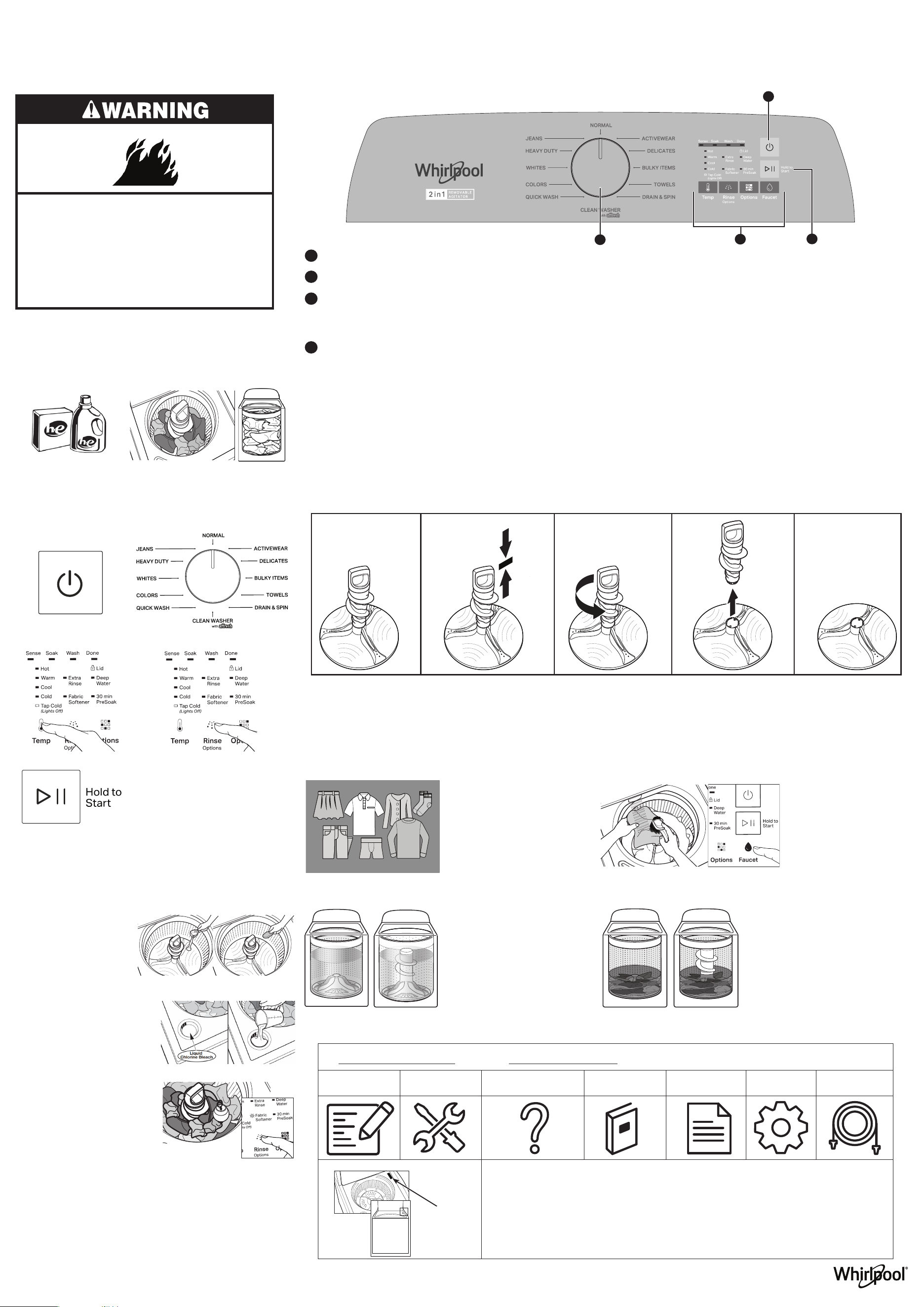
STEP 1. ADD
HE DETERGENT
Designed to use only HE
(High Efficiency)detergents.
NOTE: See ADDING
LAUNDRY PRODUCTS
(below) for more information
on adding HE detergent,
fabric softener, and/or
bleach.
STEP 2. LOAD CLOTHES
For best results, load garments in loose
heaps evenly around the basket wall.
STEP 3. PRESS POWER
TO TURN ON THE
WASHER
STEP 4. SELECT THE DESIRED
CYCLE FOR YOUR LOAD*
STEP 5. ADJUST CYCLE
SETTINGS, IF DESIRED
STEP 6. SELECT ADDITIONAL
OPTIONS*
STEP 7. PRESS AND HOLD START/PAUSE TO BEGIN CYCLE
NOTE: Start button must be held
for 1 second to start cycle. Once the
status lights are illuminated, release
the start button.
*Not all cycles, settings or options are available with all models.
QUICK START GUIDE
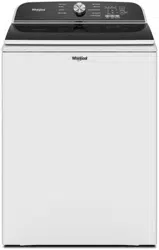
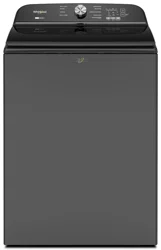
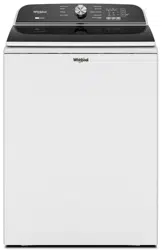
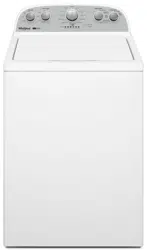
WHIRLPOOL
®
TOP LOADING WASHING MACHINE
OPERATING INSTRUCTIONS
Fire Hazard
Never place items in the washer that are dampened
with gasoline or other flammable fluids.
No washer can completely remove oil.
Do not dry anything that has ever had any type of
oil on it (including cooking oils).
Doing so can result in death, explosion, or fire.
WARNING: To reduce the risk of fire, electric shock, or injury to
persons, read the IMPORTANT SAFETY INSTRUCTIONS, located in
your appliance’s Owner’s Manual, before operating this appliance.
W11428540C
®
/™ ©2020 Whirlpool. All rights reserved. Used under license in Canada.
09/20
*Appearance may vary depending on model.
ASSISTANCE OR SERVICE AND ADDITIONAL INFORMATION
For information on any of the following items, a full cycle guide, detailed product dimensions, or for complete instructions for use and installation, please
visit www.whirlpool.com/owners, or in Canada www.whirlpool.ca/owners. This may save you the cost of a service call.
Register Product Schedule Service How To’s & FAQ Manuals &
Downloads
Add Service Plan Parts Accessories
To speak with a customer service representative or if you have additional questions, call us toll free at
1-866-698-2538 or in Canada call 1-800-807-6777.
You can write with any questions or concerns at:
Whirlpool Brand Appliances
Customer eXperience Center
533 Benson Road
Benton Harbor, MI 49022-2692
Whirlpool Brand Appliances
Customer eXperience Center
Unit 200-6750 Century Ave
Mississauga, Ontario L5N 0B7
Please include a daytime phone number in your correspondence.
Model & Serial
Number Tag
location
CONTROL PANEL AND FEATURES
1
3
2
4
ADDING LAUNDRY PRODUCTS
IMPORTANT: Using non-HE detergent will likely result in longer cycle
times and reduced rinsing performance. It may also result in component
malfunction and, over time, buildup of mold or mildew. HE detergents
should be low-sudsing and quick-dispersing to produce the right amount
of suds for the best performance.
ADDING HE DETERGENT TO BASKET
Add a measured amount of
HE detergent or single-dose
laundry packets into the basket.
If using oxi-type boosters,
color-safe bleach, or fabric
softener crystals, add to the
bottom of the washer basket
before adding clothes.
NOTE: Follow the manufacturer’s instructions to determine the amount of
laundry products to use.
ADDING LIQUID CHLORINE
BLEACH
Do not overfill, dilute, or use more
than 1 cup (236 mL). Do not use
color-safe bleach or oxi products
in the same cycle with liquid
chlorine bleach.
ADDING LIQUID FABRIC SOFTENER
If you desire to use liquid fabric
softener with this washer, Whirlpool
suggests using the Downy Ball
®
dispenser. Pour a measured amount of
liquid fabric softener into the Downy
Ball
®
dispenser, pull the ring tightly
to seal it, and place on top of load.
Follow manufacturer’s directions for
correct amount of fabric softener
based on your load size. Then use the
Rinse Options button to select Fabric Softener. The Downy Ball
®
dispenser
will automatically release the fabric softener at the correct time in the cycle.
For questions on using the Downy Ball
®
dispenser visit
www.downy.com
.
ADDING LIQUID FABRIC SOFTENER MANUALLY
Select the Fabric Softener option on the control panel before starting a cycle.
During the final rinse, wait until the washer has completed filling, press the
Start/Pause button to pause the washer. Lift the lid and add the recommended
amount of liquid fabric softener. Close the lid, press and hold the Start/Pause
button to resume the cycle.
MORE WATER WHEN YOU WANT IT
AUTO SENSING AND DEEP WATE R
■ The washer will adjust the water level to
the optimal amount for a High Efficiency
wash of the detected load size.
■
Press Deep Water to automatically add
more water to your wash cycle.
■
It is recommended to use BULKY
ITEMS cycle with Deep Water option
for loads where maximum water level is
desired.
■
Expect longer cycle times due to
extended fill duration when using the
Deep Water option.
CLEANING WITH LESS WATER
The washer has been designed and
optimized to provide a thorough cleaning
using less water to conserve energy and
resources.
As the washer dampens and moves the
load, the level of the items will settle in the
basket. This is normal, and does not indicate
that more items should be added.
IMPORTANT: You will not see a full basket
of water as with older, less efficient washing
machines. It is normal for some of the load
to be above the water line.
For detailed installation instruction and maintenance information, winter storage, and transportation tips, please see the Owner’s Manual included with your machine.
A cycle guide for your washer can be
found online at www.whirlpool.com
.
The document will help identify which
cycle to choose for various load types
as well as the default cycle options.
For example we recommend using
the NORMAL cycle with Warm water
for cottons, linens and mixed-garment
loads.
CHOOSING THE RIGHT CYCLE PRE-TREATING BEFORE A WASH CYCLE
■ Press the Faucet button once to
turn on and press again to turn off.
■
Faucet will automatically shut off
after 10 minutes or when max
water level is reached.
■
Water will automatically drain if
water level becomes too high.
Water will also drain after 10
minutes if the lid is left open or
3 hours if the lid is left closed.
2-IN-1 REMOVABLE AGITATOR
Rotate
Counter-Clockwise
Pull Up
Agitator Mode
Squeeze Handle
Impeller Mode
■ Keep it in (Agitator mode) when you want increased mechanical action to remove and rinse away loose soils. You can use this mode anytime but it’s especially suited for
everyday mixed loads.
■
Take it out (Impeller mode) when you need added space and/or a thorough, gentle clean. You can use this mode anytime but it’s especially suited for bulky items such as
bedding and delicate items such as undergarments.
USING THE REMOVABLE AGITATOR
■
Squeeze handle, rotate counter-clockwise, and pull up to remove.
■ Push down and rotate clockwise to re-install. The agitator should lock into place.
1
POWER
Press to turn on/off or to stop/cancel a cycle.
2
CYCLE KNOB
Turn knob to select desired cycle.
3
START/PAUSE
Press and hold the Start/Pause button for 1 second until all status lights are
illuminated, then release to start cycle. Press during a cycle to pause cycle
and unlock lid.
NOTE: If machine is spinning it may take longer to unlock lid.
4
CYCLE MODIFIERS (Not all modifiers are available on all cycles)
TEMP
Press to modify the cycle’s available temperatures (Tap Cold, Cold, Cool,
Warm, or Hot).
NOTE: Pressing Temp will toggle through available temperature
options. When no lights in the temperature column are illuminated the
selected temperature is Tap Cold.
RINSE OPTIONS
Press to modify the cycle’s available rinse options. Press once for Fabric
Softener, twice for Extra Rinse and three times to activate both.
FABRIC SOFTENER
Select this option to let the machine know when you have added liquid
fabric softener.
EXTRA RINSE
Select this option to add a second rinse.
OPTIONS
Press to add or remove options for each cycle. Press once to add a
30 min PreSoak, twice to activate Deep Water and three times for both.
DEEP WATER
Use this option to automatically add more water to your wash cycle.
You can also use this option to reduce the likelihood of white
residue on dark clothing.
30 MIN PRESOAK
Touch to add a 30 minute presoak period to help loosen tough
stains. The washer will fill, pause to soak, and then begin the
selected cycle.
FAUCET
Press to access an instant water stream. Use this feature to pretreat
clothes and other items right in the washer. You can also use this feature
to manually add water to the machine as desired.
NOTE: The washer will drain at the beginning of the cycle if a large
volume of water is detected to ensure the machine can correctly
sense the load size.
NOTE: If the was
her detects an out-of-balance condition it may pause
and attempt and re-distribute the load. During this time the Sense and
Wash status indicators will both briefly illuminate.
WARNING: Do not wash water-resistant or water repellant-type clothing.
Failure to closely follow these instructions may result in an abnormal
vibrating and out-of-balance condition that could result in physical injury,
property damage, and/or appliance damage.
2
WASHER SAFETY
Your safety and the safety of others are very important.
We have provided many important safety messages in this manual and on your appliance. Always read and obey all safety
messages.
This is the safety alert symbol.
This symbol alerts you to potential hazards that can kill or hurt you and others.
All safety messages will follow the safety alert symbol and either the word “DANGER” or “WARNING.” These
words mean:
DANGER
You can be killed or seriously injured if you don't
immediately follow instructions.
WARNING
You can be killed or seriously injured if you don’t follow
instructions.
All safety messages will tell you what the potential hazard is, tell you how to reduce the chance of injury, and tell you what can
happen if the instructions are not followed.
IMPORTANT SAFETY INSTRUCTIONS
WARNING: To reduce the risk of fire, electric shock, or injury to persons when using your appliance, follow basic precautions,
including the following:
� Read all instructions before using the appliance.
� Do not wash articles that have been previously cleaned in,
washed in, soaked in, or spotted with gasoline, dry-cleaning
solvents, or other flammable or explosive substances, as
they give off vapors that could ignite or explode.
� Do not add gasoline, dry-cleaning solvents, or other
flammable or explosive substances to the wash water.
These substances give off vapors that could ignite or
explode.
� Under certain conditions, hydrogen gas may be produced
in a hot-water system that has not been used for 2 weeks or
more. HYDROGEN GAS IS EXPLOSIVE. If the hot-water
system has not been used for such a period, before using a
washing machine, turn on all hot-water faucets and let the
water flow from each for several minutes. This will release
any accumulated hydrogen gas. As the gas is flammable,
do not smoke or use an open flame during this time.
� Do not allow children to play on or in the appliance. Close
supervision of children is necessary when the appliance is
used near children.
� Before the appliance is removed from service or discarded,
remove the door.
� Do not reach into the appliance if the tub or agitator is
moving.
� Do not install or store this appliance where it will be exposed
to the weather.
� Do not tamper with controls.
� Do not repair or replace any part of the appliance or attempt
any servicing unless specifically recommended in the
user-maintenance instructions or in published user-repair
instructions that you understand and have the skills to carry
out.
� Do not use replacement parts that have not been
recommended by the manufacturer (e.g. parts made at
home using a 3D printer).
� See the Installation Instructions for grounding requirements
and installation.
SAVE THESE INSTRUCTIONS
WARNING
Certain internal parts are intentionally not grounded and may present a risk of electric shock only during servicing.
Service Personnel – Do not contact the thermostat bracket while the appliance is energized.

3
CHOOSING RIGHT DETERGENT
CHOOSING THE RIGHT DETERGENT
Use only High Efficiency detergents. The package will be marked
“HE” or “High Efficiency.” Low-water washing creates excessive
sudsing with a non-HE detergent. Using non-HE detergent will
likely result in longer cycle times and reduced rinsing
performance. It may also result in component malfunction and,
over time, buildup of mold or mildew. HE detergents should be
low-sudsing and quick-dispersing to produce the right amount of
suds for the best performance. They should hold soil in
suspension so it is not redeposited onto clean clothes. Not all
detergents labeled as High Efficiency are identical in formulation
and their ability to reduce suds. For example, natural, organic, or
homemade HE detergents may generate a high level of suds.
Always follow the detergent manufacturer’s instructions to
determine the amount of detergent to use. Do not go over the Max
Line on the dispenser. See Quick Start Guide for more
information.
WASHER MAINTENANCE AND
CARE
Water Inlet Hoses
Replace inlet hoses after 5 years of use to reduce the risk of hose
failure. Periodically inspect and replace inlet hoses if bulges,
kinks, cuts, wear, or leaks are found.
When replacing your inlet hoses:
■ Mark the date of replacement on the label with a permanent
marker.
■ Check that the old washers are not stuck on the washer inlet
valves.
■ Use new washers in the new inlet hoses to ensure a proper
seal.
NOTE: This washer may not include inlet hoses. See the
Installation Instructions for more information.
Washer Care
Recommendations to help keep your washer
clean and performing at its best
1. Always use High Efficiency (HE) detergents and follow the HE
detergent manufacturer’s instructions regarding the amount of
HE detergent to use. Never use more than the recommended
amount because that may increase the rate at which
detergent and soil residue accumulate inside your washer,
which in turn may result in undesirable odor.
2. Use warm and hot wash water settings sometimes (not
exclusively cold water washes), because they do a better job
of controlling the rate at which soils and detergent
accumulate.
3. Always leave the washer lid open between uses to help dry
out the washer and prevent the buildup of odor-causing
residue.
Cleaning your top-loading washer
Read these instructions completely before beginning the routine
cleaning processes recommended below. This Washer
Maintenance Procedure should be performed, at a minimum,
once per month or every 30 wash cycles, whichever occurs
sooner, to control the rate at which soils and detergent may
otherwise accumulate in your washer.
Cleaning the inside of the washer
To keep your washer odor-free, follow the usage instructions
provided above and use this recommended monthly cleaning
procedure:
Recommended cycle for cleaning the Washer
Some models have a “Clean Washer” cycle that uses higher water
volumes in combination with affresh
®
Washer Cleaner or liquid
chlorine bleach to clean the inside of the washer.
If your model does not have a “Clean Washer” cycle, refer to the
online Cycle Guide for the optimal cycle for cleaning the inside of
the washer. Use this cycle with affresh
®
Washer Cleaner or liquid
chlorine bleach as described below.
Description of Clean Washer with affresh
®
cycle
operation:
1. This cycle will fill to a washer level high than in normal wash
cycles to provide rinsing than in normal wash cycles to provide
rinsing at a level above the water line for normal wash.
2. During this cycle, there will be some agitation and spinning to
increase the removal of soils.
After this cycle is complete, leave the lid open to allow for better
ventilation and drying of the washer interior.
Begin procedure
1. Affresh
®
washer cleaner cycle procedure (recommended
for best performance):
a. Open the washer lid and remove any clothing or items.
b. Place an affresh
®
Washer Cleaner tablet in the bottom of
the washer basket.
c. Do not place an affresh
®
Washer Cleaner tablet in the
detergent dispenser.
d. Do not add any detergent or other chemical to the washer
when following this procedure.
e. Close the washer lid.
f. Select the cycle recommended for cleaning the inside of
the washer.
g. Press the START button to start the cycle.
NOTE: For best results, do not interrupt cycle. If cycle must be
interrupted, press POWER/CANCEL. (For models with no
Power/Cancel button, press and hold START/PAUSE for three
seconds.) After the cycle has stopped, run a Rinse & Spin
cycle to rinse cleaner from washer.
2. Chlorine bleach procedure (alternative):
a. Open the washer lid and remove any clothing or items.
b. Add 1 cup (236 mL) of liquid chlorine bleach to the bleach
compartment.
NOTE: Use of more liquid chlorine bleach than is
recommended above could cause washer damage over
time.
c. Close the washer lid.
d. Do not add any detergent or other chemical to the washer
when following this procedure.
e. Select the cycle recommended for cleaning the inside of
the washer.
f. Press the START button to start the cycle.
NOTE: For best results, do not interrupt cycle. If cycle must be
interrupted, press POWER/CANCEL. (For models with no
Power/Cancel button, press and hold START/PAUSE for three
seconds.) After the cycle has stopped, run a Rinse & Spin
cycle to rinse cleaner from washer.
Cleaning the dispensers
After a period of using your washer, you may find some residue
buildup in the washer’s dispensers.
IMPORTANT: Dispensers are not dishwasher-safe.
4
For non-removable dispensers:
To remove residue from the dispensers, wipe them with an
affresh
®
Machine Cleaning Wipe or a damp cloth and towel dry.
Do not attempt to remove the dispensers or trim for cleaning. The
dispensers and trim are not removable.
For removable dispensers:
If your model has a dispenser drawer, press tab(s) to remove the
drawer and clean it with an affresh
®
Machine Cleaning Wipe or a
damp cloth and towel dry before or after you run the Clean
Washer cycle. Use an all-purpose surface cleaner, if needed.
Cleaning the outside of the washer
IMPORTANT: To avoid damaging the washer’s finish, do not use
abrasive products.
Use an affresh
®
Machine Cleaning Wipe, a soft, damp cloth, or
sponge to wipe away any spills. Use an affresh
®
Machine
Cleaning Wipe or only mild soaps or cleaners when cleaning
external washer surfaces.
Non-Use and Vacation Care
Operate your washer only when you are home. If moving, or not
using your washer for a period of time, follow these steps:
1. Unplug or disconnect power to washer.
2. Turn off water supply to washer to avoid flooding due to water
pressure surge.
Winter Storage Care
IMPORTANT: To avoid damage, install and store washer where it
will not freeze. Because some water may stay in hoses, freezing
can damage washer. If storing or moving during freezing weather,
winterize your washer.
To winterize washer:
1. Shut off both water faucets; disconnect and drain water inlet
hoses.
2. Put 1 L (1 quart) of R.V.-type antifreeze in basket and run
washer on Rinse & Spin cycle for about 30 seconds to mix
antifreeze and remaining water.
3. Unplug washer or disconnect power.
Transporting Your Washer
1. Shut off both water faucets. Disconnect and drain water inlet
hoses.
2. If washer will be moved during freezing weather, follow
“Winter Storage Care” directions before moving.
3. Disconnect drain hose from drain system and drain any
remaining water into a pan or bucket. Disconnect drain hose
from back of washer.
4. Unplug power cord.
5. Place inlet hoses and drain hose inside washer basket.
6. Drape power cord over edge and into washer basket.
7. Place original shipping materials back inside washer. If you do
not have shipping materials, place heavy blankets or towels
into basket opening. Close lid and place tape over lid and
down front of washer. Keep lid taped until washer is placed in
new location. Transport washer in the upright position.
Reinstalling/Using Washer Again
WARNING
Electrical Shock Hazard
Plug into a grounded 3 prong outlet.
Do not remove ground prong.
Do not use an adapter.
Do not use an extension cord.
Failure to follow these instructions can result in death,
fire, or electrical shock.
To reinstall washer after nonuse, vacation, winter storage, or
moving:
1. Refer to Installation Instructions to locate, level, and connect
washer.
2. Before using again, run washer through the following
recommended procedure:
To use washer again:
1. Flush water pipes and hoses.
2. Reconnect water inlet hoses.
3. Turn on both water faucets.
4. Plug into a grounded 3 prong outlet or reconnect power.
5. See your online Cycle Guide for information about which
cycle(s) to run your washer through to clean washer and
remove antifreeze, if used. Use only HE High Efficiency
detergent. Use half the manufacturer’s recommended amount
for a medium-size load.
Importer
WHIRLPOOL MÉXICO, S.de R.L. de C.V.
Antigua Carretera A Roma KM 9
Col.EL Milagro; Apodaca
Nuevo León, México C.P. 6634
Tel (+52) 81-83-29-21-00
Exporter
Whirlpool Corporation
Benton Harbor, Michigan
U.S.A.
5
INSTALLATION INSTRUCTIONS
REQUIREMENTS
Tools and Parts
Gather required tools and parts before starting installation.
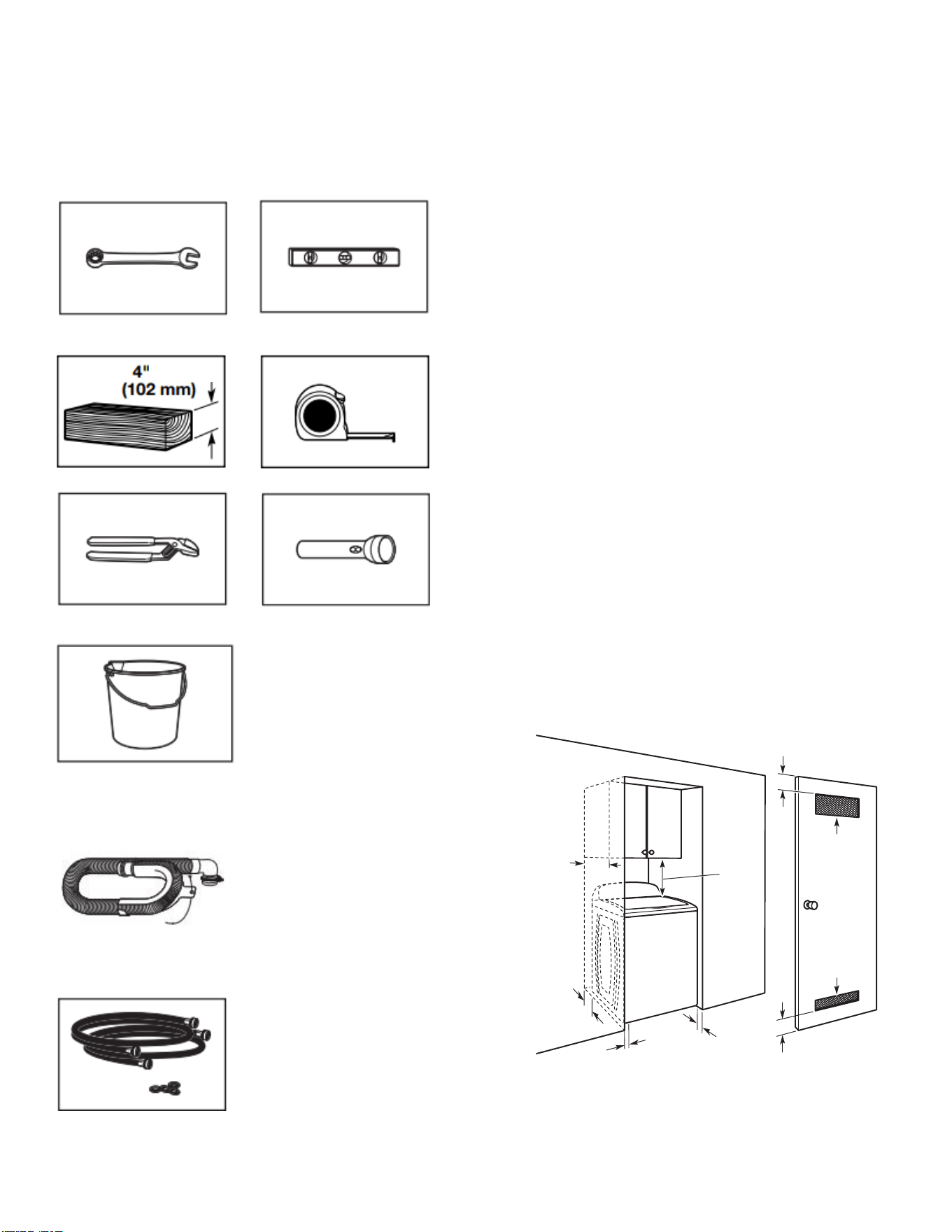
Tools Needed:
Adjustable or open end
wrench 9/16" (14 mm)
Level
minimum
Wood block Ruler or measuring tape
Adjustable pliers that
open to 1¾" (45 mm)
Flashlight
Bucket
Parts Supplied:
NOTE: All parts supplied for installations are in the washer.
Drain hose with clamp, U-form,
and cable tie
Parts Needed: (if not supplied with washer)
Inlet hoses with flat washers
NOTE: Various inlet hose
options are available; check
your Quick Start Guide for
ordering information.
Alternate Parts: (not supplied with washer)
Your installation may require additional parts. To order, please
refer to the contact information referenced in your Quick Start
Guide.
If you have:
Overhead sewer
You will need:
Standard 20 gallons (76 L) 39"
(990 mm) tall drain tub or utility sink,
sump pump, and connectors (available
from local plumbing suppliers)
1" (25 mm) standpipe 2" (51 mm) diameter to 1" (25 mm)
diameter standpipe adapter and
connector kit
Drain hose too short Extension drain hose and connector kit
Lint-clogged drain Drain protector and connector kit
Location Requirements
Select proper location for your washer to improve performance
and minimize noise and possible “washer walk.” Install your
washer in a basement, laundry room, closet, or recessed area.
IMPORTANT: Do not install, store, or operate washer where it will
be exposed to weather or in temperatures below 32°F (0°C).
Water remaining in washer after use may cause damage in low
temperatures. See “Washer Maintenance and Care” for
winterizing information.
Proper installation is your responsibility.
You will need:
■ A water heater set to 120°F (49°C).
■ A grounded electrical outlet located within 4 ft (1.2 m) of power
cord on back of washer.
■ Hot and cold water faucets located within 3 ft (0.9 m) of hot
and cold water fill valves on washer, and water pressure of
20-100 psi (138-690 kPa).
■ A level floor with maximum slope of 1" (25 mm) under entire
washer. Installing on carpet or surfaces with foam backing is
not recommended.
■ Floor must support washer’s total weight (with water and load)
of 315 lbs (143 kgs).
Recessed area or closet installation
3"
(76 mm)
3"
(76 mm)
24 in
2
(155 cm
2
)
48 in
2
(310 cm
2
)
20"
(508 mm)
1"
1"
(25 mm)
(25 mm)
5"
(126 mm)
14"
(356 mm)
maximum
NOTE: All 27" wide washers should have 19" (482 mm)
clearance, while all 29" wide washers should have 22" (559 mm)
clearance.
All dimensions show recommended spacing allowed, except for
6
closet door ventilation openings, which are the minimum required.
This washer has been tested for installation with spacing of 0"
(0 mm) clearance on the sides. Consider allowing more space for
ease of installation and servicing, and spacing for companion
appliances and clearances for walls, doors, and floor moldings.
Add spacing of 1" (25 mm) on all sides of washer to reduce noise
transfer. Doors must be louvered or equivalent and have at least
24 in
2
(155 cm
2
) bottom and 48 in
2
(210 cm
2
) top open area.
*For additional details (or information) specific to your model, refer
to your Quick Start Guide.
Drain System
Drain system can be installed using a floor drain, wall standpipe,
floor standpipe, or laundry tub. Select the method you need.
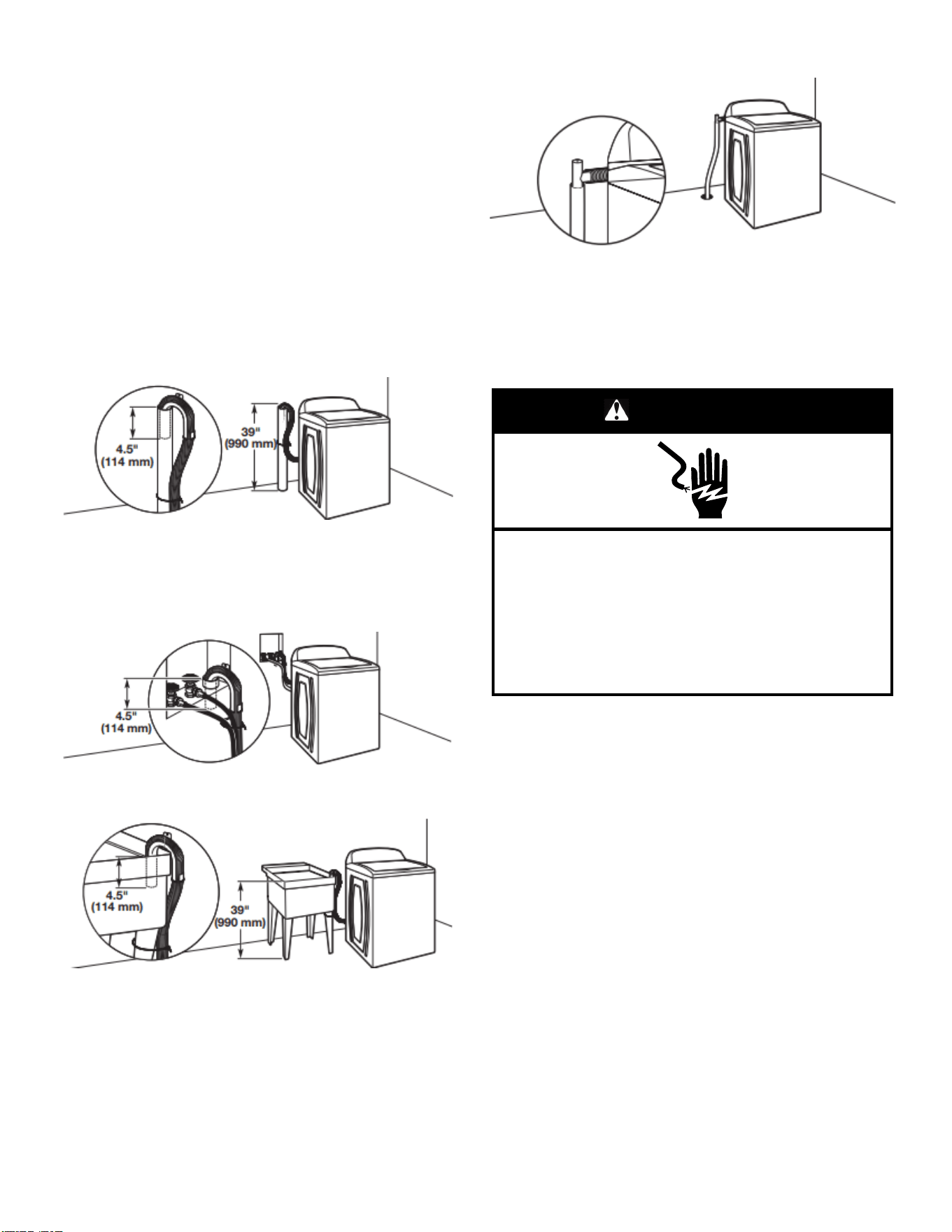
IMPORTANT: To avoid siphoning, no more than 4.5" (114 mm) of
drain hose should be inside standpipe or below the top of wash
tub. Secure drain hose with cable tie.
Floor standpipe drain system
Minimum diameter for a standpipe drain: 2" (51 mm). Minimum
carry-away capacity: 17 gallons (64 L) per minute. Top of
standpipe must be at least 39" (990 mm) high; install no higher
than 96" (2.44 m) from bottom of washer. If you must install higher
than 96" (2.44 m), you will need a sump pump system.
Wall standpipe drain system
See requirements in the “Floor standpipe drain system” section.
Laundry tub drain System
Minimum capacity: 20 gallons (76 L). Top of laundry tub must be
at least 39" (990 mm) above floor; install no higher than 96"
(2.44 m) from bottom of washer.
Floor Drain System
Floor drain system requires a Siphon Break Kit, 2 Connector Kits,
and an Extension Drain Hose that may be purchased separately;
refer to the Quick Start Guide for online ordering information.
Minimum siphon break height: 28" (710 mm) from bottom of
washer (additional hoses may be needed).
Electrical Requirements
WARNING
Electrical Shock Hazard
Plug into a grounded 3 prong outlet.
Do not remove ground prong.
Do not use an adapter.
Do not use an extension cord.
Failure to follow these instructions can result in death,
fire, or electrical shock.
■ A 120 V, 60 Hz, AC only, 15 or 20 A, fused electrical supply is
required. A time-delay fuse or circuit breaker is recommended.
It is recommended that a separate circuit breaker serving only
this appliance be provided.
■ This washer is equipped with a power supply cord having a
3-prong grounding plug.
■ To minimize possible shock, the cord must be plugged into a
mating, 3-prong, grounding-type outlet, grounded in
accordance with local codes and ordinances. If a mating outlet
is not available, it is the personal responsibility and obligation
of the customer to have the properly grounded outlet installed
by a qualified electrician.
■ If codes permit and a separate ground wire is used, it is
recommended that a qualified electrician determine that the
ground path is adequate.
■ Do not ground to a gas pipe.
■ Check with a qualified electrician if you are not sure the
washer is properly grounded.
■ Do not have a fuse in the neutral or ground circuit.
7
GROUNDING INSTRUCTIONS
For a grounded, cord-connected appliance:
This appliance must be grounded. In the event of a
malfunction or breakdown, grounding will reduce the risk of
electric shock by providing a path of least resistance for
electric current. This appliance is equipped with a cord having
an equipment-grounding conductor and a grounding plug.
The plug must be plugged into an appropriate outlet that is
properly installed and grounded in accordance with all local
codes and ordinances.
WARNING: Improper connection of the equipment-
grounding conductor can result in a risk of electric shock.
Check with a qualified electrician or serviceman if you are in
doubt as to whether the appliance is properly grounded. Do
not modify the plug provided with the appliance: If it will not fit
the outlet, have a proper outlet installed by a qualified
electrician.
SAVE THESE INSTRUCTIONS
INSTALLATION
Unpacking
WARNING
Excessive Weight Hazard
Use two or more people to move and install or uninstall
appliance.
Failure to do so can result in back or other injury.
Before you start: Remove shipping materials.
It is necessary to remove all shipping materials for proper
operation and to avoid excessive noise from washer.
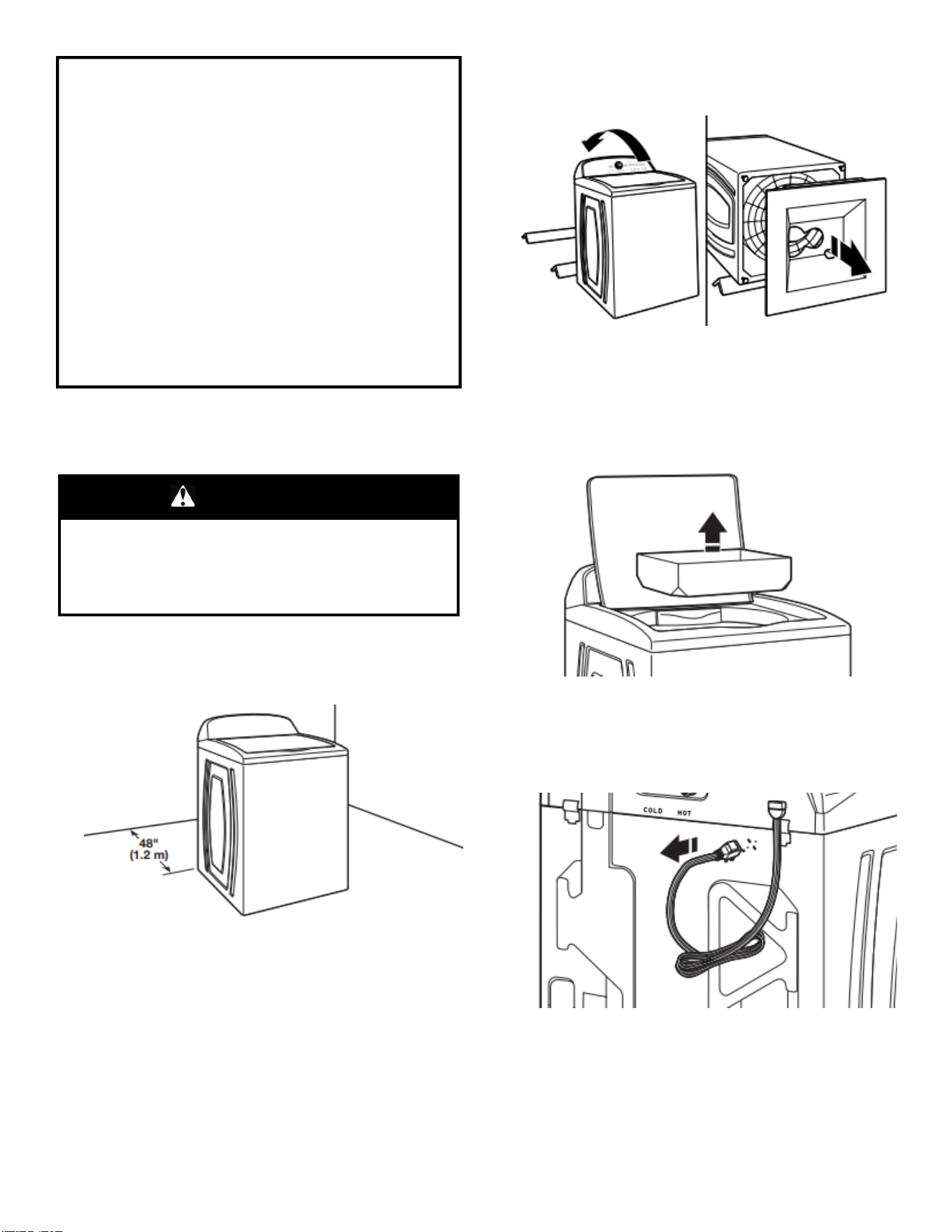
1. Move Washer
Move washer to within 4 ft. (1.2 m) of its final location; it must
be in a fully upright position.
NOTE: To avoid floor damage, set washer onto cardboard
before moving it and make sure lid is taped shut.
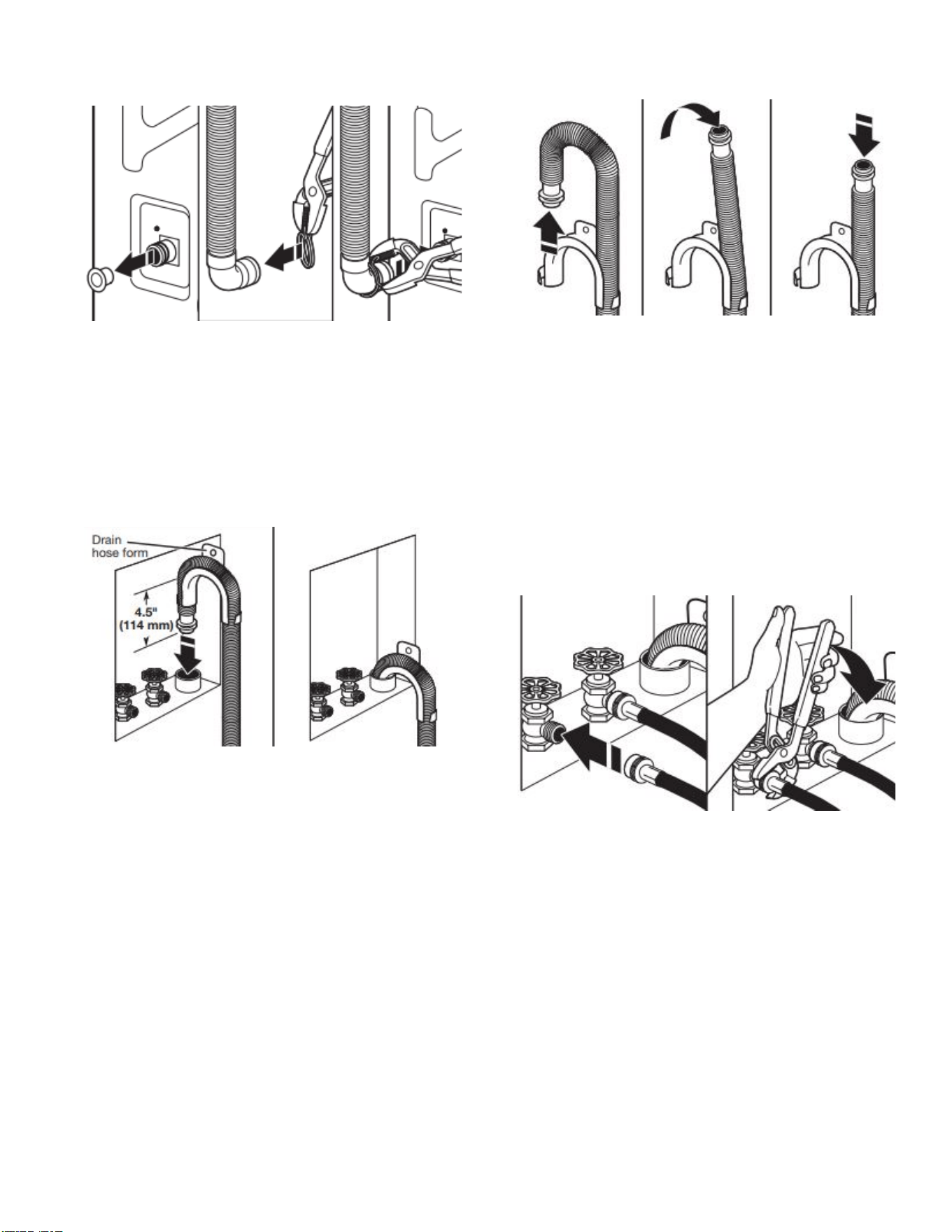
2. Remove shipping base
IMPORTANT: Removing shipping base is necessary for
proper operation.
To avoid damaging floor, place cardboard supports from
shipping carton on floor behind washer. Tip washer back and
place on cardboard supports. Remove shipping base (some
models require shipping base to be rotated 90° to the right
before pulling off). Set washer upright.
3. Remove packaging material from inside
washer
Remove tape from washer lid, open lid, and remove
packaging material from washer tub. Be sure that all parts
have been removed from inside washer.
NOTE: Keep packaging material for inside washer in case
you need to move washer later.
4. Free power cord
Firmly grasp power cord plug and pull to free from rear panel.
Gently place power cord over console to allow free access to
back of washer.
8
Connect Drain Hose
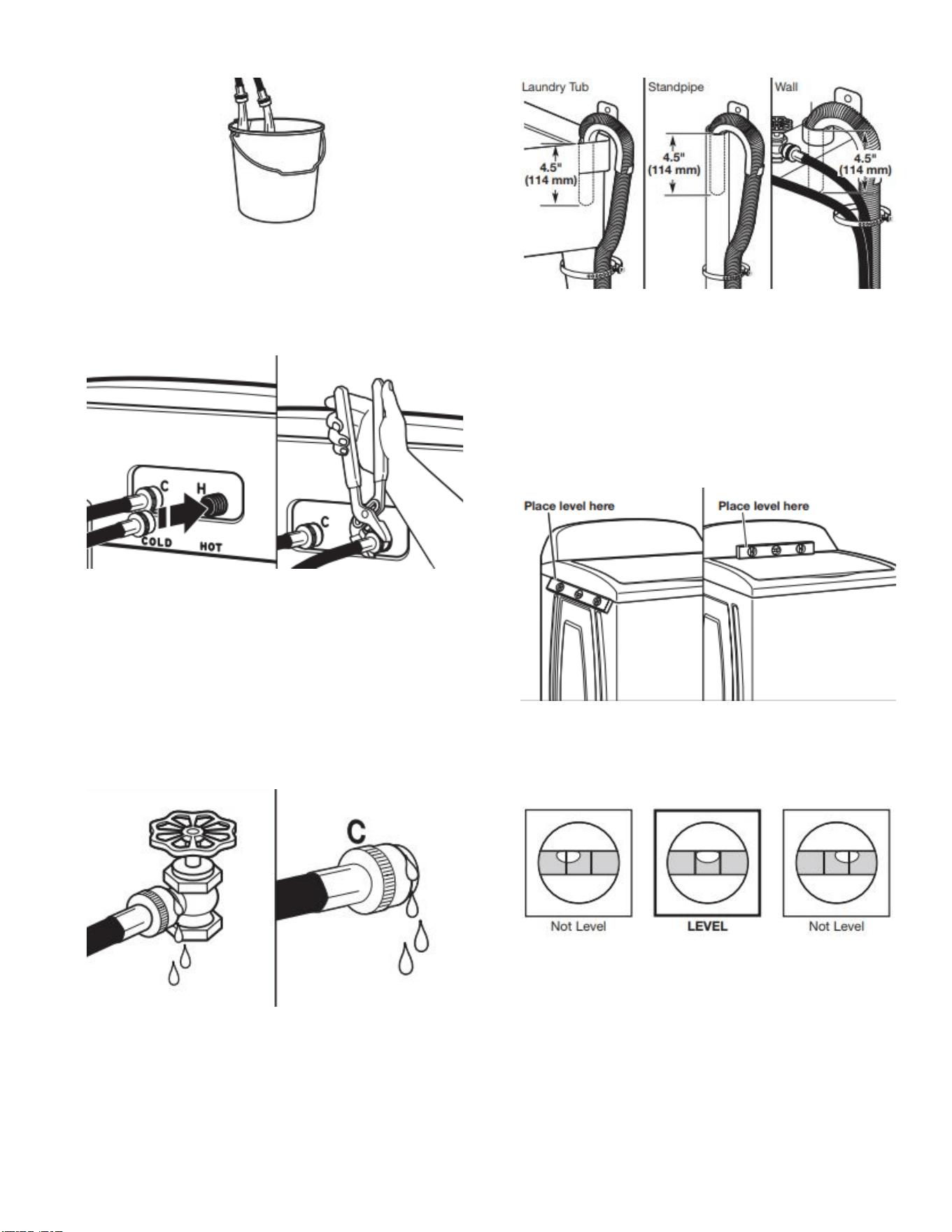
5. Attach drain hose to drain port
If applicable, remove the red plastic plug from the black drain
port on the back of the washer.
If clamp is not already in place on elbow end of drain hose,
slide it over end as shown. Squeeze clamp with pliers and
slide black elbow end of drain hose onto black drain port and
secure with clamp.
For a laundry tub or standpipe drain, go to step 6.
For a floor drain, remove the pre-installed drain hose form as
shown in step 7. You may need additional parts with separate
directions. See the “Alternate Parts” section.
6. Place drain hose in standpipe
IMPORTANT: 4.5" (114 mm) of drain hose should be inside
standpipe; do not force excess hose into standpipe or lay on
bottom of laundry tub. Drain hose form must be used.
Place hose into standpipe (shown in picture) or over side of
laundry tub.
7. Remove drain hose form (floor drain
installations only)
For floor drain installations, you will need to remove the drain
hose form from the end of the drain hose. You may need
additional parts with separate directions. See “Tools and
Parts.”
It is the responsibility of the installer to install and secure the
drain hose into the provided plumbing/drain in a manner that
will avoid the drain hose coming out of and leaking from the
plumbing/drain.
Connect Inlet Hoses
Washer must be connected to water faucets with new inlet hoses
with flat washers (not provided). Do not use old hoses.
NOTE: Both hoses must be attached and have water flowing to
inlet valves. If you are only connecting to a cold water faucet, you
must use a Y-adapter (not provided).
8. Connect inlet hoses to water faucets
IMPORTANT: Do not overtighten hose or use tape or
sealants on valve. Damage to the valves can result.
Attach hose to hot water faucet. Screw on coupling by hand
until it is seated on washer. Use adjustable pliers to tighten
couplings an additional two-thirds turn. Repeat this step with
second hose for cold water faucet.
9
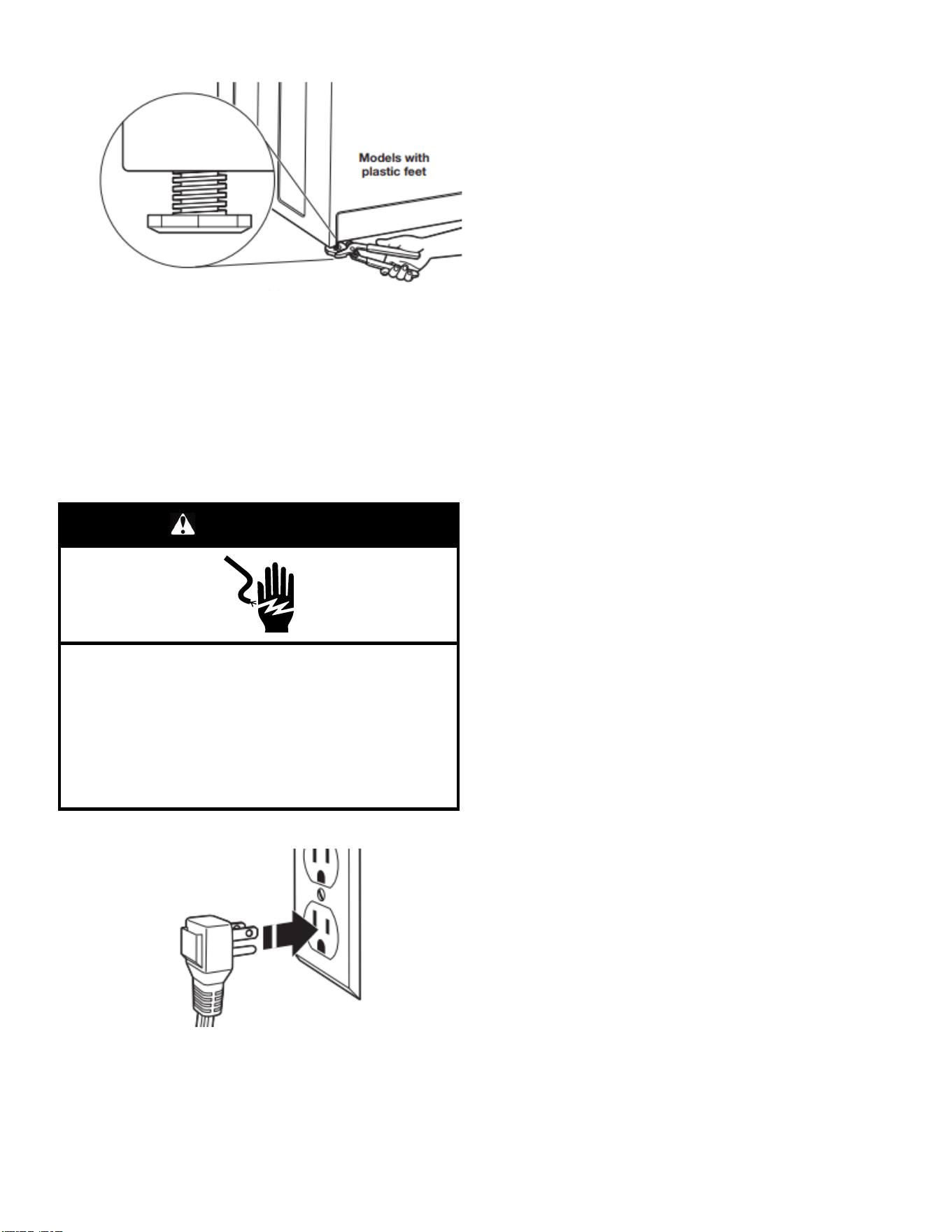
9. Clear water lines
Run water for a few seconds through hoses into a laundry
tub, drainpipe, or bucket to avoid clogs. Water should run until
clear.
Make note of which hose is connected to hot water to help in
attaching hoses to washer correctly.
10. Connect inlet hoses to washer
IMPORTANT: To reduce risk of hose failure, replace the
hoses every 5 years. Record hose installation or replacement
dates for future reference.
■ Do not overtighten hose or use tape or sealants on valve.
Damage to the valves can result.
■ Periodically inspect and replace hoses if bulges, kinks,
cuts, wear, or leaks are found.
Attach hot water hose to red hot water inlet valve. Screw
coupling by hand until it is snug. Use pliers to tighten
couplings an additional two-thirds turn. Repeat with cold
water inlet valve.
11. Check for leaks
Turn on water faucets to check for leaks. A small amount of
water may enter washer. It will drain later.
12. Secure drain hose
Secure drain hose to laundry tub leg, drain standpipe, or inlet
hoses for wall standpipe with cable tie.
It is the responsibility of the installer to install and secure the
drain hose into the provided plumbing/drain in a manner that
will avoid the drain hose coming out of or leaking from the
plumbing/drain.
Level Washer
NOTE: Level washer properly to reduce excess noise and
vibration.
13. Check levelness of washer
Move the washer to its final location. Place a level on top
edges of washer. Use side seam as a guide to check
levelness of sides. Check levelness of front using lid, as
shown. Rock washer back and forth to make sure all four feet
make solid contact with floor. If washer is level, skip to
step 15.
10
14. Adjust leveling feet
If washer is not level:
Use adjustable pliers to turn the plastic leveling foot
counterclockwise to lower the washer or clockwise to raise
the washer.
Recheck levelness of washer and repeat as needed.
HELPFUL TIPS:
■ You may need to adjust two different feet to level your
unit. Ensure each foot remains secured to the washer’s
base.
■ You may want to prop up front of washer about 4″
(102 mm) with a wood block or similar object that will
support weight of washer.
WARNING
Electrical Shock Hazard
Plug into a grounded 3 prong outlet.
Do not remove ground prong.
Do not use an adapter.
Do not use an extension cord.
Failure to follow these instructions can result in death,
fire, or electrical shock.
15. Plug into a grounded 3-prong outlet
Complete Installation Checklist
■ Check electrical requirements. Be sure you have correct
electrical supply and recommended grounding method.
■ Check that all parts are now installed. If there is an extra part,
go back through steps to see what was skipped.
■ Check that you have all of your tools.
■ Check that shipping materials were completely removed from
washer.
■ Check that the washer is level.
■ Check that water faucets are on.
■ Check for leaks around faucets and inlet hoses.
■ Remove protective film from console and any tape remaining
on washer.
■ Check that washer is plugged into a grounded 3-prong outlet.
■ Dispose of/recycle all packaging materials.
■ Read the “Washer Maintenance and Care” section.
■ To test and clean your washer, measure 1/2 of normal
recommended amount of powdered or liquid HE detergent and
pour it into washer basket or detergent dispenser (on some
models). Close lid. Select any cycle. Start washer and allow to
complete full cycle.
1
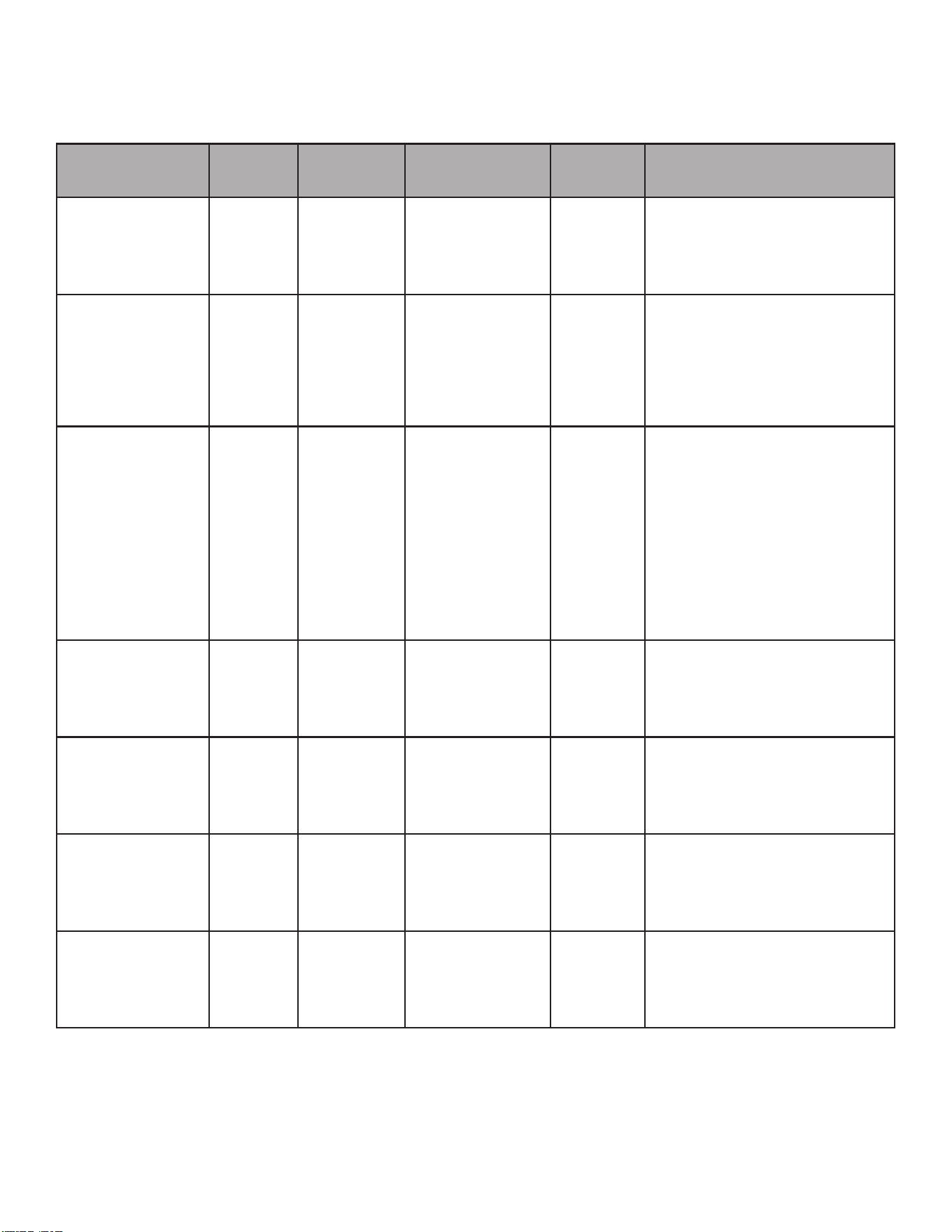
Settings shown are selectable for that cycle. Factory default settings are shown in Bold. If you change the default settings and start a cycle
the washer will remember your setting selections and will display them for the next cycle. For the best fabric care, choose the cycle that best
fits the load being washed. Not all cycles and options are available on all models. Please refer to garment label instructions for best care.
WASHER CYCLE GUIDE
Items to wash: Cycle: Temperature*: Available Options
Average
Cycle Time
(minutes)
Cycle Details:
Overly soiled garments,
items that need
additional cleaning
effort.
HEAVY
DUTY
Hot
Warm
Cool
Cold
Tap Cold
Extra Rinse
Fabric Softener
30 Min PreSoak
Deep Water
75
Use this cycle for heavily soiled or
sturdy items. Load sensing duration
and water level determination may vary
based on different fabric types.
Large items such as
sheets, sleeping bags,
small comforters,
jackets, small washable
rugs.
BULKY
ITEMS
Hot
Warm
Cool
Cold
Tap Cold
Extra Rinse
Fabric Softener
30 Min PreSoak
Deep Water*
55
Use this cycle to wash large items
such as jackets and small comforters.
This cycle uses a higher default water
level than other cycles. The washer will
completely fill before agitation begins.
*The Deep Water Option cannot be
deactivated when using this cycle .
Swimsuits and items
requiring rinsing
without detergent.
DRAIN &
SPIN
N/A
Extra Rinse
Fabric Softener*
Deep Water*
*Only available
when Extra Rinse is
selected
10
Use this cycle for loads requiring
an additional spin-out after a cycle
completes to reduce drying times or to
finish a cycle after a power interruption.
The default cycle will only drain and
spin.
This cycle can also be used to refresh a
load by adding the Extra Rinse option,
the cycle will rinse, drain, and spin. Use
this cycle with the Extra Rinse option
for items requiring rinsing without
detergent such as swimsuits.
Cottons, linens, and
mixed garment loads.
NORMAL
Hot
Warm
Cool
Cold
Tap Cold
Extra Rinse
Fabric Softener
30 Min PreSoak
Deep Water
60
Use this cycle for normally soiled
cottons and mixed fabric loads.
No-iron fabrics, perm
press, synthetics.
ACTIVE-
WEAR
Hot
Warm
Cool
Cold
Tap Cold
Extra Rinse
Fabric Softener
30 Min PreSoak
Deep Water
45
Use this cycle to wash loads of no-iron
fabrics such as sports shirts, blouses,
casual business clothes, perm press,
and blends.
Machine-wash silks,
handwash fabrics.
DELICATES
Hot
Warm
Cool
Cold
Tap Cold
Extra Rinse
Fabric Softener
30 Min PreSoak
Deep Water
50
Use this cycle to wash lightly soiled
items indicating “Machine Washable
Silks” or “Gentle” cycle on the care
label. Place small items in mesh garment
bags before washing. This cycle uses a
higher default water level.
Lightly soiled, small-
sized mixed garment
loads.
QUICK
WASH
Hot
Warm
Cool
Cold
Tap Cold
Extra Rinse
Fabric Softener
30 Min PreSoak
Deep Water
30
Use this cycle to quickly wash lightly
soiled garments and small loads. The
Quick Wash cycle uses shorter periods
of more intense washing to clean items
quickly.

2
Items to wash: Cycle: Temperature*: Available Options
Average
Cycle Time
(minutes)
Cycle Details:
No clothes in washer.
CLEAN
WASHER
with affresh
®
N/A N/A 60
Use this cycle every 30 washes
to keep the inside of your washer
fresh and clean. Use with affresh
®
Washer Cleaner tablet or liquid
chlorine bleach to thoroughly
clean the inside of your washer.
This cycle cannot be paused.
If the lid is opened before the
lock is engaged, the cycle will be
canceled and the machine will
need to be restarted.
IMPORTANT: Do not place
garments or other items in the
washer during the Clean Washer
with affresh
®
cycle. This cycle must
be used with an empty basket.
Towels, jeans, casual,
and mixed loads, Sturdy
fabrics.
TOWELS
Hot
Warm
Cool
Cold
Tap Cold
Extra Rinse
Fabric Softener
30 Min PreSoak
Deep Water
65
Provides additional water and
alternating wash action for heavily
soiled mixed loads. This cycle uses
a higher default water level.
Heavily soiled white
fabrics.
WHITES
Hot
Warm
Cool
Cold
Tap Cold
Extra Rinse
Fabric Softener
30 Min PreSoak
Deep Water
65
This cycle, when used with chlorine
bleach, improves whitening of
soiled white fabrics.
Athletic Wear, Bright
Colors, Business Casual,
Casuals, Dark Colors,
Dress Shirts/Pants, Jeans,
No-Iron Fabrics.
COLORS
Hot
Warm
Cool
Cold
Tap Cold
Extra Rinse
Fabric Softener
30 Min PreSoak
Deep Water
45
Use this cycle for colors and dark
items.
Jeans and denim. JEANS
Hot
Warm
Cool
Cold
Tap Cold
Extra Rinse
Fabric Softener
30 Min PreSoak
Deep Water
60
Use this cycle to wash loads
of denim such as jeans. It is
recommended to separate light
and dark items and wash them in
separate loads.
*All rinses are cold.
NOTE: Exact cycle times can vary based on a variety of conditions and cycle options chosen.
Note About Default Settings:
For models with removable agitators, normal cycle is recommended for washing normally soiled cotton or linen clothes. This clothes washer’s
government energy certification was based on the Normal cycle with all wash temperature selections and water fill levels offered in the cycle.
It was tested as a User Adjustable Automatic Water Fill Control System clothes washer. The settings as shipped are Normal cycle, Warm
wash and Auto Water level. For models with a removable agitator, testing was conducted with the agitator installed.
3
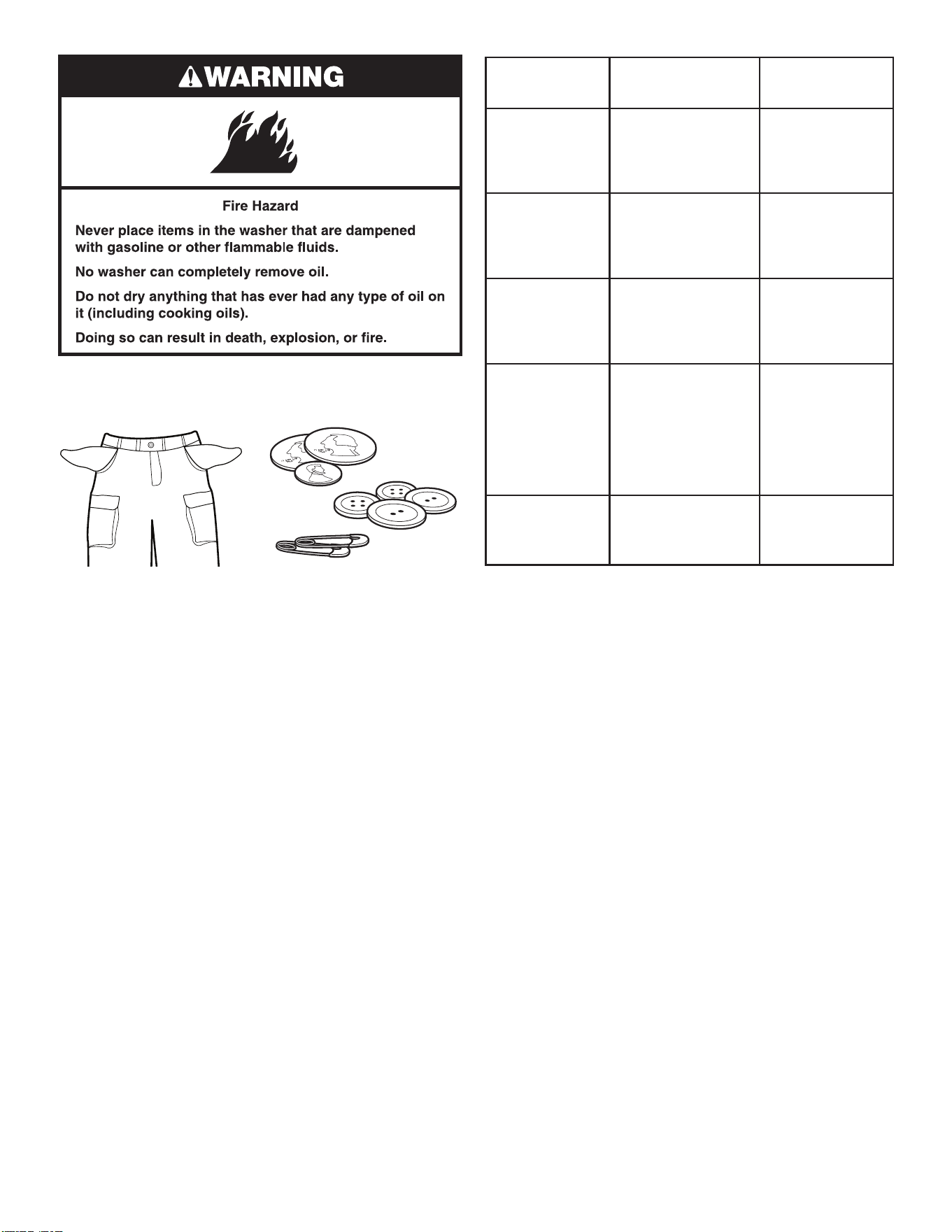
Ƀ Empty pockets. Loose change, buttons, or any small
object can pass under the clothes mover and become
trapped, causing unexpected sounds.
Ƀ Sort items by recommended cycle, water temperature,
and colorfastness.
Ƀ Separate heavily soiled items from lightly soiled.
Ƀ Separate delicate items from sturdy fabrics.
Ƀ Do not dry items if stains remain after washing, because
heat can set stains into fabric.
Ƀ Treat stains promptly.
Ƀ Close zippers, fasten hooks, tie strings and sashes, and
remove non-washable trim and ornaments.
Ƀ Mend rips and tears to avoid further damage to items
during washing.
Sort and prepare your laundry
Helpful Tips:
Ƀ Use mesh garment bags to help avoid tangling when washing
delicate or small items.
Ƀ Turn knits inside out to avoid pilling. Separate lint-takers from
lint-givers. Synthetics, knits, and corduroy fabrics will pick up lint
from towels, rugs, and chenille fabrics.
NOTES:
Ƀ Always read and follow fabric care label instructions to avoid
damage to your garments.
Ƀ The washer will not start or fill with the lid open.
Wash Temp Description
Suggested
Fabrics
Hot
Hottest wash bath
with a small amount
of cold water added
to help reduce energy
consumption.
Whites and pastels
Durable items
Heavy soils
Warm
Warm wash bath
comprised of hot and
cold water in similar
proportions.
Bright colors
Moderate to light
soils
Cool
Cool wash bath with
some warm water
added to assist in soil
removal and to help
dissolve detergents.
Colors that bleed
or fade
Light soils
Cold
Cold wash bath with
a small amount of
warm water added to
assist in soil removal
and to help dissolve
detergents.
Dark colors that
bleed or fade
Light soils
Tap Cold
Coldest wash bath
directly from your cold
faucet. No warm water
is added.
Dark colors that
bleed or fade
Light soils
Manual Soak
If you would like to manually soak your garments at any time during
the wash portion of the cycle, press Pause and leave the lid closed.
Once your desired soak time has elapsed, press Pause again to
continue the cycle. If the lid remains closed, you can manually soak
for up to three hours, at which point the machine will automatically
drain. The machine will also drain if the lid is left open for 10 minutes
during a manual soak.

NOTES
W11354658B
W11354659D-SP
©2023 All rights reserved. Used under license in Canada.
Tous droits réservés. Utilisé sous licence au Canada. 05/23