

ii
Important Information
Except as otherwise expressly stated in the License that accompanies a
program, Texas Instruments makes no warranty, either express or implied,
including but not limited to any implied warranties of merchantability and
fitness for a particular purpose, regarding any programs or book materials and
makes such materials available solely on an "as-is" basis. In no event shall
Texas Instruments be liable to anyone for special, collateral, incidental, or
consequential damages in connection with or arising out of the purchase or
use of these materials, and the sole and exclusive liability of Texas
Instruments, regardless of the form of action, shall not exceed the amount set
forth in the license for the program. Moreover, Texas Instruments shall not be
liable for any claim of any kind whatsoever against the use of these materials
by any other party.
EasyData is a trademark of Vernier Software and Technology.
© 2015 Texas Instruments Incorporated

Contents
Important Information ii
Using Your TI-84 Plus CE Graphing Calculator 1
Key Features 1
Keyboard Basics 2
Turning the TI-84 Plus CE On and Off 2
Using the TI-84Plus CE Keyboard 3
Setting the Display Brightness 6
Using the Home Screen 7
Working with Menus 14
Setting Up the Calculator Modes 18
Setting Modes 18
Evaluating Expressions 28
Order of Operations 28
Entering Expressions and Instructions 30
Working with Graphs 35
Using Color on the TI-84 Plus CE 35
Using QuickPlot and Fit Equation 37
Working With Images 37
Using Pictures and Backgrounds 38
Working with Matrices 39
Working with Probability and Statistics 41
Working with Probability 41
Working with Statistics 42
Working with Variables 46
Using Variable Names 46
Storing Variable Values 48
Recalling Variable Values 49
Managing Calculator Files 51
Transferring the OS from calculator to calculator 51
Compatibility with Graphing Calculators 51
iii

iv
Using Applications (Apps) 54
Using Accessories 55
Using TI-SmartView™ CE 55
Using TI Connect™ CE 56
Using the TI Charging Station CE 56
Changing and Charging the Battery 59
Replacing TI Rechargeable Batteries 61
Using Press-to-Test 63
Setting Up Test Mode 63
Bringing a Calculator Out of Test Mode 65
Error Conditions 67
Diagnosing an Error 67
General Information 68
Texas Instruments Support and Service 68
Service and Warranty Information 68
Korean Class A warning statement 69
Index 70

Using Your TI-84 Plus CE Graphing Calculator
The TI-84 Plus CE graphing calculator comes with a USB cable, plenty of
storage and operating memory. It also comes pre-loaded with software
applications (Apps) to help you perform pre-algebra, calculus, biology,
chemistry, and physics calculations.
Key Features
• High resolution, full-color backlit display
- Distinguish between multiple graphs and plots with color-coded
equations, plots, and objects
- Make graphs easier to read by adding grid lines
• TI Rechargeable Battery
- Recharges using a USB cable, wall charger, or TI Charging Station
CE
• Familiar TI-84 Plus functionality
- Same menu structure and navigation as the TI-84 Plus family with
enhanced features
- Built-in MathPrint™ functionality to input and view math symbols,
formulas and stacked fractions
• Import and use images
- Use TI Connect™ CE Software to send images (.gif, .jpg, .png, .tif,
.bmp) from a computer to a calculator
- Graph on top of images to connect concepts to the real world
The built-in applications extend the functionality of your calculator, allowing
you to perform specific math and science functions and to deepen your
understanding of concepts. Some pre-loaded applications include:
• Cabri™ Jr. Geometry App • Inequality Graphing
• CellSheet App • Periodic Table
• Conic Graphing
Use this guide to learn more about these features and other essential tools of
your TI-84 Plus CE graphing calculator.
Using Your TI-84 Plus CE Graphing Calculator 1
2 Keyboard Basics
Keyboard Basics
Turning the TI-84 Plus CE On and Off
Turning the Graphing Calculator On
Press É.
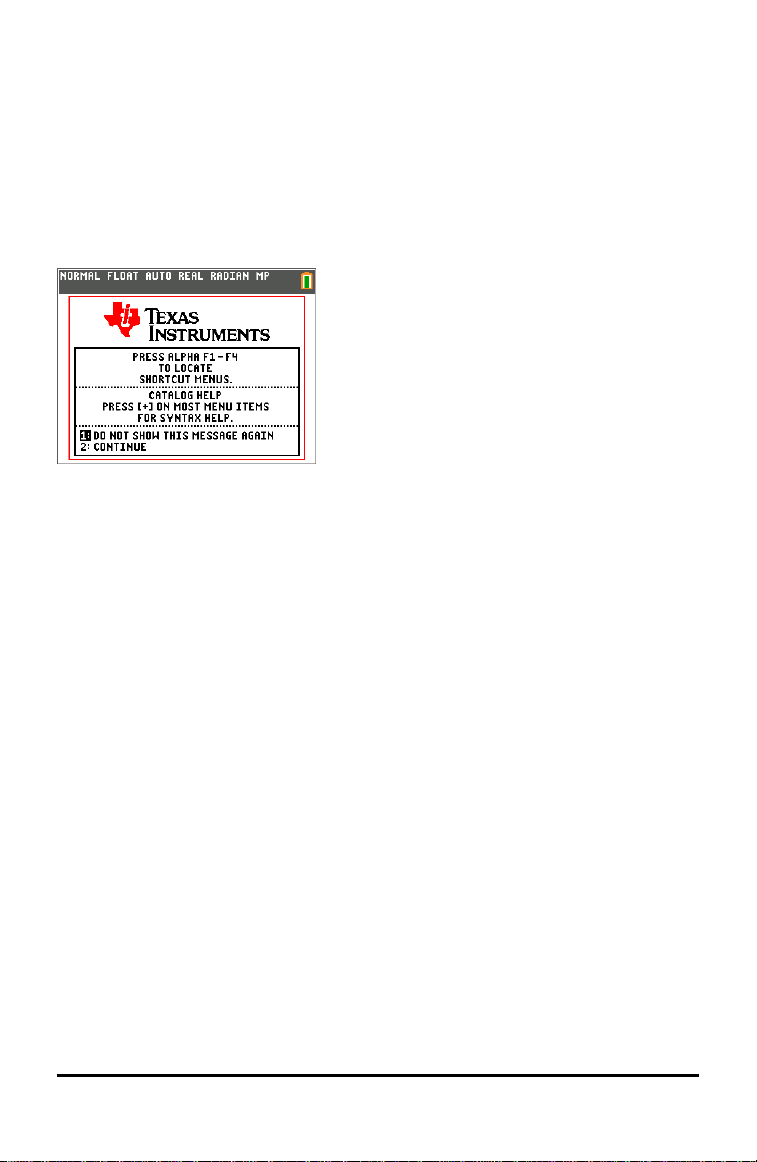
An information screen displays:
• Press À to continue to the home screen but not see this information screen
the next time you press É.
-or-
• Press Á to continue to the home screen.
Note: Any entry from this information screen will take you to the home
screen (a blank screen).
The information screen shows the following for information purposes only. You
must go to the home screen before you can complete the following.
• Press ƒ ^ - a to locate shortcut menus.
• Press à on most menu items for Catalog Help.
Note: This message also displays when you reset RAM.
You may see a shortcut menu located at [alpha] [F5] for interactive features
used in the graph area.
Turning the Graphing Calculator Off
Press y M.
• The Constant Memory™ function retains settings and memory, and clears
any error condition.
• Press } (if the home screen is blank), to scroll through the calculator
history.
• If you turn off the TI-84PlusCE and connect it to another graphing
calculator or personal computer, any communication will “wake" it up.
Automatic Power Down™ (APD™)
• To prolong battery-life, APD™ automatically turns the TI-84PlusCE off after
about five minutes of inactivity.
• If APD™ turns the graphing calculator off, it will return as you left it,
including the display, cursor, and any error.
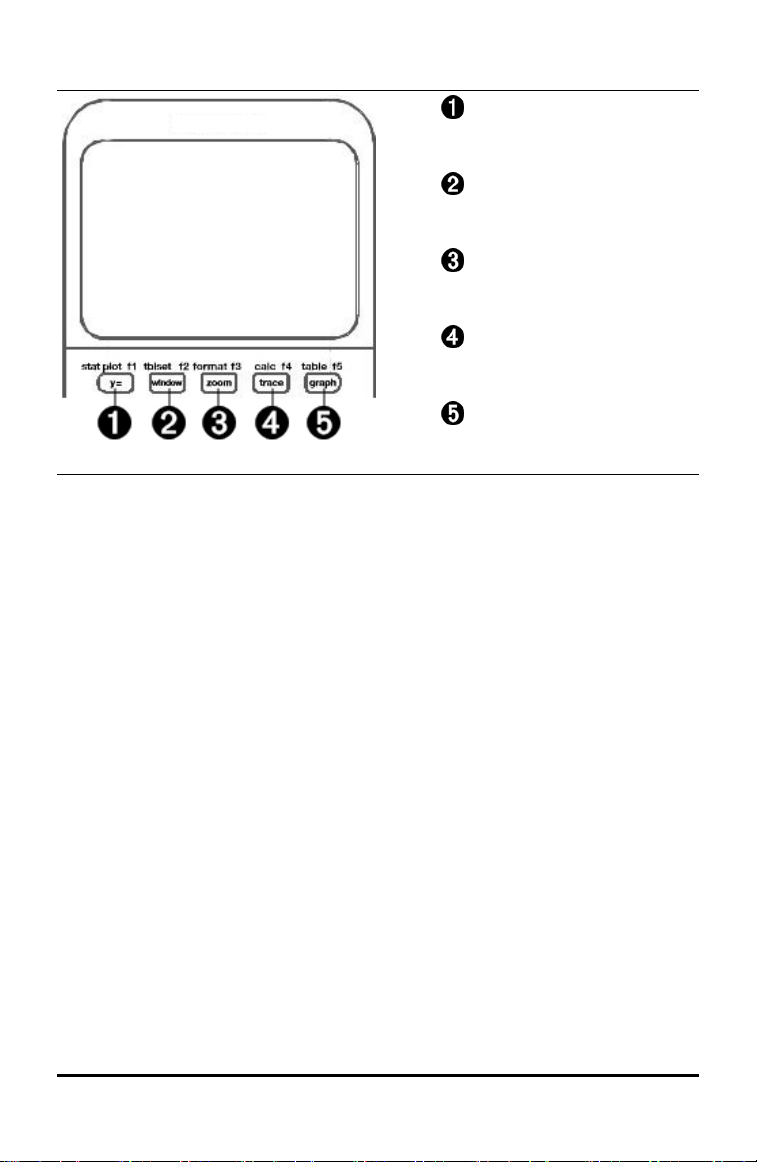
Using the TI-84Plus CE Keyboard
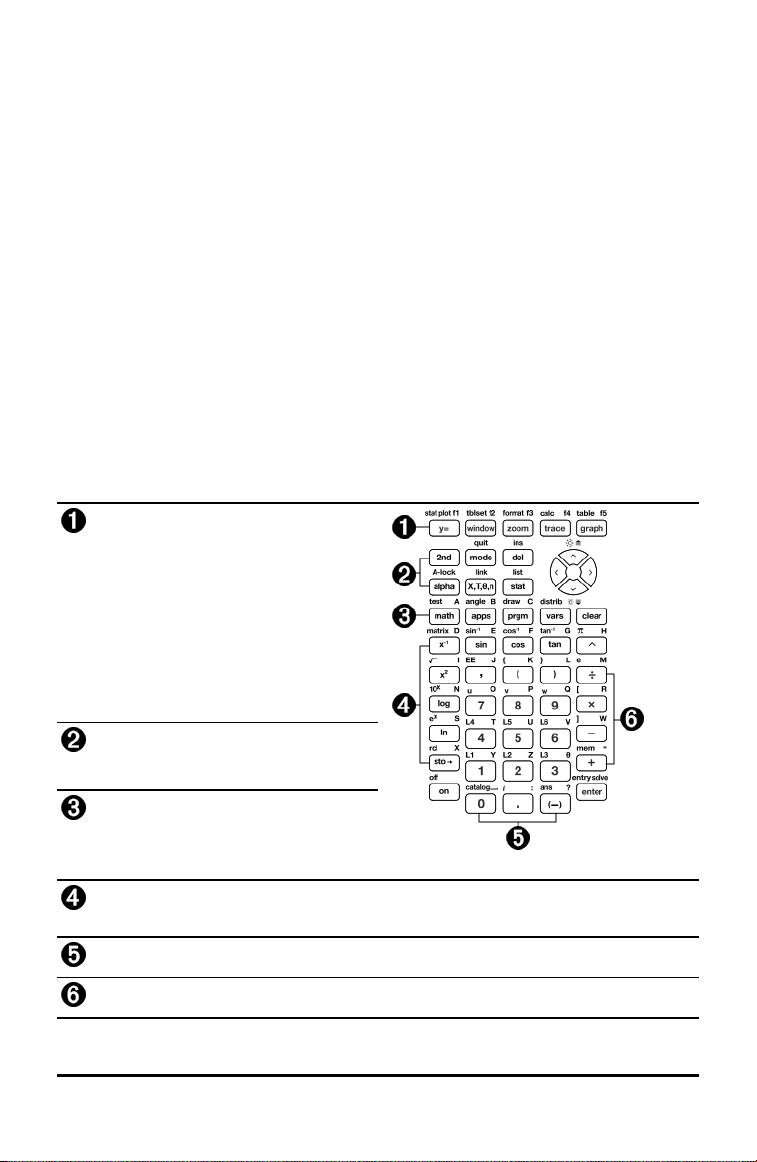
Graph/Plot Setup Keys allow
access to interactive graphing
features. When some graph
screen features are active, you
may see a shortcut menu in the
ƒ b location for feature
options.
Editing Keys allow you to edit
expressions and values.
Math and Statistics Keys display
menus that access math, statistics,
and other basic functions.
Scientific Keys allow access to the capabilities of a standard scientific
calculator—including trigonometric functions.
Number Keys allows you to enter numbers.
Common Math Functions allow you to divide, multiply, subtract, and add.
Keyboard Basics 3
4 Keyboard Basics
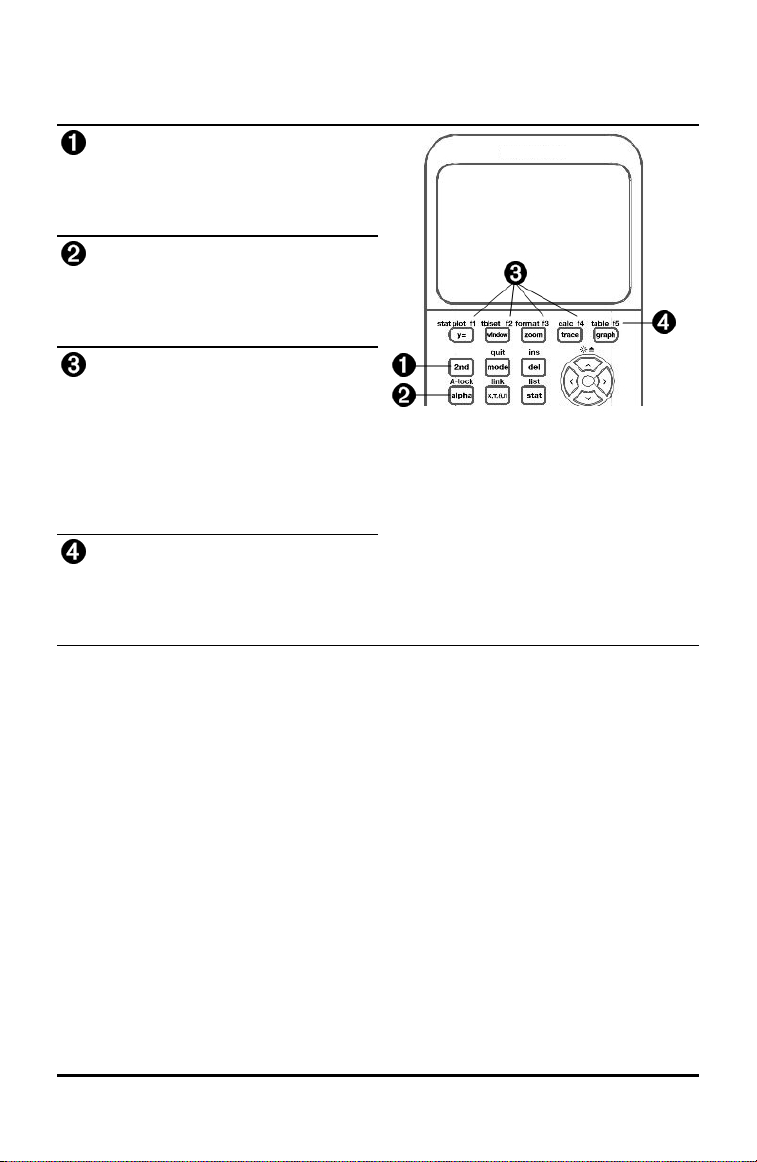
Function Keys
y
Access the
second function
printed to the left
above each key.
ƒ
Access the third
function printed to
the right above
each key.
ƒ ^ - a Access shortcut
menus for fraction
templates, n/d,
quick matrix entry,
select MATH
menus, and VARS
menu functions.
ƒ b Access options for
the DRAW
command when
used in GRAPH.
Using the Function Keys
Primary
Function
• The function appears on the key.
Ex: to display the MATH menu, press ».
Secondary
Function
• The function appears above the key in the same color as
the y key.
• When you press the y key, the key name printed
above the other key becomes active for the next
keystroke.
Ex: to display the TEST menu, press y and then ».
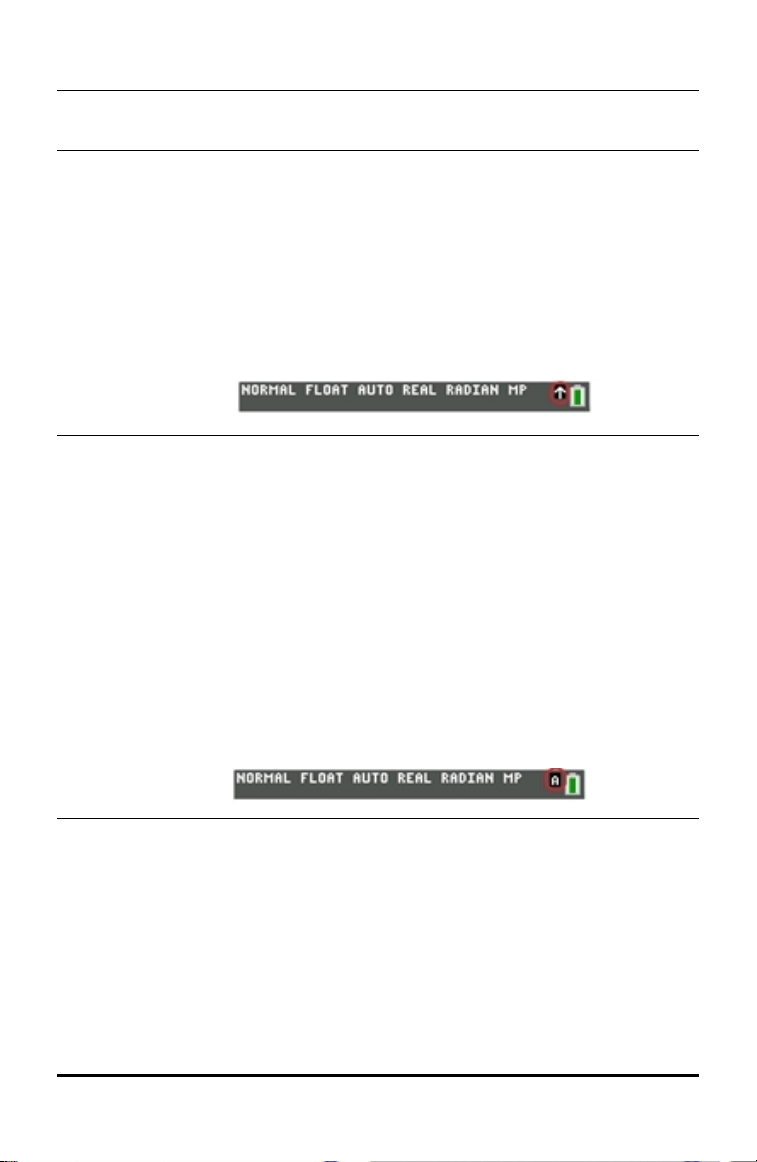
• The flashing cursor becomes Þ when you press y. Þ
may also appear in the status bar.
Third Function
• The function appears above the key in the same color as
the ƒ key.
• The third function allows you to enter alphabetic
characters and special symbols, and to access SOLVE
and shortcut menus.
Ex: to display the letter A, press ƒ and then ».
• To enter several alphabetic characters in a row, press
y 7to lock the alpha key in the ON position and
avoid having to repeatedly press ƒ. Press ƒ again
to unlock it.
• The flashing cursor becomes Ø when you press ƒ. Ø
may also appear in the status bar.
Keyboard Basics 5

6 Keyboard Basics
Setting the Display Brightness
Adjusting the Display Brightness
You can adjust the display brightness to suit your viewing angle and lighting
conditions.
To adjust the brightness, follow these steps.
▶ Press y † to darken the screen one level at a time.
▶ Press y } to lighten the screen one level at a time.
The TI-84PlusCE retains the brightness setting in memory when it is turned
off.
Automatic Dimming
The TI-84PlusCE automatically dims the screen brightness after 90 seconds
of inactivity.
▶ Press É to return the screen to the preset brightness.
▶ Pressing É to adjust the brightness will not affect any of the current state of
your calculator work.
Using the Home Screen
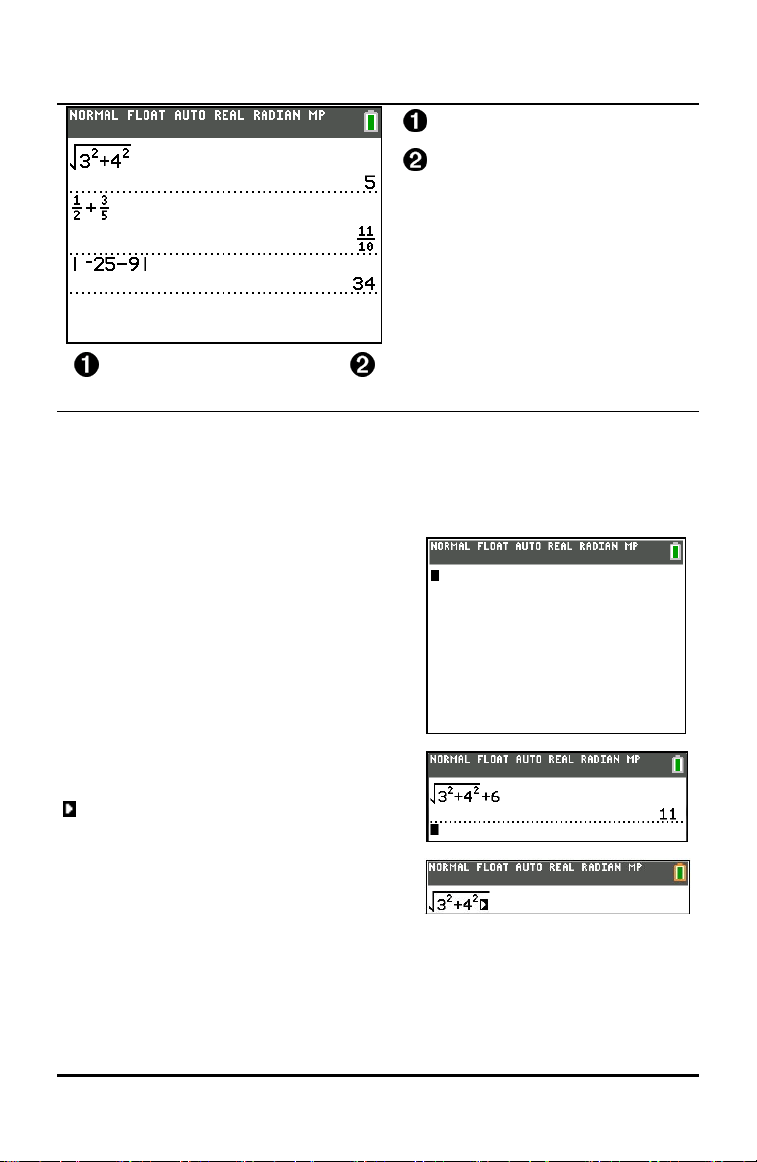
Expressions
Answers
Use the home screen to enter instructions and evaluate expressions. Answers
appear on the same screen. Most calculations are stored in home screen
history. Press } and † to scroll through the entry history and paste the entries
or answers to the current entry line.
Enter a calculation.
1. Press y 5 from any screen until
you get back to the home screen.
2. Press y C 3 ¡ Ã 4 ¡ ~ Ã 6 Í.
Note: When you are in a MathPrint™
template, the cursor turns into a right arrow
to indicate that you must press ~ to get
out of the template before you continue
entering the calculation.
Keyboard Basics 7
8 Keyboard Basics
Displaying Entries and Answers
Mode settings control how the TI-84PlusCE interprets expressions and
displays answers. Press z to switch between classic entries and MathPrint™
mode. This guide focuses on MathPrint™ Mode, but may reference some
classic entries.
MathPrint™ Mode
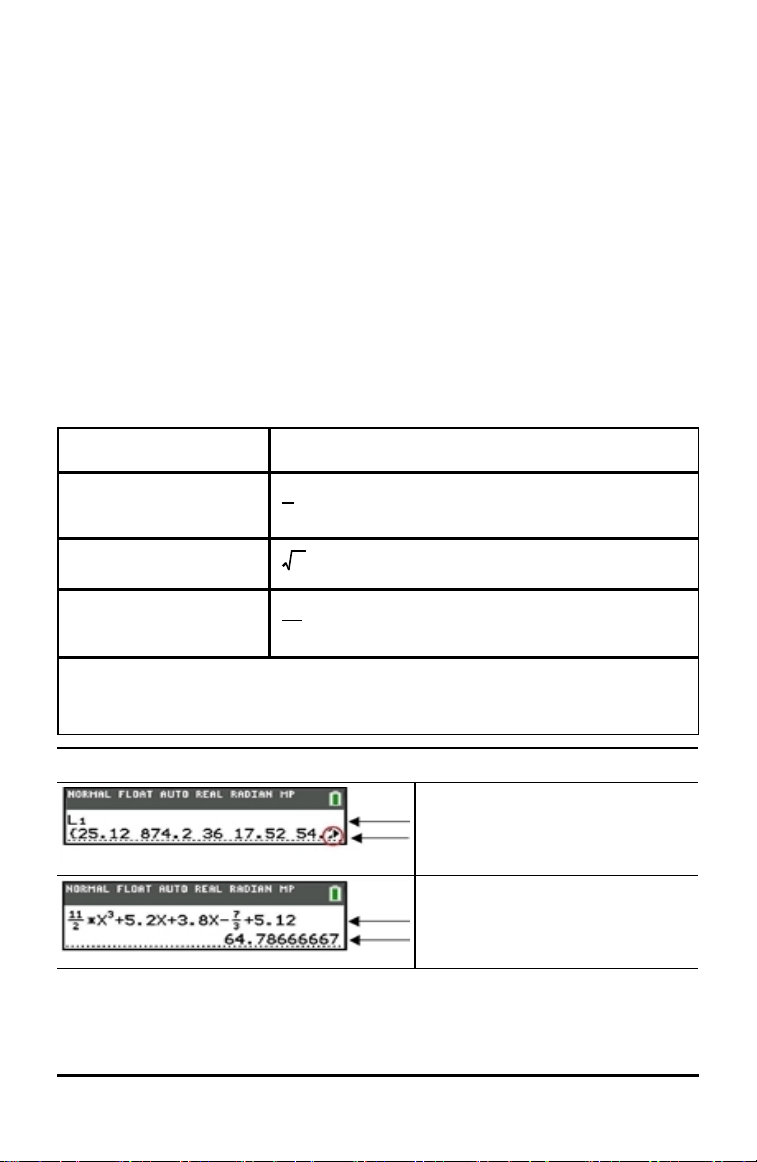
• If an expression exceeds one line, it may scroll off the screen (on the home
screen or the Y=screen). Press ~ to see the entire expression.
Tip: Press the cursor without pressing y to move the cursor along the
line.
• An arrow appears to the left of an answer if it scrolls off the screen. Press
~ and | before you enter another expression to display the entire
answer.
Classic Entries MathPrint™
1/2
1
2
sqrt (5)
5
( )
nDerive x x
, , 1
2
( )
x
| x=1
d
dx
2
Some input areas in MathPrint™ mode only support classic entries.
Ex: y -
MathPrint™ (default)
Entry
Answer (Scrolls)
Entry
Answer
Scrolling Through the Home Screen History
If all lines of the display are full, text scrolls off the top of the display.
You can scroll up through previous entries and answers on the home screen,
even if you have cleared the screen. When you find an entry or answer that you
want to use, you can select it and paste it (press Í) on the current entry line.
Note: List and matrix answers cannot be copied and pasted to the new entry
line. However, you can copy the list or matrix command to the new entry line
and execute the command again to display the answer.
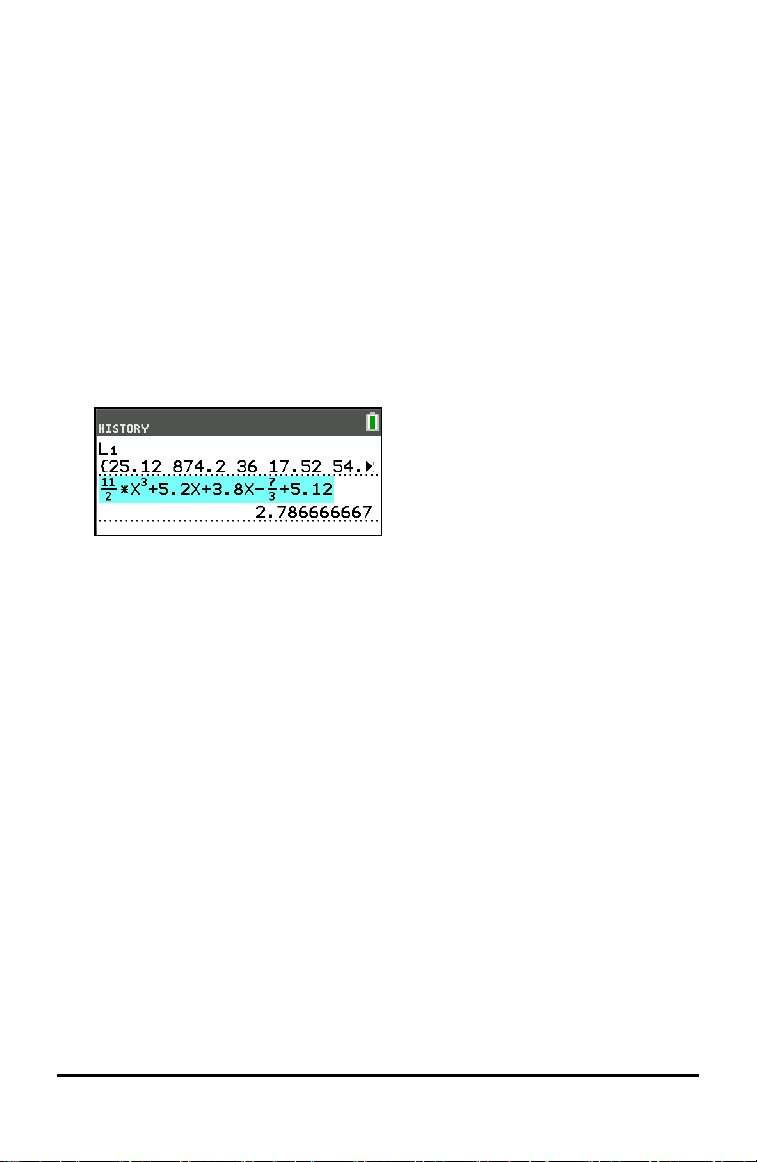
▶ Press } or † to move the cursor to the entry or answer you want to copy
and then press Í.
The TI-84PlusCE highlights the entry the cursor is on to help you select
your desired choice.
The entry or answer that you copied is automatically pasted on the current
input line at the cursor location.
Note: If the cursor is in a MathPrint™ expression, such as the denominator
of a fraction, press ƒ } to move the cursor out of the expression and
then move the cursor to the entry or answer you want to copy to that
location in the MathPrint™ template.
▶ Press ‘ or { to delete an entry/answer pair. After an entry/answer pair
has been deleted, it cannot be displayed or recalled again.
Returning to the Home Screen
To return to the home screen from any other screen, press y 5 until you get
back to home screen.
Status Bar
The status bar displays on all screens and gives information about the selected
calculator mode settings, any context help available for the item you currently
have selected, and battery status.
Keyboard Basics 9
10 Keyboard Basics
The status bar may also show a busy indicator if the calculator is performing an
operation, Ø to indicate the calculator is in alpha status, and Þ to indicate the
secondary function is active.
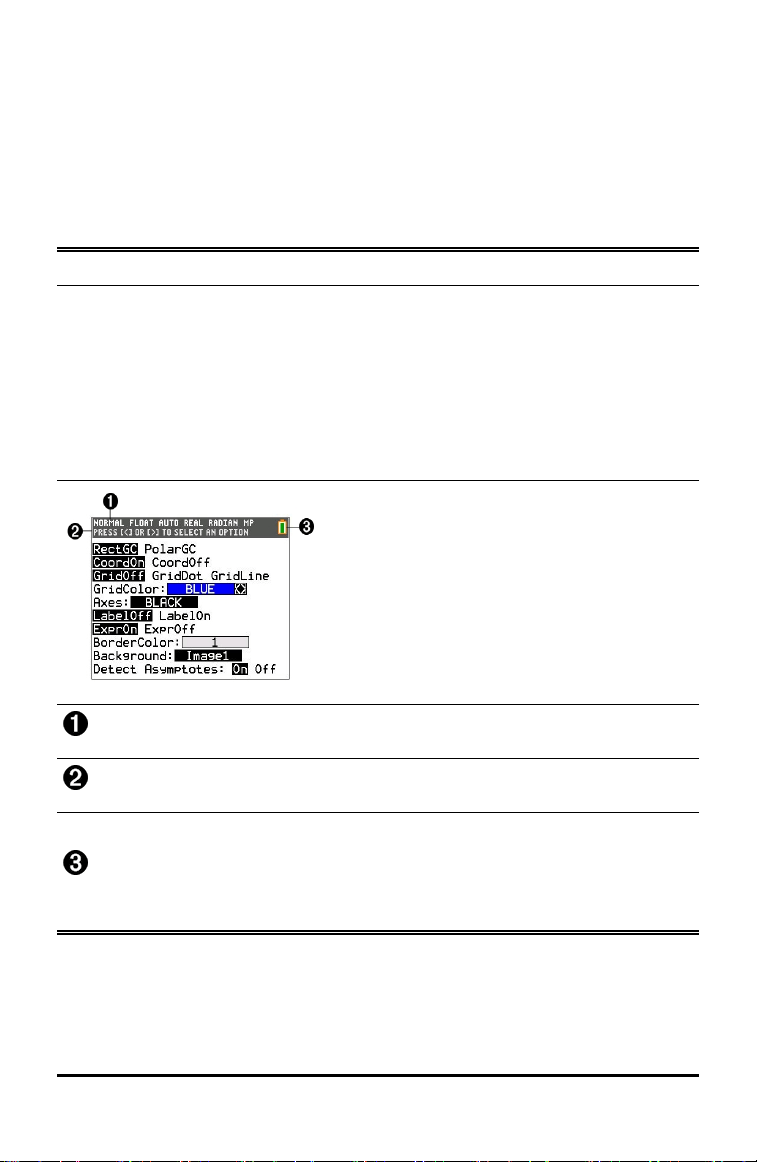
Selected mode settings are displayed on the top line of the status bar when the
cursor is in the active entry area. Mode settings do not display when the cursor
is in the home screen history, since the mode may have been different for
previous calculations.
Tip:
Context help, if available, is displayed on the second line. The battery
status icon, busy indicator, alpha indicator, and second key indicator are
on the right. When you scroll into the home screen history, the context
help on the status bar displays HISTORY.
In the example below, the cursor is on the GridColor option. The context
help for how to change the GridColor using the spinner menu is
displayed on the second line of the status bar.
Selected MODE settings.
Context help for current cursor position.
Battery icon.
This area of the status bar also displays the busy indicator,
alpha indicator, and second key indicator, depending on the state of the
graphing calculator.
Using Shortcut Menus
ƒ ^
Opens FRAC menu.
ƒ _
Opens FUNC menu.
ƒ `
Opens MTRX menu.
ƒ a
Opens YVAR menu.
ƒ b
Opens special menus.
Shortcut menus allow quick access to the following:
^
Templates to enter fractions, and to toggle between whole and mixed
fractions, and fractions and decimals.
_
Selected functions from the MATH MATH and MATH NUM menus as
you would see them in a textbook, when in MathPrint™ mode. Functions
include absolute value, numeric differentiation, numeric integration,
summation, log base n, square root, permutations, combinations, and
factorials.
`
Quick MathPrint™ matrix entry, when available.
a
Names of function variables from the VARS Y-VARS menu.
To open a shortcut menu, press ƒ plus the corresponding F-key: ^ for
FRAC, _ for FUNC, ` for MTRX, a for YVAR, or b for special menus within
interactive graph activities such as DRAW or QuickPlot and Fit Equation.
To select a menu item:
-either-
▶ Press the number corresponding to the item.
-or-
▶ Use the arrow keys to move the cursor to the appropriate line and then
press Í.
Keyboard Basics 11
12 Keyboard Basics
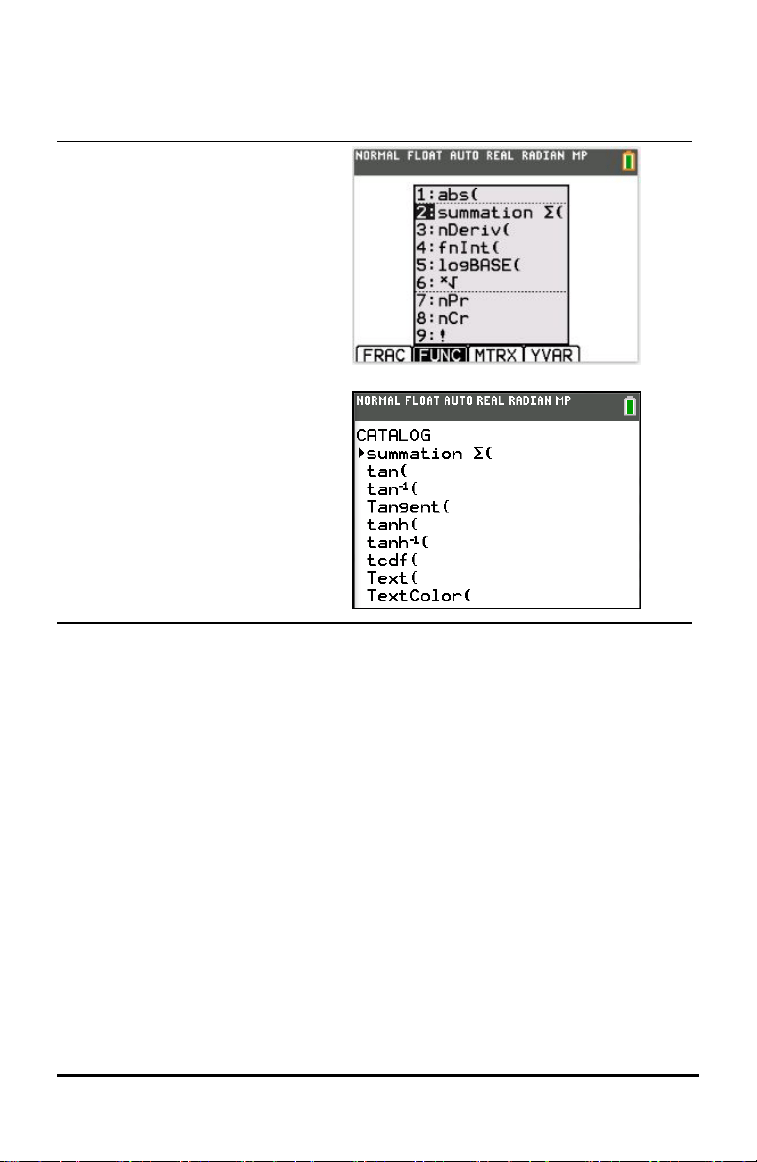
You can select all shortcut menu items except matrix templates using standard
menus. For example, you can choose the summation template from several
places:
FUNC shortcut menu
ƒ _
y catalog
The shortcut menus are available to use where input is allowed. If the
calculator is in Classic mode, or if a screen is displayed that does not support
MathPrint™ display, entries will be displayed in Classic mode. The MTRX menu
is only available in MathPrint™ mode on the home screen and in the Y=editor.
Note: Shortcut menus may not be available if ƒ plus F-key combinations are
used while an application is running.
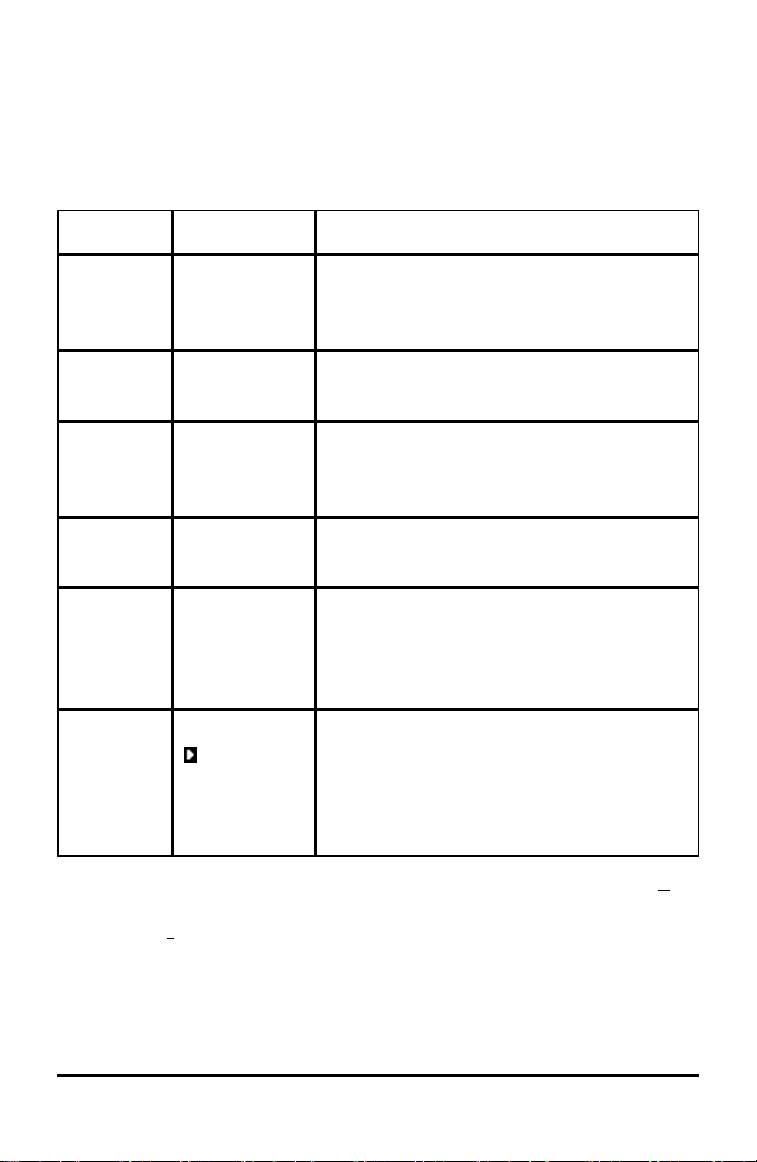
Display Cursors
The cursor may change to indicate what will happen when you press the next
key or when you select the next menu item to be pasted as a character.
Note:The second cursor Þ and alpha cursor Ø may appear on the status bar,
depending on the context.
Cursor Appearance Effect of Next Keystroke
Entry Solid
rectangle
$
This is the default cursor. Enter characters
at this cursor; this overrides any existing
character.
Insert Underline
__
Press y 6 for this cursor. Enter
characters in front of the cursor location.
Second
Reverse
arrow
Þ
This allows you to enter a 2nd character or
complete a 2nd operation.
Alpha Reverse A
Ø
An alpha character is entered, SOLVE is
executed, or shortcut menus are displayed.
Full Checkerboard
rectangle
#
No entry; the maximum characters are
entered at a prompt or memory is full. Also
indicates the limit of the allowed MathPrint™
mode levels.
MathPrint™ Right arrow The cursor moves to either the next part of
the template or out of the template. Press
the right arrow to move out of all MathPrint™
templates before entering the remaining
terms in an expression.
If you press ƒ during an insertion, the cursor becomes an underlined A (A). If
you press y during an insertion, the underlined cursors becomes an
underlined # (#).
Note: If you highlight a small character such as a colon or a comma and then
press ƒ or y, the cursor does not change because the cursor width is too
narrow.
Keyboard Basics 13
14 Keyboard Basics
Working with Menus
You can access TI-84PlusCE commands using menus.
Displaying a Menu
• When you press a key to display a menu, that menu temporarily replaces
the screen where you are working.
• Ex: press » to display the MATH menu.
• After you select an item from a menu, the screen where you are working
usually displays again.
Note: If a context help message is in the status bar when you press a menu
that temporarily replaces the screen, that context help will remain in the
status bar as a reminder that you are working within a context.
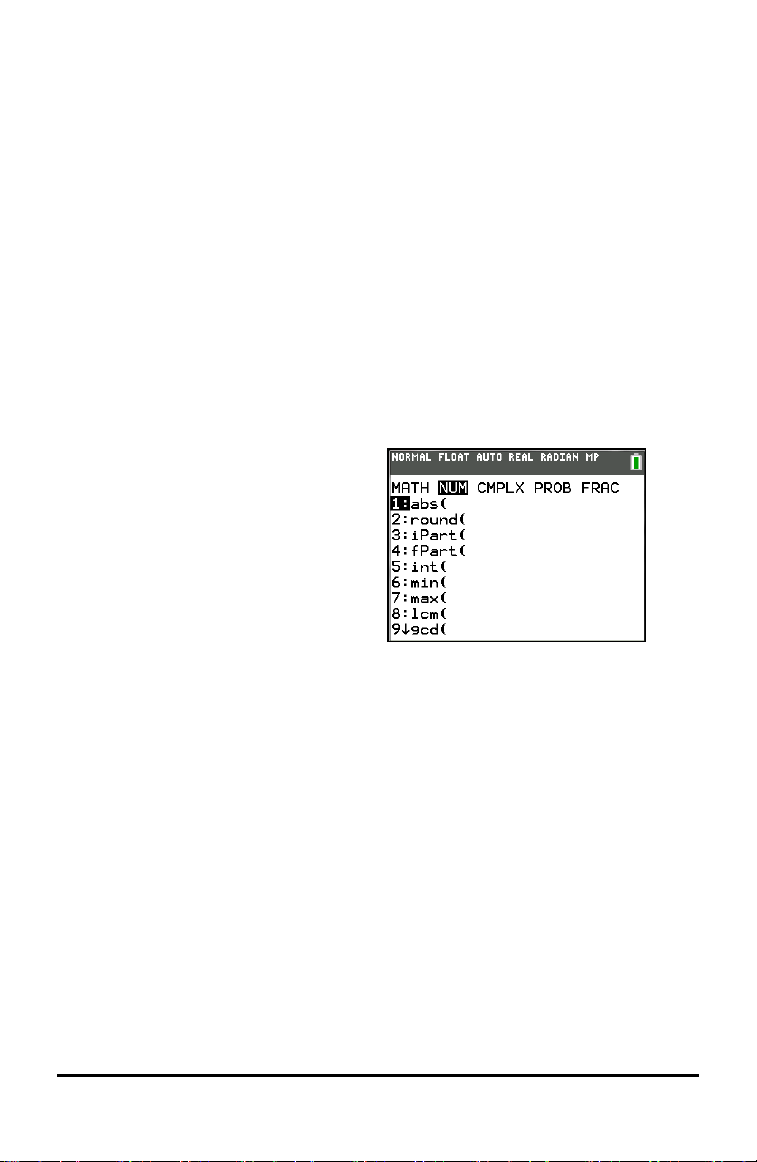
Moving from One Menu to Another
Some keys access more than one
menu. When you press such a key, the
names of all accessible menus are
displayed on the top line. When you
highlight a menu name, the items in
that menu are displayed. Press ~ and
| to highlight each menu name.
Note: FRAC shortcut menu items are
found in the FRAC menu, and are also
found on the MATH NUM menu. FUNC
shortcut menu items are also found on
the MATH MATH menu.
Scrolling a Menu
To scroll down the menu items, press †. To scroll up the menu items, press }.
To page down 9 menu items at a time, press ƒ †. To page up 9 menu items
at a time, press ƒ }.
To go to the last menu item directly from the first menu item, press }. To go to
the first menu item directly from the last menu item, press †.
Selecting an Item from a Menu
You can select an item from a menu in three ways.
▶ Press the number or letter of the item you
want to select. The cursor can be
anywhere on the menu, and the item you
select does not need to be displayed on
the screen.
-or-
▶ Press † or } to move the cursor to the item you want, and then press
Í.
-or-
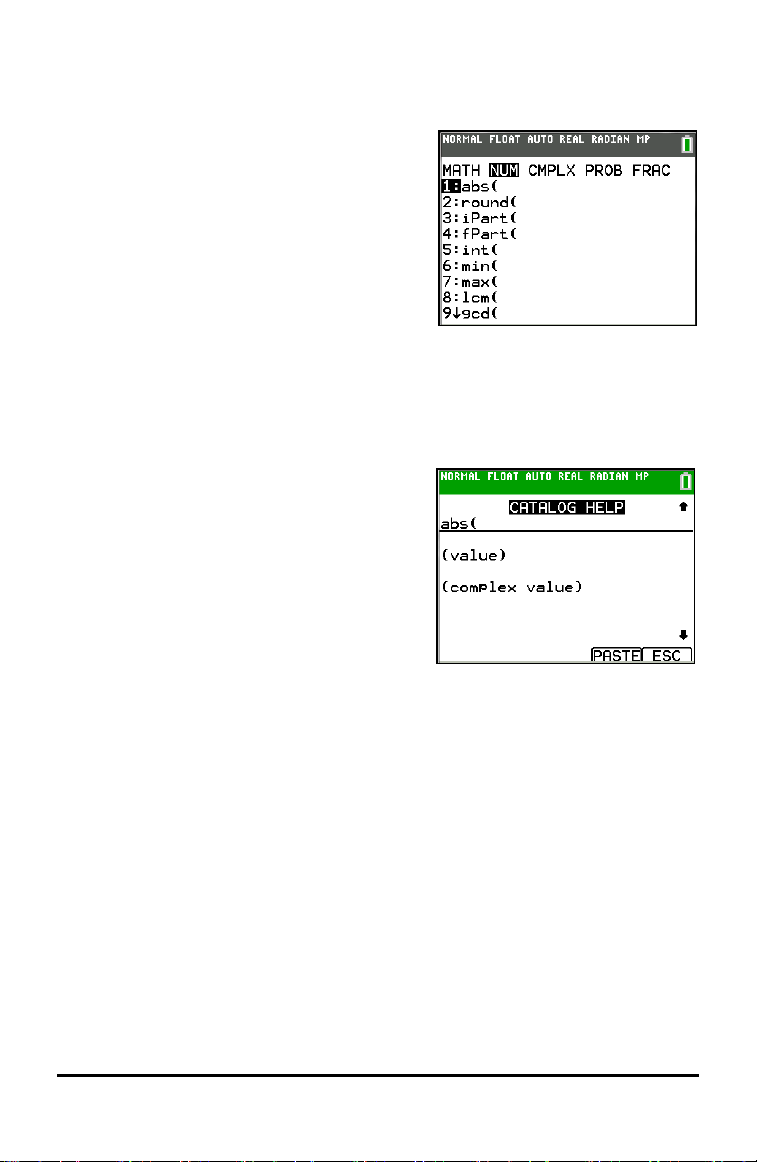
▶ Move the cursor to the item you want, and
then press Ã. For most commands, the
Catalog Help syntax editor displays the
correct syntax. Enter the syntax using the
displayed help, and then press ƒ a
to paste. The Catalog Help pastes the
complete command.
Press ƒ b to escape without pasting
the command.
Keyboard Basics 15

16 Keyboard Basics
Notes:
• After you select an item from a menu, the TI-84PlusCE typically displays
the previous screen.
• If you do not see PASTE on the Catalog Help screen, press y5 until
you return to the home screen, then repeat your actions. If this happens, it
may mean the screens were layered and the previous screen did not have
an active cursor on an input line to accept the pasting of the function or
command.
Leaving a Menu without Making a Selection
You can leave a menu without making a selection in these two ways.
• Press y 5 to return to the home screen.
-or-
• Press ‘ to return to the previous screen.
Using Menus
When you press a key or key combination to display a menu, one or more
menu names appear on the top line of the screen.
• The menu name on the left side of the top line is highlighted. Up to nine
items in that menu are displayed, beginning with item 1.
• A number or letter identifies each item’s place in the menu. The order is 1
through 9, then 0, then A, B, C. Once number and letter options are
exhausted, the item number or letter area will be blank. Select these items
using the arrow keys.
• When the menu continues beyond the displayed items, a down arrow ($)
replaces the colon next to the last displayed item.
• When a menu item ends in an ellipsis (...), the item displays a secondary
menu, editor, or wizard when you select it.
• When an asterisk (ä) appears to the left of a menu item, that item is stored
in user data archive. Pic and Image Vars are always stored in archive
memory. You must move other files (displayed with an asterisk) from
archive to RAM in the MEM menu.
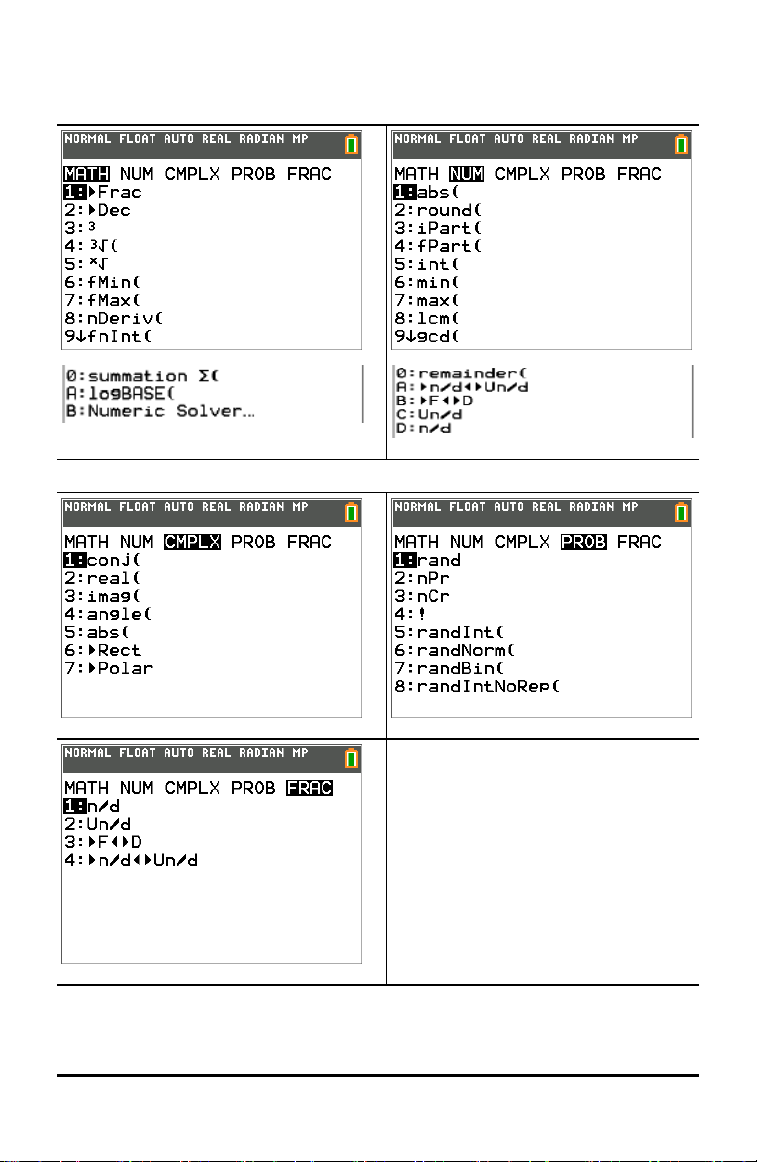
MATH Menus
The following are the MATH shortcut menus.
Scroll down when you see the ($) to see the whole menu.
Keyboard Basics 17
18 Keyboard Basics
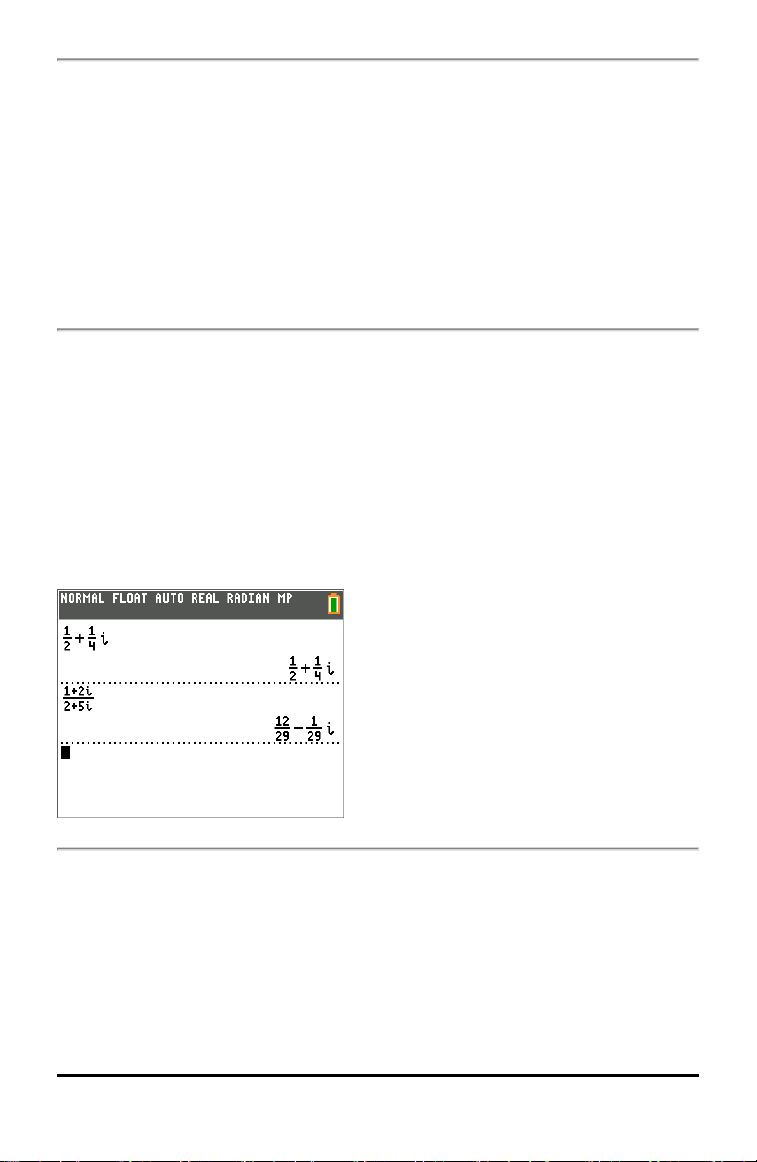
Setting Up the Calculator Modes
Setting Modes
To set calculator modes, press z.
The following menu appears on your screen:
Note: When you press z, the cursor is on
NORMAL by default. Press } to switch
between MathPrint™ and Classic modes.
Mode settings control how the calculator displays and interprets:
• Answers • Language settings
• Elements of lists and matrices • Numbers
• Graphs
Note: The Constant Memory™ feature retains mode settings when the unit
is turned off.
Changing Mode Settings
To change mode settings, follow these steps:
1. Press † or } to move the cursor to the line of the setting that you want to
change.
2. Press ~ or | to move the cursor across the line to the desired setting.
3. Press Í to select a setting.
Exception: LANGUAGE Press ~ or | to select a loaded language. Press
† or } to set the selected language.
Note: The second line of the status bar displays context help with a description
of line modes.

MATHPRINT™ CLASSIC
MATHPRINT™mode displays most inputs and outputs the way they are shown
in textbooks, such as
+
1
2
3
4
and
∫
x dx
1
2
2
.
CLASSIC mode displays expressions and answers as if written on one line,
such as 1/2 + 3/4. (Fraction bars appear as thick lines. A division operation will
appear as a thin slash mark.)
Note:
• Some areas in MATHPRINT™ mode display in classic (one line) formats.
• If you switch between these modes, most entries (except matrix
calculations) will be preserved.
NORMAL SCI ENG
Answers are displayed in standard formats when the calculation or setting
forces a decimal result on the calculator.
Notation for 12345.67 Decimal answer
displays as:
NORMAL
12345.67
Retains the decimal notation up to limits of the calculator
display and memory.
12345.67
SCI (Scientific1.234567 x 10
4
)
One digit to the left of the decimal with the appropriate
power of 10 to the right of *â.
1.234567â4
ENG (Engineering)
12.34567 x 10
3
Up to three digits before the decimal and the power of 10
(to the right of â) is a multiple of three.
12.34567â3
Note:
• The keypad contains y D, which displays as â on the calculator. *This
â in the display stands for "x10" and the number entered after â becomes
Keyboard Basics 19

20 Keyboard Basics
the power of 10. The calculator notation, â, designates the "x10" part of
the number without using extra parentheses. The calculator then follows
the order of operations as expected when using SCI or ENG notation.
This notation, â, is not typically accepted on homework and exams, and
written results should use the standard notation, for example, the
1.234567 x 10
4
.
• If you select NORMAL notation, but the answer cannot display in 10 digits
(or the absolute value is less than .001), the TI-84PlusCE expresses the
answer in scientific notation.
FLOAT 0 1 2 3 4 5 6 7 8 9
FLOAT (floating) decimal mode displays up to 10 digits, plus the sign and
decimal. FLOAT will display in the status bar.
Selecting 0123456789 specifies the number of digits (0 through 9) to display to
the right of the decimal for decimal answers. FIX# will display in the status bar.
The decimal setting applies to NORMAL, SCI, and ENG notation modes.
The decimal setting applies to these numbers, with respect to the ANSWER
mode setting:
• An answer displayed on the home screen
• Coordinates on a graph
• The Tangent( DRAW instruction equation of the line, x, and dy/dx values
• Results of calculated operations
• The regression equation stored after the execution of a regression model
RADIAN DEGREE
Angle modes control how the calculator interprets angle values in trigonometric
functions and polar/rectangular conversions. The RADIAN or DEGREE setting
will display in the status bar.
RADIAN mode interprets angle values as radians. Answers display in radians.
DEGREE mode interprets angle values as degrees. Answers display in
degrees. Polar complex number arguments are always interpreted in radians.

FUNCTION PARAMETRIC POLAR SEQ
Graphing modes define the graphing parameters.
FUNCTION graphing mode plots functions, where Y is a function of X.
PARAMETRIC graphing mode plots relations, where X and Y are functions of T.
POLAR graphing mode plots functions, where r is a function of q.
SEQUENCE graphing mode plots sequences.Three sequences are available:
u, v, and w as functions of n.
THICK DOT-THICK THIN DOT-THIN
Line Style: Graphs as:
THICK
Thick line style (default). More pixels displayed around a
plotted point (pixel).
DOT-THICK
Large dot plotting. (3x3 pixels) Equivalent to DOT on earlier
TI-84 Plus family calculators.
THIN
Thin line style (graphing per pixel).
DOT-THIN
DOT display is 1 pixel per dot graphed.
Note: You can change individual line styles in the Y=editor.
THICK plotting mode resets all Y= line styles to a thick line connecting each
point calculated for the selected functions.
Note: The THICK plotting mode on the TI-84 Plus CE is equivalent to the
CONNECTED plotting mode on the TI-84 Plus family of graphing calculators.
DOT-THICK plotting mode resets all Y= line styles to a large dot and plots only
the calculated points of the selected functions.
Note: The DOT-THICK plotting mode on the TI-84 Plus CE is equivalent to the
DOT plotting mode on the TI-84 Plus family of graphing calculators.
THIN plotting mode resets all Y= line styles to a thin line connecting each point
calculated for the selected functions.
Note: Use THIN plotting mode for function graphing when looking at any
functions which asymptote to an axis.
DOT-THIN plotting mode resets all Y= line styles to a small dot and plots only
the calculated points of the selected functions.
Keyboard Basics 21
22 Keyboard Basics
SEQUENTIAL SIMUL
SEQUENTIAL graphing-order mode evaluates and plots one function
completely before the next function is evaluated and plotted.
SIMUL (simultaneous) graphing-order mode evaluates and plots all selected
functions for a single value of X and then evaluates and plots them for the next
value of X.
Note: Regardless of which graphing mode is selected, the calculator will
sequentially graph all stat plots before it graphs any functions.
REAL a+bi re^(qi)
REAL mode does not display complex results unless complex numbers are
entered as input.
Two complex modes display complex results.
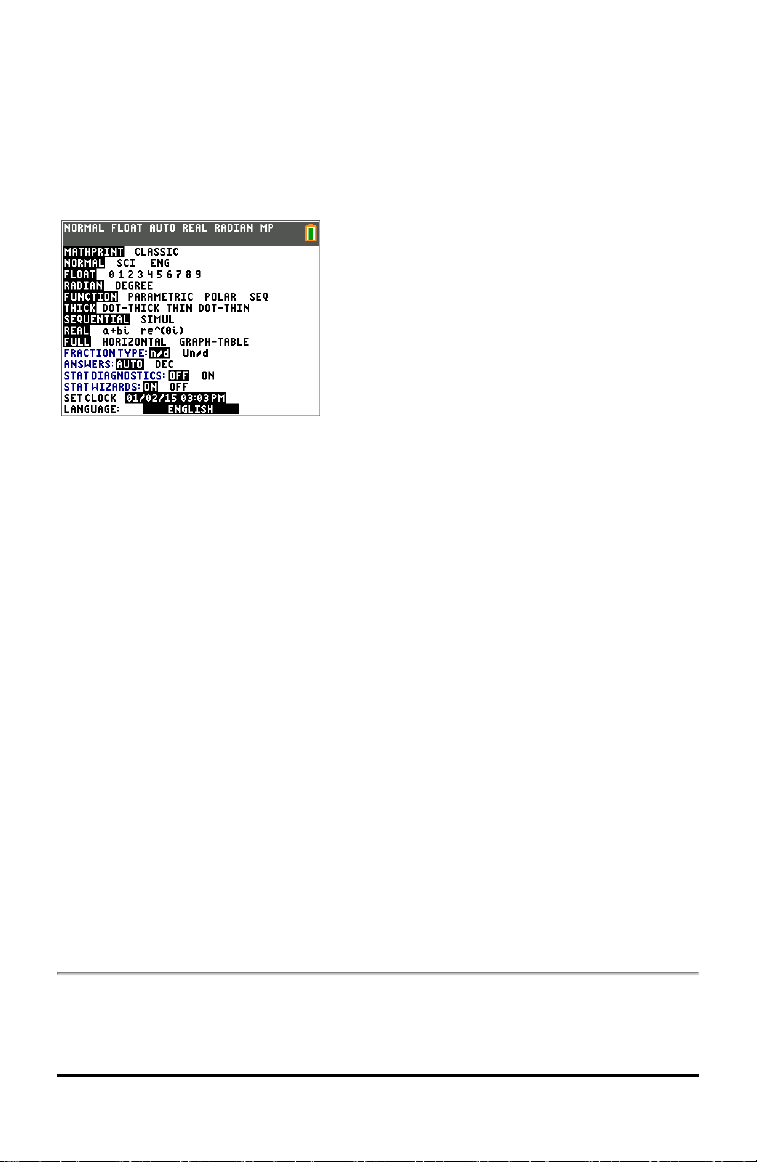
• a+bi (rectangular complex mode) displays complex numbers in the form
a+bi. The TI-84 Plus CE supports the n/d fraction template.
• re^(qi) (polar complex mode) displays complex numbers in the form
re^(qi).
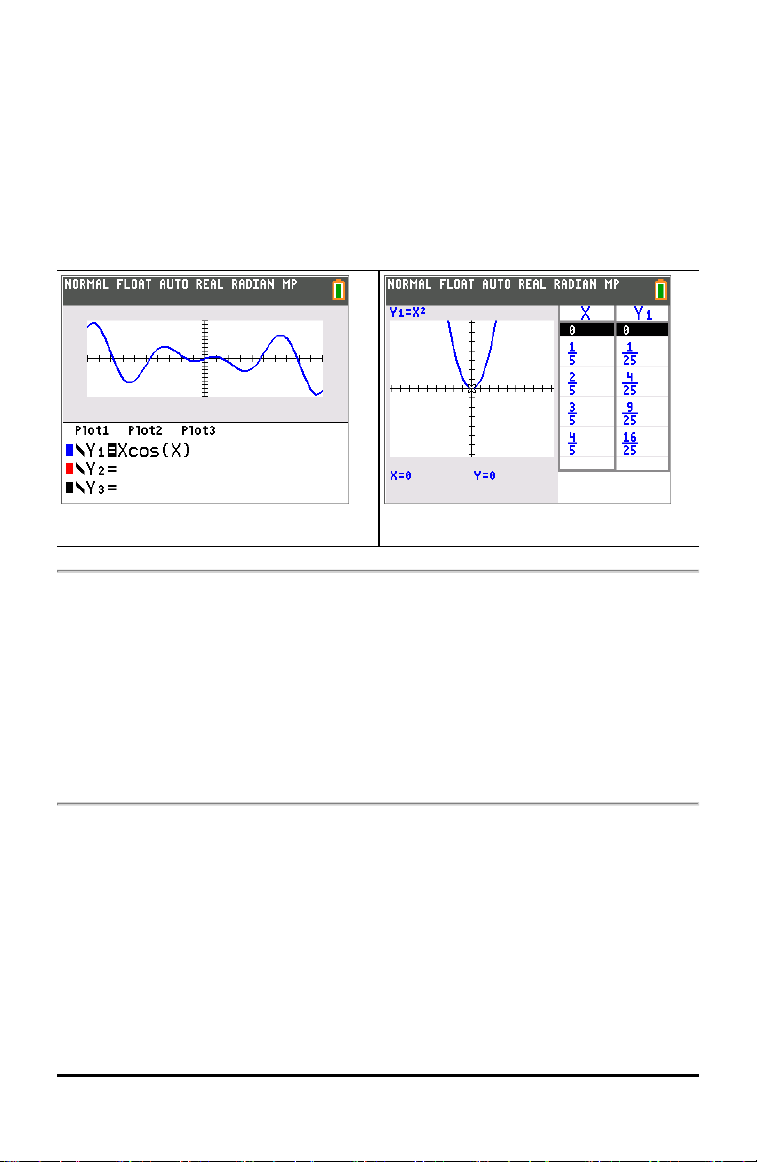
FULL HORIZONTAL GRAPH-TABLE
FULL screen mode uses the entire screen to display a graph or edit screen.
Each split-screen mode displays two screens simultaneously.
• HORIZONTAL mode displays the current graph on the top half of the
screen; it displays the home screen or an editor on the bottom half.
• GRAPH-TABLE mode displays the current graph on the left half of the
screen; it displays the table screen on the right half.
Horizontal Graph-Table
FRACTION TYPE: n/d Un/d
n/d displays results as a simple fraction. Fractions may contain a maximum of
six digits in the numerator; the value of the denominator may not exceed 9999.
Un/d displays results as a mixed number, if applicable. U, n, and d must be all
be integers. If U is a non-integer, the result may be converted U n/d. If n or d is a
non-integer, a syntax error is displayed. The whole number, numerator, and
denominator may each contain a maximum of three digits.
ANSWERS: AUTO DEC
AUTO displays answers in a similar format as the input. For example, if a
fraction is entered in an expression, the answer will be in fraction form, if
possible. If a decimal appears in the expression, the output will be a decimal
number.
DEC displays answers as integers or decimal numbers.
Keyboard Basics 23

24 Keyboard Basics
Note: The ANSWERS mode setting also affects how values in sequences, lists,
and tables are displayed. You can also convert values from decimal to fraction
or fraction to decimal using }FRAC, }DEC, and }F| }D located in the FRAC
shortcut menu or the MATH submenu.
STAT DIAGNOSTICS: OFF ON
OFF displays a statistical regression calculation
without
the correlation
coefficient (r) or the coefficient of determination (r
2
).
ON displays a statistical regression calculation
with
the correlation coefficient
(r), and the coefficient of determination (r
2
), as appropriate.
STAT WIZARDS: ON OFF
ON: Selection of menu items in MATH PROB, STAT, CALC, DISTR DISTR, DISTR
DRAW and seq( in LIST OPS displays a screen which provides syntax help
(wizard) for the entry of required and optional arguments into the command or
function. The function or command will paste the entered arguments to the
Home Screen history or to most other locations where the cursor is available
for input. Some calculations will compute directly from the wizard. If a command
or function is accessed from N the command or function will paste without
wizard support.
If no wizard is available, use Catalog Help for more syntax help when needed.
To use Catalog Help, select a menu item and then press Ã.
OFF: The function or command will paste to the cursor location with no syntax
help (wizard).
SET CLOCK
Use the clock to set the time and date, select the clock display format, and turn
the clock on and off. The clock is turned on by default and is accessed from the
mode screen.
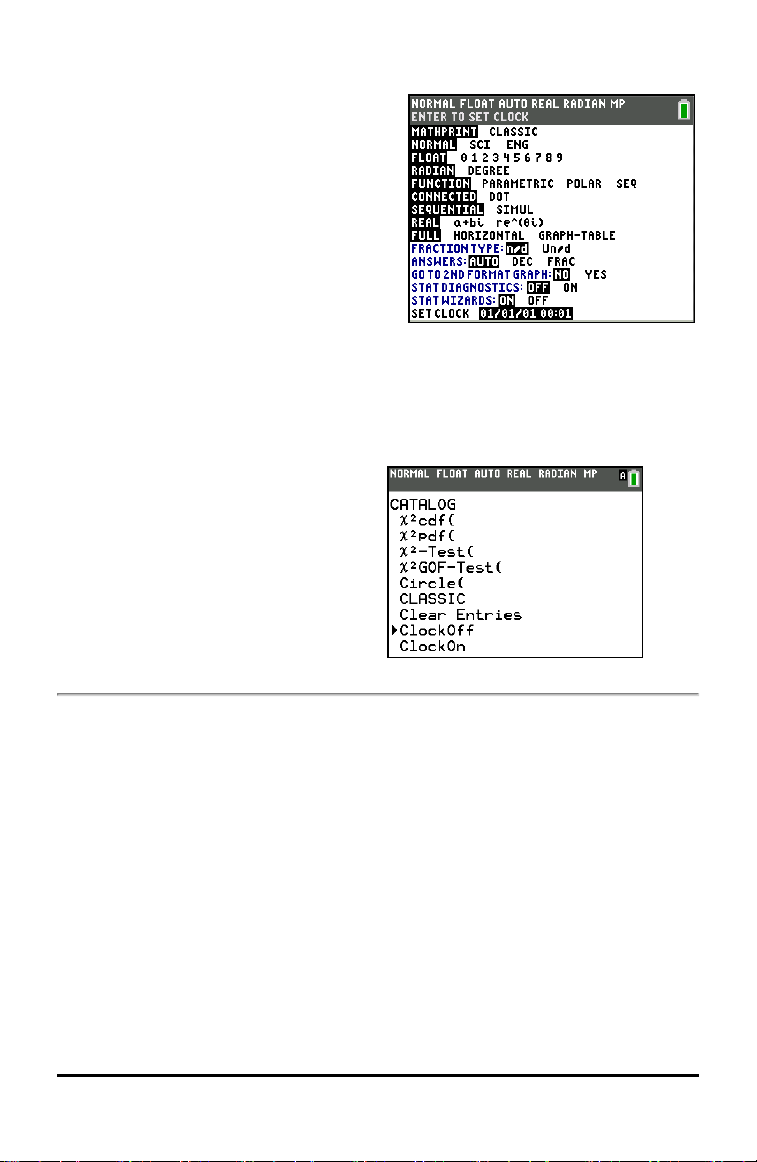
Displaying the Clock Settings
1. Press z.
2. Press } } to move the cursor to SET
CLOCK.
3. Press Í to change clock settings.
Note:
You may have to reset the clock if your battery power runs out.
See education.ti.com for future updates on the battery and battery preservation features.
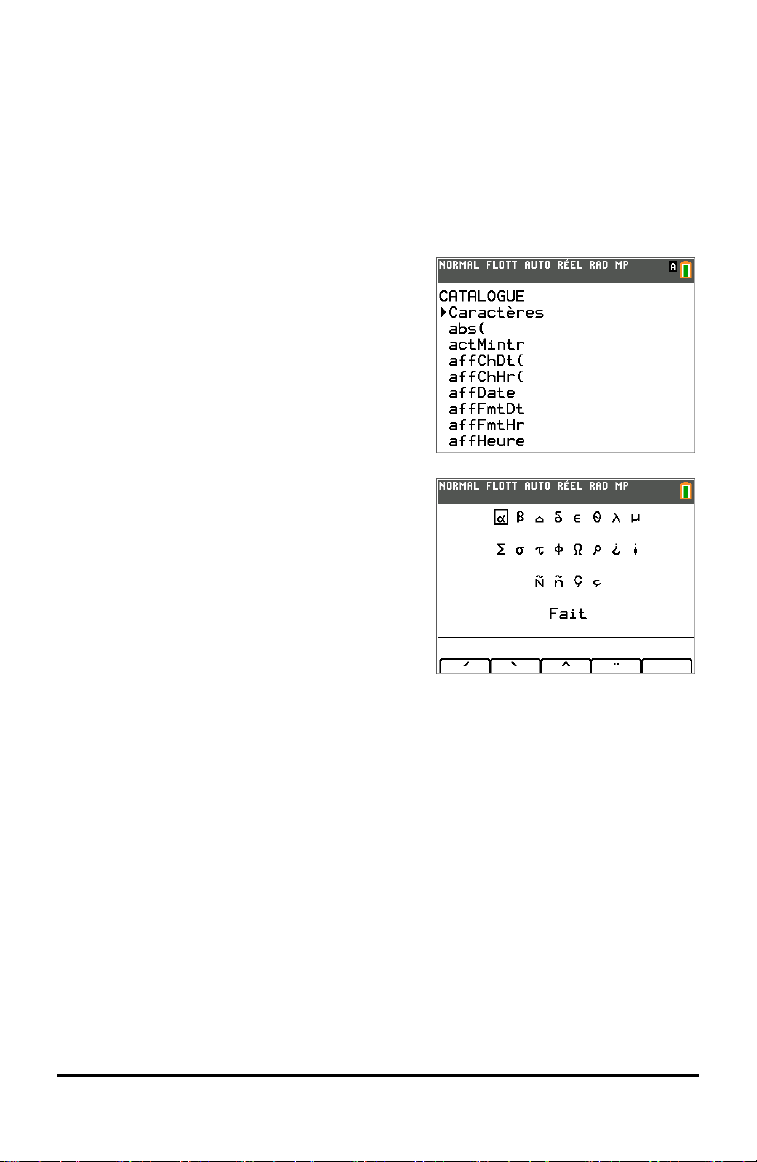
Turning the Clock On and Off
1. Press y N.
2. Press † or } to scroll the
CATALOG until the selection
cursor points to ClockOff or
ClockOn.
3. Press Í Í.
LANGUAGE
Press ~ or | on the LANGUAGE spinner menu to select a loaded language.
Press † or } to set the selected language.
Note:
• The calculator will retain your language setting for most resets of the
calculator.
• The LANGUAGE spinner menu will only display Language Apps loaded on
the calculator. Check education.ti.com for all available languages. Use
TI Connect™ CE to load files to your calculator.
Keyboard Basics 25
26 Keyboard Basics
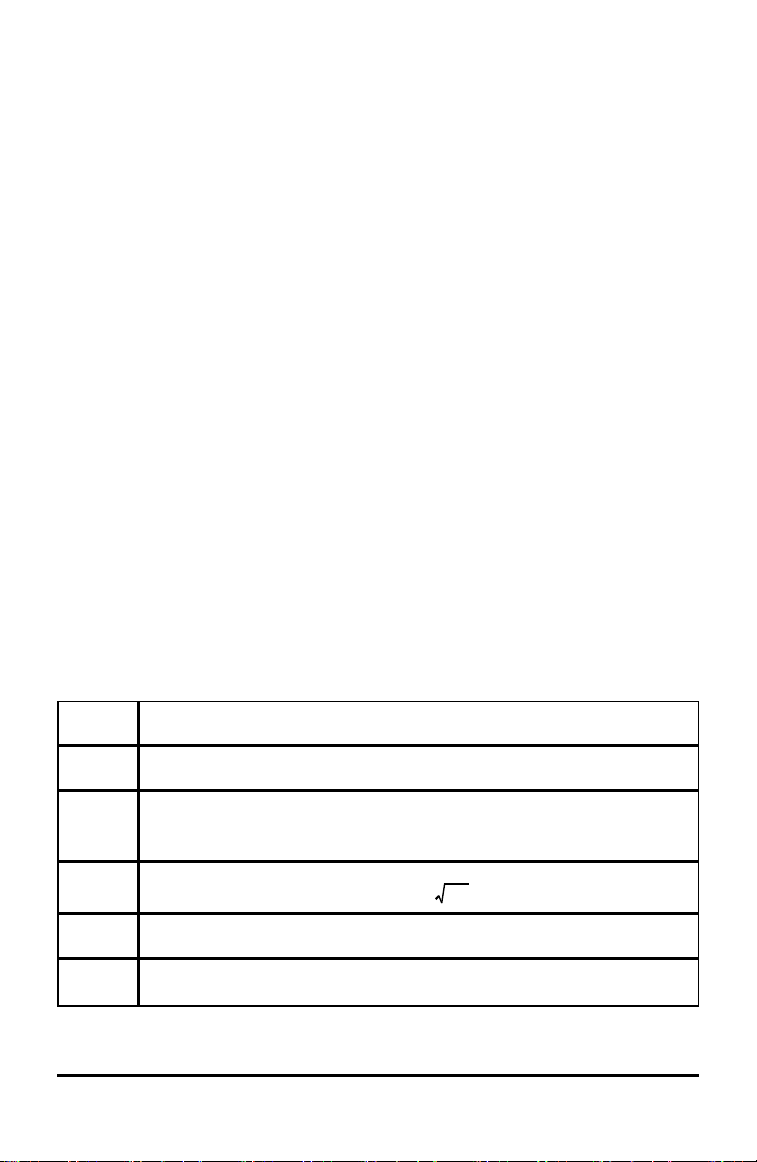
Using the Special Character Set
After you select your desired language, a new item (CHARACTER) is added to
the TI-84 Plus CE CATALOG. This item accesses special characters and accent
marks used in the language that you chose for localization. You can use these
special characters and accent marks for display messages and text strings that
you want to store to a variable. You cannot, however, use them in variable
names.
1. Press y N to display the
CATALOG.
Note: CHARACTER is always the first
item in the CATALOG.
2. Press Í to display the CHARACTER
screen.
Accent marks appear in the menus at
the bottom of the screen.
3. You can:
• Select a special character:
a) Press |, ~, †, or } to move the box to the special character that
you want to use in a message or text string.
b) Press Í to place the character on the edit line.
c) Press |, ~, †, or } to move the box to Done.
d) Press Í to paste the contents of the edit line to the previous
screen.
-or-
• Add an accent mark to a character:
e) Press the function key (^, _, `, a, or b) immediately above the

accent mark to select it. The ALPHA uppercase mode is
automatically turned on. To change to lowercase, press ƒ.
f) Press the key associated with the alpha character that you want to
accent, for example, [A] (above »). The accented character is
displayed in the edit line.
g) Press |, ~, †, or } to move the box to Done.
h) Press Í to paste the contents of the edit line to the previous
screen.
Keyboard Basics 27
28 Evaluating Expressions
Evaluating Expressions
An expression is a group of
• numbers,
• variables,
• functions and their arguments,
-or-
• a combination of these elements.
An expression evaluates to a single answer.
On the TI-84PlusCE, you enter an expression in the same order as you would
write it on paper. For example: pR
2
is an expression.
Order of Operations
The TI-84 Plus CE uses an order of operations system called Equation
Operating System (EOS™), which
• defines the order in which functions in expressions are entered and
evaluated
-and-
• allows you to enter numbers and functions in a simple, straightforward
sequence.
EOS™ evaluates the functions in an expression in this order:
Order Function
1 Functions that precede the argument, such as sin( or log(
2 Functions that are entered after the argument, such as 2, -1, !, ¡, r,
and conversions
3
Powers and roots, such as 2
5
or
5 32
x
4 Permutations (nPr) and combinations (nCr)
5 Multiplication, implied multiplication, and division
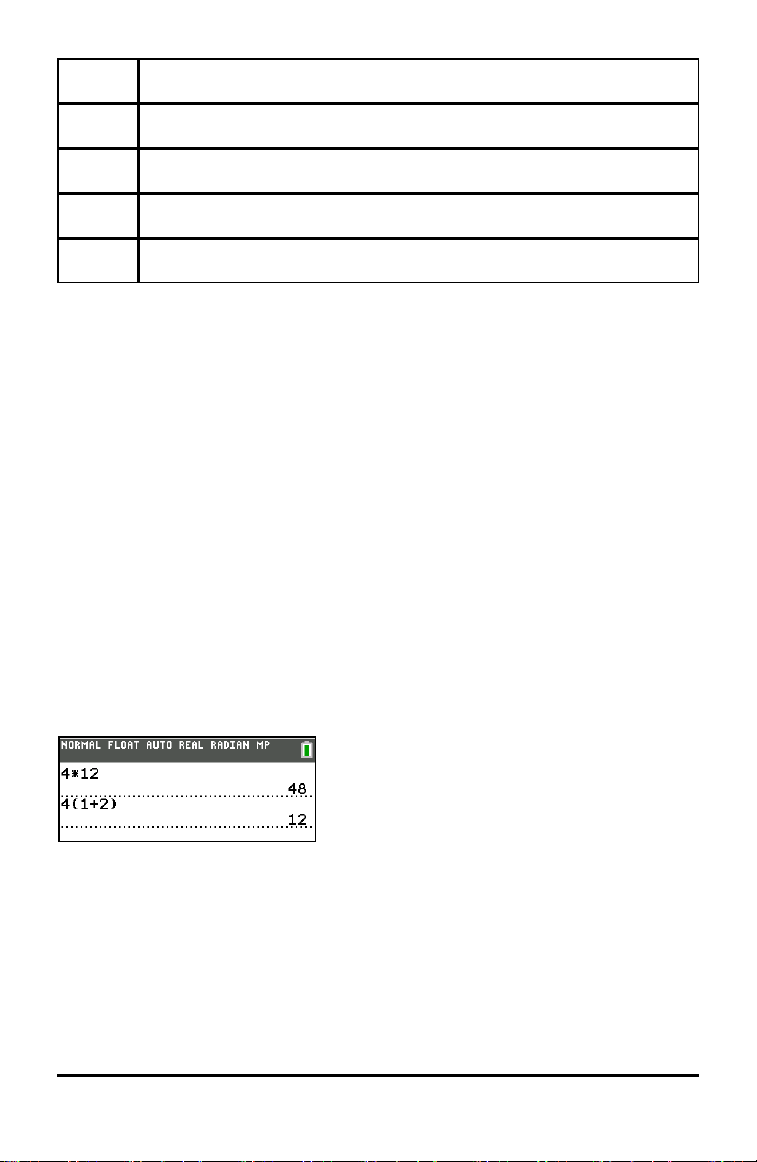
Order Function
6 Addition and subtraction
7 Relational functions, such as > or
8 Logic operator and
9 Logic operators or and xor
Note: Within a priority level, EOS™ evaluates functions from left to right.
Calculations within parentheses are evaluated first. A number in scientific or
engineering notation, 2.34â6, is interpreted as (2.3x10
6
) with parentheses so
the number remains the correct value during the EOS™ calculation.
Implied Multiplication
The TI-84PlusCE recognizes implied multiplication, so you do not need to
press ¯ to express multiplication in all cases. For example, the TI-84PlusCE
interprets 2p, 4sin(46), 5(1+2), and (2 ä 5)7 as implied multiplication.
Note: TI-84PlusCE implied multiplication rules differ from those of some other
graphing calculators. For example, the TI-84PlusCE evaluates 1à2X as (1à2)
X, while some graphing calculators may evaluate 1à2X as 1à(2 X).
Parentheses
The TI-84 Plus CE completes all calculations inside a pair of parentheses first.
For example, in the expression 4(1+2), EOS™ first evaluates the portion inside
the parentheses, 1+2, and then multiplies the answer, 3, by 4.
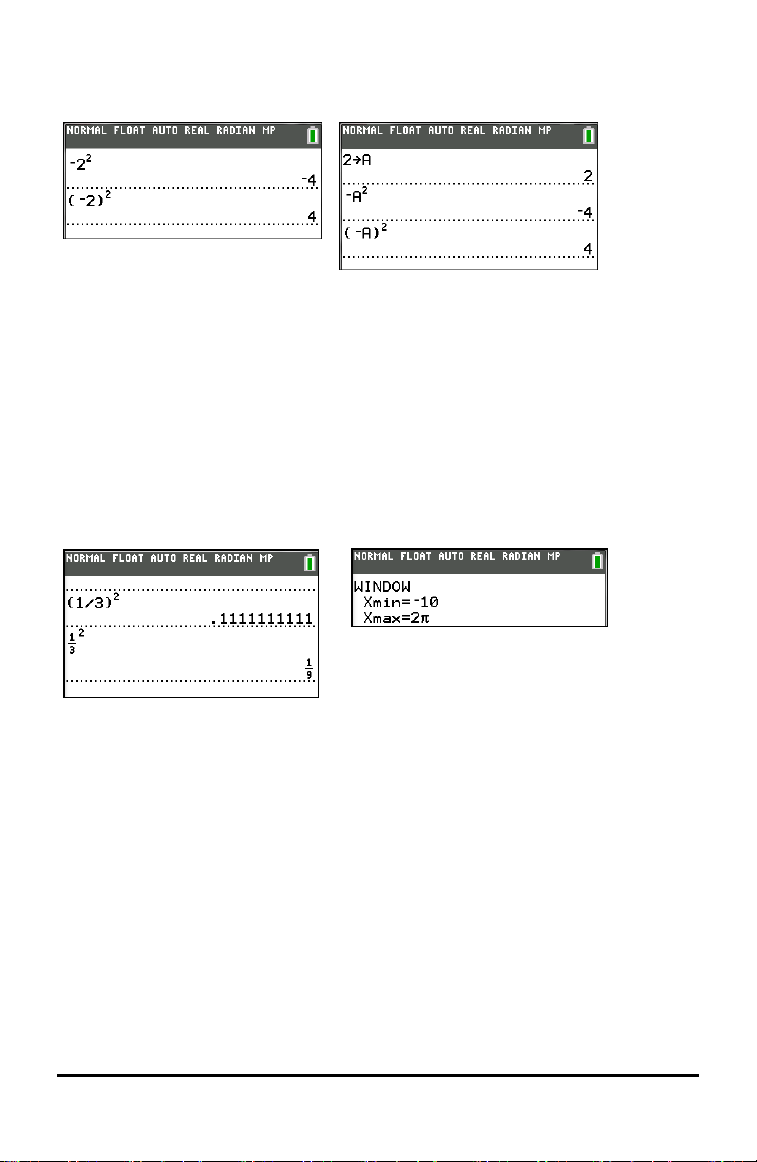
Negation
To enter a negative number, use the negation key. Press k and then enter the
number. On the TI-84PlusCE, negation is in the third level in the EOS™
hierarchy. Functions in the first level, such as squaring, are evaluated before
negation.
Evaluating Expressions 29
30 Evaluating Expressions
Example: MX
2
, evaluates to a negative number (or 0). Use parentheses to
square a negative number.
Note: Use the j key for subtraction and the k key for negation. If you press j
to enter a negative number, as in 9 ¯ ¹ 7, or if you press k to indicate
subtraction, as in 9 k 7, an error occurs. If you press ƒ A k ƒ B, it is
interpreted as implied multiplication (A)(MB).
Entering Expressions and Instructions
You can use an expression on the home screen to calculate an answer. In
most places where a value is required, you can use an expression to enter a
value.
Entering an Expression
To create an expression, you enter numbers, variables, and functions using the
keyboard and menus. An expression is evaluated when you press Í,
regardless of the cursor location. The entire expression is evaluated according
to EOS™ rules, and the answer is displayed according to the mode setting for
Answer.
Note: Most TI-84PlusCE functions and operations are symbols comprising
several characters. You must enter the symbol from the keyboard or a menu;
do not spell it out. For example, to calculate the log of 45, you must press «
45. Do not enter the letters L, O, and G. If you enter LOG, the TI-84PlusCE
interprets the entry as implied multiplication of the variables L, O, and G.
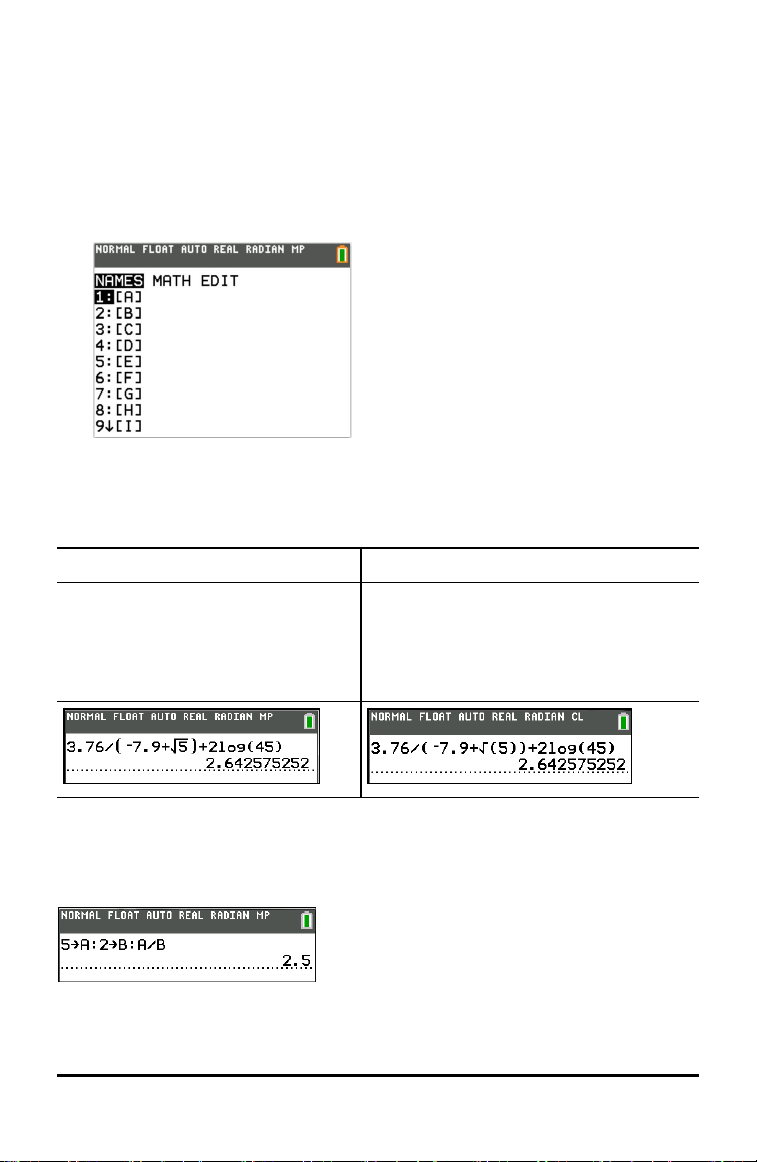
To enter a matrix name:
1. Press y ¾.
The Matrix Names menu appears.
2. Press the number on the keypad that corresponds with the desired Matrix
Name.
Ex: Press 1 for [A] as shown.
Note: In MathPrint™ mode, press ~ to get out of the MathPrint™ template and
continue entering the expression.
Calculate 3.76 P (L7.9 +$ 5) + 2 log 45.
MathPrint™ Classic
3 Ë 76 ¥ £ k 7 Ë 9 Ã y C 5
~ ¤ Ã 2 « 45 ¤ Í
Note: The ~ is a notable keystroke
difference as compared to Classic.
3 Ë 76 ¥ £ k 7 Ë 9 Ã y C 5 ¤ ¤
à 2 « 45 ¤ Í
Multiple Entries on a Line
To enter two or more expressions or instructions on a line, separate them with
colons (ƒ m). All instructions are stored together in last entry (ENTRY).
Evaluating Expressions 31
32 Evaluating Expressions
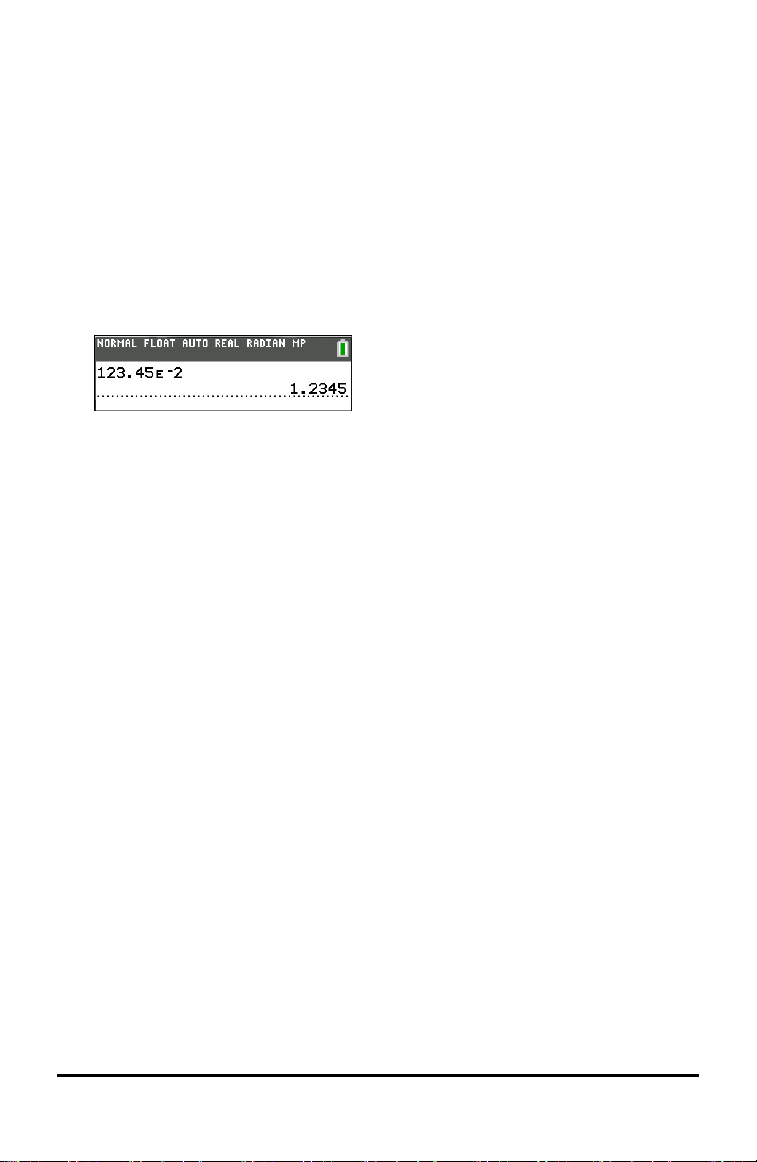
Entering a Number in Scientific Notation
1. Enter the part of the number that precedes the exponent. This value can be
an expression.
2. Press y D. â is pasted to the cursor location.
3. Enter the exponent, which can be one or two digits.
Notes:
• If the exponent is negative, press k, and then enter the exponent.
• â stands for "x10" and the calculator interprets the entire number as
(1.23.45 x 10
-2
) as if it was entered with parentheses.
When you enter a number in scientific notation, the TI-84PlusCE does not
automatically display answers in scientific or engineering notation. The mode
settings and the size of the number determine the display format.
Functions
A function returns a value. For example, log( and sin( are functions. In general,
the first letter of each function is lowercase. Most functions take at least one
argument, as indicated by an open parenthesis following the name. For
example, sin( requires one argument, sin (value).
Note: To see the arguments of a function or command in the calculator, find the
item in a menu or y N and press +. For most menu items, a Catalog
Help screen will display and the syntax of the arguments will be displayed.
Instructions
An instruction (command) initiates an action on the calculator. For example,
ClrDraw is an instruction to the calculator to clear drawn elements from a graph.
Instructions cannot be used in expressions. In general, the first letter of each
instruction name is uppercase. Some instructions take more than one
argument, as indicated by an open parenthesis at the end of the name. For
example, on the TI-84PlusCE, Circle( requires three arguments, and has two
optional arguments: Circle(X,Y,radius[,color, linestyle]).

Interrupting a Calculation
To interrupt a calculation or graph in progress, which is indicated by the busy
indicator in the status bar, press É.
When you interrupt a calculation, a menu is displayed.
• To return to the home screen, select 1:Quit.
• To go to the location of the interruption, select 2:Goto.
When you interrupt a graph, a partial graph is displayed.
• To return to the home screen, press ‘ or any non-graphing key.
• To restart graphing, press a graphing key or select a graphing instruction.
TI-84Plus CE Edit Keys
Keystrokes Result
~ or | • Moves the cursor within an expression; these keys
repeat if held down on the keypad.
} or † • Moves the cursor from line to line within an
expression that occupies more than one line; these
keys repeat if held down on the keypad.
• Moves the cursor from term to term within an
expression in MathPrint™ mode; these keys repeat if
held down on the keypad.
• On the home screen, scrolls through the history of
entries and answers.
y | • Moves the cursor to the beginning of an expression.
y ~ • Moves the cursor to the end of an expression.
ƒ } • Moves the cursor out of a MathPrint™ expression
and up into history on the home screen.
• Moves the cursor from a MathPrint™ expression to
the previous Y-var in the Y=editor.
ƒ † • Moves the cursor from a MathPrint™ expression to
the next Y-var in the Y=editor.
Í
• Evaluates an expression or executes an instruction.
‘
• Clears the current line on a line with text on the
home screen.
Evaluating Expressions 33

34 Evaluating Expressions
Keystrokes Result
• Clears everything on the home screen on a blank
line on the home screen. This does not clear the
history of your entries and answers.
- Press } to see the history.
- Use Clear Entries* followed by ‘ if you wish
to delete all home screen entries.
*Clear Entries is found in N.
• Clears the expression or value where the cursor is
located in an editor; it does not store a zero.
{
• Deletes a character at the cursor; this key repeats if
held down on the keypad.
y { • Changes the cursor to an underline (__); inserts
characters in front of the underline cursor; to end
insertion, press y 6 or press |, }, ~, or †.
y
• Changes the cursor or status bar indicator to Þ; the
next keystroke performs a 2nd function (displayed
above a key and to the left); to cancel 2nd, press
y again.
ƒ
• Changes the cursor or status bar indicator to Ø; the
next keystroke performs a third function of that key
(displayed above a key and to the right) or accesses
a shortcut menu. To cancel ƒ, press ƒ or
press |, }, ~, or †.
y 7 • Changes the cursor to Ø; sets alpha-lock;
subsequent keystrokes access the third functions of
the keys pressed; to cancel alpha-lock, press ƒ.
If you are prompted to enter a name such as for a
group or a program, alpha-lock is set automatically.
Note: The TI-84 Plus CE does not automatically set
alpha-lock for entries that require list names.
„
• Pastes an X in Function mode, a T in Parametric
mode, a q in Polar mode, or an n in Seq mode with
one keystroke.
Working with Graphs
Using Color on the TI-84 Plus CE
The TI-84PlusCE graphing calculator has many color options and a high
resolution display that allows more information to be shown on the screen. The
TI-84PlusCE uses color in the following ways:
• Y= editor for line color.
• DRAW commands for line color, such as vertical lines, circles, and text on
the graph screen.
• The graph format screen for grid, axes, or border color, and applying a
background image or color.
• Statistical Plots.
The color options are selected using a spinner, which can contain various
options depending on the feature. Press | and ~ to scroll through the color
options to set a color.
Note: Take care to choose appropriate color combinations for the graph areas
so that all features are visible.
▶ You can reset the calculator to its default settings, including color settings,
by pressing y L 722.
Using Color on the Graph Screen
The examples below show how to set up the graph of a function. Here, the
mode is set to FUNCTION and the default settings are assumed.
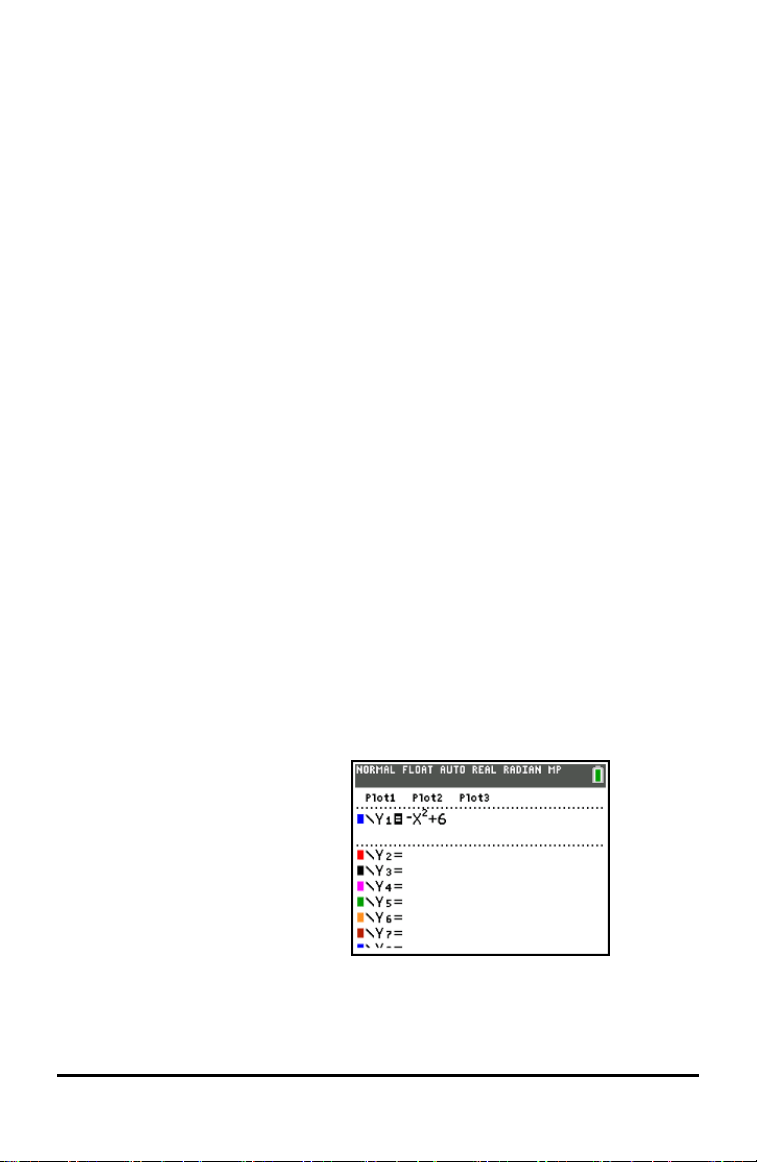
Enter an equation in the Y= editor.
1. Press o.
2. Press k „ ¡ Ã 6.
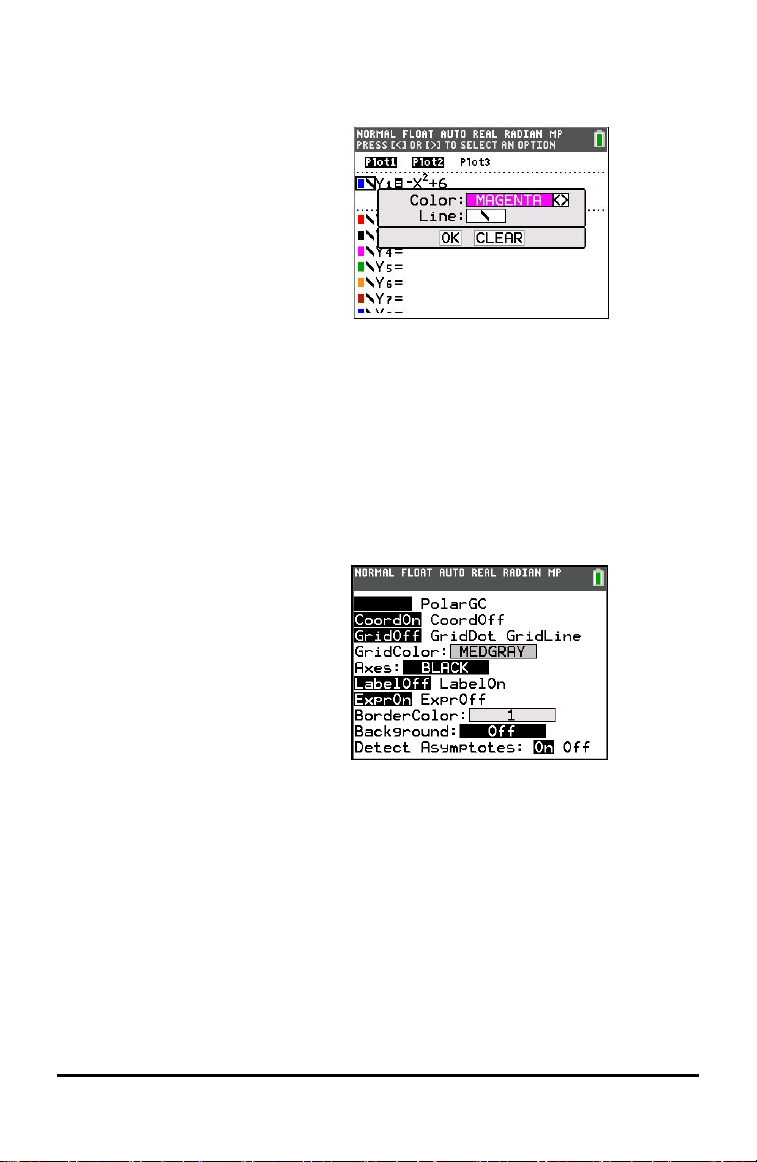
To set the line color in the Y= editor:
Working with Graphs 35
36 Working with Graphs
1. Press | to highlight the
colored box.
2. Press Í.
3. Press y ~ ~ ~ to place
the cursor box on the color
and line style at the left of the
screen and press Í.
The spinner box displays.
Notice the second line in the
status bar, which displays
hints.
4. Press ~ ~ ~ to select magenta.
5. Press †.
Note: The thick line style is the default. It can be changed by pressing
| or ~.
6. Press ~ to highlight OK and then press Í.
To set a Background Image:
1. Press y ..
Set grid color, axes, and
border color as desired.
2. Press } or † as necessary
to highlight Background.
The spinner dialog box
becomes active.
3. Press ~ as necessary to select the desired Background Image or
color.
Note: Your pre-loaded Image Var may be different than the one
displayed.
Note: To create Background Image Vars, use the free TIConnect™ CE
software to convert and send images to your TI-84 Plus CE graphing
calculator.
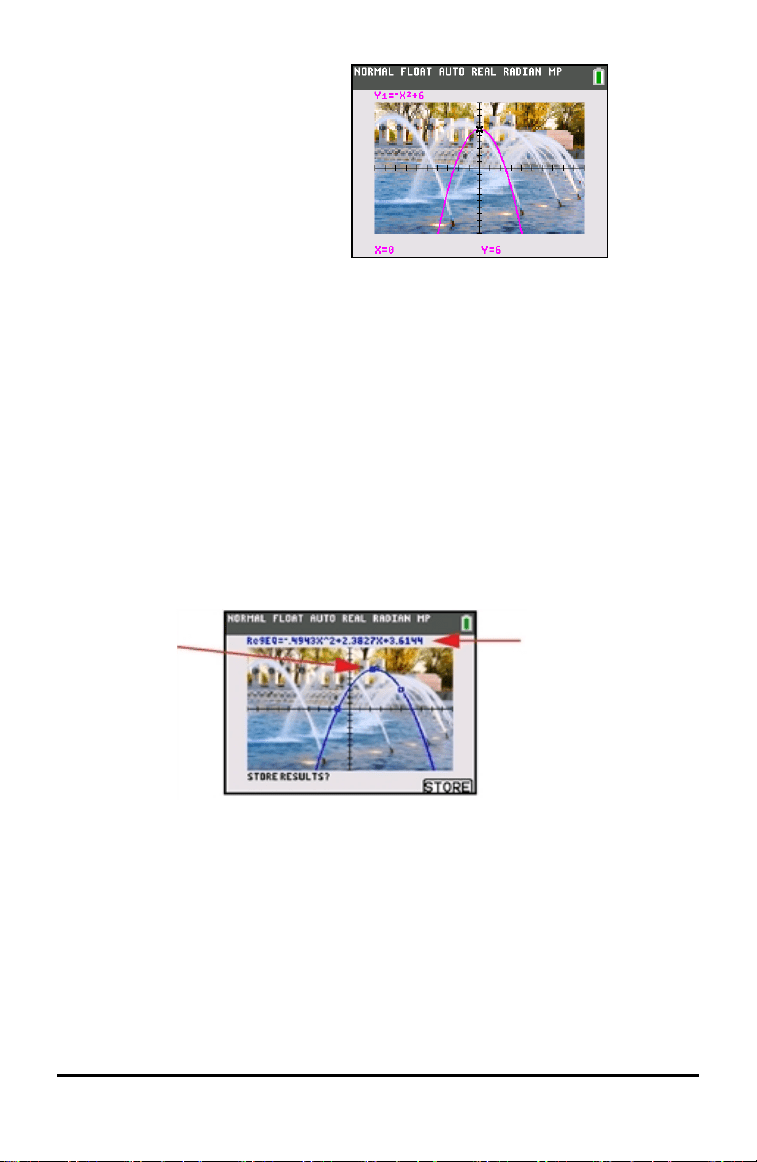
4. Press r to see the graph
and trace points.
Note: You can manipulate the
graph to “fit” an object in the
Background Image Var. You can
also use QuickPlot and Fit
Equation to fit an equation to a
shape. (See
QuickPlot
.)
Using QuickPlot and Fit Equation
QuickPlot and Fit Equation allows you to drop points on a graph screen and
model a curve to those points using regression functions. You can select color
and line style, draw points on a graph, and choose an equation to fit the drawn
points. You can then store the results of the plot and equation.
QuickPlot and Fit Equation is an option in the … / menu.
Prior to starting the QuickPlot and Fit Equation interactive feature on the graph
area, be sure to set your Background Image Var and other graph settings from
the FORMAT screen. Also set your WINDOW or ZOOM settings.
Drop points
on the
screen.
Points can
be saved to
lists.
Calculate the
regression
equation, draw
the curve, and
store the
function.
Working With Images
The TI-84PlusCE uses both pictures and background images. They are both
stored in Flash archive, but they are used in different ways.
Working with Graphs 37

38 Working with Graphs
Using Pictures and Backgrounds
• Image Vars (Image1 - Image9, and Image0) are variables stored in archive
memory. An Image Var is used as a Background Image in the graph area.
Several images are pre-loaded on the TI-84PlusCE. You can also convert
images to TI-84 Plus CE Image Vars in the TIConnect™ CE software and
load them to the calculator. You cannot create images on the calculator.
Note: TIConnect™ CE software is available as a free download from
education.ti.com/go/download.
• Pic Vars (Pic1 - Pic 9, and Pic0) are also variables stored in archive
memory. Pic Vars can be created by drawing in the graphing area, and the
changes saved and recalled to the graphing area. Saving a Pic Var will not
include the Background Image behind your graphing area.
• Both Image Vars and Pic Vars are stored and run in Flash archive, not in
RAM. They are both accessible in the VARS menu.
• Image Vars and Pic Vars can only be shared with another TI-84PlusCE or
TI-84 C graphing calculator.
• TI-84 Plus Pic Vars cannot be shared between the TI-84 Plus and the TI-84
PlusCE graphing calculators.
• If you perform a RAM reset on the TI-84 PlusCE, the Image Vars and Pic
Vars remain in Archive memory for use.
Working with Matrices
You can enter matrices using the matrix editor on your graphing calculator. For
example, you can perform the following operations on matrices:
• Addition • Inverses
• Division • Multiplication
• Elementary Row Operations • Subtraction
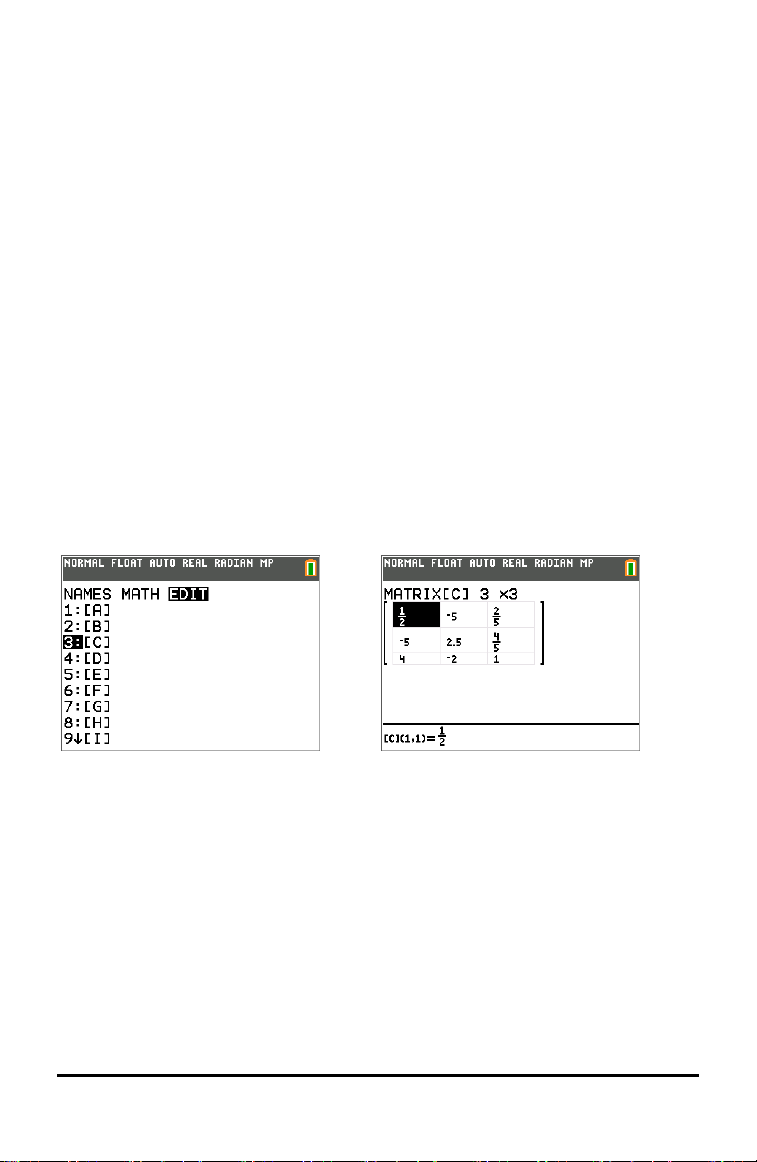
To use the matrix editor:
1. Press y ¾.
2. Press ~ to navigate to the EDIT submenu.
3. Select from one of 10 allowed matrix variable names [A] – [J].
4. Enter the dimension of the matrix, then enter values in each matrix cell.
Note: Once in the editor, use the arrow keys to navigate between cells.
Example:
Matrix [C] as a 3x3 matrix is now in memory.
To perform a calculation with a matrix:
1. Press y 5 to go to the Home Screen.
2. Press y ¾ use the MATH submenu to select a matrix command.
3. Use the NAMES submenu to paste the matrix name.
Note: A matrix name, such as [C], is a special character and can ONLY be
pasted for a calculation from the ¾ NAMES menu and not typed from
the calculator keypad.
Working with Matrices 39
40 Working with Matrices
Example:
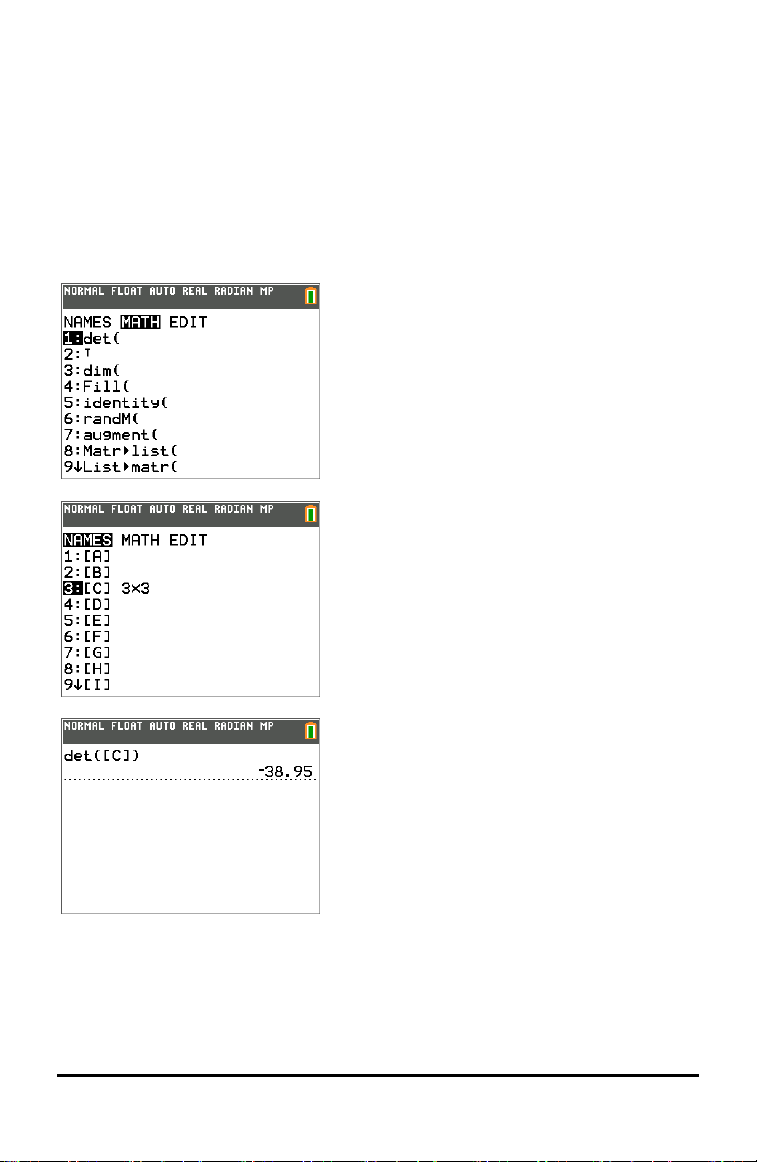
To find the determinant of [C] as entered above:
▶ Use the ¾ MATH menu to paste the
- 1: det(command
-and-
- ¾ NAMES 3: [C]
as matrix variables to the Home Screen.
Note: Remember that you cannot type in a matrix name from the calculator
keypad. Use the ¾ NAMES menu to paste a matrix name.
Working with Probability and Statistics
Working with Probability
You can find probability commands in the » PROB submenu. Probability
commands deal with random numbers, which are generated by algorithms on
the calculator.
Many probability commands have “wizards” to help you enter the syntax.
Example:
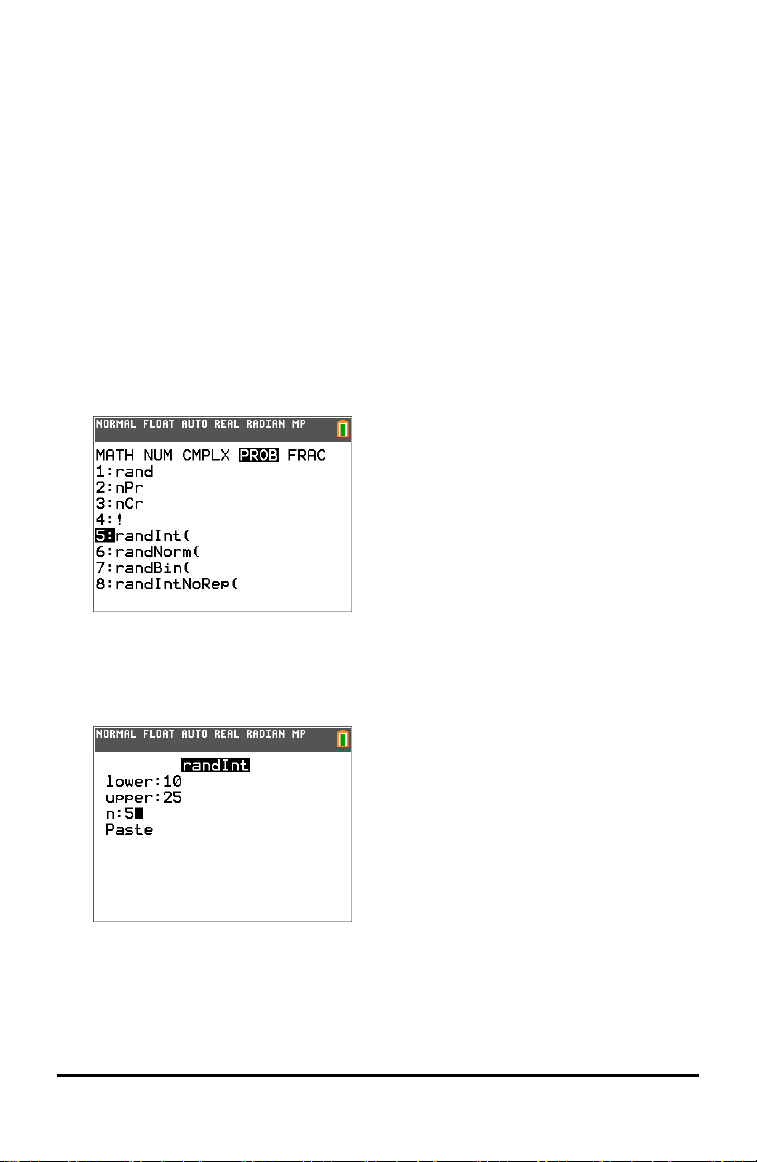
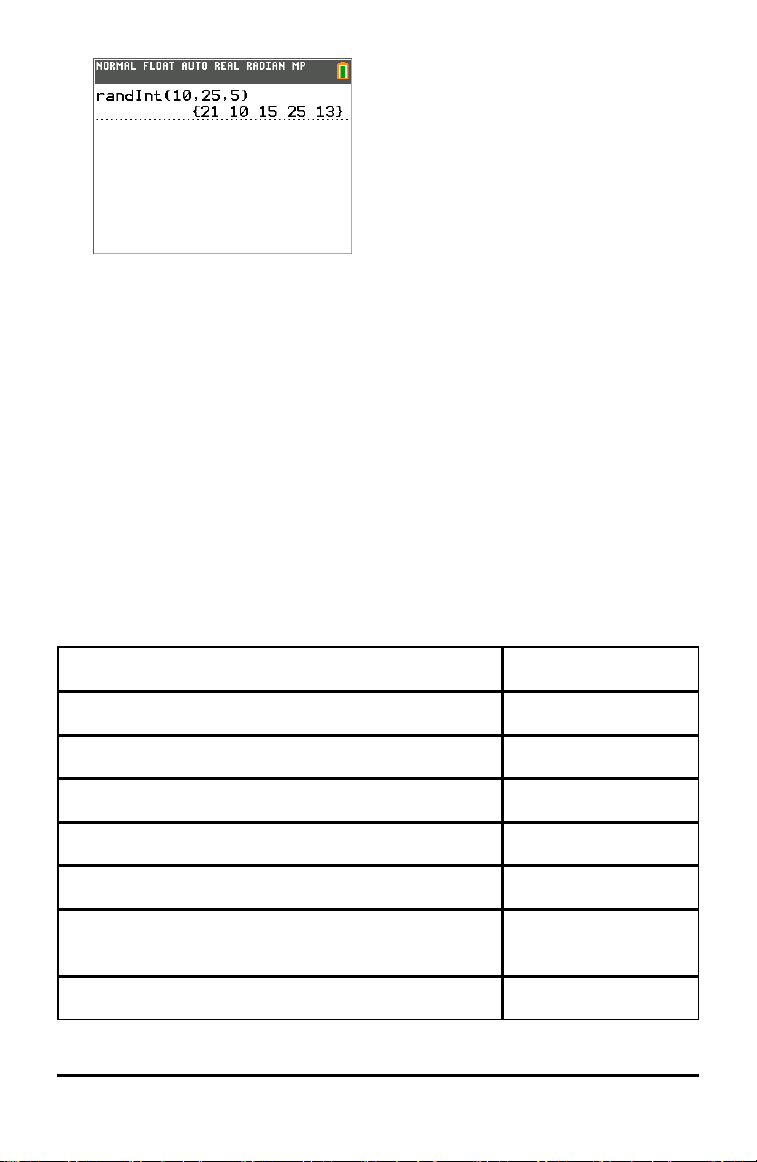
To generate a set of five random integers between 10 and 25 (inclusive):
1. Press », then press ~ until you highlight PROB.
2. Press † until you highlight 5: randInt(, then Í.
3. Enter the lower integer, then Í.
4. Enter the upper integer, then Í.
5. Enter the number of integers (n), then Í.
6. Press Í to Paste.
7. Press Í again to see the random set of integers.
Working with Probability and Statistics 41
42 Working with Probability and Statistics
Notes:
• With each rand execution, the TI-84 Plus CE generates the same random-
number sequence for a given seed value. The TI-84 Plus CE factory-set
seed value for rand is 0. To generate a different random-number
sequence, store any nonzero seed value to rand. To restore the factory-set
seed value, store 0 to rand, or reset the defaults by going to
y L 7:Reset....
• The seed value also affects randInt(, randNorm(, and randBin( instructions.
Working with Statistics
You can find statistics commands in the …menu. You can create lists of data,
then plot or analyze that data using the statistics commands.
You can use the following statistics functions:
Description Keys
Best fit equations (regressions) … ~ } †
Define and store up to three stat plot definitions y ,
Distributions y =
List-based statistical analysis y 9 ~ ~
Logistic and sine regression analysis … ~ } †
One- and two-variable analysis … ~ À and
… ~ Á
Statistical tests … ~ ~
Inferential Statistics
You can perform 16 hypothesis tests and confidence intervals and 15
distribution functions. You can display hypothesis test results graphically or
numerically.
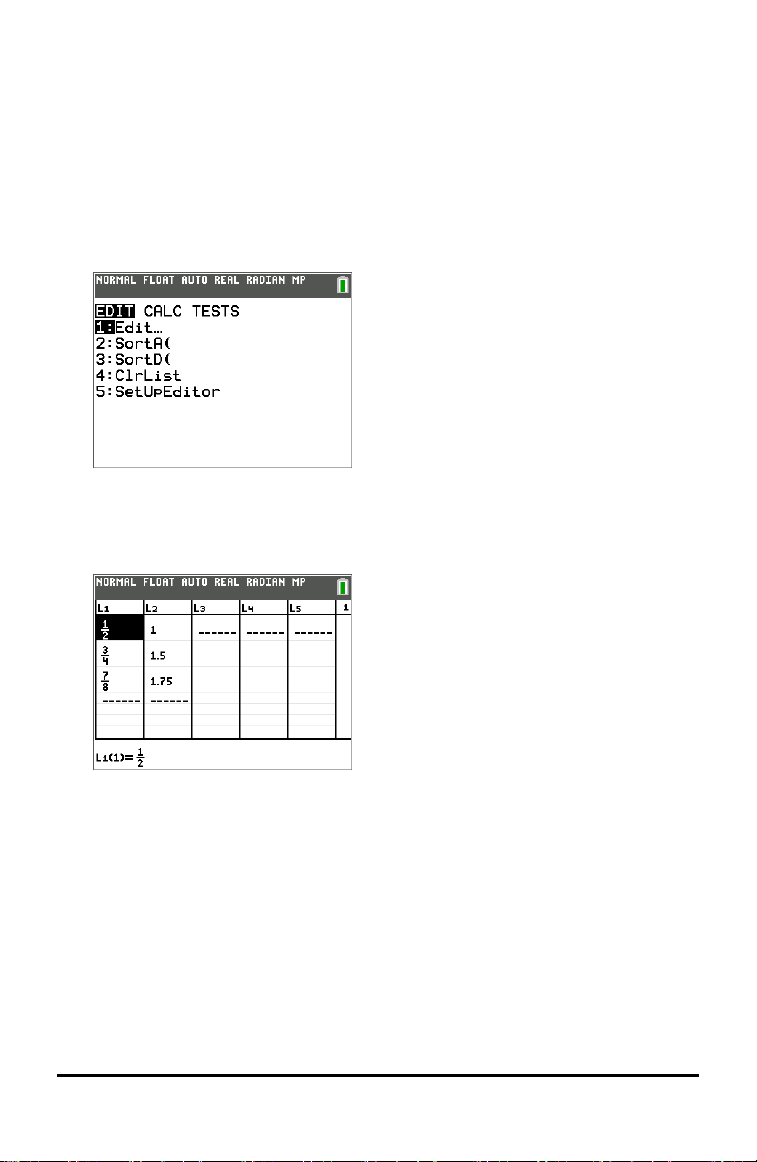
To enter lists of data:
1. Press ….
2. Select 1: Edit in the EDIT submenu, then Í.
3. Enter your data into list columns.
Note: Once in the list editor, use the arrow keys to enter the data in the lists. L1
– L6 are built-in list names.
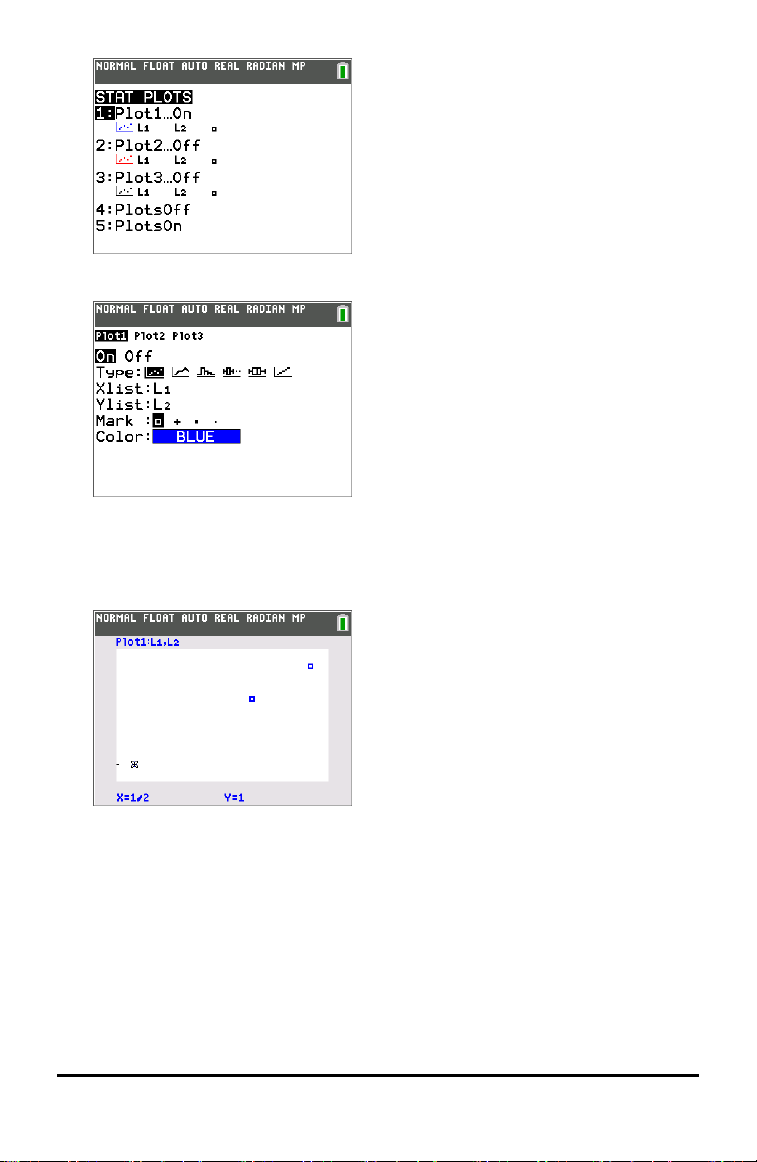
To plot this data:
4. Press y ,.
5. Press 1: Plot1 (to set up a scatter plot for L1 and L2), then Í.
Working with Probability and Statistics 43
44 Working with Probability and Statistics
6. Press | to highlight On.
7. Press q to automatically set up a graphing window for your data.
8. Press 9: ZoomStat to see the graph.
9. Press r and arrow keys to trace on the plot.
Note: You can plot your statistics data in these ways:
• Scatter plot
• xyLine
• Histogram
• Regular or Modified box-and-whisker plot
• Normal probability plot
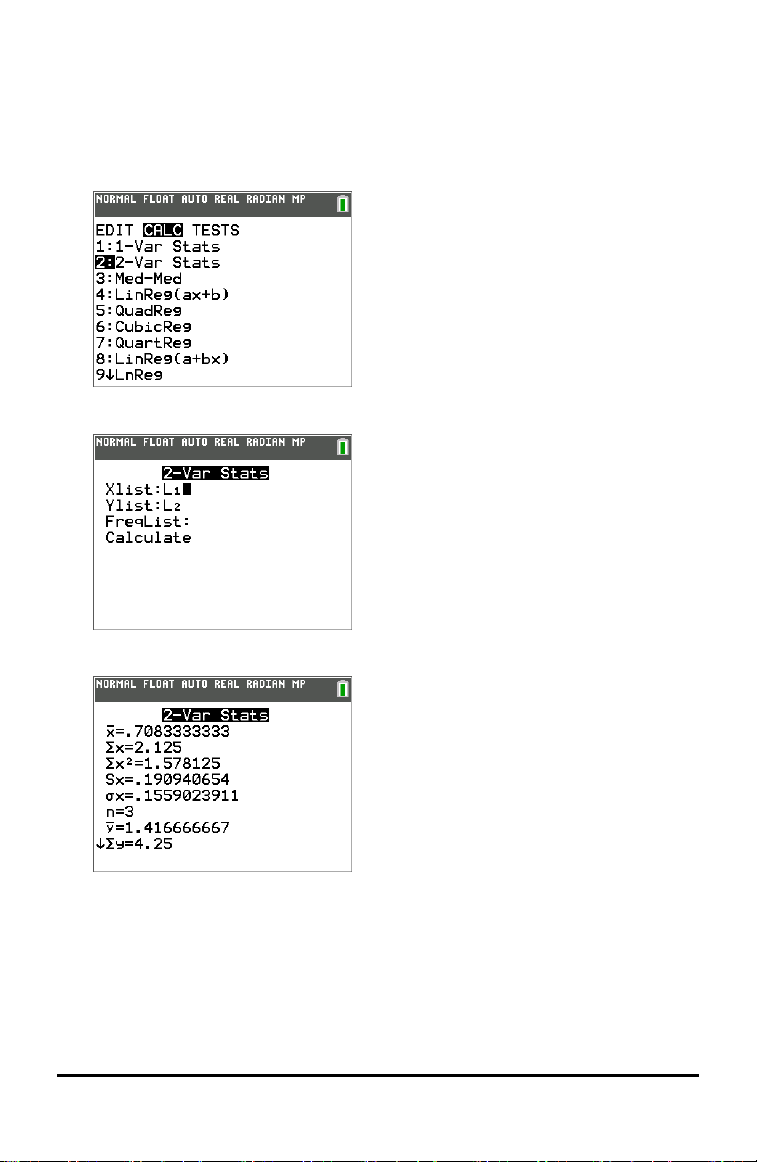
To find the two variable statistics for L1 and L2:
1. Press ….
2. Press ~ to highlight CALC.
3. Press † until you highlight 2:2-Var Stats, then Í.
4. Press † until you highlight Calculate, then Í.
▶ The screen will display the variable statistics.
Note: Most common probability and statistics commands will have a wizard
to prompt for syntax (values). The built-in Catalog Help is also available by
pressing the à key on most menu items. This opens an editor to help you
fill in the syntax (values) needed in a calculation.
Working with Probability and Statistics 45
46 Working with Variables
Working with Variables
Using Variable Names
Variables and Defined Items
You can enter and use several types of data, including real and complex
numbers, matrices, lists, functions, stat plots, graph databases, graph pictures,
and strings.
The TI-84PlusCE uses assigned names for variables and other items saved in
memory. For lists, you also can create your own five-character names.
Variable Type Names
Real numbers
(including fractions)
A, B, ... , Z, q
Complex numbers A, B, ... , Z, q
Matrices ãAä, ãBä, ãCä, ... , ãJä
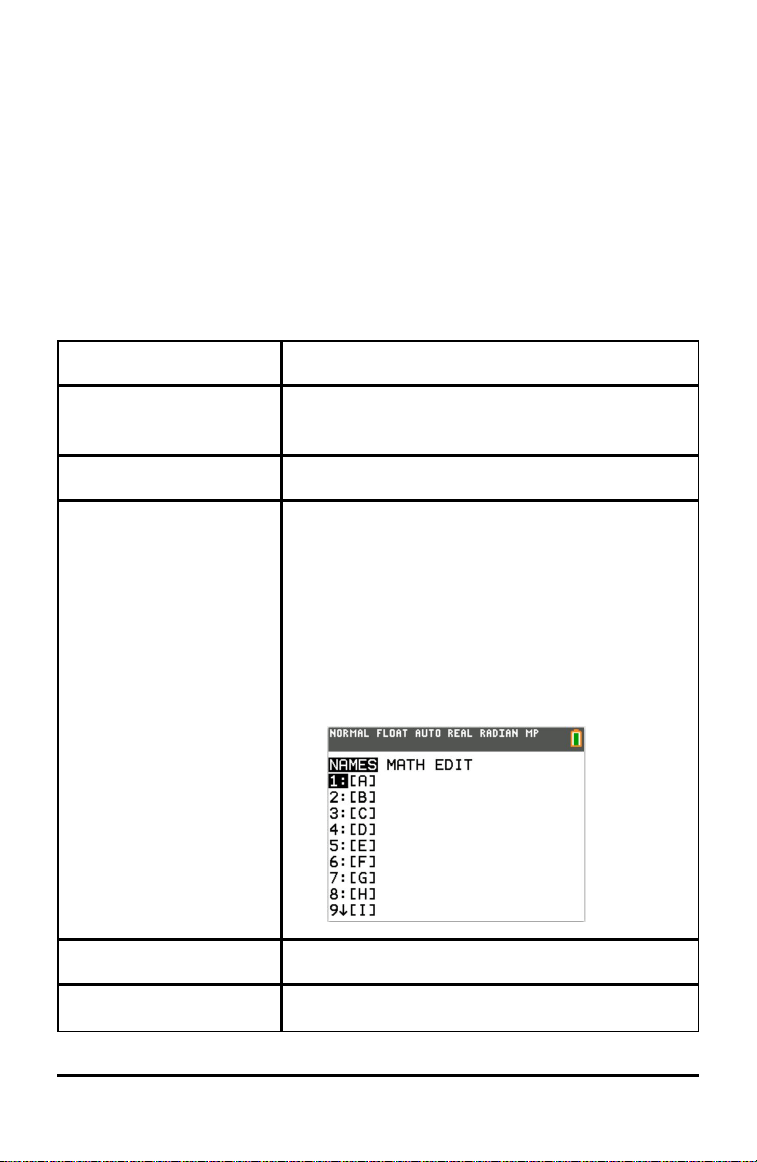
To enter a matrix name:
1. Press y ¾.
The Matrix Names menu appears.
2. Press the number on the keypad that
corresponds with the desired Matrix Name.
Ex: Press 1 for [A] as shown below.
Lists* L1, L2, L3, L4, L5, L6, and user-defined names
Functions Y1, Y2, ... , Y9, Y0

Variable Type Names
Parametric equations X1T and Y1T, ... , X6T and Y6T
Polar functions r1, r2, r3, r4, r5, r6
Sequence functions u, v, w
Stat plots
Plot1, Plot2, Plot3
Graphical databases GDB1, GDB2, ... , GDB9, GDB0
Save current equations from Y= and Window
settings to re-use.
Background images Image1, Image2, ... , Image9, Image0
Pictures Pic1, Pic2, ... , Pic9, Pic0
Strings Str1, Str2, ... , Str9, Str0
Apps Applications
AppVars Application variables
Groups Grouped variables
Save a group of calculator files for sharing or to
re-use when setting up a classroom.
System variables Xmin, Xmax, and others
* Once a list contains a complex number, it is designated as a complex list. To
change a list to Real numbers, delete the list and enter the Real values.
Notes about Variables
• You can create as many list names as memory will allow.
• Programs have user-defined names and share memory with variables.
• From the home screen or from a program, you can store to matrices, lists,
strings, and system variables such as Xmax, TblStart, and all Y= functions.
• From an editor, you can store to matrices, lists, and Y=functions.
Working with Variables 47
48 Working with Variables
• From the home screen, a program, or an editor, you can store a value to a
matrix element or a list element.
• You can use DRAW STO menu items to store and recall Pic Vars.
• Although most variables can be archived, system variables including r, T,
X, Y, and q cannot be archived.
• Apps are independent applications, which are stored in Flash archive.
AppVars is a variable holder used to store variables created by
independent applications. You cannot edit or change variables in AppVars
unless you do so through the application that created them.
Storing Variable Values
Storing Values in a Variable
Values are stored to and recalled from memory using variable names. When
you evaluate an expression that contains a variable name, the graphing
calculator substitutes the value currently stored in that variable.
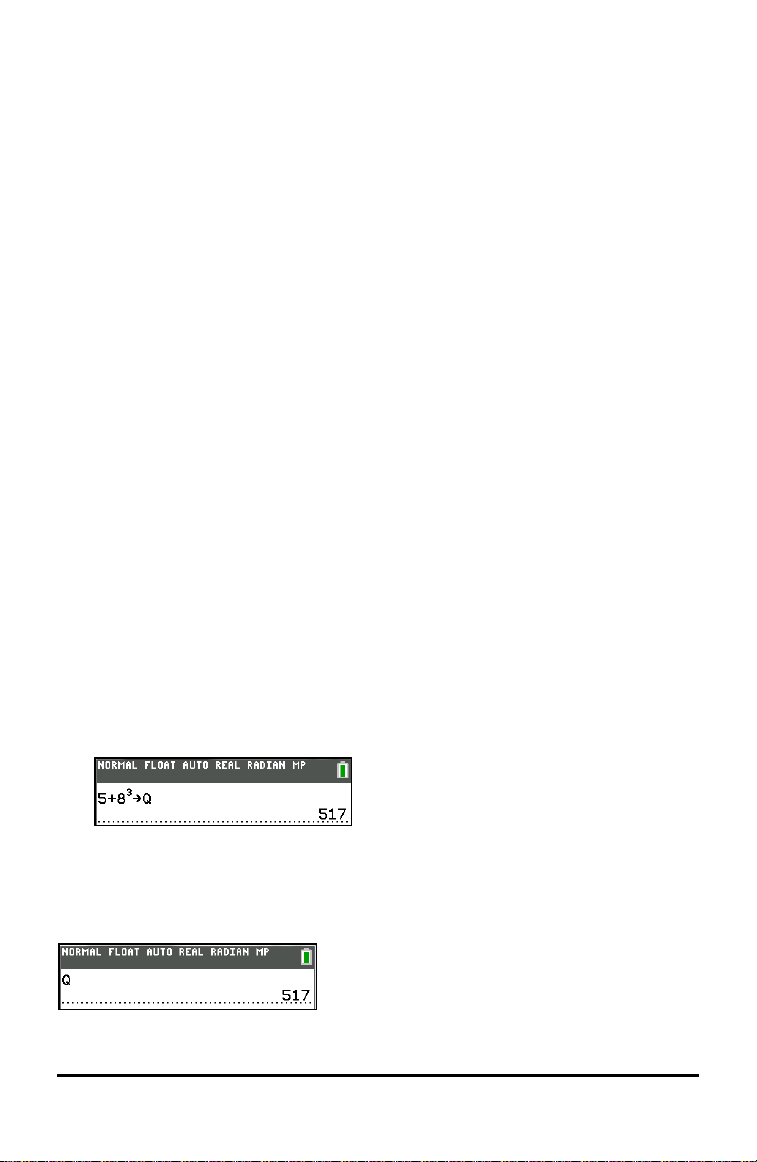
To store a value to a variable from the home screen or a program using the
¿ key, begin on a blank line and follow these steps.
1. Enter the value you want to store. The value can be an expression.
2. Press ¿.
! is copied to the cursor location.
3. Press ƒ and then the letter of the variable to which you want to store the
value.
4. Press Í. The graphing calculator evaluates the expression and stores
the value to the variable.
Displaying a Variable Value
To display the value of a variable, enter the variable name on a blank line on
the home screen, and then press Í.

Archiving Variables (Archive, Unarchive)
You can store variables in the TI-84PlusCE user data archive, a protected
area of memory separate from RAM. The user data archive lets you:
• Store data, programs, applications or any other variables to a safe location
where they cannot be edited or deleted inadvertently.
• Create additional free RAM by archiving variables.
By archiving variables that you do not need to edit frequently, you can free up
RAM for applications that may require additional memory.
The graphing calculator places an asterisk (ä)to the left of archived variables.
You cannot edit or execute archived variables. You can only see and
unarchive them.
Example:
If you archive a list named L1, you will see that it exists in memory. However, if
you select and paste the name L1 to the home screen, it will not appear on the
home screen. You must unarchive it in order to see its contents and edit it.
Note: Image Vars are run and stored in archive, but when an Image Vars
displays in VARS 4:Picture & Background, the BACKGROUND menu does not
display the asterisk ä.
Recalling Variable Values
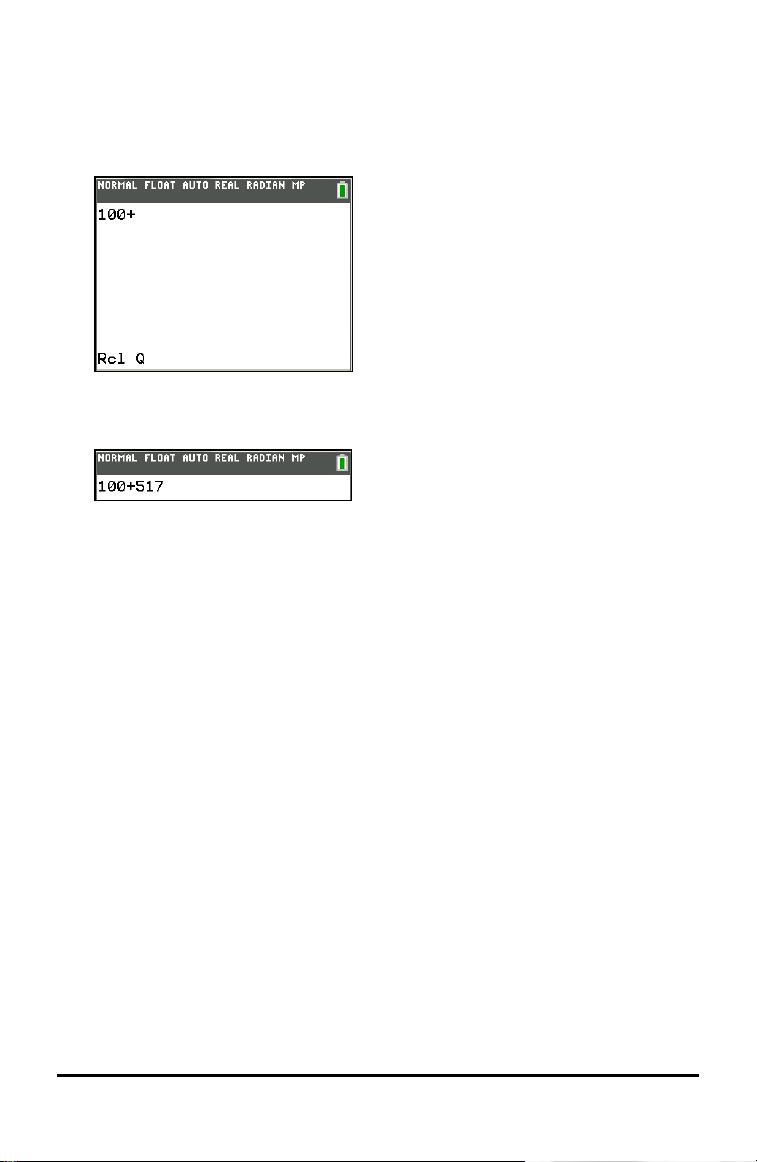
Using Recall (RCL)
To recall and copy variable contents to the current cursor location, follow these
steps. To leave RCL, press ‘.
1. Press y K. RCL and the edit cursor are displayed on the bottom line of
the screen.
2. Enter the name of the variable in one of the following ways:
• Press ƒ and then the letter of the variable.
• Press y 9, and then select the name of the list, or press y d or
e, and so forth.
• Press y ¾, and then select the name of the matrix.
• Press ½ to display the VARS menu or ½ ~ to display the VARS
Y-VARS menu; then select the type and then the name of the variable
or function.
Working with Variables 49
50 Working with Variables
• Press ƒ a to display the YVAR shortcut menu, then select the
name of the function.
The variable name you selected is displayed on the bottom line and the
cursor disappears.
3. Press Í. The variable contents are inserted where the cursor was
located before you began these steps.
Notes:
• You can edit the characters pasted to the expression without affecting
the value in memory.
• You can use rcl in the Y= editor to paste a current function to a new
YVar to avoid retyping long expressions.
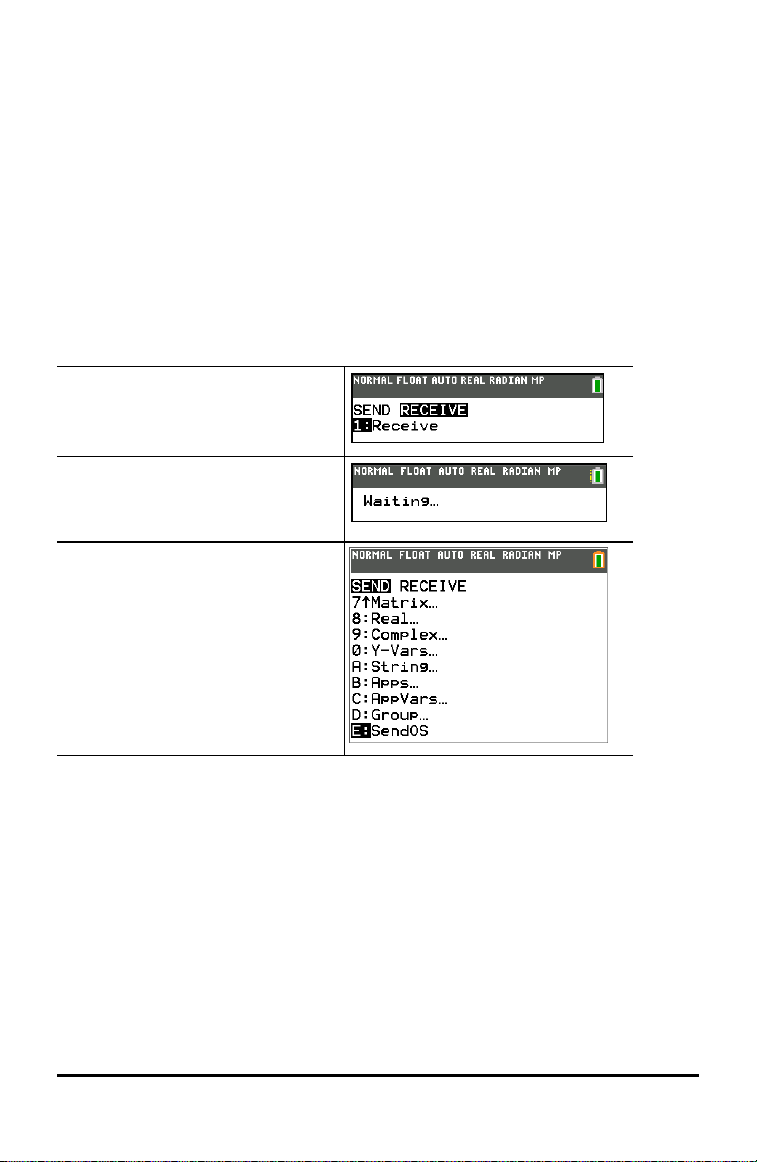
Managing Calculator Files
Transferring the OS from calculator to calculator
You can transfer the operating system from one calculator to another using a
USB unit-to-unit cable.
Connect the two calculators by firmly inserting the USB cable ends into the
calculators. The USB port is located on the front-right side of the calculator.
Note: You cannot transfer the OS or files using the TI Charging Station CE (see
the accessories section). The TI Charging Station CE only charges the
TI-84PlusCE graphing calculators.
Receiving calculator:
y 8 ~ Í
When you press Í, the
graphing calculator displays the
message Waiting...
Sending calculator:
y 8 } } Í
Compatibility with Graphing Calculators
Note: Not all TI-84 Plus CE graphing calculator files are compatible with other
TI-84 Plus Family graphing calculator files because of the high resolution of the
color screen. In general, numeric files (not limited to lists, variables, matrices,
and functions) are shared between these graphing calculators but Apps are not
shared between these graphing calculators even if they have the same title.
When not compatible, the computer file extensions for the TI-84 Plus CE are
different from a similar variable from the TI-84 Plus/TI-84 Plus Silver Edition
graphing calculators.
Managing Calculator Files 51

52 Managing Calculator Files
File Type
Link from
TI-84 to TI-84
Plus CE
Link from
TI-84 Plus CE
to TI-84
84P
computer
file type
TI-84 Plus
CE
computer
file type
Operating
System
No No 8xu 8eu
Apps No No 8xk 8ek
AppVar
1
Yes Yes 8xv 8xv
Programs -
TI Basic
1, 2
Yes Yes 8xp 8xp
Assembly
Programs
1
Yes No 8xp 8xp
Pictures No No 8xi 8ci
Background
Images
N/A No N/A 8ca
Group Files Yes Yes 8xg 8xg
User Zoom Yes Yes 8xz 8xz
String Yes Yes 8xs 8xs
Table Yes Yes 8xt 8xt
Function file Yes Yes 8xy 8xy
GDB
3
Yes Yes 8xd 8xd
List Yes Yes 8xl 8xl
Matrix Yes Yes 8xm 8xm
Number Yes Yes 8xn 8xn
Complex Yes Yes 8xc 8xc
Window
Setup
Yes Yes 8xw 8xw
Backup No No 8xb —
1
App Vars and Programs should be reviewed for use after the transfer
between the TI-84 Plus family graphing calculators. Some App Vars may not

setup an App as expected. Some Programs will need to be modified due to the
difference in screen resolution and new commands.
2
Programs created using commands available only in the latest OS version
will not transfer to graphing calculators with an earlier OS version.
3
You may receive a version error if you used DOT-THIN line style. Change the
line style to avoid the error.
Managing Calculator Files 53

54 Using Applications (Apps)
Using Applications (Apps)
Press Πto see the complete list of applications.
• Cabri™ Jr. App • Polynomial Root Finder and
Simultaneous Equation Solver
• CellSheet™ App • Probability Simulation App
• Conic Graphing • Science Tools
• Inequality Graphing • Transformation Graphing App
• Periodic Table • Vernier EasyData™ App
These applications are preloaded on your TI-84PlusCE, and you can install
and customize others (ex: TI TestGuard™ App 5.0). You can install applications
and the TIConnect™ CE software at education.ti.com/go/download.

Using Accessories
Using TI-SmartView™ CE
The TI-SmartView™ CE software allows you to display a TI graphing calculator
for your entire classroom. With TI-SmartView™ CE software, you can:
• View the history of your key press entries.
• Capture and save screen shots to use in other documents as you
investigate a math or science concept.
• Use the View3™ pane to show three additional screens simultaneously.
The TI-SmartView™ CE software includes two workspaces:
Calculator Emulator: allows you to perform calculations and view answers as
you would on a physical calculator
Emulator Explorer: allows you to manage calculator content
Using Accessories 55
56 Using Accessories
Using TI Connect™ CE
The TI Connect™ CE software makes exchanging information between your
graphing calculator and your computer quick and easy.
The TI Connect™ CE software includes three workspaces:
Calculator Explorer: allows you to manage calculator content
Screen Capture: allows you to manage screen captures
Program Editor: allows you to work with data variables
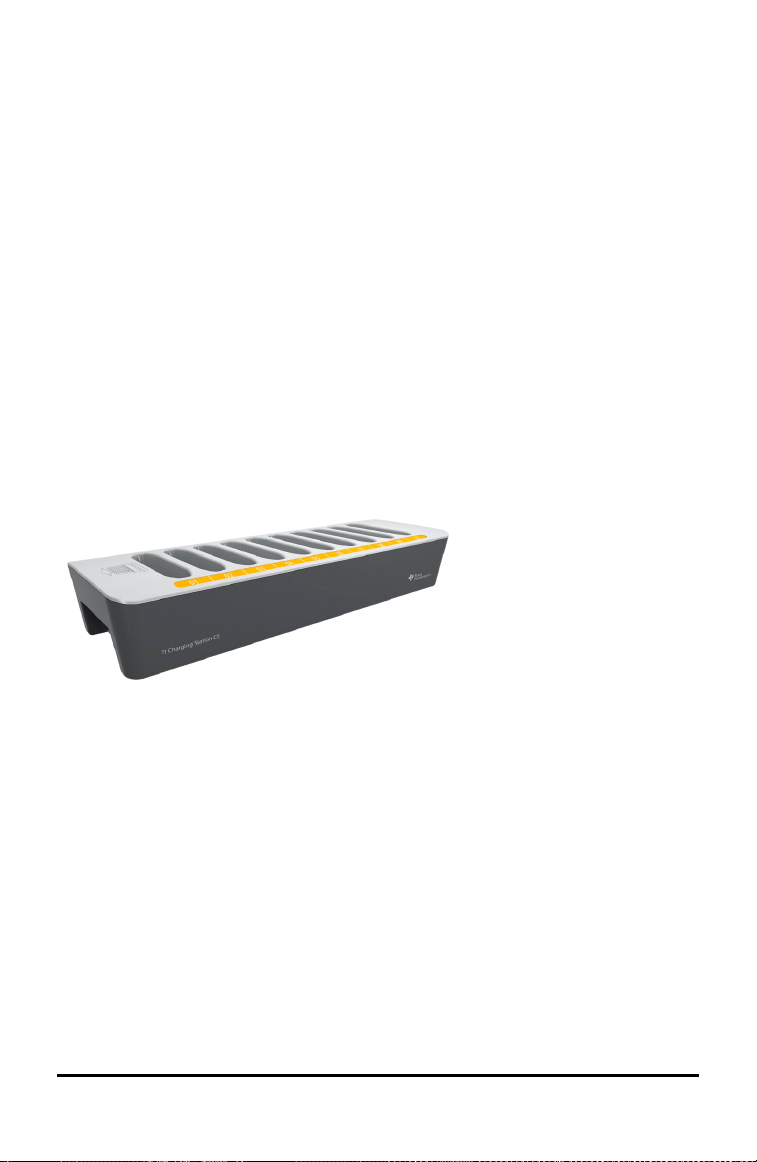
Using the TI Charging Station CE
The TI Charging Station CE has 10 slots, and each slot can accommodate a
TI-84PlusCE graphing calculator. Place a TI-84 Plus CE graphing calculator
in one of these slots to charge the TI Rechargeable Battery.
Note: It is not necessary to fill all the slots in the charging station to charge
batteries.
Preparing Charging Stations for Use
The TI Charging Station CE is shipped with the following components in each
package:
• A TI Charging Station CE
• An AC adapter
• A regional power cord adapter
1. Insert the small end of the power adapter cord into the charging station’s
power jack.
2. Plug the other end of the adapter into a power outlet.
• An indentation on each side of the TI Charging Station CE enables you to
lift it. Always use two hands to lift and move the charging station.
• When the charging station is empty, turn it over and you will notice and
indention on the bottom. Thread the cable through this indention to ensure
the charging station sits flat on a surface.
• Place the charging station on a flat, stable surface. You can also use a
wheeled cart if you need to move the charging station between
classrooms. When deciding on a location, consider its proximity to a power
source such as a power strip or wall outlet.
Inserting Graphing Calculators into the TI Charging Station CE
The slots in the TI Charging Station CE are designed to accommodate a
graphing calculator without a slide case attached. The calculator will not fit in
the slots with the slide case attached.
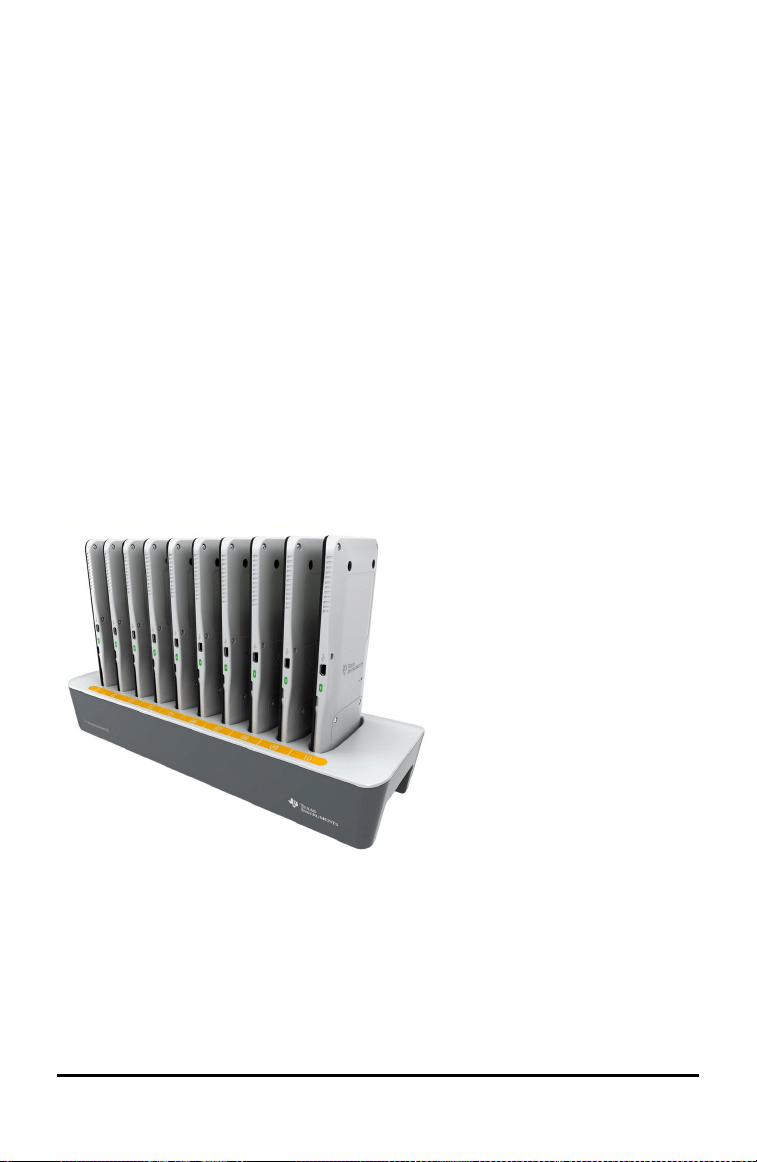
The front of the calculator must face the front of the charging station. You may
damage the TI-84PlusCE graphing calculator if you try to force it into the
charging station facing the wrong direction. When looking at the TI logo on the
charging station, insert calculators into the slot with the keypad facing left.
Using Accessories 57

58 Using Accessories
1. Remove the slide case from the graphing calculator.
2. Align the grooves on the sides of the graphing calculator with the guides in
the charging station slots. Ensure the calculator is facing the proper
direction.
3. Gently push the graphing calculator into the slot. You will feel a slight
resistance; continue pushing down until the graphing calculator is seated.
When the TI-84PlusCE graphing calculator is properly seated in a slot, the
LED light on the side of the calculator turns amber to indicate it is charging.
Charging Batteries
The TI-84PlusCE graphing calculator uses a Li-Ion TIRechargeable Battery.
The charging process starts automatically when a graphing calculator is placed
in a slot on a powered charging station. You can charge a classroom set of
graphing calculators overnight.
Determining Battery Status
The LED light on each connected graphing calculator in the charging station
provides basic information about the status of the rechargeable battery.
• When the light is amber, the battery is charging.
• When the light is green, the battery is fully charged.
Troubleshooting
If the recharge fails:
• Make sure the graphing calculator is seated properly in the slot. Batteries
are not charged if the connector on the graphing calculator and the
connector in the slot are not aligned.
• Check the connector on the graphing calculator to ensure that it is clean. If
there is build-up on the graphing calculator’s connector, you can remove it
with a clean, dry cloth or a pencil eraser. Never use wet cloths or solutions
of any kind.
Storing Charging Stations
Store the TI Charging Station CE on a flat surface such as a table or a wheeled
cart. You cannot damage the charging station by leaving it plugged in for
extended periods of time. Also, you cannot damage the batteries by leaving
them in the charging station beyond the time needed to fully charge them.
Changing and Charging the Battery
The TI-84PlusCE graphing calculator comes with a:
• TI rechargeable battery
• USB computer cable for transferring files and charging the battery
Note: Charge the battery for at least four hours to ensure optimum
performance.
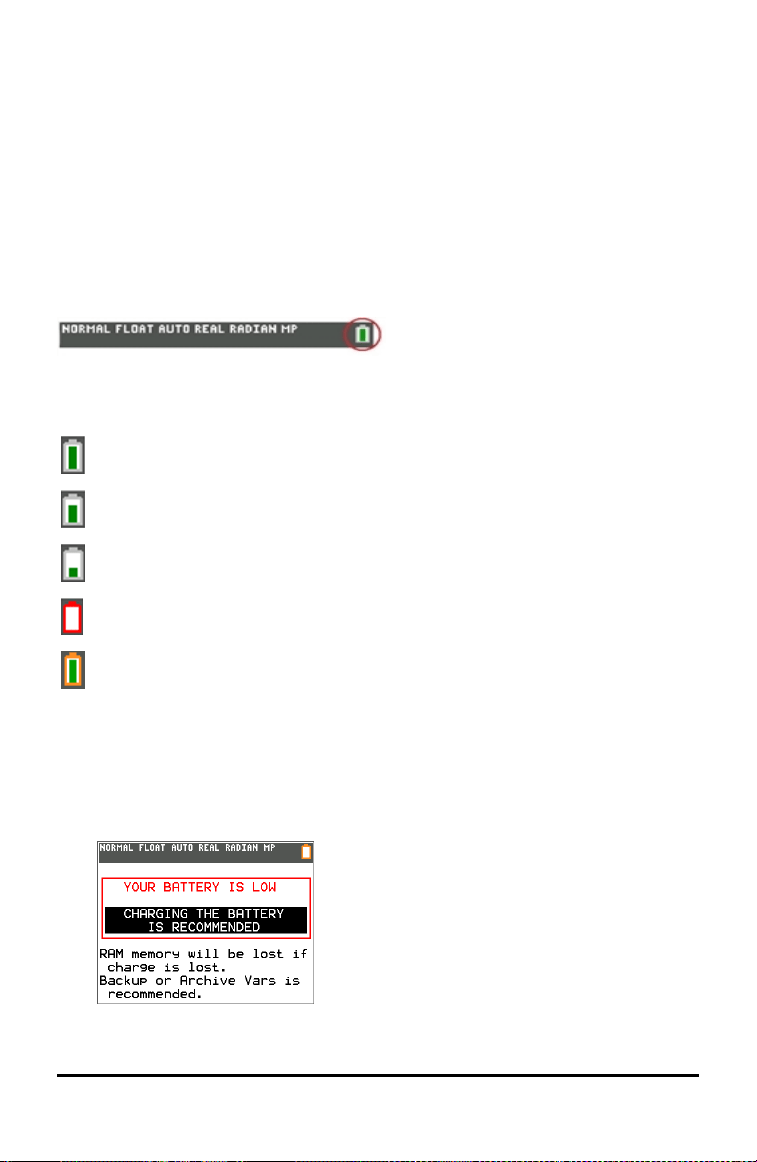
The battery status icon on the upper right of the screen gives information on
battery life.
The battery icons indicate the level of battery power remaining, and indicate if
the battery is charging.
Battery is 75% to 100% charged.
Battery is 50% to 75% charged.
Battery is 25% to 50% charged.
Battery is 5% to 25% charged.
Battery is charging.
Warning:
• RAM memory will be lost if the battery charge is lost. You should back up
or archive your variables if your battery power gets low.
• Displays this message when you turn on the unit.
Using Accessories 59

60 Using Accessories
Deep Sleep Mode
To maximize battery life, this graphing calculator is shipped in Deep
Sleep mode. To wake the handheld from this mode, press É for at least
4 seconds or apply USB (computer or wall adapter) or TI Charging
Station CE power. After waking the handheld, you can turn it on anytime
by pressing É. To maximize battery life during extended storage
periods, the Deep Sleep mode is enabled automatically after a period of
being in the off state.
Recharging the TI Rechargeable Battery
You should make sure the TI-84 PlusCE battery is charged for classroom use
and before exams.
Use one of the following options to charge the battery in the TI-84PlusCE
graphing calculator:
• Connect the graphing calculator to a computer using a USB computer
cable.
-or-
• Connect to a wall outlet using a TI wall adapter (may be sold separately).
-or-
• Place the graphing calculator in a TI Charging Station CE.
The amount of time required to fully charge the battery may vary, but charging
takes about four hours. It is not necessary to remove the TI Rechargeable
Battery from the graphing calculator to recharge it. The graphing calculator
operates normally while it is attached to a charging source.
To recharge a graphing calculator from a computer, a TI USB driver must be
installed. To download TIConnect™ CE or TI-SmartView™ CE software that
includes a driver, go to: education.ti.com/go/download.
When the TI Rechargeable Battery is fully charged, the graphing calculator
draws power in the following order:
1. From a connected external power source, such as:
• A computer connected through a USB computer cable
-or-
• A TI wall adapter (may be sold separately)
2. From the TI Rechargeable Battery
Replacing TI Rechargeable Batteries
Take these precautions when replacing rechargeable batteries:
• Use only the charger recommended for the battery, or the one that was
provided with the original equipment.
• Remove the graphing calculator from the charger or alternating current
adapter when not in use or being charged.
• Do not use the battery in other devices because:
- This may result in personal injury or damage to equipment or property.
- There is a risk of explosion if a battery is replaced by the wrong type.
Replacing the Battery
Use only the TI Rechargeable Battery to replace the TI-84PlusCE battery.
To replace the battery, follow these steps.
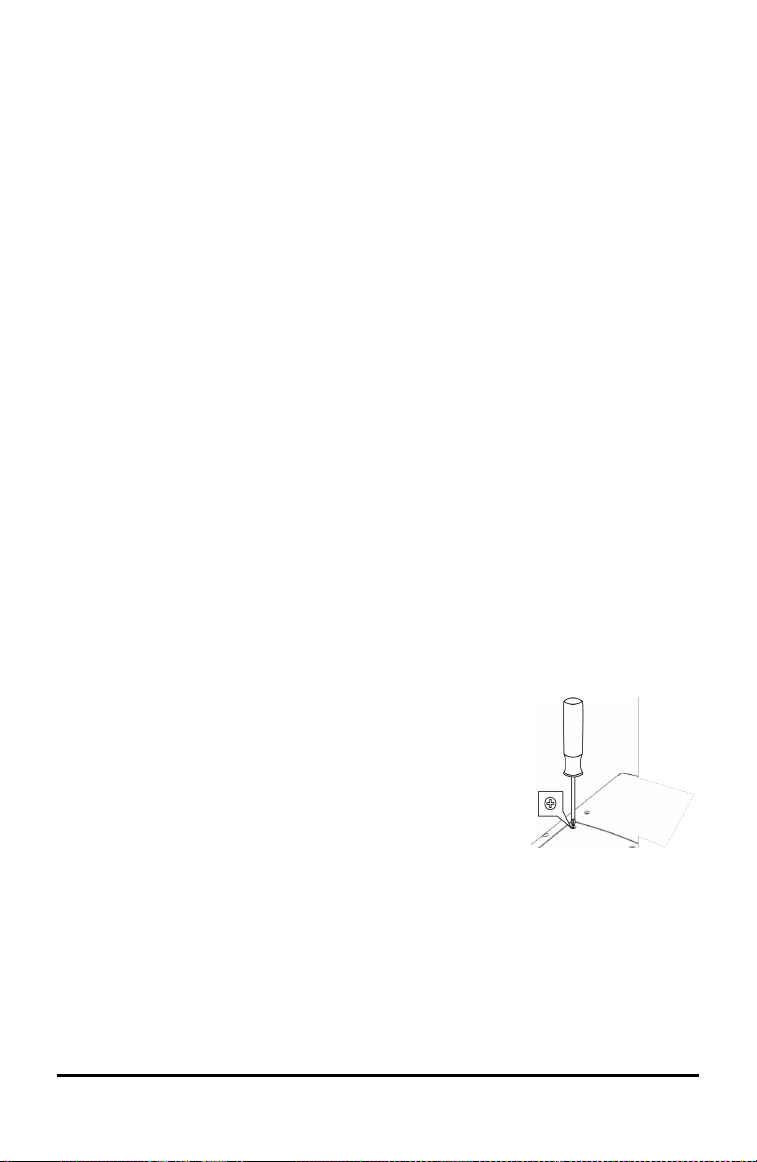
1. Use a small screwdriver to release the panel from
the back of the handheld.
2. Remove the panel.
3. Remove the old battery.
4. Drop in a new battery.
5. Replace the back panel and fasten the screws with
a screwdriver.
Using Accessories 61

62 Using Accessories
Disposing of Used Batteries Safely and Properly
Do not mutilate, puncture, or dispose of batteries in fire. The batteries can burst
or explode, releasing hazardous chemicals. Discard used batteries according
to local regulations.
Using Press-to-Test
Setting Up Test Mode
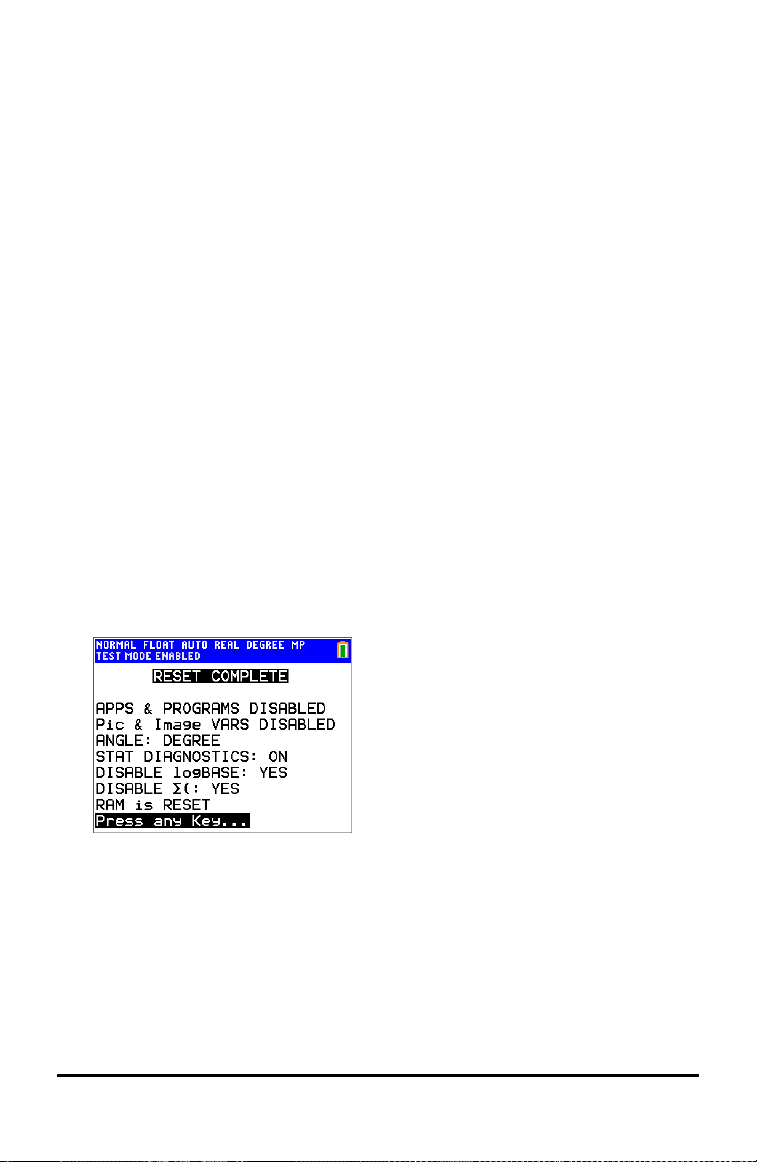
1. With the graphing calculator turned OFF, press and hold down the ~, |,
and É keys, and then release.
2. The RESET OPTIONS screen displays.
Notes:
• The status bar is blue when in TEST MODE and TEST MODE
ENABLED.
• Pic & Image Vars are disabled.
• Calculator data (Vars) are deleted from RAM and Arc.
• By default:
- ANGLE is set to DEGREE
- STAT DIAGNOSTICS is set to ON
- DISABLE logBASE and DISABLE Σ(are set to YES.
3. To change the default settings, move the cursor over the desired setting
and press Í.
4. Press OK q. The RESET COMPLETE screen displays.
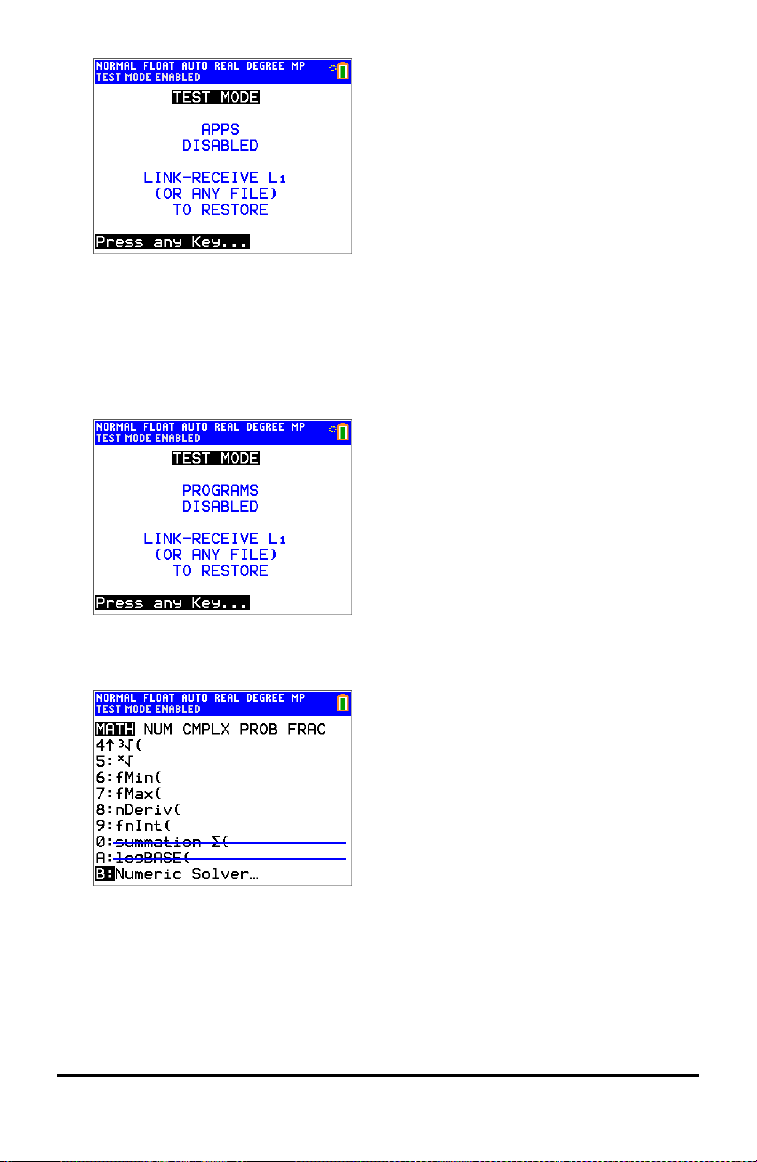
5. On the exam calculator, press Πto verify that applications are disabled.
The following screen displays:
Using Press-to-Test 63
64 Using Press-to-Test
Note:
• All variables, excluding AppVars, stored in RAM and in archived
memory are deleted.
6. On the exam calculator, press ¼ to verify that programs have been
disabled. The following screen displays:
7. On the exam calculator, press » to verify that logBASE and summation
Σ(have been disabled. The following screen displays:
8. On the exam calculator, Pic and Image Vars are shown as disabled. The
following screen displays:

9. In memory management (y L, 2:Mem Management/Delete...),
disabled files will display with the not equal sign.
Bringing a Calculator Out of Test Mode
You can re-enable all disabled calculator files by using one of the following
methods:
• Link two TI-84 Plus CE graphing calculators using a unit-to-unit USB cable
and then transfer a file by using y 8, SEND RECEIVE
-or-
• Use the TI TestGuard™ App re-enable feature.
Notes:
To clear a calculator of files created during an exam, use the following two-step
process:
If you do not need to clear files, use step 2 below:
1. Reset calculator files.
a) Turn off the calculator while in test mode.
b) "Re-Press-to-Test" - press and hold down the ~, |, and É keys, and
then release.
Using Press-to-Test 65

66 Using Press-to-Test
c) Select OK when you see the Reset Verification Screen. The calculator
is now "clean."
2. Re-enable files to turn off test mode.
a) Link two TI-84 Plus CE graphing calculators using a unit-to-unit USB
cable.
b) Send a file to bring the calculator(s) out of test mode.
Error Conditions
The TI-84PlusCE detects errors while performing these tasks:
• Evaluating an expression
• Executing an instruction
• Plotting a graph
• Storing a value
Diagnosing an Error
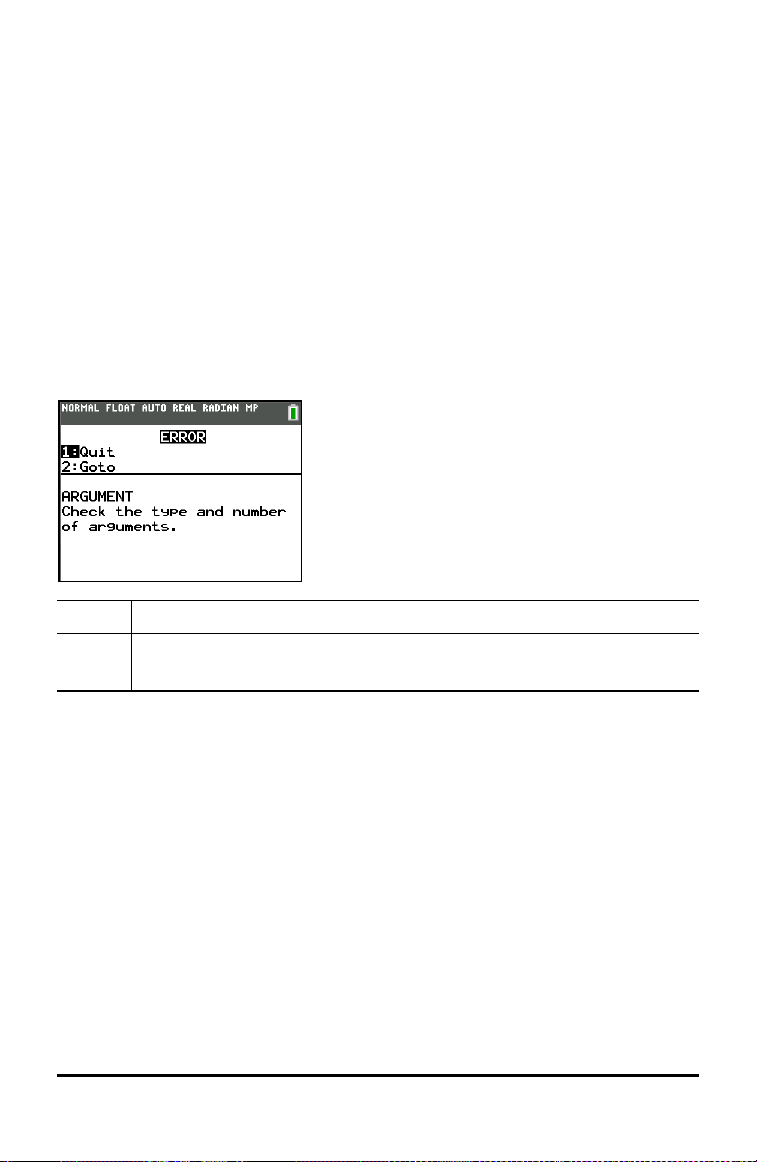
When the TI-84PlusCE detects an error, it returns an error message with a
short description.
1:Quit
Displays the home screen
2:Goto
Displays the previous screen with the cursor at or near the error
location
Note: If a syntax error occurs in the contents of a Y= function during program
execution, then the 2:Goto option returns to the Y=editor, not to the program.
Correcting an Error
To correct an error, follow these steps.
1. Note the error type (ERROR:error type).
2. Select 2:Goto (if it is available).The previous screen is displayed with the
cursor at or near the error location.
3. Determine the error. The error screens give helpful hints about what may
have happened, but the errors are not always fully explained.
4. Correct the expression.
Error Conditions 67

68 General Information
General Information
Texas Instruments Support and Service
General Information: North and South America
Home Page: education.ti.com
KnowledgeBase and e-mail inquiries: education.ti.com/support
Phone: (800) TI-CARES / (800) 842-2737
For North and South America and
U.S. Territories
International contact information: education.ti.com/support/worldwide
For Technical Support
Knowledge Base and support by e-mail: education.ti.com/support or
ti-care[email protected]
Phone (not toll-free): (972) 917-8324
For Product (Hardware) Service
Customers in the U.S., Canada, Mexico, and U.S. territories: Always contact
Texas Instruments Customer Support before returning a product for service.
For All Other Countries:
For general information
For more information about TI products and services, contact TI by e-mail or
visit the TIInternet address.
E-mail inquiries: ti-cares@ti.com
Home Page: education.ti.com
Service and Warranty Information
For information about the length and terms of the warranty or about product
service, refer to the warranty statement enclosed with this product or contact
your local Texas Instruments retailer/distributor.

Korean Class A warning statement
Class A
급기기(업 무용방송통신기 자재)
Notification
이 기기는 업무용(A급) 전자파적 합기기로 서 판
매자 또는 사용자는 이 점 을 주의하시기 바라
며, 가정외의 지역에서 사용하 는 것을 목 적으로 합니다 .
General Information 69

Index
A
a+bi (rectangular complex mode) 22
AC adapters 56
alpha cursor 13
angle modes 20
APD™ (Automatic Power Down™) 2
Apps 47
AppVars 47
Archive 49
Automatic Power Down™ (APD™) 2
B
batteries
charging 58
status 58
troubleshooting 58
C
Catalog Help 32
charge status
LED indicator 58
charging batteries 58
troubleshooting 58
charging station 56
color
DRAW commands 35
graph format screen 35
spinner 35
stat plots 35
Y= editor 35
color on the TI-84 Plus CE 35, 54
complex
modes (a+bi, re^qi) 22
numbers 22
contrast (display) 6
cursors 13
D
decimal mode (float or fixed) 20
Degree angle mode 20
display brightness 6
display cursors 13
Displaying the Clock Settings 25
E
E (exponent) 19, 32
edit keys table 33
Eng (engineering notation mode) 19
entry cursor 13
EOS™ (Equation Operating System™) 28
Equation Operating System™ (EOS™) 28
errors
diagnosing and correcting 67
F
Fix (fixed-decimal mode) 20
fixed-decimal mode (Fix) 20
Float (floating-decimal mode) 20
floating-decimal mode (Float) 20
fractions
n/d 23
Un/d 23
full-screen mode (Full) 23
Full (full-screen mode) 23
Func (function graphing mode) 21
70 Index

function graphing
modes 21
function, definition of 32
G
graph-table split-screen mode (G-T) 23
graphing-order modes 22
graphing modes 21
GT (graph-table split-screen mode) 23
H
home screen 7
scrolling 7, 9
Horiz (horizontal split-screen mode) 23
I
implied multiplication 29
insert cursor 13
inserting
calculators in charging station 57
instruction, definition of 32
L
LED lights 58
M
menus 14
scrolling 14
shortcut 11
mode
Answers 23
Classic 19
MathPrint™ 19
mode settings
a+bi (complex rectangular) 22
Degree (angle) 20
Eng (notation) 19
Fix (decimal) 20
Float (decimal) 20
Full (screen) 23
Func (graphing) 21
GT (screen) 23
Horiz (screen) 23
Normal (notation) 19
Par/Param (graphing) 21
Pol/Polar (graphing) 21
Radian (angle) 20
re^qi (complex polar) 22
Real 22
Sci (notation) 19
Seq (graphing) 21
Simul (graphing order) 22
N
n/d 23
negation (-) 29
Normal notation mode 19
O
order of evaluating equations 28
P
Par/Param (parametric graphing mode) 21
parentheses 29
Pol/Polar (polar graphing mode) 21
polar graphing
mode (Pol/Polar) 21
Index 71

R
Radian angle mode 20
RCL (recall) 49
re^(qi) (polar complex mode) 22
Real mode 22
rechargeable batteries
status 58
troubleshooting 58
S
Sci (scientific notation mode) 19
scientific notation 32
screen modes 23
second cursor (2nd) 13
Seq (sequence graphing mode) 21
setting
display contrast 6
modes 18
Simul (simultaneous graphing order
mode) 22
spinner 35
status
LED indicator 58
rechargeable batteries 58
status bar 9
Store (!) 48
storing
TI-84 Plus CE Charging Stations 58
variable values 48
T
TI-84 Plus CE Charging Stations 56
storing 58
TI-SmartView™ CE 55
TI Connect™ CE 56
TI Rechargeable Batteries
charging 58
troubleshooting 58
U
Un/d 23
UnArchive 49
V
variables
complex 46
displaying and storing values 48
graph databases 46
graph pictures 46
list 46
matrix 46
real 46
recalling values 49
types 46
user and system 47
72 Index