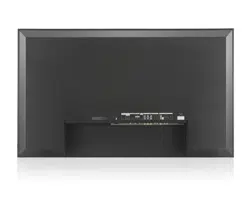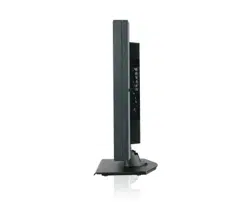

www.lg.com
ENGLISH
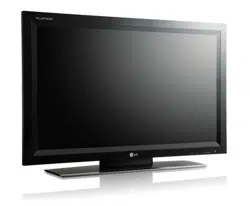
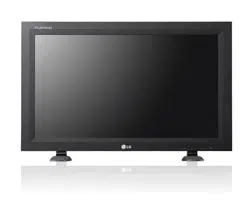
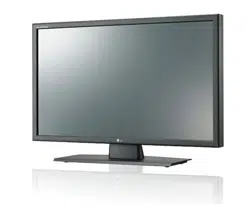
MONITOR SIGNAGE
MONITOR SIGNAGE MODELS
M4210L
Please read this manual carefully before operating
your set and retain it for future reference.
OWNER’S MANUAL


Connecting the stand .................................................................4
Connecting the Speakers ..........................................................5
To install Portrait ........................................................................6
Using the Remote Control .........................................................7
Name of the Remote Control Buttons ..............................................................................7
Inserting batteries into remote control. ...........................................................................8
Name and Function of the Parts ...............................................9
Rear View ..............................................................................................................................9
Connecting to External Devices................................................10
When Connecting to your PC ............................................................................................10
VESA FDMI wall Mounting .................................................................................................12
Video Input ...........................................................................................................................13
HDMI Input (480p/576p/720p/1080i/1080p) ......................................................................14
Watching AV Outputs..........................................................................................................15
User Menus .................................................................................16
Screen Adjustment options ...............................................................................................16
OSD Menu ............................................................................................................................18
How to adjust the OSD (On Screen Display) screen .....................................................19
How to adjust the screen automatically ..........................................................................19
Adjusting Screen Color ......................................................................................................20
Adjusting the audio function .............................................................................................25
Adjusting the timer function ..............................................................................................26
Selecting the options .........................................................................................................28
Adjust Set ID and check Serial No. and SW version. ....................................................32
Troubleshooting .........................................................................33
Specifications ...........................................................................36
Table of Contents
4
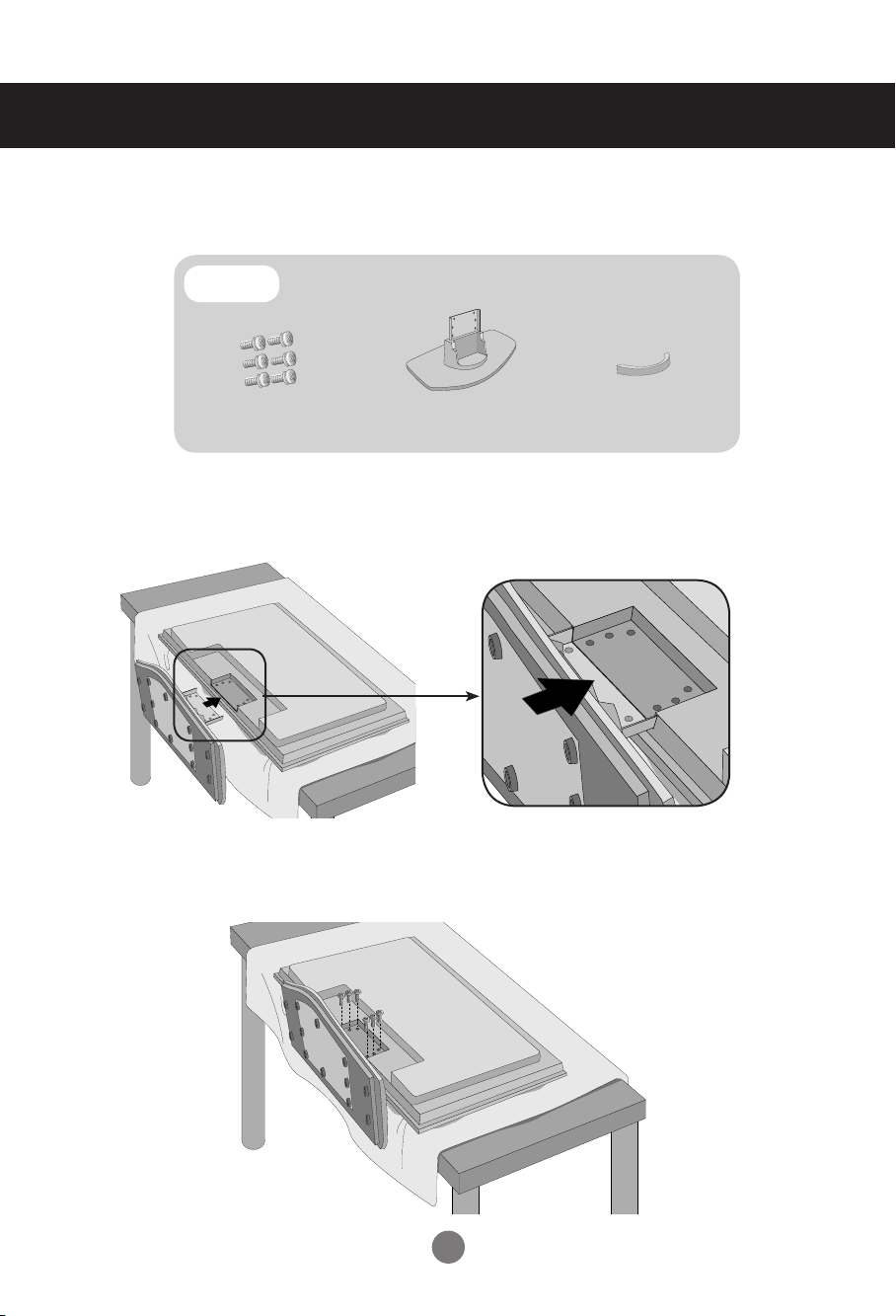
Connecting the stand
- Only on some models.
1. Take the parts for the stand out of the box and assemble them as shown in the
picture.
2. Place a soft cloth on the table and put the product with the screen facing
downward. Connect the stand as shown in the following picture.
3. Use the screws to secure the stand on the rear side of the product as shown
in the diagram.
First, check if the following parts are all present.
Parts
Stand (1)
Screws (6)
Cable management (1)
5
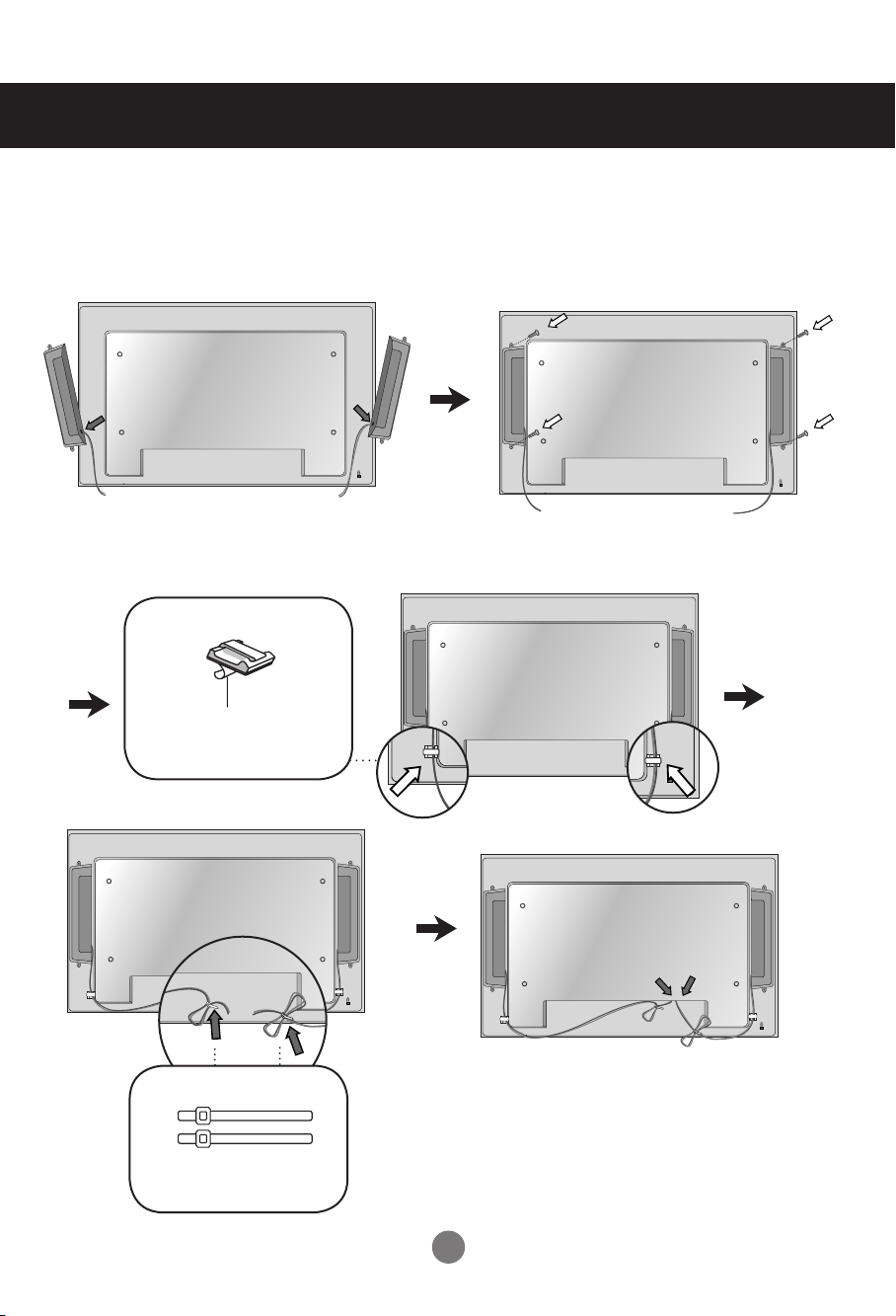
Connecting the Speakers
Mount the product onto the speaker by using a screw as shown in the following
connect the speaker cable.
- Only on some models.
When the speaker is installed.
*Connect the input terminal with a proper color match.
Remove the paper.
Cable holder
After installing your speakers, use holders and cable ties to organize the speaker cables.
* This feature is not available in all model.
Cable tie
* This feature is not available in all model.
6
6
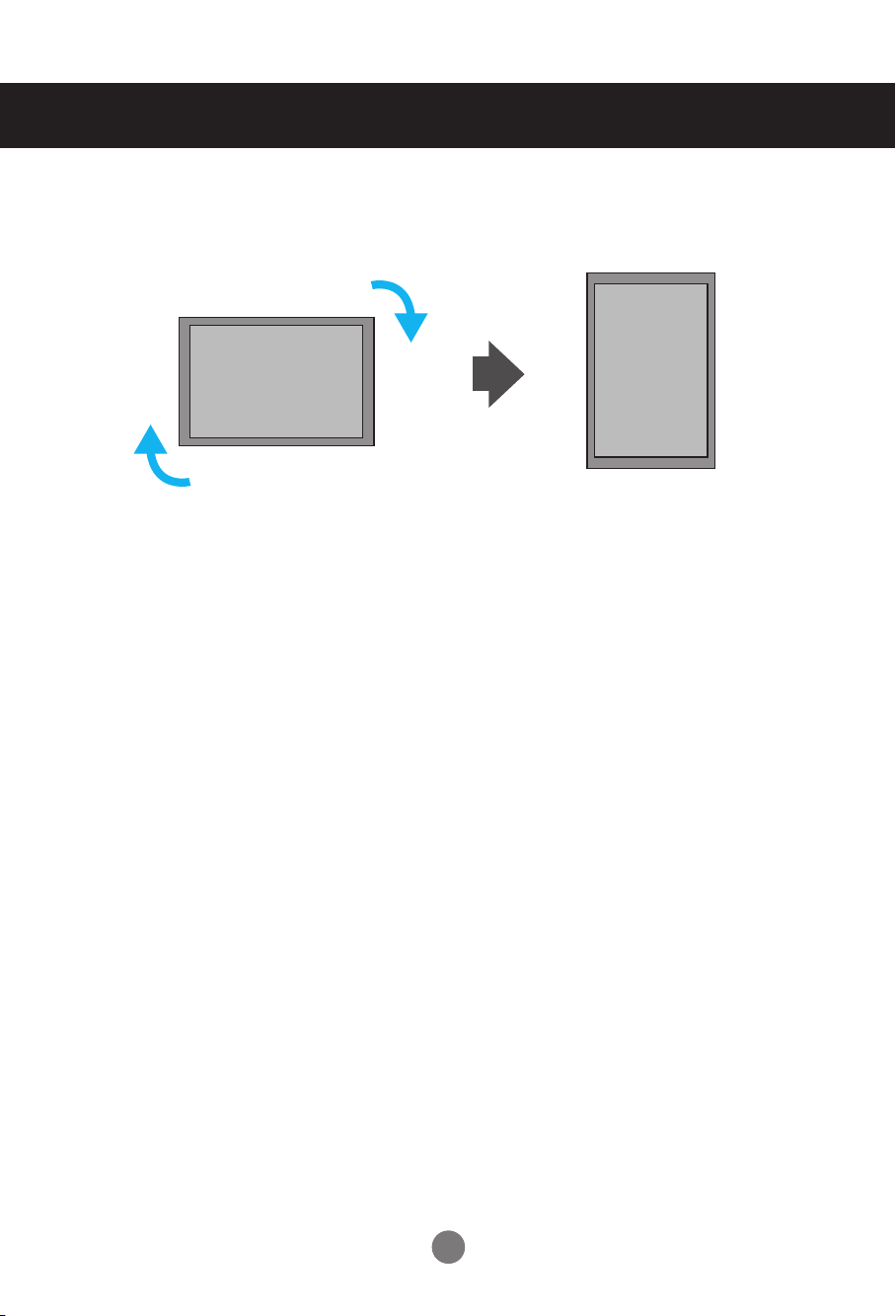
To install Portrait
"When installing Portrait, rotate it clockwise based on its front."
- Only on some models.
7
7
Using the Remote Control
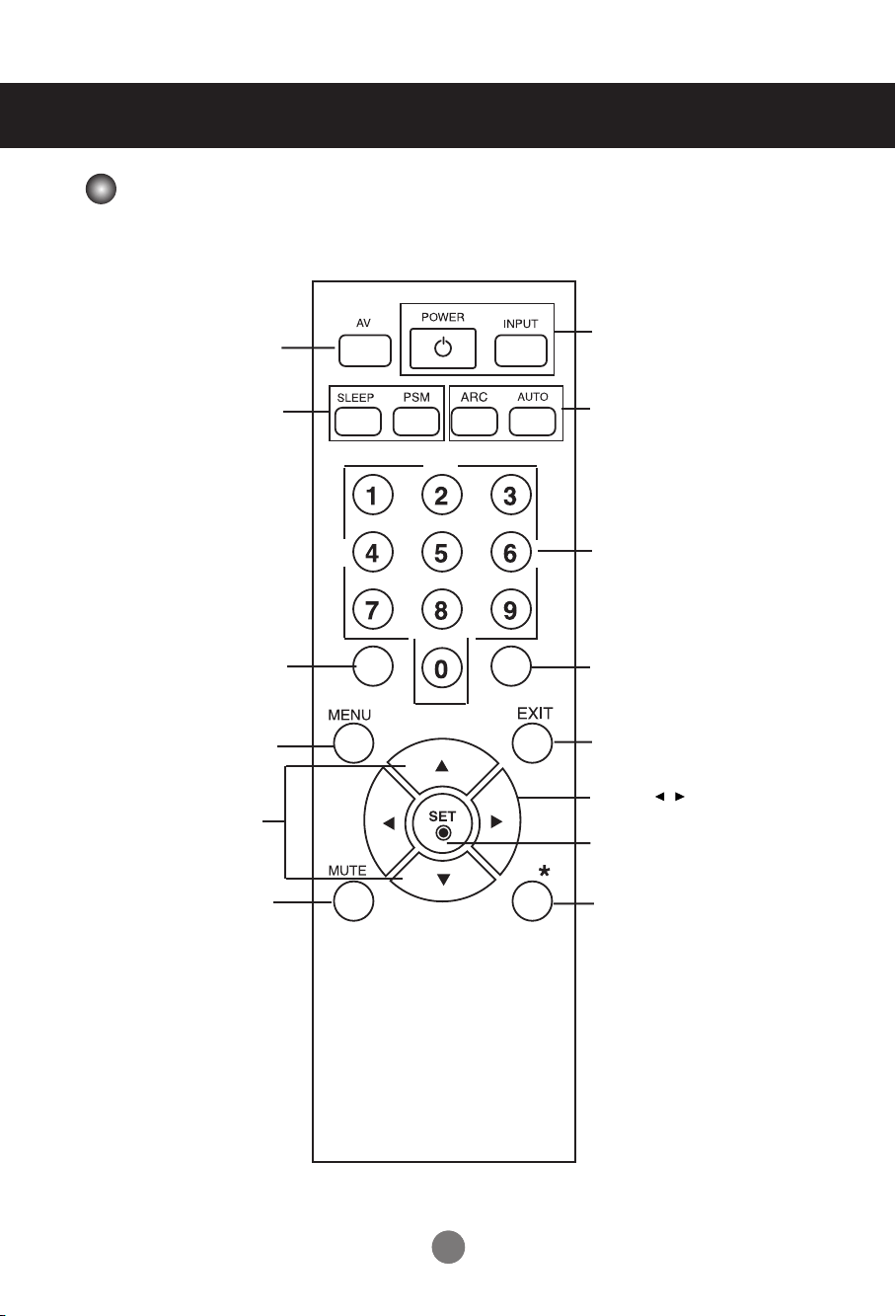
Name of the Remote Control Buttons
•
AV Button
•
Sleep Button
When watching AV, RGB PC,HDMI/DVI.
The product will be automatically turned
off after a certain period of time.
Press this button repetitively to
select an appropriate time duration
•
PSM Button
- Toggles through preset video
settings.
•
Menu Button
•
Check Button
•
Volume Button
Volume up and down
•
Mute button
There is not a function
which is supported
•
UP and Down buttons
Bring up and down direction
adjustment.
•
ARC button
Aspect Ratio Correction. Toggles
through aspect ratio options.
•
Auto Button
Automatic adjustment function
(Operational for the analog signal only)
•
Exit Button
There is not a function
which is supported
There is not a function
which is supported
There is not a function
which is supported
•
Power On/Off Button
•
Input Select Button
(See next page)
8
8
Using the Remote Control
•
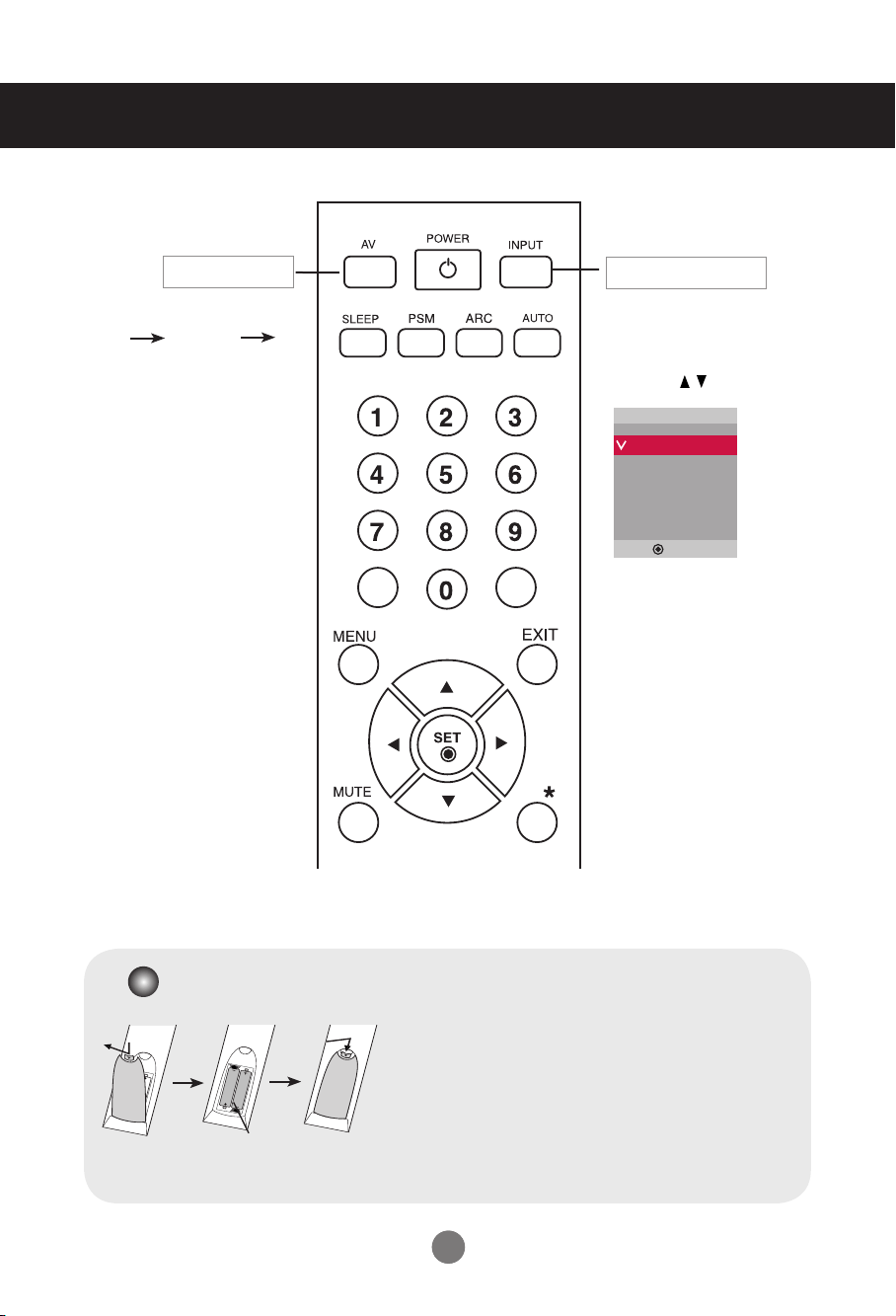
AV Button
If you press the button once,
the following Input Signal
Window will appear. Select
the signal type you want
using the button.
•
Input Select Button
1. Open the battery compartment cover on the back side and
install the batteries matching correct polarity (+ with +,- with -)
2. Install two 1.5 V AAA batteries. Don’t mix old or used batteries
with new ones.
3. Close cover.
4. To remove the batteries, perform the installation actions in
reverse.
Inserting batteries into remote control.
AAA Type
AV RGB PC
HDMI/DVI
Toggles through video
Input
AV
RGB PC
HDMI/DVI
▲▼
9
9
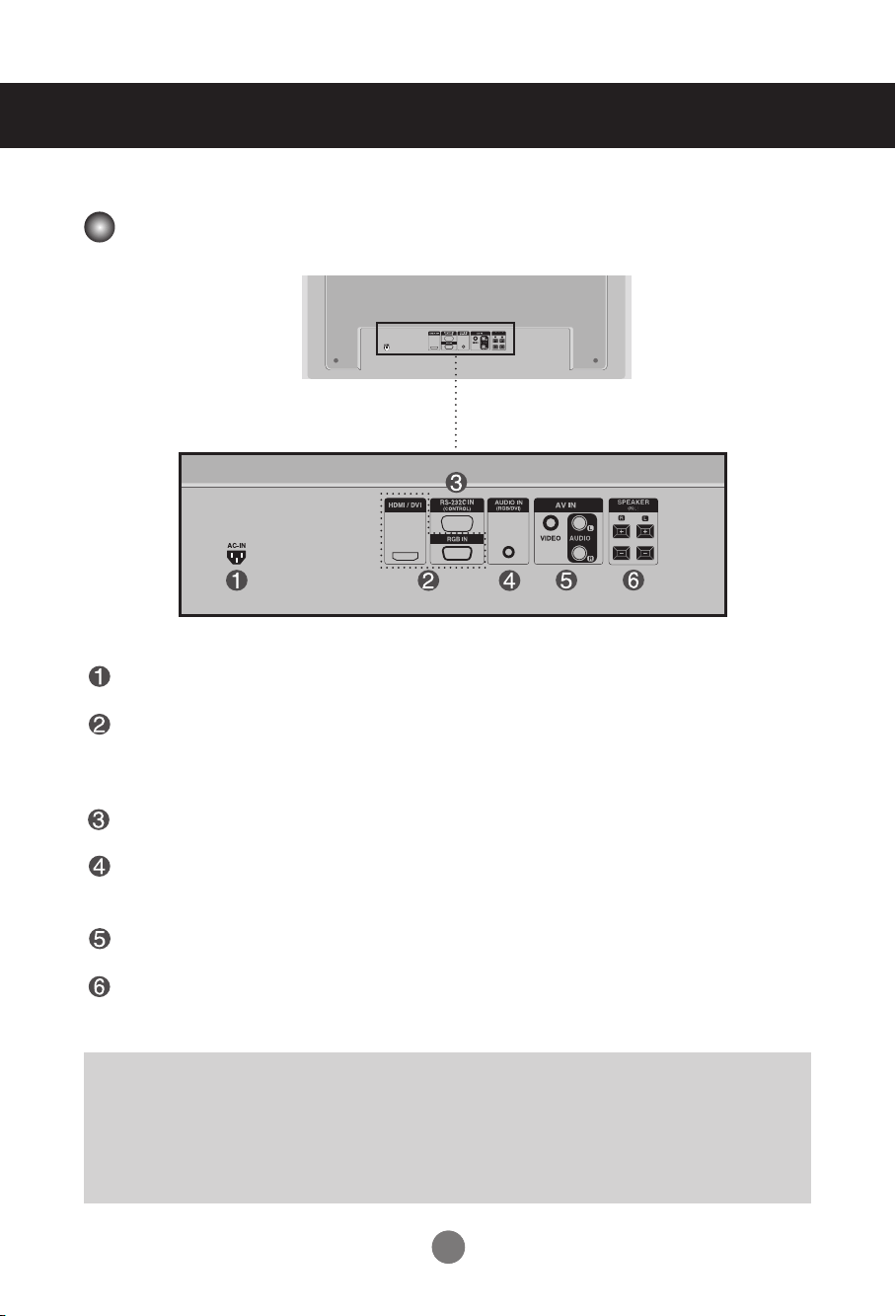
Name and Function of the Parts
*LINE OUT
A terminal used to connect to the speaker including a built-in amplifier (Amp). Make sure that the
connecting terminal of the PC sound card is checked before connecting. If the Audio Out of PC
sound card has only Speaker Out, reduce the PC volume.
If the Audio Out of the PC sound card supports both Speaker Out and Line Out, convert to Line Out
using the card jumper of the program (Refer to the Sound Card Manual).
* The product image in the user's guide could be different from the actual image.
Power Connector : Connect the power cord
RGB PC, HDMI/DVI Ports
- HDMI Supports High Denition input and HDCP (High-bandwidth Digital Content Protection).
Some devices require HDCP in order to display HD signals.
RS-232C Serial Ports
PC Sound Jack
: Connect the audio cable to the *LINE OUT jack of the PC sound card.
AV Ports
Speaker Ports
Rear View
10
10
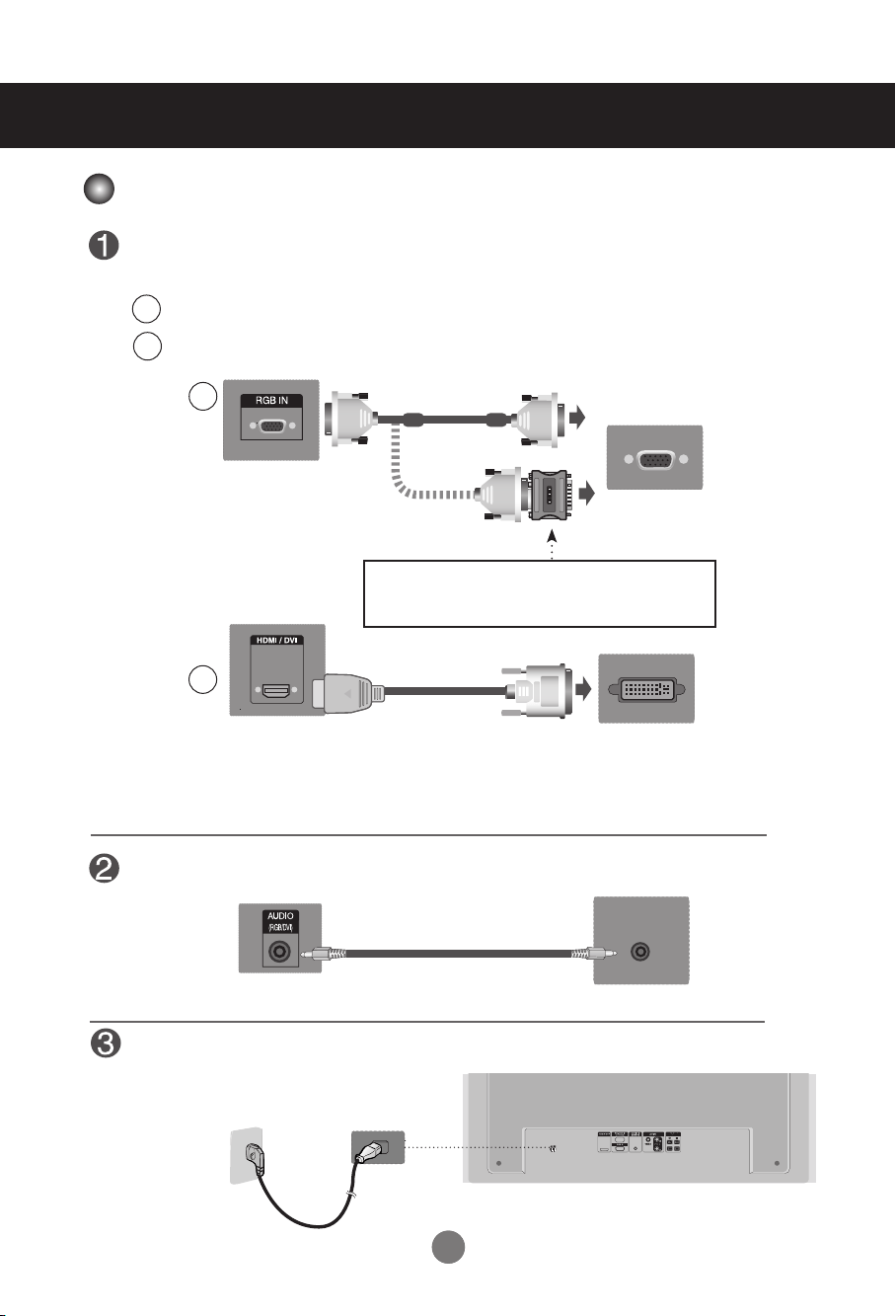
First of all, see if the computer, product and the peripherals are turned off.
Then, connect the signal input cable.
When connecting with the D-Sub signal input cable.
When connecting with the HDMI to DVI signal input cable (not included).
Connecting to External Devices
B
A
PC
Rear side of the product.
Connect the Audio cable.
MAC
Macintosh Adapter (not included)
Use the standard Macintosh adapter since an incompatible
adapter is available in the market. (Different signaling system)
B
A
PC
PC/
MAC
PC
Rear side of the product.
Rear side of the product.
(not included)
(not included)
* User must use shielded signal interface cables (D-sub 15 pin cable, DVI cable) with ferrite cores to maintain
standard compliance for the product.
When Connecting to your PC
Rear side of the product.
Connect the power cord.
11
11
•
How to connect to two computers.
Connect the signal cables (HDMI to DVI and D-Sub) to each computer.
Press the INPUT button on the remote control to select the computer to use.
•
Directly connect to a grounded power outlet on the wall or a power bar with a ground wire.
Note
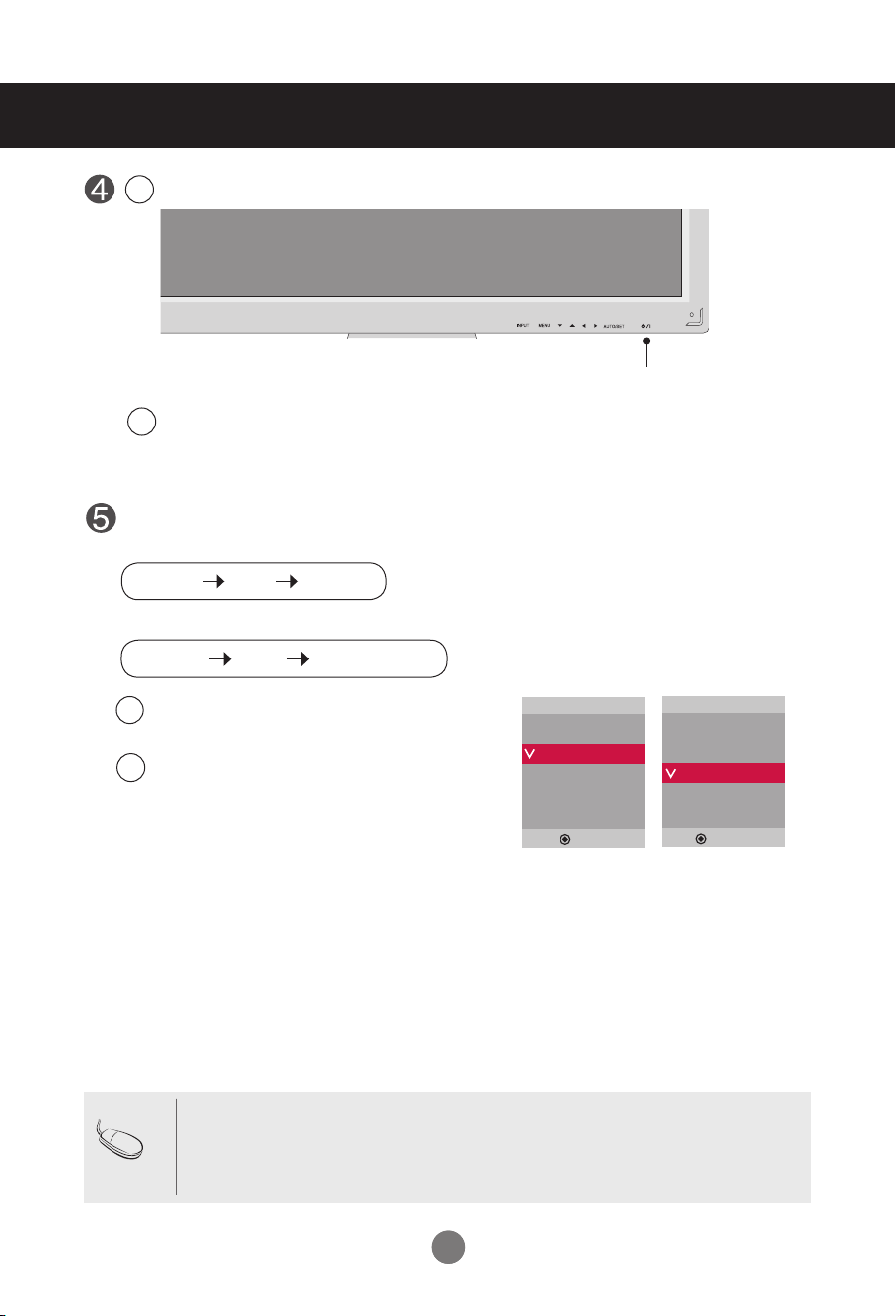
Turn on power by pressing the power button on the product.
Connecting to External Devices
Turn on the PC.
2
1
Select an input signal.
Press the INPUT button on the remote control to select the input signal.
Or, press the INPUT button on the back of the product.
When connecting with a D-Sub signal input cable.
• Select RGB PC : 15-pin D-Sub analog signal.
When connecting with a HDMI to DVI signal input cable.
• Select HDMI/DVI : HDMI to DVI Digital signal.
B
A
Input
AV
RGB PC
HDMI/DVI
Input
AV
RGB PC
HDMI/DVI
▲▼
▲▼
INPUT SET
▼▲
INPUT
AUTO/SET
▼▲
Power button
12
12
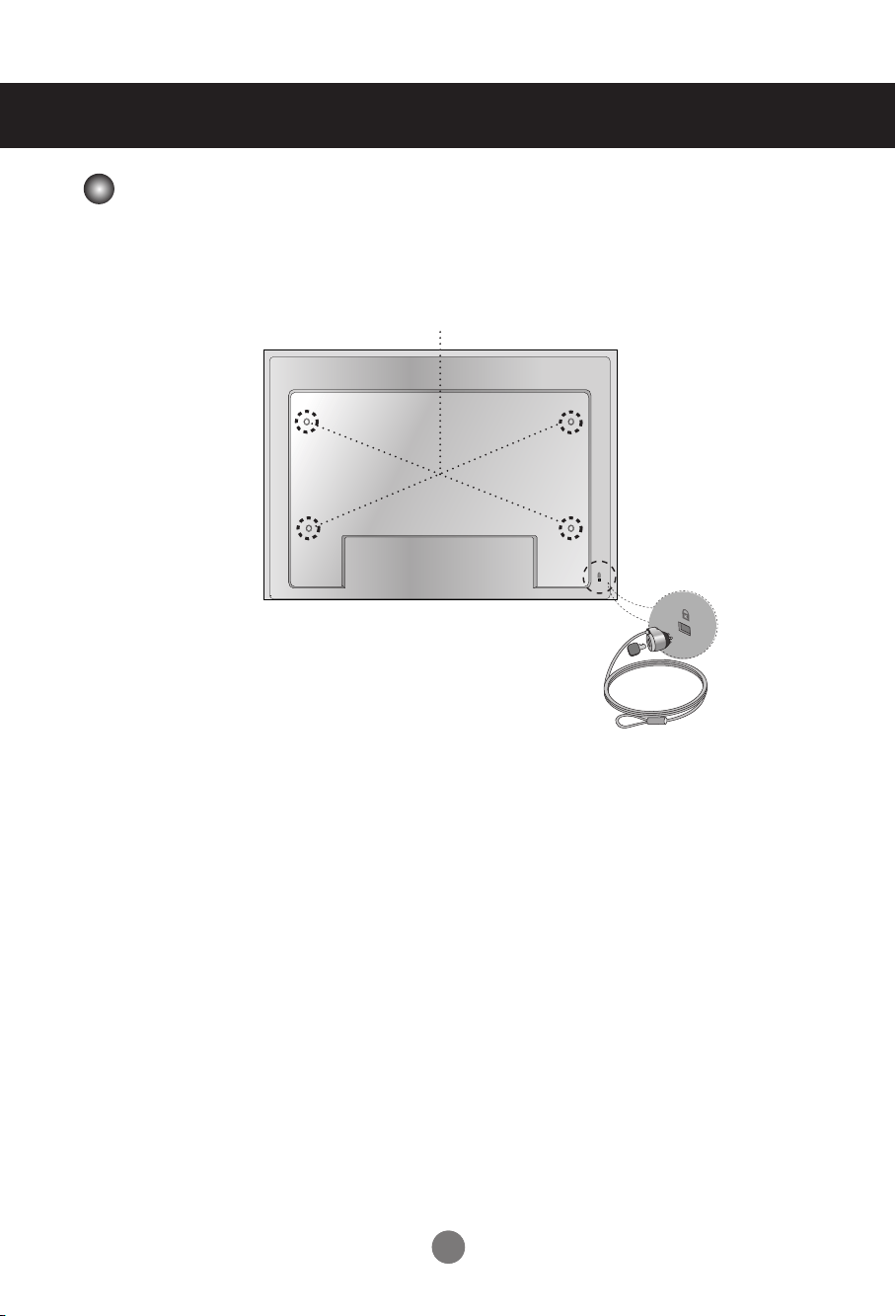
Kensington Security Slot
The Set is equipped with a kensington Security System
connector on the back panel. The cable and lock are
available separate and are not sold by LG. For more info,
visit http://www.kensington.com, the internet home page
of the Kensington company.
This product supports a VESA FDMI compliant mounting interface. These mounts are purchased
separately and not available from LG. Refer to the instructions included with wall mount for more
info.
Connecting to External Devices
VESA FDMI wall Mounting
13
13
Connecting to External Devices
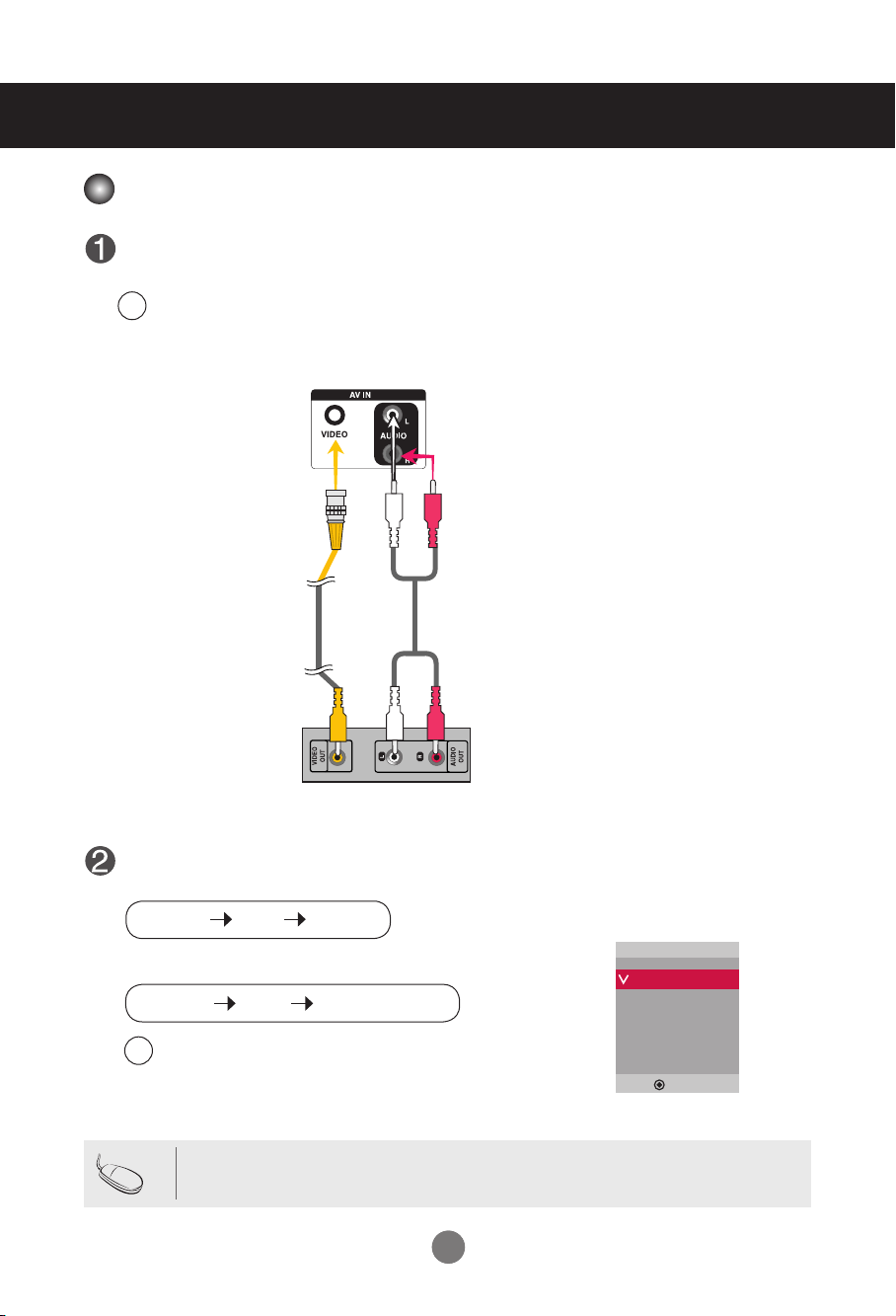
When connecting with an BNC cable.
•
Select AV.
A
Connect the video cable as shown in the below gure and then connect the power cord
(See page 10).
When connecting with a BNC cable.
•
Connect the input terminal with a proper color match.
A
BNC Cable
(not included)
Product
VCR/DVD Receiver
Select an input signal.
Press the INPUT button on the remote control to select the input signal.
Or, press the INPUT button on the back of the product.
• When the BNC cable is connected simultaneously with S-Video cable, S-Video input has a priority.
Note
Audio Cable
(not included)
Input
AV
RGB PC
HDMI/DVI
▲▼
INPUT SET
▼▲
Video Input
INPUT
AUTO/SET
▼▲
1414
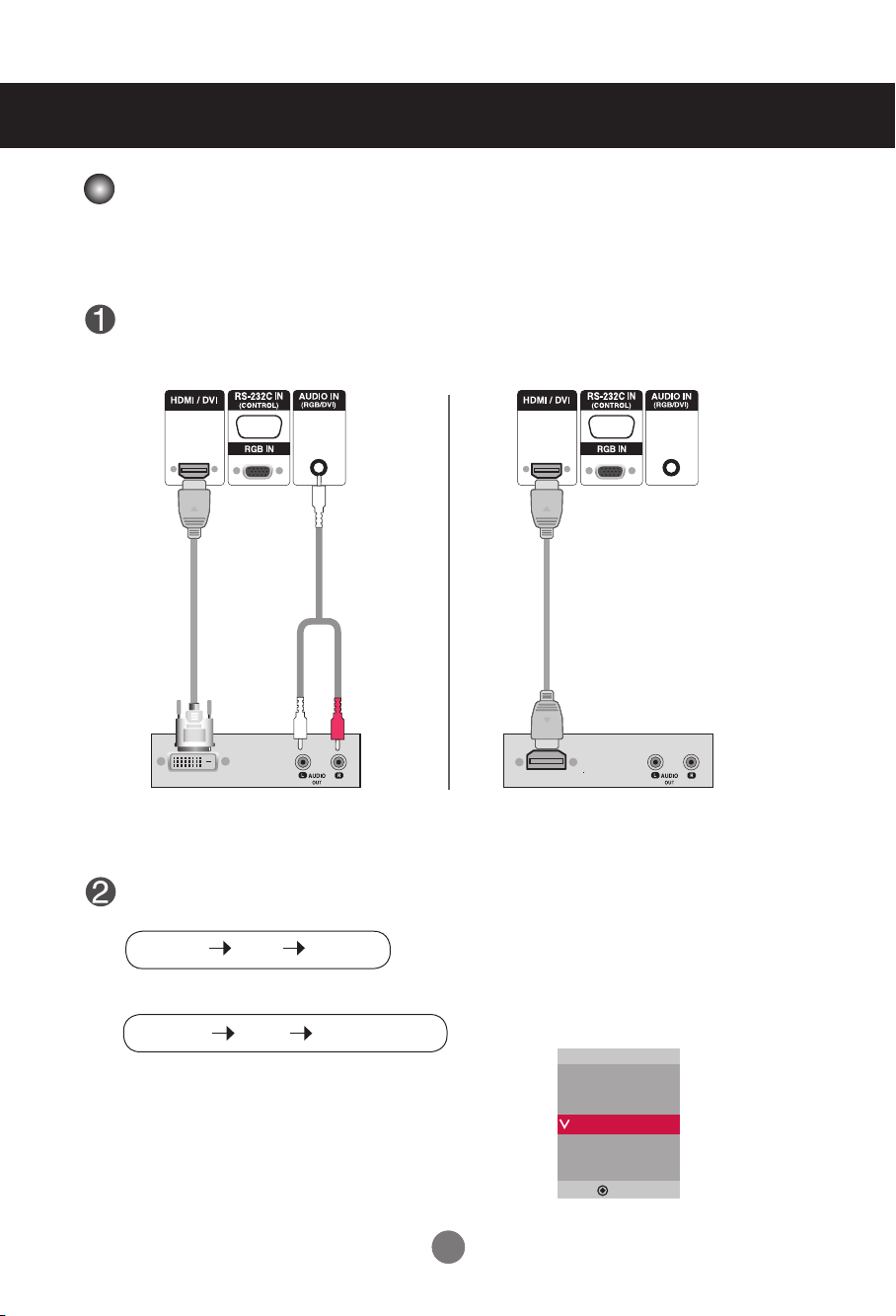
Connect the video/audio cable as shown in the below gure and then connect the power
cord (See page 10).
RCA-PC
Audio Cable
(not included)
Product
VCR/DVD/Set-top Box
HDMI to DVI
Signal Cable
(not included)
VCR/DVD/Set-top Box
Product
Select an input signal.
Press the INPUT button on the remote control to select the input signal.
Or, press the INPUT button on the back of the product.
HDMI Signal Cable
(not included)
Connecting to External Devices
When connecting with a HDMI to DVI signal input cable.
When connecting with a HDMI signal input cable.
• Select HDMI/DVI
- HDMI Supports High Denition input and HDCP (High-bandwidth Digital Content Protection).
Some devices require HDCP in order to display HD signals.
Note : Dolby Digital is not supported.
Input
AV
RGB PC
HDMI/DVI
▲▼
INPUT SET
▼▲
HDMI Input (480p/576p/720p/1080i/1080p)
INPUT
AUTO/SET
▼▲
1515
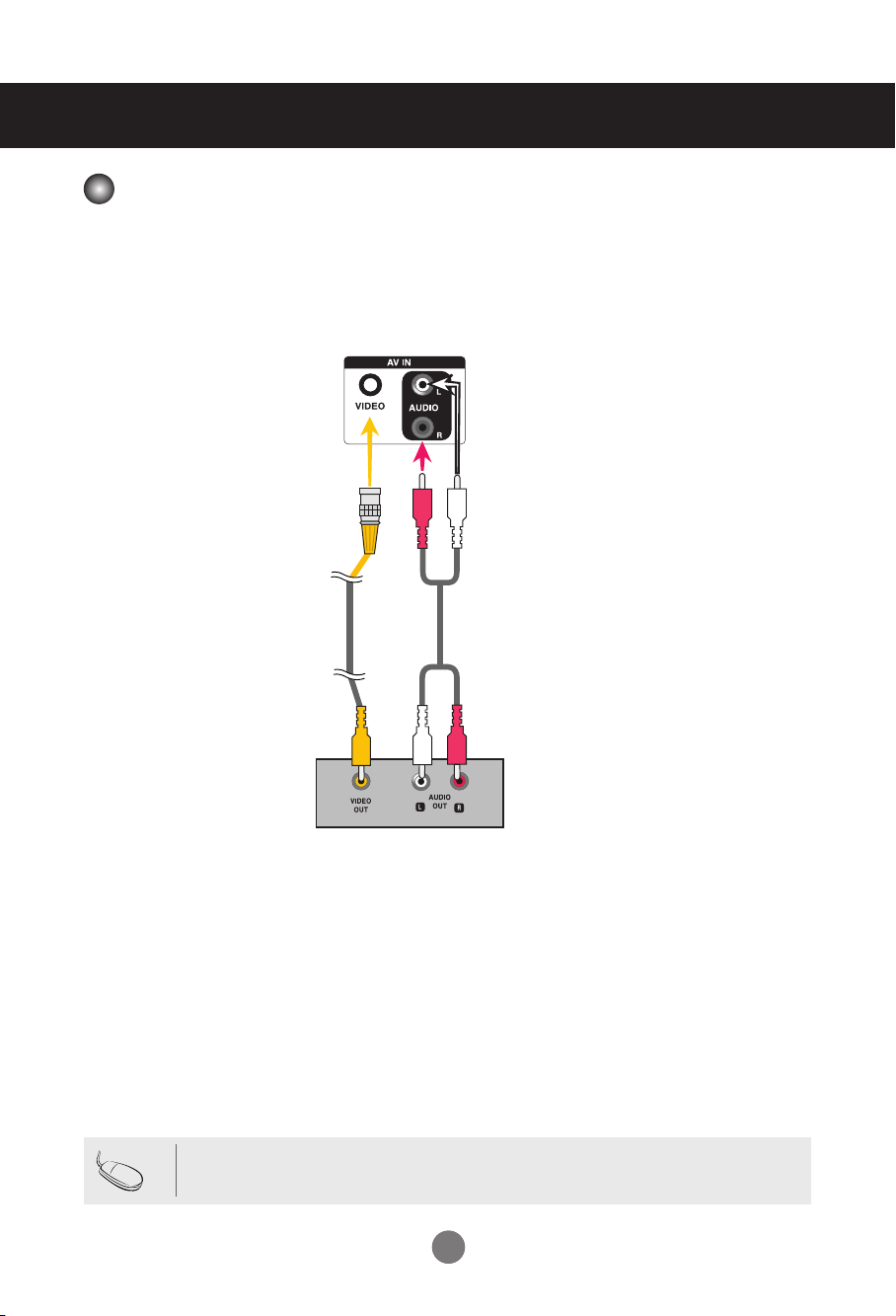
- When using AV input, you can connect the AV Out to other monitors.
Video/TV
BNC Cable
(not included)
Audio Cable
(not included)
Product
Connecting to External Devices
• When multi-connecting in/out cascade format, no loss cables are recommended.
We recommend that you should use cable distributor.
Note
Watching AV Outputs
16
User Menus
Screen Adjustment options
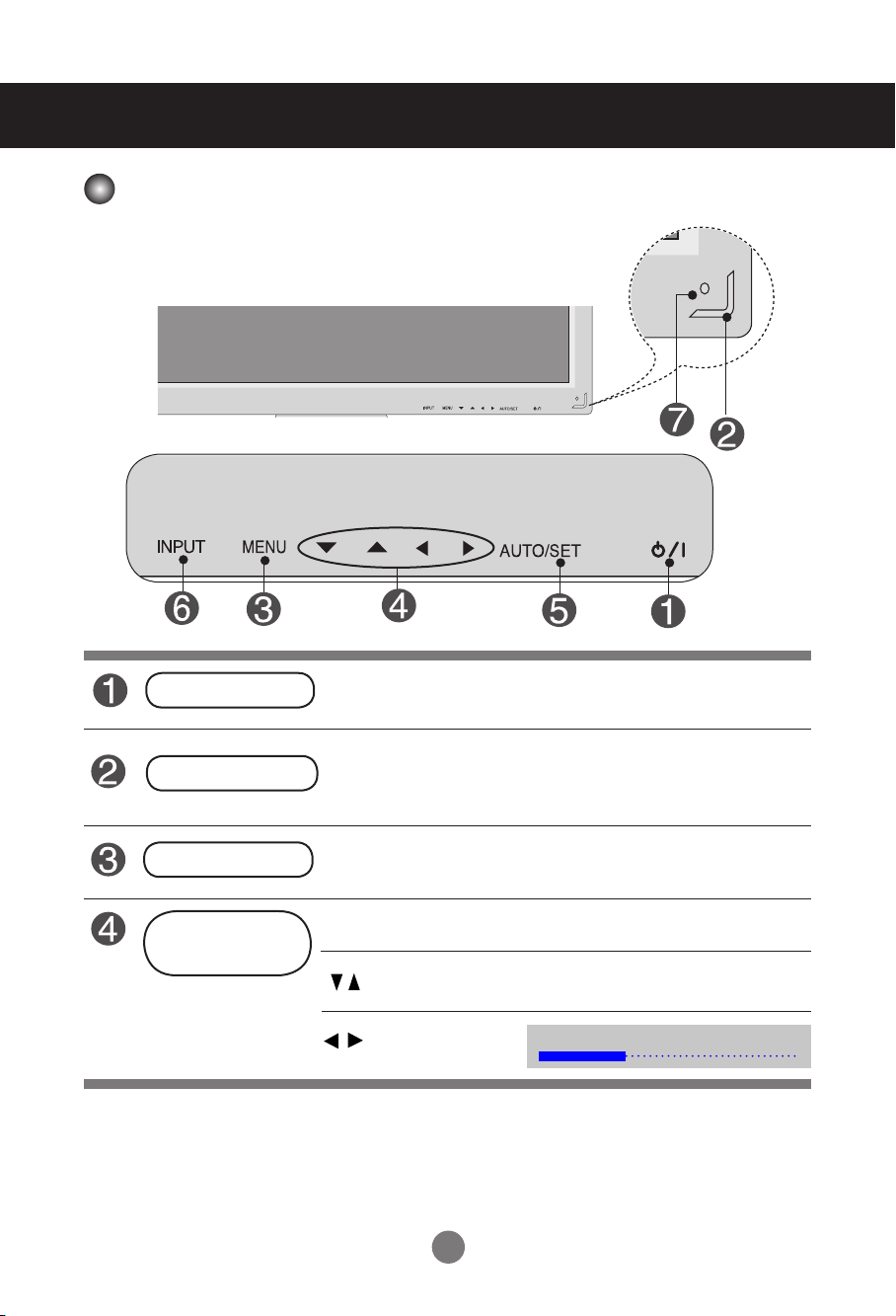
• Press this button to turn on the power. Press this button again to
turn it off.
• This Indicator lights up blue when the display operates normally(on
mode). If the display is in sleep (Energy Saving) mode, this indicator
color changes to amber.
Power Button
• Adjust the volume.
• Adjust the up and down.
• Use this button to show/hide the OSD (On Screen Display) menu
screen.
MENU Button
• Use
this
button to select an icon or adjust the setting in the OSD screen.
OSD Select /
Adjust Button
Power Indicator
Volume
35
17
User Menus
• This is where the unit receives signals from the remote control.
Screen Adjustment options
[For PC Analog signal]
AUTO/SET Button
AV Composite Video, Separate Video
RGB PC 15-pin D-Sub analog signal
HDMI/DVI Digital signal
- Toggles between inputs
INPUT Button
IR Receiver
[When 1920 x 1080 is selected]
Input
AV
RGB PC
HDMI/DVI
▲▼
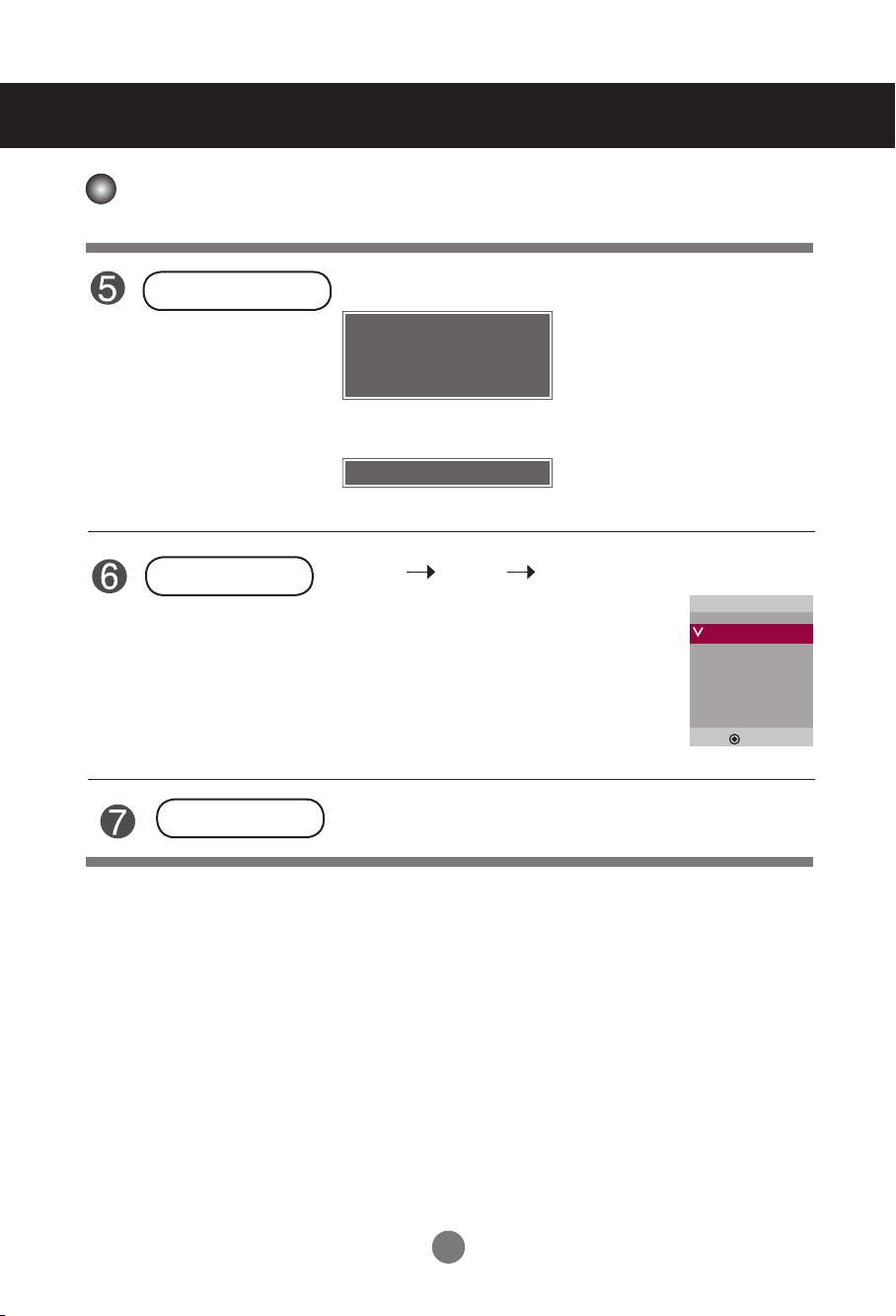
Auto in progress
For optimal display change
resolution to 1920 x 1080
Auto in progress
INPUT
AUTO/SET
▼▲
18
OSD Menu
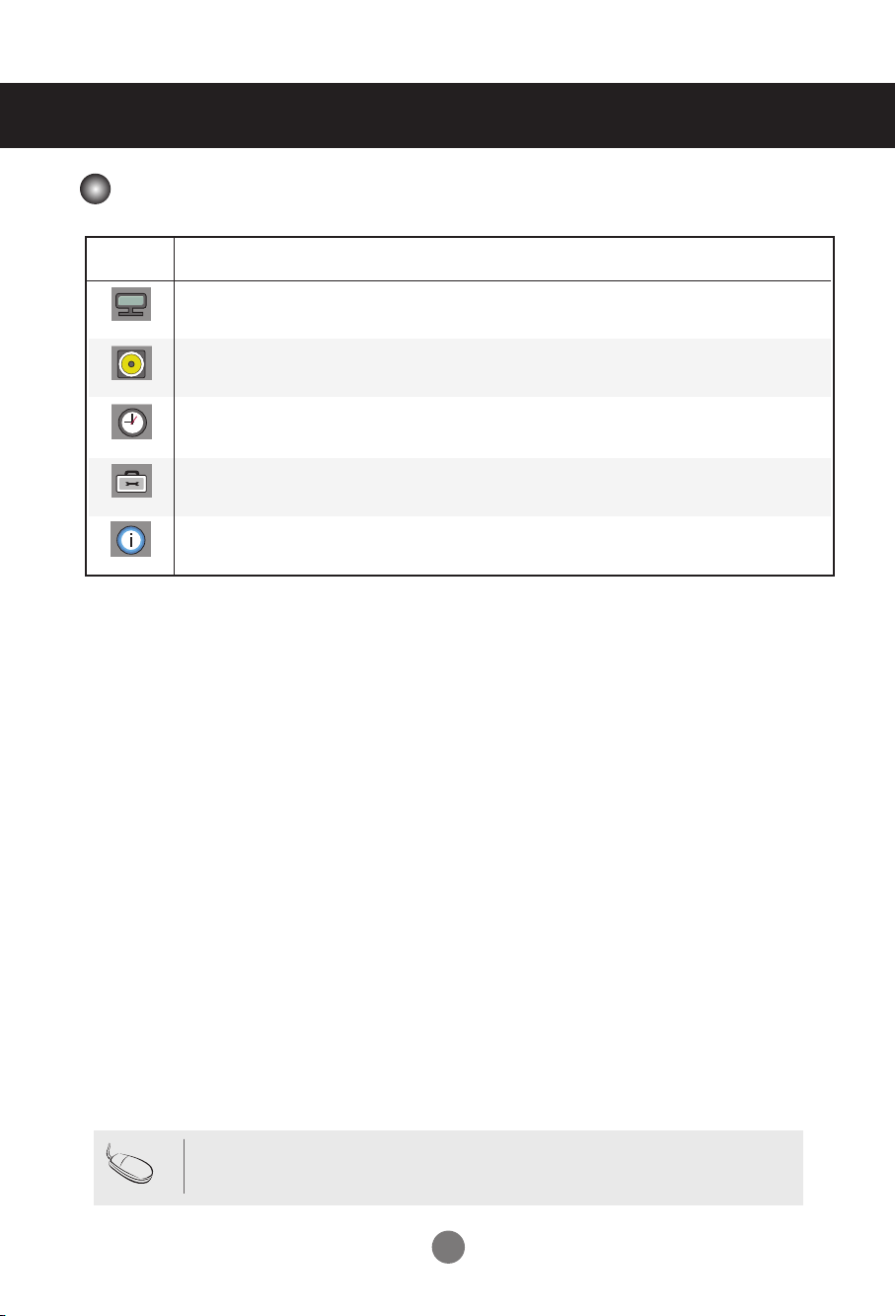
Icon Function Description
Picture
Audio
Adjusts the audio options.
Adjusts screen brightness, contrast and color that you prefer.
Note
OSD(On Screen Disp lay)
The OSD function enables you to adjust the screen status conveniently since it provides
graphical presentation.
Option
Adjusts the screen status according to the circumstances.
Time
Adjusts the timer options.
Information
Adjust Set ID and check Serial No. and SW version.
User Menus
19
User Menus
How to adjust the OSD (On Screen Display) screen
•
Use the remote control to adjust the OSD screen.
How to adjust the screen automatically
Press the AUTO/SET button (AUTO button on a remote Control) in
the PC analog signal. Then optimal screen settings will be selected
that fit into the current mode. If adjustment is not satisfactory, you can
adjust the screen manually.
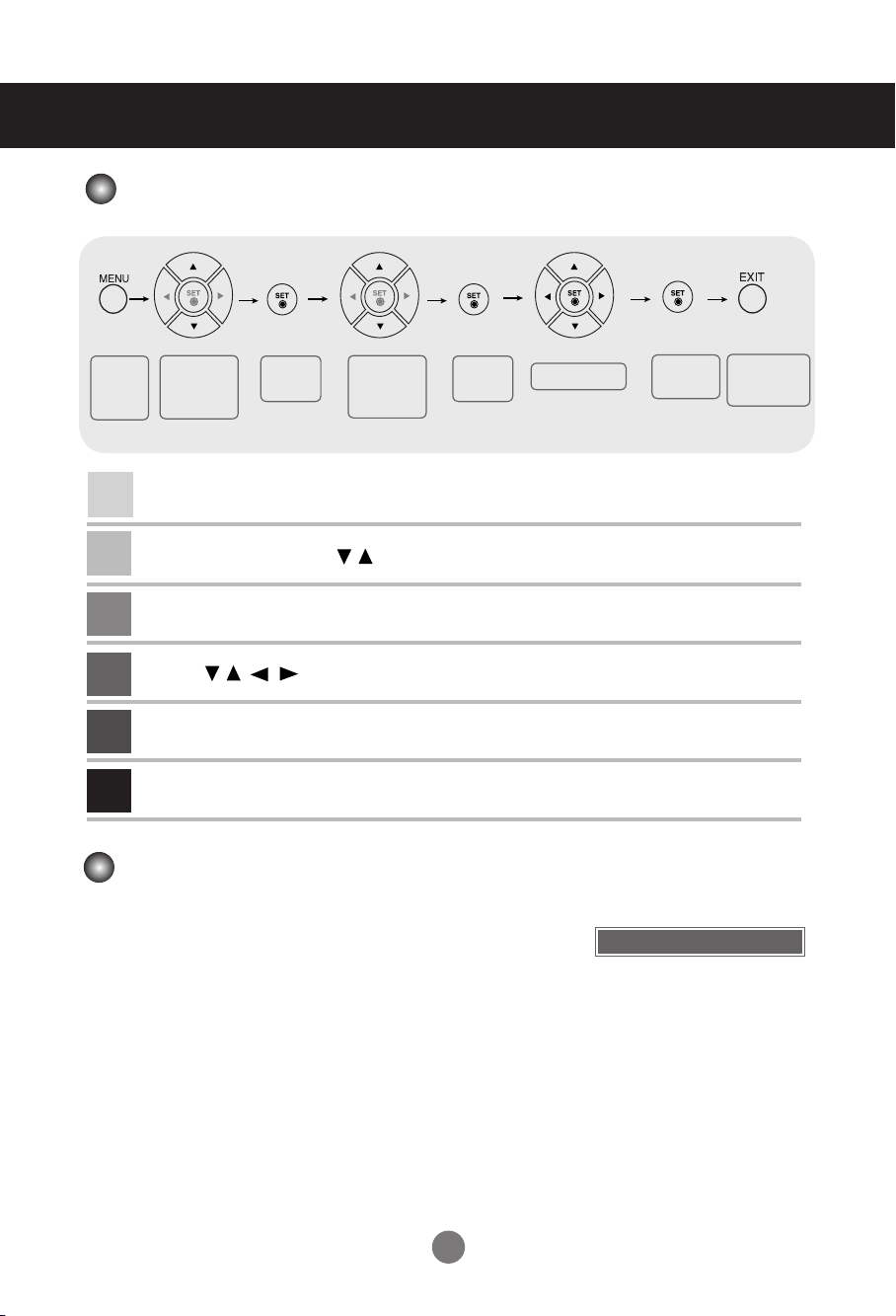
Press the MENU Button, then the main menu of the OSD appears.
To access a control, use the Buttons.
When the icon you want becomes highlighted, press the SET Button.
Use the Buttons to adjust the item to the desired level.
Accept the changes by pressing the SET Button.
Exit the OSD by pressing the EXIT Button.
1
2
3
4
5
6
Pops up
the menu
screen
Move where
you want to
adjust
Move where
you want to
adjust
Select a
menu icon
Select a
menu icon
Adjust the status
Save
adjustment
Exit from the
menu screen.
[When 1920 x 1080 is selected]
Auto in progress
20
User Menus
Adjusting Screen Color
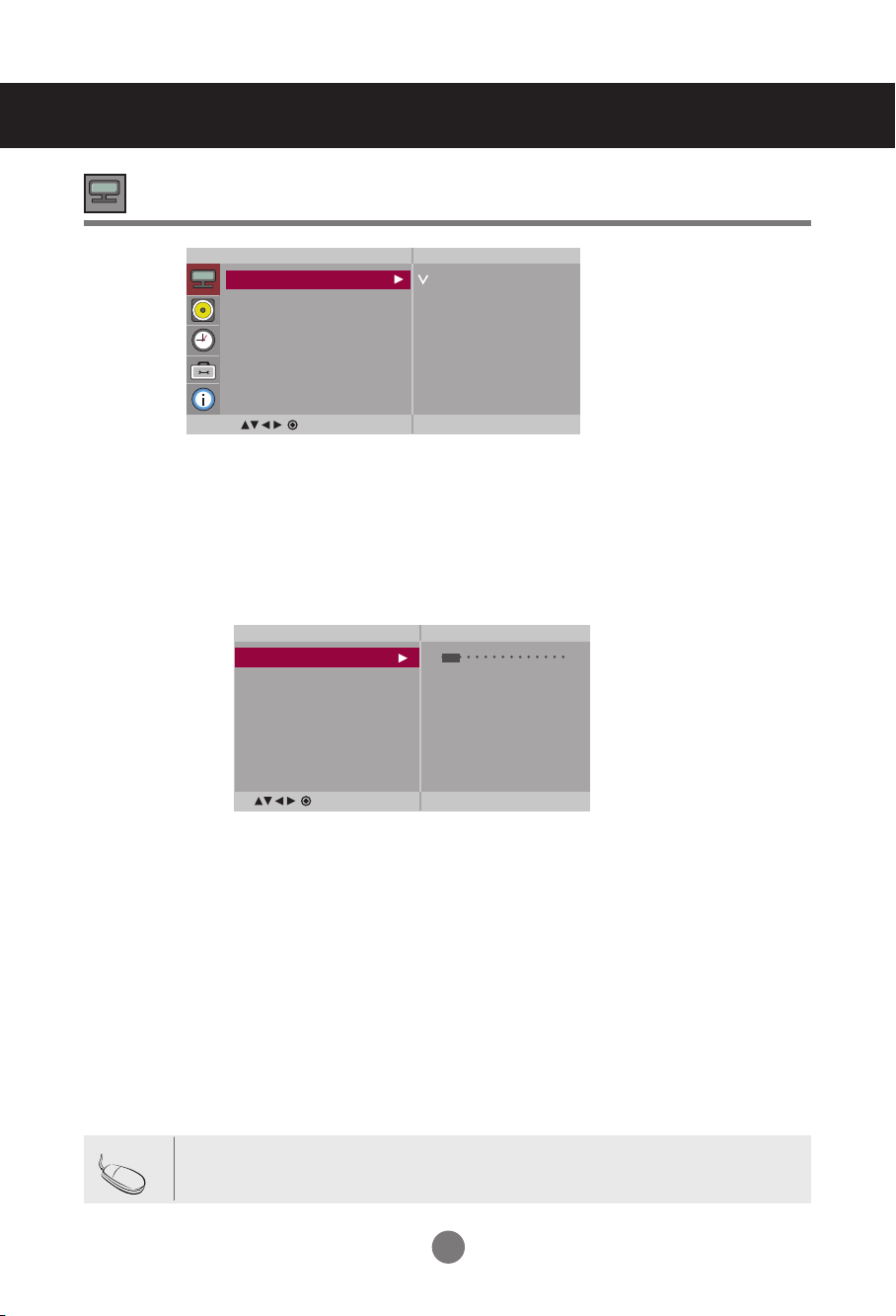
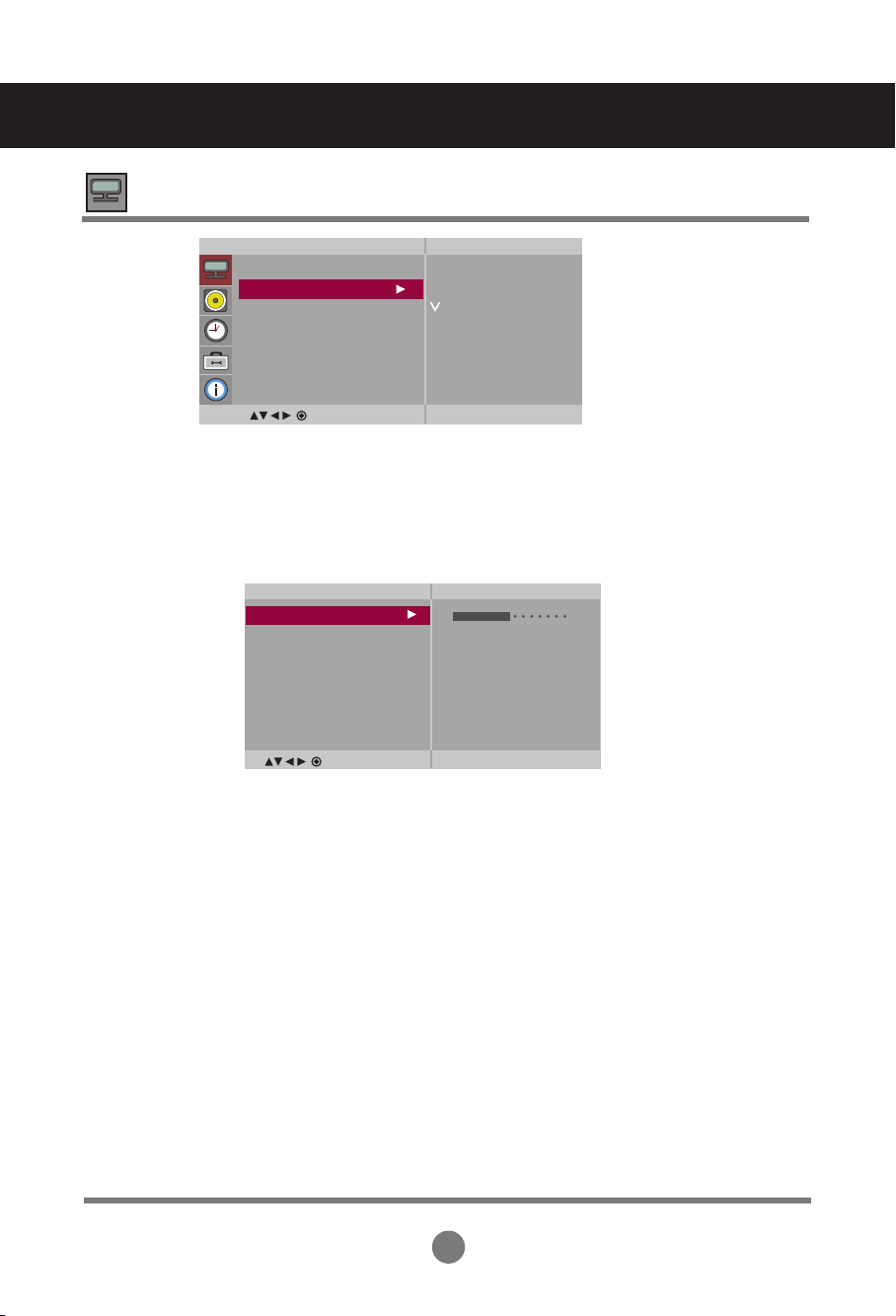
Backlight : To control the brightness of the screen,adjust the brightness of LCD panel.
Contrast : Adjust the difference between the light and dark levels in the picture.
Brightness : To adjust the brightness of the screen.
Color : To adjust the color to desired level. (Function works in the following mode - DTV)
Sharpness : To adjust the clearness of the screen. (Function works in the following mode -
DTV)
Tint :To adjust the tint to desired level. (Function works in the following mode - DTV)
Expert : To compensate for each image mode, or adjust image values according to a
particular image. (Applied only to User2 menu.) (Function works in the following
mode - AV, HDMI-DTV)
Toggles between screen presets.
• Vivid : Select this option to display with a sharp image.
• Standard : The most general and natural screen display status.
• Cinema : Select this option to lower brightness by one level.
• Sport : Select this option to display with a soft image.
• Game : To enjoy dynamic image when playing a game.
• User1,2 : Select this option to use the user-defined settings.
Note
If the 'Picture Mode' setting in the Picture menu is set to Vivid, Standard, Cinema, Sport or
Game the subsequent menus will be automatically set.
Picture
Mode
Picture
Picture Mode
Color Temperature
Advanced
Aspect Ratio
Picture Reset
Screen
Vivid
Standard
Cinema
Sport
Game
User1
User2
MENU
User2
Backlight 20
Contrast 90
Brightness 50
Color 50
Sharpness 50
Tint 50
Expert
MENU
21
User Menus
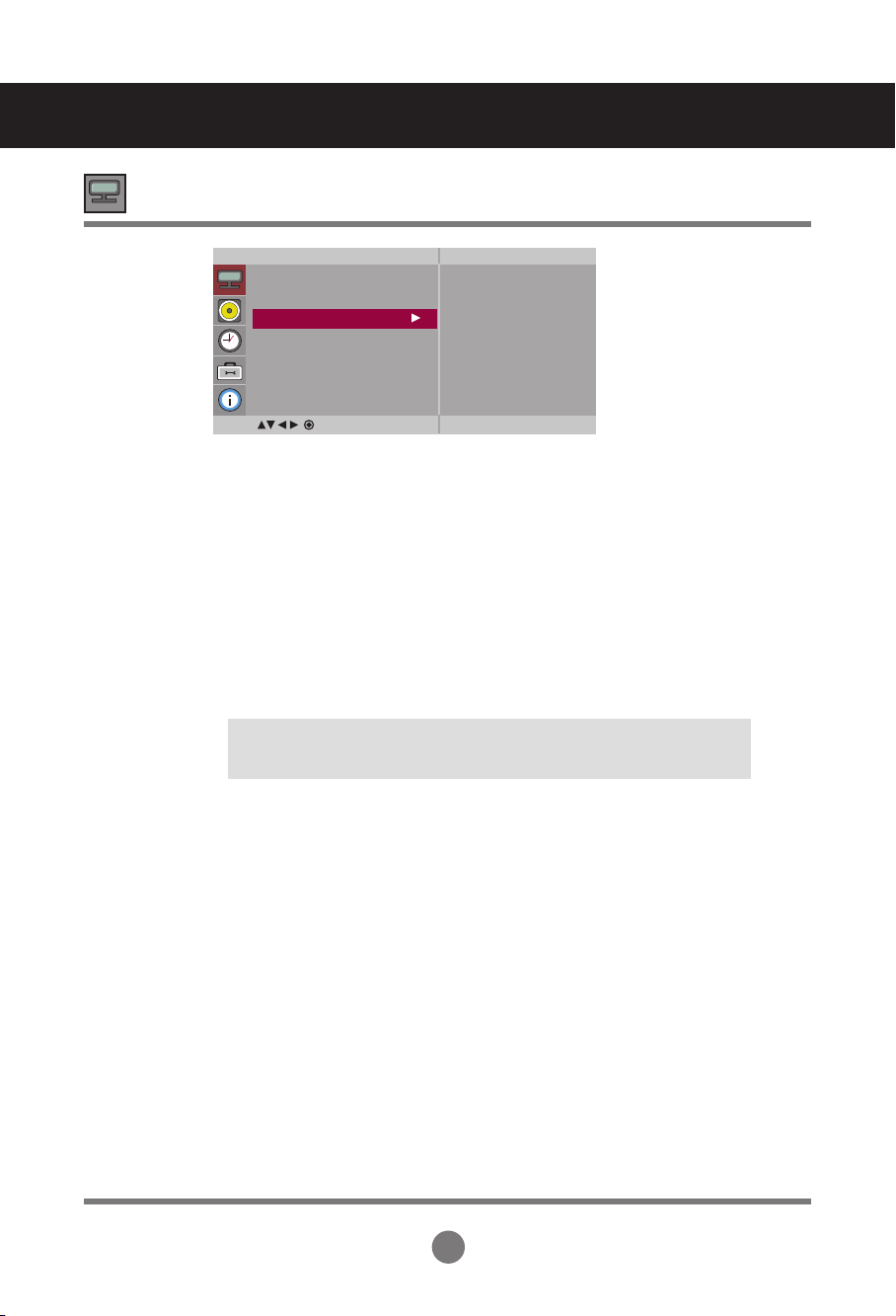
Red / Green / Blue
Set your own color levels.
Color Settings
• Cool : Slightly purplish white.
• Medium : Slightly bluish white.
• Warm : Slightly reddish white.
• User : Select this option to use the user-defined settings.
Adjusting Screen Color
Color
Temperature
Picture
Picture Mode
Color Temperature
Advanced
Aspect Ratio
Picture Reset
Screen
Cool
Medium
Warm
User
MENU
User
Red 0
Green 0
Blue 0
MENU
22
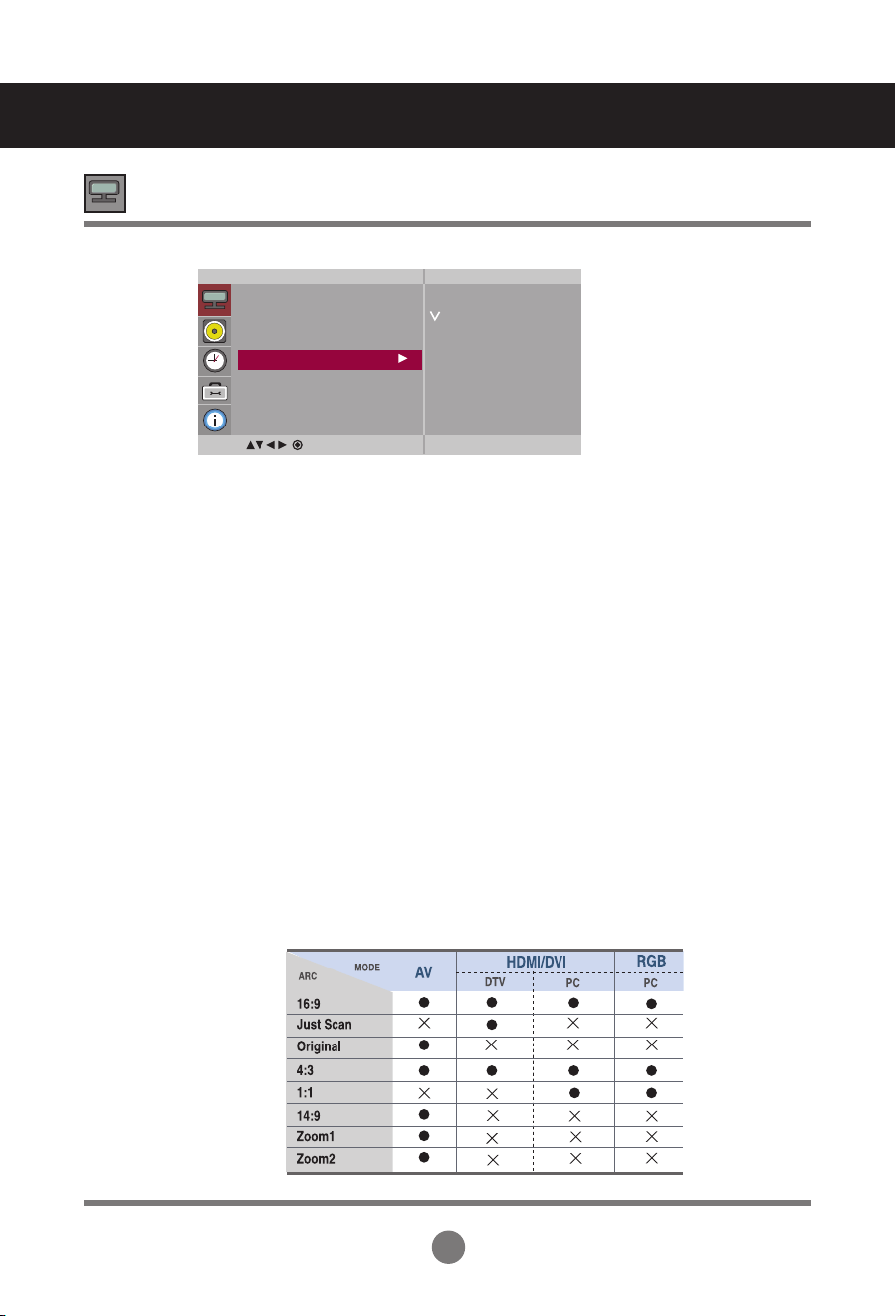
• NR : Removing the noise up to the point where it does not damage the original picture.
• Gamma : Set your own gamma value. : -50/0/50
On the monitor, high gamma values display whitish images and low gamma
values display high contrast images.
• Film Mode : (Function works in the following mode - AV)
When you watch a movie, this function adjusts the set to the best picture
appearance.
• Black Level : (Function works in the following mode - AV(NTSC), HDMI/DVI) adjusts the
contrast and the brightness of the screen using the black level of the screen.
Advanced
• High : The reflection of the screen gets brighter.
• Low : The reflection of the screen gets darker.
Adjusting Screen Color
User Menus
Picture
Picture Mode
Color Temperature
Advanced
Aspect Ratio
Picture Reset
Screen
To set
MENU
23
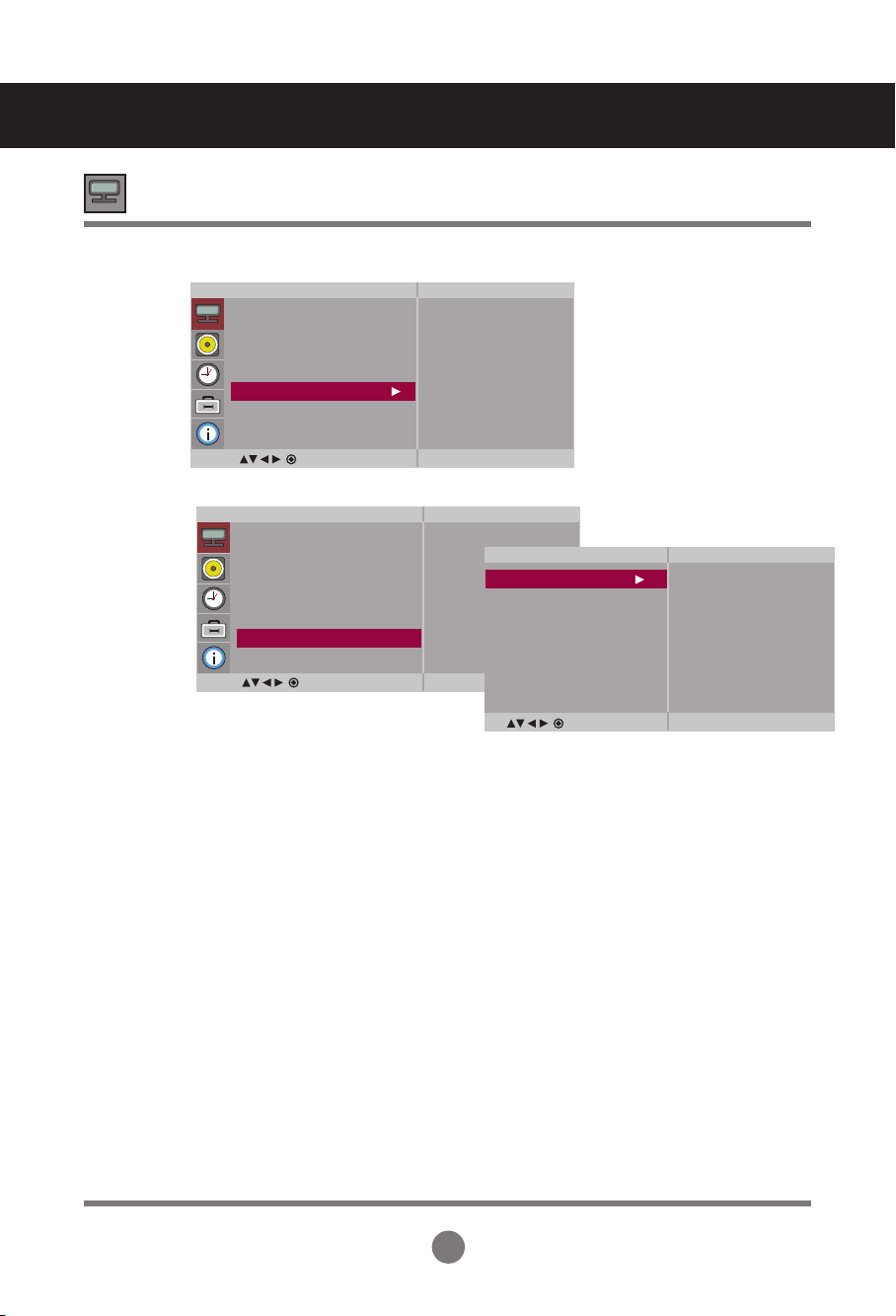
To select the image size of the screen.
Aspect Ratio
Widescreen mode.
Allows you to enjoy the transmitted data fully without any images cut off.
The aspect ratio is not adjusted from the original. It is set by the program being
watched.
This picture format is 4:3 aspect ratio.
The aspect ratio is not adjusted from the original.
(Only HDMI/ DVI PC, RGB PC)
14:9 programs are viewed normally in 14:9 with black bars added to the top and
bottom. 4:3 programs are magnified on the top/bottom and left/right sides.
4:3 programs are magnified until they fill the 16:9 screen. The top and bottom
will be cut off.
16:9
Just Scan
Original
4:3
1:1
14:9
Zoom1, 2
Adjusting Screen Color
Picture
Picture Mode
Color Temperature
Advanced
Aspect Ratio
Picture Reset
Screen
16:9
Original
4:3
14:9
Zoom1
Zoom2
<AV>
User Menus
MENU
24
Picture
Picture Mode
Color Temperature
Advanced
Aspect Ratio
Picture Reset
Screen
To set
Adjusting Screen Color
Return Picture Mode,
Color Temperature
, Advanced, Aspect Ratio to the default
factory settings.
Picture Reset
Picture
Picture Mode
Color Temperature
Advanced
Aspect Ratio
Picture Reset
Screen
To set
• Auto Config. (RGB PC input only) : This button is for the automatic adjustment of the screen
position, clock and phase. This function is available for
analog signals only.
•
Manual Config. : If the picture isn't clear after auto adjustment and characters are still trembling,
adjust the picture phase manually.
* Phase, Clock function are not available in HDMI/DVI DTV.
Phase : To adjust the focus of the display. This item allows you to remove any horizontal noise
and clear or sharpen the image of characters. This function is available for analog
signals only.
Clock : To minimize any vertical bars or stripes visible on the screen background. The horizontal
screen size will also change. This function is available for analog signals only.
H-Position : Moving the screen position horizontally.
V-Position : Moving the screen position vertically.
H-Size : Adjust the horizontal size of the screen.
V-Size : Adjust the vertical size of the screen.
• XGA Mode
(RGB-PC only). : For more improved or better picture quality, select the same mode
corresponding to computer resolution.
• Reset: Return Manual config. and XGA Mode to the default factory settings.
Screen
Screen
Auto Config.
Manual Config.
XGA Mode
Reset
To set
Adjust the screen video.
User Menus
MENU
MENU
MENU
25
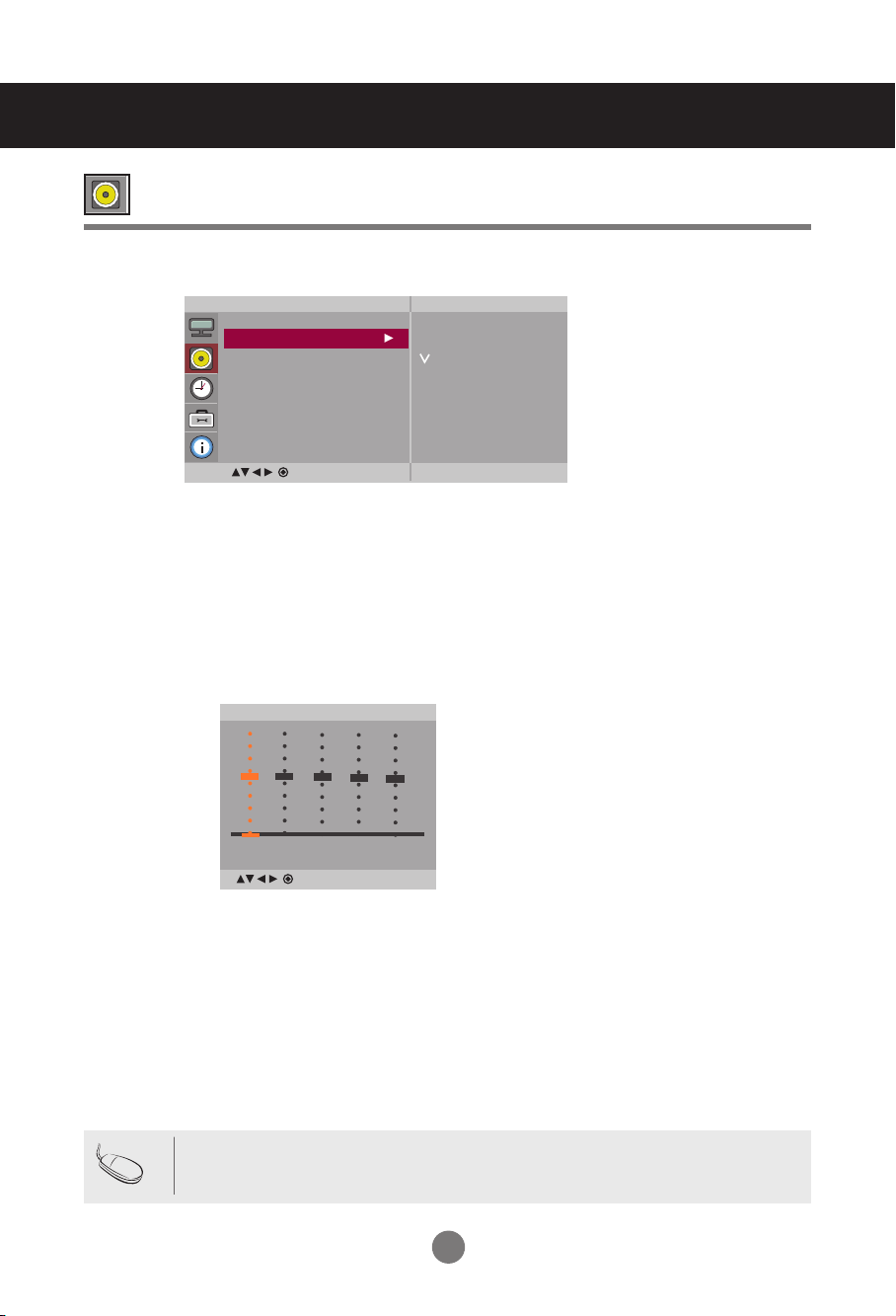
The best sound tone quality will be selected automatically depending on the video type that
you're currently watching.
Sound
Mode
Adjusting the audio function
Note
When connected to your computer and the '
Sound Mode
' setting in the audio menu is
Clear
Voice, Standard
, Music,
Cinema
or Sport, the available menus are Balance, Auto Volume,
Speaker.
To adjust uneven sound volumes across all channels or signals automatically to the most
appropriate level. To use this feature, select On.
Use this function to balance sound from the left and right speakers.
You can adjust internal speaker status.
If you want to use your external hi-fi stereo system, turn off the internal speakers of the set.
Auto Volume
Balance
Speaker
• Clear Voice
: By differentiating the human sound range from others,it helps users listen to
human voices better.
• Standard : The most commanding and natural audio.
• Music : Select this option to enjoy the original sound when listening to the music.
• Cinema : Select this option to enjoy sublime sound.
• Sport : Select this option to watch sports broadcasting.
• Game : To enjoy dynamic sound when playing a game.
• User : Select this option to use the user-defined audio settings.
User Menus
Audio
Sound Mode
Auto Volume
Balance
Speaker
Clear Voice
Standard
Music
Cinema
Sport
Game
User
MENU
User
0.1 0.5 1.5 5.0 10
KHz
MENU
26
Sleep
Time
Auto
Sleep
Power
On Delay
Adjusting the timer function
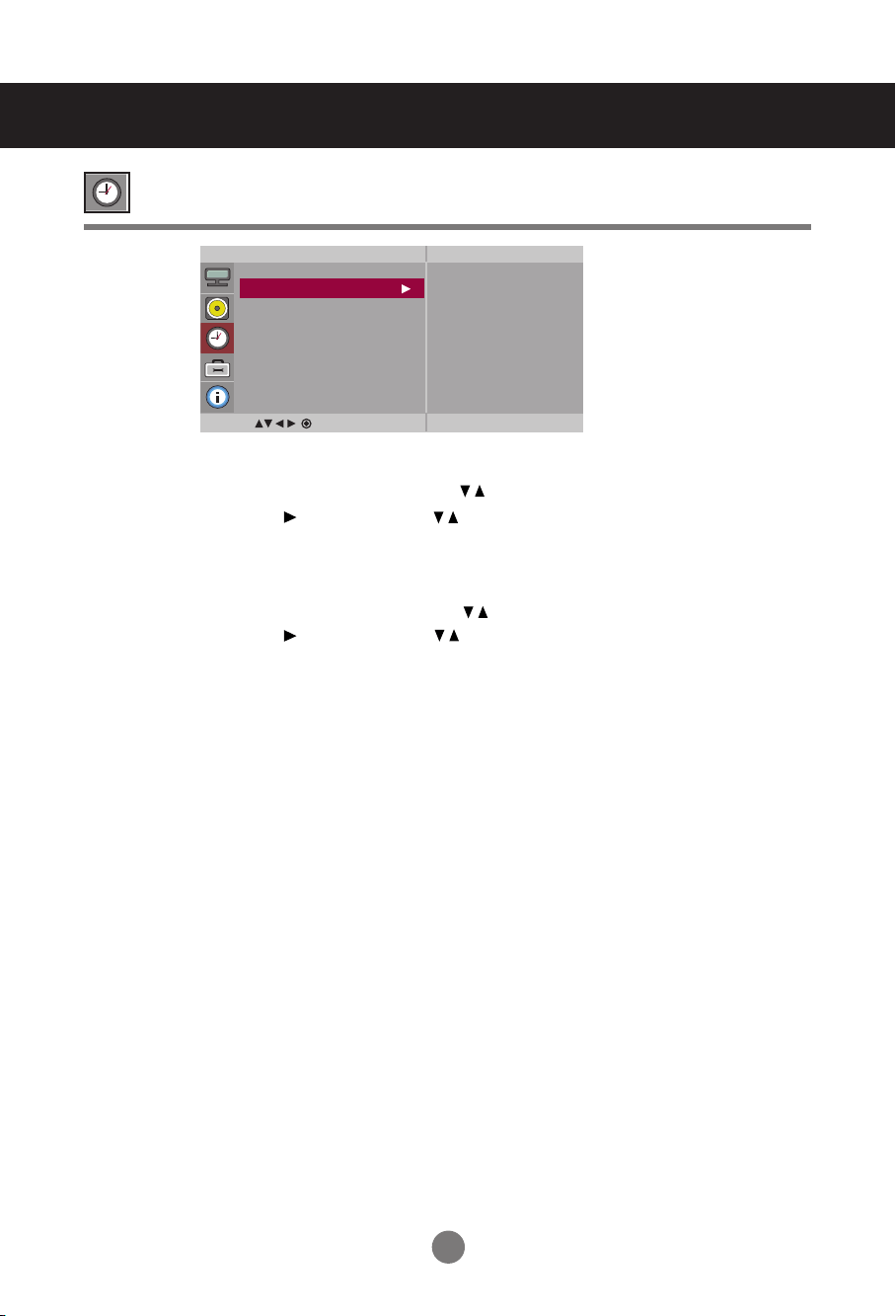
The power is automatically turned off when the time set by a user is passed.
1) Press the MENU button and then use button to select the Sleep Time menu.
2) Press the button and then use button to set the minutes(Off to 240).
If Auto Sleep is active and there is no input signal, the set switches to off mode automatically
after 10 minutes.
1) Press the MENU button and then use button to select the Auto Sleep menu.
2) Press the button and then use button to select On or Off.
When connecting multiple monitors and turning the power on, the monitors are turned on
individually to prevent overload.
Time
Sleep Time
Auto Sleep
Power On Delay
Power Saving
Automatic Standby
Off
User Menus
MENU
27
Power
Saving
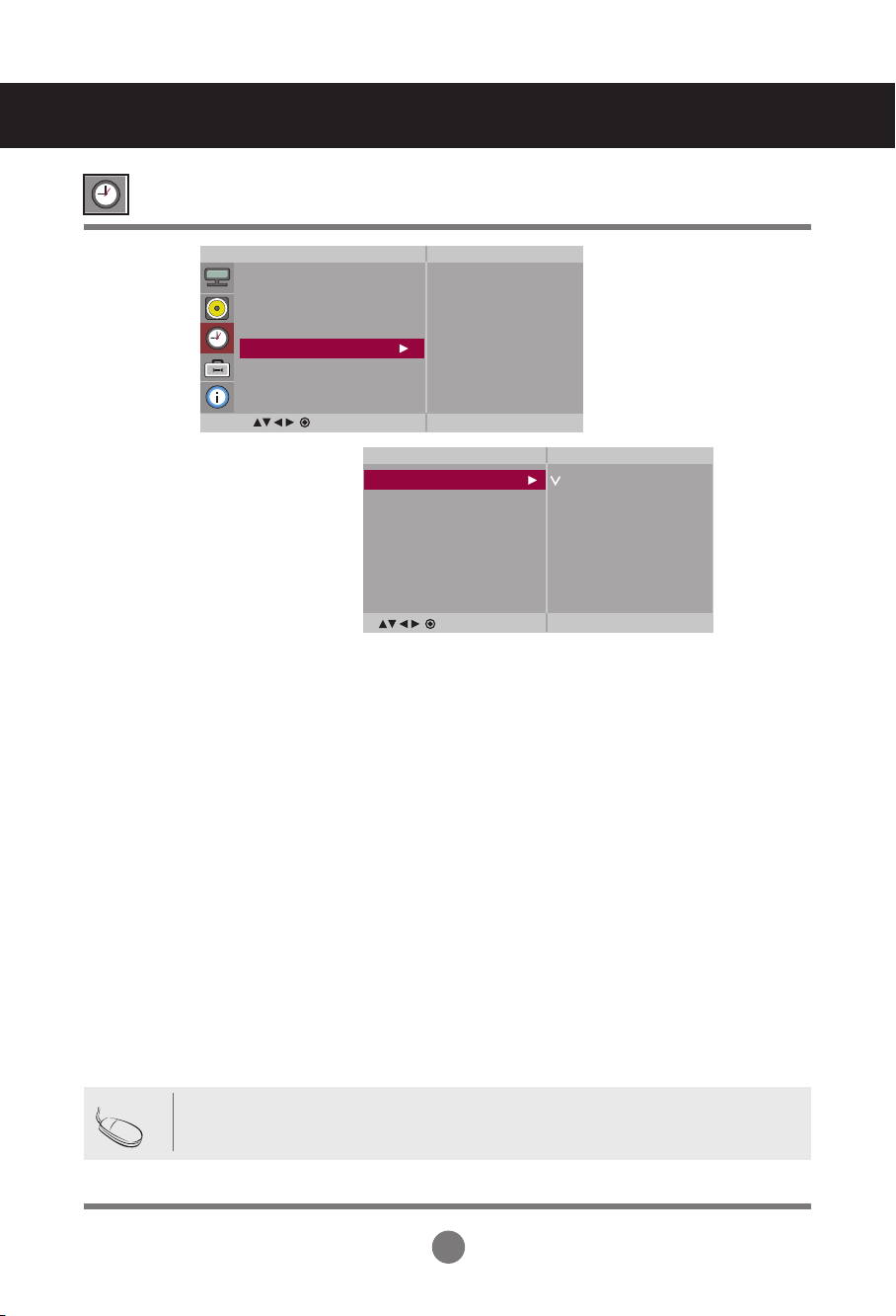
This screen brightness adjusting menu helps you save energy.
Adjusting the timer function
Time
Sleep Time
Auto Sleep
Power On Delay
Power Saving
Automatic Standby
To set
• Level: Total 4 screen brightness levels are provided.
- Off: 100% light
- Level 1: 80% light
- Level 2: 60% light
- Level 3: 40% light
Power Saving
Level
Off
Level 1
Level 2
Level 3
User Menus
MENU
MENU
Automatic
Standby
If you do not use the monitor for more than 4 hours, it will be in standby mode
automatically.
Note
The Automatic Standby function may not be available depending on the country.
28
Selecting the options
Language
Key Lock
ISM Method
Power
Indicator
DPM Select
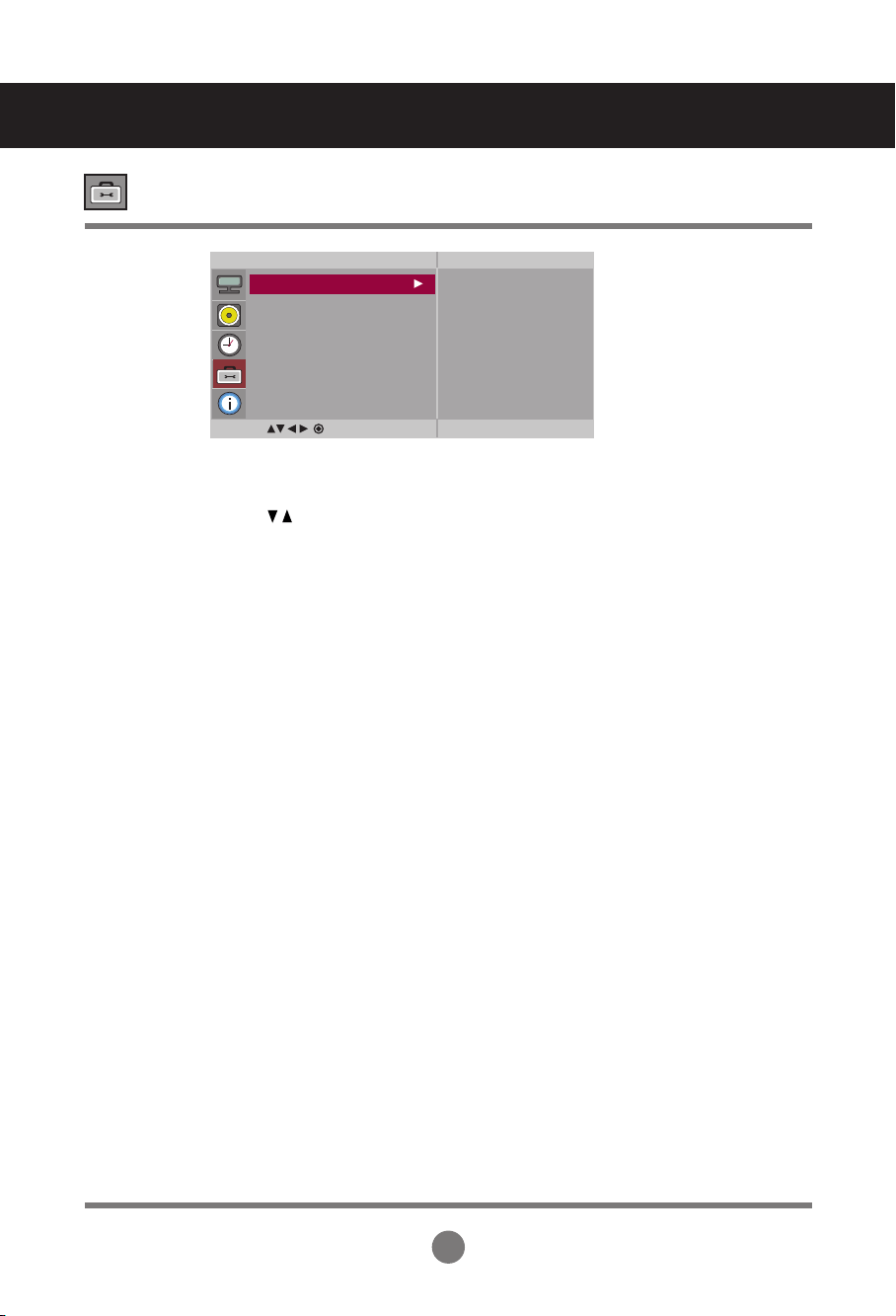
To choose the language in which the control names are displayed.
Use the buttons to select On or Off. The monitor can be set up so that it can only be used
with the remote control. This feature can prevent unauthorized viewing.
In order to lock the OSD screen adjustment, set the Key Lock tab to the 'On' position.
In order to unlock it, do the following :
• Push the MENU button on the remote control and set Key Lock to the 'Off' position.
A frozen or still picture from a PC/Video game displayed on the screen for prolonged periods
could result in a ghost image remaining even when you change the image. Avoid allowing a
fixed image to remain on the screen for a long period of time.
• Normal : Leave on normal if you don't foresee image burn in being a problem.
•
White wash : White wash fills the screen with solid white. This helps removes permanent
images burned into the screen. A permanent image may be impossible to clear
entirely with white wash.
•
Orbiter : May help prevent ghost images. However, it is best not to allow any fixed image to
remain on the screen. To avoid a permanent image on the screen, the screen will
move every 2 minutes.
•
Inversion : This function inverts the panel color of the screen. The panel color is
automatically inverted every 30 minutes.
•
Dot Wash : This function moves the black dots of the screen. The black dots is automatically
moved every 5 second.
Use this function to set the power indicator on the front side of the product to On or Off.
A user can choose to turn the power saving mode on / off.
User Menus
Option
Language
Key Lock
ISM Method
Power Indicator
DPM Select
Tile Mode
Factory Reset
To set
MENU
29
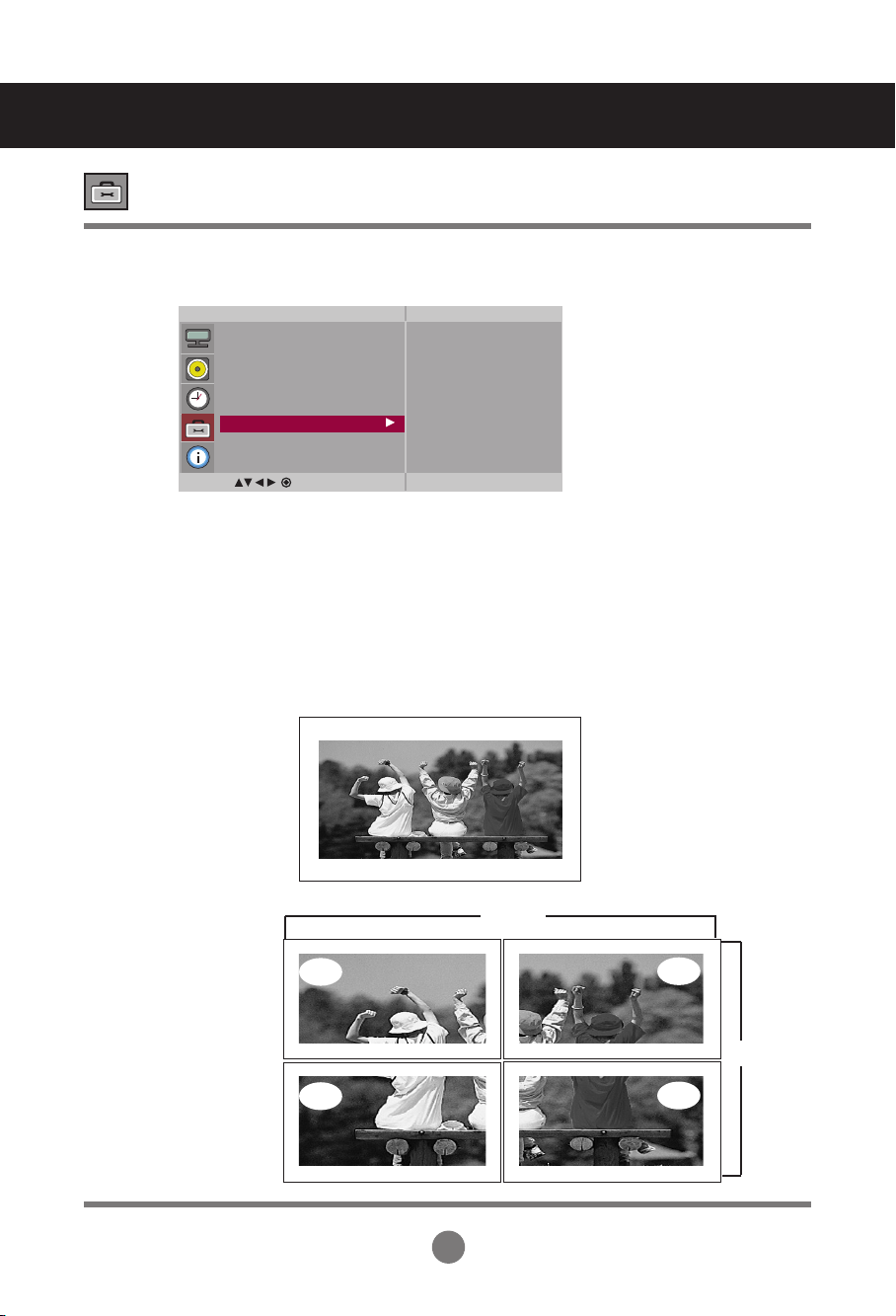
Tile mode
Tile mode and choose Tile alignment and set the ID of the current product to set
location.
* Only after pressing the SET button the
adjustments made to the settings will be saved.
It is used to enlarge the screen and
also used with several products to
view screen.
• To use this function
- Must be displayed with various other products.
- Must be in a function that can be connected to RGB Cable by distributor and RS-232C.
• Tile Mode
-
Tile mode : column x row ( c = 1, 2, 3, 4,5 r = 1, 2, 3, 4,5)
- 5 x 5 available.
- Configuration of an integration screen is also available as well as
configuration of One by one Display.
ID
ID
ID
ID
-
Tile mode (product 1 ~ 4) : c(2) x r(2)
column
row
Selecting the options
Option
Language
Key Lock
ISM Method
Power Indicator
DPM Select
Tile Mode
Factory Reset
Tile Mode Off
H-Size 0
V-Size 0
H-Position < >
V-Position < >
Reset To Set
Tile ID 1
Natural Off
2
4
1
3
MENU
User Menus
30
ID
column
row
-
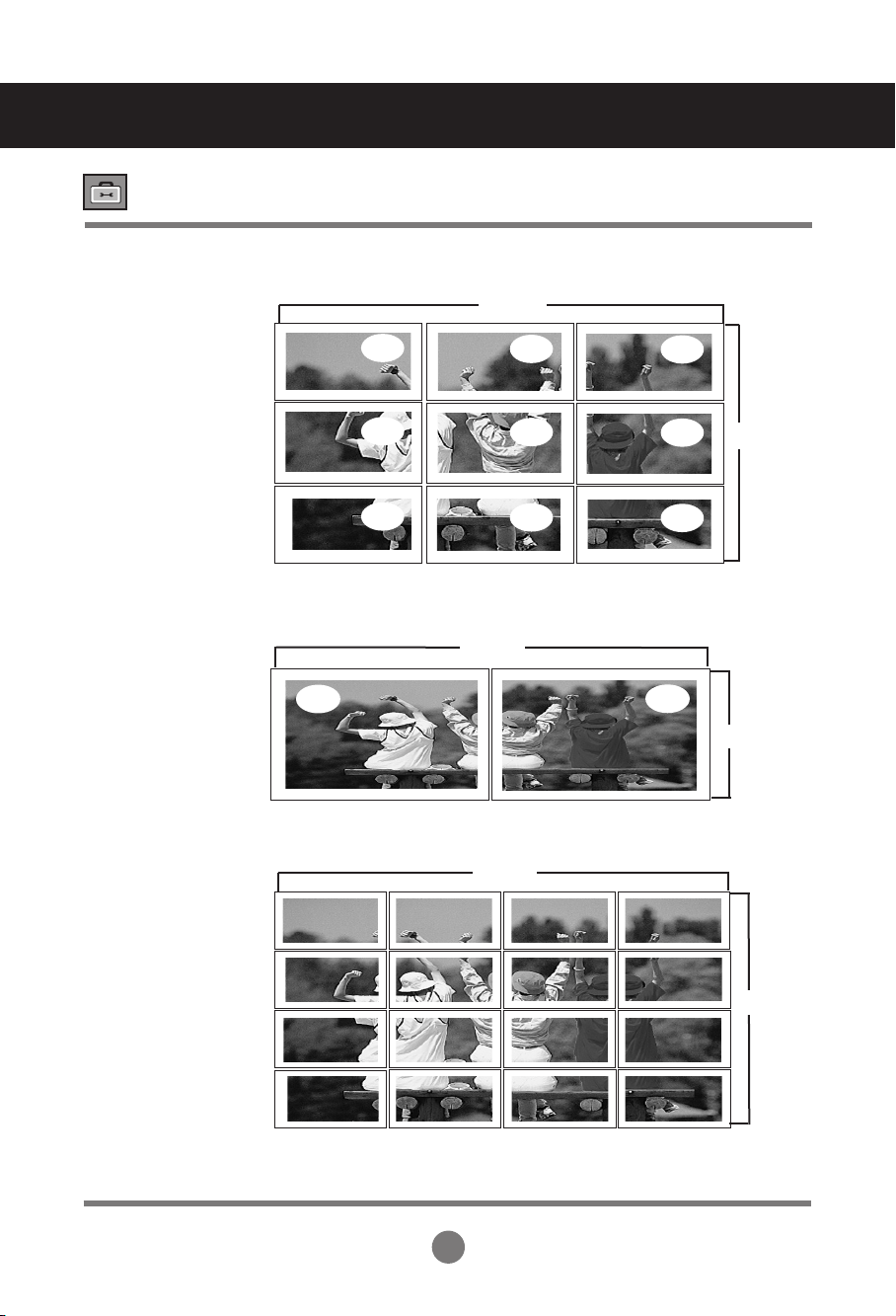
Tile mode (product 1 ~ 2) : c(2) x r(1)
row
column
-
Tile mode (product 1 ~ 9) : c(3) x r(3)
row
column
-
Tile mode (product 1 ~16) : c(4) x r(4)
ID 1
ID 5
ID 9
ID 13
ID 2
ID 6
ID10
ID 14
ID 3
ID 7
ID 11
ID 15
ID 4
ID 8
ID 12
ID 16
Selecting the options
ID
3
ID
2
ID
1
ID
6
ID
5
ID
4
ID
9
ID
8
ID
7
1
ID
2
User Menus
31
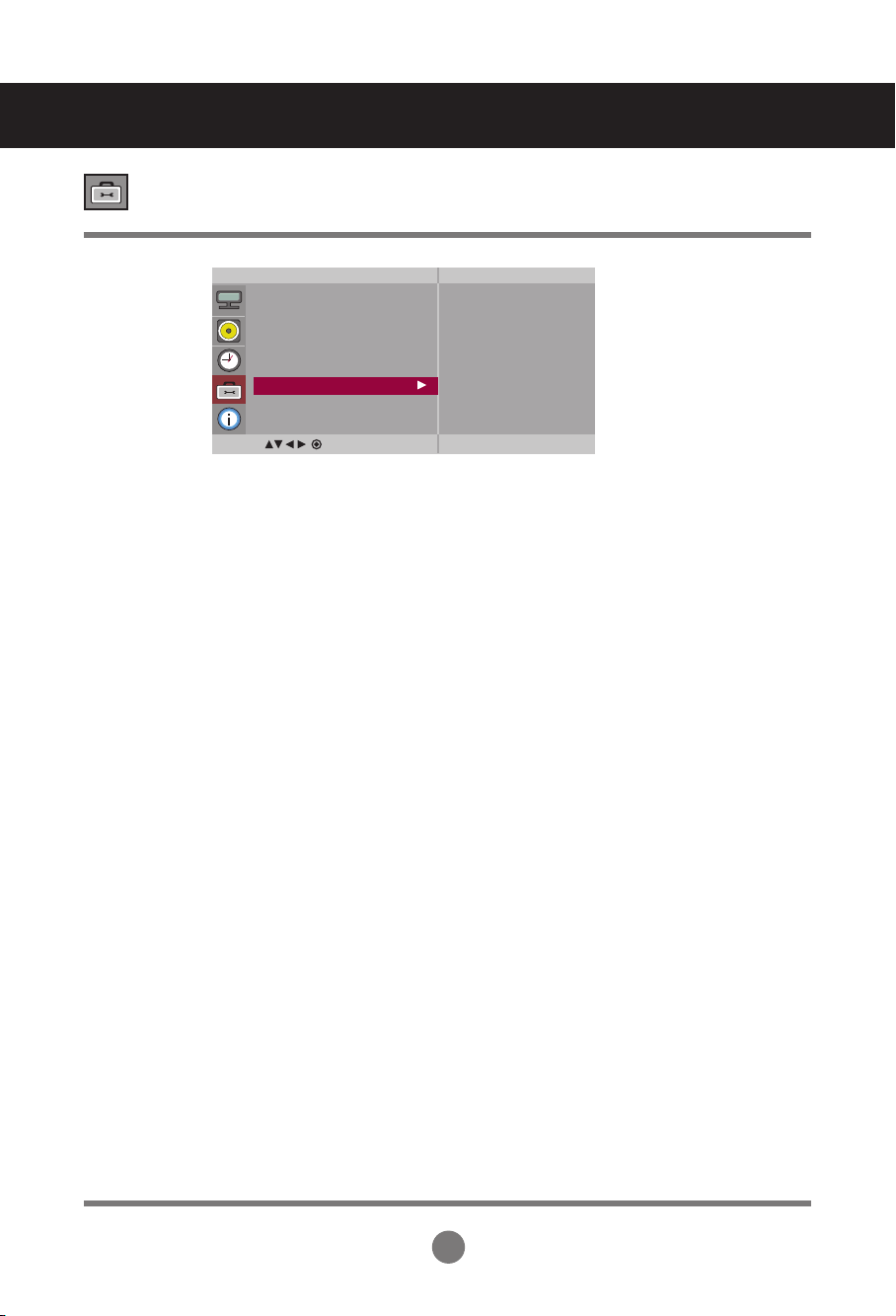
Factory Reset Select this option to return to the default factory settings.
User Menus
Adjust the horizontal size of the screen taking into account the size of the bezel.
Adjust the vertical size of the screen taking into account the size of the bezel.
Moving the screen position horizontally.
Moving the screen position vertically.
Function to initialize and release Tile.
All Tile setting are released when selecting Tile recall and the screen returns to
Full screen.
Select the location of the Tile by setting an ID.
The image is omitted by the distance between the screens to be naturally shown.
• H-Size
• V-Size
• H-Position
• V-Position
• Reset
• Tile ID
• Natural
Selecting the options
Option
Language
Key Lock
ISM Method
Power Indicator
DPM Select
Tile Mode
Factory Reset
Tile Mode Off
H-Size 0
V-Size 0
H-Position < >
V-Position < >
Reset To Set
Tile ID 1
Natural Off
Tile mode
MENU
32
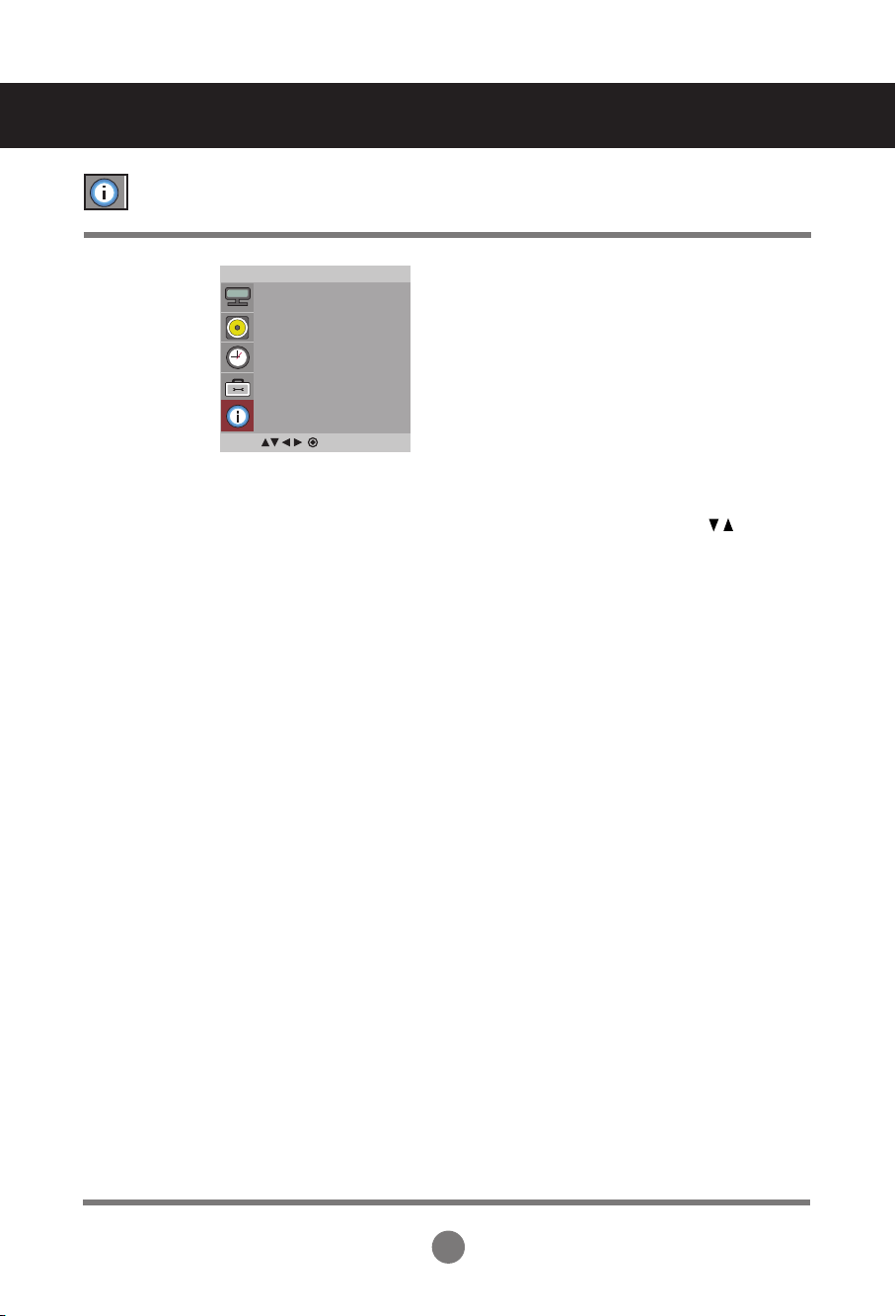
Adjust Set ID and check Serial No. and SW version.
Information
Set ID
Serial No.
SW Version
You can assign a unique Set ID NO (name assignment) to each product when several
products are connected for display. Specify the number (01H~63H) using the button
and exit. Use the assigned Set ID to individually control each product using the Product
Control Program.
This menu shows the serial number of the product.
This menu shows the software version.
Set ID
Serial No.
SW Version
User Menus
MENU
33
Note
* Vertical frequency: To enable the user to watch the product display, screen image should be changed
tens of times every second like a fluorescent lamp. The vertical frequency or refresh rate is the times of
image display per second. The unit is Hz.
* Horizontal frequency: The horizontal interval is the time to display one vertical line. When 1 is divided
by the horizontal interval, the number of horizontal lines displayed every second can be tabulated as
the horizontal frequency. The unit is kHz.
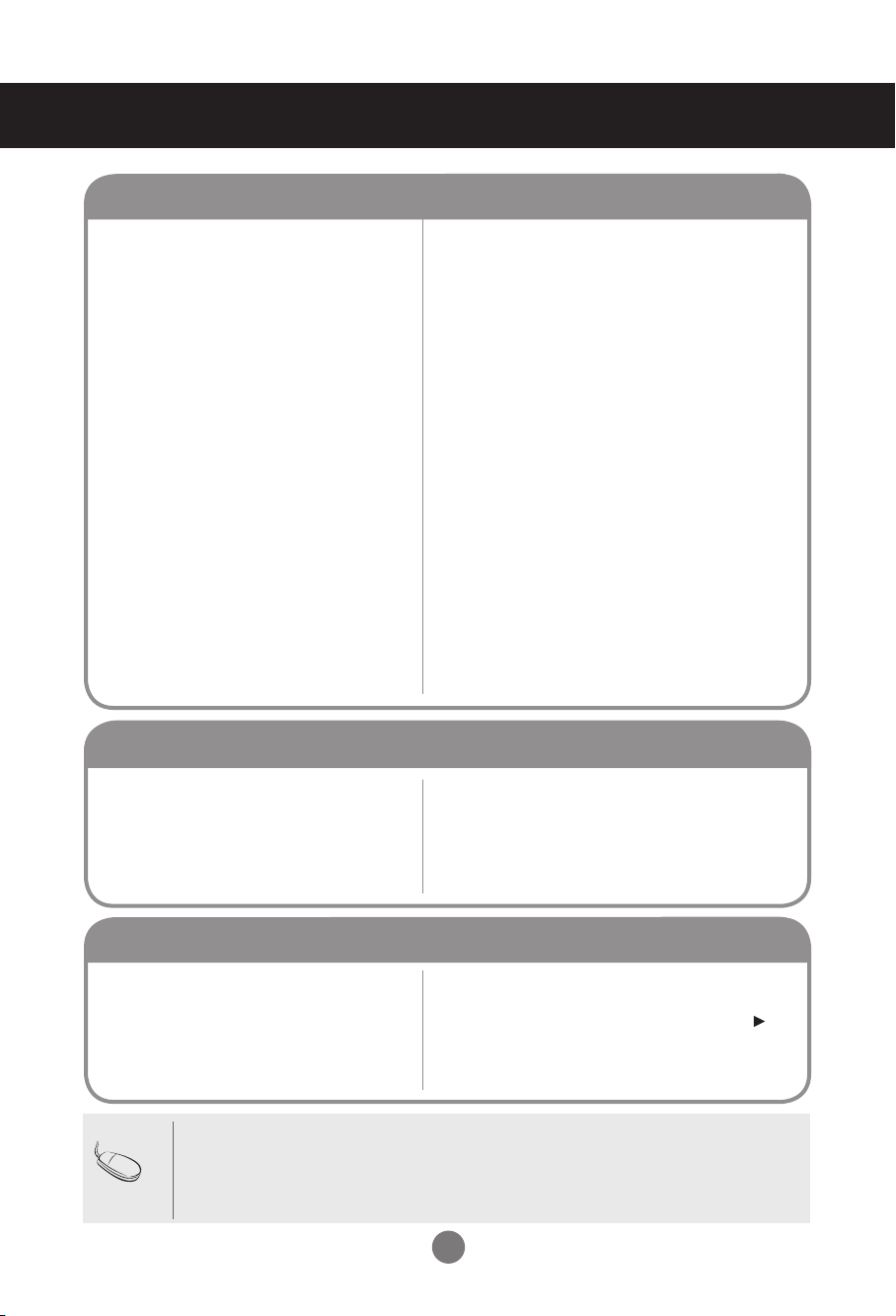
Troubleshooting
• See if the power cord is properly connected to the outlet.
• See if the power switch is turned on.
• May need service.
• Adjust brightness and contrast again.
• Backlight may need repair.
• If the product is in power saving mode, move the mouse
or press any key.
• Turn both devices off and then back on.
• The signal from the PC (video card) is out of the vertical
or horizontal frequency range of the product. Adjust the
frequency range by referring to the Specifications in this
manual.
* Maximum resolution
RGB : 1920 x 1080 @ 60 Hz
HDMI/DVI : 1920 x 1080 @ 60 Hz
• The signal cable between PC and product is not
connected. Check the signal cable.
• Press the 'INPUT' menu in the remote Control to check
the input signal.
●
Is the product power cord connected?
●
Is the power indicator light on?
●
Power is on, power indicator is blue but the
screen appears extremely dark.
●
The power indicator amber?
●
Does the 'Out of range' message appear?
●
Does the 'Check signal cable' message
appear?
No image is displayed
• Install the product driver, which is provided with the
product, or download it from the web site. (http://www.
lg.com)
• See if the plug&play function is supported by referring
to the video card user manual.
● Did you install the driver?
'Unknown Product' message appears when the product is connected.
• The control locking function prevents unintentional OSD
setting change due to careless usage. To unlock the
controls, simultaneously press the Menu button and
button for several seconds. (You cannot set this function
using the remote control buttons. You can set this function
in the product only.)
● The 'Key Lock On' message appears when
pressing the Menu button.
'Key Lock On' message appears.
34
Troubleshooting
● Is the screen position wrong?
● Do thin lines appear on the background
screen?
● Horizontal noise appears or the characters
look blurred.
● The screen is displayed abnormally.
The screen image looks abnormal.
• D-Sub analog signal - Press the "AUTO" button in the
remote control to automatically select the optimal screen
status that fits into the current mode. If adjustment is not
satisfactory, use the Position OSD menu.
• See if the video card resolution and frequency are
supported by the product. If the frequency is out of
range, set to the recommended resolution in the Control
Panel "Display" Setting menu.
• D-Sub analog signal - Press the "AUTO" button in the
remote control to automatically select an optimal screen
status that fits into the current mode. If adjustment is not
satisfactory, use the Clock OSD menu.
• D-Sub analog signal - Press the "AUTO" button in the
remote control to automatically select an optimal screen
status that fits into the current mode. If adjustment is not
satisfactory, use the Phase OSD menu.
• The proper input signal is not connected to the signal
port. Connect the signal cable that matches with the
source input signal.
• If you use a fixed image for a long time, the pixels may
be damaged quickly. Use the screen-saver function.
● After-image appears when the product is
turned off.
After-image appears on the product.
35
Troubleshooting
• See if the audio cable is connected properly.
• Adjust the volume.
• See if the sound is set properly.
• Select the appropriate equalize sound.
• Adjust the volume.
●
No sound?
●
Sound is too dull.
●
Sound is too low.
The audio function does not work.
• Set the number of colors to more than 24 bits (true color)
Select Control Panel - Display - Settings - Color
Table menu in Windows.
• Check the connection status of the signal cable. Or,
re-insert the PC video card.
• Several pixels (red, green, white or black color) may
appear on the screen, which can be attributable to the
unique characteristics of the LCD panel. It is not a
malfunction of the LCD.
●
Screen has poor color resolution
(16 colors).
●
Screen color is unstable or mono-colored.
●
Do black spots appear on the screen?
Screen color is abnormal.
• Is the sleep timer set?
• Check the power control settings.
Power interrupted.
•
"CAUTION! FAN STOP!"
If the power is turned off after this message appears,
it means that the fan is out of order.
In this case, contact your local service center.
●
The power suddenly turned off.
The operation does not work normally.
36
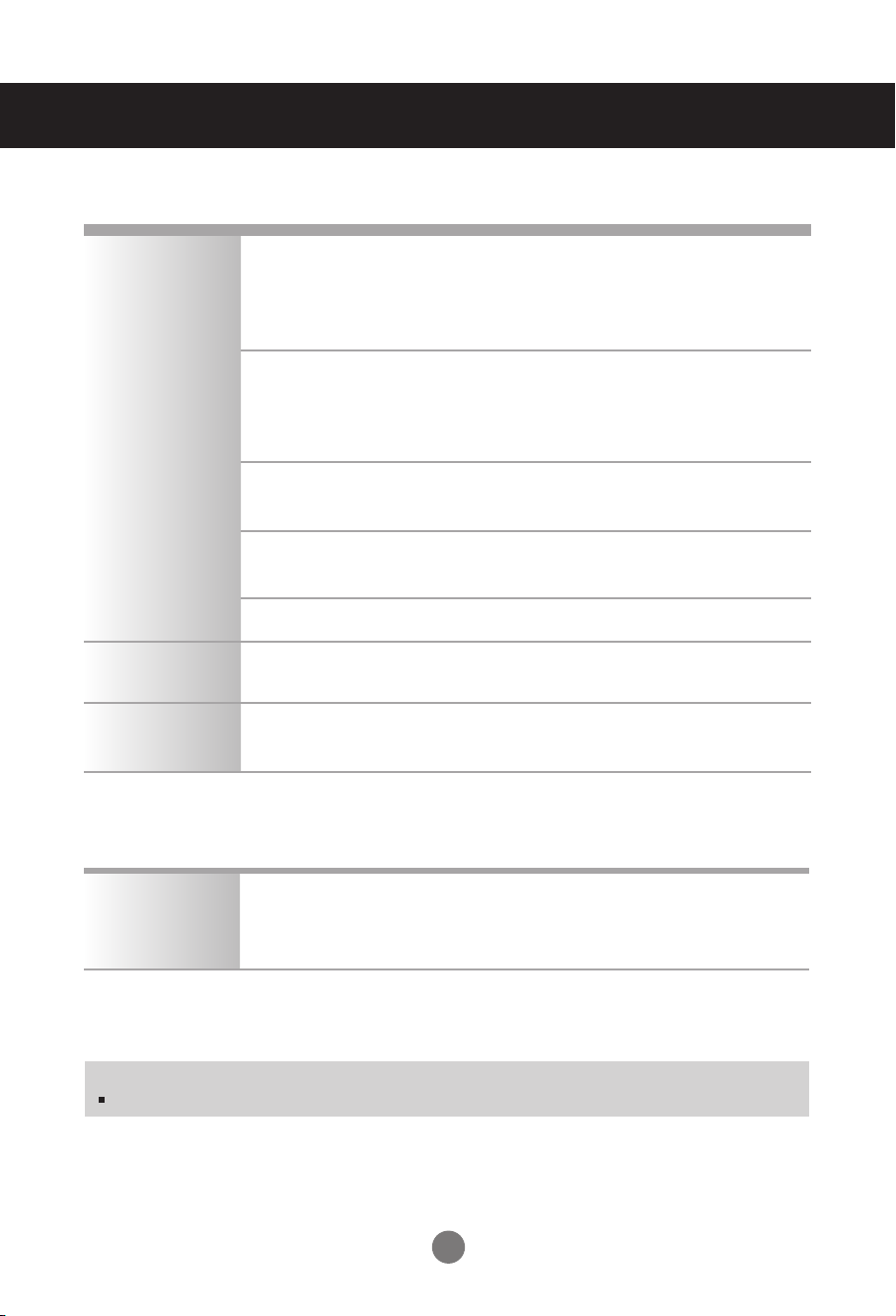
LCD Panel
106.73 cm (42.02 inch) TFT (Thin Film Transistor)
LCD (Liquid Crystal Display) Panel
Visible diagonal size: 106.73 cm
0.4845 mm (H) x 0.4845 (V) mm (Pixel Pitch)
Power
Rated Voltage AC 100-240 V~ 50 / 60 Hz 2.2 A
Power Consumption On Mode : 220 W Typ.
Sleep Mode : ≤ 1 W (RGB) / 2 W (HDMI/DVI)
Off Mode : ≤ 0.5 W
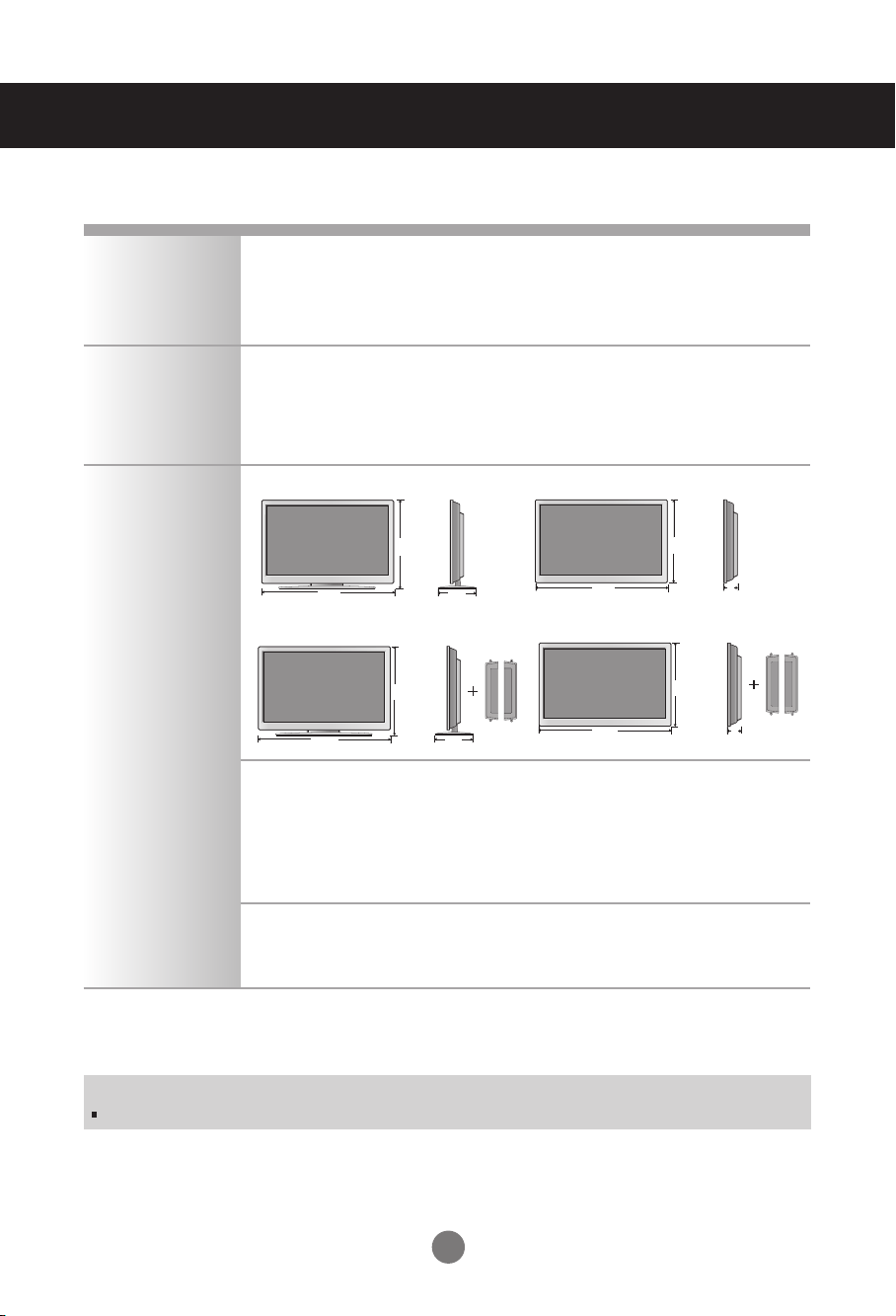
Dimensions &
Weight
Width x Height x Depth
[1] 99.56 cm (39.19 inch) x 67.41 cm (26.54 inch) x 29.30 cm (11.54 inch)
[2] 99.56 cm (39.19 inch) x 58.76 cm (23.13 inch) x 11.37 cm (4.47 inch)
[3] 99.56 cm (39.19 inch) x 67.41 cm (26.54 inch) x 29.30 cm (11.54 inch)
[4] 99.56 cm (39.19 inch) x 58.76 cm (23.13 inch) x 11.37 cm (4.47 inch)
Net
[1] 19.6 kg (43.2 lb)
[2] 16.2 kg (35.7 lb)
[3] 22.2 kg (48.9 lb) [4] 18.8 kg (41.4 lb)
Specications
NOTE
Information in this document is subject to change without notice.
The product specifications can change without prior notice for product improvement.
[1]
W
H
[2]
W
H
D
D
[3]
H
[4]
H
37
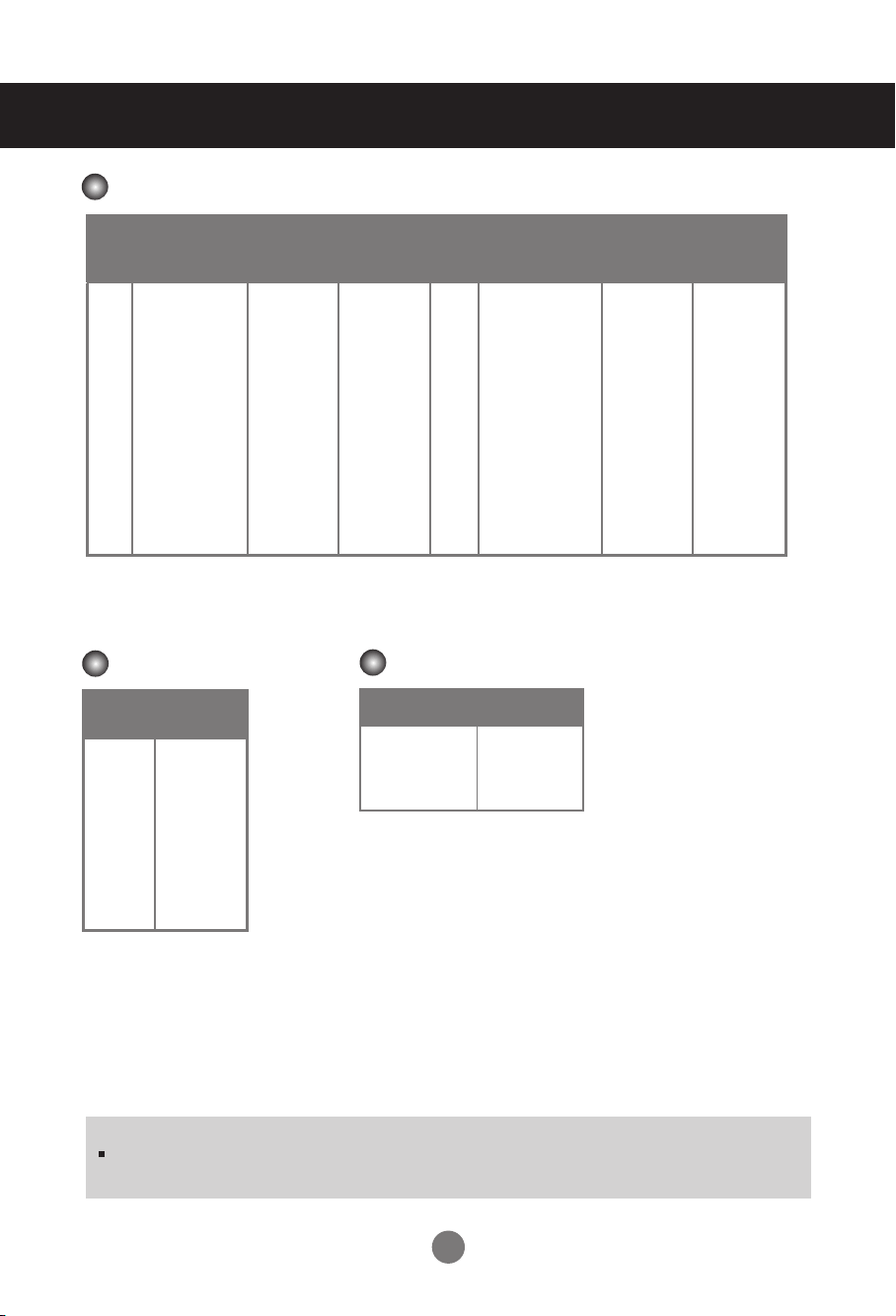
Audio
RMS Audio Output 10 W + 10 W (R + L)
Input Sensitivity 0.7 Vrms
Speaker Impedance 8 Ω
Video Signal
Max. Resolution
RGB : 1920 x 1080 @ 60 Hz
HDMI/DVI : 1920 x 1080 @ 60 Hz - It may not be supported
depending on the OS or
video card type.
Recommended
Resolution
RGB : 1920 x 1080 @ 60 Hz
HDMI/DVI : 1920 x 1080 @ 60 Hz - It may not be supported
depending on the OS or
video card type.
Horizontal Frequency
RGB : 30 kHz to 83 kHz
HDMI/DVI : 30 kHz to 83 kHz
Vertical Frequency
RGB : 56 Hz to 75 Hz
HDMI/DVI : 56 Hz to 60 Hz
Synchronization Type Composite/Separate/Digital
Input Connector
15-pin D-Sub type, HDMI (digital), Composite Video,
RS-232C
Environmental
Conditions
Operational Condition
Temperature: 5 °C to 35 °C , Humidity: 10 % to 80 %
Storage Condition
Temperature: -20 °C to 60 °C , Humidity: 5 % to 95 %
Specications
NOTE
Information in this document is subject to change without notice.
The product specifications can change without prior notice for product improvement.
* Applicable only for models that support the speakers
38
1~17: RGB Mode
* : HDMI/DVI mode
NOTE
DTV/PC selection on RGB and HDMI/DVI inputs is available for PC resolutions :
640 x 480 / 60 Hz, 1280 x 720 / 60 Hz, 1920 x 1080 / 60 Hz and DTV resolutions : 480p, 720p, 1080p.
Specications
PC Mode - Preset Mode
DTV Mode
Power Indicator
Preset mode
Horizontal
Frequency
(kHz)
Vertical
Frequency
(Hz)
Preset mode
Horizontal
Frequency
(kHz)
Vertical
Frequency
(Hz)
1 640 x 350 31.469 70.8 *11 1280 x 768 47.7 60
2 720 x 400 31.468 70.8 *12 1360 x 768 47.72 59.799
*3 640 x 480 31.469 59.94 *13 1366 x 768 47.7 60
4 640 x 480 37.5 75 *14 1280 x 1024 63.981 60.02
*5 800 x 600 37.879 60.317 15 1280 x 1024 79.98 75.02
6 800 x 600 46.875 75 *16 1680 x 1050 65.290 59.954
7 832 x 624 49.725 74.55 *17 1920 x 1080 67.5 60
*8 1024 x 768 48.363 60
9 1024 x 768 60.123 75.029
*10 1280 x 720 44.772 59.855
HDMI/DVI
(DTV)
480i x
576i x
480p o
576p o
720p o
1080i o
1080p o
Mode Product
On Mode Blue
Sleep Mode Amber
Off Mode -
Controlling the Multiple Product
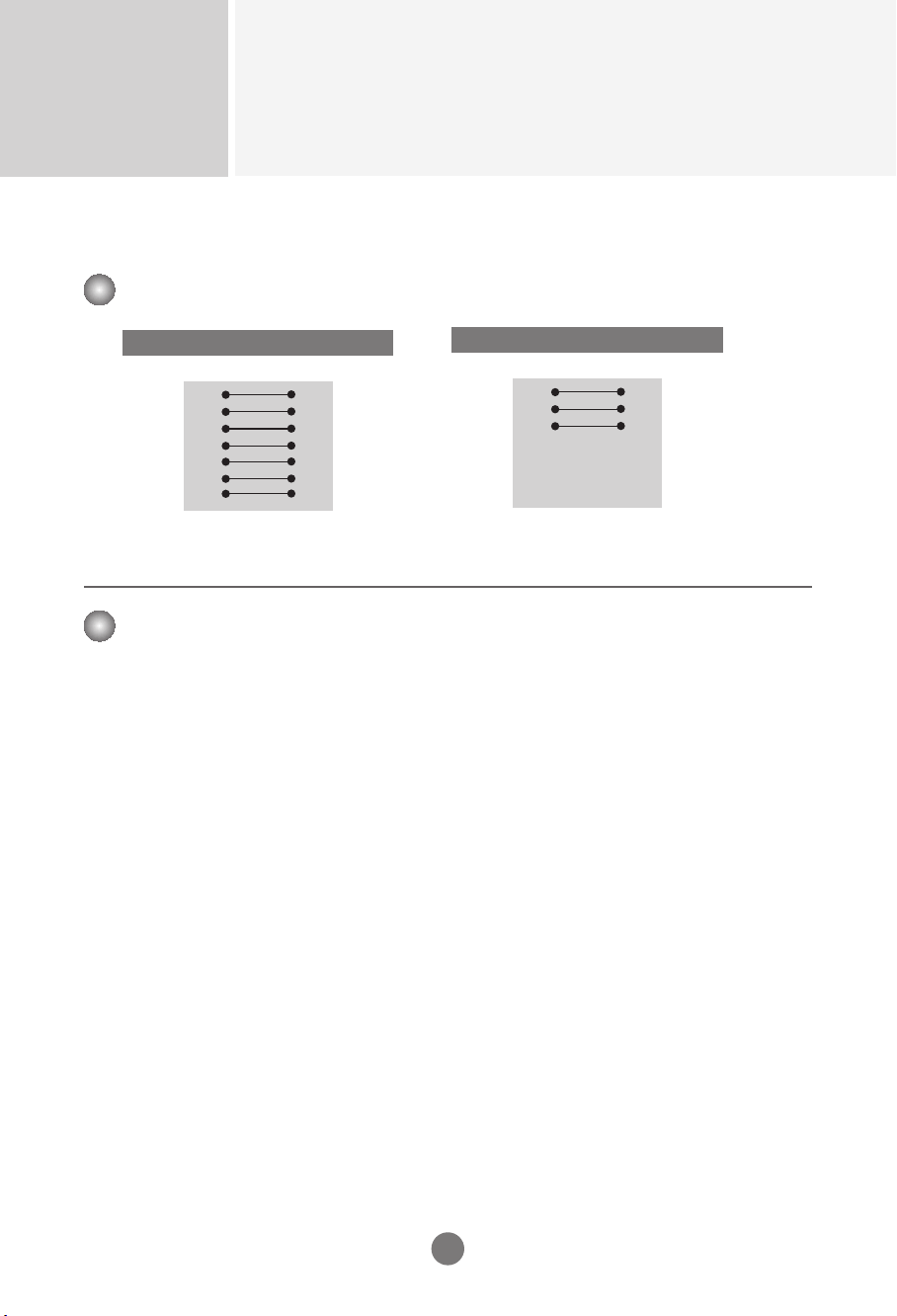
RS-232C
A1
Use this method to connect several products to a single PC.
You can control several products at a time by connecting them to a single PC.
7-Wire Configurations (Standard RS-232C cable)
RXD
TXD
GND
DTR
DSR
RTS
CTS
TXD
RXD
GND
DSR
DTR
CTS
RTS
PC Monitor
2
3
5
4
6
7
8
3
2
5
6
4
8
7
D-Sub 9 D-Sub 9
(Female) (Female)
3-Wire Configurations (Not Standard)
RXD
TXD
GND
DTR
DSR
RTS
CTS
TXD
RXD
GND
DTR
DSR
RTS
CTS
PC Monitor
2
3
5
4
6
7
8
3
2
5
6
4
7
8
D-Sub 9 D-Sub 9
(Female) (Female)
Baud Rate : 9600 buad Rate (UART)
Data Length : 8 bit
Parity Bit : None
Stop Bit : 1bit
Flow Control : None
Communication Code : ASCII code
Use a crossed (reverse) cable
Communication Parameter
▲
▲
▲
▲
▲▲
▲
RS-232C Configurations
Controlling the Multiple Product
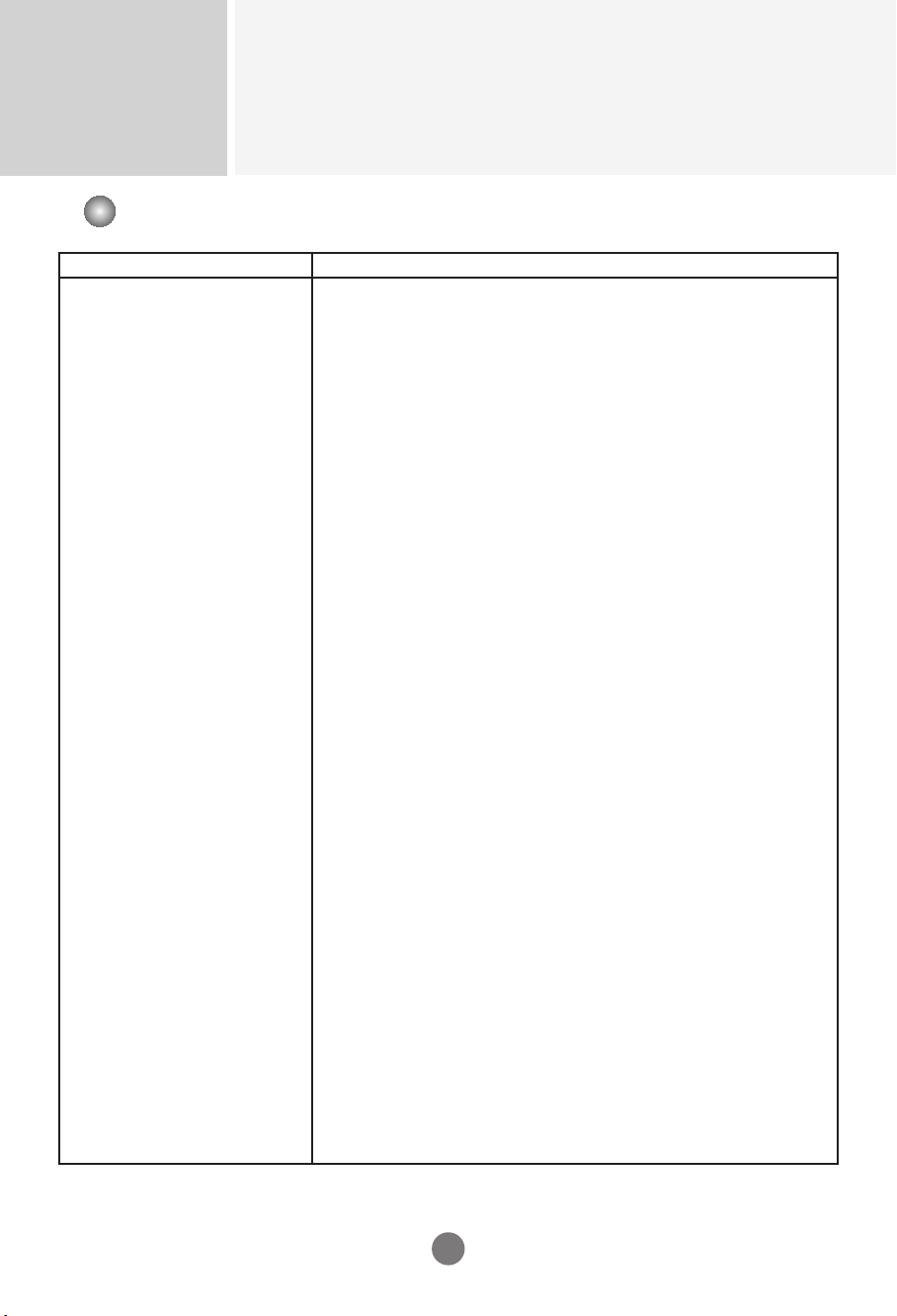
RS-232C
A2
Command Reference List
COMMAND1 COMMAND2 DATA1 DATA2 DATA3
01. Power k a 00H to 01H
02. Input Select k b 02H to 09H
03. Aspect Ratio k c 01H to 09H
04. Screen Mute k d 00H to 01H
05. Volume Mute k e 00H to 01H
06. Volume Control k f 00H to 64H
07. Contrast k g 00H to 64H
08. Brightness k h 00H to 64H
09. Color k i 00H to 64H
10. Tint k j 00H to 64H
11. Sharpness k k 00H to 64H
12. OSD Select k l 00H to 01H
13. Remote Lock/ key Lock k m 00H to 01H
14. Balance k t 00H to 64H
15. Color Temperature k u 00H to 03H
16. Abnormal state k z FFH
17. ISM mode j p 00H to 10H
18. Auto configuration j u 01H
19. Key m c Key Code
20. Tile Mode d d 00H to 55H
21. Tile H Position d e 00H to 64H
22. Tile V Position d f 00H to 64H
23. Tile H Size d g 00H to 64H
24. Tile V Size d h 00H to 64H
25. Tile ID Set d i 00H to 19H
26.
Natural Mode (In Tile mode)
d j 00H to 01H
27. Picture mode(PSM) d x 00H to 06H
28. Sound mode d y 00H to 06H
29. Fan Fault check d w FFH
30. Elapsed time return d l FFH
31. Temperature value d n FFH
32. Lamp fault check d p FFH
33. Auto Volume d u 00H to 01H
34. Speaker d v 00H to 01H
35.
Sleep Time
f f 00H to 08H
36. Auto Sleep f g 00H to 01H
37. Power On Delay f h 00H to 64H
38. Language f i 00H to 09H
39. DPM Select f j 00H to 01H
40. Reset f k 00H to 02H
Controlling the Multiple Product
RS-232C
A3
COMMAND1 COMMAND2 DATA1 DATA2 DATA3
41. Power Saving f l 00H to 03H
42. Power Indicator f o 00H to 01H
43. H Position f q 00H to 64H
44. V Position f r 00H to 64H
45. H Size f s 00H to 64H
46. V Size f t 00H to 64H
47. Serial no. f y FFH
48. S/W Version f z FFH
49. Input Select x b 20H to A0H
Controlling the Multiple Product
RS-232C
A4
OK Acknowledgement
[Command2][ ][Set ID][ ][OK][Data][x]
* The Product transmits ACK (acknowledgement) based on this format when
receiving normal data. At this time, if the data is data read mode, it indicates
present status data.
If the data is data write mode, it returns the data of the PC computer.
Error Acknowledgement
[Command2][ ][Set ID][ ][NG][Data][x]
* If there is error, it returns NG
Transmission
[Command1][Command2][ ][Set ID][ ][Data][Cr]
* [Command 1]: First command. (k, j, m, d, f, x)
* [Command 2]: Second command.(a to u)
* [Set ID]: Set up the Set ID number of product.
range : 01Hto63H. by setting '0', server can control all products.
* In case of operating with more than 2 sets using set ID as '0' at the same
time, it should not be checked the ack message.
Because all sets will send the ack message, so it's impossible the check
the whole ack messages.
* [DATA]: To transmit command data.
Transmit 'FF' data to read status of command.
* [Cr]: Carriage Return
ASCII code ‘0 x 0 D’
* [ ]: ASCII code Space (0 x 20)’
Transmission / Receiving Protocol
Controlling the Multiple Product
RS-232C
A5
Transmission / Receiving Protocol
01. Power(Command : a)
To control Power On / Off of the Set.
Transmission
[k][a][ ][Set ID][ ][Data][Cr]
Data 0 : Power Off 1 : Power On
Acknowledgement
[a][ ][Set ID][ ][OK][Data][x]
To show the status of Power On / Off.
Transmission
[k][a][ ][Set ID][ ][FF][Cr]
Acknowledgement
[a][ ][Set ID][ ][OK][Data][x]
Data 0 : Power Off 1 : Power On
02. Input Select (Command : b) (Main Picture Input)
To select input source for the Set.
You can also select an input source using the INPUT
button on the remote control.
Transmission
[k][b][ ][Set ID][ ][Data][Cr]
Data 2 : AV
7 : RGB (PC)
8 : HDMI (DTV)
9 : HDMI (PC)
Acknowledgement
[b][ ][Set ID][ ][OK][Data][x]
Data 2 : AV
7 : RGB (PC)
8 : HDMI (DTV)
9 : HDMI (PC)
▲
▲
▲
Controlling the Multiple Product
RS-232C
A6
03. Aspect Ratio(Command : c) (Main picture format)
To adjust the screen format.
You can also adjust the screen format using the ARC
(Aspect Ratio Control) button on remote control or in the
Screen menu.
Transmission
[k][c][ ][Set ID][ ][Data][Cr]
Data 1 : Normal Screen (4 : 3)
2 : Wide Screen (16 : 9)
4 : Zoom1 (AV)
5 : Zoom2 (AV)
6 : Original (AV)
7 :14 : 9 (AV)
9 : Just Scan(HD DTV), 1 : 1 (RGB PC, HDMI / DVI PC)
Acknowledgement
[c][ ][Set ID][ ][OK][Data][x]
04. Screen Mute(Command : d)
To select screen mute on / off.
Transmission
[k][d][ ][Set ID][ ][Data][Cr]
Data 0 : Screen mute off (Picture on)
1 : Screen mute on (Picture off)
Acknowledgement
[d][ ][Set ID][ ][OK][Data][x]
Transmission / Receiving Protocol
▲
▲
Controlling the Multiple Product
RS-232C
A7
05. Volume Mute(Command : e)
To control On/Off of the Volume Mute.
Transmission
[k][e][ ][Set ID][ ][Data][Cr]
Data 0 : Volume Mute On (Volume Off)
1 : Volume Mute Off (Volume On)
Acknowledgement
[e][ ][Set ID][ ][OK][Data][x]
Data 0 : Volume Mute On (Volume Off)
1 : Volume Mute Off (Volume On)
06. Volume Control(Command : f)
To adjust Volume .
Transmission
[k][f][ ][Set ID][ ][Data][Cr]
Data Min : 00H to Max : 64H
(Hexadecimal code)
Acknowledgement
[f][ ][Set ID][ ][OK][Data][x]
Data Min : 00H to Max : 64H
•
Refer to ‘Real data mapping’ page A 8.
Transmission / Receiving Protocol
▲▲
Controlling the Multiple Product
RS-232C
A8
Transmission / Receiving Protocol
07. Contrast(Command : g)
To adjust screen contrast.
You can also adjust the contrast in the Picture menu.
Transmission
[k][g][ ][Set ID][ ][Data][Cr]
Data Min : 00H to Max : 64H
•
Refer to ‘Real data mapping’ as shown below.
Acknowledgement
[g][ ][Set ID][ ][OK][Data][x]
* Real data mapping
0 : Step 0
:
A : Step 10
:
F : Step 15
10 : Step 16
:
64 : Step 100
08. Brightness(Command : h)
To adjust screen brightness.
You can also adjust the brightness in the Picture menu.
Transmission
[k][h][ ][Set ID][ ][Data][Cr]
Data Min : 00H to Max : 64H
•
Refer to ‘Real data mapping’ as shown below.
Acknowledgement
[h][ ][Set ID][ ][OK][Data][x]
* Real data mapping
0 : Step
:
A : Step 10
:
F : Step 15
10 : Step 16
:
64 : Step 100
▲▲
Controlling the Multiple Product
RS-232C
A9
Transmission / Receiving Protocol
09. Color(Command : i) (Video Timing only)
To adjust the screen color.
You can also adjust the color in the Picture menu.
Transmission
[k][i][ ][Set ID][ ][Data][Cr]
Data Min : 00H to Max : 64H
(Hexadecimal code)
•
Refer to ‘Real data mapping’ page A 8.
Acknowledgement
[i][ ][Set ID][ ][OK][Data][x]
Data Min : 00H to Max : 64H
10. Tint(Command : j) (Video Timing only)
To adjust the screen tint.
You can also adjust the tint in the Picture menu.
Transmission
[k][j][ ][Set ID][ ][Data][Cr]
Data Red : 00H to Green: 64H
(Hexadecimal code)
•
Refer to ‘Real data mapping’ page A 8.
Acknowledgement
[j][ ][Set ID][ ][OK][Data][x]
Data Red : 00H to Green : 64H
* Tint Real data mapping
0 : Step 0 to Red
:
64 : Step 100 to Green
▲
▲
Controlling the Multiple Product
RS-232C
A10
11. Sharpness(Command : k) (Video Timing only)
To adjust the screen Sharpness.
You can also adjust the sharpness in the Picture menu.
Transmission
[k][k][ ][Set ID][ ][Data][Cr]
Data Min : 00H to Max : 64H
(Hexadecimal code)
•
Refer to ‘Real data mapping’ page A 8.
Acknowledgement
[k][ ][Set ID][ ][OK][Data][x]
Data Min : 00H to Max : 64H
12. OSD Select(Command : l)
To control OSD on/off to the set.
Transmission
[k][l][ ][Set ID][ ][Data][Cr]
Data 0 : OSD Off 1 : OSD On
Acknowledgement
[l][ ][Set ID][ ][OK][Data][x]
Data 0 : OSD Off 1 : OSD On
13. Remote Lock /Key Lock (Command : m)
To control Remote Lock on/off to the set.
This function, when controlling RS-232C, locks the remote control and the local keys.
Transmission
[k][m][ ][Set ID][ ][Data][Cr]
Data 0 : Off 1 : On
Acknowledgement
[m][ ][Set ID][ ][OK][Data][x]
Data 0 : Off 1 : On
Transmission / Receiving Protocol
▲
▲
▲
Controlling the Multiple Product
RS-232C
A11
Transmission / Receiving Protocol
14 Balance(Command : t)
To adjust the sound balance.
Transmission
[k][t][ ][Set ID][ ][Data][Cr]
Data Min : 00H to Max : 64H
(Hexadecimal code)
•
Refer to ‘Real data mapping’ page A 8.
Acknowledgement
[t][ ][Set ID][ ][OK][Data][x]
Data Min : 00H to Max : 64H
* Balance : L50 to R50
15. Color Temperature (Command : u)
To adjust the screen color temperature.
Transmission
[k][u][ ][Set ID][ ][Data][Cr]
Data 0 : Medium
1 : Cool
2 : Warm
3 : User
Acknowledgement
[u][ ][Set ID][ ][OK][Data][x]
Data 0 : Medium
1 : Cool
2 : Warm
3 : User
•
Running the Color Temperature command changes the Picture Mode settings to
User1.
▲
▲
Controlling the Multiple Product
RS-232C
A12
Transmission / Receiving Protocol
16. Abnormal state (Command : z)
Abnormal State : Used to Read the power off status when Stand-by mode.
Transmission
[k][z][ ][Set ID][ ][Data][Cr]
Data FF : Read
0 : Normal (Power on and signal exist)
1 : No signal (Power on)
2 : Turn the monitor off by remote control
3 : Turn the monitor off by sleep time function
4 : Turn the monitor off by RS-232C function
8 : Turn the monitor off by off time function
9 : Turn the monitor off by auto off function
Acknowledgement
[z][ ][Set ID][ ][OK][Data][x]
17. ISM mode(Command: j p)
Used to select the afterimage preventing function.
Transmission
[j][p][ ][Set ID][ ][Data][Cr]
Data 1H : Inversion
2H : Orbiter
4H : White Wash
8H : Normal
10H : Dot Wash
Acknowledgement
[p][ ][Set ID][ ][OK][Data][x]
▲
▲
Controlling the Multiple Product
RS-232C
A13
18. Auto Configure(Command: j u)
To adjust picture position and minimize image shaking
automatically. it works only in RGB(PC) mode.
Transmission
[j][u][ ][Set ID][ ][Data][Cr]
Data 1 : To set
Acknowledgement
[u][ ][Set ID][ ][OK][Data][x]
Transmission / Receiving Protocol
▲
19. Key(Command : m c)
To send IR remote key code.
Transmission
[m][c][ ][Set ID][ ][Data][Cr]
Data Key code : Refer to page A 34.
Acknowledgement
[c][ ][Set ID][ ][OK][Data][x]
▲
Controlling the Multiple Product
RS-232C
A14
20. Tile Mode(Command : d d)
Change a Tile Mode.
Transmission
[d][d][][Set ID][][Data][x]
* The data can not be set to 0X or X0 except 00.
Acknowledgement
[d][][00][][OK/NG][Data][x]
Transmission / Receiving Protocol
▲
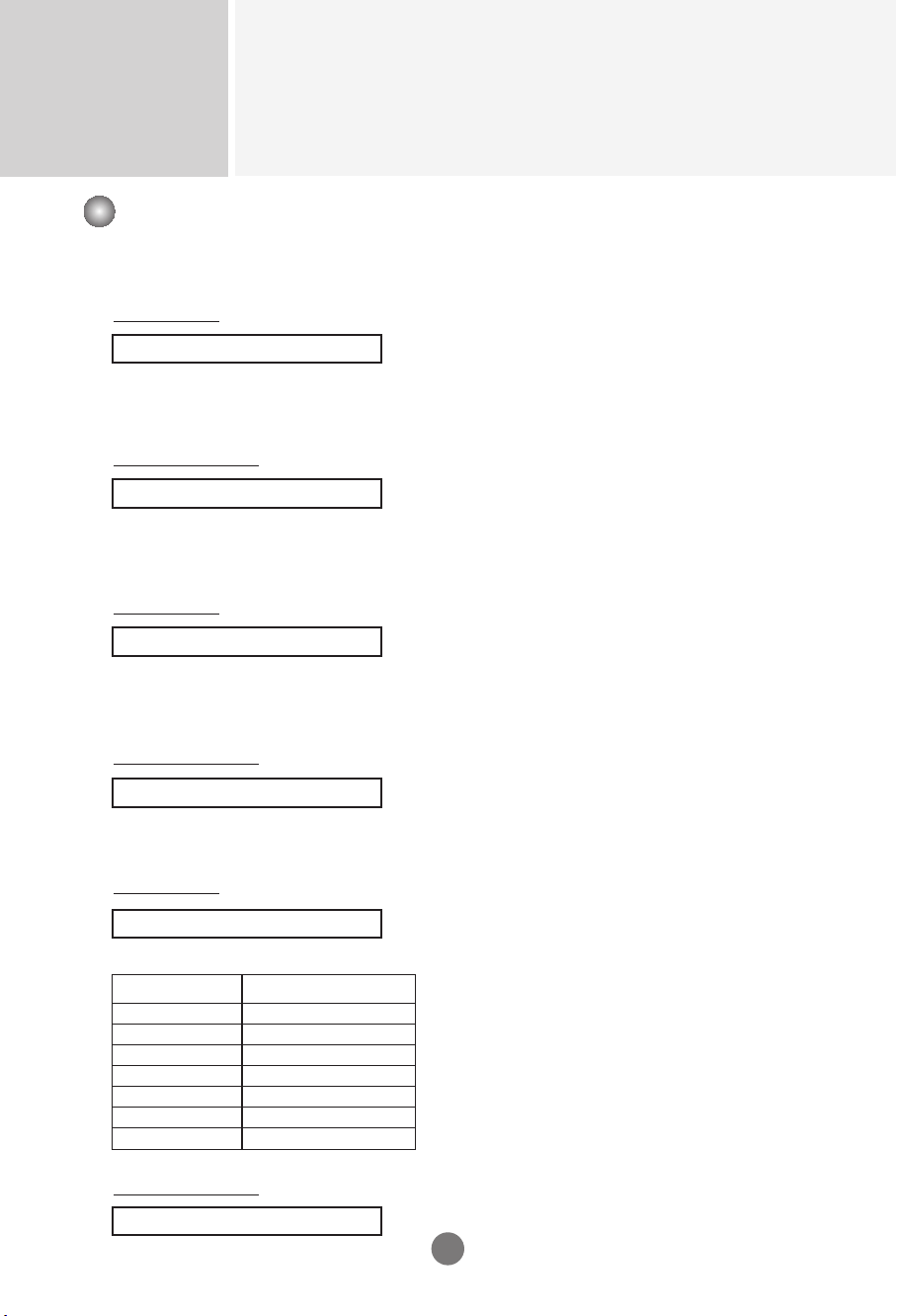
Data Description
00 or 11 Tile mode is off.
12 1 x 2 mode(column x row)
13 1 x 3 mode
14 1 x 4 mode
... ...
55 5 x 5 mode
Controlling the Multiple Product
RS-232C
A15
21. Tile H Position(Command : d e)
To set the Horizontal position.
Transmission
[d][e][][Set ID][][Data][x]
Data Min : 00H to Max : 64H
•
Refer to ‘Real data mapping’ page A 8.
Acknowledgement
[e][][Set ID][][OK/NG][Data][x]
22. Tile V Position(Command : d f)
To set the Vertical position.
Transmission
[d][f][][Set ID][][Data][x]
Data Min : 00H to Max : 64H
•
Refer to ‘Real data mapping’ page A 8.
Acknowledgement
[f][][Set ID][][OK/NG][Data][x]
Transmission / Receiving Protocol
▲
▲
Controlling the Multiple Product
RS-232C
A16
23. Tile H Size(Command : d g)
To set the Horizontal size.
Transmission
[d][g][][Set ID][][Data][x]
Data Min : 00H to Max : 64H
•
Refer to ‘Real data mapping’ page A 8.
Acknowledgement
[g][][Set ID][][OK/NG][Data][x]
24. Tile V Size(Command : d h)
To set the Vertical size.
Transmission
[d][h][][Set ID][][Data][x]
Data Min : 00H to Max : 64H
•
Refer to ‘Real data mapping’ page A 8.
Acknowledgement
[h][][Set ID][][OK/NG][Data][x]
Transmission / Receiving Protocol
▲
▲
Controlling the Multiple Product
RS-232C
A17
25. Tile ID Set(Command : d i)
To assign the Tile ID for Tiling function .
Transmission
[d][i][][Set ID][][Data][x]
Data Min : 00H to Max : 19H
(Hexadecimal code)
Acknowledgement
[i][][Set ID][][OK/NG][Data][x]
26
Natural Mode (In Tile mode) (
Command : d j)
To assign the Tile Natural mode for Tiling function .
Transmission
[d][j][][Set ID][][Data][x]
Data 0 : Natural Off
1 : Natural On
ff : Read Status
Acknowledgement
[j][][Set ID][][OK/NG][Data][x]
Transmission / Receiving Protocol
▲▲
27. Picture Mode (Command : d x)
To adjust the picture mode.
Transmission
[d][x][][Set ID][][Data][x]
Data Structure
Acknowledgement
[x][][Set ID][][OK/NG][Data][x]
▲
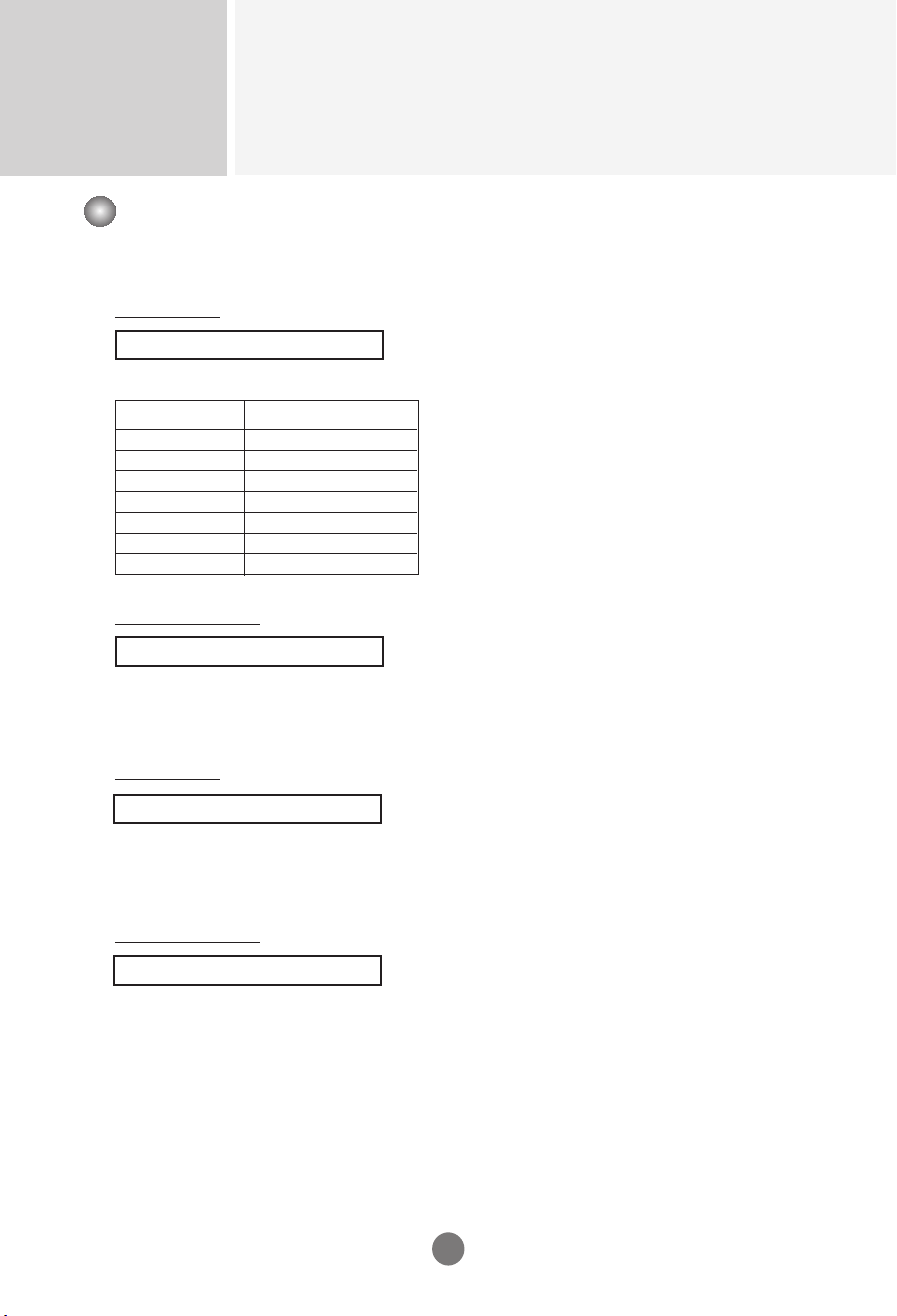
Data(Hex)
00
01
02
03
04
05
06
MODE
Vivid
Standard
Cinema
Sport
Game
User1
User2
Controlling the Multiple Product
RS-232C
A18
Transmission / Receiving Protocol
28. Sound Mode (Command : d y )
To adjust the Sound mode.
Transmission
[d][y][][Set ID][][Data][x]
Data Structure
Acknowledgement
[y][][Set ID][][OK/NG][Data][x]
▲
Data(Hex)
00
01
02
03
04
05
06
Mode
Clear Voice
Standard
Music
Cinema
sport
Game
User
29. Fan Fault check (Command : d w )
To check the Fan fault of the TV.
Transmission
[d][w][][Set ID][][Data][x]
* The data is always FF(in Hex).
Data ff: Read Status
Acknowledgement
[w][][Set ID][][OK/NG][Data][x]
* Data is the status value of the Fan fault.
Data 0: Fan fault
1: Fan OK
2: N/A(Not Avaliable)
▲
Controlling the Multiple Product
RS-232C
A19
31. Temperature value (Command : d n)
To read the inside temperature value.
Transmission
[d][n][][Set ID][][Data][x]
* The data is always FF(in Hex).
Acknowledgement
[n][][Set ID][][OK/NG][Data][x]
* The data is 1 byte long in Hexadecimal.
32. Lamp fault Check(Command : d p)
To check lamp fault.
Transmission
[d][p][][Set ID][][Data][x]
* The data is always FF(in Hex).
Acknowledgement
[p][][Set ID][][OK/NG][Data][x]
Data 0 : Lamp Fault
1: Lamp OK
Transmission / Receiving Protocol
▲
▲
30. Elapsed time return(Command : d l)
To read the elapsed time.
Transmission
[d][l][][Set ID][][Data][x]
* The data is always FF(in Hex).
Acknowledgement
[l][][Set ID][][OK/NG][Data][x]
* The data means used hours.
(Hexadecimal code)
▲
Controlling the Multiple Product
RS-232C
A20
33. Auto volume (Command : d u)
Automatically adjust the volume level.
Transmission
[d][u][][Set ID][][Data][x]
Data 0 : Off
1 : On
Acknowledgement
[u][][Set ID][][OK/NG][Data][x]
34. Speaker (Command : d v)
Turn the speaker on or off.
Transmission
[d][v][][Set ID][][Data][x]
Data 0 : Off
1 : On
Acknowledgement
[v][][Set ID][][OK/NG][Data][x]
Transmission / Receiving Protocol
▲
▲
Controlling the Multiple Product
RS-232C
A21
35. Sleep Time (Command : f f)
Set Sleep Time.
Transmission
[f][f][][Set ID][][Data][Cr]
Data
0 : Off
1 : 10
2 : 20
3 : 30
4 : 60
5 : 90
6 : 120
7 : 180
8 : 240
(Orderly)
Acknowledgement
[f][][Set ID][][OK/NG][Data][x]
▲
Transmission / Receiving Protocol
36. Auto Sleep (Command : f g)
Set Auto Sleep.
Transmission
[f][g][][Set ID][][Data][Cr]
Data 0 : Off
1: On
Acknowledgement
[g][][Set ID][][OK/NG][Data][x]
▲
Controlling the Multiple Product
RS-232C
A22
37. Power On Delay (Command : f h)
Set the schedule delay when the power is turned on (Unit: second).
Transmission
[f][h][][Set ID][][Data][Cr]
Data : 00H to 64H (Data value)
•
Refer to ‘Real data mapping’ page A 8.
Acknowledgement
[h][][Set ID][][OK/NG][Data][x]
Transmission / Receiving Protocol
▲
38. Language (Command : f i)
Set the OSD language.
Transmission
[f][i][][Set ID][][Data][Cr]
Data
0 : English
1 : French
2 : German
3 : Spanish
4 : Italian
5 : Portuguese
6 : Chinese
7 : Japanese
8 : Korean
9 : Russian
Acknowledgement
[i][][Set ID][][OK/NG][Data][x]
▲
Controlling the Multiple Product
RS-232C
A23
39. DPM Select (Command : f j)
Set the DPM (Display Power Management) function.
Transmission
[f][j][][Set ID][][Data][Cr]
Data 0 : Off
1: On
Acknowledgement
[j][][Set ID][][OK/NG][Data][x]
Transmission / Receiving Protocol
▲
40. Reset (Command : f k)
Execute the Picture, Screen and Factory Reset functions.
Transmission
[f][k][][Set ID][][Data][Cr]
Data
0 : Picture Reset
1 : Screen Reset
2 : Factory Reset
Acknowledgement
[k][][Set ID][][OK/NG][Data][x]
▲
Controlling the Multiple Product
RS-232C
A24
41. Power saving(Command : f I)
To set the Power saving mode.
Transmission
[f][I][][Set ID][][Data][Cr]
Data 0 : Off
1: (static level 1)
2: (static level 2)
3: (static level 3)
Acknowledgement
[I][][Set ID][][OK/NG][Data][x]
Transmission / Receiving Protocol
▲
42. Power Indicator (Command : f o)
To set the LED for Power Indicator
Transmission
[f][o][][Set ID][][Data][Cr]
Data 0 : Off
1: On
Acknowledgement
[o][][Set ID][][OK/NG][Data][x]
▲
43. H Position (Command : f q)
To set the Horizontal position
Transmission
[f][q][][Set ID][][Data][Cr]
* The data range is from 00 to 64(in Hex)
•
Refer to ‘Real data mapping’ page A 8.
Acknowledgement
[q][][Set ID][][OK/NG][Data][x]
▲
Controlling the Multiple Product
RS-232C
A25
Transmission / Receiving Protocol
44. V Position (Command : f r)
To set the Horizontal position
Transmission
[f][r][][Set ID][][Data][Cr]
* The data range is from 00 to 64(in Hex)
•
Refer to ‘Real data mapping’ page A 8.
Acknowledgement
[r][][Set ID][][OK/NG][Data][x]
▲
45. H Size (Command : f s)
To set the Horizontal size.
Transmission
[f][s][][Set ID][][Data][Cr]
* The data range is from 00 to 64(in Hex)
•
Refer to ‘Real data mapping’ page A 8.
Acknowledgement
[s][][Set ID][][OK/NG][Data][x]
▲
* H Size Real Data Mapping
[Data1]
0x00: Step 0
0x0A: Step 10
0x14: Step 20
0x1E: Step 30
0x28: Step 40
0x32: Step 50
0x3C: Step 60
0x46: Step 70
0x50: Step 80
0x5A: Step 90
0x64: Step 100
Controlling the Multiple Product
RS-232C
A26
Transmission / Receiving Protocol
46. V Size (Command : f t)
To set the Vertical size
Transmission
[f][t][][Set ID][][Data][Cr]
* The data range is from 00 to 64(in Hex)
•
Refer to ‘Real data mapping’ page A 8.
Acknowledgement
[t][][Set ID][][OK/NG][Data][x]
▲
* V Size Real Data Mapping
[Data1]
0x00: Step 0
0x0A: Step 10
0x14: Step 20
0x1E: Step 30
0x28: Step 40
0x32: Step 50
0x3C: Step 60
0x46: Step 70
0x50: Step 80
0x5A: Step 90
0x64: Step 100
47. Serial no.Check (Command : f y)
To read the serial numbers
Transmission
[f][y][][Set ID][][Data][Cr]
Data FF (to read the serial numbers)
Acknowledgement
[y][][Set ID][][OK/NG][Data1] to [Data13] [x]
▲
* The data format is ASCII Code.
Controlling the Multiple Product
RS-232C
A27
48. S/W Version (Command : f z)
Check the software version.
Transmission
[f][z][][Set ID][][Data][Cr]
Data FFH : Read
Acknowledgement
[z][][Set ID][][OK/NG][Data][x]
▲
49. Input Select (Command : x b)
To select input source for the Set.
Transmission
[x][b][ ][Set ID][ ][Data][Cr]
Data 20H : AV
60H : RGB (PC)
90H : HDMI/DVI (DTV)
A0H : HDMI/DVI (PC)
Acknowledgement
[b][ ][Set ID][ ][OK][Data][x]
Data 20H : AV
60H : RGB (PC)
90H : HDMI/DVI (DTV)
A0H : HDMI/DVI (PC)
▲
Transmission / Receiving Protocol
Controlling the Multiple Product
RS-232C
A28
IR Codes
RS-232C
How to connect
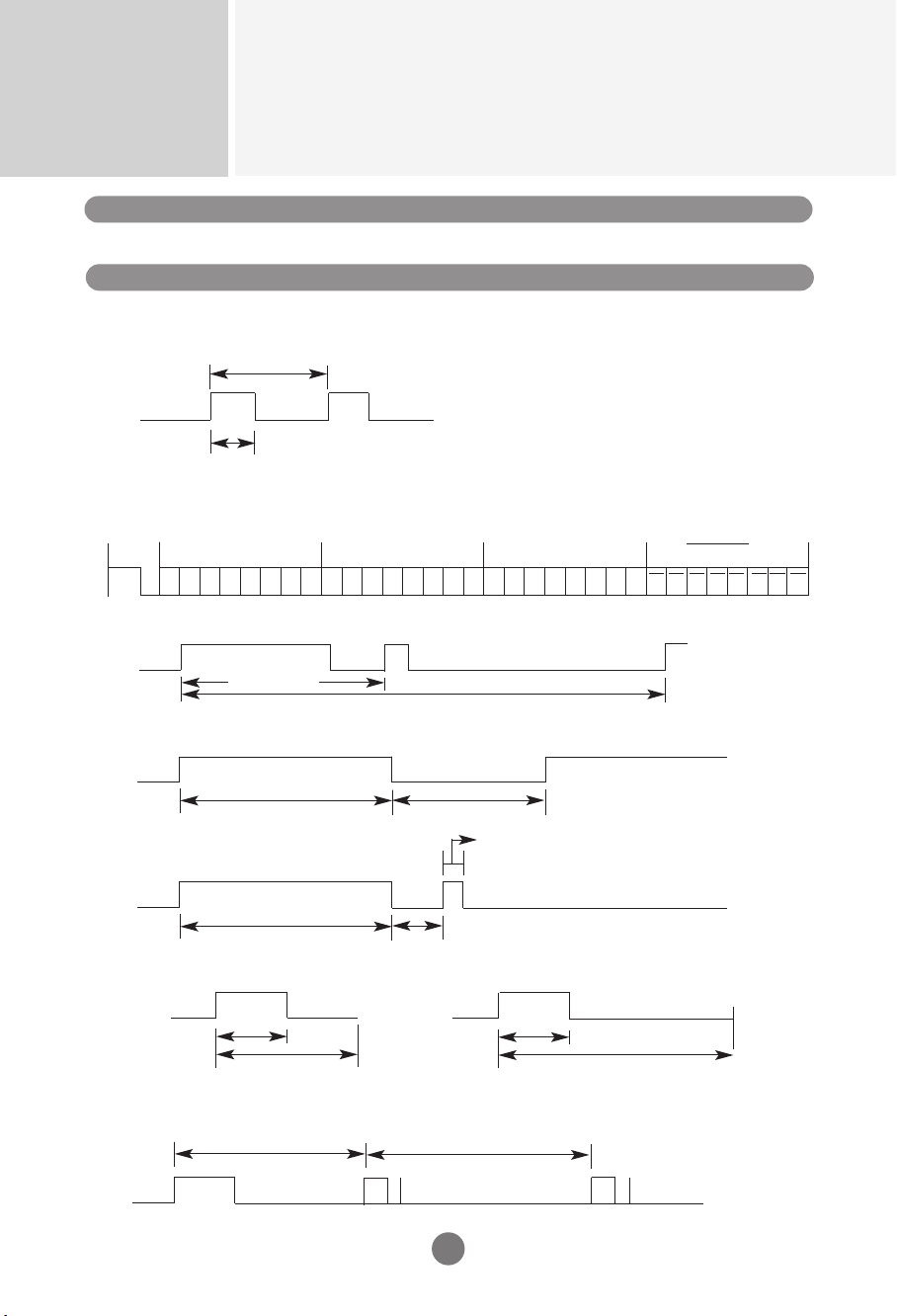
Remote Control IR Code
Connect your wired remote control to Remote Control port on the Product.
Output waveform
single pulse, modulated with 37.917kHz signal at 455kHz
Carrier frequency
FCAR = 1 / Tc = fosc / 12
Duty ratio = T1 / Tc = 1 / 3
Configuration of frame
•
1st frame
T1
Lead
code
Low
custom code
High
custom code
Data code
Data code
C0 C1 C2 C3 C4 C5 C6 C7 C0 C1 C2 C3 C4 C5 C6 C7 D0 D1 D2 D3 D4 D5 D6 D7 D0 D1 D2 D3 D4 D5 D6 D7
Tc
Tf
•
Repeat frame
Repeat code
Lead code
Repeat code
9 ms
Bit description
•
Bit "0"
•
Bit "1"
2.25 ms
9 ms
0.55ms
0.56 ms
1.12 ms
0.56 ms
2.24 ms
Frame interval : Tf
•
The waveform is transmitted as long as a key is depressed.
Tf
Tf
Tf = 108 ms @ 455 kHz
4.5 ms
▲
▲
▲
▲
▲
▲
▲
Controlling the Multiple Product
RS-232C
A29
RS-232C
IR Codes
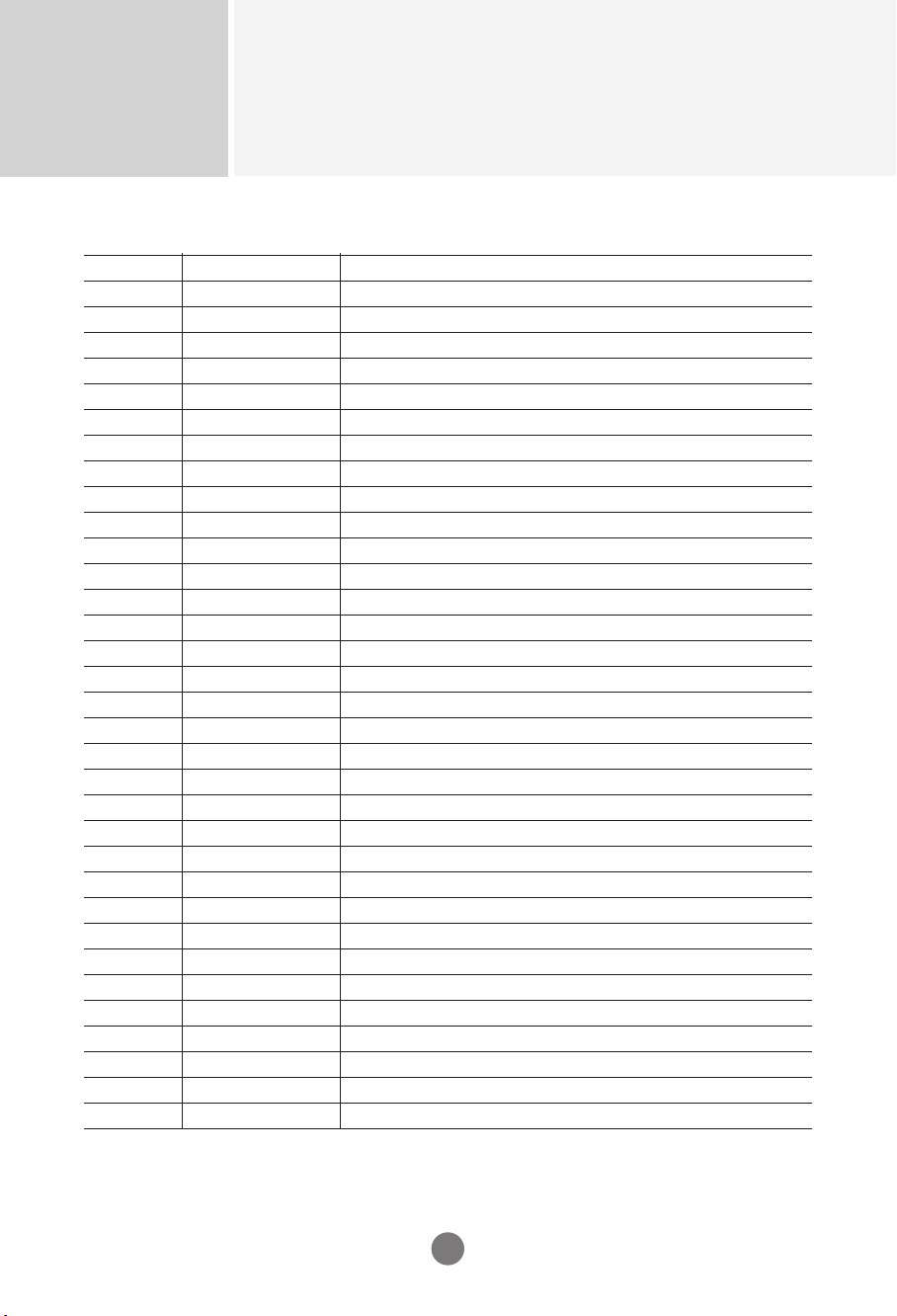
R/C Button
R/C Button
R/C Button
R/C Button
R/C Button (Power On / Off)
Discrete IR Code (Only Power On)
Discrete IR Code (Only Power Off)
R/C Button
R/C Button
R/C Button
R/C Button
R/C Button
R/C Button
R/C Button
R/C Button
R/C Button
R/C Button
R/C Button
R/C Button
R/C Button
R/C Button
R/C Button
R/C Button
R/C Button
R/C Button
Discrete IR Code(Input AV Selection)
Discrete IR Code(Input RGB PC Selection)
Discrete IR Code(Input HDMI/DVI Selection)
R/C Button
Discrete IR Code(Only 4 : 3 mode)
Discrete IR Code(Only 16 : 9 mode)
Discrete IR Code(Only ZOOM1, ZOOM2 mode)
Discrete IR Code
▲
▼
VOL( )
VOL( )
POWER ON/OFF
POWER ON
POWER OFF
MUTE
AV
INPUT
SLEEP
MENU
EXIT
PSM
SET
Number Key 0
Number Key 1
Number Key 2
Number Key 3
Number Key 4
Number Key 5
Number Key 6
Number Key 7
Number Key 8
Number Key 9
AV
RGB PC
HDMI/DVI
ARC
ARC (4 : 3)
ARC (16 : 9)
ARC (ZOOM)
AUTO CONFIG
00
01
02
03
08
C4
C5
09
98
0B
0E
43
5B
6E
44
10
11
12
13
14
15
16
17
18
19
5A
D5
C6
79
76
77
AF
99
▲
▲
Code(Hex) Function Note

LICENSES
Supported licenses may differ by model. For more information of the licenses, visit www.
lg.com.
HDMI, the HDMI logo and High-Definition Multimedia Interface
are trademarks or registered trademarks of HDMI Licensing
LLC.
As an ENERGY STAR Partner LGE U. S. A.,Inc.
has determined that this product meets the
ENERGY STAR guidelines for energy efficiency.
ENERGY STAR is a set of power-saving
guidelines issued by the U.S.Environmental
Protection Agency(EPA).
Make sure to read the Safety Precautions
before using the product.
Keep the Owner's Manual(CD) in an
accessible place for future reference.
The model and serial number of the SET
is located on the back and one side of the
SET. Record it below should you ever need
service.
MODEL
SERIAL
Temporary noise is normal when powering
ON or OFF this device.