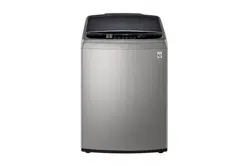

WT-H9506
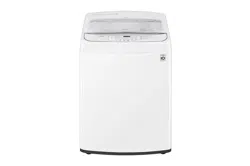
WT-H9556
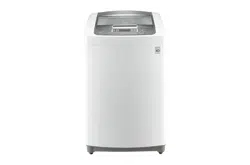
WT-H8006
P/No.: MFL42065498 www.lg.com
OWNER’S MANUAL
WASHING MACHINE
Please read this manual carefully before operating
your washing machine and retain it for future reference.
roduct Features
P
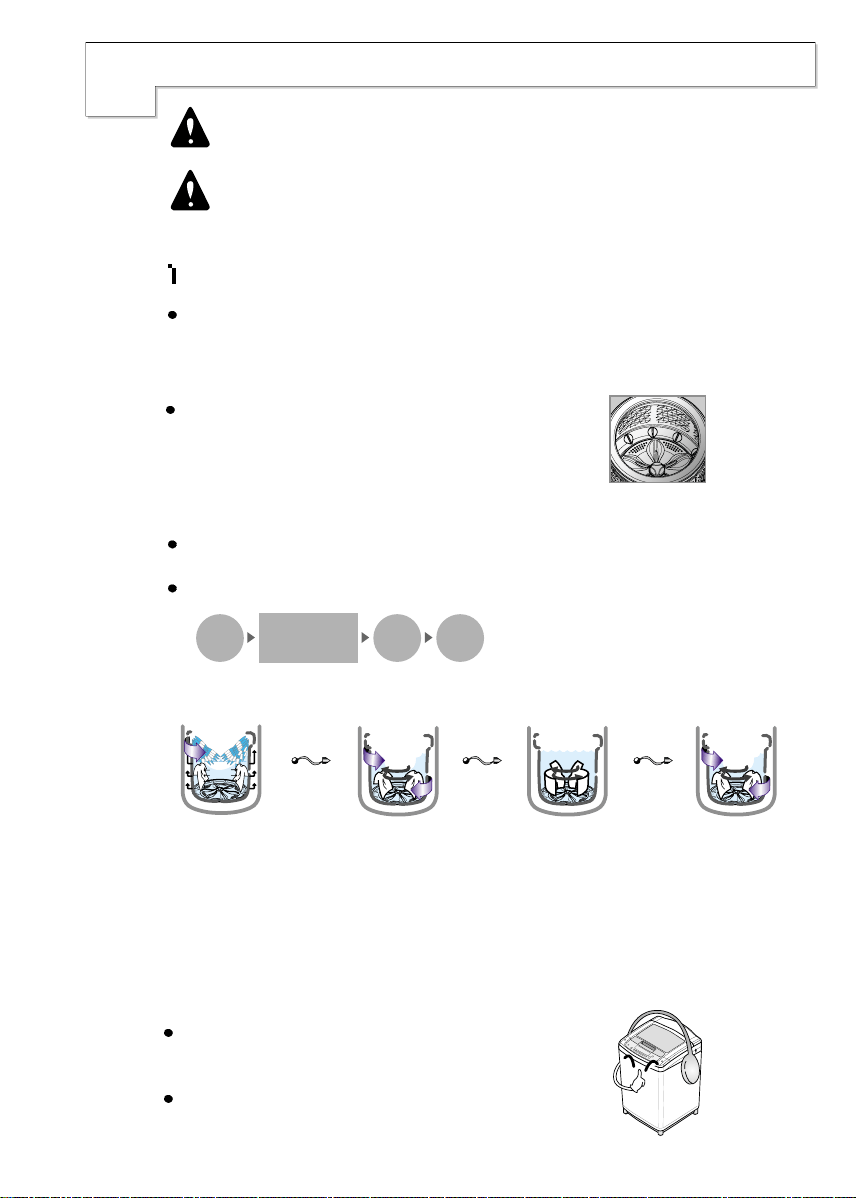
The Turbo Drum DD washing machine does not operate with the lid open.
If the lid is opened during wash, rinse and spin cycles, the machine will stop automatically.
Please close the door gently. Closing the door in an agressive manner can cause damage
and or injury.
FUZZY logic control
A built-in load sensor automatically detects and measures the laundry load and a microprocessor
optimizes washing conditions such as ideal water consumption and washing time.
Advanced technology is built into the Electronic Control System which ensures the best washing result.
New DD type washing with fabric care
sensors
The sensor automatically detects the quantity of Detergent put in by a user and the temperature and
quality of the water to produce the best algorithm for washing and rinsing, to give the best washing results.
START
WASHING
AUTO
POWER
OFF
SENSING
Laundry Sensor
Water Level Sensor
SETTING
Optimum
Washing
Condition
The advanced Brushless DC motor rotates the Tub directly
without belt and clutch, thereby reducing the noise of the
washer.
The washing machine adjusts to optimum speed according to the
type of clothing in the load.
It rotates the tub and
creates
a cascade
water flow making the
effect of the detergent
faster improving the
washing effect and
preventing fabric
from
wearing.
The half cycle rotation
of the tub to the
left/right helps the
dissolving
of the
detergent for
a better
wash result.
The half cycle rotation
of the
wash tub impeller
to the left/right
improves
stain removal.
The half cycle rotation
of the tub to the left/right
helps balance/distribute
the laundry
Low Noise Direct Drive System
Smart Drum achieved by DD Motor Technology
The incorporated Smart Drum allows a more cleaner and
hygienic wash tub that also protects against fabric wear
due to washing.
ontents
C
Introduction
Before Starting to Wash
Washing Programs
Additional Function
Program
Installation
Care and Maintenance
Troubleshooting
Specification
Safety Information 4
Identification of Parts 7
Function Information 8
Preparation Before Washing 9
Use of Water, Dispenser Drawer, Detergent, Bleach and Softener
10
Special Guide for Stain Removal 13
Function of each Button 14
FUZZY Wash 16
WOOL Wash 16
QUICK WASH 16
JEANS Wash 16
ECO COTTON 16
SOAK Wash 18
FAVORITE Wash 19
SILENT Wash 20
TUB CLEAN 21
AIR DRY 22
TUB DRY 22
Option Washing 23
DELAY START (RESERVATION) Wash 24
Other Useful Functions 25
Installation 26
Connecting Water Supply Hose 29
Grounding Method 32
Cleaning and Maintenance 33
Use of Handle Locker 35
Common washing problems 36
Troubleshooting 37
Specification 38
READ THIS MANUAL
Inside you will find many helpful hints on how to use and maintain your washer
properly. Just a little preventive care on your part can save you a great deal of time and
money over the life of your washer. You will find many answers to common problems
in the Troubleshooting section. If you review our chart of Troubleshooting Tips first, you
may not need to call for service at all.
.
e
ults.
on
right
bute
afety Information
S
4
Introduction
Read carefully and thoroughly through this booklet as it contains important safety information
that will protect the user from unexpected dangers and prevent potential damages to the product.
This section is divided into 2 parts : Warning and Caution.
: This is a warning sign specifying user’s applications which might
be dangerous.
: This is a sign specifying ‘Strictly Forbidden’ applications.
Warning
: Failure to comply with the instructions under this
sign may result in major physical injuries or death.
Caution
: Failure to comply with the instructions under this
sign may result in minor physical injuries or
damages to the product.
Warning
• Under certain conditions, hydrogen gas may be produced in a water heater that has not been used for
two weeks or more. Hydrogen gas can be explosive under these circumstances.
If the HOT water has not been used for two weeks or more, prevent the possibility of damage or injury
by turning on all Hot water faucets and allowing them to run for several minutes. Do this before using
any electrical appliance which is connected to the HOT water system. This simple procedure will
allow any built-up hydrogen gas to escape. Since the gas is flammable, do not smoke or use an open
flame or appliance during this process.
• This appliance is not intended for use by persons (including children) with reduced physical, sensory
or mental capabilities, or lack of experience and knowledge, unless they have been given supervision
or instruction concerning use of the appliance by a person responsible for their safety.
• The base opening must not be obstructed by carpeting when the washing machine is installed on a
carpeted floor.
• Install or store where it will not be exposed to temperatures below freezing or exposed to the
weather.
If the product is exposed to such conditions, electric shock, fire, break down or deformation
may occur.
• Properly ground washer to conform with all governing codes and ordinances. Follow details in
Installation Instructions.
If not grounded properly, break down and leakage of electricity may occur, which may cause
electric shock.
• Must be positioned so that the plug is accessible.
If the plug is placed between the wall and the machine, it may get damaged, possibly causing
fire or electric shock.
• Make sure the plug is completely pushed into the outlet.
Failure to do so may cause electric shock and fire due to overheating.
If this appliance is supplied from a cord extension set or multi-outlet power board, the cord extension
set or multi-outlet power board must be positioned so that it is not subject to splashing or ingress of
moisture.
This appliance has been designed to operate from a 240 volt, 50Hz town power supply.
WATER
HEATER
SAFETY
Caution
PROPER
INSTALLATION
afety Information
S
5
Introduction
ct.
or
jury
ing
n
ry
on
n a
n
se
g
sion
of
Warning
• Keep the area underneath and around your appliances free of combustible
materials such as lint, paper, rags, chemical, etc.
Operating with such materials around the machine may trigger
explosion or fire.
• Close supervision is necessary if this appliance is used by or near children.
Do not allow children to play on, with, or inside this or any other appliance.
There is potential danger that children might drown or suffocate in the tub.
Do not touch the power plug with a wet hand.
It will cause electric shock
Do not put your hand, foot or anything under the washing machine
while the washing machine is in operation.
There is a rotating mechanism under the machine, so you could be injured.
• Make sure that drainage is working properly.
If water is not drained properly, your floor may get flooded. Flooded floors
may induce electricity leakage, further resulting in electric shock or fire.
• If, during spinning, opening the lid does not stop the tub within about 15 seconds,
immediately discontinue operating the machine.
Call for repair. A machine that spins with its door open may cause injuries.
Never reach into washer while the tub is rotating at any speed.
Wait until the machine has completely stopped before opening the lid.
Even slow rotation can cause injury.
Never attempt to operate this appliance if it is damaged, malfunctioning, partially
disassembled, or has missing or broken parts, including a damaged cord or plug.
Operating with a damaged plug may cause electric shock.
Do not use water hotter than 60 degrees.
Use of excessively hot water may cause damage to fabrics or cause
leakage of water.
• Use this appliance only for its intended purpose as described in this Owner’s Manual.
• The laundry process can reduce the flame retardancy of fabrics. To avoid such a result,
carefully follow the garment manufacturer’s wash and care instructions.
• To minimize the possibility of electric shock, unplug this appliance from the power
supply or disconnect the washer at the household distribution panel by removing the
fuse or switching off the cirduit breaker before attempting any maintenance or cleaning.
YOUR
LAUNDRY
AREA
Caution
WHEN USING
THE WASHER
NOTE : Pressing Power button to turn off does NOT
disconnect the appliance from the power supply.

6
Introduction
afety Information
S
Warning
Do not use a plug socket and wiring equipment for more than their rated capacity.
Exceeding the limit may lead to electric shock, fire , break down, and/or
deformation of parts.
Do not mix chlorine bleach with ammonia or acids such as vinegar and/or rust remover.
Mixing different chemicals can produce toxic gases which may cause death.
Do not wash or dry articles that have been cleaned in, washed in, soaked in, or spotted
with combustible or explosive substances (such as wax, oil, paint, gasoline, dry-
cleaning solvents, kerosene, etc). Do not add these substances to the wash water.
Do not use or place these substances around your washer or dryer during operation.
It may ignite or explode.
• Turn off water faucets to relieve pressure on hoses and valves and to minimize leakage
if a break or rupture should occur. Check the condition of the fill hoses; they may need
replacement after 5years.
• When the air temperature is high and the water temperature is low, condensation may
occur and thus wet the floor.
• Wipe off dirt or dust on the contacts of the power plug.
Using unclean power plug may cause fire.
• Before discarding a washer, or removing it from service, remove the washer lid to
prevent children from hiding inside.
Children may be trapped and suffocated if the lid is left intact.
Do not attempt to repair or replace any part of this appliance unless specifically
recommended in this Owner’s Manual, or in published user-repair instructions
that you understand and have the skills to carry out.
Operating the machine with improperly replaced parts may be a
cause for fire or electric shock.
Do not tamper with controls.
It may lead to electric shock, fire , break down, deformation.
Do not yank the power cord in an attempt to disconnect the power plug.
Securely hold the power plug to unplug the machine.
Failure to observe these instructions may cause electric shock or fire
due to short-circuit .
When you are cleaning the washing machine, do not apply water directly to any
part of the washing machine.
It will cause short circuit and electric shock.
WHEN USING
THE WASHER
Caution
WHEN NOT
IN USE
This machine has been designed for normal indoor domestic use.
NOTE
dentification of Parts
I
7
Introduction
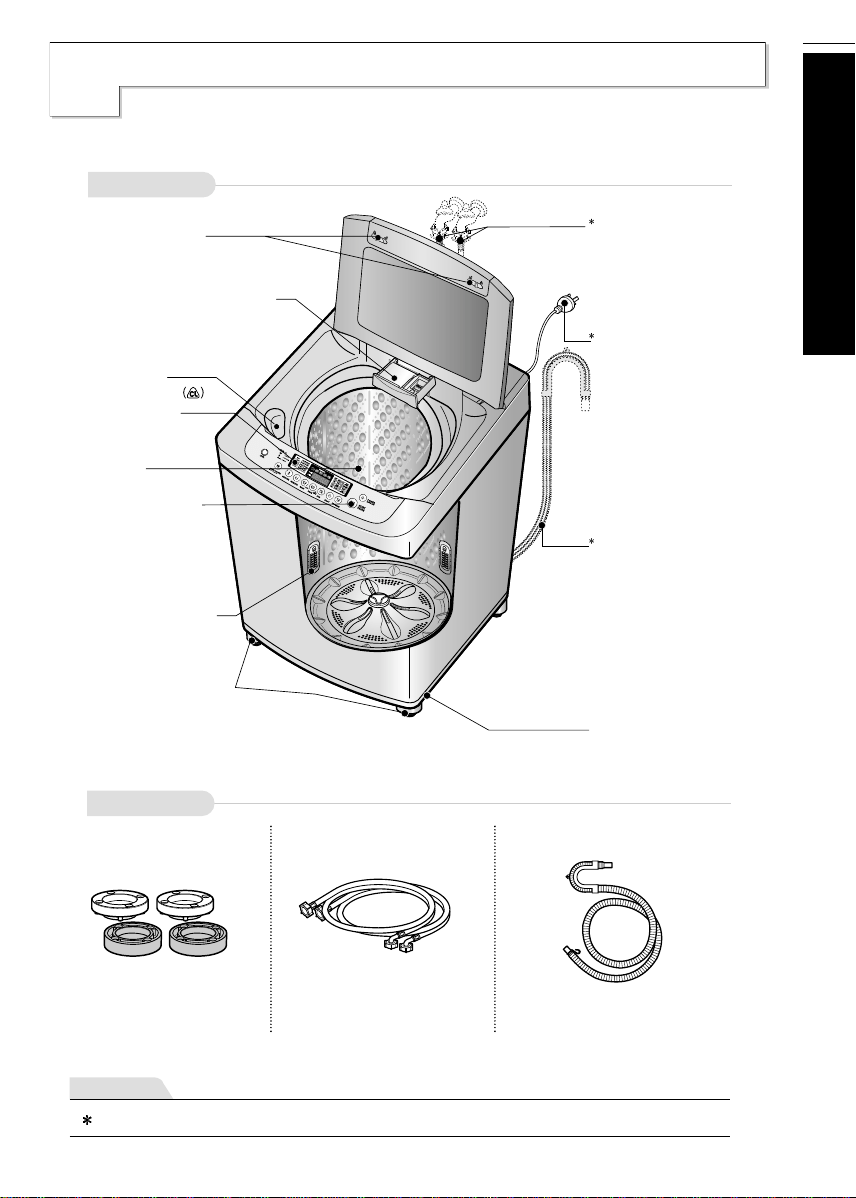
WATER SUPPLY
HOSE
FUNCTION
SELECTOR
TUB
BASE
ADJUSTABLE LEGS
DRAIN HOSE
for pump model
POWER PLUG
START/PAUSE
BUTTON
Use to start or
stop the washing
machine
temporarily.
Make sure the
water does not
leak.
If the supply cord is
damaged, it must be
replaced by the
manufacturer or its
service agents or
similarly qualified
person in order to
avoid a hazard.
Check if the drain
hose is placed into
the laundry tub and
secured before
operating the
washing machine.
If the drain hose is
not elevated,the
water will syphon out
completely.
Use to level the washing
machine for correct
balance & spin
operation.
Multi Clean Filter
POWDER DETERGENT BOX
FOR DELAYED WASHING /
SOFTENER BOX
Handle Locker
BLEACH
DISPENSER
Body
“ ” Part can be different according to the model.
Please see page 38 for inlet water pressure limitations.
NOTE
ver.
th.
ed
ge
ed
y
y
y
Accessories
Drain hose
Inlet hose
1 Each for cold and
hot water
2 Pieces
Height adjustment
plate

unction Information
F
8
Introduction
Our machine provides various washing methods which suits various conditions and
types of laundry.
FUZZY Wash
JEANS Wash
WOOL Wash
QUICK WASH
SOAK Wash
DELAY START Wash
OPTION WASH
Use this Program for mixed loads e.g. sheets, towels, T-shirts.
(refer to page 16)
ECO COTTON
Use this program to save water consumption.
(refer to page 16)
FAVORITE Wash
This setting allows you to store your FAVORITE wash conditions in the normal cycle memory. (refer to page 19)
SILENT Wash
Use this program to wash quietly at night. (refer to page 20)
Use this Program for heavily soiled durable garments e.g. overalls, jeans.
Thick and heavy clothes or those which are excessively dirty like jeans or working uniforms can be washed. (refer to page 16)
Wool clothes (lingerie, wool, etc.) which may be easily damaged can be washed. (refer to page 16)
The fibers of machine washable woolens have been specifically modified to prevent felting when they are machine washed.
Most handknitted garments are not made of machine washable wool and we recommend that you hand wash them
• Before washing your woolens check the care label for the washing instructions.
• When washing woolens use a mild Detergent recommended for washing wool.
• Hand washed woolens may be spun in a washing machine to reduce the time they take to dry.
• To dry woolens lay them down flat on a towel and pat into shape. Dry woolens out of direct sunlight.
(The heat and tumble action of a dryer may cause shrinkage or felting of woolen garments.)
Some wool underlays and sheepskin products can be washed in a washing machine but may cause pump blockages.
(Ensure that the whole article is suitable for machine washing and not just the backing material.)
You may wish to handwash these articles and place them in the machine to spin dry.
QUICK WASH can be selected to wash lightly soiled clothes of less than 2.0 kg in a short time. (refer to page 16)
SOAK Wash can be selected to wash heavily soiled laundry by soaking in water for some time to help remove dirt and
grime. (refer to page 18)
DELAY START Wash is used to delay the finishing time of the operation.
The number of hours to be delayed can be set by the user accordingly. (refer to page 24)
When the user needs only SPIN, RINSE/SPIN, RINSE, WASH/RINSE, WASH, WASH/RINSE/SPIN,
SOAK/WASH/RINSE/SPIN. (refer to page 23)
TUB CLEAN
Use this program to clean the inside of washing machine especially Inner tub & Outer tub.
Do not add clothes to the machine during this cycle. A suitable descaling product can be used if desired. (refer to page 21)
Washing according to the condition of laundry
Other washing method
Different types of laundry washing
reparation Before Washing
P
9
Before Starting to Wash
6)
d
21)
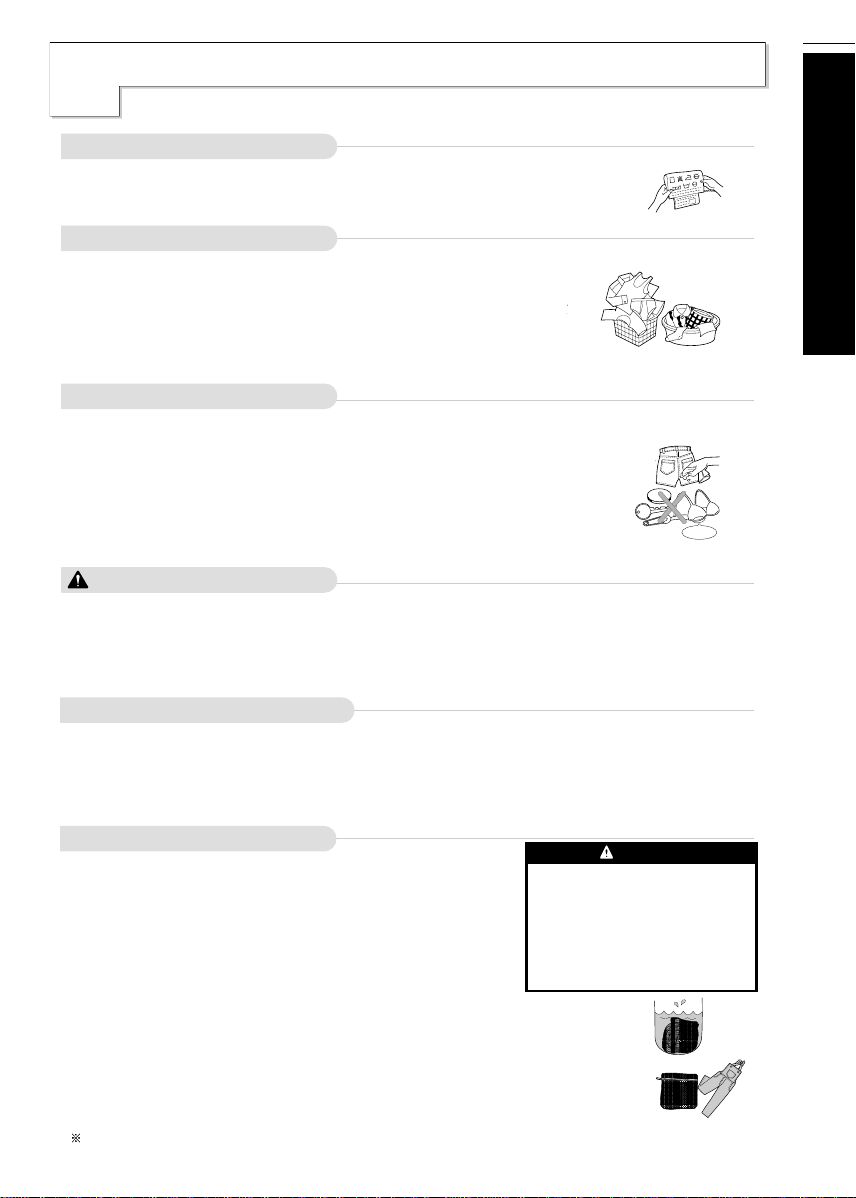
• Check all pockets to make sure that they are empty. Things such as nails, hairclips, matches,
pens, coins, and keys can damage both your washer and your clothes.
• Mend any torn garments or loose buttons. Tears or holes may become larger during washing.
• Remove belts, underwires, etc. to prevent damage to the machine or your clothes.
• Pretreat any dirt and stains.
• Make sure the clothes are washable in water.
• Check the washing instructions.
• Remove tissue in pockets.
To get the best results, different fabrics need to be washed in different ways.
• SOIL (Heavy, Normal, Light)
Separate clothes according to the type and amount of soil.
• COLOR (Whites, Lights, Darks) Separate white fabrics from colored fabrics.
• LINT (Lint producers, Collectors) Separate lint producers and lint collectors.
Lint Producers Terry cloth, Chenille, Towels, Nappies, Diapers
Lint Collectors Synthetics, Corduroy, Permanent Press, Socks
WIRE
Sorting
Check before Loading
* Look for a care label on your clothes. This will tell you about the fabric content of your garment
and how it should be washed.
Sort clothes into loads that can be washed with the same wash cycle, Water Temperature and spin speed.
Care Labels
CAUTION
Long laundry items
Use nylon nets for long, DELICATE items. For laundry with long strings or long length, a net will
prevent tangling during washing.
Fasten zippers, hook, and strings to make sure that these items don't
snag on other clothes.
Nylon net is not supplied by LG.
Light and Large-sized clothing
Clothes like downs and woollens are light weight, large and float easily. Use a nylon net and
wash them in a small amount of water. If the laundry floats during the wash cycle, it may
become damaged. Use dissolved Detergent to prevent the Detergent from clumping.
Do not wash fabrics containing flammable materials (waxes, cleaning fluids, etc.).
Load Size
The WATER LEVEL should just cover the clothes. Adjust the load size
accordingly. Loosely load clothes no higher than the top row of holes in the
washer tub. To add items after washer has started, press Start button and
submerge additional items. Close the lid and press Start button again to restart.
Do not wash or spin any item labeled or known to be water-proof or water-resistant, even if the product care
label on the item permits machine washing. Failure to follow these instructions could result in severe damage to
your laundry, your washer and/or property damage as a result of abnormal vibration of the washer.
- Examples of water-proof or water-resistant items include certain mattress pads, mattress covers, rain gear, camping
gear, skiing apparel , outdoor gear and similar items.
Loading
• Pretreat shirt collars and cuffs with a pre-wash product or liquid Detergent when placing them in the washer.
Before washing treat special stains with bar soaps, liquid Detergent or a paste of water and granular Detergent.
• Use a pretreat soil and stain remover.
Treat stains AS SOON AS POSSIBLE. The longer they are left the harder they are to remove.
(For more detail refer to page13)
Pretreatment on stains or heavy soil
Fire Hazard
Never place items in the washer that are
dampened with gasoline or other flammable
fluids.
No washer can completely remove oil.
Do not dry anything that has ever had any type
of oil on it (including cooking oils).
Doing so can result in death, explosion, or fire.
WARNING
10
Before Starting to Wash
se of Water, Dispenser Drawer, Detergent, Bleach and Softener
U
• The temperature of the water impacts the effectiveness of all laundry additives and therefore, the cleaning results.
We recommend temperatures of:
- HOT 49~55°C…(120-140˚F) White items, diapers, underclothing and heavily soiled, colorfast items.
- WARM 29~40°C…(85-105˚F) Most items
- COLD* 18~24°C…(65-75˚F) Only very bright colors with light soil.
• When washing in COLD water additional steps may be needed:
- Adjust Detergent amount and pre-dissolve Detergent in WARM water And add to the machine by hand.
- Pretreat spots and stains
- Soak heavily soiled items
- Use appropriate bleach
* Temperature below 18°C…(65˚F) will not activate laundry additives and may cause lint, residue, poor cleaning, etc.
In addition, Detergent manufactures and care labels define COLD water as 26~29°C…(80-85˚F).
If the temperature of the water in the tub is too cold for your hands, the Detergent will not activate and clean effectively.
Water Temperature
Using Water
• The machine sets the appropriate temperature automatically according to the wash program .
• You can change the Water Temperature by pressing the WATER TEMP. button. (refer to page 14)
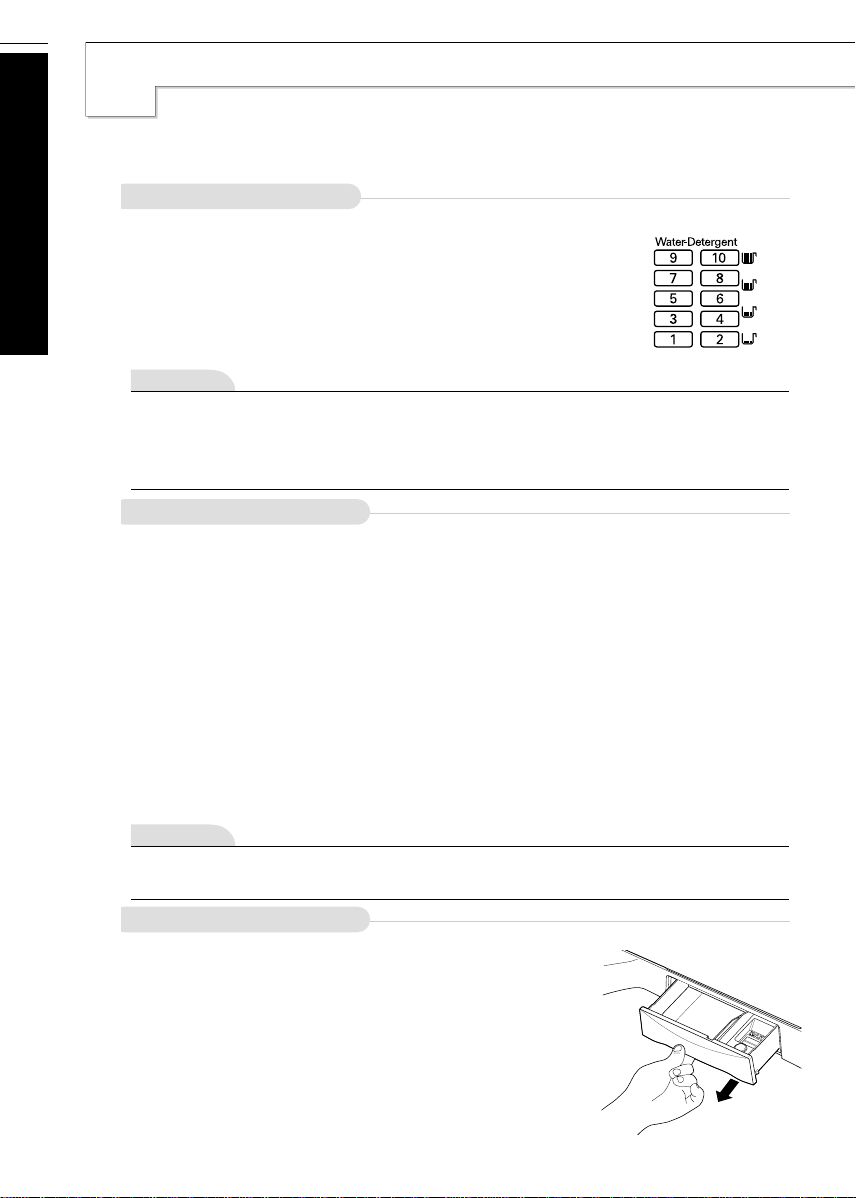
• This machine detects the quantity of laundry automatically, then sets the
WATER LEVEL and proper amount of Detergent.
• When you select a wash program, the WATER LEVEL and amount of
Detergent (to be used) will be shown on the control panel.
• The following table shows the amount of water.
(refer to page 11)
• When the WATER LEVEL is automatically detected, it may differ depending
on the quantity of laundry even though the same WATER LEVEL is indicated
on the control panel.
Amount of WATER LEVEL
Using the Dispenser Drawer
NOTE
If iron is present in the water the clothes may become an all-over yellow or they may be stained with brown or orange
spots or streaks. Iron is not always visible. Installation of water softener or an iron filter may be necessary for severe cases.
NOTE
[ Minimum water amount ]
Water level depends on laundry load and washer model.The washer detects the required minimum water level and will not start
washing until this water level is reached.The water will fill automatically via the inlet valves, however if water is manually poured
into the tub via a bucket or similar vessel (NOT RECOMENDED), the washer will still detect this water and the wash cycle will
commence once the required water level is reached. NOTE :the cycle will not start until the lid is closed.
The dispenser drawer contains 2 compartments:
• Liquid Fabric Softener
• Low sudsing powder, High-Efficiency Detergent
The dispenser automatically dispenses additives at the proper time in the wash cycle.
1. Slowly open the dispenser drawer by pulling the drawer out until it stops.
2. After adding laundry products, slowly close the dispenser drawer. Closing the
drawer too quickly could result in early dispensing of additives.
• Avoid overfilling or splashing when adding laundry products to the dispenser. Doing
so could result in early dispensing of laundry products.
At the end of the cycle, you may see water in the compartments. This is part of the
normal operation of the washer.
NOTE : Do not use bleach in the dispenser drawer.
Usin
Usin

11
Before Starting to Wash
er
lts.
ly.
Using Detergent
How much Detergent
The correct amount of Detergent will vary depending on the amount of soil in your clothes (Jeans and work
cloches may need more Detergent, while bath towels usually need less.).
For liquid and concentrated Detergents, follow the recommendations of the Detergent manufacturer.
Note: To check you are using the correct amount
of Detergent, lift the lid of your machine about
half-way through the wash. There should be a
thin layer of foam over the surface of the water.
Lots of foam may look good, but it does not
contribute to cleaning your clothes. No foam
means not enough Detergent has been used or the
water temperature is too cold for the soap to
dissolve;; soil and lint can settle back on the clothes
or the washing machine. If excess Detergent is used,
the rinse will not be as clean and efficient. Also, it
could cause environmental pollution, And long
term scrud build up.
Add measured detergent to the detergent compartment of the dispenser drawer.
Detergent is flushed through the dispenser at the beginning of the wash phase.
Detergent usage may need to be adjusted for water temperature, water hardness, size and soil level of the load.
Avoid using too much detergent in your washer, as it can lead to oversudsing and detergent residue being left on
the clothes.
Adding Detergent
Using Detergent
Follow the Detergent package directions. Using too little Detergent is a common cause of laundry problems
Use more Detergent if you have hard water, large loads, greasy or oily soils or lower Water Temperature.
Choosing the right Detergent
We recommend the use of front loader type, low sudsing high efficiency Detergent(powder,liquid or
concentrated).
Soap flakes or granulated soap powders should not be used in your washing machine.When washing woolens
Remember to use Detergent suitable for washing woolens.
Detergent Softener, etc.
•
Please use amount of
each manufacturer's
recommended dosage.
Water Q'ty(
L
)
40
44
53
61
72
79
87
93
98
105
Water Lavel
1
2
3
4
5
6
7
8
9
10
Detergent
Attention
Using liquid detergent without diluting, or leaving laundry for a long time after pouring
diluted liquid detergent into the tub might cause damage, bleaching or discoloration of cloth.
Note : Using Liquid detergent
- Dilute Liquid detergent with water and pour into the tub, start the cycle.
- Delay wash course is not available if you use liquid detergent.
se of Water, Dispenser Drawer, Detergent, Bleach and Softener
U
12
Before Starting to Wash
Using Fabric Softener
If you wish to use fabric softener we recommend
Attention
Do not mix with Detergent or bleach.
Never pour fabric softener directly on clothes. It may stain them.
Do not stop the washer during the first spin for timely dispensing.
Delay Start and some wash options are not designed to be used with fabric softener dispenser.
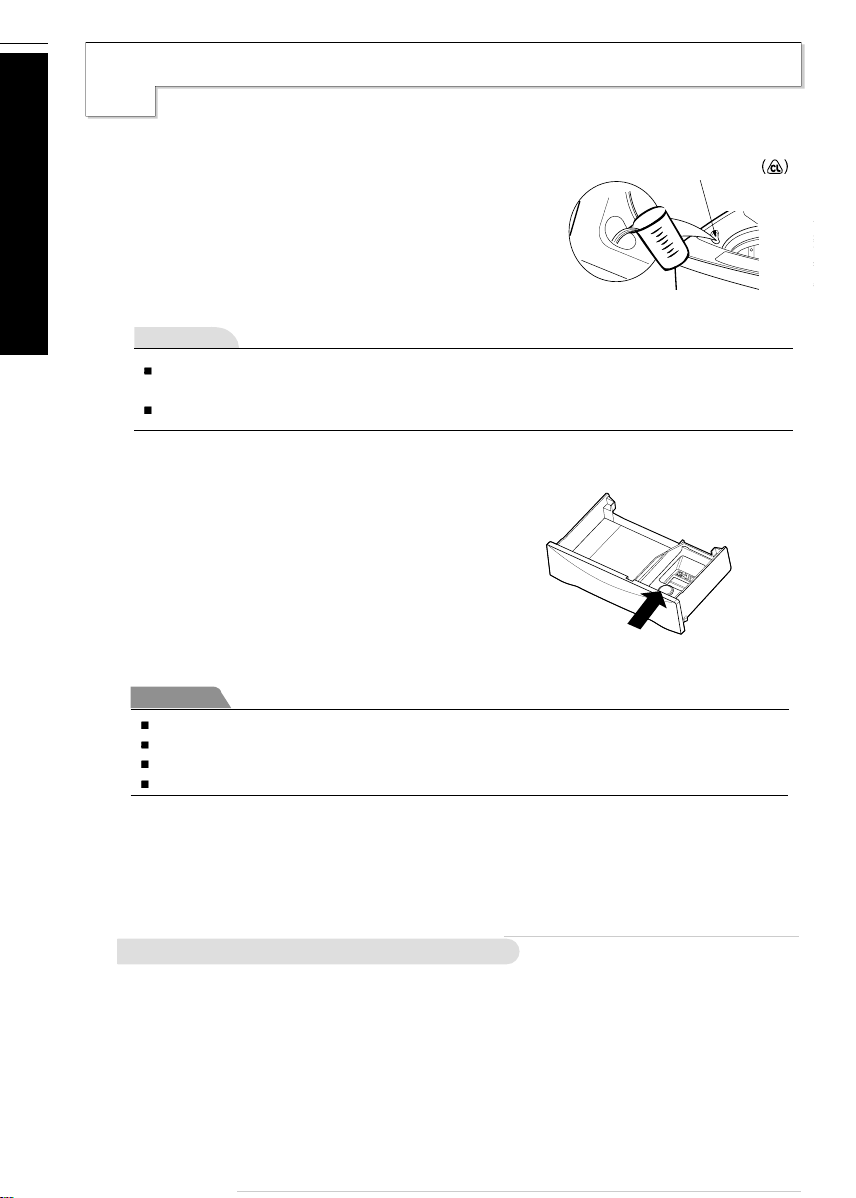
If desired, pour the recommended amount of liquid
fabric softener into the right-hand compartment.
Use only liquid fabric softener.
Dilute with water to the maximum fill line.
• Do not exceed the maximum fill line.
Overfilling can cause early dispensing of the fabric softener,
which could stain clothes.
NOTE : Do not pour fabric softener directly on the wash load.
It may stain the clothes.
Scrud(Waxy Build up)
Scrud is the name given to the waxy build-up that can occur within any washer when the fabric softener
comes into contact with Detergent. This build-up is not brought about by a fault in the machine.
If scrud is allowed to build-up in the machine it can result in stains on your clothes or an unpleasant
smell in your washer.
• Using fabric softener sparingly.
• When filling the dispenser, do not splash or overfill.
• Clean dispenser as soon as the cycle is finished.
• Clean your machine regularly. (refer to page 21 or 33)
• Cold water washing increases the chance of this build-up occurring. We recommend a regular WARM or
HOT wash e.g. every 5th wash should be at least a warm one.
• Fabric softener of thinner consistency is less likely to leave residue on the dispenser and contribute to a
build-up.
• Check clothing care label for special instructions and separate the
laundry to be bleached
• Dilute liquid chlorine bleach.
• Measure the recommended amount of liquid bleach carefully
following instructions on the bottle.
• Before starting the washer, pour measured amount of bleach directly
into bleach dispenser. Avoid splashing or overfilling. Powdered
bleach should be mixed thoroughly with water before pouring.
Using Liquid Bleach
Bleach dispenser
NOTE
Never pour undiluted liquid bleach directly onto clothes or into the wash basket.
This may cause change of color or damage the laundry.
Do not pour powdered bleach into bleach dispenser.
pecial Guide for Stain Removal
S
13
Before Starting to Wash
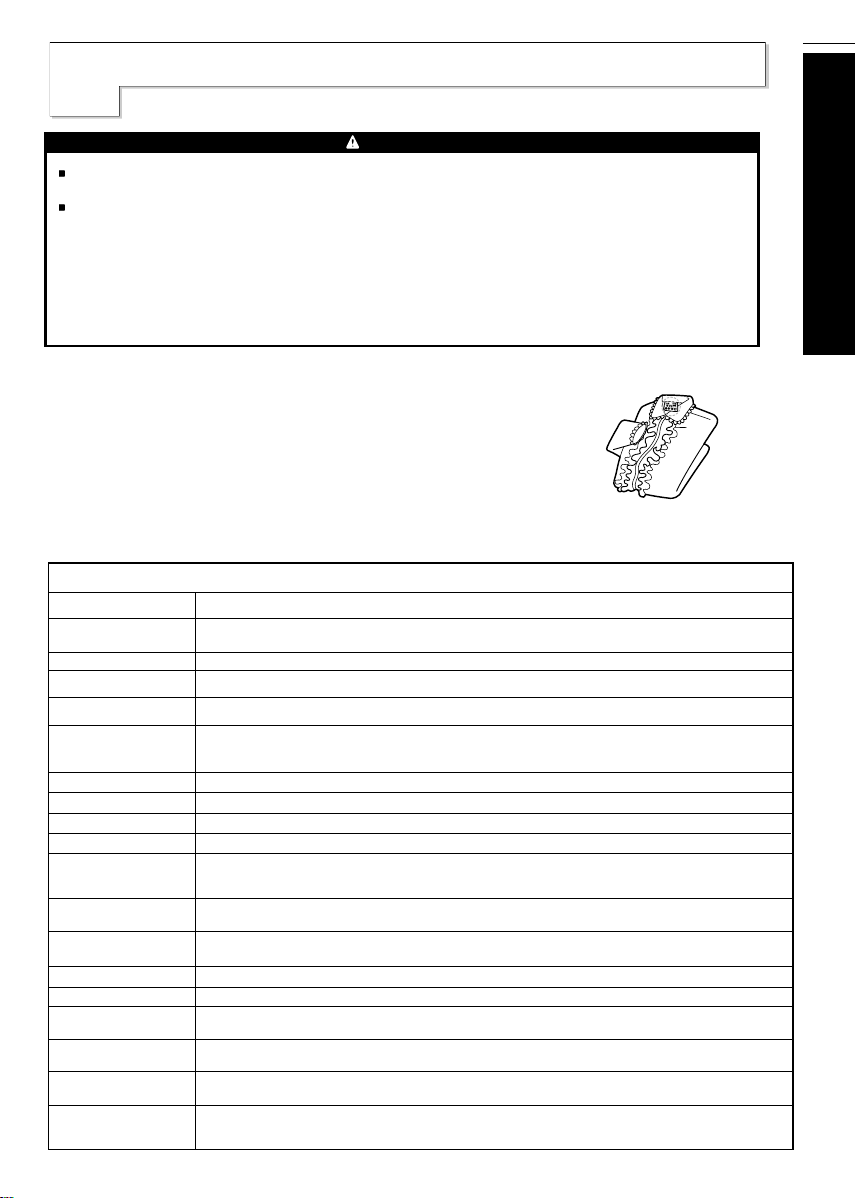
• Remove stains promptly.
• Determine the kind of stain, then follow the recommended treatment in the stain
removal chart below.
• To pretreat stains, use a prewash product, liquid Detergent, or a paste made from
granular Detergent and water.
• Use COLD water on unknown stains because HOT water can set stains.
• Check care label instructions for treatments to avoid on specific fabrics.
• Check for colorfastness by testing stain remover on an inside seam.
• Rinse and wash items after stain removal.
For successful stain removal:
Follow fabric care label
instructions
WARNING
Stain Removal
STAIN
Adhesive tape, chewing gum,
rubber cement
Baby formula, dairy products, egg
Beverages (coffee, tea, soda, juice,
alcoholic beverages)
Blood
Candle wax, crayon
Chocolate
Collar or cuff soil, cosmetics
Dye transfer on white fabric
Grass
Grease, oil, tar (butter, fats, salad
dressing, cooking oils, car grease,
motor oils)
Ink
Mildew, scorch
Mud
Mustard, tomato
Nail polish
Paint, varnish
Rust, brown or yellow
discoloration
Shoe polish
Apply ice. Scrape off excess. Place stain face down on paper towels. Saturate with prewash stain remover or
nonflammable dry cleaning fluid.
Use product containing enzymes to pretreat or soak stains.
Pretreat stain. Wash using COLD water and bleach safe for fabric.
Rinse with COLD water. Rub with bar soap. Or pretreat or soak with product containing enzymes. Wash using
bleach safe for fabric.
Scrape off surface wax. Place stain face down between paper towels. Press with warm iron until wax is absorbed.
Replace paper towels frequently. Treat remaining stain with prewash stain remover or nonflammable dry cleaning
fluid. Hand wash to remove solvent. Wash using bleach safe for fabric.
Pretreat or soak in WARM water using product containing enzymes. Wash using bleach safe for fabric.
Pretreat with prewash stain remover or rub with bar soap.
Use packaged color remover. Wash using bleach safe for fabric.
Pretreat or soak in WARM water using product containing enzymes. Wash using bleach safe for fabric.
Scrape residue from fabric. Pretreat. Wash using hottest water safe for fabric. For heavy stains and tar, apply
nonflammable dry cleaning fluid to back of stain. Replace towels under stain frequently. Rinse throughly. Wash
using hottest water safe for fabric.
Some inks may be impossible to remove. Washing may set some inks. Use prewash stain remover, denatured
alcohol or nonflammable dry cleaning fluid.
Wash with chlorine bleach if safe for fabric. Or, soak in oxygen bleach and HOT water before washing. Badly
mildewed fabrics may be permanently damaged.
Brush off dry mud. Pretreat or soak with product containing enzymes.
Pretreat with prewash stain remover. Wash using bleach safe for fabric.
May be impossible to remove. Place stain face down on paper towels. Apply nail polish remover to back of stain.
Repeat, replacing paper towels frequently. Do not use on acetate fabrics.
WATER BASED : Rinse fabric in cool water while stain is wet. Wash. Once paint is dry, it cannot be removed,
OIL BASED AND VARNISH : Use solvent recommended on can label. Rinse throughly before washing.
For spots, use rust remover safe for fabric. For discoloration of an entire load, use phosphate Detergent and
nonchlorine bleach. Do not use chlorine bleach because it may intensify discoloration.
LIQUID : Pretreat with a paste of granular Detergent and water. PASTE : Scrape residue from fabric. Pretreat with
prewash stain remover or nonflammable dry cleaning fluid. Rub Detergent into dampened area, Wash using bleach
safe for fabric.
TREATMENT
Do not use or mix liquid chlorine bleach with other household chemicals such as toilet cleaners, rust removers, acid or
products containing ammonia. These mixtures can produce dangerous fumes which can cause serious injury or death.
To reduce the risk of fire or serious injury to persons or property, comply with the basic warnings listed below:
• Read and comply with all instructions on stain removal products.
• Keep stain removal products in their original labeled containers and out of children’s reach.
• Thoroughly wash any utensil used.
• Do not combine stain removal products, especially ammonia and chlorine bleach. Dangerous fumes may result.
• Never wash items which have been previously cleaned in, washed in, soaked in or spotted with gasoline, dry cleaning solvents
or other flammable or explosive substances because they give off vapors that could ignite or explode.
• Never use highly flammable solvents, such as gasoline, inside the home. Vapors can explode on contact with flames or sparks.
14
Before Starting to Wash
F
unction of each Button
NOTE
* For optimizing the washing algorithm, the displaying time may change automatically during the wash cycle. As a guide
only, it may increase by up to 8 minutes or decrease by up to 4 minutes.
* The much detergent is detected then extra rinses will be added to improve wash results. This will result in an increase
in the wash time and the remaining time displayed will increase accordingly.
* The standard for the acceptable amount of detergent used is pre-set. This may vary from the amount a specific user
may actually put into the machine. This is not a problem unless Excessive amounts of detergent are used. Under
normal use the washer will adjust wash and rinse times accordingly.
* The sensor which detects a Detergent quantity is designed to detect synthetic based Detergent powder. If you use a
liquid detergent or soap flakes, or too much bleaching agent, the detecting ability of the sensor will be impaired.
* Bec
(ref
* Eve
the
* The
* For
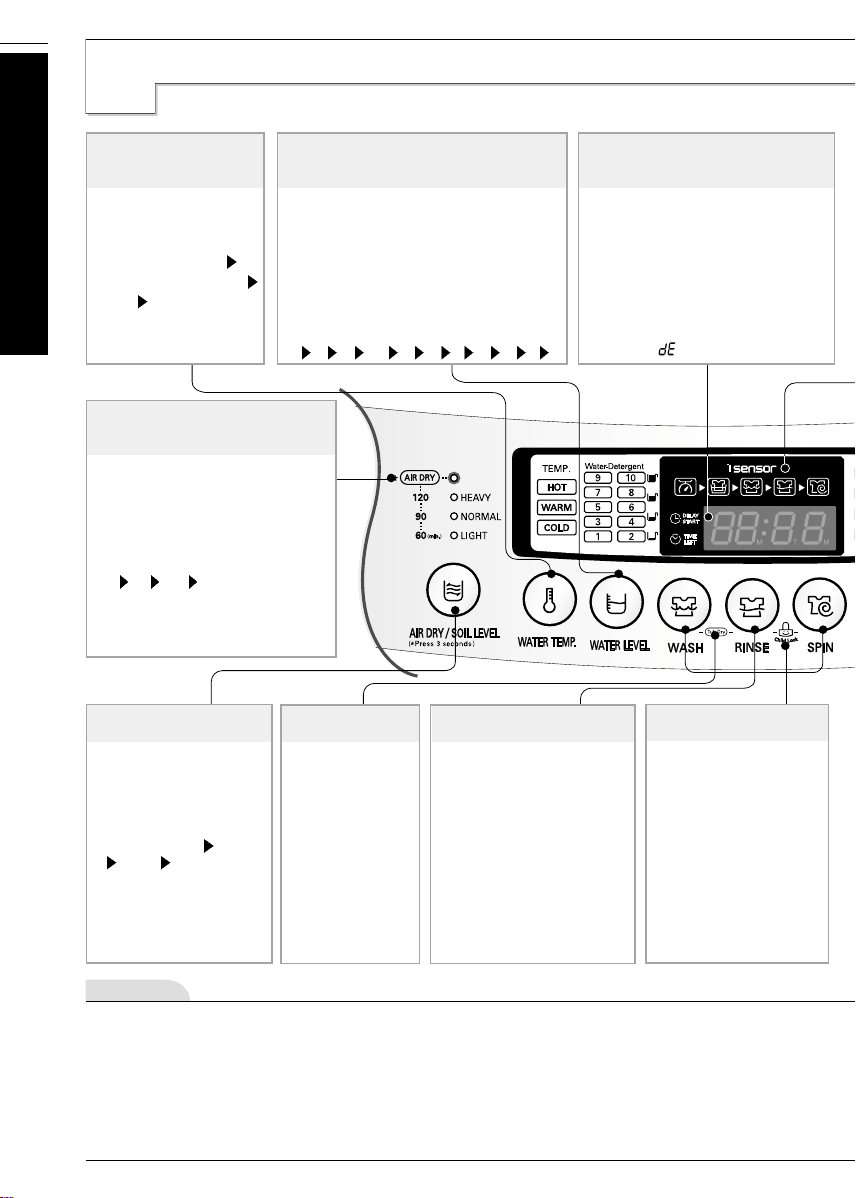
TIME LEFT, DELAY START
(RESERVATION), ALARM INDICATION
• Time left - During operation, the remaining time
is indicated.
• DELAY START INDICATION
(RESERVATION) - When DELAY START
(RESERVATION) program is selected, it
indicates the finishing time. (RES.=DELAY)
• Alarm indication -When an error occurs, an error
message appears to indicate the abnormality.
For example, indicates that the lid is open.
DELAY
• Use
• The
is pu
• The
as th
... 1
3
• To c
swit
(refer
WATER LEVEL BUTTON
• Use to select the proper amount of water in relation
to the weight and type of laundry.
• Automatically controlled, but can be selected
manually by pressing the WATER LEVEL Botton.
• WATER LEVEL is automatically selected for
FUZZY program.
The following settings are indicated as the button is
pushed
7
8 9 10 1 2 3 4 5 6 7
CHILD LOCK FUNCTION
• Use to lock or unlock the
control buttons to prevent
settings from being
changed by a child.
To lock, push the RINSE
and SPIN buttons
simultaneously and to
unlock push them one
more time during the
washing process.
(refer to page 25 for full
operation and conditions)
• It
• W
an
fo
SOIL LEVEL BUTTON
• This button allows you to
select the strength of the
wash action.
• Power option selections
light up in sequence as
follows Normal Heavy
Light Normal as the
button is pushed.
This can be selected for any
program.
• Adjustment can be made
while washing.
WATER TEMPERATURE
BUTTON (OPTION)
• Use to select Water
Temperature.
Pressing the button allows
you to select COLD
WARM (HOT&COLD)
HOT COLD
respectively.
WASH. RINSE. SPIN BUTTON
• Use when wash, rinse, spin
times or amounts need to be
adjusted.
• If adjustments are needed
during the wash, press the
[start/pause] button before
making any changes.
• When the button is pressed
during washing, the
remaining time is displayed.
TUB DRY
• Use this when you
want to dry the
empty tub after a
wash.
• This can be
set/canceled by
pressing the Wash
button and Rinse
button
simultaneously.
(refer to page 22)
AIR DRY
• This function is used to reduce the drying time
of the laundry by allowing air to circulate
within the bowl in order to reduce moisture
levels.It does not dry the clothes completely.
• Air dry selections light up in sequence as
follows.
60 90 120 60 as the button is pushed.
• Press the button for 3 seconds to select and
press the Power botton to cancel the operation.
(refer to page 22)
15
Before Starting to Wash
de * Because the detecting ability of the sensor may be decreased over time, a tub clean cycle periodically is recommended.
(refer to page 21)
* Even if the water level or the water temperature are changed by the user in FUZZY Program,
the sensor will still work. The sensor algorithm may differ according to models.
* The control panel may differ according to different models.
* For best washing results, We recommend to mix dry detergent with warm water.
ATION
g time
RT
Y)
an error
ty.
open.
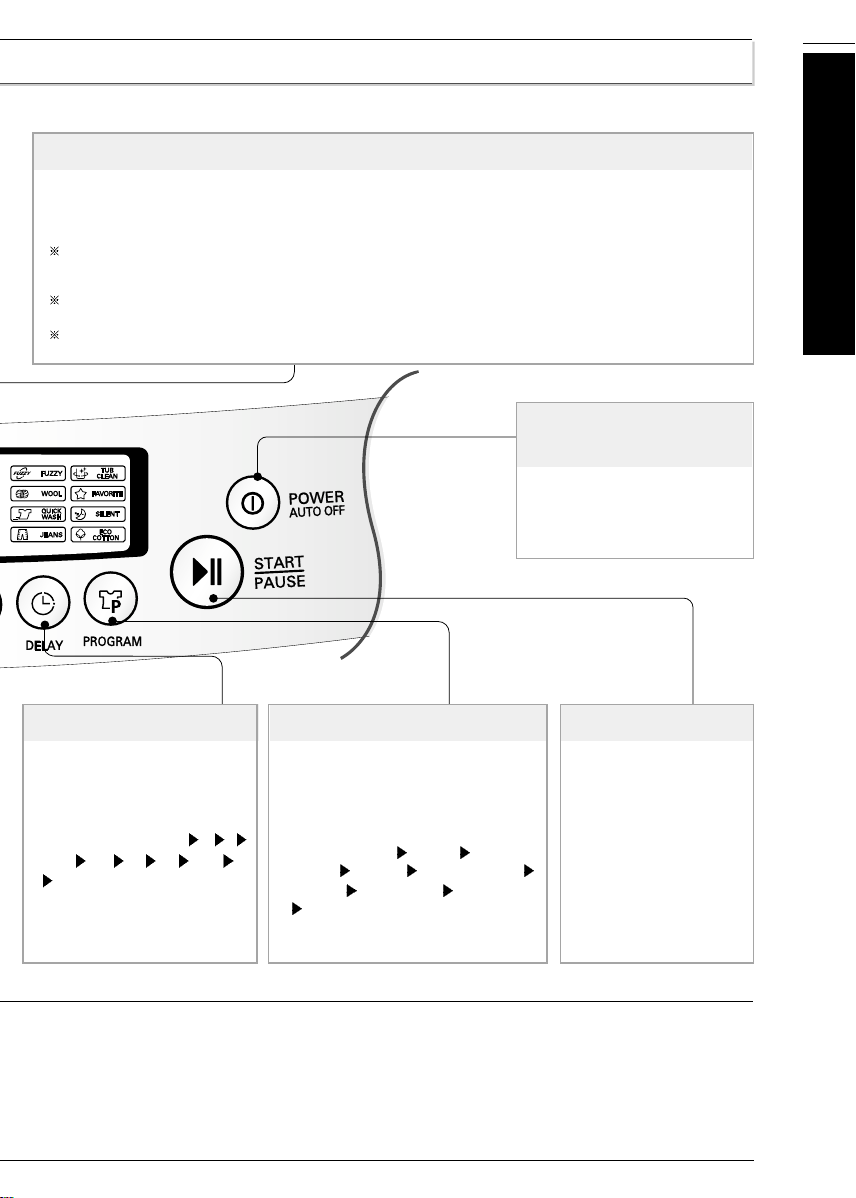
DELAY START (RESERVATION) BUTTON
• Use to set a delayed finishing time.
• The time increases when the button
is pushed.
• The following settings are indicated
as the button is pushed 3
4 5
... 11 12 14 16 ...46 48
3 HOUR.
• To cancel delay time, turn the power
switch off.
(refer to page 24)
TION
k the
vent
NSE
o
e
ull
ions)
WASHING CONDITION INDICATOR (OPTION)
• It only operates in FUZZY Program.
• While the sensor is detecting the washing conditions, the LED flashes green, orange
and red in turn. And, after detecting, the LED lights a specific color according to the detected condition as
follows:
If the current washing condition (Detergent quantity, Water Temperature, water quality, etc.) is determined as
better than the standard one, it optimizes the algorithm to save the energy by decreasing washing time/strength,
and the LED automatically turns to red.
If the current washing condition is determined as worse than the standard one, it optimizes the algorithm by
increasing washing time/strength, and the LED automatically turns to orange.
If the current washing condition is determined as equal to the standard one, the algorithm has no change and the
LED turns to green.
START/PAUSE BUTTON
• Use to start or pause the
washing process.
• The washer will turn off
automatically if left in
Pause mode for longer than
5 minutes.
POWER(AUTO OFF)
BUTTON
• Use to turn the power on or off.
• Push again and power goes on or off
• The power goes off automatically about
10 seconds after the wash is finished.
PROGRAM BUTTON
• Use for selecting wash program.
• This button allows you to select 8
different programs for different kinds of
laundry.
• program selections light up in sequence as
follows: FUZZY
WOOL QUICK
WASH JEANS ECO COTTON
SILENT FAVORITE TUB CLEAN
FUZZY etc. Select the desired
program by pressing the button.
16
Washing Programs
W
ashing Programs
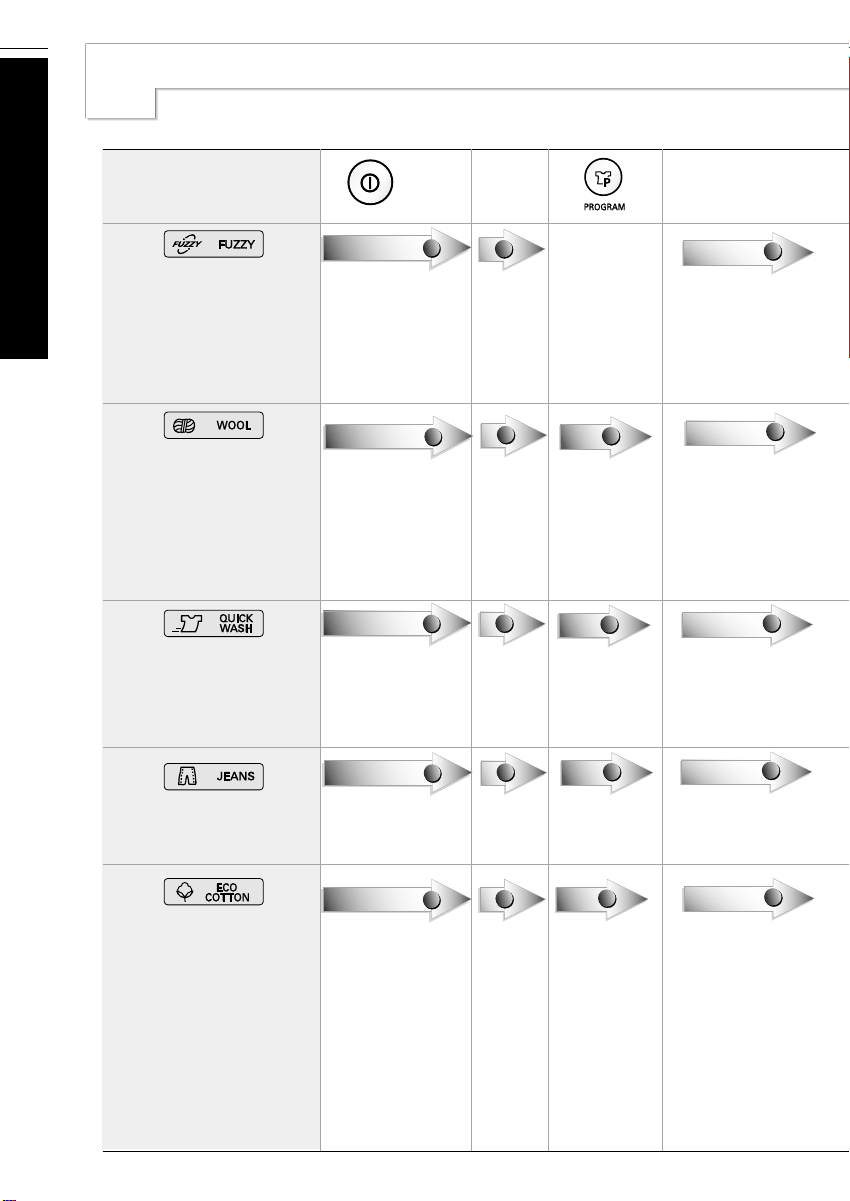
Washing
Programs
Add
the
laundry
Add
the Detergent
This program is for mixed
fabrics which would be
considered a normal, or typical
wash load. It automatically
selects the most appropriate
wash conditions such as wash
action and cycle times by
utilizing the built-in load sensor.
Use this mode when washing
lightly soiled clothes for a short
time. It Is highly recommended
that the laundry load is under
2 Kg for this program.
Eco Cotton is the program for
normally soiled cotton material
and designed to minimize water
consumption. light weight bulky
loads,may require the water
level to be increased manually
as the machine will perceive this
to be the same as a small load.
POWER
AUTO OFF
START
PAUSE
1
1
2
5
4
3
2
• Select the
QUICK WASH
program on
the Control
panel.
•
Add the appropriate quantity of
Detergent as indicated by the
WATER LEVEL next to
WATER DETERGENT.
Or follow the Detergent
manufacturer’s instructions
•
Add the appropriate quantity of
Detergent as indicated by the
WATER LEVEL next to
WATER DETERGENT.
Or follow the Detergent
manufacturer’s instructions
• The pul
seconds
load.
• Then th
the amo
used wi
will be s
Use Jean program when
washing Jeans of different sizes
1
5
3
2
•
Select the
JEANS program
on the Control
panel.
• Spread
the jean
evenly in
the tub
1
5
3
2
• Select the
WOOL
program on
the Control
panel.
Use this program for washing
delicate fabrics such as lingerie and
woolens. (wash only “water
washable” clothes)
Before washing your woolens
check the care label for washing
instructions.
(wash only water washable clothes)
• Use neutral Detergent
appropriate for the
laundry.
• When washing woolens
use a mild Detergent
recommended for
washing wool.
1
5
3
2
• Select the
ECO COTTON
program on the
Control panel.
17
Washing Programs
nt
Close the lid Finish Caution & Note
START
PAUSE
ntity of
y the
ns
uantity of
by the
nt
tions
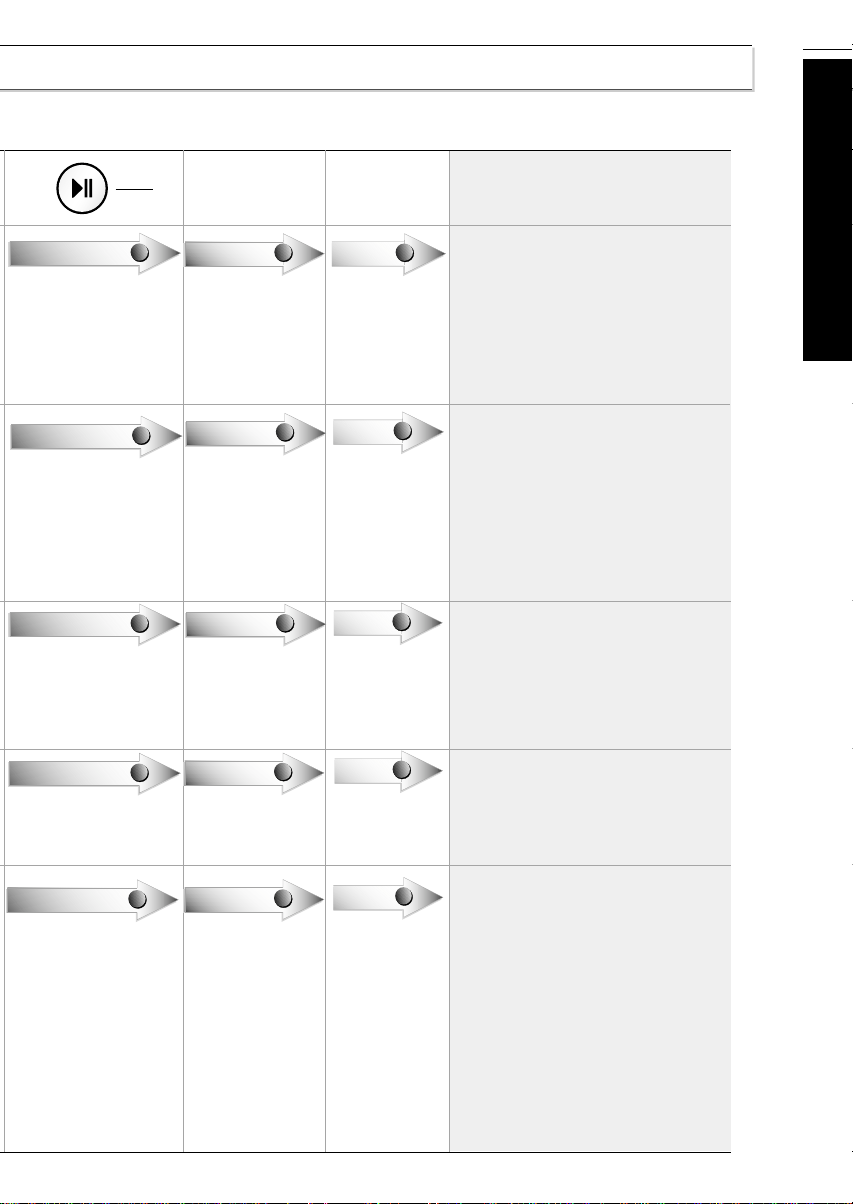
• The pulsator rotates for 8
seconds to detect the laundry
load.
• Then the WATER LEVEL and
the amount of Detergent to be
used will be shown and water
will be supplied.
• Water Water level
will then be topped
up shorly. after the
wash has started to
supplement the
water the laundry
has absorbed.
• When the wash
program ends,
the chime will
sound for 10
seconds before
the Power goes
off automatically.
• The WATER LEVEL will be set to a higher
level automatically if water is already in the
tub,or wet laundry is loaded into the tub
before starting.
• With lightweight bulky loads, a low WATER
LEVEL will be automatically selected
• Changes to Water Temperature
(HOT/COLD) and wash level are possible
during operation.
(refer to page 14)
3
5
6
7
6
7
6
4
4
7
6
4
• When setting the WATER LEVEL Manually,do
not set to medium or lower
in order to prevent damage to the woollen
clothes.
• Washing with HOT water may damage
the clothes. (Water is set to WARM
automatically). Ensure that the load is under 2kg.
• In order to avoid and reduce wrinkles to the
laundry, the spin cycle may appear slow. As a
result,the clothes may contain a higher level of
moisture or water.
gent
e
oolens
ent
• When the water inlet pressure is greater
than 200kpa, The QUICK WASH course
takes approximately 19min.
• There are several times that the bowl will spin slowly.
This is not a malfunction. It is part of the wash action.
INFORMATION FOR ENERGY TEST
• Water Temperature: Select water temperature to suit
wash cycles. Always follow garment manufacture’s
care label or instructions when washing.
• Set program at “Eco cotton, Soil level Normal, Water
temp Warm, Water Level 4,” is for normally soiled
load and test in accordance or in conformity with
AS/NZS 2040.1.
• The test results depend on water pressure, water
hardness, water inlet temperature, room temperature,
type and amount of load, degree of soiling utilized
detergent, fluctuations in the main electricity supply
and chosen additional options.
• For best washing results, we recommend to mix dry
detergent with HOT & COLD water.
7
6
4
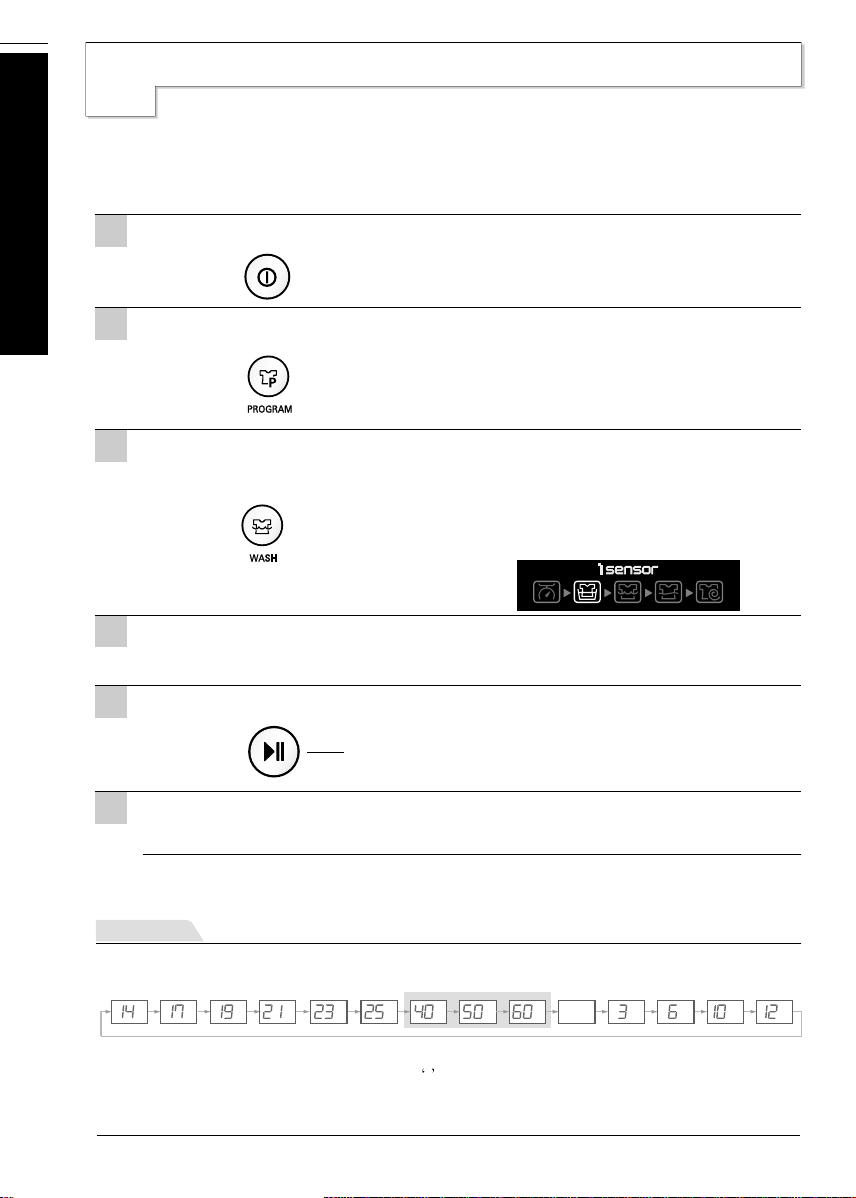
OAK Wash
S
18
Washing Programs
minmin min minminmin min min min min min min min
Lamp
Off
Soak-Wash
Use this mode to wash normal clothes or thick and heavy clothes which are excessively dirty.
SOAK mode can be used with the FUZZY or JEAN or SILENT or FAVORITE program.
START
PAUSE
POWER
AUTO OFF
•
The Soak Function will only operate in Auto wash
(Fuzzy logic mode) by pressing the Wash Button
until the Soak symbol illuminates. The 3 available
Soak +Wash times are 40, 50, or 60 minutes. These
times include the wash time.
• The WATER LEVEL will be shown and water will be
supplied.
Press the POWER (AUTO OFF) button to turn power on.
Press the PROGRAM button to select the washing program.
Add the laundry and press the START/PAUSE button.
• When the wash program ends, the chime will sound for
10 seconds before the Power goes off automatically.
Finish
Press the WASH button, to select SOAK program.
• The appropriate quantity of Detergent marked next to the
WATER LEVEL of WATER-DETERGENT.
Add the Detergent.
• The water level will topped up 2 minutes after the wash has
started to supplement the absorbed water by the laundry.
Close the lid.
START
PAUSE
START
PAUSE
START
PAUSE
1
3
4
5
6
2
NOTE
• Order of Soak-Wash timing
• Select soaking time 40 minutes, 50 minutes, or 60 minutes (including washing time) by pressing the Wash
button repeatedly whilst in Auto program cycle (
F is shown in the display).
• If necessary, select the number of Rinses and the time for Spinning by pressing the Rinse or Spin buttons
until you reach the desired times.
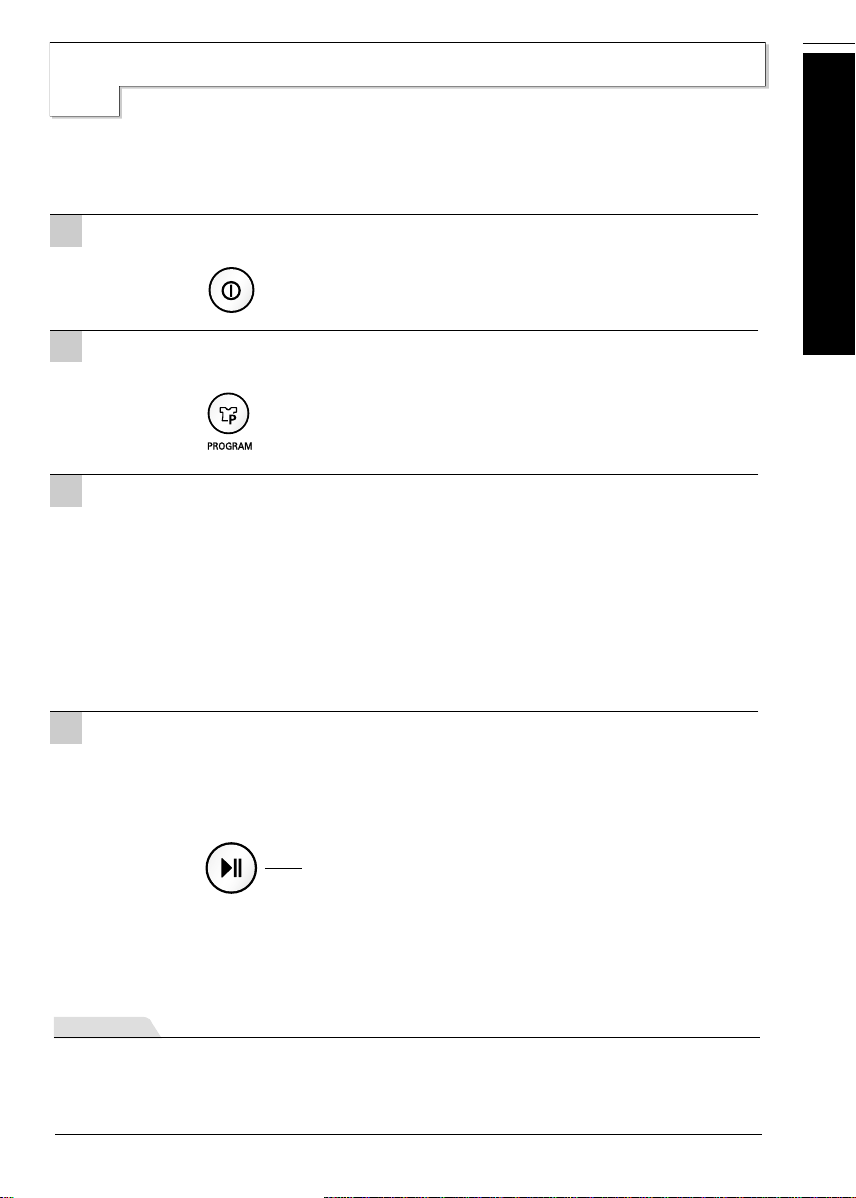
AVORITE Wash
F
19
Washing Programs
rty. Pressing the FAVORITE button allows you to store your FAVORITE wash conditions in the
normal cycle memory and then recall it for use at a later time.
START
PAUSE
POWER
AUTO OFF
as
• Press the WATER TEMP. button to select wash Water
Temperature.
• Press the WATER LEVEL button to select WATER
LEVEL.
• Press the WASH button, the RINSE button & the SPIN
button to select wash time, number of rinses & spin time
that you want to store.
•
The Favorite wash cycle will then be stored only after
the machine has completed the cycle and has powered
off. It can then be recalled again after turning the
machine back on again.
Press the POWER (AUTO OFF) button to turn power on.
Select the FAVORITE program.
Select your FAVORITE wash conditions.
Press the START/PAUSE button to start your FAVORITE wash cycle.
Power turns off automatically after wash.
START
PAUSE
1
2
3
4
NOTE
To recall your FAVORITE cycle.
1. Press POWER on.
2. Select the FAVORITE cycle by pressing the PROGRAM.
3. Press the START/PAUSE button. Then the wash cycle starts.
h
START
PAUSE
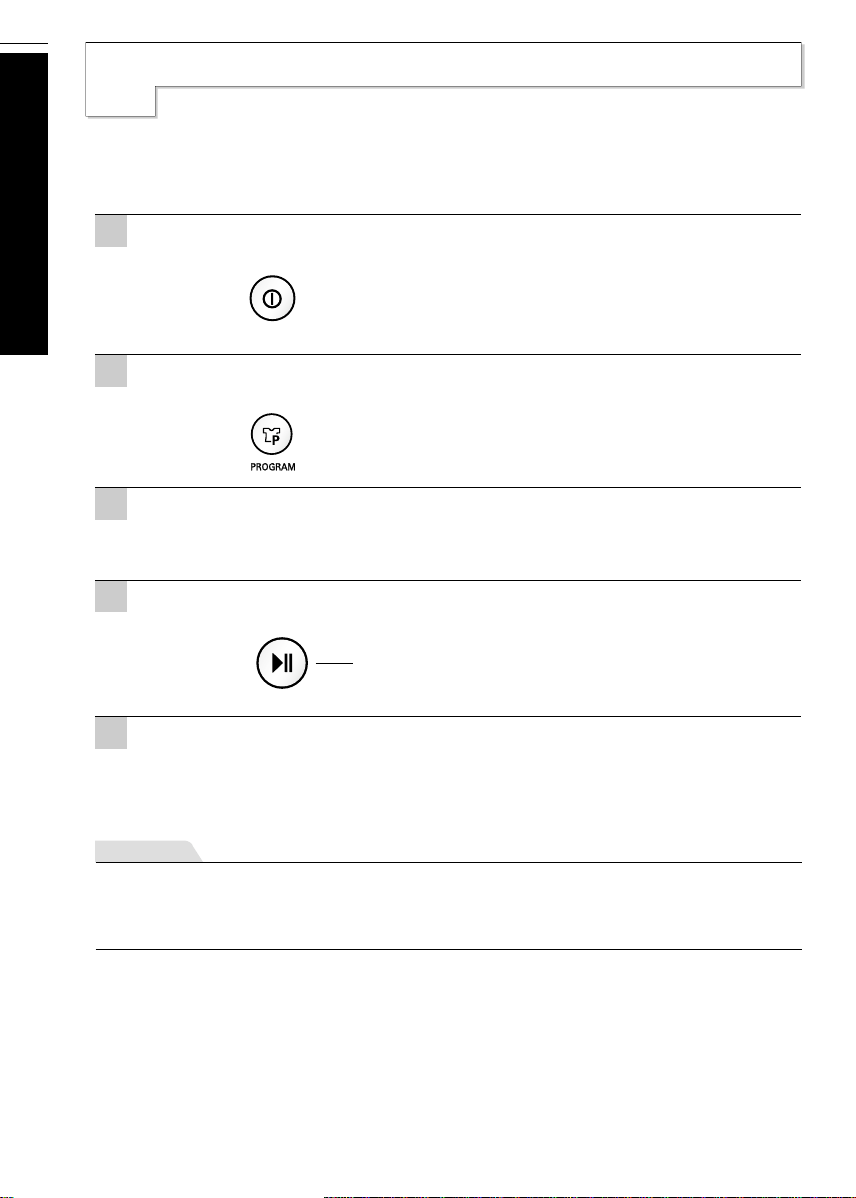
ILENT Wash
S
20
Washing Programs
Use this program to wash quietly in SILENT especially during late night and dawn.
START
PAUSE
POWER
AUTO OFF
Press the POWER (AUTO OFF) button to turn power on.
Press the PROGRAM button to select SILENT program.
Press the START/PAUSE button.
Add the laundry into the washing tub.
Add the Detergent and close the lid.
START
PAUSE
START
PAUSE
1
3
4
5
2
NOTE
• SILENT program is longer in wash time than FUZZY program.
• To reduce noise in spinning, spin rpm is lower than normal spinning rpm. So the laundry will
have more moisture remaining than normal.

UB CLEAN
T
21
Additional Function Program
START
PAUSE
If scrud is allowed to build-up in the machine it can result in stains on your clothes or give an
unpleasant smell in your washer.
Scrud is the waxy build-up that can occur within any washer when the fabric softener comes into
contact with Detergent in conjunction with excessive soap usage and cold water. The Tub Clean
function can help prevent scrud build up. by cleansing the inner and outer bowl.
START
PAUSE
POWER
AUTO OFF
Press the POWER (AUTO OFF) button to turn power on.
Press the PROGRAM button to select the TUB CLEAN program.
When the machine has stopped filling, Add 300ml of oxygenated bleach or a
descaling product.
Press the START/PAUSE button.
START
PAUSE
1
3
4
5
2
NOTE
NOTE
• Before using this program remove lint inside lint filter.
• When using this program, do not place any laundry inside tub.
• After using this program, remove dirt inside filter.
• After finishing this program, open the lid of the washer to help remove any irritating odor.
• Do not pour bleach directly into the tub. It might cause damage to the tub.
• Do not leave diluted oxygenated bleach inside tub for a long time as this may cause the tub to rust
and corrode.
• The remaining diluted oxygenated bleach water must be drained out.
• Use this program once every month.
• Do not use this program repeatedly each time.
• When the lid is open the machine will not operate, and
chime sound will remind you to close the lid.
• The display will show the time remaining.
• Do not use Detergent or softener.
• Do not place any laundry inside tub.
• Do not use the Detergent box.
•
Powdered detergent is recommended when using the delayed start function.
Close the lid.
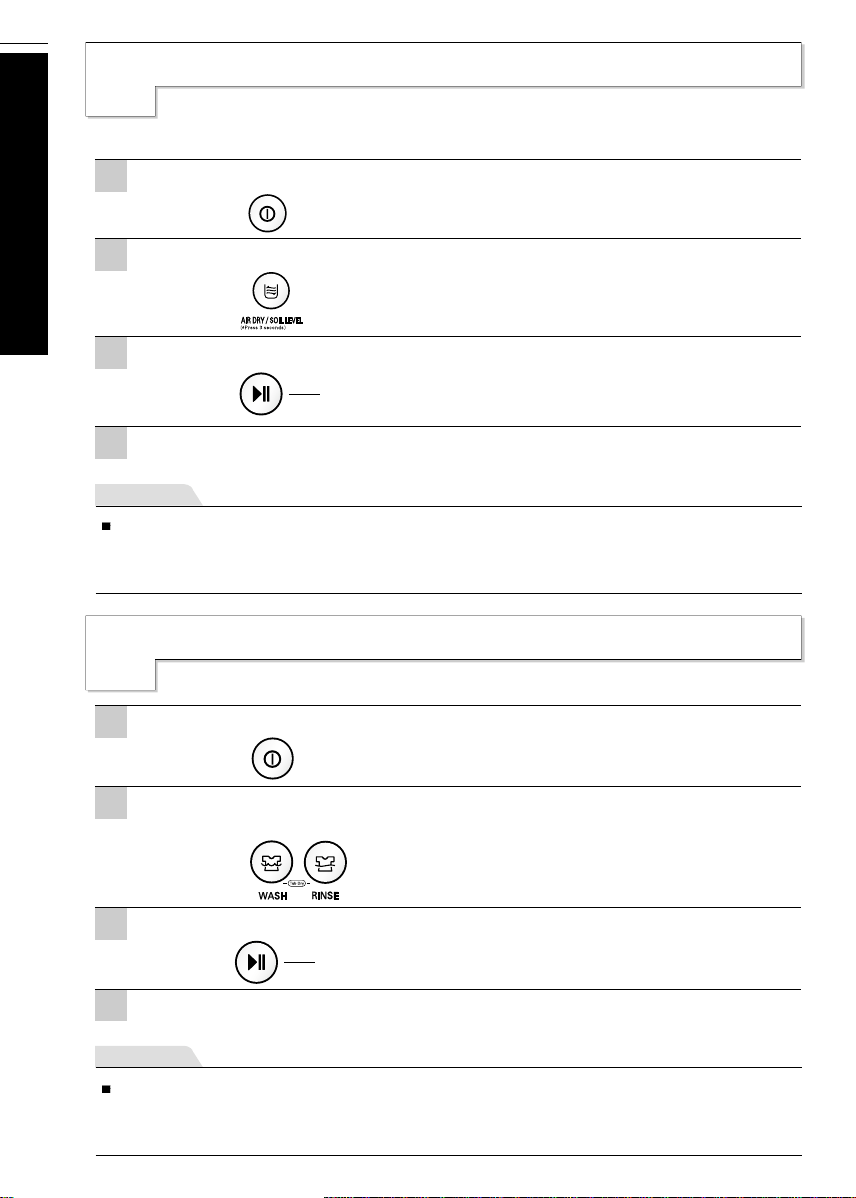
IR DRY
A
22
Additional Function Program
AIR DRY can be used to further remove moisture after the wash cycle by subjecting
the load to air currents within the machine. This function will not dry clothes completely
and should only be used for loads under 2 kg.
UB DRY
T
START
PAUSE
POWER
AUTO OFF
Press the POWER (AUTO OFF) button to turn power on.
When you press the Air dry button for 3 seconds, the Air dry course will be
selected.
Press the START/PAUSE button.
Close the lid. When the function is complete, a buzzer will sound and the
unit will turn off automatically after 10 seconds.
START
PAUSE
1
3
4
2
NOTE
When you select Air dry foir more than 60 minutes
1) You can reduce the drying time by minimizing the moisture in the laundry.
2) Always keep the laundry amount to 2kg or less and make sure to spread it out evenly.
3)Select 60 minutes for cotton laundry and 120 minutes for synthetic fiber laundry for effective Moisture removal.
NOTE
When you select Tub Dry
1) Use this function to minimize the growth of mold from the residual moisture within the laundry.
2) When you select the Tub Dry course, do not put any laundry or detergent in the drum.
3) It is good to use this about once a week.
• When the Air dry is selected, other buttons will be inactive.
• If you want to cancel the Air dry function, press the Power button.
START
PAUSE
POWER
AUTO OFF
Press the POWER (AUTO OFF) button.
When you press the Wash and Rinse button simultaneously, the Tub Dry course
will be set or canceled.
Press the START/PAUSE button.
The power will turn off 10 seconds after the chime has indicated that the Tub
Dry cycle has completed.
START
PAUSE
1
3
4
2
• When you select the Tub Dry, do not put any laundry in the drum.
• When Tub Dry is selected, other buttons will be inactive.
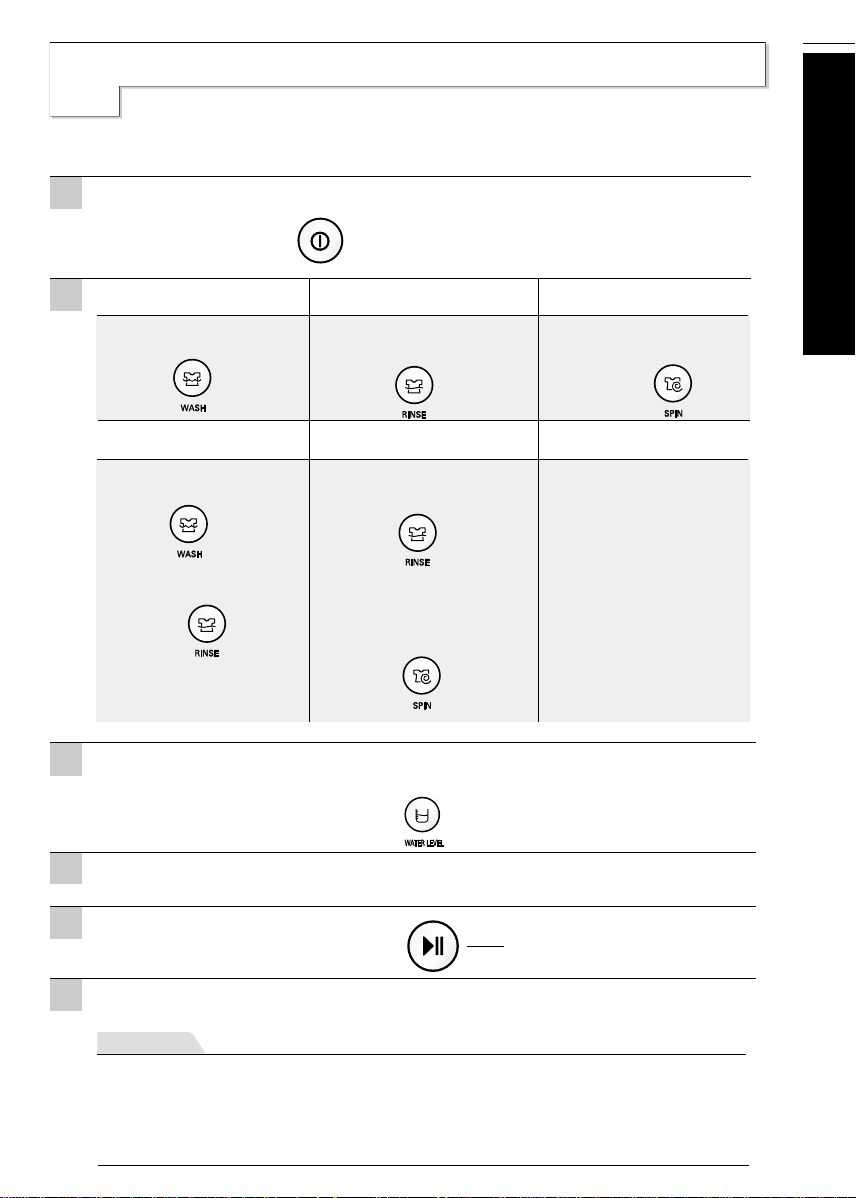
ption Washing
O
23
Additional Function Program
When you only need the Wash, Wash/Rinse or Rinse cycles, these can be set manually.
Add the laundry into the washing tub.
Press the START/PAUSE button.
Press the WATER LEVEL button, to control the water level according to the
amount of laundry. If you do not choose anything, a medium water level is
selected automatically.
Add the detergent and close the lid.
START
PAUSE
3
4
5
6
2
Press the POWER (AUTO OFF) button to turn power on.
START
PAUSE
POWER
AUTO OFF
• When a Wash, Wash/Rinse or Rinse only option is selected, after the wash is completed the water will not
be drained off. If you wish to drain the water, press SPIN button and wait until the water in the tub has drained
completely. Then press the START/PAUSE button.
• If you do not specify the water level, then Medium will be automatically selected.
• If only Rinse is selected,
the display will indicate the number of rinses and commence filling.
NOTE
Press the
RINSE
button to
select the desired number
of rinses.
Only Rinse
Press the
SPIN
button to
select the desired spin
duration.
Only Spin
START
PAUSE
1
Press the
WASH
button to
select the desired timing.
START
PAUSE
Only Wash
Press the
RINSE
button to
select the desired number
of rinses.
Press the
SPIN
button to
select the desired spin
duration.
Only Rinse,Spin
When you want to only
drain, wait until the water
in the washing tub drains
completely.
Only Drain
Press the
WASH
button to
select the desired timing.
Press the
RINSE
button to
select the desired number
of rinses.
You can use this option to
help reduce excessive
wrinkling of garments
Only Wash,Rinse
START
PAUSE
START
PAUSE
START
PAUSE
START
PAUSE
START
PAUSE
n.
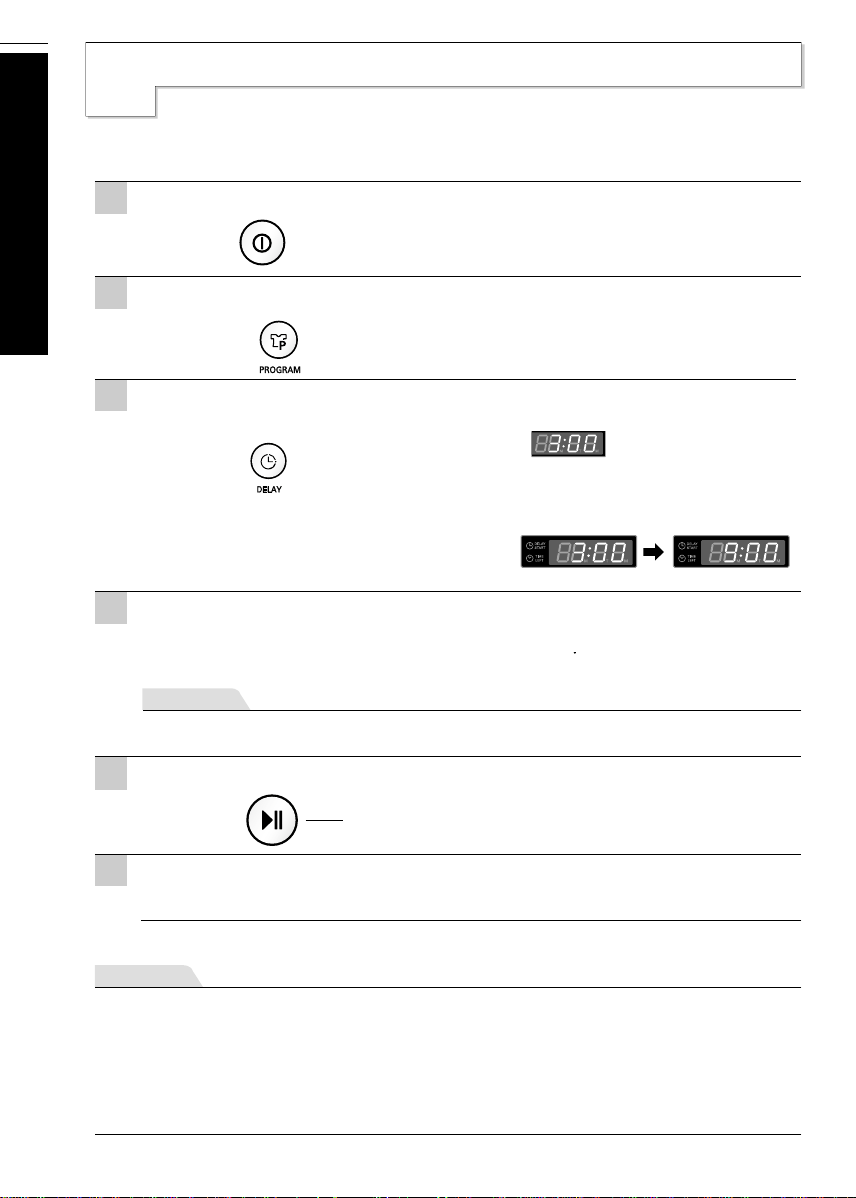
ELAY START (RESERVATION) Wash
D
24
Additional Function Program
POWER
AUTO OFF
DELAY START (RESERVATION) Wash is used to delay the finishing time of the operation.
The hours to be delayed can be set by the user accordingly.
The time on the display is the finishing time, not the start time.
• When you press the START/PAUSE button the light will
blink.
• Select the program for laundry on the Control panel.
This program will not work in WOOL and TUB CLEAN
Program.
Press the POWER (AUTO OFF) button to turn power on.
Press the PROGRAM button to select the washing program.
Add the laundry and press the START/PAUSE button.
START
PAUSE
• The appropriate quantity of Detergent marked next to the
WATER of WATER DETERGENT.
• When the lid is open the machine will not operate, and an
alarm signal will remind you to close the lid
Add the detergent to the dispenser draw.
•
Water will then be let in again 2 minutes after the wash
has commenced to supplement the water that the
laundry has absorbed.
Close the lid.
• The washing will be finished according to the delayed time.
Finish
START
PAUSE
1
2
4
5
6
3
• The light will ‘DELAY’ turn on and
‘TIME LEFT’ will be marked.
• Press the button repeatedly to set the desired finishing time.
For example, To finish washing in 9 hours from now,Press
the DELAY START button repeatedly until 9:00 appears in
the display.
Press the DELAY START (RESERVATION) button.
(RES.=DELAY)
• Finishing time can be delayed from 3~48 hours. Delaying from 3~12 hours can be done in 1 hour time intervals
and from 12~48 hours in 2 hour time intervals.
• If the lid is open, the machine will not work, a chime will sound repeatedly to remind you to close the lid.
• To select washing time, rinsing times, spinning time, water level, hot/cold or wash power manually, press the
DELAY START (RESERVATION) button and select the desired option. Then press the START/PAUSE button.
• When the laundry cannot be taken out immediately after the wash program ends, it is better to omit the spinning
program . (The laundry will be wrinkled if left for a long time after spinning.)
•
Powdered detergent is recommended when using the delayed start function.
NOTE
NOTE
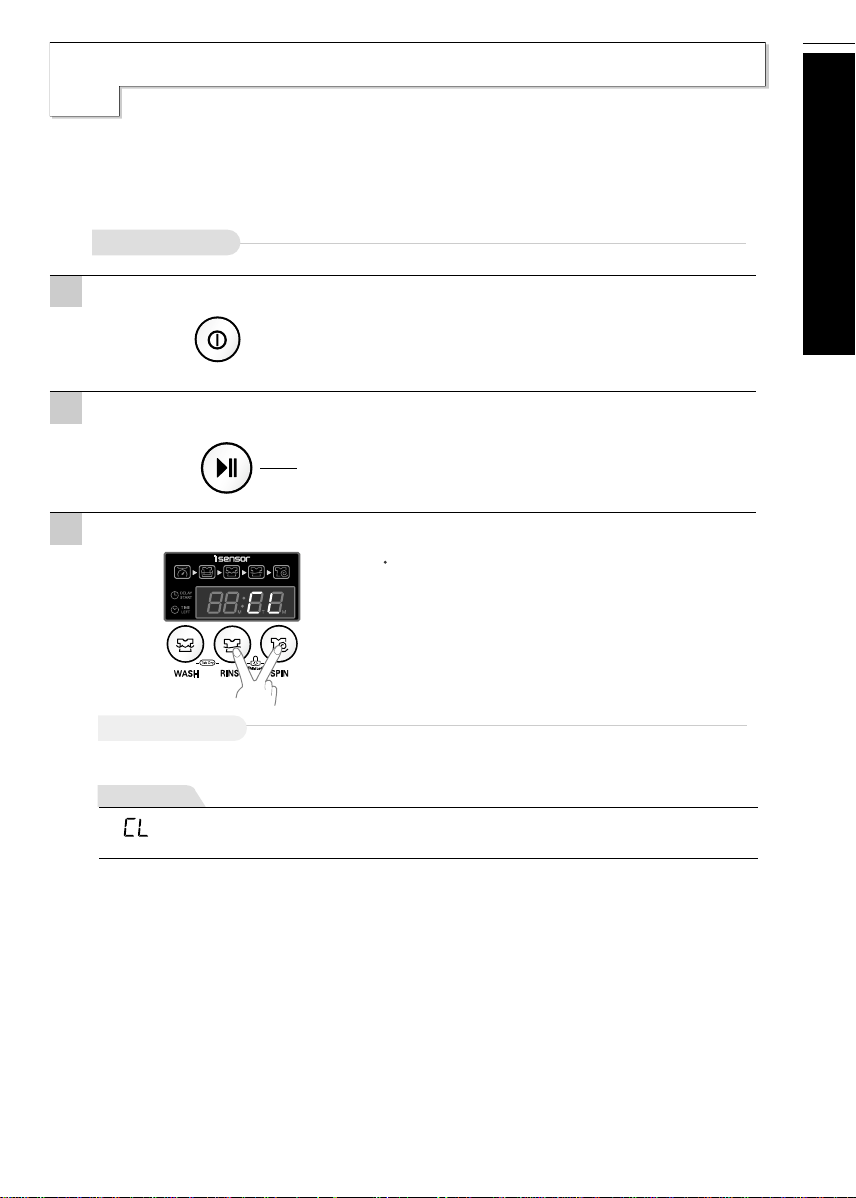
ther Useful Functions
O
25
Additional Function Program
tion.
sh
e.
• After all washing conditions are set according to the manual.
Press the POWER (AUTO OFF) button.
Press the START/PAUSE button to start washing.
START
PAUSE
• Turn Power on.
POWER
AUTO OFF
If you want to lock all the keys to prevent settings from being changed by a child, you can use the
child lock option.
Child Lock Function
How to Lock
2
1
• During the wash program, all the buttons are locked
until washing is completed or the child-lock
function is deactivated manually.
• The child lock function cannot be activated in standby
mode.The child lock function can ONLY be activated
once a wash program has started.
Press both the RINSE button and the SPIN button simultaneously.
If you want to use the washing machine without the chime sounds, press both the WASH and SPIN buttons
simultaneously.
work again press both the WASH and SPIN buttons simultaneously one more time.
If you want to unlock during wash, press both the RINSE and the SPIN button simultaneously again.
Mute Option
To see the remaining time for each process, press one of the WASH, RINSE and SPIN buttons.
The remaining time for each process will appear for about 1 second.
Seeing Remaining Time
How to Unlock
• “ ” & the remaining time are alternatively shown on the display while the Child Lock is active.
NOTE
3
.
n
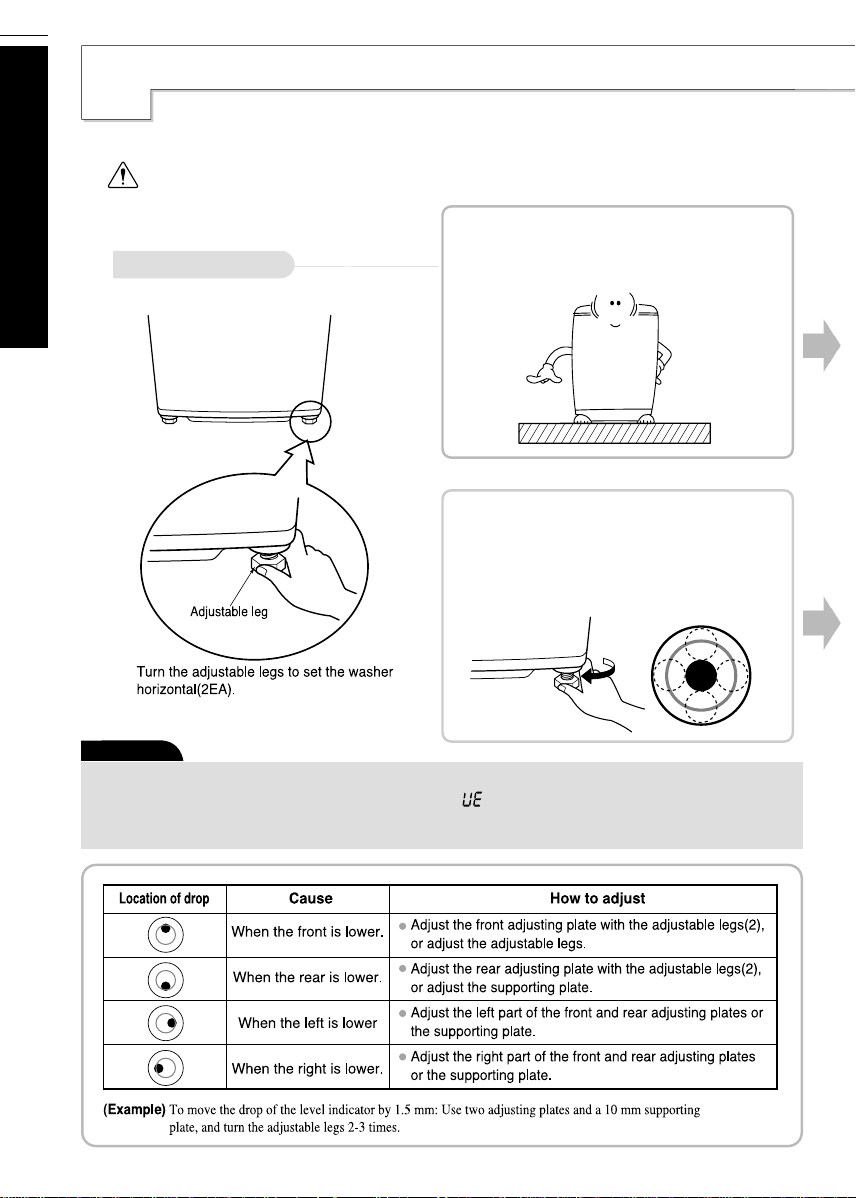
26
Installation
nstallation
I
How to adjust level
Improper installation of the washer may cause noise and malfunctioning.
1. The ventilation openings in the base area must not be ostructed by carpet when the washing
machine is installed on a carpeted floor.
2. Install the washing machine on a solid, level surface.
Caution
Caution
• If the washer is installed on an uneven, weak, or slippery tiled floor, it can cause excessive
vibration leading to spin failure, indicated by a " " error. It must be placed on a solid and
level floor to prevent spin failure.
C
1
Installation area
• Install the washer on a solid and level surface.
4
Horizontal setting
• Lift up the front of the washer and guide the
level indicator bubble to the center by turning
the adjustable legs clockwise or using the
adjusting plate.
2
• O
le
5
• P
co
w
• C
le
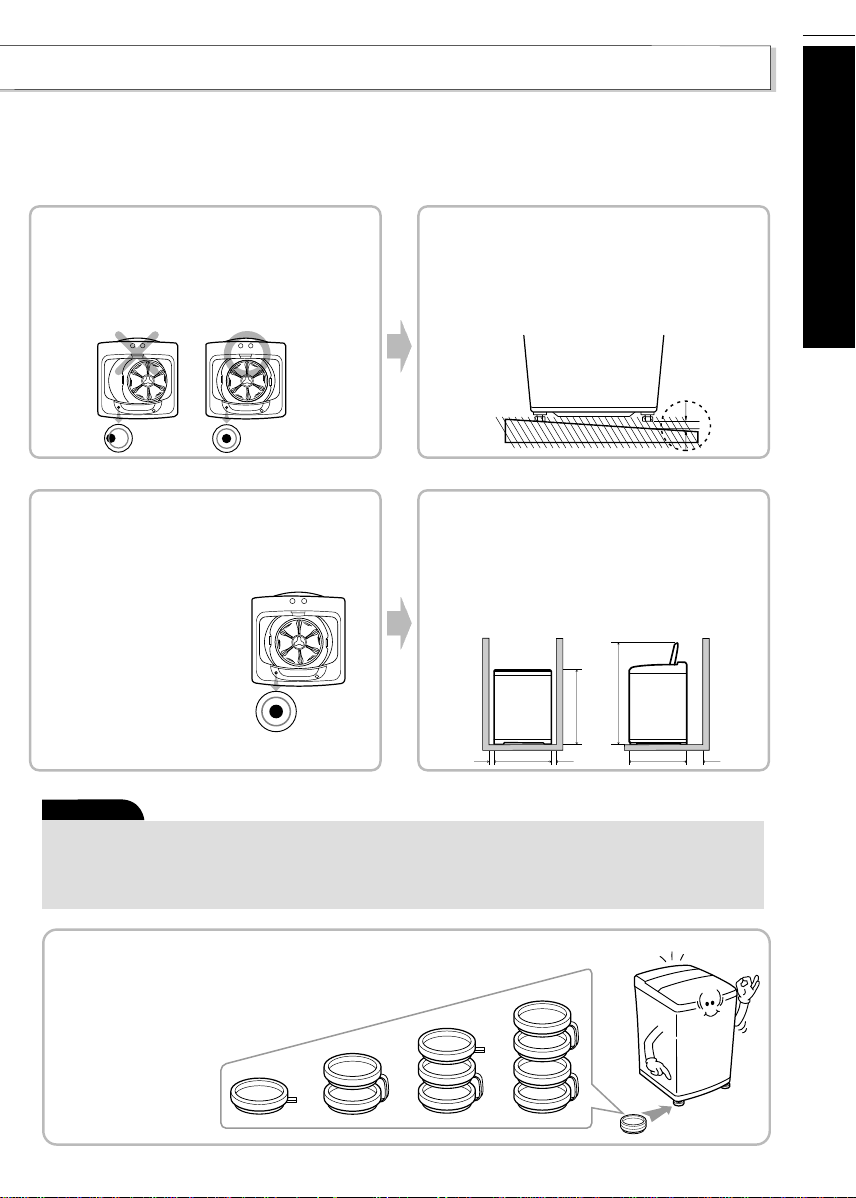
27
Installation
63.2cm
102cm
132cm
2cm 67cm 10cm2cm
Caution
• If the appliance is supplied from an extension cord or multi-outlet power board the extension
cord or multi-outlet power board should be positoined so it is not subject
to splashing of water or moisture ingress.
2
Checking level
• Open the lid and check if the washer is correctly
leveled by refering to the level indicator.
5
Confirming level
• Place the washer to original position and
confirm the level as in figure 2. (Try to shake the
washer and confirm the level.)
• Check the location of the
level in the front of washer.
3
Checking slope
• Check if installation surface is tilted.
(Try to shake the washer and check if the
washer is firmly installed.)
6
Distance between drain hose at the rear and
the wall
• Distance between drain hose and the wall should
be more than 10cm, and the distance between
the wall and the sides of the washer should be
more than 2cm.
How to use the rubber adjusting plates
• Use the adjusting plates to level the washer when the
adjustable legs cannot cover the gap.
C
28
Installation
I
nstallation
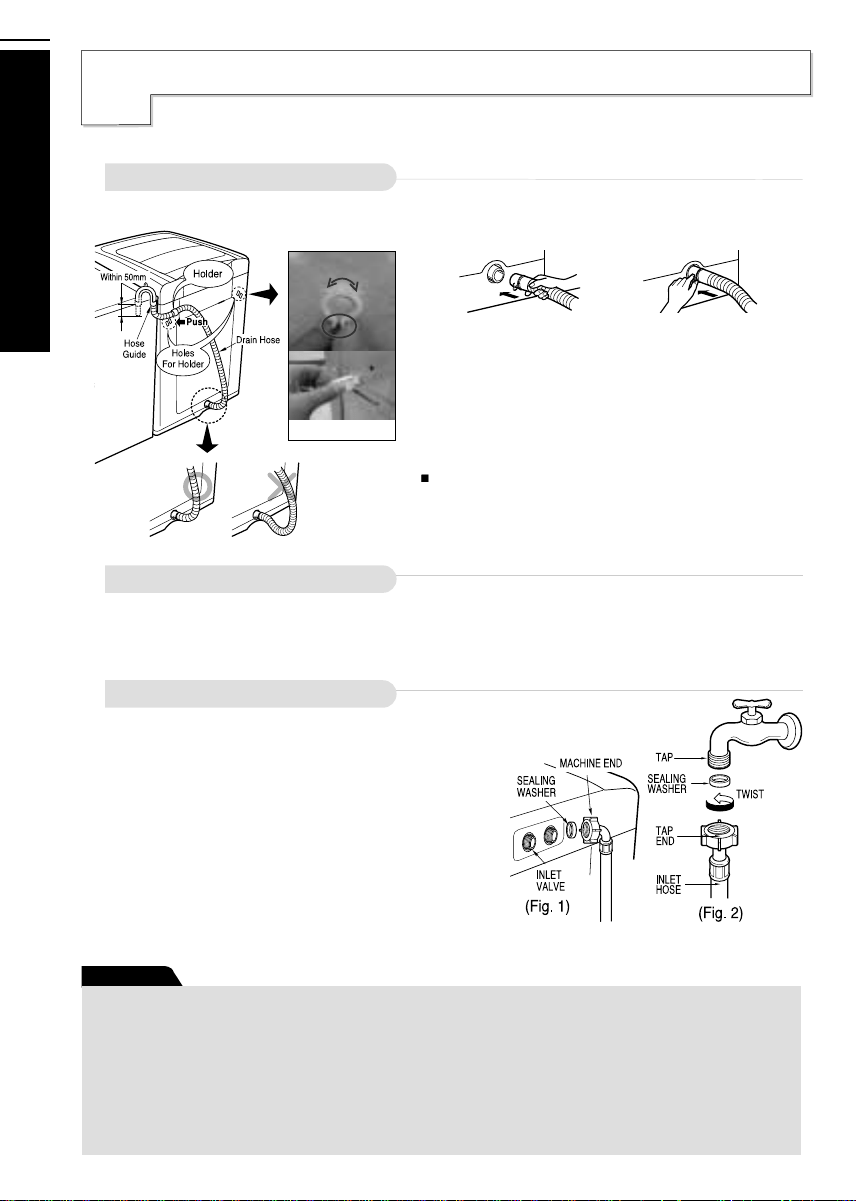
How to install the drain hose
1. Fit the machine end of the drain hose to the outlet of the drain
pump and tighten the clamp.
2. Put the other end of the drain hose over the standpipe or wash tub.
3. Fit the plastic holder into the holes located at either side of
the rear of the machine. The holder will fit in either
direction according to location of the standpipe.
4. Make sure that the holders the drain hose firmly so that the
drain hose does not hang down as shown in the fig.
Flooding drainage
• Your machine requires a floor drainage slope Or hole that will SAFELY DISPOSE of the FULL FLOW of
any water that may leak out should the machine malfunction.
It is therefore the OWNER'S RESPONSIBILITY to make sure this machine is installed in an area with a
drain hole (or slope)that will prevent any possibility of water damage to floor coverings or property.
Connect the inlet hose
• Check that sealing washers are firmly seated.
• Attach the curved end of the hose to the inlet valve of the washing
machine; Tighten the coupling nuts securely by hand.(Fig.1)
• Attach the straight end of the hose to the tap.
Tighten the coupling nuts securely by hand.(Fig.2)
• Either hose can be attached to the hot inlet valve and tap.
• Turn on the taps and check for leaks. Do not use any tools or over
tighten. Hoses should be hand tightened only. A soft cloth can be
used to help tighten if necessary. Tighten the coupling nuts firmly
if there is any leakage.If the inlet water pressure is high,only
partially open the tap to reduce the pressure to the washer. Refer
to the allowable inlet pressures on page 28. High or low pressures
may cause a malfunction.
Caution
• Do not install the washer
outdoors, or where
where it is directily exposed to sunlight, wind, rain, etc.
• Plug the power cord of this washer into a properly installed 240 volt 50Hz. power point that is switched & earthed.
• Permissible water temperature : Max 60˚C(140˚F)
• Permissible water pressure : Max 87 psi (600 kPa, 6.0 kg/cm
2
), Min 7.2 psi (50 kPa, 0.5 kg/cm
2
)
• If water temperature &pressure is greater than above,it may cause damage to the machine. If you have uncontrolled
water temperature &pressure you should fit a temperature &pressure relief valve to ensure that water temperature
&water pressure remains within the safe limits.Consult a plumber or electrician if you are unable to adjust water
temperature and pressure.
• Do not over tighten the coupling nuts with a tool.The Inlet valves have a plastic thread. : Do not strip or crossthread.
NOTE
• To prevent syphoning, the drain hose should not extend more
than 50 mm from the end of the hose guide.
• The discharge height must be approximately 0.9~1.2m from
the floor.
Pick
Insert holder
29
Installation
C
onnecting Water Supply Hose
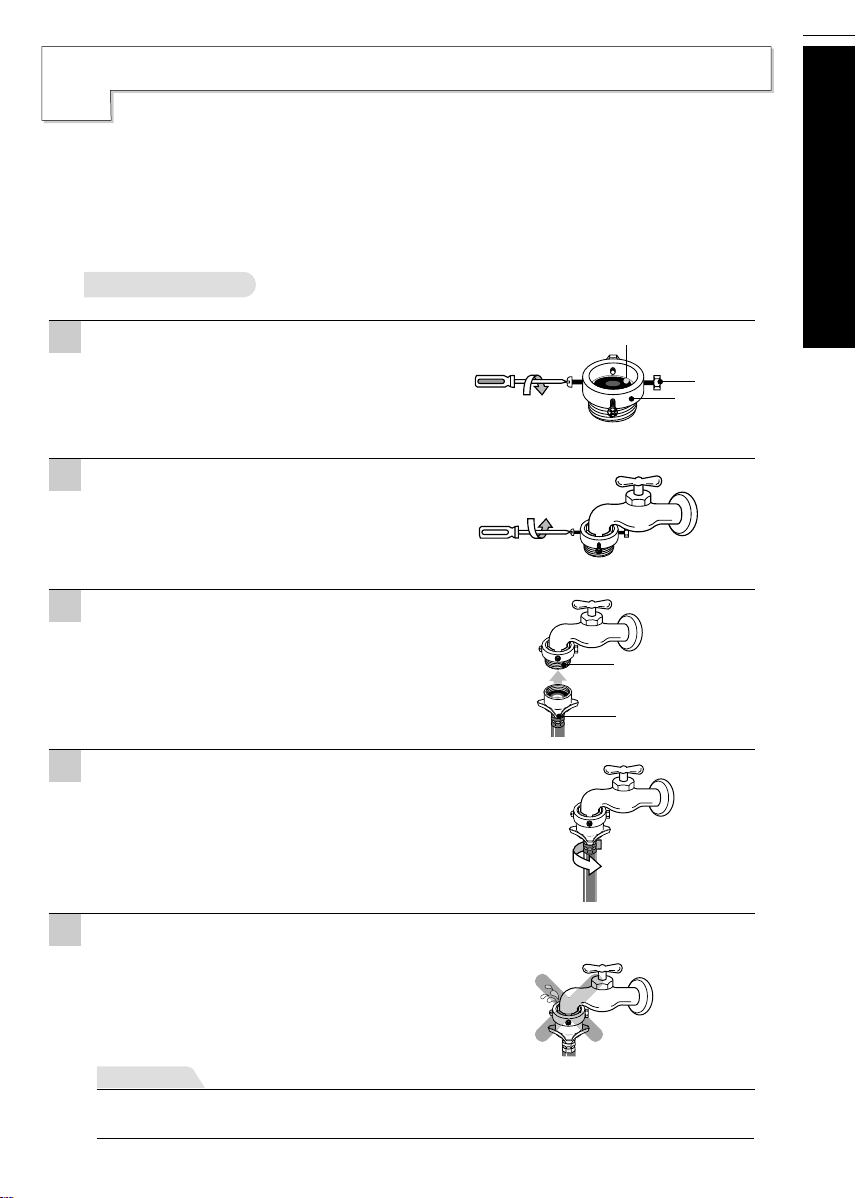
Before connecting the Water Supply Hose to the water tap, check the hose type and then
choose the correct instruction here under.
Note that the Water Supply Hose supplied may vary from country to country.
Connecting Water Supply Hose to water tap
Connector
Connector
Water
Supply Hose
screw
Untighten the screw
Untighten the screw of the connector so that the
tap can be placed in the middle.
Fixing the connector to the tap
Push the upper connector up till the rubber
packing is in tight contact with the tap. Then
tighten the 4 screws.
Attach the water supply hose securely to the
connector
Push the water supply hose vertically upwards so
that the rubber seal within the hose can adhere
completely to the tap.
Check the connection of water supply hose and the connector
After connecting the hose, open the tap to check
for any water leakage.
If the water leaks, close the tap and start again
from step 1
Fixing the connector to the water supply hose
Attach the water supply hose to the connector and
then tighten it by screwing it to the right.
Normal Type
(Normal tap without thread & screw type inlet hose.)
1
2
3
4
5
Rubber packing
NOTE
The washing machine is to be connected to the water mains using new hose-sets and old hose-sets should
not be reused.
ub.
Co
1
2
3
onnecting Water Supply Hose
C
30
Installation
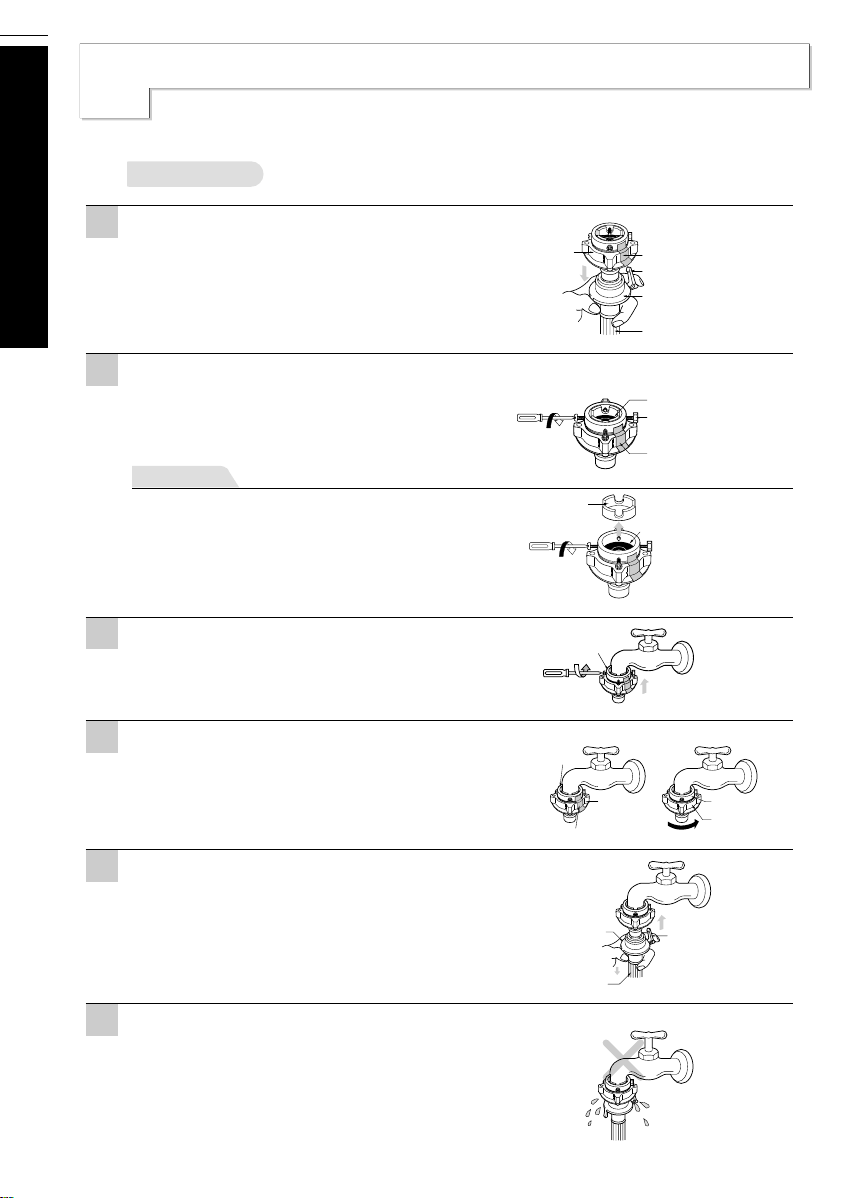
Rubber packing
Rubber packing
Fixed sticker
screw
Guide plate
Connector
Connector
Fixed sticker
Middle
Connector
Middle
Connector
Water Supply Hose
Pressing rod
Pressing handle
Connector
Middle
connector
Fixed Sticker
Pressing Handle
Pressing Rod
Water Supply Hose
Separate Middle connector from Water Supply Hose
Separate Middle connector from the Water
Supply Hose by pulling the Pressing Rod and the
Pressing Handle that is attached to the Water
Supply Hose.
Loosen the fixed nuts to connect the connector to the tap
Untighten the screw of the connector so that the
tap can be placed in the middle.
Fixing Connectors to the Tap
Push the upper connector up till the rubber
packing is in tight contact with the tap. Then
tighten the 4 screws.
Fixing Upper Connector and Middle Connector
Remove the fixed sticker in between the Upper
and Middle Connectors. Tighten the connectors
by holding one connector and twist middle
connector to the right.
Connecting Middle Connector and Water Supply Hose
Press down the pressing rod of the Water Supply
Hose which was separated from middle connector
(refer to Step1) and then join it to the middle
connector.
Normal Type
If the tap diameter is too large or is square,
untighten the 4 screws and remove the guide
plate. Then follow step1.
In case tap is too large.
NOTE
Check for water leakage
After connecting the hose, open the tap to check
for any water leakage.
If the connection leaks, close the tap and start
again from step 1.
If you skip step 1, water leakage may occur.
(Normal tap without thread & one touch type inlet hose.)
1
2
3
4
5
6
31
Installation
C
onnecting Water Supply Hose
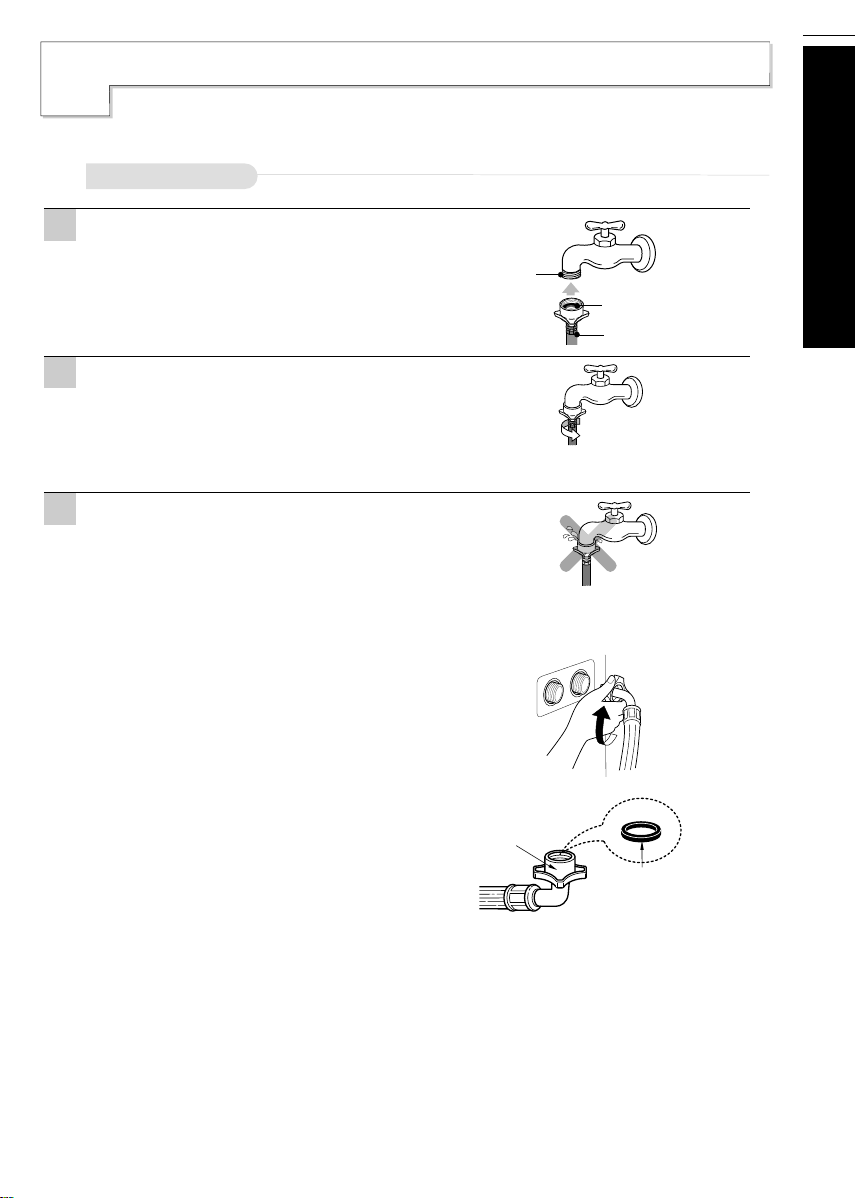
Attach the water supply hose to the tap.
Push the water supply hose up so that the rubber
packing within the hose can adhere completely to
the tap.
Connect the water supply hose to the tap.
Connect the water supply hose to the tap and then
tighten it by screwing it to the right.
Check water leakage.
After connecting the hose at both ends, open the
tap to check for any water leakage.
• Connect the water supply hose to inlet valve of
the washing machine, and then lock it by turning
the hose connecting part.
• Check to see if there is a rubber seal inside the
connector.
Screw Type
Water Supply Hose
Rubber Packing
Hose connector
Rubber seal
Water
tap
Connecting Water Supply Hose to the machine
1
2
3
rounding Method
G
32
Care and Maintenance
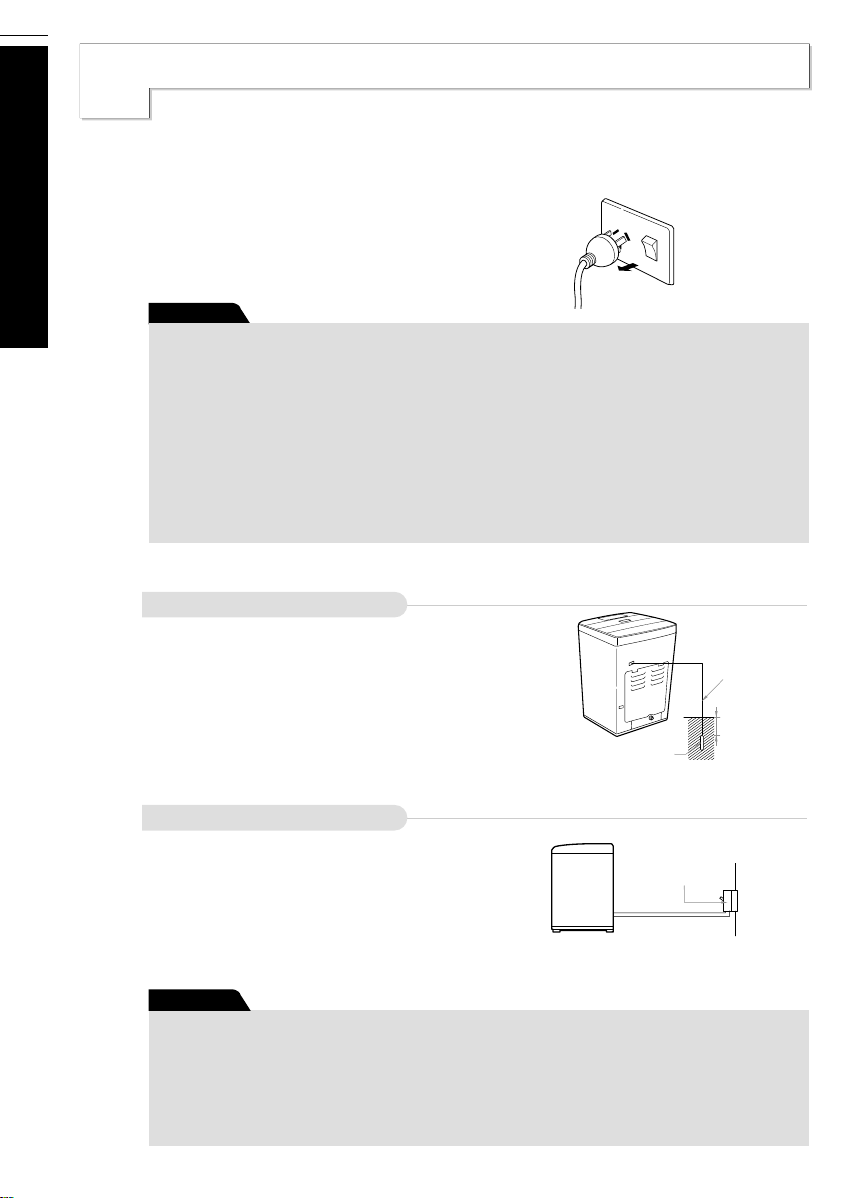
Earth wire should be connected.
If the earth wire is not connected, there is possible a danger of electric shock caused by
the current leakage .
Grounding Method with Ground insert space Terminal
Other Grounding Method
If the AC outlet has a ground terminal, then separate
grounding is not required. Note that AC power outlet
configurations may differ from country to country
If grounding methods described above are not
possible, a separate circuit breaker should be
employed and installed by a qualified electrician
Ground Wire
Ground Copper Plate
Short-circuit
breaker
• To prevent a possible explosion, do not connect ground to a gas pipe
• Do not connect ground to telephone wires or lightning rods. This may be dangerous during electrical
storms
• Connecting ground to plastic has no effect
• If an extension cord is used it must contain a grounding terminal at both ends. A double insulated
extension cord must not be used.
Using a Short Circuit Breaker
Connect the Ground Wire to a Ground Copper
Plate and bury it more than 75cm in the ground.
Burying Copper Plate
Caution
75cm
Caution
CAUTION concerning the Power Cord
Most appliances recommend they be placed upon a dedicated circuit; that is, a single outlet circuit which powers
only that appliance and has no additional outlets or branch circuits. Check the specification page of this owner's
manual to be certain. Do not overload wall outlets. Overloaded wall outlets, loose or damaged wall outlets,
extension cords, frayed power cords, or damaged or cracked wire insulation are dangerous. Any of these
conditions could result in electric shock or fire. Periodically examine the cord of your appliance, and if its
appearance indicates damage or deterioration, unplug it, discontinue use of the appliance, and have the cord
replaced with an exact replacement part by an authorized servicer. Protect the power cord from physical or
mechanical abuse, such as being twisted, kinked, pinched, closed in a door, or walked upon. Pay particular
attention to plugs, wall outlets, and the point where the cord exits the appliance.
To
C
leaning and Maintenance
33
Care and Maintenance
by
e
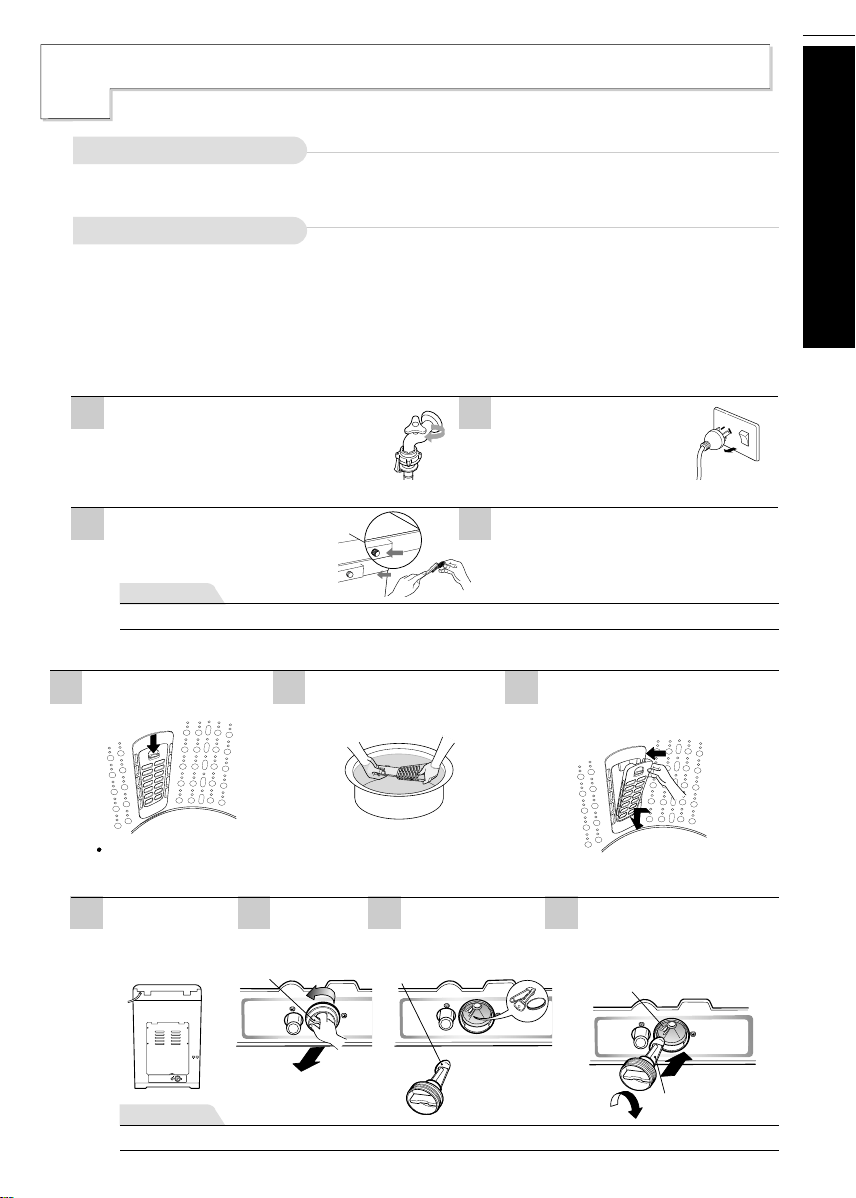
When water supply into the tub is not clean or the filter is clogged with particles (such as sand), clean the
filter in the inlet valve occasionally.
(The power cord and water tap diagrams may vary according to the country)
To Clean the Filter in the Inlet Valve
Cold water washing
Close the tap before turning on the power.
Select both HOT/COLD and then press the
[START/PAUSE] button to briefly start a
wash in order to completely remove all
water pressure from the hoses.
• If you always use COLD water, we recommend that a WARM or HOT wash be used at a regular
intervals e.g. every 5th wash should be at least a WARM one.
When you have finished
• Turn off taps to prevent the chance of flooding should a hose burst.
• Always unplug the power cord after use.
After removing the water supply
hose pull out the filter.
Then use a brush to clean the filter.
Turn off the power before
pulling out the cord.
Replace the filter after cleaning it.
1 2
3 4
NOTE
• Before cleaning the filter, the impurities in the water supply hose should be removed.
NOTE
• Check if water leaks after reassembling. (The Rubber ring must remain in the cap)
To Clean the Pump casing (for pump model)
Place a towel or a
shallow pan on the
floor under the drain
pump cap. Excess
water may flow out.
Remove any foreign
objects and fluff inside
pump casing and from the
filter.
Replace the cap. Insert the filter along
the guide ribs inside the pump casing.
Filter must face the guide ribs inside
pump casing and securely turn the cap
clockwise.
1 2 3 4
Turn the cap
counter-
clockwise and
pull it out.
Filter
Cap
Guide rib
Filter
Without multi clean filter,laundry may get damaged.
How to clean Multi clean Filter
Push the upper part of multi-
clean filter down and pull
forward.
Open the lid and remove lint and
then wash out.
Close the lid and then insert the lower
part of the filter into the wash tub and
press down then press top part into
position until you hear a click sound.
1 2 3

34
Care and Maintenance
C
leaning and Maintenance
Wash Inner-tub Leave the lid open after washing to allow moisture to evaporate. If you want to clean the inner-
tub use a clean soft cloth dampened with liquid Detergent, then rinse. (Do not use harsh or
gritty cleaners.)
Inlet Hoses It is recommended to replace the inlet hoses to the tap every 5 years.
Exterior Immediately wipe off any spills. Wipe with damp cloth. Avoid hitting the machine"s surface
with sharp objects. Do not use stain removal sprays or agents on, near or next to the machine.
Doing so can damage the machines finish and cause corrosion.
Long Vacations Be sure water supply is shut off at the taps. Drain all water from hoses if weather will be below
freezing.
When there is a possibility of freezing ambient temperatures.
If frozen
• Remove the water supply hose, and immerse it in HOT water at approx.. 40˚C.
• Pour approx.. 2 liters of HOT water at approx.. 40˚C, into the bowl and let it stand for 10 minutes.
• Connect the water supply hose to the water tap and confirm that the washing machine performs the
supply and drainage of water.
• Close the water taps and remove the Water Supply Hose.
• Remove the water which remains in the water supply.
• Lower the drain hose flat against the ground and drain any remaining water left in the bowl
the and drain hose.
Cleaning the Inside of your Washer
If you use fabric softener or do regular COLD water washing, it is very important that you occasionally clean
the inside of your washer.
• Fill your washer with HOT water.
• Add about two cups of dishwashing detergent.
• Let it operate for several minutes.
• Stop the washer, tun off the power without draing the water, then open the lid and leave it to soak overnight.
• After soaking, drain the washer by briefly selecting a spin cycle until water has drained, and run it through a
normal warm water cycle without adding any detergent or clothes.
Or use TUB CLEAN PROGRAM periodically.
We do not recommend that you wash clothes during this procedure.
Products that might damage your washing machine
• Concentrated bleaches and diaper sanitizer will cause damage to the paintwork and components of your washer.
• Hydrocarbon solvents i.e. petrol, paint thinners and lacquer thinners, etc. can dissolve plastic and blister paint
(Be careful when washing garments stained with these solvents as they are flammable DO NOT put them in
washer or dryer without presoaking and rinsing them first.)
• Some pretreatment sprays or liquids can damage your washer’s control panel.
• Use of dyes in your washer may cause staining of the plastic components. The dye will not damage the machine
but we suggest you thoroughly clean your washer afterwards. We do not recommend the use of dye strippers in
your washer.
• Do not use your washer lid as a work surface.
Ho
If y
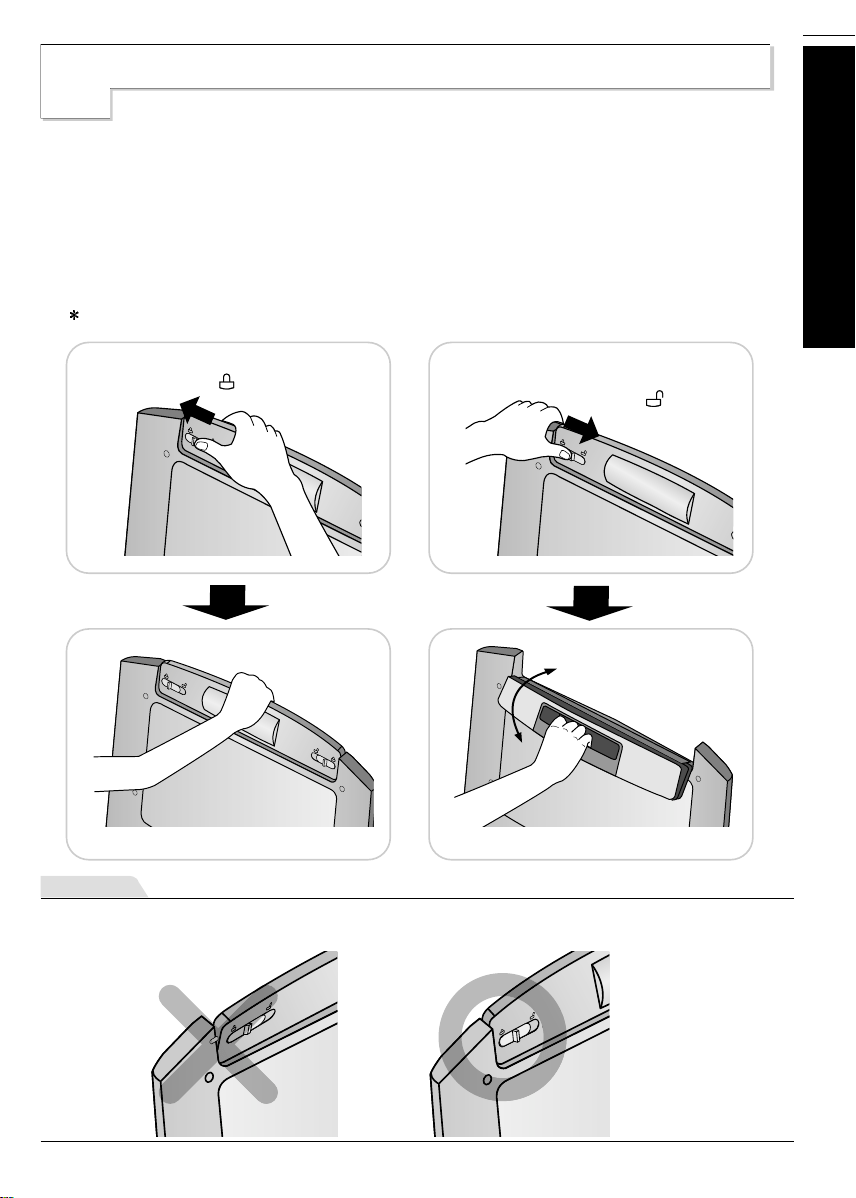
35
Care and Maintenance
.
her.
nt
hine
in
se of Handle Locker
U
How to use Handle Locker
If you feel uncomfortable using the folding handle, you can use the fixed handle option.
• Push both Locks towards the centre of the lid, this will free the handle.
• To lock the handle in back place, push the locking slides towards the outside of the lid.
refer to the below Picture.
NOTE
Please note after changing the handle to either the locked or unlocked position always check to make sure the locking
pins are fixed securely and that the locking pins are not exposed.
( )Lock
( )
Unlock
<State of locked handle> <State of unlocked handle>
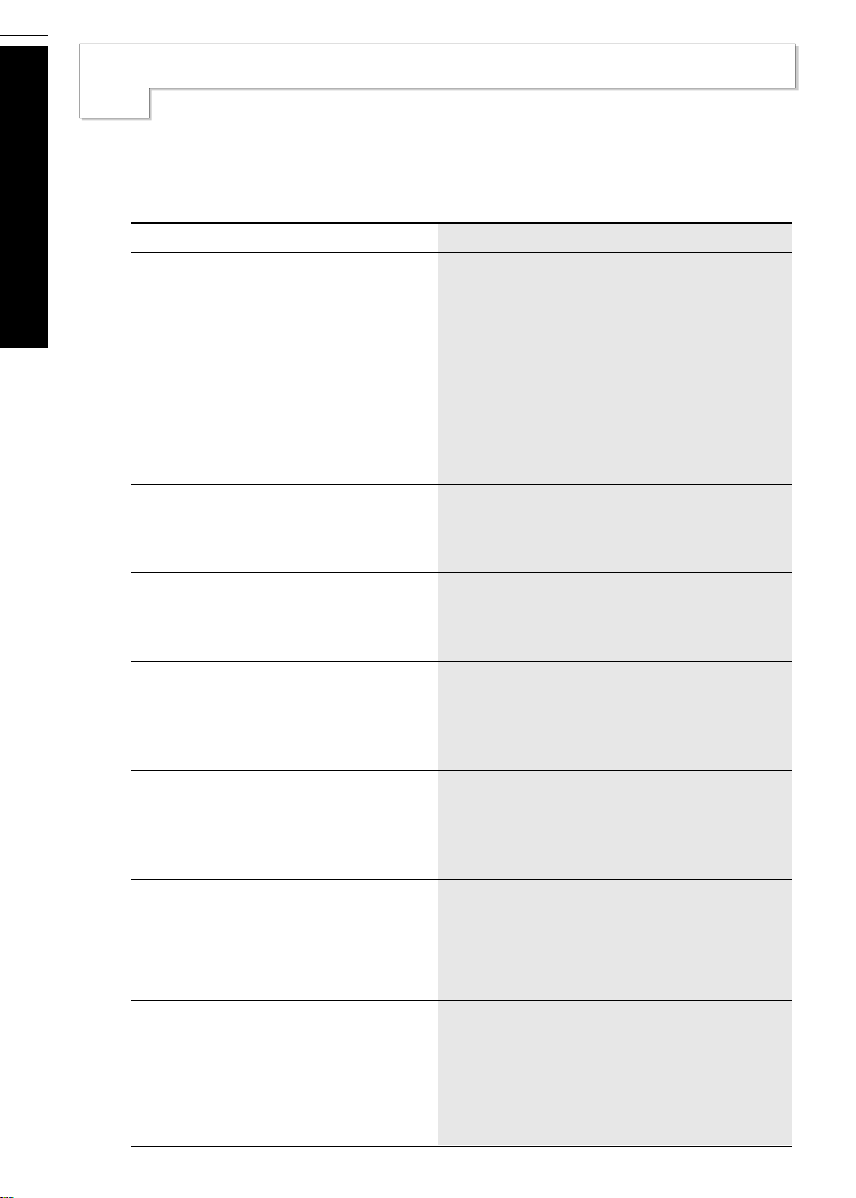
36
Troubleshooting
ommon washing problems
C
Many washing problems involve poor soil & stain removal, residues of lint and scum, and
fabric damage. For satisfactory washing results, follow these instructions.
WASH PROBLEM
Possible Causes
Problems
Solutions & Preventive Measures
• Use correct amount of Detergent for load size, amount of
soil and water Hardness.
• Use WARM or HOT water for normal soil.
Different Water Temperature may be required according to
soil type. (refer to page 10)
• Reduce load size.
• Wash with JEAN or SOAK & JEAN wash cycle for heavy
soiled laundry.
• Separate heavily soiled items from lightly soiled ones.
• Pretreat stain and heavy soil according to directions shown
on page 9.
• Rub the stain with bar soap. Wash.
• Do not overfill fabric softener dispenser and do not pour
liquid fabric softener directly onto fabric.
See page 12 for more instructions.
• Refer to the recommendations against Scrud(waxy buildup).
(refer to scrud page12.)
• Use correct amount of Detergent for load size, amount of soil
and water Hardness.
• To restore discolored load of whites, use rust remover safe
for fabric.
• Install nonprecipitating water softener or an iron filter in
your water supply system for an ongoing problem.
• Before washing, run water for a few minutes to clear lines.
• Wash lint givers eg towels, flannelette sheets, separately
from lint collectors eg synthetic fabrics and remove tissues in
pockets before wash. See page 9 for sorting and caring
before loading.
• Do not overload the washer
• Manually increase the water level.
• Do not overload the washer.
• Some Detergents need to be pre-dissolved, check the Detergent
instructions. Try pre-dissolving the detergent in warm water.
• Increase Water Temperature using HOT TEST water safe for fabric.
• Use less Detergent.
• Never pour chlorine bleach directly on fabric.
See page 11 for adding liquid bleach.
• Fasten zippers, hooks, and buckles.
• Remove objects in pockets. See page 9 for caring before
loading.
• Do not overload the washer.
Poor soil
removal
• Not enough Detergent
• Wash Water Temperature
too low.
• Overloading the washer
• Incorrect wash cycle
• Incorrect sorting
• Stain not pre treated.
• Undiluted fabric softener
dispensed directly onto
fabric
• A buildup caused by the
interaction of fabric softener
and Detergent can flake off
and mark clothes
• Not enough Detergent
• Iron or manganese in
water supply, water pipes,
or water heater
• Incorrect sorting
• Tissues left in pocket
• Overloading the washer
• Overloading the washer
• Undissolved Detergent
• Too much Detergent
• Incorrect use of chlorine
bleach.
• Unfastened zippers,
hooks, buckles
• Ribs, tears and broken
threads
• Overloading the washer
• Degradation of fabric
Blue, Grey, or
Brown Stains
Holes, tears,
or snags
Black or Gray
marks on
clothes
Yellow or
brown rust
stains
Lint
Residue or
Detergent
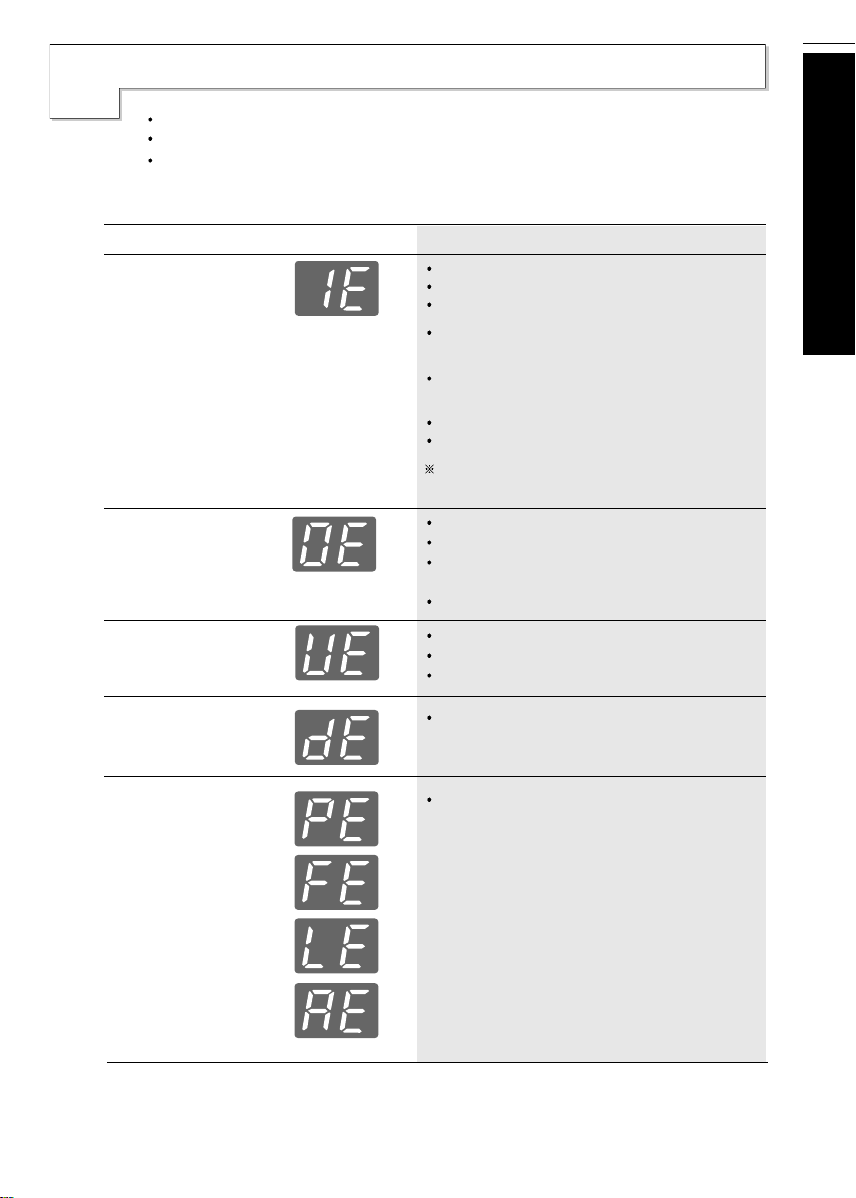
37
Troubleshooting
roubleshooting
T
If an abnormal symbol appears in the display window, check the following before asking for service.
Only roquest for Service Center after checking and eliminating the possible causes fron the check list
This appliance is fitted with a safety function that automatically stops the operation of the washing
machine when it is exposed to heavy disturbance on the mains.
Symptom Error Message Check List
Water Supply
Failure
Drainage Failure
Spin Failure/Unbalanced
Load
Door(Lid) Open
Abnormal level
sensing
Water Inlet overflow
Abnormal motor
Is the water tap shut off?
Is the water supply cut off?
Is the tap or water supply hose frozen?
Is the water pressure low or is the filter of the inlet
valve clogged with impurities?
Is the drain hose elevated above 90cm as per
the installation instructions?
Is the Hot hose connected to cold?
Is the Cold hose connected to hot?
If the Washing Machine is subjected to an unstable
supply of water , " IE " is on the DISPLAY.
Is the drain hose positioned correctly?
Is the drain hose bent or placed too high?
Is the internal part of the hose or drain pump (only
pump model) clogged with impurities?
Check if power has gone off.
Is the laundry evenly balanced?
Is the washing machine placed on a flat surface?
Is too much soap being used.
Is the lid closed?
Clutching Error
Please call your nearest LG Electronics service
center for help.
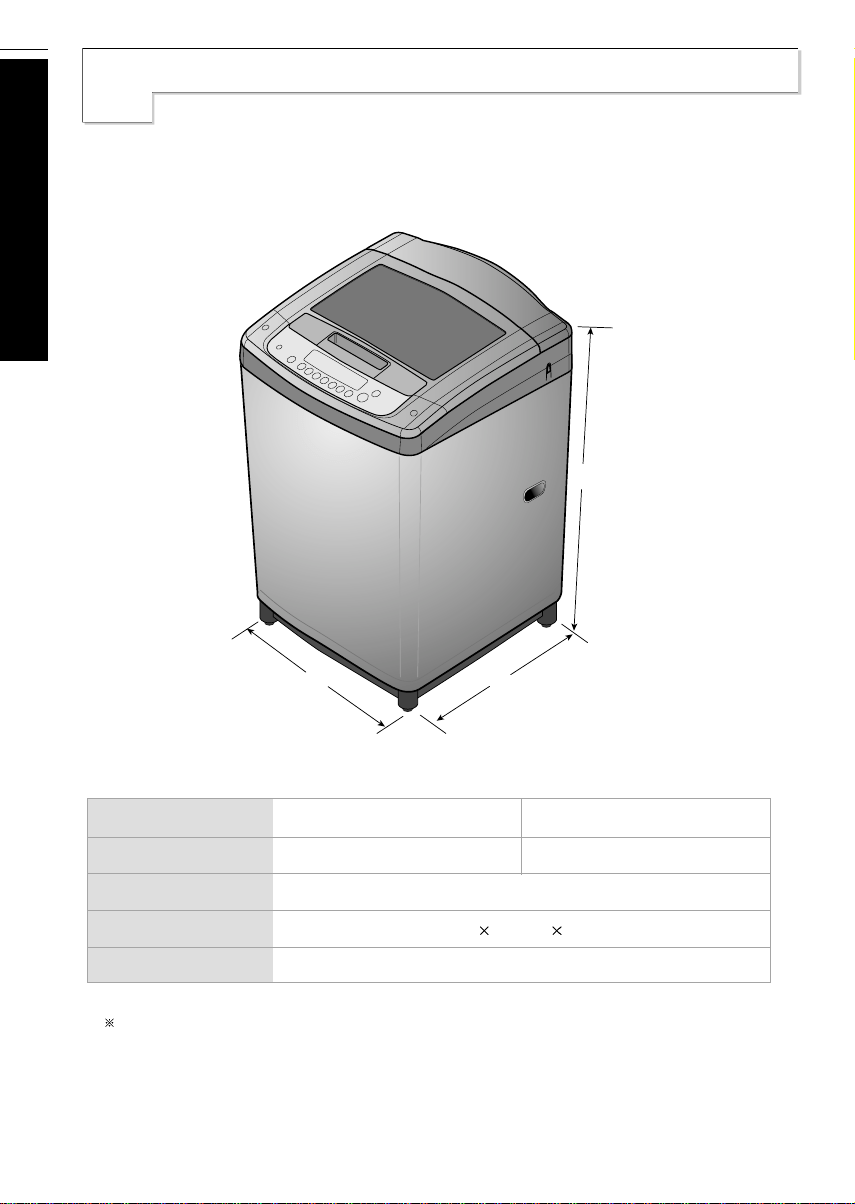
pecification
S
38
Specification
H
D
W
In our continuing effort to improve the quality of our appliances, it may be necessary to make changes
to the appliance without revising this manual.
WT-H9506 / WT-H9556 WT-H8006
9.5kg 8.0kg
50kg
632(W)
670(D) 1020(H)
50 - 600 kPa (0.5 - 6.0 kgf/cm
2
)
Model
Wash capacity
Weight
Size
Water tab pressure

emo
M
W
y