Operating instructions
for dishwashers
To avoid the risk of accidents or damage to the appliance, it is essential
t
o read these instructions as well as the installation plan before it is in‐
stalled and used for the first time.
en-AU, NZ M.-Nr. 10 075 760HG05

2

Contents
3
Guide to the appliance........................................................................................... 6
Appliance overview.................................................................................................. 6
Control panel............................................................................................................ 7
Warning and Safety instructions .......................................................................... 8
Caring for the environment.................................................................................
17
Disposal of the packing material............................................................................ 17
Disposing of your old appliance ............................................................................ 17
Energy-saving dishwashing ................................................................................... 18
Before using for the first time.............................................................................
19
Opening the door................................................................................................... 19
Closing the door .................................................................................................... 19
Safety lock ............................................................................................................. 19
Water softener........................................................................................................ 20
Displaying and setting the water hardness level .............................................. 21
Before using the appliance for the first time, you require:..................................... 23
Dishwasher salt...................................................................................................... 23
Filling the salt reservoir..................................................................................... 24
Add salt reminder.............................................................................................. 25
Rinse aid ................................................................................................................ 26
Adding rinse aid................................................................................................ 26
Add rinse aid reminder...................................................................................... 27
Setting the rinse aid dosage............................................................................. 28
Loading the dishwasher ......................................................................................
29
Notes...................................................................................................................... 29
Upper basket ......................................................................................................... 31
Adjusting the upper basket............................................................................... 32
Lower basket ......................................................................................................... 33
Cutlery.................................................................................................................... 34
Cutlery tray........................................................................................................ 34
Cutlery basket (depending on model)............................................................... 35
Loading examples.................................................................................................. 36
Dishwashers with cutlery tray........................................................................... 36
Dishwashers with cutlery basket ...................................................................... 38
Comparison tests.................................................................................................
40
Standard height with cutlery tray........................................................................... 40
XXL height with cutlery tray ................................................................................... 43
Standard and XXL height with cutlery basket........................................................ 46

Contents
4
Operation ..............................................................................................................
49
Detergent ............................................................................................................... 49
Adding detergent .............................................................................................. 51
Switching on the dishwasher................................................................................. 52
Selecting a programme.......................................................................................... 52
Starting the programme......................................................................................... 53
Display ................................................................................................................... 53
Energy management.............................................................................................. 54
Programme finished............................................................................................... 54
Switching off .......................................................................................................... 55
Unloading the dishwasher ..................................................................................... 55
Interrupting a programme ...................................................................................... 56
Changing a programme ......................................................................................... 56
Programme options .............................................................................................
57
Short ................................................................................................................ 57
DetergentAgent...................................................................................................... 57
Switching off the refill indicators............................................................................ 58
Delay start.............................................................................................................. 59
Adjust Sensor wash ............................................................................................... 61
Optimise standby................................................................................................... 62
Factory default settings.......................................................................................... 63
Programme chart .................................................................................................
64
Cleaning and care................................................................................................
68
Cleaning the wash cabinet..................................................................................... 68
Cleaning the door and the door seal ..................................................................... 68
Cleaning the door front.......................................................................................... 69
Checking the filters in the wash cabinet................................................................ 70
Cleaning the filters ................................................................................................. 70
Cleaning the spray arms ........................................................................................ 72
Problem solving guide .........................................................................................
73
Technical problems................................................................................................ 73
Water inlet fault ...................................................................................................... 75
Water drainage fault............................................................................................... 75
General problems................................................................................................... 76
Noises .................................................................................................................... 77
Unsatisfactory washing result................................................................................ 78
Maintenance.........................................................................................................
81
Cleaning the water inlet filter ................................................................................. 81
Cleaning the drain pump and non-return valve ..................................................... 82

Contents
5
After sales service ...............................................................................................
83
Repairs................................................................................................................... 83
Warranty................................................................................................................. 83
Optional accessories...........................................................................................
84
Electrical connection...........................................................................................
86
Water connection.................................................................................................
87
The Miele Waterproof system ................................................................................ 87
Connection to the water supply............................................................................. 87
Drainage................................................................................................................. 88
Technical data ...................................................................................................... 89

Guide to the appliance
6
Appliance overview
a
Upper spray arm (not visible)
b
Cutlery tray (depending on model)
c
Upper basket
d
Middle spray arm
e
Air inlet for drying (depending on
model)
f
Lower spray arm
g
Filter combination
h
Data plate
i
Rinse aid reservoir
j
Dual compartment detergent dis‐
penser
k
Salt reservoir

Guide to the appliance
7
Control panel
a
Programme selection
b
Display
c
Check/Refill indicators
d
Start b
utton with indicator light
e
Short button with indicator light
f
Delay start button with indicat
or
light
g
Programme selector button
h
On/Off button
These operating instructions apply to several different dishwasher models with
differ
ent heights.
The specific dishwasher models are referred to as follows:
Standard = 80.5 cm high dishwashers (integrated)
and 84.5 cm high dishwashers (freestanding)
XXL = 84.5 cm high dishwashers (integrated)

Warning and Safety instructions
8
This dishwasher complies with current safety requirements. Inap‐
pr
opriate use can, however, lead to personal injury and damage to
property.
To avoid the risk of accidents and damage to the dishwasher,
please
read the installation plan and the operating instructions
carefully before it is installed and used for the first time. They con‐
tain important information on its installation, safety, use and main‐
tenance.
Keep the installation plan and the operating instructions in a safe
place and pass them on to any future owner.
Miele cannot be held liable for damage caused by non-compli‐
ance with this information.

Warning and Safety instructions
9
Correct application
This appliance is designed for domestic use and for use in similar
envir
onments by guests in hotel or motel rooms, bed & breakfasts
and other typical living quarters. This does not include common/
shared facilities or commercial facilities within hotels, motels or bed
& breakfasts.
This dishwasher is not suitable for outdoor use.
It
must only be used as specified in these operating instructions
for cleaning domestic crockery and cutlery. Any other usage is not
supported by the manufacturer and could be dangerous.
This applianc
e is not intended for use by persons (including chil‐
dren) with reduced physical, sensory or mental capabilities, or lack
of experience and knowledge, unless they have been given supervi‐
sion or instruction concerning its use by a person responsible for
their safety, and are able to recognise the dangers of misuse.

Warning and Safety instructions
10
Safety with children
Y
oung children must not be allowed to use this appliance.
Older childr
en may only use the appliance when its operation has
been clearly explained to them and they are able to use it safely, rec‐
ognising the dangers of misuse.
Clean
ing work may only be carried out by older children under the
supervision of an adult.
Chil
dren should be supervised to ensure that they do not play
with the appliance. Keep small children away from the appliance at
all times to avoid the risk of injury. There is the risk that children may
lock themselves in the dishwasher.
If
the automatic door opening mechanism (depending on model)
is active, keep young children away from the area in which the door
opens. Danger of injury in the unlikely event of a fault with the open‐
ing mechanism.
Dange
r of suffocation! Children may be able to wrap themselves
in packing material or pull it over their heads with the risk of suffoca‐
tion. Keep children away from any packing material.
K
eep detergent and other household agents out of the reach of
children at all times. Some dishwasher detergents are strongly alka‐
line and contain irritants and corrosive ingredients. They can be ex‐
tremely dangerous if swallowed, and can cause burning in the
mouth, nose and throat, or inhibit breathing. Avoid contact with the
skin and eyes. Keep children away from the dishwasher when the
door is open. There could still be detergent residues in the cabinet
or dispenser. Seek medical advice immediately if your child has
swallowed or inhaled detergent, e.g. Poisons Information Centre
(Australia) or National Poisons Centre (NZ).

Warning and Safety instructions
11
Technical safety
Repairs and other work by unqualified persons could be danger‐
ous. Installati
on, maintenance work and repairs to electrical applian‐
ces must only be carried out by a Miele approved service technician.
Befor
e installation, check the dishwasher for visible signs of dam‐
age. Under no circumstances should you use a damaged dishwash‐
er. A damaged dishwasher could be dangerous.
The ele
ctrical safety of this appliance can only be guaranteed
when continuity is complete between it and an effective earthing
system. It is most important that this basic safety requirement is
present and regularly tested and, where there is any doubt, the elec‐
trical system in the house should be checked by a qualified electri‐
cian.
Miele cannot be held liable for the consequences of an inadequate
earthing system (e.g. electric shock).
Reliable
and safe operation of this dishwasher can only be assur‐
ed if it has been connected to the mains electricity supply.
The dishwasher must on
ly be plugged into the electricity supply
via a suitable switched socket. The electrical socket must be easily
accessible after the dishwasher is installed so that it can be discon‐
nected from the electricity supply at any time.
Ther
e must be no electrical sockets behind the dishwasher. Dan‐
ger of overheating and fire risk if the dishwasher were to be pushed
up against a plug.
The dishwasher must no
t be installed under a cooktop. The high
radiant temperatures which are sometimes generated by a cooktop
could damage the dishwasher. For the same reason, it should not be
installed next to open fires or other appliances which give off heat,
such as heaters etc.

Warning and Safety instructions
12
T
o avoid the risk of damage to the dishwasher, make sure that the
connection data on the data plate (fuse rating, voltage and frequen‐
cy) matches the mains electricity supply before connecting the dish‐
washer to the mains. Consult a qualified electrician if in any doubt.
Do not con
nect the dishwasher to the mains supply until it has
been fully installed and any adjustment has been made to the door
springs.
The dishwasher may on
ly be operated if the door opening mecha‐
nism is working correctly. Otherwise there could be a risk of injury
whilst the automatic door opening mechanism (depending on model)
is active.
To check that the door opening mechanism is working correctly:
– the door springs must be adjusted equally on both sides. They
ar
e correctly adjusted when the door remains stationary when left
half open (approx. 45° opening angle). It is also important that the
door cannot fall open.
– the door locking pins automatically retract when the door opens
at the end of the dr
ying phase.
Do not connect the appliance to the mains electricity supply by a
multi-socket adapter or an extension lead. These do not guarantee
the required safety of the appliance (e.g. danger of overheating).
This applianc
e must not be installed and operated in mobile in‐
stallations (e.g. on a ship).
Do not insta
ll the dishwasher in a room where there is a risk of
frost. Frozen hoses may burst or split. The reliability of the electronic
control unit may be impaired at temperatures below freezing point.
T
o avoid any damage to the appliance, the dishwasher must only
be operated when it is connected to a fully vented plumbing system.
The plastic ho
using of the water connection contains an electrical
valve. The housing must not be dipped in water.

Warning and Safety instructions
13
Ther
e are electrical wires in the water inlet hose. Do not cut the
water inlet hose, even if it is too long.
The int
egrated Waterproof system offers protection from water
damage, provided the following conditions are met:
– The dishwasher is correctly installed and plumbed in.
– The dishwasher is properly maintained and parts are replaced
wher
e it can be seen that this is necessary.
– The tap has been turned off when the appliance is not used for a
longer period of time (e.g. during holidays).
The Waterproof system will work even if the appliance is switched
off. However
, the appliance must remain connected to the electricity
supply.
The wat
er pressure (flow pressure at the connection point) must
be between 30 and 1000 kPa (0.3 and 10 bar).
A d
amaged appliance could be dangerous. If the dishwasher gets
damaged, switch it off at the mains and call Miele.
The manu
facturer's warranty will be invalidated if the appliance is
not repaired by a Miele approved service technician.
F
aulty components must only be replaced by genuine Miele spare
parts. The manufacturer can only guarantee the safety of the appli‐
ance when Miele replacement parts are used.
During
installation, maintenance and repair work, the appliance
must be disconnected from the mains electricity supply.
If
the connection cable is damaged, it must be replaced with a
special cable of the same type (available from Miele) by a Miele au‐
thorised service technician only in order to avoid a hazard.

Warning and Safety instructions
14
In ar
eas which may be subject to infestation by cockroaches or
other vermin, pay particular attention to keeping the appliance and
its surroundings in a clean condition at all times. Any damage which
may be caused by cockroaches or other vermin will not be covered
by the warranty.
Correct installation
The dishwasher must be install
ed and connected in compliance
with the installation instructions.
Be car
eful when installing the dishwasher. Wear protective
gloves to avoid injury on any sharp metal components.
The dishwasher must be corr
ectly aligned to ensure problem-free
operation.
In or
der to ensure stability, built-under and integrated dishwash‐
ers must only be installed under a continuous worktop which is se‐
cured to adjacent cabinetry.
If
you want to convert your freestanding dishwasher to a built-un‐
der ("U") model, you will need to order the appropriate conversion
kit. If you remove the existing plinth, you must replace it with a U-
model plinth. This is necessary to avoid the risk of injury caused by
protruding metal parts.
The door spring
s on either side need to be evenly adjusted. They
are correctly adjusted if the half-opened door (approx. 45° door
opening angle) remains in this position when it is released. The door
must not fall down under its own weight.
The appliance may only be used with correctly adjusted door
springs.

Warning and Safety instructions
15
Correct use
Do not use sol
vents in the dishwasher. Danger of explosion!
Do not inh
ale or ingest dishwasher detergent. Some dishwasher
detergents are strongly alkaline and contain irritants or corrosive in‐
gredients. They can be extremely dangerous if swallowed, and can
cause burning in the nose, mouth and throat, or inhibit breathing.
Avoid contact with the skin and eyes. Seek medical advice immedi‐
ately if detergent has been swallowed or inhaled, e.g. Poisons Infor‐
mation Centre (Australia) or National Poisons Centre (NZ).
A
void leaving the door open unnecessarily as someone could trip
over it and be injured by it.
Do not sit or lea
n on the opened door. This could cause the dish‐
washer to tip and be damaged, and you could get injured.
Dishes can
be very hot at the end of a programme. Allow them to
cool until they are comfortable enough to handle before unloading.
Only use det
ergent and rinse aid formulated for domestic dish‐
washers. Do not use washing-up liquid.
Do not use co
mmercial or industrial detergents as these may
cause damage, and there is a risk of a severe explosive chemical re‐
action (such as an explosive oxyhydrogen gas reaction).
Do not fill
the rinse aid reservoir with powder or liquid detergent.
This will cause serious damage to the reservoir.
Inadver
tently filling the salt reservoir with powder or liquid dish‐
washer detergent will damage the water softener. Make sure you
have picked up the correct packet of dishwasher salt before filling
the salt reservoir!
Only use special coarse grained dishwasher salt for reactivation.
Do not use other salts such as cooking salt, agricultural grade or
gritting salt. These may contain insoluble additives which can impair
the functioning of the water softener.

Warning and Safety instructions
16
In an app
liance with a cutlery basket (depending on model) cut‐
lery is cleaned and dried more efficiently if placed in the basket with
the handles downwards. However, to avoid the risk of injury, place
knives and forks etc. with the handles upwards.
Plastic it
ems which cannot withstand being washed in hot water,
such as disposable plastic containers, or plastic cutlery and crock‐
ery should not be cleaned in the dishwasher. The high temperatures
in the dishwasher may cause them to melt or lose shape.
If
you use the "FlexiTimer/Delay start" option (depending on mod‐
el), make sure that the dispenser is dry before adding detergent.
Wipe dry if necessary. Detergent will clog if poured into a damp dis‐
penser and may not be thoroughly dispersed.
Please observe the information given in "Technical data" regard‐
ing the capacity of the dishwasher.
Accessories
Use only ge
nuine original Miele spare parts. If spare parts or ac‐
cessories from other manufacturers are used, the warranty will be in‐
validated, and Miele cannot accept liability.
Disposal of your old dishwasher
Mak
e the door lock inoperative so that children cannot acciden‐
tally shut themselves in. Remove or destroy the locking bracket of
the door lock, and make appropriate arrangements for the disposal
of the appliance.
Caring for the environment
17
Disposal of the packing mate‐
rial
The packaging is designed to protect
the appliance fr
om damage during
transportation. The packaging materials
used are selected from materials which
are environmentally friendly for disposal
and should be recycled.
The packaging consists of the following
mat
erials:
Outer packaging:
– Corrugated cardboard made from up
t
o 100% recyclable material:
or: Polyethylene (PE) shrink wrap
– Polyproplylene (PP) strapping
Inner packaging:
– Chlorine and fluorine free expanded
polystyr
ene (EPS)
– Base, lid frame and support battens
made fr
om untreated natural wood
from renewable forests
– Polyethylene (PE) protective wrap
Recycling the packaging reduces the
use of r
aw materials in the manufactur‐
ing process and also reduces the
amount of waste in landfill sites. Rather
than just throwing these materials
away, please ensure they are recycled.
E
nsure that any plastic wrap‐
pings, bags, etc. are disposed of
safely and kept out of the reach of
babies and young children. Danger
of suffocation.
Disposing of your old appli‐
ance
Electrical and electronic appliances of‐
t
en contain materials which, if handled
or disposed of incorrectly, could be po‐
tentially hazardous to human health and
to the environment. They are, however,
essential for the correct functioning of
your appliance. Therefore, please do
not dispose of your old appliance with
your household waste.
Please dispose of it at your local com‐
muni
ty waste collection / recycling cen‐
tre.
Ensure that your old appliance presents
no dange
r to children while being stor‐
ed for disposal.
To enable sorting by type of plastic for
r
ecycling, all plastic parts of the appli‐
ance are labelled with international
standard symbols.

Caring for the environment
18
Energy-saving dishwashing
This dishwasher is exceptionally eco‐
nomi
cal in its use of water and electrici‐
ty.
You can make the most of your appli‐
ance by following these tips:
– For most economical dishwashing,
mak
e full use of the baskets without
overloading the dishwasher.
– Choose the programme to suit the
type of cr
ockery being washed and
the degree of soiling.
– Select the ECO pr
ogramme for ener‐
gy-saving dishwashing. This pro‐
gramme is the most efficient in terms
of its combined energy and water
consumption at cleaning normally
soiled crockery.
– Follow the detergent manufacturer's
recommendations on detergent dos‐
age.
– When using powder or liquid deter‐
gent you can use
1
/
3
less det
ergent if
baskets are only half full.
– If your household water system is
suitable, this dishwasher can be con‐
nect
ed to a hot water supply for fur‐
ther economies. If the water is heated
by solar panels, for example, this
would be energy efficient.
However, if your water is heated by
electricity, we would recommend
connection to cold water.
You can find further tips on energy-
saving dishwashing in "Miele's guide
t
o dishwashing".
Before using for the first time
19
Opening the door
T
o open the door, reach under the
door grip and pull.
If the door is opened during operation,
all func
tions are automatically interrup‐
ted.
W
ater in the dishwasher may be
hot. Danger of scalding!
Only open the door during operation
if absolu
tely necessary and exercise
extreme caution when doing so.
Closing the door
P
ush the baskets right in.
T
hen lift the door upwards and push
until it clicks into position.
Dang
er of injury!
Do not put your hand inside the door
as it is closing.
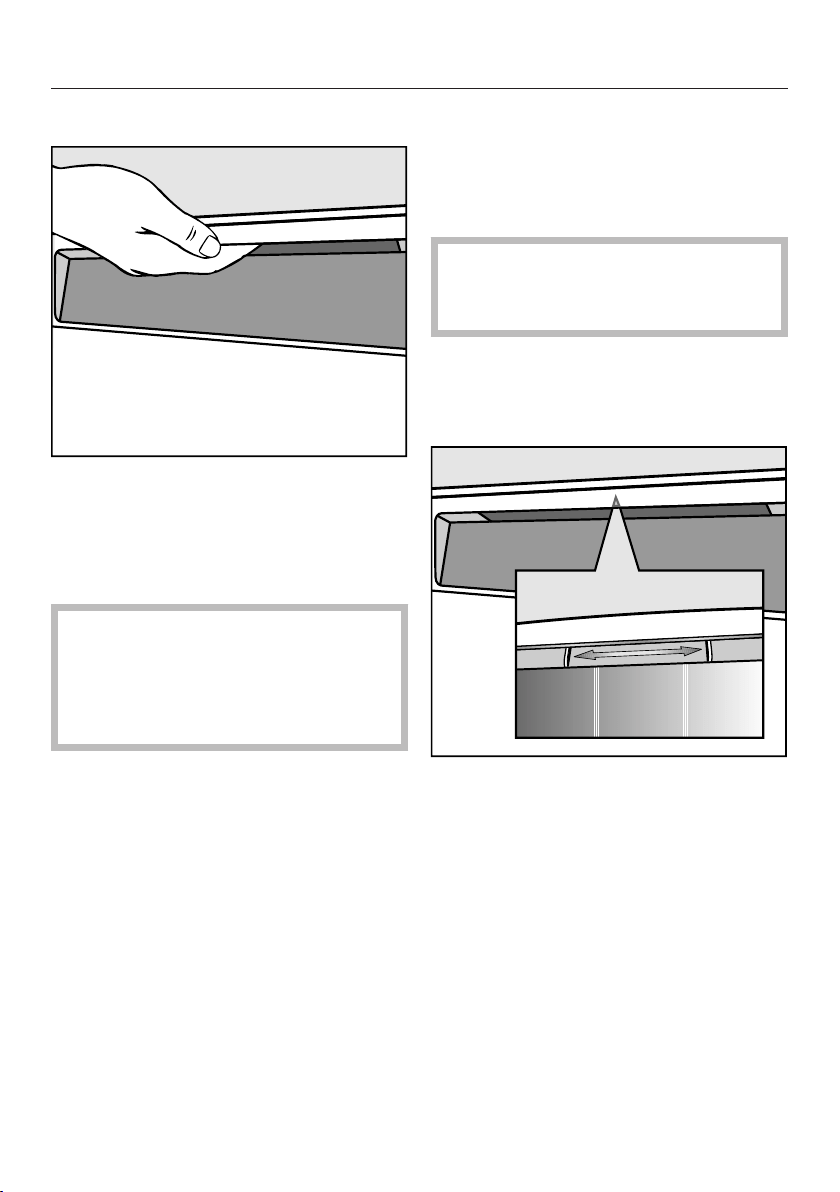
Safety lock
Use the safety lock to prevent children
o
pening the dishwasher door.
T
o lock the door, push the slide un‐
derneath the door grip to the right.
T
o unlock the door, push the slide to
the left.

Before using for the first time
20
Water softener
In order to achieve good cleaning re‐
sults, the dishwasher needs t
o operate
with soft water. Hard water results in a
build-up of calcium deposits on crock‐
ery and in the dishwasher.
Mains water with a hardness level high‐
er than 0.7 mmol/l (4 °d - German
scale) needs to be softened. This takes
place automatically in the integrated
water softener. The water softener in
the dishwasher is suitable for a water
hardness level of up to 12.6 mmol/l (70
°d - German scale).
– The water softener requires dish‐
washer salt.
Dependin
g on the water hardness
level (< 3.8 mmol/l, or 21 °d - Ger‐
man scale), dishwasher salt is not re‐
quired if combination tablets are be‐
ing used (see "Operation - Deter‐
gent").
– The dishwasher must be program‐
med for the wat
er hardness level in
your area.
– Your local water authority will be able
t
o advise you of the water hardness
level in your area.
– Where the water hardness fluctuates,
e.g. between 1.8 and 2.7 mmol/l (10 -
15 °d - German scale), always pr
o‐
gramme the dishwasher to the higher
value (2.7 mmol/l or 15 °d in this ex‐
ample).
In the event of a fault, it will help the
ser
vice technician if you know the hard‐
ness of your local water supply.
Enter the water hardness below:
____________mmol/l
The dishwasher is programmed at the
fact
ory for a water hardness level of
0.2 mmol/l (1 °d - German scale).
If this setting corresponds to the hard‐
ness of your water, you do not need to
do anything more.
However, if you have a different water
har
dness, you must adjust the water
softener to match your water hardness.

Before using for the first time
21
Displaying and setting the water
har
dness level
Switch the dishwasher off with the
butt
on if it is switched on.
P
ress the
Start butt
on in and, whilst
holding it in, switch the dishwasher
on using the button.
Keep the
Start
button pressed in for
at least four seconds until the
Start
indicator light comes on.
If this does not happen, start the proce‐
dur
e from the beginning again.
P
ress the Delay start button twice.
The indica
tor light will flash rapidly
twice at intervals.
The value which has been set for the
wat
er hardness is shown as a figure af‐
ter in the display (see chart).
will star
t flashing in the display.
This is the factory default setting of
0.2 mmol/l (1 °d - German scale).
Use the Start butt
on to select the val‐
ue which equates to your water hard‐
ness level.
Each press of the button moves you
up a level. When the highest water
hardness level is reached, the setting
starts from the beginning again.
The setting is now stored in memory.
Switch the dishwasher off with the
butt
on.
Before using for the first time
22
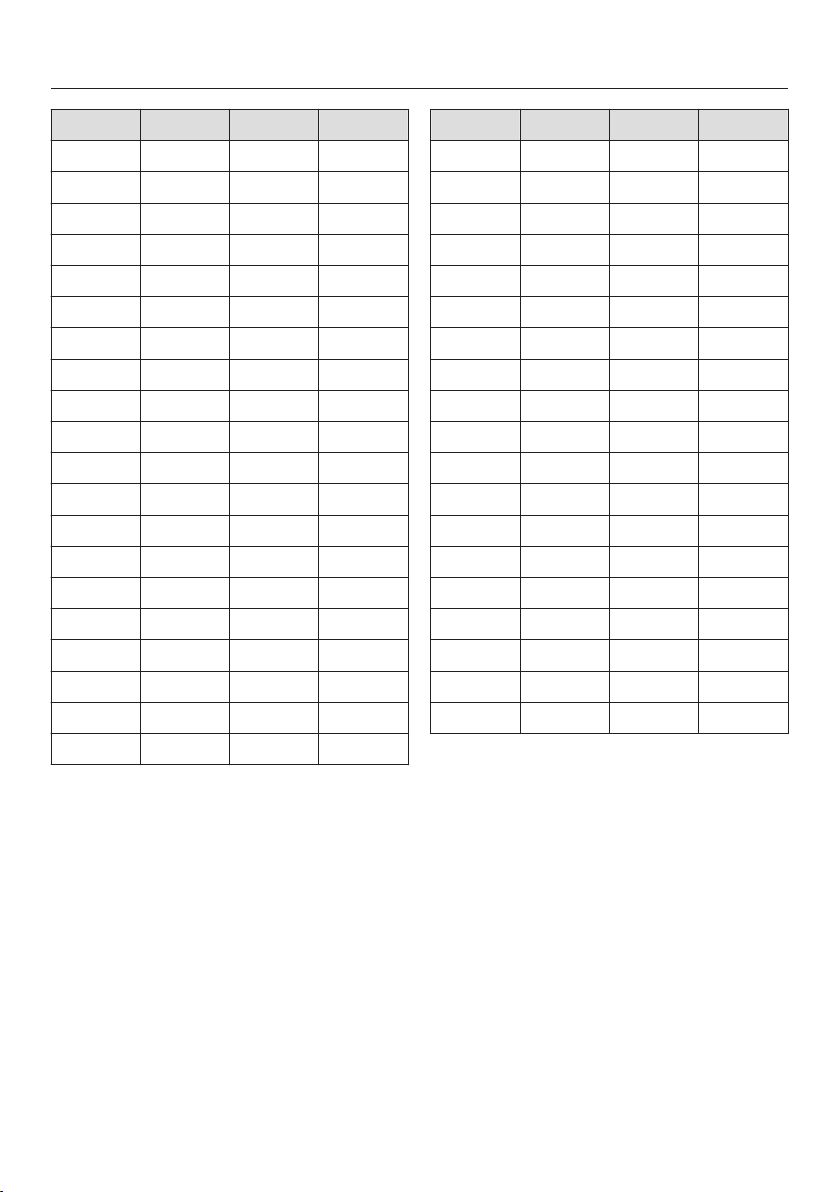
°d mmol/l °f Display
1 0.2 2 1
2 0.4 4 2
3 0.5 5 3
4 0.7 7 4
5 0.9 9 5
6 1.1 11 6
7 1.3 13 7
8 1.4 14 8
9 1.6 16 9
10 1.8 18 10
11 2.0 20 11
12 2.2 22 12
13 2.3 23 13
14 2.5 25 14
15 2.7 27 15
16 2.9 29 16
17 3.1 31 17
18 3.2 32 18
19 3.4 34 19
20 3.6 36 20
°d mmol/l °f Display
21 3.8 38 21
22 4.0 40 22
23 4.1 41 23
24 4.3 43 24
25 4.5 45 25
26 4.7 47 26
27 4.9 49 27
28 5.0 50 28
29 5.2 52 29
30 5.4 54 30
31 5.6 56 31
32 5.8 58 32
33 5.9 59 33
34 6.1 61 34
35 6.3 63 35
36 6.5 65 36
37-45 6.6-8.0 66-80 45
46-60 8.2-10.7 82-107 60
61-70 10.9-12.5 109-125 70

Before using for the first time
23
Before using the appliance for
the first tim
e, you require:
– approx. 2 litres of water,
– approx. 2 kg dishwasher salt,
– domestic dishwasher detergent,
– rinse aid formulated for domestic
dishwashers.
Every dishwasher is tested at the fac‐
t
ory. There will be residual water in the
appliance from this test. It is not an in‐
dication that it has been used previ‐
ously.
Dishwasher salt
In order to achieve good cleaning re‐
sults, the d
ishwasher needs to operate
with soft water. Hard water results in a
build-up of calcium deposits on crock‐
ery and in the dishwasher.
Mains water with a hardness level high‐
er than 0.7 mmol/l (4 °d - German
scale) needs to be softened. This takes
place automatically in the integrated
water softener. The water softener in
the dishwasher is suitable for a water
hardness level of up to 12.6 mmol/l
(70 °d - German scale).
The water softener requires dishwasher
salt.
Depending
on the water hardness level
(< 3.8 mmol/l, or 21 °d - German scale),
dishwasher salt is not required if combi‐
nation tablets are being used (see "Op‐
eration - Detergent").
If the water hardness in your area is
constantly lower than 0.9 mmol/l
(5 °d), you do not need t
o add dish‐
washer salt. The prompt to add dish‐
washer salt will be switched off auto‐
matically. The water softener must,
however, still be programmed to cor‐
respond to the water hardness level in
your area.
Dishwasher det
ergent will dam‐
age the water softener.
Do not fill the salt reservoir with
powder or liquid det
ergent.
O
nly use special coarse grained
dishwasher salt for reactivation,
as other salts (e.g. cooking salt, agri‐
cul
tural grade or gritting salt) may
contain insoluble additives which
can impair the functioning of the wa‐
ter softener.
Before using for the first time
24
Filling the salt reservoir
Before filling the salt reservoir with
dishwasher salt for the first time, you
must fill
it with approx. 2 litres of wa‐
ter to enable the salt to dissolve.
Once the dishwasher has been used,
ther
e is always sufficient water in the
reservoir.
Remo
ve the lower basket and un‐
screw the salt reservoir cap.
Water or saline solution will run out
of the r
eservoir when the cap is re‐
moved.
It should therefore only be removed
in
order to refill the salt reservoir.
Fi
ll the reservoir with approx. 2 litres
of water (first use only).
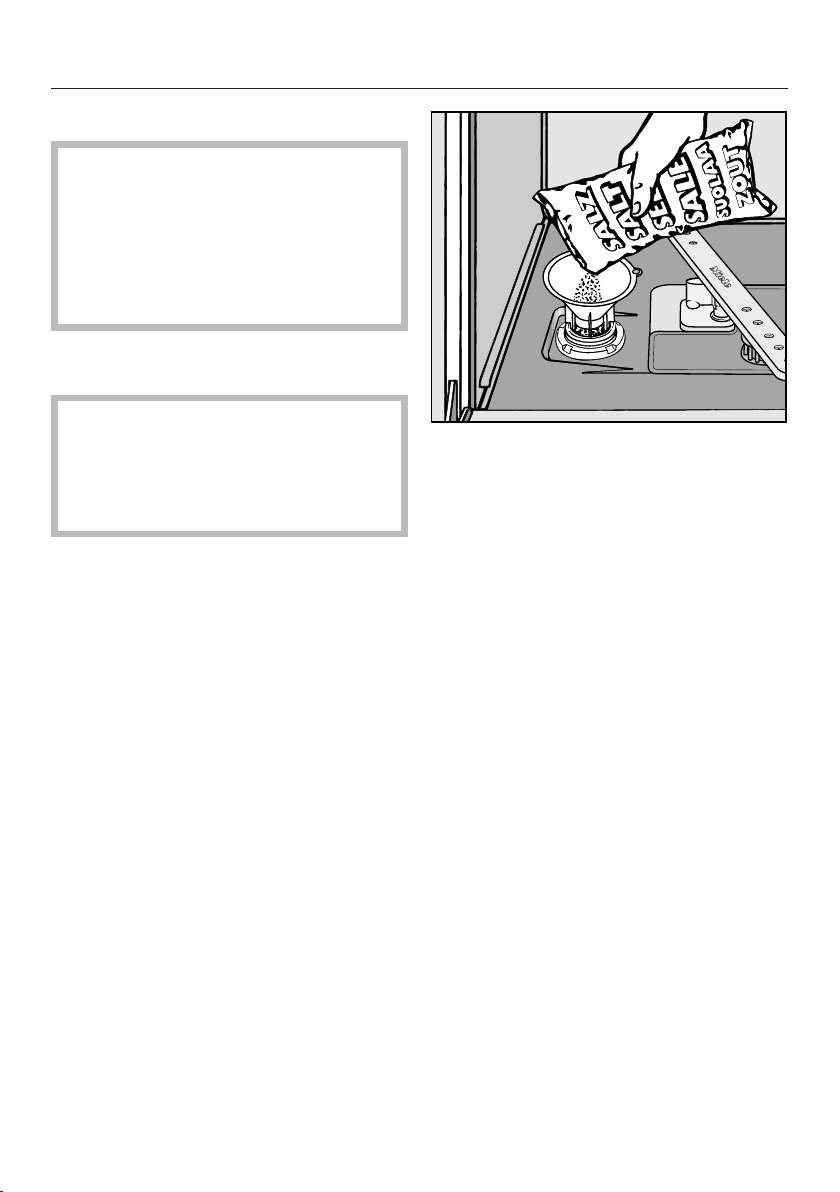
Place the funnel provided over the
salt reservoir and carefully fill with
dishwasher salt until the reservoir is
full. The salt reservoir holds approx.
2 kg of salt depending on the brand
used.
Cle
an any excess salt from around
the reservoir opening and then screw
the cap on again firmly.
Immediat
ely after filling the salt reser‐
voir, run the
Gentle 45°C pr
o‐
gramme with the
Short pr
o‐
gramme option selected and without
any crockery in the dishwasher to re‐
move any traces of salt from the cab‐
inet.

Before using for the first time
25
Add salt reminder
Fi
ll the salt reservoir with dishwasher
salt when the
Salt indica
tor light
comes on (If it comes on during a
programme, wait until the end of the
programme).
Risk of corr
osion!
Immediately after filling the salt res‐
ervoir, run the
Gentle 45°C
pro‐
gramme with the
Short pr
o‐
gramme option selected and without
any crockery in the dishwasher to re‐
move any traces of salt from the
cabinet.
After the salt reservoir has been filled,
the r
efill indicator may still be lit up if
the salt concentration has not yet
reached the correct level. It will go out
when the correct concentration is
reached.
The refill reminder will be switched off if
you have
programmed the dishwasher
for a water hardness below 0.9 mmol/l
(5 °d - German scale).
If you only ever use multi-function
combina
tion products in your dish‐
washer, you can switch off both refill
reminders for salt and rinse aid if you
wish (see "Programme options -
Switching off the refill indicators").
If you switch to using detergent that
does not contain salt or rinse aid, it
is impor
tant to remember to add
dishwasher salt and rinse aid and to
switch the reminders back on.
Before using for the first time
26
Rinse aid
Rinse aid is necessary to ensure water
does not cling and leave marks on
cr
ockery during the drying phase and
helps crockery dry faster after it has
been washed.
Rinse aid is poured into the storage res‐
ervoir and the amount set is dispensed
automatically.
I
nadvertently filling the rinse aid
reservoir with powder or liquid deter‐
gent will damage the reservoir. Only
pour rinse aid formulated for domes‐
tic dishwashers into the reservoir.
Alternatively, it is possible to use
– household vinegar with a max. 5%
aci
d content
or
– liquid citric acid up to 10% acid con‐
t
ent
The resulting rinsing and drying quality
will not, however, be as good as when
rinse aid is used.
Do not use vinegar with a higher
a
cid content (e.g. vinegar essence
25% acid).
This would damage the dishwasher.
If you only ever use combination
products containing rinse aid in your
dishwasher, you do not need to add
rinse aid.
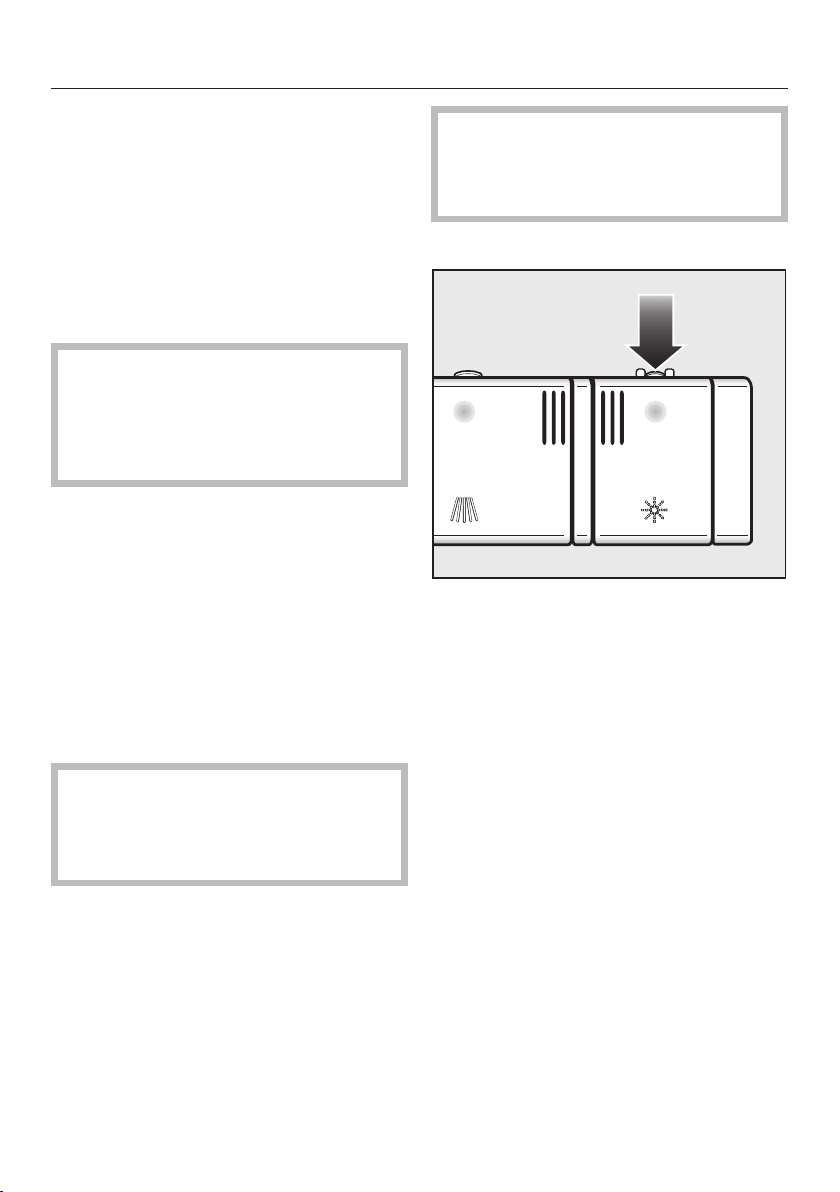
Adding rinse aid
P
ress the button on the lid of the
rinse aid reservoir in the direction of
the arrow until the flap springs open.
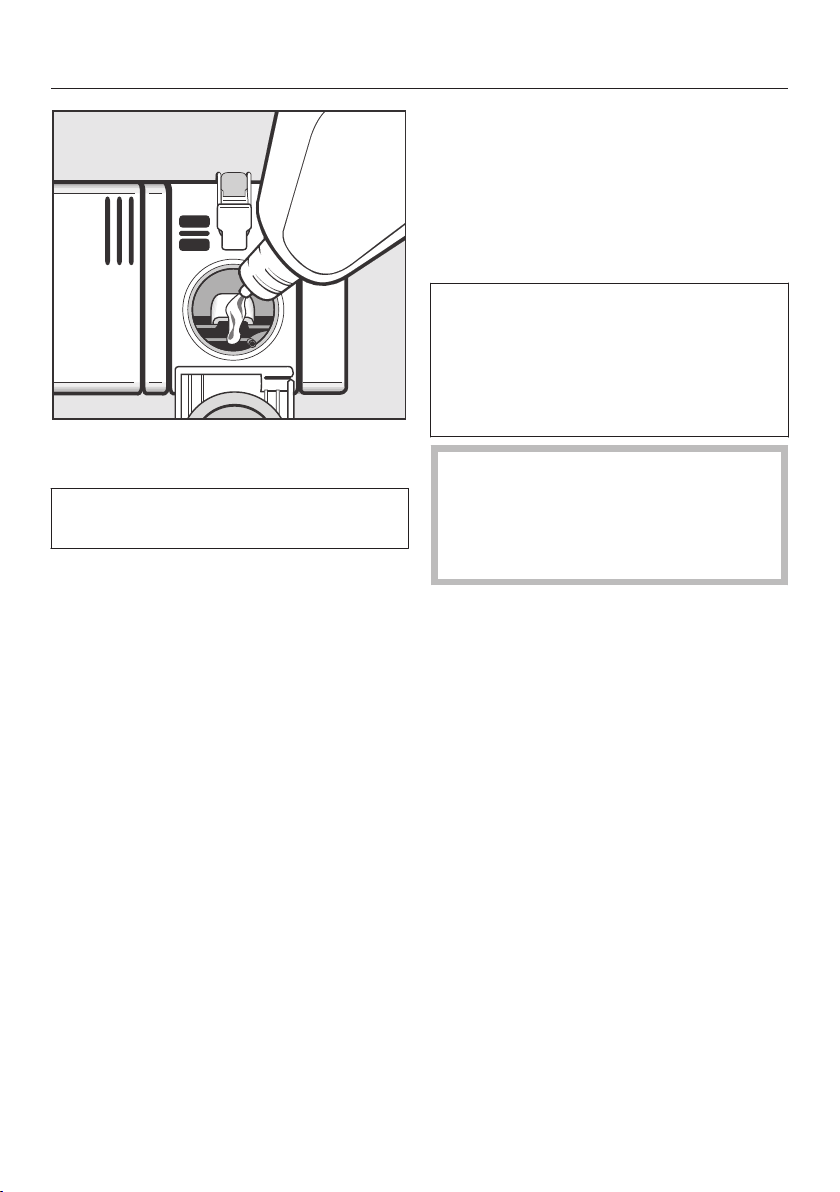
Before using for the first time
27
Add rinse aid only until it is visible in
the opening.
The rinse aid reservoir holds approx.
110 ml.
Close the flap firmly so that it clicks
int
o place. Otherwise water can enter
the rinse aid reservoir during a pro‐
gramme.
W
ipe up any spilled rinse aid. This
prevents over-foaming occurring dur‐
ing the next programme.
Add rinse aid reminder
When the Rinse aid indicat
or light
comes on, the reservoir contains suffi‐
cient rinse aid for 2 - 3 programmes on‐
ly.
Add rinse aid in plenty of time.
If you only ever use multi-function
combination products in your dish‐
washer, you can switch off both refill
reminders for salt and rinse aid if you
wish (see "Programme options -
Switching off the refill indicators").
If you switch to using detergent that
does not contain salt or rinse aid, it
is impor
tant to remember to add
dishwasher salt and rinse aid and to
switch the reminders back on.

Before using for the first time
28
Setting the rinse aid dosage
You can adjust the rinse aid dosage for
best r
esults.
The rinse aid dosage is set in stages
fr
om 0 to 6. It is set to 3 at the factory.
This is the recommended setting.
If the "Adjust Sensor wash" programme
function (depending on model) has
been activat
ed, the amount of rinse aid
dispensed in the
Sensor wash p
ro‐
gramme can be higher than that set.
If spots appear on crockery and glass‐
war
e:
Incr
ease the rinse aid dosage.
If clouding or smearing appears on
cr
ockery and glassware:
Decr
ease the rinse aid dosage.
Switch the dishwasher off with the
butt
on, if it is switched on.
P
ress the
Start butt
on in and, whilst
holding it in, switch the dishwasher
on using the button.
Keep the
Start
button pressed in for
at least 4 seconds until the
Start indi‐
cat
or light comes on.
If this does not happen, start the proce‐
dur
e from the beginning again.
Press the button 3 times.
The indica
tor will flash rapidly 3
times at intervals.
The dosage set will appear in the dis‐
play aft
er .
The flashing sequence
will appear in
the display.
This indicates the factory default setting
3.
Use the Start butt
on to select the set‐
ting required.
Each press of the button moves you
up a level. After reaching the highest
value, the counter starts from the be‐
ginning again.
The setting is now stored in memory.
Switch the dishwasher off with the
butt
on.

Loading the dishwasher
29
Notes
Remove coarse food residues from
cr
ockery.
There is no need to rinse items under
runni
ng water.
Do not wash it
ems soiled with
ash, sand, wax, lubricating grease or
paint in the dishwasher. Ash does
not dissolve and is distributed in the
wash cabinet. Wax, sand, lubricating
grease and paint cause damage to
the dishwasher.
Crockery can be loaded anywhere in
the baskets, but the following notes
should be observed:
– Do not place crockery and cutlery in‐
side other piece
s where they may be
concealed.
– Load the crockery so that water can
acce
ss all surfaces. This ensures that
they get properly cleaned.
– Make sure that all items are securely
positioned.
– Hollow items such as cups, glasses,
pans, etc. must b
e inverted in the
basket.
– Tall, narrow, hollow items, e.g. cham‐
pagne glasses, should be placed in
the cen
tre of the basket to ensure
better water coverage.
– Wide based items should be placed
at an ang
le so that water can run off
them freely.
– The spray arms must not be blocked
by it
ems which are too tall or hang
through the baskets. If in doubt, test
for free movement by manually rotat‐
ing the spray arms.
– Make sure that small items cannot
fall
through the holders in the bas‐
kets.
Small items, e.g. lids, should there‐
fore be placed in the cutlery tray or
cutlery basket (depending on model).
Some foodstuffs may contain natural
dyes, e.g. carrots, tomatoes or toma‐
to sauce. Plastic items in the dish‐
washer may discolour if large quanti‐
ties of these foodstuffs find their way
into the dishwasher on the crockery.
The stability of plastic items is not
affected by this discolouration.
Cleaning silver cutlery in the dish‐
washer may also cause plastic items
to discolour.

Loading the dishwasher
30
Items not suitable for dishwashers:
– Wooden cutlery and crockery or
it
ems with wooden parts: these may
discolour and fade. The glue used in
these items is not dishwasher-proof
and wooden handles may come
loose after being washed in a dish‐
washer.
– Craft items, antiques, valuable vases
and decor
ative glassware are also
not suitable for dishwashers.
– Plastic items which are not heat-re‐
sistant: the high temperatures in the
dishwasher may cause them to melt
or lose shape.
– Copper, brass, tin and aluminium
it
ems may discolour or become matt.
– Colours painted over a glaze may
fade aft
er a number of washes.
– Delicate glassware and glassware
containing lead crystal: clouding may
occur over time.
Please note
Silverware
previously cleaned with a
silver polish may still be damp or spot‐
ted at the end of a programme, where
water has not run off smoothly. It may
need to be rubbed dry with a soft cloth.
Silver which has been in contact with
foods contai
ning sulphur can discolour.
These include egg yolk, onions, mayon‐
naise, mustard, pulses, fish, fish brine
and marinades.
Aluminium components (e.g.
r
angehood grease filters) must not
be cleaned with caustic alkaline
commercial or industrial cleaning
agents.
These may damage the material, or
in
extreme cases, there is a risk of a
severe explosive chemical reaction
(such as an explosive oxyhydrogen
gas reaction).
Useful tip: When pur
chasing new
crockery and cutlery, make sure they
are dishwasher-proof.
Glass care
– Clouding may occur on glasses after
fr
equent washing. If delicate glass‐
ware is washed in the dishwasher,
ensure that only very low tempera‐
tures are used (see programme
chart), or a special glass-care pro‐
gramme is used (depending on mod‐
el). This will reduce the risk of cloud‐
ing.
– Purchase glassware which is dish‐
washer
-safe (e.g. Riedel glassware).
– Use detergents with glass protective
additives (e.g. Miele C
areCollection
tabs).
– Visit "http://www.mieleglass‐
car
e.com/international/en/glasscare/
english" for more information on
glass care.

Loading the dishwasher
31
Upper basket
See "Loading the dishwasher / Load‐
ing
examples" for examples of how to
load crockery and cutlery.
F
or safety reasons, do not oper‐
ate the dishwasher without the upper
and lower baskets in place (except
when running the Tall items pro‐
gramme, if available).
Use the upper bask
et for small, light‐
weight and delicate items such as
cups, saucers, glasses, dessert
bowls, etc.
Shallow pans or casserole dishes can
also be placed in the upper basket.
L
ong items such as soup ladles, mix‐
ing spoons and long knives should
be placed lying down across the front
of the upper basket.
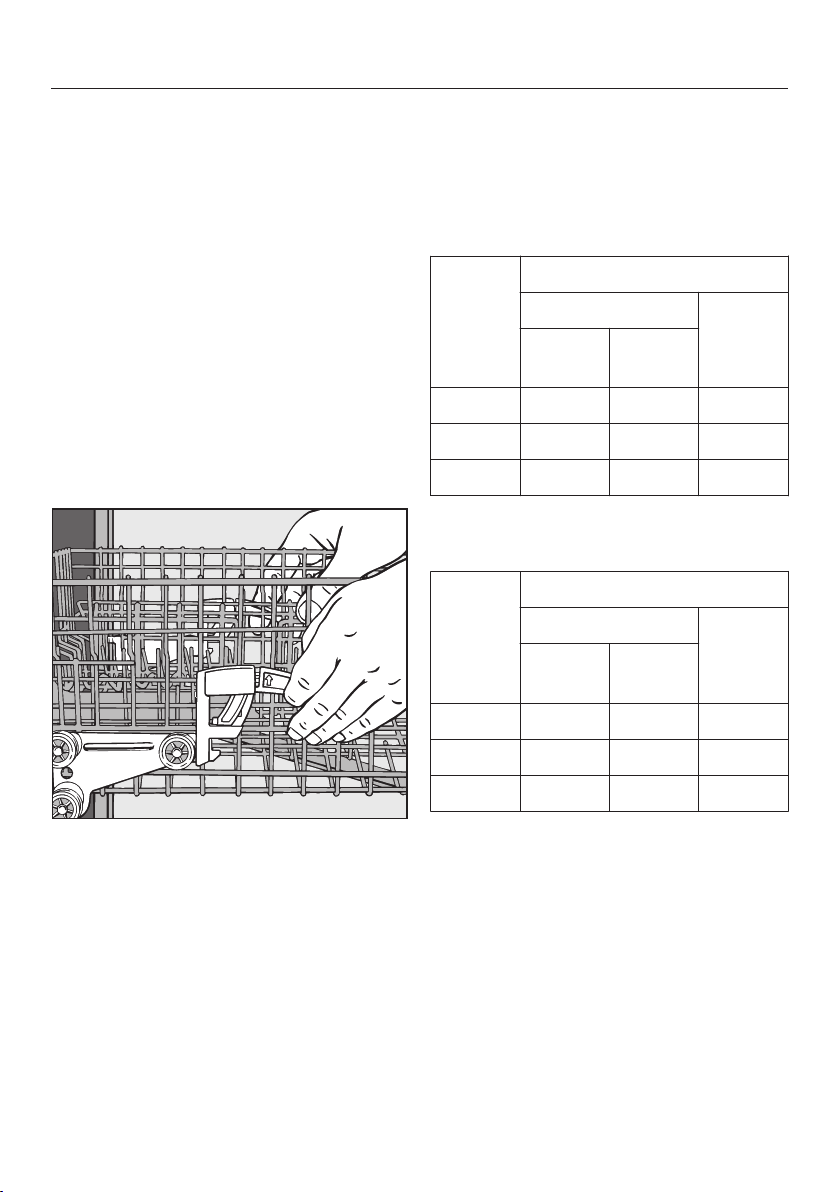
Cup rack
T
o make room for tall items, raise the
rack upwards.
Glasses can be arranged along the po‐
sition
ing rail of the cup rack to give
them some support during the pro‐
gramme.
L
ower the cup rack and lean the
glasses against it.
Loading the dishwasher
32
Adjusting the upper basket
In order to gain more space for taller
pieces of cr
ockery in the bottom or up‐
per basket, the upper basket can be
adjusted on three levels with 2 cm be‐
tween each level.
The upper basket can also be set at an
angle with one side high and the other
side low
. This can be useful to help pre‐
vent water being left in deep dishes etc.
Ensure, however, that the basket can
be inserted smoothly into the cabinet. It
is better to adjust the basket before
loading it.
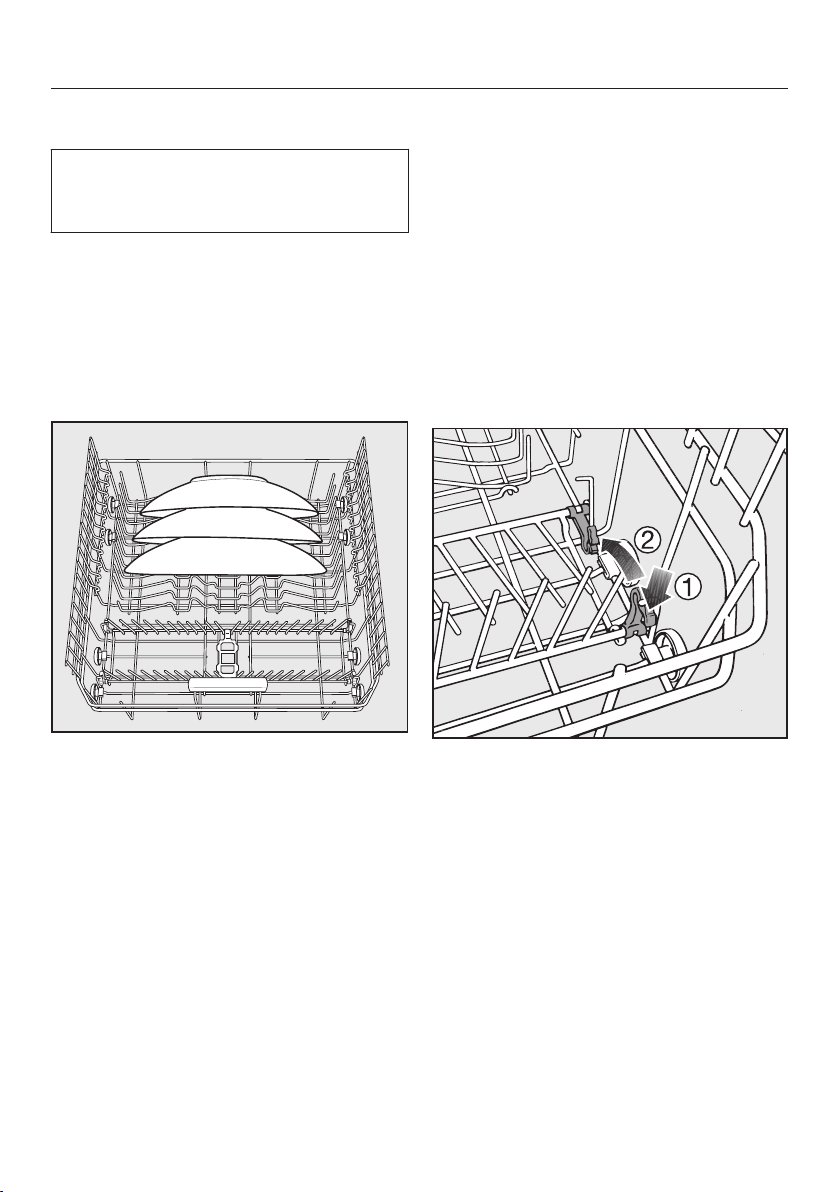
Pull out the upper basket.
To raise the upper basket:
P
ull the basket up until it clicks into
place.
To lower the upper basket:
P
ull upwards on the levers at either
side of the upper basket.
Adjust the bask
et to the desired
height and then push the levers se‐
curely back down into position.
Depending on the setting of the upper
bask
et, the following plate dimensions
can be accommodated.
Dishwashers with cutlery basket
(see data p
late for model number)
Upper
bask
et
level
Plate in cm
Upper basket Lower
basket
Stand‐
ar
d
XXL
Top 20 24 31 (35*)
Middle 22 26 29
Bottom 24 28 27
Dishwashers with cutlery tray
(see data p
late for model number)
Upper
bask
et
level
Plate in cm
Upper basket Lower
bask
et
Stand‐
ar
d
XXL
Top 15 19 31 (35*)
Middle 17 21 29
Bottom 19 23 27
* When tilted, plates of up to 35 cm can be
acco
mmodated (see "Lower basket").
Loading the dishwasher
33
Lower basket
See "Loading the dishwasher - Load‐
ing
examples" for examples of how to
load crockery and cutlery.
F
or larger and heavier items such as
plates, serving platters, saucepans,
bowls, etc.
Glasses, cups and small items such
as saucers can also be placed in the
lower basket. Do not place thin, deli‐
cate glassware in the lower basket.
Place
large platters and dishes in the
centre of the lower basket.
When tilted, plates up to 35 cm in di‐
amet
er can be accommodated.
MultiComfort area
The rear section of the lower basket is
used for washing cu
ps, glasses, plates,
pots and pans.
Hinged spikes
The spikes at the front are used for
washing
plates, soup bowls, platters,
dessert bowls and saucers.
Both rows of spikes can be lowered to
mak
e more room for large items, e.g.
pots, pans and dishes.
P
ress the yellow lever downwards ,
and then lower the spikes .
Loading the dishwasher
34
Cutlery
Cutlery tray
See "Loading the dishwasher - Load‐
ing
examples" for examples of how to
load crockery and cutlery.
Arr
ange the cutlery in the tray as
shown.
To make unloading much easier, cutlery
shou
ld be grouped in zones, one for
knives, one for forks, one for spoons,
etc.
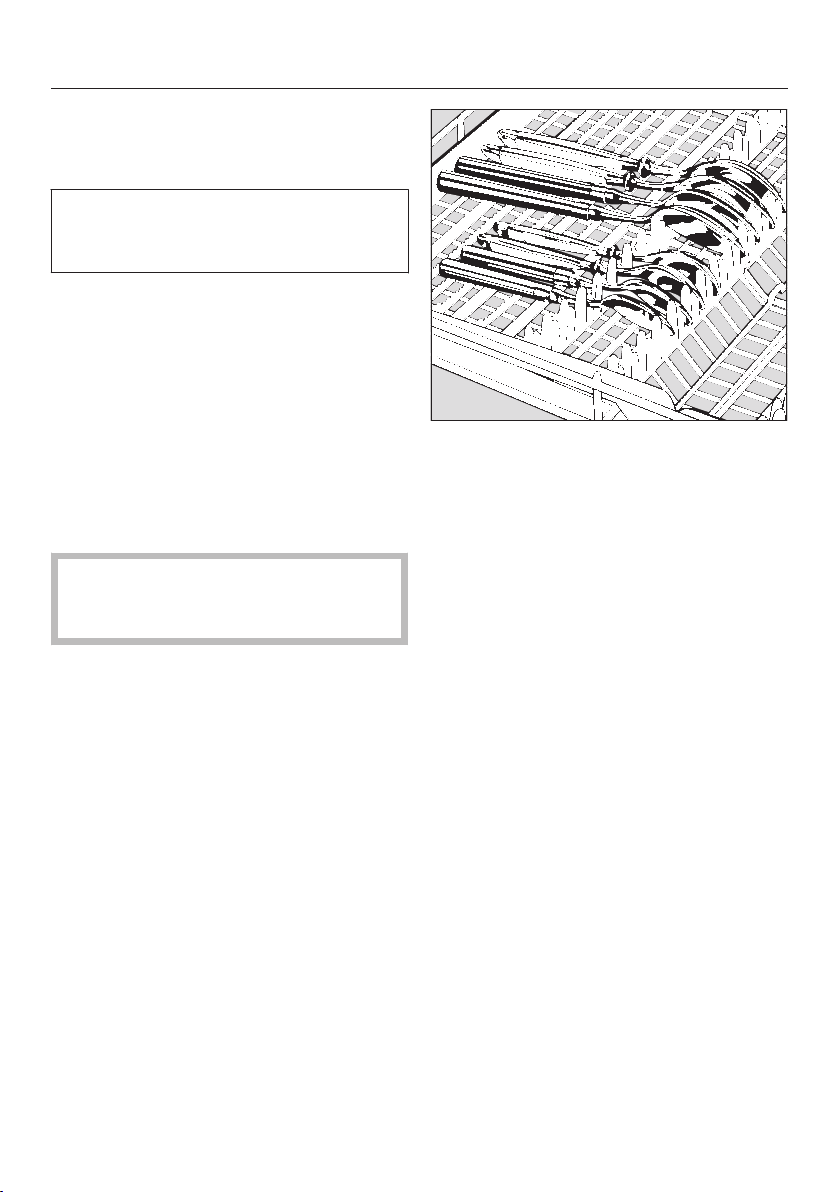
Spoon heads should be placed in con‐
tact with at least one of the serr
ated re‐
tainers on the base of the cutlery tray to
ensure that water runs off them freely.
The upper spray arm must not be
block
ed by items which are too big
(e.g. cake servers).
If spoon handles do not fit between
the holders, then lay them the other
way r
ound.
Loading the dishwasher
35
Cutlery basket (depending on model)
The cutlery basket can be placed any‐
wher
e on the front rows of spikes in the
lower basket.
T
o avoid the risk of injury, knives and
forks should be placed with the han‐
dles upwards in the basket. However,
cutlery placed handle down in the
basket will come out cleaner and dri‐
er.
Place
small items of cutlery in the in‐
dividual slots on three sides of the
cutlery basket.
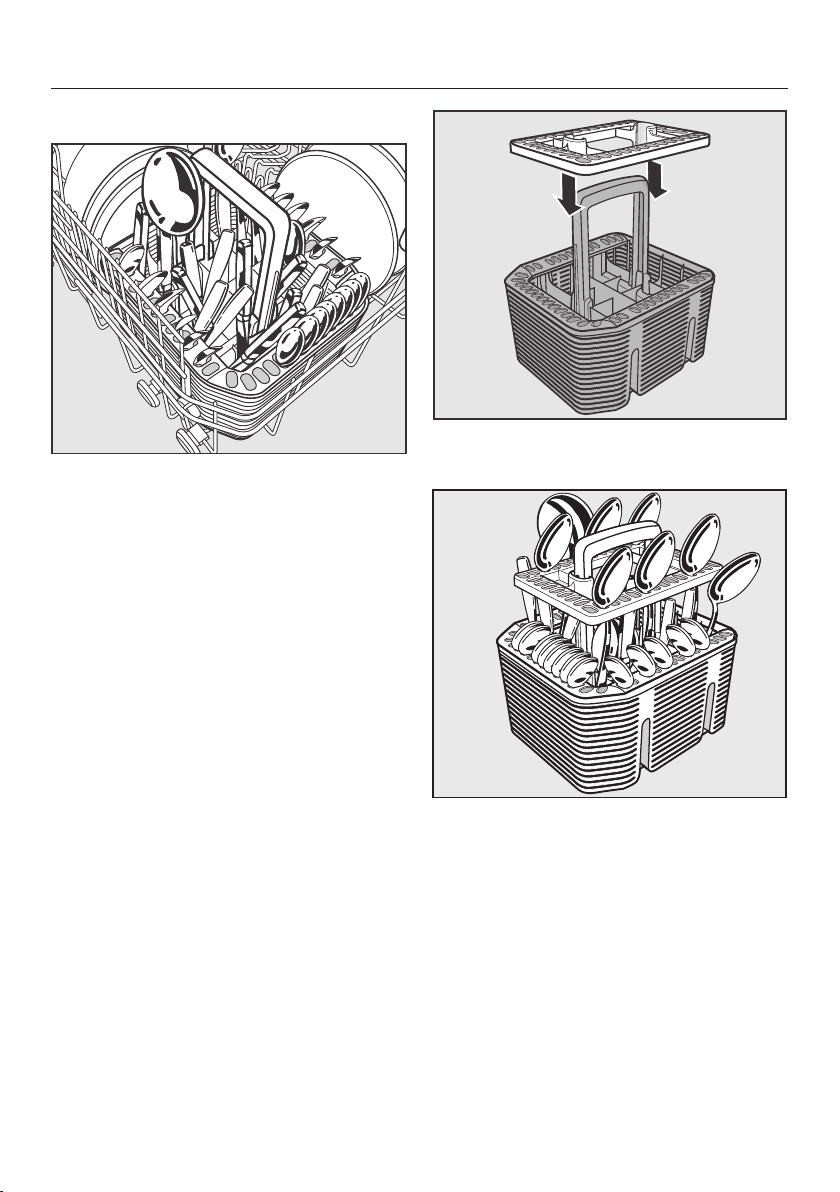
Cutlery insert for the cutlery basket
Use the insert supplied for heavily
soil
ed items of cutlery. The insert sepa‐
rates the items so that they can be
more easily accessed by water.
Fi
t it onto the cutlery basket if re‐
quired.
Inser
t cutlery with the handles facing
downwards.
Distri
bute them evenly along the in‐
sert.
Loading the dishwasher
36
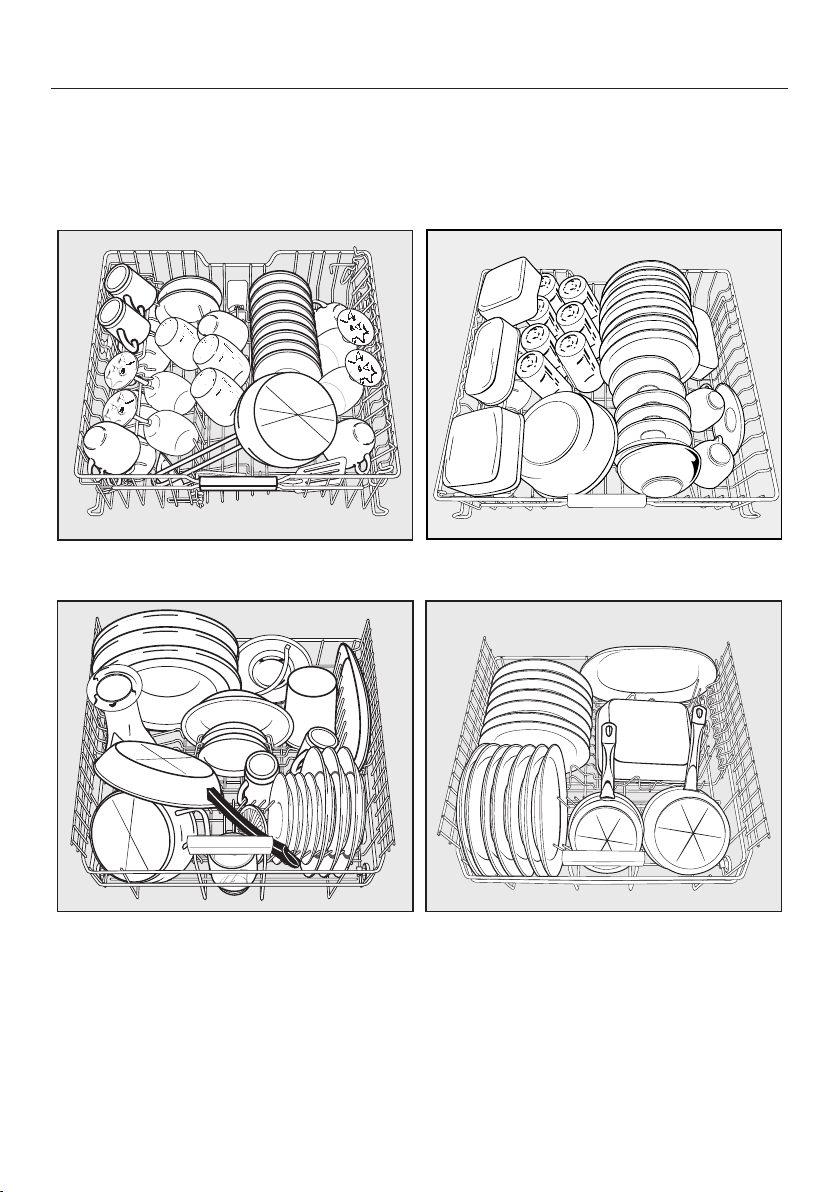
Loading examples
Dishwashers with cutlery tray
Upper basket
Lower basket
Loading the dishwasher
37
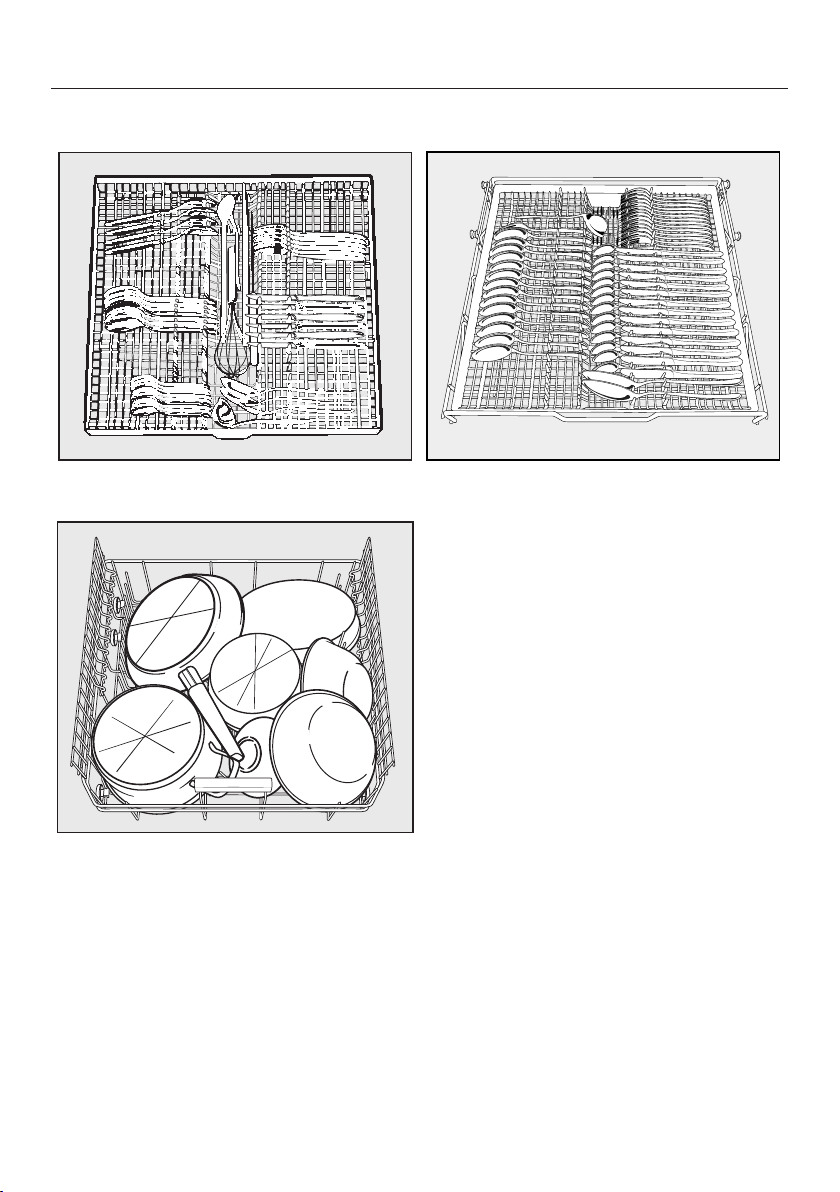
Cutlery tray
Heavily soiled items
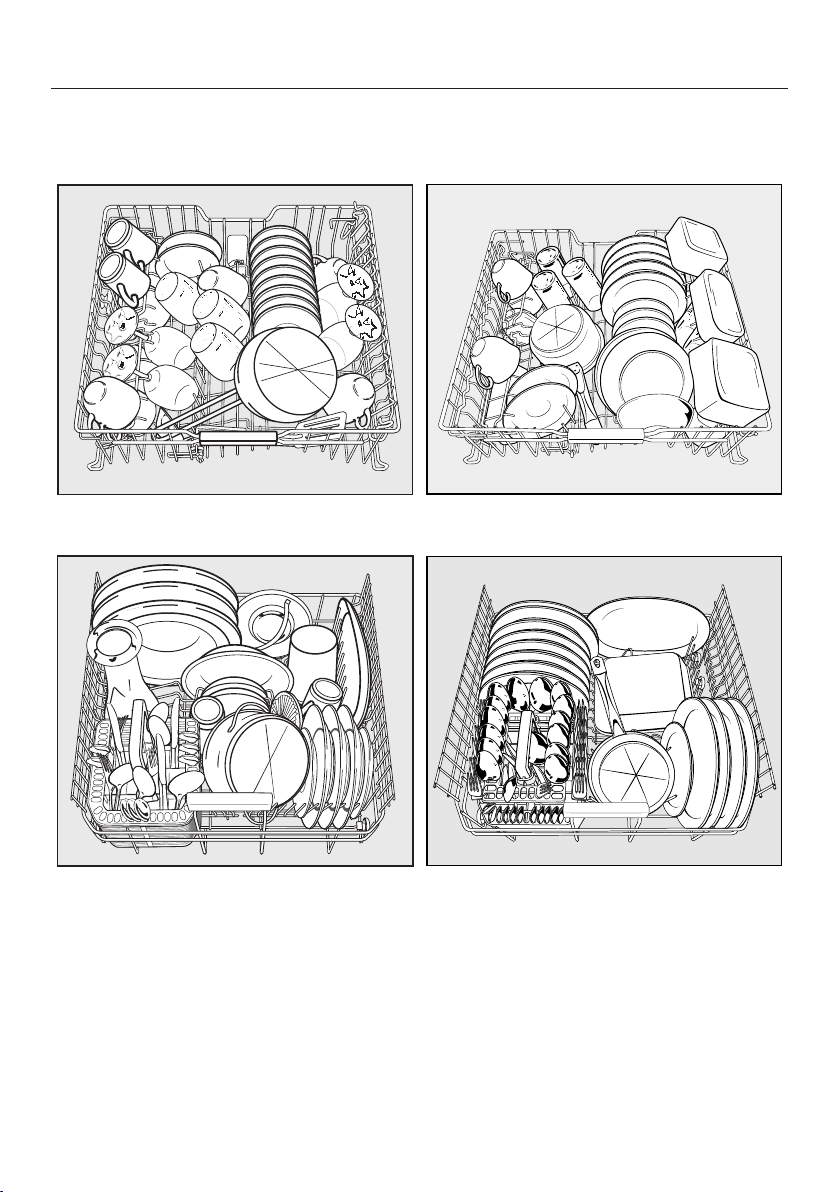
Loading the dishwasher
38
Dishwashers with cutlery basket
Upper basket
Lower basket
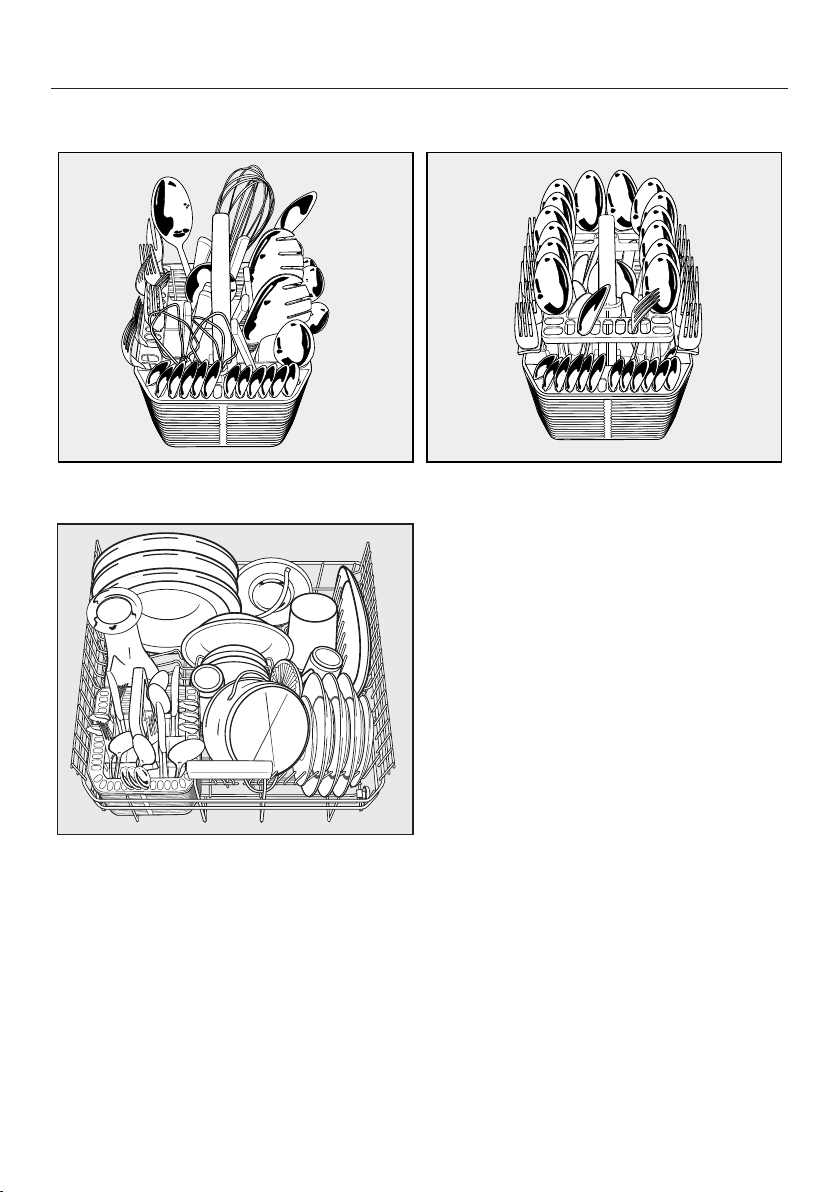
Loading the dishwasher
39
Cutlery basket
Heavily soiled items

Comparison tests
40
Standard height with cutlery tray
Test standard: AS/NZS 2007.1:2005, AS/NZS 2007.2:2005;
AS/NZS 6400:2005
Standard programme
for ener
gy label comparison
tests:
ECO
Capacity: 14 place settings
Detergent quantity: 32.5 g in Compartment II
Rinse aid dispensing: Setting 3
You can find information on adjusting the rinse aid dosage in the "Rinse aid"
section of this booklet.
Drying measurements: Door ajar using a block of approximately
50 mm upon completio
n of dry test.
Upper basket level:
Position: Bottom
Jumbo cup rack
(if available):
Outer position
Loading examples
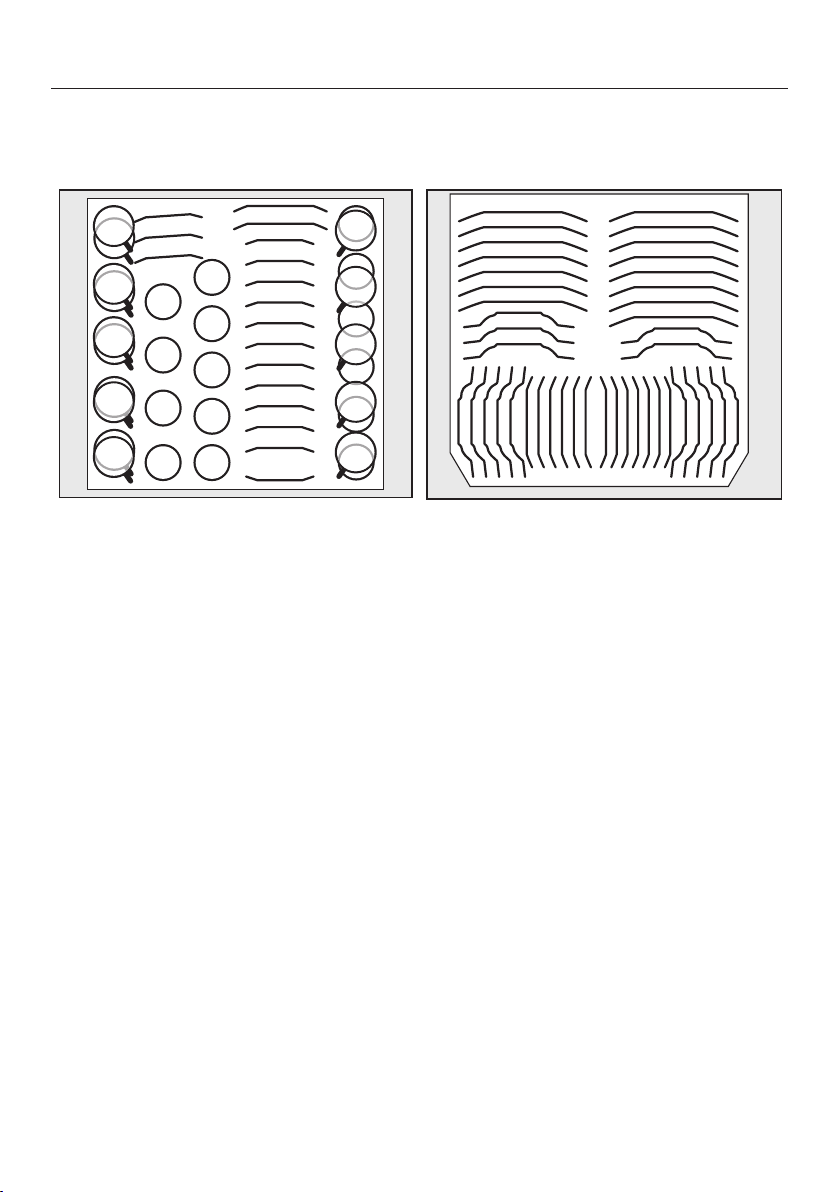
Pictures illustrating how to load the dishwasher are shown on the following pages.
Picture : Upper basket
Picture : Lower basket
Picture : Cutlery tray
Do not lower or remove the basket inserts.
Remove the bottle holder from the lower basket
(if available).
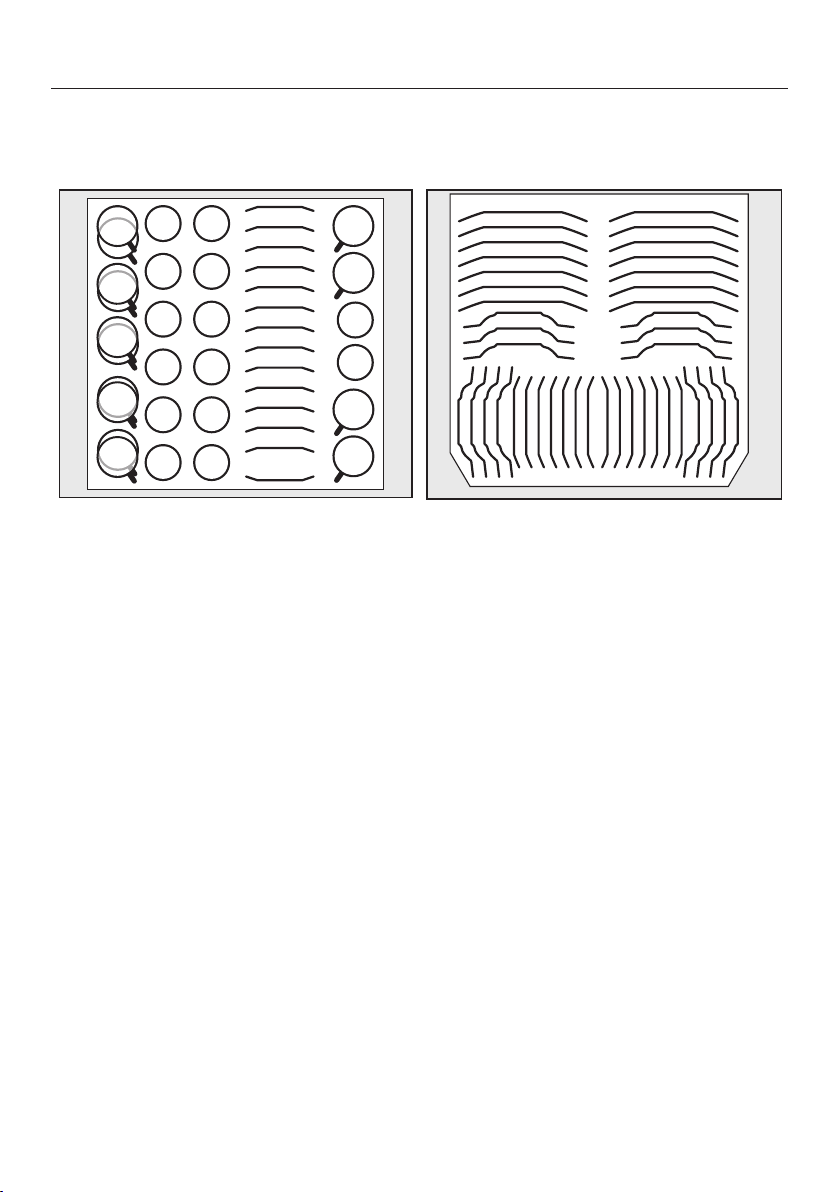
Comparison tests
41
Capacity
14
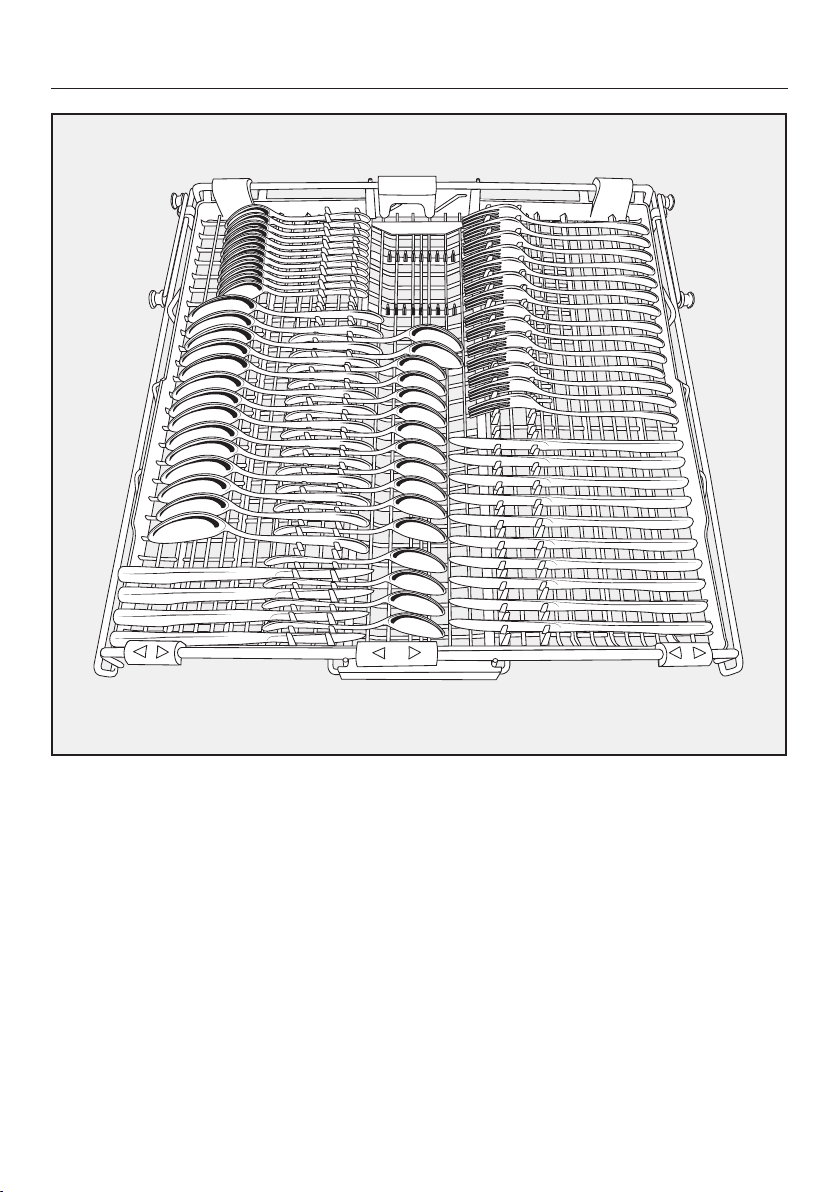
Comparison tests
42

Comparison tests
43
XXL height with cutlery tray
Test standard: AS/NZS 2007.1:2005, AS/NZS 2007.2:2005;
AS/NZS 6400:2005
Standard programme
for ener
gy label comparison
tests:
ECO
Capacity: 15 place settings
Detergent quantity: 33.7 g in Compartment II
Rinse aid dispensing: Setting 3
You can find information on adjusting the rinse aid dosage in the "Rinse aid"
section of this booklet.
Drying measurements: Door ajar using a block of approximately
50 mm upon completio
n of dry test.
Upper basket level:
Position: Bottom
Jumbo cup rack
(if available):
Outer position
Loading examples
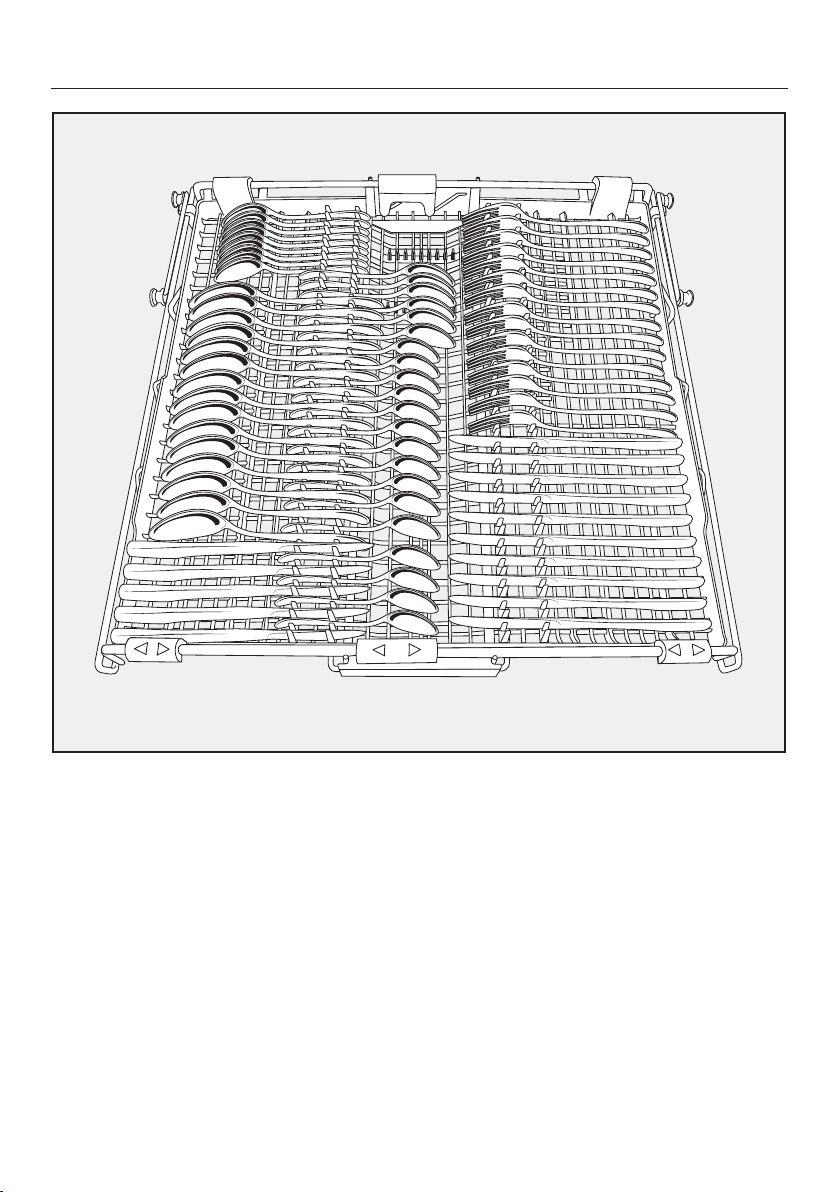
Pictures illustrating how to load the dishwasher are shown on the following pages.
Picture : Upper basket
Picture : Lower basket
Picture : Cutlery tray
Do not lower or remove the basket inserts.
Remove the bottle holder from the lower basket
(if available).
Comparison tests
44
Capacity
15
Comparison tests
45

Comparison tests
46
Standard and XXL height with cutlery basket
Test standard: AS/NZS 2007.1:2005, AS/NZS 2007.2:2005;
AS/NZS 6400:2005
Standard programme
for ener
gy label comparison
tests:
ECO
Capacity:
14 place settings
Detergent quantity: 5.0 g in Compartment I,
27.5 g in Compar
tment II
Rinse aid dispensing: Setting 5
You can find information on adjusting the rinse aid dosage in the "Rinse aid"
section of this booklet.
Drying measurements: Door ajar using a block of approximately
50 mm upon completio
n of dry test.
Upper basket level:
Position: Bottom
Jumbo cup rack
(if available):
Outer position
Loading examples
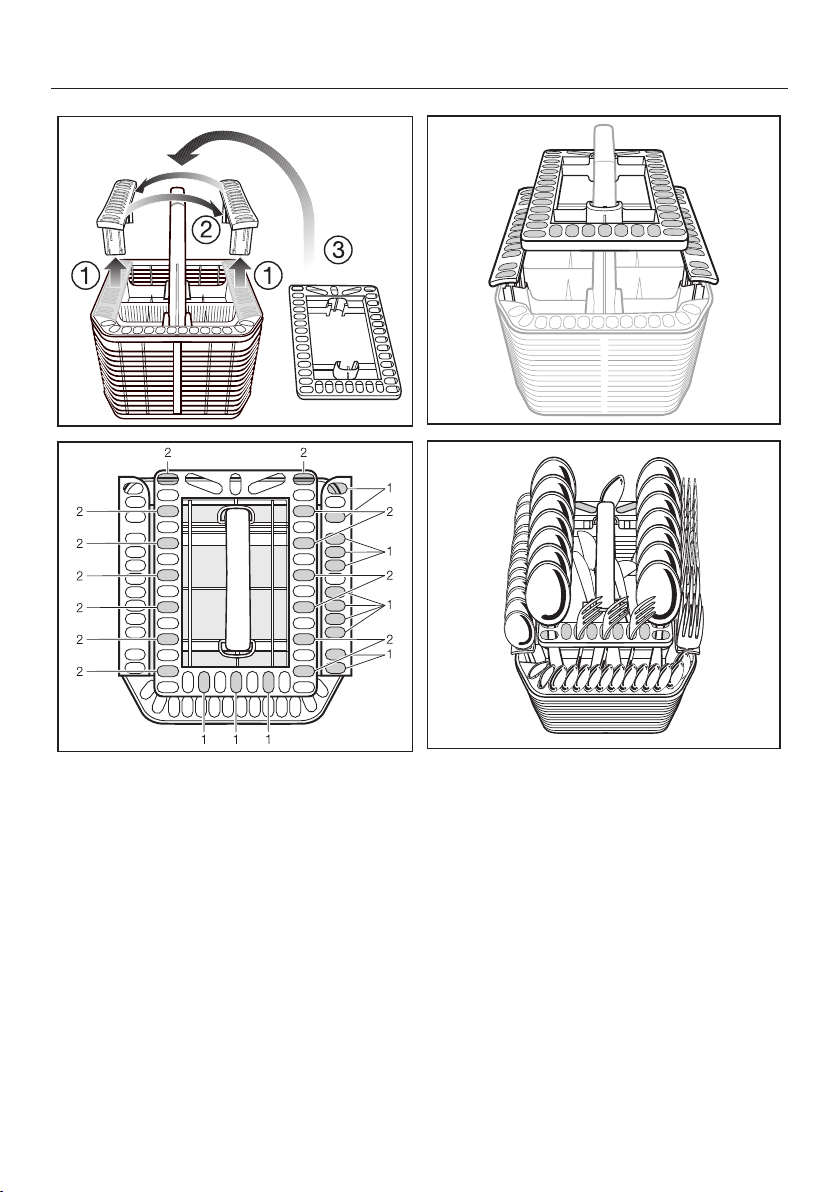
Pictures illustrating how to load the dishwasher are shown on the following pages.
Picture : Upper
basket
Picture : L
ower basket
Picture : Cutler
y basket
Do not lower or remove the basket inserts.
Remove the bottle holder from the lower basket
(if available).

Comparison tests
47
Capacity
14
Upper basket Lower basket
Comparison tests
48
Cutlery basket
1 fork
2 soup spoons

Operation
49
Detergent
O
nly use detergents formulated
for domestic dishwashers. Do not
use washing-up liquid.
Active ingredients
Modern detergents contain various ac‐
tive ing
redients, the most important of
which are:
– Complexing agents to prevent calcifi‐
cation.
– Alkalis to aid the removal of dried on
soiling.
– Enzymes to break down starch and
lo
osen protein.
– Oxygen based bleaching agents to
remove coloured stains (e.g. tea, cof‐
fee, tomato sauce).
Most dishwasher detergents are mildly
alkal
ine and contain enzymes and oxy‐
gen based bleaching agents.
Types of detergent:
– Powder and liquid gel detergents.
Th
ese detergents allow you to adjust
the amount dispensed according to
the amount of load and level of soil‐
ing.
– Tab detergents. These are suitable
for most levels of soiling.
You can also buy combination products
(see "P
rogramme options - Detergent‐
Agent", if applicable).
In addition to detergent, these products
contain rinse aid and salt substitutes.
They are available as "3 in 1" or when
they also contain other components
such as glass and stainless steel pro‐
tective additives and enhanced clean‐
ing power, as "5 in 1", "7 in 1", "All in 1"
etc.
Refer to the manufacturer's packaging
as to whether combination products are
suitable for the water hardness level in
your area.
Please note that the cleaning and dry‐
ing results of combination detergents
can vary greatly.
For optimum cleaning and drying re‐
sults, use Miele dishwasher detergent
and add Miele salt and Miele rinse aid
separately. See "Optional accesso‐
ries".
Operation
50
Detergent dosage
F
ollow the dosage recommended by
the manufacturer on the packaging.
Unl
ess directed otherwise, use one
detergent tab or add 20 to 30 ml de‐
tergent to compartment II, depending
on the level of soiling. With very
heavy soiling you can also add a
small amount of detergent to com‐
partment l.
T
abs may not dissolve completely
when the Quick wash programme (if
available) is used.
Failure to dispense the recommen‐
ded amount of det
ergent may impair
cleaning results.
Some dishwasher det
ergents are
strongly alkaline and contain irritant
or corrosive ingredients which can
cause burning in the nose, mouth
and throat if swallowed, or inhibit
breathing.
Avoid inhalation of powder deter‐
gents and do not ingest dishwasher
det
ergent. Seek medical advice im‐
mediately if detergent has been
swallowed or inhaled.
Keep detergent and other household
agents out of the reach of children at
all times. Keep children away from
the dishwasher when the door is
open. There could still be detergent
residues in the cabinet. Check that
the detergent dispenser is empty at
the completion of a programme. To
avoid the danger of children coming
into contact with the dishwasher de‐
tergent, only add detergent just be‐
fore starting the programme and
close the door, activating the safety
lock (if your dishwasher is fitted with
one).
Operation
51
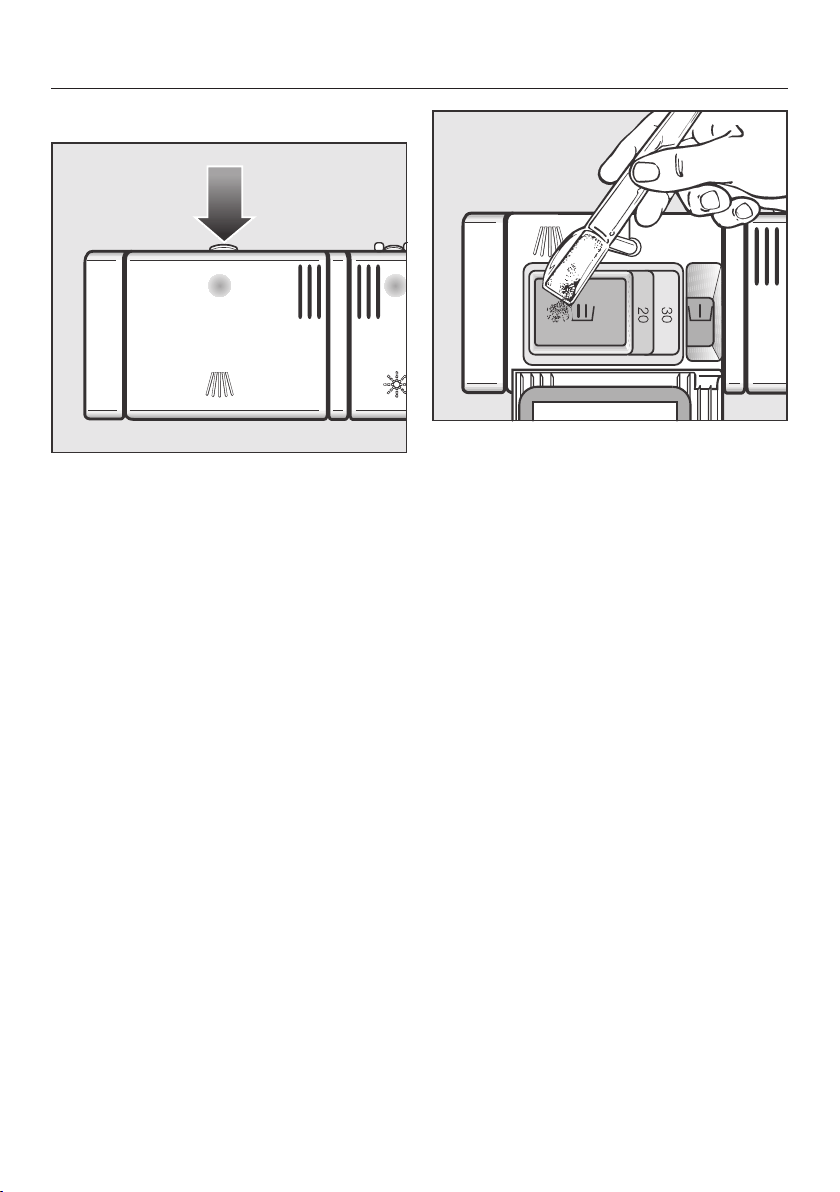
Adding detergent
P
ress the opening catch on the de‐
tergent dispenser. The flap will spring
open.
The flap is always open at the end of a
pr
ogramme.
Add the required amount of detergent
and close the flap.
Mak
e sure that the detergent packag‐
ing is properly closed after use to
avoid it getting damp and becoming
lumpy.
For information
Compartment I holds max. 10 ml,
Compar
tment II holds max. 50 ml.
There are marks in Compartment II to
assist with dispensing: 20, 30. The
marks indica
te a level of approx. 20 or
30 ml when the door is open in a hori‐
zontal position.

Operation
52
Switching on the dishwasher
Ma
ke sure the spray arms are not ob‐
structed.
Cl
ose the door.
T
urn on the tap if it is turned off.
Switch the dishwasher on with the
butt
on.
The Start indica
tor light flashes and the
indicator light comes on next to the
programme selected.
Selecting a programme
Choose your programme according to
the type of load and how d
irty it is.
The different programmes and their
uses ar
e described in the Programme
chart later on in this booklet.
Use the pr
ogramme selector button
to select the programme required.
The indicator light for the programme
select
ed will light up.
The programme duration will appear in
hours and minutes in the display.
You can now select programme op‐
tions (see "P
rogramme options").
If any programme options are selected,
the appropriate indicator lights will light
up.

Operation
53
Starting the programme
P
ress the
Start butt
on.
The programme will begin.
The Start indica
tor light will come on.
A programme should only be cancel‐
led in the first few minut
es, if at all.
Otherwise important programme
stages could be omitted.
Display
The duration of the programme selec‐
t
ed appears in hours and minutes in the
display before the programme begins.
During the programme the time left until
the end of the programme is displayed.
The programme duration displayed may
var
y with the same programme. It is in‐
fluenced by, among other things, the
water temperature at each intake, the
reactivation process, the type of deter‐
gent, the amount of crockery and how
dirty it is.
When a programme is selected for the
first time, the display shows an aver
age
time for a cold water intake.
The times shown in the Programme
char
t refer to standard test loads and
temperatures.
Each time a programme is run, the
electr
onic unit takes the new conditions
into account, and calculates the time
required.

Operation
54
Energy management
To save energy, the dishwasher will
switch off aut
omatically 10 minutes af‐
ter the last time a button has been
pressed or 10 minutes after the end of
the programme (see "Programme op‐
tions - Optimise standby").
P
ress the button to switch the
dishwasher back on.
The dishwasher will not switch off
whilst a pr
ogramme is running, during
the Delay start period or if there is a
fault.
Programme finished
The programme has ended when
.
appears in the display.
The drying fan may continue to run for
a few minut
es at the end of the pro‐
gramme.
The dishwasher can now be opened
and unloaded (see "Unloading the
dishwasher").
T
o prevent the risk of steam
damage to the worktop edging
above the dishwasher, it is advisable
to leave the door closed until you are
ready to unload the crockery. Alter‐
natively, you can open the door fully
until the crockery is cool enough to
unload. Do not leave the door only
partially open.

Operation
55
Switching off
At the end of a programme:
The dishwasher can be switched off
at any time using the b
utton.
Switching the dishwasher off during a
pr
ogramme stops the programme.
Switching the dishwasher off during the
run-u
p to a Delay start time will also
stop the process.
If the dishwasher is not going to be
used for a longer period of time, e.g.
whilst on holiday, the tap should be
turned off.
Unloading the dishwasher
Dishes tend to break and chip more
easi
ly when they are hot. Allow the
dishes to cool until they are comforta‐
ble enough to handle before unloading
them.
If you open the door fully after switch‐
ing
off, the dishes will cool much faster.
First unload the lower basket, then the
upper b
asket and finally the cutlery tray
(depending on model).
This will prevent water drops from the
upper basket and cutlery tray from fall‐
ing onto the dishes in the lower basket.

Operation
56
Interrupting a programme
A programme is interrupted as soon as
the door is opened.
If t
he door is closed again, the pro‐
gramme will continue from the point it
was at before the door was opened.
W
ater in the dishwasher may be
hot. Danger of scalding!
Only open the door if absolutely nec‐
essar
y and exercise extreme caution
when doing so. Before closing the
door again, leave it ajar for approx.
20 seconds. This will enable the tem‐
perature in the wash cabinet to set‐
tle. Then raise the door up and push
until the catch engages.
Changing a programme
If the detergent dispenser flap has
alr
eady opened, do not change the
programme.
If a programme has already started and
you wish t
o change it, proceed as fol‐
lows:
Switch the dishwasher off with the
butt
on.
Switch the dishwasher on again with
the butt
on.
Selec
t the programme you want, and
then start it.

Programme options
57
Short
The Short option reduces the dura‐
tion of programmes in which this option
is available.
In order to achieve optimum cleaning
r
esults, consumption rates are in‐
creased with this option.
Switch the dishwasher on with the
butt
on.
The Start indicator light will flash.
Selec
t a programme.
P
ress the button.
The
indicator light comes on.
The
programme can now be started.
The option selected will remain active
for that par
ticular programme until the
setting is changed.
DetergentAgent
For optimum cleaning results, the dish‐
washer aut
omatically adjusts the pro‐
gramme sequence to the type of deter‐
gent being used. Depending on the
programme, this can mean that the run‐
ning time and energy consumption vary
slightly.

Programme options
58
Switching off the refill indica‐
t
ors
If you only ever use multi-function com‐
binatio
n products in your dishwasher,
you can switch the refill reminders for
salt and rinse aid off if you wish. Doing
so will not affect the DetergentAgent
function.
Switch the dishwasher off with the
butt
on if it is switched on.
P
ress the
Start butt
on in and, whilst
holding it in, switch the dishwasher
on using the button.
Keep the
Start
button pressed in for
at least four seconds until the
Start
indicat
or light comes on.
If this does not happen, start the proce‐
dur
e from the beginning again.
P
ress the button 9 times.
The indica
tor light will flash rapidly 9
times at intervals.
The flashing sequence in the display
will appear whether the r
efill indicators
are switched on or off.
– : Refill in
dicators are switched on.
– : Refill in
dicators are switched off.
P
ress the
Start butt
on to change the
setting.
The setting is now stored in memory.
Switch the dishwasher off with the
button.
If you switch to using detergent that
does not contain salt or rinse aid, it
is impor
tant to remember to add
dishwasher salt and rinse aid and to
switch the refill indicators back on.

Programme options
59
Delay start
You can set the start time for a pro‐
gr
amme, e.g. to take advantage of night
time electricity tariffs. The start time
can be delayed between 30 minutes
and 24 hours.
The delay period is shown in 30-minute
increments for a delay period between
30 minutes and 9 hours 30 minutes. It is
shown in hours for periods longer than
this.
When using the Delay start function,
mak
e sure that the detergent com‐
partment is dry before adding deter‐
gent. Wipe dry with a cloth if neces‐
sary. If the compartment is wet,
powder detergent can become lum‐
py and stick to the dispenser, with
the result that it is not fully dis‐
pensed.
Do not use liquid detergent when se‐
lecting Delay start, as it can run into
the dishwasher before it is required.
T
o prevent children coming into
contact with dishwasher detergent:
Add the detergent im
mediately be‐
fore starting the programme, i.e. be‐
fore activating Delay start with the
Start butt
on. Then lock the door with
the safety lock.
Switch the dishwasher on with the
butt
on.
The Start indica
tor light will flash.
Selec
t the programme you want.
Press the button.
The last Delay start time used will ap‐
pear in the display
. The Delay start indi‐
cator light comes on.
Set the r
equired time using the
button.
If you keep the
button pressed in,
the time will increase automatically up
to hours. To get back to . hours,
press the button twice.
P
ress the
Start butt
on.
The Start indica
tor light will come on.

Programme options
60
If "Optimise standby" is switched on
(see "P
rogramme options - Optimise
standby"), the display will go out after
a few minutes, leaving just the
Start
indicat
or light flashing slowly.
Press any button to switch the display
back on aga
in for a few minutes.
The time up until the programme starts
will appear counting down in the dis‐
play in hou
rs for durations above
10 hours, and in hours and minutes for
durations below this.
When the set time is reached, the pro‐
gr
amme selected will start automatical‐
ly. The time remaining will appear in the
display and the indicator light will go
out.
How the Delay start time is shown in
the display:
up to 59 minutes:
e.g. 30 mi
nutes = .
1 hour up to 9 hours 30 minutes:
e.g. 5 hours = .
10 hours and over:
e.g. 15 hours =
Starting a programme before the De‐
lay star
t period has elapsed:
A programme can be started before the
Delay star
t period has elapsed.
Proceed as follows:
Switch the dishwasher off with the
butt
on.
Switch the dishwasher on again with
the butt
on.
Selec
t the programme you want.
Press the Start button.
The programme cycle will begin. The
Start indicat
or light will come on.

Programme options
61
Adjust Sensor wash
You can adjust the Sensor wash pr
o‐
gramme so that it will remove stubborn
soiling in a lightly soiled load.
Switch the dishwasher off with the
button, if it is switched on.
P
ress the
Start butt
on in and, whilst
holding it in, switch the dishwasher
on using the button.
Keep the
Start
button pressed in for
at least 4 seconds until the
Start indi‐
cat
or light comes on.
If this does not happen, start the proce‐
dure from the beginning again.
P
ress the button 5 times.
The indica
tor light will flash rapidly 5
times at intervals.
The flashing sequence in the display in‐
dicat
es whether "Adjust sensor wash"
is activated or not.
– : "Adjust sensor wash" is switched
on.
– : "Adjust sensor wash" is switch‐
ed off.
P
ress the
Start butt
on to change the
setting.
The setting is now stored in memory.
Switch the dishwasher off with the
butt
on.

Programme options
62
Optimise standby
"Optimise standby" is activated by de‐
fault.
To save energy, the dishwasher will
switch off aut
omatically a few minutes
after the last time a button has been
pressed or after the end of a pro‐
gramme.
The dishwasher will not switch off
whilst a pr
ogramme is running, during
the Delay start period or if there is a
fault.
"Optimise standby" can be switched off
if you pr
efer. If you do this, the duration
before the dishwasher switches off in‐
creases to 6 hours. Doing this will in‐
crease energy consumption.
Switch the dishwasher off with the
button if it is switched on.
P
ress the
Start butt
on in and, whilst
holding it in, switch the dishwasher
on using the button.
Keep the
Start
button pressed in for
at least four seconds until the
Start
indicat
or light comes on.
If this does not happen, start the proce‐
dure from the beginning again.
P
ress the button 8 times.
The indica
tor light will flash rapidly 8
times at intervals.
The flashing sequence in the display
shows whether "Optimise standby" is
activat
ed or not.
– : "Optimise standby" is switched
on.
– : "Optimise standby" is switched
off.
P
ress the
Start butt
on to change the
setting.
The setting is now stored in memory.
Switch the dishwasher off with the
butt
on.

Programme options
63
Factory default settings
If you have altered any settings from
the fact
ory default, you can reset them
back to the factory default settings as
follows:
Switch the dishwasher off with the
butt
on, if it is switched on.
P
ress the
Start butt
on in and, whilst
holding it in, switch the dishwasher
on using the button.
Keep the
Start
button pressed in for
at least 4 seconds until the
Start indi‐
cat
or light comes on.
If this does not happen, start the proce‐
dur
e from the beginning again.
P
ress the button 19 times.
The indica
tor light will do 1 long
flash and 9 short flashes at intervals.
The flashing sequence in the display in‐
dicat
es whether a setting has been
changed from its factory default.
– : All setting
s are set to factory de‐
fault settings.
– : At least one setting has been
changed.
T
o reset the dishwasher to the factory
default settings, press the
Start but‐
t
on.
The setting is now stored in memory.
Switch the dishwasher off with the
button.
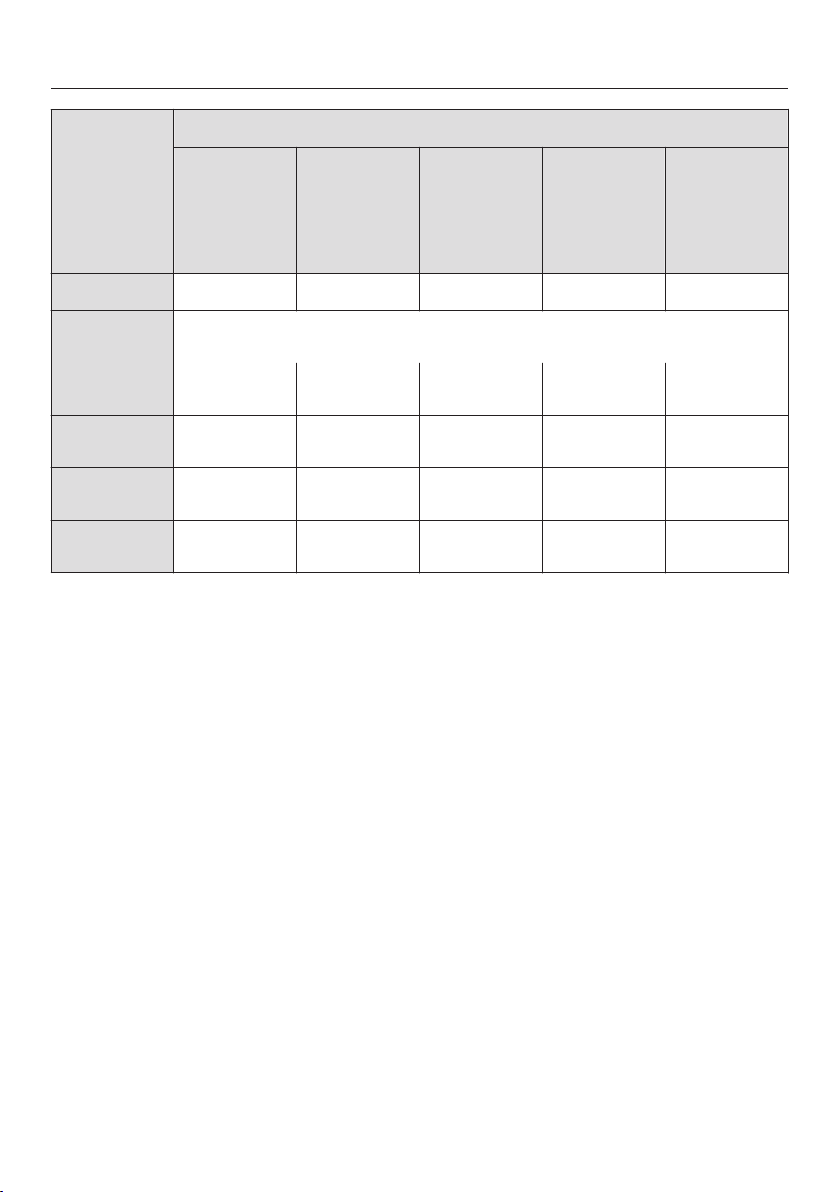
Programme chart
64
Programme Programme sequence
Pre-wash Main wash Interim rinse Final rinse Drying
°C °C
ECO
1)
X 48 X 47 X
Sensor wash Variable programme sequence,
senso
r-controlled adjustment according to amount of crockery and soiling
If
r
equired
47-55 If
r
equired
65 X
Light soiling
55°C
X 55 X 68 X
Intensive
75°C
2X 75 X 68 X
Gentle
45°C
X 44 X 65 X
1)
This programme is the most efficient in terms of its combined energy and water con‐
sumption for cleaning normally soiled crockery.
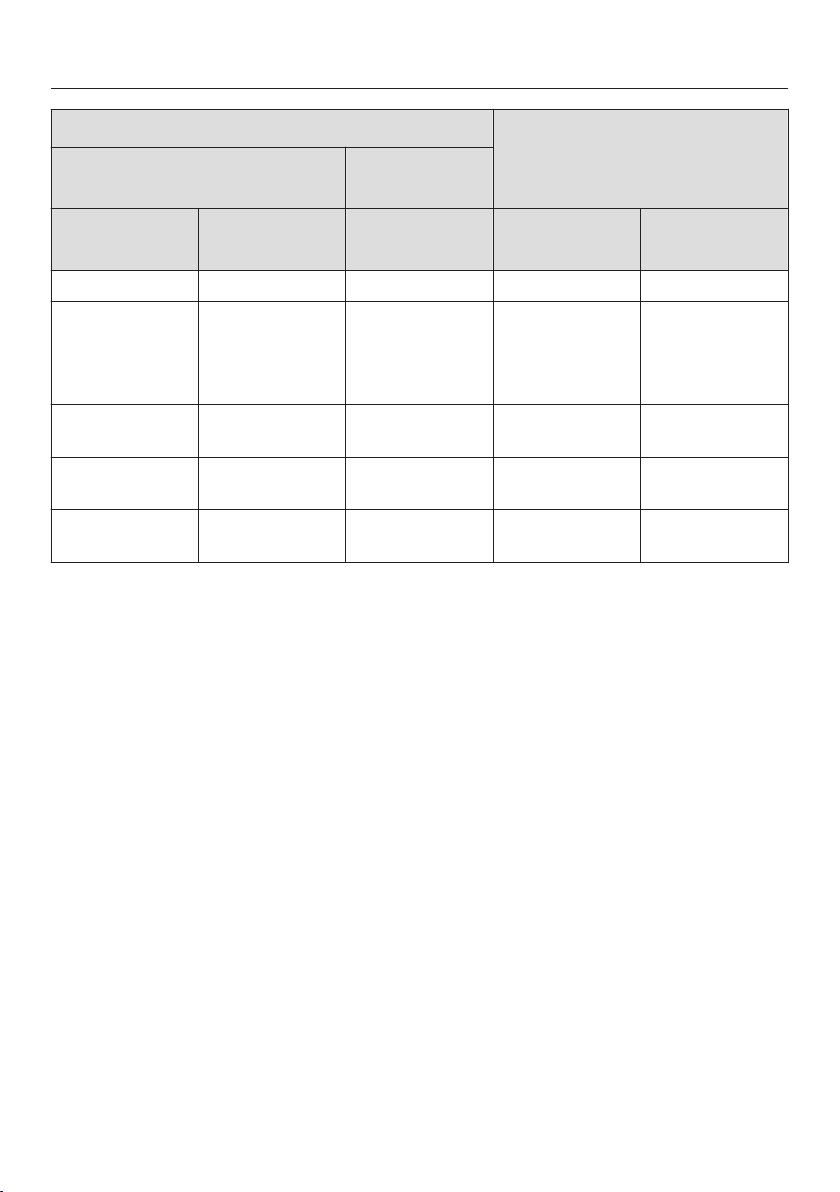
Programme chart
65
Consumption
2)
Duration
2)
Electricity Water
Cold water Hot water Litres Cold water Hot water
kWh kWh h:min h:min
0.73 0.41 11.3 2:41 2:34
0.85
3)
-1.35
4)
0.65
3)
-0.90
4)
6.5
3)
-16.0
4)
1:30-2:50 1:25-2:40
1.25 0.85 14.0 2:03 1:51
1.60 1.10 15.0 2:58 2:44
1.05 0.60 13.5 1:57 1:46
2)
In pr
actice there may be variations to these figures due to variable conditions and data
recorded by the sensors. The durations displayed in your dishwasher will reflect your
household conditions.
Selecting programme options will also affect consumption levels and programme dura‐
tions (see "Programme options").
3)
P
art load with light soiling
4)
F
ull load with heavy soiling
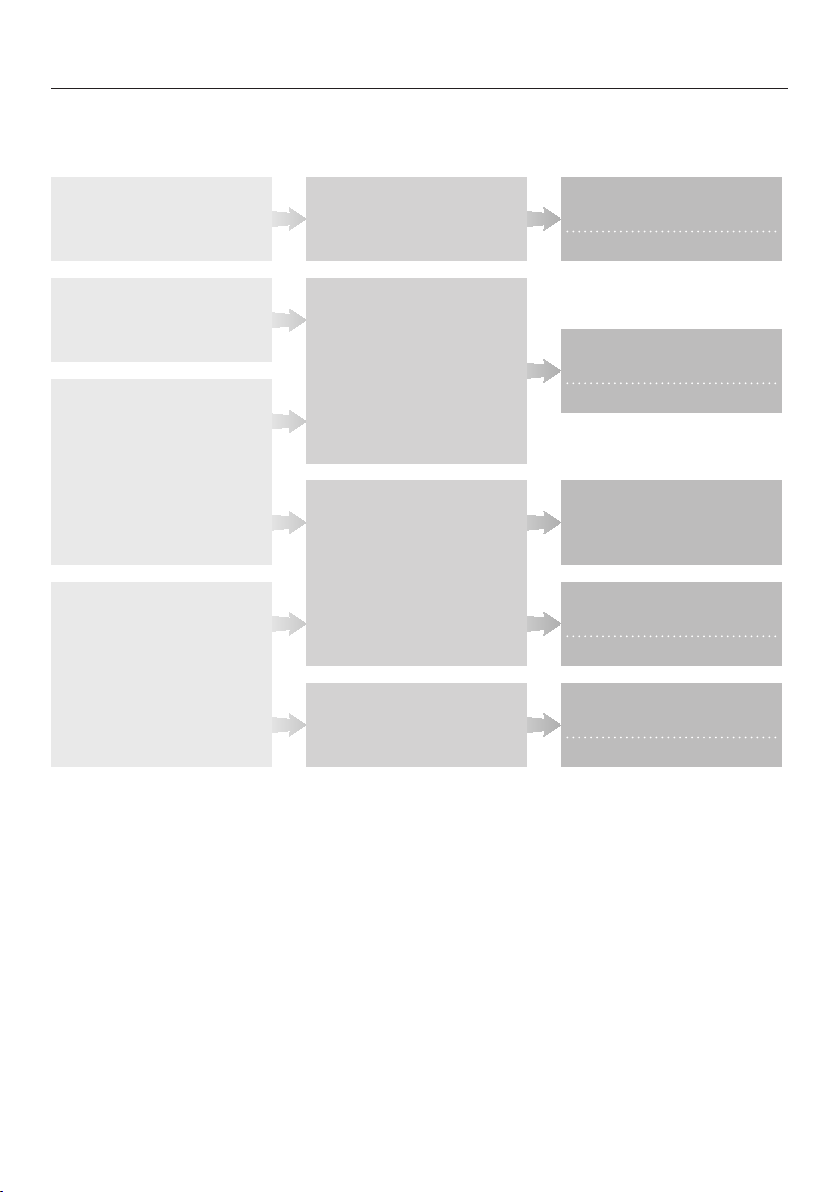
Programme chart
66
Mixed,
everyday crockery
Heat-sensitive glasses and
plastic
Mixed crockery
Pots, pans, everyday porcelain
and cutlery
All fresh to dried-on
food deposits
Fresh, easily removed food
deposits
Fresh food deposits which
have begun to dry on
Burnt-on, stubborn, dried-
on food deposits containing
starch or protein
1)
Variable, sensor-controlled
programme sequence
Shorter duration
This needs a gentle
programme with glass care
Shorter duration
This needs a water and energy
saving programme
Average programme values
Shorter duration
Maximum cleaning power
Shorter duration
1)
Food such as potatoes, pasta, rice or stews can leave starchy deposits. Deposits containing protein
can be left by food such as fried meat, fish or eggs and bakes.
Crockery Food deposits Action required
Programme chart
67
-
25 ml
or
1 tab
Sensor wash
+short
-
20 ml
or
1 tab
Gentle 45°C
+short
-
25 ml
or
1 tab
ECO
-
25 ml
or
1 tab
Light soiling 55°C
+short
10 ml
25 ml
or
1 tab
Intensive 75°C
+short
2)
see "Detergent"
Detergent
Compartment I
2)
Compartment II
2)
Programme

Cleaning and care
68
Check your dishwasher regularly (ap‐
prox. every 4-6 months). This way
faults and problems can be avoided.
The e
xternal surfaces of this ap‐
pliance are all susceptible to
scratching.
Contact with unsuitable cleaning
ag
ents can alter or discolour the ex‐
ternal surfaces.
Cleaning the wash cabinet
The wash cabinet is largely self-clean‐
in
g, provided that the correct amount of
detergent is always used.
If, however, there are limescale or
grease deposits in the cabinet, these
can be removed with a special dish‐
washer cleaner (see "Optional accesso‐
ries"). Follow the instructions on the
packaging.
Using mainly low temperature pro‐
gr
ammes (below 50°C), could cause
bacteria and unpleasant odours to build
up in the wash cabinet. To avoid this,
the dishwasher will increase the tem‐
perature in the final rinse of the selected
programme automatically after several
programmes using low temperatures
have been run.
Cle
an the filters in the wash cabinet
regularly.
Cleaning the door and the door
seal
Mould could build up on the door seal
and the sides of the dishwasher door
as these sur
faces are outside the wash
cabinet and are not accessed and
cleaned by the spray arm jets.
W
ipe the door seals regularly with a
damp cloth to remove food deposits.
W
ipe off any food or drink residues
which may have dripped onto the
sides of the dishwasher door before
closing it.

Cleaning and care
69
Cleaning the door front
Soiling
that is left too long might
become impossible to remove and
could cause external surfaces to al‐
ter or discolour.
Remove any soiling immediately.
Cle
an the front with a solution of
warm water and a little washing-up
liquid applied with a soft sponge.
Wipe the surfaces dry using a soft
cloth.
For cleaning, you can also use a
clean, damp microfibre cloth, such as
the Original Miele all purpose microfi‐
bre cloth, without any cleaning agent.
To avoid damaging external surfaces,
do not use:
– cleaning agents containing soda,
ammonia, acids or chlorides,
– cleaning agents containing descaling
agents,
– abrasive cleaning agents, e.g. pow‐
der clean
ers and cream cleaners,
– solvent-based cleaning agents,
– stainless steel cleaning agents,
– dishwasher cleaner,
– oven cleaner,
– glass cleaning agents,
– hard, abrasive brushes or sponges,
e.g. pot scour
ers, brushes or spong‐
es which have been previously used
with abrasive cleaning agents,
– dirt erasers,
– sharp metal scrapers,
– steel wool or metal scourers,
– steam cleaning appliances.
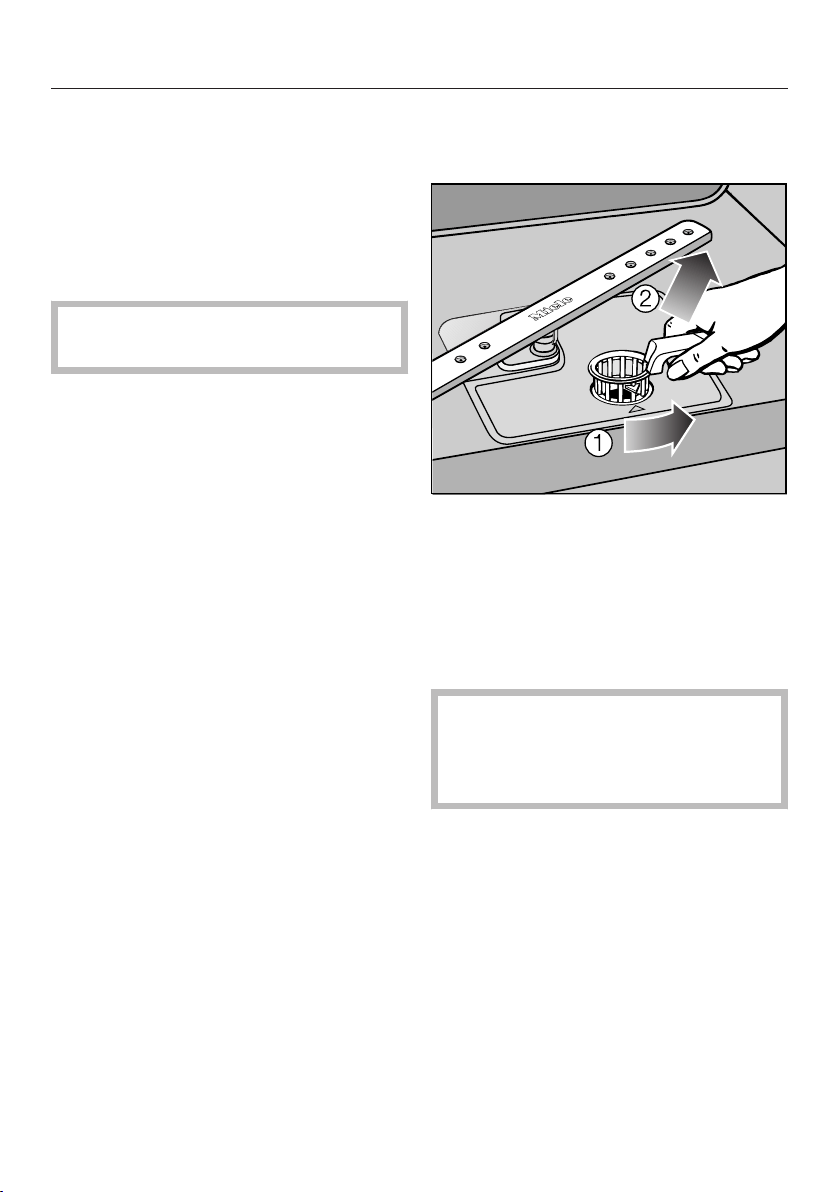
Cleaning and care
70
Checking the filters in the
wash cabinet
The filter combination in the base of the
wash cabinet r
etains coarse soil from
the suds solution, preventing it access‐
ing the circulation system and re-enter‐
ing the cabinet through the spray arms.
This dishwasher must not be
u
sed without all the filters in place.
Collection of coarse soil may cause the
filt
ers to clog. The level of soiling and
time it takes before the filters need
cleaning will vary depending on use.
Che
ck the condition of the filters reg‐
ularly and clean them if necessary.
Cleaning the filters
Switch the dishwasher off.
T
urn the handle anti-clockwise to re‐
lease the filter combination .
Lift the filt
er combination out of the
dishwasher . Remove any coarse
particles and rinse the filter well un‐
der running water.
Use a nylon brush if necessary.
During cl
eaning ensure that
course soil doesn't get into the cir‐
culation system and cause a block‐
age.
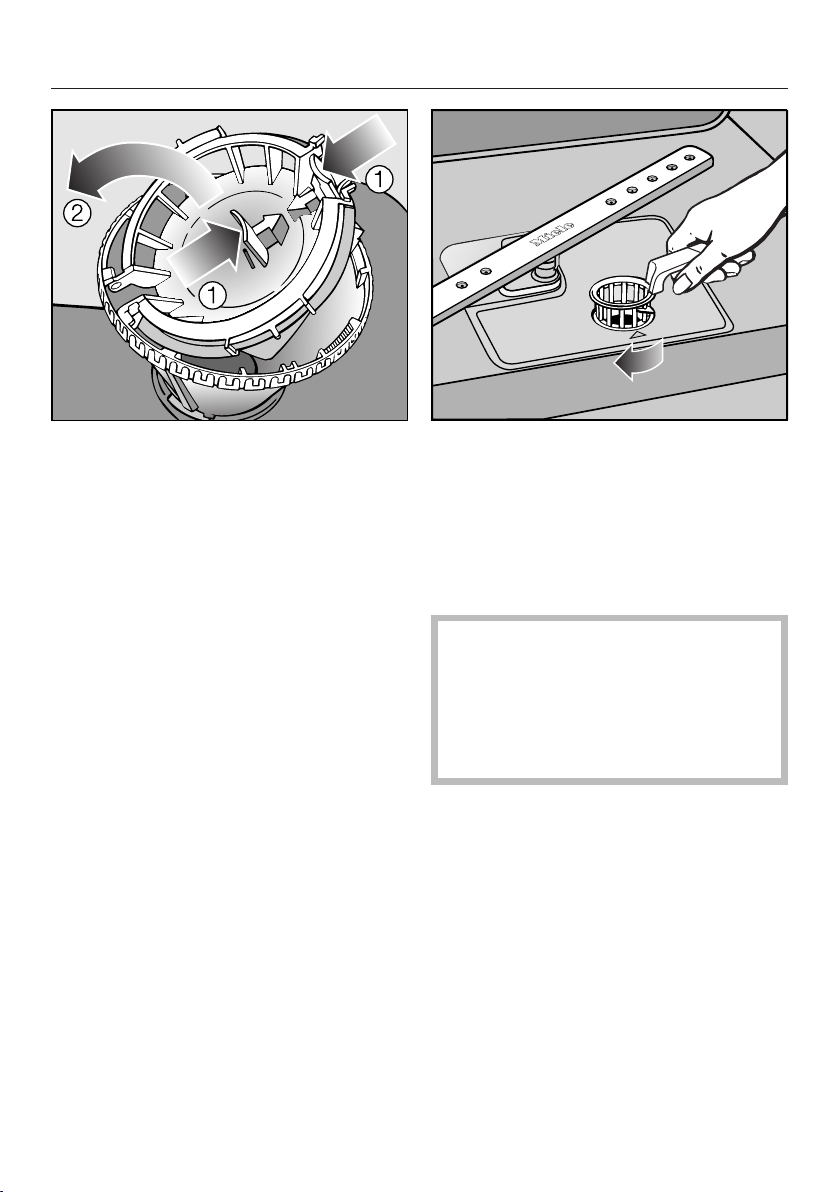
Cleaning and care
71
To clean the inside of the filter, the flap
must be opened:
P
ress the catches together in the
direction of the arrows as shown, and
open the filter .
Rin
se all the filters under running wa‐
ter.
Then close the flap so that the catch
engages.
Replace
the filter combination so that
it lies flat in the base of the wash
cabinet.
Then turn the handle clockwise until
both arr
ows point towards each oth‐
er. This will lock the filter combination
in place.
T
ake care when you are fitting
the filter combination that it is se‐
cured in position correctly.
Otherwise coarse soil could get into
the ci
rculation system and cause a
blockage.
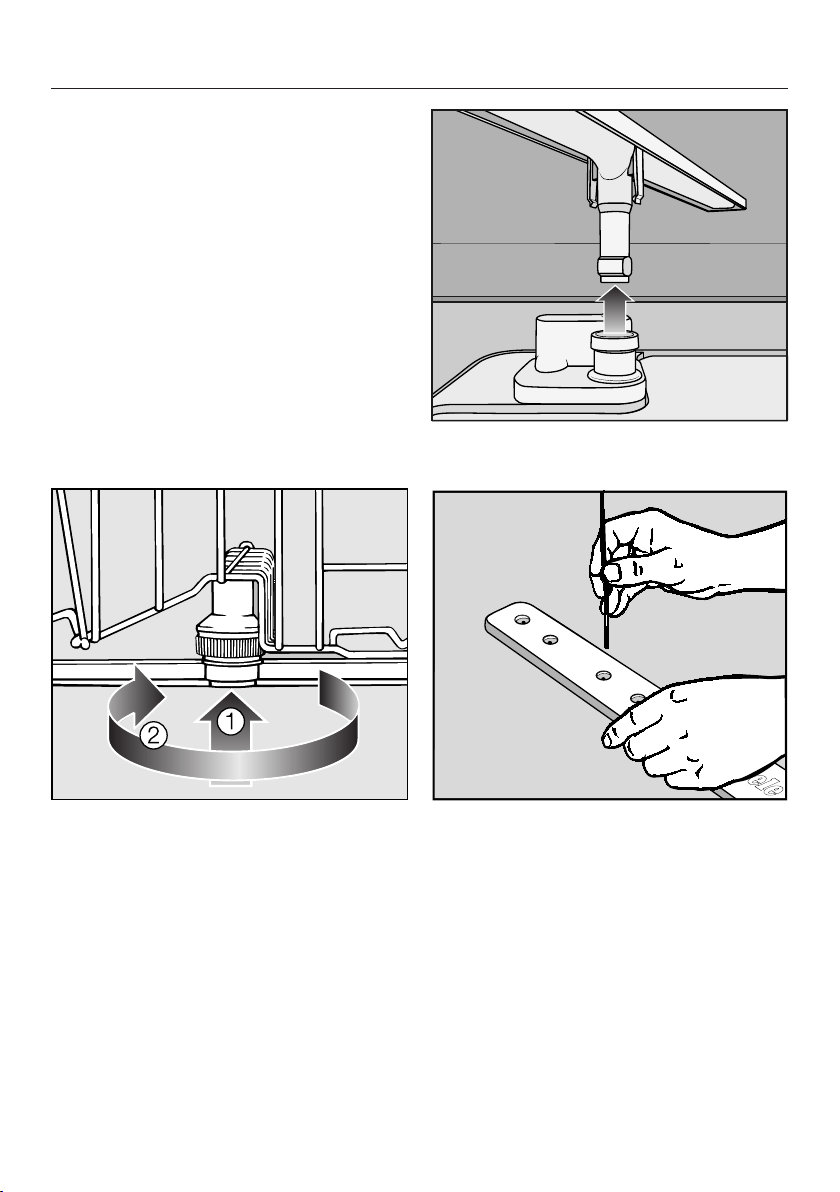
Cleaning and care
72
Cleaning the spray arms
Particles of food can get stuck in the
spr
ay arm jets and bearings. The spray
arms should therefore be inspected and
cleaned regularly (approx. every 4 - 6
months).
Switch the dishwasher off.
Remove the spray arms as follows:
T
ake out the cutlery tray (if your dish‐
washer is fitted with one).
P
ush the top spray arm upwards to
engage the inner ratchet. Then un‐
screw the spray arm.
P
ush the middle spray arm upwards
to engage the ratchet. Then un‐
screw the spray arm .
Remo
ve the lower basket.
P
ull the lower spray arm firmly up‐
wards to remove it.
Use a point
ed object to push food
particles into the spray arm jets.
Rin
se thoroughly under running wa‐
ter.
Refit the spr
ay arms and check that
they rotate freely.

Problem solving guide
73
With the help of the following guide, minor faults in the performance of the appli‐
ance, some
of which may result from incorrect operation, can be put right without
contacting Miele. This will save time and money.
Please note that a call-out charge will be applied to unnecessary service visits
wher
e the problem could have been rectified as described in these operating in‐
structions.
Unauthor
ised or incorrect repairs could cause personal injury or damage to
the appliance.
Repair work to electrical appliances must only be carried out by a suitably
quali
fied and competent person in strict accordance with current local and na‐
tional safety regulations. The manufacturer cannot be held liable for unauthor‐
ised work.
Technical problems
Problem Possible cause and remedy
The Start indicator light
does not flash after the
dishwasher has been
switched on using the
button.
The appliance is not plugged in.
Inser
t the plug and switch on at the socket.
The mains fuse has tripped.
Reset or r
eplace the fuse (see data plate for mini‐
mum fuse rating).
The dishwasher stops
durin
g a programme.
The mains fuse has tripped.
Reset or r
eplace the fuse (see data plate for mini‐
mum fuse rating).
If the mains fuse trips again, call Miele.
Problem solving guide
74
Problem Possible cause and remedy
The Inle
t/Drain and
Rinse aid indicator
lights are flashing at the
same time.
Fault number ap‐
pears in the display.
There may be a technical fault.
Switch the dishwasher off with the b
utton.
Switch the dishwasher back on aft
er a few sec‐
onds.
Select the pr
ogramme you want to use.
P
ress the Start button.
If the indicator lights flash again, there is a technical
fault.
C
all Miele.
Fault :
The dr
ain pump is still
running, even with the
door open.
The Waterproof system has reacted.
T
urn off the tap.
C
all Miele.
Fault : A fault has occurred in the circulation pump.
Switch the dishwasher off for at least 30 seconds
using the butt
on.
Switch the dishwasher back on.
If the fault message appears again, there is a techni‐
cal fault.
C
all Miele.
Problem solving guide
75
Water inlet fault
Problem Possible cause and remedy
The Inle
t/Drain indica‐
tor light flashes.
The tap is turned off.
T
urn on the tap fully.
The dishwasher stops
during a programme.
The Inlet/Drain indica‐
tor light flashes.
Fault code or ap‐
pears in the display.
Before rectifying the problem, you must:
Switch the dishwasher off with the b
utton.
Water intake is restricted.
T
urn on the tap fully and start the programme
again.
Clean
the water inlet filter (see "Maintenance").
The wat
er pressure at the intake is lower than 30
kPa (0.3 bar).
Seek professional advice.
Water drainage fault
Problem Possible cause and remedy
The dishwasher stops
durin
g a programme.
The Inlet/Drain indica‐
tor light flashes.
Fault code appears
in the display.
Before rectifying the problem you must:
Switch the dishwasher off with the butt
on.
The water outlet is restricted.
Ther
e might be water in the wash cabinet.
Clean
the filter combination (see "Cleaning and
care - Cleaning the filters").
Clean
the drain pump (see "Maintenance").
Clean
the non-return valve (see "Maintenance").
Remove any ki
nk or loop in the drain hose.

Problem solving guide
76
General problems
Problem Possible cause and remedy
The indicator lights and
displ
ay are dark.
The dishwasher has switched off automatically to
save ener
gy.
Switch the dishwasher on again with the
but‐
ton.
Detergent residue is left
in the dispenser at the
end
of a programme.
The dispenser was still damp when detergent was
added.
Mak
e sure the dispenser is dry before adding de‐
tergent.
The detergent dispens‐
er lid cannot be closed
pr
operly.
Clogged detergent residue is blocking the catch.
Clean the det
ergent from the catch.
At the end of a pro‐
gr
amme there is a film
of moisture on the in‐
side of the door and the
interior walls.
This is caused by the drying system and does not in‐
dicat
e a fault. The moisture will dissipate after a
while.
Water remains in the
wash cabinet at the end
of a pr
ogramme.
Before rectifying the problem you must:
Switch the dishwasher off with the butt
on.
The filter combination in the wash cabinet is clogged.
Clean
the filter combination (see "Cleaning and
care - Cleaning the filters").
The drain pump or non-return valve may be blocked.
Clean
the drain pump or the non-return valve (see
"Maintenance").
The drain hose is kinked.
Remove any ki
nk from the drain hose.
Problem solving guide
77
Noises
Problem Possible cause and remedy
Knocking noise in the
wash cabinet.
A spray arm is knocking against an item in a basket.
Int
errupt the programme, and rearrange the items
which are obstructing the spray arm.
Rattling noise in the
wash cabinet.
Items of crockery are insecure in the wash cabinet.
Int
errupt the programme, and rearrange the items
of crockery.
A foreign object (e.g. a cherry stone) has become
lodged in the dr
ain pump.
Remove the for
eign object from the drain pump
(see "Maintenance - Cleaning the drain pump and
non-return valve").
Knocking noise in the
w
ater pipes.
This may be caused by the on-site installation or the
cr
oss-section of the piping.
This has no influence on dishwasher function. If in
d
oubt, contact a suitably qualified plumber.
Problem solving guide
78
Unsatisfactory washing result
Problem Possible cause and remedy
The dishes are not
clean.
The dishes were not loaded correctly.
See
notes in "Loading the dishwasher".
The programme was not powerful enough.
Select a mor
e intensive programme (see "Pro‐
gramme chart").
There is some stubborn soiling although most of the
cr
ockery is only lightly soiled (e.g. with tea stains).
Select the "Adjust Sensor wash" p
rogramme op‐
tion (see "Programme options").
Not enough detergent was dispensed.
Use mor
e detergent, or change your detergent.
Items are blocking the path of the spray arms.
Rearr
ange the items so that the spray arms can
rotate freely.
The filter combination in the base of the wash cabinet
is not cle
an or is not correctly fitted.
This may cause the spray arm jets to get blocked.
Clean and/or fit the filter combination correctly.
Clean
the spray arm jets, if necessary (see "Clean‐
ing and care - Cleaning the spray arms").
The non-return valve is open and blocked. Dirty water
has flowed back int
o the wash cabinet.
Clean
the drain pump and the non-return valve
(see "Maintenance").
Smearing appears on
glass
ware and cutlery,
there is a bluish sheen
on the surface of glass‐
ware; film can be wiped
off.
The rinse aid dosage is set too high.
Reduce the dosage (see "Befor
e using for the first
time - Rinse aid").

Problem solving guide
79
Problem Possible cause and remedy
Dishes, cutlery and
glasses ar
e not dry or
are flecked.
The amount of rinse aid may be insufficient, or the
rinse ai
d reservoir is empty.
Replenish
the reservoir, increase the dosage or
change the brand of rinse aid (see "Before using
for the first time - Rinse aid").
Crockery was taken out of the cabinet too soon.
L
eave it in for longer (see "Operation").
Combination tabs have been used which have im‐
pair
ed drying performance.
Chang
e your detergent, or replenish the rinse aid
(see "Before using for the first time - Rinse aid").
Glassware has a brown
or blue tinge, and film
cannot be wiped off.
This may be caused by the detergent.
Chan
ge your detergent.
Glassware is dull and
discolo
ured; film cannot
be wiped off.
The glassware is not dishwasher-proof. The surfaces
ar
e affected.
T
here is no remedy.
Purchase glassware which is dishwasher-proof.
Tea or lipstick stains
have not been com‐
p
letely removed.
The wash temperature of the selected programme
was too low.
S
elect a programme with a higher wash tempera‐
ture.
The bleaching effect of the detergent used is too low.
Chang
e your detergent.
Plastic items are discol‐
our
ed.
Natural dyes e.g. from carrots, tomatoes or tomato
sauce may be the cause
. The amount of detergent
used or its bleaching effect was not sufficient to deal
with natural dyes.
Use mor
e detergent (see "Operation - Detergent").
Discolouration is irreversible.
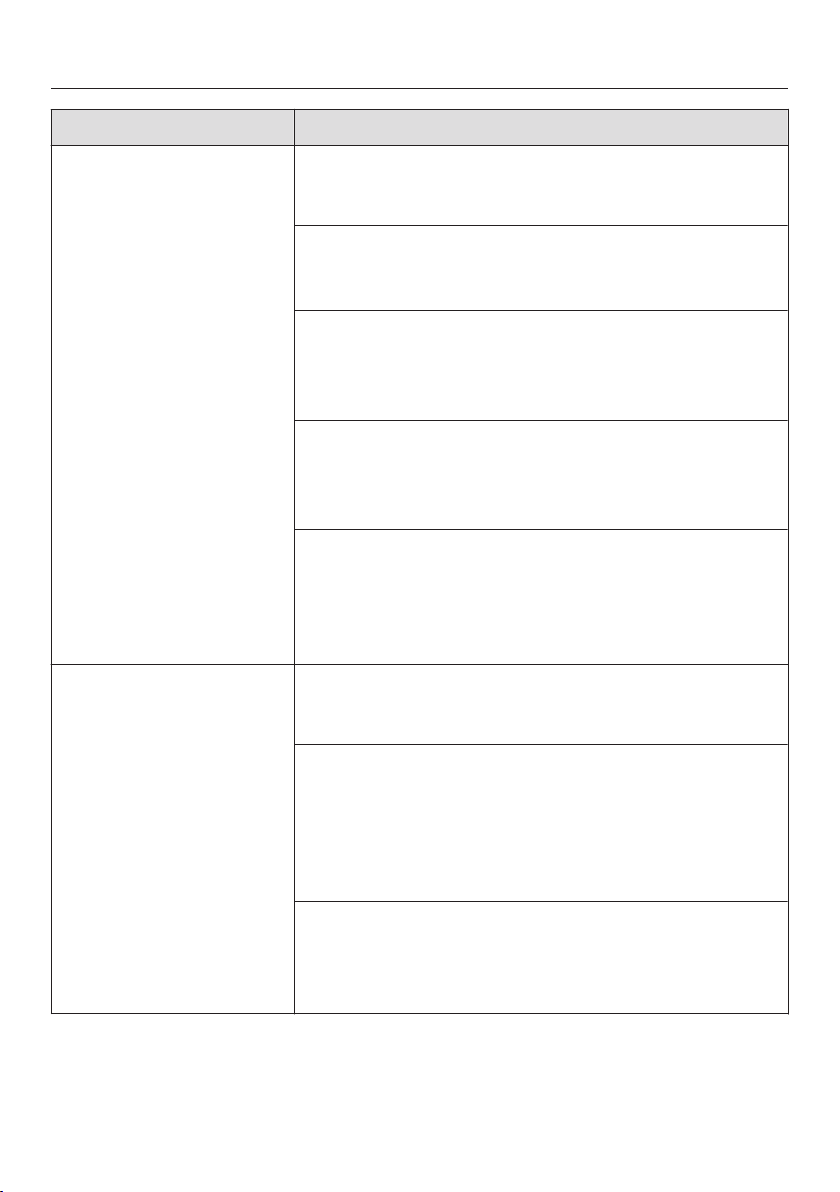
Problem solving guide
80
Problem Possible cause and remedy
White residue is visible
on
cutlery and crock‐
ery, clouding occurs on
glassware; film can be
wiped off.
Not enough rinse aid was used.
Incr
ease the dosage (see "Before using for the first
time - Rinse aid").
There is no salt in the salt reservoir.
Fill
the salt reservoir (see "Before using for the first
time - Dishwasher salt").
The salt reservoir cap has not been screwed on cor‐
r
ectly.
Replace it, making
sure that it screws back on
correctly.
An unsuitable combination detergent has been used.
Chang
e your detergent. Use a standard liquid,
tablet or powder detergent, and fill the salt and
rinse aid reservoirs in the dishwasher.
The water softener is programmed to too low a water
har
dness level.
P
rogramme the water softener for harder water
(see "Before using for the first time - Water soften‐
er").
There are rust stains on
cutler
y.
The affected items are not corrosion resistant.
Ther
e is no remedy.
Purchase cutlery which is dishwasher-proof.
A programme was not run after dishwasher salt was
added.
Traces of salt have got into the wash cycle.
Always run the Gentle 45°C p
rogramme with
the Short programme option selected and
without any crockery in the dishwasher after add‐
ing dishwasher salt.
The salt reservoir cap has not been screwed on cor‐
r
ectly.
Replace it, making
sure that it screws back on
correctly.
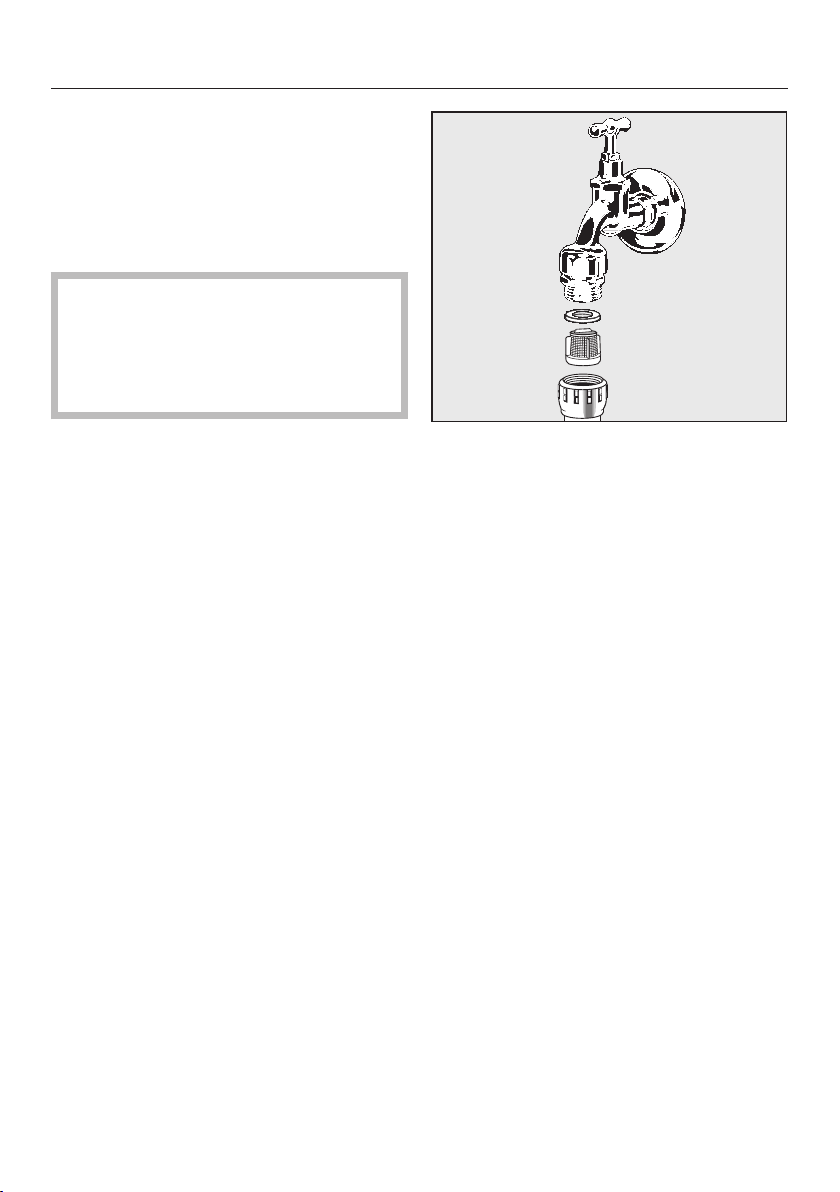
Maintenance
81
Cleaning the water inlet filter
A filter is incorporated in the screw con‐
nectio
n of the valve on the water inlet
hose. The filter must be cleaned when
dirty, otherwise insufficient water flows
into the wash cabinet.
The plastic hou
sing of the water
connection contains an electrical
component.
The housing must not be dipped in
water.
Recommendation
If the mains water contains a large
amount of insoluble substances, we
r
ecommend fitting a large-area filter in
the connection between the tap and the
water inlet hose threaded union. This
filter is available from Miele.
Cleaning the filter:
Disc
onnect the dishwasher from the
mains supply.
Switch off at the mains socket and
withdraw the plug.
T
urn off the tap.
Unsc
rew the inlet hose.
Carefully remove the washer.
W
ithdraw the filter using pointed pli‐
ers and rinse clean under running
water.
Replace
the filter and washer, making
sure they are sitting correctly.
Reco
nnect the inlet hose to the tap,
making sure it goes on correctly and
is not cross-threaded.
T
urn on the tap.
If water leaks out, the inlet hose may
not be conne
cted securely or it may
have been screwed on at an angle.
Unsc
rew and reconnect the inlet
hose correctly.
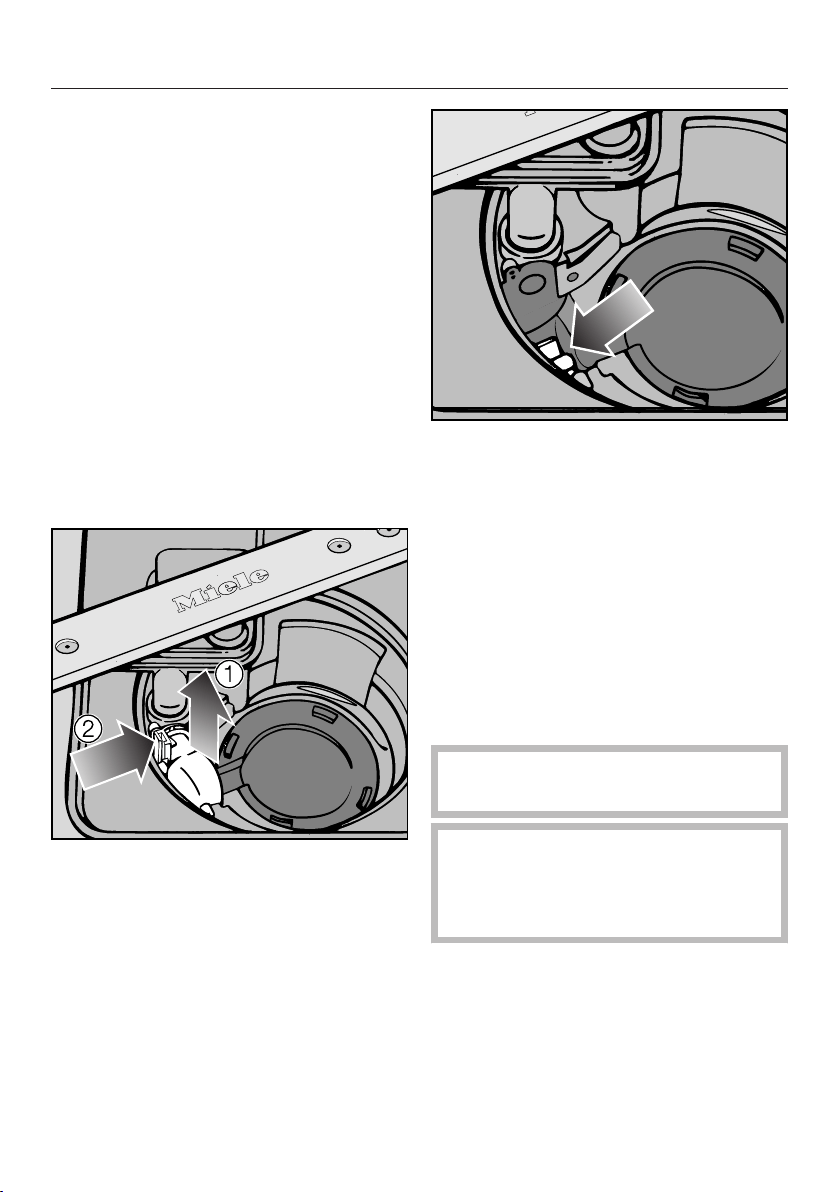
Maintenance
82
Cleaning the drain pump and
non
-return valve
If the water has not been pumped away
at the end of a p
rogramme, the drain
pump or the non-return valve might be
blocked. They are, however, easy to
clean.
Disc
onnect the dishwasher from the
mains supply. Switch off at the mains
socket and withdraw the plug.
T
ake the filter combination out of the
wash cabinet (see "Cleaning and care
- Cleaning the filters").
Scoo
p the water out of the cabinet
using a suitable container or utensil.
P
ress the catch for the non-return
valve inwards .
Lift out the no
n-return valve , and
rinse well under running water.
Remo
ve all foreign objects from the
non-return valve.
The drain pump is situated under the
non
-return valve (see arrow).
Remo
ve all foreign objects from the
drain pump (watch out for glass or
bone splinters which are particularly
difficult to detect and could cause in‐
jury). Turn the drain pump impeller by
hand to check that there are no more
obstructions. You will feel a little re‐
sistance when you turn the impeller.
C
arefully refit the non-return valve
and secure it with the catch.
E
nsure that the catch engages
correctly.
Be car
eful not to damage any
delicate components when cleaning
the drain pump and the non-return
valve.

After sales service
83
Repairs
In the event of any faults which you
cann
ot remedy yourself, please contact
Miele.
The contact details for Miele are giv‐
en at the back of these instructions.
When contacting Miele, please quote
the model and serial number of your
dishwasher
, both of which are shown
on the data plate on the right-hand side
of the door.
Warranty
The manufacturer's warranty for this
appliance is 2 years.
For further information, please refer to
your warr
anty booklet.
Optional accessories
84
Dishwasher detergent and rinse aid, as
well as clea
ning and care products, are
available as optional accessories.
All the products are designed for use
with Miele dishwashers.
These and many other useful products
can be or
dered via the internet at
www.miele-shop.com (depending on
country) or from Miele (see end of this
booklet for contact details).
Dishwasher detergent, rinse
aid and salt
When you decided to buy a Miele dish‐
w
asher, you chose excellent quality and
performance. However, ensuring that
your dishwasher always delivers the
best possible results will also depend
on your choice of dishwasher deter‐
gent, rinse aid and dishwasher salt, as
cleaning results can vary depending on
the brand used.
With Miele CareCollection products,
you can be sure of optimum results as
these products have been specially de‐
signed for Miele dishwashers.
Detergent tabs
– sparkling results even with stubborn
food deposits
– combination product with other com‐
ponents such as rinse aid, salt and
gl
ass protection additives
– phosphate-free - safe for the environ‐
ment
– water-soluble wrapping - no need to
unwrap
Powder detergent
– with active oxygen for thorough
cleaning
– with enzymes which are effective
even
in low temperature programmes
– with glass protection against corro‐
sion
Rinse aid
– for gleaming glasses
– helps crockery to dry
– with glass protection against corro‐
sion
– specially designed cap for precise,
easy dispensing
Dishwasher salt
– prevents limescale on crockery and
in the appliance
– extra coarse-grained

Optional accessories
85
Dishwasher care products
Miele cleaning and care products pro‐
vide optimum car
e for your dishwasher.
Dishwasher cleaner
– cleans the dishwasher effectively and
thor
oughly
– removes grease, bacteria and un‐
pleasant odours
– ensures excellent dishwashing re‐
sults
Dishwasher descaler
– removes heavy limescale deposits
– mild and gentle with natural citric
acid
Dishwasher conditioner
– removes odours, limescale and light
deposits
– maintains the elasticity and leak
tightness of the seals
Accessories
Some accessories may be supplied as
standar
d, depending on model.
Cappuccinatore insert
The Cappuccinatore insert can be used
for clean
ing the individual parts of the
Miele Cappuccinatore in the dishwash‐
er.
Cutlery basket
The cutlery basket is placed in the low‐
er bask
et and can be used to wash ad‐
ditional items of cutlery.
Glass rail
This rail is designed to hold glasses
with st
ems securely in the lower basket.

Electrical connection
86
This dishwasher is supplied with a
mains ca
ble with moulded plug ready
for connection to an AC single phase
supply, (230 - 240 V 50 Hz for NZ and
Australia) via a suitable switched sock‐
et.
The electri
cal socket must be
easily accessible after the dishwash‐
er has been installed. Do not con‐
nect the dishwasher to the mains
electricity supply by an extension
lead. Extension leads do not guaran‐
tee the required safety of the appli‐
ance (e.g. danger of overheating).
Do not connect the appliance solely to
an inve
rter such as those used with an
autonomous energy source e.g. solar
power. When switched on, peak loads
in the system can cause the safety
switch-off mechanism to be triggered.
This can damage the electronic unit.
The machine must not be used with so-
called energy-saving devices either.
These reduce the amount of energy
supplied to the machine, causing it to
overheat.
Befor
e connecting the appliance,
check that the connection data on
the data plate (voltage, frequency,
rated load and fuse rating) matches
the mains electricity supply. If in any
doubt, consult a qualified electrician.
The data plate is located on the right-
hand side of the door
.
All electrical work must be car‐
ried out by a suitably qualified and
c
ompetent person in strict accord‐
ance with current local and national
safety regulations.
For extra safety, it is advisable to in‐
stall
a residual current device (RCD),
with a trip current of 30 mA.
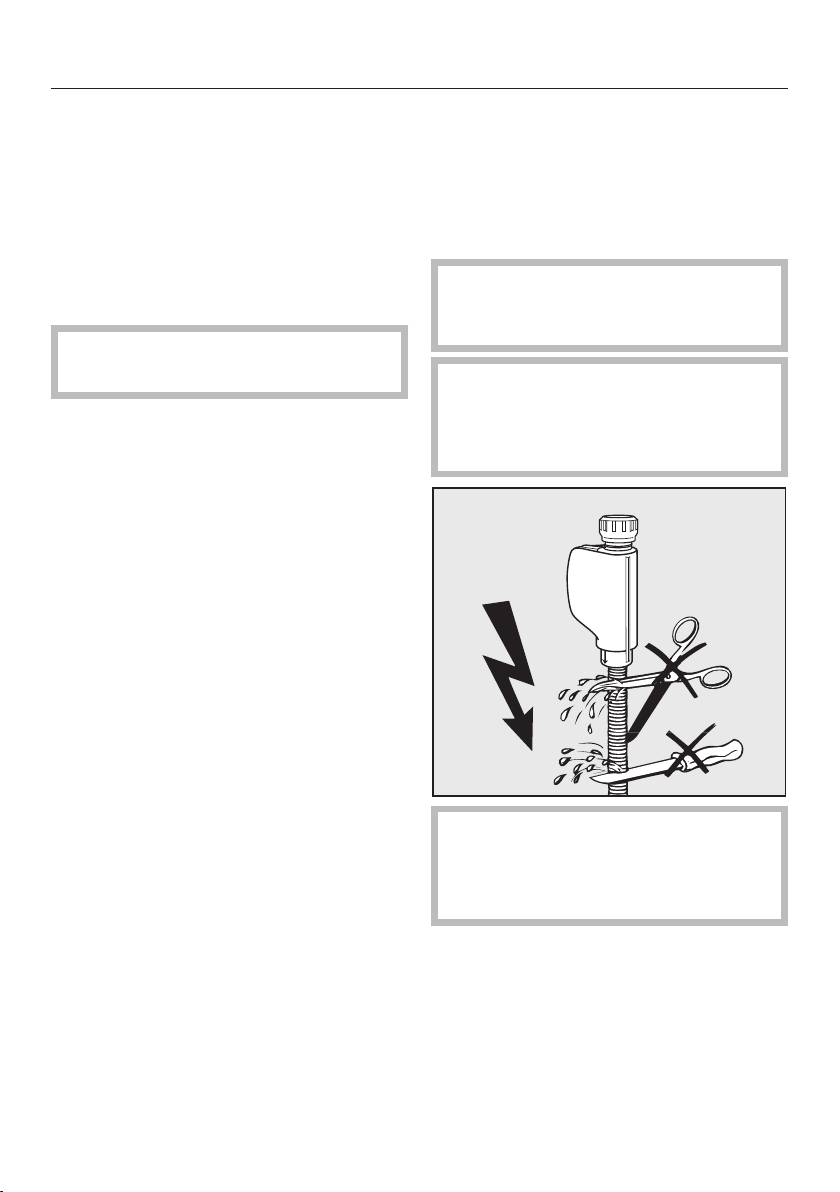
Water connection
87
The Miele Waterproof system
As long as your dishwasher has been
instal
led correctly, the Miele waterproof
anti-leak system will protect you from
water damage.
Connection to the water sup‐
ply
W
ater in the dishwasher must
not be used as drinking water.
– The dishwasher may be connected to
a col
d or hot water supply, max.
60°C.
We would only recommend connec‐
tion to a hot water supply if it is eco‐
nomical, e.g. a solar powered supply.
When connected to a hot water sup‐
ply, all programmes will be carried
out with hot water.
– The inlet hose is approx. 1.5 m long.
– A tap with a 3/4" male thread must
be pr
ovided on site.
– Connection to the mains water sup‐
ply should only be carried out by a
quali
fied and competent person in
strict accordance with national and
local safety regulations. The tap
should be easily accessible once the
appliance has been installed.
– IMPORTANT
Australia and New Zealand
This appliance must be installed ac‐
cording to AS/NZS 3500.1. Back flow
prevention is already integrated in the
appliance.
– The water pressure (flow pressure at
the tak
e-off point) must be between
30 and 1000 kPa (0.3 and 10 bar). If
the water pressure is too high, a
pressure reducer valve must be fit‐
ted.
After connecting the dishwasher to
the wat
er supply, check that all
plumbing connections are watertight.
T
o avoid any damage to the ap‐
pliance, the dishwasher must only be
operated when it is connected to a
fully vented plumbing system.
The inlet hose must not be
sh
ortened or damaged in any way as
it contains electrical components
(see illustration).
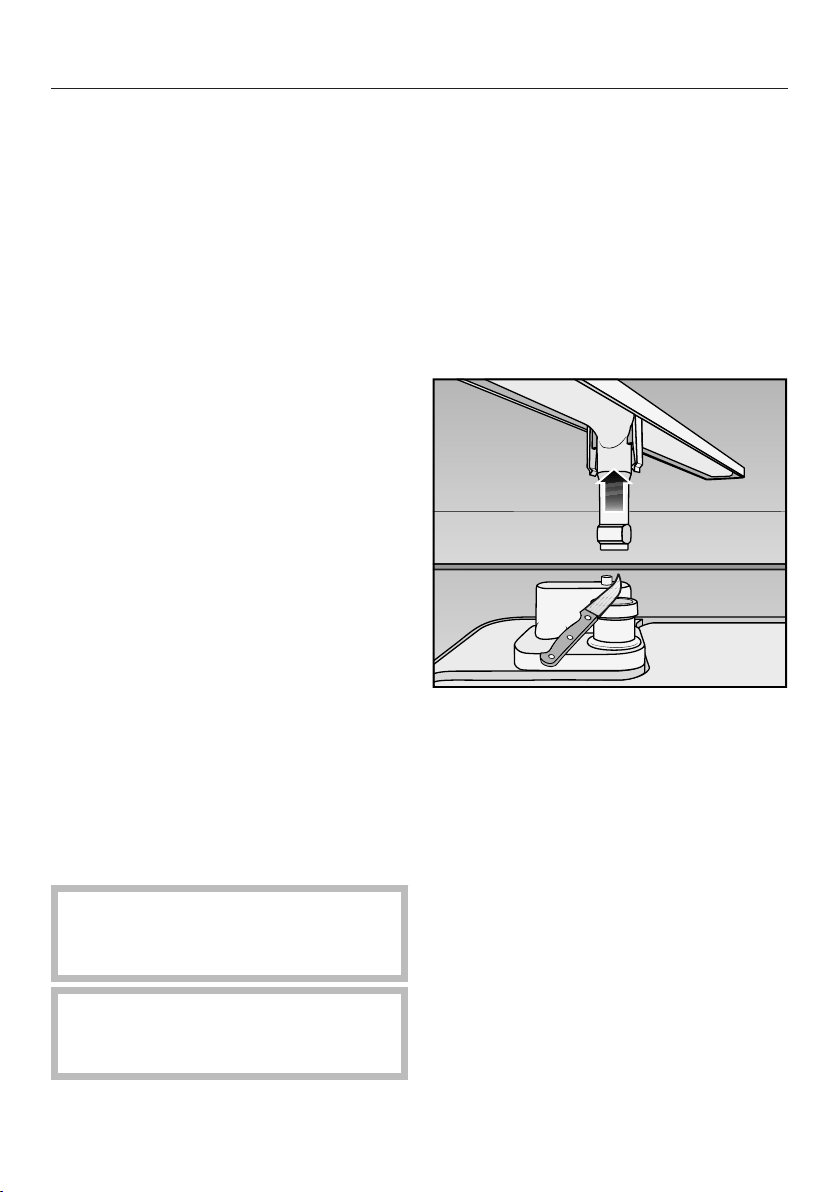
Water connection
88
Drainage
– The appliance drainage system is fit‐
t
ed with a non-return valve which
prevents dirty water from flowing
back into the dishwasher via the
drain hose.
– The dishwasher is supplied with ap‐
pr
ox. 1.5 m of flexible drain hose with
an internal diameter of 22 mm.
– The drain hose can be extended us‐
ing
a connection piece to attach a
further length of hose. The drainage
length must not be longer than 4 m,
and the delivery head must not ex‐
ceed 1 m.
– If the hose is to be directly fitted to
the dr
ainage outlet on site, use the
hose clip supplied (see installation di‐
agram).
– The hose can be directed to the left
or the right of the appliance.
– The on-site connector for the drain
ho
se can be adapted to different
widths of hose. If the connector pro‐
trudes too far into the drain hose, it
will need to be shortened. Otherwise
the drain hose may become blocked.
– The drain hose must not be short‐
ened.
Make sure that there are no
kinks in the hose, and that it is not
squashed or stretched.
After commissioning the appliance,
ensu
re that the water outlet does not
leak.
Venting the drainage system
If the on-site drain connection is situ‐
at
ed lower than the guide path for the
bottom basket rollers in the open door,
the drainage system must be vented.
Otherwise a siphoning effect during a
programme can cause the appliance to
empty itself of water.
T
o vent it: Open the dishwasher door
fully.
P
ull the lower spray arm firmly up‐
wards to remove it.
Cut off the t
op of the vent valve in the
wash cabinet.
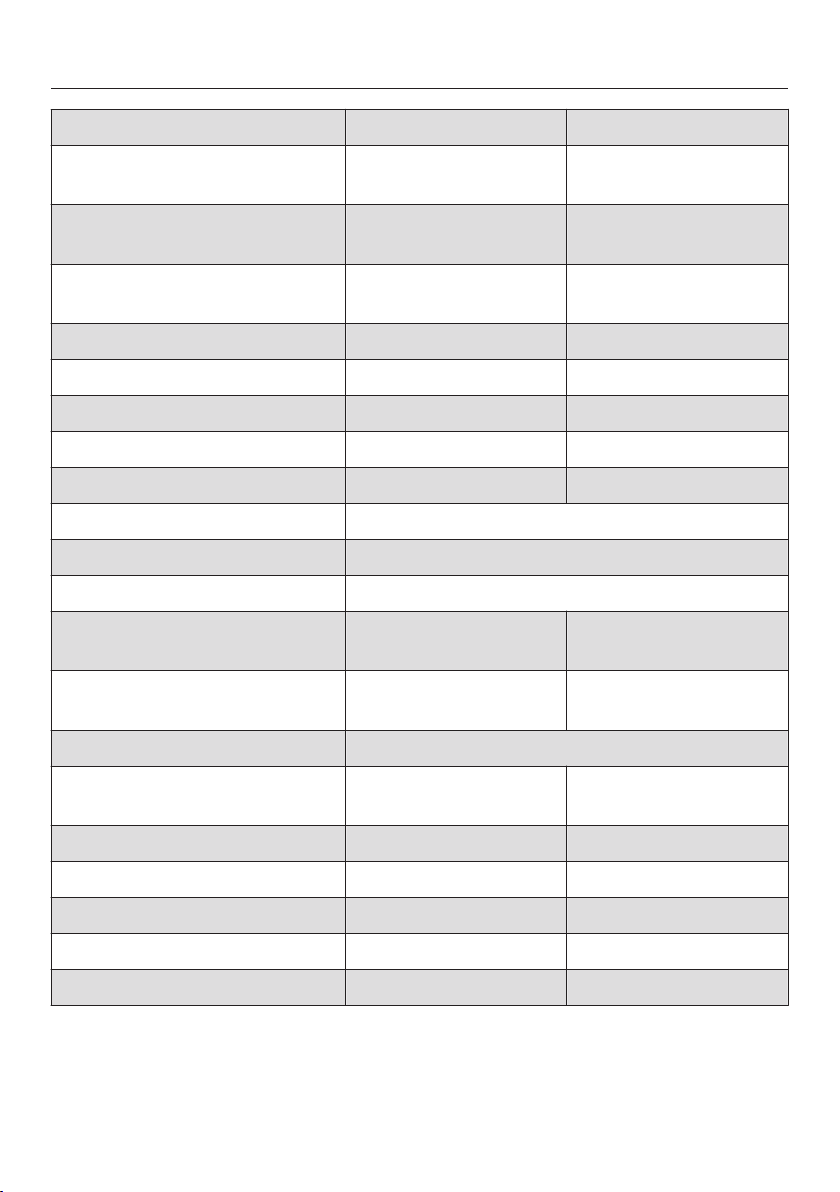
Technical data
89
Dishwasher model Standard XXL
Height freestanding model 84.5 cm (adjustable +
3.5 cm)
-
Height built-in model 80.5 cm (adjustable
+ 6.5 cm)
84.5 cm (adjustable
+ 6.5 cm)
Height of building-in recess Min. 80.5 cm (+ 6.5
cm)
Min. 84.5 cm (+ 6.5
cm)
Width 59.8 cm 59.8 cm
Width of building-in recess 60 cm 60 cm
Depth freestanding model 60 cm -
Depth built-in model 57 cm 57 cm
Weight Max. 64 kg Max. 56 kg
Voltage See data plate
Rated load See data plate
Fuse rating See data plate
Power consumption when
switched off
0.20 W 0.20 W
Power consumption when not
switched off
2.00 W 2.00 W
Test certificates awarded See data plate
Water pressure (flow rate) 30 - 1000 kPa
(0.3 - 10 bar)
30 - 1000 kPa
(0.3 - 10 bar)
Hot water connection Up to max. 60 °C Up to max. 60 °C
Delivery head Max. 1 m Max. 1 m
Drainage length Max. 4 m Max. 4 m
Mains cable Approx. 1.7 m Approx. 1.7 m
Capacity 14 place settings* 14/15 place settings*
* Depending on model

www.miele.com.au
Miele Center and Head Office Melbourne:
1 Gilbert Park Drive
Knoxfield, VIC 3180
Miele Center and Office Melbourne:
206-210 Coventry Street
South Melbourne, VIC 3205
Miele Center and Office Sydney:
3 Skyline Place
Frenchs Forest, NSW 2086
Miele Center and Office Brisbane:
39 Harvey Street North
Eagle Farm, QLD 4009
Miele Center and Office Adelaide:
83-85 Sir Donald Bradman Drive
Hilton, SA 5033
205-207 Stirling Highway
Claremont, WA 6010
Miele Center and Office Perth:
Miele Australia Pty. Ltd.
Miele New Zealand Limited
Level 2, 10 College Hill
Freemans Bay, Auckland 1011
Miele Center Auckland:
8 College Hill
Freemans Bay, Auckland 1011
Telephone:
0800 4 MIELE (0800 464 353)
www.miele.co.nz
Miele Global Headquarters
Germany
Miele & Cie. KG
Carl-Miele-Straße 29
33332 Gütersloh
Federal Republic of Germany
Head Office:
IRD 98 463 631
ACN 005 635 398
ABN 96 005 635 398
90

M.-Nr. 10 075 760 / 01en-AU, NZ
G 4920 / G 4925