
197D5984P002 49-60403 10-05 JR
Safety Information
Connecting Electricity . . . . . . . . . . 3
Extension Cords . . . . . . . . . . . . . . . 2
Safety Precautions . . . . . . . . . . . . . . 2
Operating Instructions
Care and Cleaning . . . . . . . . . . . 7, 8
Shelves . . . . . . . . . . . . . . . . . . . . .5, 6
Storage Drawer . . . . . . . . . . . . . . . .6
Temperature Controls . . . . . . . . . . .4
Installation Instructions
Preparing to Install
the Refrigerator . . . . . . . . . . . . . . . 9
Reversing the Door Swing . . . 10–13
Troubleshooting Tips
Before You Call
For Service . . . . . . . . . . . . . . . .15, 16
Normal Operating Sounds . . . . . .14
Consumer Support
Consumer Support . . . . . . . . . . . . 20
Product Registration . . . . . . . . 17, 18
Warranty . . . . . . . . . . . . . . . . . . . . 19
Write the model and serial
numbers here:
Model # __________________
Serial # __________________
You can find them on a label on
the lower left side of the fresh food
compartment.
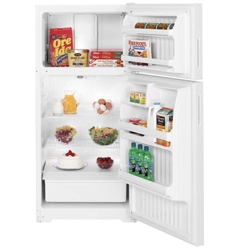
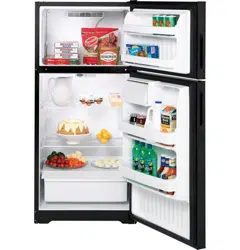
Refrigerators
Owner’s Manual and Installation Instructions
Model Americana A3309
Printed in the United States
Printed on Recycled Paper
Top-Freezer
www.AmericanaAppliances.com
IMPORTANT SAFETY INFORMATION.
READ ALL INSTRUCTIONS BEFORE USING.
WARNING!
Use this appliance only for its intended purpose as described in this Owner’s Manual.
SAFETY PRECAUTIONS
When using electrical appliances, basic safety precautions should be followed, including the following:
■
■ This refrigerator must be properly installed
and located in accordance with the Installation
Instructions before it is used.
■
■ Do not allow children to climb, stand or hang
on the shelves in the refrigerator. They could
damage the refrigerator and seriously injure
themselves.
■
■ Do not touch the cold surfaces in the freezer
compartment when hands are damp or wet.
Skin may stick to these extremely cold
surfaces.
■
■ Do not store or use gasoline or other flammable
vapors and liquids in the vicinity of this or any
other appliance.
■
■ Keep fingers out of the “pinch point” areas;
clearances between the doors and between
the doors and cabinet are necessarily small.
Be careful closing doors when children are
in the area.
■
■ In refrigerators with automatic icemakers,
avoid contact with the moving parts of the
ejector mechanism, or with the heating
element that releases the cubes. Do not place
fingers or hands on the automatic icemaking
mechanism while the refrigerator is plugged in.
■
■ Unplug the refrigerator before cleaning and
making repairs.
NOTE: We strongly recommend that any servicing be
performed by a qualified individual.
■
■ Turning the control to the 0 position does
not remove power to the light circuit.
■
■ Do not refreeze frozen foods which have
thawed completely.
2
PROPER DISPOSAL OF THE REFRIGERATOR
Child entrapment and suffocation are not
problems of the past. Junked or abandoned
refrigerators are still dangerous…even if they
will sit for “just a few days.” If you are getting
rid of your old refrigerator, please follow the
instructions below to help prevent accidents.
Before You Throw Away Your Old
Refrigerator or Freezer:
■ Take off the doors.
■ Leave the shelves in place so that children
may not easily climb inside.
Refrigerants
All refrigeration products contain refrigerants,
which under federal law must be removed prior
to product disposal. If you are getting rid of an
old refrigeration product, check with the
company handling the disposal about what
to do.
USE OF EXTENSION CORDS
Because of potential safety hazards under certain conditions, we strongly recommend against
the use of an extension cord.
However, if you must use an extension cord, it is absolutely necessary that it be a UL-listed,
3-wire grounding type appliance extension cord having a grounding type plug and outlet and
that the electrical rating of the cord be 15 amperes (minimum) and 120 volts.
DANGER! RISK OF CHILD ENTRAPMENT
Consumer Support Troubleshooting Tips
Operating Instructions Safety InstructionsInstallation Instructions
Troubleshooting Tips
Installation Instructions Safety InstructionsOperating Instructions
3
Consumer SupportTroubleshooting Tips
Operating Instructions
Safety Instructions Installation Instructions
www.AmericanaAppliances.com
WARNING!
HOW TO CONNECT ELECTRICITY
Do not, under any circumstances, cut or remove the third (ground) prong from the power cord.
For personal safety, this appliance must be properly grounded.
The power cord of this appliance is equipped
with a 3-prong (grounding) plug which mates
with a standard 3-prong (grounding) wall outlet
to minimize the possibility of electric shock
hazard from this appliance.
Have the wall outlet and circuit checked by a
qualified electrician to make sure the outlet is
properly grounded.
Where a standard 2-prong wall outlet is
encountered, it is your personal responsibility
and obligation to have it replaced with a
properly grounded 3-prong wall outlet.
The refrigerator should always be plugged into
its own individual electrical outlet which has a
voltage rating that matches the rating plate.
This provides the best performance and also
prevents overloading house wiring circuits which
could cause a fire hazard from overheated wires.
Never unplug your refrigerator by pulling on the
power cord. Always grip plug firmly and pull
straight out from the outlet.
Repair or replace immediately all power cords
that have become frayed or otherwise damaged.
Do not use a cord that shows cracks or abrasion
damage along its length or at either end.
When moving the refrigerator away from the
wall, be careful not to roll over or damage the
power cord.
READ AND FOLLOW THIS SAFETY INFORMATION CAREFULLY.
SAVE THESE INSTRUCTIONS
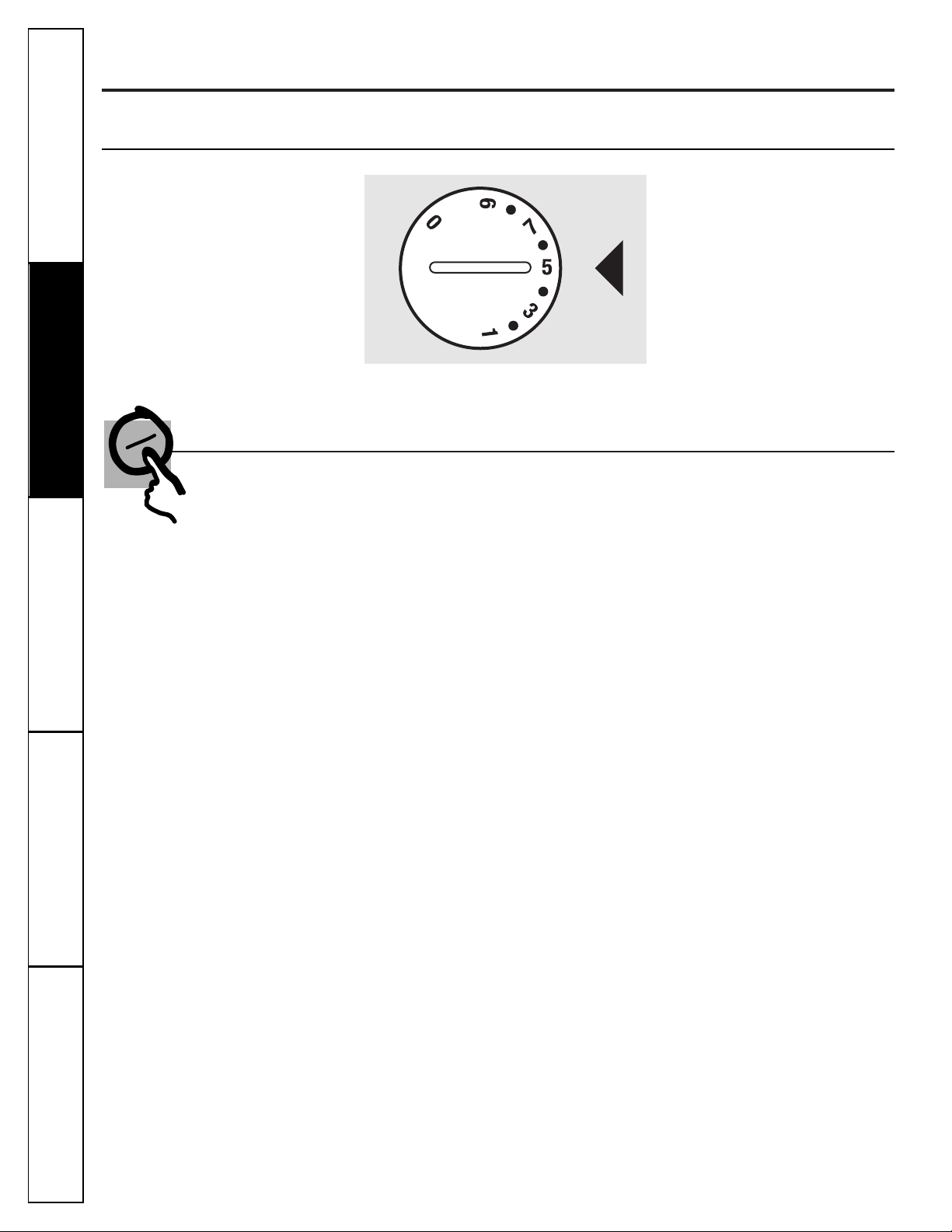
About the temperature control dial.
Control Settings
Temperature Control Dial
The temperature control dial has nine settings plus 0. 1 is the warmest. 9 is the coldest.
At first, set the dial at 5.
After using the refrigerator, adjust the dial if necessary.
Insert a coin into the slot in the middle of the dial and you can turn the dial to the setting
that’s best suited to your needs.
Allow 24 hours for the refrigerator to get cold.
Turning the dial to 0 stops cooling in both compartments—fresh food and freezer. It does not shut off power to
the refrigerator.
4
Consumer Support Troubleshooting Tips
Operating Instructions Safety InstructionsInstallation Instructions
Troubleshooting Tips
Installation Instructions Safety InstructionsOperating Instructions
Consumer SupportTroubleshooting Tips
Operating InstructionsSafety Instructions
Installation Instructions
5
About the fresh food compartment shelves.
www.AmericanaAppliances.com
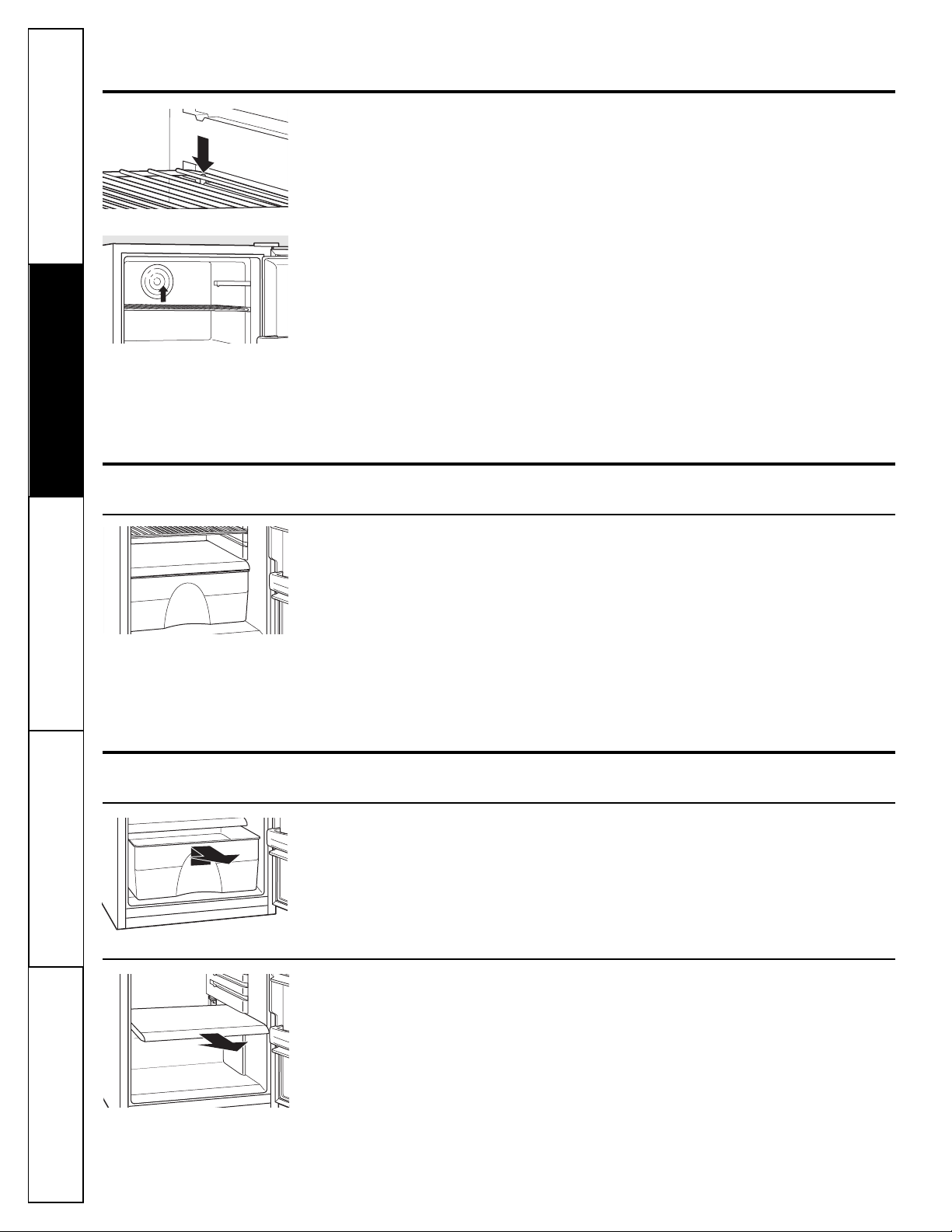
Shelf supports at various levels allow you to custom-space your shelves. Not all features are on all models.
Full-Width Shelves
The wire sliding shelves can be
moved to another place in the fresh food
compartment.
The full-width shelf has rear stop-locks.
When placed correctly on the shelf
supports, the shelf will not tilt when you
place food on it or remove food from it.
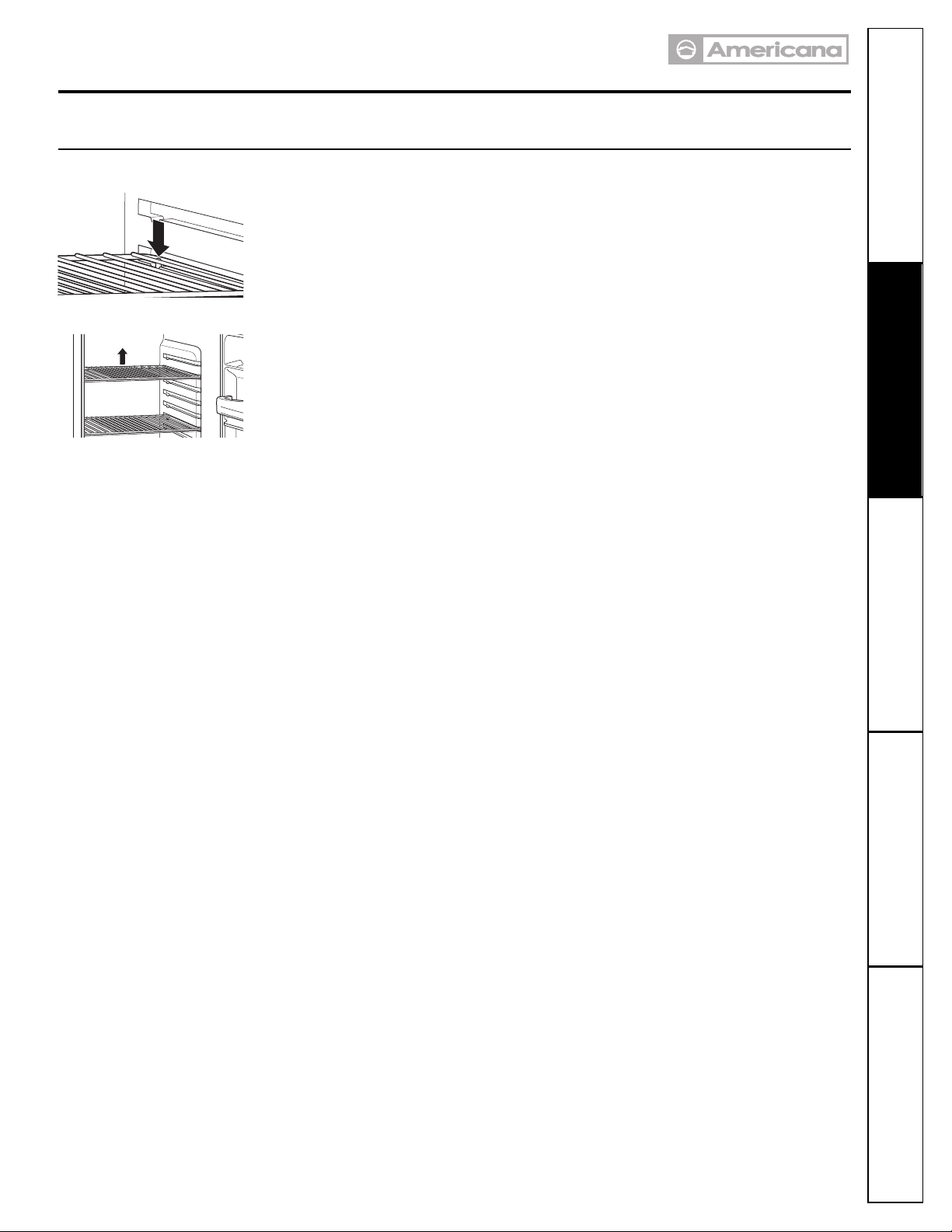
To remove the full-width shelves, fully open
the fresh food door, lift the rear of the
shelf and pull forward.
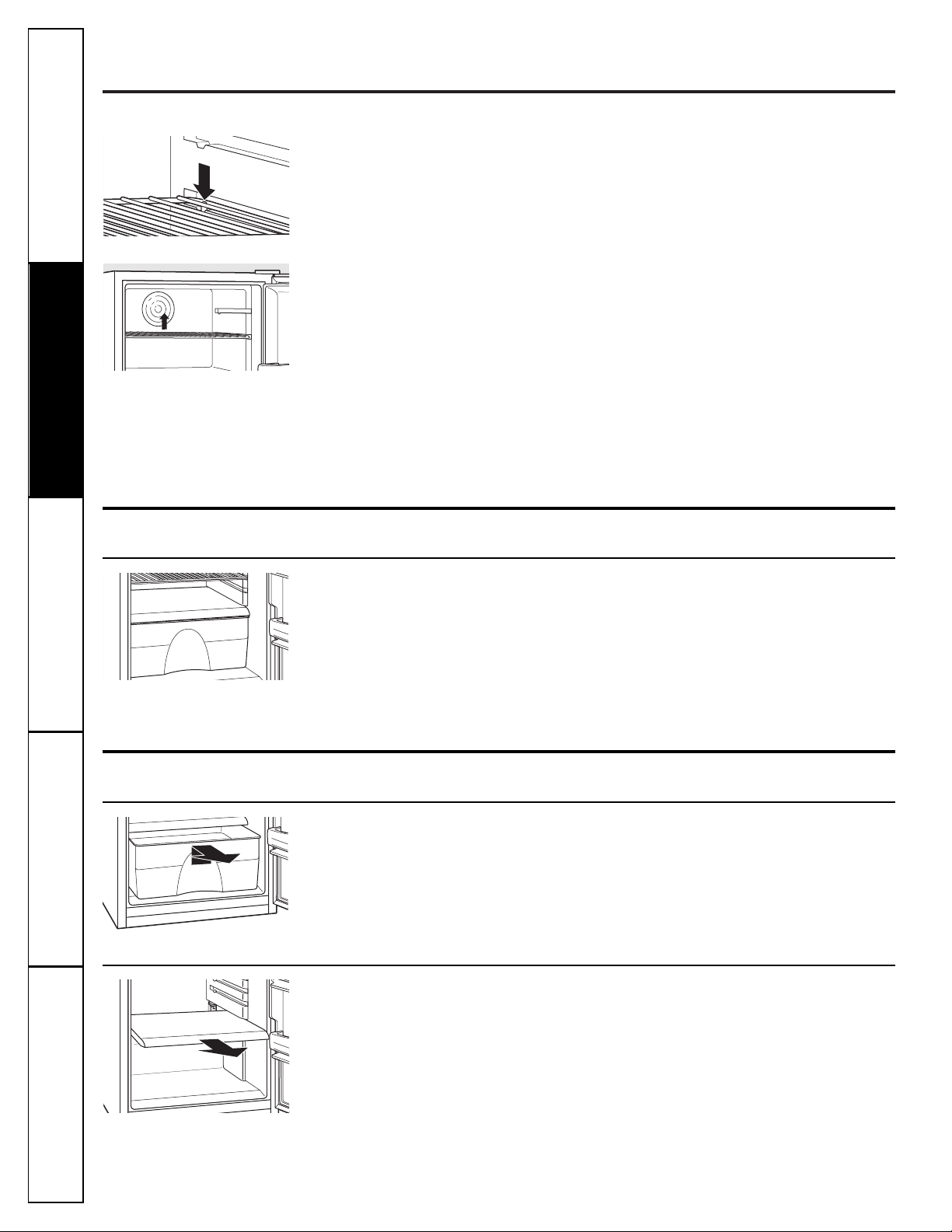
About the freezer compartment shelf.
Freezer Shelf
The freezer shelf is adjustable to either
upper or lower position.
The full-width shelf has rear stop-locks.
When placed correctly on the shelf
supports, the shelf will not tilt when you
place food on it or remove food from it.
To remove the full-width shelf, fully open
the freezer door, lift the rear of the shelf
and pull forward.
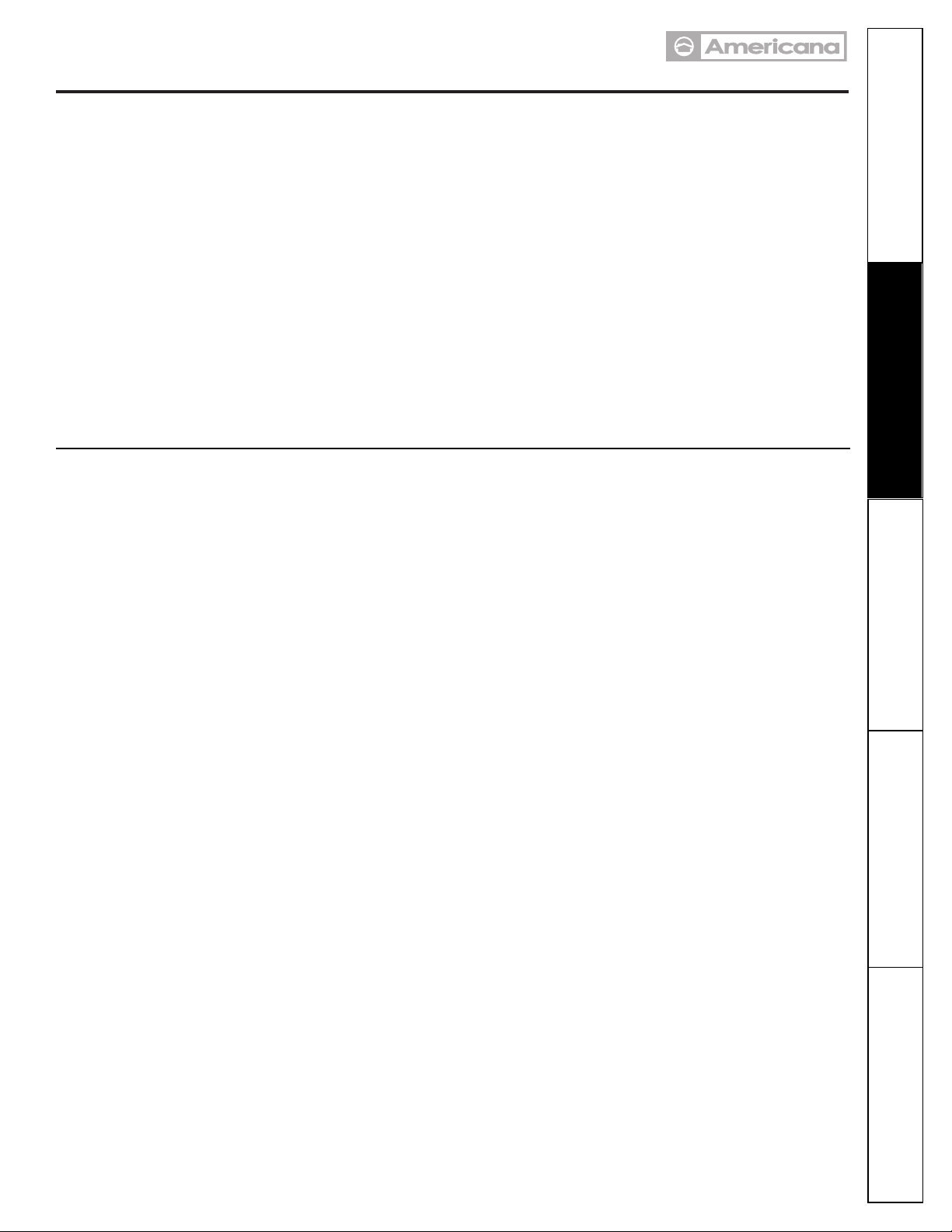
About the storage drawer.
Not all features are on all models.
Fruit and Vegetable Drawer
Excess water that may accumulate in the
bottom of the drawer should be emptied
and the drawer wiped dry.
6
Consumer Support Troubleshooting Tips
Operating Instructions Safety InstructionsInstallation Instructions
Troubleshooting Tips
Installation Instructions Safety InstructionsOperating Instructions
Troubleshooting Tips
Installation Instructions Safety InstructionsOperating Instructions
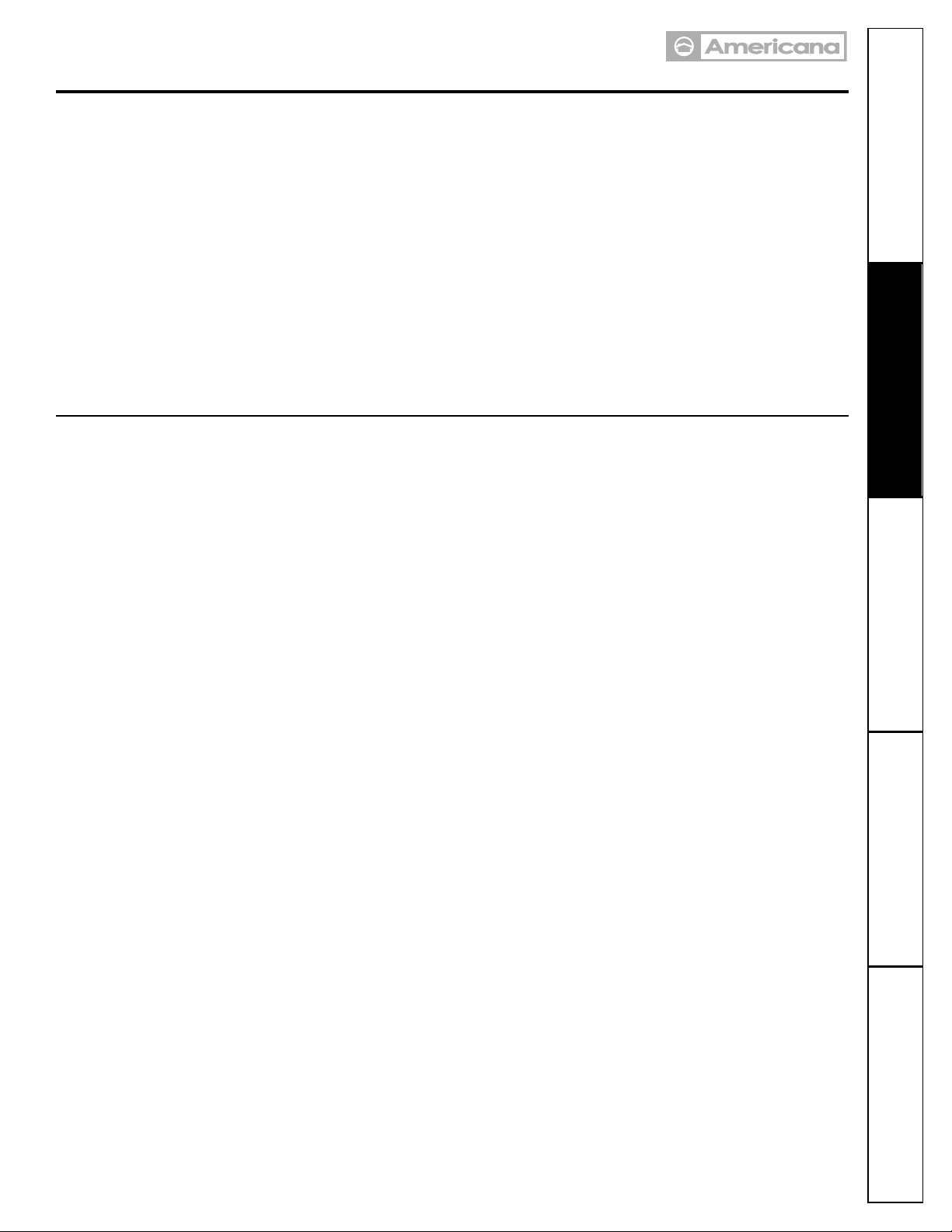
About storage drawer and cover removal.
Not all features are on all models.
Drawer and Cover Removal
Drawer can be removed easily by grasping
the sides and lifting up slightly while
pulling.
Full-Width Drawer with Cover
To remove the cover, pull it straight out
of the side supports.
To replace the cover, align it with the side
supports and carefully slide it toward the
back of the compartment.
Consumer SupportTroubleshooting Tips
Operating InstructionsSafety Instructions
Installation Instructions
7
Care and cleaning of the refrigerator.
www.AmericanaAppliances.com
Cleaning the Outside
The door handles and trim (on some
models). Clean with a cloth dampened
with soapy water. Dry with a soft cloth.
Keep the outside clean. Wipe with a clean
cloth lightly dampened with kitchen
appliance wax or mild liquid dish
detergent. Dry and polish with a clean,
soft cloth.
The stainless steel panels and door handles
(on some models) can be cleaned with
a commercially available stainless steel
cleaner. Do not use appliance wax or
polish on the stainless steel.
Do not wipe the refrigerator with a soiled dish
cloth or wet towel. These may leave a residue
that can erode the paint. Do not use scouring
pads, powdered cleaners, bleach or cleaners
containing bleach because these products can
scratch and weaken the paint finish.
Cleaning the Inside
To help prevent odors, leave an open box
of baking soda in the fresh food and
freezer compartments.
Unplug the refrigerator before cleaning.
If this is not practical, wring excess
moisture out of sponge or cloth when
cleaning around switches, lights or
controls.
Use warm water and baking soda
solution—about a tablespoon (15 ml) of
baking soda to a quart (1 liter) of water.
This both cleans and neutralizes odors.
Rinse and wipe dry.
After cleaning the door gaskets, apply a
thin layer of petroleum jelly to the door
gaskets at the hinge side. This helps keep
the gaskets from sticking and bending
out of shape.
Avoid cleaning cold glass shelves (on some
models) with hot water because the extreme
temperature difference may cause them to
break. Handle glass shelves carefully. Bumping
tempered glass can cause it to shatter.
Do not wash any plastic refrigerator parts in
the dishwasher.
Care and cleaning of the refrigerator.
Behind the Refrigerator
Be careful when moving the refrigerator
away from the wall. All types of floor
coverings can be damaged, particularly
cushioned coverings and those with
embossed surfaces.
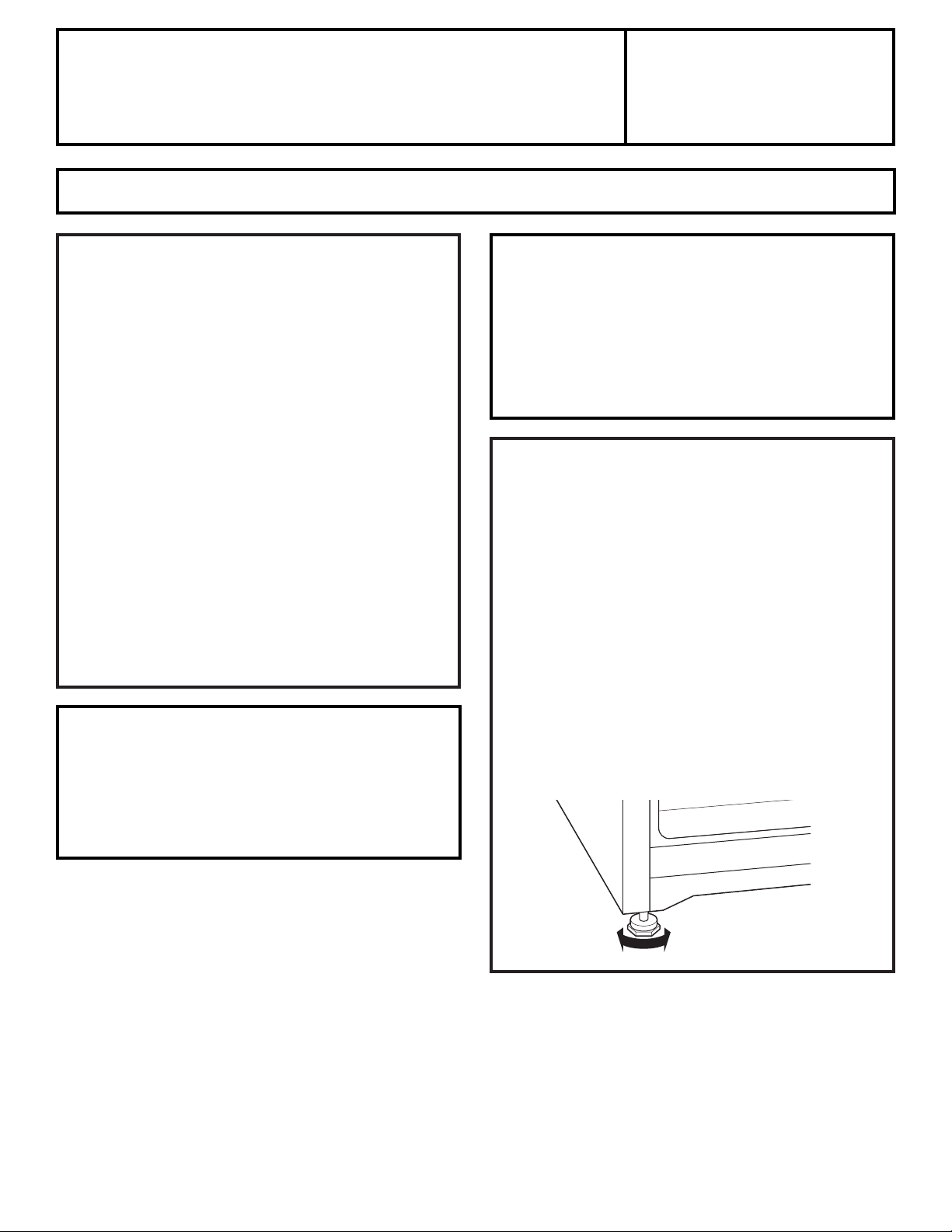
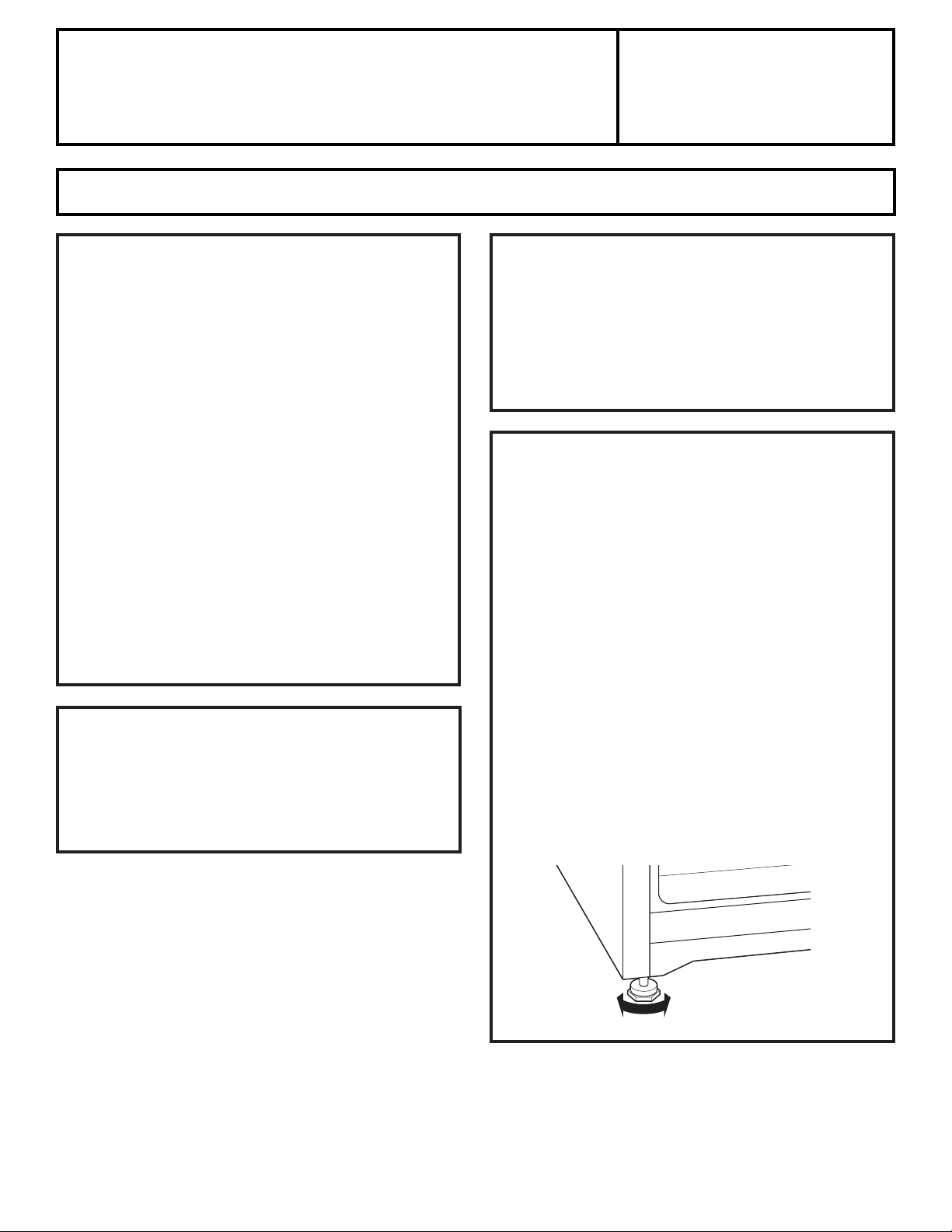
Turn the leveling legs at each front corner
of the refrigerator counterclockwise until
the rollers support the refrigerator. Pull the
refrigerator straight out and return it to
position by pushing it straight in. Moving
the refrigerator in a side direction may
result in damage to the floor covering or
refrigerator.
When pushing the refrigerator back, make sure
you don’t roll over the power cord.
After rolling the refrigerator back
into place, turn the front leveling legs
clockwise until the legs again bear the
weight of the refrigerator.
Light Bulb Replacement
To replace a burned-out bulb, unplug
the refrigerator from its electrical outlet,
unscrew the bulb when cool and replace
it with an appliance bulb of the same or
lower wattage.
Turning the control to the 0 position does not
remove power to the light circuit.
Preparing for Vacation
For long vacations or absences, remove
food and unplug the refrigerator. Move
the temperature control dial to the 0
position, and clean the interior with a
baking soda solution of one tablespoon
(15 ml) of baking soda to one quart
(1 liter) of water. Leave the doors open.
Preparing to Move
Secure all loose items such as grille,
shelves and drawer by taping them
securely in place to prevent damage.
Be sure the refrigerator stays in an upright
position during moving.
8
Consumer Support Troubleshooting Tips
Operating Instructions Safety InstructionsInstallation Instructions
Troubleshooting Tips
Installation Instructions Safety InstructionsOperating Instructions
9
BEFORE YOU BEGIN
Read these instructions completely and carefully.
•
IMPORTANT – Save these
instructions for local inspector’s use.
•
IMPORTANT – Observe all
governing codes and ordinances.
• Note to Installer – Be sure to leave these
instructions with the Consumer.
• Note to Consumer – Keep these instructions
for future reference.
• Skill level – Installation of this appliance requires
basic mechanical skills.
• Completion time – Refrigerator Installation
15 minutes
Reversing the Door Swing
1 hour
• Proper installation is the responsibility of the
installer.
• Product failure due to improper installation is not
covered under the Warranty.
• Do not install the refrigerator where the temperature
will go below 60°F (16°C) because it will not run often
enough to maintain proper temperatures.
• Install it on a floor strong enough to support it fully
loaded.
REFRIGERATOR LOCATION
If you have questions, call 1.800.432.2737
Installation
Refrigerator
Instructions
Model 8.8
Allow the following clearances for ease of installation,
proper air circulation and plumbing and electrical
connections.
• Sides 3/4″ (19 mm)
• Top 1″ (25 mm)
• Back 1″ (25 mm)
CLEARANCES
Leveling legs near each front corner of the refrigerator
are adjustable. They firmly position the refrigerator
and prevent it from moving when the doors are
opened. Leveling legs should be set so the front of the
refrigerator is raised just enough that the doors close
easily when opened about halfway.
Turn the leveling legs clockwise to raise the
refrigerator, counterclockwise to lower it.
Rollers next to the leveling legs allow you to move the
refrigerator away from the wall for cleaning.
Turn the legs counterclockwise until the weight of the
refrigerator is transferred from them to the rollers.
After rolling the refrigerator back into place, turn the
legs clockwise until the legs again bear the weight of
the refrigerator.
ROLLERS AND LEVELING LEGS
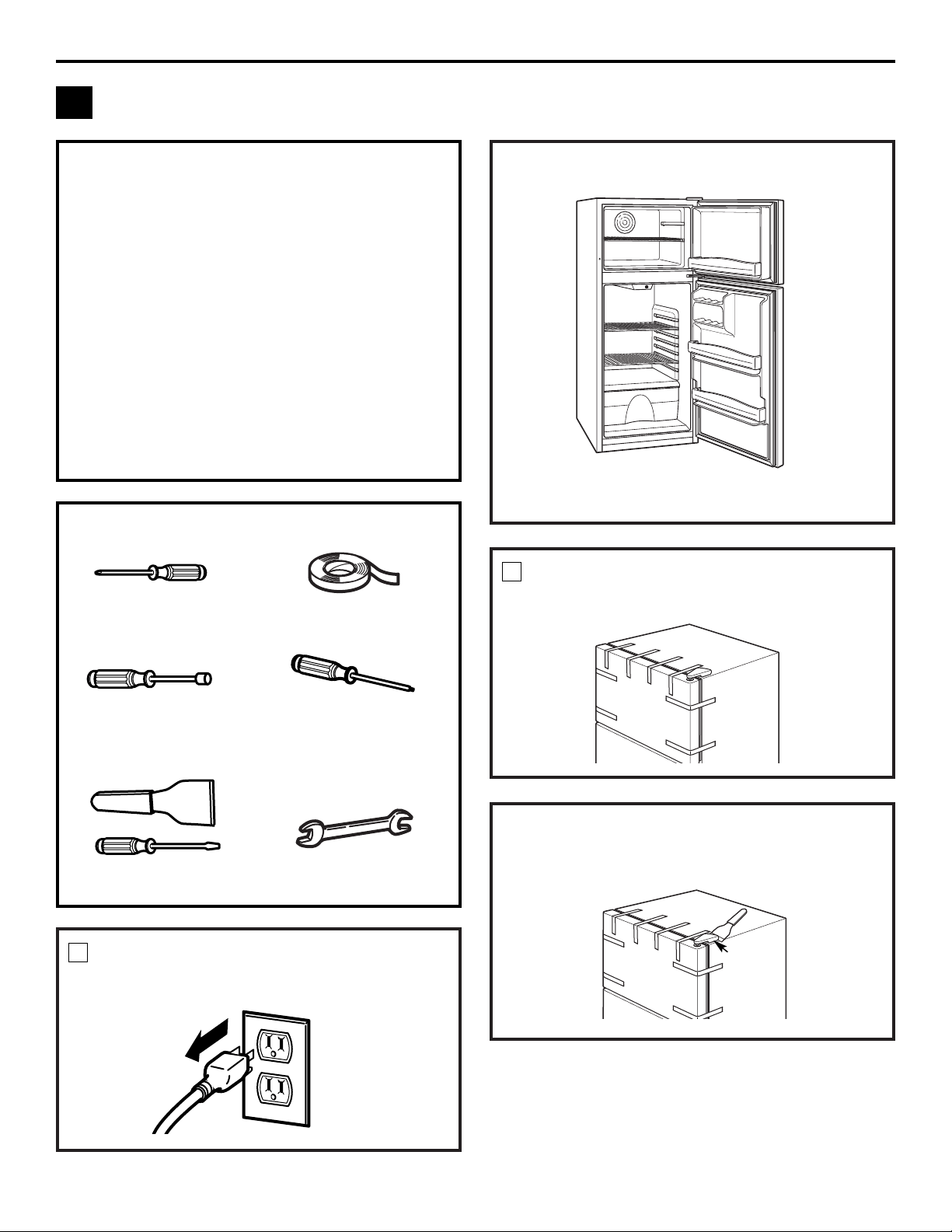
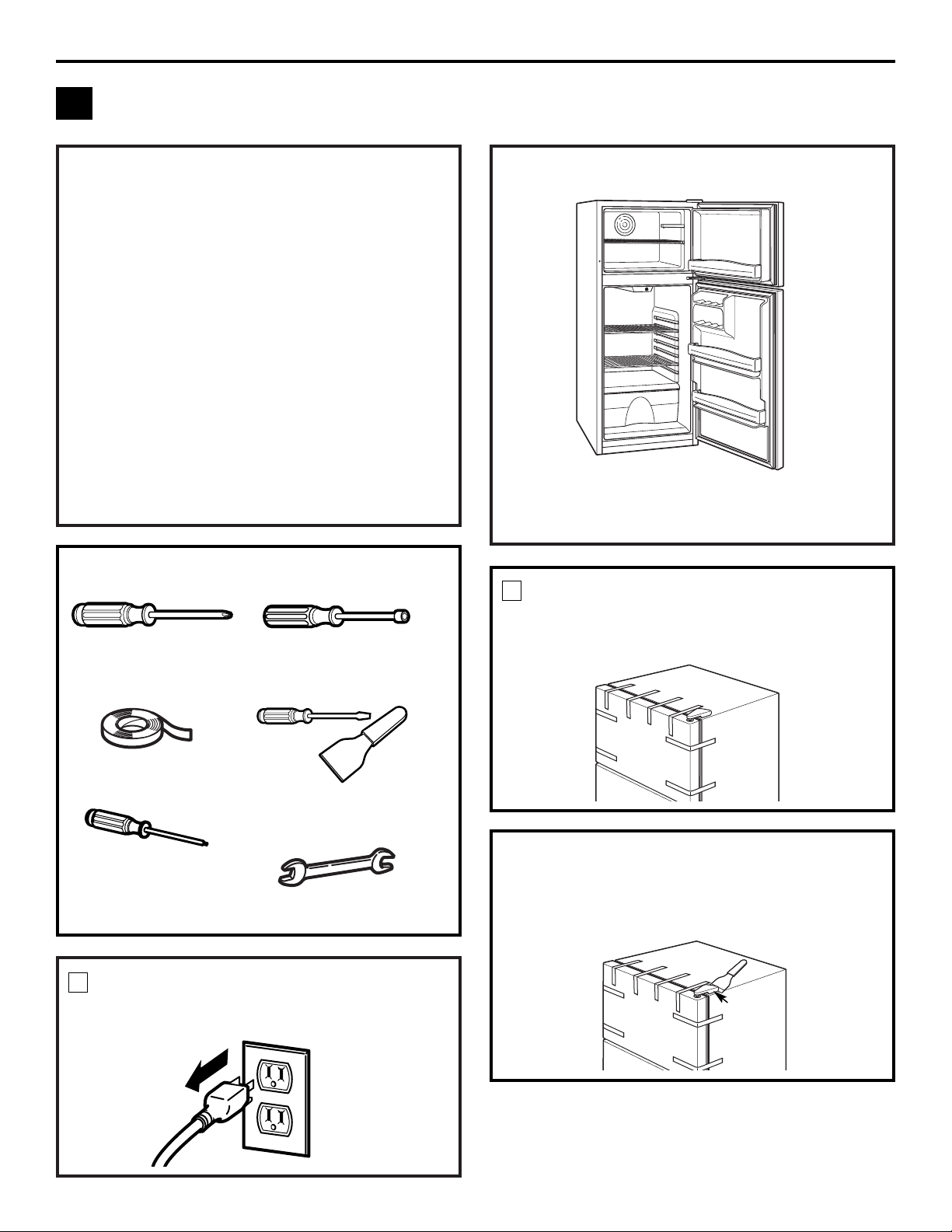
1.1 Unplug the refrigerator from its electrical
outlet.
BEFORE YOU START
1
2.1 Tape the door shut with masking tape.
REMOVE THE FREEZER DOOR
2
1.2 Empty all door shelves, including the dairy
compartment.
CAUTION: Do not let either door drop to the
floor. To do so could damage the door stop.
2.2 Remove the hinge cap from the top hinge with
a putty knife or a thin-blade screwdriver. With a
5/16″ hex-head socket driver, remove the screws
that hold the top hinge to the cabinet.
10
Installation Instructions
REVERSING THE DOOR SWING
1
When reversing the door swing:
• Read the instructions all the way through before
starting.
• Handle parts carefully to avoid scratching paint.
• Set screws down by their related parts to avoid using
them in the wrong places.
• Provide a non-scratching work surface for
the doors.
IMPORTANT: Once you begin, do not move the
cabinet until door-swing reversal is completed.
These instructions are for changing the hinges from
the right side to the left side—if you ever want to change
the hinges back to the right side, follow these same
instructions and reverse all references to left and right.
IMPORTANT NOTES
Phillips screwdriver
TOOLS REQUIRED
Masking tape
T20 or T25 Torxdriver,
(needed for some
models)
5/16″ hex-head
socket driver
5/16″ open-end
wrench
Putty knife or thin-blade
screwdriver
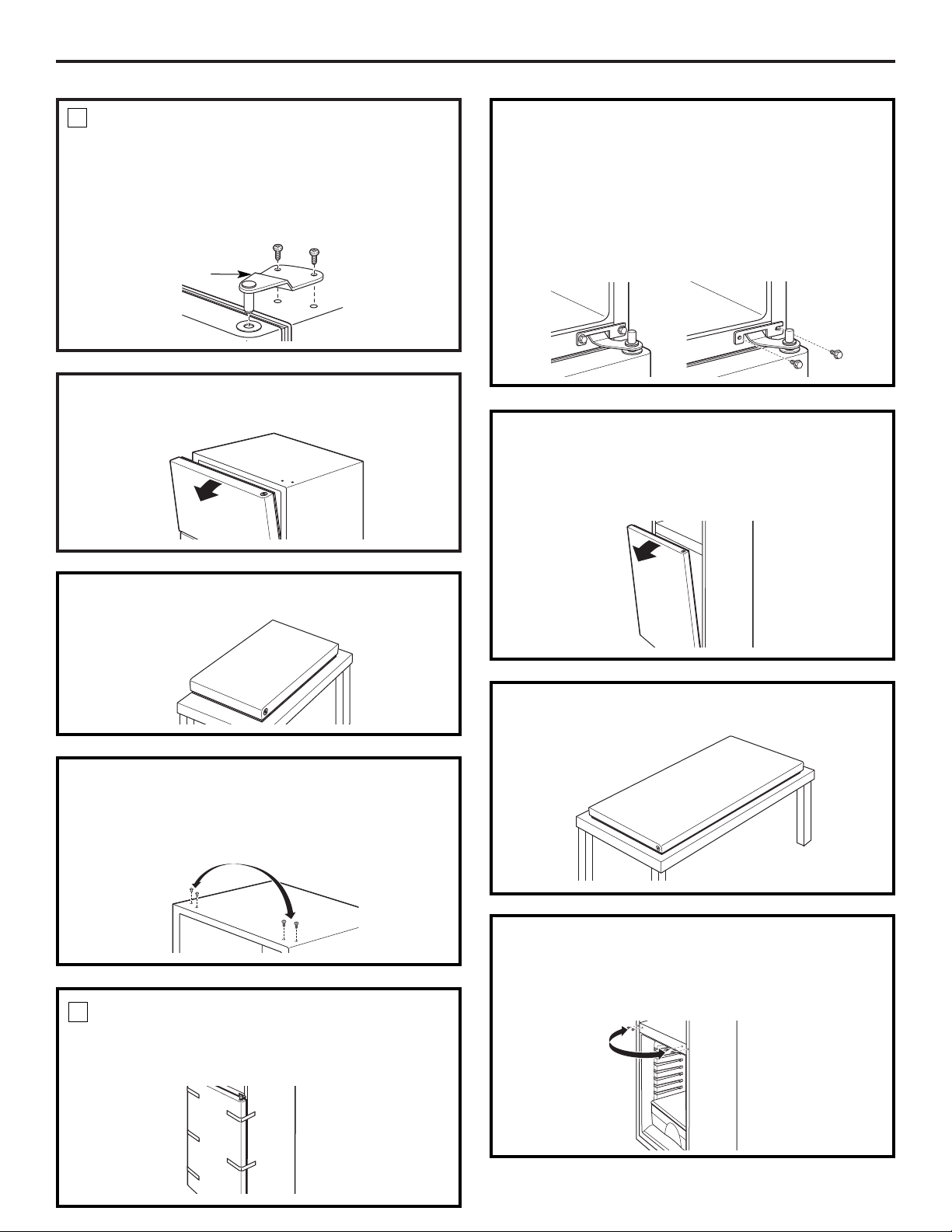
Hinge Cap
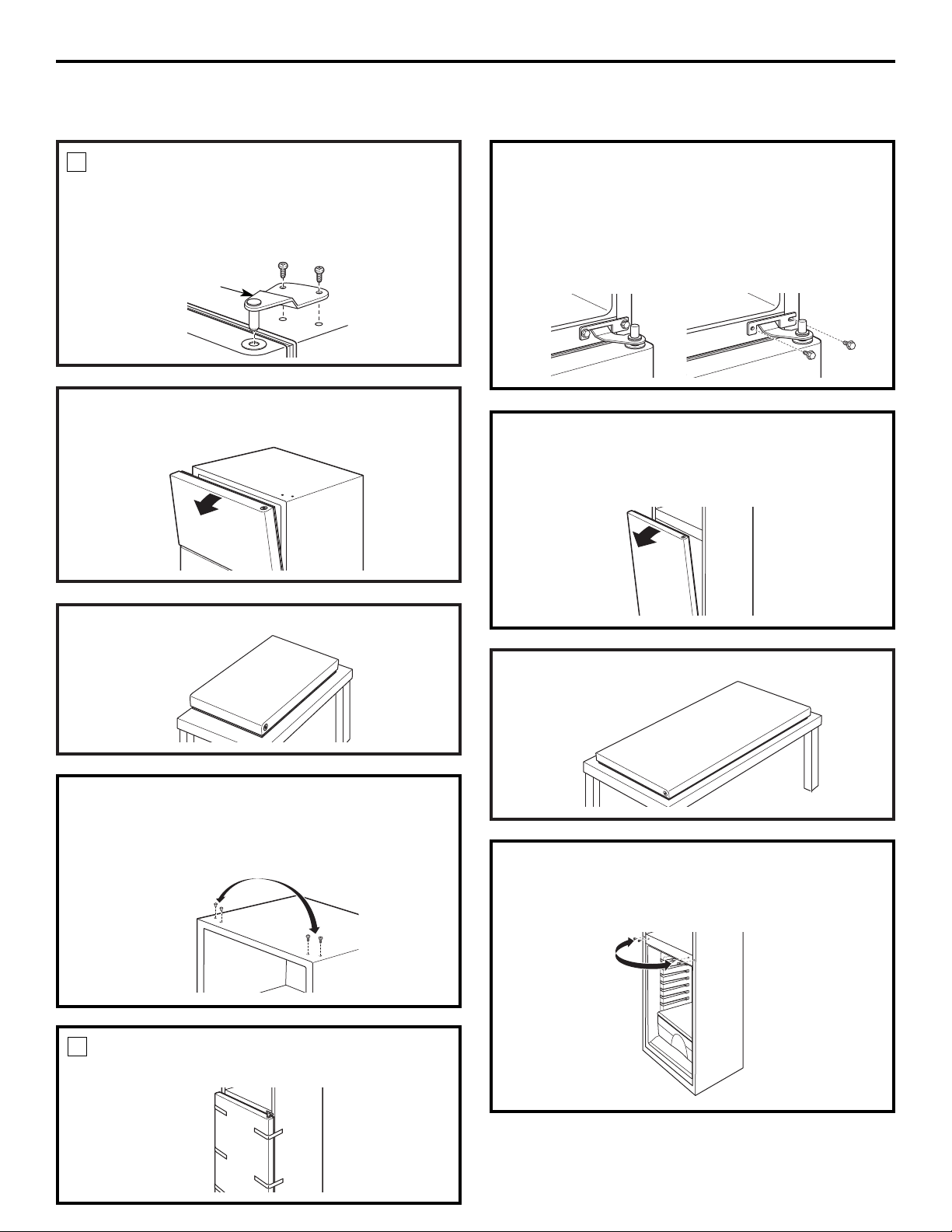
2.3 Lift the hinge (and the shim glued to it)
straight up to free the hinge pin from the socket
in the top of the door and set it aside, along
with its screws.
11
Installation Instructions
REMOVE THE FREEZER DOOR
(CONT.)
2
Top Hinge
2.5 Set the door on a non-scratching surface with
the outside up.
2.4 Remove the tape and tilt the door away from the
cabinet. Lift it off the center hinge pin.
2.6 Transfer the 2 screws from the opposite side
of the cabinet to the screw holes vacated by
the top hinge removal. Transfer the two plug
buttons to the holes where the screws were
removed.
3.1 Tape the door shut with masking tape.
REMOVE THE FRESH FOOD DOOR
3
3.3 Remove the tape and tilt the door away from the
cabinet. Lift the door from the pin in the bottom
hinge bracket. (If the washer sticks to the door
bottom, put it back on the hinge.)
3.2 Using a 5/16″ hex-head socket screwdriver and
a 5/16″ open-end wrench, remove the two
screws holding the center hinge (and the shim
glued to it) to the cabinet. Lift the center hinge
to free its pin from the socket in the top of the
door, and set hinge and screws aside. Be careful
not to lose the center hinge spacer and washer.
3.4 Set the door outside-up on a non-scratching
surface.
3.5 Transfer the two screws from the opposite side of
the cabinet to the screw holes vacated by the center
hinge removal. Transfer the three plug buttons to
the holes where the screws were removed.
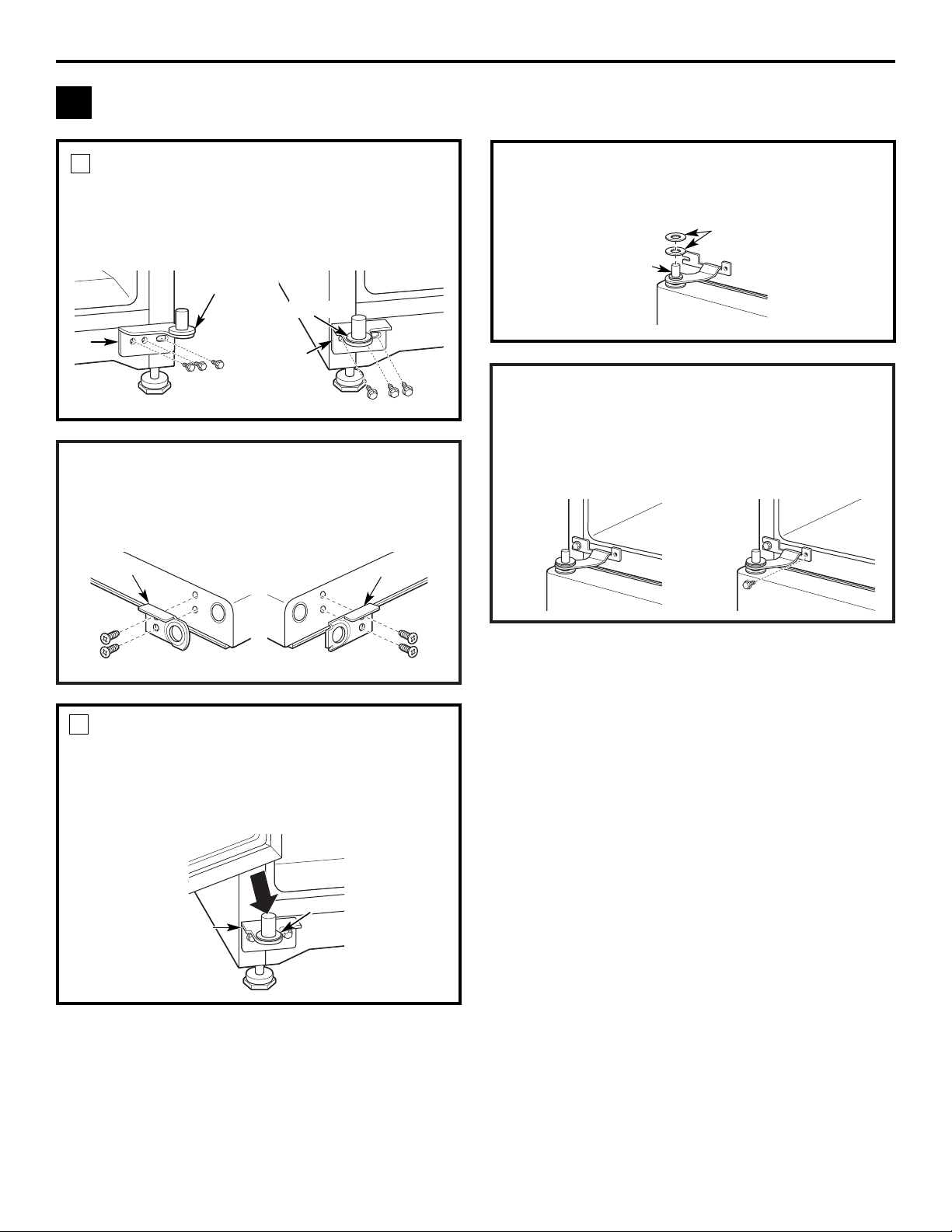
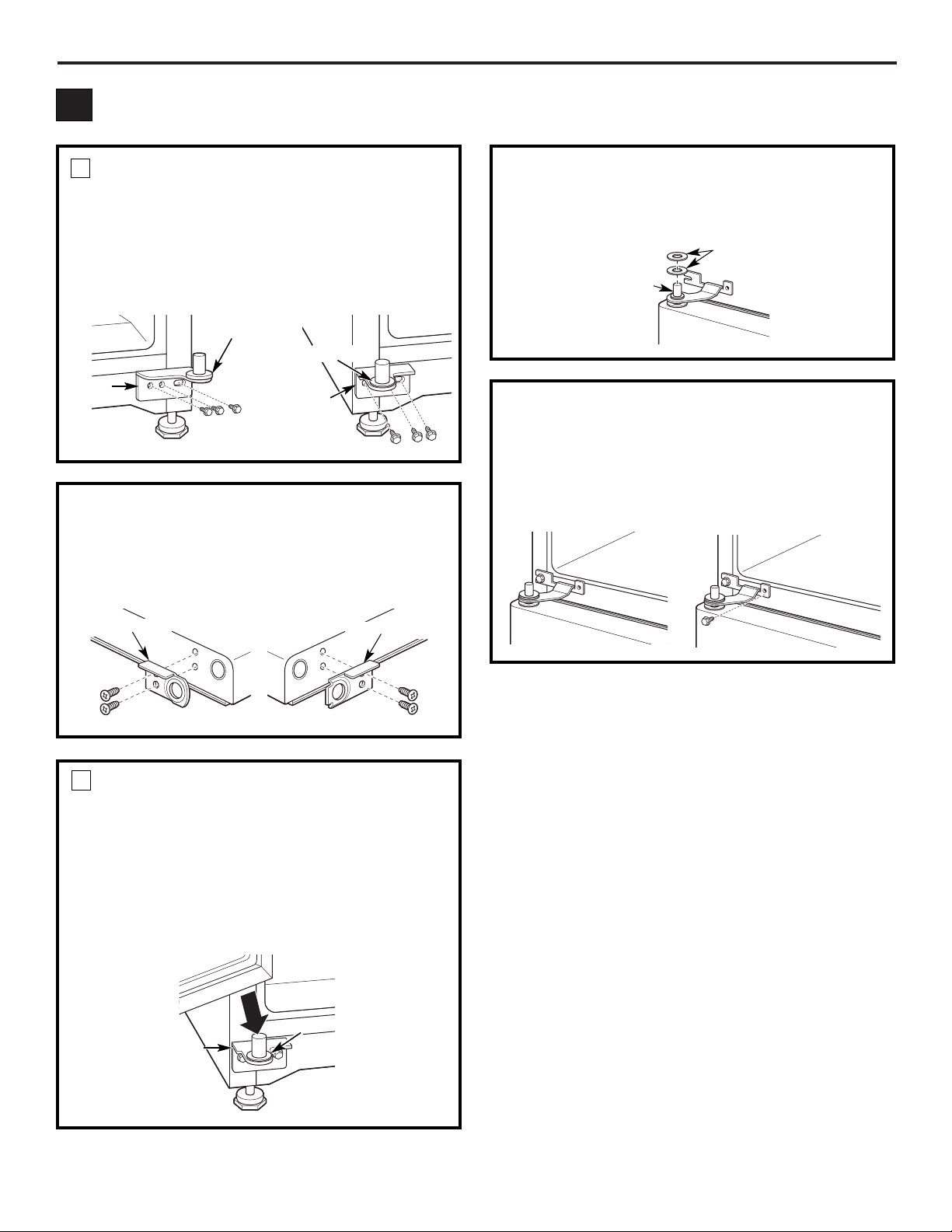
REVERSING THE HARDWARE
4
12
Installation Instructions
REVERSING THE DOOR SWING (CONT.)
1
4.1 Remove the bottom hinge bracket and washer from
the right side. Install the supplied left hinge on the
left side. Transfer the three plug buttons to the holes
where the screws were removed.
Washer
Hinge
Bracket
Washer
Hinge
Bracket
4.2 Transfer fresh food and freezer
door stops
Remove the door stop from the right side
of the doors. Install them on the left side of
both doors.
Door Stop
Left Side
Hinge Pin
5.1.2 Insert the pin on the center hinge into
the socket in the top of the door. Place the
spacer, then the washer, on the hinge pin.
5.1 Rehang the fresh food door
5.1.1 Lower the fresh food door onto the
bottom hinge pin. Be sure the washer
is in place on the pin.
REHANGING THE DOORS
5
Washer
Hinge
Bracket
5.1.3 Tilt the door toward the cabinet. As the door is
brought into position, slide the hinge under the
head of the screw which earlier had been partly
driven into the outermost hole. Insert the
remaining screw, then tighten both screws
securely.
Door Stop
Right Side
Left Side
Right Side
Washer
and Spacer
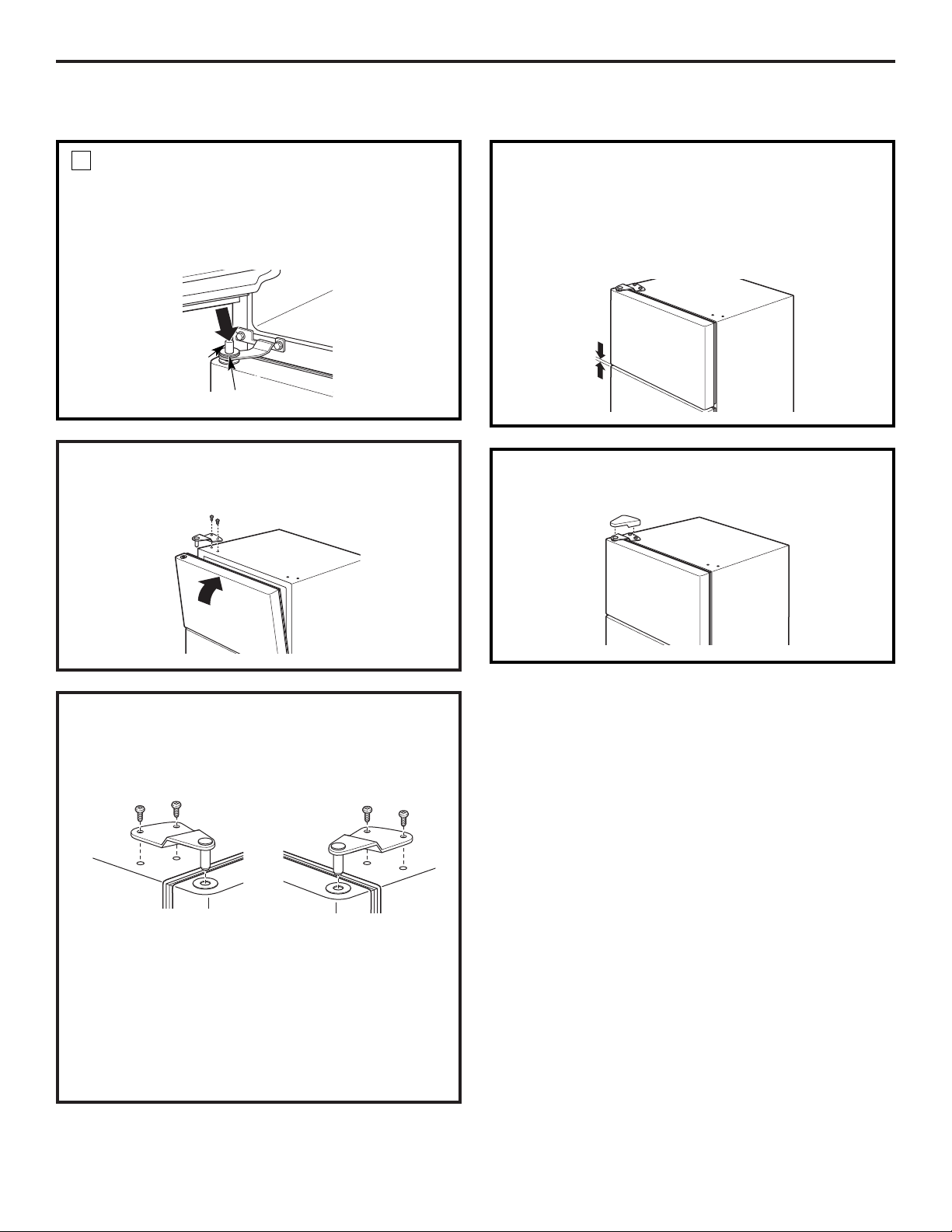
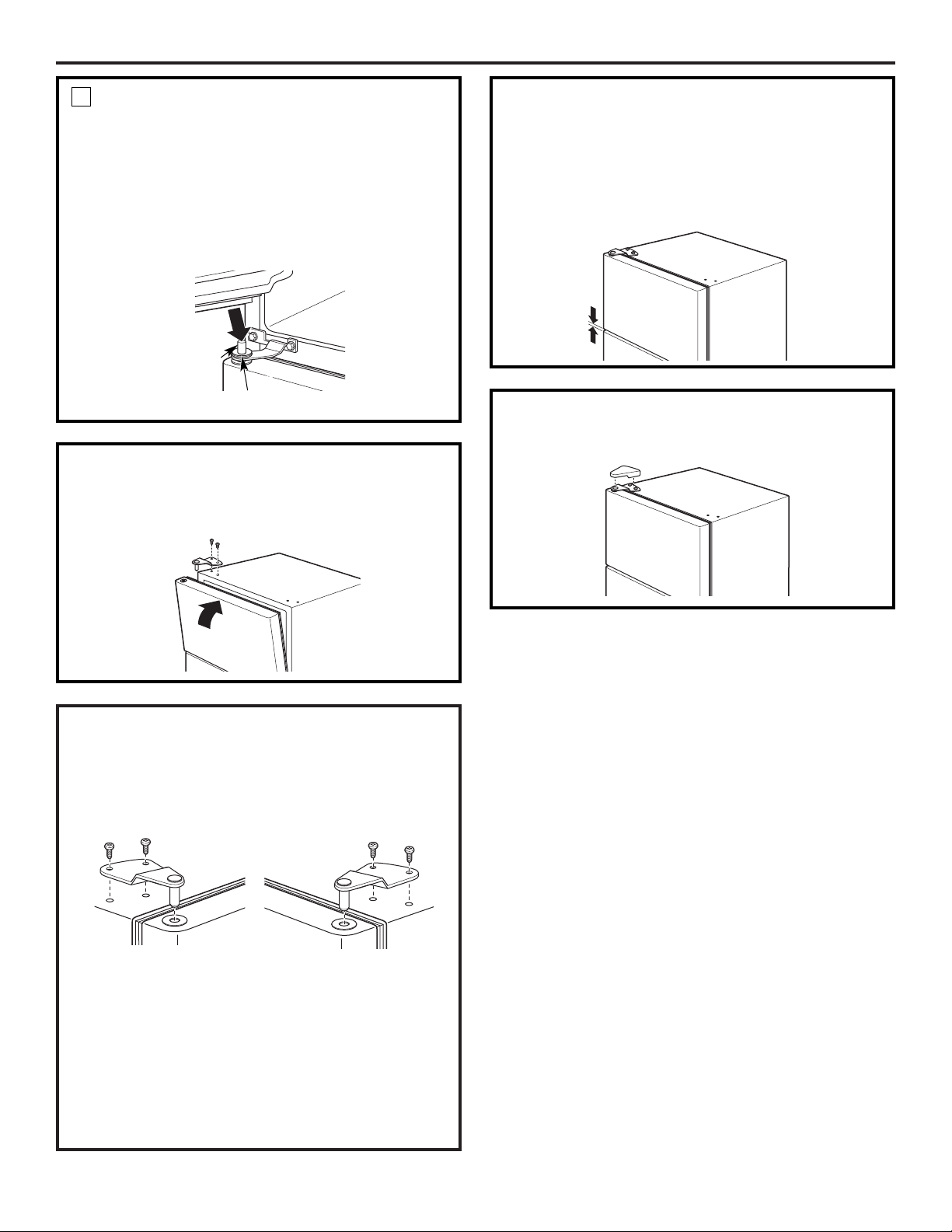
13
Installation Instructions
5.2.3 Interchange hinge (and the shim glued to it)
and screws at top right with screws at top left of
cabinet. Do not tighten screws on hinge side at
this time.
NOTES:
• Some hinges have four holes. Which holes you
use for installing the hinge depends on which
side you install the hinge.
• The outer edge of the hinge should be parallel
to the edge of the case for correct installation.
Installing the hinge on the left
Installing the hinge on the right
5.2 Rehang the freezer door
5.2.1 Lower the freezer door onto the center
hinge pin. Be sure the washer and spacer
are in place on the pin.
REHANGING THE DOORS (CONT.)
5
Center Hinge Pin
Washer and Spacer
5.2.2 Tilt the door toward the cabinet, lifting the top
hinge so the pin fits into the socket on the top
of the door.
5.2.4 Make sure the door is slightly above the top of
the cabinet and the gap between the doors is
even across the front. Tighten the top hinge
screws. Do not overtighten these screws—
tighten them until they are just snug, then
turn them another one-half turn.
5.2.5 Install the hinge cap onto the top hinge by
snapping it into place.
HUMMM...
WHOOSH...
■
The new high efficiency compressor may run faster
and longer than your old refrigerator and you may
hear a high-pitched hum or pulsating sound while
it is operating.
■
You may hear a whooshing sound when the doors close.
This is due to pressure equalizing within the refrigerator.
Normal operating sounds.
Newer refrigerators sound different from older refrigerators. Modern refrigerators
have more features and use newer technology.
■
You may hear the fans spinning at high speeds.
This happens when the refrigerator is first plugged
in, when the doors are opened frequently or when
a large amount of food is added to the refrigerator
or freezer compartments. The fans are helping to
maintain the correct temperatures.
CLICKS, POPS,
CRACKS and CHIRPS
■
You may hear cracking or popping sounds when the
refrigerator is first plugged in. This happens as the
refrigerator cools to the correct temperature.
■
The compressor may cause a clicking or chirping
sound when attempting to restart (this could take
up to 5 minutes).
■
Expansion and contraction of cooling coils during
and after defrost can cause a cracking or popping
sound.
WATER SOUNDS
■
The flow of refrigerant through the freezer cooling
coils may make a gurgling noise like boiling water.
■
Water dropping on the defrost heater can cause a
sizzling, popping or buzzing sound during the
defrost cycle.
■
A water dripping noise may occur during the defrost
cycle as ice melts from the evaporator and flows into
the drain pan.
■
Closing the door may cause a gurgling sound due to
pressure equalization.
Do you hear what I hear? These sounds are normal.
14
Consumer Support Troubleshooting Tips
Operating Instructions Safety InstructionsInstallation Instructions
Troubleshooting Tips
Installation Instructions Safety InstructionsOperating Instructions
15
Consumer SupportTroubleshooting Tips
Operating Instructions
Safety Instructions Installation Instructions
Before you call for service…
www.AmericanaAppliances.com
Troubleshooting Tips
Save time and money! Review the charts on the following
pages first and you may not need to call for service.
Problem Possible Causes What To Do
Refrigerator does not Refrigerator in defrost cycle. • Wait about 30 minutes for defrost cycle to end.
operate
Temperature control dial • Move the temperature control dial to a temperature
in 0 position. setting.
Refrigerator is unplugged. • Push the plug completely into the outlet.
The fuse is blown/circuit • Replace fuse or reset the breaker.
breaker is tripped.
Vibration or rattling Roller screws or leveling legs • See Rollers and Leveling Legs.
(slight vibration need adjusting.
is normal)
Motor operates for Normal when refrigerator • Wait 24 hours for the refrigerator to completely
long periods or cycles is first plugged in. cool down.
on and off frequently.
Often occurs when large • This is normal.
(Modern refrigerators
amounts of food are
with more storage
placed in refrigerator.
space and a larger
Door left open. • Check to see if package is holding door open.
freezer require more
Hot weather or frequent • This is normal.
operating time. They
door openings.
start and stop often
Temperature control dial • See About the temperature control dial.
to maintain even
set at the coldest setting.
temperatures.)
Grille and condenser • See Care and cleaning.
need cleaning.
Fresh food or freezer Temperature control dial • See About the temperature control dial.
compartment too warm not set cold enough.
Warm weather or frequent • Set the temperature control dial one step colder.
door openings. See About the temperature control dial.
Door left open. • Check to see if package is holding door open.
Package blocking air duct in • Check to see if package is blocking air duct in freezer
freezer compartment. compartment.
Frost or ice crystals Door left open. • Check to see if package is holding door open.
on frozen food
Too frequent or too long
(frost within package
door openings.
is normal)
Before you call for service…
Problem Possible Causes What To Do
Moisture forms on Not unusual during •Wipe surface dry and reset temperature control dial
cabinet surface periods of high humidity. one setting colder.
between the doors
Moisture collects inside Too frequent or too
(in humid weather, air long door openings.
carries moisture into
refrigerator when doors
are opened)
Refrigerator has odor Foods transmitting • Foods with strong odors should be tightly wrapped.
odor to refrigerator.
• Keep an open box of baking soda in the refrigerator;
replace every three months.
Interior needs cleaning. • See Care and cleaning.
16
Consumer Support Troubleshooting Tips
Operating Instructions Safety InstructionsInstallation Instructions
Troubleshooting Tips
Installation Instructions Safety InstructionsOperating Instructions
Troubleshooting Tips
General Electric Company
Warranty Registration Department
P.O. Box 34980
Louisville, KY 40232-4980
GE Service Protection Plus
™
GE, a name recognized worldwide for quality and dependability, offers you
Service Protection Plus
™
—comprehensive protection on all your appliances—
No Matter What Brand!
Benefits Include:
• Backed by GE
• All brands covered
• Unlimited service calls
• All parts and labor costs included
• No out-of-pocket expenses
• No hidden deductibles
• One 800 number to call
You will be completely satisfied with our service protection or you may request your money back
on the remaining value of your contract. No questions asked. It’s that simple.
Protect your refrigerator, dishwasher, washer and dryer, range, TV, VCR and much more—any brand!
Plus there’s no extra charge for emergency service and low monthly financing is available. Even icemaker
coverage and food spoilage protection is offered. You can rest easy, knowing that all your valuable
household products are protected against expensive repairs.
Place your confidence in GE and call us in the U.S. toll-free at 800.626.2224
for more information.
*All brands covered, up to 20 years old, in the continental U.S.
We’ll Cover Any Appliance.
Anywhere. Anytime.*
Please place in envelope and mail to:
✁
Cut here
17
Consumer Product Ownership Registration
Important
Mail
Today!
GE Consumer & Industrial
Appliances
General Electric Company
Louisville, KY 40225
ge.com
First
Name
Mr. ■■ Ms. ■■ Mrs. ■■ Miss ■■
Street
Address
City
State
Date Placed
In Use
Month
Day
Year
Zip
Code
Apt. #
Last
Name
Phone
Number
_
_
Consumer Product Ownership Registration
Dear Customer:
Thank you for purchasing our product. Registration for Americana
™
is provided by GE.
Thank you for placing your confidence in us. We are proud to have you as a customer!
Follow these three steps to protect your new appliance investment:
Important: If you did not get a registration card with your
product, detach and return the form below to
ensure that your product is registered.
1
23
Model Number Serial Number
✁
Cut here
Complete and mail
your Consumer
Product Ownership
Registration today.
Have the peace of
mind of knowing we
can contact you in
the unlikely event of
a
safety modification.
After mailing the
registration below,
store this document
in a safe place. It
contains information
you will need should
you require service.
Our service number in
the USA is: 800 GE
CARES (800.432.2737).
Read your Owner’s
Manual carefully.
It will help you
operate your new
appliance properly.
Model Number Serial Number
E-mail Address*
18
* Please provide your e-mail address to receive, via e-mail, discounts, special offers and other important
communications from GE Appliances (GEA).
■■ Check here if you do not want to receive communications from GEA’s carefully selected partners.
FAILURE TO COMPLETE AND RETURN THIS CARD DOES NOT DIMINISH YOUR
WARRANTY RIGHTS.
For information about GEA’s privacy and data usage policy, go to ge.com and click on “Privacy Policy”
or call 800.626.2224.
www.AmericanaAppliances.com
19
Consumer SupportTroubleshooting Tips
Operating InstructionsSafety Instructions
Installation Instructions
Refrigerator Warranty.
For The Period Of: We Will Replace:
Six Months Any part of the refrigerator which fails due to a defect in materials or workmanship.
From the date of the During this limited six-month warranty, GE will also provide, free of charge, all labor
original purchase and related service to replace the defective part.
■ Service trips to your home to teach you how to use the
product.
■ Improper installation, delivery or maintenance.
■ Failure of the product if it is abused, misused, or used for
other than the intended purpose or used commercially.
■ Loss of food due to spoilage.
■ Damage caused after delivery.
■ Products which are not defective, broken, or which are
working as described in the Owner’s Manual.
■ Replacement of house fuses or resetting of circuit
breakers.
■ Replacement of light bulbs.
■ Damage to the product caused by accident, fire, floods
or acts of God.
■ Incidental or consequential damage caused by possible
defects with this appliance.
What Is Not Covered:
This warranty is extended to the original purchaser and any succeeding owner for products purchased for home
use within the USA. In Alaska, the warranty excludes the cost of shipping or service calls to your home.
Some states do not allow the exclusion or limitation of incidental or consequential damages. This warranty gives
you specific legal rights, and you may also have other rights which vary from state to state. To know what your
legal rights are, consult your local or state consumer affairs office or your state’s Attorney General.
Warrantor: General Electric Company. Louisville, KY 40225
All warranty services for Americana
™
are provided by GE Factory
Service Centers, or an authorized Customer Care
®
technician.
To schedule service, call 800.432.2737.
Staple your receipt here.
Proof of the original purchase
date is needed to obtain service
under the warranty.
EXCLUSION OF IMPLIED WARRANTIES—Your sole and exclusive remedy is product repair as provided in this
Limited Warranty. Any implied warranties, including the implied warranties of merchantability or fitness for a
particular purpose, are limited to one year or the shortest period allowed by law.
Printed in the United States
Printed on Recycled Paper
Consumer Support.
Schedule Service
Expert GE repair service is only one step away from your door. Schedule service at your convenience by calling
800.432.2737 during normal business hours.
In Canada, call 1.800.361.3400
Extended Warranties
Purchase a GE extended warranty and learn about special discounts that are available while your warranty is still
in effect. You can purchase it by calling 800.626.2224 during normal business hours. GE Consumer Home Services
will still be there after your warranty expires. In Canada, call 1.888.261.2133
Parts and Accessories
Individuals qualified to service their own appliances can have parts or accessories sent directly to their homes
(VISA, MasterCard and Discover cards are accepted). Order by phone at 800.626.2002 during normal business
hours.
Instructions contained in this manual cover procedures to be performed by any user. Other servicing generally should be
referred to qualified service personnel. Caution must be exercised, since improper servicing may cause unsafe operation.
Customers in Canada should consult the yellow pages for the nearest Camco service center, or call 1.888.261.3055.
Contact Us www.AmericanaAppliances.com
If you are not satisfied with the service you receive from GE, send a letter to GE. Please include your phone
number. Write to: General Manager, Customer Relations
GE Appliances, Appliance Park
Louisville, KY 40225
In Canada: Write to: Director, Consumer Relations, Camco, Inc.
Suite 310, 1 Factory Lane
Moncton, N.B. E1C 9M3
197D5984P002 49-60403 10-05 JR
Información de seguridad
Cables de extensión . . . . . . . . . . . . . . . . 2
Cómo conectar la electricidad . . . . . . . . 3
Precauciones de seguridad . . . . . . . . . . . 2
Instrucciones de operación
Control . . . . . . . . . . . . . . . . . . . . . . . .4
Cuidado y limpieza . . . . . . . . . . . .7, 8
Estantes . . . . . . . . . . . . . . . . . . . . . .5, 6
Gaveta de almacenamiento . . . . . . . .6
Instrucciones para la instalación
Cómo invertir el vaivén de
la puerta . . . . . . . . . . . . . . . . . . .10–13
Preparación para instalar
el refrigerador . . . . . . . . . . . . . . . . . .9
Consejos para la solución
de problemas
Antes de solicitar un servicio . . .15, 16
Sonidos normales de operación . . . .14
Soporte al consumidor
Garantía . . . . . . . . . . . . . . . . . . . . . .19
Soporte al consumidor . . . . . . . . . . .20
Escriba aquí el modelo y el número
de serie:
Modelo # ______________________
Serie #__________________________
Encuentre estos números en la
etiqueta en el lado izquierdo de la
parte inferior del compartimiento
del refrigerador.
Refrigeradores
Manual del propietario e instalación
Modelo Americana A3309
Congelador superior
www.AmericanaAppliances.com
Impreso en los Estados Unidos
Impreso en papel reciclado
IMPORTANTE INFORMACIÓN DE SEGURIDAD.
LEA TODAS LAS INSTRUCCIONES ANTES DE SU USO.
¡ADVERTENCIA!
Use este aparato sólo con el fin para el cual fue diseñado como se describe en este Manual del propietario.
PRECAUCIONES DE SEGURIDAD
Al usar aparatos eléctricos, se deben seguir precauciones básicas de seguridad, incluyendo las siguientes:
■
■ Este refrigerador debe instalarse y ubicarse
correctamente según las Instrucciones de
instalación antes de su uso.
■
■ No permita que los niños se suban, se paren
o se cuelguen de los estantes en el refrigerador.
Podrían dañar el refrigerador y sufrir graves
daños.
■
■ No toque las superficies frías en el
compartimiento del congelador con las manos
húmedas o mojadas. La piel se puede pegar a
estas superficies extremadamente frías.
■
■ No almacene o use gasolina u otros vapores y
líquidos inflamables en las áreas cercanas a este
o a cualquier otro aparato.
■
■ En los refrigeradores con máquinas de hielo
automáticas, evite el contacto con las partes en
movimiento del mecanismo eyector, o con el
elemento calefactor localizado en la parte inferior
del dispositivo para hacer hielo. No coloque
los dedos o las manos en el mecanismo de la
máquina de hielos mientras el refrigerador esté
conectado.
■
■ Mantenga los dedos alejados de las áreas
estrechas; los espacios entre las puertas y entre
las puertas y los gabinetes son necesariamente
pequeños. Tenga cuidado al cerrar las puertas
cuando haya niños en el área.
■
■ Desconecte el refrigerador antes de limpiar y
hacer reparaciones.
NOTA: Recomendamos enfáticamente que cualquier
servicio sea realizado por un individuo calificado.
■
■ Fijar el control en la posición 0 (apagado) no
elimina la corriente hacia el circuito de luces.
■
■ No vuelva a congelar alimentos que se han
descongelado por completo.
2
ELIMINACIÓN APROPIADA DEL REFRIGERADOR
Los problemas de que los niños se queden
atrapados y se sofoquen no son cosas del pasado.
Los refrigeradores desechados o abandonados
siguen siendo peligrosos, aún si sólo están por
“unos pocos días”. Si está desechando su
refrigerador viejo, por favor siga las instrucciones
a continuación para ayudarle a evitar accidentes.
Antes de desechar su viejo refrigerador
o congelador:
■ Quítele las puertas.
■ Deje los estantes en su lugar, de manera que los
niños no puedan subirse fácilmente al interior.
Refrigerantes
Todos los aparatos de refrigeración contienen
refrigerantes, los cuales se deben retirar antes de
la eliminación del producto de acuerdo con la
ley federal. Si va a desechar algún aparato
antiguo de refrigeración, consulte con la
compañía a cargo de desechar el aparato
para saber qué hacer.
USO DE CABLES DE EXTENSIÓN
Debido a peligros potenciales de seguridad bajo ciertas condiciones, nos oponemos al uso de cables de
extensión.
Sin embargo, si debe usar un cable de extensión, es absolutamente necesario que sea un tipo de cable
de extensión para aparatos con conexión a tierra de tres cables, que esté en la lista de UL (en los Estados
Unidos) o en la lista CSA (en Canadá), que tenga un enchufe de tipo conexión a tierra y salida y que
el grado eléctrico del cable sea de 15 amperios (mínimo) y 120 voltios.
¡PELIGRO! RIESGO DE QUE LOS NIÑOS SE
QUEDEN ATRAPADOS
Soporte al consumidor
Consejos para la
solución de problemas
Instrucciones de
operación
Información de
seguridad
Instrucciones para la
instalación
3
www.AmericanaAppliances.com
¡ADVERTENCIA!
CÓMO CONECTAR LA ELECTRICIDAD
Bajo ninguna circunstancia, no corte ni retire la tercera pata (conexión a tierra) del cable de electricidad.
Por seguridad personal, este aparato debe estar correctamente conectado a tierra.
El cable eléctrico de este aparato está provisto de
un enchufe de tres patas (conexión a tierra) que
encaja en un tomacorriente estándar de 3 orificios
(conexión a tierra) para minimizar la posibilidad
de peligro de un choque eléctrico de este aparato.
Haga que el tomacorriente de la pared y el circuito
sean revisados por un electricista calificado para
asegurar que el tomacorriente tiene la conexión a
tierra apropiada.
Cuando haya un tomacorriente estándar de dos
patas, es su responsabilidad y obligación personal
reemplazarlo con un tomacorriente adecuado de
tres orificios correctamente conectado a tierra.
El refrigerador deberá siempre estar conectado en
su propio tomacorriente eléctrico individual que
tenga un nivel de voltaje que se ajuste a la placa de
potencia.
Esto ofrece el mejor desempeño y también evita
sobrecargar los circuitos eléctricos de la casa que
podrían causar un incendio a partir de los cables
recalentados.
Nunca desconecte su refrigerador halando del
cable eléctrico. Siempre tome el enchufe
firmemente y hálelo directamente del
tomacorriente.
Repare o reemplace de inmediato todos los cables
eléctricos que se hayan desgastado o dañado. No
use un cable que tenga grietas o daños de abrasión
en su longitud o en cualquier extremo.
Al retirar el refrigerador de la pared, tenga cuidado
de no enrollar o dañar el cable eléctrico.
LEA Y SIGA CUIDADOSAMENTE ESTA INFORMACIÓN
DE SEGURIDAD.
CONSERVE ESTAS INSTRUCCIONES
Soporte al consumidor
Consejos para la
solución de problemas
Instrucciones de
operación
Información de
seguridad
Instrucciones para la
instalación
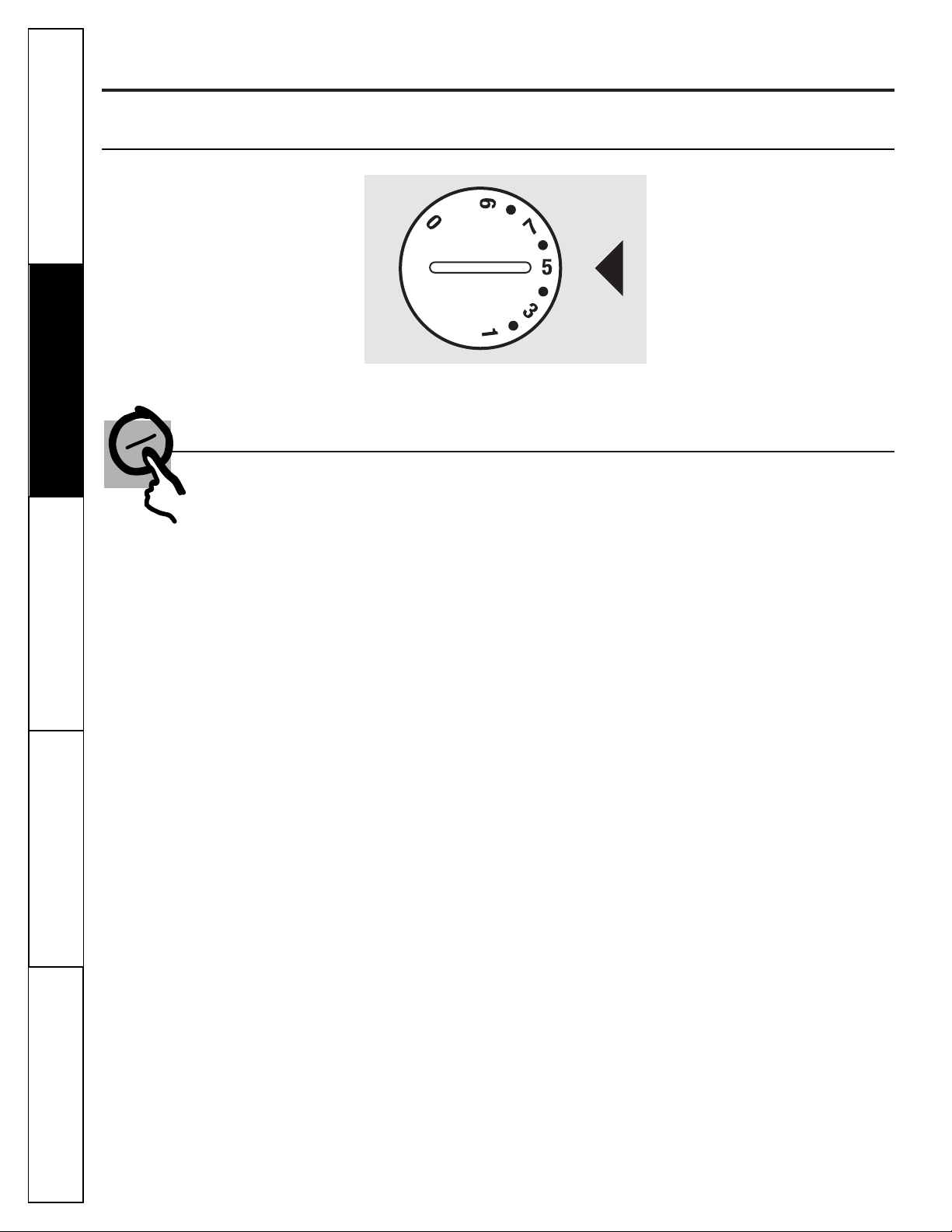
Sobre el dial de control de la temperatura.
Niveles de control
Dial de control de la temperatura
El dial de control de la temperatura tiene nueve niveles más 0. 1 es el nivel más caliente y 9 es el nivel
más frío. Inicialmente, fije el dial en 5.
Después de usar el refrigerador, ajuste el dial de ser necesario.
Inserte una moneda en la ranura en el centro del dial y podrá girar el dial hacia el nivel que mejor
se adapte a sus necesidades.
Permita 24 horas para que el refrigerador se enfríe.
Girar el dial a 0 interrumpe el enfriamiento en ambos compartimientos: el compartimiento de alimentos frescos y
el congelador, aunque no apaga el suministro de corriente hacia el refrigerador.
4
Soporte al consumidor
Consejos para la
solución de problemas
Instrucciones de
operación
Información de
seguridad
Instrucciones para la
instalación
5
Sobre los estantes del compartimiento
de alimentos frescos.
www.AmericanaAppliances.com
Los soportes de los estantes en diferentes niveles le permiten adaptar el espacio de los estantes según sus
necesidades. No todas las características están presentes en todos los modelos.
Soporte al consumidor
Consejos para la
solución de problemas
Instrucciones de
operación
Información de
seguridad
Instrucciones para la
instalación
Estantes completos
Los estantes de alambre deslizantes se
pueden mover hacia otro lugar en el
compartimiento de alimentos frescos.
El estante de tamaño completo tiene
frenos posteriores. Cuando se coloca
correctamente en los soportes del estante,
el estante no se inclinará cuando coloque
o retire alimentos del mismo.
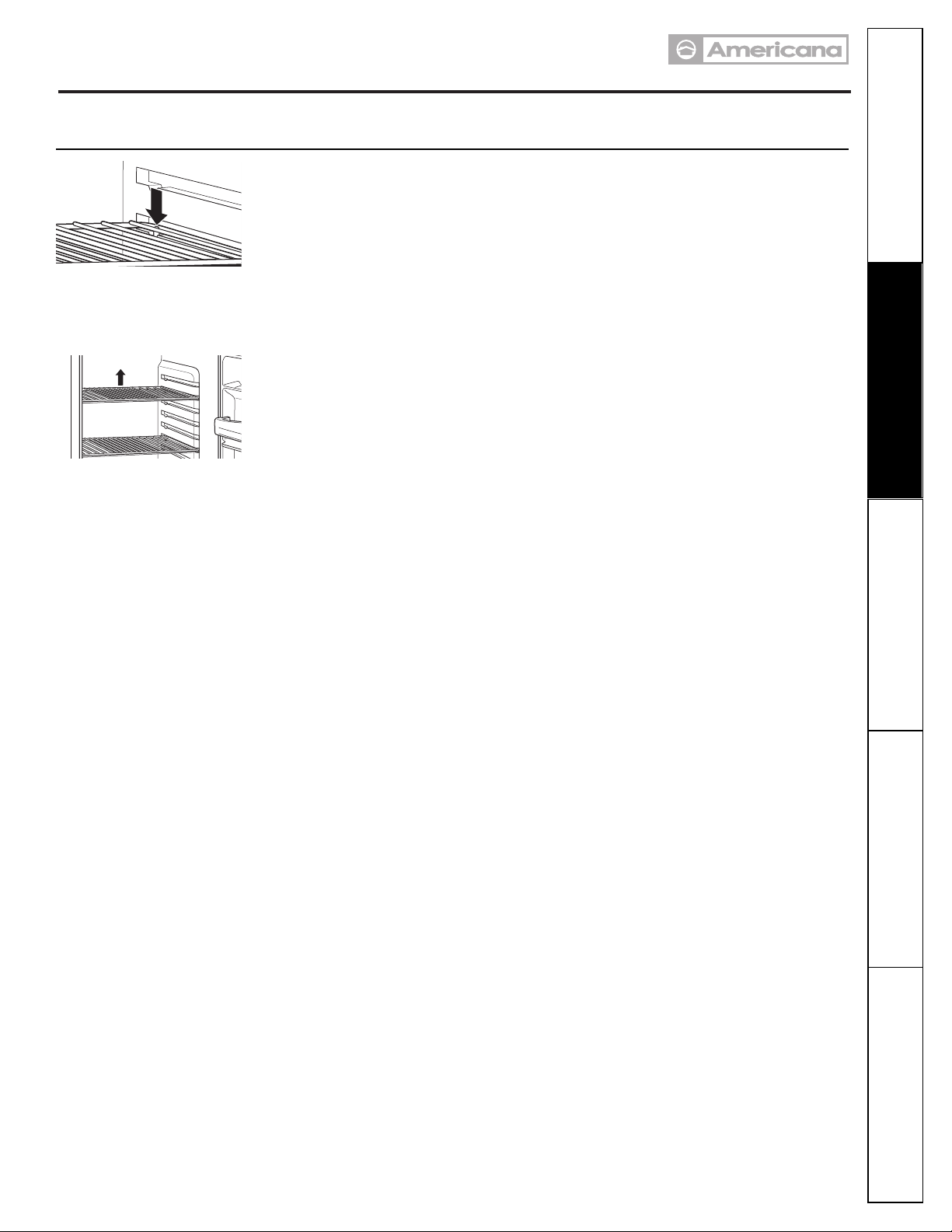
Para retirar los estantes de tamaño
completo, abra completamente la puerta
de alimentos frescos, levante la parte
posterior del estante y hale hacia delante.
6
Soporte al consumidor
Consejos para la
solución de problemas
Instrucciones de
operación
Información de
seguridad
Instrucciones para la
instalación
Sobre el estante del compartimiento del congelador.
Estante del congelador
El estante del congelador se ajusta a la
posición inferior o superior.
El estante de tamaño completo tiene
frenos posteriores. Cuando se coloca
correctamente en los soportes del estante,
el estante no se inclinará cuando coloque
o retire alimentos del mismo.
Para retirar el estante de tamaño
completo, abra completamente la puerta
del congelador, levante la parte posterior
del estante y tire hacia delante.
Sobre la gaveta de almacenamiento.
No todas las características están presentes en todos los modelos.
Gaveta para frutas y vegetales
Se debe retirar el exceso de agua que se
pueda acumular al fondo de la gaveta y
se deben secar la gaveta.
Sobre la remoción de la gaveta
de almacenamiento y cubierta.
No todas las características están presentes en todos los modelos.
Remoción de la gaveta y cubierta
Se puede retirar la gaveta fácilmente
tomando los costados y levantando
ligeramente mientras hala.
Gaveta de tamaño completo con cubierta
Para retirar la cubierta, tire hacia fuera de
los soportes laterales.
Para volver a colocar la cubierta, alinéela
con los soportes laterales y deslícela con
cuidado hacia la parte posterior del
compartimiento.
7
Cuidado y limpieza del refrigerador.
www.AmericanaAppliances.com
Soporte al consumidor
Consejos para la
solución de problemas
Instrucciones de
operación
Información de
seguridad
Instrucciones para la
instalación
Limpieza exterior
Las manijas de la puerta y accesorio (en
algunos modelos). Limpie con un paño
humedecido con agua jabonosa. Seque
con un paño seco.
Mantenga el exterior limpio. Límpielo con un
paño ligeramente humedecido con cera de
cocina para electrodomésticos o detergente
líquido suave para platos. Seque y brille con
un paño limpio y seco.
Los paneles y las manijas de las puertas
de acero inoxidable (en algunos modelos)
pueden ser limpiados con un limpiador
para acero inoxidable para usos comerciales.
No utilice cera para electrodomésticos sobre
el acero inoxidable.
No limpie el refrigerador con un paño sucio para
platos o con una toalla mojada. Estos pueden
dejar residuos y pueden erosionar la pintura.
No use almohadillas de restregar, limpiadores
en polvo, blanqueadores o limpiadores que
contengan blanqueadores ya que estos productos
pueden raspar y debilitar el acabado de pintura.
Limpieza interior
Para ayudar a evitar olores, deje una
caja abierta de bicarbonato en los
compartimientos de alimentos frescos
y en el congelador.
Desconecte el refrigerador antes de limpiarlo.
Si esto no es práctico, escurra la humedad
excesiva con una esponja o paño al limpiar
alrededor de los interruptores, luces o
controles.
Use una solución de agua tibia y
bicarbonato—una cucharada (15 ml) de
bicarbonato para un cuarto (1 litro) de
agua. Esto limpia y neutraliza los olores.
Enjuague y seque.
Después de limpiar los empaques de la
puerta, aplique una capa delgada de
vaselina en los empaques de la puerta en
el costado de la bisagra. Esto ayuda a
evitar que los empaques se peguen y se
doblen hasta perder su forma.
Evite limpiar los estantes de vidrio fríos (en
algunos modelos) con agua caliente ya que la
diferencia de las temperaturas extremas puede
causar que se quiebren. Manipule los estantes
de vidrio con cuidado. Golpear el vidrio templado
puede causar que se quiebre.
No lave ninguna parte plástica del refrigerador
en la lavadora de platos.
8
Soporte al consumidor
Consejos para la
solución de problemas
Instrucciones de
operación
Información de
seguridad
Instrucciones para la
instalación
Cuidado y limpieza del refrigerador.
Para una largas vacaciones o ausencias,
retire los alimentos y desconecte el
refrigerador. Gire el dial de control de la
temperatura hacia la posición 0 (apagado),
y limpie el interior con una solución de
una cucharada de bicarbonato (15 ml)
y un cuarto (1 litro) de agua. Deje las
puertas abiertas.
Cómo prepararse para las vacaciones
Cómo prepararse para trasladarse
Asegure todos los artículos sueltos como la
rejilla, los estantes y la gaveta pegándolos
con cinta en su lugar para evitar daños.
Asegúrese de que el refrigerador permanezca en
una posición vertical durante el traslado.
Detrás del refrigerador
Tenga cuidado al mover el refrigerador
lejos de la pared. Todos los tipos de
cubiertas de piso se pueden dañar,
particularmente las cubiertas acojinadas y
aquellas con superficies con diseños en
relieve.
Hale el refrigerador en línea recta y
regréselo a su posición empujándolo de la
misma forma. Mover el refrigerador en una
dirección lateral puede resultar en daños a
la superficie del piso o al refrigerador.
Cuando empuje de nuevo el refrigerador,
asegúrese de no pisar el cable eléctrico.
Después de rodar el refrigerador a
su posición, gire las patas niveladoras
frontal del refrigerador en el sentido
de las manecillas del reloj hasta que las
patas sostengan nuevamente el peso del
refrigerador.
Reposición de la bombilla
Para reemplazar una bombilla quemada,
desconecte el refrigerador del
tomacorriente eléctrico, desenrosque la
bombilla cuando esté fría y reemplácela
con una bombilla para refrigeradores de
similar o inferior voltaje.
Girar el control a la posición 0 no desconecta
la corriente del circuito de la luz.
Lea estas instrucciones completa y cuidadosamente.
•
IMPORTANTE – Guarde estas
instrucciones para uso del inspector local.
•
IMPORTANTE – Observe todos los
códigos y órdenes de ley.
•
Nota al instalador – Asegúrese de dejar estas
instrucciones con el consumidor.
•
Nota al consumidor – Conserve estas instrucciones
para referencia futura.
• Nivel de destreza – La instalación de este aparato
requiere de destrezas mecánicas básicas.
• Tiempo de ejecución – Instalación del refrigerador
15 minutos
Invertir el vaivén de la puerta
1 hora
• La instalación apropiada es la responsabilidad del
instalador.
• La falla del producto debido a una instalación
inadecuada no está cubierta por la garantía.
ANTES DE INICIAR
• No instale el refrigerador donde la temperatura baje de 60°F
(16°C) ya que no correrá con suficiente frecuencia para
mantener las temperaturas apropiadas.
• Instálela en un piso fuerte para que lo soporte con carga
completa.
UBICACIÓN DEL REFRIGERADOR
Si tiene preguntas, llame al 800.432.2737
Instrucciones para
Refrigerador
la Instalación
Modelo 8,8
Permita el siguiente espacio para una fácil instalación,
apropiada circulación del aire y conexiones de plomería
y eléctricas.
• Costados 3/4″ (19 mm)
• Arriba 1″ (25 mm)
• Atrás 1″ (25 mm)
ÁREA
Las patas niveladoras cerca de cada esquina delantera
del refrigerador son ajustables. Éstas colocan
firmemente el refrigerador y evitan que se mueva
cuando las puertas se abran. Las patas niveladoras
se deben colocar de manera que el frente del
refrigerador se levante lo suficiente para que las
puertas se cierren fácilmente cuando se abran hasta
la mitad.
Gire las patas niveladoras en el sentido de las
manecillas del reloj para levantar el refrigerador, y en
el sentido contrario para bajarlo.
Los rodillos al lado de las patas niveladoras le permiten
mover el refrigerador lejos de la pared para limpiarlo.
Gire las patas en el sentido contrario de las manecillas
del reloj hasta que el peso del refrigerador se traslade
de éstas hacia los rodillos. Después de rodar el
refrigerador de nuevo hacia su lugar, gire las patas en
el sentido de las manecillas del reloj hasta que las patas
sostengan nuevamente el peso del refrigerador.
RODILLOS Y PATAS NIVELADORAS
9
10
CÓMO INVERTIR EL VAIVÉN DE LA PUERTA
Al invertir el vaivén de la puerta:
• Lea las instrucciones completamente antes de
empezar.
• Maneje las partes con cuidado para evitar raspar la
pintura.
• Ponga los tornillos con su parte correspondiente para
evitar usarlas en el lugar equivocado.
• Disponga de una superficie de trabajo que no se
raspe para las puertas.
IMPORTANTE: Una vez que empiece, no mueva el
gabinete hasta que haya completado el proceso de
invertir el vaivén de la puerta.
Estas instrucciones son para cambiar las bisagras del
lado derecho al izquierdo, si alguna vez desea cambiar
las bisagras al lado derecho nuevamente, siga las
mismas instrucciones e invierta toda las referencias
hacia la izquierda y derecha.
NOTAS IMPORTANTES
Instrucciones para la instalación
Destornillador de casquillo
con cabeza de 5/16″
HERRAMIENTAS REQUERIDAS
Destornillador de estrella
Cuchillo para masilla
(espátula) o destornillador
delgado
Cinta de enmascarar
Destornillador Torx
®
T20 ó T25, (necesitado
para algunos modela)
Llave abierta
de 5/16″
1
1.1 Desconecte el refrigerador del tomacorriente
eléctrico.
ANTES DE INICIAR
1
1.2 Desocupe todos los estantes de la puerta,
incluyendo el compartimiento de lácteos.
PRECAUCIÓN: No permita que ninguna puerta
se caiga al piso, ya que esto podría dañar el freno
de la puerta.
2.1 Pegue la puerta cerrada con cinta de enmascarar.
RETIRE LA PUERTA
DEL CONGELADOR
2
2.2 Retire la tapa de la bisagra superior con
un cuchillo para masilla o un destornillador
delgado. Con un destornillador de casquillo de
cabeza hexagonal de 5/16,″ retire los tornillos
que sostienen la bisagra superior del gabinete.
Tapa de la
bisagra
11
Instrucciones para la instalación
2.3 Levante la bisagra (y la lámina adjunta)
directamente hacia arriba para liberar el
pasador de la bisagra del casquillo en la parte
superior de la puerta y colóquela a un lado,
junto con los tornillos correspondientes.
Bisagra superior
2.4 Retire la cinta y levante la puerta hacia fuera
del gabinete. Levántela del pasador de la bisagra
central.
2.6 Traslade los dos tornillos del lado opuesto
del gabinete hacia los orificios de los tornillos
desocupados al retirar la bisagra superior.
Mueva los dos botones de conexión a los
orificios de los que se han retirado los tornillos.
2.5 Coloque la puerta sobre una superficie que no
raye con la parte exterior hacia arriba.
RETIRE LA PUERTA
DEL CONGELADOR
(CONT.)
2
3.1 Pegue la puerta cerrada con cinta de enmascarar.
RETIRE LA PUERTA DE
ALIMENTOS FRESCOS
3
3.3 Retire la cinta e incline la puerta hacia fuera del
gabinete. Levante la puerta del pasador en el
soporte de la bisagra inferior. (Si la arandela se
pega al fondo de la puerta, colóquela de nuevo
en la bisagra.)
3.2 Usando un destornillador de casquillo de cabeza
hexagonal de 5/16″ y una llave abierta de
5/16,″ retire los dos tornillos que sostienen la
bisagra central (y la lámina adjunta) al gabinete.
Levante la bisagra central para liberar el
pasador del casquillo en la parte superior de la
puerta y coloque la bisagra y los tornillos a un
lado. Tenga cuidado de no perder el espaciador
y la arandela de la bisagra central.
3.4 Coloque la puerta con el exterior hacia arriba
en una superficie que no raye.
3.5 Traslade los dos tornillos del lado opuesto del
gabinete a los orificios de los tornillos desocupados
al retirar la bisagra central. Mueva los tres botones
de conexión a los orificios de los que se han
retirado los tornillos.
12
Instrucciones para la instalación
CÓMO INVERTIR EL VAIVÉN DE LA PUERTA (CONT.)
1
CÓMO INVERTIR LOS
ELEMENTOS DE SOPORTES
4
4.2 Traslade los frenos de las puertas
de los alimentos frescos y del
congelador
Retire los frenos del lado derecho de las
puertas. Instálelos en el lado izquierdo de
ambas puertas.
4.1 Retire el soporte de la bisagra inferior y la arandela
del lado derecho. Instale la bisagra izquierda
suministrada en el lado izquierdo. Mueva los tres
botones de conexión a los orificios de los que se
han retirado los tornillos.
Arandela
Soporte
de la
bisagra
Arandela
Soporte de
la bisagra
Lado izquierdo
Lado derecho
Freno de la puerta
Lado izquierdo
Freno de la puerta
Lado derecho
5.1 Vuelva a colgar la puerta de los
alimentos frescos
5.1.1 Baje la puerta de los alimentos frescos al
pasador de la bisagra inferior. Asegúrese
de que la arandela esté en su lugar en el
pasador.
CÓMO VOLVER A COLGAR
LAS PUERTAS
5
Arandela
Soporte de
la bisagra
5.1.2 Inserte el pasador en la bisagra central en
el casquillo de la parte superior de la puerta.
Coloque el espaciador, luego la arandela en
el pasador de la bisagra.
5.1.3 Incline la puerta hacia el gabinete. A medida
que la puerta vuelve a su posición, deslice la
bisagra debajo de la cabeza del tornillo que
anteriormente se había insertado parcialmente
en el orificio más externo. Inserte el tornillo
restante, luego apriete ambos tornillos
firmemente.
Pasador de la bisagra
Arandela
y espaciador
13
Instrucciones para la instalación
5.2.3 Intercambie la bisagra (y la lámina adjunta)
y los tornillos en la parte superior derecha con
los tornillos en la parte superior izquierda del
gabinete. No apriete los tornillos en el lado de
la bisagra en este momento.
NOTAS:
• Algunas bisagras tienen cuatro orificios. Los
orificios a utilizar para la instalación de la
bisagra dependen del lado que instale la bisagra.
• El borde externo de la bisagra deberá estar
paralelo al borde de la caja para una instalación
correcta.
Instalación de la bisagra
a la izquierda
Instalación de la bisagra
a la derecha
5.2 Vuelva a colgar la puerta
del congelador
5.2.1 Baje la puerta del congelador al pasador
de la bisagra central. Cerciórese de que
la arandela y el espaciador estén en su
lugar en el pasador.
CÓMO VOLVER A COLGAR
LAS PUERTAS
(CONT.)
5
5.2.2 Incline la puerta hacia el gabinete, levantando
la bisagra superior de manera que el pasador se
ajuste en el casquillo en la parte superior de
la puerta.
Pasador de la bisagra central
Arandela y espaciador
5.2.4. Cerciórese de que la puerta esté ligeramente
por encima de la parte superior del gabinete y
el espacio entre las puertas esté uniforme por
el frente. Apriete los tornillos de la bisagra
superior. No apriete demasiado estos tornillos—
apriételos hasta que estén ajustados, luego dé
otro medio giro.
5.2.5 Instale la tapa de la bisagra sobre la bisagra
superior, deslizándola hasta que quede en
su sitio.
Sonidos normales de operación.
Los refrigeradores más nuevos producen sonidos diferentes a
los modelos más antiguos. Los refrigeradores modernos tienen
más funciones y usan tecnología más reciente.
HMMMM...
WHOOSH....
■
El nuevo compresor de alta eficiencia puede
funcionar más rápido y durar más que el de su
refrigerador anterior y puede escuchar un zumbido
de tono alto o un sonido pulsante mientras opera.
■
Puede escuchar un sonido de soplido cuando las
puertas se cierran. Esto se debe a que la presión se
está estabilizando dentro del refrigerador.
■
Puede escuchar los ventiladores moviéndose a gran
velocidad. Esto pasa cuando el refrigerador se
conecta por primera vez, cuando las puertas se abren
frecuentemente o cuando se guarda gran cantidad
de alimentos en el refrigerador o en los
compartimientos del congelador. Los ventiladores
están ayudando a mantener las temperaturas
correctas.
CHASQUIDOS,
ESTALLIDOS, CRUJIDO,
GORJEOS
■
Puede escuchar sonidos como de crujido o estallidos
cuando el refrigerador se conecta por primera vez.
Esto pasa a medida que el refrigerador se enfría
hasta la temperatura correcta.
■
El compresor puede causar un chasquido o un
gorjeo cuando intenta volver a arrancar (esto puede
tomar hasta 5 minutos).
■
Expansión y contracción de las bobinas durante o
después del ciclo de descongelación puede causar
sonidos como de crujido o estallidos.
SONIDOS DE AGUA
■
El fluido del refrigerante a través de las bobinas
puede producir un sonido de borboteo como de
agua hirviendo.
■
El agua que cae en el calentador de descongelación
puede causar un chisporroteo, estallido o zumbido
durante el ciclo de descongelación.
■
Un ruido de agua cayendo se puede escuchar
durante el ciclo de descongelación a medida que
el hielo se derrite del evaporador y fluye hacia la
bandeja de drenaje.
■
El cierre de las puertas puede producir un sonido
de gorgoteo debido a la estabilización de la presión.
¿Usted escucha lo que yo escucho? Estos sonidos son normales.
¡WHIR!
Soporte al consumidor
Consejos para la
solución de problemas
Instrucciones de
operación
Información de
seguridad
Instrucciones para la
instalación
14
15
Soporte al consumidor
Consejos para la
solución de problemas
Instrucciones de
operación
Información de
seguridad
Instrucciones para la
instalación
Antes de llamar a solicitar servicio…
www.AmericanaAppliances.com
Consejos para la solución de problemas
¡Ahorre tiempo y dinero! Revise las tablas en las siguientes páginas
primero y quizás no necesite llamar a solicitar el servicio.
El refrigerador no opera
Vibración o traqueteo
(una vibración ligera es
normal)
El motor opera con
frecuencia por largos
periodos o ciclos de
forma intermitente (Los
refrigeradores modernos
con más espacio de
almacenamiento y un
congelador más grande
requieren de más tiempo
de operación. Arrancan y
paran con frecuencia
para mantener
temperaturas uniformes.)
El compartimiento de
alimentos frescos o el
congelador no están muy
fríos
Hielo o cristales de hielo
en los alimentos
congelados (El hielo
dentro de un paquete
es normal)
Problema Posibles causas Qué hacer
El refrigerador está en • Espere unos 40 minutos hasta que el ciclo
el ciclo de descongelado. de descongelado termine.
El dial de control de la temperatura • Mueva el dial de control de la temperatura
está en posición 0 (apagado). a un nivel de temperatura.
El refrigerador está desconectado. • Empuje el enchufe completamente en el tomacorriente.
El fusible está quemado / el •Reemplace el fusible o fije el interruptor.
interruptor automático se saltó.
Los rodillos o patas •Consulte la sección Rodillos y patas niveladoras.
niveladoras necesitan ajuste.
Normal cuando el refrigerador • Espere 24 horas hasta que el refrigerador se enfríe
se conecta inicialmente. por completo.
Con frecuencia ocurre cuando • Esto es normal.
cuando grandes cantidades de
alimentos se almacenan en el
refrigerador.
La puerta se deja abierta. • Revise si un paquete está reteniendo la puerta abierta.
El clima caliente o abrir • Esto es normal.
la puerta frecuentemente.
El dial de control de • Consulte la sección Sobre el dial de control de la temperatura.
la temperatura están en
en el nivel más frío.
La rejilla y el condensador • Consulte la sección Cuidado y limpieza.
necesitan limpieza.
El control de la temperatura • Consulte la sección Sobre el dial de control de la temperatura.
no está en un nivel
suficientemente frío.
El clima caliente o abrir • Fije el control de la temperatura a un nivel más frío.
la puerta frecuentemente. Consulte la sección Sobre los controles.
La puerta se deja abierta. •Revise si un paquete está reteniendo la puerta abierta.
Un paquete está obstruyendo • Revise si hay un paquete bloqueando el conducto
el conducto del aire en el del aire en el compartimiento del congelador.
compartimiento del congelador.
La puerta se deja abierta. • Revise si un paquete está reteniendo la puerta abierta.
Abrir la puerta con mucha
frecuencia o por mucho tiempo.
16
Soporte al consumidor
Consejos para la
solución de problemas
Instrucciones de
operación
Información de
seguridad
Instrucciones para la
instalación
Problema Posibles causas Qué hacer
No es raro durante • Seque la superficie, luego ajuste el control de alimentos
periodos de alta humedad. frescos fijándolo en un número más alto y revise de
nuevo en 24 horas.
Abrir la puerta con mucha
frecuencia o por mucho tiempo.
Hay alimentos que trasmiten • Los alimentos con olores fuertes deben envolverse
olor / sabor al refrigerador. firmemente.
• Mantenga una caja abierta de bicarbonato
en el refrigerador, reemplácela cada tres meses.
El interior necesita limpieza. • Consulte la sección de Cuidado y limpieza.
Se forma humedad en
la superficie del gabinete
entre las puertas
Humedad se forma al
interior (en clima húmedo,
el aire lleva la humedad
al refrigerador cuando
las puertas se abren)
El refrigerador tiene olor
Antes de llamar a solicitar servicio…
Consejos para la solución de problemas
17
Notas.
www.AmericanaAppliances.com
Soporte al consumidor
Consejos para la
solución de problemas
Instrucciones de
operación
Información de
seguridad
Instrucciones para la
instalación
18
Notas.
Soporte al consumidor
Consejos para la
solución de problemas
Instrucciones de
operación
Información de
seguridad
Instrucciones para la
instalación
19
Soporte al consumidor
Consejos para la
solución de problemas
Instrucciones de
operación
Información de
seguridad
Instrucciones para la
instalación
Garantía del Refrigerador.
■ Viajes de servicio a su hogar para enseñarle cómo usar
el producto.
■ Instalación o entrega inapropiada, o mantenimiento
impropio.
■ Fallas del producto si hay abuso, mal uso, o uso para
otros propósitos que los propuestos, o uso para fines
comerciales.
■ Pérdida de alimentos por averías.
■ Causar daños después de la entrega.
■ Productos que no estén defectuosos, rotos, o que
funcionen según lo prescrito en el Manual del
Propietario.
■ Reemplazo de fusibles de su hogar o reajuste de
interruptores de circuito.
■ Reemplazo de las bombillas.
■ Daño al producto causado por accidente, fuego,
inundaciones o actos de Dios.
■ Daño incidental o consecuencial causado por posibles
defectos con el aparato.
Lo que GE no cubrirá:
Esta garantía se extiende al comprador original y a cualquier propietario que lo suceda para el caso de productos
comprados para uso doméstico normal en los Estados Unidos. En Alaska, usted tendrá que pagar el flete del
producto o los costos de viaje del técnico de servicio hasta su hogar.
Algunos estados no permiten la exclusión o limitación de daños incidentales o consecuenciales. Esta garantía le
proporciona derechos legales específicos, y puede tener otros derechos que pueden variar de un estado a otro.
Para conocer los derechos legales de su estado, consulte con su oficina local de asuntos del consumidor o al
procurador general de su estado.
Garantidor: General Electric Company. Louisville, KY 40225
Grape aquí su recibo.
Se requiere facilitar prueba de
la fecha de compra original para
obtener un servicio bajo
la garantía.
Durante: GE reemplazará:
Seis meses Cualquier parte del refrigerador que falle debido a un defecto en materiales o mano de obra.
A partir de la fecha Durante este garantía limitada de seis meses, GE también proporcionará, sin costo, mano de
de compra original obra y servicio relacionado para reemplazar las partes defectuosas.
Todos los servicios de la garantía para Americana
™
son
proporcionados por GE centros de fábrica o nuestros
prestadores Customer Care
®
autorizados. Para concertar
una cita de servicio, llame al 1.800.432.2737.
EXCLUSIÓN DE GARANTÍAS IMPLÍCITAS—Su único y exclusivo derecho es la reparación del producto, tal y
como se indica en esta Garantía limitada. Cualquier garantía implícita, incluyendo las garantías implícitas de
comerciabilidad o adecuación para un fin determinado, están limitadas a un año o el período de tiempo más
breve permitido por la ley.
Soporte al Consumidor.
Garantías ampliadas
Compre una garantía ampliada y obtenga detalles sobre descuentos especiales disponibles mientras su
garantía está aún activa. Puede comprarla llamando al 800.626.2224 durante horas normales de oficina.
GE Consumer Home Services estará aún ahí cuando su garantía termine.
Si no está satisfecho con el servicio que recibe de GE, envíe una carta a GE. Por favor, incluya su número de
teléfono.
Escríbanos a: General Manager, Customer Relations
GE Appliances, Appliance Park
Louisville, KY 40225
Piezas y accesorios
Póngase en contacto con nosotros
www.AmericanaAppliances.com
Aquellos individuos con la calificación necesaria para reparar sus propios electrodomésticos pueden
pedir que se les manden las piezas o accesorios directamente a sus hogares (aceptamos las tarjetas
VISA, MasterCard y Discover). Haga su pedido llamando al 800.626.2002 durante horas normales de
oficina.
Las instrucciones descritas en este manual cubren los procedimientos a seguir por cualquier usuario. Cualquier
otra reparación debería, por regla general, referirse a personal calificado autorizado. Debe ejercerse precaución
ya que las reparaciones incorrectas pueden causar condiciones de funcionamiento inseguras.
El servicio de expertos GE está a tan sólo un paso de su puerta. Programe el servicio a su conveniencia
llamando al 800.432.2737 durante horas normales de oficina.
Solicite una reparación
Impreso en los Estados Unidos
Impreso en papel reciclado