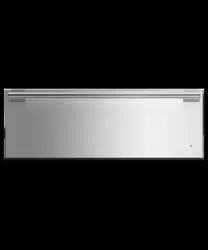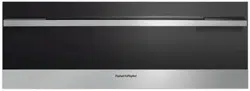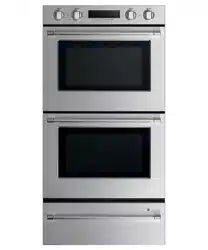

WARMING DRAWER
WDV2-30 & WDV1-30 models
CHAUFFE-PLATS
Modèles WDV2-30 et WDV1-30
INSTALLATION GUIDE / USER GUIDE
GUIDE D’INSTALLATION / GUIDE D’UTILISATION
US CA

1
Thank you for selecting this Fisher & Paykel warming drawer. Because of its unique features, we have
developed this manual. It contains valuable information on how to properly install, use and maintain
your new warming drawer for years of safe and enjoyable use.
For your convenience, product questions can be answered by a Fisher & Paykel Customer Care Representative
by phone:1-888-936-7872, or email: usa.customercar[email protected]
NOTE: Inspect the product to verify that there is no shipping damage. If any damage is detected,
call the shipper and initiate a damage claim. Fisher & Paykel is not responsible for shipping damage.
DO NOT discard any packing material (box, pallet, straps) until the unit has been inspected.
WARNING
The warming drawer is not intended to be used in conjunction with water. DO NOT fill the drawer or
warming cavity with water. Doing so could create a shock hazard, resulting in a possible injury.
WARNING
TO REDUCE THE RISK OF INJURY TO PERSONS IN THE EVENT OF A WARMING DRAWER GREASE FIRE,
OBSERVE THE FOLLOWING: SMOTHER FLAMES with a close-fitting lid, cookie sheet, or metal tray,
then turn off the Warming Drawer. BE CAREFUL TO PREVENT BURNS. If the flames do not go out immediately
EVACUATE AND CALL THE FIRE DEPARTMENT. NEVER PICK UP A FLAMING PAN – You may be burned.
DO NOT USE WATER, including wet dishcloths or towels – a violent steam explosion will result.
Use an extinguisher ONLY if:
1. You know you have a Class ABC extinguisher, and you already know how to operate it.
2. The fire is small and contained in the area where it started.
3. The fire department is being called.
4. You can fight the fire with your back to an exit.
WARNING
DO NOT use water on grease fires. Turn OFF the warming drawer, then smother the fire with baking soda or
use a dry chemical or foam-type fire extinguisher.
PLEASE RETAIN THIS MANUAL FOR FUTURE REFERENCE.
A MESSAGE TO OUR CUSTOMERS
NOTE: Please write the model number, code, and serial number on this page for references
(located at the front right hand side of the body of the drawer).
MODEL NUMBER CODE SERIAL NUMBER
US
CA

2
CONTENTS
SAFETY PRACTICES AND PRECAUTIONS 3
INSTALLATION INSTRUCTIONS
Specifications 6
Mounting Installation 7
Custom Panel Installation (WDUI/WDVI) 9
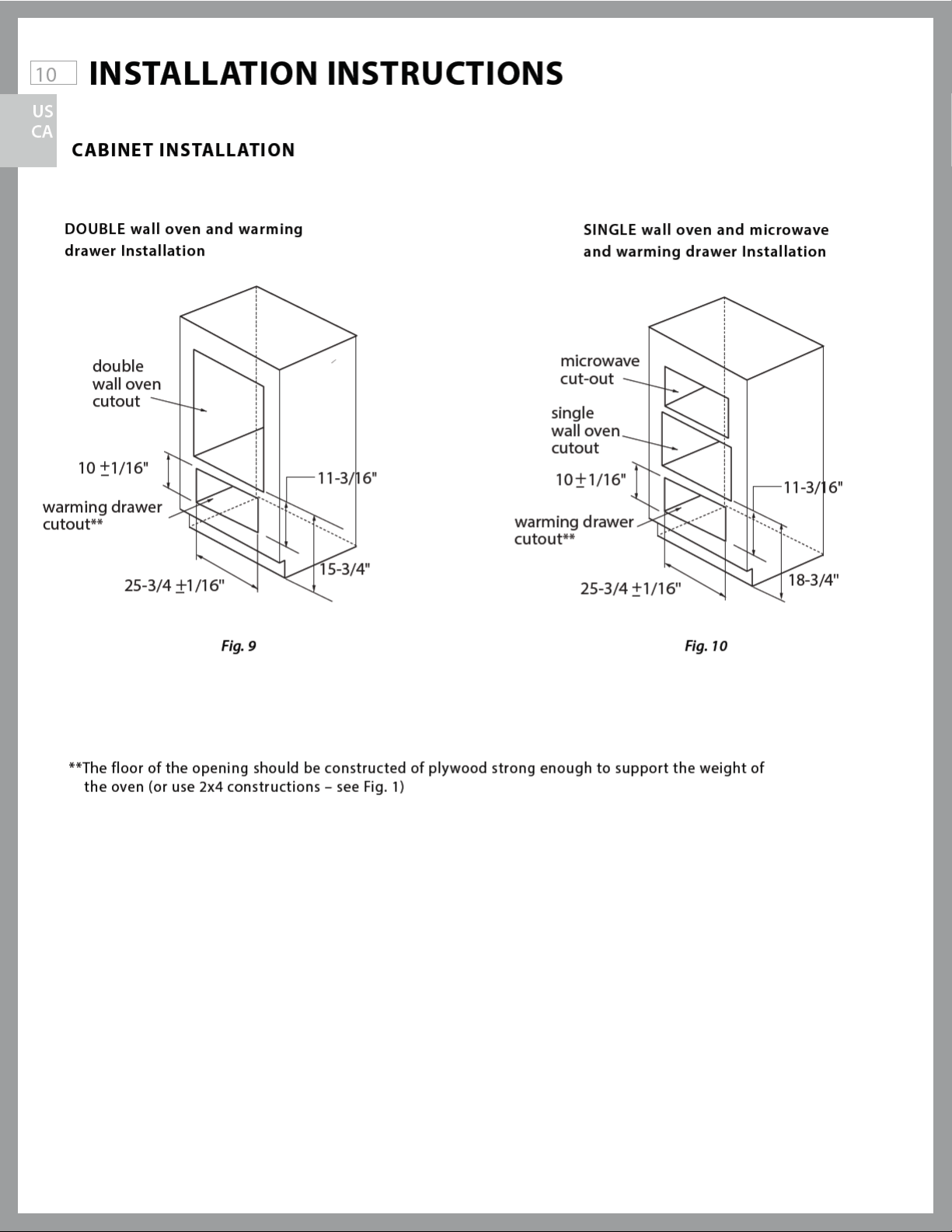
Cabinet Installation 10
FEATURES 12
OPERATING INSTRUCTIONS 13
CARE AND MAINTENANCE
Cleaning the warming drawer 14
Removing the drawer 15
Replacing the drawer 16
TEMPERATURE SETTINGS 17
WARRANTY AND SERVICE 18
US
CA
3
READ AND UNDERSTAND THESE PRECAUTIONS
■ Read these precautions and the entire manual thoroughly before installation or use.
This will help to reduce the risk of fire, electric shock, or injury to persons.
■ Remove all packaging materials from your appliance.
■ Install according to instructions.
■ Be sure to have a qualified service technician install and ground this appliance.
■ Plug into rated outlet: 120 Volts AC, 5 amp min., 15 amp maximum circuit requirement.
PREHEATING
The warming drawer is designed to keep cooked foods warm for extended periods of time. The drawer must be
pre-heated before use on high (see ‘Operating instructions’). If the warming drawer isn’t preheated, the internal
temperature of the food being warmed could fall below the minimum safe level and bacteria could develop.
Always preheat the drawer according to the instructions described in this manual
WARNING:
Do not store items of interest to children in, above or around any appliance. Children could be seriously injured
if they should climb onto the appliance to reach these items.
■ Children should not be left alone or unattended in an area where appliances are in use. They should never
be allowed to turn knobs, push buttons, sit or stand on any part of an appliance.
■ Children in walkers, or children crawling can be attracted to the door handle and may grab and open the
warming drawer. This can result in injury from the door being pulled open on a child, or severe burns
if it is in use and hot.
Be certain to use only dry pot holders: Moist or damp pot holders on hot surfaces may cause burns from
steam. Do not use a towel or other bulky cloth in place of pot holders.
■ Never store anything in the warming drawer. Flammable materials can catch fire, plastic items may melt or ig-
nite and other types of items could be ruined.
■ Do not hang articles from any part of the appliance or place anything against the drawer. Some fabrics are quite
flammable and could catch on fire.
■ For safety reasons and to avoid damage to the appliance, never sit, stand, or lean on the warming drawer door.
■ For personal safety, wear proper apparel. Loose fitting garments or hanging sleeves should never be worn while
using this appliance. Some synthetic fabrics are highly flammable and should not be worn while using this ap-
pliance.
■ Do not use aluminum foil to line any part of the warming drawer. Using a foil liner could result in a fire hazard,
or the obstruction of the flow of heat and ventilation air. Foil is an excellent heat insulator and heat will be
trapped underneath it. This trapped heat can upset the perfor mance of the warming drawer parts.
WARNING:
This appliance is designed for warming food. Based on safety considerations, never use the warming drawer
to warm or heat a room.
■ As with any cooking or heating appliance, never leave the warming drawer unattended when warming food,
this could be a fire hazard.
■ Only certain types of glass, heat proof glass-ceramic, ceramic, earthenware or glazes are suitable for use in
this warming drawer. Utensils that are not thermally heat safe may break with sudden temperature changes.
SAFETY PRACTICES AND PRECAUTIONS
US
CA

4
SAFETY PRACTICES AND PRECAUTIONS
■ Never heat unopened containers, a build up of pressure may cause the container to burst.
■ Grease is flammable, avoid letting grease deposits collect in the warming drawer, clean up spillage.
■ 120 Volts AC, 5 amp min., 15 amp maximum circuit requirement.
■ DO NOT use water on grease fires. Turn OFF the warming drawer, then smother the fire with baking soda or
use a dry chemical or foam-type fire extinguisher.
■ When opening the drawer while keeping sauces (eg tomato sauce) warm, the drawer must be opened slowly
to avoid spillage.
■ Use care when opening a hot warming drawer; to avoid severe burns, open slowly, allow the hot air or
steam to escape before reaching in to remove or replace any foods.
■ Do not repair or replace any part of this appliance unless it is specifically recommended in this manual.
All other servicing should be referred to a qualified Service Technician. Service Technicians must disconnect
the power supply before servicing this appliance.
■ When using the warming drawer: DO NOT TOUCH THE INTERIOR SURFACES or the exterior area immediately
surrounding the door until it has had sufficient time to cool to avoid burn injuries.
■ Clean the warming drawer with caution. Avoid steam burns; do not use a wet sponge or cloth to clean the
appliance while it is hot. Some cleaners produce noxious fumes if applied to a hot surface.
Follow directions provided by the cleaner manufacturer.
■ Be sure all the controls are turned off and the appliance is cool before using any type of aerosol cleaner
on or around the appliance. The chemical that produces the spraying action could, in the presence of heat,
ignite or cause metal parts to corrode.
■ Do not touch the heating element or interior surfaces of the warming drawer, even if they appear dark in color.
They may still be hot enough to cause burn injury. Allow sufficient time to cool.
■ Do not allow flammable materials which may ignite to come in contact with the hot heating element or
the interior surface of the warming drawer until the unit has had sufficient time to cool.
US
CA

5
US
CA
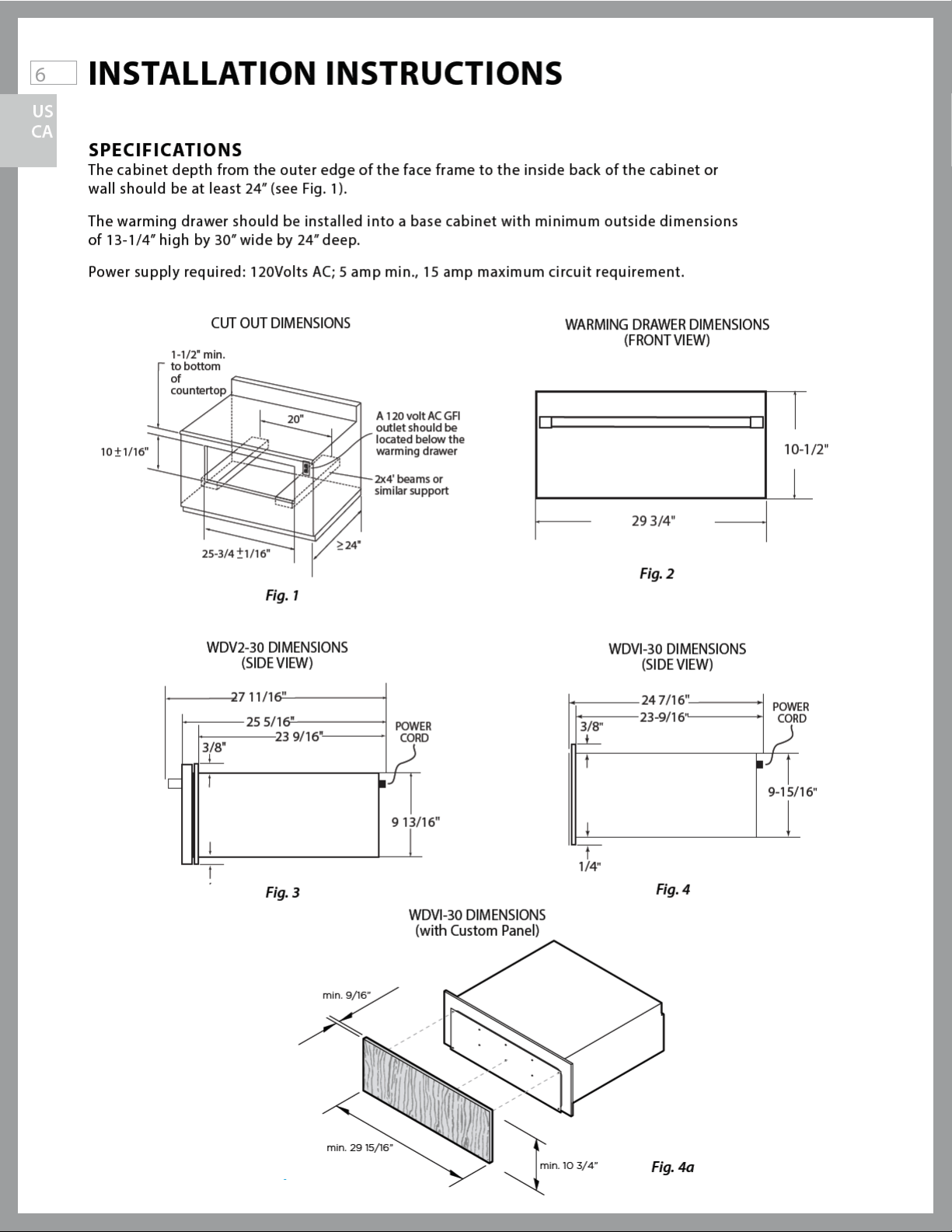
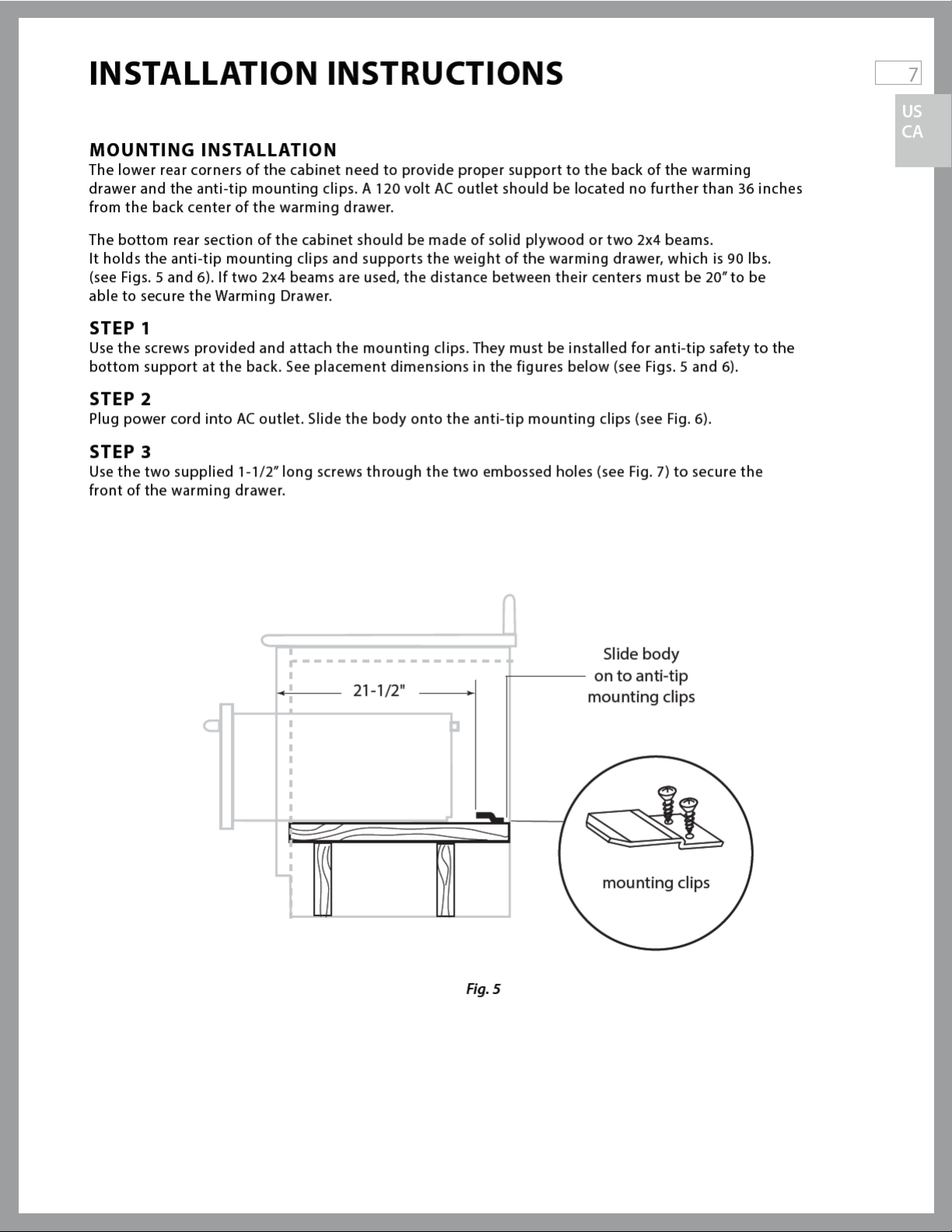
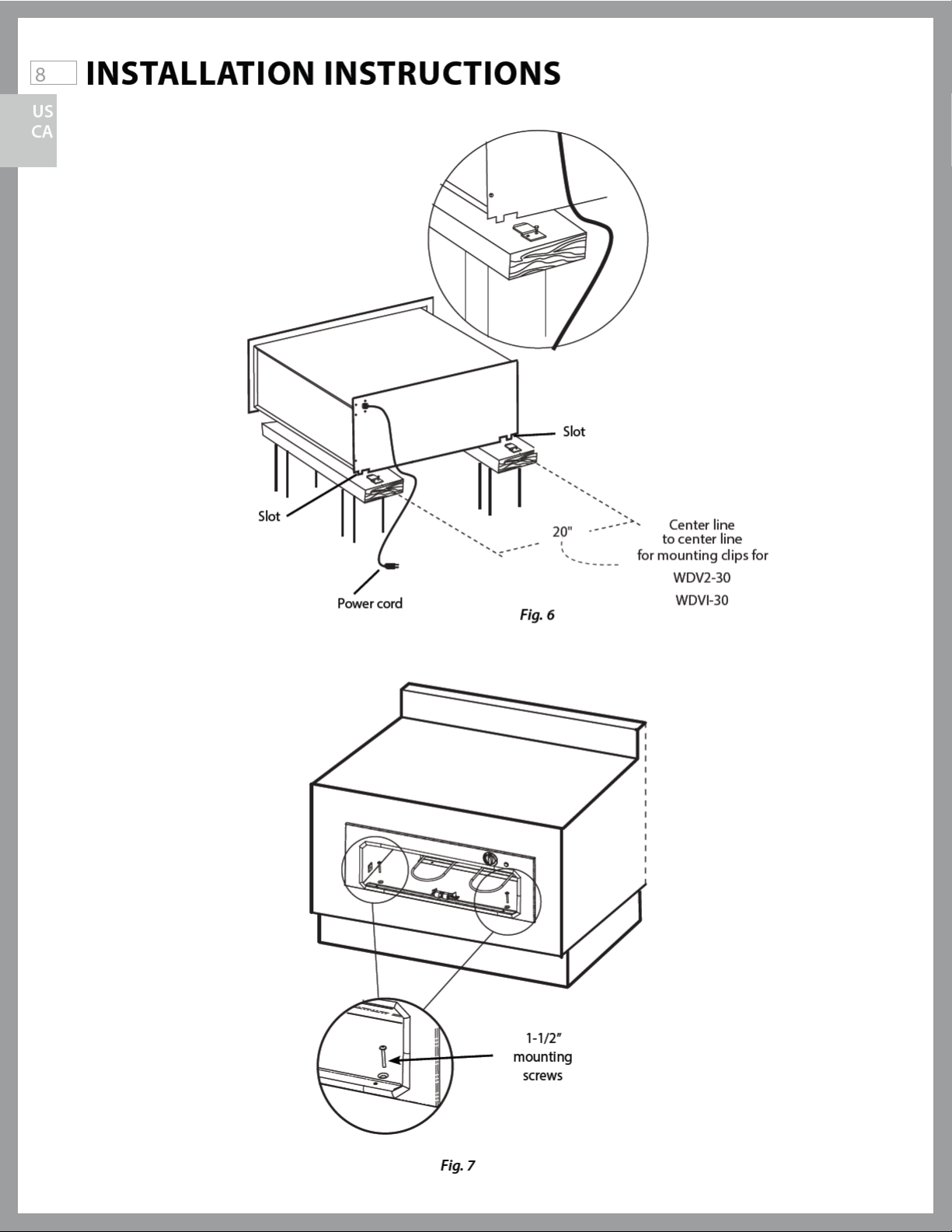
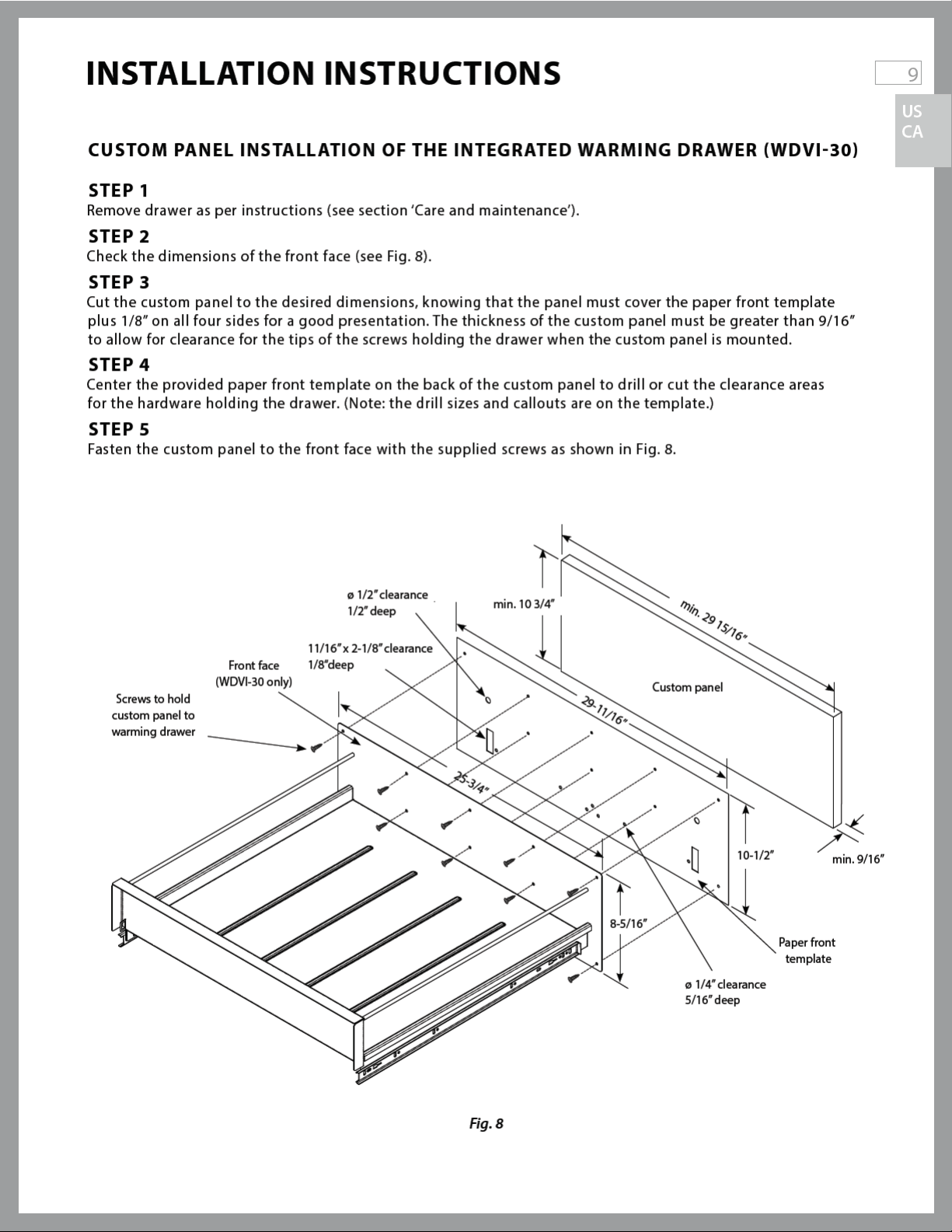

11
US
CA
12
US
CA
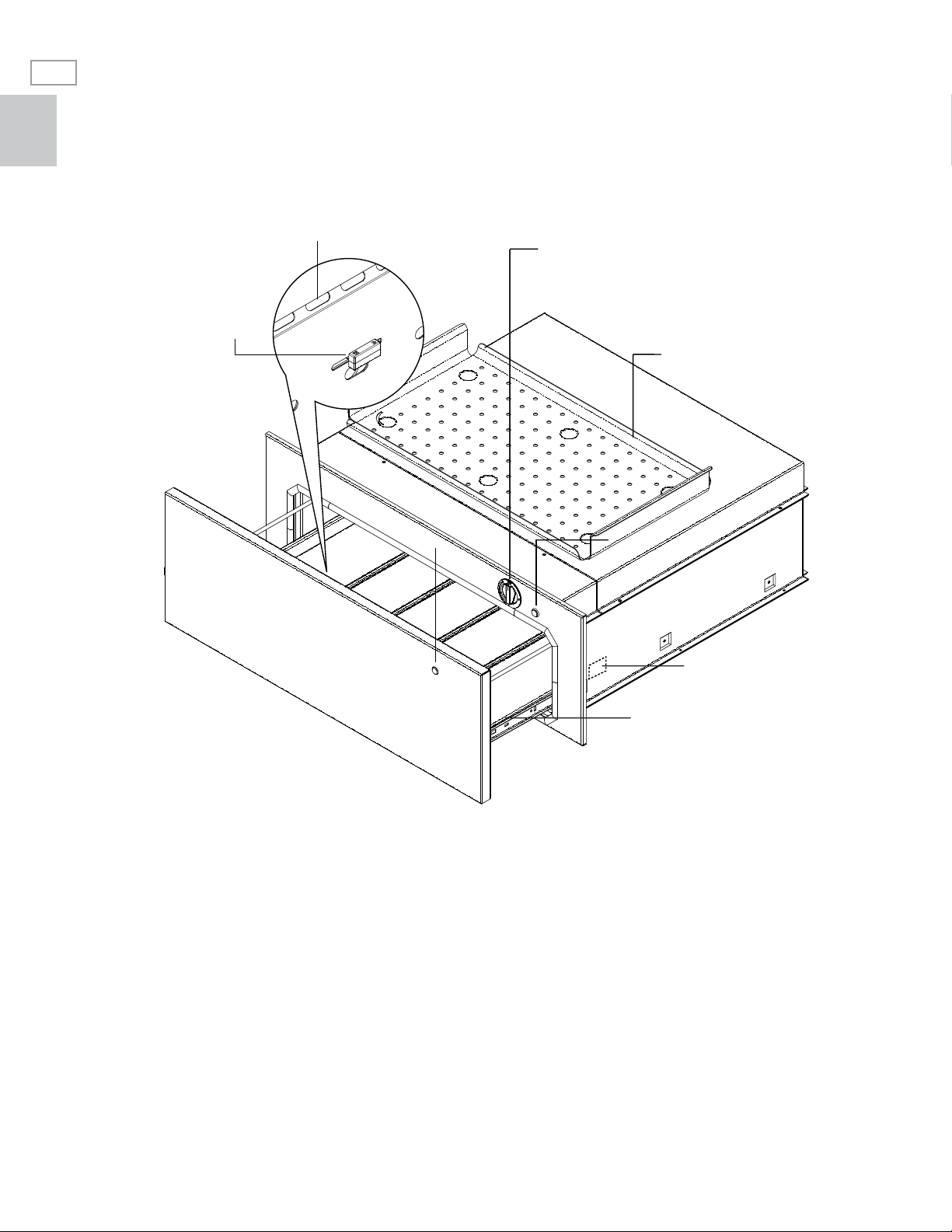
FEATURES
*
Power
indicator
lens
Thermostat
control
knob
Power
indicator
light
Stainless steel
drawer
Handle not illustrated
Removable
stainless
steel
tray
Model number
and serial number
location
on inside panel
Vent holes
*
*
Moist/
crisp
knob
Fig. 11
* Not available on fully
integrated model (WDVI-30).
13
US
CA
OPERATING INSTRUCTIONS
OPERATIONAL GUIDE
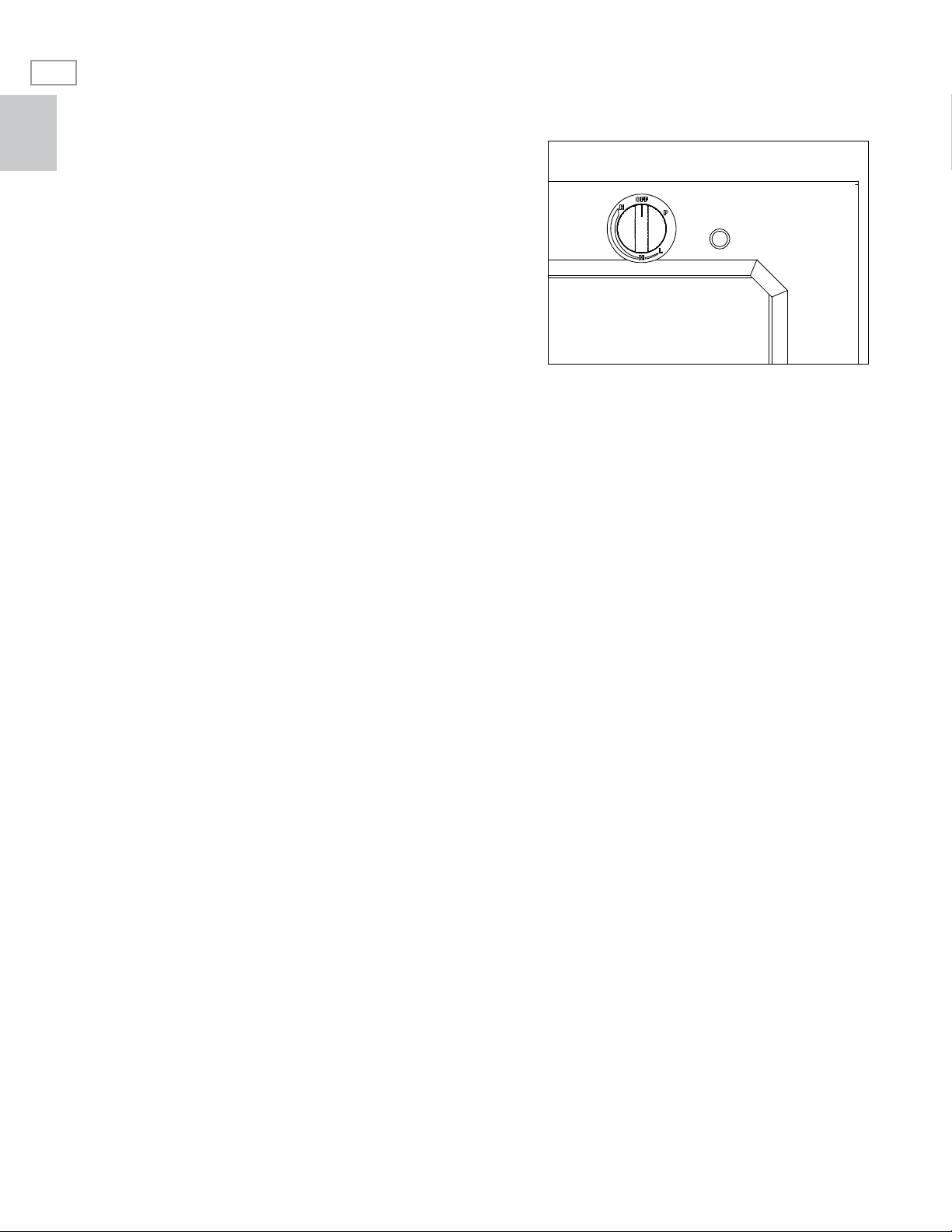
The warming drawer is designed to keep previously cooked
foods at a safe, warm temperature, for extended periods of
time, when operated correctly. It is not designed to cook or
reheat food. The warming drawer should be preheated accord-
ing to the chart below prior to inserting the food to be warmed.
Food may be kept up to two hours in the warming drawer.
Failure to preheat could result in unsafe food temperatures,
which could accelerate the formation of bacteria in the food
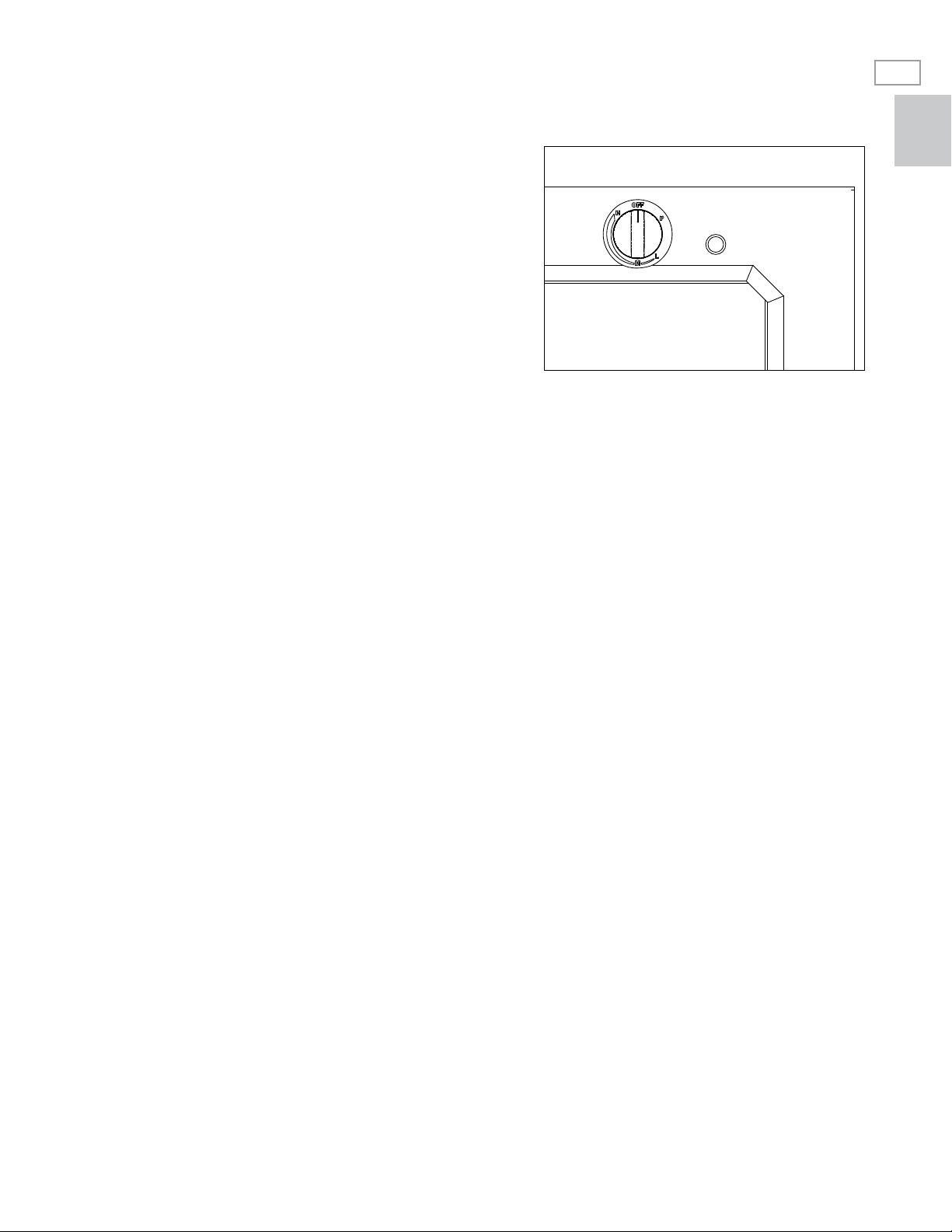
being kept warm. The dial on the top right corner of the unit is
the on/off and temperature control adjustment. When the dial
is turned clockwise from the off position to the proof position,
the unit will maintain a temperature of approximately 100°F.
By rotating the dial clockwise to the high position, the drawer will
reach a temperature of approximately 250°F.
To Use: Turn the thermostat dial to a temperature setting;
H–High M–Medium L– Low P–Proofing
■ If you will be using the tray, preheat it while preheating the warming drawer.
■ Preheat any empty serving dishes to be used, while preheating the drawer.
■ Add cooked, hot food in its cooking container or heat-safe container.
■ Aluminum foil may be used to cover food containers.
CAUTION
Do not use plastic containers or plastic wrap. They can melt if in direct contact with the drawer or a hot utensil
and if these items melt, they may adhere to the drawer and may be unremovable. Use only heat-safe dishes.
PREHEAT TIME AND TEMPERATURE SELECTOR:
Proofing.....Do not preheat 90°-110°
Low..............Preheat 10 min. 140°-170°
Medium ....Preheat 15 min. 170°-200°
High............Preheat 20 min. 200°-250°
■ Always preheat on high, then turn the knob to the desired setting.
■ To keep several different foods hot together, set the temperature to the food needing the highest setting.
Place items needing highest setting on the bottom of the drawer and food needing less heat on the tray.
PROOFING YEAST DOUGH
Place dough in a greased jelly roll or half sheet pan or oiled bowl, no taller than five inches in height.
Turn dough over to grease all areas of the dough, cover with a damp clean cloth. Place in the center of warming
drawer and turn the control knob to proofing (P). Check at 45 minutes to one hour. Dough should double in size.
Shape dough, place in baking pan, and put in warming drawer for second rising, about 30 to 45 minutes; add
extra time if needed.
Fig. 12

14
US
CA
CARE AND MAINTENANCE
CLEANING THE WARMING DRAWER
■ Be careful cleaning any part of this appliance, particularly the drawer box and back of the drawer face.
All parts of the drawer can be cleaned with a hot soapy damp cloth, rinsed, dried and buffed with
a heavy pile cloth. Always try this first, as it is the mildest cleaning procedure.
■ Be sure the warming drawer is turned off and the appliance is cool before using any type of aerosol cleaner
on or around the appliance. The chemical that produces the spraying action could, in the presence of heat,
ignite or cause metal parts to corrode.
■ Use the mildest cleaning procedure first. Some brands of cleaners are harsher than others, read their directions.
Try on a small area first.
■ To avoid marring the surface always rub the metal finishes in the direction of the polish grain lines.
The cleaner will be more effective when used in the direction of the polish lines.
■ Use only clean sponges, soft cloths, paper towels, plastic or non-metal soap pads for cleaning or scouring,
as recommended in this section. (Caution: some soap pads can scratch).
■ Be sure to rinse all parts thoroughly and to wipe dry to avoid water marks.
■ Remove food particles after every use.
1. Drawer: Clean the drawer with warm soapy damp sponge or cloth.
2. Drawer front: Shine with stainless steel cleaner in direction of grain.
3. Gasket: Clean with hot water only. Do not rub. Press a dry towel on the gasket to dry.
Do not remove or damage the mesh.
4. Knobs: The on/off temperature knob may be removed to be cleaned. The moist/crisp knob, however,
should never be removed. Be aware that the pull off force of the knobs will decrease and a loose knob
could become a choking hazard for small children.
5. Light: Clean with damp cloth or sponge.
6. Element: Care should be taken when cleaning the heating element. Only clean the element when the
unit is cool. Use warm soapy water on damp cloth.
7. Stainless steel tray: Can be removed and cleaned with hot soapy water at sink.

15
US
CA
REMOVING THE DRAWER
Turn the unit off. Be sure the drawer is cool and no food items or trays are in the drawer.
Never attempt to remove the drawer while the unit is on or warm.
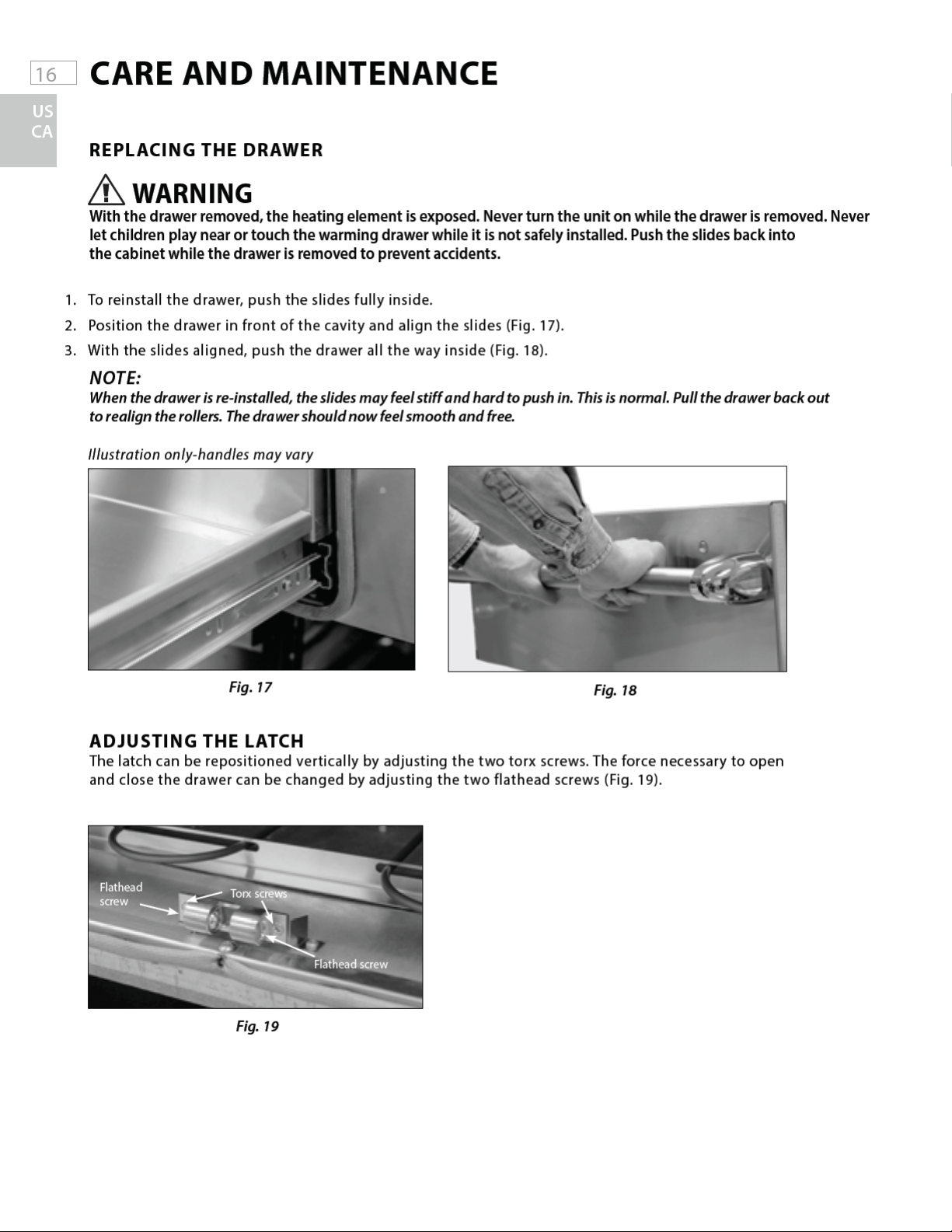
1. To remove the drawer, first remove plates, trays, etc., from the drawer.
2. Pull the drawer open towards you all the way until it reaches the stop position (Fig. 13).
3. Unlock the drawer by lifting up the tab on the left hand side (Fig. 14) and pressing down the tab
on the right hand side (Fig. 15) while pulling the drawer open at the same time (Fig. 16).
Note:
Removing the drawer for the very first time does require extra force.
4. Keep pulling the drawer open until the slides are separated.
Illustration only-handles may vary
Fig. 13
Fig. 15
CARE AND MAINTENANCE
Fig. 14
Fig. 16

17
US
CA
TEMPERATURE SETTINGS
FOOD TEMPERATURE SLIDE KNOB COVERED/
POSITION UNCOVERED
Beef**
Rare Low Moist Covered
Medium Med Moist Covered
Well Done Med Moist Covered
Bacon High Crisp Uncovered
Bread Dough Proofing Moist Covered
Casseroles Med Moist Covered
Chips High Crisp Uncovered
Cooked Cereal Med Moist Covered
Eggs Med Moist Covered
Fish, Seafood Med Moist Covered
Fried Foods (all) High Crisp Uncovered
Fruit Med Moist Covered
Garlic Bread, Rolls Low Moist Covered
Gravy, Cream Sauces Med Moist Uncovered
Ham Med Moist Covered
Lamb Med Moist Covered
Meat Loaf Med Moist Covered
Pancakes, Waffles High Moist Uncovered
Pies, one crust Med Moist Uncovered
Pies, two crust Med Crisp Uncovered
Pizza Med Crisp Uncovered
Pork Med Moist Covered
Potatoes, baked High Crisp Uncovered
Potatoes, hash browns High Crisp Uncovered
Potatoes, mashed Med Moist Covered
Poultry High Moist Uncovered
Vegetables Med Moist Covered
SUGGESTED TEMPERATURES TO KEEP FOODS HOT
**USDA/FSIS recommends an internal temperature of 145
0
F as the minimum doneness for beef. Use a portable
meat thermometer to check internal temperatures.

18
US
CA
WARRANTY AND SERVICE
Before you call for service or assistance ...
Check the things you can do yourself. Refer to the installation instructions and your user guide
and check that:
1
your product is correctly installed
2
you are familiar with its normal operation.
If after checking these points you still need assistance or parts, please refer to the
Service & Warranty document for warranty details and your nearest Authorized Service Center,
Customer Care, or contact us through our website www.fisherpaykel.com.

20
À L’INTENTION DE NOS CLIENTS
Nous vous remercions d’avoir choisi ce chauffe-plats Fisher & Paykel. Nous avons conçu ce manuel pour
expliquer les fonctions uniques de cet appareil. Il contient des informations extrêmement utiles sur la façon
correcte d’installer et de faire fonctionner votre nouveau chauffe-plats et d’en faire l’entretien. Vous pourrez ainsi
en profiter pendant des années en toute sécurité.
Si vous avez des questions au sujet de notre produit, communiquez avec un représentant du centre de service à
la clientèle Fisher & Paykel par téléphone :1-888-936-7872, ou par courriel : usa.cust[email protected]
REMARQUE : Veuillez noter les numéros de modèle, code, et de série sur cette page pour information
(situé sur le panneau droit intérieur de la cavité du tiroir derrière le côté du tiroir droit)
NUMÉRO DE MODÈLE CODE NUMÉRO DE SÉRIE
REMARQUE : Inspecter le produit pour vérifier qu’il n’a pas été endommagé pendant l’expédition.
En cas de dommages, contacter le transporteur et entamer une déclaration pour dommage.
Fisher & Paykel n’est en aucun cas responsable des dommages pendant l’expédition.
Ne pas jeter le matériau d’emballage (boîte, palette, sangles) avant d’avoir inspecté l’unité.
AVERTISSEMENT
Le chauffe-plats n’est pas conçu pour être utilisé avec de l’eau. NE remplissez PAS le tiroir ou le logement
du chauffe-plats avec de l’eau. Cela pourrait créer un risque de choc et causer des blessures.
AVERTISSEMENT
POUR RÉDUIRE LES RISQUES DE BLESSURES EN CAS DE FEU DE GRAISSE SUR LA CUISINIÈRE, RESPECTEZ
LES CONSIGNES SUIVANTES : ÉTOUFFEZ LES FLAMMES à l’aide d’un couvercle hermétique, d’une plaque
à biscuits ou d’un plateau métallique, puis éteignez le brûleur. ÉVITEZ DE VOUS BRÛLER. Si les flammes ne
s’éteignent pas immédiatement, ÉVACUEZ LES LIEUX ET APPELEZ LES POMPIERS. NE SOULEVEZ JAMAIS UN
RÉCIPIENT EN FEU – Vous pourriez vous brûler. N’UTILISEZ PAS D’EAU, y compris des serviettes mouillées –
une explosion de vapeur violente pourrait en résulter. Utilisez un extincteur SEULEMENT si :
1 Vous êtes sûr qu’il s’agit d’un extincteur de classe ABC et savez comment le faire fonctionner.
2. Le feu est limité et restreint à la zone où il s’est déclenché.
3. Le service des pompiers a été appelé.
4. Vous pouvez combattre l’incendie le dos tourné vers une sortie.
AVERTISSEMENT
NE VERSEZ PAS d’eau sur les feux de graisse. Éteignez le chauffe-plats, puis étouffez le feu avec du bicarbonate
de soude ou à l’aide d’un extincteur à poudre ou à mousse.
VEUILLEZ CONSERVER CE MANUEL À TITRE DE RÉFÉRENCE.
US
CA
(FR)

21
TABLE DES MATIÈRES
MESURES DE SÉCURITÉ ET DE PRÉCAUTION 22
INSTRUCTIONS DE MONTAGE
Spécifications 24
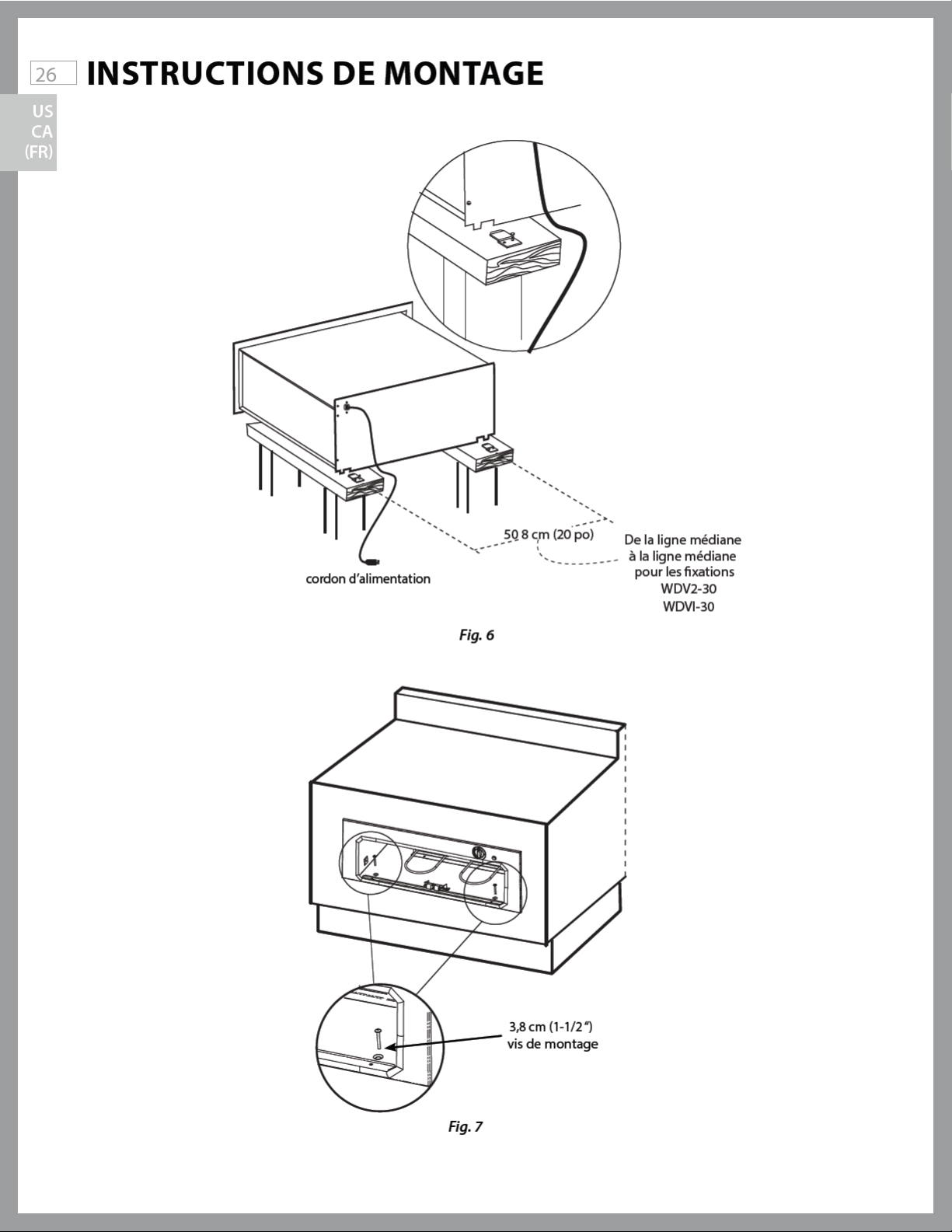
Montage et Installation 25
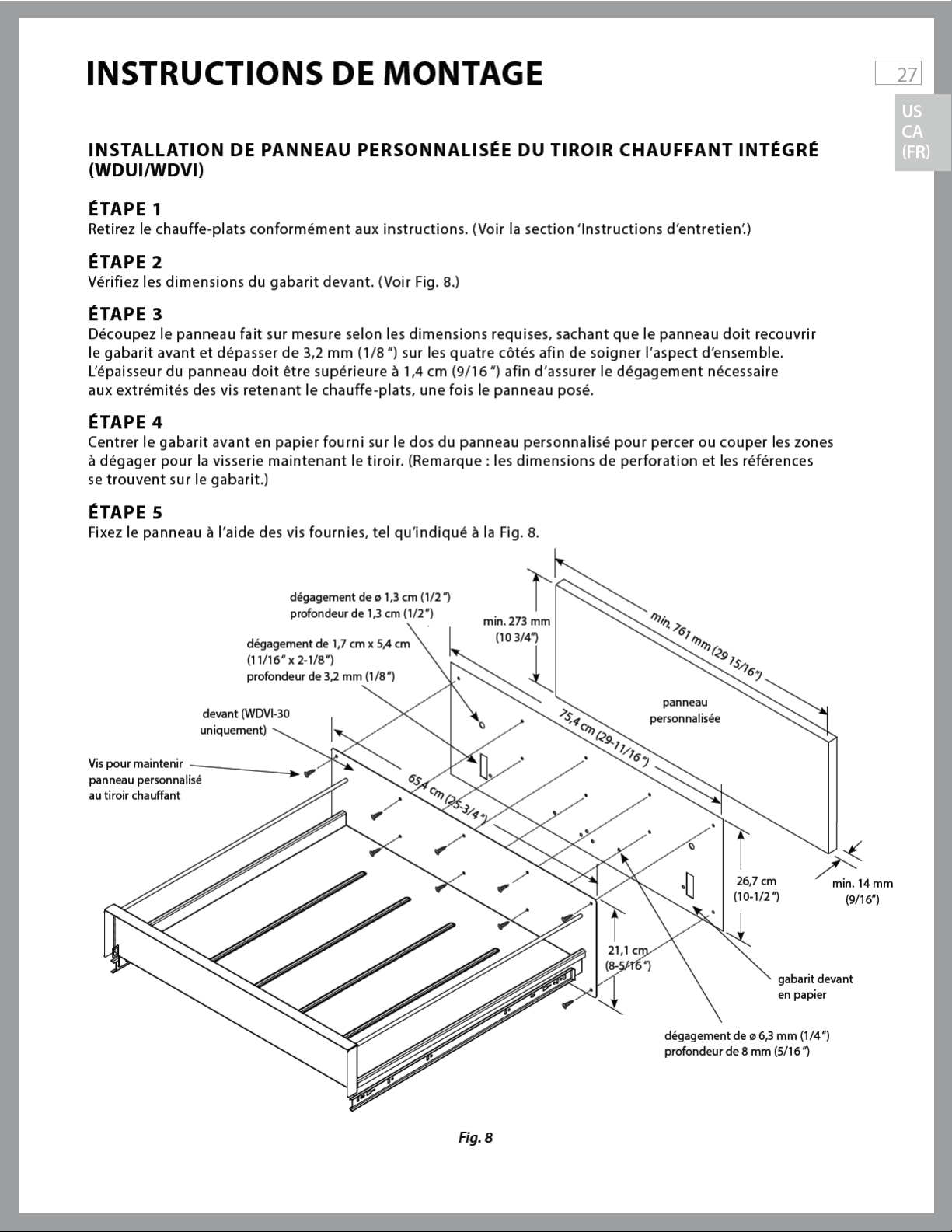
Installation de Panneau Personnalisée (WDUI/WDVI) 27
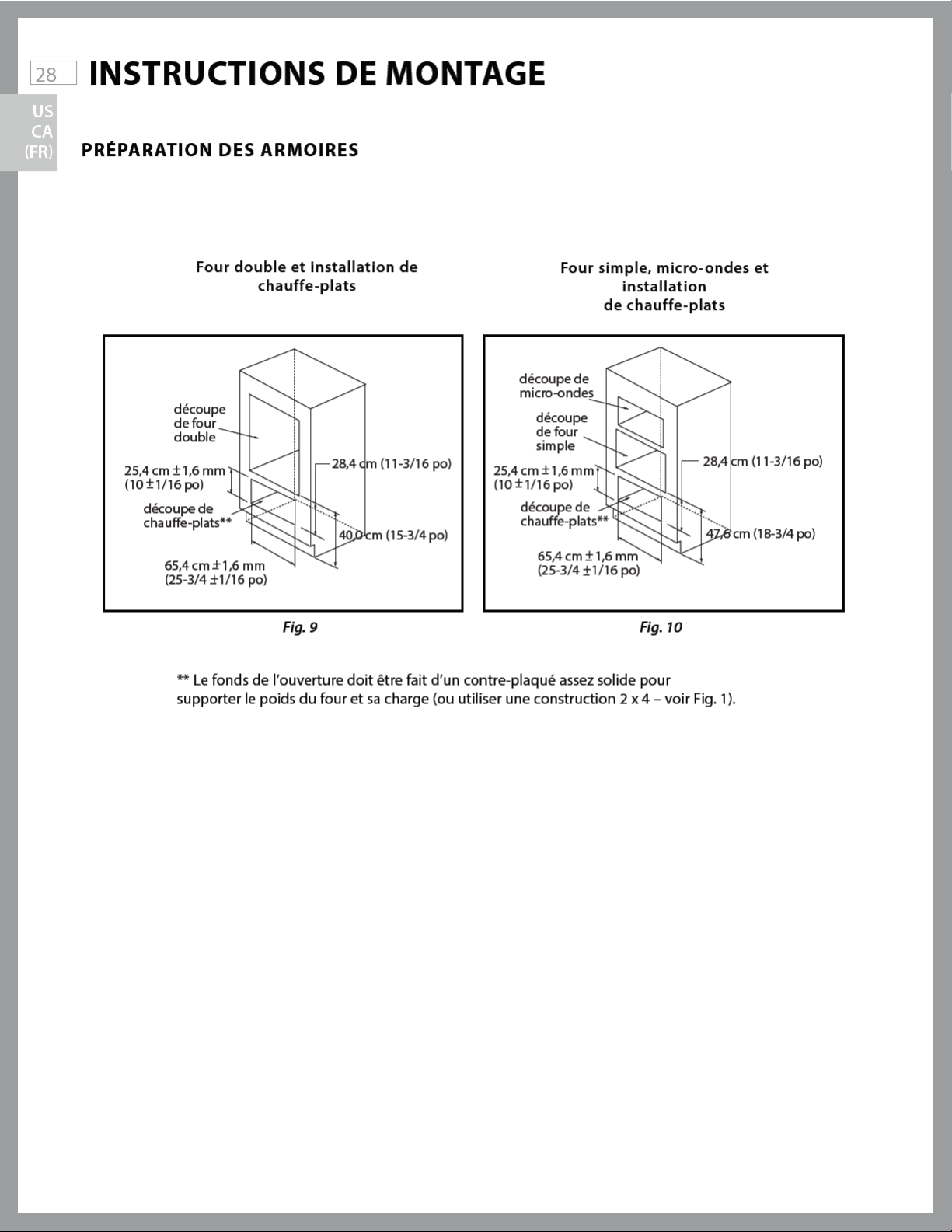
Préparation des Armoires 28
CARACTERISTIQUES DU CHAUFFEPLATS 29
GUIDE OPÉRATIONNEL 30
INSTRUCTIONS D’ENTRETIEN
Nettoyage du chauffe-plats 31
Retrait du tiroir 32
Replacement du tiroir 33
RÉGLAGES DE TEMPÉRATURE 34
GARANTIE ET SERVICE 35
US
CA
(FR)
22
MESURES DE SÉCURITÉ ET DE PRÉCAUTION
VEUILLEZ LIRE ET BIEN ASSIMILER CES CONSIGNES
■ Veuillez lire attentivement ces consignes et tout le manuel d’installation avant d’installer ou d’utiliser votre
nouvel appareil. Ceci vous permettra de réduire les risques d’incendie, de chocs électriques ou de blessures.
■ Retirez tout le matériel d’emballage de l’appareil.
■ Procédez à l’installation conformément aux instructions.
■ Confiez la mise à la terre de l’appareil à un technicien qualifié.
■ Branchez l’appareil dans une prise de 120 V C.A., 5 A min., 15 A maximum requis.
PRÉCHAUFFAGE
Le chauffe-plats est conçu pour garder les aliments cuits à une température chaude pendant de longues
périodes. Il doit être préchauffé avant toute utilisation (voir ‘Guide opérationnel’). Il doit être préchauffé
pendant une demi-heure au moins à température maximum. Si le chauffe-plats n’est pas préchauffé,
la température interne des aliments chauffés pourrait baisser à un niveau dangereux propice au
développement des bactéries. Préchauffez toujours le chauffe-plats selon les instructions du manuel.
AVERTISSEMENT
Évitez de ranger des articles pouvant attirer les enfants dans l’appareil, au-dessu ou à proximité.
Les enfants pourraient être blessés sérieusement s’ils grimpent sur l’appareil pour atteindre ces articles.
■ Les enfants ne doivent pas être laissés seuls ou sans surveillance dans un endroit où l’on utilise ce type d’appareil.
Il ne faut jamais les laisser tourner ou enfoncer des boutons, ni s’asseoir ou se tenir debout sur l’appareil.
■ Des enfants en marchette ou à quatre pattes peuvent être attirés par la poignée ronde de la porte et la saisir
pour ouvrir le chauffe-plats. Ils pourraient alors se blesser ou être brûlés sérieusement si l’appareil est en
fonctionnement et qu’il est chaud.
Utilisez seulement des gants isolants secs: Les gants humides sur des surfaces chaudes peuvent provoquer
des brûlures causées par la vapeur. N’utilisez pas de serviette ou de chiffon épais à la place de gants isolants.
■ Ne rangez jamais rien dans le chauffe-plats. Des matériaux inflammables pourraient prendre feu, des éléments
en plastique pourraient fondre ou s’enflammer et d’autres types d’objets pourraient être détruits.
■ Ne suspendez aucun article sur l’appareil et ne placez aucun objet contre lui. Certains matériaux sont
extrêmement inflammables et pourraient prendre feu.
■ Pour des raisons de sécurité et pour ne pas endommager l’appareil, évitez de vous asseoir, de vous tenir
debout ou de vous appuyer contre la porte du chauffe-plats.
■ Pour assurer votre propre sécurité, habillez-vous de façon appropriée. Ne portez jamais de vêtements ou
de manches lâches lorsque vous utilisez l’appareil. Certains tissus synthétiques sont extrêmement inflammables
et ne doivent pas être portés pendant l’utilisation de l’appareil.
■ Ne recouvrez aucune partie du chauffe-plats avec du papier aluminium. L’utilisation de papier aluminium
peut créer un risque d’incendie ou empêcher la circulation de la chaleur et de l’air de ventilation.
C’est un excellent isolant thermique qui peut emprisonner la chaleur. Celle-ci pourrait alors affecter
la performance des pièces du chauffe-plats.
US
CA
(FR)

23
AVERTISSEMENT
Cet appareil est conçu pour réchauffer les aliments. Pour des raisons de sécurité, n’utilisez jamais le chauffe-plats
pour chauffer une pièce.
■ Comme pour tout appareil de cuisson ou de chauffage, ne laissez jamais le chauffe-plats sans surveillance
quand vous réchauffez de la nourriture, car il y a risque d’incendie.
■ Seuls certains types d’ustensiles en verre, vitrocéramique calorifugée, céramique, poterie ou émaillés sont
appropriés pour être utilisés dans ce chauffe-plats. Les ustensiles non thermorésistants peuvent se briser à
la suite de changements de température soudains.
■ Ne chauffez pas de récipients hermétiques car ils pourraient exploser suite à une accumulation de pression.
■ Circuit de 120 V c.a., 5 A min., 15 A maximum requis.
■ La graisse est inflammable. Évitez donc de laisser des dépôts de graisse s’accumuler dans le chauffe-plats
et nettoyez tout déversement.
■ NE VERSEZ PAS d’eau sur les feux de graisse. Éteignez le chauffe-plats, puis étouffez le feu avec du bicarbonate
de soude ou à l’aide d’un extincteur à poudre ou à mousse.
■ Si vous ouvrez le tiroir et qu’il contient des sauces chaudes, de la sauce tomate, etc., ouvrez-le lentement
pour éviter tout déversement.
■ Faites attention quand vous ouvrez un chauffe-plats chaud; pour éviter tout risque de brûlures graves, ouvrez-le
lentement en laissant s’échapper l’air chaud ou la vapeur avant de retirer ou d’introduire des aliments.
■ Ne réparez pas ni ne remplacez aucune pièce de cet appareil, sauf indication contraire du manuel. Tout autre
travail d’entretien doit être confié à un technicien qualifié. Celui-ci doit débrancher le bloc d’alimentation avant
de travailler sur l’appareil.
■ Durant l’utilisation du chauffe-plats : afin d’éviter de vous brûler, NE TOUCHEZ PAS LES SURFACES INTÉRIEURES
ni la surface extérieure autour de la porte tant qu’elles n’ont pas refroidi.
■ Nettoyez le chauffe-plats avec précaution. Évitez de vous brûler à la vapeur : n’utilisez pas d’éponge ou de
chiffon mouillé pour nettoyer l’appareil alors qu’il est encore chaud. Certains produits de nettoyage produisent
des vapeurs nocives s’ils sont appliqués à une surface chaude. Suivez le mode d’emploi fourni par le fabricant
du produit de nettoyage.
■ Assurez-vous que les boutons de l’appareil sont fermés et que celui-ci est froid avant d’utiliser des nettoyants
aérosol à proximité. L’élément chimique qui produit le jet de vaporisation peut, en présence de chaleur,
s’enflammer ou provoquer la corrosion des parties métalliques.
■ Ne touchez par l’élément chauffant ni les surfaces intérieures du chauffe-plats. Même si leur couleur semble
sombre, ils peuvent encore être assez chauds pour causer des brûlures. Laissez-leur le temps de refroidir.
■ Ne mettez par des matériaux inflammables pouvant s’enflammer en contact avec l’élément chauffant ou
la surface intérieure du chauffe-plats tant que l’appareil n’a pas refroidi.
MESURES DE SÉCURITÉ ET DE PRÉCAUTION
US
CA
(FR)
29
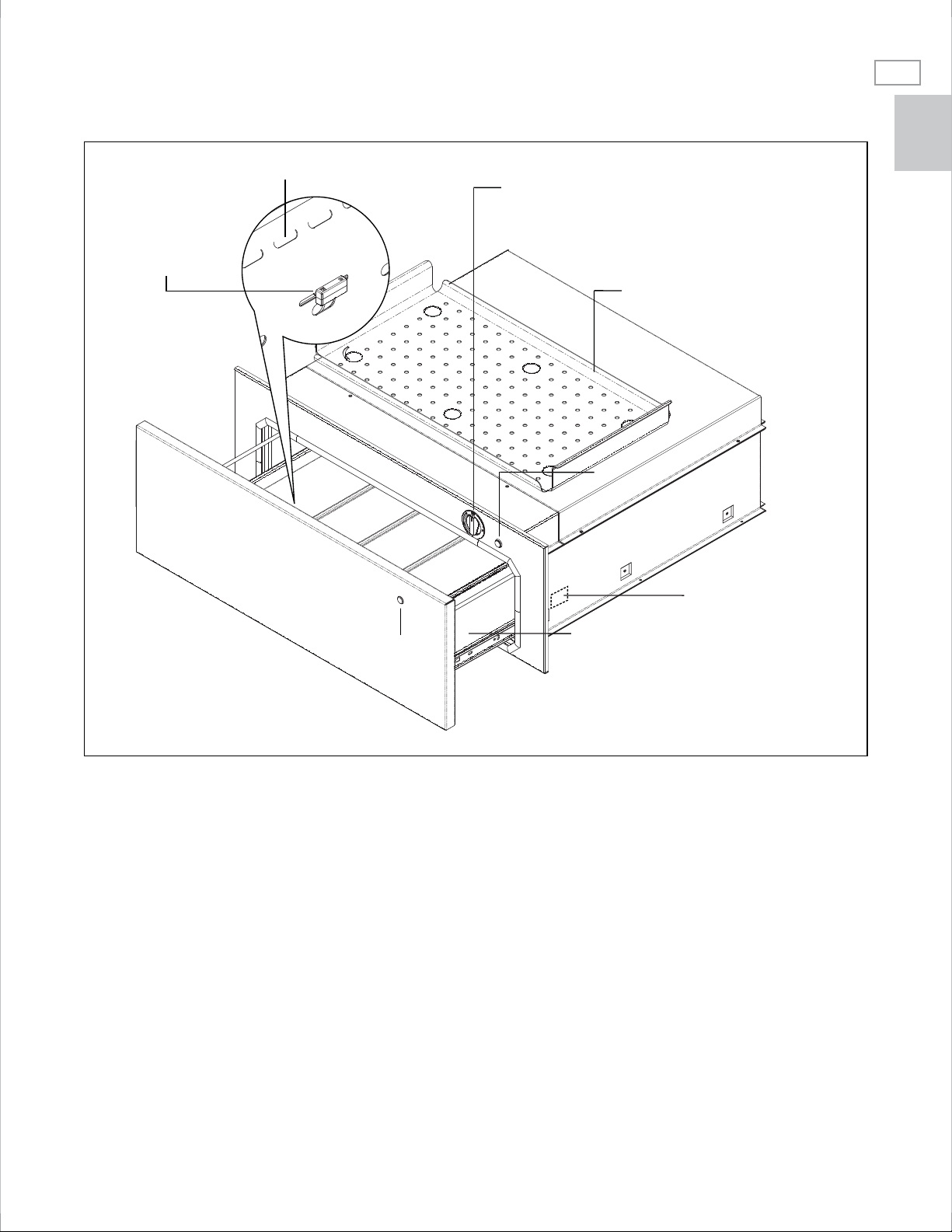
*
Emplacement du numéro
de modèle et de série
(situé sur le panneau droit
intérieur de la cavité du
tiroir derrière le côté du
tiroir droit)
Trous de ventilation
*
*
Tiroir en acier
inoxydable
Poignée non illustrée
Voyant
d'alimentation
Plateau en acier
inoxydable amovible
Bouton de réglage
du thermostat
Lentille du
voyant
d'alimentation
Bouton
humide/croustillant
US
CA
(FR)
CARACTÉRISTIQUES DU CHAUFFE-PLATS
Fig. 11
* Non disponible sur tout
modèle intégré (WDVI-30).
30
US
CA
(FR)
GUIDE OPÉRATIONNEL
GUIDE OPÉRATIONNEL
Le chauffe-plats est conçu pour garder les aliments cuits à
une température chaude sécuritaire, pendant de longues
périodes, à condition d’être utilisé correctement. Il n’est pas
conçu pour cuire ou réchauffer les aliments. Le chauffe-plats
doit être préchauffé tel qu’indiqué au tableau ci-dessous
avant d’y placer des aliments à réchauffer. Les aliments
peuvent être gardés dans le chauffe-plats jusqu’à deux
heures. S’il n’est pas préchauffé, la température des
aliments pourrait baisser à un niveau dangereux propice au
développement des bactéries. Le bouton au coin supérieur
droit de l’appareil permet de l’allumer et de l’éteindre et
de régler le niveau de température. Tournez le bouton à
droite, de la position éteint à la position basse température,
pour maintenir une température d’environ 38 °C (100 °F). Tournez
le bouton à droite, en position de température élevée,
pour maintenir le chauffe-plats à environ 121°C (250 °F).
Utilisation : Tournez le bouton thermostatique pour choisir un réglage de température;
High (Haut) Medium (Moyen) Low (Bas) Proofing (Apprêt)
■ Si vous comptez utiliser le plateau, préchauffez-le tout en préchauffant le chauffe-plats.
■ Préchauffez tous les plats vides devant être utilisés, tout en préchauffant le chauffe-plats.
■ Ajoutez les aliments cuits dans leurs récipients de cuisson ou des récipients thermorésistants.
■ Vous pouvez couvrir les récipients avec du papier d’aluminium.
MISE EN GARDE
N’utilisez pas de récipients en plastique ni de film de plastique. Ceux-ci peuvent fondre au contact du chauffe-plats
ou d’un ustensile chaud et, dans ce cas, peuvent adhérer au chauffe-plats au point de ne pouvoir être enlevés.
Utilisez uniquement des plats thermorésistants.
SÉLECTEUR DE TEMPÉRATURE :
Plage de températures :
Apprêt (Proof).....Ne pas préchauffer 32 °C-43 °C (90 °F -110 °F)
Bas (Low)..............Préchauffer 10 min. 60 °C -77 °C (140 °F-170 °F)
Moyen (Medium) ....Préchauffer 15 min. 77 °C -93 °C (170 °F-200 °F)
Haut (High)............Préchauffer 20 min. 93 °C-121 °C (200 °F -250 °F)
■ Préchauffez toujours sur high (haut), puis tournez le bouton vers le réglage voulu.
■ Pour conserver la chaleur de plusieurs aliments mis ensemble, réglez la température en fonction de celui
qui exige la température la plus élevée. Placez les aliments nécessitant le réglage le plus élevé au fond du
chauffe-plats et la nourriture exigeant le moins de chaleur sur le plateau
APPRÊT LA PÂTE
Placez la pâte dans un roulé à la gelée, une plaque à pâtisserie ou un bol huilé, pas plus haut que 12,7 cm (5“).
Retournez la pâte pour bien la huiler et recouvrez-là d’un linge humide propre. Placez-là au centre du
chauffe-plats et mettez le bouton de réglage surproof (P)(apprêt). Vérifiez après 45 minutes ou une heure.
La pâte devrait avoir doublé de taille. Mettez la pâte en forme, placez-la dans un moule et mettez celui-ci dans
le chauffe-plats pour la seconde fermentation, pendant environ 30 à 45 minutes; augmentez la durée au besoin.
Fig. 12

31
US
CA
(FR)
INSTRUCTIONS D’ENTRETIEN
NETTOYAGE DU CHAUFFE-PLATS
■ Faites attention quand vous nettoyez cet appareil, en particulier le boîtier du tiroir et l’arrière de la face
du tiroir. Toutes les parties de l’appareil peuvent être nettoyées avec linge humide savonneux chaud,
puis rincées, séchées et bien polies à l’aide d’un tissu à poils épais. Essayez cela en premier, c’est la façon
la plus douce de le nettoyer.
■ Assurez-vous que le chauffe-plats est éteint et froid avant d’utiliser un nettoyant aérosol quelconque.
L’élément chimique qui produit le jet de vaporisation peut, en présence de chaleur, s’enflammer ou provoquer
la corrosion des parties métalliques.
■ Employez la méthode de nettoyage la plus douce d’abord. Certains produits de nettoyage sont plus durs
que d’autres. Lisez leur mode d’emploi. Faites un essai sur une petite surface au préalable.
■ Pour ne pas gâcher la surface, frottez toujours la finition dans le sens du polissage, ce qui donne plus
d’efficacité au nettoyant.
■ Pour nettoyer ou récurer, utilisez uniquement des éponges propres, des tissus doux, des essuie-tout,
des tampons à récurer savonneux en plastique ou non-métalliques. (Attention : certains tampons à récurer
peuvent égratigner la surface).
■ Rincez soigneusement et séchez en essuyant pour éviter de laisser des marques d’eau.
■ Retirez les particules alimentaires après chaque utilisation.
1. Tiroir : Nettoyez le chauffe-plats à l’aide d’une éponge ou d’un linge humide savonneux tiède.
2. Devant du tiroir : Polissez au moyen d’un nettoyant pour acier inoxydable dans le sens du grain.
3. Joint : Nettoyer à l’eau chaude uniquement. Ne pas frotter. Appuyer une serviette sèche sur le joint
pour sécher. Ne pas retirer ni endommager le tamis.
4. Boutons : Vous pouvez retirer le bouton de température pour le nettoye. Toutefois, le bouton moist/crisp
(humide/croustillant) ne doit jamais être retiré. En effet, il deviendra facile à décoller et de jeunes enfants
pourraient s’étouffer avec.
5. Lumière : Nettoyez à l’aide d’un chiffon ou d’une éponge humide.
6. Élément chauffant : Faites attention lorsque vous nettoyez l’élément chauffant : ne le faites qu’une fois
l’appareil refroidi. Utilisez de l’eau tiède savonneuse sur un chiffon humide.
7. Plateau en acier inoxydable : Peut être retiré et nettoyé avec de l’eau savonneuse chaude dans l’évier.

32
US
CA
(FR)
RETRAIT DU CHAUFFE-PLATS
Éteindre l’unité. Assurez-vous que le chauffe-plats est froid et qu’aucun aliment ni plateau ne se trouve
à l’intérieur. N’essayez jamais de retirer le tiroir lorsque l’appareil est allumé ou chaud.
1. Pour retirer le tiroir, retirez d’abord les plats, plateaux, etc. du tiroir.
2. Ouvrez le tiroir complètement jusqu’à ce qu’il s’arrête (Fig.13).
3. Déverrouiller le tiroir en relevant la languette sur le côté gauche (Fig. 14) et en appuyant sur la languette
sur le côté droit (Fig. 15). Ouvrir le tiroir en le tirant en même temps (Fig. 16).
Remarque :
Il faudra une force supplémentaire pour retirer le tiroir pour la première fois.
4. Continuer à ouvrir le tiroir en le tirant jusqu’à séparation des coulisses.
INSTRUCTIONS D’ENTRETIEN
Fig. 13
Fig. 15
Fig. 14
Fig. 16
Illustration seulement-les poignées peuvent varier

34
US
CA
(FR)
RÉGLAGES DE TEMPÉRATURE
ALIMENTS TEMPÉRATURE GLISSEZ LE RECOUVERT/
BOUTON
DE POSITION DÉCOUVERT
Bœuf**
Saignant Bas Humide Recouvert
Demi-saignant Moyen Humide Recouvert
À point Moyen Humide Recouvert
Bacon Haut Croustillant Découvert
Pâte à pain Apprêt Humide Recouvert
Casseroles Moyen Humide Recouvert
Croustilles Haut Croustillant Découvert
Céréales cuites Moyen Humide Recouvert
Œufs Moyen Humide Recouvert
Poisson, fruits de mer Moyen Humide Recouvert
Aliments frits (tous) Haut Croustillant Découvert
Fruit Moyen Humide Recouvert
Pain à l’ail, petits pains Bas Humide Recouvert
Sauce d’arrosage,
Moyen Humide Découvert
sauces à la crème
Jambon Moyen Humide Recouvert
Agneau Moyen Humide Recouvert
Pain de viande Moyen Humide Recouvert
Crêpes, gaufres Haut Humide Découvert
Tartes, une croûte Moyen Humide Découvert
Tartes, deux croûtes Moyen Croustillant Découvert
Pizza Haut Croustillant Découvert
Porc Moyen Humide Recouvert
Pommes de terre, au four Haut Croustillant Découvert
Pommes de terre,
Haut Croustillant Découvert
pommes de terre rissolées
Pommes de terre, purée Moyen Humide Découvert
Volaille Haut Humide Découvert
Légumes Moyen Humide Recouvert
TEMPÉRATURES SUGGÉRÉES POUR GARDER LES ALIMENTS CHAUDS
**L’USDA/FSIS recommande comme degré de cuisson minimum pour du bœuf une température interne
de 63
º
C (145
º
F). Utilisez un thermomètre à viande portable pour vérifier la température interne.

35
US
CA
(FR)
GARANTIE ET SERVICE
Avant d'appeler pour demander une réparation ou de l'assistance...
Vérifiez les points que vous pouvez contrôler vous-même. Consultez les instructions d’installation
et le guide de l’utilisateur pour vous assurer que:
1
votre produit est installé correctement.
2
vous êtes familier avec son fonctionnement normal.
Si après la vérification de ces points, vous avez toujours besoin d’assistance ou d'une réparation,
reportez-vous au document de service et de garantie pour obtenir les détails sur la garantie et
les coordonnées d'un Centre de service autorisé ou de l'Assistance à la clientèle, ou contactez-nous
par l'entremise de notre site Web, à l'adresse www.fisherpaykel.com.



US CA
599947E 01.18
FISHERPAYKEL.COM
© Fisher & Paykel Appliances 2018. All rights reserved.
The product specifications in this booklet apply to the specific products
and models described at the date of issue. Under our policy of continuous
product improvement, these specifications may change at any time. You
should therefore check with your Dealer to ensure this booklet correctly
describes the product currently available.
© Fisher & Paykel Appliances 2018. Tous droits réservés.
Les caractéristiques de produit présentées dans ce livret s’appliquent aux
modèles et produits spécifiques qui y sont décrits à la date de publication.
Dans le cadre de notre politique d’amélioration en permanence de nos
produits, ces caractéristiques peuvent être modifiées à tout moment.
Nous vous recommandons de vérifier auprès de votre détaillant que ce
livret décrit le produit actuellement disponible.