
201
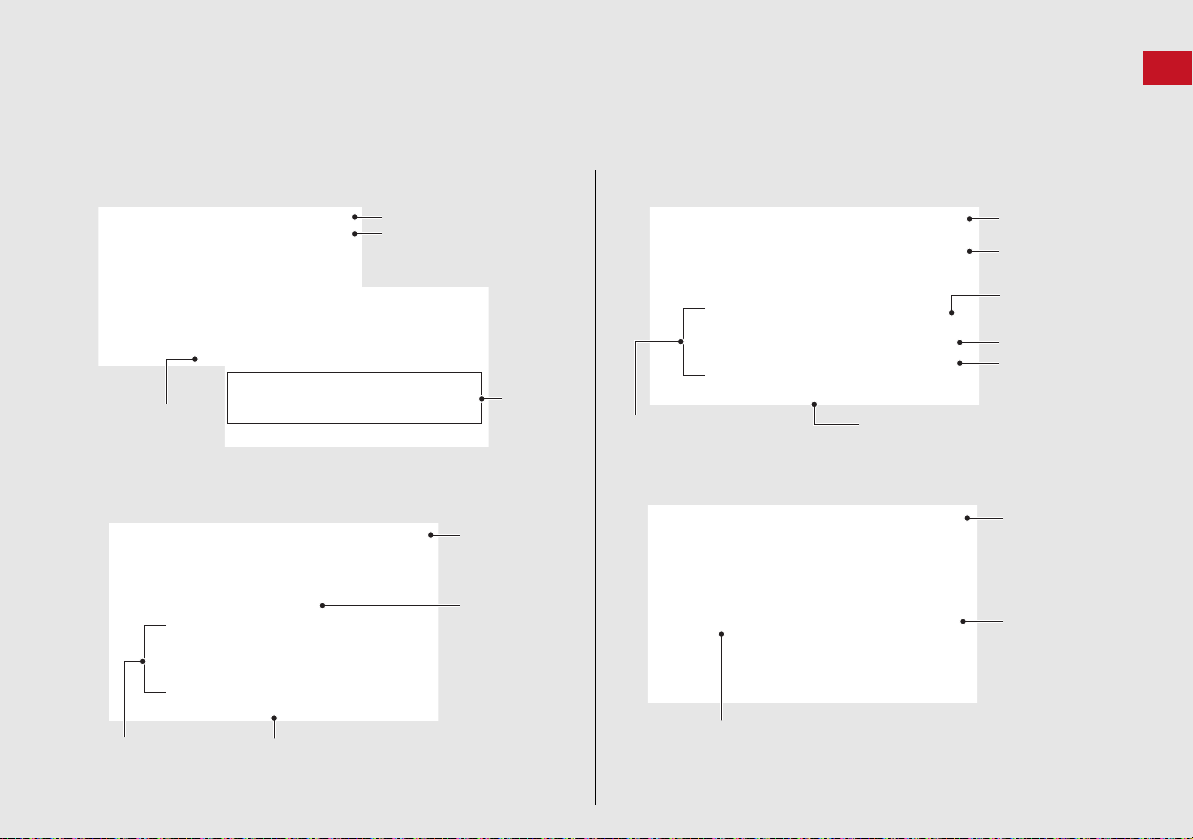
Navigation Manual
(Unlinked)
This document does not contain hyperlinks and may be formatted for printing instead of
web use. This is due to changes in content and specifications of the vehicle that happen
throughout the model year. This manual will be replaced with a hyperlinked version at the
end of the model year.
© 2012Honda Motor Co., Ltd. P/N 00X31-TK8-8200
3 Odyssey

The information and specifications included in this publication were in effect at the time of approval for printing. Honda Motor Co., Ltd., reserves the right,
however, to discontinue or change specifications or design at any time without notice and without incurring any obligation.
Accessories Precautions
The GPS antenna is located in the dashboard. Metallic front or side window tinting can seriously degrade or obstruct GPS reception.
Signal noise from devices such as radar detectors, vehicle tracking devices, remote starters, and additional amplifiers can disrupt the navigation system. If you
install any such item, install it away from the navigation display and antenna.
Important Safety Information
Avoid focusing on the screen or manually operating the system controls while driving.
Enter information before you begin driving or when stopped. As you drive, listen to the audible instructions and use voice commands when possible. Pull to the
side of the road if you need more time to look at the screen or operate the controls.
Route guidance may conflict with street closures, road construction, detours, and out-of-date map data.
The system itself may also have limitations. Verify route information by carefully observing roads, signs, and signals. Always use your own judgment and obey
traffic laws.
2
System Limitations P. 234
NOTICE
Clean the screen with a soft, damp cloth. You may use a mild cleaner intended for use on navigation screens.
Using the navigation system while driving can take your
attention away from the road, causing a crash in which you
could be seriously injured or killed.
Only operate system controls when the conditions permit you
to safely do so.
WARNING

Contents
2 System Setup P. 19
Start-up 20 Voice Control System 22 Interface Settings 24 Personal Information 37
Music Search 45 Routing & Guidance 49 Clock Adjustment 58 Vehicle 61
Data Reset 64
2 Navigation P. 67
Entering a Destination 68 Calculating the Route 90 Driving to Your Destination 93 Map Menu 98
Changing Your Route 116 Changing Your Destination 123 Resuming Your Trip 127
2 Audio P. 129
Audio System 130 Playing FM/AM Radio 132 Playing XM® Radio 136 Playing a Disc 141
Playing Hard Disc Drive (HDD)
Audio 145
Playing an iPod® 155 Searching for Music Using
Song By Voice™ (SBV) 159
Playing a USB Flash
Drive 160
Playing Bluetooth® Audio 164
Adjusting the Sound 166 Audio Remote Controls 167
2 Bluetooth® HandsFreeLink® P. 169
Bluetooth®
HandsFreeLink® 170
Pairing a Phone 172 Importing Phonebook
Data 177
Setting Up Speed
Dialing 178
Editing User Name and
PIN 180
Making a Call 182 Receiving a Call 185 HFL Menus 186
2 Rear Entertainment System P. 189
Rear Entertainment
System 190
Rear Control Panel
Operation 192
Front Control Panel
Operation 203
Wireless Headphones 206
2 Other Features P. 209
Trip Computer 210 Calendar 211 Calculator 213 Information Functions 215
Multi-view Rear Camera 217
2 Troubleshooting P. 219
Troubleshooting 220 Error Messages 227
2 Reference Information P. 231
System Initialization 232 System Limitations 234 Client Assistance 236 Legal Information 239
2 Voice Commands P. 245
Voice Commands 246
Quick Reference Guide
P.2
System Setup
P.19
Navigation
P.67
Audio
P.129
Bluetooth
® HandsFreeLink®
P.169
Rear Entertainment System
P.189
Other Features
P.209
Troubleshooting
P.219
Reference Information
P.231
Voice Commands
P.245
Index
P.261
Quick Reference Guide
2
Overview—Functions at a Glance
Navigation
You can select any place/landmark as a destination by using voice control or the Interface Dial. The navigation
system gives you turn-by-turn driving directions to your destination.
Store home addresses (P42)
Register
2 home addresses.
Store contacts (P38)
Store up to
200 contacts in 2 address books.
Enter destination (P68)
Select your destination using
12 methods.
Select route (P92)
Set route preferences and select one of
3 routes.
Track route (P93)
Follow your route in real-time with voice guidance.
FM Traffic (P114)
View and avoid congestion and traffic incidents.
Avoid certain areas (P117)
Set streets and areas to detour around.
Add waypoints (P118)
Add up to
4 “pit stops” along your route.
3
Quick Reference Guide
Other Features
Multi-view Rear Camera (P217)
Helps you check for obstacles around the rear of your vehicle on the navigation screen when reversing.
Audio
The advanced audio system provides clear, well-defined sound and makes the most of your music.
Enjoy listening to a variety of audio sources, such as:
AM/FM Radio (P132)
XM® Radio (P136)
Compact Disc (P141)
iPod® (P155)
USB Flash Drive (P160)
Bluetooth® Audio (P164)
Hard Disk Drive (HDD) (P145)
Rear Entertainment System (P189)
Rear seat passengers can enjoy a completely separate entertainment source than front
passengers, including movies, games, and other audio choices.
Voice Control (P22)
Use voice commands for safer system control while driving. You can operate all key functions of
the navigation, audio, Bluetooth® HandsFreeLink®, and climate control systems.
Bluetooth® HandsFreeLink® (P170)
Pair a compatible cell phone to receive incoming and make outgoing calls. You can operate the
phone features without ever taking your hands off the wheel.

6
Quick Reference Guide
Audio System
You can play music from a wide array of media sources. You can also control the audio system using voice commands.
Basic Operation
Audio Buttons
a Press the VOL 9
(Volume/Power)
knob to turn the
audio system on/off.
b Select the audio source. c Rotate the VOL 9
(Volume/Power)
knob to adjust the
volume.
TITLE
Displays track title, artist, and other text information, if
available.
8
Bass, treble, and balance settings.
1 to 6
Preset stations (FM/AM) and channels (XM).
SKIP
Finds stations with strong signal (FM/AM).
Skip to start/end of tracks, or press and hold to fast reverse/forward
(Disc).
SCAN
Plays 10-second sample of each station (FM/AM), channel (XM), or track
(Disc). Press again to play the current selection.
TUNE
Tunes to next frequency (FM/AM) or channel (XM).
Fast-reverse/forward.
CATEGORY
Selects next category (XM) or next folder (WMA, MP3, AAC).
Loading a Disc
a Press the CD or DVD
button.
b Insert a disc into the disc slot.
The disc automatically starts playing.
c Press the AUDIO button to display
the audio screen.
Select an audio source (e.g., FM/AM)
to stop the disc.
Press the E (Eject) button to remove
the disc. If you eject but do not
remove the disc, the disc
automatically reloads after a few
seconds.
7
Quick Reference Guide
Audio Control Display
Press the AUDIO button to display the audio system on the navigation screen.
FM/AM Radio (P132), XM® Radio (P136)
Hard Disk Drive (HDD) (P145), iPod®
(P155),USB Flash Drive (P160)
Band
Stereo indicator
Presets
Tune, scan, and
other functions
iPod® mode
(HDD mode,
USB mode)
Search
menu
Track list
Repeat, shuffle, and other functions
Compact Disc (P141)
Bluetooth® Audio (P164)
Disc mode
Play mode
Recorded
icon
Recording icon
Recording
ready icon
Repeat, random, scan, and
other functions
Track list
Bluetooth®
Audio mode
Stop/Start
control
Sound preferences

12
Quick Reference Guide
Navigation—Home Addresses and Going Home
The “Home” feature automatically routes you to your home address from any location simply by selecting Go Home 1 or 2, or saying d “Go
Home.” You can store two home addresses as Home Address 1 and Home Address 2. (P42)
Storing Your Home Address
a Press the INFO
button.
b Rotate i to select Setup. Press u.
c Rotate i to select Personal
Information. Press u.
d Rotate i to select Home Address 1.
Press u.
e Rotate i to select Edit Name. Press
u.
f Enter a name.
g Rotate i to select Edit Address.
Press u.
h Rotate i to select Address. Press u.
i Enter an address.
j Rotate i to select Edit Phone No.
Press u.
k Enter a phone number.
l Move r to select OK.
Going Home
a Press the DEST/ROUTE
button.
b Rotate i to select Go Home 1. Press
u.
Alternatively, you can say d “Go
Home” from any screen. Your home
address is displayed on the Calculate
Route screen.
c Move r to select OK.
The following voice commands are
available: say d “Go Home,” d “Go
Home 1,” d “Go Home 2.”
If you have two home addresses stored,
saying d “Go Home” will select Home
Address 1.

13
Quick Reference Guide
Navigation—Entering a Destination
Enter your destination using one of several methods, then follow route guidance on the map or guidance screen to your destination. You
can also perform these steps using d voice control.
a Press the DEST/ROUTE
button.
b Rotate i to select Address. Press u.
c Rotate i to select Street. Press u.
d Enter the name of your destination
street.
e Rotate i to select your destination
street from the list. Press u.
f Enter the street number. Move r to
select OK when finished.
g If there is more than one city with the
specified street, a list of cities is
displayed. Rotate i to select the
desired city from the list. Press u.
h Rotate i to select OK. Press u.
Route guidance to the destination
begins.
Select View Routes: Choose one of
three routes.
Select Route Pref.: Choose MAX or MIN
for the four settings.

14
Quick Reference Guide
Navigation—Changing Route or Destination
You can alter your route by adding waypoints to visit, adding streets to avoid, or changing your destination during route guidance.
Adding a Waypoint
(“Pit Stop”)
You can add up to four waypoints along
your route. (P118)
a Press the DEST/ROUTE button.
b Rotate i to select Waypoint. Press
u.
c Rotate i to select location and
search method. Press u.
SEARCH AROUND: Search around a
location.
SEARCH ALONG: Search between two
locations.
d Select the icon category and location
to add to the Destination List when
prompted.
e Move r to select OK.
Changing Your
Destination
There are four methods you can use to
specify a new destination during route
guidance.
Say d “Find Nearest…” (P123)
Searches for the nearest place/landmark
on the map screen (e.g., d “Find
nearest gas station”).
Say d “Go Home” (P12)
Routes to your home address.
Selecting an icon on the map (P124)
Scroll the map to position the cursor over
a place/landmark icon or a new area on
the map. Press u twice.
Entering a new destination (P125)
Press the DEST/ROUTE button. Move y
to select Dest.MENU1/2 and enter a new
destination.
Canceling Your Route
From the map screen:
a Press the DEST/ROUTE button.
b Rotate i to select Cancel Route.
Press u.
a Press u to select MAP MENU.
b Rotate i to select Cancel Route.
Press u.

15
Quick Reference Guide
Rear Entertainment System (P189)
The rear passengers can enjoy a wide array of audio/visual sources with the Rear Entertainment System (RES). The rear passengers can use
wireless headphones and operate the system with the remote control panel.
Overhead Screen and Rear Control Panel
RES
Press the Release button to
remove the rear control panel.
Select the audio source.
Press the buttons to
select items.
Pull down the bottom
edge of the screen.
(Light-up) Button
Illuminate the buttons on the
rear control panel.
9 (Power) Button
Turn on the rear control panel.
CH/FOLDER Bar
Select a channel (Radio) or a
folder (Disc/USB).
TUNE/SKIP Bar
Find stations (FM/AM). Skip to
start/end of tracks, or press
and hold to fast reverse/fast
forward (Disc/USB/DVD).
CATEGORY Bar
Select a category (XM).
(Play/Pause) Button
Play or pause the playback.
TITLE SCROLL Bar
Display track title, artist, and
other text information.
Select the audio source.
Rotate the Interface Dial
to select items.
Ultrawide RES
Press the Open button to
open and pull down the
screen.
Press the Release button to
remove the rear control panel.
Basic Operation
a Open the overhead screen.
b Press the REAR
POWER button on
the front control
panel.
c Press the 9 (Power)
button on the rear
control panel.
d Select the audio source.
RES: Press the desired button.
Ultrawide RES: Press the SOURCE
button and rotate the Interface
Dial to select an audio source.
Press the ENTER button.

16
Quick Reference Guide
Troubleshooting For more Information (P219 )
Why does the vehicle position icon on the map “lag” a
short distance behind my actual position, especially at
intersections?
This is normal. The navigation system is unaware of the
width of intersections. Large differences in vehicle position
can indicate a temporary loss of the GPS signal.
Why does the “time to destination” display sometimes
increase even though I am getting closer to my
destination?
The “time to destination” is based on the posted road
speed signs and your actual road speed to give you a
better estimate of arrival time.
Why does my clock frequently change the time forward
and backward by one hour?
The clock setting is automatically updated based on your
GPS location. If you normally drive between two time
zones, the clock may keep adjusting the time. You can
turn this feature off.
2
Clock Adjustment P. 58
How do I specify a destination when an entered city or
street could not be found?
Try entering the street first. Some cities are lumped in with
a major metro area. In rural “unverified” areas or new
subdivisions, streets may be missing or only partially
numbered.
How do I turn on the navigation system voice guidance?
1. Press the INFO button. Rotate i to select Setup and
press u. Check that Volume is not set to OFF.
2. Move y to select Other, rotate i to select Basic
Settings, and press u. Set Voice Recognition Tutor
to ON if you want the system to provide confirmations
and system prompts.
My battery was disconnected or went dead, and the
navigation system is asking for a code. Where do I find it?
Your vehicle comes with a card in the glove box that
includes the 5-digit security code and serial number. You
should keep this card in a safe place outside your vehicle. If
you cannot find it, contact your dealer.
17
How to Use This Manual
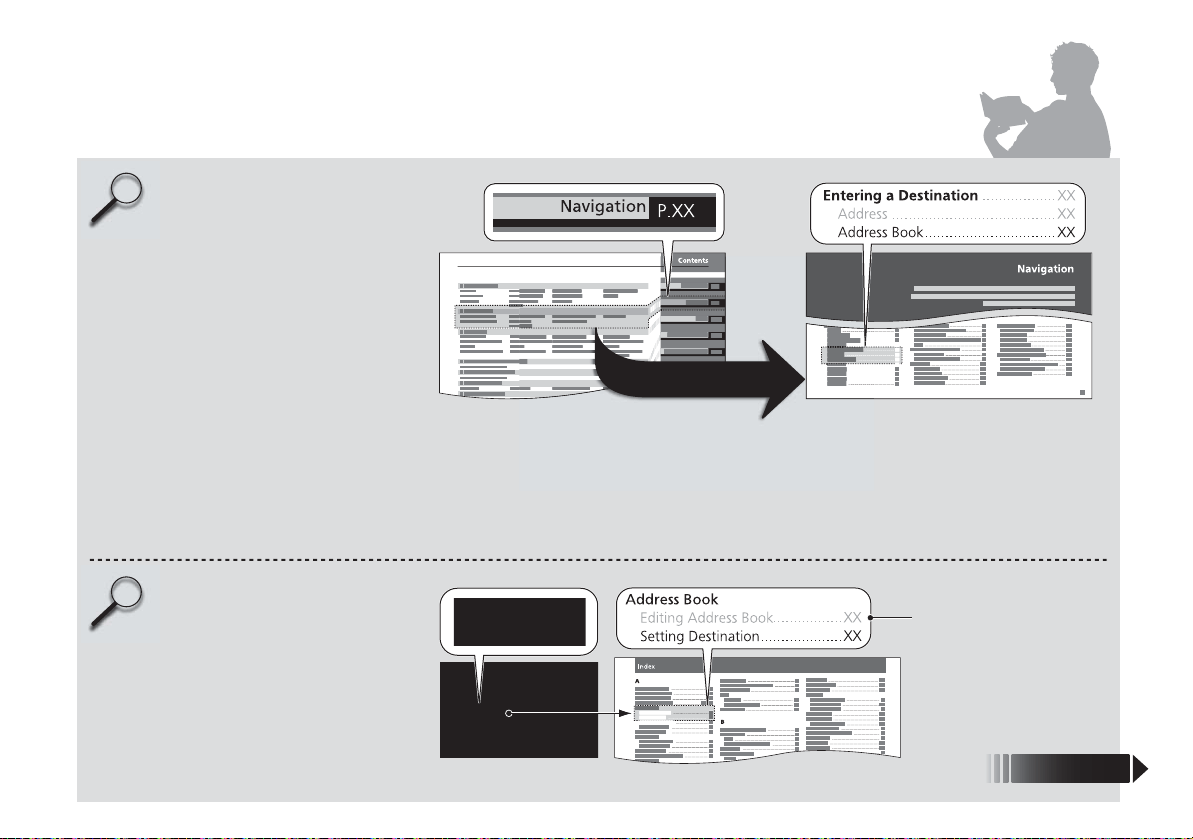
This section explains different methods on how you can easily find information in this manual.
Contents
Contents
More Detailed
Contents
Go to the
Next Page
Searching the Table of Contents
(P1)
Two types of Tables of Contents help
you find your desired information.
First, find the general chapter related to
what you are looking for (e.g., entering
a destination from the Address Book).
Then, go to that chapter to view a more
specific table of contents.
Searching the Index (P261)
Menu items displayed on the
navigation screen (e.g., Address Book)
can be found individually in the Index.
This more detailed table of contents
shows you exactly what information is
listed by section and title.
The Index consists of main
terms and sub-entries. The
sub-entries help you get to
the desired page depending
on what you are looking
for.
Table of Contents Chapter Contents
Navigation Screen Index
18
DEST/ROUTE Button Address Book
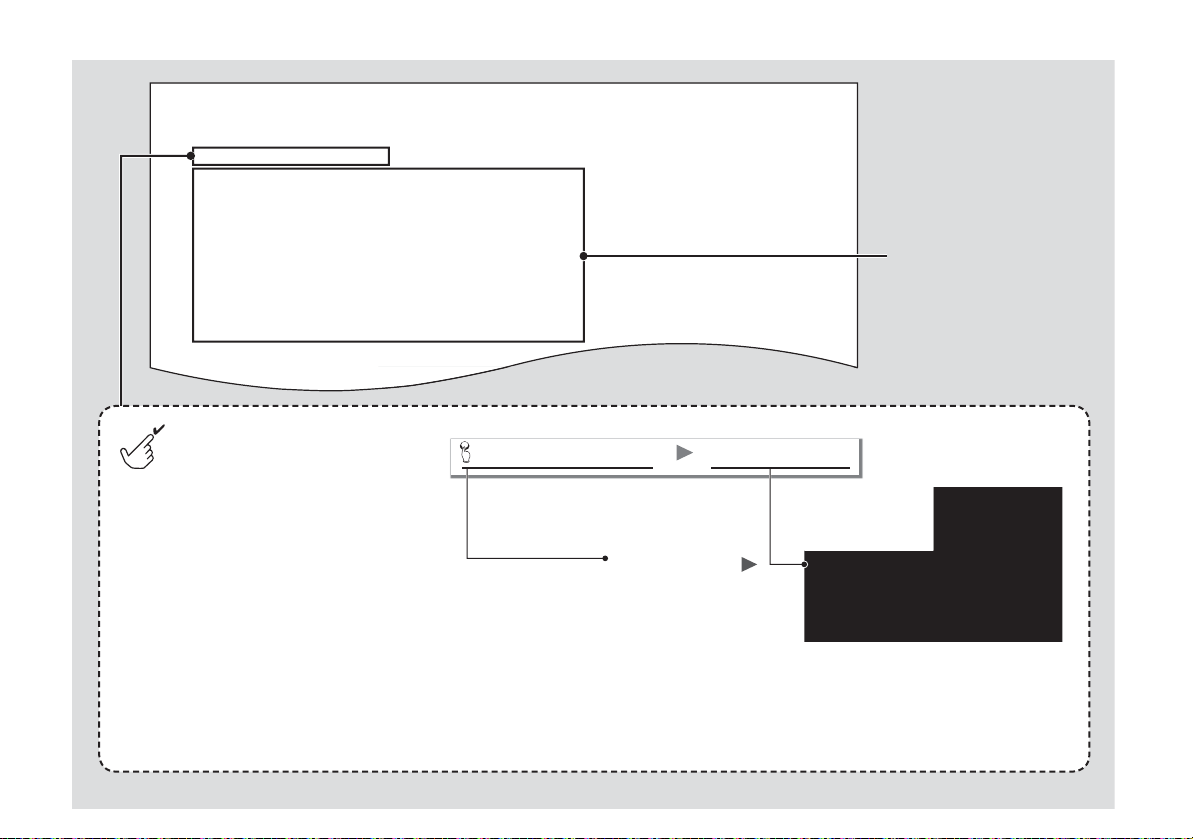
Menu Tree
The menu tree helps guide you
through the system’s menu options.
To get to your desired function, follow
the menu tree in order of the steps
shown.
NOTE:
All menu options can also be
activated with voice commands.
Press the hard button on the
system control panel.
Press the DEST/ROUTE button.
Select the menu option with the
Interface Dial.
Rotate i to select Address Book.
Press u.
After following the menu
tree, step-by-step
instructions explain how to
achieve the desired result.
* Sample pages and images in this section may differ from the actual ones.
21
Start-up
System Setup
4. Rotate i to select an option.
Press u.
Your current position is
displayed on the map screen.
The following options are available:
• Remind Later: Displays the reminder again next time you start the vehicle.
• OK: Turns the reminder off.
1 Start-up
You can set a calendar event reminder.
2 Calendar P. 211
Remind Later
You can skip the reminder by pressing the
CANCEL button.

22
System Setup
Voice Control System
Your vehicle has a voice control system that allows hands-free operation of most of
the navigation system functions. You can also control the audio and climate control
system, and make and receive phone calls using Bluetooth® HandsFreeLink®.
The voice control system uses the d (Talk) and K (Back) buttons on the steering
wheel and a microphone near the map lights on the ceiling.
A “Voice Help” feature provides a tutorial that explains how to use the voice control
system.
2 Voice Help P. 5
Command Input
If the system does not understand a command or you wait too long to give a
command, it responds with “Pardon,” “Please repeat,” or “Would you say again.”
When you give a command, the system generally either repeats the command as a
confirmation or asks you for further information. If you do not wish to hear this
feedback, you can turn it off. However, listening to the feedback will help familiarize
you with the way the system expects commands to be phrased.
2 Basic Settings P. 26
If the system cannot perform a command or the command is not appropriate for the
screen you are on, the system beeps.
If the system responds with prompts such as “Please use the Interface Dial to…” or
“Please choose an area with the Interface Dial,” the system is asking for input that
cannot be performed using the voice control system.
On character input screens, a list of possible characters is displayed if the system
does not recognize your command.
You can find out which voice commands are available for a particular screen using
the d Help command. The system will display and read the list of available
commands to you.
1 d (Talk) Button
When you press the d (Talk) button, a helpful
prompt asks what you would like to do. Press
and release the d (Talk) button again to bypass
this prompt and give a command.
1 Command Input
The audio system is muted while using the voice
control system.
23
Voice Control System
Voice Recognition
System Setup
Voice Recognition
To achieve optimum voice recognition when using either the navigation voice
control system or Bluetooth® HandsFreeLink®:
• Make sure the correct screen is displayed for the voice command that you are
using.
2 Voice Commands P. 246
• Close the windows and moonroof.
• Adjust the dashboard and side vents so air does not blow onto the microphone on
the ceiling.
• Speak clearly in a clear, natural speaking voice without pausing between words.
• Reduce any background noise if possible. The system may misinterpret your
command if more than one person is speaking at the same time.
• Refer to the Voice Help tutorial.
2 Voice Help P. 5
1 Voice Recognition
The voice control system can only be used from
the driver’s seat because the microphone unit
removes noises from the front passenger’s side.
28
Interface Settings
Color
System Setup
H INFO button
Setup
Other
Color
Map Color
Set separate map colors for Day and Night modes.
1. Rotate i to select Day or Night.
Press u.
2. Rotate i to select a color for the
map screen. Press u.
H INFO button
Setup
Other
Color
Menu Color
Set separate menu colors for Day and Night modes.
1. Rotate i to select Day or Night.
Press u.
2. Rotate i to select a color for the
menu screens. Press u.
■ Map Color
1 Map Color
For Day mode
Set to WHITE (factory default is BEIGE) to obtain
the best daytime display contrast.
For Night mode
Set to BLACK (factory default) to obtain the best
nighttime display contrast.
■ Menu Color
1 Menu Color
For Day mode
Set to WHITE (factory default) to obtain the best
daytime display contrast.
For Night mode
Set to BLACK (factory default) to obtain the best
nighttime display contrast.
33
Interface Settings
Wallpaper
System Setup
H INFO button
Clock/Wallpaper
Wallpaper Type
Rotate i to select an option to
change the design. Press u.
■ Setting the Wallpaper Type
Continued

34
Interface Settings
Wallpaper
System Setup
H INFO button
Clock/Wallpaper
Picture Setup
Select a Picture for
Wallpaper
1. Rotate i to select a picture. Press
u.
The picture is displayed on the
screen.
2. Press u to select OK.
■ Selecting a Wallpaper Picture
1 Selecting a Wallpaper Picture
Two images are provided for the HDD as a
factory default.

35
Interface Settings
Wallpaper
System Setup
H INFO button
Clock/Wallpaper
Picture Setup
Delete Pictures on HDD
1. Rotate i to select a picture. Press
u.
The picture is displayed on the
screen.
2. Press u to select OK.
Repeat step 1 and 2 to delete
other pictures.
Items to be deleted are indicated
with a trash icon.
3. Move r to select OK.
4. Rotate i to select Yes. Press u
to delete the picture(s).
■ Deleting Pictures from HDD
1 Deleting Pictures from HDD
If there are no pictures on the HDD, “No Entries
Exist” is displayed.
You can only delete pictures when the vehicle is
in Park.
You can only delete pictures that have been fully
uploaded from a USB flash drive.
Trash icon
Continued
37
System Setup
Personal Information
H INFO button
Setup
Personal Information
Use the personal information menu to select and set your address books, home
addresses, and PIN numbers. You can also delete unwanted destinations from the list
of previously routed destinations.
Rotate i to select an item. Press u.
The following items are available:
• Address Book: Stores new addresses or edits your address book.
2 Address Book P. 38
• Home Address 1: Sets or edits your home address.
2 Home Addresses P. 42
• Home Address 2: Sets or edits another home address.
2 Home Addresses P. 42
• PIN Number: Sets or changes your PIN number.
2 PIN Numbers P. 43
• Previous Destinations: Deletes the destination history.
2 Previous Destinations P. 44
1 Personal Information
Personal information cannot be backed up or
moved to another navigation system.
38
Personal Information
Address Book
System Setup
Address Book
H INFO button
Setup
Personal Information
Address Book
Store up to 200 address entries in two address books. You can add, edit, and delete
information in the address books.
Move w or y to display only the
addresses in the selected category.
H INFO button
Setup
Personal Information
Address Book
This section explains how to enter the name and address.
1. Rotate i to select New Address.
Press u.
1 Address Book
If you have PIN-protected your address book,
enter your PIN when prompted. Move r to
select OK. PIN numbers are optional.
2 PIN Numbers P. 43
Any address book categories you create are also
displayed on the Select an Address screen.
2 Selecting an Address Book Category P. 41
■ Adding an Address Book Entry
1 Adding an Address Book Entry
If you do not give the address a name, one is
automatically assigned (e.g., Address 001). You
can re-enter, edit, or make changes to any entry.
“Address” is the only required field.

40
Personal Information
Address Book
System Setup
The following items are available:
• Current Position: Select your current position.
• Address: Enter an address on the character input screen when prompted.
2 Address P. 70
• Previous Destinations: Select a previous destination.
2 Previous Destination P. 76
• Place Name: Enter the name of a place/landmark.
2 Place Name P. 77
• Place Category: Select a category to search for a place/landmark (e.g., Banking,
Lodging).
2 Place Category P. 80
• Place Phone Number: Enter the phone number of a place/landmark.
2 Place Phone Number P. 84
H INFO button
Setup
Personal Information
Address Book
1. Rotate i to select the address to
edit. Press u.
2. Enter the name, address, phone
number, and category fields.
2 Adding an Address Book Entry
P. 38
3. Move r to select OK.
■ Editing an Address Book Entry
1 Adding an Address Book Entry
When you use Place Name or Place Category,
the phone number is automatically entered.
1 Editing an Address Book Entry
The entered contents are displayed on the Edit
address screen.

41
Personal Information
Address Book
System Setup
H INFO button
Setup
Personal Information
Address Book
1. Rotate i to select an address.
Press u.
2. Rotate i to select Edit
Category. Press u.
3. Rotate i to select BUSINESS,
PERSONAL, or a category you
created. Press u.
■ Creating a New Category
1. Rotate i to select New Category. Press u.
2. Enter a name and select an icon when prompted.
The created category is displayed in the list of categories.
■ Deleting or Editing a Category
1. Move y to select Edit.
2. Rotate i to select Delete or Edit Category. Press u.
3. Delete an existing category, or change the name and icon.
■ Selecting an Address Book Category
1 Selecting an Address Book Category
You can have up to 100 categories (including
“UNFILED”).
If you delete a category that is used by other
addresses, the category type for those addresses
changes to “UNFILED.”
Category Icons
The following icons can be selected for a
category:
Continued
44
Personal Information
Previous Destinations
System Setup
Previous Destinations
H INFO button
Setup
Personal Information
Previous Destinations
The navigation system maintains a list of your previously routed destinations as a
shortcut for entering the same destination in the future. You can delete some or all
of your previous destinations from the list.
1. Rotate i to select the destination
to delete. Press u.
Repeat the procedure as
necessary.
Items to be deleted are indicated
with a trash icon.
2. Move r to select OK to delete the
selected destinations.
1 Previous Destinations
Up to 50 destinations can be stored.
To cancel the selection of a previous destination,
rotate i to highlight the destination again.
Press u to de-select it.
Trash icon

45
System Setup
Music Search
H INFO button
Setup
Other
Music Search
Use this feature to set up the music search abilities when using Song By Voice™
(SBV) commands.
Rotate i to select an item. Press u.
The following items are available:
• Song By Voice: Turns the feature on or off.
2 Song By Voice™ (SBV) P. 46
• Phonetic Modification: Changes the phonetic (song name, artist name, etc.) so
that they are more easily recognized through voice commands.
2 Phonetic Modification P. 47

46
Music Search
Song By Voice™ (SBV)
System Setup
Song By Voice™ (SBV)
H INFO button
Setup
Other
Music Search
Song By Voice
Use SBV to search for and play music from your HDD or iPod® using voice
commands. Use this setting to enable SBV.
Rotate i to select an option. Press
u.
The following options are available:
• ON (factory default): Song By Voice commands are available.
2 Searching for Music Using Song By Voice™ (SBV) P. 159
• OFF: Disable the feature.

48
Music Search
Phonetic Modification
System Setup
3. Rotate i to select the item to
modify (e.g., Artist). Press u.
4. Rotate i to select an entry (e.g.,
“No Name”). Press u.
5. Rotate i to select Edit. Press u.
Rotate i to select Play to
listen to the phonetic
modification. Press u.
Rotate i to select OK and
press u when finished.
6. Enter the phonetic spelling you
wish to use (e.g., “Artist A”) when
prompted.
7. Move r to select OK to exit.
The artist “No Name” is
phonetically modified to “Artist
A.” When in SBV mode, you can
use the voice command d
“Play Artist ‘Artist A’” to play
songs by the artist “No Name.”
50
Routing & Guidance
Rerouting
System Setup
• Guidance Screen Interruption: Sets whether the guidance screen interrupts the
audio screen display.
2 Guidance Screen Interruption P. 57
Rerouting
H INFO button
Setup
Other
Routing & Guidance
Rerouting
Set whether route recalculation occurs automatically or manually during route
guidance.
Rotate i to select an option. Press
u.
The following options are available:
• AUTOMATIC (factory default): The system calculates a new route automatically
when you deviate from the route. It is strongly recommended that you leave the
system set to Automatic.
• MANUAL: Disables route recalculation. The system beeps and “Off Route” is
displayed when you deviate from the route.
1 Rerouting
If you live in an area with poor mapping, you
may wish to set Rerouting to MANUAL to avoid
constant recalculation. You will need to select
Recalculation manually to make the system
recalculate your new route.

52
Routing & Guidance
Unverified Area Routing
System Setup
Guidance
(map/voice)
There is no turn-by-turn map or
voice guidance.
Voice guidance commands end
with the phrase “if possible” to
remind you to verify all traffic
restrictions.
Directions
list
A direction list is typically not
available. However, depending on
your route, directions are provided
to help you reach the first available
verified road.
A direction list is provided
showing street names and turn
symbols in pink.
Differences OFF (factory default) ON

55
Routing & Guidance
Edit Waypoint Search Area
System Setup
Edit Waypoint Search Area
H INFO button
Setup
Other
Routing & Guidance
Edit Waypoint
Search Area
Select the distance from your highlighted route line (on either side of your route)
that the system will search for a waypoint.
2 Adding Waypoints P. 118
You can specify a different search distance for freeways and surface streets.
1. Rotate i to select an item. Press
u.
2. Rotate i to select a search
distance. Press u.
The following items are available:
• On Freeways: 1, 2, 5, or 10 miles can be set. Factory default is 2 miles.
• On Surface Street: 1/2, 1, 2, or 5 miles can be set. Factory default is 1/2 mile.
1 Edit Waypoint Search Area
The search distance does not affect the search
range used for the Find Nearest voice commands
(e.g., say
d “Find nearest gas station”).

57
Routing & Guidance
Guidance Screen Interruption
System Setup
Guidance Screen Interruption
H INFO button
Setup
Other
Routing & Guidance
Guidance Screen
Interruption
The navigation system temporarily interrupts the audio screen display to view the
guidance screen as you approach a guidance point.
Rotate i to select an option. Press
u.
The following options are available:
• ON: The guidance screen interrupts the audio screen.
• OFF (factory default): Disables the feature.
59
Clock Adjustment
Adjust Time
System Setup
Adjust Time
H INFO button
Clock/Wallpaper
Clock Adjustment
Adjust Time
Adjust the current time (hours and minutes).
1. Move w or y to select HOUR or
MINUTE.
2. Rotate i to adjust the value.
3. Move r to select OK.
Resetting the Clock Settings
H INFO button
Clock/Wallpaper
Clock Adjustment
Reset
Reset the Auto Daylight and Auto Time Zone settings to the factory defaults.

61
System Setup
Vehicle
H INFO button
Setup
Other
Vehicle
Set the off-road tracking feature and correct the vehicle position displayed on the
map.
Rotate i to select an item. Press u.
The following items are available:
• Off-road Tracking: Set whether to display the tracking dots on the map.
2 Off-road Tracking P. 62
• Correct Vehicle Position: Adjust the position of the vehicle on the map.
2 Correct Vehicle Position P. 63

63
Vehicle
Correct Vehicle Position
System Setup
Correct Vehicle Position
H INFO button
Setup
Other
Vehicle
Correct Vehicle Position
Manually adjust the current position of the vehicle as displayed on the map screen if
the position appears to be incorrect.
1. Put the vehicle in Park.
2. Rotate i to select Correct
Vehicle Position. Press u.
3. Scroll the map to position the
arrowhead at your correct position.
Press u.
4. Rotate i to position the
arrowhead in the correct direction
the vehicle is facing.
5. Press u to select OK.
1 Correct Vehicle Position
An apparent position error can occur where
buildings, tunnels, and other objects block or
reflect the GPS signals, forcing the system to use
“dead reckoning” to determine your location
and direction.
Using this function to adjust vehicle position is
not recommended. When the system reacquires
a GPS signal, it will automatically place the
vehicle in the correct location.
If you continually have to adjust the vehicle
position, you may have problems with the GPS
reception or there may be database errors.
2 System Limitations P. 234

66

70
Entering a Destination
Address
Navigation
Address
H DEST/ROUTE button
Address
Enter an address to use as the destination. The state or province you are currently in
is displayed (e.g., California).
Rotate i to select an item. Press u.
The following items are available:
• City: Selects your destination city.
2 Selecting a City P. 72
• Street: Selects your destination street.
2 Selecting a Street P. 73
• Change State: Selects the state or province.
2 Selecting the State or Province P. 71
• ZIP code: Enters the zip code to select the city.
2 Selecting a City by Zip Code P. 71

71
Entering a Destination
Address
Navigation
H DEST/ROUTE button
Address
Change State
Rotate i to select a state from the
list. Press u.
H DEST/ROUTE button
Address
ZIP code
1. Enter the zip code of your
destination.
2. Move r to select OK.
■ Selecting the State or Province
1 Selecting the State or Province
Move w to select USA for the American
mainland, Hawaii, and Puerto Rico. Move y to
select Canada/AK for Canada and Alaska.
■ Selecting a City by Zip Code
1 Selecting a City by Zip Code
If your city is not listed, it may be part of a larger
metropolitan area. Try entering the street first.
Continued

73
Entering a Destination
Address
Navigation
2. Rotate i to select your
destination city from the list. Press
u.
A list of matching hits is
automatically displayed after
you enter several letters, with
the closest match at the top of
the list. Matching letters are in
yellow.
Next, you are prompted to enter
a street name.
2 Selecting a Street P. 73
H DEST/ROUTE button
Address
Street
1. Enter the name of your destination
street.
Do not enter the street type
(e.g., street, road, avenue) or
direction (e.g., north, south,
east, west).
Move r to select List to display
a list of streets.
1 Selecting a City by Name
If your city is not listed, it may be part of a larger
metropolitan area. Try entering the street first.
Non-detailed area mark: Try entering the
street first and then select the city.
■ Selecting a Street
1 Selecting a Street
When entering the names of major freeways,
you can use the following abbreviations. For
interstates, use an “I” (e.g., I-10). For U.S.
freeways, use “US” (e.g., US-18). For state
freeways, use the two-character state
designation (e.g., CA-101). For county roads, use
the appropriate designation (e.g., G-2).
Using Voice Command (English only)
Say d “Street” on the Find address by screen,
and the following screen is displayed:
• Say the name of your destination street, and
say the street number as a string of individual
numbers.
• Set the route to your destination.
2 Calculating the Route P. 90
Continued

75
Entering a Destination
Address Book
Navigation
Address Book
H DEST/ROUTE button
Address Book
Select an address stored in your address book to use as the destination.
1. Rotate i to select your
destination from the list. Press u.
2. Set the route to your destination.
2 Calculating the Route P. 90
Move w or y to display only
the entries in a category: All,
BUSINESS, PERSONAL, or other
categories you have created.
2 Selecting an Address Book
Category
P. 41
1 Address Book
If you have PIN-protected your address book,
enter your PIN when prompted. Move r to
select OK. PINs are optional.
2 PIN Numbers P. 43
You can select New Address on the Select an
address screen to add an entry to the address
book.
2 Adding an Address Book Entry P. 38

77
Entering a Destination
Place Name
Navigation
Place Name
H DEST/ROUTE button
Place Name
Enter the name of a place (e.g., business, hotel, restaurant) stored in the map
database to use as the destination.
1. Enter a place name.
2. Move r to select LIST to display a
list of matching hits.
3. Rotate i to select a place name
from the list. Press u.
If the place name is in multiple
categories, the categories are
displayed when you select it.
2 Place Name in Multiple
Categories
P. 78
4. Set the route to your destination.
2 Calculating the Route P. 90
1 Place Name
This option is convenient if you know the exact
name of a place.
Move e to select OPTION to enter symbols and
accented letters, move y to select SPACE to
enter a space character, or move w to select
DELETE to remove the last character.
Once a name is entered and selected, move r to
select SORT BY NAME or SORT BY DISTANCE.
Matching letters are in yellow.
Restaurants with a z icon have a ZAGAT®
review. Move y to select z to view the
complete ZAGAT® review.
2 ZAGAT P. 84
Continued

78
Entering a Destination
Place Name
Navigation
If the place name is in multiple categories in the map database, the following screen
is displayed.
1. Rotate i to select a place name.
Press u.
2. Rotate i to select a subcategory.
Press u.
■ Place Name in Multiple Categories
1 Place Name in Multiple Categories
Move r to select SORT BY CITY or SORT BY
DISTANCE. Matching letters are in yellow.


80
Entering a Destination
Place Category
Navigation
Place Category
H DEST/ROUTE button
Place Category
Select the category of a place (e.g., Banking, Lodging, Restaurant) stored in the map
database to search for the destination.
1. Rotate i to select a category.
Press u.
2. Rotate i to select a subcategory.
Press u.
Move w or y to change the
main category.
2 List of Categories P. 258
1 Place Category
This option is convenient if you do not know the
exact name of a place or if you want to narrow
down the number of matches returned for places
with a common name.
You can store up to 30 favorite subcategories.
Move y to select Fav. Subcategory to access
your favorites.
2 Favorite Subcategories P. 82
Advanced helps you to search the subcategory.
When you enter a keyword and select LIST, the
list of appropriate subcategories is displayed.
81
Entering a Destination
Place Category
Navigation
3. Rotate i to select an item. Press
u.
The following items are available:
• Place Name: Searches for a place in the subcategory by name. Enter a city name
when prompted.
• City Vicinity: Searches for a place in the subcategory within a 20-mile radius of a
specific city. Enter a city name and then a place name when prompted. Only the
first 1,000 matching places/landmarks are displayed.
• Sort by Distance to Travel: Displays all the places in the subcategory sorted by
distance from your current location. The closest place is displayed at the top.
• Search by Keyword: Searches for a place by keyword when you do not know the
exact category. Select Sort by Distance to Travel for locations near your current
location, or select City Vicinity for locations in a specific city. Enter a keyword
when prompted. Move r to select LIST to view a list of possible locations if one is
not found automatically.
1 Place Category
Sort by Distance to Travel
For locations sorted by distance to travel, you can
move r to select MORE to increase the scope of
the search. The number of locations increases to
100, 200, and up to 1000. When the number of
locations is 100 or less, you can increase the
scope to 500 miles, 1000 miles, or the entire U.S.
Continued
83
Entering a Destination
Place Category
Navigation
■ To store a subcategory in favorites:
1. Rotate i to select a subcategory
on any subcategory screen.
2. Move r to select ADD TO FAV.
SUBCATEGORY.
■ To delete a subcategory from favorites:
1. Rotate i to select a favorite
subcategory on the Favorite
Subcategory screen.
2. Move r to select DELETE FROM
FAV. SUBCATEGORY.
1 Favorite Subcategories
Stored categories
A subcategory stored in Fav. Subcategory has a
star at the end of the line.
Deleting categories
You can also delete a favorite subcategory on
any Subcategory screen. Rotate i to select a
favorite subcategory (which has a star at the end
of line) and move r to select DELETE FROM
FAV. SUBCATEGORY.

87
Entering a Destination
Intersection
Navigation
Intersection
H DEST/ROUTE button
Dest. MENU 2
Intersection
Select the intersection of two streets as the destination. The state or province for
your current location is displayed at the top of the screen (e.g., California).
1. Rotate i to select the
intersection search method. Press
u.
2. Set the route to your destination.
2 Calculating the Route P. 90
The following options are available:
• Street: Selects the two intersecting streets. The city or cities that the streets are
located in are displayed.
2 Selecting a Street P. 73
• City: Selects the city where the intersection is located. You are prompted to enter
the name of the two intersecting streets.
2 Selecting a City P. 72
• Change State: Selects the state or province.
2 Selecting the State or Province P. 71
1 Intersection
It is usually easier to select Street to find the
streets first. The city or cities that the streets are
in will be displayed. If you select City and your
city is not listed, it may be part of a larger
metropolitan area. Try entering the street first.
If the intersection is outside the state you are
currently in, Rotate
i to select Change State.
2 Selecting the State or Province P. 71
If there is more than one intersection, you are
prompted to select the intersection. If the two
streets that you have selected do not intersect,
no intersection is entered.

88
Entering a Destination
Map Input
Navigation
Map Input
H DEST/ROUTE button
Dest. MENU 2
Map Input
Use the Interface Dial to manually select an icon or a location on the map screen as
the destination.
You are prompted to define the map area to display.
1. Rotate i to select an item. Press
u.
The following items are available:
• Current Position: Your current position is centered on the map.
• City: You are prompted to select the city.
2 Selecting a City P. 72
• State: You are prompted to select the state.
2 Selecting the State or Province P. 71
• USA and Canada: Your current position is displayed on a map of the country.
89
Entering a Destination
Map Input
Navigation
2. Scroll the map to position the
cursor over your desired
destination, adjusting the map
scale as necessary. Press u.
If the address is not the desired
location, scroll the map to
another location and try again.
3. Press u again to display the route
calculation menu.
2 Calculating the Route P. 90
4. Rotate i to select Set as Dest.
Press u.
1 Map Input
A yellow box (shown at scales above 1/4 mile)
denotes the area that can be viewed when you
press u on the current map.
Information icons are displayed at scales from 1
mile to 1/4 mile. Place/landmark icons are
displayed at 1/8 mile or less. Roads are displayed
at 1/4 mile or less.
If you select multiple icons within the cursor
radius, you are prompted to select one of the
items from a list.
2 Selecting a Destination on the Map P. 124

93
Navigation
Driving to Your Destination
This section describes how to follow the route guidance to your destination, receive
traffic information, and choose the icons displayed on the map screen.
Viewing the Route
After calculating the route to your
destination, the route is displayed on
the map screen.
2 Map Screen Legend P. 10
As you drive, the system tracks your
position on the map in real time and
provides guidance as you approach
each guidance point on the route.
■ Map Screen
1 Viewing the Route
d “Display Map”
You can change the map scale using voice
control commands (e.g., say d “Display 2 mile
scale”).
2 Map Scale Commands P. 247
You can also change the map scale by rotating
i.
You can control the icons displayed on the map
screen using voice control commands (e.g., say
d “Display post office”).
2 Map Display Commands P. 246
You can obtain information about the route
using voice control commands (e.g., say d
“How long to the destination?”).
2 Route Commands P. 248
You can display the next guidance point on the
map screen by saying d “Display Map Guide”
(when en route).
If you scroll the map while en route, the time and
distance to destination indicators are replaced
with an indicator showing distance from the
current vehicle position.
The map screen can be viewed in single-screen or
split-screen mode.
2 Guidance Mode P. 103
Continued

94
Driving to Your Destination
Viewing the Route
Navigation
The guidance screen offers an alternative way to view your route.
In single-screen mode, press the MAP/
GUIDE button to switch between the
map and guidance screens. In split-
screen mode, press the MAP/GUIDE
button to switch between the next
guidance direction and a list of
guidance directions.
When driving on verified streets, the route line is light blue. The route line display
changes when driving on unverified streets:
• If Unverified Area Routing is
OFF, the route line uses verified
streets only (when possible). A
dotted “vector line” pointing
directly towards your destination is
also displayed.
■ Guidance Screen
1 Guidance Screen
A visual guide helps you check the guidance
screen.
2 Guidance Screen P. 11
■ Route Line
1 Route Line
You can set Unverified Area Routing to OFF to
follow your own route to the destination. If
Unverified Area Routing is ON, be aware that
unverified streets may not be displayed
accurately.
2 Unverified Area Routing P. 51
You can always view the entire route by simply
saying d “Display entire route.”
The route line may also consist of red, orange, or
green segments when your route line displays
traffic information.
2 Map Screen Legend P. 10
2 FM Traffic P. 114
Vector line (dotted)
95
Driving to Your Destination
Viewing the Route
Navigation
• If Unverified Area Routing is ON,
the route line changes to a blue-
pink line to indicate that the route
line uses unverified streets.
If you momentarily leave the calculated route, the system automatically recalculates
a route to the desired destination based on your current location and direction.
2 Rerouting P. 50
Blue-pink route line
■ Deviating From the Planned Route
1 Deviating From the Planned Route
If Rerouting is set to MANUAL and you go off
route, the system waits for you to manually
initiate recalculation. Rotate i to select
Recalculation and press u.
2 Rerouting P. 50
Continued

99
Map Menu
Displaying the Map Menu
Navigation
• Guidance Menu: Allows you to set or confirm the guidance points and freeway
exits for your route.
2 Guidance Menu P. 100
• Find Nearest…: Allows you to find the nearest place/landmark (e.g., nearest gas
station) by specifying a category. You can then add the location to the list of
destinations, set as a waypoint, or set as your destination.
2 Changing Your Destination P. 123
• Map Information: Allows you to select the information icons to display on the
map, change the orientation of the map, or display your current location.
2 Map Information P. 105
• Cancel Route: Cancels your current route.
2 Canceling the Route P. 117

100
Map Menu
Guidance Menu
Navigation
Guidance Menu
H ENTER button (on map)
Guidance Menu
Display the guidance points and freeway exits for your route, and set the display
mode for the map and guidance screens.
Rotate i to select an item. Press u.
The following items are available:
• Directions: Displays a list of the guidance points.
2 Directions P. 101
• Exit Info.: Displays a list of the freeway exits.
2 Freeway Exit Information P. 102
• Guidance Mode: Selects the guidance display mode.
2 Guidance Mode P. 103
102
Map Menu
Guidance Menu
Navigation
H ENTER button (on map)
Guidance Menu
Exit Info.
Display a list of the freeway exits for the route. You can view freeway exit
information (whether the exit is near gas stations, restaurants, ATMs, etc.) and add
new destinations or waypoints to the calculated route.
1. Rotate i to select an exit from
the list. Press u.
2. Rotate i to select a list item.
Press u.
Move w or y to display
information for different exits.
The location is displayed on the
Calculate Route screen.
2 Calculating the Route P. 90
■ Freeway Exit Information
1 Freeway Exit Information
d “Display Freeway Exit Information”
You can scroll the map and select a (freeway
exit information) icon on the map screen to
display the freeway exit information. The
icon is only displayed if there is exit information
available.
Icons are displayed only at 1/4, 1/2, or 1 mile
scale.
2 Showing Icons on the Map P. 106
The route guidance information is automatically
deleted when you reach your destination.
OPEN MAP
Move r to select OPEN MAP to display a map
of the exit.
103
Map Menu
Guidance Menu
Navigation
H ENTER button (on map)
Guidance Menu
Guidance Mode
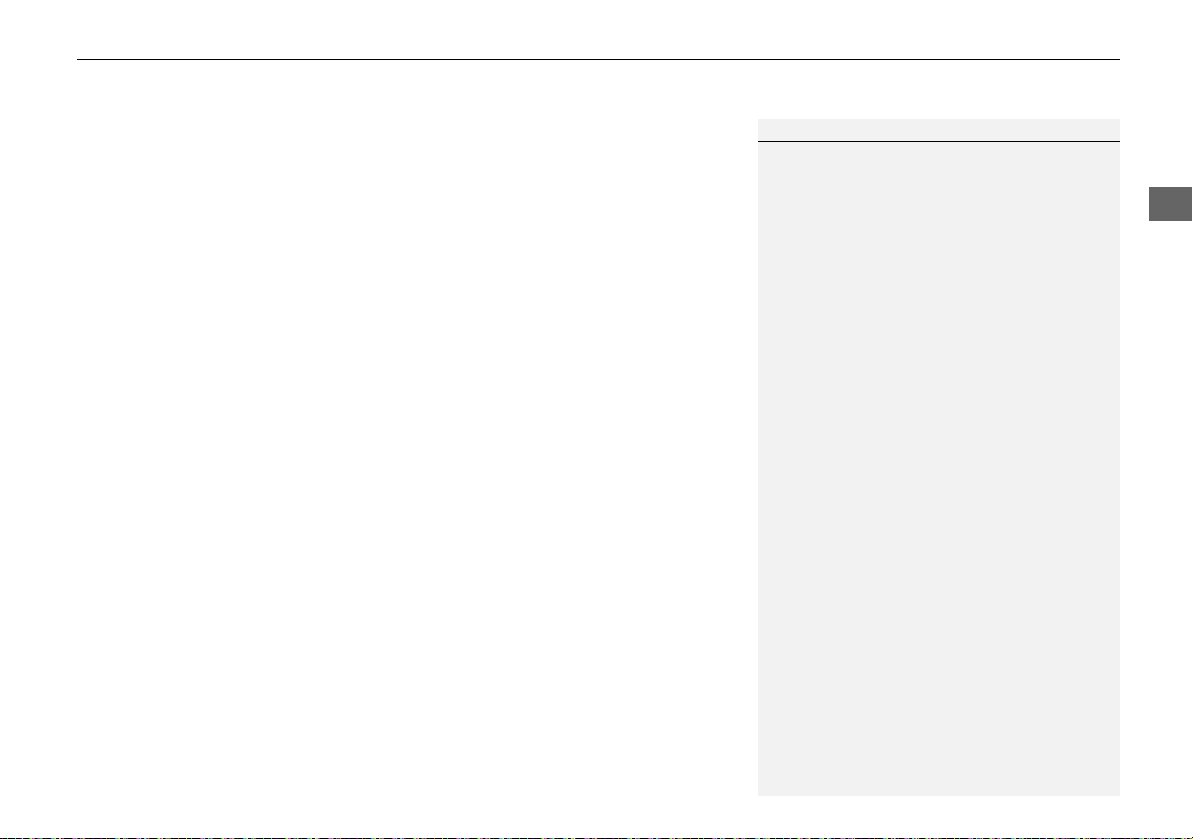
Select the display mode during route guidance: single-screen mode (default) or split-
screen mode.
Rotate i to select an option. Press
u.
The following options are available:
• Single Screen: Displays the map and guidance screens on separate screens.
■ Guidance Mode
1 Guidance Mode
The guidance mode can also be selected from
the System Setup menu.
2 Routing & Guidance P. 49
Map screen
Press the
MAP/GUIDE
button
Guidance screen
Continued
107
Map Menu
Map Information
Navigation
■ Fine-tuning the Icons
Icons in some categories can be fine-tuned to display or hide.
1. Rotate i to select an icon
category from the list (e.g., Other
Icons). Press u.
2. Rotate i to select the icons to
display on the map. Press u.
Pressing u toggles the icon
display on or off.
Repeat the procedure as
necessary.
3. Move r to select OK.
1 Fine-tuning the Icons
To display the “Other Icons,” be sure to turn on
OTHER ICON in the icon bar.
Continued
108
Map Menu
Map Information
Navigation
H ENTER button (on map)
Map Information
Select the map orientation.
Rotate i to select North-up or
Heading-up. Press u.
The system changes the map
orientation and displays the map
screen.
The following options are available:
• North-up: Displays the map with North always pointing up.
• Heading-up: Displays the map so that the direction you are traveling is always
pointing up.
■ Map Orientation
1 Map Orientation
d “Display Heading-up” (from map screen), d
“Display North-up” (from map screen)
The red arrow in the symbol always points North.
On scales greater than 1 mile, North-up mode is
always used.

109
Map Menu
Map Information
Navigation
H ENTER button (on map)
Map Information
Current Location
Display and save your current location for future use as a destination. The address,
latitude, longitude, and elevation of your current location are displayed.
■ To save your current location in the address book:
1. Rotate i to select Save. Press u.
2. Edit the name, phone number, and
category.
2 Address Book P. 38
3. Move r to select OK.
■ Current Location
1 Current Location
d “Display Current Location” (on map screen)
You can also save the current location by saying
d “Register the Current Location”.
If you have PIN-protected your address book,
enter your PIN number when prompted. Move r
to select OK. PIN numbers are optional.
2 PIN Numbers P. 43
The elevation is not displayed if the system is
receiving insufficient GPS information. When
elevation is displayed, it may differ with roadside
elevation signs by ±100 feet or more.
Saving your current location does not change or
cancel your current route.
Continued
113
Map Menu
Map Information
Navigation
■ Traffic icon
Type
Icon display
control
Icon
selectable
Icon
searchable
Traffic speed Yes No No
Traffic incident Yes No Yes
1 Traffic Incident
When you use the Interface Dial to position the
cursor (round red circle) over the traffic incident
icon, you can view the summary of the incident.
When you press u to select the traffic incident
icon, you can view a pop-up message describing
the incident in detail.
114
Map Menu
FM Traffic
Navigation
FM Traffic
H ENTER button (on map)
Traffic Incidents
View and avoid specific incidents and/or congestion on your route:
1. Rotate i to select an incident
from the list. Press u.
The system displays the map
screen and the incident location.
1 FM Traffic
d “Display traffic incidents”, d “Display traffic
list”
You can also display the traffic incidents from the
INFO screen.
You must be in or near a traffic-enabled city to
receive coverage for that area. FM Traffic is
available in the lower 48 states and Hawaii.
Traffic rerouting may not provide a detour route
depending on circumstances.
You can display traffic incidents and related
information on the map screen using voice
commands.
2 Map Display Commands P. 246
115
Map Menu
FM Traffic
Navigation
2. Press u to select TRAFFIC
DETAIL.
3. Rotate i to select Avoid. Press
u.
Repeat step 1 to 3 as necessary.
4. Move r to select REROUTE.
The system recalculates a detour
route that avoids the traffic
incidents.
1 FM Traffic
You can choose to avoid up to 10 traffic
incidents. It is not always possible for the system
to calculate a route that avoids all traffic
incidents or specific traffic incidents you select.
The “On Route” tab on the Traffic List screen is
only available during route guidance.
You cannot select an incident to avoid from the
“All” tab.
You can also detour around a traffic incident
manually if you encounter an unexpected
obstacle.
2 Taking a Detour P. 117

117
Changing Your Route
Canceling the Route
Navigation
Canceling the Route
H DEST/ROUTE button (when en route)
Cancel Route
Cancel the route guidance and remove the destination and all waypoints from the
destination list. The system then returns to the map screen.
Taking a Detour
H DEST/ROUTE button (when en route)
Detour
Calculate a detour route manually. The system attempts to calculate a new route by
avoiding the next 5 miles (while on a freeway) or 1 mile (while on a surface street).
Avoiding Streets
H DEST/ROUTE button (when en route)
Avoid Streets
Select a street or streets along your route to avoid.
1. Rotate i to select the street you
want to avoid. Press u.
Repeat the procedure to avoid
other streets.
Streets to be avoided are
indicated with a trash icon.
1 Canceling the Route
You can also cancel your route from the Map
Menu.
2 Map Menu P. 98
1 Taking a Detour
The detour option is convenient if you encounter
an unexpected obstacle such as a road closure or
extremely heavy traffic congestion.
1 Avoiding Streets
Avoiding certain streets is convenient if you
know of road construction, road closures, or
excessive traffic along the route.
You cannot choose specific streets you want to
use, only those to avoid. However, you can select
intersections or waypoints (places/landmarks)
that the system will use in your route.
2 Adding Waypoints P. 118
You can store up to 10 streets to avoid. You
cannot avoid your current street or the streets of
your waypoint(s) or destination (system beeps if
selected).
Continued

118
Changing Your Route
Adding Waypoints
Navigation
2. Move r to select OK.
The system calculates a new
route.
Adding Waypoints
Add up to four waypoints (pit stops) along the route to your destination.
Waypoints are displayed on the map
screen as small, numbered red flags.
The route follows the waypoints in
the order they are listed in the
Destination List.
1 Adding Waypoints
Waypoints allow you to stop for gas or food, for
example, and then continue on to your
destination.
Press the MAP/GUIDE button to return to the
map screen without adding a waypoint at any
time.
The search corridor used for adding waypoints
can be adjusted.
2 Edit Waypoint Search Area P. 55
You can delete waypoints or edit the order of
waypoints in the destination list.
2 Editing the Destination List P. 122
119
Changing Your Route
Adding Waypoints
Navigation
H DEST/ROUTE button (when en route)
Waypoint
1. Rotate i to select a search
method and location to add a
waypoint. Press u.
The following options are available:
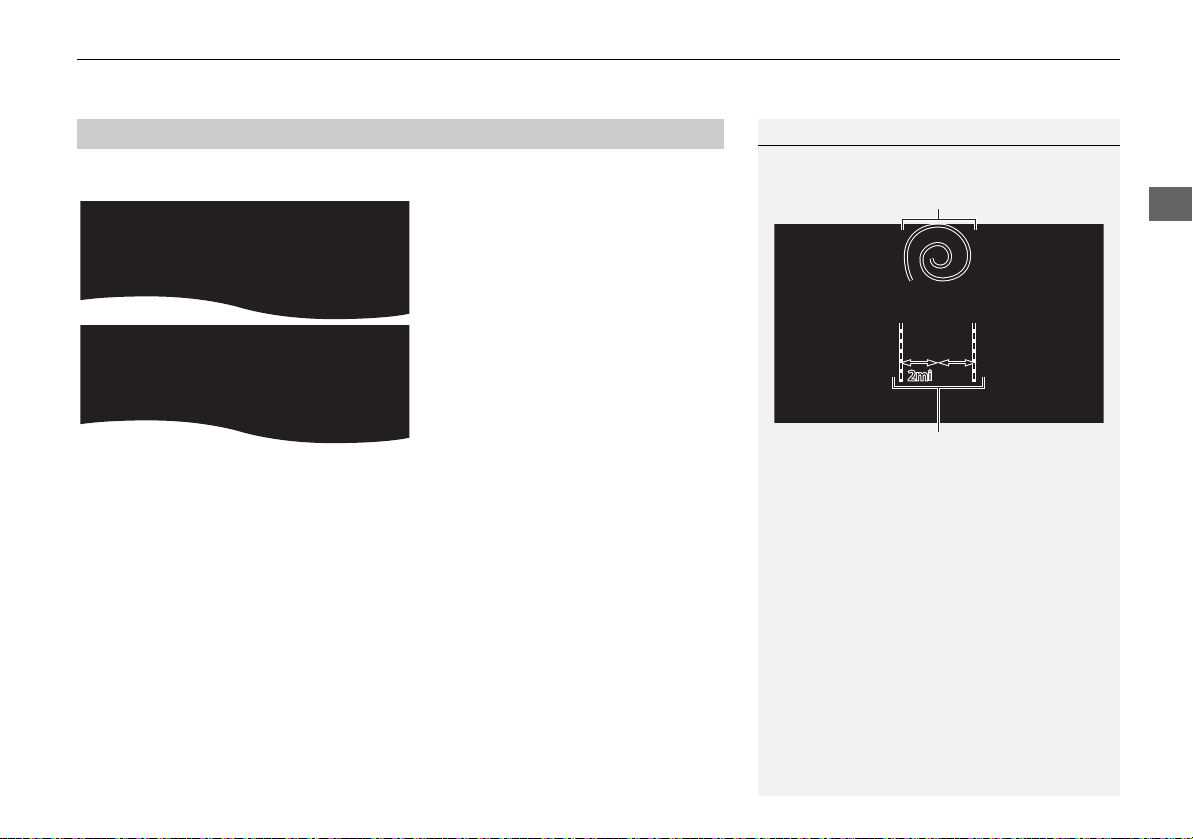
• SEARCH AROUND: Searches in a spiral pattern around the location you select.
• SEARCH ALONG: Searches within a “corridor” on either side of the locations you
select.
2. Rotate i to select a waypoint
category (e.g., GAS STATION).
Press u.
■ Adding Waypoints from the Route Menu
1 Adding Waypoints
Search method
“Search around” method
“Search along” method
Continued

121
Changing Your Route
Adding Waypoints
Navigation
1. Rotate i to select ADD TO Dest.
List. Press u.
2. Rotate i to select a location in
the Destination List. Press u.
3. Move r to select OK.
The route is automatically
recalculated and displayed on
the map screen.
■ Adding Waypoints from the Calculate Route Screen

124
Changing Your Destination
Selecting a Destination on the Map
Navigation
Selecting a Destination on the Map
Select a new destination when en route by selecting a location on the map.
1. Scroll the map to position the
cursor over your desired
destination, adjusting the map
scale as necessary. Press u.
If the address displayed is not
the desired location, press the
CANCEL/BACK button and
repeat the procedure.
2. Rotate i to select OK or Set as
Dest. (depending on the screen
displayed). Press u.
2 Calculating the Route P. 90
1 Selecting a Destination on the Map
If there is more than one icon or street under the
map cursor, you are prompted to select the item
from a list.
• Rotate i to select an item. Press u.
• If you select Map Icon, rotate i to select a
place and press u.

125
Changing Your Destination
Entering a New Destination
Navigation
3. Rotate i to select an option.
Press u.
The route is automatically
recalculated and displayed on
the map screen.
The following options are available:
• Set as New Destination: Sets the location as your new destination.
• Add to Dest. List: Sets the location as a new waypoint.
Entering a New Destination
H DEST/ROUTE button (when en route)
Dest. MENU 1 or Dest. MENU 2
Enter a new destination using the Destination Menu screen even when you are en
route.
1. Enter a new destination.
2 Entering a Destination P. 68
After entering a new
destination, the address is
displayed on the Calculate
Route screen.
2. Rotate i to select OK. Press u.
1 Entering a New Destination
d “Display Menu”, d “Display Navigation”
Continued

126
Changing Your Destination
Entering a New Destination
Navigation
3. Rotate i to select an option.
Press u.
The route is automatically
recalculated and displayed on
the map screen.
The following options are available:
• Set as New Destination: Sets the location as your new destination.
• Add to Dest. List: Sets the location as a new waypoint.

127
Navigation
Resuming Your Trip
Stop your vehicle en route (e.g., to rest, stop for gas, etc.), and then continue on
your route.
If you did not complete your route, the Continue Trip screen is displayed when you
restart your vehicle.
Rotate i to select OK. Press u.
You can continue on the same
route.
• Route Pref.: Changes the route preferences (calculating method).
2 Changing the Route Preference P. 91
• View Routes: Displays three different routes.
2 Viewing the Routes P. 92
• DESTINATION MAP: Move r to select DESTINATION MAP to display a map of
the destination.
2 Calculating the Route on the Destination Map P. 92
1 Continuing Your Trip
The Continue Trip screen has the same options
as when you calculate a route.
2 Calculating the Route P. 90
To cancel your destination, press the CANCEL/
BACK button.
Add to Address Book
You can add the destination address to the
address book.
2 Adding an Address Book Entry P. 38
Add to Dest. List
You can add the address to the Destination List.
2 Editing the Destination List P. 122
Call
You can place a phone call to the destination
phone number.
2 Bluetooth® HandsFreeLink® P. 170

129
Audio
This section describes how to operate the audio system. You can play
music from a wide array of media sources, and control the audio system
using the audio buttons, the Interface Dial, or voice control.
Audio System .................................................. 130
About Your Audio System.............................. 130
Auxiliary Input Jack ........................................ 131
Audio System Theft Protection ....................... 131
Playing FM/AM Radio ..................................... 132
Selecting FM/AM Mode.................................. 132
Audio Screen Control..................................... 132
Audio Menu .................................................. 133
Radio Data System (RDS)................................ 134
Playing XM® Radio ......................................... 136
Selecting XM Mode........................................ 136
Audio Screen Control..................................... 136
Audio Menu .................................................. 137
Note Function ................................................ 138
XM® Radio Service ........................................ 140
Playing a Disc................................................... 141
Selecting Disc Mode....................................... 141
Audio Screen Control..................................... 141
Audio Menu...................................................142
Playing MP3/WMA/AAC Discs ........................143
Recommended Discs ......................................144
Playing Hard Disc Drive (HDD) Audio ............145
Selecting HDD Mode ......................................145
Audio Screen Control .....................................146
Audio Menu...................................................146
Recording a Music CD to HDD........................148
Searching for Music........................................150
Adding a Track to a User Playlist.....................151
Editing a Playlist .............................................151
Displaying Music Information .........................153
Updating Gracenote® Album Info..................154
Playing an iPod® .............................................155
Selecting iPod® Mode....................................156
Audio Screen Control .....................................156
Audio Menu...................................................157
Searching for Music........................................158
Searching for Music Using Song By Voice™
(SBV)............................................................... 159
Playing a USB Flash Drive............................... 160
Selecting USB Mode....................................... 161
Audio Screen Control..................................... 161
Audio Menu .................................................. 162
Playing Tracks in Folders................................. 163
Playing Bluetooth® Audio ............................. 164
Selecting Bluetooth® Audio Mode................. 164
Switching to HFL Mode.................................. 165
Audio Screen Control..................................... 165
Adjusting the Sound ....................................... 166
Audio Remote Controls .................................. 167
Steering Wheel Controls ................................ 167
130
Audio
Audio System
About Your Audio System
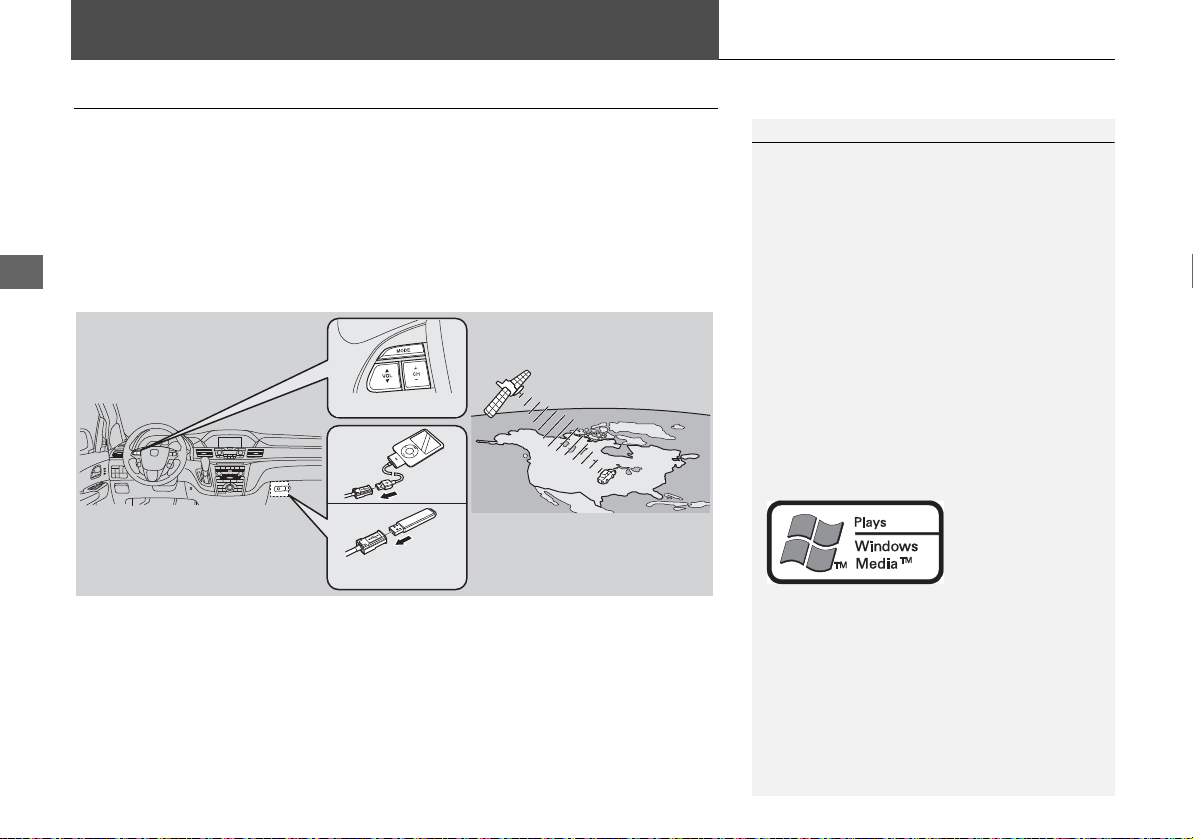
The audio system features FM/AM radio and XM® Radio. It can also play audio discs,
WMA/MP3/AAC tracks, iPods®, USB flash drives, and Bluetooth® devices.
The audio system is operable from the buttons and switches on the panel, or the
remote controls on the steering wheel.
The radio theft protection feature activates if the audio system is disconnected from
electric power. You need to enter a radio code that comes with your vehicle to
reactivate the disabled system.
1 About Your Audio System
XM® Radio is available on a subscription basis
only.
2 XM® Radio Service P. 140
XM® Radio is available in the United States and
Canada, except Hawaii, Alaska, and Puerto Rico.
XM is a registered trademark of Sirius XM®
Radio, Inc.
Video CDs, DVD-Videos, and 3-inch (8-cm) mini
discs are not supported.
iPod® is a registered trademark owned by Apple
Inc.
MP3 and AAC are standard audio compression
formats. WMA is an audio compression format
developed by Microsoft Corporation.
You can operate the audio system by voice
commands.
2 Audio Commands P. 249
XM® Radio
Remote Control
iPod®
USB Flash
Drive
131
Audio System
Auxiliary Input Jack
Audio
Auxiliary Input Jack
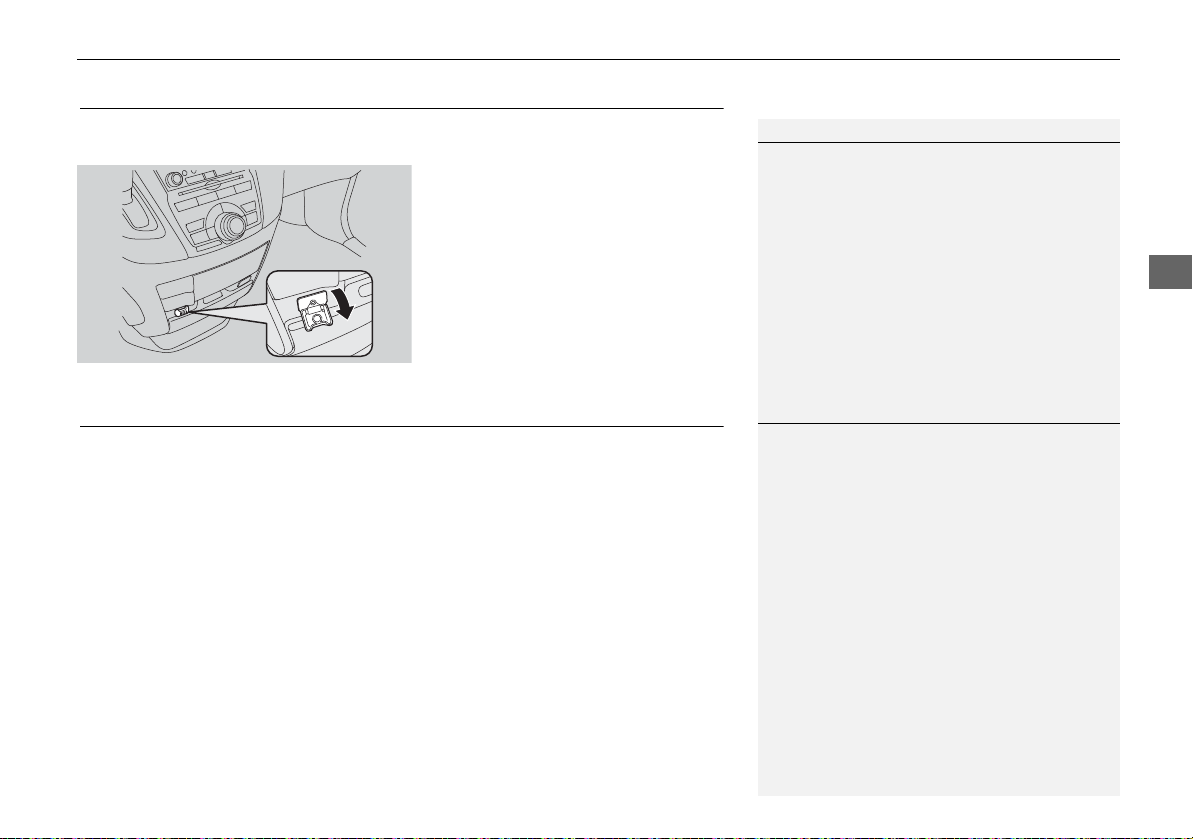
Use the jack in the front console compartment to connect standard audio devices.
1. Open the AUX cover.
2. Connect a standard audio device to
the input jack using a 1/8 inch (3.5
mm) stereo miniplug.
The audio system automatically
switches to the AUX mode.
Audio System Theft Protection
The audio system is disabled when it is disconnected from the power source (e.g.,
when the battery is disconnected or goes dead.)
■ Entering the Audio Security Code
“ENTER CODE” appears on the display when the power is reconnected.
1. Turn on the audio system.
2. Enter the audio security code using the preset buttons. If you enter an incorrect
digit, continue to the last digit, then try again. If you do not enter the code
correctly after 10 tries, you need to visit a dealer to have the system reset.
1 Auxiliary Input Jack
To switch the mode, press any of the other audio
mode buttons. You can return to the AUX mode
by pressing the USB/AUX button.
You cannot use the auxiliary input jack if you
replace the audio system.
1 Audio System Theft Protection
Find the audio system’s security code and serial
number label in your Owner’s Manual kit.
Do not store the label in your vehicle. If you lose
the label, you must first retrieve the serial
number, and then obtain the code from your
dealer.
132
Audio
Playing FM/AM Radio
Selecting FM/AM Mode
1. Press the AM/FM button.
Press the AM/FM button again, if necessary, to select the frequency band (AM,
FM1, FM2).
2. Select a station using the buttons (Preset, SCAN), the bars (SKIP, CATEGORY), and
the TUNE knob.
On the FM bands, you can also use the CATEGORY bar and TITLE button to
select a station provided by the Radio Data System (RDS).
The band and frequency are displayed on the display.
Audio Screen Control
H AUDIO button (in FM/AM mode)
Control the audio system through the navigation screen.
1. Move e to select a frequency band
(AM, FM1, or FM2).
2. Rotate i to select a preset
station. Press u.
Press and hold u until a beep
sounds to store the current
station in a preset button.
Move r to select AUDIO
MENU.
2 Audio Menu P. 133
1 Playing FM/AM Radio
d “Display audio screen”
You can control the radio using voice control
commands.
2 Radio Commands P. 249
A visual guide helps you operate the audio
system.
2 System Controls P. 4
2 Basic Operation P. 6
The ST indicator comes on the display for stereo
FM broadcasts. Stereo reproduction in AM is not
available.
The radio can receive the complete AM and FM
bands:
AM band: 530 to 1710 kHz
FM band: 87.7 to 107.9 MHz
You can store six AM stations and 12 FM stations
in the preset buttons. FM1 and FM2 let you store
six stations each.
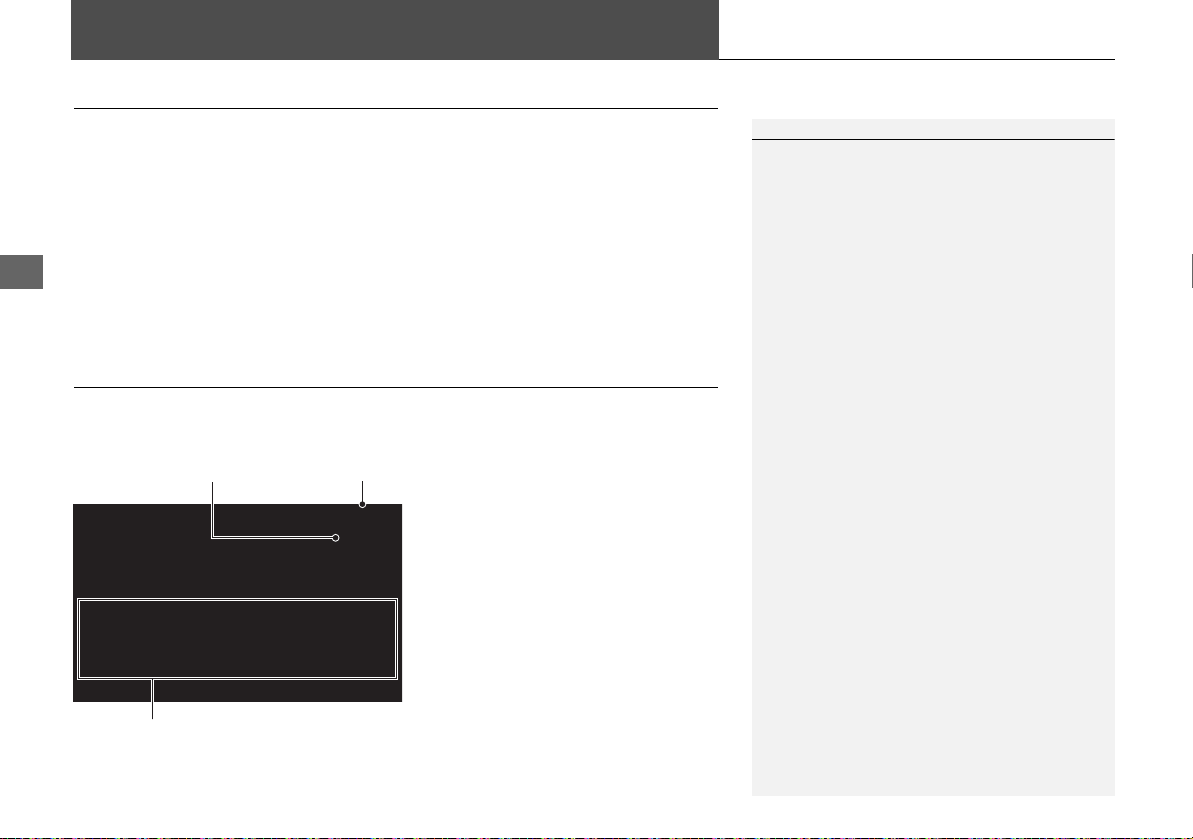
Stereo indicator
Frequency band
Preset stations

137
Playing XM® Radio
Audio Menu
Audio
Audio Menu
H AUDIO button (in XM mode)
AUDIO MENU
Rotate i to select an item. Press u.
The following items are available:
• Note: Records a 10-second sound file from the current channel.
2 Note Function P. 138
• Sound Setup: Displays the sound preferences screen.
2 Adjusting the Sound P. 166
• Tune: Tunes to the channel you select. Rotate i to select a channel.
• Mode: Sets CH (channel mode) or CAT (category mode) scan mode.
• Channel List: Displays the list of available channels. Scroll the list to select a
channel.
• Channel Scan: Scans for channels with a strong signal in the current band and
plays a 10-second sample. Select Channel Scan again to stop scanning and play
the current selection.
• Category Scan: Scans for channels with a strong signal in the selected category in
the current band and plays a 10-second sample. Select Category Scan again to
stop scanning and play the current selection.
138
Playing XM® Radio
Note Function
Audio
Note Function
Record a 10-second sound file from the current channel that contains the channel,
category, name, and title information.
1. When tuned to the channel you want to record, press and hold the XM button for
a few seconds to start recording.
2. Press the XM button again to stop the recording if less than 10 seconds have
elapsed.
H AUDIO button (in XM mode)
AUDIO MENU
Note
Rotate i to select a sound file. Press
u to select PLAY.
■ Recording a Sound File
■ Replaying a Sound File
1 Recording a Note
The system can store up to 30 sound files. Each
time you add a new recording, the oldest one is
deleted.
Recorded date

139
Playing XM® Radio
Note Function
Audio
H AUDIO button (in XM mode)
AUDIO MENU
Note
1. Rotate i to select a sound file.
2. Move y to select DELETE.
3. Rotate i to select Delete All or
Delete Selected Item. Press u.
■ Deleting a Sound File
140
Playing XM® Radio
XM® Radio Service
Audio
XM® Radio Service
1. You need your radio ID ready before registering for subscription.
To see the ID in the display, rotate the TUNE knob while in XM mode until “0”
appears in the center display.
2. Have your radio ID and credit card number ready, and either call XM or visit the
XM website to subscribe.
Press the XM button and stay in this mode for about 30 minutes until the service is
activated. Make sure your vehicle is in an open area with good reception.
LOADING: XM is loading the audio or program information.
OFF AIR: The channel is not currently broadcasting.
UPDATING: The encryption code is being updated. Channels 0 and 1 still work
normally.
NO SIGNAL: The signal is too weak in the current location.
--------: No such channel exists, the channel is not part of your subscription, or the
artist or title information is not available.
CHECK ANTENNA: There is a problem with the XM antenna. Contact a dealer.
■ Subscribing to XM® Radio
■ Receiving XM® Radio
■ XM® Radio Display Messages
1 Subscribing to XM® Radio
Contact Information for XM® Radio:
U.S.: XM® Radio at www.siriusxm.com, or
(800) 852-9696
Canada: XM Canada at www.xmradio.ca, or
(877) 209-0079
1 Receiving XM® Radio
The XM satellites are in orbit over the equator;
therefore, objects south of the vehicle may cause
satellite reception interruptions. Satellite signals
are more likely to be blocked by tall buildings
and mountains the farther north you travel from
the equator.
You may experience reception problems under
the following circumstances:
• In a location with an obstruction to the south
of your vehicle
• In tunnels
• On the lower level of a multi-tiered road
• Large items are carried on the roof rack

142
Playing a Disc
Audio Menu
Audio
Audio Menu
H AUDIO button (in DISC mode)
AUDIO MENU
Rotate i to select an item. Press u.
The following items are available, depending on the type of disc:
• Rec to HDD: Records a music CD onto the HDD for playback using HDD Audio.
2 Recording a Music CD to HDD P. 148
• Sound Setup: Displays the sound preferences screen.
2 Adjusting the Sound P. 166
• HDD Setup: Displays menu for setting HDD preferences for recording music CDs
and for updating Gracenote® information.
2 Recording a Music CD to HDD P. 148
2 Updating Gracenote® Album Info P. 154
• Repeat:
6: Repeats the current track.
7: Repeats all tracks in the current folder.
• Random:
3: Plays all tracks on the current disc in random order.
4: Plays all tracks in the current folder in random order.
1 Repeat, Random, and Scan Play
1. Rotate i to select Repeat, Random, or
Scan. Press u.
2. Rotate i to select an option. Press u.
143
Playing a Disc
Playing MP3/WMA/AAC Discs
Audio
• Scan:
1: Scans all tracks on the disc (or in the selected folder) in the order they were
recorded (stored) and plays a 10-second sample. Select OFF to stop scanning and
play the current selection.
2: Scans the first track in each folder on the disc and plays a 10-second
sample. Select OFF to stop scanning and play the current selection.
Playing MP3/WMA/AAC Discs
H AUDIO button (in DISC mode)
FOLDER LIST
Change the folder on MP3/WMA/AAC discs that have tracks stored in a folder
structure.
1. Rotate i to select a folder. Press
u.
2. Rotate i to select a track. Press
u.
The system displays the track list
and begins playing the selected
track.
1 Playing MP3/WMA/AAC Discs
Folder List
• Any tracks not in a folder are automatically
added to a “ROOT” folder, which is displayed
at the top of the Folder List.
• If the root folder has additional folders in a
lower layer, they are listed on the screen.

146
Playing Hard Disc Drive (HDD) Audio
Audio Screen Control
Audio
Audio Screen Control
H AUDIO button (in HDD mode)
Control the audio screen through the navigation system.
Rotate i to select a track. Press u.
Move w or y to select ALBUM-
or ALBUM+ to change albums.
Move e to select MUSIC SEARCH
to display the Music Search Menu.
2 Searching for Music P. 150
Move r to select AUDIO MENU.
2 Audio Menu P. 146
Audio Menu
H AUDIO button (in HDD mode)
AUDIO MENU
Rotate i to select an item. Press u.
HDD mode
Track list
1 Repeat, Random, and Scan Play
1. Rotate i to select Repeat, Random, or
Scan. Press u.
2. Rotate i to select an option. Press u.

147
Playing Hard Disc Drive (HDD) Audio
Audio Menu
Audio
The following items are available:
• Sound Setup: Displays the sound preferences screen.
2 Adjusting the Sound P. 166
• Add to Playlist: Adds the current track to a user playlist.
2 Adding a Track to a User Playlist P. 151
• Edit Music Info.: Edits artist name, playlist name, track name, genre, and track
order in playlists. You can also delete tracks and playlists.
2 Editing a Playlist P. 151
• Get Music Info.: Gets the original title information for a track in a user playlist
from an original playlist.
2 Displaying Music Information P. 153
• Repeat
6: Repeats the current track.
• Random
3: Plays all tracks on the HDD in random order.
• Scan
1: Scans all tracks on the HDD in the order they were recorded and plays a 10-
second sample. Select OFF to stop scanning and play the current selection.
• HDD Setup: Displays menu for setting preferences for recording music CDs and
updating Gracenote® information.
2 Recording a Music CD to HDD P. 148
2 Updating Gracenote® Album Info P. 154

151
Playing Hard Disc Drive (HDD) Audio
Adding a Track to a User Playlist
Audio
Adding a Track to a User Playlist
H AUDIO button (in HDD mode)
AUDIO MENU
Add to Playlist
Add a track from any playlist to one of the six user playlists.
Rotate i to select a playlist. Press
u.
The track is added to the end of the
playlist.
Editing a Playlist
H AUDIO button (in HDD mode)
AUDIO MENU
Edit Music Info.
Change the playlist name, track title, artist name, genre, and track order of the
current playlist. You can also delete tracks, playlists, and albums.
Rotate i to select an item. Press u.
1 Adding a Track to a User Playlist
The maximum number of songs in each of the six
user playlists is 999. Adding new songs
overwrites the oldest songs.
Adding a track from a user playlist into the same
user playlist will cause the track to appear twice
in the playlist.
1 Editing a Playlist
Deleting an album (original playlist) also deletes
the album tracks you have stored in any user
playlists.
Deleting a user playlist or deleting all tracks from
a user playlist does not remove the playlist folder.
The folder retains the playlist name and artist
information.
Continued

152
Playing Hard Disc Drive (HDD) Audio
Editing a Playlist
Audio
The following items are available, depending on the type of playlist:
• Edit Artist Name: Enter a new artist name. Move r to select OK when finished.
Then, select whether to apply the new artist name to the album (playlist) and all
tracks, the current track only, all tracks, or the album (playlist) only.
• Edit Playlist Name (user playlists): Enter a new playlist name. Move r to select
OK when finished.
• Edit Album Name (original playlists): Enter a new album name. Move r to
select OK when finished.
• Edit Track Name: Enter a new track name. Move r to select OK when finished.
• Edit Genre: Select a new genre. Then select the original playlist to apply the
genre.
• Edit Track Order (user playlists): Select the track to move, and then select the
new location. Repeat to move more than one track. Move r to select OK when
finished.
• Delete Playlist: Deletes the user playlist. Rotate i to select Yes at the
confirmation prompt to delete the playlist.
• Delete Album: Deletes the original playlist. Rotate i to select Yes at the
confirmation prompt to delete the album.
• Delete Track: Deletes the current track. Rotate i to select Yes at the
confirmation prompt to delete the current track.

153
Playing Hard Disc Drive (HDD) Audio
Displaying Music Information
Audio
Displaying Music Information
H AUDIO button (in HDD mode)
AUDIO MENU
Get Music Info.
Display the music information (album name, artist name, genre) for an album
(original playlist).
Gracenote® searches for the
information of the currently
selected album (original playlist).
Rotate i to select an album. Press
u.
The information is displayed.
1 Displaying Music Information
The maximum number of original playlists is 999
with a maximum of 99 songs in each playlist.
Each album CD counts as an original playlist.
154
Playing Hard Disc Drive (HDD) Audio
Updating Gracenote® Album Info
Audio
Updating Gracenote® Album Info
H AUDIO button (in HDD or DISC mode)
AUDIO MENU
HDD Setup
Update the Gracenote® Album Info (Gracenote® Media Database) that is included
with the navigation system.
1. Insert the update disc into the disc
slot or connect the USB flash drive
that includes the update.
2. Rotate i to select Gracenote
Info. Update. Press u.
3. Rotate i to select USB or Disc
update source media. Press u.
4. Rotate i to select Yes on the
confirmation screen. Press u.
The system updates the
Gracenote information.
5. Rotate i to select OK on the
confirmation screen. Press u.
1 Updating Gracenote® Album Info
To acquire updated files:
• Consult your dealer.
• U.S.: Visit automobiles.honda.com.
• Canada: Visit www.hondanavi.ca.
Once you perform an update, any information
you edited before will be overwritten or erased.
Maximum capacity Remaining capacity
Gracenote version
number

156
Playing an iPod®
Selecting iPod® Mode
Audio
Selecting iPod® Mode
1. Connect the iPod® to the USB adapter cable in the console compartment.
2. Press the USB/AUX button until you get to iPod® mode.
3. Select a track using the iPod® menu on the screen.
The current track number and total number of tracks are displayed on the
display.
Audio Screen Control
H AUDIO button (in iPod® mode)
Control the audio screen through the navigation system.
Rotate i to select a track. Press u.
Move e to select MUSIC SEARCH
to change songs in the track list.
2 Searching for Music P. 158
Move r to select AUDIO MENU.
2 Audio Menu P. 157
1 Playing an iPod®
d “Display audio screen”
You can control the iPod® using voice control
commands.
2 iPod® Commands P. 251
A visual guide helps you operate the audio
system.
2 System Controls P. 4
2 Basic Operation P. 6
In some cases, the name of the artist, album, or
track may not appear correctly.
Available operating functions vary on models or
versions. Some functions may not be available on
the vehicle’s audio system.
If there is a problem, you may see an error
message on the display.
2 Error Messages P. 227
iPod® mode
Track list

157
Playing an iPod®
Audio Menu
Audio
Audio Menu
H AUDIO button (in iPod® mode)
AUDIO MENU
Rotate i to select an item. Press u.
The following items are available:
• Sound Setup: Displays the sound preferences screen.
2 Adjusting the Sound P. 166
• Repeat
6: Repeats the current track.
• Shuffle:
3: Plays all tracks in the track list in random order.
5: Plays all tracks in the track list in random order by albums. Each song in an
album is played in the right order and only the order of albums is randomized.
1 Repeat and Shuffle Play
1. Rotate i to select Repeat or Shuffle. Press
u.
2. Rotate i to select an option. Press u.

160
Audio
Playing a USB Flash Drive
1. Unclip the USB connector in the glovebox and loosen the adapter cable.
2. Install the USB flash drive to the USB connector.
Use a recommended USB flash drive of 256 MB or higher.
Some digital audio players may not be compatible.
Some USB flash drives (e.g., a device with security lockout) may not work.
Some software files may not allow for audio play or text data display.
Some versions of MP3, WMA, or AAC formats may be unsupported.
■ Connecting a USB Flash Drive
1 Connecting a USB Flash Drive
• Do not use an extension cable with the USB
adapter cable.
• Do not connect your USB flash drive using a
hub.
• Do not use a device such as a card reader or
hard disk drive, as the device or your tracks
may be damaged.
• We recommend backing up your data before
using the device in your vehicle.
■ USB Flash Drives
1 USB Flash Drives
Digital music tracks, such as MP3, WMA, AAC,
etc., in USB flash drives cannot be copied to
HDD. Likewise, digital music tracks recorded to
HDD cannot be copied to USB flash drives.

161
Playing a USB Flash Drive
Selecting USB Mode
Audio
Selecting USB Mode
1. Connect the USB flash drive to the USB adapter cable in the console
compartment.
2. Press the USB/AUX button until you get to USB mode.
3. Select a track using skip, scan, folder list, or track list.
The current track number and folder number are displayed on the display.
Audio Screen Control
H AUDIO button (in USB mode)
Control the audio screen through the navigation system.
Rotate i to select a track. Press u.
Move e to select FOLDER LIST to
display the folder list.
2 Playing Tracks in Folders P. 163
Move r to select AUDIO MENU.
2 Audio Menu P. 162
1 Playing a USB Flash Drive
d “Display audio screen”
You can control the audio system using voice
control commands.
2 USB Commands P. 251
A visual guide helps you operate the audio
system.
2 System Controls P. 4
2 Basic Operation P. 6
In some cases, the name of the artist, album, or
track may not appear correctly.
Tracks on the USB flash drive are played in their
stored order. This order may be different from
the order displayed on your PC or device.
The audio system displays UNPLAYABLE FILE, and
then skips to the next track when the following
tracks are played:
• Tracks in WMA or AAC format protected by
digital rights management (DRM)
• Tracks in unsupported format
If there is a problem, you may see an error
message on the display.
2 Error Messages P. 227
USB mode
Track list
163
Playing a USB Flash Drive
Playing Tracks in Folders
Audio
Playing Tracks in Folders
H AUDIO button (in USB mode)
FOLDER LIST
Change the folder if the tracks are stored in a folder structure.
1. Rotate i to select a folder. Press
u.
2. Rotate i to select a track. Press
u.
The display returns to the track list
menu and the selected track.
1 Playing Tracks in Folders
Folder List
• Any music tracks not in a folder are
automatically added to a “ROOT” folder,
which is displayed at the top of the Folder List.
• If the root folder has additional folders in a
lower layer, they are listed on the screen.
RANDOM ALL TRACKS
Move r to select RANDOM ALL TRACKS to
shuffle the playback of all tracks on the USB flash
drive.

164
Audio
Playing Bluetooth® Audio
Your audio system allows you to listen to music tracks stored on your Bluetooth-
compatible phone.
This function is available when the phone is linked to the vehicle’s Bluetooth®
HandsFreeLink® (HFL) system.
2 Bluetooth® HandsFreeLink® P. 169
Selecting Bluetooth® Audio Mode
1. Make sure that your phone is on, paired, and linked to HFL.
2 Pairing a Phone P. 172
2. Press the USB/AUX button to select Bluetooth® Audio mode.
A Bluetooth® message and icon are displayed on the display and screen.
3. If necessary, follow the cell phone operating instructions for playing audio tracks.
Check the following if the phone is not recognized:
• Another HFL-compatible phone, which is not compatible for Bluetooth® Audio, is
already connected.
1 Playing Bluetooth® Audio
d “Display audio screen”
You can control the audio system using voice
control commands.
2 Bluetooth® Audio Commands P. 251
Not all Bluetooth-enabled phones with
streaming audio capabilities are compatible. To
check if your phone is compatible:
• U.S.: Visit automobiles.honda.com/
handsfreelink.
• Canada: Visit www.handsfreelink.ca.
• Call HandsFreeLink customer support at
(888) 528-7876.
In some states, it may be illegal to perform some
data device functions while driving.
In some cases, the name of the artist, album, or
track may not appear correctly.
Only one phone can be used with HFL at a time.
When there are more than two paired phones in
the vehicle, the first paired phone the system
finds will be automatically linked.
Pressing the TITLE side of the SCAN/TITLE bar
switches the center display between the
Bluetooth® Audio message and the device
name.
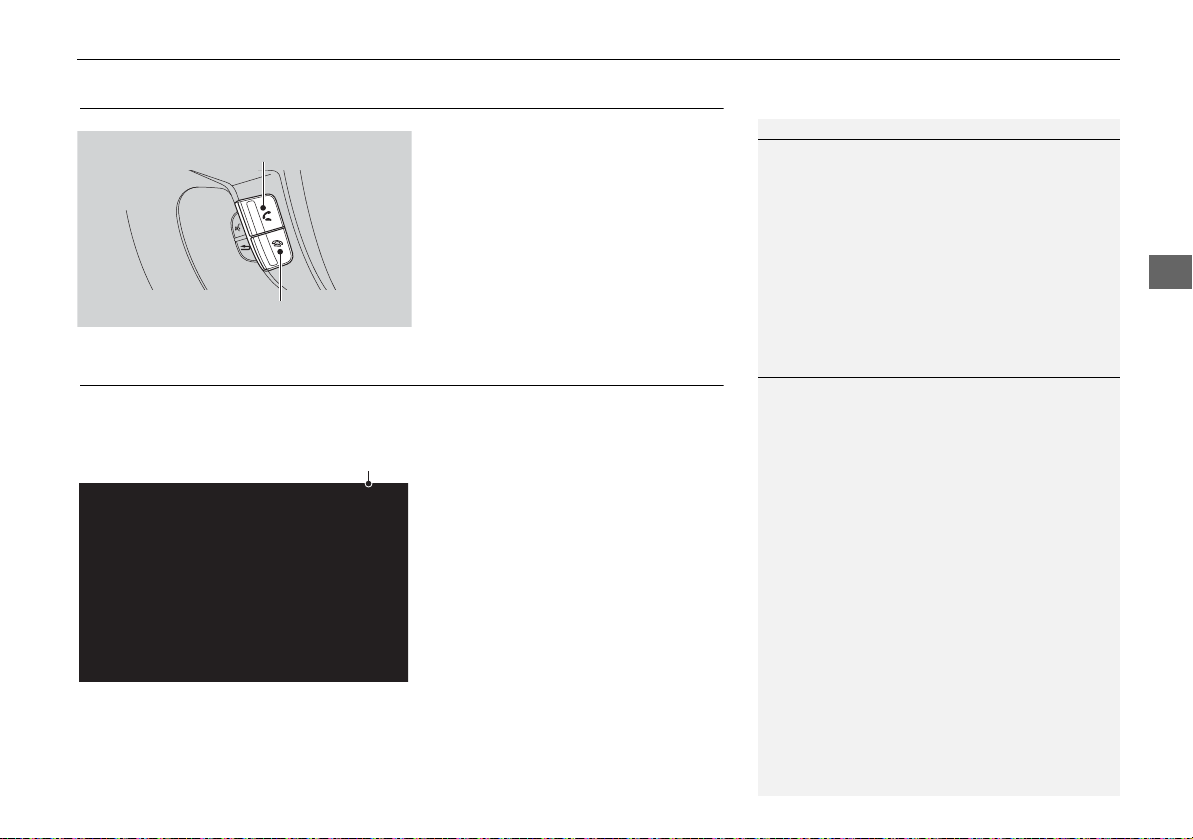
165
Playing Bluetooth® Audio
Switching to HFL Mode
Audio
Switching to HFL Mode
1. If you receive a call when
Bluetooth® Audio is playing, press
the h (Pick-Up) button on the
steering wheel to answer the call.
2 Bluetooth® HandsFreeLink®
P. 170
2. Press the j (Hang-Up) button to
end the call, and Bluetooth® Audio
is resumed.
Audio Screen Control
H AUDIO button (in BT mode)
AUDIO MENU
Control the audio screen through the navigation system.
Rotate i to select an item. Press u.
The following items are available:
• Sound Setup: Displays the sound preferences screen.
2 Adjusting the Sound P. 166
• Resume/Pause: Resumes/pauses play.
1 Playing Bluetooth® Audio
If more than one phone is paired to the HFL
system, there may be a delay before the system
begins to play.
A “NO CONNECT” message may be displayed if:
• The phone is not linked to HFL.
• The phone is not turned on.
• The phone is not in the vehicle.
• An incompatible phone is connected.
h (Pick-Up) button
j (Hang-Up) button
1 Audio Screen Control
The pause function may not be available on
some devices.
The display items may vary depending on the
connected device.
Bluetooth® Audio mode

171
Bluetooth® HandsFreeLink®
Bluetooth® HandsFreeLink®
Say d “Hands-free help” or d “Help” any time to get help or hear a list of
commands.
2 Voice Help P. 5
■ Help Features
1 Bluetooth® HandsFreeLink®
Bluetooth® Wireless Technology
Bluetooth® name and logos are registered
trademarks owned by Bluetooth SIG, Inc., and
any use of such marks by Honda Motors Co.,
Ltd., is under license. Other trademarks and
trade names are those of their respective owners.
HFL Limitations
An incoming call on HFL will interrupt
Bluetooth® Audio when it is playing. Audio will
resume when the call is ended.
173
Bluetooth® HandsFreeLink®
Pairing a Phone
Bluetooth® HandsFreeLink®
H PHONE button
PHONE SETUP
Connection
Use the Phone setup screen to pair an additional Bluetooth-compatible phone if a
phone has been previously paired to the system.
1. Rotate i to select Add New
Phone. Press u.
2. Select the location (1-6) for the
phone to be added.
3. Put your cell phone in “Discovery”
or “Search” mode.
4. Select OK.
The system begins to search for
your phone.
5. Select your phone in the list.
Select Find Another Phone if
your phone is not found.
Refer to your phone manual for
instructions on searching for a
Bluetooth® device.
6. Enter the 4-digit pairing code on
your phone when prompted to
complete the pairing process.
■ Pairing from Phone Setup
1 Pairing from Phone Setup
If a prompt appears asking to connect to a
phone, select No and proceed with step 1.
Continued
174
Bluetooth® HandsFreeLink®
Pairing a Phone
Bluetooth® HandsFreeLink®
H PHONE button
PHONE SETUP
Connection
1. Rotate i to select Pass-key. Press
u.
2. Rotate i to select an item. Press
u.
The following items are available:
• Random: Uses a randomly generated pass-key.
• Fixed: Create your own pass-key.
■ Changing the Pass-key
175
Bluetooth® HandsFreeLink®
Pairing a Phone
Bluetooth® HandsFreeLink®
3. Move w to select DELETE to
remove the current pass-key.
4. Enter a new pass-key. Move r to
select OK.
H PHONE button
PHONE SETUP
Connection
1. Rotate i to select Delete.
■ Deleting a Paired Phone
Continued
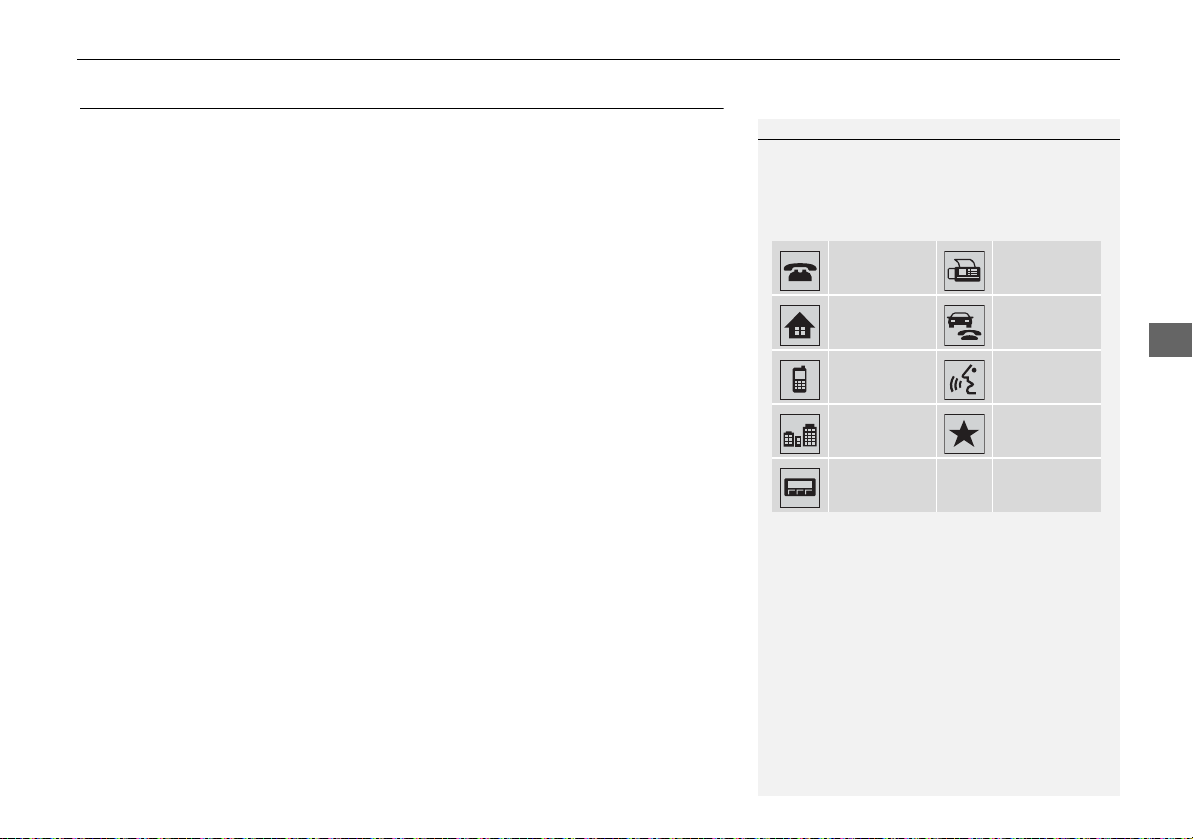
177
Bluetooth® HandsFreeLink®
Importing Phonebook Data
Bluetooth® HandsFreeLink®
Importing Phonebook Data
When your phone is paired, the
content of its phonebook and call
history are automatically imported to
HFL.
1 Importing Phonebook Data
Up to 10,000 numbers for 1,000 names can be
imported. Up to three icons are displayed for
each phonebook entry. If there are more than
three numbers for an entry, “…” is displayed.
This feature is not available on all phones.
Preference Fax
Home Car
Mobile Voice
Work Other
Pager
178
Bluetooth® HandsFreeLink®
Setting Up Speed Dialing
Bluetooth® HandsFreeLink®
Setting Up Speed Dialing
H PHONE button
PHONE SETUP
Edit Speed Dial
Store Speed Dial
Create speed dial entries with voice tags for easy calling.
1. Rotate i to select a location in
the speed dial list. Press u.
2. Rotate i to select a number entry
method. Press u.
3. Follow the prompt to enter a voice
tag.
The following options are available:
• Phonebook: Adds a number from the imported phonebook.
• Call History: Adds a number from the last 30 numbers.
• Dial: Enters a number manually.
1 Setting Up Speed Dialing
You can control the HFL system using voice
commands.
2 HFL Menus P. 186
Up to 20 speed dial entries can be stored per
user. The first four entries are displayed on the
Cellular Phone screen.
You can select a “No Entry” field directly from
the Cellular Phone screen to store a speed dial
number.
Speed dial
179
Bluetooth® HandsFreeLink®
Setting Up Speed Dialing
Bluetooth® HandsFreeLink®
H PHONE button
PHONE SETUP
Edit Speed Dial
1. Rotate i to select Store Voice
Tag. Press u.
2. Rotate i to select a speed dial
entry. Press u.
3. Follow the prompt to enter a voice
tag.
■ Registering a Voice Tag to a Speed Dial Entry
1 Registering a Voice Tag to a Speed Dial Entry
Voice tags allow you to call speed dial entries
from any screen by saying d “Dial by voice tag”
and the voice tag, followed by d “Dial”.
• Avoid using duplicate voice tags.
• Avoid using “Home” as a voice tag.
• It is easier for HFL to recognize a longer name
(e.g., “John Smith” instead of “John”).
1 Deleting a Voice Tag
1. Rotate i to select Delete Voice Tag. Press
u.
2. Rotate i to select the number you want to
delete the voice tag for. Move r to select OK.
1 Deleting a Speed Dial Entry
1. Rotate i to select Delete Speed Dial. Press
u.
2. Rotate i to select the entry you want to
delete. Move r to select OK.
180
Bluetooth® HandsFreeLink®
Editing User Name and PIN
Bluetooth® HandsFreeLink®
Editing User Name and PIN
H PHONE button
PHONE SETUP
Phone Name/PIN
Edit the user name of a paired phone, and protect the phonebook and speed dial
entries with a PIN.
Rotate i to select an item. Press u.
The following items are available:
• Name: Enter a name.
• PIN: Enter a 4-digit PIN. Re-enter to confirm. You can select DO NOT USE PIN to
remove a PIN number.
1 Editing User Name and PIN
You can control the HFL system using voice
commands.
2 HFL Menus P. 186
You can name up to six HFL users. Each can be
PIN protected, and have their own phonebook,
speed dial entries, and call history.
User name
PIN-protected
speed dial
181
Bluetooth® HandsFreeLink®
Phone Setup
Bluetooth® HandsFreeLink®
Phone Setup
H PHONE button
PHONE SETUP
Set HFL options and features.
1. Rotate i to select an item. Press
u.
2. Rotate i to select an option.
Press u.
The following items are available:
• Connection: Pairs your phone to the system, connect/disconnect your phone, or
changes the pass-key.
2 Pairing a Phone P. 172
• Edit Speed Dial: Stores/deletes the speed dials or edits the voice tag.
2 Setting Up Speed Dialing P. 178
• Phone Name/PIN: Change your phone name or protects the phonebook/speed
dials with a PIN.
2 Editing User Name and PIN P. 180
• Auto Transfer: Sets whether to automatically transfer a call from your phone to
HFL when you enter and turn on the vehicle.
ON (factory default): Automatically transfers your call to HFL.
OFF: Disables the feature.
• Auto Answer: Sets whether to automatically answer an incoming call after about
2, 5, or 10 seconds. To disable the feature, select OFF (factory default).
1 Editing User Name and PIN
You can control the HFL system using voice
commands.
2 HFL Menus P. 186
Clear Phone Information
When you transfer the vehicle to a third party,
delete all paired phones.
Continued

182
Bluetooth® HandsFreeLink®
Making a Call
Bluetooth® HandsFreeLink®
• Clear Phone Information: Clear all paired phones, phonebook entries, speed
dials, and pass-keys.
Making a Call
Make calls by entering a number or using the imported phonebook, call history, or
speed dial entries.
2 Using the Phonebook P. 183
2 Entering a Phone Number P. 183
2 Using Call History P. 184
2 Using Speed Dial P. 184
1 Making a Call
You can control the HFL system using voice
commands.
2 HFL Menus P. 186
When you say d “Dial by number” or d “Dial
by voice tag” on most screens, the following
screen appears:
Say the phone number or the voice tag (e.g., d
“John Smith“), followed by d “Dial“.
2 Registering a Voice Tag to a Speed Dial
Entry P. 179
Only one phone can be used with HFL at a time.
When there are more than two paired phones in
the vehicle, a first paired phone the system finds
will be automatically linked.

189
Rear Entertainment System
Rear seat passengers can enjoy a completely separate entertainment
source than front passengers, including movies, games, and other audio
choices.
Rear Entertainment System ..................190
Auxiliary Console Panel .........................190
HDMI Input Jack ...................................191
Rear Control Panel Operation...............192
Selecting the Audio Source ...................192
Rear DVD Menu....................................193
Screen and Surround Settings ...............196
DVD Initial Settings ...............................199
Dual Screen Mode (Ultrawide RES only).200
Replacing the Batteries..........................202
Front Control Panel Operation .............203
Selecting the Audio Source ...................203
Rear System Setup ................................204
Setting the Rear DVD Menu ..................205
Wireless Headphones ........................... 206
Using the Wireless Headphones ........... 206
Changing the Sound Source (Ultrawide RES
only)................................................... 207
Replacing the Batteries......................... 208
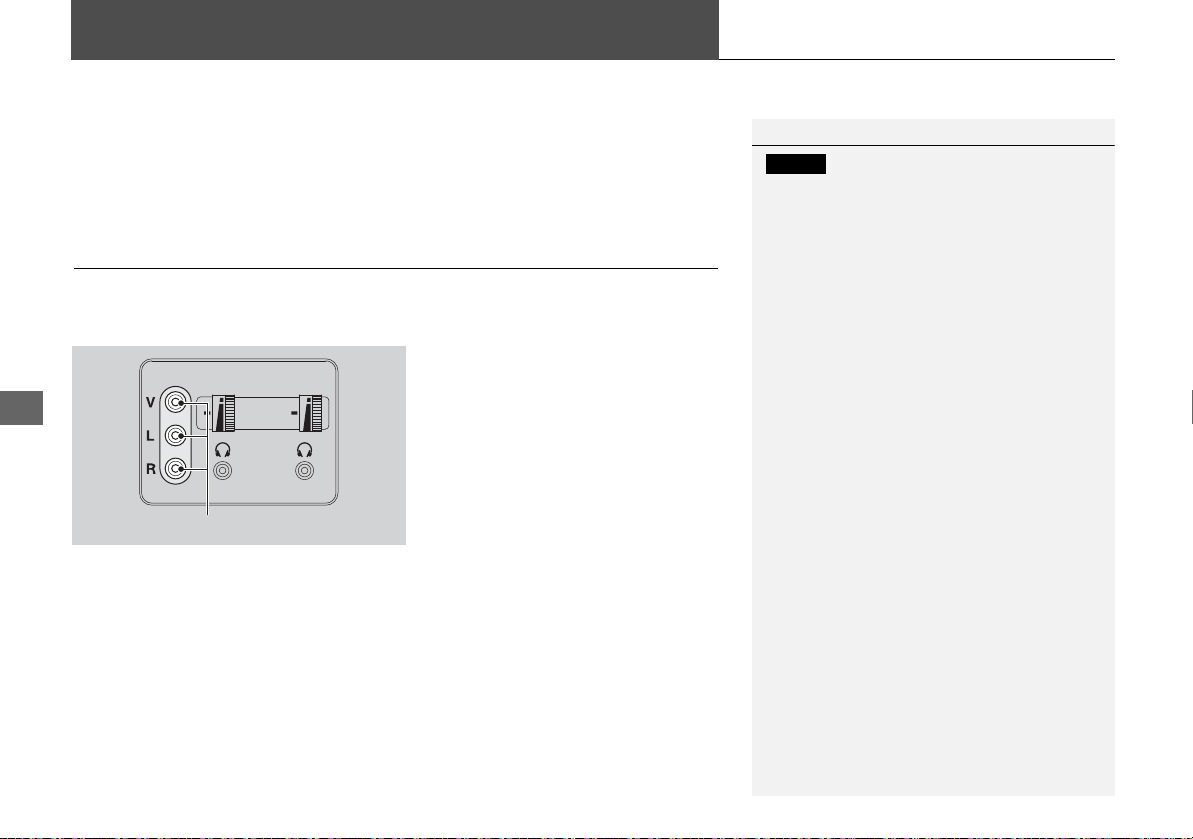
190
Rear Entertainment System
Rear Entertainment System
The Rear Entertainment System (RES) is operable from both the front control panel
and the rear control panel.
2 Front Control Panel Operation P. 203
2 Rear Control Panel Operation P. 192
Auxiliary Console Panel
Auxiliary input jacks and headphone connectors for the rear entertainment system
are above the third row seat armrest on the driver’s side.
V = Video jack
L = Left audio jack
R = Right audio jack
■ Auxiliary Input Jacks
The system will accept auxiliary inputs from standard video games and video
equipment. Some video game power supplies may cause poor picture quality.
■ Headphone Connectors
There are two headphone connectors for the third row seat passengers. Each
connector has its own volume control.
1 Rear Entertainment System
This vehicle’s overhead mounted video display, if
so equipped, includes mercury-containing
components. Upon removal, please reuse,
recycle, or dispose of as hazardous waste.
NOTICE
AUXILIARY INPUT JACK
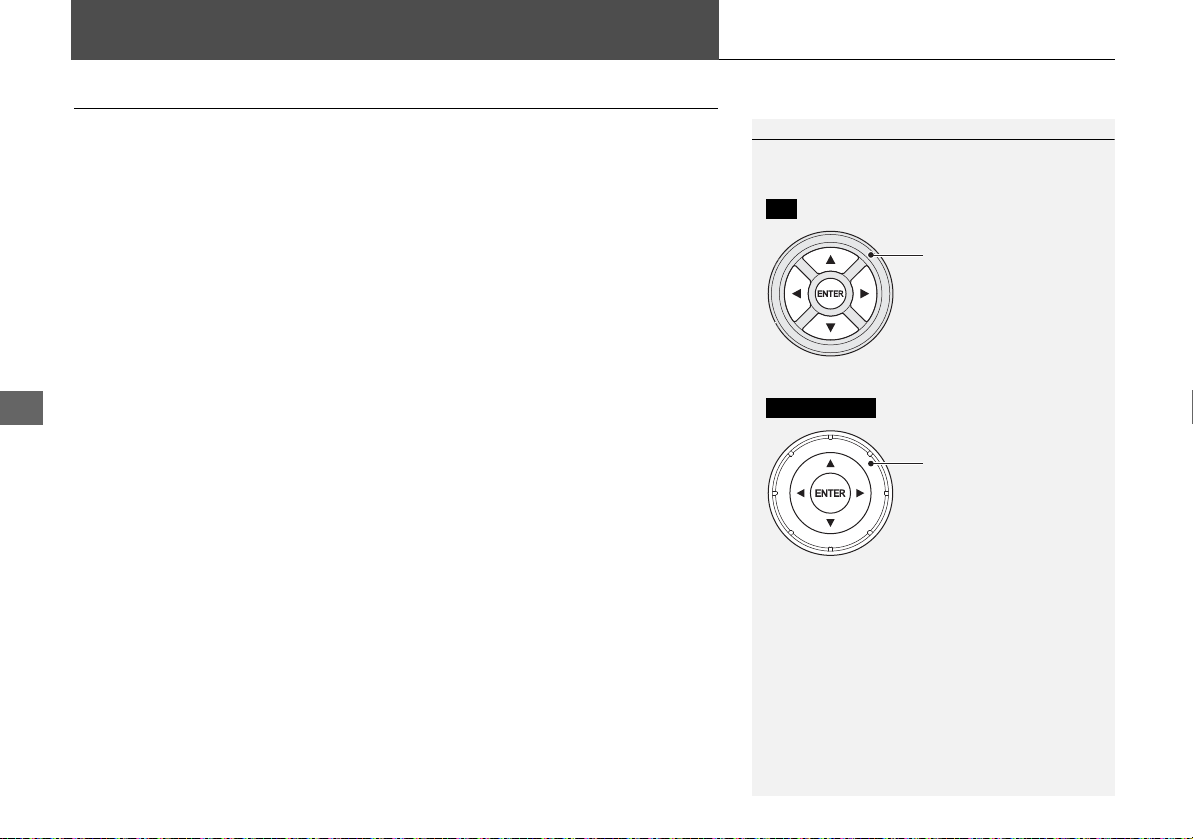
192
Rear Entertainment System
Rear Control Panel Operation
Selecting the Audio Source
■ RES
1. Press the audio source button.
2. Select a station, channel, track, or chapter using the CH/FOLDER, TUNE/SKIP, or
CATEGORY bars.
2 Overhead Screen and Rear Control Panel P. 15
■ Ultrawide RES
1. Press the SOURCE button.
2. Select the audio source. Press the
ENTER button.
3. Select a station, channel, track, or
chapter using the CH/FOLDER,
TUNE/SKIP, or CATEGORY bars.
1 Rear Control Panel Operation
In the procedures of this section, “select” means
the following actions:
The rear control panel can be detached from the
ceiling unit and used as a remote control.
2 Overhead Screen and Rear Control Panel
P. 15
In this section, screen illustrations from the
standard RES are used for the explanation unless
otherwise noted.
The screen is displayed on the overhead screen.
RES
Press the cursor buttons
on the rear control panel.
Ultrawide RES
Rotate the Interface Dial
on the rear control panel.

195
Rear Control Panel Operation
Rear DVD Menu
Rear Entertainment System
H MENU button (in the DVD mode)
Search/NumInput
1. Select an item. Press the ENTER
button.
2. Select a number. Press the ENTER
button.
The following items are available:
• Title: Skips to a title you specify.
• Chapter: Skips to a chapter you specify.
• NumInput: Enters a number of a title or chapter to skip.
Enter a number and select ENT. Press the ENTER button.
Enter a number and press the ENTER button. Select DONE.
■ Searching a Title/Chapter
RES
Ultrawide RES
196
Rear Control Panel Operation
Screen and Surround Settings
Rear Entertainment System
Screen and Surround Settings
H SETUP button (in the DVD mode)
Search/NumInput
Select an item. Press the ENTER
button.
The following items are available:
• Display Adjust: Adjusts the screen’s preferences.
2 Adjusting the Screen P. 197
• Aspect Ratio: Selects an aspect ratio of the image
2 Setting the RES Aspect Ratio P. 198
2 Setting the Ultrawide RES Aspect Ratio P. 198
• PERSONAL SURROUND: Sets the surround of the rear speakers. You can choose
from three options: Music, Cinema, or Voice. Select Off to disable the feature.
• Language: Sets the system language used on all screens. You can choose from
three languages: English, Français (French), or Español (Spanish).
• Brightness: Adjusts the screen’s brightness. Adjust the brightness using the
Interface Dial and press the ENTER button.
• Appearance: Selects the color of the rear menu screen. When you select Front
sync, the menu screen color can be synchronized with the front navigation screen.
Ultrawide RES Only
197
Rear Control Panel Operation
Screen and Surround Settings
Rear Entertainment System
H SETUP button (in the DVD mode)
Display Adjust
1. Select an item. Press the ENTER
button.
2. Make the adjustment. Press the
ENTER button.
The following items are available:
• Brightness: Adjusts the screen’s brightness.
• Contrast: Adjusts the screen’s contrast.
• Black Level: Adjusts the screen’s black level.
• Color: Adjusts the screen’s color strength.
• Tint: Adjusts the screen’s hue.
• Reset: Resets all the settings to their factory default.
■ Adjusting the Screen
Continued

198
Rear Control Panel Operation
Screen and Surround Settings
Rear Entertainment System
H MENU button (in the DVD mode)
Aspect Ratio
Select an option. Press the ENTER
button.
H MENU button (in the DVD mode)
Aspect Ratio
1. Select an item. Press the ENTER
button.
2. Select an item. Press the ENTER
button.
The following items are available:
• Wide: Selects the wide screen option (Normal, Full, Super Full, Ultra Full).
• ZOOM: Selects the zoom screen option (Super Zoom, Ultra Zoom).
■ Setting the RES Aspect Ratio
■ Setting the Ultrawide RES Aspect Ratio

200
Rear Control Panel Operation
Dual Screen Mode (Ultrawide RES only)
Rear Entertainment System
H MENU button (in the DVD mode)
Initial Settings
Language Settings
1. Select an item. Press the ENTER
button.
2. Select a language. Press the ENTER
button.
Dual Screen Mode (Ultrawide RES only)
Select between the two screen modes, single or dual.
■ Single Mode
The selected source is displayed in the center of the screen.
■ Dual Mode
Two separate screens are displayed side by side. You can only select one output
source from the front audio system. The other source must come from “AUX-
VIDEO” or “AUX-HDMI.”
■ Selecting the DVD Menu Language
1 Selecting the DVD Menu Language
When you select Other, enter a 4-digit language
code.
2 List of Language Codes P. 259
201
Rear Control Panel Operation
Dual Screen Mode (Ultrawide RES only)
Rear Entertainment System
■ Single mode to Dual mode
■ Dual mode to Single mode
DVD
Press the DUAL
button.
Select the side
(e.g., “Left”).
Select a source
(e.g., “AUX-
VIDEO”).
Press the SWAP
button.
DVD AUX-VIDEO AUX-VIDEO DVD
AUX-VIDEO DVD
Press the
SINGLE button.
Select a source
(e.g., “DVD”).
DVD

202
Rear Control Panel Operation
Replacing the Batteries
Rear Entertainment System
Replacing the Batteries
1. Remove the rear control panel.
2 Overhead Screen and Rear
Control Panel
P. 15
2. Open the cover.
3. Change the batteries.
Battery type: BR3032
1 Replacing the Batteries
An improperly disposed of battery can hurt the
environment. Always confirm local regulations
for battery disposal.
Cover

205
Front Control Panel Operation
Setting the Rear DVD Menu
Rear Entertainment System
Setting the Rear DVD Menu
H REAR SOURCE button (in the Rear DVD mode)
DVD Setup
1. Rotate i to select an item. Press
u.
2. Rotate i to select an option.
Press u.
The following items are available:
• Title Search: Skips to a title by entering the title number. Rotate i to select a
number and press u.
• Chapter Search: Skips to a chapter by entering the chapter number. Rotate i
to select a number and press u.
• Audio: Selects the language of the DVD audio.
• Subtitle: Selects the language of the DVD subtitle.
• Repeat: Sets whether to use the rear control panel to control the RES.
o TITLE REPEAT: Repeats the current title.
p CHAPTER REPEAT: Repeats the current chapter.
• Auto Play: Sets whether to automatically play a DVD when you insert a disc and
select the DVD mode.
ON: Plays the DVD without stopping at the DVD menu screen.
OFF (factory default): Disables the feature.

209
Other Features
This section describes the useful functions incorporated into the
navigation system to help make your journey easier and more enjoyable.
Trip Computer ....................................... 210
Calendar ................................................ 211
Calculator .............................................. 213
Unit Conversion ................................... 213
Information Functions .......................... 215
Scenic Road Information ...................... 215
System/Device Information ................... 215
Map Data Update Status ...................... 216
Key to ZAGAT Ratings.......................... 216
Multi-view Rear Camera....................... 217

211
Other Features
Calendar
H INFO button
Calendar
Enter events and display reminders each time you start your vehicle.
1. Rotate i to select the day. Press
u.
2. Rotate i to select an item. Press
u.
The following items are available:
• Edit Date: Moves the calendar entry to a new date. The display automatically
returns to the Schedule screen.
• Edit Title: Enter the name of your event. Move r to select OK to return to the
Schedule screen.
• Edit Message: Enter a message for your event. You can enter a message on two
lines using k to change between lines. Move r to select OK to return to the
Schedule screen.
1 Calendar
You can select the day of the month on the
calendar using voice commands (e.g., say d
“Five” to select the 5th).
Move w or y to scroll through the months of
the year.
Only one event entry can be stored for each
date. Dates with an icon indicate there is a
scheduled entry for that date.
A maximum of 50 entries can be stored in the
calendar.
Entries may be stored in the calendar for 10
years.
Active calendar entries are displayed when you
start your vehicle after you select OK on the Start
Confirmation screen.
2 Start-up P. 20
Continued

212
Calendar
Other Features
• Message Icon: Select an icon from the list to help identify the type of message.
The message icon you choose will be displayed alongside the specified date on the
Calendar screen.
• Reminder: Sets whether event reminders are displayed each time you start your
vehicle.
2 Start-up P. 20
• Delete: Deletes the event. Select Yes on the confirmation screen to remove the
event from the calendar.
1 Calendar
Message Icons
The following icons can be selected:
Schedule Time Call
Restaurant Others

217
Other Features
Multi-view Rear Camera
Your vehicle is equipped with a multi-view rear camera. When you shift into Reverse,
the rear view is displayed on the navigation system screen. The edge of the bumper
and parking guide lines are also displayed.
To turn the guide lines on or off, press
and hold the CANCEL button for
about three seconds.
Rotate i to adjust the brightness of
the multi-view rear camera.
While the rear view is displayed, press
u to switch between Wide, Normal,
and Top down view modes.
1 Multi-view Rear Camera
Always keep the camera lens clean and
unobstructed. The multi-view rear camera has a
lens that makes distances appear different than
they actually are. Always take care when
reversing, and look behind you for obstacles.
Navigation controls are disabled when in
Reverse.
Adjusting the brightness for the multi-view rear
camera display does not affect the brightness for
the navigation screen.
If you turn the guide lines off, they remain off
until you turn them back on.
If the last used viewing mode is Wide or Normal,
the same mode is selected the next time you shift
into Reverse. If Top view was last used, Normal
mode is selected.
Multi-view
Rear Camera
Screen display
Bumper
Guide lines
Camera
Approx. 1 m (3.3 ft)
Approx. 2 m (6.6 ft)
Approx. 3 m (9.8 ft)
Approx. 50 cm
(1.7 ft)
Tailgate open range
Approx. 3 m (9.8 ft)
Approx. 2 m (6.6 ft)
Approx. 1 m (3.3 ft)
Wide
Normal
Top down

218

219
Troubleshooting
Troubleshooting ................................... 220
Map, Voice, Entering Destinations........ 220
Traffic .................................................. 222
Guidance, Routing ............................... 223
Update DVD, Coverage, Map Errors ..... 225
Display, Accessories.............................. 225
Rear Camera ........................................ 225
Miscellaneous Questions ...................... 226
Error Messages...................................... 227
Navigation System................................ 227
Disc Player............................................ 228
iPod® .................................................. 229
USB Flash Drive .................................... 230

224
Troubleshooting
Guidance, Routing
Troubleshooting
The screen is showing white dots as I drive along. These dots are called “breadcrumbs.” These are displayed if Off-road Tracking is set
to ON and you drive more than 1/2 mile off mapped roads.
2 Off-road Tracking P. 62
How do I remove the white dots (“breadcrumbs”)
from my screen?
Press the INFO button. Select Setup > Other > Vehicle, and set Off-road Tracking
to OFF, then return to the map.
2 Off-road Tracking P. 62
A road that I selected to avoid is being used when
routing.
When you “draw” your area to avoid, make sure to select sections of roads that
include at least one intersection.
2 Avoiding Streets P. 117
My elevation (shown when I display the current
position) seems to fluctuate even though my elevation
has not changed.
This is normal. The elevation can vary ±100 feet due to GPS calculation errors.
2 GPS System P. 234
My elevation is missing on the “current position”
screen.
The elevation is only displayed if the GPS antenna can receive signals from at least four
satellites. Try moving the vehicle into an open area. The elevation is also not displayed
if the calculated elevation is zero or below sea level.
Problem Solution
228
Error Messages
Disc Player
Troubleshooting
Disc Player
Error Message Cause Solution
BAD DISC
PLEASE CHECK OWNERS
MANUAL
Servo error • Press the E (Eject) button and remove the disc, and check that the
error message is cleared.
• Check that the disc is not damaged or deformed, and insert the disc
again.
2 Recommended Discs P. 144
• If the error message reappears, press the E button, and pull out
the disc.
• Insert a different disc. If the new disc plays, there is a problem with
the first disc.
• If the error message repeats, or the disc cannot be removed, contact
your dealer. Do not try to force the disc out of the player.
BAD DISC
PLEASE CHECK OWNERS
MANUAL
PUSH EJECT
Mechanical error
MECH ERROR Mechanical error
CHECK DISC Focus error
Disc violates copyright
Disc not supported
CHECK DISC LOAD Load error
UNSUPPORTED Track format not supported • Current track will be skipped. The next supported track plays
automatically.
HEAT ERROR High temperature • Turn the audio system off and allow the player to cool down until
the error message is cleared.

229
Error Messages
iPod®
Troubleshooting
iPod®
Error Message Cause Solution
UNSUPPORTED Appears when an unsupported
iPod® is connected.
Update the iPod® software to the latest version.
CONNECT RETRY Appears when the iPod® cannot
be authenticated.
Reconnect the iPod®.
NO SONG Appears when there are no tracks
in the iPod®.
Store tracks in the iPod®.
230
Error Messages
USB Flash Drive
Troubleshooting
USB Flash Drive
Error Message Cause Solution
FILE ERROR The system cannot read the
track(s).
Check the tracks in the USB flash drive. There is a possibility that the
tracks have been damaged.
UNSUPPORTED Appears when an unsupported
device is connected.
If it appears when a supported device is connected, reconnect the
device.
UNPLAYABLE FILE Appears when the tracks in the
USB flash drive are DRM or an
unsupported format.
This error message appears for about 3 seconds, then plays the next
song.
NO SONG Appears when the USB flash drive
is empty or there are no tracks in
MP3, WMA, or AAC format in the
drive.
Save tracks in MP3, WMA, or AAC format in the USB flash drive.
BAD USB DEVICE
PLEASE CHECK OWNER'S
MANUAL
Appears when the overcurrent
protection feature of the system
stops supplying power to USB
because an incompatible device is
connected.
Disconnect the device. Turn the audio system off, and turn it on again.
Do not reconnect the device that caused the error.
ERROR Appears when the Internal USB
ROM error occurs.
Try a different USB flash drive.

231
Reference Information
System Initialization..............................232
Entering the Security Code....................232
Acquiring GPS Information....................232
Startup Confirmation Screen.................233
Map Matching ......................................233
System Limitations ................................234
GPS System...........................................234
Address Calculation ..............................234
Database ..............................................234
Client Assistance ....................................236
Resolving Problems ...............................236
Reporting Errors....................................236
Honda Automobile Customer Service
Contact Information............................236
Visiting Your Dealer ............................. 236
Map Coverage ..................................... 237
Obtaining a Navigation Update DVD .... 237
Traffic Information ............................... 238
Operation in Alaska, Hawaii, Canada, and
Puerto Rico......................................... 238
Shipping a Vehicle to the U.S. Mainland238
Legal Information ................................. 239
Copyrights ........................................... 239
User Agreements ................................. 239
As required by the FCC ........................ 244

234
Reference Information
System Limitations
GPS System
The signals received from the GPS satellites
are extremely weak (less than a millionth
of the strength of a local FM station) and
require an unobstructed view of sky. The
GPS antenna is located in the dashboard.
The signal reception can easily be
interrupted or interfered with by the
following:
• Metallic window tint on the front or side
windows
• Cell phones, PDAs, or other electronic
devices docked in a cradle or lying loose
on the dashboard
• Remote starters or “hidden” vehicle
tracking systems mounted near the
navigation unit
• Audio electronic devices mounted near
the navigation unit
• Trees, tall buildings, freeway overpasses,
tunnels, or overhead electrical power
wires
The GPS is operated by the U.S.
Department of Defense. For security
reasons, there are certain inaccuracies built
into the GPS for which the navigation
system must constantly compensate. This
can cause occasional positioning errors of
up to several hundred feet.
Address Calculation
The destination icon shows only the
approximate location of a destination
address. This occurs if the number of
possible addresses is different from the
number of actual addresses on a block.
e.g., the address 1425 on a 1400 block
with 100 possible addresses (because it is
followed by the 1500 block) will be shown
a quarter of the way down the block by
the system. If there are only 25 actual
addresses on the block, the actual location
of address 1425 would be at the end of
the block.
Database
The digitized map database reflects
conditions as they existed at various points
in time before production. Accordingly,
your database may contain inaccurate or
incomplete data or information due to the
passage of time, road construction,
changing conditions, or other causes.
For example, some places/landmarks may
be missing when you search the database
because the name was misspelled, the
place was improperly categorized, or a
place/landmark is not yet in the database.
This is also true for police stations,
hospitals, and other public institutions. Do
not rely on the navigation system if you
need law enforcement or hospital services.
Always check with local information
sources.
238
Client Assistance
Traffic Information
Reference Information
Traffic Information
• Continuously updated traffic
information is available in major
metropolitan areas across the 48
contiguous states and and Hawaii.
• Visit automobiles.honda.com/traffic for
a complete listing of coverage areas and
other information.
Operation in Alaska,
Hawaii, Canada, and
Puerto Rico
Navigation-equipped vehicles delivered to
Alaska, Hawaii, Canada, and Puerto Rico
are equipped with XM hardware, but XM
broadcasting is not available. There are
certain functions that rely on XM satellite
signal coverage which are not available.
Unavailable menu options will appear gray
on the LCD display.
All roads displayed on the map screens are
verified roads. Information in this manual
relating to “unverified” roads or areas is
not applicable.
■ XM® Radio
■ Map Coverage
Entering a destination address or place/
landmark on another island may result in a
screen caution message. This is because
there are no ferry routes between islands
in the database.
If Street Name Guidance is set to ON, the
street names will not be read out by voice
guidance. This may change in a future data
update.
Shipping a Vehicle to the
U.S. Mainland
To receive XM audio, you must call XM
and set up an account at (800) 852-9696.
■ Address and Place Entry
Screens
■ Puerto Rico

239
Reference Information
Legal Information
Copyrights
• infoUSA-Data: Certain business data
provided by infoUSA, Inc., Omaha, NE,
Copyright © 2011, All Rights Reserved.
• EXIT-Data: © ZENRIN CO., LTD. 2011.
All Rights Reserved.
• Building foot print: © ZENRIN CO., LTD.
2011. All Rights Reserved.
• Junction View Data: © ZENRIN USA,
INC. 2011. All rights reserved.
• ZAGAT SURVEY: © 2012 Zagat Survey,
LLC. Zagat Survey is a registered
trademark of Zagat Survey, LLC.
• Brand icons: The icons for companies
displayed by this product to indicate
business locations are the registered
marks of their respective owners. The
use of such icons in this product does
not imply any sponsorship, approval, or
endorsement by such companies of this
product.
User Agreements
In using this HDD “Satellite Linked
Navigation System” (the “HDD”), which
includes HONDA MOTOR CO., LTD.
software, ALPINE ELECTRONICS, INC.
software, and NAVTEQ database contents
(hereinafter referred to as “Licensors”),
you are bound by the terms and conditions
set forth below. By using your copy of the
HDD, you have expressed your Agreement
to the terms and conditions of this
Agreement. You should, therefore, make
sure that you read and understand the
following provisions. If for any reason you
do not wish to be bound by the terms of
this Agreement, please return the HDD to
your dealer.
• The HDD may not be copied, duplicated,
or otherwise modified, in whole or in
part, without the express written
permission of the Licensors.
• The HDD may not be transferred or
sublicensed to any third party for profit,
rent or loan, or licensed for reuse in any
manner.
■ Navigation System User
Agreement
• The HDD may not be decompiled,
reverse engineered or otherwise
disassembled, in whole or in part.
• The HDD may not be used in a network
or by any other manner of simultaneous
use in multiple systems.
• The HDD is intended solely for personal
use (or internal use where the end-user
is a business) by the consumer. The HDD
is not to be used for commercial
purposes.
• The Licensors do not guarantee to the
client that the functions included in the
HDD meet the specific objectives of the
user.
• Licensor shall not be responsible for any
damages caused by the use of the HDD
to the actual user or to any third party.
• The warranty on the HDD shall not
extend to an exchange or refund due to
misspelling, omission of letters, or any
other cosmetic discrepancy in the
contents of the HDD.
• The right to use the HDD shall expire
either when the user destroys the HDD
or software, or when any of the terms
of this Agreement are violated and the
Licensors exercise the option to revoke
the license to use the HDD or software.
Continued

241
Legal Information
User Agreements
Reference Information
WARRANTIES DO NOT ORIGINATE
FROM, AND ARE NOT BINDING ON, MS.
• NO LIABILITY FOR CERTAIN DAMAGES.
EXCEPT AS PROHIBITED BY LAW, MS
SHALL HAVE NO LIABILITY FOR ANY
INDIRECT, SPECIAL, CONSEQUENTIAL
OR INCIDENTAL DAMAGES ARISING
FROM OR IN CONNECTION WITH THE
USE OR PERFORMANCE OF THE
SOFTWARE. THIS LIMITATION SHALL
APPLY EVEN IF ANY REMEDY FAILS OF
ITS ESSENTIAL PURPOSE. IN NO EVENT
SHALL MS BE LIABLE FOR ANY
AMOUNT IN EXCESS OF U.S. TWO
HUNDRED FIFTY DOLLARS (U.S.
$250.00).
• SPEECH RECOGNITION
If the SOFTWARE includes speech
recognition component(s), you should
understand that speech recognition is
an inherently statistical process and that
recognition errors are inherent in the
process. Neither ALPINE nor its suppliers
shall be liable for any damages arising
out of errors in the speech recognition
process.
• LIMITATIONS ON REVERSE
ENGINEERING, DECOMPILATION, AND
DISASSEMBLY
You may not reverse engineer,
decompile, or disassemble the
SOFTWARE, except and only to the
extent that such activity is expressly
permitted by applicable law
notwithstanding this limitation.
• ADDITIONAL SOFTWARE/SERVICES
The SOFTWARE may permit ALPINE, MS,
Microsoft Corporation or their affiliates
to provide or make available to you
SOFTWARE updates, supplements, add-
on components, or Internet-base service
components of the SOFTWARE after the
date you obtain your initial copy of the
SOFTWARE (“Supplemental
Components”).
If ALPINE provides or makes available
to you Supplemental Components
and no other EULA terms are
provided along with the
Supplemental Components, then the
terms of this EULA shall apply.
If MS, Microsoft Corporation or their
affiliates make available
Supplemental Components, and no
other EULA terms are provided, then
the terms of this EULA shall apply,
except that MS, Microsoft
Corporation or affiliate entity
providing the Supplemental
Component(s) shall be licensor of the
Supplemental Component(s).
ALPINE, MS, Microsoft Corporation
and their affiliates reserve the right to
discontinue any Internet-based
services provided to you or made
available to you through the use of
the SOFTWARE.
• RECOVERY MEDIA
If SOFTWARE is provided by ALPINE on
separate media and labeled “Recovery
Media” you may use the Recovery
Media solely to restore or reinstall the
SOFTWARE originally installed on the
DEVICE.
• UPGRADES
If the SOFTWARE is provided by ALPINE
separate from the DEVICE on separate
media or via web download or other
means, and is labeled “For Upgrade
Purposes Only” you may install one (1)
copy of such SOFTWARE onto the
DEVICE as a replacement copy for the
existing SOFTWARE, and use it in
accordance with this EULA, including
Continued

243
Legal Information
User Agreements
Reference Information
Music recognition technology and
related data are provided by
Gracenote®. Gracenote is the industry
standard in music recognition
technology and related content delivery.
For more information, visit
www.gracenote.com.
When music is recorded to the HDD
from a CD, information such as the
recording artist and track name are
retrieved from the Gracenote Database
and displayed (when available).
Gracenote may not contain information
for all albums.
Gracenote is an internet-based music
recognition service that allows artist,
album, and track information from CDs
to display on the HDD.
Gracenote users are allowed 4 free
updates a year. More information about
Gracenote, its features, and downloads
are available at www.honda.com (in
U.S.) or www.honda.ca (in Canada).
■ Gracenote Music Recognition
Service (CDDB)
CD and music-related data from
Gracenote, Inc., copyright © 2000 to
present Gracenote. Gracenote Software,
copyright © 2000 to present Gracenote.
One or more patents owned by
Gracenote apply to this product and
service. See the Gracenote website for a
non-exhaustive list of applicable
Gracenote patents. Gracenote, CDDB,
MusicID, MediaVOCS, the Gracenote
logo and logotype, and the “Powered
by Gracenote” logo are either registered
trademarks or trademarks of Gracenote
in the United States and/or other
countries.
This application or device contains
software from Gracenote, Inc. of
Emeryville, California (“Gracenote”). The
software from Gracenote (the “Gracenote
Software”) enables this application to
perform disc and/or file identification and
obtain music- related information,
including name, artist, track, and title
information (“Gracenote Data”) from
online servers or embedded databases
(collectively, “Gracenote Servers”) and to
perform other functions. You may use
■ Gracenote® END USER
LICENSE AGREEMENT
Gracenote Data only by means of the
intended End-User functions or this
application or device.
You agree that you will use Gracenote
Data, the Gracenote Software, and
Gracenote Servers for your own personal
non-commercial use only.
You agree not to assign, copy, transfer, or
transmit the Gracenote Software or any
Gracenote Data to any third party.
YOU AGREE NOT TO USE OR EXPLOIT
GRACENOTE DATA, THE GRACENOTE
SOFTWARE, OR GRACENOTE SERVERS,
EXCEPT AS EXPRESSLY PERMITTED
HEREIN.
You agree that your non-exclusive license
to use the Gracenote Data, the Gracenote
Software, and Gracenote Servers will
terminate if you violate these restrictions. If
your license terminates, you agree to cease
any and all use of the Gracenote Data, the
Gracenote Software, and Gracenote
Servers.
Continued

244
Legal Information
As required by the FCC
Reference Information
Gracenote reserves all rights in Gracenote
Data, the Gracenote Software, and the
Gracenote Servers, including all ownership
rights. Under no circumstances will
Gracenote become liable for any payment
to you for any information that you
provide. You agree that Gracenote, Inc.
may enforce its rights under this
Agreement against you directly in its own
name.
The Gracenote service uses a unique
identifier to track queries for statistical
purposes. The purpose of a randomly
assigned numeric identifier is to allow the
Gracenote service to count queries without
knowing anything about who you are. For
more information, see the web page for
the Gracenote Privacy Policy for the
Gracenote service.
The Gracenote Software and each item of
Gracenote Data are licensed to you “AS
IS.”
Gracenote makes no representations or
warranties, express or implied, regarding
the accuracy of any Gracenote Data from
in the Gracenote Servers. Gracenote
reserves the right to delete data from the
Gracenote Servers or to change data
categories for any cause that Gracenote
deems sufficient. No warranty is made that
the Gracenote Software or Gracenote
Servers are error-free or that functioning of
Gracenote Software or Gracenote Servers
will be uninterrupted.
Gracenote is not obligated to provide you
with new enhanced or additional data
types or categories that Gracenote may
provide in the future and is free to
discontinue its services at any time.
GRACENOTE DISCLAIMS ALL
WARRANTIES EXPRESS OR IMPLIED,
INCLUDING, BUT NOT LIMITED TO,
IMPLIED WARRANTIES OF
MERCHANTABILITY, FITNESS FOR A
PARTICULAR PURPOSE, TITLE, AND NON-
INFRINGEMENT. GRACENOTE DOES NOT
WARRANT THE RESULTS THAT WILL BE
OBTAINED BY YOUR USE OF THE
GRACENOTE SOFTWARE OR ANY
GRACENOTE SERVER. IN NO CASE WILL
GRACENOTE BE LIABLE FOR ANY
CONSEQUENTIAL OR INCIDENTAL
DAMAGES OR FOR ANY LOST PROFITS OR
LOST REVENUES.
copyright © 2000 to present Gracenote
As required by the FCC
1. This device complies with Part 15 of the
FCC Rules and Canadian RSS-210/
RSSGen. Operation is subject to the
following two conditions: (1) this device
may not cause harmful interference, and
(2) this device must accept any
interference received, including
interference that may cause undesired
operation.
2. The FCC requires the user to be notified
that any changes or modifications made
to this device that are not expressly
approved by the party responsible for
compliance may void the user’s
authority to operate the equipment.
3. This product emits radio frequency
energy, but the radiated output power
of this device is far below the FCC and
IC radio frequency exposure limits. This
equipment complies with FCC and IC RF
radiation exposure limits set forth for an
uncontrolled environment. Nevertheless,
the device should be used in such a
manner that the potential for human
contact with the antenna during normal
operation is minimized.

245
Voice Commands
Voice Commands .................................. 246
Global Commands ............................... 246
Navigation Commands......................... 246
Climate Control Commands................. 249
Audio Commands ................................ 249
Cellular Phone Commands ................... 254
Main Setup Screen Commands ............ 254
On-Screen Commands ......................... 254
Spelling Assistance ............................... 254

248
Voice Commands
Navigation Commands
Voice Commands
French restaurant
German restaurant
Greek restaurant
Indian restaurant
Italian restaurant
Japanese restaurant
Korean restaurant
Mexican restaurant
Pizza
Seafood restaurant
Thai restaurant
Vegetarian restaurant
Vietnamese restaurant
Other restaurant
Shopping area
Accessory store
Book store
Clothing store
Grocery store
Home improvement store
Mall
Office supply store
Pharmacy
Pet food store
Sewing store
Shoe store
Sporting goods store
Toy store
Travel center
Airport
Automobile club
Bus station
Camping
Commuter rail station
Ferry terminal
Named place
Park & ride
Parking garage
Parking lot
Rental car agency
Rest area
Ski area
Tourist information
Train station
Travel agency
Truck stop
The system accepts these commands when
a route is set.
How long to the destination?*
How far to the destination?*
Display destination map
Display entire route
* These commands are not available if
you scroll through the map while en
route to a destination.
■ Route Commands

249
Voice Commands
Climate Control Commands
Voice Commands
Climate Control
Commands
The system accepts these commands on
most screens.
Climate control automatic (maintains
selected temperature)
Climate control off
Air conditioner on*
Air conditioner off*
Climate control defrost on*
Climate control defrost off*
Rear defrost on*
Rear defrost off*
Climate control fresh air
Climate control recirculate
Climate control vent
Climate control bi-level (vent and floor)
Climate control floor
Climate control floor and defrost
Fan speed up
Fan speed down
Fan speed # (#: 1 to 7)
Rear lock on
Rear lock off
Temperature # degrees (#: 57 to 87 °F)
Driver temperature # degrees (#: 57 to
87 °F)
Passenger temperature # degrees (#: 57
to 87 °F)
Temperature up
Temperature down
Driver temperature up
Driver temperature down
Passenger temperature up
Passenger temperature down
Temperature max hot
Temperature max cold
Driver temperature max hot
Driver temperature max cold
Passenger temperature max hot
Passenger temperature max cold
Climate control sync on
Climate control sync off
Front climate control automatic
(maintains selected temperature)
Front climate control off
Rear climate control automatic
(maintains selected temperature)
Rear climate control off
Rear climate control vent
Rear climate control bi-level (vent and
floor)
Rear climate control floor
Rear fan speed up
Rear fan speed down
Rear fan speed # (#: 1 to 5)
* These commands toggle the function
on and off, so the command may not
match your intended action.
Audio Commands
The system accepts these commands on
most screens.
Audio on*
Audio off*
Radio on*
Radio off*
Radio select FM1
Radio select FM2
Radio select AM
Radio tune to # FM (#: frequency, e.g.,
95.5)
Radio tune to # AM (#: frequency, e.g.,
1020)
Radio seek up
Radio seek down
Radio next station
Radio preset # (#: 1 to 6)
Radio FM preset # (#: 1 to 6)
Radio FM1 preset # (#: 1 to 6)
■ Radio Commands
Continued

254
Voice Commands
Cellular Phone Commands
Voice Commands
Cellular Phone Commands
The system accepts these commands only
on the PHONE screen.
Dial #
Call (voice tag)
Call history
Phonebook
More speed dial
Phone setup
These commands can be made from any
screen.
Dial/call by number
Dial/call by voice tag
Main Setup Screen
Commands
The system accepts these commands on
the Main Setup screen.
Brightness up
Brightness down
Brightness minimum/min.
Brightness maximum/max.
Contrast up
Contrast down
Contrast minimum/min.
Contrast maximum/max.
Black level up
Black level down
Black level minimum/min.
Black level maximum/max.
Volume up
Volume down
Volume minimum/min.
Volume maximum/max.
Volume off
Interface dial feedback off
Interface dial feedback auto
Interface dial feedback on
On-Screen Commands
The system accepts these commands on
any screen. There are over 100 on-screen
commands. Say what is written on the
screen to activate that selection. For lists,
you can say the list item number to select
that item.
Next (or Down)
Previous (or Up)
Return
OK (excluding Startup Confirmation
screen)
Delete
Spelling Assistance
The voice control system can also
recognize phonetic alphabet input for
numbers, letters, accented letters,
punctuation marks, and symbols.
NOTE:
When selecting letters using the voice
control system, a confirmation box may
pop up to confirm the entry.

255
Voice Commands
Spelling Assistance
Voice Commands
■ Numbers
Say … Say … or Number …
1 One
2Two
3 Three
4 Four
5 Five
6Six
7 Seven
8Eight
9 Nine
0 Zero
■ Letters
Say … Or say…
A Alpha/Apple
BBravo/Boy
C Charlie
DDelta/Dog
E Echo/Edward
F Foxtrot/Frank
G Golf/George
HHotel/Henry
I India/Igloo
J Juliet/John
K Kilo/King
LLima/Larry
M Mike/Mary
N November/Nancy
O Oscar
P Papa/Paul
Q Quebec/Queen
R Romeo/Robert
S Sierra/Sam
T Tango/Tom
U Uniform/Uncle
VVictor
W Whiskey/William
XX-ray
Y Yankee/Yellow
Z Zulu/Zebra
Say … Or say…
Continued
256
Voice Commands
Spelling Assistance
Voice Commands
■ Accented Letters
Say … Say … or Symbol …
À A grave
ÂA circumflex
Ä A umlaut
Ç C cedilla
È E grave
ÉE acute
Ê E circumflex
Ë E umlaut
Ì I grave
ÎI circumflex
Ï I umlaut
Ô O circumflex
Ù U grave
Û U circumflex
Ü U umlaut
Say … Say … or Symbol …
■ Punctuation Marks
Say … Say … or Symbol …
@ At sign
^ Caret
* Asterisk
_ Underscore
` Back quote
, Comma
. Dot
? Question mark
: Colon
;Semicolon
+ Plus
260
List of Language Codes
Spelling Assistance
List of Language Codes
Malagasy 1307
Malay 1319
Malayalam 1312
Maltese 1320
Maori 1309
Marathi 1318
Moldavian 1315
Mongolian 1314
Nauruan 1401
Nepali 1405
Norwegian 1415
Oriya 1518
Oromo 1513
Pashto 1619
Persian 0601
Polish 1612
Portuguese 1620
Provencal 1503
Punjabi 1601
Quechua 1721
Rhaeto-Romance 1813
Romanian 1815
Russian 1821
Language Input Code
Sand 1907
Sanskrit 1901
Scottish Gaelic 0704
Serbian 1918
Serbo-Croatian 1908
Seth-Thu 1920
Setswana 2014
Shona 1914
Sindhi 1904
Sinhalese 1909
SiSwati 1919
Slovak 1911
Slovene 1912
Somali 1915
Somoan 1913
Spanish 0519
Sundanese 1921
Swahili 1923
Swedish 1922
Tagalog 2012
Tajir 2007
Tamil 2001
Tartar 2020
Language Input Code
Telugu 2005
Thai 2008
Tibetan 0215
Tigris 2009
Tonga 2015
Turki 2011
Turkish 2018
Twi 2023
Twonga 2019
Ukrainian 2111
Urdu 2118
Uzbek 2126
Vietnamese 2209
Volapuk 2215
Welsh 0325
Worf 2315
Xhosa 2408
Yiddish 1009
Yoruba 2515
Zulu 2621
Language Input Code

263
Index
Index
K
Key to ZAGAT Ratings
..............................216
L
Language
...................................................... 31
Leisure (Place Category)
.............................80
Lodging (Place Category)
........................... 80
M
Map Color
..................................................... 28
Map Data Update
Checking Version
.....................................215
Obtaining Update DVD
............................237
Viewing Update Status
.............................216
Map Information
.......................................105
Map Input
Editing Avoid Area
.....................................54
Setting Destination
.....................................88
Map Legend
.........................................10
,
110
Map Menu
.................................................... 98
Map Screen
................................................... 93
Icon
.............................................10
,
106
,
112
Orientation
...............................................108
Scale
......................................................... 111
MAP/GUIDE Button
.............................11
,
103
Menu (Dest. Menu 1)
..................................68
Menu (Dest. Menu 2)
..................................68
Menu (Route)
.............................................116
MENU Button
Changing Route
.......................................116
Entering a Destination
................................68
Menu Color
.................................................. 28
Mode
...........................................................137
MODE Button
.............................................167
More Speed Dial
........................................170
Music Search
.................................................45
HDD
..........................................................150
iPod®
........................................................158
Phonetic Modification
................................47
Song By Voice
.....................................46
,
159
Mute
............................................................185
N
Night Mode
Map Color
...................................................28
Menu Color
................................................28
Switching Display Mode
.............................29
North-up
.....................................................108
Note
.............................................................138
O
Off-road Tracking
Driving
........................................................96
Setting
........................................................62
Open Map
...................................................102
P
Pair Phone
...................................................172
Pass-Key
.......................................................174
Personal Information
..................................37
Phone Setup
...............................................170
Phonebook
Importing
..................................................177
Making a Call
...........................................183
PIN Numbers
................................................ 43
Place Category
Editing Address Book
................................. 40
Place Category List
................................... 258
Setting Destination
.................................... 80
Place Name
Editing Address Book
................................. 40
Setting Destination
.............................. 77
,
81
Place Phone No.
Editing Address Book
................................. 40
Setting Destination
.................................... 84
Preset Buttons
............................................... 6
Previous Destination
Deleting
...................................................... 44
Editing Address Book
................................. 40
Setting Destination
.................................... 76
R
Radio
FM/AM
..................................................... 132
XM®
........................................................ 136
Random
Disc
........................................................... 142
HDD
......................................................... 147
Pass-Key
................................................... 174
USB Flash Drive
........................................ 162
RDS Search
................................................. 134
Read Radio Text
........................................ 135
Rearview Camera
...................................... 217
Rec to HDD
................................................. 149
Recalculation
......................................... 50
,
95
Reminder
.............................................. 21
,
212

265
Index
Index
X
XM Button
..............................................6
,
136
XM® Radio
Playing
...................................................... 136
Voice Commands List
...............................249
Z
ZAGAT
Displaying Review
...........................77
,
82
,
85
Setting Destination
.....................................84
Zip Code
........................................................ 71