U N I T R O L
READ ALL INSTRUCTIONS
BEFORE
LIGHTING
T
H
E
R
I
S
K
O
F
S
C
A
L
D
I
N
J
U
R
Y
H
O
T
T
E
R
C
A
U
T
I
O
N
W
A
T
E
R
I
N
C
R
E
A
S
E
S
Part No. AP12172-5 (07/03) Pub. No. 49-50010-4 04-02 JR
Manufactured under trademark license by:
Rheem Manufacturing Company
2600 Gunter Park Drive East, Montgomery, AL 36124-4020
FOR YOUR SAFETY!
— Do not store or use gasoline or other flammable
vapors or liquids or other combustible materials in
the vicinity of this or any other appliance. To do
so may result in an explosion or fire.
— WHAT TO DO IF YOU SMELL GAS
● Do not try to light any appliance.
● Do not touch any electrical switch; do not use
any phone in your building.
● Immediately call your gas supplier from a
neighbor’s phone. Follow the gas supplier’s
instructions.
● If you cannot reach your gas supplier, call
the fire department.
● Do not return to your home until authorized
by the gas supplier or fire department.
— Improper installation, adjustment, alteration,
service or maintenance can cause injury,
property damage or death. Refer to this
manual. Installation and service must be
performed by a qualified installer, service
agency or the gas supplier.
!
WARNING: If the information in these instructions is not followed exactly, a fire or
explosion may result causing property damage, personal injury or death.
!
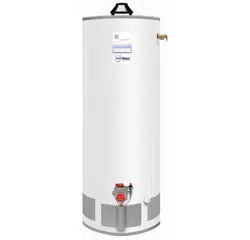
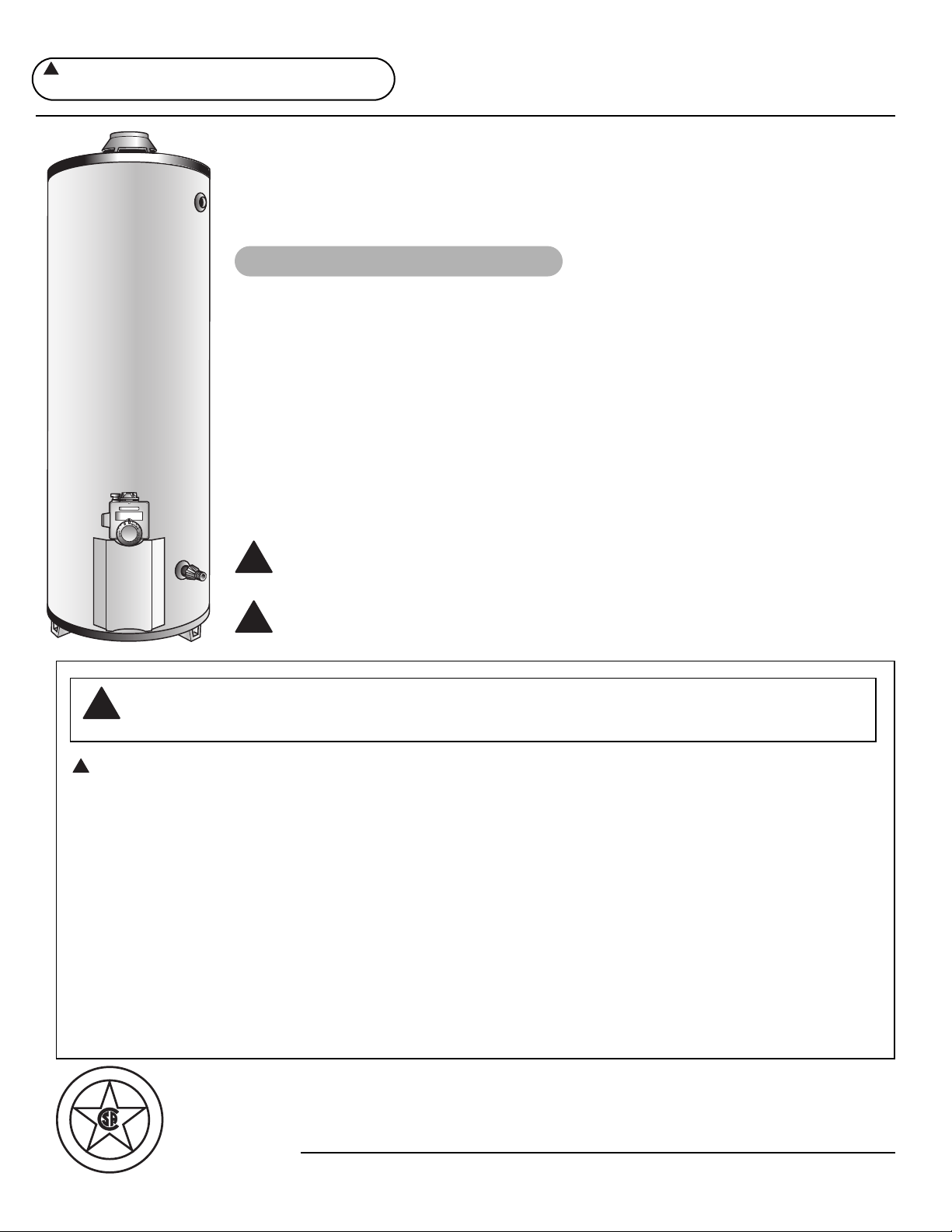
Model: GG Series
The purpose of this manual is twofold: one, to provide the installer with basic directions and
recommendations for the proper installation and adjustment of the water heater; and two,
for the owner–operator, to explain the features, operation, safety precautions, maintenance and trouble
shooting of the water heater. This manual includes a parts list.
It is imperative that all persons who are expected to install, operate or adjust this water heater read
the instructions carefully so that they may understand how to perform these operations. If you do not
understand these instructions or any terms within it, seek professional advice.
Any questions regarding the operation, maintenance, service or warranty of this water heater should be
directed to the seller from whom it was purchased. If additional information is required, refer to the
section “If You Need Service .....”
Do not destroy this manual. Please read carefully and keep in a safe place for future reference.
Recognize this symbol as an indication of Important Safety Information!
California Proposition 65 Warning:
This product contains chemicals known to the State of
California to cause cancer, birth defects or other reproductive harm.
!
!
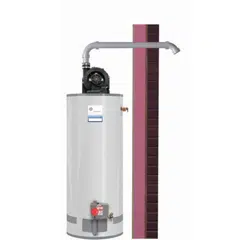
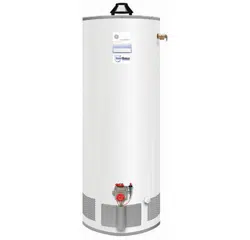
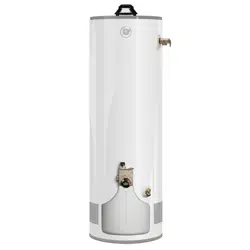
Residential 60, 75 and 100 Gallon
Use & Care Manual
With Installation Instructions for the Installer
Printed in USA
Water Heaters
Gas Residential
D
E
S
I
G
N
C
E
R
T
I
F
I
E
D
®
WARNING: This water heater is not suitable
for use in manufactured (mobile) homes!
!
Safety Information
Safety Precautions . . . . . . 3–6
LP Gas Models . . . . . . . . . . . . 5
Installation Instructions
Location. . . . . . . . . . . . . . . . . . . 7
Water Connections . . . . . . . . . 9
Gas Supply. . . . . . . . . . . . . . . . 11
Pipe Insulation . . . . . . . . . . . . 13
Heat Traps . . . . . . . . . . . . . . . 13
Installation Checklist. . . . . . . 14
Potable Space Heating . . . . . 15
Operating Instructions
Lighting Instructions . . 16 & 17
Water Temperature. . . . 19 & 20
Care and Cleaning
Draining . . . . . . . . . . . . . . . . . . 21
Burner Inspection . . . . . . . . . 22
Extended Shut-Down . . . . . . 22
Troubleshooting Tips
Before You Call
For Service. . . . . . . . . . . . 23, 24
Customer Service
Parts List . . . . . . . . . . . . . . . . 25
Product Registration . . . . . . 28
Customer Service Troubleshooting Tips Care and Cleaning Operating Instructions Installation Instructions Safety Instructions
2
Inside you will find many helpful hints on how to use and maintain
your water heater properly. Just a little preventive care on your part
can save you time and money over the life of your water heater.
You’ll find many answers to common problems in the Before You Call
For Service section. If you review our chart of Troubleshooting Tips
first, you may not need to call for service at all.
READ THIS MANUAL
FOR YOUR RECORDS
Write the model and serial numbers here:
#
#
You can find them on a label on the appliance.
Staple sales slip or cancelled check here.
Proof of the original purchase date is needed to obtain service under
the warranty.
IMPORTANT!
Fill out and return the Consumer Product Registration Card that is
in the back of this manual.
If you do need service, you can relax knowing help is only a phone call
away. For service call 800-431-1549.
IF YOU NEED SERVICE
Your safety and the safety of others are very important. There are
many important safety messages in this manual and on your
appliance. Always read and obey all safety messages.
This is the safety alert symbol. Recognize this symbol
as an indication of Important Safety Information! This symbol alerts
you to potential hazards that can kill or hurt you and others.
All safety messages will follow the safety alert symbol and either the
word “DANGER”, “WARNING”, “CAUTION” or “NOTICE”.
These words mean:
DANGER An imminently hazardous situation that will
result in death or serious injury.
WARNING A potentially hazardous situation that could
result in death or serious injury and/or damage
to property.
CAUTION A potentially hazardous situation that may
result in minor or moderate injury.
Notice: Attention is called to observe a specified
procedure or maintain a specific condition.
!
!
!
READ THE SAFETY INFORMATION
Safety Instructions Installation Instructions Operating Instructions Care and Cleaning Troubleshooting Tips Customer Service
Be sure to read and understand the entire Use and Care Manual before attempting to install or operate this
water heater. It may save you time and cost. Pay particular attention to the Safety Instructions. Failure to
follow these warnings could result in serious bodily injury or death. Should you have problems understanding
the instructions in this manual, or have any questions, STOP, and get help from a qualified service technician,
or the local electric utility.
IMPORTANT SAFETY INFORMATION.
READ ALL INSTRUCTIONS BEFORE USING.
3
Failure to install the draft hood and properly vent the water heater to the outdoors as
outlined in the Venting Section of the Installation Instructions in this manual can result in
unsafe operation of the water heater. To avoid the risk of fire, explosion, or asphyxiation from
carbon monoxide, never operate this water heater unless it is properly vented and has an
adequate air supply for proper operation. Be sure to inspect the vent system for proper
installation at initial start-up; and at least annually thereafter. Refer to the Care and Cleaning
section of this manual for more information regarding vent system inspection.
DANGER!
INSTALL THE DRAFT HOOD AND PROPERLY VENT THE
WATER HEATER…
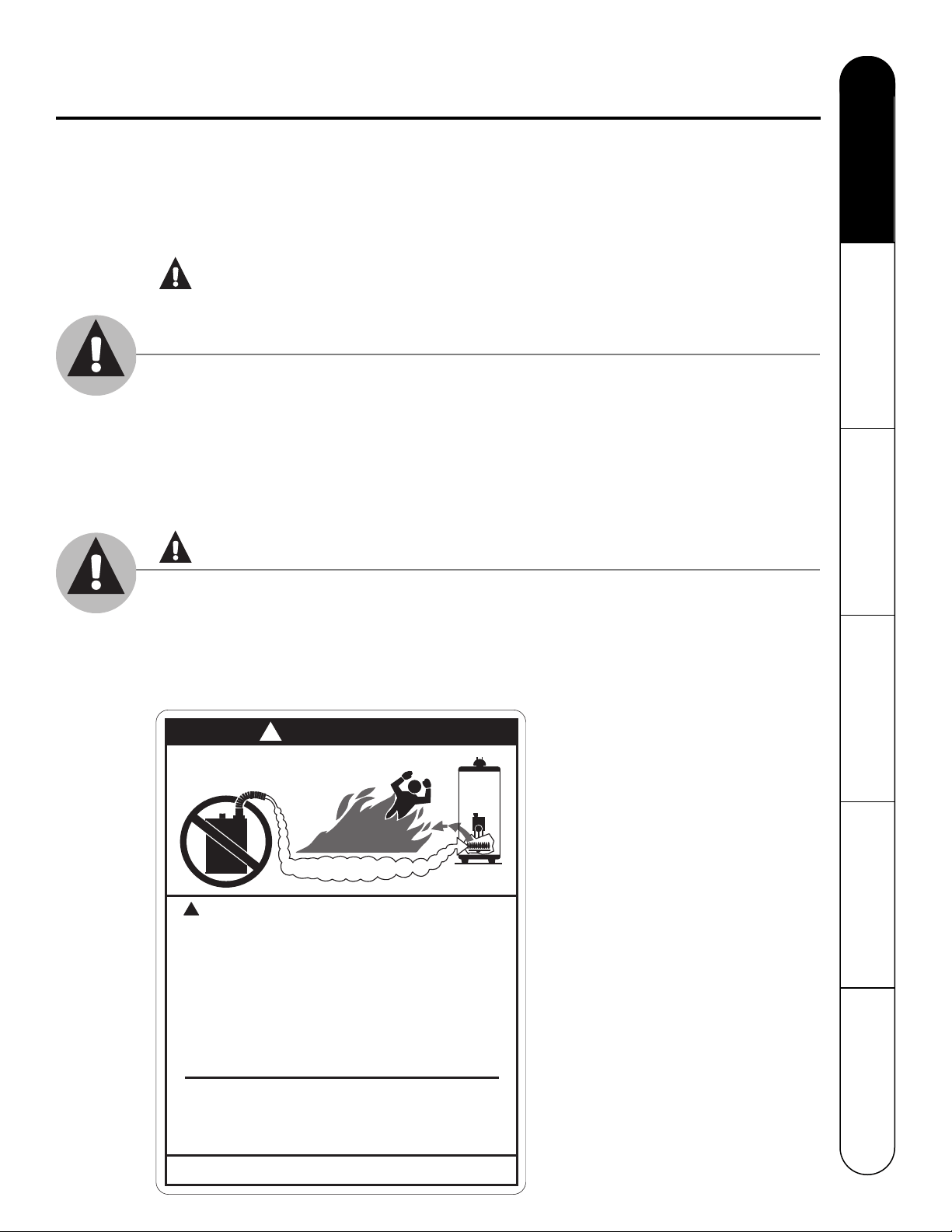
Gasoline, as well as other flammable materials and liquids (adhesives, solvents, etc.), and the
vapors they produce are extremely dangerous. Do not handle, use or store gasoline or other
flammable or combustible materials anywhere near or in the vicinity of a water heater. Be sure
to read and follow the warning label pictured below and other labels on the water heater, as
well as the warnings printed in this manual. Failure to do so can result in property damage,
bodily injury or death.
WARNING!
!
DANGER
!
FLAMMABLES
Flammable Vapors
Vapors from flammable
liquids will explode and
catch fire causing death or
severe burns
Do not use or store flammable
products such as gasoline,
solvents or adhesives in the
same room or area near the
water heater.
Keep flammable products:
1. far away from heater,
2. in approved containers,
3. tightly closed and
4. out of children's reach.
Water heater has a main
burner and pilot flame.
The pilot flame:
1. is on all the time and
2. will ignite flammable
vapors.
Vapors:
1. cannot be seen,
2. are heavier than air,
3. go a long way on the
floor and
4. can be carried from
other rooms to the pilot
flame by air currents.
Installation:
Do not install water heater
where flammable products will
be stored or used unless the
main burner and pilot flames
are at least 18" above the
floor. This will reduce, but not
eliminate, the risk of vapors
being ignited by the main
burner or pilot flame.
Read and follow water heater warnings and instructions. If owners
manual is missing, contact the retailer or manufacturer.
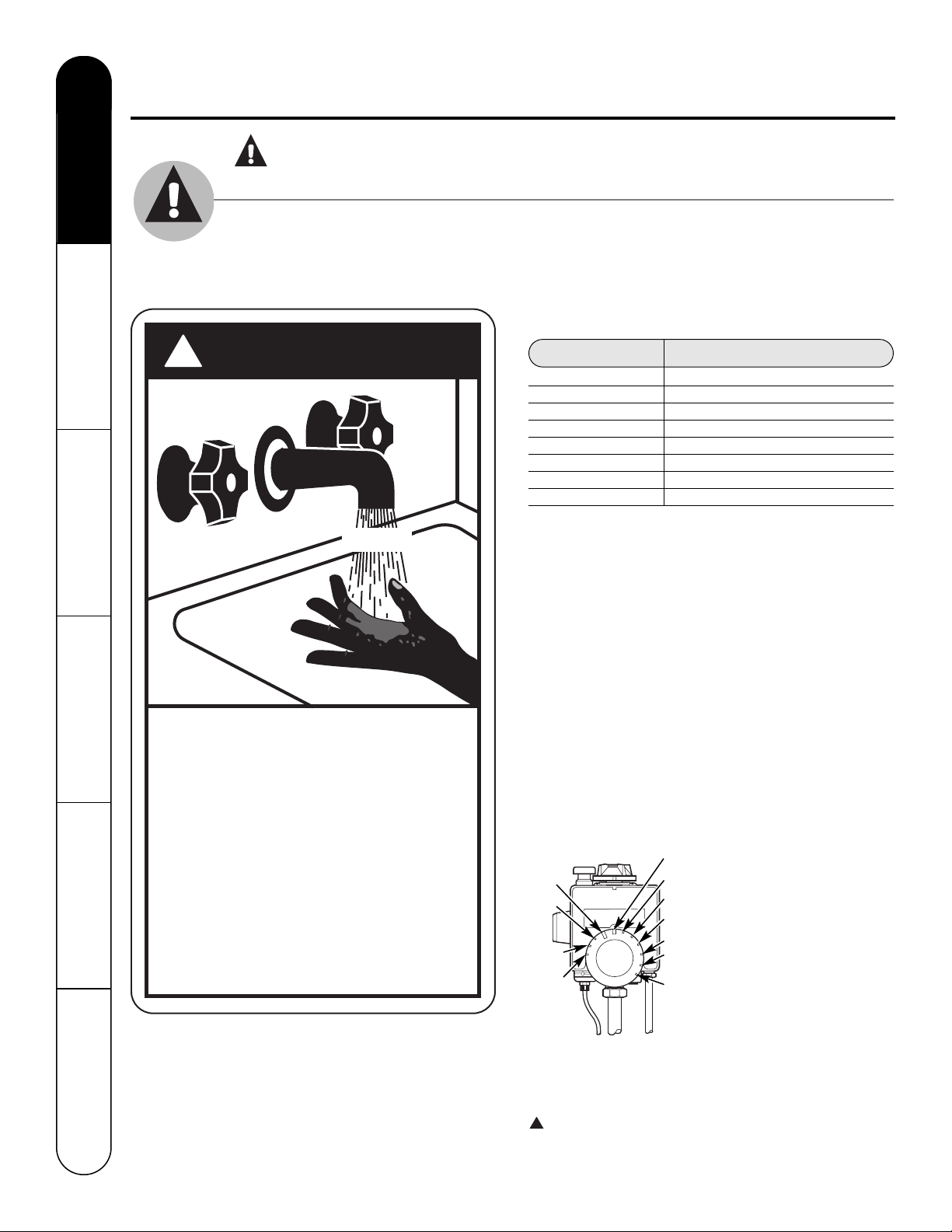
Time/Temperature Relationship in Scalds
Water Temperature Time To Produce a Serious Burn
120°F More than 5 minutes
125°F 1
1
/
2 to 2 minutes
130°F About 30 seconds
135°F About 10 seconds
140°F Less than 5 seconds
145°F Less than 3 seconds
150°F About 1
1
/2 seconds
155°F About 1 second
Table courtesy of Shriners Burn Institute
The chart shown above may be used as a guide
in determining the proper water temperature for
your home.
NOTICE: Households with small children, disabled,
or elderly persons may require a 120°F. or lower gas
control (thermostat) setting to prevent contact with
“HOT” water.
Maximum water temperatures occur just after
burner has shut off. To find hot water temperature
being delivered, turn on a hot water faucet and place
a thermometer in the hot water stream and read
the thermometer.
The temperature of the water in the heater can be
regulated by setting the temperature dial on the
front of the gas control (thermostat). To comply
with safety regulations
the gas control
(thermostat) was set at
its lowest setting before
water heater was shipped
from the factory.
The illustration at the left
details the approximate
water temperature
for each mark on the gas
control (Thermostat)
Temperature Dial.
DANGER: Hotter water increases the Potential
for Hot Water SCALDS.
!
DANGER
!
HOT
Water temperature over 125°F can
cause severe burns instantly or
death from scalds.
Children, disabled and elderly are
at highest risk of being scalded.
See instruction manual before
setting temperature at water
heater.
Feel water before bathing or
showering.
Temperature limiting valves are
available, see manual.
BURN
DANGER!
WATER TEMPERATURE SETTING
Safety and energy conservation are factors to be considered when selecting the water
temperature setting of water heater’s thermostat. Water temperatures above 125°F. can
cause severe burns or death from scalding. Be sure to read and follow the warnings outlined on
the label pictured below. This label is also located on the water heater.
Notice: Mixing valves are available for reducing point of
use water temperature by mixing hot and cold water in
branch water lines . Contact a licensed plumber or the
local plumbing authority for further information.
W
A
R
M
V
A
C
A
T
I
O
N
H
O
T
C
A
U
T
I
O
N
T
H
E
R
I
S
K
O
F
S
C
A
L
D
I
N
J
U
R
Y
W
A
T
E
R
I
N
C
R
E
A
S
E
S
H
O
T
T
E
R
WARNING
READ ALL INSTRUCTIONS
BEFORE LIGHTING
130°F.
Temperatures are
approximate
120°F.
140°F.
150°F.
160°F.
110°F.
100°F.
90°F.
80°F.
70°F.
60°F.
Customer Service Troubleshooting Tips Care and Cleaning Operating Instructions Installation Instructions Safety Instructions
4
IMPORTANT SAFETY INFORMATION.
READ ALL INSTRUCTIONS BEFORE USING.
5
Safety Instructions Installation Instructions Operating Instructions Care and Cleaning Troubleshooting Tips Customer Service
LP and natural gas have an odorant added to aid in detecting a gas leak. Some
people may not physically be able to smell or recognize this odorant. If you are unsure or unfamiliar with
the smell of LP or natural gas, ask the gas supplier. Other conditions, such as “odorant fade”, which
causes the odorant to diminish in intensity, can also hide or camouflage a gas leak.
DANGER!
LIQUEFIED PETROLEUM (LP-PROPANE OR BUTANE)
AND NATURAL GAS MODELS
● Water heaters utilizing LP gas are different
from natural gas models. A natural gas
water heater will not function safely on LP
gas and vice versa.
● No attempt should ever be made to convert
the water heater from natural gas to LP
gas. To avoid possible equipment damage,
personal injury or fire, do not connect the
water heater to a fuel type not in
accordance with the unit data plate. LP for
LP units. Natural gas for natural gas units.
These units are not certified for any other
fuel type.
● LP appliances should not be installed below
grade (for example, in a basement) if such
installation is prohibited by federal, state
and/or local laws, rules, regulations or
customs.
● LP gas must be used with great caution. It
is heavier than air and will collect first in
lower areas making it hard to detect at
nose level.
● Before attempting to light the water
heater, make sure to look and smell for gas
leaks. Use a soapy solution to check all gas
fittings and connections. Bubbling at a
connection indicates a leak that must be
corrected. When smelling to detect an LP
leak, be sure to sniff near the floor also.
● Gas detectors are recommended in LP &
natural gas applications and their
installation should be in accordance with
the manufacturer’s recommendations
and/or local laws, rules, regulations or
customs.
● It is recommended that more than one
method, such as soapy solution, gas
detectors, etc., be used to detect leaks in
gas applications.
DANGER: If a gas leak is present or
suspected:
●
Do not
attempt to find the cause yourself.
●
Do not
try to light any appliance.
●
Do not
touch any electrical switch.
●
Do not
use any phone in your building.
● Leave the house immediately and make sure
your family and pets leave also.
● Leave the doors open for ventilation and
contact the gas supplier, a qualified service
agency or the fire department.
● Stay away from the house (or building) until
the service call has been made, the leak is
corrected and a qualified agency has
determined the area to be safe.
!
Customer Service Troubleshooting Tips Care and Cleaning Operating Instructions Installation Instructions Safety Instructions
6
Have the installer show you the location of the gas shut-off valve and how to shut it off if
necessary. Turn off the manual shut-off valve if the water heater has been subjected to
overheating, fire, flood, physical damage or if the gas supply fails to shut off.
● Read this manual entirely before installing
or operating the water heater.
● Use this appliance only for its intended
purpose as described in this Use and Care
Manual.
● Be sure your appliance is properly installed
by a qualified technician in accordance with
the provided installation instructions.
● Do not attempt to repair or replace any
part of your water heater unless it is
specifically recommended in this manual.
All other servicing should be referred to a
qualified technician.
SAFETY PRECAUTIONS
IMPORTANT SAFETY INFORMATION.
READ ALL INSTRUCTIONS BEFORE USING.
WARNING!
For your safety, the information in this manual must be followed to minimize the risk of fire or
explosion, electric shock, or to prevent property damage, personal injury, or loss of life.
FOR INSTALLATIONS IN THE STATE OF CALIFORNIA
California Law requires that residential water heaters must be braced, anchored or strapped
to resist falling or horizontal displacement due to earthquake motions. For residential water
heaters up to 52 gallon capacity, a brochure with generic earthquake bracing instructions can
be obtained from: Office of the State Architect, 400 P Street, Sacramento, CA 95814 or you
may call 916-445-8100 or ask a water heater dealer.
However, applicable local codes shall govern installation. For residential water heaters
of a capacity greater than 52 gallons, consult the local building jurisdiction for acceptable
bracing procedures.
READ AND FOLLOW THIS SAFETY INFORMATION
CAREFULLY.
SAVE THESE INSTRUCTIONS
Installing the water heater.
This water heater must be installed in accordance with these instructions, local codes, utility company
requirements, and/or in the absence of local codes, use the latest edition of the American National
Standard/National Fuel Gas Code. A copy can be purchased from either the American Gas Association, 1515
Wilson Blvd., Arlington, VA 22209 as booklet Z223.1 or National Fire Protection Association, Batterymarch
Park, Quincy, MA 02269 as booklet NFPA No. 54.
Location
The water heater should not be located in
an area where leakage of the tank or
connections will result in damage to the
area adjacent to it or to lower floors of
the structure.
When such areas cannot be avoided it is
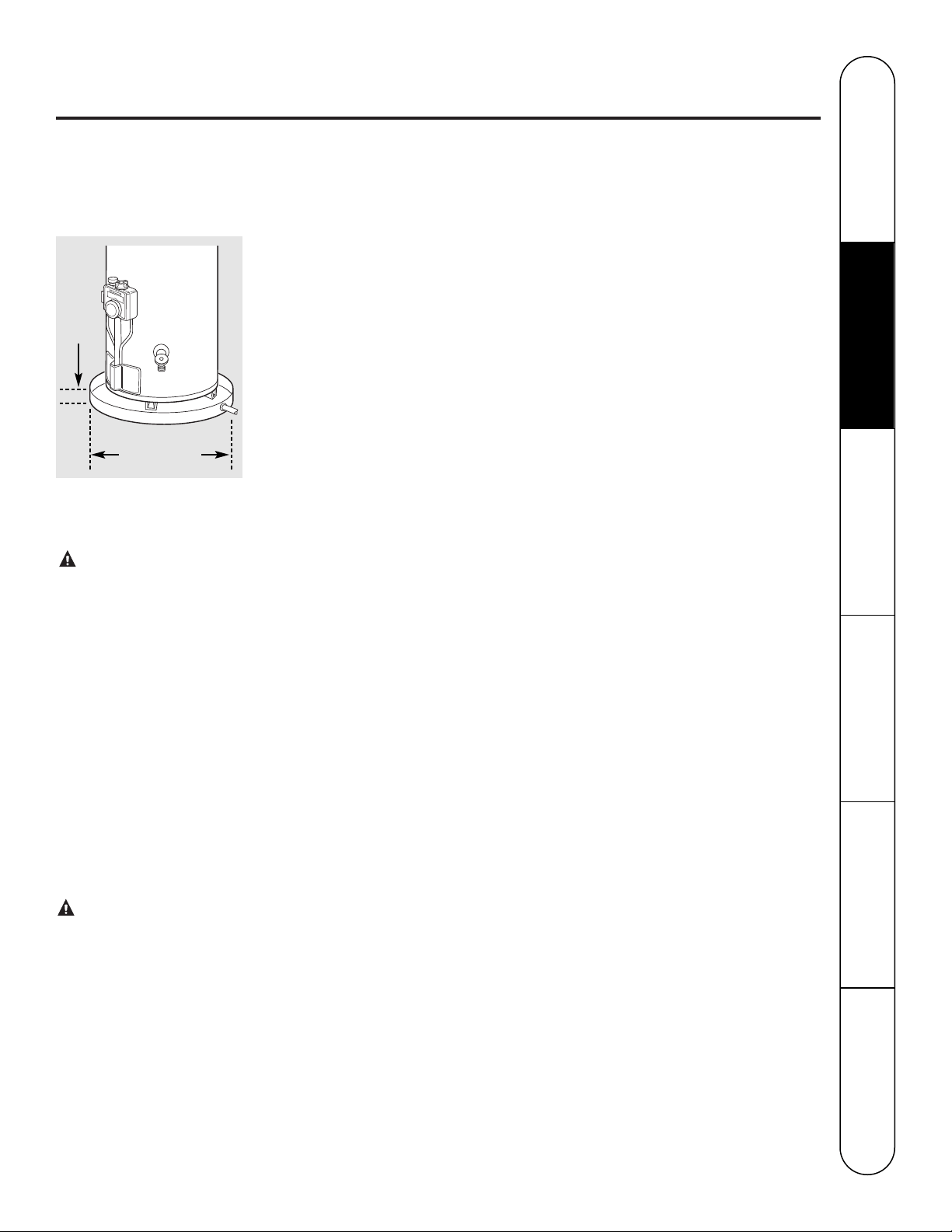
recommended that a suitable catch pan,
adequately drained, must be installed
under the water heater.
The pan must not restrict combustion air
flow to the bottom of the water heater.
Catch pan kits are available from the store
where the water heater was purchased, or
any water heater distributor.
A gas fired water heater should not be
installed in a space where liquids which
give off flammable vapors are to be used
or stored. Such liquids include gasoline, LP
gas (butane and propane), paint or
adhesives and their thinners, solvents
or removers.
Because of natural air movement in a
room or other enclosed space, flammable
vapors can be carried some distance from
where their liquids are being used or
stored. The open flame of the water
heater’s pilot light or main burner can
ignite these vapors causing an explosion
or fire which may result in severe burns,
death or property damage.
For these reasons installation of a gas fired
water heater in a garage is not desirable.
Raising the gas fired water heater will
reduce, but not eliminate, the possibility
of lighting the vapor of any flammable
liquids which may be improperly stored or
accidentally spilled.
Stand kits to raise the water heater 18″
above the floor are available from the store
where the water heater was purchased, or
any water heater distributor. These kits
must comply with local codes.
The water heater must be located so it is
not subject to physical damage, for example,
by moving vehicles, area flooding, etc.
● The water heater should be installed as
close as practical to the gas vent or
chimney.
● Long hot water lines should be insulated
to conserve water and energy.
● The water heater and water lines
should be protected from exposure
to freezing temperatures.
● Do not install the water heater in
bathrooms, bedrooms, any occupied
rooms normally kept closed, or in
outdoor unprotected areas.
● Minimum clearance from combustible
construction is 1″ sides and rear; 3″
from front of control; 12″ from the top.
If the clearances stated on the
Instruction/Warning Label, located on
the front of the heater differ, install
the water heater according to the
clearances stated on the label.
● The water heater may be installed on
combustible floors, but not directly on
carpeting. If the water heater must be
installed on carpeting, place a metal or
wood panel beneath the water heater,
extending beyond its full width and
depth at least 3″ in all directions.
● If the water heater is installed in an
alcove or closet, the entire floor must
be covered by a wood or metal panel. A
minimum of 24″ clearance from the
front and top should be available for
adequate inspection and servicing.
● If flexible connectors are used, the
maximum length shall not exceed 36”.
● If lever type gas shut-offs are used,
they shall be T-Handle type.
The auxiliary catch pan
installation MUST conform
to local codes.
Max.
2″
Diameter of
water heater
plus 2″ min.
7
Safety Instructions Installation Instructions Operating Instructions Care and Cleaning Troubleshooting Tips Customer Service
WARNING: If a location in
a garage is the only
alternative, the gas water
heater should be installed
so that the open flame of
the pilot and main burner
are no less than 18″ above
the garage floor, unless
specifically exempted from
this by local code, rule,
regulation or custom.
WARNING: Combustible
construction refers to
adjacent walls and ceilings
and should not be confused
with combustible or
flammable products and
materials. Combustible
and/or flammable products
and materials should never
be stored in the vicinity of
this or any gas appliance.
Inspect Shipment
Inspect the water heater for possible damage. Check the markings on the rating plate
of the water heater to be certain the type of gas supplied corresponds to the water
heater requirements.
8
Installing the water heater.
Customer Service Troubleshooting Tips Care and Cleaning Operating Instructions Installation Instructions Safety Instructions
Combustion and Ventilation Air
Proper operation of the water heater
requires air for combustion and
ventilation. Provisions for combustion
and ventilation air must comply with
referenced codes and standards.
NOTICE: If the water heater is installed
in an unconfined space within a building
of conventional frame, masonry or
metal construction, infiltration air is
normally adequate for proper
combustion and ventilation. If the water
heater is installed in a confined space,
provisions for combustion and
ventilation air must be made.
A confined space is one having a volume of
less than 50 cubic feet per 1000 BTUH of
the aggregate input of all appliances
within that space.
The air must be supplied through two
permanent openings of equal area. One
is to be located within 12″ above the floor
and the other is to be located within 12″
below the ceiling.
The minimum net free area of each opening
must not be less than one square inch per
1000 BTUH of the total input rating of all
the appliances in the enclosure (but not
less than 100 square inches),
if each opening communicates with other
unconfined areas inside the building.
Buildings of unusually tight construction
shall have the combustion and ventilation
air supplied from outdoors, or a freely
ventilated attic or crawl space.
If air is supplied from outdoors, directly or
through vertical ducts, there must be two
openings located as specified above and
each must have a minimum net free area
of not less than one square inch per
4000 BTUH of the total input rating of
all the appliances in the enclosure.
If horizontal ducts are used to
communicate with the outdoors, each
opening must have a minimum net free
area of not less than one square inch per
2000 BTUH of the total input rating of
all the appliances in the enclosure. If
ducts are used, the minimum dimensions
of rectangular air ducts shall not be less
than 3″.
NOTICE: If the duct openings are to be
covered with a protective screen or
grill, the net free area of the covering
material must be used in determining
the size of the openings. Protective
screening for the openings must not be
smaller than 1/4″ mesh to prevent
clogging by lint or other debris.
Corrosive Atmospheres
The air in beauty shops, dry cleaning
establishments, photo processing labs,
and storage areas for liquid and powdered
bleaches or swimming pool chemicals often
contain such halogenated hydrocarbons.
An air supply containing halogenated
hydrocarbons may be safe to breathe,
but when it passes through a gas flame
corrosive elements are released that
will shorten the life of any gas burning
appliance.
Propellants from common spray cans or
gas leaks from refrigeration equipment are
highly corrosive after passing through a
flame.
The water heater warranty is voided when
failure of the heater is due to operation in
a corrosive atmosphere.
NOTICE: The water heater
should not be installed
near an air supply
containing halogenated
hydrocarbons.
Determine if a check valve exists in
the inlet water line. It may have been
installed in the cold water line as a separate
back flow preventer, or it may be part of a
pressure reducing valve, water meter or water
softerner. A check valve located in the cold
water inlet line can cause what is referred to
as a “closed water system”. A cold
water inlet line with no check valve or back
flow prevention device is referred to as an
“open water system”.
As water is heated, it expands in volume and
creates an increase in the pressure within the
water system. This action is referred to as
“thermal expansion”. In an “open water
system”, expanding water which exceeds the
capacity of the water heater flows back into
the city main where the pressure is easily
dissapated.
A “closed water system”, however,
prevents the expanding water from flowing
back into the main supply line, and the result
of “thermal expansion” can create a rapid and
dangerous pressure increase in the water
heater and system piping. This rapid pressure
increase can quickly reach the safety setting
of the relief valve, causing it to operate during
each heating cycle. Thermal expansion, and
the resulting rapid and repeated expansion
and contraction of components in the water
heater and piping system can cause
premature failure of the relief valve, and
possibly the heater itself. Replacing the relief
valve will not correct the problem.
The suggested method of controlling thermal
expansion is to install an expansion tank in
the cold water line between the water heater
and the check valve. The expansion tank is
designed with an air cushion built in that
compresses as the system pressure
increases, thereby relieving the over pressure
condition and eliminating the repeated
operation of the relief valve. Other methods of
controlling thermal expansion are also
available. Contact your installing contractor,
water supplier or plumbing inspector for
additional information regarding this subject.
9
Safety Instructions Installation Instructions Operating Instructions Care and Cleaning Troubleshooting Tips Customer Service
Thermal Expansion
Water Supply Connections
IMPORTANT: Do not apply
heat to the HOT or COLD
water connections. If sweat
connections are used,
sweat tubing to adapter
before fitting adapter to the
cold water connections on
heater. Any heat applied to
the cold water supply
fittings will permanently
damage the dip tube.
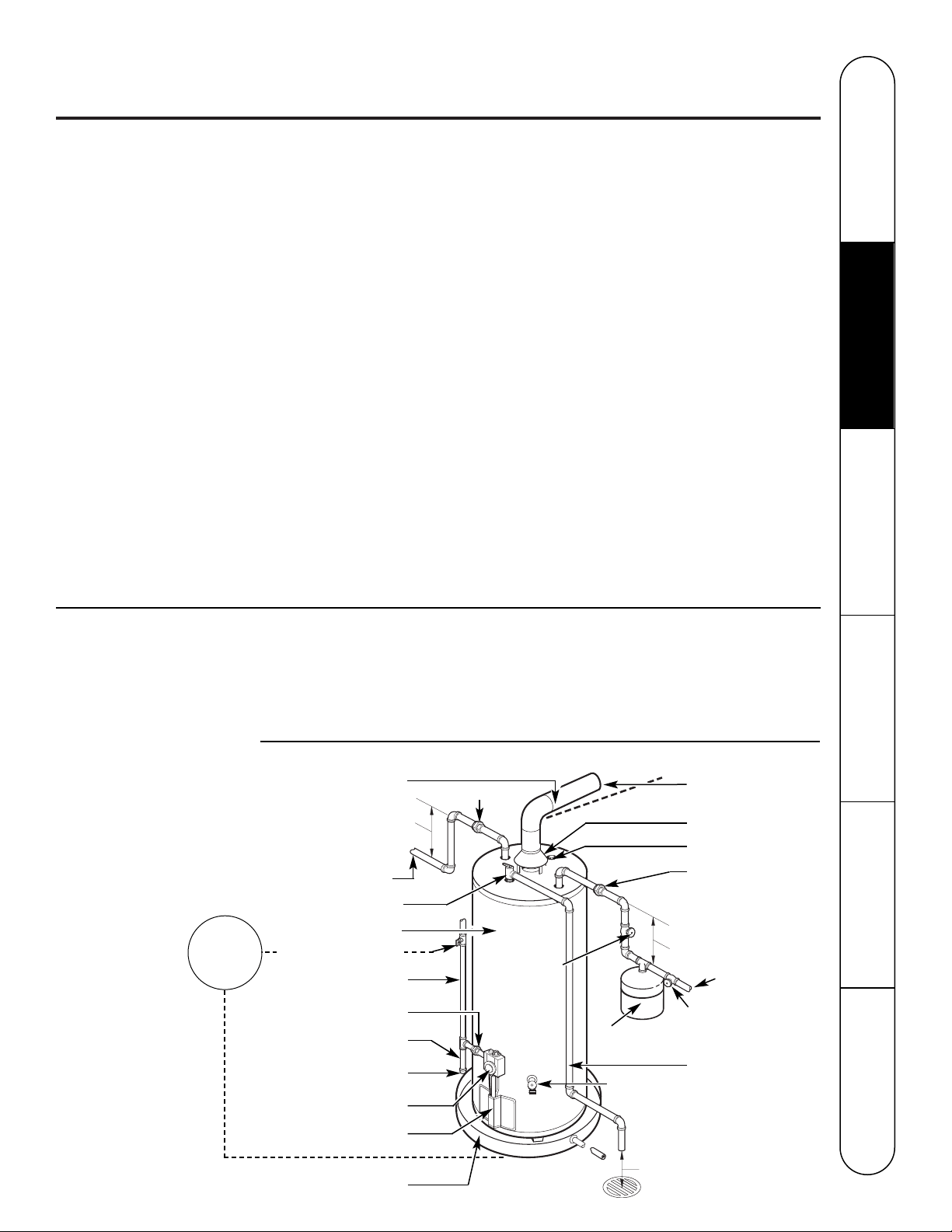
Refer to the illustration below for suggested typical installation. The installation of
unions or flexible copper connectors is recommended on the hot and cold water
connections so that the water heater may be easily disconnected for servicing if
necessary. The HOT and COLD water connections are clearly marked and are 3/4″ NPT
on all models. Install a shut-off valve in the cold water line near the water heater.
Typical Installation
R
E
L
I
E
F
V
A
L
V
E
COLD
HOT
Heat trap
6″ minimum
Heat trap
6″ minimum
Union
Hot water outlet
to fixtures
Temperature and
pressure relief valve
Relief valve
discharge line to
suitable open drain.
To gas supply
Water Heater Jacket
Sediment trap
Cap
Jacket door
Auxiliary catch pan
Ground joint union
Drain
valve
To cold water
supply
6″ air gap
Shut-off
valve
Draft hood
Pitch up 1/4″
per foot
Union
Thermostatic gas valve
Anode
Vent connector
to chimney
Manual gas shut-off
5 feet
from the
ground
minimum
Shut-off valve
Thermal expansion
tank (if required)
Customer Service Troubleshooting Tips Care and Cleaning Operating Instructions Installation Instructions Safety Instructions
10
Installing the water heater.
A new combination temperature and pressure relief valve, complying with the Standard for Relief Valves and
Automatic Gas Shut-Off Devices for Hot Water Supply Systems, ANSI Z21.22, is supplied and must remain in
the opening provided and marked for the purpose on the water heater. No valve of any type should be installed
between the relief valve and the tank. Local codes shall govern the installation of relief valves.
Relief Valve
The pressure rating of the relief valve
must not exceed 150 PSI, the maximum
working pressure of the water heater as
marked on the rating plate.
The BTUH rating of the relief valve must
equal or exceed the BTUH input of the
water heater as marked on its rating plate.
Position the outlet of the relief valve above
a suitable open drain to eliminate
potential water damage. Piping used
should be of a type approved for hot
water distribution.
The discharge line must be no smaller
than the outlet of the valve and must
pitch downward from the valve to allow
complete drainage (by gravity) of the relief
valve and discharge line.
The end of the discharge line should not
be threaded or concealed and should be
protected from freezing. No valve of any
type, restriction or reducer coupling
should be installed in the discharge line.
To Fill the Water Heater
Make certain that drain valve is closed,
then open the shut-off valve in the cold
water supply line.
Open each hot water faucet slowly to
allow the air to vent from the water
heater and piping.
A steady flow of water from the hot water
faucet(s) indicates a full water heater.
WARNING: The tank
must be full of water before
heater is turned on. The
water heater warranty does
not cover damage or failure
resulting from operation
with an empty or partially
empty tank. (Refer to the
Certificate of Limited
Warranty for complete
terms and conditions.)
Condensation
Condensation can form on the tank when
it is first filled with water. Condensation
might also occur with a heavy water draw
and very cold inlet water temperatures.
Drops of water falling on the burner can
produce a sizzling or pinging sound, and
the water may also be seen beneath the
water heater.
This condition is not unusual, and will
disappear after the water becomes
heated. If, however, the condensation
continues, examine the piping and fittings
for possible leaks.
Additional information on this subject
may be found at www.rheem.com
under “Library,” scroll down to the
Technical Service Bulletins 1400 Series
Section and choose Bulletin #1402.
Safety Instructions Installation Instructions Operating Instructions Care and Cleaning Troubleshooting Tips Customer Service
11
WARNING: Do not attempt to convert this water heater for use with a different type of gas other than the type
shown on the rating plate. Such conversion could result in hazardous operating conditions.
Leak Testing
The water heater and its gas connections
must be leak tested at normal operating
pressures before
it is placed in operation.
Turn on the manual gas shut-off
valve near the water heater.
Use a soapy water solution to test
for leaks at all connections and
fittings. Bubbles indicate a gas leak
that must be corrected.
The factory connections to the gas
control (thermostat) should also be leak
tested after the water heater is placed in
operation.
High Altitude…
Ratings of gas appliances are based
on sea level operation and need not be
changed for installations at elevations up
to 2,000 feet.
For installations above 2,000 feet, the
input must be reduced per the National
Fuel Gas Code for each 1,000 feet above
sea level. Contact the local gas supplier
for more information.
The 60 Gallon unit included in this manual
is rated for up to 5,000 feet.
For installations above 5,000 feet, the
input must be reduced per the National
Fuel Gas Code for each 1,000 feet above
sea level. Contact the local gas supplier
for more information.
Pressure Testing the Gas Supply System
The water heater and its manual gas
shut-off valve must be disconnected from
the gas supply piping system during any
high pressure testing of that system at
pressures in excess of 1/2 psi (14″ w.c.).
The water heater must be isolated from
the gas piping system by closing the
manual gas shut-off valve during any
pressure testing of the gas supply piping.
Gas Supply
The branch gas supply line to the water
heater should be clean 1/2″ black steel
pipe or other approved gas piping
material.
A ground joint union or ANSI design
certified semi-rigid or flexible gas
appliance connector should be installed in
the gas line close to the water heater. A
manual gas shut-off valve should be at
least 5 ft. above the floor and readily
accessible.
Compound used on the threaded joints of
the gas piping must be of the type
resistant to the action of LP gas. Use
compound sparingly on male threads only.
A sediment trap should be installed at
the bottom of the gas line.
Do not use excessive force (over 31.5 ft
lbs.) in tightening the pipe joint at the gas
control (thermostat) inlet, particularly if
teflon pipe compound is used, as the valve
body may be
damaged.
The inlet gas pressure to the water
heater must not exceed 14″ w.c. for
natural or LP gas. For purposes of input
adjustment, the minimum inlet gas
pressure (with main burner on) is shown
on the water heater rating plate. If high or
low gas pressures are present, contact
your gas supplier for correction.
WARNING: Never use an
open flame to test for gas
leaks, as bodily injury,
property damage or death
could result.
Customer Service Troubleshooting Tips Care and Cleaning Operating Instructions Installation Instructions Safety Instructions
12
Installing the water heater.
The water heater must be installed with the factory supplied draft hood in place.
Venting
Insulation Blanket
Vent connectors must be attached to the
draft hood outlet to connect the water
heater to the gas vent or chimney. The
vent connectors must be the same size
(diameter) as the draft hood or larger,
never smaller.
For proper venting in certain installations
a larger vent connector size may be
needed. Consult the Vent Tables in
Appendix G of the latest version of the
National Fuel Gas Code (ANSI booklet
Z223.1 or NFPA booklet 54.)
Horizontal vent connectors must be
pitched upward to the chimney at least
1/4″ per foot of length. Single wall vent
connectors must be at least 6″ from
adjacent unprotected combustible
surface. Vent joints must be securely
fastened by sheet metal screws or other
approved method.
Insulation blankets, available to the
general public, for external use on gas
water heaters are not necessary. The
purpose of an insulation blanket is to
reduce the standby heat loss encountered
with storage tank heaters. This water
heater meets or exceeds the National
Appliance Energy Conservation Act
standards with respect to insulation and
standby loss requirements making an
insulation blanket unnecessary.
The manufacturer’s warranty does not
cover any damage or defect caused by
installation, attachment or use of any
type of energy saving or other unapproved
devices (other than those authorized by
the manufacturer) into, onto or in
conjunction with the water heater. The use
of unauthorized energy saving devices may
shorten the life of the water heater and
may endanger life and property.
The manufacturer disclaims any
responsibility for such loss or injury
resulting from the use of such
unauthorized devices.
CAUTION:
If local codes require the
application of an external insulation
blanket to this water heater, pay careful
attention to the following so as not to
restrict the proper function and
operation of the water heater:
● Do not cover the operating or warning
labels attached to the water heater or
attempt to relocate them on the
exterior of insulation blanket.
● Do not apply insulation to the top
of the water heater. This will interfere
with the safe operation of the draft
hood.
● Do not cover the burner access panel,
gas control (thermostat)/gas valve or
pressure and temperature relief valve.
● Do not apply insulation to the bottom
of the water heater or the 2″ space
between the bottom pan of the water
heater and the floor. This area must be
unobstructed so as not to restrict
combustion air flow to the burner.
● Inspect the insulation blanket
frequently making certain it has
not sagged and is restricting the
combustion air to the bottom of the
water heater. This could result in an
unsafe operating condition.
!
DANGER: Failure to
install the draft hood and
properly vent the water
heater to the outdoors as
outlined in the Venting
section of this manual will
result in unsafe operation of
the water heater causing
bodily injury, explosion, fire
or death. To avoid the risk
of fire, explosion, or
asphyxiation from carbon
monoxide, NEVER operate
the water heater unless it
is properly vented and has
adequate air supply for
proper operation as
outlined in the Venting
section of this manual.
WARNING: If local codes
require external application
of insulation blanket kits
the manufacturer’s
instructions included with
the kit must be carefully
followed.
13
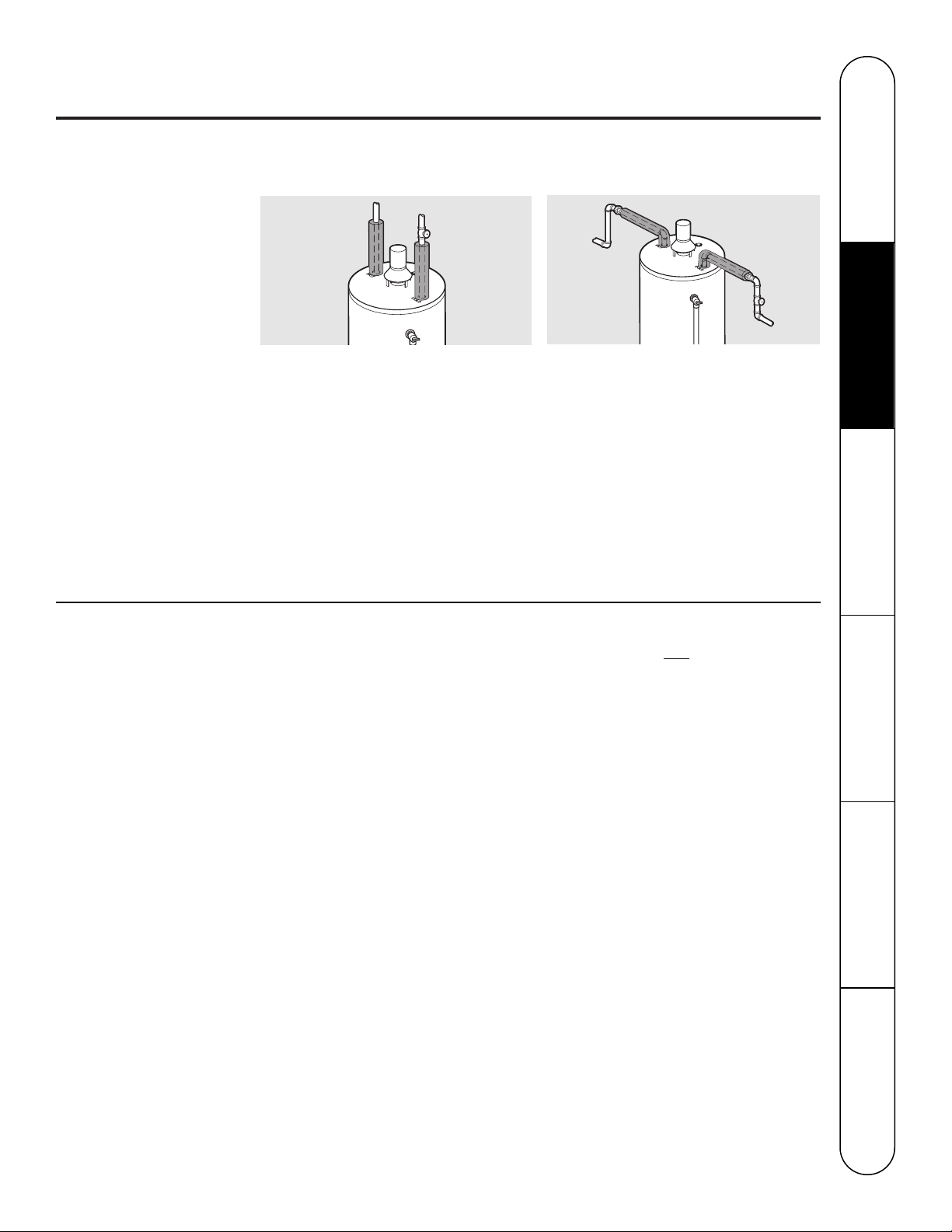
Typical vertical piping arrangement
Typical horizontal piping arrangement
Hot and Cold Pipe Insulation Installation
For increased energy efficiency, some
water heaters have been supplied with
two 24” sections of pipe insulation.
Please install the insulation, according to
the illustrations above, that best meets
your requirements.
Heat Traps
For increased energy efficiency, some
water heaters have been supplied with
factory installed 3/4” NPT heat traps
in the hot outlet line and cold water
inlet line.
These heat traps may require a minimum
of one (1) 90° 3/4” NPT elbow and may
require an additional 90° 3/4” NPT elbow
or a 3/4” coupling depending on your
installation needs. See illustration of
nipples and heat traps on page 25.
Safety Instructions Installation Instructions Operating Instructions Care and Cleaning Troubleshooting Tips Customer Service
14
Installation Checklist.
Water Supply
■ Water heater completely filled
with water.
■ Air purged from water heater and
piping.
■ Water connections tight and
free of leaks.
Water Heater Location
■ Close to area of vent.
■ Indoors and protected from
freezing temperatures.
■ Proper clearance from combustible
surfaces observed and water heater
not installed on carpeted floor.
■ Sufficient fresh air supply for
proper operation of water heater.
■ Air supply free of corrosive
elements and flammable vapors.
■ Provisions made to protect area
from water damage.
■ Sufficient room to service heater.
■ Combustible materials, such as
clothing, cleaning materials, rags, etc.
clear of the base of the heater.
Gas Supply
■ Gas line equipped with shut-off
valve, union and sediment trap.
■ Approved pipe joint compound used.
■ Soap and water solution used to
check all connections and fittings
for possible gas leak.
■ Gas Company inspected installation
(if required).
Relief Valve
■ Temperature and Pressure Relief
Valve properly installed and
discharge line run to open drain.
■ Discharge line protected from
freezing.
Venting
■ Flue baffle properly hung in top of
heater’s flue.
■ Draft hood properly installed.
■ Vent connector(s) pitched upward
to chimney (1/4” per foot of length
minimum).
■ Vent connector(s) securely
fastened together with screws.
■ Single wall vent connector(s) at
least 6” from combustible material.
Customer Service Troubleshooting Tips Care and Cleaning Operating Instructions Installation Instructions Safety Instructions
COLD
HOT
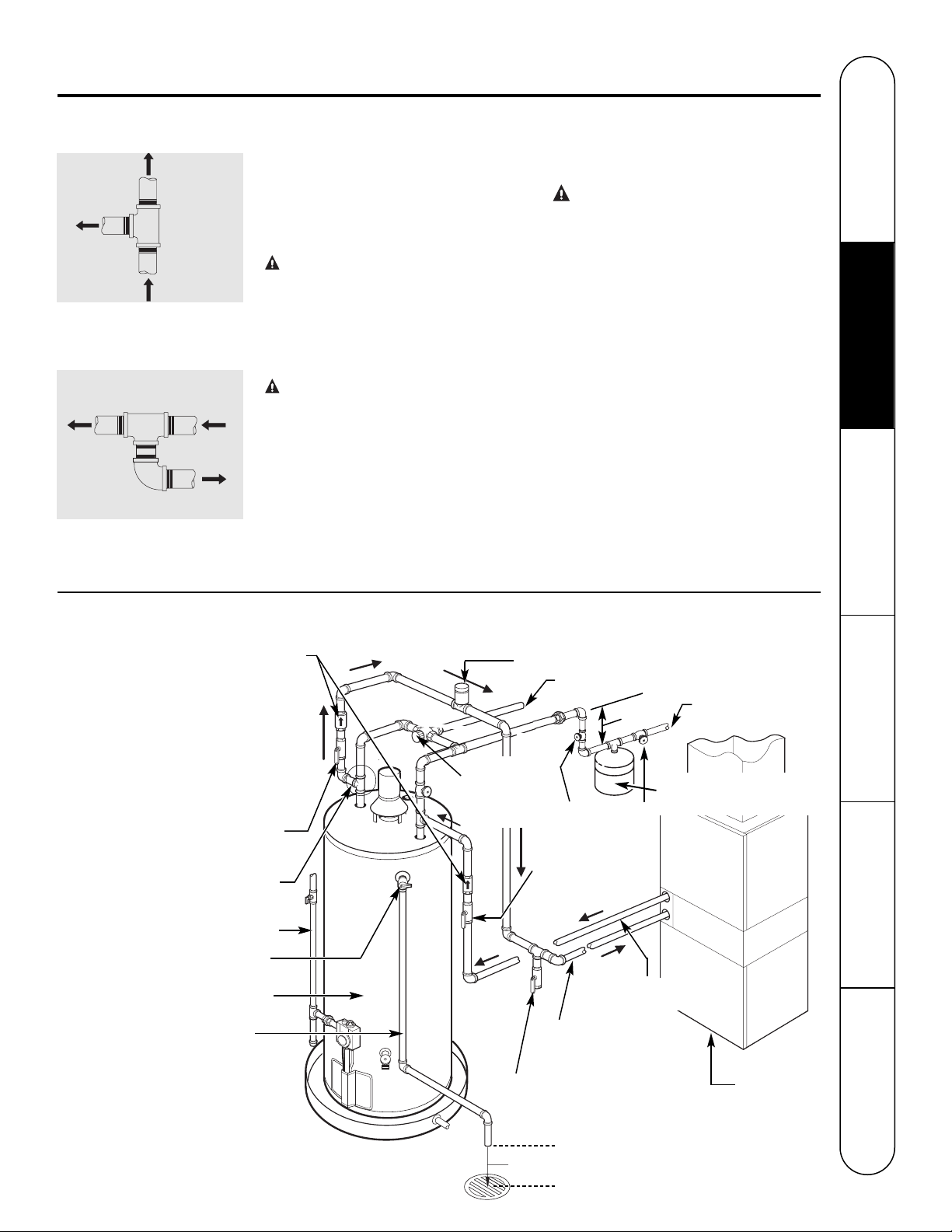
Typical Piping Diagram for Combination Potable/Space Heating Installation
Spring loaded check valve in
heating unit hot water supply line
and cold water return line (not
supplied with water heater)
NOTICE: This check valve is
incorporated in some heating units.
Refer to the installation instructions
supplied with specific heating unit
to determine if it is required.
See diagrams above for proper
pipe application for vertical
or horizontal supply lines
Gas line to water heater
Cold water return line
from heating unit
Hot water
supply line into
heating unit
Heating unit
Isolation valve in
cold water return
line from heating
unit (not supplied
with water heater)
Mixing or
tempering
valve (refer
to warning
above)
Temperature and pressure
relief valve
Temperature and
pressure relief valve
discharge line
Drain valve
(not supplied
with water
heater)
Water Heater Jacket
Isolation valve in hot water
supply line to heating unit
(not supplied with water heater)
Incoming cold water
supply
Domestic hot water
supply
Air vent
Shut-off valve
Safety Instructions Installation Instructions Operating Instructions Care and Cleaning Troubleshooting Tips Customer Service
15
Supplemental instructions for gas water heaters
installed in potable/space heating applications.
Local codes or plumbing authority requirements may vary from the instructions or diagrams provided in this
manual and take precedent over these instructions.
Tee fitting for vertical hot
water supply lines.
Combination Potable and Space Heating Application
Tee fitting must be installed as shown.
This insures that any air in the water lines
will be purged through the domestic water
faucets and showers.
WARNING: When this system
requires water for space heating at
elevated temperatures (above 125°F.),
a mixing or tempering valve must be
installed in the hot water supply line to
the house in order to reduce the scald
hazard potential.
WARNING: Any piping or components
used in the installation of this water
heater in a combination potable and
space heating application must be
suitable for use with drinking water.
WARNING: If this water heater is
installed in an application intended to
supply domestic hot water needs and
hot water for space heating purposes,
do not connect the heater to an existing
heating unit or components of a heating
system that have previously been used
with a non drinking water system. Toxic
chemicals such as those used for boiler
treatment may be present and will
contaminate the drinking water supply
causing possible health risks. Never
introduce toxic chemicals, such as
those used for boiler treatment, into
this system.
Tee fitting for horizontal hot
water supply lines.
Hot water
supply to
house
From HOT
outlet on
water heater
From HOT
outlet on
water heater
Hot water
supply to
heating
unit
Hot water
supply to
house
Hot water supply
to heating unit
HHeeaatt ttrraapp
66″″ MMiinn..
Thermal Expansion Tank (if
required-not supplied with
water heater)
6″ air gap
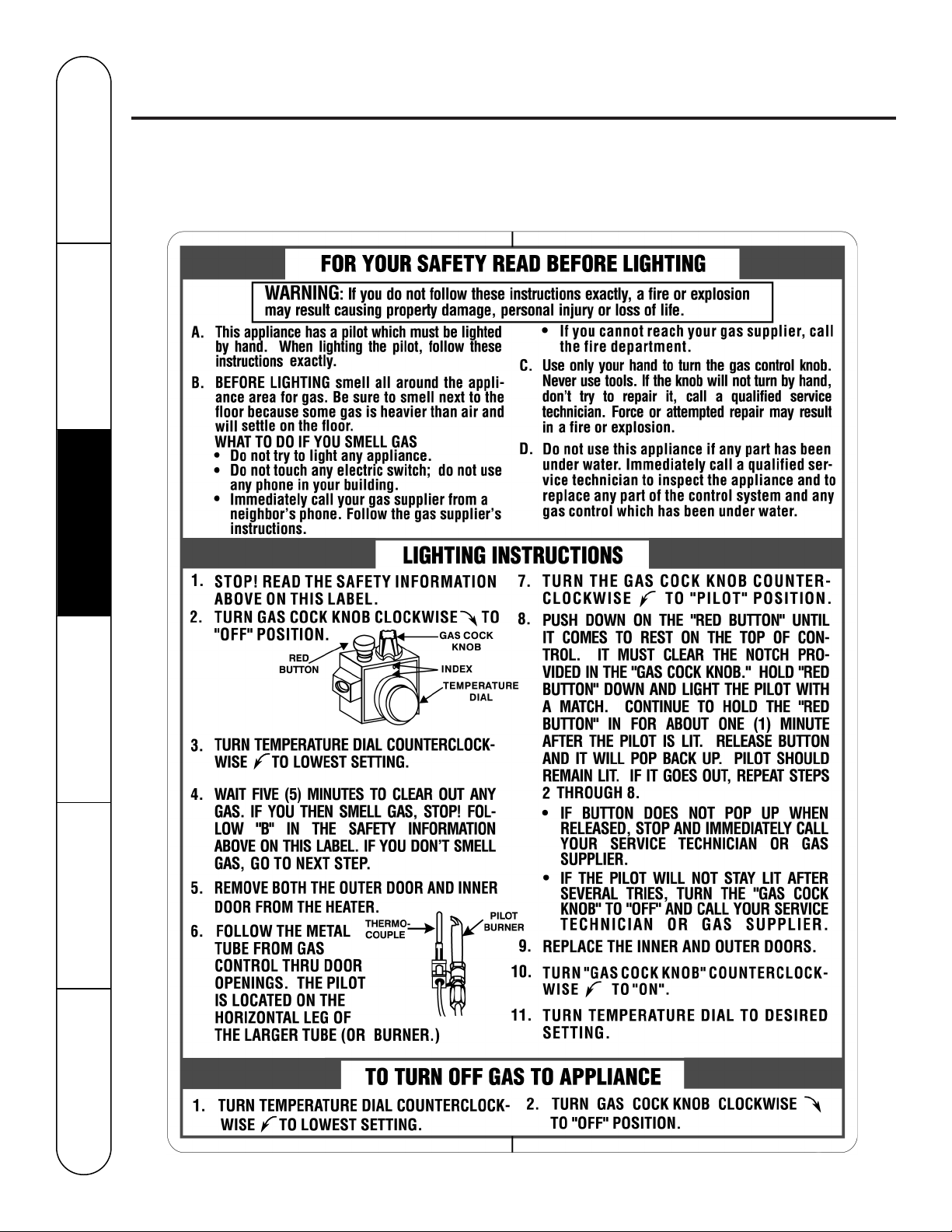
Lighting the water heater.
Before operating this water heater, be sure to read and follow the instructions on the label pictured below
and all other labels on the water heater, as well as the warnings printed in this manual. Failure to do so can
result in unsafe operation of the water heater resulting in property damage, bodily injury, or death. Should
you have any problems reading or following the instructions in this manual, STOP, and get help from a qualified
person.
Customer Service Troubleshooting Tips Care and Cleaning Operating Instructions Installation Instructions Safety Instructions
16
17
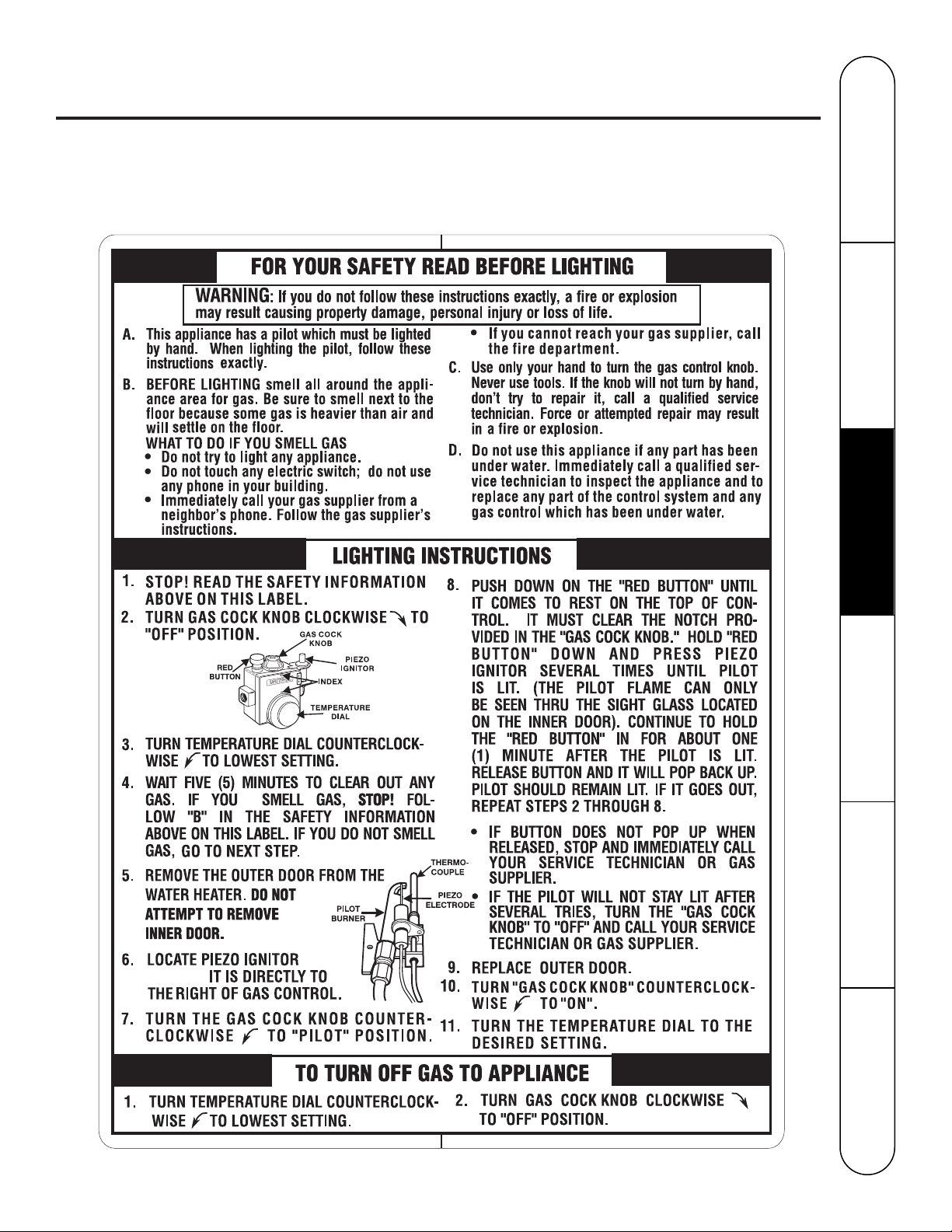
Alternate Lighting Instructions*
Before operating this water heater, be sure to read and follow the instructions on the label pictured below
and all other labels on the water heater, as well as the warnings printed in this manual. Failure to do so can
result in unsafe operation of the water heater resulting in property damage, bodily injury, or death. Should
you have any problems reading or following the instructions in this manual, STOP, and get help from a qualified
person.
STRIKER,
STRIKER
Safety Instructions Installation Instructions Operating Instructions Care and Cleaning Troubleshooting Tips Customer Service
*This option is not available on all models.
Customer Service Troubleshooting Tips Care and Cleaning Operating Instructions Installation Instructions Safety Instructions
Jacket door
Dip tube (cold water inlet)
Anode
Thermostat and burner
Pilot burner
Thermocouple
Main
burner
orifice
Main
burner
Thermostatic
gas valve
Gas cock
knob
Red button
Thermostat
temperature
dial
Water heater
Insulation
Internal
flueway
Drain valve
Glass lined
tank
Flue baffle
Water Heater Jacket
Relief valve
Water connections
(on top of water heater)
Floor shield
Draft hood
Inner door
Safety Precautions
Do turn off manual gas shut-off
valve if water heater has been
subjected to over heating, fire, flood,
physical damage or if the gas supply
fails to shut off.
Do Not turn on water heater unless
it is filled with water.
Do Not turn on water heater if cold
water supply shut-off valve is closed.
Do Not allow combustible materials
such as newspaper, rags or mops to
accumulate near water heater.
Do Not store or use gasoline or
other flammable vapors and liquids,
such as adhesives or paint thinner, in
vicinity of this or any other
appliance. If such flammables must
be used, open doors and windows for
ventilation, and all gas burning
appliances in the vicinity should be
shut off including their pilot lights,
to avoid vapors lighting.
NOTICE: Flammable vapors may be
drawn by air currents from surrounding
areas to the water heater.
If there is any difficulty in
understanding or following the
Operating Instructions or the
Care and Cleaning section, it is
recommended that a qualified person
or serviceman perform the work.
Operating the water heater.
CAUTION: Hydrogen gas can be produced in a hot water system served by this water heater that has not been
used for a long period of time (generally two weeks or more). HYDROGEN GAS IS EXTREMELY FLAMMABLE!! To
dissipate such gas and to reduce risk of injury, it is recommended that the hot water faucet be opened for several
minutes at the kitchen sink before using any electrical appliance connected to the hot water system. If hydrogen
is present, there will be an unusual sound such as air escaping through the pipe as the water begins to flow. Do
not smoke or use an open flame near the faucet at the time it is open.
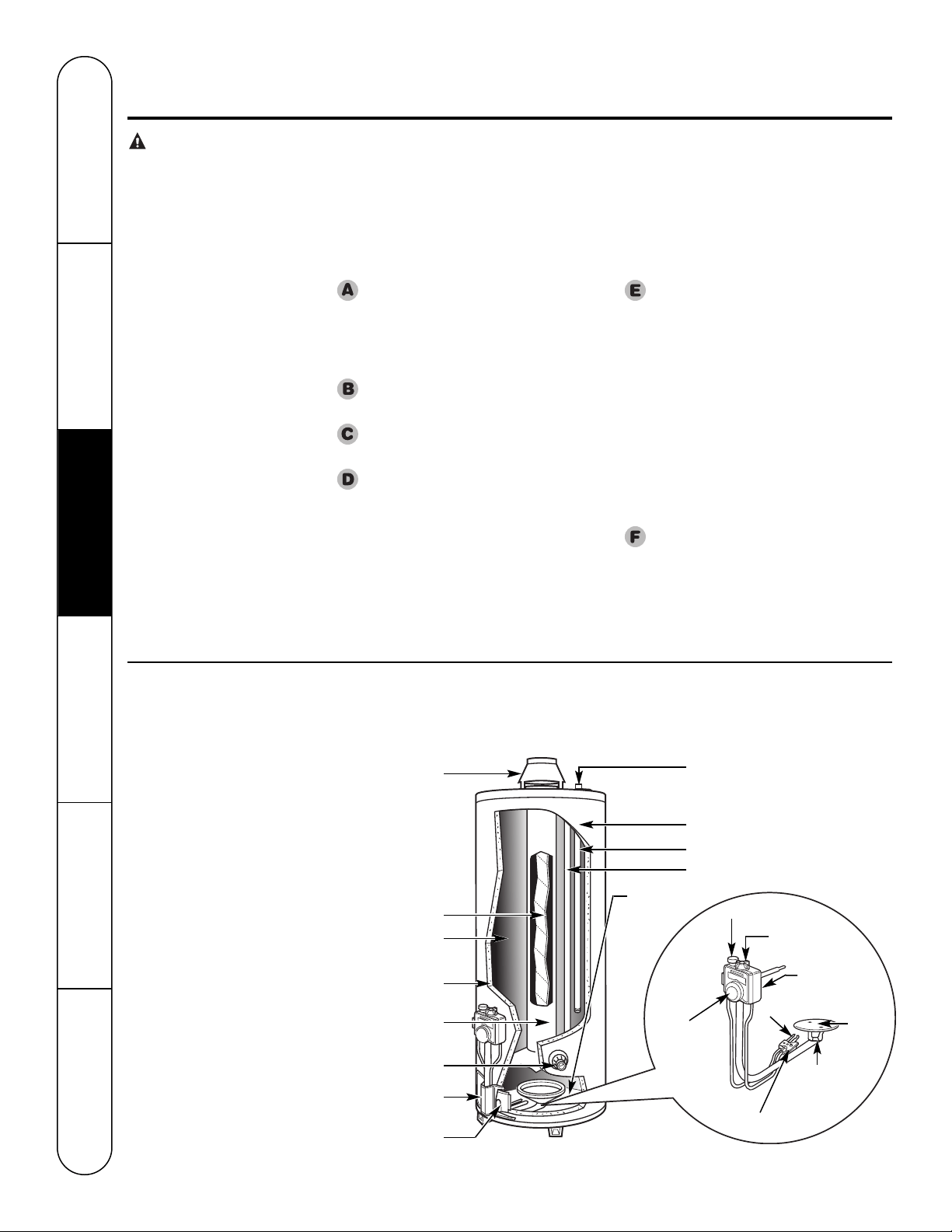
Components of Your Water Heater
So that you may better understand the operation of your new water heater, the
following diagram illustrates the basic components of a typical water heater.
18
19
Water Temperature Time To Produce a Serious Burn
120°F More than 5 minutes
125°F 1
1
/2 to 2 minutes
130°F About 30 seconds
135°F About 10 seconds
140°F Less than 5 seconds
145°F Less than 3 seconds
150°F About 1
1
/2 seconds
155°F About 1 second
Table courtesy of Shriners Burn Institute
Time/Temperature Relationship in Scalds
DANGER: Hotter water
increases the Potential
for Hot Water SCALDS.
Households with small
children, disabled, or elderly
persons may require a 120°F.
or lower gas control
(thermostat) setting to
prevent contact with HOT
water.
Water Temperature Setting
The temperature of the water in the water
heater can be regulated by setting the
temperature dial on the front of the gas
control (thermostat).
Safety and energy conservation are
factors to be considered when selecting
the water temperature setting of the
water heater’s gas control
(thermostat(s)). The lower the
temperature setting, the greater the
savings in energy and operating costs.
To comply with safety regulations the gas
control (thermostat) was factory set at
120°F. or less where local codes require.
This is the recommended starting point.
Water temperatures above 125°F.
can cause severe burns or death from
scalding. Be sure to read and follow the
warnings outlined in this manual and on
the label on the water heater. This label is
located on the water heater near the gas
control (thermostat) access panel.
Mixing valves are available for reducing
point of use water temperature by mixing
hot and cold water in branch water lines.
Contact a licensed plumber or the local
plumbing authority for further
information.
The chart below may be used as a guide in
determining the proper water temperature
for your home.
Burner Adjustment
The natural gas and liquified petroleum
(LP) gas water heaters, equipped with the
sheet metal burner, do not require
adjustment. The natural gas and liquified
petroleum (LP) gas water heater equipped
with the cast iron burner, however, does
require primary air adjustment at the
time of installation.
An air shutter is located at the air
opening end of the burner.
To adjust the burner, loosen air shutter
screw and close to soften flame and open
shutter to sharpen the flame.
The proper flame should be soft blue, not
yellow or with a hard blue center.
Final air adjustment should be made after
5 minutes of continuous burning.
Adjustments
The thermostatic gas valve is equipped for
total regulation of the main burner and
pilot gas pressures and does not require
adjustment.
Safety Instructions Installation Instructions Operating Instructions Care and Cleaning Troubleshooting Tips Customer Service
Operating the water heater.
20
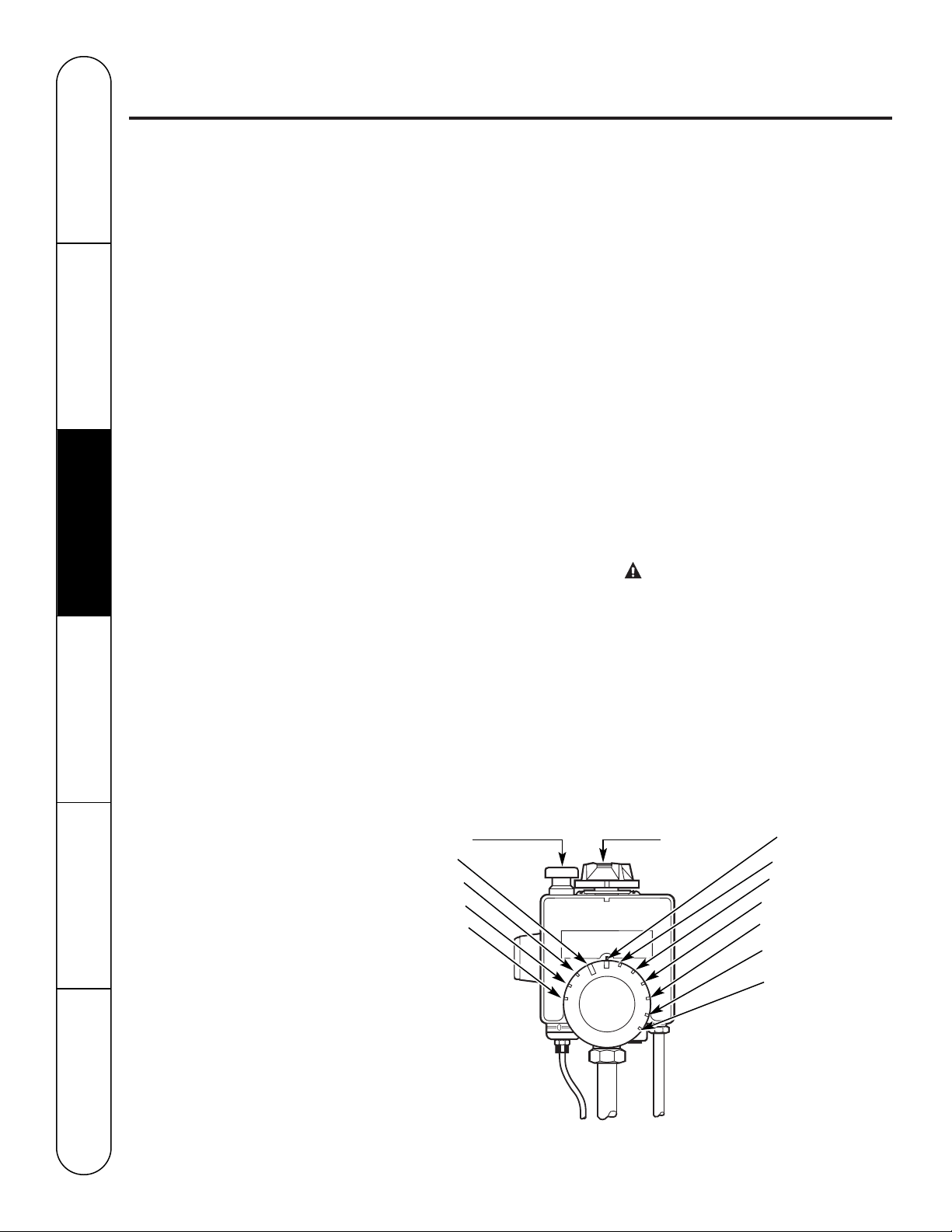
Water Temperature Setting…
Maximum water temperatures occur
just after the burner has shut off.
To determine the water temperature
turn on a hot water faucet and place
a thermometer in the water stream.
The wide reference mark near WARM
on the rim of the temperature dial,
represents an approximate water
temperature of 120°F.
The long wide reference mark, to the
left, represents an approximate
water temperature of 130°F.
Each reference mark above or below
these points indicates an
approximate change of 10°F.
To adjust the temperature, turn the
temperature dial to an initial setting
of 120°F.
A condition known as “stacking” or
“layering” can occur when a series of
short and frequent hot water draws
are taken.
The hottest temperature water will
be at the top of the tank, closest to
the outlet pipe delivering hot water
to
the home.
Stacking can cause this top layer of
water to be hotter than the water
toward the bottom of the tank near
the gas control (thermostat).
Therefore, always remember to test
the water temperature with your
hand before use and remember that
hotter water increases the risk of
scald injury.
Also, always supervise young children
or others who are incapacitated.
The gas control (thermostat) is
constructed with a built in safety
shut-off device designed to shut off
the gas supply to the burner if the
pilot flame is extinguished for any
reason.
The gas control (thermostat) is also
equipped with a single use gas shut
off device that will shut off the gas
supply to the burner if the water
heater exceeds normal operating
temperatures. Refer to the BEFORE
YOU CALL FOR
SERVICE section of this manual, or
contact your dealer.
WARNING: Should overheating
occur or the gas supply fail to shut
off, turn off the manual gas control
valve to the appliance.
If the water heater has been
subjected to fire, flood or physical
damage, turn off the manual gas
control (shut-off) valve, and do not
operate the water heater again until
it has been checked
by qualified personnel.
NOTICE: Replace any part of the
gas control system which has been
under water.
Temperature dial
(Temperatures are approximate)
W
A
R
M
V
A
C
A
T
I
O
N
H
O
T
C
A
U
T
I
O
N
T
H
E
R
I
S
K
O
F
S
C
A
L
D
I
N
J
U
R
Y
W
A
T
E
R
I
N
C
R
E
A
S
E
S
H
O
T
T
E
R
WARNING
READ ALL INSTRUCTIONS
BEFORE LIGHTING
130°F.
Gas cock knob
120°F.
140°F.
150°F.
160°F.
110°F.
100°F.
90°F.
80°F.
70°F.
60°F.
Red Button
Customer Service Troubleshooting Tips Care and Cleaning Operating Instructions Installation Instructions Safety Instructions
Care and cleaning of the water heater.
Draining the Water Heater
CAUTION: Shut off gas to the water
heater at the gas control (thermostat)
gas cock or manual shut-off valve
before draining water.
DANGER: Before manually operating
the relief valve, make certain no one will
be exposed to the hot water released by
the valve.The water drained from the
tank may be hot enough to present a
scald hazard and should be directed to
a suitable drain to prevent injury or
damage.
In order to drain the water heater, turn
off the cold water supply. Open a hot
water faucet or lift the handle on the
relief valve to admit air to the tank.
Attach a garden hose to the drain
valve on the water heater and direct
the stream of water to a drain. Open
the valve.
Test for spillage at the draft hood relief
opening after 5 minutes of burner
operation. Use a flame of a match or
candle or smoke.
Routine Preventative Maintenance
Properly maintained, your water heater will
provide years of dependable trouble-free
service.
It is suggested that a routine preventive
maintenance program be established and
followed by the user.
It is further recommended that a periodic
inspection of the gas control
(thermostat), burner, relief valve, internal
flue-way and venting system should be
made by service personnel qualified in gas
appliance repair.
At least once a year, lift and release the
lever handle on the temperature pressure
relief valve, located near the top of the
water heater, to make certain the valve
operates freely. Allow several gallons to
flush through the discharge line to an
open drain.
NOTICE: If the temperature and pressure
relief valve on the hot water heater
discharges periodically, this may be due to
thermal expansion in a closed water
system. Contact the water supplier or
your plumbing contractor on how to correct
this. Do not plug the relief valve outlet.
A water heater’s tank can act as a
settling basin for solids suspended in the
water. It is therefore not uncommon for
hard water deposits to accumulate in the
bottom of the tank. I
f allowed to
accumulate, these solids can cover the gas
control (thermostat) sensors, causing the
sensors to operate erratically.
Because accumulated solids can prevent the
gas control (thermostat) sensors from
accurately reading the water temperature,
the water at the fixture can be hotter than
the gas control (thermostat) dial setting.
It
is suggested that a few quarts of water
be drained from the water heater’s tank
every month to clean the tank of these
deposits.
Rapid closing of faucets or solenoid valves
in automatic water using appliances can
cause a banging noise heard in a water
pipe. Strategically located risers in the
water pipe system or water hammer
arresting devices can be used to minimize
the problem.
The anode rod should be removed from the
water heater’s tank annually for
inspection and replaced when more than
6″ of core wire is exposed at either end of
the rod.
Make sure the cold water supply is turned
off before removing anode rod.
Housekeeping
Vacuum around the base of the water
heater for dust, dirt and lint on a regular
basis.
To insure sufficient ventilation and
combustion air supply, proper clearances
must be maintained.
DANGER: Combustible materials,
such as clothing, cleaning materials,
or flammable liquids, etc., must
not be placed against or next to
the water heater.
21
DANGER: Before
manually operating the
relief valve, make certain
no one will be exposed to
the danger of the hot water
released by the valve. The
water may be hot enough
to create a scald hazard.
The water should be
released into a suitable
drain to prevent injury or
property damage.
DANGER: Hotter water
increases the potential for
Hot Water Scalds.
!
!
DANGER: Failure to
perform the recommended
Routine Preventative
Maintenance can harm the
proper operation of this
water heater, which can
cause carbon monoxide
dangers, excessive hot
water temperatures and
other potentially
hazardous conditions.
!
Safety Instructions Installation Instructions Operating Instructions Care and Cleaning Troubleshooting Tips Customer Service
Venting System Inspection
The water heater’s internal flue must be
inspected annually to be certain it is clean
by removing the draft hood and flue baffle.
When reinstalling the flue baffle make
certain it is hung securely by its hanger
at the top of the flue way.
Remove any scale that may have fallen on
the burner or floor shield and reinstall the
draft hood.
Inspect the gas venting system and the
chimney.
Make certain the vent connector from the
draft hood to the chimney is properly
positioned and securely attached.
If after inspection of the vent system
you found sooting or deterioration
call the local gas utility to correct the
problem and clean or replace the flue and
venting before resuming operation
of the water heater.
Test for spillage at the draft hood relief
opening after 5 minutes of burner
operation. Use a flame of a match or
candle or smoke.
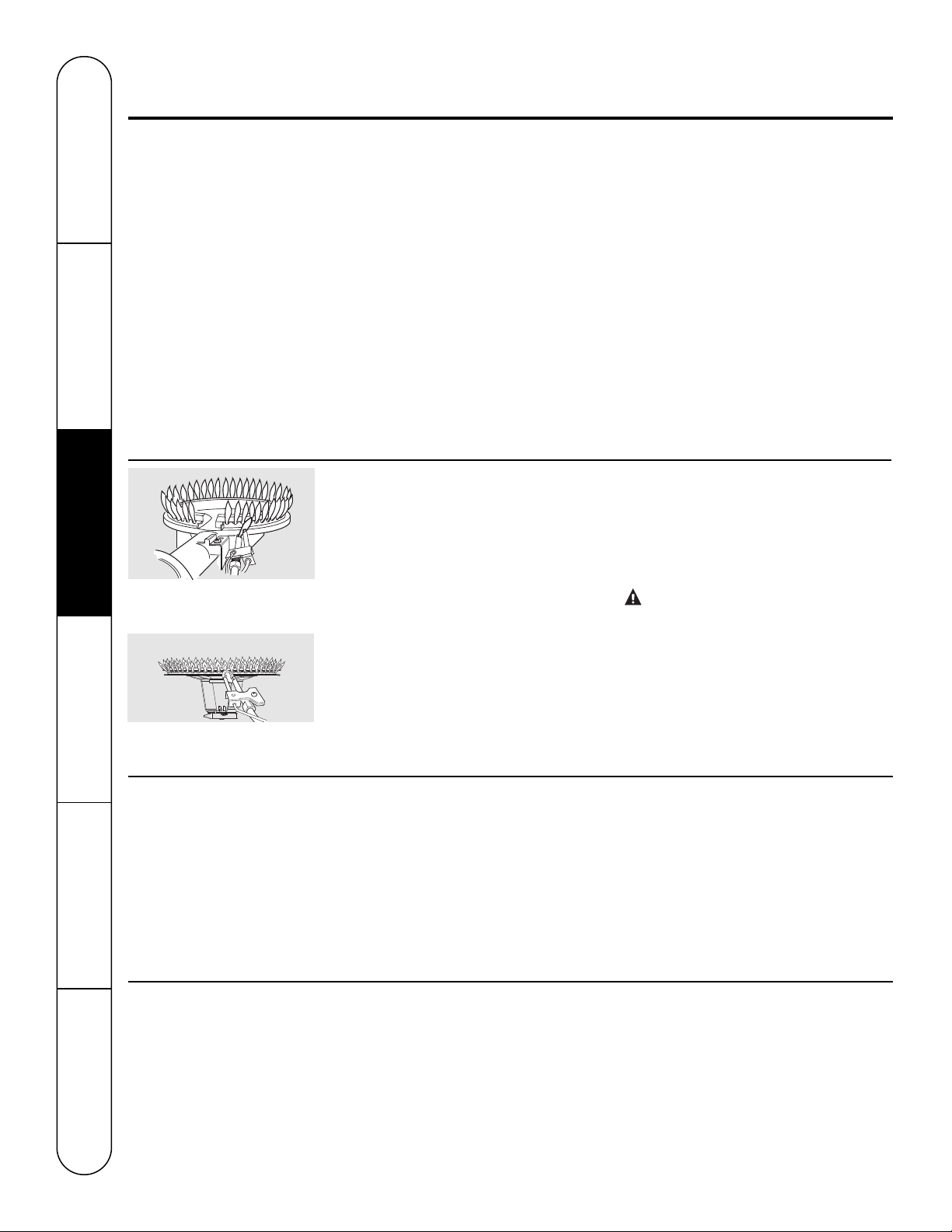
Burner Inspection
Visually inspect the burners annually.
Inspect the main burner while firing
and pilot burner flame with the main
burner off. Refer to Figure A or B for
normal flame pattern.
If any unusual burner operation is noted,
the water heater should be shut off until
qualified service assistance can be
obtained.
For cleaning, remove the burner from the
water heater. A vacuum cleaner can be
used on the burner and floor shield inside
the water heater. The burner can also be
cleaned by scrubbing with mild detergent.
CAUTION: For your safety, cleaning
of the main burner should be performed
only by qualified service personnel.
Figure A: Main burner and
pilot flame pattern. (Cast iron
burner)
Figure B: Main burner and
pilot flame pattern. (Sheet
metal burner)
Care and cleaning of the water heater.
Vacation and Extended Shut-Down
If the water heater is to remain idle for an
extended period of time, the power and
water to the appliance should be turned
off to conserve energy and prevent a build-
up of dangerous hydrogen gas.
The water heater and piping should be
drained if they might be subjected to
freezing temperatures.
After a long shut-down period, the water
heater’s operation and controls should be
checked by qualified service personnel.
Make certain the water heater is
completely filled again before placing it
in operation.
NOTICE: Refer to the
Hydrogen Gas Caution in
the Operating Instructions.
Anode Rod
This water heater is equipped with an
anode rod designed to prolong the life of
the glass lined tank. The anode rod is
slowly consumed cathodically, thereby
eliminating or minimizing corrosion of the
glass lined tank.
Water sometimes contains a high sulfate
and/or mineral content and together with
cathodic protection process can produce
a hydrogen sulfide, or rotten egg odor in
the heated water. Chlorination of the
water supply should minimize the problem.
NOTICE: Do not remove
the anode rod from the
water heater’s tank, except
for inspection and/or
replacement, as operation
with the anode rod
removed will greatly
shorten the life of the glass
lined tank and will exclude
warranty coverage.
22
Customer Service Troubleshooting Tips Care and Cleaning Operating Instructions Installation Instructions Safety Instructions
23
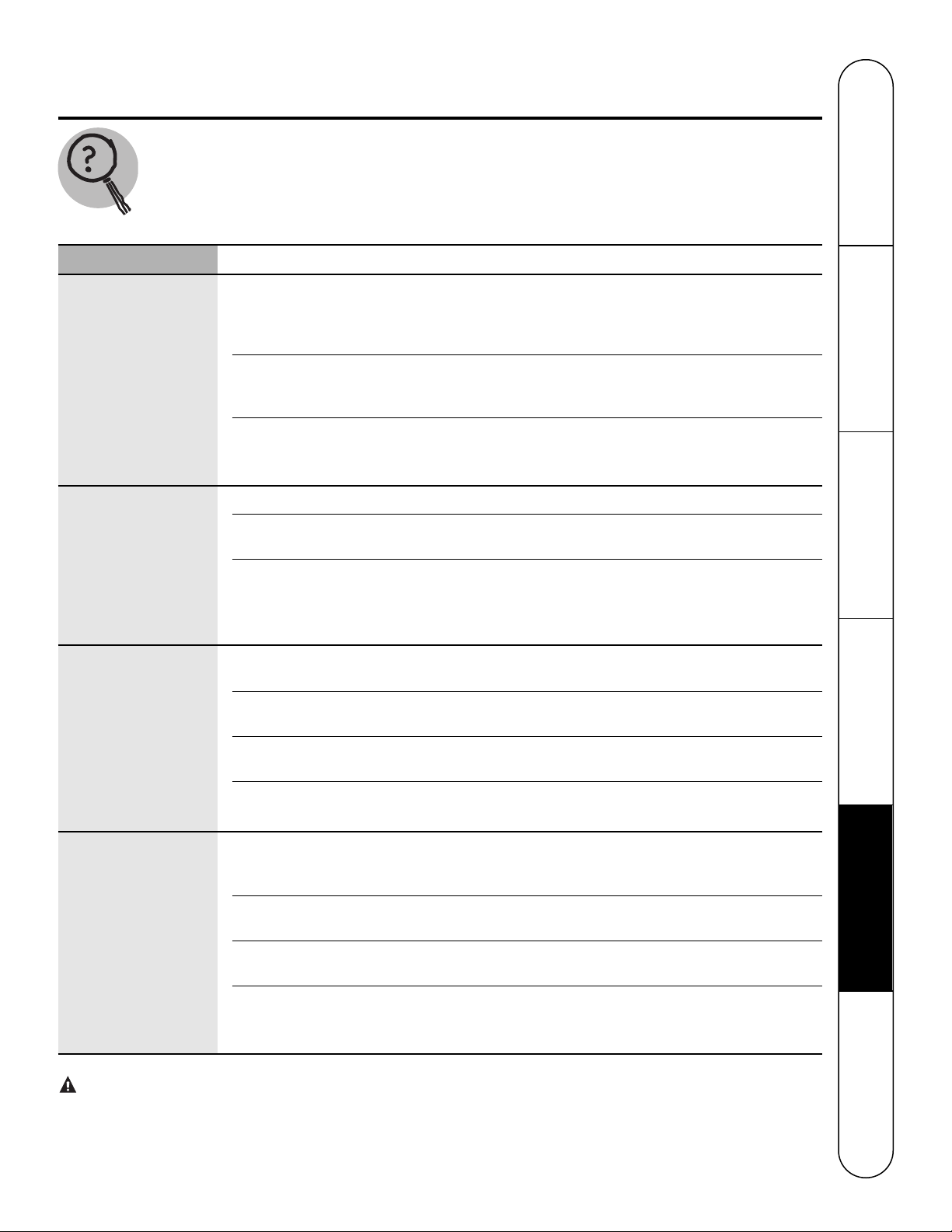
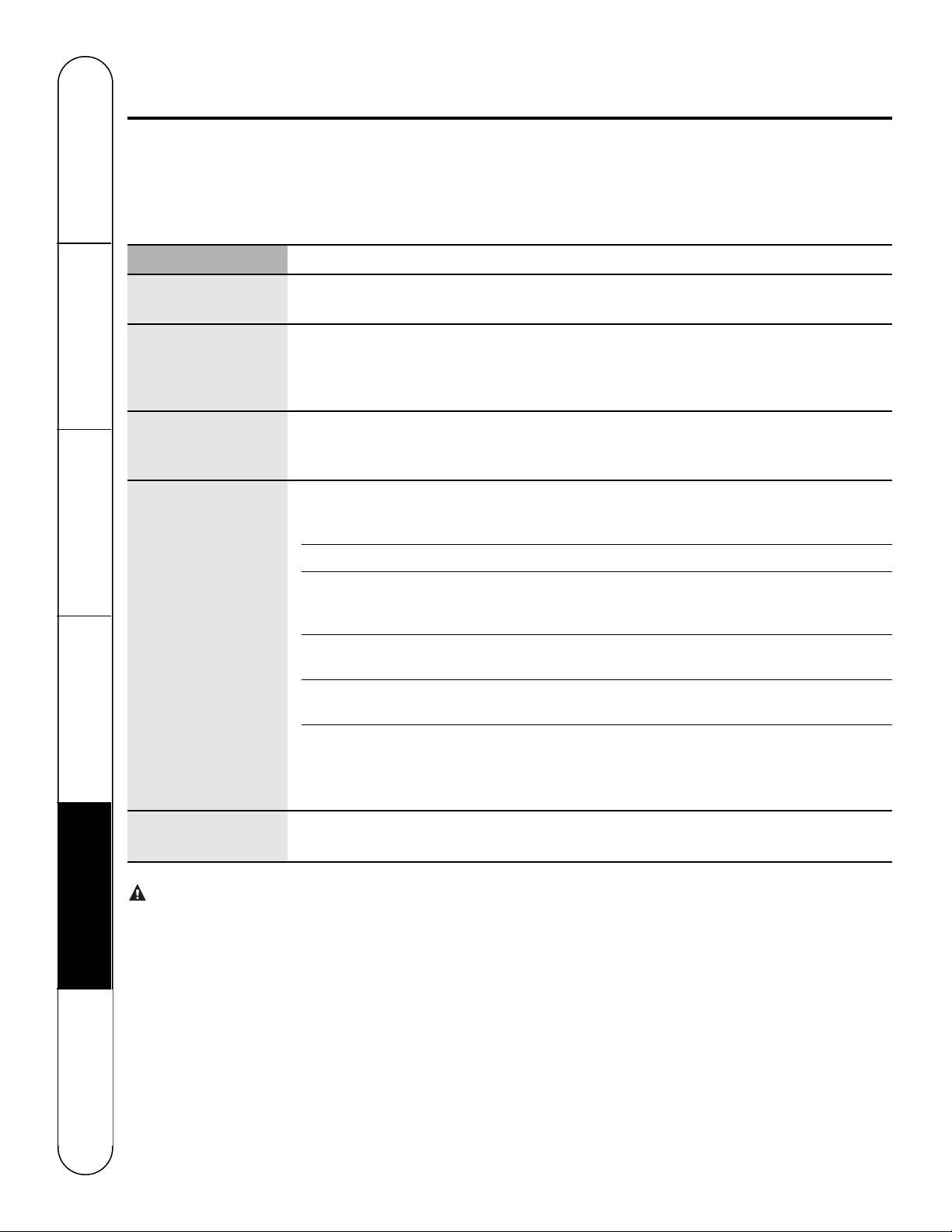
Problem Possible Causes What To Do
Condensation This usually happens when ● This is normal. After the water in the tank warms
a new water heater is up the condensation will disappear. If, however, the
filled for the first time. condition persists, examine the piping and fittings
for possible leaks.
Moisture from the products ● This is normal and will disappear in time. Excessive
of combustion condensing condensation can cause pilot outage.
on the tank surface.
An undersized water ● Use a water heater size that meets the requirements
heater will cause of your needs.
condensation.
Yellow flame Scale on top of the burner. ● Shut off the water heater and remove scale.
or sooting
Combustion air inlets or ● Remove lint or debris and inspect air inlet opening
flue-way restricted. for restriction.
Not enough combustion or ● Proper operation of the water heater requires air for
ventilation air supplied to combustion and ventilation. See the Combustion and
the water heater location. Ventilation Air information in the Locating the water
heater section of this manual.
Unable to light Gas Cock Knob not ● See the Lighting the water heater section of this
the pilot correctly positioned. manual.
Pilot orifice clogged. ● The pilot should be cleaned or replaced by a qualified
service technician.
Pilot tube pinched or ● The pilot should be cleaned, repaired or replaced by a
clogged. qualified service technician.
Air in gas line. ● Contact a qualified service technician to purge the air
from the gas line.
Pilot does not stay Loose thermocouple. ● The connection at the gas control (thermostat) should
lit when the RED be tightened by a qualified service technician.
button is released
Thermocouple breakdown. ● The thermocouple should be replaced by a qualified
service technician.
Safety magnet breakdown. ● The gas control (thermostat) should be replaced by a
qualified service technician.
Thermostat’s single ● The gas control (thermostat) should be replaced by a
use gas shut-off device qualified service technician.
has opened.
CAUTION: For your safety DO NOT attempt repair of gas piping, gas control (thermostat), burners, vent
connectors or other safety devices. Refer repairs to qualified service personnel.
Before You Call For Service…
Troubleshooting Tips
Save time and money! Review the charts on
the following pages first and you may not
need to call for service.
Safety Instructions Installation Instructions Operating Instructions Care and Cleaning Troubleshooting Tips Customer Service
Customer Service Troubleshooting Tips Care and Cleaning Operating Instructions Installation Instructions Safety Instructions
24
Before You Call For Service…
Problem Possible Causes What To Do
Rumbling noise Scale and sediment ● Clean tank.
in tank.
Relief valve Pressure build up ● This is an unacceptable condition and must be
producing popping caused by thermal corrected. Contact the water supplier or plumbing
noise or draining expansion to a contractor. on how to correct this. Do not plug the
closed system. relief valve outlet.
Rattling noise Internal heat trap ● This is normal for heat trap fittings when in operation
during periods of fittings in operation. and does not indicate a need for service.
water usage
Not enough or Water usage may have ● Wait for the water heater to recover after an abnormal
no hot water exceeded the capacity demand.
of the water heater.
Low gas pressure. ● Check gas supply pressure and manifold pressure.
The pilot may be out. ● Check the pilot. If necessary, relight using the
instructions in the Lighting the water heater section
of this manual.
The gas control (thermostat) ● See the Temperature regulation of the water heater
may be set set too low. section of this manual.
Leaking or open hot ● Make sure all faucets are closed.
water faucets.
Cold water inlet ● This is normal. The colder inlet water takes longer
temperature may be to heat.
colder during the
winter months.
Water is too hot The gas control (thermostat) ● See the Temperature regulation of the water heater
is set too high. section of this manual.
CAUTION: For your safety DO NOT attempt repair of gas piping, gas control (thermostat), burners, vent
connectors or other safety devices. Refer repairs to qualified service personnel.
25
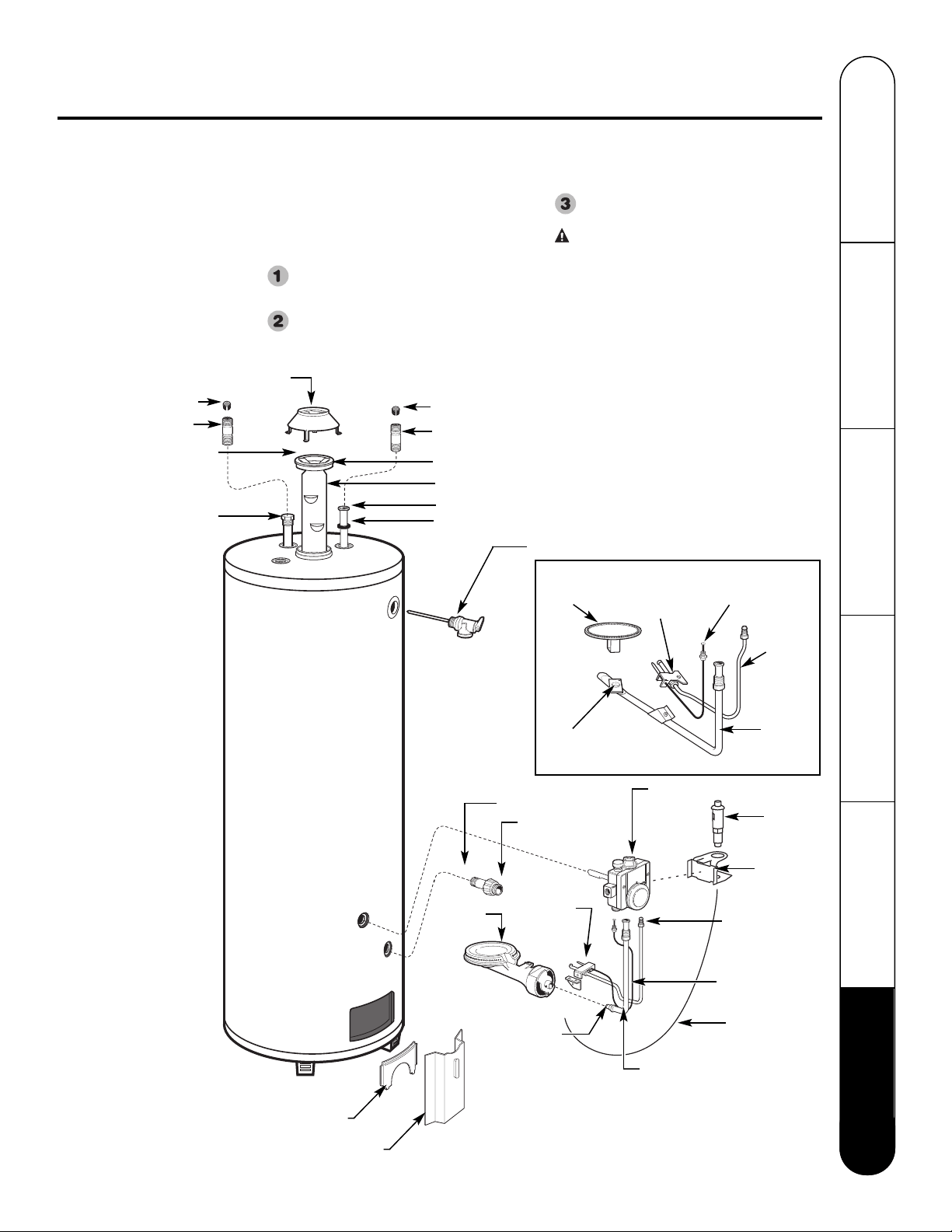
Replacement Parts.
Instructions For Placing a Parts Order
To place orders using a Visa/MasterCard
call 800-431-1549.
All parts orders should include:
The model and serial number of the
water heater from the rating plate.
Specify type of gas (natural or LP)
as marked on the rating plate.
Part description (as noted below)
and number of parts desired.
CAUTION: For your safety DO
NOT attempt repair of gas piping, gas
control (thermostat), burners, vent
connectors or other safety devices.
Refer repairs to qualified service
personnel.
Draft hood
Drain valve shroud
Burner supply tube
Inner door
Flue baffle
hanger
Anode rod
Flue baffle collar
Flue baffle
Dip tube
Dip tube gasket
Pilot supply
tube
Thermocouple
Piezo Ignitor
Striker Wire*
Mounting
Bracket*
Piezo
Ignitor
Striker*
Temperature and pressure relief valve
Drain valve
Gas Control (Thermostat)
Burner
Pilot
burner
Jacket door
Burner
Burner
orifice
Pilot
Burner
Thermocouple
Pilot
supply
tube
Burner
supply
tube
For models equipped with Sheet Metal Burner
**Heat Trap
**Nipple
**Heat Trap
**Nipple
Safety Instructions Installation Instructions Operating Instructions Care and Cleaning Troubleshooting Tips Customer Service
Burner orifice
* Optional Equipment on some models.
** Optional on some models.
26
If you need service . . .
Should you have any questions about your new water heater, or if it requires adjustment,
repair, or routine maintenance, it is suggested that you first contact your installer, plumbing
contractor or previously agreed upon service agency. In the event the firm has moved, or is
unavailable, refer to the telephone directory, commercial listings or local utility for qualified
service assistance.
Should your problem not be solved to your complete satisfaction, you should then contact
the Manufacturer’s National Service Department at the following address:
2600 Gunter Park Drive East
Montgomery, AL 36109-1413
When contacting the manufacturer, the following information will be requested:
Model and serial number of the water heater as shown on the rating plate attached
to the jacket of the heater.
Address where the water heater is located and physical location.
Name and address of installer and any service agency who performed service
on the water heater.
Date of original installation and dates any service work was performed.
Details of the problems as you can best describe them.
List of people, with dates, who have been contacted regarding your problem.
If you need a manual in Spanish, please refer to our website: www.rheem.com.
Si requiere de un manual de uso y cuidado en espanol, usted puede obtanerlo en
www.rheem.com.
Safety Instructions Installation Instructions Operating Instructions Care and Cleaning Troubleshooting Tips Customer Service

27
Rheem Manufacturing Company
Warranty Registration Department
P.O. Box 34070
Louisville, KY 40232-4070
Please place in envelope and mail to:
✁
Cut here
✁
Cut here
28
✁
Cut here
Consumer Product Ownership Registration
Follow these three steps to protect your
new appliance investment:
If you require service, call 800-431-1549.
123
Model Number Serial Number
Consumer Product Ownership Registration
Model NumberWater Heater Serial Number
Important
Mail
Today!
First
Name
Mr. ■■ Ms. ■■ Mrs. ■■ Miss ■■
Street
Address
City
State
Date Placed
In Use
Month
Day
Year
Zip
Code
Apt. #
Last
Name
Phone
Number
__
Complete and mail
this Consumer
Product Ownership
Registration today.
After mailing the
registration below,
store this document
in a safe place. It
contains information
you will need should
you require service.
Read your Owner's
Manual carefully.
It will help you
operate your new
appliance properly.
NOTICE: Failure to complete and return this card does not diminish your limited warranty rights.