


3
Safety and warnings 5
Control panel 9
WiFi connection & remote mode 12
Dry cycles 14
Dry preparation 16
Getting started quickly 19
Dry cycle options 21
Customising a dry cycle 23
Dryer settings 27
Caring for your dryer 29
Before you call for service 36
Fault codes 37
Troubleshooting 38
Manufacturer’s warranty 44
Customer care 46
CONTENTS
Registration
To register your product visit our website: fisherpaykel.com/register

5
SAFETY AND WARNINGS
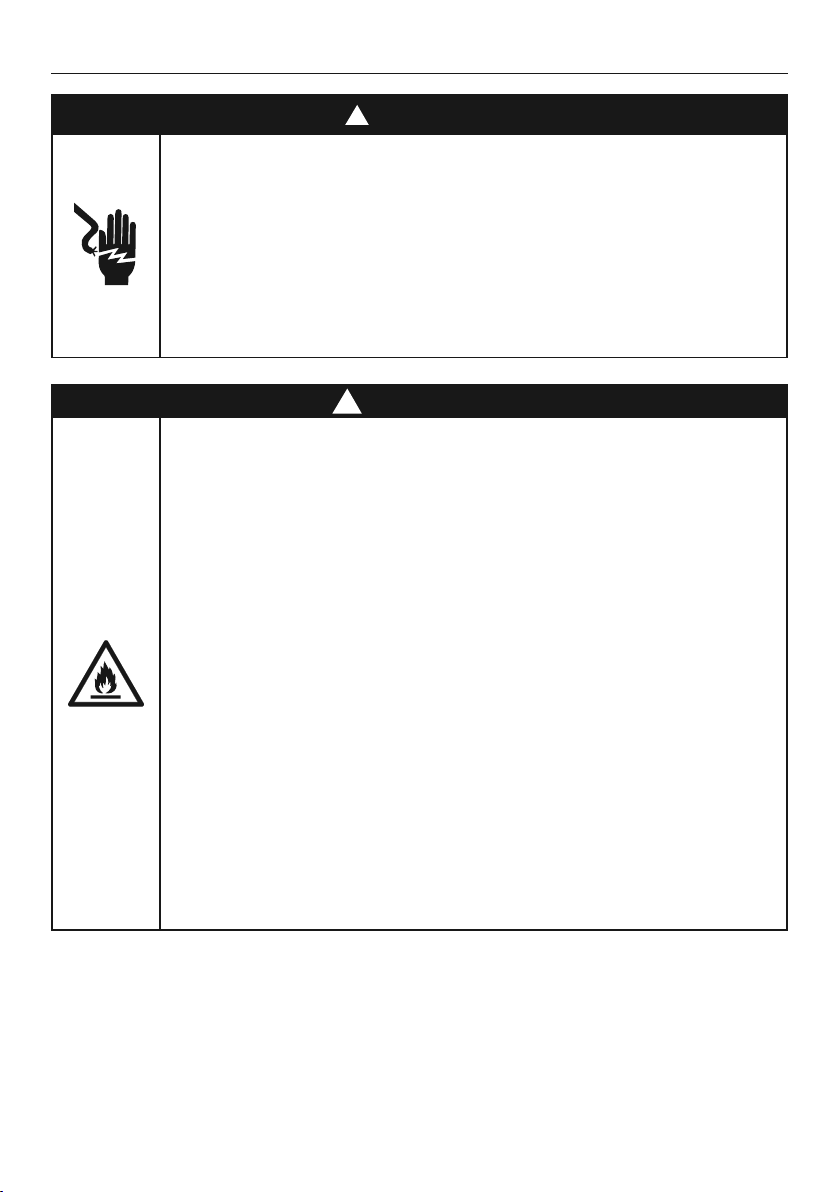
!
WARNING!
Electric Shock Hazard
Failure to follow this advice may result in
electric shock or death.
• If you are using an extension cord or a portable
electrical outlet device (eg multi-socket outlet
box), ensure that it is positioned so that it does
not come into contact with water or moisture.
!
WARNING!
Fire Hazard
• Only dry fabrics that have been washed
with water.
• Do not use heat to dry articles containing foam
rubber or similarly textured rubber–like materials,
dry on ‘Cool Dry’.
• Never stop a tumble clothes dryer before the end
of the drying cycleunless all items are removed
and spread out in order to dissipate the heat.
• A clothes dryer produces combustible lint;
the lint filter must be cleaned before each
drying cycle.
• Failure to follow the warnings outlined in these
user instructions can cause a fire hazard.
• Failure to follow these instructions can result in
death or personal injury.
READ AND SAVE THIS GUIDE
When using your clothes dryer, follow basic precautions, including thefollowing:
General
z
The appliance must not be supplied through an external switching device, such as a
timer, or connected to a circuit that is regularly switched on and off by a utility.
z
We do not recommend the use of extension cords or portable electrical outlet devices
for safety reasons.

6
SAFETY AND WARNINGS
z
Do not touch or operate the machine with wet hands or with bare-feet.
z
A damaged power cord must be replaced by a Fisher & Paykel trained and supported
service technician, its service agent or similarly qualified persons in order to avoid
a hazard. The appliance must not be operated until it is repaired, as there is risk of
electric shock.
z
Do not operate this machine if it has been damaged during transport. Contact your
Fisher&Paykel dealer or Fisher & Paykel trained and supported service technician.
z
This dryer has been designed for domestic use only, not for commercial applications,
such as massage/beauty clinics where there may be increased lint accumulation or
flammable materials in the atmosphere or load.
z
The tumble dryer is intended only for drying textile material washed in water.
z
Undergarments that contain metal reinforcements should not be placed in the dryer.
Damage to the dryer can result if the metal reinforcements come loose during drying. If
you wish to dry these items use a drying rack or place in a garment bag.
z
Check and remove all objects from pockets, eg lighters and matches.
z
Never dry rubber articles, or any plastic items or film, eg plastic lined
tablecloths andbaby bibs.
z
Clothes should go through the cool down/airing phase in the final part of the cycle.
This ensures items are left at a temperature where they will not be damaged. Ifforany
reason the dryer is stopped before the cycle has finished, dry clothes should be
removed immediately and not left in the dryer. Clothes should be quickly spread out
flat to cool so heat can dissipate, not left bunched up, eg in a clothes basket.
z
Do not operate this product without the lint filter in place or allow lint to accumulate in
or around the dryer.
z
This dryer is not intended for use by persons (including children) with reduced physical,
sensory or mental capabilities, or lack of experience and knowledge, unless given
supervision or instruction concerning the use of the dryer by a person responsible
for their safety.
z
Children should be supervised to ensure they do not play with the dryer.
z
Unplug the machine from the power supply when it is not in use.
z
Do not swing on or put weight on the door.
z
In the event of a power outage your dryer will resume automatically when
power is restored.
z
Never attempt to repair the dryer yourself.
z
The only user-removable parts of the dryer are the filters and drying rack. No other
parts are designed to be removed by anyone other than aFisher & Paykel trained and
supported service technician.
z
For problems that cannot be solved from information in this user guide, turn off and
unplug your dryer and contact a Fisher & Paykel trained and supported service technician.
z
Do not overload your dryer beyond its rated capacity:
MODEL MAXIMUM CAPACITY (KG)
DH9060FS 9
*Capacity refers to the maximum dry weight of items the dryer can dry at any one time
z
Never put dripping wet clothes in or on top of the dryer as excess water may cause an
electrical hazard.
z
Do not under any circumstances dry an electric blanket or any other electrical, plastic
or rubber items in your dryer, unless the care label specifically states it is safe to do so.
Never dry these items at high temperatures.

7
SAFETY AND WARNINGS
z
Do not dry curtains in your dryer. Sunlight makes them brittle and they may
disintegrate during drying.
z
Do not use the water collected in the water tank for drinking or food processing.
z
Never run the dryer without the water tank in place.
z
If the water tank becomes full, the tumble dryer will pause drying and will sound an
alarm. You must empty the water tank before the dryer can continue drying. Empty the
tank, replace it back in the housing then press to resume the cycle.
Lint
z
Accumulated lint in the dryer can become a fire hazard; it also reduces the efficiency of
the dryer by causing longer drying times and increased power consumption.
z
Clean the lint filter before every load.
z
Ensure the area around the dryer is clear of lint.
z
At regular intervals have the interior of the dryer cleaned of any accumulated lint.
This must be done by a Fisher & Paykel trained and supported service technician.
This must be done when the dryer installation is changed from free standing.
z
If the lint filter becomes damaged, contact your Fisher & Paykel trained and supported
service technician to arrange getting a new filter. Do not operate your dryer with a
damaged lint filter or without the filter in place, as this will cause damage to your dryer.
Spontaneous combustion
To reduce the risk of fire in a tumble dryer the following should be observed:
z
Items that have been spotted or soaked with vegetable oil or cooking oil are a fire
hazard and should not be placed in a tumble dryer.
z
Oil-affected items can ignite spontaneously, especially when exposed to heat sources
such as a tumble dryer. The items become warm causing an oxidation reaction in the
oil. This oxidation creates heat. If the heat cannot escape the items can become hot
enough to catch fire. Piling, stacking or storing oil-affected items can prevent heat from
escaping creating a fire hazard.
z
If it is unavoidable that fabrics that contain vegetable oil, cooking oil or have been
contaminated by hair care products be placed in a tumble dryer, they should first be
washed in hot water with extra detergent — this will reduce, but not eliminate the fire
hazard. The cool down cycle of the dryer should be used to reduce the temperature
ofthese items. They should not be removed from the tumble dryer and piled or
stacked while hot.
z
Items that have previously been cleaned in, washed in, soaked in or spotted with
flammable liquids or solids, eg petrol/gasoline, kerosene, dry cleaning solvents,
vegetable or cooking oil, acetone, denatured alcohol, some brands of spot removers,
turpentine, waxes and wax removers or other flammable or explosive substances should
not be placed in a tumble dryer.
z
Do not dry unwashed items in the tumble dryer.
z
The dryer is not to be used if industrial chemicals have been used for cleaning.
z
Fabric Softeners or similar products should not be used in a tumble dryer to
eliminate the effects of static electricity, unless this practice is specifically
recommended by the manufacturer of the fabric softener product.
z
Rubber backed articles, foam rubber (latex foam), clothes or pillows fitted with
foam rubber pads, fibreglass, shoes containing rubber, shower caps, babies waterproof
napkin covers and waterproof textiles should not be dried in the dryer. These materials
can when heated produce fire by spontaneous combustion.
z
When using STREAM REFRESH on unwashed clothing ensure there are no flammable
substances on them.

8
Disposal
z
Extreme care must be taken when disposing of your old appliance to avoid hazards.
z
When disposing of the dryer, it is recommended that the door is removed to avoid
children getting trapped inside, and that the electrical cable is cut off close to the dryer.
SAFETY AND WARNINGS
9
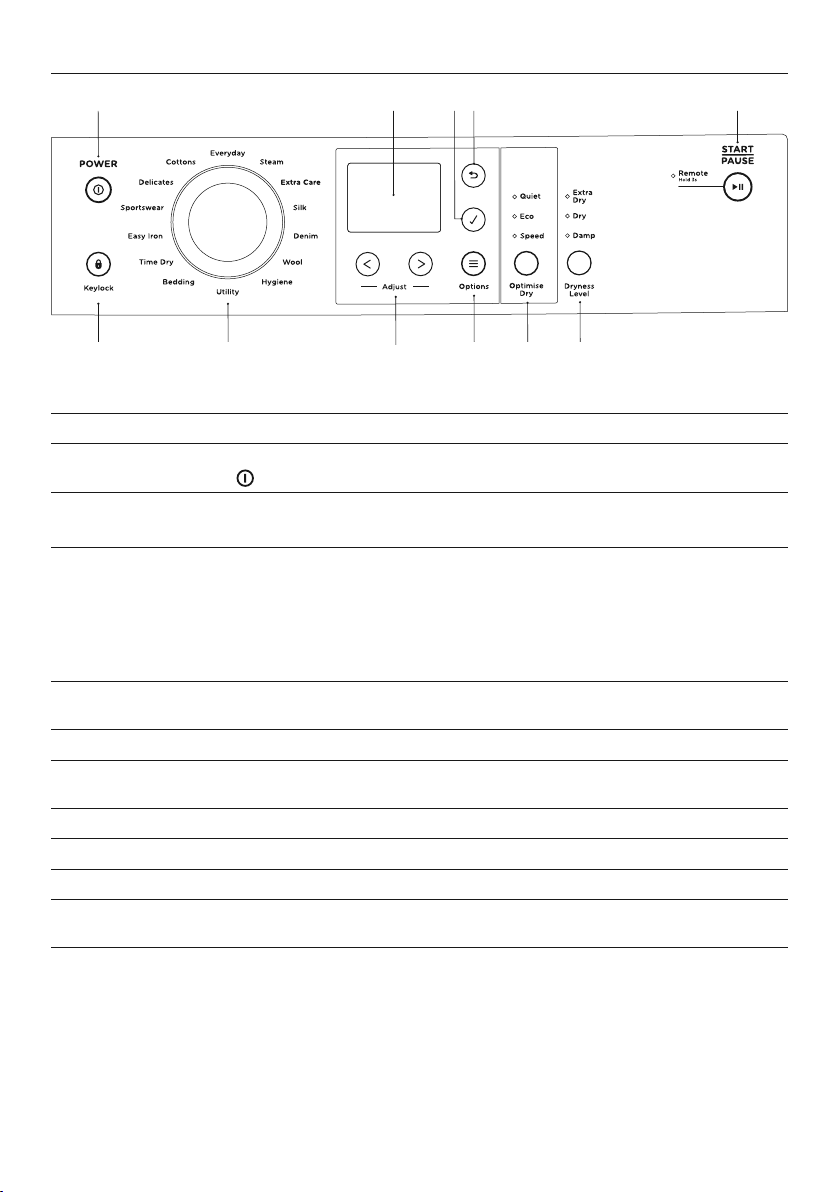
CONTROL PANEL
1
Power Press to turn the dryer ON/OFF.
2
Keylock Press to disable all buttons on the control panel, except the
POWER button. This prevents accidental button presses.
3
SmartTouch™
Control Dial
Rotate to select your desired drying cycle.
z
Red LED illuminates to indicate the selected dry cycle.
4
Digital display
screen
Shows the following:
z
Dry cycle icons and information based on dial selection.
z
Dry cycle options and machine settings.
z
Dry progress.
z
Delayed start time of drying cycle.
z
Notifications if an error is detected or a warning is necessary.
5
Adjust Press to navigate through the dry cycles, dry cycle options and
settings, andtoincrease or decrease the delay start time.
6
Options Press to access dry cycle options and dryer settings.
7
Select Press to accept the selected option or any changes made, and
thenreturn to the main screen.
8
Back Press to exit current display and return to the main screen.
9
Optimise dry
Press to select
SPEED, ECO or QUIET.
!0
Dryness level Press to select the level of dryness for your load.
!1
Start/Pause Press to start or pause the selected dry cycle.
Hold for three seconds to enable
REMOTE (WiFi) mode.
2
1 4 8 !17
3 6 95 !0
10
Timed cycles
When a timed cycle is selected the machine dries for the selected time regardless of
the level of moisture in the load. It is important to check the items throughout the timed
programmes to avoidover drying.
Select the desired cycle.
Use the
ADJUST buttons to adjust the
time up or down.
Press the
button to confirm.
CONTROL PANEL
To adjust the length of timed cycles:
Dry progress
For all cycles, the display will show the phase of the cycle that iscurrentlyunderway.
For timed cycles, the display will also show approximately how manyminutesthecycle has
remaining. For automatic cycles, the word
AUTO will appear on the screen.
30min
Time Dry
Set Time
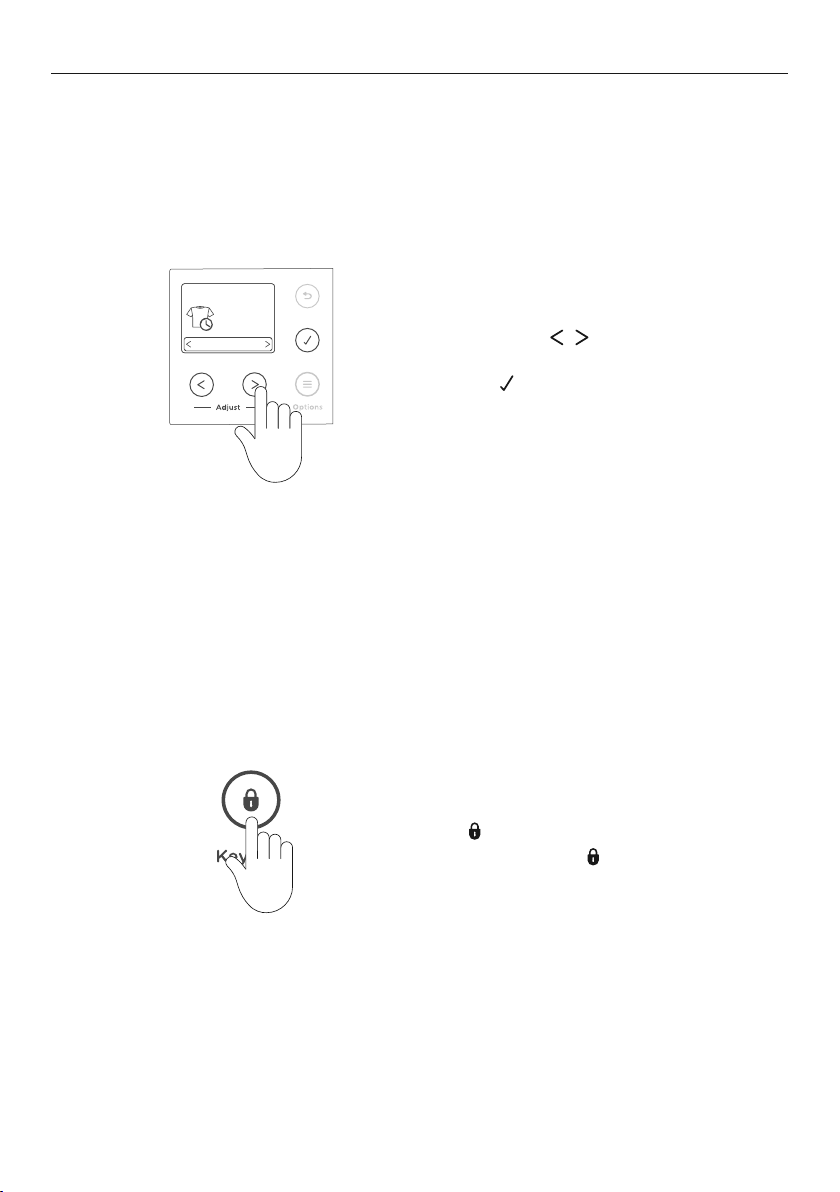
Press for three seconds.
When activated, the
is illuminated.
Keylock
To turn
KEYLOCK ON or OFF when the dryer is powered ON:
11
If KEYLOCK is on and you want to pause your dryer:
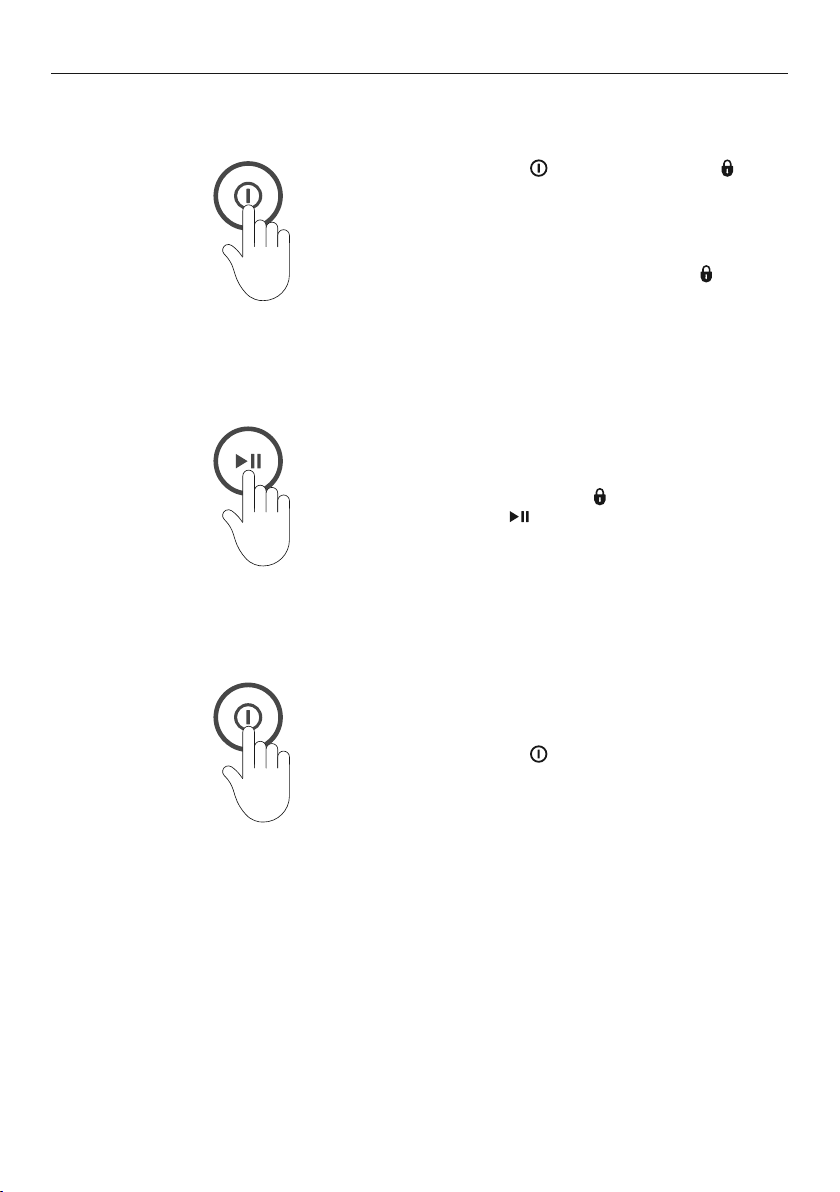
If
KEYLOCK is ON and you want to power OFF your dryer at any time:
Press POWER .
To pause your dryer at any time during the
cycle, press and hold for threeseconds
then press .
CONTROL PANEL
To turn your dryer on if KEYLOCK is ON and the dryer is powered OFF:
Press POWER , then press and hold
for three seconds. This will activate the
control panel. Dry cycles and options can
now be selected.
If a button is pressed while
KEYLOCK is
activated, beeps will be heard and
will flash.
12
Your appliance can be connected to your home wireless network and operated remotely
using the app.
Getting started
z
Ensure your home WiFi network is turned on.
z
You will be given step by step guidance on both your appliance and mobile device.
z
It may take up to 10 minutes to connect your appliance.
WIFI CONNECTION & REMOTE MODE
On your mobile device:
1 Download the app from www.fisherpaykel.com/connect
2 Register and create an account.
3 Add your appliance and set up the WiFi connection.
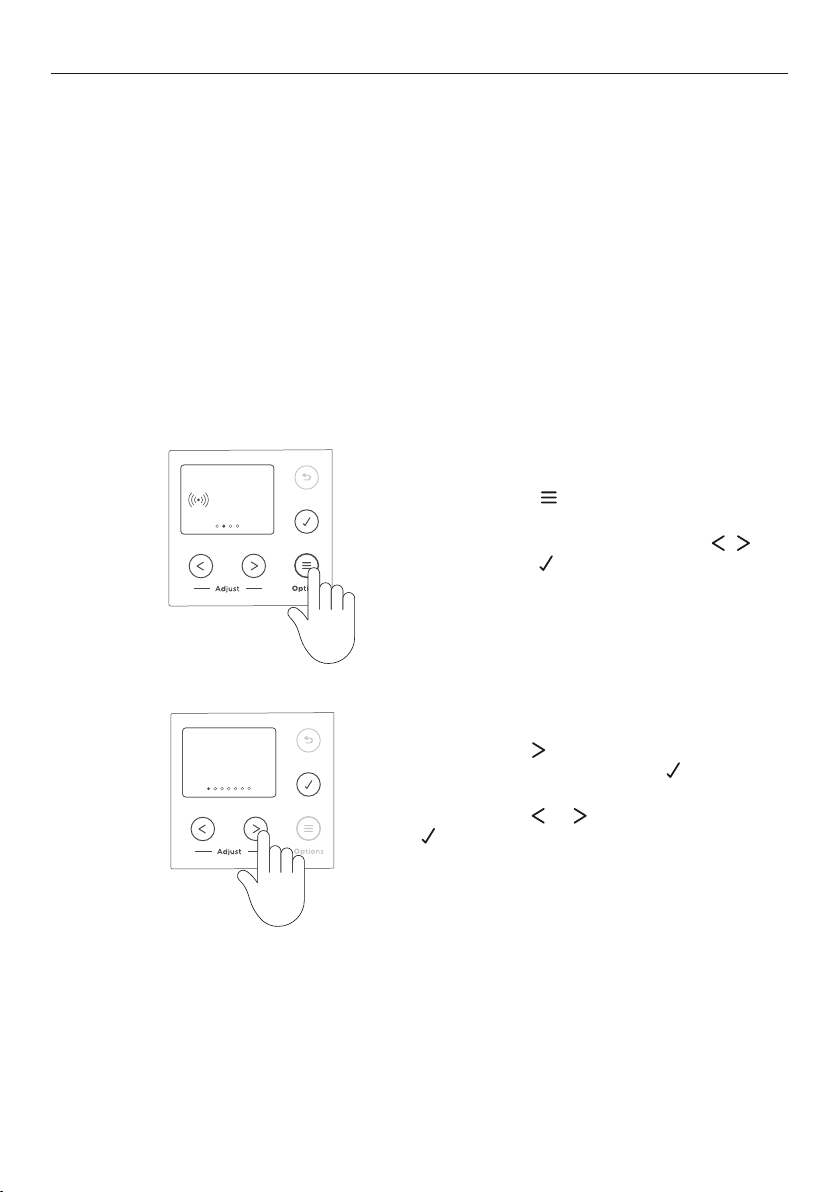
Connecting to your home WiFi
1
2
Press OPTIONS , the screen will show the
default option DAMP DRY SIGNAL.
Scroll to
SETTINGS using the ADJUST
buttons, press to confirm.
Press
ADJUST to scroll through the list
of SETTINGS to WIFI OFF, press to select
and edit.
Press
ADJUST or to select WIFI SETUP and
to confirm to start the setup process.
WiFi
OFF
Settings
Damp Dry
Signal
OFF
Options
WiFi
OFF
Settings
Damp Dry
Signal
OFF
Options
13
Enabling remote mode
WIFI CONNECTION & REMOTE MODE
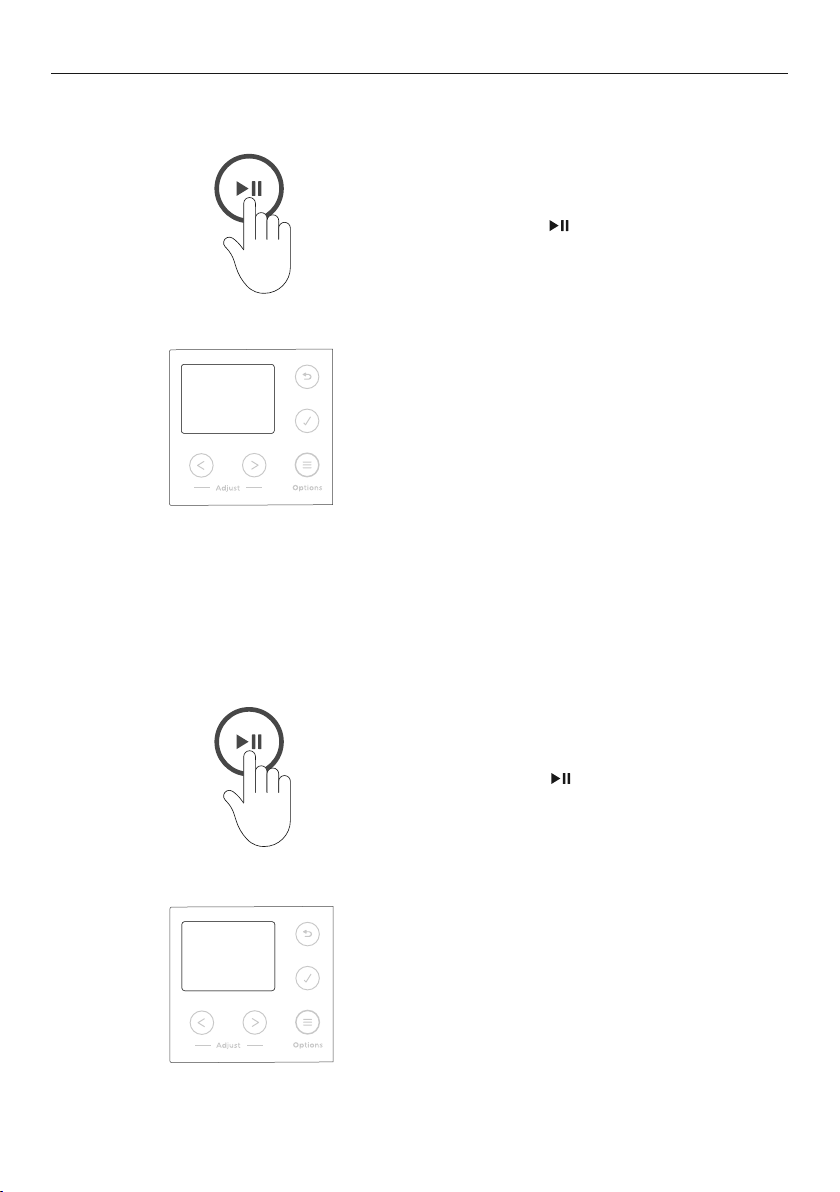
Press and hold for three seconds.
REMOTE ENABLED will appear in the
display screen.
REMOTE MODE is now enabled. Certain
functions of your washer can now be
accessed via the app.
1
2
Remote
enabled
Remote
disabled
Remote
enabled
Remote
disabled
Remote
enabled
Remote
disabled
Disabling remote mode
Remote
enabled
Remote
disabled
Press and hold for three seconds.
1
REMOTE DISABLED will appear in the
display screen. REMOTE MODE is now disabled.
2
For safety reasons, REMOTE MODE cannot be enabled if the dryer door is open.
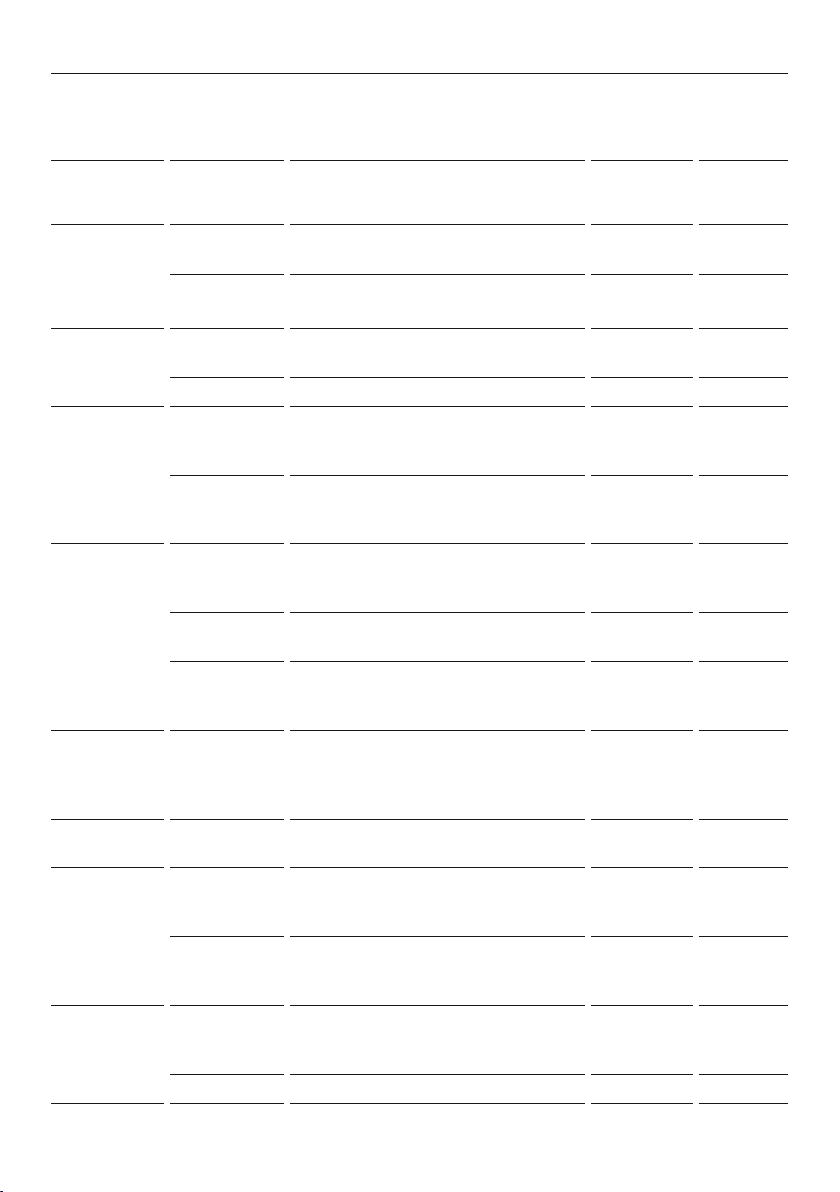
14
DRY CYCLES
CYCLE SUB-CYCLE DESIGNED FOR
MAX.
LOAD SIZE
(KG)
DEFAULT
DRYNESS
LEVEL
Everyday
Everyday
A high heat cycle designed for
mixed loads.
9 Dry
Heavy
A longer, high heat cycle for
durable garments.
8
Dry
Extra Dry
Cottons
Cotton¹
A high heat cycle designed for
cotton garments.
9 Dry
Towels A high heat cycle for drying towels. 6 Dry
Delicates
Delicate
A low heat cycle for careful
drying of delicate and heat
sensitive garments.
4 Dry
Ultra
Delicate
An extra low heat cycle for careful
drying of ultra delicate and heat
sensitive garments.
1 Dry
Sportswear
Activewear
An extra low heat cycle
designed for special care of light
synthetic garments.
2 Dry
Sports
A medium heat cycle designed for
sports garments.
4 Dry
Outdoor
A low heat cycle for high
performance fabrics and
outdoor garments.
2 Dry
Easy Iron n/a
A medium heat cycle that
leaves garments ready to iron.
WRINKLE FREE automatically
selected.
4
Damp
Dry
Time Dry n/a
A cycle with user selectable
drying times.
9 n/a
Bedding
Sheets
A high heat cycle with reversing
to reduce tangling for large
bedding items.
4
Dry
Extra Dry
Bulky
A low to medium heat cycle
designed for careful drying of
bulky items.
2
Dry
Extra Dry
Utility
Rack Dry
A cycle with user selectable drying
times that uses the drying rack for
items that cannot be tumbled.
3 n/a
Cool Air 40 minute cool air cycle. 4 n/a
Your dryer has a number of dry cycles to suit your laundering needs. Selecting the most
appropriate cycle for each particular dry load will help ensure you get the best dry result.
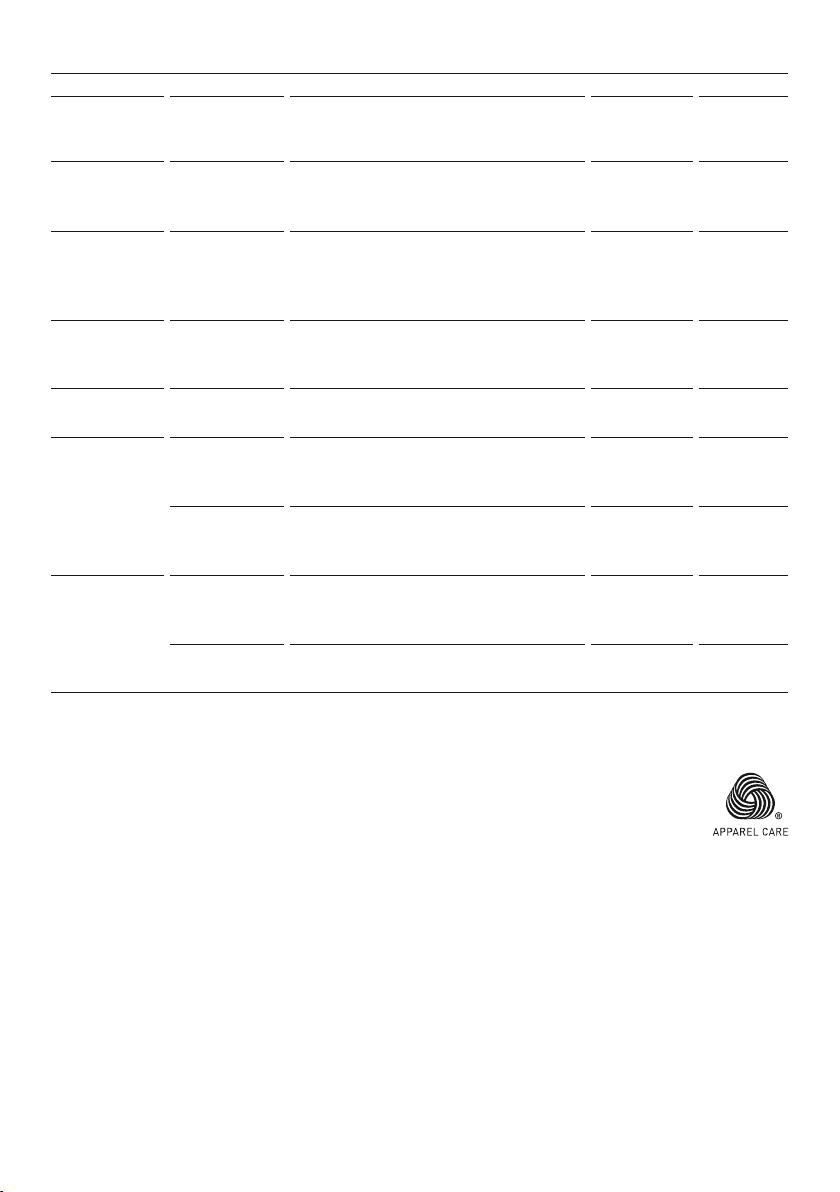
15
CYCLE SUB-CYCLE DESIGNED FOR
MAX.
LOAD SIZE
(KG)
DEFAULT
DRYNESS
LEVEL
Hygiene n/a
A longer, high heat cycle
designed to eliminate >99.9% of
household bacteria.
4 Extra Dry
Wool² n/a
A low heat cycle designed for
special care of washable woollen
items that complies with Woolmark
Apparel Care criteria.
1 n/a
Denim n/a
A medium heat cycle designed
for special care of stretch
denim garments.
3 Dry
Silk n/a
An extra low heat cycle designed
for special care of silk garments.
1 Dry
Extra Care
Sneakers
Timed cycle to warm blow dry
sneakers and sports shoes using the
drying rack.
1-2 pairs n/a
Soft Toys
Timed cycle to warm blow dry soft
toys. Do not dry toys with plastic,
metallic or electrical parts.
1-4 items n/a
Steam
Steam
Freshen
A cycle for de-wrinkling
and removing odours from
dry garments.
1-2 items Dry
Pre Iron
A quick cycle for de-wrinkling dry
garments before ironing.
1-2 items
Damp
Dry
¹COTTON with ECO selected is the recommended energy saving cycle for everyday drying.
DRY CYCLES
²Woolmark Apparel Care
The wool drying cycle of this machine has been approved by The Woolmark
Company for the drying of machine washable wool products provided that the
products are washed and dried according to the instructions on the garment
label and those issued by the manufacturer of this machine. M2018.
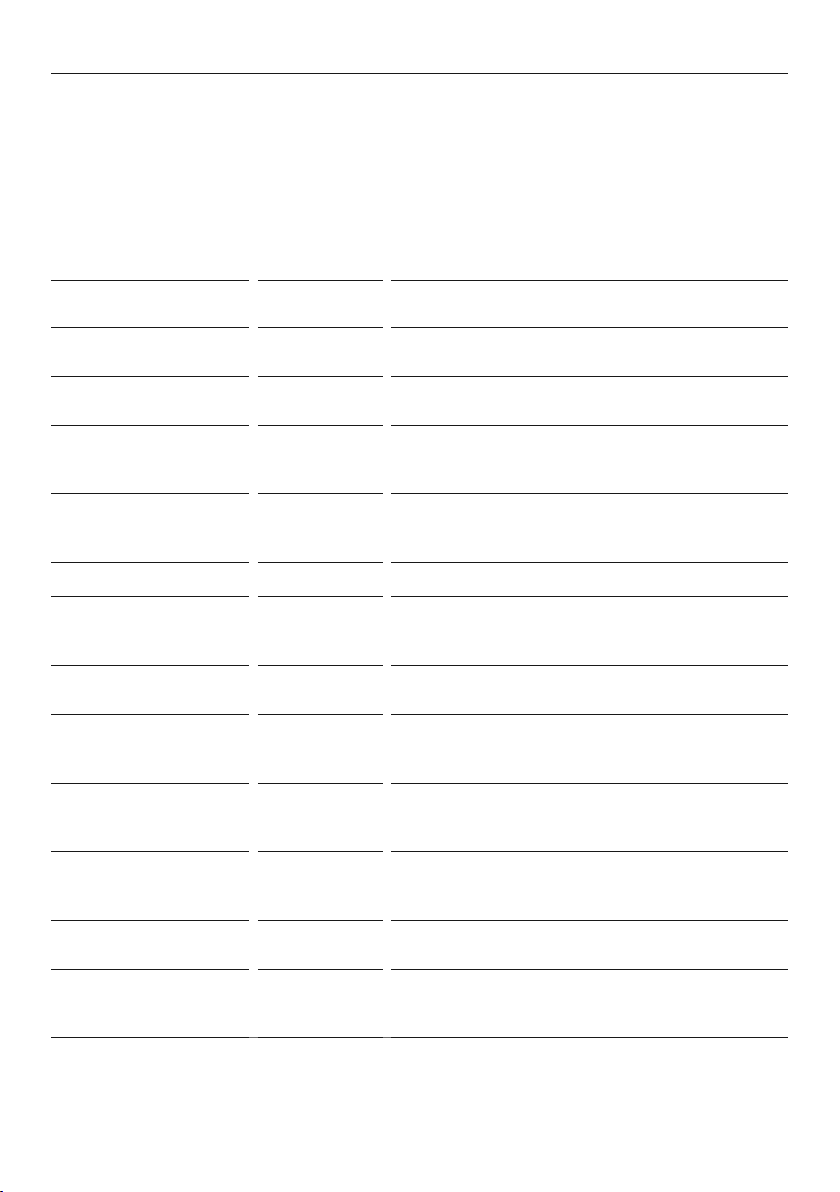
16
DRY PREPARATION
Sorting
Sort itemsintoloads of similar items, and loads that will likely take similar times to dry. This
prevents thepossibility of some items becoming over-dried whilst others are still damp.
Separate coloured items from white/light items where possible, especially when new. Colour
run may be an issue, especially if you intend to delay the start of the drying cycle.
Care labels on garments provide valuable information about the fabric type and
howthegarment should be dried. Always follow the advice on garment labels.
ITEM/DRYING
REQUIREMENTS
SUGGESTED
CYCLE
COMMENTS
Towels Towels Towels produce a lot of lint and are best dried on
their own.
Sheets, pillowcases Sheets Ensure openings are buttoned/domed before
placing in the dryer.
Bulky items — doonas/
duvets, sleeping bags
andblankets
Bulky Dry only one bulky item at a time.
Business shirts,
trousers, other
creasables
Easy Iron
WRINKLE FREE is automatically selected to
help minimise creasing once the drying cycle
has finished.
Woollens Wool Designed for machine washable woollen items.
Delicates, fine fabrics Delicate,
Ultra delicate
or Rack Dry
You can further reduce the dryness level to damp
or useRack Dry for very delicate items.
Denim Denim Turn jeans inside out to help maintain their
appearance. Dry separately from other items.
Sports and
casual shoes
Sneakers Check on the item regularly throughout
the drying cycle. Ensure the rack has been
correctly fitted.
Soft toys Soft Toys Check on the item/s regularly throughout the
drying cycle. Use the drying rack for more
delicate soft toys.
Hats and other odd
shaped items
Rack Dry Check on the item regularly throughout
the drying cycle. Ensure the rack has been
correctly fitted.
Jackets Outdoor Turn jackets inside out to help maintain their
appearance. Dry separately from other items.
Bed linen, tea towels,
socks, reusable
face masks
Hygiene Ensure the items can safely withstand heat.

17
Before you load
z
Check pockets for items that could damage your clothes or get caught in the dryer.
z
Close zippers, hooks and eyes, and other fastenings (ie fasten the openings of duvet/
doona covers), and remove loose bra wires. These may damage both your dryer
and your clothes.
z
Items of clothing with screen-printing should be turned inside out toprevent
damage to the print.
z
Check the lint filter is clean and the water tank is empty (if the dryer is not set up
todrain automatically).
Loading
z
Garments need to be loaded correctly to minimise creasing and wrinkling, and to
ensurethe load is dried evenly.
z
Allow enough room in the dryer for clothes to tumble freely. Load the dryer in terms of
the space the garments take up when dry, rather than when they are wet.
z
Shake clothes out and load individually to help items dry evenly and reduce tangling.
z
Dry permanent press garments (business shirts) together on the EASY IRON cyclewith
the WRINKLE FREE option on. This will help reduce wrinkling and the need forironing.
Hang garments as soon as the drying cycle is complete to reduce the need for ironing.
Drying times
z
Drying very small loads is inefficient. Try to dry medium to large loads.
z
Heavier items (towels, flannelette sheets) will take longer to dry than light items
(synthetics and polyester cotton sheets and shirts).
z
Drying times can be reduced by spinning the wash load at the highest spin speed
suitable for the load type in your washing machine.
z
Check bulky items during the cycle to ensure even drying, pause the dryer and reposition
the item if necessary.
Lint
Some items are lint givers, while others are lint collectors. Always dry lint givers
and collectors separately.
LINT GIVERS LINT COLLECTORS
Towels Synthetics, eg polar fleece
Flannelette sheets Corduroy
Polyester cottons
Delicate or easily damaged items (eg nylon stockings, fine fabrics, delicate embroidered
fabrics) should be dried separately, using the
DELICATE, ULTRA DELICATE, SILK or WOOL cycle,
or if you do not want them tumbled use the RACK DRY cycle. Sleeping bags and other down
items should be dried on the BULKY cycle.
DRY PREPARATION
18
DRY PREPARATION
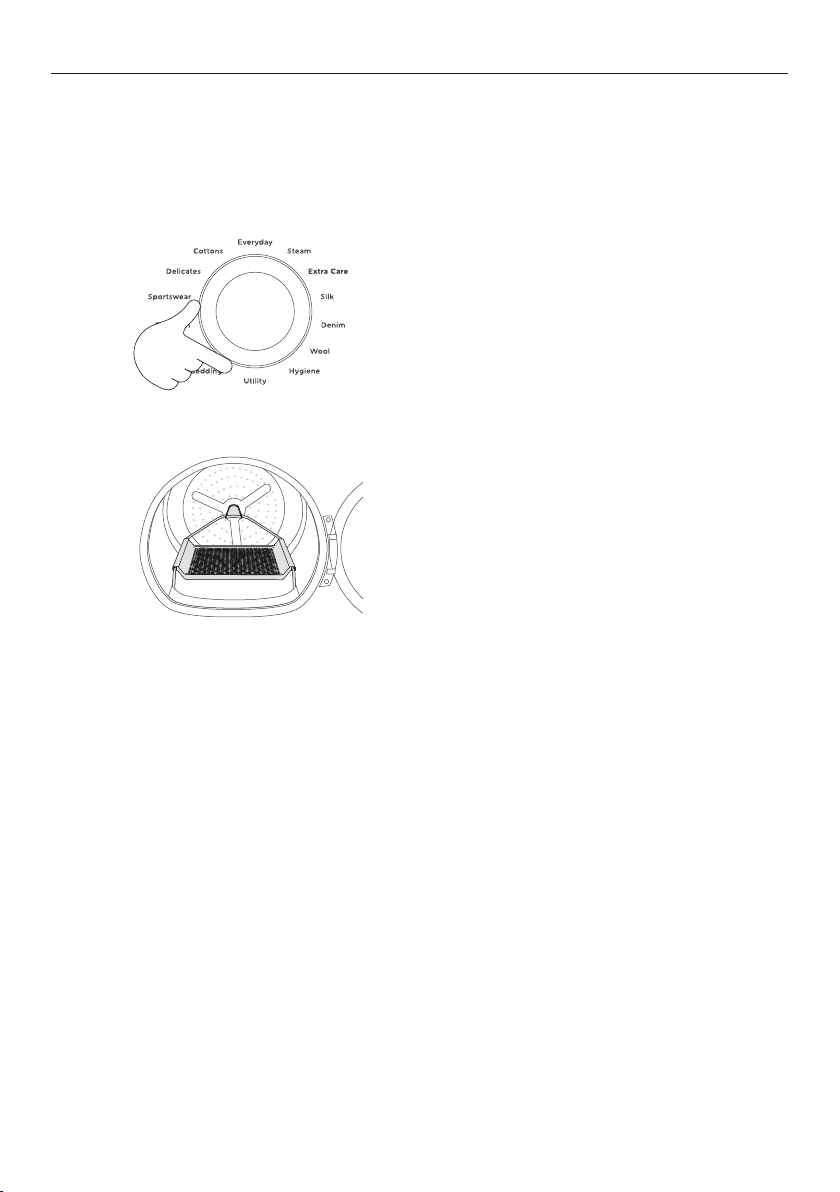
Drying rack
The drying rack is installed in your dryer when it leaves the factory. There are many items
that would benefit from being dried on a dryingrack. For example items such as hats,
sneakers anddelicate soft toys are items that may be damaged if they are tumbled.
1
2
Toremove the drying rack, detach the legs
fromthe slots in the lint filter and gently
remove from the drum.
SHOW ONE
OPTION SCREEN,
EG DRY RACK
SHOW ONE
OPTION SCREEN,
EG DRY RACK
The drying rack is installed in your dryer
when it leaves the factory.
When you are using the drying rack
you must select an appropriate cycle:
RACK DRY, SNEAKERS or SOFT TOYS.
19
GETTING STARTED QUICKLY
Check the lint and condenser filters are clean and replaced correctly before every load.
Ensure the water tank is empty or drain hose secure before using your dryer.
Sort and load items into the dryer drum, ensuring no items are in the way of the door. Close
the door (you will hear it click shut).
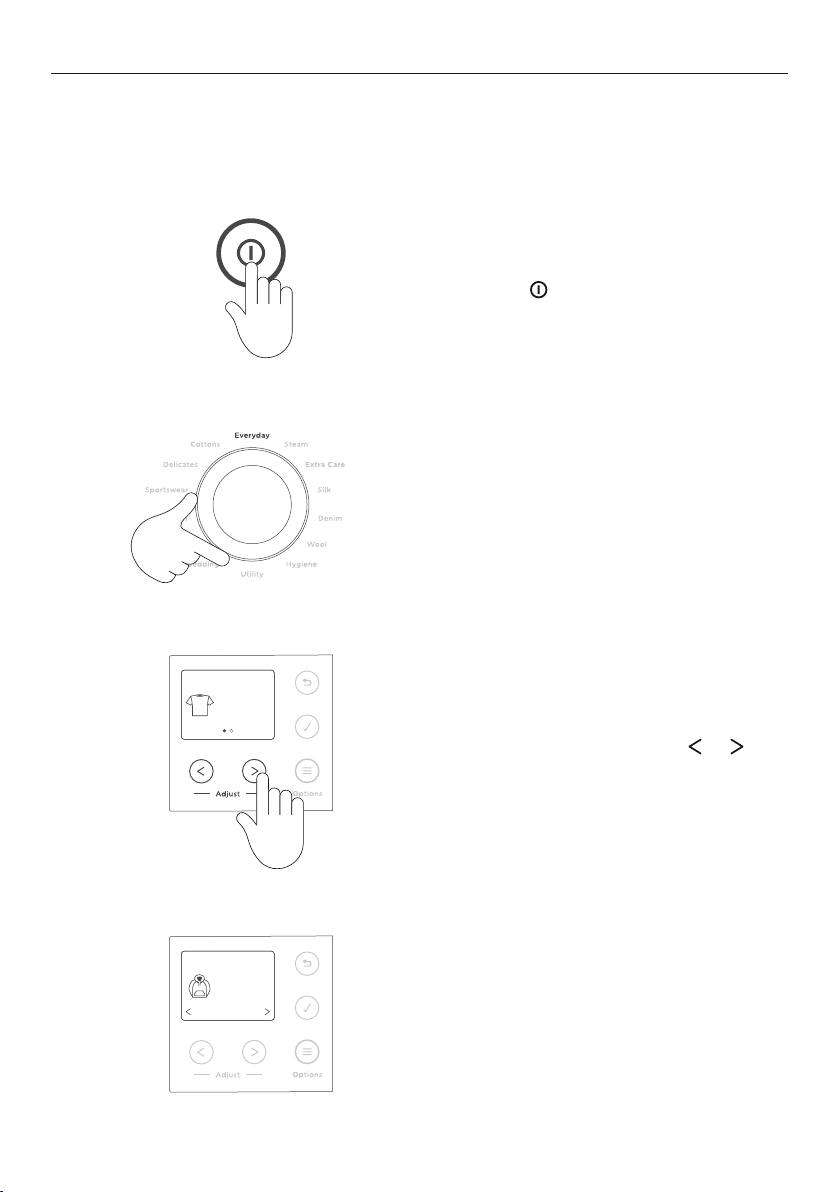
1
2
3
4
Press POWER to activate your dryer.
Select your desired drying cycle by turning
the SmartTouch™ Control Dial.
A red LED will illuminate as you turn the dial
showing which cycle is selected.
Once the dry cycle is selected, the screen will
display
NO DELAY, indicating the dry cycle
isready to start.
The screen will display the information
specific to the selected cycle.
To select a sub-cycle use
ADJUST or to
scroll through the sub-cycles.
No Delay
Heavy
Auto
Everyday
Everyday
Start in 8hrs
Heavy
Auto
No Delay
Heavy
Auto
Everyday
Everyday
Start in 8hrs
Heavy
Auto
No Delay
Heavy
Auto
Everyday
Everyday
Start in 8hrs
Heavy
Auto
No Delay
Heavy
Auto
Everyday
Everyday
Start in 8hrs
Heavy
Auto

20
GETTING STARTED QUICKLY
5
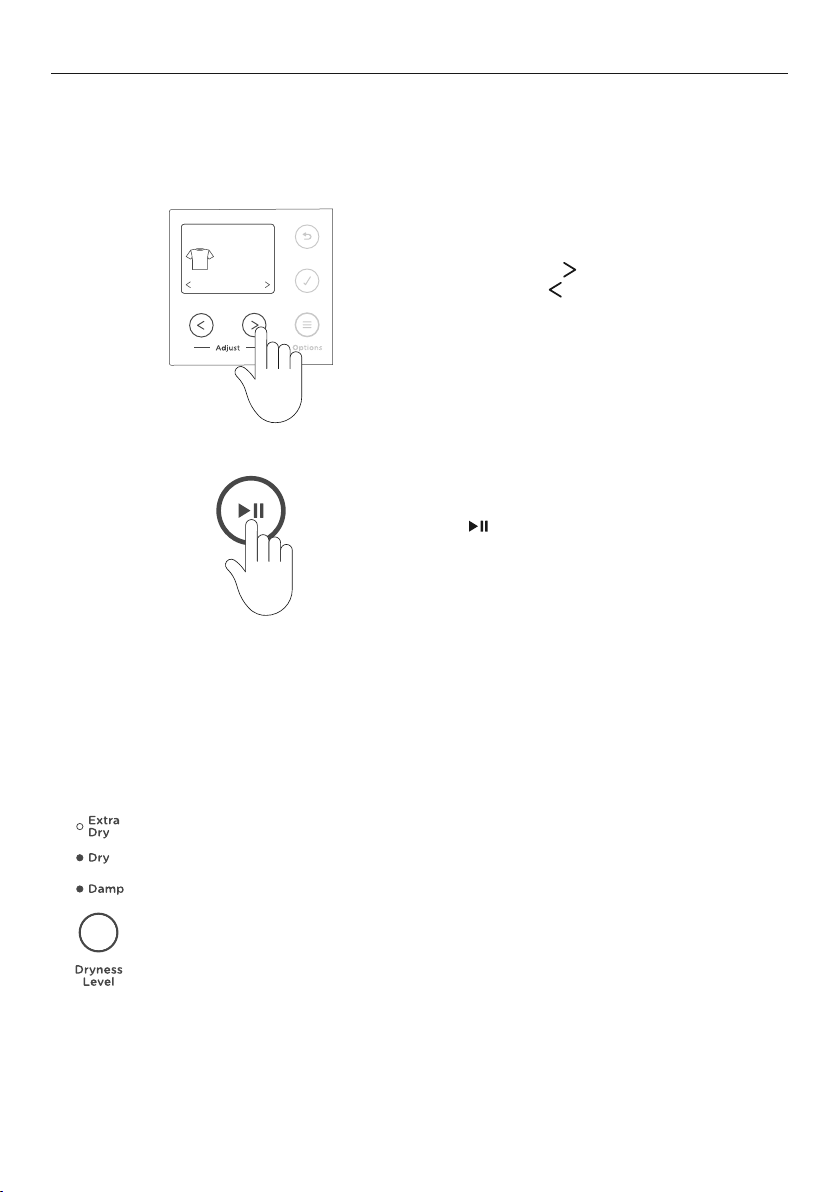
Press to start the cycle.
If you wish to change a cycle or select a
different option once a drying cycle has
started, press
then select the new cycle.
Press
to restart thedryer with the new
cycle and/or settings.
When the cycle finishes, your dryer will beep and then turn off automatically. If
the
WRINKLE FREE option has been selected the dryer will rotate the drum periodically to
help minimise wrinkling and creasing ofyour load.
If you wish to stop the dryer before the cycle has finished you MUST remove the clothes
IMMEDIATELY and spread them out to cool. DO NOT leave the clothes in the dryer or
bunched up in a clothes basket. Take extreme care as the drum and the load items may be
extremely hot.
If you prefer to start the wash cycle at a later
time, set a delay for the start time by using
the
ADJUST .
4
No Delay
Heavy
Auto
Everyday
Everyday
Start in 8hrs
Heavy
Auto
No Delay
Heavy
Auto
Everyday
Everyday
Start in 8hrs
Heavy
Auto
21
DRY CYCLE OPTIONS
Options
All dry cycles default to the recommended settings for that cycle based on the average
expected load to be dried. You can adjust and customise the dry options to create your
desired cycle.
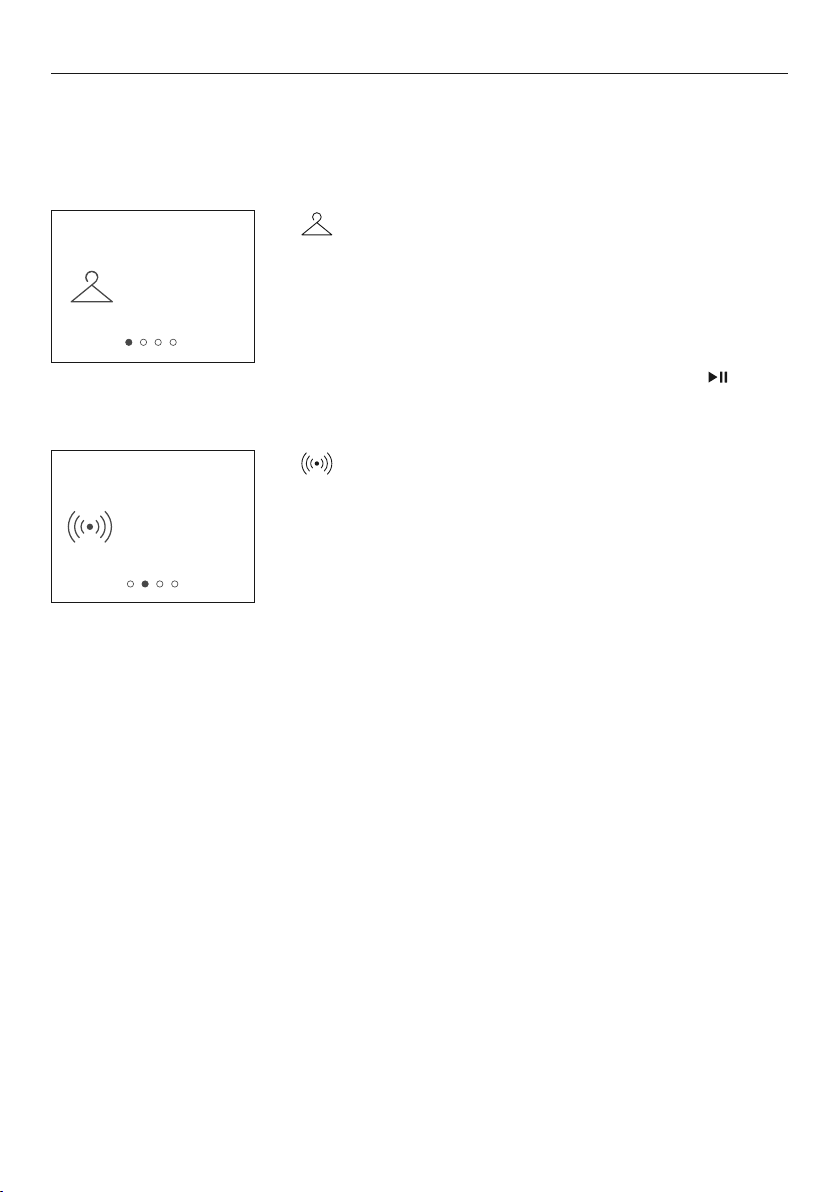
WRINKLE FREE
At the end of the cycle, the drum will rotateperiodically to
minimise wrinkling and creasing. This is particularly useful
if you cannot remove the items immediately after the cycle
ends.
z
ON provides WRINKLE FREE operation for one hour.
z
EXTRA provides WRINKLE FREE operation for 24 hours.
z
To remove the load during WRINKLE FREE, press .
Options:
OFF (Default), ON, EXTRA
DAMP DRY SIGNAL
Your dryer will beep to alert you to remove items once your
load reaches the damp stage. The dryer will beep to alert
you to remove your items, then it will continue drying until
the remaining load reaches the dryness level you selected.
z
This option is not available if BEEPS have been set to OFF
in the SETTINGS, refer to ‘Dryer settings’.
Options:
OFF (Default), ON
Wrinkle
Free
OFF
Options
Damp Dry
Signal
OFF
Options
22
DRY CYCLE OPTIONS
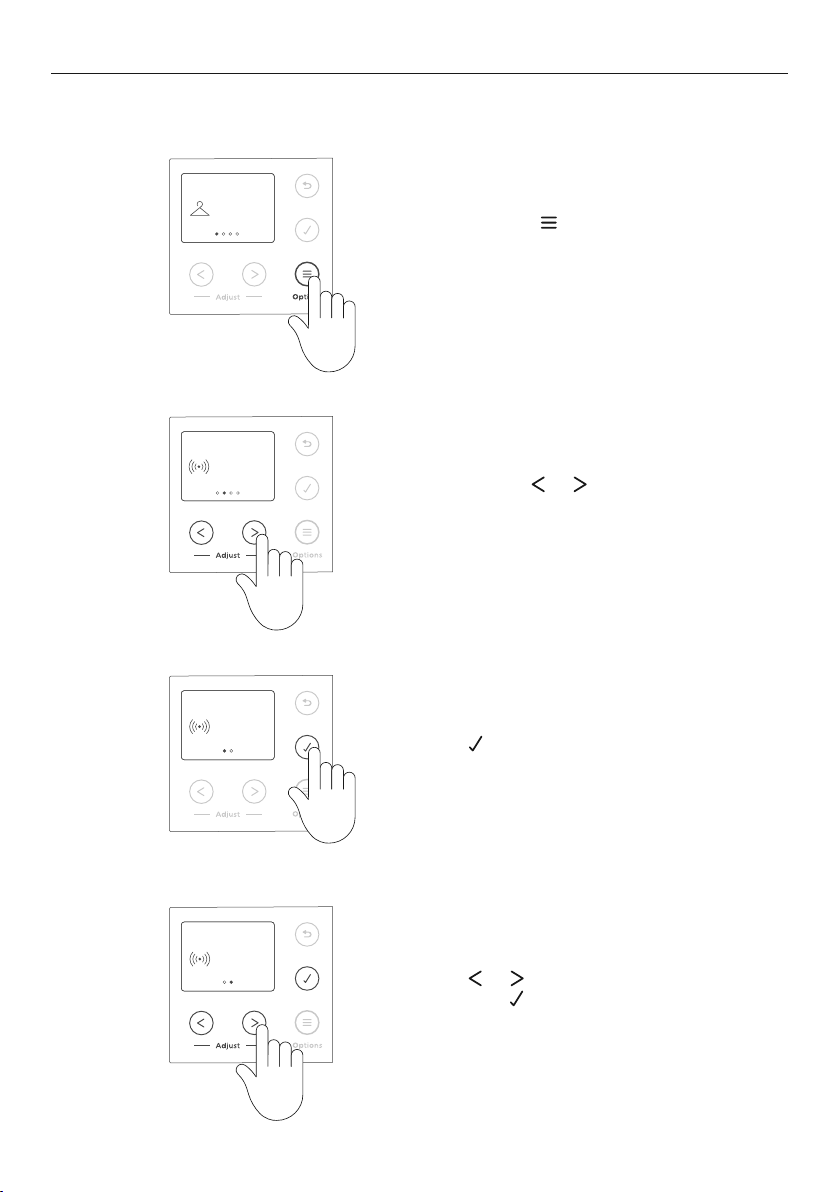
To change a dry cycle option
Press
OPTIONS , the screen will show the
default dry cycle option.
Press
ADJUST or to scroll through
other options.
Press
to select the option and
enable editing.
Press
or to edit the selected option and
then press to confirm.
2
1
3
4
Damp Dry
Signal
OFF
Options
Wrinkle
Free
OFF
Options
Damp Dry
Signal
On
Option
Damp Dry
Signal
O
Option
Damp Dry
Signal
OFF
Options
Wrinkle
Free
OFF
Options
Damp Dry
Signal
On
Option
Damp Dry
Signal
O
Option
Damp Dry
Signal
OFF
Options
Wrinkle
Free
OFF
Options
Damp Dry
Signal
On
Option
Damp Dry
Signal
O
Option
Damp Dry
Signal
OFF
Options
Wrinkle
Free
OFF
Options
Damp Dry
Signal
On
Option
Damp Dry
Signal
O
Option
23
CUSTOMISING A DRY CYCLE
Delay Start
You can delay the start of the dry cycle between 15 minutes and 12hours. This can be useful
to time your drying to finish when you arrive home from work.
Press the
ADJUST button to increase the
delay time, and button to decrease the
time, or turn
DELAY START off.
Press
to confirm your selection and start
the countdown. The display screen will show
the time until the cycle is set to begin.
1
2
Avoid using DELAY START for damp, non-colourfast items as this may cause dye run to occur.
Dryness level
When your dryer senses that the clotheshave driedto the dryness level
selected, the dryer willautomatically finish thecycle.
Two lights are used to show somedryness levels, eg to achieve the
DAMP DRY setting boththe DRY and the DAMP lights willbeilluminated.
There are five dryness levels that can be selected from
DAMP through to
EXTRA DRY. You can alter the dryness level from the default to suityour
load depending on how dry you want youritemsto be.
Start in 8hrs
Everyday
Auto
Start in 8hrs
Everyday
Auto

24
CUSTOMISING A DRY CYCLE
Optimise Dry
Your dryer offers you three optimise dry modes –
SPEED, ECO and QUIET– allowing you
to reduce noise, save energy or save time. Only one mode can be selected at a time.
For clothes care reasons not all options are available on all cycles. These dry modes are
available on EVERYDAY, COTTONS, HEAVY and TOWELS cycles.
Speed
A special feature designed to offer a shorter cycle whilst providing good dry performance.
Please be aware that a number of factors can influence the amount of time saved on a
cycle, including the load size, cycle chosen and load distribution.
Eco
Use the
ECO option to save energy. Selecting ECO will reduce the drying temperature slightly.
Quiet
Use the
QUIET modes when drying at night and/or when noise is a concern. This mode
enables reduced fan speeds to reduce the level of noise emitted. When QUIET mode is
selected the end of cycle signal (beeps) is disabled.
25
Everyday
Complete
Save as Favourite?
Everyday
Complete
Save as Favourite?
Favourite
Options
Favourite
Option
Save?
Favourite
saved
Favourite
saved
Everyday
Complete
Save as Favourite?
Everyday
Complete
Save as Favourite?
Favourite
Options
Favourite
Option
Save?
Favourite
saved
Favourite
saved
Everyday
Complete
Save as Favourite?
Everyday
Complete
Save as Favourite?
Favourite
Options
Favourite
Option
Save?
Favourite
saved
Favourite
saved
CUSTOMISING A DRY CYCLE
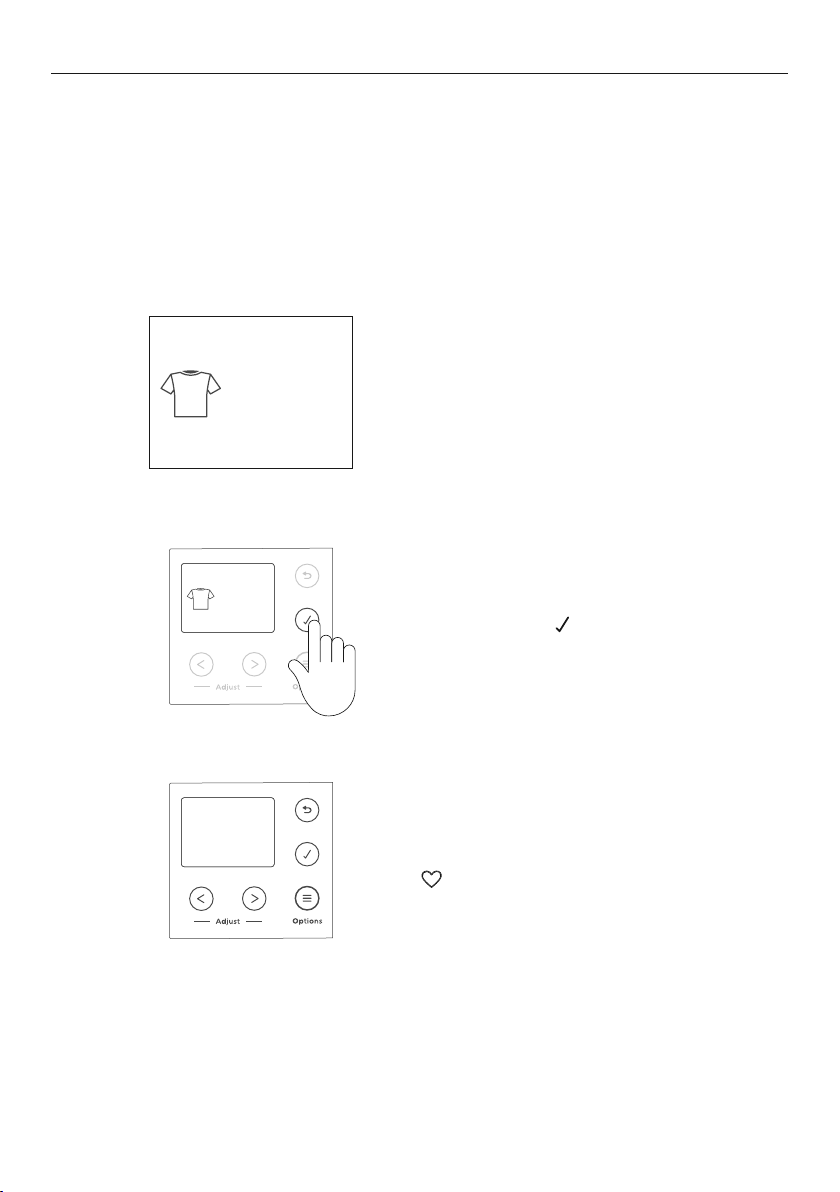
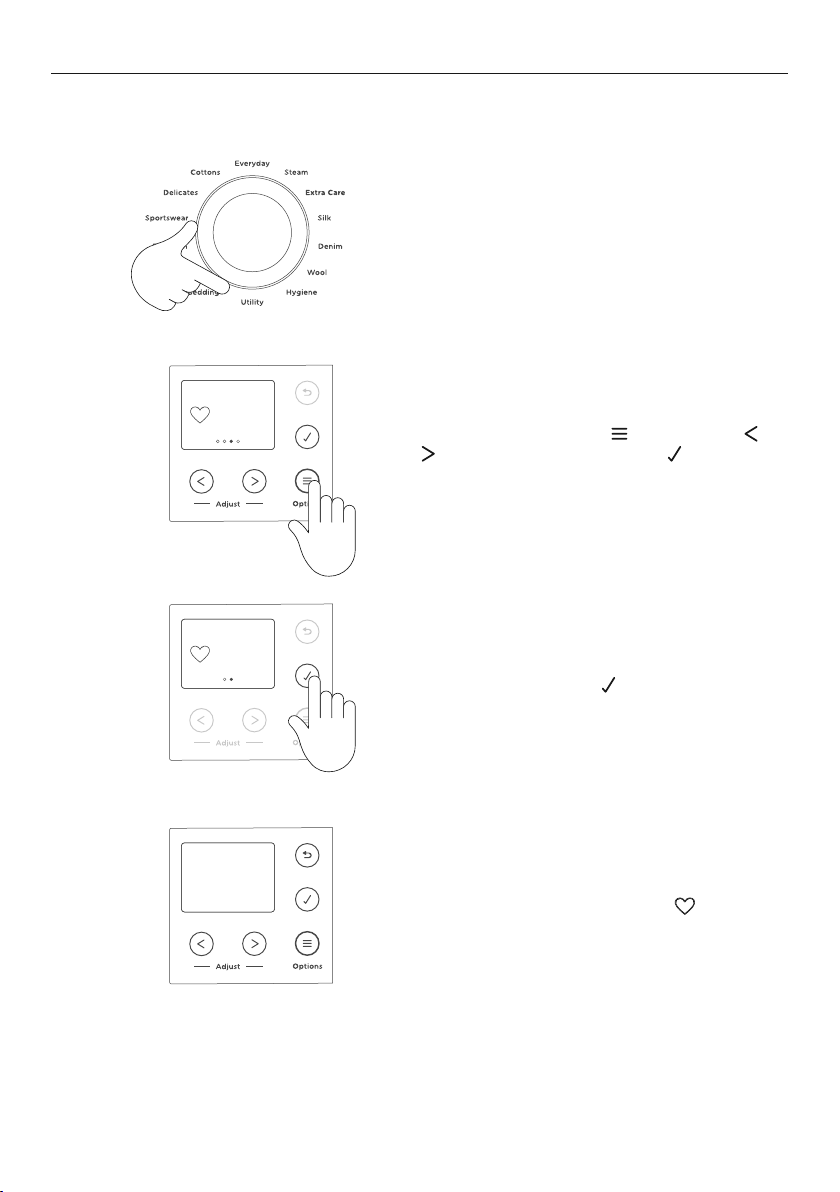
To set a favourite
After using your dryer a few times you may discover there are some options you prefer for
some cycles. You can programme your dryer to remember the dry options you prefer for
each cycle. For instance, you may want to set the
EVERYDAY cycle to default to EXTRA DRY
or set the HEAVY cycle to include QUIET or SPEED. There are two options for making a dry
cycle FAVOURITE.
1
The display will show the cycle used and
the status as complete with the question
SAVE AS FAVOURITE?.
2
To accept, press .
3
At the end of a cycle
The display will show the setting has been
saved. The cycle will now appear with a
icon.
26
CUSTOMISING A DRY CYCLE
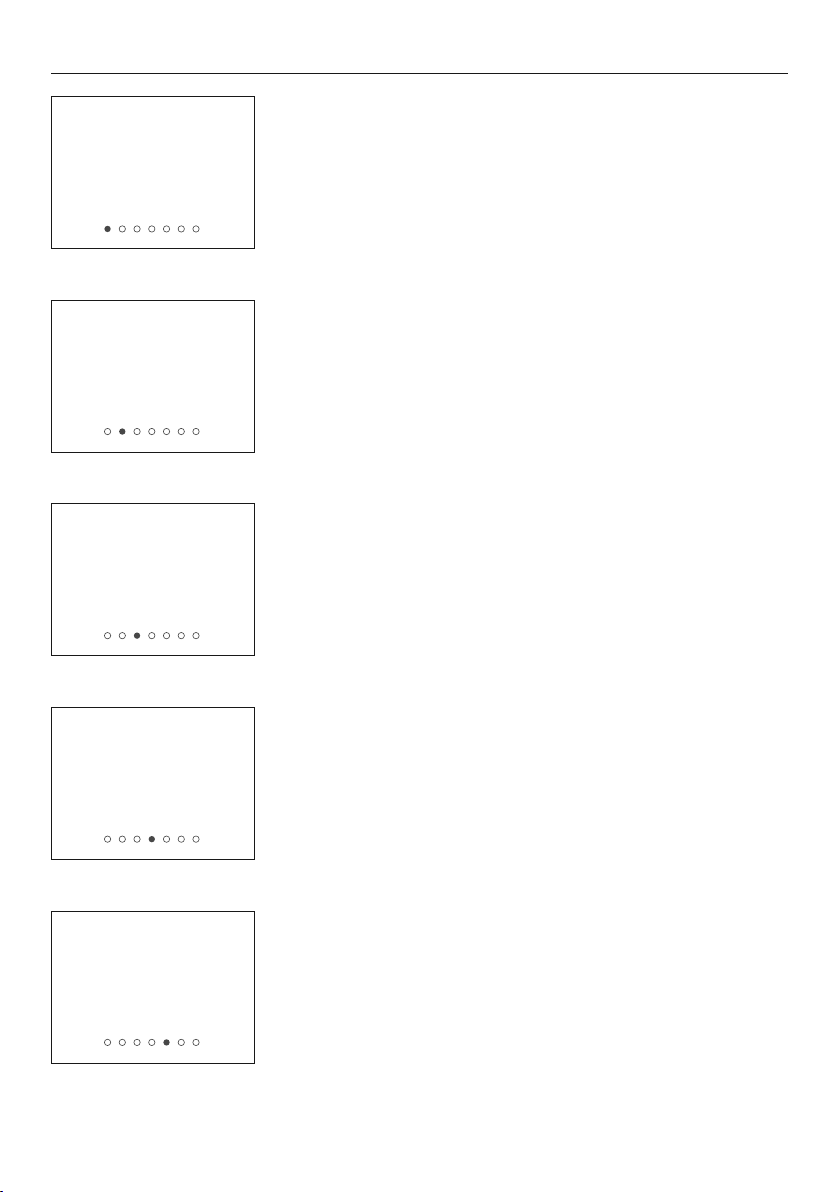
1
2
3
From options
Select the cycle using the control dial.
Select the start time (
NO DELAY or
DELAY START time) of your choice.
Scroll through
OPTIONS using ADJUST or
and select FAVOURITE. Press to edit.
Select
SAVE and press to confirm.
4
The display will show the setting has been
saved. The cycle will now show icon to
show cycle has been saved as a favourite.
Everyday
Complete
Save as Favourite?
Everyday
Complete
Save as Favourite?
Favourite
Options
Favourite
Option
Save?
Favourite
saved
Favourite
saved
Everyday
Complete
Save as Favourite?
Everyday
Complete
Save as Favourite?
Favourite
Options
Favourite
Option
Save?
Favourite
saved
Favourite
saved
Everyday
Complete
Save as Favourite?
Everyday
Complete
Save as Favourite?
Favourite
Options
Favourite
Option
Save?
Favourite
saved
Favourite
saved
Everyday
Complete
Save as Favourite?
Everyday
Complete
Save as Favourite?
Favourite
Options
Favourite
Option
Save?
Favourite
saved
Favourite
saved
Favourites can be removed by either choosing REMOVE FAVOURITE within the FAVOURITES
OPTIONS
menu or using RESET DEFAULT in the SETTINGS menu. Selecting RESET DEFAULTS will
reset all FAVOURITES and any other saved settings, such as WiFi details, back to the factory
default settings.
27
DRYER SETTINGS
WiFi
OFF
Settings
Cycle Information
ON
Settings
Beeps
ON
Settings
Screen Brightness
MEDIUM
Settings
Drum Light
AUTO
Settings
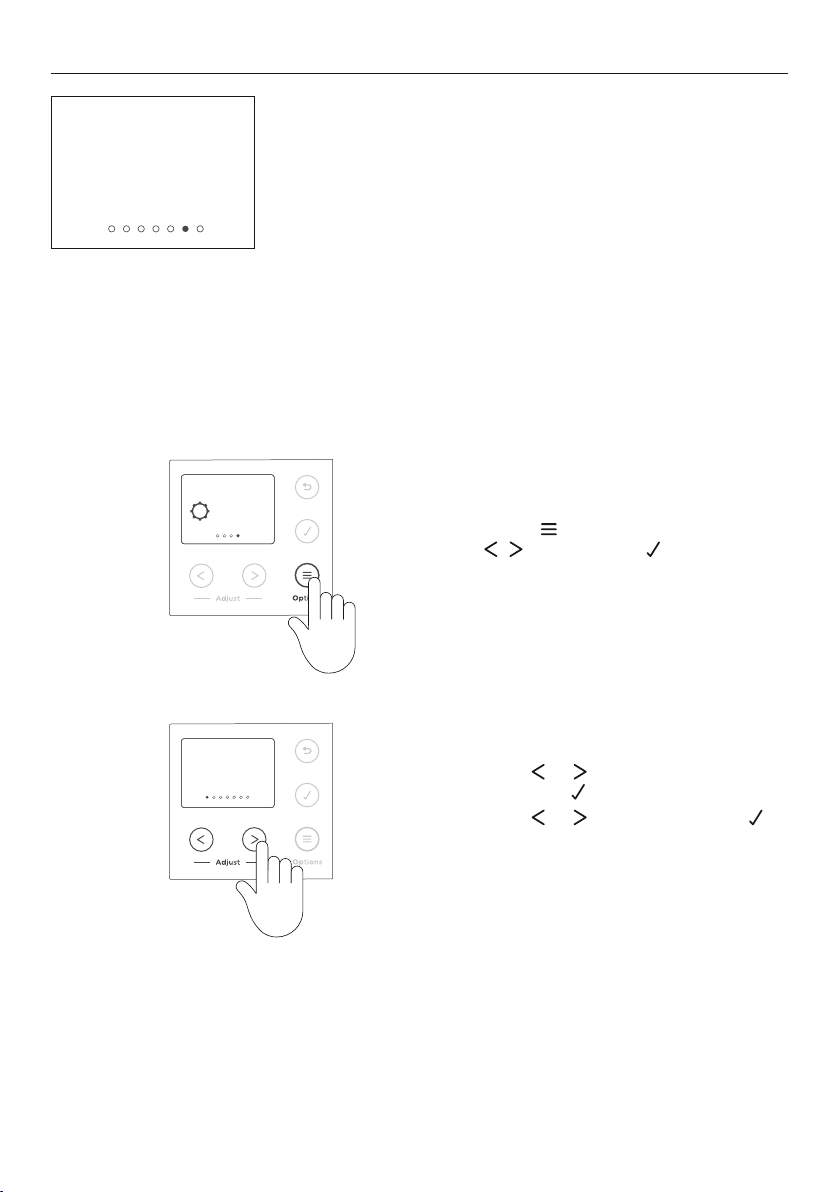
Cycle information
Displays details of what the cycles are designed for.
Settings:
ON (Default), OFF
Beeps
Turns on/off sounds.
z
The sound when touching the buttons.
z
The series of beeps that sound at the end of a cycle to
alert you that the dryer has finished.
Settings:
ON (Default), OFF
Screen brightness
Adjusts the brightness of the digital display screen.
Settings:
LOW, MEDIUM (Default), HIGH
Drum light
Turns on/off drum light.
z
LED light turns on when the washer is powered and
turns off automatically.
z
Turns on again at the end of the cycle to help
facilitate unloading.
Settings:
AUTO (Default), OFF
WiFi
Allows WiFi Setup and indicates if WiFi is
ON/OFF.
Settings:
ON, OFF (Default), SETUP
28
Editing settings
Dryer
SETTINGS within OPTIONS can be used to adjust default settings to your preferencefor
beeps, drum light, screen brightness, user prompts and factory reset.
To change a setting
Press
OPTIONS , scroll to SETTINGS using the
ADJUST buttons, press to confirm.
Press
ADJUST or to scroll through the list
of SETTINGS, press to select and edit.
Press
ADJUST or to select and press
to confirm.
DRYER SETTINGS
User Prompts
ON
Settings
User prompts
Turns on/off the user-prompts that are not related to
warnings or faults.
Settings:
ON (Default), OFF
1
2
Settings
Options
WiFi
OFF
Settings
Settings
Options
WiFi
OFF
Settings
Selecting RESET DEFAULTS will reset all FAVOURITES and any other saved settings, such as
WiFi details, back to the factory default settings.

29
CARING FOR YOUR DRYER
When you have finished using your dryer
z
Unplug the dryer from the power socket.
z
Wipe around the door to remove any remaining condensation and foreign matter.
z
Clear the lint and condenser filters and empty the water tank (if not set up to
automatically drain).
Cleaning the control panel and outer surfaces of the dryer
Use a soft damp cloth to wipe all surfaces, then wipe dry. Avoid using chemical or scouring
cleaners, as these will damage the paint and plastic surfaces of your dryer.
Cleaning the inside of your dryer
It is important to occasionally clean the inside of your dryer. If the drum has anyresidual
dirt or lint stuck to it, remove this and wipe it clean with a damp cloth. Donot leave any
metal objects in the drum, as these may cause rust.
Cleaning the filters
Cleaning the door lint filter
Lint is generally formed during wearing and washing. Fibres (ielint) released from
theclothes during the drying cycle are collected in the lint filter.
It is important to clean the door lint filter after every load, as the lint produced in the drying
process can become a fire hazard if it is allowed to accumulate in or around your dryer.
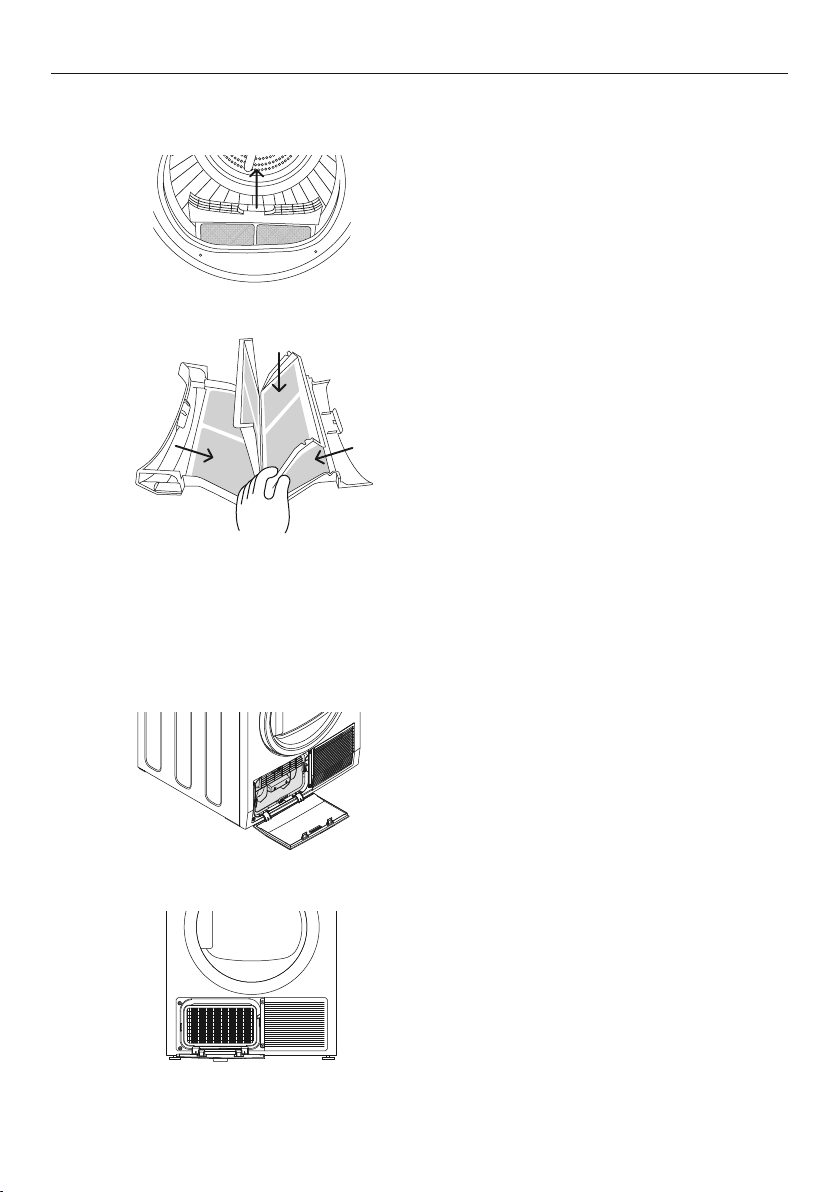
The door lint filter is located in the door
opening (at the bottom).
30
CARING FOR YOUR DRYER
Open the dryer door.
Remove the lint filter by pulling it up and out
of the filter slot.
1
2
To clean the door lint filter:
Open it out and wipe the surfaces clean with
your hand or a soft cloth.
Close the lint filter and place it back in the
opening. Ensurethe filter is fitted correctly
back in place before operating the dryer.
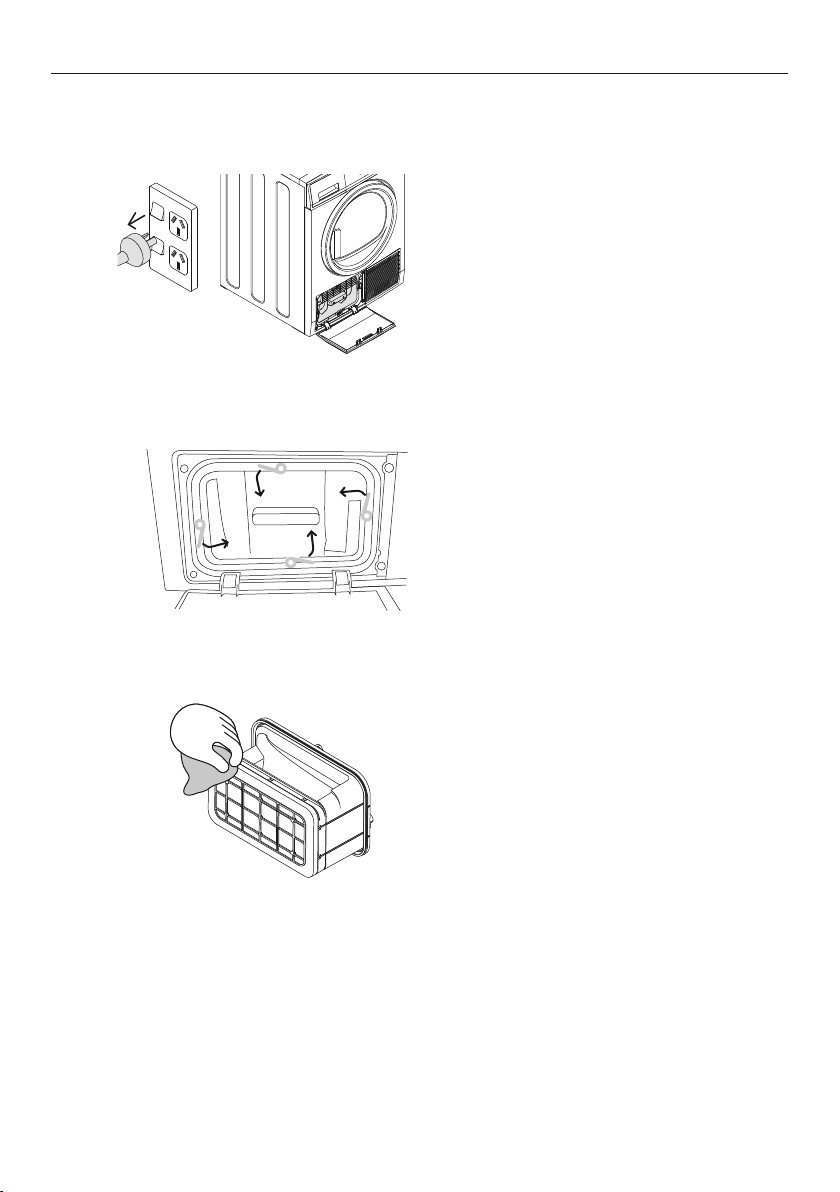
Cleaning the condenser filter, foam and evaporator grid
To maintain optimum performance of your dryer the condenser filter, foam andevaporator
grid must be cleaned.
Evaporator grid
The evaporator grid is located behind the
condenser filter.
Condenser filter
The condenser filter is located below the
door on the left-hand side.
31
CARING FOR YOUR DRYER
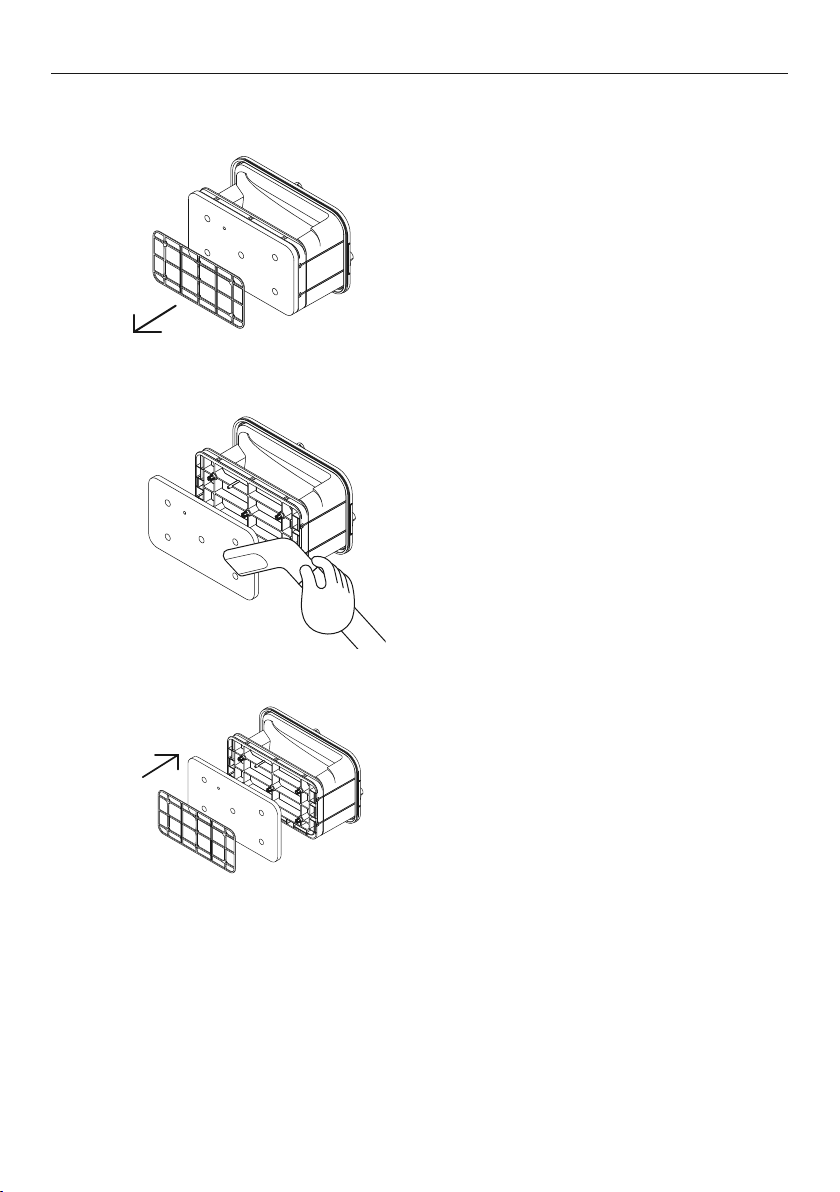
To clean the condenser filter:
Switch off the power supply and remove
thepower plug.
Open the condenser filter cover.
Turn the four condenser lock levers 90°
thenpull out the condenser filter.
Use your hand, a cloth or a vacuum with a
crevice nozzle to remove any lint build-up
from the mesh surface of the filter.
1
2
3
32
CARING FOR YOUR DRYER
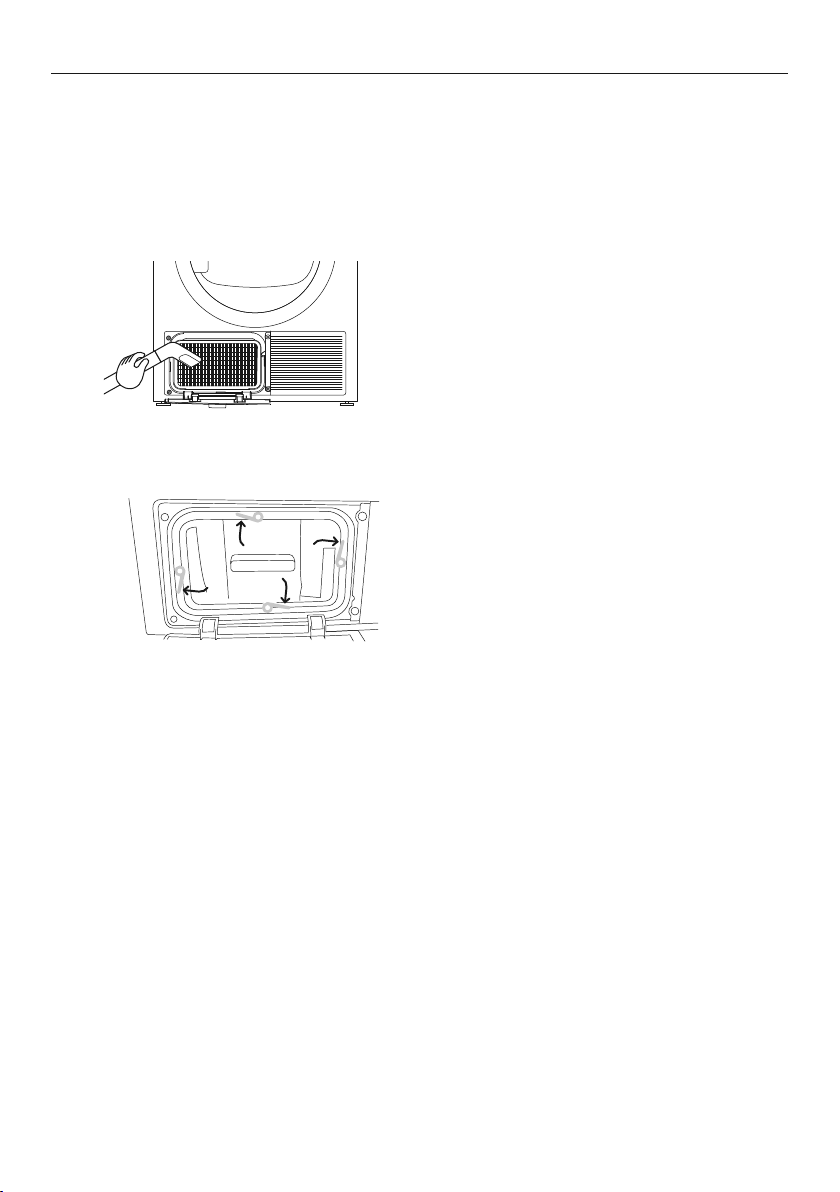
To clean the filter foam:
Remove the bracket securing the foam to
condenser filter.
1
Remove the foam and vacuum lint build-up
with a crevice nozzle.
2
Replace the filter foam and secure with
the bracket.
3
The condenser filter foam should be replaced regularly, three filter foams are provided with
your dryer. Further replacement filter foam can be purchased from Fisher&Paykel.com or
from your Fisher & Paykel trained and supported service technician.
33
To clean the evaporator grid:
With the condenser filter removed you will be able to see the evaporator grid.
Cut Hazard. The surface of the evaporator has sharp edges and contact may result in
injury. Handle with care when cleaning the grid andalways keep blades away from fingers
andbody.
Ifthesurface of the evaporator grid is
dirty, clean it carefully with avacuum
cleaner using a dusting brush or anarrow
crevice tool. Begentle and do not bend the
finemetalfins.
1
Replace the condenser filter.
Turn the four condenser filter lock levers to
lock the condenser filter back inplace. Ensure
the locksare engaged securely.
Close the condenser filter cover.
2
CARING FOR YOUR DRYER
34
Cleaning the sensors
There are sensors in your dryer that detect whether the laundry is dry or not. Thesesensors
need to be cleaned periodically (we recommend approximately fourtimes a year).
To clean the sensor:
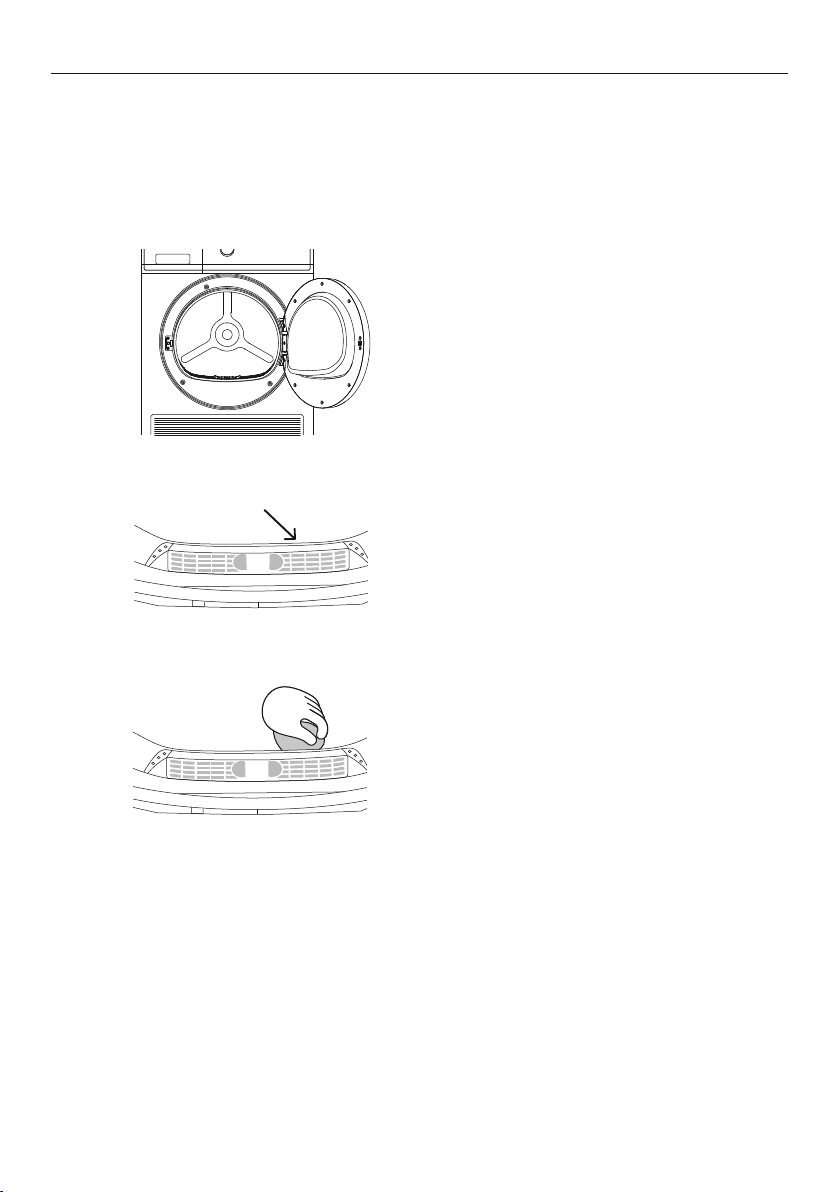
Open the door of your dryer. Allow the dryer
to cool if drying hasbeen carried out.
Locate the metal sensors just behind
thelint filter.
Wipe the sensors with a soft cloth,
dampened withvinegar and dry with a clean
dry soft cloth.
1
2
3
CARING FOR YOUR DRYER
35
Emptying the water collection tank
During the drying cycle, steam condenses into water andis collected in the water tank,
located at the top left of the dryer. It is important to empty the water tank after every load.
Ifthewater tank becomes full during operation, thedryer will pause, display a user prompt
and beep to alert you.
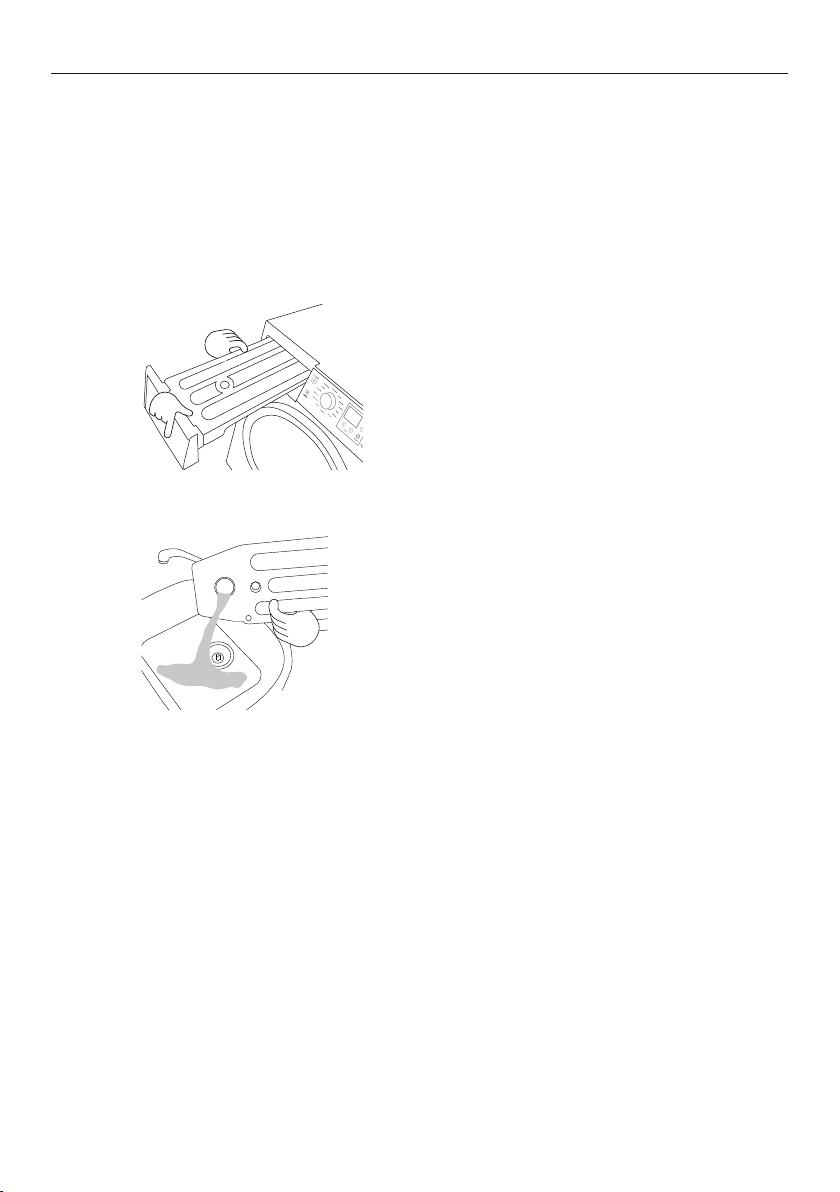
Remove the water tank by holding onto
the handleand pulling outwards gently.
Ensurethe tank is kept level when removed
to prevent the water from spilling.
Never run the dryer without the water tank in place unless thedrainhosehasbeeninstalled.
You do not need to empty the water tank ifyou have set up the drain hose to drain the
waterautomatically.
1
2
Pour the water down the sink or into a
bucket, andthen put the tank back in place.
To empty the water tank:
CARING FOR YOUR DRYER
36
BEFORE YOU CALL FOR SERVICE
User warnings
Your dryer is capable of diagnosing a number of its own problems. It will sound a
continuous series of beeps and display a user prompt when it has a problem that you can
correct yourself. To stop the beeps sounding, touch any button on the control panel. Donot
try to continue your drying cycle once you stop the noise. You must address theproblem
the dryer is alerting you to.
Check the below table before you call for service.
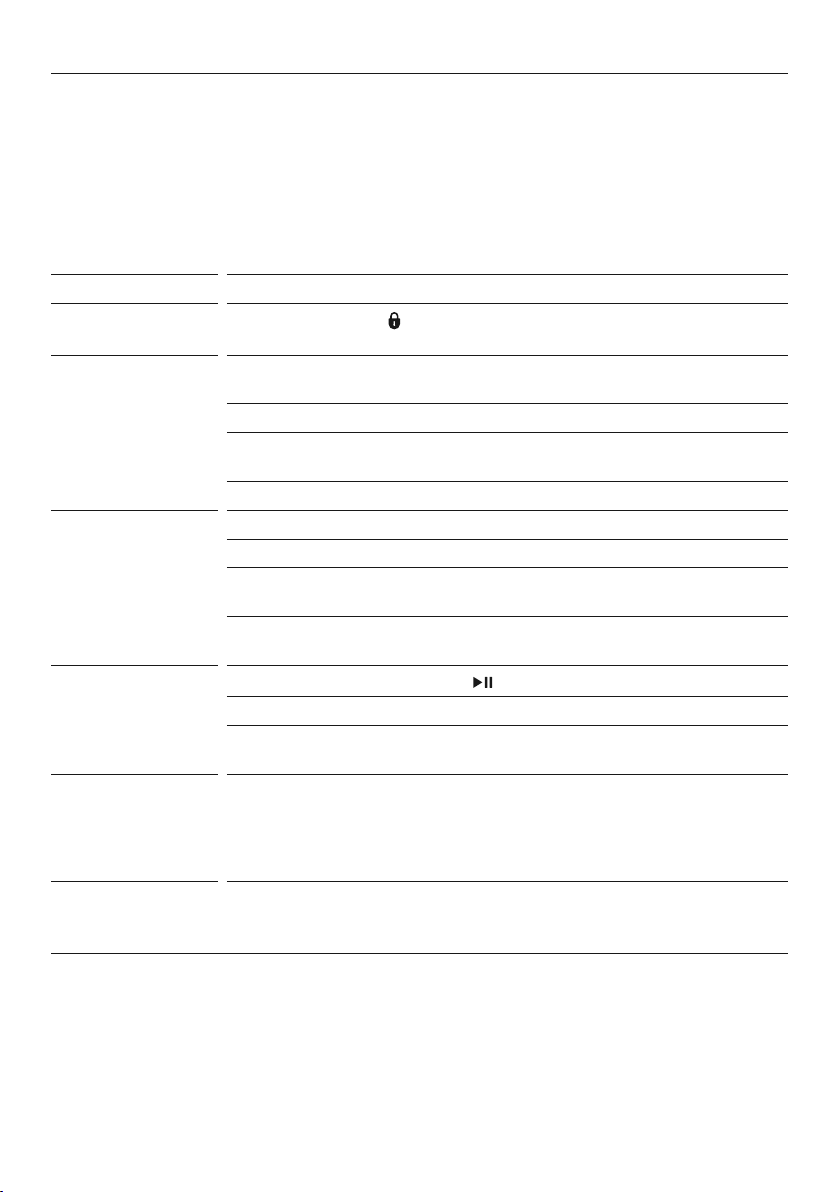
NOTIFICATION WHAT TO DO
KEYLOCK ON
Touch and hold the button for threeseconds to deactivate
theKeylock.
CLEAN FILTERS AND
EVAPORATOR GRID
Clean lint and condenser filters and carefully vacuum the
evaporatorgrid.
Check the lint filter or condenser filter are not damaged.
Check there is nothing else trapped in the filters or evaporator grid,
whichmay be blocking the air flow.
Check the filters are correctly in place in your dryer.
WATER TANK
Check if the water tank is full.
Empty the water tank.
If using the drain hose, check whether the water tank or drainhose
isblocked.
Check the drain hose is still attached at the back of the machine,
andisnot kinked or squashed.
DOOR OPEN
Close the door fully and touch .
Try opening and closing the door again.
Reposition the load, make sure the load is correctly in the drum
andthatprotruding items are not preventing the door fromclosing.
THE LAUNDRY
ENVIRONMENT IS
TOO COLD FOR
THE DRYER TO
FUNCTION
The room temperature is too low for the heat pump system to work
effectively. Ensure that the room temperature is above five degrees to
avoidloss of efficiency.
MAXIMUM CYCLE
TIME HAS BEEN
REACHED
There are a number of reasons the maximum cycle time has been
reached, referto ‘Troubleshooting’, ‘Dryer is taking toolong.’ for
possible causes and solutions.
Once you have addressed the issue the user prompt was alerting you to, try using your
dryer as per usual. If the issue persists, call your Fisher & Paykel trained and supported
service technician.

37
FAULT CODES
When a continuous series of beeps sound, all the lights turn off onthe control panel and a
number appears on the display, a fault hasoccurred. The dryer will automatically enter this
mode if a fault occurs. The word FAULT will be shown in the control panel display followed
by a number. To stop the beeps, press any button then perform the following steps:
1 Turn your dryer off at the power point.
2 Wait one minute and turn it back on.
3 Check your dryer is installed correctly, refer to your separate installation guide.
4 Remove your load from the dryer and retry.
5 Perform a
TIME DRY cycle, eg TIME DRY for 30 minutes.
6 If the fault re-occurs repeat steps 1 and 2.
7 If the dryer still will not work call a Fisher & Paykel trained and supported
servicetechnician to arrange service, refer to ‘Before you call for service’.
Recordthefaultcode number displayed and the serial number of your dryer
(locatedonthe rear of the dryer, or on the insideof the door below the glass)
beforecalling. The fault code will indicateto the service technician what the
problemcould potentially be.
If a fault code is being displayed, you can still turn your dryer off by pressing
POWER .
38
TROUBLESHOOTING
The following is a list of problems you may encounter when using this appliance and some
suggestions that may help to correct the problem. If you still have problems, contact your
Fisher & Paykel trained and supported service technician.
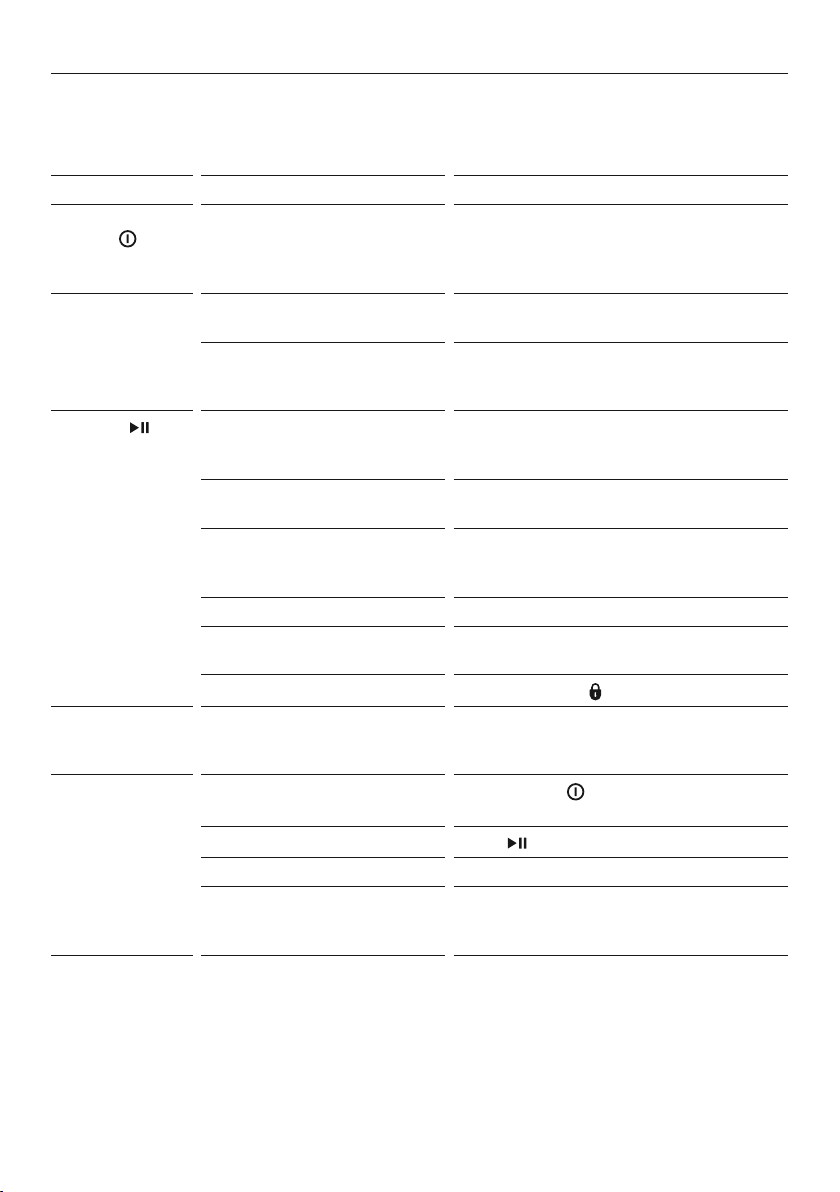
PROBLEM POSSIBLE CAUSES WHAT TO DO
Pressing
POWER does
not turn on
thedryer
Fault with household
power supply.
Try plugging in and turning on another
electrical device.
Dryer does
notheat
Full water tank. Refer to ‘Emptying the water
collection tank’.
The dryer has progressed
to
COOL.
Check the progress lights – are
COOLorEND lights illuminated?
Referto‘Control panel’.
Pressing
does not start
thedrying cycle
Dryer door not closed
properly.
Open and close the door. Checkthat
the lint filter is correctly in place and not
obstructing the door.
Is the dryer displaying a user
warning or fault code?
Refer to ‘User warnings’ and
‘Customising a dry cycle’.
Water tank full or not
properly in place.
Refer to ‘Emptying the water collection
tank’. Ensure the water tank is properly
inplace.
Dryer is overloaded. Remove some items from the dryer.
DELAY START function is set. Refer to ‘Delay Start’ for
more information.
KEYLOCK is ON.
To disable press
forthree seconds.
Dryer keeps
stopping
andstarting
The
WRINKLE FREE option
hasbeen selected.
Refer to ‘User warnings’ for
more information.
Dryer stops
working
mid-cycle
Power failure.
Press
POWER and restart the
desiredcycle.
Dryer has been paused.
Press
to restart thecycle.
Dryer door is open. Ensure the door is firmly shut.
Items fell off the rack
whenusing
RACK DRY cycles.
Ensure the rack is installed correctly
(refer to ‘Drying rack’) and replace
garments thatmay have fallen from it.
39
TROUBLESHOOTING
PROBLEM POSSIBLE CAUSES WHAT TO DO
Dryer is taking
toolong.
Results were
notsatisfactory.
Drying cycle selected not
appropriate for the load.
Select an appropriate cycle for the
load. Refer to ‘Drying rack’.
Dryness level selected not
appropriate for the load.
Select a higher dryness level.
Refer to ‘Lint’.
Dryer overloaded for
thecycle.
Some cycles have a lower max load
size. Refer to ‘Drying rack’.
Try dividing the load in half and
dryhalf at a time.
Lint filter, condenser filter,
filter foam or evaporator
grid isblocked.
Clean the lint filter, condenser filter,
filter foam and evaporator grid.
If the problem continues the foam
filter may need to be replaced, refer to
‘Clean the filter foam’.
Water tank is full. Refer to ‘Emptying the water
collection tank’.
Environmental conditions
maybe affecting
dryer operation.
In particularly hot or cold conditions
the dryer will take longer to dry a load
and beless efficient.
Ensure the dryer is installed in a
well-ventilated, dust-free environment.
Donot operate this dryer behind
closeddoors (ie inside a cupboard).
Load overly wet at the
start of cycle.
Remove more water from the
load before placing it in the dryer,
egselecta faster spin speed on your
washer, if appropriate for your load.
Load was damp dry at
thestart of cycle.
If the load had been partially air dried,
eg has been washed and placed on
the line, use a
TIME DRY cycle and
monitor the dryness of your clothes.
Dryer not draining water
out properly.
Check the drain hose (if connected)
forblockages or damage.
Youmayneed to call for service
referto ‘Before you call for service’.
Items got tangled. Try separating items and
dryingsimilaritems together.
Referto‘Loading’ forfurther tips.

40
TROUBLESHOOTING
PROBLEM POSSIBLE CAUSES WHAT TO DO
Dryer is not
draining
Drain hose not connected
tothe water tank.
Ensure the drain hose is connected
correctly. Refer to your installation
guide for guidance on draining.
Water tank not in
place correctly.
Ensure water tank is properly
inplace.
Drain hose or drain blocked
ordamaged.
Check drain hose (if connected)
anddrain for blockages or damage.
Clothes getting too
hot or damaged
Cycle selected not
appropriate for the load.
Ensure the cycle selected is
appropriatefor items in the load.
Referto ‘Drying rack’.
Items removed from dryer
before the end of cycle cool
down had finished.
Removing items before cool down
maydamage clothing if it is not
spread out and exposed to air to
coolonce removed from the dryer.
Dryer is beeping
and displaying
acode on the
digital display
Dryer has a fault. Try turning the dryer off and waiting
one minute before turning it back on.
Refer to ‘Customising a dry cycle’.
Small puddle
ofwater coming
from under
thedryer
Water tank not correctly
inplace.
Ensure the water tank is correctly
in place.
Water tank may need
tobeemptied.
Refer to ‘Emptying the water
collection tank’.
Water tank may be damaged. Check the water tank for any signs
ofdamage.
Drain hose may not be
attached properly at the
dryer end.
Ensure the drain hose is attached
properly. Refer to your installation
guide for guidance on draining.
Drain hose could
be damaged.
Check the drain hose for damage.
Drain hose has slipped
outofthe drain.
Ensure the drain hose is securely
fixed in place. Sometimes drain hoses
can move or get displaced, which
may lead to water draining onto
the floor.
Drain may be blocked. Check the drain for any blockages.
Dryer door not closing
properly, affecting the seal.
Ensure the dryer door is closed
properly and there is nothing
obstructing the door opening.
Inlet hose not
correctly tightened.
Check inlet hose and tighten
connection if necessary.

41
TROUBLESHOOTING
PROBLEM POSSIBLE CAUSES WHAT TO DO
Small amount
ofwater in
thedrum at
endofcycle
Water tank needs to
be emptied.
Refer to ‘Emptying the water
collection tank’.
Environmental conditions
maybe affecting
dryer operation.
If conditions are particularly hot,
humidor cold, it is possible vaporised
water may re-condense in the drum
oron the inside of the door.
Noises Dryer is overloaded. Remove some items from the dryer.
Dryer has a fault. Continuous beeping or a musical
seriesof beeps with a message
displayed on the display.
Referto‘Customising a dry cycle’.
Beeps signalling the end
ofadrying cycle.
End of cycle beeps can be turned off.
Refer to ‘Dryer settings’.
Dryer has not been
levelledproperly.
Refer to your installation guide for
guidance on levelling.
Dryer makes
unfamiliar noises.
At the start of the cycle the dryer
may make some unfamiliar noises
when the compressor turns on.
Thisis normal.
Vibration Dryer is not installed on
astable surface.
Ensure the dryer is installed on a
flat, stable surface. Refer to your
installation guide for guidance on
levelling.
Dryer is not level. Ensure the dryer is correctly levelled.
Refer to your installation guide for
guidance on levelling.
Dryer is overloaded. Remove some items from the dryer.
Creasing Cycle selection not
appropriate for the load.
Select the
EASY IRON cycle to
minimisecreasing.
Dryer is overloaded. Remove some items from the dryer.
DRYNESS LEVEL selected
toohigh for load type.
Try selecting a lower DRYNESS LEVEL.
WRINKLE FREE option
notselected.
Select the WRINKLE FREE option to
rotate the load at the end of the
drying cycle. Refer to ‘User warnings’.
Dye transfer White/light and coloured
items not separated
beforedrying.
Remember to separate white/light
and coloured items before placing
them in the dryer.
Wet items left sitting in
thedryer for long periods
oftime before drying.
Refer to ‘Sorting’ for tips to prevent
dye transfer.
42
TROUBLESHOOTING
PROBLEM POSSIBLE CAUSES WHAT TO DO
Linting Lint filter not cleaned
or replaced.
Ensure the lint filter is cleaned after
every cycle and replaced correctly.
Refer to ‘Cleaning the filters’.
Loads not sorted correctly. Dry lint-giving items separately
from lint receivers. Also, dry similar
colours together, eg light coloured
items withlight coloured items, dark
itemswith dark items.
Refer to ‘Sorting’, ‘Lint’.
Clothes over dried. Over drying clothes in the dryer
cancause them to attract lint.
Useanauto sensing cycle or ensure
you check your load if using the time
dry cycles to avoid over drying.
Referto ‘Drying rack’.
New items have been dried
inthe dryer recently.
Clean the lint filter and use
COOL AIR
cycle to clear any remaininglintfrom
the dryer.
New towels or flannelette
sheets can leave lint in the
dryer, which may be picked
up by subsequent loads.
Fabric damage Instructions on care label
notfollowed.
Follow the instructions on the
carelabel of the items.
DRYNESS LEVEL selected
notappropriate for the
fabrictype.
Ensure the DRYNESS LEVEL selected
is appropriate for the fabric type.
Referto the items care label. Referto
‘Drying rack’‘Drying rack’
Metal parts on the items or
inthe load.
Fasten zips and other clasps
beforeplacing items in the dryer.
Items not separated or
driedon an appropriate
cyclefor the fabric type.
Dry similar items together.
Ensureanappropriate cycle is
selected. Refer to ‘Drying rack’.
Items fell off the rack when
using
RACK DRY.
Ensure the rack is installed correctly
(refer to ‘Sorting’, ‘Drying rack’) and
only one or twogarments are placed
on the rackata time.
Used a
TIME DRY cycle
anddid not monitor the
dryness of clothes during
the cycle.
Ensure that clothes are checked
fordryness during the cycle
whenusing the timed programmes
toavoid over drying.
43
PROBLEM POSSIBLE CAUSES WHAT TO DO
Tangling Loads not separated
duringloading.
Try separating out larger items
fromsmaller items.
Items loaded into the
dryerincorrectly.
Load items individually into the
dryer. Do not place folded items
inthe dryer.
Incorrect cycle selection. Try using the
EASY IRON cycle to
dryshirts and the SHEETS cycle to
drysheets. Refer to ‘Drying rack’.
Load size too large. Try drying smaller load sizes.
Somecycles have a lower maximum
load size. Refer to ‘Drying rack’.
Delicate items not dried on
RACK DRY.
Dry pantyhose, bras, stockings
andany other delicate items prone
totangling on the RACK DRY cycle.
Sheets and duvet/doona
covers due to their size,
areprone to tangling.
Dry sheets and duvet/doona covers
separately from other laundry,
apartfrom towels. Ensure duvet/
doona covers are buttoned or
fastened closed before drying.
Tryadding a knotted towel to sheets
loads if you are experiencing a lot
oftangling.
TROUBLESHOOTING

44
MANUFACTURER’S WARRANTY
For New Zealand and Australia only. You automatically receive a 2 year Manufacturer’s
Warranty with the purchase of this heat pump clothes dryer covering parts and labour for
servicing within the country ofpurchase.
Fisher & Paykel undertakes to:
Repair or, at its option, replace without cost to the owner either for material or labourany
part of the product, the serial number of which appears on the product, which is found to
be defective within TWO YEARS of the date of purchase.
Note: This Manufacturer’s Warranty is an extra benefit and does not affect your legalrights.
This Manufacturer’s Warranty DOES NOT cover
A Service calls which are not related to any defect in the product. The cost of a
servicecall will be charged if the problem is not found to be a product fault.
For example:
1 Correcting the installation of the product.
2 Instructing you how to use the product.
3 Replacing house fuses or correcting house wiring or plumbing.
4 Correcting fault(s) caused by the user.
5 Noise or vibration that is considered normal, egdrain/fan sounds, machine noises
oruser warning beeps.
6 Correcting damage caused by pests, egrats, cockroaches, etc.
7 Poor drying performance due to incorrect installation and maintenance
egblockedlint filter, blocked condenser or full water tank.
8 Poor drying performance due to incorrect loading, egoverloading or underloading.
9 Damage from articles in the drum, eg bra wires, pens, crayons, dye transfer or
flammable material.
B Defects caused by factors other than:
1 Normal domestic use; or
2 Use in accordance with the product’s User guide.
C Defects to the product caused by accident, neglect, misuse or ‘act of God’.
D The cost of repairs carried out other than by a Fisher & Paykel trained and supported
service technician or the cost of correcting such repairs.
E Normal recommended maintenance as set out in the product’s User guide.
F Repairs when the appliance has been dismantled, repaired or serviced by other
thanaFisher& Paykel trained and supported service technician or the selling dealer.
G Pick-up and delivery.
H Transportation or travelling costs involved in the repair when the product is
installedoutside the Fisher & Paykel trained and supported service technician’s
normalservicearea.
Nothing in this Manufacturer’s Warranty is intended to, or does, limit any rights you
mayhave under law to recover the costs of inspecting or returning the goods to us.

45
MANUFACTURER’S WARRANTY
This product has been designed for use in a normal domestic (residential) environment.
This product is not designed for commercial use (whatsoever). Any commercial use
byacustomer will affect this product’s Manufacturer’s Warranty.
Service under this Manufacturer’s Warranty must be provided by a Fisher&Paykel trained
and supported service technician (refer to the ‘Before you call for service’). Such service
shall be provided during normal business hours. This Manufacturer’s Warranty certificate
should be shown when making any claim.
For Australian Customers
This Manufacturer’s Warranty is an extra benefit and does not affect your legal rights. Our
goods come with guarantees that cannot be excluded under the Australian Consumer Law.
You are entitled to a replacement or refund for a major failure and for compensation for
any other reasonably foreseeable loss or damage. You are also entitled to have the goods
repaired or replaced if the goods fail to be of acceptable quality and the failure does not
amount to a major failure.
Please keep this user guide in a safe place.

46
CUSTOMER CARE
Before you call for service or assistance
Check the things you can do yourself. Refer to your User guide and check:
1 Your product is correctly installed.
2 You are familiar with its normal operation.
3 You have read the ‘Customising a dry cycle’, ‘Customising a dry cycle’ and
‘Troubleshooting’ sections.
If after checking these points you still need assistance or parts, please refer to your nearest
Fisher&Paykel trained and supported service technician, Customer Care, or contact us
through our website fisherpaykel.com.
In New Zealand if you need assistance*
Call the Fisher & Paykel Customer Care Centre and talk to one of our
Customer CareConsultants.
Toll Free: 0800 FP CARE or 0800 372 273
Fax: (09) 273 0656
Website: fisherpaykel.com
Postal address: Fisher & Paykel Appliances Ltd, PO Box 58550, Botany, Auckland 2163
If you need service*
Fisher & Paykel has a network of Fisher & Paykel trained and supported service technicians
that can carry out any service necessary on your appliance. Our Customer Care Centre can
recommend a Fisher & Paykel trained and supported service technician in your area.
In Australia if you need assistance*
Call the Fisher & Paykel Customer Care Centre and talk to one of our
CustomerCareConsultants.
Toll Free: 1300 650 590
Fax: (07) 3826 9298
Website: fisherpaykel.com
Postal address: Fisher & Paykel Appliances Australia Pty Ltd, PO Box 798,
ClevelandQLD4163
If you need service*
Fisher & Paykel has a network of Fisher & Paykel trained and supported service technicians
that can carry out any service necessary on your appliance. Our Customer Care Centre
canrecommend a Fisher & Paykel trained and supported service technician in your area.
*If you call, write or contact us via our website please provide:
your name and address, model number, serial number, date of purchase and a complete
description of the problem. This information is needed in order to better respond to
yourrequest for assistance.
Product details can be found on the rear of the dryer, and/or on the inside of the door
below the glass (when the door is open).


428277A 12.20
FISHERPAYKEL.COM
© Fisher & Paykel Appliances 2020. All rights reserved.
The models shown in this guide may not be available in all markets
and are subject to change at any time.
The product specifications in this guide apply to the specific products and
models described at the date of issue. Under our policy of continuous product
improvement, these specifications may change at any time.
For current details about model and specification availability in your country,
please go to our website or contact your local Fisher&Paykel dealer.