1
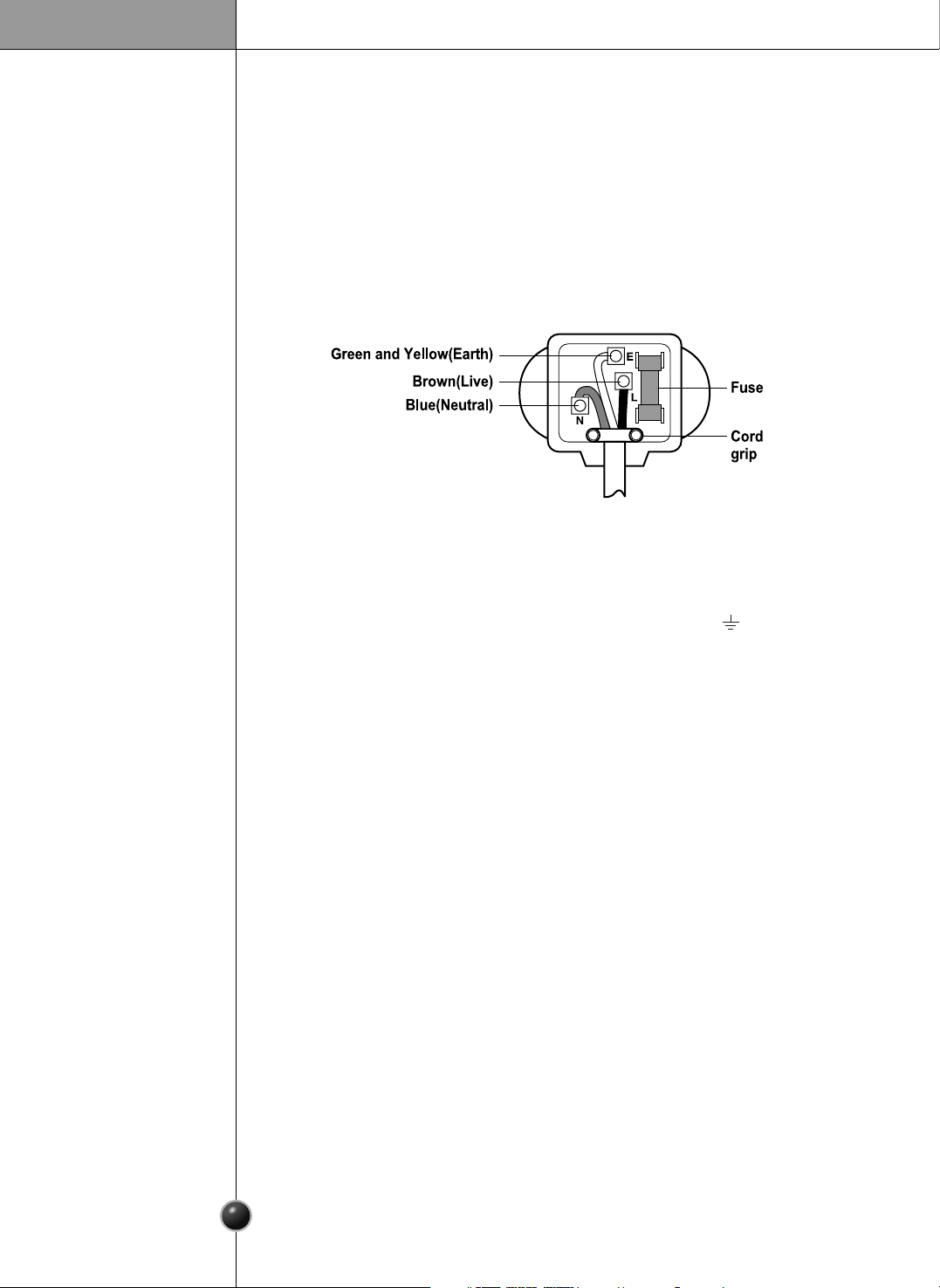
Electrical Connections
(In the UK Only)
Important
The wires in this mains lead are coloured in accordance with the following code :
GREEN AND YELLOW : EARTH
BLUE : NEUTRAL
BROWN : LIVE
This appliance must be earthed
As the colours of the wires in the mains lead of this apparatus may not correspond
with the coloured markings identifying the terminals in your plug, proceed as follows :
The wire which is coloured Green and Yellow must be connected to the terminal in
the plug which is marked with the letter E or by the earth symbol( ) or coloured
Green or Green and Yellow.
The wire which is coloured Blue must be connected to the terminal which is marked
with the letter N or coloured Black.
The wire which is coloured Brown must be connected to the terminal which is
marked with the letter L or coloured Red.
If a 13 amp(BS 1363) plug is used, fit a 13 amp BS 1362 fuse.
2
Entry
Important safety instruction
Identification of parts
Where to install
Door removal
Door replacement
Feed water pipe installation
Height adjustment
Starting
Adjusting the temperatures and functions
Adjusting The Temperatures And Display
Operating The Dispenser
Setting The Functions
Refreshment center (Applicable to some models only)
Shelf
Egg box
Nano charcoal deodorizer
Fresh compartment
Vacuum fresh compartment
Freezer/Fridge basket
Dairy corner
How to exchange the water purifier filter (Applicable to some models only)
Location of foods
Storing foods
General information
Cleaning
Trouble shooting
It is normal…
Table of contents
Introduction
Installation
Operation
Suggestion on
food storage
Care and
maintenance
3
3
11
12
13
14
14
15
17
18
19
20
24
25
25
25
26
27
28
28
29
30
31
32
32
33
38
17
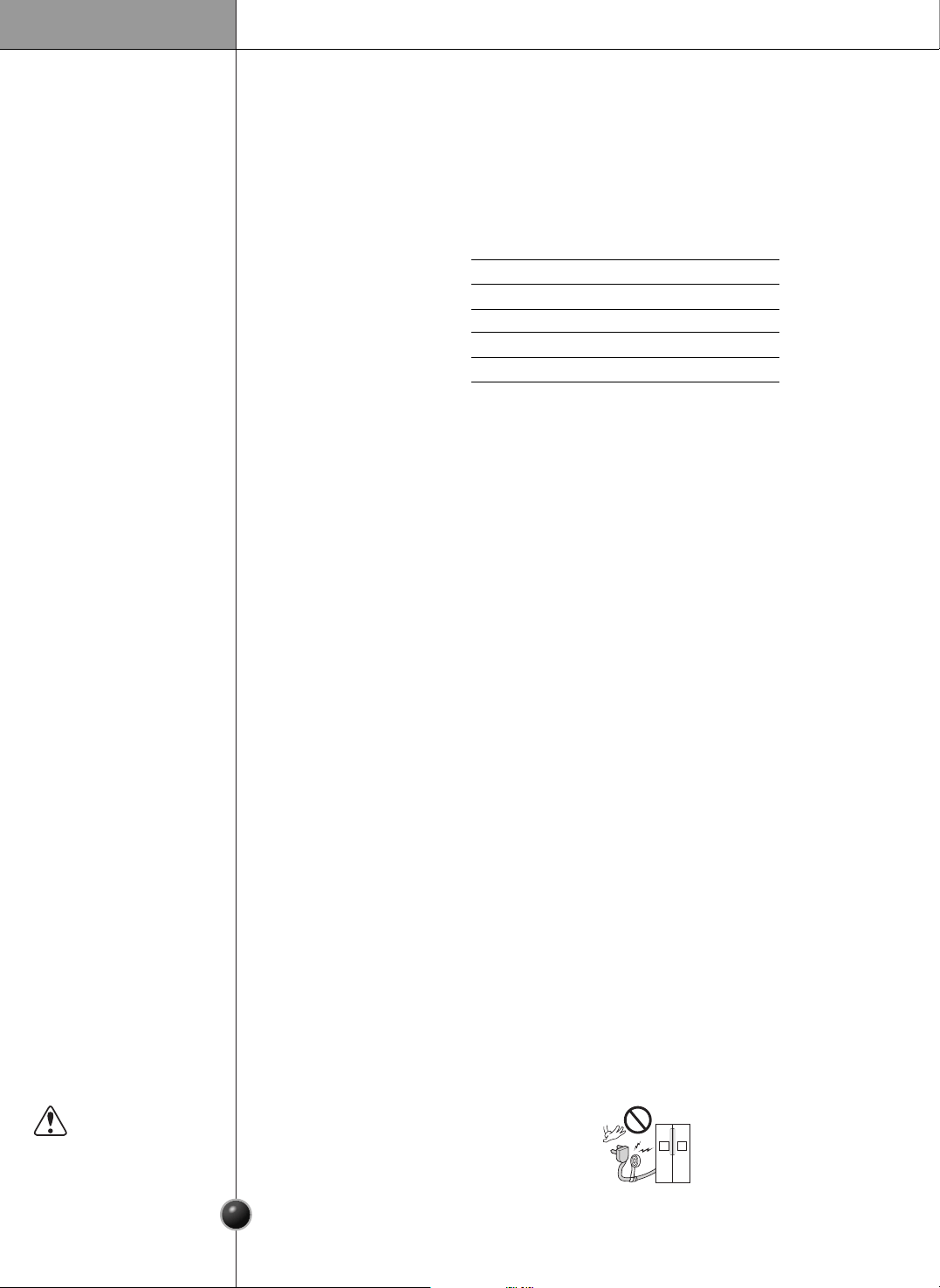
This product is exclusive use at 230V/50Hz.
You should purchase transformer of more than 2.0KVA when you want to
use it at the 110V area.
Entry
The model and serial numbers are found on the inner case or back of refrigerator
compartment of this unit. These numbers are unique to this unit and not
available to others. You should record requested information here and retain
this guide as a permanent record of your purchase. Staple your receipt here.
Date of purchase :
Dealer purchased from :
Dealer address :
Dealer phone no. :
Model no. :
Serial no. :
Before it is used, this refrigerator must be properly installed and located in accordance
with the installation instructions in this document.
Never unplug your refrigerator by pulling on the power cord. Always grip plug firmly and
pull it straight out from the outlet.
When moving your appliance away from the wall, be careful not to roll over the power
cord or to damage it in any way.
After your refrigerator is in operation, do not touch the cold surfaces in the freezer
compartment
, particularly when your hands are damp or wet. Skin could adhere to
these extremely cold surfaces.
Unplug the power cord from the power outlet for cleaning or other requirements. Never
touch it with wet hands because you can get an electric shock or be hurt.
Never damage, process, severely bend, pull out, or twist the power cord because
damage the power cord may cause a fire or electric shock. You have doubts on whether
the appliance is properly grounded.
Never place glass products in the freezer because they may be broken due to expansion
when their contents are frozen.
Never allow your hands within the ice storage bin of the automatic ice maker. You could
be hurt by the operation of the automatic ice maker.
The appliance is not intended for use by young children or infirm persons without
supervision.
Young children should be supervised to ensure that they do not play with the appliance.
Never allow anyone to climb, sit, stand or hang on the refreshment center door. These
actions may damage the refrigerator and even tip it over, causing severe personal injury.
If possible, connect the refrigerator to its own individual electrical outlet to prevent it and
other appliances or household lights from causing an overload that could cause a power
outage.
The refrigerator-freezer should be so positioned that the supply plug is accessible for
quick disconnection when accident happens.
If the supply cord is damaged, it must be replaced by the manufacturer or its service
agent or a similarly qualified person in order to avoid a hazard.
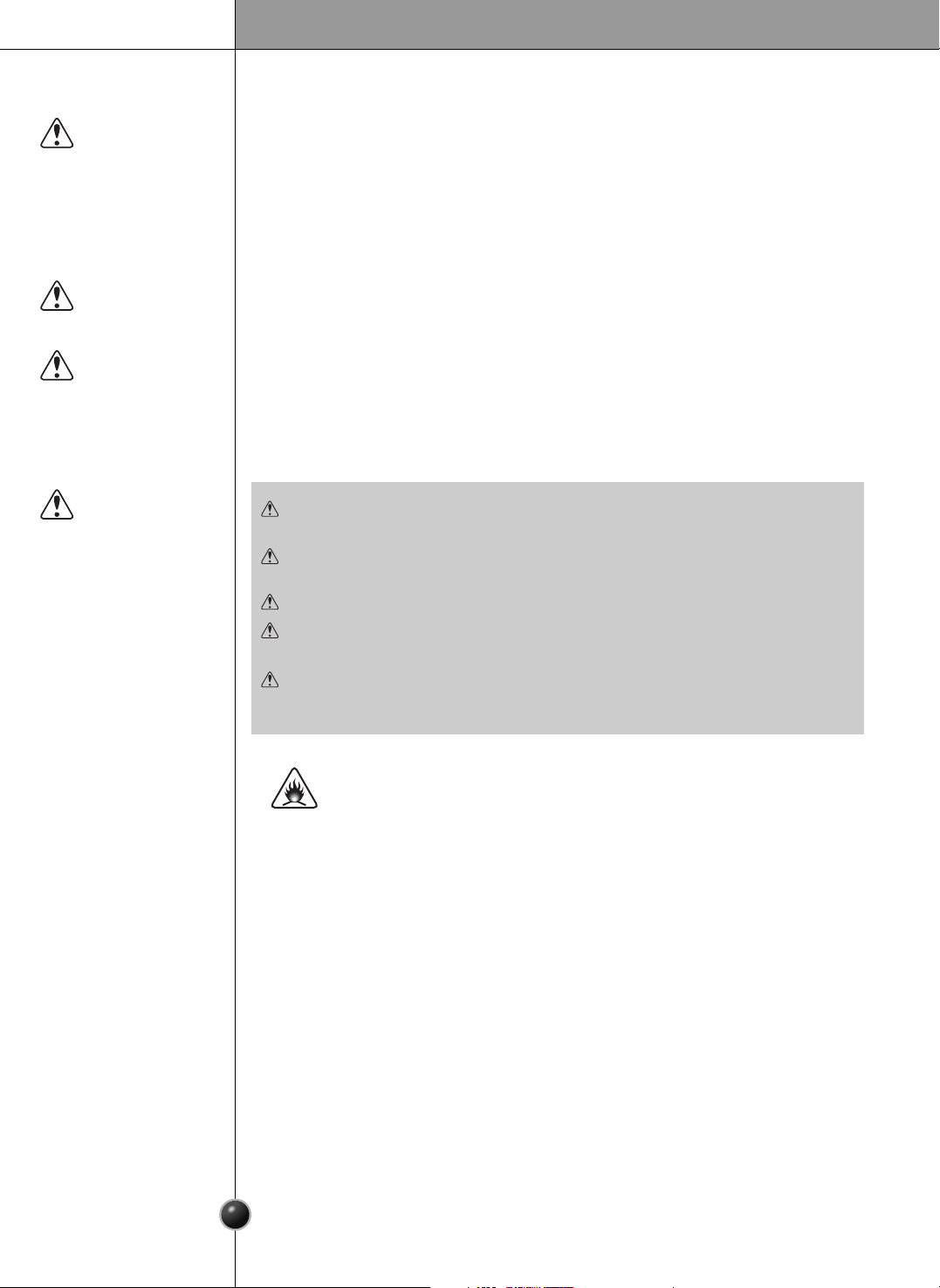
Do not modify or extend the Power Cord length.
It will cause electric shock or fire.
Introduction
3
Important safety instruction
Don’t use an
extension cord
Accessibility of
Supply Plug
Supply Cord
Replacement
WARNING
4
Introduction
DANGER: Risk of child entrapment.
Before you throw away your old refrigerator or freezer:
Take off the doors but leave the shelves in place so that children may not easily climb
inside.
The appliance is not intended for use by young children or infirm persons without
supervision.
Young children should be supervised to ensure that they do not play with the appliance.
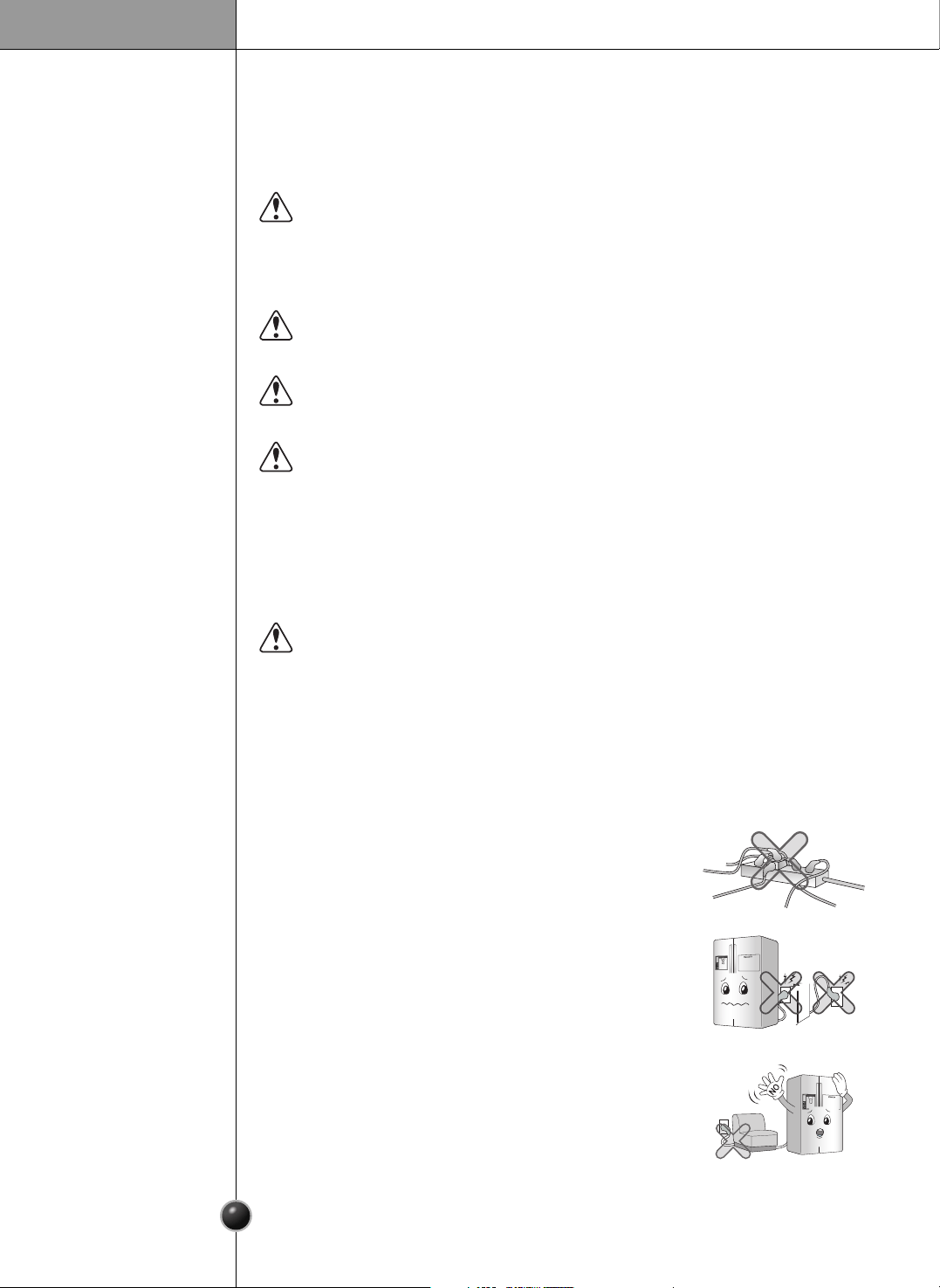
Don’t store or use gasoline or other flammable vapor and liquids in the vicinity of this or
any other appliance.
In the event of an electric short circuit, grounding (earthing) reduces the risk of electric
shock by providing an escape wire for the electric current.
In order to prevent possible electric shock, this appliance must be grounded
improper use of the grounding plug can result in an electric shock. Consult a qualified
electrician or service person if the grounding instructions are not completely
understood, or if you have doubts on whether the appliance is properly grounded.
Child entrapment
Don’t store
Grounding (Earthing)
This appliance contains a small amount of isobutane refrigerant (R600a),
natural gas with high environmental compatibility, but it is also
combustible. When transporting and installing the appliance, care should
be taken to ensure that no parts of the refrigerating circuit are damaged.
Refrigerant squirting out of the pipes could ignite or cause an eye injury.
If a leak is detected, avoid any naked flames or potential sources of
ignition and air the room in which the appliance is standing for several
minutes.
In order to avoid the creation of a flammable gas air mixture if a leak in the
refrigerating circuit occurs, the size of the room in which the appliance may be
sited depends on the amount of refrigerant used. The room must be 1m
2
in
size for every 8g of R600a refrigerant inside the appliance. The amount of
refrigerant in your particular appliance is shown on the identification plate
inside the appliance. Never start up an appliance showing any signs of
damage. If in doubt, consult your dealer.
Keep ventilation openings, in the appliance enclosure or in the built-in structure,
clear of obstruction.
Do not use mechanical devices or other means to accelerate the defrosting
process, other than those recommended by the manufacturer.
Do not damage the refrigerant circuit.
Do not use electrical appliances inside the food storage compartments of the
appliance, unless they are of the type recommended by the manufacturer.
The refrigerant and insulation blowing gas used in the appliance require special
disposal procedures. When disposal, please consult with service agent or a
similarly qualified person.
WARNING
WARNING
WARNING
WARNING
5
Introduction
BASIC SAFETY PRECAUTIONS
This guide contains many important safety messages.
Always read and obey all safety messages.
This is the safety alert symbol. It alerts you to safety messages that inform you
of hazards that can kill or hurt you or others or cause damage to the product. All
safety messages will be preceded by the safety alert symbol and the hazard signal
word DANGER, WARNING, or CAUTION. These words mean:
All safety messages will identify the hazard, tell you how to reduce the chance of
injury, and tell you what can happen if the instructions are not followed.
DANGER
You will be killed or seriously injured if you don’t follow
instructions.
WARNING
You can be killed or seriously injured if you don’t follow
instructions.
WARNING
To reduce the risk of fire, electric shock, or injury to persons when using your
product, basic safety precautions should be followed, including the following.
Read all instructions before using this appliance.
CAUTION
Indicates an imminently hazardous situation which, if not
avoided, may result in minor or moderate injury, or product
damage only.
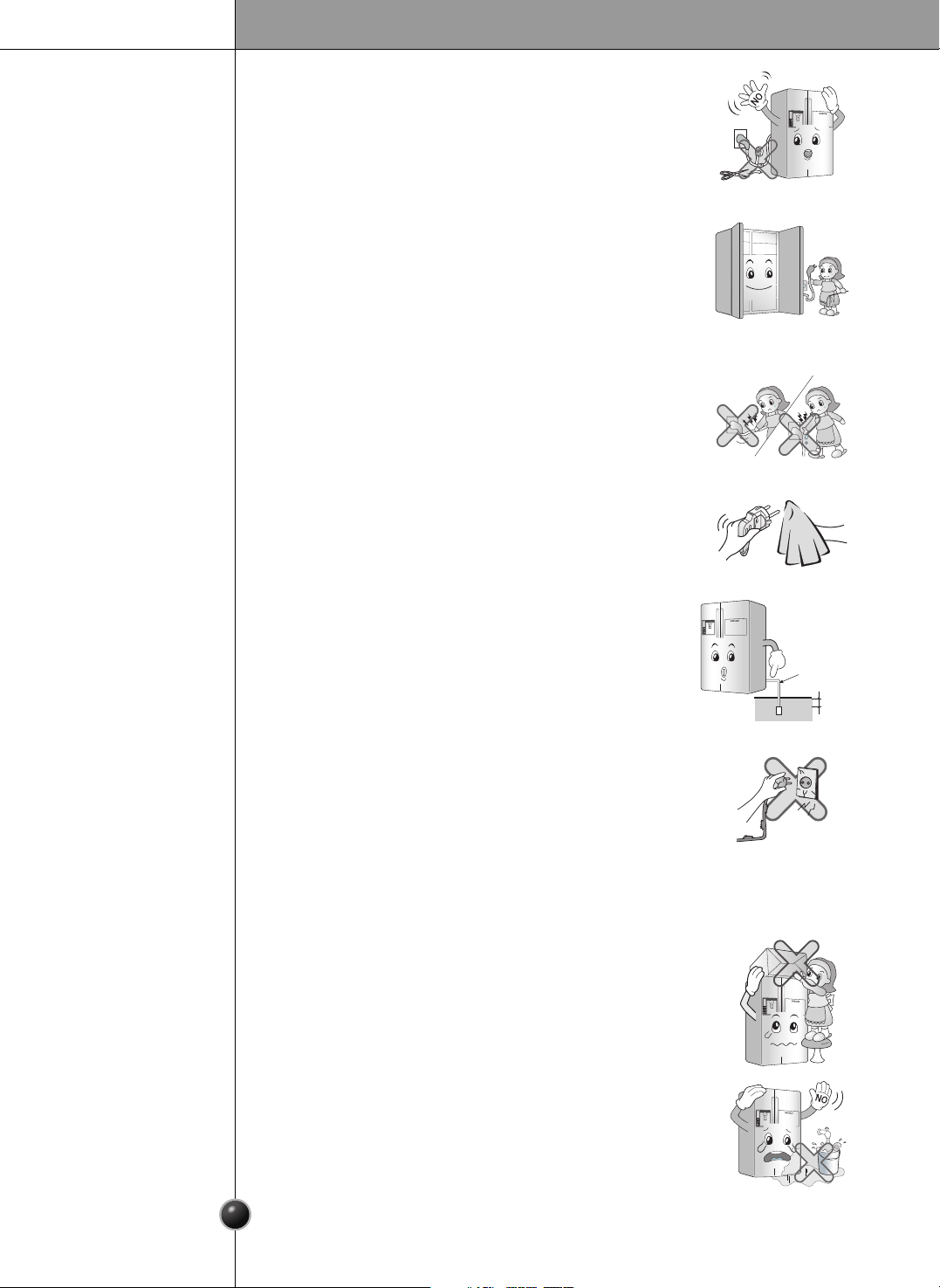
1. When connecting the power
The dedicated outlet should be used.
• Using several devices at one outlet may cause fire.
• The electric leakage breaker may damage food and the
dispenser may be leaked.
Do not allow the power plug to face upward or to be
squeezed at the back of the refrigerator.
Water may be flown into or the plug may be damaged, which
causes fire or electric shock.
Do not allow the power cord bent or pressed by the heavy
object to be damaged.
It may damage the power cord to cause fire or electric shock.
6
Introduction
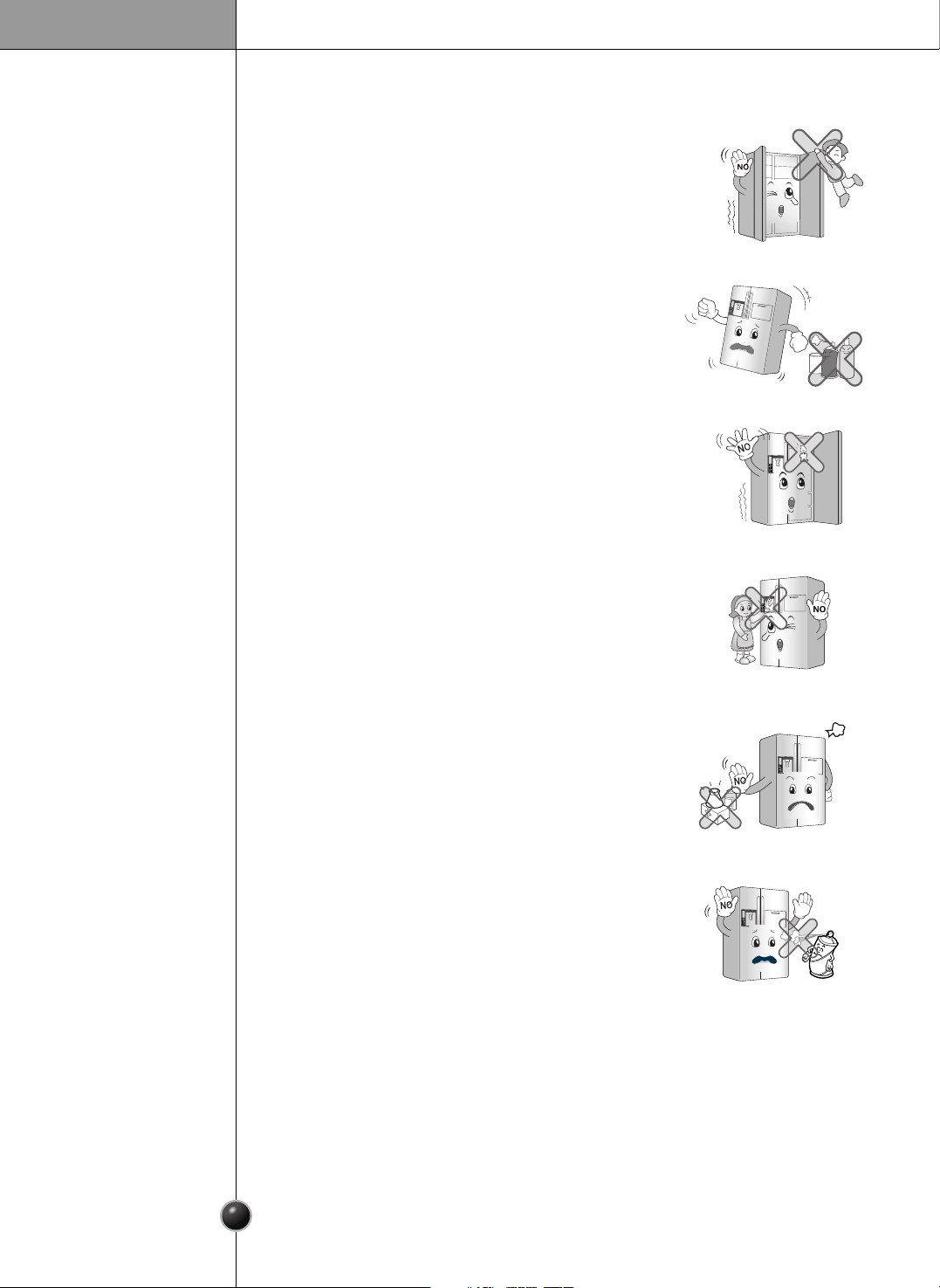
Do not extend or modify the length of the power plug.
It causes electric shock or fire by the electric damage of the
power cord or others.
Unplug the power plug when cleaning, handling or
replacing the interior lamp of the refrigerator.
• It may cause electric shock or injury.
• When replacing the interior lamp of the refrigerator, make
sure that the rubber ring for preventing the electric spark
within the socket is not taken off.
Do not pull out the cord or touch the power plug with wet
hands.
• It may cause electric shock or injury.
Remove water or dust from the power plug and insert it
with the ends of the pins securely connected.
Dust, water or unstable connection may fire or electric shock.
Make sure of grounding.
The incorrect grounding may cause breakdown and electric
shock.
Ground
Wire
Copper
Flat
More than
30 inches
When the power cord or the power plug is damaged or
the holes of the outlet are loosed, do not use them.
It may cause electric shock or short circuit to make fire.
2. When using the refrigerator
Do not place the heavy object or the dangerous object
(container with liquid) on the refrigerator.
It may be dropped to cause injury, fire or electric shock when
opening or closing the door.
Do not install the refrigerator in the wet place or the place
which water or rain splashes.
Deterioration of insulation of electric parts may cause electric
leakage.
7
Introduction
2. When using the refrigerator
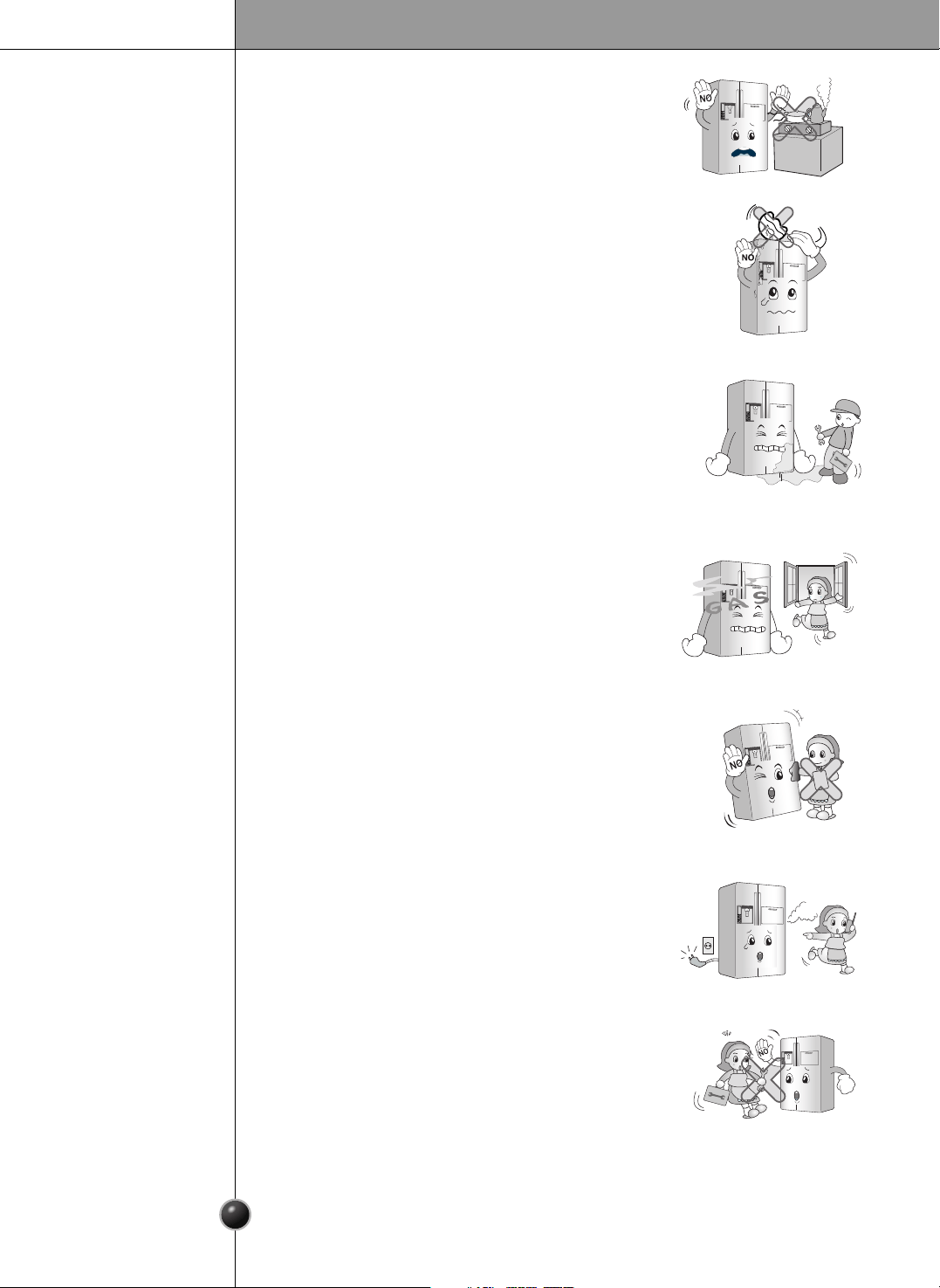
Do not cling to the door or the shelves of the door or the
home bar of the freezer or the cool chamber.
It may make the refrigerator fallen down or damage the
hands. Especially, do not allow the children to do the above.
Do not use or store inflammable materials ether,
benzene, alcohol, medicine, LP gas, spray or
cosmetics near or in the refrigerator.
It may cause explosion or fire.
Benzene
Ether
Thinner
Do not place the lit candle within the refrigerator to
deodorize.
It may cause explosion or fire.
Do not insert the hands into the ice bucket or the ice
dispenser.
Operating the ice maker may cause injury.
Do not store the medicine or the academic materials at
the refrigerator.
When the material with the strict temperature control is
stored, it may be deteriorated or it may make an
unexpected reaction to cause any risk.
The Academic
Medicine
The Medicine
Do not use the combustible spray near the refrigerator.
It may cause fire.
8
Introduction
Avoid the heating devices.
It may cause fire.
Do not place flower vase, cup, cosmetics, medicine or
any container with water on the refrigerator.
It may cause fire, electric shock or injury by dropping down.
Use the submerged refrigerator after checking it.
It may cause electric shock or fire.
When gas is leaked, do not touch the refrigerator or
the outlet and ventilate the room immediately.
• The explosion by spark may cause fire or burn.
• Because this refrigerator uses natural gas (isobutene,
R600a) as the environment-friendly refrigerant, even a
small amount (80~90g) is combustible. When the gas is
leaked by the severe damage during delivering, installing
or using the refrigerator, any spark may cause fire or burn.
Do not spray water at the outside or the inside of the
refrigerator or do not clean it with benzene or thinner.
Deterioration of insulation of electric parts may cause electric
shock or fire.
Thinner
When any strange smell or smoke is detected from the
refrigerator, disconnect the power plug immediately
and contact to the service center.
It may cause fire.
Service
center
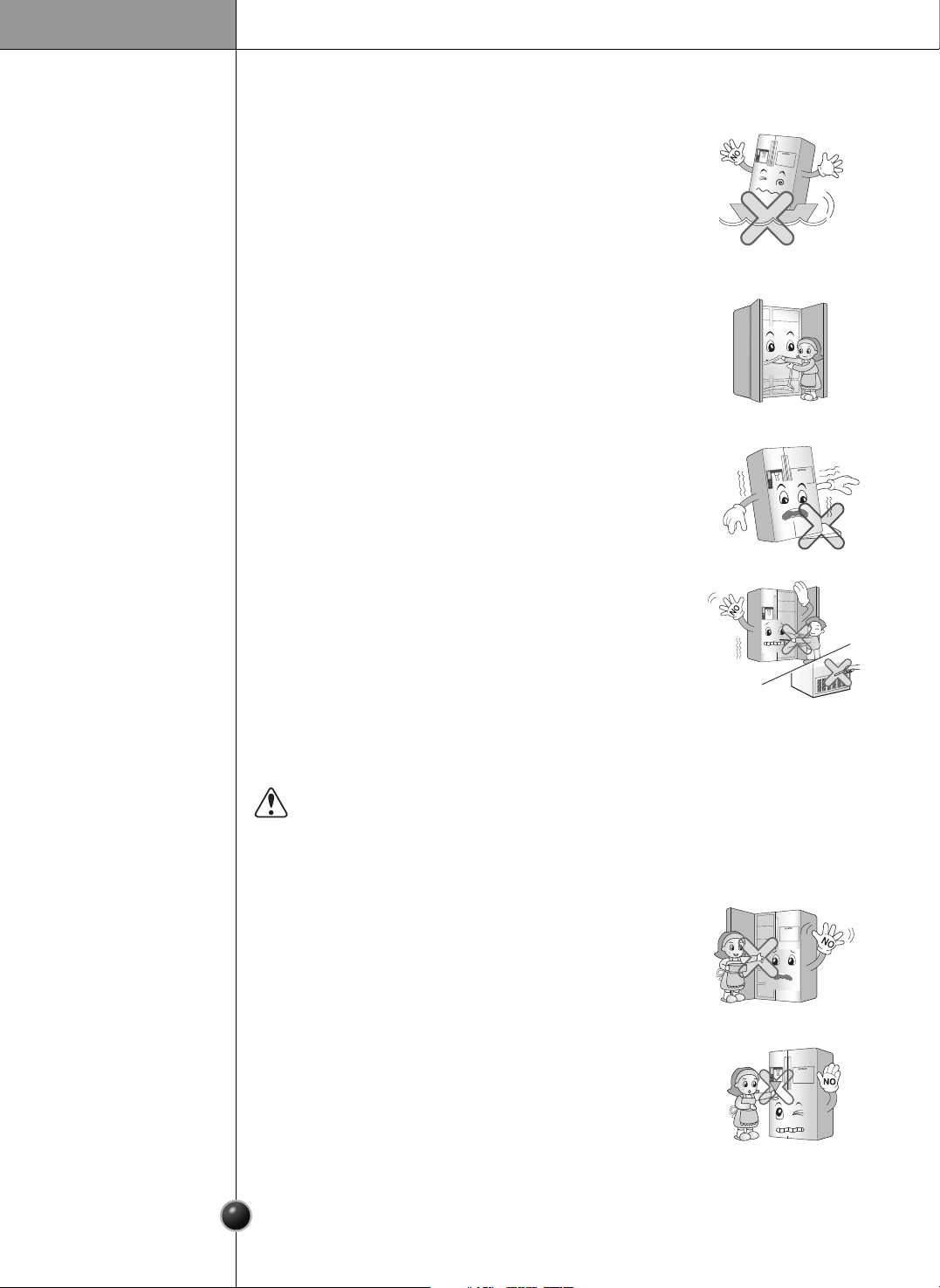
Do not allow any person except the qualified engineer
to disassemble, repair or alter the refrigerator.
It may cause injury, electric shock or fire.
9
Introduction
Do not use the refrigerator for non-domestic purpose
(storing medicine or testing material, using at the ship,
etc.).
It may cause an unexpected risk such as fire, electric shock,
deterioration of stored material or chemical reaction.
When disposing the refrigerator, remove the packing
materials from the door.
It may cause to lock out the child.
Install the refrigerator on the solid and level floor.
Installing it on the unstable place may cause death by falling
down the refrigerator when opening or closing the door.
Do not insert the hands or the metal stick into the exit of
cool air, the cover, the bottom of the refrigerator, the
heatproof grill (exhaust hole) at the backside.
It may cause electric shock or injury.
Do not touch food or containers at the freezer with wet
hands.
It may cause frostbite.
CAUTION
Violating this direction may cause injury or damage house or furniture.
Always be careful, please.
Do not put ice in thin crystal cup or ceramic ware.
It may break cup or ceramic ware to cause injury.
2. When using the refrigerator
10
Introduction
When the electricity is off, remove ice from the ice bucket
(only for the model with the dispenser).
The long-time power failure may thaw ice to damage the floor.
When the long-time power failure is expected, remove ice
from the ice bucket.
Supply the automatic ice maker with drinkable water only
(only for the model with the dispenser).
Otherwise, it may cause any risk.
Drinkable
water
Wait for 5 minutes or longer when reconnecting the plug.
It may cause the operation of the freezer to fail.
After
5minutes
Do not put bottle in the freezer.
It may freeze the contents to break the bottle to cause injury.
Pull out the power plug not by grasping the cord but the
plug of its end.
It may cause electric shock or short circuit to fire.
Do not install the refrigerator in the wet place or the place
which water or rain splashes.
Deterioration of insulation of electric parts may cause electric
leakage.
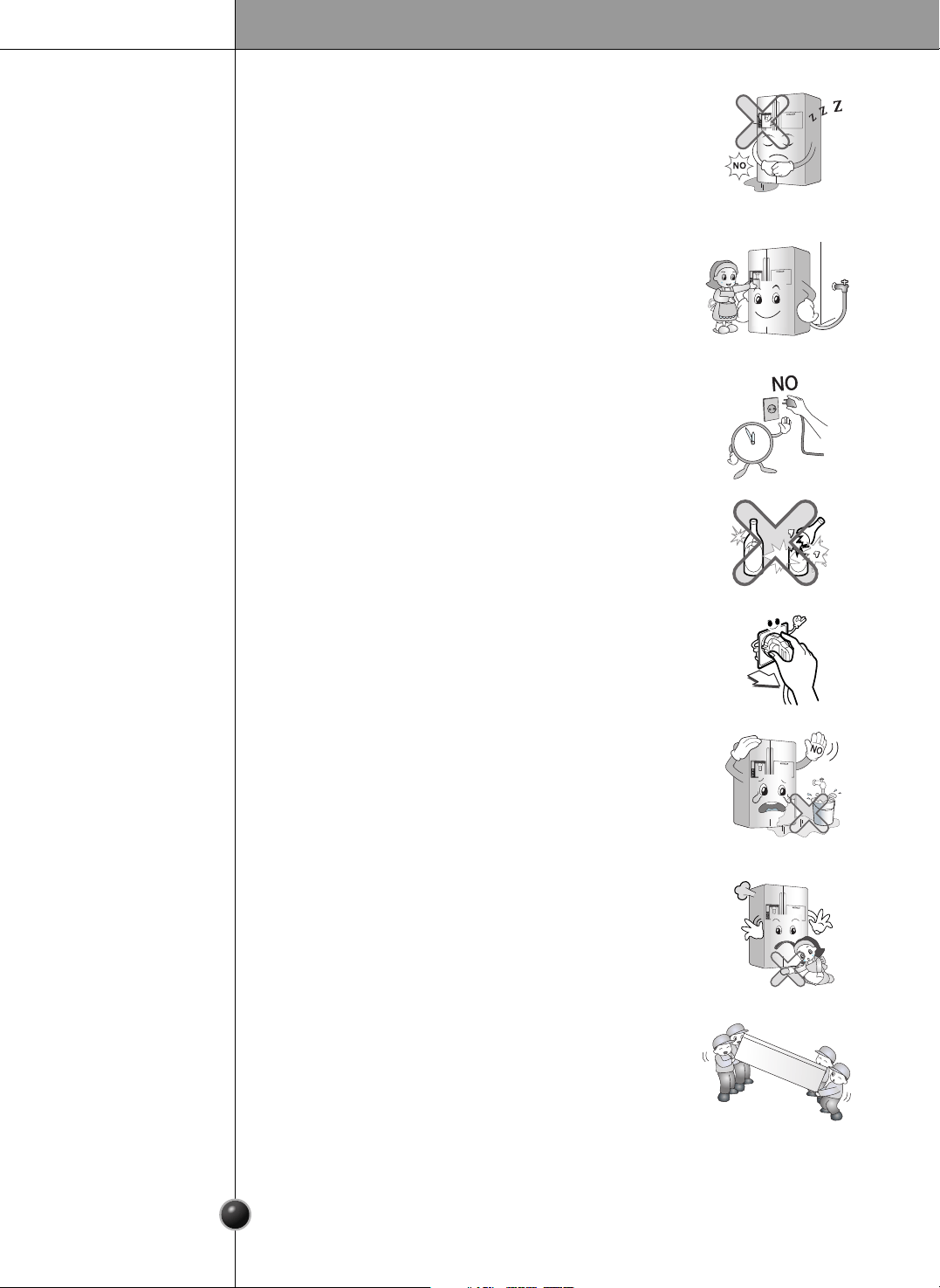
Do not insert the hands into the bottom of the
refrigerator.
The iron plate of the bottom may cause injury.
Carry the refrigerator with the handle bar at the bottom
of the front and the top of the rear.
Otherwise, your hands may be slipped to cause injury.
11
Introduction
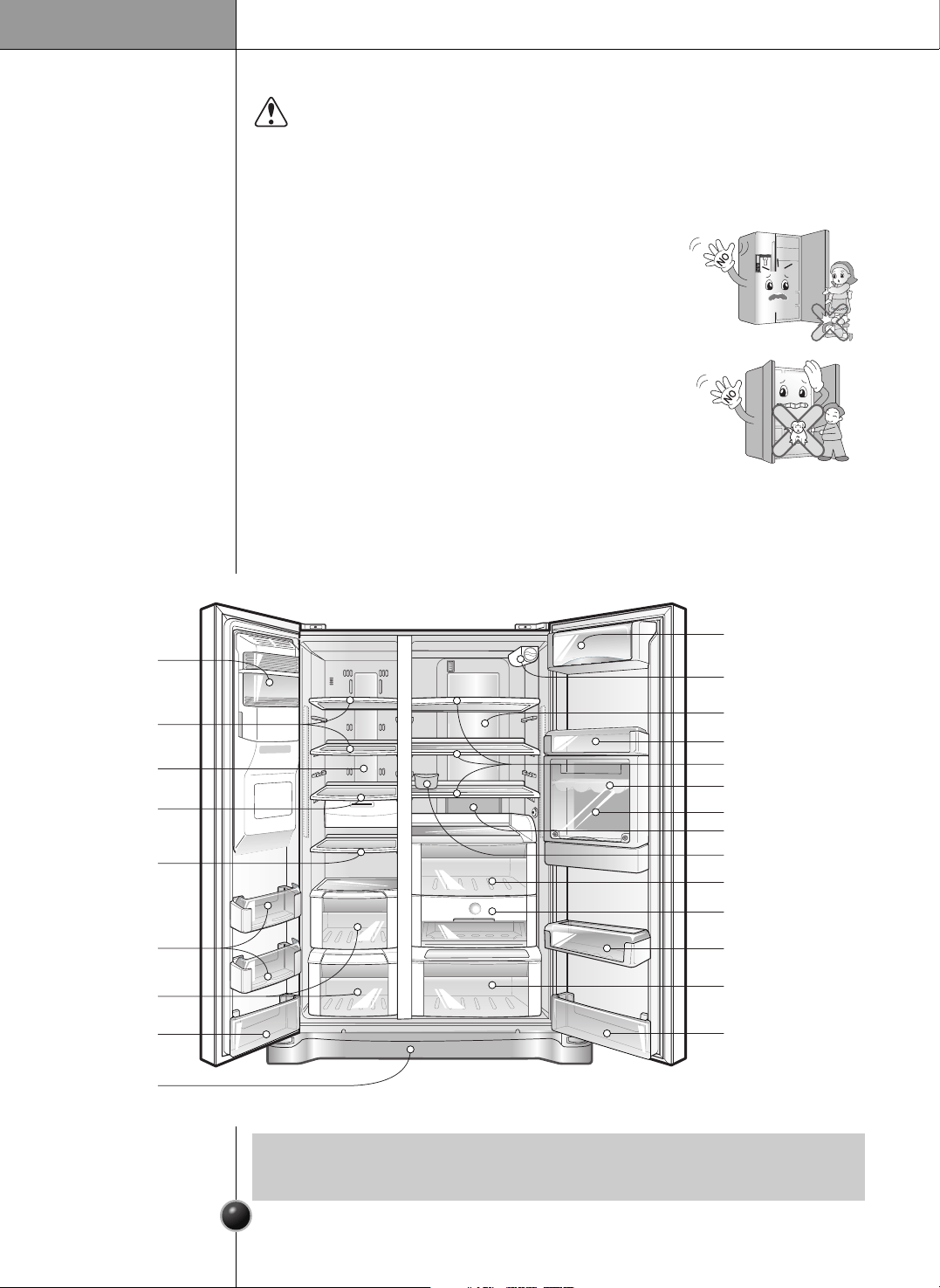
Identification of parts
•
Parts, features, and options vary by model. Your model may not include every option.
NOTE
Freezer
Compartment
Refrigerator
Compartment
Milk product corner
LED Lamp
Automatic
Icemaker
Shelf
Shelf
Shelf
Door rack
Drawer (2)
Door rack
Lower cover
Shelf
Can Server
Refreshment center
(Optional)
Nano charcoal deodorizer
Egg Box
LED Lamp
Filter (Optional)
Door Rack
Door Rack
Door Rack
Fresh compartment
Fresh compartment
Vacuum fresh
compartment
Because opening or closing the door of the refrigerator
may cause injury to the person around it, be careful,
please.
Opening or closing the door may cause feet or hands to be
caught in the chink in door or the child to be get hurt by the
corner.
Do not put any living animal in the refrigerator.
CAUTION
Violating this direction may cause injury or damage house or furniture.
Always be careful, please.
12
Installation
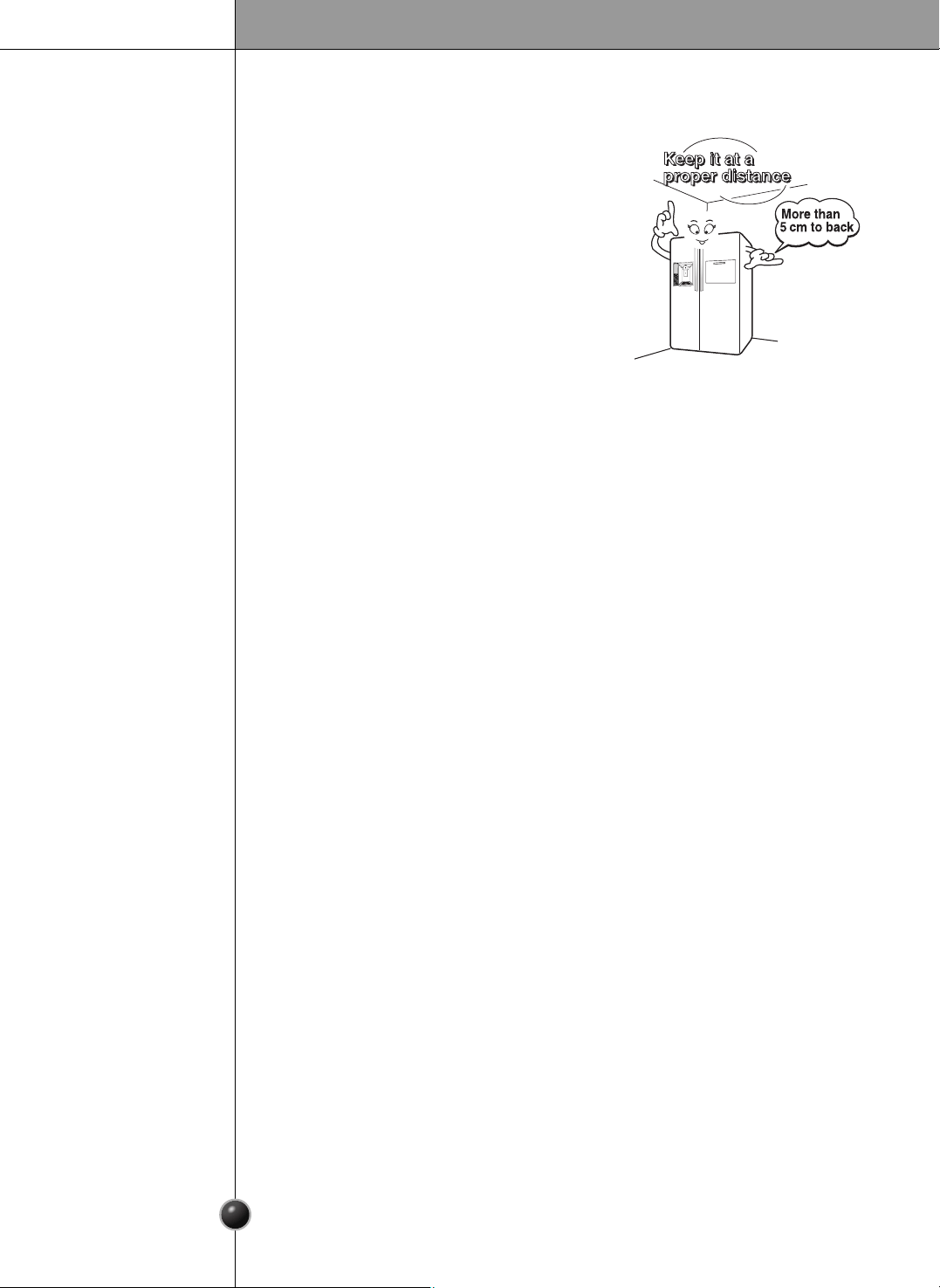
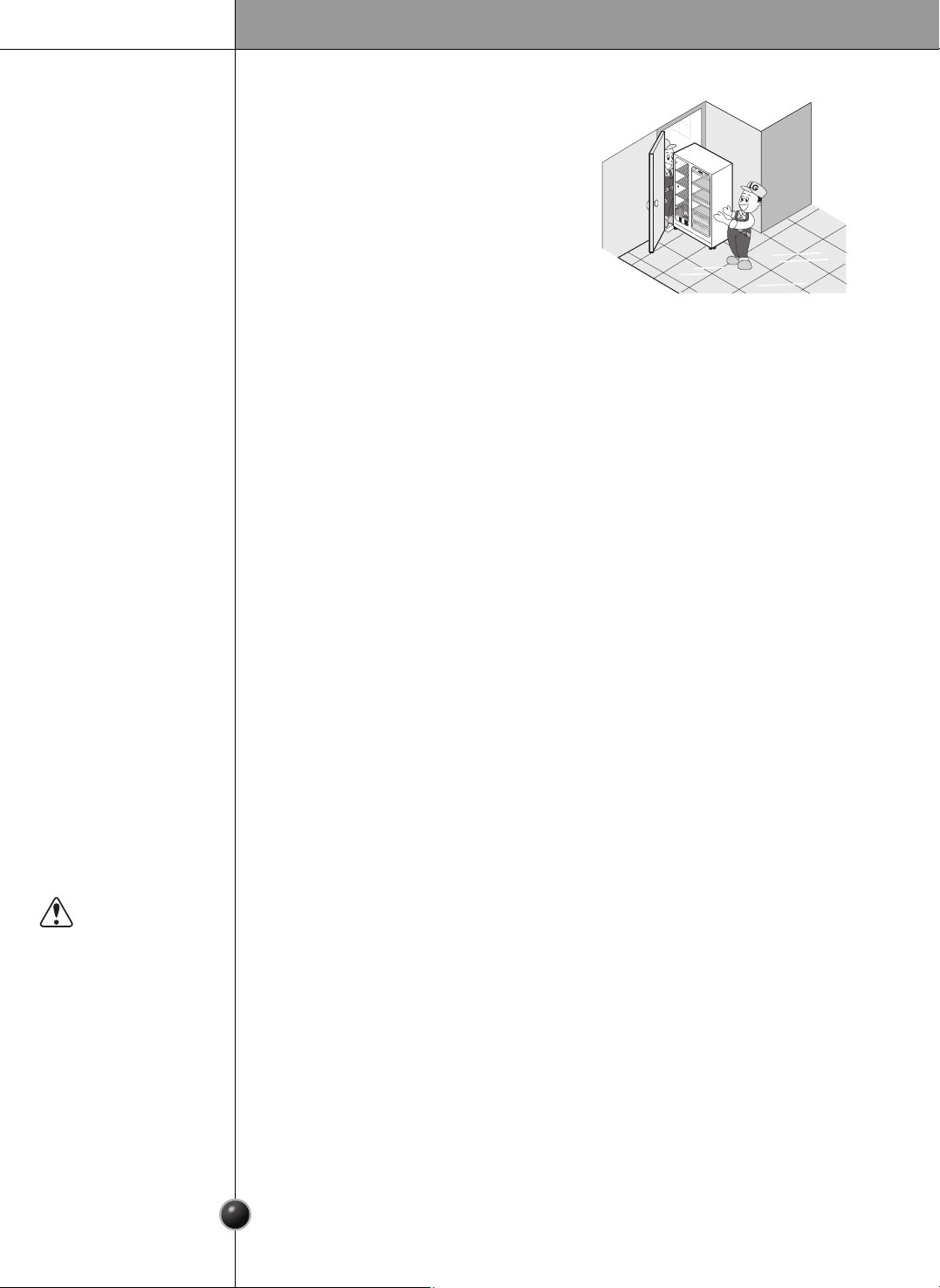
1. Place your appliance where it is easy to
use.
2. Avoid placing the unit near heat sources,
direct sunlight or moisture.
3. To ensure proper air circulation around the
fridge -freezer, please maintain sufficient
space on both the sides as well as top and
maintain at least 2 inches (5 cm) from the
rear wall.
4. To avoid vibrations, the appliance must
be leveled.
5. Don't install the appliance below 5°C. It may cause affect the performance.
Select a good
location
Where to Install
Disposal of the
old appliance
This appliance contains fluid (refrigerant, lubricant)and is made of parts and materials
which are reusable and/or recyclable.
All the important materials should be sent to the collection center of waste material
and can be reused after rework (recycling). For take back, please contact with the
local agency.
13
Installation
Door removal
Electric Shock Hazard
Disconnect electrical supply to refrigerator
before installing. Failure to do so could result in
death or serious injury.
If your access door is too narrow for the
refrigerator to pass through, remove the refrigerator door and pass the
refrigerator laterally.
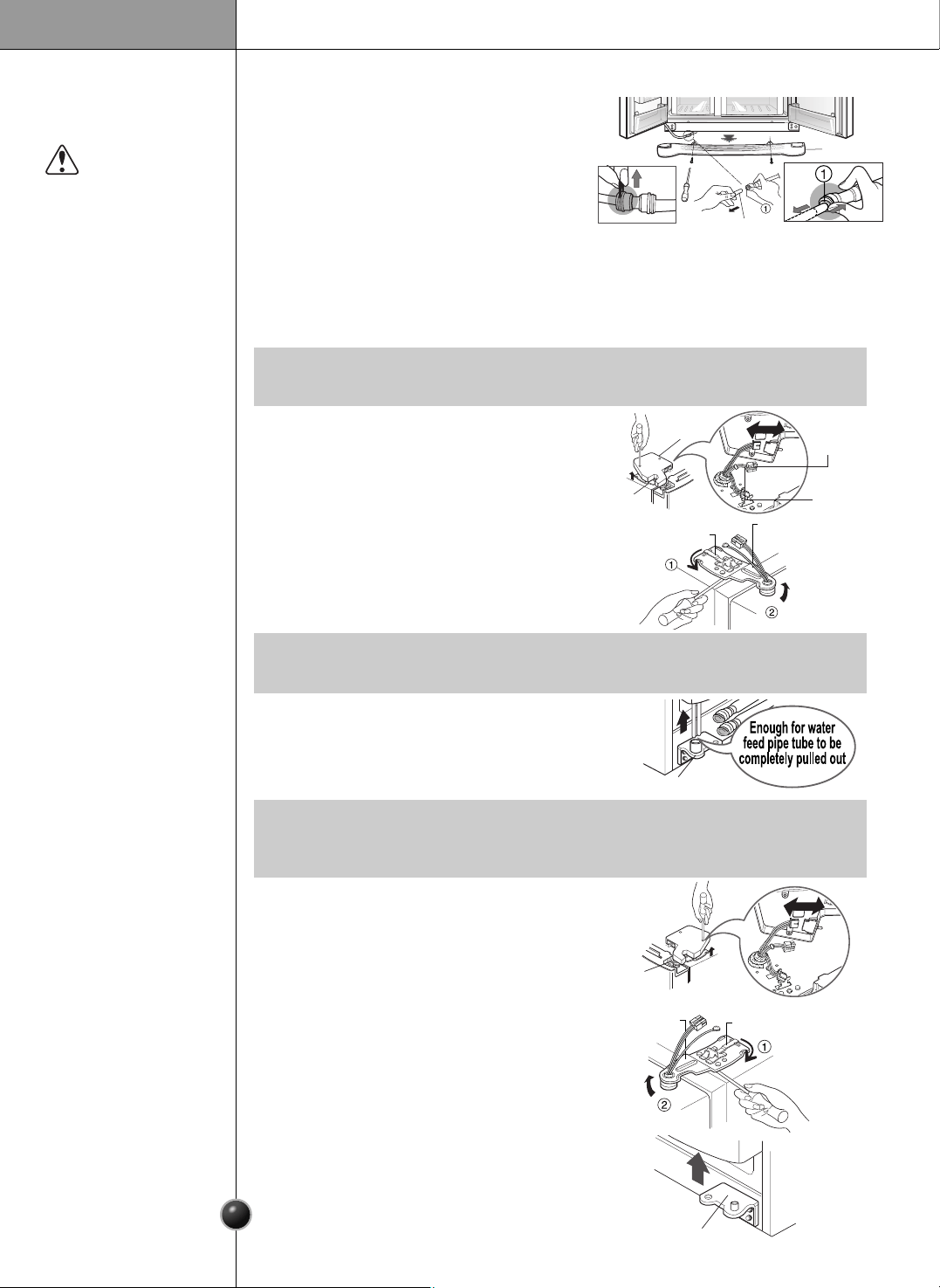
Remove the lower cover by lifting upward, and remove clip, and then pull up the
feed water tube while pressing area shown in the figure to the right.
Remove lower
cover and
then feed water
tube
Remove the
freezer
compartment
door
Remove the
refrigerator
door
1) Removing the hinge cover by loosening
the screws. Separate all connection wires
except for the earth line after.
2) Remove the keeper by rotating it counter
clockwise () and then lifting the upper
hinge up ().
3) Remove the freezer compartment door by
lifting it upward. This time, the door should
be lifted enough for the feed water pipe tube
to be completely pulled out.
1) Loosen the hinge cover screws and
remove the cover. Remove connection
wire, if any, except for the earth line.
2) Remove keeper by rotating it clockwise
() and then remove the upper hinge
by lifting it up ( ).
3) Remove the refrigerator compartment
door by lifting it up.
•
If a tube end is deformed or abraded, cut the part away.
NOTE
•
When removing the upper hinge, be careful that the door does not fall forwards .
NOTE
•
Move the refrigerator compartment door passing through the access door and lay
it down, but be careful not to damage the feed water pipe tube.
NOTE
Lower cover
Lower hinge
Lower hinge
Keeper
Feed water tube
Connection
wires
Hinge
cover
Upper hinge
Keeper
Upper hinge
Ground Line
Upper hinge
Connection
wires
WARNING
14
Installation
Door replacement
Feed water pipe installation
Pass the refrigerator laterally through the access
door as shown in the right figure.
Automatic ice maker operation needs water pressure of 147~834 kPa
(1.5~8.5 kgf/cm
2
) (That is, an instant paper cup (180 cc) will be fully filled
within 3 sec.).
If water pressure does not reach the rating 147 kPa (1.5 kgf/cm
2
) or below, it is
necessary to purchase a separate pressure pump for normal automatic icing and cool
water feed.
Keep the total length of the feed water pipe tube within 8 m and be careful for the
tube not be bent. If the tube is 8 m or longer it may cause trouble in water feed owing
to the drain water pressure.
Install the feed water pipe tube at a place free from heat.
Connect to potable water supply only.
Refer to instructions with water filter kit for installation.
Mount them in the reverse sequence of removal after they pass through the access
door.
Pass the
refrigerator
Before
installation
1
2
3
4
5
Max
F
R
Z
TE
M
P
R
E
F
TE
MP
Min
5
43
2
1
M
a
x
WARNING
15
Installation
Height adjustment
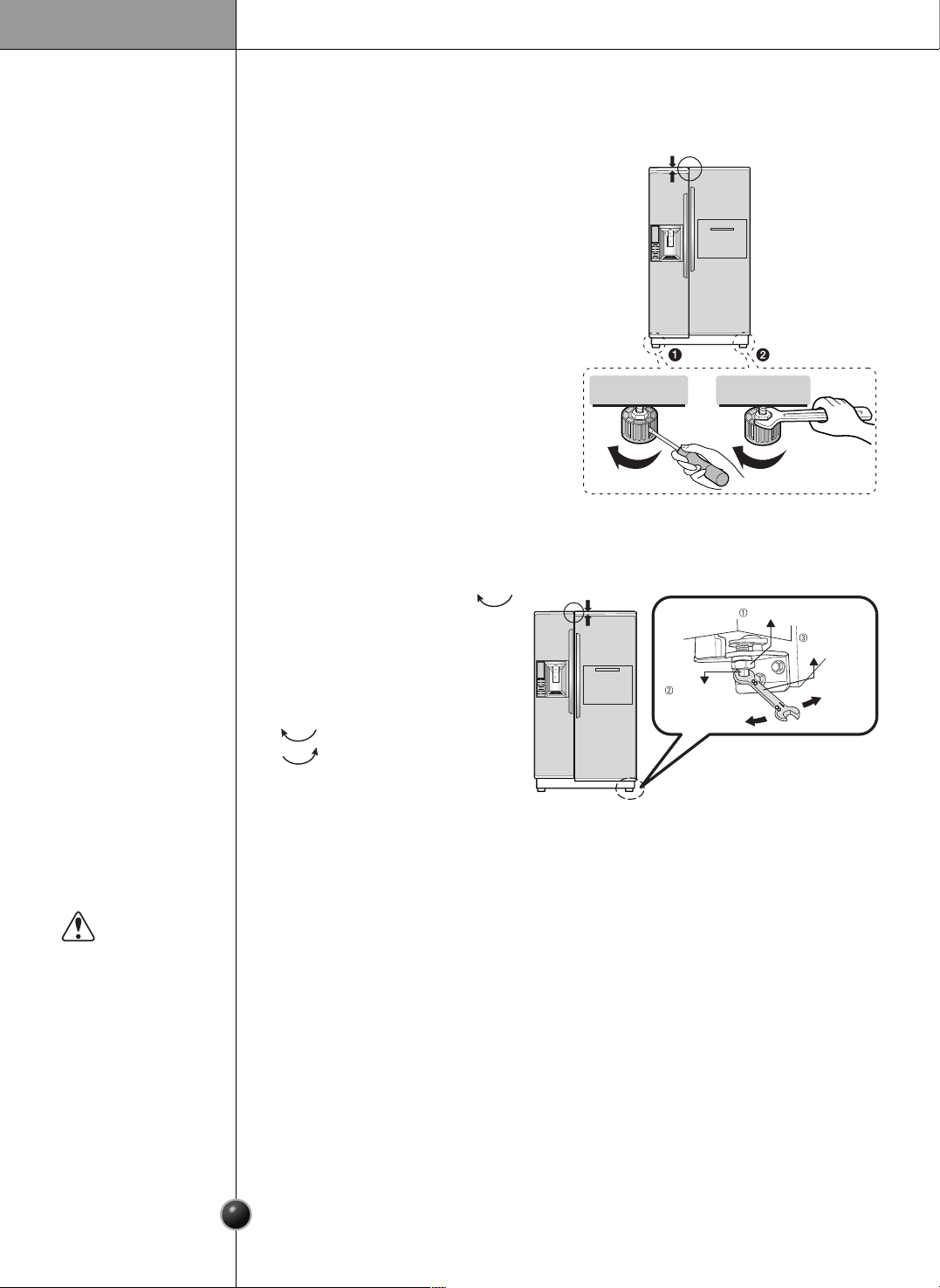
- When the height of the door may not be
leveled when the floor is not leveled.
When the freezer door is lower –
Use the (-) driver or spanner to turn the
groove or nut of the height adjustment
screw on the left to the counterclockwise
direction to level the door.
When the fridge door is lower –
Use the (-) driver or spanner to turn the
groove or nut of the height adjustment
screw on the right to the clockwise
direction to level the door.
The refrigerator doors will close smoothly by heightening the front side by adjusting
the height adjusting screw. If the doors do not close correctly, performance may be
affected.
When the floor is
not leveled
When the fridge door is lower than the freezer door while using the
refrigerator, level the doors.
1. Use the tool for adjustment on
the wide side to turn nut ( )
in the clockwise direction to loosen
the keeper nut.
2. Use the tool for adjustment on
the narrow side to turn the
adjustment hinge pin in
( )clockwise direction or
( ) counterclockwise direction
to adjust the height of the fridge
and freezer doors.
3. After aligning the height of the door, turn the keeper nut in counterclockwise
direction tightly.
When the fridge
door is lower than
the freezer door
After leveling the
door height
Keeper nut
Adjustment
hinge pin
Tool for
adjustment
Up
Down
Height difference
Height difference
When using
the driver
When using
the spanner
Next
1. Wipe off all dust accumulated during shipping and clean your appliance thoroughly.
2. Install accessories such as the ice cube box, cover evaporating tray, etc., in their
proper places. They are packed together to prevent possible damage during shipping.
3. Connect the power supply cord (or plug) to the outlet. Don't double up with other
appliances on the same outlet.
Do not force too hard to level the height. The hinge pin can be pulled out.
(Adjustable range of height is a maximum of 2" (5 cm))
CAUTION
16
Installation
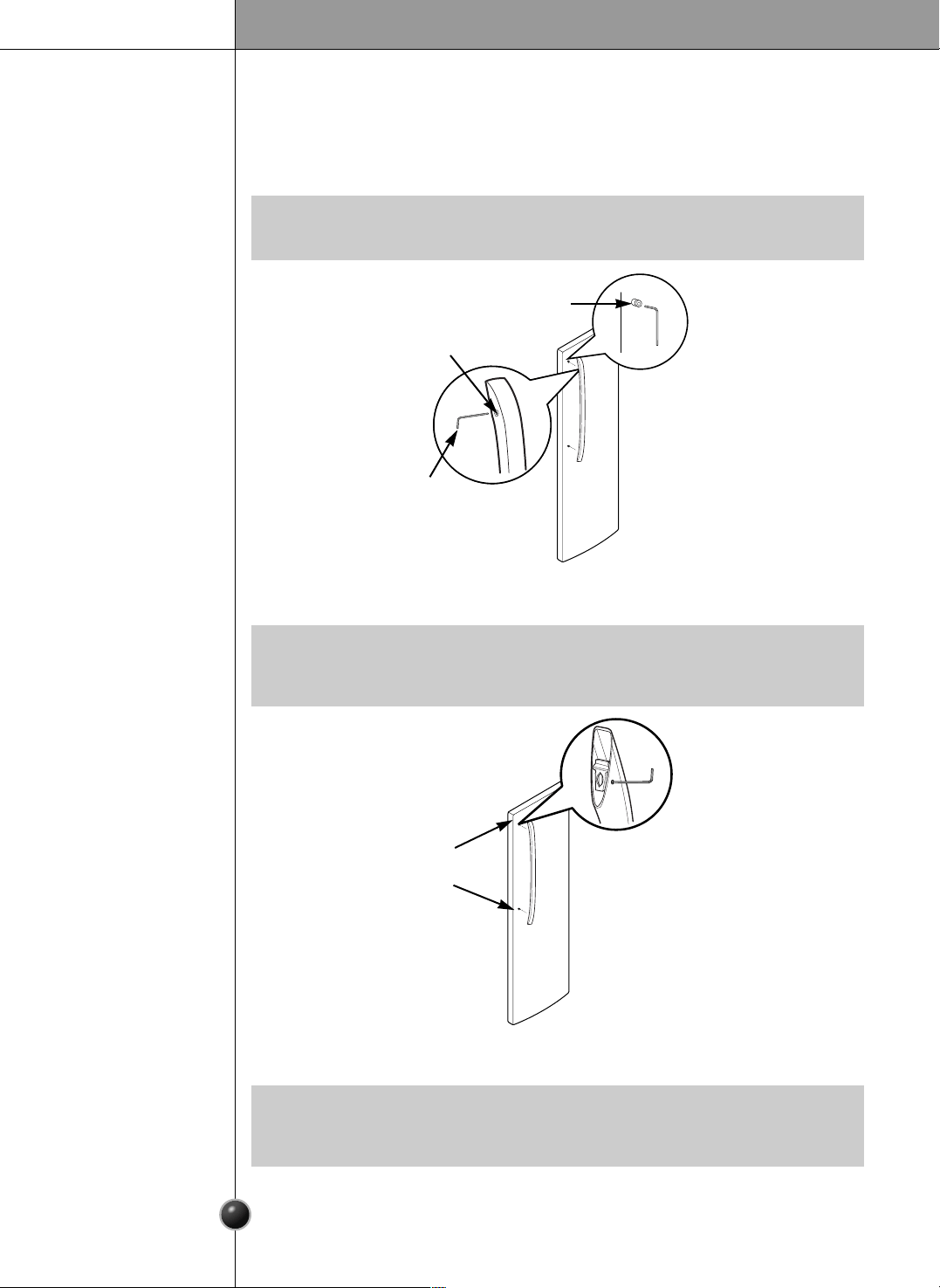
To move the refrigerator through a house door, it may be necessary to remove the
refrigerator door handles.
HANDLE
REMOVAL
Place the handle on the door by aligning handle footprints to fit mounting fasteners
and tighten the set screws with a 2.5 mm (3/32") Allen wrench.
HANDLE
REINSTALLATION
•
Handle appearance may vary from illustrations on this page.
NOTE
Loosen the set screws with a 2.5 mm (3/32")
Allen wrench and remove the handle.
•
If the handle mounting fasteners need to be tightened or removed, use a 1/4"
Allen wrench.
NOTE
•
If the handle mounting fasteners need to be tightened or removed use a 1/4" Allen
wrench
NOTE
Mounting
Fasteners
Set Screw
Allen Wrench
Mounting
Fasteners
Operation
17
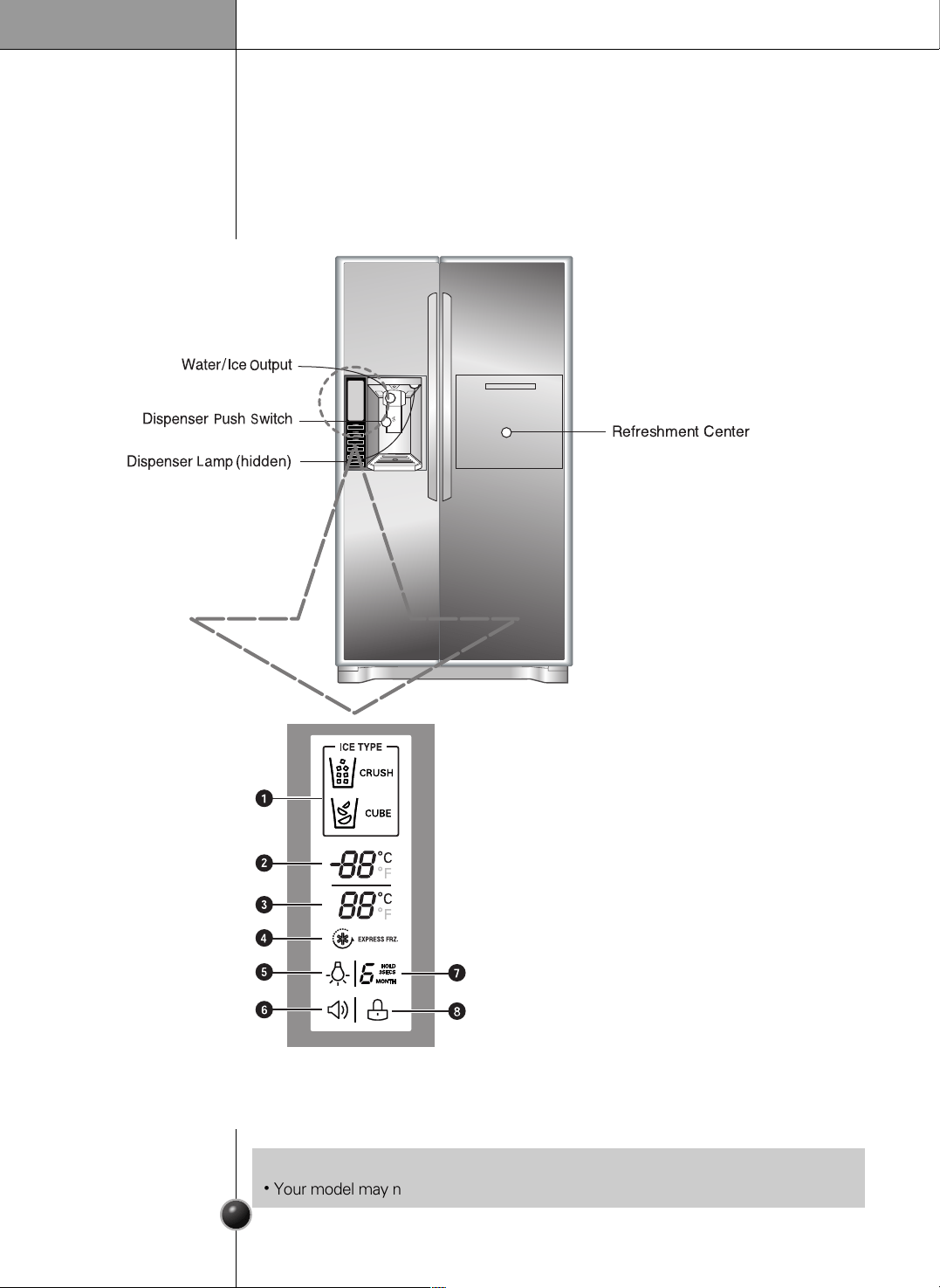
Refreshment Center
•
Your model may not include every option.
NOTE
Starting
When your refrigerator is first installed, allow it to stabilize at normal operating
temperatures for 2-3 hours prior to filling it with fresh or frozen foods.
If operation is interrupted, wait 5 minutes before restarting.
DISPENSER SELECTION INDICATOR
Shows Cubed ice or Crushed Ice selection that will be dispensed
when the push switch is pressed.
FREEZER TEMPERATURE
Indicates the set temperature of the freezer compartment in Celsius
or Fahrenheit.
REFRIGERATOR TEMPERATURE
Indicates the set temperature of the refrigerator compartment in
Celsius or Fahrenheit.
EXPRESS FRZ.
When the EXPRESS FRZ. button is pressed, the display will indicate
the selected function has been activated.
DISPENSER LIGHT INDICATOR
When the LIGHT button is pressed, the display will indicate the
selected function: The dispenser light is on, this indicator will appear
on the display panel.
DOOR ALARM INDICATOR
This indicator shows that the door-open warning alarm is activated.
WATER FILTER STATUS
This indicator shows the current status for the water filter. See
Resetting the Filter Indicator.
LOCK STATUS
This indicator shows the current status for the control panel functions
is set to LOCK.
Adjusting the temperatures and functions
18
Operation
Adjust Freezer
Temperature
Adjust Refrigerator
Temperature
Display Power-
Saving Mode
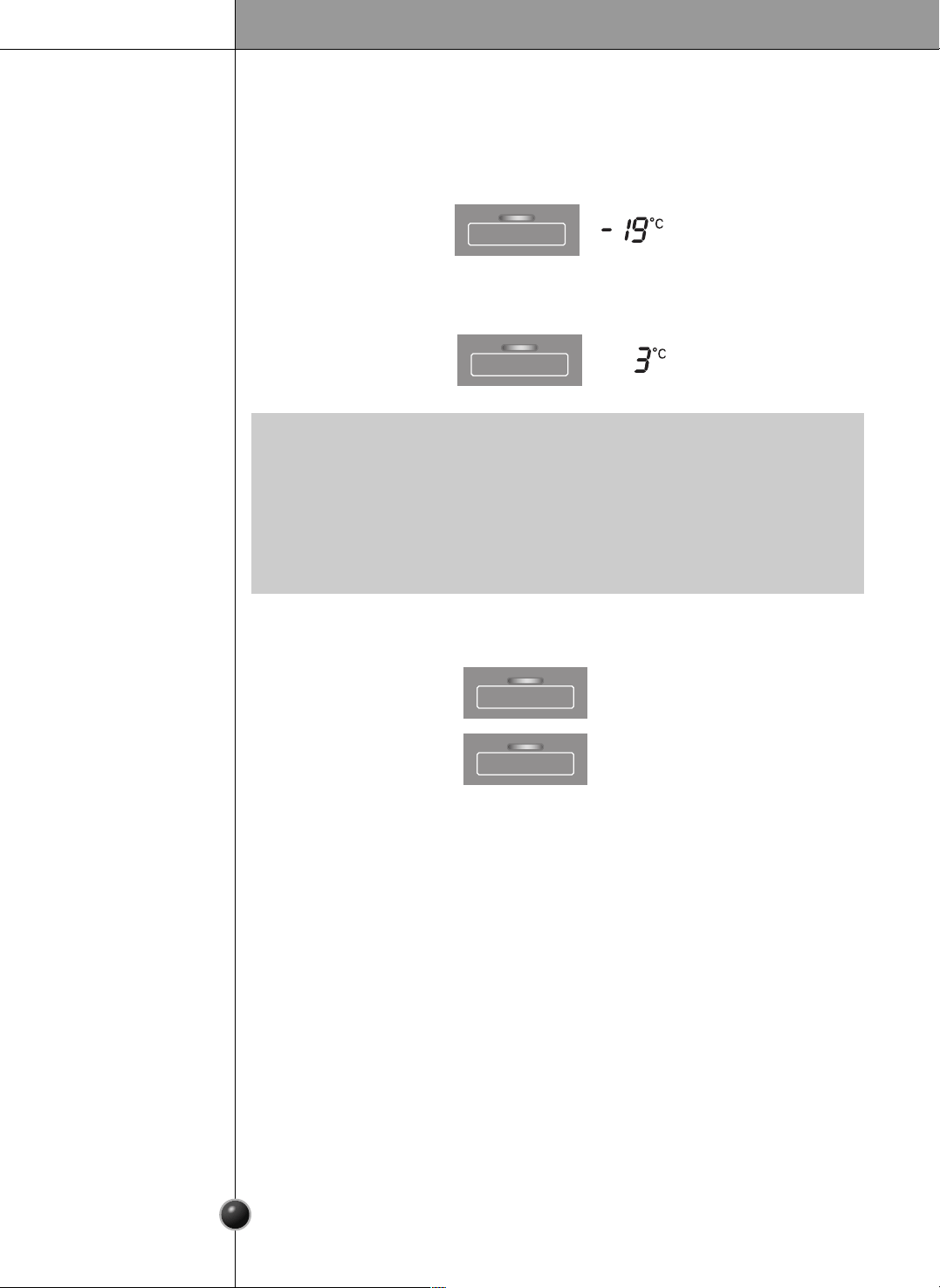
To adjust the temperature in the freezer compartment, press the FREEZER
button to cycle through the the range of available settings.
To adjust the temperature in the refrigerator compartment, press the
REFRIGERATOR button to cycle through the range of available settings.
This function places the display into the Power-Saving Mode.
• Simultaneously press the FREEZER and EXPRESS FRZ. buttons and hold
them for 5 seconds until a tone sounds.
• All LED lights will turn on and then off.
• When the Power-Saving Mode is activated, the display will remain off until
the next time the door is opened. The display will also turn on when any
button is pressed, and it will remain on for 20 seconds after the last door
opening or button selection.
• To deactivate the Power-Saving Mode, press the FREEZER and EXPRESS
FRZ. buttons simultaneously and hold them for 5 seconds until the tone
sounds.
Adjusting The Temperatures And Display
FREEZER
REFRIGERATOR
FREEZER
EXPRESS FRZ.
•
The actual inner temperature varies depending on the food status, since the
indicated temperature setting is the target temperature and not the actual
temperature within the refrigerator.
Initially set the REFRIGERATOR CONTROL at
3 degrees C and the FREEZER CONTROL at
-19 degrees C. Leave them at these setting for 24 hours (one day) to stabilize. Then
adjust the compartment temperature as illustrated above.
NOTE
19
Operation
Dispensing
Crushed Ice
Dispensing Cubed
Ice
Controlling The
Dispenser Light
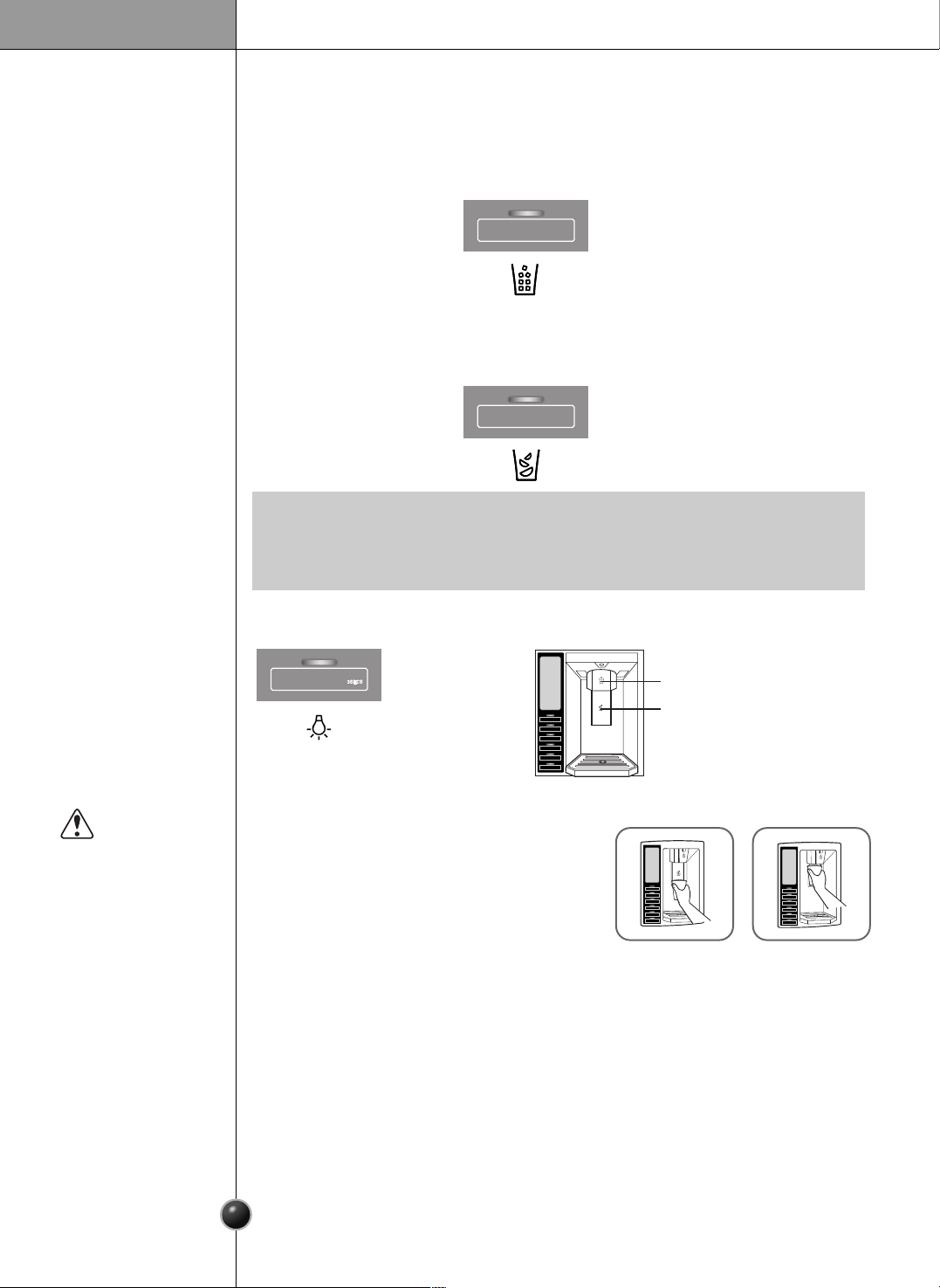
Press the ICE TYPE button to illuminate the Crushed Ice icon.
Press the push ice switch with a glass or other container and crushed ice will
be dispensed.
Press the ICE TYPE button to illuminate the Cubed Ice icon.
Press the push switch with a glass or other container and cubed ice will be
dispensed.
Press the LIGHT/FILTER button to turn the dispenser light on and off.
• When filling the container with a
small opening, use it near the
opening of the water or ice
dispenser as close as possible.
• Do not dispense ice into fine china
or crystal glasses. China or crystal
can break.
Operating The Dispenser
ICE TYPE
ICE TYPE
•
Hold the glass or other container in place for a couple of seconds after dispensing
ice or water to catch the last few cubes or drops. The dispenser is designed to not
operate while either refrigerator door is open.
NOTE
LIGHT/FILTER
Water Switch
Ice Switch
Incorrect
Ice
Correct
CAUTION
20
Operation
Setting The
Dispenser Lock
Setting The Door
Alarm
Resetting The Filter
Indicator
Activating EXPRESS
FREEZING
Press the button for the desired function to view and select other settings.
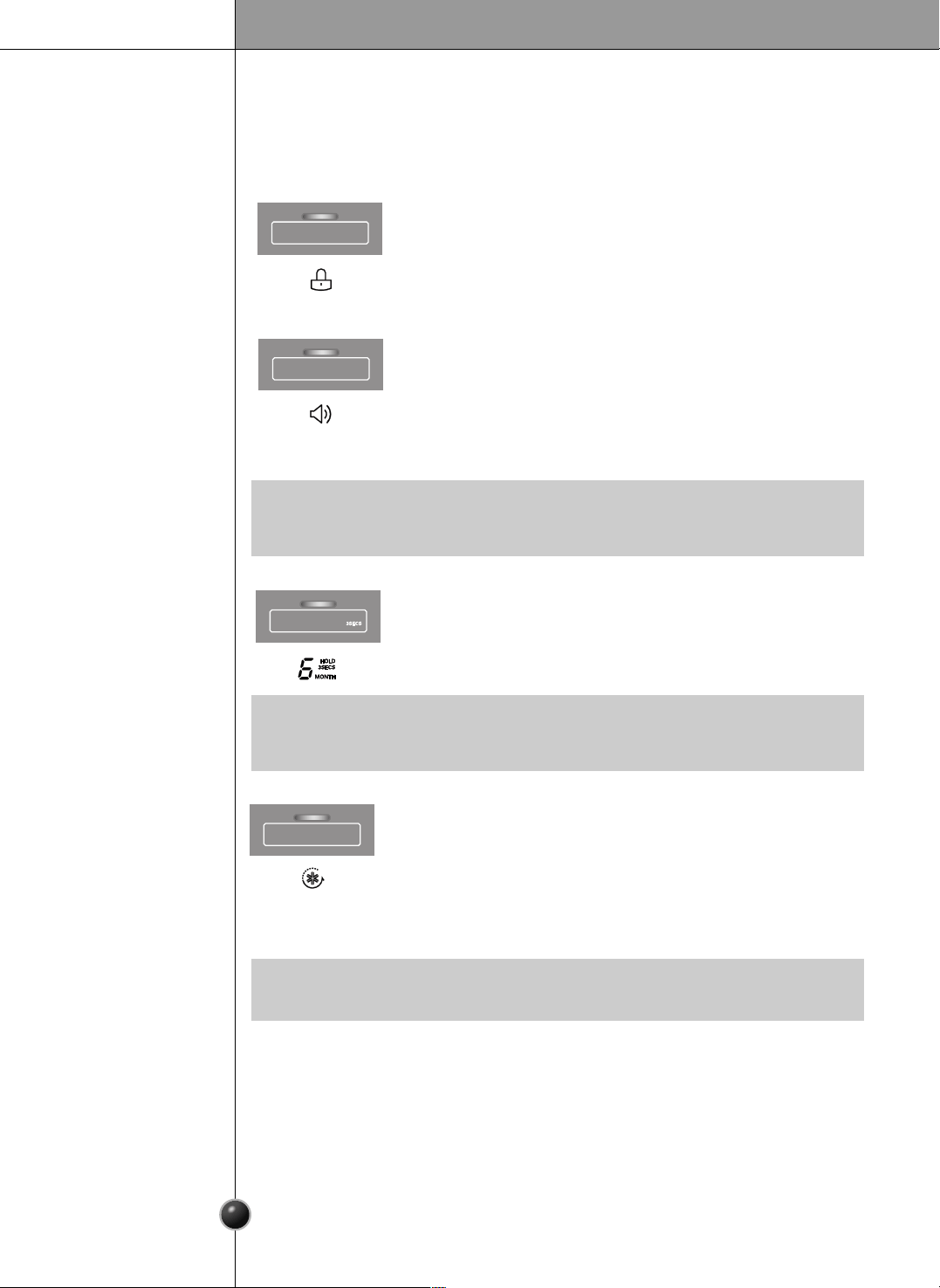
Press and hold the ALARM/LOCK button for three seconds
to lock the dispenser and all of the other control panel
functions.
Press and hold again for 3 seconds to unlock.
The ALARM/LOCK button also controls the door alarm that
sounds three times in 30-second intervals when a
compartment door is left open for more than 60 seconds.
The alarm stops sounding when the door is closed.
Press the ALARM/LOCK button once to activate and deactivate the door alarm
function.
Press and hold the LIGHT/FILTER button for more than 3
seconds to reset the filter indicator after the water filter has
been replaced.
Press the EXPRESS FRZ. button once to activate the
EXPRESS FREEZING function. The EXPRESS FRZ. icon on
the display panel will illuminate when activated. The
EXPRESS FREEZING function runs the freezer compartment
at the coldest setting for a 24-hour period to increase
icemaking by up to about 20%, and then turns off
automatically.
Setting The Functions
•
Contact your local service center if the alarm continues to sound after the doors are
closed.
NOTE
•
It is recommended that you replace the filter when the water filter indicator light reaches 0 or
whenever the water or ice cube taste deteriorates noticeably.
NOTE
•
Press the button again to cancel the EXPRESS FREEZING function.
NOTE
ALARM / LOCK
3SECS
ALARM / LOCK
3SECS
LIGHT/FILTER
EXPRESS FRZ.
Operation
21
The automatic icemaker can automatically make 6 cubes at a time, 25~35
pieces per day. This quantity may vary by circumstance, including ambient
temperature, door opening, freezer load. etc.
Icemaking stops when the ice storage bin is full.
If you don't want to use the automatic icemaker, turn the icemaker switch to
OFF.If you want to use automatic icemaker again, change the switch to ON.
Automatic
icemaker
•
It is normal that a noise is produced when ice drops into the ice storage bin.
NOTE
•
Do not insert your hands in to the Icemaker in operation.
It may cause to injure you.
Power
Switch
Feeler Arm
After dispenser
is used
The water collector has no self-drainage function, so it
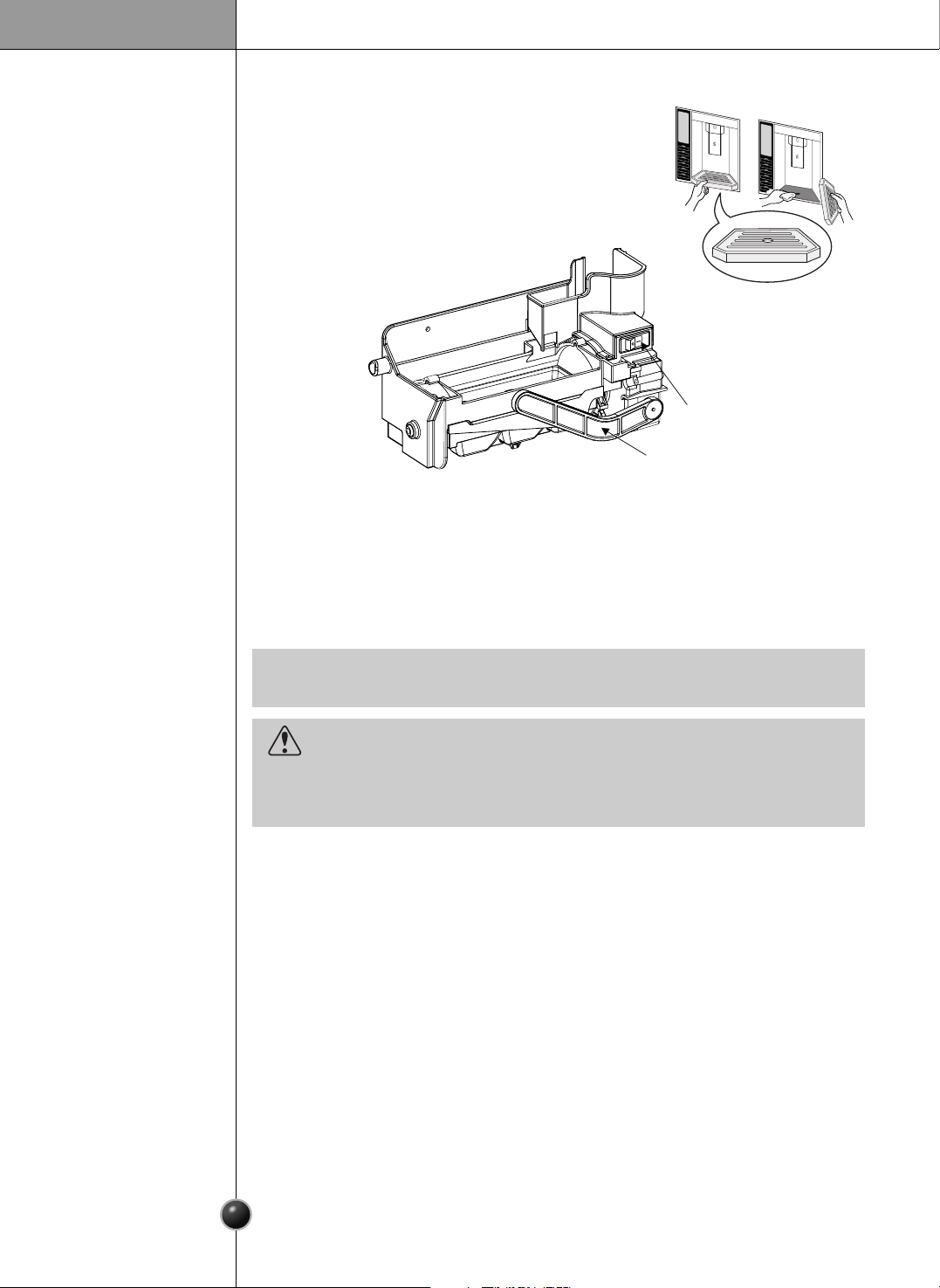
should be cleaned regularly. Remove the cover by
pulling the front of the water collector cover and dry it
with a cloth.
WARNING
22
Operation
Ice is lumped together
When ice is lumped together, take the ice lumps out of the ice storage bin,
break them into small pieces, and then place them into the ice storage bin
again.
When the ice maker produces too small or lumped together ice, the amount
of water supplied to the ice maker need to adjusted. Contact the service
center.
❈ If ice is not used frequently, it may lump together.
Power failure
Ice may drop into the freezer compartment. Take the ice storage bin out and
discard all the ice then dry it and place it back. After the machine is powered
again, crushed ice will be automatically selected.
The unit is newly installed
It takes about 12 hours for a newly installed refrigerator to make ice in the
freezer compartment.
When ice maker
does not operate
smoothly
1
1
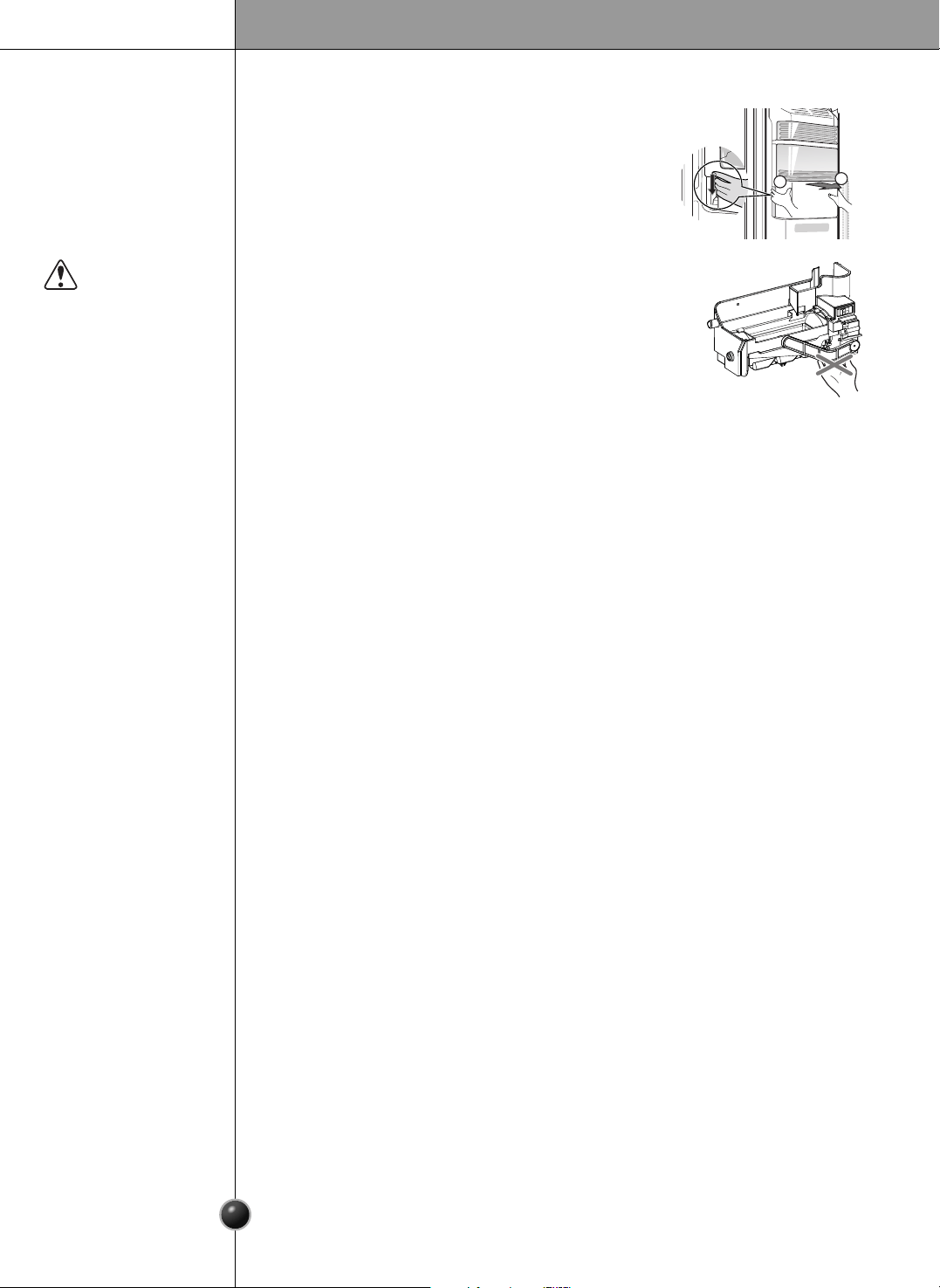
Hold the ice maker cover with both hands and pull
it toward you while pressing the button on part (1).
How to
disassemble the
automatic
icemaker
- Do not disassemble the ice maker unless it is
necessary.
- Hold the ice storage bin using both hands so that it
does not fall.
- Do not touch the ice dispenser with your hand or tool.
- Because the ice maker can operate by opening the
freezer door, please take precaution.
- When you want to use the ice bucket space as the storage space, make sure
to use it by turning off the ice maker after removing the ice bucket.
The other
functions
Door open warning
3 times of warning sounds at the interval of 30 seconds if a minute passes
with the door of refrigerator and the hombar door opened or completely
closed.
Please contact with the local service center if warning continue to sound
even after closing the door.
Diagnosis (failure detection) function
Diagnosis function automatically detects failure when failure is found in
product during the use of refrigerator.
If failure occurs at product, it does not operate though pressing any button
and normal indication is not done. In this case, do not turn power off but
immediately contact with the local service center. A lot of time are need for
service engineer to detect the failed part if turning it off.
WARNING
23
Operation
Throw away the ice (about 20 pieces) and water (about 7 glasses) first
made after refrigerator installation.
The first ice and water may include particles or odor from the feed water pipe
or feed water box. This is necessary in case that the refrigerator has not been
used for a long time.
Keep children away from the dispenser.
Children may push switch incorrectly bad or damage lamps.
Be careful that food is not block the ice passage.
If foods are placed at the entrance of ice passage, ice may not be dispensed.
The ice passage may also be covered with ice powder if splinter ice is used
only. This time, remove the ice powder accumulated.
Never store beverage cans or other foods in ice storage bin for the
purpose of rapid cooling.
Such actions may damage the automatic ice maker.
Never use thin crystal glass or crockery to collect ice.
Such glasses or containers may be broken.
Put ice first into a glass before filling water or other beverages.
Water may be splashed if ice is added to existing liquid in a glass.
Never touch a hand or other tools on ice outlet.
Touch may cause a part breakage or hand injury.
Never remove the ice maker cover.
Sometimes level the surface so that the ice storage bin is fully filled with
ice.
Ice is piled up just near the ice maker. So, such status may be considered, by
the ice maker, that the ice storage bin is fully filled and ice making operation
may stop.
If discolored ice is dispensed, immediately contact service center,
stopping use.
Never use too narrow or deep glass.
Ice may be jammed in ice passage and, thus, the refrigerator may be failed.
Keep the glass at a proper distance from ice outlet.
A glass too close to the outlet may hinder ice from coming out.
Water is cooled while stored in the water tank in the refrigerator
compartment, and then sent to the dispenser.
Ice is made in the automatic ice maker and sent to the dispenser divided into
crushed or cubed form ice.
How ice/cold
water is supplied
•
It is normal that the water is not very cold at first. If you want colder water,
add ice into the glass.
NOTE
CAUTION
Operation
24
Refreshment center (Applicable to some models only)
You can use the can server on the top and side
to arrange and store the cans.
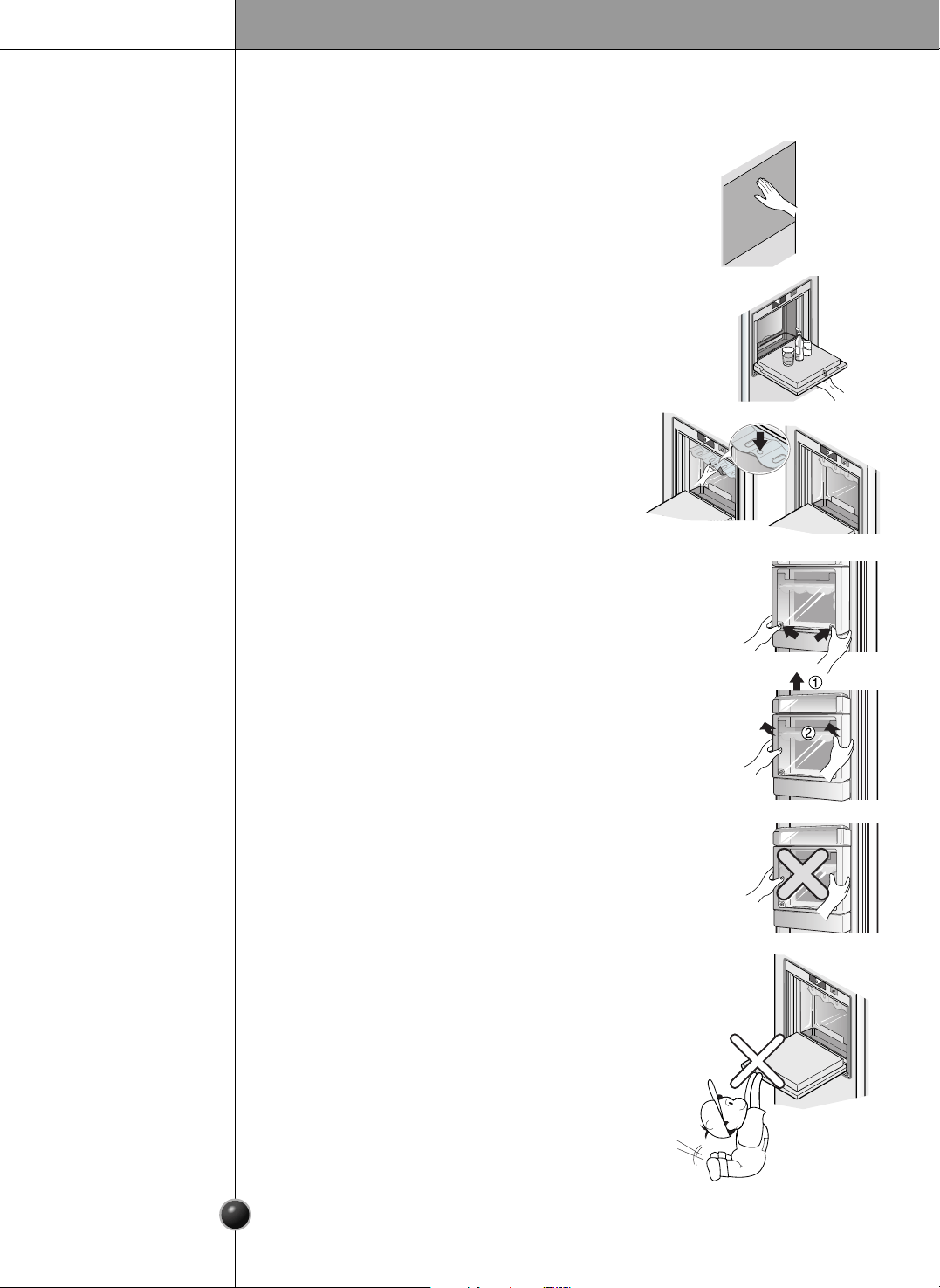
1. Pull down the handle when you want to store
the cans.
2. If you do not want to use the can server, fixate
the can server on the top so that you can utilize
the space of Home Bar more effectively.
* When you press both sides of the bottom part of
the cover on the main unit of the fridge and
freezer Home Bar, it will be fixated to prevent the
food inside the Home Bar from falling into the
fridge or freezer.
How to use the
can server
First separate the upper door basket of the
Home Bar (1) and then pull up the Home Bar
cover(2).
How to
disassemble the
fridge Home Bar
cover
1. Do not use the refrigerator with the internal Home
Bar cover taken out.
- If the cover is taken out, the Home Bar function
cannot work.
2. Be careful not to press or damage the Home Bar
support board.
- If you lean or press the support board with your
arm, it can be damaged.
- Do not use the support board as a cutting board or
use sharp tools on the support board to prevent
any scratches.
- When the support board is wet with alien fluid
such as juice, it may not operate properly.
- When the packing part is wet with alien fluid such
as juice, periodically wipe the part.
Precaution
1. Press the top central part of the Home Bar until you hear the
"Click" sound.
- You can save electricity because you do not have to open
the refrigerator door.
- Because the indoor lamps of the fridge and freezer are
turned on even when you open only the Home Bar door,
you can easily take out the food you want.
- When closing the Home Bar, press until you hear the "Click"
sound.
2. Open the door and use the door as the support board.
- Put the beverage or food on the support board for
convenience of use.
How to use the
Home Bar
Press until you
hear the "Click"
sound
25
Operation
Shelf
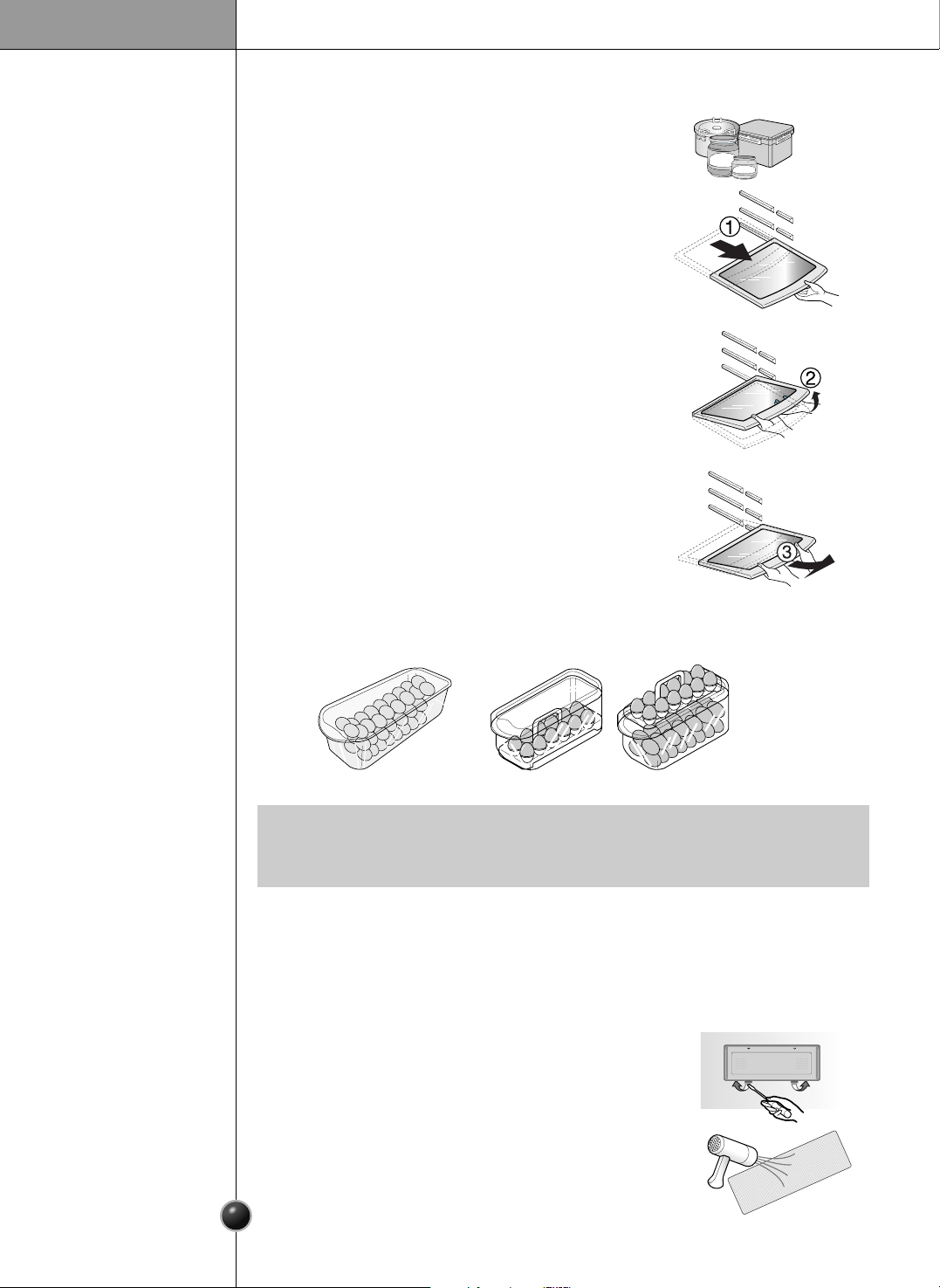
You can store side dish or refrigerated food on the
shelf with sufficient space in between the
containers.
How to use
1. Hold the front part of the shelf and pull it out until it
gets blocked by the hooking part.
2. When you cannot pull out the shelf any more, lift it
up slightly.
3. While holding the shelf slightly, tilt the shelf to pull it
out.
How to
disassemble
Egg box
•
Never use the egg box as an ice storage bin. It can be broken.
•
Never store the egg box in the freezer compartment or fresh compartment.
NOTE
[Type-1] [Type-2]
You can move the egg box to wherever you want.
Nano charcoal deodorizer
With the Nano charcoal deodorizer system, you
can deodorize the refrigerator and the deodorizer
can be reused.
How to use
Use the (-) driver on the bottom grooved part of
the deodorizer cover to separate it while pushing
to the front side.
How to reuse the deodorizer
You can reuse the deodorizer continuously by
drying it well with the hair dryer.
How to
disassemble
26
Operation
Fresh compartment
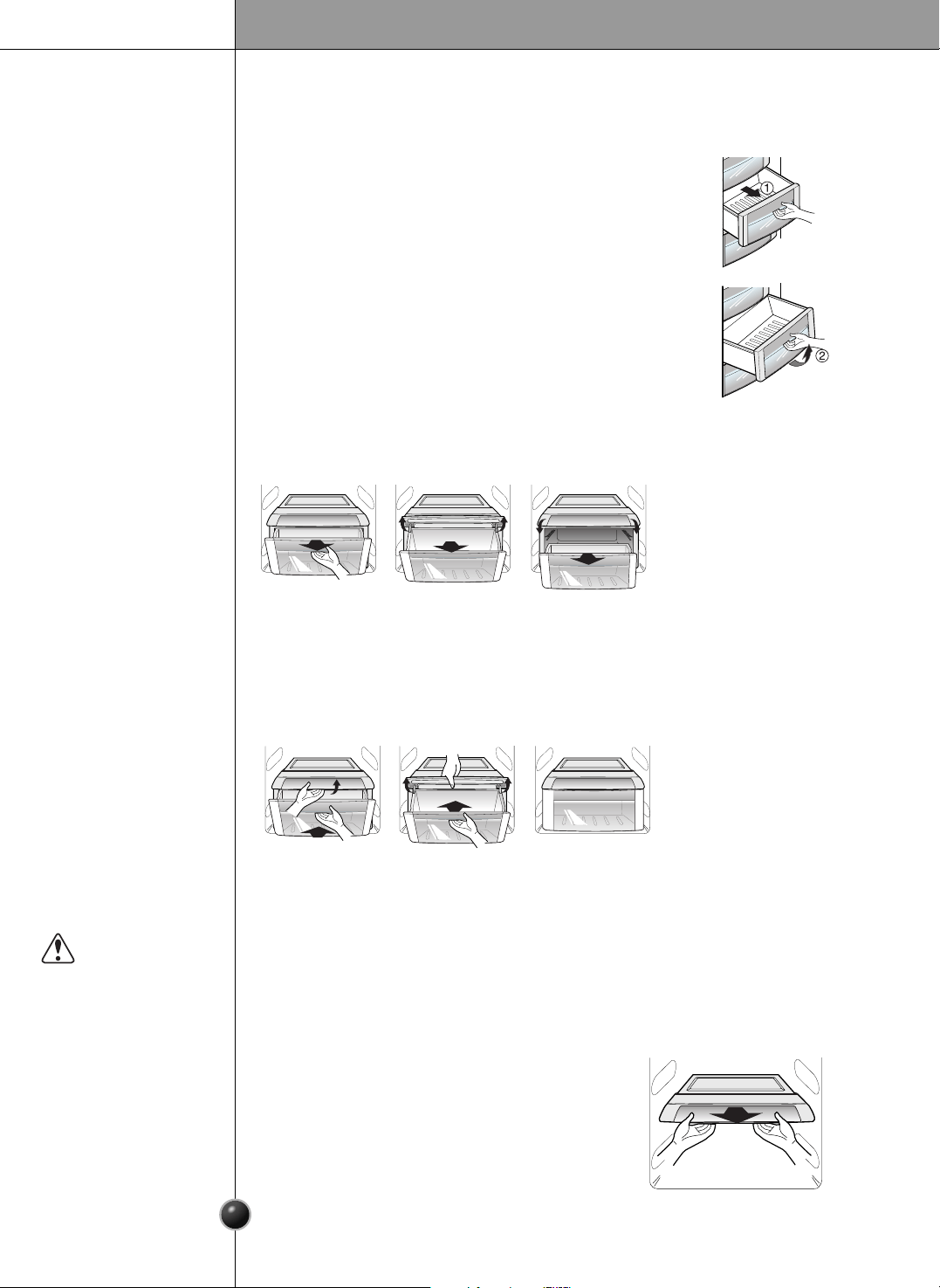
You can store fruits or vegetables.
How to use
1. Hold the front handle of the fresh compartment and pull
it out until it gets blocked by the hooking part.
2. When you cannot pull out the fresh compartment any
more, lift it up slightly to pull it out completely to the
front side (outer side).
* The fresh compartment can be reassembled in the
reverse order.
How to
disassemble the
upper fresh
compartment
When pulling out the lower fresh compartment
1. Hold the front handle of the fresh compartment and pull
it forward.
2. When you cannot pull out the fresh compartment any
more, lift it up slightly to pull it out to the front side.
How to
disassemble the
lower fresh
compartment
Hold the cover with both hands and pull it out.
* When disassembling the cover, always
disassemble the fresh compartment first.
How to
disassemble
upper/lower fresh
compartment
cover
When inserting the lower fresh compartment
* When inserting the fresh compartment, always lift the cover
up to push it in.
- Always disassemble the fresh compartment using two hands.
You can be injured from the weight of the compartment when filled with food.
- When disassembling/reassembling the fresh compartment of the fridge, open the
refrigerator door fully.
WARNING
27
Operation
- Always disassemble the fresh compartment using two hands.
You can be injured from the weight of the compartment when filled with food.
- When disassembling/reassembling the fresh compartment of the fridge, open the
refrigerator door fully.
WARNING
Vacuum fresh compartment
You can store vegetables or fruits freshly for a long period of time.
- In the middle vacuum fresh compartment, you can store the vegetable or fruit for a
longer period of time with the improved seal and vacuum effect.
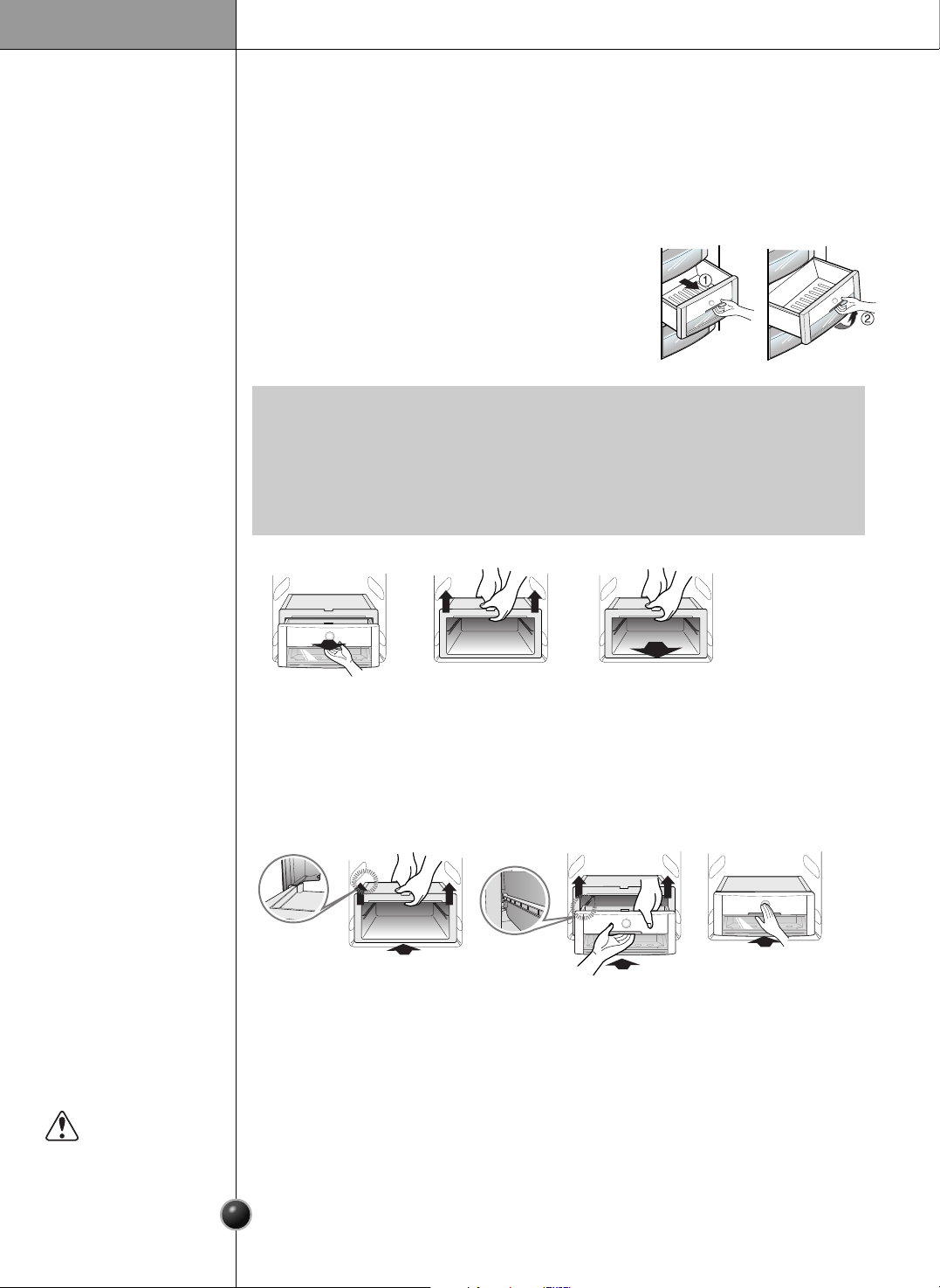
How to use
1. Hold the front handle of the vacuum fresh
compartment and pull it out until it gets blocked by
the hooking part.
2. When you cannot pull out the vacuum fresh
compartment any more, lift it up slightly to pull it
out completely to the front side (outer side).
How to
disassemble the
vacuum fresh
compartment
1. Pull the vacuum fresh compartment to the front and slightly lift it up to pull it out.
2. Hold the vacuum fresh compartment with both hands and slightly lift it up.
* To disassemble the case, you must first disassemble the upper fresh
compartment.
3. Pull it out to the front.
1. Align the top of the case to the side rails and push while slightly holding it up.
2. Align the bottom of the case on top of the rails and push while slightly holding it up.
3. Push the case until you hear the "Click" sound.
How to
disassemble the
vacuum fresh
compartment
How to
reassemble the
Vacuum fresh
compartment
•
You can disassemble/reassemble the freezer drawer in the same method.
•
Always disassemble the fresh compartment using two hands. (You can be
injured from the weight of the compartment when filled with food.)
•
When disassembling/reassembling the fresh compartment or vacuum fresh
compartment of the fridge, open the refrigerator door fully.
NOTE
28
Operation
Freezer/Fridge basket
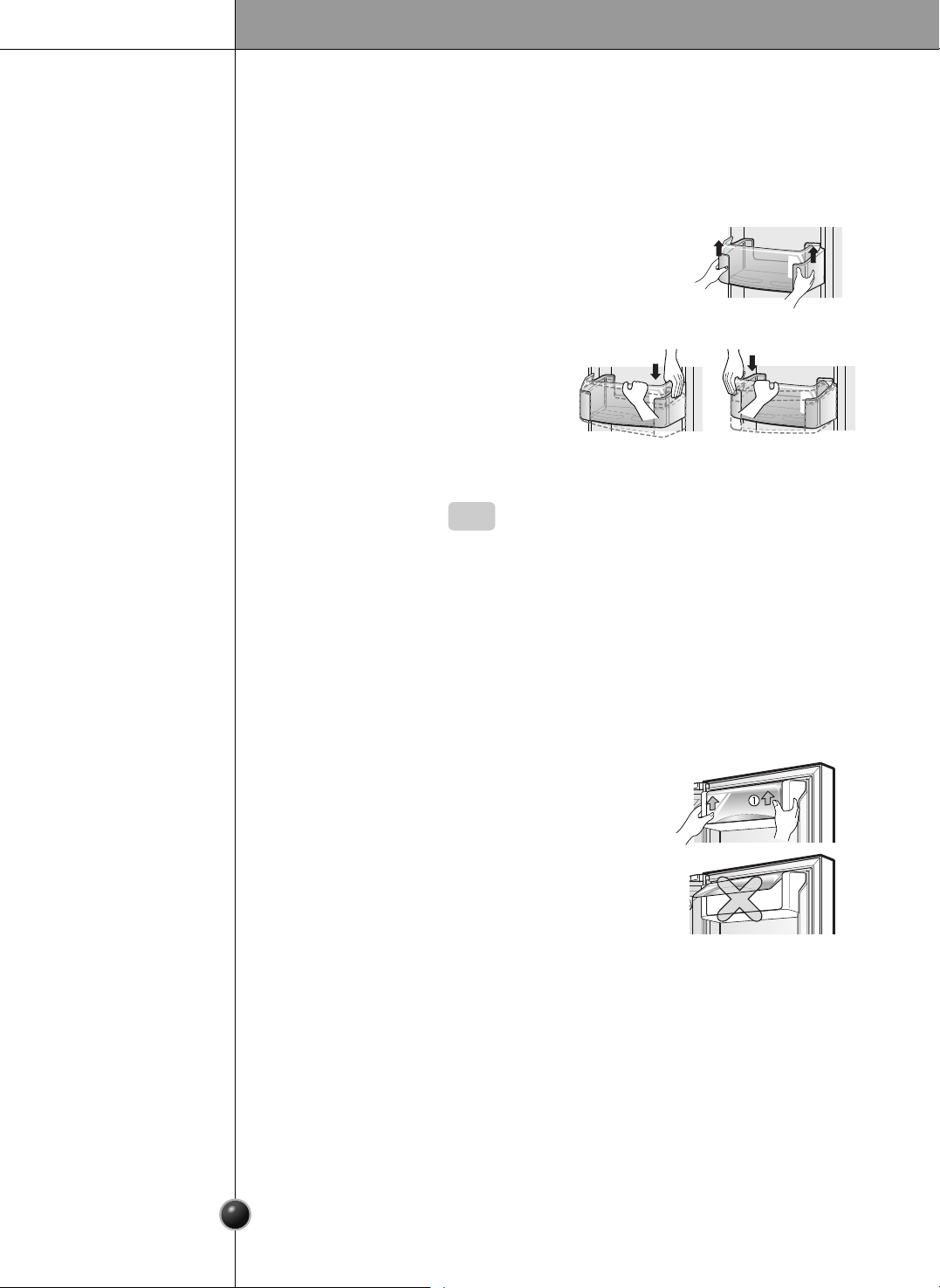
You can store small packaged frozen food (Freezer basket), small packaged refrigerated
food or beverages (Fridge basket) such as milk, beer etc.
But, do not store ice cream or food to store for a long period of time (Freezer basket)
etc.
How to use
Hold the basket with both hands and slightly lift up the
front part to pull it out.
How to
disassemble
Hold the basket with both hands and
reassemble one side at a time by
pushing it in.
How to
reassemble
Dairy corner
You can store dairy goods such as butter, cheese etc.
How to use
Hold the basket with both hands and pull it out by pulling it
up(1).
If you close the refrigerator door with the dairy corner
left open on the door side, the refrigerator door may not
be closed properly. Therefore you must be careful.
How to
disassemble
Two stars section (Applicable to some models only)
Two stars section means the space stored at -12°C~-18°C
Freezer foods for short-terms storage.
Freezer basket
(two stars section)
**
Operation
29
How to exchange the water purifier filter
(Applicable to some models only)
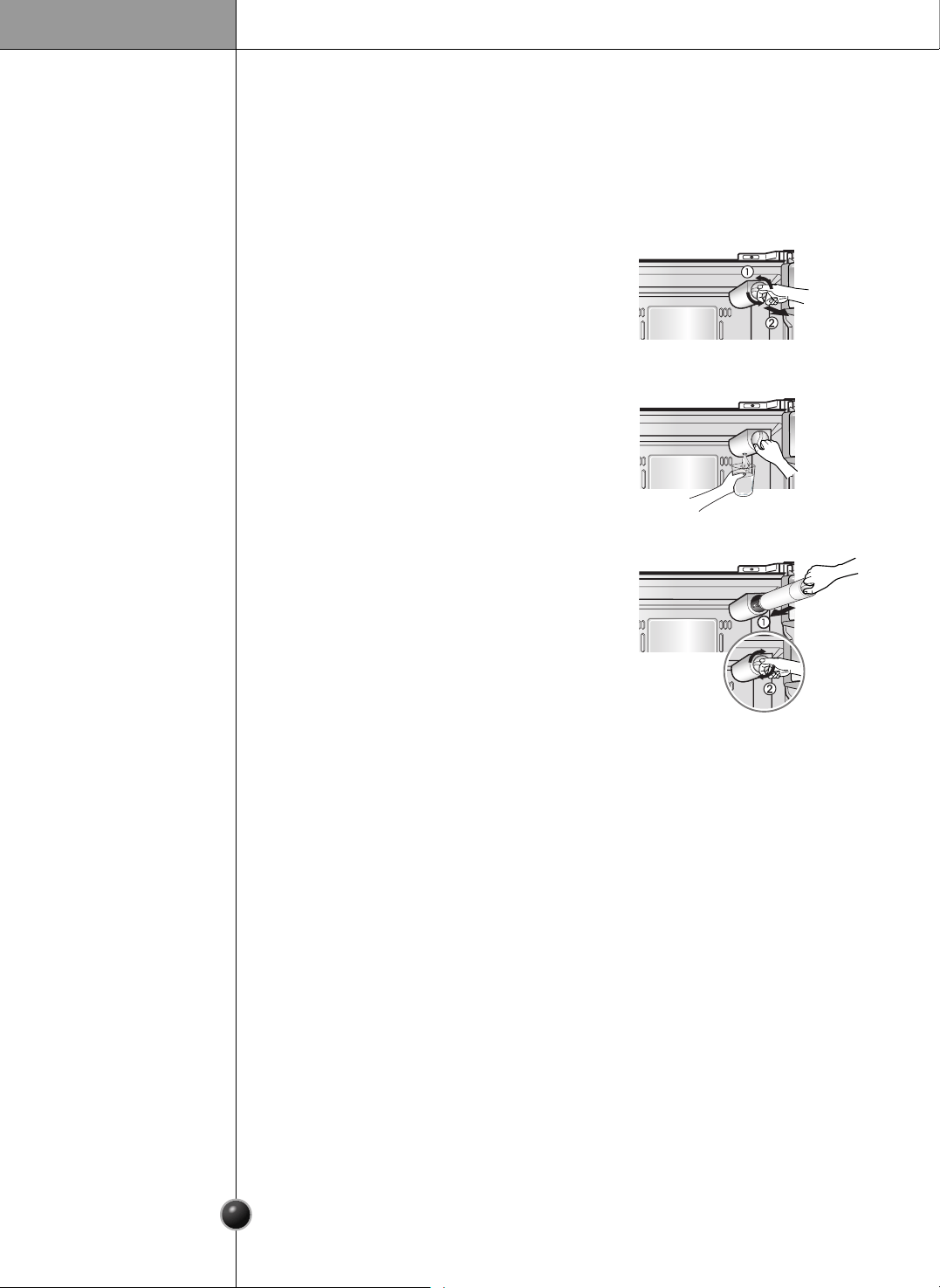
Because the filter is assembled on the top right side of the refrigerator lamp case and it
removes the residual chlorine or odor, exchange a filter once every 6 months.
How to
disassemble the
filter
2. Insert the new filter.
- Align the filter on the indicated line on the control
box (1) and then push it in.
After checking whether the indicated line and the
indicated locking line are aligned, turn the filter in
clockwise direction (2).
- When you have install the filter for the first time
or when you have exchanged the filter, press the
dispenser button once again to dispense the water for about 3 minutes
(or about 1 liter) to remove any air or residual charcoal.
(Charcoal is not hazardous to the human body.)
1. Disassemble the water purifier filter.
- Turn the filter to exchange in counterclockwise
direction by 90 degrees. (1) Pull out the filter to
the front side (2).
- Because water collected in the filter may drip,
put a bowl slightly larger than the size of the filter
underneath the filter when disassembling the
filter.
How to exchange
30
Suggestion on food storage
Location of foods
(Refer to identification of parts)
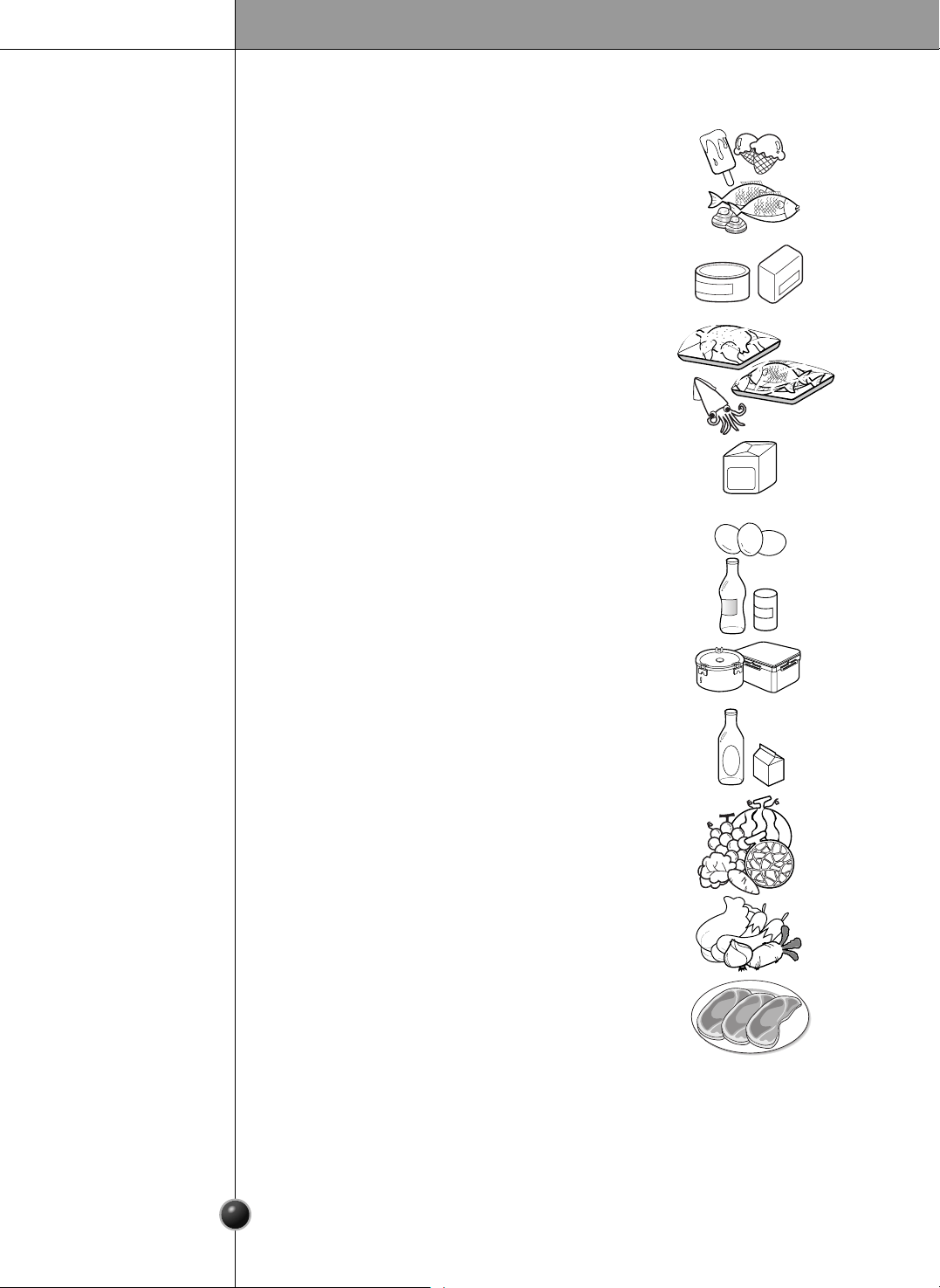
Store various frozen foods such as meat, fish,
ice cream, frozen snacks, etc..
Store small packed frozen food.
Temperature is likely to increase as door
opens.
So, do not store long-term food such
ice cream, etc..
Freezer
compartment
shelf
Freezer
compartment
door rack
Freezer
compartment
drawer
Milk product
corner
Egg box
Refreshment
center
Refrigerator
compartment
shelf
Refrigerator
compartment
door rack
Vegetable drawer
Vegetable
drawer
/meat
drawer
conversion corner
Store meat, fish, chicken, etc.. after
wrapping them with thin foil.
Store dry
.
Store milk products such as butter, cheese,
etc..
Place this egg box in the proper location.
Store foods of frequent use such as beverage,
etc..
Store side dishes or other foods at a proper
distance.
Store small packed food or beverages such
as milk, juice, beer, etc..
Store vegetables or fruits.
Store vegetable, fruits, meat to thaw, raw
fish, etc.. setting the conversion switch as
necessary.
Be sure to check the conversion switch
setting before storing foods.
Suggestion on food storage
31
Storing foods
Store fresh food in the refrigerator compartment. How food is frozen and thawed
is an important factor in maintaining its freshness and flavor.
Do not store food which goes bad easily at low temperatures, such as bananas,
and melons.
Allow hot food to cool prior to storing, placing hot food in the refrigerator could
spoil other food, and lead to higher energy consumption.
When storing the food, cover it with vinyl wrap or store in a container with a lid.
This prevents moisture from evaporating, and helps food to keep its taste and
nutrients.
Do not block air vents with food. Smooth circulation of chilled air keeps
refrigerator temperatures even.
Do not open the door frequently. Opening the door lets warm air enter the
refrigerator, and cause temperatures to rise.
Never keep too much food in door rack because they may push against by inner
racks so that the door cannot be fully closed.
Do not store bottles in the freezer compartment - they may break when frozen.
Do not refreeze food that has been thawed. This causes loss of taste and
nutrient.
When storing frozen food like ice cream for a long period, place it on the freezer
shelf, not in the door rack.
Do not touch the cold foods or containers- especially made of metallic -, with wet
hands and place glass products in the freezer compartment.
- That’s why you may have chilblains and they may be broken when their inner
matters are frozen, causing personal injury.
Always clean food prior to refrigeration. Vegetables and fruits should be washed
and wiped, and packed food should be wiped, to prevent adjacent food from
spoiling.
When storing eggs in their storage rack or box, ensure that they are fresh, and
always store them in an upright position, which keeps them fresh longer.
Freezer
compartment
Refrigerator
compartment
•
If you keep the refrigerator in a hot and humid place, frequent openning of the door
or storing a lot of vegetables in it may cause dew to form which has no effect on its
performance. Remove the dew with dust cloth free from care.
NOTE
32
Care and maintenance
General information
Cleaning
During average length vacations, you will probably find it best to leave the refrigerator
in operation. Place freezable items in freezer for longer life.
When you plan not to operate, remove all food, disconnect the power cord, clean the
interior thoroughly, and leave each door OPEN to prevent odor formation.
Vacation time
Power failure
If you move
Anti
condensation
pipe
Most power failures that are corrected in an hour or two will not affect your
refrigerator temperatures.
However, you should minimize the number of door openings while the power is off.
Remove or securely fasten down all loose items inside the refrigerator.
To avoid damaging the height adjusting screws, turn them all the way into the base.
The outside wall of the refrigerator cabinet may sometimes get warm, especially just
after installation.
Don’t be alarmed. This is due to the anti-condensation pipe, which pumps hot
refrigerator to prevent “sweating” on the outer cabinet wall.
Regular cleaning is recommended. Wash all compartments a baking soda solution or a
mild detergent and warm water. Rinse and dry.
Please verify that the power cord is not damaged, power plug is not overheated, or
power plug is well inserted into the power consent.
Always remove power cord from the wall outlet prior to cleaning in the vicinity of
electrical parts (lamps, switches, controls, etc.).
Wipe up excess moisture with a sponge or cloth to prevent water or liquid from
getting into any electrical part and causing an electric shock.
Never use metallic scouring pads, brushes, coarse abrasive cleaners, strong alkaline
solutions, flammable or toxic cleaning liquids on any surface.
Do not touch frozen surfaces with wet or damp hands, because damp object will stick
or adhere to extremely cold surfaces.
It is important that your refrigerator be kept clean to prevent undesirable odors. Spilled
food should be wiped up immediately, since it may acidify and stain plastic surfaces if
allowed to settle.
Use a lukewarm solution of mild soap or detergent to clean the durable finish of your
refrigerator.
Wipe with a clean damp cloth and then dry.
Exterior
Interior
After cleaning
•
Please do not use a dishwasher to clean the lower drawers; the high temperature
may cause damage to the baskets which make them unusable.
NOTE
•
You must check the O-RING, which is made by rubber and prevent electric spark.
•
Don’t touch the lamp, in case of light on the long time. Because it can be very hot.
WARNING
CAUTION
33
Care and maintenance
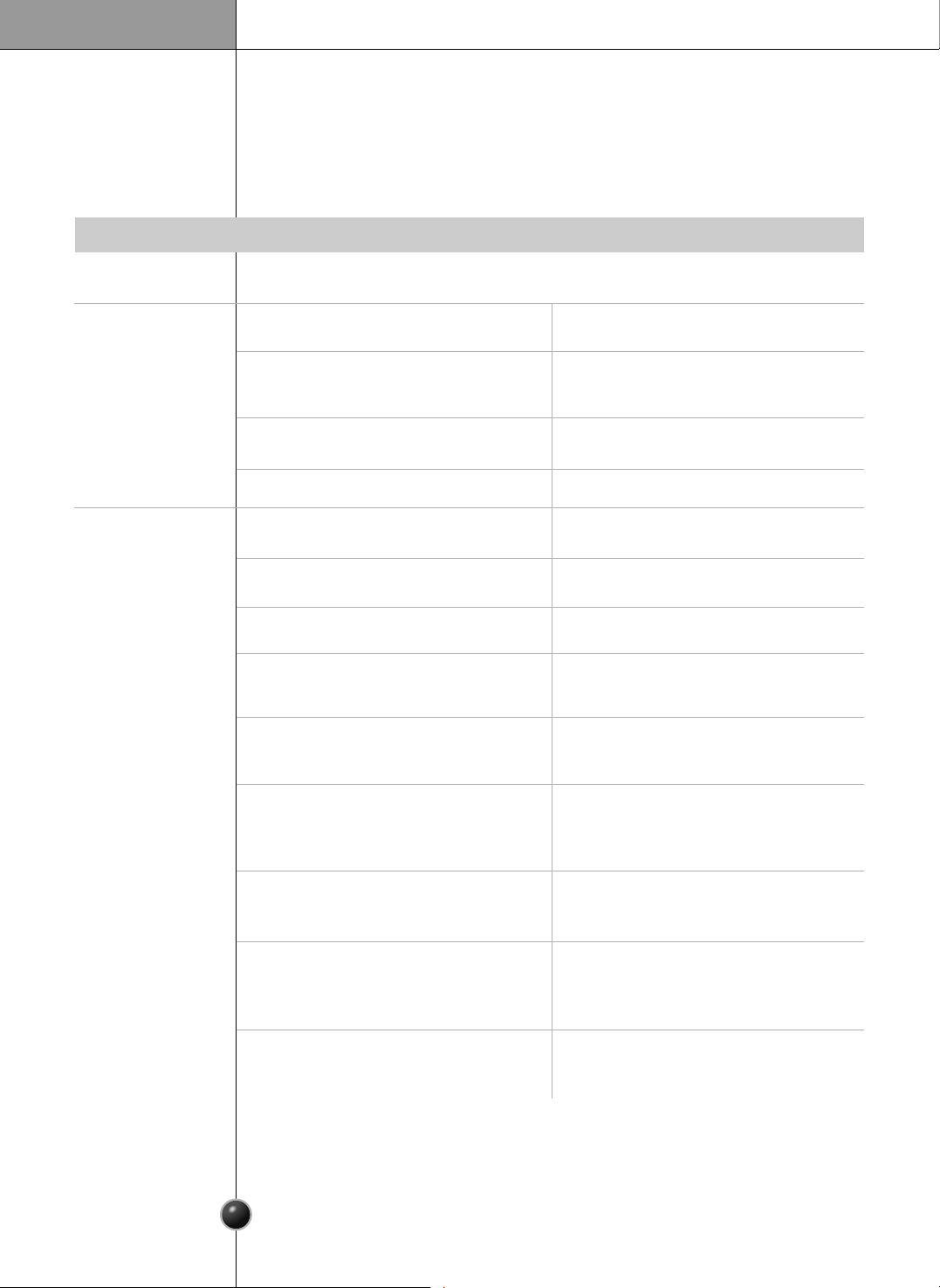
Trouble shooting
Before calling for service, review this list. It may save you both time and expense.
This list includes common occurrences that are not the result of defective
workmanship or materials in this appliance.
Possible cause
Refrigerator control is off.
Refrigerator is in defrost cycle.
Plug at wall outlet is disconnected.
Power outage. Check house lights.
Refrigerator is larger than the previous
one you owned.
Room or outside weather is hot.
Refrigerator has recently been
disconnected for a period of time.
Large amounts of warm or hot food
may have been stored recently.
Doors are opened too frequently or too
long.
Refrigerator or freezer door may be
slightly open.
Refrigerator control is set too cold.
Refrigerator or freezer gasket is dirty,
worn, cracked, or poorly fitted.
Thermostat is keeping the refrigerator
at a constant temperature.
Solution
Set refrigerator control. See setting the
controls.
This is normal for a fully automatic
defrosting refrigerator. The defrost
cycle occurs periodically.
Make sure plug is tightly pushed into
outlet.
Call local electric company.
This is normal. Larger, more efficient
units run longer in these conditions.
It is normal for the refrigerator to work
longer under these conditions.
It takes some hours for the refrigerator
to cool down completely.
Warm food will cause the refrigerator to
run longer until the desired temperature
is reached.
Warm air entering the refrigerator
causes it to run longer. Open the door
less often.
Make sure the refrigerator is level.
Keep food and containers from
blocking door. See problem section.
OPENING/CLOSING of doors.
Set the refrigerator control to a
warmer setting until the refrigerator
temperature is satisfactory.
Clean or change gasket. Leaks in the
door seal will cause refrigerator to run
longer in order to maintain desired
temperatures.
This is normal. Refrigerator goes on
and
off to keep the temperature constant.
Runing of
refrigerator
Refrigerator
compressor
does not run.
Refrigerator
runs too much
or too long
Occurrence
34
Care and maintenance
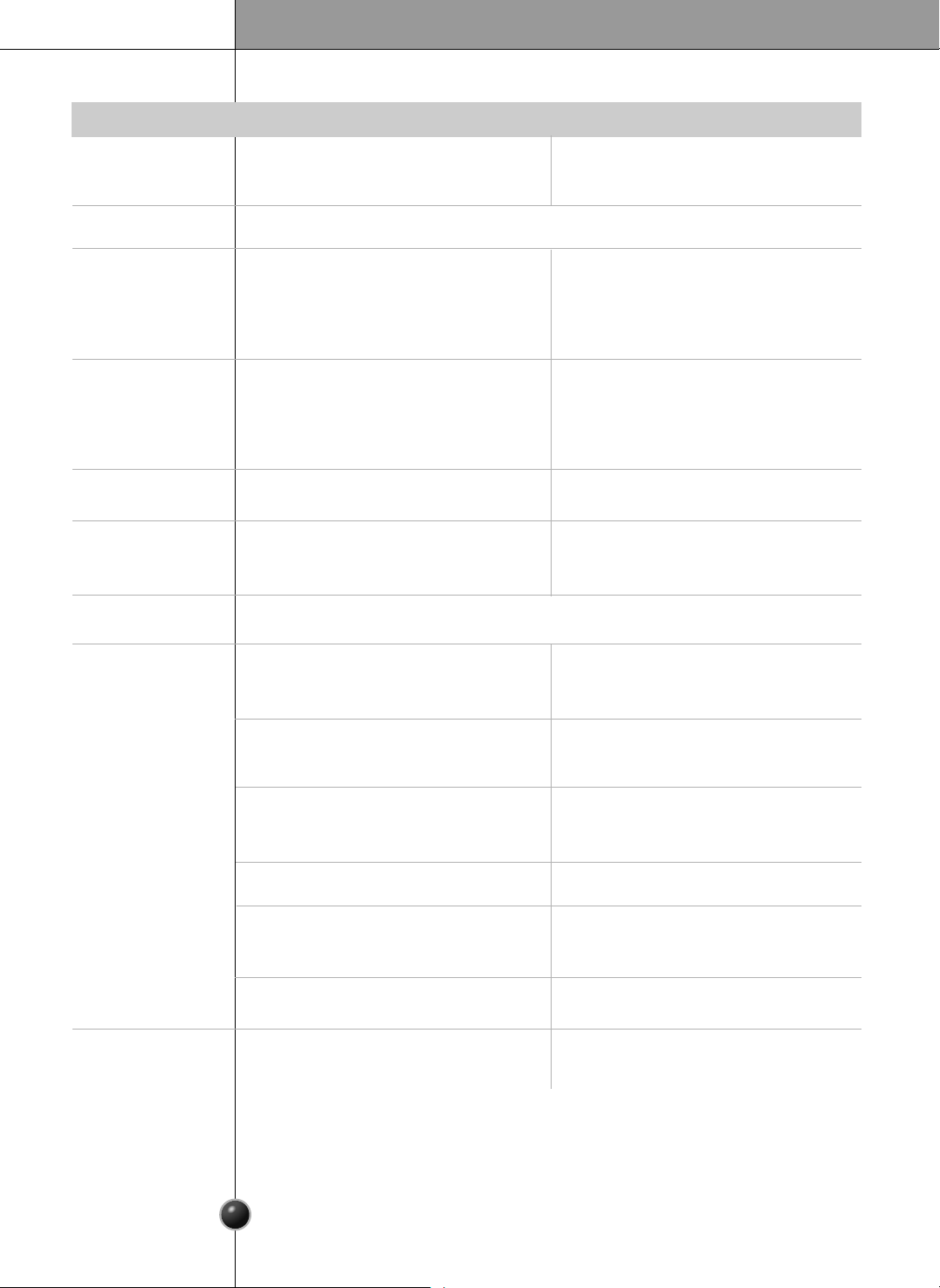
Refrigerator
compressor
does not run.
Occurrence
Temperatures are
too cold
Temperature in the
freezer is too cold
but the refrigerator
temperature is
satisfactory.
Temperature in the
refrigerator
is too warm but
the freezer
temperature is
satisfactory.
Temperatures in
the refrigerator
or freezer are
too warm.
Temperatures
are too warm
Meat stored in
fresh meat
drawer freezes.
Food stored in
drawers freezes.
Possible cause
Thermostat is keeping the refrigerator
at a constant temperature.
Freezer control is set too cold
Doors are opened too frequently or too
long.
Door is slightly open.
Large amounts of warm or hot food
may have been stored recently.
Refrigerator has recently been
disconnected for a period of time.
Refrigerator control is set too warm.
Refrigerator control is set too warm.
Refrigerator control has some effect on
freezer temperature.
Freezer control is set too warm.
Refrigerator control is set too cold.
Refrigerator control is set too cold.
Meat should be stored at a temperature
just below the freezing point of water
(32˚F,
0˚C) for maximum fresh storage time.
Solution
This is normal. The refrigerator goes on
and off to keep the temperature constant.
Set the refrigerator control to a colder
setting.
A refrigerator requires some hours to
cool down completely.
Wait until the refrigerator or freezer
has a chance to reach its selected
temperature.
Warm air enters the refrigerator/ freezer
whenever the door is opened.
Open the door less often.
Set the freezer or refrigerator control to a
colder setting until the freezer or
refrigerator temperature is satisfactory.
Set the freezer or refrigerator control to
a colder setting until the freezer or
refrigerator temperature is satisfactory.
It is normal for ice crystals to form due
to the moisture content of meat.
Set the refrigerator control to a
warmer setting
See above solution.
Set the freezer control to a warmer
setting until the freezer temperature is
satisfactory.
Close the door completely.
Temperature in the
refrigerator is too
cold and the
freezer
temperature
is satisfactory.
35
Care and maintenance
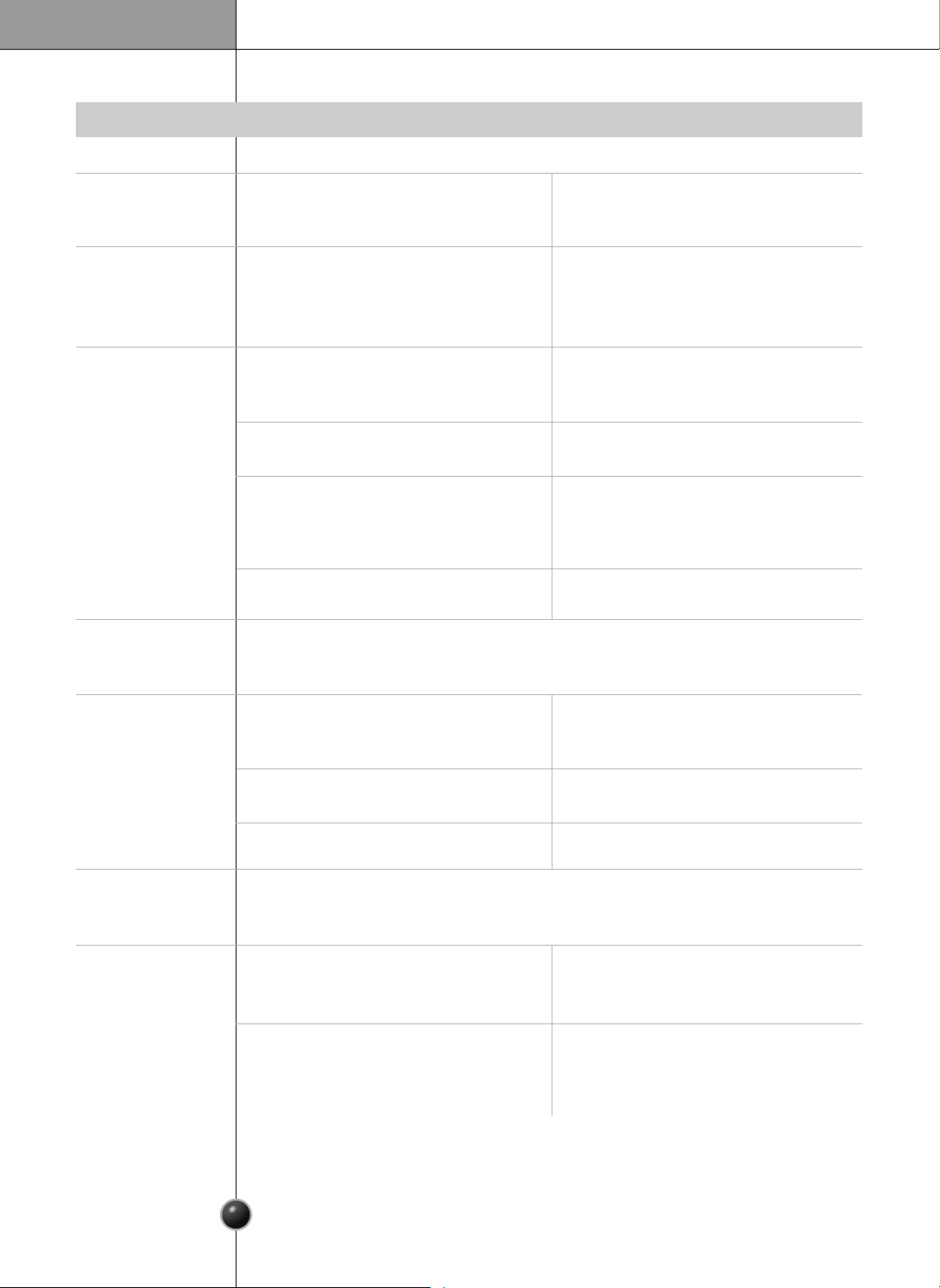
Sound and noise
Occurrence
Louder sound
levels when
refrigerator is on.
Louder sound
levels when
compressor
comes on.
Moisture collects
on the inside walls
of the refrigerator.
Water/Moisture
/Ice outside
refrigerator
Moisture forms
on the outside of
the refrigerator
or between doors.
Vibrating or
rattling noise.
Water/Moisture
/Ice inside
refrigerator
Possible cause
Today’s refrigerators have increased
storage capacity and maintain more
even temperatures.
Refrigerator is touching wall or cabinets.
The weather is hot and humid which
increases the rate of frost buildup
and internal sweating.
Door is slightly open.
Door is opened too often or too long.
Weather is humid.
Door is slightly open,causing cold air
from the inside the refrigerator to meet
warm air from the outside.
Floor is uneven or weak.
Refrigerator rocks on the floor when it is
moved slightly.
Refrigerator operates at higher pressures
during the start of the ON cycle.
Items placed on the top of the refrigerator
are vibrating.
Dishes are vibrating on the shelves in
the refrigerator.
Solution
This time, close the door completely.
This is normal in humid weather.
When humidity is lower, the moisture
should disappear.
See problem section opening/closing of
doors.
Move refrigerator so that it does not
touch the wall or refrigerator.
This is normal.
It is normal for dishes to vibrate slightly.
Move dishes slightly.
Make sure refrigerator is level and firmly
set on floor.
Be sure floor is level and solid and can
adequately support refrigerator.
Remove items.
It is normal for sound levels to be higher.
This is normal. The sound will level off as
the refrigerator continues to run.
Open the door less often.
36
Care and maintenance
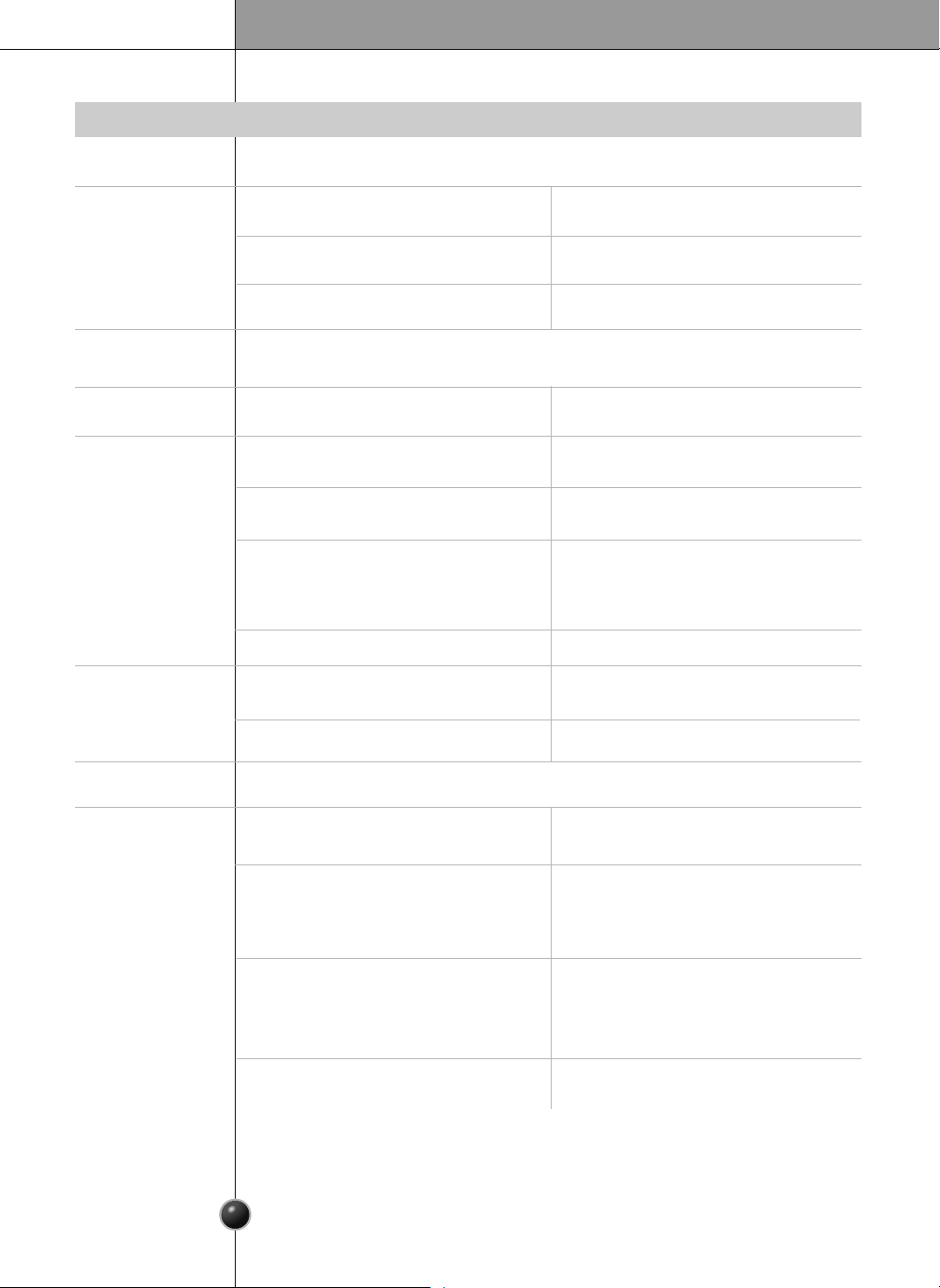
Odors in refrigerator
Occurrence
Door(s) will not
close.
Door(s) will not
close.
Drawers are
difficult to move.
Dispenser
Dispenser will not
dispense ice
Opening/Closing of
doors/Drawers
Possible cause
Food is touching shelf on top of the
drawer
Track that drawer slides on is dirty.
Ice storage bin is empty.
Freezer temperature is set too warm.
Household water line valve is not open.
Refrigerator or freezer door is not
closed.
Refrigerator is not level. It rocks on the
floor when it is moved slightly.
Floor is uneven or weak.
Refrigerator rocks on the floor when it
is moved slightly.
Refrigerator is touching wall or cabinets.
Interior needs to be cleaned.
Food with strong odor is in the refrigerator.
Some containers and wrapping materials
produce odors.
Food package is keeping door open.
Door was closed too hard, causing other
door to open slightly.
Solution
Be sure both doors are closed.
Open household water line valve and
allow sufficient time for ice to be made.
When ice is made, dispenser should
operate.
Turn the freezer control to a higher
setting so that ice cubes will be made.
When the first supply of ice is made,
the dispenser should operate.
Clean drawer and track.
Be sure floor is level and can adequately
support refrigerator.
Contact carpenter to correct sagging or
sloping floor.
Move refrigerator.
.
Keep less food in drawer.
Adjust the height adjusting screw.
Use a different container or brand of
wrapping
materials
.
Move packages that keep door from
closing.
Close both doors gently.
Cover food completely.
Clean interior with sponge,warm water
and baking soda.
When the first supply of ice is dropped
into the bin, the dispenser should operate.
Care and maintenance
37
Dispenser will
not
dispense
ice.
Ice dispenser
is jammed.
Occurrence
Water has an
odd taste
and/or odor.
Dispenser will
not dispense
water.
Possible cause
Water has been in the tank for too long.
Unit not properly connected to cold
water line.
This sound is normally made when automatically made ice is dropped into ice storage
bin. Volume may vary according to refrigerator’s location.
This sound is normally made when ice maker is supplied with water after dropping
the automatically made ice.
Please thoroughly read ‘Automatic ice maker and dispenser’ in this manual.
Ice cubes are frozen together.
Ice has melted and frozen around auger
due to infrequent use, temperature
fluctuations and/or power outrages.
Ice cubes are jammed between the ice
maker arm and back of the bin.
Ice cubes that have been purchased or
made in some other way have been
used in the dispenser.
Household water line valve is not open.
See problem “Ice maker is not making
any ice.”
Refrigerator or freezer door is not closed.
Solution
Be sure both doors are closed.
Draw and discard 7 glasses of water
to freshen the supply. Draw and discard
an additional 7 glasses to completely rinse
out tank.
Connect unit to cold water line which
supplies water to kitchen faucet.
Open household water line valve.
Use the dispenser often so that cubes do
not freeze together.
Only the ice cubes made by the ice maker
should be used with the dispenser.
Remove the ice cubes that are jamming
the dispenser.
Remove ice storage bin, and thaw and
the contents. Clean bin, wipe dry and
replace in proper position.
When new ice is made, dispenser should
operate.
Sound of ice
dropping
Sound of water
supply
Other
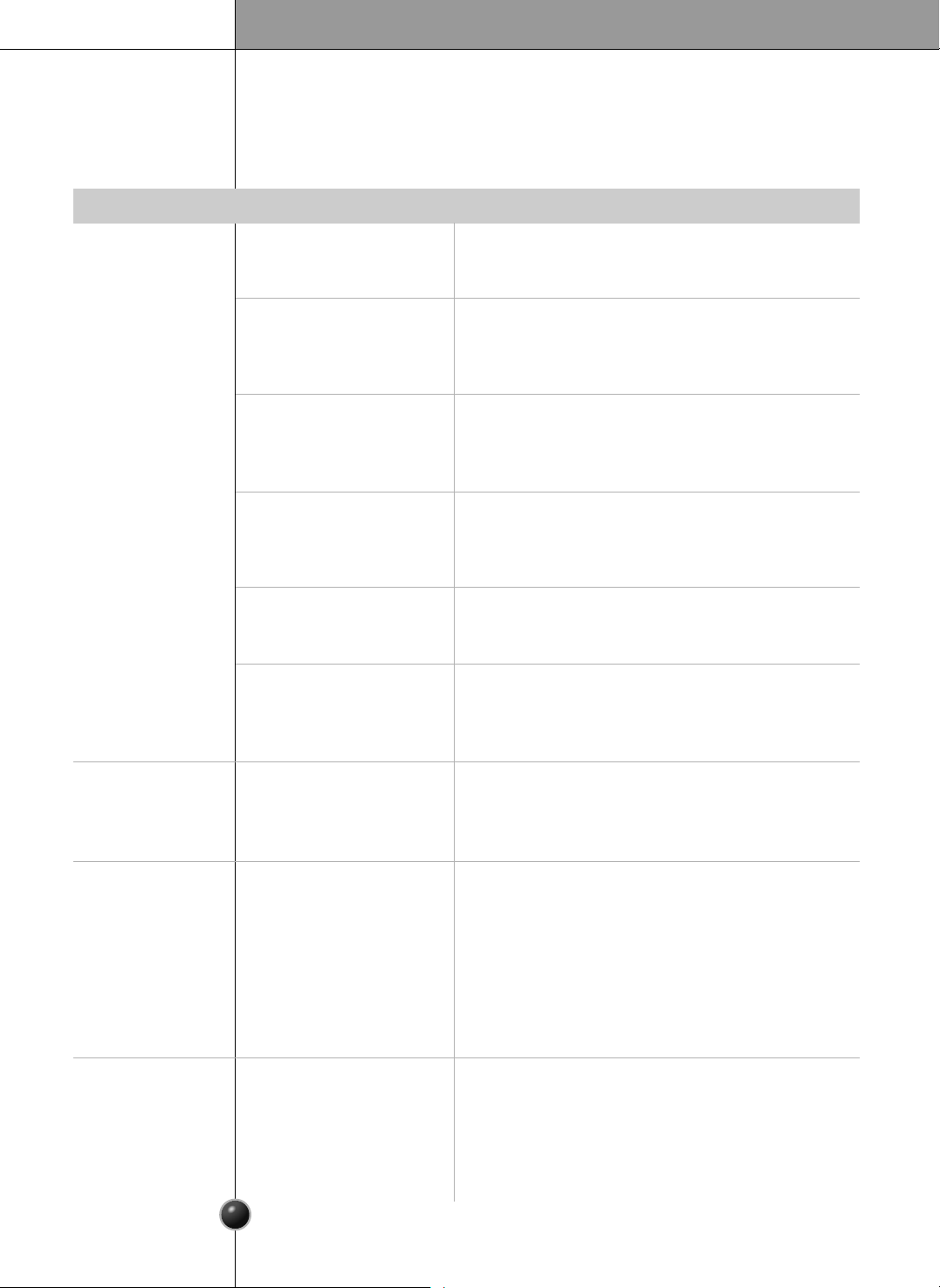
DISPOSAL OF YOUR OLD APPLIANCE
1. When this crossed-out wheeled bin symbol is attached to a
product it means the product is covered by the European Directive
2002/96/EC.
2.
All electrical and electronic products should be disposed of separately
from the municipal waste stream via designated collection facilities
appointed by the government or the local authorities.
3. The correct disposal of your old appliance will help prevent potential
negative consequences for the environment and human health.
4. For more detailed information about disposal of your old appliance,
please contact your city office, waste disposal service or the shop
where you purchased the product.
38
Care and maintenance
It is Normal...
The following occurrences are normal.
Noise
Occurrence
When you hear "Tak" or
"Took" sound
When you hear
"Deureureuk~", "Dulkuk" or
"Woong" sound
When you hear "Kureureuk"
sound of water flowing
When you hear the sound of
wind such as "Shoo~" or
"Shik" right after you close
the door
When you hear the
vibrating sound
When you hear a loud
sound after installing the
product for the first time
Solution
This is the sound of various parts expanding/contracting
or various control devices operating depending on the
temperature change within the refrigerator.
This is the count of compressor or fan operating when
the operation of the refrigerator is starting or ending. This
is the same phenomenon of the sound generated when
starting or turning off the engine of a car.
This is the sound of refrigerant changing the condition in
the freezer/fridge. When the liquid changes to gas, you
will hear the sound of water flowing and when gas
changes to liquid, you will hear the "Kureureuk" sound.
This is the sound generated when the internal pressure is
temporarily lowered when the warm air entered through
the fridge or freezer is cooled fast.
If the refrigerator is installed on wooden floor or wooden
wall, or if the refrigerator is not leveled properly, the
sound can be loud from the vibration.
When you operate the refrigerator for the first time, the
refrigerator will operate at high speed to cool fast and the
sound can seem louder. When the internal temperature
falls below a certain level, the noise will subside.
Door open
When the door is slightly
opened after closing the
door
Depending on the fore or speed of closing the fridge or
freezer door, the door can open slightly and then get
closed.
Be careful not to close the door to hard.
When external air flows into the cool inner surface of the
refrigerator, icing/dew drops can be formed.
Especially, this will happen more easily when you open
and close the refrigerator door more frequently.
Also if the humidity of the installed location is high or
during the rainy season or on a rainy day, dew drops can
form on the outer side of the refrigerator. This is a
natural phenomenon that occurs during the humid
weather. Wipe the water drops with a dry cloth.
Heat pipes are installed around the front part of the
refrigerator and on the divider of the freezer and fridge to
prevent the dew drops from forming. The refrigerator
may feel warmer after the installation or during the hot
summer, but this is not a problem and you can be rest
assured.
Icing/
Dew drops
When there is icing or
dew drops formed on the
inner or outer side of the
refrigerator
Temperature
When the front side of the
refrigerator is warm
P/NO : MFL59475213 Printed in Korea
LG Twin Tower, 20, Yoido-Dong,
Youngdungpo-Gu, Seoul, 150-721, Korea.
http://www.lge.com