© 2007 Sony Corporation 3-281-190-11(1)
Digital Still Camera
Cyber-shot Handbook
DSC-S730
Before operating the unit, please read this
Handbook thoroughly together with the
“Instruction Manual” and the “Cyber-shot
Step-up Guide”, and retain them for future
reference.
Table of contents
Basic Operations
Using the menu
Using the Setup screen
Viewing images on a TV
Using your computer
Printing still images
Troubleshooting
Others
Index
VCLICK!
GB
2
Notes on using your camera
Notes on the types of “Memory Stick”
that you can use (not supplied)
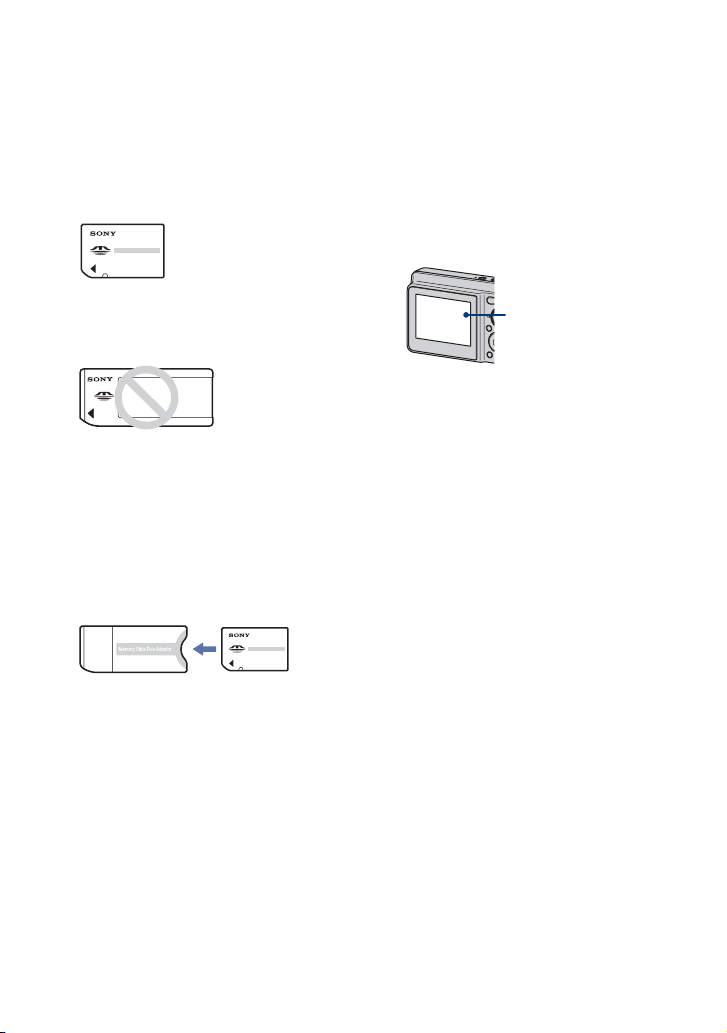
“Memory Stick Duo”
You can use a “Memory Stick Duo” with
the camera.
“Memory Stick”
You cannot use a “Memory Stick” with the
camera.
Other memory cards cannot be used.
• For details on “Memory Stick Duo”, see
page 95.
When using a “Memory Stick Duo” with
“Memory Stick” compatible equipment
You can use the “Memory Stick Duo” by
inserting it into the Memory Stick Duo
Adaptor (not supplied).
Memory Stick Duo Adaptor
Notes on the LCD screen and lens
• The LCD screen is manufactured using
extremely high-precision technology, so over
99.99% of the pixels are operational for
effective use. However, some tiny black and/or
bright dots (white, red, blue or green) may
appear on the LCD screen. These dots are a
normal result of the manufacturing process, and
do not affect the recording.
• Exposing the LCD screen or the lens to direct
sunlight for long periods may cause
malfunctions. Be careful when placing the
camera near a window or outdoors.
• Do not press against the LCD screen. The screen
may be discolored and that may cause a
malfunction.
• Images may trail across on the LCD screen in a
cold location. This is not a malfunction.
• This camera is equipped with a power zoom
lens. Be careful not to bump the lens, and be
careful not to apply force to it.
The images used in this Handbook
The images used as examples in this Handbook
are reproduced images, and are not actual images
shot using the camera.
Black, white, red, blue
or green points

3
Table of contents
Notes on using your camera .....................................................................2
Basic techniques for better images ...........................................................6
Focus – Focusing on a subject successfully..................................................... 6
Exposure – Adjusting the light intensity ............................................................ 8
Color – On the effects of lighting....................................................................... 9
Quality – On “image quality” and “image size” ............................................... 10
Flash – On using the flash ............................................................................... 11
Identifying parts.......................................................................................12
Indicators on the screen..........................................................................14
Changing the screen display ...................................................................18
Using the internal memory ......................................................................19
Using the mode dial.................................................................................20
Shooting images easily (Auto adjustment mode) ....................................21
Shooting still images (Scene selection)...................................................25
Viewing/deleting images..........................................................................28
Using menu items ..............................................................................30
Menu items ..........................................................................................31
Shooting menu ........................................................................................32
COLOR (Color Mode): Changing the vividness of the image or adding special effects
(EV): Adjusting the light intensity
9 (Focus): Changing the focus method
(Metering Mode): Selecting the metering mode
WB (White Bal): Adjusting the color tones
ISO: Selecting a luminous sensitivity
Mode (REC Mode): Selecting the continuous shooting method
(Flash Level): Adjusting the amount of flash light
(Sharpness): Adjusting the sharpness of the image
(Setup): Changing Setup items
Basic Operations
Using the menu

4
Table of contents
Viewing menu ......................................................................................... 41
(Folder): Selecting the folder for viewing images
- (Protect): Preventing accidental erasure
DPOF: Adding a Print order mark
(Print): Printing images using a printer
(Slide): Playing back a series of images
(Resize): Changing the image size of a recorded image
(Rotate): Rotating a still image
(Setup): Changing Setup items
Trimming: Recording an enlarged image
Using Setup items..............................................................................48
Camera.............................................................................................. 49
Internal Memory Tool......................................................................... 51
Format
Memory Stick Tool............................................................................. 52
Setup1................................................................................................ 55
Setup2................................................................................................ 56
Viewing images on a TV ......................................................................... 58
Using the Setup screen
Viewing images on a TV
Digital Zoom
Function Guide
Red Eye Reduction
Auto Review
Format
Create REC. Folder
Change REC. Folder
Copy
1
Beep
Language
Initialize
2
USB Connect
Video Out
Clock Set

5
Table of contents
Enjoying your Windows computer ...........................................................60
Installing the software (supplied).............................................................62
On the “Picture Motion Browser” (supplied) ............................................64
Copying images to your computer using the “Picture Motion Browser”...65
Copying images to a computer without “Picture Motion Browser”...........69
Viewing image files stored on a computer with the camera copying to the
“Memory Stick Duo” ................................................................................71
Using your Macintosh computer..............................................................72
Viewing “Cyber-shot Step-up Guide”.......................................................74
How to print still images ..........................................................................75
Printing images directly using a PictBridge compliant printer .................76
Printing at a shop ....................................................................................80
Troubleshooting .......................................................................................82
Warning messages..................................................................................92
Using the camera abroad — Power sources...........................................94
On the “Memory Stick Duo”.....................................................................95
On the batteries.......................................................................................97
Index........................................................................................................98
Using your computer
Printing still images
Troubleshooting
Others
Index
6
Basic techniques for better images
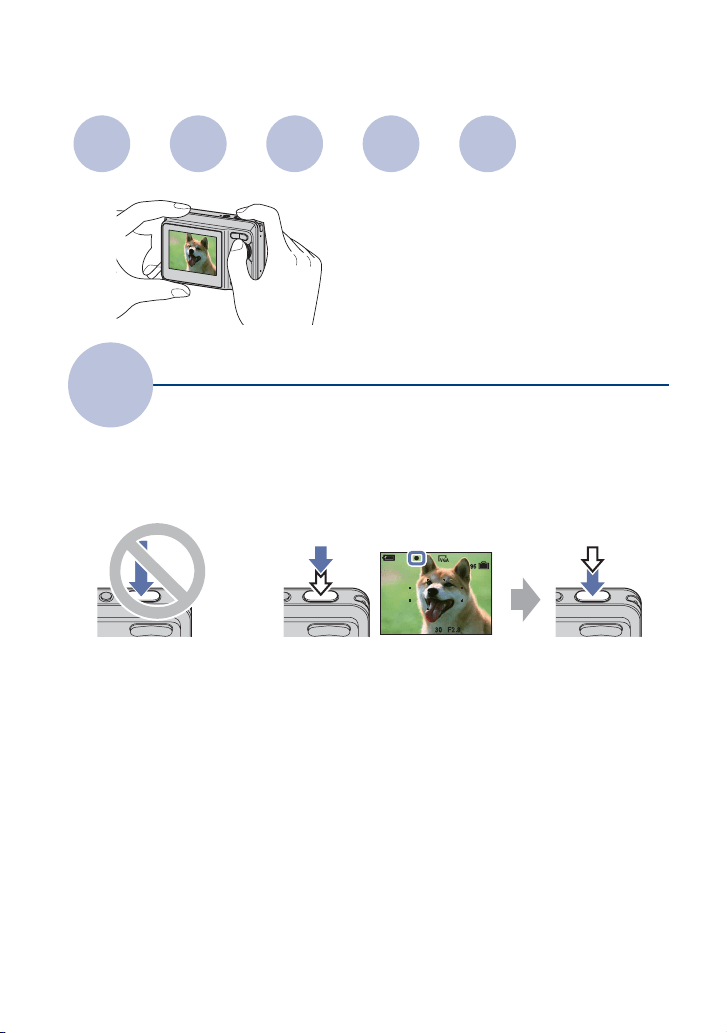
When you press the shutter button halfway down, the camera adjusts the focus automatically
(Auto Focus). Remember to press the shutter button only halfway down.
When focusing is difficult
t [Focus] (page 34)
If the image looks blurred even after focusing, it may be because of camera shake.
t See
“Hints for preventing blur” as follows.
Focus
Focusing on a subject successfully
Do not fully press
the shutter button
straight away.
Focus Exposure Color Quality
This section describes the basics so you can
enjoy your camera. It tells you how to use
various camera functions such as the mode
dial (page 20), and the menus (page 30).
Flash
Press the shutter
button halfway
down.
AE/AF lock indicator
flashing , lit/beeps
Then press the
shutter button fully
down.
7
Basic techniques for better images
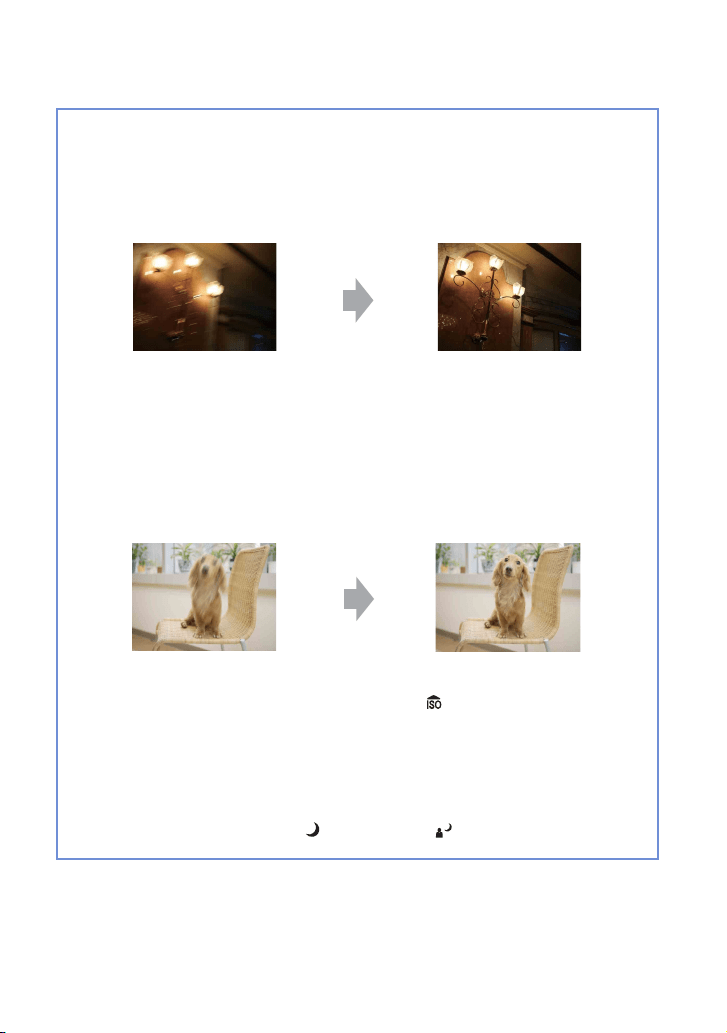
Hints for preventing blur
The camera moved accidentally when you took the image. This is called “Camera
shake.” On the other hand, if the subject moved when you took the image, it is called
“subject blur.”
Camera shake
Cause
Your hands or body shake while you hold the
camera and press the shutter button, and the
entire screen is blurred.
What you can do to reduce the blurring
• Use a tripod or place the camera on a flat
surface to hold the camera steady.
• Shoot with a 2-second delay self-timer and
stabilize the camera by holding your arms
firmly at your side after pressing the shutter
button.
Subject blur
Cause
Even though the camera is steady, the subject
moves during the exposure so the subject
looks blurred when the shutter button is
pressed.
What you can do to reduce the blurring
• Select (High Sensitivity mode) in Scene
Selection.
• Select a higher ISO sensitivity to make the
shutter speed faster, and press the shutter
button before the subject moves.
Notes
Besides, camera shake and subject blur occur frequently under low-light or slow shutter speed
conditions, such as those encountered in (Twilight mode) or (Twilight Portrait mode). In that
case, shoot with the above tips in mind.
8
Basic techniques for better images
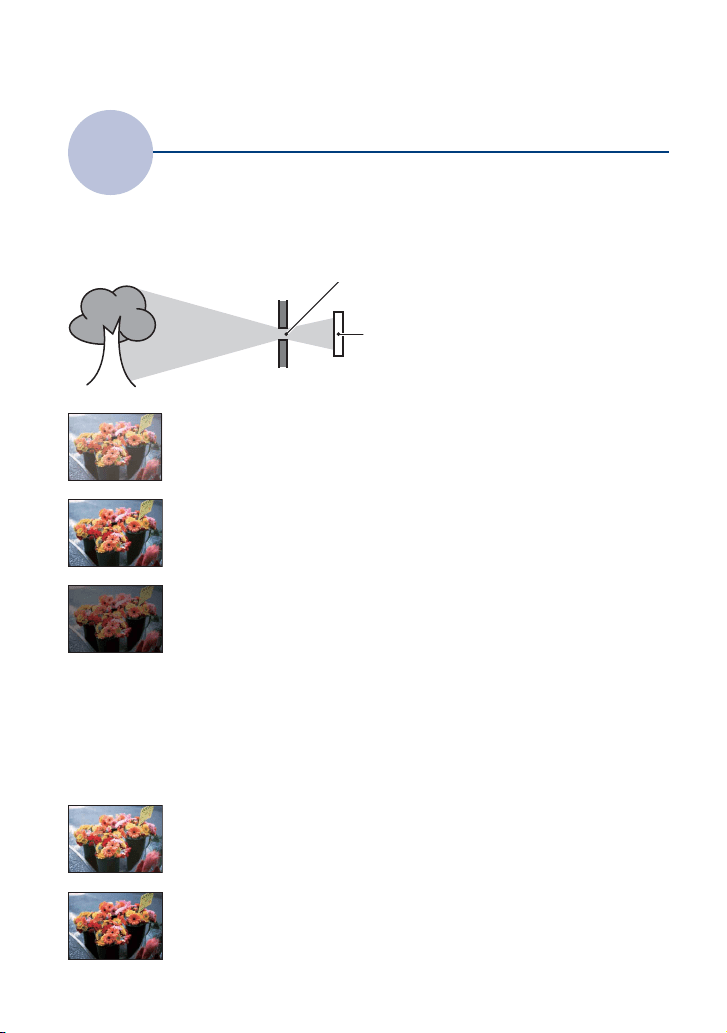
You can create various images by adjusting the exposure and the ISO sensitivity. Exposure is
the amount of light that the camera will receive when you release the shutter.
Adjusting the ISO sensitivity (Recommended Exposure Index)
ISO sensitivity is a speed rating for recording media that incorporates an image sensor that
receives light. Even when the exposure is the same, images differ depending on the ISO
sensitivity.
To adjust the ISO sensitivity, see page 38.
Exposure
Adjusting the light intensity
Overexposure
= too much light
Whitish image
The exposure is automatically set to the
proper value in the auto adjustment mode.
However, you can adjust it manually using
the functions below.
Adjusting EV:
Allows you to adjust the exposure
determined by the camera (page 33).
Metering Mode:
Allows you to change the part of the
subject to be measured to determine the
exposure (page 36).
Correct exposure
Underexposure
= too little light
Darker image
High ISO sensitivity
Records a bright image even in dark locations while increasing shutter speed to
reduce blur.
However, the image tends to become noisy.
Low ISO sensitivity
Records a smoother image.
However, when the exposure is insufficient, the image may become darker.
Shutter speed = Length of time the camera receives
light
Aperture = Size of the opening allowing light to pass
through
ISO sensitivity (Recommended Exposure
Index) =
Recording sensitivity
Exposure:
9
Basic techniques for better images
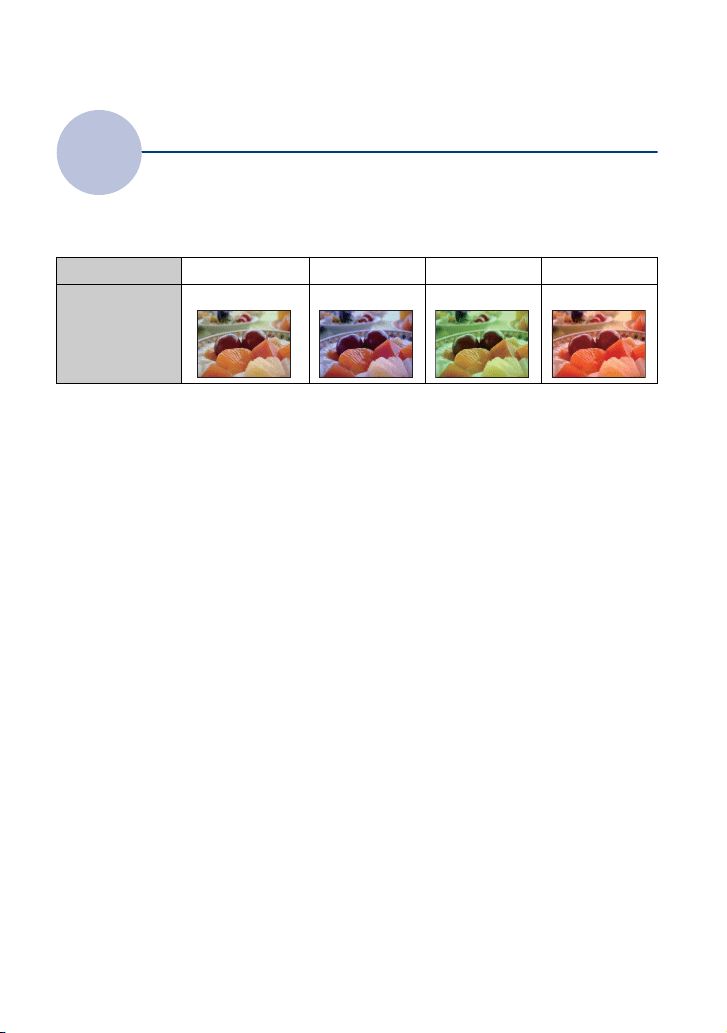
The apparent color of the subject is affected by the lighting conditions.
Example: The color of an image affected by light sources
The color tones are adjusted automatically in the auto adjustment mode.
However, you can adjust color tones manually with [White Bal] (page 37).
Color
On the effects of lighting
Weather/lighting
Daylight Cloudy Fluorescent Incandescent
Characteristics of
light
White (standard) Bluish Green-tinged Reddish
10
Basic techniques for better images
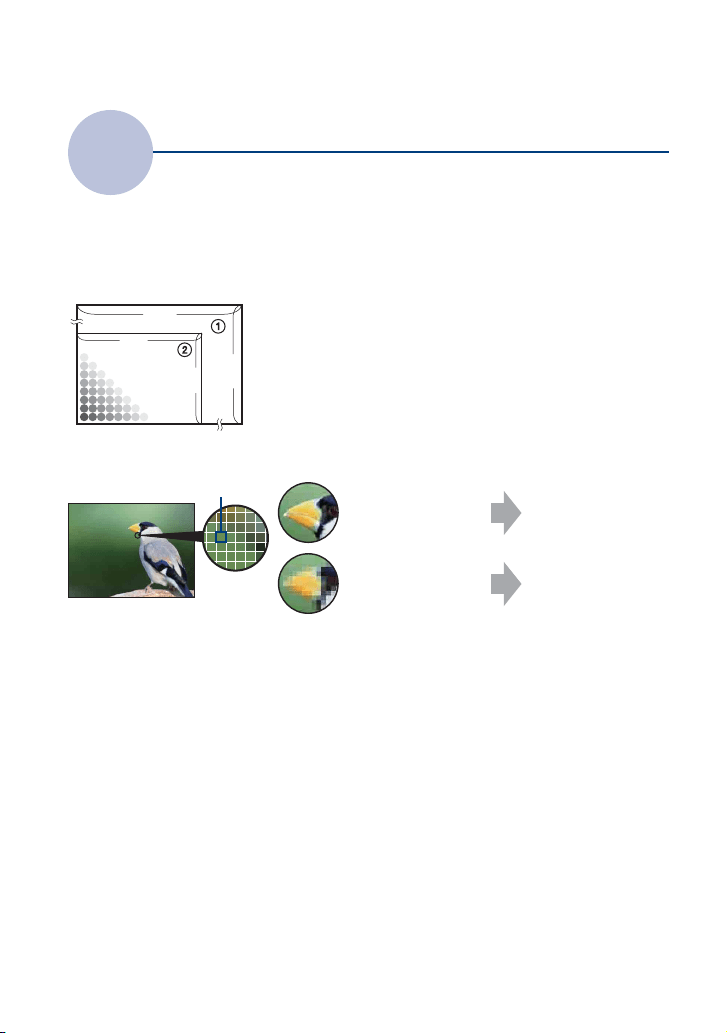
A digital image is made up of a collection of small dots called pixels.
If it contains a large number of pixels, the picture becomes large, it takes up more memory,
and the image is displayed in fine detail. “Image size” is shown by the number of pixels.
Although you cannot see the differences on the screen of the camera, the fine detail and data
processing time differ when the image is printed or displayed on a computer screen.
Description of the pixels and the image size
Selecting the image size for use (page 24)
Quality
On “image quality” and “image size”
1 Image size: 7M
3072 pixels × 2304 pixels = 7,077,888 pixels
2 Image size: VGA(E-Mail)
640 pixels × 480 pixels = 307,200 pixels
Pixel
Many pixels (Fine
image quality and
large file size)
Example: Printing in
up to A3 size
Few pixels (Rough
image quality but
small file size)
Example: An attached
image to be sent by e-
mail
3072
2304
480
640
Pixels
11
Basic techniques for better images
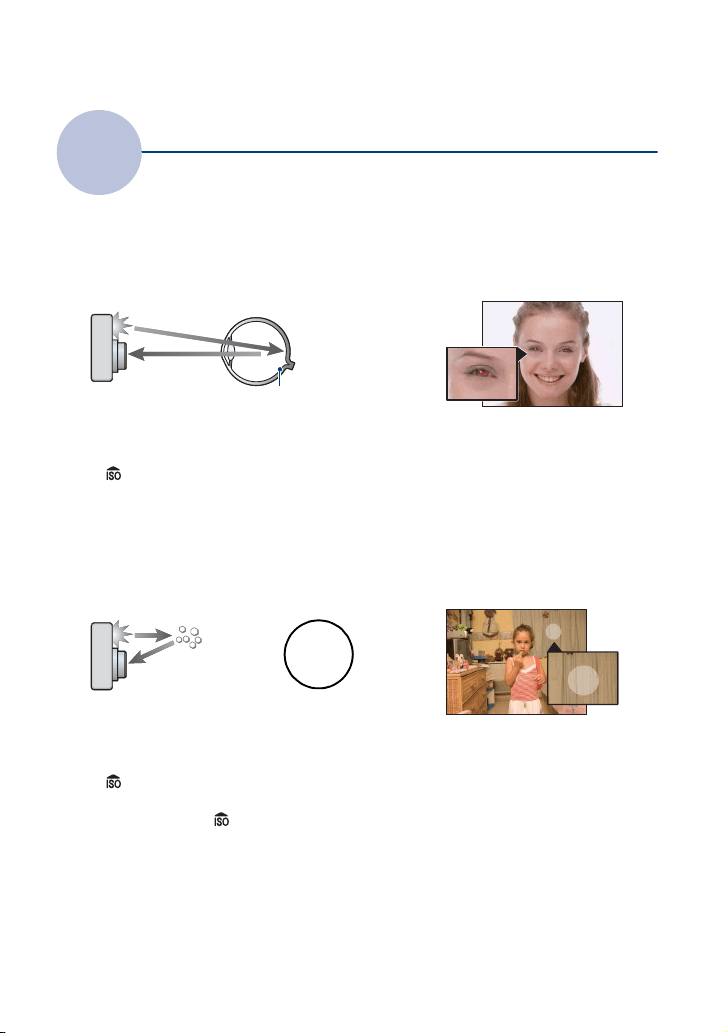
The eyes of the subject may come out red, or fuzzy white circular spots may appear when
using the flash. These phenomena can be reduced by taking the following steps.
The “Red-eye phenomenon”
Pupils become dilated in dark environments. Flash light is reflected off the blood vessels at the
back of the eye (retina), causing the “red-eye” phenomenon.
How can the “Red-eye phenomenon” be reduced?
• Set [Red Eye Reduction] to [On] (page 50).
• Select (High Sensitivity mode)* in Scene Selection (page 26). (The flash is turned off automatically.)
• When the eyes of the subject turn out red, correct the image with the supplied software “Picture Motion
Browser”.
“White circular spots”
This is caused by particles (dust, pollen, etc.) floating close to the lens. When they are
accentuated by the camera’s flash, they appear as white circular spots.
How can the “White circular spots” be reduced?
• Light the room and shoot the subject without a flash.
• Select (High Sensitivity mode)* in Scene Selection. (The flash is turned off automatically.)
* Even though you selected (High Sensitivity mode) in Scene Selection, the shutter speed might be
slower under low-light conditions, or in a dark place. In that case, use a tripod or hold your arms firmly at
your side after pressing the shutter button.
Flash
On using the flash
Camera Eye
Retina
Camera
Subject
Particles (dust, pollen,
etc.) in the air
12
Identifying parts
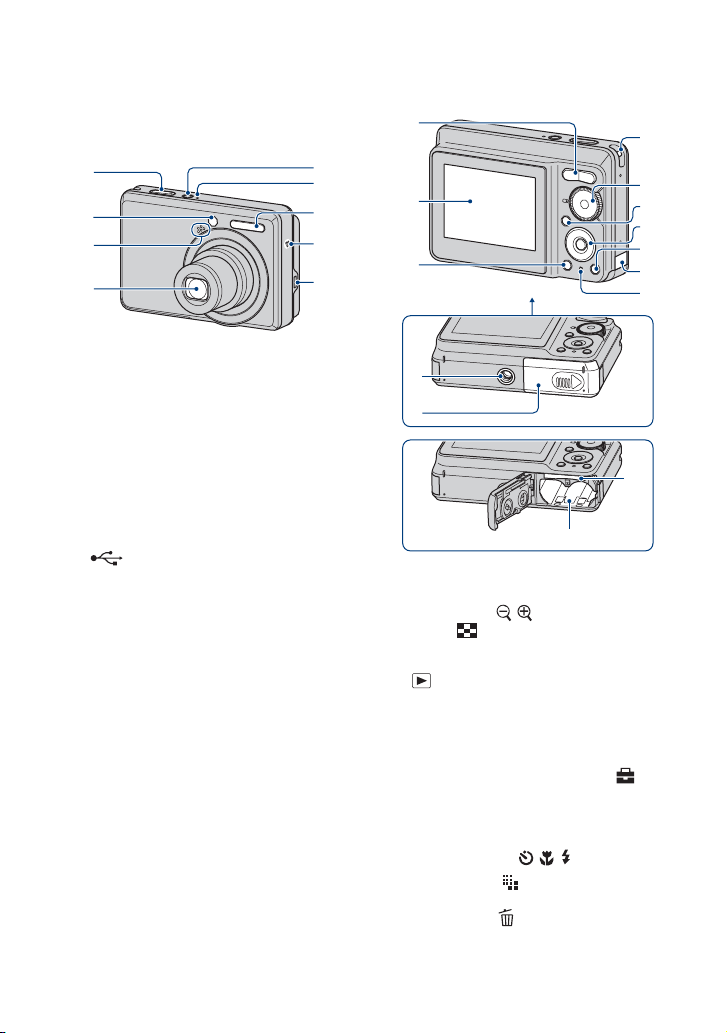
See the pages in parentheses for details of
operation.
A Shutter button (21)
B Self-timer lamp (23)
C Microphone
D Lens
E POWER button
F POWER lamp
G Flash (22)
H Buzzer
I (USB) · A/V OUT terminal (side)
A For shooting: Zoom (W/T) button
(22)
For viewing: / (Playback zoom)
button/ (Index) button (28, 29)
B LCD screen (18)
C (Playback) button (28)
D Hook for strap
E Mode dial (20)
F MENU button (30)
• Press MENU longer to display the
(Setup) screen.
G Control button
Menu on: v/V/b/B/z (30)
Menu off: DISP/ / / (18, 22-23)
H For shooting: (Image Size) button
(24)
For viewing: (Delete) button (28)
1
6
2
7
3
4
5
9
8
0
1
2
3
4
5
6
7
8
9
qa
qs
qf
qd
Bottom
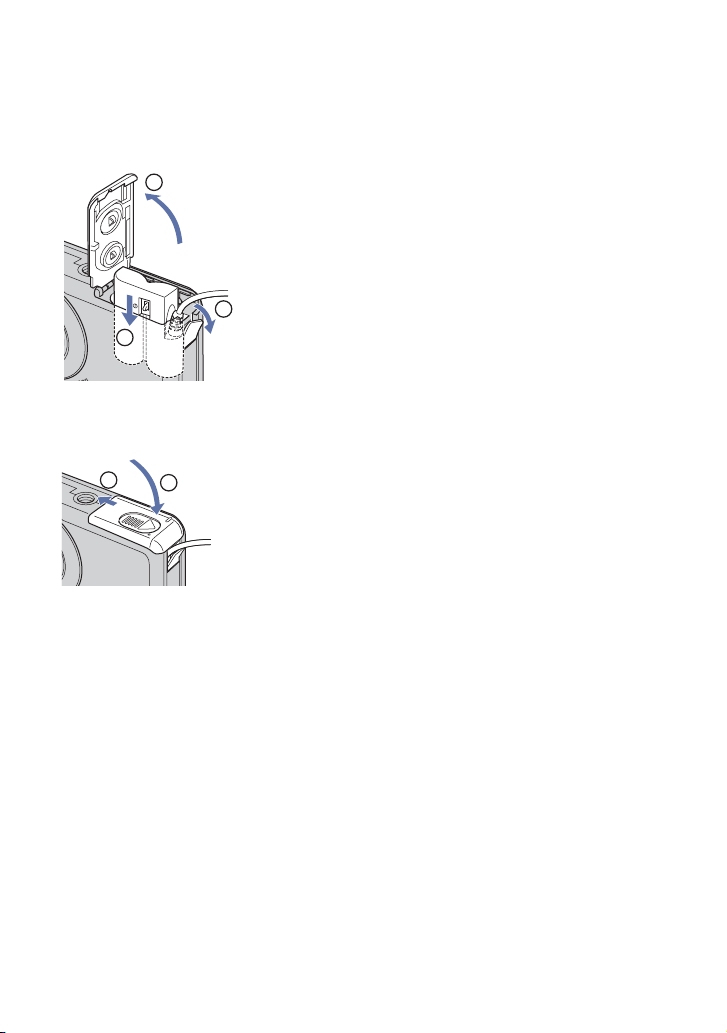
13
Identifying parts
I AC adaptor cord cover
When using an AC-LS5K AC Adaptor
(not supplied)
• Do not pinch the cord when you close the
cover.
• You cannot charge the Nickel-Metal
Hydride batteries by the AC-LS5K AC
Adaptor. Use the battery charger to charge
the Nickel-Metal Hydride batteries.
J Access lamp
K Tripod receptacle
• Use a tripod with a screw less than 5.5 mm
(7/32 inch) long. Otherwise, you cannot
firmly secure the camera, and damage to the
camera may occur.
L Battery/“Memory Stick Duo” cover
M “Memory Stick Duo” slot
N Batteries insertion slot
1
2
3
4
5
14
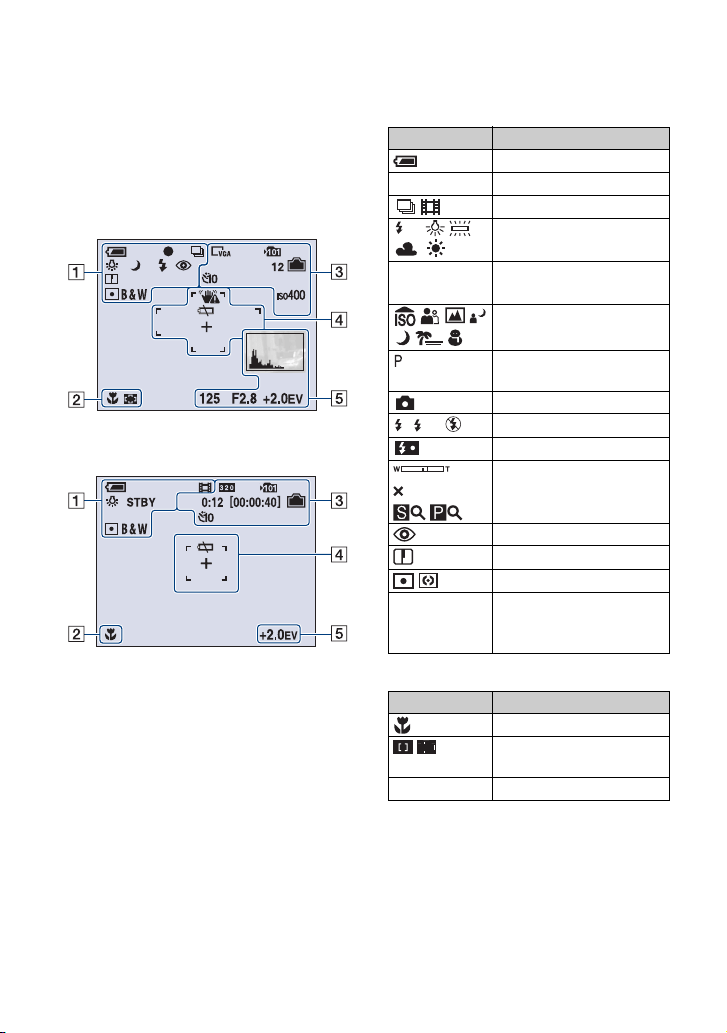
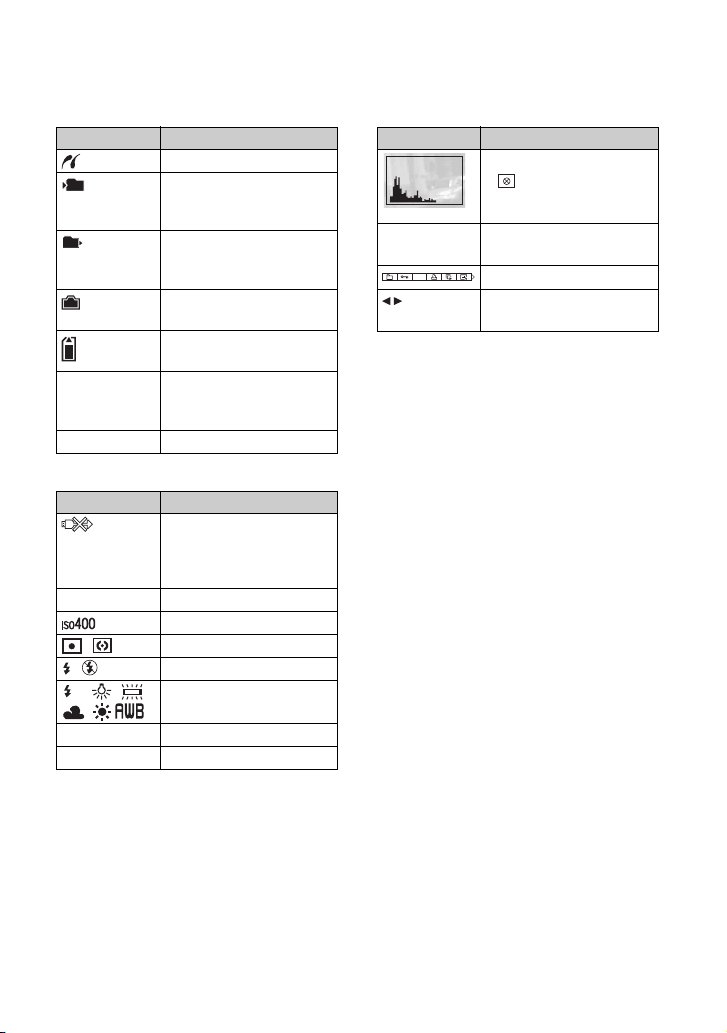
Indicators on the screen
Each time you press v (DISP) on the
control button, the display changes
(page 18).
See the pages in parentheses for details of
operation.
When shooting still images
When shooting movies
A
B
Display Indication
Battery remaining
z AE/AF lock (21)
Recording mode (21, 39)
White balance (37)
STBY
REC
Standby/Recording a movie
Mode dial (Scene
Selection) (25)
Mode dial (Program Auto)
(20)
Camera mode
Flash mode (22)
Flash charging
Zoom scaling (22, 49)
Red-eye reduction (50)
Sharpness (40)
Metering mode (36)
RICH
NATURAL
SEPIA B&W
Color mode (32)
Display Indication
Macro (23)
AF range finder frame
indicator (34)
1.0 m Focus preset distance (34)
WB
SL
1.6
15
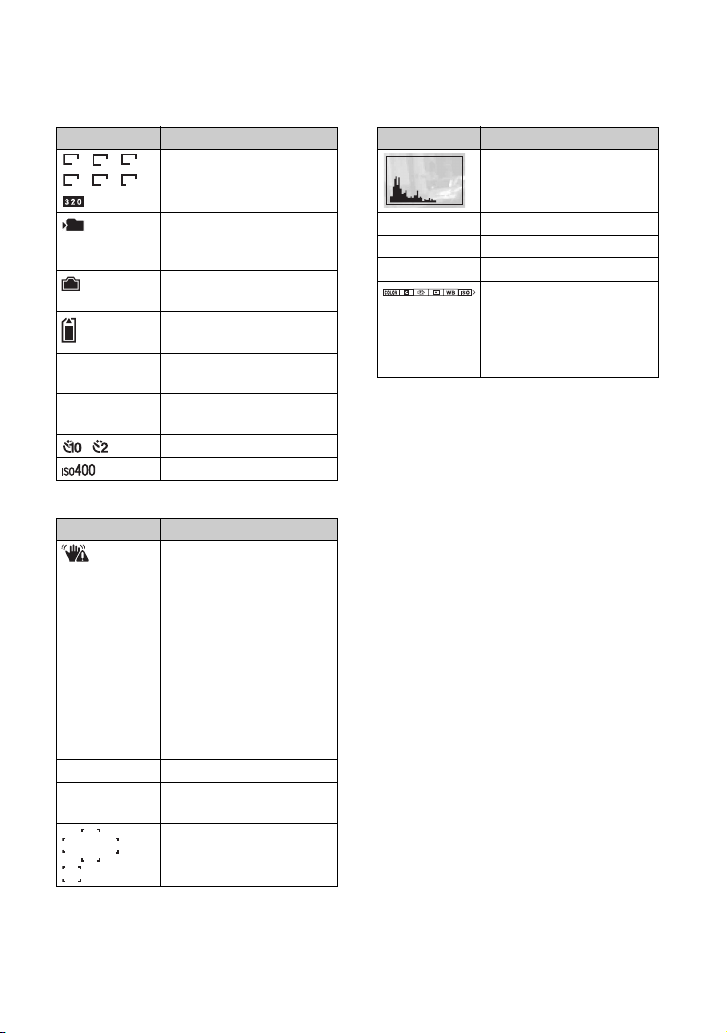
Indicators on the screen
C
D
E
Display Indication
Image size (24)
Recording folder (52)
• This does not appear when
using internal memory.
Remaining internal
memory capacity
Remaining “Memory
Stick” capacity
0:12
[00:00:40]
Recording time [maximum
recordable time]
12 Remaining number of
recordable images
Self-timer (23)
ISO number (38)
Display Indication
Vibration warning
• Indicates vibration may
prevent you from shooting
clear images due to
insufficient lighting. Even if
the vibration warning
appears, you can still shoot
images. However, we
recommend that you use the
flash for better lighting or
using a tripod or other
means to stabilize the
camera (page 7).
E Low battery warning (92)
+ Spot metering cross hairs
(36)
AF range finder frame (34)
3:2
7M 5M
3M
VGA 16:9
101
Display Indication
Histogram (18)
125 Shutter speed
F2.8 Aperture value
+2.0EV Exposure Value (33)
(not displayed
on the screen
on the previous
page)
Menu (30)
16
Indicators on the screen
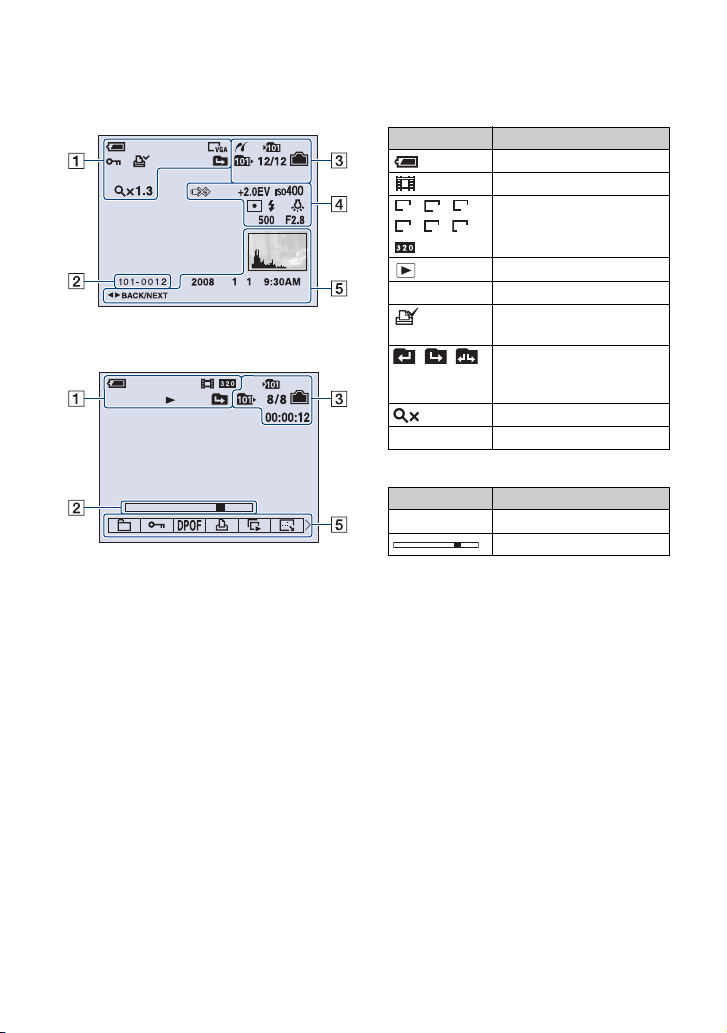
When playing back still images
When playing back movies
A
B
Display Indication
Battery remaining
Recording mode (21)
Image size (24)
Playback mode
- Protect (42)
Print order (DPOF) mark
(80)
Changing folder (41)
• This does not appear when
using internal memory.
Zoom scaling (28)
N Playback (28)
Display Indication
101-0012 Folder-file number (41)
Playback bar
3:2
7M 5M
3M
VGA 16:9
1.3
17
Indicators on the screen
C
D
E
Display Indication
PictBridge connecting (77)
Recording folder (52)
• This does not appear when
using internal memory.
Playback folder (41)
• This does not appear when
using internal memory.
Remaining internal
memory capacity
Remaining “Memory
Stick” capacity
8/8 12/12 Image number/Number of
images recorded in selected
folder
00:00:12 Counter
Display Indication
PictBridge connecting (78)
• Do not disconnect the
dedicated USB cable while
the icon is displayed.
+2.0EV Exposure Value (33)
ISO number (38)
Metering mode (36)
Flash
White balance (37)
500 Shutter speed
F2.8 Aperture value
101
101
WB
Display Indication
Histogram (18)
• appears when
histogram display is
disabled.
2008 1 1
9:30 AM
Recorded date/time of the
playback image
Menu (30)
BACK/
NEXT
Selecting images
DPOF
18
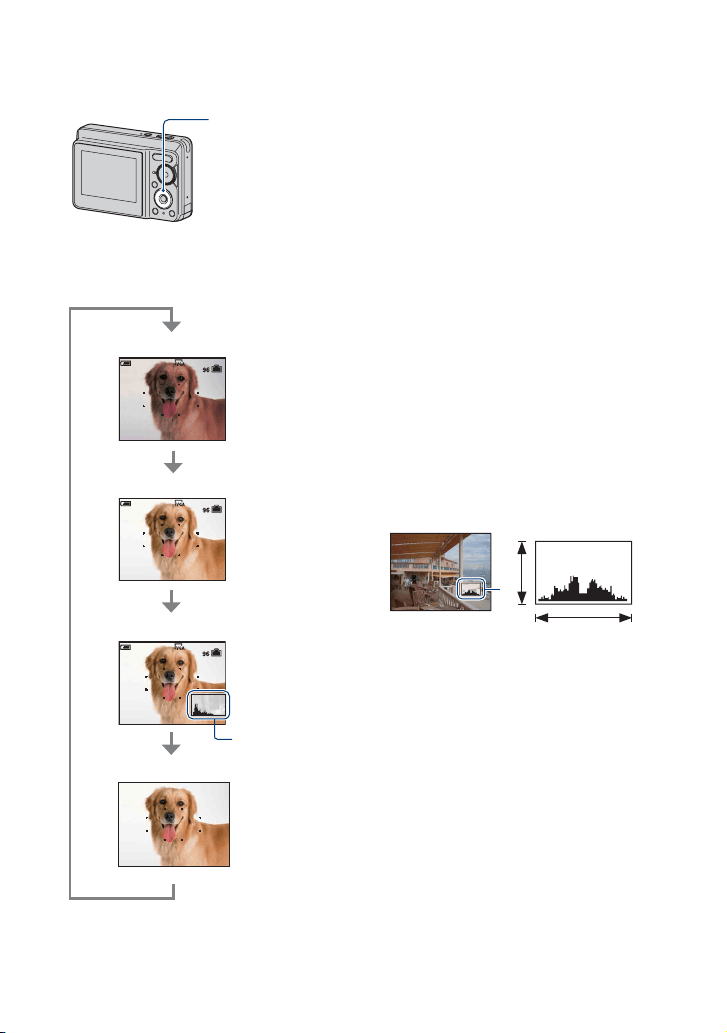
Changing the screen display
Each time you press v (DISP) on the
control button, the display changes as
follows:
*The brightness of the LCD Backlight up
• If you view images in bright outside light, adjust
the brightness of the LCD backlight up.
However, the battery power may decrease faster
under such condition.
• The histogram does not appear in the following
situations:
While shooting
– When the menu is displayed.
– When recording movies.
During playback
– When the menu is displayed.
– In index mode.
– When you are using playback zoom.
– When you are rotating still images.
– During playback of movies.
• A large difference in the histogram displayed
during shooting and playback may occur when:
– The flash strobes.
– The shutter speed is slow or fast.
• The histogram may not appear for images
recorded using other cameras.
z Adjusting EV (Exposure Value) by
displaying a histogram
A histogram is a graph showing the
brightness of an image. Press v (DISP) on
the control button repeatedly to display the
histogram on the screen. The graph display
indicates a bright image when skewed to the
right side, and a dark image when skewed
to the left side.
A Number of pixels
B Brightness
• The histogram also appears when playing back a
single image, but you cannot adjust the
exposure.
v DISP (Screen
display) button
Indicators on*
Histogram on*
Indicators on
Histogram display
(page 18)
During playback,
the image
information is
displayed.
Indicators off*
BrightDark
A
B
19
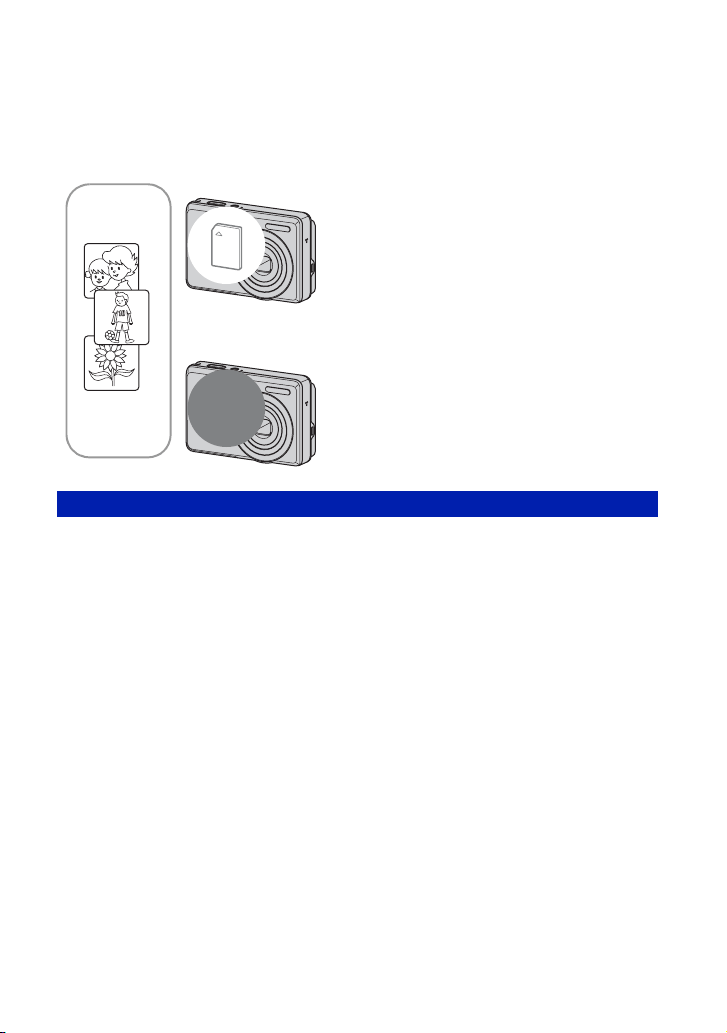
Using the internal memory
The camera has approximately 22 MB of internal memory. This memory is not removable.
Even when there is no “Memory Stick Duo” inserted in the camera, you can record images
using this internal memory.
We recommend that you copy (back up) data without error using one of the following
methods.
To copy (back up) data on a “Memory Stick Duo”
Prepare a “Memory Stick Duo” with sufficient free capacity, then perform the procedure
explained in [Copy] (page 54).
To copy (back up) data on a hard disk of your computer
Perform the procedure on pages 65, 66 or 69, 70 without a “Memory Stick Duo” inserted in
the camera.
• You cannot copy image data on a “Memory Stick Duo” to the internal memory.
• By connecting the camera and a computer with a dedicated USB cable, you can copy data stored in the
internal memory to a computer. However you cannot copy data on a computer to the internal memory.
When a “Memory Stick Duo” is inserted
[Recording]: Images are recorded on the “Memory Stick
Duo”.
[Playback]: Images on the “Memory Stick Duo” are
played back.
[Menu, Setup, etc.]: Various functions can be performed
on images on the “Memory Stick Duo”.
When there is no “Memory Stick Duo” inserted
[Recording]: Images are recorded using the internal
memory.
[Playback]: Images stored in the internal memory are
played back.
[Menu, Setup, etc.]: Various functions can be performed
on images in the internal memory.
On image data stored in the internal memory
Internal
memory
B
B
20
Basic Operations
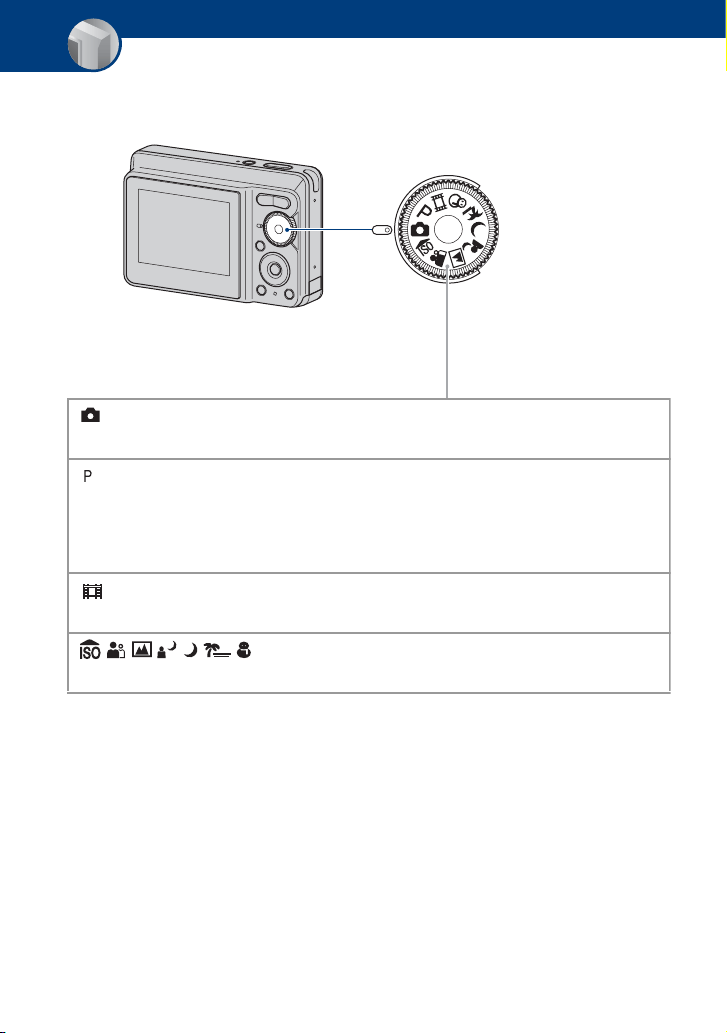
Using the mode dial
Set the mode dial to the desired function.
On Function Guide
When [Function Guide] is set to [On], the descriptions of functions are displayed as you
operate the camera.
The default setting is [On]. Select [Off] if you do not want the function guide to appear
(page 50).
Mode dial
Still image shooting modes
:
Auto Adjustment mode
Allows easy shooting with the settings adjusted automatically. t page 21
: Program Auto mode
Allows you to shoot with the exposure adjusted automatically (both the shutter
speed and the aperture value). Also you can select various settings using the
menu.
(For details on the functions available
t page 31)
: Movie recording mode
Allows you to record movies. t page 21
: Scene Selection mode
Allows you to shoot with preset settings according to the scene. t page 25
21
Basic Operations
Shooting images easily (Auto adjustment mode)
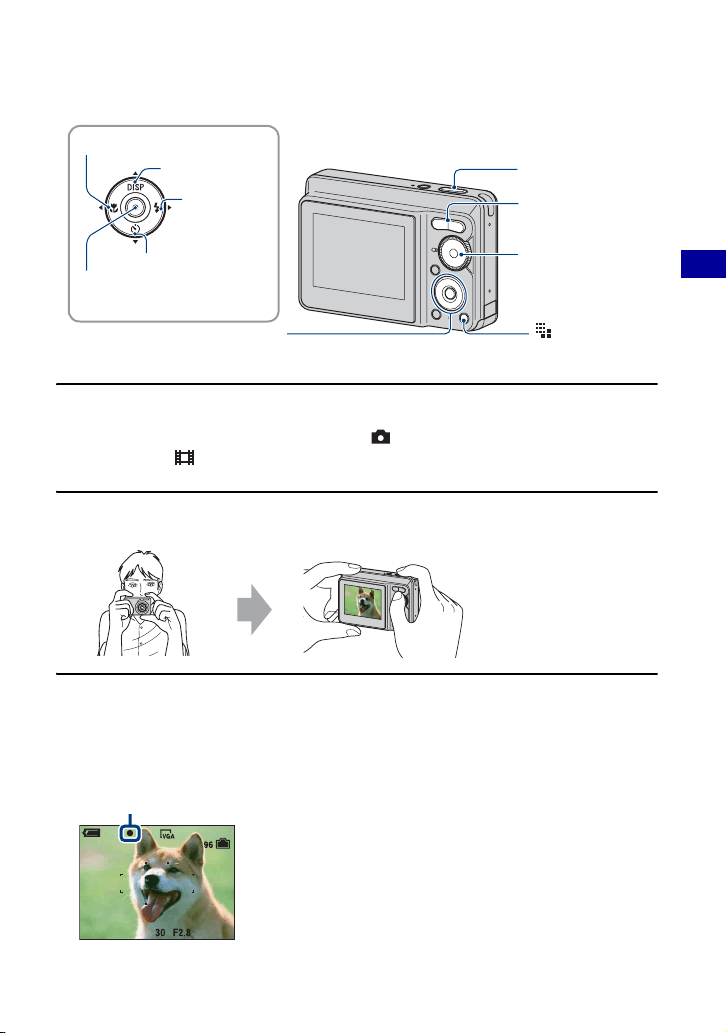
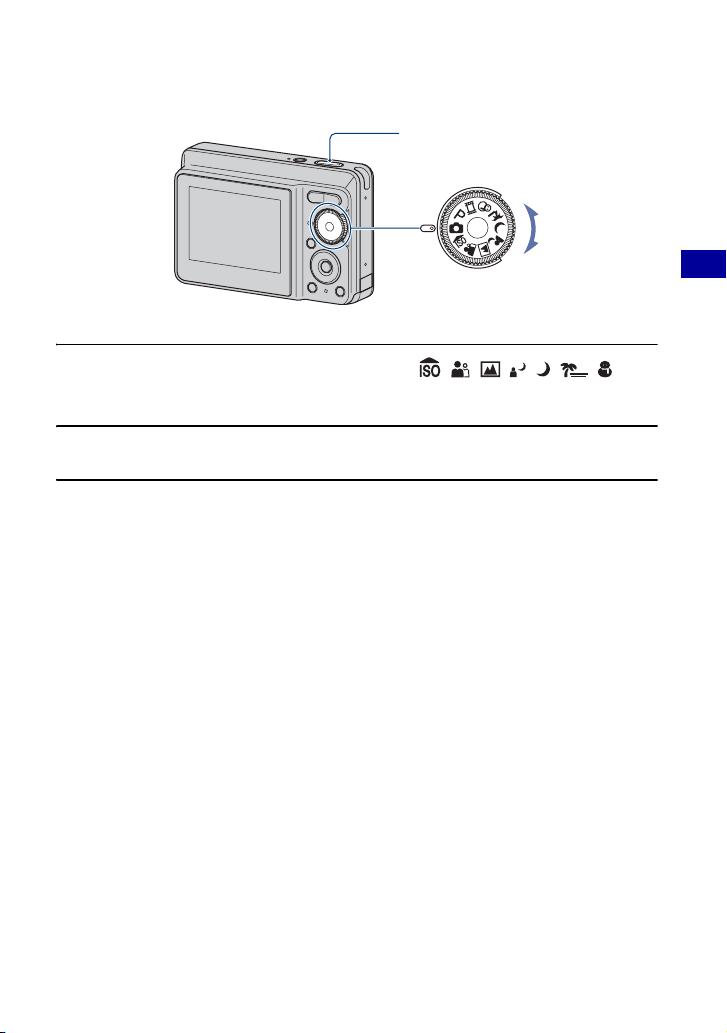
1 Select a mode with the mode dial.
Still image (auto adjustment mode): Select .
Movie: Select .
2 Hold the camera steady, keeping your arms at your side.
3 Shoot with the shutter button.
Still image:
1Press and hold the shutter button halfway down to focus.
The z (AE/AF lock) indicator (green) flashes, a beep sounds, the indicator stops flashing and
remains lit.
2Press the shutter button fully down.
The shutter sounds.
(Image Size)
button
Shutter button
Control button
Zoom button
Mode dial
v/V/b/B button
z button
Macro button
DISP button
Flash button
Self-timer button
Position the subject
in the center of the
focus frame.
AE/AF
l
oc
k
i
n
di
cator
22
Shooting images easily (Auto adjustment mode)
Movie:
Press the shutter button fully down.
To stop recording, press the shutter button fully down again.
If you shoot a still image of a subject that is difficult to focus on
• The shortest shooting distance is approx. 50 cm (1 feet 7 3/4 inches) (From the front of the lens). Shoot in
the close-up (Macro) mode (page 23) when you shoot a subject closer than the shooting distance.
• When the camera cannot focus on the subject automatically, the AE/AF lock indicator changes to flash
slowly and the beep does not sound. In addition, the AF range finder frame disappears. Recompose the
shot and focus again.
Focusing may be difficult in the following situations:
– It is dark and the subject is distant.
– The contrast between the subject and the background is poor.
– The subject is seen through glass.
– The subject is moving quickly.
– There is reflective light or shiny surfaces.
– The subject is backlit or there is a flashing light.
W/T Using the zoom
Press T to zoom, press W to undo the zoom.
• When the zoom scale exceeds 3×, the camera uses the Digital Zoom function.
For details on the [Digital Zoom] settings and the image quality, see page 49.
• You cannot change the zoom scale while shooting a movie.
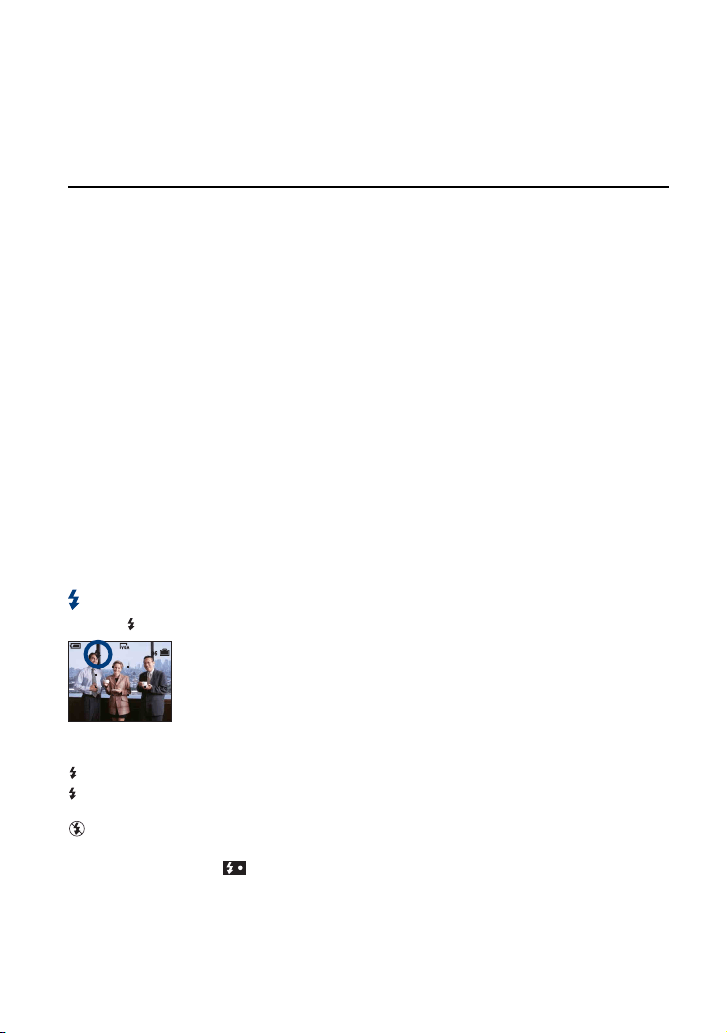
Flash (Selecting a flash mode for still images)
Press B ( ) on the control button repeatedly until the desired mode is selected.
(No indicator): Flash Auto
Strobes when there is insufficient light (default setting)
: Flash forced on
: Slow synchro (Flash forced on)
The shutter speed is slow in a dark place to clearly shoot the background that is out of flash light.
: Flash forced off
• The flash strobes twice. The first flash adjusts the light quantity.
• While charging the flash, is displayed.
SL
23
Basic Operations
Shooting images easily (Auto adjustment mode)
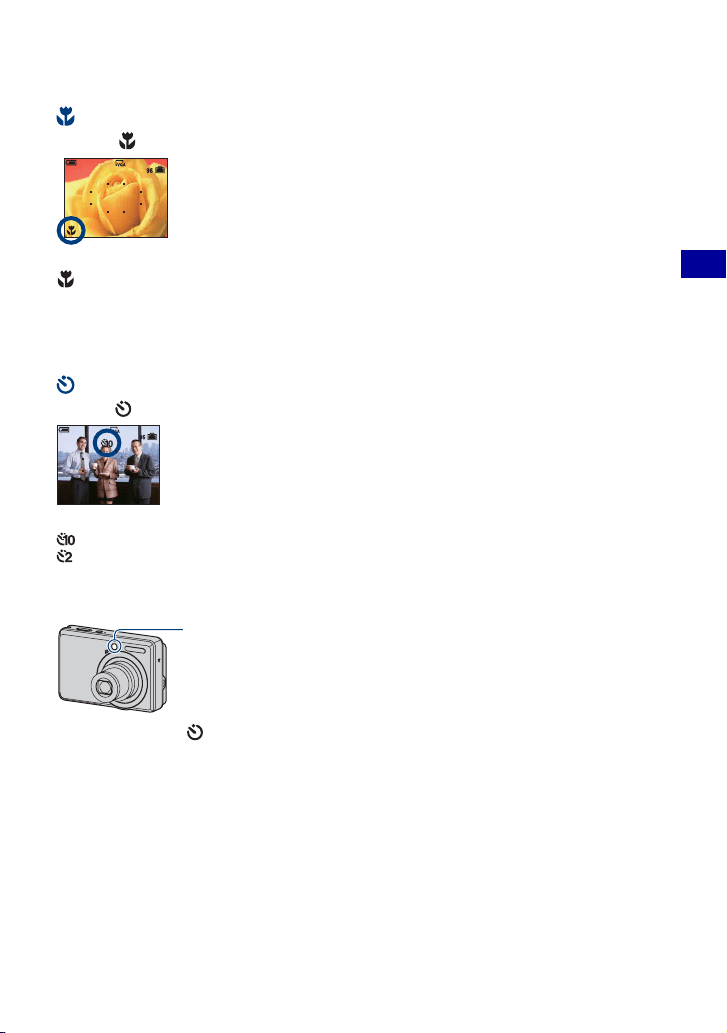
Macro (Shooting close-up)
Press b ( ) on the control button repeatedly until the desired mode is selected.
(No indicator): Macro Off
: Macro On (W side: Approx. 5 cm or farther (2 inches or farther), T side: Approx. 35 cm or farther (13 7/8
inches or farther) from the front of the lens)
• Setting the zoom all the way to the W side is recommended.
• The in-focus range becomes narrow, and the subject may not be entirely in focus.
• The Auto Focus speed drops when you shoot images in the Macro.
Using the self-timer
Press V ( ) on the control button repeatedly until the desired mode is selected.
(No indicator): Not using the self-timer
: Setting the 10-second delay self-timer
: Setting the 2-second delay self-timer
When you press the shutter button, the self-timer lamp flashes and a beep sounds until the
shutter operates.
To cancel, press
V ( ) again.
• Use the 2-second delay self-timer to prevent blur of an image. The shutter is released 2 seconds after you
press the shutter button, which reduces camera shake when the shutter button is pressed.
Self-timer lamp
24
Shooting images easily (Auto adjustment mode)
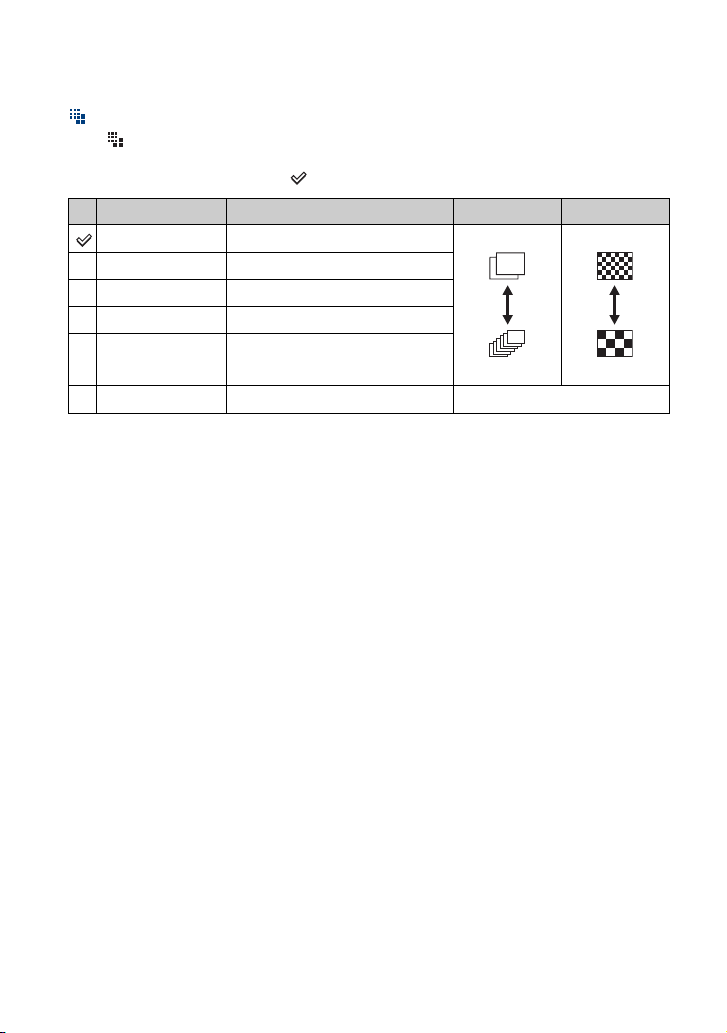
To change the still image size
Press (Image Size), and then press v/V to select the size.
For details on the image size, see page 10.
The default setting is marked with .
*1)
Images are recorded in 3:2 aspect ratio, same as photograph printing paper or postcards, etc.
*2)
Both edges of the image may be cut off when printing (page 89).
Image size Guidelines No. of images Printing
7M (3072×2304) Up to A3/11×17" print Less
More
Fine
Rough
3:2
*1
(3072×2048) Match 3:2 Aspect Ratio
5M (2592×1944) Up to A4/8×10" print
3M (2048×1536) Up to 13×18cm /5×7" print
VGA (640×480) For E-mail
16:9
*2
(1920×1080) Display On 16:9 HDTV
25
Basic Operations
Shooting still images (Scene selection)
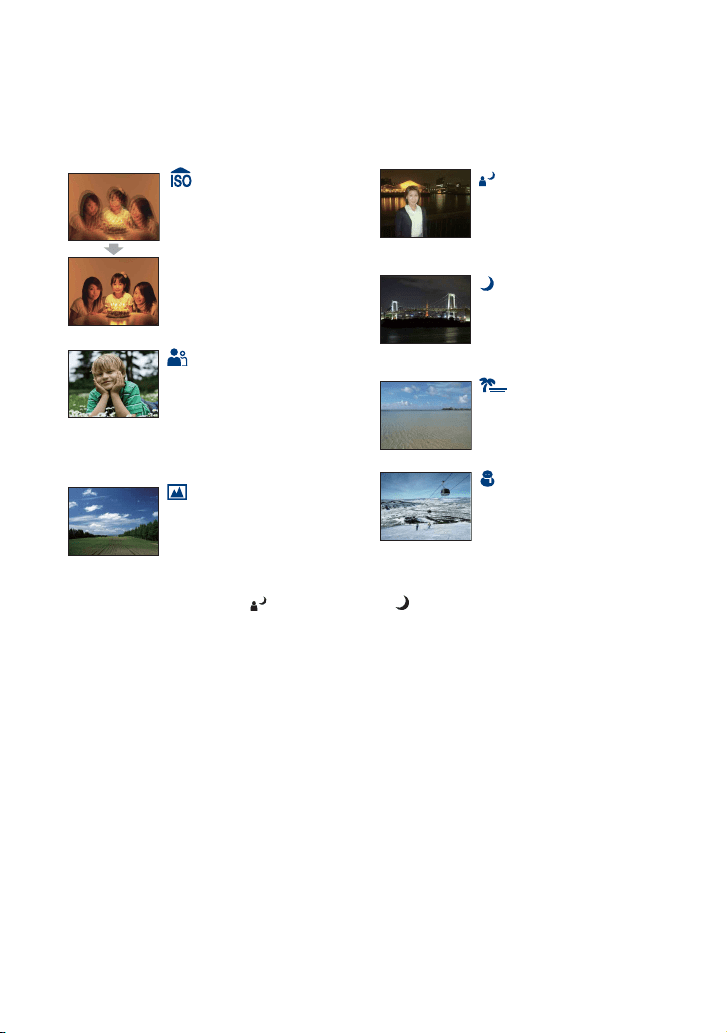
1 Select the desired mode of Scene Selection ( , , , , , , ).
• For details on modes, see the next page.
2 Shoot with the shutter button.
To cancel the Scene Selection
Set the mode dial to other than the mode of Scene Selection (page 20).
Shutter button
Mode dial
26
Shooting still images (Scene selection)
Scene Selection modes
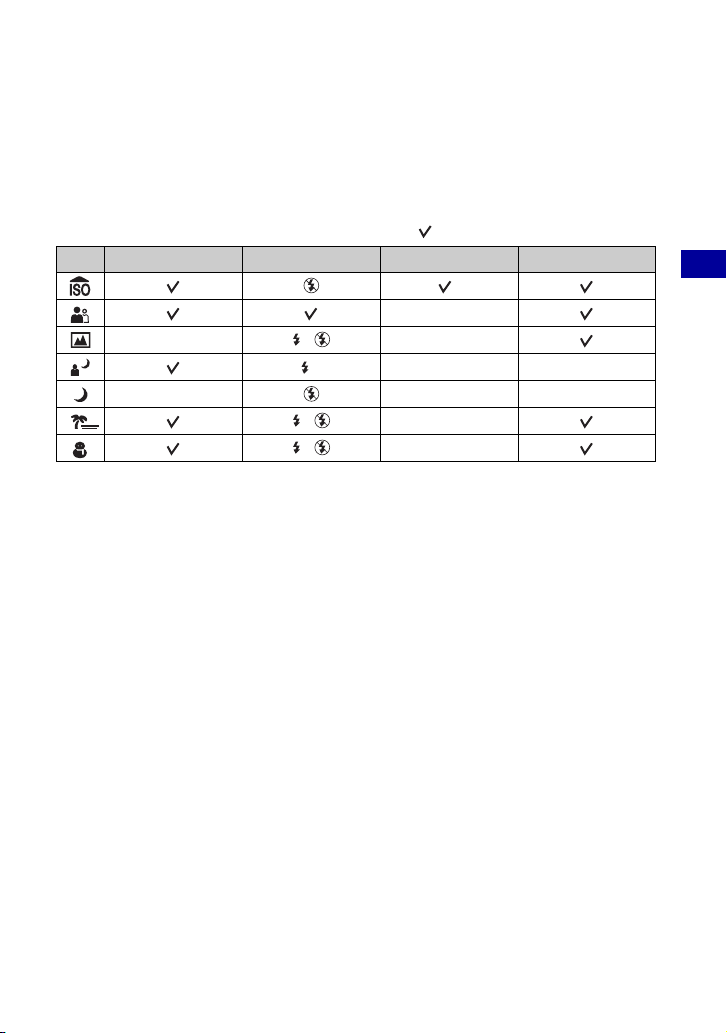
The following modes are preset to match the scene conditions.
*When you shoot images using (Twilight Portrait) or (Twilight) mode, the shutter speed becomes
slower, and blurring is occur frequently, so use of a tripod is recommended.
High Sensitivity
Allows you to shoot images
without a flash under low light
conditions, reducing blur.
Soft Snap
Allows you to shoot skin colors in
brighter and warmer tones for
more beautiful pictures. In
addition, the soft focus effect
creates a gentle atmosphere for
portraits of people, flowers, etc.
Landscape
Focuses only on a distant subject
to shoot landscapes, etc.
Twilight Portrait*
Allows you to shoot sharp images
of people with the night view in
the background without
compromising the atmosphere.
Twilight*
Allows you to shoot night scenes
at far distance without losing the
dark atmosphere of the
surroundings.
Beach
When shooting seaside or lakeside
scenes, the blue of the water is
clearly recorded.
Snow
When shooting snowy scenes or
other places where the whole
screen appears white, use this
mode to prevent sunken colors
and record clear images.
27
Basic Operations
Shooting still images (Scene selection)
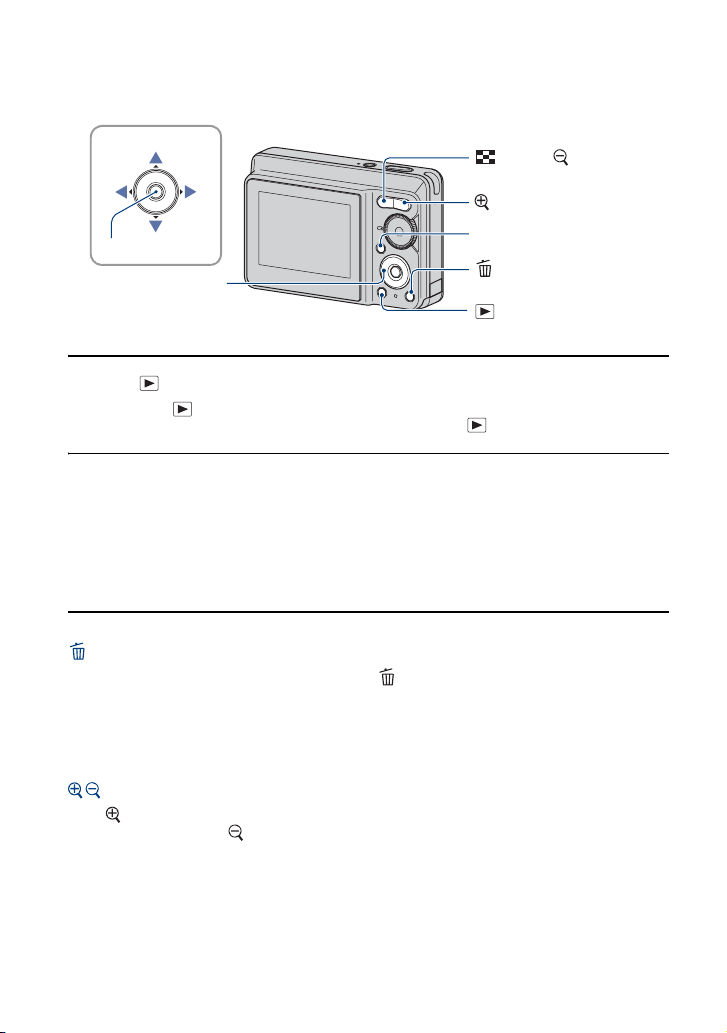
Functions you can use in Scene Selection
For shooting an image appropriately according to the scene condition, a combination of
functions is determined by the camera. Some functions are not available, depending on the
Scene Selection mode. When you press the button to select functions that cannot be combined
with Scene Selection, a beep sounds.
( : you can select the desired setting)
* [Flash] for [White Bal] cannot be selected.
Macro Flash White Balance Burst
*
—
— / —
——
———
/ —
/ —
SL
28
Viewing/deleting images
1 Press (Playback).
• If you press (Playback) when the camera is powered off, the camera is turned on automatically
and set to playback mode. To switch to the shooting mode, press (Playback) again.
2 Select an image with b/B on the control button.
Movie:
Press
z to play back a movie. (Press z again to stop playback.)
Press
B to fast forward, b to rewind. (Press z to return to normal playback.)
• You cannot listen to the audio with this camera when a movie is played back. To listen to the audio,
connect with external outputs such as a TV, a speaker, etc.
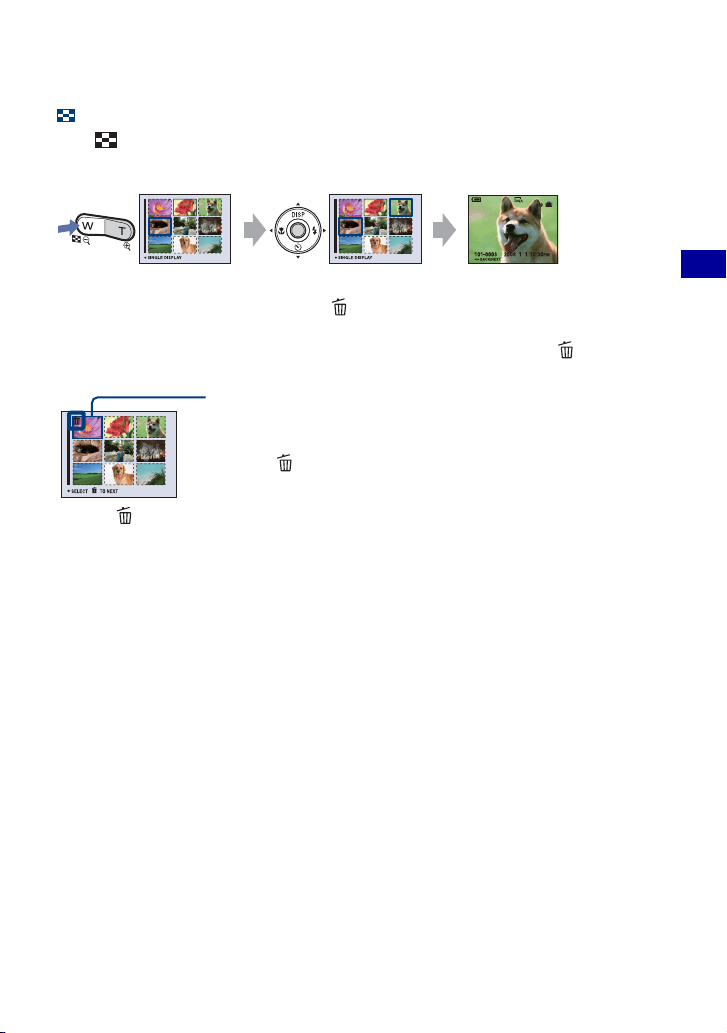
To delete images
1 Display the image you want to delete and press (Delete).
2 Select [Delete] with
v, then press z.
To cancel the deletion
Select [Exit], then press z.
To view an enlarged image (playback zoom)
Press while displaying a still image.
To undo the zoom, press .
Adjust the portion with v/V/b/B.
To cancel the playback zoom, press z.
• To store enlarged images, see [Trimming] (page 47).
(Delete) button
Control button
MENU button
(Playback zoom) button
(Index)/ (Playback
zoom) button
(Playback) button
v/V/b/B button
z button
29
Basic Operations
Viewing/deleting images
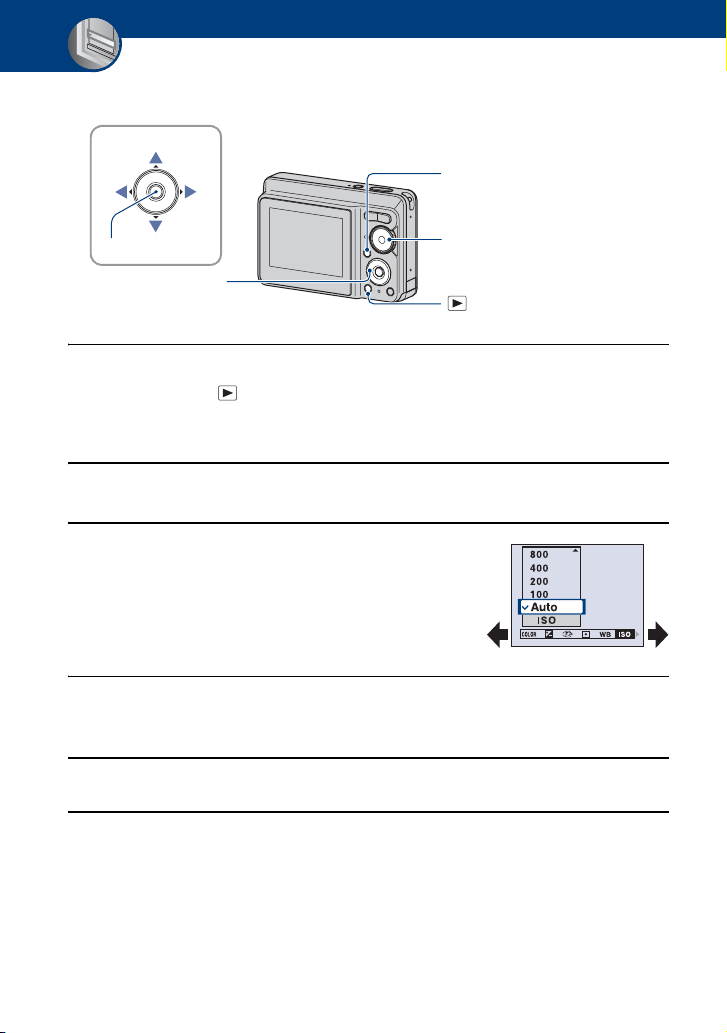
To view an index screen
Press (Index) and select an image with v/V/b/B. To display the next (previous) index
screen, press b/B .
To return to the single image screen, press z.
To delete images in index mode
1 While an index screen is displayed, press (Delete) and select [Select] with v/V on the
control button, then press z.
2 Select the image you want to delete with v/V/b/B, then press z to display the (Delete)
indicator on the selected image.
3 Press (Delete).
4 Select [OK] with B, then press z.
• To delete all the images in the folder, select [All In This Folder] with v/V in step 1 instead of [Select],
then press z.
Green selection frame
To cancel a selection
Select an image you have previously selected for deletion, then press z to
delete the indicator from the image.
30
Using the menu
Using menu items
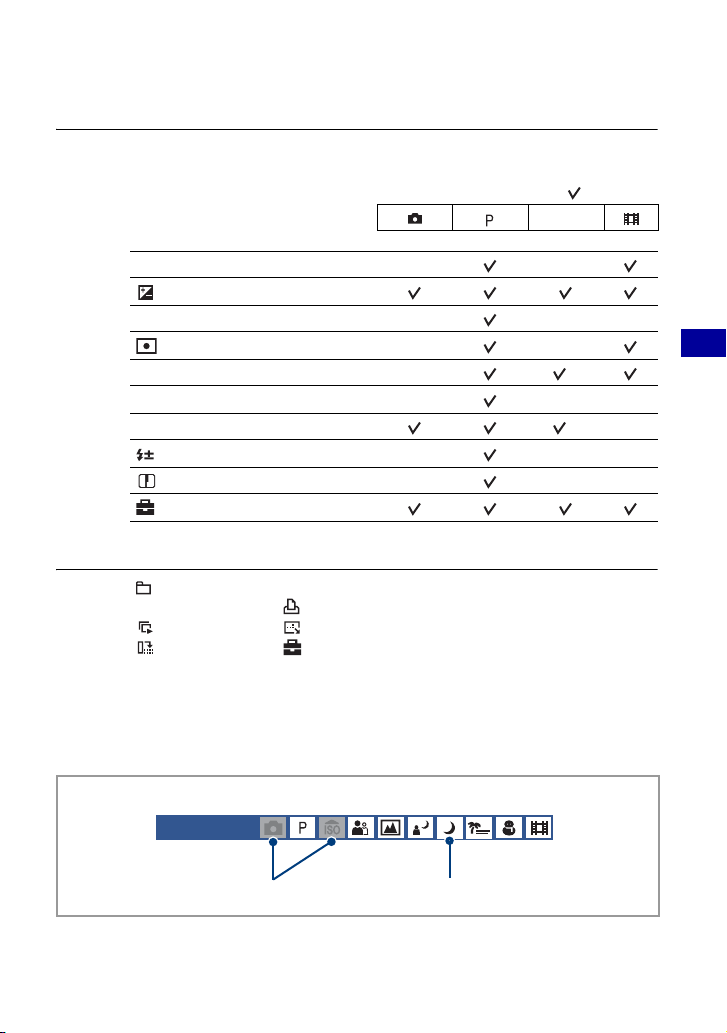
1 Recording: Turn on the camera, then set the mode dial.
Playback: Press (Playback).
• Different items are available depending on the position of the mode dial and Recording/Playback
mode.
2 Press MENU to display the menu.
3 Select the desired menu item with b/B
on the control button.
• If the desired item is invisible, keep pressing b/B
until the item appears on the screen.
•Press z after selecting an item in the Playback
mode.
4 Select a setting with v/V.
• The setting you select is zoomed and set.
5 Press MENU to turn off the menu.
• If there is an item that is not displayed, an v/V mark appears on the edges of the location where menu
items usually appear. To display an item that is not displayed, select the mark with the control button.
• You cannot set items that are not available to select.
Mode dial
Control button
MENU button
(Playback) button
v/V/b/B button
z button
31
For details on the operation 1 page 30
Using the menu
Menu items
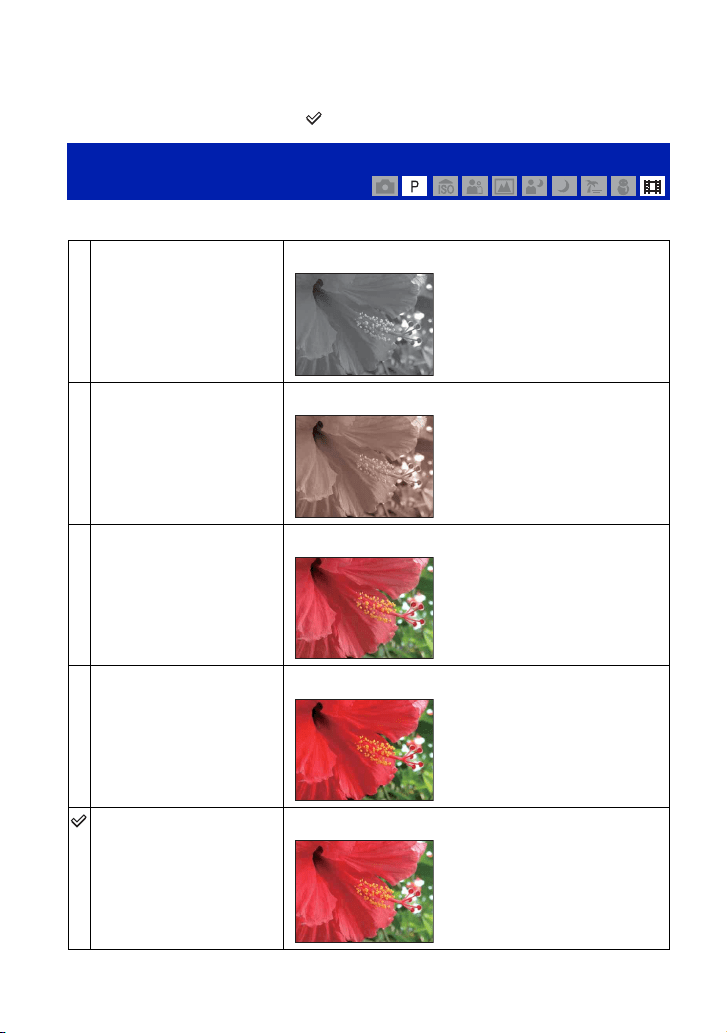
Shooting menu (page 32)
The available menu items vary depending on the mode setting (shooting/viewing), and the
mode dial position in the shooting mode. Only the available items are displayed on the screen.
Viewing menu (page 41)
(Folder) - (Protect)
DPOF (Print)
(Slide) (Resize)
(Rotate) (Setup)
Trimming
*2
*1)
The operation is limited according to the Scene mode (page 27).
*2)
Available only for playback zoom
In this “Cyber-shot Handbook”, the available mode dial setting is shown as follows.
( : available)
Mode dial position: Scene
COLOR (Color Mode) —
—
(EV)
9 (Focus) —
—
—
(Metering Mode) —
—
WB (White Bal) —
*1
ISO —
—
—
Mode (REC Mode)
*1
—
(Flash Level) —
—
—
(Sharpness) — — —
(Setup)
Unavailable Available
The selectable mode is displayed in white.
32
For details on the operation 1 page 30
Shooting menu
The default settings are marked with .
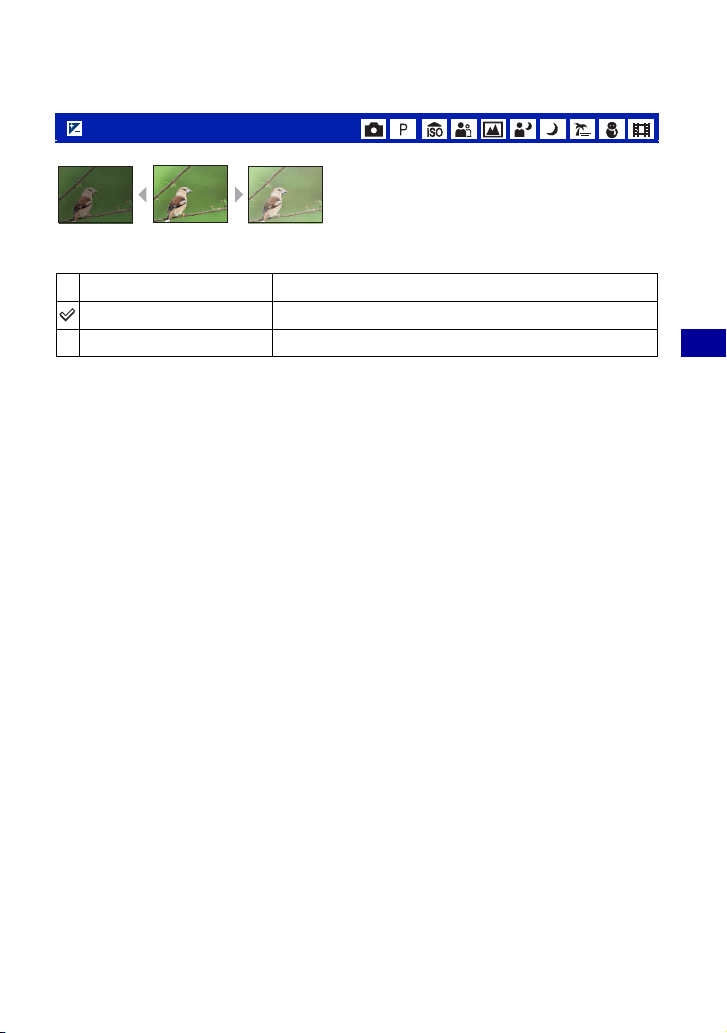
You can change the brightness of the image, accompanied by effects.
• You can select only [Normal], [B&W] or [Sepia] when shooting movies.
COLOR (Color Mode): Changing the vividness of the image or adding special effects
B&W (B & W)
Sets the image to monochromatic color.
Sepia (SEPIA)
Sets the image to sepia color.
Natural (NATURAL)
Sets the image to quiet color.
Rich (RICH)
Sets the image to bright color.
Normal
Sets the image to standard color.
33
Using the menu
Shooting menu For details on the operation 1 page 30
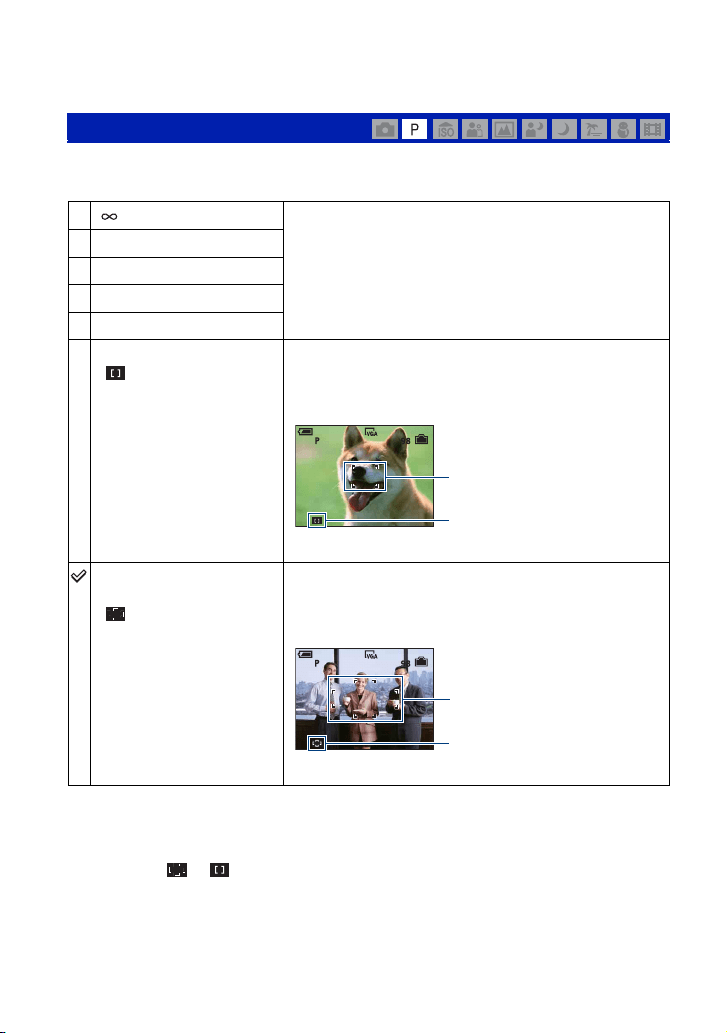
Manually adjusts the exposure.
• For details on the Exposure, see page 8.
• The compensation value can be set in 1/3EV increments.
• If you shoot a subject in extremely bright or dark conditions, or when you use the flash, the exposure
adjustment may not be effective.
(EV): Adjusting the light intensity
+2.0EV
Toward +: Brightens an image.
0EV
The exposure is determined automatically by the camera.
–2.0EV
Toward –: Darkens an image.
Toward – Toward +
34
Shooting menu For details on the operation 1 page 30
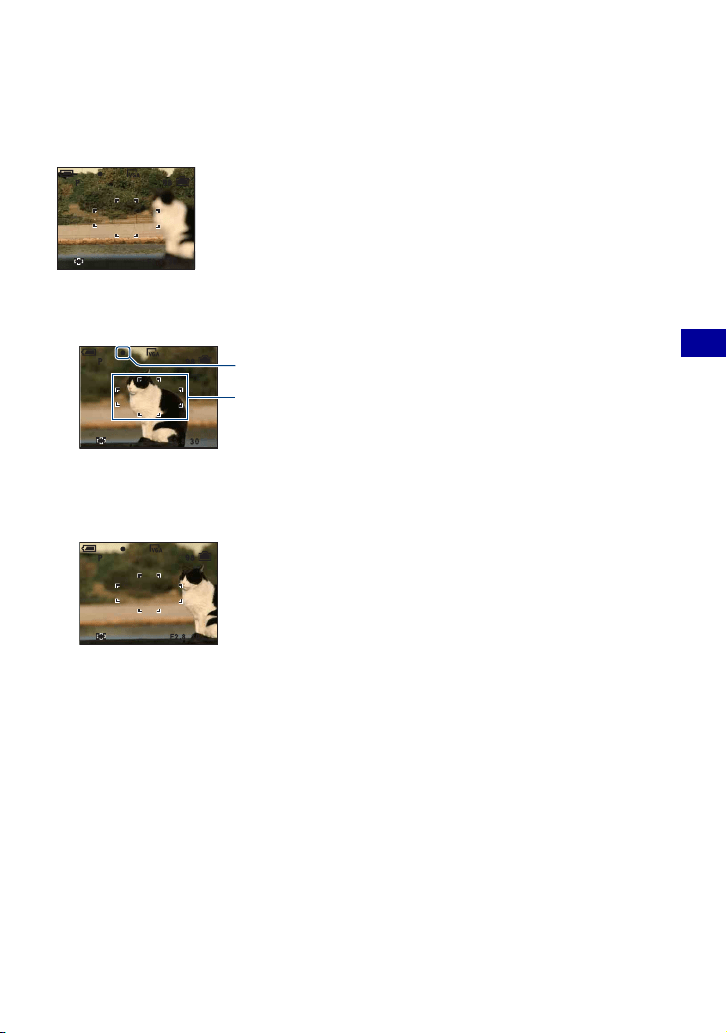
You can change the focus method. Use the menu when it is difficult to get the proper focus in
auto focus mode.
• AF stands for Auto Focus.
• Allow a margin of error in the distance setting of “Focus preset”. Pointing the lens up or down will
increase error.
• When you use Digital Zoom, priority AF movement is given to subjects in or near the center of the frame.
In this case the or indicator flashes and the AF range finder frame is not displayed.
9 (Focus): Changing the focus method
(unlimited distance)
Focuses on the subject using a previously set distance to the
subject (Focus preset).
• Use “Focus preset” when it is difficult to get sharp focus with
automatic focusing, such as when shooting a subject through a
net or window.
7.0 m
3.0 m
1.0 m
0.5 m
Center AF
()
Focuses on a subject in the center of the finder frame
automatically.
• Using the AF lock function together, you can compose the
image the way you want.
Multi AF
(Multipoint AF)
()
Focuses on a subject in all ranges of the finder frame
automatically.
• This mode is useful when the subject is not in the center of the
frame.
AF range finder frame
AF range finder frame
indicator
AF range finder frame
AF range finder frame
indicator
35
Using the menu
Shooting menu For details on the operation 1 page 30
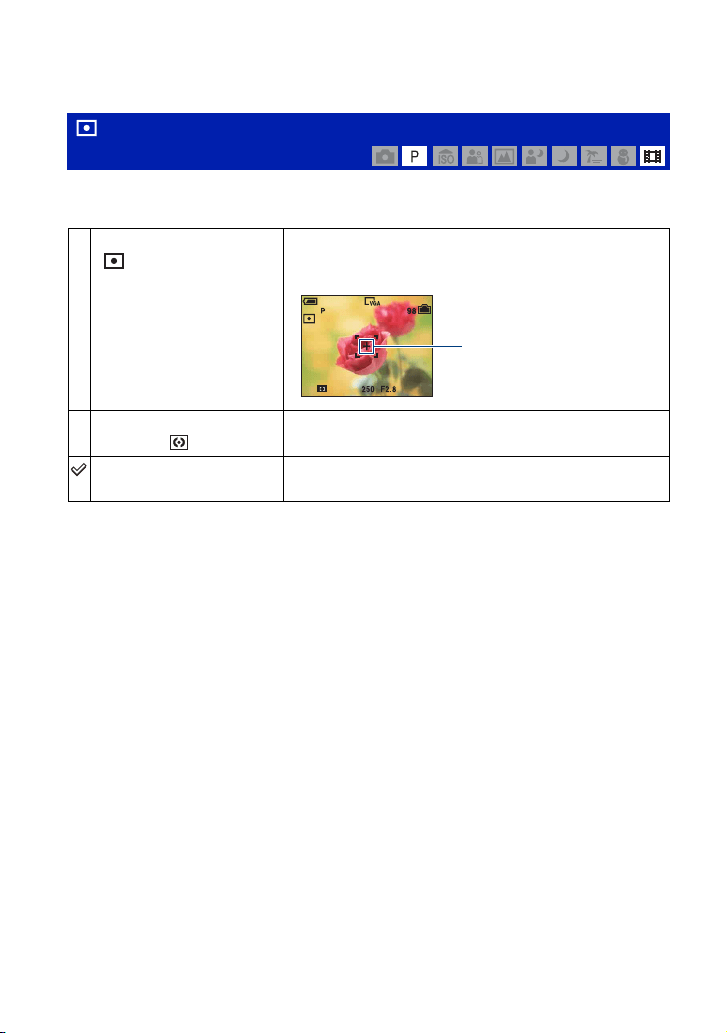
z If the subject is out of focus
When shooting with the subject at the edge of the frame (or the screen) or when using [Center AF], the
camera may not focus on a subject at the edge of the frame.
In such cases, do as follows:
1 Recompose the shot so that the subject is centered in the AF range finder, and press the shutter
button halfway down to focus on the subject (AF lock).
As long as you do not press the shutter button fully down, you can retry the procedure as many
times as you want.
2 When the AE/AF lock indicator stops flashing and remains on, return to the fully composed shot,
and press the shutter button fully down.
AE/AF lock indicator
AF range finder frame
36
Shooting menu For details on the operation 1 page 30
Selects the metering mode that sets which part of the subject to measure to determine the
exposure.
• For details on the exposure, see page 8.
• When using spot metering or center-weighted metering, setting [Focus] to [Center AF] is recommended to
focus on the metering position (page 34).
(Metering Mode): Selecting the metering mode
Spot (Spot metering)
()
(Only for still image)
Measures only a part of the subject.
• This function is useful when the subject is backlit or when there
is strong contrast between the subject and the background.
Center (Center-weighted
metering) ( )
Measures the center of the image, and determines the
exposure based on the brightness of the subject there.
Multi (Multi-pattern
metering)
Divides into multiple regions and measures each region. The
camera determines a well-balanced exposure.
Spot metering cross hairs
Positions on the subject
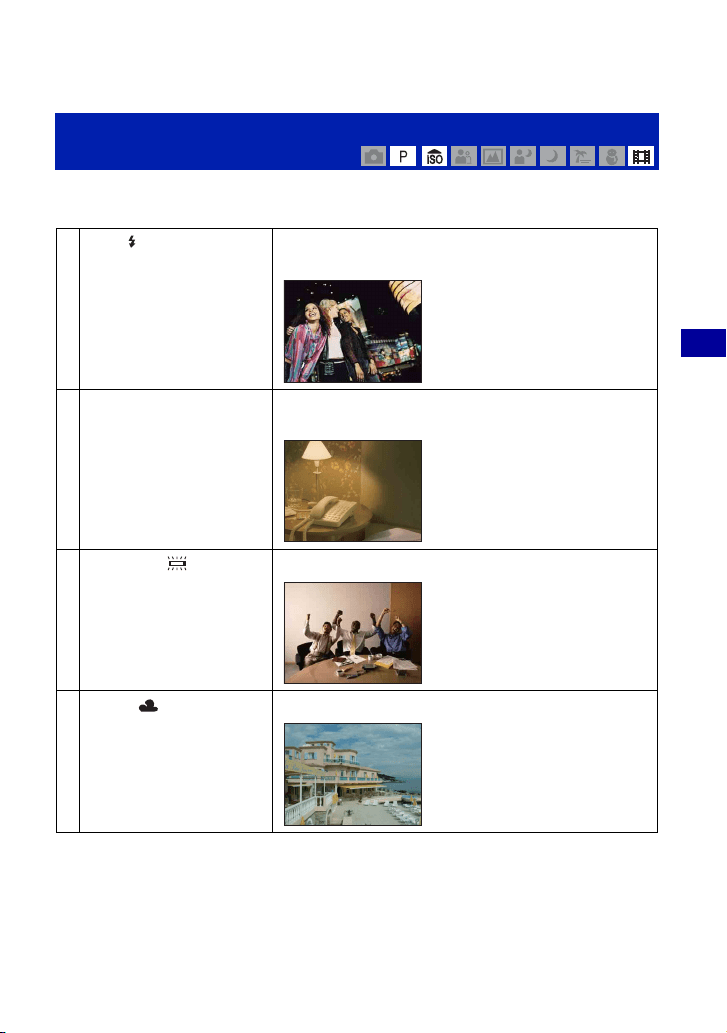
37
Using the menu
Shooting menu For details on the operation 1 page 30
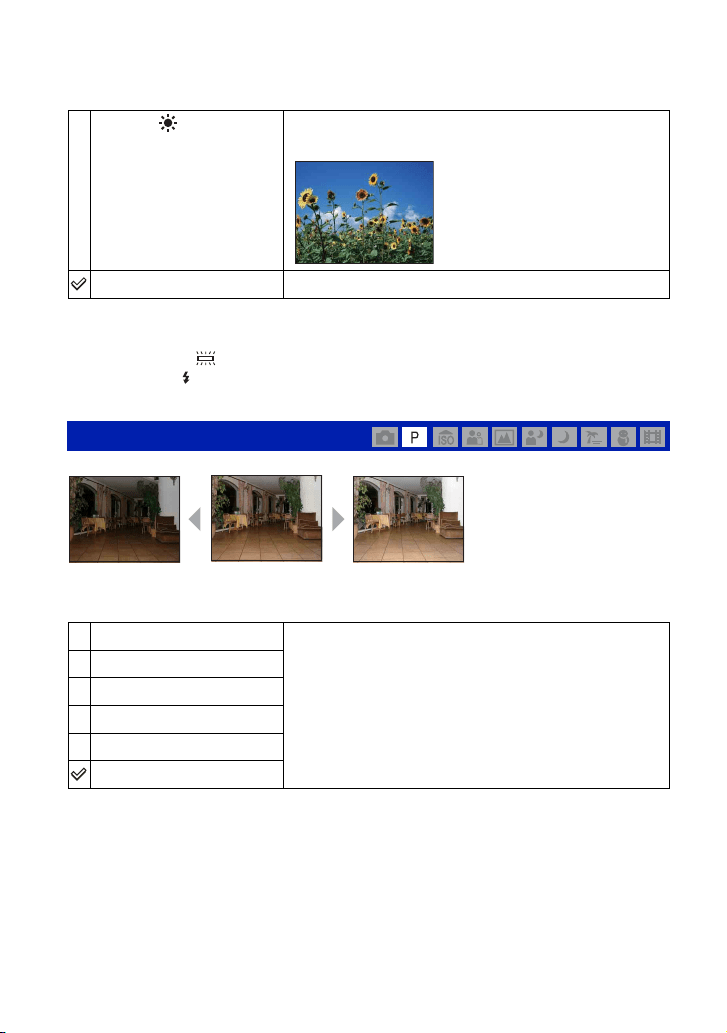
Adjusts color tones according to the surrounding light conditions. Use this function if image
color appears unnatural.
WB (White Bal): Adjusting the color tones
Flash ( )
Adjusts for the flash conditions.
• You cannot select this item when shooting movies.
Incandescent (n)
Adjusts for places under an incandescent lamp, or under
bright lighting, such as in a photo studio.
Fluorescent ( )
Adjusts for fluorescent lighting.
Cloudy ( )
Adjusts for a cloudy sky or shaded area.
WB
38
Shooting menu For details on the operation 1 page 30
• For details on the white balance, see page 9.
• Under fluorescent lights that flicker, the white balance function may not work correctly even though you
select [Fluorescent] ( ).
• Except in [Flash] ( ) modes, [White Bal] is set to [Auto] when the flash strobes.
• Some options are not available depending on the Scene mode (page 27).
Selects the ISO sensitivity.
• For details on the ISO sensitivity, see page 8.
• [ISO] is set to [Auto] in the Scene mode.
Daylight ( )
Adjusts for conditions outside under a clear sky, at sundown,
night scenes, the presence of neon signs or fireworks.
Auto
Adjusts the White Balance automatically.
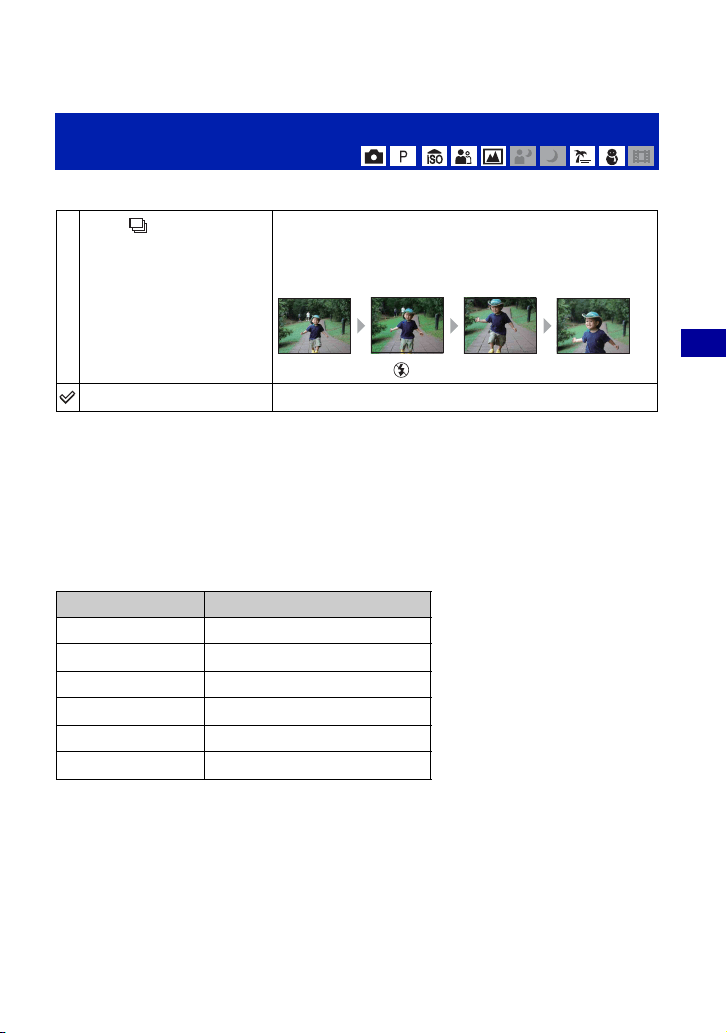
ISO: Selecting a luminous sensitivity
1250
You can reduce image blurring in dark locations or moving
subjects by increasing ISO sensitivity (select a larger
number). However, images tend to become noisier as the ISO
sensitivity number increases. Select an ISO sensitivity
number according to shooting conditions.
800
400
200
100
Auto
WB
High ISO sensitivityLow ISO sensitivity
39
Using the menu
Shooting menu For details on the operation 1 page 30
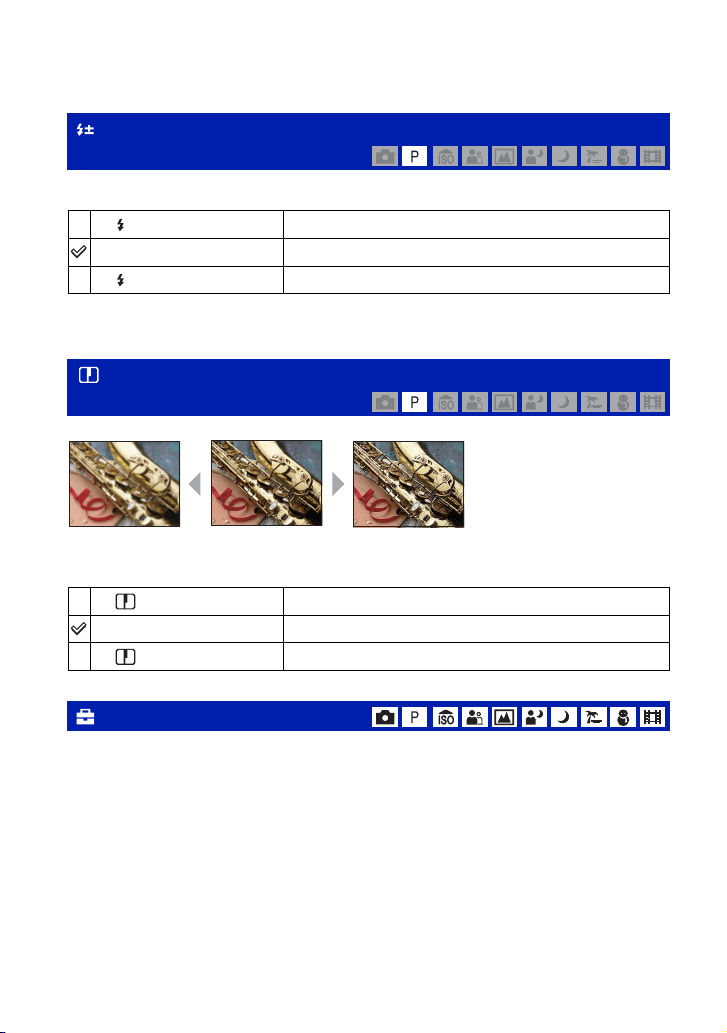
Selects whether the camera performs continuous shooting or not when you press the shutter button.
On the [Burst]
• When recording with the self timer, a series of a maximum of five images is recorded.
• The recording interval is approximately 1.2 seconds.
• When the battery level is low, or when the internal memory or “Memory Stick Duo” does not have
sufficient space, you cannot shoot continuously.
• You may not be able to shoot images in the Burst mode depending on the Scene mode (page 27).
The maximum number of continuous shots
(units: images)
Mode (REC Mode): Selecting the continuous shooting method
Burst ( )
Records the maximum number of images in succession (refer
to the following table) when you press and hold down the
shutter button.
• When “Recording” disappears, you can shoot the next image.
• The flash is set to (Flash forced off).
Normal
Does not shoot continuously.
Size Maximum continuous shots
7M 3
3:2 3
5M 4
3M 6
VGA 64
16:9 10
40
Shooting menu For details on the operation 1 page 30
Adjusts the amount of flash light.
• To change flash mode, see page 22.
• If the subject is too bright or dark, this adjustment may have no effect.
Adjusts the sharpness of the image.
See page 48.
(Flash Level): Adjusting the amount of flash light
+ ( +)
Toward +: Makes the flash level higher.
Normal
– ( –)
Toward –: Makes the flash level lower.
(Sharpness): Adjusting the sharpness of the image
+ ( )
Toward +: Sharpens the image.
Normal
– ( )
Toward –: Softens the image.
(Setup): Changing Setup items
Toward +Toward –
41
For details on the operation 1 page 30
Using the menu
Viewing menu
The default settings are marked with .
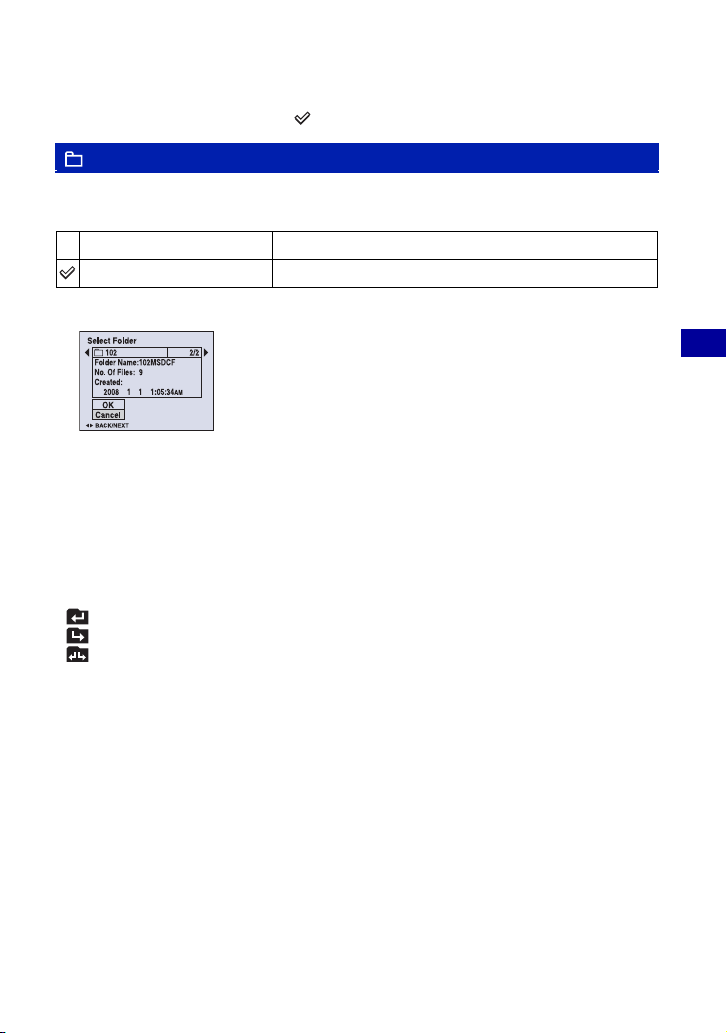
Selects the folder containing the image you want to play back when using the camera with
“Memory Stick Duo”.
1 Select the desired folder with b/B on the control button.
2 Select [OK] with v, then press z.
z On the folders
The camera stores images in a specified folder of a “Memory Stick Duo”. You can change the folder or
create a new one.
• To create a new folder t [Create REC. Folder] (page 52)
• To change the folder for recording images t [Change REC. Folder] (page 53)
• When multiple folders are created in the “Memory Stick Duo” and the first or last image in the folder is
displayed, the following indicators appear.
: Moves to the previous folder.
: Moves to the next folder.
: Moves to either the previous or next folders.
(Folder): Selecting the folder for viewing images
OK
See the following procedure.
Cancel
Cancels the selection.
42
Viewing menu For details on the operation 1 page 30
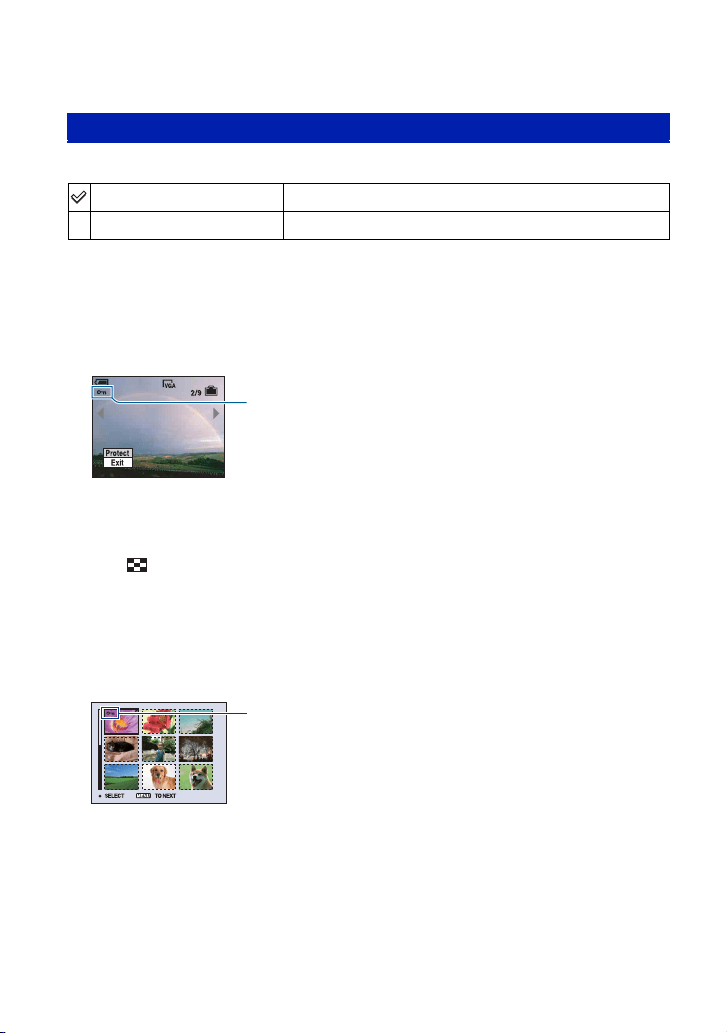
Protects images against accidental erasure. The - indicator appears on a protected image.
To protect images in single image mode
1 Display the image you want to protect.
2 Press MENU to display the menu.
3 Select [Protect] with b/B on the control button, then press z .
The image is protected and the - (protect) indicator appears on the image.
4 To protect other images, select the desired image with b/B, then press z.
To protect images in index mode
1 Press (Index) to display the index screen.
2 Press MENU to display the menu.
3 Select [Protect] with b/B on the control button, then press z .
4 Select [Select] with v/V, then press z.
5 Select the image you want to protect with v/V/b/B, then press z .
A green - indicator appears on the selected image.
6 Repeat step 5 to protect other images.
7 Press MENU.
8 Select [OK] with B, then press z.
The - indicator turns white. The selected images are protected.
• To protect all images in the folder, select [All In This Folder] in step 4, and press z. Select [On] with B,
then press z.
- (Protect): Preventing accidental erasure
Protect (-)
See the following procedure.
Exit
Exits the Protection function.
-
- (green)
43
Using the menu
Viewing menu For details on the operation 1 page 30
To cancel the protection
In single image mode
Press z in step 3 or 4 of “To protect images in single image mode.”
In index mode
1 Select the image for which you want to remove protection in step
5 of “To protect images in
index mode.”
2 Press z to turn the - indicator gray.
3 Repeat the operation above for all images to be unprotected.
4 Press MENU, select [OK] with B, and then press z.
To cancel protection of all images in the folder
Select [All In This Folder] in step 4 of “To protect images in index mode,” and press z.
Select [Off] with
B, then press z.
• Note that formatting the internal memory or “Memory Stick Duo” erases all the data stored on the
recording media, even if the images are protected, and these images cannot be restored.
• It may take some time to protect an image.
Adds a (Print order) mark to images you want to print (page 80).
Printing images shot with the camera.
See page 76.
DPOF: Adding a Print order mark
(Print): Printing images using a printer
44
Viewing menu For details on the operation 1 page 30
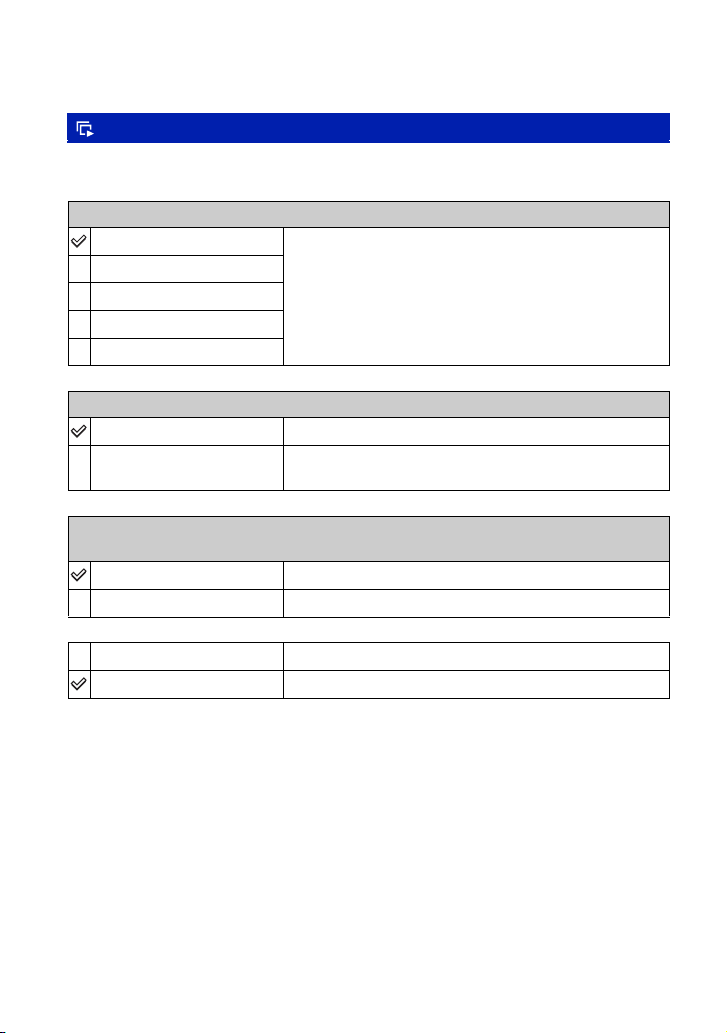
Plays back recorded images in order (Slide show).
1 Select [Interval], [Repeat] and [Image] with v/V/b/B on the control button.
2 Select [Start] with V/B, then press z.
The slide show starts.
To end the slide show, press z to pause the slide show. Select [Exit] with V, then press z.
• When pausing during the slide show, you can display the previous/next image with b/B.
(Slide): Playing back a series of images
Interval
3 sec
Sets the slide show interval.
5 sec
10 sec
30 sec
1 min
Repeat
On
Plays back images in a continuous loop.
Off
After all the images have been played back, the slide show
ends.
Image
You can select only when you use a “Memory Stick Duo” (not supplied).
Folder
Plays back all the images in the selected folder.
All
Plays back all the images in a “Memory Stick Duo” in order.
Start
See the following procedure.
Cancel
Cancels the slide show.
45
Using the menu
Viewing menu For details on the operation 1 page 30
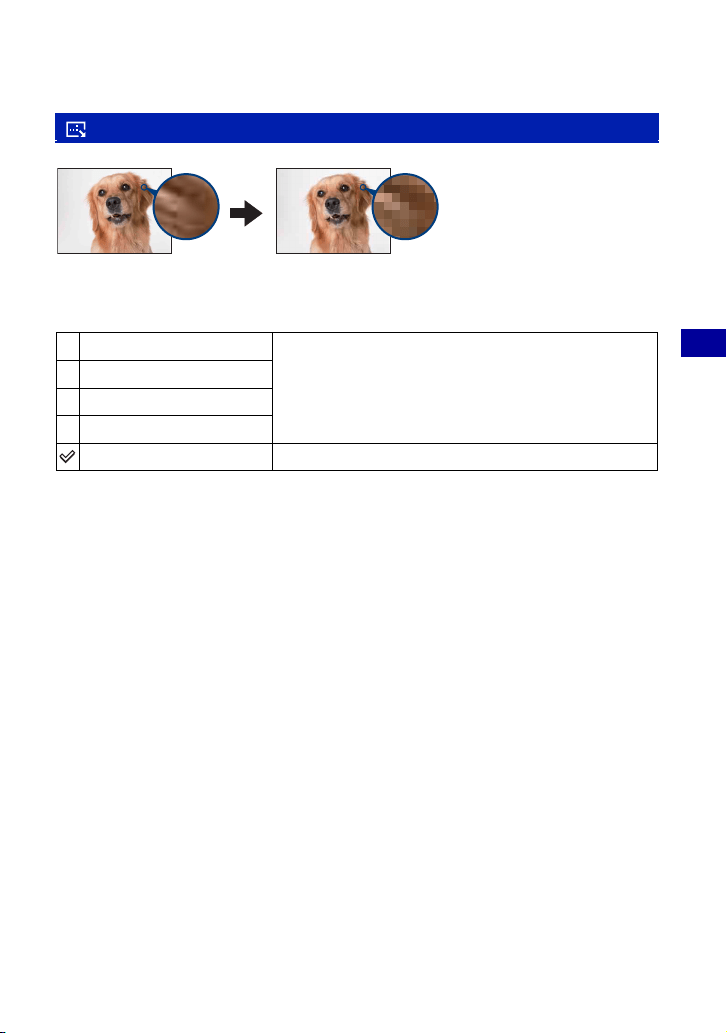
You can change the image size of a recorded image (Resize), and save it as a new file. The
original image is retained even after resizing.
1 Display the image you want to resize.
2 Press MENU to display the menu.
3 Select [Resize] with b/B on the control button, then press z.
4 Select the desired size with v/V, then press z.
The resized image is recorded in the recording folder as the newest file.
• For details on Image Size, see page 10.
• You cannot change the size of movies.
• When you change from a small size to a large size, the image quality deteriorates.
• You cannot resize to an image size of 3:2 or 16:9.
• When you resize a 3:2 or 16:9 image, the upper and lower black portions will be displayed on the image.
(Resize): Changing the image size of a recorded image
7M
For details on guidelines for selecting the image size, see
page 24.
5M
3M
VGA
Cancel
Cancels resizing.
Small sizeLarge size
46
Viewing menu For details on the operation 1 page 30
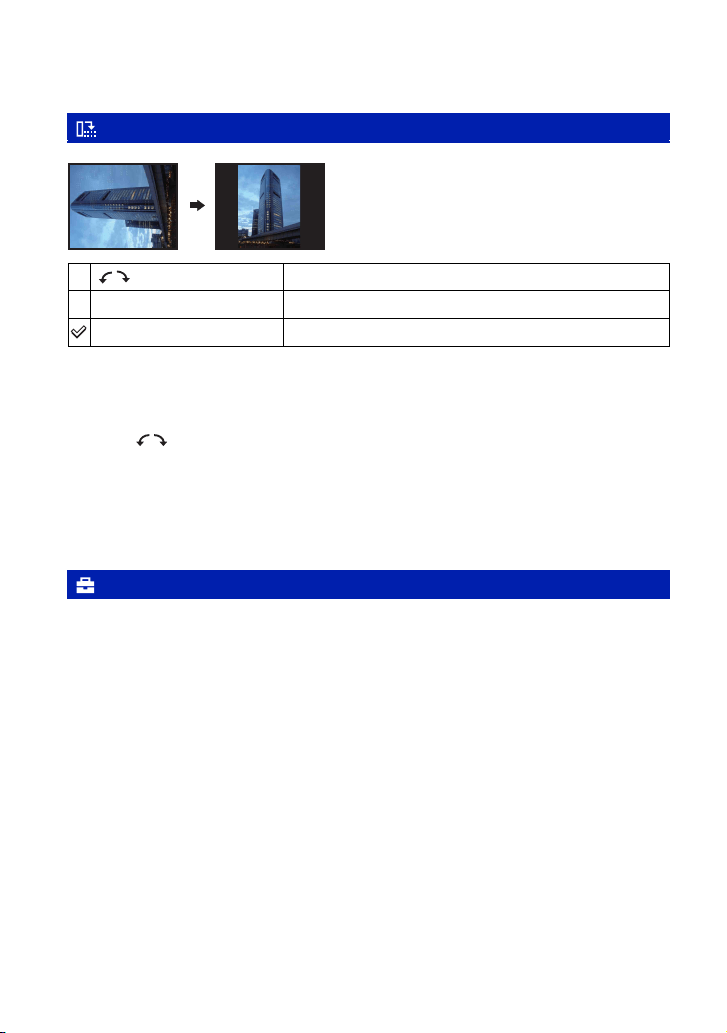
Rotates a still image.
1 Display the image to be rotated.
2 Press MENU to display the menu.
3 Select [Rotate] with b/B on the control button, then press z.
4 Select [
] with v, then rotate the image with b/B.
5 Select [OK] with v/V, then press z.
• You cannot rotate protected images or movies.
• You may not be able to rotate images shot with other cameras.
• When viewing images on a computer, the image rotation information may not be reflected depending on
the software.
See page 48.
(Rotate): Rotating a still image
Rotates an image. See the following procedure.
OK
Determines the rotation. See the following procedure.
Cancel
Cancels rotation.
(Setup): Changing Setup items
47
Using the menu
Viewing menu For details on the operation 1 page 30
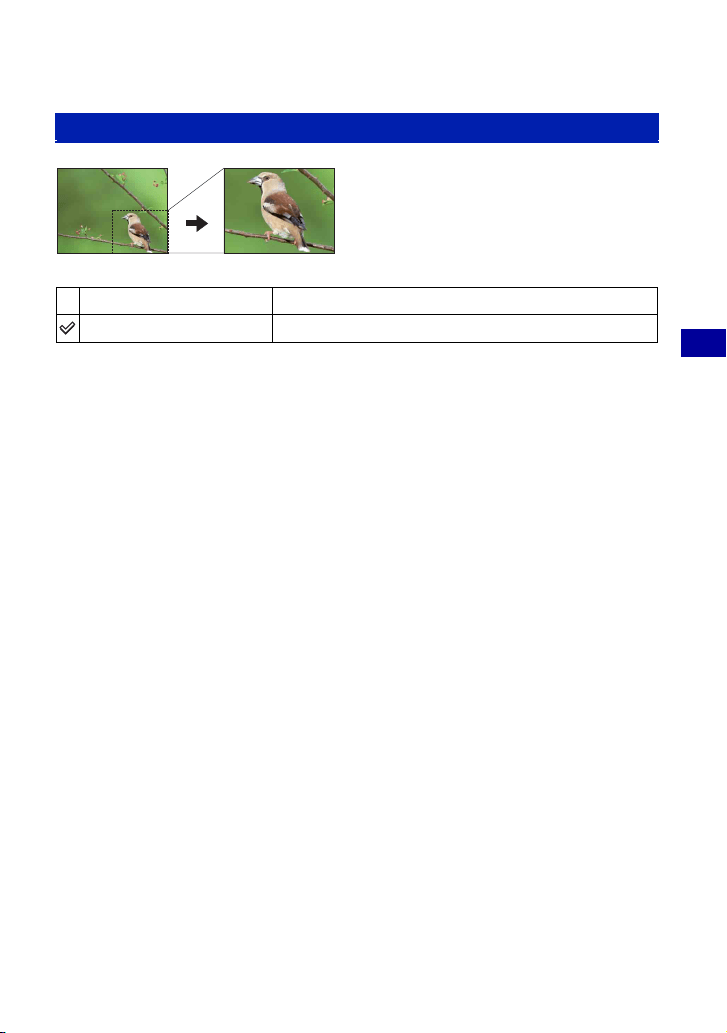
Records an enlarged image (page 28) as a new file.
1 Press MENU during playback zoom to display the menu.
2 Select [Trimming] with B on the control button, then press z.
3 Select the image size with v/V, then press z.
The image is recorded, and the original image is displayed again.
• The trimmed image is recorded as the newest file in the selected recording folder, and the original image is
retained.
• The quality of trimmed images may deteriorate.
• You cannot trim to an image size of 3:2 or 16:9 aspect ratio.
Trimming: Recording an enlarged image
Trimming
See the following procedure.
Return
Cancels trimming.
48
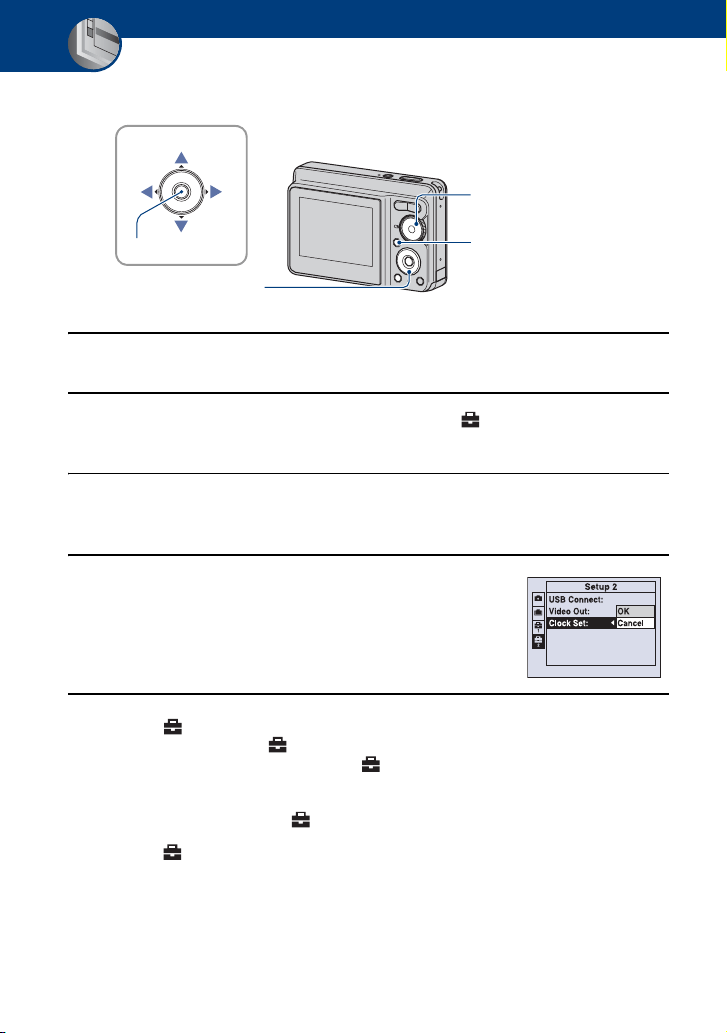
Using the Setup screen
Using Setup items
You can change the default settings using the Setup screen.
1 Press MENU to display the menu.
2 After pressing B on the control button, go to the (Setup) setting, then
press B again.
3 Press v/V/b/B on the control button to select the item you want to set.
• The frame of the selected item turns yellow.
4 Press z to enter the setting.
To turn off the (Setup) screen, press MENU.
To return to the menu from the (Setup) screen, press b on the control button repeatedly.
• Press the shutter button halfway down to close the (Setup) screen and return to the shooting mode.
When the menu is not displayed
Press MENU longer to display the (Setup) screen.
To cancel the (Setup) setting
Select [Cancel] if it appears, then press z on the control button. If it does not appear, select
the previous setting again.
• This setting is maintained even when the power is turned off.
Mode dial
Control button
MENU button
v/V/b/B button
z button
49
For details on the operation 1 page 48
Using the Setup screen
Camera
The default settings are marked with .
Selects the digital zoom mode. The camera enlarges the image using optical zoom (up to 3×).
When the zoom scale exceeds 3×, the camera uses either smart or precision digital zoom.
Image size and total zoom scale using Smart zoom (Including optical zoom 3×)
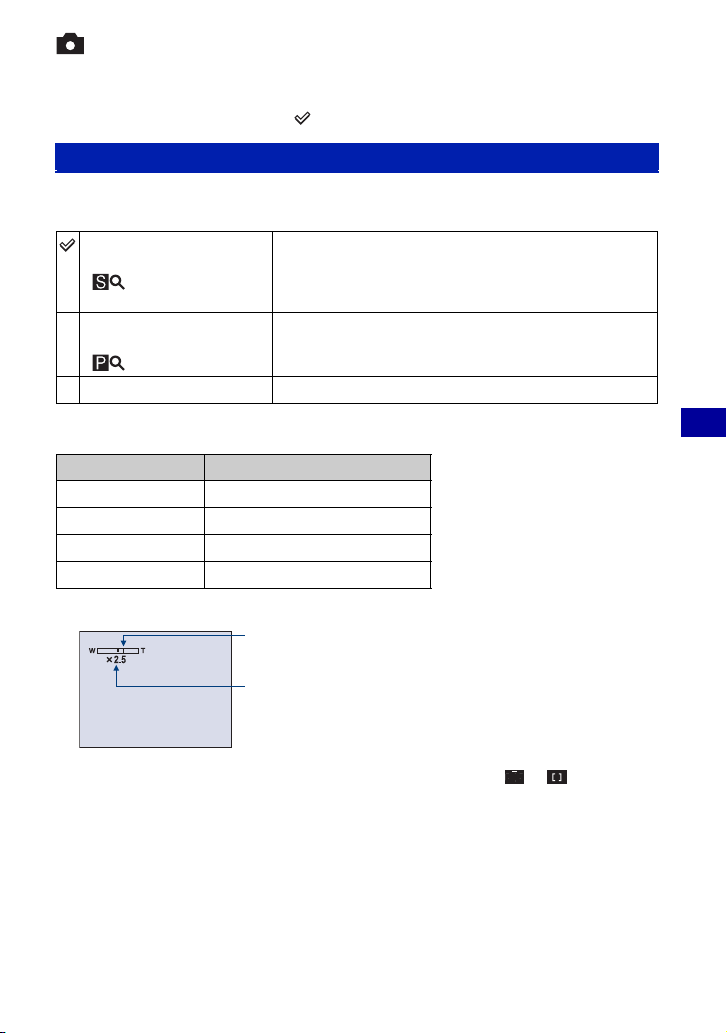
• When you press the zoom button, the zoom scaling indicator appears as follows.
• The total zoom scale of smart zoom/precision zoom includes the scale of the optical zoom.
• The AF range finder frame does not appear when using the digital zoom. The or indicator
flashes, and AF operates with priority on subjects located near the center of the frame.
• When using the smart zoom, the image on the screen may look rough. However, this phenomenon has no
effect on the recorded image.
Digital Zoom
Smart
(Smart zoom)
()
Enlarges the image digitally with almost no distortion. This is
not available when the image size is set to [7M] or [3:2].
• The total zoom scale of Smart zoom is shown in the following
table.
Precision
(Precision digital zoom)
()
Enlarges all image sizes up to 6× total, but image quality
deteriorates when zoom exceeds optical 3×.
Off
Does not use the digital zoom.
Size Total zoom scale
5M Approx. 3.6×
3M Approx. 4.5×
VGA Approx. 14×
16:9 Approx. 4.8×
The W side of this line is the optical zoom area,
and the T side is the digital zoom area
Zoom scaling indicator
50
Camera For details on the operation 1 page 48
When you operate the camera, the function guide appears.
The flash strobes two or more times before
shooting to reduce the red-eye phenomenon when
using the flash.
• To avoid blurring of images, hold the camera firmly until the shutter is released. It usually takes a second
after you press the shutter button. Also be sure not to allow the subject to move during this period.
• Red-eye reduction may not produce the desired effects. It depends on individual differences and
conditions, such as distance to the subject, or if the subject looked away from the pre-strobe.
Displays the recorded image on the screen for approximately two seconds immediately after
shooting a still image.
• If you press the shutter button halfway down, the recorded image display disappears and you can
immediately shoot the next image.
Function Guide
On
Displays the function guide.
Off
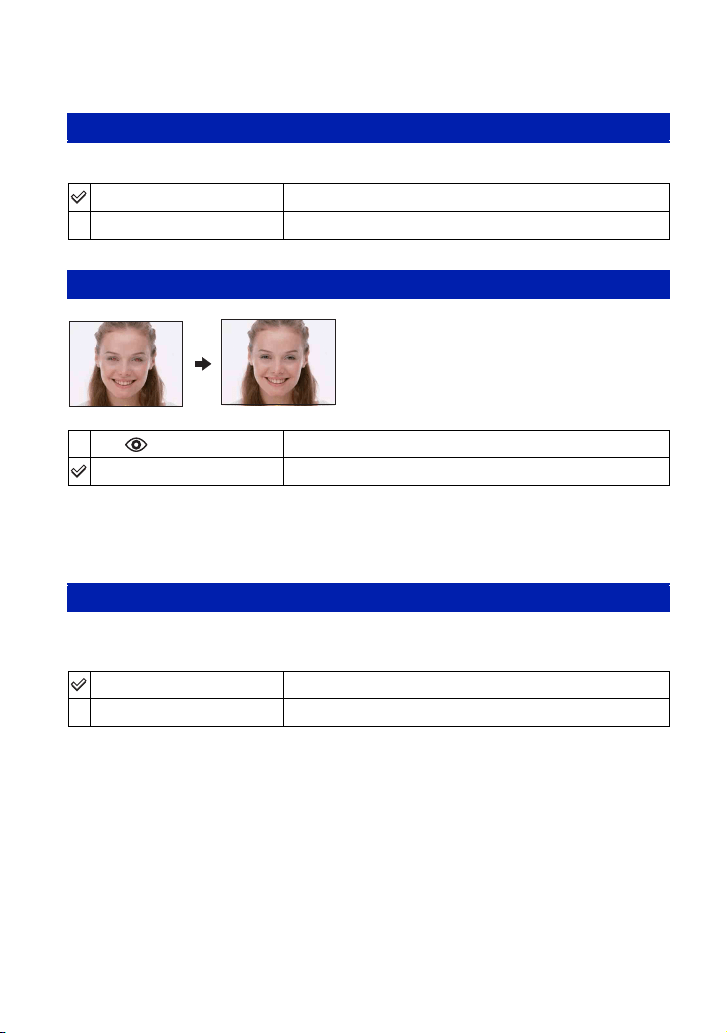
Does not display the function guide.
Red Eye Reduction
On ( )
Reduces the red-eye phenomenon.
Off
Does not use Red Eye Reduction.
Auto Review
On
Uses the Auto Review.
Off
Does not use Auto Review.

51
For details on the operation 1 page 48
Using the Setup screen
Internal Memory Tool
This item does not appear when a “Memory Stick Duo” is inserted in the camera.
Formats the internal memory.
• Note that formatting permanently erases all data in the internal memory, including even protected images.
1 Select [OK] with v on the control button, then press z.
The message “All data in internal memory will be erased Ready?” appears.
2 Select [OK] with v, then press z.
The format is complete.
To cancel formatting
Select [Cancel] in step 1 or 2, then press z.
Format
52
For details on the operation 1 page 48
Memory Stick Tool
This item appears only when a “Memory Stick Duo” is inserted in the camera.
Formats the “Memory Stick Duo”. A commercially available “Memory Stick Duo” is already
formatted, and can be used immediately.
• Note that formatting permanently erases all data on a “Memory Stick Duo”, including even protected
images.
1 Select [OK] with v on the control button, then press z.
The message “All data in Memory Stick will be erased Ready?” appears.
2 Select [OK] with v, then press z.
The format is complete.
To cancel formatting
Select [Cancel] in step 1 or 2, then press z.
Creates a folder in a “Memory Stick Duo” for recording images.
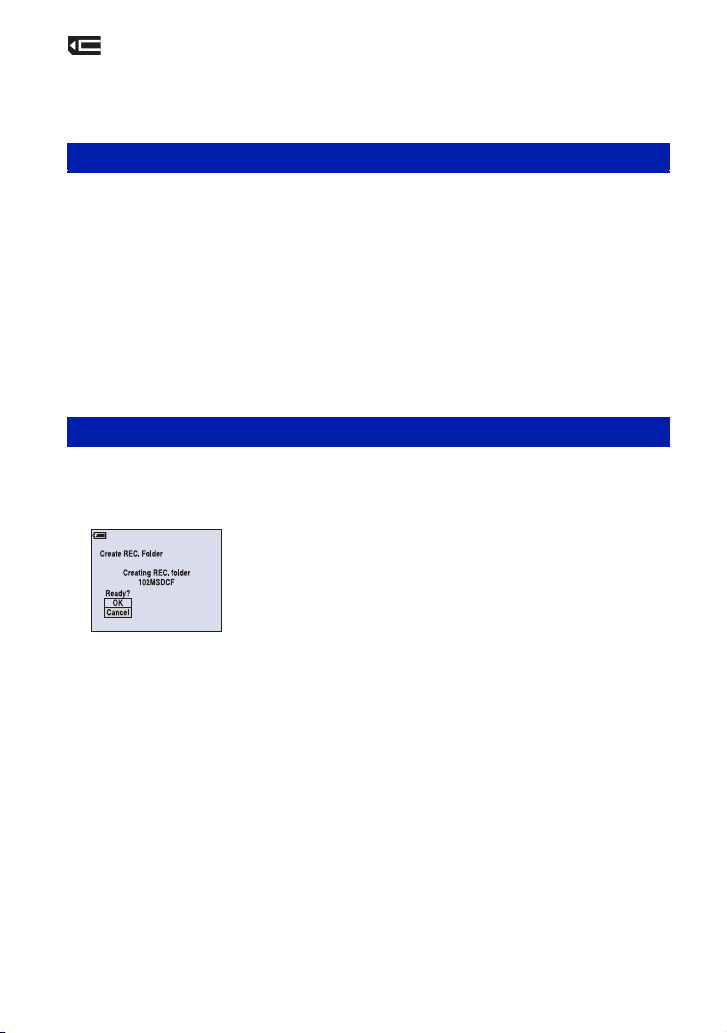
1 Select [OK] with v on the control button, then press z.
The folder creation screen appears.
2 Select [OK] with v, then press z.
A new folder is created with a number incremented one higher than the largest number, and the
folder becomes the current recording folder.
To cancel the folder creation
Select [Cancel] in step 1 or 2, then press z.
• When not creating a new folder, the “101MSDCF” folder is selected as the recording folder.
• You can create folders designated up to “999MSDCF.”
• Images are recorded in the newly created folder until you create another folder or select another recording
folder.
• You cannot delete a folder with the camera. To delete a folder, use your computer, etc.
• Up to 4,000 images can be stored in one folder. When the folder capacity is exceeded, a new folder is
automatically created.
• For details, see “Image file storage destinations and file names” (page 67).
Format
Create REC. Folder
53
Using the Setup screen
Memory Stick Tool For details on the operation 1 page 48
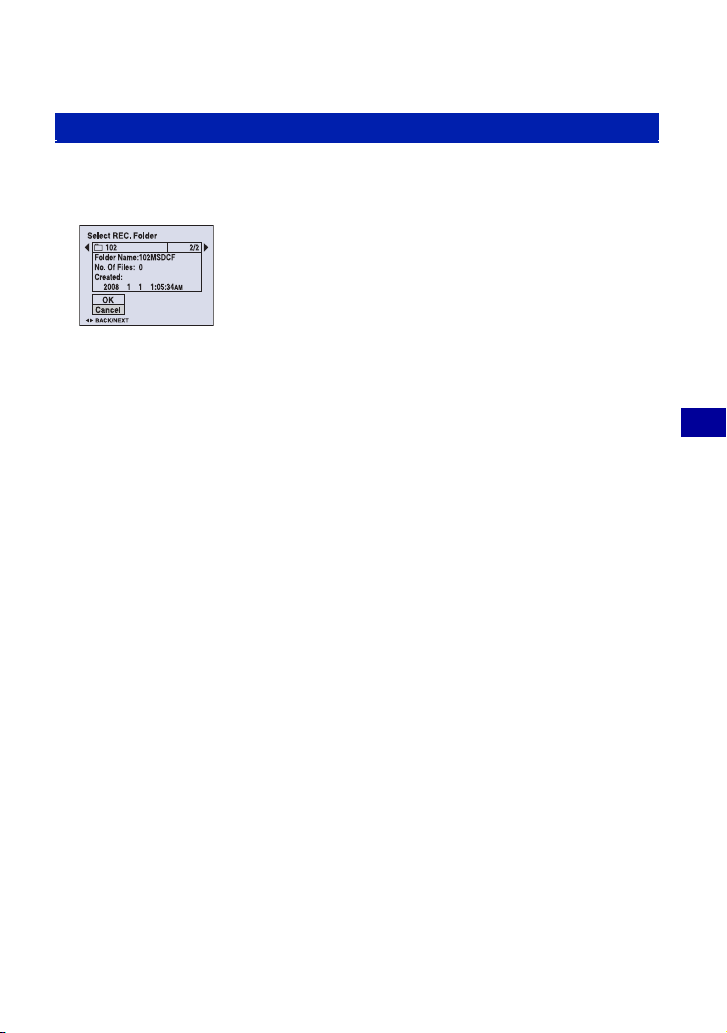
Changes the folder currently used for recording images.
1 Select [OK] with v on the control button, then press z.
The folder selection screen appears.
2 Select the desired folder with b/B, and [OK] with v, then press z.
To cancel changing the recording folder
Select [Cancel] in step 1 or 2, then press z.
• You cannot select the “100MSDCF” folder as a recording folder.
• You cannot move recorded images to another folder.
Change REC. Folder
54
Memory Stick Tool For details on the operation 1 page 48
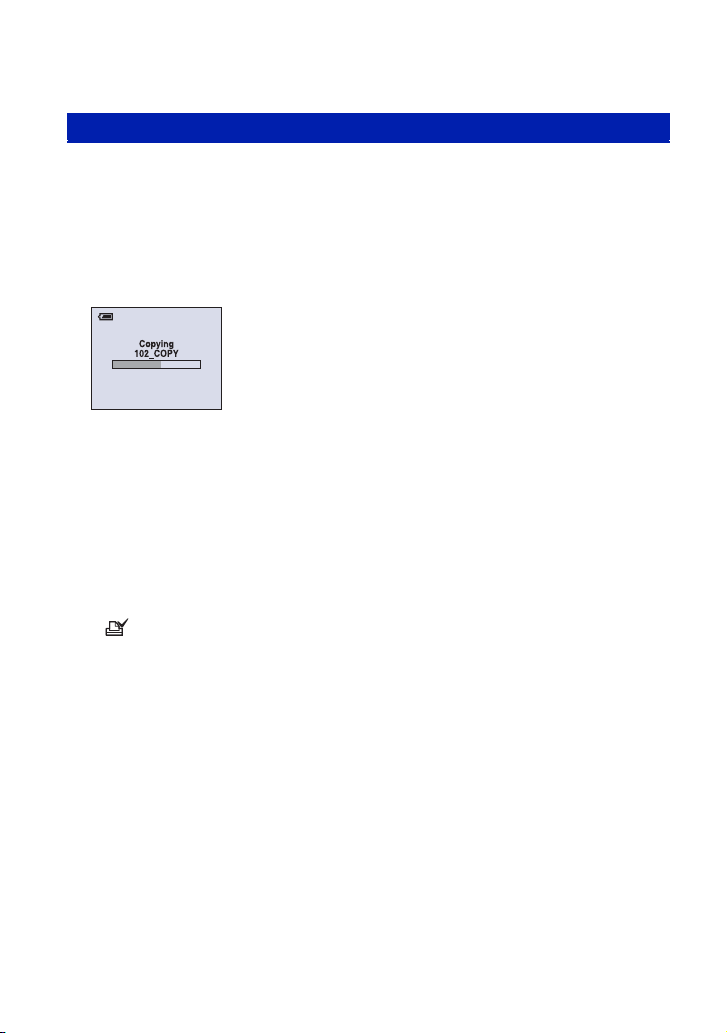
Copies all images in the internal memory to a “Memory Stick Duo”.
1 Insert a “Memory Stick Duo” having sufficient free capacity.
2 Select [OK] with v on the control button, then press z.
The message “All data in internal memory will be copied Ready?” appears.
3 Select [OK] with v, then press z.
Copying starts.
To cancel copying
Select [Cancel] in step 2 or 3, then press z.
• Use batteries with enough power remaining. If you attempt to copy image files using batteries with little
remaining charge, the batteries may run out, causing copying to fail or possibly corrupting the data.
• You cannot select images to copy.
• The original images in the internal memory are retained even after copying. To delete the contents of the
internal memory, remove the “Memory Stick Duo” after copying, then format the internal memory
([Format] in [Internal Memory Tool]) (page 51).
• A new folder is created on the “Memory Stick Duo” and all the data will be copied to it. You cannot
choose a specific folder and copy images to it.
• The (Print order) marks on the images are not copied.
Copy
55
For details on the operation 1 page 48
Using the Setup screen
Setup1
1
The default settings are marked with .
Selects the sound produced when you operate the camera.
Selects the language to be used in the menu items, warnings, and messages.
Initializes the setting to the default setting.
Even if you execute this function, the images stored in the internal memory are retained.
1 Select [OK] with v on the control button, then press z.
The message “Initialize all settings Ready?” appears.
2 Select [OK] with v, then press z.
The settings are reset to the default setting.
To cancel initializing
Select [Cancel] in step 1 or 2, then press z.
• Be sure not to power off the camera while initializing.
Beep
Shutter
Turns on the shutter sound when you press the shutter button.
On
Turns on the beep/shutter sound when you press the control
button/press the shutter button.
Off
Turns off the beep/shutter sound.
Language
Initialize
56
For details on the operation 1 page 48
Setup2
2
The default settings are marked with .
Selects the USB mode to be used when connecting the camera to a computer or a PictBridge
compliant printer using the dedicated USB cable.
Sets the video signal output according to the TV color system of the connected video
equipment. The TV color systems differ depending on the country and region.
To view images on a TV screen, check the TV color system of the country or region of use
(page 59).
USB Connect
PictBridge
Connects the camera to a PictBridge compliant printer
(page 76).
PTP
When [PTP] (Picture Transfer Protocol) is set and the camera
is connected to a computer, the images in the recording folder
on the camera are copied to the computer (Compatible with
Windows XP and Mac OS X).
Mass Storage
Establishes a Mass Storage connection between the camera
and a computer or other USB device (page 65).
Video Out
NTSC
Sets the video output signal to NTSC mode (e.g., for the
USA, Japan).
PAL
Sets the video output signal to PAL mode (e.g., for Europe).
57
Using the Setup screen
Setup2 For details on the operation 1 page 48
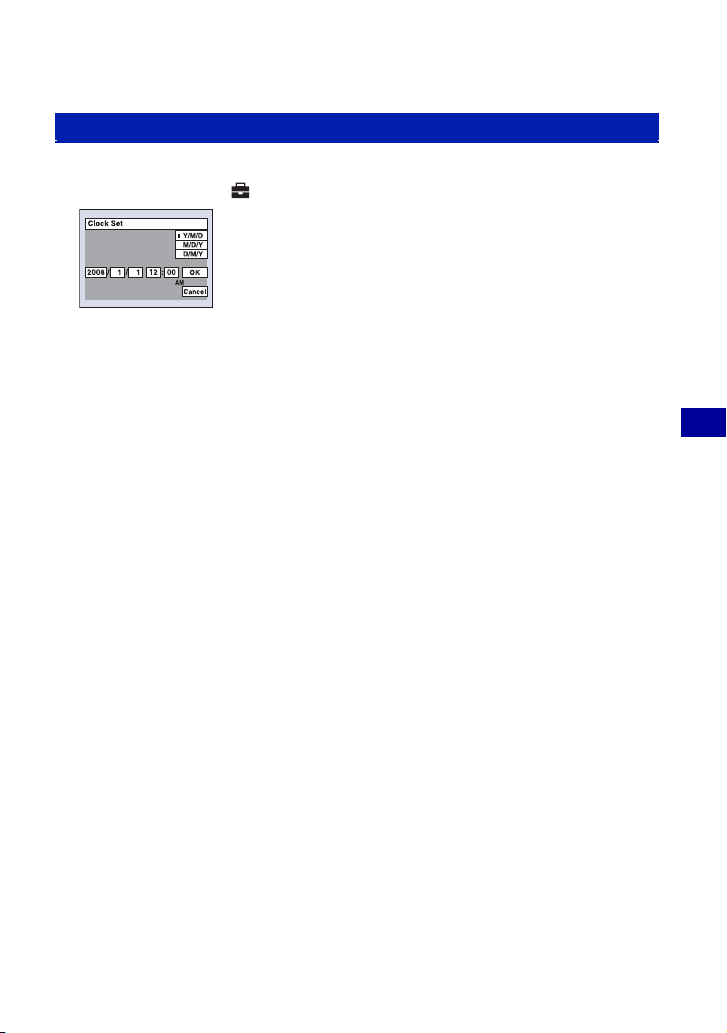
Sets the date and time.
1 Select [Clock Set] in the (Setup2) screen.
2 Select [OK] with v on the control button, then press z.
3 Select the date display format with v/V, then press z.
4 Select each item with b/B and set the numeric value with v/V, then press z.
5 Select [OK] with B, then press z.
To cancel the clock setting
Select [Cancel], then press z.
Clock Set
2
58
Viewing images on a TV
Viewing images on a TV
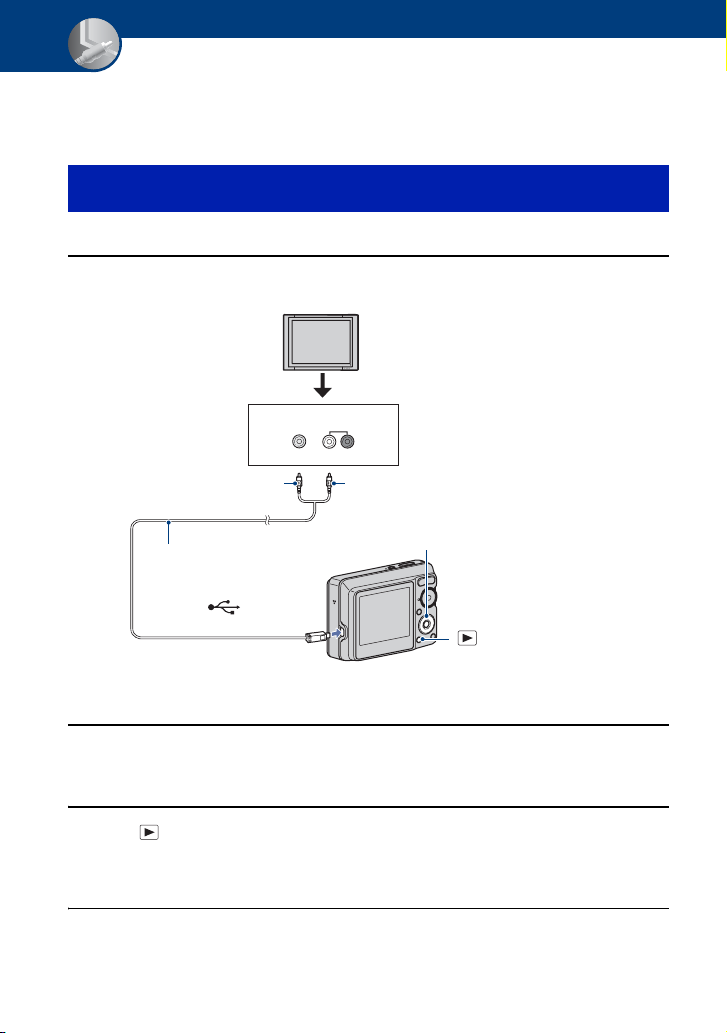
You can view images on a TV by connecting the camera to a TV.
The connection varies according to the type of TV the camera is connected to.
Turn off both the camera and the TV before connecting the camera to the TV.
1 Connect the camera to the TV with the dedicated A/V cable (supplied).
• If your TV has stereo input jacks, connect the audio plug (black) of the dedicated A/V cable to the left
audio jack.
2 Turn on the TV and set the input.
• Refer also to the operating instructions supplied with the TV.
3 Press (Playback) to turn on the camera.
Images shot with the camera appear on the TV.
Press b/B on the control button to select the desired image.
• When using your camera abroad, it may be necessary to switch the video signal output to match that of
your TV system (page 56).
Viewing images by connecting the camera to a TV with the supplied
dedicated A/V cable.
1 To audio/video
input jacks
Dedicated A/V cable
2 To the (USB) ·
A/V OUT terminal
Yellow Black
VIDEO AUDIO
(Playback) button
Control button

59
Viewing images on a TV
Viewing images on a TV
On TV color systems
If you want to view images on a TV screen, you need a TV with a video input jack and the
dedicated A/V cable. The color system of the TV must match that of your digital still camera.
Check the following lists for the TV color system of the country or region where the camera is
used.
NTSC system
Bahama Islands, Bolivia, Canada, Central America, Chile, Colombia, Ecuador, Jamaica,
Japan, Korea, Mexico, Peru, Surinam, Taiwan, the Philippines, the U.S.A., Venezuela, etc.
PAL system
Australia, Austria, Belgium, China, Czech Republic, Denmark, Finland, Germany, Holland,
Hong Kong, Hungary, Italy, Kuwait, Malaysia, New Zealand, Norway, Poland, Portugal,
Singapore, Slovak Republic, Spain, Sweden, Switzerland, Thailand, United Kingdom, etc.
PAL-M system
Brazil
PAL-N system
Argentina, Paraguay, Uruguay
SECAM system
Bulgaria, France, Guiana, Iran, Iraq, Monaco, Russia, Ukraine, etc.
60
Using your computer
Enjoying your Windows computer
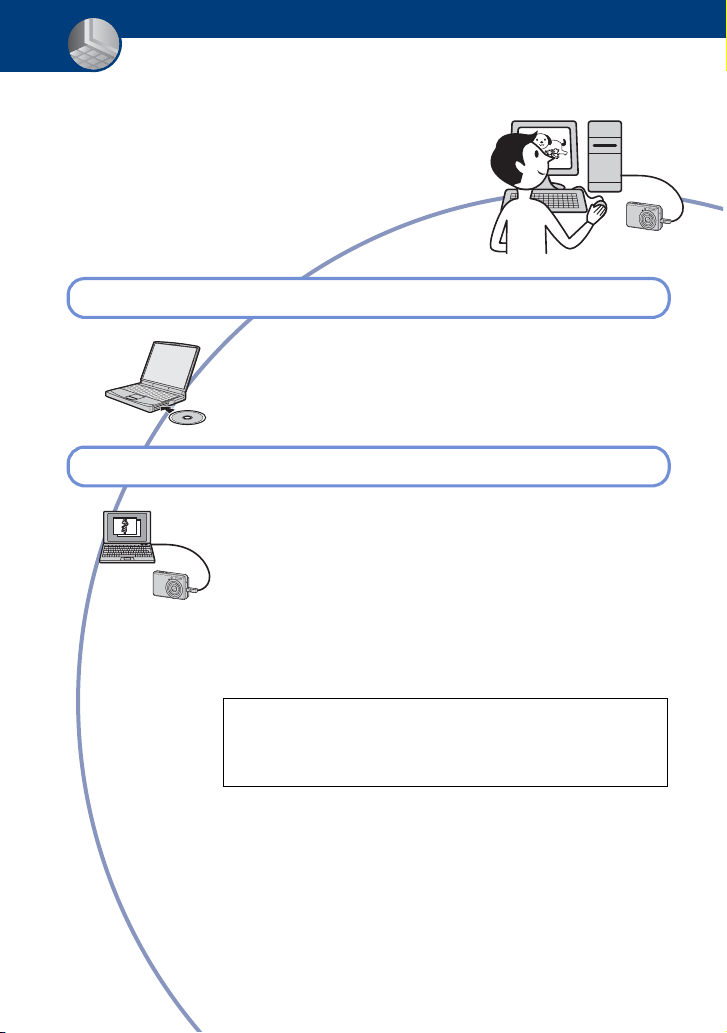
For details on using a Macintosh computer, refer to “Using
your Macintosh computer” (page 72).
Illustrations of screens used in this section are based on the
English version.
• Under Windows Vista, some names and operations may
differ from those described below.
• Installing the software as follows:
– “Picture Motion Browser”
• Copying images to your computer using “Picture Motion
Browser”.
• Enjoying images using “Picture Motion Browser” as follows:
– Viewing images saved on your computer
– Editing images
– Displaying the shooting locations of still images on maps
online
– Creating a disc with the images shot (requires CD or DVD
disc writing drive)
– Printing or saving still images with the date
Install the software (supplied) first (page 62)
Copying images to your computer (page 65)
Additional information on this product and answers to
frequently asked questions can be found at the Sony
Customer Support Website.
http://www.sony.net/

61
Using your computer
Enjoying your Windows computer
The following environment is
recommended for a computer connected to
the camera.
Recommended environment for copying
images
OS (pre-installed): Microsoft Windows
2000 Professional SP4, Windows XP*
SP2/Windows Vista*
• Operation is not assured in an environment
based on an upgrade of the operating
systems described above or in a multi-boot
environment.
USB jack: Provided as standard
Recommended environment for using
“Picture Motion Browser”
OS (pre-installed): Microsoft Windows
2000 Professional SP4, Windows XP*
SP2/Windows Vista*
CPU/Memory: Pentium III 500 MHz or
faster, 256 MB of RAM or more
(Recommended: Pentium III 800 MHz or
faster and 512 MB of RAM or more)
Hard Disk: Disk space required for
installation— approximately 200 MB
Display: Screen resolution: 1,024 × 768 dots
or more
Colors: High Color (16-bit color) or more
* 64-bit editions and Starter (Edition) is not
supported.
Notes on connecting the camera to a
computer
• Operations are not guaranteed for all the
recommended computer environments
mentioned above.
• If you connect two or more USB devices to a
single computer at the same time, some devices,
including the camera, may not operate,
depending on the types of USB devices you are
using.
• Operations are not guaranteed when using a
USB hub.
• Connecting the camera using a USB interface
that is compatible with Hi-Speed USB (USB 2.0
compliant) allows advanced transfer (high speed
transfer) as the camera is compatible with Hi-
Speed USB (USB 2.0 compliant).
• There are two modes for a USB connection
when connecting a computer, [Mass Storage]
(default setting) and [PTP] modes. This section
describes [Mass Storage] as an example. For
details on [PTP], see page 56.
• When your computer resumes from a suspend or
sleep mode, communication between the camera
and your computer may not recover at the same
time.
Recommended computer
environment
62
Installing the software (supplied)
You can install the software (supplied)
using the following procedure.
• Log in as Administrator.
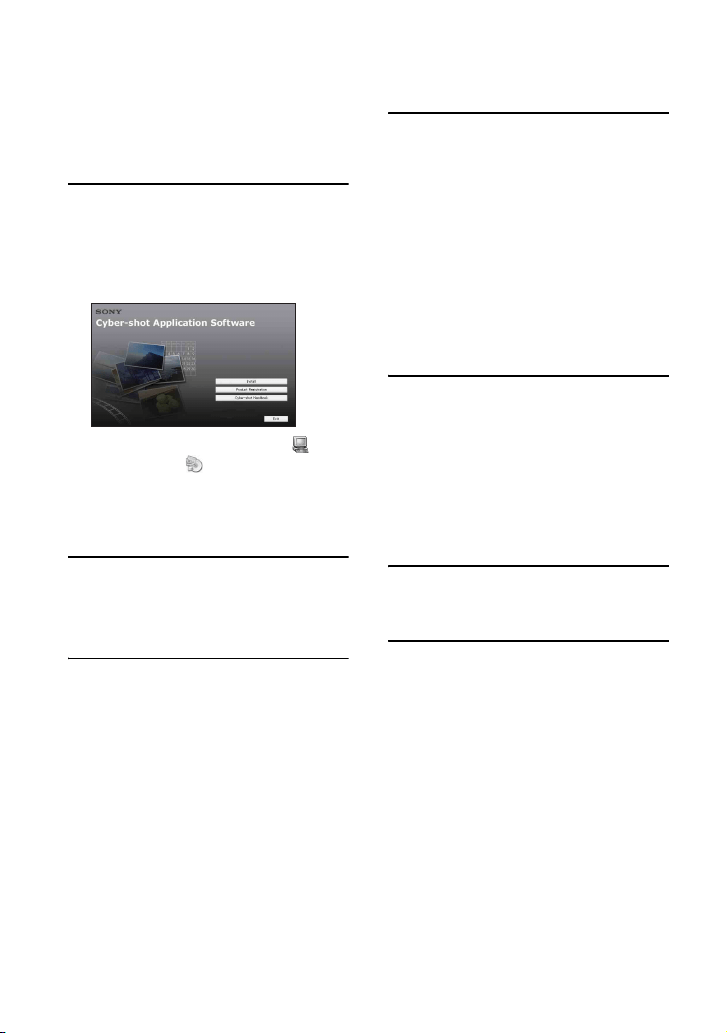
1 Turn on your computer, and insert
the CD-ROM (supplied) into the
CD-ROM drive.
The installation menu screen appears.
• If it does not appear, double-click (My
Computer) t (SONYPICTUTIL).
• Under Windows Vista, the AutoPlay screen
may appear. Select “Run Install.exe.” and
follow the instructions that appear on the
screen to proceed with the installation.
2 Click [Install].
The “Choose Setup Language” screen
appears.
3 Select the desired language, then
click [Next].
The [Location Settings] screen appears.
4 Select the [Region] and [Country/
Area], then click [Next].
When the [Welcome to the InstallShield
Wizard for SonyPicture Utility]
appears, click [Next].
The “License Agreement” screen
appears. Read the agreement carefully.
If you accept the terms of the
agreement, click the radio button next to
[I accept the terms of the license
agreement] and then click [Next].
5 Follow the instructions on the
screen to complete the
installation.
• When the restarting confirmation message
appears, restart the computer following the
instructions on the screen.
• DirectX may be installed depending on the
system environment of your computer.
6 Remove the CD-ROM after the
installation is complete.
63
Using your computer
Installing the software (supplied)
After you install the software, the short cut
icons for “Picture Motion Browser”,
“Picture Motion Browser Guide”, are
created on the desktop.
• Double-click to start
“Picture Motion Browser”.
• Double-click to start
“Picture Motion Browser
Guide”.

64
On the “Picture Motion Browser” (supplied)
You can use still images and movies from
the camera more than ever by taking
advantage of the software.
This section summarizes the “Picture
Motion Browser”.
With the “Picture Motion Browser” you
can:
• Import images shot with the camera and display
them on the computer.
• Organize images on the computer on a calendar
by shooting date to view them.
• Retouch (Red Eye Correction, etc.), print, and
send still images as e-mail attachments, change
the shooting date and more.
• Still images can be printed or saved with the
date.
• You can create a data disc using a CD burner
drive or DVD burner drive.
• For details, refer to “Picture Motion Browser
Guide”.
To access “Picture Motion Browser Guide”
• Double-click “Picture Motion Browser
Guide” icon on the desktop.
• From the Start menu, click [Start] t [All
Programs] (in Windows 2000,
[Programs]) t [Sony Picture Utility] t
[Help] t [Picture Motion Browser
Guide].
Starting the “Picture Motion Browser”
Double-click the (Picture Motion
Browser) icon on the desktop.
Or, from the Start menu: Click [Start] t
[All Programs] (in Windows 2000,
[Programs]) t [Sony Picture Utility] t
[Picture Motion Browser].
• The confirmation message of the Information
tool appears on the screen when starting the
“Picture Motion Browser” for the first time.
Select [Start]. This function informs you of
news, such as software updates. You can change
the setting later.
Exiting the “Picture Motion Browser”
Click button in the top right corner of
the screen.
“Picture Motion Browser”
overview
Starting and exiting the “Picture
Motion Browser”
65
Using your computer
Copying images to your computer using the
“Picture Motion Browser”
1 Insert a “Memory Stick Duo” with
recorded images into the camera.
• When copying images in the internal
memory, this step is unnecessary.
2 Insert the batteries with enough
power remaining in the camera, or
connect the camera to a wall
outlet (wall socket) with the AC
Adaptor (not supplied).
• When you copy images to your computer
using the batteries with little remaining
charge, copying may fail or image data may
become corrupted if the batteries shuts
down too soon.
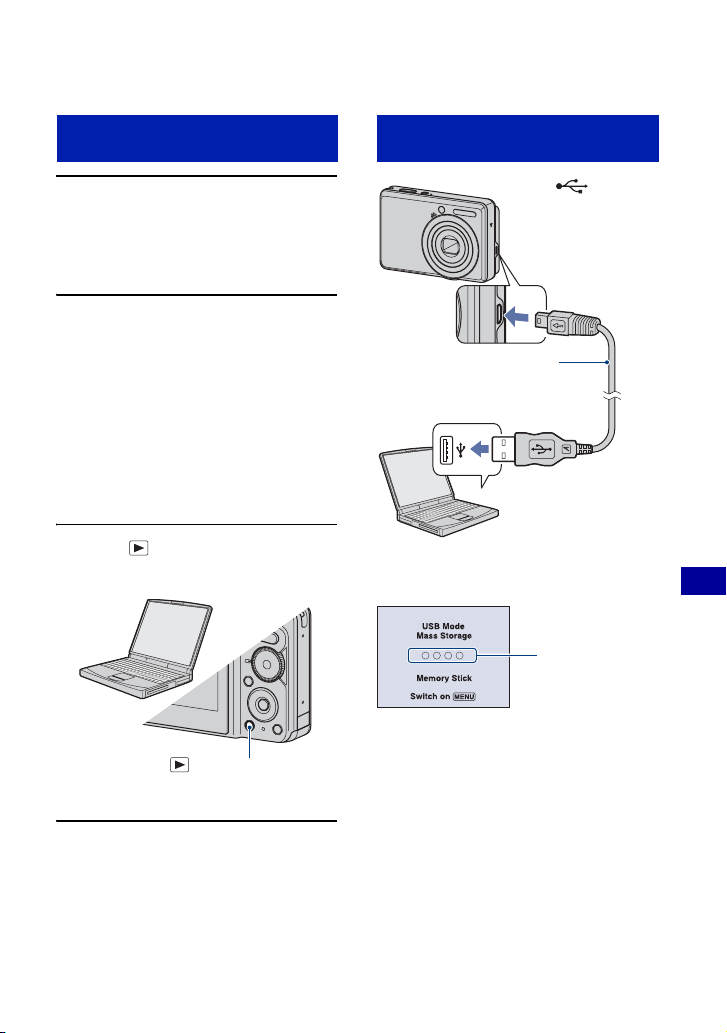
3 Press (Playback), then turn on
the computer.
“USB Mode Mass Storage” appears on the
screen of the camera.
When a USB connection is established for
the first time, your computer automatically
runs a program to recognize the camera.
Wait for a while.
*During communication, the access indicators
turn red. Do not operate the computer until the
indicators turn white.
• If “USB Mode Mass Storage” does not appear,
set [USB Connect] to [Mass Storage] (page 56).
Preparing the camera and the
computer
(Playback) button
Connecting the camera to your
computer
Dedicated USB cable
2 To a USB jack
1 To the (USB) ·
A/V OUT terminal
Access
indicators*
66
Copying images to your computer using the “Picture Motion Browser”
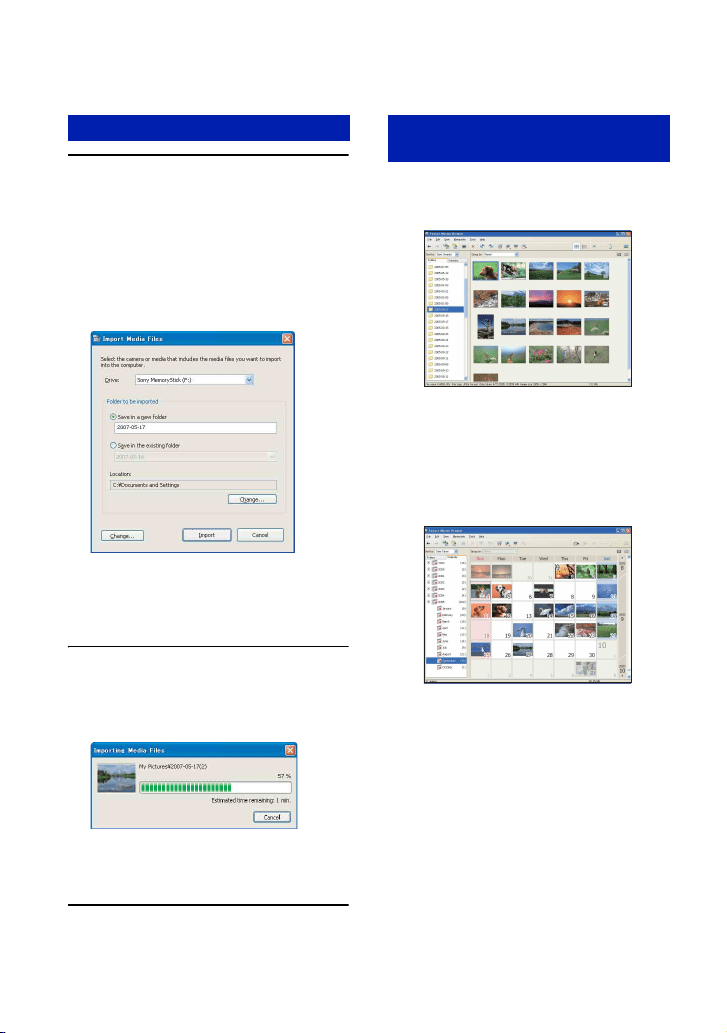
1 Connects the camera to a
computer as described
“Connecting the camera to your
computer”.
After making a USB connection, the
[Import Media Files] screen of “Picture
Motion Browser” appears automatically.
• If you use the Memory Stick slot, refer to
page 69.
• In Windows XP/Windows Vista, if the
AutoPlay Wizard appears, close it.
2 Import the images.
To start importing images, click the
[Import] button.
By default, images are imported into a
folder created in “My Pictures” that is
named with the date of importing.
• For details on the “Picture Motion
Browser”, refer to “Picture Motion Browser
Guide”.
When importing is complete, the “Picture
Motion Browser” starts. Thumbnails of the
imported images are displayed.
• The “My Pictures” folder is set as the default
folder in “Viewed folders”.
Organize images on the computer on a
calender by shooting date to view them.
For details, see the “Picture Motion
Browser Guide”.
Copying images to a computer Viewing images on your
computer
Example: Month display screen
67
Using your computer
Copying images to your computer using the “Picture Motion Browser”
Perform the procedures from step 1 to 4
below before:
• Disconnecting the dedicated USB cable.
• Removing a “Memory Stick Duo”.
• Inserting a “Memory Stick Duo” into the
camera after copying images from the internal
memory.
• Turning off the camera.
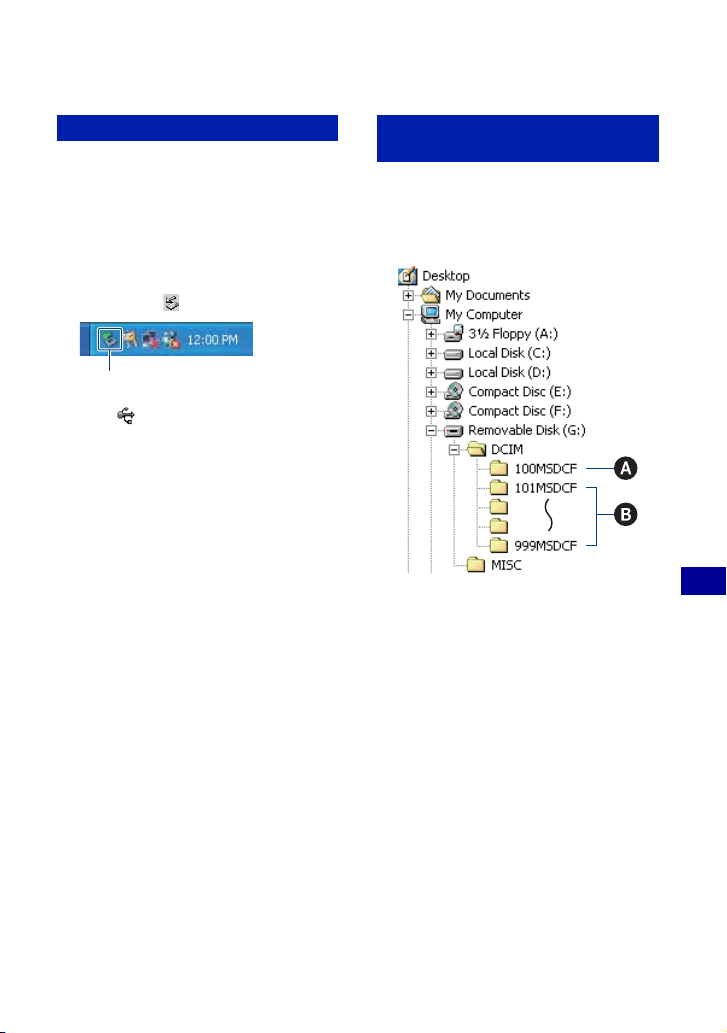
1 Double-click on the tasktray.
2 Click (USB Mass Storage Device) t
[Stop].
3 Confirm the device on the confirmation
window, then click [OK].
4 Click [OK].
The device is disconnected.
•Step 4 is unnecessary for Windows XP/
Windows Vista.
The image files recorded with the camera
are grouped as folders on the “Memory
Stick Duo” or the internal memory.
Example: viewing folders on Windows XP
A Folder containing image data recorded
using a camera not equipped with the
folder creating function
B Folder containing image data recorded
using the camera
When no new folders are created, there are
folders as follows:
– “Memory Stick Duo”: “101MSDCF” only
– Internal memory: “101_SONY” only
• You cannot record any images to the
“100MSDCF” folder. The images in this folder
are available only for viewing.
• You cannot record/play back any images to the
“MISC” folder.
To delete the USB connection
Double-click here
Image file storage destinations
and file names

68
Copying images to your computer using the “Picture Motion Browser”
• Image files are named as follows:
– Still image files: DSC0ssss.JPG
– Movie files: MOV0ssss.AVI
– Index image files that are recorded when you
record movies: MOV0ssss.THM
ssss stands for any number within the
range from 0001 to 9999. The numerical
portions of the name of a movie file recorded in
movie mode and its corresponding index image
file are the same.
• For more information about folders, see pages
41 and 52.

69
Using your computer
Copying images to a computer without “Picture
Motion Browser”
You can copy images to your computer
without “Picture Motion Browser” as
follows.
For a computer with a Memory Stick slot
Remove the “Memory Stick Duo” from the
camera and insert it in the Memory Stick
Duo Adaptor. Insert the Memory Stick Duo
Adaptor in the computer and copy the
images.
• Even when you are using Windows 95/98/98
SecondEdition/NT/Me, you can copy images by
inserting the “Memory Stick Duo” into the
Memory Stick slot on your computer.
• If the “Memory Stick PRO Duo” is not
recognized, see page 87.
For a computer without a Memory Stick
slot
Make a USB connection and follow Stages
to copy images.
• The screen displays shown in this section are the
examples for copying images from “Memory
Stick Duo”.
• The camera is not compatible with Windows 95/
98/98 SecondEdition/NT/Me of the Windows
operating system.
When you use a computer without a Memory
Stick slot, use a commercially available
Memory Stick Reader/Writer to copy images
from a “Memory Stick Duo” to your computer.
• To copy images in the internal memory to your
computer, copy the images to a “Memory Stick
Duo” first, then copy them to your computer.
This section describes an example of
copying images to a “My Documents” (For
Windows Vista: “Documents”).
1 Prepare the camera and a
computer.
Perform the same procedure as
described in “Preparing the camera and
the computer” on page 65.
2 Connect the camera to your
computer with the dedicated USB
cable.
Perform the same procedure as
described in “Connecting the camera to
your computer” on page 65.
• If “Picture Motion Browser” is already
installed, then [Import Media Files]
automatically starts on “Picture Motion
Browser”. Select [Cancel] to finish.
Copying images to a computer
-Windows XP/Vista
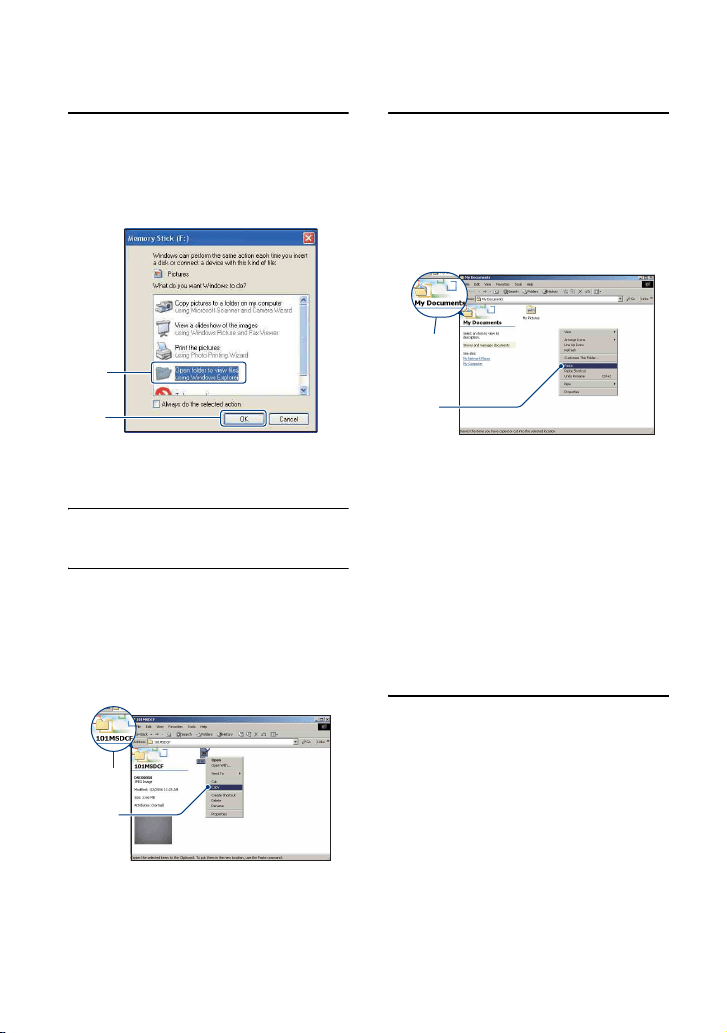
70
Copying images to a computer without “Picture Motion Browser”
3 Click [Open folder to view files]
t [OK](Only for Windows XP) as
the wizard screen appears
automatically on the desktop.
• When the wizard screen does not appear
automatically, follow the procedure: t
“For Windows 2000” on page 70.
4 Double-click [DCIM].
5 Double-click the folder where the
image files you want to copy are
stored. Then, right-click an image
file to display the menu and click
[Copy].
• On the storage destination of the image
files, see page 67.
6 Double-click the [My Documents]
(For Windows Vista:
“Documents”) folder. Then, right-
click on the “My Documents”
window to display the menu and
click [Paste].
The image files are copied to the “My
Documents” (For Windows Vista:
“Documents”) folder.
• When an image with the same file name
exists in the copy destination folder, the
overwrite confirmation message appears.
When you overwrite an existing image with
a new one, the original file data is deleted.
To copy an image file to the computer
without overwriting, change the file name
and then copy the image file. However, note
that if you change the file name (page 71),
you may not play back that image with the
camera.
For Windows 2000
Double-click [My Computer] t
[Removable Disk] after connecting the
camera to your computer. Then, perform
from step 4.
2
1
2
1
1
2
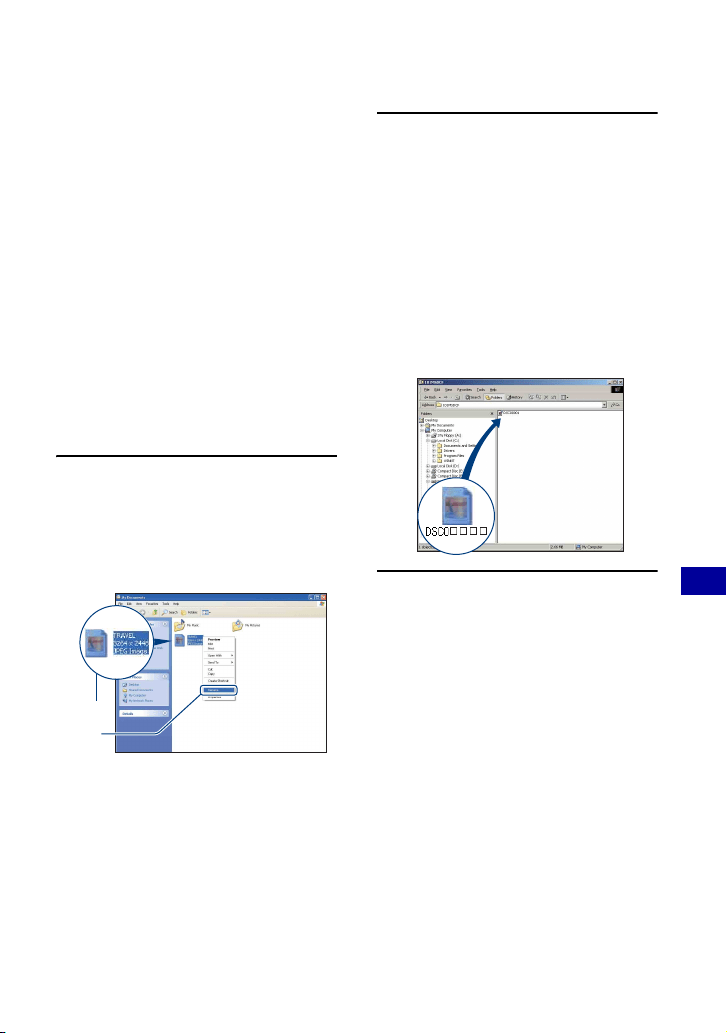
71
Using your computer
Viewing image files stored on a computer with
the camera copying to the “Memory Stick Duo”
This section describes the process using a
Windows computer as an example.
When an image file copied to a computer
no longer remains on a “Memory Stick
Duo”, you can view that image again on the
camera by copying the image file on the
computer to a “Memory Stick Duo”.
• Skip step 1 if the file name set with the camera
has not been changed.
• You may not be able to play back some images
depending on the image size.
• Sony does not guarantee playback of image files
on the camera if the files have been processed
using a computer or recorded with another
camera.
• When there are no folders in a “Memory Stick
Duo”, create a folder (page 52) with the camera
first, then copy the image files.
1 Right-click the image file, then
click [Rename]. Change the file
name to “DSC0ssss”.
Enter a number from 0001 to 9999 for
ssss.
• If the overwrite confirmation message
appears, enter a different number.
• An extension may be displayed depending
on the computer settings. The extension for
still images is JPG, and the extension for
movies is AVI. Do not change the extension.
2 Copy the image file to the
“Memory Stick Duo” folder in the
following order.
1Right-click the image file, then click
[Copy].
2Double-click [Removable Disk] or
[Sony MemoryStick] in [My
Computer].
3Right-click the [sssMSDCF] folder
in the [DCIM] folder, then click [Paste].
• sss stands for any number within the
range from 100 to 999.
1
2

72
Using your Macintosh computer
You can copy images to your Macintosh
computer.
• “Picture Motion Browser” is not compatible
with Macintosh computers.
The following environment is
recommended for a computer connected to
the camera.
Recommended environment for copying
images
OS (pre-installed): Mac OS 9.1/9.2/ Mac
OS X(v10.1 to v10.4)
USB jack: Provided as standard
Notes on connecting your camera to a
computer
• Operations are not guaranteed for all the
recommended computer environments
mentioned above.
• If you connect two or more USB devices to a
single computer at the same time, some devices,
including your camera, may not operate
depending on the types of USB devices you are
using.
• Operations are not guaranteed when using a
USB hub.
• Connecting the camera using a USB interface
that is compatible with Hi-Speed USB (USB 2.0
compliant) allows advanced transfer (high speed
transfer) as the camera is compatible with Hi-
Speed USB (USB 2.0 compliant).
• There are two modes for a USB connection
when connecting a computer, [Mass Storage]
(default setting) and [PTP] modes. This section
describes [Mass Storage] as an example. For
details on [PTP], see page 56.
• When your computer resumes from the suspend
or sleep mode, communication between your
camera and your computer may not recover at
the same time.
1 Prepare the camera and a
Macintosh computer.
Perform the same procedure as
described in “Preparing the camera and
the computer” on page 65.
2 Connect the dedicated USB cable.
Perform the same procedure as
described in “Connecting the camera to
your computer” on page 65.
3 Copy image files to the Macintosh
computer.
1Double-click the newly recognized icon
t [DCIM] t the folder where the
images you want to copy are stored.
2Drag and drop the image files to the
hard disk icon.
The image files are copied to the hard
disk.
• For details on the storage location of the
images and file names, see page 67.
4 View images on the computer.
Double-click the hard disk icon t the
desired image file in the folder
containing the copied files to open that
image file.
Recommended computer
environment
Copying and viewing images on
a computer

73
Using your computer
Using your Macintosh computer
Drag and drop the drive icon or the icon of
the “Memory Stick Duo” to the “Trash”
icon beforehand when you perform the
procedures listed below, or the camera is
disconnected from the computer.
• Disconnecting the dedicated USB cable
• Removing a “Memory Stick Duo”
• Inserting a “Memory Stick Duo” into the
camera after copying images from the internal
memory
• Turning off the camera
To delete the USB connection
Technical Support
Additional information on this product
and answers to frequently asked
questions can be found at the Sony
Customer Support Website.
http://www.sony.net/

74
Viewing “Cyber-shot Step-up Guide”
When you install “Cyber-shot Handbook”,
“Cyber-shot Step-up Guide” is also
installed. “Cyber-shot Step-up Guide”
further introduces how to use the camera
and optional accessories.
Start from the shortcut icon on the
desktop.
1 Copy the [stepupguide] folder in
the [stepupguide] folder to your
computer.
2 Select [stepupguide], [language]
and then [GB] folder stored in the
CD-ROM (supplied) and copy all
the files in the [GB] folder, then
write over them to the files in the
[img] folder stored in
[stepupguide] which is copied to
your computer in the step 1.
3 After copying is complete,
double-click “stepupguide.hqx”
in the [stepupguide] folder to
uncompress it, then double-click
the generated file “stepupguide”.
• If an uncompress tool for HQX file is not
installed, install the Stuffit Expander.
Viewing on Windows
Viewing on Macintosh
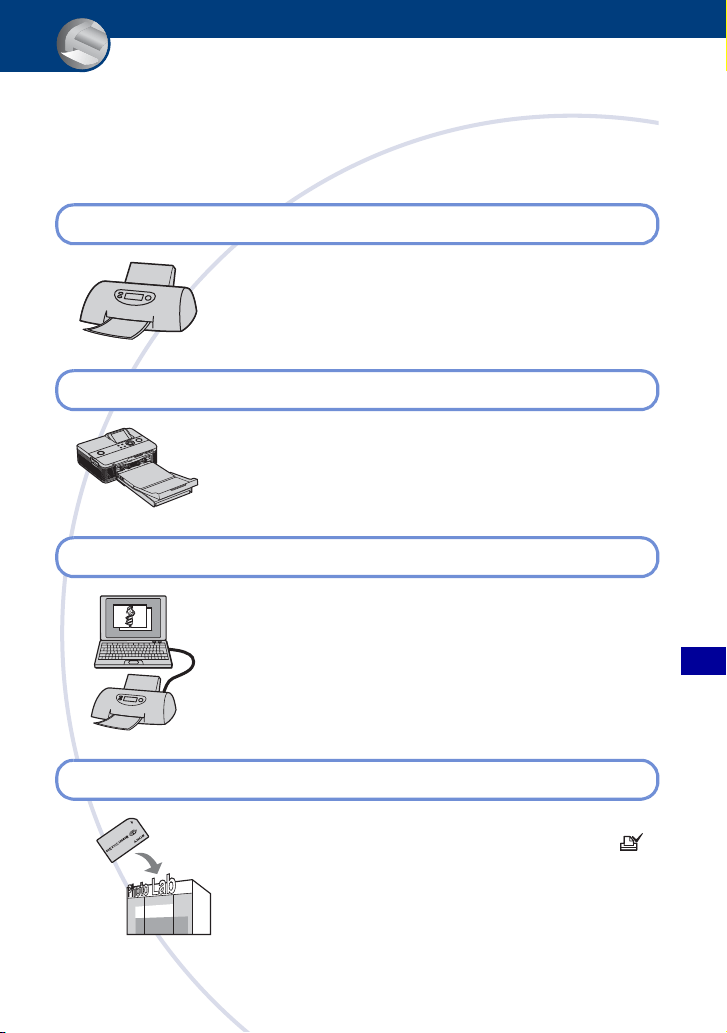
75
Printing still images
Printing still images
How to print still images
When you print images shot in [16:9] mode, both
edges may be cut off, so be sure to check before
printing (page 89).
You can print images by connecting the camera directly to a
PictBridge compliant printer.
You can print images with a “Memory Stick” compliant printer.
For details, see the operating instructions supplied with the
printer.
You can copy images to a computer using the supplied “Picture
Motion Browser” software and print the images.
You can print images date inserted (page 64).
You can take a “Memory Stick Duo” containing images shot with
your camera to a photo printing service shop. You can make a
(Print order) mark on the images which you want to print out in
advance.
Printing directly using a PictBridge compliant printer (page 76)
Printing directly using a “Memory Stick” compliant printer
Printing using a computer
Printing at a shop (page 80)
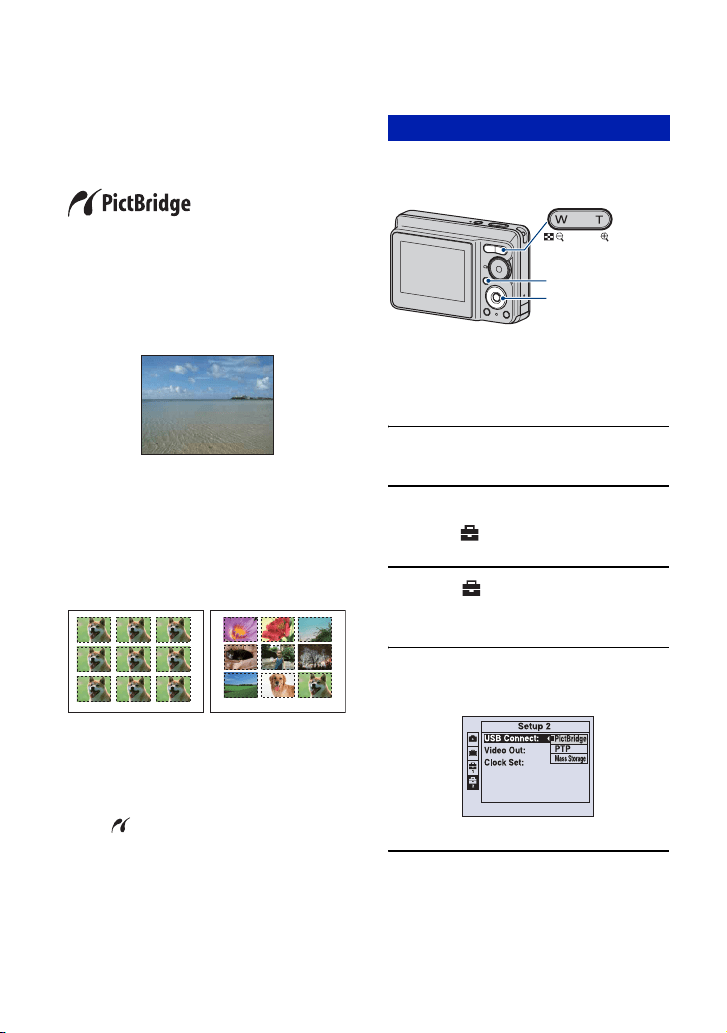
76
Printing images directly using a PictBridge
compliant printer
Even if you do not have a computer, you
can print images shot using your camera by
connecting the camera directly to a
PictBridge compliant printer.
• “PictBridge” is based on the CIPA standard.
(CIPA: Camera & Imaging Products
Association)
In single image mode
You can print a single image on a printing
sheet.
In index mode
You can print several images at a reduced
size on a printing sheet. You can print a set
of either the same images (1) or different
images (2).
12
• An index print function may not be provided
depending on the printer.
• The quantity of images that can be printed as an
index image differ depending on the printer.
• You cannot print movies.
• If the indicator flashes on the screen of the
camera for about five seconds (error
notification), check the connected printer.
Prepare the camera to connect it to the
printer with the dedicated USB cable.
• It is recommended to use batteries with enough
power remaining or an AC Adaptor (not
supplied) to prevent the power from turning off
partway through printing.
1 Press MENU to display the menu.
2 Press B on the control button to
select (Setup).
3 Select (Setup2) with V, then
select [USB Connect] with v/V/B.
4 Select [PictBridge] with B/v, then
press z.
The USB mode is set.
Stage 1: Preparing the camera
Index button
Control Button
MENU button
2
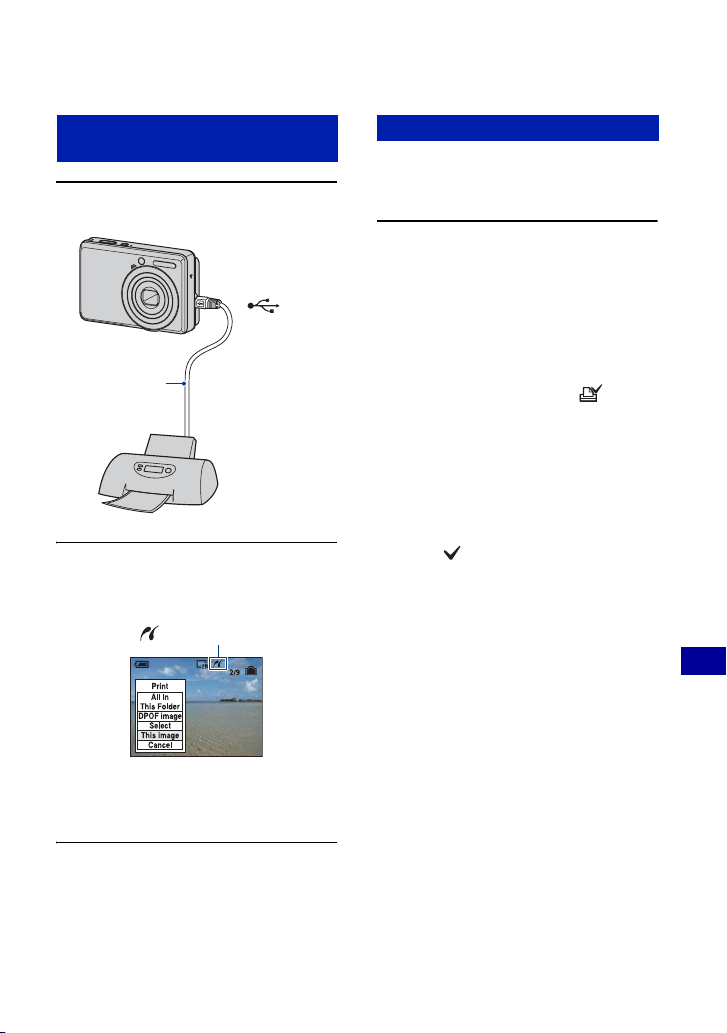
77
Printing still images
Printing images directly using a PictBridge compliant printer
1 Connect the camera to the printer.
2 Turn on your camera and the
printer.
After the connection is made,
the indicator appears.
The camera is set to playback mode, then an
image and the print menu appear on the
screen.
Regardless of what the mode dial is set to,
the print menu appears when you complete
Stage 2.
1 Select the desired printing
method with v/V on the control
button, then press z.
[All In This Folder]
Prints all the images in the folder.
[DPOF image]
Prints all the images with a (Print
order) mark (page 80) regardless of the
displayed image.
[Select]
Selects images and prints all the
selected images.
1Select the image you want to print with
b/B, then press z.
The mark appears on the selected
image.
• To select other images, repeat this
procedure.
2Select [Print] with V, then press z.
[This image]
Prints a displayed image.
• If you select [This image] and set [Index] to
[On] in step 2, you can print a set of the
same images as an index image.
Stage 2: Connecting the camera
to the printer
2 To the USB jack
1 To the
(USB) ·
A/V OUT
terminal
Dedicated
USB cable
Stage 3: Printing
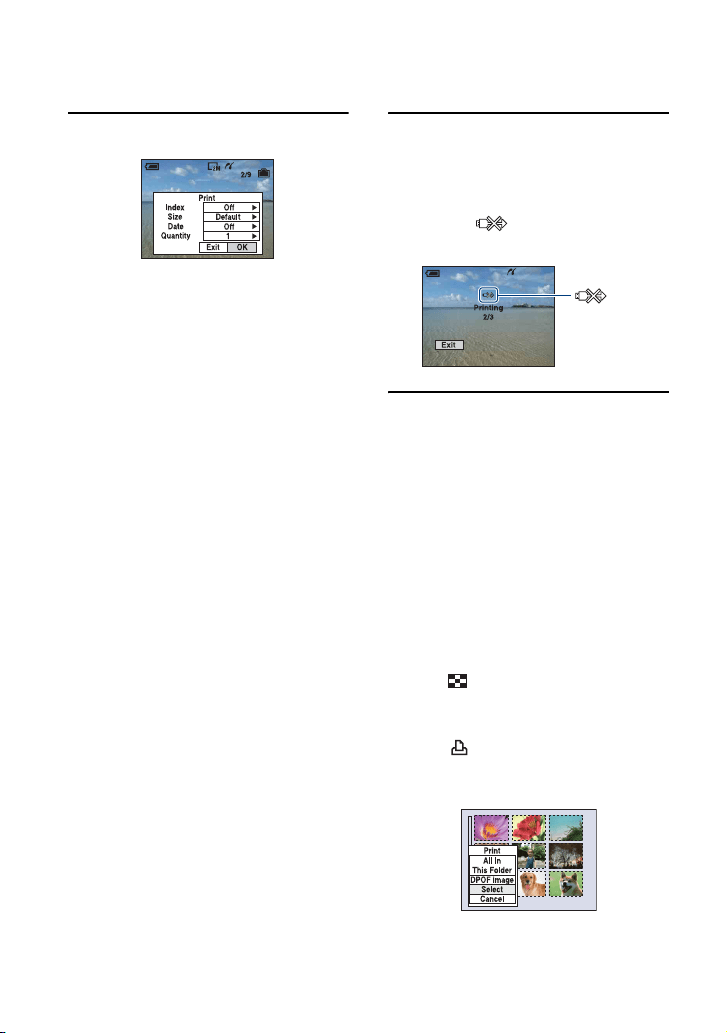
78
Printing images directly using a PictBridge compliant printer
2 Select print settings with v/V/b/B.
[Index]
Select [On] to print as an index image.
[Size]
Select the size of the printing sheet.
[Date]
Select [Day&Time] or [Date] to insert
the date and time on images.
• When you choose [Date], the date will be
inserted in the order you select (page 57).
This function may not be provided
depending on the printer.
[Quantity]
When [Index] is set to [Off]:
Select the number of sheets of an image
that you want to print. The image will
be printed as a single image.
When [Index] is set to [On]:
Select the number of sets of images that
you want to print as an index image. If
you selected [This image] in step 1,
select the number of the same image
you want to print side by side on a sheet
as an index image.
• The designated number of images may not
all fit onto a single sheet depending on the
quantity of images.
3 Select [OK] with V/B, then press
z.
The image is printed.
• Do not disconnect the dedicated USB cable
while the (PictBridge Connecting)
indicator appears on the screen.
To print other images
After step 3, select [Select] and the desired
image with v/V, then perform from step 1.
To print images on the index screen
Perform “Stage 1: Preparing the camera”
(page 76) and “Stage 2: Connecting the
camera to the printer” (page 77), then
proceed with the following.
When you connect the camera to a printer,
the print menu appears. Select [Cancel] to
turn off the print menu, then proceed as
follows.
1 Press (Index).
The index screen appears.
2 Press MENU to display the menu.
3 Select (Print) with B, then press z.
4 Select the desired printing method with v/
V, then press z.
indicator

79
Printing still images
Printing images directly using a PictBridge compliant printer
[Select]
Selects images and prints all the selected
images.
Select the image you want to print with v/
V/b/B, then press z to display the
mark. (Repeat this procedure to select
other images.) Then, press MENU.
[DPOF image]
Prints all the images with a (Print
order) mark regardless of the displayed
image.
[All In This Folder]
Prints all the images in the folder.
5 Perform steps 2 and 3 of “Stage 3:
Printing” (page 77).
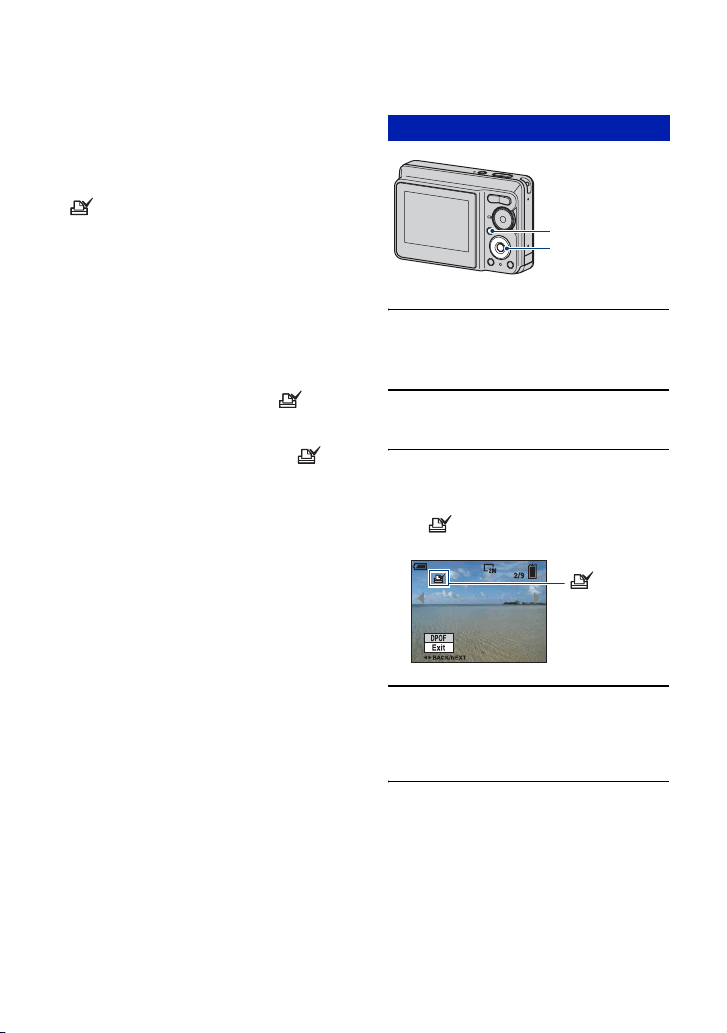
80
Printing at a shop
You can take a “Memory Stick Duo”
containing images shot with your camera to
a photo printing service shop. As long as
the shop supports photo printing services
conforming to the DPOF, you can make a
(Print order) mark on images in
advance so that you do not need to reselect
them when you print them out at the shop.
• You cannot print images stored in the internal
memory at a print shop directly from the
camera. Copy the images to a “Memory Stick
Duo”, then take the “Memory Stick Duo” to the
print shop.
What is DPOF?
DPOF (Digital Print Order Format) is a
function allowing you to make a
(Print
order) mark on images of “Memory Stick
Duo” that you want to print out later.
• You can also print the images with the
(Print order) mark using a printer that conforms
to the DPOF (Digital Print Order Format)
standard or using a PictBridge compliant printer.
• You cannot mark movies.
When taking a “Memory Stick Duo” to a
shop
• Consult your photo printing service shop as to
what types of “Memory Stick Duo” they can
process.
• If a “Memory Stick Duo” cannot be processed
by your photo printing service shop, copy the
images you want to print out to another medium
such as a CD-R and take it to the shop.
• Be sure to take the Memory Stick Duo Adaptor
with it.
• Before you take image data to a shop, always
copy (back up) your data to a disk.
• You cannot set the number of prints.
• When you want to superimpose dates on
images, consult your photo printing service
shop.
1 Display the image you want to
print.
2 Press MENU to display the menu.
3 Select [DPOF] with b/B, then
press z.
A (Print order) mark is marked on
the image.
4 To mark other images, display the
desired image with b/B, then
press z.
To remove the mark in single image
mode
Press z in step 3 or 4.
Marking in single image mode
Control button
MENU button
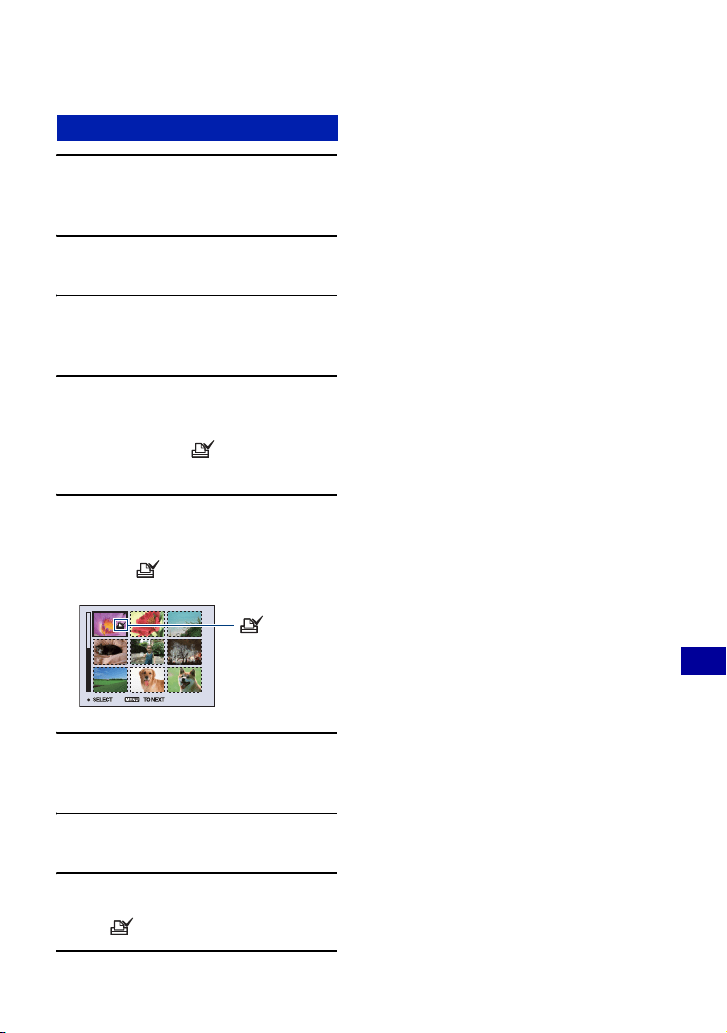
81
Printing still images
Printing at a shop
1 Display the index screen
(page 29).
2 Press MENU to display the menu.
3 Select [DPOF] with b/B, then
press z.
4 Select [Select] with v/V, then
press z.
• You cannot add a mark in [All In This
Folder].
5 Select the image you want to
mark with v/V/b/B, then press z .
A green mark appears on the
selected image.
6 Repeat step 5 to mark other
images.
7 Press MENU.
8 Select [OK] with B, then press z.
The mark turns white.
To cancel, select [Cancel] in step 4 or select
[Exit] in step 8, then press z.
To remove the mark in index mode
Select the images from which you want to
remove the mark in step 5, then press z.
To remove all the marks in the folder
Select [All In This Folder] in step 4, then
press z. Select [Off], then press z.
Marking in index mode
(green)
82
Troubleshooting
Troubleshooting
If you experience trouble with your camera, try the following solutions.
Be aware that by sending the camera for repair, you give consent that the contents of the
internal memory may be checked.
1 Check the items on pages 83 to 91.
2 Remove the batteries, wait for about one minute, re-insert the batteries, then
turn on the power.
3 Initialize the settings (page 55).
4 Consult your Sony dealer or local authorized Sony service facility.
Batteries and power 83
Shooting still images/movies 84
Viewing images 86
Deleting/Editing images 86
Computers 87
“Memory Stick Duo” 88
Internal memory 88
Printing 89
PictBridge compliant printer 89
Others 90
Click one of the following items to jump to the page explaining the symptom and cause or the
appropriate corrective action.

83
Troubleshooting
Troubleshooting
The battery remaining indicator is incorrect, or sufficient battery remaining
indicator is displayed but the power runs out too quickly.
• This phenomenon occurs when you use the camera in an extremely hot or cold location.
• When using alkaline batteries/Oxy Nickel Primary Battery (not supplied), the displayed time
remaining may not be correctly indicated.
• The batteries are discharged. Insert new batteries or charged Nickel-Metal Hydride batteries
(not supplied).
• When using the Nickel-Metal Hydride batteries, the poles of batteries or the terminals of the
battery cover are dirty so the batteries are not charged sufficiently. Clean them with a cotton
swab, etc. (page 97).
• When using the Nickel-Metal Hydride batteries, the displayed time remaining differs from the
current one due to the memory effect (page 97), etc. Fully discharge and then charge the
batteries to correct the display.
• The batteries are dead. Replace them with new ones.
The batteries run down too quickly.
• You are using the camera in an extremely cold location.
• The batteries are dead. Replace them with new ones.
• When using the Nickel-Metal Hydride batteries, charge them sufficiently.
Camera power is turned off automatically when you open the battery/“Memory
Stick Duo” cover.
• This is not a malfunction. Turn off the camera before you open the battery/“Memory Stick
Duo” cover.
Cannot turn on the camera.
• Insert the batteries correctly.
• Properly connect the AC Adaptor (not supplied).
• The batteries are discharged. Insert new batteries or charged Nickel-Metal Hydride batteries.
• The batteries are dead. Replace them with new ones.
The power turns off suddenly.
• If you do not operate the camera for about three minutes while the power is on, the camera
turns off automatically to prevent wearing down the batteries. Turn on the camera again.
• The batteries are discharged. Insert new batteries or charged Nickel-Metal Hydride batteries.
Batteries and power
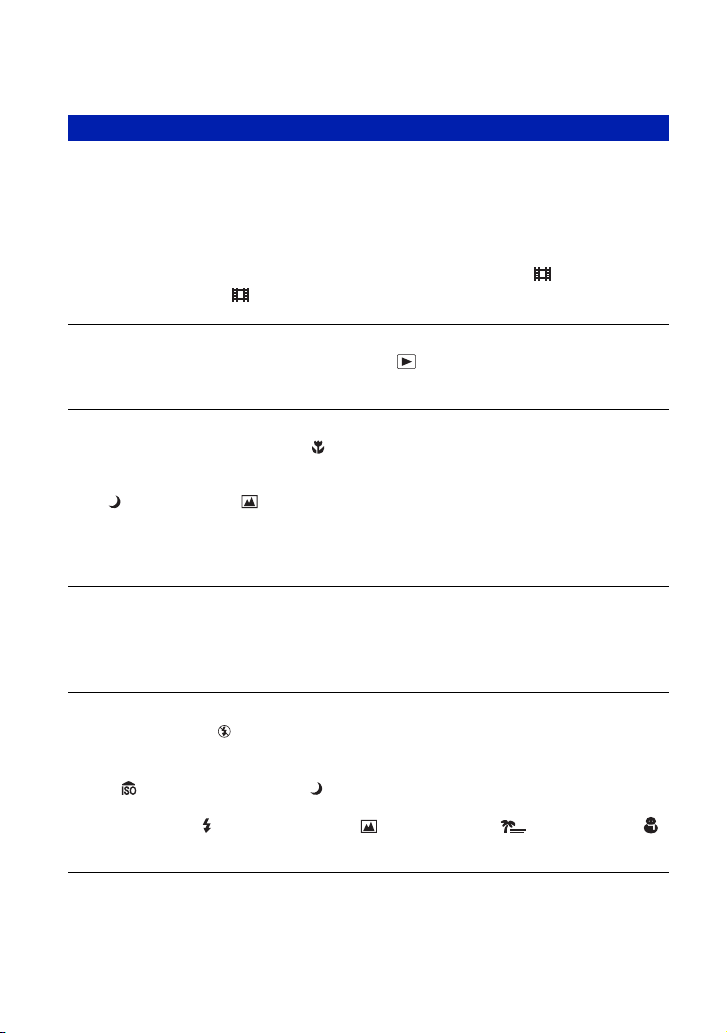
84
Troubleshooting
Cannot record images.
• Check the free capacity of the internal memory or “Memory Stick Duo”. If it is full, do one of
the following:
– Delete unnecessary images (page 28).
– Change the “Memory Stick Duo”.
• You cannot record images while charging the flash.
• When shooting a still image, set the mode dial to a position other than .
• Set the mode dial to when shooting movies.
The subject is not visible on the screen.
• Your camera is set to the Playback mode. Press (Playback) to change to the recording
mode (page 28).
The image is out of focus.
• The subject is too close. Shoot in (Macro) recording mode. Make sure to position the lens
farther away from the subject than the shortest shooting distance, approximately 5 cm (2
inches) (W)/35 cm (13 7/8 inches) (T) from the front of the lens, when shooting (page 23).
• (Twilight mode) or (Landscape mode) is selected in the Scene mode when shooting still
images.
• The Focus preset function is selected. Select the auto focus mode (page 34).
• Refer to “If the subject is out of focus” on page 35.
Zoom does not work.
• You cannot use the smart zoom when the image size is set to [7M] or [3:2].
• You cannot use the digital zoom while shooting movies.
• You cannot change the zoom scale while shooting movies.
The flash does not work.
• The flash is set to (Flash forced off) (page 22).
• You cannot use the flash when:
– [REC Mode] is set to [Burst] (page 39).
– (High Sensitivity mode) or (Twilight mode) is selected in the Scene mode (page 27).
– Shooting movies.
• Set the flash to (Flash forced on) when (Landscape mode), (Beach mode), or
(Snow mode) is selected in the Scene mode (page 22).
Fuzzy specks appear in images shot using the flash.
• Particles (dust, pollen, etc.) in the air reflected the flash light and appeared in the image. This
is not a malfunction (page 11).
Shooting still images/movies

85
Troubleshooting
Troubleshooting
The close-up shoot function (Macro) does not work.
• (Twilight mode) or (Landscape mode) is selected in the Scene mode (page 27).
The date and time are not displayed.
• While shooting, the date and time are not displayed. They are displayed only during playback.
Cannot insert dates on images.
• This camera does not have a feature for superimposing dates on images (page 89).
By using “Picture Motion Browser”, you can print or save images with the date (page 64).
The F value and shutter speed flash when you press and hold the shutter
button halfway down.
• The exposure is incorrect. Correct the exposure (page 33).
The screen is too dark or too bright.
• Select the brightness of the LCD backlight (page 18).
The image is too dark.
• You are shooting a subject with a light source behind the subject. Select the metering mode
(page 36) or adjust the exposure (page 33).
The image is too bright.
• Adjust the exposure (page 33).
The image colors are not correct.
• Set [Color Mode] to [Normal] (page 32).
Vertical streaks appear when you are shooting a very bright subject.
• The smear phenomenon is occurring and white, black, red, purple, or other streaks appear on
the image. This phenomenon is not a malfunction.
Noise appears in the image when you view the screen in a dark place.
• The camera is attempting to increase the visibility of the screen by temporarily brightening
the image under conditions of low illumination. There is no effect on the recorded image.
The eyes of the subject come out red.
• Set [Red Eye Reduction] in the (Setup) menu to [On] (page 50).
• Shoot the subject at a distance closer than the flash range using the flash.
• Light the room and shoot the subject.

86
Troubleshooting
Dots appear and remain on the screen.
• This is not a malfunction. These dots are not recorded (page 2).
Cannot shoot images in succession.
• The internal memory or “Memory Stick Duo” is full. Delete unnecessary images (page 28).
• The battery level is low. Insert new batteries or charged Nickel-Metal Hydride batteries (not
supplied).
Cannot play back images.
• Press (Playback) (page 28).
• The folder/file name has been changed on your computer (page 71).
• Sony does not guarantee playback of image files on the camera if the files have been
processed using a computer or recorded with another camera.
• The camera is in USB mode. Delete the USB connection (page 67).
The date and time are not displayed.
• The display indicators are turned off. Show the display indicators by pressing v (DISP) on the
control button (page 18).
The image appears rough right after playback starts.
• This may happen due to image processing. This is not a malfunction.
The image does not appear on the TV.
• Check [Video Out] to see if the video output signal of your camera is set to the color system of
your TV (page 56).
• Check whether the connection is correct (page 58).
Cannot delete an image.
• Cancel the protection (page 43).
The resizing function does not work.
• You cannot resize movies.
Viewing images
Deleting/Editing images

87
Troubleshooting
Troubleshooting
Computer OS compatibility with camera is unknown.
• Check “Recommended computer environment” on page 61 for Windows, and page 72 for
Macintosh.
“Memory Stick PRO Duo” is not recognized by a computer with a “Memory
Stick” slot.
• Check that the computer and the Memory Stick Reader/Writer support “Memory Stick PRO
Duo”. Users of computers and Memory Stick Readers/Writers made by manufacturers other
than Sony should contact those manufacturers.
• If “Memory Stick PRO Duo” is not supported, connect the camera to the computer (pages 65
and 72). The computer recognizes the “Memory Stick PRO Duo”.
Your computer does not recognize your camera.
• Turn on the camera.
• When the battery level is low, insert new batteries or charged Nickel-Metal Hydride batteries
(not supplied), or use the AC Adaptor (not supplied).
• Set [USB Connect] to [Mass Storage] in the (Setup) menu (page 56).
• Use the dedicated USB cable (supplied) (page 65).
• Disconnect the dedicated USB cable from both the computer and the camera, and connect it
again firmly.
• Disconnect all equipment other than the camera, the keyboard and the mouse from the USB
connectors of your computer.
• Connect the camera directly to your computer without passing through a USB hub or other
device (page 65).
Cannot copy images.
• Connect the camera and your computer correctly making a USB connection (page 65).
• Follow the designated copy procedure for your OS (pages 61 and 72).
• When you shoot images with a “Memory Stick Duo” formatted by a computer, you may not
be able to copy the images to a computer. Shoot using a “Memory Stick Duo” formatted by
your camera (page 52).
After making a USB connection, “Picture Motion Browser” does not start
automatically.
• Make the USB connection after the computer is turned on (page 65).
Cannot play back images on your computer.
• If you are using “Picture Motion Browser”, refer to “Picture Motion Browser Guide”
(page 64).
• Consult the computer or software manufacturer.
Computers

88
Troubleshooting
The image and sound are interrupted by noise when you view a movie on a
computer.
• You are playing back the movie directly from the internal memory or the “Memory Stick
Duo”. Copy the movie to the hard disk of your computer, then play back the movie from the
hard disk (page 65).
Cannot print an image.
• Refer to the operation manual of the printer.
Images once copied to a computer cannot be viewed on the camera.
• Copy them to a folder recognized by the camera, such as “101MSDCF” (page 67).
• Operate correctly (page 71).
Cannot insert a “Memory Stick Duo”.
• Insert it in the correct direction.
You have formatted a “Memory Stick Duo” by mistake.
• All the data on the “Memory Stick Duo” is deleted by formatting. You cannot restore it.
Cannot play back or record images using the internal memory.
• There is a “Memory Stick Duo” inserted in the camera. Remove it.
Cannot copy the data stored in the internal memory to a “Memory Stick Duo”.
• The “Memory Stick Duo” is full. Copy the image to the “Memory Stick Duo” with sufficient
free capacity.
Cannot copy the data on the “Memory Stick Duo” or the computer to the
internal memory.
• This feature is not available.
“Memory Stick Duo”
Internal memory

89
Troubleshooting
Troubleshooting
See “PictBridge compliant printer” together with the following items.
Images are printed with both edges cut off.
• Depending on your printer, all the edges of the image may be cut off. Especially when you
print an image shot with the image size set to [16:9], the lateral end of the image may be cut
off.
• When printing images using your printer, cancel the trimming or borderless settings. Consult
the printer manufacturer as to whether the printer provides these functions or not.
• When having images printed at a digital print shop, ask the shop whether they can print the
images without cutting off both edges.
Cannot print images with the date inserted.
• You can print images with the date inserted using “Picture Motion Browser” (page 64).
• This camera does not have a feature for superimposing dates on images. However, because the
images shot with the camera include information on the recording date, you can print images
with the date superimposed if the printer or the software can recognize Exif information. For
compatibility with Exif information, consult the manufacturer of the printer or the software.
• If you use a photo printing service, ask them to superimpose the dates on images.
A connection cannot be established.
• The camera cannot be connected directly to a printer that is not compliant with the PictBridge
standard. Consult the printer manufacturer as to whether the printer is compliant with
PictBridge or not.
• Check that the printer is turned on and can be connected to the camera.
• Set [USB Connect] to [PictBridge] in the (Setup) menu (page 56).
• Disconnect and connect the dedicated USB cable again. If an error message is indicated on the
printer, refer to the operating instructions supplied with the printer.
Cannot print images.
• Check that the camera and the printer are properly connected using the dedicated USB cable.
• Turn on the printer. For further information, refer to the operating instructions supplied with
the printer.
• If you select [Exit] during printing, images may not be printed. Disconnect and connect the
dedicated USB cable again. If you still cannot print your images, disconnect the dedicated
USB cable, turn the printer off and then on, then connect the dedicated USB cable again.
• Movies cannot be printed.
• Images shot using cameras other than this camera or images modified with a computer may
not be printed.
Printing
PictBridge compliant printer

90
Troubleshooting
Printing is canceled.
• You disconnected the dedicated USB cable before the (PictBridge Connecting) mark
disappears.
Cannot insert the date or print images in the index mode.
• The printer does not provide these functions. Consult the printer manufacturer as to whether
the printer provides these functions or not.
• The date may not be inserted in the index mode depending on the printer. Consult the printer
manufacturer.
“---- -- --” is printed on the date-inserted part of the image.
• The image does not have the recording data so the date cannot be inserted. Set [Date] to [Off]
and print the image again (page 78).
Cannot select the print size.
• Consult the printer manufacturer as to whether the printer can provide the desired size.
Cannot print the image at the size selected.
• When you use paper of a different size after connecting the printer to the camera, disconnect
and then reconnect the dedicated USB cable.
• The print setting of the camera differs from that of the printer. Change the setting of either the
camera (page 78) or the printer.
Cannot operate the camera after canceling printing.
• Wait for a while as the printer is carrying out the cancellation. It may take some time
depending on the printer.
Cannot reset the file-number.
• If you replace a recording medium, you cannot initialize file numbers with the camera. To
initialize file numbers, format the “Memory Stick Duo” (page 51, 52) or the internal memory,
and then initialize the settings (page 55). However, the data on the “Memory Stick Duo” or
the internal memory will be deleted and all settings, including date, will be initialized.
The camera does not function with the lens portion extended.
• Do not attempt to force the lens that has stopped moving.
• Insert new batteries or charged Nickel-Metal Hydride batteries, then turn on the camera again.
Others

91
Troubleshooting
Troubleshooting
The lens gets fogged.
• Moisture condensation has occurred. Turn off the camera and leave it for about an hour before
using it.
The lens does not move when you turn off the camera.
• The batteries are discharged. Insert new batteries or charged Nickel-Metal Hydride batteries.
The camera becomes warm when you use it for a long time.
• This is not a malfunction.
The Clock Set screen appears when you turn on the camera.
• Set the date and time again (page 57).
You want to change the date or time.
• Set the date and time again (page 57).

92
Warning messages
If the following messages appear, follow
the instructions.
E
• The battery level is low. Insert new ones
or charged Nickel-Metal Hydride
batteries (not supplied). Depending on
the conditions of use or the type of
battery, the indicator may flash even
though there are still 5 to 10 minutes of
remaining battery time left.
System error
• Turn the power off and then on again.
Internal memory error
• Turn the power off and then on again.
Reinsert the Memory Stick
• Insert the “Memory Stick Duo”
correctly.
• The inserted “Memory Stick Duo”
cannot be used in your camera
(page 95).
• The “Memory Stick Duo” is damaged.
• The terminal section of the “Memory
Stick Duo” is dirty.
Memory Stick type error
• The inserted “Memory Stick Duo”
cannot be used in your camera
(page 95).
Format error
• Format the media again (pages 51 and
52).
Memory Stick locked
• You are using the “Memory Stick Duo”
with the write-protect switch, and the
switch is set to the LOCK position. Set
the switch to the recording position.
No memory space in internal
memory
No memory space in Memory Stick
• Delete unnecessary images or files
(page 28).
Read only memory
• Your camera cannot record or delete
images on this “Memory Stick Duo”.
No file
• No images that can be played have been
recorded in the internal memory.
No file in this folder
• No images that can be played have been
recorded in this folder.
• You did not operate correctly when
copying images from your computer
(page 71).
Folder error
• A folder with the same first three digit
number already exists on the “Memory
Stick Duo” (for example: 123MSDCF
and 123ABCDE). Select another folder,
or create a new folder (pages 52, 53).
Cannot create more folders
• The folder with a name beginning with
“999” exists on the “Memory Stick
Duo”. You cannot create any folders if
this is the case.
Messages
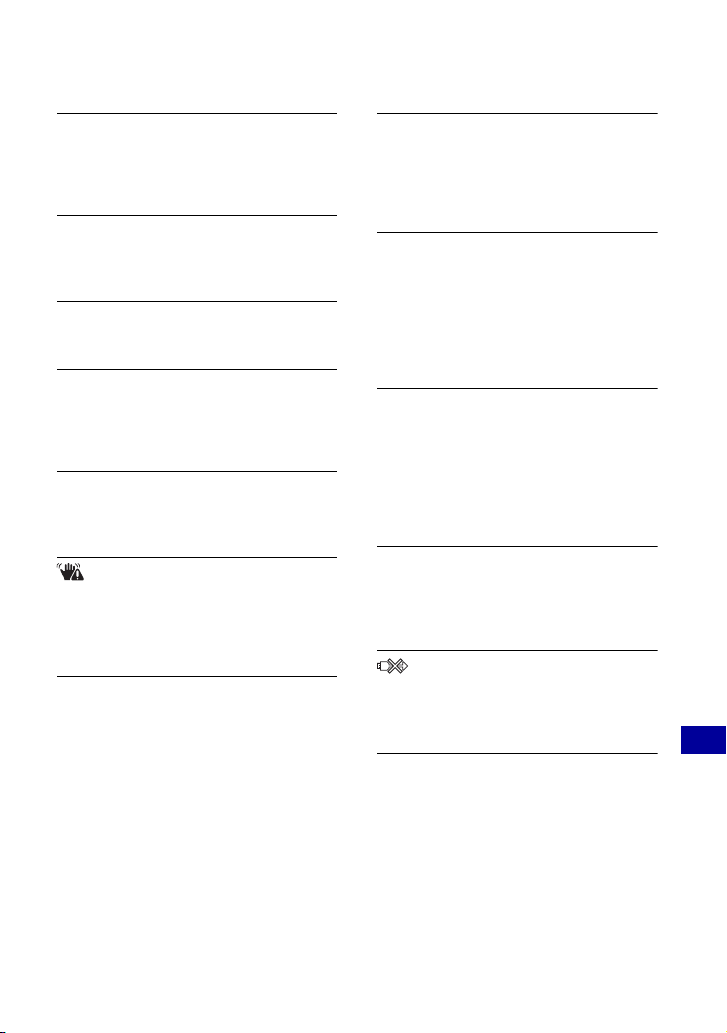
93
Troubleshooting
Warning messages
Cannot record
• The camera cannot record images in the
selected folder. Select a different folder
(page 53).
File error
• An error occurred while the image was
playing back.
File protect
• Release the protection (page 42).
Image size over
• You are playing back an image of a size
that cannot be played back on your
camera.
Invalid operation
• You are trying to play back a file that is
not compatible with the camera.
(Vibration warning indicator)
• Camera shake may occur due to
insufficient light. Use the flash or mount
the camera on a tripod to secure the
camera.
Enable printer to connect
• [USB Connect] is set to [PictBridge],
however the camera is connected to a
non-PictBridge compliant device.
Check the device.
• The connection is not established.
Disconnect and connect the dedicated
USB cable again. If an error message is
indicated on the printer, refer to the
operating instructions supplied with the
printer.
Connect to PictBridge device
• You tried to print images before the
printer connection was established.
Connect to a PictBridge compliant
printer.
No printable image
• You tried to execute [DPOF image]
without placing a DPOF (Print order)
mark on the image(s).
• You tried to execute [All In This Folder]
while a folder that holds only movies
was selected. You cannot print movies.
Printer busy
Paper error
No Paper
Ink error
Low Ink
No Ink
• Check the printer.
Printer error
• Check the printer.
• Check if the image you want to print is
corrupted.
• The data transmission to the printer may
not be completed yet. Do not disconnect
the dedicated USB cable.
Processing
• The printer is canceling the current print
job. You cannot print until it is finished.
This may take time, depending on the
printer.

94
Others
Using the camera abroad — Power sources
You can use the camera, the AC-LS5K AC Adaptor (not supplied) in any country or region
where the power supply is within 100 V to 240 V AC, 50/60 Hz.
• Do not use an electronic transformer (travel converter), as this may cause a
malfunction.
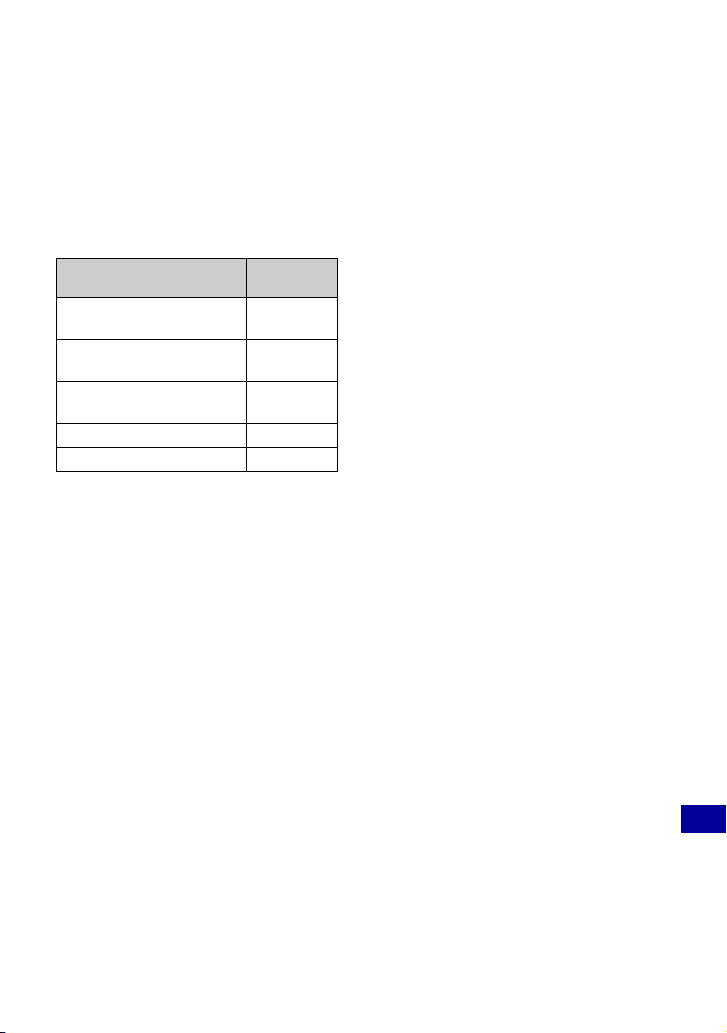
95
Others
On the “Memory Stick Duo”
A “Memory Stick Duo” is a compact,
portable IC recording medium. The types of
“Memory Stick Duo” that can be used with
the camera are listed in the table below.
However, proper operation cannot be
guaranteed for all “Memory Stick Duo”
functions.
*1)
“Memory Stick Duo”, “MagicGate Memory
Stick Duo” and “Memory Stick PRO Duo” are
equipped with MagicGate functions.
MagicGate is copyright protection technology
that uses encryption technology. Data
recording/playback that requires MagicGate
functions cannot be performed with the
camera.
*2)
The camera is not compatible with high-speed
data transfer using a parallel interface.
*3)
The camera is not compatible with 8-bit
parallel data transfer. Supports 4-bit parallel
data transfer equivalent to “Memory Stick PRO
Duo”.
• This product is compatible with “Memory Stick
Micro” (“M2”). “M2” is an abbreviation for
“Memory Stick Micro”.
• A “Memory Stick Duo” formatted with a
computer is not guaranteed to operate with the
camera.
• Data read/write speeds differ depending on the
combination of the “Memory Stick Duo” and
the equipment used.
• Do not remove the “Memory Stick Duo” while
reading or writing data.
• Data may be corrupted in the following cases:
– When the “Memory Stick Duo” is removed or
the camera is turned off during a read or write
operation.
– When the “Memory Stick Duo” is used in
locations subject to static electricity or
electrical noise.
• We recommend backing up important data on a
hard disk of your computer.
• Do not press down hard when you write down
on the memo area.
• Do not attach a label on the “Memory Stick
Duo” itself nor on a Memory Stick Duo
Adaptor.
• When you carry or store the “Memory Stick
Duo”, put it in the case supplied with it.
• Do not touch the terminal section of the
“Memory Stick Duo” with your hand or a metal
object.
• Do not strike, bend or drop the “Memory Stick
Duo”.
• Do not disassemble or modify the “Memory
Stick Duo”.
• Do not expose the “Memory Stick Duo” to
water.
• Do not leave the “Memory Stick Duo” within
the reach of small children. They might
accidentally swallow it.
• Do not insert anything other than a “Memory
Stick Duo” into the Memory Stick Duo slot.
Otherwise, a malfunction may result.
• Do not use or store the “Memory Stick Duo”
under the following conditions:
– High temperature locations such as the hot
interior of a car parked in direct sunlight
– Locations exposed to direct sunlight
– Humid locations or locations with corrosive
substances present
“Memory Stick” type Recording/
Playback
Memory Stick Duo
(with MagicGate)
a
*1
Memory Stick Duo
(without MagicGate)
a
*2
MagicGate Memory Stick
Duo
a
*1*2
Memory Stick PRO Duo a
*1
Memory Stick PRO-HG Duo a
*1*3

96
On the “Memory Stick Duo”
Notes on using the Memory Stick Duo
Adaptor (not supplied)
• To use a “Memory Stick Duo” with a “Memory
Stick” compliant device, be sure to insert the
“Memory Stick Duo” into a Memory Stick Duo
Adaptor. If you insert a “Memory Stick Duo”
into a “Memory Stick” compliant device
without a Memory Stick Duo Adaptor, you
might not be able to remove it from the device.
• When inserting a “Memory Stick Duo” into a
Memory Stick Duo Adaptor, make sure the
“Memory Stick Duo” is inserted facing in the
correct direction, then insert it all the way in.
Incorrect insertion may result in a malfunction.
• When using a “Memory Stick Duo” inserted
into a Memory Stick Duo Adaptor with a
“Memory Stick” compliant device, make sure
that the Memory Stick Duo Adaptor is inserted
facing the correct direction. Note that improper
use may damage the equipment.
• Do not insert a Memory Stick Duo Adaptor into
a “Memory Stick” compliant device without a
“Memory Stick Duo” attached. Doing so may
result in malfunction of the unit.
Notes on using “Memory Stick PRO
Duo” (not supplied)
“Memory Stick PRO Duo” with a capacity up to
8 GB have been confirmed to operate properly
with the camera.
Notes on using “Memory Stick Micro”
(not supplied)
• To use a “Memory Stick Micro” with the
camera, be sure to insert the “Memory Stick
Micro” into a Duo-sized “M2” Adaptor. If you
insert a “Memory Stick Micro” into the camera
without a Duo-sized “M2” Adaptor, you might
not be able to remove it from the camera.
• Do not leave the “Memory Stick Micro” within
the reach of small children. They might
accidentally swallow it.
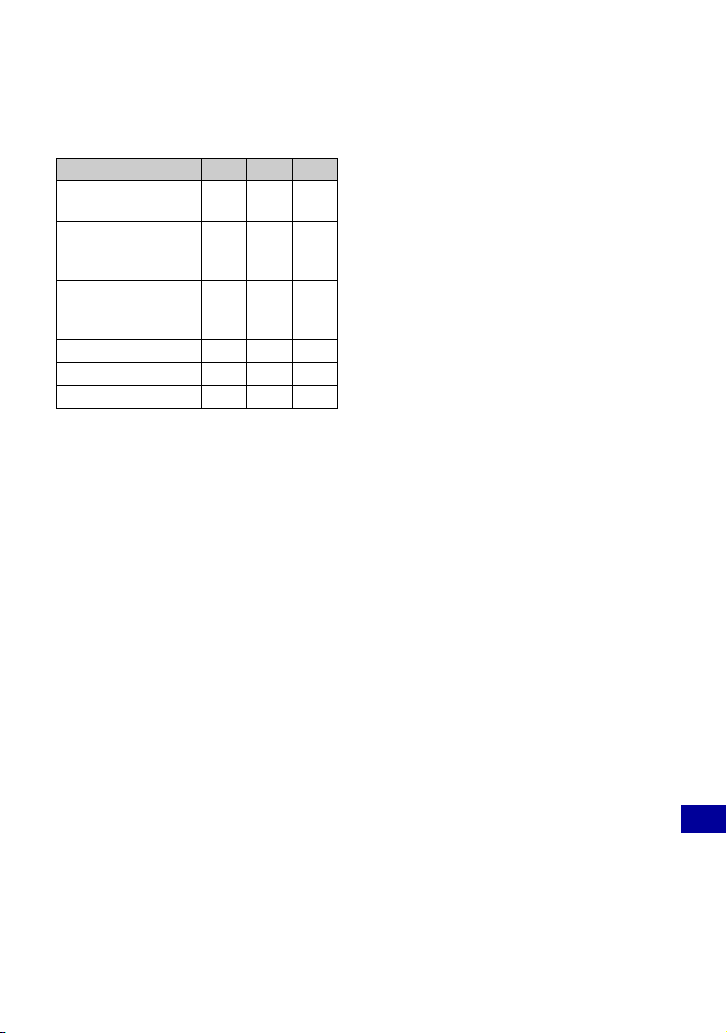
97
Others
On the batteries
Batteries you can and cannot use with
your camera
A: supplied
B: supported
C: rechargeable
* Before using batteries, read the following
precaution for each type of battery.
As for unsupported batteries, operating
performance cannot be ensured if voltage
drops or other problems are caused by the
nature of the battery.
On alkaline batteries (supplied)/Oxy
Nickel Primary Battery (not supplied)
• Alkaline batteries/Oxy Nickel Primary Battery
cannot be charged.
• Alkaline batteries/Oxy Nickel Primary Battery
have a shorter life compared to the Nickel-Metal
Hydride batteries. For this reason, the power
may turn off even though the battery remaining
indicator shows sufficient battery life remaining.
• Battery performance differs greatly depending
on the manufacturer and the type of battery, and
in some cases the battery life may be extremely
short. This is especially true at low
temperatures, and you may not be able to shoot
at temperatures below 5°C (41°F).
• Do not mix new and old batteries.
• The battery remaining indicator may not display
the correct information when using alkaline
batteries/Oxy Nickel Primary Battery.
• Due to characteristics of alkaline batteries/Oxy
Nickel Primary Battery, there is a large
difference between the available shooting time
and the available playback time. For this reason,
the camera may turn off with the lens portion
extended when you switch the mode dial. In this
case, replace the batteries with new ones. Using
the Nickel-Metal Hydride batteries allows you
to shoot for longer periods of time.
On Nickel-Metal Hydride batteries (not
supplied)
• Do not peel off the external seals or damage the
batteries. Never use batteries from which the
seals have been partially or completely
removed, or batteries that have been split in any
way. These may cause leakage, explosion, or
heat-up of the battery, and personal scald or
injury may be caused. These may cause a
malfunction of the battery charger.
• Do not carry or store the Nickel-Metal Hydride
batteries with metallic objects. Since metallic
objects may short the + and – ends, resulting in
the risk of heating or fire.
• If the poles of the Nickel-Metal Hydride
batteries are dirty, the batteries may not charge
properly. Wipe them with a dry cloth, etc.
• At the time of purchase, or when the Nickel-
Metal Hydride batteries have not been used for a
long time, they may not full charge. This is
typical of this type of battery, and is not a
malfunction. If this happens, repeatedly using
up the batteries fully, and then recharging them
should correct the problem.
• If you recharge Nickel-Metal Hydride batteries
before fully using up the existing charge, the
low battery warning may be displayed sooner
than expected. This is called the “memory
effect.”* If this problem occurs, charging the
batteries only after using up the existing charge
will correct it.
* The “memory effect” - the situation in which
the capacity of the battery is temporarily
lowered.
• To use up the batteries completely, put the
camera in the slide show mode (page 44) and
leave it that way until the batteries are used up.
• Do not mix new and used batteries.
• Do not expose the battery to water. The battery
is not water-resistant.
Battery type A B C
LR6 (size AA)
alkaline batteries
*
aa—
HR 15/51:HR6 (size
AA) Nickel-Metal
Hydride batteries
*
— aa
ZR6 (size AA) Oxy
Nickel Primary
Battery
*
— a —
Lithium batteries — — —
Manganese batteries — — —
Ni-Cd batteries — — —

98
Index
Index
A
AC Adaptor...........................13
Adjusting EV..................18, 33
AE/AF lock indicator .....21, 35
AF lock...........................21, 35
AF range finder frame ..........35
Aperture..................................8
Auto adjustment mode..........21
Auto Focus..............................6
Auto Review .........................50
AVI .......................................68
B
B&W ....................................32
Battery ..................................97
Beach mode ..........................26
Beep......................................55
Blur.........................................7
Burst .....................................39
C
Camera..................................49
Center AF .............................34
Center-weighted metering ....36
Change REC. Folder.............53
Clock Set ..............................57
Cloudy ..................................37
Color.......................................9
Color Mode...........................32
Computer..............................60
Copying images.......65, 72
Macintosh......................72
Recommended
environment.............61, 72
Software ........................62
Viewing image files stored
on a computer with the
camera ...........................71
Windows........................60
Connecting
Computer ...................... 65
Printer ........................... 77
TV................................. 58
Copy..................................... 54
Copying images to your
computer....................... 65
Create REC. Folder.............. 52
D
Date...................................... 57
Daylight ............................... 38
Dedicated A/V cable............ 58
Dedicated USB cable ..... 65, 77
Delete ................................... 28
Format..................... 51, 52
Digital Zoom........................ 49
DirectX................................. 62
DISP..................................... 18
DPOF ................................... 80
E
EV ........................................ 33
Exposure ................................ 8
Extension ............................. 71
F
File name.............................. 67
File storage destination ........ 67
Flash (Shooting)................... 11
Flash (White Bal)................. 37
Flash forced off.................... 22
Flash forced on..................... 22
Flash Level........................... 40
Flash mode........................... 22
Fluorescent........................... 37
Focus.......................... 6, 22, 34
Focus preset ......................... 34
Folder....................................41
Changing.......................53
Creating.........................52
Selecting........................ 41
Format ............................51, 52
Function Guide.....................50
H
High Sensitivity mode .......... 26
Histogram .............................18
Holding the camera .............. 21
I
Identifying parts ...................12
Image file storage destinations
and file names ...............67
Image quality........................10
Image size.......................10, 24
Incandescent .........................37
Index mode printing .............76
Index screen..........................29
Indicator ...............................14
Initialize................................ 55
Install ....................................62
Internal memory ...................19
Internal Memory Tool ..........51
ISO ...................................8, 38
J
JPG .......................................68
L
Landscape mode...................26
Language .............................. 55
LCD Screen ..........................18

99
Index
Index
M
Macintosh computer .............72
Recommended
environment...................72
Macro....................................23
Mass Storage.........................56
“Memory Stick Duo”............95
Memory Stick Tool ...............52
Menu.....................................30
Items ..............................31
Shooting.........................32
Viewing..........................41
Metering Mode .....................36
Mode.....................................39
Mode dial..............................20
Movie recording mode..........20
Multi AF ...............................34
Multi-pattern metering..........36
N
Natural ..................................32
NTSC ....................................56
O
Optical zoom...................22, 49
OS ...................................61, 72
Overexposure ..........................8
P
PAL .......................................56
PC .........................................60
PictBridge .......................56, 76
Picture Motion Browser........64
Pixel ......................................10
Playback................................28
Playback zoom......................28
Precision digital zoom ..........49
Pressing halfway down ...........6
Print...................................... 75
Index mode ................... 76
Single image mode........ 76
Print order mark ................... 80
Printing at a shop.................. 80
Printing directly.................... 76
Program Auto mode ............. 20
Protect .................................. 42
PTP....................................... 56
R
REC Mode............................ 39
Red Eye Reduction............... 50
Resize................................... 45
Rewind/Fast forward ............ 28
Rich ...................................... 32
Rotate ................................... 46
S
Scene Selection .................... 25
Screen
Changing the display .... 18
Indicator........................ 14
LCD backlight............... 18
Select Folder......................... 41
Self-timer .............................23
Sepia..................................... 32
Setup......................... 40, 46, 48
Camera.......................... 49
Internal Memory Tool... 51
Memory Stick Tool ....... 52
Setup1 ........................... 55
Setup2 ........................... 56
Setup1................................... 55
Setup2................................... 56
Sharpness .............................40
Shooting
Movie............................ 21
Still image ..................... 21
Shooting menu ..................... 32
Shutter speed ..........................8
Single image mode
printing ..........................76
Slide Show............................44
Slow synchro ........................22
Smart zoom...........................49
Snow mode ...........................26
Soft Snap mode.....................26
Software..........................62, 64
Spot metering........................36
Spot metering cross hairs......36
T
Trimming..............................47
Troubleshooting....................82
TV.........................................58
Twilight mode.......................26
Twilight Portrait mode..........26
U
Underexposure........................8
USB Connect ........................56
USB·A/V OUT terminal.......12
Using the camera abroad ......94
V
VGA......................................24
Video Out..............................56
Viewing menu.......................41
W
Warning messages ................92
White Bal..............................37
Windows computer...............60
Recommended
environment...................61
Z
Zoom.....................................22