
ge.com
Refrigerators
Top-Freezer
200D8114P001 49-60444 11-05 JR
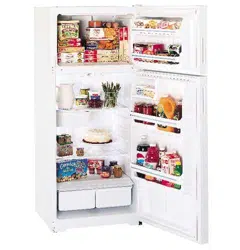
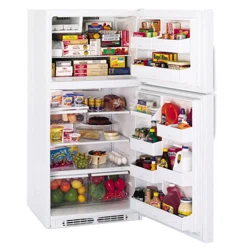
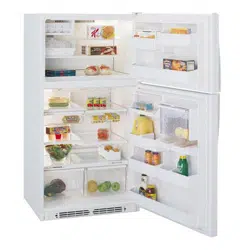
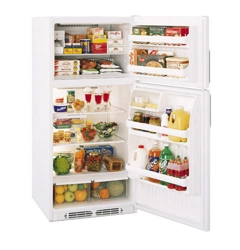
Models 22, 25
Owner’s Manual &
Installation Instructions
Safety Instructions
Connect Electricity . . . . . . . . . . . . . . . .3
Extension Cords . . . . . . . . . . . . . . . . . .2
Proper Disposal . . . . . . . . . . . . . . . . . .2
Safety Precautions . . . . . . . . . . . . . . . .2
Operating Instructions
Additional Features . . . . . . . . . . . . . . .9
Automatic Icemaker . . . . . . . . . . . . . .10
Controls . . . . . . . . . . . . . . . . . . . . . .4, 5
Crispers and Pans . . . . . . . . . . . . . .9, 10
Shelves and Bins . . . . . . . . . . . . . . . .7, 8
Water Dispenser . . . . . . . . . . . . . . . .11
Water Filter . . . . . . . . . . . . . . . . . . . . .6
Care and Cleaning
Care and Cleaning . . . . . . . . . . . . . . .11
Replacing the Light Bulbs . . . . . . . . .12
Installation Instructions
Preparing to Install
the Refrigerator . . . . . . . . . . . . . . . . .13
Reversing the Door Swing . . . . . .18–22
Water Line Installation . . . . . . . .14–18
Troubleshooting Tips . . . . . . . . .24–26
Normal Operating Sounds . . . . . . . .23
Consumer Support
Consumer Support . . . . . . .Back Cover
Performance Data Sheet . . . . . . . . . .27
State of California Water
Device Certificate . . . . . . . . . . . . . . . .28
Warranty for Canadian Customers . .29
Warranty for U.S. Customers . . . . . . .30
Write the model and serial numbers here:
Model #__________________________
Serial # __________________________
Find these numbers on the gray label
on the left side, near the top of the
refrigerator compartment.
USE OF EXTENSION CORDS
Because of potential safety hazards under certain conditions, we strongly recommend against the
use of an extension cord.
However, if you must use an extension cord, it is absolutely necessary that it be a UL-listed (in the United
States) or a CSA-listed (in Canada), 3-wire grounding type appliance extension cord having a grounding
type plug and outlet and that the electrical rating of the cord be 15 amperes (minimum) and 120 volts.
DANGER! RISK OF CHILD ENTRAPMENT
Consumer Support Troubleshooting Tips
Operating Instructions Safety InstructionsInstallation Instructions
2
IMPORTANT SAFETY INFORMATION.
READ ALL INSTRUCTIONS BEFORE USING.
WARNING!
Use this appliance only for its intended purpose as described in this Owner’s Manual.
SAFETY PRECAUTIONS
When using electrical appliances, basic safety precautions should be followed, including the following:
■
■ This refrigerator must be properly installed
and located in accordance with the Installation
Instructions before it is used.
■
■ Do not allow children to climb, stand or hang
on the shelves in the refrigerator. They could
damage the refrigerator and seriously injure
themselves.
■
■ Do not touch the cold surfaces in the freezer
compartment when hands are damp or wet.
Skin may stick to these extremely cold surfaces.
■
■ Do not store or use gasoline or other flammable
vapors and liquids in the vicinity of this or any
other appliance.
■
■ In refrigerators with automatic icemakers,
avoid contact with the moving parts of the
ejector mechanism, or with the heating
element located on the bottom of the icemaker.
Do not place fingers or hands on the automatic
icemaking mechanism while the refrigerator
is plugged in.
■
■ Keep fingers out of the “pinch point” areas;
clearances between the doors and between
the doors and cabinet are necessarily small.
Be careful closing doors when children are
in the area.
■
■ Unplug the refrigerator before cleaning and
making repairs.
NOTE: We strongly recommend that any servicing be
performed by a qualified individual.
■
■ Setting the controls to the 0 (off) position does
not remove power to the light circuit. On some
models, only the refrigerator control has a
0 (off) setting.
■
■ Do not refreeze frozen foods which have
thawed completely.
PROPER DISPOSAL OF THE REFRIGERATOR
Child entrapment and suffocation are not
problems of the past. Junked or abandoned
refrigerators are still dangerous…even if they
will sit for “just a few days.” If you are getting
rid of your old refrigerator, please follow the
instructions below to help prevent accidents.
Before You Throw Away Your Old
Refrigerator or Freezer:
■ Take off the doors.
■ Leave the shelves in place so that children
may not easily climb inside.
Refrigerants
All refrigeration products contain refrigerants,
which under federal law must be removed prior
to product disposal. If you are getting rid of an
old refrigeration product, check with the company
handling the disposal about what to do.
Consumer SupportTroubleshooting TipsOperating InstructionsSafety Instructions Installation Instructions
3
ge.com
WARNING!
HOW TO CONNECT ELECTRICITY
Do not, under any circumstances, cut or remove the third (ground) prong from the power cord. For
personal safety, this appliance must be properly grounded.
The power cord of this appliance is equipped
with a 3-prong (grounding) plug which mates with
a standard 3-prong (grounding) wall outlet to
minimize the possibility of electric shock hazard
from this appliance.
Have the wall outlet and circuit checked by
a qualified electrician to make sure the outlet
is properly grounded.
If the outlet is a standard 2-prong outlet,
it is your personal responsibility and obligation
to have it replaced with a properly grounded
3-prong wall outlet.
The refrigerator should always be plugged into
its own individual electrical outlet which has
a voltage rating that matches the rating plate.
This provides the best performance and also
prevents overloading house wiring circuits which
could cause a fire hazard from overheated wires.
Never unplug your refrigerator by pulling on the
power cord. Always grip plug firmly and pull
straight out from the outlet.
Repair or replace immediately all power cords
that have become frayed or otherwise damaged.
Do not use a cord that shows cracks or abrasion
damage along its length or at either end.
When moving the refrigerator away from the
wall, be careful not to roll over or damage the
power cord.
READ AND FOLLOW THIS SAFETY INFORMATION CAREFULLY.
SAVE THESE INSTRUCTIONS
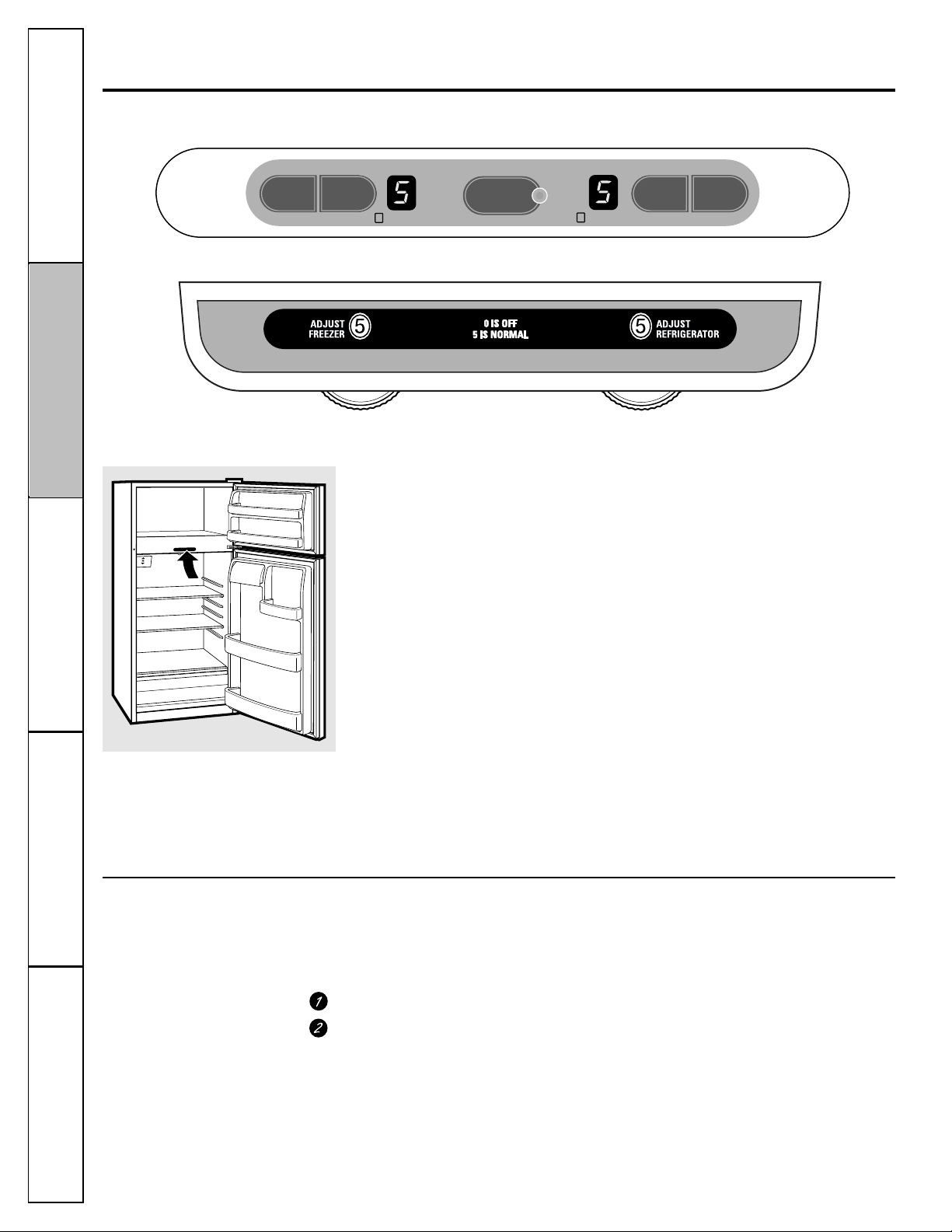
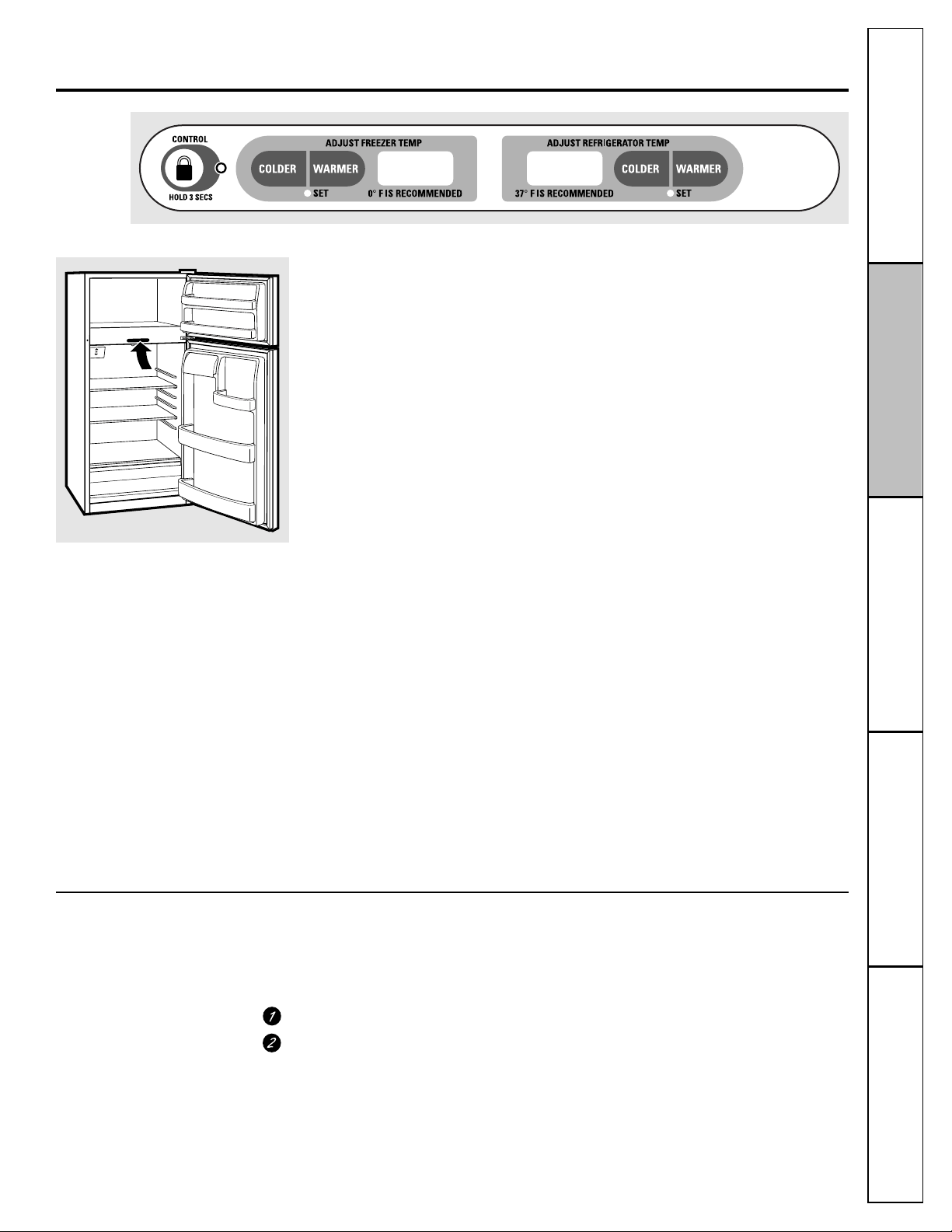
This feature allows you to lock the controls
so the settings cannot be changed.
To lock the controls:
Set the controls to the desired settings.
Press and hold the lock pad for
3 seconds.
When the controls are locked, the indicator
light will come on and the control settings
will not be displayed.
To unlock the controls:
Press and hold the lock pad for 3 seconds.
After unlocking the controls, the settings
will be displayed, the lock indicator light
will go out and the settings can be changed.
About the controls on the refrigerator.
The controls will look like one of the following:
ADJUST REFRIGERATOR TEMP
ADJUST FREEZER TEMP
ACTIVATE LOCK
IS COLDEST
9
IS COLDEST
9
HOLD
3 SECS
COLDER
WARMER
COLDER
WARMER
Initially, set the refrigerator control at 5 and the freezer control at 5
and allow 12–24 hours for the temperature to stabilize.
Several adjustments may be required. Adjust the controls one
increment at a time, and allow 12 hours after each adjustment for
the refrigerator to reach the temperature you have set.
Setting the controls to 0 stops cooling in both the refrigerator and
freezer compartments but does not shut off electrical power to
the refrigerator. On some models, only the refrigerator control has
a 0 setting.
Touch pad controls
• Setting either control at 0 will automatically set the other control at 0.
The zeros will blink until you set the controls.
• If both controls are set at 0 and either COLDER pad is pressed, the
controls will automatically reset to 5.
Control settings will vary based on personal preferences, usage and
operating conditions and may require more than one adjustment.
Locking the Controls (on some models)
4
Troubleshooting Tips
Operating Instructions Safety InstructionsInstallation Instructions
Troubleshooting Tips
Installation Instructions Safety InstructionsOperating Instructions
Troubleshooting Tips
Installation Instructions Safety InstructionsOperating Instructions
Consumer Support
Consumer SupportTroubleshooting TipsOperating Instructions
Safety Instructions
Installation Instructions
5
About the temperature controls. ge.com
The temperature controls are preset in the factory at 37°F for the
refrigerator compartment and 0°F for the freezer compartment. Allow
24 hours for the temperature to stabilize to the preset recommended
settings.
The temperature controls can display both the SET temperature
as well as the actual temperature in the refrigerator and freezer.
The actual temperature may vary slightly from the SET temperature
based on usage and operating environment.
Setting either or both controls to OFF stops cooling in both the freezer
and refrigerator compartments, but does not shut off electrical power
to the refrigerator.
NOTE: The refrigerator is shipped with protective film covering the
temperature controls. If this film was not removed during installation,
remove it now.
To change the temperature, press and release the
WARMER or COLDER pad. The SET light will come
on and the display will show the set temperature.
To change the temperature, tap either the
WARMER or COLDER pad until the desired
temperature is displayed. Refrigerator temperatures
can be adjusted between 34°F and 44°F and the
freezer temperatures can be adjusted between
–6°F and +6°F.
Once the desired temperature has been set,
the temperature display will return to the actual
refrigerator and freezer temperatures after 5
seconds. Several adjustments may be required.
Each time you adjust controls, allow 24 hours for the
refrigerator to reach the temperature you have set.
To turn the cooling system off, tap the WARMER pad
for either the refrigerator or the freezer until the
display shows OFF. To turn the unit back on, press the
COLDER pad for either the refrigerator or freezer.
The SET light will illuminate on the side you
selected. Then press the COLDER pad again (on the
side where the SET light is illuminated) and it will
go to the preset points of 0°F for the freezer and
37°F for the refrigerator. Setting either or both
controls to OFF stops cooling in both the freezer
and refrigerator compartments, but does not shut
off electrical power to the refrigerator.
This feature allows you to lock the controls
so the settings cannot be changed.
To lock the controls:
Set the controls to the desired settings.
Press and hold the lock pad for
3 seconds.
When the controls are locked, the indicator
light will come on and the control settings
will not be displayed.
To unlock the controls:
Press and hold the lock pad for 3 seconds.
After unlocking the controls, the settings
will be displayed, the lock indicator light
will go out and the settings can be changed.
Locking the Controls (on some models)
6
Consumer Support Troubleshooting Tips
Operating Instructions Safety InstructionsInstallation Instructions
Troubleshooting Tips
Installation Instructions Safety InstructionsOperating Instructions
Troubleshooting Tips
Installation Instructions Safety InstructionsOperating Instructions
About the water filter. (on some models)
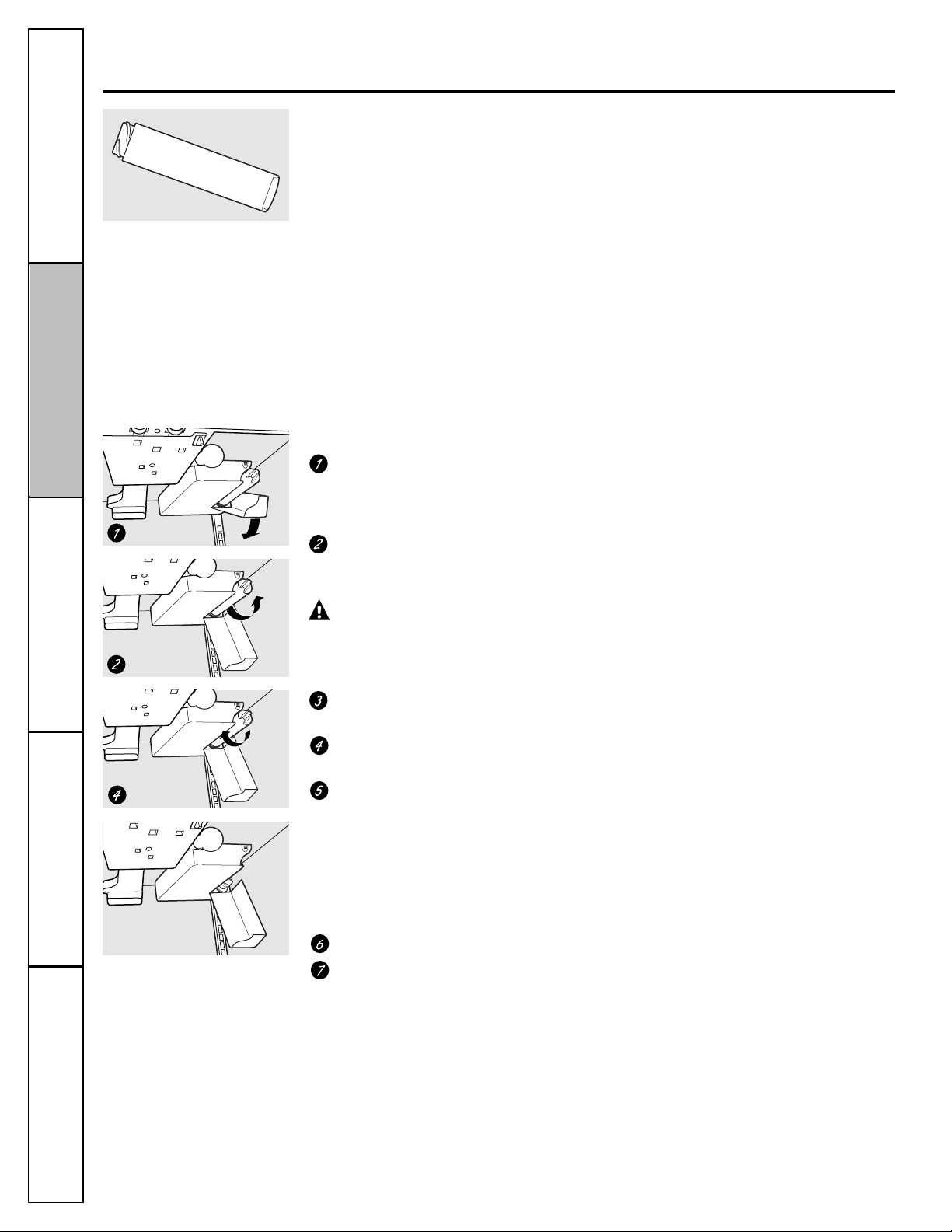
Water Filter Cartridge
The water filter cartridge is located inside
the cartridge holder in the back upper right
corner of the refrigerator compartment.
NOTE: Some models ship with the filter
bypass plug in place of the filter cartridge.
The filter bypass plug needs to be removed
before the filter cartridge is installed. Keep
the filter bypass plug for future use.
When to Replace the Filter
The filter cartridge should be replaced
every six months or earlier if the flow of
water to the icemaker and dispenser
decreases.
Installing the Filter Cartridge
If you are replacing the cartridge,
first remove the old one. To open the
cartridge cover, push in where indicated
and the cover will drop down.
Remove the cartridge by slowly rotating
it to the left. A small amount of water
may drip down.
CAUTION:
If air has been
trapped in the system, the filter cartridge
may be ejected as it is removed. Use caution
when removing.
Mark your calendar to remind you to
replace the filter cartridge in six months.
Remove the protective foil from the end
of the cartridge.
Position the cartridge inside the
cartridge holder and slowly rotate the
cartridge to the right until it stops.
When the cartridge is properly installed,
you will feel it “click” as it locks into
place. The blade on the end of the
cartridge should be positioned
vertically. Do not overtighten.
Close the cartridge cover.
Run water from the dispenser for
3 minutes (about 1
1
⁄2 gallons) to clear
the system and prevent sputtering.
See To Use the Dispenser section.
NOTE: A newly-installed water filter cartridge
may cause water to spurt from the dispenser.
Filter Bypass Plug
You must use the filter bypass plug when
a replacement filter cartridge is not
available. The dispenser and the icemaker
will not operate without the filter or filter
bypass plug.
Replacement Filters
To order additional filter cartridges
in the United States, visit our Website, ge.com,
or call GE Parts and Accessories, 800.626.2002.
Filter Model GSWF
Suggested Retail Price $34.95 USD
Customers in Canada should consult
the yellow pages for the nearest Camco
Service Center.
7
Consumer SupportTroubleshooting TipsOperating Instructions
Safety Instructions
Installation Instructions
Spillproof Shelves (on some models)
Spillproof shelves have special edges to
help prevent spills from dripping to lower
shelves. To remove or replace the shelves,
see Rearranging the Shelves.
About the shelves and bins.
ge.com
Not all features are on all models.
Some models have wire shelves that
can be adjusted in the same manner.
Shelves in the refrigerator and freezer compartments are adjustable.
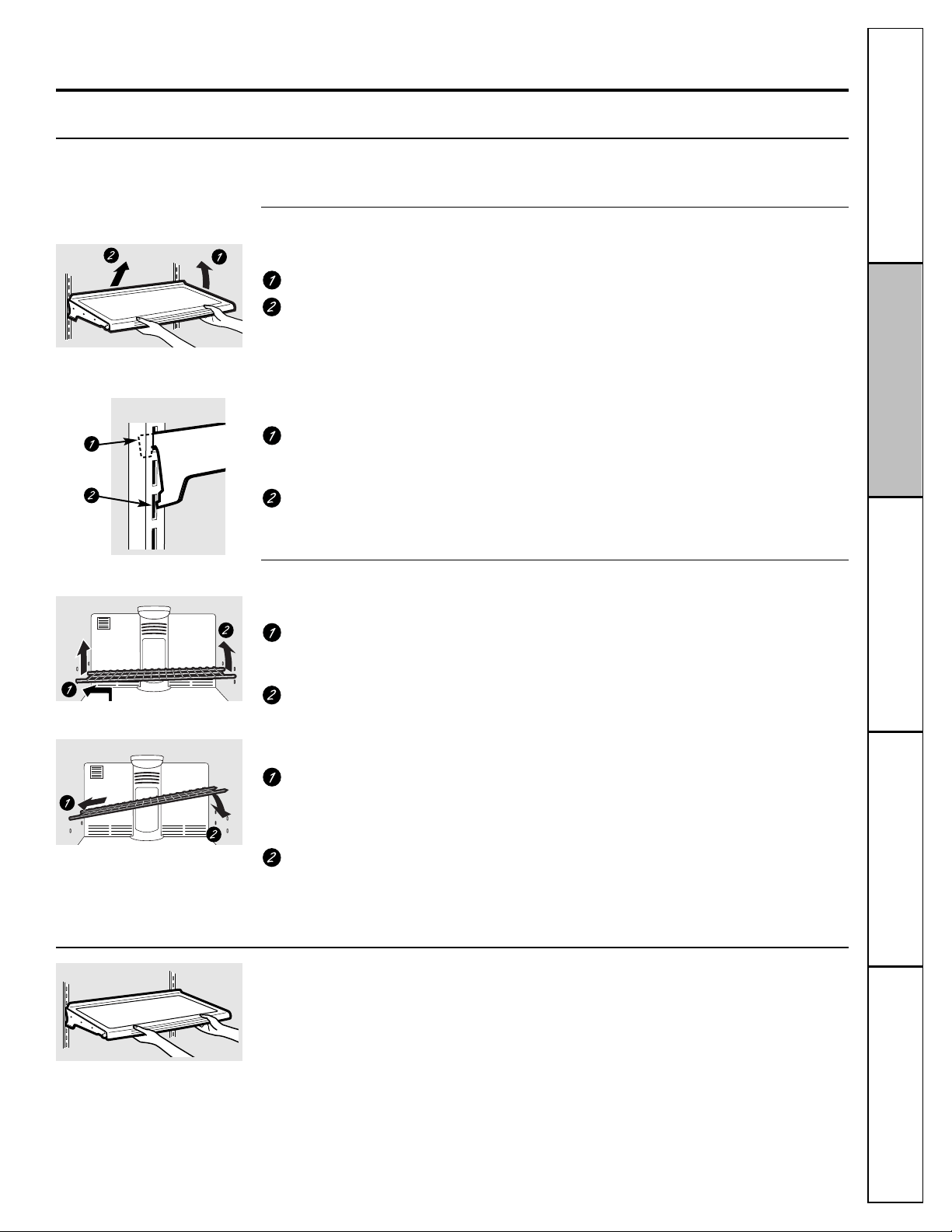
Rearranging the Shelves
To remove:
Tilt the shelf up at the front.
Lift the shelf up at the back and bring
the shelf out.
To replace:
While tilting the shelf up, insert the top
hook at the back of the shelf in a slot
on the track.
Lower the front of the shelf until the
bottom of the shelf locks into place.
Refrigerator Compartment
To remove:
Lift up the left side of the shelf and
slide it left into the center of the shelf
supports.
Rotate the right side of the shelf up and
out of the shelf supports.
To replace:
Holding the shelf diagonally, insert the
left end of the shelf into the center of
the shelf supports on the side wall at the
desired level.
Insert the right end of the shelf into the
shelf supports at the same level. Rest
each end of the shelf on the bottom of
the shelf supports.
NOTE: For models with an automatic icemaker,
the freezer shelf must be in the lower position
for the ice cube bucket to catch the cubes.
Freezer Compartment
Consumer Support Troubleshooting Tips
Operating Instructions Safety InstructionsInstallation Instructions
Troubleshooting Tips
Installation Instructions Safety InstructionsOperating Instructions
Troubleshooting Tips
Installation Instructions Safety InstructionsOperating Instructions
8
About the shelves and bins.
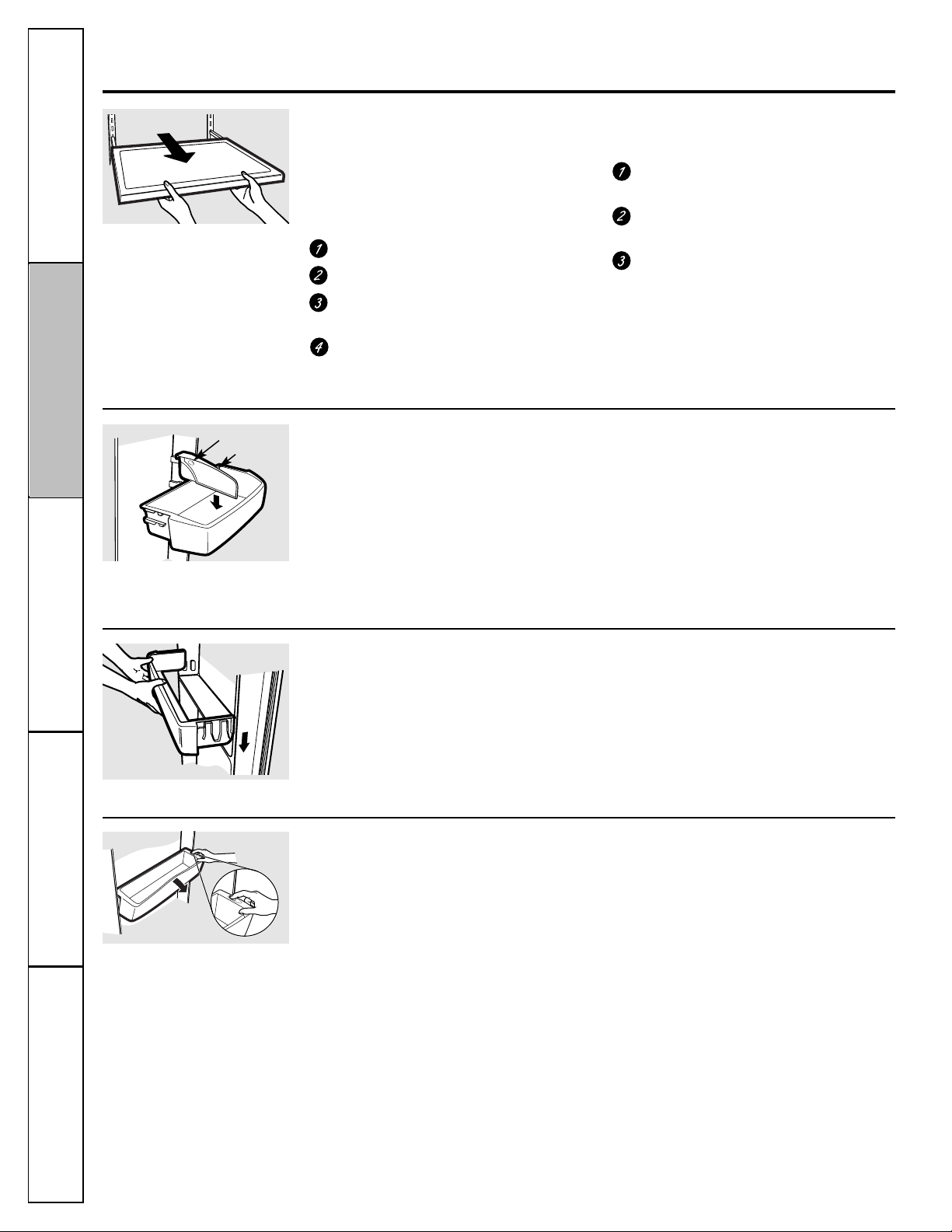
Non-Adjustable Shelves on the Door
To remove: Lift the shelf straight up, then
pull out.
To replace: Engage the shelf in the molded
supports on the door and push down.
It will lock in place.
Adjustable Bins on the Door
Adjustable bins can easily be carried from
refrigerator to work area.
To remove: Lift the bin straight up, then
pull out.
To replace or relocate: Engage the bin in the
molded supports of the door, and push in.
Bin will lock in place.
The snugger helps prevent tipping, spilling
or sliding of small items stored on the door
shelf. Grip the finger hold near the rear of
the snugger and move it to fit your needs.
Snugger
Freezer Tilt Out Bin (on some models)
Push the button as you tilt out the bin.
To remove: Hold the sides of the bin and
lift it straight up, then pull out.
To replace: Engage the ends of the bin
in the molded supports on the door and
push down. It will lock in place.
NOTE: Do not overload the bin.
Slide-Out Spillproof Shelf (on some models)
The slide-out spillproof shelf allows you
to reach items stored behind others. The
special edges are designed to help prevent
spills from dripping to lower shelves.
To remove:
Remove all items from shelf.
Slide the shelf out until it stops.
Lift the front edge of the shelf until the
central tabs are above the front bar.
Continue pulling the shelf forward
until it can be removed.
To replace:
Place the rear shelf tabs just in front of
the central notches on the shelf frame.
Slide the shelf in until the central tabs
are slightly behind the front bar.
Lower the shelf into place until it is
horizontal and slide the shelf in.
Make sure that the shelf sits flat after reinstallation
and doesn’t move freely from side to side.
Make sure you push the shelves all the way in
before you close the door.
Finger hold
Consumer SupportTroubleshooting TipsOperating Instructions
Safety Instructions
Installation Instructions
9
About the additional features.
ge.com
Not all features are on all models.
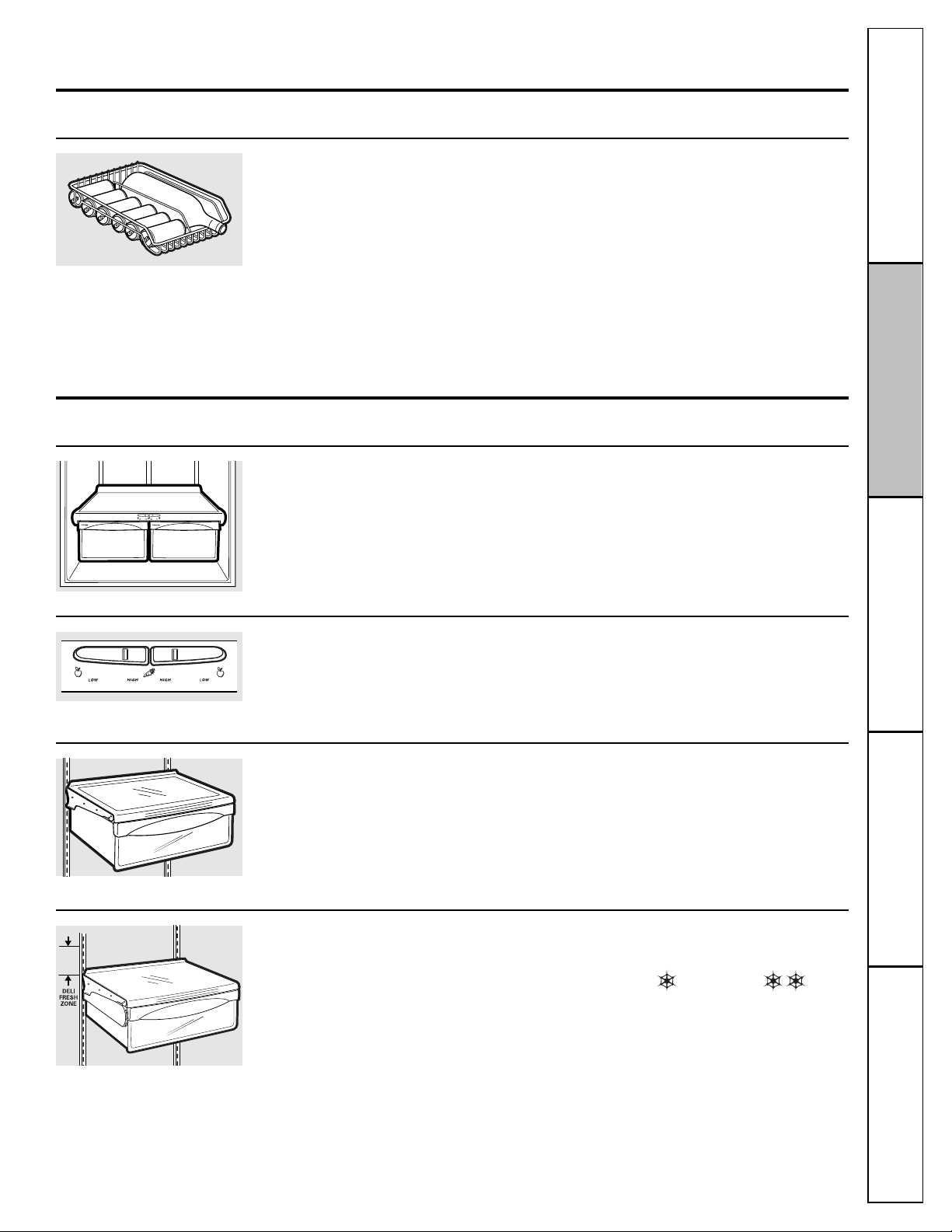
Adjustable Humidity Crisper (on some models)
Slide the control all the way to the
HIGH setting to provide high humidity
recommended for most vegetables.
Slide the control all the way to the LOW
setting to provide lower humidity levels
recommended for most fruits.
Shelf Saver Rack (on some models)
Slide-out beverage rack holds 12 cans of
soda or 2 wine/water bottles (lengthwise).
It can be removed for cleaning.
To remove, slide the rack out to the stop
position, lift the rack up and past the stop
position and lift it out.
Snack Pan (on some models)
This pan can be moved to the most
useful location for your family’s needs.
To remove, slide the pan out to the stop
position, lift the pan up and past the
stop position and lift it out.
Adjustable Temperature Deli Pan (on some models)
When the pan is placed in the top 6 slots on
the left side and the lever is set at COLDEST,
air from the freezer is forced around the
pan to keep it very cold.
You can move the pan to any location if
you don’t want the extra cold storage.
The settings can be adjusted anywhere
between cold and coldest .
When set at cold, the pan will stay at the
normal refrigerator temperature.
The coldest setting provides the coldest
storage area.
About the crispers and pans.
Not all features are on all models.
Fruit and Vegetable Crisper
Excess water that may accumulate in the
bottom of the drawers or under the drawers
should be wiped dry.
10
Consumer Support Troubleshooting Tips
Operating Instructions Safety InstructionsInstallation Instructions
Troubleshooting Tips
Installation Instructions Safety InstructionsOperating Instructions
Troubleshooting Tips
Installation Instructions Safety InstructionsOperating Instructions
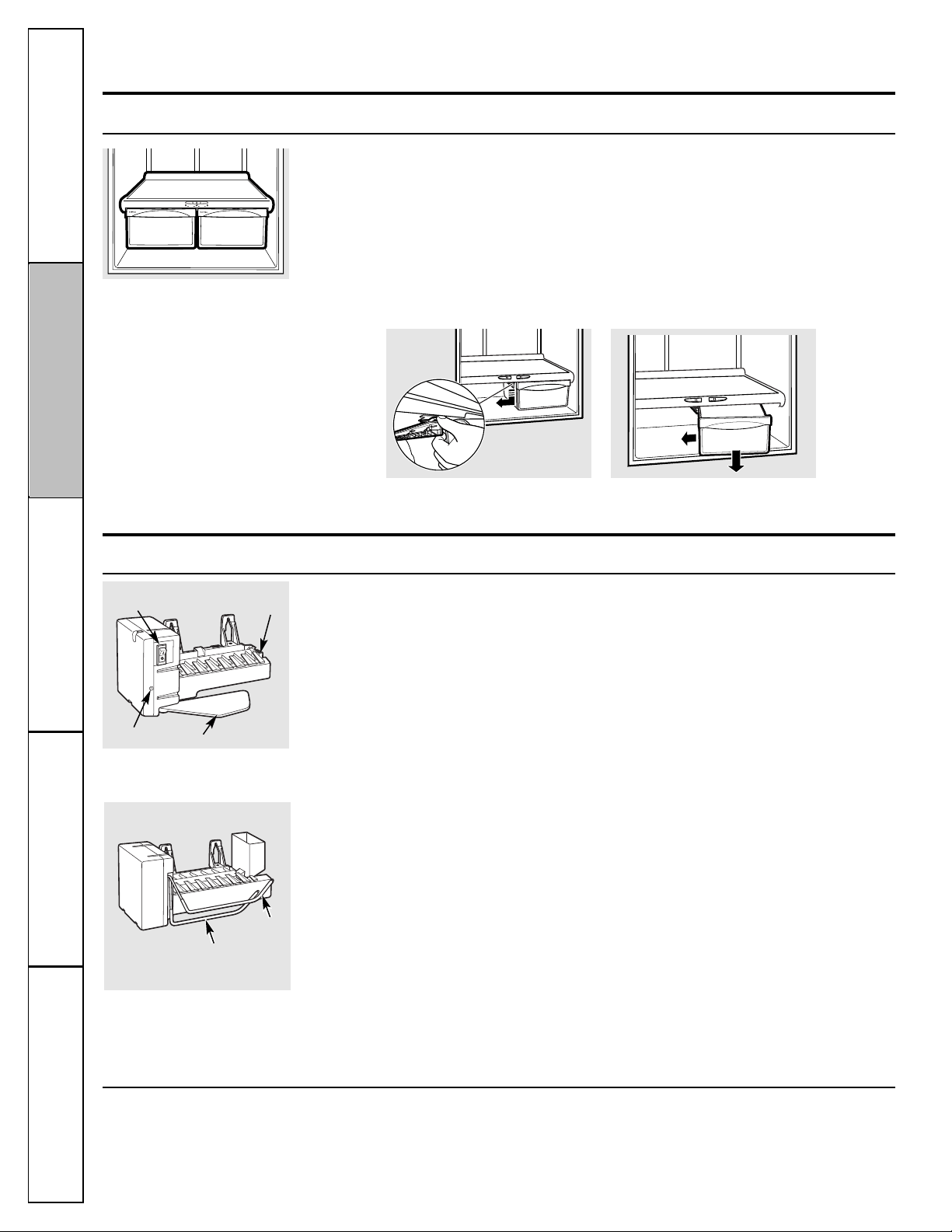
About crisper removal.
Not all features are on all models.
Crisper Removal
To Remove:
These drawers can be removed easily by
lifting up slightly while pulling the drawer
past the stop location.
When the door cannot be fully opened,
remove the drawer farthest from the door
first. Make sure the drawer closest to the
door is fully closed. There is a latch at the
front of the center slide rail. Push down on
the latch and slide the center slide rail, to
which the drawer is attached, away from
the door. Remove the drawer.
About the automatic icemaker.
A newly-installed refrigerator may take 12–24 hours to begin making ice.
Icemaker Accessory Kit
If your refrigerator did not come already
equipped with an automatic icemaker,
an icemaker accessory kit is available at
extra cost.
Check the back of the refrigerator for
the specific icemaker kit needed for
your model.
Automatic Icemaker (on some models)
The icemaker will produce seven or eight
cubes (depending on model) per cycle—
approximately 100–130 cubes in a 24-hour
period, depending on freezer compartment
temperature, room temperature, number
of door openings and other use conditions.
There are two types of icemakers: power
switch models and feeler arm models.
If the refrigerator is operated before the
water connection is made to the icemaker,
set the power switch to O (off) or move the
feeler arm to the STOP (up) position.
When the refrigerator has been connected
to the water supply, set the power switch to
the I (on) position or move the feeler arm to
the ON (down) position. On power switch
models, the green light will come on.
You will hear a buzzing sound each time
the icemaker fills with water.
The icemaker will fill with water when it
cools to approximately 15°F. A newly-
installed refrigerator may take 12 to 24
hours to begin making ice cubes.
Throw away the first few batches of ice to
allow the water line to clear.
Be sure nothing interferes with the sweep
of the feeler arm.
When the bin fills to the level of the feeler
arm, the icemaker will stop producing ice.
It is normal for several cubes to be joined
together.
If ice is not used frequently, old ice cubes
will become cloudy, taste stale and shrink.
On power switch models, the green power
light will blink if ice cubes get stuck in the
icemaker. To correct this, set the power
switch to O (off) and remove the cubes. Set
the power switch to I (on) to restart the
icemaker. After the icemaker has been
turned on again, there will be a delay of
about 45 minutes before the icemaker
resumes operation.
NOTE: In homes with lower-than-average water
pressure, you may hear the icemaker cycle multiple
times when making one batch of ice.
Icemaker
Feeler Arm
Power
Switch
Green
Power Light
Power switch model
Feeler Arm in
the STOP
(up) position
Feeler Arm in
the ON (down)
position
Feeler arm model

11
Behind the Refrigerator
Be careful when moving the refrigerator away
from the wall. All types of floor coverings can be
damaged, particularly cushioned coverings and
those with embossed surfaces.
Pull the refrigerator straight out and return it to
position by pushing it straight in. Moving the
refrigerator in a side direction may result in
damage to the floor covering or refrigerator.
When pushing the refrigerator back, make sure you don’t
roll over the power cord or icemaker supply line (on some
models).
Consumer SupportTroubleshooting TipsOperating InstructionsSafety Instructions Installation Instructions
Cleaning the Outside
The door handles and trim. Clean with a cloth
dampened with soapy water. Dry with a soft
cloth.
Keep the outside clean. Wipe with a clean
cloth lightly dampened with mild liquid dish
detergent. Dry with a clean, soft cloth.
Do not wipe the refrigerator with a soiled dish cloth or wet
towel. These may leave a residue that can erode the paint.
Do not use scouring pads, powdered cleaners, bleach or
cleaners containing bleach because these products can
scratch and weaken the paint finish.
Care and cleaning of the refrigerator.
About the water dispenser. (on some models) ge.com
Cleaning the Inside
To help prevent odors, leave an open box of
baking soda in the refrigerator and freezer
compartments.
Unplug the refrigerator before cleaning.
If this is not practical, wring excess moisture out
of sponge or cloth when cleaning around
switches, lights or controls.
Use warm water and baking soda solution—
about a tablespoon (15 ml) of baking soda to a
quart (1 liter) of water. This both cleans and
neutralizes odors. Thoroughly rinse and wipe
dry.
Avoid cleaning cold glass shelves (on some models) with
hot water because the extreme temperature difference
may cause them to break. Handle glass shelves carefully.
Bumping tempered glass can cause it to shatter.
Do not wash any refrigerator parts in the dishwasher.
Wash ice trays in lukewarm water only—do not put them
in an automatic dishwasher.
Preparing for Vacation
For long vacations or absences, remove food and
unplug the refrigerator. Move the freezer control
to the O (off) position, and clean the interior with
a baking soda solution of one tablespoon (15
ml) of baking soda to one quart (1 liter) of
water. Leave the doors open.
Set the icemaker power switch to the O (off)
position and shut off the water supply to the
refrigerator.
If the temperature can drop below freezing, have
a qualified servicer drain the water supply system
(on some models) to prevent serious property
damage due to flooding.
Preparing to Move
Secure all loose items such as base grille,
shelves and drawers by taping them securely
in place to prevent damage.
Be sure the refrigerator stays in an upright position
during moving.
To Use the Dispenser (on some models)
The water dispenser is located on the left wall
inside the refrigerator compartment.
To dispense water:
Hold the glass against the recess.
Push the water dispenser button.
Hold the glass underneath the dispenser
for 2–3 seconds after releasing the dispenser
button. Water may continue to dispense
after the button is released.
If no water is dispensed when the refrigerator is first
installed, there may be air in the water line system. Press
the dispenser button for at least 2 minutes to remove
trapped air from the water line and to fill the water
system. During this process, the dispenser noise may be
loud as the air is purged from the water line system. To
flush out impurities in the water line, throw away the first
6 glassfuls of water.
NOTE: To avoid water deposits, the dispenser should
be cleaned periodically by wiping with a clean cloth or
sponge.
Light shield
Consumer Support Troubleshooting Tips
Operating Instructions Safety InstructionsInstallation Instructions
Troubleshooting Tips
Installation Instructions Safety InstructionsOperating Instructions
Troubleshooting Tips
Installation Instructions Safety InstructionsOperating Instructions
12
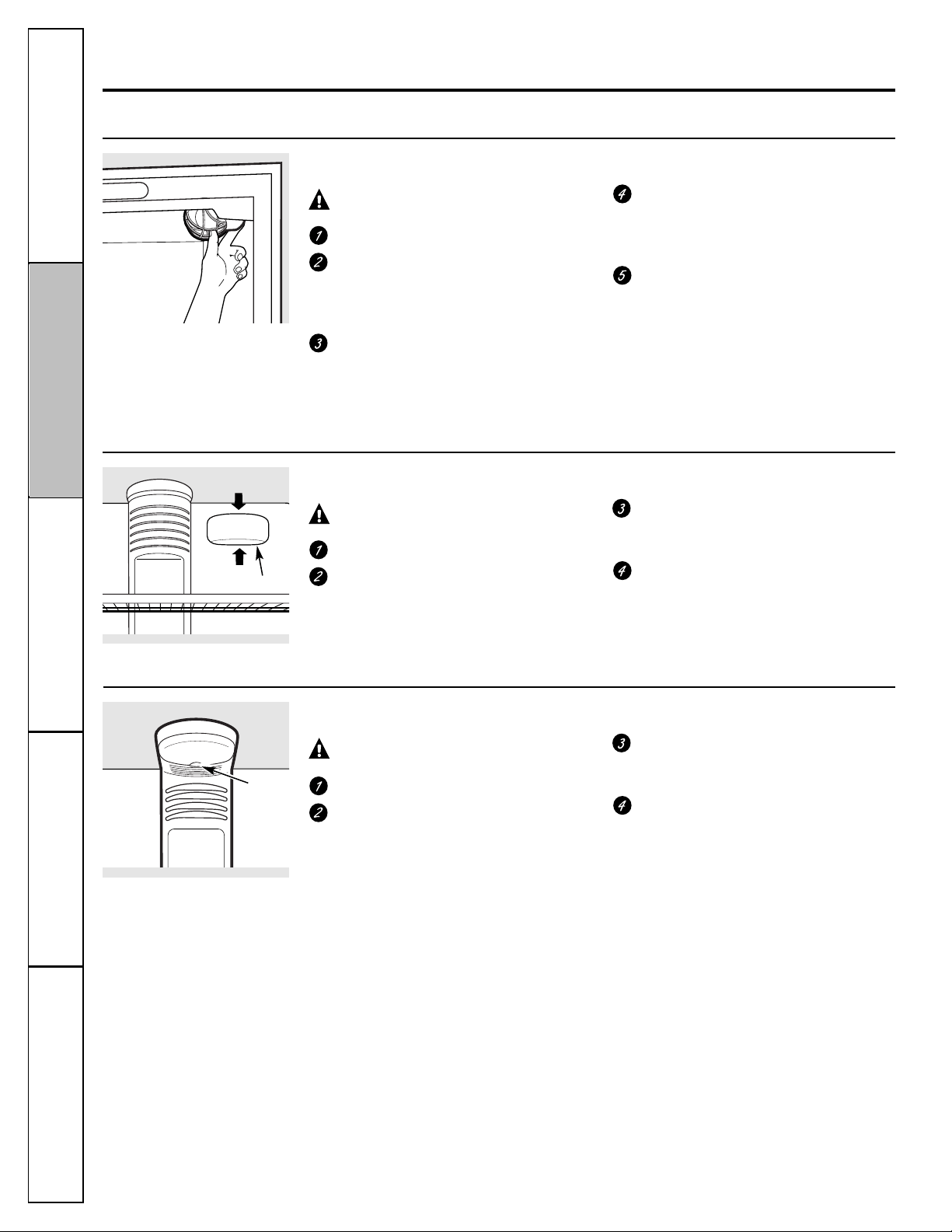
Replacing the light bulbs.
Turning the control to the 0 (off) position does not remove power to the light circuit.
Refrigerator Compartment
CAUTION: Light bulbs may be hot.
Unplug the refrigerator.
The bulbs are located at the top of
the refrigerator compartment near
the opening. On some models, a light
shield will have to be removed.
To remove the light shield, grasp the
shield as shown. Squeeze the shield
and rotate the shield toward the back
of the refrigerator. The light shield
will pop out.
Replace the bulb with an appliance
bulb of the same or lower wattage.
On models with a light shield, replace
the light shield.
Plug the refrigerator back in.
Freezer Compartment Light (on some models)
CAUTION: Light bulbs may be hot.
Unplug the refrigerator.
The bulb is located behind a light
shield at the back of the freezer
compartment. To remove, squeeze
the top and bottom of the shield and
pull the shield off.
After replacing with an appliance bulb
of the same or lower wattage, replace
the shield.
Plug the refrigerator back in.
Freezer Compartment Dome Light (on some models)
CAUTION: Light bulbs may be hot.
Unplug the refrigerator.
The bulb is located at the top of the
freezer compartment inside the dome
light shield. To remove the shield, place
your finger in the pocket at the back
of the shield. Pull the shield forward
and down.
After replacing with an appliance
bulb of the same or lower wattage,
replace the shield.
Plug the refrigerator back in.
Pocket
13
Installation
Refrigerator
Instructions
Models 22 and 25
CLEARANCES
Allow the following clearances for ease of installation,
proper air circulation and plumbing and electrical
connections.
• Sides 1/8″ (4 mm)
• Top 1″ (25 mm)
• Back 1″ (25 mm)
If the refrigerator is against a wall on either side, allow
a 1/8″ (3 mm) door clearance.
REFRIGERATOR LOCATION
• Do not install the refrigerator where the temperature
will go below 60°F (16°C) because it will not run
often enough to maintain proper temperatures.
• Do not install the refrigerator where the temperature
will go above 100°F (37°C) because it will not
perform properly.
• Install it on a floor strong enough to support it fully
loaded.
WATER SUPPLY TO THE ICEMAKER
(ON SOME MODELS)
If the refrigerator has an icemaker, it will have to be
connected to a cold water line. A GE water supply kit
(containing tubing, shutoff valve, fittings and
instructions) is available at extra cost from your dealer,
by visiting our Website at ge.com (in Canada at
www.geappliances.ca) or from Parts and Accessories,
800.626.2002 (in Canada 1.888.261.3055).
ROLLERS
The rollers have 3 purposes:
■
Rollers adjust so the doors close on their own when
opened about 45°.
■
Rollers adjust so the refrigerator is firmly positioned
on the floor and does not wobble.
■
Rollers allow you to move the refrigerator away from
the wall for cleaning.
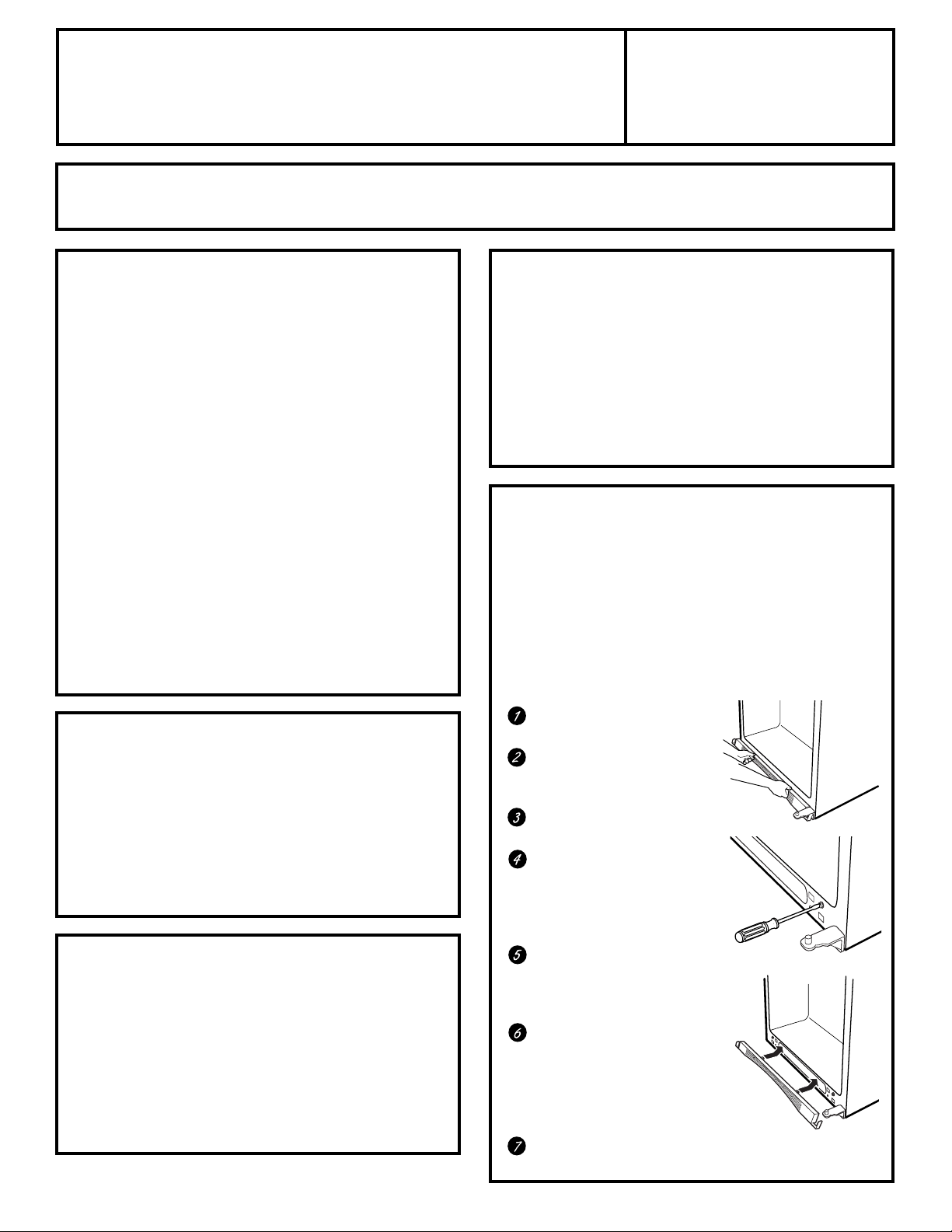
To adjust the rollers:
Remove the base grille by
positioning hands as shown.
Rotate the bottom of the
grille outward until the clips
snap out.
Pull the grille away from the
refrigerator.
Using a screwdriver, turn
the two front roller adjusting
screws clockwise to raise
the refrigerator,
counterclockwise to lower it.
Replace the grille so the
notch in the grille will fit
around the bottom door
hinge.
Tilt the top of the grille
toward the refrigerator and
insert the long metal clips
into the top of the oval
openings at the bottom of
the refrigerator.
Rotate the bottom of the grille toward
the refrigerator until it snaps into place.
BEFORE YOU BEGIN
Read these instructions completely and carefully.
•
IMPORTANT – Save these
instructions for local inspector’s use.
•
IMPORTANT – Observe all
governing codes and ordinances.
• Note to Installer – Be sure to leave these
instructions with the Consumer.
• Note to Consumer – Keep these instructions
for future reference.
• Skill level – Installation of this appliance requires
basic mechanical skills.
• Completion time – Refrigerator Installation
15 minutes
• Proper installation is the responsibility
of the installer.
• Product failure due to improper installation
is not covered under the Warranty.
Questions? Call 800.GE.CARES (800.432.2737) or Visit our Website at: ge.com
In Canada, call 1.800.361.3400
or Visit our Website at: www.geappliances.ca

14
WHAT YOU WILL NEED
• Copper or GE SmartConnect
™
Refrigerator Tubing
kit, 1/4″ outer diameter to connect the refrigerator
to the water supply. If using copper, be sure both
ends of the tubing are cut square.
To determine how much tubing you need: measure
the distance from the water valve on the back of the
refrigerator to the water supply pipe. Then add 8′
(2.4 m). Be sure there is sufficient extra tubing
(about 8′ [2.4 m] coiled into 3 turns of about 10″
[25 cm] diameter) to allow the refrigerator to move
out from the wall after installation.
GE SmartConnect
™
Refrigerator Tubing Kits are
available in the following lengths:
2′ (0.6 m) – WX08X10002
6′ (1.8 m) – WX08X10006
15′ (4.6 m) – WX08X10015
25′ (7.6 m) – WX08X10025
Be sure that the kit you select allows at least 8′ (2.4 m)
as described above.
NOTE: The only GE approved plastic tubing is that
supplied in GE SmartConnect
™
Refrigerator Tubing
kits. Do not use any other plastic water supply line
because the line is under pressure at all times. Certain
types of plastic will crack or rupture with age and
cause water damage to your home.
INSTALLING THE WATER LINE
(ON SOME MODELS)
Installation Instructions
BEFORE YOU BEGIN
Recommended copper water supply kits are WX8X2,
WX8X3 or WX8X4, depending on the amount of
tubing you need. Approved plastic water supply lines
are GE SmartConnect
™
Refrigerator Tubing
(WX08X10002, WX08X10006, WX08X10015 and
WX08X10025).
When connecting your refrigerator to a GE Reverse
Osmosis Water System, the only approved installation
is with a GE RVKit. For other reverse osmosis water
systems, follow the manufacturer’s recommendations.
This water line installation is not warranted by the
refrigerator or icemaker manufacturer. Follow these
instructions carefully to minimize the risk of expensive
water damage.
Water hammer (water banging in the pipes) in house
plumbing can cause damage to refrigerator parts and
lead to water leakage or flooding. Call a qualified
plumber to correct water hammer before installing
the water supply line to the refrigerator.
To prevent burns and product damage, do not hook
up the water line to the hot water line.
If you use your refrigerator before connecting the
water line, make sure the icemaker power switch is
in the O (off) position.
Do not install the icemaker tubing in areas where
temperatures fall below freezing.
When using any electrical device (such as a power
drill) during installation, be sure the device is double
insulated or grounded in a manner to prevent the
hazard of electric shock, or is battery powered.
All installations must be in accordance with local
plumbing code requirements.
15
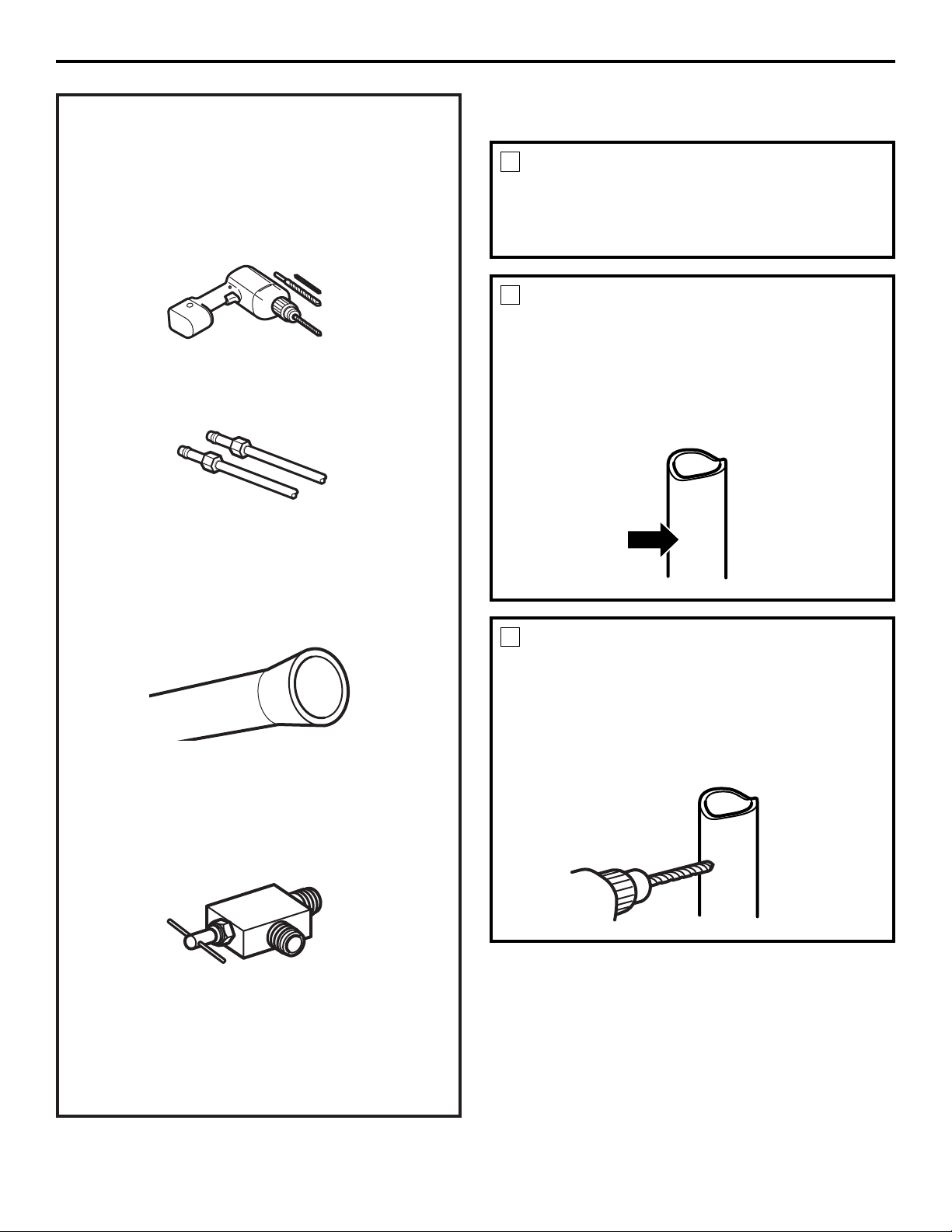
WHAT YOU WILL NEED
(CONT.)
• A GE water supply kit (containing tubing, shutoff
valve and fittings listed below) is available at extra
cost from your dealer or from Parts and Accessories,
800.626.2002.
• A cold water supply. The water pressure must be
between 20 and 120 p.s.i. (1.4–8.1 bar).
• Power drill.
• 1/2″ or adjustable wrench.
• Straight and Phillips blade screwdriver.
• Two 1/4″ outer diameter compression nuts and
2 ferrules (sleeves)—to connect the copper tubing
to the shutoff valve and the refrigerator water valve.
OR
• If you are using a GE SmartConnect
™
Refrigerator
Tubing kit, the necessary fittings are preassembled
to the tubing.
• If your existing copper water line has a flared fitting
at the end, you will need an adapter (available at
plumbing supply stores) to connect the water line to
the refrigerator OR you can cut off the flared fitting
with a tube cutter and then use a compression
fitting. Do not cut formed end from GE
SmartConnect
™
Refrigerator tubing.
• Shutoff valve to connect to the cold water line.
The shutoff valve should have a water inlet with a
minimum inside diameter of 5/32″ at the point of
connection to the COLD WATER LINE. Saddle-type
shutoff valves are included in many water supply kits.
Before purchasing, make sure a saddle-type valve
complies with your local plumbing codes.
DRILL THE HOLE FOR THE VALVE
Drill a 1/4″ hole in the water pipe (even if using
a self-piercing valve) using a sharp bit. Remove any
burrs resulting from drilling the hole in the pipe.
Take care not to allow water to drain into the drill.
Failure to drill a 1/4″ hole may result in reduced
ice production or smaller cubes.
3
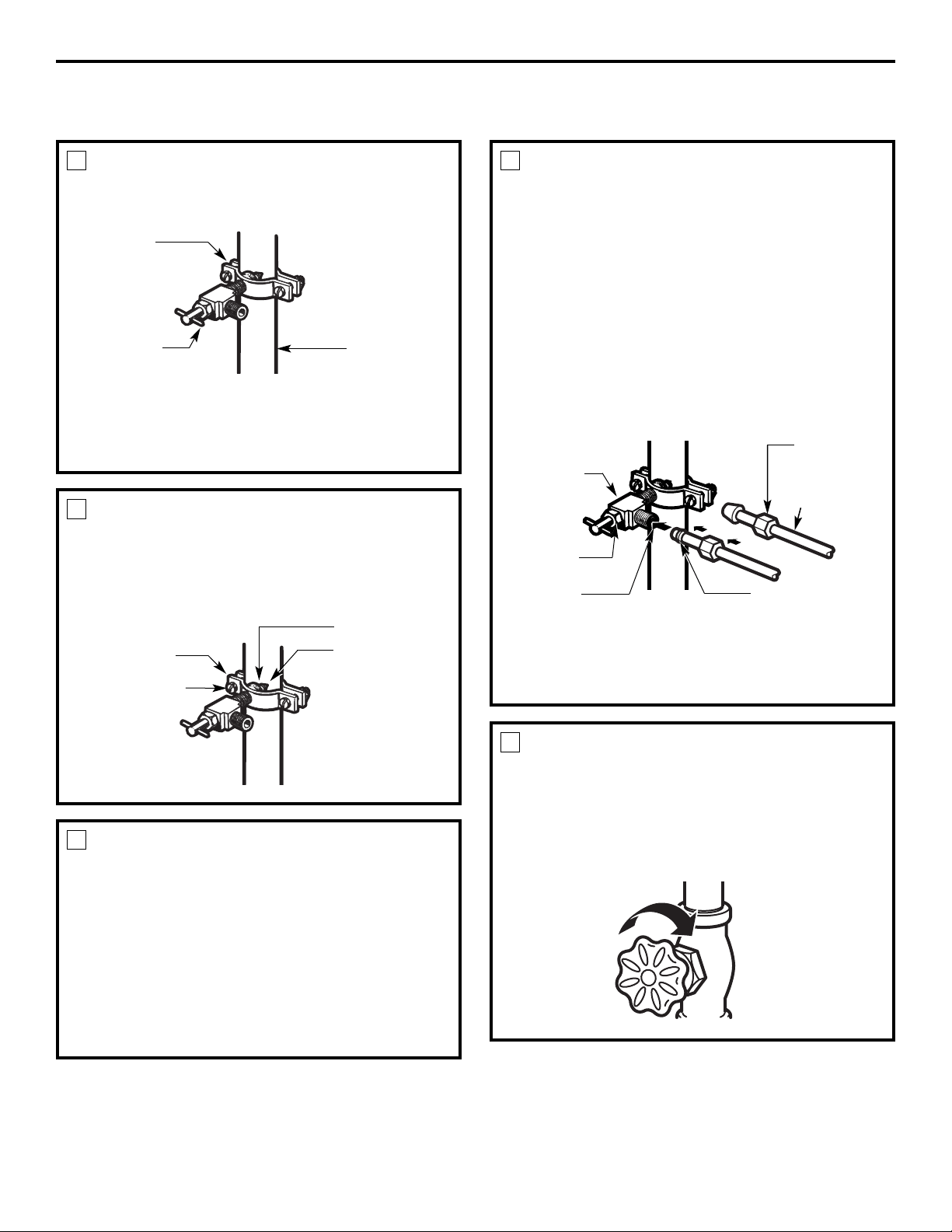
CHOOSE THE VALVE LOCATION
Choose a location for the valve that is easily
accessible. It is best to connect into the side of
a vertical water pipe. When it is necessary to
connect into a horizontal water pipe, make the
connection to the top or side, rather than at the
bottom, to avoid drawing off any sediment from
the water pipe.
2
Installation Instructions
Install the shutoff valve on the nearest frequently used
drinking water line.
SHUT OFF THE MAIN WATER
SUPPLY
Turn on the nearest faucet long enough to clear
the line of water.
1
16
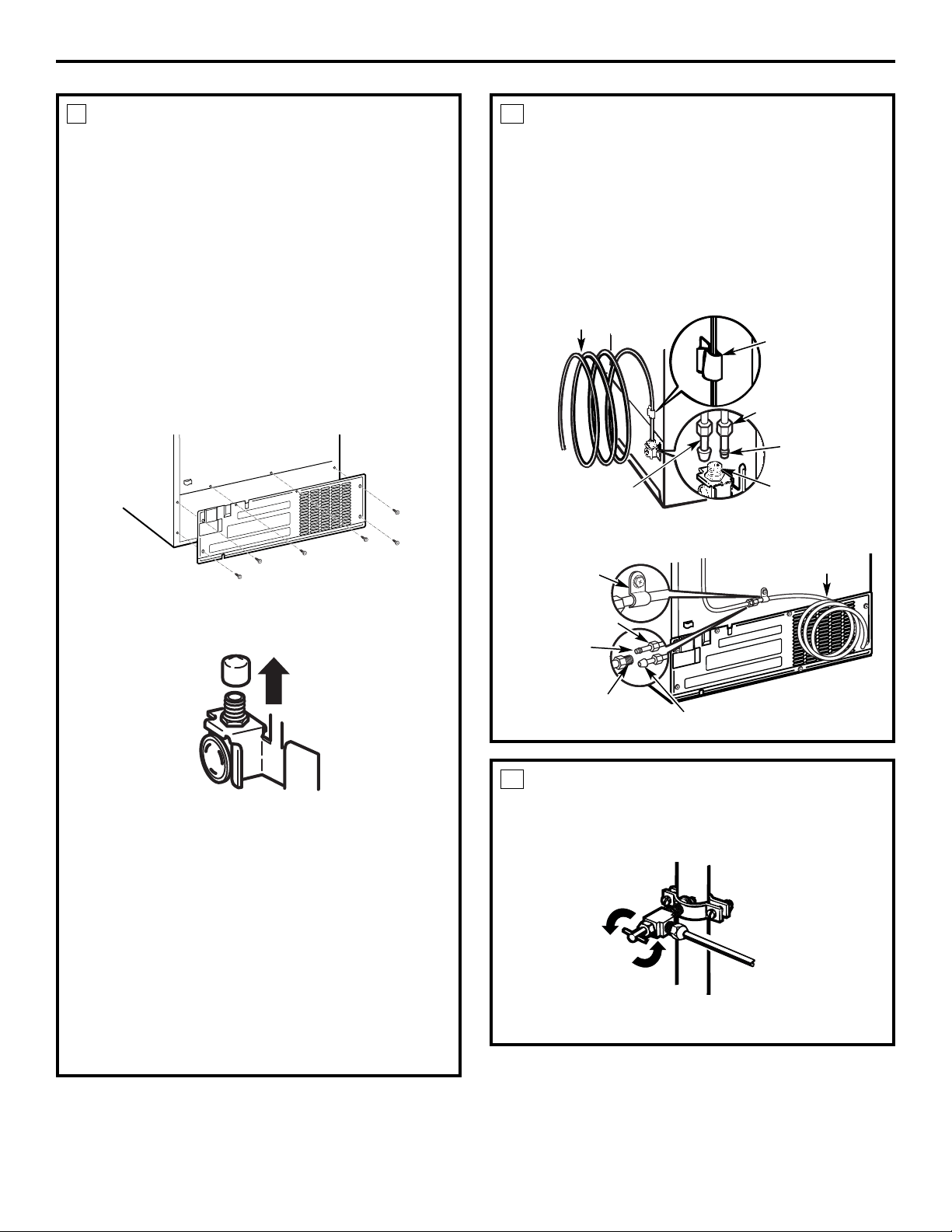
FLUSH OUT THE TUBING
Turn the main water supply on and flush out the
tubing until the water is clear.
Shut the water off at the water valve after about
one quart (1 liter) of water has been flushed
through the tubing.
8
CONNECT THE TUBING TO THE
VALVE
Place the compression nut and ferrule (sleeve)
for copper tubing onto the end of the tubing and
connect it to the shutoff valve.
Make sure the tubing is fully inserted into the
valve. Tighten the compression nut securely.
For plastic tubing from a GE SmartConnect
™
Refrigerator Tubing kit, insert the molded end
of the tubing into the shutoff valve and tighten
compression nut until it is hand tight, then tighten
one additional turn with a wrench. Overtightening
may cause leaks.
NOTE: Commonwealth of Massachusetts Plumbing
Codes 248CMR shall be adhered to. Saddle valves
are illegal and use is not permitted in Massachusetts.
Consult with your licensed plumber.
7
INSTALLING THE WATER LINE
(CONT.)
Installation Instructions
Saddle-Type
Shutoff Valve
Compression
Nut
SmartConnect
™
Tubing
Packing Nut
Outlet Valve
Ferrule (sleeve)
FASTEN THE SHUTOFF VALVE
Fasten the shutoff valve to the cold water pipe with
the pipe clamp.
NOTE: Commonwealth of Massachusetts Plumbing
Codes 248CMR shall be adhered to. Saddle valves
are illegal and use is not permitted in Massachusetts.
Consult with your licensed plumber.
4
Vertical Cold
Water Pipe
Saddle-Type
Shutoff Valve
Pipe Clamp
TIGHTEN THE PIPE CLAMP
Tighten the clamp screws until the sealing washer
begins to swell.
NOTE: Do not overtighten or you may crush the
tubing.
5
Washer
Inlet End
Pipe Clamp
Clamp Screw
ROUTE THE TUBING
Route the tubing between the cold water line and
the refrigerator.
Route the tubing through a hole drilled in the wall
or floor (behind the refrigerator or adjacent base
cabinet) as close to the wall as possible.
NOTE: Be sure there is sufficient extra tubing
(about 8 feet [244 cm] coiled into 3 turns of about
10″ [25 cm] diameter) to allow the refrigerator to
move out from the wall after installation.
6
17
CONNECT THE TUBING TO THE
REFRIGERATOR
NOTES:
• Before making the connection to the refrigerator,
be sure the refrigerator power cord is not plugged
into the wall outlet.
• We recommend installing a water filter if your
water supply has sand or particles that could clog
the screen of the refrigerator’s water valve. Install
it in the water line near the refrigerator. If using
GE SmartConnect
™
Refrigerator Tubing kit,
you will need an additional tube (WX08X10002)
to connect the filter. Do not cut plastic tube to
install filter.
Remove the access cover.
Remove the plastic flexible cap from the water
valve (refrigerator connection).
Place the compression nut and ferrule (sleeve)
onto the end of the tubing as shown. On GE
SmartConnect
™
Refrigerator Tubing kit,
the nuts are already assembled to the tubing.
Insert the end of the tubing into the water valve
connection as far as possible. While holding the
tubing, tighten the fitting.
For plastic tubing from a GE SmartConnect
™
Refrigerator Tubing kit, insert the molded end
of the tubing into the shutoff valve and tighten
compression nut until it is hand tight, then
tighten one additional turn with a wrench.
Overtightening may cause leaks.
9
TURN THE WATER ON AT THE
SHUTOFF VALVE
Tighten any connections that leak.
Reattach the access cover.
10
CONNECT THE TUBING TO THE
REFRIGERATOR
(CONT.)
Fasten the tubing into the clamp provided to
hold it in a vertical position. You may need to
pry open the clamp.
9
Installation Instructions
1/4″ Compression Nut
Tubing Clamp
1/4″ Tubing
Ferrule (sleeve)
Refrigerator
Connection
SmartConnect
™
Tubing
One of the illustrations below will look like the
connection on your refrigerator.
Icemaker Models without Water Dispenser
1/4″ Tubing
Tubing Clamp
1/4″ Compression Nut
Ferrule (sleeve)
SmartConnect
™
Tubing
Refrigerator Connection
Water Dispenser Models
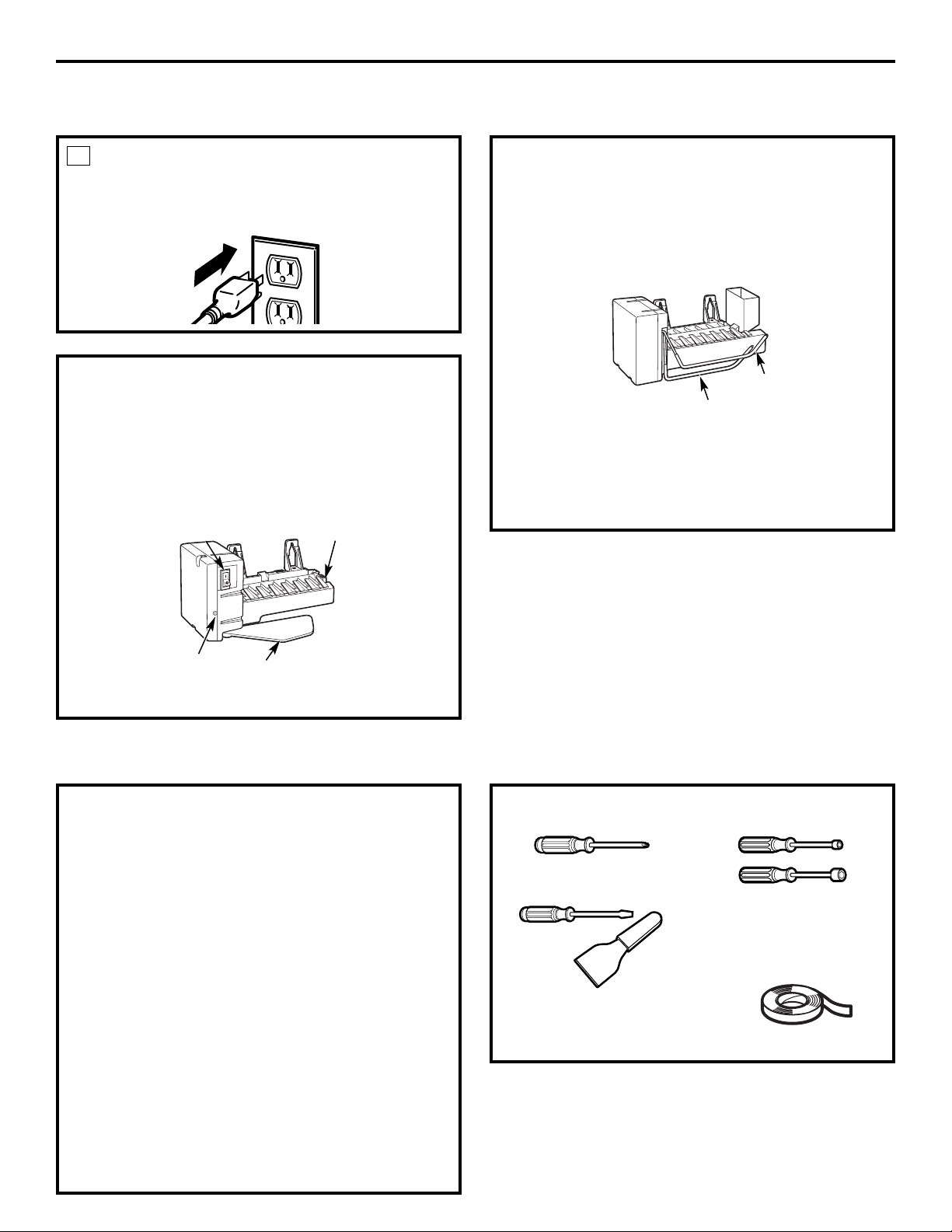
PLUG IN THE REFRIGERATOR
Arrange the coil of tubing so that it does not vibrate
against the back of the refrigerator or against the
wall. Push the refrigerator back to the wall.
11
TOOLS YOU WILL NEED
18
Installation Instructions
5/16″ Head socket driver
3/4″ Head socket driver
(a 6-point socket is
recommended)
Phillips screwdriver
Putty knife or
thin-blade screwdriver
Masking tape
INSTALLING THE WATER LINE
(CONT.)
REVERSING THE DOOR SWING
IMPORTANT NOTES
When reversing the door swing:
• Read the instructions all the way through before
starting.
• Handle parts carefully to avoid scratching paint.
• Set screws down by their related parts to avoid using
them in the wrong places.
• Provide a non-scratching work surface for the doors.
IMPORTANT: Once you begin, do not move the
cabinet until door-swing reversal is completed.
These instructions are for changing the hinges from
the right side to the left side—if you ever want to
change the hinges back to the right side, follow these
same instructions and reverse all references to left
and right.
Unplug the refrigerator from its electrical outlet.
Empty all door shelves, including the dairy
compartment.
START THE ICEMAKER (CONT.)
Feeler arm models – Move the feeler arm to the
ON (down) position. The icemaker will not begin to
operate until it reaches its operating temperature
of (15 F) (-9 C) or below. It will begin operation
automatically if the icemaker feeler arm is in the
ON (down) position.
NOTE: In lower water pressure conditions, the
water valve may turn on up to 3 times to deliver
enough water to the icemaker.
Feeler Arm in the
STOP (up) position
Feeler Arm in the ON
(down) position
Feeler arm model
START THE ICEMAKER
Power switch models – Set the icemaker power
switch to the I (on) position. The icemaker will
not begin to operate until it reaches its operating
temperature of 15°F (–9°C) or below. It will then
begin operation automatically if the icemaker
power switch is in the I (on) position, and the
green light will come on.
Icemaker
Feeler Arm
Power
Switch
Green Power
Light
Power switch model
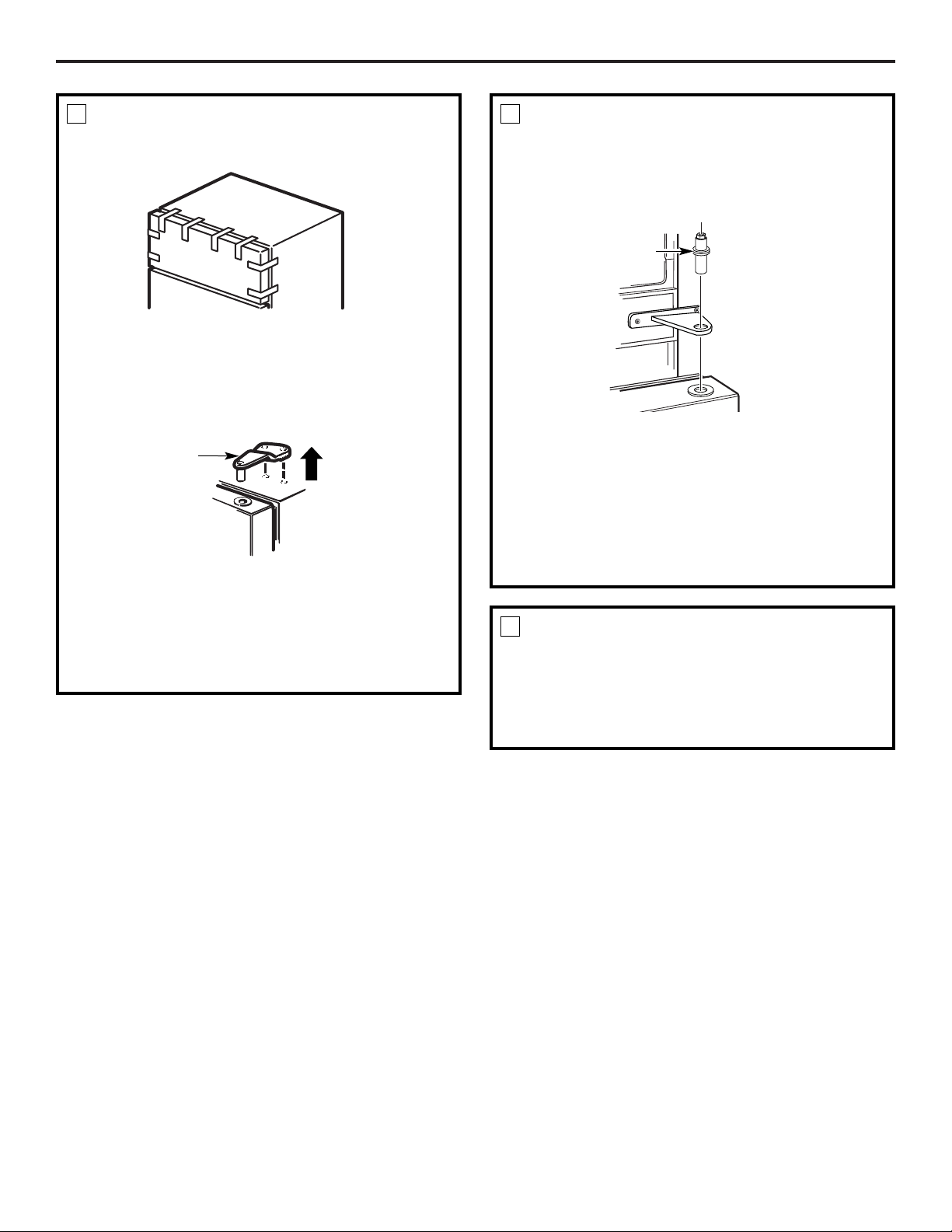
19
Installation Instructions
Hinge Pin
Top Hinge
TRANSFER TOP HINGE TO
THE LEFT
Interchange hinge and screws at top right with
screws at the top left of cabinet.
Do not tighten screws on hinge side at this time.
3
REMOVE THE REFRIGERATOR
DOOR
Tape the door shut with masking tape.
Remove the center hinge pin with a 3/4″ socket.
Remove the tape and tilt the door away from the
cabinet. Lift the door straight off the bottom hinge
bracket.
Set the door on a non-scratching surface, with the
inside up.
CAUTION: Do not let door drop to the floor.
To do so could damage the door stop.
2
REMOVE THE FREEZER DOOR
Tape the door shut with masking tape.
Remove the hinge cover on top of the freezer door
(on some models).
Remove the two screws, then lift the hinge straight
up to free the hinge pin from the socket in the top
of the door.
Tape the door shut with masking tape.
Remove the tape and tilt the door away from the
cabinet. Lift it off the center hinge pin.
Set the door on a non-scratching surface with
the inside up.
1
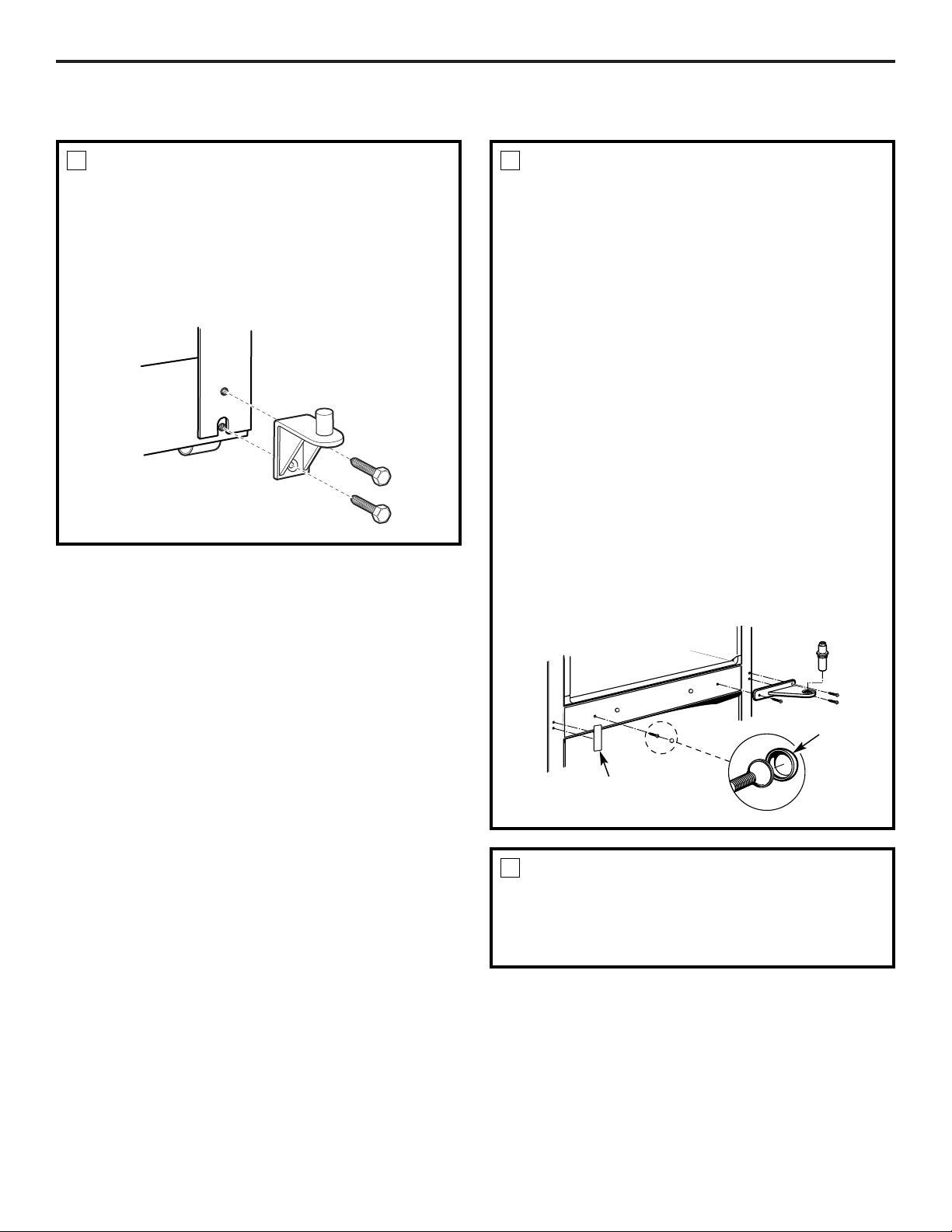
20
REVERSING THE DOOR SWING (CONT.)
Installation Instructions
TRANSFER BOTTOM HINGE
BRACKET TO THE LEFT
Remove the base grille by pulling it straight out.
Using a socket driver, move the bottom hinge
bracket from the right side to the left side.
NOTE: If the washer is not on the hinge bracket,
check to see if it is stuck to the bottom of the door.
4
TRANSFER DOOR STOPS
On each door, move the metal door stop from the
right to the left.
Move any screws from the left to the right.
6
TRANSFER CENTER HINGE
BRACKET TO THE LEFT
Remove the center hinge bracket by removing
the three screws.
NOTE: Keep these screws with the hinge bracket.
They are long screws and will be used when
installing the hinge on the other side.
You will need to remove the color-matched cap
from the screw head before you can remove the
screw. Use the edge of a thin flat blade to gently pry
the caps off the screw heads. (A putty knife works
well for this.) Cover the blade with tape to prevent
scratching the paint.
Remove the mullion cover from the left side using
the thin flat blade. Assemble it to the right side.
Remove the screw from the center left side of the
cabinet. Screw it into the holes on the right side.
Place the center hinge bracket over the holes at the
center left side of the cabinet. Insert and tighten the
three long screws.
Replace the cap by snapping it over the screw with
your finger.
5
Screw Cap
Mullion Cover
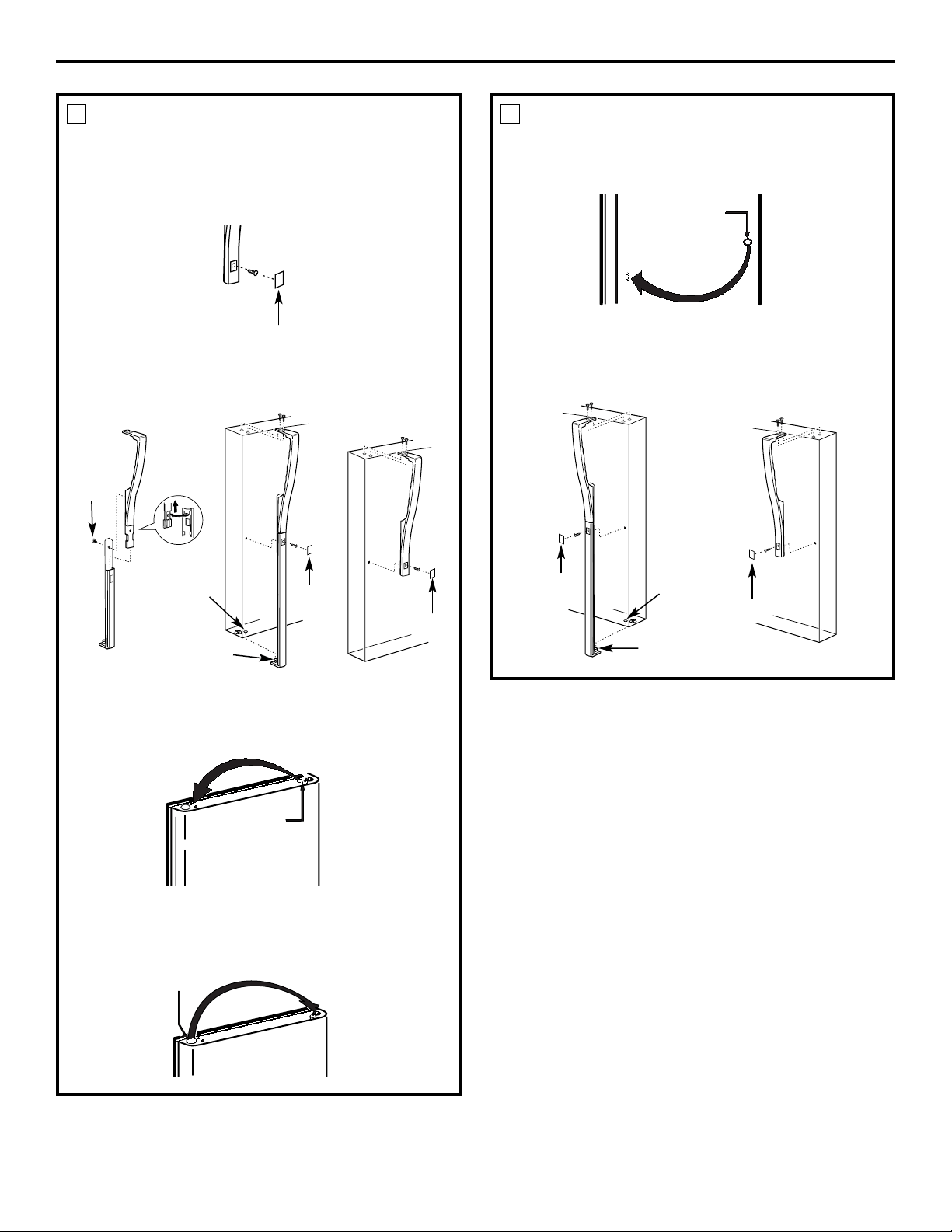
21
TRANSFER REFRIGERATOR DOOR
HANDLE TO THE RIGHT
To remove the handle: Remove the plug button by
carefully prying under the edge with a putty knife.
Remove the exposed screw holding the handle.
Remove the two screws holding the handle to the
top of the door.
After removing the handle: Move the small plug
buttons from the top right side of the door top and
insert them into the holes on the opposite side.
Move the large plug button from the left edge
of the door and insert it into the hole on the
opposite side.
7
Installation Instructions
Small Plug
Buttons
Plug Button
Handle
Plug
Handle
Plug
Pin
Hole
Handle Plug
Short
Screw
Short Handle
Long Handle
TRANSFER REFRIGERATOR DOOR
HANDLE TO THE RIGHT
(CONT.)
Transfer the door plug button to the opposite side.
Reinstalling the handle: Attach the handle to the
right side of the door.
7
Button
Long Handle
Handle
Plug
Handle
Plug
Pin
Hole
Short Handle
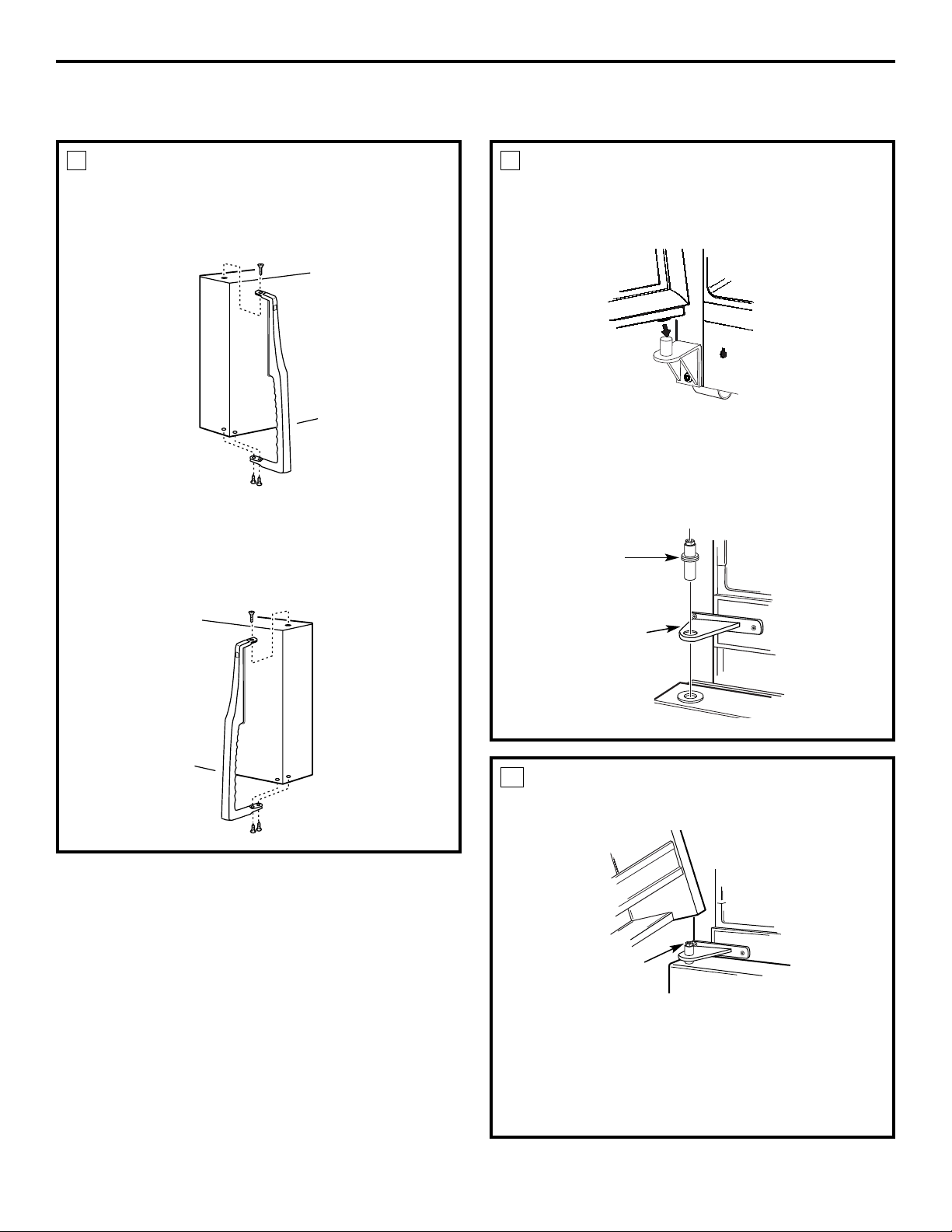
22
REHANG THE REFRIGERATOR
DOOR
Lower the refrigerator door onto the bottom
hinge pin.
Straighten the door and line it up with the center
hinge bracket.
Reinstall the center hinge pin with a 3/4″ socket.
Turn it until it extends through the hinge bracket
and into the door.
9
TRANSFER FREEZER DOOR
HANDLE TO THE RIGHT
Remove the screws holding the handle to the top
and bottom of the door. Remove handle.
Move the plug button on the right side of the door
to the handle screw hole on the left side.
Reattach the handle on the opposite side using the
holes closest to the edge of the door.
8
REHANG THE FREEZER DOOR
Lower the freezer door onto the center hinge pin.
Lift the top hinge so the pin fits into the door
socket.
Support the door on the handle side and make
sure the door is straight and the gap between the
doors is even across the front. While holding the
door in place, tighten the top hinge screws.
10
Center Hinge Pin
REVERSING THE DOOR SWING (CONT.)
Installation Instructions
Center Hinge
Bracket
Hinge Pin
Normal operating sounds.
ge.com
Newer refrigerators sound different from older refrigerators.
Modern refrigerators have more features and use newer
technology.
HUMMM...
WHOOSH...
■
The new high efficiency compressor may run faster
and longer than your old refrigerator and you may
hear a high-pitched hum or pulsating sound while it
is operating.
■
You may hear a whooshing sound when the doors close.
This is due to pressure equalizing within the refrigerator.
■
Electronic models only:
■
Sometimes the refrigerator runs for an extended period,
especially when the doors are opened frequently. This
means that the Frost Guard
™
feature is working to prevent
freezer burn and improve food preservation.
■
You may hear the fans spinning. The fans help to
maintain the correct temperatures.
■
Electronic models only:
■
You may hear the fans spinning at high speeds.
This happens when the refrigerator is first plugged in,
when the doors are opened frequently or when a large
amount of food is added to the refrigerator or freezer
compartments.
■
If either door is open for over 3 minutes, you may hear
the fans come on in order to cool the light bulbs.
■
The fans change speeds in order to provide optimal
cooling and energy savings.
CLICKS, POPS,
CRACKS and CHIRPS
■
You may hear cracking or popping sounds when the
refrigerator is first plugged in. This happens as the
refrigerator cools to the correct temperature.
■
The compressor may cause a clicking or chirping
sound when attempting to restart (this could take
up to 5 minutes).
■
The electronic control board may cause a clicking sound
when relays activate to control refrigerator components.
■
Expansion and contraction of cooling coils during and
after defrost can cause a cracking or popping sound.
■
On models with an icemaker, after an icemaking cycle,
you may hear the ice cubes dropping into the ice bucket.
■
On models with a dispenser, during water dispense,
you may hear the water lines move at initial dispense
and after dispenser button is released.
WATER SOUNDS
■
The flow of refrigerant through the freezer cooling
coils may make a gurgling noise like boiling water.
■
Water dropping on the defrost heater can cause
a sizzling, popping or buzzing sound during the
defrost cycle.
■
A water dripping noise may occur during the defrost
cycle as ice melts from the evaporator and flows into
the drain pan.
■
Closing the door may cause a gurgling sound due to
pressure equalization.
Do you hear what I hear? These sounds are normal.
For additional information on normal
icemaker operating sounds, see the
About the automatic icemaker section.
Consumer SupportTroubleshooting TipsOperating InstructionsSafety Instructions Installation Instructions
23
24
Troubleshooting Tips
Operating Instructions Safety InstructionsInstallation Instructions
Troubleshooting Tips
Installation Instructions Safety InstructionsOperating Instructions
Troubleshooting Tips
Installation Instructions Safety InstructionsOperating Instructions
Consumer Support
Before you call for service…
Troubleshooting Tips
Save time and money! Review the charts on the following
pages first and you may not need to call for service.
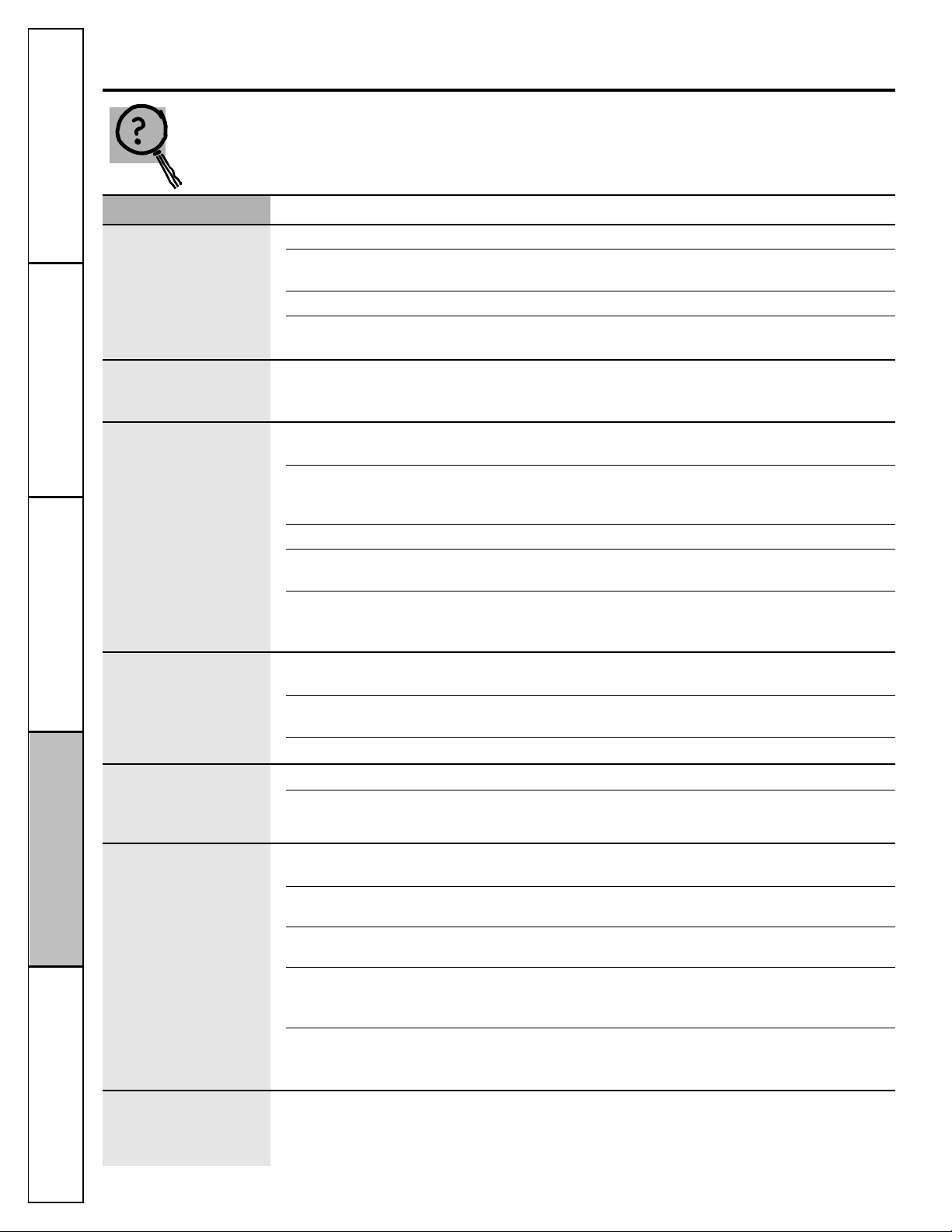
Problem Possible Causes What To Do
Refrigerator does not Refrigerator in defrost cycle. • Wait about 40 minutes for defrost cycle to end.
operate
The controls are set to • Move the refrigerator and freezer control to a
the O (off) position. temperature setting.
Refrigerator is unplugged. • Push the plug completely into the outlet.
The fuse is blown/circuit •Replace fuse or reset the breaker.
breaker is tripped.
Vibration or rattling Rollers need adjusting. •See Rollers.
(slight vibration
is normal)
Motor operates for Normal when refrigerator • Wait 12–24 hours for the refrigerator to completely
long periods or cycles is first plugged in. cool down.
on and off frequently.
Often occurs when large • This is normal.
(Modern refrigerators
amounts of food are
with more storage
placed in refrigerator.
space and a larger
Door left open. • Check to see if package is holding door open.
freezer require more
Hot weather or frequent • This is normal.
operating time. They
door openings.
start and stop often
Temperature controls • See About the controls.
to maintain even
set at the coldest
temperatures.)
setting.
Refrigerator or freezer Temperature control not set • See About the controls.
compartment too warm cold enough.
Warm weather or frequent • Set the temperature control one step colder.
door openings. See About the controls.
Door left open. •Check to see if package is holding door open.
Frost or ice crystals Door left open. • Check to see if package is holding door open.
on frozen food
Too frequent or too long
(frost within package
door openings.
is normal)
Automatic icemaker Icemaker power switch • Set the power switch to the I (on) position.
(on some models) is in the O (off) position.
does not work
Water supply turned off or • See Installing the water line.
not connected.
Freezer compartment • Wait 12–24 hours for the refrigerator to completely
too warm. cool down.
Piled up cubes in the storage •Level cubes by hand.
bin cause the icemaker
to shut off.
Ice cubes stuck in icemaker. •Turn off the icemaker, remove cubes and turn the
(Green power light on icemaker back on.
icemaker blinking).
Frequent “buzzing” Icemaker power switch is •Set the power switch to the O (off) position. Keeping it
sound in the I (on) position, but the in the I (on) position will damage the water valve.
water supply to the refrigerator
has not been connected.
25
Consumer SupportTroubleshooting Tips
Operating InstructionsSafety Instructions Installation Instructions
ge.com
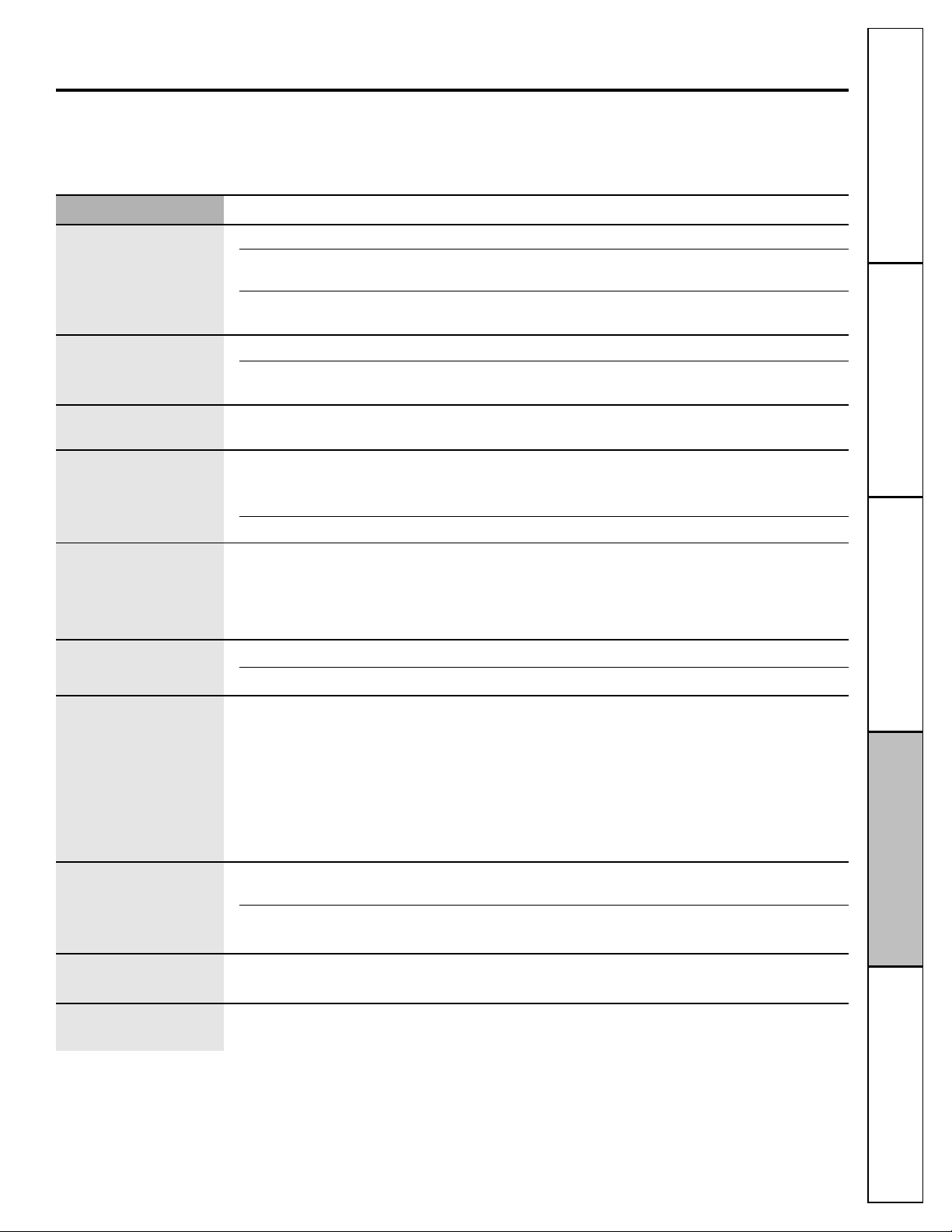
Problem Possible Causes What To Do
Ice cubes have Ice storage bin needs cleaning. • Empty and wash bin. Discard old cubes.
odor/taste
Food transmitting odor/taste • Wrap foods well.
to ice cubes.
Interior of refrigerator •See Care and cleaning.
needs cleaning.
Slow ice cube freezing Door left open. • Check to see if package is holding door open.
Temperature control not set •See About the controls.
cold enough.
No ice cube Supply line or shutoff • Call a plumber.
production valve is clogged.
Refrigerator has odor Foods transmitting • Foods with strong odors should be tightly wrapped.
odor to refrigerator.
• Keep an open box of baking soda in the refrigerator;
replace every three months.
Interior needs cleaning. • See Care and cleaning.
Moisture collects inside Too frequent or too
(in humid weather, air long door openings.
carries moisture into
refrigerator when doors
are opened)
Interior light does No power at outlet. • Replace fuse or reset the breaker.
not work
Light bulb burned out. •See Replacing the light bulbs.
Hot air from bottom Normal air flow cooling
of refrigerator motor. In the refrigeration
process, it is normal that
heat be expelled in the
area under the refrigerator.
Some floor coverings are
sensitive and will discolor
at these normal and
safe temperatures.
Food freezing in Food too close to air vent. •Move the food away from the air vent (near the controls).
the refrigerator
Refrigerator control is set •Move the refrigerator control to a warmer temperature.
too cold.
Door does not close Rollers need adjusting. •See Rollers.
by itself
Orange glow in Defrost heater is on. • This is normal.
the freezer
Consumer Support Troubleshooting Tips
Operating Instructions Safety InstructionsInstallation Instructions
Troubleshooting Tips
Installation Instructions Safety InstructionsOperating Instructions
Troubleshooting Tips
Installation Instructions Safety InstructionsOperating Instructions
26
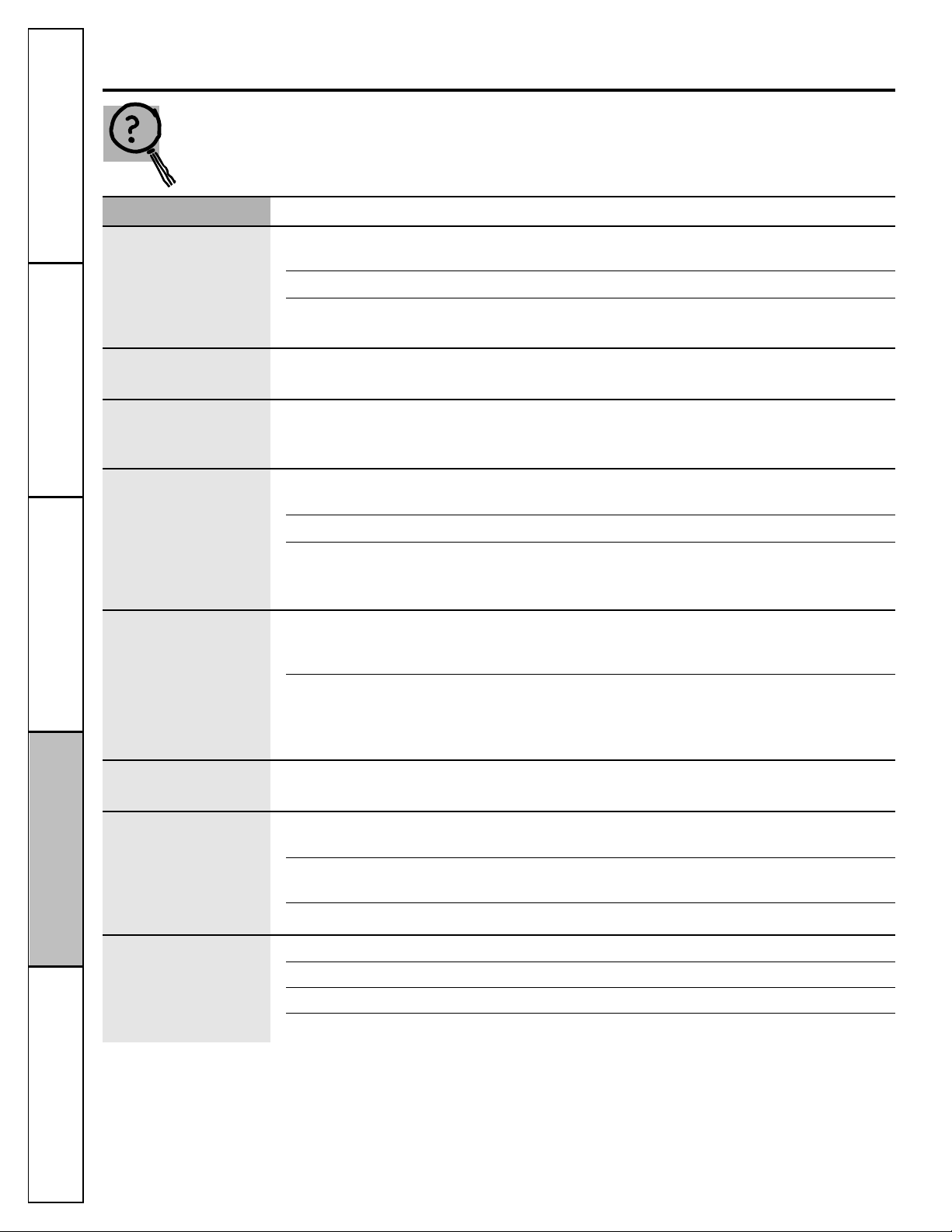
Problem Possible Causes What To Do
Water dispenser Water supply line turned off •See Installing the water line.
does not work or not connected.
Water filter clogged. •Replace filter cartridge or remove filter and install plug.
Air may be trapped in •Press the dispenser arm for at least 2 minutes.
the water system.
Water spurting from Newly-installed filter cartridge. •Run water from the dispenser for 3 minutes
dispenser (about 1
1
⁄2 gallons).
Water is not dispensed Water in reservoir is frozen •Set the refrigerator control to a warmer setting and
but icemaker is working because the controls are wait 24 hours. If water does not dispense after 24 hours,
set too cold. call for service.
No water or ice cube Supply line or shutoff valve •Call a plumber.
production is clogged.
Water filter clogged. •Replace filter cartridge or remove filter and install plug.
Filter cartridge not • Remove and reinstall filter cartridge, being certain that
properly installed. it locks into place. The blade on the end of the cartridge
should be positioned vertically.
Water is leaking from Glass not being held under •Hold the glass underneath the dispenser for 2–3 seconds
dispenser the dispenser long enough after releasing the dispenser button. Water may continue
after button is released. to dispense after the button is released.
Air may be present in the • Dispense water for at least 2 minutes to remove air
water line system, causing from system.
water to drip after being
dispensed.
Water has poor Water dispenser has not been • Dispense water until all water in system is
taste/odor used for a long time. replenished.
Water in first glass Normal when refrigerator • Wait 24 hours for the refrigerator to completely
is warm is first installed. cool down.
Water dispenser has not been • Dispense water until all water is system is
used for a long time. replenished.
Water system has been drained. • Allow several hours for replenished supply to chill.
Actual temperature not Unit just plugged in. • Allow 24 hours for system to stabilize.
equal to Set temperature
Door open for too long. • Allow 24 hours for system to stabilize.
(on some models)
Warm food added to refrigerator. • Allow 24 hours for system to stabilize.
Defrost cycle is in process. • Allow 24 hours for system to stabilize.
Before you call for service…
Troubleshooting Tips
27
Manufactured for: General Electric Company, Louisville, KY 40225
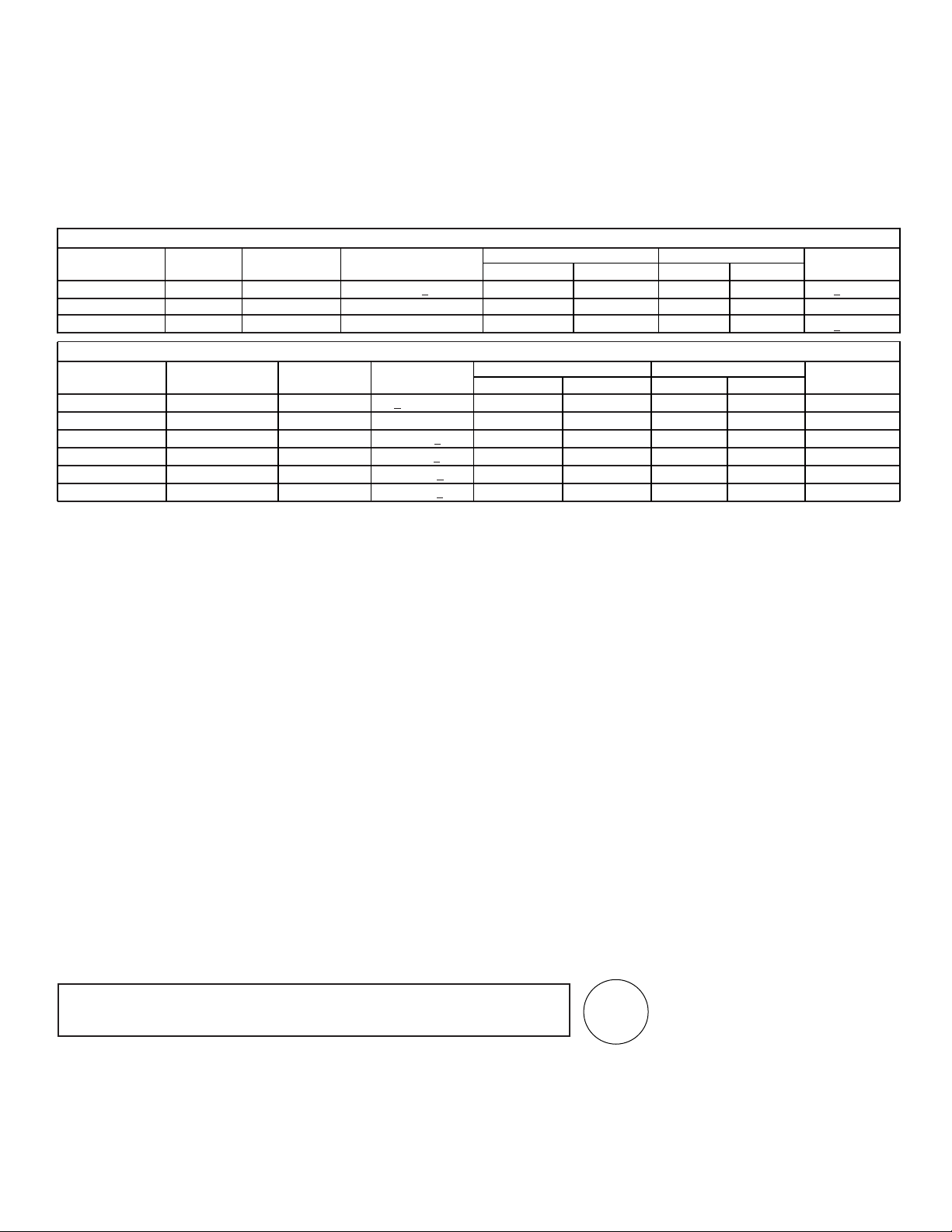
Performance Data Sheet
SmartWater Filtration System
GSWF Cartridge
This system has been tested according to NSF/ANSI 42/53 for reduction of the substances listed below.
The concentration of the indicated substances in water entering the system was reduced to a concentration
less than or equal to the permissible limit for water leaving the system, as specified in NSF/ANSI 42/53.*
(100% safety factors built in for unmetered usage)
Standard No. 42: Aesthetic Effects
Parameter USEPA Influent Influent Challenge Effluent % Reduction Min. Required
MCL Average Concentration Average Maximum Average Minimum Reduction
Chlorine — 1.845 mg/L 2.0 mg/L+10% < 0.05 mg/L 0.05 mg/L > 97.29% 96.43% > 50%
T & O — — — — — — — —
Particulate** — 143,333 #/mL
at least 10,000 particles/mL
29.83 #/mL 140 #/mL 99.98% 99.91% > 85%
Standard No. 53: Health Effects
Parameter USEPA Influent
Influent Challenge
Effluent % Reduction Min. Required
MCL Average Concentration Average Maximum Average Minimum Reduction
Turbidity 1 NTU*** 10.3 NTU*** 1+1 NTU*** 0.106 NTU 0.14 NTU 98.97% 98.61% 0.5 NTU
Cysts
99.95% Reduction
200,000 #/L
Minimum 50,000 L
0 0 > 99.99% > 99.99% > 99.95%
Lead at pH 6.5 0.015 mg/L 0.15 mg/L 0.15 mg/L+10% < 0.001 mg/L < 0.001 mg/L > 99.33% > 99.33% 0.010 mg/L
Lead at pH 8.5 0.015 mg/L 0.14 mg/L 0.15 mg/L+10% 0.001 mg/L 0.003 mg/L > 99.29% 97.86% 0.010 mg/L
Lindane
0.0002 mg/L
0.0216 mg/L 0.002 mg/L+10%
< 0.00002 mg/L < 0.00002 mg/L
99.07% 98.75% 0.0002 mg/L
Atrazine
0.003 mg/L
0.008 mg/L 0.009 mg/L+10% < 0.002 mg/L < 0.002 mg/L > 76.12% > 66.67% 0.003 mg/L
* Tested using a flow rate of 0.5 gpm; pressure of 60 psig; pH of 7.5 ± 0.5; temp. of 68° ± 5°F (20° ± 3°C)
** Measurement in Particles/ml. Particles used were 0.5-1 microns
*** NTU=Nephelometric Turbidity units
Operating Specifications
Capacity: certified for up to 750 gallons (2,838 l); up to six months
Pressure requirement: 40–120 psi (2.8–8.2 bar)
Temperature: 33–100ºF (0.6–38ºC)
Flow rate: 0.5 gpm (1.9 lpm)
General Installation/Operation/Maintenance Requirements
Flush new cartridge at full flow for 3 minutes to purge out trapped air.
Replace cartridge when flow becomes too slow.
Special Notices
Installation instructions, parts and service availability, and standard warranty are included with the product when shipped.
This drinking water system must be maintained according to manufacturer’s instructions, including replacement of filter
cartridges.
Do not use with water that is microbiologically unsafe or of unknown quality without adequate disinfection before or
after the system. Systems certified for cyst reduction may be used on disinfected water that may contain filterable cysts.
The contaminants or other substances removed or reduced by this water treatment system are not necessarily in your
water.
Check for compliance with the state and local laws and regulations.
Note that while the testing was performed under standard laboratory conditions, actual performance may vary. Systems
must be installed and operated in accordance with manufacturer’s recommended procedures and guidelines.
NSF
®
System tested and certified by NSF International against Standard 42 for the reduction of
chlorine, taste and odor, particulate Class I and Standard 53 for the reduction of cyst,
lead, Lindane, Atrazine and turbidity.

28
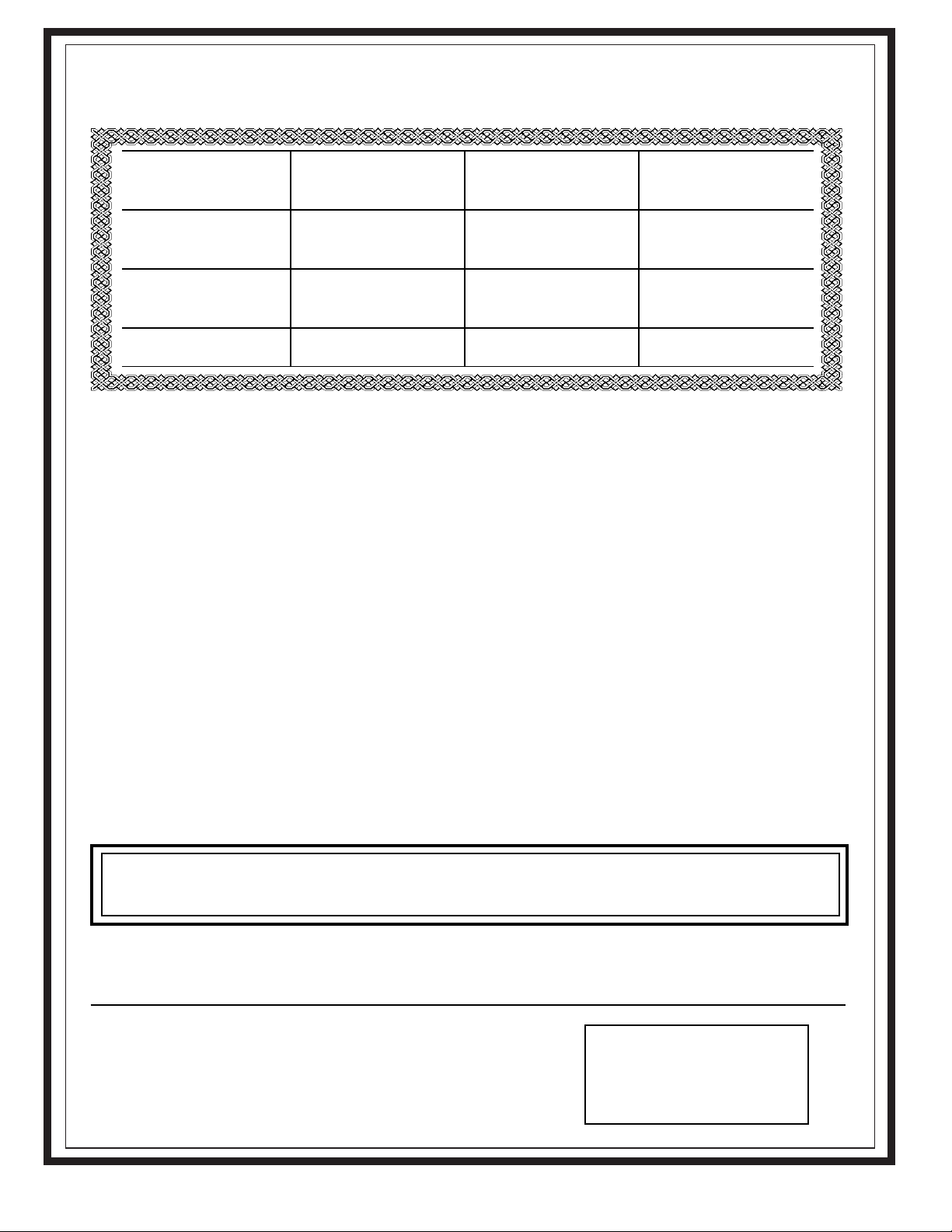
State of California
Department of Health Services
Water Treatment Device
Certificate Number
Date Issued: April 28, 2003
Trademark/Model Designation
Replacement Elements
155903 -
GE GSWF GSWF
Manufacturer: General Electric Consumer Products
The water treatment device(s) listed on this certificate have met the testing requirements pursuant to Section
116830 of the Health and Safety Code for the following health related contaminants:
Cysts
Turbidity
Asbestos
Lead
Atrazine
Lindane
2,4-D
Microbiological Contaminants and Turbidity
Inorganic/Radiological Contaminants
Organic Contaminants
Do not use where water is microbiologically unsafe or with water of unknown quality, except that systems certified for
cyst reduction may be used on disinfected waters that may contain filterable cysts.
750 galRated Service Capacity: 0.5 gpm
Rated Service Flow:
Conditions of Certification:
29
TERMS AND CONDITIONS:
This warranty applies only for single family domestic use in
Canada when the Refrigerator has been properly installed
according to the instructions supplied by Camco and is
connected to an adequate and proper utility service.
Damage due to abuse, accident, commercial use, and alteration
or defacing of the serial plate cancels all obligations of this
warranty.
Service during this warranty period must be performed by an
Authorized Camco Service Agent.
Neither Camco nor the Dealer is liable for any claims or
damages resulting from failure of the Refrigerator or from
service delays beyond their reasonable control.
To obtain warranty service, purchaser must present the original
Bill of Sale. Components repaired or replaced are warranted
through the remainder of the original warranty period only.
This warranty is extended to the original purchaser and any
succeeding owner for products purchased for home use within
Canada. In home warranty service will be provided in areas
where it is available and deemed reasonable by Camco to
provide.
This warranty is in addition to any statutory warranty.
WHAT IS NOT COVERED:
• Owner is responsible to pay for service calls related to
product installation and/or teaching how to use the product.
• Damage to finish must be reported within 48 hours following
the delivery of the appliance.
• Damage to finish after delivery.
• Improper installation—proper installation includes adequate
air circulation to the refrigeration system, adequate electrical,
plumbing and other connecting facilities.
• Replacement of house fuses or resetting of circuit breakers.
• Replacement of light bulbs.
• Damage to product caused by accident, fire, floods or acts
of God.
• Loss of food due to spoilage.
• Proper use and care of product as listed in the owner’s
manual, proper setting of controls.
• Product not accessible to provide required service.
• WARRANTOR IS NOT RESPONSIBLE FOR CONSEQUENTIAL
DAMAGES.
IMPORTANT
Keep this warranty and your bill of sale as proof of original purchase and purchase date.
Please have serial number and model number available when calling for service.
Camco Service is available coast to coast. If further help is
needed concerning this warranty, contact:
Manager, Consumer Relations
Camco Inc., Consumer Service
1 Factory Lane, Suite 310
Moncton, New Brunswick E1C 9M3
1.800.361.3400
Staple your receipt here.
Proof of the original purchase
date is needed to obtain service
under the warranty.
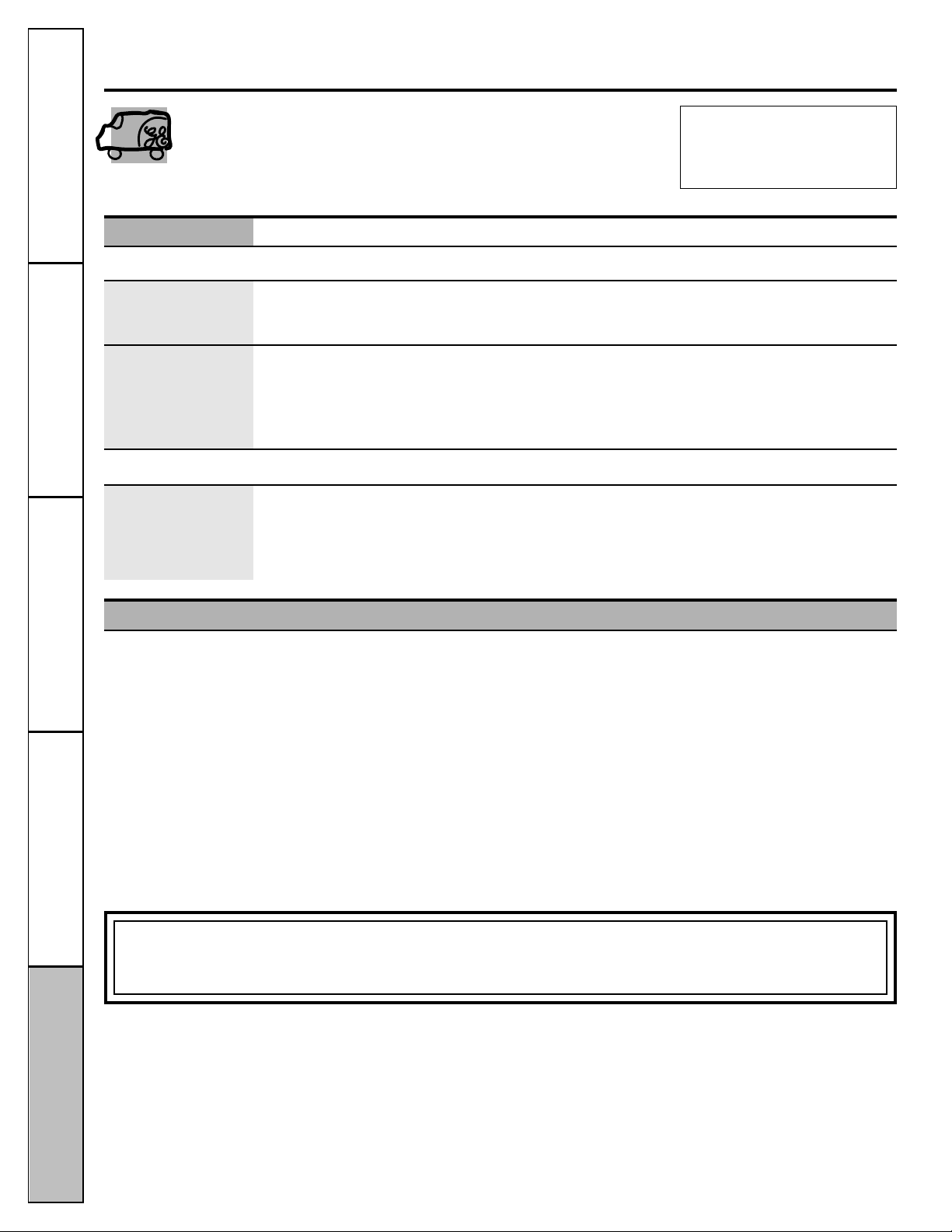
What is covered How Long Warranted Parts Labour
(From Date of Sale) Repair or Replace
at Camco’s Option
Compressor GE Profile: Ten (10) Years GE Profile: Ten (10) Years GE Profile: Five (5) Years
GE and All Other GE and All Other GE and All Other
Brands: One (1) Year Brands: One (1) Year Brands: One (1) Year
Sealed System (including GE Profile: Five (5) Years GE Profile: Five (5) Years GE Profile: Five (5) Years
evaporator, condenser GE and All Other GE and All Other GE and All Other
tubing and refrigerant) Brands: One (1) Year Brands: One (1) Year Brands: One (1) Year
All Other Parts One (1) Year One (1) Year One (1) Year
CUSTOMER WARRANTY
(for customers in Canada)
Your refrigerator is warranted to be free of defects in material and workmanship.
EXCLUSION OF IMPLIED WARRANTIES—Your sole and exclusive remedy is product repair as provided in this Limited
Warranty. Any implied warranties, including the implied warranties of merchantability or fitness for a particular purpose,
are limited to one year or the shortest period allowed by law.
This warranty is extended to the original purchaser and any succeeding owner for products purchased for home
use within the USA. If the product is located in an area where service by a GE Authorized Servicer is not available,
you may be responsible for a trip charge or you may be required to bring the product to an Authorized GE Service
location for service. In Alaska, the warranty excludes the cost of shipping or service calls to your home.
Some states do not allow the exclusion or limitation of incidental or consequential damages. This warranty gives
you specific legal rights, and you may also have other rights which vary from state to state. To know what your
legal rights are, consult your local or state consumer affairs office or your state’s Attorney General.
Warrantor: General Electric Company. Louisville, KY 40225
30
Consumer Support Troubleshooting Tips
Operating Instructions Safety InstructionsInstallation Instructions
Troubleshooting Tips
Installation Instructions Safety InstructionsOperating Instructions
Troubleshooting Tips
Installation Instructions Safety InstructionsOperating Instructions
Refrigerator Warranty. (For customers in the United States)
All warranty service provided by our Factory Service Centers,
or an authorized Customer Care
®
technician. To schedule service,
on-line, 24 hours a day, visit us at ge.com, or call 800.GE.CARES
(800.432.2737). Please have serial number and model number
available when calling for service.
For The Period Of: GE Will Replace:
GE and GE PROFILE MODELS:
One Year Any part of the refrigerator which fails due to a defect in materials or workmanship.
From the date of the During this limited one-year warranty, GE will also provide, free of charge, all labor and
original purchase related service to replace the defective part.
Thirty Days Any part of the water filter cartridge which fails due to a defect in materials or workmanship.
(Water filter, if included) During this limited thirty-day warranty, GE will also provide, free of charge, a replacement water
From the original filter cartridge.
purchase date of
the refrigerator
GE PROFILE MODELS ONLY:
Five Years Any part of the sealed refrigerating system (the compressor, condenser, evaporator
(GE Profile models only) and all connecting tubing) which fails due to a defect in materials or workmanship.
From the date of the During this limited five-year sealed refrigerating system warranty, GE will also provide,
original purchase free of charge, all labor and related service to replace the defective part in the sealed
refrigerating system.
■ Service trips to your home to teach you how to use
the product.
■ Improper installation, delivery or maintenance.
■ Failure of the product if it is abused, misused, or used for
other than the intended purpose or used commercially.
■ Loss of food due to spoilage.
■ Replacement of house fuses or resetting of circuit
breakers.
■ Damage caused after delivery.
■ Replacement of the water filter cartridge, if included,
due to water pressure that is outside the specified
operating range or due to excessive sediment in the
water supply.
■ Replacement of the light bulbs, if included, or water filter
cartridge, if included, other than as noted above.
■ Damage to the product caused by accident, fire, floods
or acts of God.
■ Incidental or consequential damage caused by possible
defects with this appliance.
■ Product not accessible to provide required service.
What GE Will Not Cover:
Staple your receipt here.
Proof of the original purchase
date is needed to obtain service
under the warranty.
EXCLUSION OF IMPLIED WARRANTIES—Your sole and exclusive remedy is product repair as provided in this
Limited Warranty. Any implied warranties, including the implied warranties of merchantability or fitness for a
particular purpose, are limited to one year or the shortest period allowed by law.
31
Consumer SupportTroubleshooting TipsOperating Instructions
Safety Instructions
Installation Instructions
Notes.
ge.com
Consumer Support.
GE Appliances Website
In the U.S.: ge.com
Have a question or need assistance with your appliance? Try the GE Appliances Website 24 hours a day,
any day of the year! For greater convenience and faster service, you can now download Owner’s Manuals,
order parts, catalogs, or even schedule service on-line. You can also “Ask Our Team of Experts
™
” your questions,
and so much more... In Canada: www.geappliances.ca
Schedule Service In the U.S.: ge.com
Expert GE repair service is only one step away from your door. Get on-line and schedule your service at your
convenience 24 hours any day of the year! Or call 800.GE.CARES (800.432.2737) during normal business hours.
In Canada, call 1.800.361.3400
Real Life Design Studio In the U.S.: ge.com
GE supports the Universal Design concept—products, services and environments that can be used by people of all
ages, sizes and capabilities. We recognize the need to design for a wide range of physical and mental abilities and
impairments. For details of GE’s Universal Design applications, including kitchen design ideas for people with
disabilities, check out our Website today. For the hearing impaired, please call 800.TDD.GEAC (800.833.4322).
In Canada, contact: Manager, Consumer Relations, Camco, Inc.
Suite 310, 1 Factory Lane
Moncton, N.B. E1C 9M3
Extended Warranties In the U.S.: ge.com
Purchase a GE extended warranty and learn about special discounts that are available while your warranty is still
in effect. You can purchase it on-line anytime, or call 800.626.2224 during normal business hours. GE Consumer
Home Services will still be there after your warranty expires. In Canada, call 1.888.261.2133
Parts and Accessories In the U.S.: ge.com
Individuals qualified to service their own appliances can have parts or accessories sent directly to their homes
(VISA, MasterCard and Discover cards are accepted). Order on-line today, 24 hours every day or by phone at
800.626.2002 during normal business hours.
Instructions contained in this manual cover procedures to be performed by any user. Other servicing generally should be
referred to qualified service personnel. Caution must be exercised, since improper servicing may cause unsafe operation.
Customers in Canada should consult the yellow pages for the nearest Camco service center, or call 1.888.261.3055.
Contact Us In the U.S.: ge.com
If you are not satisfied with the service you receive from GE, contact us on our Website with all the details
including your phone number, or write to: General Manager, Customer Relations
GE Appliances, Appliance Park
Louisville, KY 40225
In Canada: www.geappliances.ca, or write to: Director, Consumer Relations, Camco, Inc.
Suite 310, 1 Factory Lane
Moncton, N.B. E1C 9M3
Register Your Appliance In the U.S.: ge.com
Register your new appliance on-line—at your convenience! Timely product registration will allow for
enhanced communication and prompt service under the terms of your warranty, should the need arise.
You may also mail in the pre-printed registration card included in the packing material.
In Canada: www.geappliances.ca
Printed in the United States