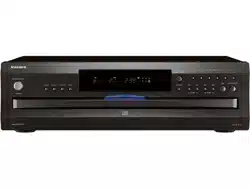
Compact Disc Changer
CDC-3.4
Instruction Manual
CDC-3.4.book Page 1 Tuesday, September 9, 2003 3:44 PM
2
Important Safety Instructions
1. Read these instructions.
2. Keep these instructions.
3. Heed all warnings.
4. Follow all instructions.
5. Do not use this apparatus near water.
6. Clean only with dry cloth.
7. Do not block any ventilation openings. Install in
accordance with the manufacturer’s instructions.
8. Do not install near any heat sources such as radia-
tors, heat registers, stoves, or other apparatus
(including amplifiers) that produce heat.
9. Do not defeat the safety purpose of the polarized or
grounding-type plug. A polarized plug has two
blades with one wider than the other. A grounding
type plug has two blades and a third grounding
prong. The wide blade or the third prong are pro-
vided for your safety. If the provided plug does not
fit into your outlet, consult an electrician for
replacement of the obsolete outlet.
10. Protect the power cord from being walked on or
pinched particularly at plugs, convenience recepta-
cles, and the point where they exit from the appara-
tus.
11. Only use attachments/accessories specified by the
manufacturer.
12.
Use only with the cart, stand,
tripod, bracket, or table spec-
ified by the manufacturer, or
sold with the apparatus.
When a cart is used, use cau-
tion when moving the cart/
apparatus combination to
avoid injury from tip-over.
13. Unplug this apparatus during lightning storms or
when unused for long periods of time.
14. Refer all servicing to qualified service personnel.
Servicing is required when the apparatus has been
damaged in any way, such as power-supply cord or
plug is damaged, liquid has been spilled or objects
have fallen into the apparatus, the apparatus has
been exposed to rain or moisture, does not operate
normally, or has been dropped.
15. Damage Requiring Service
Unplug the apparatus from the wall outlet and refer
servicing to qualified service personnel under the
following conditions:
A. When the power-supply cord or plug is damaged,
B. If liquid has been spilled, or objects have fallen
into the apparatus,
C. If the apparatus has been exposed to rain or
water,
D. If the apparatus does not operate normally by
following the operating instructions. Adjust only
those controls that are covered by the operating
instructions as an improper adjustment of other
controls may result in damage and will often
require extensive work by a qualified technician
to restore the apparatus to its normal operation,
E. If the apparatus has been dropped or damaged in
any way, and
F. When the apparatus exhibits a distinct change in
performance this indicates a need for service.
16. Object and Liquid Entry
Never push objects of any kind into the apparatus
through openings as they may touch dangerous volt-
age points or short-out parts that could result in a
fire or electric shock.
The apparatus shall not be exposed to dripping or
splashing and no objects filled with liquids, such as
vases shall be placed on the apparatus.
Don’t put candles or other burning objects on top of
this unit.
17. Batteries
Always consider the environmental issues and fol-
low local regulations when disposing of batteries.
18. If you install the apparatus in a built-in installation,
such as a bookcase or rack, ensure that there is ade-
quate ventilation.
Leave 20 cm (8") of free space at the top and sides
and 10 cm (4") at the rear. The rear edge of the shelf
or board above the apparatus shall be set 10 cm (4")
away from the rear panel or wall, creating a flue-like
gap for warm air to escape.
WARNING:
TO REDUCE THE RISK OF FIRE OR ELECTRIC
SHOCK, DO NOT EXPOSE THIS APPARATUS
TO RAIN OR MOISTURE.
CAUTION:
TO REDUCE THE RISK OF ELECTRIC SHOCK,
DO NOT REMOVE COVER (OR BACK). NO
USER-SERVICEABLE PARTS INSIDE. REFER
SERVICING TO QUALIFIED SERVICE
PERSONNEL.
The lightning flash with arrowhead symbol, within an
equilateral triangle, is intended to alert the user to the
presence of uninsulated “dangerous voltage” within
the product’s enclosure that may be of sufficient
magnitude to constitute a risk of electric shock to
persons.
The exclamation point within an equilateral triangle is
intended to alert the user to the presence of important
operating and maintenance (servicing) instructions in
the literature accompanying the appliance.
WARNING
RISK OF ELECTRIC SHOCK
DO NOT OPEN
RISQUE DE CHOC ELECTRIQUE
NE PAS
OUVRIR
AVIS
PORTABLE CART WARNING
S3125A
CDC-3.4.book Page 2 Tuesday, September 9, 2003 3:44 PM
3
Introduction
Thank you for purchasing an Integra Compact Disc
Changer.
Please read this manual thoroughly before making con-
nections and turning on the power.
Following the instructions in this manual will enable you
to obtain optimum performance and listening enjoyment
from your new Compact Disc Changer.
Please retain this manual for future reference.
• 6-disc CD changer
• MP3 playback
• Multi-bit D/A converter
• 128-times oversampling
• VLSC (Vector Linear Shaping Circuitry)
• Direct Digital Path
• Change up to 5 discs without stopping playback
• Cue up the next track or disc with the Next
Selection function
• Repeat playbacks: All Discs, Entire Disc, Ran-
dom Tracks, Memory Tracks, Random Memory,
Single Folder, Single Track
• 40-track memory playback
• Optical and coaxial digital audio outputs
• Analog outputs
• compatible remote control
Make sure you have the following accessories:
* In catalogs and on packaging, the letter added to the end of
the product name indicates the color of the CDC-3.4. Spec-
ifications and operation are the same regardless of color.
CDC-3.4 Features
Supplied Accessories
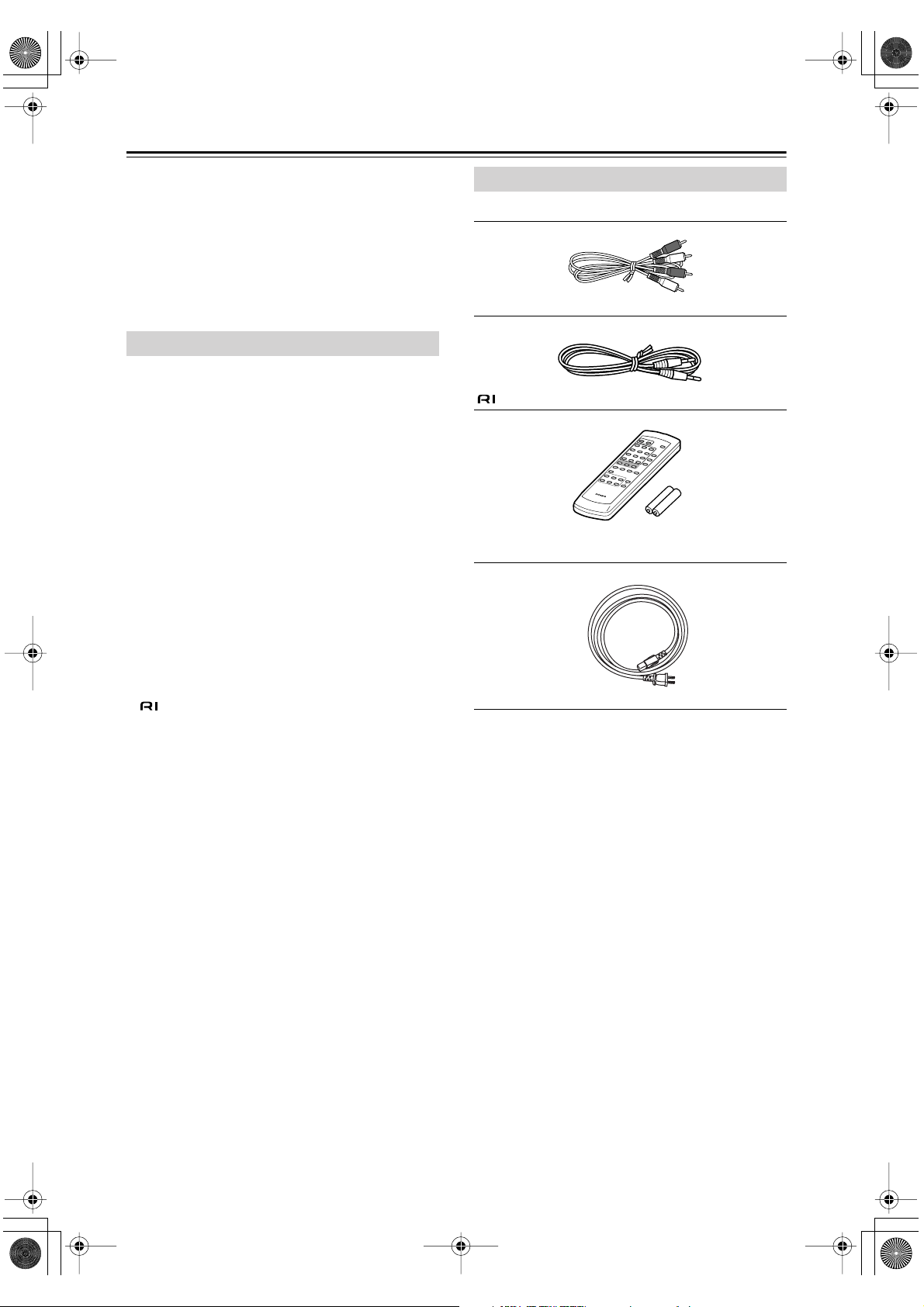
RCA/phono audio connecting cable
cable
Remote controller (RC-553C) and two (AA/R6)
batteries
Power cord
CDC-3.4.book Page 3 Tuesday, September 9, 2003 3:44 PM
4
Precautions
1.
Recording Copyright
Unless it’s for personal use only, recording copy-
righted material is illegal without the permission of
the copyright holder.
2.
AC Fuse
The AC fuse inside the CDC-3.4 is not user-service-
able. If you cannot turn on the CDC-3.4, contact
your Integra/Onkyo dealer.
3.
Care
Occasionally you should dust the CDC-3.4 all over
with a soft cloth. For stubborn stains, use a soft cloth
dampened with a weak solution of mild detergent
and water. Dry the CDC-3.4 immediately afterwards
with a clean cloth. Don’t use abrasive cloths, thin-
ners, alcohol, or other chemical solvents, because
they may damage the finish or remove the panel let-
tering.
4.
Power
WARNING
BEFORE PLUGGING IN THE UNIT FOR THE
FIRST TIME, READ THE FOLLOWING SEC-
TION CAREFULLY.
AC outlet voltages vary from country to country.
Make sure that the voltage in your area meets the
voltage requirements printed on the CDC-3.4’s rear
panel (i.e., AC 120 V, 60 Hz).
Setting the [STANDBY/ON] switch to STANDBY
does not fully shutdown the CDC-3.4. If you do not
intend to use the CDC-3.4 for an extended period,
remove the power cord from the AC outlet.
5.
Never Touch This Unit
with Wet Hands
Never handle this unit or its power cord while your
hands are wet or damp. If water or any other liquid
gets inside this unit, have it checked by your Integra/
Onkyo dealer.
6.
Installing This Unit
• Install this unit in a well-ventilated location.
• Ensure that there’s adequate ventilation all around
this unit, especially if it’s installed in an audio
rack. If the ventilation is inadequate, the unit may
overheat, leading to malfunction.
• Do not expose this unit to direct sunlight or heat
sources, because its internal temperature may rise,
shortening the life of the optical pickup.
•Avoid damp and dusty places, and places subject
to vibrations from loudspeakers. Never put the
unit on top of, or directly above a loudspeaker.
• Install this unit horizontally. Never use it on its
side or on a sloping surface, because it may cause
a malfunction.
• If you install this unit near a TV, radio, or VCR,
the sound quality may be affected. If this occurs,
move this unit away from the TV, radio, or VCR.
7.
Moisture Condensation
Moisture condensation may damage this unit.
Read the following carefully:
When you take a glass containing a cold drink out-
side on a summer’s day, drops of water, called con-
densation, form on the outside of the glass.
Similarly, moisture may condense on the lens of the
optical pickup, one of the most important parts
inside this unit.
• Moisture condensation can occur in the following
situations:
— The unit is moved from a cold place to a warm
place.
—A heater is turned on, or cold air from an air
conditioner is hitting the unit.
— In the summer, when this unit is moved from
an air conditioned room to a hot and humid
place.
— The unit is used in a humid place.
• Do not use this unit when there’s the possibility of
moisture condensation occurring. Doing so may
damage your discs and certain parts inside this
unit.
If condensation does occur, remove all discs and
leave this unit turned on for two to three hours. By
this time, the unit will have warmed up and any con-
densation will have evaporated. To reduce the risk of
condensation, keep this unit connected to a wall out-
let.
For U.S. model
The laser is covered by a housing which prevents expo-
sure during operation or maintenance. However, this
product is classified as a Laser Product by CDRH (Cen-
ter for Devices and Radiological Health) which is a
department of the Food and Drug Administration.
According to their regulations 21 CFR section 1002.30,
all manufactures who sell Laser Products must maintain
records of written communications between the manu-
facturer, dealers and customers concerning radiation
safety. If you have any complaints about instructions or
explanations affecting the use of this product, please feel
free to write to the address on the back page of this man-
ual. When you write us, please include the model num-
ber and serial number of your unit.
In compliance with Federal Regulations, the certifica-
tion, identification and the period of manufacture are
indicated on the rear panel.
FCC INFORMATION FOR USER
CAUTION:
The user changes or modifications not expressly
approved by the party responsible for compliance could
void the user’s authority to operate the equipment.
NOTE:
This equipment has been tested and found to comply
with the limits for a Class B digital device, pursuant to
Part 15 of the FCC Rules.
These limits are designed to provide reasonable protec-
tion against harmful interference in a residential installa-
tion. This equipment generates, uses and can radiate
radio frequency energy and, if not installed and used in
accordance with the instructions, may cause harmful
interference to radio communications. However, there is
no guarantee that interference will not occur in a partic-
ular installation.
CDC-3.4.book Page 4 Tuesday, September 9, 2003 3:44 PM
5
Precautions
—Continued
If this equipment does cause harmful interference to
radio or television reception, which can be determined
by turning the equipment off and on, the user is encour-
aged to try to correct the interference by one or more of
the following measures:
• Reorient or relocate the receiving antenna.
• Increase the separation between the equipment and
receiver.
• Connect the equipment into an outlet on a circuit dif-
ferent from
• that to which the receiver is connected.
• Consult the dealer or an experienced radio/TV techni-
cian for help.
For Canadian model
NOTE:
This Class B digital apparatus complies with
Canadian ICES-003.
For models having a power cord with a polarized plug:
CAUTION:
TO PREVENT ELECTRIC SHOCK,
MATCH WIDE BLADE OF PLUG TO WIDE SLOT,
FULLY INSERT.
Modèle pour les Canadien
REMARQUE:
Cet appareil numérique de la classe B
est conforme à la norme NMB-003 du Canada.
Sur les modèles dont la fiche est polarisee:
ATTENTION:
POUR ÉVITER LES CHOCS ÉLEC-
TRIQUES, INTRODUIRE LA LAME LA PLUS
LARGE DE LA FICHE DANS LA BORNE CORRE-
SPONDANTE DE LA PRISE ET POUSSER
JUSQU’AU FOND.
Table of Contents
Getting Started
Controls & Connectors ........................6
Front Panel ..........................................................6
Display ................................................................7
Rear Panel ...........................................................8
Remote Controller...............................................9
Before Using the CDC-3.4..................10
Installing the Remote Controller’s Batteries.....10
Using the Remote Controller ............................10
Connections
Connecting the CDC-3.4 ....................11
Audio Connections............................................11
Connections................................................12
Controlling AV Components that are
Out of Range .................................................13
Basic Operation
Turning On the CDC-3.4.....................14
Turning On the CDC-3.4...................................14
Basic Playback ...................................14
Loading Discs....................................................14
Starting Playback ..............................................15
Selecting Discs..................................................15
Loading Discs During Playback........................15
Adjusting the Display Brightness......................15
Basic Operation.................................................16
Selecting MP3s..................................................17
Selecting Tracks by Number.............................18
Selecting MP3 Folders & Tracks by Number...18
Displaying Information .....................................19
Advanced Operation
Advanced Playback............................20
Cuing Up the Next Track, Folder, or Disc........20
Playing All Discs Repeatedly............................21
Playing One Track, Folder,
or Disc Repeatedly ........................................21
Using Random Playback...................................21
Using Memory Playback...................................22
MP3 Preferences ................................24
Setting the MP3 Preferences .............................24
Initializing the MP3 Preferences.......................24
Others
Troubleshooting .................................25
Disc Notes...........................................26
Specifications .....................................27
This unit contains a semiconductor laser system and is
classified as a “CLASS 1 LASER PRODUCT.” So, to
use this model properly, read this Instruction Manual
carefully. In case of any trouble, please contact the
store where you purchased the unit. To prevent expo-
sure to the laser beam, do not try to open the enclosure.
DANGER:
VISIBLE AND INVISIBLE LASER RADIATION
WHEN OPEN AND INTERLOCK FAILED OR
DEFEATED. DO NOT STARE INTO BEAM.
CAUTION:
THIS PRODUCT UTILIZES A LASER. USE OF
CONTROLS OR ADJUSTMENTS OR PERFOR-
MANCE OF PROCEDURES OTHER THAN
THOSE SPECIFIED HEREIN MAY RESULT IN
HAZARDOUS RADIATION EXPOSURE.
1. This unit is a CLASS 1 LASER PRODUCT and
employs a laser inside the cabinet.
2. To prevent the laser from being exposed, do not
remove the cover. Refer servicing to qualified per-
sonnel.
CDC-3.4.book Page 5 Tuesday, September 9, 2003 3:44 PM
6
Controls & Connectors
For detailed information, refer to the pages in parenthe-
sis.
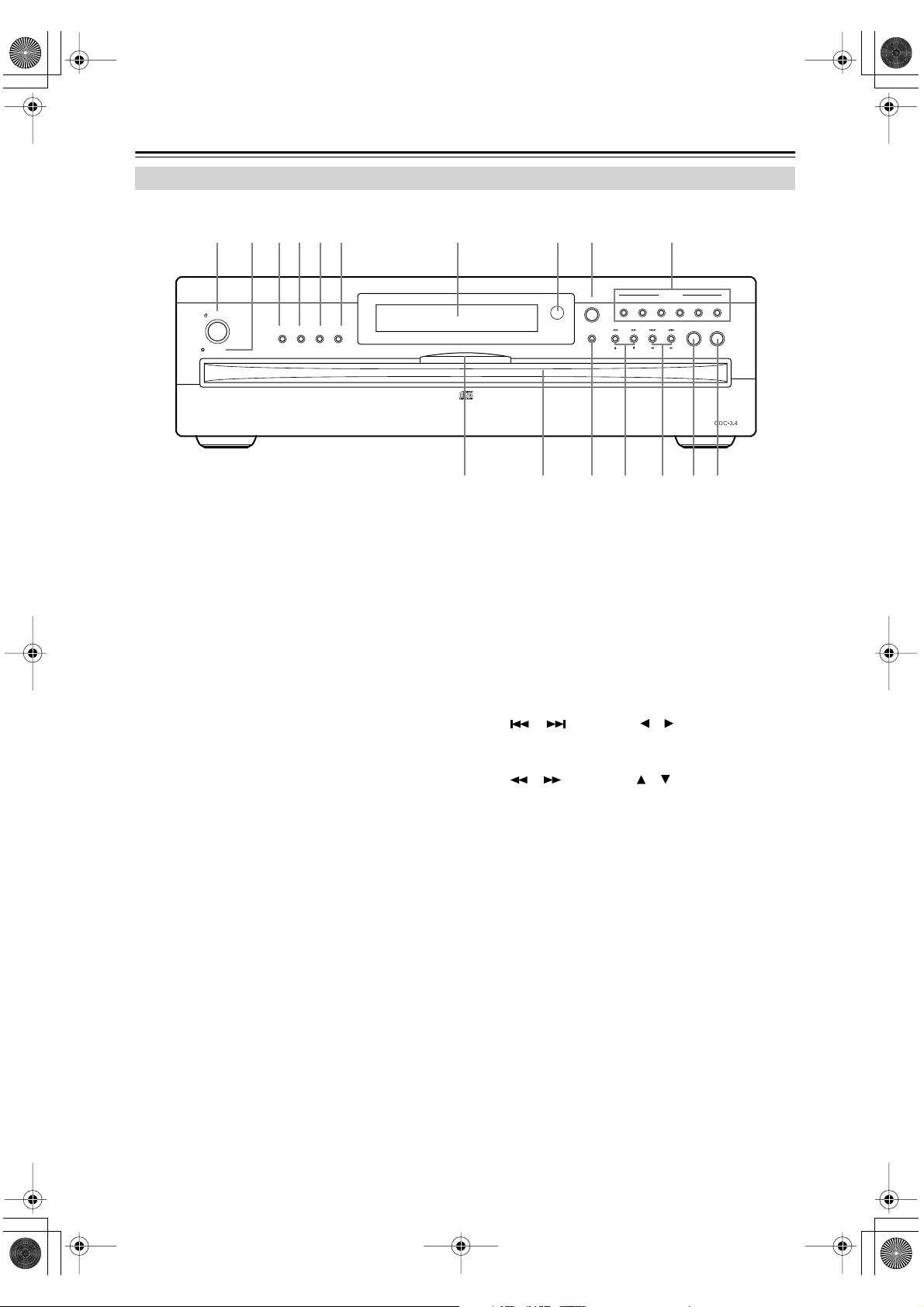
A
Standby/On button (14)
This button is used to set the CDC-3.4 to On or
Standby.
B
Standby indicator (14)
This indicator lights up when the CDC-3.4 is in
Standby mode.
C
Repeat button (21)
This button is used with the Repeat function.
D
Random button (21)
This button is used with the Random function.
E
Dimmer button (15)
This button is used to adjust the display brightness.
F
Display button (19)
This button is used to display elapsed, remaining,
and total time information about the current disc or
track and various information about MP3 tracks.
G
Remote control sensor (10)
This sensor receives control signals from the remote
controller.
H
Open/Close
button (14)
This button is used to open and close the disc tray.
I
Disc Select buttons (15)
These buttons are used to select discs. Playback
starts automatically when a disc is selected with one
of these buttons.
J
Play/pause button (15, 16)
This button is used to start and pause playback.
K
Stop button (16)
This button is used to stop playback.
L
[ ]/[ ] & Folder
[]
/
[]
buttons (16, 17)
These buttons are used to select the previous and
next tracks and to navigate folders on MP3 discs.
M
[ ]/[ ] & Folder
[]
/
[]
buttons (16, 17)
These buttons are used for fast reverse and fast for-
ward and to navigate folders on MP3 discs.
N
Disc Skip button (14, 15)
This button is used to turn the disc tray when load-
ing or removing discs and to select discs for play-
back.
O
Disc tray light
This light illuminates the disc tray. It comes on
when the CDC-3.4 is turned on and gets brighter
when the disc tray is open.
Front Panel
Dimmer Display
Standby/On
Standby
Play/Pause
Stop
Disc Skip
Open
/Close
Repeat Random
Folder Folder
Disc Select
12
3
456
Direct Digital Path
1234 5 6 7 8 9
JKLMNO
Display
Disc tray
CDC-3.4.book Page 6 Tuesday, September 9, 2003 3:44 PM
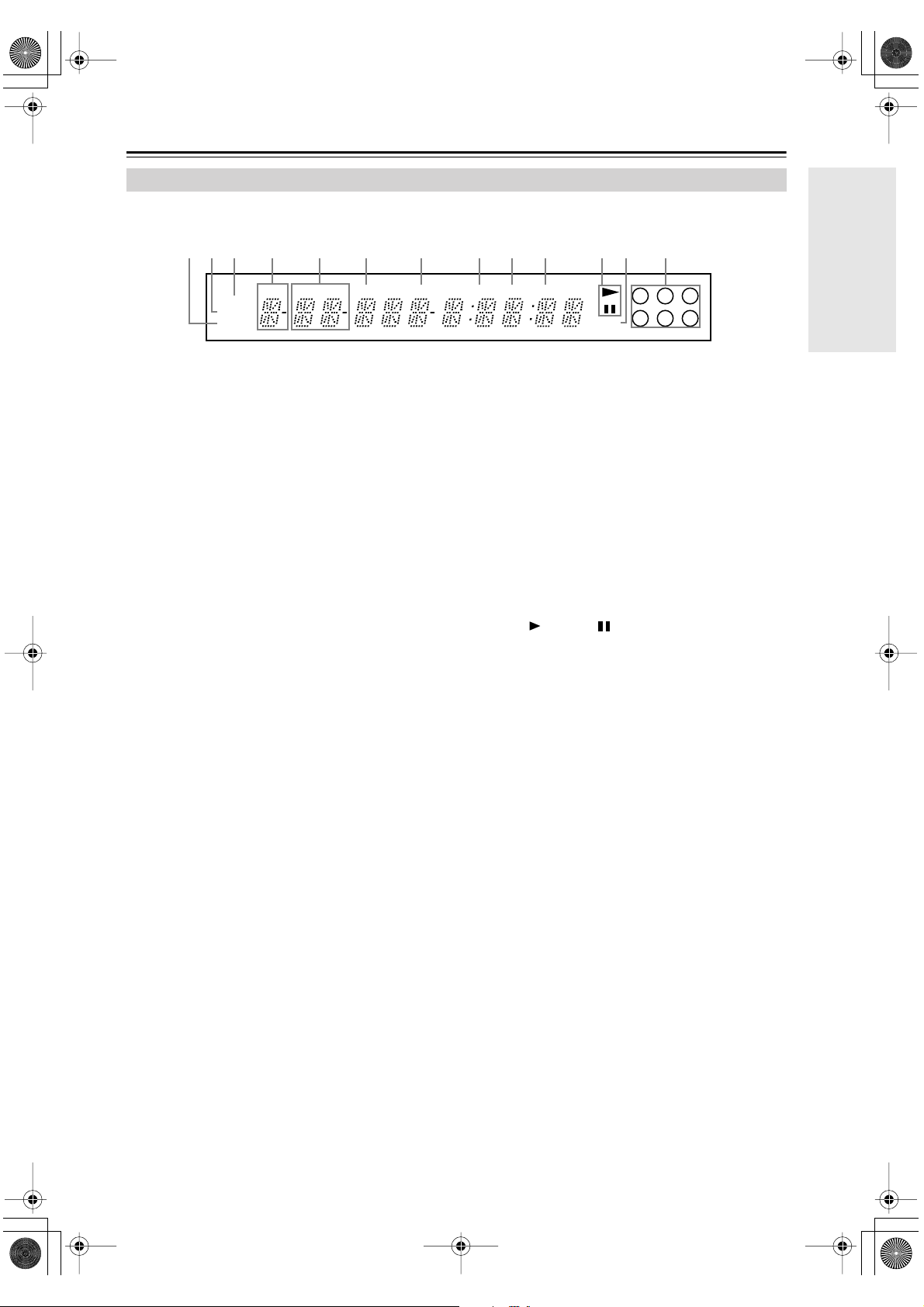
7
Controls & Connectors
—Continued
For detailed information, refer to the pages in parenthe-
sis.
1
RANDOM indicator (21)
2
MEMORY indicator (22)
3
REPEAT indicator (21)
4
DISC indicator
The number of the current disc appears here.
5
FLDR (FOLDER) indicator
While stopped, the total number of folders on the
current MP3 disc are displayed. During playback,
the number of the current folder is displayed.
6
NEXT indicator (20)
This indicator appears when using the Next Selec-
tion function.
7
TRACK indicator
While stopped, the total number of tracks on the
current disc are displayed. During playback, the
number of the current track is displayed.
8
NAME indicator
This indicator appears when the current disc is an
MP3 disc and a name (disc, folder, track) is being
displayed.
9
TOTAL indicator (19)
This indicator appears when the total remain time is
displayed.
0
REMAIN indicator (19)
A
Play / Pause indicator
B
MP3 indicator
C
Disc indicators 1–6 (14, 15)
Display
TRACK
NEXT TOTALDISC
MP3
3
6
2
5
1
4
FLDR
REPEAT
MEMORY
RANDOM
REMAIN
NAME
654970
BA
831 2
C
CDC-3.4.book Page 7 Tuesday, September 9, 2003 3:44 PM
8
Controls & Connectors
—Continued
For detailed information, refer to the pages in parenthe-
sis.
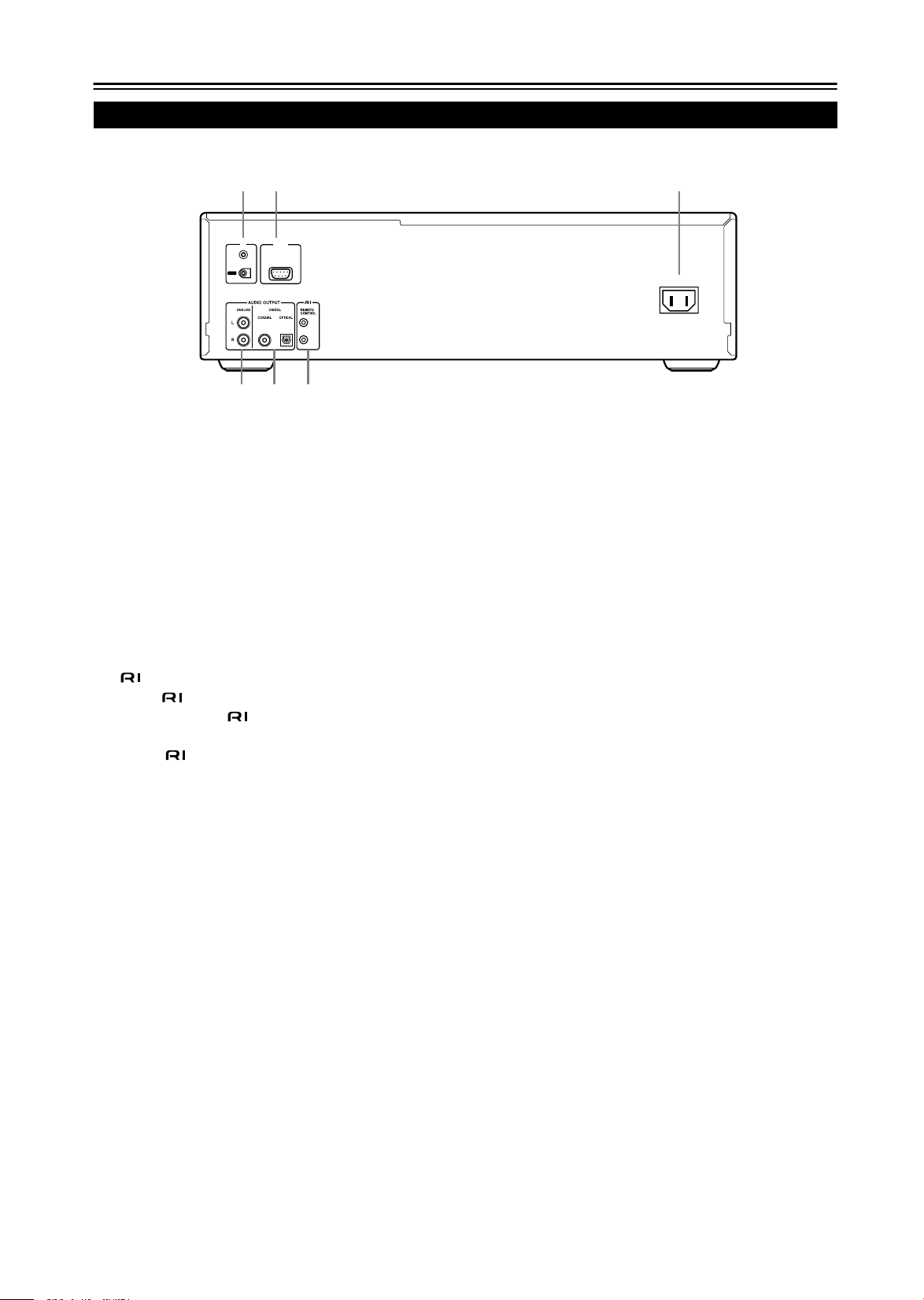
A
ANALOG AUDIO OUTPUT (11, 12)
These RCA/phono connectors can be connected to
the analog audio inputs on a hi-fi amp or AV
receiver.
B
COAXIAL & OPTICAL DIGITAL AUDIO
OUTPUT (11)
These connectors can be used to connect a CD-R,
MiniDisc, DAT recorder, digital amp, or other
equipment with digital inputs.
C
REMOTE CONTROL (11, 12)
These (Remote Interactive) connectors can be
connected to the connectors on your other Inte-
gra/Onkyo AV components for interactive control.
To use you must also make analog audio con-
nections (RCA/phono) between the CDC-3.4 and
your other Integra/Onkyo equipment.
D
AC INLET (14)
The supplied power cord is connected here. The
other end of the power cord should be connected to
a suitable wall outlet.
E
RS 232
This RS-232 port can be connected to an external
controller.
F
IR IN/OUT (13)
The IR IN connector can be used to connect a com-
mercially available IR receiver, which can be used
to pickup signals from the remote controller when
the CDC-3.4 is located in another room, installed in
a rack, or is out of range of the remote controller.
The IR OUT connector can be used to connect a
commercially available IR emitter, which can be
used to pass remote controller signals received by
the IR IN along to other AV components.
Rear Panel
IR
OUT
IN
MODEL NO.
CDC
-
3.4
2
-
1
, NISSHIN
-
CHO, NEYAGAWA
-
SHI, OSAKA,
JAPAN
MADE
IN
CHINA
COMPACT DISC
CHANGER
Integra
Division
of
ONKYO CORPORATION
RATING
:
AC 120
V 60
Hz 10
W
RS
232
AC
INLET
123
56 4
CDC-3.4.book Page 8 Tuesday, September 9, 2003 3:44 PM
9
Controls & Connectors
—Continued
For detailed information, refer to the pages in parenthe-
sis.
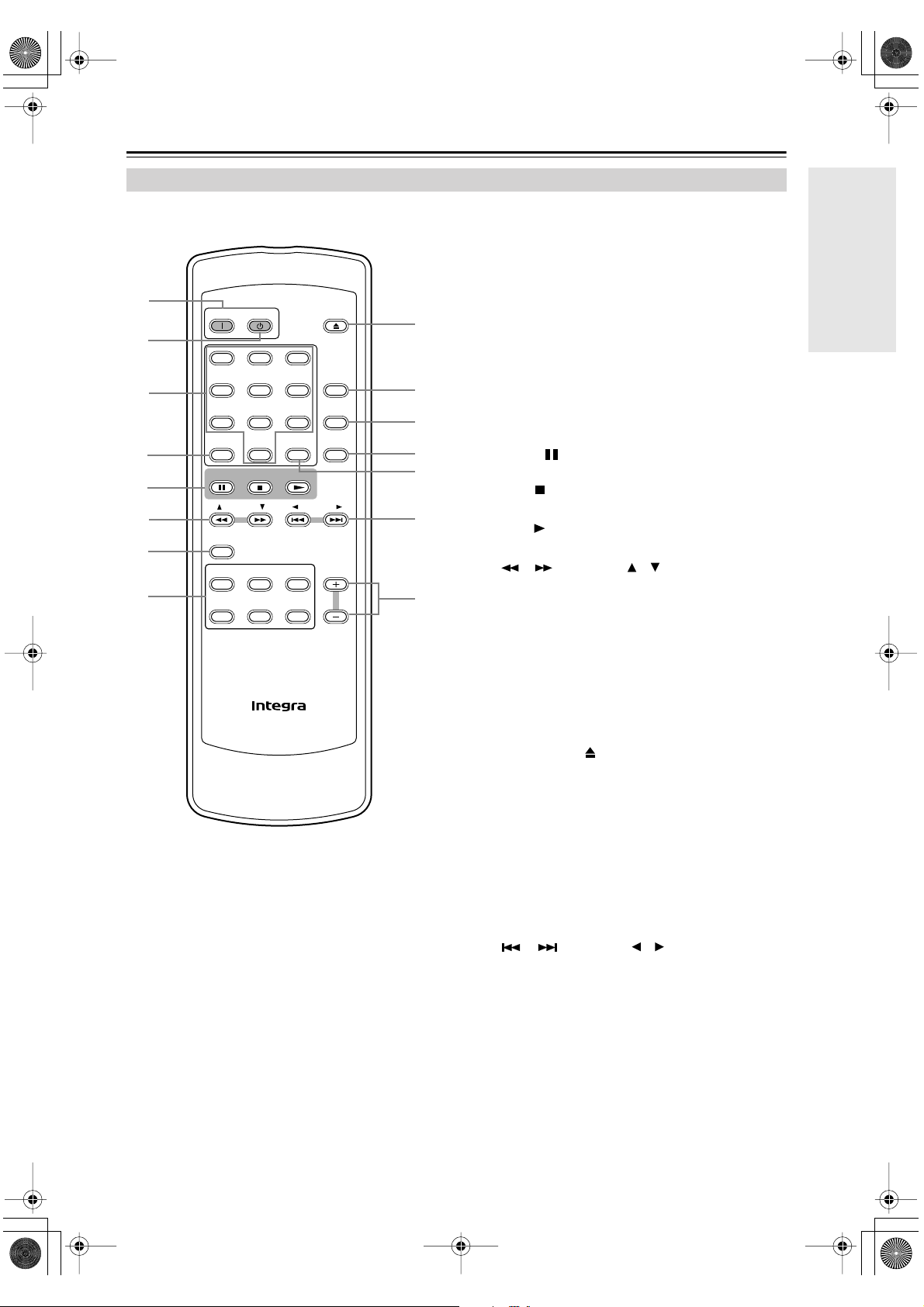
A
On button (14)
This button is used to turn on the CDC-3.4.
B
Standby button (14)
This button is used to set the CDC-3.4 to Standby.
C
Number buttons (18)
These buttons are used to enter track and MP3
folder numbers.
D
Search (>10) button (18)
This button is used to enter track numbers above 10
and to select MP3 folders.
E
Operation buttons
Pause [ ] button (16)
This button is used to pause playback.
Stop [ ] button (16)
This button is used to stop playback.
Play [ ] button (15)
This button is used to start playback.
F
[ ]/[ ] & Folder [ ]/[ ] buttons (16, 17)
These buttons are used for fast reverse and fast for-
ward, and to navigate folders on MP3 discs.
G
Next Selection button (20)
This button is used with the Next Selection function
for cuing up the next track.
H
Disc Select buttons (15)
These buttons are used to select discs. Playback
starts automatically when a disc is selected with one
of these buttons.
I
Open/Close
[]
button (14)
This button is used to open and close the disc tray.
J
Repeat button (21)
This button is used with the Repeat function.
K
Random button (21)
This button is used with the Random function.
L
Memory button (22)
This button is used with the Memory function.
M
Clear button (23)
This button is used to cancel various functions.
N
[ ]/[ ] & Folder [ ]/[ ] buttons (16, 17)
These buttons are used to select the previous and
next tracks, and to navigate folders on MP3 discs.
O
Disc [+] & [–] buttons (15)
These buttons are used to select discs.
Remote Controller
On
Standby
Open/Close
Repeat
Memory
Search
Folder
Folder
Next Selection
Disc
Disc 1 Disc 2 Disc 3
Disc 6Disc 5Disc 4
Random
Play
Pause Stop
RC
-
553C
1
2 3
654
7
8 9
10
>
10
/
0
Clear
1
2
3
4
5
6
7
8
9
J
K
L
M
N
O
CDC-3.4.book Page 9 Tuesday, September 9, 2003 3:44 PM

10
Before Using the CDC-3.4
Notes:
• The batteries should last for about six months,
although this will vary with usage.
• If the remote controller doesn’t work reliably, try
replacing the batteries.
• Don’t mix new and old batteries or different types of
batteries.
• If you intend not to use the remote controller for a long
time, remove the batteries to prevent damage from
leakage or corrosion.
• Flat batteries should be removed as soon as possible to
prevent damage from leakage or corrosion.
To use the remote controller, point it at the CDC-3.4’s
remote control sensor, as shown.
Notes:
• The remote controller may not work reliably if the
CDC-3.4 is subjected to bright light, such as direct
sunlight or inverter-type fluorescent lights. Keep this
in mind when installing the CDC-3.4.
• If another remote controller of the same type is used in
the same room, or the CDC-3.4 is installed close to
equipment that uses infrared rays, the remote control-
ler may not work reliably.
• Don’t put anything, such as a book, on the remote con-
troller, because the buttons may be pressed inadvert-
ently, thereby draining the batteries.
• The remote controller may not work reliably if the
CDC-3.4 is installed in a rack behind colored glass
doors. Keep this in mind when installing the CDC-3.4.
• The remote controller will not work if there’s an obsta-
cle between it and the CDC-3.4’s remote control sen-
sor.
Installing the Remote Controller’s
Batteries
1
Remove the battery compartment cover,
as shown.
2
Insert the two supplied batteries (AA/R6)
in accordance with the polarity diagram
inside the battery compartment.
3
Replace the battery compartment cover.
Using the Remote Controller
30°
30°
CDC-3.4
Approx. 16 ft. (5 m)
Remote control sensor
CDC-3.4.book Page 10 Tuesday, September 9, 2003 3:44 PM

11
Connecting the CDC-3.4
• Read the manuals supplied with your other audio
equipment.
• Don’t connect the power cord until you’ve completed
all audio connections.
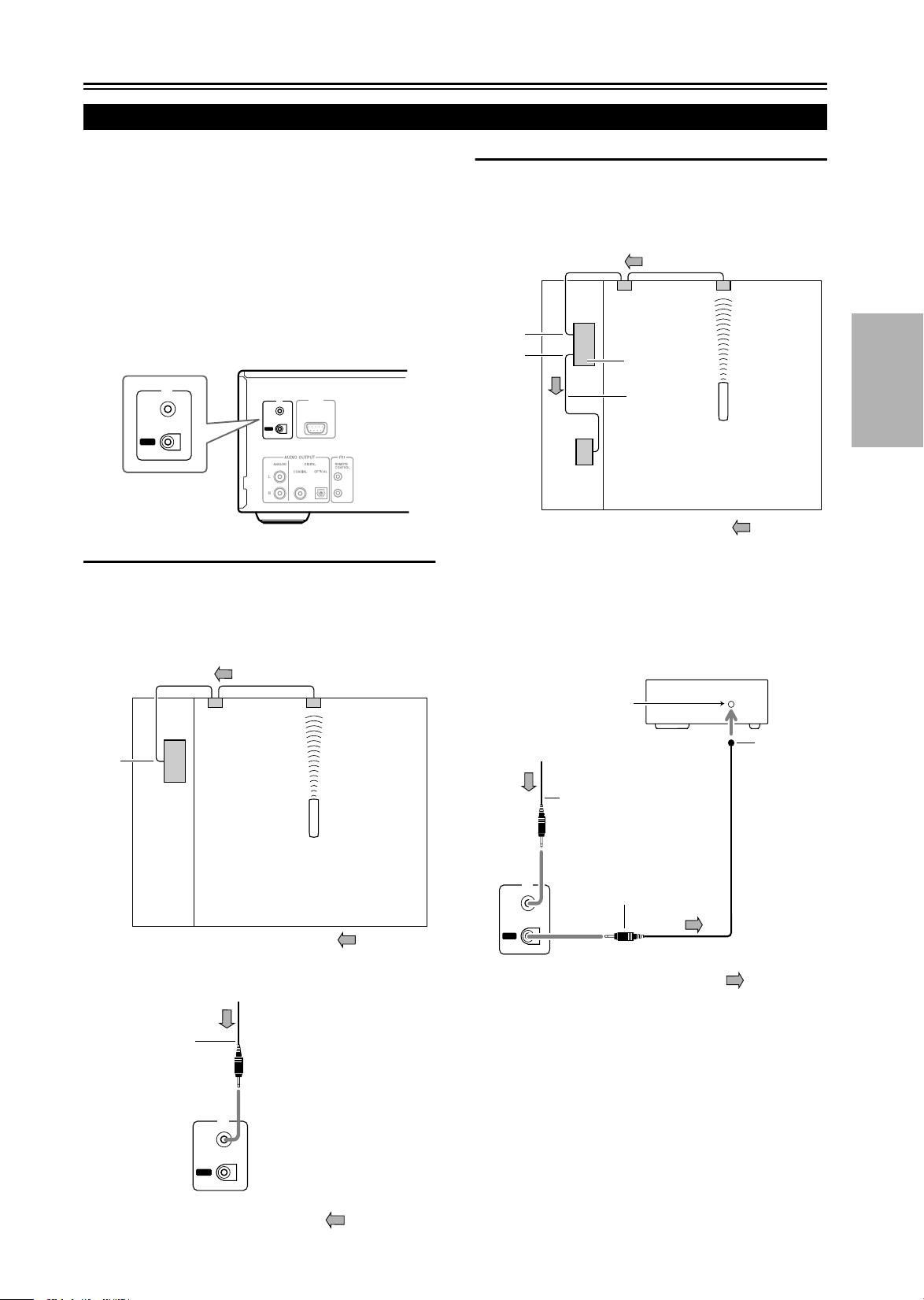
The CDC-3.4 has analog and digital (coaxial and opti-
cal) audio outputs. The digital outputs offer the best
audio quality, so if your digital recorder or amp has a
digital input you should use it.
ANALOG AUDIO OUTPUT
If your hi-fi amp or AV receiver doesn’t have a digital
input, use the supplied RCA/phono audio connecting
cable to connect the CDC-3.4’s ANALOG AUDIO
OUTPUTs to your amp’s analog CD inputs.
Notes:
• RCA/phono audio connecting cables are usually color
coded: red and white. Use red plugs to connect right-
channel inputs and outputs, and use white plugs to
connect left-channel inputs and outputs.
• Push each plug in all the way to
make a good connection (loose
connections can cause noise or
malfunctions).
•To prevent interference, keep
audio cables away from power
cords and speaker cables.
DIGITAL AUDIO OUTPUT
If your CD-R, MiniDisc, or DAT recorder has a digital
input, use a commercially available coaxial or optical
fiber digital audio cable to connect the CDC-3.4’s
COAXIAL or OPTICAL DIGITAL AUDIO OUTPUT
to your recorder.
You can also use the digital outputs to connect to an amp
that has a digital input, for the best audio quality.
Notes:
•With MP3 tracks, the digital outputs only work if the
sampling rate is 32 kHz, 44.1 kHz, or 48 kHz.
• The OPTICAL DIGITAL AUDIO
OUTPUT has a dust cap for keep-
ing out dust and dirt when it’s not
in use. Remove the cap before
connecting an optical fiber cable.
Push the plug in all the way to
make a good connection. Keep the
dust cap in a safe place for future use.
Audio Connections
Right!
Wrong!
IR
OUT
IN
RS
232
AC
INLET
RCA/phono
audio con-
necting cable
Optical fiber cable
(not supplied)
CD-R, MiniDisc, DAT recorder
or digital amp
Hi-fi amp, AV receiver
Optical INCD
RL
Connect one or
the other
Coaxial IN
Coaxial cable
(not supplied)
Connect one
or the other
Optical INCoaxial IN
Coaxial cable
(not supplied)
CDC-3.4.book Page 11 Tuesday, September 9, 2003 3:44 PM
12
Connecting the CDC-3.4—Continued
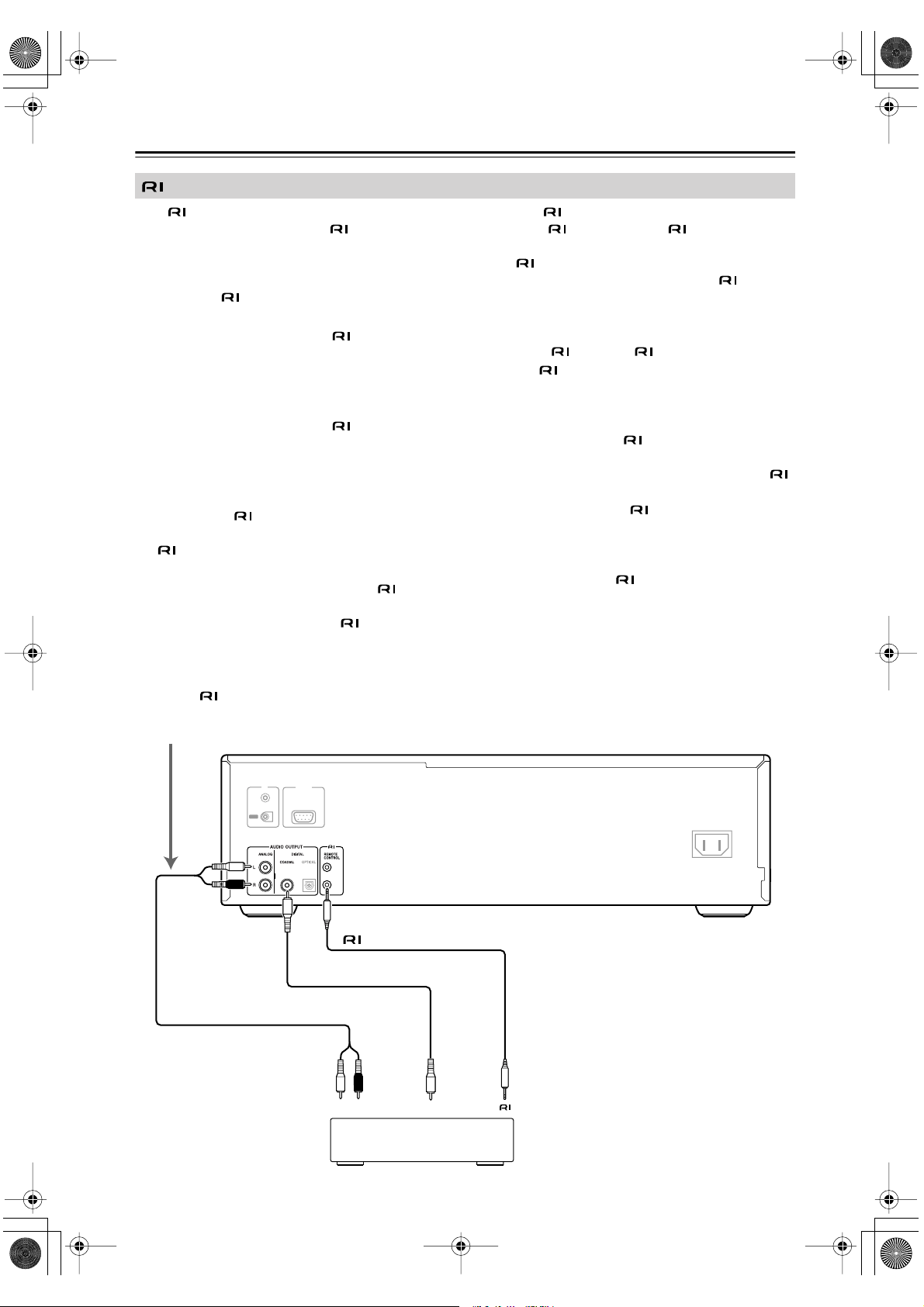
With (Remote Interactive) you can control the
CDC-3.4 together with your other -compatible Inte-
gra/Onkyo AV components. With some Integra/Onkyo
AV receivers you can use one remote controller to con-
trol all your Integra/Onkyo components and use the fol-
lowing special functions:
■ Auto Power On
If your CDC-3.4 is connected to an -compatible Inte-
gra/Onkyo AV receiver, when you turn on the CDC-3.4,
the AV receiver will turn on and select the CDC-3.4 as
the input source.
■ Direct Change
If your CDC-3.4 is connected to an -compatible Inte-
gra/Onkyo AV receiver, when you start playback on the
CDC-3.4, the AV receiver will select the CDC-3.4 as the
input source.
■ Auto Power Off
When you set an -compatible Integra/Onkyo AV
receiver to Standby, all other AV components connected
via enter Standby as well.
■ Dimmer
When you dim the display brightness on an -compat-
ible Integra/Onkyo AV component, the displays on all
other AV components connected via are dimmed as
well.
To use the functions, you need to connect one of the
CDC-3.4’s connectors to an connector on
another AV component in your system by using the sup-
plied cable.
See the manuals supplied with your other -compati-
ble AV components for more information.
Notes:
• Use only cables for connections.
• To use you must make an analog RCA/phono
connection between your CDC-3.4 and Integra/
Onkyo AV receiver even if they are connected digi-
tally.
• The CDC-3.4 has two connectors. You can con-
nect either one to your Integra/Onkyo AV receiver.
The other connector is for connecting additional -
compatible components.
• Connect the CDC-3.4’s connector to only Integra/
Onkyo AV components. Connecting to other manufac-
turer’s AV components may cause them to malfunc-
tion.
• Some Integra/Onkyo -compatible AV components
may not support the special functions described here.
Connections
IR
OUT
IN
RS
232
AC
INLET
RCA/phono audio connecting cable
cable
Hi-fi amp, AV receiver
CD
RL
To use you must make an analog audio connection (RCA/phono)
between the CDC-3.4 and your other Integra/Onkyo equipment even if
they are connected digitally.
Coaxial IN
Coaxial cable (not supplied)
BodyEn.fm Page 12 Friday, September 19, 2003 3:18 PM
13
Connecting the CDC-3.4
—Continued
You can use the following multi-room kits to control the
CDC-3.4 when it’s out of range of the remote controller:
• Integra Multi-Room System (IR Remote Controller
Extension System)
• Multiroom AV distribution and control systems such
as those made by Niles
®
and Xantech
®
.
Notes:
• Xantech is a registered trademark of Xantech Corpo-
raion.
• Niles is registered trademark of Niles Audio Corpora-
tion.
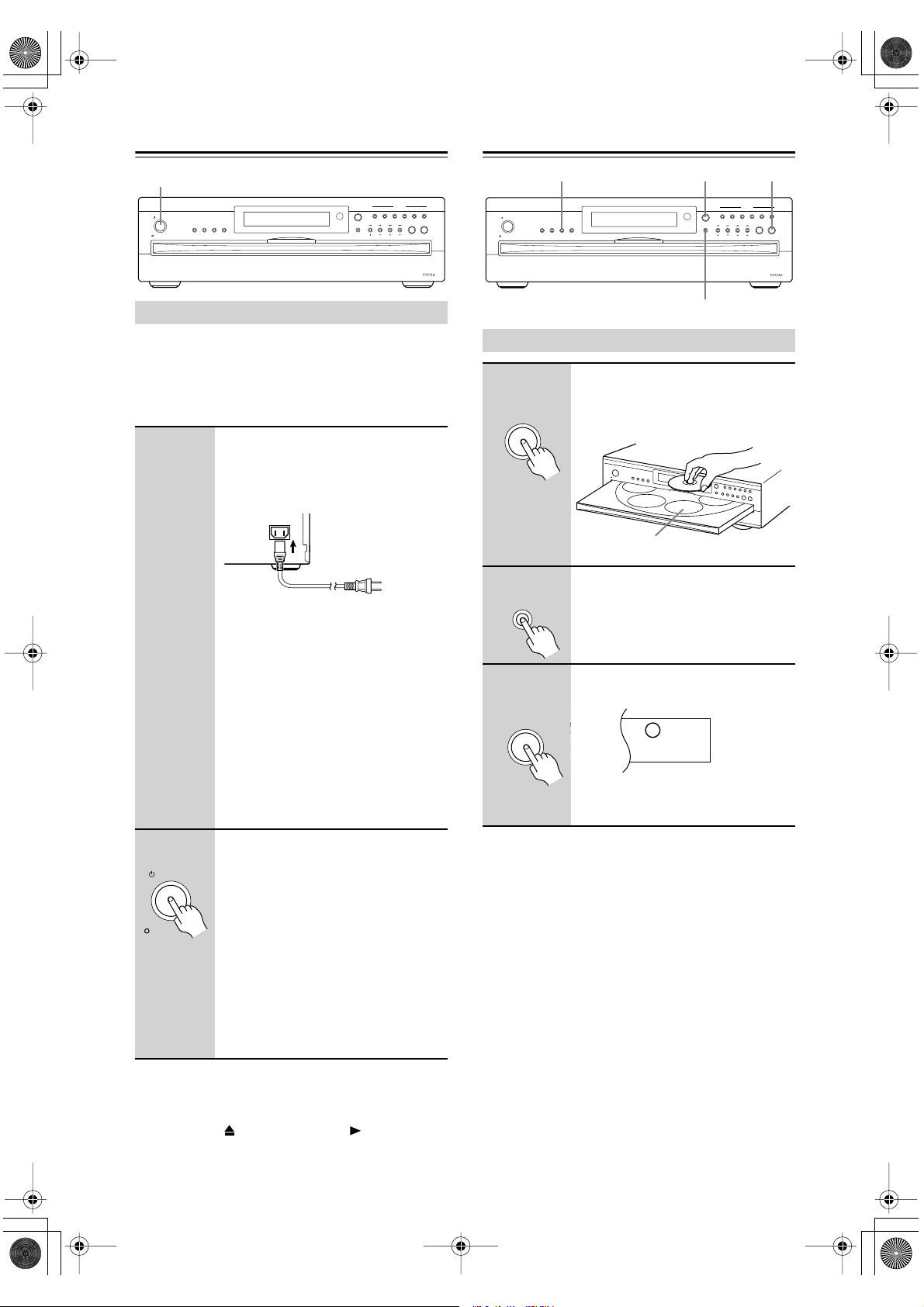
Controlling the CDC-3.4 When It’s Out of Range
If the CDC-3.4 is located in another room, installed in a
cabinet, or out of range of its remote controller, you can
use a commercially available IR receiver to pickup the
remote controller signals and feed them to the CDC-3.4,
as shown below.
Connect the IR receiver to the CDC-3.4 as shown below.
Controlling Other Out-of-range AV Components
If another AV component is out of range of its remote
controller, you can use a commercially available IR
emitter to retransmit the remote controller signals
received at the CDC-3.4’s IR IN, as shown below.
Connect the IR emitter to the CDC-3.4’s IR OUT, and
place the IR emitter in front of the other AV component’s
remote control sensor (usually located on its front
panel), as shown below. See the instructions supplied
with the IR emitter.
Only remote controller signals received by the
CDC-3.4’s IR IN are fed through to the IR OUT. Signals
picked up by the CDC-3.4’s remote control sensor are
not output.
Controlling AV Components that are Out of Range
IR
OUT
IN
RS
232
IR
OUT
IN
IR IN
CDC-3.4
Inside
cabinet
Remote controller
Connecting
block
IR receiver
Signal flow
CDC-3.4
from connecting block
Miniplug cable
Signal flow
IR
OUT
IN
IR IN
IR OUT
Connecting
block
IR receiver
CDC-3.4
IR emitter
Remote controller
Other
component
Signal flow
IR
OUT
IN
Signal flow
CDC-3.4
Remote control
Other component
sensor
from
connecting block
Miniplug cable
Miniplug
IR emitter
IR Emitter
CDC-3.4.book Page 13 Tuesday, September 9, 2003 3:44 PM
14
Turning On the CDC-3.4
Before connecting the power cord and turning on the
CDC-3.4, connect all your AV components first (see
page 11).
Don’t forget to turn on your amp, and select the audio
input to which the CDC-3.4 is connected.
Note:
•You can turn on the CDC-3.4 and simultaneously open
the disc tray or start playback simply by pressing the
Open/Close [ ] button or the Play [ ] button respec-
tively. The CDC-3.4 will take a little longer to come
on.
Basic Playback
Notes:
• The CDC-3.4 supports 8 cm and 12 cm discs. To avoid
damaging your discs or CDC-3.4, be sure to put discs
in the centers of the disc bays.
• Only load discs that are supported by the CDC-3.4
(see page 26).
•To avoid personal injury, keep your hands away from
the disc tray as it closes.
•Always use the Open/Close button to open and close
the disc tray. Never push the disc tray, and don’t touch
or obstruct it while it’s opening or closing. Don’t press
down on the disc tray while it’s open. Doing so may
damage your discs or CDC-3.4.
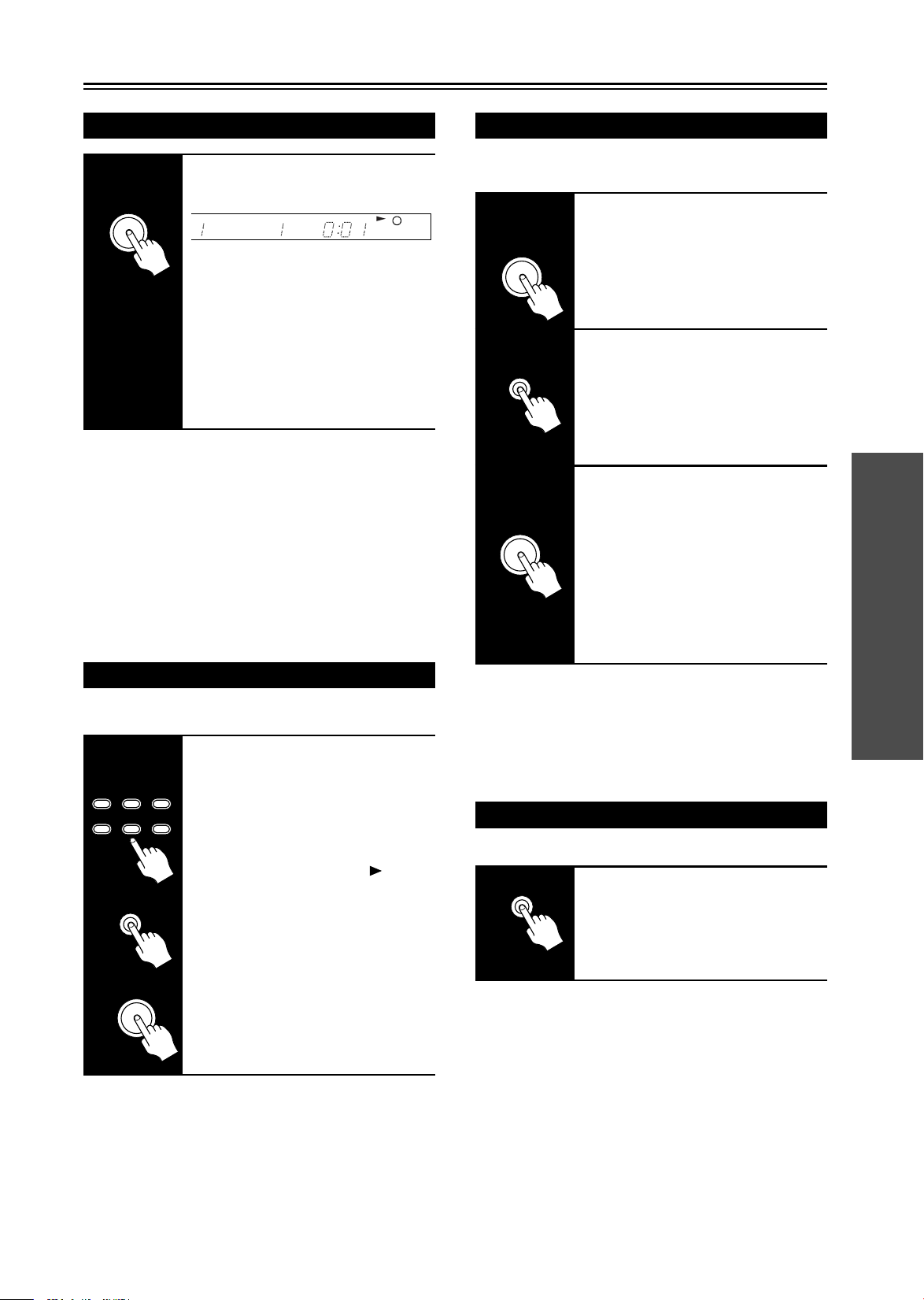
Turning On the CDC-3.4
1
Plug the supplied power cord into
the AC INLET. Then plug the other
end to a suitable wall outlet.
The standby indicator light up.
• Do not use a power cord other than the
one supplied with the CDC-3.4. The
power cord supplied is designed for
use with the CDC-3.4 and should not
be used with any other device.
•Never have the power cord discon-
nected from the CDC-3.4 while the
other end is plugged into the wall out-
let. Doing so may cause an electric
shock. Always connect by plugging
into the wall outlet last and disconnect
by unplugging from the wall outlet
first.
2
Press the [Standby/On] button, or
the remote controller’s [On]
button.
The CDC-3.4 comes on, the display
lights up, the disc tray light comes on,
and the Standby indicator goes off.
When the CDC-3.4 is turned on, it
checks the carousel for discs and selects
the first disc that it finds.
To set the CDC-3.4 to Standby, press the
[Standby/On] button or the remote con-
troller’s [Standby] button.
Dimmer Display
Standby/On
Standby
Play/Pause
Stop
Disc Skip
Open
/Close
Repeat Random
Folder
Folder
Disc Select
12
3
456
Direct Digital Path
Standby/On
AC
INLET
Standby/On
Standby
Loading Discs
1
To open the disc tray, press the
Open/Close button.
Put a disc, label-side up, into
each disc bay.
2
To access the other disc bays,
use the [Disc Skip] button or the
remote controller’s Disc [+] and
[–] buttons.
3
To close the disc tray, press the
Open/Close button again.
A circle appears around the number of
the current disc.
Dimmer Display
Standby/On
Standby
Play/Pause
Stop
Disc Skip
Open
/Close
Repeat Random
Folder
Folder
Disc Select
12
3
456
Direct Digital Path
Disc Skip
Play/PauseOpen/Close
Dimmer
Open
/Close
Current disc
Disc Skip
Open
/Close
3
6
2
5
1
4
A
IN
CDC-3.4.book Page 14 Tuesday, September 9, 2003 3:44 PM
15
Basic Playback
—Continued
Notes:
• When you close the disc tray, the current disc will be
the one in the front-right disc bay. When you open the
disc tray, the last disc you selected (i.e., the current
disc), will be in the front-right disc bay.
• When the disc tray is closed, all of the disc indicators
appear until the CDC-3.4 has checked each bay for the
presence of a disc. If a bay is found to have no disc, the
corresponding indicator disappears.
The section explains how to select discs.
This section explains how to load discs without stopping
playback.
Note:
• The CDC-3.4 cannot play the next disc while the disc
tray is open. Be sure to close the disc tray as soon as
you’ve finish loading discs.
You can adjust the brightness of the display as follows.
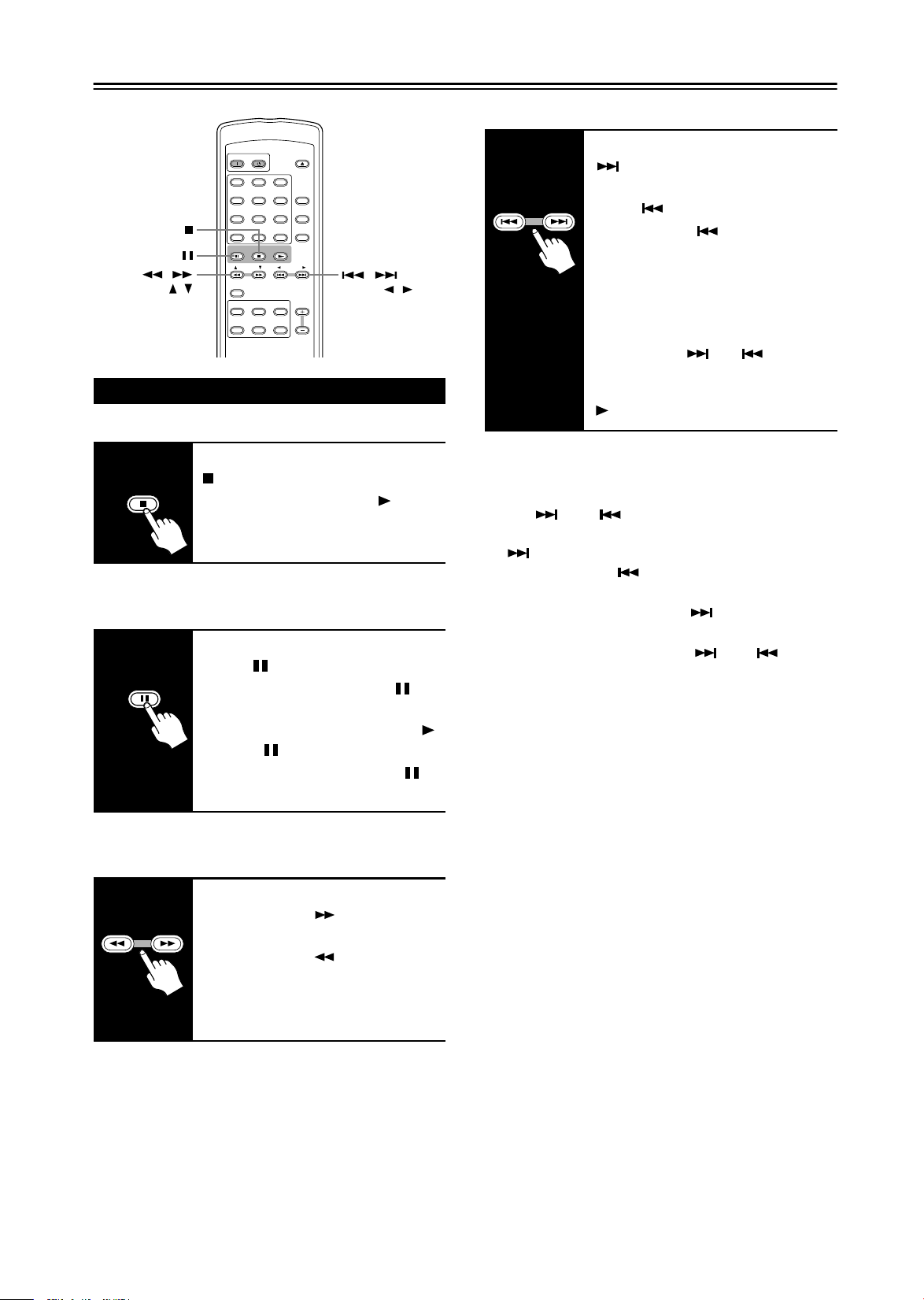
Starting Playback
To start playback, press the Play/
Pause button.
Playback starts from the first track on
the current disc, continues with the sub-
sequent discs, and stops when disc #6
has been played.
Empty disc bays are skipped.
Tip:
If you press one of the Disc Select
buttons, playback of the selected disc
will start automatically.
Selecting Discs
When playback is stopped
Use the Disc Select buttons to select a
disc. Playback will start automatically.
Or, use the [Disc Skip] button or the
remote controller’s Disc [+] and [–]
buttons to select a disc. In this case
you’ll need to press the Play [ ] button
to start playback.
During playback
Use the Disc Select buttons, [Disc
Skip] button, or the remote controller’s
Disc [+] and [–] buttons to select a disc.
The current disc will stop playing, and
the newly selected disc will be played.
On the display, the number of the cur-
rent disc has a circle around it.
Play/Pause
TRACK
DISC
3
6
2
5
1
4
REMAIN
Disc Skip
Disc 1 Disc 2 Disc 3
Disc 4 Disc 5 Disc 6
Play/Pause
Remote
controller
Loading Discs During Playback
1
To open the disc tray, press the
Open/Close button.
The disc that’s currently playing
remains inside the CDC-3.4 and its disc
bay is empty and won’t come to the
front.
2
Load or remove your discs, and
use the [Disc Skip] button or the
remote controller’s Disc [+] and
[–] buttons to access the other
disc bays.
3
To close the disc tray, press the
Open/Close button again.
Playback of the current disc continues
uninterrupted until you stop playback
or select another disc.
Tip:
If you press one of the Disc Select
buttons, the disc tray will close, and
playback of the newly selected disc will
start automatically.
Adjusting the Display Brightness
Press the [Dimmer] button
repeatedly to cycle through the
following options: normal, dim,
dimmer, dimmer with disc tray
light off.
Open
/Close
Disc Skip
Open
/Close
Dimmer
CDC-3.4.book Page 15 Tuesday, September 9, 2003 3:44 PM
16
Basic Playback
—Continued
■
Stopping Playback
■
Pausing Playback
■
Fast Forward & Fast Reverse
Notes:
• If you fast forward all the way to the end of a disc, fast
forward will be cancelled and the next disc will be
played, unless it’s last disc, in which case playback
will stop.
• If you fast reverse all the way to the beginning of a
disc, fast reverse will be cancelled.
•For MP3 discs, fast reverse only works within the
MP3 track that’s currently playing.
■
Selecting the Next or Previous Track
Notes:
•For MP3 discs, you can also select tracks in other fold-
ers.
• The [ ] and [ ] buttons only select tracks on the
current disc. So when the last track is being played, the
[] button has no effect, and when the first track is
being played, the [ ] button will select the begin-
ning of that track.
• During random playback, the [ ] button can be used
to select the next random track (see page 21).
• During memory playback, the [ ] and [ ] buttons
can be used to select the next or previous track in
memory (see page 22).
Basic Operation
To stop playback, press the Stop
[] button.
Playback stops and the Play
indica-
tor disappears.
To pause playback, press the
Pause [ ] button.
Playback pauses and the Pause indi-
cator appears on the display.
To resume playback, press the Play [ ]
button or [ ] button.
Playback resumes and the Pause
indicator disappears.
To fast forward during playback,
hold down the [ ] button.
To fast reverse during playback,
hold down the [ ] button.
Release the button to cancel fast for-
ward or fast reverse.
On
On
Standb
Standb
y
Open/Close
Repeat
Memory
Search
Folder
Folder
Next Selection
Disc
Disc 1 Disc 2 Disc 3
Disc 6Disc 5Disc 4
Random
Play
Pause Stop
1
2 3
654
7
8 9
10
10
>
10
/
0
Clear
Clear
//
Folder /
Stop
Pause
Folder /
Stop
Remote
controller
Pause
Remote
controller
Remote
controller
To select the next track, press
[] button.
To select the previous track,
press [ ] button.
If you press the [ ] button during
playback or while playback is paused,
the beginning of the current track is
selected. Press it twice to select the
beginning of the previous track.
If you use the [ ] or [ ] button to
select a track while playback is
stopped, you’ll need to press the Play
[] button to start playback.
Remote
controller
CDC-3.4.book Page 16 Tuesday, September 9, 2003 3:44 PM
17
Basic Playback
—Continued
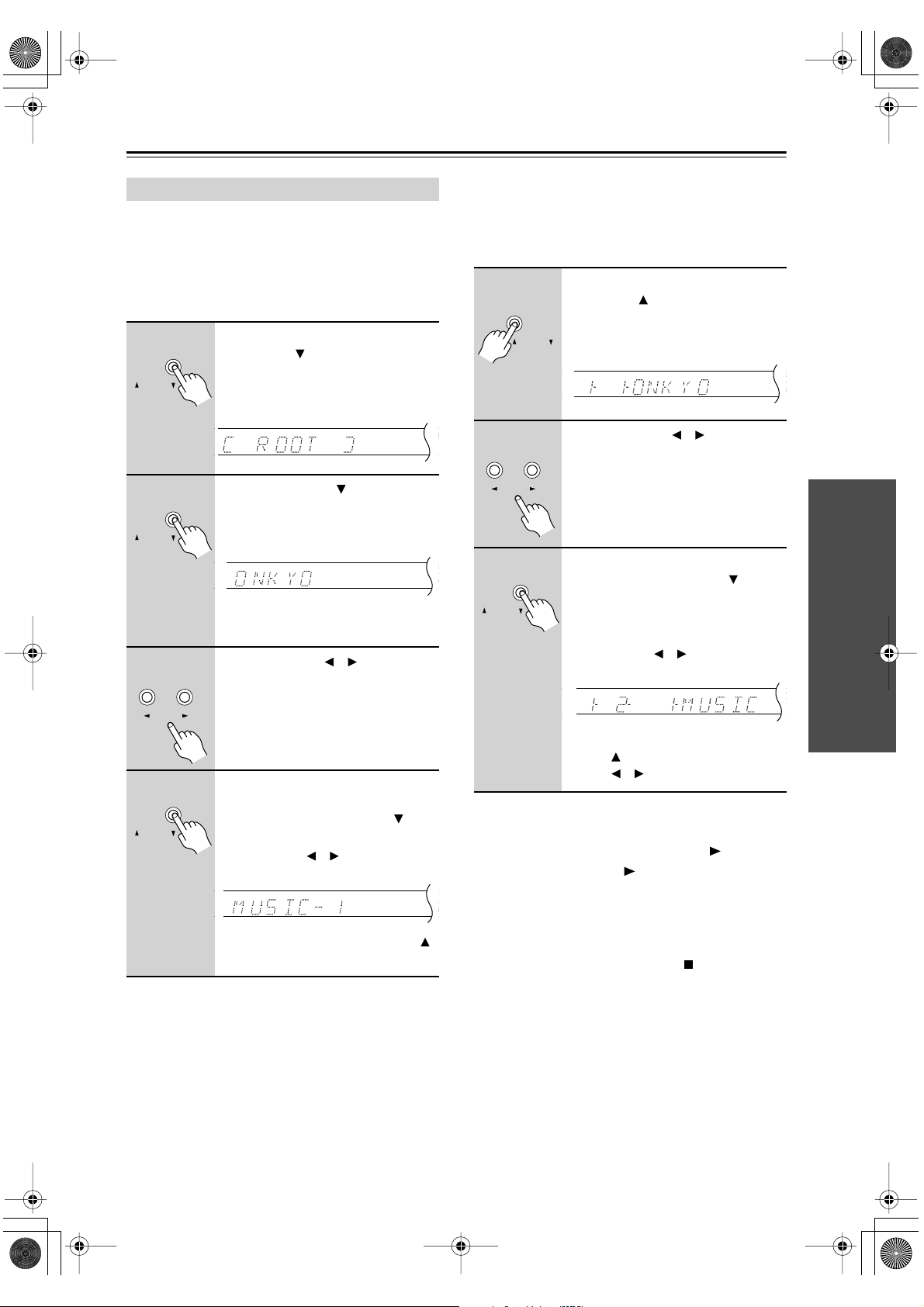
There are two modes for selecting MP3 tracks:
Naviga-
tion mode
and
All Folder mode.
■
Selecting MP3 Tracks in Navigation Mode
With Navigation mode you can select MP3 tracks by
navigating through the folder hierarchy. This mode can
only be used while playback is stopped.
■
Selecting MP3 Tracks in All Folder Mode
With All Folder mode you don’t have to navigate the
folder hierarchy to find an MP3 track because all folders
that contain MP3 tracks appear at the same level. This
mode can only be used while playback is stopped.
■
Playing the Selected Track
To play the selected track, press the Play [ ] button.
Tip: If you press the Play [ ] button while a folder is
selected, playback start with the first track in that folder.
■
Cancelling Navigation or All Folder mode
To cancel Navigation mode or All Folder mode while
selecting MP3 tracks, press the Stop [ ] button.
Selecting MP3s
1
While playback is stopped, press
the Folder [ ] button.
The CDC-3.4 enters Navigation mode
and “ [ ROOT ] ” appears on the dis-
play.
2
Press the Folder [ ] button once
more.
The name of the first folder one level
down from root appears on the display.
If the disc has no folders, the name of
the first track is displayed.
3
Use the Folder [ ]/[ ] buttons to
select other folders and tracks at
the same level.
Folders that do not contain MP3 tracks
or folders cannot be selected.
4
To access tracks or folders inside
another folder, select the folder,
and then press the Folder [ ] but-
ton.
Use the Folder [ ]/[ ] buttons to select
the tracks and folders in that folder.
To move up a level, press the Folder [ ]
button.
Folder
MP3
1
4
FLDR
NAME
Folder
MP3
1
4
FLDR
NAME
Folder
Folder
TRACK
MP3
1
4
NAME
1
While playback is stopped, press
the folder [ ] button.
The CDC-3.4 enters All Folder mode
and the name of the first folder appears
on the display.
2
Use the Folder [ ]/[ ] buttons to
select a folder.
You can select any of the folders on the
disc that contain MP3 tracks.
3
To access the tracks inside the
folder, press the Folder [ ] but-
ton.
The name of the first track inside the
folder appears on the display.
Use the Folder [ ]/[ ] buttons to select
the tracks in that folder.
To select another folder, press the
Folder [ ] button, and then use the
Folder [ ]/[ ] buttons.
Folder
MP3
DISC
1
FLDR
NAME
4
Folder
Folder
TRACK
DISC
MP3
FLDR
NAME
CDC-3.4.book Page 17 Tuesday, September 9, 2003 3:44 PM
18
Basic Playback
—Continued
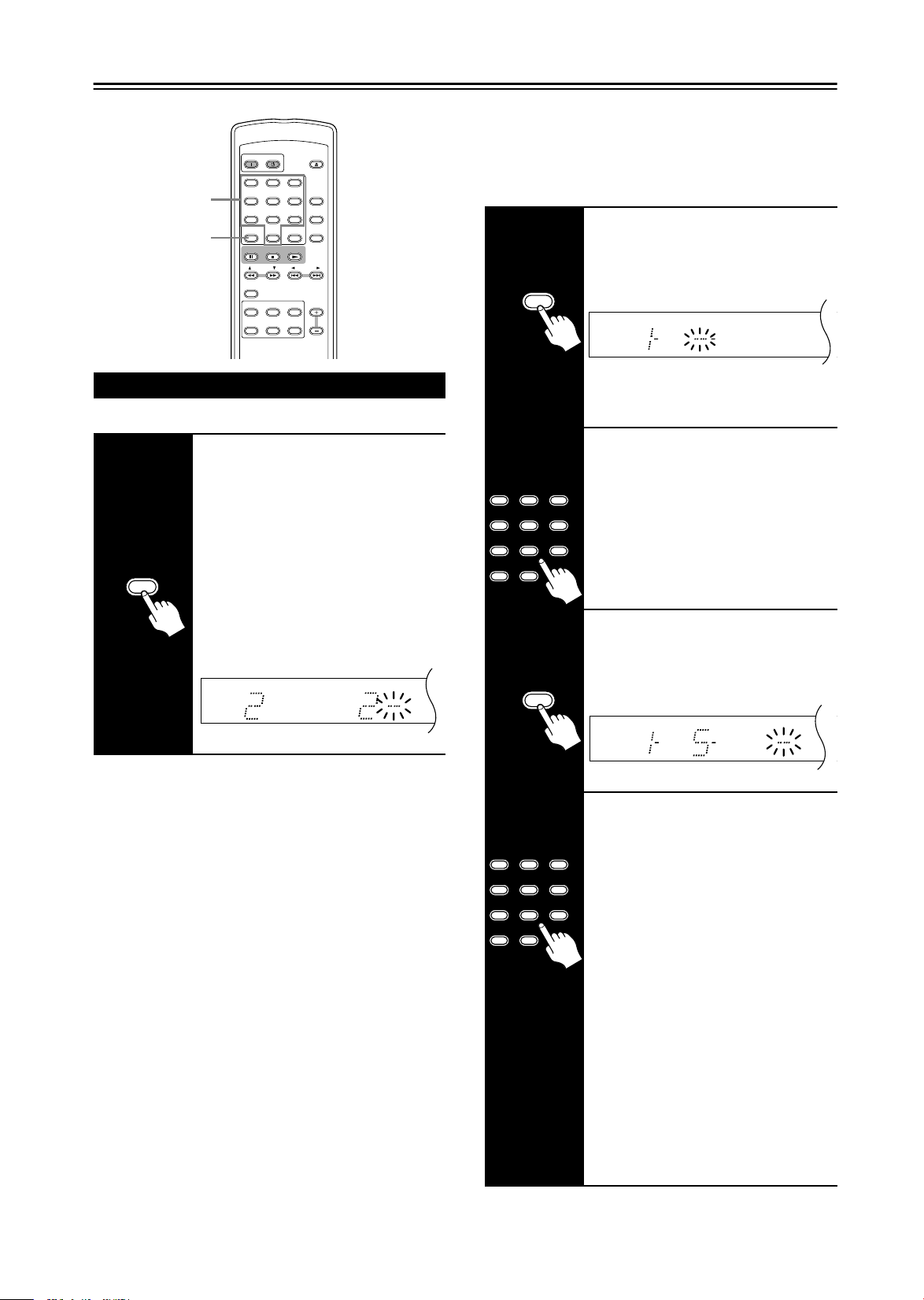
This section explains how to select tracks by number.
Note:
•For MP3 discs, tracks in the current folder can be
selected.
This section explains how to select MP3 folders and
tracks by number.
Selecting Tracks by Number
Use the remote controller’s num-
ber buttons to enter the number
of the track that you want to play.
Playback starts automatically.
For track numbers 1 through 10, simply
press the corresponding button. For
track numbers above 10, press the
[Search] (>10) button and then enter
the numbers in order from left-to-right.
For example, to enter 25, press [Search]
(>10), [2], and then [5].
On
On
Standb
Standb
y
Open/Close
Repeat
Memory
Search
Folder
Folder
Next Selection
Disc
Disc 1 Disc 2 Disc 3
Disc 6Disc 5Disc 4
Random
Play
Pause Stop
1
2 3
654
7
8 9
10
10
>
10
/
0
Clear
Clear
Search (>10)
Number buttons
Remote
controller
Search
10
>
TRACK
DISC
Selecting MP3 Folders & Tracks by
Number
1
Press the [Search] (>10) button
repeatedly until “–” appears
below the FLDR indicator on the
display.
If the disc contains ten or more folders,
“– –” appears.
2
Use the number buttons to enter
the folder number.
Enter the numbers in order from left-to-
right. For example, to enter folder num-
ber 25, press [2] and then [5].
The name of the specified folder
appears on the display.
3
Press the [Search] (>10) button
again.
Under the TRACK indicator, “–”
appears.
4
Use the number buttons to enter
the track number.
Playback starts automatically.
If the folder contains 100 or more
tracks, single- and double-digit track
numbers must be preceded with zeros.
For example, to enter track number 32,
press [0], [3], and then [2].
Tip:
You can select any MP3 track on the
entire disc without specifying its folder.
To do this, press the [Search] (>10) but-
ton repeatedly until the FLDR indicator
disappears and “–” appears below the
TRACK indicator. Then use the num-
ber buttons to enter the track number.
Tracks on the disc are numbered in
order of hierarchy. Playback starts
automatically.
Search
10
>
Remote
controller
DISC
FLDR
Search
1
2 3
654
7
8 9
10
>
10
10
/
0
Remote
controller
Search
10
>
Remote
controller
TRACK
DISC
FLDR
Search
1
2 3
654
7
8 9
10
>
10
10
/
0
Remote
controller
CDC-3.4.book Page 18 Tuesday, September 9, 2003 3:44 PM
19
Basic Playback
—Continued
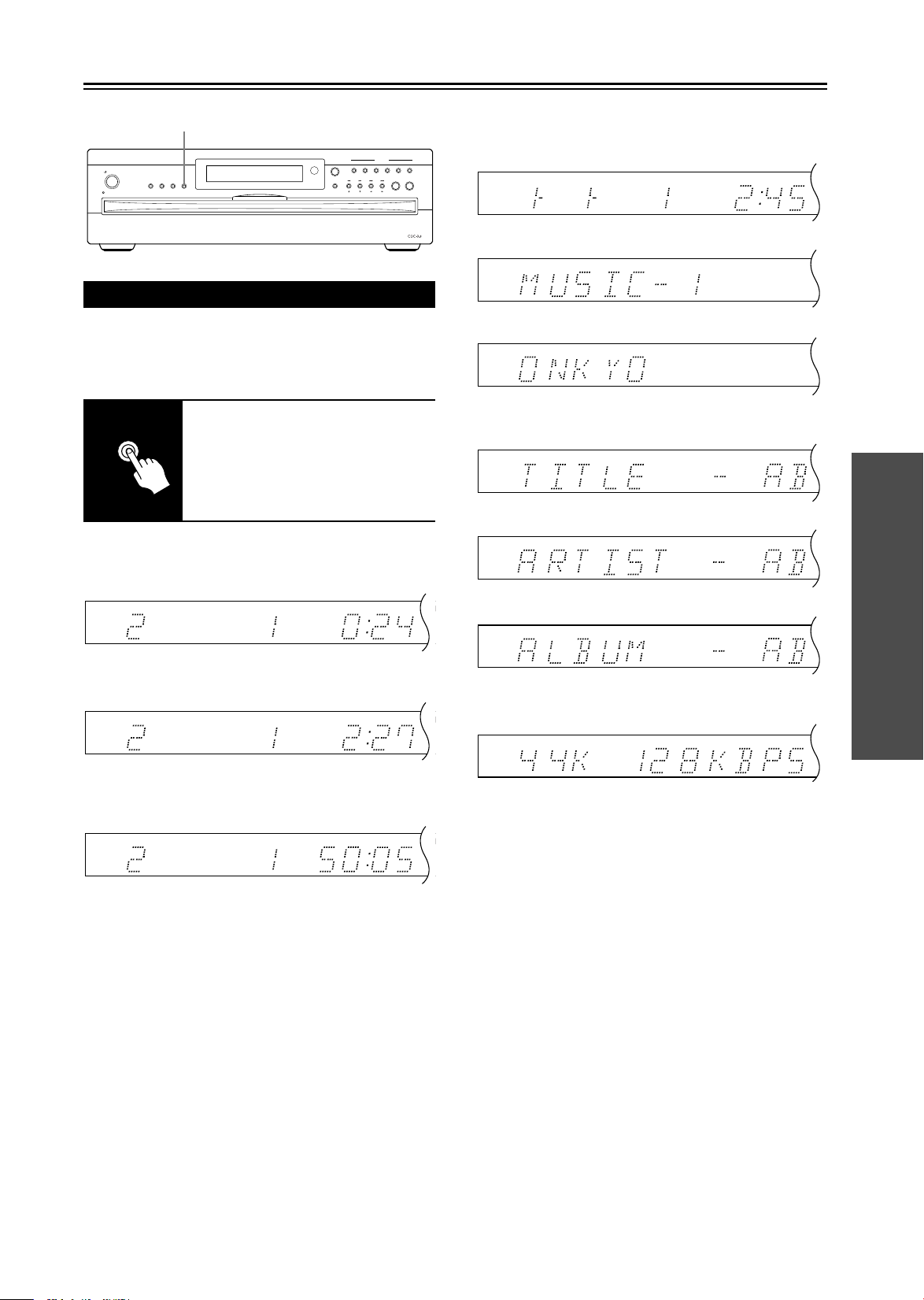
This section explains how to display various informa-
tion, including the remaining track time, remaining disc
time, disc name, track name, and various ID3 tags for
MP3 tracks, including title name, artist name, and so on.
■
Audio CD
Elapsed track time:
The length of time that the current
track has been playing (default display).
Remaining track time:
The amount of time remaining
for the current track (REMAIN indicator appears).
Remaining disc time:
The amount of time remaining
for the entire disc (REMAIN and TOTAL indicators
appear).
■
MP3 Disc
Elapsed track time:
The length of time that the current
track has been playing (default display).
Track name:
Name of the current track.
Folder name:
Name of the current folder.
Title name:
Title of the current track (if ID3 tag
present).
Artist name:
Name of the artist (if ID3 tag present).
Album name:
Name of the album (if ID3 tag present).
Sampling rate and bit rate:
Sampling rate and bit rate
of the current track.
Notes:
•To display the disc name, while playback is stopped,
press the [Display] button.
• If a track or folder name contains a character that can-
not be displayed, it will be displayed as “TRACK n”
or “FOLDER n,” “n” being the track or folder number.
You can set the CDC-3.4 so that it displays under-
scores in place of any undisplayable characters (see
page 24).
Displaying Information
During playback, press the [Dis-
play] button repeatedly to cycle
through the following options.
Dimmer Display
Standby/On
Standby
Play/Pause
Stop
Disc Skip
Open
/Close
Repeat Random
Folder
Folder
Disc Select
12
3
456
Direct Digital Path
Display
Display
TRACK
DISC
TRACK
DISC
REMAIN
TOTALDISC
REMAIN
TRACK
DISC
M
FLDR
TRACK
M
NAME
M
FLDR
NAME
M
M
M
M
CDC-3.4.book Page 19 Tuesday, September 9, 2003 3:44 PM
20
Advanced Playback
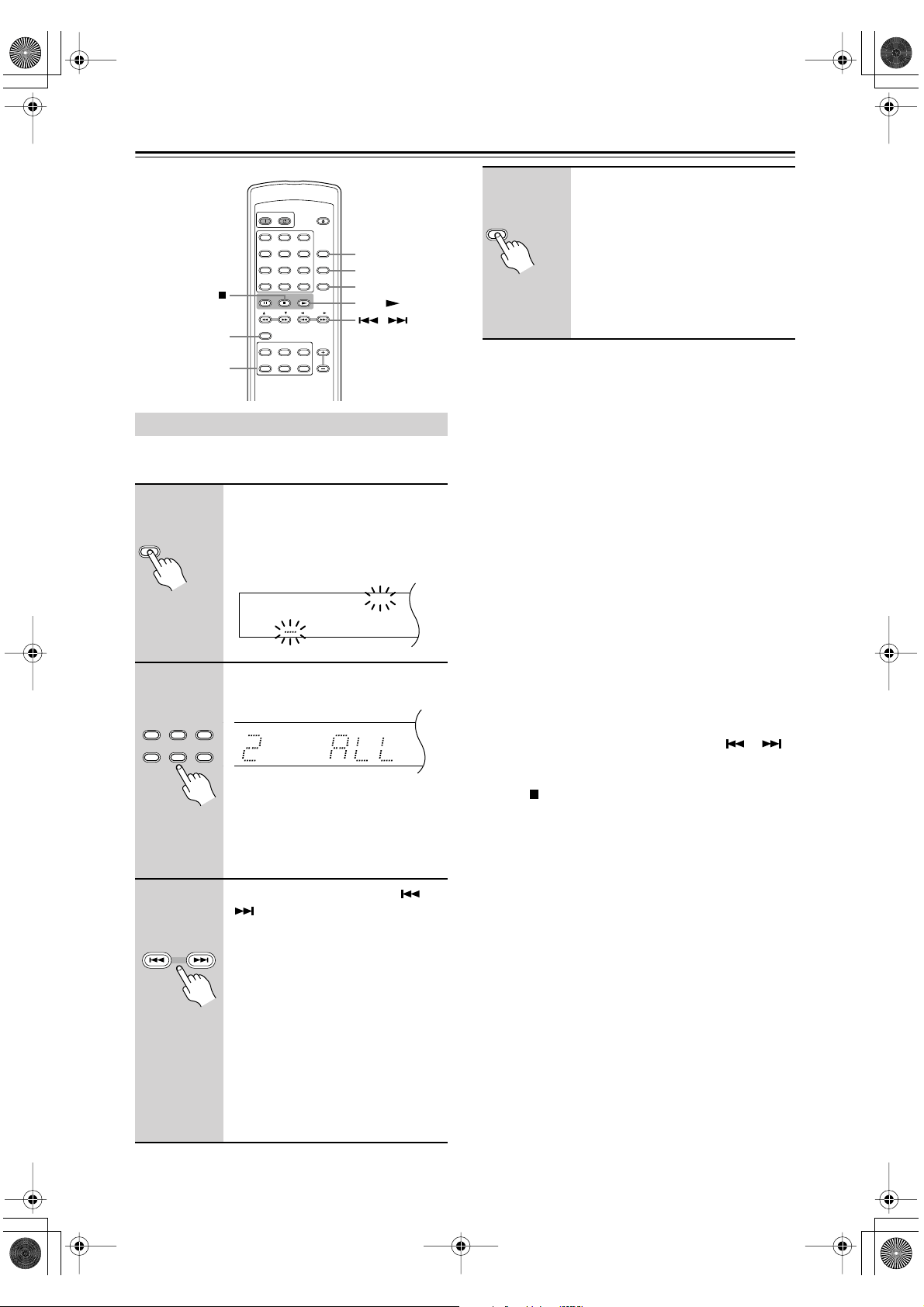
With the Next Selection function you can cue up the
track, folder, or disc that you want to play next.
■
Cancelling the Next Selection Function
To cancel the Next Selection function, press the [Next
Selection] button. The number of the specified track,
folder, or disc will flash on the display. Then press the
[Clear] button, followed by the [Next Selection] button.
The NEXT indicator will disappear.
■
Changing the Specified Track, Folder, or Disc
To change the specified track, folder, or disc, press the
[Next Selection] button. The number of the specified
track, folder, or disc will flash on the display. Select
another track, folder, or disc as explained before, and
then press the [Next Selection] button.
Notes:
• If you specify a folder or track on a disc other than the
current disc, the name of that folder or track will not
be displayed.
• If you set the Next Selection function during memory
playback (page 22) or random playback (page 21),
when the current track finishes, the next specified
track, folder, or disc will be played and the Memory or
Random function will be cancelled.
• If after setting the Next Selection function you use the
Disc Select buttons, [Disc Skip] button, [ ]/[ ]
buttons, the remote controller’s Disc [+]/[–] buttons,
or number buttons to select another track, or use the
Stop [ ] button to stop playback, the Next Selection
function will be cancelled.
• The Next Selection function works only once. When
playback of the specified track, folder, or disc starts,
the Next Selection function is reset.
Cuing Up the Next Track, Folder, or Disc
1
During playback, press the [Next
Selection] button.
The NEXT indicator flashes on the dis-
play and “_” appears below the DISC
indicator.
2
Use the Disc Select buttons to
select a disc.
“ALL,” which means
all tracks on the
disc,
appears on the display.
To select the entire disc, press the [Next
Selection] button to complete this func-
tion.
3
To select a track, use the [ ]/
[] buttons.
To select an individual track or folder
on an MP3 disc, you can use All Folder
mode, as explained on page 17 (note
that you don’t need to stop playback in
this case).
You can also select tracks and folders
by using the number buttons (as
explained on page 18). In this case, the
Next Selection function will be set once
you’ve entered the track number.
If you want to play all the MP3 tracks
in a folder, simply select that folder.
On
On
Standb
Standb
y
Open/Close
Repeat
Memory
Search
Folder
Folder
Next Selection
Disc
Disc 1 Disc 2 Disc 3
Disc 6Disc 5Disc 4
Random
Play
Pause Stop
1
2 3
654
7
8 9
10
10
>
10
/
0
Clear
Clear
/
Disc 1–6
Repeat
Random
Memory
Play
Stop
Next
Selection
Next Selection
Remote
controller
TRACK
NEXTDISC
Disc 1 Disc 2 Disc 3
Disc 4 Disc 5 Disc 6
Remote
controller
TRACK
NEXTDISC
Remote
controller
4
Press the [Next Selection] button
again to set the Next Selection
function.
The specified disc, folder, or track will
be played when, if you specified a disc,
the current disc finishes, if you speci-
fied a folder, when the current folder
finishes, and if you specified a track,
when the current track finishes.
Next Selection
Remote
controller
CDC-3.4.book Page 20 Tuesday, September 9, 2003 3:44 PM
21
Advanced Playback
—Continued
This section explains how to play all loaded discs repeat-
edly.
This section explains how to play one track, folder, or
disc repeatedly.
Note:
•A previously created playlist will be deleted by this
procedure.
With the Random function you can enjoy a random
selection of tracks from all loaded discs.
Notes:
• Random playback can be combined with repeat play-
back (see the left column). In this case, random play-
back continues after all tracks have been played once.
• Random playback can be combined with memory
playback (see page 22). Note that if the memory play-
list contains a disc or folder, while that disc or folder
is being played, only tracks on that disc or in that
folder will be played at random. Other tracks will not
be played until all the tracks on that disc or in that
folder have been played once.
•You cannot use the Disc Select buttons, [Disc Skip]
button, the remote controller’s Disc [+]/[–] buttons, or
number buttons during random playback.
•You can load and unload discs during random play-
back. If you swap a disc with one that has a different
number of tracks, all of the tracks on that disc will be
used for random playback. If the disc has the same
number of tracks, tracks with the same numbers as
those tracks already played, will not be played.
Playing All Discs Repeatedly
1
Press the [Repeat] button.
The REPEAT indicator appears.
2
Press the Play [ ] button.
All loaded discs are played repeatedly.
Repeat playback can be used with ran-
dom and memory playback.
3
To cancel repeat playback, press
the [Repeat] button again.
The REPEAT indicator disappears.
Playing One Track, Folder, or Disc
Repeatedly
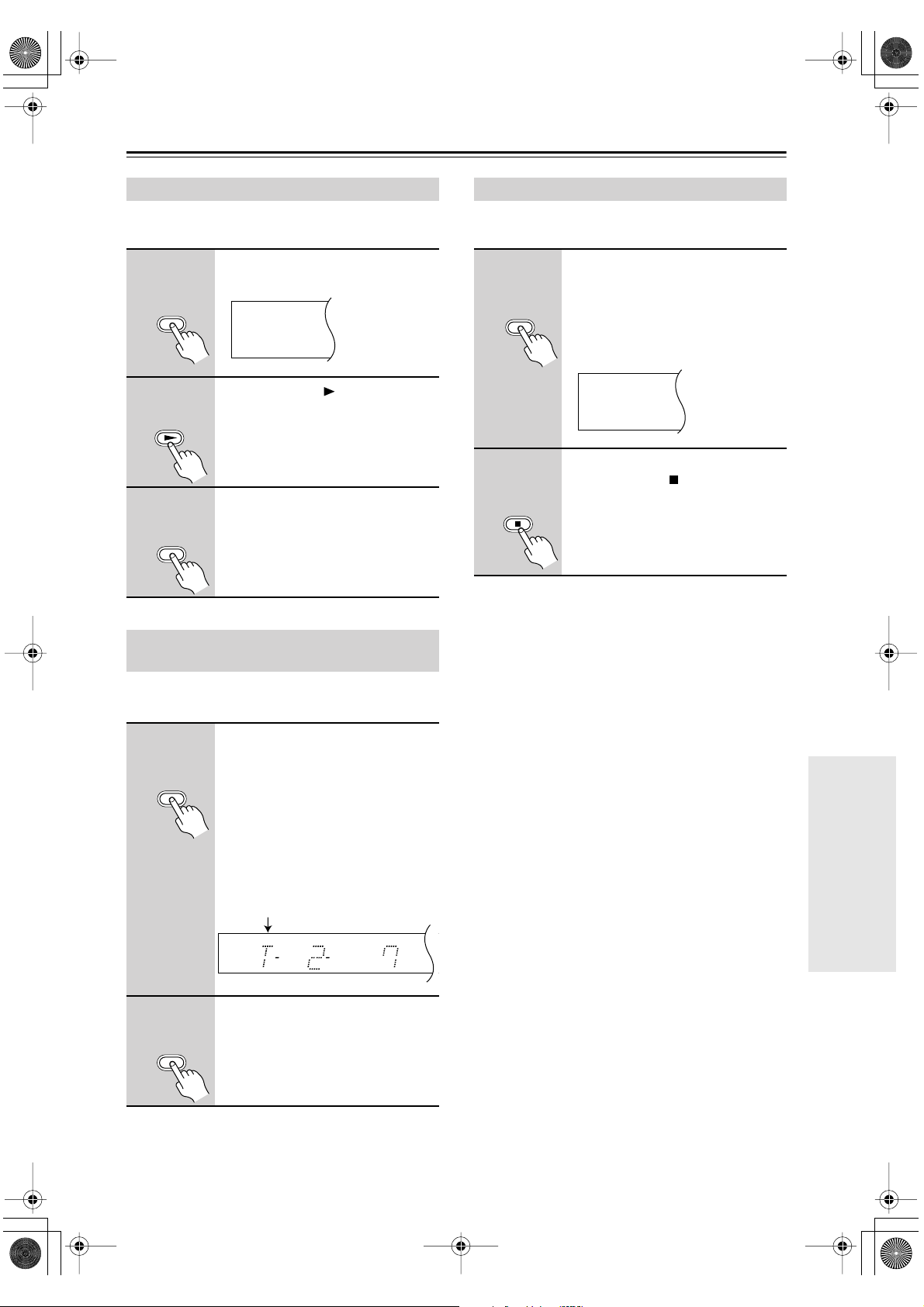
1
During playback, press the
[Memory] button repeatedly to
select one of the following
options:
T:
Current track.
F:
Folder containing the current track.
(only MP3)
D:
Disc containing the current track.
The letter “T,” “F,” or “D” appears at
the left of the display
2
Press the [Repeat] button.
The track, folder, or disc is played
repeatedly.
Repeat
Remote
controller
REPEAT
Play
Remote
controller
Repeat
Remote
controller
Memory
Remote
controller
TRACK
FLDR
MEMORY
Repeat
Remote
controller
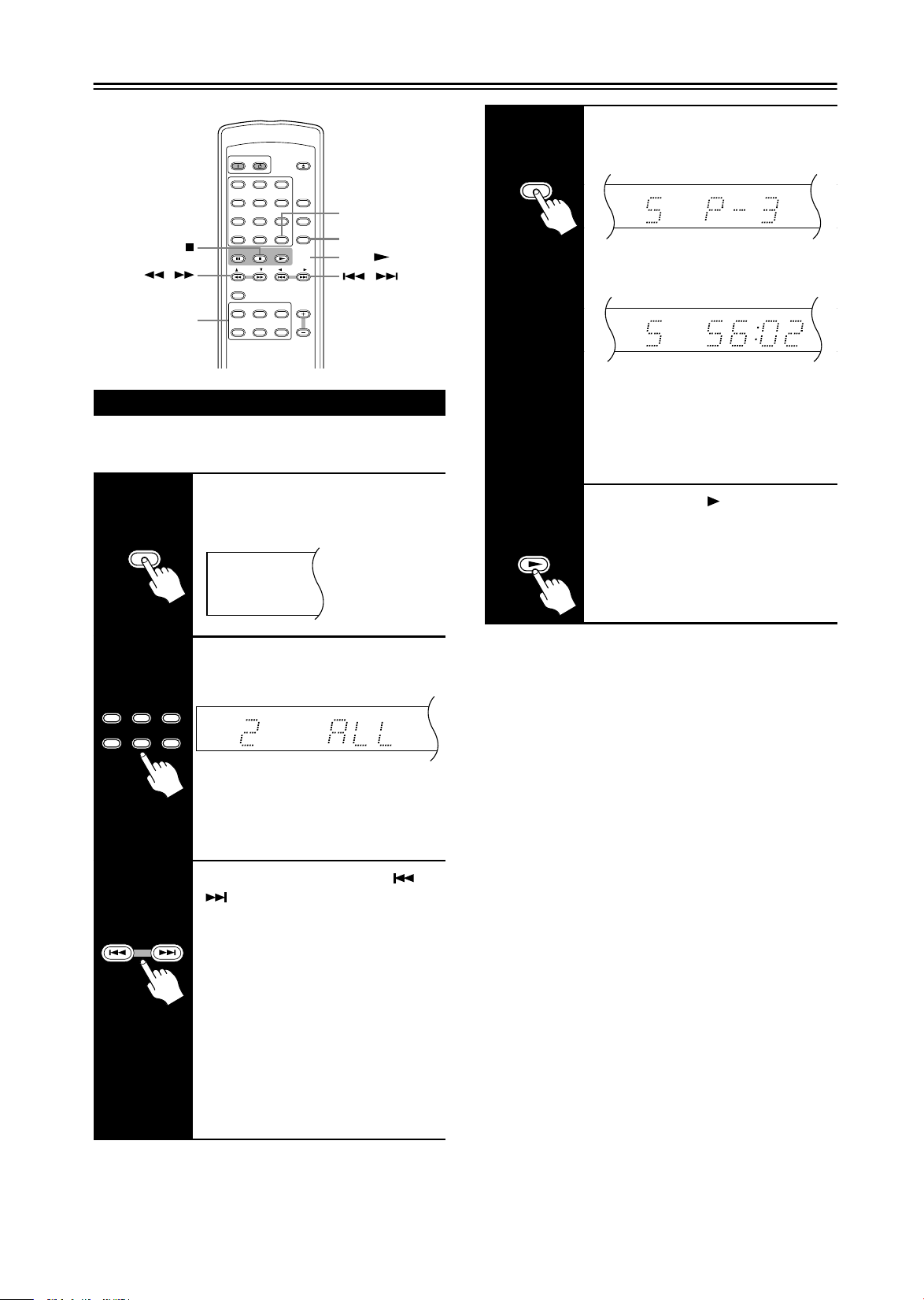
Using Random Playback
1
Press the [Random] button.
The RANDOM indicator appears and
tracks from all loaded discs are played
in random order.
Random playback stops when all tracks
have been played once.
2
To cancel random playback,
press the Stop [ ] button or [Ran-
dom] button.
The RANDOM indicator disappears.
Random
Remote
controller
RANDOM
Stop
Remote
controller
CDC-3.4.book Page 21 Tuesday, September 9, 2003 3:44 PM
22
Advanced Playback
—Continued
With the Memory function you can create a playlist of up
to 40 of your favorite tracks, discs, or folders.
Notes:
• During memory playback, the total remaining time
will be the remaining time of the playlist. However, if
the total remaining time exceeds 99 minutes and 59
seconds, the playlist contains items from two or more
discs, or contains one or more MP3 tracks, the total
remaining time cannot be displayed and “--:--” will be
shown instead.
• If you specify a track or disc that does not exist, it will
be added to the playlist, but ignored during memory
playback.
Using Memory Playback
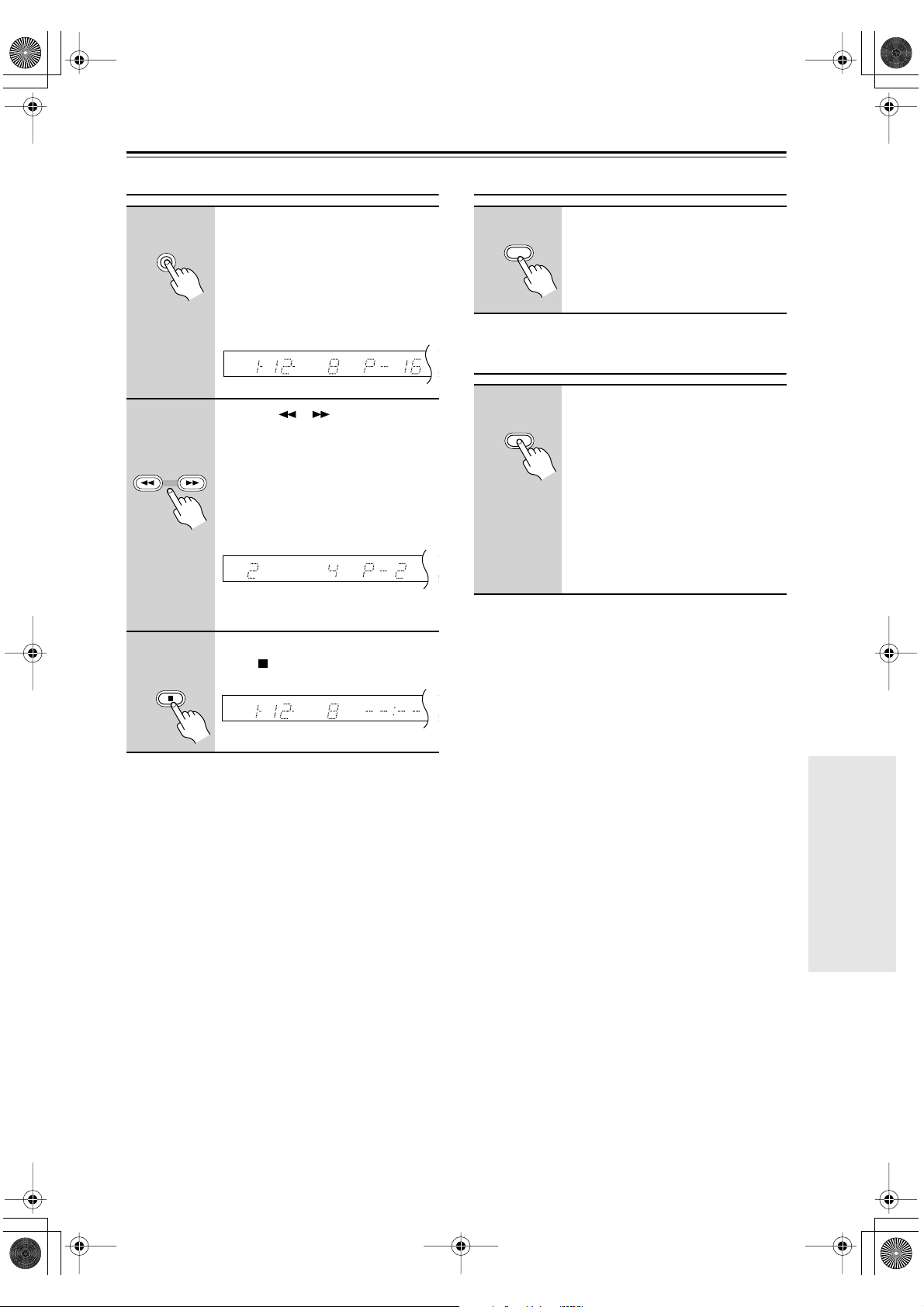
1
While playback is stopped, press
the [Memory] button.
The MEMORY indicator appears.
2
Use the Disc Select buttons to
select a disc.
“ALL,” which means
all tracks on the
disc,
appears on the display.
To add the entire disc to the playlist,
press the [Memory] button.
3
To select a track, use the [ ]/
[] buttons.
To select an individual track or a folder
on an MP3 disc, you can use either
Navigation mode or All Folder mode,
as explained on page 17 respectively.
You can also select tracks and folders
by using the number buttons (as
explained on page 18). In this case, the
item is added to the playlist once
you’ve entered the track number.
If you want to add all the MP3 tracks in
a folder, simply select that folder.
On
On
Standb
Standb
y
Open/Close
Repeat
Memory
Search
Folder
Folder
Next Selection
Disc
Disc 1 Disc 2 Disc 3
Disc 6Disc 5Disc 4
Random
Play
Pause Stop
1
2 3
654
7
8 9
10
10
>
10
/
0
Clear
Clear
//
Disc 1–6
Clear
Memory
Play
Stop
Memory
Remote
controller
MEMORY
Disc 1 Disc 2 Disc 3
Disc 4 Disc 5 Disc 6
Remote
controller
TRACK
DISC
MEMORY
Remote
controller
4
Press the [Memory] button to add
the selected track or folder to the
playlist.
After two seconds, the total playlist
time is displayed.
Repeat steps 2 through 4 to add more
tracks, discs, or folders to your playlist.
If you try to add more than 40 items, the
message “FULL” will flash on the dis-
play.
5
Press the Play [ ] button.
Items in the playlist are played in the
order in which they were added.
Memory
Remote
controller
TRACK
TRACK
TOTAL
REMAIN
Play
Remote
controller
CDC-3.4.book Page 22 Tuesday, September 9, 2003 3:44 PM
23
Advanced Playback
—Continued
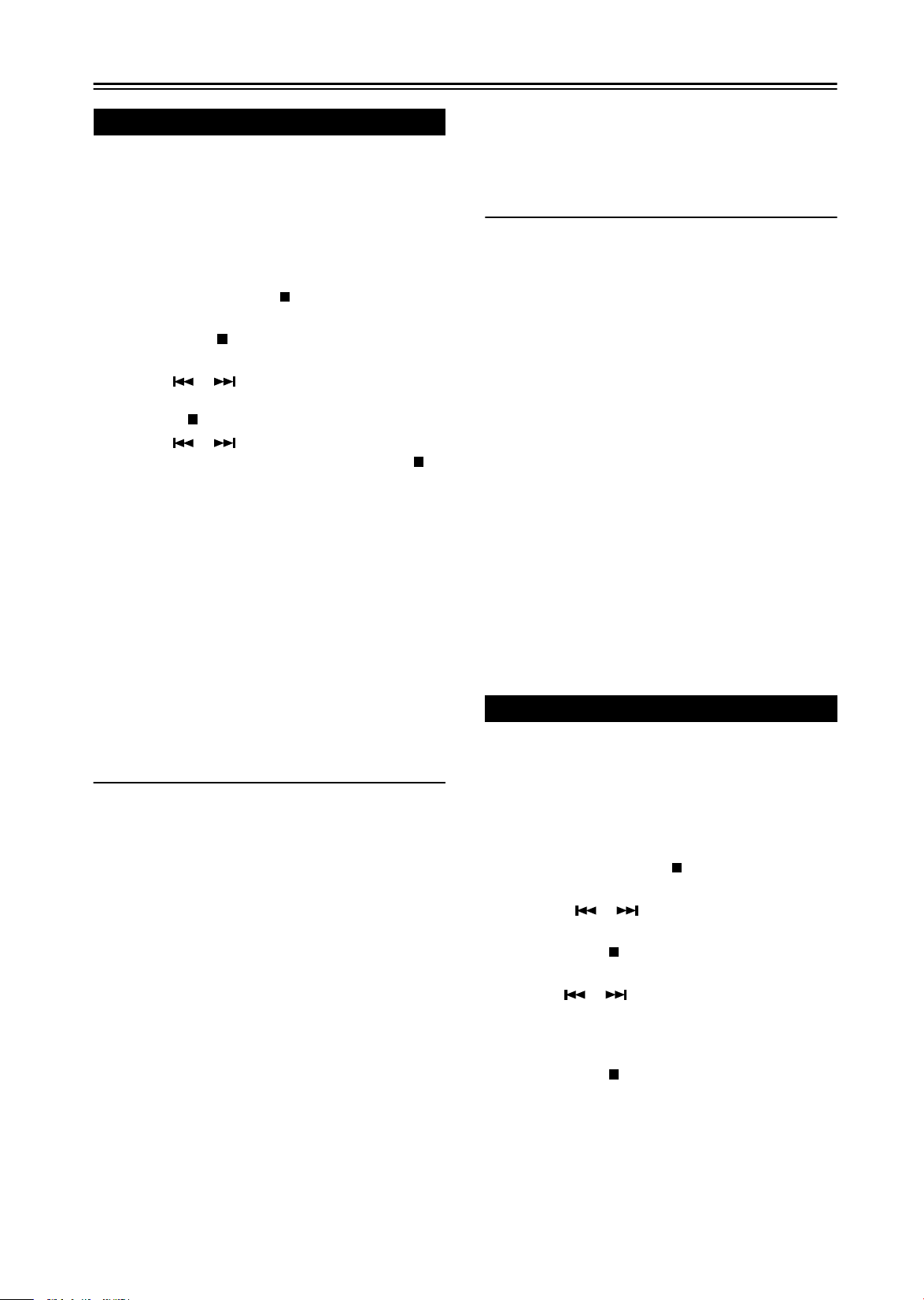
Checking What’s in the Playlist
Deleting the Last Item in the Playlist
Canceling Memory Playback
1
While playback is stopped, press
the [Display] button repeatedly
until “P-n” appears on the dis-
play (“n” being the item number).
On the following display, the playlist
contains a total of 16 tracks, the last one
being track #8 in folder #12 of disc #1.
2
Use the [ ]/[ ] buttons to
scroll through the playlist.
The disc number, folder number, and
track number for each item in the play-
list are displayed.
In the following example, item #2 con-
tains track #4 of disc #2.
3
When you’ve finished, press the
Stop [ ] button.
Display
TRACK
DISC
MP
3
FLDR
MEMORY
Remote
controller
TRACK
DISC
MP
3
MEMORY
Stop
Remote
controller
TRACK
TOTALDISC
MP
3
FLDR
MEMORY
REMAIN
To delete the last item in the play-
list, while playback is stopped,
press the [Clear] button.
The last item in the playlist is deleted.
To cancel memory playback,
press the [Memory] button
repeatedly to turn the MEMORY
indicator off.
The Memory function is turned off and
the entire playlist is deleted.
If you are using the Random function
with memory playback, you need to
turn it off (i.e., press the [Random] but-
ton) before you cancel memory play-
back.
Clear
Remote
controller
Memory
Remote
controller
CDC-3.4.book Page 23 Tuesday, September 9, 2003 3:44 PM
24
MP3 Preferences
This section explains how to set various preferences for
MP3 discs. Preferences are divided into two groups:
Basic and Extra.
You must use the buttons on the CDC-3.4 to set the MP3
preferences, not the remote controller.
1. Stop playback.
If the Memory function is on, turn it off.
2. Press and hold the Stop [ ] button until “SET-
TING” appears on the display (about 4 seconds).
3. Press the Stop [ ] button again.
“BASIC ITEMS” appears on the display.
4. Use the [ ]/[ ] buttons to select “BASIC
ITEMS” or “EXTRA ITEMS,” and then press
the STOP [ ] button.
5. Use the [ ]/[ ] buttons to select a setting for
the first preference, and then press the Stop [ ]
button.
The preference is set and the next preference
appears.
6. Repeat steps 5 to set the other preferences.
When all the preferences in the group have been set,
the previous display reappears.
If you want to cancel this procedure at anytime, press
the [STANDBY] button. The CDC-3.4 will enter
Standby mode.
The Basic and Extra preferences are explained in the fol-
lowing sections. The settings available for each prefer-
ence are shown in parenthesis, with the default setting on
the left.
Basic Items
DISC NAME (DISPLAY/NOT DISPLAY)
This preference determines whether or not the disc name
is displayed when an MP3 disc is read.
TRACK NAME (SCROLL/NOT SCROLL)
This preference determines whether or not the track
name scrolls across the display when an MP3 track is
selected.
FOLDER NAME (SCROLL/NOT SCROLL)
This preference determines whether or not the folder
name scrolls across the display when an MP3 folder is
selected.
BAD NAME (REPLACE/NOT REPLACE)
This preference determines whether or not track and
folder names that contain undisplayable characters are
replaced with “TRACK n” or “FOLDER n,” “n” being
the track or folder number. When set to NOT REPLACE,
displayable characters are displayed and underscores are
used in place of any undisplayable characters.
For ID3 tags, underscores are used in place of undisplay-
able characters regardless of this preference.
Note:
Track and folder names are scrolled in Navigation mode
(page 17) regardless of the TRACK NAME and
FOLDER NAME preferences.
Extra Items
ID3 VER 1 (READ/NOT READ)
This preference determines whether or not version 1.0/
1.1 tags are read and displayed. When set to NOT
READ, version 1.0/1.1 tags will not be displayed.
ID3 VER 2 (READ/NOT READ)
This preference determines whether or not version 2.3/
2.4 tags are read and displayed. When set to NOT
READ, version 2.3/2.4 ID3 tags will not be displayed.
CD-EXTRA (AUDIO/MP3)
This preference applies to CD Extra discs and deter-
mines whether music in the audio session or MP3 tracks
in the data session are played.
JOLIET (USE SVD/ISO9660)
This preference applies to MP3 discs in Joliet format and
determines whether the CDC-3.4 reads the SVD data or
treats the disc as an ISO 9660 disc. Normally, this pref-
erence doesn’t need to be changed.
SVD (Supplementary Volume Descriptor) supports long
file and folder names and characters other than letters
and numbers. Some CD burning software refers to the
Joliet format as “Windows format.”
This section explains how to initialize the MP3 prefer-
ences to their default values.
You must use the buttons on the CDC-3.4 for this proce-
dure, not the remote controller.
1. Stop playback.
If the Memory function is on, turn it off.
2. Press and hold the Stop [ ] button until “SET-
TING” appears on the display (about 4 seconds).
3. Press the [ ]/[ ] button.
“INITIALIZE” appears on the display.
4. Press the Stop [ ] button.
“CANCEL” appears on the display.
5. Use the [ ]/[ ] buttons to select “EXE-
CUTE.”
If you want to cancel this procedure, select “CAN-
CEL.”
6. Press the Stop [ ] button.
The MP3 preferences are initialized, “INITIAL-
IZED” appears on the display, and then the CDC-3.4
enters Standby mode.
Setting the MP3 Preferences
Initializing the MP3 Preferences
CDC-3.4.book Page 24 Tuesday, September 9, 2003 3:44 PM
25
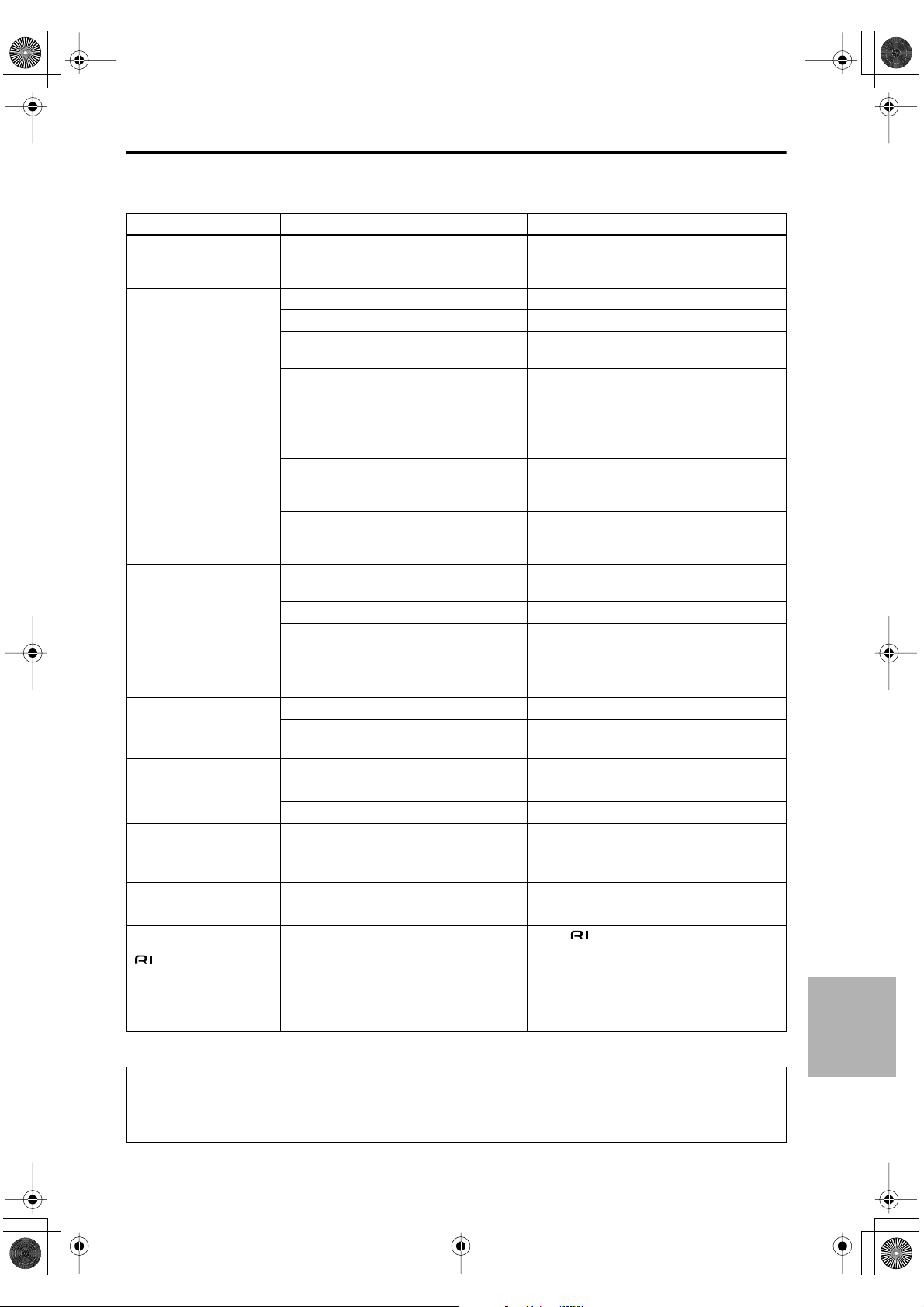
Troubleshooting
If you have any trouble using your CDC-3.4, check the following table for possible causes and remedies. If you still
can’t resolve the issue yourself, please contact your Integra/Onkyo dealer.
Trouble Possible Cause Remedy
No power.
The power cord is not connected properly.
Properly connect the power cord to the CDC-3.4’s
AC INLET and connect the other end to a suitable
wall outlet (page 14).
The remote controller does
not work.
There are no batteries in the remote controller. Install new batteries (page 10).
The batteries are flat. Replace with new batteries (page 10).
The batteries are installed incorrectly.
Check the batteries and correct as necessary
(page 10).
You’re not pointing the remote controller at the
CDC-3.4’s remote sensor.
Point the remote controller at the CDC-3.4’s
remote sensor (page 10).
You’re too far away from the CDC-3.4.
Use the remote controller closer to the CDC-3.4
(page 10). The remote controller has a range of
approximately 5 meters (16 ft.).
A strong light source is interfering with the
CDC-3.4’s remote sensor.
Make sure that the CDC-3.4 is not subjected to
direct sunshine or inverter-type fluorescent lights.
Relocate if necessary.
If the CDC-3.4 is installed in a cabinet with col-
ored glass doors, the remote controller may not
work reliably when the doors are closed.
Open the doors, or use a cabinet without colored
glass.
Cannot play a CD.
The disc is upside down.
Load the disc with the label-side facing up
(page 14).
The disc is dirty. Remove the disc and clean it (page 27).
Condensation has formed inside the CDC-3.4.
Remove your discs and leave the CDC-3.4 turned
on for several hours until the condensation has
evaporated.
The CD-R/RW disc is nonstandard. See “Disc Notes” on page 26.
There is no sound.
The CDC-3.4 is not connected properly. Check all connections and correct as necessary.
The wrong input source is selected on your
amp.
Check your amp’s input source setting. Refer to
your amp’s manual.
CD playback skips.
The CDC-3.4 is subject to vibration. Install the CDC-3.4 somewhere free of vibration.
The disc is dirty. Remove the disc and clean it (page 27).
The disc is very scratched. Buy a new disc.
Cannot enter track num-
bers for memory playback.
No disc is loaded. Load a disc (page 14).
The track number entered doesn’t exist on the
disc.
Enter the correct track number (page 18).
It takes a long time to
locate certain tracks.
The disc is dirty. Remove the disc and clean it (page 27).
The disc is very scratched. Buy a new disc.
does not work.
There’s no RCA/phono analog audio connec-
tion.
To use you must make an analog audio con-
nection (RCA/phono) between the CDC-3.4 and
your Integra/Onkyo AV receiver, even if they are
connected digitally.
The digital outputs do not
work.
The sampling rate of the currently playing MP3
track is not 32 kHz, 44.1 kHz, or 48 kHz.
Select a track with a sampling rate of 32 kHz,
44.1 kHz, or 48 kHz.
Abnormal Behavior
The CDC-3.4 contains a microcomputer for signal processing and control functions. In very rare situations, severe
interference, noise from an external source, or static electricity may cause it to lockup. In the unlikely event that this
should happen, unplug the power cord from the wall outlet, wait at least five seconds, and then plug it back in again.
CDC-3.4.book Page 25 Tuesday, September 9, 2003 3:44 PM
26
Disc Notes
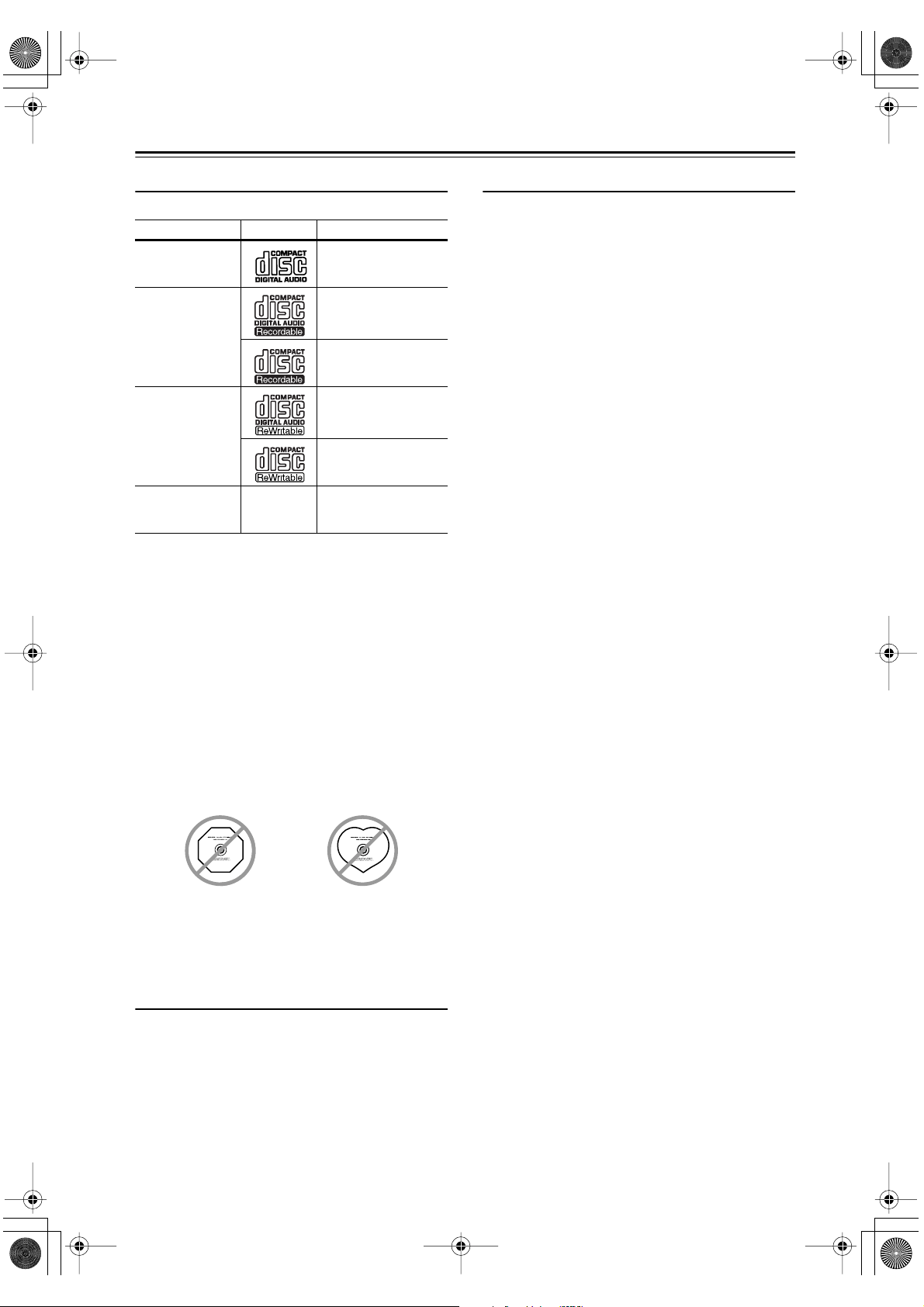
Supported Discs
The CDC-3.4 supports the following discs.
• Some audio CDs use copy protection that doesn’t con-
form to the official CD standard. Since these are non-
standard discs, they may not play properly in the
CDC-3.4.
• The CDC-3.4 supports CD-R and CD-RW discs.
However, some CD-R and CD-RW discs may not
work properly for any of the following reasons: disc
burner characteristics, disc characteristics, the disc is
damaged or dirty. See the manual supplied with your
disc burner for more information. Condensation or dirt
on the optical pickup lens can also affect playback.
• The CDC-3.4 supports 8 cm and 12 cm discs.
• The CDC-3.4 does not support disc types not listed.
• Don’t use discs with an unusual shape, such as those
shown below, because you may damage the CDC-3.4.
• Don’t use discs that have residue from adhesive tape,
rental discs with peeling labels, or discs with custom-
made labels or stickers. Doing so may damage the
CDC-3.4 and you may not be able to remove the disc
properly.
Discs Made on Personal Computers
Discs made on personal computers, including those of a
compatible format, may not work properly in the
CDC-3.4 because of incorrect settings in the disc burn-
ing software. Check the manuals supplied with your disc
burning software for additional compatibility informa-
tion.
MP3 Compatibility
• MP3 discs must be ISO 9660 Level 1 or Level 2,
Romeo or Joliet compliant. Supported formats:
Mode 1, Mode 2 XA Form 1.
•Folders can be up to eight levels deep.
• MP3 files must be MPEG-1/MPEG-2 Audio Layer 3
format with a sampling rate of between 8 kHz and 48
kHz and a bit-rate of between 8 kbps and 320 kbps
(128 kbps recommended). Incompatible files cannot
be played.
• Fixed bit-rate MP3 files are recommended, however,
variable bit-rate (VBR) MP3 files between 8 kbps and
320 kbps are supported. (Playing times may display
incorrectly.)
• MP3 files must have a “.mp3” or “.MP3” file name
extension. MP3 files without the proper extension will
not be recognized. To prevent noise and malfunction,
do not use these extensions for other types of files.
• The CDC-3.4 supports up to 499 MP3 files and up to
99 folders per disc. Files and folders in excess of this
cannot be played. Note that if the file and folder struc-
ture is very complicated, the CDC-3.4 may not be able
to read or play all of the MP3 files on the disc.
• Disc names may contain up to 32 characters. File and
folder names may contain up to 64 characters.
• The maximum time that can be displayed for a single
track is 99 minutes and 59 seconds.
• The remaining time cannot be displayed when playing
MP3 files.
• MP3 file and folder names (excluding the extension)
are shown on the display.
• Multisession discs are supported, however, some mul-
tisession discs may take a long time to load and some
may not load at all. When burning CDs we recom-
mend that you use a single-session (disc-at-once), and
select “Disc Close.”
• Normally, the music in the audio session of a CD Extra
disc is played. However, you can set the CDC-3.4 so
that it plays any MP3 files in the data session of a
CD-R/RW disc instead. If the data session contains no
MP3 tracks, the audio session will be played regard-
less. See “MP3 Preferences” on page 24 for more
information.
• The following ID3 tags are supported: versions 1.0/1.1
and 2.3/2.4. Versions 2.2/2.5 and later are not sup-
ported. Normally, version 2.3/2.4 tags have priority
and will be displayed regardless of the ID3 VER 1
preference on page 24.
•For ID3 version 2 tags, information in the first 2,048
bytes at the beginning of the file are recognized. We
recommend that you include only title, artist name,
and album name information in ID3 tags. Com-
pressed, encrypted, and unsynchronized ID3 tags can-
not be displayed.
Disc Logo Format or file type
Audio CD
PCM
CD-R
Audio CD, MP3
MP3
CD-RW
Audio CD, MP3
MP3
CD Extra
Audio CD (Session 1),
MP3 (Session 2)
CDC-3.4.book Page 26 Tuesday, September 9, 2003 3:44 PM
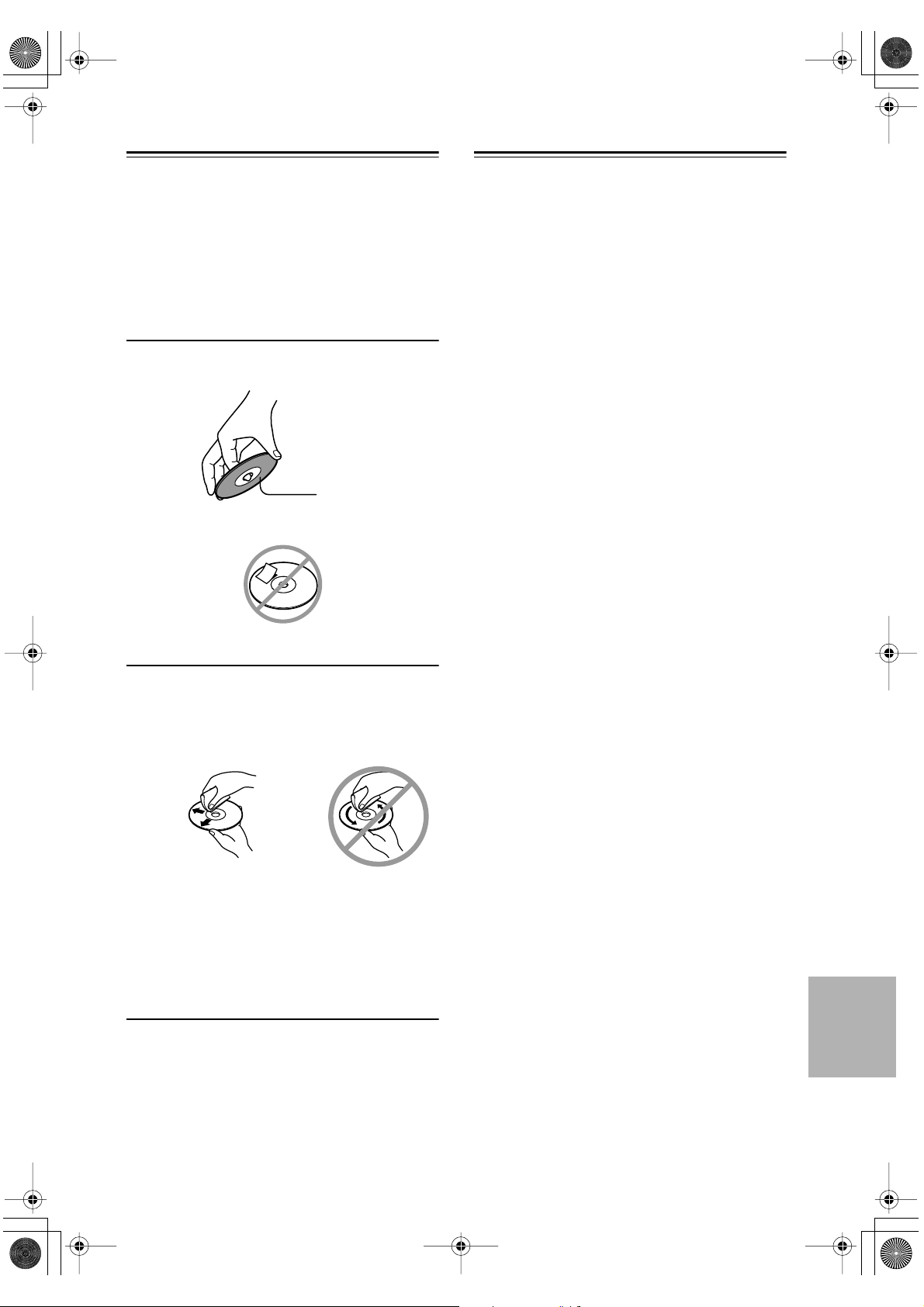
27
Disc Notes
—Continued
Notes:
•With CD-ROM, CD-R, and CD-RW discs that contain
many files and folders, and files other than MP3s, it
may take a long time to read the disc. We recommend
that you include only MP3 files on your discs, use
about 20 folders, and limit folder nesting to three lev-
els deep.
• In this manual, MP3 files are referred to as
tracks
.
Handling Discs
•Never touch the underside of a disc. Always hold discs
by the edge, as shown.
•Never attach adhesive tape or sticky labels to discs.
Cleaning Discs
•For best results, keep your discs clean. Fingerprints
and dust can affect the sound quality and should be
removed as follows. Using a clean soft cloth, wipe
from the center outwards, as shown. Never wipe in a
circular direction.
•To remove stubborn dust or dirt, wipe the disc with a
damp soft cloth, and then dry it with a dry cloth.
•Never use solvent-based cleaning fluids, such as thin-
ner or benzine, commercially available cleaners, or
antistatic sprays intended for vinyl records, because
they may damage the disc.
Storing Discs
• Don’t store discs in places subject to direct sunlight, or
near heat sources.
• Don’t store discs in places subject to moisture or dust,
such as in a bathroom or near a humidifier.
•Always store discs in their cases and vertically. Stack-
ing, or putting objects on unprotected discs may cause
warping, scratches, or other damage.
Specifications
CDC-3.4 (Compact Disc Changer)
Signal readout system...................... Optical non-contact
Frequency response................................... 5 Hz–20 kHz
SN ratio .................................................................98 dB
Audio Dynamic range ........................................... 96 dB
THD (Total harmonic distortion) ...... 0.005% (at 1 kHz)
Audio output (Digital/Optical)......................–22.5 dBm
Audio output/Impedance (Digital/Coaxial)
........................................................0.5 V (p-p) / 75
Ω
Audio output/Impedance (Analog)
..................................................... 2.0 V (rms) / 470
Ω
Power supply rating..............................AC 120 V 60 Hz
Power consumption................................................ 10 W
Standby power consumption .................................... 4 W
Dimensions (W
×
H
×
D).....17-1/8"
×
5-3/16"
×
17-3/16"
.................................................(435
×
131
×
436 mm)
Weight ................................................. 15.0 lbs. (6.8 kg)
Operating conditions Temperature/Humidity
..................................... 41–95 ˚F (5–35 ˚C) / 25–80%
Disc compatibility ...........................CD, CD-R, CD-RW
RC-553C (Remote Controller)
Transmitter .........................................................Infrared
Signal range.............................. Approx. 16 ft., 5 meters
Power supply............Two (AA/R6) batteries (1.5 V x 2)
Specifications and features are subject to change without
notice.
Underside
✔
CDC-3.4.book Page 27 Tuesday, September 9, 2003 3:44 PM
28
SN 29343571A
(C) Copyright 2003 ONKYO CORPORATION Japan. All rights reserved.
I0309-2
Integra Division of
ONKYO U.S.A. CORPORATION
18 park Way, Upper Saddle River, N.J. 07458, U.S.A.
Tel: 201-785-2600 Fax: 201-785-2650 http://www.integrahometheater.com
Integra Division of
ONKYO CORPORATION
Sales & Product Planning Div.: 2-1, Nisshin-cho, Neyagawa-shi, OSAKA 572-8540, JAPAN
Tel: 072-831-8023 Fax: 072-831-8124
En
BodyEn.fm Page 28 Friday, September 19, 2003 3:55 PM