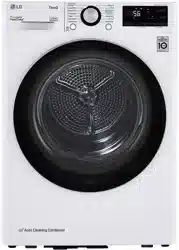
USER MANUAL LG DRYER PRODUCT OVERVIEW
Product Features
Grounding Instructions
- Improper connection of the equipment-grounding conductor can result in a risk of electric shock. Check with a qualified electrician or service personnel if you are in doubt whether the appliance is properly grounded. Do not modify the plug provided with the appliance; if it will not fit the outlet, have a proper outlet installed by a qualified electrician.
- The appliance must be grounded. In the event of a malfunction or breakdown, grounding will reduce the risk of electric shock by providing a path of least resistance for electric current. The appliance is equipped with a cord having an equipment-grounding conductor and a grounding plug. The plug must be plugged into an appropriate outlet that is installed and grounded in accordance with all local codes and ordinances.
- The appliance must be plugged into a properly grounded outlet. Electrical shock may result if the appliance is not properly grounded. Have the wall outlet and circuit checked by a qualified electrician to make sure the outlet is properly grounded. Failure to follow these instructions may create an electric shock hazard and/or a fire hazard.
Product Specifications
The appearance and specifications listed in this manual may vary due to constant product improvements. Electrical requirements: Please refer to the rating label for detailed information.
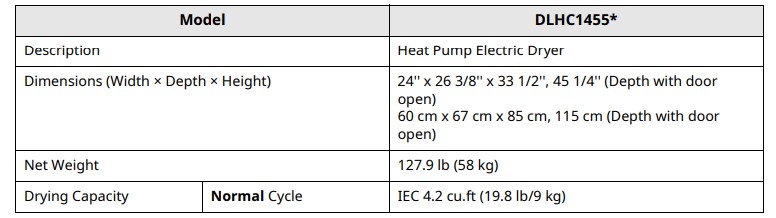
NOTE : Model numbers can be found on the cabinet inside the door.
Accessories
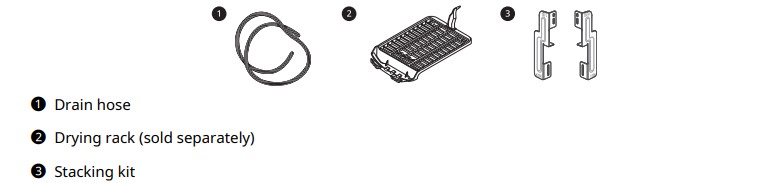
NOTE : For your safety and extended product life, use only authorized components. The manufacturer is not responsible for product malfunction or accidents caused by the use of unauthorized components or parts.
INSTALLATION
- Before use, the appliance must be properly installed as described in this manual.
- Connect to a properly rated, protected, and sized power circuit to avoid electrical overload.
- To reduce the risk of severe injury or death, follow all installation instructions.
- The appliance must be installed and electrically grounded by qualified service personnel in accordance with local codes.
- Disconnect the power cord, house fuse or circuit breaker before installing or servicing the appliance.
- When moving or installing the appliance in a different location, call qualified service personnel for installation and service.
- Keep packing materials out of the reach of children. Packaging material can be dangerous for children. There is a risk of suffocation.
- Moving or installation of the appliance requires two or more people.
- This appliance is not designed for maritime use or for mobile installations such as in RVs, trailers, or aircraft.
- This appliance must be positioned near to an electrical power supply.
- Do not, under any circumstances, cut or remove the third (ground) prong from the power cord.
- When installing or moving the appliance, be careful not to pinch, crush, or damage the power cord.
- Do not install the appliance in humid spaces.
- Destroy the carton, plastic bag, and other packing materials after the appliance is unpacked. Children might use them for play. Cartons covered with rugs, bedspreads, or plastic sheets can become airtight chambers.
- Adhere to all industry recommended safety procedures including the use of long-sleeved gloves and safety glasses.
- Place the appliance at least 18 inches above the floor for a garage installation.
- Do not install near another heat source such as a stove, oven or heater.
- Keep area around the exhaust opening and adjacent surrounding areas free from the accumulation of lint, dust, and dirt.
- The appliance must not be supplied through an external switching device, such as a timer, or connected to a circuit that is regularly switched on and off by a utility.
- Certain internal parts are intentionally not grounded and may present a risk of electric shock only during servicing. Service personnel – Do not contact the following parts while the appliance is energized: Motor, Control Board, Noise Filter.
Installation Overview
Please read the following installation instructions first after purchasing this dryer or transporting it to another location.
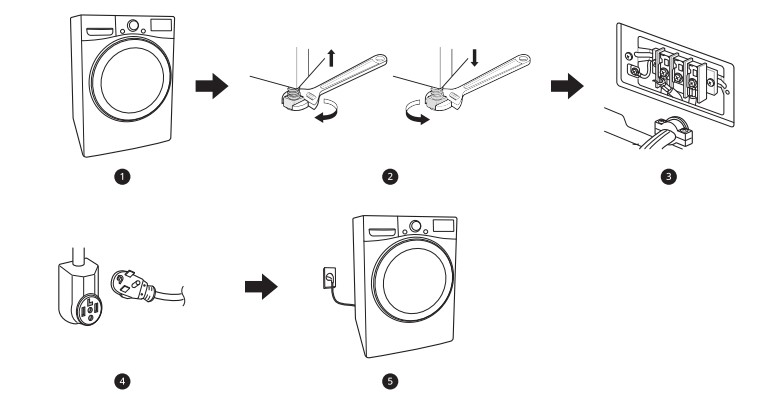
- Choose the proper location.
- Level the appliance.
- Connect the heat pump electric dryer.
- Plug in the power cord.
- Final Installation Check
Choosing the Proper Location
Electricity: Use an individual, grounded electrical outlet located within 2 ft. (61 cm) of either side of the appliance
Flooring: To avoid noise and vibration, the appliance must be installed and leveled on a solidly constructed floor with a maximum slope of 1 inch (2.5 cm). If required, adjust the leveling legs to compensate for the unevenness of the floor.
NOTE: A sturdy floor is needed to support the total appliance weight when loaded. The combined weight of a companion appliance should also be considered. Clothes may not tumble properly, and automatic sensor cycles may not operate correctly if the appliance is not level. Far garage installation, you will need to place the appliance at least 18 inches (45.7 cm) above the floor. The standard pedestal height is 15 inches (38 cm). You will need 18 inches (45.7 cm) from the garage floor to the bottom of the appliance
Ambient Temperature
Install the appliance in an area where the temperature is over 45 ℉ (7 ℃). If the temperature around the appliance is too low, the appliance might not shut off at the end of an automatic cycle. This can result in longer drying times.
Dimensions and Clearances
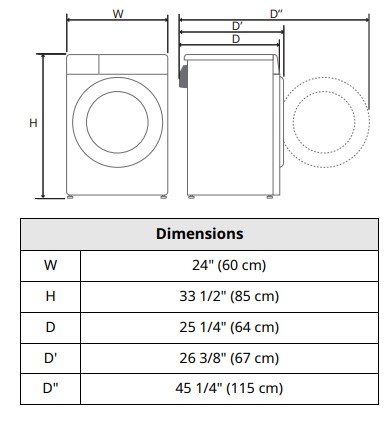
The following clearances are recommended for the appliance.
- Additional clearances should be considered for ease of installation and servicing.
- Additional clearances should be considered on all sides of the dryer to reduce noise transfer.
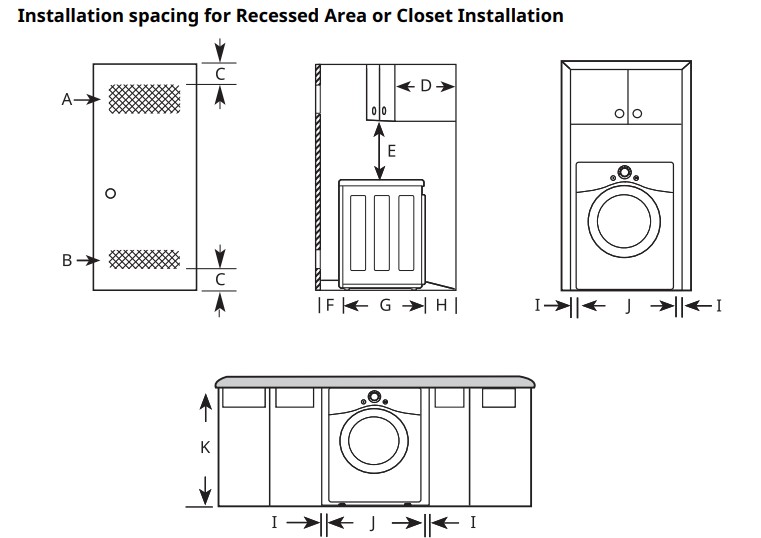
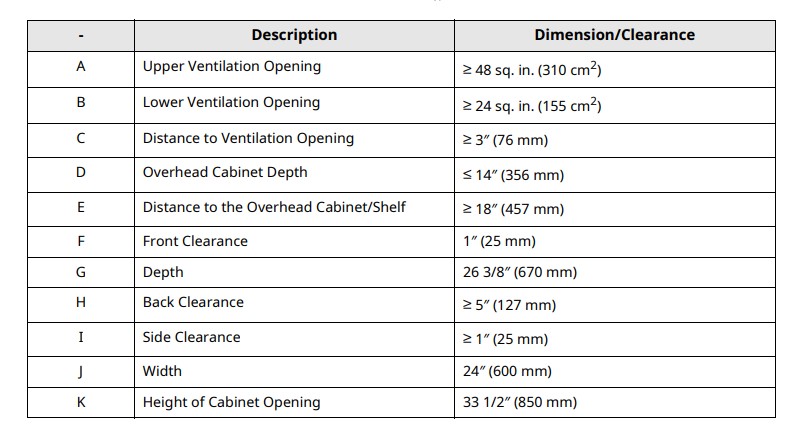
Closet Ventilation Requirements Closets with doors must have both an upper and lower vent to prevent heat and moisture buildup in the closet. One upper vent opening with a minimum opening of 48 sq. in. (310 cm2) must be installed no lower than 6 feet above the floor. One lower vent opening with a minimum opening of 24 sq. in. (155 cm2) must be installed no more than one foot above the floor. Install vent grills in the door or cut down the door at the top and bottom to form openings. Louvered doors with equivalent ventilation openings are also acceptable.
NOTE : There should be at least a little space around the dryer (or any other appliance) to eliminate the transfer of vibration from one appliance to another. If there is enough vibration, it could cause appliances to make noise or come into contact, causing paint damage and further increasing noise. No other fuel-burning appliance can be installed in the same closet as a dryer
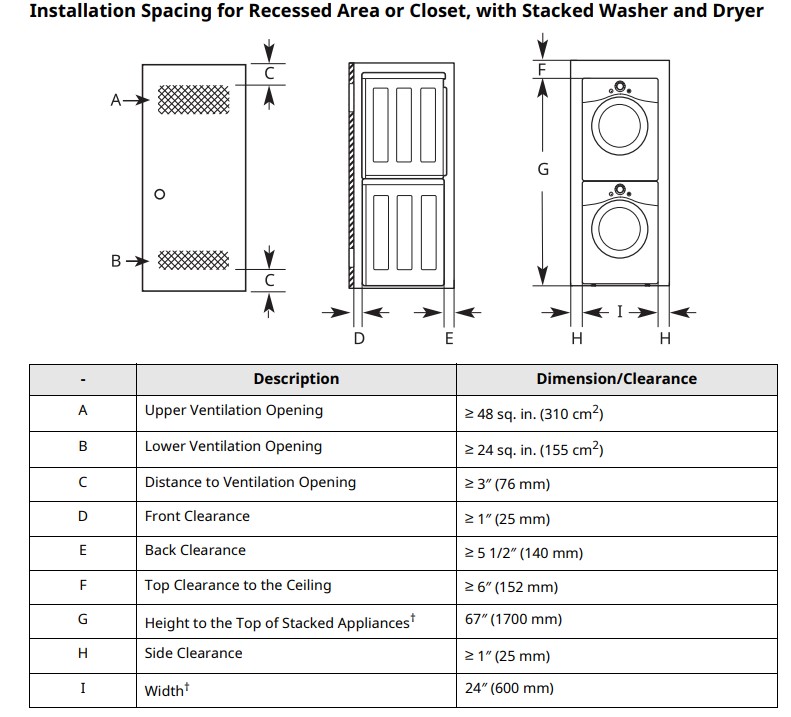
† Differs depending on the washer dimensions.
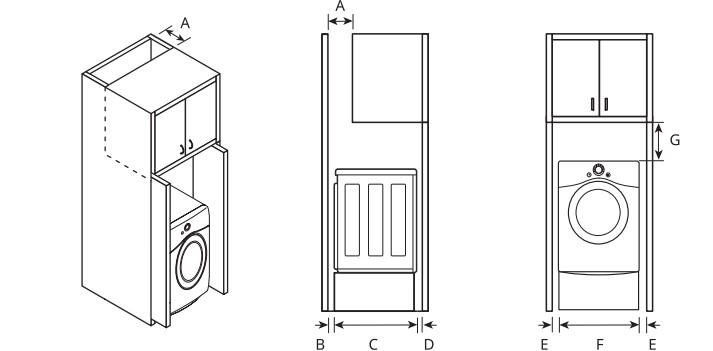
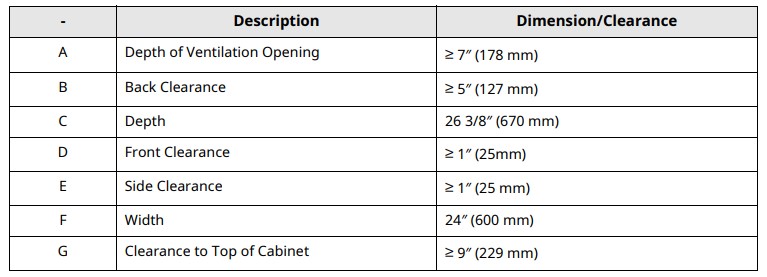
For cabinet installation with a door, minimum ventilation openings in the top of the cabinet are required.
Leveling the Appliance
Checking the Level Position the appliance in the final location and place a level across the top of the appliance.
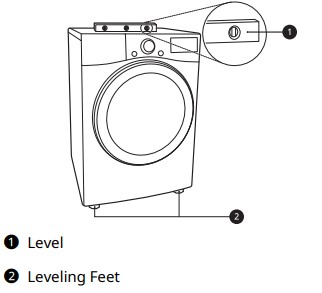
NOTE :
- All four leveling feet must rest solidly on the floor. Gently push on the top corners of the appliance to make sure that the appliance does not rock from corner to corner.
- Adjust the leveling feet only as far as necessary to level the appliance. Extending the leveling feet more than necessary may cause the appliance to vibrate.
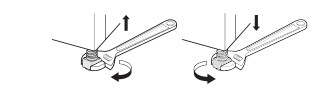
- To ensure that the appliance provides optimal drying performance, it must be level. To minimize vibration, noise, and unwanted movement, the floor must be a perfectly level, solid surface. Adjusting the Leveling Feet Use an adjustable wrench to turn the leveling feet. Unscrew the legs to raise the appliance or screw in the legs to lower it. Raise or lower with the leveling feet until the appliance is level from side to side and front to back. Make sure that all four leveling feet are in firm contact with the floor.
Door Reversal Instructions
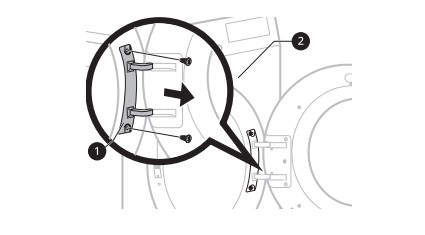
1. Open the door and remove 2 screws on the door hinge 1. Remove the door from the cabinet 2 and place it inside facing up on a non-scratching surface.
WARNING: Be sure to support the weight of the door before removing the hinge screws.
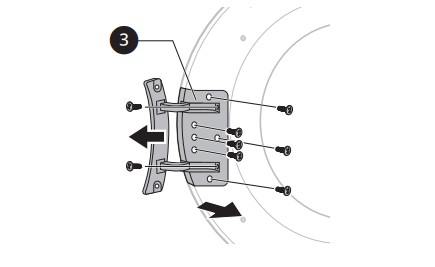
2. Remove 8 screws and remove the hinge assembly 3 from the door.
- There are 6 screws on the front and 2 screws on the side.
3. Remove the 3 screws from the door latch assembly 4 which is mounted between the door and the hinge assembly. Remove the screw in the door latch.
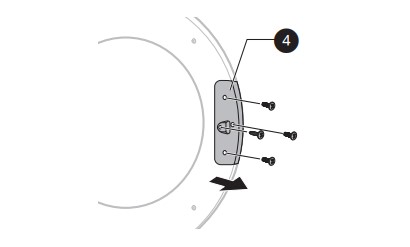
4. Swap the position of the hinge assembly 3 and the door latch assembly 4 and reassemble. Refer to steps 2 and 3 for the location and number of screws when reassembling.
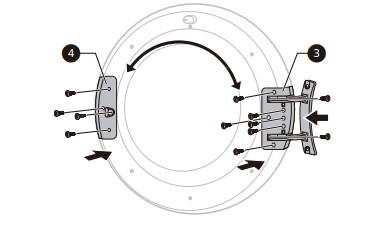
5 . On the appliance cabint, unscrew 2 screws and remove the door catch 5. Reassemble it on the opposite side of the door.
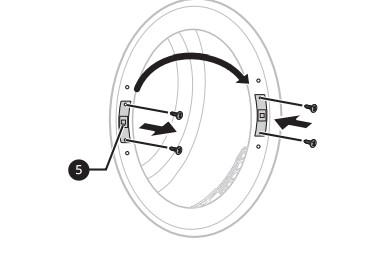
6. Remove the 2 decorative screws from the appliance cabinet and insert them on the opposite side.
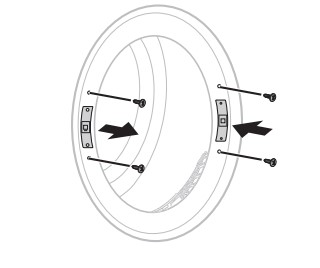
7. Reassemble the door on the cabinet using the screws removed in step 1. Make sure that the door opens, closes and latches properly.
Stacking Kit Installation
1. Place the appliance on the top of an LG front load washing machine.
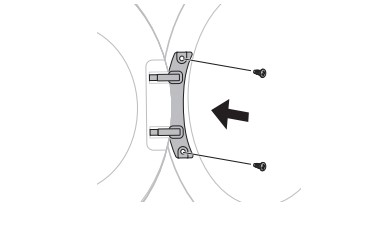
2. Remove the 1 screw from the bottom of the rear cover on each side.
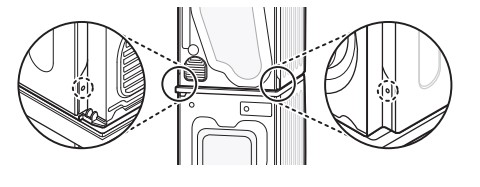
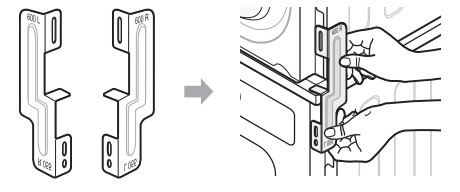
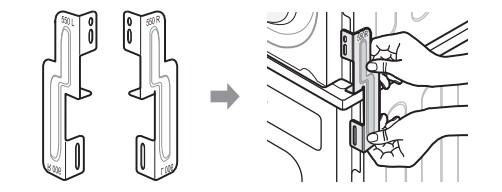
3. Align the hole in the bracket with the hole in the rear cover of the appliances.
- If using the 24″ (600 mm) top plate:
- If using the 21 7/8″ (550 mm) top plate:
4. Use the 2 screws removed earlier to hold the stacking brackets in place on each side.
5. Use the four 0.6″ (16 mm) screws provided in the accessory box to secure the brackets in place.
Installing the Optional Drain Hose
Normally, condensed water is pumped up to the water container where water is collected until manually emptied. It may be more convenient to drain water to an external drain, especially when the appliance is stacked on top of a washing machine. Use the connecting T piece to reroute the drainage as shown below. 1 Remove the anti-backflow cap a and disconnect the water container hose b from the T piece.
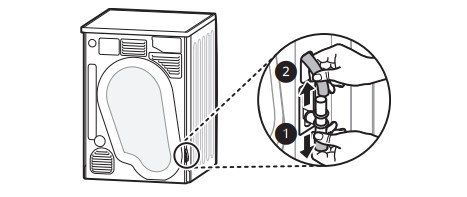
2 Attach the anti-backflow cap a to the top of the T piece and connect the optional drain hose c to the bottom of the T piece.
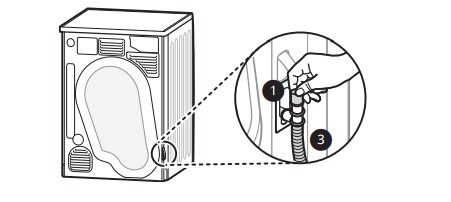
Connecting Electric Dryers
To reduce the risk of fire or explosion, electric shock, property damage, injury to persons, or death when using this appliance, fulfill the following requirements.
Electrical Requirements
- The wiring and grounding must conform to the latest edition of the National Electrical Code, ANSI/NFPA 70 and all applicable local regulations. Please contact a qualified electrician to check your home’s wiring and fuses to ensure that your home has adequate electrical power to operate the dryer.
- This dryer must be connected to a grounded metal, permanent wiring system, or an equipment-grounding conductor must be run with the circuit conductors and connected to the equipment-grounding terminal or lead on the dryer.
- The dryer has its own terminal block that must be connected to a separate 240 VAC, 60-Hertz, single-phase circuit, fused at 30 amperes (the circuit must be fused on both sides of the line). ELECTRICAL SERVICE FOR THE DRYER SHOULD BE OF THE MAXIMUM RATE VOLTAGE LISTED ON THE NAMEPLATE. DO NOT CONNECT THE DRYER TO 110-, 115-, OR 120-VOLT CIRCUIT.
- If the branch circuit to dryer is 15 ft. (4.5 m) or less in length, use UL (Underwriters Laboratories) listed No.-10 AWG wire (copper wire only), or as required by local codes. If over 15 ft. (4.5 m), use UL-listed No.-8 AWG wire (copper wire only), or as required by local codes. Allow sufficient slack in wiring so the dryer can be moved from its normal location when necessary.
- The power cord (pigtail) connection between the wall receptacle and the dryer terminal block IS NOT supplied with the dryer. Type of pigtail and gauge of wire must conform to local codes and with instructions on the following pages.
- Do not modify the plug and internal wire provided with the dryer.
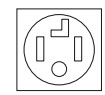
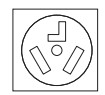
- The dryer should be connected to a 4-hole outlet.
- If the plug does not fit the outlet, a proper outlet will need to be installed by a qualified electrician.
- Connect the power cord to the terminal block. Each colored wire should be connected to the same color screw. Wire color indicated on manual is connected to the same color screw in the block.
- Grounding through the neutral conductor is prohibited for: (1) new branch-circuit installations and (2) areas where local codes prohibit grounding through the neutral conductor.
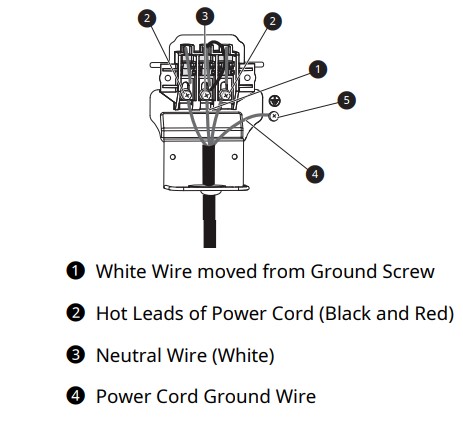
- This dryer is supplied with the neutral wire grounded. This white ground wire MUST BE MOVED to the neutral terminal when a 4-wire cord is to be used, or where grounding through the neutral conductor is prohibited.
Four-Wire Power Cord
- A UL-listed strain relief is required.
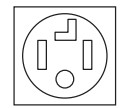
- Use a 30-amp, 240-volt, 4-wire, UL-listed power cord with #10 AWG-minimum copper conductor and closed loop or forked terminals with upturned ends.
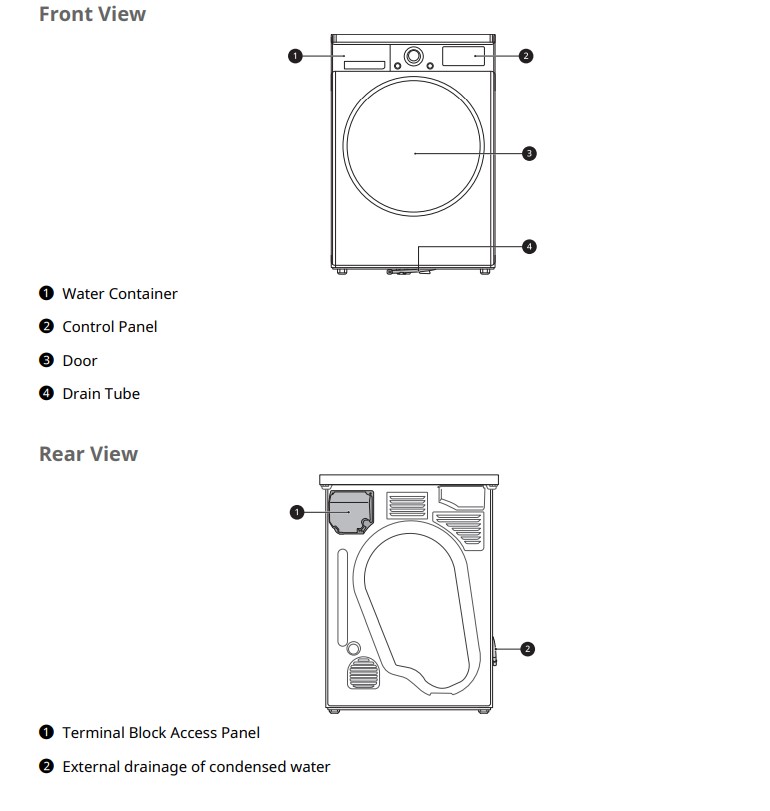
- Remove the terminal block access cover on the upper back of the appliance.
- Install UL-listed strain relief into the power cord through-hole.
- Thread a 30-amp, 240-volt, 4-wire, UL-listed power cord with #10 AWG-minimum copper conductor through the strain relief.
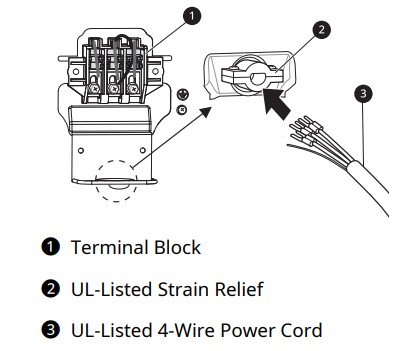
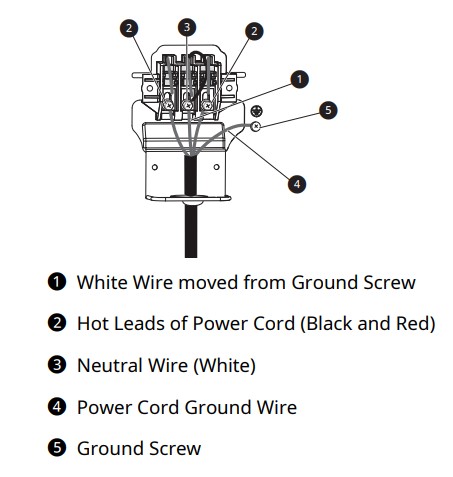
- Transfer the appliance's ground wire from behind the green ground screw to the center screw of the terminal block.
- Attach the two hot leads (black and red) of the power cord to the outer terminal block screws.
- Attach the neutral (white) wire to the center screw of the terminal block
- Attach the power cord ground wire to the green ground screw.
- Tighten all screws securely.
- Reinstall the terminal block access cover.
Four-Wire Direct Wire
- A UL-listed strain relief is required.
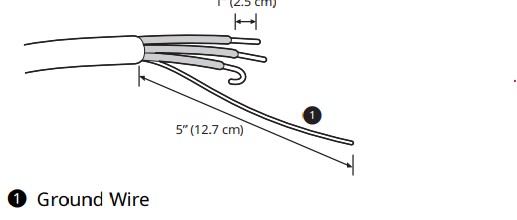
- Use UL-listed 4-wire #10 AWG minimum copper conductor cable. Allow at least 5 ft. (1.5 m) of wire to allow for removal and reinstallation of the dryer.
- Remove 5 inches (12.7 cm) of the outer covering from the wire and remove 5 inches of insulation from the ground wire. Cut off approximately 1.5 inches (3.8 cm) from the other three wires and strip 1 inch (2.5 cm) insulation from each wire. Bend the ends of the three shorter wires into a hook shape.
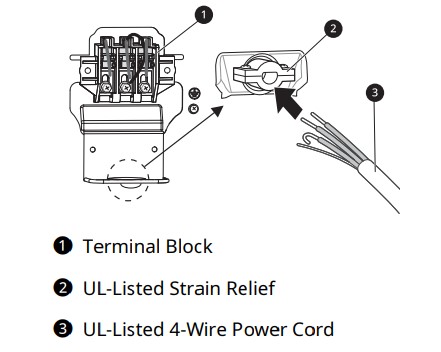
- Remove the terminal block access cover on the upper back of the appliance.
- Install UL-listed strain relief into the power cord through-hole.
- Thread the 4-wire #10 AWG minimum copper power cable prepared in step 1 through the strain relief.
- Transfer the appliance's ground wire from behind the green ground screw to the center of the terminal block.
- Attach the two hot leads (black and red) of the power cord to the outer terminal block screws.
- Attach the neutral (white) wire to the center screw of the terminal block.
- Attach the power cord ground wire to the green ground screw.
- Tighten all screws securely.
- Reinstall the terminal block access cover.
Three-Wire Power Cord
- A 3-wire connection is NOT permitted on new construction after January 1, 1996.
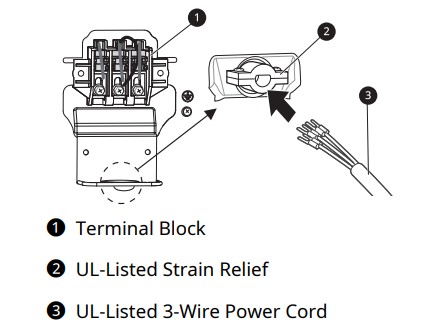
- A UL-listed strain relief is required.
- Use a 30-amp, 240-volt, 3-wire, UL-listed power cord with #10 AWG-minimum copper conductor and closed loop or forked terminals with upturned ends
- Remove the terminal block access cover on the upper back of the appliance.
- Install the UL-listed strain relief into the power cord through-hole.
- Thread a 30-amp, 240 volt, 3-wire, UL-listed power cord with #10 AWG-minimum copper conductor through the strain relief.
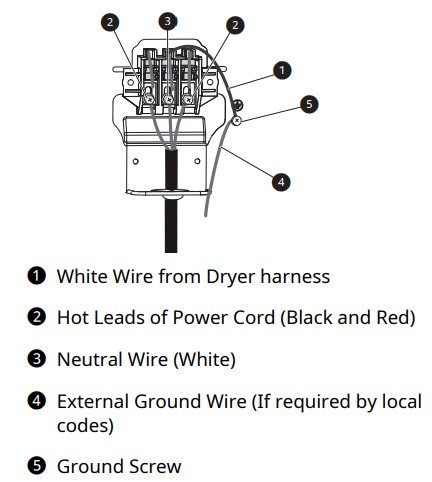
- Attach the two hot leads (black and red) of the power cord to the outer terminal block screws.
- Attach the neutral (white) wire to the center terminal block screw.
- Connect the external ground (if required by local codes) to the green ground screw.
- Tighten all screws securely.
- Reinstall the terminal block access cover.
Three-Wire Direct Wire
- A 3-wire connection is NOT permitted on new construction after January 1, 1996.
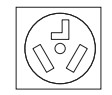
- A UL-listed strain relief is required.
- Use UL-listed 3-wire, #10 AWG minimum copper conductor cable. Allow at least 5 ft. (1.5 m) length to allow for removal and installation of dryer.
- Remove 3.5 inches (8.9 cm) of the outer covering from the wire. Strip 1 inch (2.5 cm) insulation from each wire. Bend the ends of the three wires into a hook shape.
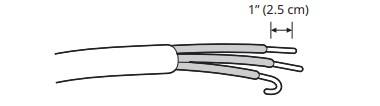
- Remove the terminal block access cover on the upper back of the appliance.
- Install UL-listed strain relief into the power cord through-hole.
- Thread the 3-wire, #10 AWG minimum copper conductor power cable prepared in step 1 through the strain relief.
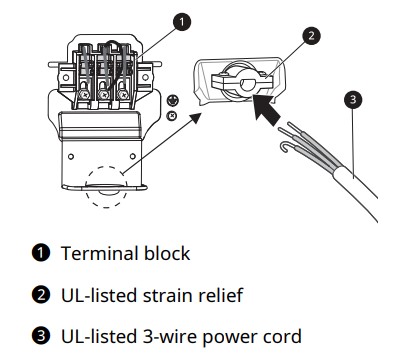
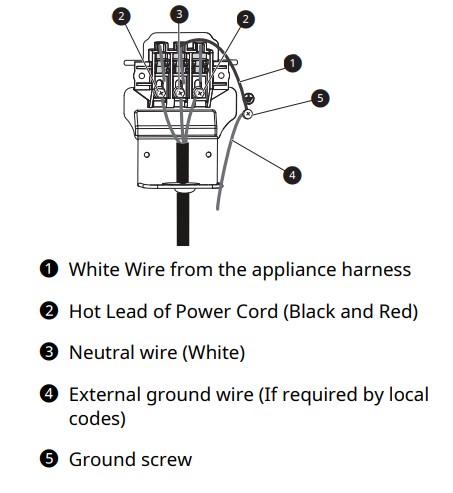
- Attach the two hot leads (black and red) of the power cord to the outer terminal block screws.
- Attach the neutral (white) wire to the center terminal block screw.
- Connect the external ground (if required by local codes) to the green ground screw.
- Tighten all screws securely.
- Reinstall the terminal block access cover.
Special Electrical Requirements For Mobile or Manufactured Homes
- Any installation in a manufactured or mobile home must comply with the Manufactured Home Construction and Safety Standards Title 24 CFR, Part 3280 or Standard CAN/ CSA Z240 MH and local codes and ordinances. If you are uncertain whether your proposed installation will comply with these standards, please contact a service and installation professional for assistance.
- A 4-wire connection is required for all mobile and manufactured home installations, as well as all new construction after January 1, 1996.
- The electrical connection for an electric dryer must be a 4-wire connection. More detailed information concerning the electrical connection is provided in the section Connecting Electric Dryers.
- To reduce the risk of combustion and fire, the dryer must be vented to the outside.
- DO NOT vent the dryer under a manufactured home or mobile home.
- Electric dryers may be vented to the outside using the back, left, right, or bottom panel.
- Make sure the dryer has adequate access to outside fresh air to ensure proper operation. The opening for outside fresh air must be at least 25 sq. in (163 cm 2).
- Please be aware that venting materials are not supplied with the dryer. You must obtain the venting materials necessary for proper installation. Final Installation Check Once you have completed the installation of the dryer and it is in its final location, confirm proper operation with the following tests. Checking Levelness Once the dryer is in its final location, recheck the dryer to be sure it is level. Make sure it is level front to back and side to side, and that all four leveling feet are in firm contact with the floor.
OPERATION
- Never attempt to operate this appliance if it is damaged, malfunctioning, partially disassembled, or has missing or broken parts, including a damaged cord or plug.
- Repair or immediately replace all power cords that have become frayed or otherwise damaged. Do not use a cord that shows cracks or abrasion damage along its length or at either end.
- If you detect a strange sound, a chemical or burning smell, or smoke coming from the appliance, unplug it immediately, and contact an LG Electronics customer information center.
- Never unplug the appliance by pulling on the power cord. Always grip the plug firmly and pull straight out from the outlet.
- Do not use an extension cord or adapter with this appliance.
- Do not grasp the power cord or touch the appliance controls with wet hands.
- Do not modify or extend the power cord.
- If the appliance has been submerged, contact an LG Electronics customer information center for instructions before resuming use.
- Do not store or use gasoline or other flammable vapors and liquids in the vicinity of this or any other appliance.
- Keep the area underneath and around your appliances free of combustible materials (lint, paper, rags, etc.), gasoline, chemicals and other flammable vapors and liquids.
- This appliance is not intended for use by persons (including children) with reduced physical, sensory or mental capabilities, or lack of experience and knowledge, unless they have been given supervision or instruction concerning the use of the appliance by a person responsible for their safety.
- Use this appliance only for its intended purpose.
- Do not abuse, sit on, or stand on the door of the appliance.
- Do not allow children to play on, in or with the appliance. Close supervision of children is necessary when the appliance is used near children.
- Do not tamper with controls.
- Do not put oily or greasy clothing, candles or flammable materials on top of the appliance.
- Do not reach into the appliance if the drum is moving.
- Do not dry articles that have been previously cleaned in, washed in, soaked in, soiled with or spotted with gasoline, dry cleaning solvents, vegetable oil, cooking oil or other flammable or explosive substances, as they give off vapors that could ignite or explode.
- Do not use heat to dry articles containing foam rubber or similarly textured rubber-like materials.
- Do not store plastic, paper, or clothing that may burn or melt on top of the dryer during operation.
- Always check the inside of the appliance for foreign objects.
- Do not place items exposed to cooking oils in your dryer. Items contaminated with cooking oils may contribute to a chemical reaction that could cause a load to catch fire. To reduce the risk of fire due to contaminated loads, the final part of a tumble dryer cycle occurs without heat (cool down period). Avoid stopping a tumble dryer before the end of the drying cycle unless all items are quickly removed and spread out so that the heat is dissipated.
- Do not let children or pets climb inside the dryer drum.
- Do not put living animals such as pets inside the appliance.
- Do not put any part of your body, such as your hands or feet, or metal objects under the appliance.
- Do not let your hand get pinched when opening or closing the dryer door.
Operation Overview
- Ensure the lint filter and water container are clean.
• Open the door and ensure the lint filter is clean. When the filter is full with lint, drying times will be longer than usual.
• Pull out the water container and empty the condensed water. When the water container is full, the appliance may stop during the cycle. - Place the clothes into the drum after sorting and close the door.
• Make sure that clothing is pushed entirely into the drum and away from the door seal area. Clothing that gets stuck between the door and seal may be damaged or damage the seal.
• Clothes should be sorted by fabric types and desired dryness level.
• All strings and attached belts of clothes should be well tied and secured before being put into the drum. - Press the Power button to turn the appliance on.
• Depending on the model, the Power button may light up to indicate that the appliance is ready to dry. - Choose a drying cycle by turning the cycle selector knob.
- Press the Start/Pause button to start the drying cycle.
- After the drying cycle has finished, open the door and unload the clothes. If you press the Start/Pause button without choosing a cycle, the appliance will proceed with the Normal cycle. Please refer to the cycle table for detailed information.
- Press the Power button to turn the appliance off.
- Clean the lint filter and empty the water container.
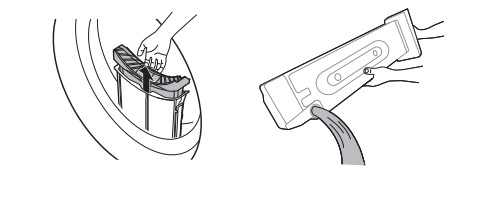
- To help prevent odors, leave the dryer door slightly open to help air out the drum after use.
WARNING: For safety, do not allow children or animals to climb inside the appliance. They could be injured or damage the appliance.
NOTE
- The final part of the dry cycle does not use heat. This cool down period helps prevent damage to clothing.
- A high ambient temperature and a small room may both increase drying time as well as energy consumption.
Loading the Dryer
Grouping Similar Items
For the best drying results, and to reduce the possibility of damage to clothing, sort clothes into loads that can be dried with the same drying cycle. Different fabrics have different care requirements, and some fabrics will dry more quickly than others.
Woolen Items
- Always follow fabric care labels before drying woolen items in a dryer. After the cycle, the items may still be damp. Do not repeat the cycle. Pull the items to their original shape if needed and lay them flat to finish drying.
Woven and Loopknit Materials
- Some woven and loopknit materials may shrink, depending on quality.
Permanent Press and Synthetics
- Do not overload your dryer. Take out permanent press items as soon as the dryer stops to reduce wrinkles.
Baby Clothes and Nightgowns
- Always check the manufacturer’s instructions.
Rubber and Plastics
- Do not dry any items made from or containing rubber or plastics such as:
- Aprons, bibs and chair covers
- Curtains and tablecloths
- Bath mats
Fiberglass
- Do not dry fiberglass articles in your dryer. Glass particles left in the dryer could be picked up by your clothes the next time you use the dryer and irritate your skin.
Fabric Care Labels
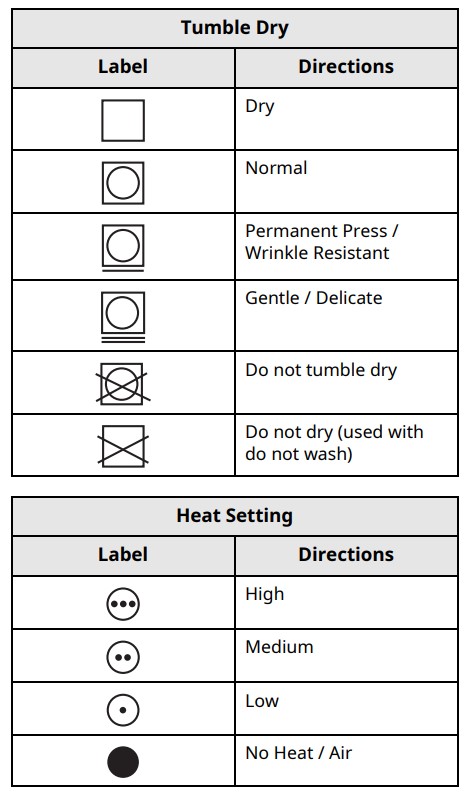
- Sort and dry laundry according to care labels, size, and fabric type. Do not overload the dryer. This will save energy and time and give the best drying performance. Fabric Care Labels Many articles of clothing include a fabric care label. Using the chart below, adjust the cycle and option selections to care for your clothing according to the manufacturer's recommendations.
Control Panel
Control Panel Features
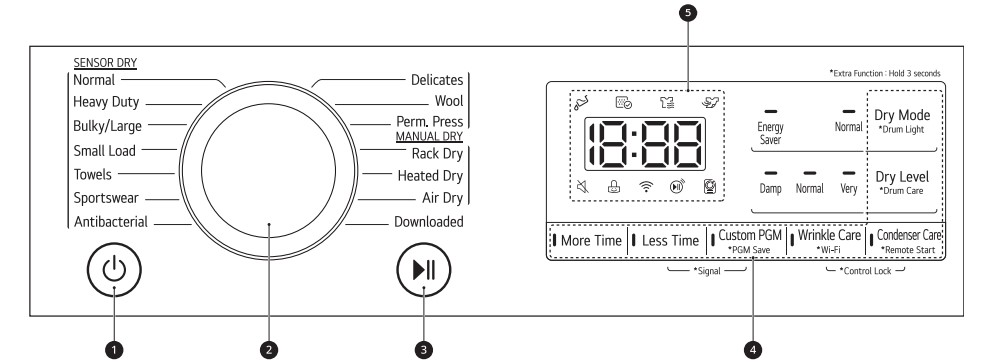
- Power Button
- Press the button to turn the appliance on. Press again to turn the appliance off.
- Cycle Selector Knob
- Turn this knob to select the desired cycle. Once the desired cycle has been selected, the standard presets will be shown in the display. On Manual Dry cycles, these settings can be adjusted using the cycle modifier buttons anytime before starting the cycle.
- Start/Pause Button
- Press this button to start the selected cycle. If the appliance is running, use this button to pause the cycle without losing the current settings.
- Extra Options and Functions / Cycle Modifier Buttons
- Use these buttons to select the desired options for the selected cycle. Not all options are available for each cycle.
- Remote Start
- With the LG ThinQ app, you can use a smartphone to control your appliance remotely.
- Wi-Fi: Press and hold the Wrinkle Care button for 3 seconds to initiate the connection of the appliance to the LG ThinQ application.
- Time and Status Display
- The display shows the settings, estimated time remaining, options, and status messages for the appliance. When the appliance is turned on, the default settings in the display will illuminate.
Time and Status Display
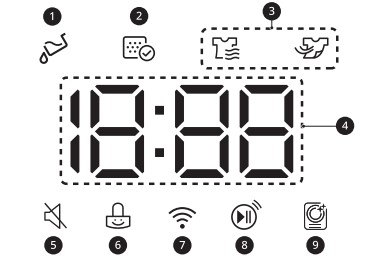
1. Water Full Indicator
-
 lights up at the beginning of a cycle to remind you to empty the water container before drying. It also lights up when the water container is full and needs to be emptied.
2. Lint Filter Status Indicator
-
 lights up at the beginning of the cycle to remind you to check the lint filter. It also lights up if the lint filter needs to be cleaned or is missing.
- If the lint filter is not inserted, the icon will light up and the appliance will not operate.
3. Cycle Status Indicators
-
 lights up when the appliance is in the drying stage.
 -
 lights up when the appliance is in the cool down stage. After
  lights up, the appliance can operate for up to 20 minutes.
4. Estimated Time Remaining
- When a drying cycle is selected, the estimated drying time for the selected cycle is displayed. This time will change if you select extra options for the cycle.
- The cycle time on Sensor Dry cycles may fluctuate as the appliance recalculates drying time for optimal results.
5.  lights up when the button and end-of-cycle sounds are turned off.
6.  lights up when the control panel is locked.
7.  lights up when the appliance is connected to Wi-Fi network at home.
8.  lights up when the remote control feature is activated.
9.  lights up while the Drum Care function is operating
Drying Cycles
Turn the knob or press the button to select the desired cycle. When you select a drying cycle the light for the corresponding drying cycle will turn on.
Sensor Dry Cycles
Sensor dry cycles utilize LG's unique dual sensor system to detect and compare the moisture level in clothes and in the air and adjust the drying time as needed to ensure superior results. The appliance automatically sets the dryness level and temperature at the recommended setting for each cycle. The estimated time remaining will be shown in the display
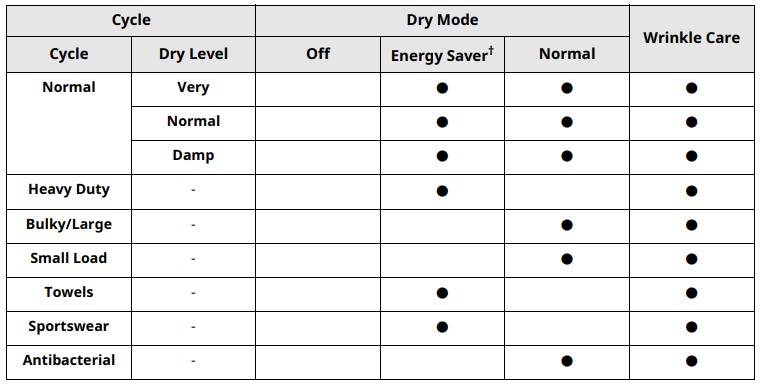
- Normal
- Description: Use this cycle for drying all normal items such as cotton, linen, shirts, jeans or mixed loads, except delicate fabrics such as wool or silk.
- Dry Level:
- Default: Normal
- Available: All
- Dry Mode
- Default: Energy Saver
- Available: All
- Wrinkle Care
- Heavy Duty
- Description: Use this cycle for drying heavy-duty clothes like jeans or garments that need extra drying.
- Dry Level :Not adjustable
- Dry Mode
- Default: Energy Saver
- Available: Energy Saver
- Wrinkle Care
- Bulky/Large
- Description: Use this cycle for drying blankets or bulky items such as pillows, blankets, comforters, sheets or pet bedding.
- Dry Level Not adjustable
- Dry Mode
- Default: Normal
- Available: Normal
- Wrinkle Care
- Small Load
- Description Use this cycle for drying light or small items. (up to 3 items)
- Dry Level Not adjustable
- Dry Mode
- Default: Normal
- Available: Normal
- Wrinkle Care
- Towels
- Description Use this cycle for drying towels.
- Dry Level Not adjustable
- Dry Mode
- Default: Energy Saver
- Available: Energy Saver
- Wrinkle Care
- Sportswear
- Description Use this cycle for drying special garments for sports and outdoor wear.
- Dry Level Not adjustable
- Dry Mode
- Default: Energy Saver
- Available: Energy Saver
- Wrinkle Care
- Antibacterial
- Description Using this cycle helps to reduce bacteria.
- Dry Level Not adjustable
- Dry Mode
- Default: Normal
- Available: Normal
- Wrinkle Care
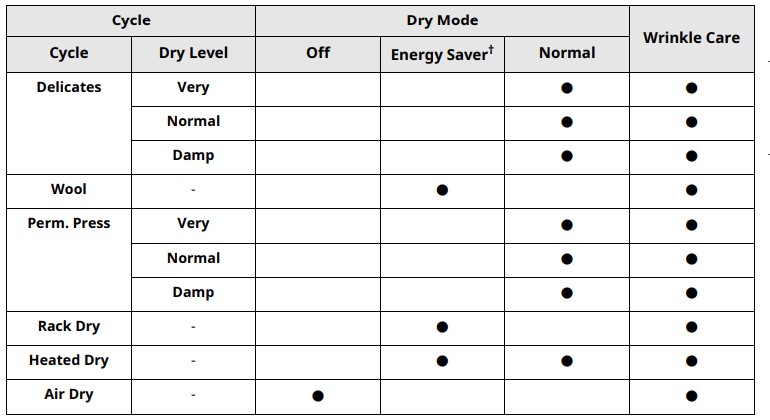
- Delicates
- Description Use this cycle for drying dress shirts/blouses, nylons, lingerie, or sheer and lacy clothes which can easily be damaged.
- Dry Level
- Default: Normal
- Available: All
- Dry Mode
- Default: Normal
- Available: Normal
- Wrinkle Care
- Wool
- Description Use this cycle for drying shrinkable woolen or hand-washable items requiring delicate care.
- Dry Level Not adjustable
- Dry Mode
- Default: Energy Saver
- Available: Energy Saver
- Wrinkle Care
- Perm. Press
- Description Use this cycle to minimize wrinkles when drying tablecloths or wrinkle-free clothes.
- Dry Level
- Default: Normal
- Available: All
- Dry Mode
- Default: Normal
- Available: Normal
- Wrinkle Care
Manual Dry Cycles
Use Manual Dry cycles to select a specific amount of drying time and a drying temperature. When a Manual Dry cycle is selected, the actual time remaining in your cycle appears on the display. You can change the actual time in the cycle by pressing the More Time or Less Time buttons.
- Rack Dry: Use this cycle to dry clothes without tumble action. It is suitable for all fabrics that need refreshing.
- Heated Dry: Use this cycle to dry clothes that can be tumble dried using heat.
- Air Dry: Use this cycle to dry all fabrics that can be tumble dried without using heat.
Special Drying Cycles
- Downloaded: This cycle allows you to download a new and specialized drying cycle to your appliance with a smartphone.
- Refer to the LG ThinQ smartphone application to see the cycles available for download.
Selectable Drying Options
This option helps to reduce the energy used when drying clothes by circulating the refrigerant at a lower speed than in the Normal mode. When this option is selected, the drying time will increase
Options and Extra Functions
- Dry Level: Use this option to select the dryness level for the cycle. Press the Dry Level button repeatedly to scroll through available settings.
- Dry Mode Use this option to help reduce energy consumption when drying clothes.
- Normal: Dry clothes with recommended settings.
- Energy Saver: Dry clothes with recommended settings while circulating the refrigerant at a lower speed than Normal mode. When the option is selected, the drying time will increase.
- More Time / Less Time : Use these buttons to increase or decrease drying time in 1 minute increments when you use manual drying cycles such as Rack Dry, Heated Dry and Air Dry.
- Wrinkle Care: Selecting this option will tumble the load periodically for up to 2 hours after the selected cycle, or until the door is opened. This is helpful in preventing wrinkles when you are unable to remove items from the dryer immediately. Press the Wrinkle Care button before you start a drying cycle.
- Signal On/Off: The appliance plays a melody when the drying cycle is finished. The buttons make a sound each time they are pressed. Use this button to turn the melody and button tones on or off.
- To turn on/off, press and hold the Less Time and Custom PGM buttons for 3 seconds at the same time.
- When the signal is muted, q lights up on the display.
- Drum Light: The drum is equipped with a light that illuminates when the appliance is turned on. The light automatically turns off when the dryer door is closed and the cycle starts. To turn on the light during a cycle, press and hold the Dry Mode button for 3 seconds. The drum light will turn on and then turn off automatically after 4 minutes.
- Custom PGM: Save special combinations of settings that are used frequently as a custom program.
- Turn on the appliance and select the desired settings using the cycle selector knob and cycle modifier or option buttons. ->Press and hold the Custom PGM button for 3 seconds
- Recalling a Custom Program ->Turn on the appliance and press the Custom PGM button ->Press the Start/Pause button to start the cycle
- Rack Dry: Use this function with items, such as wool sweaters, silk items, and lingerie, that should be dried flat. The function can also be used with items that should not be tumbled dry, such as gym shoes or stuffed animals.
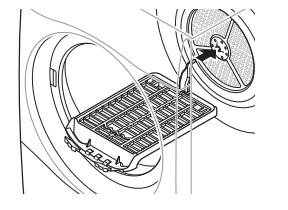
- With the door open, slide the rack into the drum and insert the hook on the drying rack into the hole at the center back of the drum.
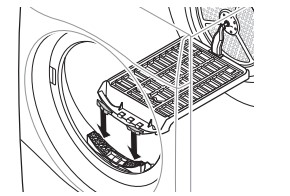
- Seat the front of the rack securely on the inner door rim and the back of the rack on the rim at the back of the drum.
- Place wet items on the rack. Allow space around the items for air to circulate.
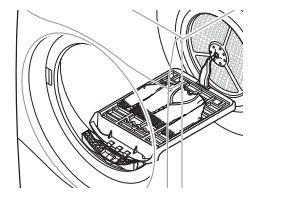
- Close the door and select Rack Dry.
- Adjust drying time by pressing the More Time and Less Time buttons.
- Press the Start/Pause button to start the cycle
- Control Lock :Use this function to disable the controls. This function can prevent children from changing cycles or operating the dryer.
- Locking/Unlocking the Control Panel
- Turn on the power.
- Press and hold the Wrinkle Care and Condenser Care buttons at the same time for 3 seconds to activate or deactivate this function
Installing the LG ThinQ Application
Search for the LG ThinQ application from the Google Play Store or Apple App Store on a smartphone. Follow instructions to download and install the application. Using the Appliance Remotely Remote Start Use a smartphone to control the appliance remotely. You can also monitor the cycle operation so you know how much time is left in the cycle.
Using Remote Start
- Put the laundry into the drum and close the dryer door.
- Press the Power button.
- Press and hold the Remote Start button for 3 seconds to enable the remote control function.
- Start a cycle from the LG ThinQ application on your smartphone.
NOTE
- Once the function is enabled, you can only start a cycle from the LG ThinQ smartphone application. If the cycle is not started, the application will wait to start the cycle until it is turned off remotely from the application or this function is disabled.
- If the door has been opened, you cannot start a cycle remotely.
Disabling Remote Start Manually
When the function is activated, press and hold the Remote Start button for 3 seconds. Download Cycle You can download new and specialized cycles that are not included in the standard cycles on the appliance.
Appliances that have been successfully connected to a Wi-Fi network can download a variety of specialty cycles specific to the appliance. Once cycle download is completed in the appliance, the product keeps the downloaded cycle until a new cycle is downloaded.
NOTE: Only one downloaded cycle can be stored on the appliance at a time.
Wireless LAN Module Specifications
- Frequency Range: 2412 - 2462 MHz
- Output Power (Max): < 30 dBm
MAINTENANCE
- Do not repair or replace any part of the appliance. All repairs and servicing must be performed by qualified service personnel unless specifically recommended in this Owner’s Manual. Use only authorized factory parts
- Do not disassemble or repair the appliance by yourself.
- Remove any dust or foreign matter from the power plug pins.
- Disconnect this appliance from the power supply before cleaning and attempting any user maintenance. Turning the controls to the OFF position does not disconnect this appliance from the power supply.
- Remove the door before the appliance is removed from service or discarded to avoid the danger of children or small animals getting trapped inside.
- Unplug the appliance before cleaning to avoid the risk of electric shock.
- Certain internal parts are intentionally not grounded and may present a risk of electric shock only during servicing. Service personnel – Do not contact the following parts while the appliance is energized: Motor, Control Board, Noise Filter.
WARNING
- Unplug the appliance before cleaning.
- Never use harsh chemicals, abrasive cleaners, or solvents to clean the appliance. They will damage the finish. Regular Cleaning Cleaning the Lint Filter CAUTION
- Refer to the following instructions for proper cleaning of the lint filter. Failure to do so can cause lint buildup on the condenser that can affect the drying performance. NOTE
- Cleaning the lint filter will reduce drying time and energy consumption and prevent unnecessary malfunctions.
- Unload all of the clothes from the appliance before pulling out the lint filter.
- After cleaning the 2-piece lint filter, insert it back into place. The appliance will not operate without the lint filter in place.
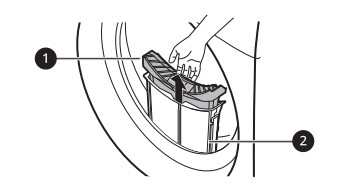
1. Inner Filter
- Always clean the inner filter before and after use.
2. Outer Filter
- Clean the outer filter after drying 10 times or when the lint has accumulated on the outer filter.
- A chime will sound after every 10 drying cycles and the
 icon will blink.
Cleaning the Inner Filter
1. Pull out the inner filter from the outer filter and then open the inner filter.
- Open the filter by unfolding it in the direction of the arrow.
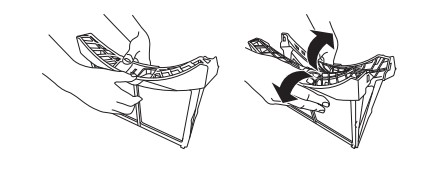
2. Use your fingers to get most of the lint off the filter. To clean off residual lint, use a vacuum cleaner or rinse under running water.
- The filter must be completely dry before using or it could cause an unpleasant odor.
CAUTION: Do not tap the filter repeatedly as the built-in magnet may dislodge and cause a malfunction.
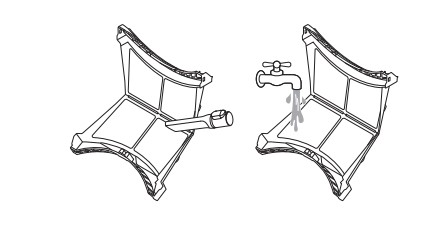
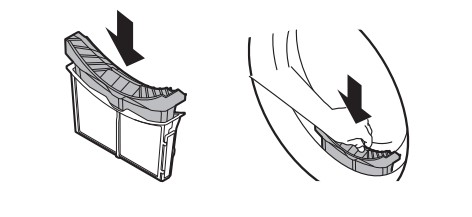
3. After drying the inner filter completely, close the filter by pushing the center down.
- Ensure the left and right sides of the inner filter are closed properly.
4. Insert the inner filter into the outer filter
Cleaning the Outer Filter
1. Remove the dust or lint around the filter inlet.
CAUTION: If the lint drops into the filter inlet, it may cause degradation of drying performance and increase in drying time.
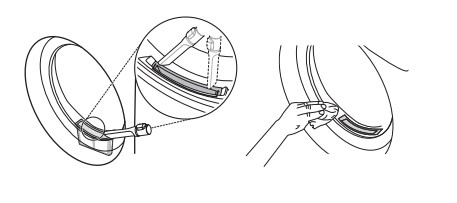
2. Pull out the outer filter.
3. Remove the inner filter.
.4 Open the outer filter by grasping the top edge and unfolding the sides.
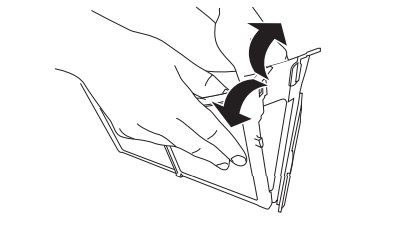
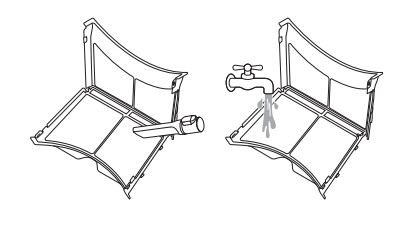
5. Remove the residual lint with a vacuum cleaner or by washing under running water.
- If washed, allow the filter to dry completely before use. Failure to do so may cause an odor.
CAUTION: Do not tap the filter repeatedly as the built in magnet may dislodge and cause a malfunction.
6. Push the two sides 1 of the filter together to close it.
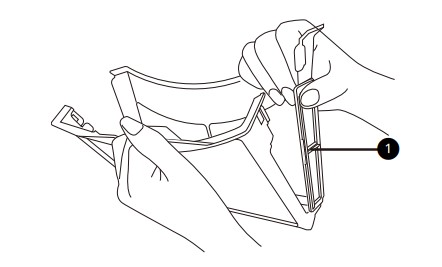
7. Reassemble the filters and reinsert them.
CAUTION: Do not load or remove any clothes when the lint filter is not in place. The clothes can drop into the filter inlet and it may cause the appliance to malfunction.
Emptying the Water Container
Condensed water is collected in the water container. Empty the water container after every use. Not doing so will affect the drying performance.
NOTE: If the water container is full,  icon lights up and sounds while the appliance is running. If the condensed water is drained out directly through the optional drain hose, there is no need to empty the water container.
1 Pull out the water container.
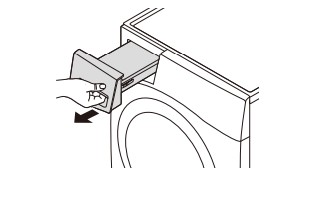
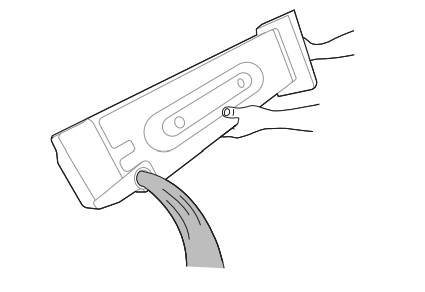
2 Empty the water container into the sink.
CAUTION: Do not drink the condensed water or reuse it. Doing so could lead to health problems for people and animals. The water container is heavy when full. Hold the water container with two hands and be careful not to drop it.
3 Refit the water container into the appliance. Push it fully into the appliance until it is in place.
4 Press the Start/Pause button to run a cycle.
Cleaning the Exterior
Proper care of your appliance can extend its life. The outside of the appliance can be cleaned with warm water and a mild, nonabrasive household detergent. Immediately wipe off any spills with a soft, damp cloth.
NOTE: Do not use methylated spirits, solvents, or similar products. Never use steel wool or abrasive cleansers; they can damage the surface.
Cleaning the Interior
Wipe around the door opening and seal with a soft, damp cloth to prevent lint and dust buildup that could damage the door seal.
Clean the window with a soft cloth dampened with warm water and a mild, nonabrasive household detergent. Then wipe dry.
The stainless steel drum can be cleaned with a conventional stainless steel cleaner, used according to the manufacturer’s specifications. Never use steel wool or abrasive cleansers; they may scratch or damage the surface.
Periodic Cleaning
Wiping the Moisture Sensor
This device senses the moisture level of the clothes during operation. It must be cleaned regularly to remove any buildup of lime scale on the surface of the sensor. Wipe the sensors inside the drum.
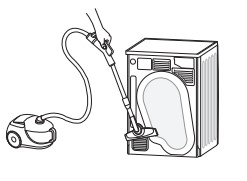
Cleaning the Cool Air Inlet Grille
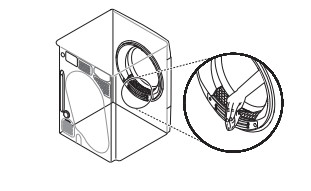
Vacuum the cool air inlet grille 3 - 4 times a year to make sure there is no buildup of lint or dirt that can cause improper airflow. Always unplug the appliance before cleaning or vacuuming it.
Draining the Remaining Condensed Water
After drying clothes, a small quantity of condensed water may sit in the base of the appliance and cause odors. Drain the remaining water regularly to reduce any unpleasant odors from the appliance.
- Run the Air Dry cycle for 3 minutes, and then turn off the appliance.
- Unclip the drain tube under the appliance, remove the plug and drain the remaining water.
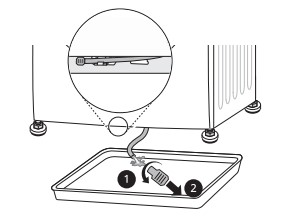
- Reassemble the plug onto the drain tube and reclip the drain tube into its holder.
Using Drum Care Feature
Run the Drum Care cycle periodically to prevent unpleasant odors in the drum.
- Remove the water container, empty it, and reassemble it.
- Turn on the appliance.
- Press the Drum Care button for 3 seconds.
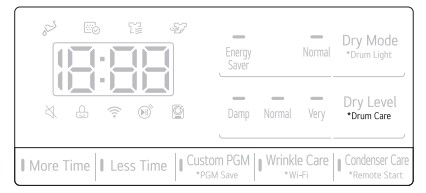
- Press the Start/Pause button.
- This function operates for about 3 hours.
- Empty the water container after the function has finished.
Using Condenser Care Feature
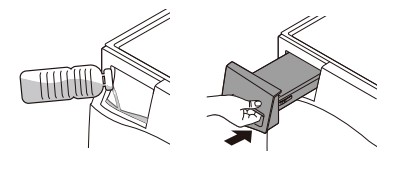
The appliance automatically cleans built-up lint off of the condenser using water condensed from the drying process. If needed, the condenser can also be cleaned manually.
- Pull out the water container and empty it.
- Pour 34 oz. (1 liter) of clean water slowly into the opening of the water container compartment. Then slide the empty water container back into the compartment.
- Do not pour the water quickly as it will spill out.
- Pouring more that 51 oz. (1.5 liters) of water into the compartment will cause water to leak out
- Turn on the appliance
- Press the Condenser Care button
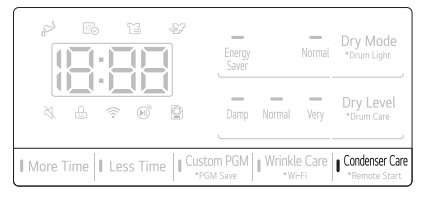
- Press the Start/Pause button to start cleaning the condenser.
- The condenser cleaning process takes about 1 hour.
- Empty the water container after the cleaning is finished.
NOTE : If the optional drain hose is installed, there is no need to empty the water container. - Open the dryer door and leave it open to allow air to circulate and thoroughly dry the drum.
Care in Cold Climates
If the ambient temperature is too low, the condensed water inside the appliance could freeze and affect the appliance operation. If water freezes inside the appliance, follow these steps to thaw out the appliance before using it.
Thawing out the Accessories
- Frozen Water in Drain Hose
- Wrap the drain hose in a towel soaked in hot water (140 ℉ / 60 ℃).
- Frozen Water in Water Container
- Remove the water container and place it in a sink filled with hot water (140 ℉ / 60 ℃).
Thawing out the Appliance
- Turn on the appliance and press the Less Time button for 3 seconds.
- Press the Start/Pause button to start the thawing mode.
- Actual thawing time varies depending on the installation environment such as installation location and ambient temperature of the appliance.
- When thawing is complete, dry clothes as usual.
Thawing out the Appliance Manually
- Open the dryer door and pull out both the inner and outer filters.
- Carefully pour 34 oz. (1 liter) of hot water at 140 ℉ / 60 ℃ into the lint filter compartment and then reinsert both lint filters.
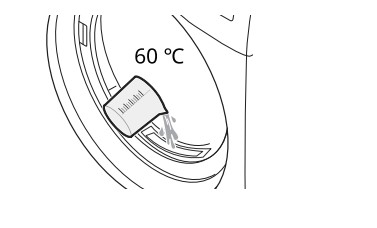
- Turn on the appliance and run the Normal cycle for about 30 seconds. Then wait about 30 minutes.
- Run the Normal cycle again. Check if the OE message appears or
 lights up within 10 minutes of running the appliance.
 - If the OE message or
 icon appears go to step 2 and repeat procedure.
 - If the OE message or
 do not appear, the thawing process is done.
- When thawing is complete, dry clothes as usual.
TROUBLESHOOTING
FAQs Frequently Asked Questions
Q: When I press a button, why does my dryer beep and then nothing happens?
A: The Control Lock feature is turned on. To turn off Control Lock, turn the dryer on and press and hold the button that has Control Lock on or under it for 3 seconds.
Q: Why does my dryer take so long to dry clothes?
A: Proper airflow is critical to the efficient operation of clothes dryers. A lint filter which is full of lint or clogged with fabric softener sheet residue can reduce the airflow to the point that the time required to dry clothing will be greatly increased.
Q: Why does my dryer start by itself every few minutes?
A: This is how the Wrinkle Care feature works. The dryer runs briefly every few minutes for up to 2 hours after the cycle finishes. This feature is designed to help prevent wrinkles from setting in when the dryer is not unloaded immediately after the cycle is finished.
User Support Videos For further assistance, there are videos and tutorials available through the lg.com website.
Scan this QR code to quickly access the video search page on the offical LG website. 
- On the lg.com/us home page, click on the Support menu tab to bring up the menu selections. Select Video Tutorials.
- Type Dryer in the search box on the new page and click the Search button
Before Calling for Service
The dryer is equipped with an automatic error-monitoring system to detect and diagnose problems at an early stage. If the dryer does not function properly or does not function at all, check the following before you call for service.
Error Messages
 DOOR ERROR
- The door has been opened while the appliance is in operation or the appliance is being operated without the door being closed properly.
- Close the door completely.
- If dE recurs, call for service.
 DOOR ERROR
- Door switch detection is not working properly.
- Unplug the power plug and call for service.
-
 TEMPERATURE ERROR
- Temperature Sensor has malfunctioned.
- Unplug the power plug and call for service.
-
 TEMPERATURE ERROR
- The temperature inside the drum has risen suddenly.
- Unplug the power plug and call for service.
 MOTOR LOCKED ERROR
- The motor has stopped suddenly.
- Check if the amount of clothing exceeds the maximum load capacity.
- Unplug the power plug and call for service.
-
 COMPRESSOR ERROR
- The compressor has stopped suddenly.
- Unplug the power plug and call for service.
 DRAIN PUMP ERROR
- The drain pump motor has malfunctioned.
- Unplug the power plug and call for service.
- The temperature at the installation location is below zero.
- The recommended surrounding temperature for installation is 41 - 95 ℉ (5 - 35 ℃).
 POWER SUPPLY ERROR
- Power cord is connected incorrectly.
- Check the connection of the power cord to the terminal block.
Operation
- The appliance will not turn on.
- Power cord is not properly plugged in.
- Make sure that the power plug is securely plugged into a grounded outlet matching the appliance's rating plate.
- House fuse is blown, circuit breaker has tripped, or power outage has occurred.
- Reset circuit breaker or replace fuse. Do not increase fuse capacity. If the problem is a circuit overload, have it corrected by a qualified electrician.
- The appliance does not heat.
- House fuse is blown, circuit breaker has tripped, or power outage has occurred.
- Reset circuit breaker or replace fuse. Do not increase fuse capacity. If the problem is a circuit overload, have it corrected by a qualified electrician.
- Selected cycle does not use heat.
- Some cycles default to unheated or air drying. Select a cycle that allows heated drying.
- Water leaks.
- The water container hose or the optional drain hose is not connected correctly.
- Connect the water container hose or the optional drain hose correctly.
- The door is closed while clothes or foreign substance is caught in the door.
- Check if clothes or foreign substance is caught in the door before using the appliance. If water leaks continuously, contact the LG Electronics Customer Information Center.
- The appliance runs and pauses by itself after the drying cycle finishes.
- This is normal operation for the Wrinkle Care option.
- Check to see if the Wrinkle Care option has been selected. The option is designed to prevent creases that are formed when the clothes are not unloaded promptly after the drying cycle. When the option is set, the appliance runs for 10 seconds and pauses for 5 minutes. The option runs for up to 2 hours.
- The control panel time has stopped at 1 minute.
- The cool down stage is operating to cool down high internal temperature of the drum for customer safety.
- The cool down stage can run for up to 20 minutes depending on the internal temperature of the drum.
- Drying ended earlier than the initial control panel time.
- The clothes are dried according to the Dry level or Dry mode setting.
- If the humidity or temperature in the drum reaches the product setting, the dry cycle may end earlier than the control panel time.
- Clothes take too long to dry.
- Energy Saver option selected (on some models).
- If using the Normal mode, deselect the Energy Saver mode. The Energy Saver mode reduces energy use but takes longer to dry clothes than the Normal mode.
Performance
- Clothes are wrinkled.
- . Clothes dried too long (overdried).
- Over drying a load of laundry can lead to wrinkled clothes. Try a shorter drying time or use the lower dry level setting and remove items while they still retain a slight amount of moisture.
- Clothes left in dryer too long after cycle ends.
- Use the Wrinkle Care option. This option will tumble the clothes briefly every few minutes for up to 2 hours to help prevent wrinkling.
- Greasy or dirty spots on clothes.
- Fabric softener used incorrectly.
- Confirm and follow the instructions provided with your fabric softener.
- Clean and dirty clothes are being dried together.
- Use your dryer to dry only clean items. Soil from dirty clothes can transfer to the clean clothes in the same or later loads.
- Clothes were not properly cleaned or rinsed before being placed in the dryer.
- Stains on dried clothes could be stains that were not removed during the washing process. Make sure that clothes are being completely cleaned or rinsed according to the instructions for your washer and detergent. Some difficult soils may require pre-treating prior to washing.
- Clothes are shrinking.
- Garment care instructions are not being followed.
- To avoid shrinking your clothes, always consult and follow fabric care instructions. Some fabrics will naturally shrink when washed. Other fabrics can be washed but will shrink when dried in a dryer. Use a low or no heat setting.
- Lint on clothes.
- Lint filter not cleaned properly.
- Remove the lint from the filter before every load. With the lint removed, hold the filter up to a light to see if it is dirty or clogged. If it looks dirty, follow the cleaning instructions in the MAINTENANCE section. With some loads that produce high amounts of lint, it may be necessary to clean the filter during the cycle.
- Laundry not sorted properly.
- Some fabrics are lint producers (i.e., a fuzzy white cotton towel) and should be dried separately from clothes that are lint trappers (i.e., a pair of black linen pants).
- Excess static in clothes.
- Use a fabric softener to reduce static electricity. Be sure to follow the manufacturer’s instructions. Overdrying a load of laundry can cause a buildup of static electricity.
- Adjust settings and use a shorter drying time, or use Sensor Dry cycles.
- The appliance is overloaded.
- Divide extra large loads into smaller loads for drying.
- Tissue, paper, etc., left in pockets.
- Check pockets thoroughly before washing and drying clothes.
- Excess static in clothes after drying.
- Fabric softener is not used or used incorrectly.
- Use a fabric softener or the Reduce Static option, if equipped, to reduce static electricity. Be sure to follow the manufacturer’s instructions.
- Clothes dried too long (overdried).
- Overdrying a load of laundry can cause a buildup of static electricity. Adjust settings and use a shorter drying time, or use Manual Dry cycles. Select a lower dry level setting on Sensor Dry cycles, if necessary.
- Drying synthetics, permanent press, or synthetic blends.
- These fabrics are naturally more prone to static buildup. Try using fabric softener, or use a lower dry level setting and/or shorter time settings for Manual Dry cycles.
- Clothes have damp spots after a Sensor Dry cycle.
- Very large load or very small load. Single large item such as a blanket or comforter.
- If items are too tightly packed or too sparse the sensor may have trouble reading the dryness level of the load. Use a Timed Dry cycle for very small loads.
- Large, bulky items such as blankets or comforters can sometimes wrap themselves into a tight ball of fabric. The outside layers will dry and register on the sensors, while the inner core remains damp. When drying a single bulky item, it may help to pause the cycle once or twice and rearrange the item to unwrap and expose any damp areas.
- To dry a few remaining damp items from a very large load or a few damp spots on a large item after a sensor cycle has completed, empty the lint trap, and then set a Timed Dry cycle to finish drying the item(s).
- The appliance has an unpleasant odor.
- Are you using the appliance for the first time?
- The odor is caused by the rubber material inside the appliance. The odor normal when the appliance is new and disappears after you run several cycles.
- Do you smell an odor during use?
- Do not exceed the manufacturer's recommended amount of detergent when washing clothes. Excess detergent can build up on clothing and cause odors.
- Leaving clothes in the washer or dryer after the cycle ends can lead to odors. Unload clothing promptly when the cycle ends.
- If the odor is coming from the washer, follow the instructions in the product manual to clean the washer tub/drum.
- Keep both lint filters clean. Clogged or dirty lint filters can cause odors. After cleaning the lint filter, allow it to dry completely before using it.
- Periodically run the Drum Care and Condenser Care cycles following the instructions in the MAINTENANCE section.
Wi-Fi
- Trouble connecting appliance and smartphone to Wi-Fi network.
- The password for the Wi-Fi network was entered incorrectly.
- Delete your home Wi-Fi network and begin the connection process again.
- Mobile data for your smartphone is turned on.
- Turn off the Mobile data on your smartphone before connecting the appliance.
- The wireless network name (SSID) is set incorrectly.
- The wireless network name (SSID) should be a combination of English letters and numbers. (Do not use special characters.)
- The router frequency is not 2.4 GHz.
- Only a 2.4 GHz router frequency is supported. Set the wireless router to 2.4 GHz and connect the appliance to the wireless router. To check the router frequency, check with your Internet service provider or the router manufacturer.
- The appliance is too far from the router.
- If the appliance is too far from the router, the signal may be weak and the connection may not be configured correctly. Move the router closer to the appliance or purchase and install a Wi-Fi repeater.