Read before operating your Rotiss-Kebab
All appliances - regardless of the manufacturer - have the poten-
tial through improper or careless use to create safety problems.
Therefore the following safety precautions should be observed:
1. Never use your appliance for warming or heating the room.
2. Children should not be left alone or unattended in area where
appliance is in use. They should never be allowed to sit or
stand on any part of the appliance.
3. Wear proper apparel. Loose-fitting or hanging garments
should never be worn while using the appliance.
4. Do not repair or replace any part of the appliance unless
specifically recommended in this manual. All other servicing
should bereferred toan authorized Jenn-Air Service Contractor.
5. Flammable materials should not be stored near surface units.
6. Do not use water on grease fires. Smother fire orflame or use
dry chemical or foam-type extinguisher.
7. Use only dry potholders. Moist or damp potholders on hot
surfaces may result in burns from steam. Do not let potholder
touch hot heating elements. Do not use a towel or other bulky
cloth.
8. Do not use the accessory for other than its intended use.
9. Caution should be used when inserting pointed spit or skewers
into food: protect your hand.
10. Keep cord of motor from touching the heating element.
11. Do not use aluminum foil to line surface unit drip pans or grill
basin. Installation of these liners may result in an electric
shock or fire hazard.
12. Do not soak or immerse removable heating elements in water.
13. CAUTION - Do not store items of interest to children in
cabinets above cooktop -children climbing on the cooktop to
reach items could be seriously injured.
14. Do not operate with damaged cooking element after any
product malfunction until proper repair has been made.
2
Additional Safety Precautions to Follow
When using Other Parts of Your Cooktop
1. Donottouch surface unitsorareas nearunits. Surface unitsor
heatingelementmay behoteventhoughtheyare dark incolor.
Areas near surface units may become hot enough to cause
burns. Duringandafter use,donottouch orletclothing orother
flammable materials contact these areas until they have had
sufficienttimeto cool. Other surfaces maybecomehotenough
to cause burns - among these surfaces is the cooktop.
2. Neverleavesurface unitsunattendedat highheatsettings. Boil
over causes smoking and greasy spillovers that may ignite.
3. Glazed cookware - only certain types of glass, glass-ceramic,
ceramic, earthenware, or other glazed cookware are suitable
forcooktop surfacewithout breakingduetothe suddenchange
intemperature. Useonlysuch cookwareasyou knowhasbeen
approved for this purpose.
4. Cookware handles should be turned inward and not extend
overadjacent surfaceheating elementsto avoidburns, ignition
offlammablematerialsandspillageduetounintentionalcontact
with the cookware.
5. Keepall switches "OFF" when unit isnot in use.
3
y
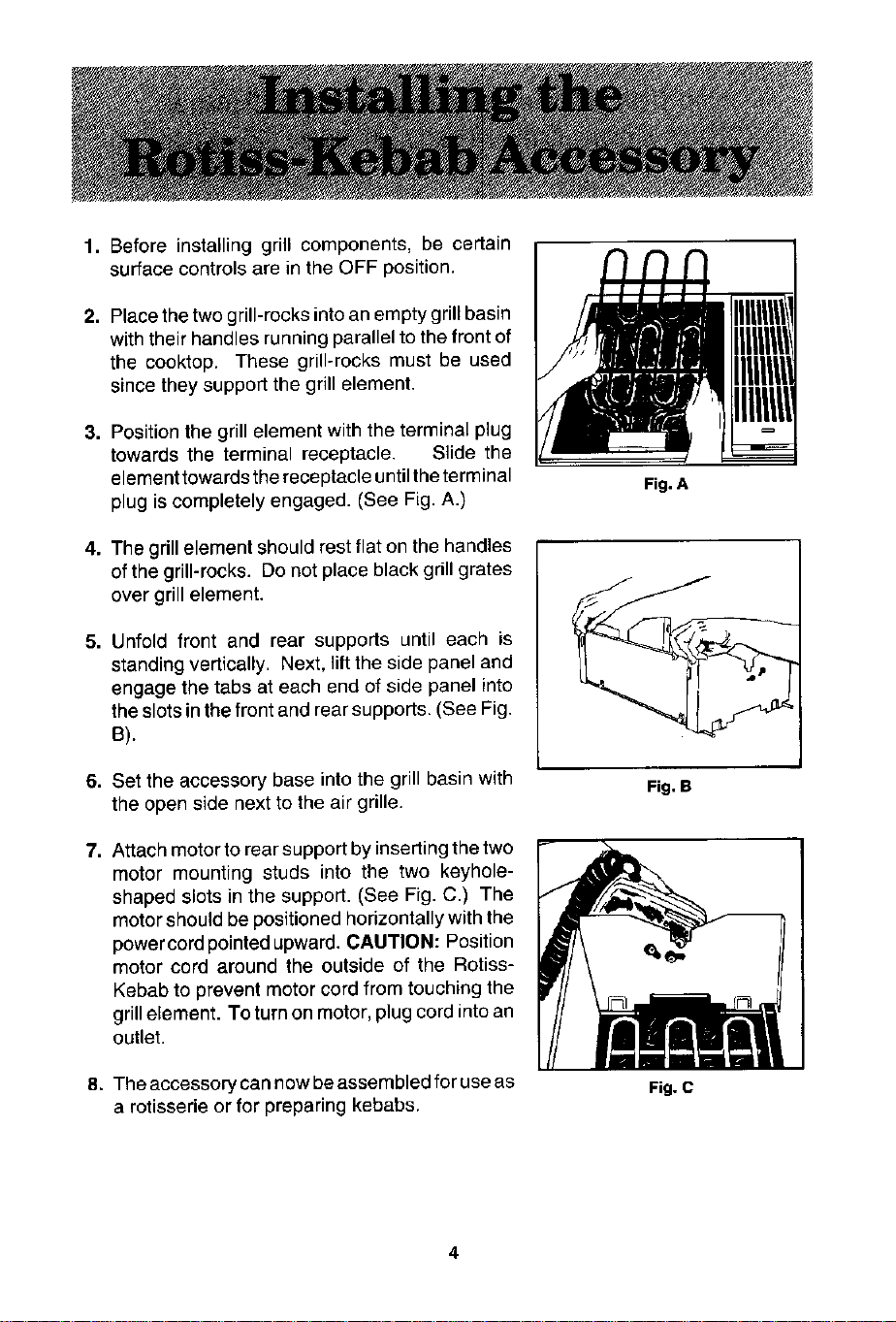
1. Before installing grill components, be certain
surface controls are in the OFF position.
2. Placethetwogrill-rocksintoanemptygrillbasin //UtlLqRm IllUllll;
with theirhandles running parallel to thefront of ,,,/,.--.--..--l'nmw UlUllll
the cooktop. These grill-rocks must be used / _/ilUllll'
since they support the grill element.
3. Position the grill element with the terminal plug ___11 / _ Illl_||_1iiiiIiii 1
towards the terminal receptacle. Slide the
elementtowardsthereceptacleuntiltheterminal Fig.A
plug iscompletely engaged. (See Fig. A.)
4. The grill element should rest flat on the handles
of thegrill-rocks. Do notplace black grill grates
over grill element. ._f_
5. Unfold front and rear supports until each is
standing vertically. Next, lift the sidepanel and
engage the tabs at each end of side panel into
the slotsinthe frontand rearsupports. (See Fig.
B).
6. Set the accessory base intothe grill basin with Fig.B
the open side next to the air grille.
7. Attachmotor torear support byinsertingthe two
motor mounting studs into the two keyhole-
shaped slots in the support. (See Fig. C.) The /
motor shouldbe positioned horizontally with the
powercord pointedupward.CAUTION: Position ,d
motor cord around the outside of the Rotiss-
!
Kebab to prevent motor cordfrom touching the
grill element. To turnon motor,plug cordintoan
outlet. /
8. Theaccessorycannowbeassembledforuseas Fig.C
a rotisserie or for preparing kebabs.
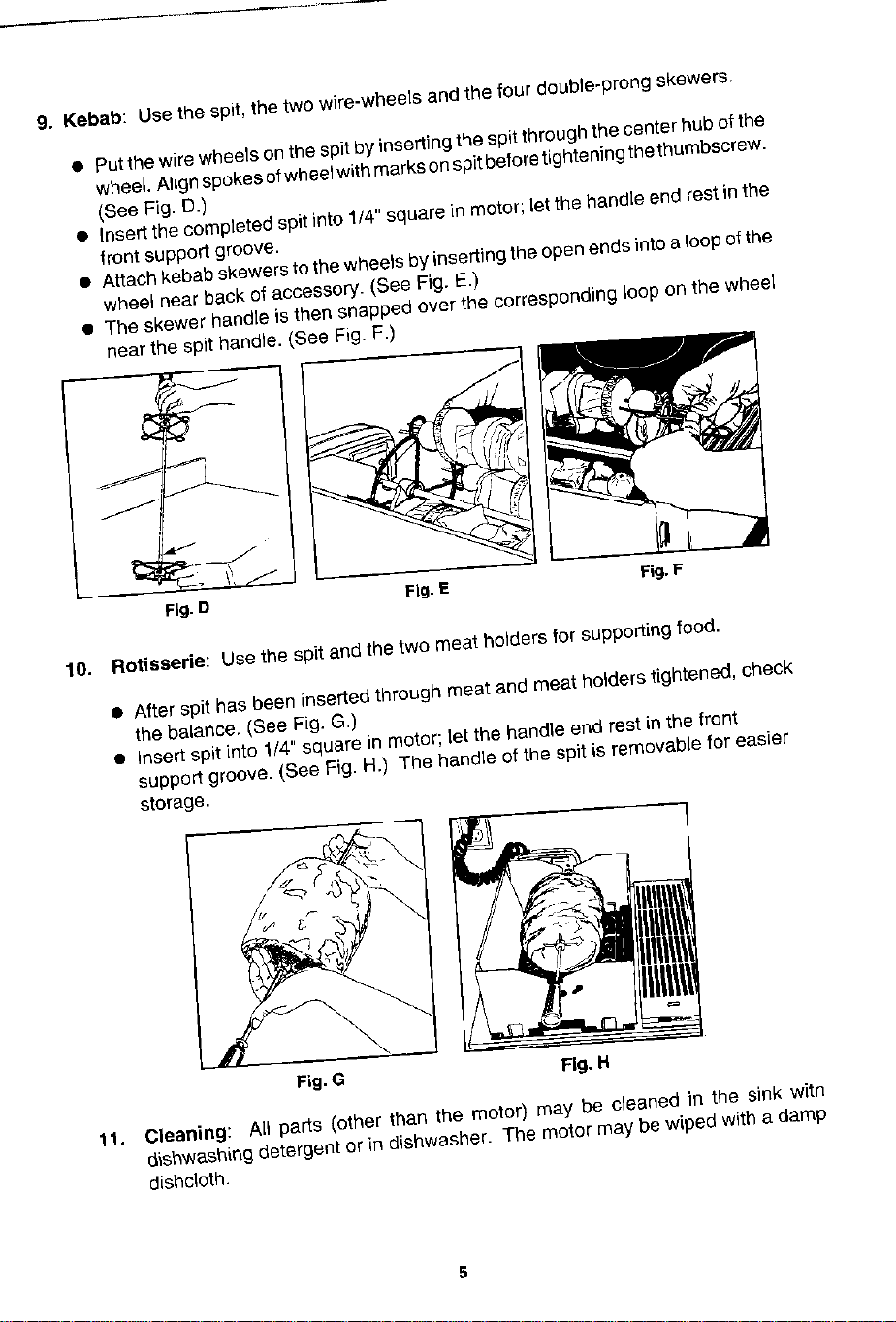
9. Kebab: Use the spit, the two wire-wheels and the four double-prong skewers,
• Put the wire wheels on the spit by inserting the spit through the center hub of the
wheel. Atign spokes ofwh eel with marks on spit before t(ghte ning the thumbscrew.
(See Fig. D.)
• Insert the completed spit into 1/4" square in motor; let the handle end rest in the
front support groove,
• Attach kebab skewers to the wheels by inserting the open ends into a (oep of the
wheel near back of accessory. (See Fig. E.)
• The skewer handle is then snapped over the corresponding (oop on the wheel
near the spit handle. (See Fig. F,)
Fig.D Fig.E Fig.F
10. Rotisserie: Use the spit and the two meat holders for supporting food.
• After spit has been inserted through meat and meat holders tightened, check
the balance. (See Fig. G.)
• Insert spit into 1/4" square in motor; let the handle end rest in the front
support groove. (See Fig. H.) The handle of the spit is removable for easier
storage.
Fig. G FIg, H
11, Cleaning: A[I parts (other than the motor) may be cleaned in the sink with
diahwaehing detergent or in d(shwasher. The motor may be wipedwith a damp
dishcloth.
Kebabsmake any meal festive. Lean lamb isthe traditional meat for shisk kebabs, but
chunks of beef, pork, poultry, seafood and pre-cooked meat are also good.
The following are suggestions for creating kebabs:
• Toallowcorrectspac{ngbetweenthetwoprongsonskewer, keepprongsasparallel
as possible when putting food on skewers.
• Some foods are easier to insert on skewers if first pierced with a toothpick.
• Preheating the element is not necessary. Turn erement on after food has been
placed on accessory.
• HI is the recommended setting for cooking most kebabs. Skewer cooking is best
when done quickry as longcooking times tend to dry out kebabs.
• Cookingtimes wLIIalsovary according tothetypes offoods beingcooked. The time
range w)]l be from 15 to 45 minutes on the H}setting. As an example ham cubes
with canned fruit will cook in 15 minutes, whereas pork sausage _inksand raw
vegetables could take 45 minutes.
• Voltage differences may make cooking timesslightly different at var)ous times.
• Cut meat into one+inchcubes.
• Meat usually should be marinated to provide extra tenderness and flavor. Brush
marinade over the kebabs as they cook.
• For rare meat,cubes should be placed close together;for well-done, leavea space
between cubes.
• Avoidovercooking skeweredmeat; itis usually moretender and tastywhen cooked
rare or meal(urn.
• Raw or firm vegetables may need to be partially cooked sothat they will bedone at
the same time as the meat. Onions, potatoes and squash are best if parboiled or
partially microwaved.
• PartiaUycooked bacon can be wrapped around vegetables such as squash or
mushrooms before placingon skewers to prevent drying out. While cooking, brush
kebabswithmarinade,peanutoroliveoil, herbbutteror fruitjuice tokeepfoodmoist.
• Meat, vegetables or fruits can be alternated on the same skewer or skewered
separately due to differences in cooking time.
• Therearenumerousfoodcombinationsthat canbeusedsuch as:beefcubes,cherry
tomatoes or tomato wedges, and green pepper squares; _ambor beef cubes,
zucchini slices, and mushrooms; pork and yam cubes and apple slices; pork
sausage, peaches, and cherries.
• The spit with skewers will fit across the sink while food is being added; making
preparation easier.
Spit roasting isan exciting way to prepare meat and foods that need very little attention
while they are cooking.
The following are guidelines for using the rotisserie:
• Themeat mustbe well balancedand centered on thespit. Spearmeat, thensecure
it with the two meat holders. Check the balance by holding the spit across your
palms• (See page 5, Fig. G). If the spit and meat do not rotate easily and evenly,
remove the meat holders and meat on spit and try again.
• Poultryshould betrussed with the legsand wings held close tothe body(nottucked
behind as one wouldusually do foroven roasting). Tiethe bird at intervalsto make
sure it stays in a compact bundle.
• Rolled roasts and other large pieces of boneless meat should be tied firmly at
intervals with heavy string.
• Don't crowdthe spit. There should be a few inches free at eachend to allow room
for the meat holdersand also because the heating element does notrun the entire
length of the spit.
• The mostaccurate way to determine when the meat is cooked as desired is to use
a meatthermometer. Turn off heatandthe rotisserie motor;insertthermometer into
the thickest part of the meat. Be certain that the thermometer bulb does not touch
bone,fat, or the spit itself.
• Sincethe meat will continue to cook after it has been removed from the heat, it is
advisabletotake meat that istobe served rareor medium offthe rotisseriewhenthe
meat thermometer registers 5 degrees belowthe temperature specified.
• Letthemeat stand 10to 15 minutesbeforecarving. Meatwill beeasiertocarve and
less juices will be lost if meat is allowed to rest before being carved.
• Forbestresults, buytopgrademeat. Therearemanymeatmarinadeswhichwillhelp
tenderize less expensive cuts of meat.
• To help retain meat juices, salt after cooking is completed.
• Differencesin voltage in different areas may affect the time needed to roast meat.
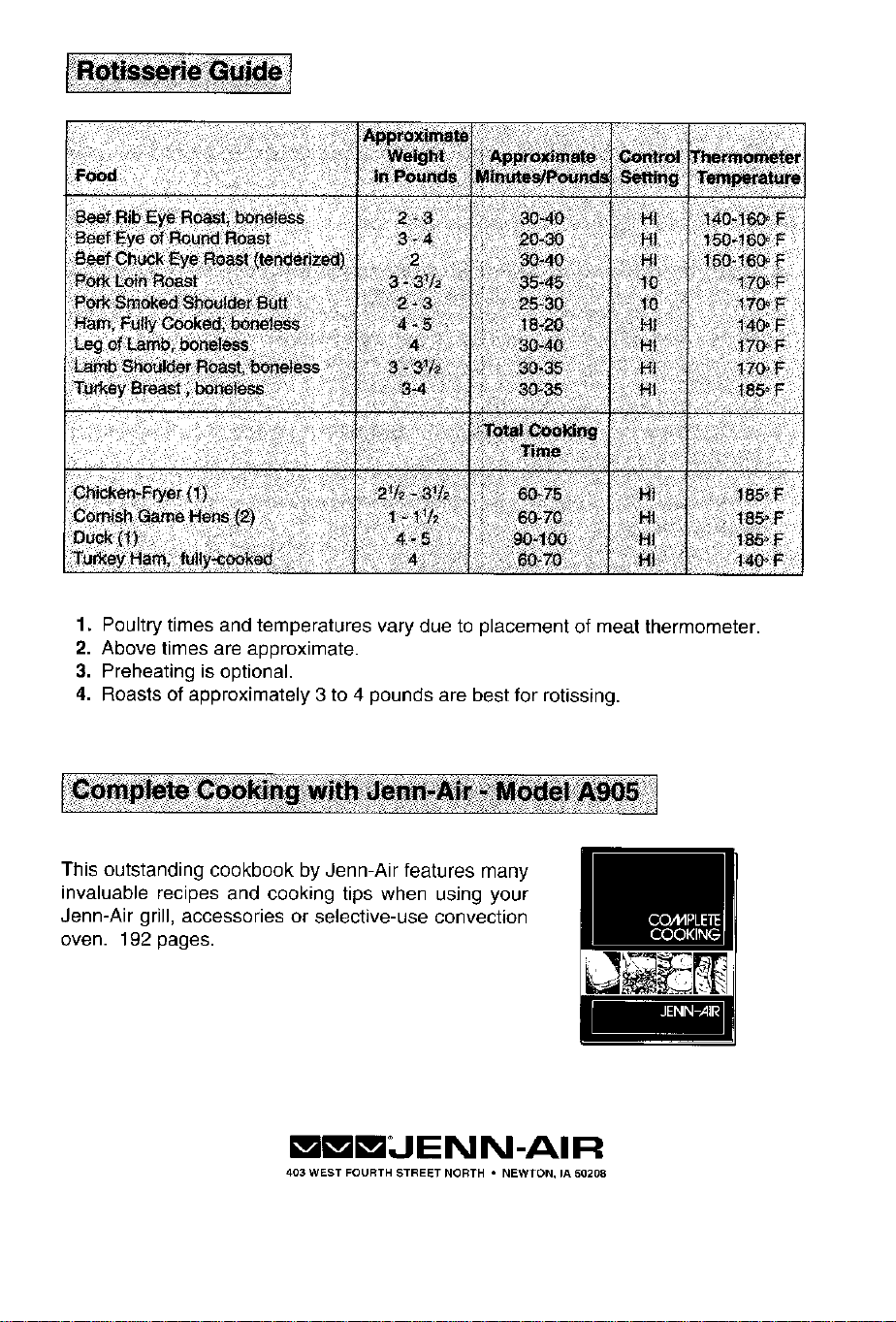
1. Poultry times and temperatures vary due to placement of meat thermometer.
2. Above times are approximate.
3. Preheating is optional.
4. Roasts of approximately 3 to 4 pounds are best for rotissing.
This outstanding cookbook by Jenn-Air features many
invaluable recipes and cooking tips when using your
Jenn-Air grill, accessories or selective-use convection
oven. 192 pages.
m []LIENN-AIR
403 WEST FOURTH STREET NORTH • NEWTON, IA 50208
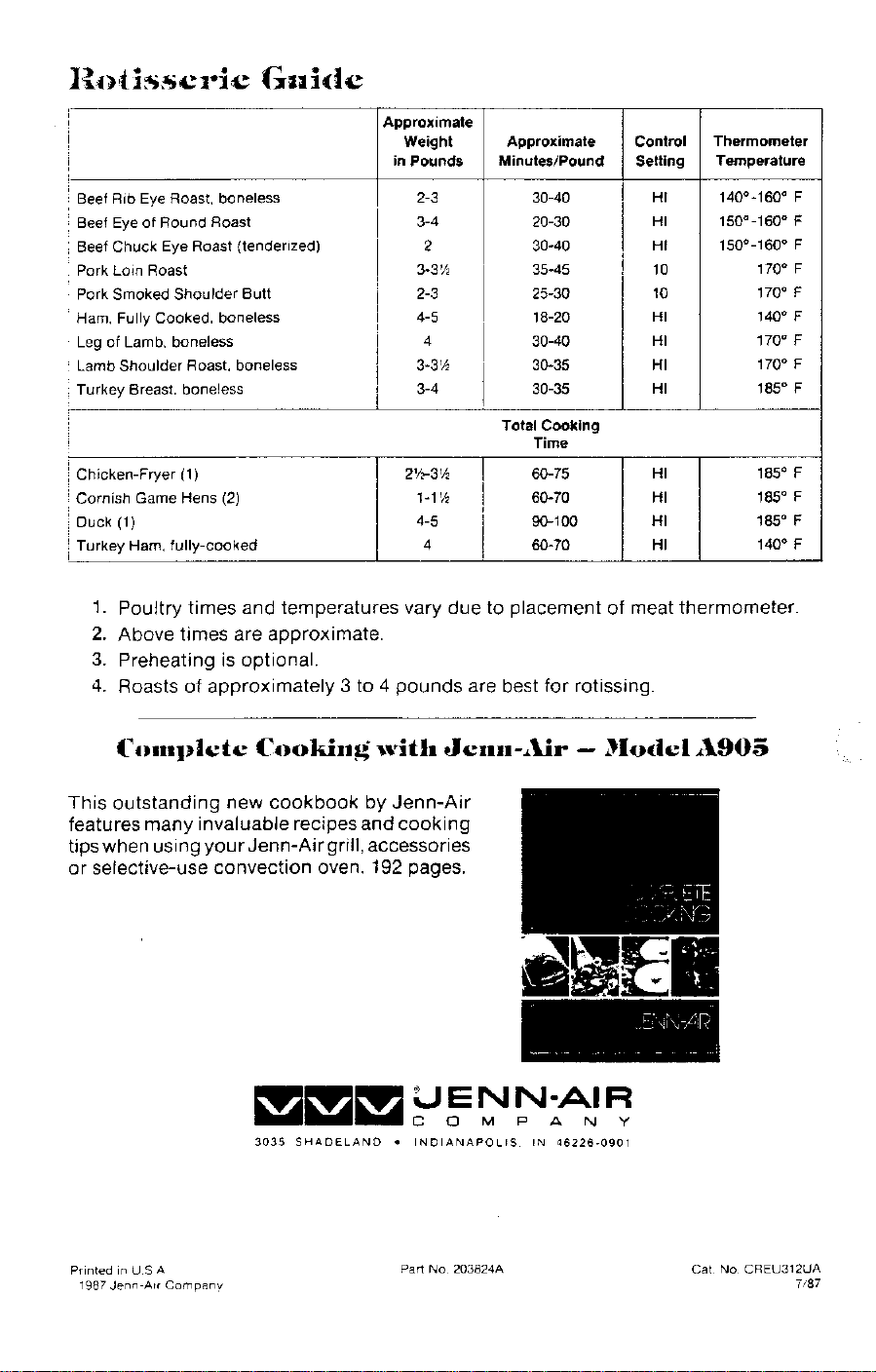
Approximate
Weight Approximate Control Thermometer
in Pounds Minutes/Pound Setting Temperature
BeefRib Eye Roast, boneless 2-3 30-40 HI 140°-160° F
Beef Eyeof Round Roast 3-4 20-30 HI 150°-160° F
Beef Chuck Eye Roast (tenderized) 2 30-40 Hi 150°-160° F
Pork Loin Roast 3-3'/_ 35-45 10 170° F
Pork Smoked Shoulder Butt I 2-3 25-30 10 170° P
Ham, Fully Cooked. boneless I 4-5 18-20 HI 140° F
Leg of Lamb, boneless 4 30-40 HI 170° F
Lamb Shoulder Roast, boneless J 3-31/_ 30-35 HI 170° F
Turkey Breast. boneless 3-4 30-35 HI 185° F
Total Cooking
Time
Chicken-Fryer (1) 2'/z-3_,5 60-75 HI HI I 185° F
Cornish Game Hens (2) 1-1V_ 60-70 _HI 185° F
Duck (1) 4-5 90-100 HI 185° F
Turkey Ham, fully-cooked 4 60-70 140° F
1. Poultry times and temperatures vary due to placement of meat thermometer.
2. Above times are approximate.
3. Preheating is optional.
4, Roasts of approximately 3 to 4 pounds are best for rotissing.
Coml_lete Cooking with Jenn-Air -- Model A905
This outstanding new cookbook by Jenn-Air
features many invaluable recipes and cooking
tips when using your Jenn-Air grill, accessories
or selective-use convection oven. 192 pages.
[]m[] FNN:AJR
3035 SHADELANO • INDIANAPOLIS IN 46226-0901
PrintedinUSA partNo 203824A Cat NOCREU312LIA
1987JennArtCompany 787