Version 1.01 | 12/05/2017
User Manual
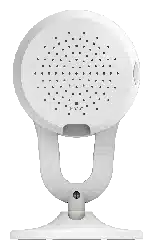
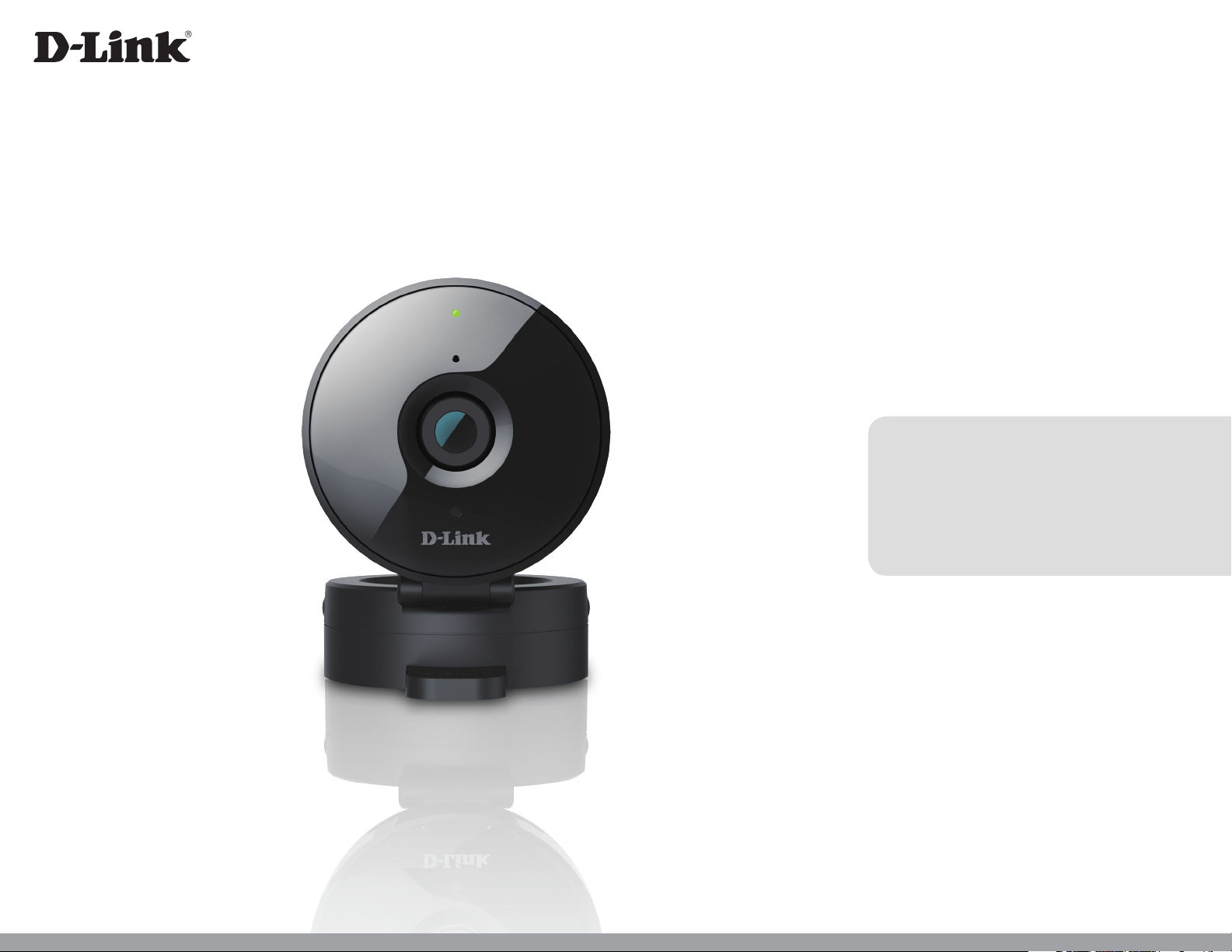
HD Wi-Fi Camera
DCS-936L
Manual Overview
D-Link reserves the right to revise this publication and to make changes in the content hereof without obligation to notify any person or organization
of such revisions or changes. Information in this document may become obsolete as our services and websites develop and change. Please refer to
http://www.mydlink.com for the most current information.
Manual Revision
Trademarks
© 2017 D-Link Systems, Inc. All Rights Reserved. D-Link and the D-Link logo are trademarks or registered trademarks of D-Link Corporation or its subsidiaries.
All other third-party marks mentioned herein may be trademarks of their respective owners. This publication may not be reproduced, in whole or in part,
without prior express written permission from D-Link Systems, Inc.
Revision Date Description
1.00 June 28, 2016 DCS-936L Revision A1 with rmware version 1.00
1.01
December 05, 2017 Support Google Home assistent

3D-Link DCS-936L User Manual
Table of Contents
Table of Contents
Product Overview .............................................................. 4
Package Contents ......................................................................... 4
System Requirements ................................................................. 4
Introduction ................................................................................... 5
Features ............................................................................................ 6
Hardware Overview ..................................................................... 7
Wireless Installation Considerations ......................................9
Installation .......................................................................10
mydlink Lite App ......................................................................... 10
Zero Conguration Setup ........................................................11
Placing Your Camera .................................................................. 12
Mounting the Camera...............................................................13
mydlink ...........................................................................................15
Using the DCS-936L with Google Home ............................16
Conguration ...................................................................19
Accessing the Web Conguration Utility ...........................19
Live Video ......................................................................................20
Setup ...............................................................................................22
Wizard .....................................................................................22
Network .................................................................................. 30
Wireless Setup ......................................................................32
Dynamic DNS ......................................................................33
Image Setup .........................................................................34
Audio and Video .................................................................. 35
Time and Date ...................................................................... 37
Video Clip ..............................................................................38
Snapshot ................................................................................39
IP Filter ....................................................................................40
HTTPS Setup .........................................................................41
SD Recording ........................................................................42
Motion Detection ...............................................................44
Sound Detection ................................................................. 45
SD Management .................................................................46
Maintenance ................................................................................47
Admin .....................................................................................47
System ....................................................................................48
Firmware Upgrade ..............................................................49
Status ..............................................................................................50
Device Info ............................................................................50
Log ...........................................................................................51
Troubleshooting ..............................................................52
Technical Specications ..................................................53
Contacting Technical Support ........................................55
Warranty ...........................................................................56
Registration .....................................................................62

4D-Link DCS-936L User Manual
Section 1 - Product Overview
• DCS-936L HD Wi-Fi Camera
• Power Adapter
• Mounting Kit
• Quick Install Guide
System Requirements
Product Overview
Package Contents
If any of the above items are missing, please contact your reseller.
Note: Using a power supply with a dierent voltage than the one included with your product will cause
damage and void the warranty for this product.
Mobile Device (to use mydlink Lite app)
• iPhone, iPad, Android smartphone or tablet
(Refer to the mobile app’s store page to see if your device is compatible)
Network Device and Service
• A wireless router (802.11n/g) with Internet service
• An e-mail account (required to create a mydlink® account)
• Internet Explorer 8 and above, Safari 5 and above, Firefox, and Chrome

5D-Link DCS-936L User Manual
Section 1 - Product Overview
Introduction
The HD Wi-Fi Camera (DCS-936L) provides crisp HD 720p video, making it easy and convenient to watch over your home no matter
where you are. Place it anywhere and stay informed with automatic push alert notications whenever sound or motion is detected.
The DCS-936L is a standalone surveillance camera that requires no special hardware or software, and can run independently even
without a PC. 16 feet of night vision allows you to see in total darkness and with the microSDXC card slot you can record video
footage up to 128 GB directly from the camera so you never miss a moment. Stream live HD 720p video to your smartphone or
tablet with the mydlink app for remote monitoring.
Easy to Setup, Even Easier to Use
The HD Wi-Fi Camera features a Wi-Fi signal locator LED which helps you determine optimum Wi-Fi connection when deciding
where to place your camera. Once set up, the DCS-936L delivers the condence of HD 720p video clarity, ensuring rich detail and
crisp image quality for your surveillance streaming and recording. Record footage directly to a microSDXC card for hassle-free
recording and playback
3
or easily add a mydlink Camera Recorder (DNR-202L) to locally record up to 4 D-Link Wi-Fi Cameras for
a scalable alternative for recording and storing video.
Convenient Access Anytime, Anywhere with mydlink®
Access your camera through the free mydlink mobile app or website to view and manage your camera through your tablet, mobile
phone, laptop or desktop, no matter where you are.

6D-Link DCS-936L User Manual
Section 1 - Product Overview
Features
Premium Resolution and Visibility
• 120
o
Field of View for wider camera coverage
1
• HD 720p resolution image quality
• 1 Megapixel progressive CMOS sensor
• See up to 16 feet in complete darkness with built-in IR LEDs
• Supports H.264/MJPEG video codecs
• 4x digital zoom for close-up viewing
Security
• Sound and motion detection with e-mail/push alert notications
• microSDXC card slot for local recording continuously, based on event triggers or according to a schedule
2
• Built-in microphone
Ease of Use
• WPS support for easy wireless connection
• Wi-Fi signal locator LED guides you to the best placement for your camera
• Mobile app enabled setup
Convenient Control with mydlink Support
• mydlink app support for iPhone, iPad and Android devices
• mydlink.com web portal for easy viewing and management
1
Field of view based on diagonal (D) measurements
2
A microSDXC Class 6 card or above is recommended (not included). Supports card capacities up to 128GB.
3
Use of audio or video equipment for recording the image or audio of a person without their knowledge and consent is prohibited in certain states or jurisdictions. The end-user assumes all liability for compliance with applicable
state, local and federal laws.
7D-Link DCS-936L User Manual
Section 1 - Product Overview
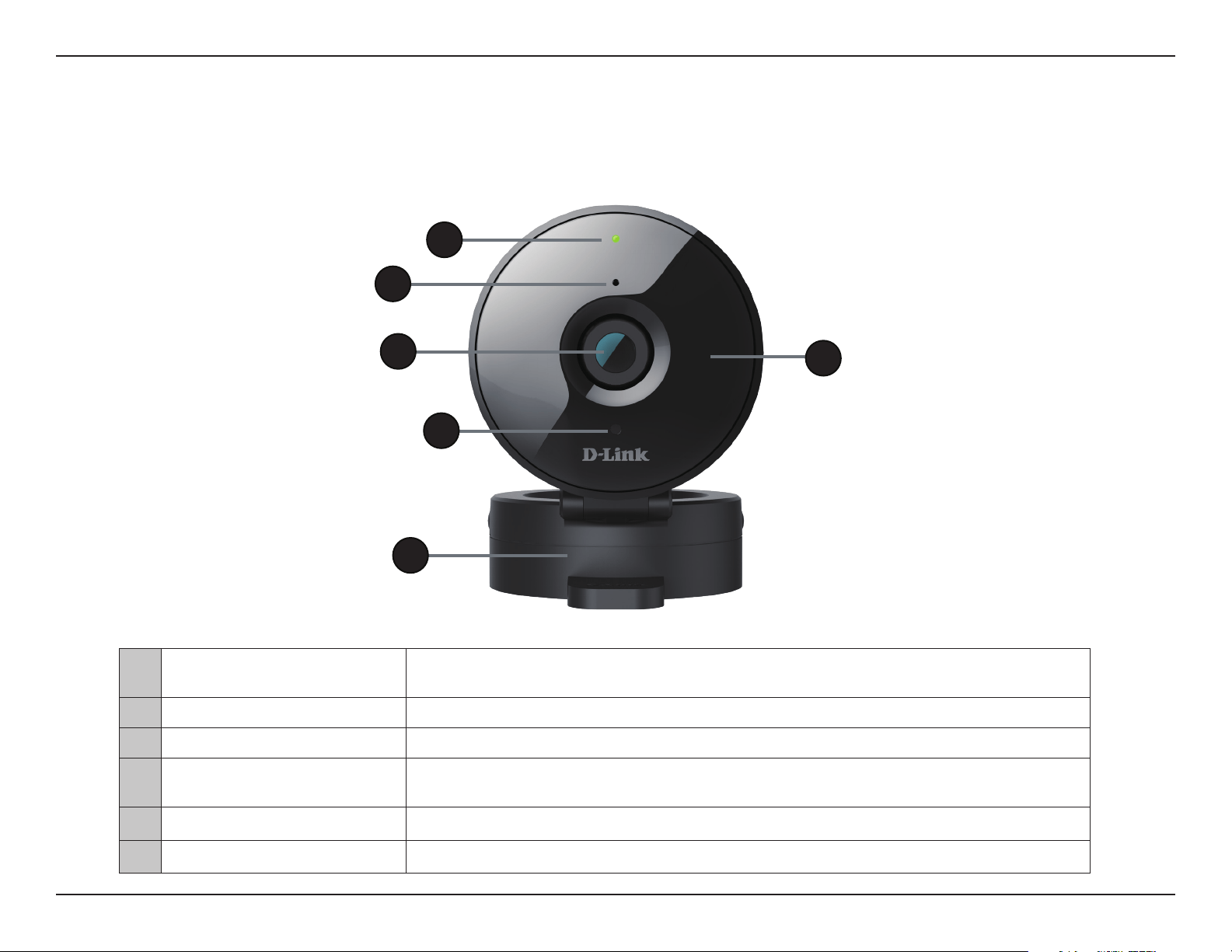
Hardware Overview
Front View
1 Wireless Signal Strength LED
LED will indicate the signal strength to your wireless network. Refer to Placing Your Camera
on page 12.
2 Microphone Records audio from the surrounding area.
3 Camera Lens Records video of the surrounding area.
4 Light Sensor
The IR-Cut Removable sensor monitors lighting conditions and switches between color and
infrared accordingly.
5 Camera Stand Use as a camera stand or a mounting bracket.
6 IR (Infrared) LEDs Used to illuminate the camera's eld of view at night.
1
2
3
4
6
5
8D-Link DCS-936L User Manual
Section 1 - Product Overview
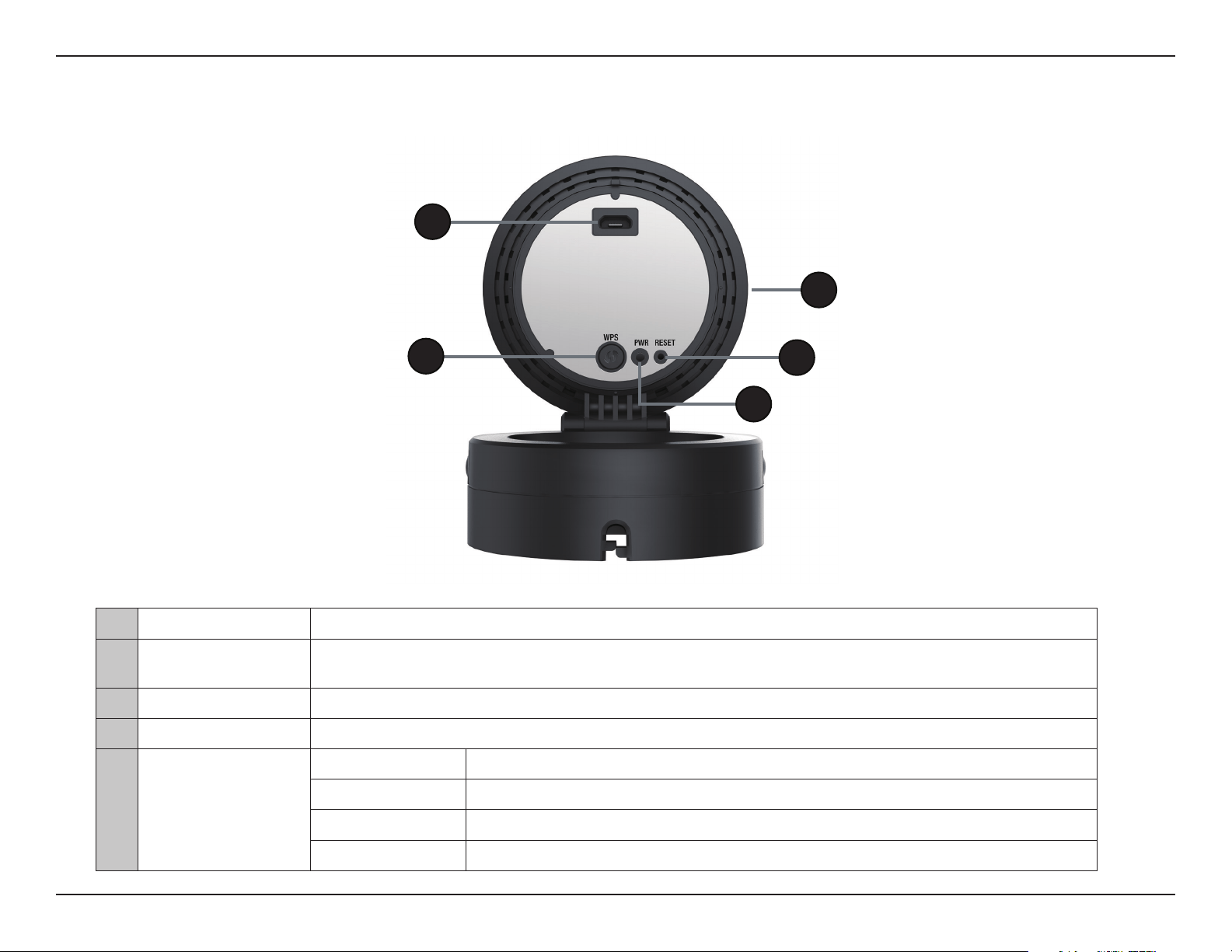
Back View
1 Power Connector Connects to the included 5 V DC power adapter (micro-USB connector).
2 WPS Button
Press this button, then press the WPS button on your router to set up a secure wireless connection
automatically.
3 microSD Slot Insert a microSD card (not included) to store video les directly to the camera.
4 Reset Button Press and hold this button for 10 seconds to reset the camera back to the factory default settings.
5 Power LED
Blinking Orange The camera is ready but not connected to a wireless network.
Solid Green The camera has successfully connected to a wireless network.
Blinking Green The WPS process is in progress.
Blinking Red LED will blink during the reset process.
1
2
3
4
5

9D-Link DCS-936L User Manual
Section 1 - Product Overview
Wireless Installation Considerations
The DCS-936L lets you access your network using a wireless connection from anywhere within the operating range of your wireless network.
However, the number, thickness and location of walls, ceilings, or other objects that the wireless signals must pass through, may limit the range.
Typical ranges vary depending on the types of materials and background RF (radio frequency) noise in your home or business. The key to maximizing
wireless range is to follow these basic guidelines:
1. Minimize the number of walls and ceilings between your adapter and other network devices (such as your Network Camera) - each
wall or ceiling can reduce your adapter’s range from 3-90 feet (1-30 meters).
2. Be aware of the direct line between network devices. A wall that is 1.5 feet thick (.5 meters), at a 45-degree angle appears to be
almost 3 feet (1 meter) thick. At a 2-degree angle, it looks over 42 feet (14 meters) thick. Position your devices so that the signal
will travel straight through a wall or ceiling (instead of at an angle) for better reception.
3. Building Materials make a dierence. A solid metal door or aluminum studs may weaken the wireless signal. Try to position your
access points, wireless routers, and other networking devices where the signal passes through drywall or open doorways. Materials
and objects such as glass, steel, metal, walls with insulation, water (sh tanks), mirrors, le cabinets, brick, and concrete will degrade
your wireless signal.
4. Keep your product at least 3-6 feet or 1-2 meters away from electrical devices or appliances that generate RF noise.
5. If you are using 2.4 GHz cordless phones or other radio frequency sources (such as microwave ovens), your wireless connection
may degrade dramatically or drop completely. Make sure your 2.4 GHz phone base is as far away from your wireless devices as
possible. The base transmits a signal even if the phone in not in use.
10D-Link DCS-936L User Manual
Section 2 - Installation
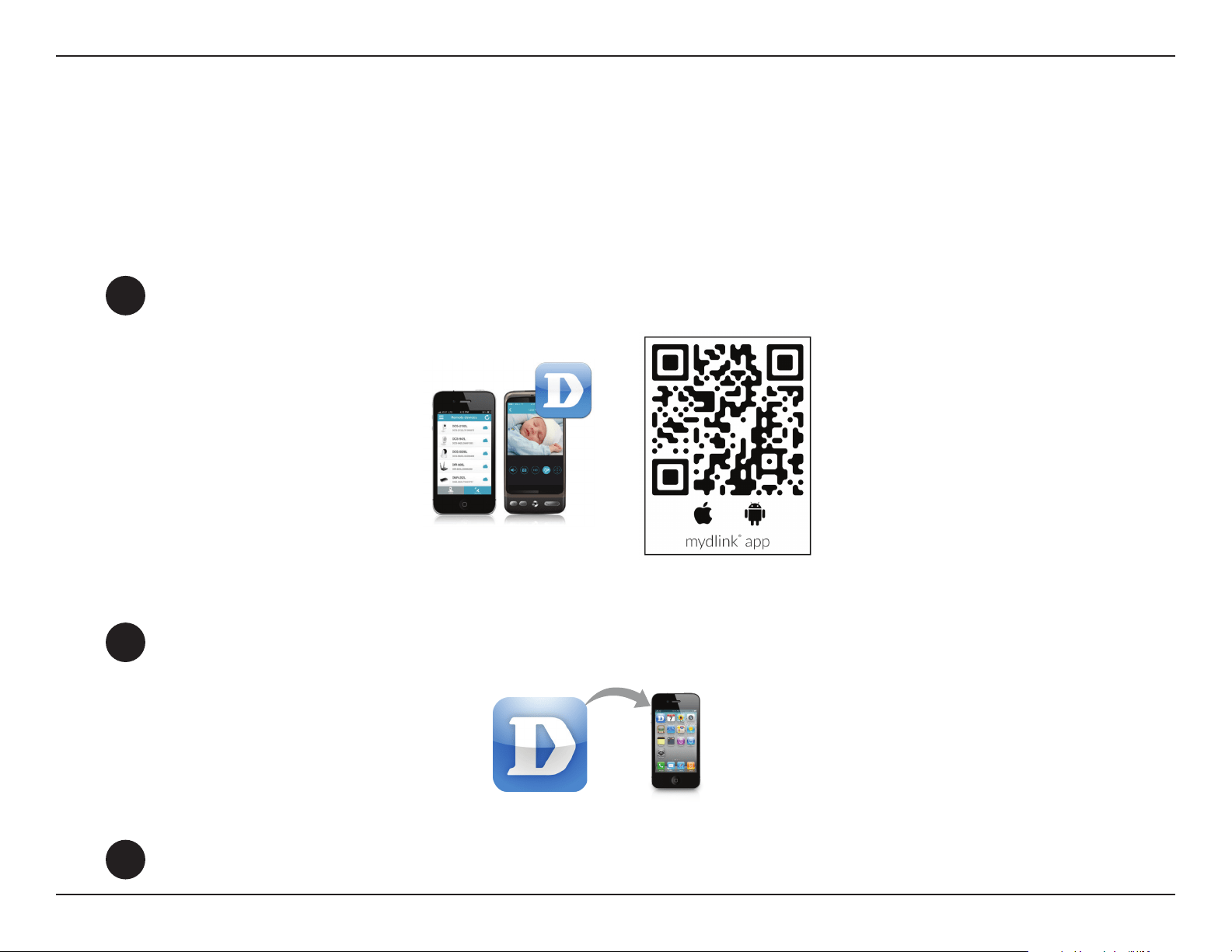
Launch the mydlink Lite app, then create a new account or log in to your existing account.
Download the free mydlink Lite app on your smartphone or tablet by scanning the QR code below, or by searching for mydlink Lite in
the app store for your device.
1
2
3
The app will guide you through the rest of the conguration process.
System Requirements: Refer to the mydlink Lite app page on Apple App
Store or Google Play.
You can congure your camera through the mydlink Lite mobile app. Search for the free mydlink Lite app on the App Store or Google Play and
download it to your smartphone or tablet. You can also use a QR code reading app to scan the corresponding code for your device below.
mydlink Lite App
Installation

11D-Link DCS-936L User Manual
Section 2 - Installation
Zero Conguration Setup
Step 1:
Attach the power supply to the power input on the DCS-936L and connect it to a wall outlet or power strip. Power is conrmed when the Status LED is lit.
Step 2:
Press and hold the WPS button on the camera for ve seconds. The Status LED will start to blink green. Then, press the WPS button on your router
within two minutes.
Your router will automatically assign your network settings to your camera.
Step 3:
From any computer, open a web browser, go to http://www.mydlink.com and log into your account. Once mydlink detects your camera, a New Device
Found! notice will appear in the bottom right corner. Click on the camera from the New Devices list and then click Yes to add your camera.
Your setup is complete!
Note: The Zero Conguration Setup will only work with a registered D-Link Cloud Router and an active mydlink account.
12D-Link DCS-936L User Manual
Section 2 - Installation
Placing Your Camera
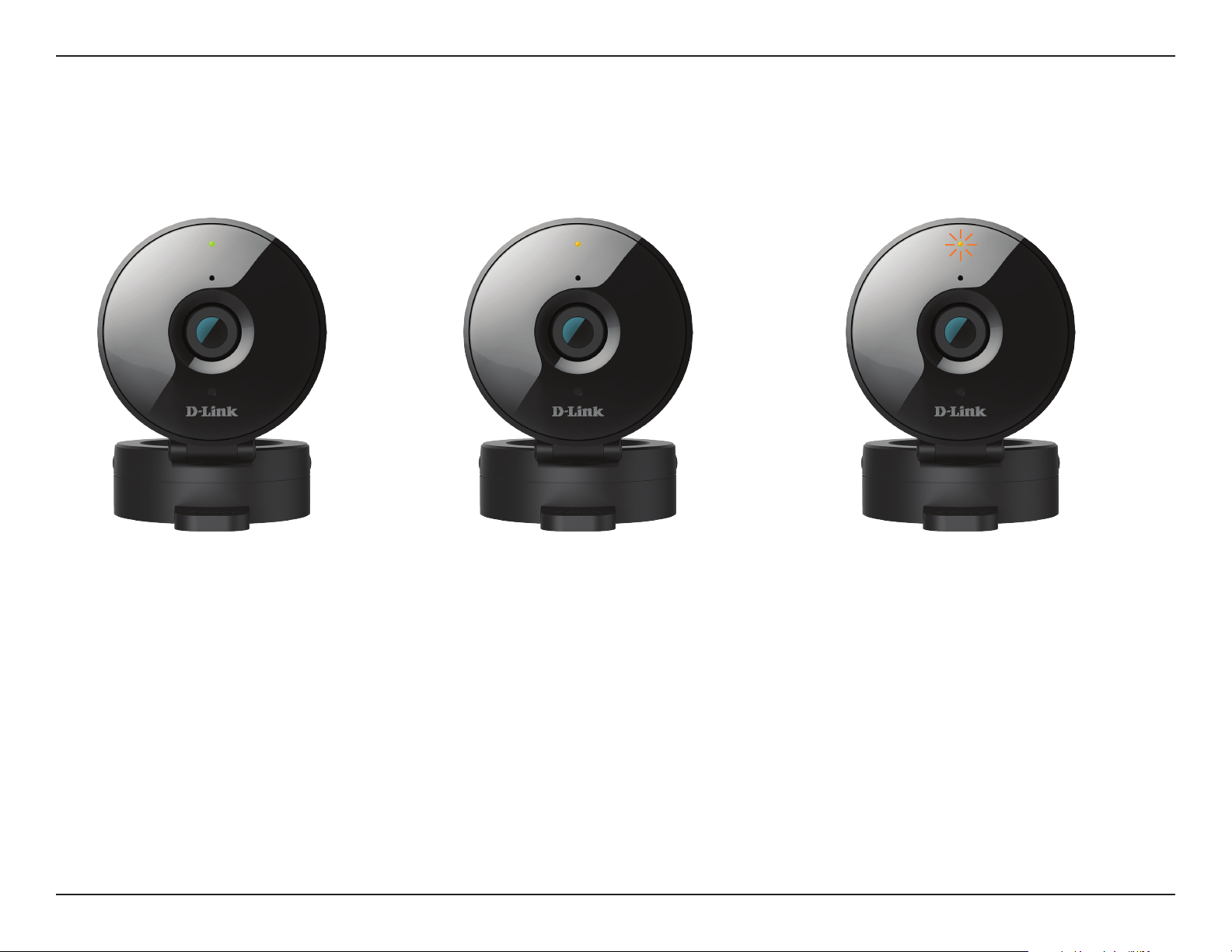
When placing your camera, you can use the wireless signal strength LED on the front of your camera to see whether your camera has a strong
wireless connection to your router.
Solid Green:
Strong wireless connection
Solid Orange:
Fair wireless connection
Flashing Orange:
Weak wireless connection
If the wireless signal strength LED is ashing orange, try moving the camera to a location closer to your router, or you can try purchasing a wireless
extender to extend the range of your wireless network.
13D-Link DCS-936L User Manual
Section 2 - Installation
Mounting the Camera
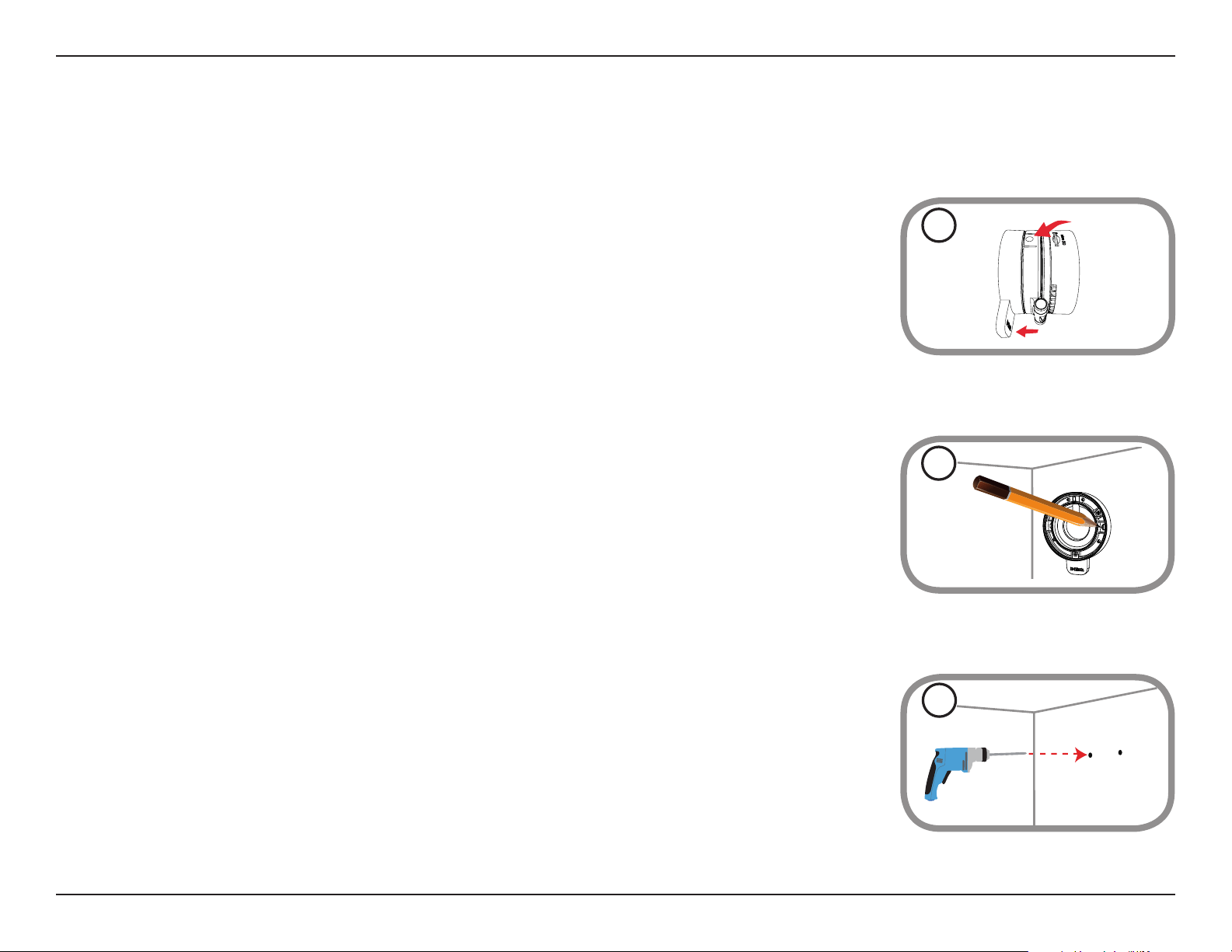
To mount your camera on a wall or ceiling, please follow the steps below. It is recommended that you congure the camera before mounting.
Step 1
Hold the base of the camera with one hand placing your thumb on the tab, then press down on the release
buttons with your other hand and pull the camera from the camera base.
Step 3
Depending on the material of the wall or ceiling, use proper tools to drill two holes 25 mm deep with a
6 mm drill bit where you marked. If the wall is made out of concrete, drill the holes rst, then insert the plastic
anchors to support the screws.
Step 2
Place the camera base where you want to position the camera and use a pencil to mark the holes. Make sure
that the cable channel on the camera base is facing in the direction you want.
3
1
2
14D-Link DCS-936L User Manual
Section 2 - Installation
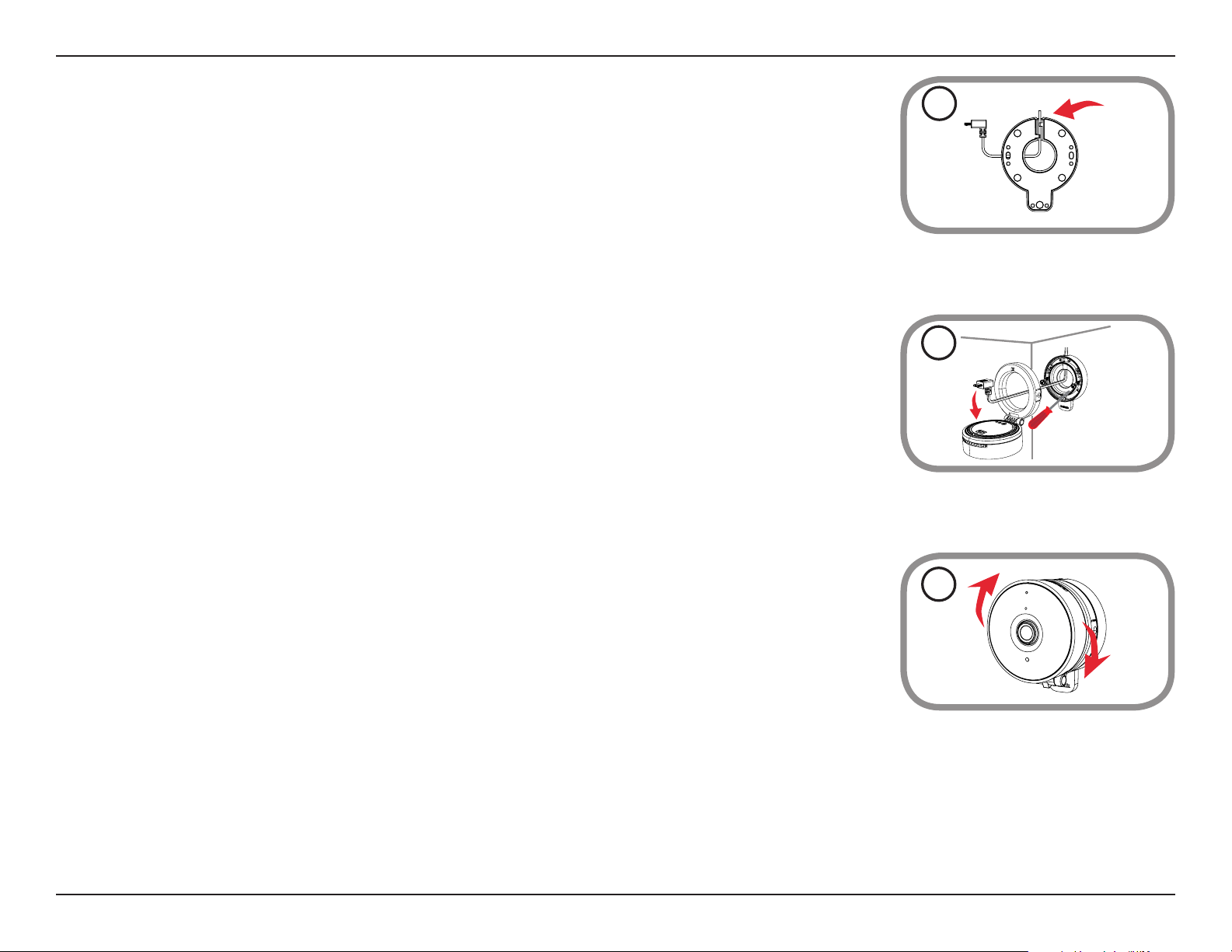
4
5
6
Step 6
Attach the camera to the camera base and pull the power cable to remove the extra cable. Adjust the angle
of the camera as desired.
Step 5
Place the camera base over the holes that are in the wall and use the supplied screws to attach the camera
base to the surface of the wall. Plug in the micro-USB power cable to the camera.
Step 4
Pull the power cable through the middle of the camera base and through the cable channel as shown.
15D-Link DCS-936L User Manual
Section 2 - Installation
mydlink
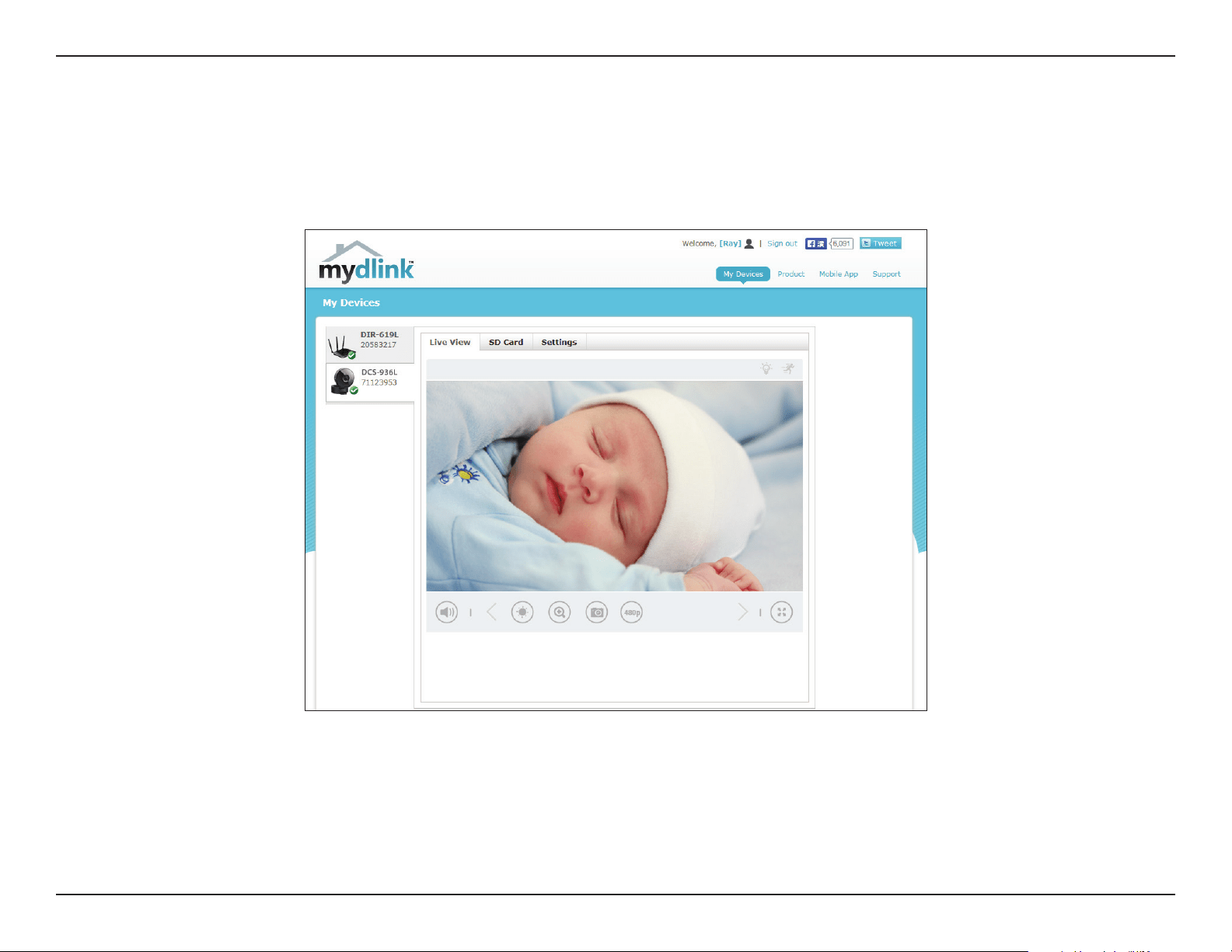
After registering your camera with a mydlink account, you will be able to remotely access your camera from the www.mydlink.com website. After
signing in to your mydlink account, you will see a screen similar to the following:
For more details on using your camera with mydlink, go to the Support section of the mydlink website and check the User Manual section for
your product to nd the latest instruction guide for your camera’s mydlink features.
16D-Link DCS-936L User Manual
Section 2 - Installation
Using the DCS-936L with Google Home
You can use your voice to control your DCS-936L with your Google Home Smart Speaker and Google Assistant.
Before proceeding, make sure you have:
1. Installed your DCS-936L and registered for a mydlink account using mydlink Lite. For more details, please see mydlink Lite App on page 10.
2. Make sure your mobile device, DCS-936L, and Google Home Smart Speaker are all connected to the same wireless network.
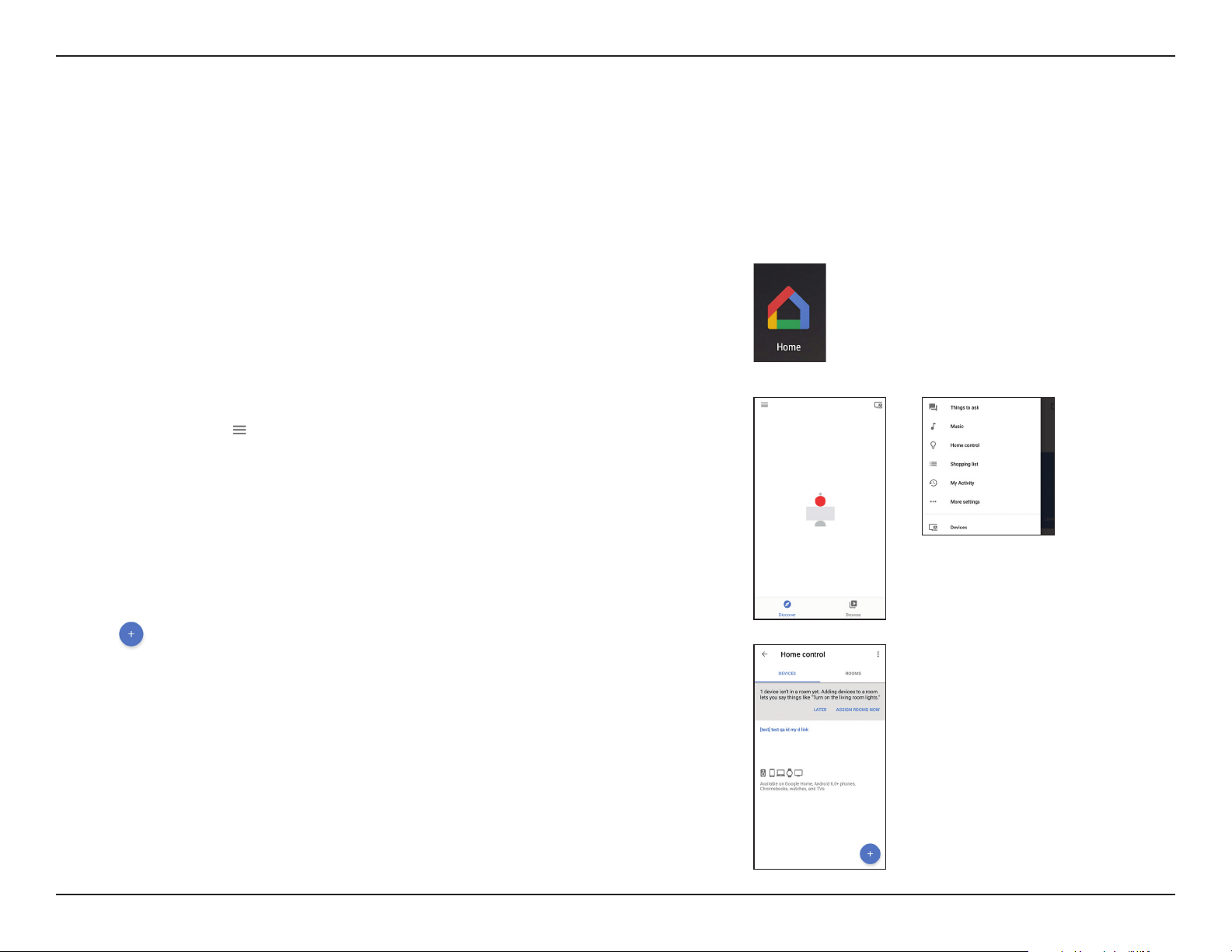
1. From your mobile, download the Google Home app from Google Play
or the App Store.
2. Start the app and follow the instructions to discover and add your
DCS-936L, or tap
to bring up the menu and tap Home control.
3. Tap
to add a device.
To activate your device for use with Google home:
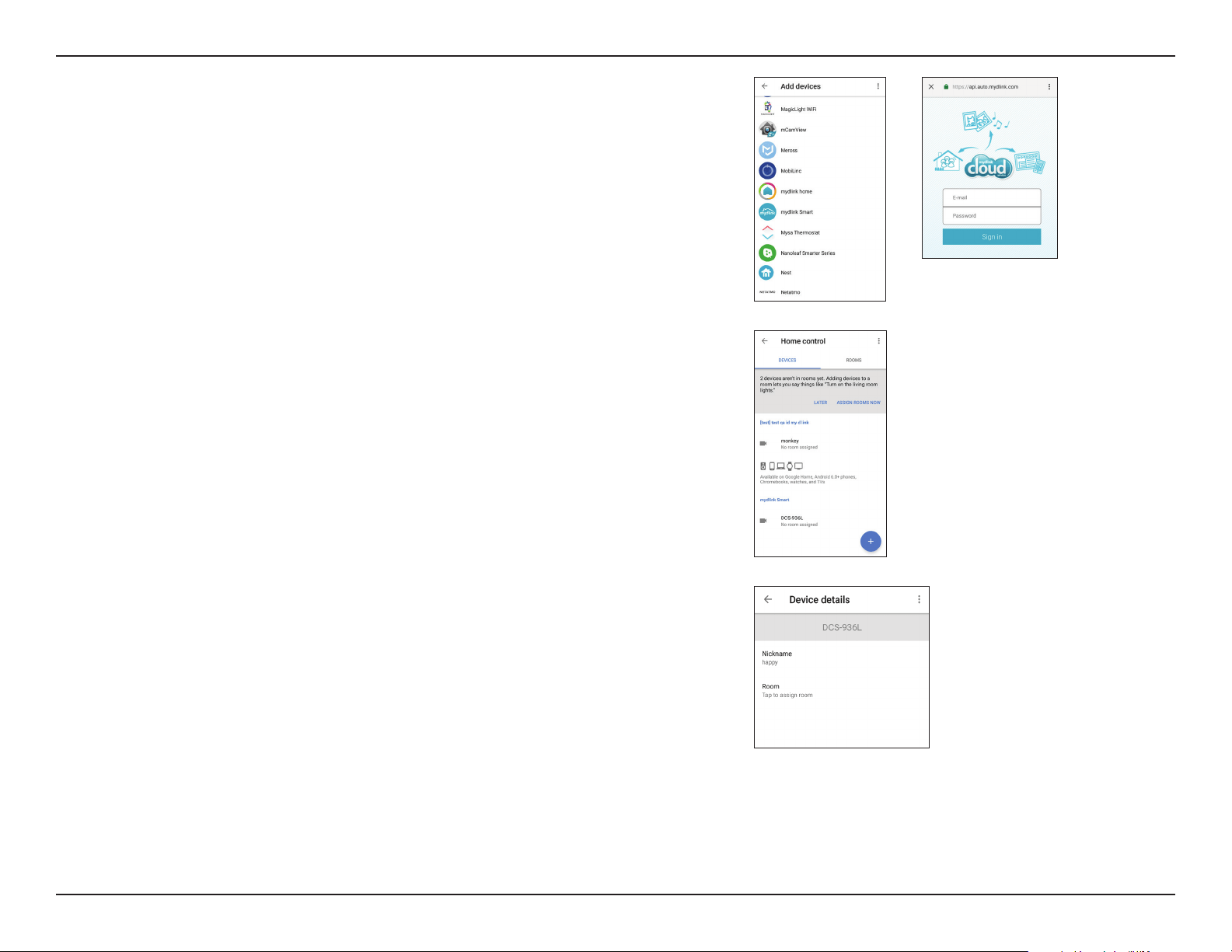
17D-Link DCS-936L User Manual
Section 2 - Installation
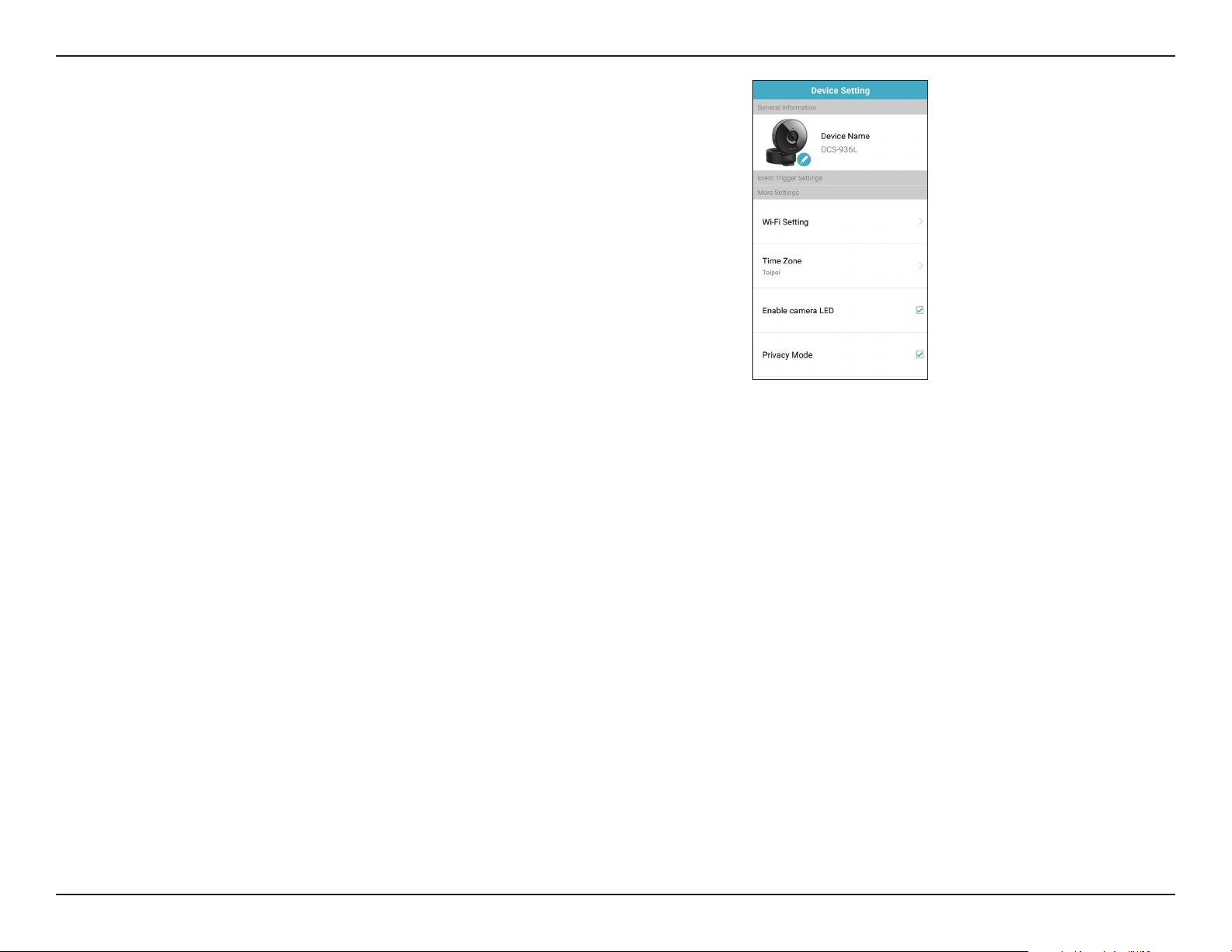
5. After logging in, your DCS-936L will show up in the Devices tab under
Home control.
6. You can also give your DCS-936L a friendly name for use with voice
commands under device details.
4. On the Add devices page, tap mydlink Smart to bring up the mydlink
sign in page. Enter your account E-mail and Password and tap Sign in.
18D-Link DCS-936L User Manual
Section 2 - Installation
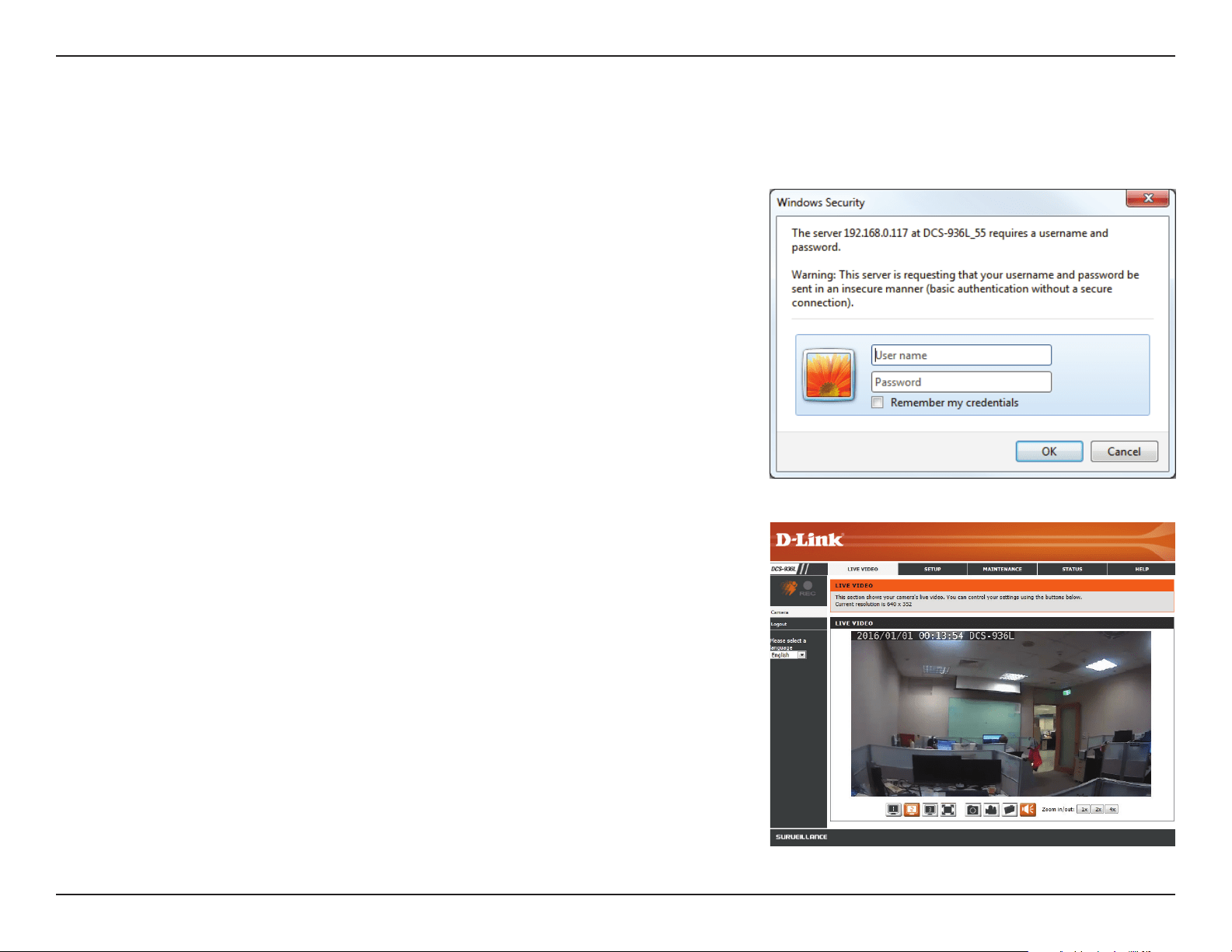
Note: When live streaming is On, the Privacy Mode setting will be O.
Conversely when live streaming is O, the Privacy Mode setting will be On.
Using voice commands to control your DCS-936L:
To enable live video streaming, you can give the voice command “Hey
Google, turn [nickname of camera] On”.
To disable live streaming, open the mydlink Lite app and check Privacy Mode.
19D-Link DCS-936L User Manual
Section 3 - Conguration
Conguration
Accessing the Web Conguration Utility
After completing setup through the mydlink Lite mobile app or Zero Conguration Setup, you
are ready to use your camera. The camera’s built-in Web conguration utility is designed to allow
you to easily access and congure your DCS-936L.
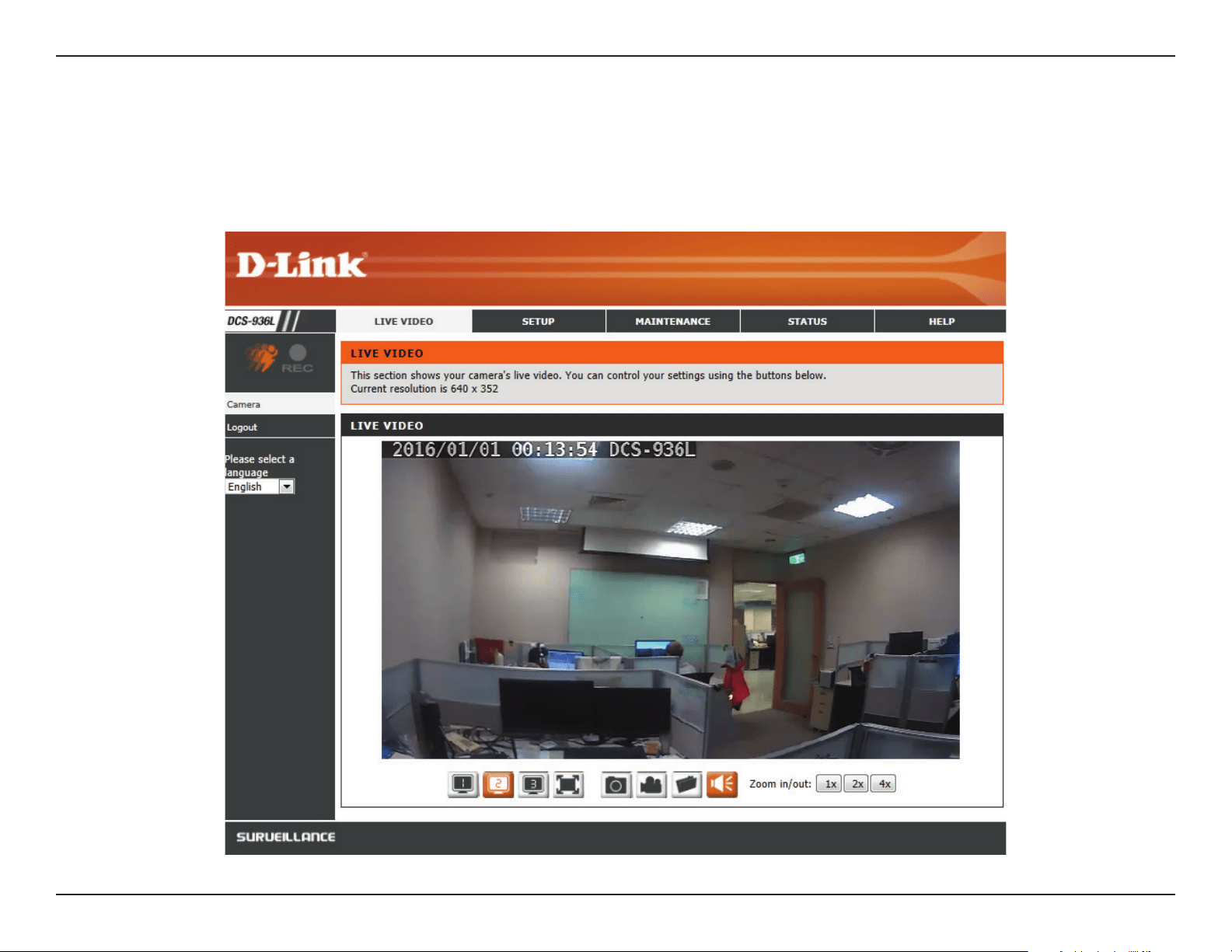
To access your camera’s conguration utility, use a web browser to log in to the mydlink.com
website, select your camera from your device list, then click on the Settings tab for your camera.
Use admin for the User name and the password you created during the setup process. If you did
not create a password, leave the password box blank. Click OK to continue.
Note: If you are directly connecting your PC to the camera, or if you are using the camera on a
closed network, the default IP is 192.168.0.20.
After logging in to your camera, the Live Video page will open.
20D-Link DCS-936L User Manual
Section 3 - Conguration
Live Video
View your camera’s live video from this screen. You may select any of the available icons listed on the next page to operate the camera. You may
also select your language using the drop-down menu on the left side of the screen.
21D-Link DCS-936L User Manual
Section 3 - Conguration
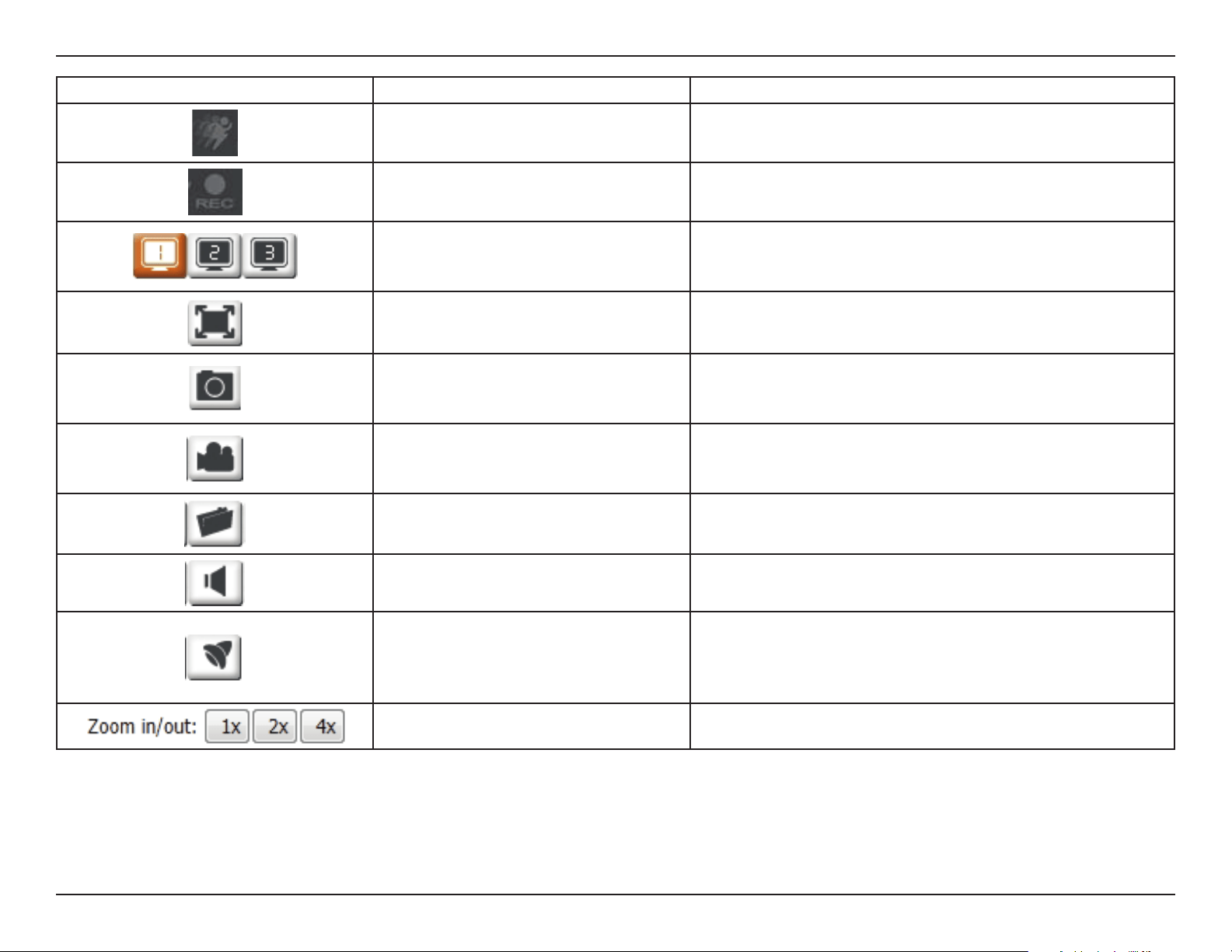
Icon Button Name Function
Event Trigger Indicator
This indicator will change color when a trigger event occurs,
such as when motion and/or sound is detected.
Recording Indicator When a recording is in progress, this indicator will change color.
Prole buttons
Use these buttons to switch between video proles. Refer to
Audio and Video on page 35 for more information on setting
up proles.
Full Screen button Switches to a full screen view of the camera video.
Snapshot button
Takes a snapshot of the image currently displayed on the screen
and saves it to the hard drive in the folder specied using the
Storage Folder button.
Video Recording button
Triggers the camera’s recording function. This will record the
video displayed on the screen and saves it to the hard drive in
the folder specied using the Storage Folder button.
Storage Folder button Sets the storage folder for snapshots and video recordings.
Listen button
Sends the audio received from the camera’s microphone through
to the PC’s speakers.
IR LED On/O button
Turns the Infrared lights on or o.
(The icon only appears when you activate the manual IR option.
Refer to Day/Night Mode in Audio and Video on page 35 for
more.)
Zoom buttons Zooms in or out of the picture.
v
22D-Link DCS-936L User Manual
Section 3 - Conguration
Setup
Wizard
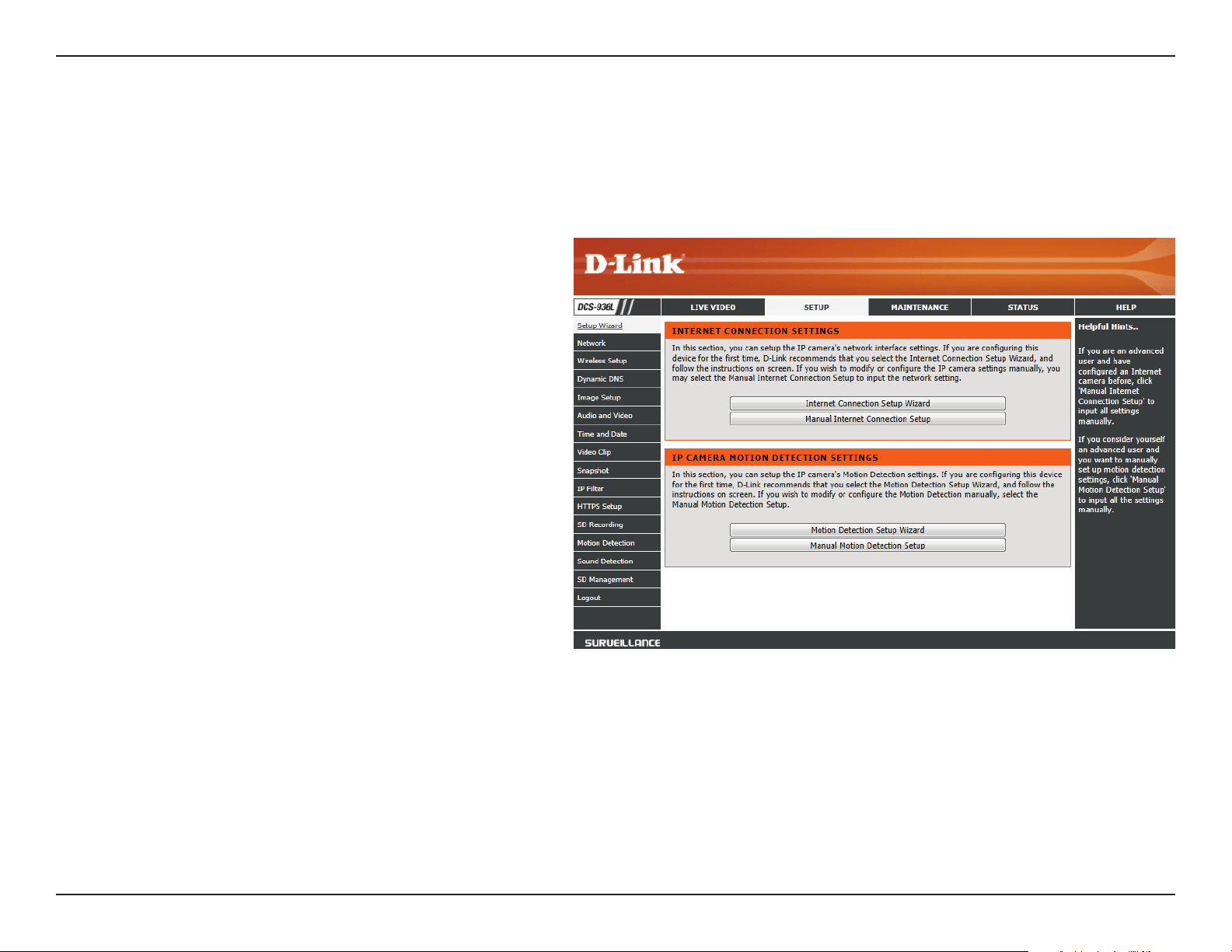
You may choose to congure your network by
using the Internet Connection Setup Wizard
that includes step-by-step instructions. Please
refer to Internet Connection Setup Wizard
on page 23 for more details.
If you would rather manually set up the camera
Internet connection, you can refer to Network
on page 30 which provides more details on
the information required.
You may choose to congure motion detection
by using the Motion Detection Setup Wizard
that includes step-by-step instructions. Please
refer to Motion Detection Setup Wizard on
page 26 for more details.
If you would rather manually set up the
camera’s motion detection features, you can
refer to Motion Detection on page 44 which
provides more details on the information
required.
Internet
Connection
Setup Wizard:
Manual
Internet
Connection
Setup:
Motion
Detection
Setup Wizard:
Manual Motion
Detection
Setup:
This section allows you to begin setup wizards which will guide you through the process of getting your camera’s various functions congured. If
you comfortable with adjusting the settings manually, you may skip the wizards and adjust settings manually as needed.
23D-Link DCS-936L User Manual
Section 3 - Conguration
Internet Connection Setup Wizard
Note: Use this wizard if you are connecting the camera directly to a public IP address. If you are
connecting the camera to a router, select DHCP Connection (most common) or select Static
IP Address to manually assign the camera its IP settings.
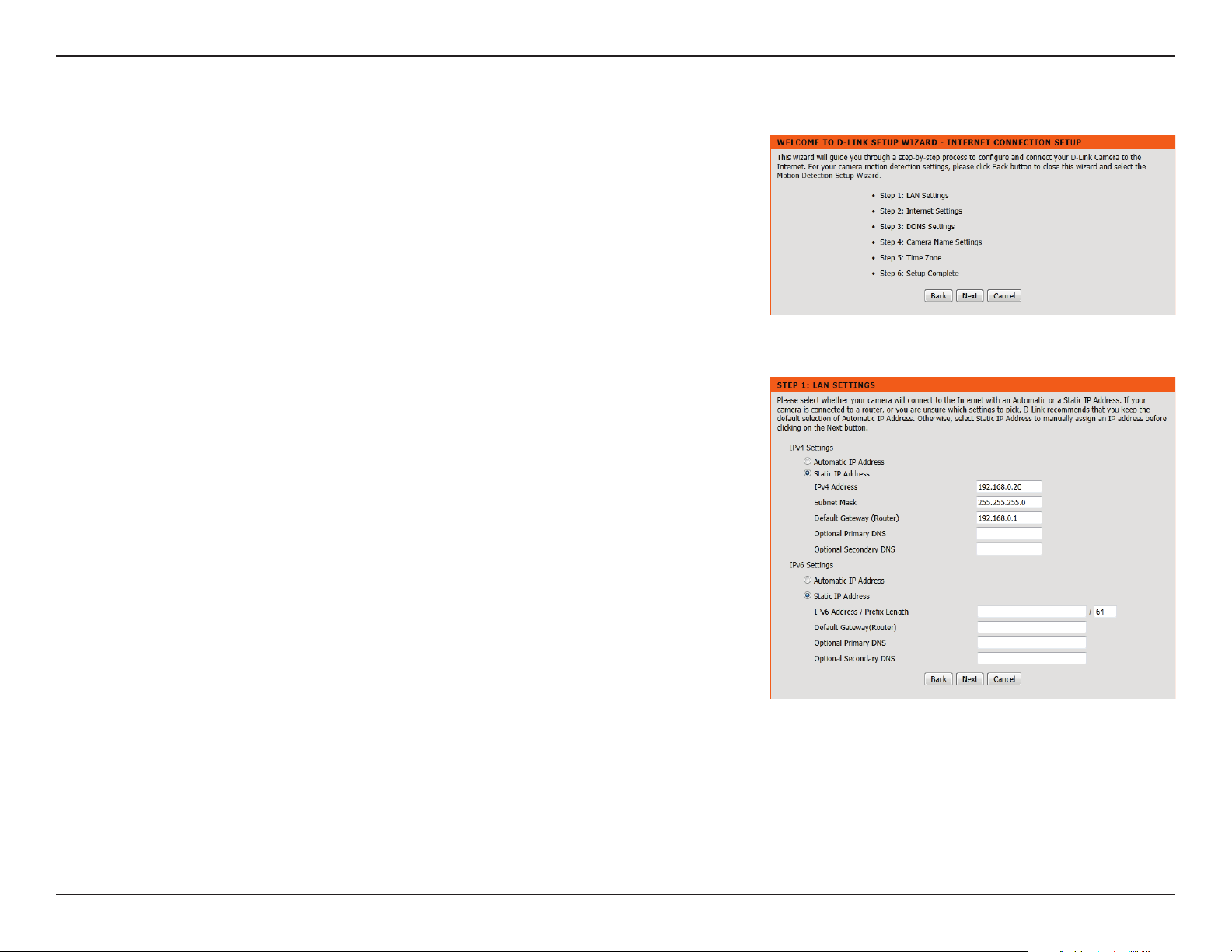
Step 1
The Internet Connection Setup Wizard will guide you through a step-by-step process to congure
your DCS-936L and connect it the Internet. Click Next to continue.
Step 2
Select DHCP Connection (Dynamic Host Conguration Protocol) if you want your DHCP
server (usually enabled on your router) to assign the camera its IP settings.
If you want to manually assign the IP settings, select Static IP Address and enter the
following details:
Enter an IP Address for your camera.
Enter the Subnet Mask of your network.
Enter the Default Gateway address. This is usually the IP
address (LAN) of your router.
Enter the primary DNS server’s IP address. This is usually also
the IP address (LAN) of your router.
Enter the secondary DNS server’s IP address. This is optional.
IP Address:
Subnet Mask:
Default
Gateway:
Primary DNS:
Secondary DNS:
24D-Link DCS-936L User Manual
Section 3 - Conguration
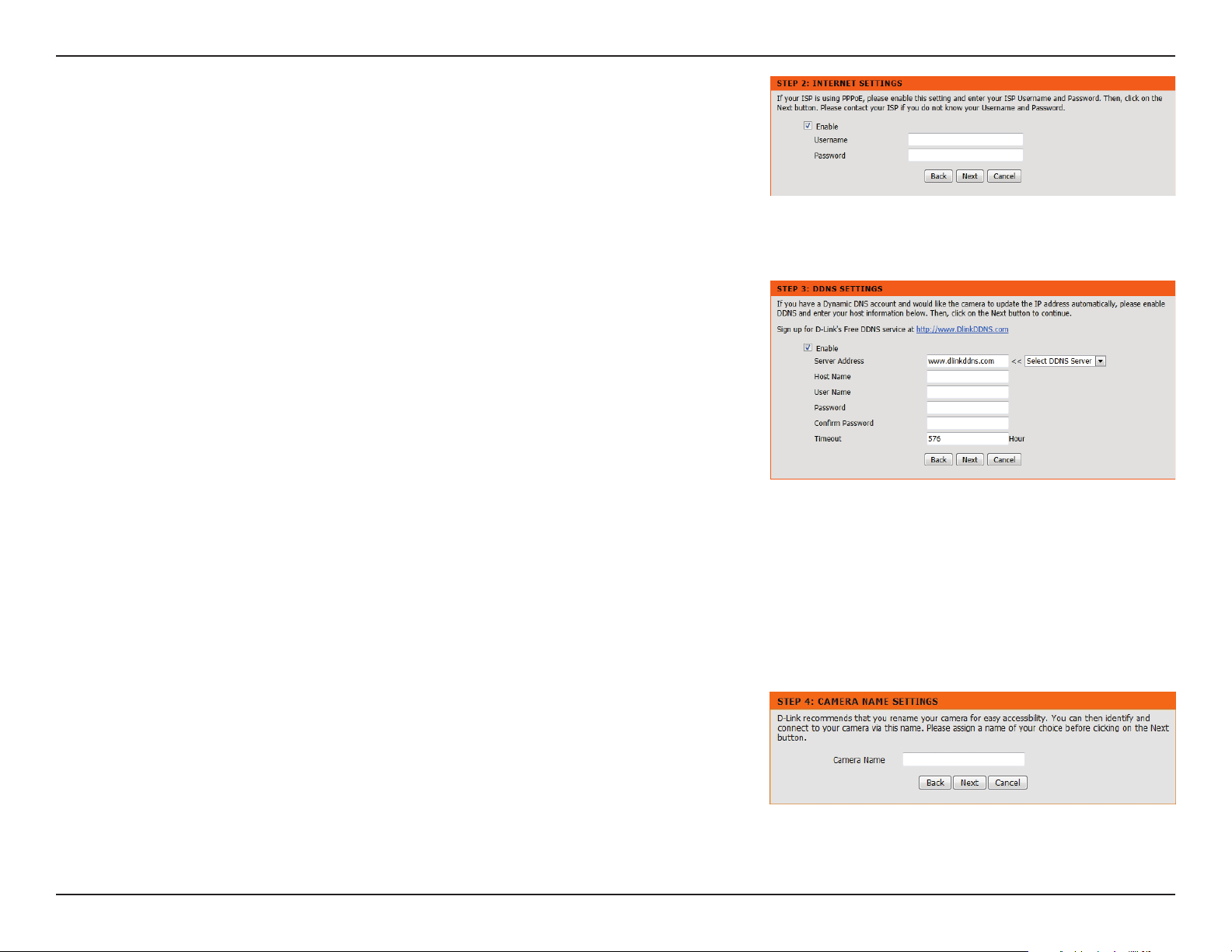
Step 3
A Dynamic DNS account allows you to access your camera over the Internet when you have
an IP address that changes each time you connect to the Internet. If you have a Dynamic
DNS account, click Enable and enter the following details:
Select your Dynamic DNS Server from the drop-down menu.
Enter the host name of the DDNS server.
Enter your username or e-mail address used to connect to the DDNS.
Enter your password used to connect to the DDNS server.
You can setup how often the camera noties the DDNS server of its current
global IP address by entering a whole number in hours.
Click Next to continue.
Server Address:
Host Name:
User Name:
Password:
Timeout:
If you are required to connect using PPPoE (Point to Point Protocol over Ethernet), check the
box to Enable and enter the User Name and Password for your PPPoE connection. Only
select this option if your camera is directly connected to your broadband modem. If it is on
a network with a router or gateway, do not select this option.
Click Next to continue.
Step 4
Enter a unique name for your camera and click Next to continue.
25D-Link DCS-936L User Manual
Section 3 - Conguration
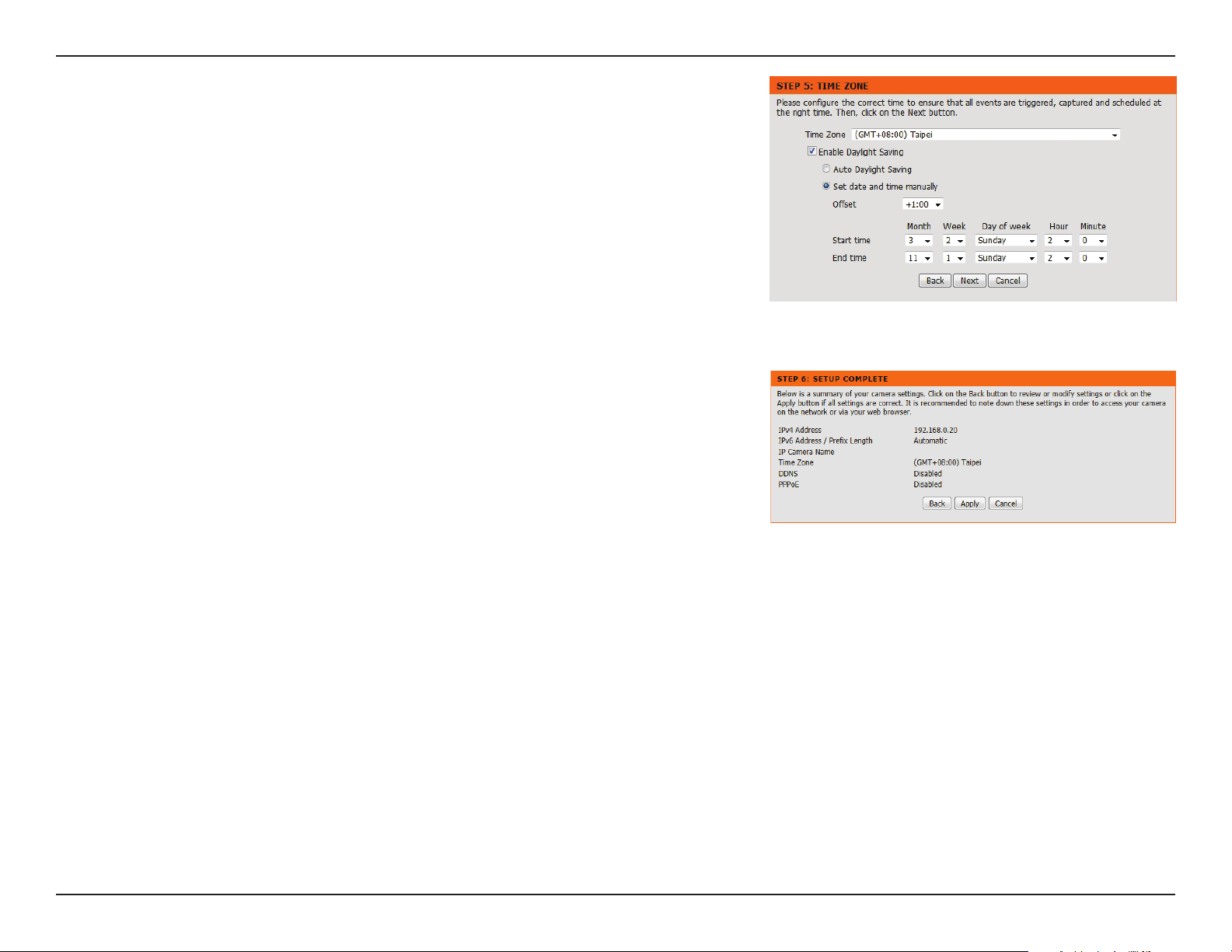
Step 5
Select the time zone that the camera is in so that scheduled events occur at the correct
time. If your time zone observes daylight saving, check the Enable Daylight Saving box
and select Auto Daylight Saving to have DST set automatically or select Set date and
time manually to enable drop-down menus so that you can set the start and end time of
daylight saving yourself.
Click Next to continue.
Step 6
A summary of your camera settings is displayed for conrmation. If the settings are incorrect,
click Back to make changes. Otherwise click Apply.
Note: Make a note of the camera's IP address so you can access it on your network or by using
a web browser.
26D-Link DCS-936L User Manual
Section 3 - Conguration
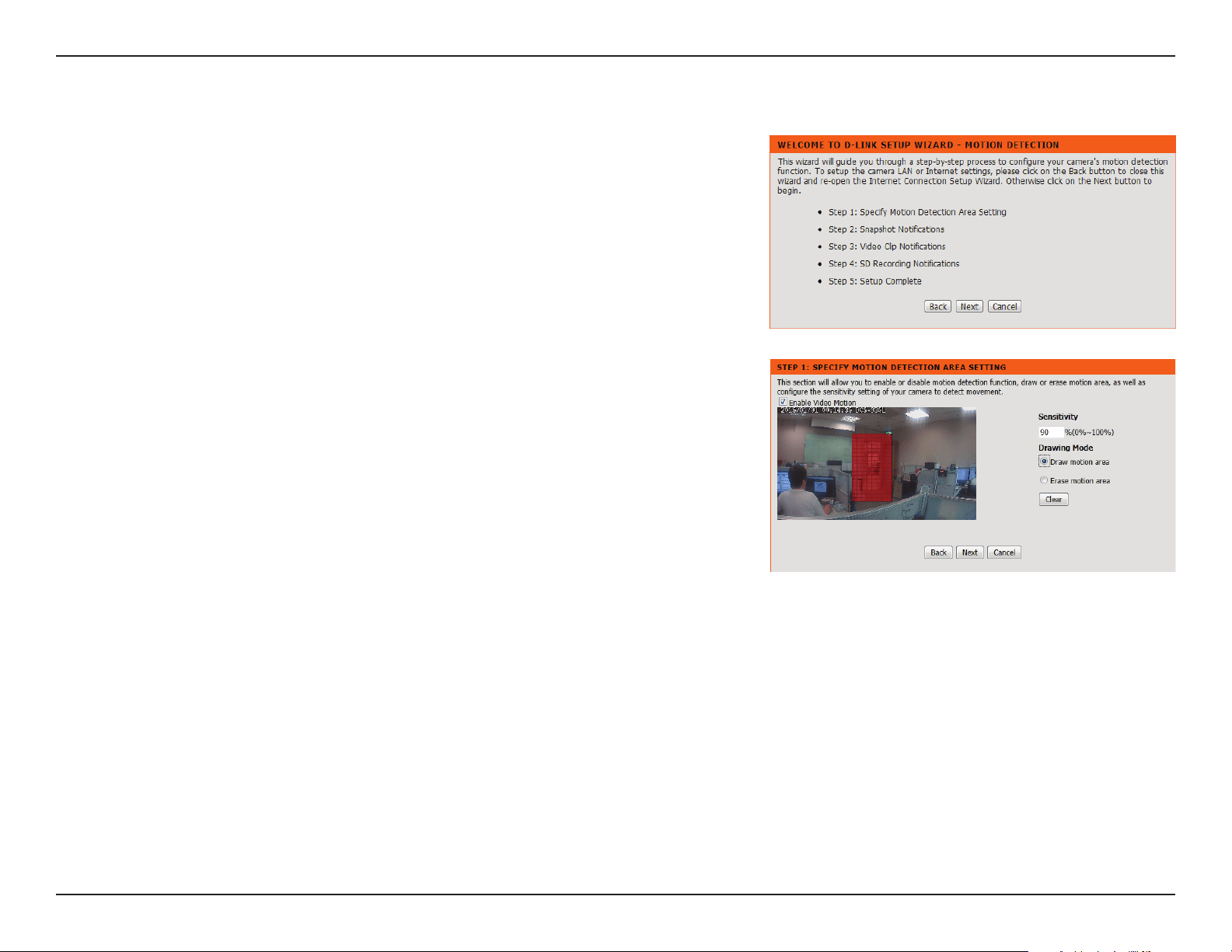
Motion Detection Setup Wizard
This wizard will guide you through a step-by-step process to congure the motion detection
feature.
Click Next to continue.
Step 2
This step will allow you to enable or disable motion detection. You may draw areas for your
camera to monitor for motion.
1. Check the Enable Video Motion box.
2. Select Draw motion area and use your mouse to click and drag on the area that you
would like to monitor for motion.
3. Enter the sensitivity. Higher the number the more sensitive the detection of movement
will be.
4. You can select Erase motion area and erase areas if needed. Click Clear if you want to
erase the area.
5. Click Next to continue.
27D-Link DCS-936L User Manual
Section 3 - Conguration
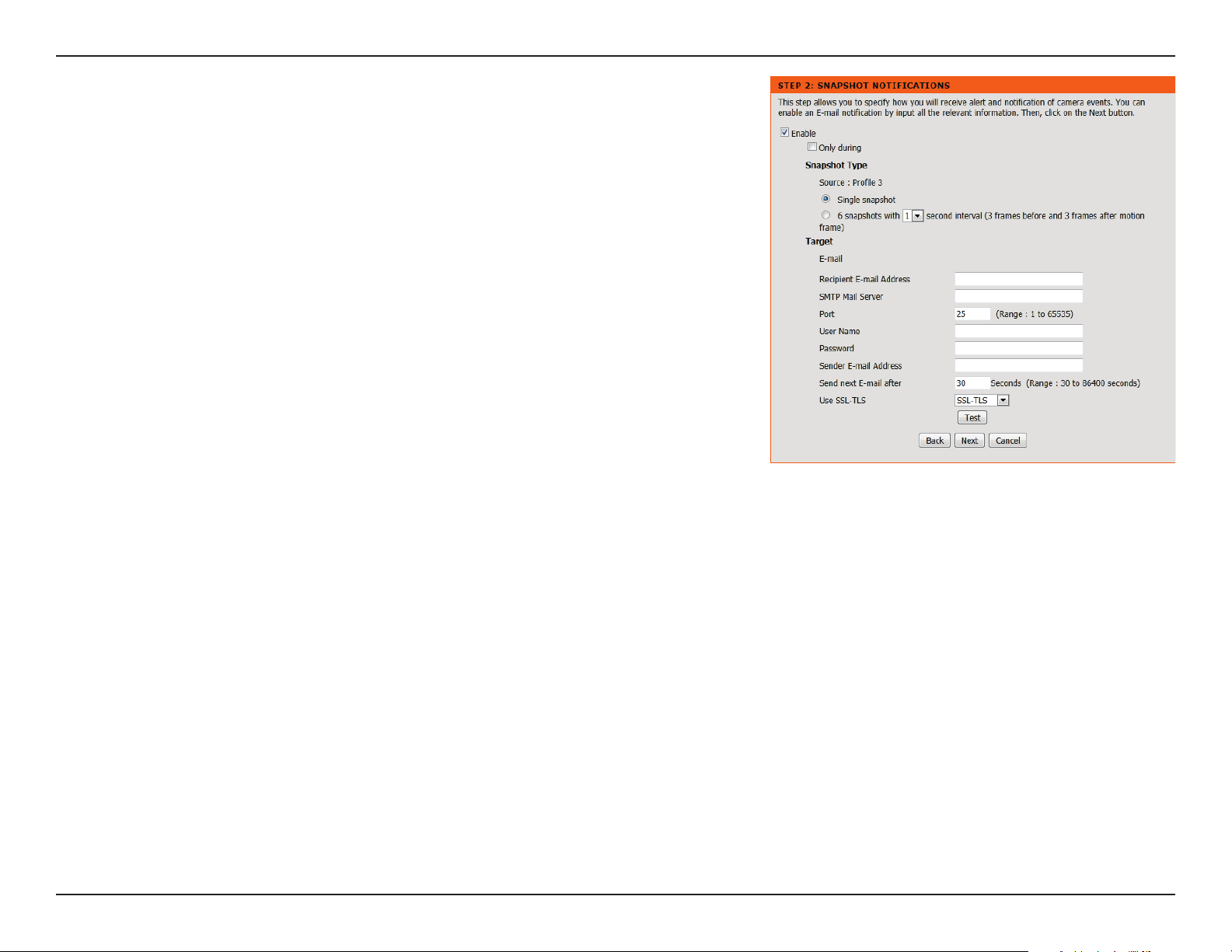
Step 3
This step allows you to specify how you would like to receive snapshots from your camera
when triggered. Check the Enable box and then select a schedule (check the Only during
box), the snapshot type, and your email server information. Please refer to Snapshot on
page 39 for more information.
Click Next to continue.
28D-Link DCS-936L User Manual
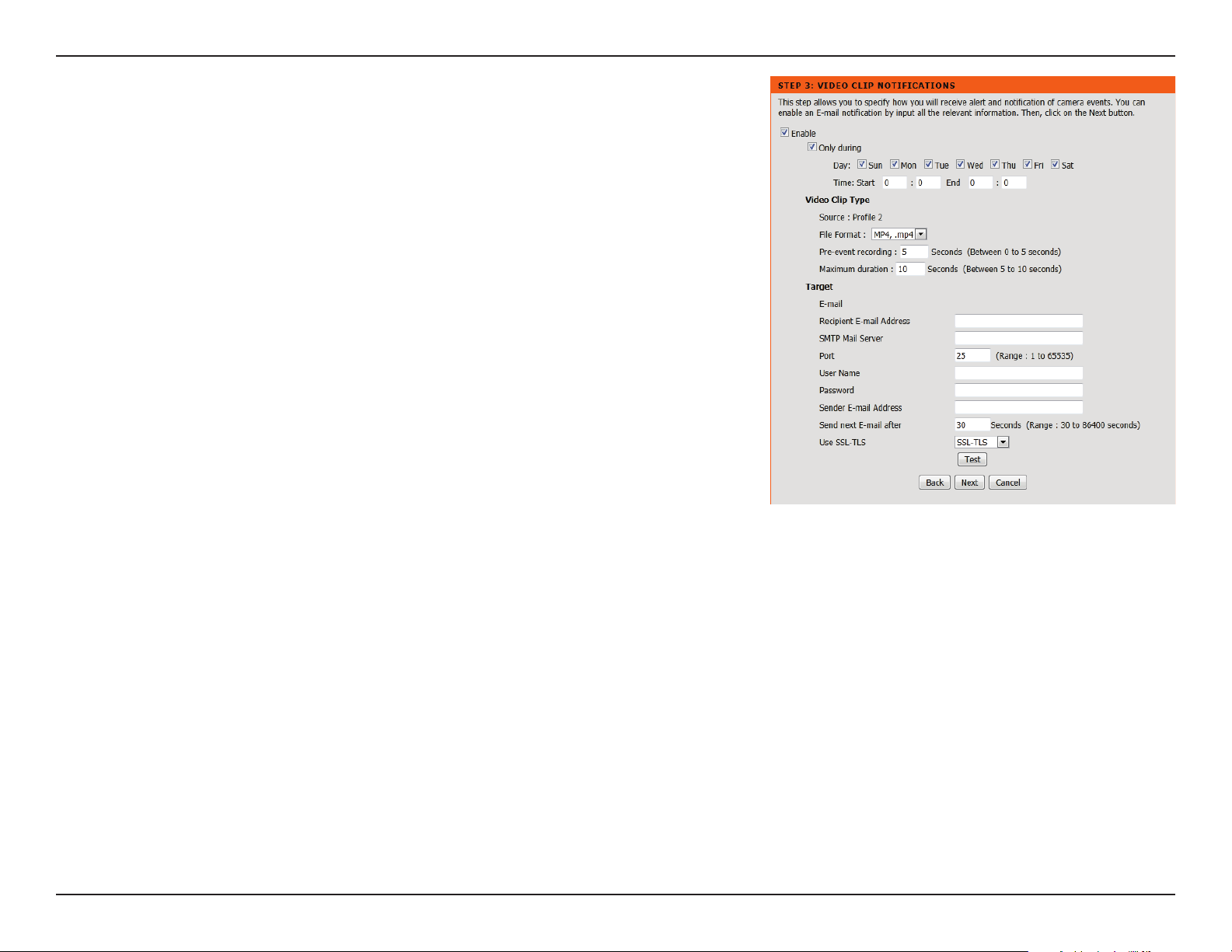
Section 3 - Conguration
Step 4
This step allows you to specify how you would like to receive video clips from your camera
when triggered. Check the Enable box and then select a schedule (check the Only during
box), the video clip type, and your email server information. Please refer to Video Clip on
page 38 for more information.
Click Next to continue.
29D-Link DCS-936L User Manual
Section 3 - Conguration
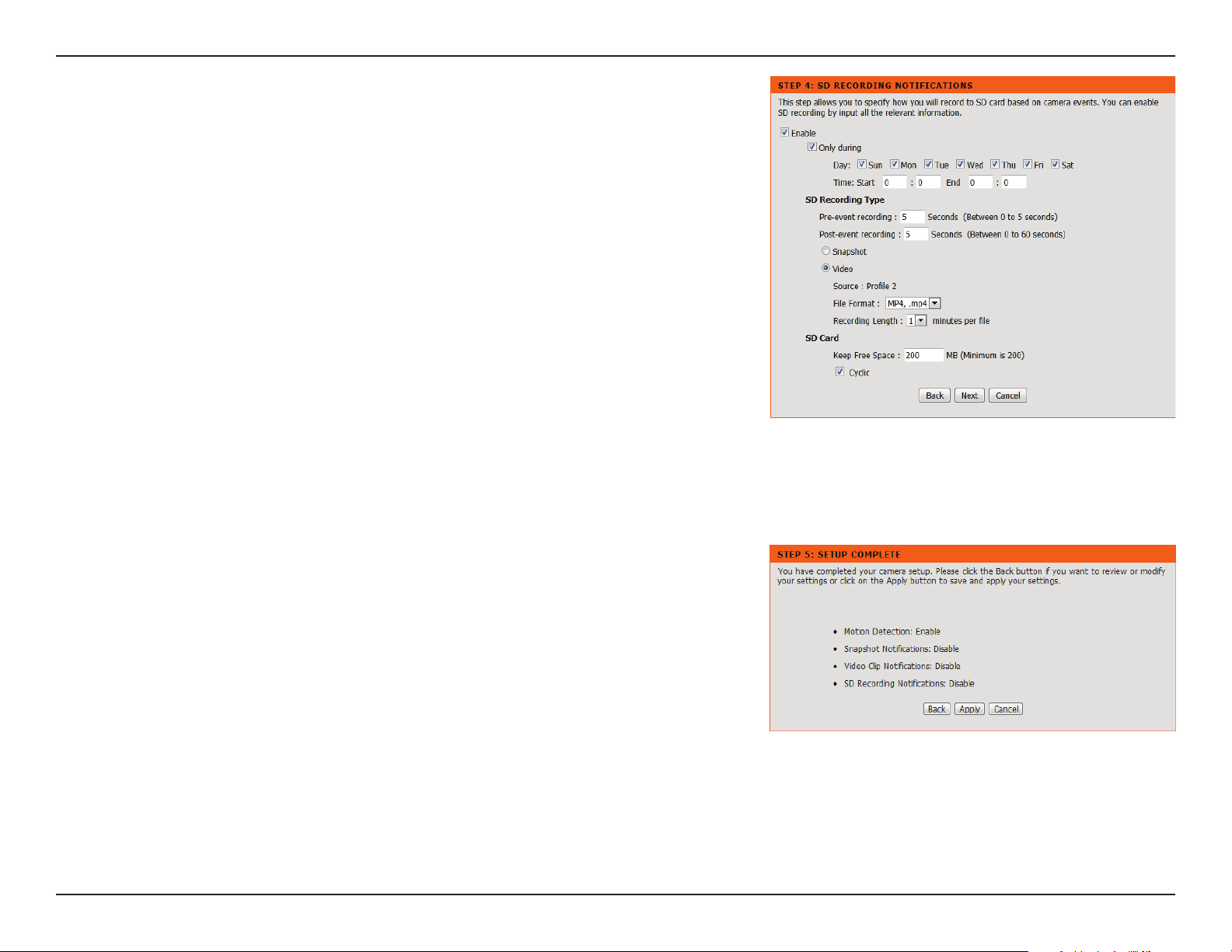
Step 5
This step allows you to send video clips or snapshots to your microSD card when triggered.
Check the Enable box and then select a schedule (check the Only during box), the SD
recording type, and how much space to use. Refer to SD Recording on page 42 for
information.
Click Next to continue.
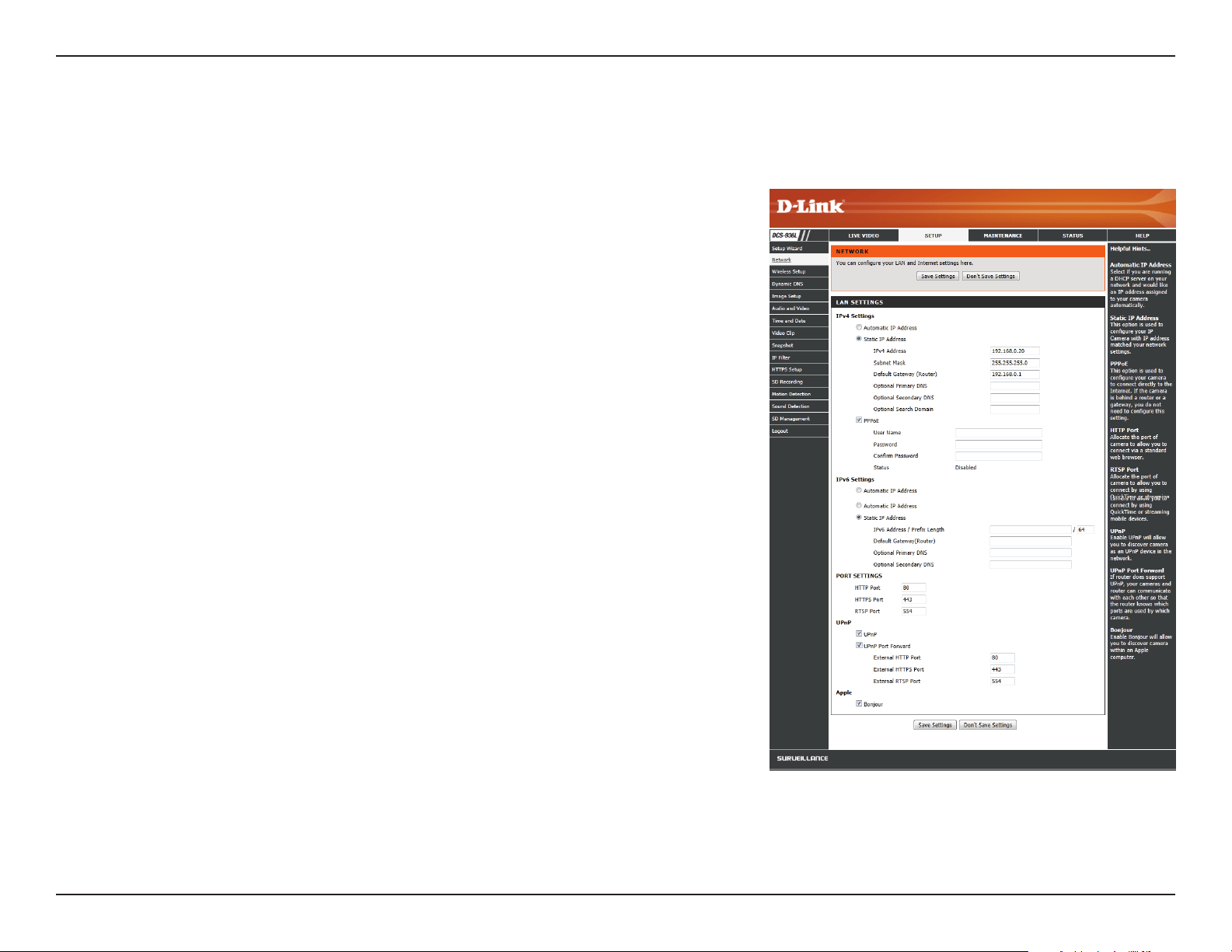
Step 6
You have completed the Motion Detection Wizard. Review your settings, and click on Back
if you need to make modications. If settings are correct, click Apply to save them.
Please wait a few moments while the camera saves your settings and restarts.
30D-Link DCS-936L User Manual
Section 3 - Conguration
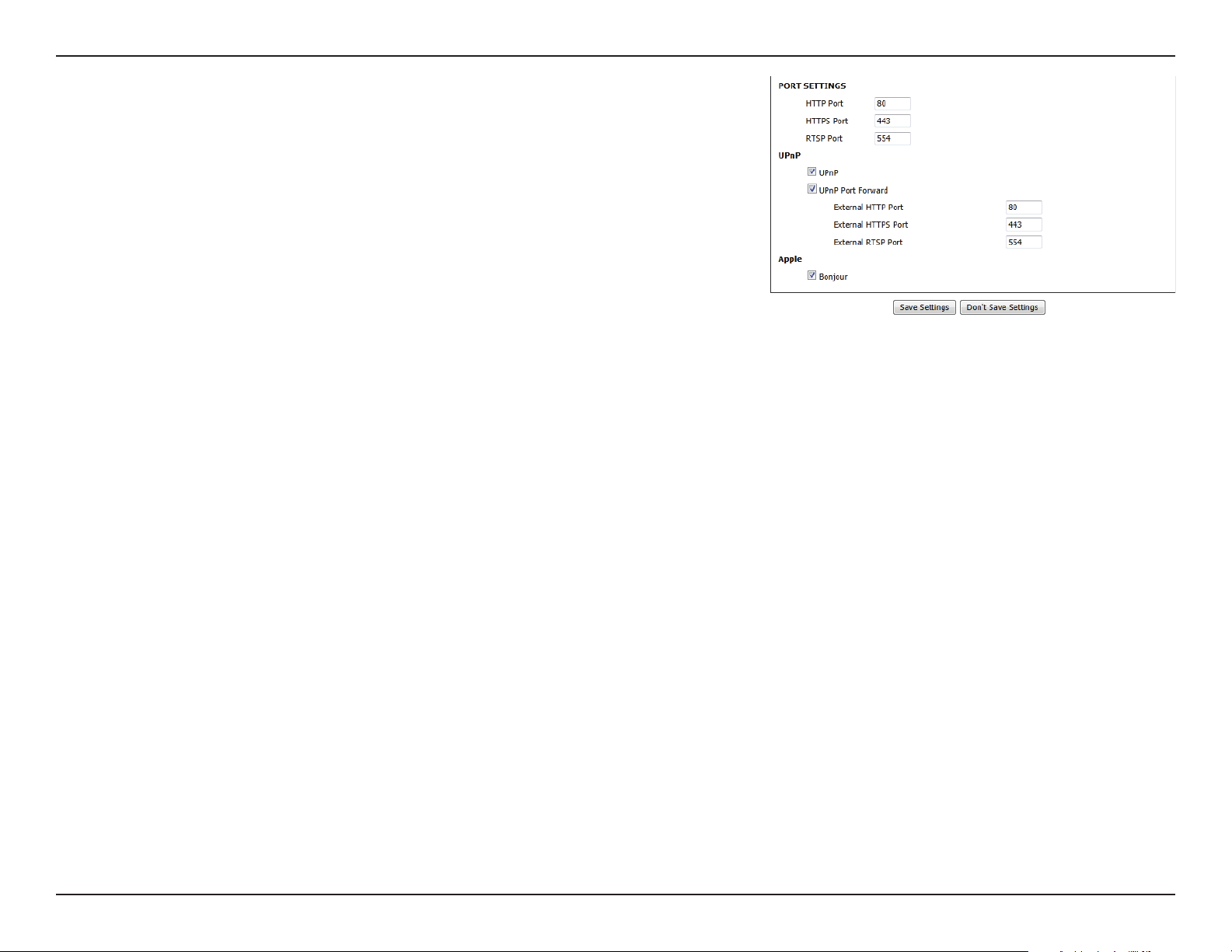
Network
This section allows you to congure your camera’s network settings.
Select this option if you have a DHCP server (i.e., router) running on your
network and would like your camera to obtain an IP address automatically.
Select this option to manually enter the IP settings on your camera.
IPv4 Address: Enter an IP address for your camera.
Subnet Mask: Enter the subnet mask for your network. The default value is
255.255.255.0.
Default Gateway: Enter the default gateway address. This is usually the
LAN IP address of your router.
Optional Primary DNS: Enter the IP address for the primary DNS (domain
name server) that translates names to IP addresses. This is usually the LAN
IP address of your router.
Optional Secondary DNS: The secondary DNS acts as a backup to the
primary DNS.
If you are using a PPPoE connection, enable it and enter the User Name
and Password for your PPPoE account. You can get this information from
your Internet service provider (ISP). Only use this option if the camera is
connected directly to your DSL modem or you have multiple PPPoE public
IP addresses.
Select Automatic IP Address to automatically get an IPv6 address from
your router. If you have a static or xed IP from your network administrator,
select Static IP address and enter the information provided by your ISP or
network administrator.
Automatic IP
Address:
Static IP
Address:
PPPoE
Settings:
IPv6 Settings:
31D-Link DCS-936L User Manual
Section 3 - Conguration
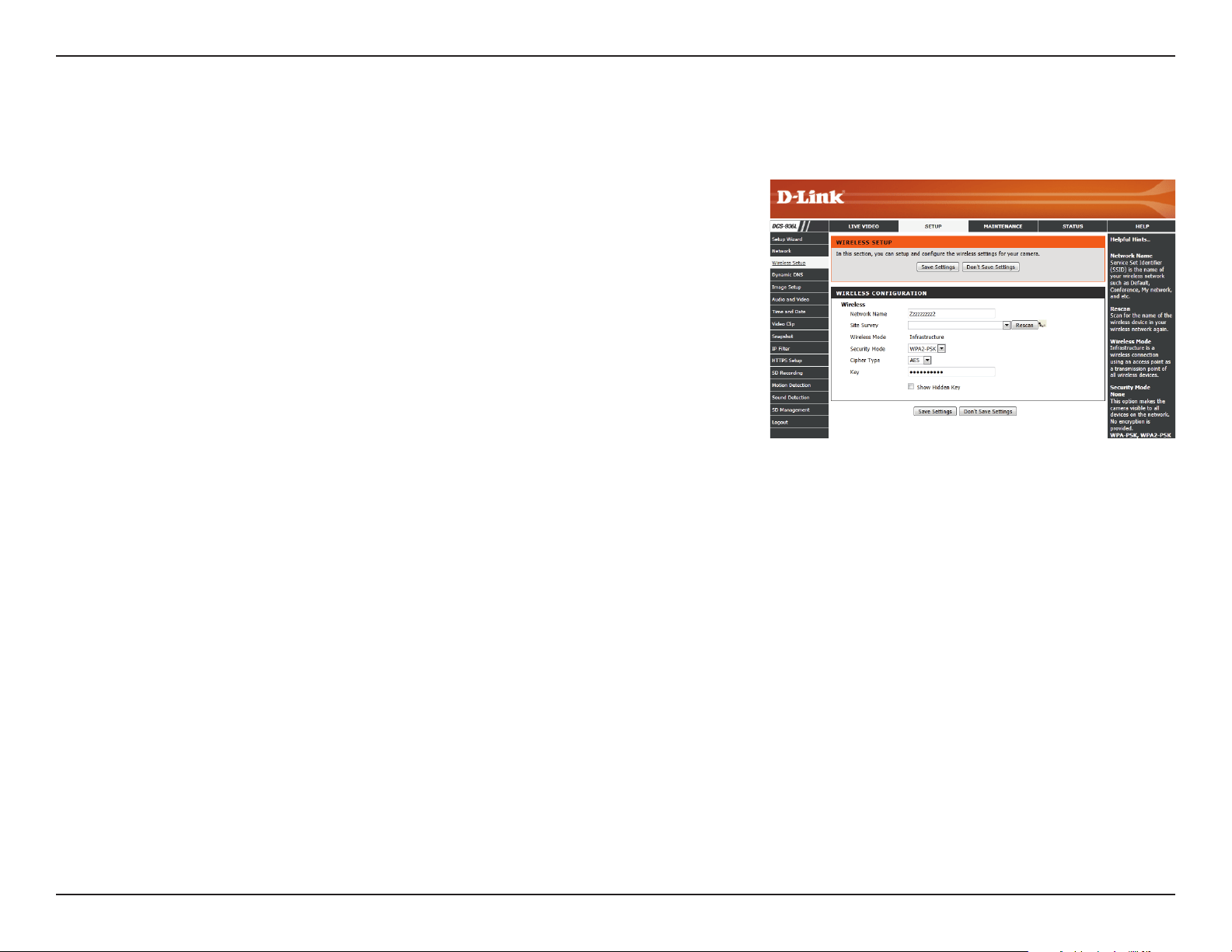
You may congure which ports to use for HTTP, HTTPS, and RTSP access
to the camera.
Enable this setting to congure your camera as an UPnP device in the
network.
Enabling this setting allows the camera to add port forwarding entries into
the router automatically. You must have UPnP enabled on your router.
Enter the external port for HTTP, HTTPS, and RTSP. These are usually the
same as the Port Settings values above. Only change if the ports are being
forwarded by your router to other services.
Checking the Bonjour box will allow the camera to be discoverable on
the network and visible to Apple devices.
Click Save Settings to save your changes.
Port Settings:
UPnP:
UPnP Port
Forward:
External Ports:
Bonjour:
32D-Link DCS-936L User Manual
Section 3 - Conguration
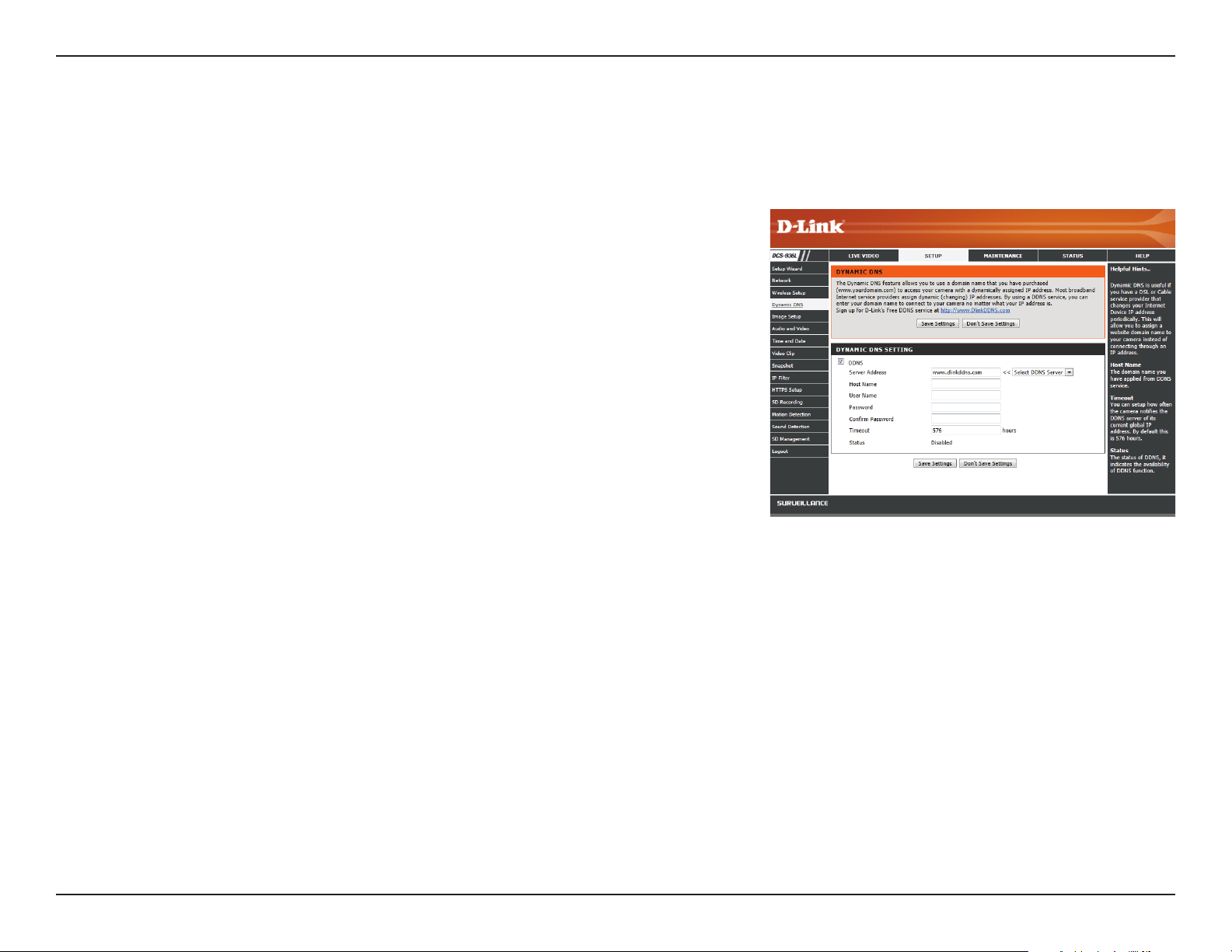
Wireless Setup
This section allows you to set up and congure the wireless settings on your camera.
Network Name:
Site Survey:
Wireless Mode:
Security Mode:
Cipher Type:
Key:
Enter the SSID/name for the wireless network you want to connect to, or use
the Site Survey drop-down menu to select an existing one.
The drop-down menu lists all the wireless networks that the camera is able
to detect. Click Rescan to scan for wireless networks again.
This displays the current wireless mode being used by the camera.
For security, you can choose None or WPA-PSK / WPA2-PSK. Select the
same encryption method that is being used by your wireless device/router.
If you chose WPA-PSK or WPA2-PSK, choose whether to use TKIP or AES.
Enter the key(password) for your wireless network. Check the Show Hidden
Key box to reveal the password you have entered.
Click the Save Settings button to save your changes.
33D-Link DCS-936L User Manual
Section 3 - Conguration
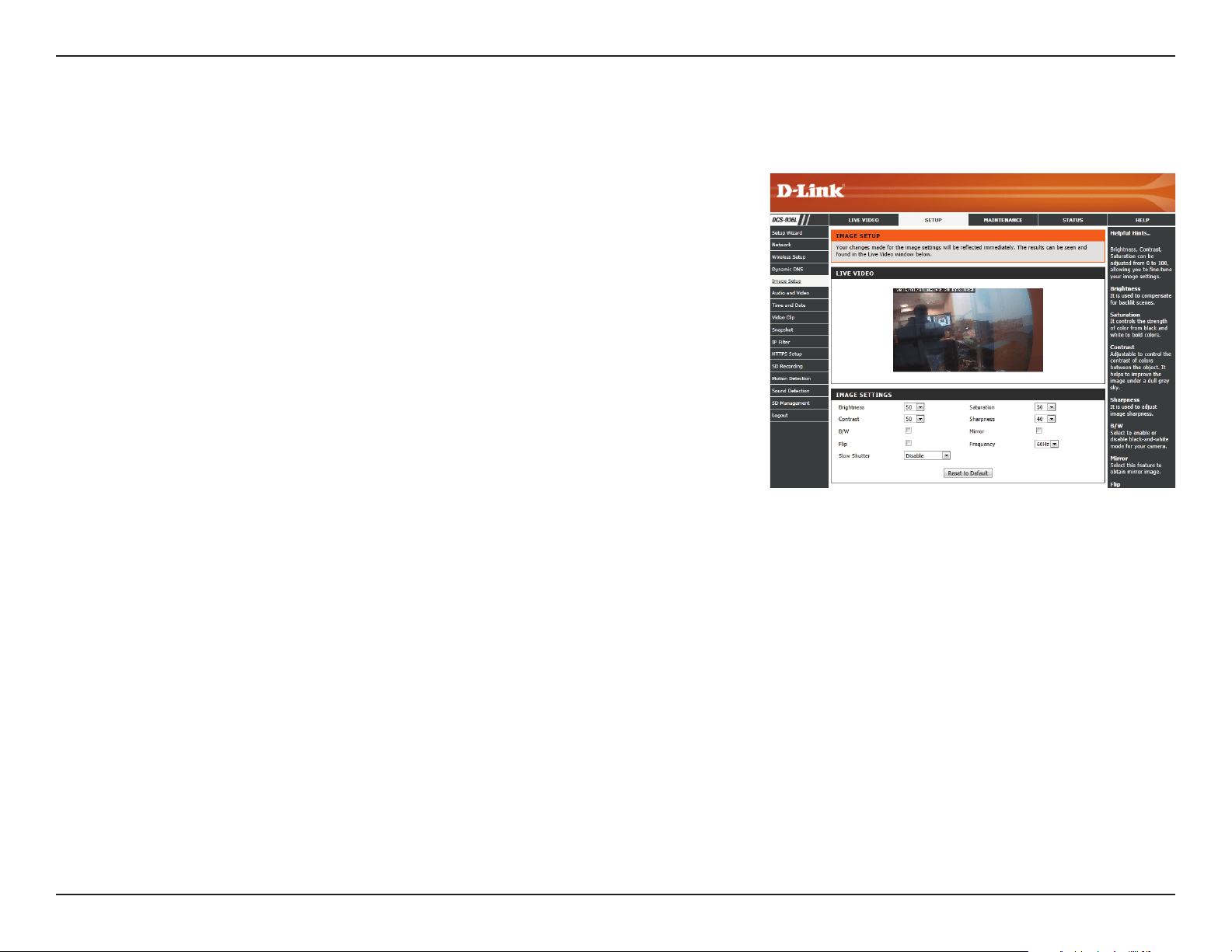
Dynamic DNS
DDNS allows you to access your camera using a domain name instead of an IP address. To do this, you will need to have an account with one of the
DDNS services listed in the drop-down box on this page. After making any changes, click Save Settings.
Check this box to enable the DDNS function.
Select your Dynamic DNS Server from the drop-down menu.
Enter the host name of the DDNS server.
Enter the username or e-mail address used to connect to the DDNS server.
Enter the password used to connect to the DDNS server.
Enter in hours how often the camera noties the DDNS server of its
current global IP address.
This shows the current status of your DDNS updates.
Click the Save Settings button to save your changes.
DDNS:
Server Address:
Host Name:
User Name:
Password:
Timeout:
Status:
34D-Link DCS-936L User Manual
Section 3 - Conguration
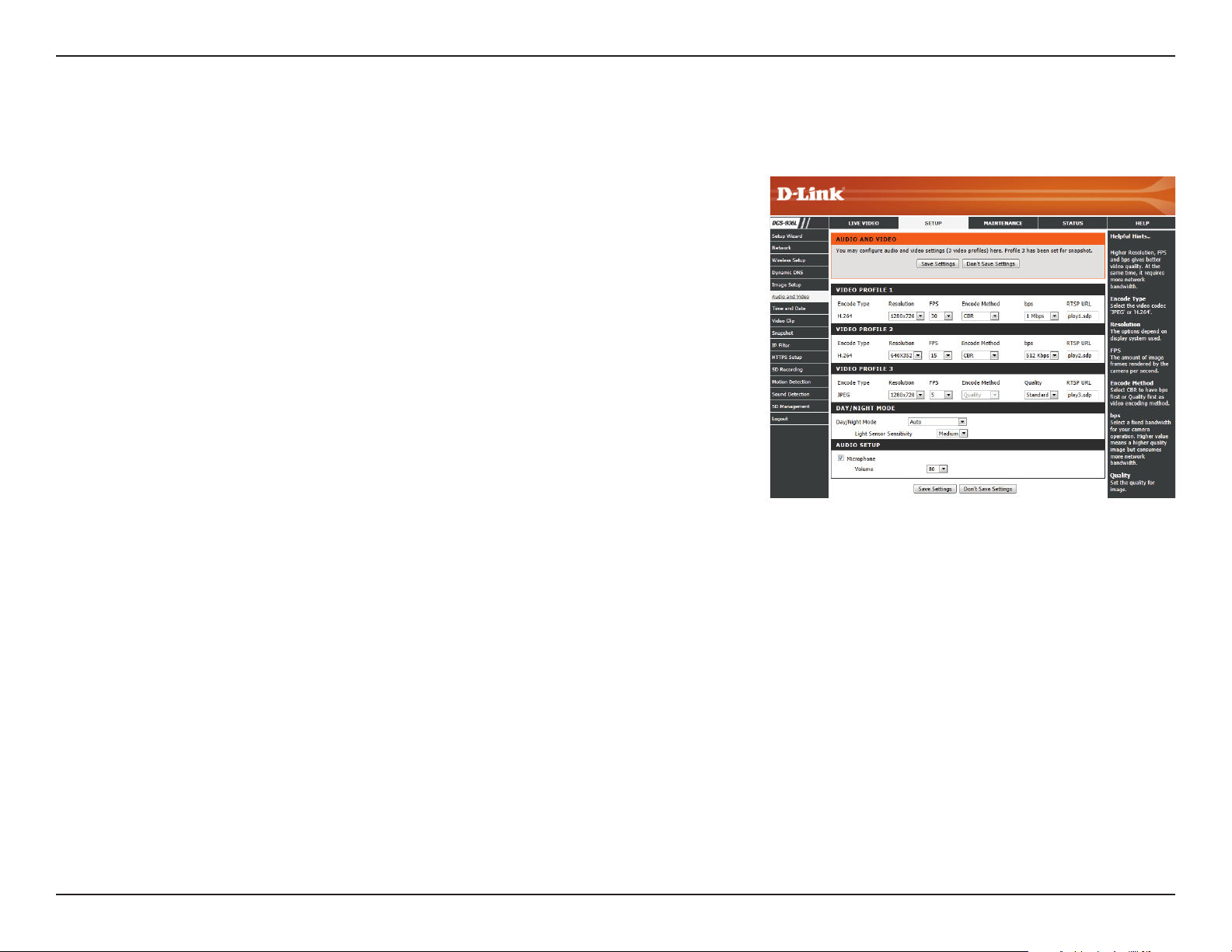
Image Setup
This section allows you to congure the image settings for your camera.
Adjust this setting to compensate for backlit subjects.
This setting controls the amount of coloration, from grayscale to fully
saturated.
Adjust this setting to alter the color intensity/strength.
Specify how much sharpening to apply to the image.
Select to change the video to black and white.
Check the box to ip the image horizontally.
Check the box to ip the image vertically. If the camera is installed upside
down, Flip and Mirror should both be checked.
Select the frequency used by your power lines to avoid camera icker
or moving bars in your video. Generally, if your power outlets are 220 to
240 V, you should select 50 Hz. If your power outlets are 100 to 120 V, you
should select 60 Hz.
Allows you to set a slow shutter speed to use. Using a slow shutter allows
you to monitor an area in low-light conditions. However, using a slow
shutter speed may make moving objects appear blurry.
Changes made to these settings will take eect immediately.
Brightness:
Saturation:
Contrast:
Sharpness:
B/W:
Mirror:
Flip:
Frequency:
Slow Shutter:
35D-Link DCS-936L User Manual
Section 3 - Conguration
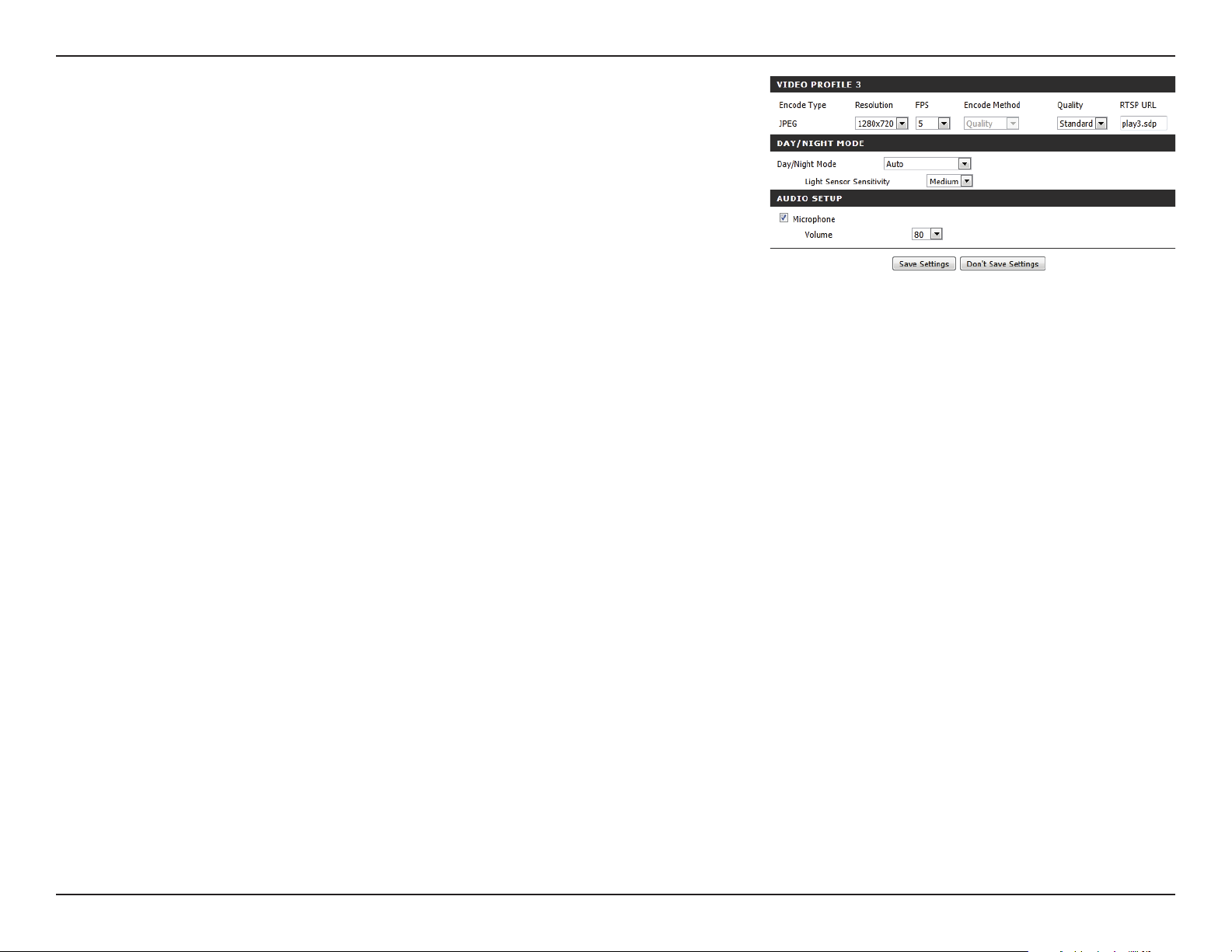
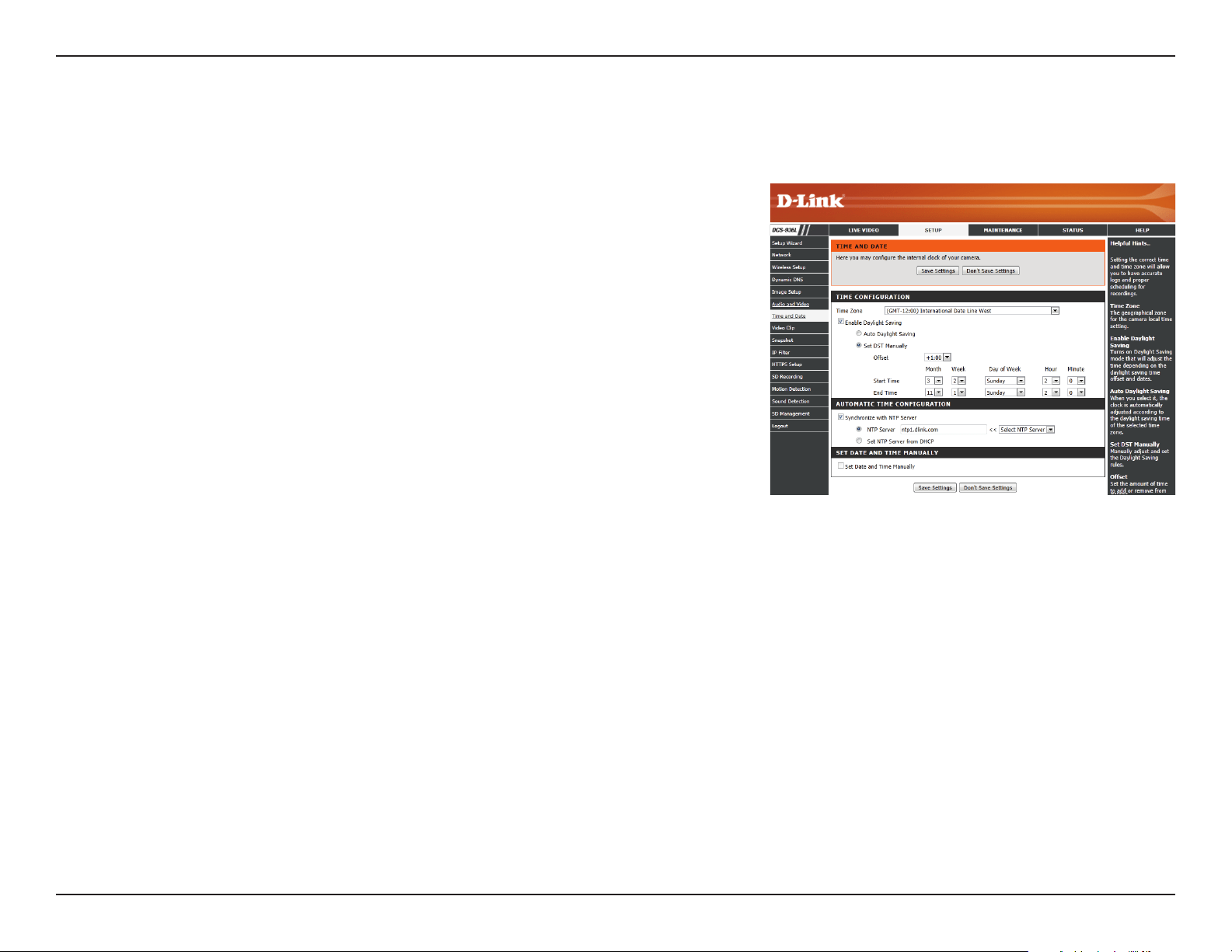
Audio and Video
This section allows you to congure the audio and video settings for your camera.
Video Prole:
Encode Type:
Resolution:
FPS:
Encode
Method:
bps:
Quality:
There are three individual proles that can be congured. Prole 2 is used
for snapshots, and Prole 3 is used for mobile devices.
This is the video encoding the prole uses. These are xed for each prole.
Select the desired video resolution for the video prole: 1920 x 1080,
1280 x 720, 640 x 352, or 320 x 176. Higher resolutions will provide a
higher quality image, but will require more network bandwidth and create
larger saved les.
Set the desired FPS for the video prole. A higher FPS will result in smoother
video playback, but will require more network bandwidth and create larger
saved les.
This is the encode method the prole uses. These are xed for each prole.
Select the bit rate to assign the video. The bps setting is used as a maximum
limit for the amount of data the camera will use. Higher settings will provide
a higher quality image, but will require more network bandwidth and
create larger saved les.
One of ve levels of image quality can be set for the snapshot feature:
Highest, High, Medium, Low, and Lowest. This setting is for Prole 2 only.
36D-Link DCS-936L User Manual
Section 3 - Conguration
This is the URL used to connect to the camera when viewing from QuickTime
or a mobile device. For instance, live1.sdp can be accessed at rtsp://x.x.x.x/
video1.sdp where the x.x.x.x represents the IP address of your camera.
Select a method of switching between day and night modes. During day
mode, the IR cut lter will be used to ensure that your video will have the
correct colors. During night mode, the IR LEDs will be turned on and the IR
cut lter moves out of the way to give the camera night vision.
• Auto: This will automatically switch between day and night mode
based on the amount of ambient light. When there is enough light,
day mode will be used. When it gets dark, the camera will switch to
night mode.
You can use the Light Sensor Sensitivity drop-down box to
determine how sensitive the camera’s light sensor will be and how
quickly your camera will respond to changes in ambient light.
• Manual: The camera will only switch between day and night mode
when requested to through the Live Video interface on the mydlink
website or mobile app.
• Always Day Mode: The camera will always use day mode.
• Always Night Mode: The camera will always use night mode.
• Day Mode Schedule: This option lets you use a schedule to switch
between day and night mode. Enter the times you want the camera to
use day mode. The camera will use night mode for all times outside of
this schedule.
Allows you to enable and disable or adjust the volume levels of the
microphone.
Click Save Settings to save your changes.
RTSP URL:
Day/Night
Mode:
Audio Setup:
37D-Link DCS-936L User Manual
Section 3 - Conguration
Time and Date
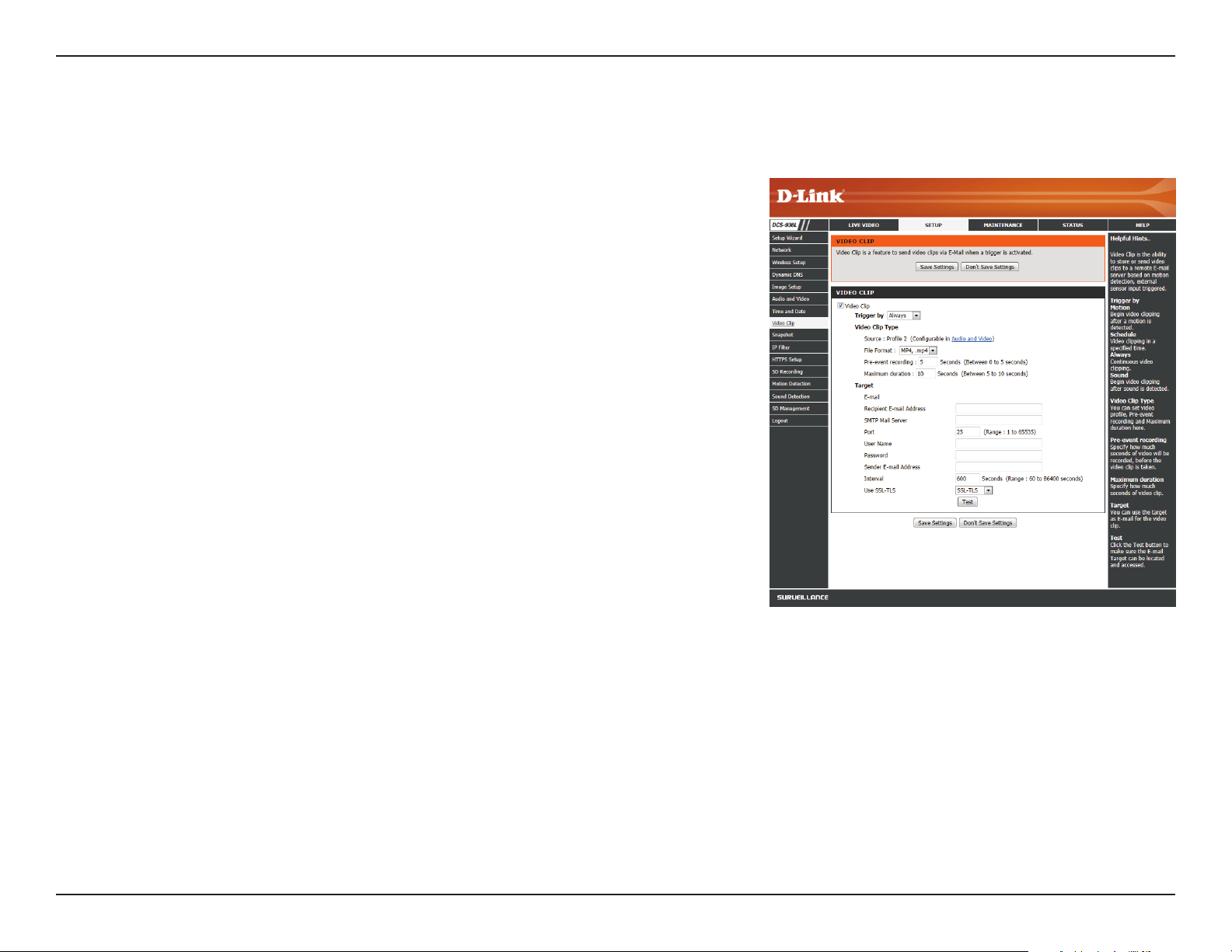
This section allows you to congure the settings of the internal system clock for your camera.
Time Zone:
Enable
Daylight
Saving:
Synchronize
NTP Server:
Set the Date
and Time
Manually:
Select the time zone for your region from the drop-down menu.
If your region uses Daylight Saving time, you can enable it here. Select Set
DST Manually if you want to manually set the oset and the period of time
that the Daylight Saving correction should be used.
Network Time Protocol (NTP) will synchronize your camera with an Internet
time server. Choose the one that is closest to your camera, or select Get NTP
Server from DHCP to try and get the NTP server information automatically
from your DHCP server.
If Synchronize NTP Server is disabled, you can set the date and time
manually. You can also click the Copy Your Computer’s Time Settings
button to automatically copy the date and time of the PC you are using.
Click Save Settings to save your changes.
38D-Link DCS-936L User Manual
Section 3 - Conguration
Video Clip
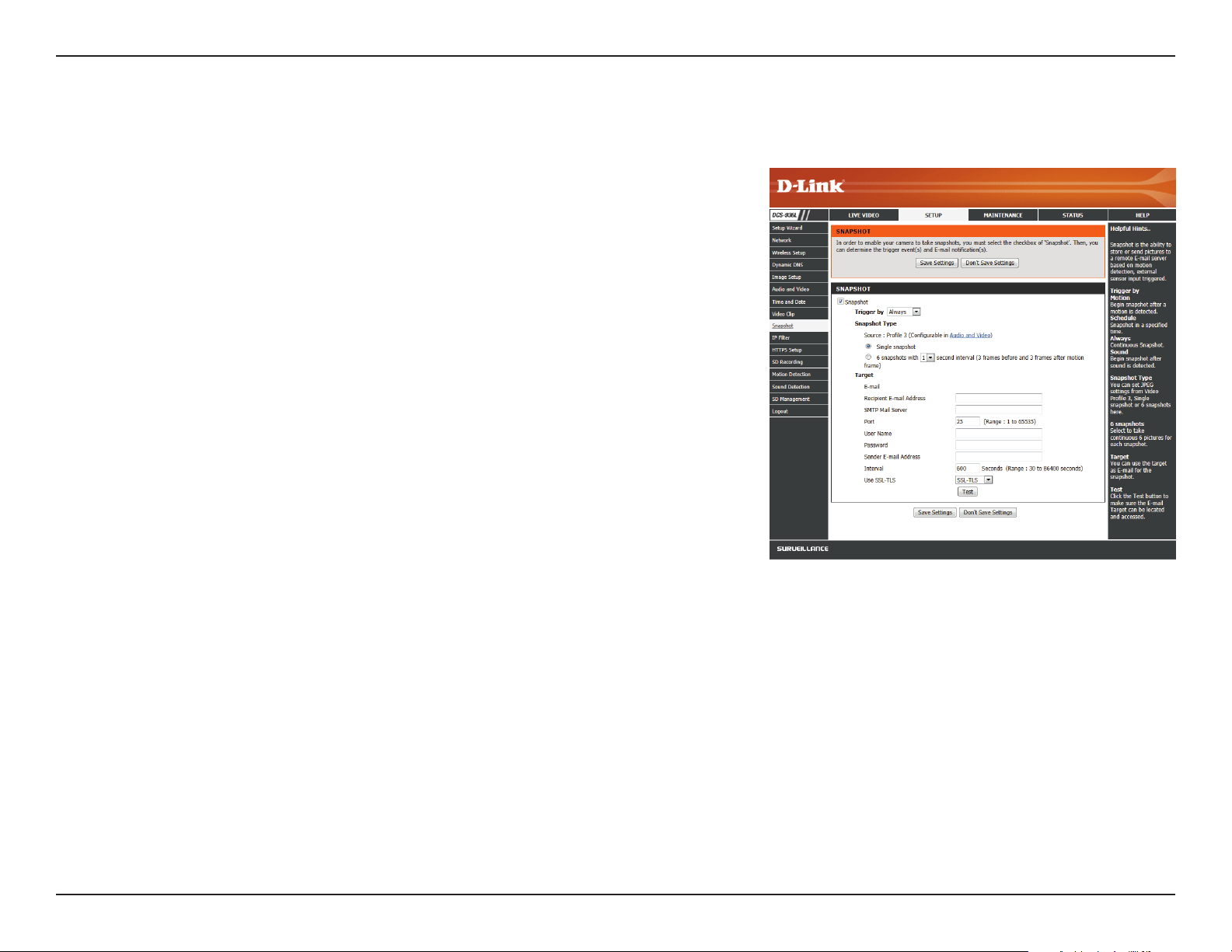
Video Clip allows you to send video clips via e-mail when a trigger is activated.
Video Clip:
Trigger By:
Video Clip
Type:
Target:
Check this box to enable the Video Clip function.
Select whether to record a video clip when triggered by Motion or Sound,
according to a Schedule, or Always record.
• Motion: Enables recording when motion is detected. You can limit
motion-triggered recording to a specic schedule by selection Only
during and entering the times you want motion-triggered recording
to be enabled.
• Schedule: Enables recording according to a schedule. Enter the times
you want the camera to record.
• Always: This will enable continuous recording.
• Sound: Enables recording when sound is detected. You can limit sound-
triggered recording to a specic schedule by selection Only during and
entering the times you want sound-triggered recording to be enabled.
You may choose Video Prole 1 or 3 and select the le format and recording
length. For more on video prole options, refer to Audio and Video on
page 35.
Select where you want the video clip to be sent. Enter the settings for your
e-mail account.
Click Save Settings to save your changes.
39D-Link DCS-936L User Manual
Section 3 - Conguration
Snapshot
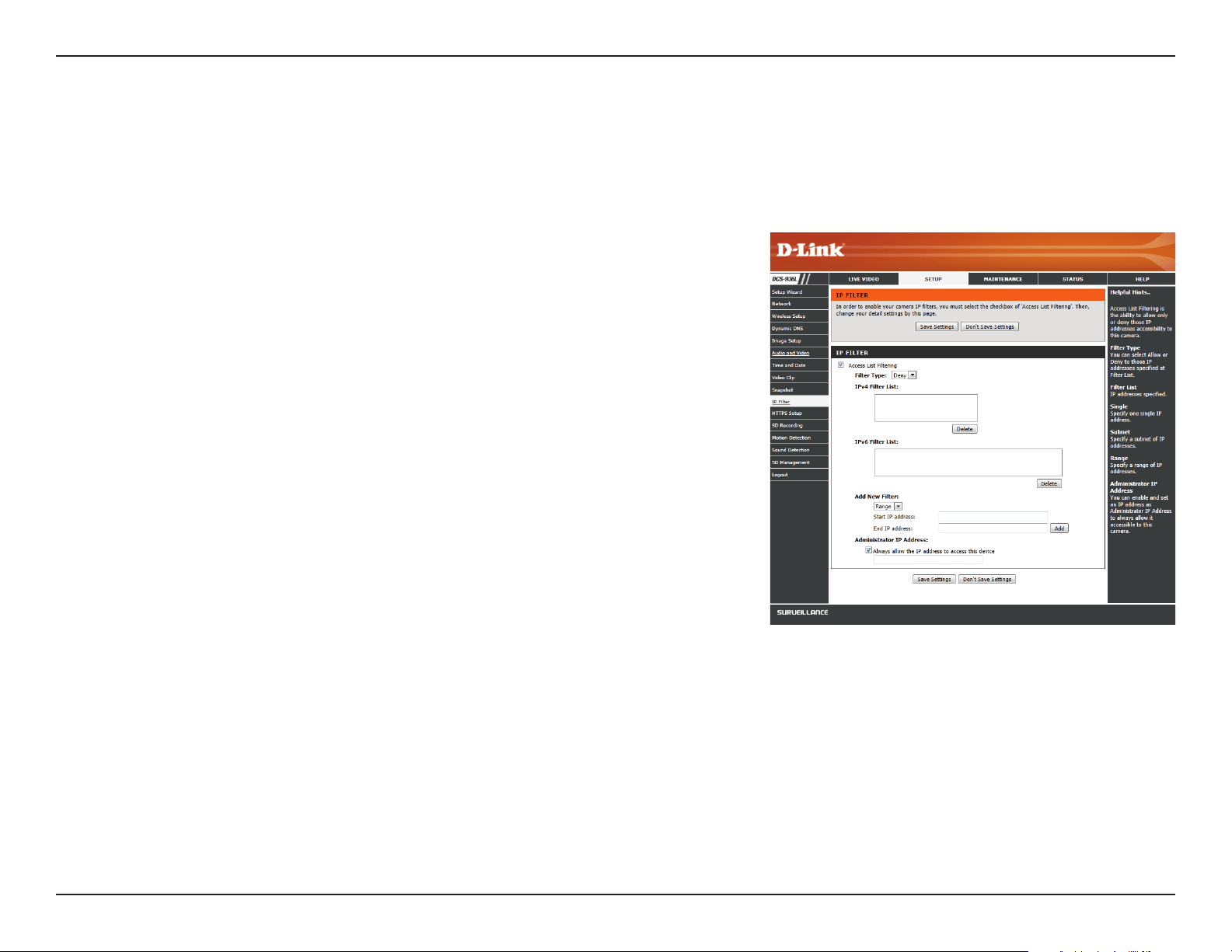
The snapshot feature lets you send image snapshots via e-mail when a trigger is activated.
Snapshot:
Trigger By:
Snapshot Type:
Target:
Check this box to enable the Snapshot function.
Select whether to record a snapshot when triggered by Motion or Sound,
according to a Schedule, or Always record.
• Motion: Enables recording when motion is detected. You can limit
motion-triggered recording to a specic schedule by selection Only
during and entering the times you want motion-triggered recording
to be enabled.
• Schedule: Enables recording according to a schedule. Enter the times
you want the camera to record. During these times, a snapshot will be
taken every second.
• Always: This will enable continuous recording. A snapshot will be
taken every second.
• Sound: Enables recording when sound is detected. You can limit
sound-triggered recording to a specic schedule by selection Only
during and entering the times you want sound-triggered recording
to be enabled.
Select whether to take a single snapshot or to take 6 snapshots with a
selectable interval between them. Snapshots will always use Video Prole
2. For more on video prole options, refer to Audio and Video on page
35.
Select where you want the snapshot to be sent. Enter the settings for your
e-mail account.
Click Save Settings to save your changes.
40D-Link DCS-936L User Manual
Section 3 - Conguration
IP Filter
The IP Filter is a feature used to allow or deny certain IP addresses when accessing the DCS-936L. Please note that when creating an allow list, if the
IP address of your computer is not included or if you do not set up an administrator IP address, you may be locked out of accessing your camera. In
this event, you will need to do a hard reset of your camera by pressing the reset button for more than 10 seconds while it is powered on.
Access List
Filtering:
Filter Type:
IPv4 Filter List:
IPv6 Filter List:
Add New Filter.
Administrator
IP Address.
Check this box to enable the IP Filter function.
Select whether to set the lter to allow or to deny connection from the IP
addresses listed.
The current list of IPv4 addresses that are being ltered. Select a line and
the click the delete button to remove that entry.
The current list of IPv6 addresses that are being ltered. Select a line and
the click the delete button to remove that entry.
From the drop-down menu, select whether to add a single IP, an entire
subnet, or a range of IP addresses. Enter an IP address, subnet, or IP range,
then click Add to create a new lter.
You can allow a single IP address to always have access to this camera,
regardless of the IP lter rules being used, by enabling this option and
entering the IP address.
Click Save Settings to save your changes.
41D-Link DCS-936L User Manual
Section 3 - Conguration
HTTPS Setup
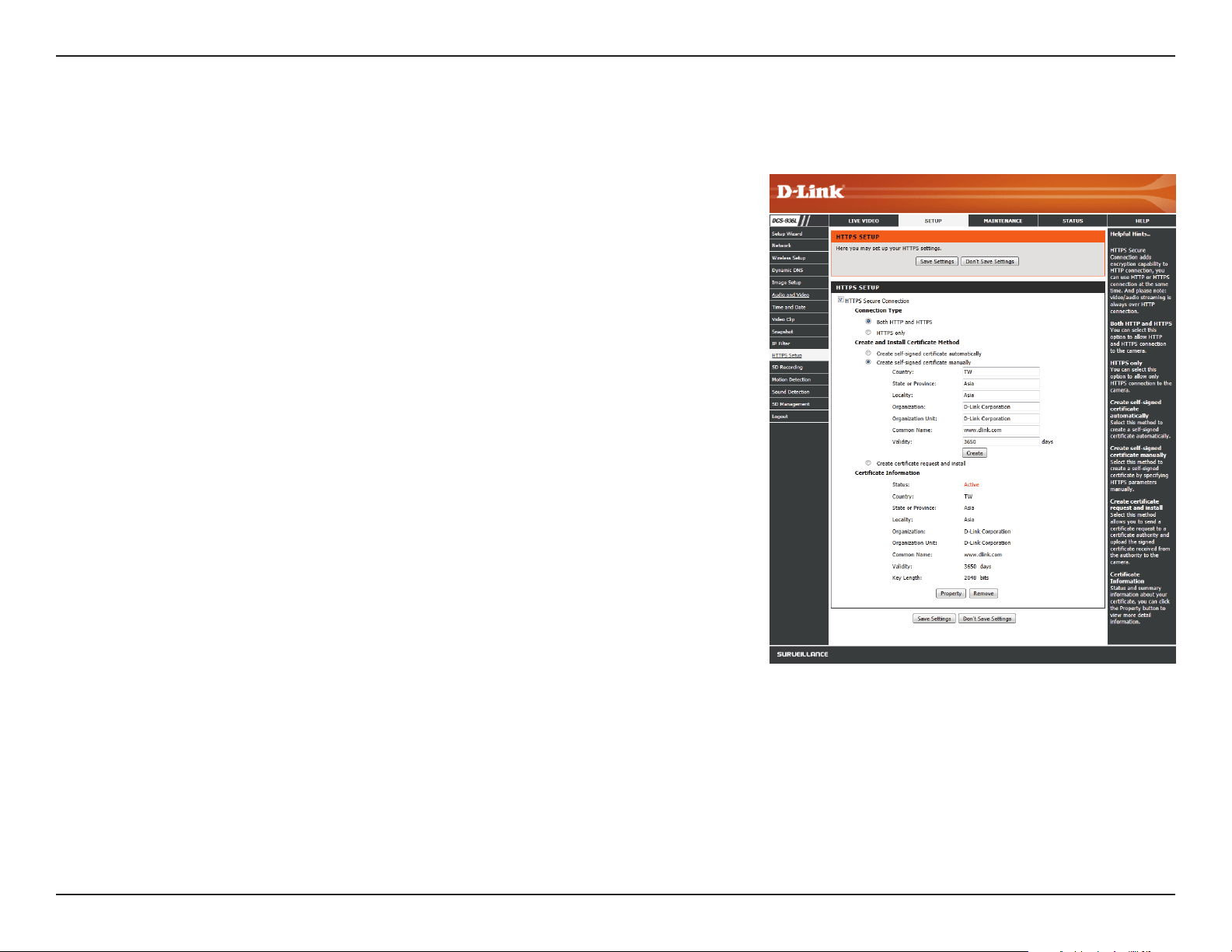
HTTPS Setup is used to add encryption to the HTTP connection, making it more secure and less susceptible to unauthorized use.
HTTPS Secure
Connection:
Connection
Type:
Create
and Install
Certicate
Method:
Certicate
Information:
Check this box to enable the HTTPS function.
Select whether the connection type should be Both HTTP and HTTPS or
HTTPS only.
Select whether to create a self-signed certicate automatically, manually,
or to request and install a certicate from an authority. If you choose
to manually create a certicate or request and install one, enter the
requested information.
General information and the status of the current HTTPS certicate is
displayed. If you would like to see more detailed information, click on
the Property button. If you would like to remove the certicate, click the
Remove button.
Click Save Settings to save your changes.
42D-Link DCS-936L User Manual
Section 3 - Conguration
SD Recording
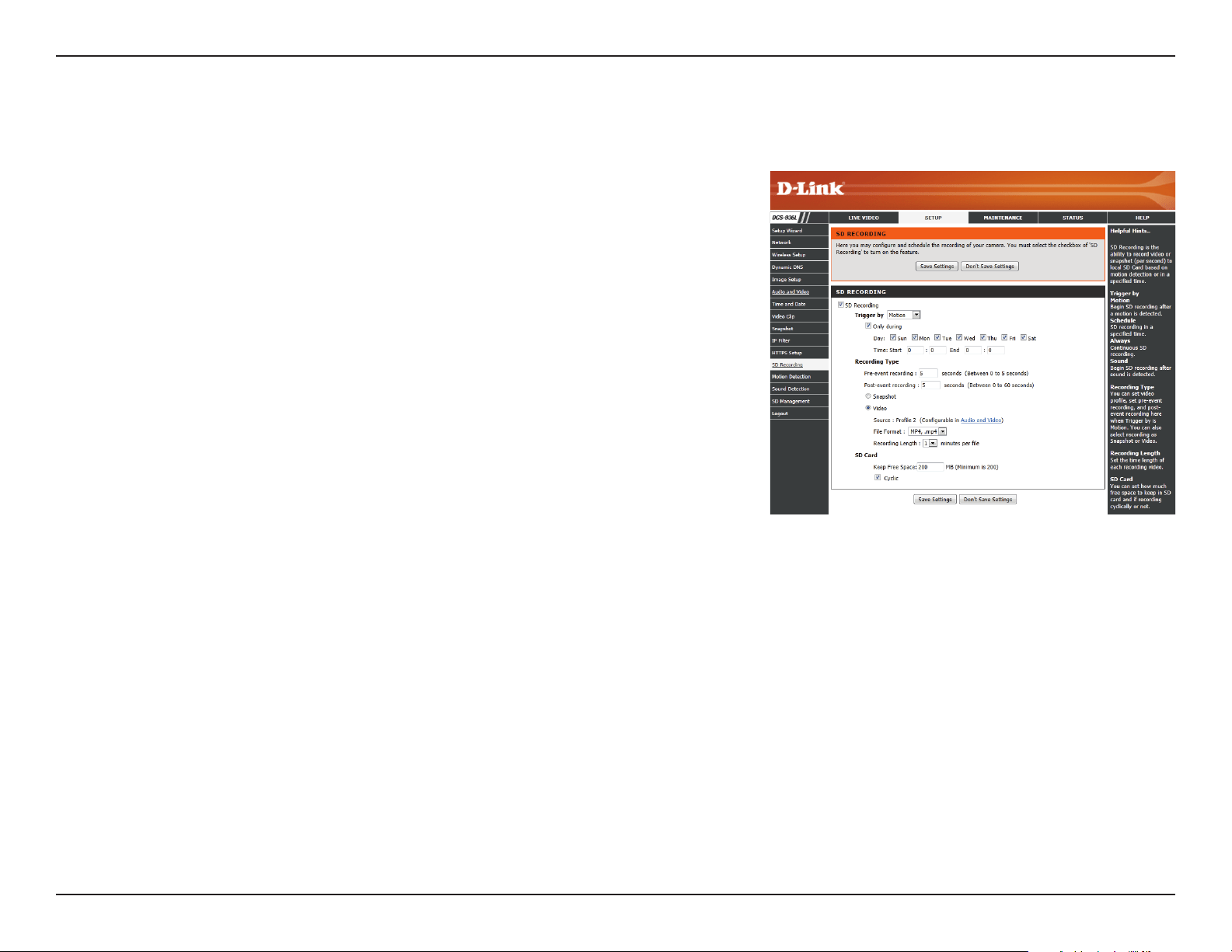
This option allows you to congure and set a schedule for the recording to an inserted microSD card.
SD Recording:
Trigger by:
Recording
Type:
Pre-event
Recording:
Post-event
Recording:
Check this box to enable the recording feature.
Select whether the event is activated by Motion, Schedule, or if the video
is Always recording.
• Motion: Enables recording when motion is detected. You can limit
motion-triggered recording to a specic schedule by selection Only
during and entering the times you want motion-triggered recording
to be enabled.
• Schedule: Enables recording according to a schedule. Enter the times
you want the camera to record. If you are recording snapshots, a
snapshot will be taken every second during these times.
• Always: This will enable continuous recording. If you are recording
snapshots, a snapshot will be taken every second.
• Sound: Enables recording when sound is detected. You can limit
sound-triggered recording to a specic schedule by selection Only
during and entering the times you want sound-triggered recording
to be enabled.
You can choose to record snapshots or video. Snapshots will use Video
Prole 2. For video recordings, you may choose Video Prole 1 or 3 and
select the le format and recording length. For more on video prole
options, refer to Audio and Video on page 35.
If Trigger By is set to Motion or Sound, this will set how many seconds
to record before the event occurs. If you are recording snapshots, one
snapshot will be taken each second.
If Trigger By is set to Motion or Sound, this will set how many seconds
to record after the event occurs. If you are recording snapshots, one
snapshot will be taken each second.
43D-Link DCS-936L User Manual
Section 3 - Conguration
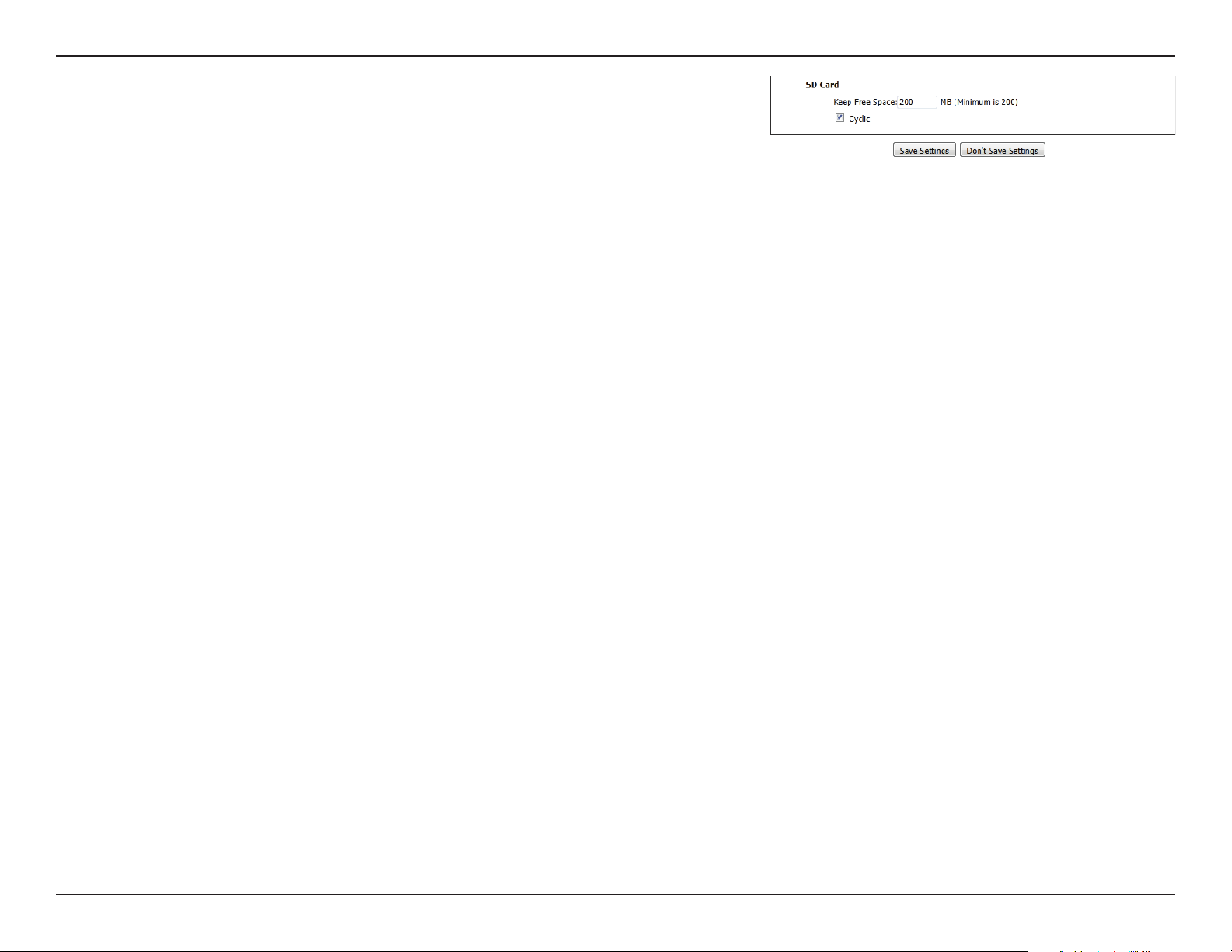
Keep Free
Space:
Cyclic:
Set amount of space to keep free on the microSD card.
When this option is selected, it will cause the oldest snapshot/video les
to be deleted when the system requires storage space for new snapshot/
video les.
Click Save Settings to save your changes.
44D-Link DCS-936L User Manual
Section 3 - Conguration
Motion Detection
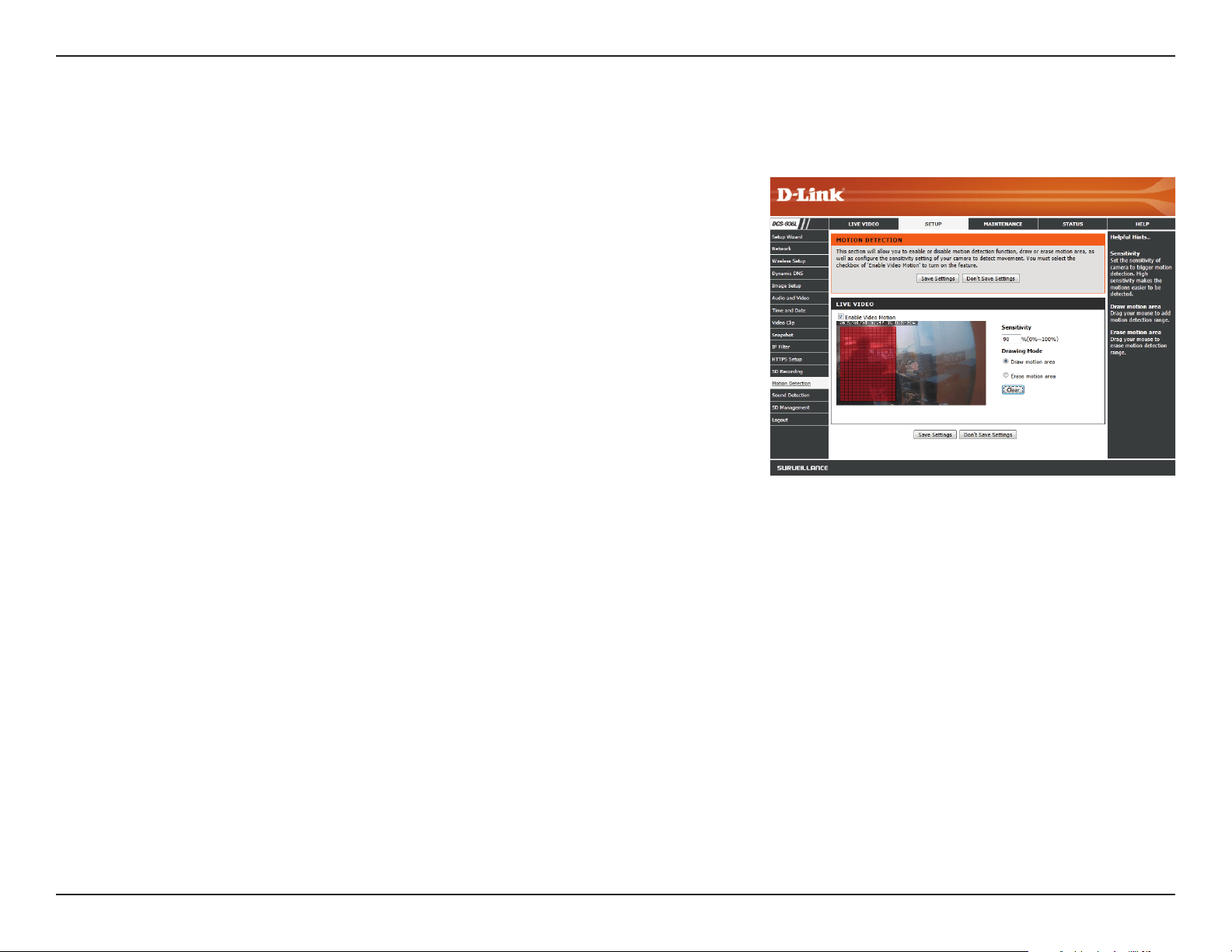
Motion detection enables the camera to monitor the video feed for movement. You can also enable motion detection via the PIR sensor.
Enable Video
Motion:
Sensitivity:
Drawing Mode:
Clear:
Select this box to enable the video motion detection feature of your camera.
Make sure you draw an area for the camera to monitor for motion.
Species how sensitive video motion detection will be from 0% to 100%.
A low sensitivity setting means that there must be large changes between
two images in order to detect motion, and a high sensitivity setting means
that even small changes will cause motion to be detected.
Select Draw Motion Area to select the area of the picture to monitor for
movement to trigger recording or a snapshot. Use your mouse to click
and drag on the area that you would like to monitor for motion. Select
Erase Motion Area to clear a selected region and stop the camera from
monitoring that area of the picture.
Clears all motion detection areas from the picture.
Click Save Settings to save your changes.
45D-Link DCS-936L User Manual
Section 3 - Conguration
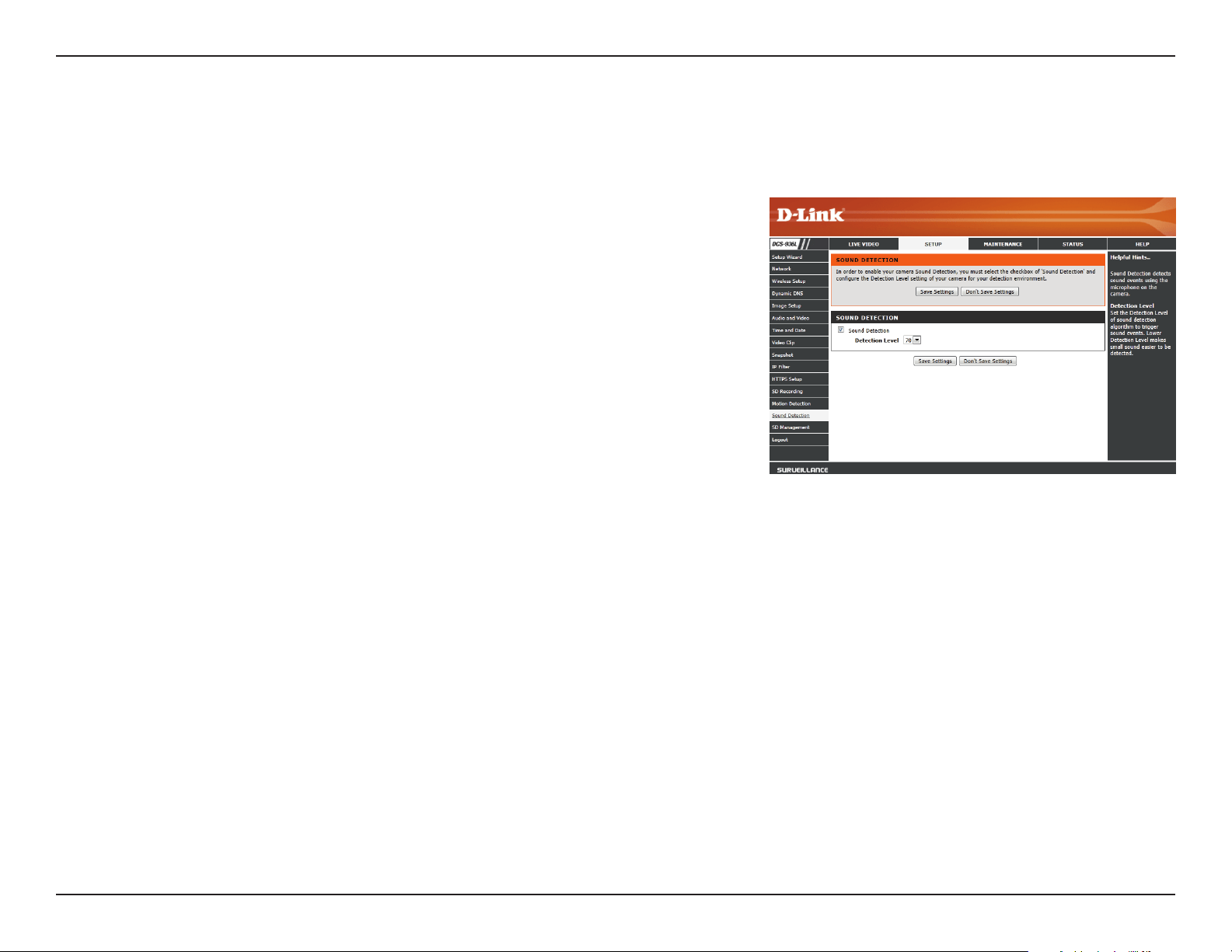
Sound Detection
Sound detection enables the camera to monitor the environment for loud sounds. You may set the volume threshold used to determine whether
sound was detected or not. If this option is selected, the trigger by option under Video Clip, Snapshot, or SD Recording should also be selected.
Sound
Detection:
Detection
Level:
Select this box to enable the sound detection feature of your camera.
Specify the volume level that a sound must exceed in order to trigger the
sound detection feature. The lower the number, the more sensitive the
camera will be to sound.
Click Save Settings to save your changes.
46D-Link DCS-936L User Manual
Section 3 - Conguration
SD Management
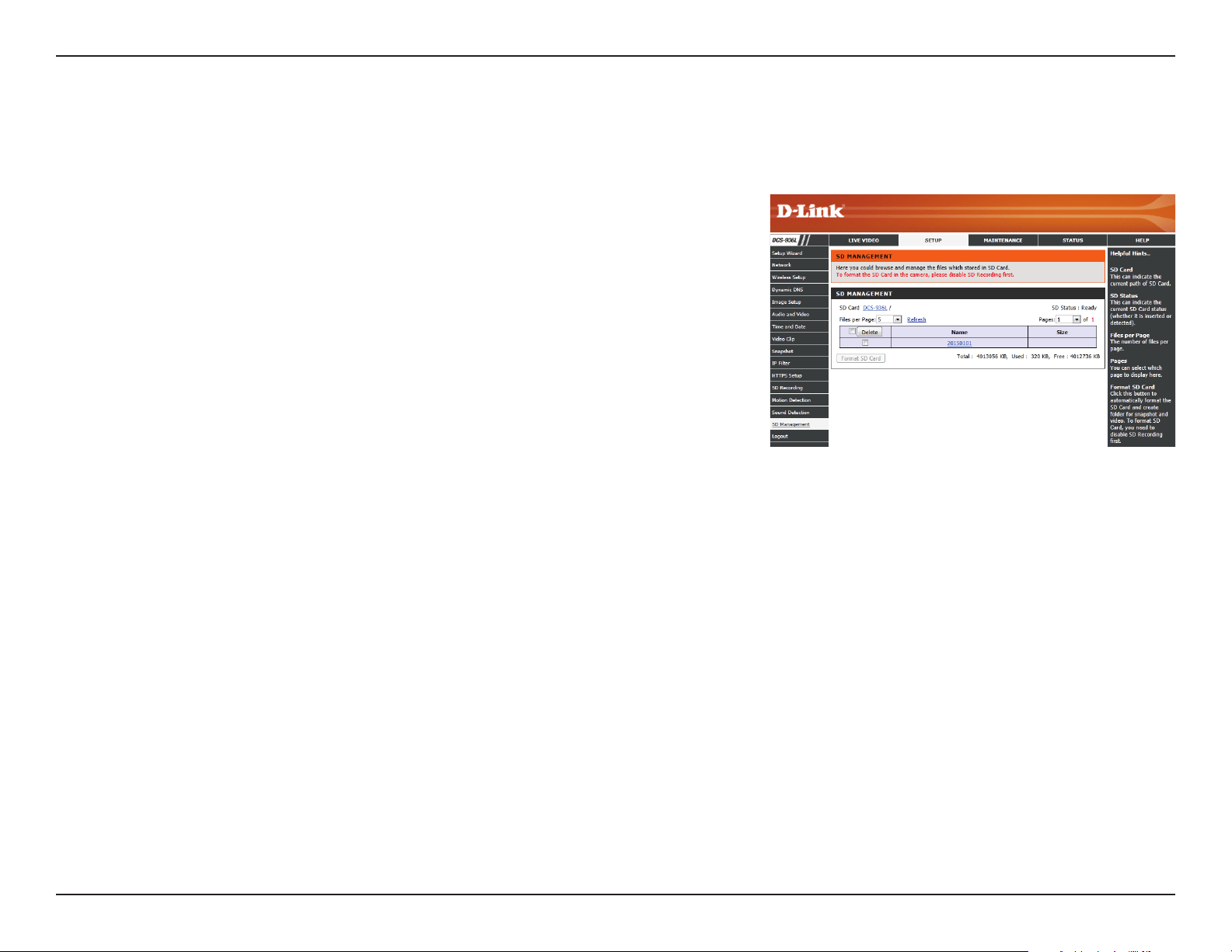
Here you may browse and manage the recorded les which are stored on the microSD card. Click on a folder or le to open it.
SD Card:
SD Status:
Files Per Page:
Refresh:
Format SD
Card:
Deleting Files
and Folders:
This shows the current folder on the microSD card that you are viewing.
Click on an earlier folder name to return to it.
This shows the current microSD card status.
Use the drop-down box to specify how many les to show per page. To
change pages, use the drop-down box on the right.
Click this to refresh the le and folder information from the microSD card.
Click this button to automatically format the microSD card.
Note: SD Recording must be disabled in order to format the microSD card.
See SD Recording on page 42 for more details.
To delete les and folders, click on the checkbox next to the les or folders
you want to delete, then click the Delete button. To select all of the les or
folders shown, click on the checkbox next to the Delete button.
47D-Link DCS-936L User Manual
Section 3 - Conguration
Maintenance
Admin
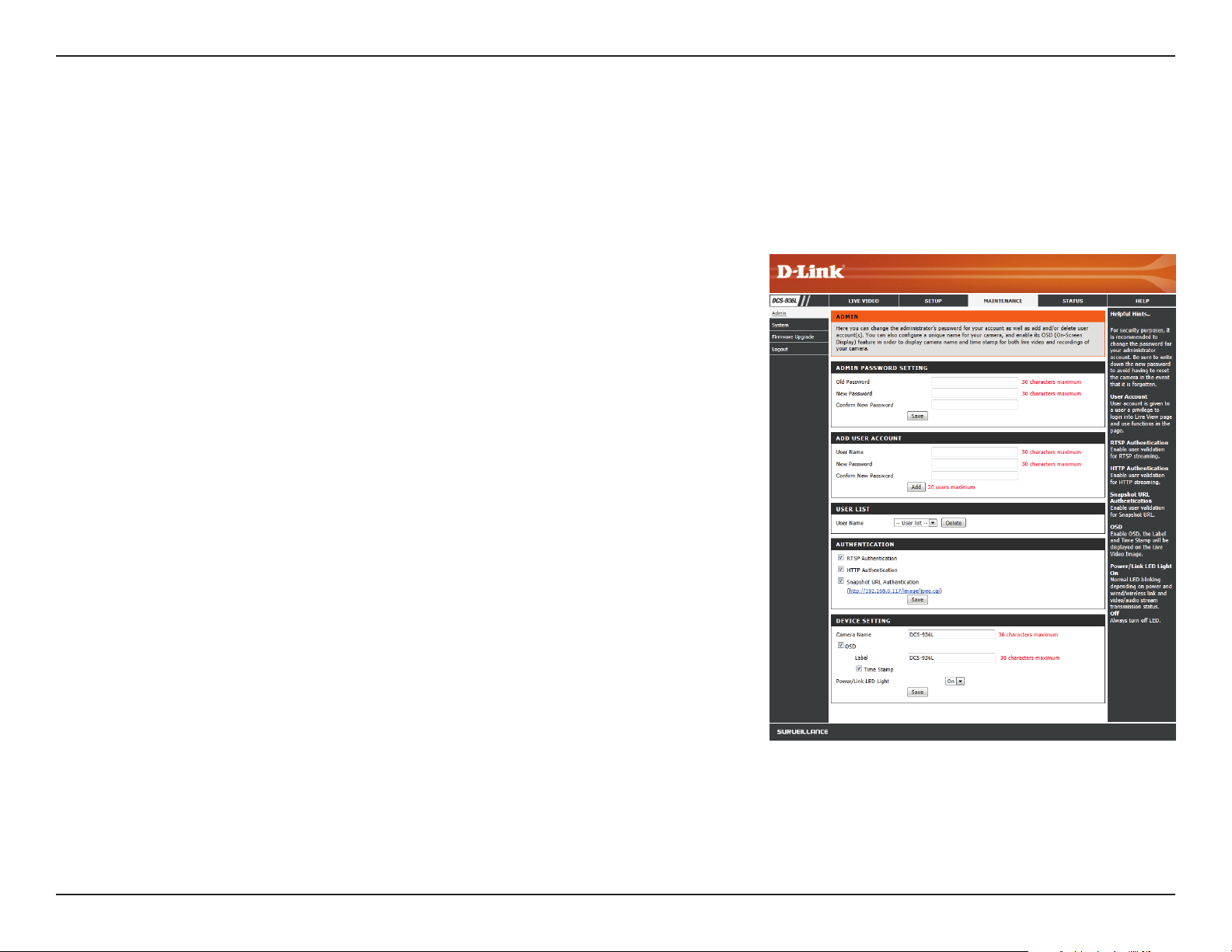
This section allows you to change the administrator’s password and congure the server settings for your camera. You can also manage the user
account(s) that access your camera.
To change your password, enter your current password and then enter
the new one in the New Password and Conrm New Password elds.
Create a new user to access the camera’s Live Video page. Enter the user
name, password, and password conrmation, and click Add.
Select a user from the drop-down menu and click Delete to remove the
user account.
Enables user validation for RTSP streaming.
Enables user validation for HTTP streaming.
Select this to allow access to the current camera snapshot via the web
address indicated.
Specify a name for your camera.
Enabling this will show information in the top left of the camera’s video.
In the Label eld, you may enter a name to display on the image. Select
Time Stamp to include the current date and time.
Select Normal to enable the LED on the front of the device, or select O
to disable the LED.
Admin
Password
Setting:
Add User
Account:
User List:
RTSP
Authentication:
HTTP
Authentication:
Snapshot URL
Authentication:
Camera Name:
OSD:
Power/Link
LED Light:
48D-Link DCS-936L User Manual
Section 3 - Conguration
System
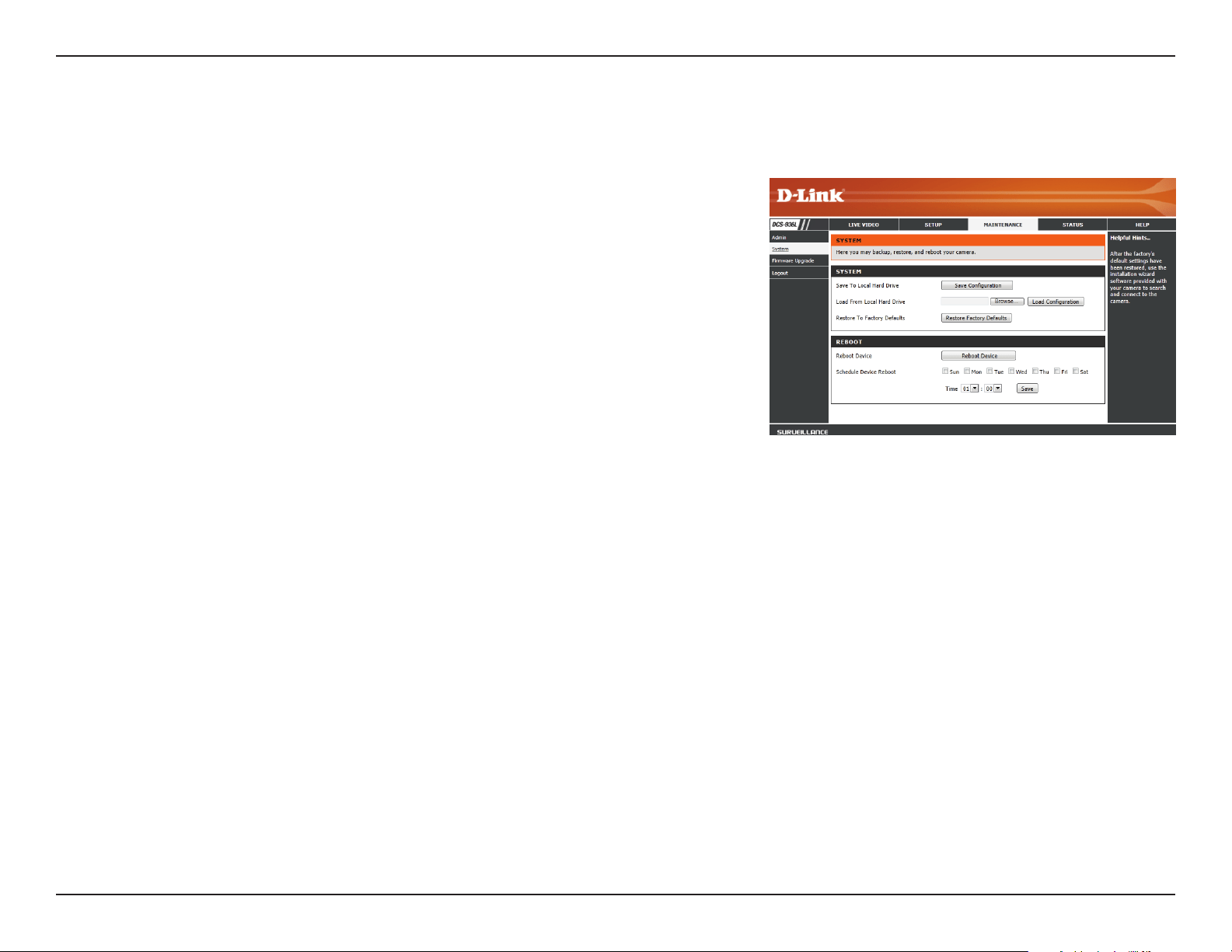
This section allows you to save and restore your conguration, restore the factory settings, and/or restart the camera.
Save To Local
Hard Drive:
Load From
Local Hard
Drive:
Restore
To Factory
Defaults:
Reboot Device:
Schedule
Device Reboot
You may save your current camera conguration as a le on your computer
by clicking Save Conguration.
Locate a pre-saved conguration by clicking Browse... and then restore
the pre-dened settings to your camera by clicking Load Conguration.
You may reset your camera and restore the factory settings by clicking
Restore Factory Defaults.
This will restart your camera.
You can schedule the camera to reboot according to a schedule. Select
the days and time you want the camera to automatically reboot.
49D-Link DCS-936L User Manual
Section 3 - Conguration
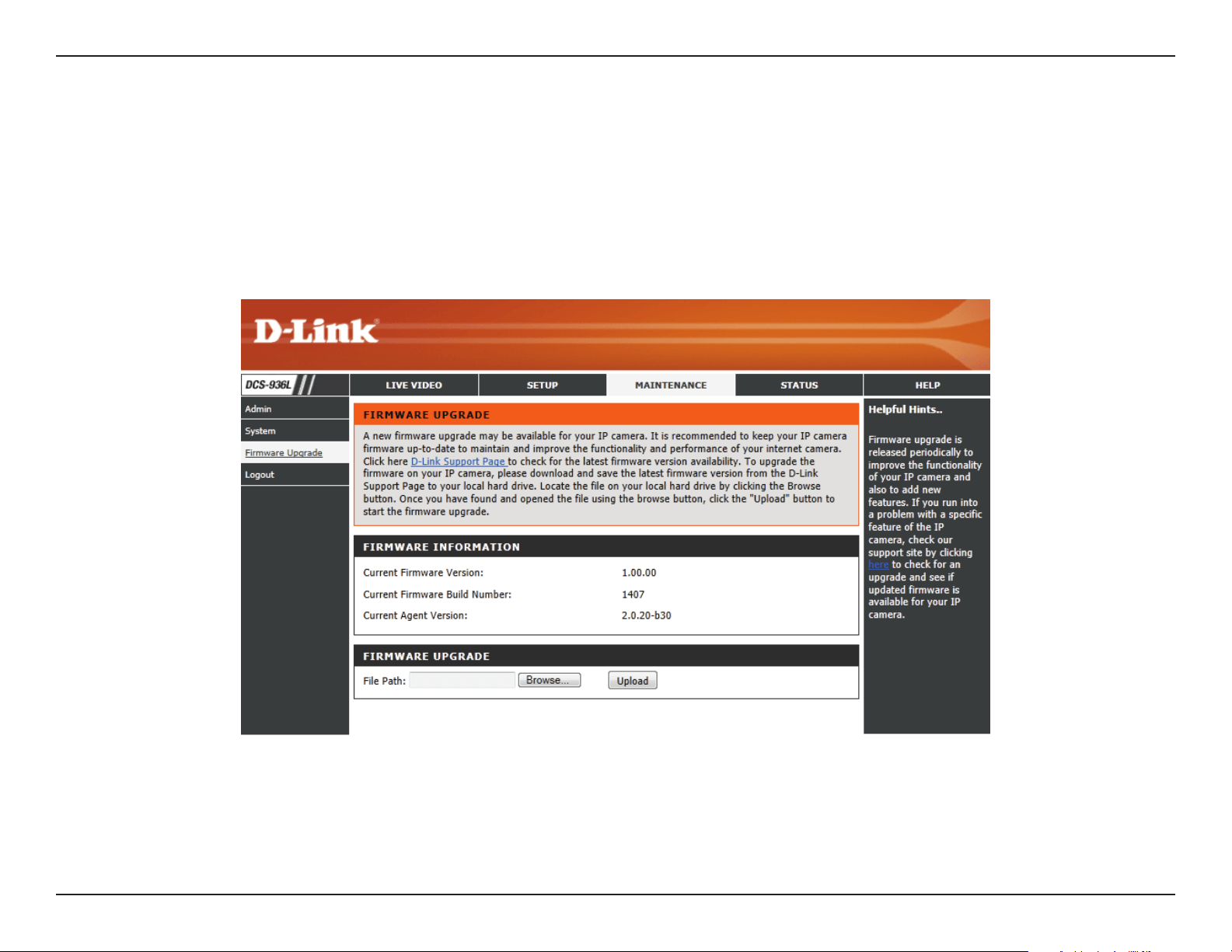
Firmware Upgrade
The camera’s current rmware version will be displayed on this screen. Visit http://support.dlink.com/DCS-936L to check for the latest available
rmware version.
To upgrade the rmware on your DCS-936L, please download and save the latest rmware version from the D-Link Support Page to your local hard
drive. Locate the le on your local hard drive by clicking the Browse... button. Select the le and click the Upload button to start upgrading the
rmware.
50D-Link DCS-936L User Manual
Section 3 - Conguration
Status
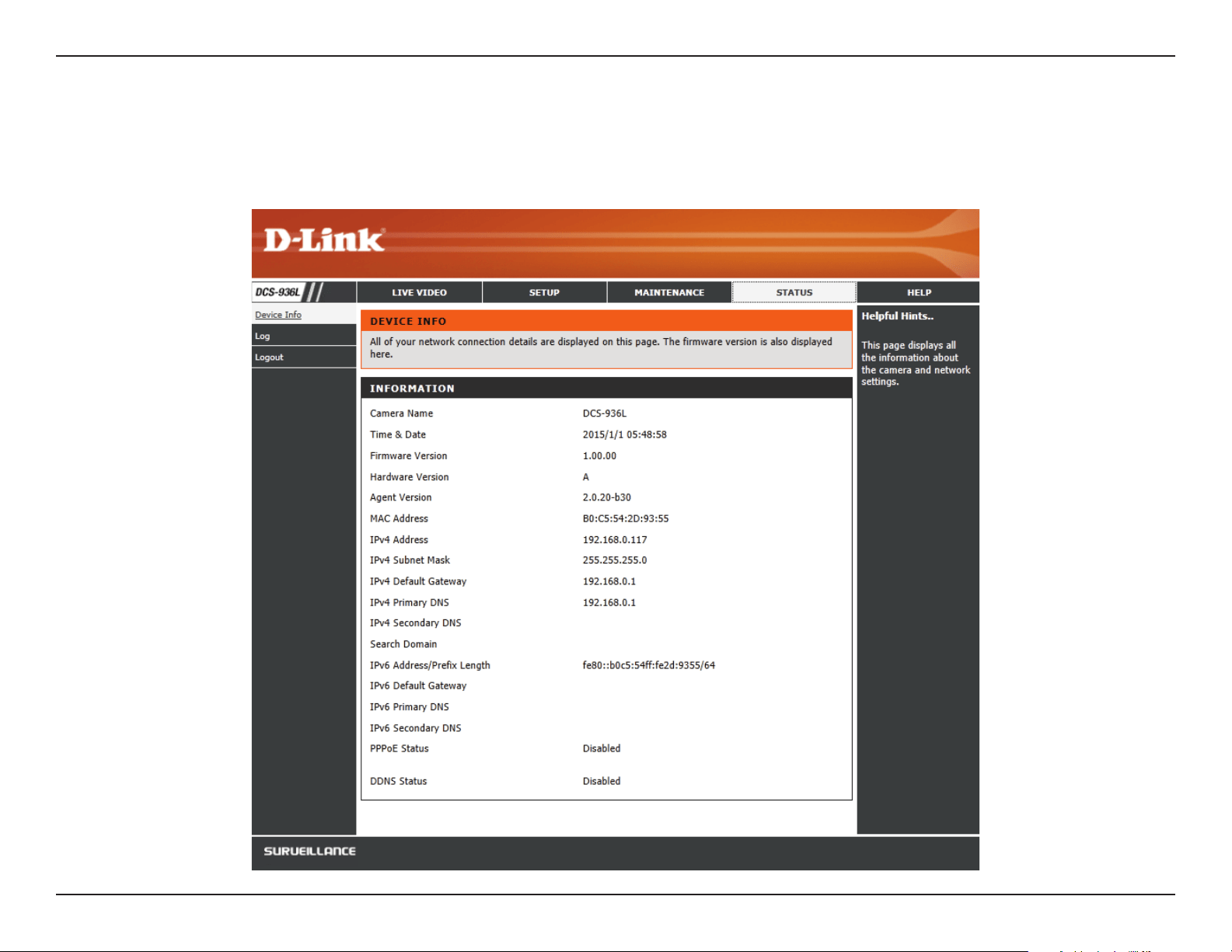
Device Info
This section displays information about your camera and its current network and wireless status.
51D-Link DCS-936L User Manual
Section 3 - Conguration
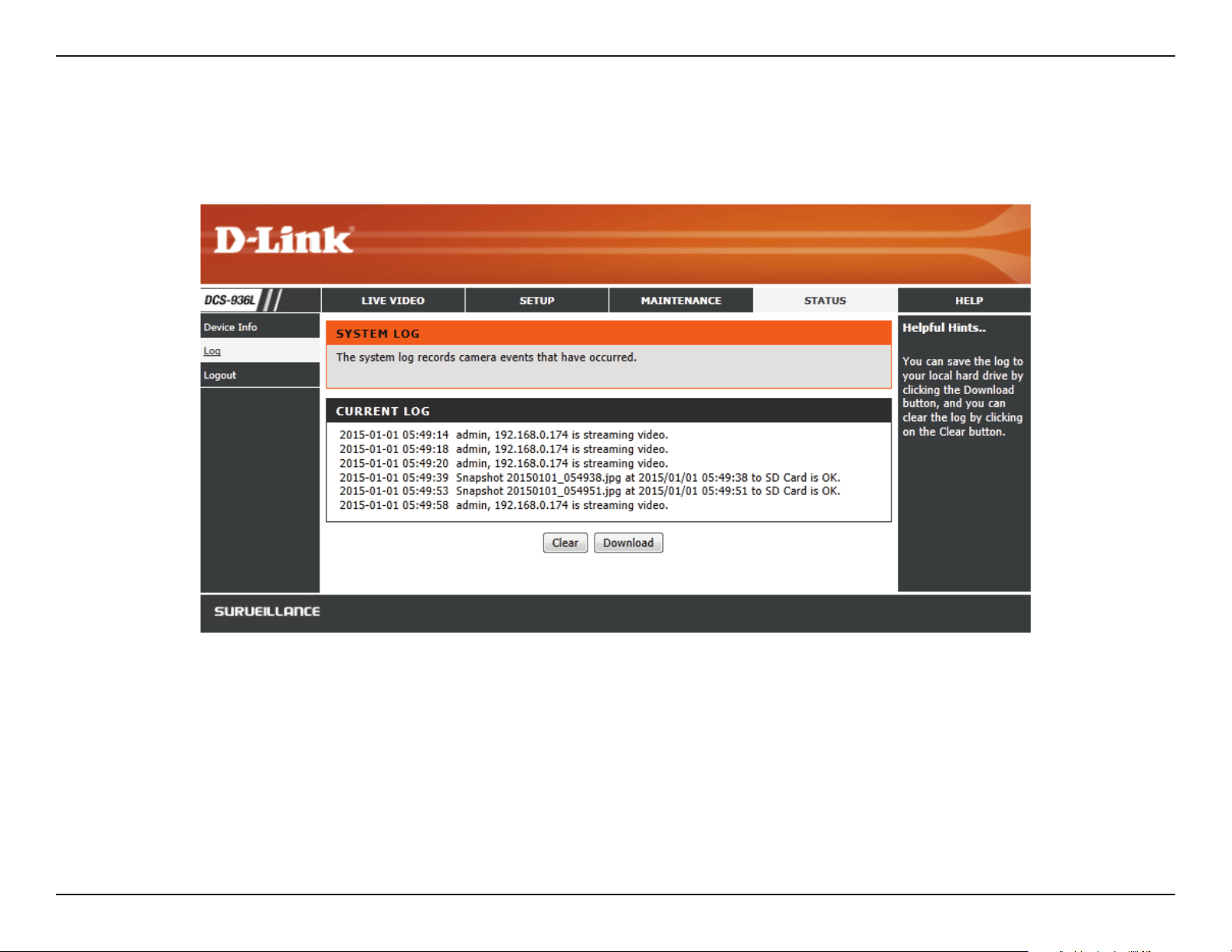
Log
This page displays the log information of your camera. You may download the information by clicking Download. You may also click Clear to delete
the saved log information. The log will also be cleared when the camera is rebooted.

52D-Link DCS-936L User Manual
Section 4 - Troubleshooting
Troubleshooting
1. Why is the camera view hazy or bright when using night vision mode?
The IR night vision lights on your camera may be reecting o of a nearby surface or window. Try repositioning your camera to avoid reections
or glare.
2. What can I do if I forget my camera password?
If you forget your password, you will need to perform a hard reset of your camera. This process will change all your settings back to the factory
defaults. To reset your camera, please use an unfolded paperclip to press and hold the reset button for at least 10 seconds while your camera is
plugged in.
3. What can I do if my camera is not working correctly?
First, reset the camera and try setting the camera up again.
To make sure your hardware is installed correctly, make sure that:
• the power LED is solid green
• your Internet connection is working
• your router’s LAN & WAN connections are working
• your router supports UPNP
• your camera is on the same network as your mobile device
• both your mobile device and camera have a working Internet connection
If your camera is still not working, check your router and make sure it has the latest rmware.
53D-Link DCS-936L User Manual
Appendix A - Technical Specications
Technical Specications
Camera
Hardware Profile
• 1/4” 1 megapixel progressive CMOS sensor
• 16 feet IR illumination distance
• Minimum illumination:
• Color (Day Mode), IR LEDs off: 2.6 lux
• B/W (Night Mode), IR LEDs off: 1.5 lux
• B/W (Night Mode), IR LEDs on: 0 lux
• Built-in Infrared-Cut Removable (ICR) Filter module
• Focal length 2.45 mm
• Aperture F2.4
• Angle of view
• (H) 100°
• (V) 54°
• (D) 120°
• Built-in microphone
• 4x Digital Zoom
Image Features
• Configurable image size, quality, frame rate, and bit rate
• Configurable brightness, contrast, sharpness, hue, and saturation
• Flip and mirror
• Time stamp and text overlays
Video Compression • Simultaneous H.264/MJPEG format compression • JPEG for still images
Video Resolution • 1280 x 720, 640 x 352, 320 x 176 at up to 30 fps
Audio Compression • PCM • ADPCM
Connectivity
• 802.11n/g wireless with WPA/WPA2 encryption
• Single-band 1T1R mode supports a maximum data rate of 72.2 Mbps (PHY rate)
using 20 MHz bandwidth
1
• Operates on 2.4 GHz band
• microSD card slot
Network
Network Protocols • IPv4, IPv6, ARP, TCP, UDP, ICMP
• DHCP Client
• NTP Client (D-Link)
• DNS Client
• DDNS Client (D-Link)
• SMTP Client
• HTTP Server
• PPPoE
• UPnP
• RTP, RTSP
• HTTPS for configuration
• Bonjour
Security • Administrator and user group protection
• Password authentication
• HTTP and RTSP digest encryption
System Integration
System Requirements for Web Interface • Operating system: Microsoft Windows 10/8/7 or Mac OS X 10.8 or higher • Browser: Internet Explorer 8, Firefox 12, Chrome 20, or Safari 6 or higher
Event Management • Motion detection
• Sound level detection
• Event notification and sending snapshots/video clips via e-mail
Remote Management • Configuration accessible via web browser
Mobile support • mydlink Lite app for iPhone, iPad, iPod Touch and Android • mydlink+ app for iOS and Android
54D-Link DCS-936L User Manual
Appendix A - Technical Specications
General
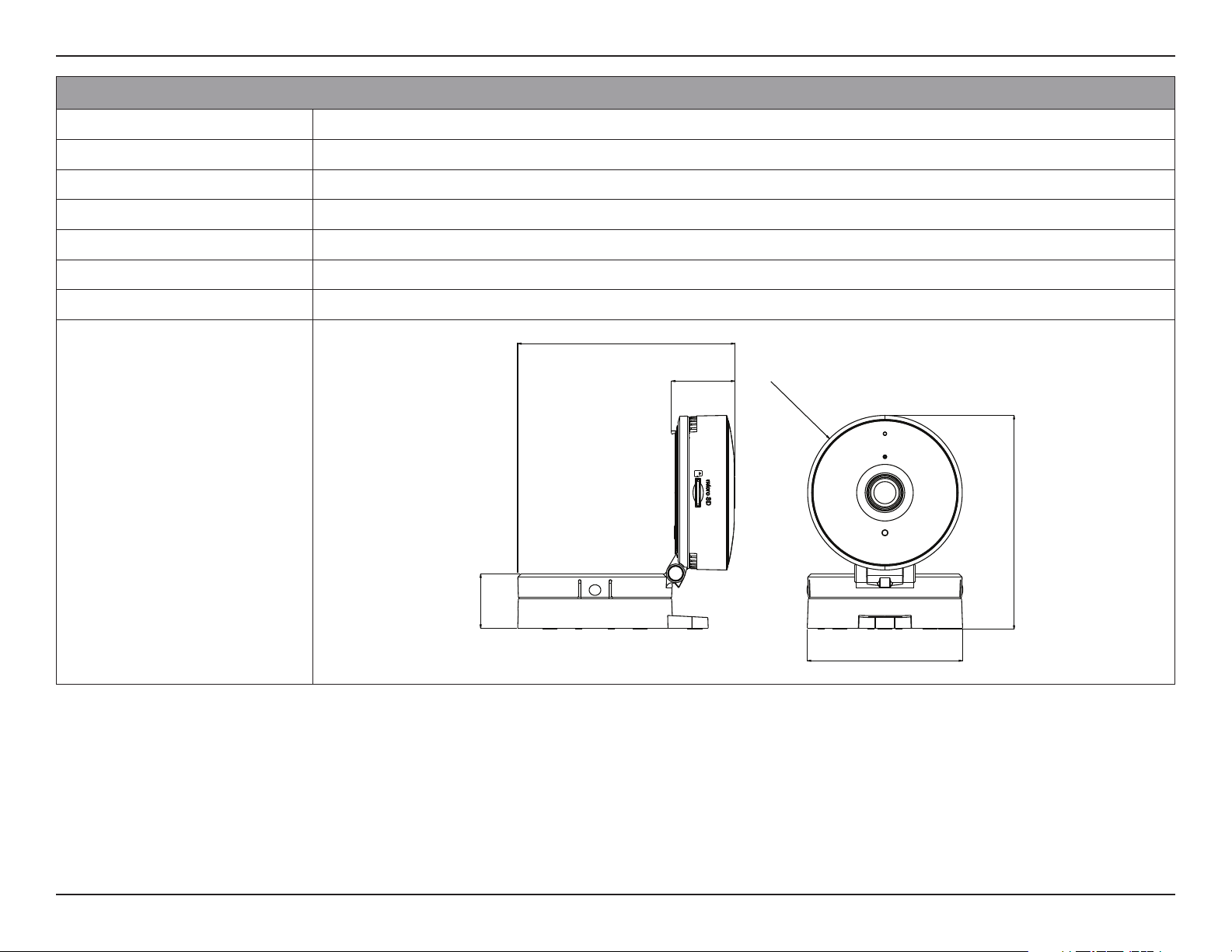
Dimensions • 3.6 x 2.6 x 3.6 inches
Weight • 4.9 ounces ± 5%
Power • 5 V DC, 1.2 A through external power adapter • Power adapter: 100 to 240 V AC, 50/60 Hz
Power Consumption • 4 watts maximum ± 5%
Temperature • Operating: 32 to 104° F • Storage: -4 to 158˚ F
Humidity • Operating: 20% to 80% non-condensing • Storage: 20% to 80% non-condensing
Certifications • CE • FCC Class B
Dimensions Diagram
A
B
C
1 2 43 5
C
B
A
53 421
DD
6
6
BACLASS
Sheet 1 OF 1
Q'TY
0.1
0.05
0~10
3/1000DEFORMATION
0.20.1>10~50
1:2SCALESIZE : A2
0.3
0.15
>50~100
UNIT: mm
0.50.2>100~
11/2Angle
Rev.PART No.
Tolerance unless
otherwise
specified
PART NAME
DATEDRAWNMATERIAL
31-Mar-16
DATECHECKEDCOLOR CHIP
31-Mar-16
DATEAPPROVEDSURFACE TREATMENT
31-Mar-16
=INSPECTION DIM ID
XX
=DESIGN CHANGE
X
LEGEND:
REV
ECN DESCRIPTION APPROVED DATE
90.73
92.08
65.88
26.85
23.05
65.56
90.7 mm
Ø 65.6 mm
92.1 mm
26.9 mm
23.1 mm
65.9 mm

55D-Link DCS-936L User Manual
Appendix B - Contact Technical Support
Contacting Technical Support
U.S. and Canadian customers can contact D-Link technical support through our web site or by phone.
Before you contact technical support, please have the following ready:
• Model number of the product (e.g. DCS-936L)
• Hardware Revision (located on the label on the bottom of the Network Camera (e.g. rev A1))
• Serial Number (s/n number located on the label on the bottom of the Network Camera).
You can nd software updates and user documentation on the D-Link website as well as frequently asked questions and
answers to technical issues.
For customers within the United States:
Phone Support:
(877) 453-5465
Internet Support:
http://support.dlink.com
For customers within Canada:
Phone Support:
(800) 361-5265
Internet Support:
http://support.dlink.ca

56D-Link DCS-936L User Manual
Appendix C - Warranty
Warranty
Subject to the terms and conditions set forth herein, D-Link Systems, Inc. (“D-Link”) provides this Limited Warranty:
• Only to the person or entity that originally purchased the product from D-Link or its authorized reseller or distributor, and
• Only for products purchased and delivered within the fty states of the United States, the District of Columbia, U.S. Possessions
or Protectorates, U.S. Military Installations, or addresses with an APO or FPO.
Limited Warranty:
D-Link warrants that the hardware portion of the D-Link product described below (“Hardware”) will be free from material defects in workmanship
and materials under normal use from the date of original retail purchase of the product, for the period set forth below (“Warranty Period”), except
as otherwise stated herein.
• Hardware (excluding power supplies and fans): One (1) year
• Power supplies and fans: One (1) year
• Spare parts and spare kits: Ninety (90) days
The customer’s sole and exclusive remedy and the entire liability of D-Link and its suppliers under this Limited Warranty will be, at
D-Link’s option, to repair or replace the defective Hardware during the Warranty Period at no charge to the original owner or to refund the actual
purchase price paid. Any repair or replacement will be rendered by D-Link at an Authorized D-Link Service Oce. The replacement hardware
need not be new or have an identical make, model or part. D-Link may, at its option, replace the defective Hardware or any part thereof with any
reconditioned product that D-Link reasonably determines is substantially equivalent (or superior) in all material respects to the defective Hardware.
Repaired or replacement hardware will be warranted for the remainder of the original Warranty Period or ninety (90) days, whichever is longer,
and is subject to the same limitations and exclusions. If a material defect is incapable of correction, or if D-Link determines that it is not practical
to repair or replace the defective Hardware, the actual price paid by the original purchaser for the defective Hardware will be refunded by D-Link
upon return to D-Link of the defective Hardware. All Hardware or part thereof that is replaced by D-Link, or for which the purchase price is refunded,
shall become the property of D-Link upon replacement or refund.

57D-Link DCS-936L User Manual
Appendix C - Warranty
Limited Software Warranty:
D-Link warrants that the software portion of the product (“Software”) will substantially conform to D-Link’s then current functional specications
for the Software, as set forth in the applicable documentation, from the date of original retail purchase of the Software for a period of ninety (90)
days (“Software Warranty Period”), provided that the Software is properly installed on approved hardware and operated as contemplated in its
documentation. D-Link further warrants that, during the Software Warranty Period, the magnetic media on which D-Link delivers the Software will be
free of physical defects. The customer’s sole and exclusive remedy and the entire liability of D-Link and its suppliers under this Limited Warranty will
be, at D-Link’s option, to replace the non-conforming Software (or defective media) with software that substantially conforms to D-Link’s functional
specications for the Software or to refund the portion of the actual purchase price paid that is attributable to the Software. Except as otherwise
agreed by D-Link in writing, the replacement Software is provided only to the original licensee, and is subject to the terms and conditions of the
license granted by D-Link for the Software. Replacement Software will be warranted for the remainder of the original Warranty Period and is subject
to the same limitations and exclusions. If a material non-conformance is incapable of correction, or if D-Link determines in its sole discretion that it
is not practical to replace the non-conforming Software, the price paid by the original licensee for the non-conforming Software will be refunded by
D-Link; provided that the non-conforming Software (and all copies thereof) is rst returned to D-Link. The license granted respecting any Software
for which a refund is given automatically terminates.
Non-Applicability of Warranty:
The Limited Warranty provided hereunder for Hardware and Software portions of D-Link’s products will not be applied to and does not cover any
refurbished product and any product purchased through the inventory clearance or liquidation sale or other sales in which D-Link, the sellers, or
the liquidators expressly disclaim their warranty obligation pertaining to the product and in that case, the product is being sold “As-Is” without any
warranty whatsoever including, without limitation, the Limited Warranty as described herein, notwithstanding anything stated herein to the contrary.
Submitting A Claim (USA):
The customer shall return the product to the original purchase point based on its return policy. In case the return policy period has expired and
the product is within warranty, the customer shall submit a claim to D-Link as outlined below:
• The customer must submit with the product as part of the claim a written description of the Hardware defect or Software
nonconformance in sucient detail to allow D-Link to conrm the same, along with proof of purchase of the product (such as a
copy of the dated purchase invoice for the product) if the product is not registered.
• The customer must obtain a Case ID Number from D-Link Technical Support at 1-877-354-6555, who will attempt to assist the
customer in resolving any suspected defects with the product. If the product is considered defective, the customer must obtain
a Return Material Authorization (“RMA”) number by completing the RMA form and entering the assigned Case ID Number at
https://rma.dlink.com/.

58D-Link DCS-936L User Manual
Appendix C - Warranty
• After an RMA number is issued, the defective product must be packaged securely in the original or other suitable shipping package
to ensure that it will not be damaged in transit, and the RMA number must be prominently marked on the outside of the package.
Do not include any manuals or accessories in the shipping package. D-Link will only replace the defective portion of the product
and will not ship back any accessories.
• The customer is responsible for all in-bound shipping charges to D-Link. No Cash on Delivery (“COD”) is allowed. Products sent COD
will either be rejected by D-Link or become the property of D-Link. Products shall be fully insured by the customer and shipped
to D-Link Systems, Inc., 17595 Mt. Herrmann, Fountain Valley, CA 92708. D-Link will not be held responsible for any packages that
are lost in transit to D-Link. The repaired or replaced packages will be shipped to the customer via UPS Ground or any common
carrier selected by D-Link. Return shipping charges shall be prepaid by D-Link if you use an address in the United States, otherwise
we will ship the product to you freight collect. Expedited shipping is available upon request and provided shipping charges are
prepaid by the customer. D-Link may reject or return any product that is not packaged and shipped in strict compliance with the
foregoing requirements, or for which an RMA number is not visible from the outside of the package. The product owner agrees to
pay D-Link’s reasonable handling and return shipping charges for any product that is not packaged and shipped in accordance
with the foregoing requirements, or that is determined by D-Link not to be defective or non-conforming.
What Is Not Covered:
The Limited Warranty provided herein by D-Link does not cover:
Products that, in D-Link’s judgment, have been subjected to abuse, accident, alteration, modication, tampering, negligence, misuse, faulty installation,
lack of reasonable care, repair or service in any way that is not contemplated in the documentation for the product, or if the model or serial number
has been altered, tampered with, defaced or removed; Initial installation, installation and removal of the product for repair, and shipping costs;
Operational adjustments covered in the operating manual for the product, and normal maintenance; Damage that occurs in shipment, due to act
of God, failures due to power surge, and cosmetic damage; Any hardware, software, rmware or other products or services provided by anyone
other than D-Link; and Products that have been purchased from inventory clearance or liquidation sales or other sales in which D-Link, the sellers,
or the liquidators expressly disclaim their warranty obligation pertaining to the product.
While necessary maintenance or repairs on your Product can be performed by any company, we recommend that you use only an Authorized D-Link
Service Oce. Improper or incorrectly performed maintenance or repair voids this Limited Warranty.
Disclaimer of Other Warranties:
EXCEPT FOR THE LIMITED WARRANTY SPECIFIED HEREIN, THE PRODUCT IS PROVIDED “AS-IS” WITHOUT ANY WARRANTY OF ANY KIND WHATSOEVER
INCLUDING, WITHOUT LIMITATION, ANY WARRANTY OF MERCHANTABILITY, FITNESS FOR A PARTICULAR PURPOSE AND NONINFRINGEMENT.

59D-Link DCS-936L User Manual
Appendix C - Warranty
IF ANY IMPLIED WARRANTY CANNOT BE DISCLAIMED IN ANY TERRITORY WHERE A PRODUCT IS SOLD, THE DURATION OF SUCH IMPLIED WARRANTY
SHALL BE LIMITED TO THE DURATION OF THE APPLICABLE WARRANTY PERIOD SET FORTH ABOVE. EXCEPT AS EXPRESSLY COVERED UNDER THE
LIMITED WARRANTY PROVIDED HEREIN, THE ENTIRE RISK AS TO THE QUALITY, SELECTION AND PERFORMANCE OF THE PRODUCT IS WITH THE
PURCHASER OF THE PRODUCT.
Limitation of Liability:
TO THE MAXIMUM EXTENT PERMITTED BY LAW, D-LINK IS NOT LIABLE UNDER ANY CONTRACT, NEGLIGENCE, STRICT LIABILITY OR OTHER LEGAL
OR EQUITABLE THEORY FOR ANY LOSS OF USE OF THE PRODUCT, INCONVENIENCE OR DAMAGES OF ANY CHARACTER, WHETHER DIRECT, SPECIAL,
INCIDENTAL OR CONSEQUENTIAL (INCLUDING, BUT NOT LIMITED TO, DAMAGES FOR LOSS OF GOODWILL, LOSS OF REVENUE OR PROFIT, WORK
STOPPAGE, COMPUTER FAILURE OR MALFUNCTION, FAILURE OF OTHER EQUIPMENT OR COMPUTER PROGRAMS TO WHICH D-LINK’S PRODUCT
IS CONNECTED WITH, LOSS OF INFORMATION OR DATA CONTAINED IN, STORED ON, OR INTEGRATED WITH ANY PRODUCT RETURNED TO D-LINK
FOR WARRANTY SERVICE) RESULTING FROM THE USE OF THE PRODUCT, RELATING TO WARRANTY SERVICE, OR ARISING OUT OF ANY BREACH OF
THIS LIMITED WARRANTY, EVEN IF D-LINK HAS BEEN ADVISED OF THE POSSIBILITY OF SUCH DAMAGES. THE SOLE REMEDY FOR A BREACH OF
THE FOREGOING LIMITED WARRANTY IS REPAIR, REPLACEMENT OR REFUND OF THE DEFECTIVE OR NONCONFORMING PRODUCT. THE MAXIMUM
LIABILITY OF D-LINK UNDER THIS WARRANTY IS LIMITED TO THE PURCHASE PRICE OF THE PRODUCT COVERED BY THE WARRANTY. THE FOREGOING
EXPRESS WRITTEN WARRANTIES AND REMEDIES ARE EXCLUSIVE AND ARE IN LIEU OF ANY OTHER WARRANTIES OR REMEDIES, EXPRESS, IMPLIED
OR STATUTORY.
Governing Law:
This Limited Warranty shall be governed by the laws of the State of California. Some states do not allow exclusion or limitation of incidental or
consequential damages, or limitations on how long an implied warranty lasts, so the foregoing limitations and exclusions may not apply. This
Limited Warranty provides specic legal rights and you may also have other rights which vary from state to state.
Trademarks:
D-Link is a registered trademark of D-Link Corporation/D-Link Systems, Inc. Other trademarks or registered trademarks are the property of their
respective owners.
Copyright Statement:
No part of this publication or documentation accompanying this product may be reproduced in any form or by any means or used to make any
derivative such as translation, transformation, or adaptation without permission from D-Link Corporation/D-Link Systems, Inc., as stipulated by the
United States Copyright Act of 1976 and any amendments thereto. Contents are subject to change without prior notice.
Copyright ©2017 by D-Link Corporation/D-Link Systems, Inc. All rights reserved.

60D-Link DCS-936L User Manual
Appendix C - Warranty
FCC Statement:
This equipment has been tested and found to comply with the limits for a Class B digital device, pursuant to part 15 of the FCC Rules. These limits are
designed to provide reasonable protection against harmful interference in a residential installation. This equipment generates, uses, and can radiate
radio frequency energy and, if not installed and used in accordance with the instructions, may cause harmful interference to radio communication.
However, there is no guarantee that interference will not occur in a particular installation. If this equipment does cause harmful interference to radio
or television reception, which can be determined by turning the equipment o and on, the user is encouraged to try to correct the interference by
one or more of the following measures:
• Reorient or relocate the receiving antenna.
• Increase the separation between the equipment and receiver.
• Connect the equipment into an outlet on a circuit dierent from that to which the receiver is connected.
• Consult the dealer or an experienced radio/TV technician for help.
FCC Caution:
Any changes or modications not expressly approved by the party responsible for compliance could void the user’s authority to operate this
equipment.
This device complies with Part 15 of the FCC Rules. Operation is subject to the following two conditions:
(1) This device may not cause harmful interference, and
(2) this device must accept any interference received, including interference that may cause undesired operation.
If this device is going to be operated in 5.15 ~ 5.25GHz frequency range, then it is restricted in indoor environment only.
IMPORTANT NOTICE:
FCC Radiation Exposure Statement:
This equipment complies with FCC radiation exposure limits set forth for an uncontrolled environment. This equipment should be installed and
operated with minimum distance 20cm between the radiator & your body. This transmitter must not be co-located or operating in conjunction
with any other antenna or transmitter.
The availability of some specic channels and/or operational frequency bands are country dependent and are rmware programmed at the factory
to match the intended destination. The rmware setting is not accessible by the end user.
For detailed warranty information applicable to products purchased outside the United States, please contact the corresponding local D-Link
oce.
61D-Link DCS-936L User Manual
Appendix C - Warranty
Disposing and Recycling Your Product
ENGLISH EN
This symbol on the product or packaging means that according to local laws and regulations this product should be not be disposed
of in household waste but sent for recycling. Please take it to a collection point designated by your local authorities once it has
reached the end of its life, some will accept products for free. By recycling the product and its packaging in this manner you help to
conserve the environment and protect human health.
D-Link and the Environment
At D-Link, we understand and are committed to reducing any impact our operations and products may have on the environment. To minimise
this impact D-Link designs and builds its products to be as environmentally friendly as possible, by using recyclable, low toxic materials in both
products and packaging.
D-Link recommends that you always switch o or unplug your D-Link products when they are not in use. By doing so you will help to save energy
and reduce CO2 emissions.
To learn more about our environmentally responsible products and packaging please visit www.dlinkgreen.com.
FRANÇAIS FR
Ce symbole apposé sur le produit ou son emballage signie que, conformément aux lois et règlementations locales, ce produit ne
doit pas être éliminé avec les déchets domestiques mais recyclé. Veuillez le rapporter à un point de collecte prévu à cet eet par les
autorités locales; certains accepteront vos produits gratuitement. En recyclant le produit et son emballage de cette manière, vous
aidez à préserver l’environnement et à protéger la santé de l’homme.
D-Link et l’environnement
Chez D-Link, nous sommes conscients de l'impact de nos opérations et produits sur l'environnement et nous engageons à le réduire. Pour limiter
cet impact, D-Link conçoit et fabrique ses produits de manière aussi écologique que possible, en utilisant des matériaux recyclables et faiblement
toxiques, tant dans ses produits que ses emballages.
D-Link recommande de toujours éteindre ou débrancher vos produits D-Link lorsque vous ne les utilisez pas. Vous réaliserez ainsi des économies
d’énergie et réduirez vos émissions de CO2.
Pour en savoir plus sur les produits et emballages respectueux de l’environnement, veuillez consulter le www.dlinkgreen.com.
62D-Link DCS-936L User Manual
Appendix D - Registration
62
Version 1.01
December 05, 2017
Product registration is entirely voluntary and failure to complete or return this form will not diminish your warranty rights.
Registration