ES
EN
DE
!
2
Muchas gracias por elegir una lavadora
Candy. Sin ninguna duda, le ayudará a lavar
toda su ropa de manera segura, incluso la
ropa más delicada, todos los días.
Registre su producto en www.registercandy.com
y acceda fácilmente a los servicios
complementarios exclusivos para nuestros
clientes más fieles.
Lea atentamente este manual de instrucciones
para aprender a usar la lavadora de manera
correcta y segura y para obtener consejos útiles
acerca de su mantenimiento.
Antes de usar su nueva lavadora,
lea atentamente este manual de
instrucciones para optimizar su
funcionamiento. Guarde el manual en buen
estado para otros usuarios que pudieran
necesitarlo más adelante.
Compruebe que además del manual de
instrucciones le hayan entregado el
certificado de garantía, la información sobre
centros de servicio técnico y la etiqueta de
eficiencia energética. Compruebe también
que le hayan entregado la clavija, el codo
para la manguera de desagüe y la cubeta
para detergente (o lejía en algunos
modelos). Conserve todos estos accesorios.
Todos los productos están identificados con
un único código o número de serie de 16
caracteres, que figura en una etiqueta
adherida al aparato (puerta de carga) o en
el sobre que se encuentra dentro de la
lavadora. El código es una especie de
documento de identidad, necesario para
registrar el producto y para solicitar la
asistencia del Servicio de Atención al
Cliente de Candy.
Este dispositivo tiene el distintivo de la
directiva europea 2012/19/UE sobre
Residuos de Aparatos Eléctricos y
Electrónicos (RAEE).
Los RAEE contienen tanto sustancias
contaminantes (que pueden repercutir
negativamente en el medio ambiente) como
componentes básicos (que pueden
reutilizarse). Es importante que los RAEE
se sometan a tratamientos específicos
con el objeto de extraer y eliminar, de
forma adecuada, todos los agentes
contaminantes. Igual de importante es
recuperar y reciclar todo el material posible.
La gente puede desempeñar una función
importante a la hora de asegurarse de que
los RAEE no se convierten en un problema
medioambiental; es crucial seguir algunas
normas básicas:
! Los RAEE no han de tratarse como
residuos domésticos.
! Los RAEE han de depositarse en los
puntos de recogida habilitados para ello
que gestiona el ayuntamiento o empresas
contratadas para ello. En muchos países
se ofrece la posibilidad de recogida a
domicilio de los RAEE de mayor volumen.
En muchos países, cuando la gente compra
un nuevo dispositivo, el antiguo se puede
entregar al vendedor, quien lo recoge de
forma gratuita (un dispositivo antiguo por
cada dispositivo adquirido) siempre que el
equipo entregado sea similar y disponga de
las mismas funciones que el adquirido.
1. NORMAS DE SEGURIDAD
2. INSTALACIÓN
3. CONSEJOS PRÁCTICOS
4. LIMPIEZA Y MANTENIMIENTO
5. GUÍA RÁPIDA
6. CONTROLES Y PROGRAMAS
7. SERVICIO TÉCNICO Y GARANTÍA
Normas ambientales
Índice

!
ES
3
1. NORMAS DE
SEGURIDAD
! Este producto es exclusivamente
para uso doméstico o similar:
− zona de cocina para el
personal de tiendas, oficinas y
otros entornos laborales;
− granjas;
− pasajeros de hoteles, moteles
u otros entornos residenciales;
− hostales (B&B).
No se recomienda el uso de este
producto con fines diferentes del
doméstico o similar, por ejemplo,
con fines comerciales o
profesionales. El empleo de
la lavadora con fines no
recomendados puede reducir la
vida útil del artefacto e invalidar
la garantía. Todos los daños,
averías o pérdidas ocasionados
por un uso diferente del
doméstico o similar (aunque ese
uso se realice en un entorno
doméstico) no serán reconocidos
por el fabricante en la medida en
que lo permita la ley.
! Este electrodoméstico puede ser
utilizado por niños mayores de 8
años y por personas con
capacidades físicas, sensoriales
o mentales limitadas o que
carezcan de la experiencia
y el conocimiento necesarios,
siempre y cuando estén
supervisadas por una persona
encargada de velar por su
seguridad o hayan sido
instruidas en su utilización de
manera segura.
Los niños no deben jugar con el
electrodoméstico. Los niños no
deben ocuparse del mantenimiento
ni de la limpieza del electrodoméstico,
salvo que estén supervisados una
persona encargada de velar por su
seguridad.
! Vigile a los niños de manera
que se asegure que no juegan
con el aparato.
! Los niños menores de 3 años se
deben mantener lejos a menos que
estén supervisados de forma continua.
! Si el cable de alimentación está
dañado, por seguridad debe
reemplazarlo el fabricante, un
técnico del Servicio de Atención
al Cliente o una persona
debidamente cualificada.
!
Sólo deben emplearse las
mangueras de suministro de
agua proporcionadas con el
electrodoméstico. No reutilizar
mangueras de lavadoras antiguas
.
! La presión de agua debe estar
entre 0,05 MPa y 0,8 MPa.
! Ninguna alfombrilla debe obstruir
las rejillas de ventilación situadas
en la base de la lavadora.
! Para apagar la lavadora, se debe la
marca de referencia del selector de
programas a la posición vertical.
Si la marca no se encuentra en
posición vertical, la lavadora está
!
4
encendida (solo para modelos con
mando programador).
!
Una vez instalado el
electrodoméstico, se debe poder
acceder fácilmente al enchufe.
! La capacidad máxima de colada
seca depende del modelo
usado (ver panel de control).
! Para consultar la ficha del
producto, visitar la web del
fabricante.
! Desenchufar la lavadora y
cerrar el grifo del agua antes de
proceder a su limpieza o a
cualquier operación de
mantenimiento.
! Asegurarse de que la toma de
corriente tenga conexión a
tierra. Si no se dispone de toma
con conexión a tierra, llamar a
un técnico especializado.
! No utilizar adaptadores, regletas
ni alargues.
! Asegurarse de que no quede
agua residual en el tambor antes
de abrir la puerta de carga.
! No desenchufar la lavadora
tirando del cable de alimentación
ni del aparato.
! No instalar la lavadora en el
exterior, ni exponerla a la
lluvia, a los rayos del sol, o a
otros factores ambientales.
! Para transportar la lavadora, no
levantarla sosteniéndola de los
mandos ni de la cubeta del
detergente y no apoyarla sobre la
puerta de carga. Para levantar la
lavadora, se recomienda la
colaboración de al menos dos
personas.
! En caso de fallo o mal
funcionamiento, apagar la lavadora,
cerrar el grifo del agua y no intentar
repararla. Llamar de inmediato al
Servicio de Atención al Cliente y
utilizar sólo piezas de recambio
originales. El incumplimiento de
estas instrucciones puede afectar
la seguridad del aparato.
El producto cumple con las
siguientes Directivas Europeas:
! 2006/95/EC (LVD);
! 2004/108/EC (EMC);
! 2009/125/EC (ErP);
! 2011/65/EU (RoHS);
y enmiendas posteriores.
Instrucciones de seguridad
ATENCIÓN:
el agua puede alcanzar
temperaturas muy elevadas
durante el ciclo de lavado.
!
ES
5
2. INSTALACIÓN
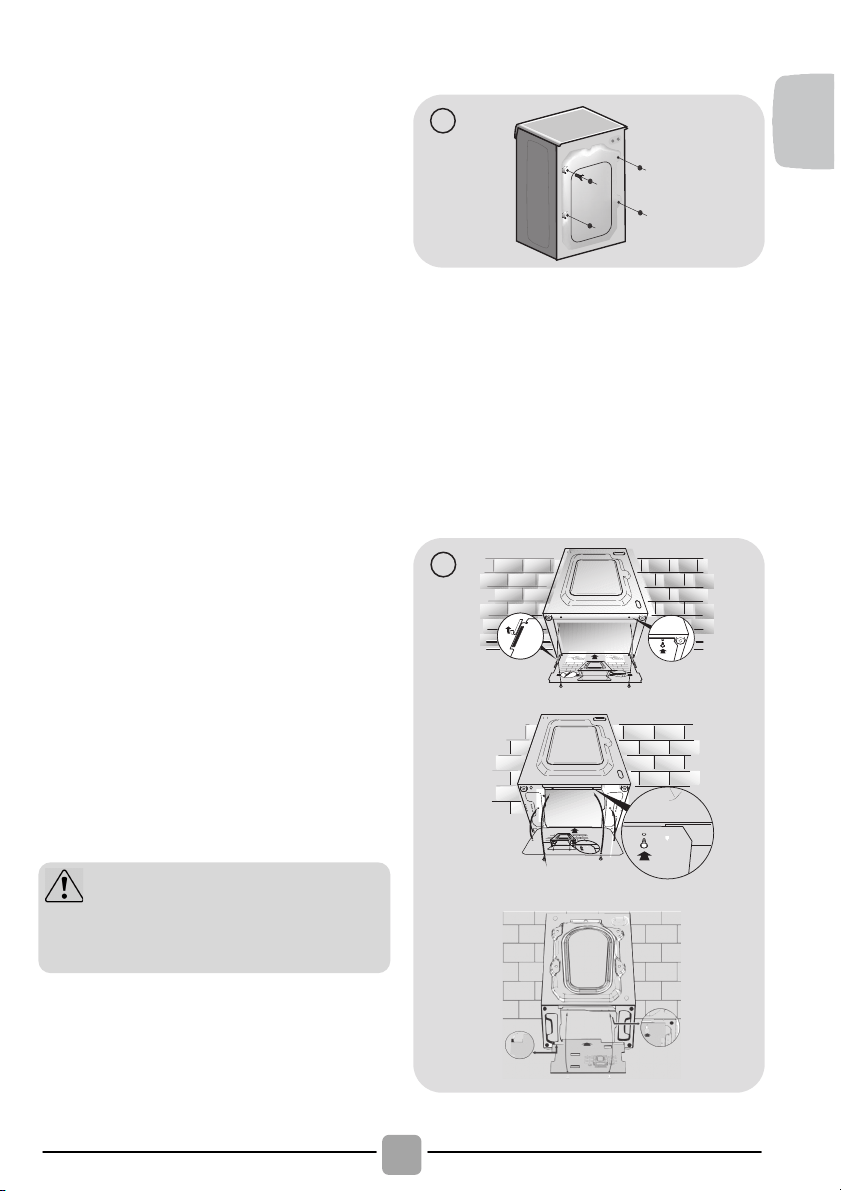
! Retirar las cintas que sostienen
el tubo, cuidando de no dañar ni el
tubo ni el cable de alimentación.
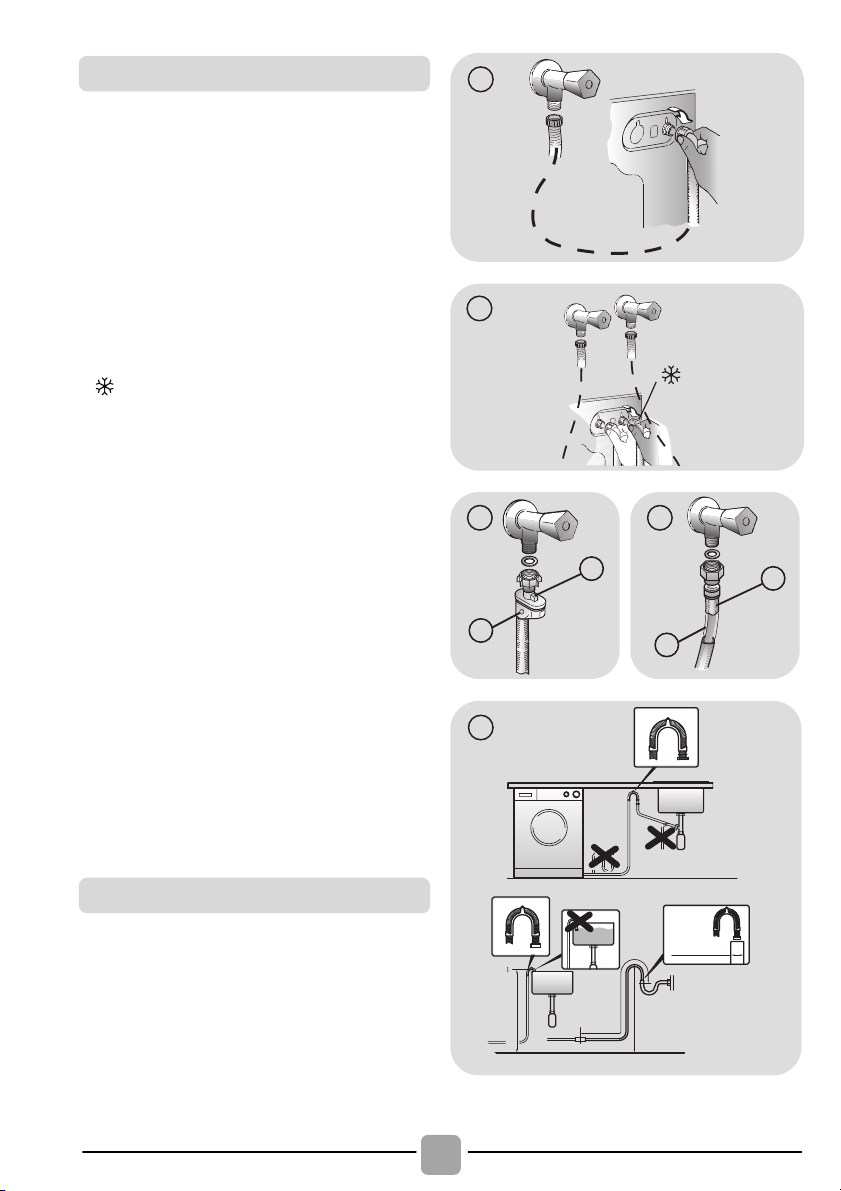
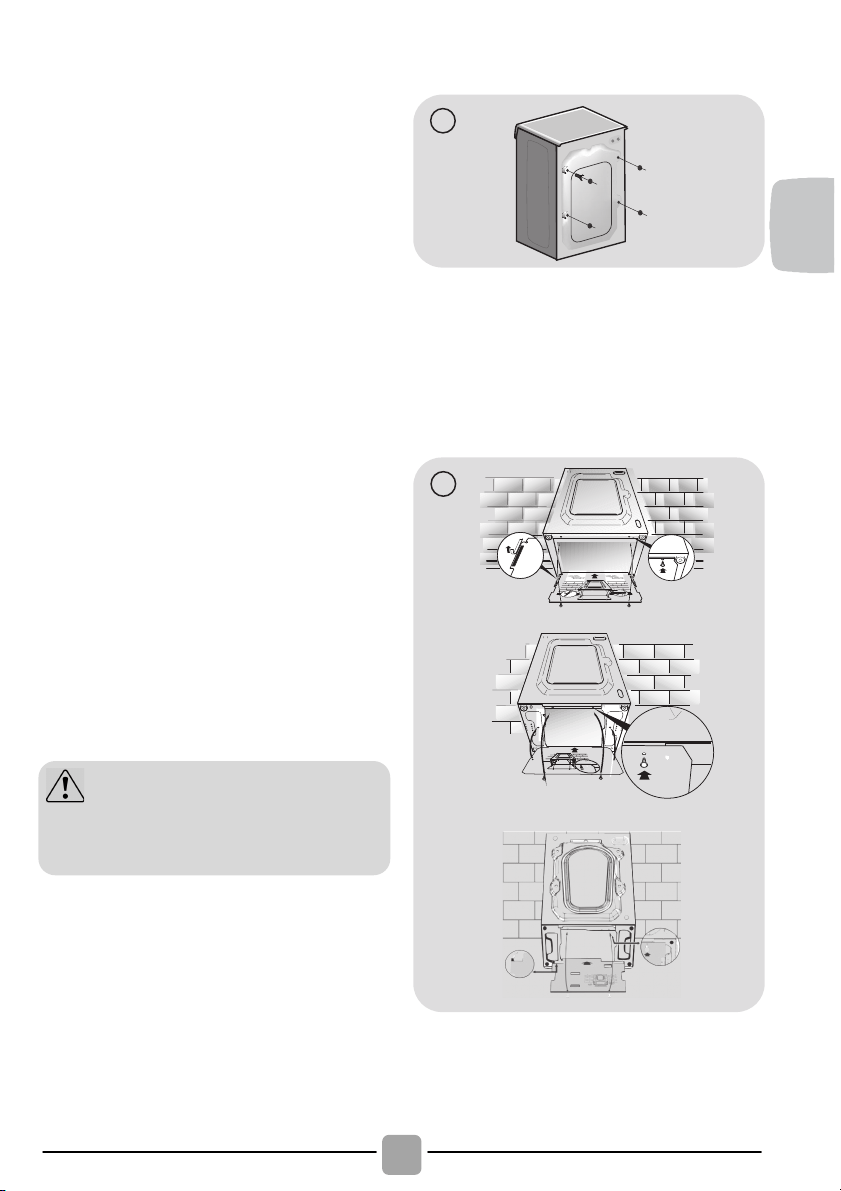
! Extraer los 2 o 4 tornillos (A) que
se encuentran en la parte posterior
de la lavadora y quitar los dos 2 o
4 seguros de transporte (B), tal y
como se muestra en la figura 1.
! Obstruir los 2 o 4 orificios que
quedan tras retirar los tornillos con
los tapones que se encuentran
en el sobre que contiene las
instrucciones.
! Para lavadoras de encastre,
después de cortar las cintas de
la
manguera, extraer los 3 o 4
tornillos (A) y los 3 o 4 seguros de
transporte (B).
! En ciertos modelos, 1 o más
seguros de transporte pueden caer
dentro de la lavadora. Para quitarlos,
inclinar el aparato hacia delante de
modo de poder cogerlos. Obstruir los
orificios que quedan tras retirar los
tornillos con los tapones que se
encuentran en el sobre.
! Colocar la lámina sintética en la
parte inferior, tal y como se muestra
en la figura 2 (A, B o C, según el
modelo).
A
A
A
A
B
B
B
B
1
3
2
1
3
1
2
A
C
B
2
ATENCIÓN:
los niños no deben jugar con
los materiales de embalaje.
!
6
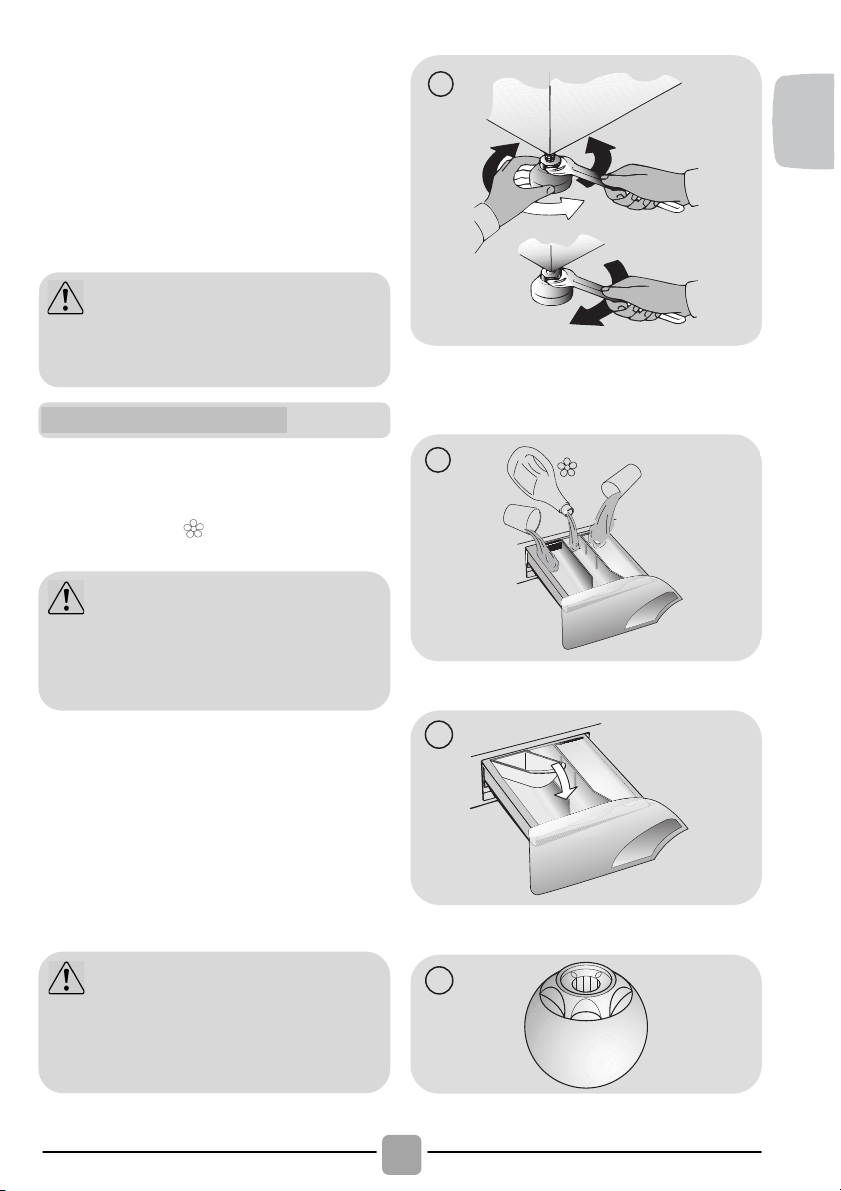
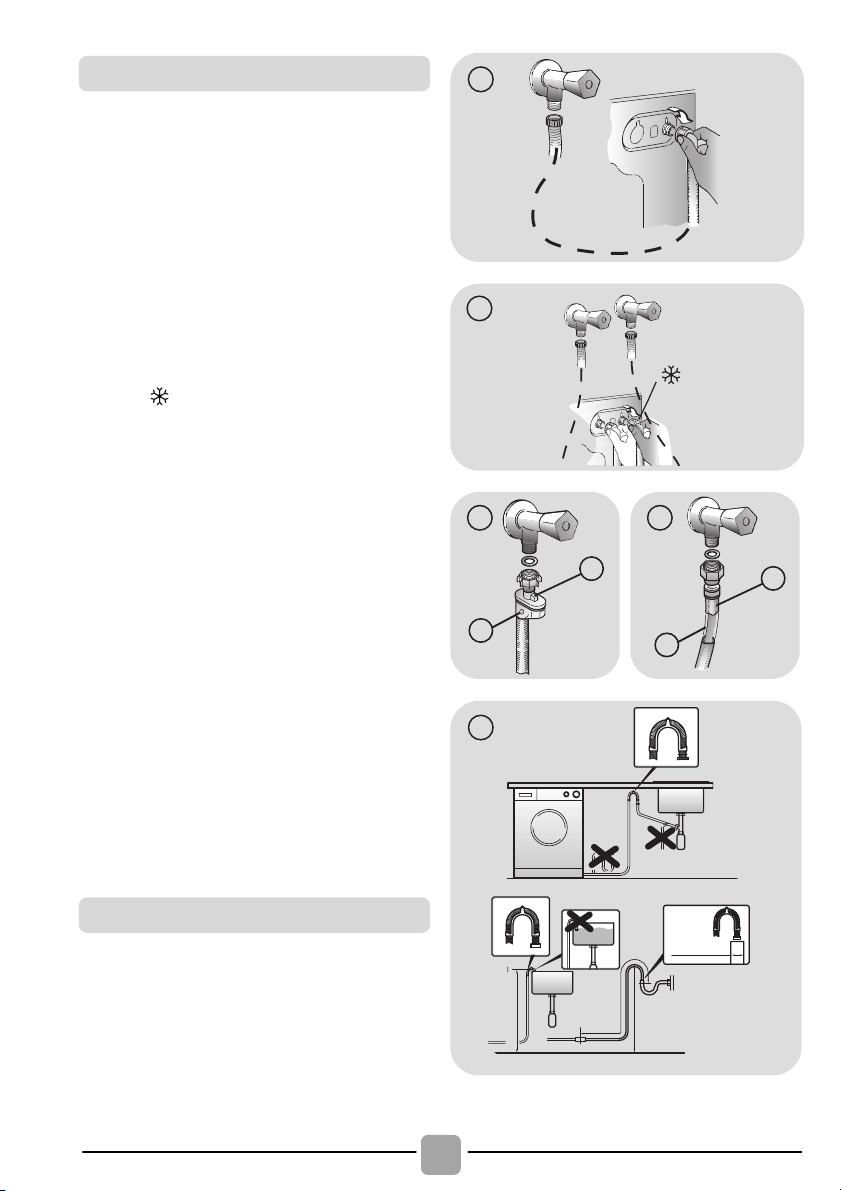
Conectar el tubo de alimentación de agua al
grifo, utilizando únicamente el tubo de
alimentación suministrado (fig. 3).
NO ABRIR EL GRIFO.
! Algunos modelos tienen una o más de las
siguientes características:
! Conexiones HOT&COLD para agua fría
y caliente (fig. 4): Favorecen el ahorro
de energía.
Conectar el tubo gris al grifo del agua fría
y el rojo, al del agua caliente. El
electrodoméstico se puede conectar sólo
al grifo del agua fría, en cuyo caso se
retrasará el inicio de algunos programas.
! AQUASTOP (fig.
5):
Un dispositivo
situado en el tubo de alimentación impide
la entrada de agua si el tubo está
deteriorado. En caso de avería, aparece
una marca de color rojo en la ventana
"A", que indica que debe reemplazarse el
tubo. Para extraer la tuerca, presionar el
dispositivo de bloqueo unidireccional "B".
!
AQUAPROTECT – TUBO DE ALIMENTACIÓN
CON PROTECCIÓN (fig. 6): Si el tubo
principal "A" pierde agua, el depósito
transparente "B" contiene agua que
permite que se complete el ciclo de
lavado. Al finalizar el ciclo, solicitar al
Servicio de Atención al Cliente el
reemplazo del tubo de entrada de
agua.
! La lavadora debe quedar cerca de la
pared en su parte posterior, evitando que
el tubo quede doblado o deformado.
Ubicar el tubo de descarga en el
fregadero o, preferentemente, conectarlo
al desagüe de la pared a 50 cm de altura
como mínimo, con un diámetro mayor
que el tubo de la lavadora (fig. 7).
3
1
4
B
A
5
B
A
6
min 50 cm
max 85 cm
+2,6 mt
max
max 100 cm
min 4 cm
7
Conexión a la red de agua
Instalación
!
ES
7
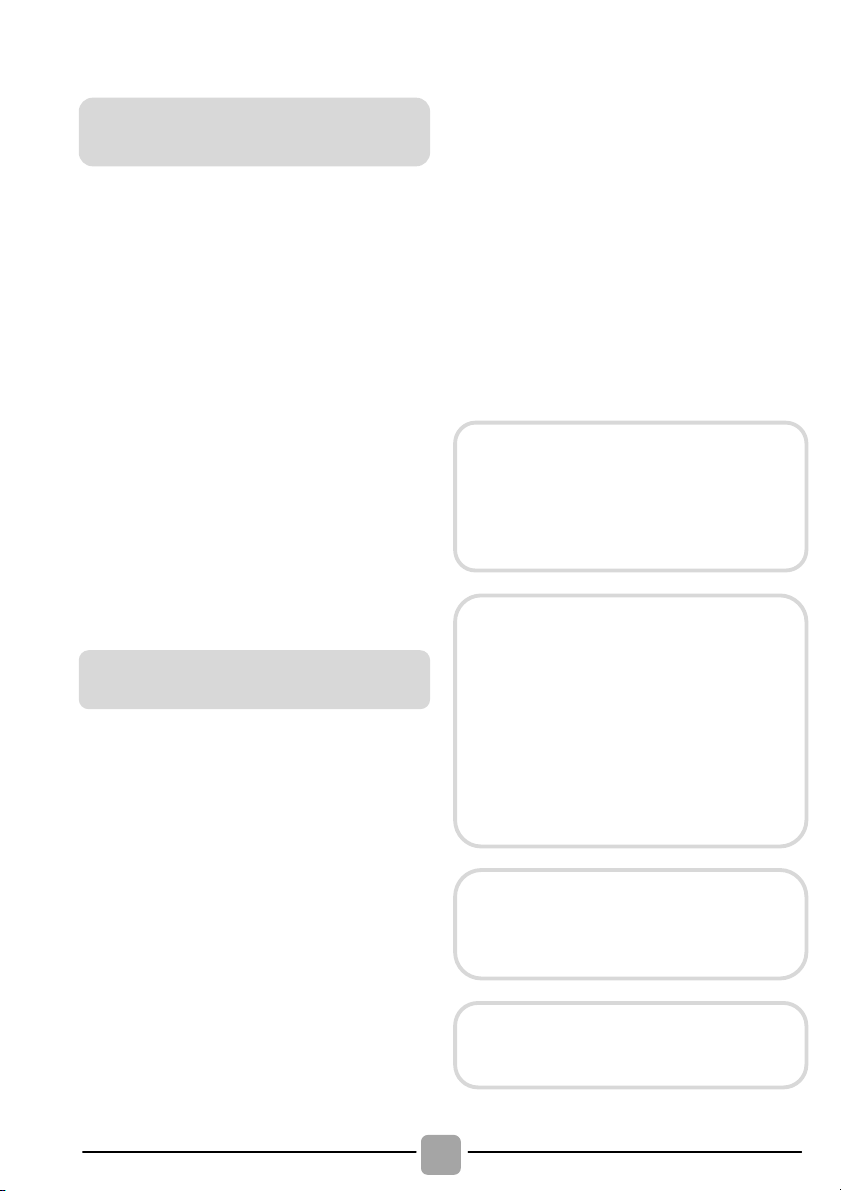
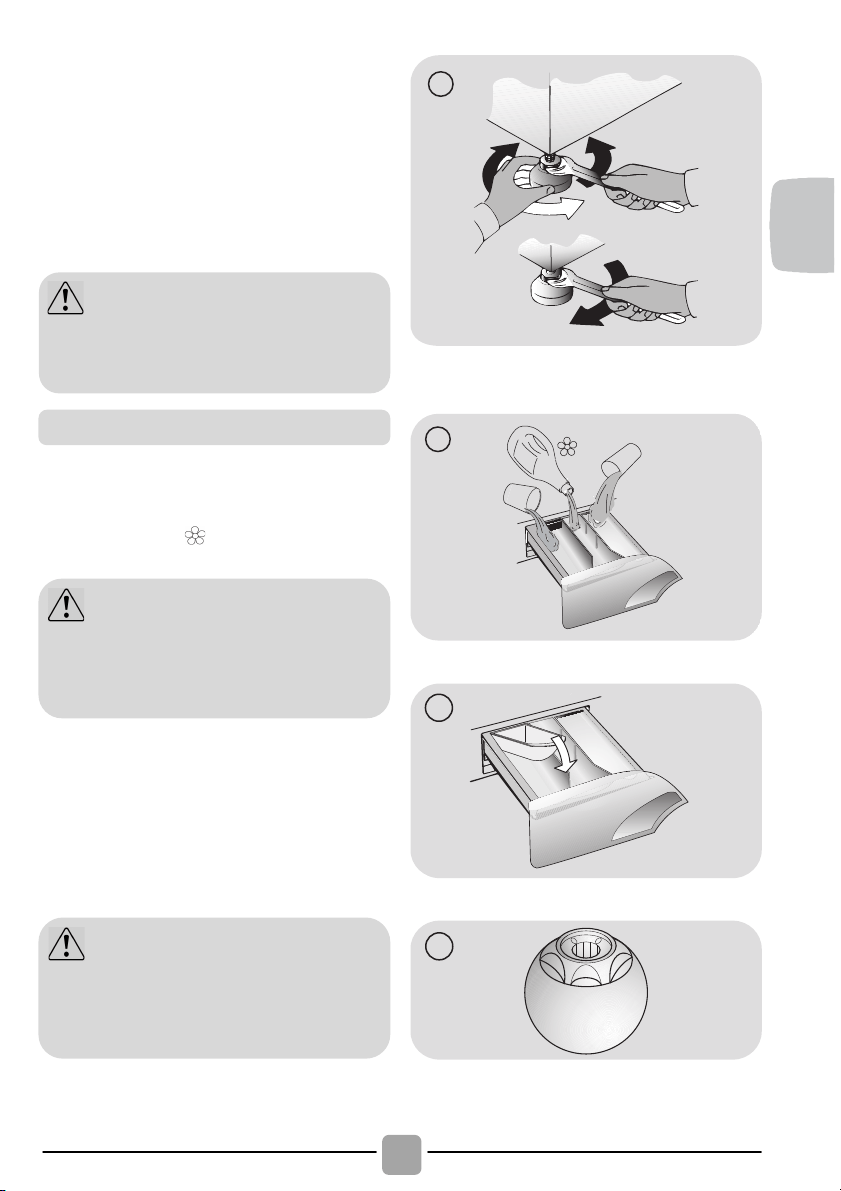
! Nivelar el electrodoméstico ajustando las
patas fig. 8:
a. girar la tuerca en el sentido de las
agujas del reloj para extraer el tornillo;
b. girar la pata regulable hasta que toque
el suelo;
c. bloquear el movimiento de la pata
insertando la tuerca hasta que toque
la parte inferior de la lavadora.
! Enchufar el aparato.
A
B
C
8
La cubeta se divide en tres compartimentos (fig. 9)::
! compartimento "1": detergente para el
prelavado;
! compartimento “ ”: otros productos líquidos
como suavizantes, almidón, fragancias, etc;
! compartimento "2": detergente para el lavado.
Con algunos modelos se suministra una pieza
especial para el detergente líquido (fig. 10).
Si se desea usar detergente líquido, ubicar la
pieza especial en el compartimento "2". De
ese modo, el detergente líquido pasará al
tambor en el momento adecuado del ciclo de
lavado. La pieza especial puede emplearse
para la lejía cuando se selecciona el programa
de aclarado.
2
1
9
10
11
ATENCIÓN:
si es necesario reemplazar el cable de
alimentación, solicitar la asistencia del
Servicio de Atención al Cliente.
Cubeta para detergente
ATENCIÓN:
sólo deben emplearse productos
líquidos. La lavadora está configurada
para dosificar automáticamente los
productos durante el último aclarado.
ATENCIÓN:
algunos detergentes no son fáciles de
limpiar. Si se utilizan detergentes de
este tipo, emplear el contenedor especial
y ubicarlo dentro del tambor (fig. 11).
!
8
3. CONSEJOS PRÁCTICOS
ATENCIÓN: Al clasificar las prendas,
asegurarse de:
- quitar objetos metálicos como broches,
ganchos, monedas, etc.;
- abotonar fundas, cerrar cremalleras,
ajustar cinturones y cintas;
- retirar enganches de las cortinas;
- leer las instrucciones de lavado de cada
prenda;
- tratar previamente las manchas difíciles con
productos especiales.
! Al lavar alfombras, mantas o prendas
pesadas, se recomienda desactivar la
función de centrifugado.
! Al lavar prendas de lana, comprobar que
sean aptas para lavarlas en la lavadora y
que contengan el símbolo de "Pura lana
virgen" con la indicación de "No se
apelmaza " o "Lavable en lavadora".
Cómo usar su lavadora de forma
respetuosa con el medio ambiente y con el
máximo ahorro.
Cargar al máximo la lavadora
! Para ahorrar energía, detergente y tiempo,
se recomienda cargar al máximo la lavadora.
Es posible ahorrar hasta un 50% de energía
con una única colada de carga llena, en
lugar de dos coladas a media carga.
¿Cuándo es necesario el prelavado?
! ¡Sólo cuando las prendas están muy
sucias! Cuando la ropa tiene una
suciedad normal, es posible ahorrar entre
un 5% y un 15% de energía si no se
utiliza la función de prelavado.
¿Qué temperatura de lavado se debe
seleccionar?
! Si se emplea un quitamanchas o se
sumergen las prendas manchadas antes
de lavarlas en la lavadora, se reduce la
necesidad de seleccionar un programa de
lavado de alta temperatura. Seleccionando
el programa de lavado a 60ºC se puede
ahorrar hasta un 50% de energía.
A continuación se proporciona una guía rápida
con consejos y recomendaciones sobre el uso
de detergente a distintas temperaturas. Se
recomienda leer siempre las instrucciones de
cada detergente para utilizarlo correctamente y
en las cantidades adecuadas.
Consejos para colocar la ropa
en la lavadora
Sugerencias útiles para el
usuario
Para lavar ropa blanca muy sucia
y obtener excelentes resultados,
emplear programas para algodón con
temperaturas de 60°C o superiores y
un detergente en polvo normal con
agentes blanqueadores.
Para temperaturas de lavado de 40°C
a 60°C, se debe elegir un detergente
apropiado para el tipo de género y el
nivel de suciedad. Los detergentes
en polvo normales dan excelentes
resultados en el lavado de ropa muy
sucia "blanca" o de colores resistentes,
mientras que los detergentes en
polvo para prendas de color son
recomendables para el lavado de ropa
de color con bajo nivel de suciedad.
Para temperaturas de lavado inferiores
a 40°C, se recomienda emplear
detergentes líquidos o adecuados para
el lavado a bajas temperaturas.
Para el lavado de prendas de lana o seda,
emplear sólo detergentes formulados
especialmente para ese tipo de géneros.

!
ES
9
4. LIMPIEZA Y
MANTENIMIENTO
Para limpiar el exterior de la lavadora no usar
productos abrasivos ni alcohol ni solventes;
basta con pasar un paño húmedo. La lavadora
no requiere cuidados especiales para
mantenerla limpia. Mantener limpios los
compartimentos de detergente y suavizante y
el filtro. A continuación ofrecemos algunos
consejos para el traslado o para largos
períodos de inactividad de la lavadora.
! Es conveniente limpiar la cubeta para
que no se acumulen restos de detergente
y otros productos.
! Retirar la cubeta haciendo un poco de
fuerza, dejarla bajo el agua hasta que esté
limpia y volver a colocarla en su sitio.
! La lavadora está provista de un filtro
especial que retiene los objetos de tamaño
relativamente grande, como monedas o
botones, que podrían obstruir el desagüe.
! Sólo algunos modelos: extraiga el tubo,
saque el tapón y recoja el agua en un
contenedor.
! Antes de extraer el filtro, se recomienda
colocar un paño absorbente en el suelo para
evitar que se moje.
! Girar el filtro en sentido contrario al de las
agujas del reloj hasta que se detenga en
la posición vertical.
! Extraer el filtro, limpiarlo y volver a colocarlo
girándolo en el sentido de las agujas del
reloj.
! Para volver a colocar todo en su sitio, repetir
los pasos previos siguiendo las instrucciones
en sentido contrario.
! En el caso de que la lavadora estuviese
inactiva durante un largo período de
tiempo en lugares a bajas temperaturas,
se recomienda vaciar por completo los
restos de agua que hayan quedado en el
interior de los tubos.
! Desenchufar la lavadora.
! Soltar el tubo de la abrazadera y colocar
el extremo en un recipiente en el suelo
para recoger toda el agua.
! Volver a asegurar el tubo de desagüe con
la abrazadera una vez concluida la
operación.
Limpieza de la cubeta para el
detergente
Limpieza del filtro
Recomendaciones para el traslado
o para largos períodos de
inactividad de la lavadora
!
10
5. GUÍA RÁPIDA
La lavadora regula automáticamente el
nivel de agua según el tipo de ropa y la
carga. Este sistema reduce el consumo
energético y el tiempo de lavado.
! Encender la lavadora y seleccionar el
programa de lavado.
! Regular la temperatura de lavado si es
necesario y configurar las opciones
necesarias.
! Pulsar la tecla INICIO/PAUSA para iniciar el
lavado.
En caso de que se interrumpa el suministro
eléctrico cuando la lavadora está
funcionando, una memoria especial guarda
la configuración elegida y, cuando se
restablece el suministro, la máquina reinicia
el ciclo donde éste se ha interrumpido.
! Al finalizar el programa aparece el
mensaje "End" (fin) en la pantalla o se
enciende el LED de fin de programa.
! Apagar la lavadora.
Para distintos tipos de lavado, consultar
la tabla de programas y seguir los pasos
indicados.
Presión en el circuito hidráulico:
min 0,05 Mpa
max 0,8 Mpa
Revoluciones de centrifugado:
ver tarjeta de datos.
Potencia absorbida/ Amperios del
fusible de la red/ Tension:
ver tarjeta de datos.
6. CONTROLES Y
PROGRAMAS
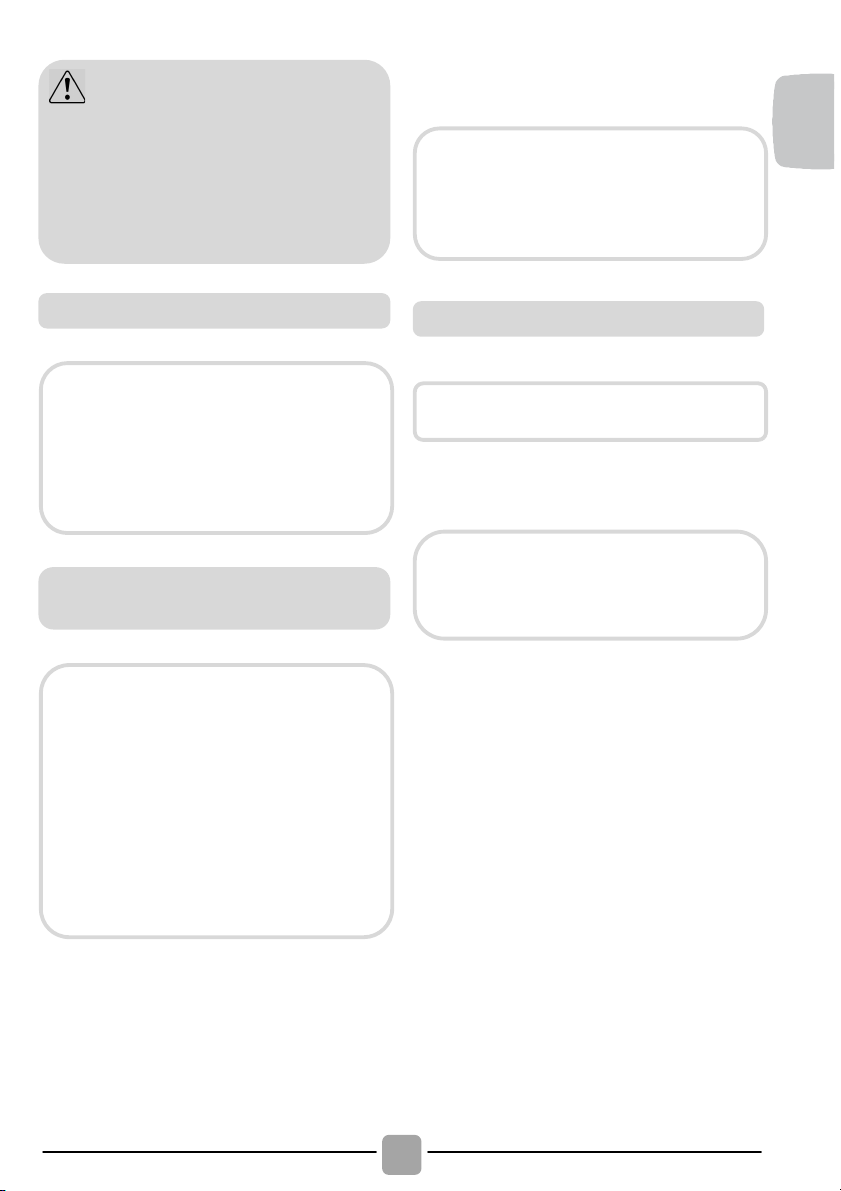
A
B
DCEFGHI
M
L
A
Selector de programas con
posición OFF
position
B
Tecla INICIO/PAUSA
C
Tecla SELECCIÓN CENTRIFUGADO
D
Tecla SELECCIÓN TEMPERATURA
E
Tecla INICIO DIFERIDO
F
Tecla NIVEL DE SUCIEDAD
G
Tecla SUPER ACLARADO
H
Tecla OPCIONES
I
Tecla PLANCHADO FÁCIL
L
Display digital
M
Indicador SEGURIDAD PUERTA
Selección de programas
Esperar unos 2 minutos después de
finalizado el programa hasta que se
apague la luz que indica que se ha
desbloqueado la puerta.
Datos técnicos
!
ES
11
! Accionar la tecla INICIO/PAUSA para
iniciar el ciclo seleccionado.
! Una vez que se selecciona un programa
el selector de programa se mantiene
inmóvil en el programa seleccionado
hasta que termine el ciclo.
! Apague la lavadora girando el selector en
la posición OFF.
! Presionar para iniciar el ciclo.
AÑADIR O ELIMINAR ELEMENTOS TRAS
LOS PROGRAMAS HA COMENZADO
(PAUSA)
! Mantenga pulsado la tecla
INICIO/PAUSA durante unos 2
segundos (algunas luces indicadoras y
el indicador de tiempo restante
parpadeará, indicando que la máquina se
ha detenido).
! Espere 2 minutos hasta que el
dispositivo de seguridad permita abrir la
puerta.
! Después de haber agregado o quitado
elementos a la colada, cierre la puerta y
presione la tecla INICIO/PAUSA (el
programa se iniciará a partir de donde se
detuvo).
ATENCIÓN:
No toque la pantalla al insertar el
enchufe, porque la lavadora calibra
los sistemas durante los primeros
segundos: Al tocar la pantalla, la
máquina no podía trabajar con
propiedad. En este caso, retire el
enchife y repetir la operación.
Apertura puerta
Un dispositivo de seguridad impide
que la puerta se abra inmediatamente
después del final del ciclo.
Espere 2 minutos después de que el
ciclo de lavado haya terminado y la
luz de "Puerta de seguridad" se ha
apagado antes de abrir la puerta.
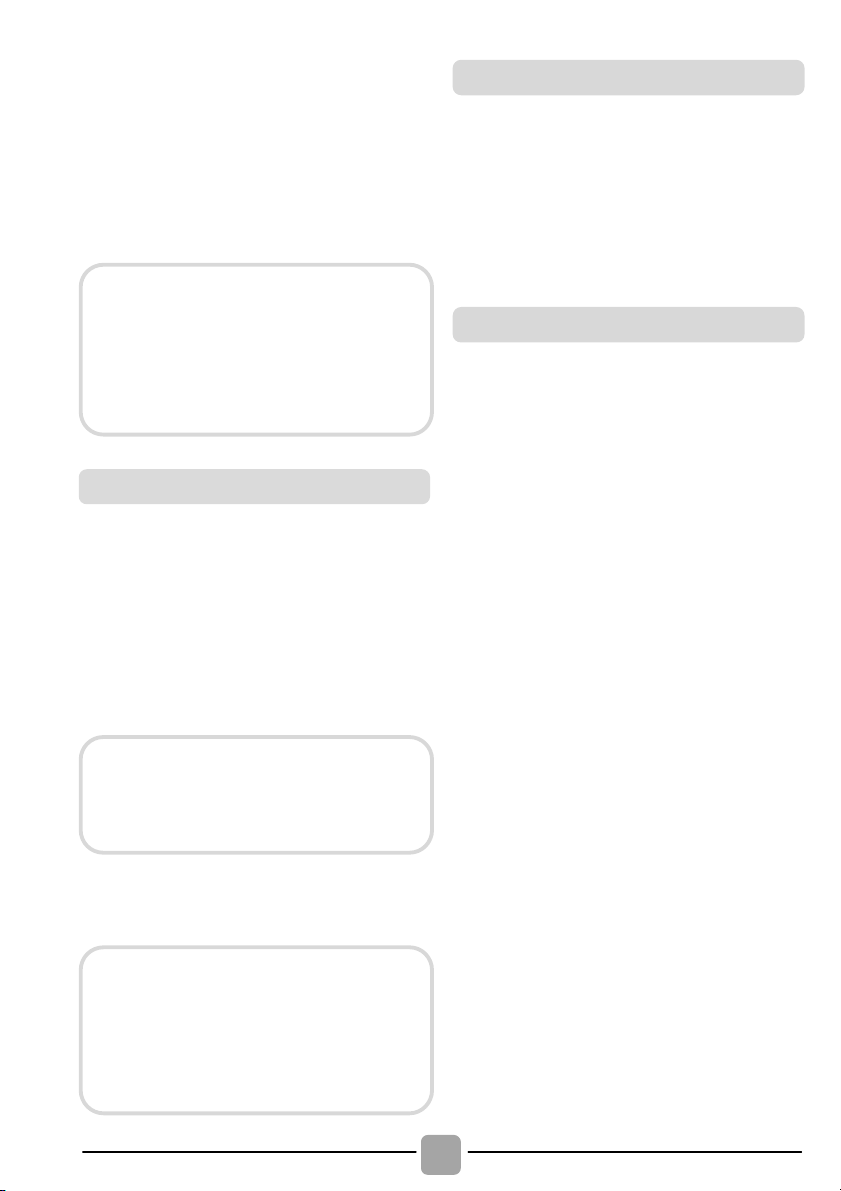
PROGRAMA selector con
posición OFF
Cuando el selector de programa se
activa la pantalla se ilumina para
mostrar los ajustes para el programa
seleccionado.
Para el ahorro de energía, al final del
ciclo o con un período de inactividad,
el contraste nivel de visualización
disminuirá.
N.B.: Para apagar la máquina, gire el
selector de programas en la posición
OFF
El selector de programa se debe volver
a la posición OFF al final de cada ciclo
o cuando se inicia un ciclo de lavado
posterior antes del próximo programa
que se está seleccionado y se inicia.
Tecla INICIO/PAUSA
Cierre la escotilla ANTES de
seleccionar INICIO/PAUSA.
Cuando la tecla INICIO/PAUSA ha
sido accionada, la lavadora puede
tomar unos segundos antes de iniciar
el cilo.
!
12
CANCELACIÓN DE UN PROGRAMA
! Para cancelar un programa, sitúe el
selector en la posición OFF.
! Selecione un programa diferente.
! Reestablezca el selector en la posición
OFF.
! Al accionar esta opción, es posible
reducir la velocidad máxima, y si lo
desea, el ciclo de centrifugado se puede
cancelar.
! Para reactivar el ciclo de centrifugado de
prensa el botón hasta llegar a la
velocidad de centrifugado que desea
configurar.
! Es posible modificar la velocidad de
centrifugado sin detenerse la lavadora.
! Esta opción le permite cambiar la
temperatura de los ciclos de lavado.
! No es posible elevar la temperatura por
encima del máximo permitido para cada
programa, con el fin de proteger los
tejidos.
! Esta opción le permite pre-programar el
ciclo de lavado para iniciarlo con una
posterioridad de hasta 24 horas.
! Para diferir el inicio del ciclo:
- Introduzca el programa deseado.
- Pulse el botón una vez para activarlo
(h00 aparece en la pantalla) y luego
pulse de nuevo para fijar un intervalo de
1 hora (h01 aparece en la pantalla). El
retardo preestablecido aumenta en 1
hora cada vez que se pulsa el botón,
hasta que aparezca h24 en la pantalla,
y en ese momento, al pulsar el botón de
nuevo, se restablecerá el inicio diferido
a cero
-
Confirme pulsando la tecla INICIO/PAUSA
(
la luz en la pantalla comienza a
parpadear). La cuenta atrás comienza y
cuando termina el programa se iniciará
automáticamente.
! Es posible cancelar el inicio diferido
girando el selector de programas a la
posición OFF.
Si hay alguna interrupción en el
suministro de energía mientras la
lavadora está en funcionamiento, una
memoria especial almacena el programa
seleccionado y, cuando se restablezca la
energía, continúa donde lo dejó.
Las opciones y funciones se debe
seleccionar antes de pulsar la tecla
INICIO/PAUSA.
Si se selecciona una opción que no es
compatible con el programa elegido
entonces el indicador opción parpadea
primero y luego se apaga.
Tecla SELECCIÓN CENTRIFUGADO
Para evitar daños en los tejidos, no es
posible aumentar la velocidad
prevista para el programa durante la
selección del programa.
La lavadora está equipada con un
dispositivo electrónico especial, que
impide que en el ciclo de centrifugado
la carga esté desequilibrada.
Esto reduce el ruido y las vibraciones
en la lavadora y así prolonga la vida
útil de su máquina.
Tecla SELECCIÓN TEMPERATURA
Tecla INICIO DIFERIDO

!
ES
13
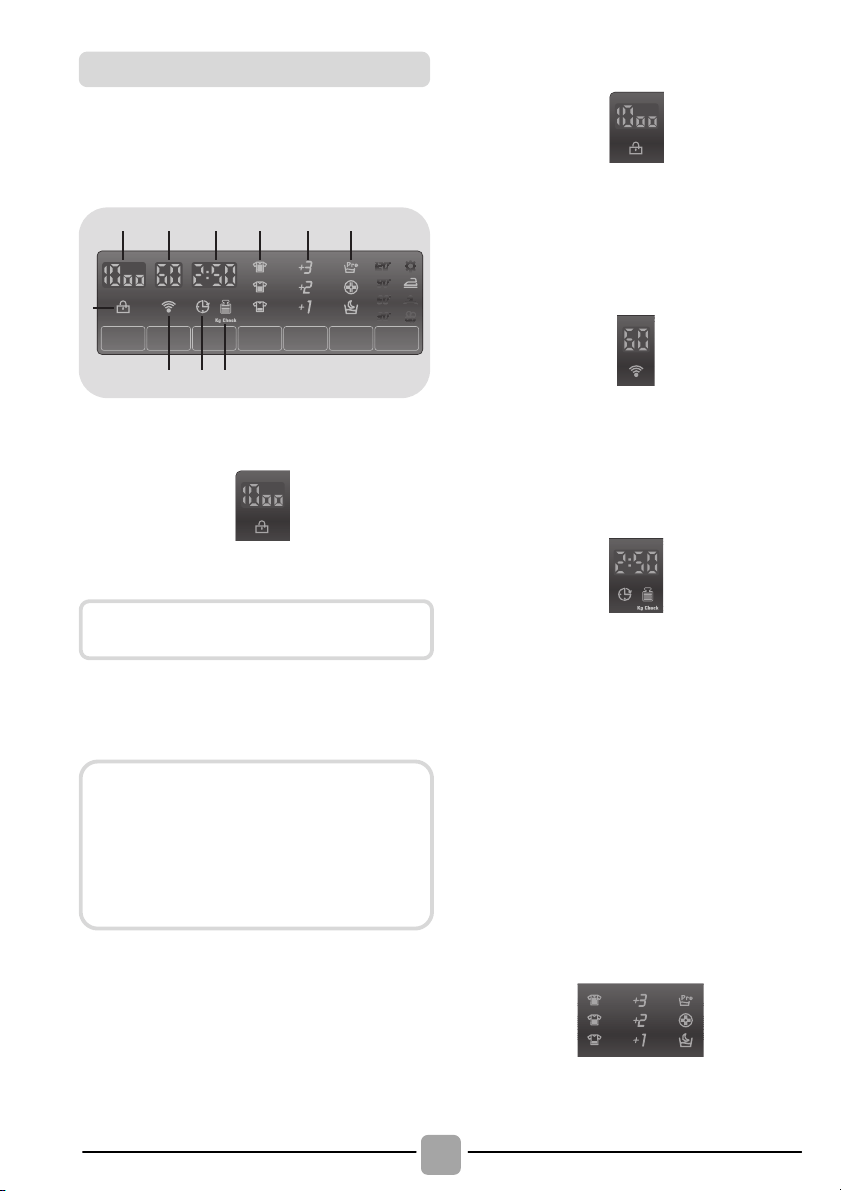
! Al seleccionar esta opción puede elegir
emtre 3 niveles de intensidad de lavado,
dependiendo del grado de suciedad de
los tejidos (se puede utilizar sólo en
algunos programas, como se muestra en
la tabla de programas).
! Una vez que el programa se ha
seleccionado el indicador luminoso
mostrará automáticamente el ajuste de
nivel de suciedad para ese programa.
! Selección de un nivel de suciedad diferente,
el indicador correspondiente se encenderá.
! Esta opción permite agregar los
aclarados al final del ciclo de lavado. El
número máximo de aclarados adicionales
está relacionado con el programa
seleccionado.
! Esta función se ha estudiado para las
personas con piel delicada y sensible, para los
que incluso un residuo mínimo de detergente
puede causar irritaciones o alergias.
! Se aconseja también utilizar esta función
para las prendas de los niños y en caso
de lavado de prendas muy sucias, en las
que se ha usado una gran cantidad de
detergente, o en el lavado de artículos de
rizo cuyas fibras en su mayoría tienen la
tendencia a retener la detergente.
Puedes seleccionar entre tres diferentes
opciones:
- PRELAVADO
! Esta opción le permite realizar un
prelavado y es particularmente útil para
cargas muy sucias (se puede utilizar sólo
en algunos programas, como se muestra
en la tabla de programas).
! Le recomendamos que utilice sólo el 20%
de las cantidades recomendadas en el
envase del detergente.
- HIGIENIZANTE
! Con esta opción es posible higienizar la
ropa, el programa de lavado alcanza una
temperatura de 60°C.
- CICLO NOCHE
! Esta opción reduce la velocidad de
centrifugado intermedio a 400 rpm, en su
caso, aumenta el nivel de agua durante el
aclarado y mantiene la ropa sumergida en el
agua después del enjuague final, con el fin
de relajar las fibras.
! Durante la fase en la que el agua está en el
cesto, una intermitencia de la luz indicadora
demostrará que la lavadora se encuentra en
un punto muerto.
! Desactive la opción para terminar el ciclo
con centrifugado (que puede ser reducido o
cancelado usando el botón correspondiente)
y la fase de vaciado.
! Gracias a electrónico de control, el agua en
las fases Intermedias se vacía en silencio, lo
que hace esta opción muy útil para el lavado
durante la noche.
Esta tecla le permite minimizar las arrugas
al máximo eliminando las vueltas
intermedias o reduciendo la intensidad de
las últimas vueltas.
Tecla NIVEL DE SUCIEDAD
Tecla SUPER ACLARADO
Tecla OPCIONES
Tecla PLANCHADO FÁCIL
!
14
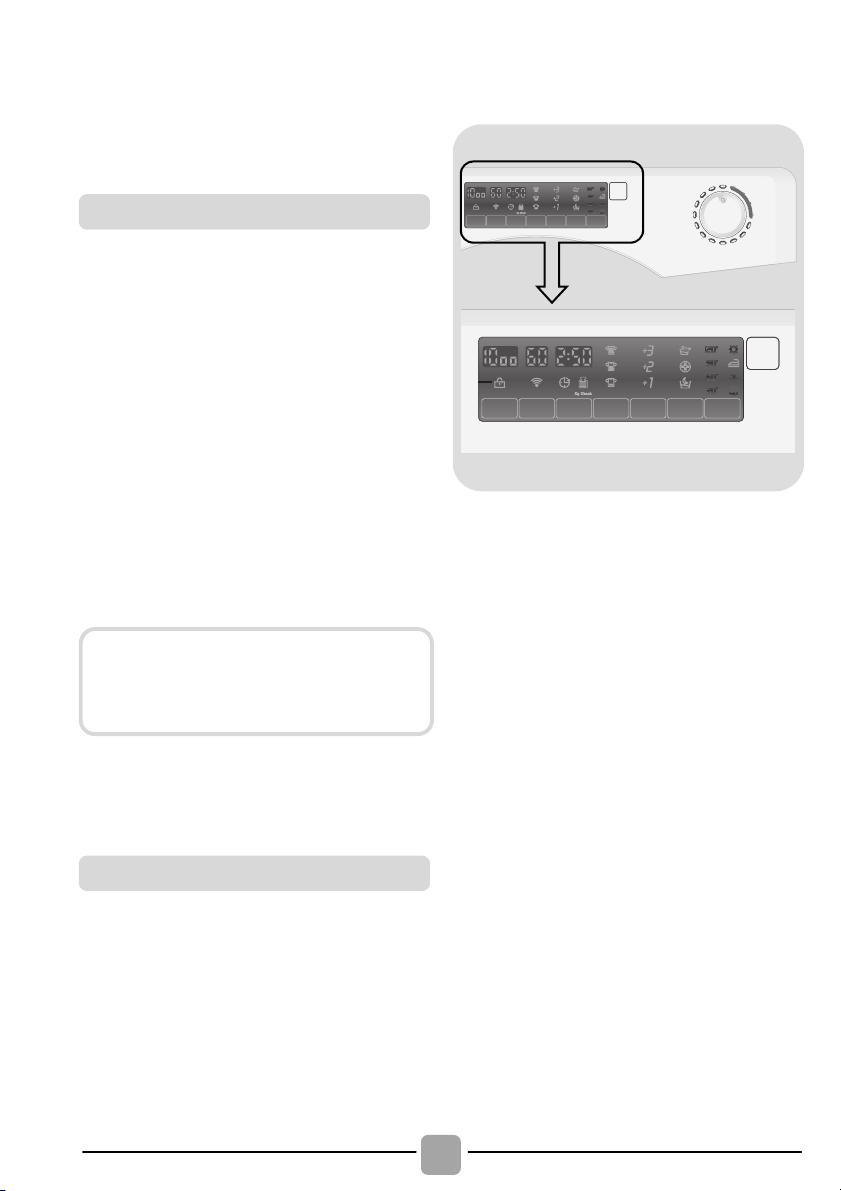
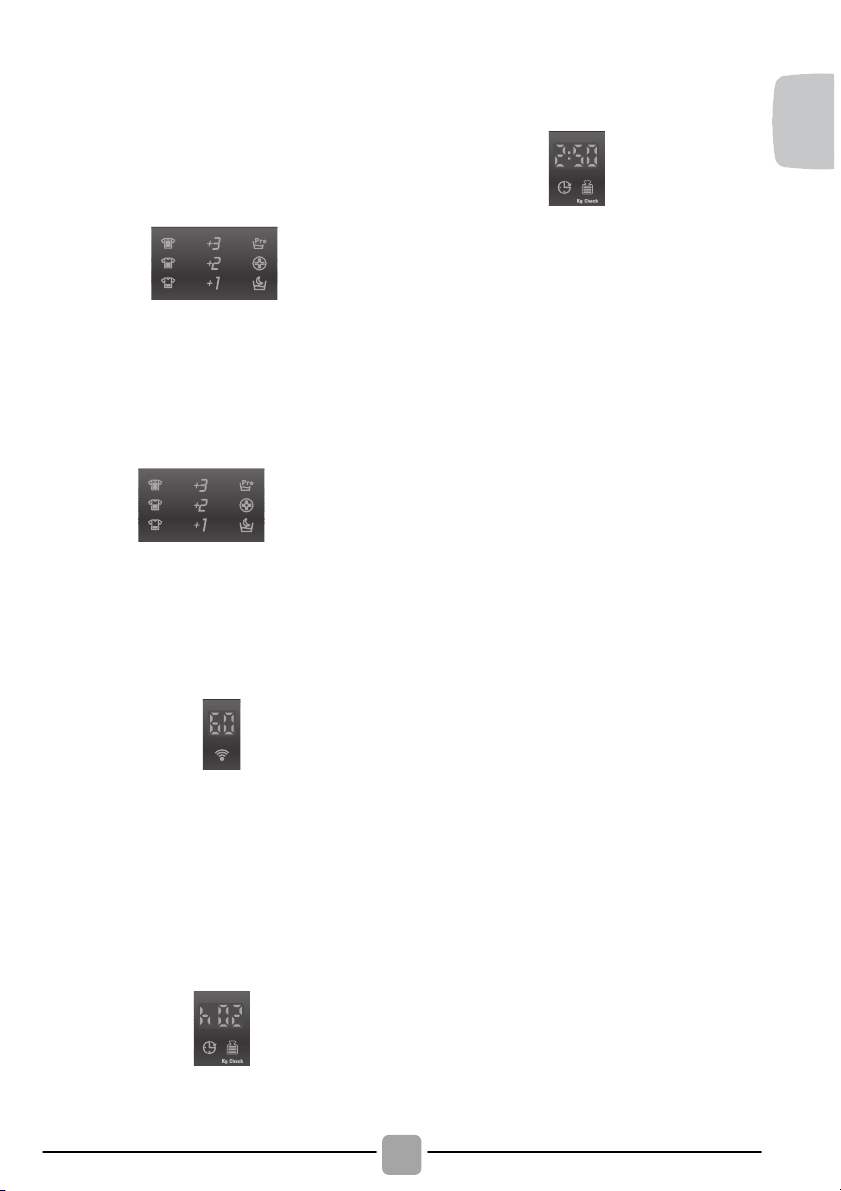
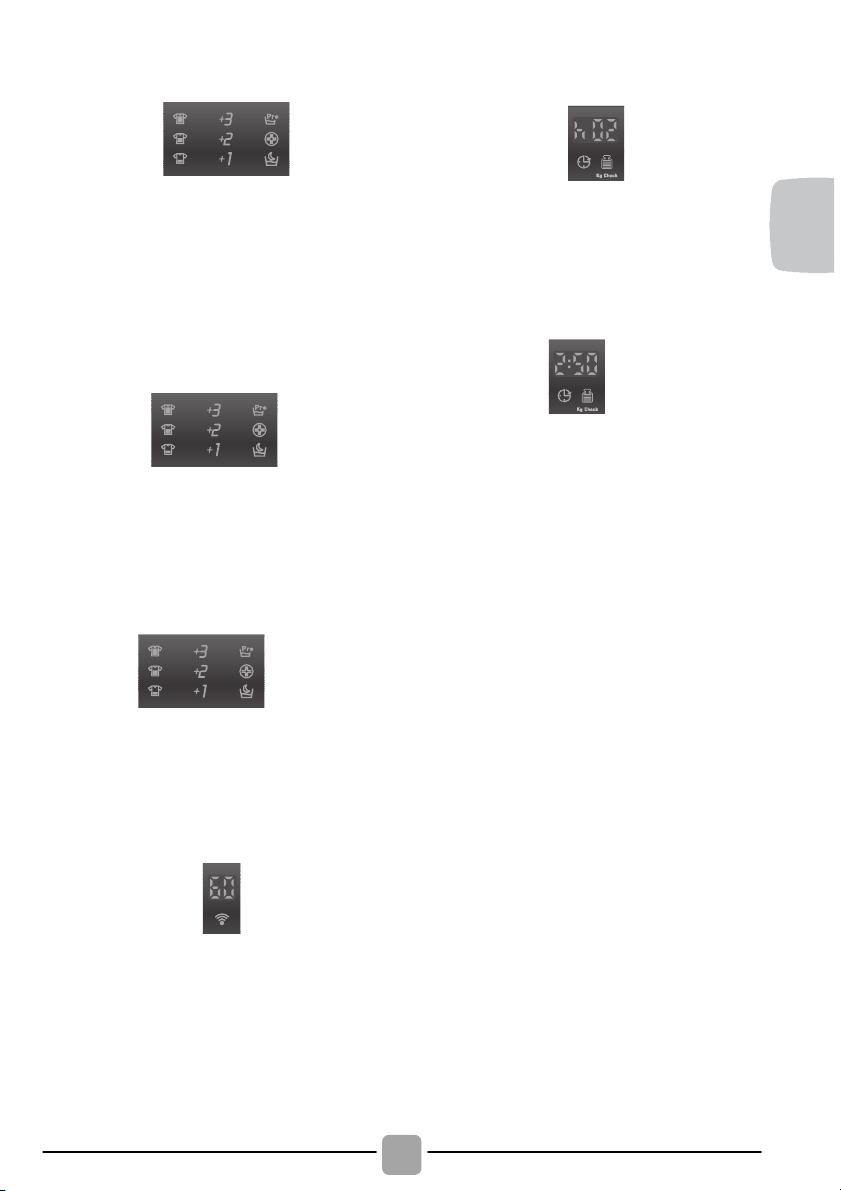
El Display digital le permite estar
constantemente informado sobre el estado
de la lavadora.
2
1
8109
3 4 5 6 7
1) INDICADOR SEGURIDAD PUERTA
1
! El icono indica que la puerta está cerrada.
! Cuando INICIO/PAUSA se presiona
con la puerta cerrada, el indicador se
parpadeará y luego de manera fija.
! Un dispositivo de seguridad impide que la
puerta se abra inmediatamente después
del final del ciclo. Espere 2 minutos
después de que el ciclo de lavado haya
terminado y la luz de SEGURIDAD
PUERTA se haya apagado antes de
abrir la puerta. Al final del ciclo, gire el
selector de programas a la posición OFF.
2) VELOCIDAD CENTRIFUGADO
2
Muestra la velocidad de centrifugado del
programa seleccionado que se puede
cambiar o eliminar por la opción
correspondiente.
3) TEMPERATURA LAVADO
3
Muestra la temperatura de lavado del
programa seleccionado que se puede
cambiar (donde sea permitido) por la
opción correspondiente.
4) DURACIÓN CICLO
4
! Cuando se selecciona un programa, el
display muestra automáticamente la
duración del ciclo, que puede variar,
dependiendo de las opciones seleccionadas.
! Una vez que el programa ha comenzado se
le mantiene informado constantemente del
tiempo restante hasta el final del lavado.
! La lavadora calcula el tiempo hasta el
final del programa seleccionado sobre la
base de una carga estándar, durante el
ciclo, el aparato corrige el tiempo al que
se aplica según tamaño y la composición
de la carga.
5) NIVEL DE SUCIEDAD
{
5
! Una vez que el programa ha sido
seleccionado, el indicador mostrará
Display digital
Cierre la escotilla ANTES de
seleccionar INICIO/PAUSA.
Si la puerta no está bien cerrada, la
luz seguirá parpadeando durante unos
7 segundos, después de lo cual
la orden de marcha se elimina
automáticamente. En este caso, cierre
la puerta de la manera adecuada y
pulse la tecla INICIO/PAUSA.
!
ES
15
automáticamente el ajuste de nivel de
manchas de ese programa.
! Con la selección de un nivel de suciedad
diferente el indicador correspondiente se
encenderá.
6) SUPER ACLARADOS
{
6
Las luces indicadoras muestran los
aclarados adicionales seleccionados por la
opción correspondiente.
7) OPCIONES
}
7
Los indicadores muestran la opción que se
puede seleccionar mediante el botón
correspondiente (PRELAVADO, HIGIENIZANTE
y CICLO NOCHE).
8) Wi-Fi (en algunos modelos)
8
! En los modelos con la opción Wi-Fi, el
icono indica que el sistema Wi-Fi está
funcionando.
! Para cualquier otra información en el
sistema Wi-Fi, hay un manual específico
dentro de la lavadora.
9) INICIO DIFERIDO
9
Parpadea cuando el inicio retardado se ha
establecido.
10) Kg Check (función activa solo en
algodón y sintéticos)
!
10
! Durante los primeros minutos del ciclo, el
indicador "Kg Check" permanecerá
encendido mientras el sensor inteligente
obtendrá el peso de la ropa y ajustará el
tiempo de ciclo, el agua y el consumo de
electricidad en consecuencia.
! A través de cada fase de lavado "Kg
Check" permite monitorear la
información sobre la carga de ropa en el
tambor y en los primeros minutos de la
colada él:
- Ajusta la cantidad de agua necesaria;
- Determina la duración del ciclo;
- Control de los aclarados en function del
tip ode tejido a seleccionado para ser
lavado;
- Ajusta el ritmo de rotación del tambor
para el tipo de tejido que se lava;
- Reconoce la presencia de espuma,
aumentando, si es necesario, la
cantidad de agua durante el aclarado;
- Ajusta la velocidad de centrifugado de
acuerdo a la carga, evitando así
cualquier desequilibrio.
!
16
2
1
PROGRAMA
kg *
(MAX.)
TEMP.°C
DETERGENTE
Recomendado
Max.
2
1
Rápido 14 Min
1
1
1
1,5
30°
30°
Rápido 30 Min
1,5
2
2,5
2,5
30°
30°
Rápido 44 Min
3
3
3,5
3,5
30°
40°
Ropa Blanca
1)
5
6
7
8
60°
90°
( )
Mixtos
1)
2,5
3
3,5
4
40°
60°
( )
Baby
1)
3,5
4
4,5
5,5
60°
60°
Mix & Wash (mezclar y lavar)
5
6
7
8
40°
40°
Aclarados
-
-
-
-
-
-
Desagüe + Centrifugado
-
-
-
-
-
-
Seda
1
2
2
2
30°
30°
A mano
1
2
2
2
30°
30°
Lana
1
2
2
2
40°
40°
Delicados
2
2
2,5
2,5
40°
40°
EcoMix 20°
5
6
7
8
20°
20°
**
1)
5
6
7
8
40°
60°
( )
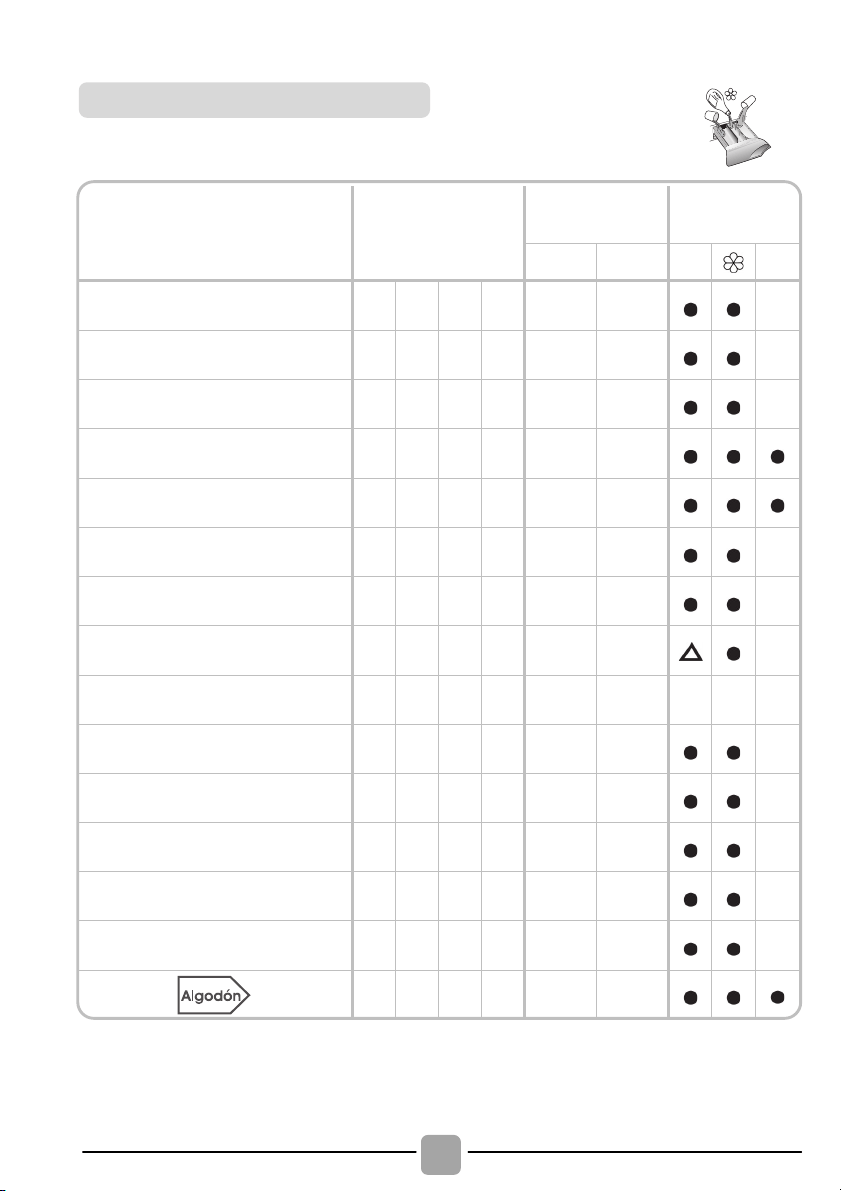
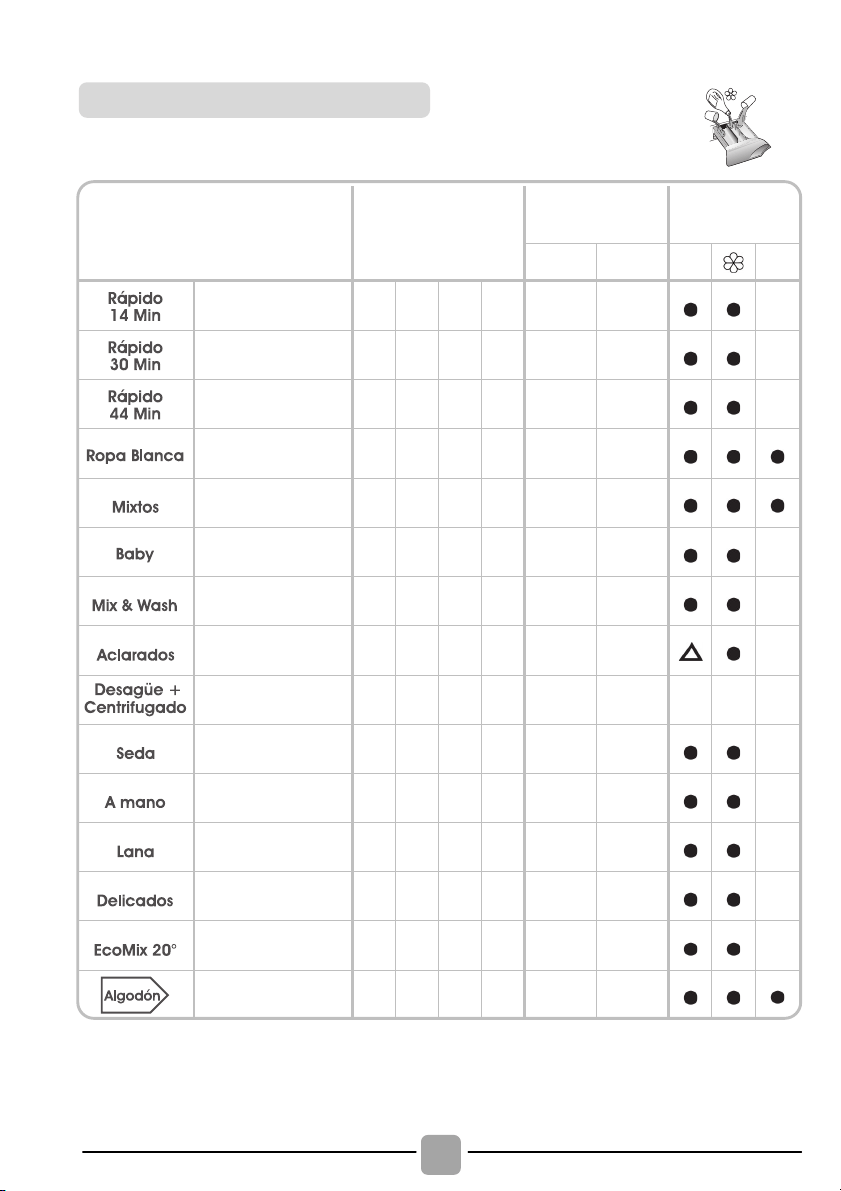
Tabla de programas

!
ES
17
Por favor lea estas notas:
* La capacidad máxima de colada seca
depende del modelo usado (ver panel de
control).
La velocidad de centrifugado puede
reducirse también, para que coincida con
las directrices sugeridas en la etiqueta de la
prenda, o incluso para tejidos muy
delicados cancelar completamente las
revoluciones de centrifugado. Esta opción
está disponible en la opción de selección
de velocidad de centrifugado y se puede
activar con la tecla SELECCIÓN
CENTRIFUGADO. Si la etiqueta no indica
información específica, es posible utilizar la
máxima prevista en el programa.
Una sobre dosificación de detergente
puede causar exceso de espuma.
Si el aparato detecta la presencia de
exceso de espuma, puede excluir la fase de
centrifugado o ampliar la duración del
programa y aumentar el consumo de agua.
( )
Sólo con la opción PRELAVADO
seleccionada (programas con
opción PRELAVADO disponible).
(Solo para modelos con
compartimento detergente líquido)
Cuando un número limitado de
artículos presentan manchas que
requieren tratamiento previo con
agentes de blanqueo líquidos, la
eliminación preliminar de mancha
puede ser llevado a cabo en la
propia lavadora.
Vierta el blanqueador en el
recipiente de detergente líquido,
se inserta en el compartimiento
"2" en el cajetín del detergente, y
establecer el programa especial
de ACLARADOS.
Cuando esta fase ha terminado,
gire el selector de programas en
la posición OFF, agregue el resto
de colada y proceda al lavado
normal en el programa más
adecuado.
1)
Para los programas mostrados se
puede ajustar la duración y la
intensidad del lavado con el botón
NIVEL DE SUCIEDAD.
** PROGRAMAS DE ALGODÓN
ESTÁNDAR SEGÚN (UE) nº 1015/2010
y nº 1061/2010.
PROGRAMA DE ALGODÓN CON
UNA TEMPERATURA DE 60°C.
PROGRAMA DE ALGODÓN CON
UNA TEMPERATURA DE 40°C.
Estos programas son adecuados para
limpiar suciedad normal de lavado de
algodón y son los programas más
eficientes en términos de consumo
combinado de energía y agua para
lavar la ropa de algodón lavado.
Estos programas se han desarrollado
para ser compatibles con la
temperatura en la etiqueta de lavado de
las prendas y la temperatura real del
agua pueden diferir ligeramente de la
temperatura declarada del ciclo.

!
18
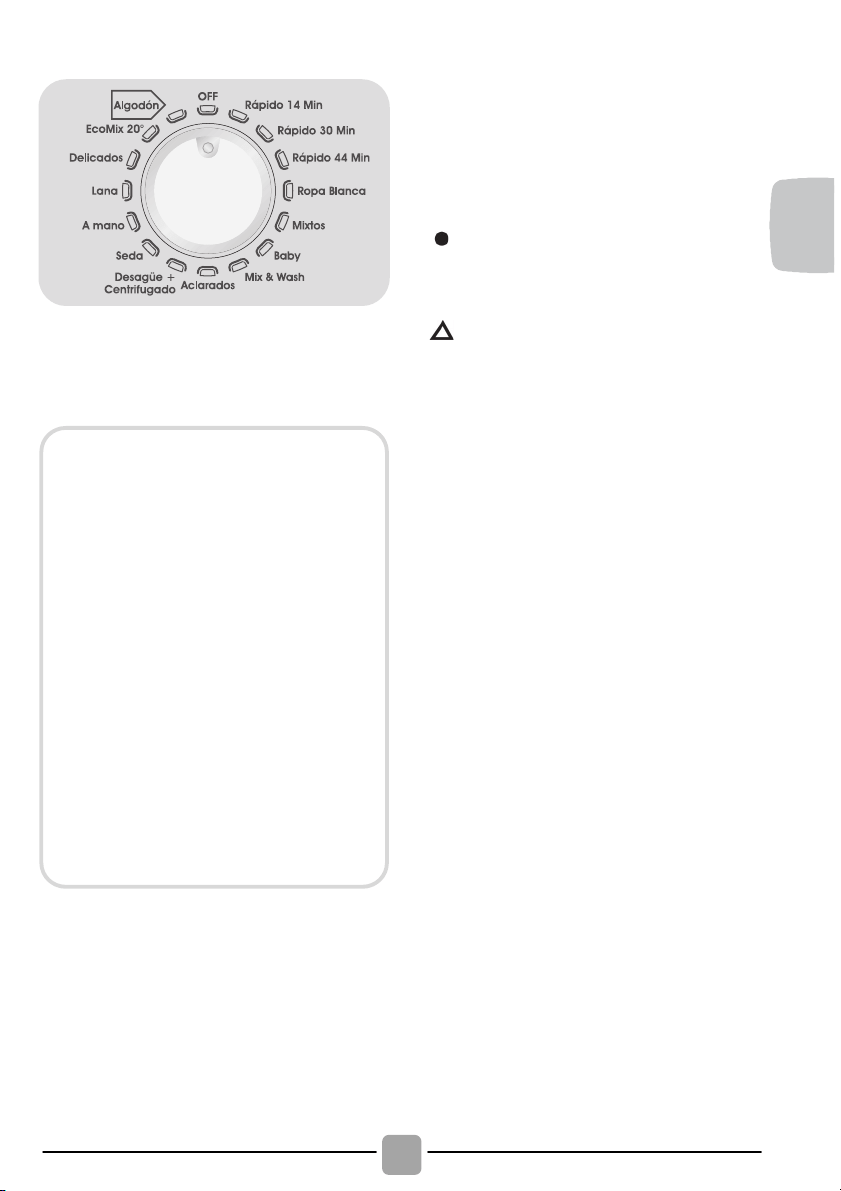
Para la limpieza de los diferentes tipos de
tejido y los diferentes niveles de suciedad,
la lavadora tiene programas específicos
para satisfacer todas las necesidades de
lavado (véase la tabla).
Rápido 14 Min / 30 Min / 44 Min
Un ciclo completo de lavado (lavado,
aclarado y centrifugado). Este programa
está especialmente indicado para prendas
de algodón poco sucias y tejidos mixtos.
Con este programa, se recomienda utilizar
sólo el 20% del detergente normalmente se
utiliza para evitar el despilfarro.
Ropa Blanca
Realizados para tener un perfecto lavado. El
centrifugado final a la máxima velocidad da
un resultado mucho más eficiente.
Mixtos
El lavado y de aclarado están optimizados según
los ritmos de rotación del tambor y los niveles de
agua. El centrifugado suave, asegura una menor
presencia de arrugas en las prendas.
Baby
Este programa le permite lavar toda la ropa
del bebé para conseguir un efecto de
limpieza y desinfección perfecta, establezca
la temperatura a 60°C como mínimo.
Para optimizar el resultado del efecto de
desinfección se recomienda el uso de
detergente en polvo.!
Mix & Wash (mezclar y lavar)
El programa le permite mezclar diferentes
tejidos (ej: algodón + sintéticos, etc ..) y los
lava con un bajo consumo de energía, ya que
la temperatura no supera los 40°C.
Aclarados
Este programa realiza 3 aclarados con un
centrifugado intermedio (que puede ser
reducido o excluido mediante la opción
correspondiente). Se utiliza para el lavado de
cualquier tipo de tejido, por ejemplo después
de un lavado a mano.
Desagüe + Centrifugado
El programa se completa el vaciado y un
centrifugado a máxima velocidad. Es posible
eliminar o reducir el centrifugado con la
opción SELECCIÓN CENTRIFUGADO.
Seda
Programa dedicado para tejidos de seda que se
pueden lavar con lavadora. Las rotaciones del
tambor son delicadas, la temperatura no supera
los 30°C y el programa finaliza con un
centrifugado suave.
A mano
Programa lavado a mano de prendas, el
programa termina con 3 aclarados y un
centrifugado lento.
Lana
Este programa realiza un ciclo de lavado
pensado para los tejidos de lana que se
pueden lavar en la lavadora, o los artículos
a lavar a mano.
Delicados
Este programa se alterna entre momentos de
lavado con momentos de pausa y es
particularmente adecuado para el lavado de
prendas delicadas. El ciclo de lavado y aclarado
se llevan a cabo con un alto nivel de agua para
asegurar el mejor rendimiento.
EcoMix 20°
Este innovador programa, le permite lavar
diferentes tejidos y colores juntos, tales como
algodón, sintéticos y tejidos mixtos a sólo 20°C
y proporciona un excelente rendimiento de
limpieza. El consumo en este programa es de
aproximadamente 40% respecto a un ciclo
convencional 40°C de algodón.
Este programa es adecuado para limpiar
suciedad normal de lavado de algodón y es el
programa más eficiente en términos de consumo
combinado de energía y agua para lavar la ropa
de algodón.
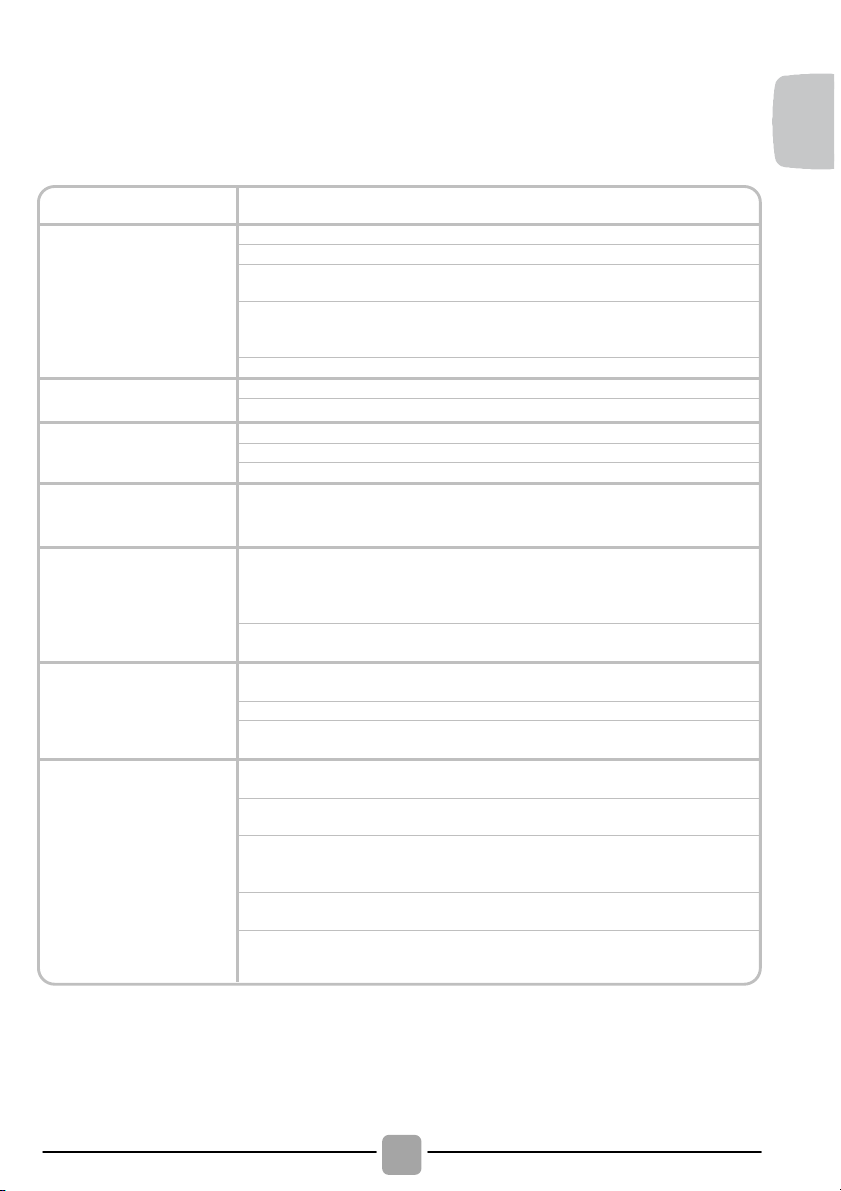
Selección de programas
!
ES
19
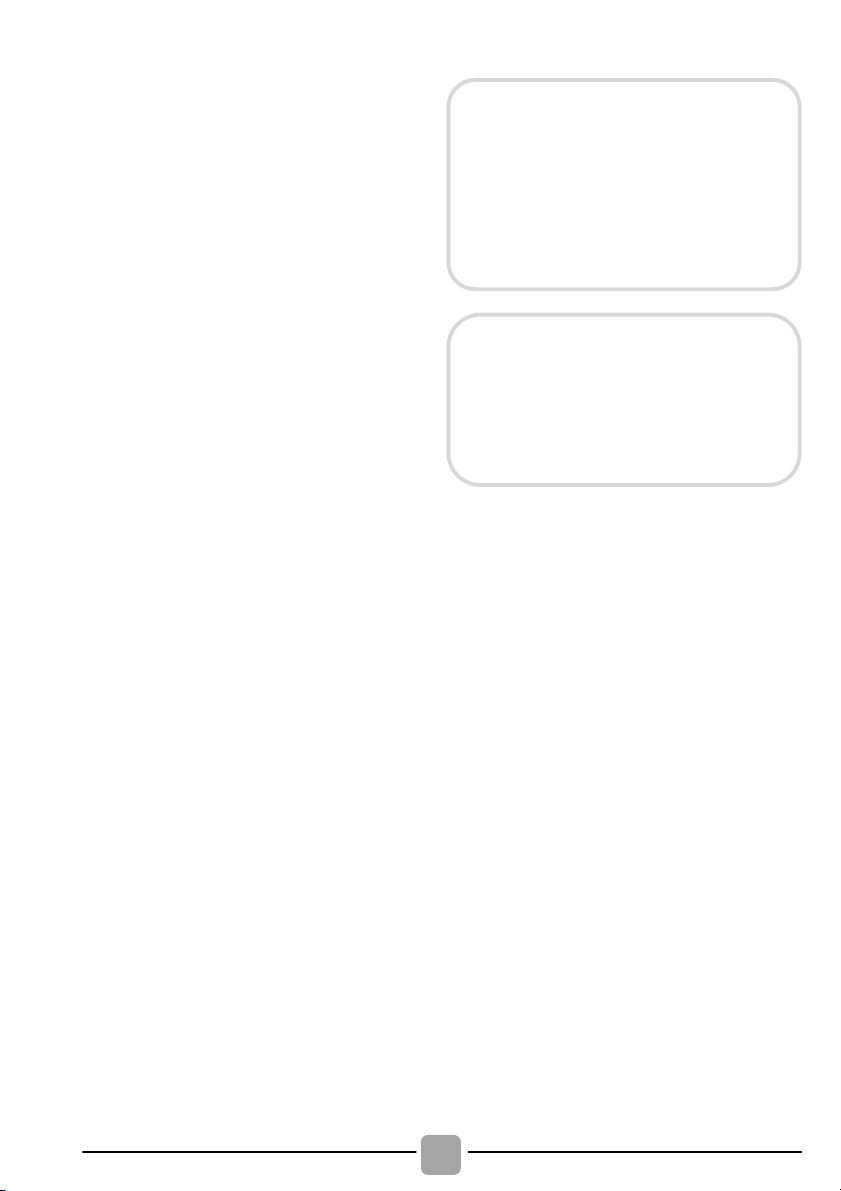
7. SERVICIO TÉCNICO Y GARANTÍA
Si la lavadora no funciona adecuadamente, consultar la siguiente guía rápida con consejos
prácticos que permiten al usuario solucionar los problemas más comunes.
Anomalía
Posibles causas y soluciones
La lavadora no
funciona.
Asegurarse de que la lavadora esté enchufada.
Asegurarse de que la lavadora esté encendida.
Verificar que se haya seleccionado adecuadamente el programa
deseado y que se haya encendido correctamente el electrodoméstico.
Asegurarse de que los fusibles no estén dañados y de que el enchufe
funcione correctamente probando con otro artefacto, por ejemplo, una
bombilla.
La puerta de carga no está bien cerrada. Abrirla y volver a cerrarla.
La lavadora no
carga agua.
Verificar que esté abierto el grifo.
Verificar que el temporizador esté correctamente configurado.
La lavadora no
desagota.
Comprobar que no haya obstrucciones en el filtro.
Comprobar que la manguera de desagüe no esté doblada.
Comprobar la presencia de objetos extraños en el filtro.
Presencia de agua en
el suelo alrededor de
la lavadora.
Es probable que haya pérdida de agua por la guarnición que está
entre el grifo y la manguera de entrada de agua, en cuyo caso se debe
reemplazar la pieza y volver a ajustar la manguera y el grifo.
La lavadora no
centrifuga.
La causa puede ser que el agua no se haya eliminado por completo.
Esperar unos minutos.
Algunos modelos tienen la opción de exclusión de centrifugado.
Verificar que no esté seleccionada la tecla correspondiente.
Un exceso de detergente puede hacer que la lavadora no centrifugue.
Reducir la cantidad de detergente en los próximos lavados.
La lavadora vibra en
exceso durante el
centrifugado.
Es probable que la lavadora no esté bien nivelada. Si es necesario,
regular las patas como se indica en la sección correspondiente.
Comprobar que se hayan extraído los seguros de transporte.
Comprobar que la carga de colada esté distribuida de manera
uniforme.
Parpadea una
indicación específica
de ERROR.
Si aparece una indicación de error Nº 0, 1, 5, 7 u 8, llamar al Servicio
de Atención al Cliente.
Si aparece una indicación de error Nº 2, la lavadora no carga agua.
Verificar que esté abierto el grifo.
Si aparece una indicación de error Nº 3, la lavadora no desagota
correctamente. Asegurarse de que el drenaje no esté obstruido y de
que la manguera no esté doblada.
Si aparece una indicación de error Nº 4, la carga de la colada es
excesiva. Cerrar el grifo y contactar al Servicio de Atención al Cliente.
Si aparece una indicación de error Nº 9, apagar la lavadora y esperar
unos 10 o 15 segundos antes de reiniciar el programa.
!
20
El uso de detergentes ecológicos sin
fosfatos puede producir los siguientes
efectos:
- El agua de vaciado del aclarado es
más turbia debido a la presencia de
zeolitos en suspensión, sin que resulte
perjudicada la eficacia del aclarado.
- Presencia de polvo blanco (zeolitos)
en la ropa al finalizar el lavado, que no
se incrusta en el tejido ni altera los
colores.
- Presencia de espuma en el agua del
último aclarado, que no necesariamente
es indicación de un aclarado deficiente.
- Presencia de abundante espuma
debido a los tensoactivos aniónicos
presentes en las formulaciones de los
detergentes para lavadoras y que son
difíciles de separar de la ropa.
Volver a aclarar la ropa en estos casos
no conlleva ningún beneficio.
Si el problema persiste o si sospecha que
se trata de un caso de mal funcionamiento,
contacte de inmediato con el Servicio de
Atención al Cliente de Candy.
Asimismo, puede registrarse en el plan de
servicio técnico de Candy, que ofrece servicio
a domicilio sin cargo después del vencimiento
de la garantía.
Atención: El número de teléfono
proporcionado no admite llamadas
gratuitas. El coste le será informado en un
mensaje de voz por el operador telefónico
del Servicio de Atención al Cliente.
Candy recomienda el uso de piezas de
recambio originales, suministradas por el
Servicio de Atención al Cliente.
El fabricante no se responsabiliza por
eventuales erratas de imprenta contenidas
en el presente manual de instrucciones.
Asimismo, se reserva el derecho de efectuar
las modificaciones que considere oportunas
para sus productos sin comprometer sus
características fundamentales.
Garantía
Esta lavadora está garantizada en las
condiciones indicadas en el certificado
que acompaña al aparato. Usted deberá
conservar el certificado de garantía
debidamente cumplimentado para
mostrarlo al Servicio Técnico autorizado
de Candy en caso de necesitar su
intervención.
¡Registre su producto!
No pierda tiempo: registre su producto y
descubra todos los beneficios.
¿Cómo registrarse? Visite la web
www.registercandy.com o llame al
teléfono que aparece en el material
informativo.

!
ES
21
!
22
Thank-you for choosing a Candy washing
machine. We are confident it will loyally
assist you in safely washing your clothes,
even delicates, day after day.
You can register your product at
www.registercandy.com to gain faster
access to supplementary services solely
reserved to our most loyal customers.
Carefully read this manual for correct and
safe appliance use and for helpful tips on
efficient maintenance.
Only use the washing machine
after carefully reading these instructions.
We recommend you always keep this
manual on hand and in good conditions for
any future owners.
Please check that the appliance is
delivered with this instruction manual,
warranty certificate, service centre address
and energy efficiency label. Also check that
plugs, curve for drain hose and liquid
detergent or bleach tray (only on some
models) are included. We recommend you
keep all these components.
Each product is identified by a unique 16-
character code, also called the “serial
number”, printed on the sticker affixed to
the appliance (porthole area) or in the
document envelope found inside the
product. This code is a sort of specific
product ID card that you will need to
register it and should you need to contact
the Candy Customer Service Centre.
This appliance is marked according to
the European directive 2012/19/EU
on Waste Electrical and Electronic
Equipment (WEEE).
WEEE contains both polluting substances (which
can cause negative consequences for the
environment) and basic components (which can
be re-used). It is important to have WEEE
subjected to specific treatments, in order to
remove and dispose properly all pollutants, and
recover and recycle all materials. Individuals can
play an important role in ensuring that WEEE
does not become an environmental issue; it is
essential to follow some basic rules:
! WEEE should not be treated as household
waste;
! WEEE should be handed over to the relevant
collection points managed by the municipality or
by registered companies. In many countries, for
large WEEE, home collection could be present.
In many countries, when you buy a new
appliance, the old one may be returned to the
retailer who has to collect it free of charge on a
one-to-one basis, as long as the equipment is of
equivalent type and has the same functions as
the supplied equipment.
1. GENERAL SAFETY RULES
2. INSTALLATION
3. PRACTICAL TIPS
4. MAINTENANCE AND CLEANING
5. QUICK USER GUIDE
6. CONTROLS AND PROGRAMS
7. CUSTOMER SERVICE CENTRE AND
WARRANTY
Environmental conditions
Contents

!
EN
23
1. GENERAL SAFETY
RULES
! This appliances is intended to
be used in household and
similar applications such as:
- Staff kitchen areas in shops, offices
and other working environments;
- Farm houses;
- By clients in hotels, motels and
other residential type environments;
- Bed and breakfast type environments.
A different use of this appliance
from household environment
or from typical housekeeping
functions, as commercial use by
expert or trained users, is excluded
even in the above applications. If
the appliance is used in a manner
inconsistent with this it may reduce
the life of the appliance and may
void the manufacturer’s warranty.
Any damage to the appliance or
other damage or loss arising
through use that is not consistent
with domestic or household use
(even if located in a domestic or
household environment) shall not
be accepted by the manufacturer to
the fullest extent permitted by law.
! This appliance can be used by
children aged from 8 years and
above and persons with reduced
physical, sensory or mental
capabilities or lack of experience
and knowledge if they have been
given supervision or instruction
concerning use of the appliance
in a safe way and understand the
hazards involved.
Children shall not play with the
appliance. Cleaning and user
maintenance shall not be made
by children without supervision.
! Children should be supervised
to ensure that they do not play
with the appliance.
! Children of less than 3 years
should be kept away unless
continuously supervised.
! If the supply cord is damaged, it
must be replaced by the
manufacturer, its service agent
or similarly qualified persons in
order to avoid a hazard.
! Only use the hose-sets
supplied with the appliance for
the water supply connection
(do not reuse old hose-sets).
! Water pressure must be between
0,05 MPa and 0,8 MPa.
! Make sure that a carpet do not
obstruct the base of the machine
and ventilation openings.
! The OFF condition is reached
by
placing the reference mark on
the programmes control/knob in
the vertical position. Any other
different position of such control
sets the machine in ON condition
(only for models with programmes
knob).
!
24
! After installation, the appliance
must be positioned so that the
plug is accessible.
! The maximum load capacity of
dry clothes depends on the
model used (see control panel).
! To consult the product fiche
please refer to the manufacturer
website.
! Before cleaning or maintaining
the washing machine, unplug
the appliance and turn off the
water faucet.
! Make sure the electrical system
is grounded. Otherwise, seek
qualified professional assistance.
! Please do not use converters,
multiple sockets or extension
cords.
! Make sure there is no water in
the drum before opening the
porthole.
! Do not pull on the power cord
or appliance to unplug the
machine.
! Do not expose the washing
machine to rain, direct sunlight
or other weather elements.
! When moving, do not lift the
washing machine by the knobs
or detergent drawer; during
transport, never rest the
porthole on the trolley. We
recommend two people lift the
washing machine.
! In the event of fault and/or
malfunction, turn off the
washing machine, close the
water faucet and do not tamper
with the appliance.
Immediately contact the
Customer Service Centre and
only use original spare parts.
Failure to observe these
instruction may jeopardise
appliance safety.
Appliance complies with
European Directives:
! 2006/95/EC (LVD);
! 2004/108/EC (EMC);
! 2009/125/EC (ErP);
! 2011/65/EU (RoHS)
and subsequent amendments.
Safety instructions
WARNING:
water may reach very high
temperatures during the
wash cycle.
!
EN
25
2. INSTALLATION
! Cut the tube straps, being
careful not to damage the tube
and power cord.
! Unscrew the 2 or 4 screws (A)
on the back and remove the 2
or 4 shims (B) as illustrated in
figure 1.
! Close the 2 or 4 holes using
the plugs included in the
instruction envelope.
! If the washing machine is built-in,
after cutting the hose straps,
unscrew the 3 or 4 screws (A) and
remove the 3 or 4 shims (B).
! In some models, 1 or more
shims will fall inside the machine:
tilt the washing machine forward
to remove them. Close the holes
using the plugs found in the
envelope.
! Place the polionda sheet on
the bottom as shown in figure
2 (according to the model,
consider version A, B or C).
A
A
A
A
B
B
B
B
1
3
2
1
3
1
2
A
C
B
2
WARNING:
keep packaging materials
away from children.
!
26
! Connect the water tube to the faucet, only
using the drain tube supplied with the
washing machine (fig. 3).
DO NOT OPEN THE FAUCET.
! Some models may include one or more of
the following features:
! HOT&COLD (fig. 4):
water mains connection settings with hot
and cold water for higher energy savings.
Connect the grey tube to the cold water
faucet and the red one to the hot water
faucet. The machine can be connected to
the cold water faucet only: in this case,
some programs may start a few minutes
later.
! AQUASTOP (fig. 5):
a device located on the supply tube that
stops water flow if the tube deteriorates;
in this case, a red mark will appear in the
window “A” and the tube must be
replaced. To unscrew the nut, press the
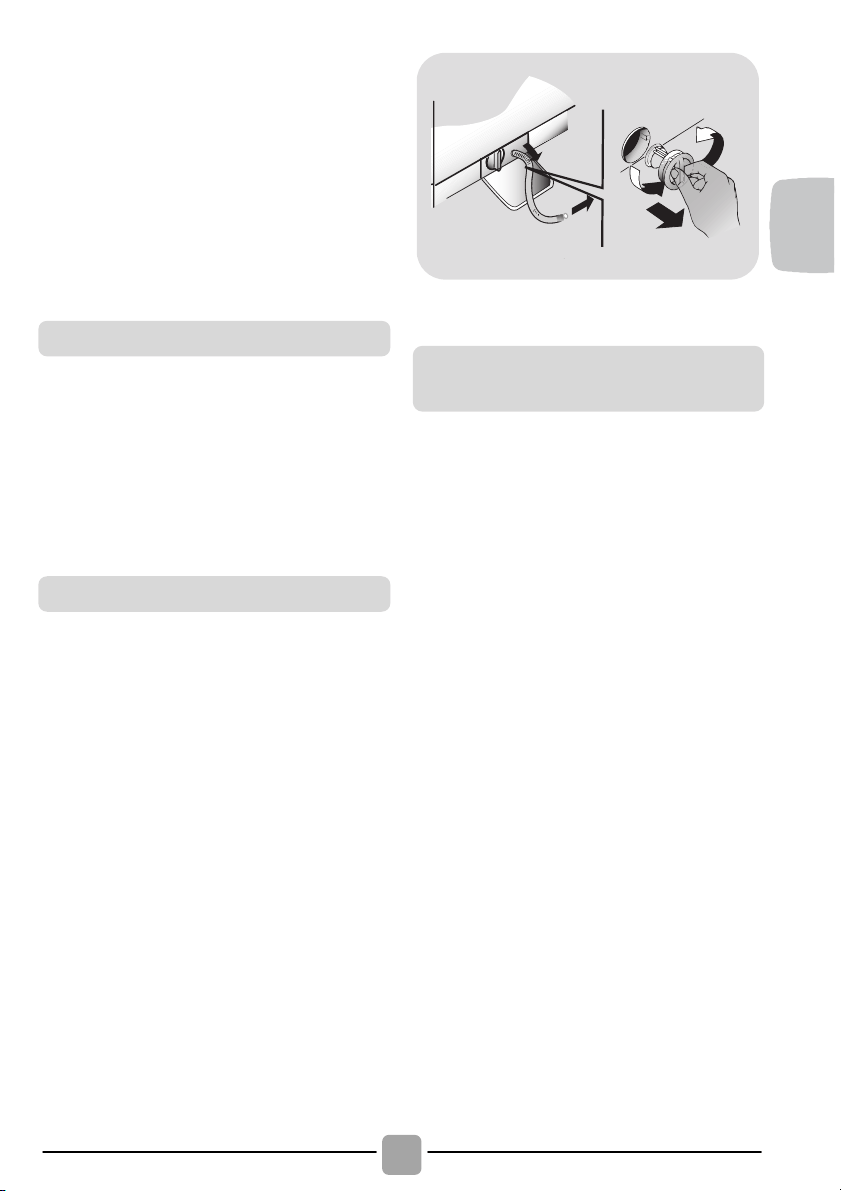
one-way lock device "B".
! AQUAPROTECT – SUPPLY TUBE WITH
GUARD (fig. 6):
Should water leak from the primary
internal tube "A", the transparent
containment sheath "B" will contain water
to permit the washing cycle to complete.
At the end of the cycle, contact the
Customer Service Centre to replace the
supply tube.
! Near the washing machine to the wall,
being careful that the tube is not bent or
crushed, and place the drain tube in the
tub or, preferably, connect it to a wall
drain at least 50 cm high with diameter
greater than the washing machine tube
(fig. 7).
3
1
4
B
A
5
B
A
6
min 50 cm
max 85 cm
+2,6 mt
max
max 100 cm
min 4 cm
7
Hydraulic connections
Setting
!
EN
27
! Level the appliance using the feet as
illustrated in figure 8:
a. turn the nut clockwise to release the
screw;
b. rotate the foot to raise or lower it until it
adheres to the floor;
c. lock the foot, screwing in the nut, until it
adheres to the bottom of the washing
machine.
! Plug in the appliance.
A
B
C
8
The detergent draw is split into 3
compartments as illustrated in figure 9:
! compartment "1": for prewash detergent;
! compartment “ ”: for special additives,
softeners, starch fragrances, etc.;
! compartment "2": for washing detergent.
A liquid detergent cup is also included in
some models (fig. 10). To use it, place it in
compartment "2". This way, liquid
detergent will only enter the drum at the
right time. The cup can also be used for
bleach when the “Rinse” program is
selected.
2
1
9
10
11
WARNING:
contact the Customer Service Centre
should the power cord need
replacement.
Detergent drawer
WARNING:
only use liquid products; the washing
machine is set to automatically dose
additives at each cycle during the last
rinse.
WARNING:
some detergents are hard to remove.
In this case we recommend using the
specific container to be placed in the
drum (example in figure 11).
!
28
3. PRACTICAL TIPS
WARNING: when sorting laundry, make
sure:
- have eliminated metallic objects such as
barrettes, pins, coins, from laundry;
- to have buttoned pillow cases, closed
zips, tied loose belts and long robe
ribbons;
- to have removed rollers from curtains;
- to have carefully read clothing washing
labels;
- to have removed any persistent stains
using specific detergents.
! When washing rugs, bedcovers or other
heavy clothing, we recommend you avoid
centrifuging.
! To wash wool, make sure the item can be
machine washed and marked by the
“Pure virgin wool” symbol with the “Does
not mat” or “Machine washable” label.
A guide environmentally friendly and
economic use of your appliance.
Maximise The Load Size
! Achieve the best use of energy, water,
detergent and time by using the
recommended maximum load size.
Save up to 50% energy by washing a full
load instead of 2 half loads.
Do you need to pre-wash?
! For heavily soiled laundry only!
SAVE detergent, time, water and
between 5 to 15% energy consumption
by NOT selecting Prewash for slight to
normally soiled laundry.
Is a hot wash required?
! Pretreat stains with stain remover or soak
dried in stains in water before washing to
reduce the necessity of a hot wash
programme.
Save up to 50% energy by using a 60°C
wash programme.
Following is a quick guide with tips and
recommendations on detergent use at the
various temperatures. In any case, always
read the instructions on the detergent for
correct use and doses.
Load tips
Helpful suggestions for the user
When washing heavily soiled whites,
we recommend using cotton
programs of 60°C or above and a
normal washing powder (heavy duty)
that contains bleaching agents that at
medium/high temperatures provide
excellent results.
For washes between 40°C and 60°C
the type of detergent used needs to be
appropriate for the type of fabric and
level of soiling.
Normal powders are suitable for “white”
or colour fast fabrics with high soiling,
while liquid detergents or “colour
protecting” powders are suitable for
coloured fabrics with light levels of
soiling.
For washing at temperatures below
40°C we recommend the use of liquid
detergents or detergents specifically
labeled as suitable for low temperature
washing.
For washing wool or silk, only use
detergents specifically formulated for
these fabrics.
!
EN
29
4. MAINTENANCE AND
CLEANING
To clean the washing machine exterior, use
a damp cloth, avoiding abrasives, alcohol
and/or solvents. The washing machine does
not require any special care for ordinary
cleaning: clean drawer compartments and
the filter; some tips on how to move the
machine or on long periods of disuse are
provided below.
! We recommend you clean the drawer to
avoid accumulating detergent and
additive residue.
! To do this, extract the drawer using slight
force, clean it with running water and
reinsert it in its housing.
! The washing machine comes with a
special filter able to trap large residue,
such as buttons or coins, which could
clog the drain.
! Only available on certain models: pull out
the corrugated hose, remove the stopper
and drain the water into a container.
! Before unscrewing the filter, we
recommend you place an absorbent cloth
under it to keep the floor dry.
! Turn the filter counter-clockwise to the
limit stop in the vertical position.
! Remove and clean the filter; when
finished, replace it turning it clockwise.
! Repeat the previous steps in reverse
order to reassemble all parts.
! Should the washing machine be stored in
an unheated room for a long period of
time, drain all water from tubes.
! Unplug the washing machine.
! Detach the tube from the strap and lower
it, fully draining water into a bowl.
! Secure the drain tube with the strap when
finished.
Drawer cleaning
Filter cleaning
Suggestions for moves or
prolonged disuse

!
30
5. QUICK USER GUIDE
This washing machine automatically adapts
the level of the water to the type and
quantity of washing. This system gives a
decrease in energy consumption and a
sensible reduction in washing times.
! Turn on the washing machine and select
the required program.
! Adjust the washing temperature if
necessary and press the required "option"
buttons.
! Press the START/PAUSE button to start
washing.
Should power go out when the washing
machine is running, a special memory
saves the settings and, when power
returns, the machine resumes the cycle
from where it left off.
! The message "end" will appear on the
display or the corresponding led will turn
on at the end of the program.
! Turn off the washing machine.
For any type of wash, see the program
table and follow the operating sequence
as indicated.
Water pressure:
min 0,05 Mpa
max 0,8 Mpa
Spin r.p.m.:
See rating plate.
Power input / Power current fuse amp /
Supply voltage:
See rating plate.
6. CONTROLS AND
PROGRAMS
A
B
DCEFGHI
M
L
A
Programme selector with OFF
position
B
START/PAUSE button
C
SPIN SELECTION button
D
TEMPERATURE SELECTION
button
E
DELAY START button
F
STAIN LEVEL button
G
EXTRA RINSE button
H
OPTIONS button
I
EASY IRON button
L
Digital display
M
DOOR LOCKED indicator light
Program selection
Wait until the porthole locked light
turns off: about 2 minutes after the
program ends.
Technical data
!
EN
31
! Press the START/PAUSE button to start
the selected cycle.
! Once a programme is selected the
programme selector remains stationary on
the selected programme till cycle ends.
! Switch off the washing machine by
turning the selector to OFF.
! Press to start the selected cycle.
ADD OR REMOVE ITEMS AFTER THE
PROGRAMMES HAS STARTED (PAUSE)
! Press and hold the START/PAUSE
button for about 2 seconds (some
indicator light and the time remaining
indicator will flash, showing that the
machine has been paused).
! Wait 2 minutes until the safety device
unlocks the door.
! After you have added or removed items,
close the door and press the
START/PAUSE button (the programme
will start from where it left off).
CANCELLING THE PROGRAMME
! To cancel the programme, set the
selector to the OFF position.
! Select a different programme.
WARNING:
Don’t touch the display while inserting
the plug because the machines
calibrates the systems during the first
seconds: touching the display, the
machine couldn’t work property. In
this case, remove the plug and repeat
the operation.
Opening the door
A special safety device prevents the
door from being opened immediately
after the end of the cycle.
Wait for 2 minutes after the wash
cycle has finished and the "Door
Security" light has gone out before
opening the door.
PROGRAMME selector with OFF
position
When the programme selector is turned
the display lights up to show the settings
for the programme selected.
For energy saving, at the end of the
cycle or with an inactivity period, the
display level contrast will decrease.
N.B.: To switch the machine off, turn the
programme selector to the OFF
position.
The programme selector must be
returned to the OFF position at the end
of each cycle or when starting a
subsequent wash cycle prior to the next
programme being selected and started.
START/PAUSE button
Close the door BEFORE selecting the
button START/PAUSE.
When the START/PAUSE button has
been pressed, the appliance can take
few seconds before it starts working.

!
32
! Re-set the programme selector to the
OFF position.
! By pressing this button, it is possible to
reduce the maximum speed, and if you
wish, the spin cycle can be cancelled.
! To reactivate the spin cycle press the button
until you reach the spin speed you would
like to set.
! It is possible to modify the spin speed
without pausing the machine.
! This button allows you to change the
temperature of the wash cycles.
! It is not possible to raise the temperature
over the maximum allowed for every
programme, in order to save the fabrics.
! This button allows you to pre-programme
the wash cycle to delay the start of the
cycle for up to 24 hours.
! To delay the start use the following
procedure:
- Set the required programme.
- Press the button once to activate it (h00
appears on the display) and then press
it again to set a 1 hour delay (h01
appears on the display). The pre-set
delay increases by 1 hour each time the
button is pressed, until h24 appears on
the display, at which point pressing the
button again will reset the delay start to
zero.
- Confirm by pressing the START/PAUSE
button (the light on the display starts to
flash). The countdown will begin and
when it has finished the programme will
start automatically.
! It is possible to cancel the delay start by
turning the programme selector to OFF.
If there is any break in the power supply
while the machine is operating, a special
memory stores the selected programme
and, when the power is restored, it
continues where it left OFF
! By selecting this button there is a choice
of 3 levels of wash intensity, depending
on how much the fabrics are soiled (can
be used only on some programmes as
shown in the table of programmes).
The option buttons should be selected
before pressing the START/PAUSE
button.
If an option is selected that is
not compatible with the selected
programme then the option indicator
first flashes and then goes off.
SPIN SELECTION button
To prevent damage to the fabrics, it is
not possible to increase the speed
over that which is automatically
suitable during the selection of the
program.
The machine is fitted with a special
electronic device, which prevents the
spin cycle should the load be
unbalanced.
This reduces the noise and vibration in
the machine and so prolongs the life of
your machine.
TEMPERATURE SELECTION button
DELAY START button
STAIN LEVEL button

!
EN
33
! Once the programme has been selected
the indicator light will automatically show
the stain level set for that programme.
! Selecting a different stain level the
relevant indicator will light up.
! This button allows you to add rinses at
the end of the washing cycle. The
maximum number of extra rinses is
related to the programme selected.
! This function has been studied for the
people with delicate and sensitive skin,
for which also a least residue of detergent
can cause irritations or allergies.
! It advises to also use this function for the
children items and in case of washings of
very dirty items, for which it is due to use
a lot of detergent, or in the washing of
toweling items whose fibres mostly have
the tendency to hold the detergent.
You can choose between three different
options:
- PREWASHING
! This option allows you to make a prewash
and it is particularly useful for heavily
soiled loads (can be used only on some
programmes as shown in the table of
programmes).
! We recommend you use only 20% of the
recommended quantities shown on the
detergent pack.
- HYGIENE
! With this option it is possible to hygienize
the clothes, the washing programme
reach a temperature of 60°C.
- NIGHT CYCLE
! This option reduces the intermediate spin
speed to 400 rpm, where applicable,
increase the water level during rinsing and
keep the laundry immersed in water after the
final rinse, in order to spread the fibre
sevenly.
! During the phase in which the water is
held in the tub, the relevant indicator light
blink to show that the machine is at a
standstill.
! Deselect the option to end the cycle with a
spin dry (which may be reduced or cancelled
using the appropriate button) and emptying
phase.
! Thanks to electronic control, the water
in the intermediate phases is emptied
silently, making this option very useful for
washing at night.
This function allows you to minimizes
creases as much as possible, eliminating
the intermediate spins or reducing the
intensity of the last one.
EXTRA RINSE button
OPTIONS button
EASY IRON button
!
34
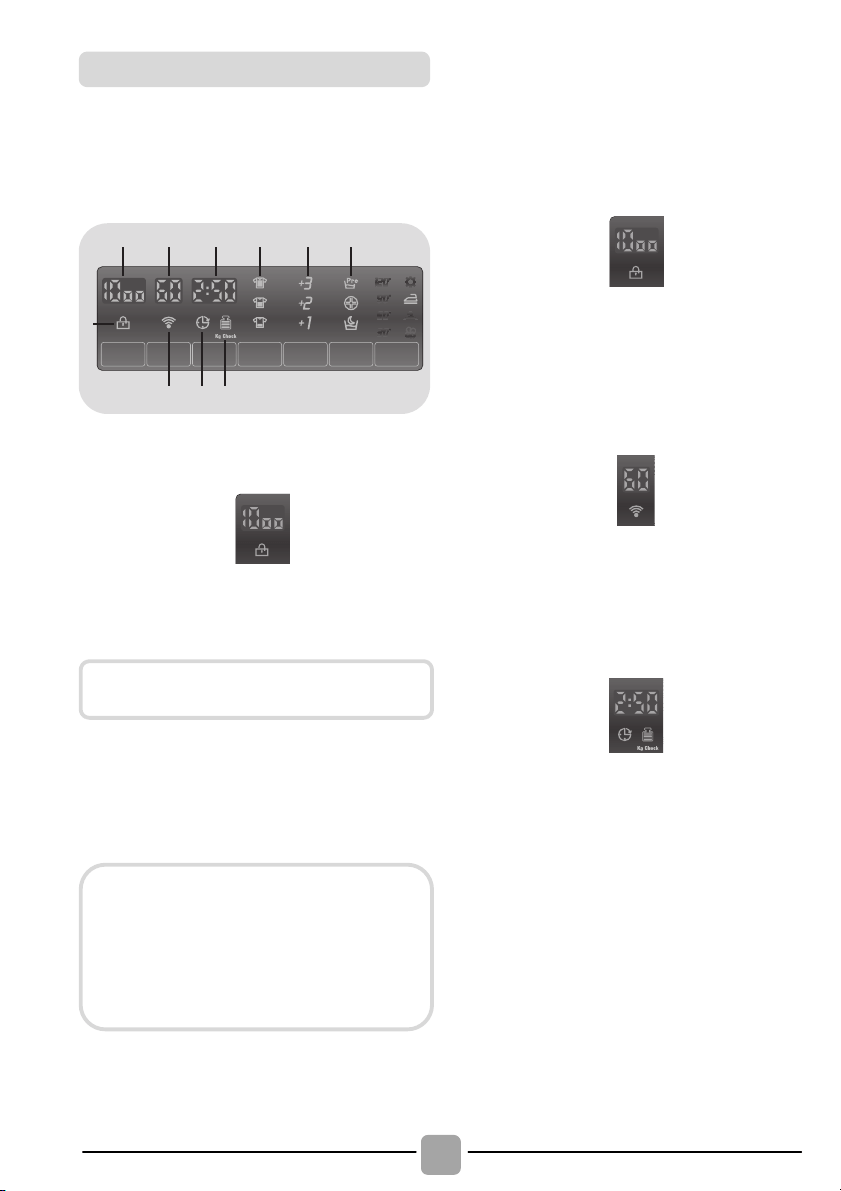
The display’s indicator system allows you to
be constantly informed about the status of
the machine.
2
1
8109
3 4 5 6 7
1) DOOR LOCKED INDICATOR LIGHT
1
! The indicator light is illuminated when the
door is fully closed.
! When START/PAUSE is pressed on
the machine with the door closed, the
indicator will flash momentarily and then
illuminate.
! A special safety device prevents the door
from being opened immediately after the
end of the cycle. Wait for 2 minutes after
the wash cycle has finished and the
DOOR LOCKED light has gone out before
opening the door. At the end of the cycle
turn the programme selector to OFF.
2) SPIN SPEED
2
This show the spin speed of the selected
programme that can be changed or omitted
by the relevant button.
3) WASH TEMPERATURE
3
This show the washing temperature of the
selected programme that can be changed
(where allowed) by the relevant button.
4) CYCLE DURATION
4
! When a programme is selected the
display automatically shows the cycle
duration, which can vary, depending on
the options selected.
! Once the programme has started you will
be kept informed constantly of the time
remaining to the end of the wash.
! The appliance calculates the time to the
end of the selected programme based
upon a standard loading, during the cycle,
the appliance corrects the time to that
applicable to the size and composition of
the load.
Digital Display
Close the door BEFORE selecting the
START/PAUSE button.
If the door is not properly closed,
the light will continue to flash for
about 7 seconds, after which the
start command will be automatically
delete. In this case, close the door
in the proper way and press the
START/PAUSE button.
!
EN
35
5) STAIN LEVEL
{
5
! Once the programme has been selected,
the indicator light will automatically show
the stain level set for that programme.
! Selecting a different stain level the
relevant indicator will light up.
6) EXTRA RINSES
{
6
The indicator lights show the extra rinses
selected by the relevant button.
7) OPTIONS
}
7
The indicator lights show the option that
can be selected by the relevant button
(PREWASH, HYGIENE and NIGHT CYCLE).
8) WI-FI (some models only)
8
! In the models with the Wi-Fi option, the
icon indicates that the Wi-Fi system is
working.
! For all other information in the Wi-Fi
system, there is a specific manual inside
the machine.
9) DELAY START
9
This flashes when delay start has been set.
10) Kg Check (function active only on
Cotton and Synthetics programmes)
10
! During the first minutes of the cycle, the
"Kg Check" indicator remain on while the
intelligent sensor will weigh the laundry
and adjust the cycle time, water and
electricity consumption accordingly.
! Through every wash phase "Kg Check"
allows to monitor information on the wash
load in the drum and in the first minutes
of the wash it:
- adjusts the amount of water required;
- determines the length of the wash cycle;
- controls rinsing according to the type of
fabric selected to be washed it;
- adjusts the rhythm of drum rotation for
the type of fabric being washed;
- recognizes the presence of lather,
increasing, if necessary, the amount of
water during rinsing;
- adjusts the spin speed according to the
load, thus avoiding any imbalance.
!
36
2
1
PROGRAM
kg *
(MAX.)
TEMP.°C
DETERGENT
Recommended
Max.
2
1
Rapid 14 Min
1
1
1
1,5
30°
30°
Rapid 30 Min
1,5
2
2,5
2,5
30°
30°
Rapid 44 Min
3
3
3,5
3,5
30°
40°
Whites
1)
5
6
7
8
60°
90°
( )
Mixed
1)
2,5
3
3,5
4
40°
60°
( )
Baby
1)
3,5
4
4,5
5,5
60°
60°
Mix & Wash
5
6
7
8
40°
40°
Rinse
-
-
-
-
-
-
Drain + Spin
-
-
-
-
-
-
Silk
1
2
2
2
30°
30°
Hand
1
2
2
2
30°
30°
Wool
1
2
2
2
40°
40°
Delicates
2
2
2,5
2,5
40°
40°
EcoMix 20°
5
6
7
8
20°
20°
Cottons
**
1)
5
6
7
8
40°
60°
( )
Table of programmes
!
EN
37
Please read these notes:
* Maximum load capacity of dry clothes,
according to the model used (see control
panel).
The spin speed may also be reduced, to
match any guidelines suggested on the
fabric label, or for very delicate fabrics
cancel the spin completely this option is
available with a spin speed button. This
function can be activated with the button
SPIN SELECTION.
If the label does not indicate specific
information, it is possible to use the
maximum spin expected in the program.
An over dosing of detergent can cause
excessive foaming.
If the appliance detects the presence of
excessive foam, it may exclude the spinning
phase or extend the duration of the program
and increase water consumption.
( )
Only with PREWASH option
selected (programmes with
PREWASH option available).
(Only for models with liquid
detergent compartment)
When only a limited number of
articles have stains which require
treatment with liquid bleaching
agents, preliminary removal of
stain can be carried out in the
washing machine.
Pour the bleach into the liquid
bleach container, inserted into the
compartment marked "2" in the
detergent drawer, and set the
special programme RINSE.
When this phase has terminated,
turn the programme selector on
the OFF position, add the rest of
the fabrics and proceed with a
normal wash on the most suitable
programme.
1)
For the programmes shown you
can adjust the duration and
intensity of the wash using the
STAIN LEVEL button.
** STANDARD COTTON PROGRAMMES
ACCORDING TO (EU) No 1015/2010 and
No 1061/2010.
COTTON PROGRAMME WITH A
TEMPERATURE OF 60°C.
COTTON PROGRAMME WITH A
TEMPERATURE OF 40°C.
These programmes are suitable to
clean normally soiled cotton laundry and
they are the most efficient programmes
in terms of combined energy and water
consumptions for washing cotton
laundry.
These programmes have been
developed to be compliant with the
temperature on the wash label on the
garments and the actual water
temperature may slightly differ from the
declared temperature of the cycle.

!
38
To clean different types of fabrics and
various levels of dirt, the washing machine
has specific programs to meet every need
of washing (see table of programmes).
Rapid 14 Min / 30 Min / 44 Min
A complete washing cycle (wash, rinse and
spin). This programme is particularly suited
to slightly dirty cottons and mixed fabrics.
With this programme it is recommended to
use only 20% of the detergent normally
used to avoid waste.
Whites
Made to have a perfect washing. The final
spin at maximum speed gives more efficient
removal.
Mixed
The washing and rinsing are optimized in the
rhythms of rotation of the drum and to the
water levels. The gentle spin, ensures a
reduced formation of creases in the fabric.
Baby
This program allows you to wash all baby
clothes getting a perfect clean and
sanitizing effect, setting the temperature at
60°C minimum.
To optimize the result of the sanitizing effect
we recommend the use of powder detergent.
Mix & Wash
The program allow you to mix different fabrics
(ex: cotton + synthetic, etc. ..) and wash them
with low energy consumption, because the
temperature in the wash step does not
exceed 40°C.
Rinse
This program performs 3 rinses with an
intermediate spin (which can be reduced or
excluded by using the appropriate button). It is
used for rinsing any type of fabric, for example
after a wash carried out by hand.
Drain + Spin
The program completes the drain and a
maximum spin. It is possible to delete or
reduce the spin with the SPIN SELECTION
button.
Silk
Dedicated program for silk fabrics that can be
wash with a washing machine washable. The
rotations of the drum are delicate, the
temperature does not exceed 30°C and the
program ends with a gentle spin.
Hand
Program for hand wash only clothes, the
program ends with 3 rinses and a slow spin.
Wool
This program performs a wash cycle
dedicated to the wool fabrics that can be
washed in a washing machine, or the
articles to be washed by hand.
Delicates
This program alternates among moments of
work during breaks and is particularly suitable
for washing delicate fabrics . The wash cycle
and rinses are carried out with a high level of
water to ensure the best performance.
EcoMix 20°
This innovative programme, allows you to wash
different fabrics and colours together, such as
cottons, synthetics and mixed fabrics at only
20°C and provides an excellent cleaning
performance. Consumption on this program is
about 40% of a conventional 40°C. cottons
wash.
Cottons 40°C - 60°C
This program is suitable to clean normally soiled
cotton laundry and it is the most efficient program
in terms of combined energy and water
consumptions for washing cotton laundry.
Programmes selection

!
EN
39
7. CUSTOMER SERVICE CENTRE AND WARRANTY
If you believe the washing machine is not working correctly, consult the quick guide
provided below with some practical tips on how to fix the most common problems.
Problem
Possible causes and practical solutions
The washing machine
does not work/start
Make sure it is correctly plugged in.
Make sure power is on.
Check whether the required program was correctly selected and to
have correctly started the machine.
Make sure the fuse has not blown and that the wall socket is working,
testing it with another appliance such as a lamp.
The porthole may not be correctly closed: open and close it again.
The washing machine
does not fill with
water
Make sure the water faucet is open.
Make sure the timer is correct set.
The washing machine
does not drain water
Make sure the filter is not clogged.
Make sure the drain hose is not bent.
Make sure there are no foreign objects in the filter.
Water leaked on the
floor near the washing
machine
This may be due to a leak in the gasket between the faucet and supply
tube; in this case, replace it and tighten the tube and faucet.
The washing machine
does not centrifuge
This could be due to the fact that water has not been completely
drained: wait a few minutes.
Some models include a "no centrifuge" function: make sure it is not on.
An excessive amount of detergent could prevent centrifuge: reduce the
amount at the next wash.
Strong vibrations are
heard during centrifuge
The washing machine may not be fully levelled: if necessary, adjust
the feet as indicated in the specific section.
Make sure transport brackets were removed.
Make sure the load is evenly distributed.
If a specific ERROR
appears of blinks
If error no. 0, 1, 5, 7 or 8 appears or blinks, contact the Customer
Service Centre directly.
If error no. 2 appears or blinks, the machine does not load water.
Make sure the water faucet is open.
If error no. 3 appears or blinks, the machine does not correctly drain.
Make sure the drain is free and that the drain hose is not bent.
If error no. 4 appears or blinks, the machine is too full. Close the
water faucet and contact the Customer Service Centre.
If error no. 9 appears or blinks, turn off the washing machine, wait 10
– 15 seconds and restart the program.
!
40
The use of ecological detergents without
phosphates may cause the following effects:
- cloudier rinse drain water: This effect is
tied to the suspended zeolites which do
not have negative effects on rinse
efficiency.
- white powder (zeolites) on laundry at
the end of the wash: this is normal, the
powder is not absorbed by fabric and
does not change its colour.
- foam in the water at last rinse: this
does not necessary indicate poor rinsing.
- abundant foam: This is often due to the
anionic surfactants found in the
detergents which are hard to eliminate
from laundry.
In this case, do not re-rinse to eliminate
these effects: it will not help at all.
If the problem persists or if you suspect a
malfunction, immediately contact the
Candy Customer Service Centre.
You can also register for the Candy
service plan to receive free home service
after the warranty expires.
Attention: the call is not toll-free. The cost
will be communicated in a voice message
by your telephone operator's customer
service.
Candy recommends you always use
original spare parts available at our
Customer Service Centre.
The manufacturer declines all
responsibility for any printing errors in
the booklet included with this product.
Moreover, it also reserves the right to
make any changes deemed useful to its
products without changing their essential
characteristics.
Warranty
The product is guaranteed under the
terms and conditions stated on the
certificate included with the product. The
warranty certificate must be duly filled in
and stored, so as to be shown to the
Authorised Candy Service Centre in
case of need.
Register your product!
Don’t waste time. Register your washing
machine at once, and discover the
benefits to which you are entitled.
Discover how at www.registercandy.com
or by calling the number stated on the
related material.

!
EN
41
!
42
Wir freuen uns, dass Sie sich für ein Gerät
aus unserem Hause entschieden haben –
es soll die tägliche Arbeit im Haushalt und
damit Ihren Alltag erleichtern. Wir
wünschen Ihnen allzeit viel Freude mit Ihrer
Candy Waschmaschine.
Sie können Ihr Gerät unter
www.registercandy.com kostenpflichtig
registrieren, um auch nach Ablauf der
Garantie einen erweiterten Schutz sowie
umfangreichen und schnellen Service zu
genießen.
Bitte nehmen Sie sich vor der
Installation und vor dem ersten Gebrauch
unbedingt ausreichend Zeit, um die vorliegende
Gebrauchsanleitung aufmerksam zu lesen und
sich in Ruhe mit der Bedienung des Gerätes
vertraut zu machen. Dadurch schützen Sie
sich und verhindern Schäden an der
Waschmaschine. Die Anleitung enthält wichtige
Hinweise - bitte daher für evtl. Rückfragen
unbedingt aufbewahren bzw. bei der
Weitergabe des Gerätes an Nachbesitzer
mitgeben.
Bitte überprüfen Sie weiterhin nach dem
Auspacken des Gerätes, ob das komplette
Zubehör wie z.B. die passende
Gebrauchsanleitung, die Garantiebescheinigung,
das Energielabel, der Einsatz für
Flüssigwaschmittel (nur einige Modelle) und der
Bogen für die ordnungsgemäße Anbringung des
Ablaufschlauchs mitgeliefert wurden.
Jedes unserer Geräte verfügt über eine 16-
stellige Matrikelnummer, die sich auf dem
Typenschild im Innenbereich des Bullauges
befindet. Bitte notieren Sie sich diese
unbedingt, damit Ihnen der Candy
Kundendienst bei Fragen oder im Servicefall
schneller und gezielter helfen kann.
Dieses Gerät ist entsprechend der
europäischen Richtlinie 2012/19/EU
als elektrisches / elektronisches
Altgerät (WEEE) gekennzeichnet.
Elektrische und elektronische Altgeräte enthalten
vielfach noch wertvolle Materialien. Sie enthalten aber
auch schädliche Stoffe, die für ihre Funktion und
Sicherheit notwendig waren. Im Restmüll oder bei
falscher Behandlung können diese der menschlichen
Gesundheit und der Umwelt schaden. Es ist daher sehr
wichtig, dass elektrische und elektronische Altgeräte
(WEEE) einer speziellen Verwertung zugeführt werden,
damit die schädlichen Stoffe ordnungsgemäß entfernt
und entsorgt werden bzw. wertvolle Rohstoffe der
Wiederverwertung zugeführt werden können.
Sie können mit der Beachtung der folgenden simplen
Hinweise einen wichtigen Beitrag dazu leisten, dass
elektrische und elektronische Altgeräte (WEEE) der
menschlichen Gesundheit und der Umwelt nicht schaden:
! Elektrische- und elektronische Altgeräte
(WEEE) sollten keinesfalls wie Rest- oder
Haushaltsmüll behandelt werden.
! Nutzen Sie stattdessen die an Ihrem Wohnort
eingerichteten kommunalen oder gewerblichen
Sammelstellen zur Rückgabe und Verwertung
elektrischer und elektronischer Altgeräte
(WEEE). Informieren Sie sich, ob ggf. in Ihrem
Land bzw. Ihrer Region für große/sperrige
elektrische und elektronische Altgeräte (WEEE)
eine Abholung angeboten wird. Sorgen Sie in
jedem Falle dafür, dass Ihr Altgerät bis zum
Abtransport kindersicher aufbewahrt wird.
In einigen Ländern sind Händler unterbestimmten
Voraussetzungen beim Geräteneukauf auch zur
Rücknahme des Altgerätes verpflichtet, wenn das
Altgerät dem neuen Fabrikat in der Funktion entspricht.
1. GENERELLE SICHERHEITSHINWEISE
2. INSTALLATION
3. PRAKTISCHE TIPPS
4. WARTUNG UND REINIGUNG
5. KURZANLEITUNG
6. STEUERUNG UND PROGRAMME
7. HINWEISE ZUM KUNDENDIENST UND
ZUR GARANTIE
Umweltbedingungen
Inhalt

!
DE
43
1. GENERELLE
SICHERHEITSHINWEISE
! Dieses Gerät ist ausschließlich
für den Haushaltsgebrauch konzipiert
bzw. für den haushaltsnahen
Gebrauch, wie z.B:
- Teeküchen für das Personal von
Büros, Geschäften oder ähnlichen
Arbeitsbereichen;
- Ferienhäuser;
- Gäste von Hotels, Motels und
anderen Wohneinrichtungen;
- Gäste von Apartments/
Ferienwohnungen, Bed and
Breakfast Einrichtungen
Eine andere Nutzung als die
normale Haushaltsnutzung, wie z.B.
gewerbliche oder professionelle
Nutzung durch Fachpersonal, ist
auch im Falle der oben erwähnten
Einrichtungen ausgeschlossen.
Sollte das Gerät entgegen diesen
Vorschriften betrieben werden,
kann dies die Lebensdauer des
Gerätes beeinträchtigen und den
Garantieanspruch gegenüber dem
Hersteller verwirken.
Eventuelle Schäden am Gerät oder
andere Schäden oder Verluste, die
durch eine nicht haushaltsnahe
Nutzung hervorgerufen werden
sollten (selbst wenn sie in einem
Haushalt erfolgen), werden, so weit
vom Gesetz ermöglicht, vom
Hersteller nicht anerkannt.
!
Kinder unter 8 Jahren sowie
Personen, die aufgrund ihrer
physischen, sensorischen oder
geistigen Fähigkeiten oder ihrer
Unerfahrenheit oder Unkenntnis
nicht in der Lage sind, die
Waschmaschine sicher zu bedienen,
dürfen die Waschmaschine nicht
ohne Aufsicht oder Anweisung durch
eine verantwortliche Person benutzen,
sich in der Nähe aufhalten oder das
Gerät saubermachen. Kinder sollten
nicht mit dem Gerät
spielen. Reinigung
und Benutzerwartung
sollten nicht
von Kindern ohne Einführung,
ausgeführt werden.
! Kinder sollten über das Gerät
aufgeklärt werden, damit Sie
nicht mit dem gerät spielen.
! Kinder unter 3 Jahren dürfen
sich nicht unbeaufsichtigt in der
Nähe des Gerätes aufhalten
oder spielen.
! Wenn das Netzkabel beschädigt
ist, muss das Gerät zum Hersteller
gebracht werden und von
zuständigen Personen repariert
werden, um eventuelle Gefahren
zu vermeiden.
! Verwenden Sie nur die mit dem
Gerät zusammen gelieferten
Schläuche.
!
Für einen ordnungsgemäßen Betrieb
muss der Wasserleitungsdruck
konstant zwischen min. 0,05 MPa
und max. 0,8 MPa liegen.
!
Vergewissern Sie sich, dass
ein Teppich nicht die Maschine

!
44
und Ventilatorenöffnungen,
behindert.
! Das Gerät ist abgeschaltet, wenn
sich der Referenzpunkt auf
dem Bedienknauf in der Position
AUS/OFF befindet. In jeder
anderen Stellung ist das Gerät
eingeschaltet und betriebsbereit
(nur für Modelle mit Bedienknebel).
! Nach der Installation, sollte das
Gerät so positioniert sein, dass
der Stecker frei zugänglich ist.
! Die maximale Beladungskapazität
(trockene Kleidung lt. Normtest)
hängt von dem jeweiligen
Gerätemodell ab (s. Bedienblende).
!
Für die technischen Daten des
Produktes schauen Sie bitte
auf der Internetseite des
Herstellers nach.
!
Bevor Sie die Waschmaschine
reinigen, ziehen Sie das Gerät vor
und drehen Sie die Wasserzufuhr ab.
! Überprüfen Sie, ob der Strom
abgeschaltet ist oder holen Sie
sich professionelle Hilfe dazu.
! Gebrauchen Sie keine Wandler,
Mehrfachsteckdosen oder erweiterte
Kabel.
! Stellen Sie sicher, dass sich
kein Wasser mehr in der
Trommel befindet, wenn Sie
das Bullauge öffnen.
! Bringen Sie keine Schnur an,
um die Maschine vorzuziehen.
! Setzen Sie das Gerät keinem
Regen, direktem Sonnenlicht oder
anderen Wetterelementen aus.
! Heben Sie die Maschine nicht
an den Drehknöpfen oder dem
Bullauge an; lassen Sie das
Bullauge nicht im Wagen. Wir
empfehlen, die Maschine, immer
zu zweit anzuheben.
! Im Falle einer Störung schalten
Sie die Maschine aus, schließen
Sie die Wasserzufuhr und ändern
Sie nichts mehr an dem Gerät.
Kontaktieren Sie umgehend den
Kundendienst und verwenden Sie
nur Originale als Ersatzteile.
Geräte erfüllen die
europäischen Richtlinien
:
! 2006/95/EC (LVD);
! 2004/108/EC (EMC);
! 2009/125/EC (ErP);
! 2011/65/EU (RoHS);
sowie die folgenden.
Sicherheitsanweisungen
WARNUNG:
Wasser kann eine hohe
Temperatur während des
Waschvorgangs annehmen.
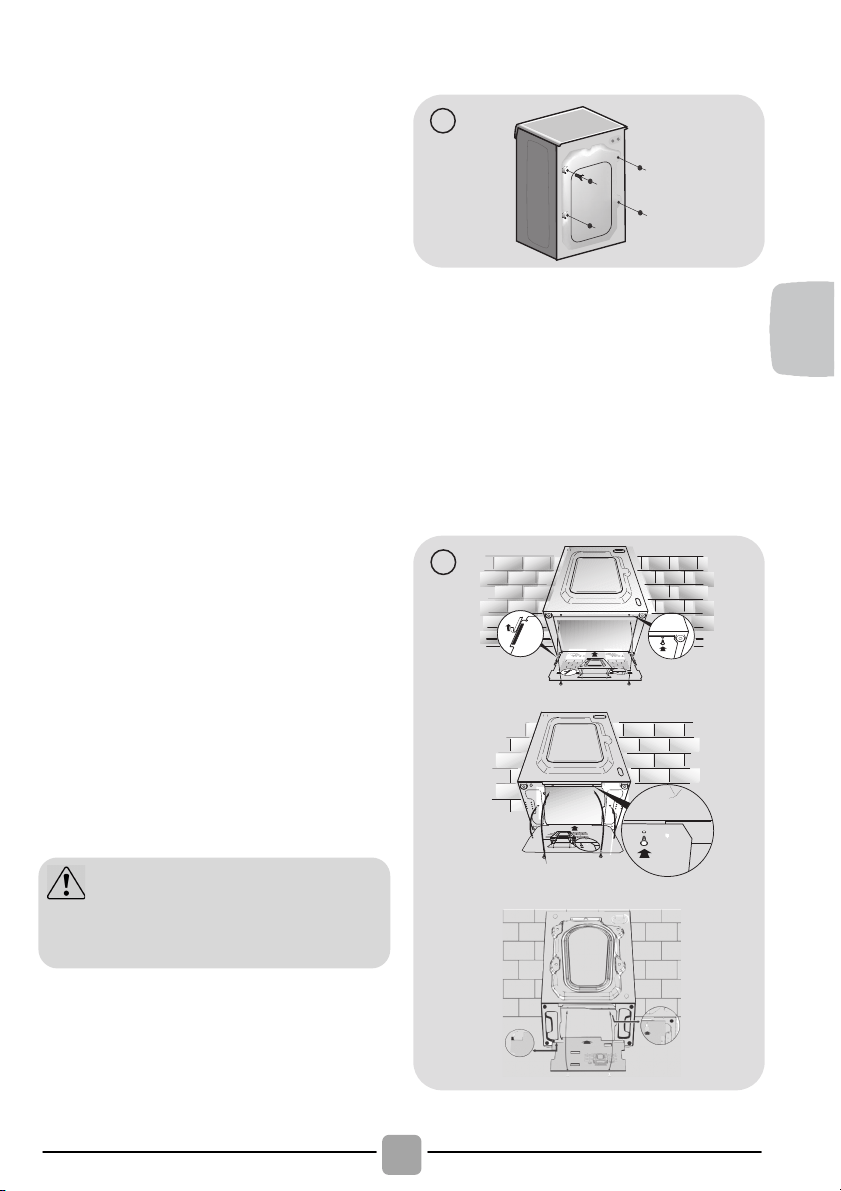
!
DE
45
2. INSTALLATION
! Schneiden Sie die Transportbefestigungen
der beiden Schläuche und des
Netzkabels vorsichtig durch und
achten darauf, dass diese dabei
nicht versehentlich beschädigt werden.
! Lösen Sie die 2 bzw. 4 Schrauben
(A) auf der Geräterückseite und
entfernen die 2 bzw. 4 Distanzstücke
(B) wie in Abbildung 1 gezeigt.
! Schließen Sie 2 bzw. 4 Öffnungen
anschließend mit den beigefügten
Abdeckungen.
! Wenn es sich bei Ihrem Gerät
um ein Einbaumodell handelt,
bitte nach dem Entfernen der
Schlauchtransportbefestigunge
n die 3 bzw. Schrauben (A) lösen
und die 3 bzw. 4 Distanzstücke
(B) entfernen.
! Je nach Modell fallen eine oder
mehrere der Distanzstücke in das
Gerät. Das Gerät dann vorsichtig
nach vorne neigen und die
Distanzstücke entfernen. Die
Öffnungen anschließend mit den
beigefügten Abdeckungen schließen.
! Bringen Sie die Kunststoffabdeckung
wie in Abb. 2 beschrieben unter dem
Gerät an (je nach Modell wählen Sie
die Variante A, B oder C).
A
A
A
A
B
B
B
B
1
3
2
1
3
1
2
A
C
B
2
WARNUNG:
Bewahren Sie die Verpackung
abseits von Kindern auf.
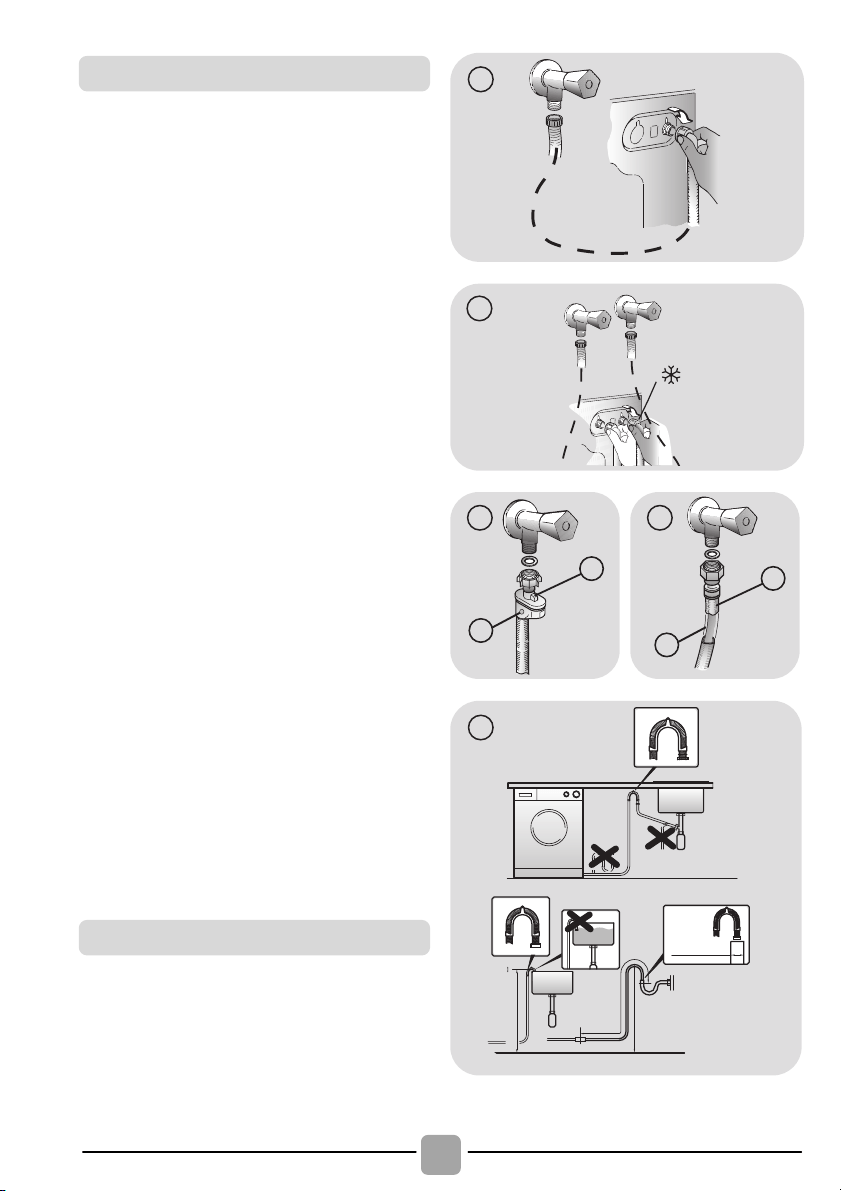
!
46
! Verbinden Sie den Wasserzulaufschlauch
mit dem Wasserhahn (Abbildung 3) und
bringen den Wasserablaufschlauch wie in
Abbildung 7 beschrieben an.
ÖFFNEN SIE KEINESFALLS DEN
WASSERHAHN OHNE DEN SCHLAUCH
ANGEBRACHT ZU HABEN!
! Einige Modelle enthalten ein oder
mehrere der folgenden Eigenschaften:
HEIß&KALT (Abbildung 4):
Wasserverbindungseinstellungen mit heiß
und kalt für höhere Energieeinsparungen.
Verbinden Sie den grauen Schlauch mit
dem Wasserhahn und den roten mit dem
Heißwasserhahn. Die Waschmaschine
kann auch nur mit dem Kaltwasserhahn
verbunden werden: In diesem Fall brauche
einige Programme etwas länger, um zu
starten.
WASSERSTOP (Abbildung 5): Im Falle
eines defekten Schlauches stoppt die
Wasserzufuhr. In diesem Fall erscheint auf
dem Fenster „A“ ein rotes Feld und der
Schlauch muss entfernt werden. Um die
Schraubenmutter zu lösen, drücken Sie den
Entsicherungsknopf „B“.
WASSERSCHUTZ (Abbildung 6): Sollte
Wasser aus dem Hauptschlauch „A“
austreten, schützt die Hülle „B“ vor
kompletten Wasseraustritt.
! Am Ende dieses Vorganges kontaktieren
Sie den Kundenservice, damit der
Schlauch ausgewechselt wird.
! Seien Sie mit dem Abstand zwischen
Waschmaschine und Wand vorsichtig, da
der Schlauch eingequetscht werden
könnte. Es sollte ein Mindestabstand von
50 cm eingehalten werden (Abbildung 7).
3
1
4
B
A
5
B
A
6
min 50 cm
max 85 cm
+2,6 mt
max
max 100 cm
min 4 cm
7
Wasseranschluss
Aufstellung des Gerätes
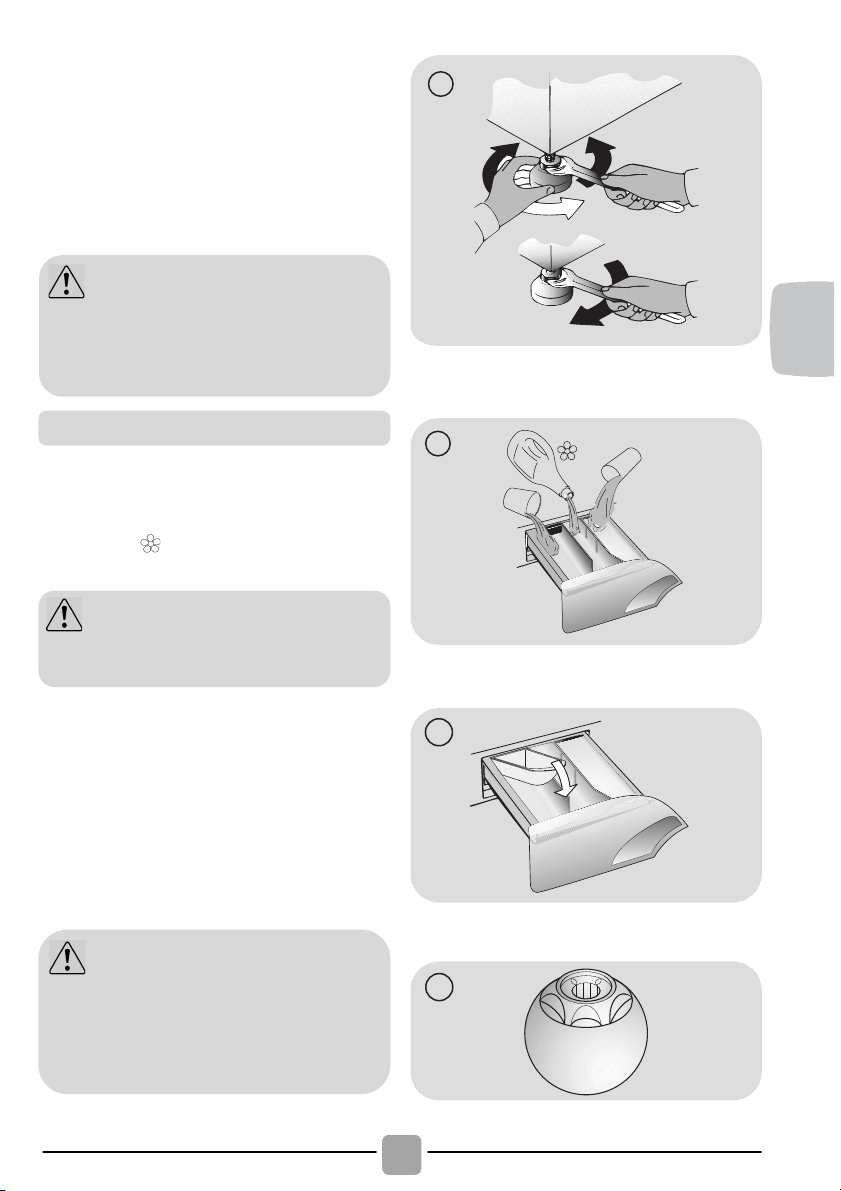
!
DE
47
! Justieren Sie die Höhe der Standfüße wie
in Abbildung 8 beschrieben:
a. Drehen Sie die Schraubenmuttern im
Uhrzeigersinn, um diese zu lösen.
b. Drehen Sie den Standfuß, um die
Höhe einzustellen.
c. Sichern Sie den Standfuß durch
Drehen der Schraubmuttern gegen den
Uhrzeigersinn bis zum festen Sitz.
A
B
C
8
Die Waschmittelschublade ist in drei Fächer
aufgeteilt (Abbildung 9):
! Fach "1": ist für das in der Vorwäsche
benötige Waschmittel vorgesehen;
! Fach " ": ist für spezielle
Wäschezusatzstoffe wie Weichspüler etc.
! Fach "2": ist für das in der Hauptwäsche
benötige Waschmittel vorgesehen.
Je nach Modell ist im Lieferumfang des Gerätes
ein spezieller Einsatz für Flüssigwaschmittel
enthalten (Abbildung 10), der die Einspülung des
Waschmittels in die Trommel richtig reguliert. Bei
Einsatz von flüssigen Waschmitteln den Einsatz in
Fach "2" einlegen. In Kombination mit dem
Programm "Spülen" kann dieser Einsatz auch für
den Bleichvorgang genutzt werden (s. Beschreibung).
2
1
9
10
11
WARNUNG:
Bitte versuchen Sie keinesfalls
den Wasserablaufschlauch selber zu
wechseln, sondern setzen sich hierfür
mit dem Kundendienst in Verbindung.
Waschmittelschublade
WARNUNG:
Benutzen Sie im mittleren Fach
ausschließlich Flüssigprodukte!
WARNUNG:
Einige flüssige Waschmittel verteilen
sich nur schwer oder langsam in der
Waschladung . Bitte nutzen Sie ggf. Die
vom Waschmittelhersteller zur Verfügung
gestellten Dosiervorrichtungen (Abbildung 11).
!
48
3. PRAKTISCHE TIPPS
WARNUNG: Beim Sortieren der Wäsche,
beachten Sie folgende Punkte:
- Wurden metallische Objekte aus der
Wäsche entfernt;
- Reißverschlüsse geschlossen;
- Kissen auf links gezogen;
- Clips von Vorhängen entfernt;
- Waschanweisungen auf Schildchen in der
Kleidung gelesen.
! Wir empfehlen beim Waschen von
Teppichen/Läufern, Oberbetten und
anderen schweren Textilien den
Schleudervorgang gänzlich abzustellen,
um mögliche Schäden am Gerät zu
vermeiden.
! Beim Waschen von Wolle unbedingt vorher
prüfen, ob diese waschmaschinengeeignet
ist (s. Pflegesymbol in der Wäsche).
Einen umweltfreundlichen und ökonomischen
Gebrauch Ihres Gerätes schaffen.
Maximieren Sie die Füllmenge
! Erzielen Sie den besten Energie-, Wasser-
und Waschmittelverbrauch, in dem sie Ihre
Waschmaschine immer voll füllen. Sichern
Sie 50 % Energie beim Waschen einer
vollen Ladung im Gegensatz zu zwei halben
Ladungen.
Wann ist eine Vorwäsche wirklich notwendig?
! In der Regel nur für stark verschmutzte
Wäsche!
Wenn Sie normal oder wenig
verschmutzte Wäsche waschen, sparen
Sie zwischen 5% und 15% Strom, wenn
Sie keine Vorwäsche wählen.
Ist heißes Waschen erforderlich?
! Das Vorbehandeln von Flecken kann ein
heißes Waschen ersetzen und man kann
bis zu 50% Energie bei einem 60 Grad
Waschgang sparen.
Nachfolgend ein kurzer Ratgeber mit
Tipps
und Empfehlungen für den
Waschmittelgebrauch in den verschiedenen
Programmen/Temperatureinstellungen.
Beachten Sie jedoch unbedingt die Angaben des
Waschmittelherstellers zur Dosierung und
korrekten Anwendung.
Beladungstipps
Hilfreiche Empfehlungen für den
Nutzer
Beim Waschen von weißen Sachen,
empfehlen wir das 60 Grad
Baumwollprogramm und ein normales
Waschpulver.
Für Waschvorgänge zwischen 40 und
60 Grad muss ein für die Verschmutzung
der Wäsche passendes Waschmittel
ausgewählt werden. Normale
Waschpulver können für weiße oder
leichte Farben verwendet werden,
während flüssige Waschmittel für
Farbschutz geeignet sind.
Für Waschvorgänge unter 40 Grad
empfehlen wir den Gebrauch von
flüssigen Waschmitteln, die für niedrige
Temperaturen geeignet sind.
Zum Waschen von Wolle oder Seide
empfehlen wir nur den Gebrauch von
Spezial- und Feinwaschmitteln.
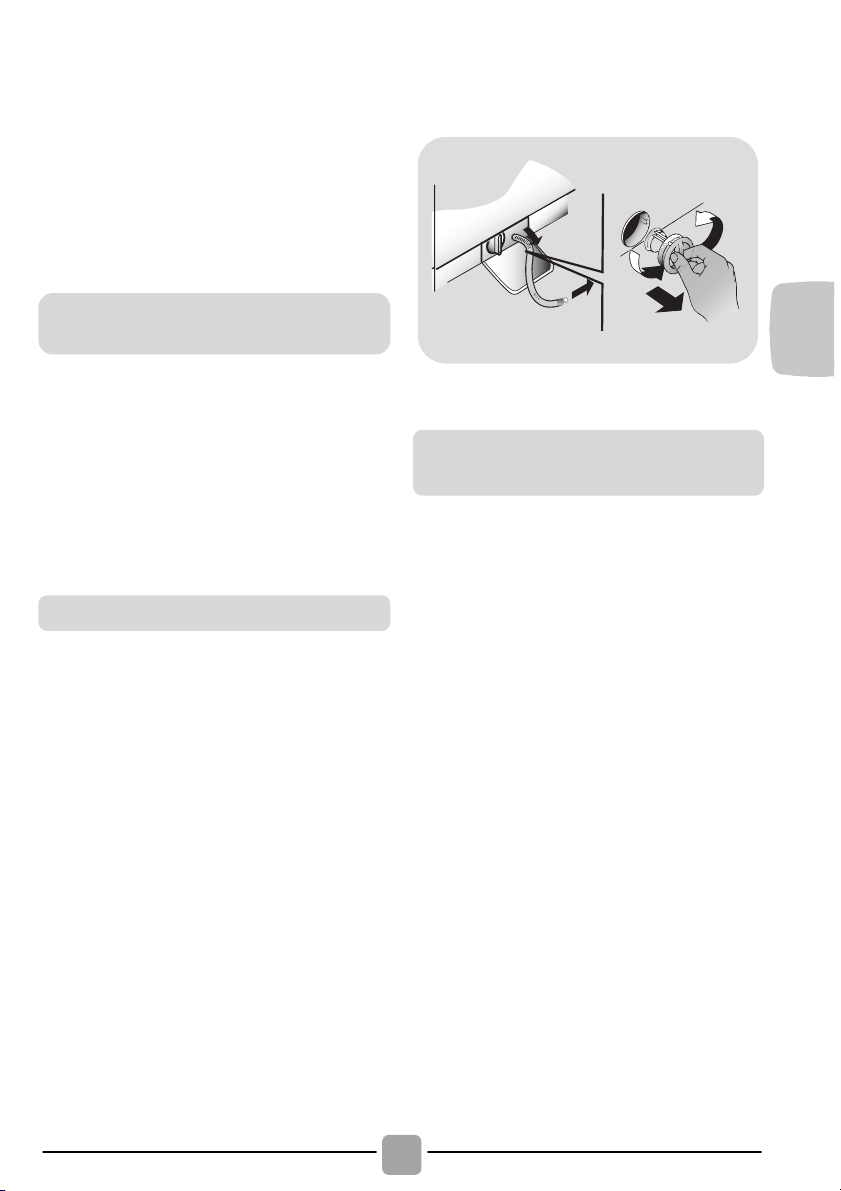
!
DE
49
4. WARTUNG UND
REINIGUNG
Um die Waschmaschine von außen zu
reinigen, nutzen Sie ein feuchtes Tuch mit
leichten Reinigungsmitteln. Das Gerät
erfordert keine besondere Reinigung
von außen: reinigen Sie lediglich die
Schubladen für Waschmittel und den Filter.
! Wir empfehlen die Schubladen zu reinigen,
um Restmengen und Rückstände von
Zusatzstoffen zu vermeiden.
! Der Filter ist dafür ausgelegt, Rückstände
und Ablagerungen von der Wäsche
fernzuhalten. Reinigen Sie diesen wenn
möglich von Hand.
! Die Waschmaschine besitzt eine
spezielle Vorrichtung zum Auffangen
von größeren Gegenständen (z.B.
Knöpfe/Münzen), welche die Pumpe oder
den Ablaufschlauch verstopfen könnten.
! Nur bei einigen Modellen: Schlauch
herausziehen, Stöpsel entfernen und
Restwasser in einem Behälter auffangen.
! Bevor Sie die Klammerfalle öffnen,
empfehlen wir, den Boden mit einer
saugfähigen Unterlage auszulegen.
! Drehen Sie den Verschluss gegen den
Uhrzeigersinn.
! Entnehmen und Reinigen Sie die
Abdeckung mit dem Grobschmutzfilter
und drehen sie anschließend im
Uhrzeigersinn wieder ein.
! Wiederholen Sie die restlichen Schritte in
umgekehrter Reihenfolge, um die Teile
wieder einzubauen.
! Sollte die Maschine in einem überhitzten
Raum gelagert sein, lassen Sie das
gesamte Wasser aus den Schläuchen.
! Ziehen Sie alle Stecker aus der
Maschine.
! Trennen Sie den Schlauch von dem
Riegel und füllen Sie das gesamte
Wasser in eine Schüssel.
! Sichern Sie den Schlauch wieder mit den
Riegeln.
Reinigung der
Waschmittelschublade
Reinigung der Klammerfalle
Vorschläge für anhaltenden
Nichtgebrauch
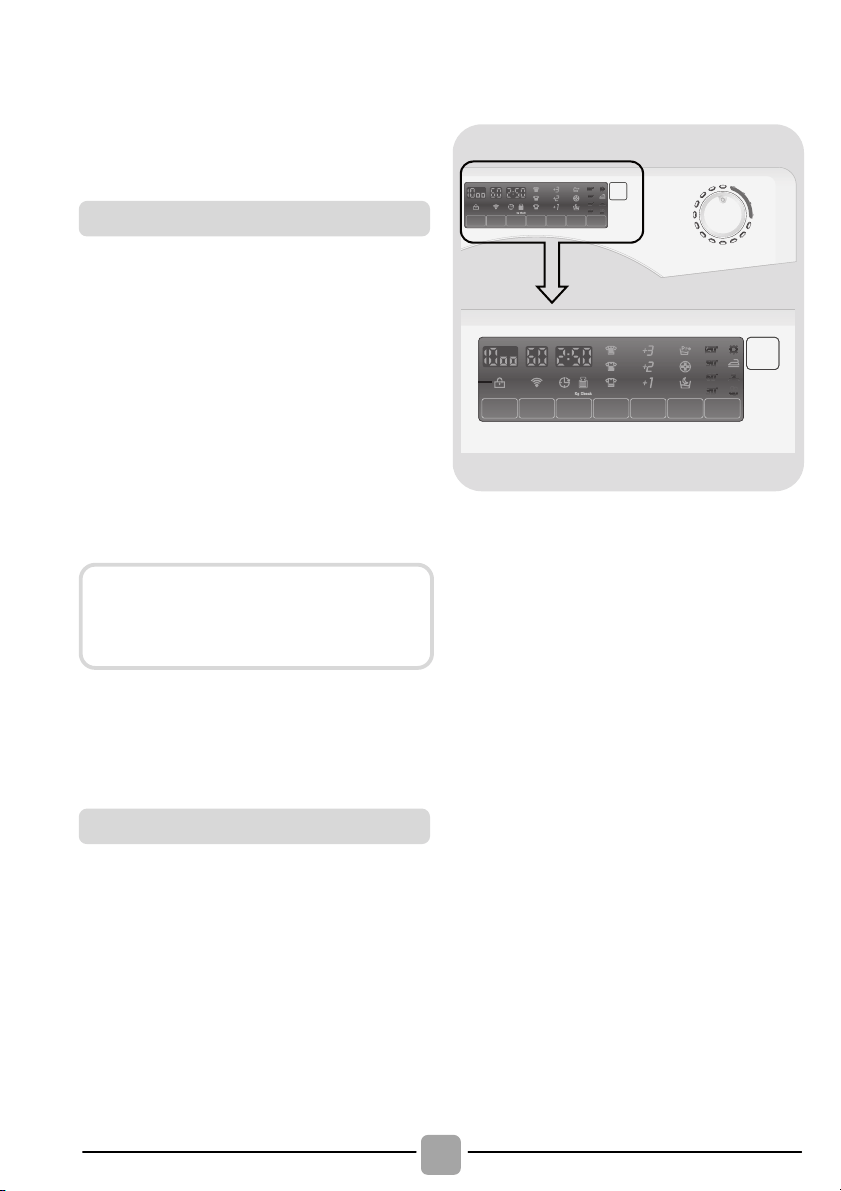
!
50
5. KURZANLEITUNG
Dieses Gerät verfügt über eine moderne
Mengenautomatik, die automatisch die benötigte
Wassermenge, den Energieverbrauch und die
Waschdauer anpasst.
! Schalten Sie Ihr Gerät ein und wählen Sie
das benötigte Programm aus.
! Stellen Sie wenn nötig eine
Waschtemperatur ein.
! Drücken Sie den Button START/PAUSE
um den Waschvorgang zu starten.
Sollte die Maschine während des
Waschvorgangs ausgehen, starten Sie sie
später erneut; das Waschprogramm wurde
gespeichert.
! Am Ende des Waschvorgangs erscheint
auf dem Display das Wort „Ende“.
! Schalten Sie die Waschmaschine nun
aus..
Für jeden Waschtyp sehen Sie in der
Tabelle die passenden Sequenzen.
Wasserdruck:
min 0,05 Mpa
max 0,8 Mpa
Schleuderdrehzahl:
Siehe Typenschild.
Gesamtanschlußwert/Absicherung/
Spannung:
Siehe Typenschild.
6. STEUERUNG UND
PROGRAMME
A
B
DCEFGHI
M
L
A
Programmwahlschalter mit
Position AUS (OFF)
B
Taste START/PAUSE
C
Taste SCHLEUDERDREHZAHLWAHL
D
Taste WASCHTEMPERATURWAHL
E
Taste STARTZEITVORWAHL
F
Taste VERSCHMUTZUNGSGRADWAHL
G
Taste EXTRA SPÜLEN
H
OPTIONSTASTEN
I
Taste LEICHTBÜGELN
L
Anzeigebereich
M
Kontrolleuchte TÜRVERRIEGELUNG
Programmauswahl
Warten Sie bis die Sicherung des
Bullauges aufgeht; dies kann bis zu
zwei Minuten nach Beendigung des
Waschvorgangs passieren.
Technische Daten
!
DE
51
! Drücken Sie die Taste START/PAUSE, um
das gewählte Waschprogramm zu
beginnen.
! Die Position des Programmwahlschalters
ändert sich während des kompletten
Programmablaufs nicht.
! Um das Gerät auszuschalten, bitte den
Programmwahlschalter auf die Position
AUS stellen.
! Drücken Sie die Taste START/PAUSE,
um das gewählte Waschprogramm zu
beginnen.
WÄSCHE NACHLEGEN ODER ENTNEHMEN,
NACHDEM DAS PROGRAMM BEGONNEN
HAT (PAUSE)
! Die Taste START/PAUSE für mindestens
2 Sekunden gedrückt halten (einige
der Anzeigeleuchten sowie die
Restlaufzeitanzeige beginnen zu blinken,
während das Programm unterbrochen
ist).
! Nach 2 Minuten wird die Türverriegelung
automatisch deaktiviert und das Bullauge
kann geöffnet werden.
! Nachdem Entnehmen oder Nachlegen
von Wäsche das Bullauge wieder
schließen und die Taste START/PAUSE
erneut drücken (Programm wird an der
ursprünglichen Stelle fortgesetzt).
WASCHPROGRAMM ABBRECHEN
! Um ein Programm zu beenden, den
Programmwahlschalter auf die Position
AUS stellen.
! Ein anderes Waschprogramm auswählen.
WARNUNG:
Berühren beim Einstecken des
Geräts in keinem Fall das Display, da
sich die Maschine in den ersten
Sekunden kalibriert. Sollte dies
dennoch passieren, nehmen Sie das
Gerät vom Netz und Wiederholen Sie
den Vorgang.
Bullauge öffnen
Eine Sicherheitsvorrichtung verhindert,
dass das Bullauge unmittelbar nach
Beendigung des Waschvorganges
geöffnet werden kann. Nach zwei
Minuten erlischt die Kontrollleuchte
“Türverriegelung” und das Bullauge
kann geöffnet werden.
Programmwahlschalter mit
Position AUS (OFF)
Im Displaybereich werden die gewählten
Programmparameter und Optionen
angezeigt. Um Energie zu sparen wird
die Helligkeit des Displays während des
Waschvorganges und wenn längere Zeit
keine Eingaben vorgenommen wurden
verringert.
Um das Gerät auszuschalten, bitte den
Programmwahlschalter auf die Position
AUS stellen.
Der Programmwahlschalter muss am
Ende jedes Waschvorganges oder vor
der Wahl eines neuen Waschprogramms
auf die Position AUS gedreht werden.
Taste START/PAUSE
ZUERST das Bullauge schliessen und
dann die Taste START/PAUSE drücken.
Wenn die Taste START/PAUSE gedrückt
wurde, kann es einige Sekunden dauern,
bevor der Waschvorgang beginnt.

!
52
! Den Programmwahlschalter anschließend
wieder auf die Position AUS stellen.
! Die Schleuderdrehzahl kann in jedem
Programm angepasst oder sogar ganz
ausgeschaltet werden.
! Nach Auswahl eines Waschprogramms
wird die maximale Schleuderdrehzahl
angezeigt und diese kann in Schritten nach
unten korrigiert werden.
! Die Schleuderdrehzahl lässt sich auch während
eines laufenden Waschprogramms noch
jederzeit ändern.
!
Mit dieser Taste wählen Sie die gewünschte
Temperatur des Waschvorgangs aus.
! Um Ihre Textilien zu schützen, ist es nicht
möglich die Temperatur höher einzustellen, als
das jeweilige Programm es zulässt (s.
Programmtabelle).
! Der Programmstart kann zwischen 1
Stunde und 24 Stunden verzögert
werden.
! Um den Programmstart zu verzögern,
bitte diesen Schritten folgen:
- Stellen Sie das gewünschte Programm ein.
-
Drücken Sie die Taste STARTZEITVORWAHL
einmal, um die Funktion zu aktivieren
(es erscheint die Anzeige h00 auf dem Display).
Für eine einstündige Verzögerung drücken Sie
die Taste erneut (im Display erscheint die
Anzeige h01). Wiederholen Sie diesen Vorgang
so oft, bis die gewünschte Verzögerung im
Display erscheint. Zum Zurücksetzen der
Startzeitvorwahl die Taste so oft drücken, bis im
Display wieder die Anzeige h00 erscheint.
- Durch das Drücken der Taste
START/PAUSE bestätigen Sie Ihre
Auswahl. Der Countdown beginnt und
das Programm startet automatisch.
! Die eingestellte Startzeitvorwahl kann
unterbrochen werden, indem der
Programmwähler auf AUS gestellt wird.
Sollte es eine Unterbrechung der
Stromversorgung während eines laufenden
Waschvorgangs geben, werden die
Einstellungen gespeichert, um das Programm
bei Wiederinbetriebnahme automatisch
fortzusetzen.
! Diese Taste erlaubt Ihnen eine
Vorauswahl des Verschmutzungsgrades
Ihrer Wäsche in drei verschiedenen
Stufen.
! Diese Option lässt sich nur in
bestimmten Programmen zuwählen (s.
Programmtabelle).
! Der gewählte Verschmutzungsgrad wird
über eine Kontrollleuchte angezeigt.
Die gewünschten Optionen sollten
ausgewählt werden, bevor die Taste
START/PAUSE betätigt wird.
Wird eine Option gewählt, welche
nicht kompatibel mit dem
ausgewählten Programm ist, wird
die Optionsanzeigemehrfach kurz
aufblinken und anschließend wieder
erlöschen.
Taste SCHLEUDERDREHZAHLWAHL
Jedem Programm ist eine max.
Schleuderdrehzahl zugewiesen. Um
Schäden an Textilien zu verhindern,
ist diese nur nach unten abänderbar.
Dieses Gerät ist mit einem automatischen
Unwuchtkontrollsystem ausgestattet,
dass den Schleudervorgang bei einer
ungleichmäßigen Verteilung der Wäsche
in der Trommel verhindert.
Taste WASCHTEMPERATURWAHL
Taste STARTZEITVORWAHL
Taste VERSCHMUTZUNGSGRADWAHL

!
DE
53
! Mit dieser Optionstaste fügen Sie am
Ende des Waschvorgangs zusätzliche
Spülgänge ein, deren Anzahl vom
jeweiligen Programm abhängig ist.
! Diese Funktion wurde für Personen mit
sensibler Haut entwickelt, bei denen
selbst kleinste Rückstände des
Waschmittels Hautirritationen oder
Allergien auslösen können.
! Zudem empfiehlt sich die Zuwahl dieser
Option beim Waschen von stark
verschmutzter Kinderkleidung, die eine
große Menge an Waschmittel erfordert,
bzw. bei sehr saugfähigen Textilien wie
Handtüchern etc.
Je nach Programm können Sie
verschiedene Optionen hinzuwählen:
- VORWÄSCHE
!
Diese Option erlaubt es Ihnen bei stark
verschmutzter vor dem Hauptwaschgang
eine Vorwäsche durchzuführen (nur in
bestimmten Programmen; s. Programmtabelle).
! Es wird empfohlen hierfür 20% der
vom Waschmittelhersteller empfohlenen
Waschmitteldosis im angegebenen
Waschmittelfach zu verwenden.
- HYGIENE
! Mit dieser Option ist es möglich Ihre
Wäsche bei einer Waschtemperatur von
60°C zu hygienisieren.
- NIGHT&DAY
! Diese Option reduziert alle auftretenden
Waschgeräusche auf ein Minimum,
indem die Geschwindigkeit der
Zwischenschleudergänge auf 400 U/Min.
reguliert wird, je nach Programm der
Wäscheposten nach dem letzten Spülgang
komplett im sauberen Spülwasser liegenbleibt,
bis der Waschvorgang durch erneute
Betätigung der Optionstaste mit einem
Endschleudergang beendet wird.
! Während der Spülstoppphase blinkt die
entsprechende Anzeigeleuchte im
Display, um den Betriebszustand
anzuzeigen.
! Durch erneute Betätigung der
Optionstaste wir der Waschvorgang mit
einem Endschleudergang in der
gewünschten Schleuderdrehzahl beendet
und das Spülwasser abgepumpt.
! Diese Option eignet sich durch die
elektronische, sehr geräuscharme
Überwachung ideal für den nächtlichen
Betrieb des Gerätes.
Durch das Zuwählen dieser Option lässt sich
die Knitterbildung durch Weglassen der
Zwischenschleudergänge bzw. Durchführung
des Endschleuderns bei reduzierter
Schleuderdrehzahl weitestgehend reduzieren.
Taste EXTRA SPÜLEN
OPTIONSTASTEN
Taste LEICHTBÜGELN
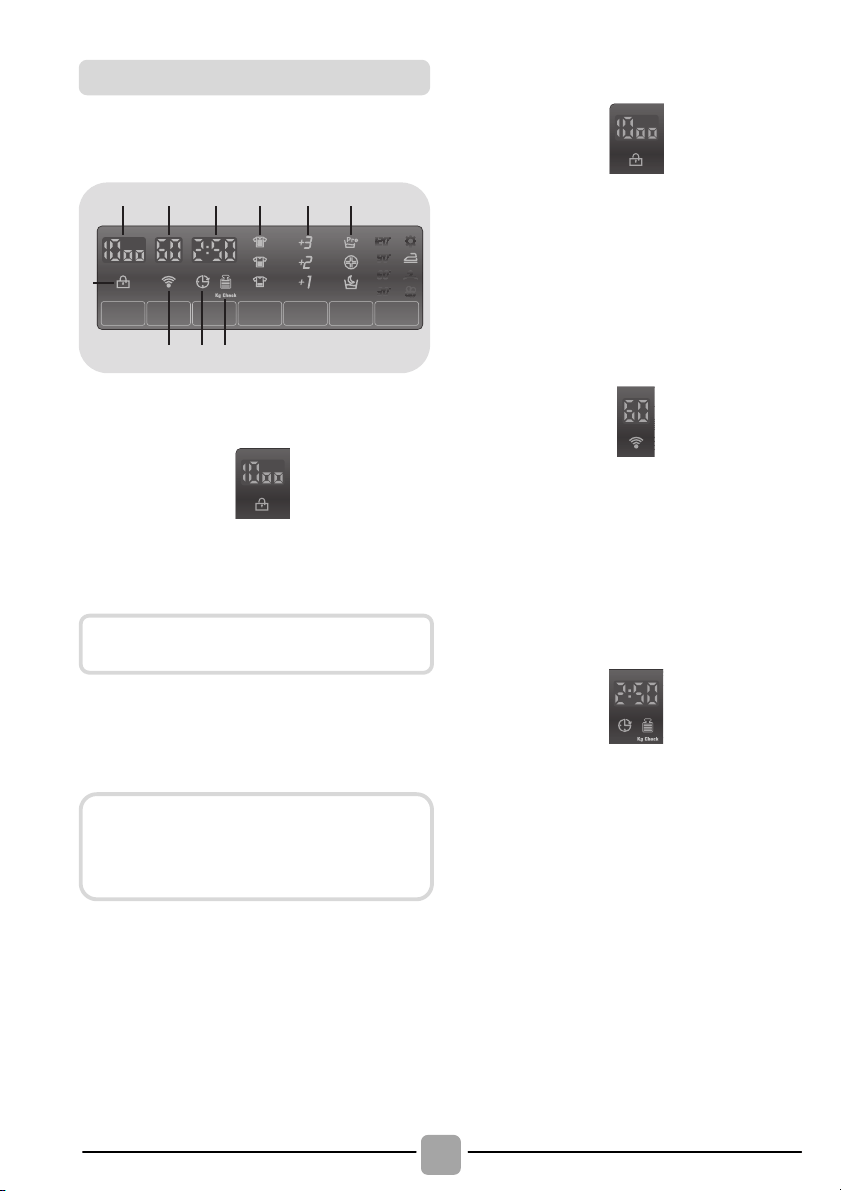
!
54
Im Displaybereich werden wichtige
Informationen für den Benutzer angezeigt.
2
1
8109
3 4 5 6 7
1)
KONTROLLEUCHTE TÜRVERRIEGELUNG
1
! Die Kontrollleuchte beginnt zu leuchten,
sobald das Bullauge richtig geschlossen.
! Wenn die Taste START/PAUSE gedrückt
wird blinkt die Kontrollleuchte zuerst kurz
auf und leuchtet dann permanent.
! Eine Sicherheitsvorrichtung verhindert,
dass das Bullauge unmittelbar nach
Beendigung des Waschvorganges geöffnet
werden kann. Nach zwei Minuten erlischt
die Kontrollleuchte TÜRVERRIEGELUNG
und das Bullauge kann geöffnet werden.
Drehen Sie am Ende des Waschvorganges
den Programmwahlschalter auf die Position
AUS.
2)
Anzeige SCHLEUDERDREHZAHLWAHL
2
In der Anzeige erscheint die gewählte
Schleuderdrehzahl des Programmes. Diese
kann je nach Programm über die
entsprechende Taste nach oben/unten
geändert werden.
3) Anzeige WASCHTEMPERATUR
3
In der Anzeige erscheint die gewählte
Waschtemperatur des Programmes.
Diese kann je nach Programm (s.
Programmtabelle) über die entsprechende
Taste nach oben/unten geändert werden.
4) PROGRAMMDAUER
4
! Sobald ein Waschprogramm ausgewählt wurde,
wird automatisch die Standardprogrammlaufzeit
im Display angezeigt.
! Nachdem das Programm gestartet wurde, wird
die Programmlaufzeit nach einigen Minuten den
jeweiligen Programmbedingungen angepasst.
! Die Mengenautomatik berechnet die
Programmlaufzeit anhand diverser Parameter
wie Wasserdruck, -härte, -einlauftemperatur,
Raumtemperatur, Wäscheart, -menge und -
verschmutzung, verwendetem Waschmittel,
Schwankungen in der Netzspannung und
gewählten Optionen etc.
Anzeigebereich
ZUERST das Bullauge schliessen und
dann die Taste START/PAUSE drücken.
Wird die START/PAUSE Taste nicht
innerhalb von 7 Sekunden nach dem
Schließen des Bullauges gedrückt, muss
das Programm neu gestartet werden.
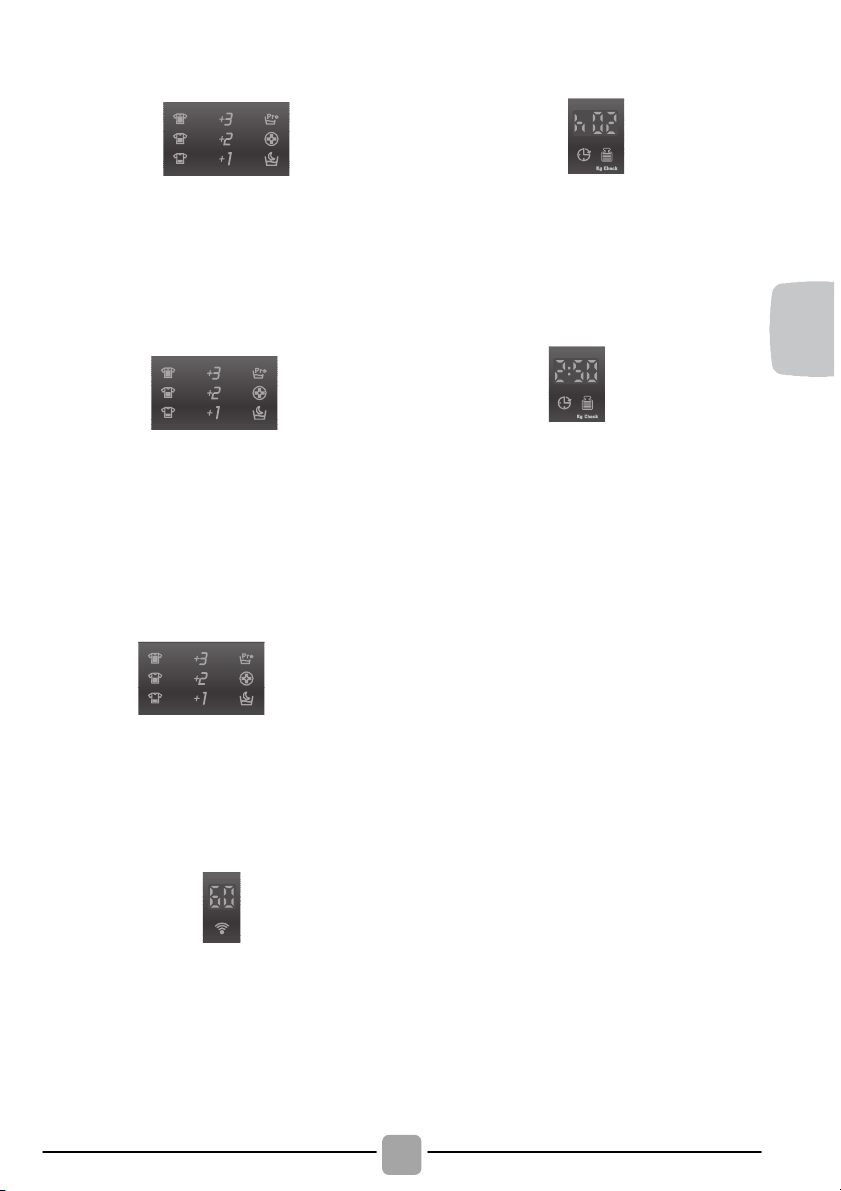
!
DE
55
5)
Anzeige VERSCHMUTZUNGSGRADWAHL
{
5
In der Anzeige erscheint der vorgewählte
Verschmutzungsgrad. Dieser kann je nach
Programm über die entsprechende Taste
angepasst werden.
6) Anzeige EXTRA SPÜLEN
{
6
Die Anzeige zeigt die Anzahl der
ausgewählten Zusatzspülgänge an. Diese
können je nach Programm über die
entsprechende Taste angepasst werden.
7) OPTIONSTASTEN
}
7
Die Anzeige zeigt die ausgewählten
Zusatzoptionen an (VORWÄSCH, HYGIENE
und NIGHT&DAY).
8) WiFi-Funktion (nur bestimmte Modelle)
8
! Bei Modellen mit WiFi-Funktion zeigt
diese Anzeige die Aktivität des Signals
an.
! Für weitere Informationen zum Wi-Fi
System, schauen Sie in die beigelegte
Anleitung zu dem Thema.
9) Anzeige STARTZEITVORWAHL
9
Diese Anzeige blinkt, wenn eine Startzeit
voreingestellt wurde.
10)
"Kg Check" - Anzeige MENGENAUTOMATIK
(nur in Baumwoll- und Synthetikprogrammen)
10
! Während der ersten Minuten des
Waschprogramm ermittelt die moderne
Mengenautomatik alle Waschparameter
Verbrauchswerte Dieses wird durch die
Anzeige "Kg Check" im Display
visualisiert.
! Alle Verbrauchswerte und Programmschritte
werden dahingehend automatisch optimiert
und angepasst:
- Benötigte Wassermenge nach Art und
Menge der eingefüllten Wäsche
- Programmdauer nach Art und Menge
des eingefüllten Wäsche
- Anzahl und Intensität der Spülgänge
nach Art und Menge des eingesetzten
Waschmittels
- Trommeldrehrhythmus nach Art und
Menge der eingefüllten Wäsche
- Zusätzliche Spülgänge bei übermäßiger
Schaumbildung
- Schleuderdrehzahl nach Art und Menge
der eingefüllten Wäsche, um
Unwuchten zu vermeiden.
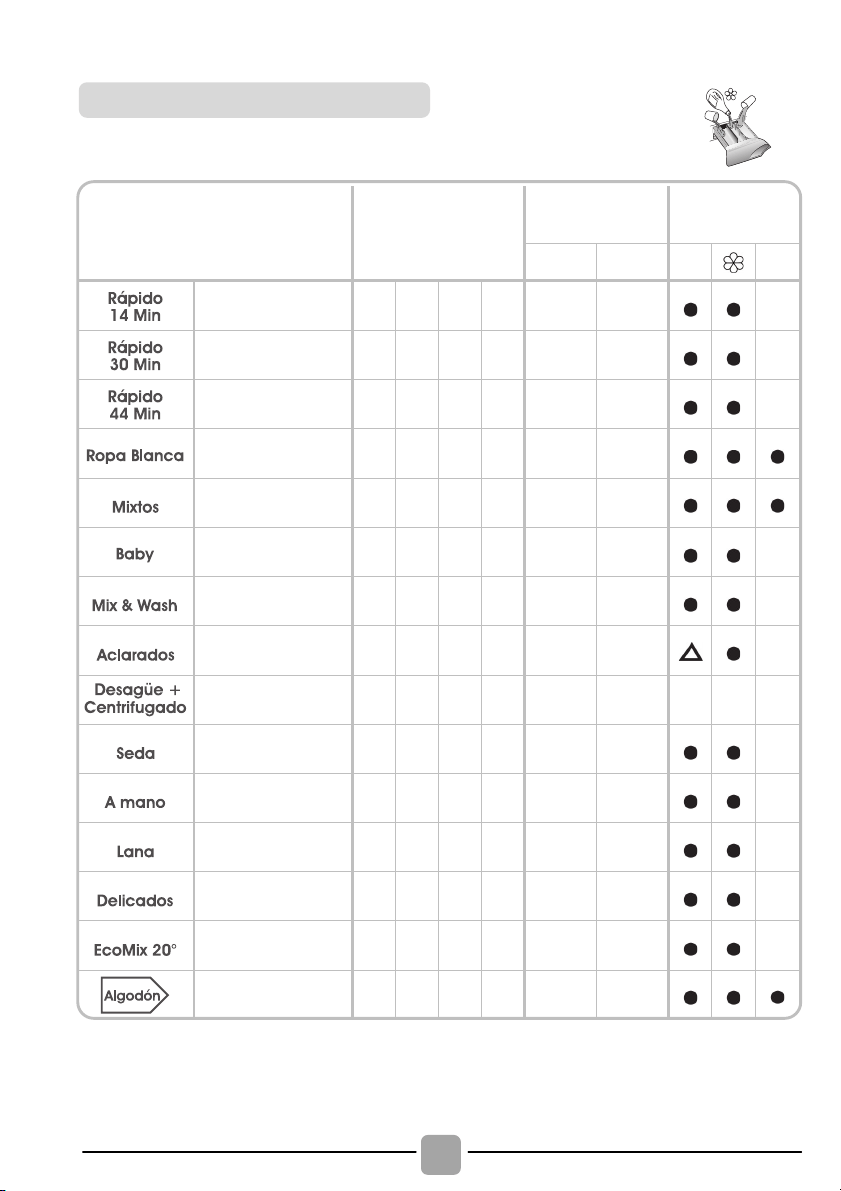
!
56
2
1
PROGRAMM
MAX. BELADUNG*
(kg)
WASCHTEM-
PERATUR °C
WASCHMITTEL
Empfohlen
Maximal
2
1
Kurz 14 Min.
1
1
1
1,5
30°
30°
Kurz 30 Min.
1,5
2
2,5
2,5
30°
30°
Kurz 44 Min.
3
3
3,5
3,5
30°
40°
Baumwollgewebe
1)
5
6
7
8
60°
90°
( )
Pflegeleicht
1)
2,5
3
3,5
4
40°
60°
( )
Baby
1)
3,5
4
4,5
5,5
60°
60°
Mix & Wash
5
6
7
8
40°
40°
Spülen
-
-
-
-
-
-
Abpumpen &
Schleudern
-
-
-
-
-
-
Seide
1
2
2
2
30°
30°
Handwäsche
1
2
2
2
30°
30°
Wolle
1
2
2
2
40°
40°
Feinwäsche
2
2
2,5
2,5
40°
40°
EcoMix 20°
5
6
7
8
20°
20°
Baumwolle
**
1)
5
6
7
8
40°
60°
( )
Programmübersicht
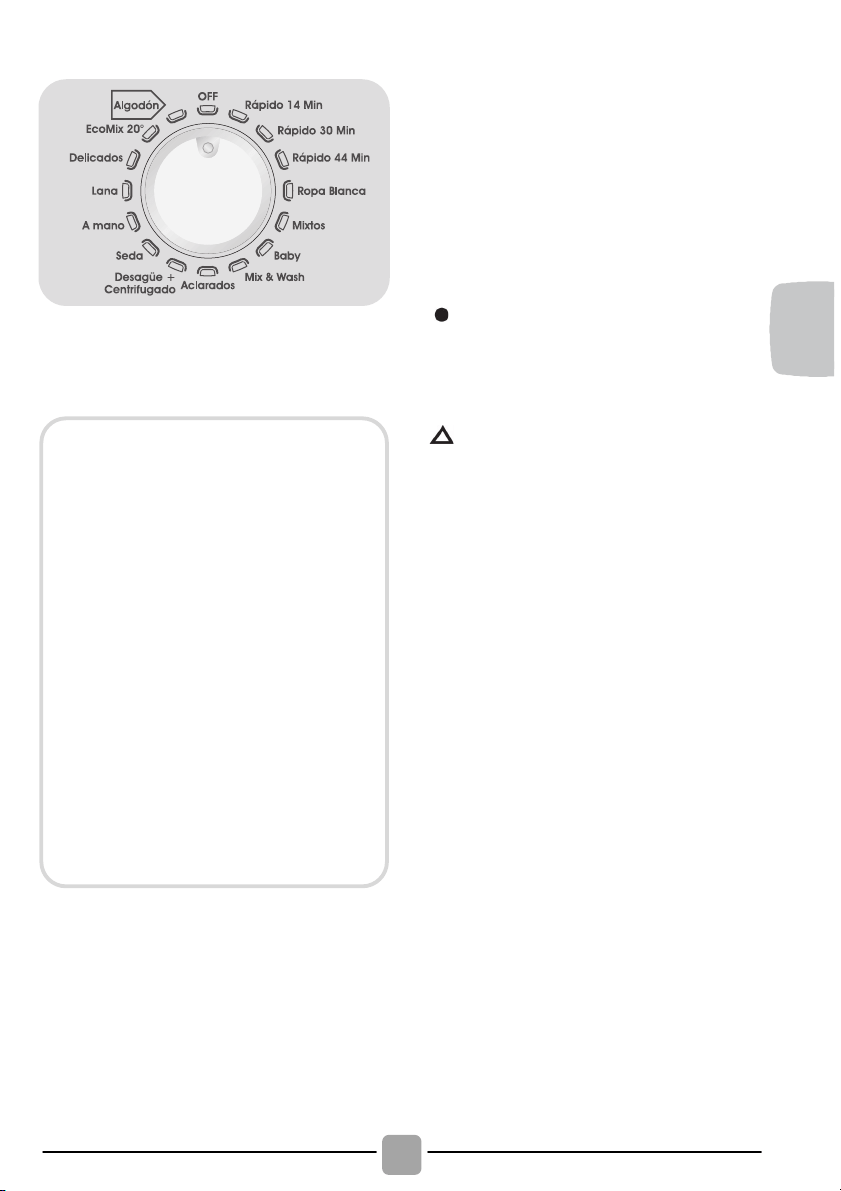
!
DE
57
Bitte beachten Sie folgende Hinweise:
*
Die maximale Beladungskapazität (trockene
Kleidung lt. Normtest) hängt von dem
jeweiligen Gerätemodell ab (s. Bedienblende).
Die Schleuderdrehzahl kann je nach Modell
und den Angaben auf dem Wäscheetikett
auch angepasst bzw. das Endschleudern
komplett unterbunden werden. Die
Steuerung geschieht dabei über die Taste
SCHLEUDERDREHZAHLWAHL.
Werden auf dem Wäscheetikett keine
Angaben hierzu gemacht, kann jeweils die
maximal mögliche Schleuderdrehzahl
genutzt werden.
Waschmittel bitte immer nach Herstellerangabe
und Wasserhärte dosieren. Eine Überdosierung
des verwendeten Waschmittels bzw. der
Waschzusätze kann zu übermäßiger
Schaumbildung führen. Erkennt das Gerät eine
vermehrte Schaumbildung, beendet es ggf.
automatisch den Schleudervorgang vorzeitig, die
Programmlaufzeit wird entsprechend verlängert
und der Wasserverbrauch angepasst.
( )
Nur bei gewählter VORWÄSCHE-
Option verfügbar (Nur bei
Programmen verfügbar, in denen die
VORWÄSCHE-Option zuwählbar ist).
(Nur für Modelle mit
entsprechendem Waschmittelfach
für Flüssigwaschmittel)
Wenn nur eine begrenzte Menge
von Textilien mit Flecken behaftet
ist, die mit einem flüssigen
Vorreinigungs- oder Bleichmittel
behandelt werden soll, kann eine
entsprechende
Fleckenbehandlung
mit dem Gerät durchgeführt werden.
Gießen Sie das Vorreinigungs-
/Bleichmittel in die Vorrichtung für
Flüssigwaschmittel und setzen diese
in das mit der Ziffer "2" markierte Fach
der Waschmittelschublade. Wählen
Sie anschließend das Programm
SPÜLEN aus und starten den
Vorgang.
Wenn der Spülvorgang beendet
ist, den Programmwähler auf die
Position
AUS stellen, die restliche
Wäsche hinzufügen, das gewünschte
Waschprogramm auswählen und starten.
1)
Für die aufgeführten Programme
kann über die Optionstaste
VERSCHMUTZUNGSGRADWAHL
die Dauer und Intensität des
Waschprogramms angepasst werden.
**STANDARDBAUMWOLLPROGRAMME
für Prüfung und Energieetikettierung
gemäß Richtlinie (EU) 1015/2010 und
1061/2010.
BAUMWOLLPROGRAMM mit einer
Waschtemperatur von 60°C.
BAUMWOLLPROGRAMM mit einer
Waschtemperatur von 40°C.
Diese Programme eignen sich zur Reinigung
normal verschmutzter Baumwollwäsche und
sind die effizientesten Programme in Bezug
auf den kombinierten Energie- und
Wasserverbrauch zum Waschen von
Baumwollwäsche.
Die Temperaturangaben zu den
Programmen sind auf die Angaben auf
dem Wäscheetikett abgestimmt. Die
tatsächliche Wassertemperatur kann ggf.
leicht abweichen.

!
58
Das Gerät bietet eine Vielzahl an
Programmen und Optionen, um
verschiedene Textilarten in allen
Verschmutzungsgraden optimal zu reinigen.
Kurz 14 Min. / 30 Min. / 44 Min.
Ein kompletter Waschzyklus (Waschen,
Spülen, Schleudern) für einen kleinen
Wäscheposten. Dieses Programm eignet
sich insbesondere für leicht verschmutze
Textilien aus Baumwolle oder
Mischgeweben. Um eine Überdosierung zu
vermeiden empfehlen wir nur 20% der vom
Hersteller empfohlenen Waschmittelmenge
zu verwenden.
Baumwollgewebe
Für die gründliche Pflege von
strapazierfähigen Textilien.
Pflegeleicht
Für pflegeleichte Textilien aus Baumwolle,
Leinen, Synthetik oder Mischgewebe
bei reduzierter Waschtemperatur bzw.
Schleuderdrehzahl.
Baby
Dieses Programm mit einer Waschtemperatur von
mindestens 60°C eignet sich ideal zur porentiefen
und hygienischen Reinigung von Babybekleidung.
Zur Erzielung von optimalen Waschergebnissen
empfehlen wir die Verwendung von Pulverwaschmittel.
Mix & Wash
In diesem Programm können verschiedene
Textilarten (z.B. Baumwolle und Synthetik etc.)
bei einer Waschtemperatur von 40°C zusammen
in einem Waschgang gewaschen werden.
Spülen
Es werden 3 Spülgänge mit Zwischenschleudern
(Schleuderdrehzahl kann mit der Taste
SCHLEUDERDREHZAHLWAHL reduziert oder
ganz abgestellt werden) durchgeführt.
Abpumpen & Schleudern
Zum nachträglichen Schleudern. Mit der
Taste SCHLEUDERDREHZAHLWAHL kann
die gewünschte Schleuderdrehzahl eingestellt
werden.
Seide
Für die besonders schonende Reinigung
aller maschinenwaschbaren, empfindlichen
Textilien, die keine Wolle enthalten.
Der Waschprozess ist optimal an die
Erfordernisse der Seidefasern angepasst.
Handwäsche
Handwäscheprogramm für alle
maschinenwaschbaren Textilien mit dem
Handwäschepflegesymbol auf dem
Wäscheetikett.
Wolle
Für die besonders schonende Reinigung
aller maschinenwaschbaren Wolltextilien (s.
Wäscheetikett) mit langen Programmpausen.
Feinwäsche
Lange Einweichphasen in Kombination
mit sanften Trommelbewegungen und
hohem Wasserstand bei verringerter
Waschtemperatur und Schleuderdrehzahl
garantieren optimale Pflege für
Feinwäsche.
EcoMix 20°
Dieses Programm ermöglicht es, bei
einer Waschtemperatur von nur
20°C verschiedene Textilarten und-farben
gemeinsam und besonders sparsam in
einem Waschgang zu waschen. Verwendung
von Waschmittel mit Kaltwaschfunktion
notwendig.
Baumwolle 40°C / 60°C
Effizientestes Waschprogramm (kombinierter
Energie-/Wasserverbrauch) für die Reinigung
normal verschmutzter Baumwollwäsche.
Programmauswahl
!
DE
59
7. HINWEISE ZUM KUNDENDIENST UND ZUR GARANTIE
Wenn Sie der Meinung sind, Ihre Waschmaschine läuft nicht einwandfrei, nutzen Sie das
“schnelle Benutzerhandbuch”, in dem erklärt wird, wie einige Probleme schnell behoben
werden können.
Problem
Mögliche Ursachen und praktische Lösungen
Die Waschmaschine startet
nicht
Überprüfen Sie, ob die Maschine richtig angeschlossen ist.
Überprüfen Sie ob Strom auf dem Gerät ist.
Überprüfen Sie, ob das Programm richtig ausgewählt wurde und
ob die Maschine vorschriftsmäßig gestartet wurde.
Vergewissern Sie sich, dass keine Sicherung durchgebrannt ist
und ob die Steckdose noch funktioniert.
Schauen Sie nach, ob das Bullauge richtig verschlossen wurde.
Die Waschmaschine füllt
sich nicht mit Wasser
Schauen Sie ob der Wasserhahn offen ist.
Stellen Sie sicher, dass der Timer richtig eingestellt wurde.
Die Waschmaschine lässt
kein Wasser ab
Schauen Sie nach, ob der Filter verstopft ist.
Vergewissern Sie sich, dass der Abtropfschlauch nicht verbogen
ist.
Schauen Sie, ob irgendwelche Gegenstände in den Filter
gerutscht sind.
Wasserlarche neben der
Waschmaschine
Die Ursache hier für könnte bei der Dichtung liegen. Dies ist der
Bereich zwischen dem Wasserhahn und dem Schlauch. In
diesem Falle ziehen Sie diesen Bereich mit einer Zange enger
bzw. nach.
Die
Waschmaschinentrommel
schleudert nicht
Dies kann zur Ursache haben, dass das Wasser nicht
vollständig abgelaufen ist. Warten Sie ein paar Minuten.
Manche Modelle verfügen über eine „NichtSchleudernFunktion“.
Vergewissern Sie sich, dass diese nicht angeschaltet ist.
Laute Geräusche während
des Waschvorgangs
Stellen Sie sicher, dass alle Transportklammern entfernt
wurden.
Vergewissern Sie sich, dass die Last gleichmäßig verteilt ist.
Wenn ein ERROR auf
dem Display blinkt
Wenn die Nummern 0,1,5,7 oder 8 erscheinen, kontaktieren Sie
umgehend den Kundenservice.
Wenn Nummer 2 blinkt, wird kein Wasser geladen. Prüfen Sie,
ob der Wasserhahn aufgedreht ist.
Wenn Nummer 3 blinkt, tropft die Maschine nicht richtig ab.
Wenn Nummer 4 blinkt, ist die Maschine zu voll beladen.
Schließen Sie die Wasserzufuhr am Hahn und kontaktieren Sie
den Kundenservice.
Wenn Nummer 9 blinkt, schalten Sie die Maschine umgehend
aus und warten 10 bis 15 Sekunden, bevor Sie die Maschine
erneut starten.
!
60
Bei der Nutzung von phosphatfreien
Waschmitteln können folgende Dinge
resultieren:
- Trüberes Abwasser: Dieser Effekt
ist bedingt durch die suspendierten
Zeolithe, was jedoch keine negativen
Auswirkungen auf die Wascheffizienz hat.
- Weißer Schleier auf der Kleidung am
Ende des Waschvorgangs: Dies ist
normal, da das Waschmittel nicht von der
Wäsche aufgenommen wird.
- Schaumbildung im letzten Spülgang:
Dies ist nicht zwingend ein Zeichen für
ein schlechtes Spülergebnis.
- Übermäßige Schaumbildung: Dies tritt
häufig beim Einsatz von anionischen
Tensiden in Waschmitteln auf.
Starten Sie in den vorgenannten Fällen
keinen erneuten Waschvorgang, da dies
nicht helfen wird.
Sollte das Problem weiterhin bestehen,
wenden Sie sich umgehend an den
Kundenservice.
Sie können sich auch für einen Serviceplan
registrieren, um kostenlosen Service auch
nach Ablauf der Garantie zu genießen.
Achtung: De Anruf ist nicht gebührenfrei.
Die Kosten werden durch eine
automatische Bandansage genannt.
Candy empfiehlt, immer Originalersatzteile
bei einer Reparatur verwenden zu lassen.
Wir schließen die Haftung für alle evtl.
Druckfehler aus.
Kleinere Änderungen und technische
Weiterentwicklungen im Detail vorbehalten.
Garantie
Die Garantiezeit des Gerätes entspricht
den jeweiligen gesetzlichen Vorschriften.
Nähere Angaben zu Art und Umfang
der Garantiebedingungen finden
Sie im Garantieheft. Bitte das
Original der Kaufrechnung für die
Garantieersatzansprüche aufbewahren,
um diese im Bedarfsfall unserem
Werkskundendienst vorzulegen. Ohne
diese Nachweise können wir und unser
Werkskundendienst den Anspruch nicht
anerkennen
Registrieren Sie ihr Produkt!
Sie können Ihr Gerät unter
www.registercandy.com kostenpflichtig
registrieren, um auch nach Ablauf der
Garantie einen erweiterten Schutz sowie
umfangreichen und schnellen Service zu
genießen.

hldsk

hldsk

hldsk

- GVT/GSF (5÷8) -
15.08 - 43011535 - Canon Italia - Business Services Channel - Printed in Italy

