
2
To reduce fire or shock hazard, do
not expose the unit to rain or
moisture.
Do not expose the batteries to
excessive heat such as sunshine,
fire or the like.
This symbol is intended to alert
the user to the presence of
uninsulated “dangerous
voltage” within the product’s
enclosure that may be of
sufficient magnitude to
constitute a risk of electric
shock to persons.
This symbol is intended to alert
the user to the presence of
important operating and
maintenance (servicing)
instructions in the literature
accompanying the appliance.
WARNING
IMPORTANT
SAFEGUARDS
For your protection, please read these safety
instructions completely before operating
the appliance, and keep this manual for
future reference.
Carefully observe all warnings, precautions
and instructions on the appliance, or the one
described in the operating instructions and
adhere to them.
Power Sources
This set should be operated only from the type of
power source indicated on the marking label. If
you are not sure of the type of electrical power
supplied to your home, consult your dealer or
local power company. For those sets designed to
operate from battery power, or other sources, refer
to the operating instructions.
Polarization
This set may be equipped with a polarized ac
power cord plug (a plug having one blade wider
than the other).
This plug will fit into the power outlet only one
way. This is a safety feature. If you are unable to
insert the plug fully into the outlet, try reversing
the plug. If the plug should still fail to fit, contact
your electrician to have a suitable outlet installed.
Do not defeat the safety purpose of the polarized
plug by forcing it in.
Overloading
Do not overload wall outlets, extension cords or
convenience receptacles beyond their capacity,
since this can result in fire or electric shock.
Object and Liquid Entry
Never push objects of any kind into the set
through openings as they may touch dangerous
voltage points or short out parts that could result
in a fire or electric shock. Never spill liquid of any
kind on the set.
Attachments
Do not use attachments not recommended by the
manufacturer, as they may cause hazards.
Use

3
Cleaning
Unplug the set from the wall outlet before
cleaning or polishing it. Do not use liquid cleaners
or aerosol cleaners. Use a cloth lightly dampened
with water for cleaning the exterior of the set.
Water and Moisture
Do not use power-line operated sets near water –
for example, near a bathtub, washbowl, kitchen
sink, or laundry tub, in a wet basement, or near a
swimming pool, etc.
Power-Cord Protection
Route the power cord so that it is not likely to be
walked on or pinched by items placed upon or
against them, paying particular attention to the
plugs, receptacles, and the point where the cord
exits from the appliance.
Accessories
Do not place the set on an unstable cart, stand,
tripod, bracket, or table. The set may fall, causing
serious injury to a child or an adult, and serious
damage to the set. Use only a cart, stand, tripod,
bracket, or table recommended by the
manufacturer.
Ventilation
The slots and openings in the cabinet are provided
for necessary ventilation. To ensure reliable
operation of the set, and to protect it from
overheating, these slots and openings must never
be blocked or covered.
– Never cover the slots and openings with a cloth
or other materials.
– Never block the slots and openings by placing
the set on a bed, sofa, rug, or other similar
surface.
– Never place the set in a confined space, such as
a bookcase, or built-in cabinet, unless proper
ventilation is provided.
– Do not place the set near or over a radiator or
heat register, or where it is exposed to direct
sunlight.
Lightning
For added protection for this set during a lightning
storm, or when it is left unattended and unused for
long periods of time, unplug it from the wall
outlet and disconnect the antenna or cable system.
This will prevent damage to the set due to
lightning and power-line surges.
Damage Requiring Service
Unplug the set from the wall outlet and refer
servicing to qualified service personnel under the
following conditions:
– When the power cord or plug is damaged or
frayed.
– If liquid has been spilled or objects have fallen
into the set.
– If the set has been exposed to rain or water.
– If the set has been subject to excessive shock by
being dropped, or the cabinet has been
damaged.
– If the set does not operate normally when
following the operating instructions. Adjust
only those controls that are specified in the
operating instructions. Improper adjustment of
other controls may result in damage and will
often require extensive work by a qualified
technician to restore the set to normal operation.
– When the set exhibits a distinct change in
performance – this indicates a need for service.
Servicing
Do not attempt to service the set yourself as
opening or removing covers may expose you to
dangerous voltage or other hazards.
Refer all servicing to qualified service personnel.
Replacement parts
When replacement parts are required, be sure the
service technician has used replacement parts
specified by the manufacturer that have the same
characteristics as the original parts.
Unauthorized substitutions may result in fire,
electric shock, or other hazards.
Safety Check
Upon completion of any service or repairs to the
set, ask the service technician to perform routine
safety checks (as specified by the manufacturer)
to determine that the set is in safe operating
condition.
Installation
Service

4
Read this first
Before operating the unit, please read this
manual thoroughly, and retain it for future
reference.
Replace the battery with the
specified type only. Otherwise, fire
or injury may result.
RECYCLING LITHIUM-ION BATTERIES
Lithium-Ion batteries are recyclable.
You can help preserve our
environment by returning your
used rechargeable batteries to the
collection and recycling location
nearest you.
For more information regarding
recycling of rechargeable batteries, call toll free 1-
800-822- 8837, or visit http://www.rbrc.org/
Caution: Do not handle damaged or leaking
Lithium-Ion batteries.
Battery pack
This device complies with Part 15 of the FCC
Rules. Operation is subject to the following two
conditions:
(1) This device may not cause harmful
interference, and (2) this device must accept any
interference received, including interference that
may cause undesired operation.
Owner’s Record
The model and serial numbers are located on the
bottom. Record the serial number in the space
provided below. Refer to these numbers whenever
you call your Sony dealer regarding this product.
If you have any questions about this
product, you may call:
Sony Customer Information Center 1-800-
222-SONY (7669).
The number below is for the FCC related
matters only.
Regulatory Information
Notes
DCR-HC62 is to be used with AC Adaptor Model
AC-L200/L200B.
CAUTION
You are cautioned that any changes or
modifications not expressly approved in this
manual could void your authority to operate this
equipment.
Note
This equipment has been tested and found to
comply with the limits for a Class B digital
device, pursuant to Part 15 of the FCC Rules.
These limits are designed to provide reasonable
protection against harmful interference in a
residential installation. This equipment generates,
uses, and can radiate radio frequency energy and,
if not installed and used in accordance with the
instructions, may cause harmful interference to
radio communications.
CAUTION
For customers in the U.S.A. and
CANADA
Model No. DCR-HC62
Serial No.
Model No. AC-
Serial No.
For customers in the U.S.A.
Declaration of Conformity
Trade Name: SONY
Model No.: DCR-HC62
Responsible Party: Sony Electronics Inc.
Address: 16530 Via Esprillo, San Diego, CA
92127 U.S.A.
Telephone number: 858-942-2230
This device complies with Part 15 of the FCC
Rules.
Operation is subject to the following two
conditions:
(1) This device may not cause harmful
interference, and (2) this device must accept any
interference received, including interference
that may cause undesired operation.
5
However, there is no guarantee that interference
will not occur in a particular installation. If this
equipment does cause harmful interference to
radio or television reception, which can be
determined by turning the equipment off and on,
the user is encouraged to try to correct the
interference by one or more of the following
measures:
– Reorient or relocate the receiving antenna.
– Increase the separation between the equipment
and receiver.
– Connect the equipment into an outlet on a
circuit different from that to which the receiver
is connected.
– Consult the dealer or an experienced radio/TV
technician for help.
The supplied interface cable must be used with the
equipment in order to comply with the limits for a
digital device pursuant to Subpart B of Part 15 of
FCC Rules.
For the State of California, USA only
Perchlorate Material - special handling may
apply, See
www.dtsc.ca.gov/hazardouswaste/perchlorate
Perchlorate Material: Lithium battery contains
perchlorate.
Your camcorder is supplied with two
kinds of manuals
– “Operating Guide” (This manual)
– “First Step Guide” for connecting the
camcorder to a computer and using the
supplied software (stored on the supplied
CD-ROM)
Type of cassette you can use in your
camcorder
You can use mini DV cassettes marked
with . Your camcorder is not
compatible with the Cassette Memory
function (p. 79).
Types of “Memory Stick” you can use
in your camcorder
You can use “Memory Stick” that have the
logo shown below (p. 80).
– (“Memory Stick Duo”)
– (“Memory Stick
PRO Duo”)
– (“Memory Stick
PRO-HG Duo”)
“Memory Stick Duo”
(This size can be used with your
camcorder.)
“Memory Stick”
(You cannot use with your camcorder.)
• You cannot use any type of memory card
except “Memory Stick Duo.”
• “Memory Stick PRO Duo” can be used
only with “Memory Stick PRO”
compatible equipment.
• Do not attach a label or the like on a
“Memory Stick Duo” or a Memory Stick
Duo adaptor.
When using a “Memory Stick Duo”
with “Memory Stick” compatible
equipment
Be sure to insert the “Memory Stick Duo”
into the Memory Stick Duo Adaptor.
Memory Stick Duo Adaptor
Notes on use
Continued ,

6
Using the camcorder
• Do not hold the camcorder by the
following parts.
• The camcorder is not dustproof, dripproof
or waterproof.
See “On use and care” (p. 83).
• When connecting your camcorder to
another device with communication
cables, be sure to insert the connector plug
in the correct way.
Pushing the plug forcibly into the terminal
will damage the terminal and may result
in a malfunction of your camcorder.
About menu items, LCD panel,
viewfinder, and lens
• A menu item that is grayed out is not
available under the current recording or
playback conditions.
• The LCD screen and the viewfinder are
manufactured using extremely high-
precision technology, so over 99.99% of
the pixels are operational for effective
use. However, there may be some tiny
black points and/or bright points (white,
red, blue, or green in color) that appear
constantly on the LCD screen and the
viewfinder. These points are normal
results of the manufacturing process and
do not affect the recording in any way.
• Exposing the LCD screen, the viewfinder,
or the lens to direct sunlight for long
periods of time may cause malfunctions.
• Do not aim at the sun. Doing so might
cause your camcorder to malfunction.
Take pictures of the sun only in low light
conditions, such as at dusk.
About changing the language setting
• The on-screen displays in each local
language are used for illustrating the
operating procedures. Change the screen
language before using your camcorder if
necessary (p. 16).
Viewfinder Battery pack
LCD panel
Black point
White, red, blue
or green point
Read this first (Continued)

7
On recording
• Before starting to record, test the
recording function to make sure the
picture and sound are recorded without
any problems.
• Compensation for the contents of
recordings cannot be provided, even if
recording or playback is not possible due
to a malfunction of the camcorder, storage
media, etc.
• TV color systems differ depending on the
country/region. To view your recordings
on a TV, you need a NTSC system-based
TV.
• Television programs, films, video tapes,
and other materials may be copyrighted.
Unauthorized recording of such materials
may be contrary to the copyright laws.
About this manual
• The images of the LCD screen and the
viewfinder used in this manual for
illustration purposes are captured using a
digital still camera, and therefore may
appear different.
• Design and specifications of recording
media and accessories are subject to
change without notice.
About the Carl Zeiss lens
• Your camcorder is equipped with a Carl
Zeiss lens, which was developed jointly
by Carl Zeiss, in Germany, and Sony
Corporation, and produces superior
images. It adopts the MTF measurement
system for video cameras and offers a
quality typical of a Carl Zeiss lens.
MTF= Modulation Transfer Function
The number value indicates the amount of
light from a subject coming into the lens.

8
9
Table of Contents
IMPORTANT SAFEGUARDS .........2
Read this first ..................................4
Notes on use ................................. 5
Step 1: Checking supplied items
.....................................................11
Step 2: Charging the battery pack
.....................................................12
Step 3: Turning the power on and
setting the date and time ............15
Changing the language setting ... 16
Step 4: Making setting adjustments
before recording ..........................17
Step 5: Inserting a tape or a “Memory
Stick Duo” ...................................18
Easy Recording/Playback
(Easy Handycam) .......................20
Recording .....................................22
Zooming ...................................... 24
Recording in dark places
(NightShot plus) ........................ 24
Adjusting the exposure for backlit
subjects .................................... 25
Recording in mirror mode ........... 25
Selecting the aspect ratio (16:9 or
4:3) of the recording picture ..... 25
Playback .......................................26
Using PB zoom ........................... 28
Using the guide functions
(USAGE GUIDE) ........................28
Searching for the starting point .....29
Searching for the last scene of the
most recent recording
(END SEARCH) ........................ 29
Searching manually
(EDIT SEARCH) ........................ 30
Reviewing the most recently
recorded scenes
(Rec review) .............................. 30
Searching quickly for a desired
scene (Zero set memory) ......... 30
Searching for a scene by date of
recording (Date search) ........... 31
Playing the picture on a TV ...........32
Using the menu items ..........34
Menu items ...................................35
CAMERA SET menu ...............37
Settings to adjust your camcorder to
the recording conditions
MEMORY SET menu .............42
Settings for the “Memory Stick Duo”
PICT.APPLI. menu ................44
Special effects on pictures or
additional functions on recording/
playback
EDIT/PLAY menu ..................48
Settings for editing or playing back in
various modes
STANDARD SET menu .........50
Settings while recording on a tape or
other basic settings
TIME/LANGU. menu ..............53
Customizing Personal Menu .........54
Dubbing to VCR or DVD/HDD
recorders .....................................56
Recording pictures from a VCR, etc.
.....................................................58
Dubbing pictures from a tape to a
“Memory Stick Duo” ....................60
Deleting recorded pictures from the
“Memory Stick Duo” ....................60
Marking images on the “Memory Stick
Duo” with specific information
(Print mark/Image protection) .....61
Getting Started
Recording/Playback
Using the Menu
Dubbing/Editing
Continued ,

10
Printing recorded images
(PictBridge compliant printer) ..... 62
What you can do with Windows
computer .................................... 64
Installing the “First Step Guide” and
software ...................................... 65
Viewing “First Step Guide” ........... 67
Using a Macintosh computer ........ 67
Troubleshooting ........................... 68
Warning indicators and messages
.................................................... 75
Using your camcorder abroad ...... 78
Maintenance and precautions ...... 79
Usable cassette tapes ................ 79
About the “Memory Stick” ........... 80
About the “InfoLITHIUM” battery
pack .......................................... 81
About i.LINK ................................ 82
On using your camcorder ........... 83
Specifications ............................... 87
Identifying parts and controls ....... 90
Indicators displayed during recording/
playback ..................................... 94
Index ............................................ 97
Using a Computer
Troubleshooting
Additional Information
Quick Reference
Spanish Quick Guide/Guía
rápida en español 100
Table of Contents (Continued)
11
Getting Started
Getting Started
Step 1: Checking supplied items
Make sure that you have following items
supplied with your camcorder.
The number in the parentheses indicates the
number of that item supplied.
AC Adaptor (1) (p. 12)
Power cord (Mains lead) (1) (p. 12)
Wireless Remote Commander (1) (p. 93)
A button-type lithium battery is already installed.
A/V connecting cable (1) (p. 32, 56)
USB cable (1) (p. 62)
Rechargeable battery pack NP-FH40 (1)
(p. 12, 81)
CD-ROM “Handycam Application
Software” (1) (p. 64)
Operating Guide (This manual) (1)

12
Step 2: Charging the battery pack
You can charge the “InfoLITHIUM”
battery pack (H series) (p. 81) after
attaching it to your camcorder.
b Notes
• You cannot attach any “InfoLITHIUM” battery
pack other than the H series to your camcorder.
1 Align the terminals of the battery
pack and your camcorder 1, then
attach the battery pack and click
it into place 2.
2 Slide the POWER switch in the
direction of the arrow to
OFF(CHG) (The default setting).
3 With the v mark on the DC plug
facing down, connect the AC
Adaptor to the DC IN jack on your
camcorder.
4 Connect the power cord (mains
lead) to the AC Adaptor and the
wall outlet (wall socket).
The CHG (charge) lamp lights up and
charging starts. The CHG (charge) lamp
turns off when the battery is fully
charged. Disconnect the AC Adaptor
from the DC IN jack.
b Notes
• Disconnect the AC Adaptor from the DC IN
jack holding both the camcorder and the DC
plug.
1
2
4
3
1
2
POWER switch
DC IN jack
DC plug
AC Adaptor
To the wall outlet
(wall socket)
Battery pack
Power cord (Mains lead)
CHG (charge) lamp
13
Getting Started
To use an outside power source
You can operate your camcorder using the
power from the wall outlet (wall socket) by
making the same connections as you do
when charging the battery pack. The battery
pack will not lose its charge in this case.
To remove the battery pack
1 Turn off the power, then press PUSH.
2 Remove the battery pack in the direction
of the arrow.
When storing the battery pack
Fully discharge the battery before storing it
for an extended period (p. 82).
To check the remaining battery
(Battery Info)
Set the POWER switch to OFF (CHG), then
press DISP/BATT INFO.
After a while, the approximate recordable
time and battery information appear for
about 7 seconds. You can view the battery
information for up to 20 seconds by
pressing DISP/BATT INFO again while the
information is displayed.
You can check the remaining battery charge
on the LCD screen.
2
1
POWER switch
PUSH
Indicator Status
Sufficient power remaining
Battery low, recording/
playback will stop soon.
Replace the battery with a
fully charged one, or charge
the battery.
DISP/BATT INFO button
60
65
Remaining battery (approx.)
Recording capacity (approx.)
Continued ,

14
Charging time
Approximate time (min.) required when
you fully charge a fully discharged battery
pack.
Recording time
Approximate time (min.) available when
you use a fully charged battery pack.
* Typical recording time shows the time when
you repeat recording start/stop, turning the
power on/off and zooming.
b Notes
• All times measured under the following
conditions:
Top: Recording with LCD screen.
Bottom: Recording with viewfinder while the
LCD panel closed.
Playing time
Approximate time (min.) available when
you use a fully charged battery pack.
On the battery pack
• Before changing the battery pack, slide the
POWER switch to OFF (CHG).
• The CHG (charge) lamp flashes during
charging, or the Battery Info (p. 13) will not be
correctly displayed under the following
conditions.
– The battery pack is not attached correctly.
– The battery pack is damaged.
– The battery pack is worn-out (for Battery Info
only).
• The power will not be supplied from the battery
as long as the AC Adaptor is connected to the
DC IN jack of your camcorder, even when the
power cord (mains lead) is disconnected from
the wall outlet (wall socket).
On the charging/recording/playback time
• Times measured with the camcorder at 25°C
(77°F). (10°C - 30°C (50°F - 86°F) is
recommended.)
• The recording and playback time will be shorter
when you use your camcorder in low
temperatures.
• The recording and playback time will be shorter
depending on the conditions under which you
use your camcorder.
On the AC Adaptor
• Use the nearby wall outlet (wall socket) when
using the AC Adaptor. Disconnect the AC
Adaptor from the wall outlet (wall socket)
immediately if any malfunction occurs while
using your camcorder.
• Do not use the AC Adaptor placed in a narrow
space, such as between a wall and furniture.
• Do not short-circuit the DC plug of the AC
Adaptor or battery terminal with any metallic
objects. This may cause a malfunction.
• Even if your camcorder is turned off, AC power
(house current) is still supplied to it while
connected to the wall outlet (wall socket) via the
AC Adaptor.
Battery pack Charging time
NP-FH40 (supplied) 125
NP-FH50 135
NP-FH70 170
NP-FH100 390
Battery pack
Continuous
recording
time
Typical
recording
time*
NP-FH40
(supplied)
100
110
50
55
NP-FH50 115
130
55
65
NP-FH70 245
280
120
140
NP-FH100 565
635
280
315
Battery pack
LCD panel
opened
LCD panel
closed
NP-FH40
(supplied)
120 150
NP-FH50 140 170
NP-FH70 300 370
NP-FH100 695 845
Battery pack
LCD panel
opened
LCD panel
closed
Step 2: Charging the battery pack (Continued)
15
Getting Started
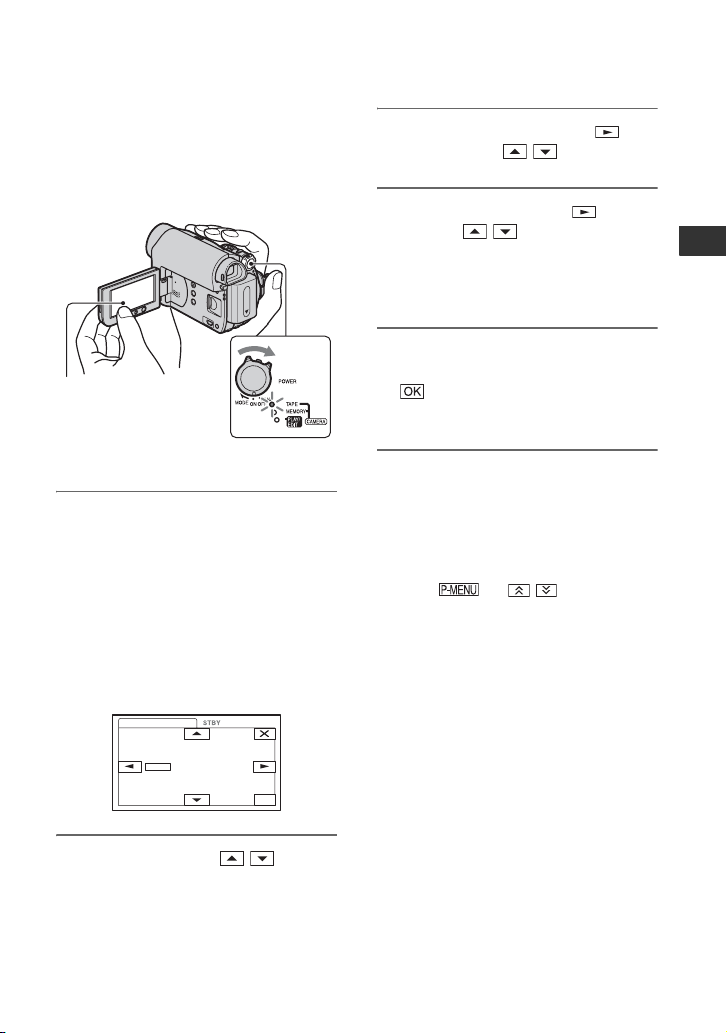
Step 3: Turning the power on and setting the
date and time
Set the date and time when using this
camcorder for the first time. If you do not
set the date and time, the [CLOCK SET]
screen appears every time you turn on your
camcorder or change the POWER switch
position.
1 While pressing the green button,
slide the POWER switch in the
direction of the arrow to turn on
the respective lamp.
CAMERA-TAPE: To record on a tape.
CAMERA-MEMORY: To record on a
“Memory Stick Duo.”
PLAY/EDIT: To play or edit pictures.
The [CLOCK SET] screen appears.
2 Set [Y] (year) with / .
You can set any year up to the year
2079.
3 Move to [M] (month) with ,
then set with / .
4 Move to [D] (day) with , then
set with / and repeat for the
hour and minute.
For midnight, set it to 12:00 AM.
For midday, set it to 12:00 PM.
5 Make sure the date and time
settings are correct, then touch
.
The clock starts.
To turn off the power
Slide the POWER switch to OFF (CHG).
To reset the date and time
You can set the desired date and time by
touching t / t [CLOCK
SET] (p. 34).
b Notes
• If you do not use your camcorder for about 3
months, the built-in rechargeable battery gets
discharged and the date and time settings may
be cleared from the memory. In that case,
charge the rechargeable battery and then set the
date and time again (p. 86).
• At the time of purchase, the power is set to turn
off automatically if you leave your camcorder
without any operation attempted for
approximately 5 minutes, to save battery power
([A.SHUT OFF], p. 52).
z Tips
• The date and time are not displayed while
recording, but they are automatically recorded
on the tape, and can be displayed during
playback (see page 51 for [DATA CODE]
(During Easy Handycam operation, you can set
only [DATE/TIME])).
POWER switch
Touch the button
on the LCD screen.
OK
CLOCK SET
JAN
AM
–:––:––
2008
YM
1
D
12:00
Continued ,

16
• If the buttons on the touch panel do not work
correctly, adjust the touch panel
(CALIBRATION) (p. 85).
You can change the on-screen displays to
show messages in a specified language.
Touch t [MENU] t
(TIME/LANGU.) t [LANGUAGE],
then select the desired language.
Changing the language setting
Step 3: Turning the power on and setting the date and time (Continued)

17
Getting Started
Step 4: Making setting adjustments before
recording
Slide the LENS COVER switch to OPEN.
After recording, set the LENS COVER
switch to CLOSE, to close the lens cover.
Open the LCD panel 90 degrees to the
camcorder (1), then rotate it to the best
angle to record or play (2).
b Notes
• Do not press the buttons below the LCD frame
accidentally when you open or adjust the LCD
panel.
z Tips
• If you rotate the LCD panel 180 degrees to the
lens side, you can close the LCD panel with the
LCD screen facing out. This is convenient
during playback operations.
• See [LCD/VF SET] - [LCD BRIGHT] (p. 51) to
adjust the brightness of the LCD screen.
• Press DISP/BATT INFO to toggle the screen
indicators (such as Battery Info) on or off.
You can view pictures using the viewfinder
to avoid wearing down the battery, or when
the picture seen on the LCD screen is poor.
z Tips
• You can adjust the brightness of the viewfinder
backlight by selecting [LCD/VF SET] - [VF
B.LIGHT] (p. 51).
Fasten the grip belt and hold your
camcorder correctly.
Opening the lens cover
The LCD panel
2
2
1
90 degrees to
the camcorder
90 degrees
(max.)
DISP/BATT INFO
180 degrees
(max.)
The viewfinder
The grip belt
Viewfinder lens
adjustment lever
Move it until the picture is
clear.
Viewfinder
2
1
4
3

18
Step 5: Inserting a tape or a “Memory Stick
Duo”
You can use mini DV cassettes only
(p. 79).
1 Slide and hold the OPEN/
EJECT lever in the direction of the
arrow and open the lid.
The cassette compartment automatically
comes out and opens up.
2 Insert a cassette with its window
facing outwards, then press
.
The cassette compartment
automatically slides back in.
b Notes
• Do not force the cassette
compartment closed by pressing the
portion marked while
it is sliding in. It may cause a
malfunction.
3 Close the lid.
To eject the cassette
Open the lid following the same procedure
as described in step 1 and remove the
cassette.
z Tips
• The recordable time varies depending on
[ REC MODE] (p. 50).
You can use “Memory Stick” that have the
logo shown below (
p. 80).
– (“Memory Stick Duo”)
– (“Memory Stick
PRO Duo”)
– (“Memory Stick
PRO-HG Duo”)
1 Open the LCD panel.
Cassette tape
OPEN/EJECT lever
Lid
Window
Push the center of the back
of the cassette lightly.
Cassette compartment
“Memory Stick Duo”
{DO NOT PUSH}
19
Getting Started
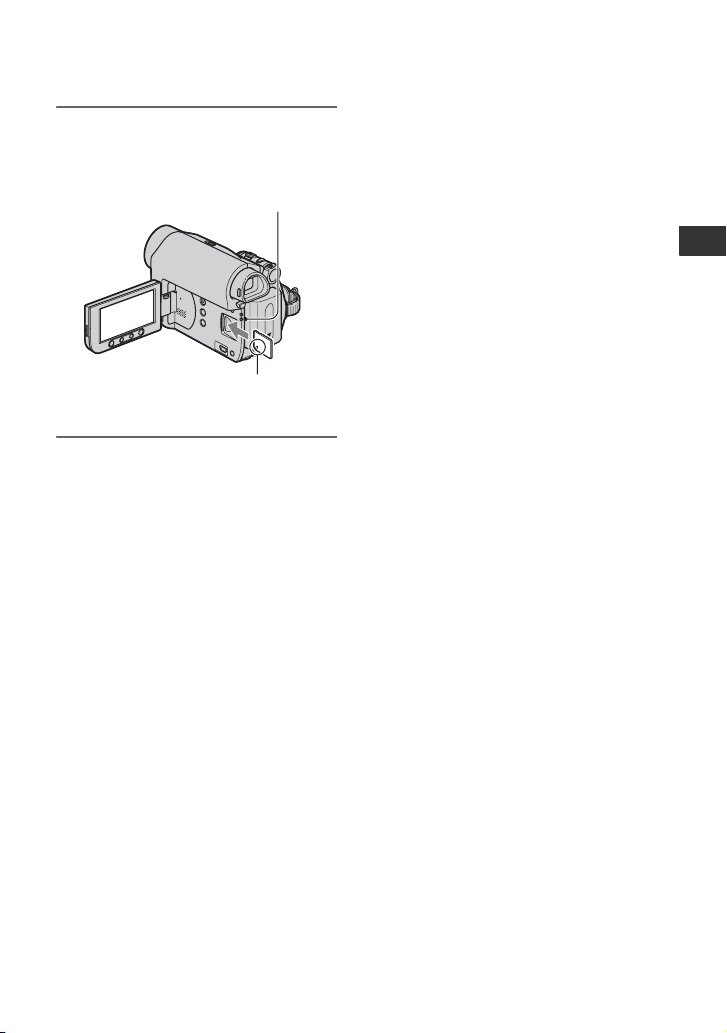
2 Insert the “Memory Stick Duo”
into the Memory Stick Duo slot in
the right direction until it clicks.
To eject a “Memory Stick Duo”
Lightly push in once and slide out the
“Memory Stick Duo” alongside the
camcorder body.
b Notes
• When the access lamp is lit or flashing, your
camcorder is reading/writing data. Do not shake
or knock your camcorder, turn the power off,
eject the “Memory Stick Duo,” or remove the
battery pack. Otherwise, image data may be
damaged.
• If you force the “Memory Stick Duo” into the
slot in the wrong direction, the “Memory Stick
Duo,” the Memory Stick Duo slot, or image data
may be damaged.
• Do not remove the “Memory Stick Duo”
forcibly with the fingers as it may be damaged.
• When inserting or ejecting the “Memory Stick
Duo,” be careful that the “Memory Stick Duo”
does not pop out and drop.
z Tips
• The number of recordable pictures varies
depending on the image quality or the image
size. For details, see page 42.
Access lamp
With the v mark facing to
the LCD screen
20
Recording/Playback
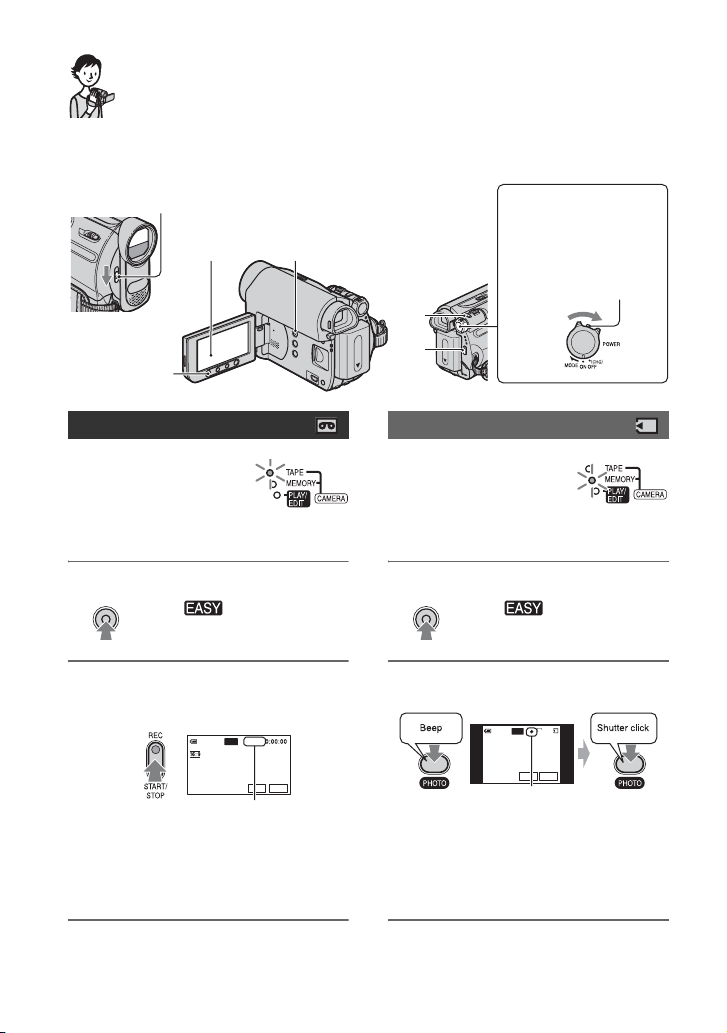
Easy Recording/Playback (Easy Handycam)
With this Easy Handycam operation, most of the camera settings are automatically optimally
adjusted, which frees you from detailed adjustments. The screen font size increases for easy
viewing.
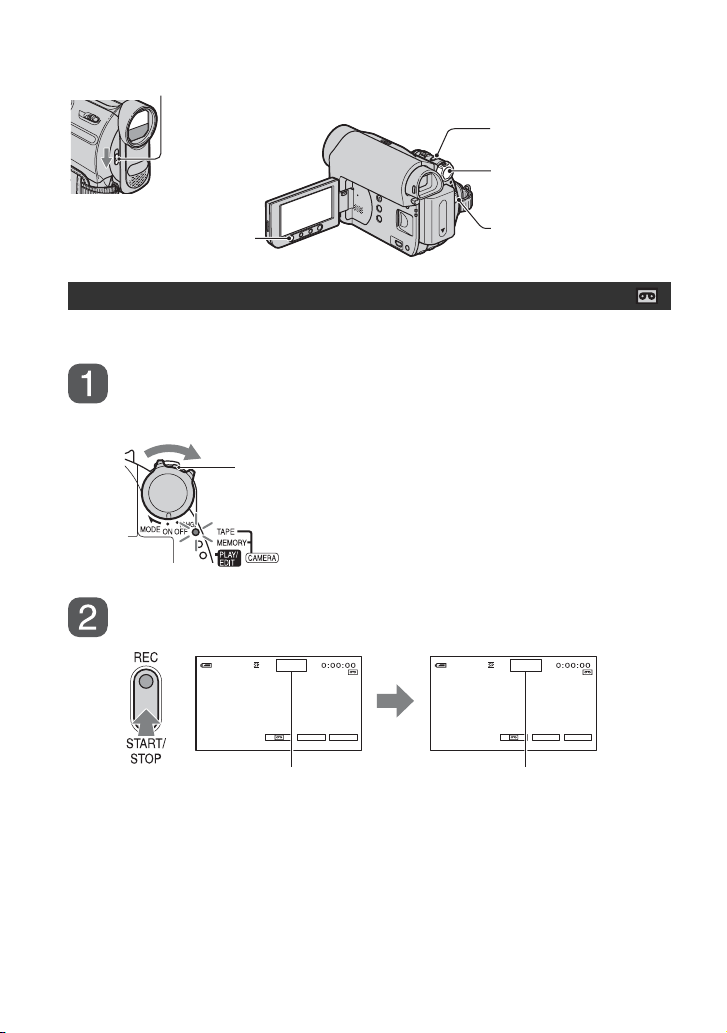
1 Slide the POWER
switch E to turn on
the CAMERA-TAPE
lamp.
2 Press EASY A.
appears on the
screen B.
3 Press REC START/STOP F (or
C) to start recording.*
To stop recording, press REC START/
STOP again.
1 Slide the POWER
switch E to turn on
the CAMERA-
MEMORY lamp.
2 Press EASY A.
appears on the
screen B.
3 Press PHOTO D to record.**
B A
C
E
D
F
Open the lens cover (p. 17).
If the POWER switch is set
to OFF (CHG), slide it
while pressing the green
button.
Movies
EASY
MENUGUIDE
REC
60min
EASY
The indicator changes
from [STBY] to [REC].
Still images (4:3)
EASY
MENUGUIDE
60min
30
1.0M
EASY
Flashing t Lit
Press and hold lightly
to adjust the focus.
Press fully to record.
* Movies are recorded in SP (Standard Play) mode on a cassette.
** Still images are recorded in [FINE] quality on a “Memory Stick Duo.”
21
Recording/Playback
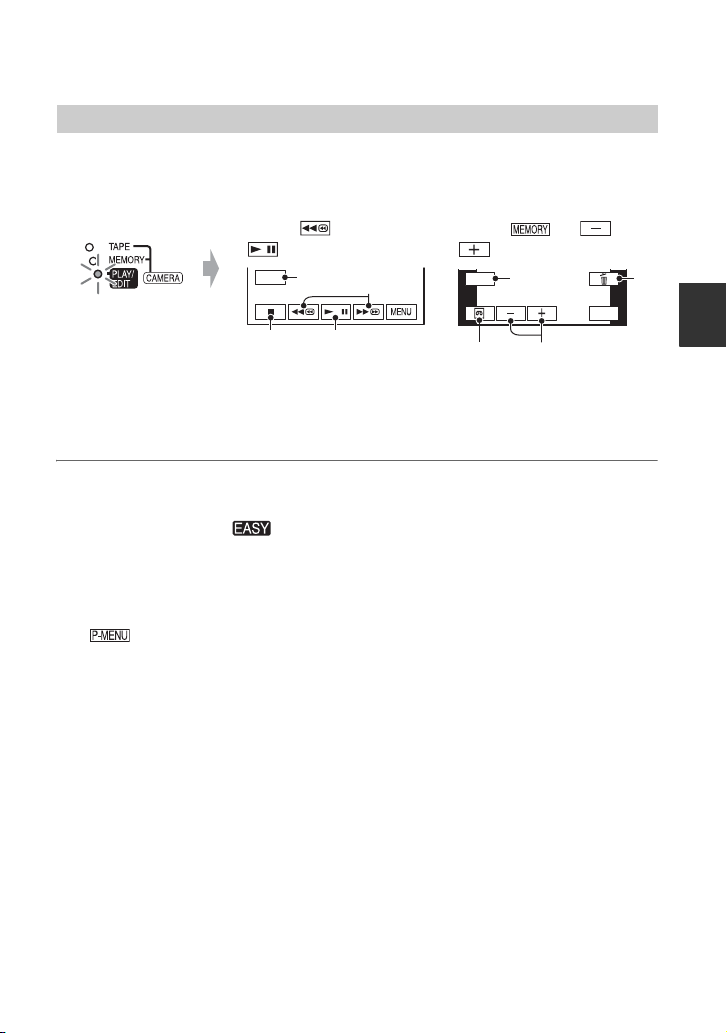
Slide the POWER switch E to turn on the PLAY/EDIT lamp. Touch the buttons
on the screen B as follows.
x To cancel Easy Handycam operation
Press EASY A again. disappears from the screen.
x Adjustable menu settings during Easy Handycam operation
Touch [MENU] to display adjustable menu settings. See page 34 for details on settings.
• Almost all the settings return to their defaults automatically (p. 35).
• is not displayed during Easy Handycam operation.
• Cancel Easy Handycam operation if you want to add any effects or settings to the images.
x Unavailable buttons during Easy Handycam
During Easy Handycam operation, the following buttons are unavailable. [Invalid during
Easy Handycam operation.] may appear if operations not available during Easy Handycam
are attempted.
• . (back light) button (p. 25)
• WIDE SELECT button (in the CAMERA-MEMORY mode) (p. 25)
• PHOTO button (in the CAMERA-TAPE mode) (p. 22)
Playing back movies/still images
GUIDE
A
DC
B
MENU
GUIDE
BC
D
A
Movies
Touch , then touch
to start playback.
S
till images
Touch t /
to select a picture.
A GUIDE (p. 28)
B Rewind/Fast forward
C Stop
D Play/Pause toggles
A GUIDE (p. 28)
B Tape playback
C Previous/Next
D Delete (p. 60)
22
Recording
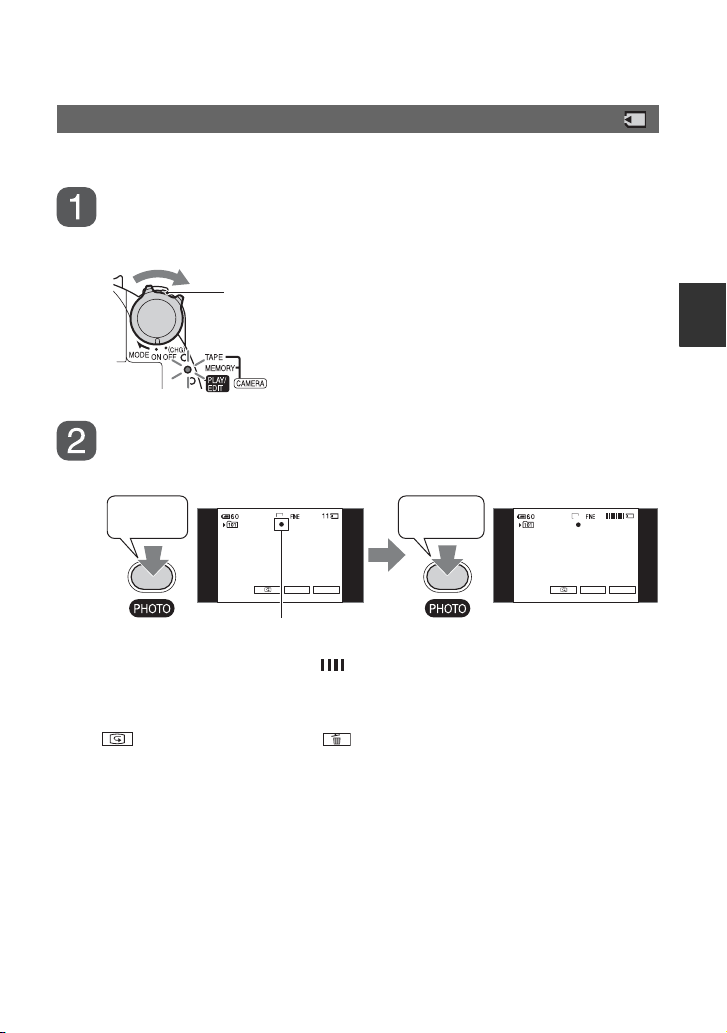
Movies are recorded on a tape.
Slide the POWER switch in the direction of the arrow repeatedly
to turn on the CAMERA-TAPE lamp.
Press REC START/STOP A (or B
).
To stop recording, press REC START/STOP A (or B) again.
b Notes
• You cannot record movies onto a “Memory Stick Duo” using your camcorder.
z Tips
• While recording movies on a tape, or while in standby mode, you can record a still image on a “Memory
Stick Duo” by pressing PHOTO fully. Still images will be fixed to image size [0.2M] in 16:9 screen or
[VGA (0.3M)] in 4:3 screen (p. 42).
Recording movies
O
pen t
h
e
l
ens cover
(
p.
1
7
)
.
PHOTO
REC START/
STOP B
POWER switch
REC START/
STOP A
If the POWER switch is set to OFF (CHG), slide it
while pressing the green button.
60min
60min
60min
60min
STBY REC
P-MENUGUIDE P-MENUGUIDE
[STBY] [REC]
23
Recording/Playback
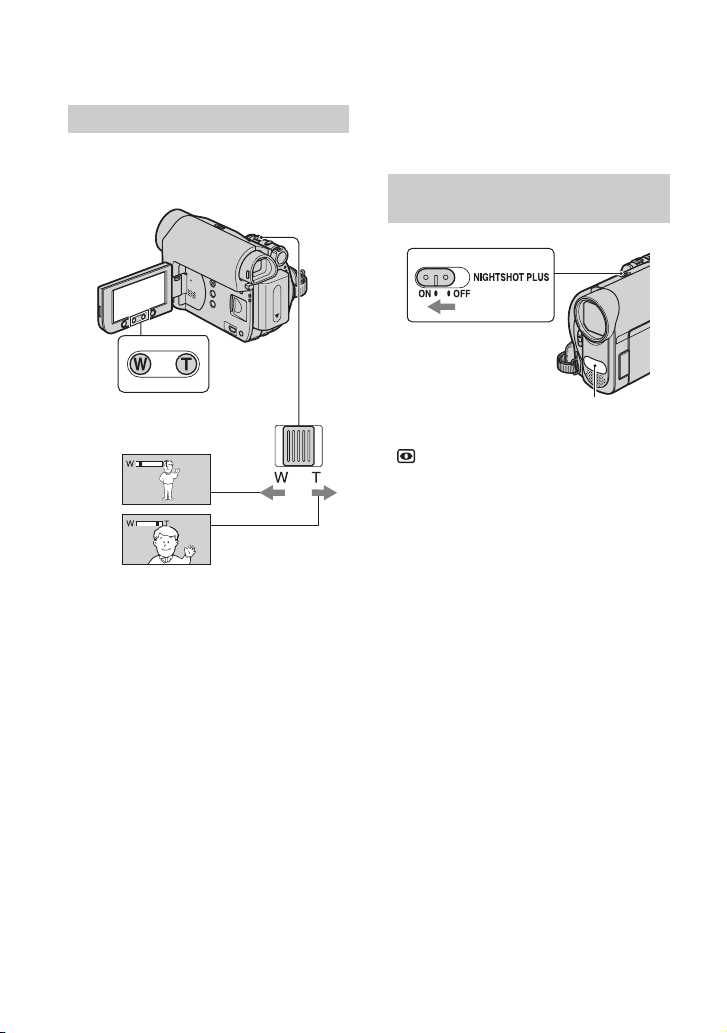
Still images are recorded on the “Memory Stick Duo.”
Slide the POWER switch in the direction of the arrow repeatedly
to turn on the CAMERA-MEMORY lamp.
Press and hold PHOTO lightly to adjust the focus, then press it
fully.
A shutter sound is heard. When disappears, the image has been recorded.
To check the latest recording on a “Memory Stick Duo”
Touch . To delete the picture, touch t [YES].
z Tips
• See page 42 for details on the image quality, the image size or the number of recordable pictures.
Recording still images
If the POWER switch is set to OFF (CHG), slide it
while pressing the green button.
1.0M 1.0M
P-MENU P-MENUGUIDE
min min
GUIDE
Beep
Shutter click
Flashing bLights up
Continued ,
24
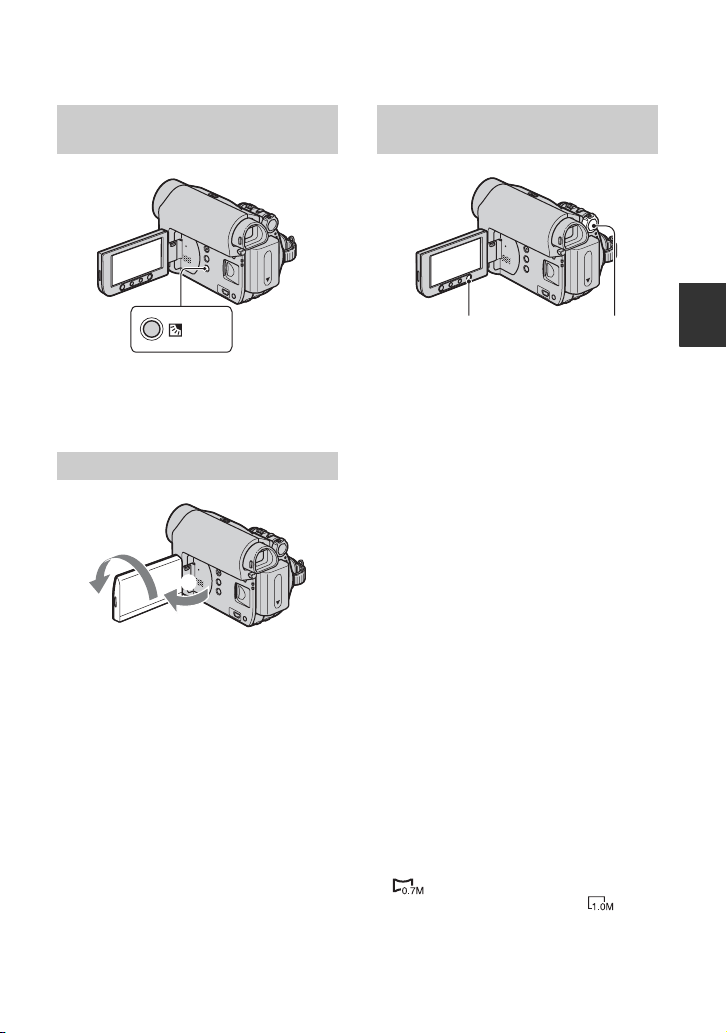
You can magnify images up to 25 times the
original size with the power zoom lever or
the zoom buttons below the LCD frame.
Move the power zoom lever slightly for a
slower zoom. Move it further for a faster
zoom.
b Notes
• [STEADYSHOT] may not reduce image
blurring as desired when the power zoom lever
is set to the T (Telephoto) side.
• Be sure to keep your finger on the power zoom
lever. If you move your finger off the power
zoom lever, the operation sound of the power
zoom lever may also be recorded.
• You cannot change the zoom speed with the
zoom buttons below the LCD frame.
• The minimum possible distance between
camcorder and subject while maintaining sharp
focus is about 1 cm (about 13/32 in.) for wide
angle and about 80 cm (about 2 5/8 feet) for
telephoto.
z Tips
• You can set [DIGITAL ZOOM] (p. 41) if you
want to zoom to a level greater than 25 ×.
Set the NIGHTSHOT PLUS switch to ON.
( and [“NIGHTSHOT PLUS”]
appears.)
b Notes
• The NightShot plus and Super NightShot plus
functions use infrared light. Therefore, do not
cover the infrared port with your fingers or other
objects. Remove the conversion lens (optional)
if it is attached.
• Adjust the focus manually ([FOCUS], p. 39)
when it is hard to focus automatically.
• Do not use the NightShot plus and Super
NightShot plus functions in bright places. This
may cause a malfunction.
z Tips
• To record an image brighter, use Super
NightShot plus function (p. 40). To record an
image more faithfully to the original colors, use
Color Slow Shutter function (p. 40).
Zooming
Wider range of view:
(Wide angle)
Close view: (Telephoto)
Recording in dark places
(NightShot plus)
Infrared port
Recording (Continued)
25
Recording/Playback
To adjust the exposure for backlit subjects,
press . (back light) to display .. To
cancel the backlight function, press .
(back light) again.
Open the LCD panel 90 degrees to the
camcorder (1), then rotate it 180 degrees
to the lens side (2).
z Tips
• A mirror-image of the subject appears on the
LCD screen, but the image will be normal when
recorded.
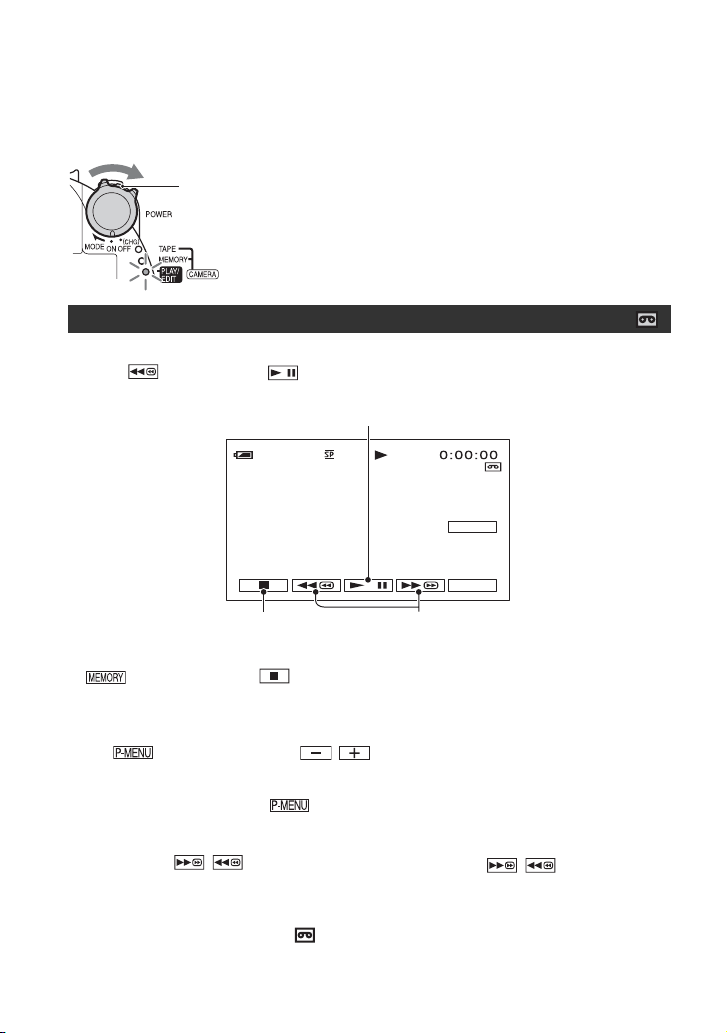
Selecting the aspect ratio for movies
1 Set the POWER switch to CAMERA-
TAPE.
2 Press WIDE SELECT repeatedly to
select the desired screen aspect ratio.
z Tips
• Differences between 4:3 and 16:9 image views
vary depending on the zoom position when
recording.
• If you play back a picture on TV, set [TV
TYPE] for playback in the aspect ratio of the
TV (p. 33).
• When viewing pictures recorded in 16:9 aspect
ratio with [TV TYPE] set to [4:3], pictures may
appear rough depending on the subject (p. 33).
Selecting the aspect ratio for still
images
1 Set the POWER switch to CAMERA-
MEMORY.
The aspect ratio of the picture switches
to 4:3.
2 Press WIDE SELECT to select the
desired screen aspect ratio.
b Notes
• Still images will be fixed to image size [0.7M]
( ) in the 16:9 (wide) mode. In the 4:3
mode, you can select up to [1.0M] ( ).
z Tips
• For the number of recordable pictures, see page
42.
Adjusting the exposure for
backlit subjects
Recording in mirror mode
2
1
Selecting the aspect ratio (16:9
or 4:3) of the recording picture
WIDE SELECT POWER switch
26
Playback
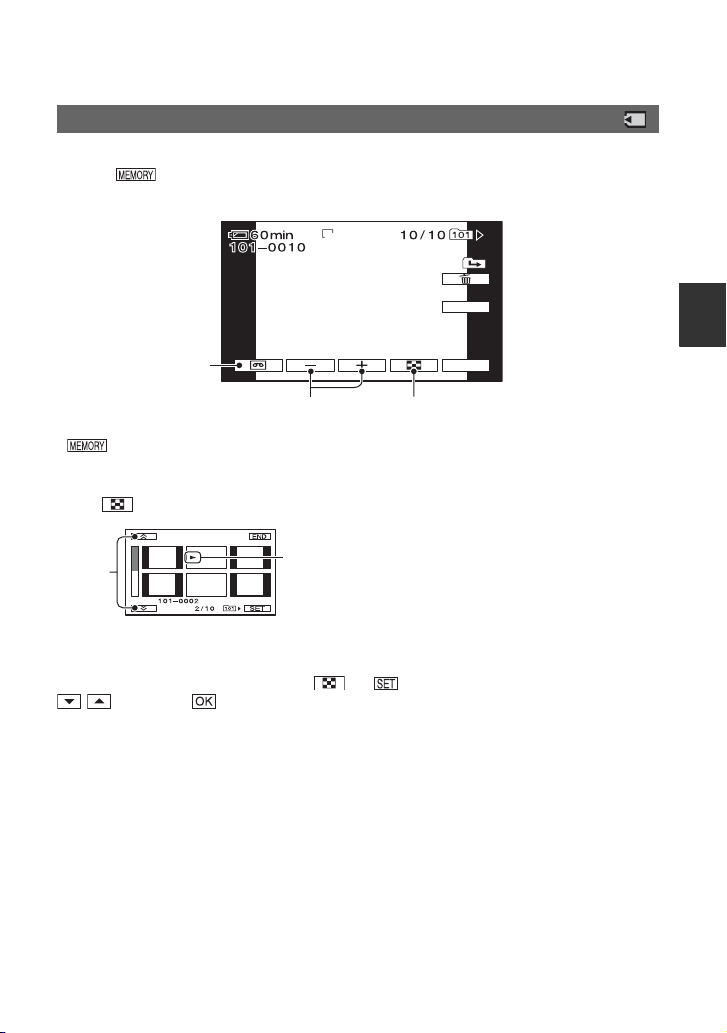
Slide the POWER switch in the direction of the arrow repeatedly to
turn on the PLAY/EDIT lamp.
Touch , then touch to start playback.
* Playback automatically stops if pause is engaged for more than 3 minutes.
** is displayed instead of when a “Memory Stick Duo” with recorded images is inserted and
a tape is not being played.
To adjust the sound volume
Touch t [VOLUME], then / to adjust the volume.
z Tips
• If you cannot find [VOLUME] in , touch [MENU] (p. 34).
To search for a scene during playback
Touch and hold / during playback (Picture Search), or / while fast
forwarding or rewinding the tape (Skip Scan).
z Tips
• You can play back in various modes ([ VAR.SPD PB], p. 48).
Playing movies
If the POWER switch is set to OFF (CHG), slide it
while pressing the green button.
P-MENU
GUIDE
60min
60min
Toggles Play or Pause as you touch*
Stop** Rewind/Fast forward
27
Recording/Playback
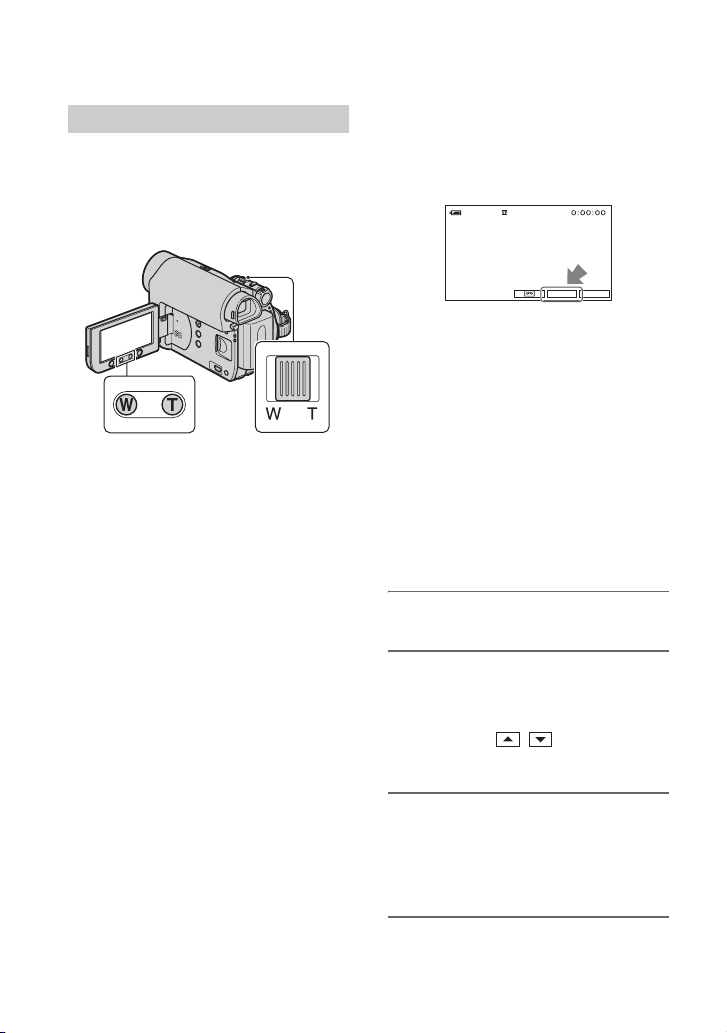
Touch .
The most recently recorded image is displayed.
* is displayed on the tape playback screen.
To display pictures on a “Memory Stick Duo” on the index screen
Touch . Touch one of the pictures to back to the single display mode.
A Previous/Next 6 pictures
B The picture displayed before switching to the index screen.
To view pictures in other folders, touch t t [PB FOLDER], select a folder with
/ , then touch (p. 44).
Viewing still images
P-MENU
GUIDE
MEMORY PLAY
MEMORY PLAY
MEMORY PLAY
1.0M
Previous/Next Go to the index screen display
Switch the playback
media*
A
B
Continued ,
28
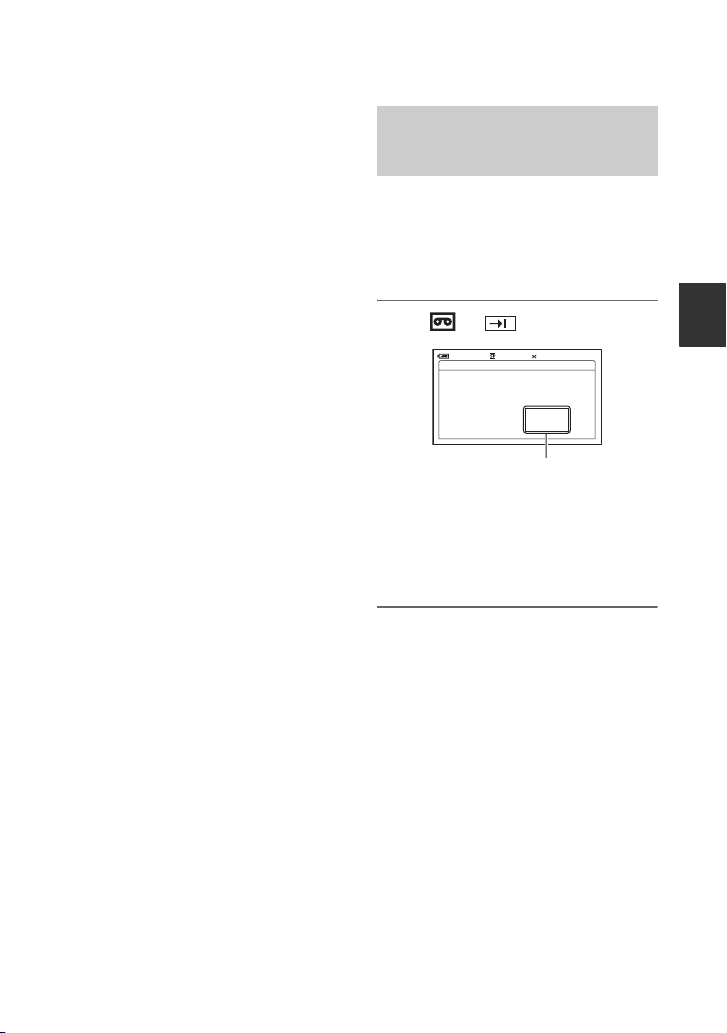
You can magnify the recorded picture from
about 1.1 to 5 times the original size.
Magnification can be adjusted with the
power zoom lever or the zoom buttons
below the LCD frame.
1 Play back the picture you want to
magnify.
2 Magnify the picture with T (Telephoto).
The screen is framed.
3 Touch the screen at the point you want
to display in the center of the displayed
frame.
4 Adjust the magnification with W (Wide
angle)/T (Telephoto).
To cancel, touch [END].
b Notes
• You cannot change the zoom speed with the
zoom buttons below the LCD frame.
Using PB zoom
Using the guide
functions (USAGE
GUIDE)
You can easily select the desired setting
screens by using the guide functions
(USAGE GUIDE).
Your camcorder has 3 guide functions as
shown below.
1 Touch [GUIDE].
2 Select the desired item.
e.g., to record night views
Touch [SHOOT GUIDE] t [SELECT
SCENE] t / to display [To
keep the mood of a night view].
3 Touch [SET].
The desired setting screen appears.
Adjust the settings according to your
purpose.
SHOOT
GUIDE:
Takes you to the setting
screens related to
recording.
USEFUL
GUIDE:
Takes you to the setting
screens related to the
basic operations.
DISP
GUIDE:
Enables you to check the
meaning of each indicator
that appears on the LCD
screen. See page 96 for
details.
60min
STBY
P-MENUGUIDE
Playback (Continued)
29
Recording/Playback
Unavailable settings during Easy
Handycam
During Easy Handycam operation, some
items are unavailable. If an attempted
setting is not available, but still desired,
touch [SET] to display an on-screen
instruction. Follow the instruction to cancel
Easy Handycam operation and then select
the setting.
z Tips
• If [SET] is not displayed in step 3, follow the
instruction on the screen.
Searching for the
starting point
[END SEARCH] will not work once you
eject the cassette after you have recorded on
the tape.
Make sure that the CAMERA-TAPE
lamp lights up (p. 22).
Touch t .
The last scene of the most recent
recording is played back for about 5
seconds, and the camcorder enters the
standby mode at the point where the last
recording has finished.
b Notes
• [END SEARCH] will not work correctly when
there is a blank section between recorded
sections on the tape.
z Tips
• You can also select [END SEARCH] from the
menu. When the PLAY/EDIT lamp lights up,
select the [END SEARCH] short-cut in Personal
Menu (p. 34).
Searching for the last scene of
the most recent recording (END
SEARCH)
END SEARCH
EXECUTING
CANCEL
0:00:00160min
Touch here to cancel the operation.
Continued ,

30
You can search for the start point to start
the next recording while viewing the
pictures on the screen. The sound is not
played back during the search.
Make sure that the CAMERA-TAPE
lamp lights up (p. 22).
1 Touch .
2 Touch and hold (to go
backward)/ (to go forward)
and release it at the point where
you want the recording to start.
You can view about 2 seconds of the scene
recorded just before you stopped the tape.
Make sure that the CAMERA-TAPE
lamp lights up (p. 22).
Touch t .
The last 2 seconds (approx.) of the most
recently recorded scene are played back.
Then, your camcorder is set to standby.
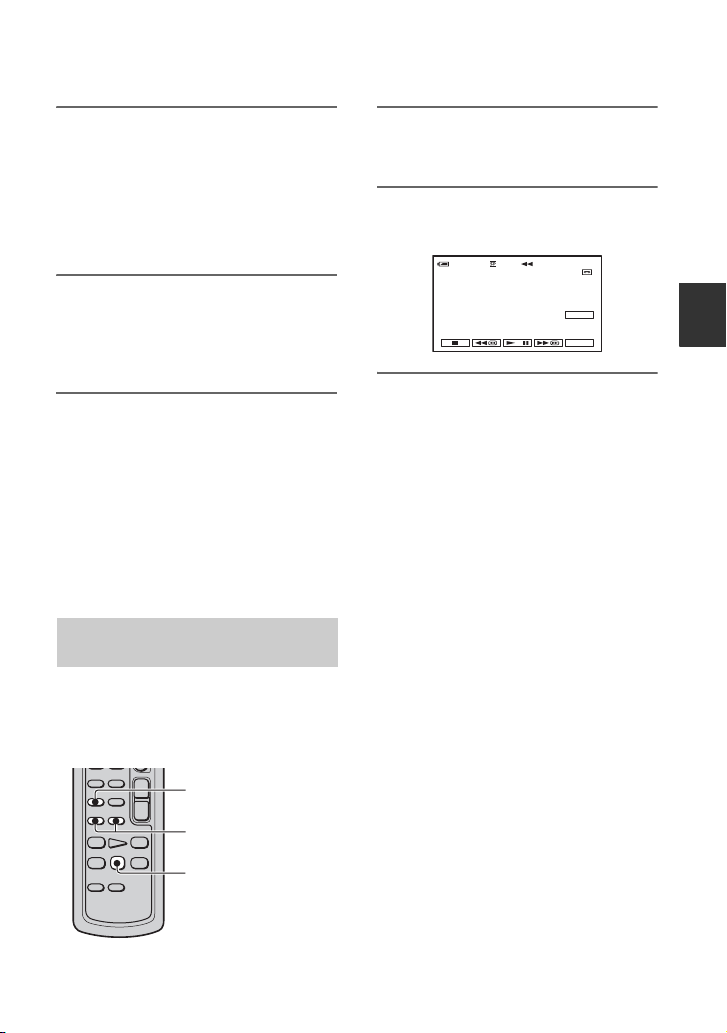
Make sure that the PLAY/EDIT lamp
lights up (p. 26).
1 During playback, press ZERO
SET MEMORY on the Remote
Commander at a point you want
to locate later on.
The tape counter is reset to “0:00:00”
and appears on the screen.
If the tape counter is not displayed,
press DISPLAY.
2 Press STOP when you want to
stop playback.
Searching manually
(EDIT SEARCH)
Reviewing the most recently
recorded scenes (Rec review)
0:00:00STBY60min
EDIT
0:00:00STBY60min
EDIT
Searching quickly for a desired
scene (Zero set memory)
mREW
PLAY
STOP
ZERO SET MEMORY
DISPLAY
0:00:0060min
P-MENU
GUIDE
Searching for the starting point (Continued)
31
Recording/Playback
3 Press mREW.
The tape stops automatically when the
tape counter reaches “0:00:00.”
The tape counter returns to the time
code display, and the zero set memory
display disappears.
4 Press PLAY.
Playback starts from the point
designated “0:00:00” on the tape
counter.
To cancel the operation
Press ZERO SET MEMORY again before
rewinding.
b Notes
• There may be a discrepancy of several seconds
between the time code and the tape counter.
• Zero set memory will not function correctly if
there is a blank section between recorded
sections on the tape.
You can locate the point where the
recording date changes.
Make sure that the PLAY/EDIT lamp
lights up (p. 26).
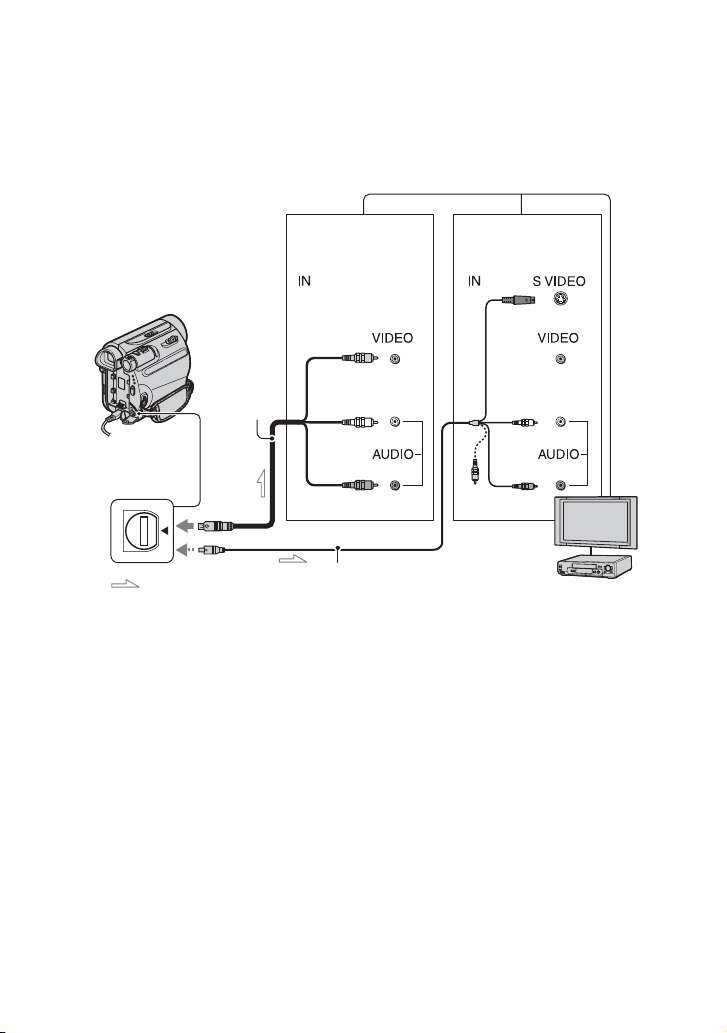
1 Press SEARCH M. on the Remote
Commander.
2 Press .(previous)/>(next) to
select a recording date.
To cancel the operation
Press STOP.
b Notes
• The Date search will not function correctly
when there is a blank section between recorded
sections on the tape.
Searching for a scene by date of
recording (Date search)
SEARCH M.
./>
STOP
P-MENU
30
min
DATE -01
SEACH
60
min
0:00:00:00
GUIDE
32
Playing the picture on a TV
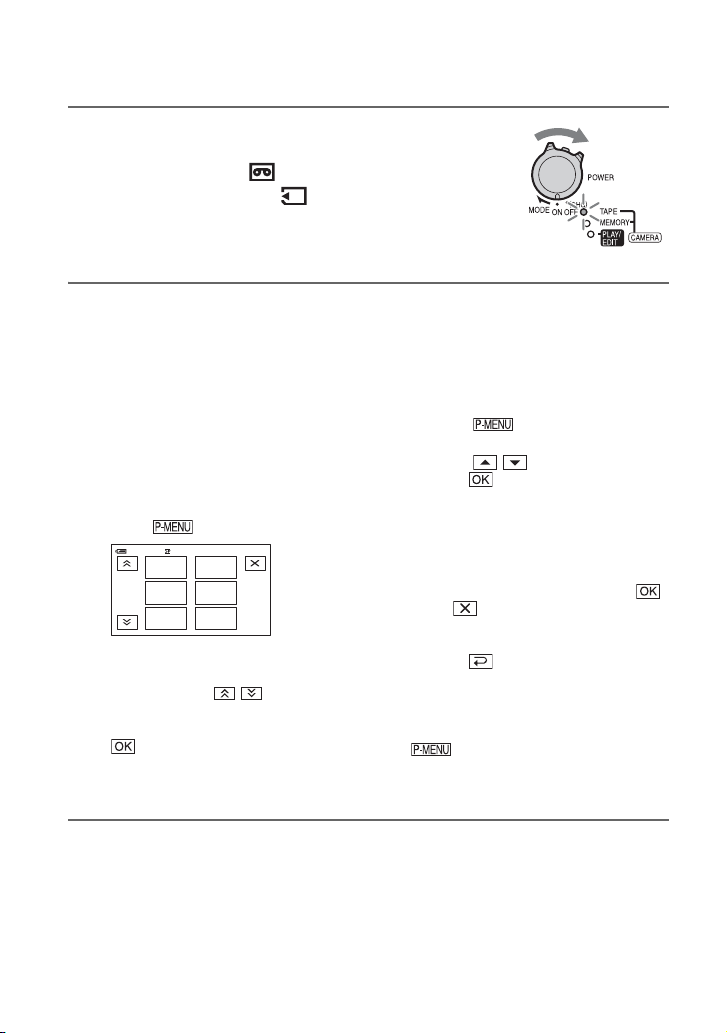
You can connect your camcorder to the input jack of a TV or a VCR using the A/V connecting
cable (1) or the A/V connecting cable with S VIDEO (2). Connect your camcorder to the
wall outlet (wall socket) using the supplied AC Adaptor for this operation (p. 12). Refer also
to the instruction manuals supplied with the devices to be connected.
A A/V connecting cable (supplied)
Connect to the input jack of another device.
B A/V connecting cable with S
VIDEO (optional)
When connecting to another device via the S
VIDEO jack, by using the A/V connecting
cable with an S VIDEO cable, pictures can be
reproduced more faithfully than with the
supplied A/V cable connection.
Connect the white and red plugs (left/right
audio) and S VIDEO plug (S VIDEO
channel) of an A/V connecting cable. In this
case, the yellow (standard video) plug
connection is not necessary. S VIDEO
connection only will not output audio.
z Tips
• You can display the time code on the TV screen
by setting [DISP OUTPUT] to [V-OUT/
PANEL] (p. 52).
When connecting your camcorder to a
TV through a VCR
Connect your camcorder to the LINE IN
input on the VCR. Set the input selector on
the VCR to LINE (VIDEO 1, VIDEO 2,
etc.), if the VCR has an input selector.
2
1
A/V Remote
Connector
(Yellow)
(White)
(Red)
: Signal flow
VCR or TV
(Yellow)
(White)
(Red)
(Black)
Device with an
S VIDEO jack
Device without
an S VIDEO jack

33
Recording/Playback
To set the aspect ratio according to
the connected TV (16:9/4:3)
Change the aspect ratio of the image
according to the screen size of your TV.
1 Slide the POWER switch repeatedly to turn
on the PLAY/EDIT lamp.
2 Touch t [MENU] t
(STANDARD SET) t [TV TYPE] t
[16:9] or [4:3] t .
b Notes
• When you set [TV TYPE] to [4:3], or when the
picture’s aspect ratio switches between 16:9 and
4:3, the image may jitter.
• On some 4:3 TVs, the still image recorded in 4:3
aspect ratio may not appear in full screen. This
is not a malfunction.
• When you play back a picture recorded in 16:9
aspect ratio on a 4:3 TV not compatible with the
16:9 signal, set [TV TYPE] to [4:3].
• When you connect your camcorder to a TV
compatible with the ID-1/ID-2 system, and play
back the tape, set [TV TYPE] to [16:9]. The TV
automatically switches the aspect ratio
according to the playback picture.
When your TV is monaural (Only one
audio input jack)
Connect the yellow plug of the A/V
connecting cable to the video input jack and
connect the white (left channel) or the red
(right channel) plug to the audio input jack
of your TV or VCR.
34
Using the Menu
Using the menu items
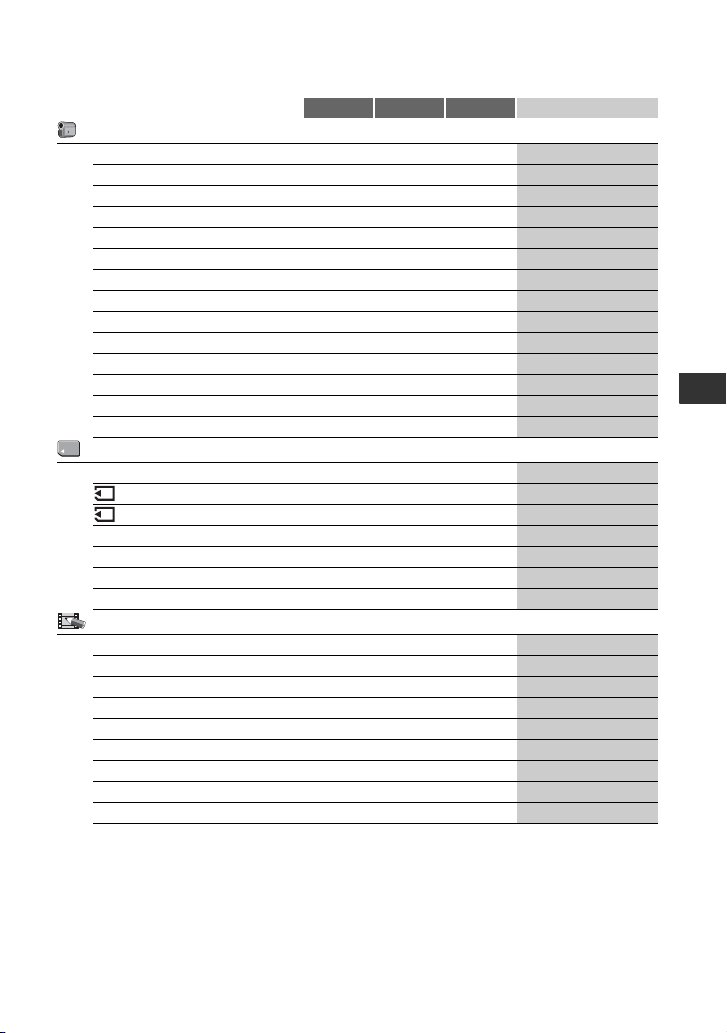
1 Slide the POWER switch in the direction of the arrow
repeatedly to turn on the respective lamp.
CAMERA-TAPE lamp: settings on a tape
CAMERA-MEMORY lamp: settings on a “Memory Stick
Duo”
PLAY/EDIT lamp: settings for viewing/editing
2 Touch the LCD screen to select the menu item.
Unavailable items will be grayed out.
x To use the short-cuts of
Personal Menu
On Personal Menu, short-cuts for
frequently used menu items are added.
z Tips
• You can customize Personal Menu as you
like (p. 54).
1 Touch .
2 Touch the desired item.
If the desired item is not displayed on
the screen, touch / until the item
is displayed.
3 Select the desired setting, then touch
.
x To use menu items
You can customize menu items that are
not added to Personal Menu.
1 Touch t [MENU].
2 Select the desired menu.
Touch / to select the item, then
touch . (The process in step 3 is
the same as that in step 2.)
3 Select the desired item.
You can also touch the item directly to
select it.
4 Customize the item.
After finishing the settings, touch
t (close) to hide the menu
screen.
If you decide not to change the setting,
touch to return to the previous
screen.
x To use menu items during Easy
Handycam operation
is not displayed during Easy
Handycam operation. Touch [MENU]
to display the menu index screen.
1/3
0:00:00
60min
MENU
DISP
GUIDE
LCD
BRIGHT
SCENE
SELECT
FADER
TELE
MACRO
STBY
35
Using the Menu
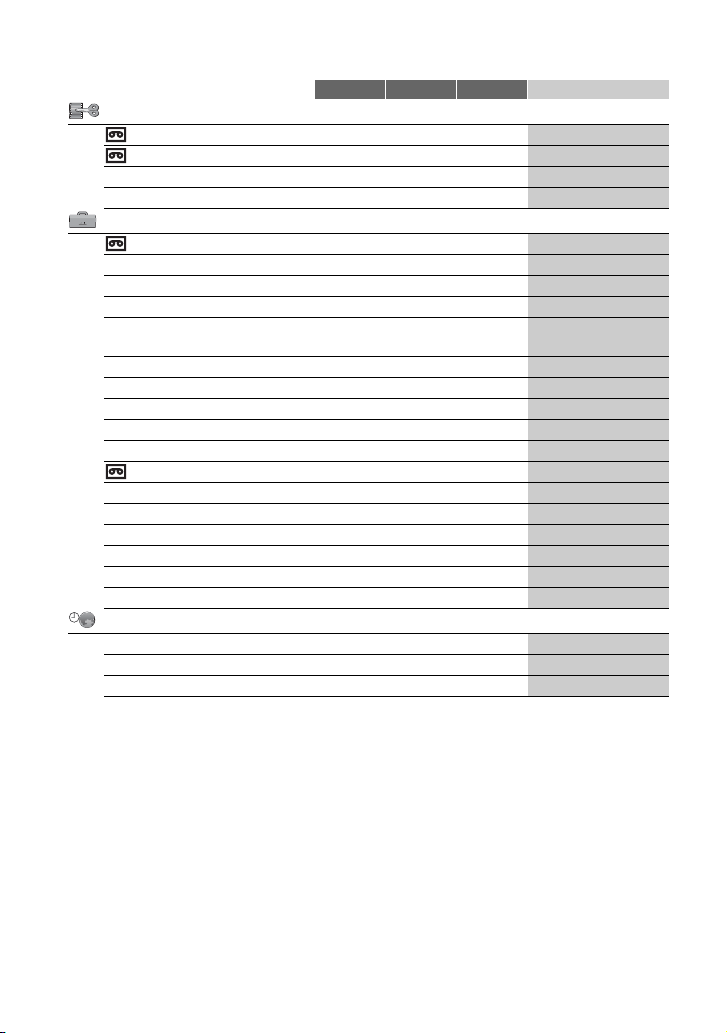
Menu items
Available menu items (z) vary depending on which lamp is lit.
During Easy Handycam operation, the following settings are
automatically applied (p. 20).
TAPE MEMORY PLAY/EDIT Easy Handycam
CAMERA SET menu (p. 37)
SCENE SELECT zz – AUTO
SPOT METER zz –
–
EXPOSURE zz –
AUTO
WHITE BAL. zz –
AUTO
AUTOSLW SHTR z ––
ON
SPOT FOCUS zz –
–
FOCUS zz –
AUTO
TELE MACRO zz –
OFF
SUPER NSPLUS z ––
OFF
NS LIGHT zz –
ON
COLOR SLOW S z ––
OFF
SELF-TIMER z*
1
z – z*
2
DIGITAL ZOOM z –– OFF
STEADYSHOT z ––
ON
MEMORY SET menu (p. 42)
STILL SET – zzOFF/FINE/z
ALL ERASE – – z
z
FORMAT – zz
–
FILE NO. – zz
SERIES
NEW FOLDER – zz
–
REC FOLDER – zz
–*
3
PB FOLDER – – z –*
3
PICT.APPLI. menu (p. 44)
FADER z –– OFF
SLIDE SHOW – – z
–
D.EFFECT z – z
OFF
PICT.EFFECT z – z
OFF
SMTH INT.REC z ––
–
INT.REC-STL – z –
OFF
DEMO MODE z ––
ON
PictBridge PRINT – – z
–
USB SELECT – – z
z
Continued ,
36
EDIT/PLAY menu (p. 48)
VAR.SPD PB – – z
–
REC CTRL – – z
–
AUD DUB CTRL – – z
–
END SEARCH z – z
–
STANDARD SET menu (p. 50)
REC MODE z – z SP
AUDIO MODE z ––
12BIT
VOLUME – – z
z
AUDIO MIX – – z
–
LCD/VF SET zzz
– /NORMAL/ – /
NORMAL
TV TYPE zzz
–*
3
USB CAMERA z –– OFF
DISP GUIDE zzz
z
GUIDEFRAME zz –
OFF
DATA CODE – – z
z
REMAINING z – z
AUTO
REMOTE CTRL zzz
ON
BEEP zzz
z
DISP OUTPUT zzz
LCD PANEL
MENU ROTATE zzz
–
A.SHUT OFF zzz
5 min
CALIBRATION – – z
–
TIME/LANGU. menu (p. 53)
CLOCK SET zzz z
WORLD TIME zzz
–*
3
LANGUAGE zzz –*
3
*
1
This setting is available only when recording a still image.
*
2
The setting is displayed only when the POWER switch is set to CAMERA-MEMORY.
*
3
The setting value before entering Easy Handycam operation will be retained.
TAPE MEMORY PLAY/EDIT Easy Handycam
Menu items (Continued)
37
Using the Menu
CAMERA SET menu
Settings to adjust your camcorder to the
recording conditions
The default settings are marked with B.
The indicators in parentheses appear when
the items are selected.
See page 34 for details on selecting
menu items.
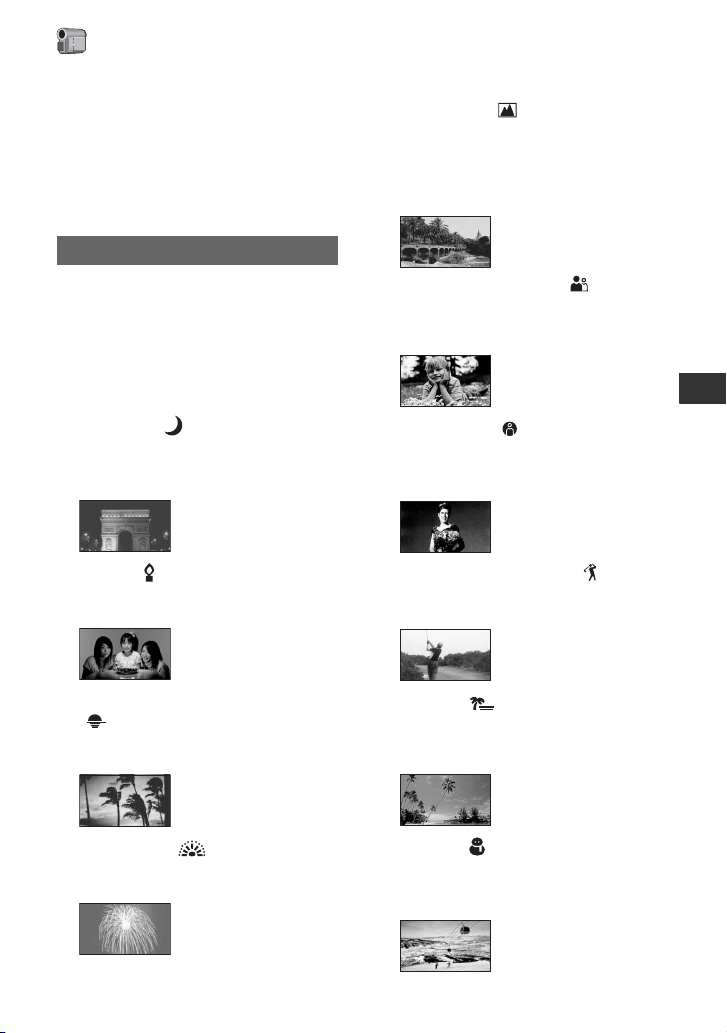
You can record pictures effectively in
various situations with the SCENE
SELECT function.
B AUTO
Select to automatically record pictures
effectively without the [SCENE SELECT]
function.
TWILIGHT* ( )
Select to maintain the darkening
atmosphere of the distant surroundings in
twilight scenes.
CANDLE ( )
Select to maintain the dim atmosphere of a
candlelit scene.
SUNRSE SUNSET* (Sunrise & Sunset)
()
Select to maintain the atmosphere of
situations such as sunsets and sunrises.
FIREWORKS* ( )
Select to record all the splendor of
fireworks.
SCENE SELECT
LANDSCAPE* ( )
Select to shoot distant subjects clearly.
This setting also prevents your camcorder
from focusing on glass or metal mesh in
windows between the camcorder and the
subject.
PORTRAIT (Soft portrait) ( )
Select to bring out the subject such as
people or flowers while creating a soft
background.
SPOTLIGHT** ( )
Select to prevent people’s faces from
appearing excessively white when subjects
are lit by strong light.
SPORTS** (Sports lesson) ( )
Select to minimize shake when shooting
fast moving subjects.
BEACH** ( )
Select to prevent people’s faces from
appearing dark in strong light or reflected
light, such as at a beach in midsummer.
SNOW** ( )
Select this when shooting in very bright,
white conditions, such as on a ski slope;
otherwise picture may appear too dark.
Continued ,
38
b Notes
• If you set [SCENE SELECT], [WHITE BAL.]
setting is canceled.
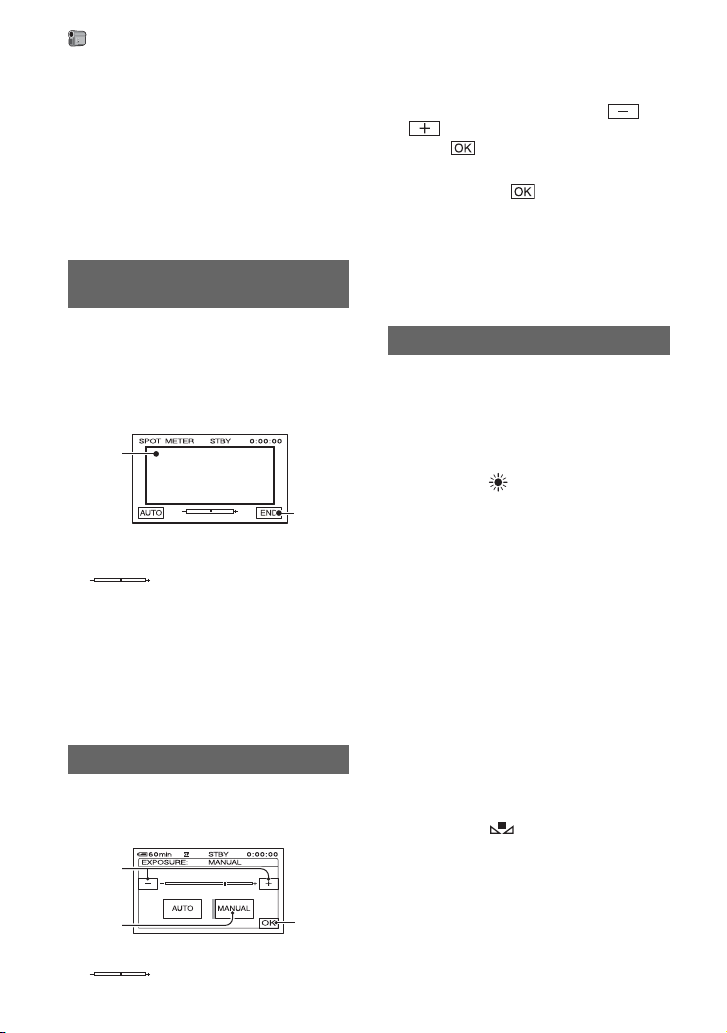
You can adjust and fix the exposure to the
subject, so that it is recorded in suitable
brightness even when there is strong
contrast between the subject and the
background, such as subjects in the
spotlight on stage.
1 Touch the point where you want to fix and
adjust the exposure on the screen.
appears.
2 Touch [END].
To return the setting to automatic exposure,
touch [AUTO] t [END].
b Notes
• If you set [SPOT METER], [EXPOSURE] is
automatically set to [MANUAL].
You can fix the brightness of a picture
manually. Adjust the brightness when the
subject is too bright or too dark.
1 Touch [MANUAL].
appears.
2 Adjust the exposure by touching /
.
3 Touch .
To return the setting to automatic exposure,
touch [AUTO] t .
b Notes
• When you operate the POWER switch or
change the [SCENE SELECT] setting, the
brightness of a picture may be changed even if
you adjusted it in [EXPOSURE].
You can adjust the color balance to the
brightness of the recording environment.
B AUTO
The white balance is adjusted
automatically.
OUTDOOR ( )
The white balance is appropriately
adjusted for the following recording
conditions:
– Outdoors
– Night views, neon signs and fireworks
– Sunrise or sunset
– Under daylight fluorescent lamps
INDOOR (n)
The white balance is appropriately
adjusted for the following recording
conditions:
– Indoors
– At party scenes or studios where the lighting
conditions change quickly
– Under video lamps in a studio, or under
sodium lamps or incandescent-like color
lamps
ONE PUSH ( )
The white balance will be adjusted
according to the ambient light.
1 Touch [ONE PUSH].
2 Frame a white object such as a piece of
paper, to fill the screen under the same
lighting conditions as you will shoot
the subject.
* Adjusted to focus on subjects farther away
only.
** Adjusted not to focus on subjects a short
distance away.
SPOT METER (Flexible spot
meter)
EXPOSURE
1
2
2
1
3
WHITE BAL. (White balance)
CAMERA SET menu (Continued)
39
Using the Menu
3 Touch [ ].
flashes quickly. When the white
balance has been adjusted and stored in
the memory, the indicator stops
flashing.
b Notes
• Set [WHITE BAL.] to [AUTO] or [ONE PUSH]
under white or cool white fluorescent lamps.
• When you select [ONE PUSH], keep framing
white object while is flashing quickly.
• flashes slowly if [ONE PUSH] could not
be set.
• When [ONE PUSH] was selected, if keeps
flashing after touching , set [WHITE BAL.]
to [AUTO].
• If you set [WHITE BAL.], [SCENE SELECT]
is set to [AUTO].
z Tips
• If you have changed the battery pack while
[AUTO] was selected, or taken your camcorder
outdoors after inside use with the [EXPOSURE]
set (or vice versa), select [AUTO] and aim your
camcorder at a nearby white object for about 10
seconds for better color balance adjustment.
• When the white balance has been set with [ONE
PUSH], if you change the [SCENE SELECT]
settings, or bring your camcorder outdoors from
inside the house, or vice versa, you need to redo
the [ONE PUSH] procedure to readjust the
white balance.
When you set [AUTOSLW SHTR] to
[ON], the shutter speed is slowed down
automatically to 1/30 in dark places.
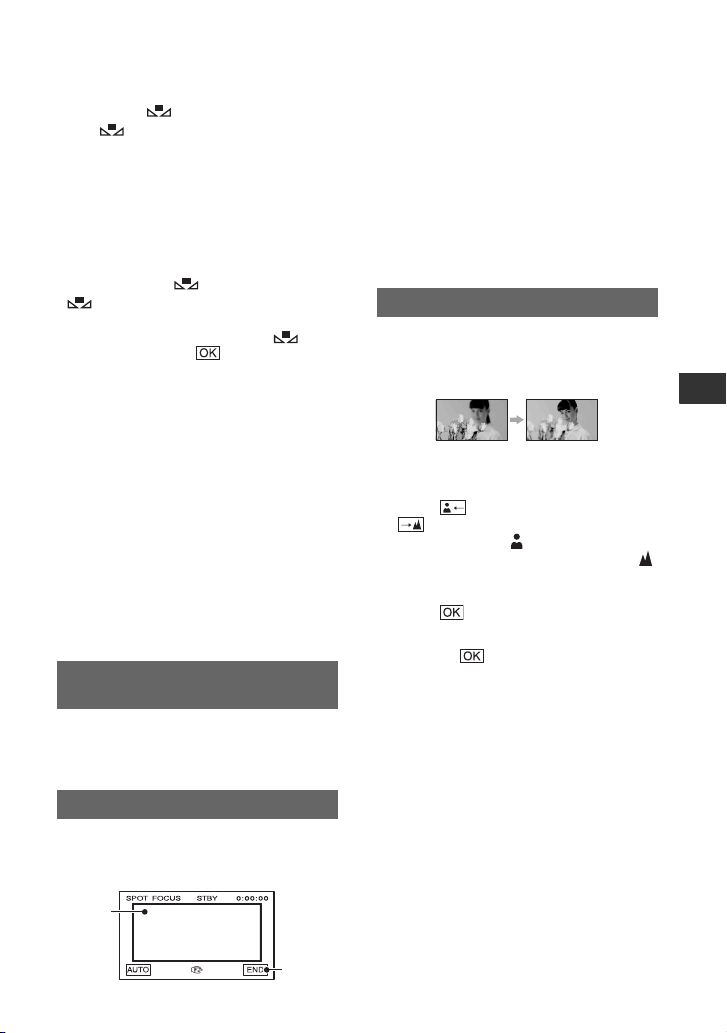
You can select and adjust the focal point to
a subject not located in the center of the
screen.
1 Touch the subject on the screen.
9 appears.
2 Touch [END].
To adjust the focus automatically, touch
[AUTO] t [END].
b Notes
• If you set [SPOT FOCUS], [FOCUS] is
automatically set to [MANUAL].
You can adjust the focus manually. You can
select this function also when you want to
focus on a certain subject intentionally.
1 Touch [MANUAL].
9 appears.
2 Touch (focusing on close subjects)/
(focusing on distant subjects) to
sharpen the focus. appears when the
focus cannot be adjusted any closer, and
appears when the focus cannot be adjusted
farther away.
3 Touch .
To adjust the focus automatically, touch
[AUTO] t .
b Notes
• The minimum possible distance between
camcorder and subject while maintaining sharp
focus is about 1 cm (about 13/32 in.) for wide
angle and about 80 cm (about 2 5/8 feet) for
telephoto.
z Tips
• It is easier to focus on the subject by moving the
power zoom lever towards T (Telephoto) to
adjust the focus, then towards W (Wide angle)
to adjust the zoom for recording. When you
want to record a subject at close range, move the
power zoom lever to W (Wide angle), then
adjust the focus.
AUTOSLW SHTR (Auto Slow
Shutter)
SPOT FOCUS
1
2
FOCUS
Continued ,
40
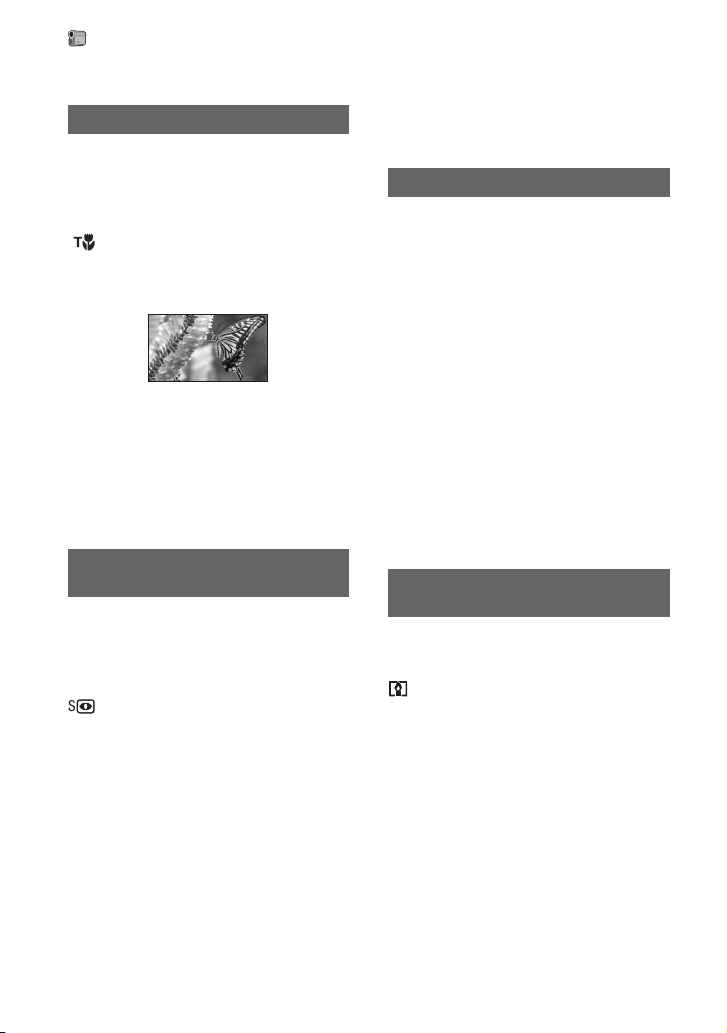
This is useful to shoot small subjects, such
as flowers or insects. You can blur out
backgrounds and the subject stands out
clearer.
When you set [TELE MACRO] to [ON]
( ), the zoom (p. 24) moves to the top of
the T (Telephoto) side automatically and
allows for recording subjects at a close
distance, down to about 38 cm (15 in.).
To cancel, touch [OFF], or zoom to wide-
angle (W side).
b Notes
• When recording a distant subject, focusing may
be difficult and can take some time.
• Adjust the focus manually ([FOCUS], p. 39)
when it is hard to focus automatically.
The picture will be recorded at a maximum
of 16 times the sensitivity of NightShot plus
recording if you set [SUPER NSPLUS] to
[ON] while the NIGHTSHOT PLUS switch
(p. 24) is also set to ON.
and [“SUPER NIGHTSHOT PLUS”]
appear on the screen.
To cancel the setting, set [SUPER
NSPLUS] to [OFF] or set the
NIGHTSHOT switch to OFF.
b Notes
• Do not use NightShot plus/[SUPER NSPLUS]
in bright places. This may cause a malfunction.
• Do not cover the infrared port with your fingers
or other objects (p. 90).
• Remove the conversion lens (optional) if it is
attached.
• Adjust the focus manually ([FOCUS], p. 39)
when it is hard to focus automatically.
• The shutter speed of your camcorder changes
depending on the brightness. The motion of the
picture may slow down in this case.
When using either the NightShot plus
(p. 24) or [SUPER NSPLUS] (p. 40)
function to record, you can record clearer
pictures by setting [NS LIGHT], which
emits infrared light (invisible), to [ON] (the
default setting).
b Notes
• Do not cover the infrared port with your fingers
or other objects (p. 90).
• Remove the conversion lens (optional) if it is
attached.
• The maximum shooting distance using [NS
LIGHT] is about 3 m (10 feet).
z Tips
• If you record subjects in dark places, such as
night scenes or in moonlight, set [NS LIGHT] to
[OFF]. You can make the image color deeper
this way.
When you set [COLOR SLOW S] to [ON],
you can record an image brighter in color
even in dark places.
and [COLOR SLOW SHUTTER]
appear on the screen.
To cancel [COLOR SLOW S], touch
[OFF].
b Notes
• Adjust the focus manually ([FOCUS], p. 39)
when it is hard to focus automatically.
• The shutter speed of your camcorder changes
depending on the brightness. The motion of the
picture may slow down at this time.
TELE MACRO
SUPER NSPLUS (Super NightShot
plus)
NS LIGHT (NightShot Light)
COLOR SLOW S (Color Slow
Shutter)
CAMERA SET menu (Continued)
41
Using the Menu
When you set [SELF-TIMER] to [ON]
( ), the self-timer starts recording in about
10 seconds after pressing PHOTO to record
still images.
To cancel the count down, touch [RESET].
To cancel [SELF-TIMER], touch [OFF].
z Tips
• You can also set the self-timer with the PHOTO
button of the Remote Commander (p. 93).
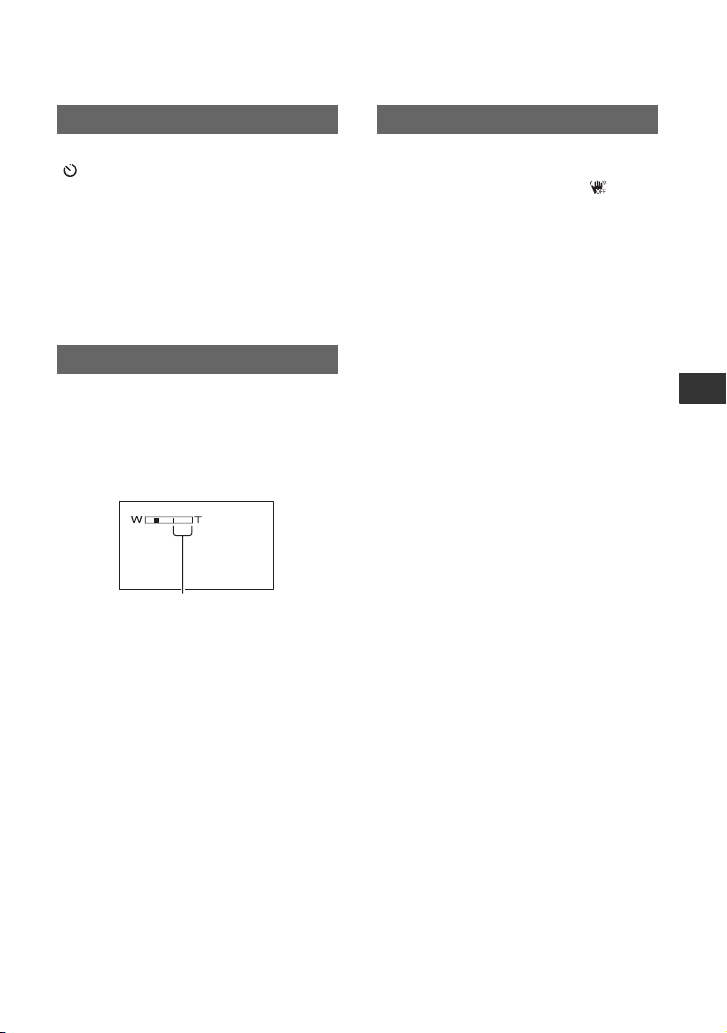
You can select the maximum zoom level in
case you want to zoom to a level greater
than 25 × (the default setting) while
recording on a tape. Note that the image
quality decreases when you are using the
digital zoom.
B OFF
Up to 25 × zoom is performed optically.
50 ×
Up to 25 × zoom is performed optically,
and after that, up to 50 × zoom is
performed digitally.
2000 ×
Up to 25 × zoom is performed optically,
and after that, up to 2,000 × zoom is
performed digitally.
You can compensate for camera shake (the
default setting is [ON]).
Set [STEADYSHOT] to [OFF] ( ) when
using a tripod (optional) or the conversion
lens (optional), then the image becomes
natural.
SELF-TIMER
DIGITAL ZOOM
The right side of the bar shows the digital
zooming factor. The zooming zone
appears when you select the zooming
level.
STEADYSHOT
42
MEMORY SET menu
Settings for the “Memory Stick Duo”
The default settings are marked with B.
The indicators in parentheses appear when
the items are selected.
See page 34 for details on selecting
menu items.
x BURST
You can record several still images one
after another by pressing PHOTO.
B OFF
Select this when not recording
continuously.
NORMAL ( )
Records still images continuously at about
0.5 second intervals.
The maximum number of images are
recorded when you press and hold PHOTO
fully.
In 4:3 aspect ratio:
Record up to 4 images (1.0M image size),
or 13 images (VGA image size)
continuously.
In 16:9 aspect ratio:
Record up to 4 images (0.7M image size)
continuously.
EXP.BRKTG ( )
Records 3 images consecutively with
different exposures at about 0.5 second
intervals. You can compare the 3 images
and select an image recorded at the best
exposure.
b Notes
• [BURST] can be set only when the POWER
switch is set to CAMERA-MEMORY.
• [BURST] cannot be set during Easy Handycam
operation.
• The maximum number of images will be
recorded in the self-timer mode or when you are
operating with the Remote Commander.
• [EXP.BRKTG] will not function when there is
space of less than 3 images remaining on the
“Memory Stick Duo.”
STILL SET
x QUALITY
B FINE ( )
Records still images at the fine image
quality level.
STANDARD ( )
Records still images at the standard image
quality level.
b Notes
• Image quality is automatically fixed to [FINE]
during Easy Handycam operation.
x IMAGE SIZE
B 1.0M ( )
Allows you to record more still images in
relatively clear quality.
VGA (0.3M) ( )
Allows for the maximum number of
images to be recorded.
b Notes
• [IMAGE SIZE] can be set only when the
POWER switch is set to CAMERA-MEMORY.
• If you set a screen ratio of 16:9 (wide), [IMAGE
SIZE] is fixed to [0.7M] automatically (p. 25).
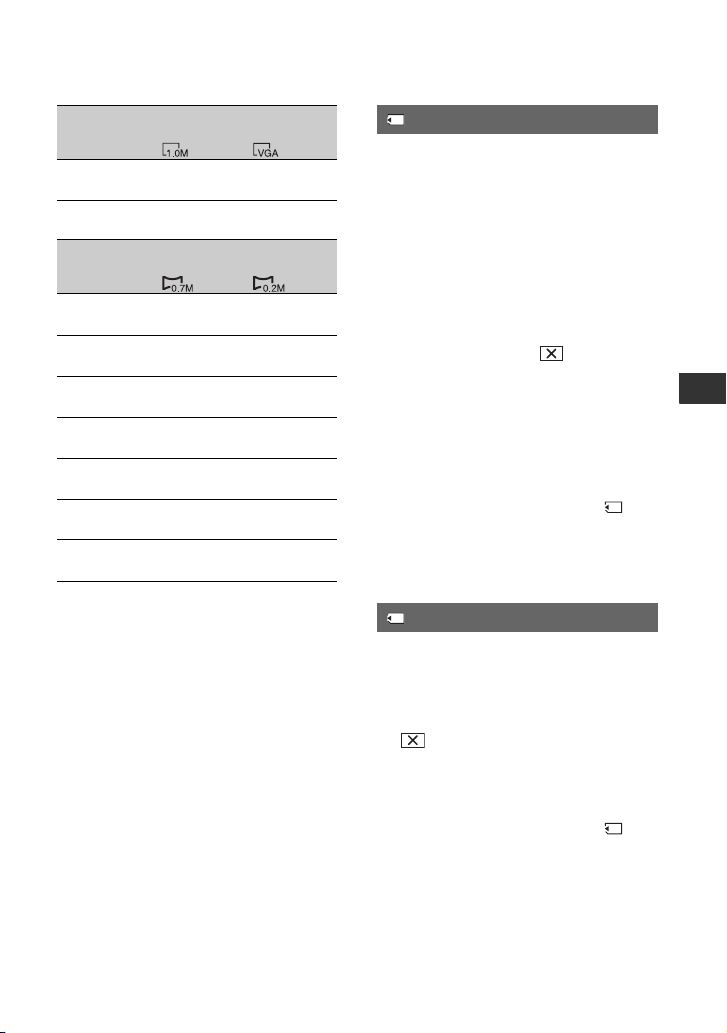
Capacity of the “Memory Stick Duo”
and the number of recordable pictures
In 4:3 aspect ratio
1.0M
(1152 × 864)
VGA
(640 × 480)
128MB 245
600
780
1970
256MB 445
1000
1400
3550
512MB 910
2050
2900
7300
1GB 1850
4250
6000
14500
2GB 3750
8600
12000
30000
4GB 7400
17000
23500
59500
43
Using the Menu
In 16:9 aspect ratio
b Notes
• All numbers measured at the following settings:
Top: [FINE] is selected for image quality.
Bottom: [STANDARD] is selected for image
quality.
• When using the “Memory Stick Duo” made by
Sony Corporation.
The number of pictures you can record varies
depending on the recording environment and the
recording media.
Deletes all the pictures without image
protection on a “Memory Stick Duo” or in
the selected folder.
1 Select [ALL FILES] or [CURRNT
FOLDER (Current folder)].
[ALL FILES]: Deletes all the images on
the “Memory Stick Duo.”
[CURRNT FOLDER (Current folder)]:
Deletes all the images in the selected
folder.
2 Touch [YES] twice t .
b Notes
• When using a “Memory Stick Duo” with the
write-protect tab engaged, cancel image
protection by sliding the tab back beforehand
(p. 80).
• The folder will not be deleted even when you
delete all the pictures in the folder.
• Do not do any of the following while [
Erasing all data...] is displayed:
– Operate the POWER switch/operation
buttons.
– Eject the “Memory Stick Duo.”
The “Memory Stick Duo” has been
formatted at the factory, and does not
require formatting at purchase.
To execute formatting, touch [YES] twice
t .
Formatting is completed, and all the images
will be deleted.
b Notes
• Do not do any of the following while [
Formatting…] is displayed:
– Operate the POWER switch/operation
buttons.
– Eject the “Memory Stick Duo.”
• Formatting erases everything on the “Memory
Stick Duo” including protected image data and
newly created folders.
8GB 15000
34000
48000
115000
0.7M
(1152 × 648)
0.2M*
(640 × 360)
128MB 325
780
980
1970
256MB 590
1400
1750
3550
512MB 1200
2900
3650
7300
1GB 2450
6000
7500
14500
2GB 5000
12000
15000
30000
4GB 9900
23500
29500
59500
8GB 20000
48000
60000
115000
* If you record a still image on a “Memory Stick
Duo” with the POWER switch set to
CAMERA-TAPE, [IMAGE SIZE] is
automatically fixed at [0.2M]. You cannot
select [0.2M] for the image size in [STILL
SET].
1.0M
(1152 × 864)
VGA
(640 × 480)
ALL ERASE
FORMAT
Continued ,
44
B SERIES
Assigns file numbers in sequence even if
the “Memory Stick Duo” is replaced with
another one. The file number is reset when
a new folder is created or the recording
folder is replaced with another.
RESET
Resets the file number to 0001 each time
the “Memory Stick Duo” is changed.
You can create a new folder (102MSDCF
to 999MSDCF) on a “Memory Stick Duo.”
When 9,999 images are stored in the current
folder, a new folder is automatically created
for storing subsequent images.
Touch [YES] t .
b Notes
• You cannot delete the created folders using your
camcorder. You will have to format the
“Memory Stick Duo” (p. 43), or delete them
using your computer.
• The number of recordable pictures on a
“Memory Stick Duo” may decrease as the
number of folders increases.
Select the folder to be used for recording
with / , then touch .
b Notes
• As the default setting, pictures are saved in the
101MSDCF folder.
• Once you record a picture in a folder, the same
folder will be set as the default folder for
playback.
Select the playback folder with / ,
then touch .
FILE NO.
NEW FOLDER
REC FOLDER (Recording folder)
PB FOLDER (Playback folder)
PICT.APPLI. menu
Special effects on pictures or additional
functions on recording/playback
The default settings are marked with B.
The indicators in parentheses appear when
the items are selected.
See page 34 for details on selecting
menu items.
You can add the following effects to
currently recording pictures.
1 Select the desired effect in standby mode
(to fade in) or recording mode (to fade out),
then touch .
When [OVERLAP], [WIPE] or [DOT
FADER] is selected, the screen turns to
blue while storing the image, then the
image on a tape is stored as a still image.
2 Press REC START/STOP.
The fader indicator stops flashing and
disappears when the fade is complete.
To cancel [FADER] before starting the
operation, touch [OFF] in step 1.
If you press REC START/STOP once, the
setting is canceled.
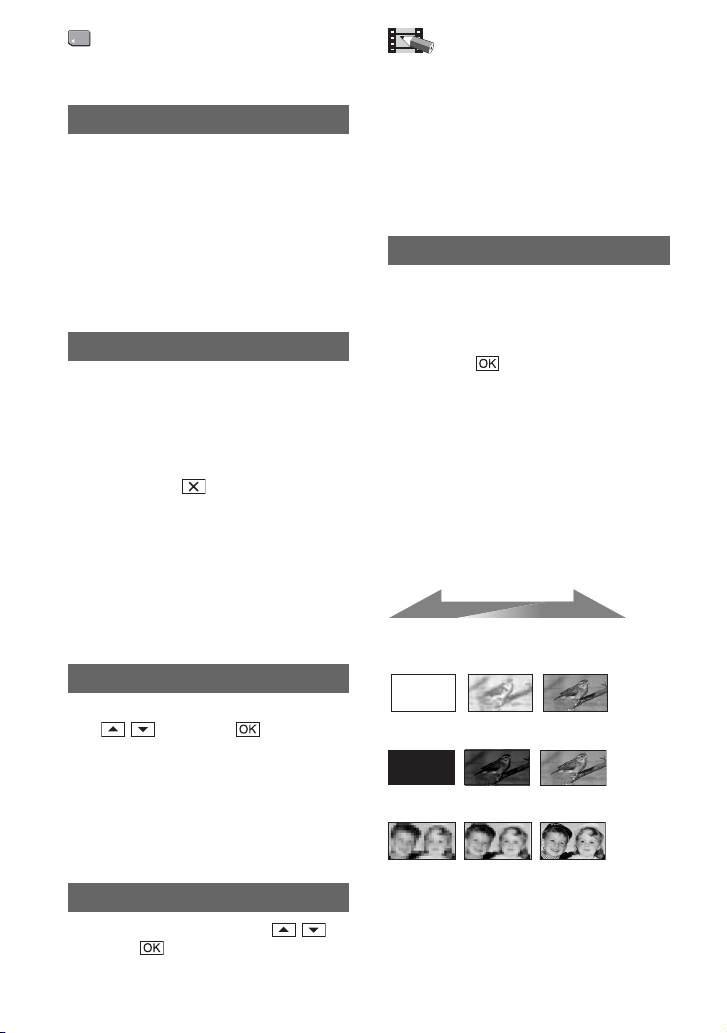
WHITE FADER
BLACK FADER
MOSAIC FADER
MONOTONE
When fading in, the picture gradually
changes from black and white to color.
When fading out, it gradually changes from
color to black and white.
FADER
STBY REC
Fading out Fading in
MEMORY SET menu
(Continued)
45
Using the Menu
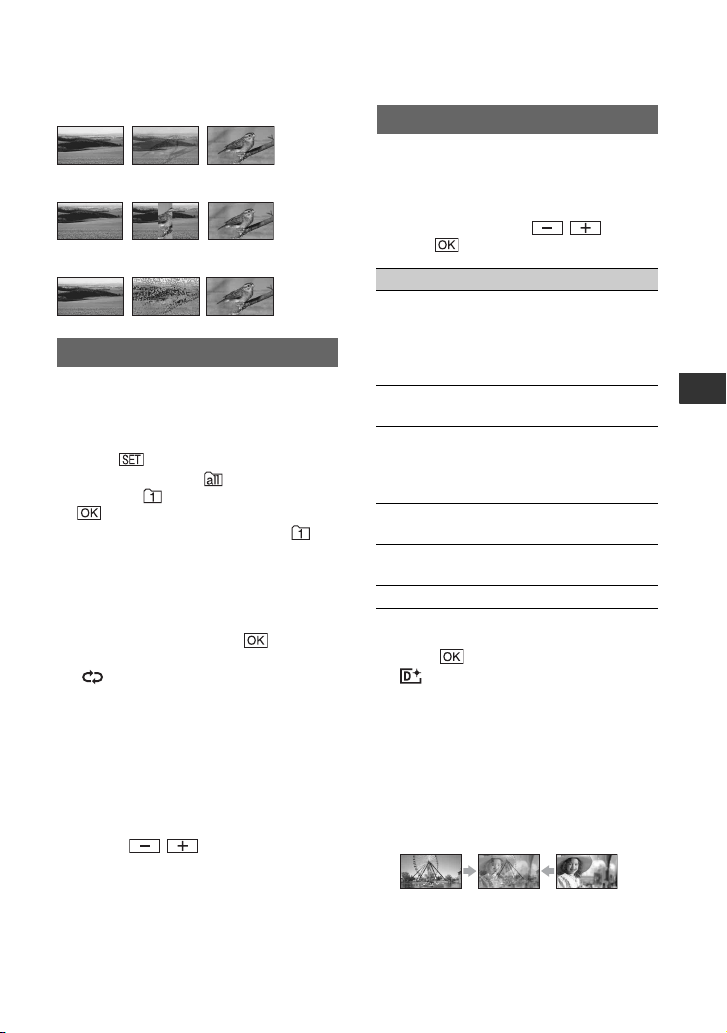
OVERLAP (fade in only)
WIPE (fade in only)
DOT FADER (fade in only)
Plays back in sequence the images stored
on a “Memory Stick Duo,” or in a folder
(slide show).
1 Touch t [PB FOLDER].
2 Select [ALL FILES ( )] or [CURRNT
FOLDER ( , Current folder)], then touch
.
If you select [CURRNT FOLDER ( ,
Current folder)], all the images in the
current playback folder selected in [PB
FOLDER] (p. 44) are played back in
sequence.
3 Touch [REPEAT].
4 Select [ON] or [OFF], then .
To repeat the slide show, select [ON]
().
To execute the slide show only once, select
[OFF].
5 Touch [END] t [START].
To cancel [SLIDE SHOW], touch [END].
To pause, touch [PAUSE].
z Tips
• You can select the first picture for the slide
show with / before touching
[START].
You can add digital effects to your
recordings.
1 Touch the desired effect.
2 Adjust the effect with / , then
touch .
3 Touch .
appears.
To cancel [D.EFFECT], touch [OFF].
B OFF
Does not use [D.EFFECT] setting.
STILL
Records a movie while superimposing it
on a still image memorized by touching
[STILL].
SLIDE SHOW
D.EFFECT (Digital effect)
Effect Items to adjust
STILL The degree of
transparency of the still
image you want to
superimpose under a
movie.
FLASH The interval of frame-by-
frame playback.
LUMI. KEY The color scheme of the
area in the still image
which is to be swapped
with a movie.
TRAIL The fade time of the
incidental image.
SLOW
SHUTTR*
Shutter speed (1 is 1/30, 2
is 1/15, 3 is 1/8, 4 is 1/4).
OLD MOVIE* No adjustment necessary.
* Available during recording on a tape only.
Continued ,
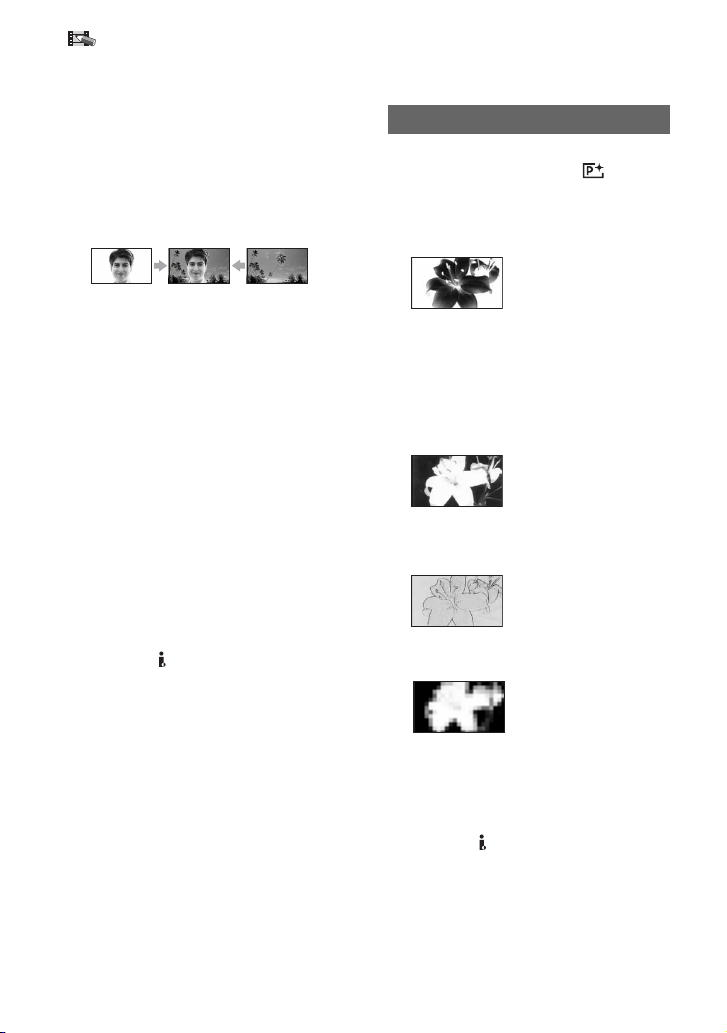
46
FLASH (flash motion)
Records a movie with a serial-still-image
effect (strobe effect).
LUMI. KEY (luminance key)
Replaces a brighter area in a still image
memorized at the moment when [LUMI.
KEY] was selected, with a movie.
TRAIL
When recording, trailing afterimages are
left in the picture.
SLOW SHUTTR (slow shutter)
The shutter speed is slowed down. Suitable
for shooting a subject more clearly in a
dark place.
OLD MOVIE
Adds an old movie effect with a sepia hue
to pictures.
b Notes
• Adjust the focus manually using a tripod
(optional) since adjusting the focus
automatically is hard when [SLOW SHUTTR]
is selected. ([FOCUS], p. 39)
• You cannot select 16:9/4:3 as the aspect ratio
for [OLD MOVIE].
• Effects added to the playback pictures are not
output via the DV Interface (i.LINK). Only
the original pictures can be output.
• You cannot add effects to externally input
pictures.
z Tips
• You can save pictures edited using special
effects on a “Memory Stick Duo” (p. 60) or
record them on another VCR/DVD device, etc.
(p. 56).
You can add special effects to a picture
during recording or playback. appears.
B OFF
Does not use [PICT.EFFECT] setting.
NEG.ART
The color and brightness are reversed.
SEPIA
Pictures appear in sepia.
B&W
Pictures appear in black and white.
SOLARIZE
Pictures appear as an illustration with
strong contrast.
PASTEL*
Pictures appear as a pale pastel drawing.
MOSAIC*
Pictures appear mosaic-patterned.
b Notes
• Effects added to the playback pictures are not
output via the DV Interface (i.LINK). Only
the original pictures can be output.
• You cannot add effects to externally input
pictures.
PICT.EFFECT (Picture effect)
* Not available during playback.
PICT.APPLI. menu (Continued)
47
Using the Menu
z Tips
• You can save pictures edited using special
effects on a “Memory Stick Duo” (p. 60) or
record them on another VCR/DVD device, etc.
(p. 56).
Your camcorder will shoot 1 frame of the
picture at a selected interval and keep them
in memory until it has stored several
frames. This function is useful to observe
the movement of clouds or the changes of
daylight. These pictures appear smooth
when played back. Connect your camcorder
to the wall outlet (wall socket) using the
supplied AC Adaptor for this operation.
[a]: Recording
[b]: Interval
1 Touch t / to select a
desired interval time (1 to 120 seconds) t
.
2 Touch [REC START].
Recording starts and z changes to red.
To interrupt, touch [REC STOP].
To resume, touch [REC START].
To cancel, touch [REC STOP], then [END].
b Notes
• During Smooth interval recording, your
camcorder may perform the END SEARCH
function to locate the end in current recordings
on the tape after several frames have been
recorded.
• Do not turn off the power or disconnect the
power source while a message is displayed on
the screen.
• The camcorder will shoot several frames for the
first and last shots of the Smooth interval
recording.
• Smooth interval recording is released when
approximately 12 hours have elapsed after
shooting has begun.
• Sounds are not recorded.
• The last few frames may not be recorded if the
battery or tape has run out.
• There may be discrepancies in the interval.
z Tips
• If you adjust the focus manually, you can record
clear pictures even if the light changes
([FOCUS], p. 39).
• You can silence the recording beep by setting of
[BEEP] (p. 52).
You can record still images on the
“Memory Stick Duo” at a selected interval.
This function is useful to observe the
movement of clouds or the changes in
daylight, etc.
[a]: Recording
[b]: Interval
1 Touch t a desired interval time (1, 5
or 10 minutes) t t [ON] ( ) t
t .
2 Press PHOTO fully.
stops flashing and the interval still
image recording starts.
To cancel [INT.REC-STL], select [OFF].
The default setting is [ON], allowing you to
view the demonstration about 10 minutes
after you have removed both a cassette and
a “Memory Stick Duo” from your
camcorder, and slide the POWER switch
repeatedly to turn on the CAMERA-TAPE
lamp.
SMTH INT.REC (Smooth interval
tape recording)
INT.REC-STL (Interval photo
recording)
DEMO MODE
Continued ,

48
z Tips
• The demonstration will be suspended in
situations such as those described below.
– When you touch the screen during the
demonstration. (The demonstration starts
again after about 10 minutes.)
– When a cassette or a “Memory Stick Duo” is
inserted.
– When the POWER switch is set to other than
CAMERA-TAPE.
See page 62.
You can connect the camcorder to a
personal computer with a USB cable and
view pictures on the computer. You can
also connect the camcorder to a PictBridge-
compatible printer using this function.
Memory Stick
Select this to view pictures on a “Memory
Stick Duo” on the computer or to import
them to the computer. Refer to “First Step
Guide” on the supplied CD-ROM for
details.
PictBridge PRINT
Select this when you connect the
camcorder to a PictBridge-compatible
printer to print out directly (p. 62).
STREAM
Select this to view movies on a tape on the
computer.
b Notes
• During Easy Handycam operation, [
STREAM] cannot be set.
PictBridge PRINT
USB SELECT
EDIT/PLAY menu
Settings for editing or playing back in
various modes
See page 34 for details on selecting
menu items.
You can play back in various modes while
viewing movies.
1 Touch the following buttons during
playback.
2 Touch t .
To return to the normal playback mode,
touch (Play/Pause) twice (once from
frame playback).
b Notes
• You will not hear the recorded sound. You may
see mosaic-like images of the previously played
picture.
VAR.SPD PB
(Various speed playback)
To Touch
change the
playback
direction*
(frame)
play back
slowly** To reverse direction:
(frame) t
play back 2
times faster
(double speed)
(double speed)
To reverse direction:
(frame) t
(double speed)
play back frame
by frame
(frame) during
playback pause.
To reverse direction:
(frame) during
frame playback.
* Horizontal lines may appear at the top,
bottom, or in the center of the screen. This
is not a malfunction.
**Pictures output from the DV Interface
(i.LINK) cannot be played back smoothly in
slow mode.
PICT.APPLI. menu (Continued)
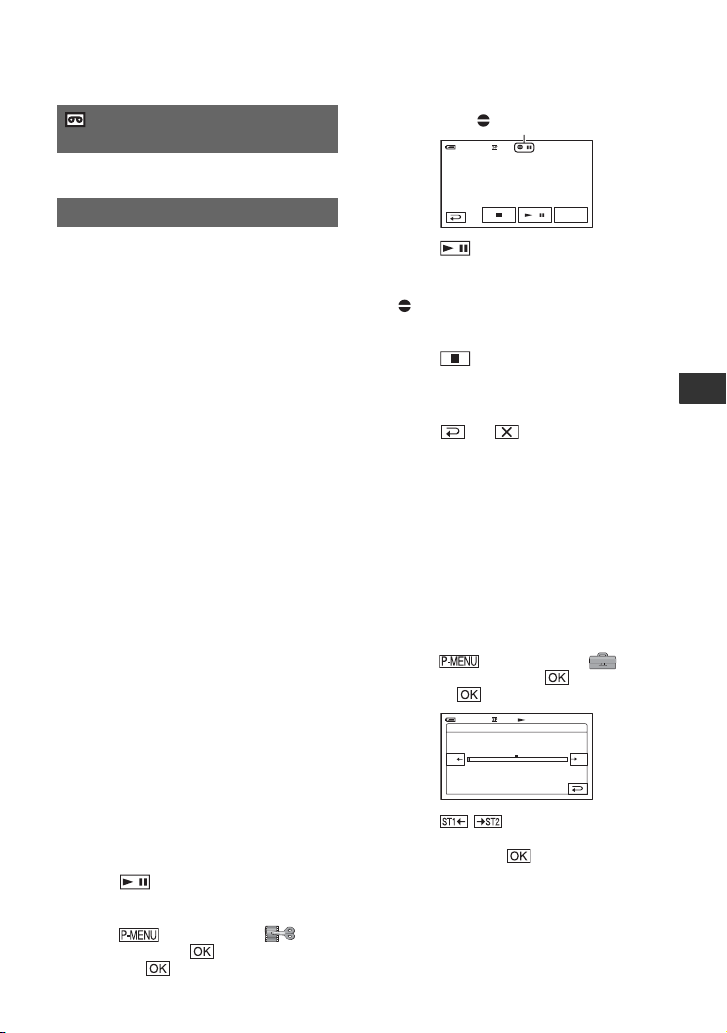
49
Using the Menu
See page 58.
Using the internal stereo microphone
(p. 90), you can add sound to a tape already
recorded in the 12-bit mode (p. 50) without
erasing the original sound.
b Notes
• You cannot record additional audio:
– When the tape has been recorded in the 16-bit
mode (p. 50).
– When the tape has been recorded in the LP
mode.
– When your camcorder is connected via an
i.LINK cable.
– When the tape has been recorded in 4CH MIC
mode on other camcorders.
– On blank sections of the tape.
– When the tape has been recorded in a TV
color system other than that of your
camcorder (p. 78).
– When the write-protect tab of the cassette is
set to SAVE (p. 79).
– On sections recorded in HDV format.
• When you add sound, the picture will not be
output from the A/V Remote Connector. Check
the picture on the LCD screen or the viewfinder.
• You can only record additional audio over a
tape recorded on your camcorder. The sound
may deteriorate when you dub audio on a tape
recorded on other camcorders (including other
DCR-HC62 camcorders).
Recording sound
Insert a recorded cassette into your
camcorder beforehand.
1 Slide the POWER switch repeatedly to turn
on the PLAY/EDIT lamp.
2 Touch (Play/Pause) to play back the
tape, then touch it again at the point where
you want to start recording the sound.
3 Touch t [MENU] t
(EDIT/PLAY) t t [AUD DUB
CTRL] t t [AUDIO DUB].
4 Touch (Play).
Your camcorder starts audio recording via
the internal stereo microphone.
appears while recording the new sound
in stereo 2 (ST2) during the playback of the
tape.
5 Touch (Stop) when you want to stop
recording.
To dub on other scenes, repeat step 2 to
select scenes, then touch [AUDIO DUB].
6 Touch t .
z Tips
• To set the end point for audio dubbing,
beforehand, press ZERO SET MEMORY on the
Remote Commander at the scene at which you
want to stop audio dubbing during playback.
After step 2 to 4, the recording stops
automatically at the selected scene.
To check the recorded sound
1 Play back the tape on which you have
recorded audio (p. 26).
2 Touch t [MENU] t
(STANDARD SET) t t [AUDIO
MIX] t .
3 Touch / to adjust the balance of
the original sound (ST1) and the new sound
(ST2), then touch .
b Notes
• The original sound (ST1) is output at the default
setting.
REC CTRL
(Movie recording control)
AUD DUB CTRL (Audio dubbing)
0:00:00:0060min
AUD DUB CTRL
AUDIO
DUB
X appears.
AUDIO MIX
0:00:00:0060min
ST2
ST1
Continued ,

50
EXEC
The most recently recorded picture is
played back for about 5 seconds and then
stops automatically.
CANCEL
Stops [END SEARCH].
b Notes
• After ejecting the cassette, the END SEARCH
function is not available.
END SEARCH
STANDARD SET
menu
Settings while recording on a tape or other
basic settings
The default settings are marked with B.
The indicators in parentheses appear when
the items are selected.
See page 34 for details on selecting
menu items.
B SP (SP)
Records in the SP (Standard Play) mode on
a cassette.
LP (LP)
Increases the recording time to 1.5 times
the SP mode (Long Play).
b Notes
• If you record in the LP mode, pictures may
appear mosaic-like or sound may be interrupted
when you play back the tape on other
camcorders or VCRs.
• When you mix recordings in the SP mode and in
the LP mode on one tape, the playback picture
may be distorted or the time code may not be
written properly between the scenes.
B 12BIT
Records in the 12-bit mode (2 stereo
sounds).
16BIT ( )
Records in the 16-bit mode (1 stereo sound
with high quality).
See page 26.
See page 49.
REC MODE (Recording mode)
AUDIO MODE
VOLUME
AUDIO MIX
EDIT/PLAY menu (Continued)
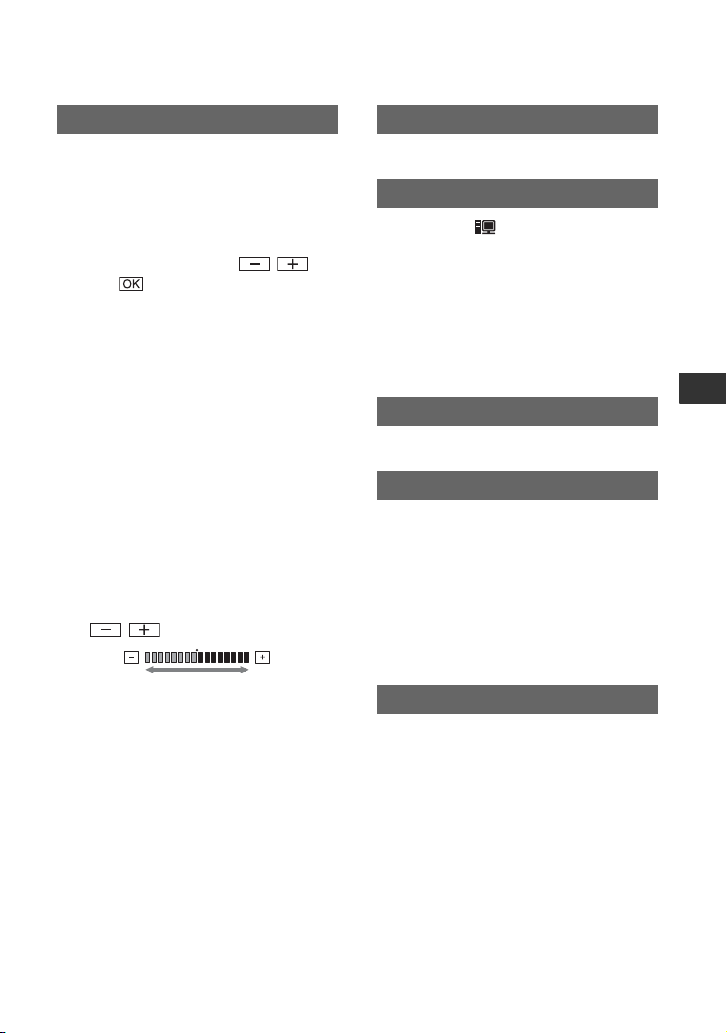
51
Using the Menu
The recorded picture will not be affected by
this operation.
x LCD BRIGHT
You can adjust the brightness of the LCD
screen.
1 Adjust the brightness with / .
2 Touch .
x LCD BL LEVEL
You can adjust the brightness of the LCD
screen’s backlight.
B NORMAL
Standard brightness.
BRIGHT
Brightens the LCD screen.
b Notes
• When you connect your camcorder to outside
power sources, [BRIGHT] is automatically
selected for the setting.
• When you select [BRIGHT], battery life is
slightly reduced during recording.
x LCD COLOR
You can adjust the color on the LCD screen
with / .
x VF B.LIGHT
You can adjust the brightness of the
viewfinder.
B NORMAL
Standard brightness.
BRIGHT
Brightens the viewfinder screen.
b Notes
• When you connect your camcorder to outside
power sources, [BRIGHT] is automatically
selected for the setting.
• When you select [BRIGHT], battery life is
slightly reduced during recording.
See page 33.
When you set [ STREAM] and connect
your camcorder to your computer via the
USB cable, you can view the picture your
camcorder is currently seeing on your
computer like a live camera.
You can also import the picture to your
computer. Refer to the “First Step Guide”
on the supplied CD-ROM for details
(p. 67).
See page 96.
You can display the frame and check that
the subject is horizontal or vertical by
setting [GUIDEFRAME] to [ON].
The frame is not recorded. Press DISP/
BATT INFO to make the frame disappear.
z Tips
• Placing the subject at the cross point of the
guide frame makes a balanced composition.
During playback, displays information
(data code) recorded automatically at the
time of recording.
B OFF
Data code is not displayed.
DATE/TIME
Displays the date and time.
LCD/VF SET
Low intensity High intensity
TV TYPE
USB CAMERA
DISP GUIDE
GUIDEFRAME
DATA CODE
Continued ,
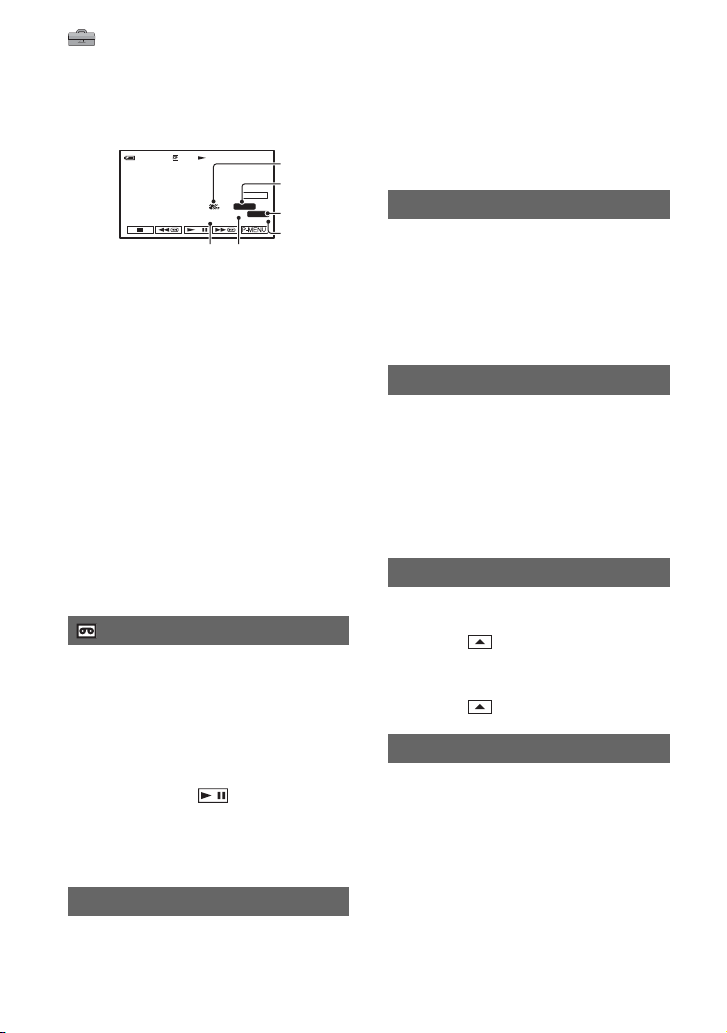
52
CAMERA DATA (below)
Displays camera setting data.
ASteadyShot off
BExposure
CWhite balance
DGain
EShutter speed
FAperture value
b Notes
• The exposure adjustment value (0EV), a shutter
speed, and the aperture value appear when still
images on a “Memory Stick Duo” are played
back.
• In the [DATE/TIME] data display, the date and
time are displayed in the same area. If you
record a picture without setting the clock, [--- --
----] and [--:--:--] will appear.
• During Easy Handycam operation, you can set
[DATE/TIME] only.
B AUTO
Displays the remaining tape indicator for
about 8 seconds in situations such as those
described below.
• When you set the POWER switch to PLAY/
EDIT or CAMERA-TAPE with a cassette
inserted.
• When you touch (Play/Pause).
ON
Always displays the remaining tape
indicator.
The default setting is [ON], allowing you to
use the supplied Remote Commander
(p. 93).
z Tips
• Set to [OFF] to prevent your camcorder from
responding to a command sent by another VCR
remote control unit.
B ON
A beeping sound starts when you start/stop
recording, or operate the touch panel.
OFF
Cancels the beeping sound and shutter
sound.
B LCD PANEL
Shows displays such as the time code on
the LCD screen and in the viewfinder.
V-OUT/PANEL
Shows displays such as the time code on
the TV screen, LCD screen, and in the
viewfinder.
B NORMAL
Scrolls the menu items downwards by
touching .
OPPOSITE
Scrolls the menu items upwards by
touching .
B 5 min
The camcorder is automatically turned off
when you do not operate your camcorder
for more than approximately 5 minutes.
NEVER
The camcorder is not automatically turned
off.
REMAINING
REMOTE CTRL (Remote control)
0:00:00:0060min
AWB100
9dBF1. 8
AUTO
GUIDE
1
2
3
4
5
6
BEEP
DISP OUTPUT
MENU ROTATE
A.SHUT OFF (Auto shut off)
STANDARD SET menu (Continued)

53
Using the Menu
b Notes
• When you connect your camcorder to a wall
outlet (wall socket), [A.SHUT OFF] is
automatically set to [NEVER].
See page 85.
CALIBRATION
TIME/LANGU.
menu
See page 34 for details on selecting
menu items.
See page 15.
When using your camcorder abroad, you
can set the time difference by touching
/ , the clock will be adjusted in
accordance with the time difference.
If you set the time difference to 0, the clock
returns to the originally set time.
You can select the language to be used on
the LCD screen.
b Notes
• Your camcorder offers [ENG[SIMP]]
(simplified English) for when you cannot find
your native tongue among the options.
CLOCK SET
WORLD TIME
LANGUAGE
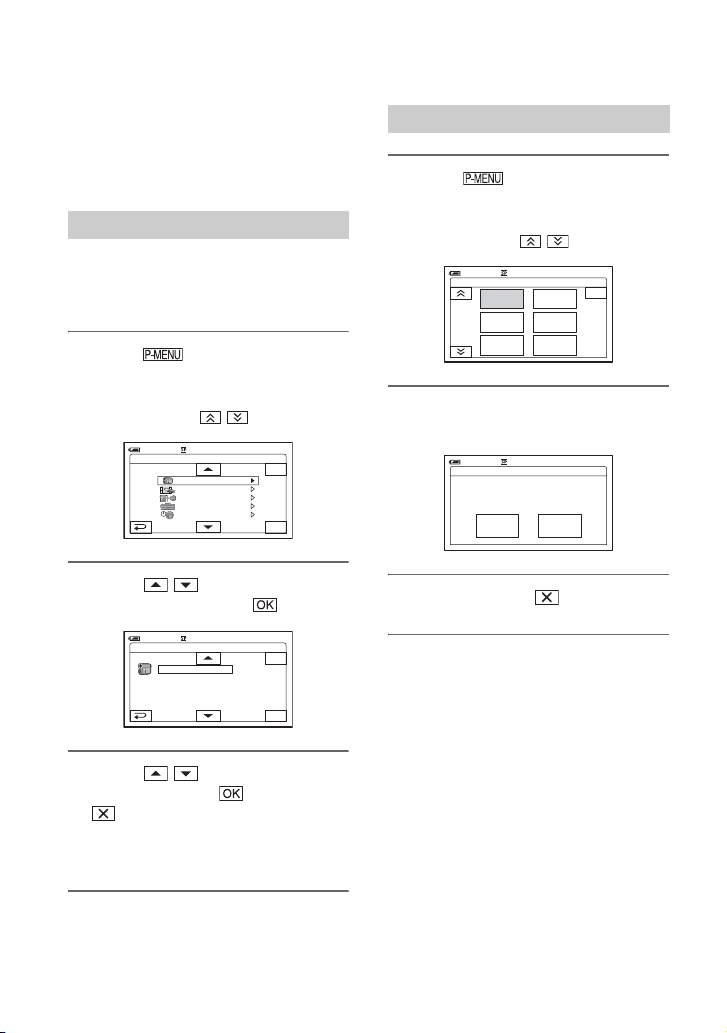
54
Customizing Personal
Menu
You can add desired menu items to any
Personal Menu allocated to the lamp
positions currently lit. This is convenient if
you add frequently used menu items to
Personal Menu.
You can add up to 28 menu items to each
Personal Menu. Delete a less important
menu item, if you want to add more.
1 Touch t [P-MENU SET UP]
t [ADD].
If the desired menu item is not
displayed, touch / .
2 Touch / to select a menu
category, then touch .
3 Touch / to select a menu
item, then touch t [YES] t
.
The menu item is added to the end of
the list.
Adding a menu item
OK
END
0:00:0060min
Select the category.
CAMERA SET
PICT. APPLI.
EDIT/PLAY
STANDARD SET
TIME/LANGU.
STBY
OK
END
0:00:0060min
Select the item.
SCENE SELECT
SPOT METER
EXPOSURE
WHITE BAL.
AUTOSLW SHTR
STBY
1 Touch t [P-MENU SET UP]
t [DELETE].
If the desired menu item is not
displayed, touch / .
2 Touch the menu item that you
want to delete.
3 Touch [YES] t .
b Notes
• You cannot delete [MENU] and [P-MENU SET
UP].
Deleting a menu item
Select button to delete.
1/3
0:00:00
60min
END
MENU
STBY
LCD
BRIGHT
SCENE
SELECT
TELE
MACRO
FADER
DISP
GUIDE
Delete this from
CAMERA-TAPE mode's
P-MENU?
DELETE
YES NO
0:00:0060min
STBY
55
Using the Menu
1 Touch t [P-MENU SET UP]
t [SORT].
If the desired menu item is not
displayed, touch / .
2 Touch the menu item you want to
move.
3 Touch / to move the menu
item to the desired place.
4 Touch .
To sort more items, repeat steps 2 to 4.
5 Touch [END] t .
b Notes
• You cannot move [P-MENU SET UP].
Touch t [P-MENU SET UP] t
[RESET] t [YES] t [YES] t .
If the desired menu item is not displayed,
touch / .
Arranging the order of menu
items displayed on Personal
Menu
Initializing the Personal Menu
settings (Reset)
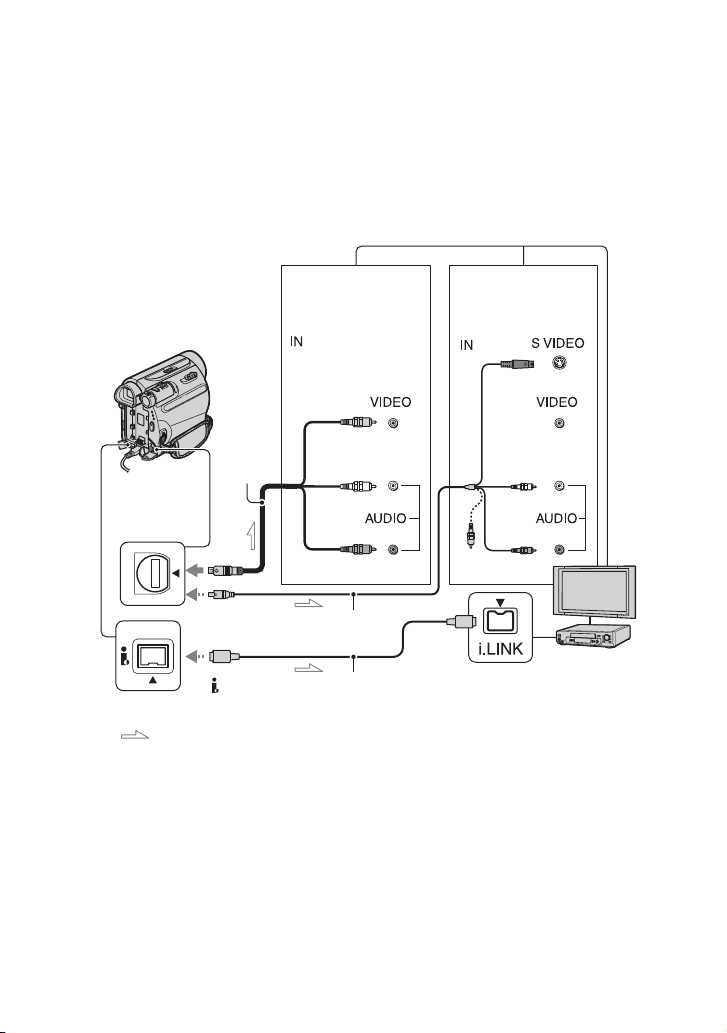
56
Dubbing/Editing
Dubbing to VCR or DVD/HDD recorders
You can dub images played back on your camcorder to other recording devices, such as VCRs
or DVD/HDD recorders.
You can connect your camcorder to VCRs or DVD/HDD recorders, using the A/V connecting
cable (1), the A/V connecting cable with S VIDEO (2), or the i.LINK cable (3).
Connect your camcorder to the wall outlet (wall socket) using the supplied AC Adaptor for
this operation (p. 12). Refer also to the instruction manuals supplied with the devices to be
connected.
A A/V connecting cable (supplied)
Connect to the input jack of another device.
B A/V connecting cable with S
VIDEO (optional)
When connecting to another device via the S
VIDEO jack, by using the A/V connecting
cable with an S VIDEO cable, pictures can be
reproduced more faithfully than with the
supplied A/V cable connection. Connect the
white and red plugs (left/right audio) and S
VIDEO plug (S VIDEO channel) of an A/V
connecting cable. In this case, the yellow
(standard video) plug connection is not
necessary. S VIDEO connection only will not
output audio.
C i.LINK cable (optional)
Use an i.LINK cable to connect your
camcorder to another device equipped with an
i.LINK jack. The video and audio signals are
transmitted digitally, producing high quality
pictures and sound. Note that you cannot
output picture and sound separately.
DV
2
1
3
A/V Remote
Connector
: Signal flow
To i.LINK jack
To DV Interface
(i.LINK)
VCRs or
DVD/HDD
recorders
(Yellow)
(White)
(Red)
Device with an
S VIDEO jack
(Yellow)
(White)
(Red)
(Black)
Device without
an S VIDEO jack
57
Dubbing/Editing
b Notes
• When you are connecting your camcorder to a
monaural device, connect the yellow plug of the
A/V connecting cable to the video input jack,
and the red (right channel) or the white (left
channel) plug to the audio input jack on the
device.
• When you connect a device via an A/V
connecting cable, set [DISP OUTPUT] to [LCD
PANEL] (the default setting) (p. 52).
• While your camcorder is sending signals to
another device via an i.LINK cable,
appears on the LCD screen on your
camcorder.
1 Prepare your camcorder for
playback.
Insert the recorded cassette.
Slide the POWER switch repeatedly to
turn on the PLAY/EDIT lamp.
2 Insert the recording media in the
recording device.
If your recording device has an input
selector, set it to the appropriate input
(such as video input1, video input2).
3 Connect your camcorder to the
recording device (VCR or DVD/
HDD recorder) with the A/V
connecting cable (supplied) 1,
an A/V connecting cable with S
VIDEO (optional) 2 or an i.LINK
cable (optional) 3.
Connect your camcorder to the input
jacks of the recording device.
4 Start playback on the camcorder,
and recording on the recording
device.
Refer to the operating instructions
supplied with your recording device for
details.
5 When dubbing is complete, stop
your camcorder and the
recording device.
b Notes
• Set [TV TYPE] according to the playback
device (TV, etc.) when connecting with the A/V
connecting cable.
• To record the date/time and camera settings data
when connected by the A/V connecting cable,
display them on the screen (p. 51).
• The following cannot be output via the DV
Interface (i.LINK):
– Indicators
– Pictures edited using [PICT.EFFECT] (p. 46),
[D.EFFECT] (p. 45) or PB zoom (p. 28).
• When connected using an i.LINK cable, the
recorded picture becomes rough when a picture
is paused on your camcorder while recording.
• When connected using an i.LINK cable, data
code (date/time/camera settings data) may not
be displayed or recorded depending on the
device or application.

58
Recording pictures from a VCR, etc.
You can record pictures from a VCR, etc., onto a tape, you can also record a scene as a still
image onto a “Memory Stick Duo” using an optional i.LINK cable.
Be sure to insert a cassette or a “Memory Stick Duo” for recording in your camcorder
beforehand.
You can connect your camcorder to a VCR, etc., or an i.LINK-compatible device using the
i.LINK cable (optional).
Connect your camcorder to the wall outlet (wall socket) using the supplied AC Adaptor for
this operation (p. 12). Refer also to the instruction manuals supplied with the devices to be
connected.
When connecting your camcorder to
another device using an i.LINK cable, the
video and audio signals are transmitted
digitally, producing high quality pictures
and sound. Note that you cannot output
picture and sound separately.
1 Connect your VCR, etc., to your
camcorder with an i.LINK cable.
2 Insert a cassette into the VCR.
3 Slide the POWER switch
repeatedly to turn on the PLAY/
EDIT lamp.
4 Set your camcorder to recording
pause mode.
Touch t [ REC CTRL] t
[REC PAUSE].
b Notes
• You cannot record pictures on your camcorder from a VCR, etc., that does not have an
i.LINK jack.
DV
: Signal flow
To i.LINK jack
To DV Interface (i.LINK)
AV device with
i.LINK jack
i.LINK cable (optional)
Recording movies
59
Dubbing/Editing
5 Start playing the cassette on the
VCR.
The picture played on the connected
device appears on the LCD screen of
your camcorder.
6 Touch [REC START] at the point
you want to start recording.
7 Stop recording.
Touch (Stop) or [REC PAUSE].
8 Touch t .
1 Perform steps 1 to 3 in
“Recording movies.”
2 Start playing the cassette on the
VCR.
The pictures on the VCR appear on the
screen of your camcorder.
3 Press PHOTO lightly at the scene
you want to record. Check the
image and press it fully.
b Notes
• The indicator appears when you
connect your camcorder and other devices via
an i.LINK cable. (This indicator may also
appear on the connected device.)
Recording still images
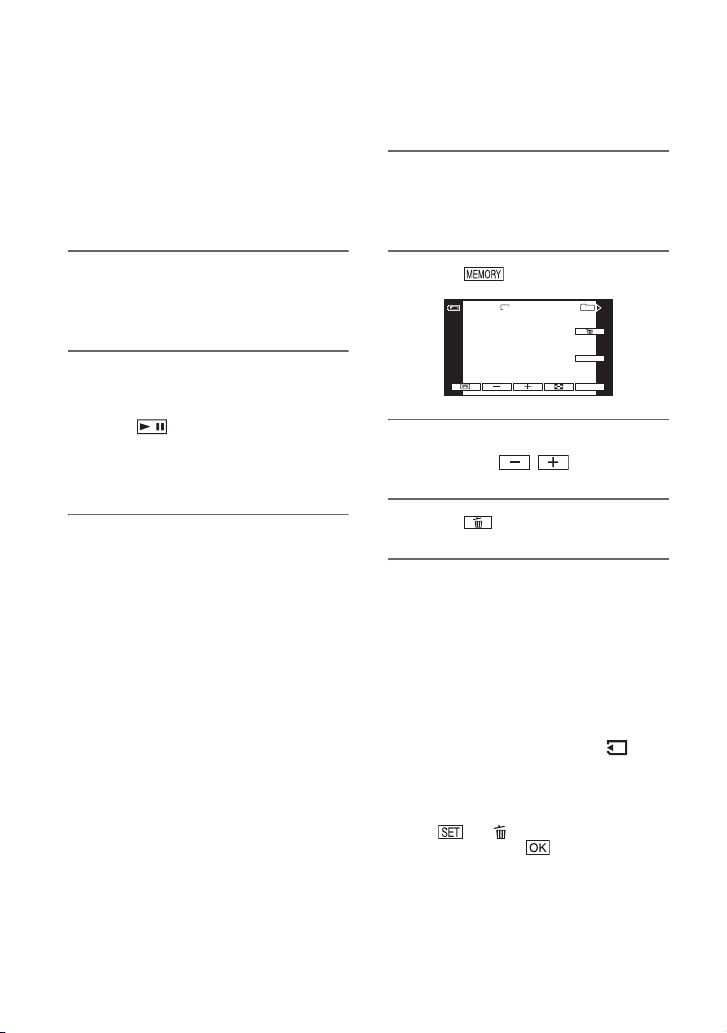
60
Dubbing pictures from
a tape to a “Memory
Stick Duo”
You can record a desired scene onto a
“Memory Stick Duo” as a still image, from
a movie you recorded on a tape. Make sure
you have a recorded tape and a “Memory
Stick Duo” inserted into your camcorder.
1 Slide the POWER switch
repeatedly to turn on the PLAY/
EDIT lamp.
2 Search and record the scene you
want to record.
Touch (Play) to play back the
tape, then press PHOTO lightly at the
scene you want to record. Check the
image and press it fully.
b Notes
• The date and time the picture is recorded on the
tape and stored on the “Memory Stick Duo” are
recorded. On your camcorder, the date and time
the picture is recorded on the tape are displayed.
Camera setting data recorded on the tape cannot
be stored on the “Memory Stick Duo.”
• Still images will be fixed to image size [0.2M]
when playing back the 16:9 picture, or [VGA
(0.3M)] when playing back the 4:3 picture.
Deleting recorded
pictures from the
“Memory Stick Duo”
1 Slide the POWER switch
repeatedly to turn on the PLAY/
EDIT lamp.
2 Touch .
3 Select a picture you want to
delete with / .
4 Touch t [YES].
b Notes
• The pictures cannot be restored once they are
deleted.
• Pictures cannot be deleted when a “Memory
Stick Duo” with the write-protect tab is set to
the write-protect position (p. 80), or when the
selected picture is protected (p. 61).
z Tips
• To delete all pictures at once, select [ ALL
ERASE] (p. 43).
• You can delete pictures on the index screen
(p. 27). You can easily search for the picture to
be deleted by displaying 6 pictures at once.
Touch t [ DELETE] t the picture
you want to delete t t [YES].
101
2/10
101
101–
0001
0001
60
60
min
min
P-MENU
MEMORY PLAY
MEMORY PLAY
MEMORY PLAY
1.0M
60min
101–0002
GUIDE
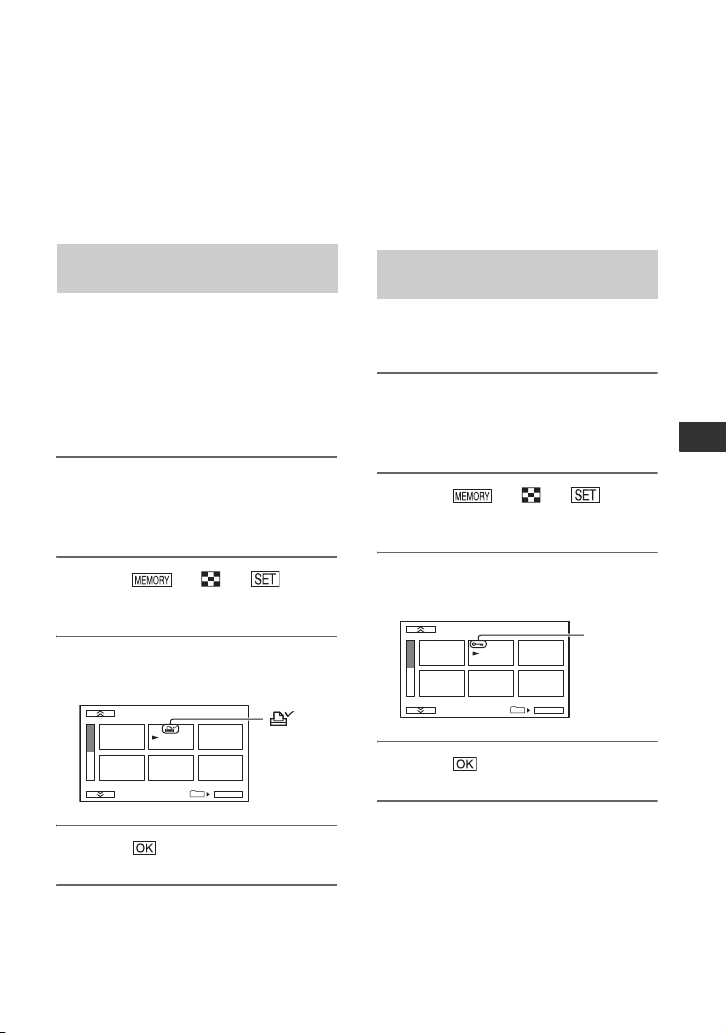
61
Dubbing/Editing
Marking images on the “Memory Stick Duo”
with specific information
(Print mark/Image
protection)
When you are using a “Memory Stick Duo”
with the write-protect tab, make sure the
write-protect tab on the “Memory Stick
Duo” is not set to the write-protect position
(p. 80).
The DPOF (Digital Print Order Format)
standard is used to select images for
printing on your camcorder.
By marking images that you want to print
out, you do not need to reselect them when
you print them out. (You cannot specify the
number of printouts.)
1 Slide the POWER switch
repeatedly to turn on the PLAY/
EDIT lamp.
2 Touch t t t
[PRINT MARK].
3 Touch the image that you want to
print out later.
4 Touch t [END].
b Notes
• To cancel Print mark, touch the image again to
cancel Print mark in step 3.
• Do not mark images on your camcorder if the
“Memory Stick Duo” already has some images
with the Print mark put on using other devices.
This may change the information of the images
with the Print mark put on using the other
device.
You can select and mark images to prevent
accidental erasure.
1 Slide the POWER switch
repeatedly to turn on the PLAY/
EDIT lamp.
2 Touch t t t
[PROTECT].
3 Touch the image that you want to
protect.
4 Touch t [END].
b Notes
• To cancel image protection, touch the image
again to cancel image protection in step 3.
Selecting still images for
printing (Print mark)
2/10
PRINT MARK
101–0002
101
OK
appears.
Preventing accidental erasure
(Image protection)
2/10
101–0002
PROTECT
101
OK
-
appears.

62
Printing recorded images
(PictBridge compliant printer)
You can print out pictures using a
PictBridge compliant printer without
connecting the camcorder to a computer.
Connect the AC Adaptor to obtain power
from the wall outlet (wall socket) (p. 12).
Insert the “Memory Stick Duo” containing
still images into your camcorder and turn
on the printer.
1 Slide the POWER switch
repeatedly to turn on the PLAY/
EDIT lamp.
2 Connect the (USB) jack (p. 91)
to the printer using the USB
cable.
[USB SELECT] appears on the screen
automatically.
3 Touch [PictBridge PRINT].
One of the images stored on the
“Memory Stick Duo” will be displayed.
b Notes
• We cannot guarantee the operation of models
that are not PictBridge compatible.
z Tips
• You can also operate by selecting in the
following orders:
– Touch t [MENU] t
(PICT.APPLI.) t [USB SELECT] t
[PictBridge PRINT]
– Touch t [MENU] t
(PICT.APPLI.) t [PictBridge PRINT]
1 Select the image to be printed
with / .
2 Touch t [COPIES].
3 Select the number of copies to be
printed with / .
A maximum of 20 copies of the image
can be printed.
4 Touch t [END].
To print the date and time on the image,
touch t [DATE/TIME] t
[DATE] or [DAY&TIME] t .
5 Touch [EXEC] t [YES].
When printing is finished, [Printing...]
disappears and the image selection
screen appears again.
Touch [END] when printing is
completed.
Connecting your camcorder to
the printer
PictBridge PRINT
PictBridge PRINT
101-0001
101-0001
SET
+
-
101
1/10
END
1.0M
EXEC
PictBridge PRINT
101-0001
When connection is complete,
(PictBridge connecting) appears on
the screen.
Printing

63
Dubbing/Editing
b Notes
• Refer also to the operating instructions for the
printer to be used.
• Do not attempt the following operations when
is on the screen. The operations may not be
performed properly.
– Operate the POWER switch.
– Disconnect the power cord (mains lead).
– Disconnect the USB cable from your
camcorder or the printer.
– Remove the “Memory Stick Duo” from your
camcorder.
• If the printer stops working, disconnect the USB
cable, turn the printer off and on again and
restart the operation from the beginning.
• On some printer models, the top, bottom, right,
and left edges of images may be trimmed. If you
print a still image recorded in a 16:9 (wide)
ratio, the left and right ends of the image may be
trimmed widely.
• Some printer models may not support the date
and time printing function. Refer to your
printer’s operating instructions for details.
• We cannot guarantee the printing of images
recorded with a device other than your
camcorder.
• PictBridge is an industry standard established
by the Camera & Imaging Products Association
(CIPA). You can print still images without using
a computer by connecting a printer directly to a
digital video camera or digital still camera,
regardless of model or manufacturer.
64
Using a Computer
What you can do with Windows computer
When you install the “Picture Motion
Browser” on a Windows computer from the
supplied CD-ROM, you can enjoy the
following operations.
b Notes
• You cannot install the supplied software,
“Picture Motion Browser,” on a Macintosh
computer.
x Importing/Viewing movies taken
with your camcorder
You can manage movies and still images
by date and time of shooting, and select
movies or still images you want to view as
thumbnails. These thumbnails can be
enlarged and played in a slide show.
x Editing pictures imported to a
computer
You can edit imported movies and still
images on a computer.
x Exporting movies from your
computer to your camcorder
You can export movies that have been
imported to a computer from your
camcorder, back to your camcorder.
The “First Step Guide” is an instruction
manual you can refer to on your computer.
This describes basic operations, from initial
hookup of your camcorder and computer
and making settings, to general operation
the first time you use the software “Picture
Motion Browser” stored on the CD-ROM
(supplied).
Referring to “Installing the “First Step
Guide”” (p. 65), start the “First Step
Guide”, then follow the instructions.
The Help guide explains all the functions of
all the software applications. Refer to the
Help guide for further detailed operations
after reading the “First Step Guide”
thoroughly.
To display the Help guide, click the [?]
mark on the screen.
When using “Picture Motion Browser”
OS: Windows 2000 Professional SP4,
Windows XP SP2*, Windows Vista*
*64-bit editions and Starter
(Edition) are not supported.
Standard installation is required.
Operation is not assured if the above
OS has been upgraded or in a multi-
boot environment.
CPU: Intel Pentium III 800 MHz or
faster
Application: DirectX 9.0c or later
(This product is based on DirectX
technology. It is necessary to have
DirectX installed.)
Sound system: Direct Sound
compatible sound card
Memory: 256 MB or more
Hard disk:
Disc volume required for
installation: Approximately 350 MB
Display: Minimum 1024 × 768 dots
Main functions
About “First Step Guide”
About the help function of the
software
System requirements
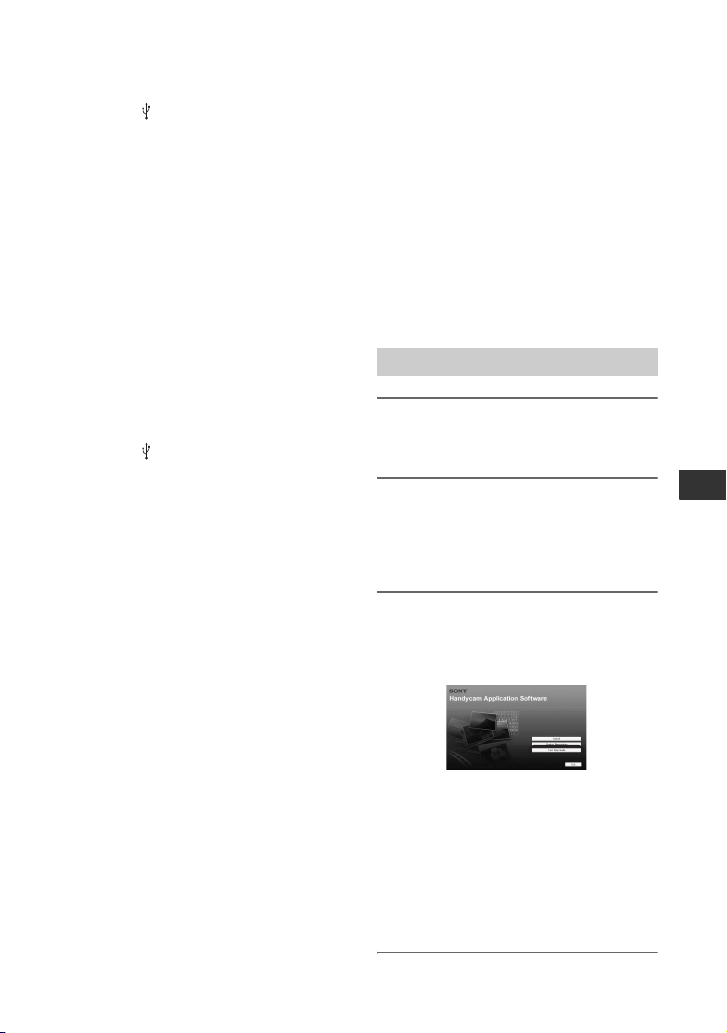
65
Using a Computer
Others: USB port (this must be
provided as standard, Hi-Speed USB
(USB 2.0 compatible) is
recommended), DV Interface
(IEEE1394, i.LINK) (to connect via
an i.LINK cable), optical disc drive
(CD-ROM drive is necessary for
installation)
When playing still images recorded on a
“Memory Stick Duo” on a computer
OS: Microsoft Windows 2000
Professional SP4,
Windows XP SP2* or
Windows Vista*
*Except for 64-bit editions.
Standard installation is required.
Operation is not assured if the above
OS has been upgraded.
Others: USB port (this must be
provided as standard)
b Notes
• Operations are not guaranteed on a computer
environment that does not meet the system
requirements.
• Operations are not guaranteed on all the
recommended environments.
For example, other open or background
applications running on currently may limit
product performance.
• If you use a Notebook PC, connect it to the AC
Adaptor as the power source. Otherwise, the
software will not work properly due to the
power saving function of the PC.
z Tips
• If your computer has a Memory Stick slot, insert
the “Memory Stick Duo” on which still images
are recorded into the Memory Stick Duo
Adaptor (optional), then insert it into the
Memory Stick slot on your computer to copy
still images to the computer.
• When using a “Memory Stick PRO Duo” and
your computer is not compatible with it, connect
your camcorder with the USB cable instead of
using the Memory Stick slot on the computer.
Installing the “First
Step Guide” and
software
You need to install the “First Step Guide”
and software to your Windows computer
before connecting your camcorder
to the computer. The installation is
required only for the first time.
Contents to be installed and procedures
may differ depending on your OS.
z Tips
• See page 67 when you use a Macintosh
computer.
1 Confirm that your camcorder is
not connected to the computer.
2 Turn on the computer.
• Log on as an Administrator for installation.
• Close all applications running on the
computer before installing the software.
3 Place the supplied CD-ROM in the
disc drive of your computer.
The installation screen appears.
If the screen does not appear
1 Click [Start], then click [My
Computer]. (For Windows 2000,
double-click [My Computer].)
2 Double-click [SONYPICTUTIL (E:)]
(CD-ROM) (disc drive).*
4 Click [FirstStepGuide].
Installing the “First Step Guide”
* Drive names (such as (E:)) may vary
depending on the computer.
Continued ,
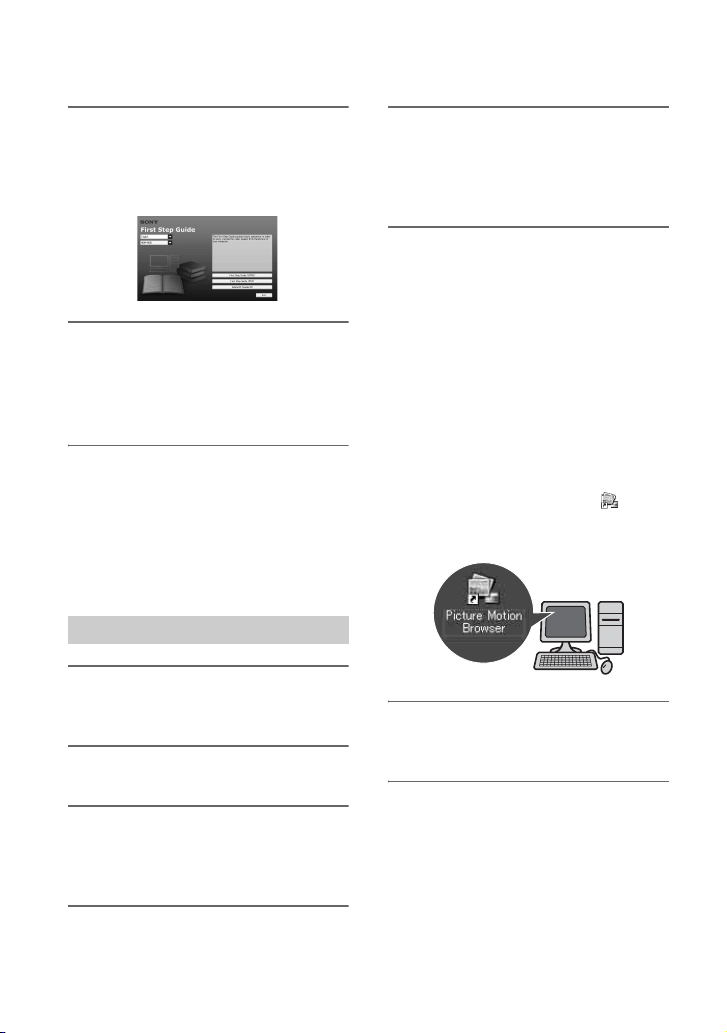
66
5 Select the desired language and
the model name of your
camcorder from the pull-down
menu.
6 Click [FirstStepGuide(HTML)].
Installation starts.
When [Save is complete] appears, click
[OK] to finish the installation.
To view the “First Step Guide” in PDF
In step 6, click [FirstStepGuide(PDF)].
To install the software “Adobe
Reader” to display the PDF file
In step 6, click [Adobe(R) Reader(R)].
1 Perform steps 1 to 3 in “Installing
the “First Step Guide”” (p. 65).
2 Click [Install].
3 Select the language for the
application to be installed, then
click [Next].
4 Check your country/region, then
click [Next].
5 Read [License Agreement], select
[I accept the terms of the license
agreement] when you agree, then
click [Next].
6 Follow the on-screen instructions
to install the software.
Depending on the computer, you may
need to install third party software
(shown below). If the installation screen
appears, follow the instructions to
install the required software.
x Microsoft DirectX 9.0c
Software required to handle movies
Restart the computer if required to
complete the installation.
The short-cut icons, such as [ ]
(Picture Motion Browser), appear on the
desktop.
7 Remove the CD-ROM from the
disc drive of your computer.
Installing the software
Installing the “First Step Guide” and software (Continued)

67
Using a Computer
Viewing “First Step
Guide”
To view “First Step Guide” on your
computer, Microsoft Internet Explorer
Ver.6.0 or later is recommended.
Double-click the short-cut icon for your
camcorder’s “First Step Guide” on the
desktop.
z Tips
• You can also start by selecting [Start] t
[Programs] ([All Programs] for Windows XP)
t [Sony Picture Utility] t [FirstStepGuide]
t Your camcorder’s folder t “First Step
Guide” in HTML.
• To view “First Step Guide” in HTML without
installing, copy the desired language folder from
the [FirstStepGuide] folder on the CD-ROM,
and then double-click [Index.html].
• Refer to the “First Step Guide” in PDF in the
following cases:
– When printing the desired topics of “First
Step Guide”
– When “First Step Guide” is not displayed
correctly due to the browser setting even in
recommended environment.
– When the HTML version of “First Step
Guide” cannot be installed.
Using a Macintosh
computer
You can copy the still images from the
“Memory Stick Duo” to the Macintosh.
Install “First Step Guide” in the supplied
CD-ROM.
b Notes
• The supplied software “Picture Motion
Browser” does not operate on Mac OS.
• Refer to “First Step Guide” for the details on
connecting your camcorder to the computer and
copying the still images.
To copy still images from a “Memory
Stick Duo”
OS: Mac OS 9.1/9.2 or Mac OS X (v10.1/
v10.2/v10.3/v10.4).
Others: USB port (this must be provided as
standard)
The “First Step Guide” is an instruction
manual you can refer to on your computer.
This describes basic operations, from initial
hookup of your camcorder and computer
and making setting, to general operation the
first time you use the software.
Referring to “Installing the “First Step
Guide””, start the “First Step Guide”, then
follow the instructions.
Copy “FirstStepGuide(PDF),” stored in the
desired language in the [FirstStepGuide]
folder, to your computer.
Double-click “FirstStepGuide(PDF)”.
If software to view PDF files is not installed
on your computer, download Adobe Reader
from their website, below;
http://www.adobe.com/
System requirements
About “First Step Guide”
Installing “First Step Guide”
Viewing “First Step Guide”

68
Troubleshooting
Troubleshooting
If you run into any problems using your
camcorder, use the following table to
troubleshoot the problem. If the problem
persists, disconnect the power source and
contact your Sony dealer.
• Overall operations/Easy Handycam/
Remote Commander..............................68
• Batteries/Power sources ........................69
• LCD screen/viewfinder .........................69
• Cassette tapes/“Memory Stick Duo”.....70
• Recording ..............................................71
• Playback ................................................72
• Dubbing/Editing/Connecting to other
devices...................................................73
• Connecting to a computer .....................74
• Functions that cannot be used together
...............................................................74
The power does not turn on.
• Attach a charged battery pack to the
camcorder (p. 12).
• Use the AC Adaptor to connect to a wall
outlet (wall socket) (p. 12).
The camcorder does not operate
even when the power is set to on.
• Disconnect the AC Adaptor from the wall
outlet (wall socket) or remove the battery
pack, then reconnect it after about 1 minute.
• Press the RESET button (p. 91) using a
sharp-pointed object. (If you press the
RESET button, all settings are reset, except
Personal Menu items.)
Buttons do not work.
• During Easy Handycam operation, not all
buttons are functional (p. 21).
Settings change during Easy
Handycam operation.
• During Easy Handycam operation, the
settings of the functions that are not
displayed on the screen return to their
defaults (p. 20, 35).
The menu item settings have
changed unexpectedly.
• The following settings return to the default
settings automatically when you set the
POWER switch to OFF (CHG) for more
than 12 hours.
– backlight
– [SCENE SELECT]
– [SPOT METER]
– [EXPOSURE]
– [WHITE BAL.]
– [SPOT FOCUS]
– [FOCUS]
– [AUDIO MIX]
The camcorder gets warm.
• The camcorder may get warmer while you
use it. This is not a malfunction.
The supplied Remote Commander
does not function.
• Set [REMOTE CTRL] to [ON] (p. 52).
• Remove any obstructions between the
Remote Commander and the remote sensor.
• Keep strong light sources, such as sunlight
or overhead lighting, away from the remote
sensor, otherwise the Remote Commander
may not function properly.
• Insert a fresh battery in the compartment
with its +/– terminals matching those of the
compartment (p. 87).
Another VCR malfunctions when you
use the supplied Remote
Commander.
• Select a commander mode other than VTR
2 for your VCR.
• Cover the sensor of your VCR with black
paper.
Overall operations/Easy
Handycam/Remote Commander
69
Troubleshooting
The power abruptly turns off.
• When approximately 5 minutes have
elapsed while you do not operate your
camcorder, the camcorder is automatically
turned off (A.SHUT OFF). Change the
setting of [A.SHUT OFF] (p. 52), or turn
on the power again (p. 15), or use the AC
Adaptor.
• The battery is fully discharged, or almost
discharged. Charge the battery pack (p. 12).
The CHG (charge) lamp does not
light while the battery pack is being
charged.
• Slide the POWER switch to OFF (CHG)
(p. 12).
• Attach the battery pack to the camcorder
correctly (p. 12).
• Connect the power cord (mains lead) to the
wall outlet (wall socket) properly.
• The battery charge is completed (p. 12).
The CHG (charge) lamp flashes while
the battery pack is being charged.
• Attach the battery pack to the camcorder
correctly (p. 12). If the problem persists,
disconnect the AC Adaptor from the wall
outlet (wall socket) and contact your Sony
dealer. The battery pack may be worn-out.
The remaining battery time indicator
does not indicate the correct time.
• Ambient temperature is too high or too low,
or the battery pack has not been charged
enough. This is not a malfunction.
• Fully charge the battery again. If the
problem persists, the battery may be worn-
out. Replace it with a new one (p. 12, 81).
• The indicated time may not be correct in
certain circumstances. For example, when
you open or close the LCD panel, it takes
about 1 minute to display the correct
remaining battery time.
The battery pack discharges too
quickly.
• Ambient temperature is too high or too low,
or the battery pack has not been charged
enough. This is not a malfunction.
• Fully charge the battery again. If the
problem persists, the battery may be worn-
out. Replace it with a new one (p. 12, 81).
A rippling effect appears on the LCD
screen when you touch it.
• This is not a malfunction. Do not press hard
on the LCD screen.
You cannot turn off the indicator.
• You cannot turn off . Touch to
check the warning messages (p. 76).
The buttons do not appear on the
touch panel.
• Touch the LCD screen lightly.
• Press DISP/BATT INFO on your
camcorder (or DISPLAY on the Remote
Commander) (p. 91, 93).
The buttons on the touch panel do
not work correctly or do not work at
all.
• Adjust the touch panel ([CALIBRATION])
(p. 85).
Menu items are grayed out.
• You cannot select grayed items in the
current recording/playback situation.
is not displayed.
• During Easy Handycam operation, not all
menu items are functional. Cancel Easy
Handycam operation (p. 20).
Batteries/Power sources
LCD screen/viewfinder
Continued ,

70
The picture in the viewfinder is not
clear.
• Move the viewfinder lens adjustment lever
until the picture appears clearly (p. 17).
The picture in the viewfinder has
disappeared.
• Close the LCD panel. The picture is not
displayed in the viewfinder when the LCD
panel is open (p. 17).
The cassette cannot be ejected from
the compartment.
• Make sure the power source (battery pack
or AC Adaptor) is connected correctly
(p. 12).
• Moisture condensation has occurred inside
the camcorder (p. 84).
The Cassette Memory indicator or
title display does not appear while
using a cassette with Cassette
Memory.
• This camcorder does not support Cassette
Memory, so the indicator does not appear.
The remaining tape indicator is not
displayed.
• Set [ REMAINING] to [ON] to always
display the remaining tape indicator (p. 52).
The cassette is noisier during
rewinding or fast-forwarding.
• When using the AC Adaptor, rewind/fast
forward speed increases (compared with
battery operation) and therefore increases
noise. This is not a malfunction.
You cannot delete the recorded
picture on the tape.
• You cannot delete a recorded picture on
tape; you can only rewind the tape and
record again. The new recording overwrites
the existing one.
You cannot operate functions using
the “Memory Stick Duo.”
• Slide the POWER switch repeatedly to turn
on the CAMERA-MEMORY or PLAY/
EDIT lamp (p. 23, 26).
• If you use a “Memory Stick Duo” formatted
on a computer, format it again on your
camcorder (p. 43).
You cannot delete pictures or format
a “Memory Stick Duo.”
• Release the lock on the write-protect tab of
the “Memory Stick Duo” if there is one
(p. 80).
• Cancel image protection on the picture
(p. 61).
• The maximum number of pictures that you
can delete on the index screen at one time is
100.
Image protection cannot be applied,
or you cannot mark pictures for
print.
• Release the lock on the write-protect tab of
the “Memory Stick Duo” if there is one
(p. 80).
• Perform the operation again on the index
screen (p. 27, 61).
• The maximum number of pictures you can
mark for print is 999.
Cassette tapes/ “Memory Stick
Duo”
Troubleshooting (Continued)

71
Troubleshooting
The data file name is not indicated
correctly, or flashes.
• The file is damaged.
• Use the file format that is compatible with
your camcorder (p. 80).
Refer also to “Cassette tapes/ “Memory
Stick Duo”” section (p. 70).
The tape does not start when you
press REC START/STOP.
• Slide the POWER switch repeatedly to turn
on the CAMERA-TAPE lamp (p. 22).
• The tape has reached the end. Rewind it, or
insert a new cassette.
• Set the write-protect tab to REC or insert a
new cassette (p. 79).
• The tape is stuck to the drum due to
moisture condensation. Remove the
cassette and leave your camcorder for at
least 1 hour, then re-insert the cassette
(p. 84).
You cannot record on the “Memory
Stick Duo.”
• The “Memory Stick Duo” is full. Insert
another “Memory Stick Duo” or format the
“Memory Stick Duo” (p. 43). Or, delete
unnecessary pictures recorded on the
“Memory Stick Duo” (p. 60).
• When you set [SMTH INT.REC] to [ON],
still images cannot be recorded on a
“Memory Stick Duo” during tape recording
(p. 47).
The recording image view looks
different.
• The recording image view may look
different depending on the condition of
your camcorder. This is not a malfunction.
You cannot record a smooth
transition on a tape from the last
recorded scene to the next.
• Perform [END SEARCH] (p. 29).
• Do not remove the cassette. (The picture
will be recorded continuously without a
break even when you turn the power off.)
• Do not record pictures in SP mode and LP
mode on the same tape.
• Avoid stopping then recording a movie in
the LP mode.
[END SEARCH] does not work.
• Do not eject the cassette after recording
(p. 29).
• There is nothing recorded on the cassette.
• There is a blank section between recorded
sections of the tape. This is not a
malfunction.
Smooth interval recording stops/
[Smooth interval rec discontinued
due to error.] appears and recording
stops.
• The video head may be dirty. Use a
cleaning cassette (optional) (p. 85).
• Try again from the beginning.
• Use a Sony mini DV cassette.
The auto focus does not function.
• Set [FOCUS] to [AUTO] (p. 39).
• The recording conditions are not suitable
for auto focus. Adjust the focus manually
(p. 39).
[STEADYSHOT] does not function.
• Set [STEADYSHOT] to [ON] (p. 41).
Recording
Continued ,

72
The backlight function does not
function.
• In the following settings, the backlight
function is canceled.
– [MANUAL] of [EXPOSURE]
– [SPOT METER]
• The backlight function does not work
during Easy Handycam operation (p. 21).
A vertical band appears when
recording candlelight or electric light
in the dark.
• This occurs when the contrast between the
subject and the background is too high.
This is not a malfunction.
A vertical band appears when
recording a bright subject.
• This phenomenon is called the smear effect.
This is not a malfunction.
Tiny spots in white, red, blue, or
green appear on the screen.
• The spots appear when you are recording in
[AUTOSLW SHTR], [SLOW SHUTTR],
[SUPER NSPLUS], or [COLOR SLOW S].
This is not a malfunction.
The color of the picture is not
correctly displayed.
• Deactivate the NightShot plus function
(p. 24).
The screen picture is bright, and the
subject does not appear on the
screen.
• Deactivate the NightShot plus function
(p. 24), or cancel the backlight function
(p. 25).
Undesirable flicker occurs.
• This anomaly may occur when recording
pictures under the discharge tube, such as a
fluorescent lamp, sodium lamp, or mercury
lamp, with [PORTRAIT] or [SPORTS].
This is not a malfunction.
Black bands appear when you
record a TV screen or computer
screen.
• Set [STEADYSHOT] to [OFF] (p. 41).
[The lens cover might be closed.
Check the cover.] appears on the
screen when the lens cover is open.
• There is not enough light, or the lens is
covered by your finger or other object.
You cannot use [SUPER NSPLUS].
• The NIGHTSHOT PLUS switch is not set
to ON (p. 24).
[COLOR SLOW S] does not operate
correctly.
• [COLOR SLOW S] may not operate
correctly in total darkness. Use NightShot
plus or [SUPER NSPLUS].
Refer also to the “Cassette tapes/ “Memory
Stick Duo”” section (p. 70).
You cannot play back a tape.
• Slide the POWER switch repeatedly to turn
on the PLAY/EDIT lamp (p. 26).
• Rewind the tape (p. 26).
Playback
Troubleshooting (Continued)
73
Troubleshooting
Image data stored on a “Memory
Stick Duo” cannot be played back.
• Image data cannot be played back if you
have modified file or folder names, or have
edited the data on a computer (In this case,
the file name flashes). This is not a
malfunction (p. 81).
• Pictures recorded on other devices may not
be played back or may not appear in their
actual size (p. 81).
Horizontal lines appear on the
picture. The displayed pictures are
not clear or do not appear.
• Clean the head using the cleaning cassette
(optional) (p. 85).
No sound or only a low sound is
heard.
• Turn up the volume (p. 26).
• Adjust [AUDIO MIX] until the sound is
heard appropriately (p. 49).
• If you are using an S VIDEO plug, make
sure the red and white plugs of the A/V
connecting cable are also connected (p. 32).
The sound breaks off.
• Clean the head using the cleaning cassette
(optional) (p. 85).
“---” is displayed on the screen.
• The tape you are playing was recorded
without setting the date and time.
• A blank section on the tape is being played.
• The data code on a tape with a scratch or
noise cannot be read.
Noises appear and is displayed
on the screen.
• The tape was recorded in a TV color system
other than that of your camcorder (NTSC).
This is not a malfunction (p. 78).
is displayed on the screen.
• The tape you are playing was recorded on
another device with a 4ch microphone
(4CH MIC REC). Your camcorder is not
compatible with 4ch microphone recording.
Date search does not work correctly.
• Be sure to record more than 2 minutes after
the date changed. If one day’s recording is
too short, your camcorder may not
accurately find the point where the
recording date changes.
• There is a blank section in the beginning or
between recorded sections of the tape. This
is not a malfunction.
Pictures from connected devices
cannot be zoomed.
• You cannot zoom pictures from connected
devices on your camcorder (p. 24).
Time code and other information
appear on the display of the
connected device.
• Set [DISP OUTPUT] to [LCD PANEL]
while connected with an A/V connecting
cable (p. 52).
You cannot dub correctly using the
A/V connecting cable.
• The A/V connecting cable is not connected
properly. Make sure that the A/V
connecting cable is connected to the input
jack of another device for dubbing a picture
from your camcorder (p. 56).
New sound added to a recorded tape
is not heard.
• Adjust [AUDIO MIX] until the sound is
heard appropriately (p. 49).
Dubbing/Editing/Connecting to
other devices
Continued ,
74
Pictures from connected devices are
not displayed correctly.
• The input signal is not NTSC (p. 78).
Still pictures cannot be dubbed from
a tape to a “Memory Stick Duo.”
• You cannot record or a distorted picture
may be recorded if the tape has been used
repeatedly for recording.
The computer does not recognize
your camcorder.
• Install the “Picture Motion Browser”
(p. 65).
• The computer may not recognize your
camcorder for a few moments after you
connect it. Wait for a while.
• Disconnect USB devices other than the
keyboard, the mouse, and the camcorder
from the (USB) jack on the computer.
• Disconnect the cable from the computer
and camcorder, restart the computer, then
connect them again correctly.
You cannot install the supplied
software, “Picture Motion Browser,”
on a Macintosh computer.
• You can install “Picture Motion Browser”
only on a Windows computer.
Depending on the functions, you may not
be able to use them together. The following
list shows examples of menu items and
functions that cannot be used at the same
time.
Connecting to a computer
Functions that cannot be used
together
Not available If this function is set
backlight [FIREWORKS],
[SPOT METER],
[EXPOSURE]
[SCENE SELECT] NightShot plus,
[TELE MACRO],
[OLD MOVIE],
[SUPER NSPLUS],
[COLOR SLOW S]
[CANDLE],
[FIREWORKS],
[SPORTS]
When the POWER
switch is set to
CAMERA-
MEMORY
[SPOT METER] NightShot plus,
[SUPER NSPLUS]
[EXPOSURE] NightShot plus,
[SUPER NSPLUS]
[WHITE BAL.] NightShot plus,
[SUPER NSPLUS]
[SPOT FOCUS] [SCENE SELECT]
[TELE MACRO] [SCENE SELECT],
during tape recording
[SUPER NSPLUS] [FADER],
[D.EFFECT]
[COLOR SLOW S] NightShot plus,
[SCENE SELECT],
[SUPER NSPLUS],
[FADER],
[D.EFFECT]
[DIGITAL ZOOM] [TELE MACRO]
[FADER] [CANDLE],
[FIREWORKS],
[SUPER NSPLUS],
[COLOR SLOW S],
[D.EFFECT]
[D.EFFECT] [CANDLE],
[FIREWORKS],
[SUPER NSPLUS],
[COLOR SLOW S],
[FADER]
[OLD MOVIE] [PICT.EFFECT],
[SCENE SELECT]
Not available If this function is set
Troubleshooting (Continued)
75
Troubleshooting
Warning indicators
and messages
If indicators appear on the LCD screen or in
the viewfinder, check the following.
Some symptoms you can fix by yourself. If
the problem persists even after you have
tried a couple of times, contact your Sony
dealer or local authorized Sony service
facility.
C:(or E:) ss:ss (Self-diagnosis
display)
C:04:ss
• The battery pack is not an
“InfoLITHIUM” battery pack (H
series). Use an “InfoLITHIUM” battery
pack (H series) (p. 81).
• Connect the DC plug of the AC
Adaptor to the DC IN jack of your
camcorder securely (p. 12).
C:21:ss
• Moisture condensation has occurred.
Remove the cassette and leave your
camcorder for at least 1 hour, then re-
insert the cassette (p. 84).
C:22:ss
• Clean the head using a cleaning
cassette (optional) (p. 85).
C:31:ss / C:32:ss
• Symptoms that are not described above
have occurred. Remove and insert the
cassette, then operate your camcorder
again. Do not perform this procedure if
moisture condensation has occurred
(p. 84).
• Remove the power source. Reconnect it
and operate your camcorder again.
• Change the cassette. Press RESET
(p. 91), and operate your camcorder
again.
Self-diagnosis display/Warning
indicators
E:61:ss / E:62:ss
• Contact your Sony dealer or local
authorized Sony service facility. Inform
them of the 5-digit code, which starts
from “E.”
101-1001(Warning indicator
pertaining to files)
• The file is damaged.
• The file is unreadable (p. 80).
E (Battery level warning)
• The battery pack is nearly used up.
• Depending on the operating,
environment, or battery conditions, E
may flash, even if there are
approximately 5 to 10 minutes
remaining.
% (Moisture condensation warning)*
• Eject the cassette, remove the power
source, and then leave it for about 1
hour with the cassette lid open (p. 84).
(Warning indicator pertaining to
“Memory Stick Duo”)
• A “Memory Stick Duo” is not inserted
(p. 18).
(Warning indicators pertaining to
“Memory Stick Duo” formatting)*
• The “Memory Stick Duo” is damaged.
• The “Memory Stick Duo” is not
formatted correctly (p. 43, 80).
(Warning indicator pertaining to
incompatible “Memory Stick Duo”)*
• An incompatible “Memory Stick Duo”
is inserted (p. 80).
Continued ,
76
Q (Warning indicators pertaining to
the tape)
Slow flashing:
• There is less than 5 minutes remaining
on the tape.
• No cassette is inserted.*
• The write-protect tab on the cassette is
set to lock (p. 79).*
Fast flashing:
• The tape has run out.*
Z (Eject cassette warning)*
Slow flashing:
• The write-protect tab on the cassette is
set to lock (p. 79).
Fast flashing:
• Moisture condensation has occurred
(p. 84).
• The self-diagnosis display code is
displayed (p. 75).
- (Warning indicator pertaining to
image deletion)*
• The image is protected (p. 61).
- (Warning indicator pertaining
to the write-protect of the “Memory
Stick Duo”)*
• The write-protect tab on the “Memory
Stick Duo” is set to lock (p. 80).
(Warning indicator pertaining to
camera-shake warning)
• The camcorder is unsteady, so camera-
shake easily occurs. Hold the
camcorder steady with both hands and
shoot the image. However, note that the
camera-shake warning indicator does
not disappear.
* You hear a melody when the warning indicators
appear on the screen (p. 52).
If messages appear on the screen, follow the
instructions.
z Tips
• When is displayed, the message can be
turned into by touching . Touch
to display the message again.
%Z Moisture condensation. Eject
the cassette (p. 84)
% Moisture condensation. Turn off
for 1H. (p. 84)
Z Reinsert the cassette. (p. 18)
• Check if the cassette is damaged.
QZ The tape is locked - check the
tab. (p. 79)
Reinsert the Memory Stick.
(p. 18, 80)
• Reinsert the “Memory Stick Duo” a
few times. If even then the indicator
flashes, the “Memory Stick Duo” might
be damaged. Try with another
“Memory Stick Duo.”
This Memory Stick is not
formatted correctly.
• Check the format, then format the
“Memory Stick Duo” as necessary
(p. 43, 80).
Memory Stick folders are full.
• You cannot create folders exceeding
999MSDCF. You cannot delete created
folders using your camcorder.
• You will have to format the “Memory
Stick Duo” (p. 43), or delete them using
your computer.
Examples of warning messages
Warning indicators and messages (Continued)

77
Troubleshooting
Check the connected device.
• Switch off the printer and switch it on
again, then disconnect the USB cable
and reconnect it.
Cannot print. Check the printer.
• Switch off the printer and switch it on
again, then disconnect the USB cable
and reconnect it.
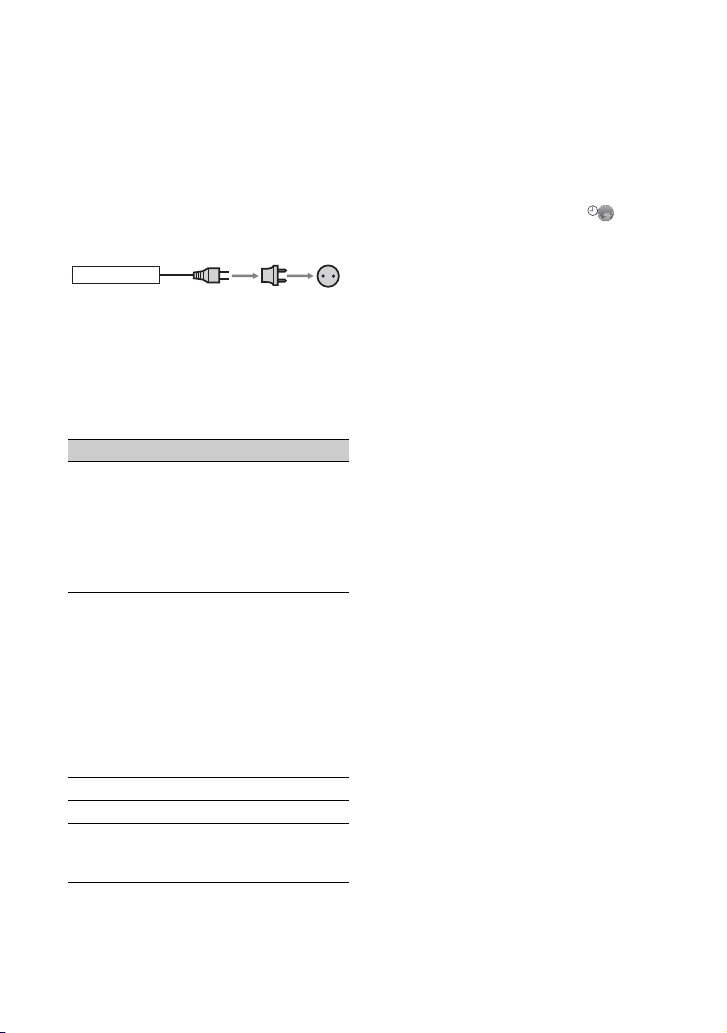
78
Additional Information
Using your camcorder abroad
Power supply
You can use your camcorder in any
country/region using the AC Adaptor
supplied with your camcorder within the
AC 100 V to 240 V, 50/60 Hz range.
Use a commercially available AC plug
adaptor [a], if necessary, depending on the
design of the wall outlet (wall socket) [b].
On TV color systems
Your camcorder is NTSC system, so its
picture can only be viewed on a NTSC
system TV with an AUDIO/VIDEO input
jack.
Simple setting of the clock by time
difference
You can easily set the clock to the local
time abroad by entering the time difference
between where you live and where you are.
Select [WORLD TIME] in the (TIME/
LANGU.) menu, then set the time
difference (p. 53).
System Used in
NTSC Bahama Islands, Bolivia,
Canada, Central America, Chile,
Colombia, Ecuador, Guyana,
Jamaica, Japan, Korea, Mexico,
Peru, Surinam, Taiwan,
the Philippines, the U.S.A.,
Venezuela, etc.
PAL Australia, Austria, Belgium,
China, Czech Republic,
Denmark, Finland, Germany,
Holland, Hong Kong, Hungary,
Italy, Kuwait, Malaysia,
New Zealand, Norway, Poland,
Portugal, Singapore,
Slovak Republic, Spain,
Sweden, Switzerland, Thailand,
United Kingdom, etc.
PAL - M Brazil
PAL - N Argentina, Paraguay, Uruguay.
SECAM Bulgaria, France, Guiana, Iran,
Iraq, Monaco, Russia, Ukraine,
etc.
AC-L200/L200B [a] [b]
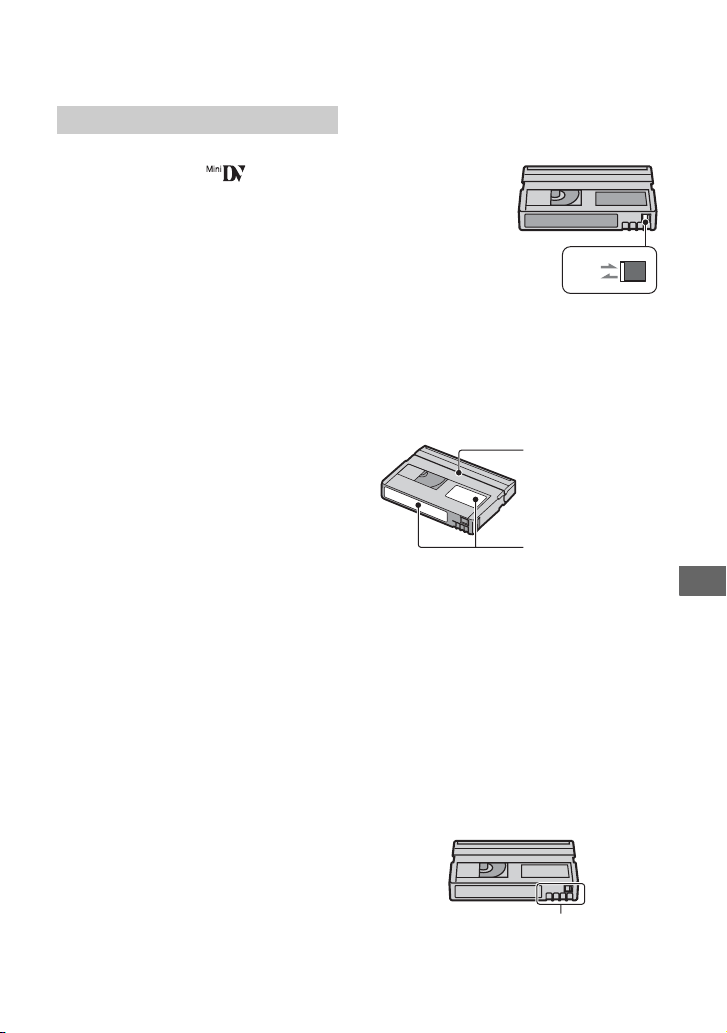
79
Additional Information
Maintenance and precautions
You can use mini DV format cassettes only.
Use a cassette with the mark.
Your camcorder is not compatible with the
Cassette Memory function.
To prevent a blank section from being
created on the tape
Go to the end of the recorded section using
END SEARCH (p. 29) before you begin the
next recording in the following cases:
• You have played back the tape.
• You have used EDIT SEARCH.
Copyright signal
x When you play back
If the cassette you play back on your
camcorder contains copyright signals, you
cannot copy it to a tape in another video
camera connected to your camcorder.
x When you record
You cannot record software on your
camcorder that contains copyright control
signals for copyright protection of software.
[Cannot record due to copyright
protection.] appears on the LCD screen, or
on the viewfinder if you try to record such
software. Your camcorder does not record
copyright control signals on the tape when
it records.
Notes on use
x When not using your camcorder for a
long time
Remove the cassette and store it.
x To prevent accidental erasure
Slide the write-protect tab on the cassette to
set it to SAVE.
x When labeling the cassette
Be sure to place the label only on the
locations shown in the following
illustration so as not to cause a malfunction
of your camcorder.
x After using the cassette
Rewind the tape to the beginning to avoid
distortion of the picture or the sound. The
cassette should then be put in its case, and
stored in an upright position.
x When cleaning the gold-plated
connector
Generally, clean the gold-plated connector
on a cassette with a cotton-wool swab after
every 10 times it has been ejected.
If the gold-plated connector on the cassette
is dirty or dusty, the remaining tape
indicator may not show correctly.
Usable cassette tapes
REC
SAVE
REC: The cassette can be
recorded.
SAVE: The cassette cannot be
recorded (write-protected).
Do not put a label
along this border.
Labeling position
Gold-plated connector
Continued ,

80
A “Memory Stick” is a compact, portable
IC recording medium with a large data
capacity.
You can use the following types of
“Memory Stick” listed below on the
camcorder. However, we do not guarantee
the operation of all types of “Memory
Stick” on your camcorder. (See the list
below for more details.)
• This product does not support high speed data
transfer via a parallel interface.
• This product cannot record or play data that uses
“MagicGate” technology. “MagicGate” is a
copyright protection technology that records and
transfers the contents in an encrypted format.
• This product is compatible with “Memory Stick
Micro” (“M2”). “M2” is the abbreviation for the
“Memory Stick Micro.”
• Still image format: Your camcorder compresses
and records image data in the JPEG (Joint
Photographic Experts Group) format. The file
extension is “.JPG.”
• A “Memory Stick Duo” formatted by a
computer (Windows OS/Mac OS) does not have
guaranteed compatibility with your camcorder.
• Data read/write speed may vary depending on
the combination of the “Memory Stick Duo”
and “Memory Stick Duo” compliant product
you use.
• You can prevent accidental erasure of images
when you slide the write-protect tab on the
“Memory Stick Duo” with a small tapered
object, to the write-protect position.
• Damaged or lost image data will not be
compensated for, and may occur in the
following cases:
– If you eject the “Memory Stick Duo,” turn the
power off on your camcorder, or remove the
battery pack for replacement while your
camcorder is reading or writing image files on
the “Memory Stick Duo” (while the access
lamp is lit or flashing).
– If you use the “Memory Stick Duo” near
magnets or magnetic fields.
• It is recommended to make a back-up of
important data on the hard disk of a computer.
• Be careful not to apply excessive force when
writing on a memo area on a “Memory Stick
Duo.”
• Do not attach a label or the like on a “Memory
Stick Duo” or a Memory Stick Duo adaptor.
• When you carry or store a “Memory Stick Duo,”
put it in its case.
• Do not touch, or allow metallic objects to come
into contact with the terminals.
• Do not bend, drop or apply strong force to the
“Memory Stick Duo.”
• Do not disassemble or modify the “Memory
Stick Duo.”
• Do not let the “Memory Stick Duo” get wet.
• Be careful to keep “Memory Stick Duo” media
out of the reach of small children. There is
danger that a child might swallow it.
• Do not insert anything other than a “Memory
Stick Duo” into the Memory Stick Duo slot.
Doing so may cause a malfunction.
• Do not use or keep the “Memory Stick Duo” in
the following locations:
– Places subject to extremely high temperature,
such as a car parked outside in the summer.
– Places under direct sunlight.
– Places with extremely high humidity or
subject to corrosive gases.
x On the Memory Stick Duo adaptor
• When using a “Memory Stick Duo” with a
“Memory Stick” compliant device, make sure to
insert the “Memory Stick Duo” into a Memory
Stick Duo adaptor.
• When inserting a “Memory Stick Duo” into a
Memory Stick Duo adaptor, make sure the
“Memory Stick Duo” is inserted facing in the
correct direction, then insert it all the way in.
Note that improper use may cause a
malfunction. Also, if you force the “Memory
Stick Duo” into the Memory Stick Duo adaptor
in the wrong direction, it may be damaged.
• Do not insert a Memory Stick Duo adaptor
without a “Memory Stick Duo” attached. Doing
so may result in malfunctions of the unit.
About the “Memory Stick”
Types of “Memory Stick”
Recording
/Playback
“Memory Stick Duo”
(with MagicGate)
a
“Memory Stick PRO Duo” a
“Memory Stick PRO-HG Duo” a
Maintenance and precautions (Continued)

81
Additional Information
x On a “Memory Stick PRO Duo”
• The maximum memory capacity of a “Memory
Stick PRO Duo” that can be used on your
camcorder is 8 GB.
Notes on using “Memory Stick Micro”
• To use a “Memory Stick Micro” with the
camcorder, you need a Duo-sized M2 Adaptor.
Insert the “Memory Stick Micro” into the Duo-
sized M2 Adaptor, then insert the adaptor into
the Memory Stick Duo slot. If you insert a
“Memory Stick Micro” into the camcorder
without using a Duo-sized M2 Adaptor, you
might not be able to remove it from the
camcorder.
• Do not leave the “Memory Stick Micro” within
the reach of small children. They might
accidentally swallow it.
On image data compatibility
• Image data files recorded on a “Memory Stick
Duo” by your camcorder conform to the
“Design rule for Camera File system” universal
standard established by the JEITA (Japan
Electronics and Information Technology
Industries Association).
• On your camcorder, you cannot play back still
images recorded on other devices (DCR-
TRV900 or DSC-D700/D770) that do not
conform to the universal standard. (These
models are not sold in some regions.)
• If you cannot use a “Memory Stick Duo” that
has been used with another device, format it
with your camcorder (p. 43). Note that
formatting erases all information on the
“Memory Stick Duo.”
• You may not be able to play back images with
your camcorder:
– When playing back image data modified on
your computer.
– When playing back image data recorded with
other devices.
This unit is compatible with an
“InfoLITHIUM” battery pack (H series).
Your camcorder operates only with an
“InfoLITHIUM” battery pack.
“InfoLITHIUM” H series battery packs
have the mark.
What is an “InfoLITHIUM” battery
pack?
An “InfoLITHIUM” battery pack is a
lithium-ion battery pack that has functions
for communicating information related to
operating conditions between your
camcorder and an optional AC Adaptor/
charger.
The “InfoLITHIUM” battery pack
calculates the power consumption
according to the operating conditions of
your camcorder, and displays the remaining
battery time in minutes.
To charge the battery pack
• Be sure to charge the battery pack before you
start using your camcorder.
• We recommend charging the battery pack in an
ambient temperature of between 10 °C to 30 °C
(50 °F to 86 °F) until the CHG (charge) lamp
turns off. If you charge the battery pack outside
of this temperature range, you may not be able
to charge it efficiently.
• When charging the battery pack while the AC
Adaptor is connected to your camcorder, after
charging is complete, disconnect the cable from
the DC IN jack on your camcorder or remove
the battery pack.
To use the battery pack effectively
• Battery pack performance decreases when the
surrounding temperature is 10 °C (50 °F) or
below, and the length of time you can use the
battery pack becomes shorter. In that case, do
one of the following to use the battery pack for a
longer time.
– Put the battery pack in a pocket to warm it up,
and insert it in your camcorder right before
you start taking shots.
About the “InfoLITHIUM”
battery pack
Continued ,

82
– Use a large capacity battery pack: NP-FH70/
FH100 (optional).
• Frequent use of the LCD screen or a frequent
playback, fast forward or rewind operation
wears out the battery pack faster.
We recommend using a large capacity battery
pack: NP-FH70/FH100 (optional).
• Be sure to set the POWER switch to OFF
(CHG) when not recording or playing back on
your camcorder. The battery pack is also
consumed when your camcorder is in recording
standby or playback pause.
• Have spare battery packs ready for two or three
times the expected recording time, and make
trial recordings before making the actual
recording.
• Do not expose the battery pack to water. The
battery pack is not water resistant.
About the remaining battery time
indicator
• When the power goes off even though the
remaining battery time indicator indicates that
the battery pack has enough power to operate,
charge the battery pack fully again. Remaining
battery time will be indicated correctly. Note,
however, that the battery indication will not be
restored if it is used in high temperatures for a
long time, or if left in a fully charged state, or
when the battery pack is frequently used. Use
the remaining battery time indication as a rough
guide only.
• The E mark that indicates low battery flashes
even if there are still 5 to 10 minutes of battery
time remaining, depending on the operating
conditions or ambient temperature.
About storage of the battery pack
• If the battery pack is not used for a long time,
fully charge the battery pack and use it up on
your camcorder once a year to maintain proper
function. To store the battery pack, remove it
from your camcorder and put it in a dry, cool
place.
• To discharge the battery pack on your
camcorder completely, set [A.SHUT OFF] to
[NEVER] on the (STANDARD SET)
menu and leave your camcorder in tape
recording standby until the power goes off
(p. 52).
About battery life
• Battery capacity decreases over time and
through repeated use. If decreased usage time
between charges becomes significant, it is
probably time to replace it with a new one.
• Each battery’s life is governed by storage,
operating and environmental conditions.
The DV Interface on this unit is an i.LINK-
compliant DV Interface. This section
describes the i.LINK standard and its
features.
What is i.LINK?
i.LINK is a digital serial interface for
transferring digital video, digital audio, and
other data to other i.LINK-compatible
devices. You can also control other devices
using the i.LINK.
i.LINK-compatible devices can be
connected using an i.LINK cable. Possible
applications are operations and data
transactions with various digital AV
devices.
When two or more i.LINK-compatible
devices are daisy-chained with the unit,
operation becomes possible from any
device in the chain. Note that operation
method may vary, or data transactions may
not be possible, depending on specifications
and characteristics of the connected
devices.
b Notes
• Normally, only one device can be connected to
this unit with an i.LINK cable. When
connecting this unit to an i.LINK-compatible
device having two or more DV Interfaces, refer
to the operating instructions of the device to be
connected.
z Tips
• i.LINK is a more familiar term for the IEEE
1394 data transport bus proposed by Sony, and
is a trademark approved by many corporations.
About i.LINK
Maintenance and precautions (Continued)

83
Additional Information
• IEEE 1394 is an international standard
standardized by the Institute of Electrical and
Electronics Engineers.
About the i.LINK Baud rate
i.LINK’s maximum baud rate varies
according to the device. There are 3 types.
S100 (approx. 100Mbps*)
S200 (approx. 200Mbps)
S400 (approx. 400Mbps)
The baud rate is listed under
“Specifications” in the operating
instructions of each piece of equipment. It
is also indicated near the i.LINK interface
on some devices.
The baud rate may differ from the indicated
value when the unit is connected to a device
with a different maximum baud rate.
Mbps stands for “megabits per second,” or
the amount of data that can be sent or
received in one second. For example, a
baud rate of 100 Mbps means that 100
megabits of data can be sent in one second.
To use i.LINK functions on this unit
For details on how to dub when this unit is
connected to other video devices having a
DV Interface, see page 56, 58.
This unit can also be connected to other
i.LINK (DV Interface) compatible devices
made by Sony (e.g. a VAIO series personal
computer) as well as to video devices.
Some i.LINK compatible video devices,
such as Digital Televisions, DVD,
MICROMV or HDV recorders/players are
not compatible with DV devices. Before
connecting to other devices, be sure to
confirm whether the device is compatible
with a DV device or not. For details on
precautions and compatible application
software, refer also to the operating
instructions for the device to be connected.
b Notes
• When connecting your camcorder to another
i.LINK-compatible device, be sure to turn off
the power of the device and disconnect the AC
Adaptor from the wall outlet (wall socket)
before connecting or disconnecting the i.LINK
cable.
About the required i.LINK cable
Use the Sony i.LINK 4-pin-to-4-pin cable
(during DV dubbing).
On use and care
• Do not use or store the camcorder and
accessories in the following locations.
– Anywhere extremely hot, cold or humid.
Never leave them exposed to temperatures
above 60 °C (140 °F), such as under direct
sunlight, near heaters or in a car parked in the
sun. They may malfunction or become
deformed.
– Near strong magnetic fields or mechanical
vibration. The camcorder may malfunction.
– Near strong radio waves or radiation. The
camcorder may not be able to record properly.
– Near AM receivers and video equipment.
Noise may occur.
– On a sandy beach or anywhere dusty. If sand
or dust gets in your camcorder, it may
malfunction. Sometimes this malfunction
cannot be repaired.
– Near windows or outdoors, where the LCD
screen, the viewfinder, or the lens may be
exposed to direct sunlight. This damages the
inside of the viewfinder or the LCD screen.
• Operate your camcorder on DC 6.8 V/7.2 V
(battery pack) or DC 8.4 V (AC Adaptor).
• For DC or AC operation, use the accessories
recommended in these operating instructions.
• Do not let your camcorder get wet, for example,
from rain or sea water. If your camcorder gets
wet, it may malfunction. Sometimes this
malfunction cannot be repaired.
• If any solid object or liquid gets inside the
casing, unplug your camcorder and have it
checked by a Sony dealer before operating it
any further.
* What is Mbps?
On using your camcorder
Continued ,

84
• Avoid rough handling, disassembling,
modifying, physical shock, or impact such as
hammering, dropping or stepping on the
product. Be particularly careful of the lens.
• Keep the POWER switch setting to OFF (CHG)
when you are not using your camcorder.
• Do not wrap your camcorder with a towel, for
example, and operate it. Doing so might cause
heat to build up inside.
• When disconnecting the power cord (mains
lead), pull it by the plug and not the cord.
• Do not damage the power cord (mains lead)
such as by placing anything heavy on it.
• Keep metal contacts clean.
• Keep the Remote Commander and button-type
battery out of children’s reach. If the battery is
accidentally swallowed, consult a doctor
immediately.
• If the battery electrolytic liquid has leaked,
– consult your local authorized Sony service
facility.
– wash off any liquid that may have contacted
your skin.
– if any liquid gets in your eyes, wash with
plenty of water and consult a doctor.
x When not using your camcorder for a
long time
• Periodically turn on the camcorder and play a
cassette for about 3 minutes.
• Use up the battery pack completely before
storing it.
Moisture condensation
If your camcorder is brought directly from a
cold place to a warm place, moisture may
condense inside your camcorder, on the
surface of the tape, or on the lens. In this
state, the tape may stick to the head drum
and be damaged or your camcorder may not
operate correctly. If there is moisture inside
your camcorder, [%Z Moisture
condensation. Eject the cassette] or [%
Moisture condensation. Turn off for 1H.]
appears. The indicator will not appear when
the moisture condenses on the lens.
x If moisture condensation has occurred
None of the functions except cassette
ejection will work. Eject the cassette, turn
off your camcorder, and leave it for about
one hour with the cassette lid open. Your
camcorder can be used again when both of
the following conditions are met:
• The warning message does not appear when the
power is turned on.
• Neither % or Z flash when a cassette is inserted
and video operation buttons are touched.
If moisture starts to condense, your
camcorder sometimes cannot detect
condensation. If this happens, the cassette is
sometimes not ejected for 10 seconds after
the cassette lid is opened. This is not a
malfunction. Do not close the cassette lid
until the cassette is ejected.
x Note on moisture condensation
Moisture may condense when you bring
your camcorder from a cold place into a
warm place (or vice versa) or when you use
your camcorder in a humid place as shown
below.
• When you bring your camcorder from a ski
slope into a place warmed up by a heating
device.
• When you bring your camcorder from an air
conditioned car or room into a hot place outside.
• When you use your camcorder after a squall or a
shower.
• When you use your camcorder in a hot and
humid place.
x How to avoid moisture condensation
When you bring your camcorder from a
cold place into a warm place, put your
camcorder in a plastic bag and seal it
tightly. Remove the bag when the air
temperature inside the plastic bag has
reached the surrounding temperature (after
about one hour).
Maintenance and precautions (Continued)
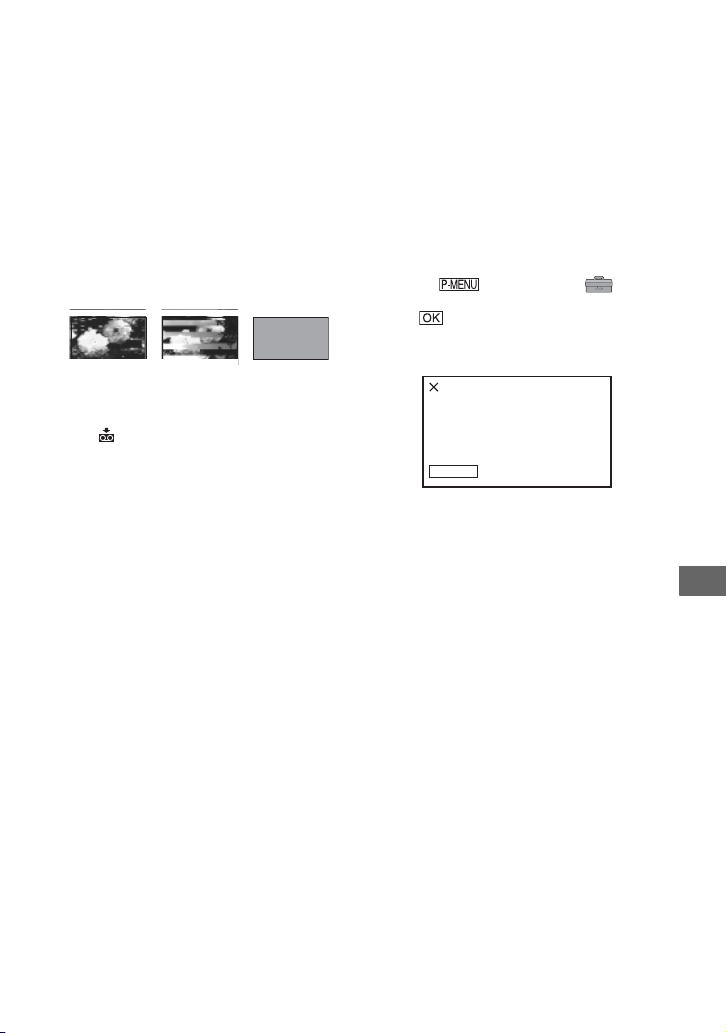
85
Additional Information
Video head
It is recommended you use a cleaning
cassette (optional) before recording
anything important.
• If the video heads are dirty, video or sound
distortion may be apparent.
• If the following problem occurs, clean the video
heads for 10 seconds with the Sony DVM-
12CLD cleaning cassette (optional).
– Mosaic-pattern noise appears on the playback
picture or the screen is displayed in blue.
– Playback pictures do not move.
– Playback pictures do not appear or the sound
breaks off.
–[x Dirty video head. Use a cleaning
cassette.] appears on the screen during
recording/playback.
• The video heads will wear after long use. If you
cannot obtain a clear image even after using a
cleaning cassette (optional), it might be because
the video heads are worn. Please contact your
Sony dealer or local authorized Sony service
facility to have the video heads replaced.
LCD screen
• Do not exert excessive pressure on the LCD
screen, as it may cause damage.
• If your camcorder is used in a cold place, a
residual image may appear on the LCD screen.
This is not a malfunction.
• While using your camcorder, the back of the
LCD screen may heat up. This is not a
malfunction.
x To clean the LCD screen
If fingerprints or dust make the LCD screen
dirty, it is recommended you use a soft
cloth to clean it. When you use the LCD
Cleaning Kit (optional), do not apply the
cleaning liquid directly to the LCD screen.
Use cleaning paper moistened with the
liquid.
x On adjustment of the touch panel
(CALIBRATION)
The buttons on the touch panel may not
work correctly. If this happens, follow the
procedure below.
It is recommended you connect your
camcorder to the wall outlet (wall socket)
using the supplied AC Adaptor during the
operation.
1 Slide the POWER switch repeatedly to turn
on the PLAY/EDIT lamp.
2 Touch t [MENU] t
(STANDARD SET) t [CALIBRATION]
t .
The screen changes to 16:9 ratio when
using 4:3 ratio.
3 Touch the “×” displayed on the screen with
the corner of the “Memory Stick Duo” or
the like.
The position of the “×” changes.
To cancel [CALIBRATION], touch
[CANCEL].
If you did not press the right spot, start from
step
3 again.
b Notes
• You cannot calibrate the LCD screen if it is
rotated.
On handling the casing
• If the casing is soiled, clean the camcorder body
with a soft cloth lightly moistened with water,
and then wipe the casing with a dry soft cloth.
• Avoid the following to avoid damage to the
finish.
– Using chemicals such as thinner, benzine,
alcohol, chemical cloths, repellent, insecticide
and sunscreen.
– Handling with above substances on your
hands.
– Leaving the casing in contact with rubber or
vinyl objects for a long period of time.
CALIBRATION
Touch the "x"
1/3
CANCEL
Continued ,
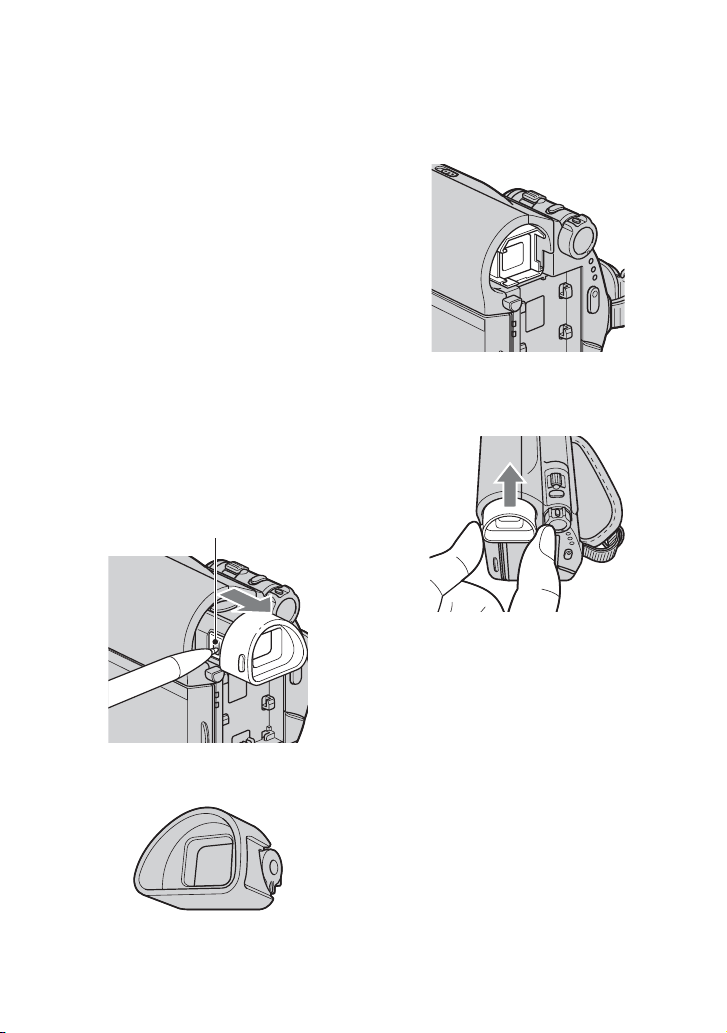
86
About care and storage of the lens
• Wipe the surface of the lens clean with a soft
cloth in the following instances:
– When there are fingerprints on the lens
surface.
– In hot or humid locations
– When the lens is exposed to salty air such as
at the seaside.
• Store in a well-ventilated location subject to
little dirt or dust.
• To prevent mold, periodically clean the lens as
described above. It is recommended that you
operate your camcorder about once a month to
keep it in optimum state for a long time.
To remove dust from inside the
viewfinder
1 Pull out the viewfinder.
2 While pushing in the tab on the side
with a fine-tipped implement such as a
ball point pen, pull the eyecup block in
the direction of the arrow to remove.
3 Remove dust from the eyecup block
with a camera blower, etc.
4 Press the viewfinder onto the body of
the camcorder.
5 Remove dust from the inside area where
the eyecup block was attached with a
camera blower, etc.
6 Attach the eyecup block to the
viewfinder, pushing it straight on until it
clicks.
b Notes
• The eyecup block is a precision part. Do not
disassemble it further.
• Do not touch the lens of the eyecup block.
On charging the pre-installed
rechargeable battery
Your camcorder has a pre-installed
rechargeable battery to retain the date, time,
and other settings even when the POWER
switch is set to OFF (CHG). The pre-
installed rechargeable battery is always
charged while your camcorder is connected
to the wall outlet (wall socket) via the AC
Adaptor or while the battery pack is
attached. The rechargeable battery will be
fully discharged in about 3 months if
you do not use your camcorder at all
Tab
Maintenance and precautions (Continued)
87
Additional Information
without the AC Adaptor connected or the
battery pack attached. Use your camcorder
after charging the pre-installed
rechargeable battery.
However, even if the pre-installed
rechargeable battery is not charged, the
camcorder operation will not be affected as
long as you are not recording the date.
x Procedures
Connect your camcorder to a wall outlet
(wall socket) using the supplied AC
Adaptor, and leave it with the POWER
switch set to OFF (CHG) for more than 24
hours.
To change the battery of the Remote
Commander
1 While pressing on the tab, inset your
fingernail into the slit to pull out the battery
case.
2 Place a new battery with the + side facing
up.
3 Insert the battery case back into the Remote
Commander until it clicks.
b Notes
• When the lithium battery becomes weak, the
operating distance of the Remote Commander
may shorten, or the Remote Commander may
not function properly. In this case, replace the
battery with a Sony CR2025 lithium battery.
Use of another battery may present a risk of fire
or explosion.
WARNING
Battery may explode if mistreated. Do
not recharge, disassemble or dispose of
in fire.
Tab
Specifications
System
Video recording system
2 rotary heads, Helical scanning system
Still image recording system
Exif Ver. 2.2*
Audio recording system
Rotary heads, PCM system
Quantization: 12 bits (Fs 32 kHz, stereo
1, stereo 2), 16 bits (Fs 48 kHz, stereo)
Video signal
NTSC color, EIA standards
Usable cassette
Mini DV cassette with the mark
printed
Tape speed
SP: Approx. 18.81 mm/s
LP: Approx. 12.56 mm/s
Recording/playback time
SP: 60 min (using a DVM60 cassette)
LP: 90 min (using a DVM60 cassette)
Fast forward/rewind time
Approx. 2 min 40 s (using a DVM60
cassette and rechargeable battery pack)
Approx. 1 min 45 s (using a DVM60
cassette and AC Adaptor)
Viewfinder
Electric viewfinder (0.27 type, aspect
ratio 16:9, 123 200 dots)
Image device
3 mm (1/6 type) CCD (Charge Coupled
Device)
Gross: Approx. 1 070 000 pixels
Effective (still): 1 000 000 pixels
Effective (movie): 690 000 pixels
Lens
Carl Zeiss Vario-Tessar
25 × (Optical), 2 000 × (Digital)
Focal length
f=2.5 ~ 62.5 mm (1/8 ~ 2 1/2 in.)
When converted to a 35 mm still
camera
Continued ,

88
In CAMERA-TAPE:
41 ~ 1 189 mm (1 5/8 ~ 46 7/8 in.)
(16:9)
43 ~ 1 075 mm (1 3/4 ~ 42 3/8 in.) (4:3)
In CAMERA-MEMORY:
36 ~ 900 mm (1 7/16 ~ 35 1/2 in.) (4:3)
39 ~ 975 mm (1 9/16 ~ 38 1/2 in.) (16:9)
F1.8 ~ 3.2
Filter diameter: 30 mm (1 3/16 in.)
Color temperature
[AUTO], [ONE PUSH], [INDOOR]
(3 200 K), [OUTDOOR] (5 800 K)
Minimum illumination
8 lx (lux) (AUTOSLW SHTR ON,
Shutter speed 1/30 s)
0 lx (lux) (during NightShot plus
function)
Input/Output connectors
A/V Remote Connector
10-pin connector
Video signal: 1 Vp-p, 75 Ω (ohms)
Luminance signal: 1 Vp-p, 75 Ω (ohms)
Chrominance signal: 0.286 Vp-p, 75 Ω
(ohms)
Audio signal: 327 mV (at load
impedance 47 kΩ (kilohms)), Output
impedance with less than 2.2 kΩ
(kilohms)
USB jack
mini-B
DV input/output jack
i.LINK Interface (IEEE1394, 4-pin
connector S100)
LCD screen
Picture
6.7 cm (2.7 type, aspect ratio 16:9)
Total dot number
123 200 (560 × 220)
General
Power requirements
DC 6.8 V/7.2 V (battery pack)
DC 8.4 V (AC Adaptor)
Average power consumption
During camera recording using the
viewfinder 2.5 W
During camera recording using the
LCD 2.8 W
Operating temperature
0 °C to 40 °C (32 °F to 104 °F)
Storage temperature
-20 °C to + 60 °C (-4 °F to + 140 °F)
Dimensions (approx.)
63 × 85 × 114 mm
(2 1/2 × 3 3/8 × 4 1/2 in.) (w/h/d)
including the projecting parts
63 × 85 × 115 mm
(2 1/2 × 3 3/8 × 4 5/8 in.) (w/h/d)
including the projecting parts with
supplied battery pack NP-FH40
attached
Mass (approx.)
390g(13oz) main unit only,
455g(1lb) including the NP-FH40
rechargeable battery pack and DVM60
cassette
Supplied accessories
See page 11.
AC Adaptor AC-L200/L200B
Power requirements
AC 100 V - 240 V, 50/60 Hz
Current consumption
0.35 - 0.18 A
Power consumption
18 W
Output voltage
DC 8.4 V*
Operating temperature
0 °C to 40 °C (32 °F to 104 °F)
* “Exif” is a file format for still images,
established by the JEITA (Japan
Electronics and Information Technology
Industries Association). Files in this
format can have additional information
such as your camcorder’s setting
information at the time of recording.
Specifications (Continued)

89
Additional Information
Storage temperature
-20 °C to + 60 °C (-4 °F to + 140 °F)
Dimensions (approx.)
48 × 29 × 81 mm
(1 15/16 × 1 3/16 × 3 1/4 in.) (w/h/d)
excluding the projecting parts
Mass (approx.)
170 g (6.0 oz) excluding the power cord
(mains lead)
*
See the label on the AC Adaptor for
other specifications.
Rechargeable battery pack NP-FH40
Maximum output voltage
DC 8.4 V
Output voltage
DC 7.2 V
Capacity
4.9 Wh (680 mAh)
Dimensions (approx.)
31.8 × 18.5 × 45.0 mm
(1 5/16 × 3/4 × 1 13/16 in.) (w/h/d)
Mass (approx.)
45 g (1.6 oz)
Operating temperature
0 °C to 40 °C (32 °F to 104 °F)
Type
Lithium ion
Design and specifications are subject to change
without notice.
On trademarks
• “Handycam” and are
registered trademarks of Sony Corporation.
• “Memory Stick,” “ ,” “Memory Stick
Duo,” “ ,” “Memory Stick
PRO Duo,” “ ,”
“Memory Stick PRO-HG Duo,”
“ ,” “Memory Stick
Micro,” “MagicGate,” “ ,”
“MagicGate Memory Stick” and “MagicGate
Memory Stick Duo” are trademarks of Sony
Corporation.
• “InfoLITHIUM” is a trademark of Sony
Corporation.
• i.LINK and are trademarks of Sony
Corporation.
• is a trademark.
• Microsoft, Windows, Windows Media,
Windows Vista, and DirectX are either
registered trademarks or trademarks of
Microsoft Corporation in the United States and/
or other countries.
• Macintosh and Mac OS are registered
trademarks of Apple Inc. in the U.S. and other
countries.
• Intel, Intel Core, and Pentium are trademarks or
registered trademarks of Intel Corporation or its
subsidiaries in the United States and other
countries.
• Adobe, the Adobe logo, and Adobe Acrobat are
either registered trademarks or trademarks of
Adobe Systems Incorporated in the United
States and/or other countries.
All other product names mentioned herein may be
the trademarks or registered trademarks of their
respective companies. Furthermore, ™ and “®”
are not mentioned in each case in this manual.
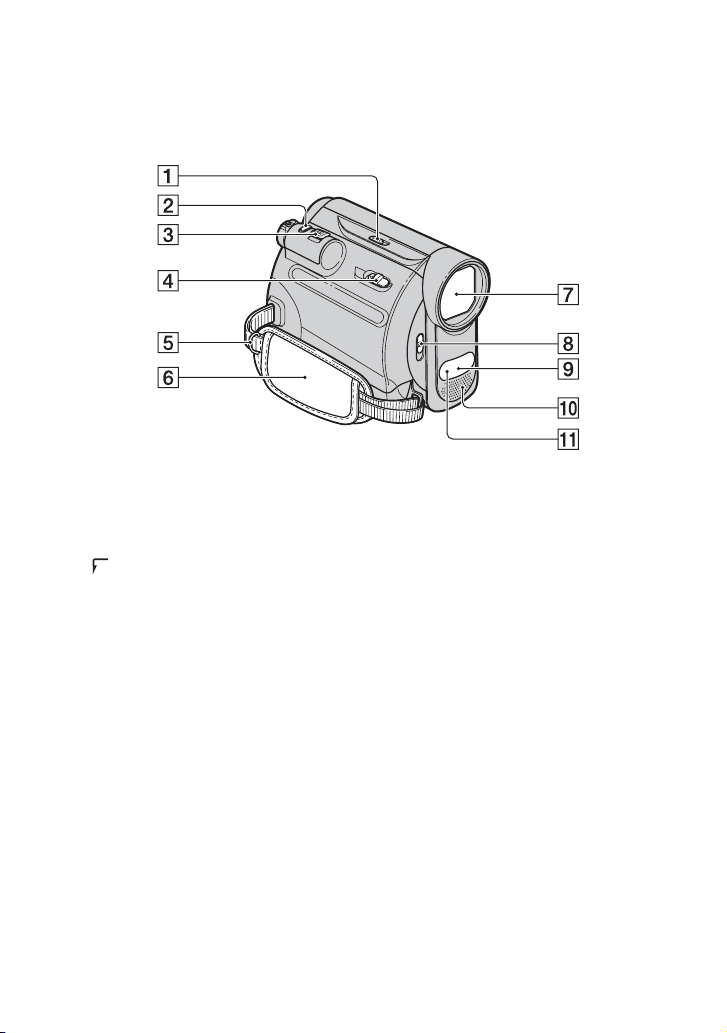
90
Quick Reference
Identifying parts and controls
The numbers in ( ) are reference pages.
A NIGHTSHOT PLUS switch (24)
B PHOTO button (20, 23)
C Power zoom lever (24, 28)
D OPEN/EJECT lever (18)
E Hooks for a shoulder belt
Attach a shoulder belt (optional).
F Grip belt (17)
G Lens (Carl Zeiss Lens) (7)
H LENS COVER switch (17)
I Remote sensor
Point the Remote Commander (93)
towards the remote sensor to operate
your camcorder.
J Internal stereo microphone (49)
K Infrared port (24)
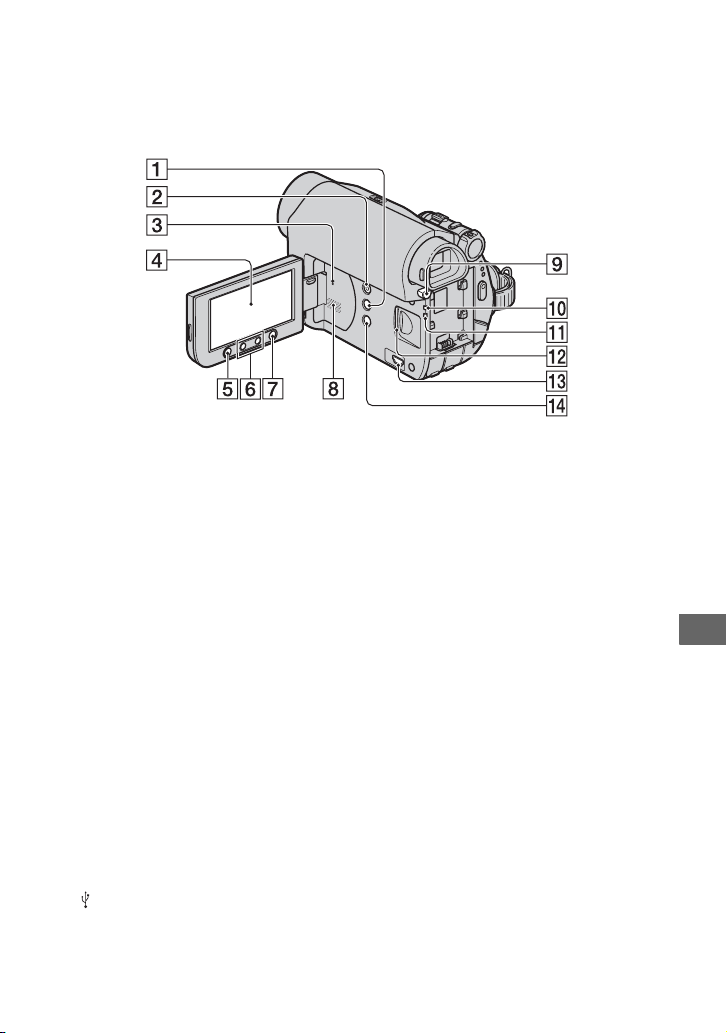
91
Quick Reference
A DISP/BATT INFO button (13, 17)
B EASY button (20)
C RESET button
Initializes all the settings, including the
setting of the date and time.
D LCD screen/touch panel (17, 94)
E REC START/STOP button (20, 22)
F Zoom buttons (24, 28)
G WIDE SELECT button (25)
H Speaker
Playback sound comes out from the
speaker. For how to adjust the volume,
see page 26.
I BATT (battery release) PUSH button
(13)
J CHG (charge) lamp (12)
K Access lamp (18)
L Memory Stick Duo slot (18)
M (USB) jack (62)
N . (backlight) button (25)
Continued ,

92
A POWER switch (15)
B Viewfinder (17)
C Eyecup (86)
D Viewfinder lens adjustment lever (17)
E DV interface (56, 58)
F DC IN jack (12)
G CAMERA-TAPE, CAMERA-
MEMORY, PLAY/EDIT lamp (15)
H REC START/STOP button (20, 22)
I A/V Remote Connector (32, 56)
J Tripod receptacle
Attach the tripod (optional: the length of the
screw must be less than 5.5 mm
(7/32 in.)) to the tripod receptacle using a
tripod screw.
Identifying parts and controls (Continued)
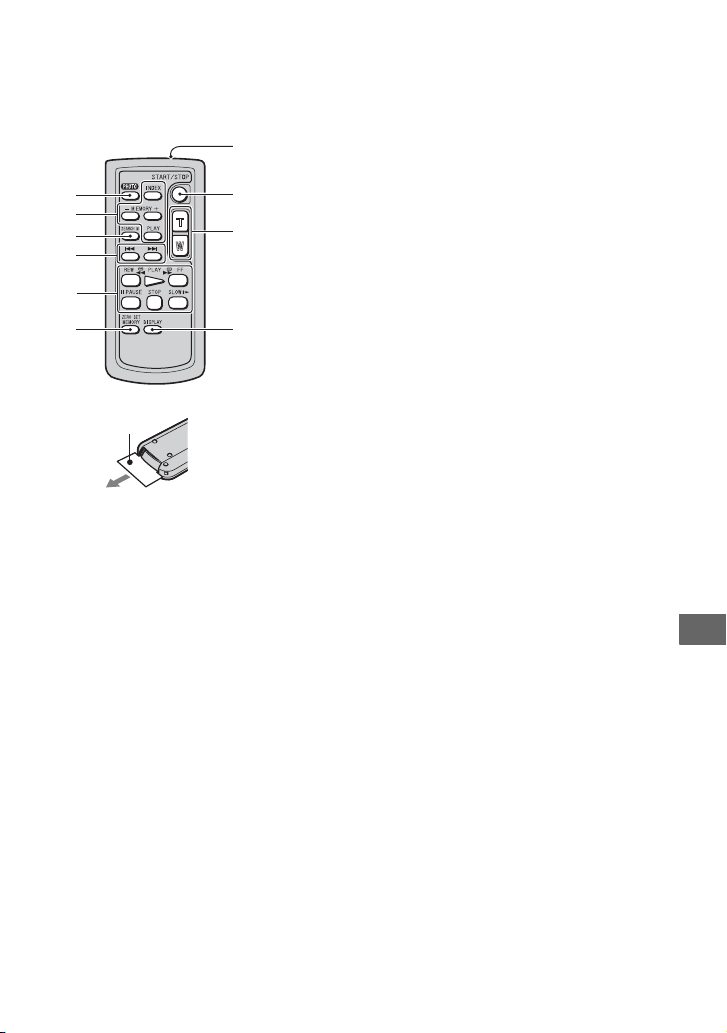
93
Quick Reference
Remote Commander
b Notes
• Remove the insulation sheet before using the
Remote Commander.
• Aim the Remote Commander towards the
remote sensor to operate your camcorder
(p. 90).
• To change the battery, see page 87.
A PHOTO button* (20, 23)
The on-screen image when you press this
button will be recorded onto the “Memory
Stick Duo” as a still image.
B Memory control buttons (Index**, –/+,
Memory playback) (21, 27)
C SEARCH M. button (31)**
D . > (Previous/Next) buttons
(31)**
E Video control buttons (Rewind,
Playback, Fast-forward, Pause, Stop,
Slow) (21, 26)
F ZERO SET MEMORY button (30)**
G Transmitter
H REC START/STOP button (20, 22)
I Power zoom buttons (24, 28)
J DISPLAY button
Toggles the screen indicators (such as Battery
Info) on or off.
7
1
2
3
4
5
6
8
9
q;
Insulation sheet
* Not available during Easy Handycam operation
with the POWER switch set to CAMERA-
TAPE.
** Not available during Easy Handycam
operation.

94
Indicators displayed during recording/playback
Recording movies
Recording still images
Viewing movies
Viewing still images
A Remaining battery (approx.)
B Recording mode (SP or LP) (50)
C Recording status ([STBY] (standby) or
[REC] (recording))
D Recording: Tape counter (hour:
minute: second)
Playback: Tape counter (hour: minute:
second)/Time code (hour: minute:
second: frame)
E Recording capacity of the tape (approx.)
(52)
F END SEARCH/EDIT SEARCH/Rec
review display switch button (30)
G GUIDE button (28)
H Personal Menu button (34)
I Recording folder (44)
J Image size (25, 42)
K Quality ( or ) (42)
L “Memory Stick Duo” indicator and the
number of images that can be recorded
(approx.)
M Review button (23)
N Tape transport indicator
O Video operation buttons (26)
P Data file name
Q Picture number/Total number of
recorded pictures in the current
playback folder
R Playback folder (44)
S Previous/Next folder icon
The following indicators appear when the first
or last picture of the current folder is
displayed and when there are multiple folders
on the same “Memory Stick Duo.”
T Image delete button (60)
U Tape playback select button (27)
GUIDE
13245
876
11
P-MENU
60min
FINE
1.0M
GUIDE
101
91 0q
a
q
s
8
qd 7
GUIDE
12q
f
45
7
8qg
MEMORY PLAY
GUIDE
1q
h
q
;
q
j
q
k
ql
7
w;
8wd
wfwg
wswa
1.0M
:
Touch to move to the previous
folder.
:
Touch to move to the next folder.
:
Touch / to move to either
the previous or the next folder.
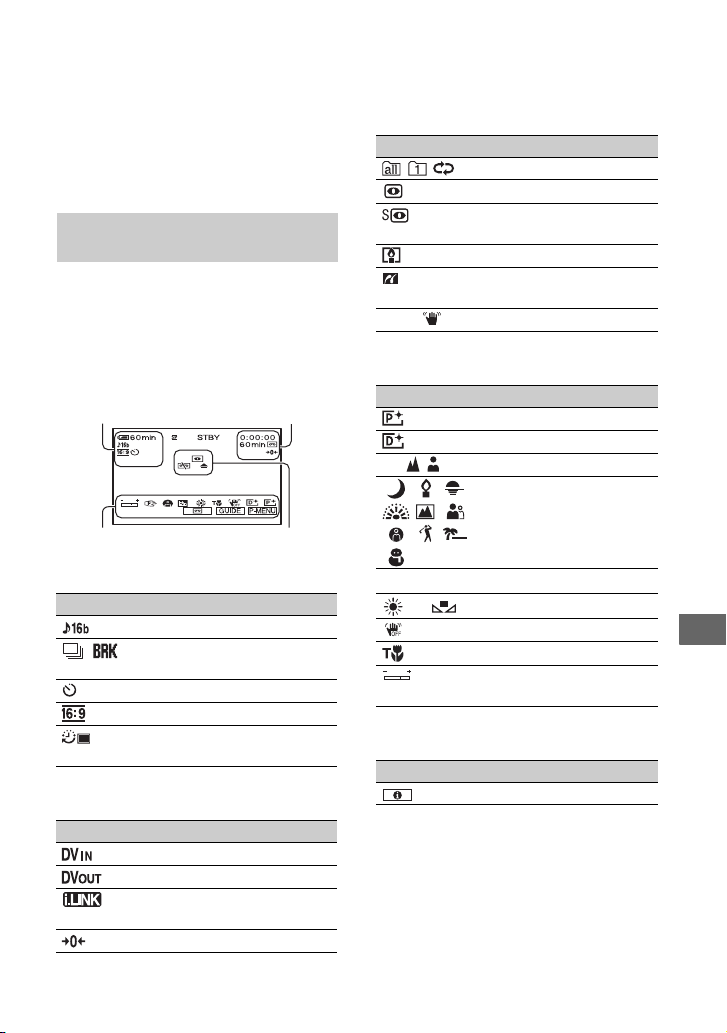
95
Quick Reference
V Previous/Next image button (27)
W Index screen display button (27)
X Image protection mark (61)
Y Print mark (61)
You can use the [DISP GUIDE] (p. 96) to
check the function of each indicator that
appears on the LCD screen.
b Notes
• Some of the indicators may not appear when
you use [DISP GUIDE].
Upper left
Upper right
Center
Bottom
Other indicator
b Notes
• The content and the position of the indicator are
normal. It may differ from the actual display.
Indicators when you made
changes
Indicator Meaning
AUDIO MODE (50)
Continuous photo
recording (42)
Self-timer recording (41)
WIDE SELECT (25)
Interval photo recording
(47)
Indicator Meaning
DV input (58)
DV output (56)
i.LINK connection
(56, 58)
Zero set memory (30, 93)
Upper left Upper right
Bottom Center
Indicator Meaning
Slide show (45)
NightShot plus (24)
Super NightShot plus
(40)
Color Slow Shutter (40)
PictBridge connecting
(62)
E Z Warning (75)
Indicator Meaning
Picture effect (46)
Digital effect (45)
9 Manual focus (39)
SCENE SELECT (37)
.
Backlight (25)
n White balance (38)
SteadyShot off (41)
Tele macro (40)
Flexible spot meter (38)/
EXPOSURE (38)
Indicator Meaning
Information (76)
Continued ,
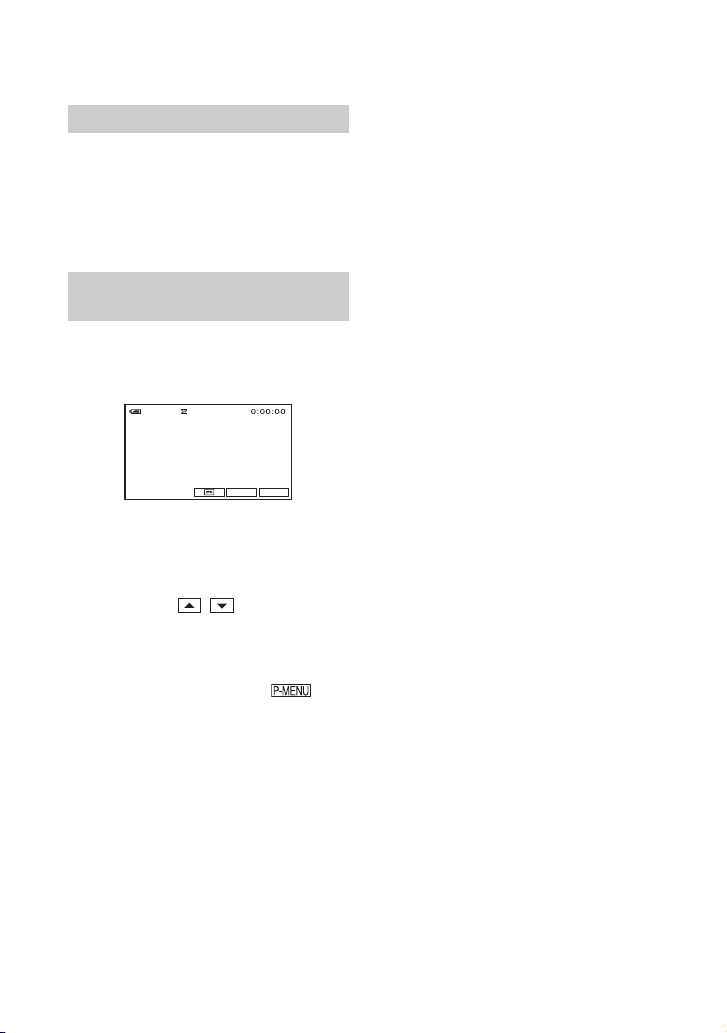
96
The date/time during recording and the
camera setting data will be recorded
automatically. They do not appear on the
screen during recording, but you can check
them as [DATA CODE] during playback
(p. 51).
You can easily check the meaning of each
indicator that appears on the LCD screen.
1 Touch [GUIDE] t [DISP GUIDE].
2 Touch the area including the indicator
that you want to check.
The meanings of the indicators in the
area are listed on the screen. If you
cannot find the indicator you want to
check, touch / to toggle.
To finish the operation, touch [END].
z Tips
• You can also operate by touching t
[DISP GUIDE].
Data code during recording
Checking the screen indicators
(Display guide)
60min
STBY
P-MENUGUIDE
Indicators displayed during recording/playback (Continued)

97
Quick Reference
Index
Numeric/Symbol
12BIT....................................50
16BIT....................................50
A
A.SHUT OFF
(Auto shut off) ......................52
A/V connecting cable .....32, 56
ALL ERASE.........................43
Aspect ratio...........................25
AUD DUB CTRL
(Audio dubbing) ...................49
AUDIO MIX.........................49
AUDIO MODE.....................50
AUTOSLW SHTR
(Auto Slow Shutter)..............39
B
B&W.....................................46
Backlight.........................25, 72
Battery ............................12, 81
BEACH.................................37
BEEP ....................................52
BLACK FADER...................44
BURST .................................42
C
CALIBRATION ...................85
CAMERA DATA.................52
CAMERA SET menu...........37
CANDLE ..............................37
Cassette...........................18, 79
CD-ROM ..............................64
Charging time .......................14
Cleaning cassette ..................85
CLOCK SET.........................15
COLOR SLOW S
(Color Slow Shutter).......40, 72
Computer ..............................64
D
D.EFFECT (Digital effect) ..45
DATA CODE........... 15, 51, 96
Date search........................... 31
DATE/TIME ............ 15, 51, 96
Delete pictures......................60
DEMO MODE .....................47
DIGITAL ZOOM.................41
DISP GUIDE
(Display guide)..................... 96
DISP OUTPUT ....................52
Display indicators ................94
DOT FADER ....................... 45
Dubbing.......................... 56, 60
E
Easy Handycam..............20, 34
EDIT SEARCH.................... 30
EDIT/PLAY menu ...............48
END SEARCH............... 29, 50
EXP.BRKTG
(Exposure bracketing) ..........42
EXPOSURE ......................... 38
F
FADER.................................44
FILE NO. (File number) ......44
FINE.....................................42
FIREWORKS....................... 37
First Step Guide ............. 64, 67
FLASH (Flash motion) ........46
Flexible spot meter...............38
FOCUS...........................39, 71
FORMAT....................... 43, 80
Frame-by-frame Playback.... 48
G
Getting Started ..................... 11
GUIDEFRAME ...................51
I
i.LINK ..................................82
i.LINK cable...................56, 58
Image protection...................61
IMAGE SIZE........................42
INDOOR...............................38
“InfoLITHIUM” battery pack
..............................................81
Install ....................................65
INT.REC-STL
(Interval photo recording).....47
L
LANDSCAPE.......................37
LANGUAGE........................53
LCD BL LEVEL
(LCD back light level)..........51
LCD BRIGHT ......................51
LCD COLOR........................51
LCD PANEL ........................52
LCD screen...........................17
LCD BL LEVEL
(LCD back light level)...51
LCD BRIGHT...............51
LCD COLOR ................51
LCD/VF SET........................51
LP (Long Play) .....................50
LUMI. KEY
(Luminance key)...................46
M
Macintosh .............................67
Maintenance and precautions
..............................................79
MEMORY SET menu ..........42
“Memory Stick”....................80
“Memory Stick Duo”............18
Menu...............................34, 35
MENU ROTATE..................52
Mirror mode..........................25
Moisture condensation..........84
MONOTONE .......................44
Continued ,

98
MOSAIC ..............................46
MOSAIC FADER ................44
Movie..................20, 21, 22, 26
N
NEG.ART.............................46
NEW FOLDER ....................44
NORMAL.............................42
NS LIGHT
(NightShot Light) .................40
NTSC..............................73, 78
Number of recordable pictures
..............................................42
O
OLD MOVIE........................46
ONE PUSH...........................38
OUTDOOR ..........................38
OVERLAP............................45
P
P.MENU....See Personal Menu
PAL ......................................78
PASTEL ...............................46
PB FOLDER
(Playback folder)..................44
PB zoom ...............................28
Personal Menu................34, 54
PICT.APPLI. menu
(Picture Application menu) ..44
PICT.EFFECT
(Picture effect)......................46
PictBridge PRINT ................62
Picture Motion Browser .......64
Playback .........................21, 26
Playing time..........................14
PORTRAIT (Soft portrait) ...37
Print ......................................62
Print mark.............................61
Q
QUALITY ............................42
R
REC CTRL
(Recording control).............. 58
REC FOLDER
(Recording folder)................ 44
REC MODE
(Recording mode) ................ 50
Rec review ........................... 30
Recording....................... 20, 22
Recording time..................... 14
REMAINING....................... 52
Remaining battery.......... 13, 94
Remote Commander ............ 93
REMOTE CTRL
(Remote control).................. 52
Reversal Playback................ 48
S
S VIDEO cable .............. 32, 56
SCENE SELECT................. 37
Searching for the starting point
............................................. 29
SELF-TIMER ...................... 41
SEPIA .................................. 46
SLIDE SHOW ..................... 45
SLOW SHUTTR
(Slow shutter)....................... 46
SMTH INT.REC
(Smooth interval tape
recording)............................. 47
SNOW.................................. 37
SOLARIZE.......................... 46
SP (Standard Play)............... 50
Specifications....................... 87
SPORTS (Sports lesson)...... 37
SPOT FOCUS...................... 39
SPOT METER
............See Flexible spot meter
SPOTLIGHT........................ 37
STANDARD........................ 42
STANDARD SET menu...... 50
STEADYSHOT ............. 41, 71
STILL................................... 45
Still image .......... 20, 21, 23, 27
STILL SET...........................42
SUNRSE SUNSET ..............37
SUPER NSPLUS
(Super NightShot plus)...40, 72
T
Tape counter.........................94
TELE MACRO ....................40
Time code.............................94
TIME/LANGU. menu ..........53
TRAIL..................................46
Tripod...................................92
TV.........................................32
TV color systems..................78
TV TYPE..............................33
TWILIGHT ..........................37
U
USAGE GUIDE...................28
USB CAMERA....................51
USB SELECT ......................48
Using abroad ........................78
V
VAR.SPD PB
(Various speed playback).....48
VF B.LIGHT
(Viewfinder brightness)........51
VOLUME.............................26
V-OUT/PANEL ...................52
W
Warning indicators ...............75
Warning messages................75
WHITE BAL.
(White balance) ....................38
WHITE FADER...................44
Wide (16:9) ..........................25
Windows.........................64, 65
WIPE ....................................45
WORLD TIME ....................53
Index (Continued)

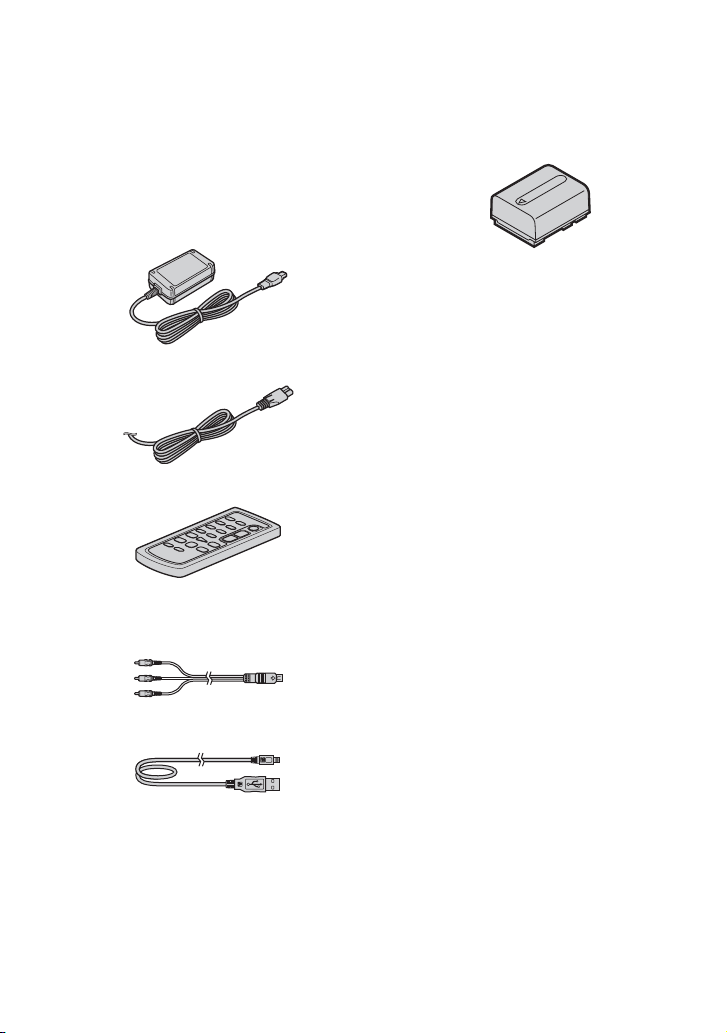
100
Spanish Quick Guide/Guía rápida en español
Paso 1: Comprobación de los elementos
suministrados
Asegúrese de que su videocámara contiene
los siguientes elementos.
El número entre paréntesis indica la
cantidad del elemento.
Adaptador de alimentación de ca (1)
Cable de alimentación (1)
Control remoto inalámbrico (1)
Tiene instalada una pila de litio tipo botón.
Cable de conexión A/V (1)
Cable USB (1)
Batería recargable NP-FH40 (1)
CD-ROM “Handycam Application
Software” (1)
Guía de operaciones (este manual) (1)
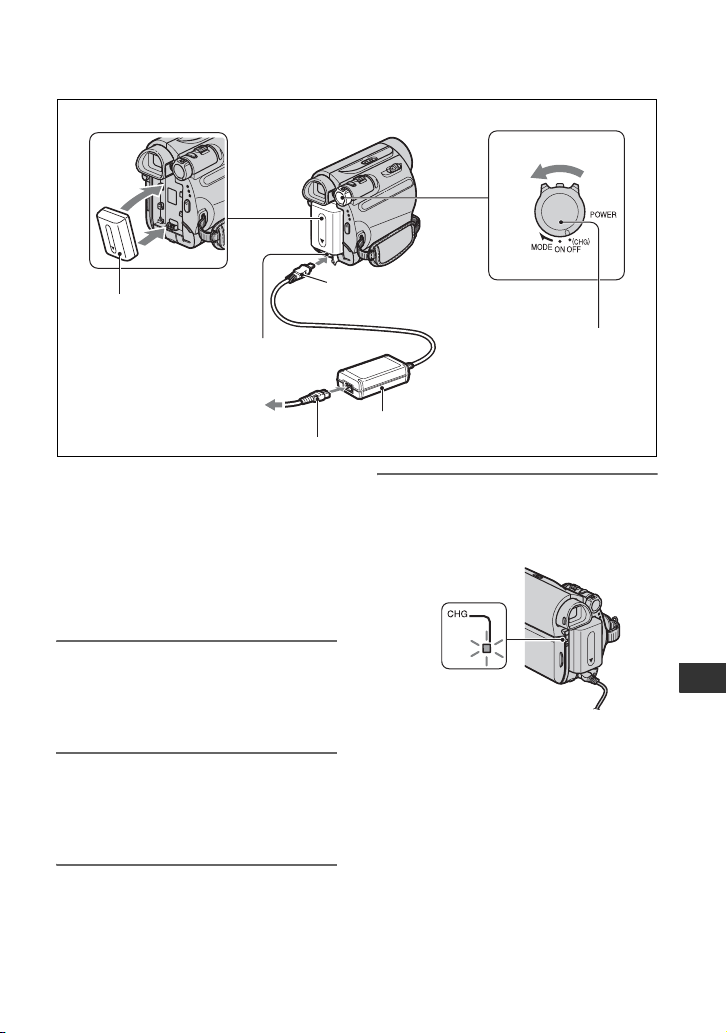
101
Spanish Quick Guide/Guía rápida en español
Paso 2: Carga de la batería
Puede cargar la batería
“InfoLITHIUM” (serie H) tras
conectarla a la videocámara.
b Notas
• No es posible colocar una batería
“InfoLITHIUM” que no sea serie H en la
videocámara.
1 Alinee los terminales de la batería
(1) y de su videocámara, luego
coloque la batería y cálcela en su
lugar (2).
2 Deslice el interruptor POWER en
la dirección de la flecha hasta la
posición OFF (CHG) (ajuste
predeterminado).
3 Conecte el adaptador de
alimentación de ca en la toma de
entrada de cc de la videocámara
con la marca v de la clavija de cc
hacia abajo.
4 Conecte el cable de alimentación
al adaptador de alimentación de
ca y al tomacorriente de pared.
El indicador CHG (carga) se enciende y
se inicia el proceso de carga. El
indicador CHG (carga) se apaga cuando
la batería está completamente cargada.
Desconecte el adaptador de
alimentación de ca de la toma de entrada
de cc.
b Notas
• Sujete la videocámara y el enchufe de cc para
desconectar el adaptador de alimentación de ca
de la toma de entrada de cc.
1
2
4
3
1
2
Interruptor POWER
Toma de entrada de cc
Enchufe de cc
Adaptador de alimentación de ca
Al tomacorriente
de pared
Batería
Cable de alimentación
El indicador CHG
(carga)
Continúa ,
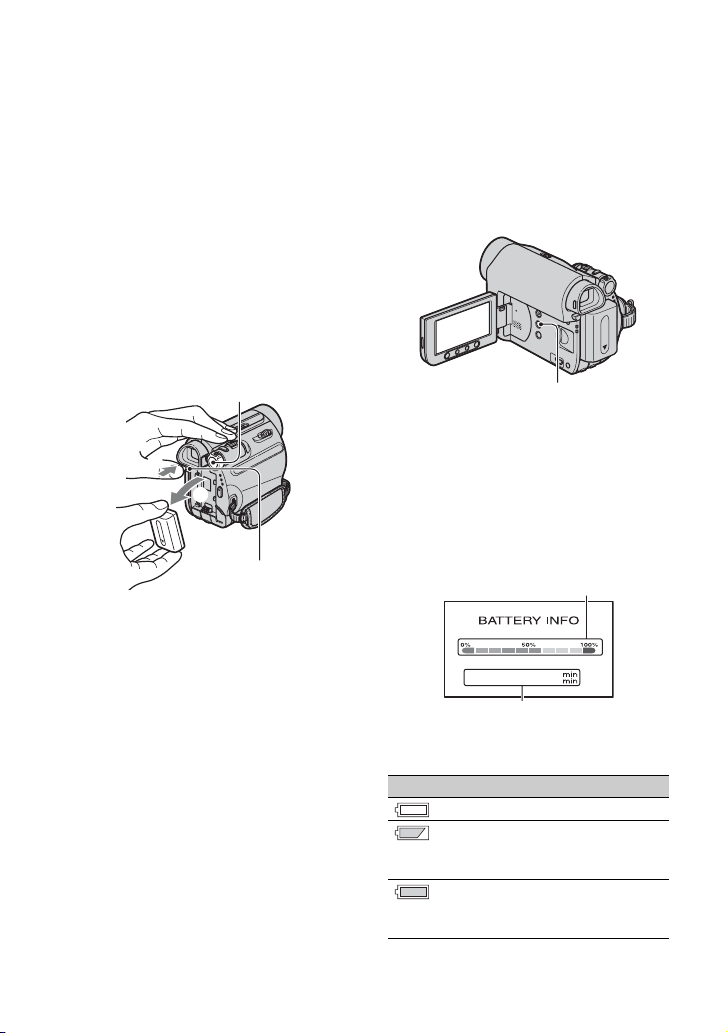
102
Para utilizar una fuente de
alimentación externa
Puede utilizar una fuente de alimentación
del tomacorriente de pared para operar la
videocámara mediante las mismas
conexiones que realiza al cargar la batería.
La batería no perderá la carga en este caso.
Para retirar la batería
1 Desactive la alimentación y, a
continuación, presione PUSH.
2 Extraiga la batería en la dirección
indicada por la flecha.
Cuando guarde la batería
Descargue completamente la batería antes
de guardarla durante un período
prolongado.
Para comprobar la carga restante de
la batería (información sobre la
batería)
Ajuste el interruptor POWER en la posición
OFF (CHG) y, a continuación, presione
DISP/BATT INFO.
Transcurridos unos instantes, se mostrará el
tiempo de grabación aproximado y la
información de la batería durante
aproximadamente 7 s (segundo). Puede ver
la información sobre la batería durante un
máximo de 20 s (segundo) si presiona de
nuevo DISP/BATT INFO mientras aparece
dicha información.
Es posible visualizar la carga restante de la
batería en la pantalla LCD.
2
1
Interruptor POWER
PUSH
Indicador Estado
Energía restante suficiente
Poca batería, la grabación/
reproducción se detendrá
pronto.
Sustituya la batería por otra
completamente cargada o
cárguela.
Botón DISP/BATT INFO
60
65
PANT.LCD :
VISOR
:
NIVEL CARGA BATERÍA
TIEMPO GRAB DISPON
Batería restante (aprox.)
Capacidad de grabación (aprox.)
Paso 2: Carga de la batería (Continuación)

103
Spanish Quick Guide/Guía rápida en español
Tiempo de carga
Tiempo aproximado (min) necesario para
cargar totalmente una batería descargada
por completo.
Tiempo de grabación
Tiempo aproximado (min) disponible
cuando utiliza una batería completamente
cargada.
* El tiempo de grabación normal muestra la hora
cuando se repite la operación de inicio/
detención de la grabación, al conectar y
desconectar la alimentación y al usar la función
de zoom.
b Notas
• Todo el tiempo calculado en las siguientes
condiciones:
Parte superior: Grabación con pantalla LCD.
Parte inferior: Grabación con el visor y el panel
LCD cerrado.
Tiempo de reproducción
Tiempo aproximado (min) disponible
cuando utiliza una batería completamente
cargada.
Acerca de la batería
• Antes de cambiar la batería, deslice el
interruptor POWER a la posición OFF (CHG).
• El indicador CHG (carga) parpadeará durante la
carga o la información sobre la batería no se
mostrará correctamente en las siguientes
situaciones.
– La batería no está correctamente conectada.
– La batería está dañada.
– La batería está completamente gastada (sólo
para la información sobre la batería).
• No se suministrará energía de la batería
mientras el adaptador de alimentación de ca esté
conectado a la toma de entrada de cc de la
videocámara, incluso cuando el cable de
alimentación esté desconectado del
tomacorriente de pared.
Acerca del tiempo de carga/grabación/
reproducción
• Tiempo calculado con la videocámara a 25°C
(Se recomienda una temperatura de entre 10°C y
30°C)
• El tiempo de grabación y de reproducción será
más corto cuando use la videocámara a bajas
temperaturas.
• El tiempo de grabación y de reproducción será
más corto en función de las condiciones de uso
de la videocámara.
Batería
Tiempo de
carga
NP-FH40 (suministrada) 125
NP-FH50 135
NP-FH70 170
NP-FH100 390
Batería
Tiempo de
grabación
continua
Tiempo de
grabación
normal*
NP-FH40
(suministrada)
100
110
50
55
NP-FH50 115
130
55
65
NP-FH70 245
280
120
140
NP-FH100 565
635
280
315
Batería
Panel LCD
abierto
Panel LCD
cerrado
NP-FH40
(suministrada)
120 150
NP-FH50 140 170
NP-FH70 300 370
NP-FH100 695 845
Continúa ,

104
Acerca del adaptador de alimentación de
ca
• Si utiliza el adaptador de alimentación de ca
conéctelo a un tomacorriente de pared cercano.
Si se produce alguna falla de funcionamiento al
utilizar la videocámara, desconecte el adaptador
de alimentación de ca del tomacorriente de
inmediato.
• No utilice el adaptador de alimentación de ca
colocado en un espacio angosto, tal como entre
una pared y los muebles.
• Evite la formación de cortocircuitos en la clavija
de cc del adaptador de alimentación de ca o en
el terminal de la batería con objetos metálicos.
Esto podría provocar una falla de
funcionamiento.
• Aunque la videocámara esté apagada, seguirá
recibiendo adaptador de alimentación de ca
(corriente doméstica) mientras esté conectada a
la toma de pared mediante el adaptador de
alimentación de ca
Paso 2: Carga de la batería (Continuación)
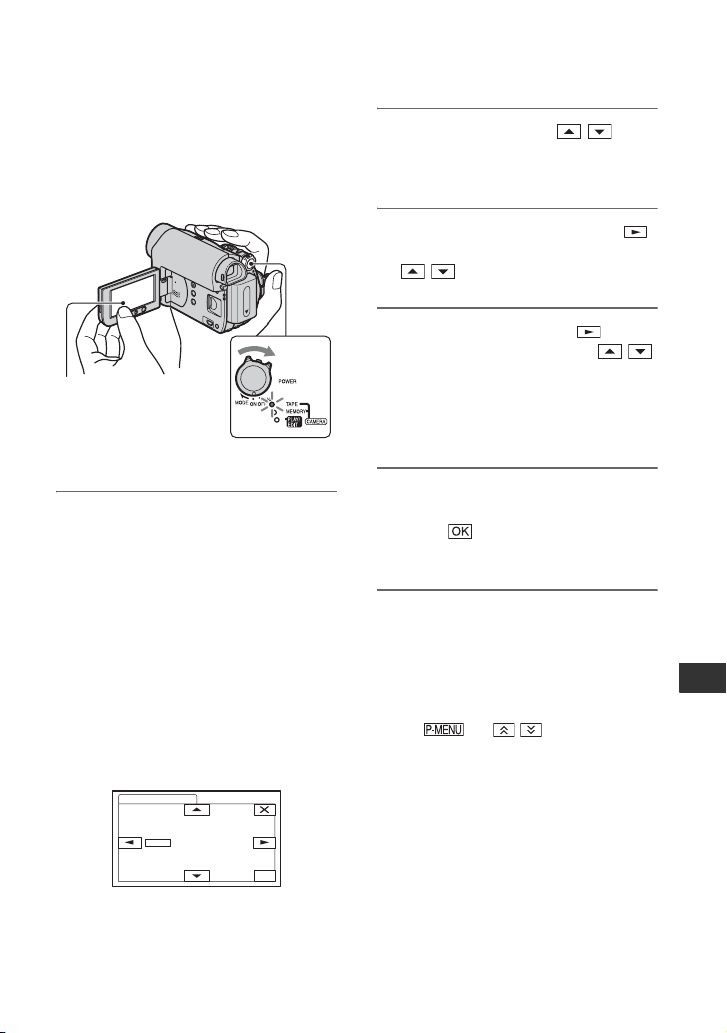
105
Spanish Quick Guide/Guía rápida en español
Paso 3: Activación de la alimentación y ajuste
de la fecha y hora
Ajuste la fecha y la hora cuando use la
videocámara por primera vez. De lo
contrario, la pantalla [AJUS.RELOJ]
aparecerá cada vez que encienda la
videocámara o cambie la posición del
interruptor POWER.
1 Deslice el interruptor POWER en
el sentido de la flecha para que se
encienda el indicador
correspondiente mientras
mantiene presionado el botón
verde.
CAMERA-TAPE: Para grabar en una
cinta.
CAMERA-MEMORY: Para grabar en
un “Memory Stick Duo”.
PLAY/EDIT: Para reproducir o editar
imágenes.
Aparecerá la pantalla [AJUS.RELOJ].
2 Ajuste [A] (año) con / .
Puede seleccionar cualquier año hasta el
año 2079.
3 Diríjase a [M] (mes) mediante ,
luego realice el ajuste mediante
/.
4 Diríjase a [D] mediante , luego
realice el ajuste mediante /
y repita el procedimiento para
ajustar la hora y los minutos.
Ajuste la medianoche a las 12:00 AM.
Ajuste el mediodía a las 12:00 PM.
5 Verifique que la configuración de
fecha y hora sea correcta, luego
toque .
El reloj se pone en funcionamiento.
Para apagar la videocámara
Deslice el interruptor POWER hasta la
posición OFF (CHG).
Para restablecer la fecha y la hora
Toque t / t
[AJUS.RELOJ] para establecer la fecha y la
hora deseadas.
b Notas
• Si no usa la videocámara durante
aproximadamente 3 meses, la batería
recargable incorporada se descarga y es posible
que los ajustes de la fecha y la hora se borren de
la memoria. En ese caso, cargue la batería
recargable y ajuste la fecha y la hora
nuevamente.
Interruptor
POWER
Toque los botones
de la pantalla LCD.
OK
1
AM
–:––:––
2008
AM
1
D
12:00
ESPERA
AJUS.RELOJ
Continúa ,

106
• Con el fin de ahorrar energía de la batería,
cuando se adquiere la videocámara, ésta viene
ajustada para apagarse automáticamente si se
deja encendida sin realizar ninguna operación
durante unos 5 min (minuto) ([APAGADO
AUTO]).
z Sugerencias
• Durante la grabación, no se visualizarán la fecha
y la hora. Éstas se grabarán automáticamente en
la cinta y podrán visualizarse durante la
reproducción ([CÓDIGO DATOS] (durante el
modo de operación Easy Handycam,
únicamente podrá ajustar [FECHA/HORA])).
• Si los botones del panel táctil no funcionan
correctamente, ajuste el panel táctil
(CALIBRACIÓN).
Puede cambiar las indicaciones en pantalla
para mostrar mensajes en un idioma en
particular.
Toque t [MENU] t
(HORA/LANGU.) t
[LANGUAGE] y, a continuación,
seleccione el idioma que desee.
Cambio de los ajustes de
idioma
Paso 3: Activación de la alimentación y ajuste de la fecha y hora
(Continuación)
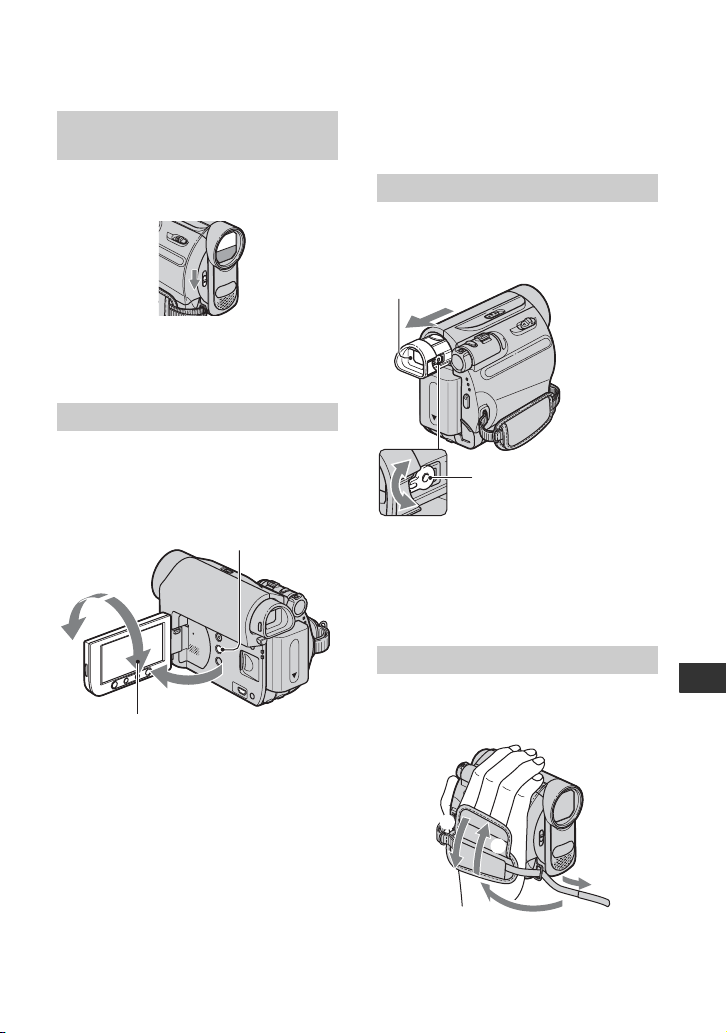
107
Spanish Quick Guide/Guía rápida en español
Paso 4: Realización de ajustes antes de la
grabación
Deslice el interruptor LENS COVER hacia
la posición OPEN.
Luego de grabar, ajuste el interruptor LENS
COVER en la posición CLOSE para cerrar
la cubierta del objetivo.
Abra el panel LCD a 90 grados con
respecto a la videocámara (1), luego gírelo
hacia el mejor ángulo para grabar o
reproducir (2).
b Notas
• No presione los botones debajo del marco del
panel LCD por error al abrirlo o ajustarlo.
z Sugerencias
• Si gira el panel LCD 180 grados hacia el lado
del objetivo, podrá cerrarlo con la pantalla LCD
hacia afuera. Esto resulta conveniente durante
operaciones de reproducción.
• Consulte [AJ LCD/VISOR] - [BRILLO LCD]
para ajustar el brillo de la pantalla LCD.
• Presione DISP/BATT INFO para activar o
desactivar los indicadores que aparecen en
pantalla (como la información de la batería).
Puede ver imágenes utilizando el visor para
evitar el desgaste de la batería o cuando la
imagen en la pantalla LCD es mala.
z Sugerencias
• Puede ajustar el brillo de fondo del visor
seleccionando [AJ LCD/VISOR] - [LUZ
F.VISOR].
Ajuste la correa de sujeción y sujete la
cámara correctamente.
Apertura de la cubierta del
objetivo
Panel LCD
2
2
1
90 grados con
respecto a la
videocámara
90 grados
(máx.)
DISP/BATT INFO
180 grados
(máx.)
Visor
Correa de sujeción
Palanca de ajuste del
objetivo del visor
Muévala hasta que la
imagen se aclare.
Visor
2
1
4
3

108
Paso 5: Inserción de una cinta o un “Memory
Stick Duo”
Solamente puede utilizar videocasetes de
formato mini DV .
1 Deslice la palanca OPEN/
EJECT en el sentido de la flecha y
manténgala en esa posición para
abrir la tapa.
El compartimiento del videocasete sale
automáticamente y se abre.
2 Inserte un videocasete con la
cara de la ventanilla hacia afuera
y, a continuación, presione .
El compartimiento del
videocasete se desliza
automáticamente hacia adentro.
b Notas
• No fuerce el compartimiento del
videocasete presionando la parte
con la marca mientras
se desliza hacia adentro. Podría
provocar una falla de
funcionamiento.
3 Cierre la tapa.
Para expulsar el videocasete
Siga el mismo procedimiento descrito en el
paso 1 para abrir la tapa y, a continuación,
extraiga el videocasete.
z Sugerencias
• El tiempo disponible para grabación varía en
función del [ MODO GRAB.].
Puede utilizar “Memory Stick” con el logo
que se muestra abajo.
– (“Memory Stick Duo”)
– (“Memory Stick
PRO Duo”)
– (“Memory Stick
PRO-HG Duo”)
1 Abra el panel LCD.
Cinta de videocasete
Palanca OPEN/EJECT
Tapa
Ventanilla
Presione ligeramente el centro de la
parte posterior del videocasete.
Compartimiento del videocasete
“Memory Stick Duo”
{DO NOT PUSH}

109
Spanish Quick Guide/Guía rápida en español
2 Inserte el “Memory Stick Duo” en
la ranura Memory Stick Duo en el
sentido correcto hasta que calce.
Para expulsar un “Memory Stick Duo”
Empuje ligeramente una sola vez y deslice
hacia afuera el “Memory Stick Duo” al
costado del cuerpo de la videocámara.
b Notas
• Cuando el indicador de acceso se enciende o
parpadea, la videocámara está leyendo o
grabando datos. No sacuda ni golpee la
videocámara, no la apague, ni extraiga el
“Memory Stick Duo”, ni retire la batería. De lo
contrario, se podrían dañar los datos de imagen.
• Si fuerza el “Memory Stick Duo” en la ranura
en la dirección incorrecta, puede dañarse el
“Memory Stick Duo”, la ranura para el Memory
Stick Duo o los datos de la imagen.
• No extraiga el “Memory Stick Duo” a la fuerza
con los dedos porque podría dañarse.
• Al insertar o expulsar el “Memory Stick Duo”,
asegúrese de que el “Memory Stick Duo” no
salte y se caiga.
z Sugerencias
• El número de imágenes que se pueden grabar
varía en función de la calidad o el tamaño de la
imagen.
Indicador de acceso
Con la marca v hacia la
pantalla LCD

110
Grabación
Las películas se graban en una cinta.
Deslice el interruptor POWER varias veces en el sentido de la
flecha para que se encienda el indicador CAMERA-TAPE.
Presione REC START/STOP A (o B
).
Para detener la grabación, presione REC START/STOP A (o B) nuevamente.
b Notas
• No es posible grabar películas en un “Memory Stick Duo” con la videocámara.
z Sugerencias
• Durante la grabación de películas en una cinta o durante el modo de espera, usted puede grabar una
imagen fija en un “Memory Stick Duo” presionando completamente PHOTO. Las imágenes fijas se
ajustarán en [0,2M] en pantalla de formato 16:9 o en [VGA(0,3M)] en pantalla de formato 4:3.
Grabación de películas
Ab
ra
l
a cu
bi
erta
d
e
l
o
bj
et
i
vo.
PHOTO
REC START/
STOP B
Interruptor POWER
REC START/
STOP A
Si el interruptor POWER está en la posición OFF
(CHG), deslícelo mientras presiona el botón verde.
60min
60min
60min
60min
ESPERA GRAB.
P-MENU
GUÍA
P-MENU
GUÍA
[ESPERA] [GRAB.]

111
Spanish Quick Guide/Guía rápida en español
Las imágenes fijas se graban en el “Memory Stick Duo”.
Deslice el interruptor POWER varias veces en el sentido de la
flecha para que se encienda el indicador CAMERA-MEMORY.
Mantenga presionado PHOTO ligeramente para ajustar el
enfoque y, a continuación, presiónelo hasta el fondo.
Se escucha el sonido del obturador. Cuando desaparece, significa que se ha
grabado la imagen.
Para comprobar la grabación más reciente realizada en un “Memory Stick Duo”
Toque . Para borrar la imagen, toque t [SÍ].
Grabación de imágenes fijas
Si el interruptor POWER está en la posición OFF
(CHG), deslícelo mientras presiona el botón verde.
1,0M 1,0M
P-MENU P-MENU
GUÍA
min min
GUÍA
Pitido
Clic del obturador
Parpadeando bSe ilumina
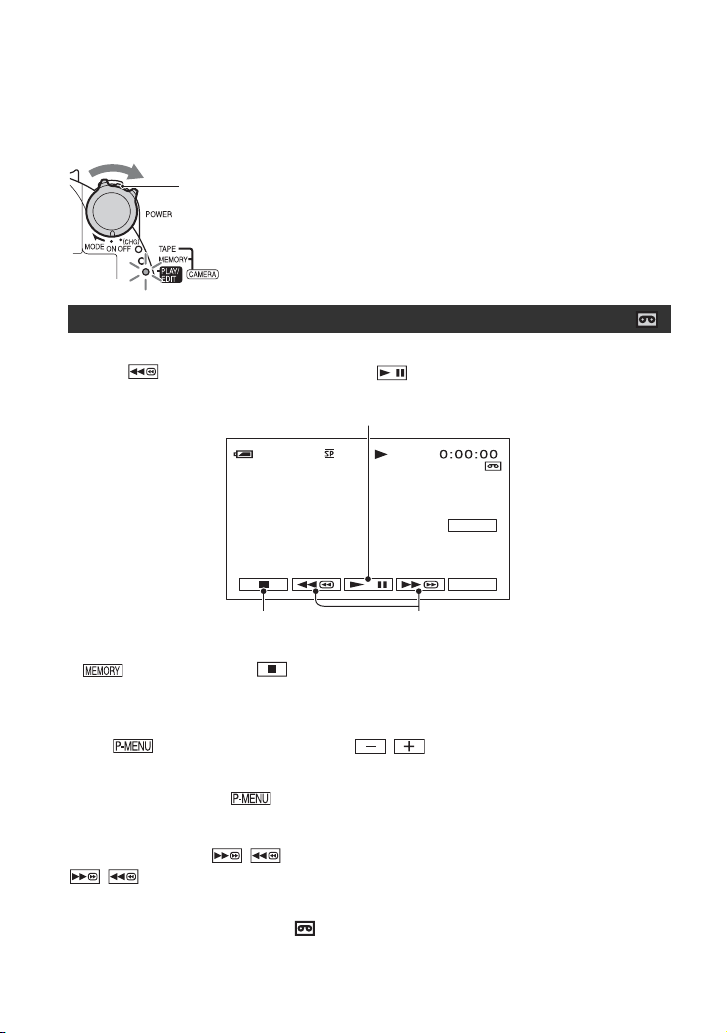
112
Reproducción
Deslice el interruptor POWER en el sentido de la flecha varias veces
para encender el indicador PLAY/EDIT.
Toque y, a continuación, toque para iniciar la reproducción.
* La reproducción se detiene automáticamente si se acciona la pausa durante más de 3 min (minuto).
** se muestra en lugar de al insertar un “Memory Stick Duo” con imágenes grabadas y si no
se está reproduciendo una cinta.
Para ajustar el volumen del sonido
Toque t [VOL.], y, a continuación, / para ajustar el volumen.
z Sugerencias
• Si no encuentra [VOL.] en , toque [MENU].
Para buscar una escena durante la reproducción
Mantenga presionado / durante la reproducción (búsqueda de imágenes) o
/ mientras avanza rápidamente o rebobina la cinta (exploración con salto).
z Sugerencias
• Puede reproducir en diversos modos ([ REP VL VAR]).
Reproducción de películas
Si el interruptor POWER está en la posición OFF
(CHG), deslícelo mientras presiona el botón verde.
P-MENU
GUÍA
60min
60min
Al tocar este botón, se alterna entre la reproducción y la pausa*
Detener** Rebobinar/Avanzar rápidamente

113
Spanish Quick Guide/Guía rápida en español
Toque .
Se visualiza la imagen grabada más recientemente.
* aparece en la pantalla de reproducción de cinta.
Para visualizar imágenes de un “Memory Stick Duo” en la pantalla de índice
Toque . Toque una de las imágenes para regresar al modo de presentación sencilla.
A 6 imágenes anteriores o siguientes
B La imagen que se muestra antes de cambiar a la pantalla de índice.
Para ver imá
g
enes en otras carpetas, toque t t [REPR. CARP.], seleccione una
carpeta con / , luego toque .
Visualización de imágenes fijas
P-MENU
GUÍA
REPR. MEM.
REPR. MEM.
REPR. MEM.
1,0M
Anterior/Siguiente Ir a la visualización de la pantalla de índice
Cambio del soporte
de reproducción*
FIN
A
B


http://www.sony.net/
Printed on 70% or more recycled paper
using VOC (Volatile Organic Compound)-
free vegetable oil based ink.
Printed in Japan
Additional information on this product and answers
to frequently asked questions can be found at our
Customer Support Website.
US