www.philips.com/support
EN Telephone
Warning
Use only rechargeable batteries.
Charge each handset for 24 hours before use.
!
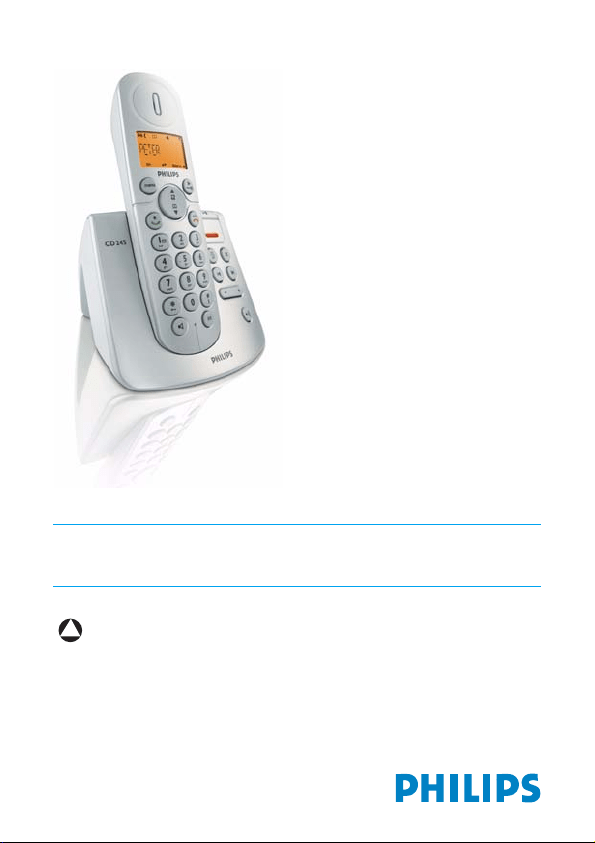
CD 245


Table of contents 1
1Important 3
1.1 Power requirements 3
1.2 Safety Information 3
1.3 Conformity 4
1.4 Using GAP standard compliance 4
1.5 Recycling and disposal 4
1.6 Electric, Magnetic and
Electromagnetic Fields ("EMF") 5
2 Your phone 6
2.1 What’s in the box 6
2.2 Overview of your phone 7
2.3 Display icons 9
2.4 Overview of the base station 10
3Getting started 11
3.1 Connect the base station 11
3.2 Install your phone 11
3.3 Welcome mode 12
3.4 Menu structure 14
4 Using your phone 16
4.1 Make a call 16
4.2 Answer a call 16
4.3 End a call 17
5 Use more of your phone 18
5.1 Switch the handset on/off 18
5.2 Keypad lock/unlock 18
5.3 Text or number entry 18
5.4 Call in progress 18
5.5 Using your Phonebook 19
5.6 Using the Redial list 21
5.7 Using the Call log 22
5.8 Using the Intercom 23
5.9 Paging 24
5.10 Chain Dialling 25
5.11 Clock and Alarm settings 25
6 Personal settings 27
6.1 Handset Tones 27
6.2 Change the Handset Name 27
6.3 Activate/Deactivate Auto
Answer 28
6.4 Change the Display Language 28
7Advanced settings 29
7.1 Change Recall time 29
Table of contents

2Table of contents
7.2 Change the Dial Mode
(country-dependent) 29
7.3 Call Barring 29
7.4 Baby Call 30
7.5 Set Prefix 31
7.6 SOS Number 31
7.7 Registration 32
7.8 Unregister 32
7.9 Change Master PIN 32
7.10 Reset Unit 33
7.11 Country Selection 33
7.12 Default settings 34
8 Telephone answering
machine (TAM) 35
8.1 Play 35
8.2 Delete all messages 36
8.3 Memo recording 36
8.4 Set the Answer mode 36
8.5 Record your Personalised
Outgoing Message 37
8.6 Switch the Answering Machine
On/Off via handset 38
8.7 Answering Machine settings 38
8.8 Call Screening 39
9 Technical data 41
10 Frequently asked
questions 42
11 Index 44
Table of contents

Important 3
1Important
Take time to read this user manual before
you use your phone. It contains important
information and notes regarding your
phone.
1.1 Power requirements
• This product requires an electrical
supply of 220-240 volts AC. In case of
power failure, the communication can
be lost.
• The Electrical network is classified as
hazardous. The only way to power
down the charger is to unplug the
power supply from the electrical
outlet. Ensure that the electrical outlet
is always easily accessible.
• The voltage on the network is
classified as TNV-3
(Telecommunication Network
Voltages), as defined in the standard
EN 60-950.
Warning
To avoid damage or malfunction:
• Do not allow the charging contacts or
the battery to come into contact with
metal objects.
• Never use any other battery than the
one delivered with the product or
recommended by Philips: risk of
explosion.
• Always use the cables provided with
the product.
• Handsfree activation could suddenly
increase the volume in the earpiece to
a very high level: make sure the
handset is not too close to your ear.
1.2 Safety Information
• This equipment is not designed to
make emergency calls when the power
fails. An alternative has to be made
available to allow emergency calls.
• Do not expose the phone to excessive
heat caused by heating equipment or
direct sunlight.
• Do not drop your phone or allow
objects to fall on your phone.
• Do not use any cleaning agents
containing alcohol, ammonia, benzene,
or abrasives as these may harm the set.
• Do not use the product in places
where there are explosive hazards.
• Do not let small metal objects come
into contact with the product. This can
deteriorate audio quality and damage
the product.
• Active mobile phones in the vicinity
may cause interference.
• Do not open it as you could be
exposed to high voltages.
• Do not allow the charger to come into
contact with liquids.
About operating and storage
temperatures:
• Operate in a place where temperature
is always between 0 and 35º C (32 to
95º F).
• Store in a place where temperature is
always between -20 and 45º C (-4 to
113º F).
• Battery life may be shortened in low
temperature conditions.
!

4Important
1.3 Conformity
We, Philips declare that the product is in
compliance with the essential requirements
and other relevant provisions of Directive
1999/5/EC. This product can only be
connected to the analogue telephone
networks of the countries mentioned on
the packaging.
You can find the Declaration of
Conformity on www.p4c.philips.com.
1.4 Using GAP standard
compliance
The GAP standard guarantees that all
DECT
TM
GAP handsets and base stations
comply with a minimum operating
standard irrespective of their make.Your
handset and base station are GAP
compliant, which means the minimum
guaranteed functions are:
register a handset, take the line, receive a
call and dial.The advanced features may
not be available if you use another
handset than a CD240/245 with your
base station.
To register and use your CD240/245
handset with a GAP standard base station
of a different make, first follow the
procedure described in the
manufacturer’s instructions, then follow
the procedure described on page 32.
To register a handset of another make to
the CD240/245 base station, place the
base station into registration mode
(page 32), then follow the procedure in
the manufacturer’s instructions.
1.5 Recycling and disposal
Disposal instructions for old products:
The WEEE directive (Waste Electrical
and Electronic Equipment Directive ;
2002/96/EC) has been put in place to
ensure that products are recycled using
best available treatment, recovery and
recycling techniques to ensure human
health and high environmental protection.
Your product is designed and
manufactured with high quality materials
and components, which can be recycled
and reused.
Do not dispose of your old product in
your general household waste bin.
Inform yourself about the local separate
collection system for electrical and
electronic products marked by this
symbol.
Use one of the following disposal options:
• Dispose of the complete product
(including its cables, plugs and
accessories) in the designated WEEE
collection facilities.
• If you purchase a replacement
product, hand your complete old
product back to the retailer. He
should accept it as required by the
WEEE directive.

Important 5
Disposal instructions for batteries:
Batteries should not be
disposed of with general
household waste.
Packaging information:
Philips has marked the packaging with
standard symbols designed to promote
the recycling and appropriate disposal of
your eventual waste.
A financial contribution has been
paid to the associated national
recovery & recycling system.
The labelled packaging material is
recyclable.
1.6 Electric, Magnetic and
Electromagnetic Fields
("EMF")
1. Philips Royal Electronics
manufactures and sells many
consumer oriented products which
usually, as with any electronic
apparatus, have the ability to emit
and receive electro magnetic signals.
2. One of Philips' leading Business
Principles is to take all necessary
health and safety precautions for our
products, to comply with all
applicable legal requirements and to
stay well within the EMF standards
applicable at the time of producing
the products.
3. Philips is committed to develop,
produce and market products that
cause no adverse health effects.
4. Philips confirms that if its products
are handled properly for their
intended use, they are safe to use
according to scientific evidence
available today.
5. Philips plays an active role in the
development of international EMF
and safety standards, enabling Philips
to anticipate further developments
in standardisation for early
integration in its products.
6 Your phone
2 Your phone
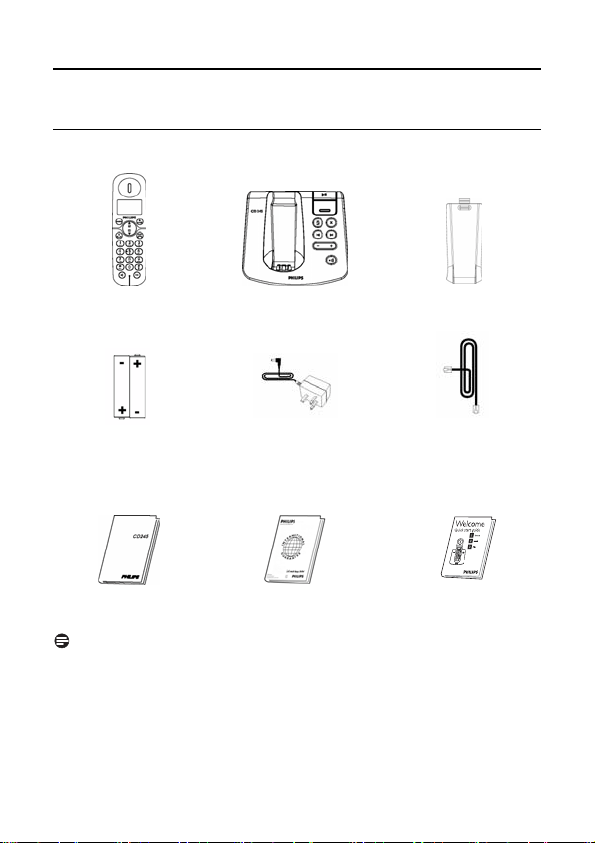
2.1 What’s in the box
Note
*You may find in the box the line adaptor delivered separately from the line cable. In
this case, you have to connect the line adaptor to the line cord first before
plugging the line cord to the line socket.
In multihandset packs, you will find one or more additional handsets, chargers with
power supply units and additional rechargeable batteries.
Handset Base station Battery door
2 AAA
rechargeable
batteries
Power supply
Line cord*
User manual Guarantee Quick Start Guide
Your phone 7
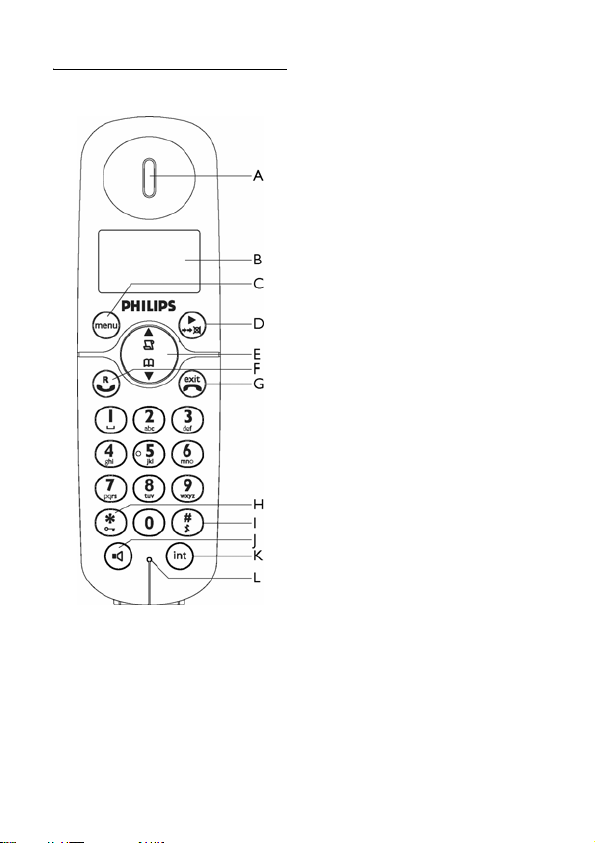
2.2 Overview of your phone
AEarpiece
BDisplay
See page 9 for an overview of the display
icons.
C Menu key & Left Softkey
In idle mode: Go to the main menu.
In other modes: Select the function
displayed on the handset screen directly
above it.
D Redial key & Right Softkey
In idle mode: Access the Redial list. Long
press to switch to time/date display mode.
During a call: Mute/unmute the handset
microphone.
In other modes: Select the function displayed
on the handset screen directly above it.
E Navigation keys
In idle mode: Scroll up to access the Call log
and scroll down to access the Phonebook.
During a call: Scroll up/down to increase
or decrease earpiece and speaker volume.
In other modes: Scroll up/down a menu
list or go to the previous or next record
in the Phonebook, Redial list or Call log.
FTalk key
In idle mode: Answer an incoming
external or internal call.
During a call: Activate the recall function.
In other modes: Dial the selected number
in the Phonebook, Redial list or Call log.
G Hang-up key
In idle mode: Long press to switch on/off
the handset.
During a call: Hang up a call.
In other modes: Return to idle mode.
H Keypad lock key
In idle mode: Insert *. Long press to lock/
unlock keypad.
During a call: Insert *.
I Ringer on/off key &
Pause key
In idle mode: Insert #. Long press to turn
the ringer on/off.
During a call: Insert #. Long press to insert
a pause.
J Loudspeaker key
In idle mode: Turn on the loudspeaker
and dial the number. Answer an incoming
call using handsfree mode.
During a call: Toggle the loudspeaker
on/off.
m
p
:
r
e
*
#
v
8 Your phone
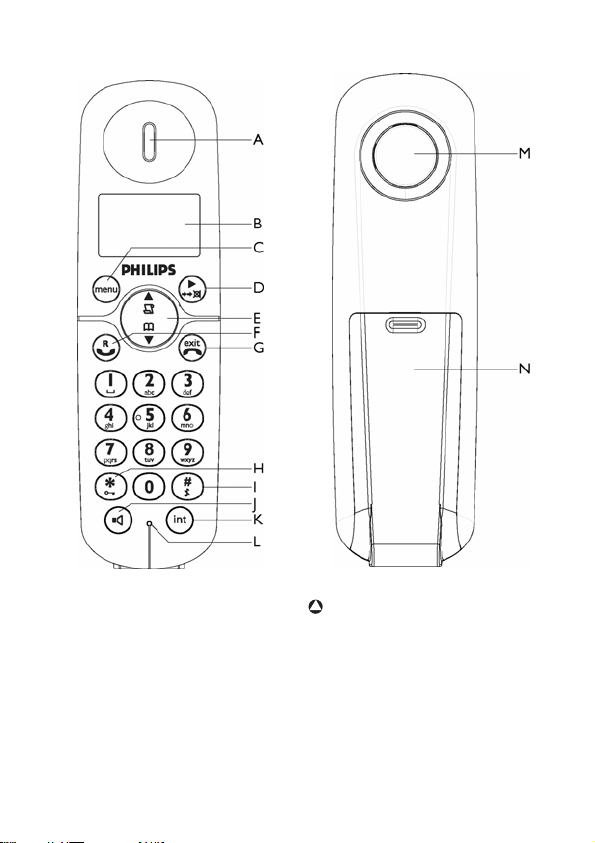
K Call transfer key &
Intercom key
In idle mode: Initiate an internal call.
During a call: Hold the line and page
another handset.
L Microphone
M Loudspeaker
Warning
Handsfree activation can suddenly
increase the volume in the earpiece to a
very high level. Make sure the handset is
not too close to your ear.
N Battery door
i
!
Your phone 9
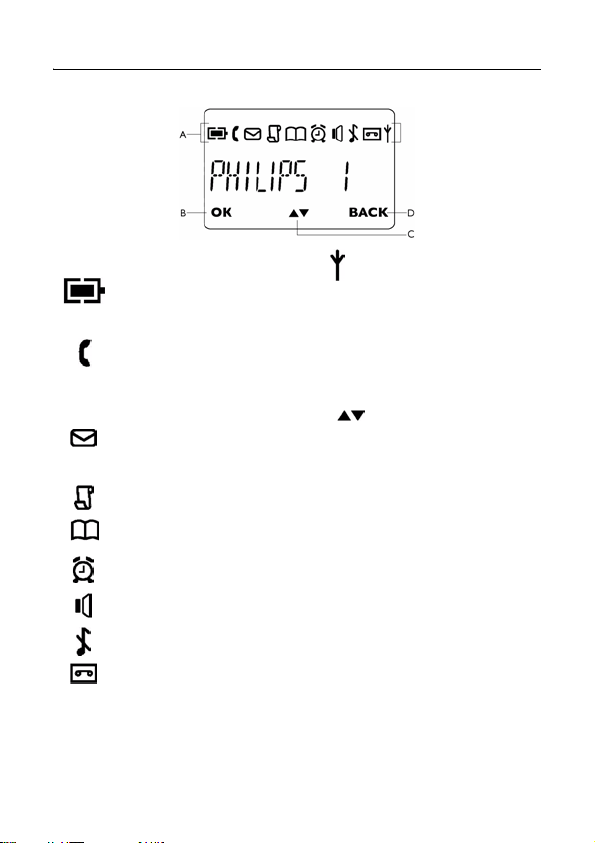
2.3 Display icons
AStatus bar
Indicates that the battery is
fully charged. Icon blinks
during charge and when the
battery is low.
Indicates that there is an
external incoming call, an
external call is connected or
an external call is held. Icon
blinks during intercom mode.
Indicates new voice messages
received. Icon blinks when
there are unread messages.
Indicates new missed calls in
the call log records.
Appears when the
phonebook is accessed.
Appears when the alarm
clock is activated.
Appears when the
loudspeaker is activated.
Appears when ringer off is
activated.
Appears when the answering
machine is activated. Icon
blinks when new answering
machine messages are
received. Icon blinks rapidly
when the answering machine
memory is full.
Indicates that the handset is
registered and within range
of the base station. Icon
blinks when the handset is
out of range or is searching
for a base.
BOK key
Appears when in menu mode to confirm
your selection.
C key
Indicates that more options are available.
Use the navigation keys to scroll up/
down. Icon blinks when the handset is out
of range.
D BACK key
Appears when in menu mode. Select
BACK
to return to the previous menu
level. Select
BACK
to delete the last digit/
character entered.
10 Your phone
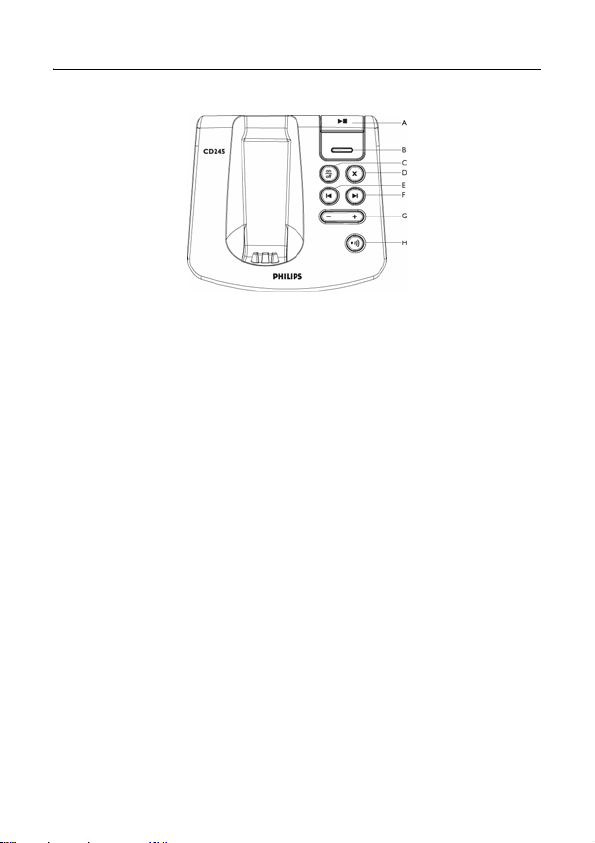
2.4 Overview of the base station
A Play/Stop key
Play phone messages (the first recorded
will be played first).
Stop message playback.
B LED indicator
Slow Blinking (1 second interval):
Indicates that there are unread new
messages.
Fast Blinking (0.5 seconds interval):
Indicates that the answering machine
memory is full.
Steady:
Indicates that the answering machine is
on.
Indicates an on-going TAM operation.
Indicates an on-going remote operation
via handset.
COn/Off key
Short press to switch on/off the answering
machine.
D Delete key
Delete current message during message
playback.
Long press to delete all messages when
TAM is in idle mode (unread messages
will not be deleted).
E Previous message/
Replay message key
Go to previous message if pressed within
1 second of current message playback.
Replay current message if pressed after 1
second of current message playback.
F Next message key
Skip to the next message during message
playback.
GVolume keys
Increase/Decrease speaker volume
during playback.
There are 9 volume levels .
H Paging key
Page handset.
Long press to start registration procedure.
>
o
x
l
r
v
p
Getting started 11
3 Getting started
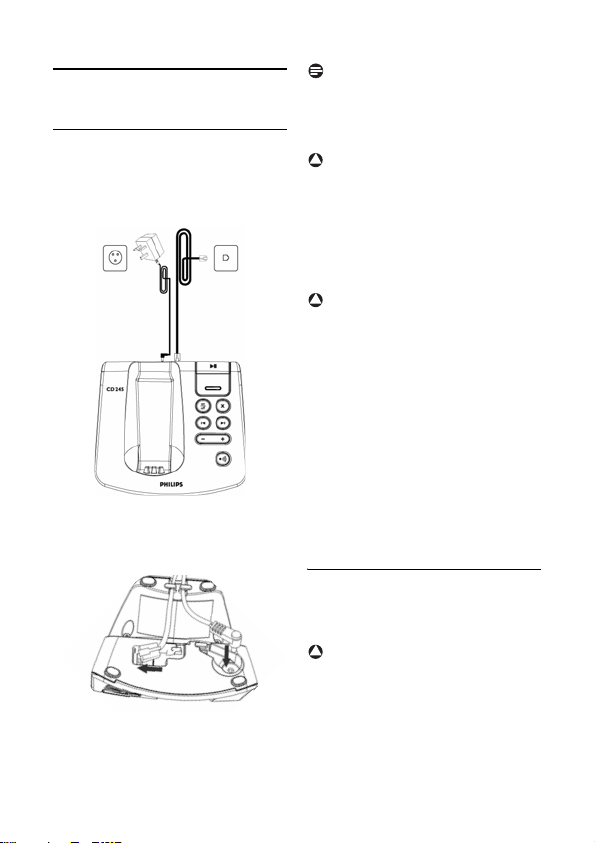
3.1 Connect the base station
Place the
base station in a central
location near the telephone line
socket and electricity socket.
Connect the line cord and the
power cable to their corresponding
connectors at the back of the base
station.
Connect the other end of the line
cord and power cable to their
respective sockets.
Note
The line adaptor may not be attached to the
line cord. In this case, you have to connect
the line adaptor to the line cord first before
plugging the line cord to the line socket.
Warning
Avoid placing the base station too close to
large metal objects such as filing cabinets,
radiators or electrical appliances. This can
impair the range and sound quality.
Buildings with thick internal and external
walls may impair transmission of signals to
and from the base.
Warning
The base station does not have an ON/OFF
switch. Power is applied when the power
adaptor is plugged into the unit and
connected to the electricity socket. The
only way to power down the unit is to
unplug the power adaptor from the
electricity socket. Therefore, ensure that
the electricity socket is easily accessible.
The power adaptor and telephone line cord
have to be connected correctly, as incorrect
connection could damage the unit.
Always use the telephone line cord
supplied with the unit. Otherwise, you
may not get a dial tone.
3.2 Install your phone
Before using the handset, the batteries
have to be installed and fully charged.
Warning
When the batteries are inserted for the
first time, the word INITIAL will be
displayed on the handset. The unit will
not be able to start normally due to the
low battery. Charge your handset for a
few minutes before it can start normally.
1
2
3
!
!
!
12 Getting started
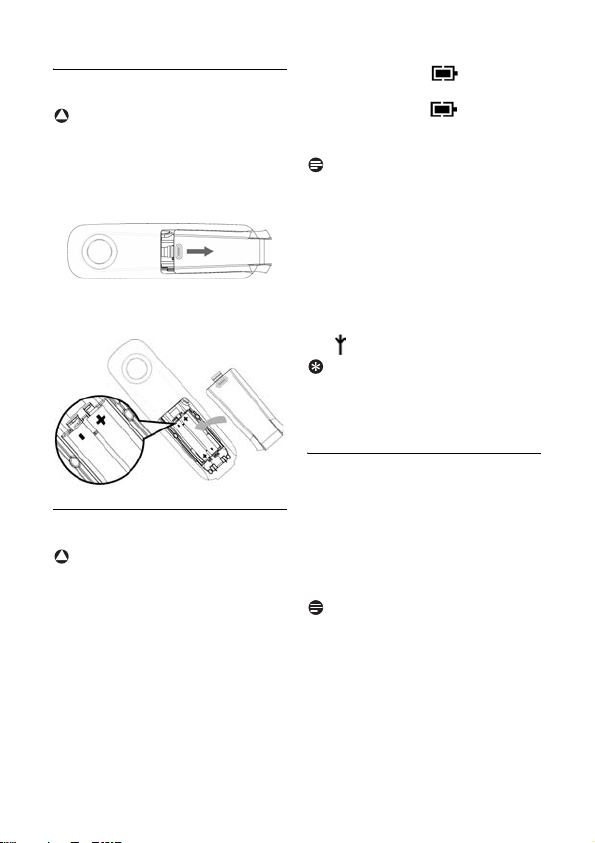
3.2.1 Install battery
Warning
Always use AAA rechargeable batteries
supplied with your unit. There could be
risk of battery leakage if you use alkaline
batteries or other battery types.
Slide out the battery cover.
Place the batteries in the correct
polarity as indicated and replace the
cover.
3.2.2 Charge battery
Warning
The handset must be charged for at least 24
hours before using it for the first time.
When the battery level becomes low, the
low battery sensor alerts you by sounding an
audible tone and blinking the battery icon.
If the battery level becomes exceedingly
low, the phone automatically switches off
shortly after the alert and any function in
progress will not be saved.
Place the handset on the charging cradle
of the base station. A beep is emitted if
the handset is placed correctly.
The battery icon on the display
blinks during charge.
The battery icon becomes
steady when the handset is fully
charged.
Note
Optimal battery life is reached after 3
cycles of complete charging (over 15
hours) and discharging, allowing
approximately 12 hours of talk-time and
150 hours of stand-by time.
The indoor and outdoor range of the phone
is up to 50 metres and 300 metres
respectively. When the handset moves
beyond the operation range, the antenna
icon will blink.
Tip
When reaching the range limit and the
conversation becomes crackly, move
closer to the base.
3.3 Welcome mode
Before you first use your handset, you
need to configure it according to the
country of use. After charging it for a few
minutes, the word WELCOME appears in
various languages. Follow these steps to
configure your phone:
Note
Depending on your country, the
WELCOME screen may not appear. In this
case, you are not required to select your
country/operator/language settings.
You can still make outgoing calls or receive
incoming calls without first defining your
country selection. However, you cannot
use the answering machine function until
you have selected your country.
!
1
2
!
1
2
3

Getting started 13
Press
m key to display a list of
countries.
Scroll
: to find your country.
Press
m
OK
to confirm your
selection.
• The default line settings and menu
language for the selected country
will be automatically configured.
• To set date/time, see “Set Date and
Time” on page 25.
Your phone is now ready for use.
Tip
You may change your country settings
anytime after the first configuration. (see
“Country Selection” on page 33)
If there are no key presses for 15
seconds, the handset will automatically
return to idle mode. It will also return to
idle mode automatically when you place
the handset back on the base station.
1
2
3
14 Getting started
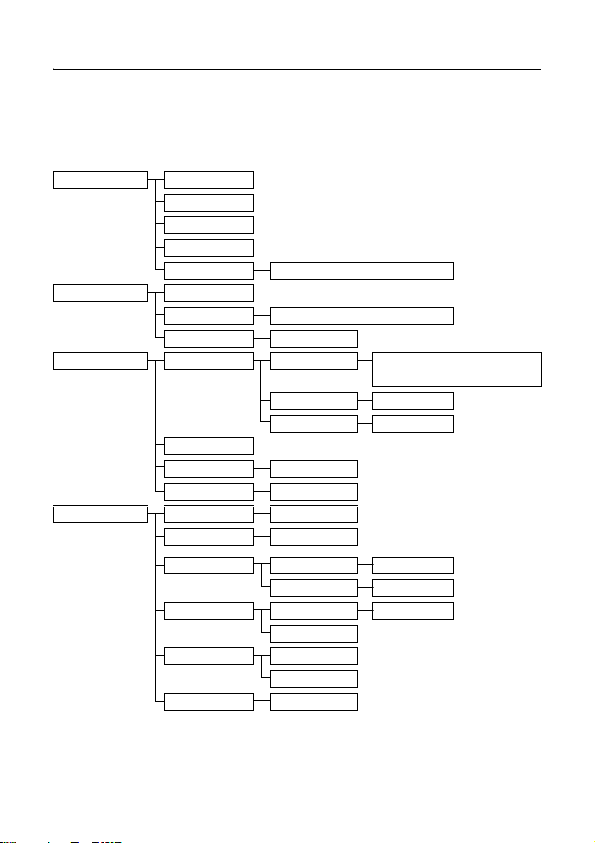
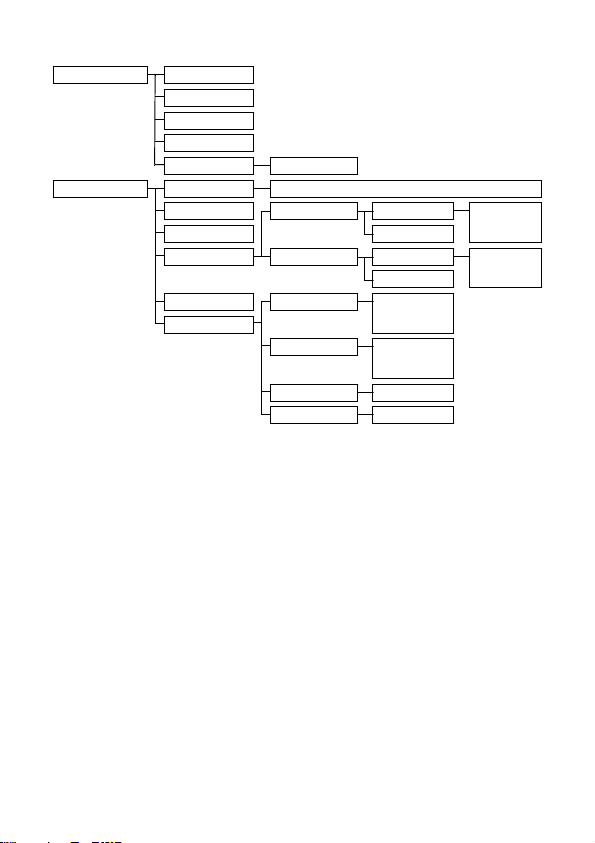
3.4 Menu structure
The table below describes the menu tree of your phone.
Press left menu key
m to enter each option.
Use navigation keys
: to navigate within the menus.
PHONEBOOK ADD NUMBER
EDIT NUMBER
DELETE NUM.
DELETE ALL
DIRECT MEM. ADD NUMBER/DELETE NUM.
CLOCK/ALARM DATE & TIME
SET ALARM OFF/ON ONCE/ON DAILY
ALARM TONE MELODY 1/2/3
PERSONAL SET HANDSET TONE RING VOLUME BOOST/HIGH/MEDIUM/LOW/
RINGER OFF
RING MELODY Melody list
KEY TONE ON/OFF
HANDSET NAME
AUTO ANSWER ON/OFF
LANGUAGE Language list
ADVANCE SET RECALL TIME SHORT/LONG
DIAL MODE * TONE/PULSE
CALL BARRING BARR NUMBER NUMBER 1/2/3/4
BARR MODE ON/OFF
BABY CALL BABY MODE ON/OFF
BABY NUMBER
PREFIX DETECT DIGIT
PREFIX NUM.
SOS NUMBER NUMBER 1/2/3
* Depending on your country, this feature may not be available for selection.
Getting started 15
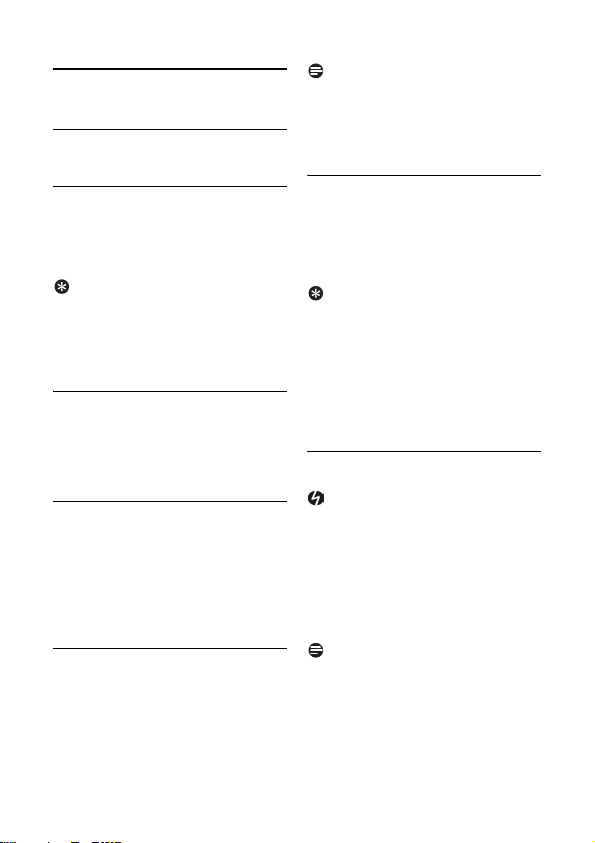
ADVANCE SET REGISTRATION
UNREGISTER
PIN
RESET UNIT
SEL. COUNTRY * Country list
ANSW MACHINE PLAY REPEAT/NEXT MESSAGE/PREV MESSAGE/DELETE
DELETE ALL ANSWER ONLY PERSONALIZED PLAY OGM/
RECORD OGM
RECORD MEMO PREDEFINED
ANSWER MODE ANSWER & REC PERSONALIZED PLAY OGM/
RECORD OGM
PREDEFINED
ANSW ON/OFF RING DELAY
1/2/3/4/5/6/7/8/9/
TOLL SAVER
ANSW SETTINGS
REMOTE ACC.
ACTIVATED/
DEACTIVATED
HS SCREENING ON/OFF
BS SCREENING ON/OFF
* Depending on your country, this feature may not be available for selection.
16 Using your phone
4 Using your phone
4.1 Make a call
4.1.1 Predialling
Dial the number (maximum 24 digits).
Press r key.
• The call is initiated.
Tip
You may insert a prefix number to the
beginning of your predial number, see
“Set Prefix” on page 31 for more
information.
4.1.2 Direct dialling
Press
v key to take the line.
Dial the number.
• The call is initiated.
4.1.3 Call from redial list
Press
p key in idle mode.
Scroll
: to an entry in the redial
list.
Press
r key.
• The call is initiated.
4.1.4 Call from the call log
Press
u in idle mode.
Scroll
: to an entry in the call list.
Press
r key.
• The call is initiated.
Note
You need to subscribe to Caller Line
Identification service to be able to see the
caller’s number or name in the call log.
(see “Access Call log” on page 22)
4.1.5 Call from the phonebook
Press
d in idle mode.
Scroll
: to a phonebook entry.
Press
r key.
• The call is initiated.
Tip
Instead of scrolling
: to browse the
phonebook entries, you can press the
numeric key corresponding to the first
letter of the entry you wish to locate. For
example, pressing
2 will show the
entries starting with A. Pressing
2 again
will show the entries starting with B, etc...
4.2 Answer a call
Danger
When the handset rings during an
incoming call, please do not hold the
handset too close to your ear as the
volume of the ringing tone may damage
your hearing.
When the phone rings, press
r key.
• The call is established.
Note
Incoming call has priority over other
events. Whenever there is an incoming
call, other status in progress such as
phone setting, menu navigation, etc will
be aborted.
1
2
1
2
1
2
3
1
2
3
1
2
3

Using your phone 17
Tip
If
AUTO ANSWER
mode (see “Activate/
Deactivate Auto Answer” on page 28) is
activated, you can simply lift up the
handset from its base station to answer
the call. This feature is deactivated by
default.
4.2.1 Handsfree answering
Danger
Handsfree activation can suddenly
increase the volume in the earpiece to a
very high level. Make sure the handset is
not too close to your ear.
When the phone rings, press
v key.
• The handset loudspeaker is
activated.
4.3 End a call
To end a conversation, press
e key.
• The call ends.
Tip
You can simply place the handset back to
its base station to end the call. This
feature is activated by default.
Note
The call duration (HH-MM-SS) will be
displayed on the handset screen for about
10 seconds. Press
p
BACK
.to return to
idle mode.
18 Use more of your phone
5 Use more of your
phone
5.1 Switch the handset on/off
Press and hold
e key for more than 5
seconds to switch on/off the handset in
idle mode.
5.2 Keypad lock/unlock
Press and hold
* key for 1 second to
lock/unlock the keypad in idle mode.
5.3 Text or number entry
When you select a field in which you can
enter text, you can enter the letters that
are printed on the keys by pressing the
relevant key once or several times. For
example, to enter the name “
PETER
”:
Press
7 once:
P
Press 3 twice:
PE
Press 8 once:
PET
Press 3 twice:
PETE
Press 7 three times:
PETER
The table below gives you the character
assignment during text or number entry:
Tip
Press
p
BACK
to delete the last digit or
character entered.
5.4 Call in progress
Some options are available to you during a
call. The available options are :
5.4.1 Adjust earpiece volume
During a call, press
: to select from
VOLUME 1
to
VOLUME 3
.
5.4.2 Mute/Unmute microphone
When the microphone is muted, your
correspondent cannot hear you.
During a call, press
p key to turn
off the microphone.
Press
p key again to turn on the
microphone.
Keys Assigned characters
1
space 1 _ < > *
2
A B C 2
3
D E F 3
4
G H I 4
1
2
3
4
5
5
J K L 5
6
M N O 6
7
P Q R S 7
8
T U V 8 ?
9
W X Y Z 9
0
0 -- / \ o +
#
#
*
*
1
2

Use more of your phone 19
5.4.3 Activate/Deactivate
loudspeaker mode
Danger
Handsfree activation can suddenly
increase the volume in the earpiece to a
very high level. Make sure the handset is
not too close to your ear.
During a call, press
v key to
activate the loudspeaker mode.
Press
v key again to return to
normal mode.
5.4.4 Adjust loudspeaker volume
During a call, press
: to select from
VOLUME 1
to
VOLUME 5
.
5.5 Using your Phonebook
Your phone can store up to 100
phonebook memories. Each phonebook
entry can have a maximum of 24 digits for
the phone number and 12 characters for
name.
5.5.1 Access phonebook
Press
d in idle mode and scroll :
to browse the phonebook.
• The phonebook entries will be listed
in alphabetical order.
To view the details, press
p key.
Tip
Instead of scrolling
: to browse the
phonebook entries, you can press the
numeric key corresponding to the first
letter of the entry you wish to locate. For
example, pressing
2 will show the
entries starting with A. Pressing
2 again
will show the entries starting with B, etc...
5.5.2 Store a contact in the
phonebook
Press
m key in idle mode, scroll
: to
PHONEBOOK
and press
m
OK
, press m
OK
to enter
ADD
NUMBER
.
ENTER NAME
is displayed on the
screen.
Enter the name of the contact
(maximum 12 characters) and press
m
OK
.
Enter the number (maximum 24
digits) and press
m
OK
.
• A validation tone is emitted.
Note
Press
p
BACK
to delete the last digit or
character entered.
To return to idle mode, press
e key.
Tip
You cannot store a new phonebook entry
when the memory is full. In this case, you
have to delete existing entries to make
space for new entries.
5.5.3 Modify a phonebook entry
Press
m key in idle mode, scroll
: to
PHONEBOOK
and press
m
OK
, scroll : to
EDIT
NUMBER
and press m
OK
.
Scroll
: to select an entry to edit.
1
2
1
2
1
2
3
4
1
2

20 Use more of your phone
Press
m
OK
to display name. Enter
the new name and press
m
OK
to
confirm.
Enter the new number and press
m
OK
to confirm.
• A validation tone is emitted.
5.5.4 Delete a phonebook entry
Press
m in idle mode, scroll : to
PHONEBOOK
and press m
OK
,
scroll
: to
DELETE NUM.
and
press
m
OK
.
Scroll
: to select an entry to
delete and press
m
OK
.
DELETE?
is displayed on the screen.
Press
m
OK
again to confirm
deletion.
• A validation tone is emitted.
Note
Press
p
BACK
to discard change and the
screen returns to phonebook list.
5.5.5 Delete the phonebook list
Press
m key in idle mode, scroll
: to
PHONEBOOK
and press
m
OK
.
Scroll
: to
DELETE ALL
and
press
m
OK
.
DELETE?
is displayed on the screen.
Press
m
OK
again to confirm
deletion.
• A validation tone is emitted.
Note
Press
p
BACK
to discard change and the
screen returns to phonebook list.
5.5.6 Direct Access Memory
There are 2 direct access memories
(Keys
1 and 2) included in the
phonebook memory. A long press on the
keys in idle mode will automatically dial
the stored phone number.
5.5.6.1 Add/Edit Direct Access
Memory
Press
m key in idle mode, scroll
: to
PHONEBOOK
and press
m
OK
, scroll : to
DIRECT MEM.
and press
m
OK
.
Scroll
: to
KEY 1
or
KEY 2
and
press
m
OK
.
• The stored number is displayed (if
any).
Press
m
OK
to enter direct
memory menu.
Press m
OK
again to enter
ADD
NUMBER
.
Enter the name and press
m
OK
to
confirm.
Enter the number and press
m
OK
to confirm.
• A validation tone is emitted and the
screen returns to previous menu.
Note
Press p
BACK
to delete the last digit or
character entered.
5.5.6.2 Delete Direct Access
Memory
Press
m key in idle mode, scroll
: to
PHONEBOOK
and press
3
4
1
2
3
1
2
3
1
2
3
4
5
6
1

Use more of your phone 21
m
OK
, scroll : to
DIRECT MEM.
and press
m
OK
.
Scroll
: to
KEY 1
or
KEY 2
and
press
m
OK
.
• The stored number is displayed (if
any).
Press
m
OK
to enter direct
memory menu.
Scroll : to
DELETE NUM.
and
press
m
OK
.
DELETE?
is displayed on the screen.
Press
m
OK
to confirm deletion.
• A validation tone is emitted and the
screen returns to previous menu.
5.6 Using the Redial list
The redial list stores the last 5 numbers
dialled. A maximum of 24 digits can be
displayed for each entry.
5.6.1 Access Redial list
Press
p key to go to the redial list
and scroll
: to browse the redial
list.
• The last number dialled will appear
first in the redial list. If the redial
number matches a phonebook
entry, the name will be displayed
instead.
To view the details, press
p key.
Note
To return to idle mode, press
e key.
5.6.2 Save a redial number into
the phonebook
Press
p key in idle mode, scroll
: to
select an entry
and press
m
OK
, press m
OK
to enter
SAVE
NUMBER
.
ENTER NAME
is displayed on the
screen.
Enter the name of the contact
(maximum 12 characters) and press
m
OK
.
•
SAVED
is displayed for 5 seconds
and the screen returns to redial list.
• A validation tone is emitted and the
screen returns to previous menu.
Note
Press
p
BACK
to delete the last digit or
character entered.
5.6.3 Modify a redial number
Press
p key in idle mode, scroll
: to select an entry and press
m
OK
, scroll : to
EDIT NUMBER
and press
m
OK
.
Modify the number and press
m
OK
to confirm change.
• A validation tone is emitted.
Note
Press
p
BACK
to discard change and the
screen returns to redial list.
5.6.4 Delete a redial number
Press
p key in idle mode, scroll
: to select an entry and press
m
OK
, scroll : to
DELETE NUM.
and press
m
OK
.
2
3
4
5
1
2
1
2
3
1
2
1

22 Use more of your phone
DELETE?
is displayed on the screen.
Press
m
OK
again to confirm
deletion.
• A validation tone is emitted.
Note
Press
p
BACK
to discard change and the
screen returns to redial list.
5.6.5 Delete the redial list
Press
p key in idle mode and
press
m key.
Scroll
: to
DELETE ALL
and press
m
OK
.
DELETE?
is displayed on the screen.
Press
m
OK
again to confirm
deletion.
• A validation tone is emitted.
Note
Press
p
BACK
to discard change and the
screen returns to redial list.
5.7 Using the Call log
The call log stores the last 20 external calls
and any new voice mail and answering
machine messages received. If you have
subscribed to Caller Line Identification
(CLI), and provided the identity of the
caller is not withheld, the name (or
number) of the caller will be displayed.
Note
If the identity of the caller is withheld or
the network does not provide the date
and time information, then the information
will not be displayed in the call log.
If you have not subscribed to Caller Line
Identification service, there will not be
any information displayed in the call log.
5.7.1 Access Call log
Press
u in idle mode and scroll :
to browse the call log.
• The calls (missed and received) are
displayed in chronological order with
the most recent call at the top of the list.
To view the details, press
p key.
5.7.2 Consulting the call log
The screen can either display :
• the caller’s number*
• the caller’s name (if recorded in the
phonebook)*
•
<UNKNOWN>
if it is an unidentified
call**
* Subject to a subscription with your
network operator.
** Unlisted numbers or withheld identity
of the caller.
Note
You can display the phone number, the
time and the date of the call by pressing
p key. The time and date displayed is
dependent on the network.
5.7.3 Save call list entry into the
phonebook
Press
u in idle mode, scroll : to
select an entry
and press m
OK
,
press
m
OK
to enter
SAVE
NUMBER
.
ENTER NAME
is displayed on the
screen.
Enter the name of the contact
(maximum 12 characters) and press
m
OK
.
2
1
2
3
1
2
1
2
3

Use more of your phone 23
•
SAVED
is displayed for 5 seconds
and the screen returns to call log.
Note
Press
p
BACK
to delete the last digit or
character entered.
5.7.4 Delete a call list entry
Press
u in idle mode, scroll : to
select an entry and press
m
OK
,
scroll
: to
DELETE NUM.
and
press
m
OK
.
DELETE?
is displayed on the screen.
Press
m
OK
again to confirm
deletion.
• A validation tone is emitted.
Note
Press
p
BACK
to discard change and the
screen returns to call log.
5.7.5 Delete the call list
Press
u in idle mode and press m
key.
Scroll
: to
DELETE ALL
and press
m
OK
.
DELETE?
is displayed on the screen.
Press
m
OK
again to confirm
deletion.
• A validation tone is emitted.
Note
Press
p
BACK
to discard change and the
screen returns to call log.
5.8 Using the Intercom
Warning
Intercom and call transfer is only possible
with handsets registered to the same base
station.
This feature is only available when there
are at least 2 registered handsets. It
allows you to make free internal calls,
transfer external calls from one handset
to another and use the conference
option.
5.8.1 Intercom another handset
Note
If the handset does not belong to CD240/
245 range, this function may not be
available.
Press i key in idle mode.
• Intercom is established immediately
if there are only 2 registered
handsets.
If there are more than 2 registered
handsets, enter the handset number
(key
1-6). To call all handsets
at once, press
* key.
5.8.2 Transfer an external call to
another handset
During the call, press and hold
i
key to put the external call on hold
(the caller can no longer hear you).
•
INT 23456 *
is displayed,
representing the handset numbers
available for intercom
(
*
represents all handsets).
Enter the handset number (key
2-
6) you wish to transfer your
external call to. To call all handsets at
once, press
* key.
1
2
1
2
3
!
1
2
1
2

24 Use more of your phone
Press
r key on the called handset
to answer the internal call, where
both internal callers can talk.
• Intercom is established.
Press
e key on the first handset to
transfer the external call to the
called handset.
• The external call is transferred.
Note
If there is no answer from the called
handset, press
i key to resume the
external call.
5.8.3 Answer an external call
during intercom
During intercom, a new call tone is
emitted when there is an incoming
external call.
Press
r to answer the external call
and end the intercom.
• The call is established.
Note
To put the internal call on hold, press
i
key to answer the incoming external call.
5.8.4 Switch between an internal
and external call
During the call, press and hold
* key
to switch between an internal or external
call.
5.8.5 Establish a three-party
conference call
The conference call feature allows one
external call to be shared with two
handsets (in intercom). The three parties
can share the conversation and no
network subscription is required.
During the call, long press
i key
to put the external call on hold (the
caller can no longer hear you).
•
INT 23456 *
is displayed,
representing the handset numbers
available for intercom
(
*
represents all handsets).
Enter the handset number (key
2-6) you wish to call for the
conference. To call all handsets at
once, press
* key.
Press
r key on the called handset
to answer the internal call, where
both internal callers can talk.
• Intercom is established.
Press and hold
i key for 2
seconds on the first handset to start
the three-party conference.
•
CONFERENCE
will be displayed on
the screen once the conference call
is established.
5.9 Paging
The paging feature enables you to locate
a missing handset if the handset is in range
and contains charged batteries.
Press p key on the base station.
• All the registered handsets start to
ring.
Once retrieved, press any key on the
handset to end the paging.
Note
If there are no key presses within 30
seconds, the handset and base station will
automatically return to idle mode.
3
4
1
2
1
2
3
4
1
2

Use more of your phone 25
Tip
Press
p key on the base station again
to stop paging.
5.10 Chain Dialling
This feature allows you to dial an
extension to a number already saved in the
phonebook during a call.
Press
r to take the line and press
m to open phonebook list.
• The phonebook entries are listed in
alphabetical order.
Scroll
: to select an entry and
press
m
OK
.
• The first part is dialled.
Enter the extension.
• Each digit blinks to indicate dial out.
5.11 Clock and Alarm settings
This feature allows you to set the date,
time and alarm settings for your phone.
The default date and time is
01/01
and
00:00
respectively.
5.11.1 Set Date and Time
Press
m in idle mode, scroll : to
CLOCK/ALARM
and press m
OK
,
press
m
OK
to enter
DATE &
TIME
.
The last stored date is displayed.
Enter the current date (DD/MM)
and press
m
OK
.
The last stored time is displayed.
Enter the current time (HH:MM) and
press
m
OK
to confirm.
• A validation tone is emitted and the
screen returns to previous menu.
Tip
Press and hold p key in idle mode to
switch between handset name and time/
date display mode.
Note
Enter the date in Day/Month format and
the time in 24-hour format.
An error tone will be emitted if an invalid
digit is entered in the date/time fields.
Hour: 00 to 23; Minute: 00 to 59
Date: 01 to 31; Month: 01 to 12
Warning
If your phone is connected to an ISDN
line through an adaptor, the date & time
may be updated after each call. The
availability of date & time update is
dependent on your network provider.
Please check the date & time settings in
your ISDN system or contact your
network provider.
5.11.2 Set Alarm
Press
m in idle mode, scroll : to
CLOCK/ALARM
and press m
OK
,
scroll
: to
SET ALARM
and press
m
OK
.
Scroll
: to
OFF
,
ON ONCE
or
ON
DAILY
and press m
OK
.
If you select
ON ONCE
or
ON
DAILY
, enter the time (HH:MM) for
the alarm and press
m
OK
to
confirm.
• A validation tone is emitted and the
screen returns to previous menu.
1
2
3
1
2
3
!
1
2
3

26 Use more of your phone
Note
The alarm tone and alarm icon will
only sound/blink for 1 minute when the
alarm time is reached. To mute the alarm
tone, simply press any key on the handset.
5.11.3 Set Alarm Tone
Press
m in idle mode, scroll : to
CLOCK/ALARM
and press m
OK
,
scroll
: to
ALARM TONE
and
press
m
OK
.
Scroll
: to
MELODY 1
,
MELODY 2
or
MELODY 3
and press m
OK
to
confirm.
• A validation tone is emitted and the
screen returns to previous menu.
1
2

Personal settings 27
6 Personal settings
6.1 Handset Tones
6.1.1 Set the Ring Volume
Danger
When the handset rings during an
incoming call, please do not hold the
handset too close to your ear as the
volume of the ringing tone may damage
your hearing.
There are 5 ringer volume options
(
BOOST
,
HIGH
,
MEDIUM
,
LOW
and
RINGER OFF
). The default level is
MEDIUM
.
Press
m key in idle mode, scroll
: to
PERSONAL SET
and press
m
OK
, press m
OK
to enter
HANDSET TONE
and press m
OK
again to enter
RING VOLUME
.
Scroll
: to
your desired volume level
and press m
OK
to confirm.
• A validation tone is emitted and the
screen returns to previous menu.
Note
When
RINGER OFF
is activated, the icon
will be displayed on the screen.
6.1.2 Set the Ring Melody
There are 10 ring melodies available on
your handset.
Press
m key in idle mode, scroll
: to
PERSONAL SET
and press
m
OK
, press m
OK
to enter
HANDSET TONE
, scroll : to
RING MELODY
and press m
OK
.
Scroll
: to your desired melody to
play the melody.
Press
m
OK
to set the ring melody.
• A validation tone is emitted and the
screen returns to previous menu.
6.1.3 Activate/Deactivate Key
Tone
A single tone is emitted when a key is
pressed. You can enable or disable the
key tone. By default, the key tone is
ON
.
Press
m key in idle mode, scroll
: to
PERSONAL SET
and press
m
OK
, press m
OK
to enter
HANDSET TONE
, scroll : to
KEY
TONE
and press m
OK
.
Scroll
: to
ON or OFF
and press
m
OK
to confirm.
• A validation tone is emitted and the
screen returns to previous menu.
6.2 Change the Handset Name
You can name the handset and display the
handset name in idle mode. The default
handset name of your handset is
PHILIPS
.
Press
m key in idle mode, scroll
: to
PERSONAL SET
and press
m
OK
, scroll : to
HANDSET
NAME
and press m
OK
.
The last stored name is displayed.
Press
p
BACK
key to delete the
characters one by one.
1
2
1
2
3
1
2
1
2

28 Personal settings
Enter the new name (maximum 10
characters) and press
m
OK
to
confirm.
• A validation tone is emitted and the
screen returns to previous menu.
6.3 Activate/Deactivate Auto
Answer
This function enables you to answer a call
automatically by simply lifting the handset
off the base station. By default, the Auto
Answer feature is
OFF
and in this case
you have to press the
r key to answer
a call.
Press
m key in idle mode, scroll
: to
PERSONAL SET
and press
m
OK
, scroll : to
AUTO
ANSWER
and press m
OK
.
Scroll
: to
ON
or
OFF
and press
m
OK
to confirm.
• A validation tone is emitted and the
screen returns to previous menu.
6.4 Change the Display Language
Your handset can support different
display languages, depending on your
country selection during the WELCOME
mode.
Press
m key in idle mode, scroll
: to
PERSONAL SET
and press
m
OK
, scroll : to
LANGUAGE
and press
m
OK
.
Scroll
: to your desired language
and press
m
OK
to confirm.
• A validation tone is emitted and the
screen returns to previous menu.
Tip
Once the display language is set, the
option menus on the handset will switch
to display in the selected language
immediately. However, it will not change
the language of the predefined outgoing
message of your answering machine.
3
1
2
1
2

Advanced settings 29
7 Advanced settings
7.1 Change Recall time
Recall time (or dial delay) is the time delay
by which the line will be disconnected
after you press
r key. It can be set to
short or long.
The default value of recall time that is preset
in your handset should be the best suited
for your country network and therefore
you should not need to change it.
Press
m key in idle mode, scroll
: to
ADVANCE SET
and press
m
OK
, press m
OK
to enter
RECALL TIME
.
Scroll
: to
SHORT
or
LONG
and
press
m
OK
to confirm.
• A validation tone is emitted and the
screen returns to previous menu.
7.2 Change the Dial Mode
(country-dependent)
The default value for dial mode that is
preset in your handset should be the best
suited for your country network and
therefore you should not need to change it.
Press m key in idle mode, scroll
: to
ADVANCE SET
and press
m
OK
, scroll : to
DIAL MODE
and press
m
OK
.
Scroll
: to
TONE
or
PULSE
and
press
m
OK
to confirm.
• A validation tone is emitted and the
screen returns to previous menu.
7.3 Call Barring
Call barring enables you to restrict selected
handsets from dialling a phone number
beginning with certain numbers. You can
set up to 4 different barring numbers, with
each number containing up to 4 digits.
7.3.1 To activate/deactivate Call
Barring
Press
m key in idle mode, scroll
: to
ADVANCE SET
and press
m
OK
, scroll : to
CALL
BARRING
and press m
OK
.
Enter the Master PIN when
prompted and press
m
OK
to
confirm.
Note
By default, the Master PIN is 0000.
Press
m
OK
to enter
BARR MODE
.
Scroll
: to
ON
or
OFF
and press
m
OK
to confirm.
• A validation tone is emitted and the
screen returns to previous menu.
Note
When
CALL BARRING
is activated,
BR
will be displayed on the screen.
7.3.2 To modify Call Barring
number
Note
If a restricted number is dialled, the call
will not be connected. When this
happens, the phone emits an error tone
and returns to idle mode.
1
2
1
2
1
2
3
4

30 Advanced settings
Press
m key in idle mode, scroll
: to
ADVANCE SET
and press
m
OK
, scroll : to
CALL
BARRING
and press m
OK
.
Enter the Master PIN when
prompted and press
m
OK
to
confirm.
Note
By default, the Master PIN is 0000.
Press
m
OK
to enter
BARR
NUMBER
.
Scroll
: to
NUMBER 1
,
NUMBER
2
,
NUMBER 3
or
NUMBER 4
and
press
m
OK
.
Enter the barring number (maximum
4 digits) and press
m
OK
to
confirm.
• A validation tone is emitted and the
screen returns to previous menu.
7.4 Baby Call
When activated, the Baby Call feature
enables you to dial a number by pressing
any key on your handset. This feature is
very useful for direct access to
emergency services.
You can enter up to 24 digits for baby call
number.
7.4.1 To activate Baby Call mode
Press
m key in idle mode, scroll
: to
ADVANCE SET
and press
m
OK
, scroll : to
BABY CALL
and press m
OK
.
Enter the Master PIN when
prompted and press
m
OK
to
confirm.
Note
By default, the Master PIN is 0000.
Press
m
OK
to enter
BABY MODE
.
Scroll
: to
ON
and press m
OK
to confirm.
BABY CALL ON
is displayed on the
screen.
• A validation tone is emitted and the
screen returns to previous menu.
7.4.2 To deactivate Baby Call
mode
Long press
m key (when Baby Call
mode has been activated before).
Scroll
: to
ADVANCE SET
and
press
m
OK
, scroll : to
BABY
CALL
and press m
OK
.
Enter the Master PIN when
prompted and press
m
OK
to
confirm.
Note
By default, the Master PIN is 0000.
Press
m
OK
to enter
BABY MODE
.
Scroll
: to
OFF
and press m
OK
to confirm.
• A validation tone is emitted and the
screen returns to previous menu.
7.4.3 To change Baby Call
number
Press
m key in idle mode, scroll
: to
ADVANCE SET
and press
m
OK
, scroll : to
BABY CALL
and press m
OK
.
Enter the Master PIN when
prompted and press
m
OK
to
confirm.
1
2
3
4
5
1
2
3
4
5
1
2
3
4
1
2

Advanced settings 31
Note
By default, the Master PIN is 0000.
Scroll
: to
BABY NUMBER
and
press
m
OK
.
• The last stored Baby Call number is
displayed (if any).
Enter the baby call number
(maximum 24 digits) and press
m
OK
to confirm.
• A validation tone is emitted and the
screen returns to previous menu.
7.5 Set Prefix
This feature allows you to define a prefix
number to be added to the beginning of a
number during predialling (see
“Predialling” on page 16). You may also
use this feature to add a detect string to
match and replace the first few digits of
the number during predialling.
You can enter up to a maximum of 5
digits for the detect string and auto prefix
number respectively.
Press
m key in idle mode, scroll
: to
ADVANCE SET
and press
m
OK
, scroll : to
PREFIX
and
press
m
OK
.
DETECT DIGIT
is displayed on the
screen. Press
m
OK
to enter.
• The last stored detect string is
displayed (if any).
Enter a detect string number
(maximum 5 digits) and press
m
OK
to confirm.
PREFIX NUM.
is displayed on the
screen. Press
m
OK
to enter.
• The last stored prefix number is
displayed (if any).
Enter the prefix number (maximum
5 digits) and press
m
OK
to
confirm.
• A validation tone is emitted and the
screen returns to previous menu.
Note
If no detect string (blank) is entered, the
prefix number will be automatically added
to the predial number after
r key is
pressed.
For numbers starting with *, # or P, the
prefix number will not be added to the
predial number after
r key is pressed.
7.6 SOS Number
This feature allows you to make an
emergency call beginning with certain
numbers, even when the number is
barred (see “Call Barring” on page 29).
You can set up to 3 SOS numbers, with
each number containing up to 4 digits.
Press m key in idle mode, scroll
: to
ADVANCE SET
and press
m
OK
, scroll : to
SOS NUMBER
and press m
OK
.
Enter the Master PIN when
prompted and press
m
OK
to
confirm.
Note
By default, the Master PIN is 0000.
Scroll
: to
NUMBER 1
,
NUMBER 2
or
NUMBER 3
and press m
OK
.
Enter the SOS number (maximum 4
digits) and press
m
OK
to confirm.
• A validation tone is emitted and the
screen returns to previous menu.
3
4
1
2
3
4
5
1
2
3
4

32 Advanced settings
7.7 Registration
The procedures described below are the
procedures that you will find in your
handset. The procedures may vary
according to the handset you want to
register. In this case, please refer to the
manufacturer of the additional handset.
Additional handsets must be registered to
the base unit before you can use them. Up
to 6 handsets can be registered to one
base station.
The Master PIN is required before you
can register or unregister handsets.
Note
By default, the Master PIN is 0000.
On the base station, press and hold
p for approximately 5 seconds.
On the handset, press
m key,
scroll
: to
ADVANCE SET
and
press
m
OK
, scroll : to
REGISTRATION
and press m
OK
.
Note
If no action is taken on the handset within
10 seconds, the registration procedure will
be aborted. If this happens, repeat Step 1.
Enter the Master PIN when
prompted and press
m
OK
to
confirm.
Note
By default, the Master PIN is 0000.
WAITING _ _
is displayed on the
screen.
• Upon successful registration, a
validation tone is emitted and the
handset numbers (1 to 6) will be
assigned by the base automatically.
7.8 Unregister
Press
m key in idle mode, scroll
: to
ADVANCE SET
and press
m
OK
, scroll : to
UNREGISTER
and press m
OK
.
Enter the Master PIN when prompted
and press
m
OK
to confirm.
Note
By default, the Master PIN is 0000.
Scroll
: to select the handset
number to unregister and press
m
OK
.
• A validation tone is emitted to indicate
successful unregistration and the
screen shows
UNREGISTERED
.
Note
If no action is taken on the handset within
15 seconds, the unregistration procedure
will be aborted and the handset returns
to idle mode.
To unregister a handset that does not
belong to the CD240/245 range, you can
only use the CD240/245 handset to
unregister it.
7.9 Change Master PIN
The Master PIN is used for setting call
barring/baby call number, registration/
unregistration of handsets and for
accessing the answering machine
remotely. The default Master PIN
number is 0000. The maximum length of
the Master PIN is 8 digits. This PIN is also
used to protect the settings of your
handset. Your handset will prompt you
whenever the PIN is required.
1
2
3
4
1
2
3

Advanced settings 33
Note
The default pin code is preset to 0000. If
you change this PIN code, keep the PIN
details in a safe place where you have easy
access to them. Do not lose the PIN
code.
Press
m key in idle mode, scroll
: to
ADVANCE SET
and press
m
OK
, scroll : to
PIN
and press
m
OK
.
Enter the current Master PIN when
prompted and press
m
OK
to
confirm.
• The PIN entered will be shown as
asterisks (*) on the screen.
Enter the new PIN and press
m
OK
to confirm PIN change.
Tip
If you forget your PIN, you will need to
reset your phone to its default settings.
See next section “Reset Unit” for more
details.
7.10 Reset Unit
You can reset your phone to its default
settings with this feature.
Warning
Upon reset, all your personal settings, call
log and redial list entries will be deleted
and the phone will return to its default
settings. However, your phonebook will
remain unchanged after reset.
Note
You may have to configure your phone
once again. In this case the WELCOME
mode will appear again after master reset.
(go to chapter 3.3)
Press
m key in idle mode, scroll
: to
ADVANCE SET
and press
m
OK
, scroll : to
RESET UNIT
and press m
OK
.
CONFIRM?
is displayed on the
screen.
Press
m
OK
again
to confirm.
• A validation tone is emitted.
• The unit is reset to its default
settings. (see “Default settings” on
page 34)
7.11 Country Selection
The availability of this menu is dependent
on your country.
You can select another country different
from the one chosen during WELCOME
mode.
Note
Once the country is selected, the default
line settings for the selected country will
be applied to the phone automatically
(e.g. Recall time, Dial mode, Language,
etc).
Press
m key in idle mode, scroll
: to
ADVANCE SET
and press
m
OK
, scroll : to
SEL.
COUNTRY
and press m
OK
.
Scroll
: to the country of your
choice and press
m
OK
.
CONFIRM?
is displayed on the
screen.
Press
m
OK
again to confirm.
• A validation tone is emitted and the
screen returns to previous menu.
1
2
3
!
1
2
3
1
2
3
34 Advanced settings
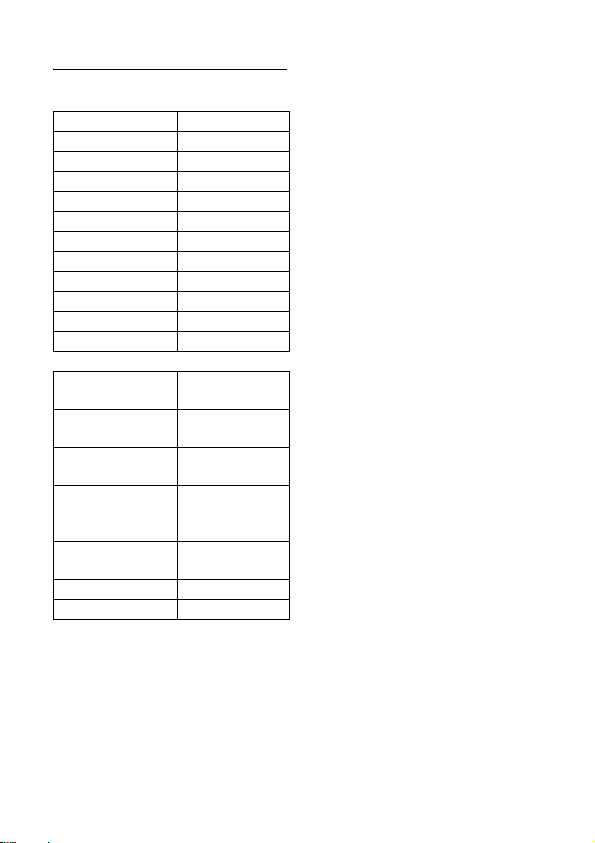
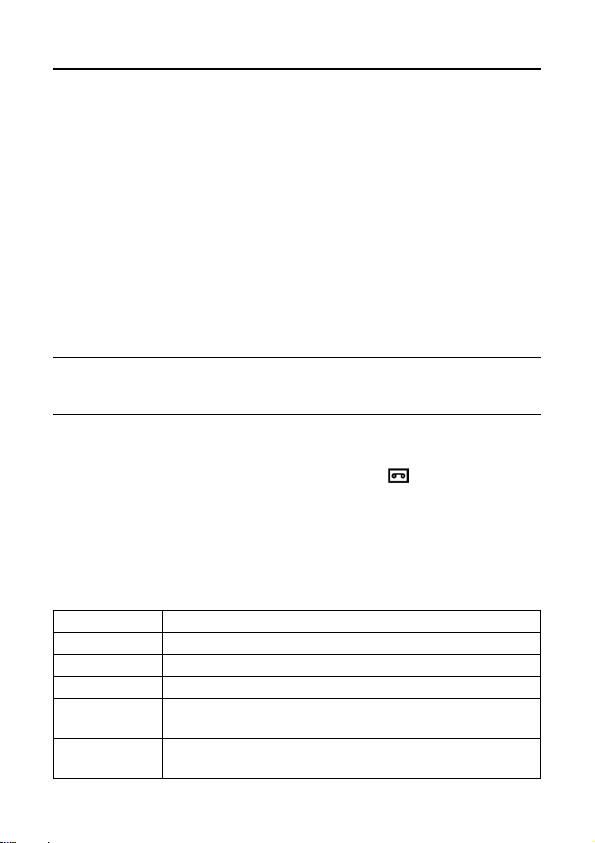
7.12 Default settings
Ringer Volume MEDIUM
Ringer Melody MELODY 1
Earpiece Volume VOLUME 2
Speaker Volume VOLUME 3
Key Tone ON
Auto Answer OFF
Handset Name PHILIPS
Time/Date 01/01; 00:00
Master PIN 0000
Alarm OFF
Alarm Tone MELODY 1
Call Barring OFF
Answering Machine
Answer Mode ANSWER &
REC mode ON
Number of rings
before answer
5
Outgoing
Messages
EMPTY
Base station
screening
ON with default
speakerphone
level
Handset
screening
OFF
Base speaker LEVEL 5
Remote access DEACTIVATED
Telephone answering machine (TAM) 35
8 Telephone answering machine (TAM)
Your phone features an answering machine that records unanswered calls when it is
activated. The answering machine can store up to 99 messages. The maximum
recording time is 15 minutes (including all your personalised outgoing messages).
You can use the control keys on the base station to perform the basic functions of the
answering machine such as paging, message playback, deleting messages and adjustment
of volume on the base station. For a description of each function of the control keys on
the base station, please see “Overview of the base station” on page 10 for more details.
You can also use the answer machine menu on the handset to access the answering
machine functions. There is also a menu to set the answering machine options.
To begin, press
o key on your base station to switch on the answering machine.
Alternatively, you may switch on the answering machine via your handset (see “Switch
the Answering Machine On/Off via handset” on page 38).
8.1 Play
8.1.1 Playback of new messages via handset
The last recorded message is played first via the loudspeaker. When all new messages
have been played, the answering machine will stop and the icon stops blinking.
Press
m key in idle mode, scroll : to
ANSW MACHINE
and press m
OK
,
press
m
OK
to enter
PLAY
menu.
• The message number is displayed on the screen during playback. During playback,
the screen displays "o_o XX HH/MM", where XX represents message number and
HH/MM represents Hour/Minutes. The Month/Day which is represented as MM/DD
will display alternatvely with HH/MM.
During playback, you can:
Adjust volume Press
: key.
Stop playback Press
p
BACK
to return to
PLAY
menu.
Repeat Press
m
OK
and press m
OK
to enter
REPEAT
.
Next message Press
m
OK
, scroll : to
NEXT MESSAGE
and press m
OK
.
Previous
message
Press
m
OK
, scroll : to
PREV MESSAGE
and press m
OK
.
Delete
message
Press
m
OK
, scroll : to
DELETE
and press m
OK
.
A validation tone is emitted and the screen returns to previous menu.
1
2

36 Telephone answering machine (TAM)
8.1.2 Playback of old messages via
handset
Old messages can only be played if there
are no new messages. The first recorded
message will start to play until the last
recorded message.
Press
m key in idle mode, scroll
: to
ANSW MACHINE
and press
m
OK
, press m
OK
to enter
PLAY
menu.
Press
m
OK
.
• The first recorded message will start
to play until the last recorded
message.
During message playback, you can
press
m
OK
to select the available
options (see options available under
“Playback of new messages via
handset” on page 35).
8.2 Delete all messages
Warning
Messages deleted cannot be recovered.
Note
Unread messages will not be deleted.
Press
m key in idle mode, scroll
: to
ANSW MACHINE
and press
m
OK
, scroll : to
DELETE ALL
and press m
OK
.
CONFIRM?
is displayed on the
screen.
Press
m
OK
again to confirm
deletion of all your messages.
• A validation tone is emitted and the
screen returns to previous menu.
8.3 Memo recording
You can record a reminder message for
yourself or for anyone else who uses your
answering machine. The answering
machine treats a memo recording the
same way it treats any incoming message,
and the new message indicator will
flash accordingly.
Press
m key in idle mode, scroll
: to
ANSW MACHINE
and press
m
OK
, scroll : to
RECORD
MEMO
and press m
OK
.
• A validation tone is emitted.
• Recording starts.
RECORDING
is displayed on the
screen.
To stop recording, press
m
OK
.
• A validation tone is emitted and the
screen returns to previous menu.
• The recorded memo is automatically
saved.
Note
Press
p
BACK
at any time to stop the
recording and return to the previous
menu.
8.4 Set the Answer mode
There are 2 answer modes available:
Answer Only and Answer & Record
By default, the answer mode is
ANSWER &
REC
, by which your correspondent can
leave a message on the answering machine.
This can be changed to
ANSWER ONLY
mode, by which your correspond cannot
leave any messages on the answering
machine.
1
2
3
!
1
2
1
2

Telephone answering machine (TAM) 37
Press
m key in idle mode, scroll
: to
ANSW MACHINE
and press
m
OK
, scroll : to
ANSWER
MODE
and press m
OK
.
Scroll
: to
ANSWER ONLY
or
ANSWER & REC
and press m
OK
.
• The answer mode is set.
• If you wish to greet your
correspondents with a personalised
outgoing message instead of the
default outgoing message, proceed
with Steps 3 and 4.
Note
Depending on the answer mode you have
selected, the appropriate default outgoing
message is played once the answering
machine picks up an incoming call. The
language of the default outgoing message
depends on the country selected in
Welcome mode (see page 12).
SELECT OGM
is displayed on the
screen. Press
m
OK
to confirm.
Scroll
: to
PERSONALISED
and
press
m
OK
.
• You can now proceed to record your
personalised outgoing message
(“Record your Personalised Outgoing
Message” on page 37).
8.5 Record your Personalised
Outgoing Message
You can record one personal outgoing
message. This personal outgoing message
replaces the default ones. To revert to
the default outgoing message, simply
delete the personal outgoing message you
have recorded. If you are not satisfied
with the recorded outgoing message,
simply record a new message to
overwrite the old one.
Repeat Steps 1 to 4 in “Set the
Answer mode” on page 36.
Scroll
: to
RECORD OGM
and
press
m
OK
.
• A validation tone is emitted and
recording starts.
• When you record a new outgoing
message, the previous one (if any) is
overwritten automatically.
RECORDING
is displayed on the
screen.
To stop recording, press
m
OK
.
• A validation tone is emitted and the
screen returns to previous menu.
• The recorded outgoing message is
automatically saved.
Note
The maximum length of an outgoing
message is 1 minute.
Press
p
BACK
at any time to stop the
recording and return to the previous menu.
8.5.1 Playback your Personalised
Outgoing Message
Repeat Steps 1 to 4 in “Set the
Answer mode” on page 36.
Scroll
: to
PLAY OGM
and press
m
OK
.
• The previously recorded outgoing
message (if any) is played, and then
the screen returns to previous menu.
Note
Press
p
BACK
at any time to stop the
playback and return to the previous
menu.
1
2
3
4
1
2
3
1
2

38 Telephone answering machine (TAM)
8.6 Switch the Answering
Machine On/Off via handset
Press
m key in idle mode, scroll
: to
ANSW MACHINE
and press
m
OK
, scroll : to
ANSW ON/
OFF
and press m
OK
.
Scroll
: to
ON
or
OFF
and press
m
OK
to confirm.
• A validation tone is emitted and the
screen returns to previous menu.
8.7 Answering Machine settings
8.7.1 Ring Delay
This is the number of rings before the
answering machine answers and starts
playing your greeting message. You can
set the answering machine to start playing
your greeting message after
1
to
9
rings
or
Toll saver
. The default ring delay is
5
.
Press
m key in idle mode, scroll
: to
ANSW MACHINE
and press
m
OK
, scroll : to
ANSW
SETTINGS
and press m
OK
, press
m
OK
to enter
RING DELAY
.
Scroll
: to your desired ring delay
setting (
1
to
9
rings or
TOLL SAVER
)
and press
m
OK
to confirm.
• A validation tone is emitted and the
screen returns to previous menu.
Tip
Toll saver mode can save you the cost of a
long-distance call when you check your
messages remotely. If there are new
messages in your answering machine, the
outgoing message will start playing after 3
rings. If there are no new messages, the
outgoing message will be played after 5 rings.
Hence, if you want to check if you have any
messages without incurring call charges, you
can hang up the call after the 4th ring.
8.7.2 Remote Control Access
If you are far away from home and want
to check the messages on your answering
machine, you can make use of the remote
access feature to check your messages
using another phone. Once you dial your
home number from any other phone and
enter the remote access code*, you will
be able to obtain the messages on your
answering machine. The keypad on the
phone you use to dial acts like the
functions on your answering machine
where you can play or delete messages,
turn your answering machine on or off,
etc.
Note
This feature is deactivated by default.
* Remote access code (which is the same
as your Master PIN code) prevents any
unauthorised remote access of your
answering machine.
1
2
1
2
Telephone answering machine (TAM) 39
8.7.2.1 Activate/Deactivate
Remote Access
Press
m key in idle mode, scroll
: to
ANSW MACHINE
and press
m
OK
, scroll : to
ANSW
SETTINGS
and press m
OK
, scroll
: to
REMOTE ACC.
and press
m
OK
.
Scroll
: to
ACTIVATED
or
DEACTIVATED
and press m
OK
to
confirm.
• A validation tone is emitted and the
screen returns to previous menu.
8.7.2.2 Controlling the
Answering Machine from
an external call
From another phone, dial home.
• The answering machine answers
and starts playing your greeting
message.
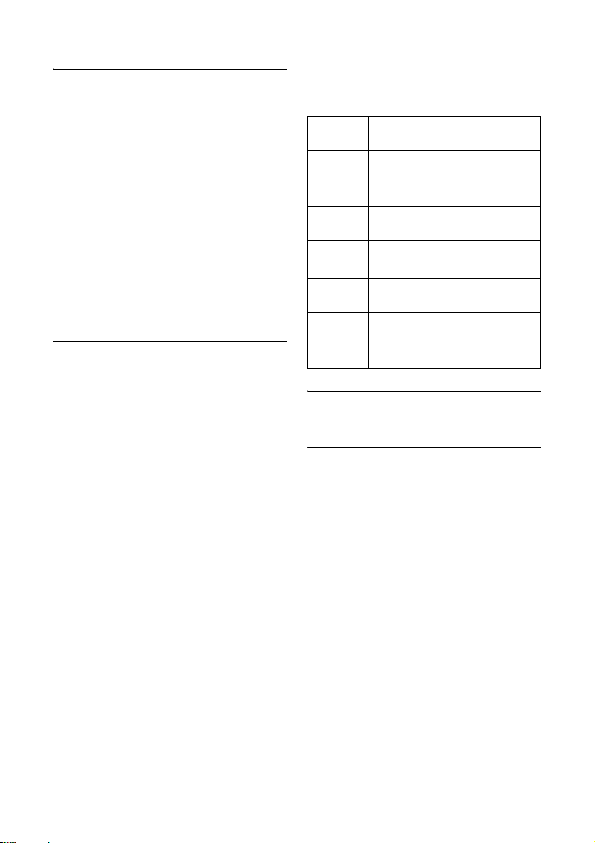
Within 8 seconds, press # key on the
phone you used to dial and enter the
remote access code (same as your
Master PIN code).
• If the access code is incorrect, an
error tone will be emitted. After the
error tone is emitted, you can try to
press the remote access code again
until you enter the correct number.
• The answer machine will drop the
line immediately if there is no
detection of the master PIN entry
within 8 seconds.
• If the remote access code is correct,
a validation tone can be heard.
The following table indicates how to
access the below features during remote
access procedure:
8.8 Call Screening
8.8.1 Set Handset Call Screening
If Handset call screening is set to
On
, you
can hear the incoming message via the
handset speaker and decide whether or
not to pick up a call. To take the call,
press
r.
This feature is deactivated by default.
Press
m key in idle mode, scroll
: to
ANSW MACHINE
and press
m
OK
, scroll : to
ANSW
SETTINGS
and press m
OK
, scroll
: to
HS SCREENING
and press
m
OK
.
Scroll
: to
ON
or
OFF
and press
m
OK
.
• A validation tone is emitted and the
screen returns to previous menu.
1
2
1
2
1
Go to previous message
2
Play all recorded messages
(new and old) or play
current message again
3
Go to next message
5
Play the current outgoing
message
6
Delete current message
8
Stop message playback or
stop outgoing message
playback
1
2

40 Telephone answering machine (TAM)
8.8.2 Set Base Call Screening
If Base call screening is set to
On
, you can
hear the incoming message via the
loudspeaker of the base station and
decide whether or not to pick up a call.
This feature is activated by default.
Press
m key in idle mode, scroll
: to
ANSW MACHINE
and press
m
OK
, scroll : to
ANSW
SETTINGS
and press m
OK
, scroll
: to
BS SCREENING
and press
m
OK
.
Scroll
: to
ON
or
OFF
and press
m
OK
.
• A validation tone is emitted and the
screen returns to previous menu.
1
2

Technical data 41
9 Technical data
Display
• Progressive LCD backlight
• The backlight remains on for 15
seconds after each activation such as
an incoming call, key presses, lifting the
handset off the base station, etc.
• The colour of the LCD backlight is
Amber.
General telephone features
• Dual mode caller name & number
identification
• 10 polyphonic ringer melodies
Phonebook list, Redial list
and Call log
• Phonebook list with 100 entries
• Redial list with 5 entries
• Call log with 20 entries
Battery
• 2 x HR AAA NiMh 550 mAh batteries
Power Consumption
• Power consumption at idle mode:
around 800mW
Weight and dimensions
• 160 grams
• 117mm x 109mm x 82mm
(H x D x W)
Temperature range
• Operation: Between 0 and 35º C (32
to 95º F).
• Storage: Between -20 and 45º C (-4 to
113º F).
Relative humidity
• Operation: Up to 95% at 40°C
• Storage: Up to 95% at 40°C

42 Frequently asked questions
10 Frequently asked
questions
In this chapter, you will find the most
frequently asked questions and answers
about your phone.
Connection
The handset does not switch on!
• Charge the batteries: Put the handset on
the base station to charge. After a few
moments, the phone will switch on.
The handset does not charge!
• Check charger connections.
icon is not blinking during
charge!
• Battery is full: There is no need to
charge the battery.
• Bad battery contact: Adjust the
handset slightly.
• Dirty contact: Clean the batteries
contact with a cloth moistened with
alcohol.
Communication is lost during a call!
• Charge the battery
• Move closer to the base station.
The phone is "Out of range"!
• Move closer to the base station.
Set-up
SEARCHING...
is displayed on handset
and icon is blinking!
• Move closer to the base station.
• Make sure that your base station is on.
• Reset your unit and restart handset
registration.
INITIAL is displayed on handset
during charge!
• Charge the batteries for a few more
minutes to start up normally
Sound
Handset does not ring!
Check that the
RING VOLUME
is not set
to
RINGER OFF
, and make sure icon is
not displayed on the screen (see “Set the
Ring Volume” on page 27).
Caller does not hear me!
Microphone may be muted: During a call,
press
p.
There’s no dialling tone!
• No power: Check the connections.
• Batteries are empty: Charge the
batteries.
• Move closer to the base station.
• Wrong line cable used: Use the line
cable provided.

Frequently asked questions 43
• Line adaptor is required: Connect the
line adaptor to the line cord.
Caller does not hear me clearly!
• Move closer to the base station.
• Move the base station at least one
metre away from any electronic
appliances.
Frequent noise interference on my
radio or television!
• Move the base station as far away as
possible from the electrical appliances.
Product behaviour
Keypad does not work!
• Unlock your keypad: Long press
*
in idle mode.
The handset warms up when
making a long call!
• This is a normal behavior. The handset
consumes energy while calling.
The handset cannot be registered to
the base station!
• Maximum number of handsets (6) has
been reached. To register a new
handset, unregister an existing
handset.
• Remove and replace the handset
batteries.
• Try again by disconnecting and
connecting the base station power
supply and follow the procedure to
register a handset (see “Registration”
on page 32).
Caller number is not displayed!
• Service is not activated: Check your
subscription with your network
operator.
My handset keeps going into idle
mode!
• If there are no key presses for 15
seconds, the handset will automatically
return to idle mode. It will also return to
idle mode automatically when you place
the handset back on the base station.
Phonebook entry cannot be stored
and
MEMORY FULL
is displayed!
• Delete an entry to free memory
before saving your contact again.
The Master PIN code is wrong!
• The default master PIN is 0000.
• Reset the handset to revert to the default
master PIN code if it has been changed
before (see “Reset Unit” on page 33).
The answering machine does not
record messages!
• Memory is full: Delete your old
messages.
•The
ANSWER ONLY
mode has been
activated. Deactivate
ANSWER ONLY
and activate
ANSWER & REC
mode (see
“Set the Answer mode” on page 36).
Remote control access does not
work!
• Activate Remote Control Access (see
“Remote Control Access” on page 38).
The phone hangs up during remote
access!
• You have taken more than 4 seconds
to enter the Master PIN code. Enter
the code again within 4 seconds.
Answering machine stops before
the recording is finished!
• Memory is full: Delete your old
messages.

44 Index
11 Index
A
Accessories 6
Alarm
25
Alarm Tone
26
Answer a call
16
Answer an external call
24
Answering Machine mode
36
Auto Answer
28
B
Baby Call 30
C
Call Barring 29
Call in progress
18
Call log
16, 22
Call Screening
39
Chain Dialling
25
Charge battery
12
Clock and Alarm
25
Conference call
24
Connect base station
11
Country Selection
33
D
Date and Time 25
Default settings
34
Delete a call list entry
23
Delete a redial number
21
Delete call list
23
Delete phonebook
20
Delete redial list
22
Dial Mode
29
Direct dialling
16
Display icons
9
E
Edit a redial number 21
End a call
17
H
Handset Name 27
Handset Tones
27
Handsfree answering
17
I
Install battery 12
Install phone
11
Intercom
23
K
Key Tone 27
Keypad lock/unlock
18
L
Language 28
LCD Backlight
41
LED indicator
10
Loudspeaker mode
19
Loudspeaker volume
19
M
Make a call 16
Master PIN
32
Memo recording
36
Menu structure
14
Mute
18
O
Overview of the base station 10
Overview of your phone
7
P
Paging 24
Phonebook
16, 19
Predialling
16
Prefix
31

Index 45
R
Recall time 29
Recycling and disposal
4
Redial list
16, 21
Registration
32
Remote Control Access
38
Reset Unit
33
Ring Delay
37, 38
Ring Melody
27
Ring Volume
27
S
Save a redial number 21
SOS Number
31
Store a contact
19
Switch handset on/off
18
T
Telephone answering machine 35
Text or number entry
18
Transfer an external call
23
U
Unmute 18
Unregister
32
V
Volume 18

Printed in PRC
© 2007 Koninklijke Philips Electronics N.V.
All rights reserved
Reproduction in whole or in part is prohibited without the
written consent of the copyright owner
Document order number: 3111 285 33202