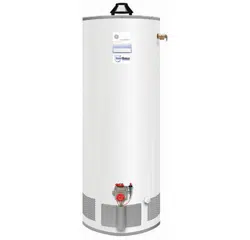
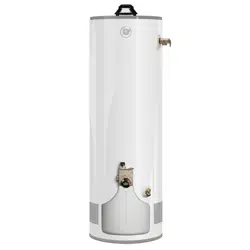
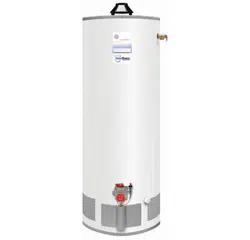
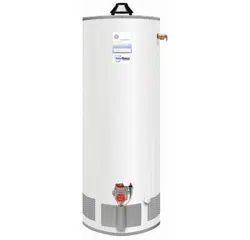
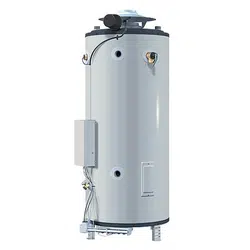
GE SG50T12TXK Gas Water Heater
Product's Documents
Below are documents related to this product, you can read online or download:
- Owner's manual - (English) Read Online | Download pdf
Water Heater User Manual
Safety, energy conservation, and hot water capacity are factors to be considered when selecting the water temperature setting of the water heater. Water temperatures above 125°F can cause severe burns or scalding. Be sure to read and follow the warnings outlined on the label located on the water heater near the top of the tank.
The chart below may be used as a guide in determining the proper water temperature for your home:

There is a Hot Water SCALD Potential if the water temperature thermostat is set too high. Households with small children, disabled or elderly persons may require a 120°F (49°C) or lower thermostat setting to prevent contact with “HOT” water. Please thoroughly review the details of this critical information by reading the safety information in your Owner's Manual
The thermostat has been set at the factory to 120°F (49°C) to reduce the risk of scald injury. This is the recommended starting temperature setting, but it can be adjusted to any temperature between 90°F and 150°F (32°C and 66°C) on electric thermostat-controlled models or between 100°F and 140°F (38°C and 60°C) on electronic-controlled models.
WATER TEMPERATURE SETTING
The temperature of the water in the water heater can be regulated by setting the temperature dial of the adjustable surface mounted thermostat(s) located behind the jacket access panel(s). Dual element heaters have 2 thermostats. For detailed instructions on how to adjust the thermostat(s), refer to Owner's Manual for the specific model.
STEPS TO ADJUST THE WATER HEATER'S TEMPERATURE SETPOINT:
The water heater is equipped with a combination thermostat and high limit Energy-Cut-Off control (ECO) that is located above the heating element in contact with the tank surface. If for any reason the water temperature becomes excessively high, the high limit control (ECO) breaks the power circuit to the heating element. Once the control opens, it must be reset manually. Resetting of the high limit control should only be done by a qualified service technician.
Caution: The cause of the high temperature condition must be investigated by a qualified service technician and corrective action must be taken before placing the water heater in service again.
The HOT and COLD water connections are clearly marked and are ¾” NPT on all models. When connecting to the inlet/outlet ports, the use of ¾” female NPT tapered thread fittings with use of thread sealant is recommended.
The installation of unions is recommended on the hot and cold water connections so that the water heater may be easily disconnected for servicing if necessary. Piping should be routed to allow anode rod removal.
IMPORTANT: Do not apply heat to the HOT or COLD water connections. If sweat connections are used, sweat tubing to adapter before fitting the adapter to the cold water connections on heater. Any heat applied to the hot or cold water connection will permanently damage the internal plastic lining in these ports. Install a vacuum relief valve and/or anti-siphon device when required by local jurisdictions.
The pressure rating of the relief valve must not exceed 150 PSI (1.03 MPa), the maximum working pressure of the water heater as marked on the rating plate.
A new combination temperature and pressure-relief valve, complying with the Standard for Relief Valves and Automatic Gas Shut-Off Devices for Hot Water Supply Systems, ANSI Z21.22, is supplied and must remain installed in the opening provided and marked for this purpose on the water heater. No valve of any type should be installed between the relief valve and the tank. Local codes shall govern the installation of relief valves.
The BTUH rating of the relief valve must not be less than the input rating of the water heater as indicated on the rating label located on the front of the heater (1 watt=3.412 BTUH).
Connect the outlet of the relief valve to a suitable open drain so that the discharge water cannot contact live electrical parts or persons and to eliminate potential water damage.
Piping used should be of a type approved for hot water distribution. The discharge line must be no smaller than the outlet of the valve and must pitch downward from the valve to allow complete drainage (by gravity) of the relief valve and discharge line. The end of the discharge line should not be threaded or concealed and should be protected from freezing. No valve of any type, restriction or reducer coupling should be installed in the discharge line.
If the water heater is not producing enough or any hot water, check the following possible causes and solutions:
| Possible Causes | Possible Solutions |
|---|---|
| Water temperature may be set too low |
|
| Cold water inlet temperature may be colder during the winter month |
|
| Leaking or open hot water faucets |
|
| Long runs of exposed pipe, or hot water piping on outside wall |
|
| Dip tube damaged |
|
| A fuse is blown, circuit breaker tripped, or electric service to your home may be interrupted |
|
| Water Connections to unit reversed |
|
| Recirculating System Interference (if installed) |
|
If the water heater is producing water that is too hot, check the following possible causes and solutions:
| Possible Causes | Possible Solutions |
|---|---|
| Water temperature is set too high | Decrease the water temperature setpoint. |
| Thermostat has failed | Contact your local installer, plumbing contractor, or previously agreed upon service agency. |
APPEARANCE | |
| Color Appearance | White |
CAPACITY | |
| Unit Capacity | 50 Gallons |
FEATURES | |
| Fuel Type | Natural Gas (factory set) |
| Height Description | Tall |
| Recovery in GPH | 36.4 gal/h |
| Sensor | Smart Shield |
| South Coast Air Quality Management District | Yes |
| Labor Warranty | Full 2-year in-home warranty |
| Parts Warranty | Limited 12-year tank and parts |
| Warranty Notes | See written warranty for full details |
| Approximate Shipping Weight | 170 lb |
| Product Diameter | 23 in |
| Product Height (to top of unit) | 59 3/4 in |
| Vent Height | 63 1/4 in |
| Vent Size | 3 in. |