
Welcome
Congratulations on your purchase of this Sony VAIO
®
computer, and welcome to the online VAIO
®
Computer User Guide.
This user guide provides detailed information on all aspects of using your new VAIO computer, from keyboard functions to
preinstalled software programs.
In the left navigation window, click the topics you want to learn more about, and that information will be displayed in this
main window.
View the Electronic Flyer, which provides updates and supplemental information about your computer.
Go to the Sony Computing Support Web site to view the VAIO
®
Computer Specifications, which list your computer's
hardware specifications and preinstalled software information.
For Sony software information, click Start and select Welcome to VAIO life.
Page 1

Ergonomics and Caring for Your Computer
This section provides information on how to safely use your Sony computer.
Page 2

Applying Ergonomics
Your computer is a portable device and can be used in a variety of environments. Whenever possible, you should apply the
following ergonomic considerations:
Position of your computer — Place the computer directly in front of you as you work. Keep your forearms
horizontal, with your wrists in a neutral, comfortable position while using the keyboard, touch pad, or external
mouse. Let your upper arms hang naturally at your sides. Take breaks during sessions with your computer.
Excessive use of the computer may strain muscles or tendons.
Furniture and posture — Sit in a chair with good back support and armrests. Adjust the level of the chair so your
feet are flat on the floor. A footrest may make you more comfortable. Sit in a relaxed, upright posture and avoid
slouching forward or leaning far backward.
Viewing angle of the computer's display — Tilt the display to find the best viewing angle. Also try adjusting the
brightness setting of the display. Following these suggestions can reduce eye strain and muscle fatigue.
Lighting — Choose a location where windows and lights do not create glare or reflection on the display. Use indirect
lighting to avoid bright spots on the display. You can purchase accessories for your display that help reduce glare.
Proper lighting adds to your comfort and work effectiveness.
Placement of an external display — When using an external display, set the display at a comfortable viewing
distance. Make sure the display screen is at eye level or slightly lower when you are sitting in front of the monitor.
Page 3

Storing Your Computer
Do not use or store your computer in a location subject to:
Heat sources, such as radiators or air ducts
Direct sunlight
Excessive dust
Moisture or rain
Mechanical vibration or shock
Strong magnets or speakers that are not magnetically shielded
Ambient temperature higher than 95ºF (35ºC) or less than 40ºF (5ºC)
High humidity
Do not place electronic equipment near your computer. When running, the computer's electromagnetic field may
cause other electronic equipment in close proximity to malfunction.
Provide adequate air circulation to prevent internal heat buildup. Do not place your computer on porous surfaces
such as rugs or blankets, or near materials such as curtains or draperies that may block ventilation. Leave a space
of at least 8 inches (20 cm) behind the back of the computer.
If the computer is brought directly from a cold location to a warm one, moisture may condense inside your computer.
In this case, allow at least one hour before turning on your computer. If any problems occur, unplug your computer,
and contact your Sony Service Center.
The computer uses high-frequency radio signals and may interfere with radio or TV reception. Should this occur,
move the computer a suitable distance away from the radio or TV.
Do not drop the computer or place heavy objects on top of the computer.
Page 4

Using Cables and Connections
Use only specified peripheral equipment and interface cables.
Do not use cut or damaged connection cables.
If the telephone company makes a service call to your home or office and determines that your computer is
responsible for a problem, the telephone company may bill you for the service call. Also, if you do not disconnect
your computer when it is adversely affecting a telephone line, the telephone company has the right to disconnect
your service until you correct the problem.
Page 5

Cleaning and Maintaining Your Computer
Clean the computer with a soft, dry cloth or a soft cloth lightly moistened with a mild detergent solution. Do not use
any type of abrasive pad, scouring powder, or solvent such as alcohol or benzine, as these may damage the finish
of your computer. You can use canned compressed air specifically for computers to remove dust.
If a solid object falls onto the computer or a liquid leaks into the computer, immediately turn off and unplug the
computer. It is best to have the computer checked by qualified personnel before you use it again.
Avoid rubbing the LCD screen as this can damage the screen. Use a soft, dry cloth to wipe the LCD screen or
canned compressed air.
Always disconnect the power cord before cleaning the computer.
Your computer is equipped with a cooling fan and heat sink that help your computer maintain a safe operating
temperature. These areas must be kept clean and free from debris, such as dust, dirt, pet hair, or other particles
that can restrict the flow of air. If dust is allowed to accumulate in the cooling fan and heat sink area, your computer
may overheat and stop operating properly.
Avoid using your computer in locations that are subject to excessive dust or dirt, such as the floor or on the
ground.
Avoid using your computer on or near surfaces that may have dust or shedding fibers, such as rugs,
blankets, curtains, or draperies.
Avoid using your computer in areas where pets are kept, or pet hair accumulates.
Page 6

Handling the LCD Screen
Direct sunlight can damage the LCD. Be careful when using the computer near a window.
Do not scratch the LCD or exert pressure on it. This can cause a malfunction.
Using the computer in low temperature conditions may produce a residual image on the screen. This is not a
malfunction. When the computer returns to normal temperature, the screen returns to normal.
The screen becomes warm during operation. This is normal and does not indicate a malfunction.
The LCD is manufactured using high-precision technology. You may, however, see tiny black points and/or bright
points (red, blue, or green) that continuously appear on the LCD. This is a normal result of the manufacturing
process and does not indicate a malfunction.
Page 7
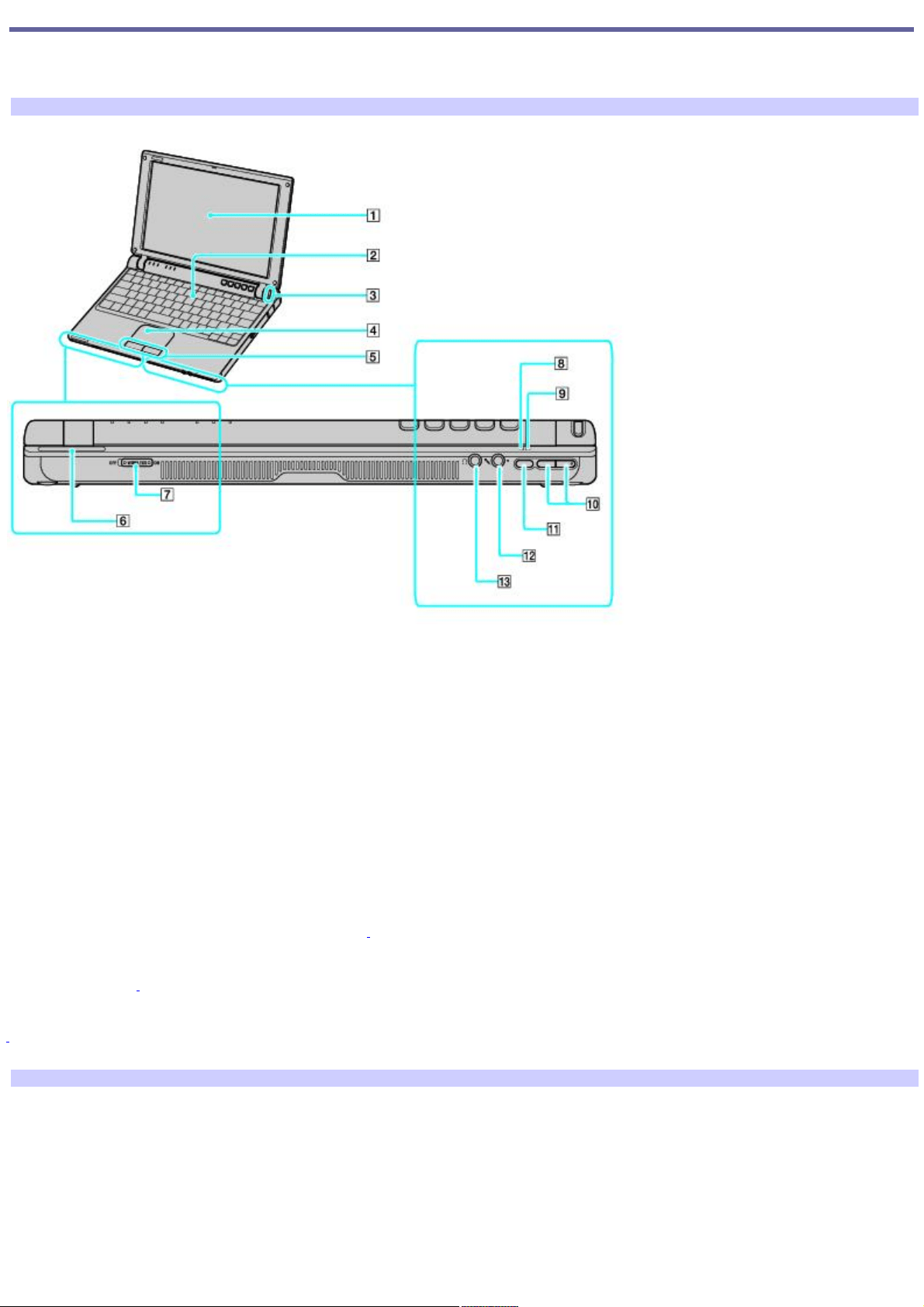
Locating Controls and Ports
Congratulations on your purchase of the Sony
®
VAIO
®
computer. Sony has combined leading-edge technology in audio,
video, computing, and communications to provide state-of-the-art personal computing.
Front
1 Computer screen (LCD) 8 Sound effect indicator
2 Keyboard 9 Sound / Mute indicator
3 Power button 10 Volume Up / Down buttons
4 Touch pad 11 Sound Effects / Mute button
5 Left and right buttons 12 Microphone jack
6 Wireless LAN indicator and Bluetooth
®
indicator
1
13 Headphone jack
7 Wireless switch
1
1
Wireless LA N and Bluetooth capabilities are available on selected models only.
Front - Top v iew
Page 8
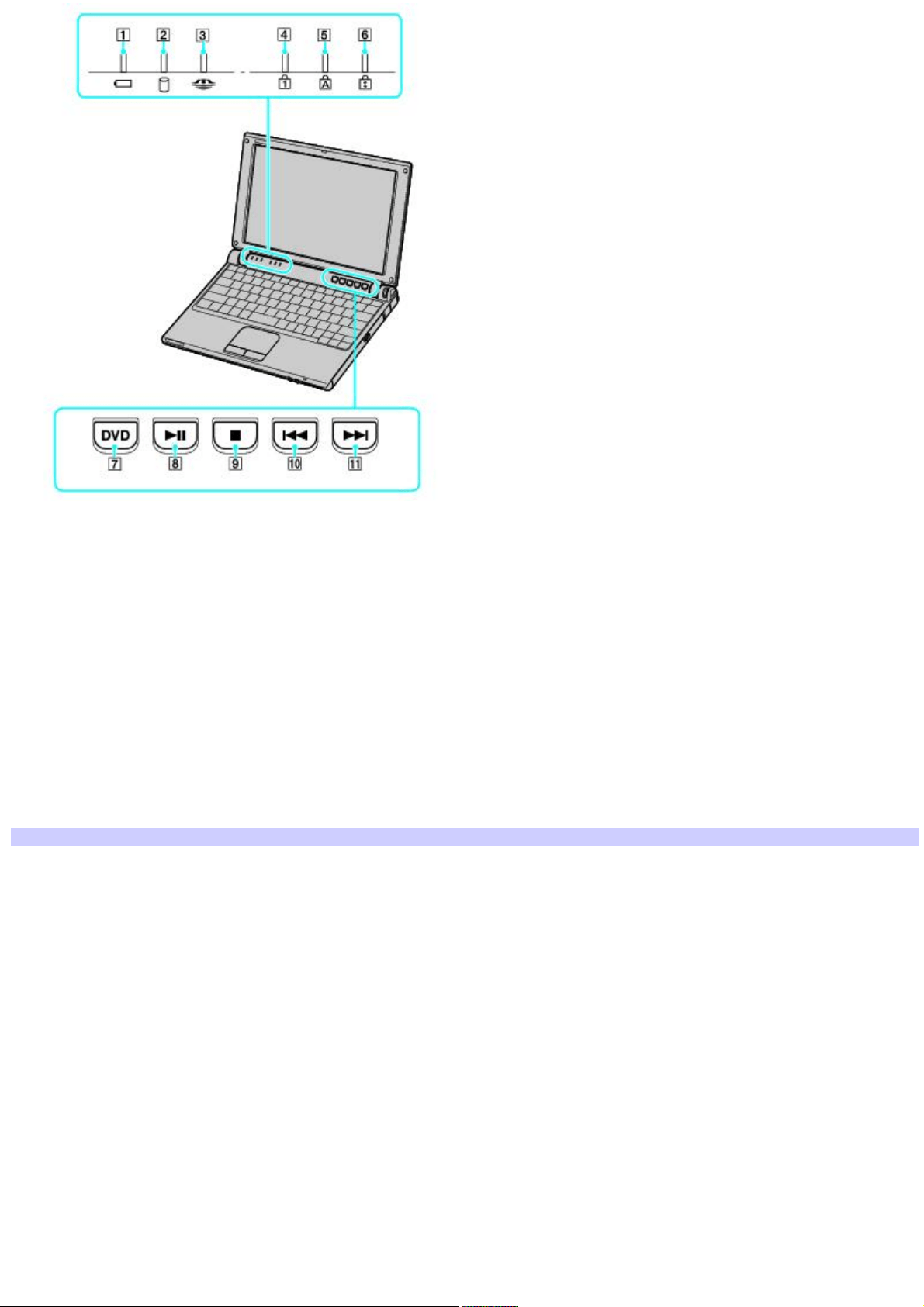
1 Battery indicator 7 DVD Start button
2 Hard disk drive indicator 8 Play / Pause button
3 Memory Stick
®
media indicator 9 Stop button
4 Num lock indicator 10 Back button
5 Caps lock indicator 11 Forward button
6 Scroll lock indicator
Left
Page 9
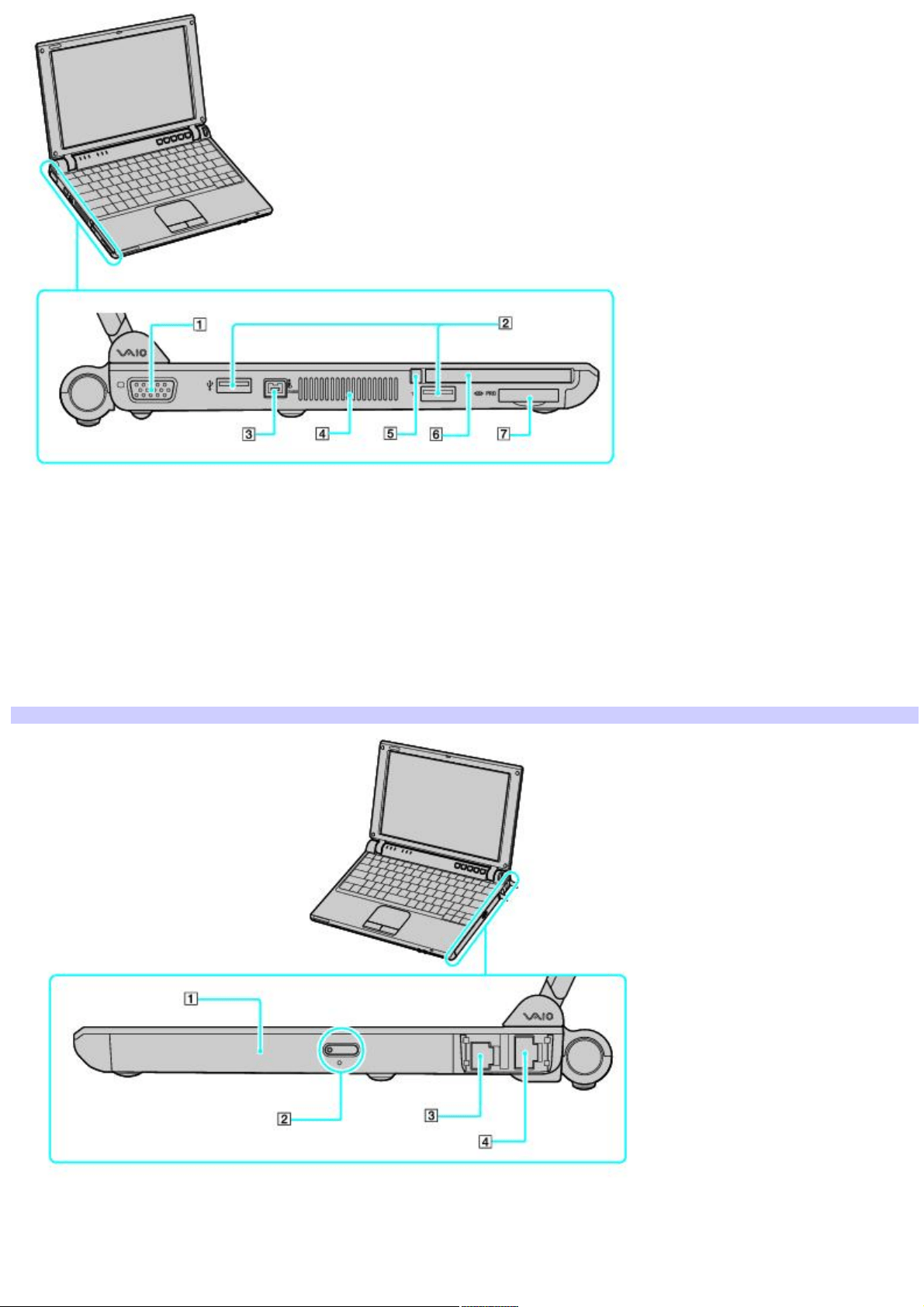
1 Monitor (VGA) port 5 PC Card eject button
2 USB 2.0 ports 6 PC Card slot
3 i.LINK
®
(IEEE 1394) S400 port 7 Memory Stick
®
media slot
4 Air vent
Right
1 Optical drive 3 Modem jack
2 Optical drive indicator, Optical drive eject button, and manual eject hole 4 Network (Ethernet) port
Page 10
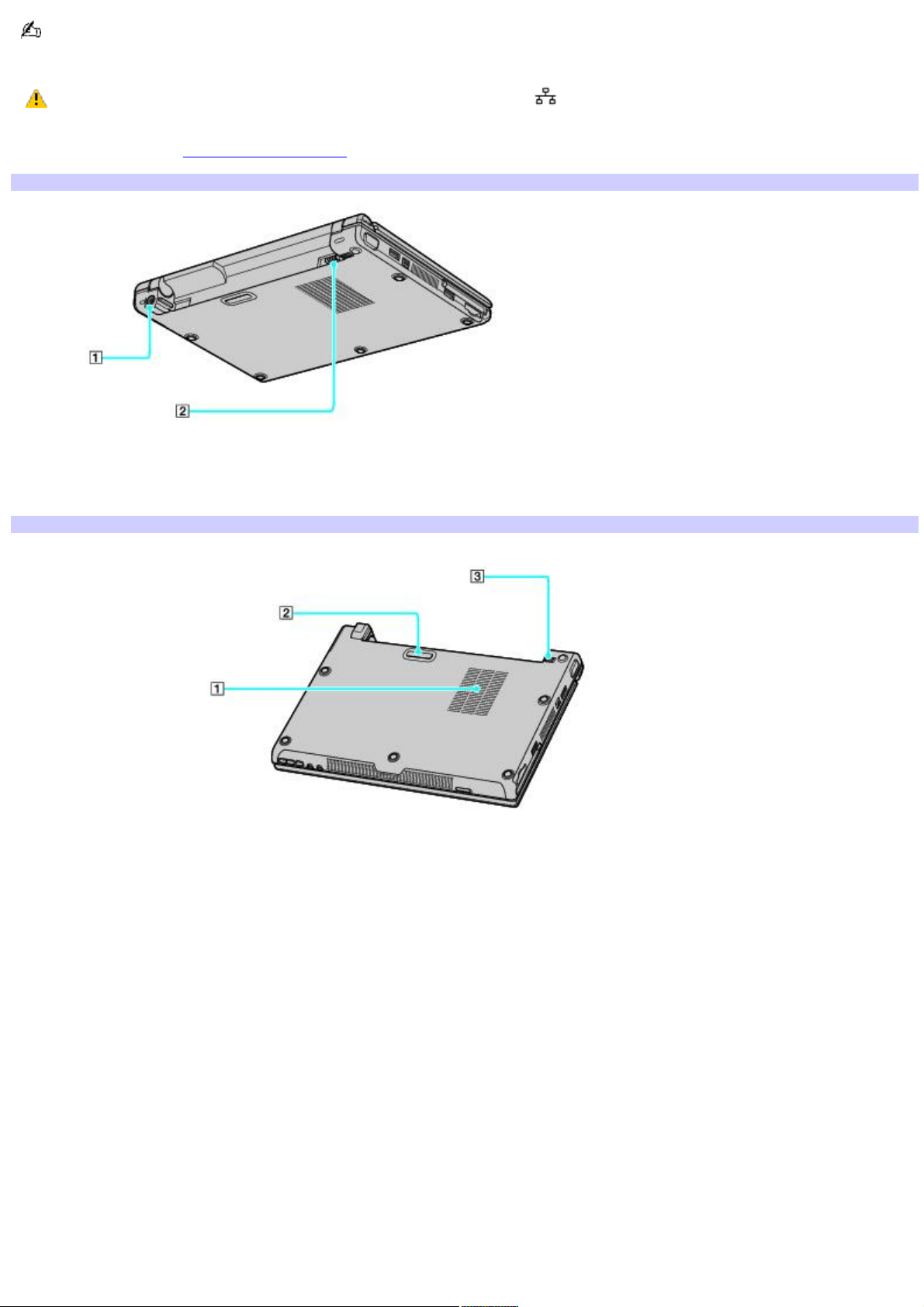
Gently pull the protective tabs away from the computer to find the modem jack and network (Ethernet) port. Do not
remove the tabs.
Only connect 10BASE-T or 100BASE-TX cables to the Network (Ethernet) port. Do not connect any
other type of network cable or any telephone line to this port. Connecting cables other than those listed above may
result in an electric current overload and could cause a malfunction, excessive heat, or fire in the port. To connect the
unit to a network, see Network Connections or contact your network administrator.
Back
1 DC In 2 Battery connector
Bottom
1 Air vent 3 Battery release button
2 Port replicator connector
Page 11

About the Indicator Lights
Indicator Function
Power
Turns on when the power to the computer is on, blinks in Standby mode, and turns off when the computer is
in Hibernate mode or off.
Battery
Turns on when the computer is using battery power, blinks when the battery is running out of power,
double-blinks when the battery is charging.
Optical Drive
Turns on when data is read from or written to the optical drive. Do not enter Standby mode or turn off the
computer when this indicator is on.
Memory Stick
®
Turns on when data is read from or written to the Memory Stick media. (Do not enter Standby mode or turn off
the computer when this indicator is on.) When the indicator is off, the Memory Stick media is not being used.
Hard Disk
Turns on when data is read from or written to the hard disk. Do not enter Standby mode or turn off the
computer when this indicator is on.
Num Lock
Press this key to activate the numeric keypad. Press it a second time to deactivate the numeric keypad. The
numeric keypad is not active when the indicator is off.
Caps Lock
Press this key to type letters in uppercase. Letters appear in lowercase if you press Shift while the indicator is
on. Press the key a second time to turn off the indicator. Normal typing resumes when the Caps Lock indicator is off.
Scroll Lock
Press this key to change how you scroll the display. Normal scrolling resumes when the Scroll Lock indicator is
off. The Scroll Lock key functions differently depending on the program you are using and does not work with all programs.
Bluetooth
®1
Turns on when the wireless switch is set to ON and Bluetooth technology is enabled.
Wireless
LAN
1
Turns on when the wireless LAN function is running.
1
O n s elected models only.
See Internet and Network Connections for more information about Bluetooth and wireless technology.
Page 12

Using Special Buttons
Your computer is equipped with several special buttons: DVD play buttons, a Sound Effects / Mute button, and Volume Up /
Down buttons. The DVD buttons are located at the top right of the computer and are designed to offer a quick and easy
user interface when playing DVDs. The sound efffects and volume buttons are located at the bottom right of the computer
and are designed to control a variety of audio functions.
Page 13

About the Special Buttons
The following information shows where the special buttons are located and briefly describes their functionality.
Page 14
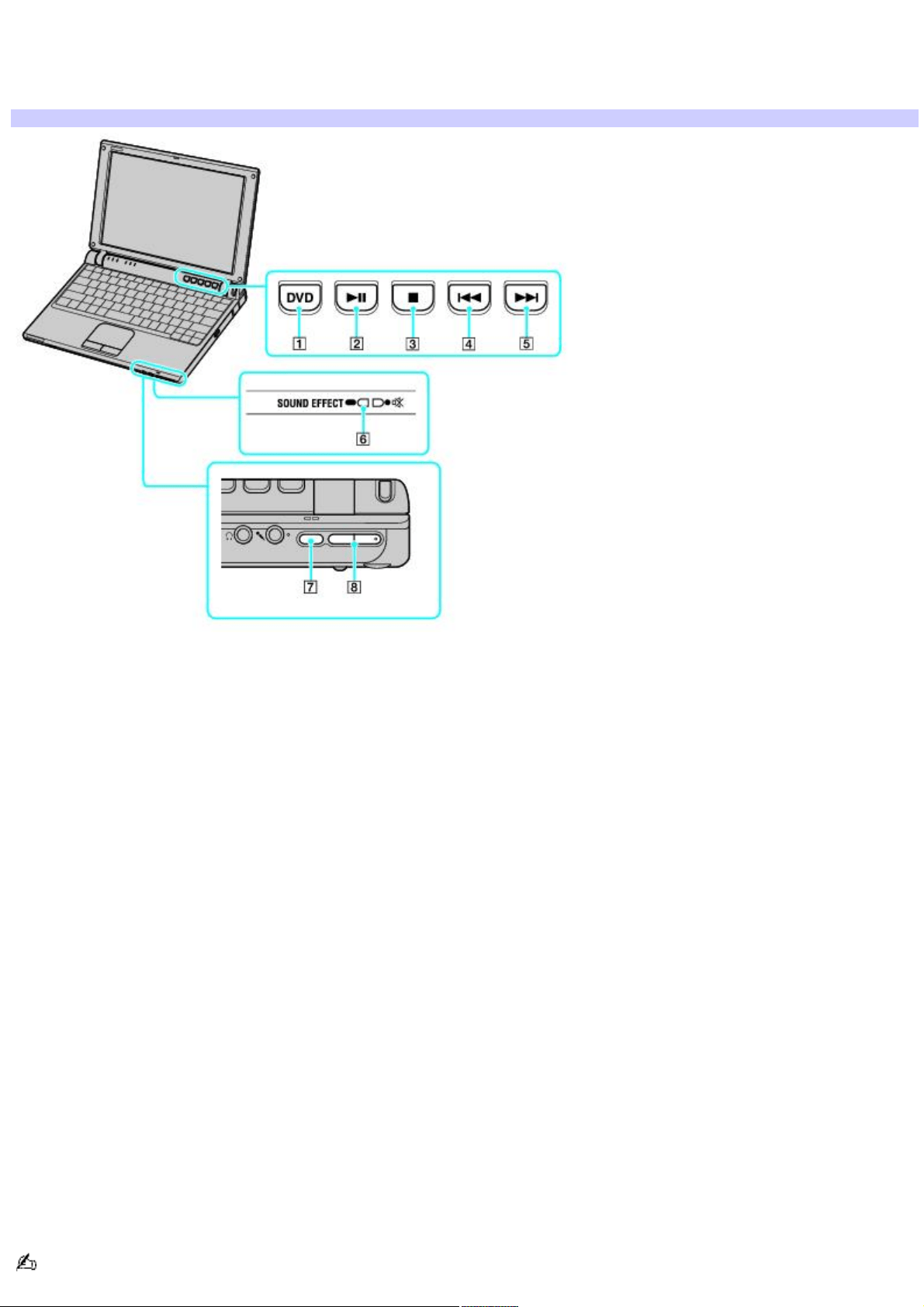
Locating the special buttons
The DVD buttons are located just above the keyboard, toward the right side. The Sound Effects / Mute button and the
Volume Up / Down buttons are located on the front of the computer, along the right edge.
Locating the Special Buttons
1 DVD Start button 5 Forward / Next Track button
2 Play / Pause button 6 Sound Effects indicator
3 Stop button 7 Sound Effects / Mute button
4 Back / Previous Track button 8 Volume Up / Down buttons
To use the DVD buttons
Pressing the DVD button will launch the VAIO Zone software program.
You can also launch the DVD button control panel window (also available via VAIO Control Center) by pressing and holding
the DVD button for a few seconds. From there, you can edit the following settings:
LCD brightness level
Cinema mode
Full-screen mode
Audio modes
The remaining buttons (Play / Pause, Stop, Back / Previous Track, Forward / Next Track) can be used as regular media
player buttons.
For help, press the Help button on the DVD Button control panel window. The Help for DVD Button help file will launch.
The DVD button functionalities are not supported by all DVD-related software programs, including the SonicStage
®
software program.
Page 15
To use the Sound Effects / Mute button
To enable the sound effects, you must first install SonicStage Mastering Sudio Audio Filter. Follow these steps:
1.
Click the Enhance Audio icon on the desktop. The SonicStage Mastering Studio Audio Filter dialog box appears.
2.
Click Next to install the Audio Filter.
3.
Follow any additional on-screen instructions.
Once the Audio Filter has been installed, you can add various audio effects to the audio output of a wide variety of
programs.
By briefly pressing the Sound Effects / Mute button, you can toggle between Mute and sound on.
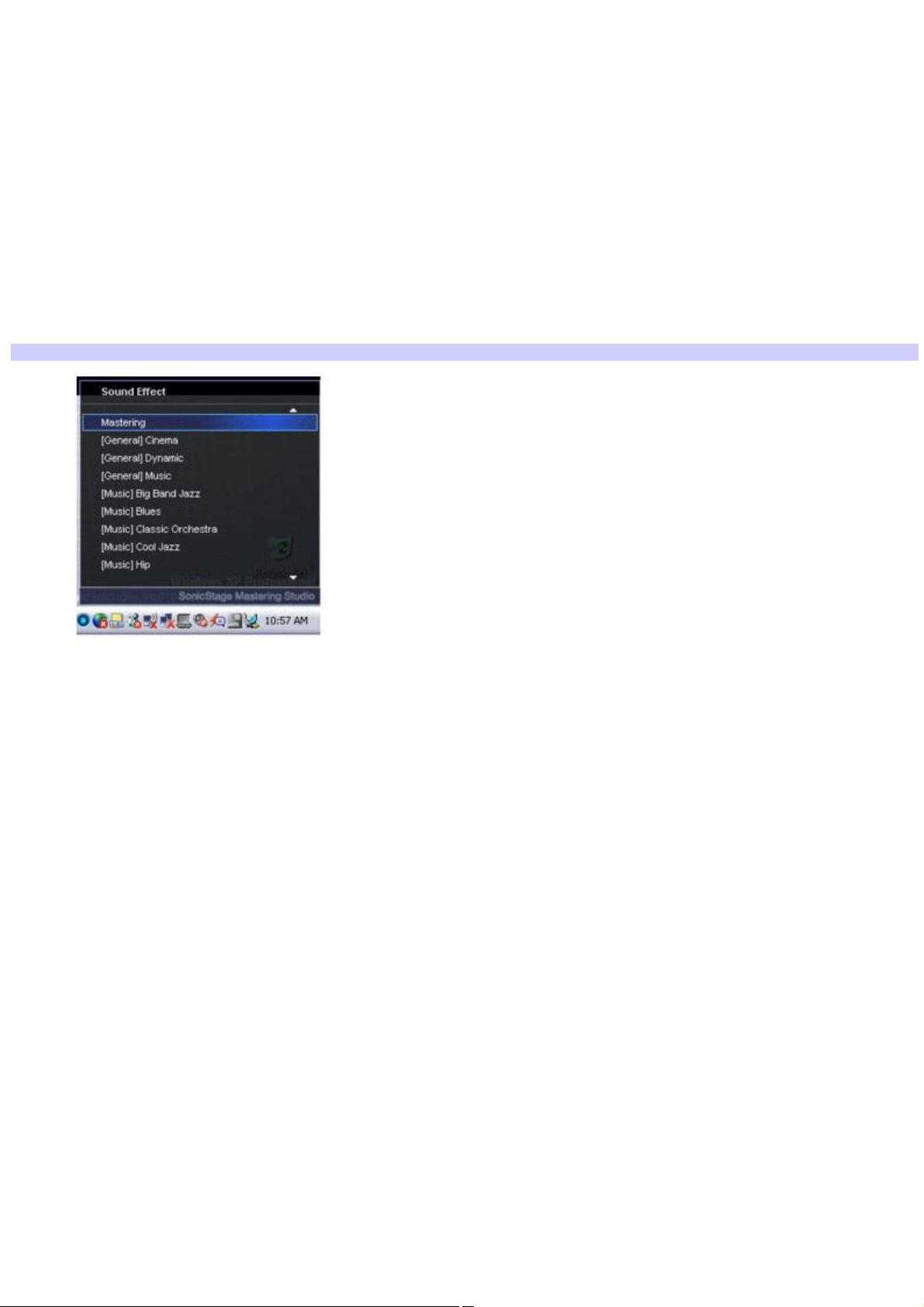
By pressing and holding the Sound Effects / Mute button, the Sound Effect menu will appear. From the Sound Effect
menu, use the arrow keys to select the desired sound effect.
Sound Effect Menu
To open the SonicStage Mastering Studio Audio Filter, do the following:
1.
Click Start, select All Programs, then select SonicStage Mastering Studio.
2.
Click Audio Filter. The SonicStage Mastering Studio Audio Filter dialog box appears.
3.
From the drop-down menu, select a desired sound effect or change any particular settings. For additional
information about SonicStage Mastering Studio Audio Filter, click the Help button.
4.
Click Close.
To use the Volume buttons
The Volume Up / Down buttons regulate the volume level up or down accordingly.
Volume Up: When pressing the Volume Up button, the volume level will increase, and an on-screen dialog box will
display the volume level.
Volume Down: When pressing the Volume Down button, the volume level will decrease, and an on-screen dialog
box will display the volume level.
Page 16

Using the Touch Pad
Describing the Touch Pad
A pointing device called a touch pad is located in front of the keyboard. You can point to, select, drag, and scroll objects on
the screen using the built-in touch pad.
Page 17

Using the Touch Pad
Describing the Touch Pad
A pointing device called a touch pad is located in front of the keyboard. You can point to, select, drag, and scroll objects on
the screen using the built-in touch pad.
Page 18
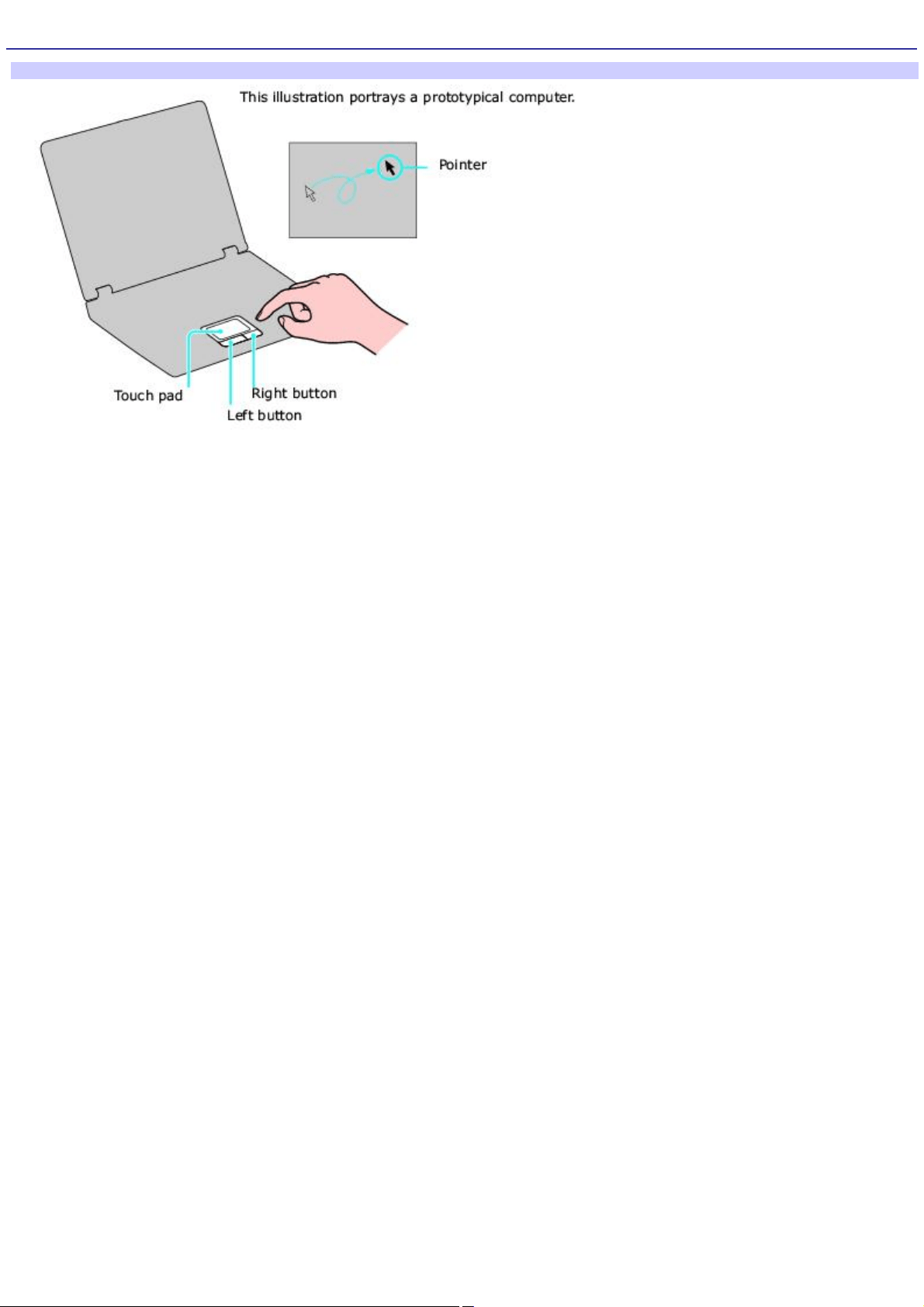
Locating and using the touch pad
Locating the Touch Pad
Touch Pad Action Description
Sliding one finger Equivalent to using a mouse to place the pointer on an item.
Tapping once Equivalent to pressing the left button once.
Tapping twice Equivalent to pressing the left button twice.
Sliding one finger while pressing the left button Equivalent to using the mouse to drag an item.
Moving your finger along the right edge of the touch pad Equivalent to scrolling vertically. (The scroll function is available
only with programs that support a touch pad scroll feature.)
Moving your finger along the bottom to scroll horizontally Equivalent to scrolling horizontally. (The scroll function is
available only with programs that support a touch pad scroll feature.)
Page 19

Customizing the touch pad
Customizing your touch pad and mouse preferences may entail changing the pointers, enabling or disabling the tapping
feature, and adjusting the touch pad speed. The touch pad and mouse preferences are adjustable from the Mouse
Properties dialog box. You also have the option to disable the touch pad when you want to use an external mouse. If it is
disabled, the touch pad may easily be enabled again using a series of keyboard steps.
To customize the touch pad or mouse
Right-click the Touch Pad icon on the Taskbar Notification area, and click Mouse Properties from the shortcut
menu. The Mouse Properties dialog box appears.
Click Start on the Windows
®
taskbar, point to All Programs, and click VAIO Control Center. Select the List tab, and
double-click Mouse. The Mouse Properties dialog box appears.
To disable the touch pad
1.
Click Start on the Windows
®
taskbar, and point to All Programs.
2.
Click VAIO Control Center. The VAIO Control Center dialog box appears.
3.
Select the List tab, and double-click Built-in Pointing Device. The Built-in Pointing Device dialog box appears.
4.
Click to deselect the Enable checkbox, and click OK. A caution message may appear if an external mouse is not
connected to the computer.
To enable the touch pad
1.
Press the Windows key . The Start menu appears.
2.
Press P until All Programs is selected, and press Enter.
3.
Press V until VAIO Control Center is selected, and press Enter. The VAIO Control Center dialog box appears.
4.
Use the Tab and arrow keys to select the List tab.
5.
Use the arrow keys to select Built-in Pointing Device, and press Enter.
6.
Use the Tab key to select the Enable option, then press the +/= key, and press Enter.
Page 20

Using Memory Stick Media
Your VAIO
®
computer is equipped with a Memory Stick
®
media slot that supports certain types of Memory Stick
®
media.
Your computer is not compatible with MagicGate copyright technology features.
Page 21

About Memory Stick media
Memory Stick
®
media are a compact, portable, and versatile data storage media designed for exchanging and sharing digital
data with compatible devices. You can store different data formats on a single Memory Stick media. The following types of
Memory Stick media are available, but compatibility with your computer can vary.
MagicGate Memory Stick media — Provides copyright protection with authentication and encryption, using Sony
®
MagicGate technology. Authentication ensures that protected content is only transferred between compliant devices
and media. Protected content can be recorded and transferred in an encrypted format to prevent unauthorized
duplication or playback.
Memory Stick PRO media — Provides MagicGate copyright protection and high-speed transfer features when used
with compatible Memory Stick PRO devices. VAIO
®
computers support Memory Stick PRO media for data storage
purposes only. Currently, MagicGate technology features, such as authentication and encryption, are not available.
Memory Stick Duo media — Provides the same features and benefits of MagicGate Memory Stick media, in a form
that is 1/3 smaller in size.
Memory Stick media — Provides data storage only. The Memory Stick media does not provide MagicGate technology
or high-speed data transfer.
Currently, Sony
®
SonicStage
®
and OpenMG software are not compatible with Memory Stick PRO media. Sony suggests
using only MagicGate Memory Stick media to store and transfer any data created with SonicStage or OpenMG software.
Visit the Sony Computing Support Web site at http://www.sony.com/pcsupport regularly for the latest information on
Memory Stick PRO media.
Memory Stick media may not support playback of some video files directly from the media. Copy the video file to your
hard disk drive and then play back the file.
Page 22
Inserting Memory Stick media
Before using Memory Stick
®
media, back up important data. The media slot accommodates only one Memory Stick media at a
time.
To insert Memory Stick media
1.
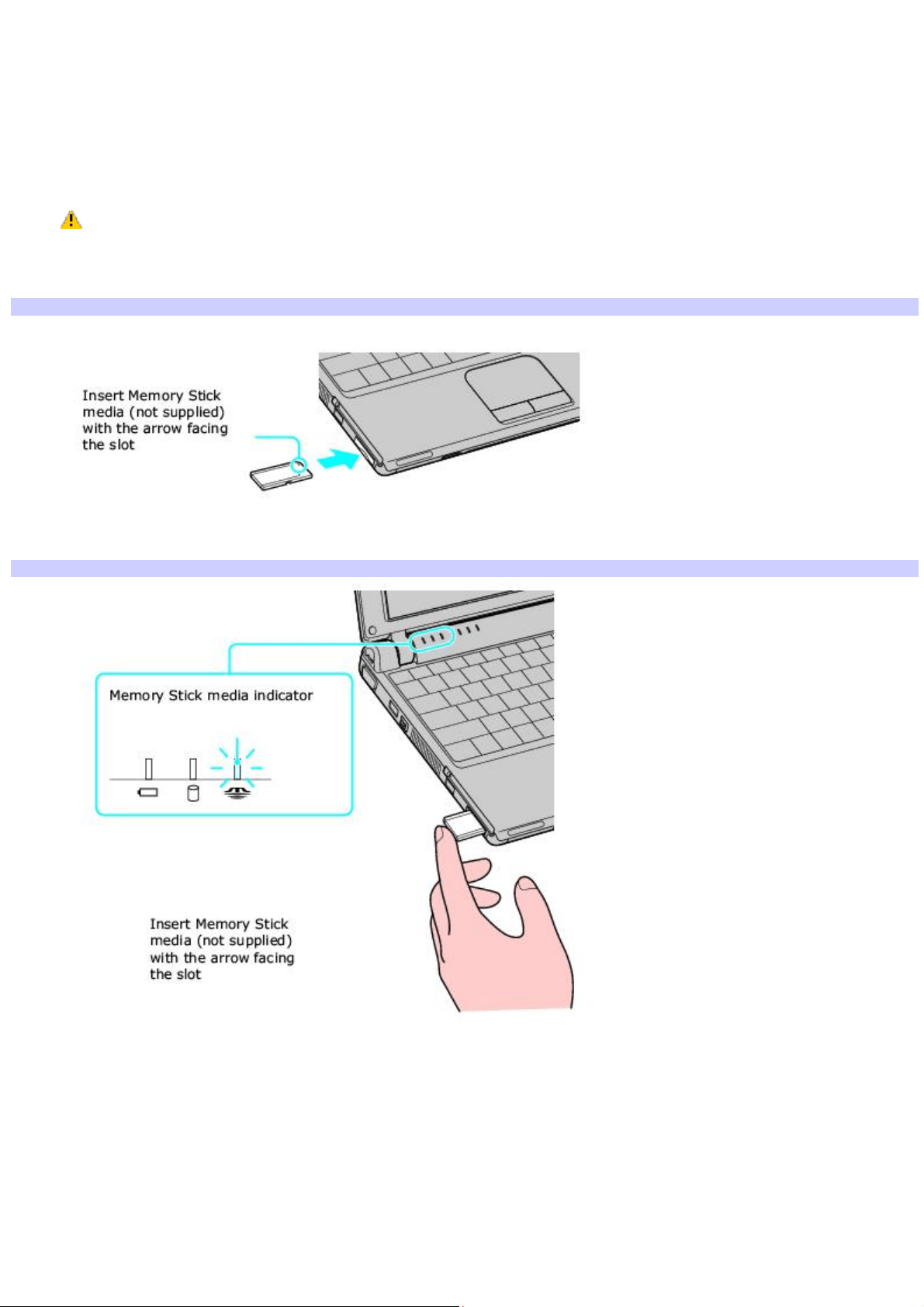
Insert the Memory Stick media with the arrow facing up and toward the Memory Stick media slot.
Do not insert more than one Memory Stick media into the Memory Stick media slot. Inserting the media
improperly may damage the computer.
2.
Carefully slide the Memory Stick media into the slot until it clicks in place.
Inserting Memory Stick Media
3.
The Memory Stick media indicator briefly blinks.
Memory Stick media indicator
Page 23

Viewing the contents
Depending on the model you purchased, the Sony Memory Stick window may appear when you insert a Memory Stick
®
media. From this window, you can choose to view, print, copy or organize your images or data stored on the Memory Stick
media. If the Sony Memory Stick window does not appear when you insert your Memory Stick media, then follow these
steps:
To view the contents
1.
From the Start menu, click My Computer. The My Computer window appears.
2.
Click Sony MemoryStick. The Sony MemoryStick window appears, displaying the contents stored on the
Memory Stick media.
Page 24
Protecting data on Memory Stick media
Some Memory Stick
®
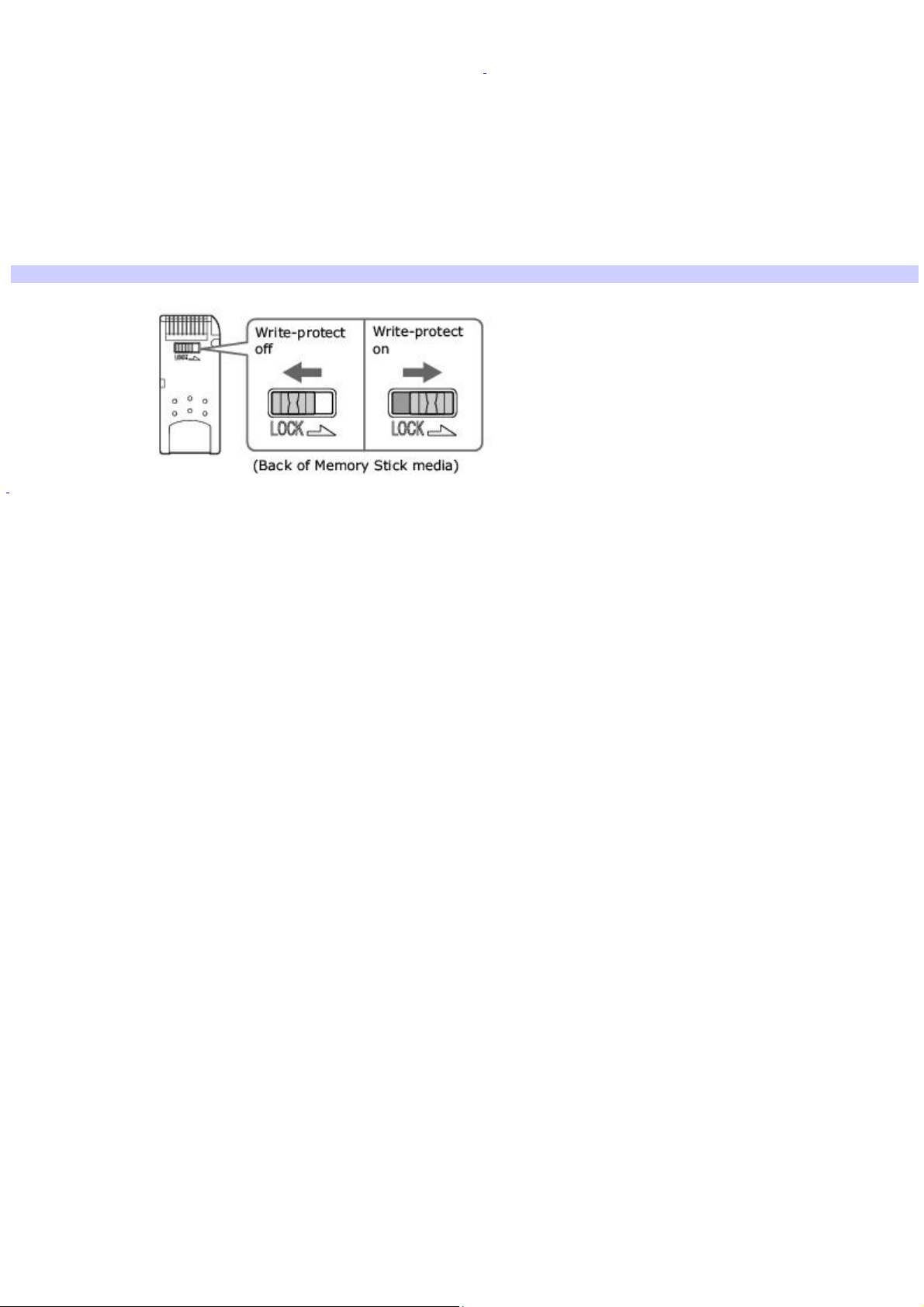
media are equipped with a write-protect tab
1
. The write-protect tab prevents accidental changes to
information recorded on your Memory Stick media. When you slide the write-protect tab to the LOCK position, your Memory
Stick media is write-protected. You cannot delete, copy, or save information on the media while the write-protect tab in the
LOCK position. When you slide the tab to the un-LOCK position, you can write to or modify your Memory Stick media's
contents.
Write-protect off Data can be saved on the Memory Stick media.
Write-protect on Data can be read from but not saved on the Memory Stick media.
Using the Write-Protect Tab
1
Some Memory Stick media do not have a write-protec t tab, and the loc ation or pos ition of the write-protec t tab may vary, depending on the type of Memory
Stick media. See the information sheet provided with your Memory Stick media.
Page 25

Formatting Memory Stick media
Memory Stick
®
media is formatted for immediate use when you purchase it. If you need to reformat Memory Stick media, use
the Memory Stick Formatter that is provided with the media. For more information about using Memory Stick Formatter, refer
to Formatter Help.
Formatting Memory Stick media erases all data, including music data, previously saved to it. Before you
reformat Memory Stick media, confirm that the media does not contain files you want to keep. Back up important data
before formatting the media.
To format Memory Stick media
1.
Insert the Memory Stick media into the Memory Stick media slot. See To insert Memory Stick media for more
information.
2.
From the Start menu, click All Programs, select Memory Stick Utility, and click Memory Stick Formatter. The
Memory Stick Formatter window appears.
3.
Click Start Format, and follow the on-screen directions.
4.
After formatting, click Exit.
Page 26

Removing Memory Stick media
If the Memory Stick
®
media is removed prematurely, a blue screen with a message may appear prompting you to continue or
exit. Reinsert the media into the slot and press Enter to continue. This enables the media to finish reading or writing data.
To remove Memory Stick media
1.
Wait a minimum of 10 seconds after the Memory Stick media finishes reading or writing data before removing the
media.
2.
Make sure the access light is off.
3.
Push the Memory Stick media in toward the computer.
4.
When the Memory Stick media ejects, pull it out.
Be careful when removing the Memory Stick media, as it may not eject completely from the slot.
Page 27

Mice and Keyboards
Using the Keyboard
Although your computer's keyboard is very similar to a typewriter's keyboard, you can use the additional keys on the
computer's keyboard to perform specific computer-related tasks.
Page 28

Mice and Keyboards
Using the Keyboard
Although your computer's keyboard is very similar to a typewriter's keyboard, you can use the additional keys on the
computer's keyboard to perform specific computer-related tasks.
Page 29
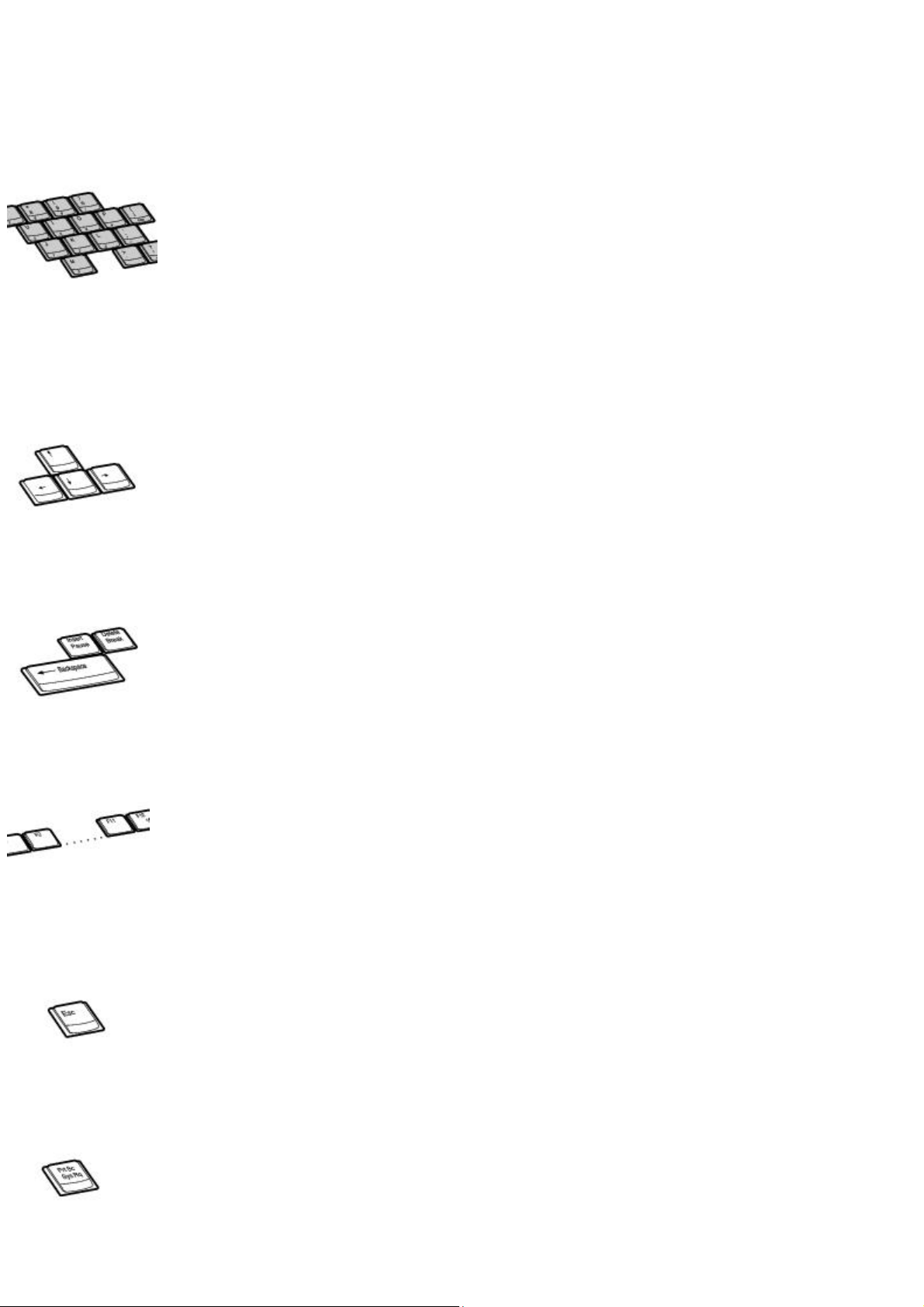
Key descriptions
Key Description
Numeric keypad
Contains the keys found on a typical calculator. Use the numeric keypad area to type numbers or to
perform mathematical calculations, such as addition and subtraction. Numbers appear on the front beveled edge of the
numeric keys. Press the Num Lock key to activate the numeric keypad. (When you do so, the Num Lock indicator light turns
on.) Press the Num Lock key again to deactivate the numeric keypad.
Arrow keys
The Left, Right, Up, and Down arrow keys move the pointer on the screen. They also function as the
Home, End, Page Up, and Page Down keys, respectively, when the Fn key is pressed.
Correction keys
The Insert, Back Space, and Delete keys enable you to make corrections to keystrokes.
Function keys
The 12 function keys along the top of the keyboard are used to perform designated tasks. For
example, in many programs, F1 is the Help key. The task associated with each function key may vary from one program to
the next.
Escape key
The Esc (Escape) key is used to cancel commands.
Print Screen key
The Print Screen key takes an electronic snapshot of the screen and moves it to the Clipboard. You can
then paste the screen shot into a document and print it.
Operator keys
Page 30

(Ctrl, Alt, Shift keys)
Several keys are always used with at least one other key: Ctrl, Alt, and Shift. When held down with
another key, the Ctrl (Control) and Alt (Alternate) keys offer another way to give commands. For example, in many
programs, instead of choosing the Save command from a menu, you can hold down Ctrl and press S (referred to as Ctrl+S
). The Shift key operates the same way as on a typewriter; it is used to produce capital letters or special symbols, such as
@ and $.
Windows key
The key with the Microsoft
®
Windows
®
operating system logo displays the Start menu; it is the
equivalent of clicking Start on the taskbar. See Combinations and functions with the Windows key for more information.
Fn key
The Fn key is used in combination with other keys to issue commands. See Combinations and functions
with the Fn key for more information.
Applications key
The Applications key displays a shortcut menu of context-sensitive choices. Pressing this key is the
equivalent of clicking the right mouse button.
Page 31

Combinations and functions with the Windows key
Combination Function
+F1 Displays the VAIO Help and Support Center window.
+Tab Switches the selected button on the taskbar.
+D Displays the desktop.
+E Displays the Windows Explorer window.
+F Displays the Search Results window, where you can find a file or folder. This is the equivalent of selecting
Search from the Start menu.
+Ctrl+F Displays the Search Results - Computers window, where you can locate other computers. This is the
equivalent of selecting Search, and then Computer from the Start menu.
+M Minimizes all displayed windows.
Shift+ +M Returns all minimized windows to their previous size.
+R Displays the Run window. This is the equivalent of selecting Run from the Start menu.
Fn+ +Insert Displays the System Properties window. This is the equivalent of selecting Control Panel, and then
System from the Start menu.
Page 32

Combinations and functions with the Fn key
Combinations/
Feature Function
Fn+F5 Decreases the brightness of the computer screen (LCD). An on-screen display appears notifying you when
a change occurs.
Fn+F6 Increases the brightness of the computer screen (LCD). An on-screen display appears notifying you when
a change occurs.
Fn+F7 Toggles the display between the computer screen (LCD), a connected external display, and both the LCD
and an external display. You can also select the Setup option to adjust the Plug and Display settings. Select one display
(LCD or an external display) when playing a DVD. An on-screen display appears notifying you when a change occurs.
Fn+F10 Changes the screen resolution of the entire desktop and any open dialog boxes
Fn+F12 Puts the system into Hibernate mode, a power management state. To return the system to normal
operating mode, press the power button. Hibernate mode consumes the lowest level of power.
Fn+Esc Puts the system into Standby mode, a power management state. To return the system to the active state,
press any key or the power button.
Page 33

Connecting a Mouse and Keyboard
Your computer is compatible with many popular mice and keyboards. To function properly, the device you connect must be
compatible with the Microsoft
®
Windows
®
operating system installed on your computer. For information about your
computer's built-in keyboard and key functions, see Key descriptions.
Page 34
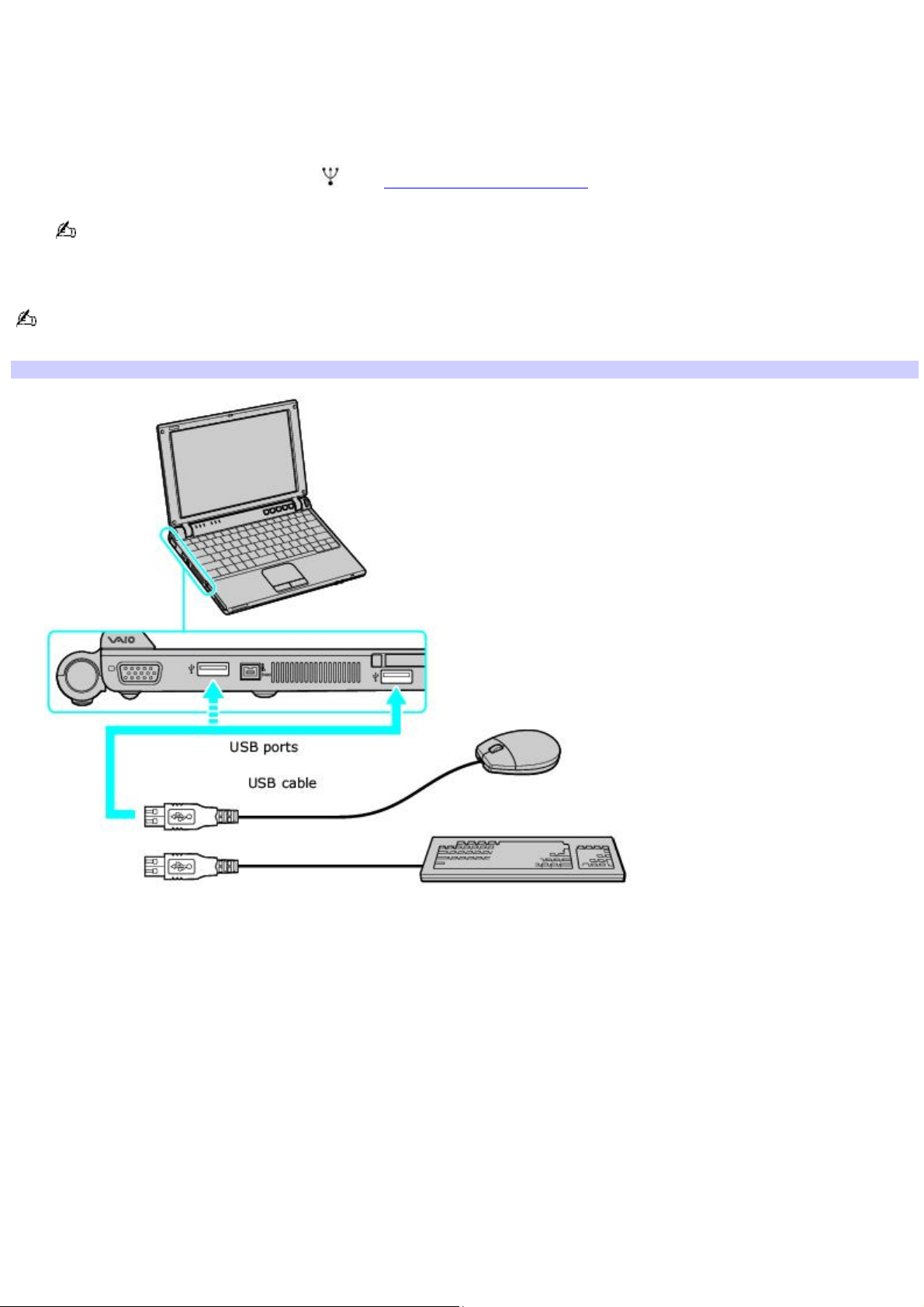
Connecting a mouse or keyboard
Your computer can be on or off when connecting a universal serial bus (USB) mouse or keyboard. If you connect the mouse
or keyboard when the computer is on, you may need to restart the computer for it to recognize the device.
To connect a USB mouse or keyboard to your computer
1.
Plug the USB cable into the USB port . See Locating Controls and Ports.
One USB port supports one USB connection.
2.
If the New Hardware Wizard appears, follow the on-screen instructions to complete the installation process.
Although the New Hardware Wizard guides you through the software installation, some devices require separate
driver software installation. See the instructions that accompanied your mouse or keyboard for more information
Connecting a USB Mouse or Keyboard
Page 35

Disconnecting a mouse or keyboard
You can disconnect a USB mouse or keyboard when the computer is on or off. Disconnecting the mouse or keyboard when
the computer is in a power saving mode (Standby or Hibernate) may cause the computer to malfunction.
To disconnect a mouse or keyboard
Unplug the USB cable from the USB port.
Page 36

Powering Your Computer
Your VAIO
®
computer comes with a battery and an AC adapter. This chapter explains how to install and use these supplied
accessories to power your computer. It also describes ways you can efficiently utilize the battery as a power source.
Page 37

Using AC Power
The supplied battery is not charged when you receive your computer. To charge the battery and begin using the computer
immediately, insert the battery into the computer and use the supplied AC adapter as a power source. The computer
automatically charges the installed battery while it uses AC power.
Page 38
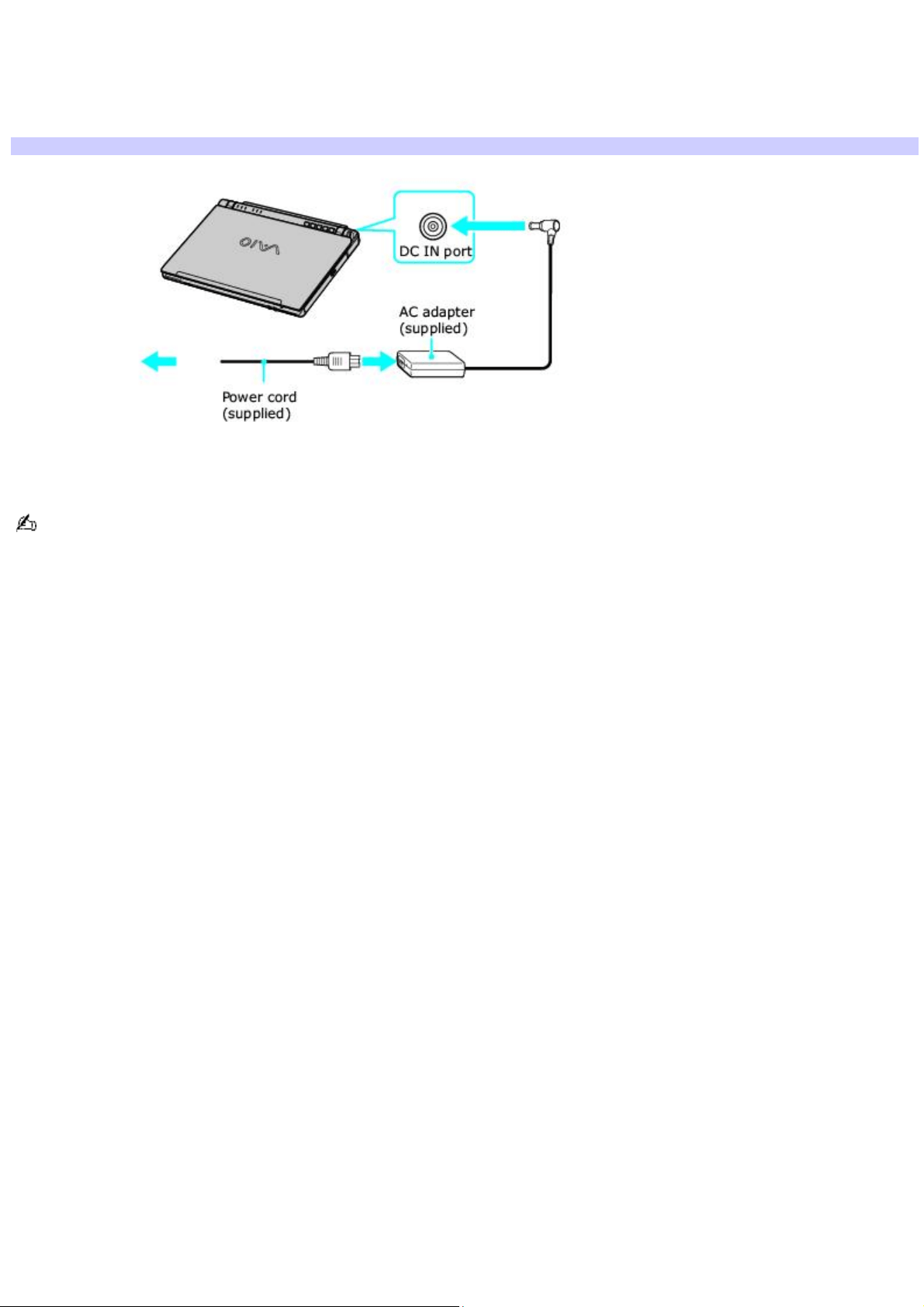
Connecting the AC adapter
To connect the AC adapter
1.
Plug the AC adapter cable into the DC IN port.
Connecting the AC Adapter to the Computer
2.
Plug the power cord into the AC adapter and an AC outlet.
Use only the supplied AC adapter with your computer.
Page 39
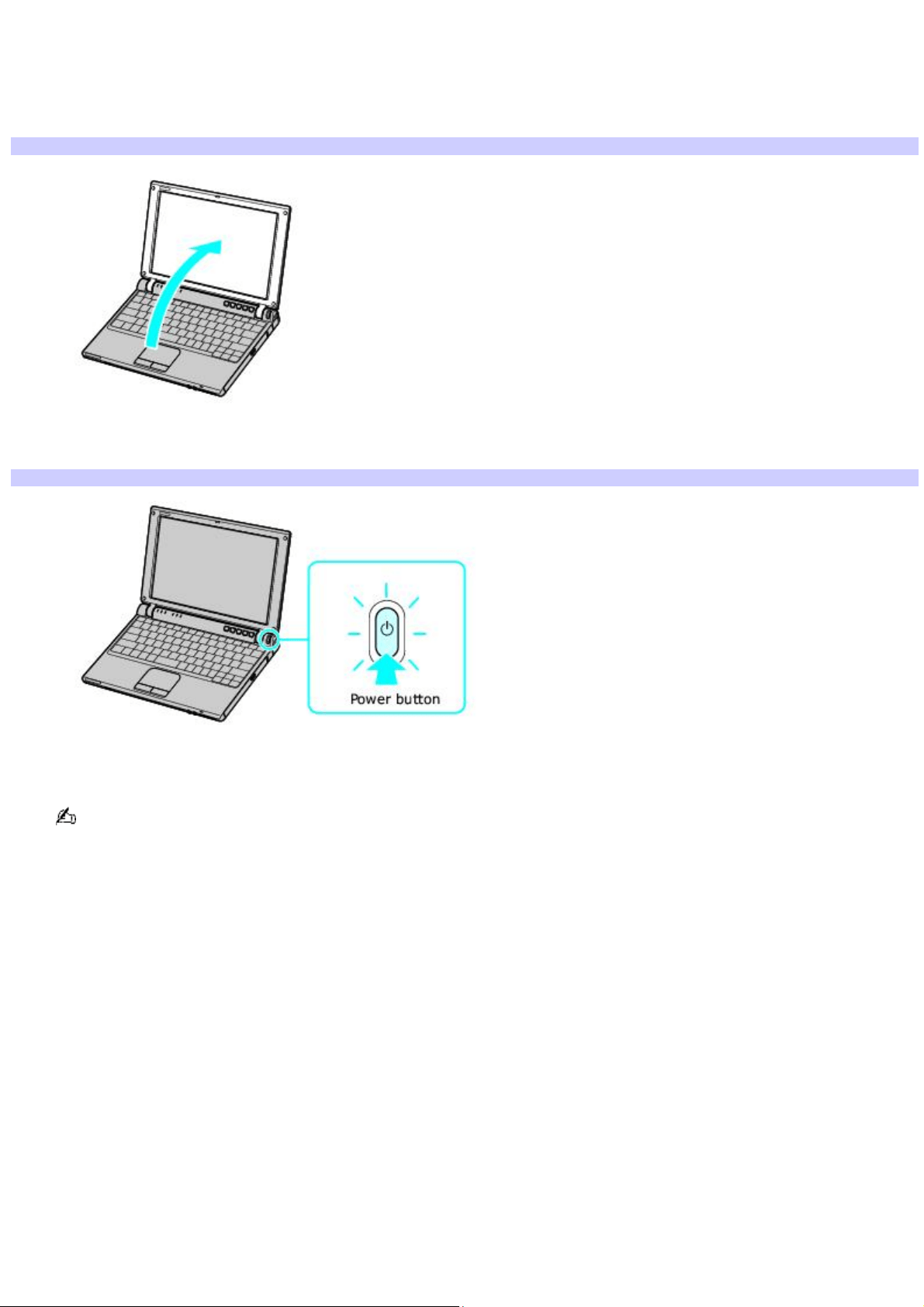
Turning on the computer
To turn on the computer
1.
Hold the bottom of the computer firmly with one hand, and lift the LCD screen lid with the other hand.
Opening the Computer
2.
Press the power button until the power indicator turns on.
Turning on the Computer
If you press and hold the power button, the computer turns off.
3.
Adjust the brightness of the LCD screen, if necessary.
Press the Fn and F6 keys to increase brightness.
Press the Fn and F5 keys to decrease brightness.
Page 40

Using the Battery
Your computer, depending on the model you purchased, may come equipped with one battery bay and one multipurpose
bay that supports a second battery. If your computer comes with two bays, you can purchase a second rechargeable
battery to extend your computing time. For information on how to extend the life of the battery, see Conserving Battery
Power for more information.
When operating your computer on battery power, your computer's CPU speed is reduced.
The battery that comes with your computer is not fully charged at the time of purchase.
Some VAIO personal computers may function only with a genuine Sony battery.
Page 41

Installing the Battery
The supplied battery is not charged when you unpack it. To charge it for future use, install the battery, and then connect
the AC adapter to power your computer. The battery charges from AC power regardless if the computer is on or off. For
information on how to extend the life of the battery, see Conserving Battery Power.
When operating your computer on battery power, your computer's CPU speed is reduced.
This computer is designed to operate only with a genuine Sony battery.
Page 42
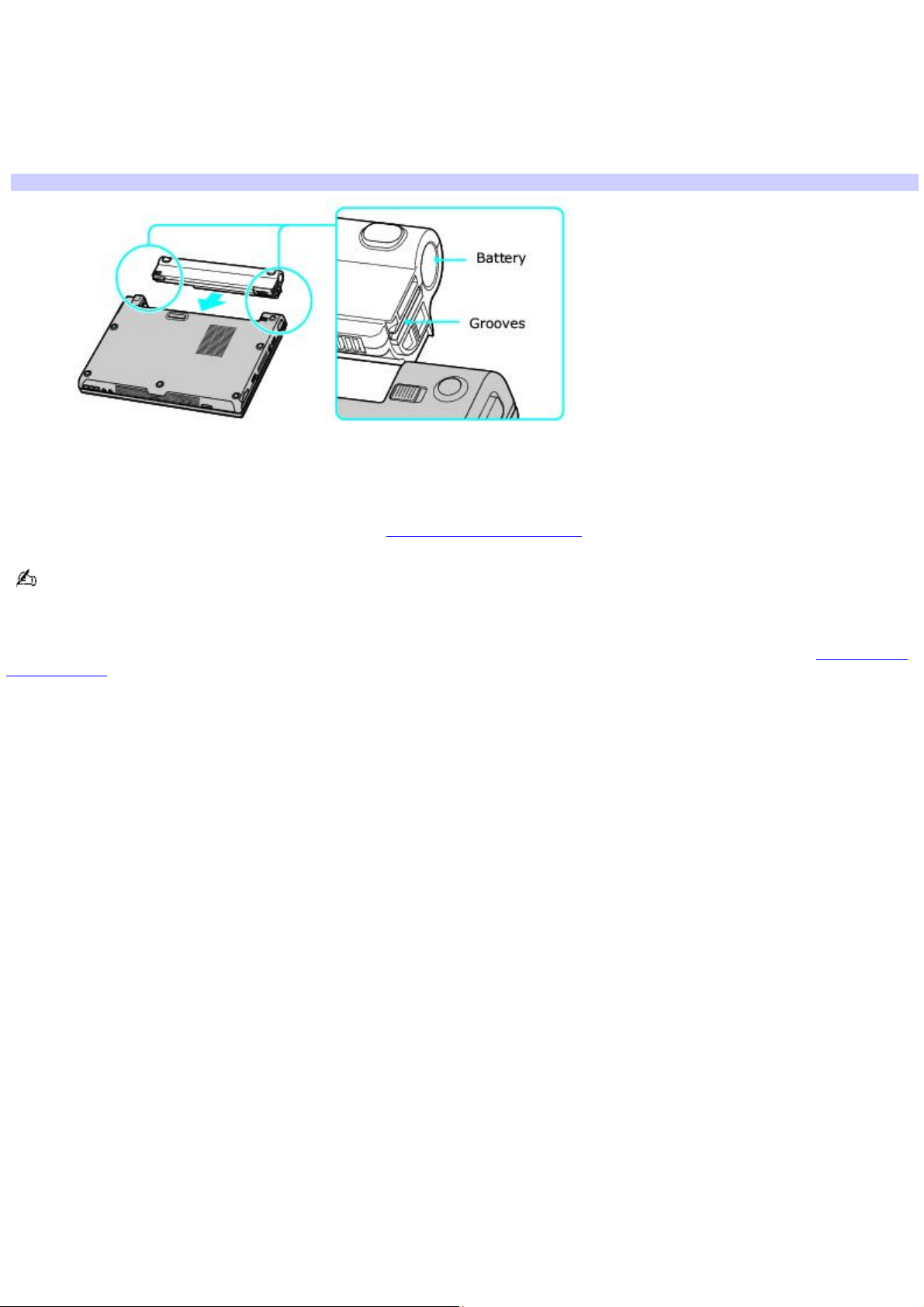
Inserting a battery
To insert a battery
1.
Turn the computer over, and slide the RELEASE latch on the bottom of the battery to the right.
2.
Align the grooves on the battery with the tabs on the back of the computer.
Inserting the Battery
3.
Slide the battery into the computer until it clicks into place. The RELEASE latch on the battery and the RELEASE
latch on the computer will click into position.
4.
Connect the AC adapter to the computer. See To connect the AC adapter for more information.
If a port replicator is attached to your computer, do not insert or remove the battery. Lifting and turning the computer
with the port replicator attached could cause a temporary loss of power.
Some programs and peripheral devices prevent the system from automatically entering Hibernate mode. If you are using
battery power, save your data frequently to avoid data loss and manually activate a power saving mode. See Using power
saving modes for more information.
Page 43
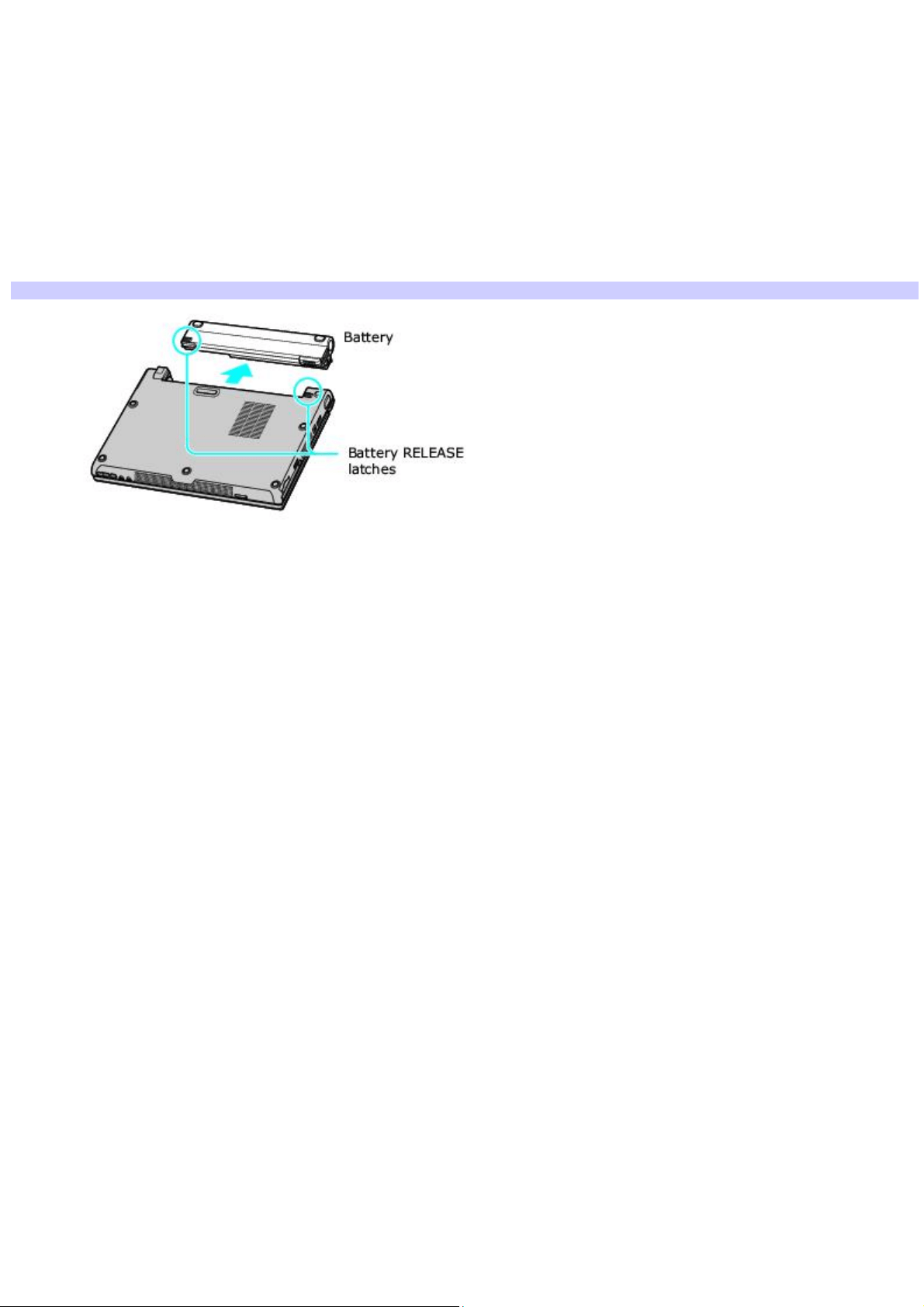
Removing a battery
If you are not using the computer for an extended period of time, remove the battery from the computer to avoid damaging
the battery.
To remove a battery
1.
Make sure the computer is turned off.
2.
Turn the computer over, and slide the RELEASE latch on the bottom of the battery to the right.
3.
Slide and hold the RELEASE latch on the battery, and also slide and hold the RELEASE latch on the computer,
while you pull the battery away from the computer.
Removing a Battery
Page 44

Charging a battery
You will need to charge the battery if battery power drops below 10 percent or you have not used the battery for a long
time. The lithium-ion battery supplied with your computer may be recharged at any time, whether you wait until the battery
is completely or partially discharged. Charging a partially discharged battery does not affect battery life. If you charge the
battery and find that battery power is still low, the battery may be reaching the end of its life, and you may need to replace
it.
The battery supplied with your computer is not charged at the time of purchase.
To charge a battery
You can charge the battery when the computer is on or off. However, the battery will charge faster when the computer is
off. Charging the battery takes several hours.
Charge the battery at temperatures between 50°F and 80°F (10°C to 30°C). Lower temperatures require more time
to charge.
1.
Insert the battery into the battery bay.
2.
Connect the AC adapter to the computer. The computer automatically charges the battery as long as the
computer is using AC power.
The battery indicator blinks while the battery charges. The battery indicator stops blinking when the battery is fully
charged.
When using two batteries, the battery you insert first charges first. The second battery you insert begins charging
when the first battery is 85 percent charged.
Battery indicator status Description
On The computer is using battery power.
Single blink The battery is running out of power.
Double blink The battery is charging.
Off The computer is using AC power.
Page 45

Notes on batteries
Never leave the battery in temperatures above 140°F (60°C), such as under direct sunlight or in a car parked in the
sun.
While the battery is in use or being discharged, the battery heats up. This is normal and is not cause for concern.
Keep the battery away from heat sources.
Keep the battery dry.
Do not open or disassemble the battery.
Do not expose the battery to any mechanical shock.
Battery life is shorter in a cold environment because of decreased battery efficiency at low temperatures.
Some VAIO personal computers may function only with a genuine Sony battery.
Page 46
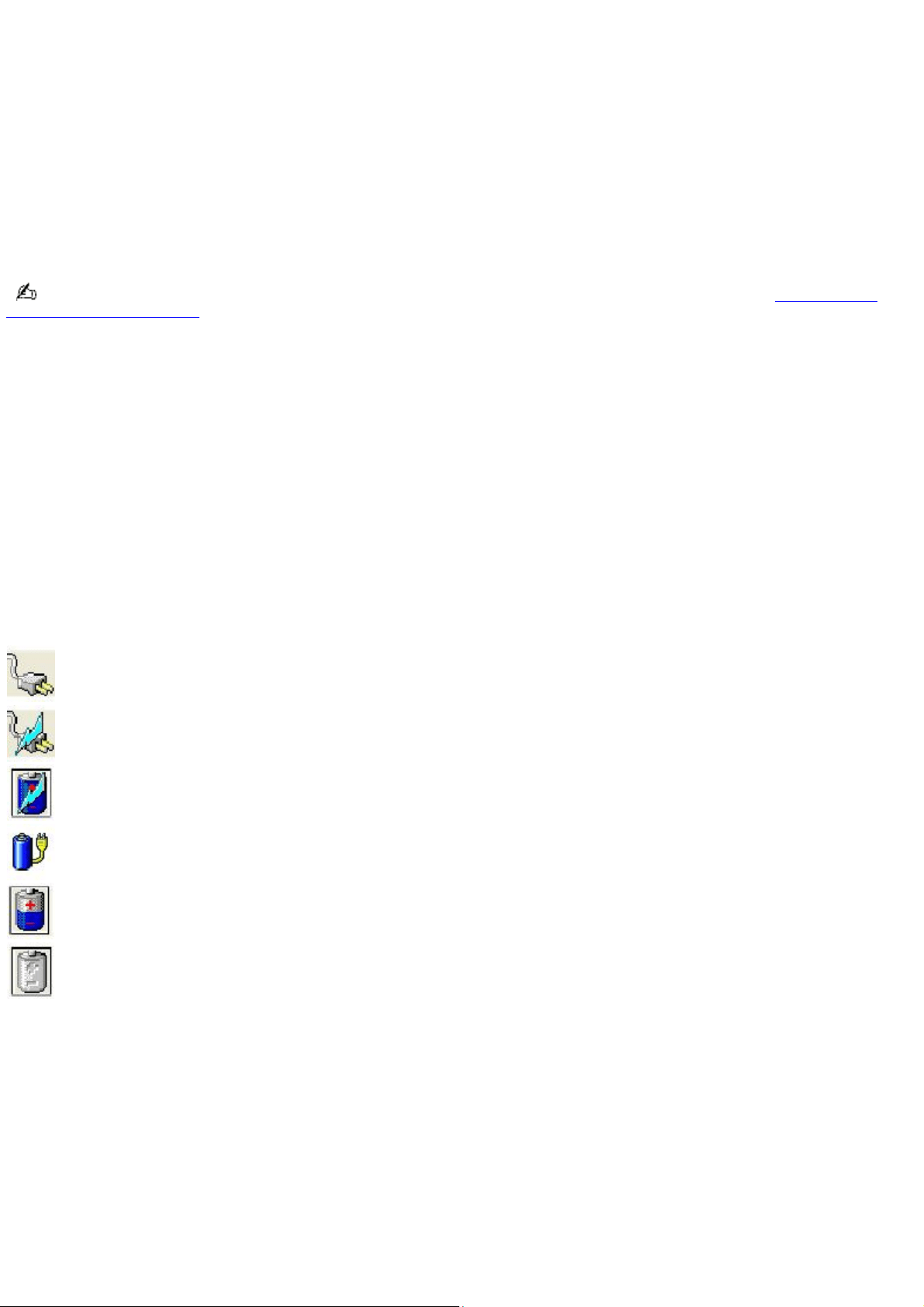
Locating battery information
Displaying the battery status provides useful information, such as remaining battery life.
To view battery information
1.
Click Start on the Windows
®
taskbar, and click Control Panel.
2.
Click Performance and Maintenance, and click Power Options. The Power Options Properties window
appears.
3.
Select the Power Meter tab. The total remaining battery charge is listed as a percentage.
You may also use the power icon on the Windows
®
taskbar to quickly view battery information. See To display the
power icon on the taskbar for instructions on how to set up this shortcut.
To display the power icon on the taskbar
1.
Click Start on the Windows
®
taskbar, and click Control Panel.
2.
Click Performance and Maintenance, and click Power Options. The Power Options Properties window
appears.
3.
Select the Advanced tab, and then select Always show icon on the taskbar in the Options box. The power icon
appears on the taskbar. See the power icon descriptions below for more information.
You can rollover the power icon with the pointer (using either the touchpad or a mouse) to view the remaining battery
charge, and you can double-click the power icon to open the Power Meter window, which also displays the remaining
battery charge.
Power icon Power status
Computer is using AC power.
Computer is using AC power and charging the battery.
Battery is charging.
Battery is fully charged.
Battery is discharging.
No battery is inserted in the computer.
Page 47

Conserving Battery Power
You may use the power saving modes and power schemes to conserve battery power. Conserving battery power may
significantly extend your computing time, depending on how you use your computer.
Page 48

Using power saving modes
In addition to the normal operating mode, which allows you to turn off specific devices to save power, your computer has
two distinct power saving modes: Standby and Hibernate. Use the Standby and Hibernate power saving modes to override
a power profile setting and initiate immediate action.
Standby — Saves the state of the system and peripheral devices in memory (RAM). Power consumption is reduced
to a minimum. The system remains on, and the computer screen (LCD) is off.
Hibernate — Saves the state of the system and peripheral devices to the hard disk. Power consumption is reduced
to the lowest possible setting without being completely off. Hibernate mode consumes the lowest level of power.
Your computer enters Hibernate mode when the remaining battery charge drops below 5 percent, regardless of the
setting you select.
Since some programs and peripheral devices prevent the system from entering Hibernate mode, save your data
frequently to avoid data loss.
To activate Standby mode
1.
Click the Start menu on the Windows
®
taskbar, and click Turn Off Computer.
2.
Click Stand By.
3.
Press any key to return to normal mode.
To activate Hibernate mode
1.
Press the Fn and F12 keys, or press the power button and release it immediately. Do not move the computer
until the power indicator turns off.
2.
Press the power button to return to normal mode.
See Why doesn't my computer enter Hibernate mode? for more information.
Page 49

Using power schemes
You can use the preset power schemes to conserve power. By using the power schemes, you control the power supplied to
different devices, such as the computer screen (LCD) and the hard disk drive, in your computer. You also control when the
computer activates a power saving mode (Standby or Hibernate).
To select a power scheme
1.
Click Start on the Windows
®
taskbar, and click Control Panel.
2.
Click Performance and Maintenance, and click Power Options. The Power Options Properties window appears
with the Power Schemes tab selected.
3.
Select a power scheme from the drop-down menu in the Power schemes box. Each power scheme is preset to
utilize your power supply efficiently, according to your computing functions. Select the power scheme that best
explains how you want to use your computer.
4.
Click Apply.
To create a power scheme
1.
Click Start on the Windows
®
taskbar, and click Control Panel.
2.
Click Performance and Maintenance, and click Power Options. The Power Options Properties window appears
with the Power Schemes tab selected.
You can also right-click the Power icon on the Windows
®
taskbar, and select Adjust Power Properties to open
the Power Options Properties window.
3.
Select your changes from the drop-down menus in the Settings for....power scheme box, and click Save As in
the Power schemes box. The Save Scheme window appears.
4.
Type a name for your customized power scheme, and click OK. The power scheme you created appears in the
Power schemes box.
If you want to delete a power scheme, select the power scheme and click Delete. When the Delete Scheme window
appears, click Yes.
To customize your power properties
1.
Click Start on the Windows
®
taskbar, and click Control Panel.
2.
Click Performance and Maintenance, and click Power Options. The Power Options Properties window
appears.
3.
Select the Advanced tab, and select your changes from the drop-down menus in the Power buttons box. See
Using power saving modes for information on how Standby and Hibernate modes affect power consumption.
4.
Click Apply.
To use VAIO Power Management
VAIO Power Management is a software program that enables you to further adjust the power settings on your computer.
Once you have selected a power scheme under the Power Schemes tab, you can modify it in the VAIO Power Management
tab to enhance your computer's operations.
1.
Click Start on the Windows
®
taskbar, and click Control Panel.
2.
Click Performance and Maintenance, and click Power Options. The Power Options Properties window
appears.
3.
Select the VAIO Power Management tab, and specify the options you want to adjust.
4.
Click Apply.
For information about VAIO Power Management, click the Help button located toward the bottom of the VAIO Power
Page 50

Management tab. Alternately, click Start, select All Programs, then select VAIO Power Management, and click VAIO
Power Management Help. The Help for VAIO Power Management file appears.
To set your battery alarm
You can change your computer settings to notify you when the battery power reaches a certain level.
1.
Click Start on the Windows
®
taskbar, and click Control Panel.
2.
Click Performance and Maintenance, and click Power Options. The Power Options Properties window
appears.
3.
Select the Alarms tab, and then select the type of alarm you want the computer to activate: a low or a critical
battery alarm.
4.
Drag the slider to the battery level at which you want the computer to activate the alarm. By default, the Low
battery alarm is set to 10 percent.
5.
Click OK.
To further customize your alarm settings, click Alarm Action. In this window, you can select the type of alarm you
want the computer to activate and how you want the computer to respond to the alarm.
Page 51
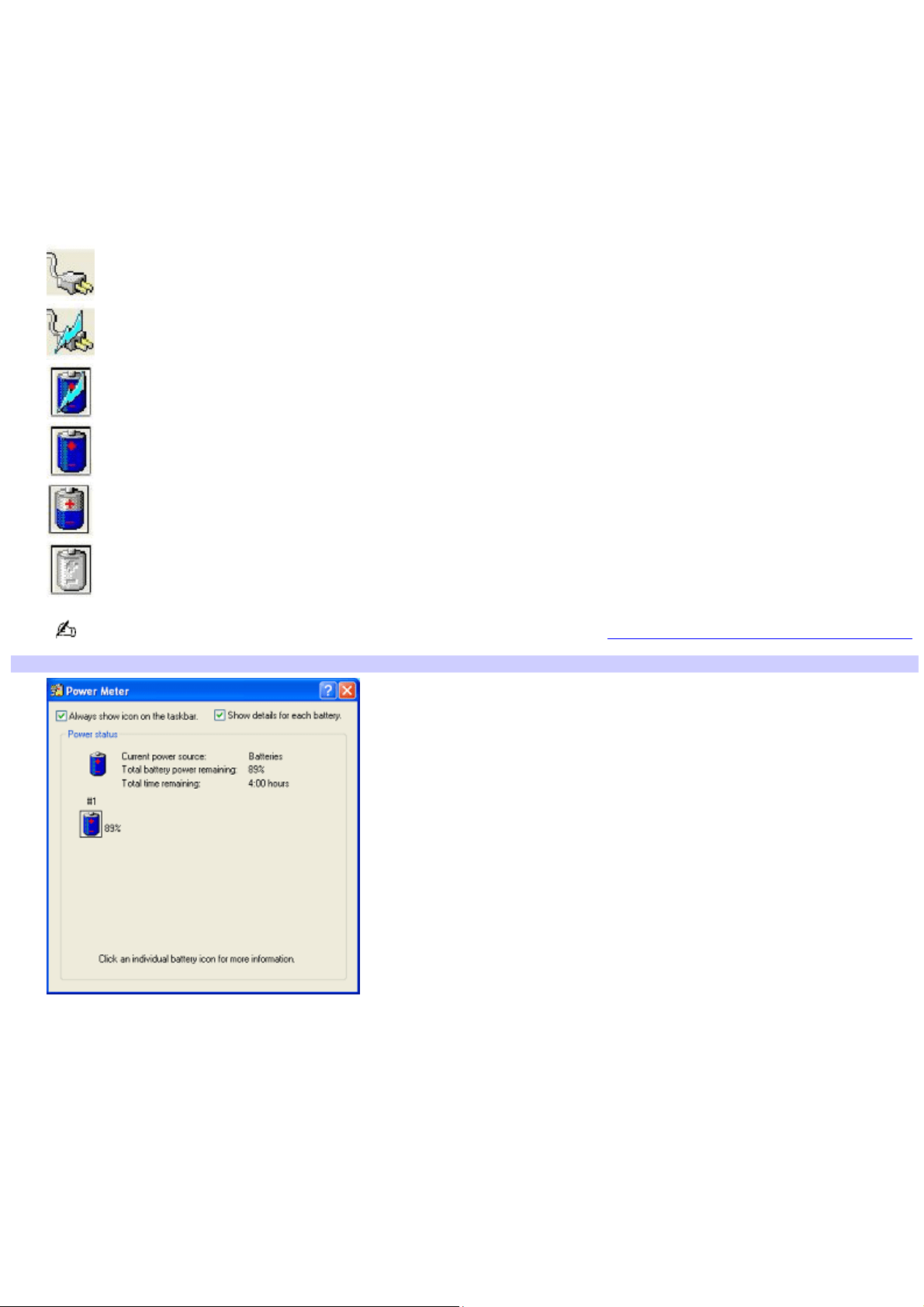
Locating power status information
Displaying the power status provides useful information, such as remaining battery life.
To view the Power Meter window
1.
Double-click the Power icon. The Power Meter window appears. You can also rollover the Power icon to view the
remaining battery charge.
Power icon Power status
Computer is using AC power.
Computer is using AC power and charging the battery.
Battery is charging.
Battery is fully charged.
Battery is discharging.
No battery is inserted in the computer.
If the Power icon is not displayed on the Taskbar Notification area, see To display the Power icon on the taskbar.
Power Meter
*
* T he P ower Meter window may appear s lightly different on your c omputer, depending on the number of batteries your c omputer s upports.
To display the Power icon on the taskbar
1.
Click Start on the Windows
®
taskbar, and click Control Panel.
2.
Click Performance and Maintenance, and click Power Options. The Power Options Properties window
appears.
3.
Select the Advanced tab, and then select Always show icon on the taskbar in the Options box. The power icon
appears on the taskbar. See the power icon descriptions above for more information.
Page 52

Internet and Network Connections
Internet Connections
This section describes the basic steps for setting up your dial-up or Ethernet connection to the Internet. The New
Connection Wizard guides you through the process of connecting to the Internet and choosing an Internet service provider
(ISP) or setting up an existing account. When you connect to the Internet, you can register your VAIO
®
computer, use online
services, and gain access to Sony Computing Support.
Page 53

Internet and Network Connections
Internet Connections
This section describes the basic steps for setting up your dial-up or Ethernet connection to the Internet. The New
Connection Wizard guides you through the process of connecting to the Internet and choosing an Internet service provider
(ISP) or setting up an existing account. When you connect to the Internet, you can register your VAIO
®
computer, use online
services, and gain access to Sony Computing Support.
Page 54
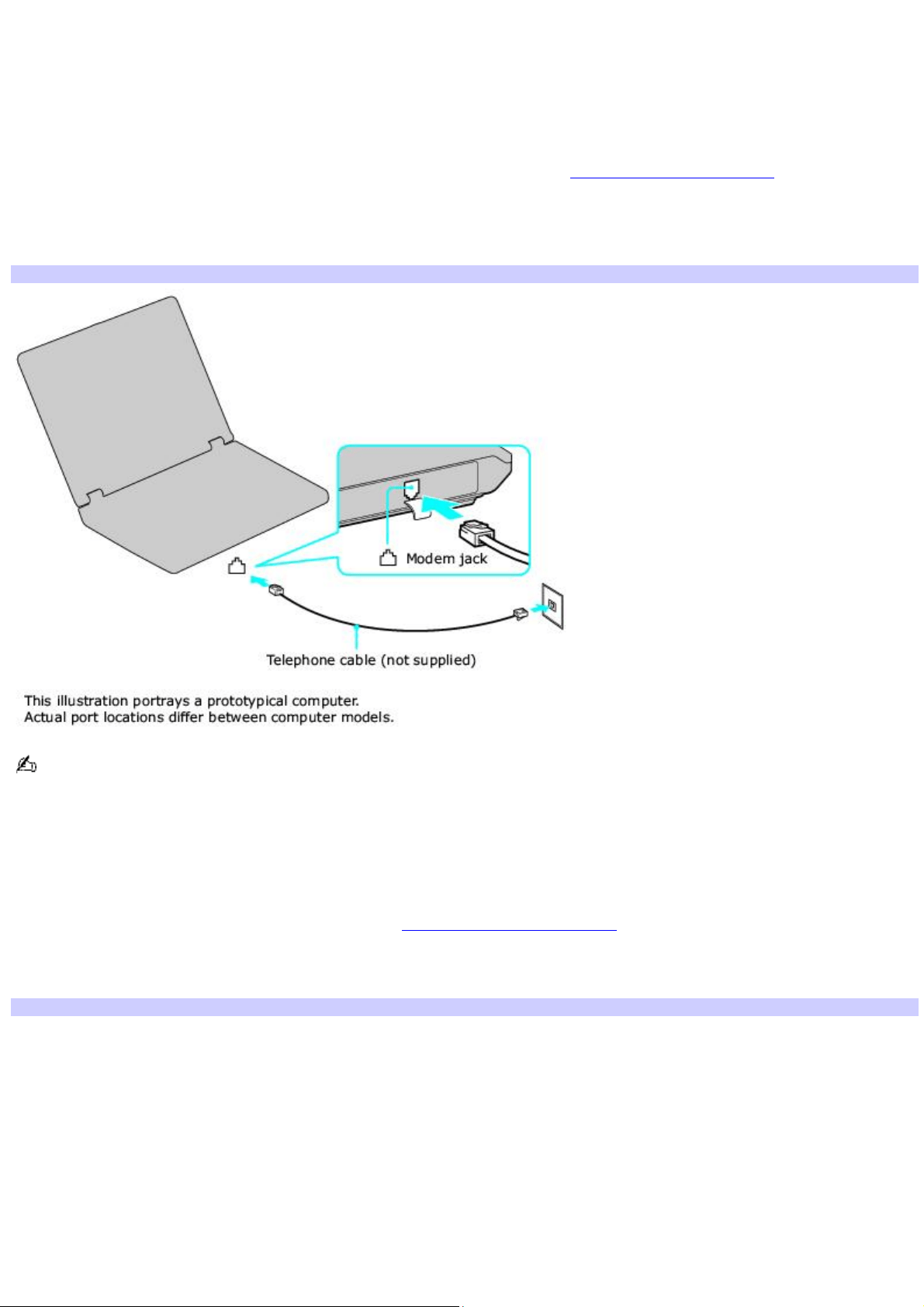
Setting up a dial-up Internet connection
Before you can connect to the Internet, you need to connect your computer to a telephone line via a telephone cable (not
supplied). Once you set up your telephone cable, you're ready to connect to the Internet.
To connect a telephone cable
1.
Locate the Modem jack on your computer. For location information, see Locating Controls and Ports.
2.
Plug one end of the telephone cable into the Modem jack. Make sure it clicks into place.
3.
Plug the other end into the wall jack.
Connecting a Telephone Cable
Your computer does not work with party lines, cannot be connected to a coin-operated telephone, and may not
work with multiple telephone lines or a private branch exchange (PBX). Some of these connections may result in excess
electrical current and could cause a malfunction in the internal modem.
If you connect a telephone cable coming through a splitter, the modem or connected device may not work properly.
To set up a dial-up connection to the Internet
1.
Connect your computer to a telephone line. See To connect a telephone cable for more information.
2.
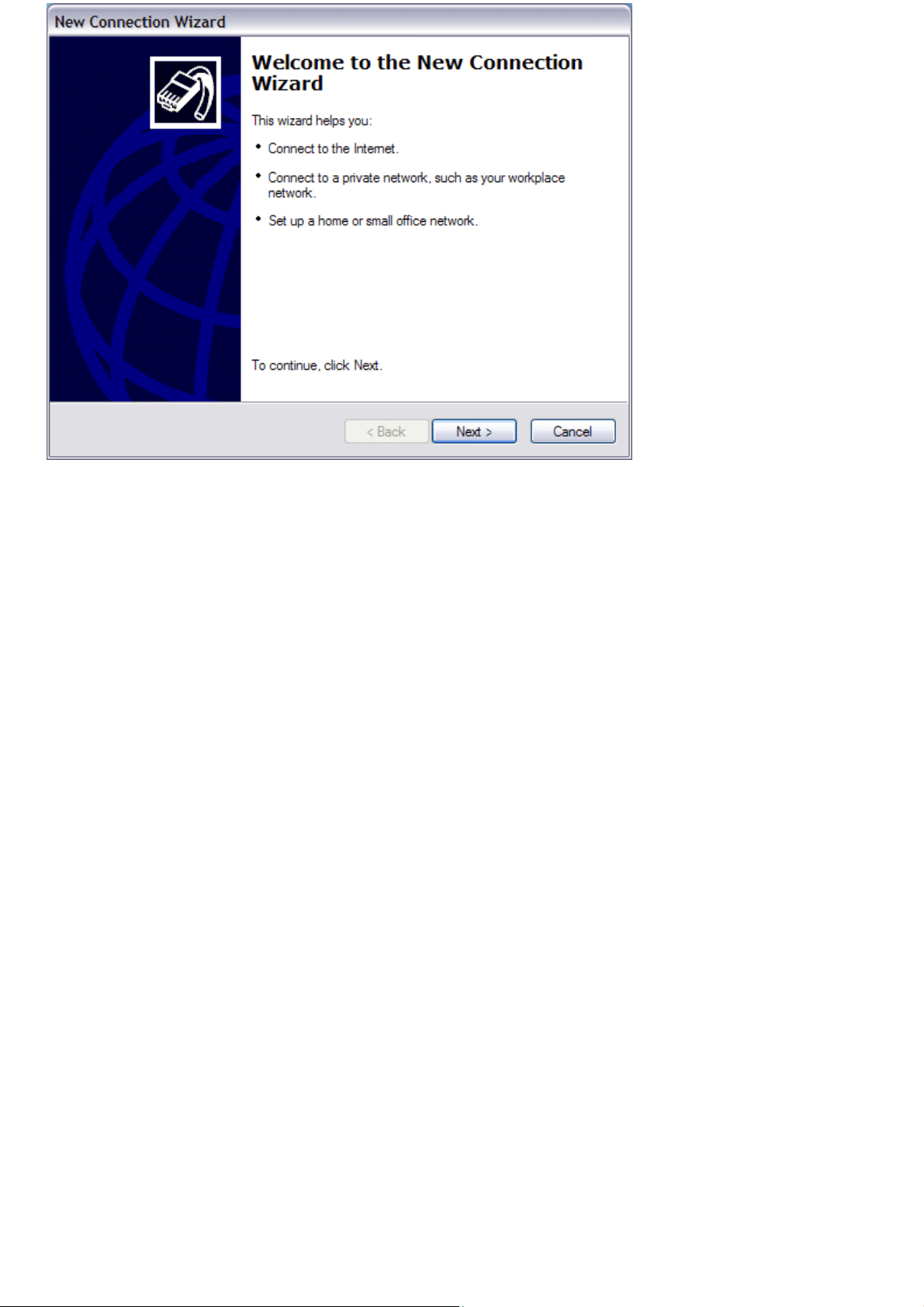
Click Start, point to All Programs, Accessories, Communications, and click New Connection Wizard. The New
Connection Wizard appears.
New Connection Wizard
Page 55
3.
Click Next. If the Location Information dialog box appears, follow the on-screen instructions.
4.
If it is not already selected, click to select Connect to the Internet, and click Next.
5.
Follow the on-screen instructions.
Page 56
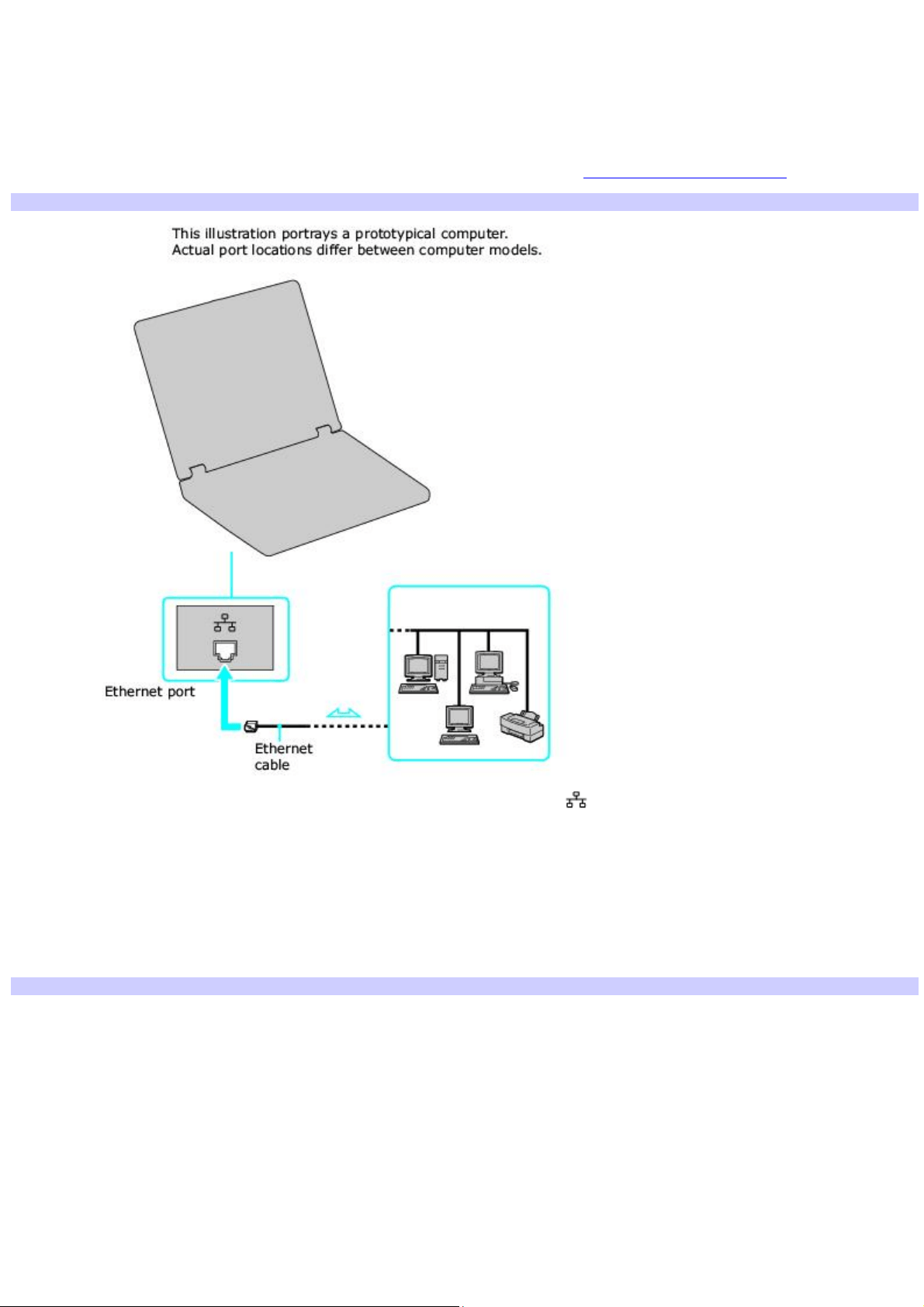
Setting up an Ethernet Internet connection
Your computer accommodates both 10BASE-T and 100BASE-TX Ethernet connections, with data transfer speeds of between
10 and 100 Mbps.
To connect an Ethernet cable
1.
Locate the Ethernet port on your computer. For location information, see Locating Controls and Ports.
Connecting an Ethernet Cable
2.
Plug one end of the Ethernet cable into your computer's Ethernet port and the other into the network
connection.
To set up an Ethernet connection to the Internet
1.
Connect your computer to a network connection.
2.
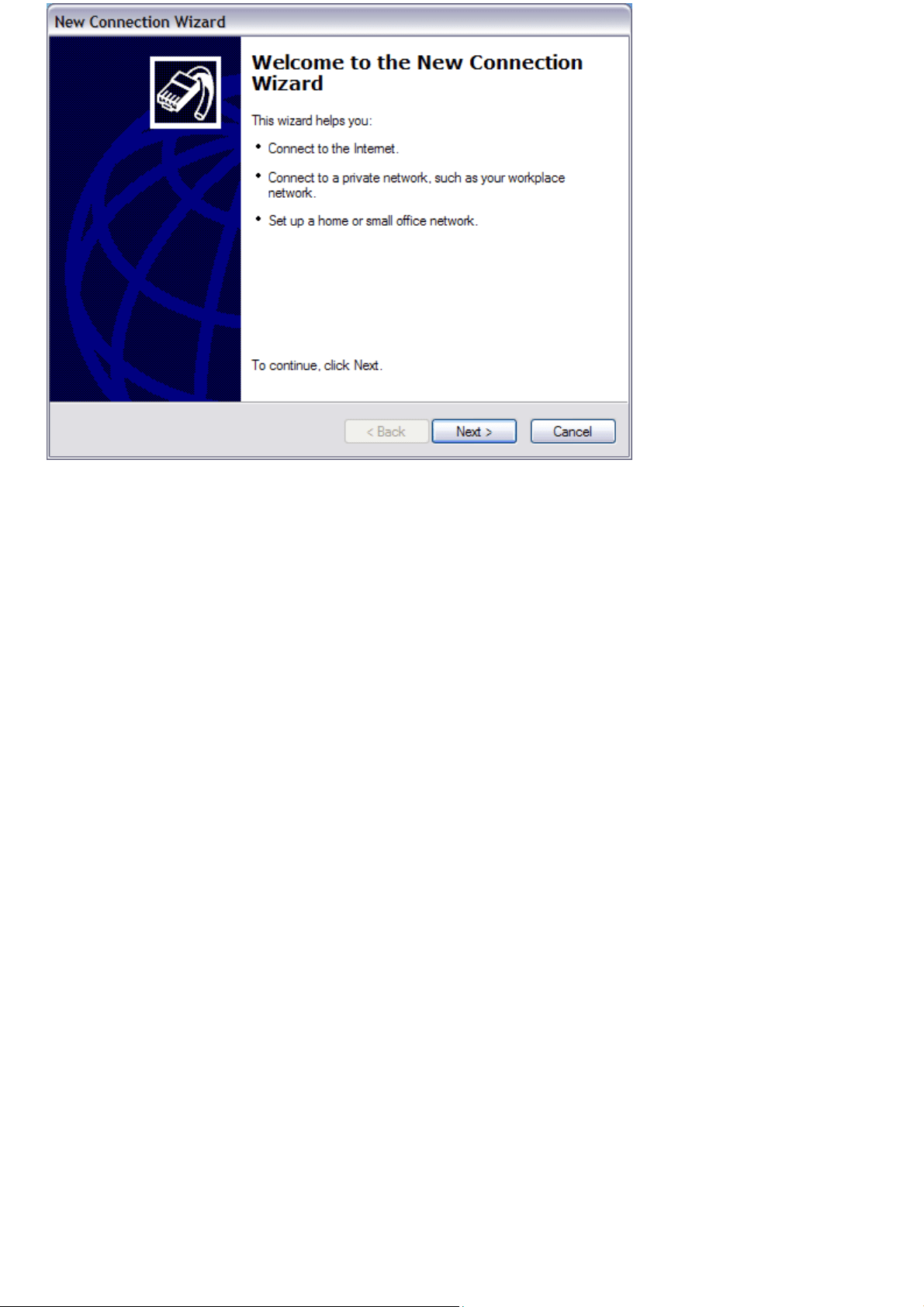
Click Start, point to All Programs, Accessories, Communications, and click New Connection Wizard. The New
Connection Wizard appears.
New Connection Wizard
Page 57
3.
Click Next. If the Location Information dialog box appears, follow the on-screen instructions.
4.
If it is not already selected, click to select Connect to the Internet, and click Next.
5.
Follow the on-screen instructions.
Page 58

Customizing your Internet connection
The Internet Properties dialog box enables you to change the way you view the Internet. You can change your home page,
fonts, language, and colors. You can also regulate content and set browsing preferences.
To open the Internet Properties dialog box
1.
Click Start on the Windows
®
taskbar, and then Control Panel.
2.
Click Network and Internet Connections, and then Internet Options. The Internet Properties dialog box
appears.
3.
Click the tabs to view options.
4.
Make changes, and click Apply to activate your changes.
5.
Click OK.
Page 59
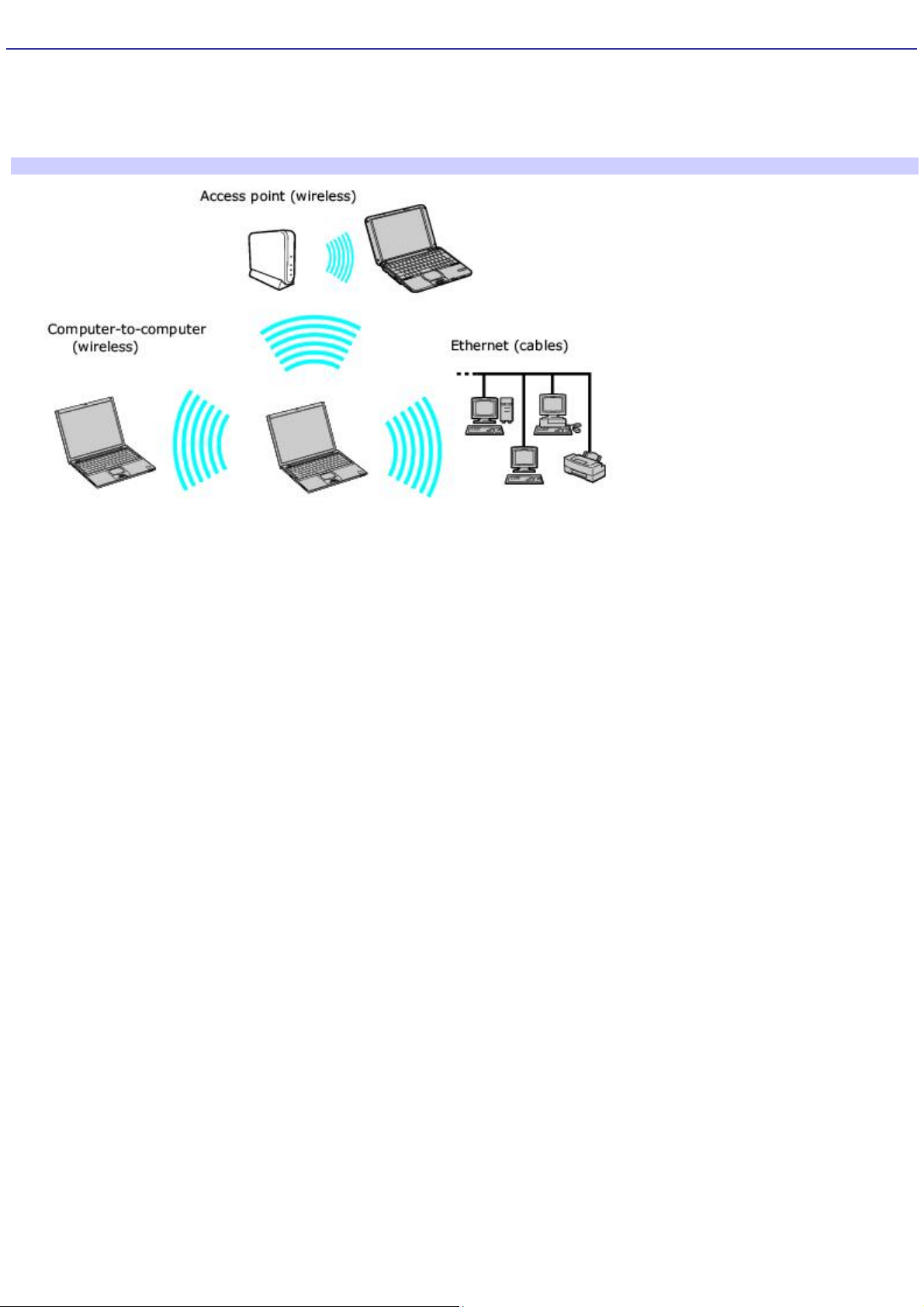
Network Connections
With a Sony computer, you can easily set up or connect to a variety of networks. The New Connection Wizard and Network
Setup Wizard make it easy to gain access to networks (LANs) using wireless, Ethernet, or dial-up connections.
For more information about networking, click Start, Help and Support, and then Networking and the Web.
Types of Networks
*
* T he computers represented in this illustration are for repres entative purpos es only and may not be identic al to the model you purc hased.
Page 60
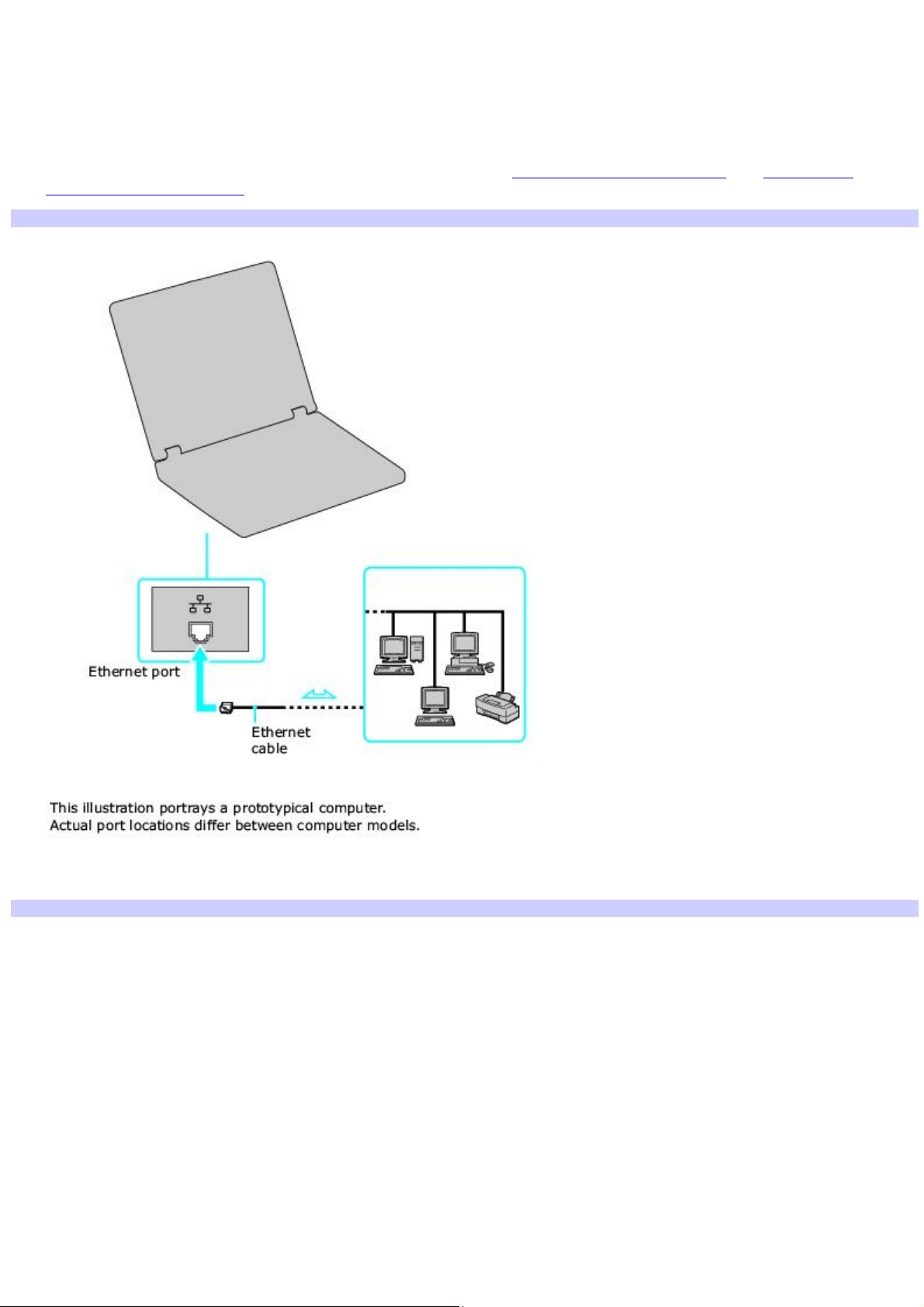
Using Ethernet and dial-up connections
For setting up local area networks (LANs), Ethernet is a widely installed technology. Your computer accommodates both
10BASE-T and 100BASE-TX Ethernet connections, with data transfer speeds of between 10 and 100 Mbps.
To connect to a local area network using a telephone or Ethernet cable
1.
Connect an Ethernet or telephone cable to your computer. See To connect an Ethernet cable and Setting up a
dial-up Internet connection for more information.
Connecting an Ethernet Cable
2.
Click Start, point to All Programs, Accessories, Communications, and click Network Setup Wizard. The
Network Setup Wizard appears.
Network Setup Wizard
Page 61
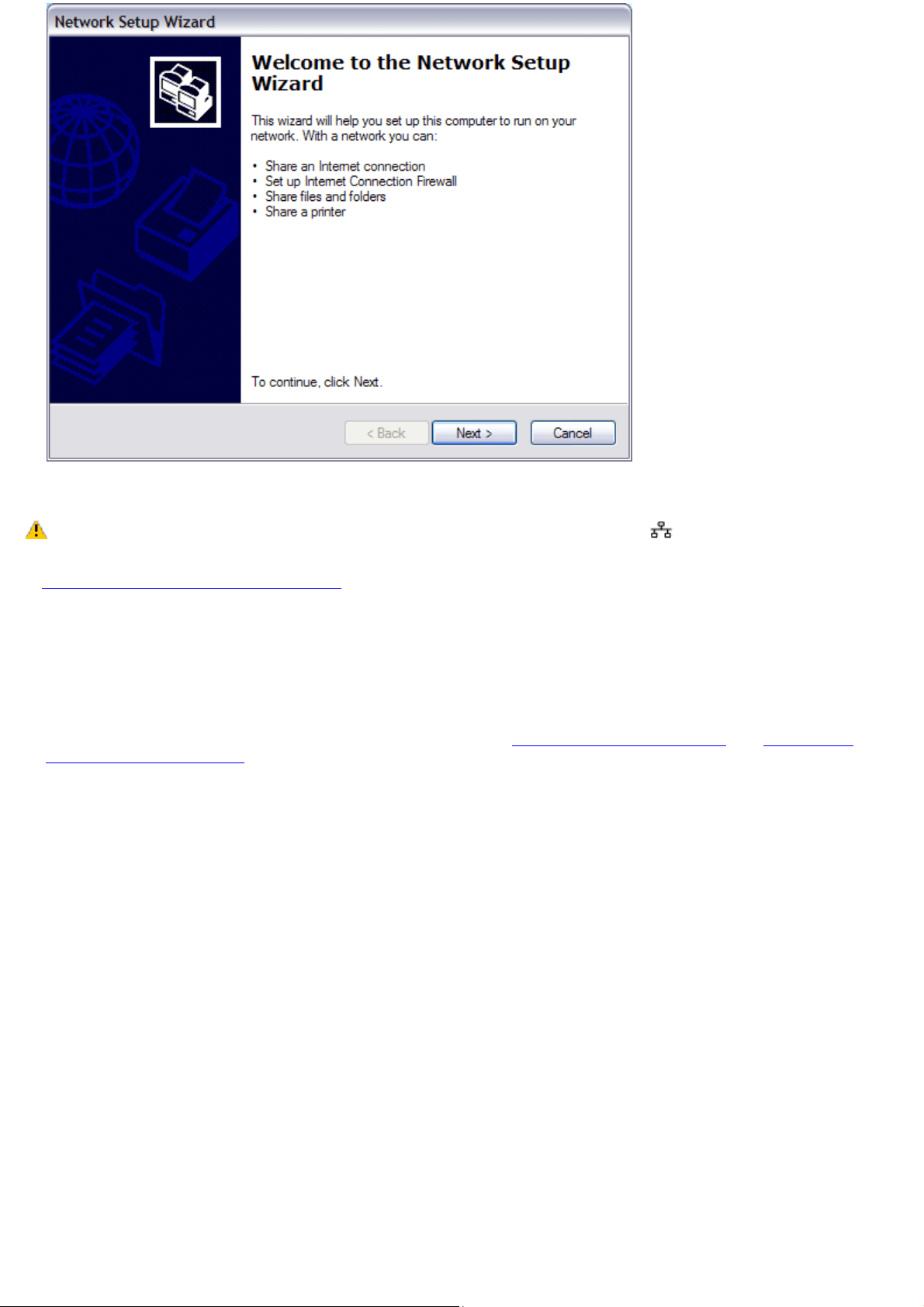
3.
Click Next. If you are prompted to the Local Information dialog box, follow the on-screen instructions.
Only connect 10BASE-T and 100BASE-TX cables to the Ethernet port . Do not connect any other type
of network cable or any telephone cable. Connecting cables other than those listed above may result in an electric
current overload and could cause a malfunction, excessive heat, or fire in the port. To connect the unit to the network,
see Using Ethernet and dial-up connections or contact your network administrator.
You can connect to an Ethernet network from a remote location and use data, programs, and network resources. See
Microsoft
®
Windows
®
Help by clicking Help and Support from the Start menu, and then clicking Networking and the Web in
the left panel.
To connect to a remote network using a telephone or Ethernet cable
1.
Connect an Ethernet or telephone cable to your computer. See To connect an Ethernet cable and Setting up a
dial-up Internet connection for more information.
2.
From the Start menu, point to All Programs, Accessories, Communications, and click New Connection Wizard.
3.
Click Next. If you are prompted to the Local Information dialog box, follow the on-screen instructions.
4.
Click Connect to the network at my workplace, and then click Next.
5.
Follow the on-screen instructions.
6.
Ask your network administrator for the detailed settings and devices needed to connect to an existing network.
Page 62
Using wireless network connections (selected models only)
A wireless local area network (LAN) is a network in which you can connect to a LAN through a wireless (radio) connection.
You can opt to purchase a Sony
®
Wireless LAN Access Point to set up a LAN.
The wireless LAN access point is designed for building a wireless LAN environment. Because a wireless LAN configuration
requires no wiring, you can operate multiple computers more freely than ever before.
Your computer is equipped with a built-in mini PCI card that allows for wireless connections. For information about your
computer's wireless capabilities, see the VAIO
®
Computer Specifications.
For more information on Sony Wireless LAN, go to http://www.sonystyle.com/vaio.
There are two types of wireless connections:
An infrastructure network is one that extends an existing wired local network or wide area network (WAN) to
wireless devices by providing an access point. The access point bridges the wireless and wired LAN and acts as a
central controller for the wireless LAN/WAN. The access point coordinates transmission and reception from multiple
wireless devices within a specific range. For more information, see To connect to a wireless network (Option 1) or To
connect to a wireless network (Option 2).
A computer-to-computer (ad-hoc) network is one in which a local network is created only by the wireless devices
themselves, with no other central controller or access point. Each device communicates directly with other devices in
the network. You can set up an ad-hoc network easily at home. For more information, see To set up a
computer-to-computer (ad-hoc) network. The computer cannot connect to the Internet in a computer-to- computer
(ad hoc) network.
To connect to a wireless network (Option 1)
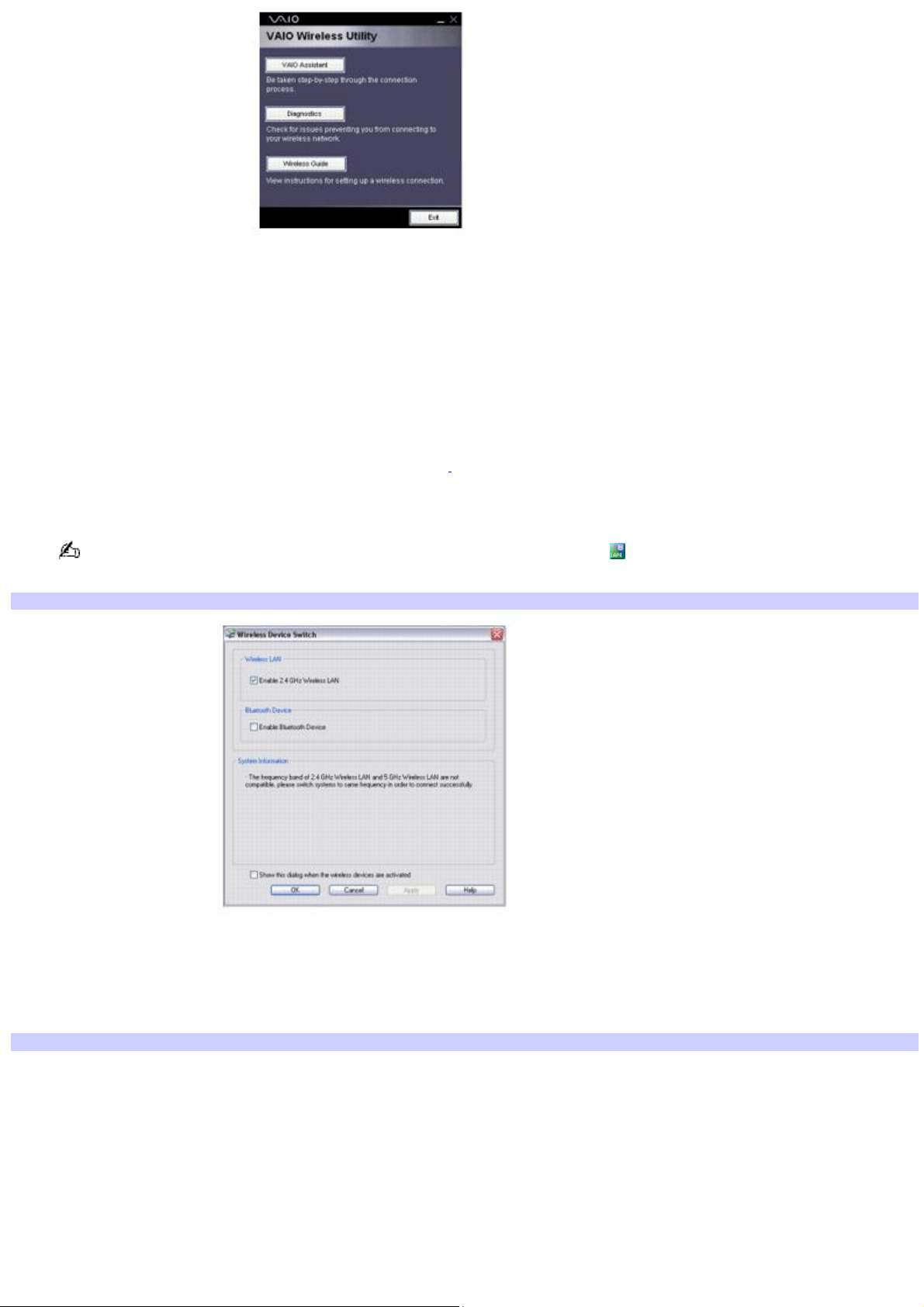
Use the VAIO Wireless Utility to guide you through the set up process and provide you with more detailed information
about wireless connections.
1.
Make sure an access point is set up. See the instructions that accompanied the access point for more
information.
2.
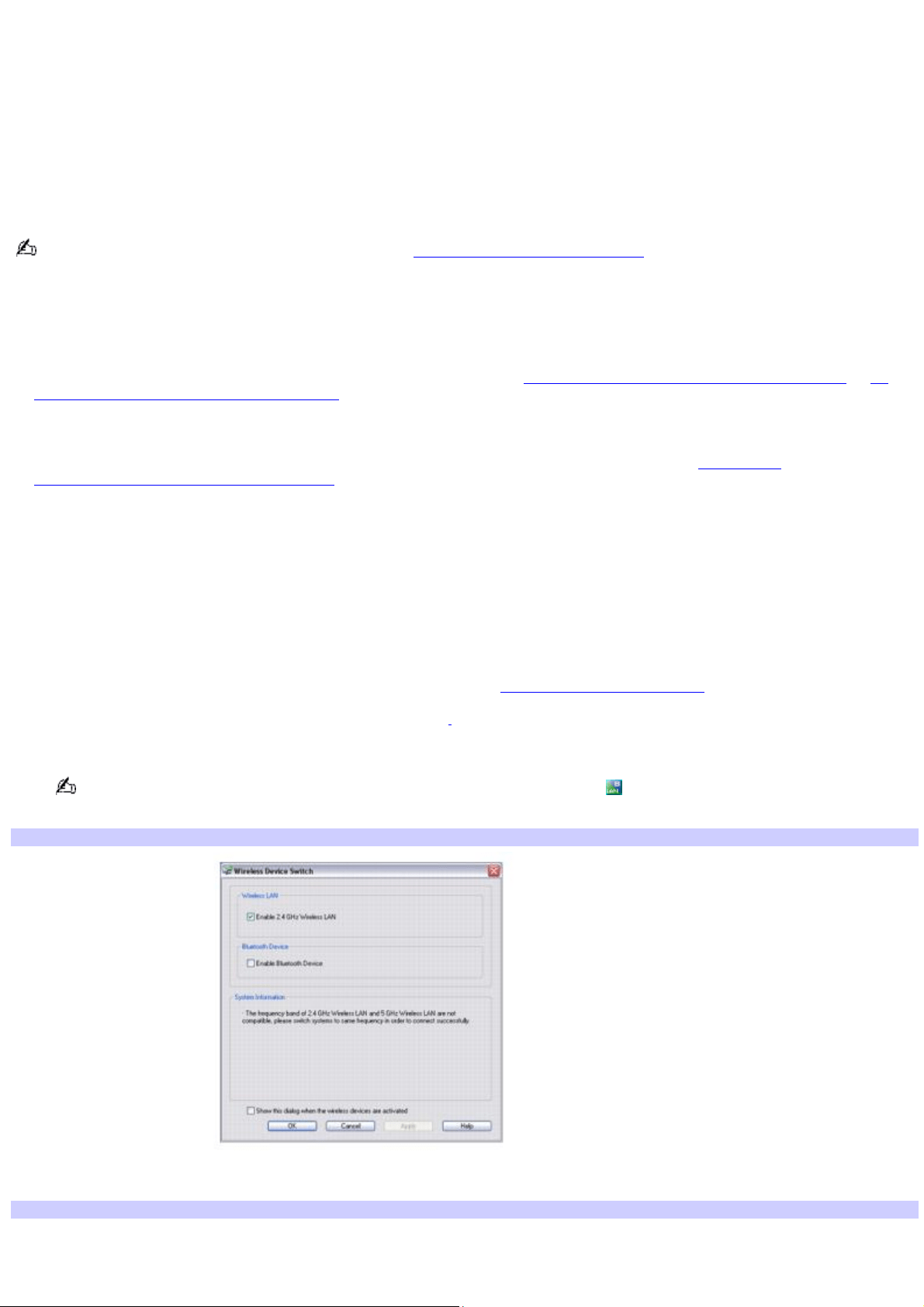
Move the Wireless switch to ON (for location information, see Locating Controls and Ports).
If your computer comes with Bluetooth
®
technology
1
, the Wireless Device Switch window appears.
Select the Enable Wireless LAN option, and click OK.
You may also double-click the Wireless LAN-ON or Bluetooth-ON icon on the Taskbar Notification area to
open the Wireless Device Switch window.
Wireless Device Switch
3.
Click Start, All Programs, and VAIO Wireless Utility. The VAIO Wireless Utility appears.
VAIO Wireless Utility
Page 63
4.
Follow the steps provided by the utility.
To connect to a wireless network (Option 2)
You may manually set up a wireless connection without the assistance of the VAIO Wireless Utility.
1.
Make sure an access point is set up. See the instructions that accompanied the access point for more
information.
2.
Move the Wireless switch to ON (for location information, see "Locating Controls and Ports.").
If your computer comes with Bluetooth
®
technology
1
, the Wireless Device Switch window appears.
Select the Enable Wireless LAN option, and click OK. If your computer does not come with Bluetooth
technology, proceed with step 4.
You may also double-click the Wireless LAN-ON or Bluetooth-ON icon on the Taskbar Notification area to
open the Wireless Device Switch window.
Wireless Device Switch
3.
Click Start, Control Panel, Network and Internet Connections, and then click Network Connections. The
Network Connections window appears.
4.
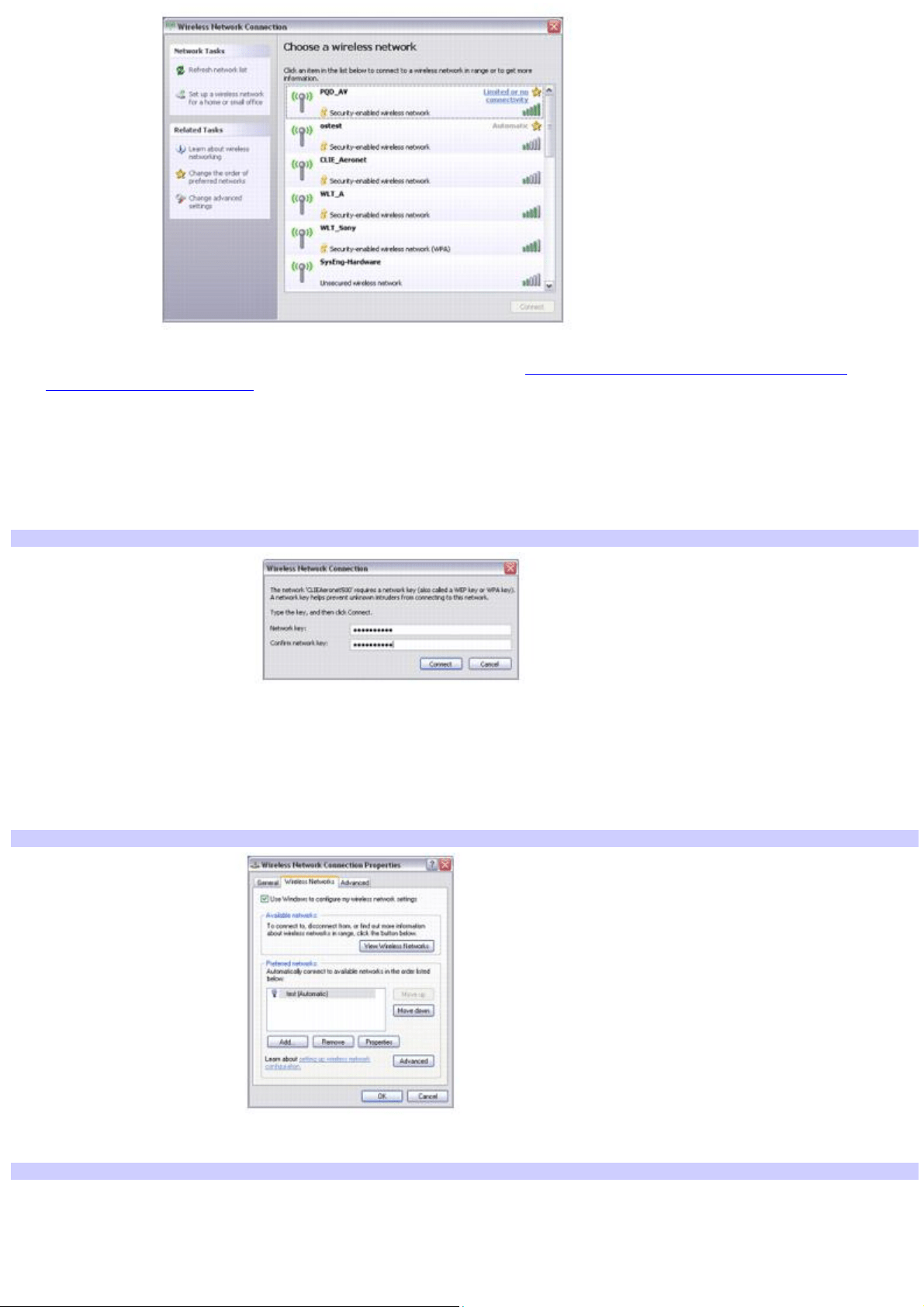
In the right panel under LAN or High-Speed Internet, click Wireless Network Connection. The Wireless
Network Connection window appears.
Wireless Network Connection
Page 64
5.
Select the name of the wireless network to which you want to connect, and click Connect. If you do not see the
network in the list, refresh the screen. For more information, see If the network does not appear in the list of
available wireless networks.
6.
When your computer locates the network, type the network key in the Network key box. (If necessary, ask the
administrator for the key.)
7.
Retype the network key in the Confirm network key box.
8.
Click Connect.
Wireless Network Connection
If the network does not appear in the list of available wireless networks
1.
On the Wireless Network Connection window, click Change advanced settings under Related Tasks. The
Wireless Network Connection Properties dialog box appears.
2.
Select the Wireless Networks tab, if it is not already selected.
Wireless Network Connection Properties
3.
Click Add in the Preferred networks box. The Wireless network properties dialog box appears.
Wireless Network Properties
Page 65

4.
Type the name of the network (access point) you want to connect to in the Network name (SSID) box.
The following steps are for networks that require a network key. If you do not know the network key or are not
sure a network key is required, see the network administrator or the guide that accompanied your access point for
more information.
5.
If available, make sure the Data encryption (WEP enabled) check box is selected.
If the Data encryption (WEP enabled) check box is not available:
1.
Select an authentication method from the Network Authentication menu.
2.
Select a data encryption method from the Data Encryption menu.
6.
Click to cancel the The key is provided for me automatically check box.
7.
Type the WEP network key in the Network key box if it is required by the selected authentication method.
8.
Retype the network key in the Confirm network key box.
9.
Click OK. The network name appears in the Preferred networks list box.
To set up a computer-to-computer (ad-hoc) network
The computer-to-computer (ad-hoc) network is only supported by the IEEE 802.11b wireless standard.
1.
Move the Wireless LAN switch to ON. For location information see "Locating Controls and Ports."
2.
Click Start, Control Panel, Network and Internet Connections, and then click Network Connections. The
Network Connections window appears.
3.
In the right panel under LAN or High-Speed Internet, click Wireless Network Connection. The Wireless
Network Connection window appears.
Wireless Network Connection
4.
In the Related Tasks menu, click Change the order of the preferred networks. The Wireless Network
Connection Properties dialog box appears.
Page 66
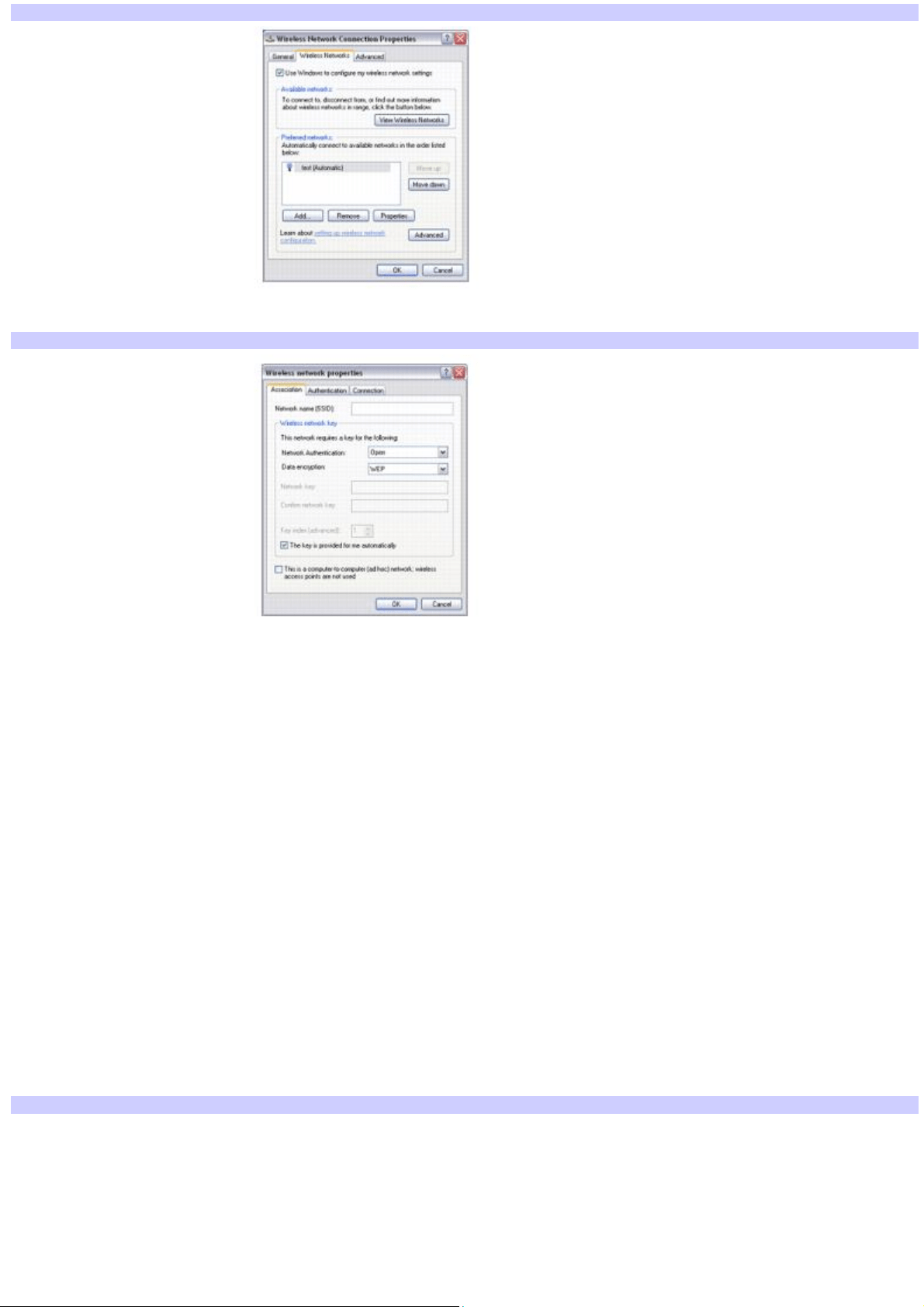
Wireless Network Connection Properties
5.
Click Add. The Wireless network properties dialog box appears.
Wireless Network Properties
6.
Type the name of the network you want to connect to in the Network name (SSID) box.
7.
If available, make sure the Data encryption (WEP enabled) check box is selected.
If the Data encryption (WEP enabled) check box is not available:
1.
Select an authentication method from the Network Authentication menu.
2.
Select a data encryption method from the Data Encryption menu.
8.
Click to cancel the The key is provided for me automatically check box.
9.
Type the WEP network key in the Network key box if it is required by the selected authentication method.
10.
Retype the network key in the Confirm network key box.
11.
Click to select This is a computer-to-computer (ad hoc) network; wireless access points are not used.
12.
Click OK.
13.
Click OK a second time on the Wireless Network Connection Properties window.
14.
Repeat steps 1 to 3 on the other computer to which you want to connect.
15.
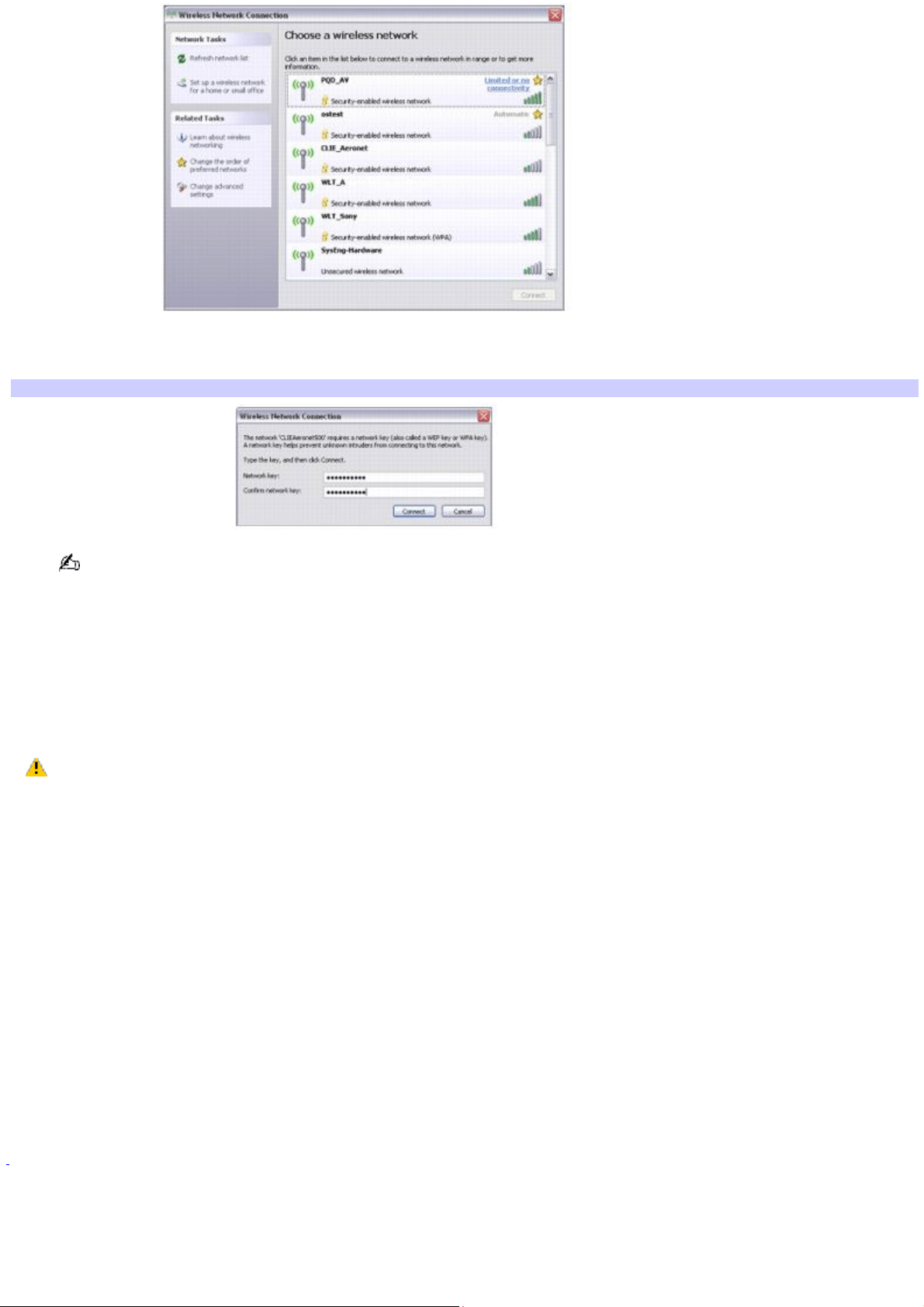
On the Wireless Network Connection window, select the security-enabled computer-to-computer network from
the list of available networks, and click Connect.
Wireless Network Connection
Page 67
16.
Type the network key in the Network key and the Confirm network key boxes, and press Connect. The
network key must be the same on both computers in order to connect them.
Wireless Network Connection
If you enter the network key incorrectly, the computer will appear to connect to the host computer but will be
unable to communicate with the host computer or any other computer on the network.
17.
The Wireless Network Connection window updates to show the computer-to-computer (ad-hoc) network in which
you are connected.
To disconnect from a wireless network
For computers with built-in wireless LAN functionality, move the Wireless LAN switch to OFF.
Turning off the wireless LAN functionality while accessing remote documents, files, or resources may
result in data loss.
To disconnect from a computer-to-computer (ad-hoc) network
1.
Click Start, Control Panel, Network and Internet Connections, and then click Network Connections. The
Network Connections window appears.
2.
In the right panel under LAN or High-Speed Internet, click Wireless Network Connection. The Wireless
Network Connection Status window appears.
3.
Click Properties. The Wireless Network Connection Properties dialog box appears.
4.
On the Wireless Networks tab, click Advanced. The Advanced dialog box appears.
5.
Click to select Any available network (access point preferred), if it is not already selected, and click Close.
6.
Click OK to close the Wireless Network Connection Properties window, and click Close on the Wireless
Network Connection Status window.
7.
Move the Wireless LAN switch to OFF.
1
Bluetooth technology is available on selected models only.
Page 68

Checking your network connection status
Whether you have a wireless, Ethernet, or dial-up connection, you can check the status of that connection.
To check your network connection status
1.
Click Start on the taskbar, and click Control Panel, Network and Internet Connections, and Network
Connections. The Network Connections window appears.
2.
Click the enabled network connection to open the connection status window.
Wireless Network Connection Status
Page 69

Bluetooth Connections
Bluetooth
®
wireless technology provides short-range connectivity without the need for cabling. When the Bluetooth
functionality is turned on, your computer can exchange data and images with other compatible Bluetooth devices within a
range of up to 32 feet
1
.
With Bluetooth technology, your computer transmits a radio frequency of 2.4 GHz. Sensitive locations, such as
hospitals and airplanes, may have restrictions on the use of Bluetooth devices, due to radio interference. Check with facility
staff to verify that use of the Bluetooth feature on your computer is permitted.
1
A c tual range depends on environmental and other factors.
Page 70

Using Bluetooth technology
Using Bluetooth
®
technology, your computer can communicate with:
Compatible devices with integrated Bluetooth functionality, such as computers, mobile telephones, personal digital
assistants (PDAs), mice, and keyboards.
Compatible devices with an installed Bluetooth adapter, such as computers, printers, mice, and keyboards.
Some Bluetooth devices may not work with your computer, depending on the type of equipment, software version,
and other factors. Before purchasing a Bluetooth device, check its operating environment requirements.
A computer with Bluetooth features can:
Send files and images between compatible devices
Exchange vCards (electronic business cards)
Connect to the Internet using a dial-up connection
Print files and images on a printer equipped with Bluetooth technology
Exchange addresses with compatible cellular phones and PDAs
Page 71
Establishing wireless connections
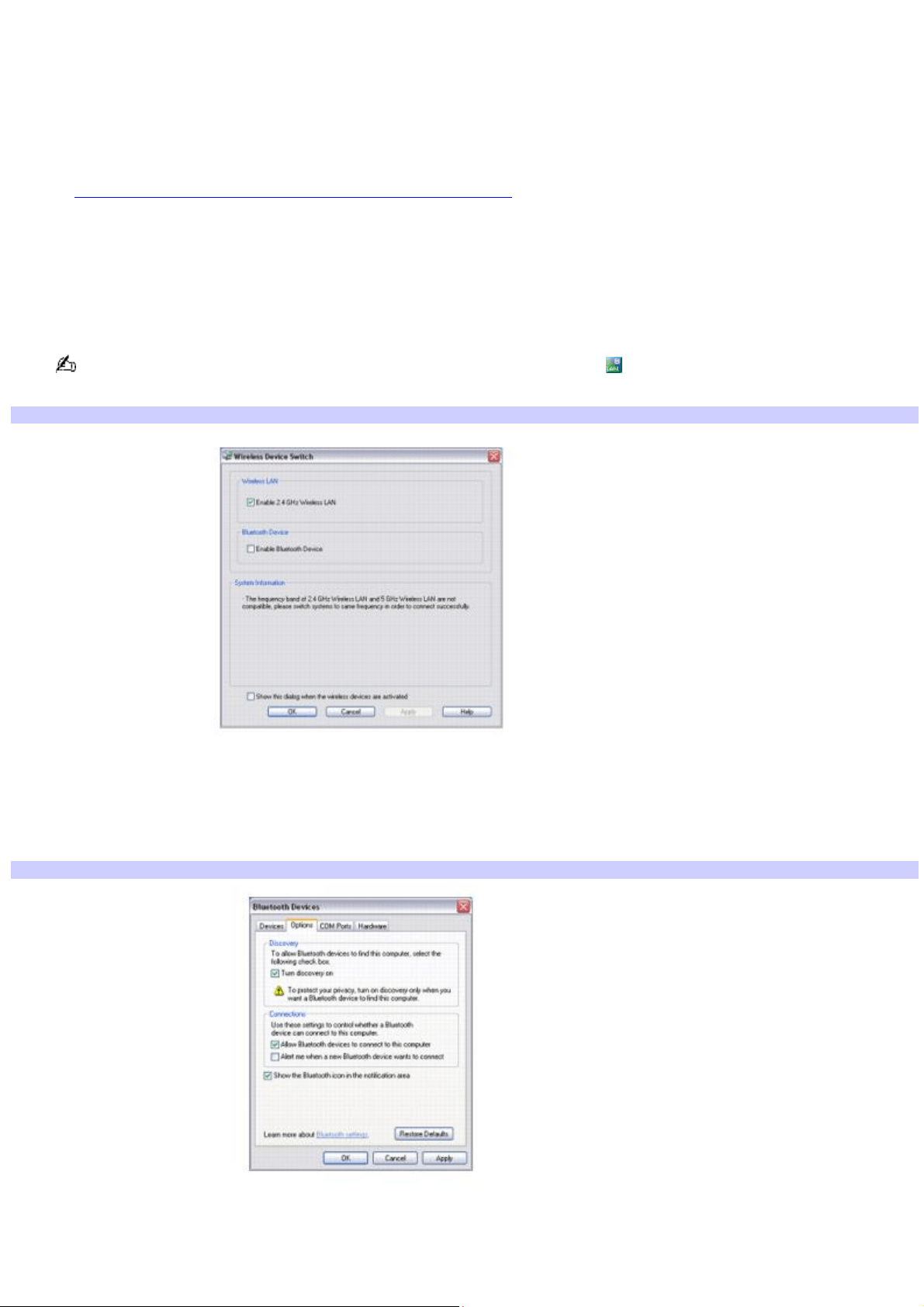
The "Switch wireless devices" window enables you to select a wireless connection: Bluetooth, Wireless LAN, or Bluetooth
and Wireless LAN function.
Bluetooth
®
technology is designed for a short-range connection of up to 32 feet (10 meters), while Wireless LAN technology
has a wider connection range of up to 328 feet (100 meters). The actual range of wireless LAN technology is dependent on
many factors including the features and capabilities of a wireless access point (if used), environmental conditions, and other
factors. Your computer is capable of both Bluetooth and Wireless LAN connections. For more information about Wireless
LAN, see Using wireless network connections (selected models only).
To establish a Bluetooth connection
1.
On your computer, move the WIRELESS switch to ON.
The Wireless Device Switch window appears.
You may also double-click the Wireless LAN-ON or Bluetooth-ON icon on the Taskbar Notification area to
open the Wireless Device Switch window.
Wireless Device Switch
2.
Click to select the Enable Bluetooth Device option, and then click OK.
3.
Click Start, Control Panel, Network and Internet Connections, and then click Bluetooth Devices.
4.
When the Bluetooth Devices window appears, select the Options tab.
Bluetooth Devices
5.
In the Discovery box, click to select Turn discovery on if it is not already selected.
6.
In the Connections box, click to select Allow Bluetooth devices to connect to this computer if it is not already
selected, and then click Apply.
Page 72
7.
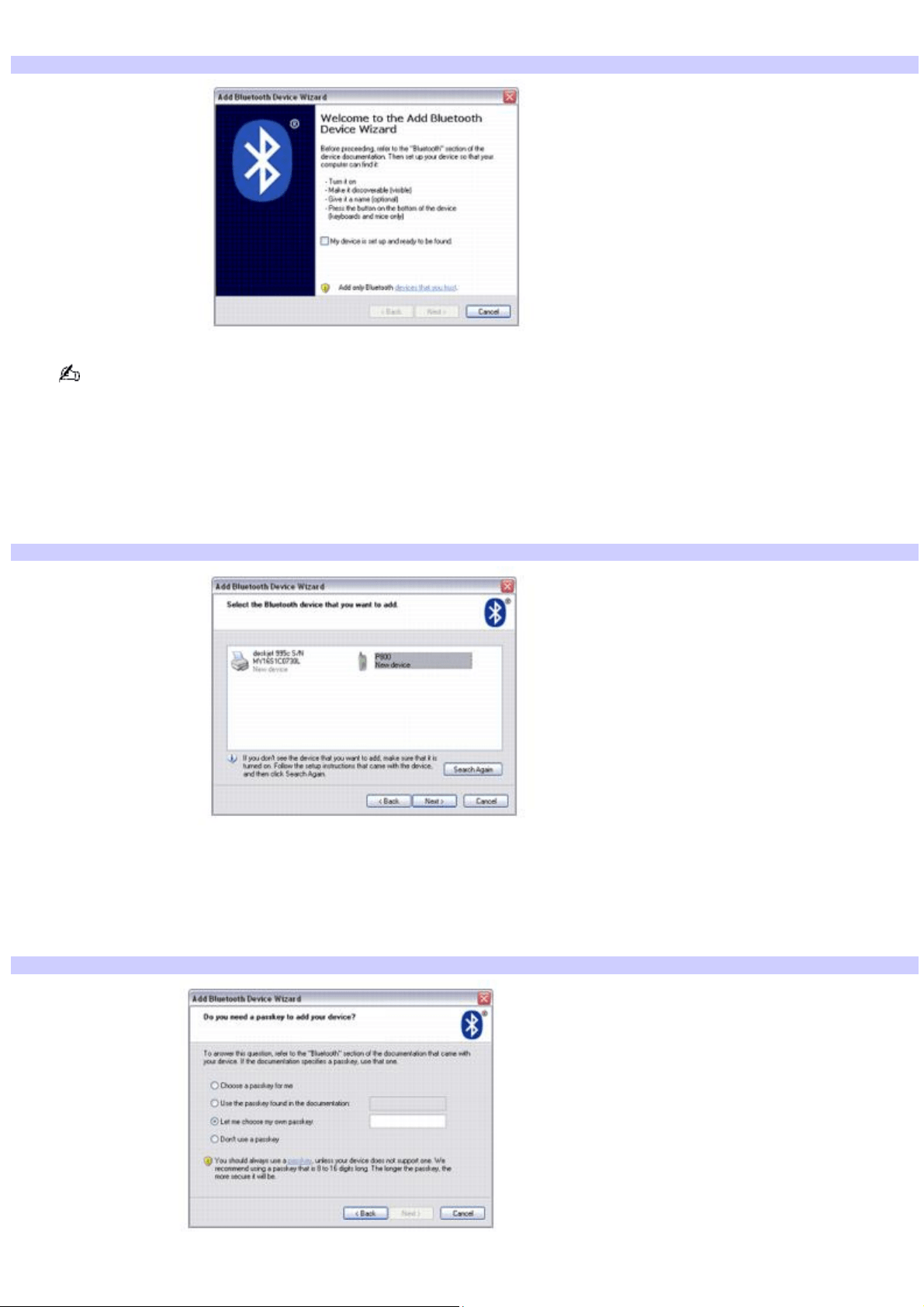
Select the Devices tab, and click Add to search for available Bluetooth devices. The Add Bluetooth Device
Wizard appears.
Add Bluetooth Device Wizard
Your computer will not detect a Bluetooth device unless the device is turned on and the Bluetooth function is
enabled. Some keyboards and mice also require that you push a button located on the bottom of the device to enable
connectivity.
8.
Click to select the My device is set up and ready to be found check box, and then click Next.
The wizard searches for available Bluetooth devices.
9.
Click to select the available device that you want to add, and then click Next.
Add Bluetooth Device Wizard
10.
Select a passkey option.
A passkey is a private code entered by the user to enable two Bluetooth devices to communicate. When the
same code is entered on both devices, communication becomes possible. The passkey may be changed at each
communication session. If a communication session is disconnected, you need to re-establish the passkey. See
the documentation that accompanied your device for more information.
Add Bluetooth Device Wizard
11.
Click Next.
Page 73

Depending on the option that you selected, the computer either searches for the network or instructs you to
enter the passkey on the Bluetooth device to which you want to connect. If the passkey is not entered within
approximately 30 seconds, authentication fails.
12.
Once you successfully connected to the Bluetooth Device, click Finish to close the wizard.
Add Bluetooth Device Wizard
Page 74
Renaming the Bluetooth USB Device
The Bluetooth
®
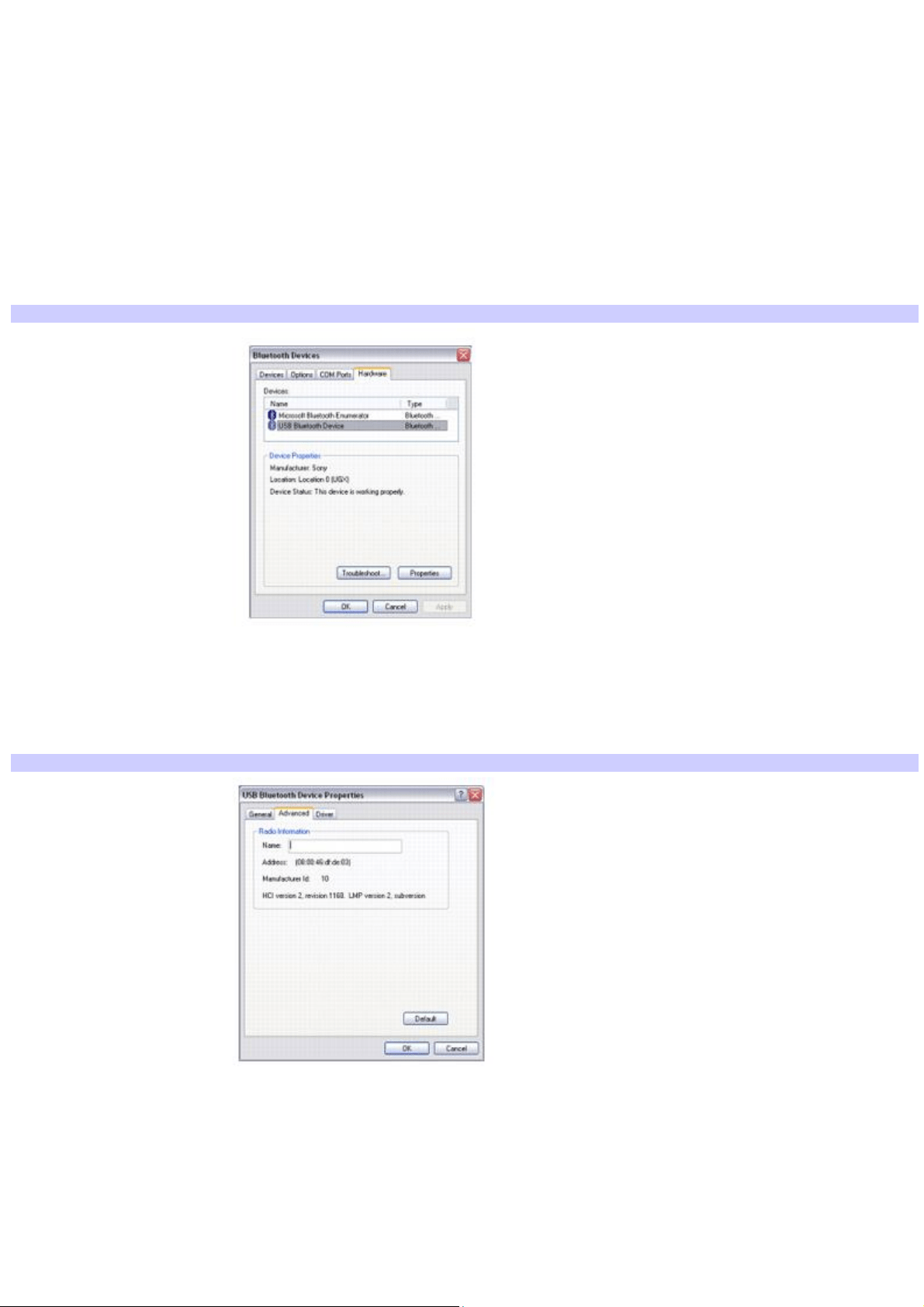
device installed on your computer has an assigned name that you may not recognize. Renaming this device
makes it easy for you to identify your computer during authentication.
To rename the Bluetooth USB device
1.
From the Start menu, click Control Panel.
2.
Click Printers and Other Hardware, and then click Bluetooth Devices.
The Bluetooth Devices window appears.
3.
Click the Hardware tab.
Bluetooth Devices
4.
Select USB Bluetooth Device, and then click Properties.
The USB Bluetooth Device Properties window appears.
5.
Click the Advanced tab, and type a new name in the Name text box.
USB Bluetooth Device Properties
6.
Click OK. To see the new USB Bluetooth Device name, turn off the Bluetooth feature by moving the WIRELESS
switch on your computer to OFF, and then restart it by moving the WIRELESS switch to ON.
Page 75
Setting Bluetooth preferences
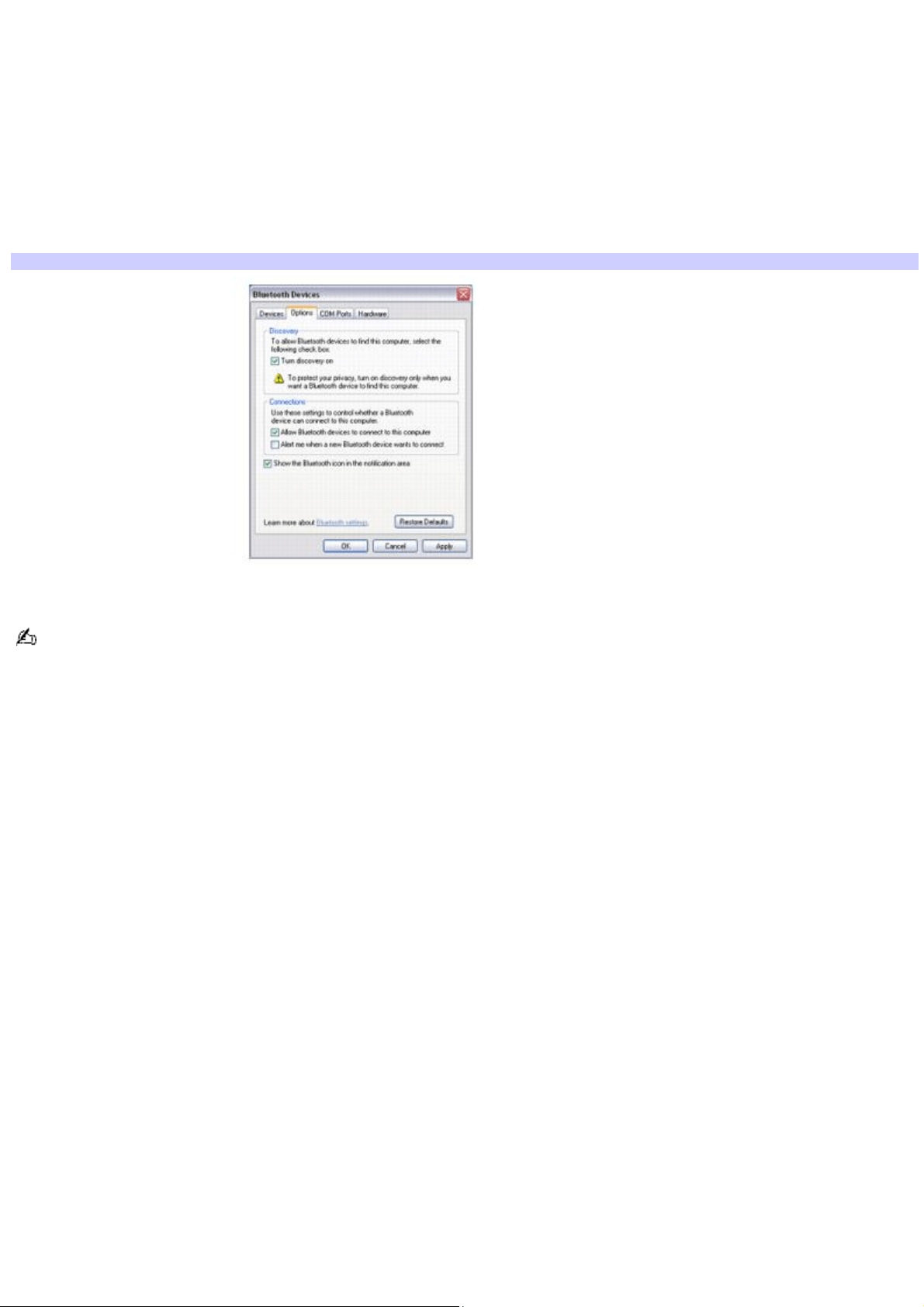
You have the option to set hardware preferences for discovery, connection, and notification.
To access the Options window
1.
Click Start, Control Panel, Printers and Other Hardware, and Bluetooth Devices.
The Bluetooth Devices window appears.
2.
Select the Options tab.
Bluetooth Devices
3.
Set your desired preferences, and click OK.
For more information about preferences, click the Bluetooth settings link near the bottom of the window.
Page 76

Disconnecting a Bluetooth device
To disconnect or remove a device
1.
Click Start, Control Panel, Network and Internet Connections, and then click Bluetooth Devices.
You may also click the Bluetooth icon on the Taskbar Notification area.
2.
When the Bluetooth Devices window appears, select the Devices tab if it is not already selected.
3.
Click to select the Bluetooth device from the devices list, and then click Remove. This may take a few seconds to
complete.
4.
Click OK to close the Bluetooth Devices window.
Page 77

Additional information
The data transfer rate varies, depending on the following conditions:
Obstacles, such as walls, located between devices
Distance between devices
Material used in walls
Proximity to microwaves and cordless telephones
Radio frequency interference and other environmental conditions
Device configuration
Type of software application
Type of operating system
Use of both Wireless LAN and Bluetooth functions at the same time on the computer
Size of file being exchanged
The 2.4 GHz radio frequency used by Bluetooth
®
and wireless LAN devices is also used by other devices. Bluetooth
devices incorporate technology that minimizes interference from other devices using the same wavelength,
however, communication speed and connection range may be reduced. Interference from other devices may also
stop communication altogether.
Large files may occasionally become corrupted due to radio wave interference during continuous transfer.
All Bluetooth devices must be certified to make sure that the applicable standard requirements are maintained. Even
if standards are met, individual device performance, specifications, and operation procedures can vary. Data
exchange may not be possible in all situations.
To protect your privacy and conserve power, disconnect your Bluetooth and wireless connections when you are not
using them.
Page 78

CDs and DVDs
Creating CDs / DVDs with Sony Software
Your computer plays and records CDs and DVDs, depending on the model you purchased. Check your specifications for the
type of optical drive installed on your computer. Depending on the computer model and particular configuration you
purchased, your computer may not include all of the software programs listed below.
Picture & Video DVDs
Click to DVD
Make picture or personal video DVDs. Use JPEG, BMP, of TIFF files for slide shows; import MPEG, AVI, or Microsoft
®
DVR-MS
files for video, or capture footage from an i.LINK / IEEE 1394 camera or analog source.
Music CDs
SonicStage
Make music CDs from MP3, WMA, WAV, and OpenMG files; create ATRAC CDs for your Sony ATRAC CD Walkman; or backup
your existing collection of discs.
SonicStage Mastering Studio
Make music CDs from your collection of vinyl records or cassette tapes.
Sonic RecordNow!
Make music CDs from MP3, WMA, WAV, and CDA files, or backup your existing collection of discs.
Data Backup
Sonic RecordNow!
Make custom data CDs or DVDs with drag-and-drop ease, or backup your existing collection of discs.
Page 79

CDs and DVDs
Creating CDs / DVDs with Sony Software
Your computer plays and records CDs and DVDs, depending on the model you purchased. Check your specifications for the
type of optical drive installed on your computer. Depending on the computer model and particular configuration you
purchased, your computer may not include all of the software programs listed below.
Picture & Video DVDs
Click to DVD
Make picture or personal video DVDs. Use JPEG, BMP, of TIFF files for slide shows; import MPEG, AVI, or Microsoft
®
DVR-MS
files for video, or capture footage from an i.LINK / IEEE 1394 camera or analog source.
Music CDs
SonicStage
Make music CDs from MP3, WMA, WAV, and OpenMG files; create ATRAC CDs for your Sony ATRAC CD Walkman; or backup
your existing collection of discs.
SonicStage Mastering Studio
Make music CDs from your collection of vinyl records or cassette tapes.
Sonic RecordNow!
Make music CDs from MP3, WMA, WAV, and CDA files, or backup your existing collection of discs.
Data Backup
Sonic RecordNow!
Make custom data CDs or DVDs with drag-and-drop ease, or backup your existing collection of discs.
Page 80

CDs and DVDs
Creating CDs / DVDs with Sony Software
Your computer plays and records CDs and DVDs, depending on the model you purchased. Check your specifications for the
type of optical drive installed on your computer. Depending on the computer model and particular configuration you
purchased, your computer may not include all of the software programs listed below.
Picture & Video DVDs
Click to DVD
Make picture or personal video DVDs. Use JPEG, BMP, of TIFF files for slide shows; import MPEG, AVI, or Microsoft
®
DVR-MS
files for video, or capture footage from an i.LINK / IEEE 1394 camera or analog source.
Music CDs
SonicStage
Make music CDs from MP3, WMA, WAV, and OpenMG files; create ATRAC CDs for your Sony ATRAC CD Walkman; or backup
your existing collection of discs.
SonicStage Mastering Studio
Make music CDs from your collection of vinyl records or cassette tapes.
Sonic RecordNow!
Make music CDs from MP3, WMA, WAV, and CDA files, or backup your existing collection of discs.
Data Backup
Sonic RecordNow!
Make custom data CDs or DVDs with drag-and-drop ease, or backup your existing collection of discs.
Page 81

CDs and DVDs
Creating CDs / DVDs with Sony Software
Your computer plays and records CDs and DVDs, depending on the model you purchased. Check your specifications for the
type of optical drive installed on your computer. Depending on the computer model and particular configuration you
purchased, your computer may not include all of the software programs listed below.
Picture & Video DVDs
Click to DVD
Make picture or personal video DVDs. Use JPEG, BMP, of TIFF files for slide shows; import MPEG, AVI, or Microsoft
®
DVR-MS
files for video, or capture footage from an i.LINK / IEEE 1394 camera or analog source.
Music CDs
SonicStage
Make music CDs from MP3, WMA, WAV, and OpenMG files; create ATRAC CDs for your Sony ATRAC CD Walkman; or backup
your existing collection of discs.
SonicStage Mastering Studio
Make music CDs from your collection of vinyl records or cassette tapes.
Sonic RecordNow!
Make music CDs from MP3, WMA, WAV, and CDA files, or backup your existing collection of discs.
Data Backup
Sonic RecordNow!
Make custom data CDs or DVDs with drag-and-drop ease, or backup your existing collection of discs.
Page 82

CDs and DVDs
Creating CDs / DVDs with Sony Software
Your computer plays and records CDs and DVDs, depending on the model you purchased. Check your specifications for the
type of optical drive installed on your computer. Depending on the computer model and particular configuration you
purchased, your computer may not include all of the software programs listed below.
Picture & Video DVDs
Click to DVD
Make picture or personal video DVDs. Use JPEG, BMP, of TIFF files for slide shows; import MPEG, AVI, or Microsoft
®
DVR-MS
files for video, or capture footage from an i.LINK / IEEE 1394 camera or analog source.
Music CDs
SonicStage
Make music CDs from MP3, WMA, WAV, and OpenMG files; create ATRAC CDs for your Sony ATRAC CD Walkman; or backup
your existing collection of discs.
SonicStage Mastering Studio
Make music CDs from your collection of vinyl records or cassette tapes.
Sonic RecordNow!
Make music CDs from MP3, WMA, WAV, and CDA files, or backup your existing collection of discs.
Data Backup
Sonic RecordNow!
Make custom data CDs or DVDs with drag-and-drop ease, or backup your existing collection of discs.
Page 83
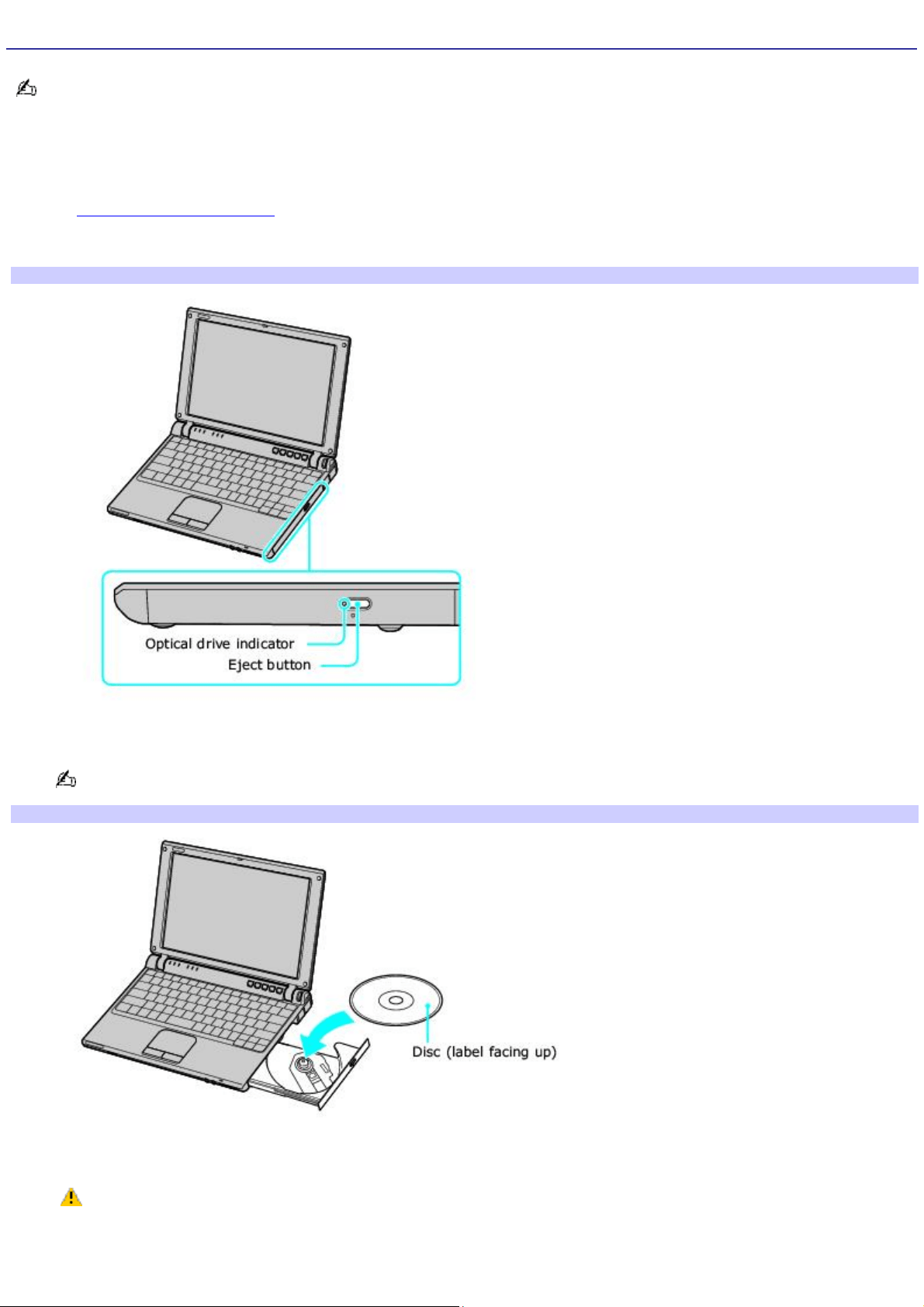
Inserting and Ejecting CDs or DVDs
Avoid using adhesive labels to identify your CDs or DVDs. Adhesive labels may damage the optical drive if they come
off while the disc is in the drive.
To insert a disc
1.
Turn on the computer or exit a power saving mode (Standby or Hibernate) if one is active. For more information,
see Using power saving modes.
2.
Press the Eject button on the optical drive cover to open the drive tray. The drive tray slides out.
Ejecting the Drive Tray
3.
Place a disc on the drive tray with the label facing up.
You can play some DVDs on both sides. Insert this type of DVD with the label you want to play facing up.
Inserting a Disc
4.
Press the disc onto the tray until the disc clicks securely into place.
If you do not seat the disc firmly over the hub, the disc may come loose while it is in the drive. A loose
disc may damage the optical drive and make opening the drive tray difficult.
5.
Push the drive tray gently to close it. The Busy indicator on the drive cover blinks while your computer is reading
data from the drive.
Page 84

To eject a disc
1.
Turn on the computer or exit a power saving mode (Standby or Hibernate) if one is active. For more information,
see Using power saving modes.
2.
Close all programs that access the optical drive, and wait for the Busy indicator on the drive cover to turn off.
3.
Press the Eject button on the drive cover to open the drive tray. The drive tray slides out.
If the Eject button does not work, turn off the computer and insert a thin, straight object (such as a paper clip)
into the manual eject hole next to the Eject button.
4.
Lift the disc from the drive.
5.
Push the drive tray gently to close it.
Page 85

Copying and Playing CDs and DVDs
Your computer plays and records CDs and DVDs, depending on the model you purchased. Check your specifications for the
type of optical drive installed on your computer and use the table below to see which types of media your optical drive
supports.
Optical Drive Media (disc) Support
CD-ROM Reads CD, CD-R, and CD-RW
CD-RW Reads CD, CD-R, and CD-RW
Writes to CD-R and CD-RW
CD-RW/DVD-ROM Reads CD, CD-R, and CD-RW
Writes to CD-R and CD-RW
Reads DVD and most DVD-R and DVD-RW
DVD-RW Reads CD, CD-R, and CD-RW
Writes to CD-R and CD-RW
Reads DVD, DVD-R, and DVD-RW; DVD+R and DVD+RW (in most cases)
Writes to DVD-R and DVD-RW
DVD±RW Reads CD, CD-R, and CD-RW
Writes to CD-R and CD-RW
Reads DVD, DVD-R, DVD-RW, DVD+R and DVD+RW
Writes to DVD-R, DVD-RW, DVD+R, and DVD+RW
If you plan to use an external optical drive, connect the drive before you launch any preinstalled CD/DVD program.
Page 86

Playing CDs
Before you play an audio CD, you may need to enable your computer's audio feature.
To enable the audio feature
1.
Click Start on the Windows
®
taskbar, and then click Control Panel, Performance and Maintenance, and System.
The System Properties dialog box appears.
As a shortcut, you can press Fn + the Windows key + Insert to open the System Properties dialog box.
2.
Select the Hardware tab, and in the Device Manager box, click Device Manager. A window with a listing of the
computer's hardware devices appears.
3.
Double-click the type of the optical drive installed on the computer, such as DVD/CD-ROM drives
1
, to open the
submenu.
4.
Double-click the listed optical drive, and select the Properties tab.
5.
Click to select the Enable digital CD audio for this CD-ROM device check box if it is not already selected.
6.
Click OK.
To adjust the volume for playing CDs and DVDs
Some programs have built-in volume controls, which you can adjust. If there are no volume controls, then adjust the volume
of your computer's built-in speakers by doing one of the following:
Pressing the Volume Up / Down buttons, or the Mute / Sound Effects button, located on the front of the computer.
Using the Volume icon.
1.
Double click the Volume icon on the Taskbar Notification area. The Volume Control dialog box
appears.
2.
In the Volume Control and Wave columns, move the Volume sliders up to increase volume and down to
decrease volume.
To play an audio CD
1.
Insert the disc into the optical drive. See To insert a disc.
2.
If nothing appears on the desktop once you insert an audio CD disc, then click Start, point to All Programs, and
click to open a CD program, such as SonicStage.
If the Audio CD window appears, click to select an option.
Audio CD
1
O ptic al drive types vary, depending on the model you purchased.
Page 87
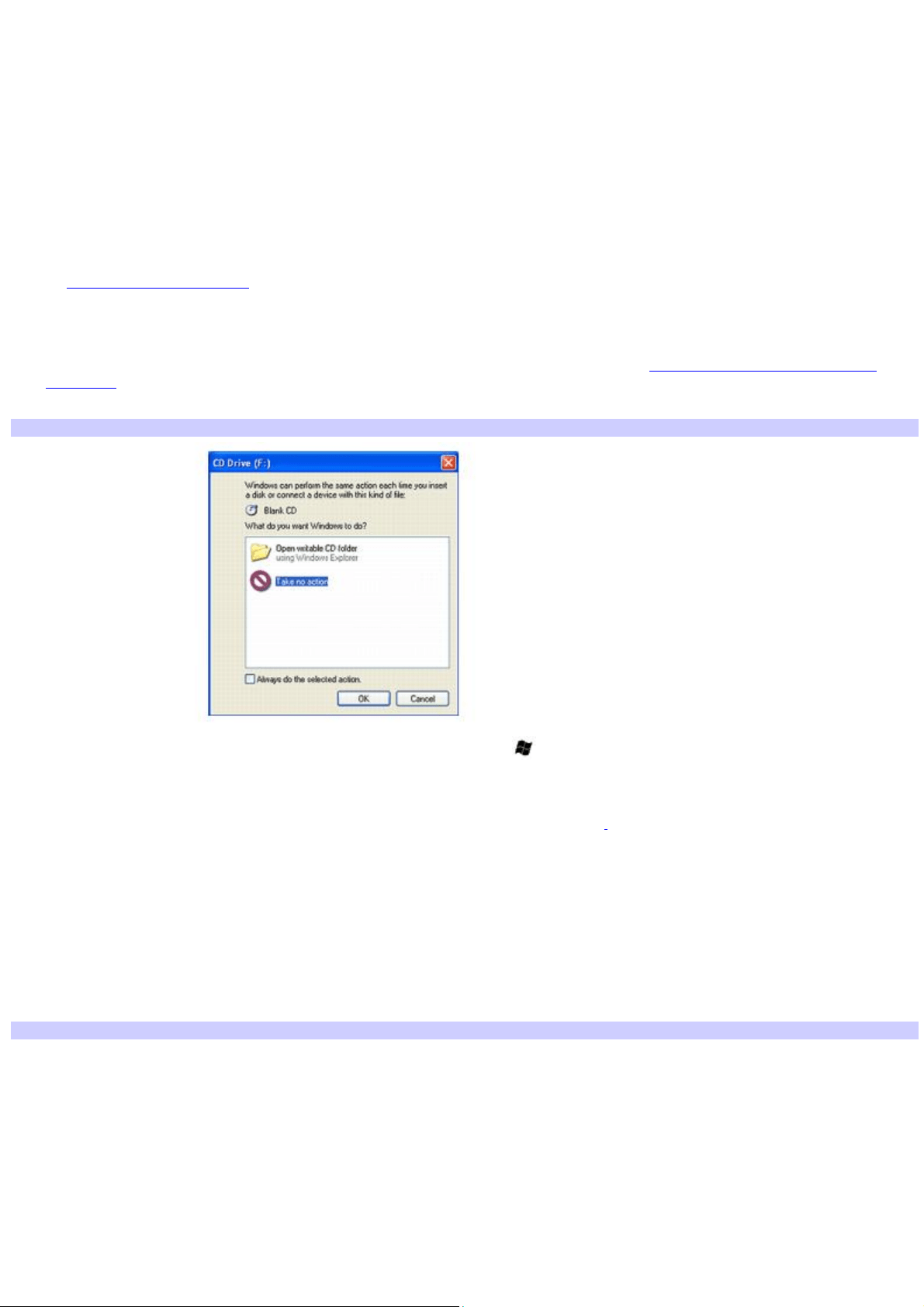
Copying files to a CD-RW or CD-R
You can copy files to CD-R or CD-RW discs if your VAIO
®
computer is equipped with a CD-RW/DVD drive or DVD-RW drive.
Before you write data to a CD-RW or CD-R disc, read the following notes to avoid a computer malfunction and ensure the
best writing results:
Deactivate the screen saver and exit anti-virus software.
Deactivate memory-resident disc utilities to avoid data loss.
Disable the FindFast program if it is installed on your computer. Click Start and point to All Programs to see a list of
programs on your computer.
Connect and use the AC adapter to power your computer or make sure your battery is at least 50 percent charged.
See Powering Your Computer for more information.
To copy files to a CD-RW or CD-R
1.
Insert a blank CD-R or CD-RWdisc into the optical drive. For more information, see Creating CDs / DVDs with Sony
Software.
If the CD Drive window appears, click Take no action and click OK.
CD Drive
2.
Open the My Computer window by pressing the Windows key and the E key simultaneously.
3.
In the Folders panel on the left, locate the folder(s) from which you want to copy.
4.
Right-click the file(s) or folder(s), point to Send To, and click the optical drive
1
name.
A taskbar pop-up message appears, stating your files are waiting to be written to a CD.
5.
Click on the pop-up message.
The CD Drive window appears with the file(s) or folder(s) you want to copy listed under Files Ready to Be
Written to the CD.
6.
In the CD Writing Tasks box, click Write these files to CD.
The CD Writing Wizard appears.
7.
Follow the instructions on the CD Writing Wizard.
CD Writing Wizard
Page 88


Playing DVDs
You can play DVDs in your computer's optical drive and view the video on a multimedia display.
To play a DVD - option 1
1.
Close all open programs.
2.
Insert the DVD into the optical drive.
3.
Press the DVD button on the computer. VAIO Zone will launch.
To play a DVD - option 2
1.
Close all open programs.
2.
Insert the DVD into the optical drive.
3.
Open a preinstalled DVD program, such as VAIO Zone , by following these steps:
1.
Click Start on the taskbar, and point to All Programs.
2.
Select a program, such as VAIO Zone , to play the DVD. For instructions on how to use a program,
see the help guide included with the DVD program.
Some discs recorded at 20 or 24 bits may produce noise while playing. If you have audio devices
connected, this may damage your hearing and the speakers. Reduce the volume before playing a DVD.
Do not switch power saving modes while the computer is playing a DVD.
Do not use memory-resident utility software to speed up disc access when playing a DVD. This may cause the
computer to malfunction.
Page 90

Writing files to DVDs (on selected models only)
Use the table shown on Copying and Playing CDs and DVDs to see which type of DVD media your computer supports.
You can copy data or video files to DVD-R or DVD-RW discs if your VAIO
®
computer is equipped with a DVD-RW drive. Before
you write data to a DVD-RW or DVD-R disc, read the following notes to avoid a computer malfunction and ensure the best
writing results:
Deactivate the screen saver and exit anti-virus software.
Deactivate memory-resident disc utilities to avoid data loss.
To write files to DVD media
1.
Connect the AC adapter to the computer. See Connecting the AC adapter for more information.
2.
Insert a blank DVD-R or DVD-RW disc into the optical drive. See Creating CDs / DVDs with Sony Software for more
information.
3.
Click Start, All Programs, and select the DVD software program you want to use from the submenu.
Your computer may come with preinstalled Click to DVD software. See the Help guide supplied with the
software for more information.
Do not strike or shake the computer while copying files to a disc.
Page 91

Printer Connections
Printing With Your Computer
Your computer is compatible with many popular printers. However, to ensure the best performance, printers must be
compatible with the Microsoft
®
Windows
®
operating system installed on your computer.
Page 92

Printer Connections
Printing With Your Computer
Your computer is compatible with many popular printers. However, to ensure the best performance, printers must be
compatible with the Microsoft
®
Windows
®
operating system installed on your computer.
Page 93
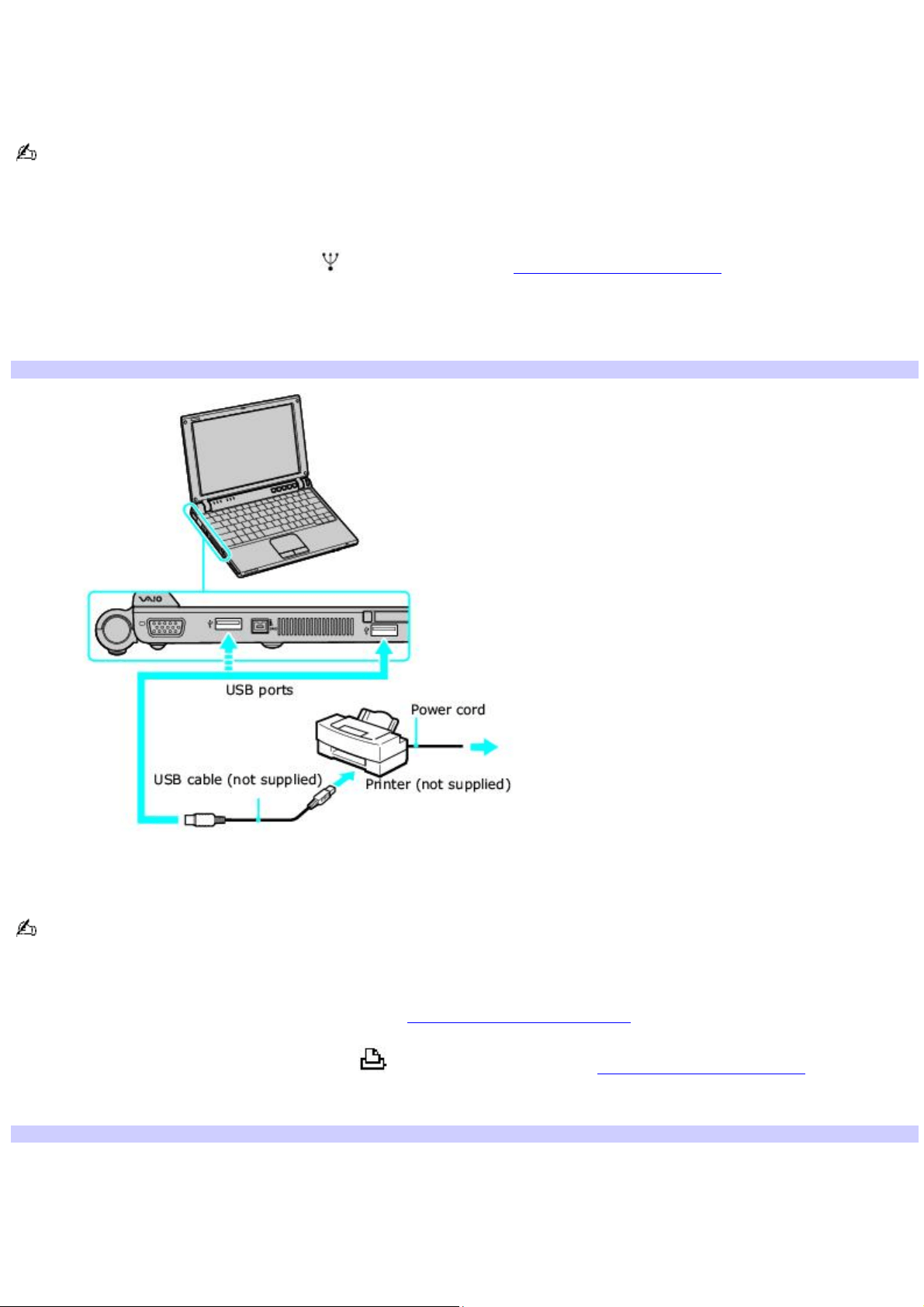
Connecting a printer
You can easily connect a printer to your computer or port replicator (if applicable). The New Hardware Wizard enables you
to easily install the printer software, but some printers require separate driver software installation. See the instructions
that accompanied your printer for more information.
If you are using the port replicator, connect the AC adapter to the port replicator. The port replicator must be powered
by the AC adapter to function properly.
To connect a USB printer
1.
Plug the USB cable into the USB port on your computer. See Locating Controls and Ports.
2.
Plug the other end of the USB cable into the USB port on the printer.
3.
Turn the printer on. The Found New Hardware Wizard appears on the computer screen.
Connecting a USB Printer
See the guide that accompanied the printer for more information on its installation and use.
To connect a printer (port replicators only)
1.
Connect the port replicator to the computer. See Connecting the Port Replicator for instructions.
2.
Plug the printer cable into the Printer port on your port replicator. See Locating Controls and Ports.
3.
Plug the other end of the printer cable into the port on the printer, and turn the printer on.
Connecting a Printer
Page 94
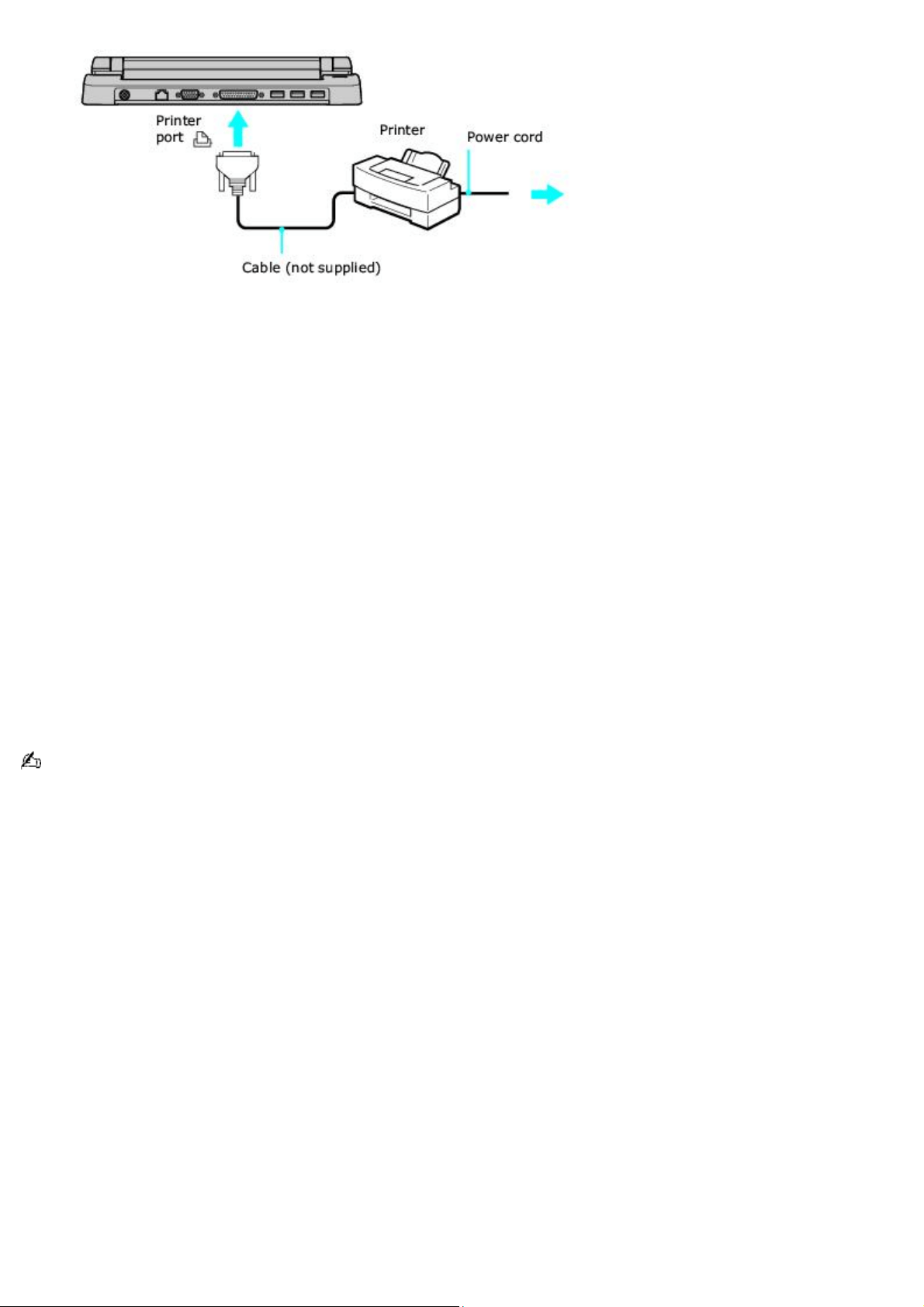
4.
Restart your computer by clicking Start, Turn Off Computer, and Restart. If the New Hardware Wizard
appears, follow the on-screen instructions.
The printer connector on the port replicator is internally connected to the USB. If your printer is connected to the printer
connector on the port replicator, proceed as follows to check the printer port setting and to make sure the computer
recognizes the printer:
1.
Click Start and then Control Panel.
2.
Click the Printers and Other Hardware icon.
3.
Click the Printers and Faxes icon. The Printers and Faxes window appears.
4.
Right-click the printer to select Properties.
5.
Click the Ports tab.
6.
Check if the check-box for USB001 is selected. If another check-box is selected, click the box for USB001.
7.
Click OK.
If the computer does not recognize the printer, you may need to install the printer driver software. See the guide that
accompanied the printer for more information.
See the guide that accompanied the printer for more information on its installation and use.
Page 95

Disconnecting a printer
You can disconnect the printer cable when the computer is on or off. Disconnecting a printer when the computer is in a
power saving mode (Standby or Hibernate) may cause the computer to malfunction.
To disconnect a printer
1.
Make sure all printing jobs are completed.
2.
Turn off the printer, then unplug the printer cable from the computer.
Page 96

Floppy Disk Drives
Using a Floppy Disk Drive
You can connect a floppy disk drive to your computer. The floppy disk drive enables you to read or write data to a floppy
disk.
Page 97

Floppy Disk Drives
Using a Floppy Disk Drive
You can connect a floppy disk drive to your computer. The floppy disk drive enables you to read or write data to a floppy
disk.
Page 98
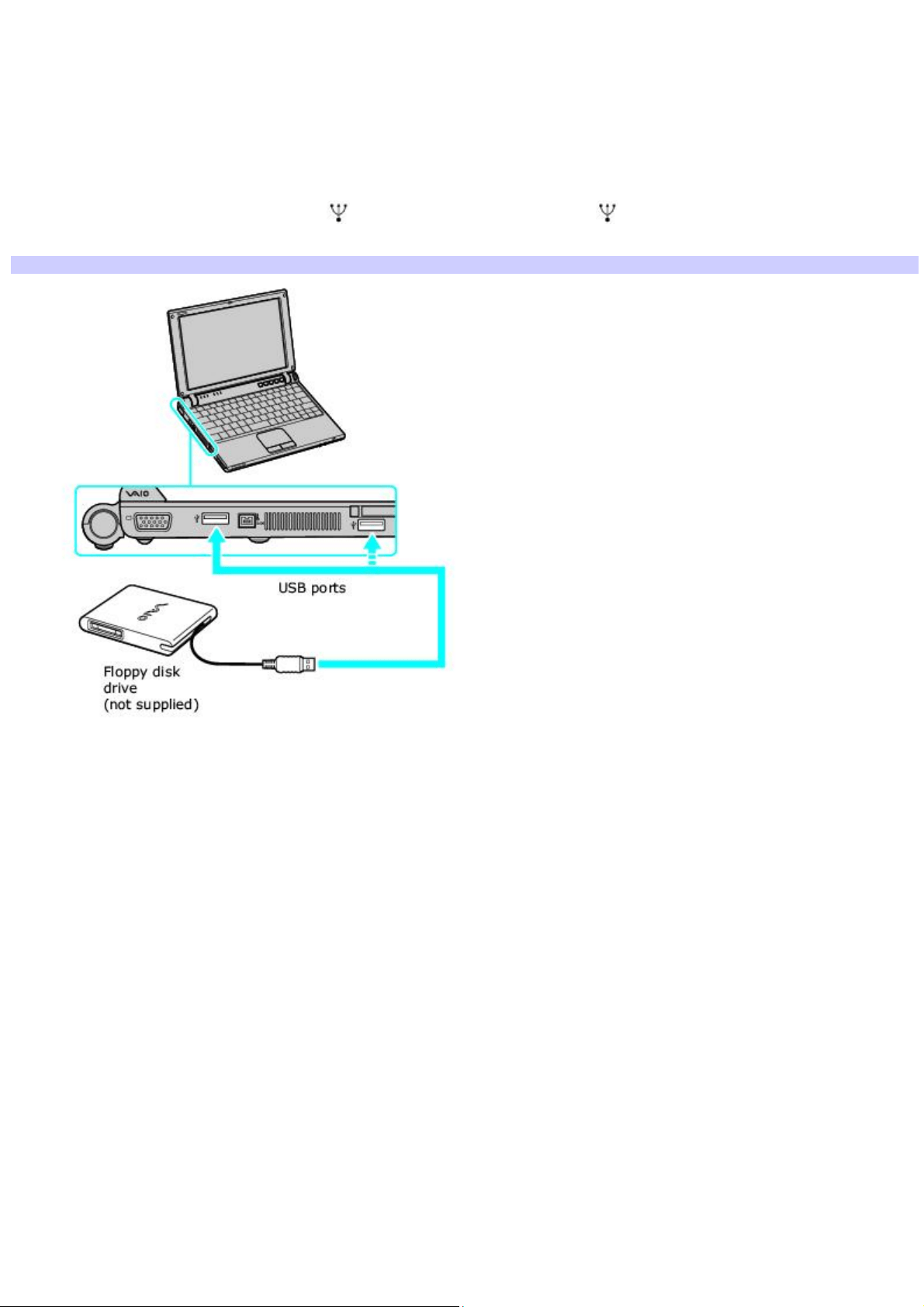
Connecting a floppy disk drive
You can connect a floppy disk drive when your computer is on or off. Connecting the drive when the computer is in a power
saving mode (Standby or Hibernate) may cause the computer to malfunction.
To connect a USB floppy disk drive
1.
Close any active programs to prevent data loss.
2.
Plug the USB cable (with the USB icon facing upward) into the USB port . The Found New Hardware
pop-up message appears.
Connecting a Floppy Disk Drive
Page 99
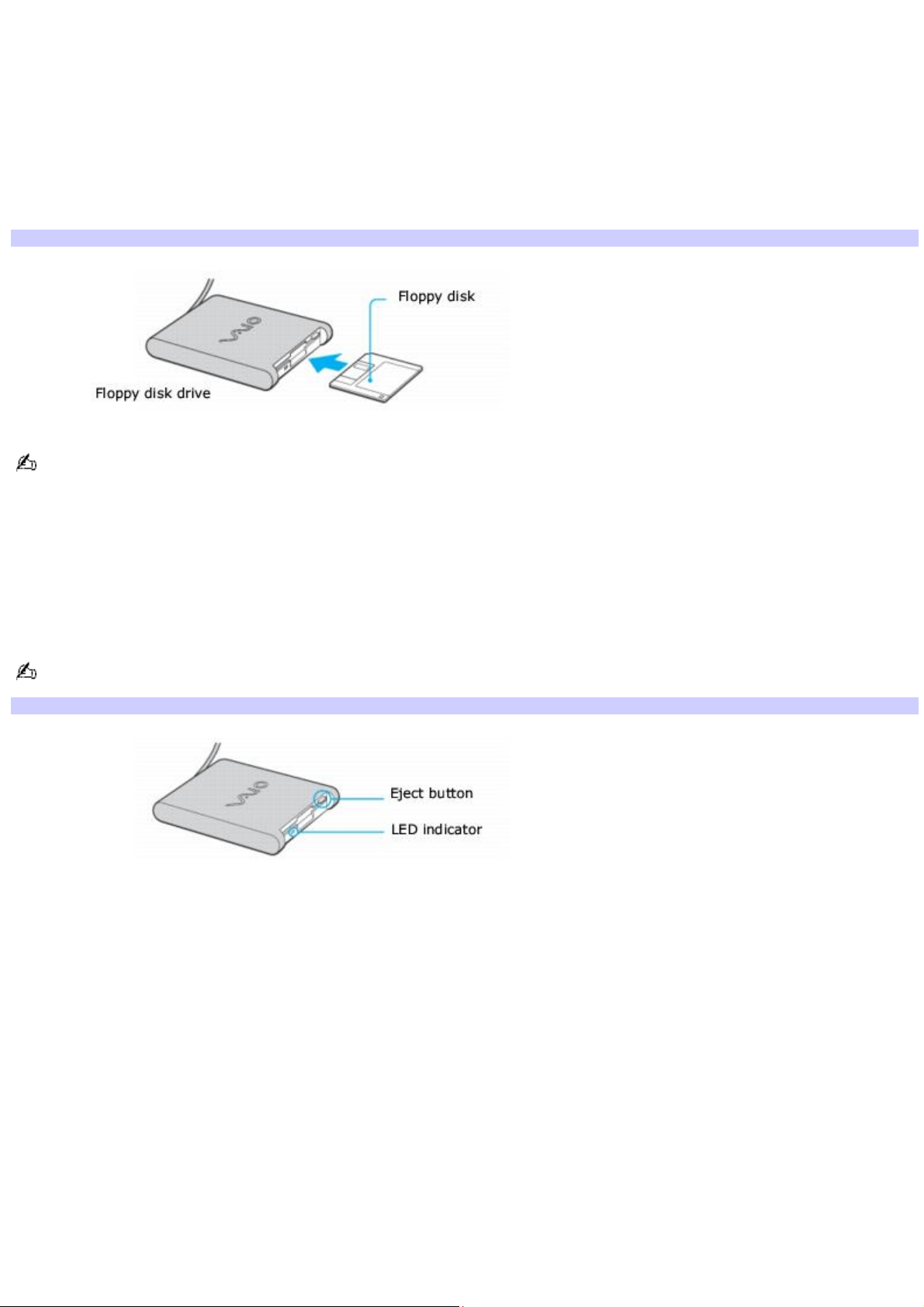
Inserting and removing floppy disks
To write data to a disk, use one that is not write-protected or disable the write-protect feature. The floppy disk drive cannot
write data to a disk if it is inserted into the drive improperly.
To insert a floppy disk
1.
Hold the floppy disk with the label facing up.
2.
Push the floppy disk into the drive until it clicks into place.
Inserting a Floppy Disk
Do not open the shutter manually and touch the surface of the floppy disk.
To remove a floppy disk
1.
Close all programs that access the floppy disk.
2.
Wait for the LED indicator on the floppy disk drive to turn off.
3.
Push the Eject button, and remove the disk.
To avoid losing data, do not push the Eject button when the LED indicator is on.
Removing a Floppy Disk
Page 100

Protecting floppy disks
Do not open the shutter manually or touch the surface of the floppy disk.
Keep floppy disks away from magnets, direct sunlight, and heat sources.
Page 101

Disconnecting a floppy disk drive
You can disconnect a USB floppy drive when the computer is off by disconnecting the USB cable from the computer.
Disconnecting the drive when the computer is in a power saving mode (Standby or Hibernate) may cause the computer to
malfunction.
To disconnect a USB floppy drive while the computer is on
1.
Double-click the Safely Remove Hardware icon on the taskbar. The Safely Remove Hardware dialog box
appears.
2.
Click to select the floppy drive in the Hardware devices window, if it is not already selected.
3.
Click Stop. The Stop a Hardware device window appears.
4.
Make sure the floppy drive is selected, and click OK. A message appears stating it is safe to remove the
hardware device.
Page 102

Storing a floppy disk drive
Fold the floppy disk drive cable and connector into the side compartment on the floppy disk drive.
Storing a Floppy Disk Drive
Page 103

PC Cards
Using PC Cards
Your computer includes one PC Card slot. A PC Card enables you to connect devices such as an optical drive or floppy disk
drive.
See your VAIO
®
Computer Specifications for the type of PC Card that is compatible with your computer. The slot is
compatible with CardBus. You do not need to turn off your computer to insert or remove a PC Card.
Page 104

PC Cards
Using PC Cards
Your computer includes one PC Card slot. A PC Card enables you to connect devices such as an optical drive or floppy disk
drive.
See your VAIO
®
Computer Specifications for the type of PC Card that is compatible with your computer. The slot is
compatible with CardBus. You do not need to turn off your computer to insert or remove a PC Card.
Page 105
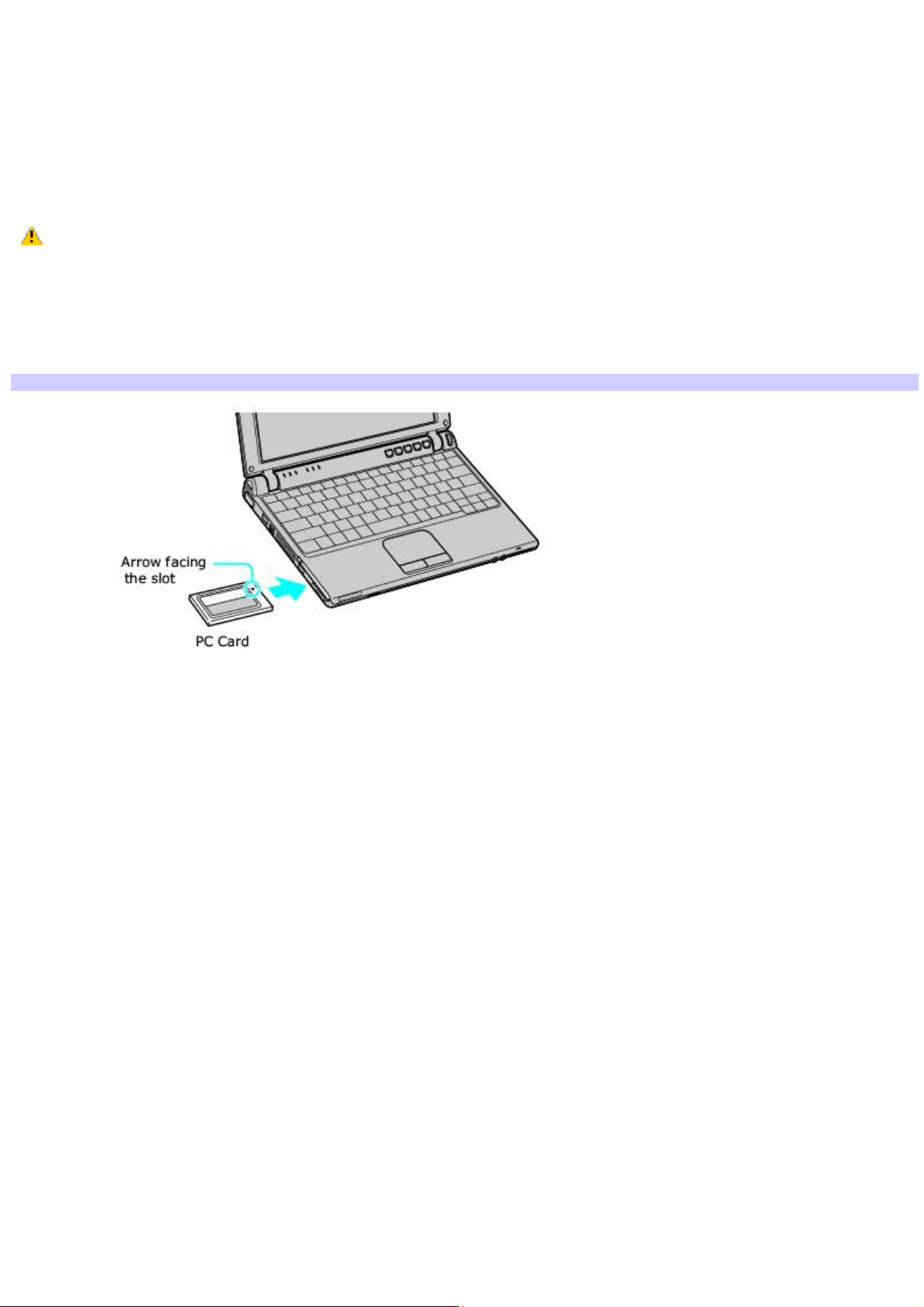
Inserting PC Cards
To insert a PC Card
1.
Remove the PC Card slot protector first by pressing the PC Card eject button.
2.
Make sure the front label of the PC Card is facing up.
3.
Push the PC Card gently into the slot. The system automatically detects the PC Card.
Do not force a PC Card into the slot; this may damage the connector pins.
When a PC Card is inserted, do not place your computer in a bag or case. Pressure or shock to a PC Card may damage
your computer.
Touching the head of the PC Card will not damage the connector pins, but damage may occur if the head of the PC Card
is sticking out of the PC Card slot while the computer is being transported.
Inserting a PC Card
Page 106

Removing PC Cards
You can remove PC Cards while the computer is on or off. PC Cards draw power from the computer when they are inserted
into the PC Card slot, whether or not you use the card.
If you are not using your PC Card and you are using a battery as a power source, remove the PC Card from the PC Card
slot to conserve battery power.
Insert the PC Card slot protector in order to protect the PC Card slot when you are not using a PC Card.
To remove a PC Card while your computer is on
1.
Double-click the Safely Remove Hardware icon on the taskbar. The Safely Remove Hardware dialog box
appears.
2.
Click to select the PC Card in the Hardware devices window, if it is not already selected.
3.
Click Stop. The Stop a Hardware device window appears.
4.
Make sure the PC Card is selected, and click OK. A message appears stating it is safe to remove the hardware
device.
5.
Push the PC Card eject button (for location information, see "Locating Controls and Ports."). The eject button
pops out.
6.
Push the eject button a second time. The PC Card pops out.
7.
Gently pull the card out of the slot.
To remove a PC Card while the computer is off
1.
Push the Eject button once. The Eject button pops out.
2.
Push the Eject button a second time. The PC Card pops out.
3.
Gently pull the card out of the slot.
Page 107
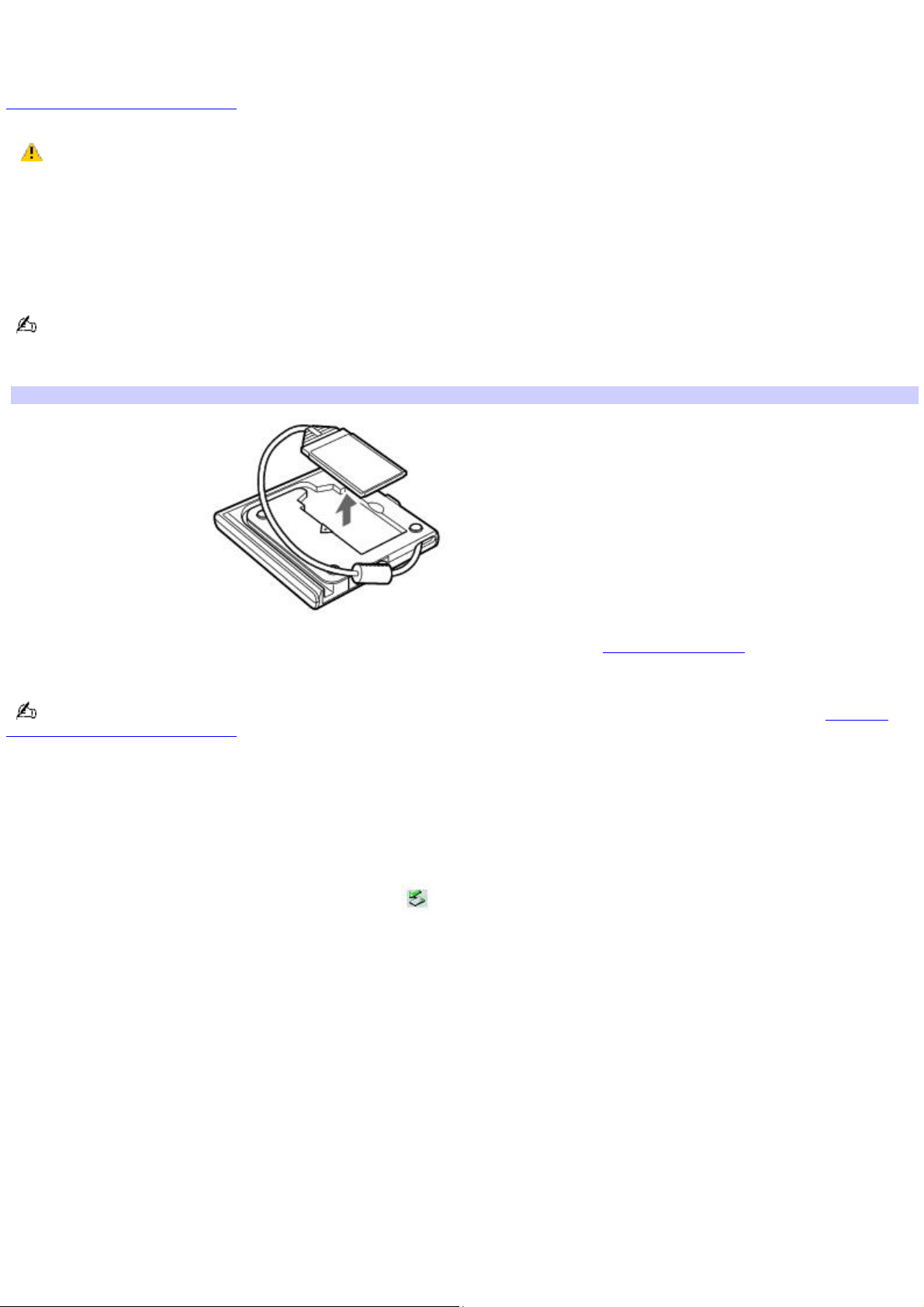
Connecting and disconnecting PC Card drives
The PC Card drive enables you to read data stored on a DVD or CD. Your computer may come with an external PC Card
drive, depending on the model you purchased. If you wish to purchase a PC Card drive, shop Sony online at
http://www.sonystyle.com/vaio or contact your local retailer.
If you connect a non-Sony DVD drive to your VAIO
®
computer, DVD playback may not function properly. The
supplied DVD software must be installed to play a DVD. For best performance, use a Sony compatible DVD drive.
To connect a PC Card drive
You can connect a PC Card drive while the computer is on or off. Connecting the drive when the computer is in a power
saving mode (Standby or Hibernate) may cause the computer to malfunction.
Instructions on connecting an optical drive may vary, depending on the specific drive you purchased.
1.
Remove the PC Card from the bottom of the optical drive.
Removing a PC Card
2.
Insert the PC Card into the PC Card slot with the arrow facing the slot. See To insert a PC Card for more
information.
Remove the protective cover that is attached to the lens of the optical drive before you use the drive. See Creating
CDs / DVDs with Sony Software for information on how to open the optical drive to access the lens.
See the guide that accompanied your optical drive for more information on its installation and use.
To disconnect a PC Card drive
1.
Close all programs accessing the PC Card drive.
2.
Double-click the Safely Remove Hardware icon on the taskbar. The Safely Remove Hardware window
appears.
3.
Select the PC Card drive in the Hardware devices window, if it is not already selected.
4.
Click Stop. The Stop a Hardware device window appears.
5.
Make sure the PC Card drive is selected, and click OK. A message appears stating it is now safe to remove the
hardware device.
6.
Eject the PC Card from the PC Card slot.
Page 108

Port Replicator Connections
A port replicator is a device that attaches to your computer and contains additional ports. One may come with your
computer, depending on the model you purchased. If you wish to purchase a port replicator, shop Sony online at
http://www.sonystyle.com/vaio or contact your local retailer.
When your computer is connected to a port replicator, use only the Ethernet port on the port replicator, not the
Ethernet port on the computer.
The port replicator must be powered by the AC adapter to function properly.
Page 109
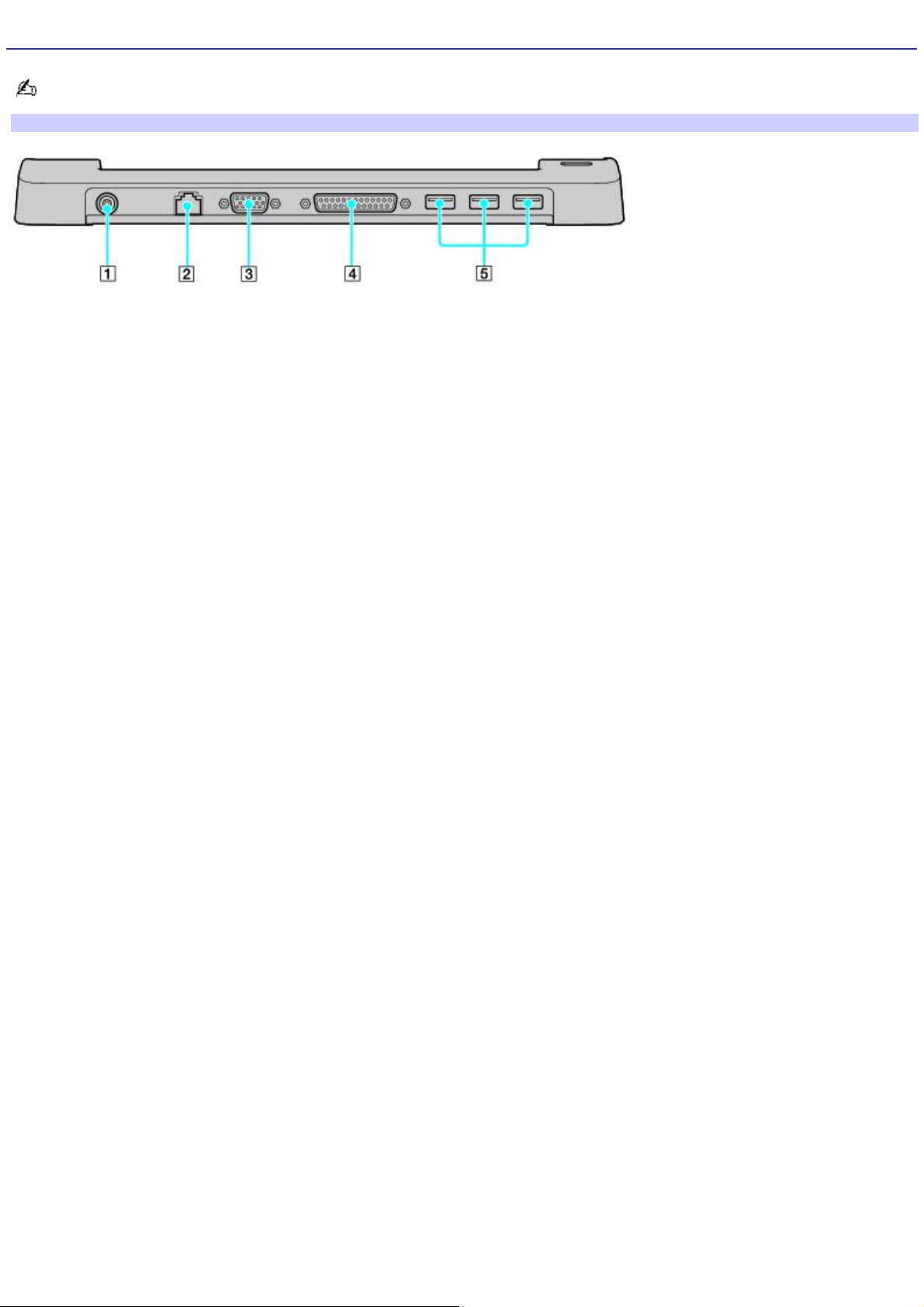
Locating Ports and Jacks
The printer port on this port replicator is intended for printer connections only.
Port Replicator (Back Panel)
1 DC IN port 4 Printer port
2 Network (Ethernet) port (10BASE-T/100BASE-TX) 5 USB ports
3 Monitor (VGA) port
Page 110
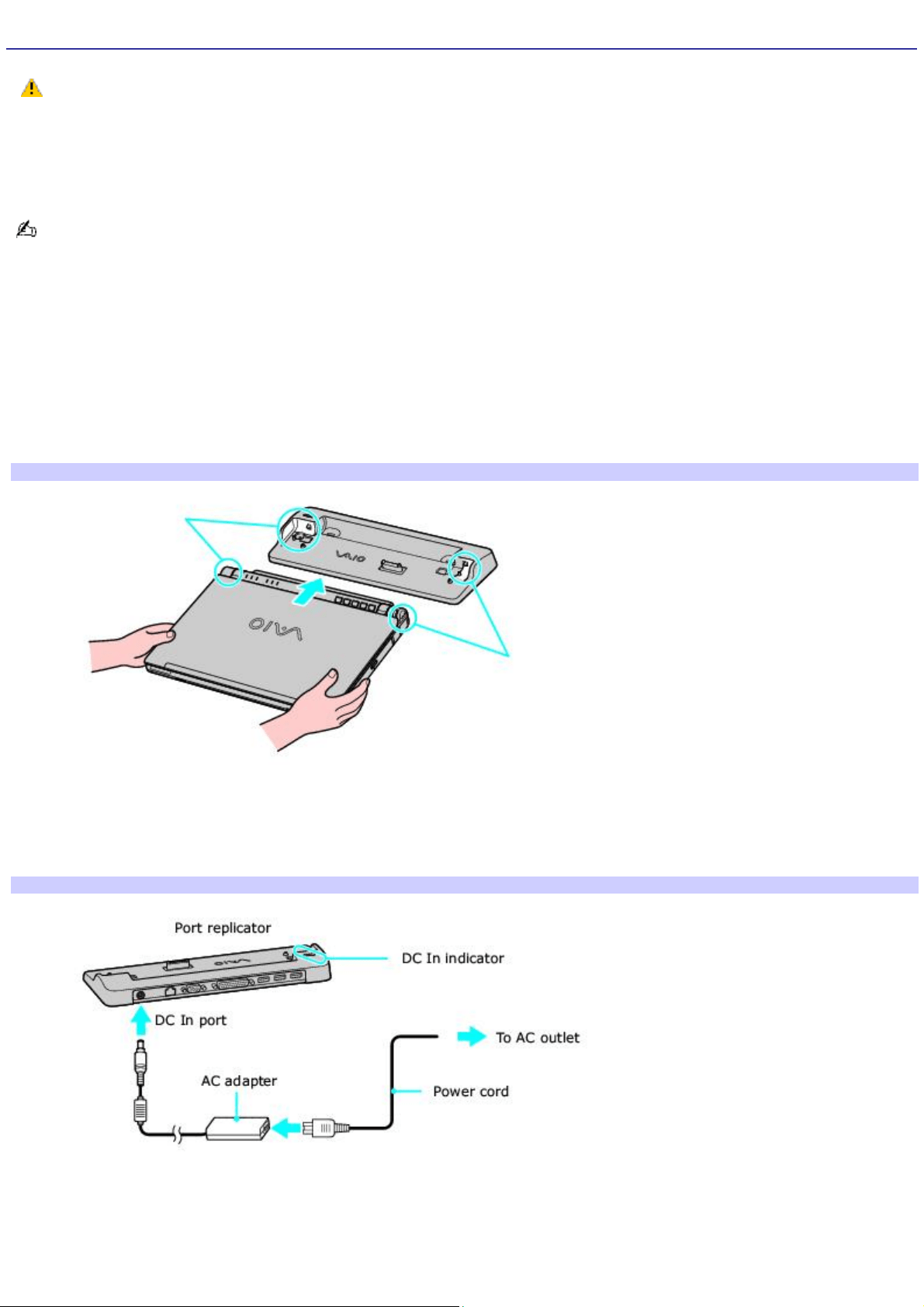
Connecting the Port Replicator
When using the port replicator, always use the AC adapter to power the port replicator; otherwise, the port
replicator will be without power and will not function properly. Also, take precautions to avoid disconnecting the AC
power supply when moving the computer with the port replicator attached.
Before you connect the port replicator, you may want to install the rechargeable battery, if it is not already installed. The
installed battery automatically charges while the computer and port replicator are powered by the AC adapter.
Connecting a port replicator while the computer is in a power saving mode (Standby or Hibernate) may result in data
loss or a computer malfunction.
To connect a port replicator
1.
Close active programs to prevent data loss.
2.
Turn off the computer, and disconnect all attached devices.
3.
Place the port replicator on a stable surface
4.
Align the sides of the computer with the sidewalls of the port replicator.
Connecting the computer and port replicator
5.
Gently place the computer on top of the port replicator until it clicks into place. Make sure the port replicator is
securely fastened to the computer.
6.
Plug the AC adapter into the DC IN port on the port replicator, and plug the power cord into the AC adapter and
an AC outlet. The power indicator (marked "DC IN") on the port replicator turns on.
Connecting the AC adapter to port replicator
7.
Press the Power button to turn on the computer.
Page 111
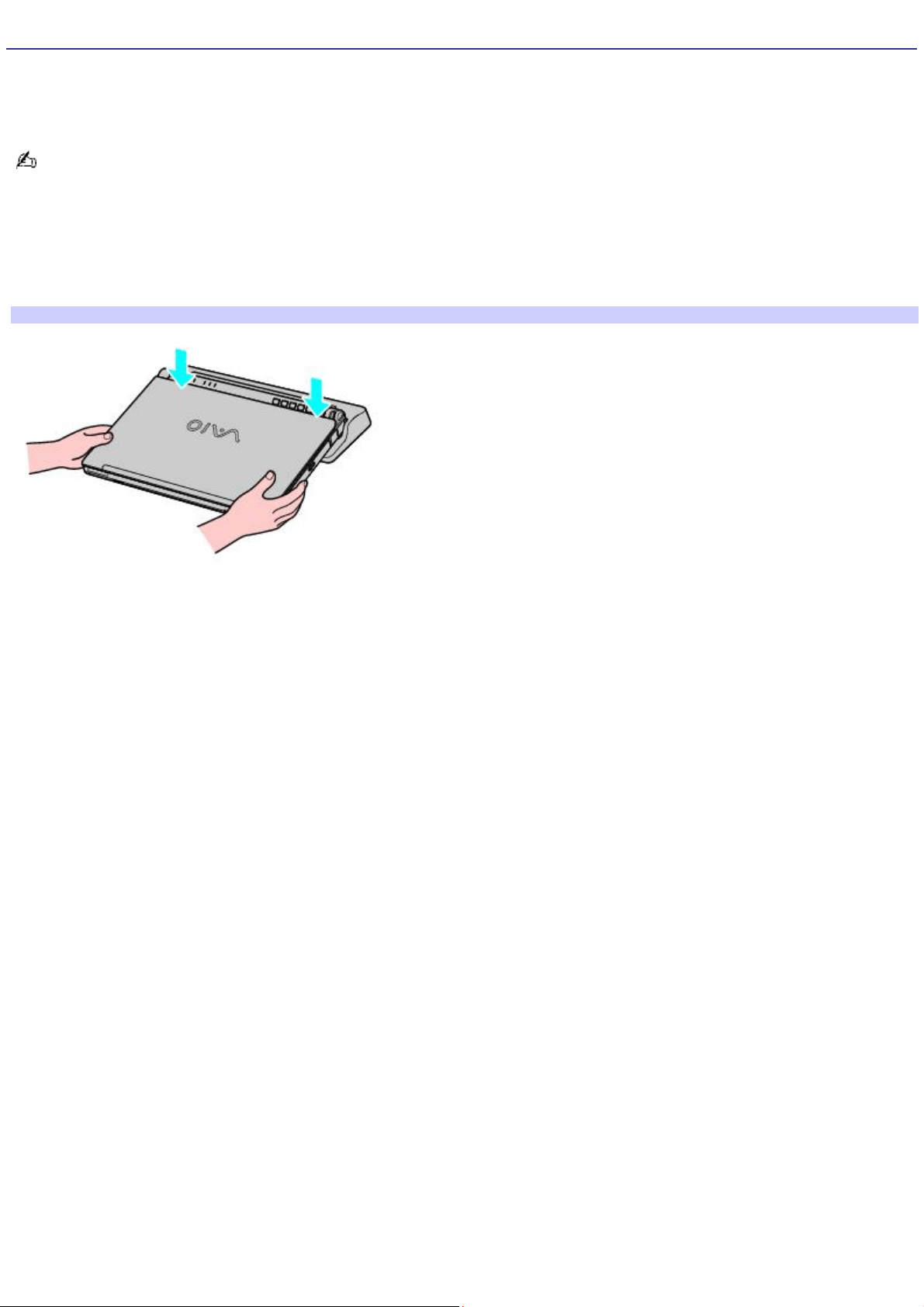
Disconnecting a Port Replicator
Disconnecting a port replicator when the computer is in a power saving mode (Standby or Hibernate) or the battery power
is low may result in data loss or a computer malfunction. You can disconnect a port replicator when the computer is on or
off.
When the battery is low, turn off the computer before you disconnect a port replicator.
To disconnect a port replicator
1.
Close any active programs to prevent data loss, and disconnect the AC adapter.
2.
Lift the computer up and away from the port replicator.
Releasing the Computer from a Port Replicator
Page 112

Audio and Video Connections
Using i.LINK Digital Video Recorders
You can connect a digital video (DV) recorder, such as a Sony digital video recorder, to the i.LINK
®1
S400 (IEEE 1394) port
on your computer. The i.LINK digital video camera recorder is an external device that enables you to record and view digital
images on your computer via the i.LINK port.
1
i.LIN K is a trademark of Sony used to designate that a product contains an I EE E 1 3 9 4 c onnector. T he i.LINK c onnection may vary, depending on the
software applic ation, operating s ystem, and c ompatible i.LINK devices. A ll produc ts with an i.LINK c onnec tion may not c ommunic ate with eac h other. Refer
to the documentation that c ame with your c ompatible i.LI NK device for more information on operating conditions and proper c onnection. Before connecting
compatible i.LINK P C peripherals to your s ystem, s uc h as a C D-RW or hard dis k drive, c onfirm their operating s ystem c ompatibility and required operating
conditions.
Page 113

Audio and Video Connections
Using i.LINK Digital Video Recorders
You can connect a digital video (DV) recorder, such as a Sony digital video recorder, to the i.LINK
®1
S400 (IEEE 1394) port
on your computer. The i.LINK digital video camera recorder is an external device that enables you to record and view digital
images on your computer via the i.LINK port.
1
i.LIN K is a trademark of Sony used to designate that a product contains an I EE E 1 3 9 4 c onnector. T he i.LINK c onnection may vary, depending on the
software applic ation, operating s ystem, and c ompatible i.LINK devices. A ll produc ts with an i.LINK c onnec tion may not c ommunic ate with eac h other. Refer
to the documentation that c ame with your c ompatible i.LI NK device for more information on operating conditions and proper c onnection. Before connecting
compatible i.LINK P C peripherals to your s ystem, s uc h as a C D-RW or hard dis k drive, c onfirm their operating s ystem c ompatibility and required operating
conditions.
Page 114
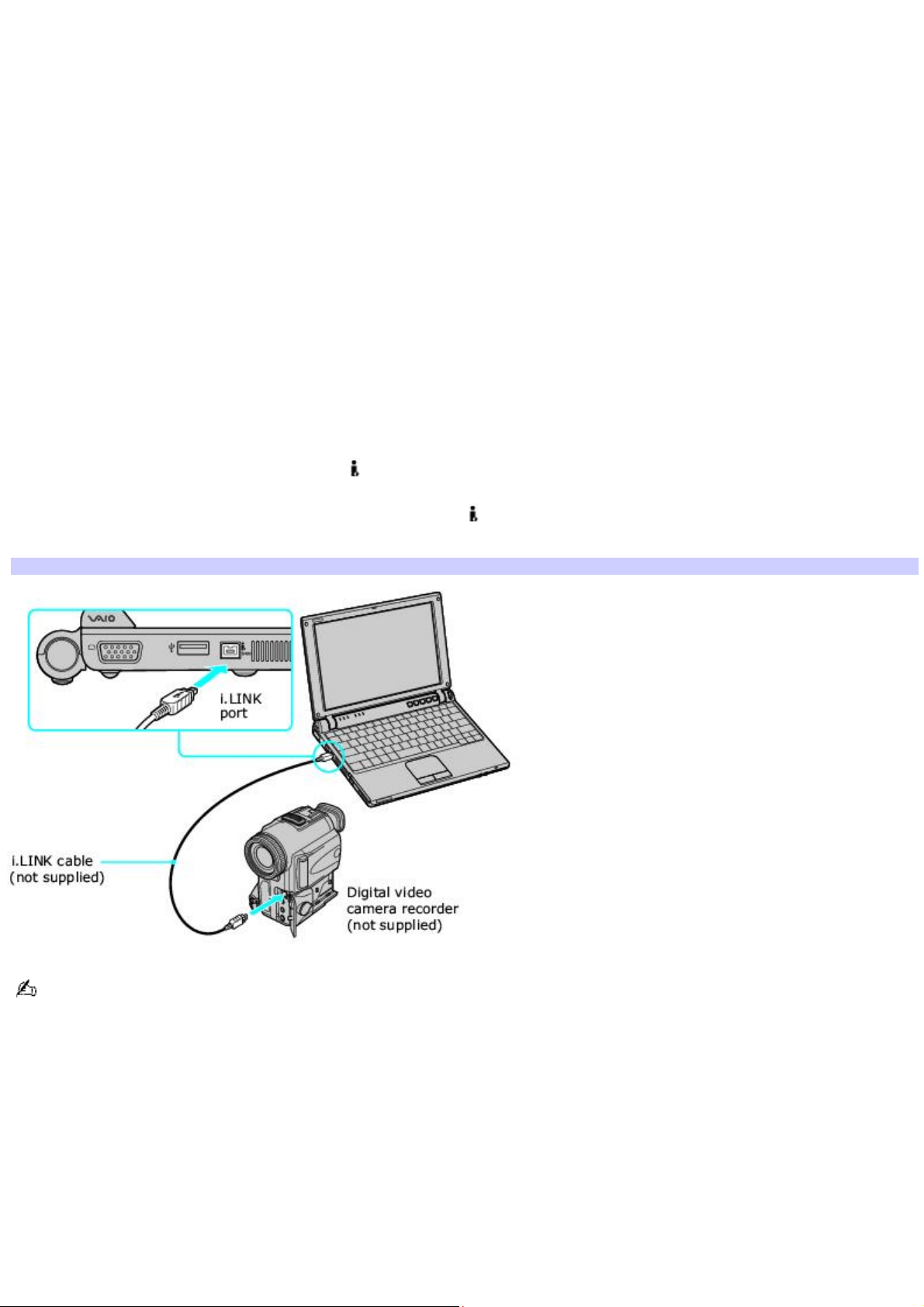
Connecting an i.LINK digital video recorder
You can connect an i.LINK digital video (DV) recorder when the computer is on or off. Connecting the DV recorder when the
computer is in a power saving mode (Standby or Hibernate) may cause the computer to malfunction.
Before you connect an i.LINK digital video recorder
Do not connect more than one digital video camera recorder at a time. The preinstalled programs on your computer
will not recognize multiple cameras.
Do not connect an external device that requires power from the i.LINK port. The i.LINK port does not supply power
to the external device.
The i.LINK port supports transfer rates of up to 400 Mbps; however, the actual transfer rate is the lowest transfer
rate of the external device.
The i.LINK features available may vary depending on the programs you use. See the help guide that accompanied
your program for more information.
To connect an i.LINK digital video recorder
1.
Turn on the digital video (DV) device and the computer.
2.
Plug the i.LINK
®
cable into the i.LINK port on the DV device.
3.
Plug the other end of the i.LINK cable into the i.LINK port on your computer. The Found New Hardware
window appears on the lower right corner of your screen.
Connecting an i.LINK Digital Video Camera Recorder
See the guide that accompanied your digital video camera recorder for more information on its installation and use.
Page 115

Disconnecting the i.LINK digital video recorder
You can disconnect the digital video recorder while the computer is on or off. Simply unplug the i.LINK cable from the i.LINK
port on the computer. Disconnecting the cable when the computer is in a power saving mode (Standby or Hibernate) may
cause the computer to malfunction.
Page 116

Using a digital video camera recorder
Your computer comes with preinstalled driver software that is compatible with most Sony digital video camera recorders. If
you purchased a camera that comes with its own driver software, install these drivers before you use the camera.
To view images
You can view images captured by your digital video camera recorder three different ways. Select one set of instructions
from the following list:
If your digital video camera recorder is compatible with the preinstalled programs, the Digital Video Device window
appears when you connect the camera to the computer. Select the program you want to use in this window, and
click OK.
Click Start, and click All Programs. Select a program in which to view your images.
Click Start, and click Welcome to VAIO life. Click Movies, Music, and Pictures and select a program in which to
view your images.
Page 117

Using Computer Monitors and Projectors
You can connect an external display (such as a computer monitor or a projector) to your computer.
Page 118
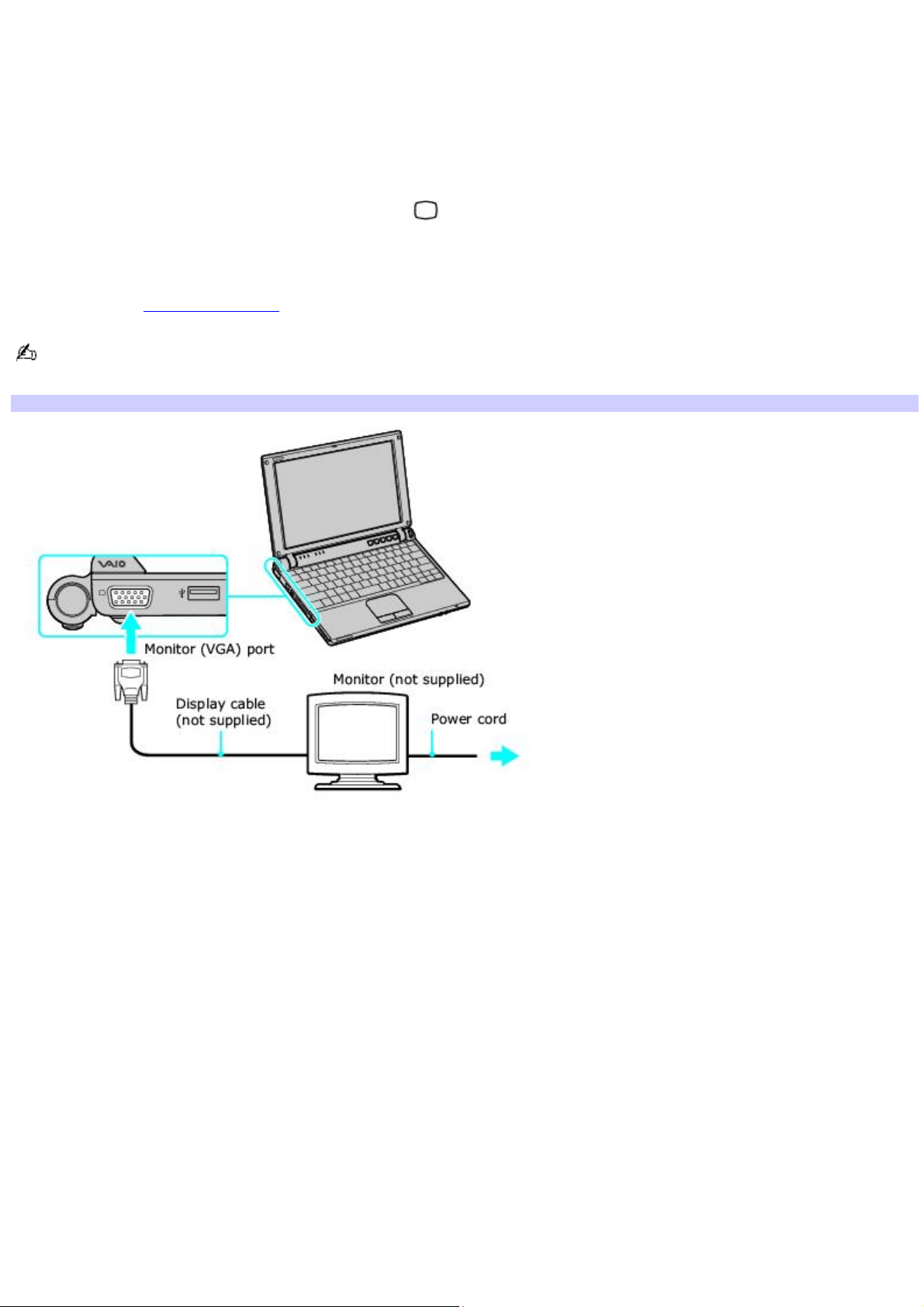
Connecting a computer monitor
Your computer can display images to the computer screen (LCD), to an external computer monitor, or to both the LCD and
external monitor while your computer is on.
To connect a computer monitor
1.
Make sure the computer monitor is plugged into an AC outlet.
2.
Plug the display cable into the Monitor (VGA) port on the computer.
3.
If it is not already on, turn on the computer monitor.
4.
Press the Fn+F7 keys to toggle the display between your computer, the monitor, or both the computer and
monitor. See Selecting a display for more information.
You cannot use the Monitor (VGA) port on your computer when a port replicator is connected to the computer. Use the
Monitor (VGA) port on the port replicator instead.
Connecting a Computer Monitor
Page 119
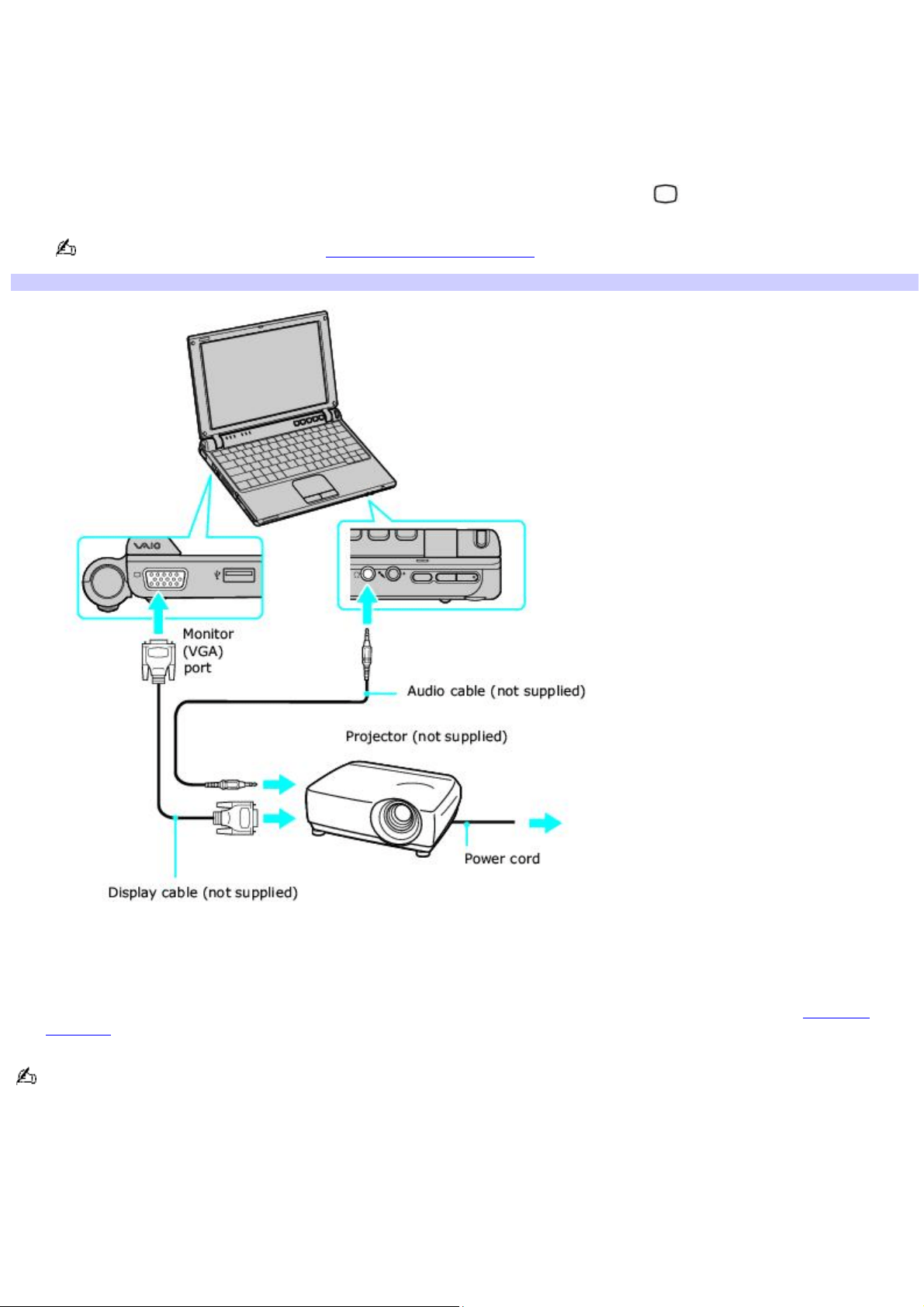
Connecting a multimedia projector
You can use a projector to display the actions and images from the computer screen (LCD).
To connect a multimedia projector
1.
Plug the projector's power cord into an AC outlet.
2.
Plug the display cable (not supplied) into the projector and the Monitor (VGA) port on your computer.
To locate the Monitor port, see Locating Controls and Ports.
Connecting a Multimedia Projector
3.
Plug the audio cable (not supplied) into the projector and the Headphones jack on your computer.
4.
Turn on the projector (if it is not already on), and then turn on your computer.
5.
Press the Fn+F7 key combination to toggle the display between your computer and the projector. See Selecting
a display for more information.
See the guide that accompanied your projector for more information on its installation and use.
Page 120

Selecting a display
Your computer comes with a Plug and Display feature, which enables you to connect an external display to the computer
and instantly view an image on the connected display. An external display may be a projector or computer monitor.
When you connect an external display, the Plug and Display icon appears in the Windows
®
taskbar and the image
appears on both the computer's LCD screen and the external display.
Clicking the Plug and Display icon launches the VAIO Control Center window, where you can customize the Plug
and Display settings.
To switch the display using shortcut features
To switch the display between the computer screen (LCD), the external display, or both, use the Fn+F7 shortcut keys.
Shortcut keys Result
Fn+F7 Toggles the display between the computer screen (LCD), a connected external display, and both the LCD and
an external display. You can also select the Setup option to adjust the Plug and Display settings. Select one display (LCD or
an external display) when playing a DVD.
To switch the display using the Display Properties window
Depending on the external display, you may need to connect the display to the computer before you turn the
computer on.
1.
Click Start on the Windows
®
taskbar, and then click Control Panel. The Control Panel window appears.
2.
Click Appearance and Themes. The Appearance and Themes window appears.
3.
Click Display. The Display Properties window appears.
4.
Click the Settings tab, and then click the Advanced button.
5.
Click the Intel
®
Extreme Graphics 2 for Mobile tab, and click the Graphics properties... button. The Intel
®
82855 GM/GME Graphics Controller Properties window appears.
Intel
®
82855 Graphics Controller Properties
Page 121
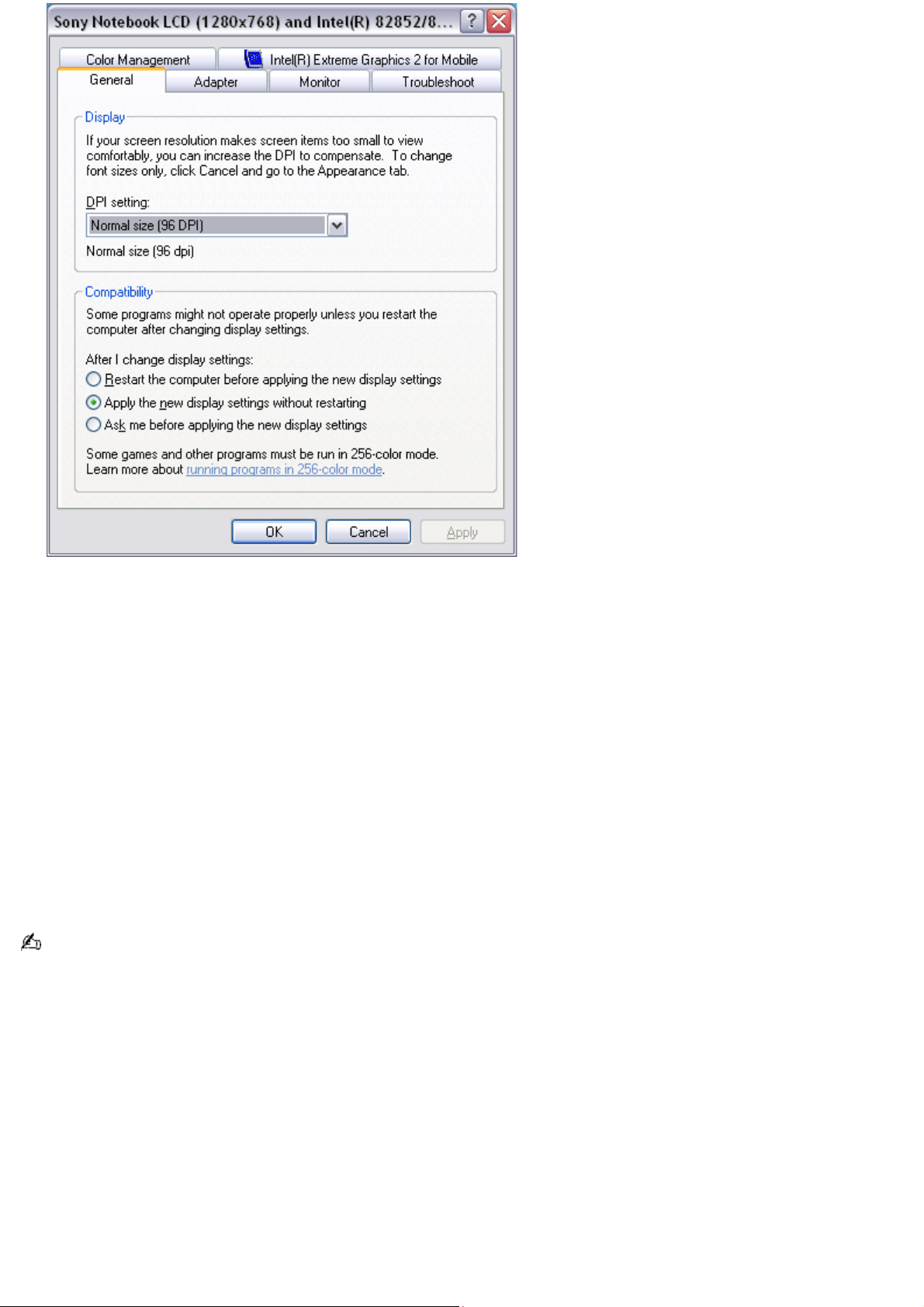
6.
On the Devices tab, click an icon for the display configuration you want to use, and click OK. The Confirm
Desktop Change window appears.
7.
Click OK.
To adjust the screen resolution
Plug and Display customizes the screen resolution to fit within the external display. However, if the external display's
screen resolution is larger than the computer's LCD screen resolution, Plug and Display adjusts both images to the largest
resolution shared by both devices. If the image is distorted, the screen resolution may be adjusted manually.
1.
Click the Start menu and then click Control Panel.
2.
Click Appearance and Themes and then click Display.
3.
When the Display Properties window appears, select the Settings tab.
4.
Use the slider in the Screen resolution box to adjust the screen resolution.
Plug and Display may not work properly if you connect more than one external display at the same time.
Page 122

Disconnecting a computer monitor or projector
You can disconnect the external computer monitor or projector by unplugging the monitor (VGA) cable from your computer's
port. Disconnecting the external display when the computer is in a power saving mode (Standby or Hibernate) may cause
the computer to malfunction.
Page 123

Using Speakers or Headphones
Your computer comes with built-in stereo speakers. You can purchase and connect external speakers or headphones. If you
want to purchase speakers or headphones, make sure the speakers are designed for computer use. You can shop Sony
online at http://www.sonystyle.com/vaio or contact your local retailer.
Page 124
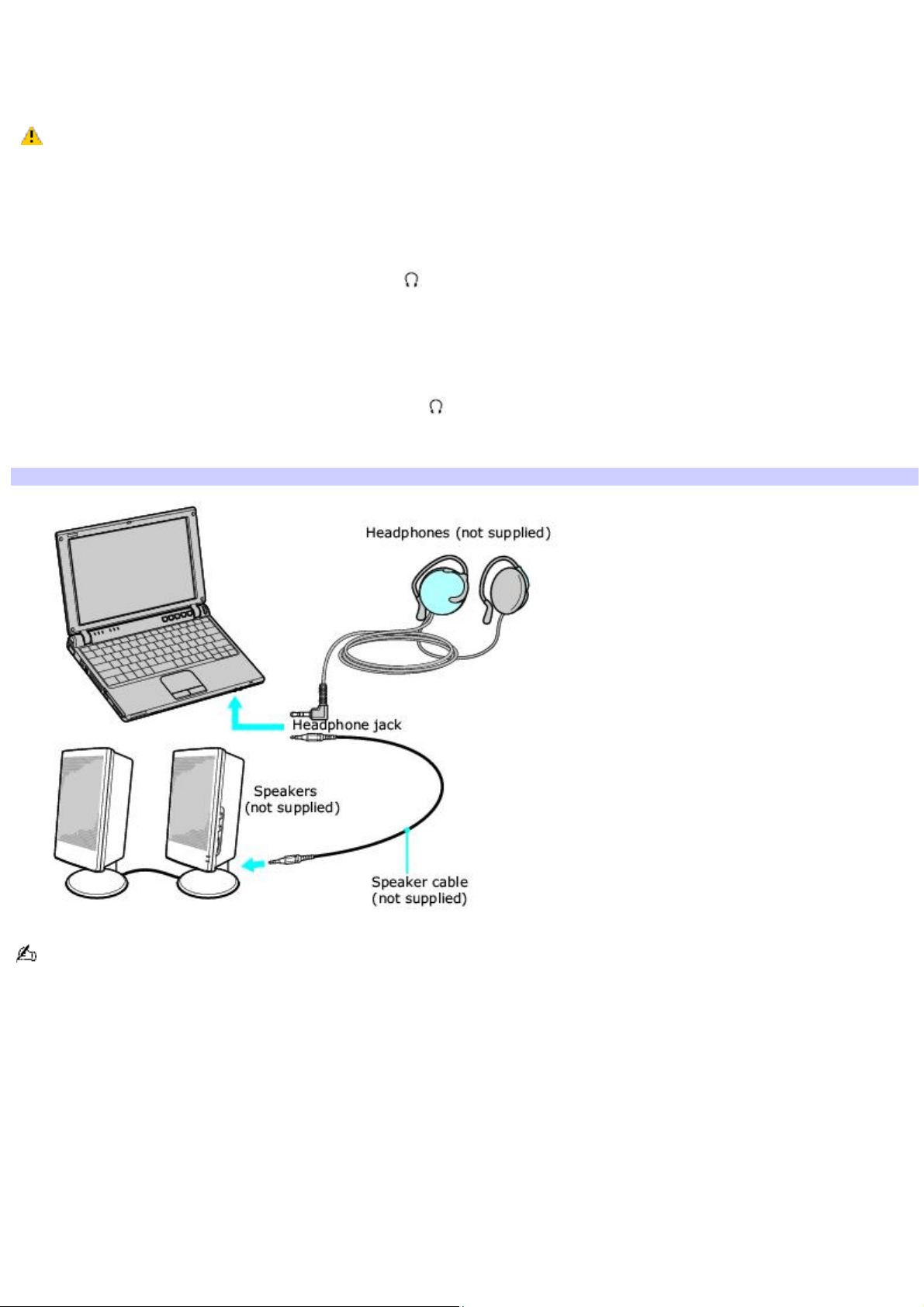
Connecting speakers or headphones
You can connect external speakers to your computer to enhance the sound quality of your computer, or for audio privacy,
you can connect headphones to your computer.
Do not place floppy disks on the speakers. The speakers' magnetic field may damage the data stored on the
floppy disks.
To connect speakers to your computer
1.
Turn down the volume of the speakers.
2.
Plug the speaker cable into the Headphone jack on the computer.
3.
Plug the other end of the speaker cable into the speaker.
To connect headphones to your computer
1.
Plug the headphone cable into the Headphone jack on the computer.
2.
Put the headphones on your head.
Connecting Speakers or Headphones
See the guide that accompanied your speakers or headphones for more information on their installation and use.
Page 125

Disconnecting speakers
You can disconnect external speakers when the computer is on or off. Simply unplug the speaker cable from the Headphone
jack on the computer.
Page 126

Adjusting the sound
You can adjust the volume by using the Volume Up / Down buttons, as well as the Mute / Sound Effects button, on the front
of the computer. An on-screen display appears notifying you when a change occurs.
Alternatively, you can use the Volume icon on the Windows
®
taskbar.
To adjust the volume of your speakers
1.
Right-click the Volume icon on the Windows
®
taskbar, and select Open Volume Control. The Volume Control
window appears.
2.
Click and drag the Volume Control slider up to increase volume and down to decrease volume.
3.
Click to cancel any Mute check boxes that are selected.
Sound device Function
Volume Control Adjust the sound level from the speakers or headphones.
Wave Adjust the wavfile sound or the system sound of Windows.
SW Synth Adjusts the internal or external synthesizer volume.
Microphone Adjust the internal or external microphone volume.
Telephony Adjust the modem or telephone volume.
PC Beep Adjust the beep sound when inserting or removing the PC Card and other devices.
Adjusting the volume for playing CDs and DVDs does not adjust the volume for recording sound files. You can only
adjust the recording volume in the Recording Control window. See Using a microphone to record sound for instructions on
how to open this window.
Page 127

Enabling the sound
If you do not hear sound when playing a CD or DVD, you may need to enable the audio feature.
To enable the audio feature
1.
Click Start on the Windows
®
taskbar, and click Control Panel.
2.
Click Performance and Maintenance, and click System. The System Properties window appears.
3.
Select the Hardware tab, and click Device Manager. The Device Manager window, which lists the hardware
devices, appears.
4.
Double-click DVD/CD-ROM drives.
5.
Double-click the listed drive name, and click the Properties tab.
6.
Click the Enable digital CD audio for this CD-ROM device check box if it is not already selected.
Page 128

Using Microphones
You can connect an external microphone to your computer to enable the sound input to your computer. Make sure your
microphone is designed for computer use. If you wish to purchase a microphone, shop Sony online at
http://www.sonystyle.com/vaio or contact your local retailer.
Page 129

Connecting a microphone
Plug the microphone cable into the Microphone jack
1
on the computer.
Connecting a Microphone
See the guide that accompanied your microphone for more information on its installation and use.
1
A protruding dot loc ated next to the M icrophone jac k dis tinguishes this jac k from the Headphone jack.
Page 130

Disconnecting a microphone
You can disconnect an external microphone when the computer is on or off. Simply unplug the microphone cable from the
Microphone jack on the computer.
Page 131

Using a microphone to record sound
You can record messages, memos, etc. by connecting a microphone to the Microphone jack
1
on your computer.
To record from a microphone
1.
Double-click the Volume icon on the Windows
®
taskbar. The Volume Control window appears.
2.
From the Options menu, click Properties. The Properties dialog box appears.
3.
Click to select the Recording option in the Adjust volume for box.
4.
Make sure the Microphone check box is selected in the Show the following volume controls list, and then click
OK.
The Recording Control window appears.
5.
Click the Select check box at the bottom of the Microphone column, if it is not already selected. Close the
Recording Control window.
6.
Click Start, and select All Programs, Accessories, Entertainment, and then Sound Recorder. The Sound -
Sound Recorder window appears.
For help using Sound Recorder, click Help in the Sound Recorder window.
To adjust the volume for recording sound
You can only adjust the volume for recording in the Recording Control window.
1.
Right-click the Volume icon on the taskbar, and select Adjust Audio Properties.
2.
On the Audio tab, click Volume in the Sound recording box. The Recording Control window appears.
3.
Click and drag the Microphone slider up to increase volume and down to decrease volume.
1
A protruding dot loc ated next to the M icrophone jac k dis tinguishes this jac k from the Headphone jack.
Page 132


Precautions and Procedures
Sony recommends that memory upgrades be performed by an authorized Sony Service Center. To find the
nearest center or agent, go to: http://www.sony.com/pcsupport.
The procedures described below assume familiarity with the general terminology associated with personal computers and
with the safety practices and regulatory compliance required for using and modifying electronic equipment. When installing
a memory module in your computer, make sure you read the proper safety precautions below. Mistakes that occur when
installing or removing a memory module may cause a malfunction.
Turn off the computer. Disconnect the computer from its power source and from any telecommunications links,
networks, or modems before you install or remove a memory module. Failure to do so may result in personal injury
or equipment damage.
Introducing any liquids or any foreign substances or objects into the memory slots, or other internal components of
the computer, will result in damage to the computer.
Electrostatic discharge (ESD) can damage disk drives, memory modules, and other components. Perform the
procedures described below only at an ESD workstation. If such a station is not available, do not work in a carpeted
area, and do not handle materials that produce or hold static electricity (cellophane wrappers, for example). Ground
yourself by momentarily touching an unpainted metal object that is grounded, such as a pipe, radiator, or faucet.
Do not open the memory module package until you are ready to install the module. The package protects the
module from ESD.
Use the special protective package to store a memory module and prevent ESD.
Only use memory modules that are compatible with your computer. For the type of module and amount of memory
installed on your computer, refer to the VAIO
®
Computer Specifications. If you wish to purchase a memory module,
shop Sony online at http://www.sonystyle.com/vaio or contact your local retailer.
Page 134
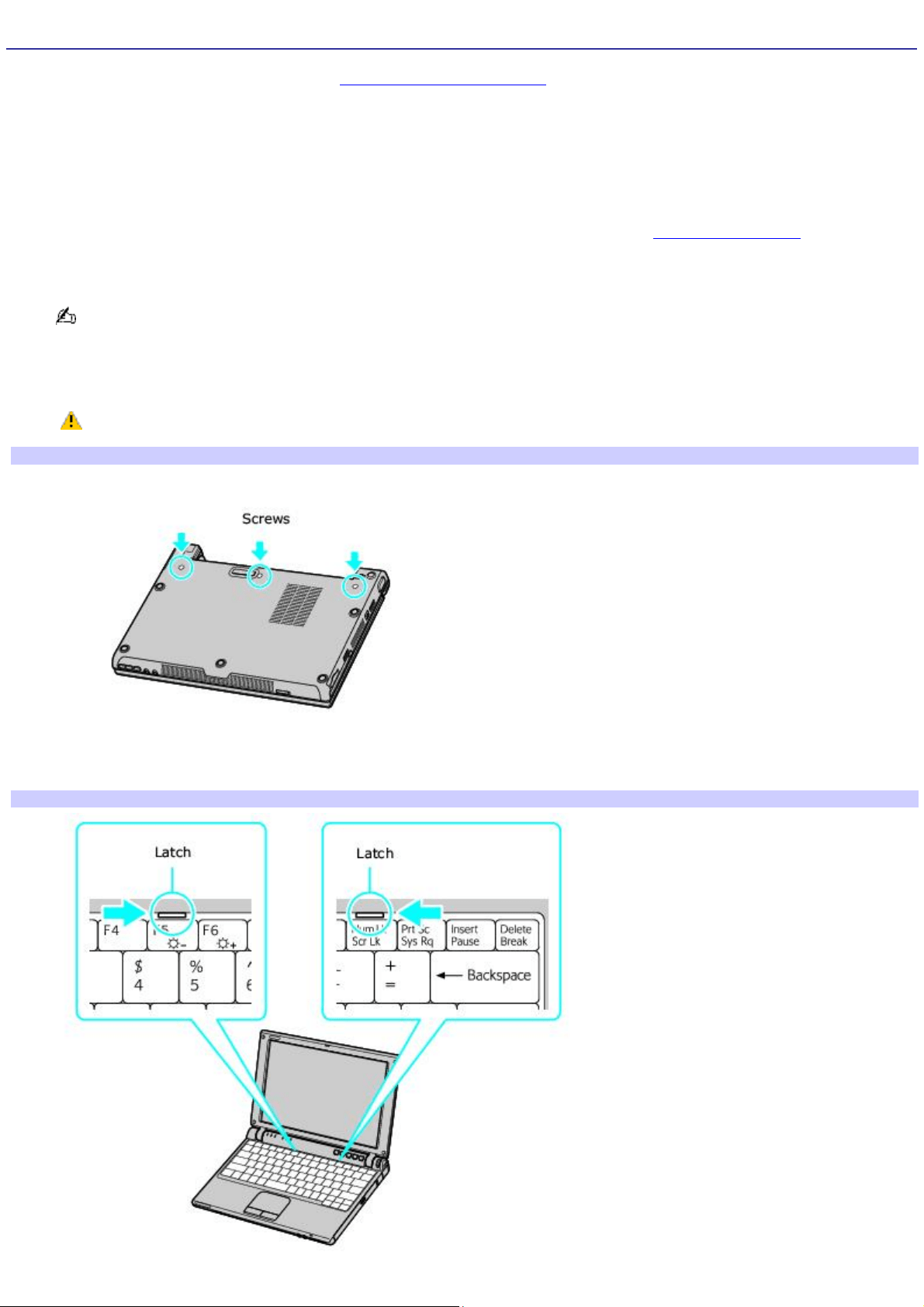
Removing and installing memory modules
Make sure you read the safety information in Precautions and Procedures before you remove or install a memory module.
When installing a memory module, do not open the module package until you are ready to install it. The package protects
the module from Electrostatic discharge (ESD).
To remove a memory module
1.
Turn off the computer and all attached devices.
2.
Disconnect the power cord, all cables, and remove the battery if it is installed. See Removing a battery.
3.
Wait for the computer to cool down.
The interior of the computer becomes extremely hot during operation. Wait at least one hour for the computer to
cool down before you remove the screws.
4.
Turn the computer over and use a screwdriver to loosen and remove the screws on the bottom of the computer.
To avoid damaging the computer, do not remove or loosen any other screws.
Removing the Bottom Screws
5.
Turn the computer over carefully so you are facing the keyboard, and use a small screwdriver to loosen the two
latches at the top of the keyboard.
Loosening Keyboard Latches
6.
Gently lift the keyboard away from the computer. If you need to, use a tool such as a screwdriver to help lift the
Page 135
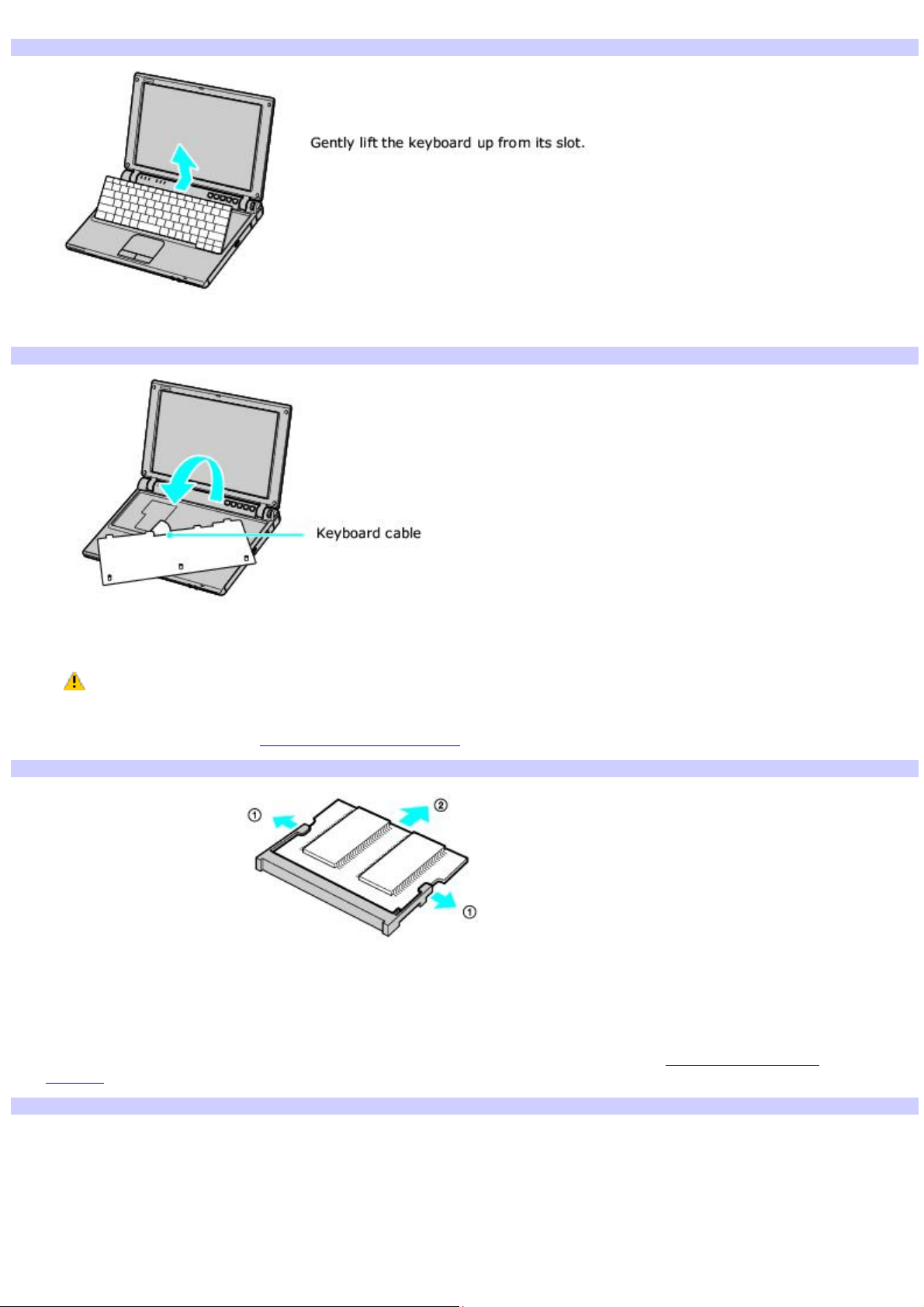
keyboard.
Lifting the Keyboard
7.
Place the keyboard down over the front face of the computer, taking care not to damage the keyboard cable.
Placing the Keyboard over the Com puter
8.
Touch a metal object (such as the connector panel on the back of your computer) to discharge static electricity.
Avoid touching any part of the motherboard or other components inside the computer.
9.
Remove the memory module by pulling out the tabs (see arrows No. 1), and pulling out the module in the
direction of arrow No. 2. See To install a memory module for more information.
Removing a Mem ory Module
To install a memory module
1.
Remove the new memory module from its packaging.
2.
Install the memory module by sliding it into the open bay at a 45-degree angle. See To remove a memory
module. Align the grooves on the memory module with the grooves in the bay.
Installing a New Memory Module
Page 136
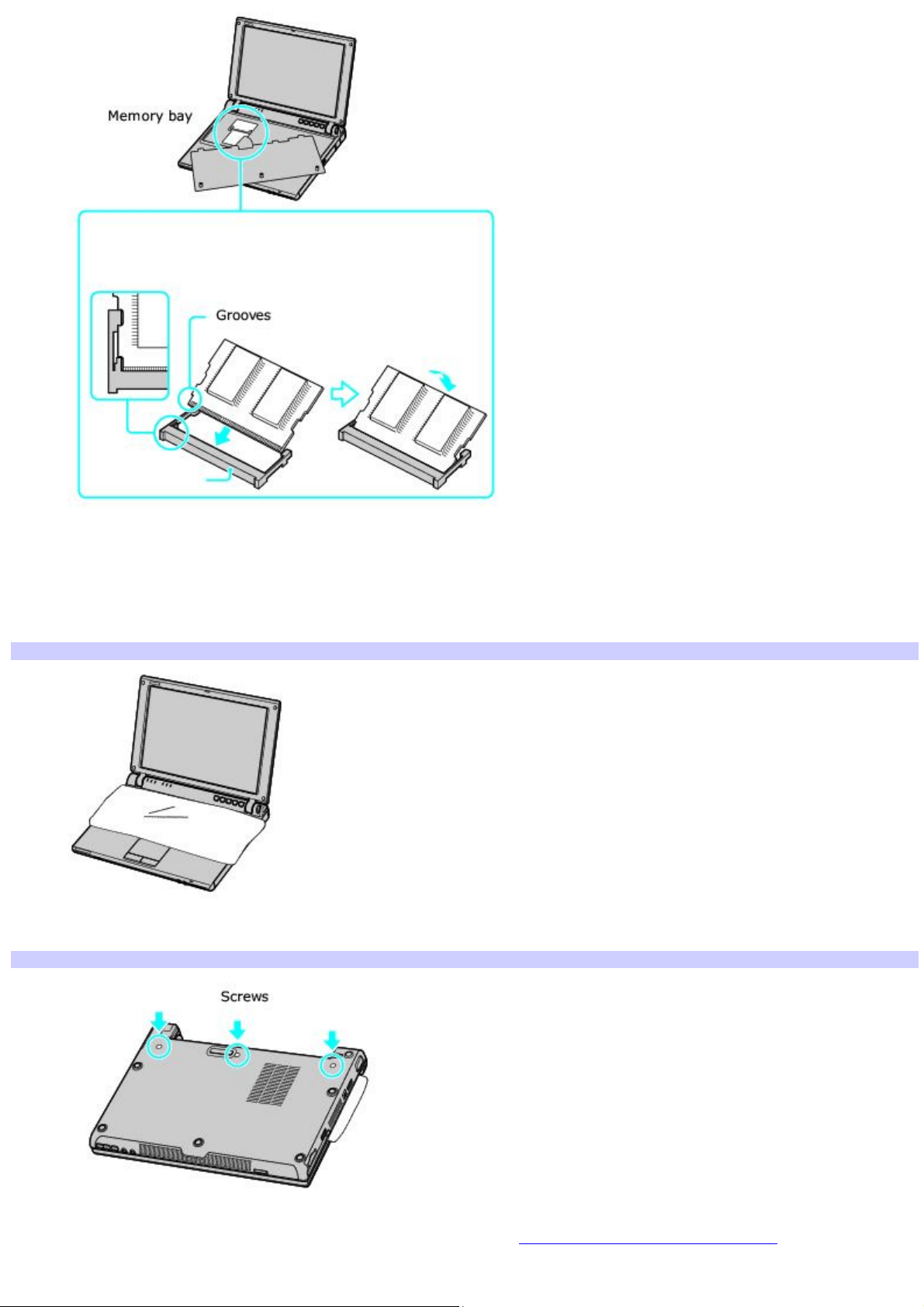
3.
Push the module down until it snaps into the slot.
4.
When the module is correctly seated in the slot, close the memory bay and reseat the keyboard in its place. You
may need to gently press the top keys of the keyboard in order to reseat the keyboard.
5.
Place a protective sheet over the keyboard, then turn the computer over.
Placing a Sheet Protector over Keyboard
6.
Replace the three bottom screws and tighten.
Replace the Bottom Screws
7.
Make sure the system recognizes the new memory module. See Confirming Added Memory Capacity for more
information.
Page 137
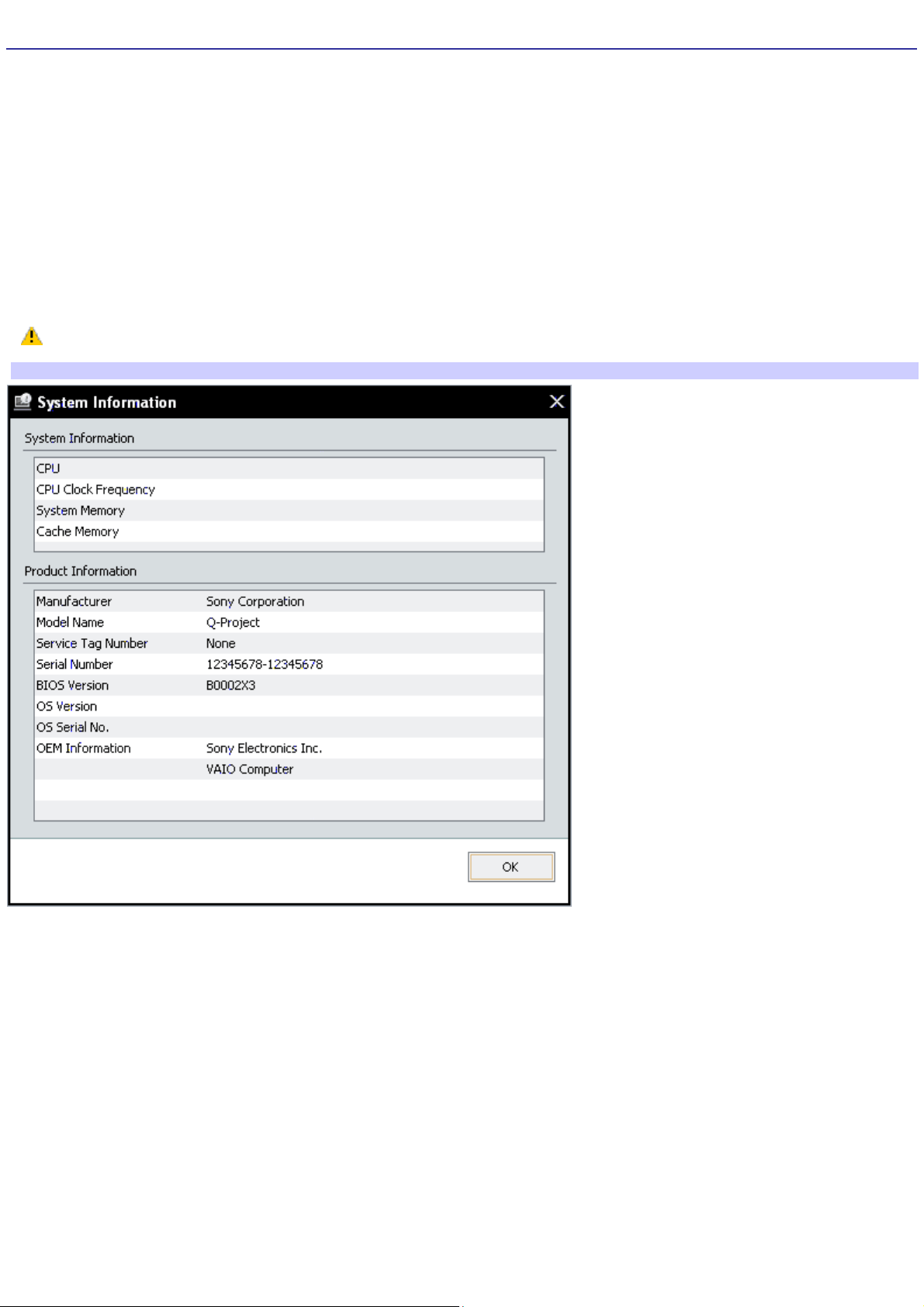
Confirming Added Memory Capacity
After you have installed a new memory module, make sure the operating system recognizes it.
To check your system's memory
1.
Turn on the computer.
2.
Click Start on the Windows
®
taskbar, point to All Programs, and then click VAIO Control Center.
3.
Select the List tab, and double-click System Information. The System Information dialog box appears.
4.
Make sure the System Memory displayed in the System Information box matches the amount of memory
installed.
The displayed memory may be less than the installed memory due to the amount used by the display adapter.
System Inform ation
Page 138

Troubleshooting
Computer
What do I do if my computer won't start?
Make sure the computer is securely plugged into a power source and turned on. Make sure the power indicator
shows the power is on.
Make sure the battery is inserted properly and charged.
Make sure the floppy disk drive (if applicable) is empty.
If the computer is plugged into a power strip or uninterruptible power supply (UPS), make sure the power strip or
UPS is turned on and working.
If you are using an external display, make sure it is plugged into a power source and turned on. Make sure the
brightness and contrast controls are adjusted correctly. See the guide that came with your display for details.
Disconnect the AC adapter and remove the battery. Wait one minute. Reattach the AC adapter and reinsert the
battery. Turn on the power.
Condensation may cause the computer to malfunction. If this occurs, do not use the computer for at least one hour.
If the computer still does not turn on, follow these steps:
1.
Unplug the power cord and remove the battery.
2.
Reinsert the power cord and the battery.
3.
Turn on the computer.
For further instructions, contact Sony Computing Support (http://www.sony.com/pcsupport).
Page 139

Troubleshooting
Computer
What do I do if my computer won't start?
Make sure the computer is securely plugged into a power source and turned on. Make sure the power indicator
shows the power is on.
Make sure the battery is inserted properly and charged.
Make sure the floppy disk drive (if applicable) is empty.
If the computer is plugged into a power strip or uninterruptible power supply (UPS), make sure the power strip or
UPS is turned on and working.
If you are using an external display, make sure it is plugged into a power source and turned on. Make sure the
brightness and contrast controls are adjusted correctly. See the guide that came with your display for details.
Disconnect the AC adapter and remove the battery. Wait one minute. Reattach the AC adapter and reinsert the
battery. Turn on the power.
Condensation may cause the computer to malfunction. If this occurs, do not use the computer for at least one hour.
If the computer still does not turn on, follow these steps:
1.
Unplug the power cord and remove the battery.
2.
Reinsert the power cord and the battery.
3.
Turn on the computer.
For further instructions, contact Sony Computing Support (http://www.sony.com/pcsupport).
Page 140

Troubleshooting
Computer
What do I do if my computer won't start?
Make sure the computer is securely plugged into a power source and turned on. Make sure the power indicator
shows the power is on.
Make sure the battery is inserted properly and charged.
Make sure the floppy disk drive (if applicable) is empty.
If the computer is plugged into a power strip or uninterruptible power supply (UPS), make sure the power strip or
UPS is turned on and working.
If you are using an external display, make sure it is plugged into a power source and turned on. Make sure the
brightness and contrast controls are adjusted correctly. See the guide that came with your display for details.
Disconnect the AC adapter and remove the battery. Wait one minute. Reattach the AC adapter and reinsert the
battery. Turn on the power.
Condensation may cause the computer to malfunction. If this occurs, do not use the computer for at least one hour.
If the computer still does not turn on, follow these steps:
1.
Unplug the power cord and remove the battery.
2.
Reinsert the power cord and the battery.
3.
Turn on the computer.
For further instructions, contact Sony Computing Support (http://www.sony.com/pcsupport).
Page 141

What do I do if a BIOS error appears when my computer starts?
If the message "Press <F1> to resume, <F2> to setup" appears at the bottom of the screen, follow these steps:
1.
Press the F2 key. The BIOS Setup menu appears.
2.
Set the date (month/day/year). Press Enter.
3.
Press the Down Arrow key to select System Time, and then set the time (hour: minute: second). Press
Enter.
4.
Press the Right Arrow key to select the Exit tab, and then press the Down Arrow key to select Get
Default Values. The message Load default values for all SETUP items. appears.
5.
Press the Enter key. The Setup Confirmation window appears.
6.
Select Yes, and press Enter.
7.
Select Exit (Save Changes), and press Enter. The Setup Confirmation window appears.
8.
Select Yes, and press Enter. The computer restarts.
If this occurs on a regular basis, contact Sony Computing Support (http://www.sony.com/pcsupport).
Page 142

What do I do if the message "Operating system not found" appears when my computer starts, and why
won't Windows start?
Make sure the computer does not have a "non-bootable" floppy disk in the floppy disk drive (if applicable).
If a non-bootable floppy disk is in the drive:
1.
Remove the floppy disk.
2.
Restart the computer and confirm that the Microsoft
®
Windows
®
operating system starts properly.
If the Windows operating system still does not start, follow these steps to initialize the BIOS:
1.
If there is a disk in the floppy disk drive, then remove it.
2.
Turn off the computer.
3.
Remove any peripheral devices connected to the computer.
4.
Restart the computer.
5.
Press the F2 key when the Sony logo appears. The BIOS Setup window appears.
6.
Press the Right Arrow key to select the Exit menu.
7.
Press the Down Arrow key to select Get Default Values. The message Load default values for all
SETUP items. appears.
8.
Press the Enter key. The Setup Confirmation window appears.
9.
Select Yes, and press Enter.
10.
Select Exit (Save Changes), and press Enter. The Setup Confirmation window appears.
11.
Select Yes, and press Enter. The computer restarts.
Page 143

What do I do if my computer stops responding?
It is best to turn off your computer using the Turn Off Computer option on the Microsoft
®
Windows
®
Start menu, located on
the taskbar. Using other methods, including those listed below, may result in loss of unsaved data.
Click Start on the Windows
®
taskbar, select Turn Off Computer, and then click Turn Off.
If your computer does not turn off, press the Ctrl+Alt+Delete keys simultaneously. When the Windows Task
Manager dialog box appears, click Turn Off from the Shut Down menu.
If your computer still does not turn off, press and hold the power button or slide and hold the power switch until the
computer turns off.
If your computer stops responding while playing a CD or DVD, press the Ctrl+Alt+Delete keys simultaneously. You
can turn off the computer from the Windows Task Manager.
Pressing the Ctrl+Alt+Delete keys simultaneously or turning off the computer with the power button or switch
may cause loss of data.
Remove the AC adapter and battery.
Page 144

Why won't my computer enter Standby or Hibernate mode?
Your computer may become unstable if the operating mode is changed before the computer completely enters Standby or
Hibernate.
To restore the computer to normal operating stability:
1.
Close all open programs.
2.
Restart the computer. Follow these steps:
1.
Press the Windows key .
2.
Press U.
3.
Press R to select restart.
3.
If the computer does not restart, follow these steps:
1.
Press the Ctrl+Alt+Delete keys simultaneously. The Windows Task Manager window appears.
2.
Press and release Alt to highlight the menu bar, and press the Right Arrow key to select Shut
Down.
3.
Press Enter.
4.
Press R to select restart.
4.
If this procedure does not work, press and hold the power button or slide and hold the power switch until the
computer turns off.
Page 145

Why is the sound of my computer's fan so loud?
The computer's fan may be running at a high speed to cool the CPU. By lowering the CPU speed, you also lower the speed
and noise level of the computer's fan.
To lower the CPU speed using the power schemes:
1.
Click Start on the Windows
®
taskbar, and click Control Panel.
2.
Click Performance and Maintenance, and click Power Options. The Power Options Properties window
appears.
3.
Select Portable/Laptop in the Power schemes box.
4.
Click Apply.
5.
Click OK.
Page 146

Why does the System Properties dialog box display a slower CPU speed than the maximum?
This is normal. Because your computer's CPU utilizes a type of CPU speed controlling technology for power conservation
purposes, System Properties may display the CPU's current speed instead of the maximum speed.
Page 147

Why don't my changes appear on the computer screen (LCD)?
You may need to refresh the computer screen. Press and hold the Windows key , and press D twice.
Page 148

System Security
This section provides information about keeping your computer operating smoothly and protecting against potential threats
to your computer's security.
How can I protect my computer against security threats, such as viruses?
The Microsoft
®
Windows
®
operating system is preinstalled on your computer. The best way to protect your computer against
security threats, such as viruses, is to download and install the latest Windows updates regularly.
You can get important Windows updates by doing one of the following:
The Automatic Updates feature — This feature automatically searches for and delivers updates directly to your
computer whenever you are connected to the Internet.
The Windows Updates Web site — This site enables you to download computer updates without turning on the
Automatic Updates feature.
Your computer must be connected to the Internet before you can receive updates.
To use the Automatic Updates feature
1.
Click Start on the Windows
®
taskbar, and click Control Panel.
2.
Click Security Center. The Windows Security Center window appears.
3.
Click Automatic Updates. The Automatic Updates dialog box appears.
4.
Select to set up automatic or scheduled updates, and click OK.
To visit the Windows Updates Web site
1.
Connect to the Internet.
2.
Type http://windowsupdate.microsoft.com/ in the address bar of your browser.
The Microsoft Windows Update and Security Warning windows appear.
3.
In the Security Warning window, click Yes to install and run Windows Update.
4.
In the Microsoft Windows Update window, click Scan for updates, and follow the on-screen instructions.
Page 149

System Security
This section provides information about keeping your computer operating smoothly and protecting against potential threats
to your computer's security.
How can I protect my computer against security threats, such as viruses?
The Microsoft
®
Windows
®
operating system is preinstalled on your computer. The best way to protect your computer against
security threats, such as viruses, is to download and install the latest Windows updates regularly.
You can get important Windows updates by doing one of the following:
The Automatic Updates feature — This feature automatically searches for and delivers updates directly to your
computer whenever you are connected to the Internet.
The Windows Updates Web site — This site enables you to download computer updates without turning on the
Automatic Updates feature.
Your computer must be connected to the Internet before you can receive updates.
To use the Automatic Updates feature
1.
Click Start on the Windows
®
taskbar, and click Control Panel.
2.
Click Security Center. The Windows Security Center window appears.
3.
Click Automatic Updates. The Automatic Updates dialog box appears.
4.
Select to set up automatic or scheduled updates, and click OK.
To visit the Windows Updates Web site
1.
Connect to the Internet.
2.
Type http://windowsupdate.microsoft.com/ in the address bar of your browser.
The Microsoft Windows Update and Security Warning windows appear.
3.
In the Security Warning window, click Yes to install and run Windows Update.
4.
In the Microsoft Windows Update window, click Scan for updates, and follow the on-screen instructions.
Page 150

How do I keep my preinstalled antivirus software updated?
You can keep the preinstalled Norton Internet Security software program current with the latest updates from Symantec
Corporation.
To download and install the latest security update
1.
Double-click the Norton Internet Security icon in the Taskbar notification area.
If you have not previously registered the antivirus software, a series of information wizards appear.
1.
Follow the on-screen instructions to complete each wizard
2.
Double-click the Norton Internet Security icon again.
The Norton Internet Security window appears.
If you have previously registered this antivirus software, the Norton Internet Security window automatically
appears.
2.
Click Live Update, located near the top of the window.
3.
Follow the on-screen instructions to select and download updates.
Page 151



When is the computer using AC power?
When the computer is directly connected to the AC adapter, it uses AC power, even if a battery is installed.
Page 154

When should I recharge the battery?
When the battery level falls below 10 percent.
When both the battery and power indicators blink.
When you have not used the battery for a long time.
Page 155

When should I replace the battery?
If the battery power is still low after charging it, the battery may be reaching the end of its life and should be replaced.
Page 156

Should I be concerned that the installed battery is warm?
No, it is normal for the battery to be warm when it is powering the computer.
Page 157

Can my computer enter Hibernate mode while using battery power?
Your computer can enter Hibernate mode while using battery power, but some software programs and peripheral devices
prevent the system from entering Hibernate mode. If you are using a program that prevents the system from entering
Hibernate mode, save your data frequently to avoid losing data. See To activate Hibernate mode for information on how
you can manually activate Hibernate mode.
Page 158

Why doesn't my computer enter Hibernate mode?
You may first need to enable Hibernate mode. Follow these steps:
1.
Click Start on the Windows
®
taskbar, and click Control Panel.
2.
Click Performance and Maintenance, and click Power Options. The Power Options Properties window
appears.
3.
Select the Hibernate tab.
4.
Click to check the box next to Enable hibernation.
Page 159

Internet
Why doesn't my modem work?
Make sure the telephone cable is securely plugged into the Modem jack on the computer and the wall jack.
Make sure the telephone cable is working. Plug the cable into an ordinary telephone and listen for a dial tone.
Make sure the telephone number the program is dialing is correct.
Make sure the software you are using is compatible with the computer's modem. (All preinstalled Sony programs are
compatible.)
Page 160

Internet
Why doesn't my modem work?
Make sure the telephone cable is securely plugged into the Modem jack on the computer and the wall jack.
Make sure the telephone cable is working. Plug the cable into an ordinary telephone and listen for a dial tone.
Make sure the telephone number the program is dialing is correct.
Make sure the software you are using is compatible with the computer's modem. (All preinstalled Sony programs are
compatible.)
Page 161

Why is my modem connection slow?
Your computer is equipped with a V.90 compatible modem. Many factors may influence modem connection speed, including
telephone line noise or compatibility with telephone equipment, such as fax machines or other modems. If you think your
modem is not connecting properly to other PC-based modems, fax machines, or your Internet Service Provider (ISP), follow
these steps:
Ask your telephone company to verify your telephone line is free of any line noise.
If your problem is fax-related, make sure there are no problems with the fax machine you are calling and that it is
compatible with fax modems.
If you are having a problem connecting with your ISP, make sure the ISP is not experiencing technical problems.
If you have a second telephone line, try connecting the modem to that line.
Page 162

Networking
Why can't my computer connect to a wireless LAN access point?
Connection availability is affected by distance and obstructions. You may need to move your computer away from
obstructions or closer to any access point you may be using.
Make sure the Wireless switch on the computer is on.
Make sure power to the access point is on.
Make sure the access point is displayed in the Available networks window.
Make sure the encryption key is correct.
Page 163

Networking
Why can't my computer connect to a wireless LAN access point?
Connection availability is affected by distance and obstructions. You may need to move your computer away from
obstructions or closer to any access point you may be using.
Make sure the Wireless switch on the computer is on.
Make sure power to the access point is on.
Make sure the access point is displayed in the Available networks window.
Make sure the encryption key is correct.
Page 164

Why can't I access the Internet?
Check the access point settings. Refer to the instructions supplied with the access point.
Make sure your computer and the access point are connected to one another.
Move your computer away from obstructions or closer to any access point you may be using.
Make sure your computer is properly configured for Internet access.
Page 165

Why is the data transfer speed slow?
The wireless LAN data transfer speed is affected by distance and obstructions between devices and access points.
Other factors include device configurations, radio conditions, and software compatibility. To maximize the data
transfer speed, move your computer away from obstructions or closer to any access point you may be using.
If you are using a wireless LAN access point, the device may be temporarily overloaded depending on how many
other devices are communicating via the access point.
If your access point interferes with other access points, change the access point channel. See your access point
instructions for more information.
Page 166

Why is the communication speed interrupted or slowed down when MPEG2 data is transferred?
The typical effective data transfer speed via an access point is 4-5 Mbps when adhering to the IEEE 802.11b standard or
both the IEEE 802.11b and IEEE 802.11g standards (selected models only). High-rate stream transfers with MPEG2 data
may lower this rate.
Page 167

How do I avoid data transfer interruptions?
When your computer is connected to an access point, data transfer interruptions may occur when using large files
or if the computer is in close proximity to microwaves and cordless telephones.
Move the computer closer to the access point.
Make sure the access point connection is intact.
Change the access point channel. See your access point instructions for more information.
Page 168

Can I connect to an IEEE 802.11a device?
Computers with built-in wireless LAN support only the IEEE 802.11b and IEEE 802.11g standards (selected models only).
Devices connecting to a wireless LAN using the IEEE 802.11a standard cannot connect to devices using the IEEE 802.11b/g
standard.
Page 169

What are channels?
Wireless LAN communication occurs on divided frequency bands known as channels. Third-party wireless LAN access point
channels may be preset to different channels from Sony devices.
If you are using a wireless LAN access point, refer to connectivity information contained in your access point instructions.
Page 170

When I change the encryption key, the network connection stops. What do I do?
Two computers with built-in wireless LAN may loose a peer-to-peer network connection if the encryption keys of both
computers no longer match. You can either change both the encryption keys back to the original profile or, if you have not
saved changes to the original profile, you can restart both computers.
Page 171

Bluetooth Technology
Why can't other Bluetooth devices discover my computer?
Make sure both devices have the Bluetooth
®
feature enabled.
Your computer and the device may be too far apart or the connection may be obstructed. Wireless Bluetooth
technology works best when the devices are within 32 feet (10 meters) of each other.
The discovery option on your computer may be disabled. To ensure the discovery option is available, follow these
steps:
1.
From the Start menu, click Control Panel.
2.
Click Printers and Other Hardware, and then click Bluetooth Devices.
The Bluetooth Devices window appears.
3.
On the Options tab, click to select the Turn discovery on check box.
4.
Click OK.
Page 172

Bluetooth Technology
Why can't other Bluetooth devices discover my computer?
Make sure both devices have the Bluetooth
®
feature enabled.
Your computer and the device may be too far apart or the connection may be obstructed. Wireless Bluetooth
technology works best when the devices are within 32 feet (10 meters) of each other.
The discovery option on your computer may be disabled. To ensure the discovery option is available, follow these
steps:
1.
From the Start menu, click Control Panel.
2.
Click Printers and Other Hardware, and then click Bluetooth Devices.
The Bluetooth Devices window appears.
3.
On the Options tab, click to select the Turn discovery on check box.
4.
Click OK.
Page 173

Why can't other Bluetooth devices connect to my computer?
Make sure the other device is authenticated. For more information, see Bluetooth Connections.
Your computer may not allow connections from other devices. To enable Bluetooth device connections, follow these
steps:
1.
From the Start menu, click Control Panel.
2.
Click Printers and Other Hardware, and then click Bluetooth Devices.
The Bluetooth Devices window appears.
3.
On the Options tab, click to select the Allow Bluetooth devices to connect to this computer check box.
4.
Click OK.
Page 174

How will I know when another Bluetooth device is requesting authentication?
A notification prompt appears on the Windows
®
taskbar. To verify the notification feature is enabled, follow these steps:
1.
From the Start menu, click Control Panel.
2.
Click Printers and Other Hardware, and then click Bluetooth Devices.
The Bluetooth Devices window appears.
3.
On the Options tab, click to select the Alert me when a new Bluetooth device wants to connect check box.
4.
Click OK.
Page 175

Why is my Bluetooth connection slow?
The 2.4 GHz radio frequency used by Bluetooth and wireless LAN devices is also used by other devices. Bluetooth
devices incorporate technology that minimizes interference from other devices using the same wavelength, but
communication speed and connection range may be reduced. Interference from other devices may also stop
communication altogether.
Connection availability is affected by distance and obstructions. You may need to move your computer away from
obstructions or closer to the device to which it is connected.
Identify and remove obstacles between your computer and the device to which it is connected.
Please note that due to limitations of the Bluetooth standard, large files may occasionally be corrupted during
continuous transfer due to electromagnetic interference from the environment.
Page 176

Can I use a device equipped with Bluetooth technology on airplanes?
With Bluetooth technology, your computer transmits a radio frequency of 2.4 GHz. Sensitive locations, such as hospitals and
airplanes, may have restrictions on the use of Bluetooth devices, due to radio interference. Check with facility staff to verify
that use of the Bluetooth feature on your computer is permitted.
Page 177

CDs and DVDs
How do I maintain CDs and DVDs?
Avoid touching the surface of the disc with your fingers. Fingerprints and dust on the surface of the disc may cause
reading errors.
Try using canned compressed air to clean dusty discs.
Do not clean the disc with solvents (such as benzine, thinner, alcohol, commercially available cleaners, or anti-static
spray), which may damage the disc. To clean the disc, follow these steps:
1.
Hold the edge of the disc, and use a soft cloth to wipe the surface from the center out.
2.
If the disc is badly soiled, moisten a soft cloth with water, wring it out well, and use it to wipe the surface
of the disc from the center out.
3.
Wipe off any remaining moisture with a dry, soft cloth.
Do not drop or bend the disc.
Page 178

CDs and DVDs
How do I maintain CDs and DVDs?
Avoid touching the surface of the disc with your fingers. Fingerprints and dust on the surface of the disc may cause
reading errors.
Try using canned compressed air to clean dusty discs.
Do not clean the disc with solvents (such as benzine, thinner, alcohol, commercially available cleaners, or anti-static
spray), which may damage the disc. To clean the disc, follow these steps:
1.
Hold the edge of the disc, and use a soft cloth to wipe the surface from the center out.
2.
If the disc is badly soiled, moisten a soft cloth with water, wring it out well, and use it to wipe the surface
of the disc from the center out.
3.
Wipe off any remaining moisture with a dry, soft cloth.
Do not drop or bend the disc.
Page 179

Why does my computer freeze when I try to read a disc?
The disc your computer is trying to read may be dirty or damaged. Follow these steps:
1.
Restart the computer by clicking Start, Turn Off Computer, and Restart.
2.
Eject the disc from the optical drive.
3.
Examine the disc for dirt or damage. If the disc is dirty, see How do I maintain CDs and DVDs? for
instructions on how to clean it.
Page 180

What do I do if the drive tray won't open?
Make sure the computer is on.
Press the Eject button on the optical drive.
If the Eject button does not work, click Start on the Windows
®
taskbar, and click My Computer. Right click the optical
drive icon, and select Eject from the shortcut menu.
If none of the above options work, insert a thin, straight object (such as a paper clip) in the manual eject hole near
the Eject button.
Page 181

What do I do if the optical drive isn't playing my CD or DVD properly?
Make sure the disc was inserted into the drive with the label facing up.
Make sure the necessary program(s) is installed according to the manufacturer's instructions.
If the CD or DVD is dirty or damaged, the computer will stop responding. Follow these steps:
1.
Restart the computer by pressing the Ctrl+Alt+Delete keys, and selecting Restart from the Shut Down
menu of the Windows Task Manger dialog box.
2.
Remove the CD or DVD from the optical drive.
3.
Check the disc for dirt or damage. If you need to clean the disc, see How do I maintain CDs and DVDs?
for instructions.
If you are playing a CD or DVD and cannot hear sound, follow these steps:
1.
Double-click the Volume icon on the Taskbar Notification area, and click to cancel the Volume Control
Mute All and Wave Mute check boxes.
2.
Check the volume setting in the audio mixer.
3.
If you are using external speakers, check the volume settings on the speakers and the connections
between the speakers and the computer.
4.
Make sure the CD audio feature is enabled and the correct driver software is installed. Follow these steps:
1.
Click Start on the Windows
®
taskbar, click Control Panel, Performance and Maintenance, and
System. The System Properties window appears.
2.
Select the Hardware tab, and click Device Manager in the Device Manager box. A window with a
listing of the computer's hardware devices appears.
If an "X" or an exclamation point appears on the listed device, you may need to enable the device or
reinstall the drivers.
3.
Double-click the optical drive device to open the submenu.
4.
Double-click the listed drive, and select the Properties tab.
5.
Click to select the Enable digital CD audio for this CD-ROM device check box, if it is not
selected.
6.
Click OK.
To reinstall the driver software, continue with the following steps:
7.
Double-click the optical drive device to open the submenu.
8.
Double-click the listed drive, and select the Properties tab.
9.
Select the Driver tab and click Update Driver. Follow the steps provided by the Hardware
Update Wizard.
Make sure an adhesive label was not attached to the CD or DVD. Adhesive labels can come off while the disc is in
the optical drive and damage the drive or cause it to malfunction.
If a region code warning appears, the disc may be incompatible with the optical drive. Check the DVD package to
make sure the region code is compatible with the optical drive.
If you notice condensation on the computer, do not use the computer for at least one hour. Condensation can
cause the computer to malfunction.
Page 182

Why did the computer screen (LCD) go blank?
Your computer screen may go blank if the computer has lost power or has entered a power saving mode (Standby
or Hibernate). If the computer is in LCD (Video) Standby mode, press any key to activate the computer screen. See
Using power saving modes for more information.
Make sure the computer is plugged into a power source and is on. The power indicator on the computer will be on if
the computer is on.
If your computer is using battery power, make sure the battery is inserted properly and is charged. See Using the
Battery for more information.
If the display mode is set to external display, use the Fn+F7 key combination. See Selecting a display for more
information.
Page 183

Why can't I view the entire DVD video display on the external display?
The display resolution may not be properly set. To adjust the display resolution, see Selecting a display for more
information. It is recommended that you adjust the display resolution to 1024 x 768 or smaller, depending on the size of
the external display screen.
Page 184

How do I adjust the image on the external display?
Use the controls on your external display to adjust the image. See the help guide that accompanied your display for more
information.
Page 185

How do I change the video resolution on the external display?
The video may not appear on the entire screen if your computer resolution is set larger than 1024 x 768. Adjust the video
resolution to 1024 x 768 or smaller.
To change the video resolution, follow these instructions:
1.
Right-click the desktop, and select Properties from the shortcut menu. The Display Properties dialog box
appears.
2.
Select the Settings tab.
3.
Move the screen resolution slider to the left to reduce the size and to the right to increase the size of the video
resolution.
Page 186

Printing
Why can't I print a document?
Make sure the printer is on, and the printer cable is securely connected to the ports on your printer and computer.
Make sure the printer is compatible with the Microsoft
®
Windows
®
operating system installed on your computer.
You may need to install the printer driver software before you use the printer. See the guide that accompanied the
printer for more information.
If the printer is not functioning after the computer resumes from a power saving mode (Standby or Hibernate), then
restart the computer.
If the bidirectional communication functions are provided with your printer, disabling the functions on your computer
may enable printing. Follow these steps:
1.
Click Start, and then Control Panel.
2.
Click Printers and Other Hardware.
3.
Click Printers and Faxes.
4.
Right-click an unused printer and select Properties.
5.
Click the Ports tab.
6.
Click to cancel the Enable bidirectional support check box.
7.
Click OK.
This change to the settings disables the bidirectional communication functions of your printer, such as data
transfer, status monitoring, and remote panel.
Page 187

Printing
Why can't I print a document?
Make sure the printer is on, and the printer cable is securely connected to the ports on your printer and computer.
Make sure the printer is compatible with the Microsoft
®
Windows
®
operating system installed on your computer.
You may need to install the printer driver software before you use the printer. See the guide that accompanied the
printer for more information.
If the printer is not functioning after the computer resumes from a power saving mode (Standby or Hibernate), then
restart the computer.
If the bidirectional communication functions are provided with your printer, disabling the functions on your computer
may enable printing. Follow these steps:
1.
Click Start, and then Control Panel.
2.
Click Printers and Other Hardware.
3.
Click Printers and Faxes.
4.
Right-click an unused printer and select Properties.
5.
Click the Ports tab.
6.
Click to cancel the Enable bidirectional support check box.
7.
Click OK.
This change to the settings disables the bidirectional communication functions of your printer, such as data
transfer, status monitoring, and remote panel.
Page 188

Microphone
Why doesn't my microphone work?
If you are using an external microphone, make sure the microphone is turned on and is properly plugged into the
Microphone jack on the computer. See Connecting a microphone for more information. If the microphone is
battery-powered, make sure the batteries are correctly installed.
Page 189

Microphone
Why doesn't my microphone work?
If you are using an external microphone, make sure the microphone is turned on and is properly plugged into the
Microphone jack on the computer. See Connecting a microphone for more information. If the microphone is
battery-powered, make sure the batteries are correctly installed.
Page 190

Mouse
What do I do if the computer doesn't recognize the mouse?
Make sure the mouse is securely plugged into the port.
Restart the computer with the mouse connected to the computer.
Page 191

Mouse
What do I do if the computer doesn't recognize the mouse?
Make sure the mouse is securely plugged into the port.
Restart the computer with the mouse connected to the computer.
Page 192

What do I do if the pointer doesn't move when I use the mouse?
Make sure another mouse is not installed.
If you are playing a disc, press the Ctrl+Alt+Delete keys simultaneously to stop playback and restart the computer.
If you still cannot use the pointer, restart the computer. You can restart the computer three different ways:
Press the Windows key , and press U. When the Turn Off Computer window appears, press R.
Press the Ctrl+Alt+Delete keys simultaneously. When the Windows Task Manager window appears, press
the Alt key to highlight the menu bar, and press the Right Arrow key to select Shut Down. Press Enter,
and then press R.
Press and hold the power button. When the computer turns off, press the power button again to restart the
computer.
Page 193

Speakers
Why won't my speakers work?
Make sure the speakers are properly connected and the volume is turned up loud enough to hear sound.
Make sure the speaker volume is not muted and is loud enough to hear sound.
Your speakers may not be designed for computer use.
If the speakers have a mute button, set the button to off.
If the speakers have a volume control, make sure the volume is turned up loud enough to hear sound.
If you have connected an audio cable to the Headphones jack, disconnect the cable and use the speaker cable that
was supplied with the speakers.
If you are using battery power, make sure the battery is inserted properly and is charged.
If the speakers require external power, make sure the speakers are connected to a power source. See the guide
that accompanied the speakers for more information.
Page 194

Speakers
Why won't my speakers work?
Make sure the speakers are properly connected and the volume is turned up loud enough to hear sound.
Make sure the speaker volume is not muted and is loud enough to hear sound.
Your speakers may not be designed for computer use.
If the speakers have a mute button, set the button to off.
If the speakers have a volume control, make sure the volume is turned up loud enough to hear sound.
If you have connected an audio cable to the Headphones jack, disconnect the cable and use the speaker cable that
was supplied with the speakers.
If you are using battery power, make sure the battery is inserted properly and is charged.
If the speakers require external power, make sure the speakers are connected to a power source. See the guide
that accompanied the speakers for more information.
Page 195

Why can't I hear sound from my speakers?
If the computer is using battery power, make sure the battery is properly inserted and is charged.
Make sure the speaker volume is not muted and is loud enough to hear sound.
Make sure the sound feature on your computer is enabled. See Enabling the sound for more information.
If you are using a program that has its own volume control, make sure the volume control is properly set. See that
program's help guide for more information.
Page 196

Touch pad
What do I do if the touch pad does not work?
Try restarting your computer. Follow these steps:
1.
Press the Windows key .
2.
Press U. The Turn off computer window opens.
3.
Press R to restart the computer.
If the computer does not restart, follow these steps:
1.
Press the Ctrl+Alt+Delete keys simultaneously. The Windows Task Manager window appears.
2.
Press and release Alt to highlight the menu bar, and press the Right Arrow key to select Shut Down
.
3.
Press Enter.
4.
Press R to restart the computer.
If you still cannot restart your computer, press and hold the power button to turn off the computer.
If the pointer does not move while playing a disc, press Ctrl+Alt+Delete simultaneously to stop playback and
restart the computer.
If you are still experiencing problems, make sure another mouse is not installed.
You may have disabled the touch pad without connecting a mouse to the computer. See To enable the touch pad.
Page 197

Touch pad
What do I do if the touch pad does not work?
Try restarting your computer. Follow these steps:
1.
Press the Windows key .
2.
Press U. The Turn off computer window opens.
3.
Press R to restart the computer.
If the computer does not restart, follow these steps:
1.
Press the Ctrl+Alt+Delete keys simultaneously. The Windows Task Manager window appears.
2.
Press and release Alt to highlight the menu bar, and press the Right Arrow key to select Shut Down
.
3.
Press Enter.
4.
Press R to restart the computer.
If you still cannot restart your computer, press and hold the power button to turn off the computer.
If the pointer does not move while playing a disc, press Ctrl+Alt+Delete simultaneously to stop playback and
restart the computer.
If you are still experiencing problems, make sure another mouse is not installed.
You may have disabled the touch pad without connecting a mouse to the computer. See To enable the touch pad.
Page 198

How do I change the left and right button assignments?
If your computer is interpreting a single-click as a double-click, you may want to change the button assignments. Follow
these steps:
1.
Click Start on the Windows
®
taskbar and click Control Panel, and then click Printers and Other Hardware and
Mouse. The Mouse Properties dialog box appears with the Buttons tab selected.
2.
Select your preferences in the Button Selection box, and then click Apply to install your settings.
You may need to use the Tab key and the Up Arrow and Down Arrow keys to make your selections.
3.
Click OK to close the window.
Page 199

Floppy Disks
Why doesn't the Safely Remove Hardware icon appear on the taskbar when the drive is connected?
The computer does not recognize the floppy disk drive. First, make sure the USB cable is properly connected to the USB
port. If you need to secure the connection, wait a few moments for the computer to recognize the drive. If the icon still
does not appear, follow these steps:
1.
Close all programs that were accessing the floppy disk drive.
2.
Wait for the LED indicator on the floppy disk drive to turn off.
3.
Push the Eject button, and remove the disk.
4.
Reconnect the floppy disk drive by inserting the USB connector (with the USB icon facing upward) into the USB
port .
5.
Restart the computer by clicking Start on the Windows
®
taskbar, Turn Off Computer, and then Restart.
Page 200

Floppy Disks
Why doesn't the Safely Remove Hardware icon appear on the taskbar when the drive is connected?
The computer does not recognize the floppy disk drive. First, make sure the USB cable is properly connected to the USB
port. If you need to secure the connection, wait a few moments for the computer to recognize the drive. If the icon still
does not appear, follow these steps:
1.
Close all programs that were accessing the floppy disk drive.
2.
Wait for the LED indicator on the floppy disk drive to turn off.
3.
Push the Eject button, and remove the disk.
4.
Reconnect the floppy disk drive by inserting the USB connector (with the USB icon facing upward) into the USB
port .
5.
Restart the computer by clicking Start on the Windows
®
taskbar, Turn Off Computer, and then Restart.
Page 201

Why is the drive unable to write data to a floppy disk?
Make sure the floppy disk is properly inserted in the drive. See Inserting and removing floppy disks for instructions on how
to insert the disk properly.
If the disk is inserted properly and you are still unable to write data to it, the disk may be full or write-protected. You can
either use a floppy disk that is not write-protected or disable the write-protect feature by moving the write-protect tab on
the bottom of the disk to the close position.
Page 202

PC Cards
Why doesn't my PC Card work?
Make sure the PC Card is inserted properly. See Inserting PC Cards for more information.
Make sure the PC Card is compatible with the Microsoft
®
Windows
®
operating system installed on your computer.
See the instructions that accompanied your PC Card. You may need to install driver software if you are not using a
Sony PC Card.
Page 203

PC Cards
Why doesn't my PC Card work?
Make sure the PC Card is inserted properly. See Inserting PC Cards for more information.
Make sure the PC Card is compatible with the Microsoft
®
Windows
®
operating system installed on your computer.
See the instructions that accompanied your PC Card. You may need to install driver software if you are not using a
Sony PC Card.
Page 204

Why doesn't my computer recognize attached devices?
For some PC Cards, if you alternate between normal power operation and the Standby or Hibernate modes while the card
is inserted into the PC Card slot, the computer may not recognize the PC Card or the connected device. Restart your
computer.
Page 205

Why can't I insert my PC Card?
Make sure you are inserting the card correctly. See Inserting PC Cards for more information.
You may not be able to use some PC Cards or some functions of the PC Card with this computer. Check the guide
that accompanied your PC Card for more information on its use.
Why does an exclamation mark (!) appear on the Device Manager tab in the System Properties dialog box?
The exclamation mark indicates there is a problem with the specified device. Make sure all cable and power
connections are secure.
You may not be using the most recent driver software provided by the PC Card manufacturer. Make sure the
necessary drivers are installed. You may need to remove the driver software, and reinstall it.
Page 206

Audio/Video
Why can't I use the DV recorder?
You may not be able to use the DV recorder, and the message DV equipment seems to be disconnected or turned off may
appear because the i.LINK
®1
cable is not securely plugged into the ports on the computer or camera. Unplug the connectors,
and plug them in again. See Using i.LINK Digital Video Recorders for more information.
1
i.LIN K is a trademark of Sony used only to designate that a product c ontains an IE E E 1 3 9 4 c onnection. T he i.LI NK connection may vary, depending on the
software applic ations, operating s ystem, and c ompatible i.LINK devices. A ll products with an i.LI NK connection may not communicate with each other. Refer
to the documentation that c ame with your c ompatible i.LI NK device for information on operating conditions and proper c onnection. Before connecting
compatible i.LINK P C peripherals to your s ystem, s uc h as C D-RW or hard disk drive, c onfirm their operating s ystem c ompatibility and required operating
conditions.
Page 207

Audio/Video
Why can't I use the DV recorder?
You may not be able to use the DV recorder, and the message DV equipment seems to be disconnected or turned off may
appear because the i.LINK
®1
cable is not securely plugged into the ports on the computer or camera. Unplug the connectors,
and plug them in again. See Using i.LINK Digital Video Recorders for more information.
1
i.LIN K is a trademark of Sony used only to designate that a product c ontains an IE E E 1 3 9 4 c onnection. T he i.LI NK connection may vary, depending on the
software applic ations, operating s ystem, and c ompatible i.LINK devices. A ll products with an i.LI NK connection may not communicate with each other. Refer
to the documentation that c ame with your c ompatible i.LI NK device for information on operating conditions and proper c onnection. Before connecting
compatible i.LINK P C peripherals to your s ystem, s uc h as C D-RW or hard disk drive, c onfirm their operating s ystem c ompatibility and required operating
conditions.
Page 208

Memory Stick Media
Why can't I open my image files?
You may need to reformat your Memory Stick
®
media.
Formatting Memory Stick media erases all data, including music data, previously saved to it. Before you
reformat Memory Stick media, back up important data and confirm that the media does not contain files you want to
keep.
1.
Copy the data from the Memory Stick media onto your computer's hard disk to save data or images.
2.
Format the Memory Stick media using Memory Stick Formatter software preinstalled on your computer. For
instructions about formatting a Memory Stick media, see Formatting Memory Stick media.
Page 209

Memory Stick Media
Why can't I open my image files?
You may need to reformat your Memory Stick
®
media.
Formatting Memory Stick media erases all data, including music data, previously saved to it. Before you
reformat Memory Stick media, back up important data and confirm that the media does not contain files you want to
keep.
1.
Copy the data from the Memory Stick media onto your computer's hard disk to save data or images.
2.
Format the Memory Stick media using Memory Stick Formatter software preinstalled on your computer. For
instructions about formatting a Memory Stick media, see Formatting Memory Stick media.
Page 210

Why can't I save music files onto my Memory Stick media?
Copyright protected music cannot be checked out to any Memory Stick media other than MagicGate Memory Stick
media.
Using recorded music requires permission of the copyright holders.
Sony is not responsible for music files that cannot be recorded from a CD or downloaded from other sources.
Page 211

Can I copy images from a digital video camera using Memory Stick media?
Yes, and you can view video clips that you have recorded with Memory Stick media-compatible video camera recorders.
Page 212

How do I prevent damage to the Memory Stick media?
Do not use the media in locations that are subject to static electricity or electrical noise.
Do not touch the media connector with your finger or metallic objects.
Do not attach labels other than the supplied label to a media.
Do not bend, drop, or apply strong shock to the media.
Do not disassemble or modify the media.
Do not allow the media to get wet.
Page 213

How do I extend the life of the Memory Stick media?
Use the supplied storage case. See the instructions that came with your media for more information on its use.
Do not use or store the media in a location that is subject to:
Extremely high temperatures, such as in a car parked in the sun
Direct sunlight
High humidity or places with corrosive substances
Page 214

Support Options
The section contains information on where to go for answers to questions about your VAIO
®
computer and the preinstalled
software.
Page 215

Sony Support Information
Refer to the following sources for answers in the sequence listed below.
1 VAIO
®
Computer Documentation
This on-screen VAIO
®
Computer User Guide and the printed VAIO Computer Quick Start provide detailed information on how
to maximize your computer's capabilities and solve common problems.
2 Program Guides and Help Files
The preinstalled programs on your computer may come with individual help guides. These guides are stored on the hard
disk as on-screen Help files. You can find the Help files from the Help menu under the specific program.
3 Operating System Online Support
Your computer comes preinstalled with a Microsoft
®
Windows
®
operating system. For operating system support, you can visit
Microsoft
®
customer support at: http://support.microsoft.com/directory/.
4 Sony Computing Support
This service provides instant access to information on commonly encountered problems. Type a description of the problem
and the Knowledge Database searches for the corresponding solutions online. You can visit Sony Computing Support at:
http://www.sony.com/pcsupport.
5 VAIO Update
When your computer is connected to the Internet, VAIO Update automatically notifies you when critical software and
security information is posted on the support Web site. Click the VAIO Update notice to open the VAIO Support Web site
and view the information. You can also right-click the VAIO Update icon in the Taskbar Notification area and select Go
to VAIO Web Support to open the support Web site.
Page 216

Program Support Information
Depending on the computer model and particular configuration you purchased, your computer may not include all of the
software programs listed below.
Adobe
®
Photoshop
®
Elements, Photoshop
®
Album, Premiere
®
, Reader
®
Adobe Systems Inc.
Web site http://www.adobe.com/support
Telephone 800-685-3652
America Online
®
(Broadband or Dial-Up)
AOL, Inc.
Web site http://www.aol.com
AOL
®
Instant Messenger
AOL, Inc.
Web site http://www.aim.com
Click to DVD
Sony Electronics Inc.
At the touch of a button, Click to DVD software allows you to automatically burn DVDs from a digital video (DV) device.
Create DVDs by capturing video content straight from a DV device or by importing video from stored files — and you can
also edit the video. Create DVD photo albums and slide shows with picture files or by importing pictures from a digital still
camera. What's more, you can easily give a professional look to your DVDs by adding chapter menus, backgrounds, and
menu screens. You are only a few clicks away from your own DVDs!
Web site http://www.sony.com/pcsupport
Telephone 888-4-SONY-PC (888-476-6972)
DVgate Plus
Sony Electronics Inc.
Connect a compatible digital video camera to your computer's i.LINK
®
port and capture video clips and still images. Edit clips
from your video, add new clips, and combine clips into new movie segments. Save your movies back to your digital video
camera or in a variety of popular file formats.
Web site http://www.sony.com/pcsupport
Telephone 888-4-SONY-PC (888-476-6972)
Google Toolbar
Google, Inc.
Web site http://toolbar.google.com/help.html
Microsoft
®
Office Basic Edition, Office Professional Edition, Office Small Business Edition, Office Small Business Edition
Trial Version, Office Student and Teacher Edition Trial Version
Microsoft Corp.
Web site http://www.sony.com/pcsupport
Telephone 888-4-SONY-PC (888-476-6972)
Microsoft
®
Internet Explorer, Movie Maker, Media
®
Player, Works
Microsoft Corp.
Page 217

Web site http://support.microsoft.com
MoodLogic
MoodLogic, Inc.
Web site http://www.moodlogic.com/support
Netscape
®
Internet Service
AOL Inc.
Web site http://isp.netscape.com/help
Telephone 866-541-8233
Norton Internet Security
Symantec Corporation
Web site http://www.symantec.com/techsupp
PictureGear Studio
Sony Electronics Inc.
PictureGear Studio still image management software displays still images from your hard drive or a Sony digital still camera.
The still images appear in a convenient light-table format so that you can easily view the contents of an entire folder, create
your own photo albums, and make prints.
Web site http://www.sony.com/pcsupport
Telephone 888-4-SONY-PC (888-476-6972)
Quattro Pro
®
Corel Corporation
Web site http://www.corel.com
Quicken
®
New User Edition
Intuit Inc.
Web site http://www.intuit.com/support/quicken/
RecordNow!
Sonic Solutions
Web site http://support.sonic.com/
SonicStage
®
Sony Electronics Inc.
The SonicStage jukebox software program gives you all the tools you need to manage music on your computer. SonicStage
software sports high-quality digital audio storage, a sleek player skin design, and audio CD burning capability.
Web site http://www.sony.com/pcsupport
Telephone 888-4-SONY-PC (888-476-6972)
SonicStage
®
Mastering Studio
Sony Electronics Inc.
Page 218

Use SonicStage
®
Mastering Studio software to record songs from analog records or cassette tapes into your computer and
output them to CD-R or CD-RW discs or audio files in WAV format.
Web site http://www.sony.com/pcsupport
Telephone 888-4-SONY-PC (888-476-6972)
SpySubtract
®
InterMute, Inc.
Web site http://www.intermute.com/support.html
VAIO Action Setup
Sony Electronics Inc.
VAIO Action Setup manages the settings for your computer's shortcut keys.
Web site http://www.sony.com/pcsupport
Telephone 888-4-SONY-PC (888-476-6972)
VAIO Control Center
Sony Electronics Inc.
VAIO Control Center provides a central location that gathers resources to configure your VAIO
®
personal computer and view
your computer's configuration and specifications
Web site http://www.sony.com/pcsupport
Telephone 888-4-SONY-PC (888-476-6972)
VAIO Edit Components
Sony Electronics Inc.
VAIO Edit Components is a software plug-in for Adobe
®
Premiere
®
software that provides maximum compatibility and video
quality for capturing video from your Sony digital camcorder.
Web site http://www.sony.com/pcsupport
Telephone 888-4-SONY-PC (888-476-6972)
VAIO Media
Sony Electronics Inc.
VAIO Media software brings multimedia to your network, enabling you to share music, video, and still image files between
your VAIO
®
computers. You can set up one or more computers as "media servers," which store your multimedia files and
make them available to other compatible VAIO computers on your wired or wireless network.
Web site http://www.sony.com/pcsupport
Telephone 888-4-SONY-PC (888-476-6972)
VAIO Update
Sony Electronics Inc.
The VAIO Update utility helps you keep your VAIO
®
computer up to date by regularly checking the Sony Online Support Web
site for important software updates and information for your specific VAIO computer model.
Web site http://www.sony.com/pcsupport
Page 219

Telephone 888-4-SONY-PC (888-476-6972)
VAIO Wireless Utility
Sony Electronics Inc.
The VAIO Wireless Utility walks you through setting up your wireless network connection and offers useful diagnostic tests
to help keep your wireless network running smoothly.
Web site http://www.sony.com/pcsupport
Telephone 888-4-SONY-PC (888-476-6972)
VAIO Zone
Sony Electronics Inc.
VAIO Zone software provides an effortless way to browse and enjoy pictures, music, and video files on your computer, all
through an elegant, next-generation interface. You can even enjoy media content stored on other VAIO
®
computers on your
network. On VAIO computer models with a recordable DVD drive, VAIO Zone enables you to record video and slide shows of
pictures to DVD. On VAIO computer models with a built-in TV tuner, VAIO Zone includes a complete personal video recorder,
enabling you to record TV programs and burn them to DVD.
Web site http://www.sony.com/pcsupport
Telephone 888-4-SONY-PC (888-476-6972)
WinDVD
®
for VAIO
®
InterVideo, Inc.
Web site http://www.intervideo.com/jsp/Support.jsp
Telephone 510-651-0888
WordPerfect
®
Corel Corporation
Web site http://www.corel.com/
Page 220