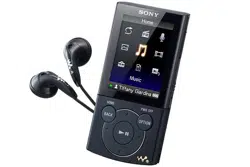
WALKMAN User Guide
Print
Getting Started
How to Use the Software
Music
“SensMe™ Channels”
Videos/Podcasts/Photos
FM Radio
Making/Playing Voice
Recordings
Timer
Settings
Troubleshooting
Important Information
Specifications
Contents list
Top page
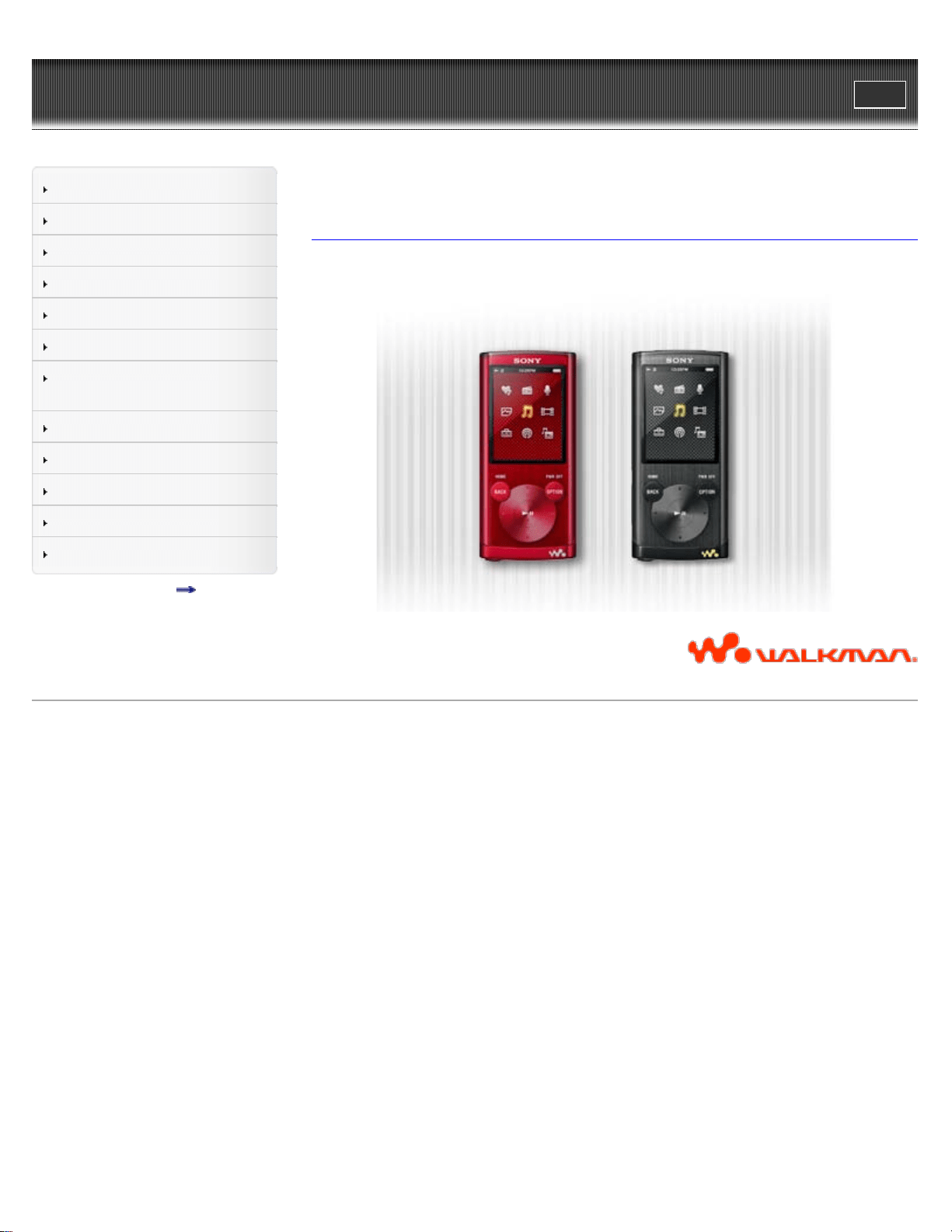
NWZ-E453/E454/E455
User Guide
Use this manual if you encounter any problems, or have any questions about the player.
Back to top
Copyright 2010 Sony Corporation
1

WALKMAN User Guide
Print
Getting Started
How to Use the Software
Music
“SensMe™ Channels”
Videos/Podcasts/Photos
FM Radio
Making/Playing Voice
Recordings
Timer
Settings
Troubleshooting
Important Information
Specifications
Contents list
Top page > Getting Started
Getting Started
Before Use
Before first use
How to use this User Guide
Operation flow of “WALKMAN”
What you can do with “WALKMAN”
Operation flow to enjoy music
Operation flow to enjoy videos, photos and podcasts
Power/Charging
Turning the player on and off
Charging the battery
About battery life
Initial Settings
Selecting the display language [Language Settings]
Setting the current time [Set Date-Time]
Parts and Controls
Parts and controls
About the Software
About the software
Home Menu/Option Menu
About the Home menu
How to use the Home menu
How to use the option menu
Back to top
Copyright 2010 Sony Corporation
2
WALKMAN User Guide
Print
Getting Started
How to Use the Software
Music
“SensMe™ Channels”
Videos/Podcasts/Photos
FM Radio
Making/Playing Voice
Recordings
Timer
Settings
Troubleshooting
Important Information
Specifications
Contents list
Top page > How to Use the Software
How to Use the Software
Windows Media Player
Importing music from CDs using Windows Media Player
Transferring music using Windows Media Player
Content Transfer
Transferring music using Content Transfer
Transferring videos/photos/podcasts using Content Transfer
Windows Explorer (Drag-and-Drop)
Transferring music using Windows Explorer
Transferring videos/photos/podcasts using Windows Explorer
Back to top
Copyright 2010 Sony Corporation
3
WALKMAN User Guide
Print
Getting Started
How to Use the Software
Music
“SensMe™ Channels”
Videos/Podcasts/Photos
FM Radio
Making/Playing Voice
Recordings
Timer
Settings
Troubleshooting
Important Information
Specifications
Contents list
Top page > Music
Music
Playing Music
Playing music
Browsing and using the music screen
Searching for songs
Using bookmarks
Browsing cover arts to select an album (Album Scroll)
Deleting songs
Using the Karaoke Function
About the karaoke function
Activating the karaoke function
Changing the key of a song
Using the Language Study Function
About language study
Activating the language study function
Rewinding slightly [Quick Replay]
Playing back a specified section repeatedly (A-B Repeat)
Adjusting the playback speed (DPC)
Music Option Menu
Using the music option menu
Music Settings
Setting the play mode [Play Mode]
Setting the playback range [Playback Range]
Setting the sound quality (CLEAR BASS) [Equalizer]
Customizing the surround sound [VPT(Surround)]
Listening with DSEE (Sound Enhance) [DSEE(Sound Enhance)]
Listening with Clear Stereo [Clear Stereo]
Adjusting the volume level [Dynamic Normalizer]
Changing the default bookmark list [Default Bookmark List]
Selecting the album display format [Album Display Format]
Displaying lyrics [Display Lyrics]
How to create LRC files
Optimizing the quality of the sound output from the speakers [SP Output Optimizer]
Back to top
Copyright 2010 Sony Corporation
4
WALKMAN User Guide
Print
Getting Started
How to Use the Software
Music
“SensMe™ Channels”
Videos/Podcasts/Photos
FM Radio
Making/Playing Voice
Recordings
Timer
Settings
Troubleshooting
Important Information
Specifications
Contents list
Top page > “SensMe™ Channels”
“SensMe™ Channels”
Playing songs using “SensMe™ Channels”
What is “SensMe™ Channels”?
Playing songs using “SensMe™ Channels”
Analyzing songs on the player
“SensMe™ Channels” Option Menu
Using the “SensMe™ Channels” option menu
Back to top
Copyright 2010 Sony Corporation
5
WALKMAN User Guide
Print
Getting Started
How to Use the Software
Music
“SensMe™ Channels”
Videos/Podcasts/Photos
FM Radio
Making/Playing Voice
Recordings
Timer
Settings
Troubleshooting
Important Information
Specifications
Contents list
Top page > Videos/Podcasts/Photos
Videos/Podcasts/Photos
Watching Videos
Watching videos [Videos]
Browsing and using the video screen
Searching for videos
Browsing scenes [Scene Scroll]
Deleting videos
Video Option Menu
Using the video option menu
Video Settings
Setting the zoom function [Zoom Settings]
Playing only video sound [On-Hold Display]
Arranging the video list [Order of Video List]
Playing a Podcast
What is a podcast?
Playing podcast [Podcasts]
Browsing and using the podcast screen
Deleting podcasts
Podcast Option Menu
Using the podcast option menu
Viewing Photos
Viewing photos [Photos]
Browsing and using the photo screen
Deleting photos
Photo Option Menu
Using the photo option menu
Photo Settings
Setting the photo list display format [Photo List Format]
Back to top
Copyright 2010 Sony Corporation
6
WALKMAN User Guide
Print
Getting Started
How to Use the Software
Music
“SensMe™ Channels”
Videos/Podcasts/Photos
FM Radio
Making/Playing Voice
Recordings
Timer
Settings
Troubleshooting
Important Information
Specifications
Contents list
Top page > FM Radio
FM Radio
Listening to FM Radio
Listening to FM radio [FM Radio]
Browsing and using the FM radio screen
Presetting broadcast stations automatically [Auto Preset]
Presetting broadcast stations manually [Save to Preset]
Deleting preset broadcast stations [Delete from Preset]
FM Radio Option Menu
Using the FM radio option menu
FM Radio Settings
Setting the reception [Scan Sensitivity]
Setting monaural/stereo [Mono/Auto]
Back to top
Copyright 2010 Sony Corporation
7
WALKMAN User Guide
Print
Getting Started
How to Use the Software
Music
“SensMe™ Channels”
Videos/Podcasts/Photos
FM Radio
Making/Playing Voice
Recordings
Timer
Settings
Troubleshooting
Important Information
Specifications
Contents list
Top page > Making/Playing Voice Recordings
Making/Playing Voice Recordings
Making Voice Recordings
Making voice recordings
Playing Voice Recordings
Playing voice recordings
Deleting recorded voice files
Voice Recording Option Menu
Using the voice recording option menu
Recording Settings
Selecting a level of recording quality [Bit Rate Settings]
Back to top
Copyright 2010 Sony Corporation
8
WALKMAN User Guide
Print
Getting Started
How to Use the Software
Music
“SensMe™ Channels”
Videos/Podcasts/Photos
FM Radio
Making/Playing Voice
Recordings
Timer
Settings
Troubleshooting
Important Information
Specifications
Contents list
Top page > Timer
Timer
Setting the Timer
About the timer
Setting the alarm to on/off [Alarm On/Off]
Setting the alarm time [Alarm Time]
Setting the repeat setting [Repeat]
Selecting the alarm sound [Alarm Sound Settings]
Setting the sleep timer [Sleep Timer Settings]
Back to top
Copyright 2010 Sony Corporation
9
WALKMAN User Guide
Print
Getting Started
How to Use the Software
Music
“SensMe™ Channels”
Videos/Podcasts/Photos
FM Radio
Making/Playing Voice
Recordings
Timer
Settings
Troubleshooting
Important Information
Specifications
Contents list
Top page > Settings
Settings
Common Settings
Displaying the player information [Unit Information]
Limiting the volume [AVLS (Volume Limit)]
Turning off the beep sound [Beep Settings]
Setting the screensaver [Screensaver Settings]
Adjusting the brightness of the screen [Brightness]
Setting up wallpaper [Wallpaper Settings]
Setting the current time [Set Date-Time]
Setting the date format [Date Display Format]
Setting the time format [Time Display Format]
Limiting the charge amount [Battery Care]
Returning to the factory settings [Reset All Settings]
Formatting memory [Format]
Using USB connection mode [USB Connection Mode]
Selecting the display language [Language Settings]
Music Settings
Setting the play mode [Play Mode]
Setting the playback range [Playback Range]
Setting the sound quality (CLEAR BASS) [Equalizer]
Customizing the surround sound [VPT(Surround)]
Listening with DSEE (Sound Enhance) [DSEE(Sound Enhance)]
Listening with Clear Stereo [Clear Stereo]
Adjusting the volume level [Dynamic Normalizer]
Changing the default bookmark list [Default Bookmark List]
Selecting the album display format [Album Display Format]
Displaying lyrics [Display Lyrics]
How to create LRC files
Optimizing the quality of the sound output from the speakers [SP Output Optimizer]
Video Settings
Setting the zoom function [Zoom Settings]
Playing only video sound [On-Hold Display]
Arranging the video list [Order of Video List]
Photo Settings
Setting the photo list display format [Photo List Format]
FM Radio Settings
Setting the reception [Scan Sensitivity]
Setting monaural/stereo [Mono/Auto]
Recording Settings
10

WALKMAN User Guide
Print
Getting Started
How to Use the Software
Music
“SensMe™ Channels”
Videos/Podcasts/Photos
FM Radio
Making/Playing Voice
Recordings
Timer
Settings
Troubleshooting
Important Information
Specifications
Contents list
Top page > Troubleshooting
Troubleshooting
To Deal with a Trouble
What can I do to solve a problem?
Customer support Web site
Possible Causes of Symptoms
Table of contents for symptoms and possible causes
Operation
Display
Power
Connection to a computer
“SensMe™ Channels”
FM Radio
Recording
Podcast
Other
Messages
Back to top
Copyright 2010 Sony Corporation
12
WALKMAN User Guide
Print
Getting Started
How to Use the Software
Music
“SensMe™ Channels”
Videos/Podcasts/Photos
FM Radio
Making/Playing Voice
Recordings
Timer
Settings
Troubleshooting
Important Information
Specifications
Contents list
Top page > Important Information
Important Information
Precautions
Important product information
Warning
Caution
Notice for users
Notes on the headphones
Notes on the software
Cleaning
Notes on cleaning
Storing Data
Storing data
Upgrading the Player’s Firmware
Upgrading the player’s firmware
License and Trademark Notice
License and trademark notice
Back to top
Copyright 2010 Sony Corporation
13
WALKMAN User Guide
Print
Getting Started
How to Use the Software
Music
“SensMe™ Channels”
Videos/Podcasts/Photos
FM Radio
Making/Playing Voice
Recordings
Timer
Settings
Troubleshooting
Important Information
Specifications
Contents list
Top page > Specifications
Specifications
Specifications
Specifications
Supplied items
System requirements
What are Format and Bit Rate
What is audio format?
What is video format?
What is photo format?
Back to top
Copyright 2010 Sony Corporation
14
WALKMAN User Guide
Print
Getting Started
How to Use the Software
Music
“SensMe™ Channels”
Videos/Podcasts/Photos
FM Radio
Making/Playing Voice
Recordings
Timer
Settings
Troubleshooting
Important Information
Specifications
Contents list
Top page > Contents list
Contents list
Getting Started
Before Use
Before first use
How to use this User Guide
Operation flow of “WALKMAN”
What you can do with “WALKMAN”
Operation flow to enjoy music
Operation flow to enjoy videos, photos and podcasts
Power/Charging
Turning the player on and off
Charging the battery
About battery life
Initial Settings
Selecting the display language [Language Settings]
Setting the current time [Set Date-Time]
Parts and Controls
Parts and controls
About the Software
About the software
Home Menu/Option Menu
About the Home menu
How to use the Home menu
How to use the option menu
Back to top
How to Use the Software
Windows Media Player
Importing music from CDs using Windows Media Player
Transferring music using Windows Media Player
Content Transfer
Transferring music using Content Transfer
Transferring videos/photos/podcasts using Content Transfer
Windows Explorer (Drag-and-Drop)
Transferring music using Windows Explorer
Transferring videos/photos/podcasts using Windows Explorer
Back to top
15

Music
Playing Music
Playing music
Browsing and using the music screen
Searching for songs
Using bookmarks
Browsing cover arts to select an album (Album Scroll)
Deleting songs
Using the Karaoke Function
About the karaoke function
Activating the karaoke function
Changing the key of a song
Using the Language Study Function
About language study
Activating the language study function
Rewinding slightly [Quick Replay]
Playing back a specified section repeatedly (A-B Repeat)
Adjusting the playback speed (DPC)
Music Option Menu
Using the music option menu
Music Settings
Setting the play mode [Play Mode]
Setting the playback range [Playback Range]
Setting the sound quality (CLEAR BASS) [Equalizer]
Customizing the surround sound [VPT(Surround)]
Listening with DSEE (Sound Enhance) [DSEE(Sound Enhance)]
Listening with Clear Stereo [Clear Stereo]
Adjusting the volume level [Dynamic Normalizer]
Changing the default bookmark list [Default Bookmark List]
Selecting the album display format [Album Display Format]
Displaying lyrics [Display Lyrics]
How to create LRC files
Optimizing the quality of the sound output from the speakers [SP Output Optimizer]
Back to top
“SensMe™ Channels”
Playing songs using “SensMe™ Channels”
What is “SensMe™ Channels”?
Playing songs using “SensMe™ Channels”
Analyzing songs on the player
“SensMe™ Channels” Option Menu
Using the “SensMe™ Channels” option menu
Back to top
16

Videos/Podcasts/Photos
Watching Videos
Watching videos [Videos]
Browsing and using the video screen
Searching for videos
Browsing scenes [Scene Scroll]
Deleting videos
Video Option Menu
Using the video option menu
Video Settings
Setting the zoom function [Zoom Settings]
Playing only video sound [On-Hold Display]
Arranging the video list [Order of Video List]
Playing a Podcast
What is a podcast?
Playing podcast [Podcasts]
Browsing and using the podcast screen
Deleting podcasts
Podcast Option Menu
Using the podcast option menu
Viewing Photos
Viewing photos [Photos]
Browsing and using the photo screen
Deleting photos
Photo Option Menu
Using the photo option menu
Photo Settings
Setting the photo list display format [Photo List Format]
Back to top
FM Radio
Listening to FM Radio
Listening to FM radio [FM Radio]
Browsing and using the FM radio screen
Presetting broadcast stations automatically [Auto Preset]
Presetting broadcast stations manually [Save to Preset]
Deleting preset broadcast stations [Delete from Preset]
FM Radio Option Menu
Using the FM radio option menu
FM Radio Settings
Setting the reception [Scan Sensitivity]
Setting monaural/stereo [Mono/Auto]
Back to top
17

Making/Playing Voice Recordings
Making Voice Recordings
Making voice recordings
Playing Voice Recordings
Playing voice recordings
Deleting recorded voice files
Voice Recording Option Menu
Using the voice recording option menu
Recording Settings
Selecting a level of recording quality [Bit Rate Settings]
Back to top
Timer
Setting the Timer
About the timer
Setting the alarm to on/off [Alarm On/Off]
Setting the alarm time [Alarm Time]
Setting the repeat setting [Repeat]
Selecting the alarm sound [Alarm Sound Settings]
Setting the sleep timer [Sleep Timer Settings]
Back to top
Settings
Common Settings
Displaying the player information [Unit Information]
Limiting the volume [AVLS (Volume Limit)]
Turning off the beep sound [Beep Settings]
Setting the screensaver [Screensaver Settings]
Adjusting the brightness of the screen [Brightness]
Setting up wallpaper [Wallpaper Settings]
Setting the current time [Set Date-Time]
Setting the date format [Date Display Format]
Setting the time format [Time Display Format]
Limiting the charge amount [Battery Care]
Returning to the factory settings [Reset All Settings]
Formatting memory [Format]
Using USB connection mode [USB Connection Mode]
Selecting the display language [Language Settings]
Music Settings
Setting the play mode [Play Mode]
Setting the playback range [Playback Range]
Setting the sound quality (CLEAR BASS) [Equalizer]
Customizing the surround sound [VPT(Surround)]
Listening with DSEE (Sound Enhance) [DSEE(Sound Enhance)]
Listening with Clear Stereo [Clear Stereo]
18

Adjusting the volume level [Dynamic Normalizer]
Changing the default bookmark list [Default Bookmark List]
Selecting the album display format [Album Display Format]
Displaying lyrics [Display Lyrics]
How to create LRC files
Optimizing the quality of the sound output from the speakers [SP Output Optimizer]
Video Settings
Setting the zoom function [Zoom Settings]
Playing only video sound [On-Hold Display]
Arranging the video list [Order of Video List]
Photo Settings
Setting the photo list display format [Photo List Format]
FM Radio Settings
Setting the reception [Scan Sensitivity]
Setting monaural/stereo [Mono/Auto]
Recording Settings
Selecting a level of recording quality [Bit Rate Settings]
Back to top
Troubleshooting
To Deal with a Trouble
What can I do to solve a problem?
Customer support Web site
Possible Causes of Symptoms
Table of contents for symptoms and possible causes
Operation
Display
Power
Connection to a computer
“SensMe™ Channels”
FM Radio
Recording
Podcast
Other
Messages
Back to top
Important Information
Precautions
Important product information
Warning
Caution
Notice for users
Notes on the headphones
Notes on the software
19

Cleaning
Notes on cleaning
Storing Data
Storing data
Upgrading the Player’s Firmware
Upgrading the player’s firmware
License and Trademark Notice
License and trademark notice
Back to top
Specifications
Specifications
Specifications
Supplied items
System requirements
What are Format and Bit Rate
What is audio format?
What is video format?
What is photo format?
Back to top
Copyright 2010 Sony Corporation
20
WALKMAN User Guide
Print
Getting Started
How to Use the Software
Music
“SensMe™ Channels”
Videos/Podcasts/Photos
FM Radio
Making/Playing Voice
Recordings
Timer
Settings
Troubleshooting
Important Information
Specifications
Contents list
Top page > Getting Started > Before Use > Before first use
Before first use
Thank you for purchasing this “WALKMAN.”
This User Guide explains how to transfer music, videos, photos and podcasts to the player and
how to use various functions of it. Browse this User Guide for necessary information.
Before you start using the player, be sure to read “Important Information” that contains important
information on the use of the player. To read it, click “Important Information” in the side bar on
the left of the browser window.
Also, “Quick Start Guide” supplied with the player contains important information for you.
For information about the customer support Web site, see [Details].
About model names mentioned in this User Guide
Depending on the country/region in which you have purchased the player, some models may not
be available.
About Windows operating system and Windows Media Player
Make sure that the operating system is Windows XP (Service Pack 3 or later), Windows Vista
(Service Pack 1 or later) or Windows 7 (*1), and the installed Windows Media Player version on
your computer is 11 (Windows XP/Windows Vista) or 12 (Windows 7).
For details about usage or support on Windows Media Player, refer to Windows Media Player
information from the following web site:
http://support.microsoft.com/
(*1) [Compatibility mode] for Windows XP is not supported.
About battery charging
The battery might not be charged at time of purchase. See [Details] for how to charge the
battery.
Back to top
Copyright 2010 Sony Corporation
21
WALKMAN User Guide
Print
Getting Started
How to Use the Software
Music
“SensMe™ Channels”
Videos/Podcasts/Photos
FM Radio
Making/Playing Voice
Recordings
Timer
Settings
Troubleshooting
Important Information
Specifications
Contents list
Top page > Getting Started > Before Use > How to use this User Guide
How to use this User Guide
Selecting a topic to display
Returning to a previous page
Printing out a page
This User Guide explains how to use each function of the player, how to change settings, and
how to troubleshoot a problem.
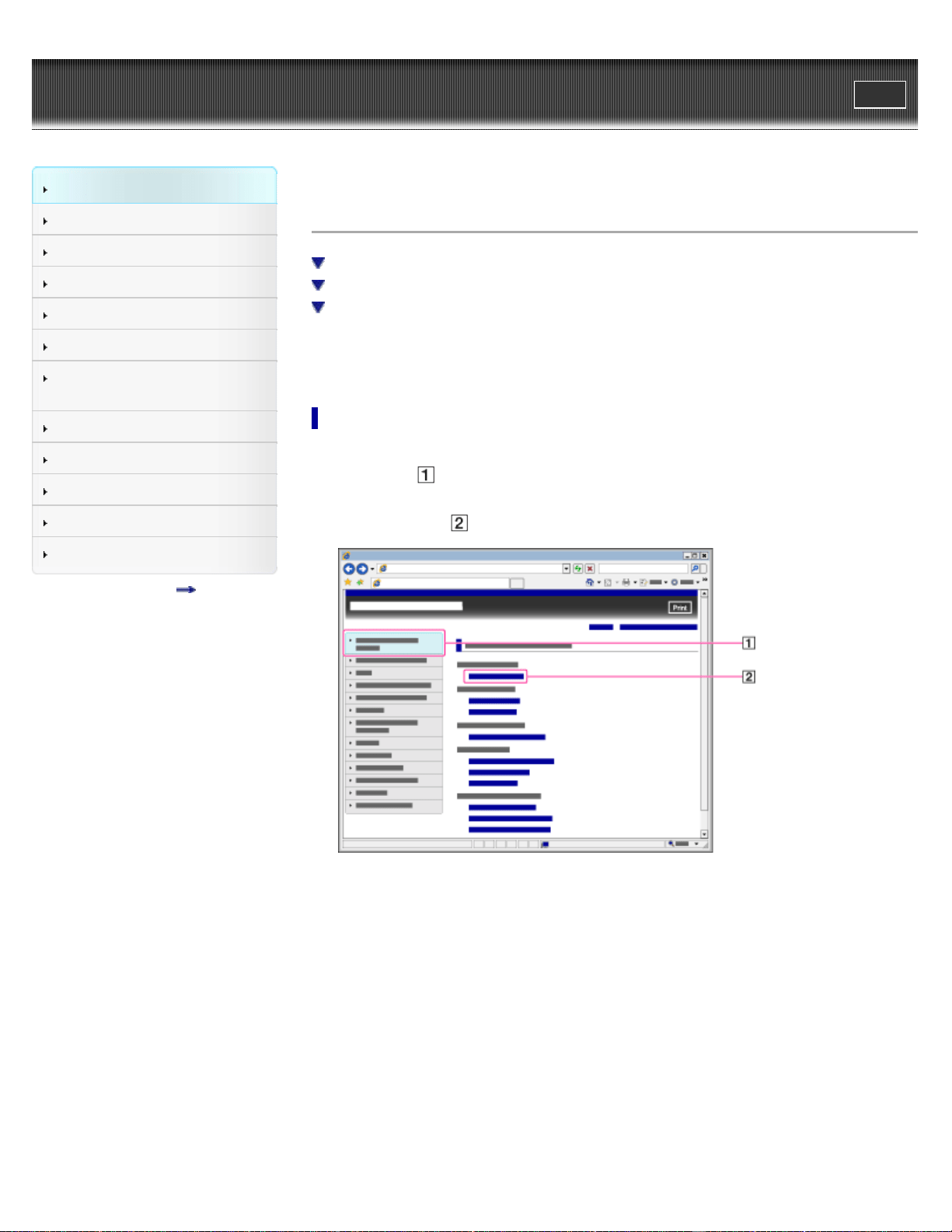
Selecting a topic to display
Internet Explorer 7 is used for illustration purposes.
1. Click a title (
) in the side bar on the left of the browser window.
The title’s topic list appears in the right pane.
2. Click a topic title (
) in the list.
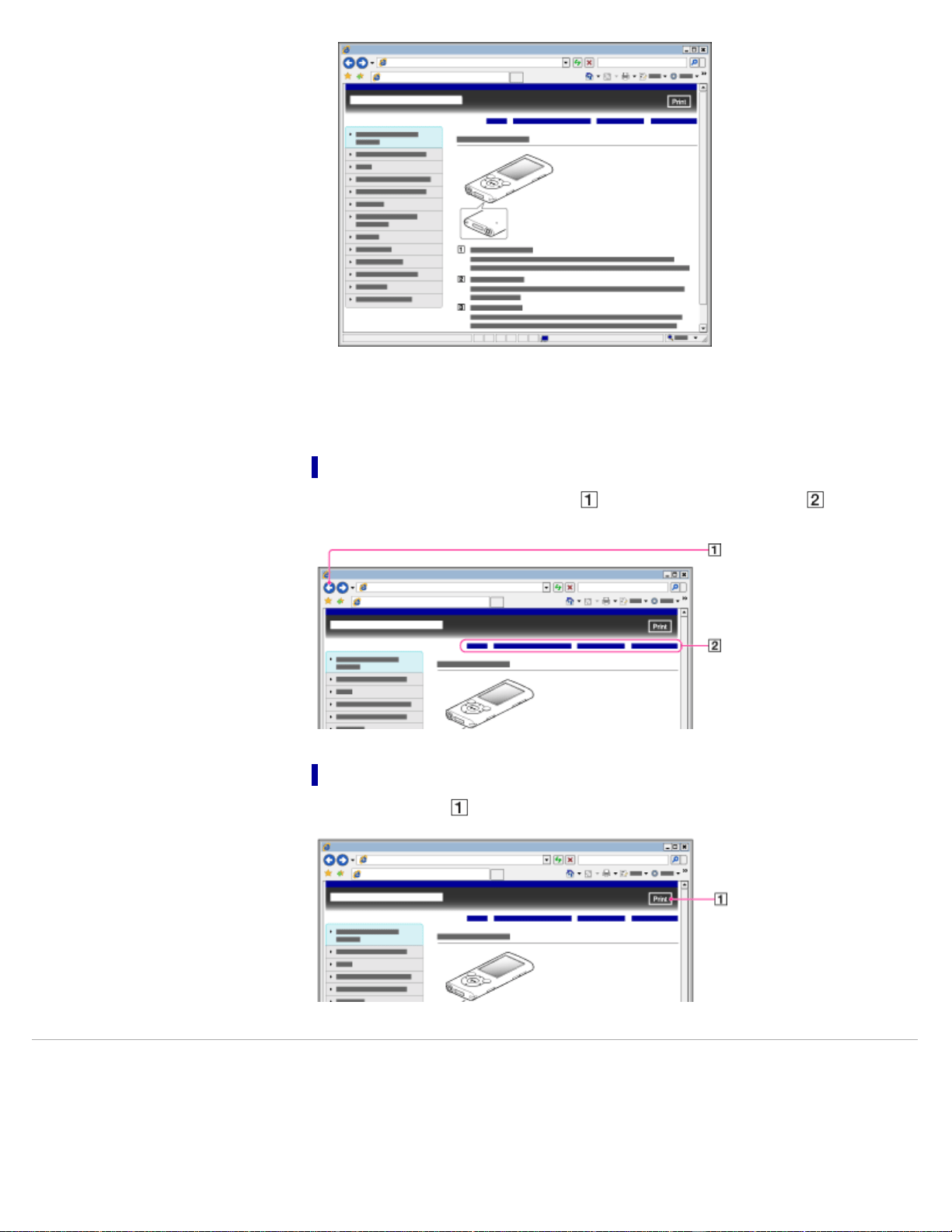
Descriptions appear in the right pane.
22
Changing the font size
You can change the font size by changing the setting of your web browser. For how to change
the font size setting, refer to the Help of your web browser.
Returning to a previous page
Use the back button of your web browser ( ) or breadcrumb trail navigation ( ) to return to a
page you previously viewed.
Printing out a page
Click the print button ( ) to print out a page you are viewing.
Back to top
Copyright 2010 Sony Corporation
23
WALKMAN User Guide
Print
Getting Started
How to Use the Software
Music
“SensMe™ Channels”
Videos/Podcasts/Photos
FM Radio
Making/Playing Voice
Recordings
Timer
Settings
Troubleshooting
Important Information
Specifications
Contents list
Top page > Getting Started > Operation flow of “WALKMAN” > What you can do with
“WALKMAN”
What you can do with “WALKMAN”
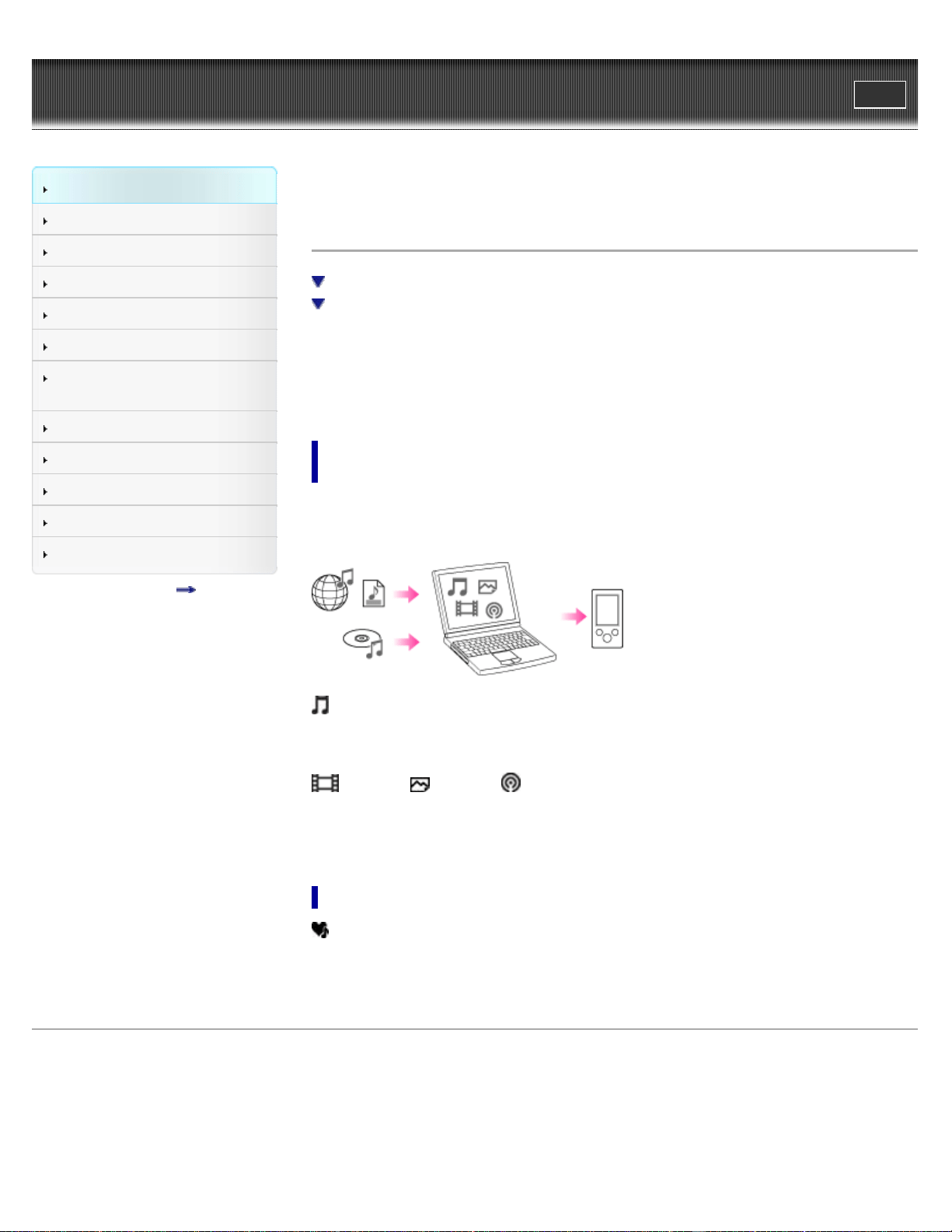
Enjoying music, videos, photos and podcasts transferred from a computer
Enjoying “SensMe™ Channels”
Your “WALKMAN” incorporates various functions. This page introduces some of its major
features to you.
You need to transfer music, videos, photos or podcasts from a computer to your “WALKMAN” to
enjoy them.
Enjoying music, videos, photos and podcasts transferred from a
computer
To enjoy music, videos, photos or podcasts, use bundled software (Content Transfer) or
supported software (Windows Media Player) to transfer them from a computer to the player. For
how to install the bundled software, refer to “Quick Start Guide.”
Music
There are several ways to transfer music to the player. See [Details] for how to transfer your
favorite songs to the player. After transferring, see [Details] for how to play them back.
Videos/ Photos/ Podcasts
There are several ways to transfer videos, photos or podcasts to the player. See [Details] for
how to transfer them to the player. After transferring, see [Details] for how to watch videos,
[Details] for how to view photos, or [Details] for how to play back podcasts.
Enjoying “SensMe™ Channels”
Playing “SensMe™ Channels”
“SensMe™ Channels” automatically picks up songs to fit the themes of channels. You can play
songs according to your mood, activity, time of the day, and so on. See [Details] for how to use
“SensMe™ Channels.”
Back to top
Copyright 2010 Sony Corporation
24
WALKMAN User Guide
Print
Getting Started
How to Use the Software
Music
“SensMe™ Channels”
Videos/Podcasts/Photos
FM Radio
Making/Playing Voice
Recordings
Timer
Settings
Troubleshooting
Important Information
Specifications
Contents list
Top page > Getting Started > Operation flow of “WALKMAN” > Operation flow to enjoy music
Operation flow to enjoy music
You need to have music files on your computer before transferring them to the player and
playing back. There are various ways to obtain music files, such as importing from CDs,
purchasing at online music stores, downloading from the Internet, and so on.
Be careful that the player can play back music files in supported formats only. Also, copyright
protected music files may not be playable depending on their copyright protection. For details
about supported file formats, see [Details].
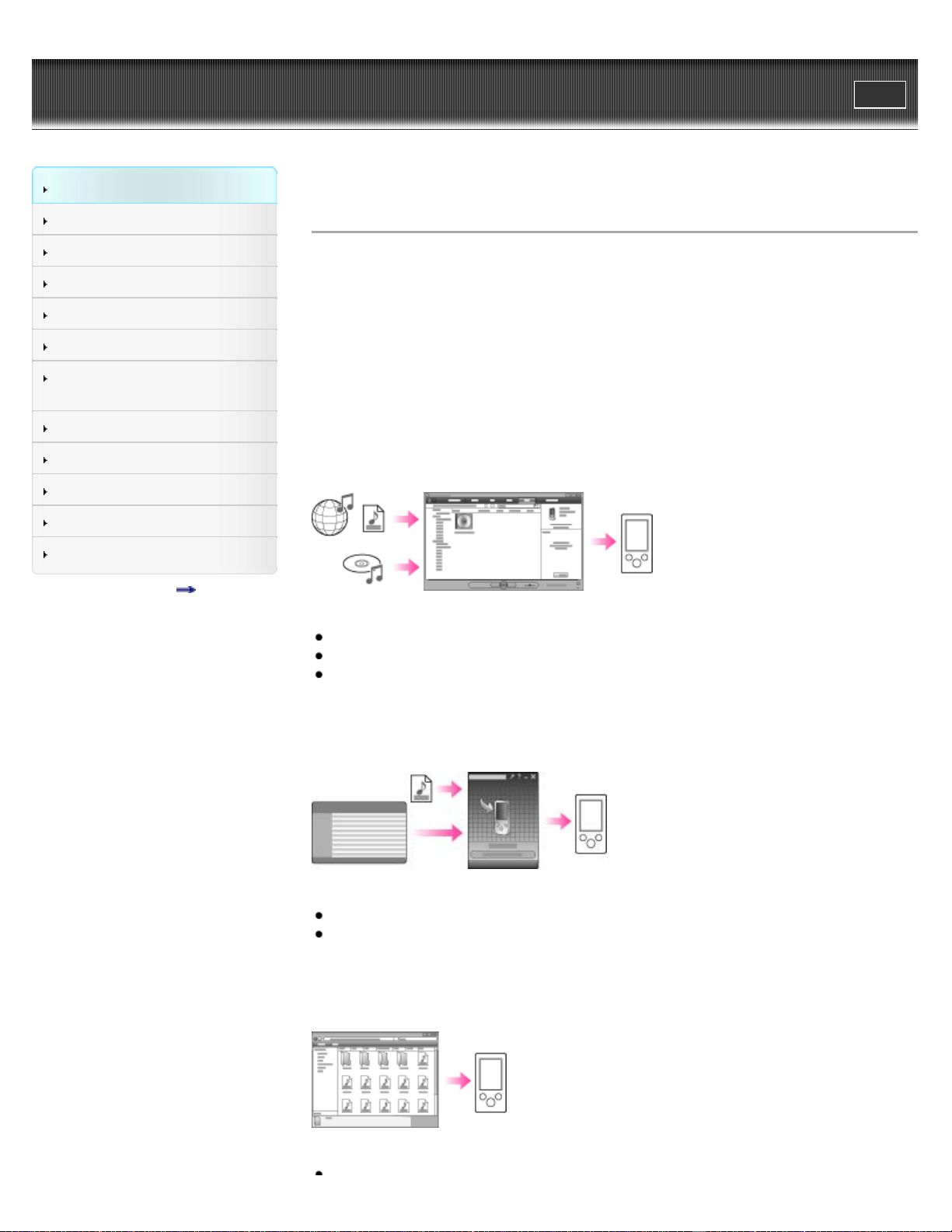
Once you have music files on your computer, you are ready to transfer them to the player. You
can transfer music to the player in the following three ways.
Transferring music from CDs using Windows Media Player
You can import music from your CDs, etc., to your computer, and transfer them to the player
using Windows Media Player.
For how to use Windows Media Player, see the following topics.
Windows Media Player [Details]
Importing music from CDs using Windows Media Player [Details]
Transferring music using Windows Media Player [Details]
Transferring music from iTunes, etc., using Content Transfer
If you have already managed music with iTunes, etc., you can transfer them to the player using
Content Transfer.
For how to use Content Transfer, see the following topics.
Content Transfer [Details]
Transferring music using Content Transfer [Details]
Transferring music by drag-and-drop using Windows Explorer
You can directly transfer music stored on your computer by drag-and-drop using Windows
Explorer.
For how to use Windows Explorer, see the following topic.
25

Transferring music using Windows Explorer [Details]
Hint
For detailed information on how to import music, refer to the Help of each software.
For details about supported file formats, see [Details].
The player does not use SonicStage software (SonicStage software, developed by Sony,
manages music on a computer or transfers music to other types of players). For this player,
you can transfer music in the above three ways, not using SonicStage.
ATRAC files managed by SonicStage can be transferred to the player after conversion to
MP3 file format.
Note
During data transfer between the player and a computer, [Do not disconnect.] appears on
the player’s screen. While [Do not disconnect.] is displayed, do not disconnect the USB
cable. Otherwise, the data being transferred or the data stored in the player may be
damaged.
Do not leave the player connected for extended periods to a laptop computer that is not
connected to AC power, since the player may discharge the computer’s battery.
If you turn on or restart the computer while the player is connected to the computer, the
player may malfunction. In this case, press the RESET button of the player to reset it
[Details]. Disconnect the player from the computer before turning on or restarting the
computer.
Back to top
Copyright 2010 Sony Corporation
26
WALKMAN User Guide
Print
Getting Started
How to Use the Software
Music
“SensMe™ Channels”
Videos/Podcasts/Photos
FM Radio
Making/Playing Voice
Recordings
Timer
Settings
Troubleshooting
Important Information
Specifications
Contents list
Top page > Getting Started > Operation flow of “WALKMAN” > Operation flow to enjoy videos,
photos and podcasts
Operation flow to enjoy videos, photos and podcasts
You need to have video/photo/podcast episode files on your computer before transferring them
to the player and playing back.
You can import videos from recorded videos or download from the Internet, etc. You can import
photos from a digital camera or download from the Internet, etc. You can download podcast
episodes from the Internet.
Be careful that the player can play back files in supported formats only. Also, copyright protected
files may not be playable depending on their copyright protection. For details about supported file
formats, see [Details].
Once you have video/photo/podcast episode files on your computer, you are ready to transfer
them to the player. You can transfer video/photo/podcast episode files to the player in the
following three ways.
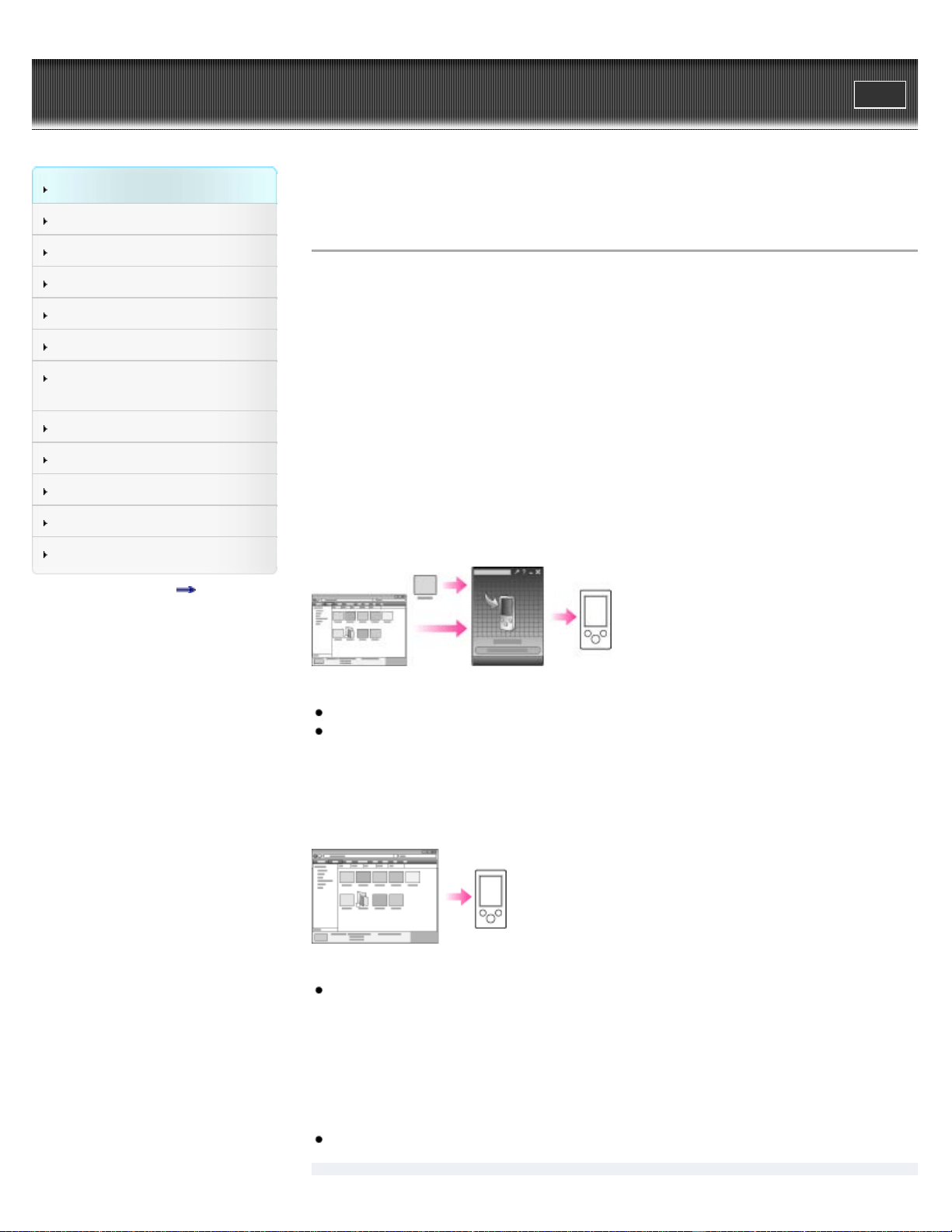
Transferring videos/photos/podcasts using Content Transfer
You can transfer videos/photos/podcasts stored on your computer to the player using Content
Transfer.
For how to use Content Transfer, see the following topics.
Content Transfer [Details]
Transferring videos/photos/podcasts using Content Transfer [Details]
Transferring videos/photos/podcasts by drag-and-drop using
Windows Explorer
You can directly transfer videos/photos/podcasts stored on your computer by drag-and-drop
using Windows Explorer.
For how to use Windows Explorer, see the following topic.
Transferring videos/photos/podcasts using Windows Explorer [Details]
Transferring videos/photos using Windows Media Player
You can transfer videos/photos managed with Windows Media Player to the player.
For details about usage or support on Windows Media Player, refer to Windows Media Player
information from the following web site:
http://support.microsoft.com/
Also, see the following topic.
Windows Media Player [Details]
27

Hint
For detailed information on how to import videos/photos/podcasts, refer to the Help of each
software.
For details about supported file formats, see [Details].
Note
Commercial DVDs and Blu-ray Discs are copyright protected and cannot be transferred to
the player.
Back to top
Copyright 2010 Sony Corporation
28
WALKMAN User Guide
Print
Getting Started
How to Use the Software
Music
“SensMe™ Channels”
Videos/Podcasts/Photos
FM Radio
Making/Playing Voice
Recordings
Timer
Settings
Troubleshooting
Important Information
Specifications
Contents list
Top page > Getting Started > Power/Charging > Turning the player on and off
Turning the player on and off
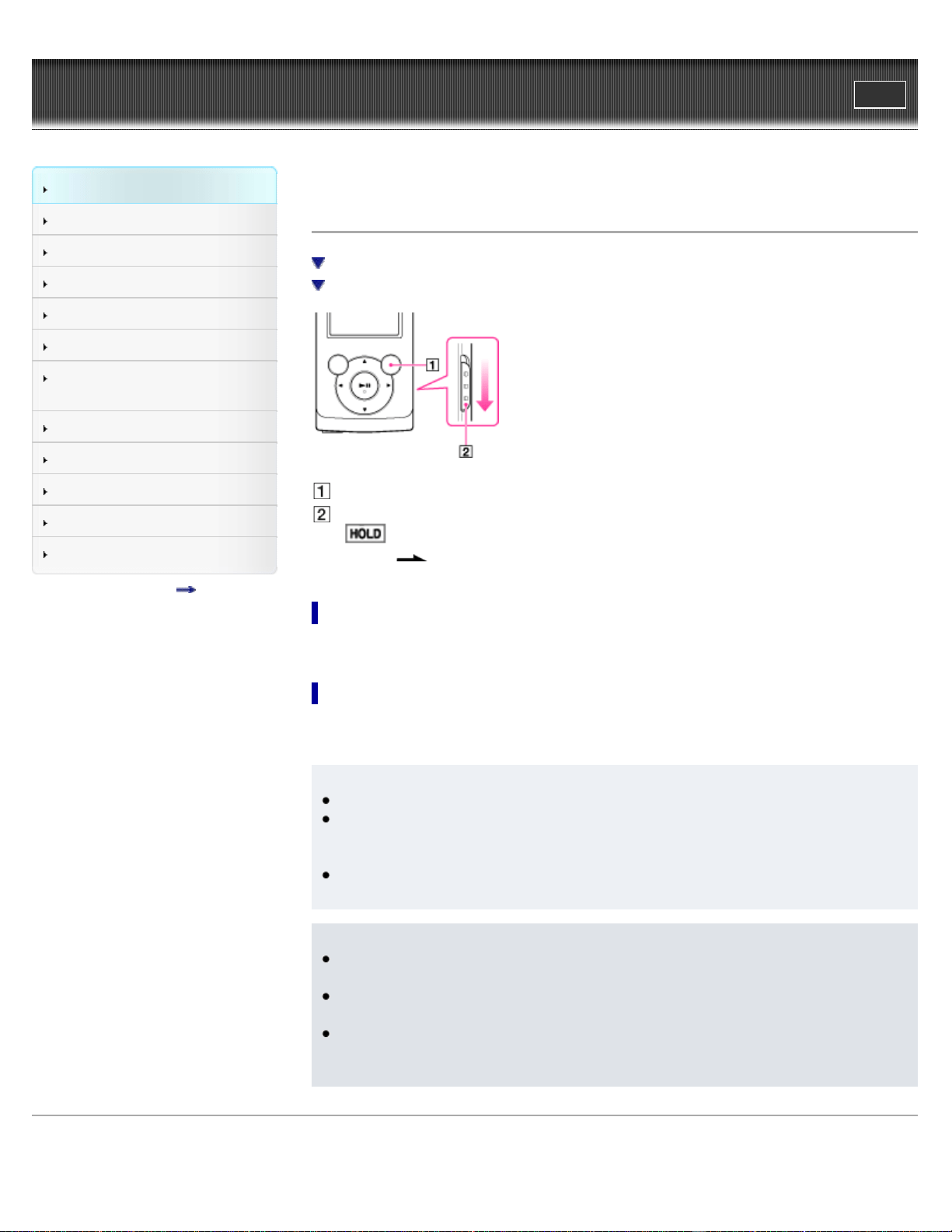
To turn on the player
To turn off the player
OPTION/PWR OFF button
HOLD switch
If appears on the top of the screen, slide the HOLD switch in the opposite direction of
the arrow
on the right side of the player to cancel the HOLD function.
To turn on the player
Press any button to turn the player on.
To turn off the player
Press and hold the OPTION/PWR OFF button [Details]. [POWER OFF] appears, the player
enters standby mode, and the screen turns off.
Hint
Set the date and time on the player before using it [Details].
During pause, if there is no operation for about 10 minutes, the player automatically enters
standby mode, and the screen turns off. In standby mode, press any button to turn on the
screen again.
While the player is in standby mode, if there is no operation for about a day, the player
completely turns off automatically.
Note
You cannot operate the player when it is connected to a computer. Disconnect the USB
cable before operating the player.
After connecting to a computer with the USB cable, the resume information of the last
played song, video, photo, etc., is cleared. Reselect the desired content from the list screen.
The player consumes battery power very slightly even when it is in standby mode.
Therefore, the player might unexpectedly turn off completely, depending on the power
remaining in the battery.
Back to top
Copyright 2010 Sony Corporation
29
WALKMAN User Guide
Print
Getting Started
How to Use the Software
Music
“SensMe™ Channels”
Videos/Podcasts/Photos
FM Radio
Making/Playing Voice
Recordings
Timer
Settings
Troubleshooting
Important Information
Specifications
Contents list
Top page > Getting Started > Power/Charging > Charging the battery
Charging the battery
About the [Battery Care] mode
About the battery indicator
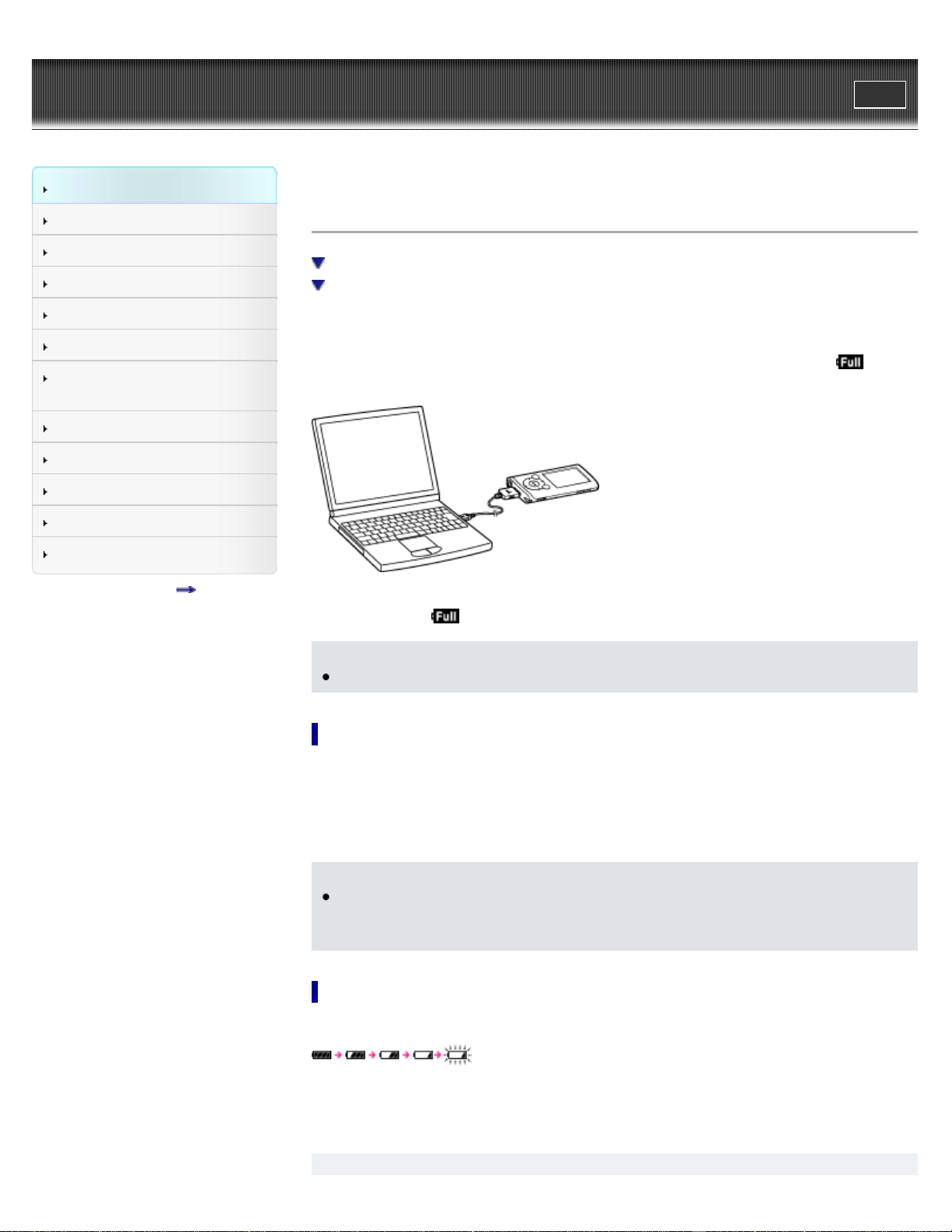
The player’s battery is recharged while the player is connected to a running computer.
When you connect the player to your computer, use the USB cable (supplied).
When the remaining battery indication in the upper right corner of the display shows
,
charging is completed. (Charging time is approx. 3 hours.)
When you use the player for the first time, or if you have not used the player for a long time,
recharge it fully (to
in the remaining battery indication of the display).
Note
After fully charging, the player will automatically enter standby mode.
About the [Battery Care] mode
In the [Battery Care] mode, the player stops recharging a short time before the battery is fully
charged. When extended use over many hours is not required, you can set [Battery Care] to [On]
to increase the available number of cycles of charge and discharge, which can significantly
extend battery lifespan.
For how to set the [Battery Care] mode, see [Details].
Note
In the [Battery Care] mode, the first bar of the battery indicator will disappear somewhat
quicker than normal. This is a result of stopping recharging the battery before becoming fully
charged (in order to extend the battery lifespan) and is not a malfunction.
About the battery indicator
The battery indicator in the information area shows the remaining battery charge.
As the battery power gets lower, the bars of the icon disappear. If [LOW BATTERY. Please
Charge.] appears, you cannot use the player. In this case, charge the battery by connecting to
your computer. See [Details] on battery duration.
30

Hint
The screen dims while charging.
Note
If you charge the player when it has not been used for a long period, your computer may not
recognize the player, or nothing may appear on the display. Charge the player for about 5
minutes, after which it should start operating normally again.
Charge the battery in an ambient temperature of between 5 ºC to 35 ºC (41 ºF to 95 ºF). If
you try to charge the battery in an ambient temperature outside this range, the
icon
may appear, and charging cannot be performed.
The number of times the battery can be recharged before it is used up is approximately 500
times. This number may vary, depending on the conditions under which you use the player.
[Do not disconnect.] appears in the display while the computer accesses the player. During
this time, do not disconnect the USB cable (supplied); otherwise, data being transferred (or
data already in the player) may be damaged.
The control buttons on the player become inoperative while it is connected to a computer.
To prevent battery deterioration, charge the battery at least once every half a year or every
year.
Some USB devices connected to the computer may interfere with proper operation of the
player.
We do not guarantee battery recharging using a personally assembled/modified computer.
If the computer enters a power saving mode, such as the Sleep or Hibernation mode, while
the player is connected via the USB cable, the player’s battery will not be charged. Instead,
the player continues to draw power from the battery, discharging it.
Do not leave the player connected for extended periods to a laptop computer that is not
connected to AC power, since the player may discharge the computer’s battery.
While the player is connected to a computer, do not turn on, restart, wake up from sleep
mode, or shut down the computer. These operations may cause the player to malfunction.
Disconnect the player from the computer before performing these operations.
Heat may build up in the player while charging. This is not a malfunction.
After connecting to a computer with the USB cable, the resume information of the last
played song, video, photo, etc., is cleared. Reselect the desired content from the list screen.
Back to top
Copyright 2010 Sony Corporation
31
WALKMAN User Guide
Print
Getting Started
How to Use the Software
Music
“SensMe™ Channels”
Videos/Podcasts/Photos
FM Radio
Making/Playing Voice
Recordings
Timer
Settings
Troubleshooting
Important Information
Specifications
Contents list
Top page > Getting Started > Power/Charging > About battery life
About battery life
Turn off the player manually
Longer battery life settings
Adjust data format and bit rate
By adjusting the settings or managing the power supply properly, it is possible to save battery
power for longer usage time between charges.
The following hints will yield a longer battery life.
Turn off the player manually
If you press and hold the OPTION/PWR OFF button, the player enters standby mode and the
screen turns off to save battery power. Furthermore, if standby mode continues for more than
about a day, the player turns completely off automatically.
Longer battery life settings
The following settings are effective for extending the battery life of the player.
Set as below to turn off the screen as frequently as possible during music playback.
Set [On/Off] to [On] and [Delay] to [15 Sec] (the shortest waiting time).
Set [Display Lyrics] to other than [On (No Screen Off)].
Set [Karaoke/Language Study] to other than [Maximum Karaoke Mode] or [Minimum
Karaoke Mode].
Reduce the [Brightness] setting value.
Set [Equalizer], [VPT(Surround)], [DSEE(Sound Enhance)], [Clear Stereo], [Dynamic
Normalizer] and [DPC (Speed Control)] to [None] or [Off].
See [Details] for details on the effect of setting changes, default settings, and battery life
measurement conditions.
Adjust data format and bit rate
Playing time will vary, as battery charge can be affected by the format and bit rate of songs,
videos or photos that are played.
For details on charging time and usage time, see [Details].
Related Topics
Charging time
Back to top
Copyright 2010 Sony Corporation
32
WALKMAN User Guide
Print
Getting Started
How to Use the Software
Music
“SensMe™ Channels”
Videos/Podcasts/Photos
FM Radio
Making/Playing Voice
Recordings
Timer
Settings
Troubleshooting
Important Information
Specifications
Contents list
Top page > Getting Started > Initial Settings > Selecting the display language [Language
Settings]
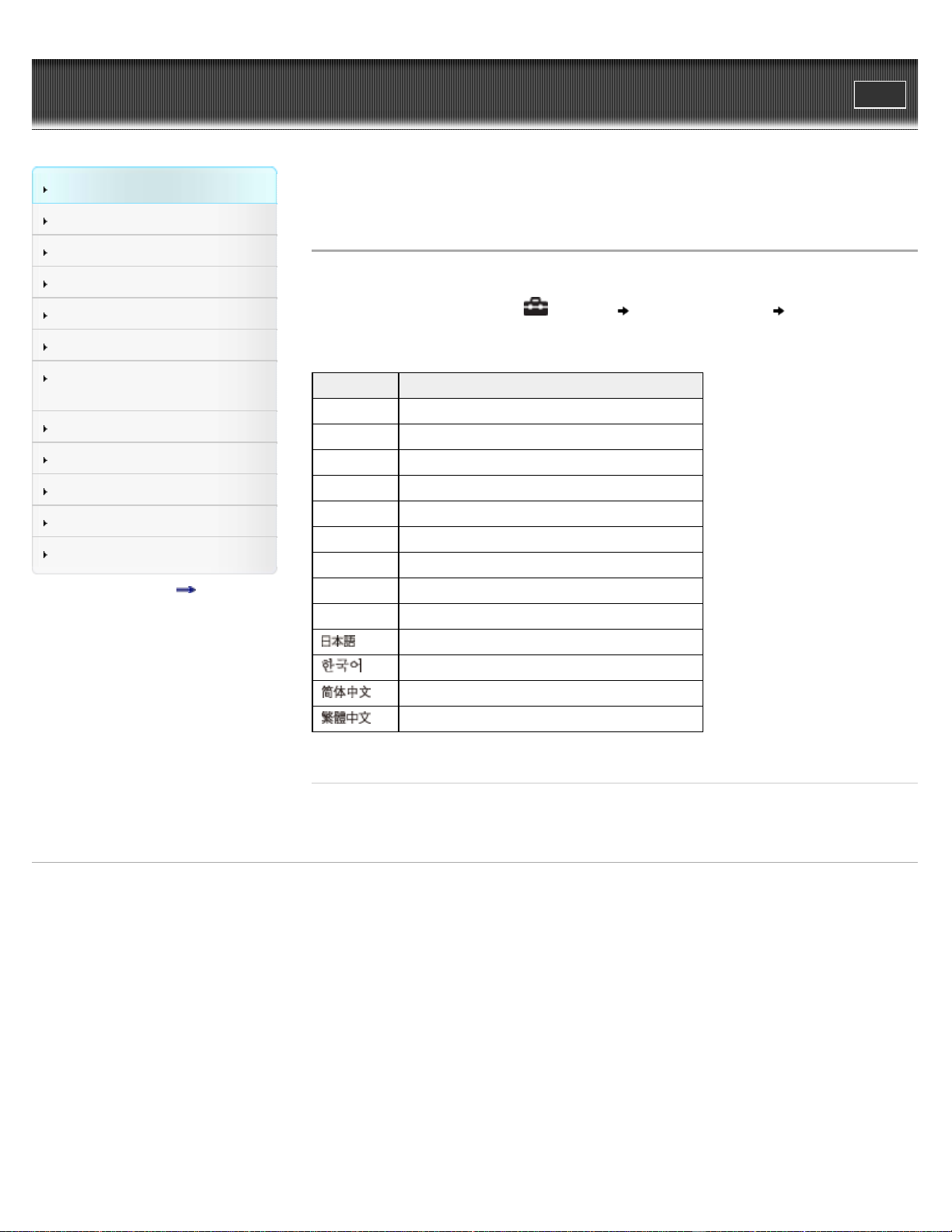
Selecting the display language [Language Settings]
You can select from a variety of languages for menus and messages.
1. From the Home menu, select [Settings] [Language Settings] desired language
setting.
Language Messages and menus are displayed in
[Deutsch] German
[English] English
[Español] Spanish
[Français] French
[Italiano] Italian
[Polski] Polish
[Português] Portuguese
[Русский] Russian
[Türkçe] Turkish
[
] Japanese
[
] Korean
[
] Simplified Chinese
[
] Traditional Chinese
Related Topics
How to use the Home menu
Back to top
Copyright 2010 Sony Corporation
33
WALKMAN User Guide
Print
Getting Started
How to Use the Software
Music
“SensMe™ Channels”
Videos/Podcasts/Photos
FM Radio
Making/Playing Voice
Recordings
Timer
Settings
Troubleshooting
Important Information
Specifications
Contents list
Top page > Getting Started > Initial Settings > Setting the current time [Set Date-Time]
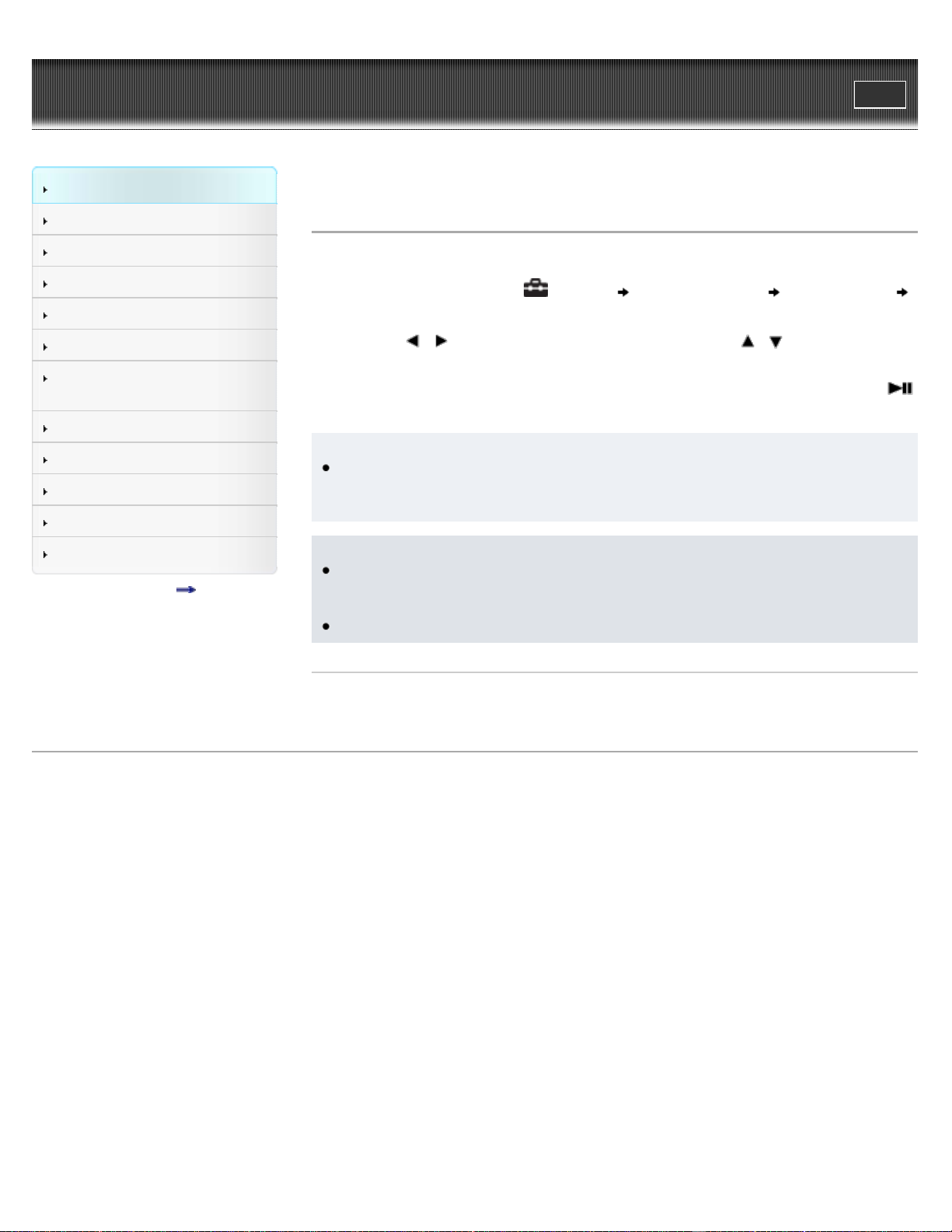
Setting the current time [Set Date-Time]
You can set the date and time.
1. From the Home menu, select [Settings] [Common Settings] [Clock Settings]
[Set Date-Time].
2. Press the
/ button to select the year, and then press the / button to change
the value.
3. As in step 2, adjust the settings for month, date, hour, and minutes, and then press the
button to confirm.
Hint
You can select the date format from [YYYY/MM/DD], [MM/DD/YYYY], or [DD/MM/YYYY]
[Details]. Furthermore, you can select the time format from either [12-hour] or [24-hour]
[Details].
Note
If battery power is used up because, for example, the player has not been used for a long
time, your settings for date and time may be lost, and “-” will be displayed instead of the
current date and time.
The clock may gain or lose up to 60 seconds per month. In this case, set the clock again.
Related Topics
How to use the Home menu
Back to top
Copyright 2010 Sony Corporation
34
WALKMAN User Guide
Print
Getting Started
How to Use the Software
Music
“SensMe™ Channels”
Videos/Podcasts/Photos
FM Radio
Making/Playing Voice
Recordings
Timer
Settings
Troubleshooting
Important Information
Specifications
Contents list
Top page > Getting Started > Parts and Controls > Parts and controls
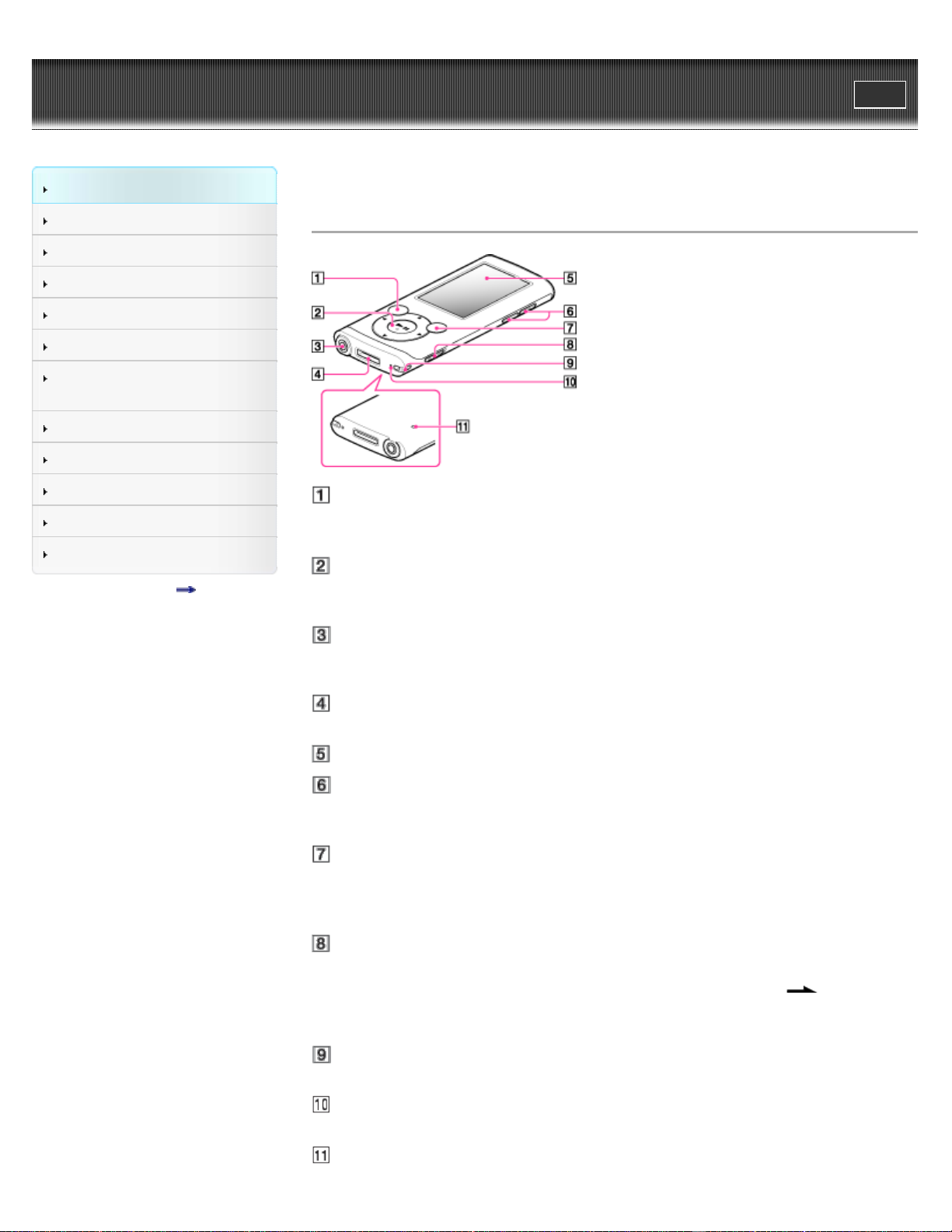
Parts and controls
BACK/HOME button [Details]
Press to go up one list screen level, or to return to the previous menu.
Press and hold the BACK/HOME button to display the Home menu.
5-way button (*1) [Details]
Press to start playback or navigate through the player’s on-screen menus.
(*1) There is a tactile dot. Use it to help with button operations.
Headphone jack
Insert the headphone plug until it clicks into place. If the headphones are connected
improperly, the sound from the headphones will be impaired.
WM-PORT jack
Connect the USB cable (supplied), or peripheral devices (not supplied).
Display
VOL + (*1)/– button
Press to adjust the volume.
(*1) There is a tactile dot. Use it to help with button operations.
OPTION/PWR OFF button [Details]
Press to display the option menu.
If you press and hold the OPTION/PWR OFF button, the screen turns off and the player
enters standby mode [Details].
HOLD switch
You can protect the player against accidental operation during transportation by setting the
HOLD switch. By sliding the HOLD switch in the direction of the arrow
, all operation
buttons are disabled. If you slide the HOLD switch in the opposite position, the HOLD
function is released.
Strap hole
This is used to attach a strap (not supplied).
Microphone [Details]
Use to make voice recordings.
RESET button [Details]
35

WALKMAN User Guide
Print
Getting Started
How to Use the Software
Music
“SensMe™ Channels”
Videos/Podcasts/Photos
FM Radio
Making/Playing Voice
Recordings
Timer
Settings
Troubleshooting
Important Information
Specifications
Contents list
Top page > Getting Started > About the Software > About the software
About the software
Bundled software
Compatible software
You can use several software shown below to manage music, videos, photos and podcasts on
your computer or transfer them to the player.
Bundled software
Content Transfer
Content Transfer can transfer music, videos or photos from a computer to the player by a simple
drag-and-drop operation. You can use Windows Explorer or iTunes, etc., to drag-and-drop data
to Content Transfer. Content Transfer can also convert a video file of a format not supported by
the player into a playable format. For details on operation, refer to the Help of the software.
Transferable files: Music (MP3, WMA, AAC, WAV), Photo (JPEG), Video (MPEG-4 Simple
Profile, AVC (H.264/AVC) Baseline Profile, WMV (*1))
(*1) Some WMV files cannot be played back after being transferred by Content Transfer. If you retransfer
them using Windows Media Player, they may become playable.
Hint
ATRAC files managed by SonicStage can be transferred to the player after conversion to
MP3 file format.
WALKMAN Guide
The User Guide (this manual) and a useful list of links are available to you.
Compatible software
Windows Media Player
Windows Media Player can import audio data from CDs and transfer data to the player.
Transferable files: Music (MP3, WMA), Video (WMV), Photo (JPEG)
For details on operation, refer to the Help of the software, or visit the following website.
http://support.microsoft.com/
Media Go
If you are using Media Go with your PSP® (PlayStation® Portable) or Sony Ericsson mobile
phone, you can transfer data from Media Go to the player if you have updated Media Go to the
latest version (version 1.5 or later).
Related Topics
Importing music from CDs using Windows Media Player
Transferring music using Windows Media Player
Transferring music using Content Transfer
Transferring videos/photos/podcasts using Content Transfer
Back to top
37

Copyright 2010 Sony Corporation
38
WALKMAN User Guide
Print
Getting Started
How to Use the Software
Music
“SensMe™ Channels”
Videos/Podcasts/Photos
FM Radio
Making/Playing Voice
Recordings
Timer
Settings
Troubleshooting
Important Information
Specifications
Contents list
Top page > Getting Started > Home Menu/Option Menu > About the Home menu
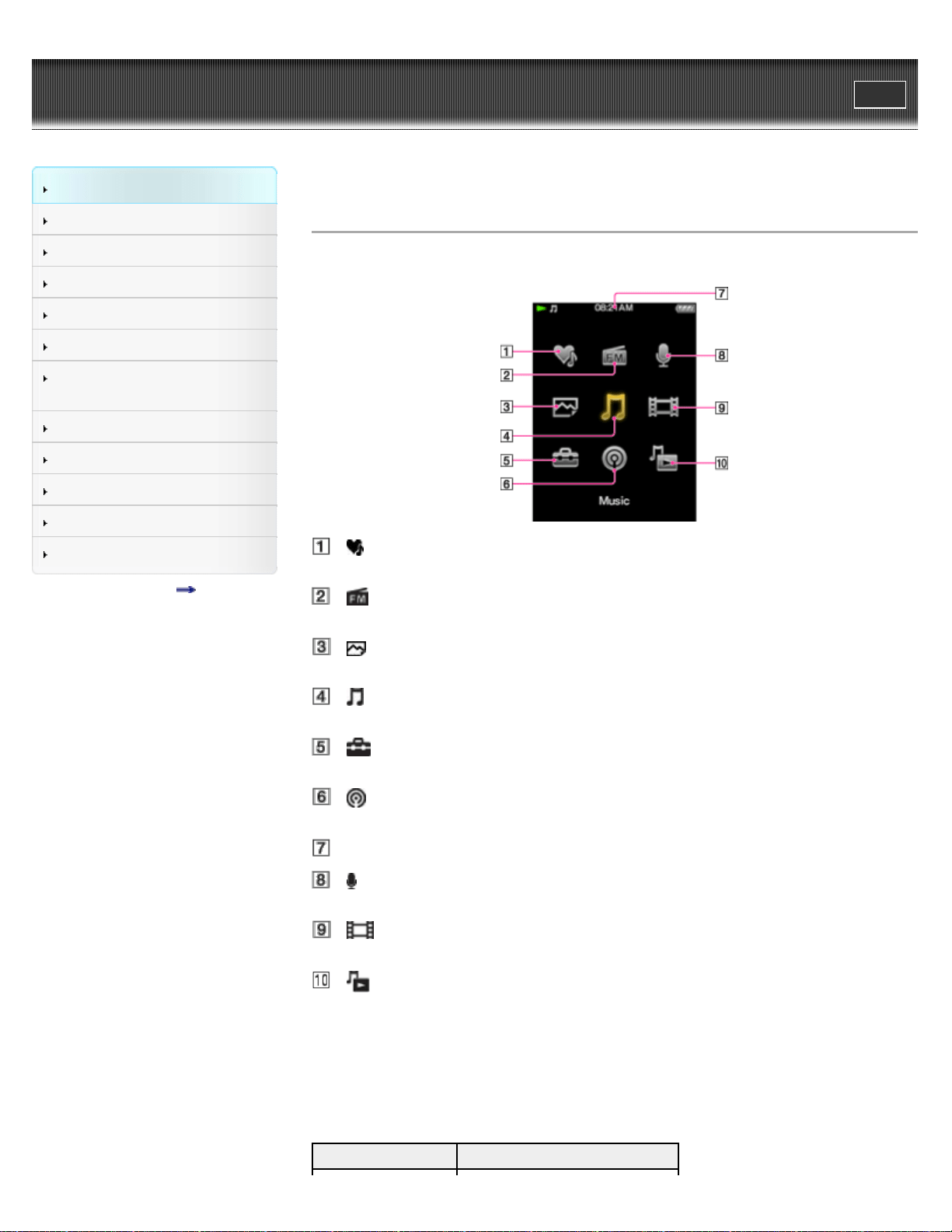
About the Home menu
The following list shows the items of the Home menu.
[SensMe™ Channels] [Details]
Play songs using “SensMe™ Channels.”
[FM Radio] [Details]
Listen to FM radio broadcasting.
[Photos] [Details]
View photos transferred to the player.
[Music] [Details]
Listen to songs transferred to the player.
[Settings] [Details]
Set up the player and its applications.
[Podcasts] [Details]
Play back podcast episodes transferred to the player.
Information area [Details]
[Voice Recording] [Details]
Record voice using the player’s built-in microphone.
[Videos] [Details]
Watch videos transferred to the player.
[Go to song playback screen]
Display the music playback screen.
About the information area
The icons shown in the table below appear in the information area. The icons vary according to
the playback status, setting or screen.
For details about the icons, see each reference page.
Icons Description
39

WALKMAN User Guide
Print
Getting Started
How to Use the Software
Music
“SensMe™ Channels”
Videos/Podcasts/Photos
FM Radio
Making/Playing Voice
Recordings
Timer
Settings
Troubleshooting
Important Information
Specifications
Contents list
Top page > Getting Started > Home Menu/Option Menu > How to use the Home menu
How to use the Home menu
The Home menu is the starting point of each application, such as searching for songs, changing
settings, etc.
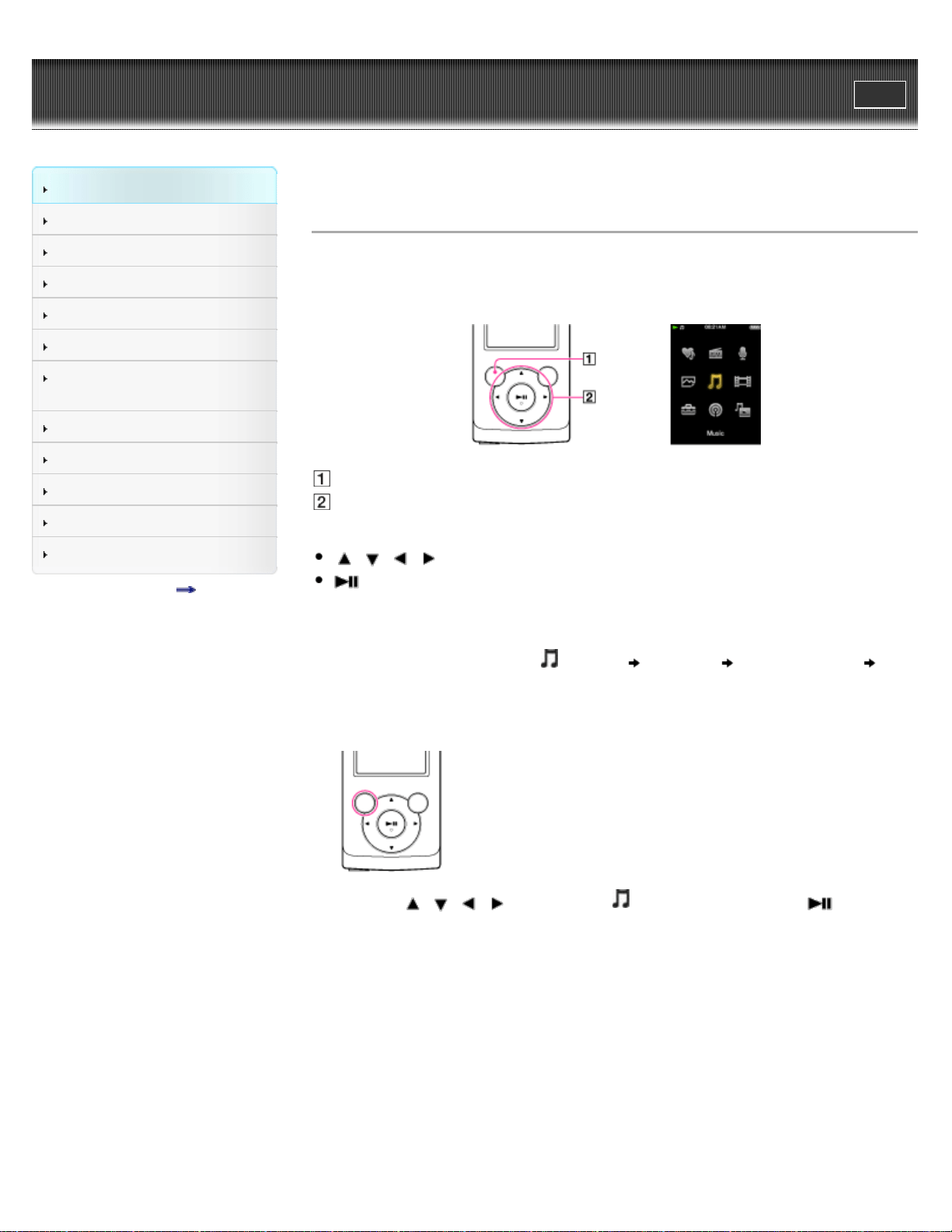
You can display the Home menu by pressing and holding the BACK/HOME button of the player.
BACK/HOME button
5-way button
From the Home menu, you can select the desired item on the screen by using the 5-way button.
/ / / button: Selects an item.
button: Confirms an item.
In this manual, operating instructions from the Home menu are described as below.
Example:
From the Home menu, select
[Music] [Album] desired album
desired song.
1. Press and hold the BACK/HOME button.
The Home menu appears.
2. Press the / / / button to select [Music], and then press the button to
confirm.
The [Music] screen appears.
41
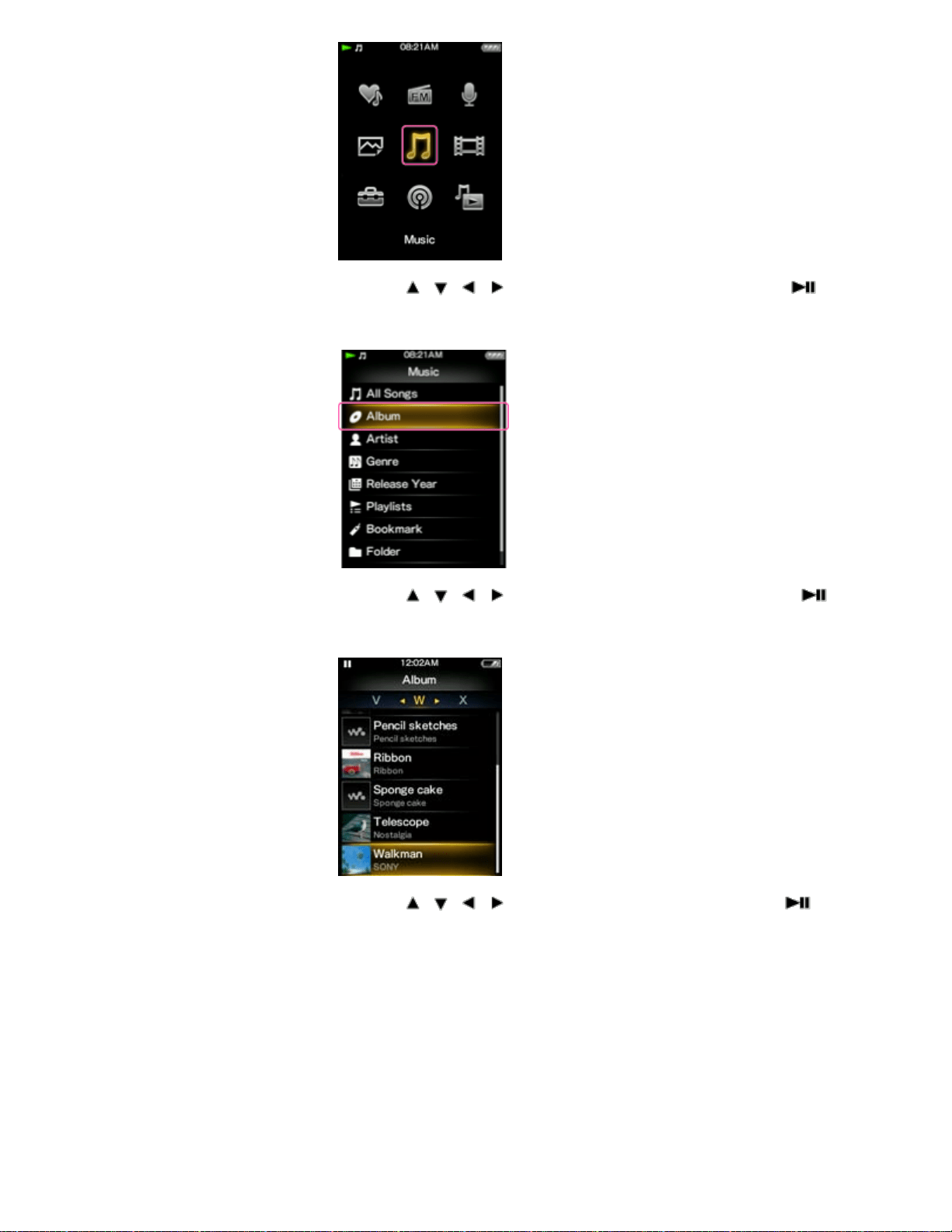
3. Press the / / / button to select [Album], and then press the button to
confirm.
The album list appears.
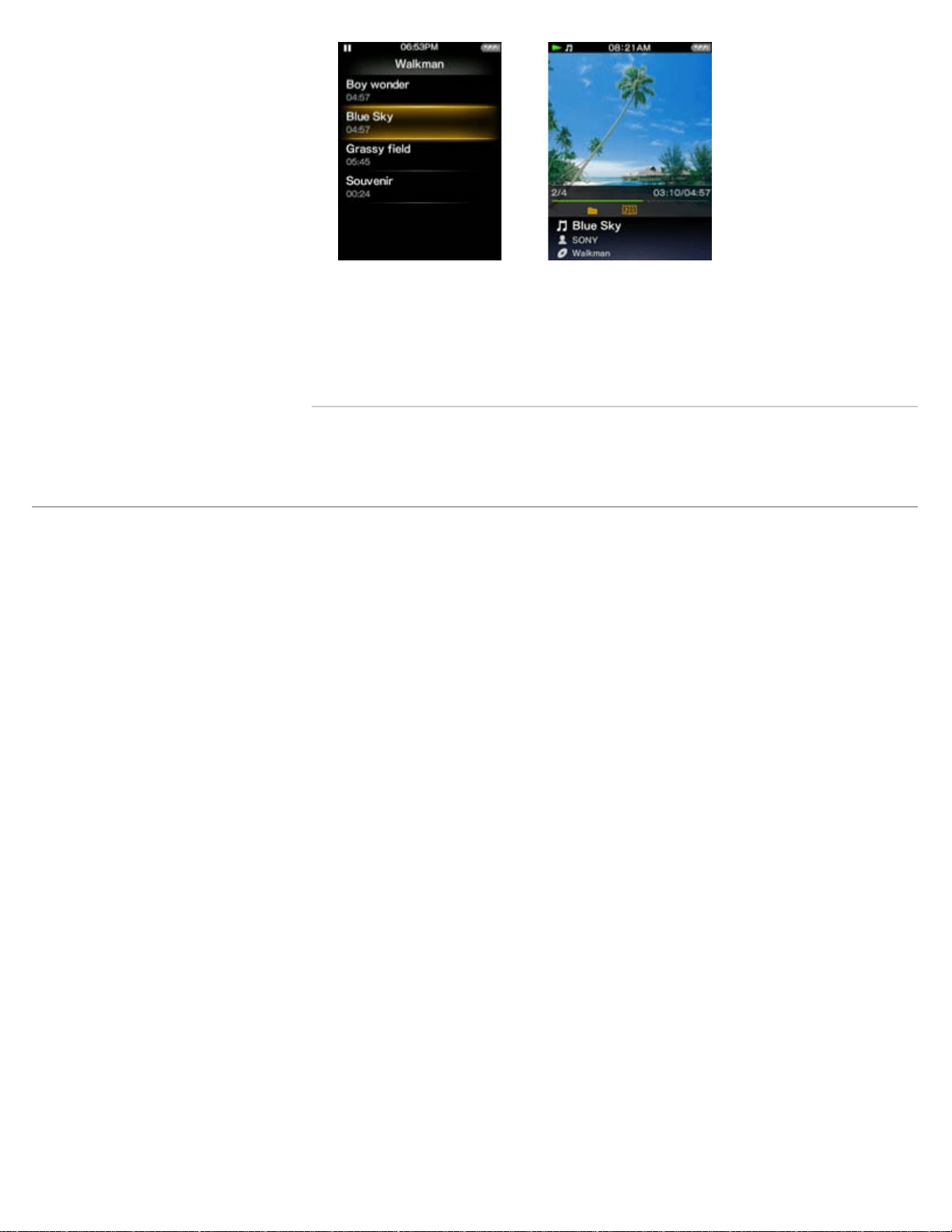
4. Press the / / / button to select an album, and then press the button to
confirm.
The song list for the selected album appears.
5. Press the / / / button to select a song, and then press the button to
confirm.
The music playback screen appears and playback begins.
42
WALKMAN User Guide
Print
Getting Started
How to Use the Software
Music
“SensMe™ Channels”
Videos/Podcasts/Photos
FM Radio
Making/Playing Voice
Recordings
Timer
Settings
Troubleshooting
Important Information
Specifications
Contents list
Top page > Getting Started > Home Menu/Option Menu > How to use the option menu
How to use the option menu
The option menu items vary depending on the function, allowing you to change the settings of
each application.
You can display the option menu by pressing the OPTION/PWR OFF button. Press the
OPTION/PWR OFF button once more to dismiss the option menu.
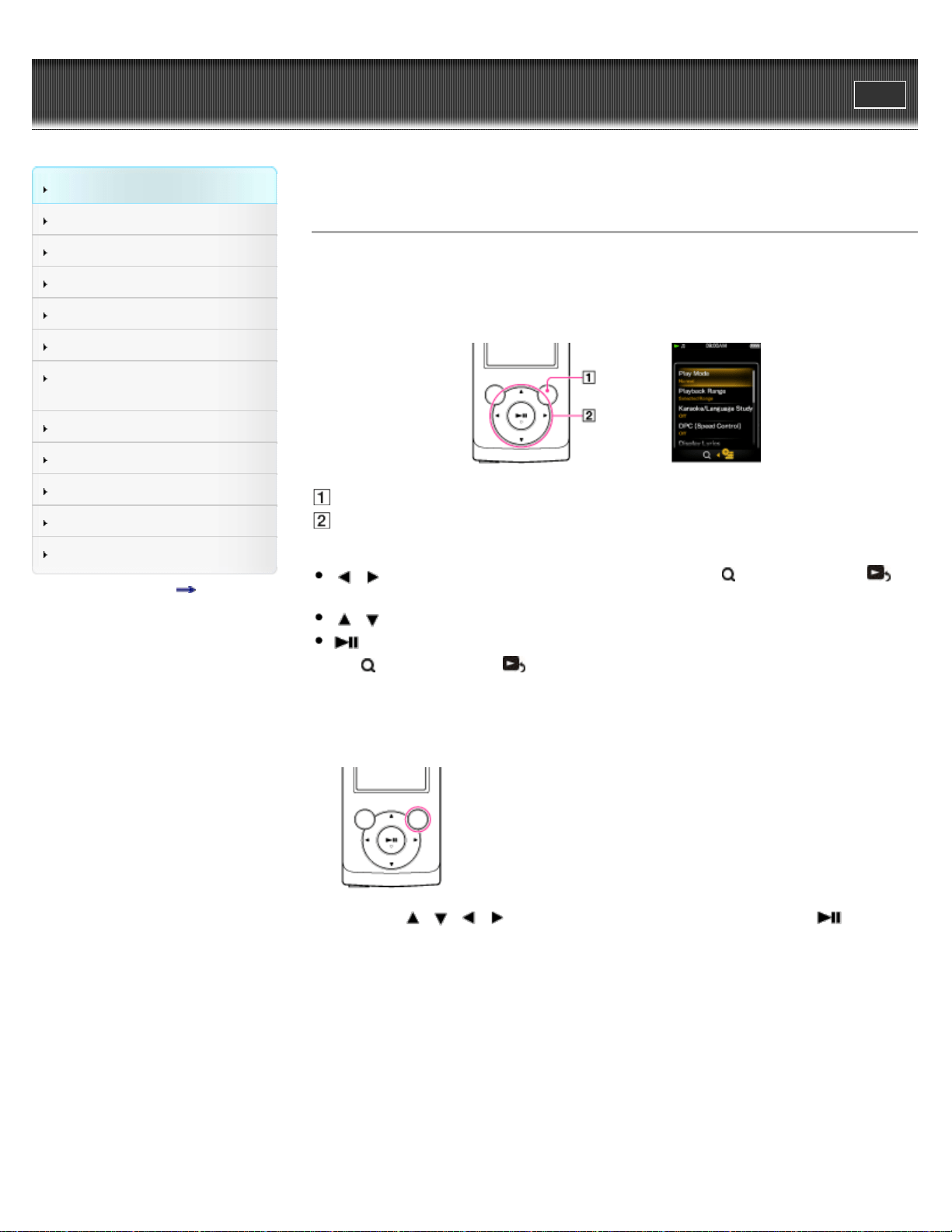
OPTION/PWR OFF button
5-way button
From the option menu, you can select the desired item on the screen by using the 5-way button.
/ buttons: Select a menu from among the option menu, (Search) menu, and [To
Playback Screen] menu. (*1)
/ buttons: Select a menu item.
button: Confirms an item.
(*1) The (search) menu or the [To Playback Screen] icon is not displayed depending on the
screen.
For example, the operations for setting [Play Mode] option to [Shuffle] are shown below.
1. From the music playback screen, press the OPTION/PWR OFF button.
The option menu appears.
2. Press the / / / button to select [Play Mode], and then press the button to
confirm.
44
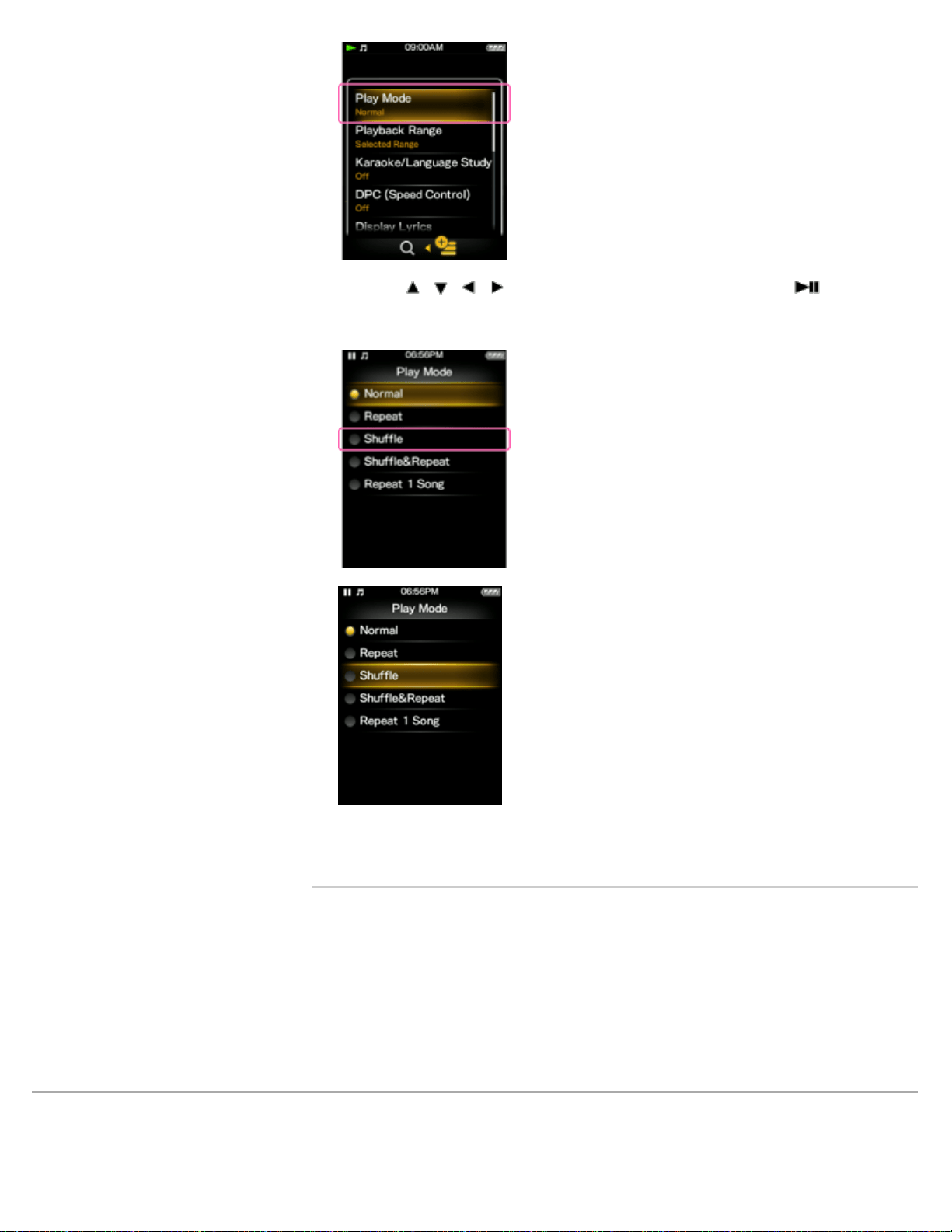
3. Press the / / / button to select [Shuffle], and then press the button to
confirm.
The play mode changes to [Shuffle].
The items in the option menu differ, depending on the screen on which you press the
OPTION/PWR OFF button.
Related Topics
How to use the Home menu
Using the music option menu
Using the video option menu
Using the podcast option menu
Using the photo option menu
Using the FM radio option menu
Using the voice recording option menu
Back to top
Copyright 2010 Sony Corporation
45
WALKMAN User Guide
Print
Getting Started
How to Use the Software
Music
“SensMe™ Channels”
Videos/Podcasts/Photos
FM Radio
Making/Playing Voice
Recordings
Timer
Settings
Troubleshooting
Important Information
Specifications
Contents list
Top page > How to Use the Software > Windows Media Player > Importing music from CDs
using Windows Media Player
Importing music from CDs using Windows Media Player
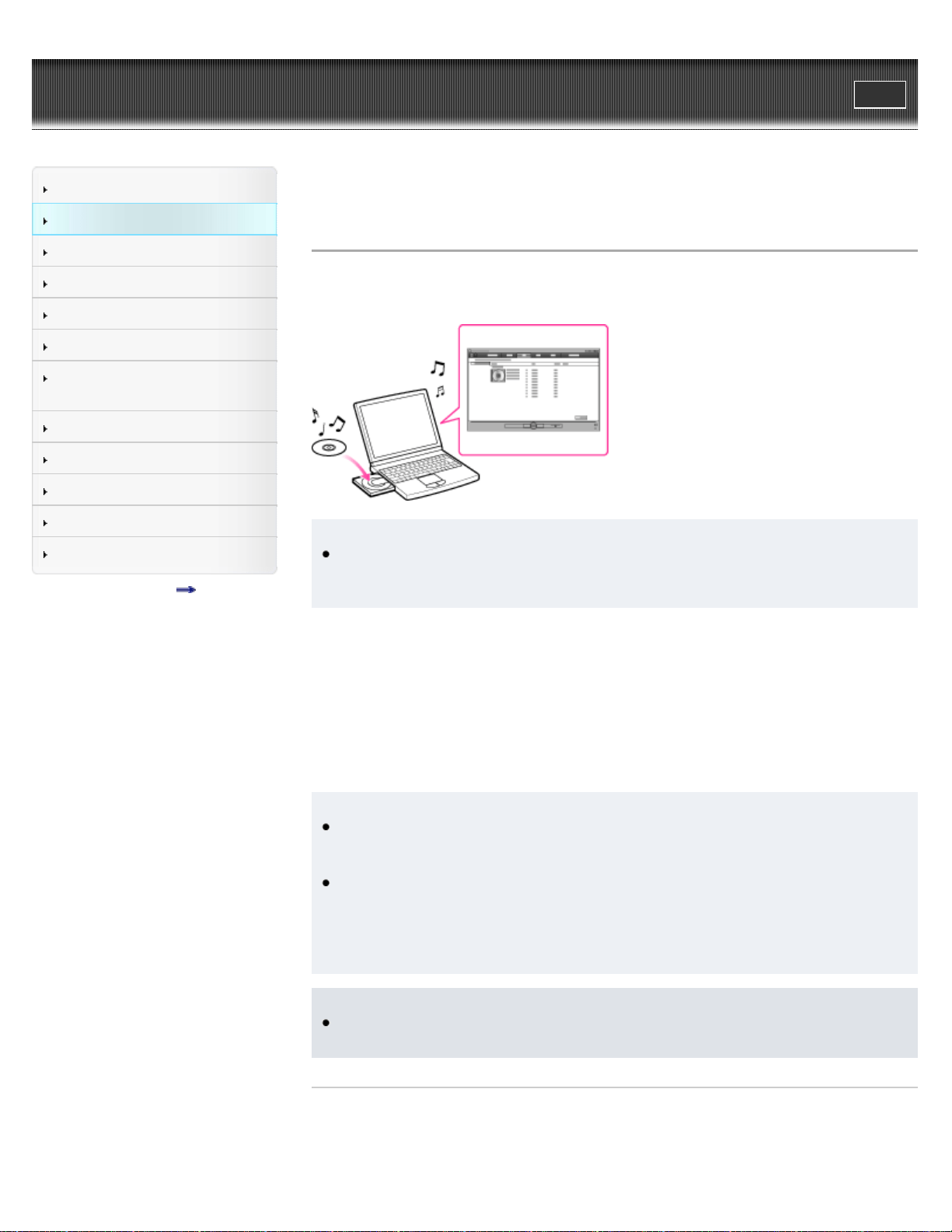
You can use Windows Media Player to copy (rip) music from your CDs. Follow these instructions
to rip songs from a CD to your computer.
Hint
For details about usage or support on Windows Media Player, refer to Windows Media
Player information from the following web site:
http://support.microsoft.com/
1. Insert an audio CD.
2. Start up Windows Media Player, and then click the [Rip] tab at the top of the window.
When connected to the Internet, Windows Media Player obtains CD information (CD title,
song name or artist name, etc.), and displays it in the window.
3. Click [Start Rip].
Windows Media Player begins to import the CD.
The imported songs are indicated as [Ripped to library]. Wait until all songs have been
imported.
Hint
Imported songs are stored in the [My Music] folder (Windows XP/Windows 7) or [Music]
folder (Windows Vista) of the computer. Click the [Library] tab of the Windows Media Player
window to find them.
Windows Media Player obtains the CD information from a database on the Internet.
However, depending on the CD, information may not be available in the database. If your
CDs’ information is missing, you can add it after importing. For information about adding and
editing CD information, refer to the Help of Windows Media Player.
If you want a song not to be imported, uncheck the checkbox to the left of the song title.
Note
Imported songs are limited to private use only. Use of a song beyond this limitation requires
permission of the copyright holders.
Related Topics
About the software
Transferring music using Windows Media Player
46

WALKMAN User Guide
Print
Getting Started
How to Use the Software
Music
“SensMe™ Channels”
Videos/Podcasts/Photos
FM Radio
Making/Playing Voice
Recordings
Timer
Settings
Troubleshooting
Important Information
Specifications
Contents list
Top page > How to Use the Software > Windows Media Player > Transferring music using
Windows Media Player
Transferring music using Windows Media Player
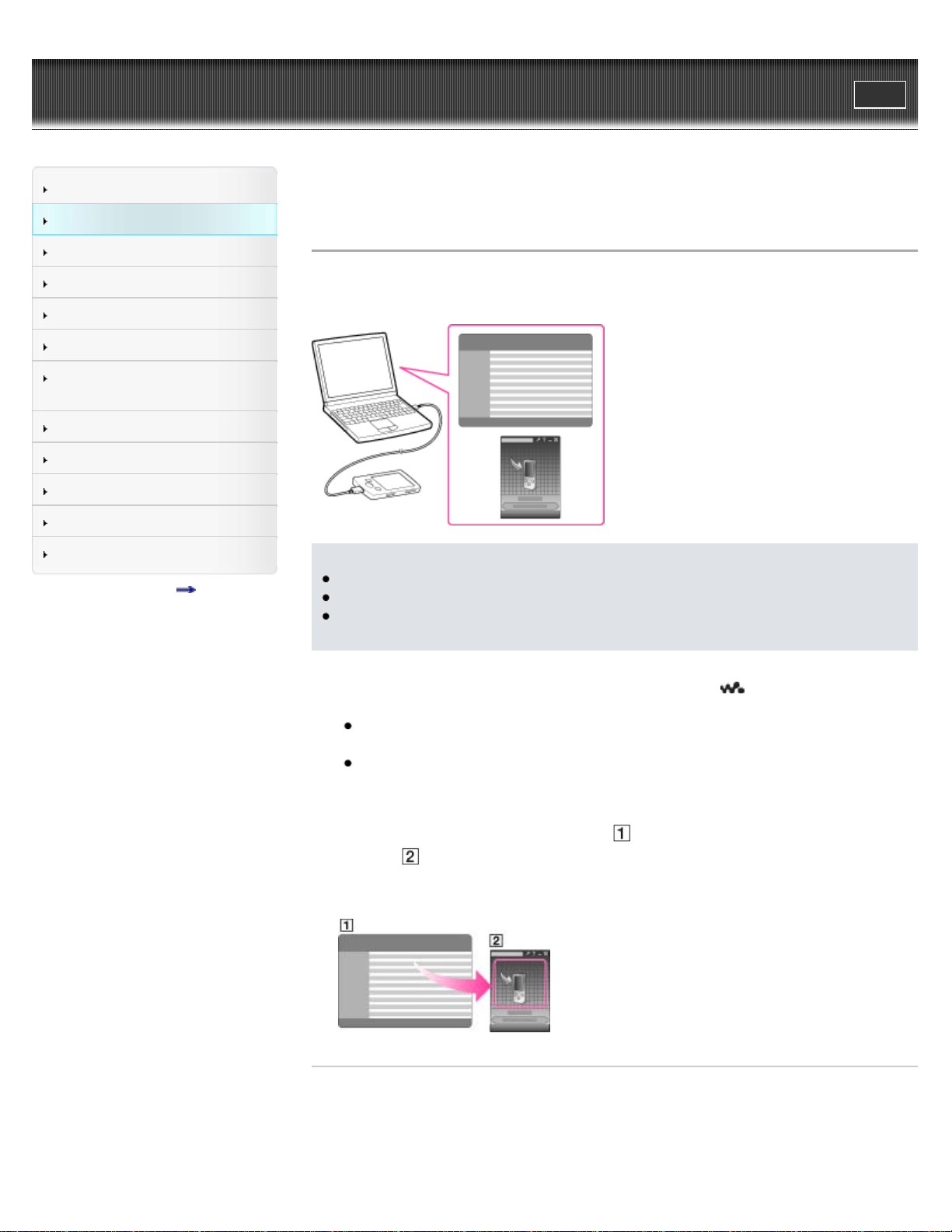
You can use Windows Media Player to transfer music from your computer to the player.
Note
If Content Transfer starts automatically after connecting the player to your computer using
the USB cable (supplied), close or ignore Content Transfer as Content Transfer need not be
used. For details on setting automatic start of Content Transfer, refer to the Help of Content
Transfer.
Hint
For details about usage or support on Windows Media Player, refer to Windows Media
Player information from the following web site:
http://support.microsoft.com/
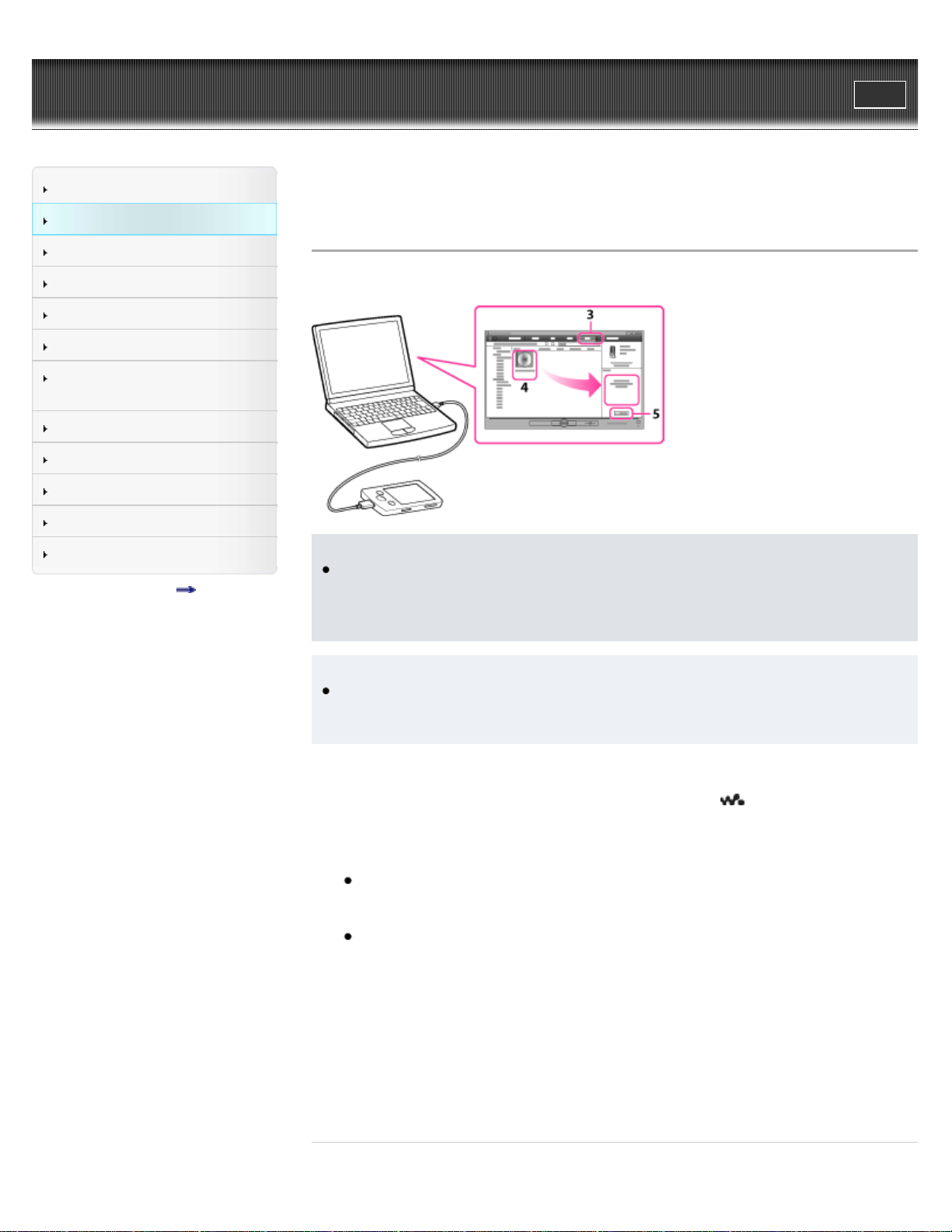
1. Start up Windows Media Player, and then connect the player to your computer using the
USB cable (supplied).
Insert the connector of the USB cable into the player with the
mark facing up.
The [Device Setup] window appears.
2. Click [Cancel].
Close the auto play window, if it appears, by clicking [Cancel] or the Close icon.
If you click [Finish] instead of [Cancel], the entire library data of Windows Media Player is
automatically copied to the player. If the library data size is larger than the available
storage space on the player, the copy process will not start.
You can open the [Device Setup] window at any time. To open it, right-click [WALKMAN]
on the left side of the Windows Media Player window, and then click [Set Up Sync].
3. Click the [Sync] tab on the Windows Media Player window.
4. Drag-and-drop the desired songs to the Sync List on the right side of the window.
The songs are added to the Sync List.
5. Click [Start Sync] to start synchronization.
When synchronization is complete, a message confirming you can disconnect the player
appears on the Sync List. After completion, close Windows Media Player, and disconnect the
player from the computer.
Related Topics
48

WALKMAN User Guide
Print
Getting Started
How to Use the Software
Music
“SensMe™ Channels”
Videos/Podcasts/Photos
FM Radio
Making/Playing Voice
Recordings
Timer
Settings
Troubleshooting
Important Information
Specifications
Contents list
Top page > How to Use the Software > Content Transfer > Transferring music using Content
Transfer
Transferring music using Content Transfer
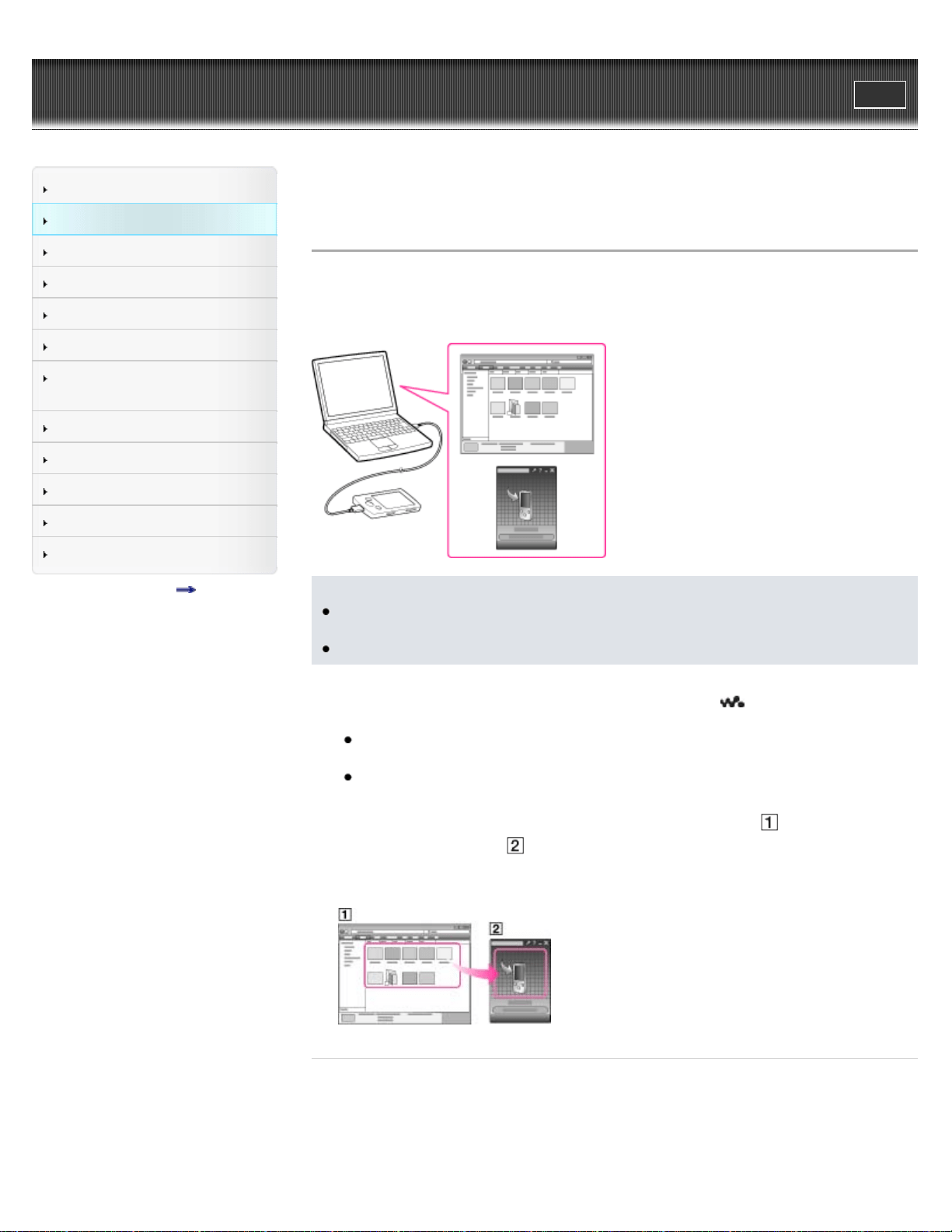
If you have already managed music with iTunes, etc., you can transfer them to the player using
Content Transfer. You can use iTunes, etc., to drag-and-drop music to Content Transfer.
Note
Content Transfer cannot be used for Windows Media Player contents.
Contents with copyright protection cannot be transferred.
Content Transfer supports data transfer from iTunes 9.0 to the player. For details on
restrictions on transferring songs from iTunes, visit the customer support Web sites [Details].
1. Connect the player to your computer using the USB cable (supplied).
Insert the connector of the USB cable into the player with the
mark facing up.
Content Transfer starts automatically.
For details on setting automatic start and general operation of Content Transfer, refer to
the Help of Content Transfer.
You can also click [All programs] in the [start] menu, and then [Content Transfer] -
[Content Transfer] to start the software.
2. Start up iTunes, etc.
3. Select the desired songs from iTunes, etc. (
), and drag-and-drop them to Content
Transfer (
).
Content Transfer recognizes the type of data by filename extension, and sends it to the
appropriate folder of the player.
Related Topics
About the software
Transferring videos/photos/podcasts using Content Transfer
Transferring music using Windows Media Player
50

WALKMAN User Guide
Print
Getting Started
How to Use the Software
Music
“SensMe™ Channels”
Videos/Podcasts/Photos
FM Radio
Making/Playing Voice
Recordings
Timer
Settings
Troubleshooting
Important Information
Specifications
Contents list
Top page > How to Use the Software > Content Transfer > Transferring videos/photos/podcasts
using Content Transfer
Transferring videos/photos/podcasts using Content Transfer
You can transfer videos/photos/podcasts stored on your computer to the player using Content
Transfer. You can transfer videos/photos/podcasts by drag-and-drop of the desired
videos/photos/podcasts from Windows Explorer to Content Transfer.
Note
Do not disconnect the USB cable while [Do not disconnect.] appears on the player, as the
data being transferred or the data stored in the player may be damaged.
Contents with copyright protection cannot be transferred.
1. Connect the player to your computer using the USB cable (supplied).
Insert the connector of the USB cable into the player with the
mark facing up.
Content Transfer starts automatically.
For details on setting automatic start and general operation of Content Transfer, refer to
the Help of Content Transfer.
You can also click [All programs] in the [start] menu, and then [Content Transfer] -
[Content Transfer] to start the software.
2. Select the desired videos/photos/podcasts from Windows Explorer (
), and drag-and-drop
them to Content Transfer (
).
Content Transfer recognizes the type of data by filename extension, and sends it to the
appropriate folder of the player.
Related Topics
About the software
Transferring music using Content Transfer
Transferring videos/photos/podcasts using Windows Explorer
Watching videos [Videos]
52

WALKMAN User Guide
Print
Getting Started
How to Use the Software
Music
“SensMe™ Channels”
Videos/Podcasts/Photos
FM Radio
Making/Playing Voice
Recordings
Timer
Settings
Troubleshooting
Important Information
Specifications
Contents list
Top page > How to Use the Software > Windows Explorer (Drag-and-Drop) > Transferring
music using Windows Explorer
Transferring music using Windows Explorer
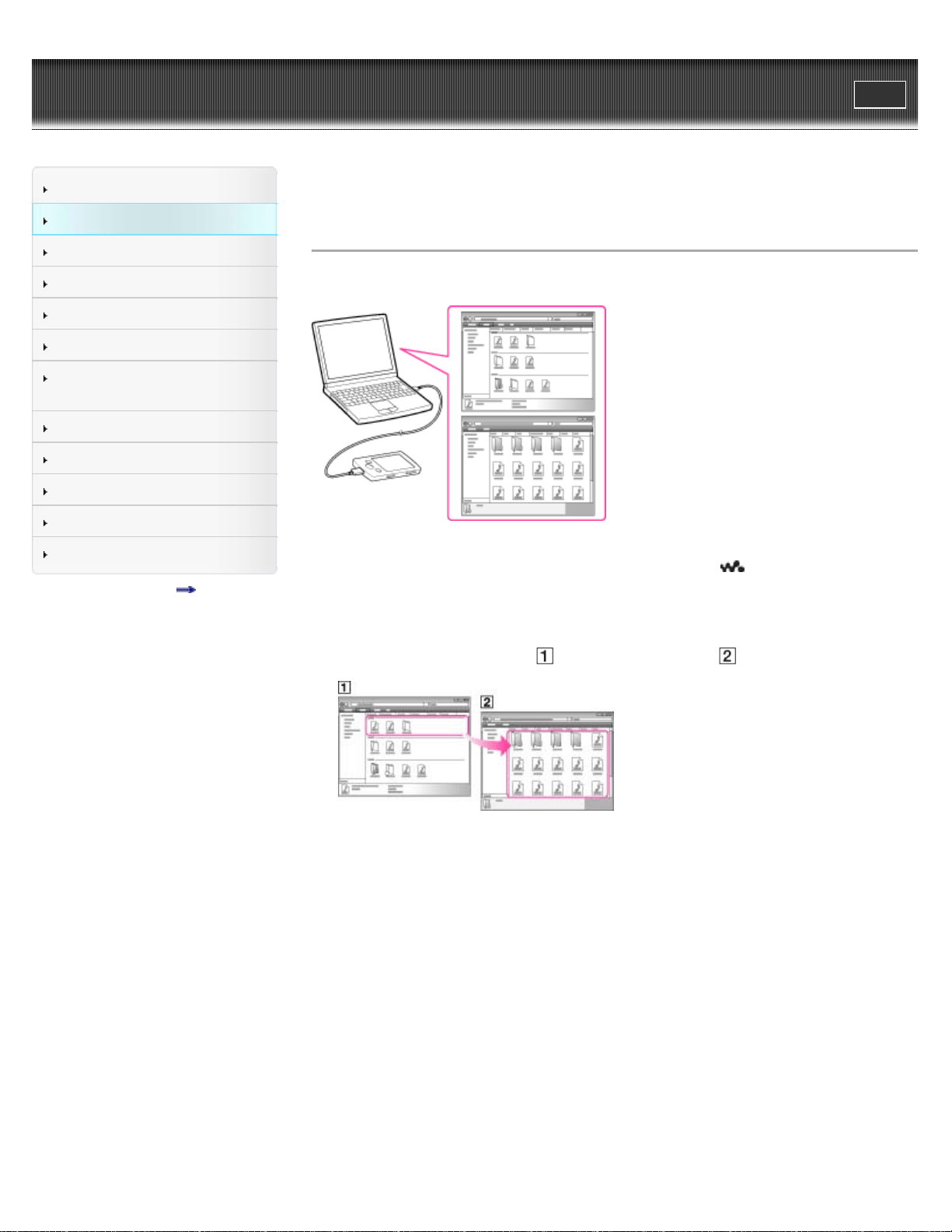
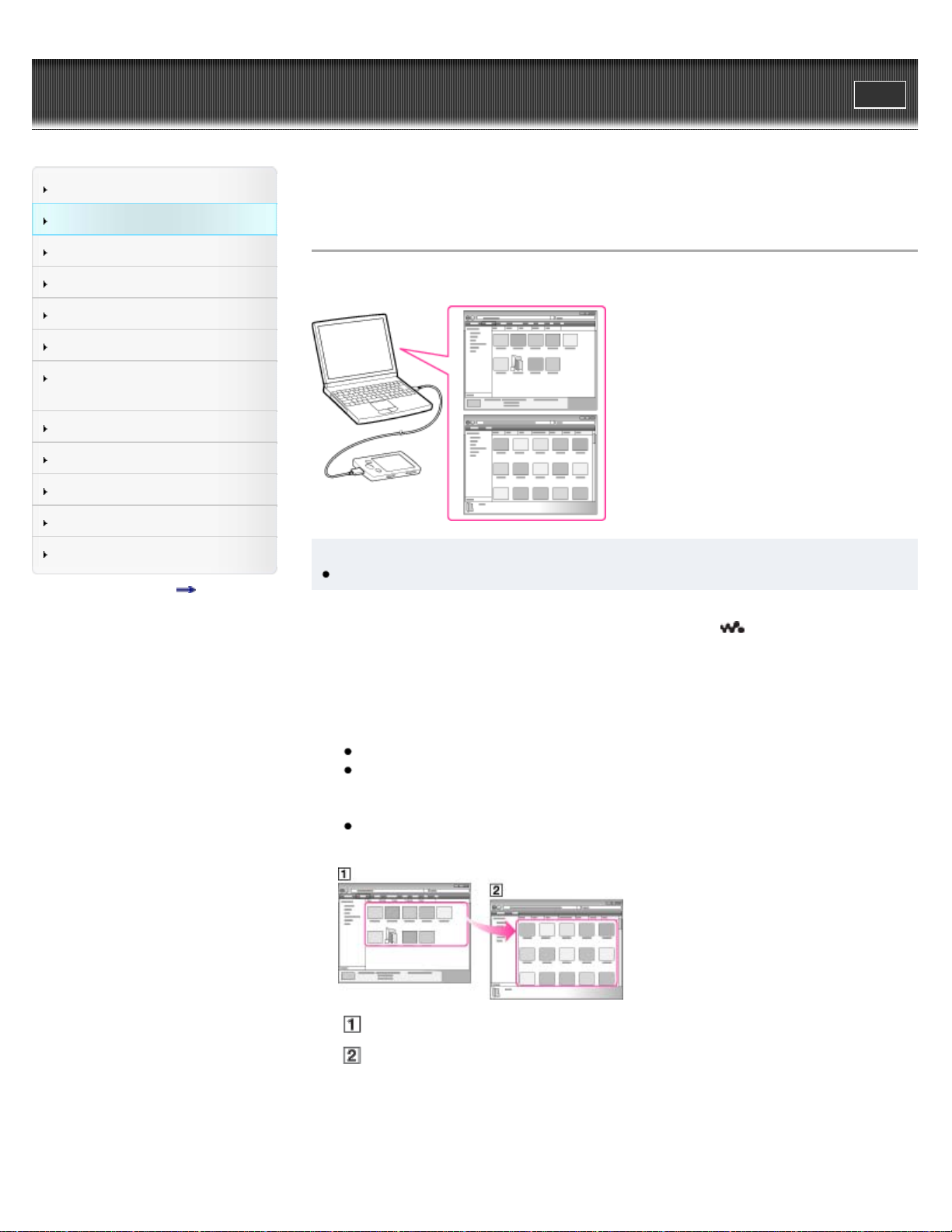
You can directly transfer data by drag-and-drop using Windows Explorer on your computer.
1. Connect the player to your computer using the USB cable (supplied).
Insert the connector of the USB cable into the player with the
mark facing up.
2. Click [start] – [My Computer] or [Computer] – [WALKMAN] – [Storage Media], and then
select the [MUSIC] folder.
Data hierarchy may differ, depending on your computer environment.
3. Drag-and-drop files or folders (
) into the [MUSIC] folder ( ), or one of its subfolders.
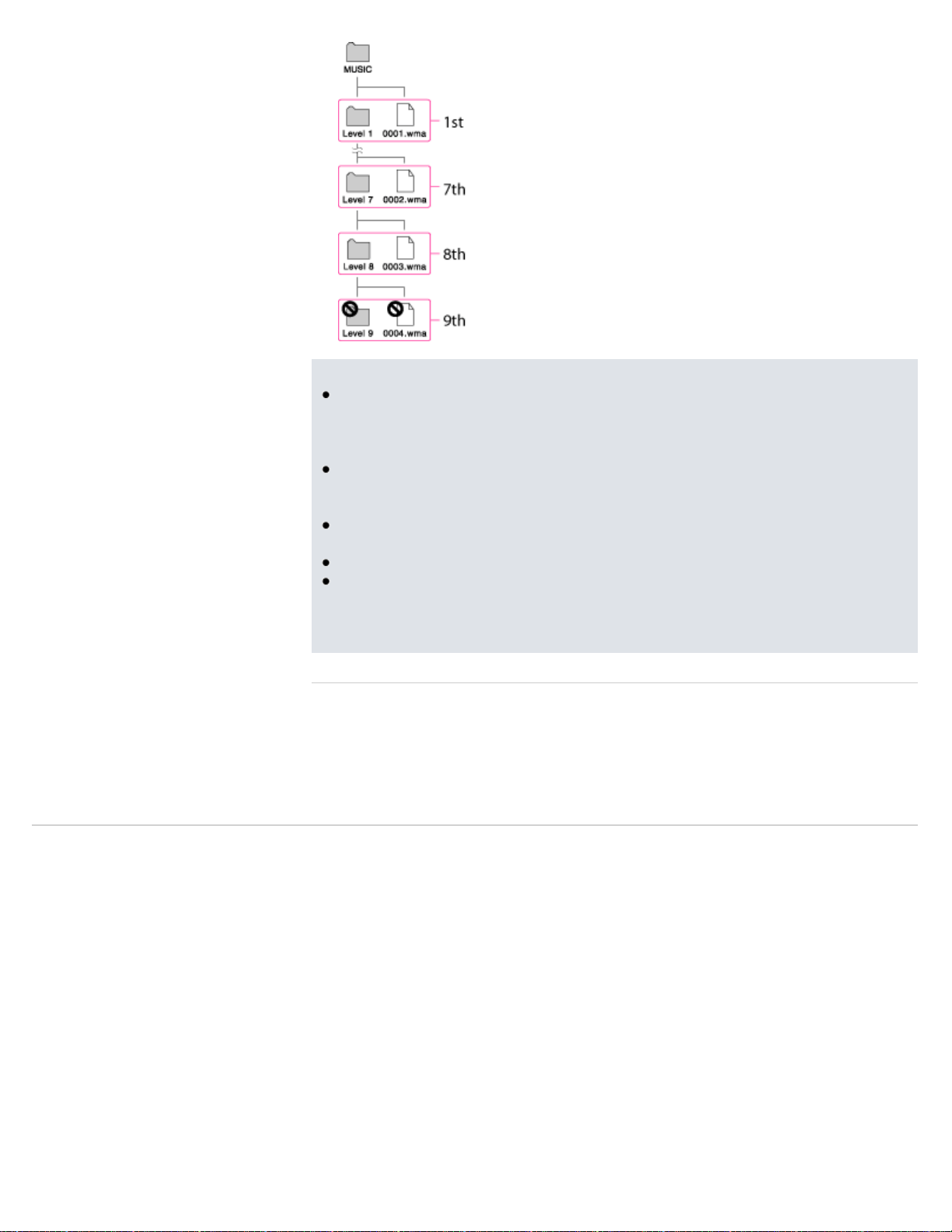
About the data hierarchy
Drag and drop files or folders into the correct folder as shown in the following illustration. The
player can play back songs on the 1st to 8th level of the [MUSIC] folder.
54
Note
Do not disconnect the USB cable while [Do not disconnect.] appears on the player.
Otherwise, data being transferred or stored on the player may be damaged. If the player is
disconnected while files are being transferred, unnecessary files may be left in the player. In
this case, transfer usable files back to the computer and format the player [Details].
Do not change folder names or delete the [MUSIC], [MP_ROOT], [MPE_ROOT], [VIDEO],
[DCIM], [PICTURE], [PICTURES], [SCREENSAVER], [PODCASTS], [RECORD] and
[VOICE] folders.
Do not change folder or file names directly under the [MP_ROOT] or [MPE_ROOT] folders,
otherwise, they will not be displayed on the player.
Some files may not be played back on the player due to copyright protection.
If Content Transfer starts automatically after connecting the player to your computer using
the USB cable (supplied), close or ignore Content Transfer as Content Transfer need not be
used. For details on setting automatic start of Content Transfer, refer to the Help of Content
Transfer.
Related Topics
Transferring music using Windows Media Player
Transferring music using Content Transfer
Transferring videos/photos/podcasts using Windows Explorer
Playing music
Back to top
Copyright 2010 Sony Corporation
55
WALKMAN User Guide
Print
Getting Started
How to Use the Software
Music
“SensMe™ Channels”
Videos/Podcasts/Photos
FM Radio
Making/Playing Voice
Recordings
Timer
Settings
Troubleshooting
Important Information
Specifications
Contents list
Top page > How to Use the Software > Windows Explorer (Drag-and-Drop) > Transferring
videos/photos/podcasts using Windows Explorer
Transferring videos/photos/podcasts using Windows Explorer
You can directly transfer data by drag-and-drop using Windows Explorer on your computer.
Hint
Some WMV files can be played back only by transferring using Windows Media Player.
1. Connect the player to your computer using the USB cable (supplied).
Insert the connector of the USB cable into the player with the
mark facing up.
2. Click [start] – [My Computer] or [Computer] – [WALKMAN] – [Storage Media], and then
select the [VIDEO], [PICTURE], [PICTURES], [DCIM] or [PODCASTS] folder.
Data hierarchy may differ, depending on your computer environment.
3. Drag-and-drop files or folders into the [VIDEO], [PICTURE], [PICTURES], [DCIM] or
[PODCASTS] folder or one of their subfolders.
Video files or folders: drag and drop into the [VIDEO] folder, or one of its subfolders.
Photo files or folders: drag and drop into the [PICTURE], [PICTURES] or [DCIM] folder,
or one of their subfolders. If you want to use photos as the slide show screensaver
[Details], drag and drop them into the [SCREENSAVER] folder in the [PICTURE] folder.
Podcast folders and episode files: drag and drop podcast folders into the [PODCASTS]
folder and episode files into the podcast folders.
Video/photo/podcast files or folders in your computer
Video: [VIDEO] folder in your player
Photo: [PICTURE], [PICTURES] or [DCIM] folder in your player
Podcast: [PODCASTS] folder in your player
About the data hierarchy
Drag and drop files or folders into the correct folder as shown in the following illustrations.
56
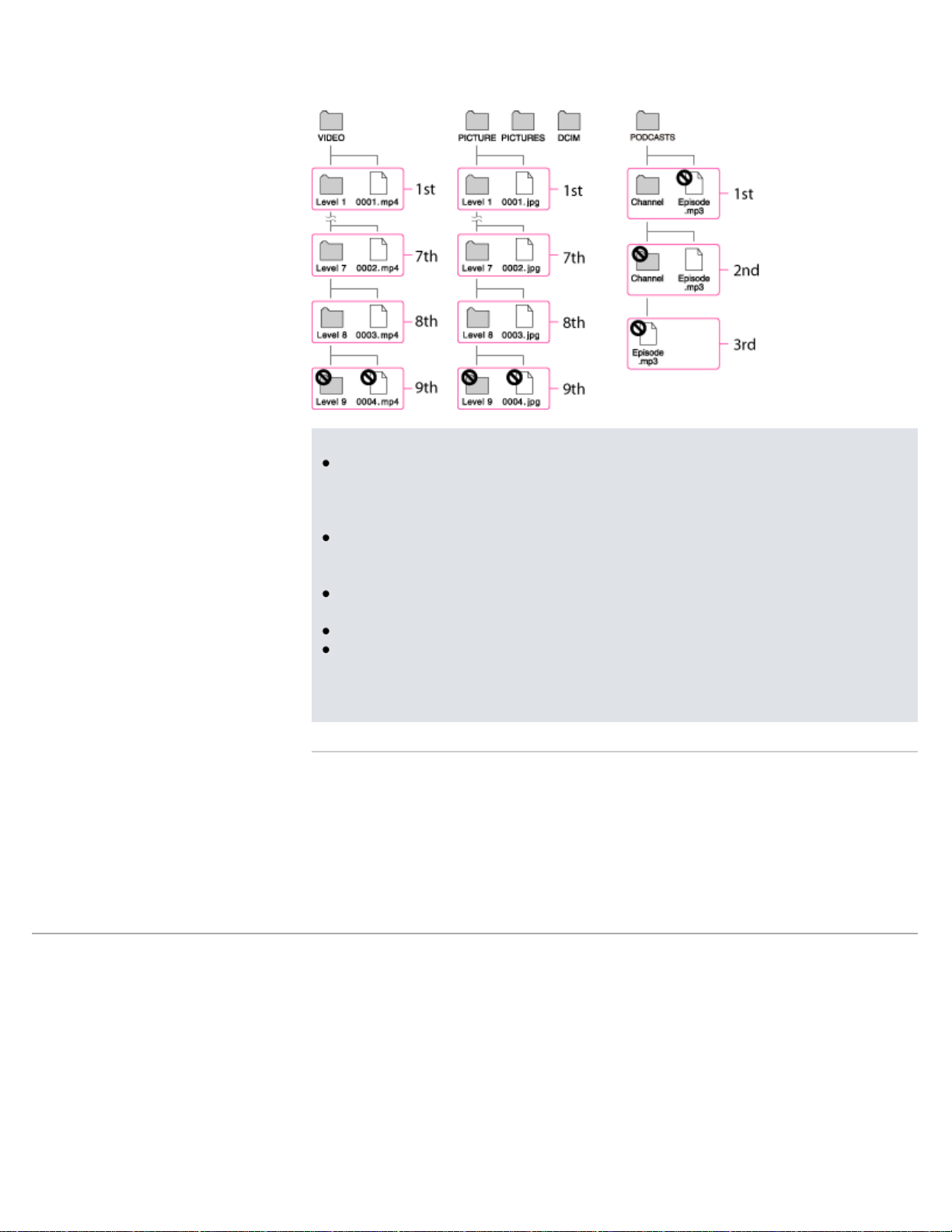
The player can play back videos on the 1st to 8th level of the [VIDEO] folder, and can display
photos on the 1st to 8th level of the [PICTURE], [PICTURES] and [DCIM] folders. The player can
play back podcast episodes on the 2nd level of the [PODCASTS] folder.
Note
Do not disconnect the USB cable while [Do not disconnect.] appears on the player.
Otherwise, data being transferred or stored on the player may be damaged. If the player is
disconnected while files are being transferred, unnecessary files may be left in the player. In
this case, transfer usable files back to the computer and format the player [Details].
Do not change folder names or delete the [MUSIC], [MP_ROOT], [MPE_ROOT], [VIDEO],
[DCIM], [PICTURE], [PICTURES], [SCREENSAVER], [PODCASTS], [RECORD] and
[VOICE] folders.
Do not change folder or file names directly under the [MP_ROOT] or [MPE_ROOT] folders.
Otherwise, they will not be displayed on the player.
Some files may not be played back on the player due to copyright protection.
If Content Transfer starts automatically after connecting the player to your computer using
the USB cable (supplied), close or ignore Content Transfer as Content Transfer need not be
used. For details on setting automatic start of Content Transfer, refer to the Help of Content
Transfer.
Related Topics
Transferring videos/photos/podcasts using Content Transfer
Transferring music using Windows Explorer
Watching videos [Videos]
Playing podcast [Podcasts]
Viewing photos [Photos]
Back to top
Copyright 2010 Sony Corporation
57
WALKMAN User Guide
Print
Getting Started
How to Use the Software
Music
“SensMe™ Channels”
Videos/Podcasts/Photos
FM Radio
Making/Playing Voice
Recordings
Timer
Settings
Troubleshooting
Important Information
Specifications
Contents list
Top page > Music > Playing Music > Playing music
Playing music
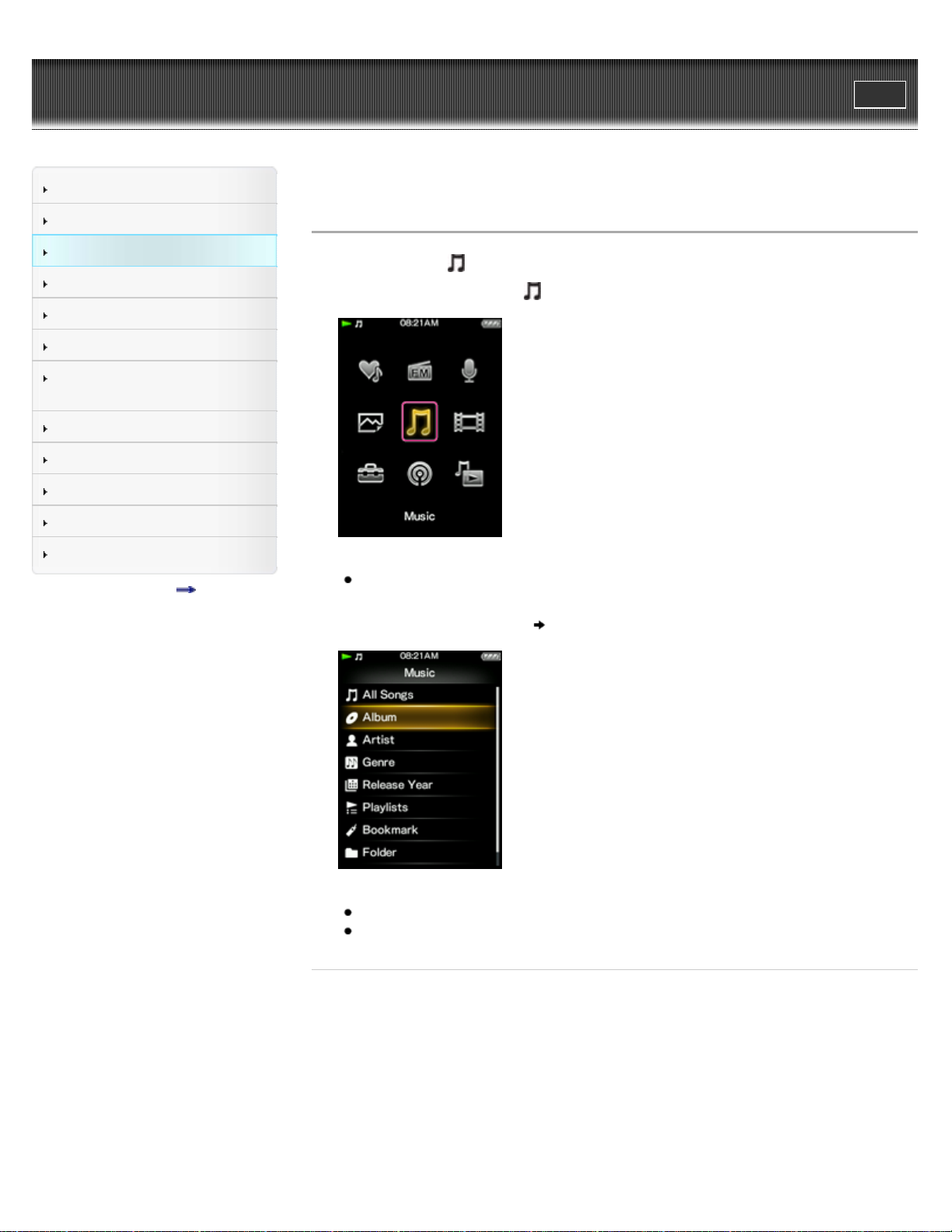
To play music, select [Music] on the Home menu to display the [Music] screen.
1. From the Home menu, select [Music].
The music menu appears.
You can select the desired search method to display the music list screen and search for
songs [Details].
2. Select desired search method
desired song.
The music playback screen appears and song playback begins.
Select items until a song list appears.
For details on how to operate the music playback screen, see [Details].
Related Topics
Importing music from CDs using Windows Media Player
Transferring music using Windows Media Player
Transferring music using Content Transfer
Transferring music using Windows Explorer
Browsing and using the music screen
Searching for songs
Deleting songs
Using the music option menu
58

WALKMAN User Guide
Print
Getting Started
How to Use the Software
Music
“SensMe™ Channels”
Videos/Podcasts/Photos
FM Radio
Making/Playing Voice
Recordings
Timer
Settings
Troubleshooting
Important Information
Specifications
Contents list
Top page > Music > Playing Music > Browsing and using the music screen
Browsing and using the music screen
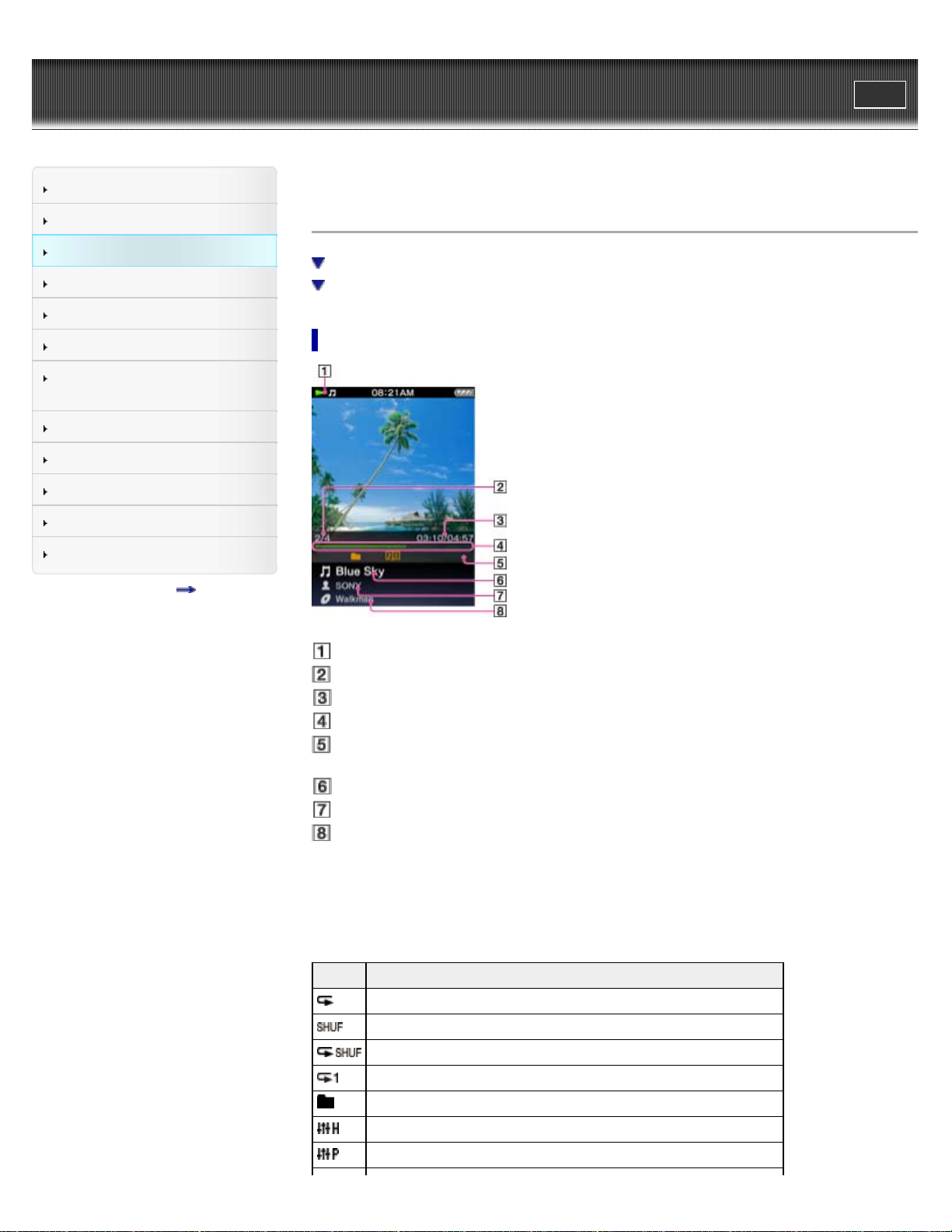
Music playback screen
Music list screen
Music playback screen
Information area
Current song number/Total song number to be played (*1)
Elapsed time/Total time (*1) (*2)
Progress bar (*1) (*2)
Play Mode [Details], Playback Range [Details], Equalizer [Details], VPT(Surround) [Details],
A-B repeat [Details], Display Lyrics [Details] indication icons (*1)
Song name
Artist name
Album title
(*1) These items disappear after a while.
(*2) While playing back variable bit rate (VBR) songs, the elapsed time indication and the progress bar
indicator may be unstable and inaccurate.
Indication icons of the music playback screen
Icon Description
[Play Mode] is set to [Repeat] [Details].
[Play Mode] is set to [Shuffle] [Details].
[Play Mode] is set to [Shuffle&Repeat] [Details].
[Play Mode] is set to [Repeat 1 Song] [Details].
[Playback Range] is set to [Selected Range] [Details].
[Equalizer] is set to [Heavy] [Details].
[Equalizer] is set to [Pop] [Details].
60
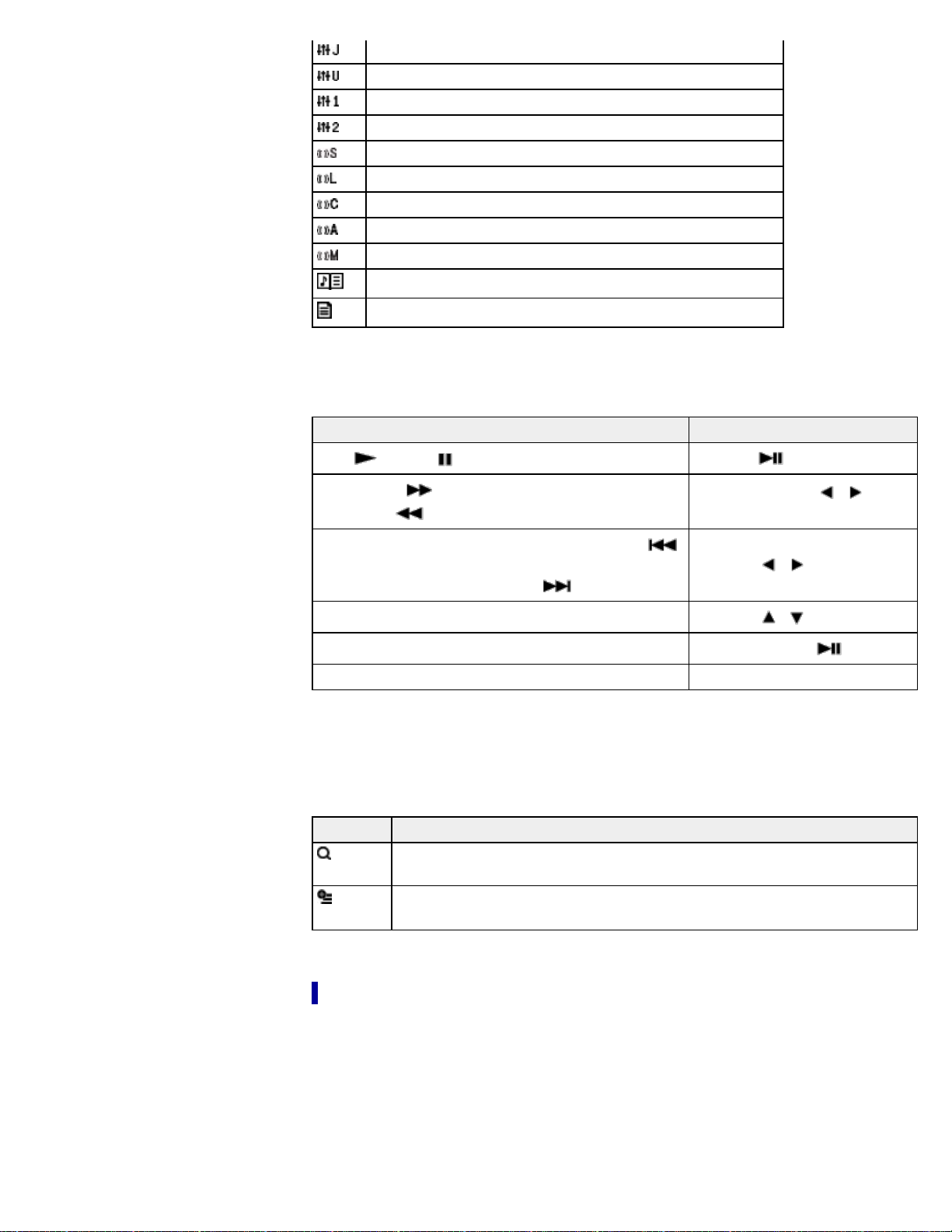
[Equalizer] is set to [Jazz] [Details].
[Equalizer] is set to [Unique] [Details].
[Equalizer] is set to [Custom 1] [Details].
[Equalizer] is set to [Custom 2] [Details].
[VPT(Surround)] is set to [Studio] [Details].
[VPT(Surround)] is set to [Live] [Details].
[VPT(Surround)] is set to [Club] [Details].
[VPT(Surround)] is set to [Arena] [Details].
[VPT(Surround)] is set to [Matrix] [Details].
[Display Lyrics] is set to [On] or [On (No Screen Off)] [Details].
There is a song lyrics file (LRC file) for the current song [Details].
Operations on the music playback screen
To (screen indication) Do this
Play ( )/pause ( ) (*1) Press the button.
Fast forward ( )/
fast rewind (
)
Press and hold the /
button.
Find the beginning of the previous (or current) song (
)/
find the beginning of the next song (
)
Press the / button.
Browse album covers to select an album (*2) Press the / button.
Add to bookmark list Press and hold the button.
Return to the list screen Press the BACK/HOME button.
(*1) During pause, if there is no operation for a while, the player automatically enters standby mode.
(*2) You can browse album covers only when [Karaoke/Language Study] is set to [Off] [Details].
Icons which appear by pressing the OPTION/PWR OFF button
Icon Description
(Search)
Shows the search menu. You can select the desired search method to display the
list screen and search for songs [Details].
(Option
Menu)
Shows the option menu. For details on the music option menu, see [Details].
Music list screen
The following are examples of music list screens.
Song list screen
61
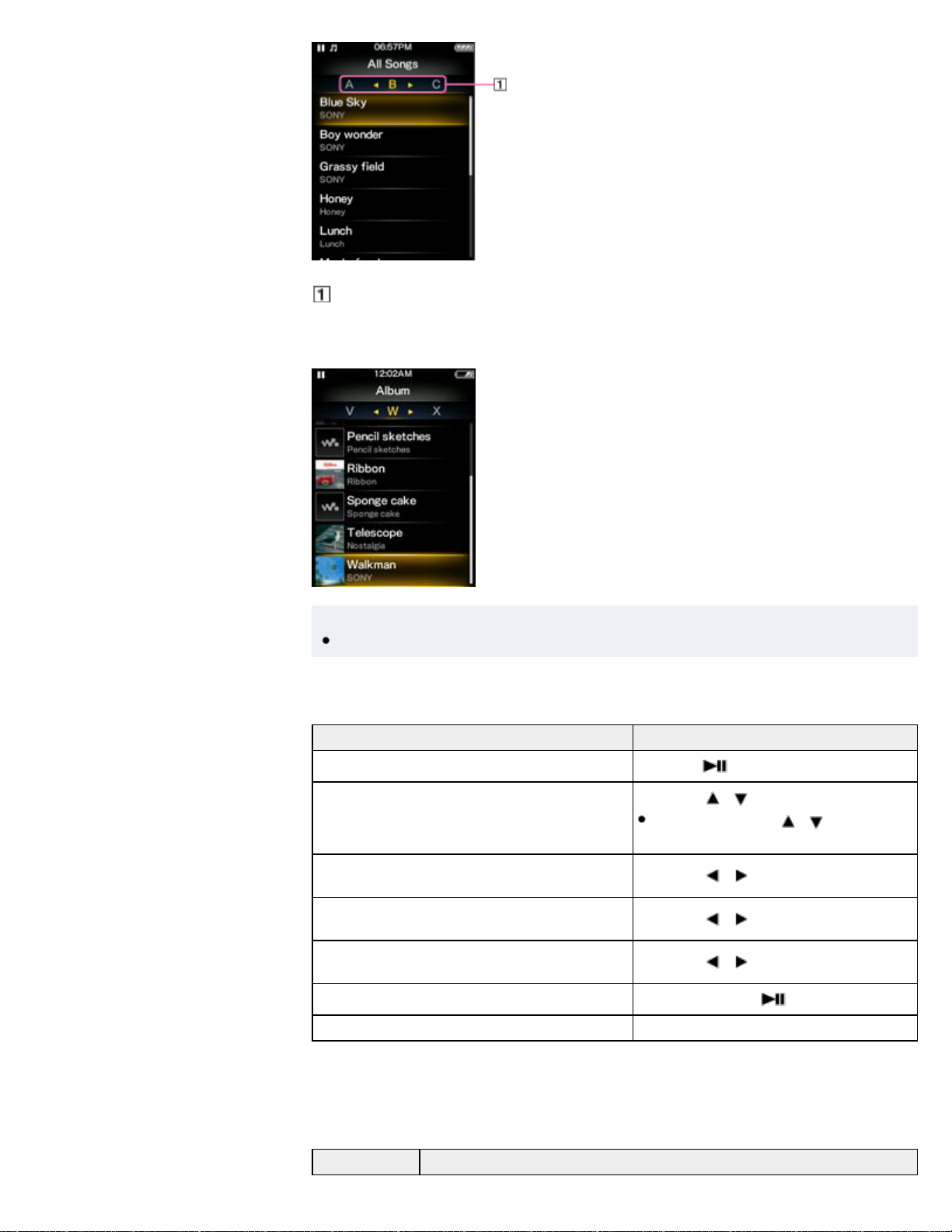
Index
The initials of song and album, etc., names in the list section appear.
Album list screen
Hint
You can change the display format of the album list to display the cover art only [Details].
Operations on the music list screen
To Do this
Confirm an item in the list Press the button.
Move the cursor up or down
Press the / button.
Press and hold the
/ button to
scroll up or down faster.
Move the cursor left/right when an index is
displayed
Press the
/ button.
Display the previous/next screen of the list when
an index is not displayed
Press the
/ button.
Move the cursor left/right when displaying cover
arts only
Press the
/ button.
Add to bookmark list (*1) Press and hold the
button.
Return to the list screen of the next upper level Press the BACK/HOME button.
(*1) You can add transferred songs only to a bookmark list. You cannot add recorded files or albums.
Icons which appear by pressing the OPTION/PWR OFF button
Icon Description
62

(Search)
(*1)
Shows the search menu. You can select the desired search method to
display the list screen and search for songs [Details].
(Option
Menu) (*1)
Shows the option menu. For details on the music option menu, see [Details].
[To
Playback
Screen]
Returns to the music playback screen.
(*1) These icons may not appear depending on the screen.
Back to top
Copyright 2010 Sony Corporation
63
WALKMAN User Guide
Print
Getting Started
How to Use the Software
Music
“SensMe™ Channels”
Videos/Podcasts/Photos
FM Radio
Making/Playing Voice
Recordings
Timer
Settings
Troubleshooting
Important Information
Specifications
Contents list
Top page > Music > Playing Music > Searching for songs
Searching for songs
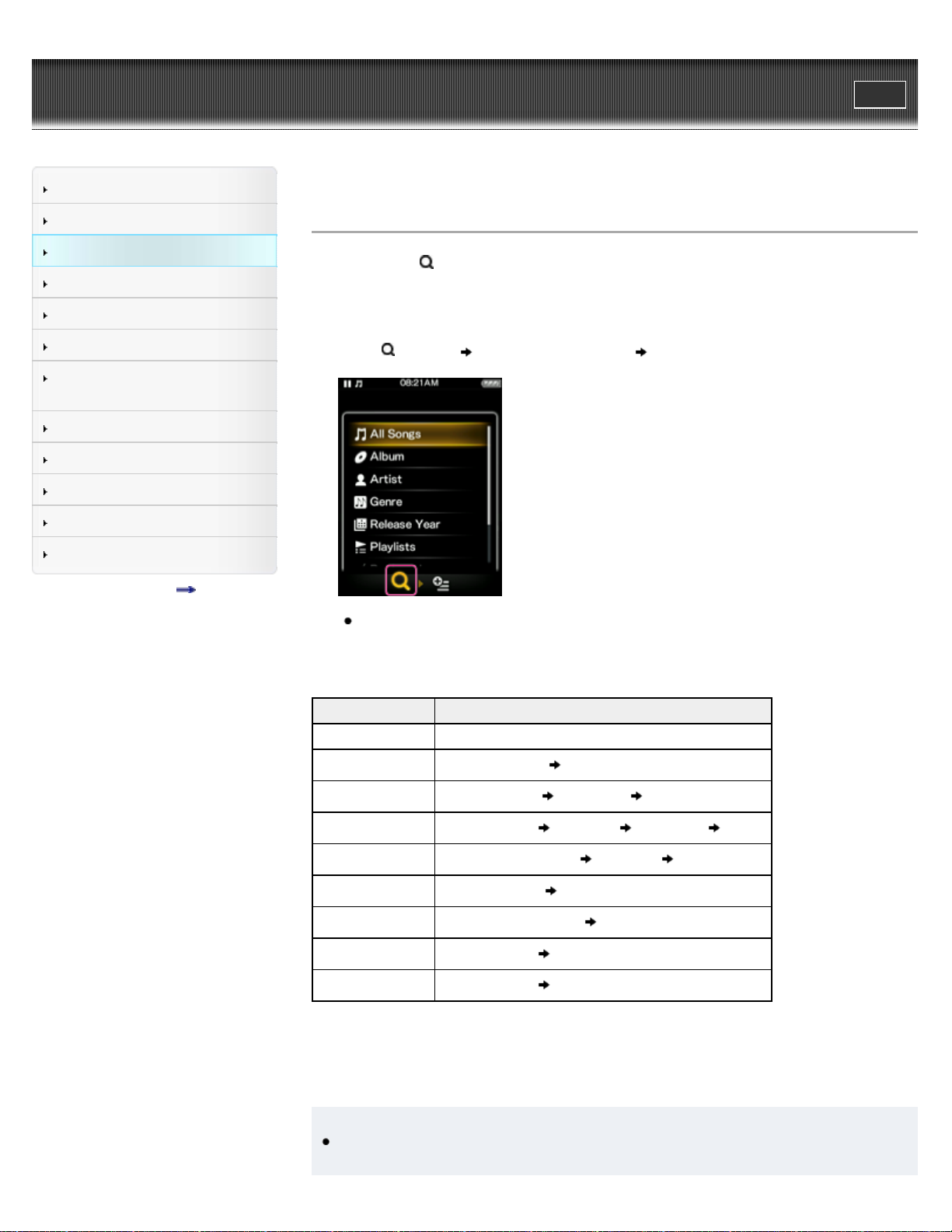
When you select (Search) on the music playback screen or the list screen, the search menu
appears. You can select the desired search method on the search menu to search the music list
for a desired song.
1. On the music playback screen or the list screen, press the OPTION/PWR OFF button.
2. Select
(Search) desired search method desired song.
Select items as follows until a song list appears.
Search method
Method Description
[All Songs] Select a song from the all songs list.
[Album] Select an album
song.
[Artist] (*1) Select an artist an album song.
[Genre] Select a genre an artist an album song.
[Release Year] Select a release year an artist song.
[Playlists] (*2) Select a playlist song.
[Bookmark] Select a bookmark list song.
[Folder] Select a folder song.
[Voice Recording] Select a folder song.
(*1) “The” at the beginning of artist names is ignored when arranging a list.
(*2) Playlists are created by using Windows Media Player. For information on how to create a playlist,
refer to the Help of Windows Media Player. Cover art images registered to a playlist are not
displayed on the player.
Hint
[All Songs], [Album], [Artist] and [Genre] lists are arranged in alphanumeric order. The
[Release Year] list is arranged in reverse chronological order. In the [Voice Recording] list,
64

folders are displayed in reverse chronological order, and files are displayed in chronological
order. In the [Folder] list, folders are displayed in name order first, then files are displayed in
name order. In this case, upper or lower case letters are not distinguished.
Back to top
Copyright 2010 Sony Corporation
65
WALKMAN User Guide
Print
Getting Started
How to Use the Software
Music
“SensMe™ Channels”
Videos/Podcasts/Photos
FM Radio
Making/Playing Voice
Recordings
Timer
Settings
Troubleshooting
Important Information
Specifications
Contents list
Top page > Music > Playing Music > Using bookmarks
Using bookmarks
Adding a song to a bookmark list
Playing songs in a bookmark list
Removing a song from a bookmark list
Removing all songs from a bookmark list
Rearranging songs in a bookmark list
You can add favorite songs to bookmark lists for easy playback.
Adding a song to a bookmark list
You can add the currently playing song to a bookmark list. You can also select a song from a
song list to add it to a bookmark list.
Note
You can add up to 100 songs to each bookmark list.
You cannot add recorded files, videos, or podcast episodes to a bookmark list.
To add the currently playing song
1. From the music playback screen, press and hold the button.
The song is added to the default bookmark list. For how to change the default bookmark list,
see [Details].
or,
1. From the music playback screen, press the OPTION/PWR OFF button to bring up the option
menu.
2. Select [Add to Bookmark]
desired bookmark list.
To select a song from a song list to add to a bookmark list
1. From a song list screen, press the / button to select a song.
2. Press and hold the
button.
The selected song is added to the default bookmark list. For how to change the default
bookmark list, see [Details].
or,
1. From a song list screen, press the
/ button to select a song.
2. Press the OPTION/PWR OFF button to bring up the option menu.
3. Select [Add to Bookmark]
desired bookmark list.
Playing songs in a bookmark list
1. From the Home menu, select [Music] [Bookmark] desired bookmark list
desired song.
Note
While playing a song selected from a bookmark list, playback will pause if you carry out an
66
alternation to the playing bookmark list such as adding a song, removing a song or
rearrange songs.
Removing a song from a bookmark list
1. From the Home menu, select [Music] [Bookmark] desired bookmark list
desired song.
2. Press the OPTION/PWR OFF button to bring up the option menu.
3. Select [Remove from Bookmark].
or,
1. From the Home menu, select
[Music] [Bookmark] desired bookmark list.
2. Press the
/ button to select a song.
3. Press the OPTION/PWR OFF button to bring up the option menu.
4. Select [Remove from Bookmark].
Removing all songs from a bookmark list
1. From the Home menu, select [Music] [Bookmark].
2. Press the
/ button to select a bookmark list.
3. Press the OPTION/PWR OFF button to bring up the option menu.
4. Select [Clear Bookmark List]
[Yes].
Rearranging songs in a bookmark list
1. From the Home menu, select [Music] [Bookmark] desired bookmark list.
2. Press the OPTION/PWR OFF button to bring up the option menu.
3. Select [Edit Song Order].
A right arrow appears to the left of a song name.
4. Press the
/ button to select a song, then press the button.
A double-headed arrow appears to the left of the selected song.
5. Press the
/ button to move the song to the desired location.
6. Press the
button to fix the location for the song.
7. Repeat step 4 to 6 to rearrange all songs you want.
8. After completing, press the BACK/HOME button to return to the bookmark list screen.
Back to top
Copyright 2010 Sony Corporation
67
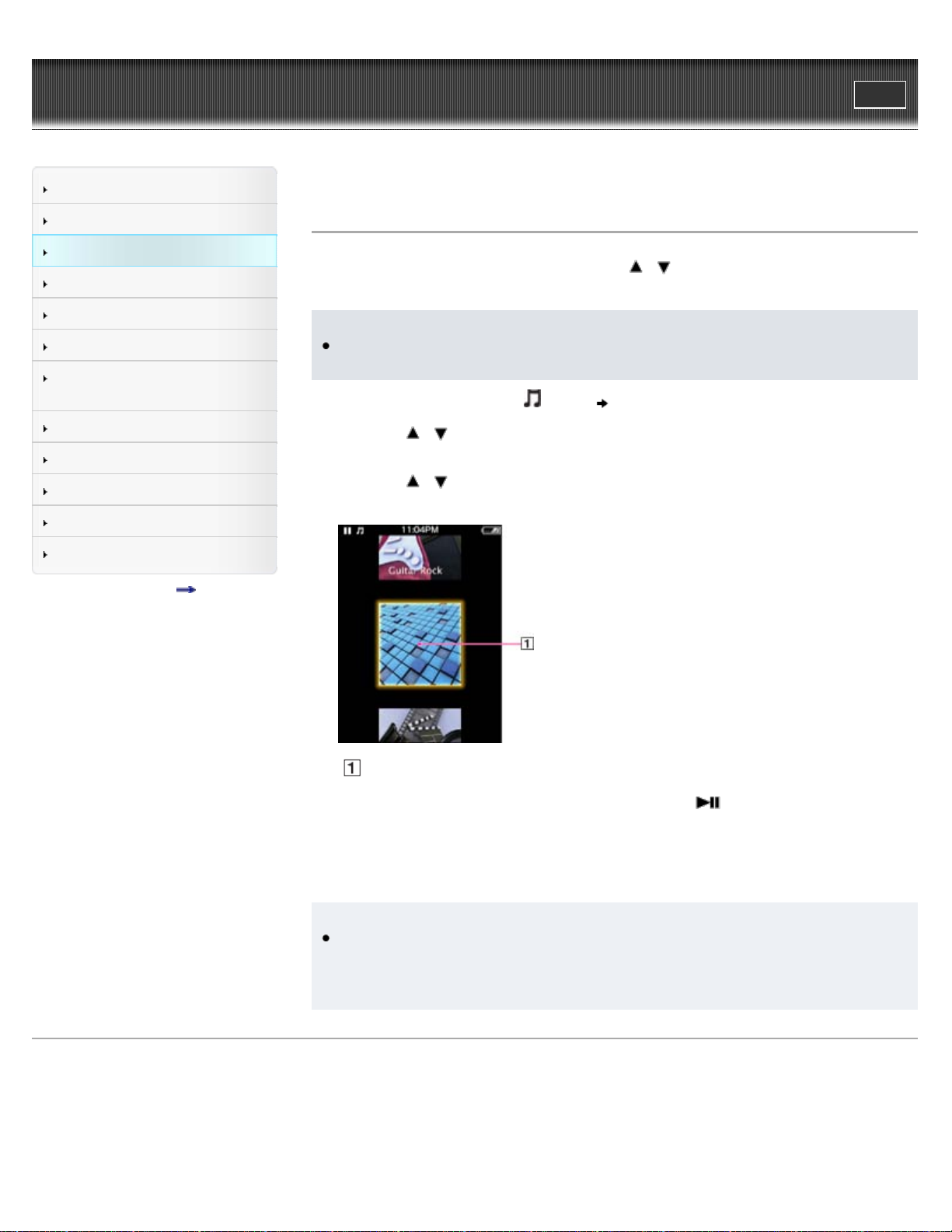
WALKMAN User Guide
Print
Getting Started
How to Use the Software
Music
“SensMe™ Channels”
Videos/Podcasts/Photos
FM Radio
Making/Playing Voice
Recordings
Timer
Settings
Troubleshooting
Important Information
Specifications
Contents list
Top page > Music > Playing Music > Browsing cover arts to select an album (Album Scroll)
Browsing cover arts to select an album (Album Scroll)
On the music playback screen, you can press the / button to scroll the cover art up or
down and select the album.
Note
You can use the album scroll function only when [Karaoke/Language Study] is set to [Off]
[Details].
1. From the Home menu, select
[Music] desired item to display the playback screen.
2. Press the
/ button on the music playback screen.
The album scroll screen appears.
3. Press the
/ button to browse album covers.
The cover art images are arranged by title in alphabetical order.
Cover art
4. Select the cover art of the desired album, then press the
button.
The music playback screen reappears and playback of the selected album begins.
To cancel browsing
Press the BACK/HOME button.
Hint
Cover art only appears if cover art information is available. You can set cover art using
Windows Media Player, or another transfer capable software for setting cover art. For details
on operation, refer to the Help or maker of the software. Cover art may not be displayed,
depending on the cover art file format.
Back to top
Copyright 2010 Sony Corporation
68
WALKMAN User Guide
Print
Getting Started
How to Use the Software
Music
“SensMe™ Channels”
Videos/Podcasts/Photos
FM Radio
Making/Playing Voice
Recordings
Timer
Settings
Troubleshooting
Important Information
Specifications
Contents list
Top page > Music > Playing Music > Deleting songs
Deleting songs
When you delete songs from the player, use the software you used to transfer the songs, or
Windows Explorer.
For details about using the software, see the Help of the software.
Note
You cannot delete songs without connecting the player to a computer except for voice
recordings [Details].
Back to top
Copyright 2010 Sony Corporation
69
WALKMAN User Guide
Print
Getting Started
How to Use the Software
Music
“SensMe™ Channels”
Videos/Podcasts/Photos
FM Radio
Making/Playing Voice
Recordings
Timer
Settings
Troubleshooting
Important Information
Specifications
Contents list
Top page > Music > Using the Karaoke Function > About the karaoke function
About the karaoke function
When you set [Karaoke/Language Study] to [Maximum Karaoke Mode] or [Minimum Karaoke
Mode], the vocal of the playing song is suppressed and the lyrics of the song are displayed if the
song’s lyrics file is stored in the player. You can also change the key of a song.
Song lyrics are displayed when there is an LRC file for the song in the player. The LRC file must
have the same file name as the song file, with extension “.lrc” (for example, “abc.lrc” for a song
file “abc.mp3”). Place the LRC file in the same folder as the song file. The player synchronizes
song lyrics with song playback. For how to create LRC files, see [Details].
Related Topics
Activating the karaoke function
Changing the key of a song
Displaying lyrics [Display Lyrics]
How to create LRC files
Back to top
Copyright 2010 Sony Corporation
70
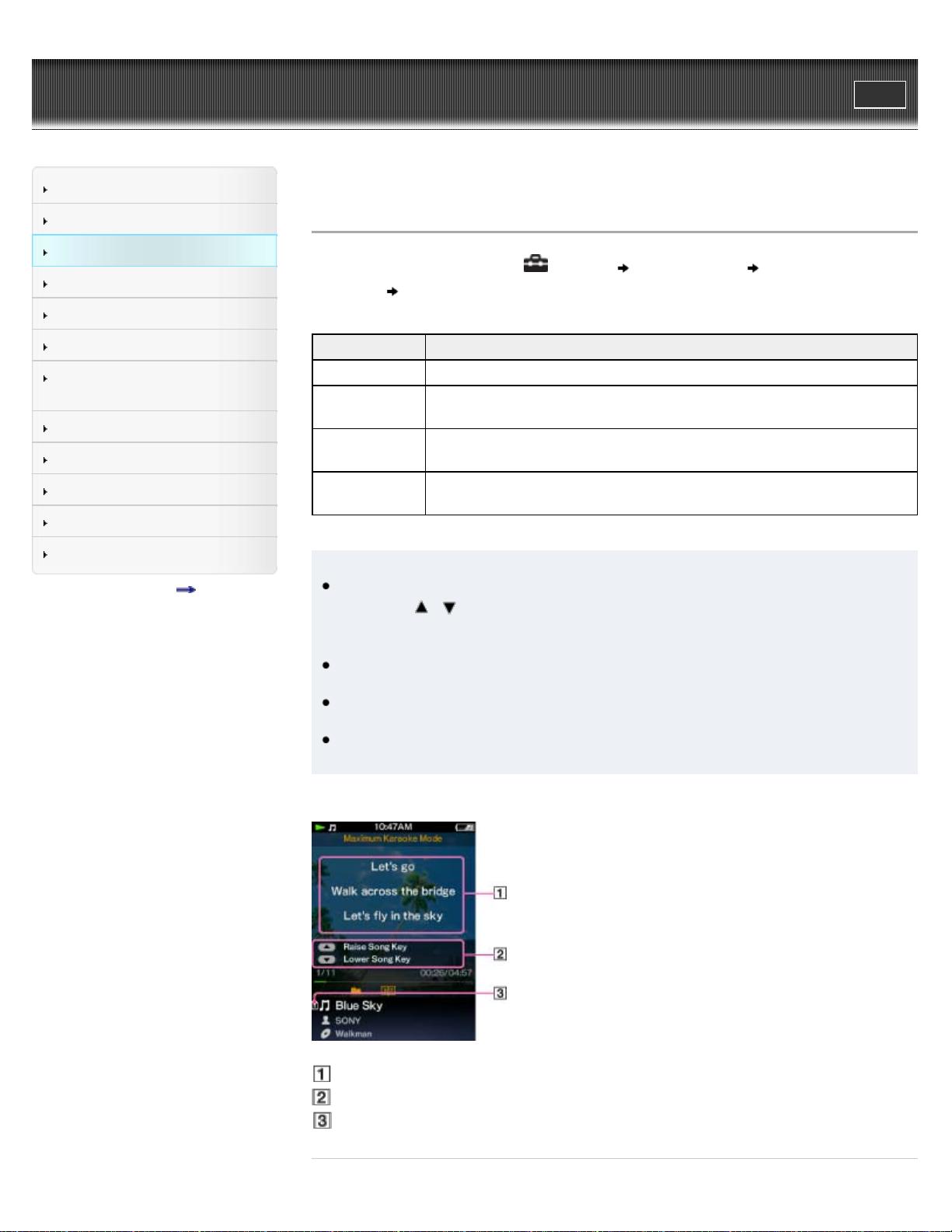
WALKMAN User Guide
Print
Getting Started
How to Use the Software
Music
“SensMe™ Channels”
Videos/Podcasts/Photos
FM Radio
Making/Playing Voice
Recordings
Timer
Settings
Troubleshooting
Important Information
Specifications
Contents list
Top page > Music > Using the Karaoke Function > Activating the karaoke function
Activating the karaoke function
1. From the Home menu, select [Settings] [Music Settings] [Karaoke/Language
Study]
desired setting type.
Type Description
[Off] Disables the karaoke and language study function. (Default setting)
[Language
Study]
Activates the language study function [Details].
[Maximum
Karaoke Mode]
Activates the karaoke function. The vocal of the song is suppressed as much
as possible. The screensaver will not start.
[Minimum
Karaoke Mode]
Activates the karaoke function. The vocal of the song is suppressed, though
still audible. The screensaver will not start.
Note
When [Karaoke/Language Study] is set to [Maximum Karaoke Mode] or [Minimum Karaoke
Mode], the
/ button works for the karaoke function and you cannot use the album
scroll function. Also, the screensaver will not start. For details on the screensaver, see
[Details].
The DPC (Digital Pitch Control) function [Details] is disabled when [Karaoke/Language
Study] is set to [Maximum Karaoke Mode] or [Minimum Karaoke Mode].
The VPT (Surround) function [Details] is disabled when [Karaoke/Language Study] is set to
[Maximum Karaoke Mode] or [Minimum Karaoke Mode].
The effects of vocal suppression differ among songs. Depending on the song, the vocal may
hardly be suppressed.
Music playback screen with karaoke activated
Lyrics
Operation guidance
Lyrics icon
71

WALKMAN User Guide
Print
Getting Started
How to Use the Software
Music
“SensMe™ Channels”
Videos/Podcasts/Photos
FM Radio
Making/Playing Voice
Recordings
Timer
Settings
Troubleshooting
Important Information
Specifications
Contents list
Top page > Music > Using the Karaoke Function > Changing the key of a song
Changing the key of a song
You can change the key of a song to make it easier to sing.
1. Use the
/ buttons during playback to raise/lower the key.
Note
After the song has finished, the key reverts to normal and the next song will be played back
in the original key.
Related Topics
About the karaoke function
Activating the karaoke function
Back to top
Copyright 2010 Sony Corporation
73
WALKMAN User Guide
Print
Getting Started
How to Use the Software
Music
“SensMe™ Channels”
Videos/Podcasts/Photos
FM Radio
Making/Playing Voice
Recordings
Timer
Settings
Troubleshooting
Important Information
Specifications
Contents list
Top page > Music > Using the Language Study Function > About language study
About language study
When you set [Karaoke/Language Study] to [Language Study], you can use the [Quick Replay]
function and the A-B repeat function. This section also explains about the playback speed
control function.
Hint
You can adjust the playback speed when [Karaoke/Language Study] is set to [Off] or
[Language Study], but cannot adjust when set to [Maximum Karaoke Mode] or [Minimum
Karaoke Mode].
For audio podcasts, set [Podcast Language Study] to [On] to use the [Quick Replay]
function and the A-B repeat function in the podcast’s audio playback screen [Details]. The
[DPC (Speed Control)] setting also affects the playback speed of the audio podcast.
Related Topics
Activating the language study function
Rewinding slightly [Quick Replay]
Playing back a specified section repeatedly (A-B Repeat)
Adjusting the playback speed (DPC)
Back to top
Copyright 2010 Sony Corporation
74
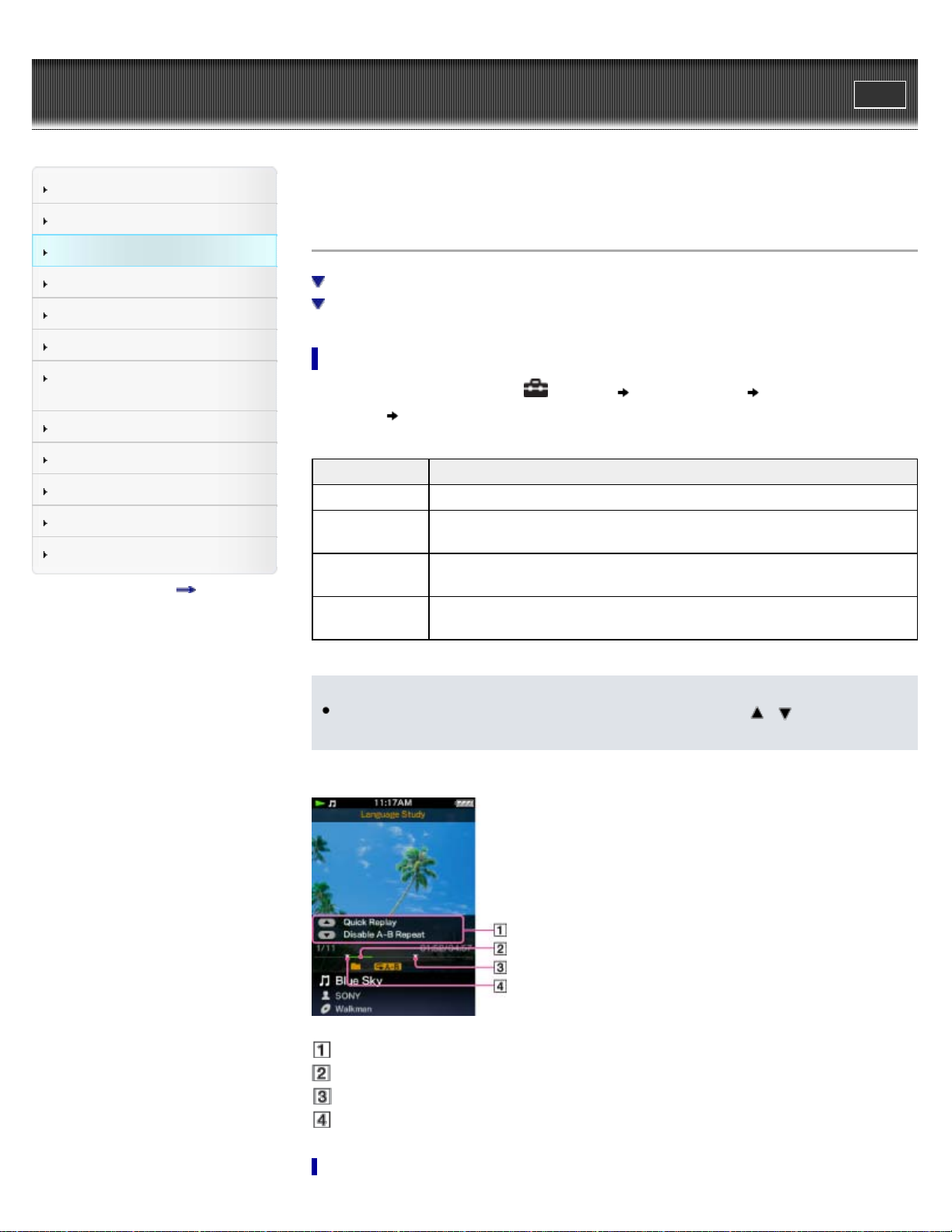
WALKMAN User Guide
Print
Getting Started
How to Use the Software
Music
“SensMe™ Channels”
Videos/Podcasts/Photos
FM Radio
Making/Playing Voice
Recordings
Timer
Settings
Troubleshooting
Important Information
Specifications
Contents list
Top page > Music > Using the Language Study Function > Activating the language study
function
Activating the language study function
Activating the language study for music
Activating the language study for audio podcast
Activating the language study for music
1. From the Home menu, select [Settings] [Music Settings] [Karaoke/Language
Study]
desired setting type.
Type Description
[Off] Disables the karaoke and language study function. (Default setting)
[Language
Study]
Activates the language study function, allowing you to use the [Quick
Replay] function and the A-B repeat function.
[Maximum
Karaoke Mode]
Activates the karaoke function [Details].
[Minimum
Karaoke Mode]
Activates the karaoke function [Details].
Note
When [Karaoke/Language Study] is set to [Language Study], the
/ buttons work for
the language study function; you cannot use the album scroll function [Details].
Music playback screen with language study activated
Operation guidance
Section A-B
Point B
Point A
75
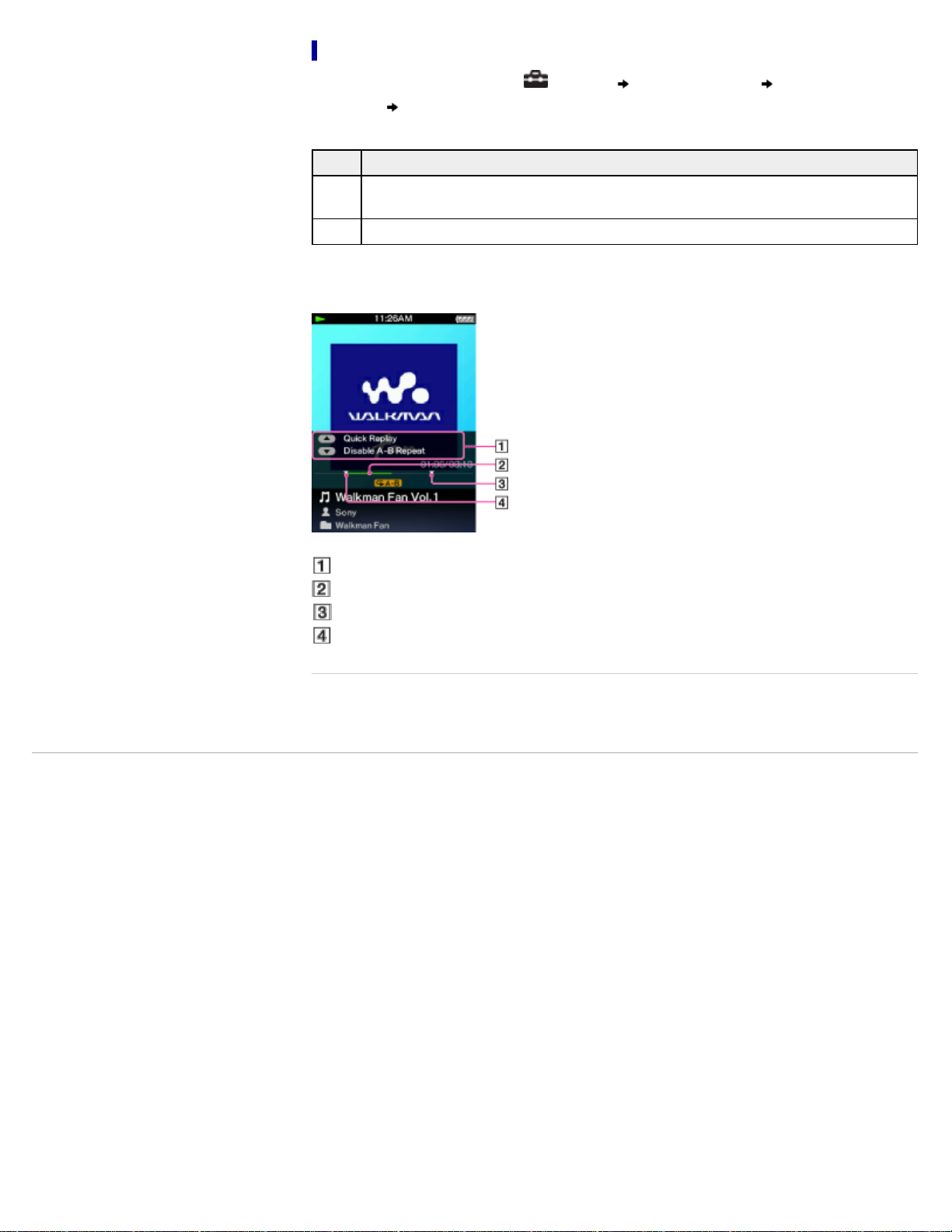
Activating the language study for audio podcast
1. From the Home menu, select [Settings] [Podcast Settings] [Podcast Language
Study]
desired setting type.
Type Description
[On]
Activates the [Podcast Language Study], allowing you to use the [Quick Replay]
function and the A-B repeat function.
[Off] Disables the [Podcast Language Study]. (Default setting)
Audio podcast playback screen with language study activated
Operation guidance
Section A-B
Point B
Point A
Related Topics
About language study
Back to top
Copyright 2010 Sony Corporation
76
WALKMAN User Guide
Print
Getting Started
How to Use the Software
Music
“SensMe™ Channels”
Videos/Podcasts/Photos
FM Radio
Making/Playing Voice
Recordings
Timer
Settings
Troubleshooting
Important Information
Specifications
Contents list
Top page > Music > Using the Language Study Function > Rewinding slightly [Quick Replay]
Rewinding slightly [Quick Replay]
You can rewind about 3 seconds to listen to audio again.
1. Press the
button during playback on the music playback screen.
Hint
When point A (starting point of A-B repeat) is set, if you press the button within 3
seconds of point A, playback returns to point A.
Related Topics
About language study
Back to top
Copyright 2010 Sony Corporation
77
WALKMAN User Guide
Print
Getting Started
How to Use the Software
Music
“SensMe™ Channels”
Videos/Podcasts/Photos
FM Radio
Making/Playing Voice
Recordings
Timer
Settings
Troubleshooting
Important Information
Specifications
Contents list
Top page > Music > Using the Language Study Function > Playing back a specified section
repeatedly (A-B Repeat)
Playing back a specified section repeatedly (A-B Repeat)
A-B repeat operations
You can play back a specified section of audio repeatedly.
1. Press the
button to specify the starting point of A-B repeat.
The point A (starting point of A-B repeat) indicator appears. The section from point A to the
end of the song is played back repeatedly.
2. Press the
button to specify the ending point of the A-B repeat.
The point B (ending point of A-B repeat) indicator appears. The section from point A to point
B is played back repeatedly.
Note
Put an interval of more than 1 second between point A and B. If you press the
button
within 1 second from point A, you cannot set point B.
A-B repeat operations
During A-B repeat, you can pause, resume playback, fast forward, fast rewind and [Quick
Replay] as usual [Details]. In addition to that, you can perform the following operations.
To Do this
Return to the point A Press the
button.
Proceed to the point B and exit the A-B repeat Press the button.
Exit the A-B repeat Press the button.
Related Topics
About language study
Back to top
Copyright 2010 Sony Corporation
78
WALKMAN User Guide
Print
Getting Started
How to Use the Software
Music
“SensMe™ Channels”
Videos/Podcasts/Photos
FM Radio
Making/Playing Voice
Recordings
Timer
Settings
Troubleshooting
Important Information
Specifications
Contents list
Top page > Music > Using the Language Study Function > Adjusting the playback speed (DPC)
Adjusting the playback speed (DPC)
You can adjust the playback speed between half and double normal speed by using the DPC
(Digital Pitch Control) function. The audio is played back in natural tones by means of the digital
processing function.
Hint
You can adjust the playback speed when [Karaoke/Language Study] is set to [Off] or
[Language Study], but cannot adjust when set to [Maximum Karaoke Mode] or [Minimum
Karaoke Mode] [Details].
The [DPC (Speed Control)] setting also affects the playback speed of an audio podcast
[Details].
1. From the Home menu, select
[Settings] [Music Settings] [DPC (Speed Control)]
desired setting type.
Type Description
[x0.5] Plays back at half speed.
[x0.75] Plays back at 0.75 times normal speed.
[x0.9] Plays back at 0.9 times normal speed.
[Off] Plays back at normal speed. (Default setting)
[x1.1] Plays back at 1.1 times normal speed.
[x1.25] Plays back at 1.25 times normal speed.
[x1.5] Plays back at 1.5 times normal speed.
[x1.75] Plays back at 1.75 times normal speed.
[x2.0] Plays back at double speed.
Related Topics
About language study
Back to top
Copyright 2010 Sony Corporation
79
WALKMAN User Guide
Print
Getting Started
How to Use the Software
Music
“SensMe™ Channels”
Videos/Podcasts/Photos
FM Radio
Making/Playing Voice
Recordings
Timer
Settings
Troubleshooting
Important Information
Specifications
Contents list
Top page > Music > Music Option Menu > Using the music option menu
Using the music option menu
Option items appearing on the album list screen
Option items appearing on the music playback screen
Option items appearing on the music list screen
Option items appearing on the [Bookmark] screen
Displaying the detailed information screen [Detailed Information]
You can bring up the music option menu by pressing the OPTION/PWR OFF button on the music
list or on the music playback screen. For details on how to use the option menu, see [Details].
The option items shown on the option menu vary depending on the screen from which you bring it
up. See the reference page for settings and usage.
Option items appearing on the album list screen
Option items Description/reference page
[Album Display Format] Selects the album list format [Details].
Option items appearing on the music playback screen
Option items Description/reference page
[Play Mode] Sets the play mode [Details].
[Playback Range] Sets the playback range [Details].
[Karaoke/Language
Study]
Sets the karaoke/language study mode [Details].
[DPC (Speed
Control)] (*1)
Adjusts the playback speed of songs [Details].
[Display Lyrics] (*1) Displays the lyrics of the playing song [Details].
[Equalizer] Customizes the sound quality [Details].
[VPT(Surround)] Customizes the [VPT(Surround)] settings [Details].
[Add to
Wishlist/Remove from
Wishlist]
Adds the song to the wish list to purchase it on the service
corresponded software./ Removes the song from the wish list.
[Detailed Information]
Displays detailed information of a song, such as playing time, audio
format, bit rate, and file name [Details].
[Add to Bookmark] Adds the playing song to a bookmark list [Details].
[Remove from
Bookmark]
Removes the playing song from a bookmark list [Details].
[Set As Alarm Song] Sets the playing song as the alarm song [Details].
[Delete This Song] Deletes a recorded voice [Details].
80
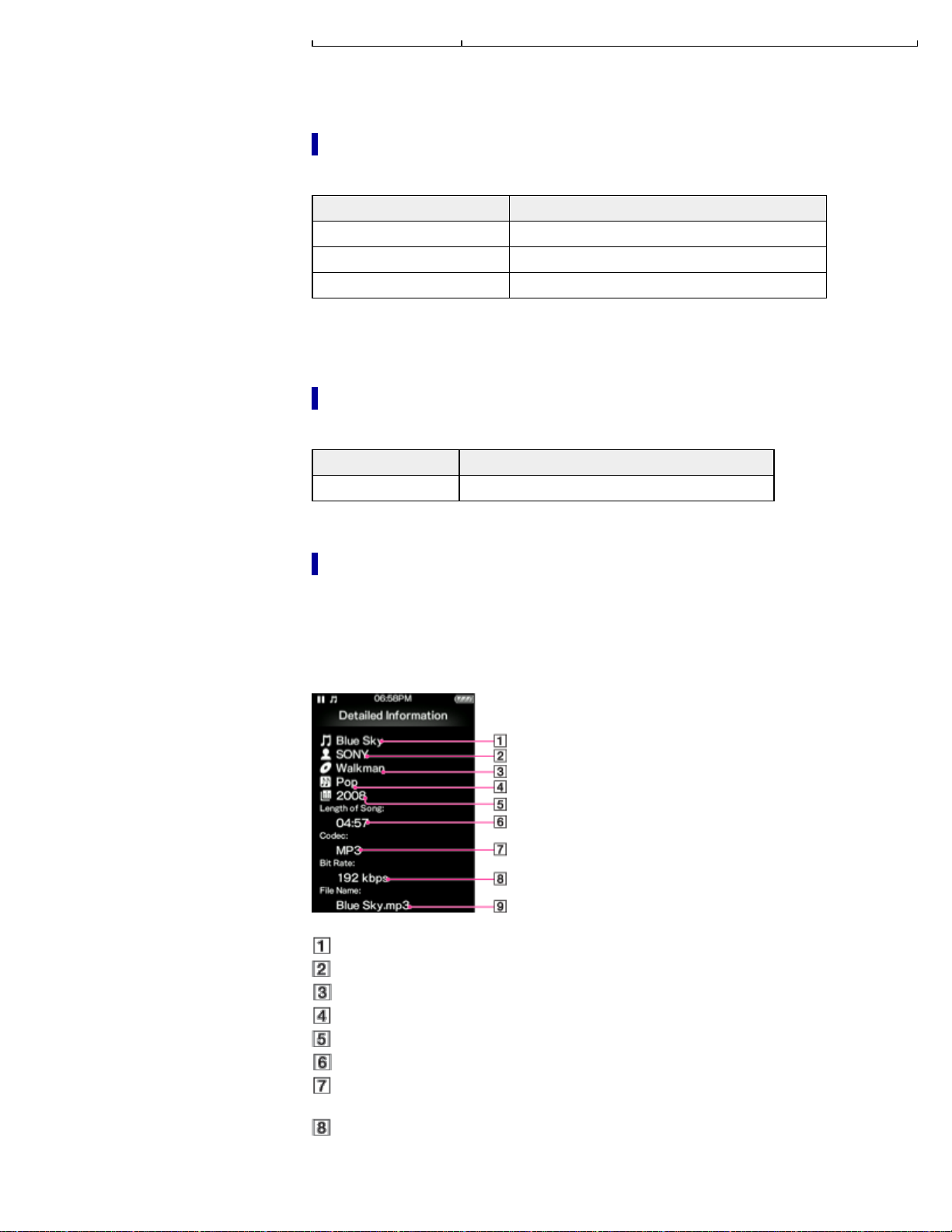
(*1) These options do not appear when [Karaoke/Language Study] is set to [Maximum Karaoke Mode] or
[Minimum Karaoke Mode].
Option items appearing on the music list screen
Option items (*1) Description/reference page
[Add to Bookmark] Adds the song to a bookmark list [Details].
[Remove from Bookmark] (*2) Removes the song from a bookmark list [Details].
[Edit Song Order] (*2) Rearranges songs in a bookmark list [Details].
(*1) These options do not appear when the recorded voice file list screen is displayed.
(*2) These options appear on the music list of a bookmark list only.
Option items appearing on the [Bookmark] screen
Option items Description/reference page
[Clear Bookmark List] Removes all songs in the bookmark list [Details].
Displaying the detailed information screen [Detailed Information]
1. From the music playback screen, press the OPTION/PWR OFF button to bring up the option
menu.
2. Select [Detailed Information].
Detailed information screen
Song name
Artist name
Album title
Genre
Release year
Length of Song
Codec
While playing back copyright protected songs, [Secured] appears.
Bit rate
While playing back variable bit rate songs, [VBR] is shown.
81

WALKMAN User Guide
Print
Getting Started
How to Use the Software
Music
“SensMe™ Channels”
Videos/Podcasts/Photos
FM Radio
Making/Playing Voice
Recordings
Timer
Settings
Troubleshooting
Important Information
Specifications
Contents list
Top page > Music > Music Settings > Setting the play mode [Play Mode]
Setting the play mode [Play Mode]
The player offers a variety of play modes, including random play and selected repeat play.
1. From the Home menu, select [Settings] [Music Settings] [Play Mode]
desired play mode type.
Type - icon Description
[Normal] - No
icon
The songs within the playback range are played back in the song list order.
(Default setting)
[Repeat] -
The songs within the playback range are played back in the song list order
and then repeated.
[Shuffle] -
(*1)
The songs within the playback range are played back in random order.
[Shuffle&Repeat]
-
(*1)
The songs within the playback range are played back in random order and
then repeated.
[Repeat 1 Song]
-
The current song or the song selected from a song list is played back
repeatedly.
(*1) When [Play Mode] is set to [Shuffle] or [Shuffle&Repeat] and [Playback Range] is set to [All Range],
the player will not shuffle all songs at once. Instead, the player will select an artist, album, etc. one
by one and play their songs in random order. For example, if you select [Album] in the [Music]
screen and select a song in an album, the player will play selected album’s songs in random order,
then select the next album in the album list to play its songs in random order, and continue in such a
manner. However, [All Songs] and bookmark lists are exceptions. If you start from [All Songs], the
player will shuffle all songs at once. If you start from a bookmark list, the selected bookmark list only
will be played back and the others will not be played back.
Note
Songs to be played back differ depending on the [Playback Range] settings [Details].
Back to top
Copyright 2010 Sony Corporation
83
WALKMAN User Guide
Print
Getting Started
How to Use the Software
Music
“SensMe™ Channels”
Videos/Podcasts/Photos
FM Radio
Making/Playing Voice
Recordings
Timer
Settings
Troubleshooting
Important Information
Specifications
Contents list
Top page > Music > Music Settings > Setting the playback range [Playback Range]
Setting the playback range [Playback Range]
You can set the playback range of songs.
1. From the Home menu, select [Settings] [Music Settings] [Playback Range]
desired playback range type.
Type - icon Description
[All Range] - No
icon
Plays back all the songs in all the lists of the selected search method.
For example, if you start playback from an album list, all the albums in the
player are played back.
[Selected
Range] -
Plays back songs only in the lists from which playback starts. (Default
settings)
For example, if you start playback from an album list, the songs in that album
only are played back.
Note
If you start playback from a bookmark list, the songs in that bookmark list only are played
back and songs in other bookmark lists are not played back even if [Playback Range] is set
to [All Range].
Back to top
Copyright 2010 Sony Corporation
84
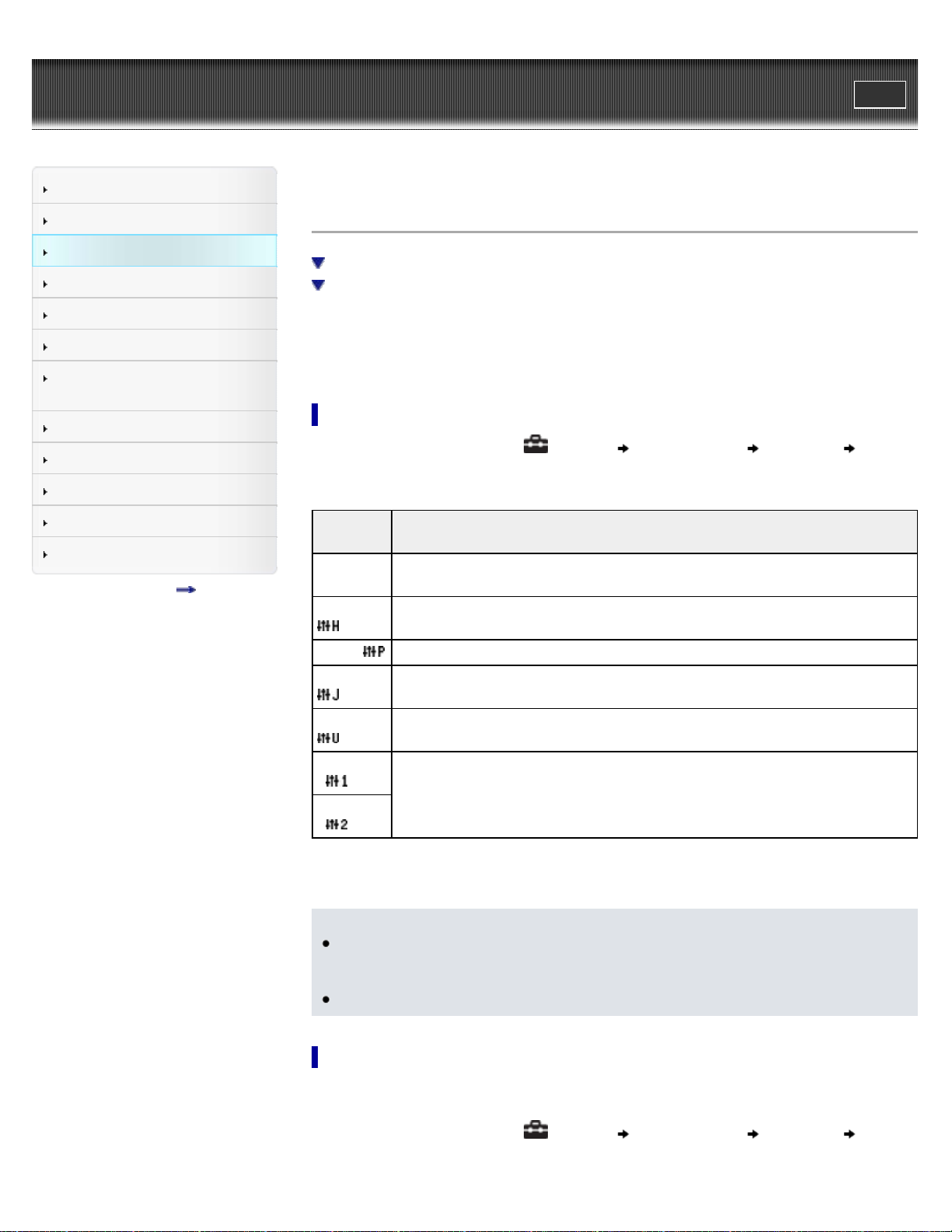
WALKMAN User Guide
Print
Getting Started
How to Use the Software
Music
“SensMe™ Channels”
Videos/Podcasts/Photos
FM Radio
Making/Playing Voice
Recordings
Timer
Settings
Troubleshooting
Important Information
Specifications
Contents list
Top page > Music > Music Settings > Setting the sound quality (CLEAR BASS) [Equalizer]
Setting the sound quality (CLEAR BASS) [Equalizer]
Setting the sound quality
Customizing sound quality
You can set the sound quality according to the music genre, etc.
Equalizer settings contain the CLEAR BASS setting. Increasing the CLEAR BASS setting value
allows the player to reproduce dynamic deep bass without distortion, even at a high volume.
Setting the sound quality
1. From the Home menu, select [Settings] [Music Settings] [Equalizer] desired
equalizer type.
Type -
icon
Description
[None] -
No icon
Sound quality setting is not activated. (Default setting) (*1)
[Heavy] -
Emphasizes high and low ranges for a powerful sound.
[Pop] - Stresses the middle range audio, ideal for vocals.
[Jazz] -
Emphasizes high and low ranges for a lively sound.
[Unique] -
Emphasizes high and low ranges, so that even soft sounds can be heard easily.
[Custom 1]
-
User-customizable sound settings for which you can adjust each frequency range
individually. See [Details] for details.
[Custom 2]
-
(*1) The default setting of players sold in the Latin America region is [Custom 1], and CLEAR BASS is set
to level +3.
Note
If your personal settings saved as [Custom 1] and [Custom 2] seem to produce a different
volume level than other settings, you may have to adjust the volume manually to
compensate.
The [Equalizer] setting is not applied while playing a video, FM radio or video podcast.
Customizing sound quality
You can preset the value of CLEAR BASS (bass) and 5 band Equalizer as [Custom 1] or
[Custom 2].
1. From the Home menu, select
[Settings] [Music Settings] [Equalizer]
[Custom 1] or [Custom 2].
85

2. Press the / button to select CLEAR BASS or the frequency range setting, and press
the
/ button to adjust the setting level, and then press the button to confirm.
The [Music Settings] screen reappears.
CLEAR BASS can be set to any of 4 sound levels, and the 5 frequency ranges can be
set to any of 7 sound levels.
After you have adjusted the setting level, be sure to press the
button to confirm. If
you press the BACK/HOME button before you confirm, the setting will be canceled.
Back to top
Copyright 2010 Sony Corporation
86
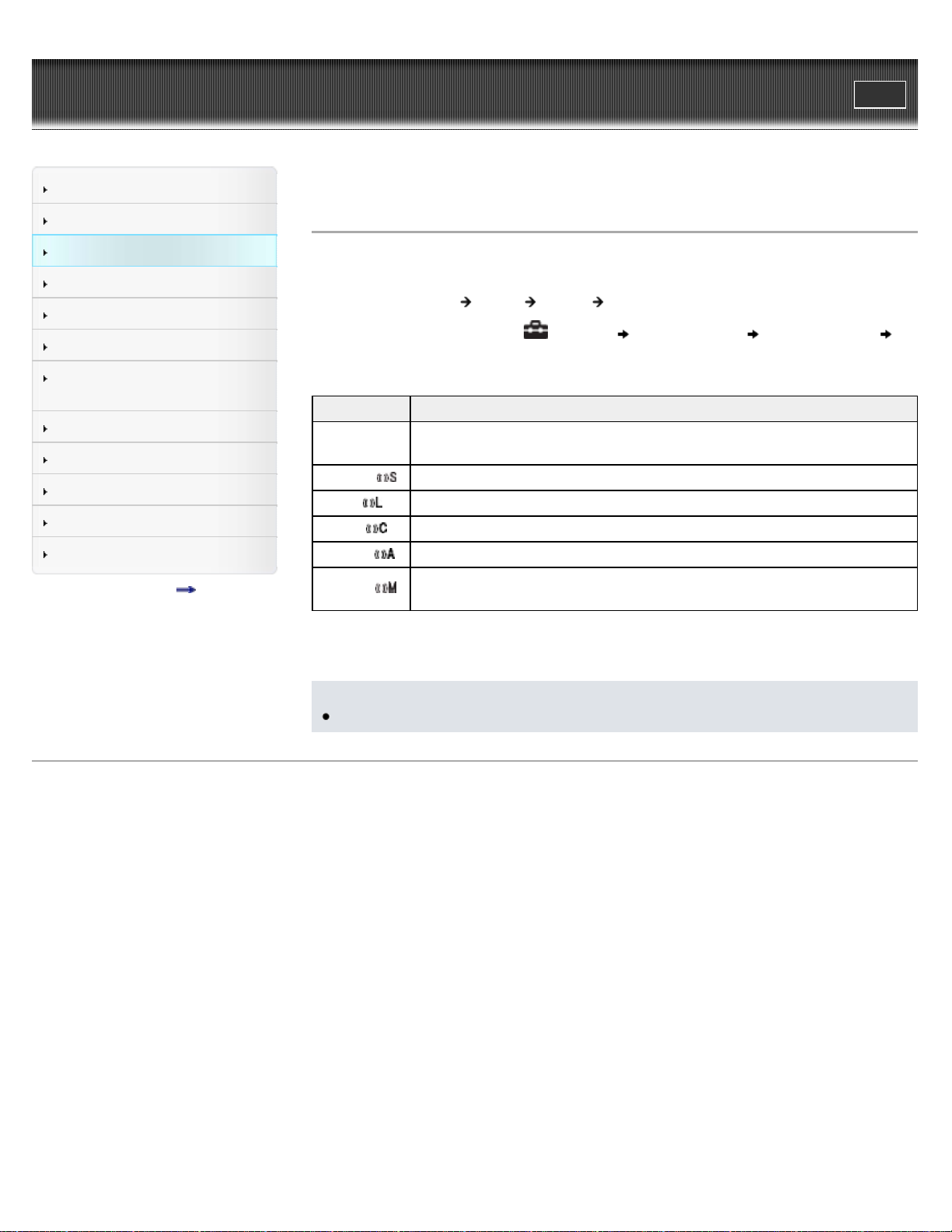
WALKMAN User Guide
Print
Getting Started
How to Use the Software
Music
“SensMe™ Channels”
Videos/Podcasts/Photos
FM Radio
Making/Playing Voice
Recordings
Timer
Settings
Troubleshooting
Important Information
Specifications
Contents list
Top page > Music > Music Settings > Customizing the surround sound [VPT(Surround)]
Customizing the surround sound [VPT(Surround)]
You can customize the surround sound by using the VPT (*1) (Surround) function to enrich the
sound reproduction quality of the audio playback. The sense of realism is increasingly enhanced
in the order of [Studio] [Live] [Club] [Arena] (most enhanced).
1. From the Home menu, select [Settings] [Music Settings] [VPT(Surround)]
desired VPT (Surround) type.
Type - icon Description
[None] - No
icon
[VPT(Surround)] setting is not activated. (Default setting)
[Studio] -
Creates the sound of a recording studio.
[Live] -
Creates the sound of a concert hall.
[Club] -
Creates the sound of a club.
[Arena] -
Creates the sound of an arena.
[Matrix] -
Reproduces an additional surround effect, and creates a natural, yet richly
enhanced sound.
(*1) VPT, which stands for Virtualphones Technology, is a proprietary sound processing technology
developed by Sony.
Note
The [VPT(Surround)] setting is not applied while playing a video, FM radio or video podcast.
Back to top
Copyright 2010 Sony Corporation
87
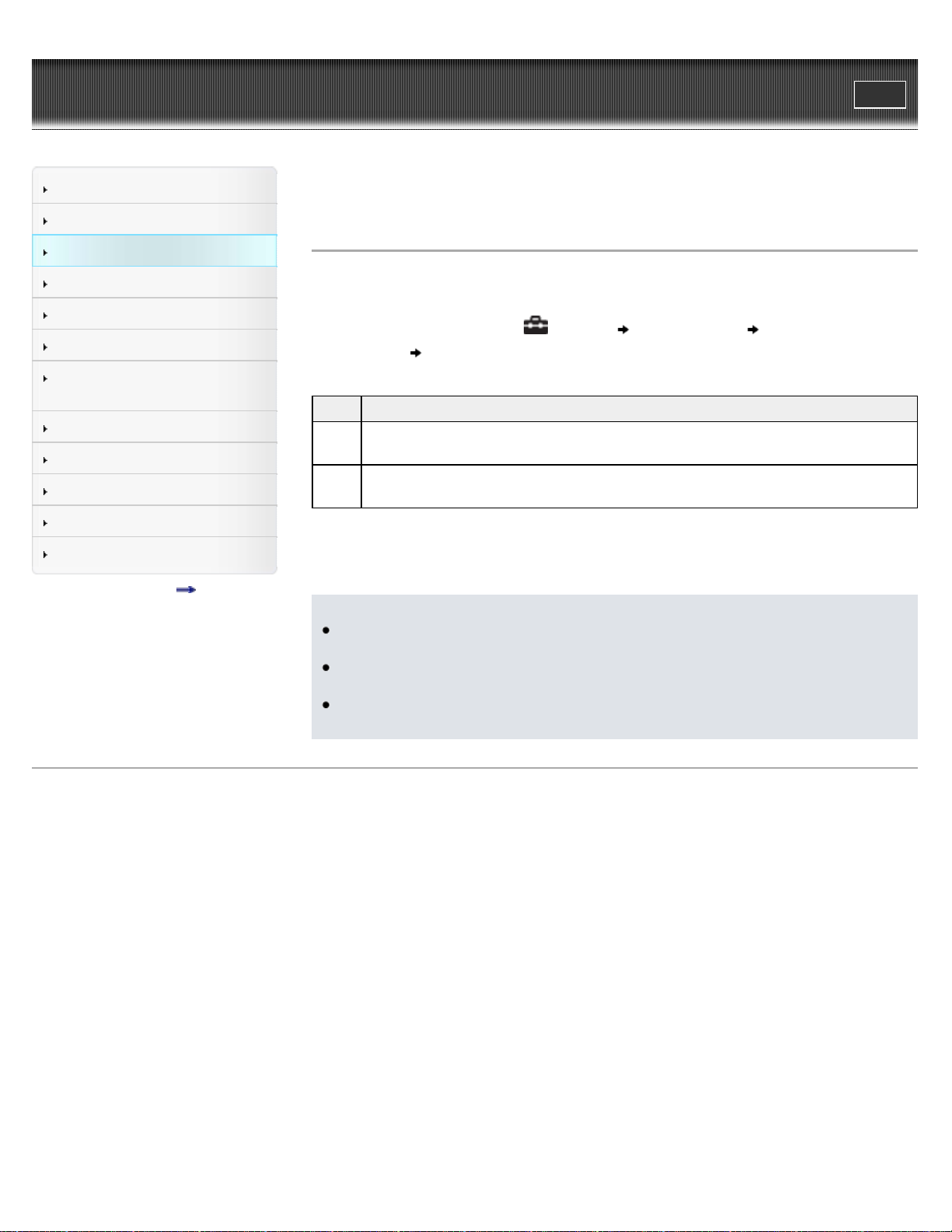
WALKMAN User Guide
Print
Getting Started
How to Use the Software
Music
“SensMe™ Channels”
Videos/Podcasts/Photos
FM Radio
Making/Playing Voice
Recordings
Timer
Settings
Troubleshooting
Important Information
Specifications
Contents list
Top page > Music > Music Settings > Listening with DSEE (Sound Enhance) [DSEE(Sound
Enhance)]
Listening with DSEE (Sound Enhance) [DSEE(Sound Enhance)]
By activating the [DSEE(Sound Enhance)] (*1) feature, you can hear a rich and natural sound
almost exactly like the original source.
1. From the Home menu, select
[Settings] [Music Settings] [DSEE(Sound
Enhance)]
desired DSEE (Sound Enhance) type.
Type Description
[On]
Activates the [DSEE(Sound Enhance)] (*1) function, and plays back naturally extended
sound, close to the original sound.
[Off]
Disables the [DSEE(Sound Enhance)] function and plays back sound normally. (Default
setting)
(*1) DSEE, which stands for Digital Sound Enhancement Engine, is a technology developed by Sony, to
enhance the sound quality of compressed audio files by restoring high-range sound removed by the
compression process.
Note
The [DSEE(Sound Enhance)] setting is not applied while playing a video, FM radio or video
podcast.
The [DSEE(Sound Enhance)] function is not effective for songs of a file format that is not
compressed, or songs that are of a high bit rate with no treble loss.
In the case of songs of very low bit rate, the [DSEE(Sound Enhance)] function will not be
effective.
Back to top
Copyright 2010 Sony Corporation
88
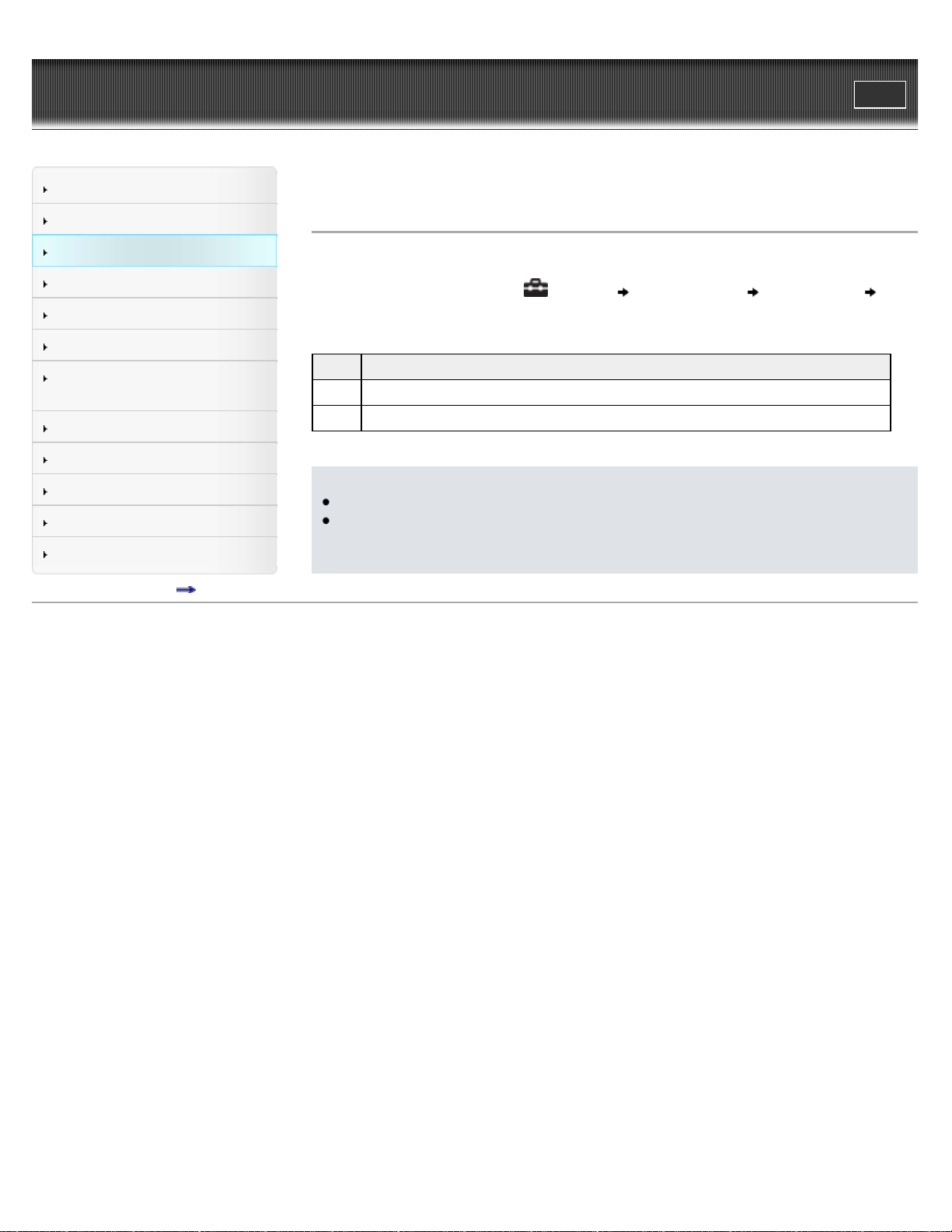
WALKMAN User Guide
Print
Getting Started
How to Use the Software
Music
“SensMe™ Channels”
Videos/Podcasts/Photos
FM Radio
Making/Playing Voice
Recordings
Timer
Settings
Troubleshooting
Important Information
Specifications
Contents list
Top page > Music > Music Settings > Listening with Clear Stereo [Clear Stereo]
Listening with Clear Stereo [Clear Stereo]
[Clear Stereo] enables individual left and right digital processing of the sound.
1. From the Home menu, select [Settings] [Music Settings] [Clear Stereo]
desired Clear Stereo type.
Type Description
[On] Activates the [Clear Stereo] function when you use the supplied headphones.
[Off] Disables the [Clear Stereo] function and plays back normal sound. (Default setting)
Note
The [Clear Stereo] setting is not applied while playing a video, FM radio or video podcast.
The [Clear Stereo] function is designed to obtain maximum effect with the supplied
headphones. The [Clear Stereo] effect may not be obtained with other headphones. When
using other headphones, set [Clear Stereo] to [Off].
Back to top
Copyright 2010 Sony Corporation
89
WALKMAN User Guide
Print
Getting Started
How to Use the Software
Music
“SensMe™ Channels”
Videos/Podcasts/Photos
FM Radio
Making/Playing Voice
Recordings
Timer
Settings
Troubleshooting
Important Information
Specifications
Contents list
Top page > Music > Music Settings > Adjusting the volume level [Dynamic Normalizer]
Adjusting the volume level [Dynamic Normalizer]
You can reduce the volume level between songs. With this setting, when listening to album songs
in the shuffle play mode, the volume level between songs is moderated to minimize differences in
their recording levels.
1. From the Home menu, select
[Settings] [Music Settings] [Dynamic Normalizer]
desired Dynamic Normalizer type.
Type Description
[On] Minimizes the difference in volume level between songs.
[Off]
Plays back songs at their original transferred volume level.
(Default setting)
Note
The [Dynamic Normalizer] setting is not applied while playing a video, FM radio or video
podcast.
Back to top
Copyright 2010 Sony Corporation
90
WALKMAN User Guide
Print
Getting Started
How to Use the Software
Music
“SensMe™ Channels”
Videos/Podcasts/Photos
FM Radio
Making/Playing Voice
Recordings
Timer
Settings
Troubleshooting
Important Information
Specifications
Contents list
Top page > Music > Music Settings > Changing the default bookmark list [Default Bookmark
List]
Changing the default bookmark list [Default Bookmark List]
You can change the default bookmark list, to which you can add a song when you press and
hold the
button in the music playback screen or song list screen.
1. From the Home menu, select [Settings] [Music Settings] [Default Bookmark List]
desired bookmark list.
Item Description
[Bookmark
List 1]
Selects [Bookmark List 1] as the default book mark list to which a song will be
added when you press and hold the button. (Default setting)
[Bookmark
List 2]
Selects [Bookmark List 2] as the default book mark list to which a song will be
added when you press and hold the button.
[Bookmark
List 3]
Selects [Bookmark List 3] as the default book mark list to which a song will be
added when you press and hold the button.
[Bookmark
List 4]
Selects [Bookmark List 4] as the default book mark list to which a song will be
added when you press and hold the button.
[Bookmark
List 5]
Selects [Bookmark List 5] as the default book mark list to which a song will be
added when you press and hold the button.
Back to top
Copyright 2010 Sony Corporation
91
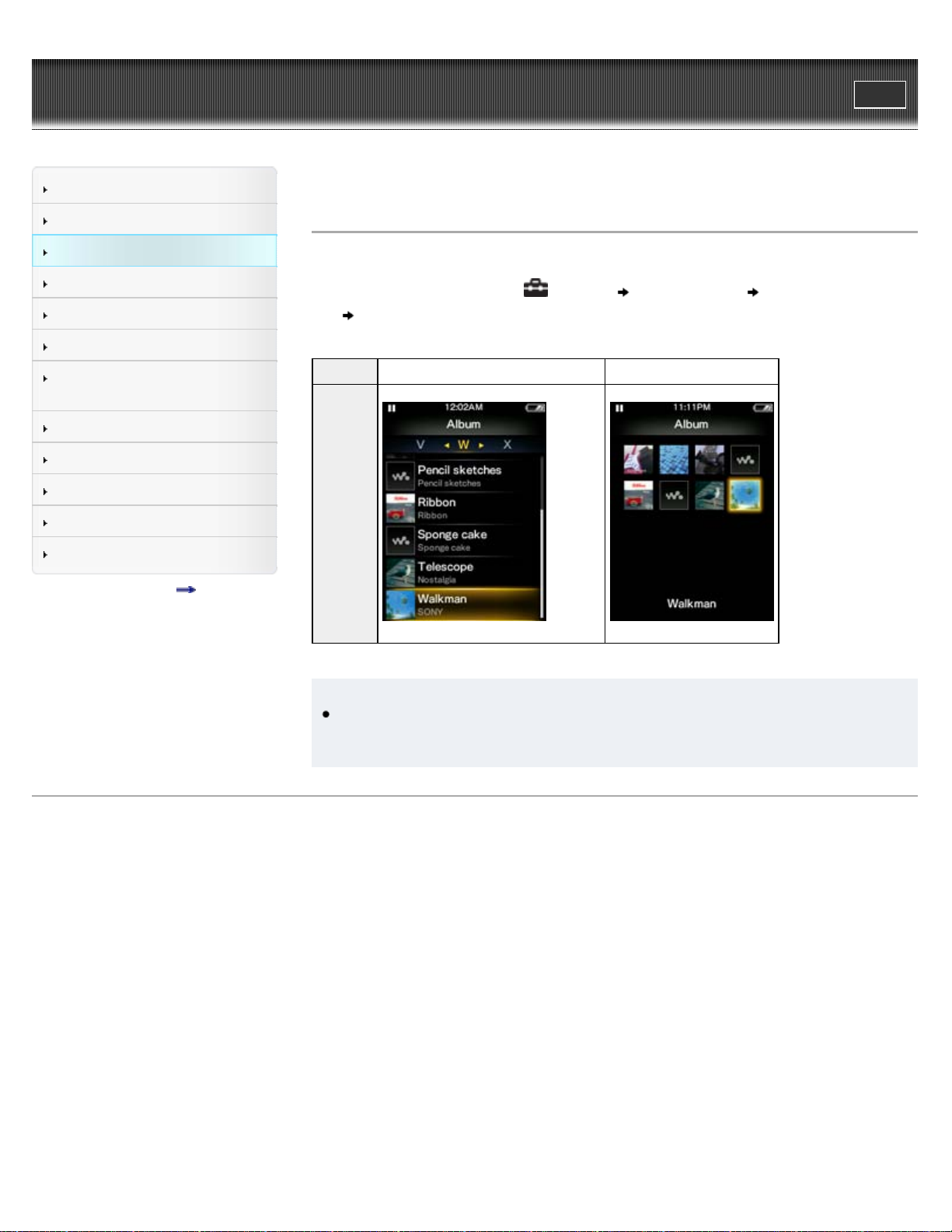
WALKMAN User Guide
Print
Getting Started
How to Use the Software
Music
“SensMe™ Channels”
Videos/Podcasts/Photos
FM Radio
Making/Playing Voice
Recordings
Timer
Settings
Troubleshooting
Important Information
Specifications
Contents list
Top page > Music > Music Settings > Selecting the album display format [Album Display Format]
Selecting the album display format [Album Display Format]
You can select the album display format.
1. From the Home menu, select [Settings] [Music Settings] [Album Display Format]
desired Album Display Format type.
Type [Title & Cover Art] (Default setting) [Cover Art Only]
Screen
Hint
Cover art will not appear if there is no cover art information for the album. You can set cover
art using Windows Media Player. For details on operation, refer to the Help of Windows
Media Player. Note that the player will not display cover art attached to playlists.
Back to top
Copyright 2010 Sony Corporation
92
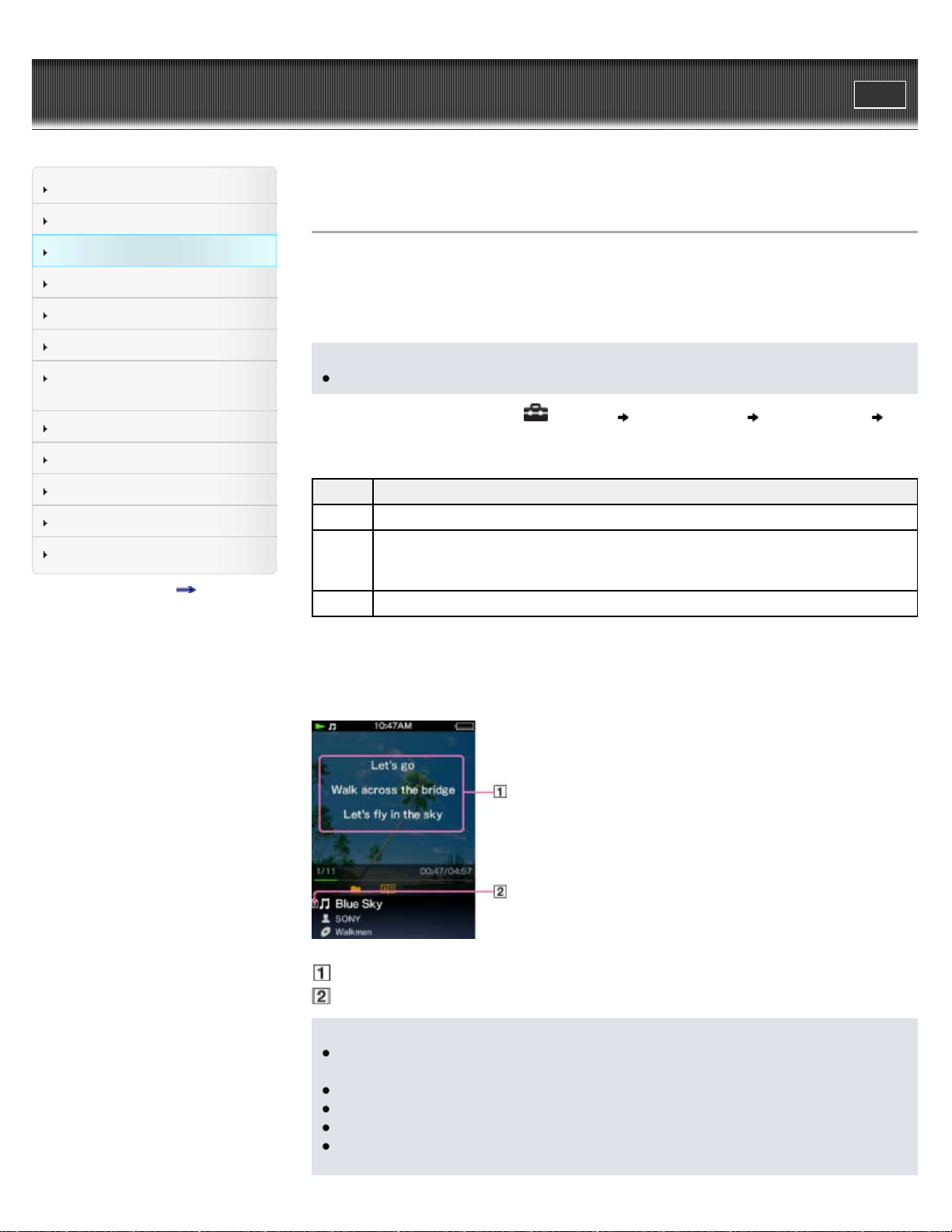
WALKMAN User Guide
Print
Getting Started
How to Use the Software
Music
“SensMe™ Channels”
Videos/Podcasts/Photos
FM Radio
Making/Playing Voice
Recordings
Timer
Settings
Troubleshooting
Important Information
Specifications
Contents list
Top page > Music > Music Settings > Displaying lyrics [Display Lyrics]
Displaying lyrics [Display Lyrics]
You can display song lyrics when there is an LRC file for the song in the player. The LRC file
must have the same file name as the song file, with extension “.lrc” (for example, “abc.lrc” for a
song file “abc.mp3”). Place the LRC file in the same folder as the song file. The player
synchronizes song lyrics with song playback. For how to create LRC files, see [Details].
Note
Some LRC files may not be playable on the player depending on the file format.
1. From the Home menu, select
[Settings] [Music Settings] [Display Lyrics]
desired display type.
Type Description
[On] Displays lyrics if the playing song has an LRC file. (Default setting)
[On (No
Screen
Off)]
Displays lyrics if the playing song has an LRC file. The player will not turn off the
screen or run the screensaver during song playback regardless of whether an LRC
file for the current song exists or not.
[Off] Does not display lyrics. (*1)
(*1) When [Karaoke/Language Study] is set to [Maximum Karaoke Mode] or [Minimum Karaoke Mode],
lyrics will be displayed regardless of this setting [Details].
Music playback screen while displaying lyrics
Lyrics
Lyrics icon
Note
If lyrics are not displayed properly, save the LRC file in the UTF-8 encoding and transfer it
again to the player.
The player can display up to 1,024 lines of lyrics for each song.
Playback and lyrics may become slightly out of sync.
You cannot display lyrics on the audio podcast playback screen [Details].
When set to [On], the screen turns off or changes to slide show when there is no operation
for the time set in [Delay] [Details].
93


WALKMAN User Guide
Print
Getting Started
How to Use the Software
Music
“SensMe™ Channels”
Videos/Podcasts/Photos
FM Radio
Making/Playing Voice
Recordings
Timer
Settings
Troubleshooting
Important Information
Specifications
Contents list
Top page > Music > Music Settings > How to create LRC files
How to create LRC files
Notes on creating LRC files
1. Prepare an audio file for which you intend to display lyrics during playback.
2. Open Notepad.
Click [start]
[All programs] [Accessories] [Notepad] to open it.
3. Type lyrics text into Notepad.
The screen images are of Windows Vista.
4. Play back the audio file to check the time [minutes:seconds:hundredths of a second] for
displaying each text line, then enter the time information to the left of the text line.
Examples:
95
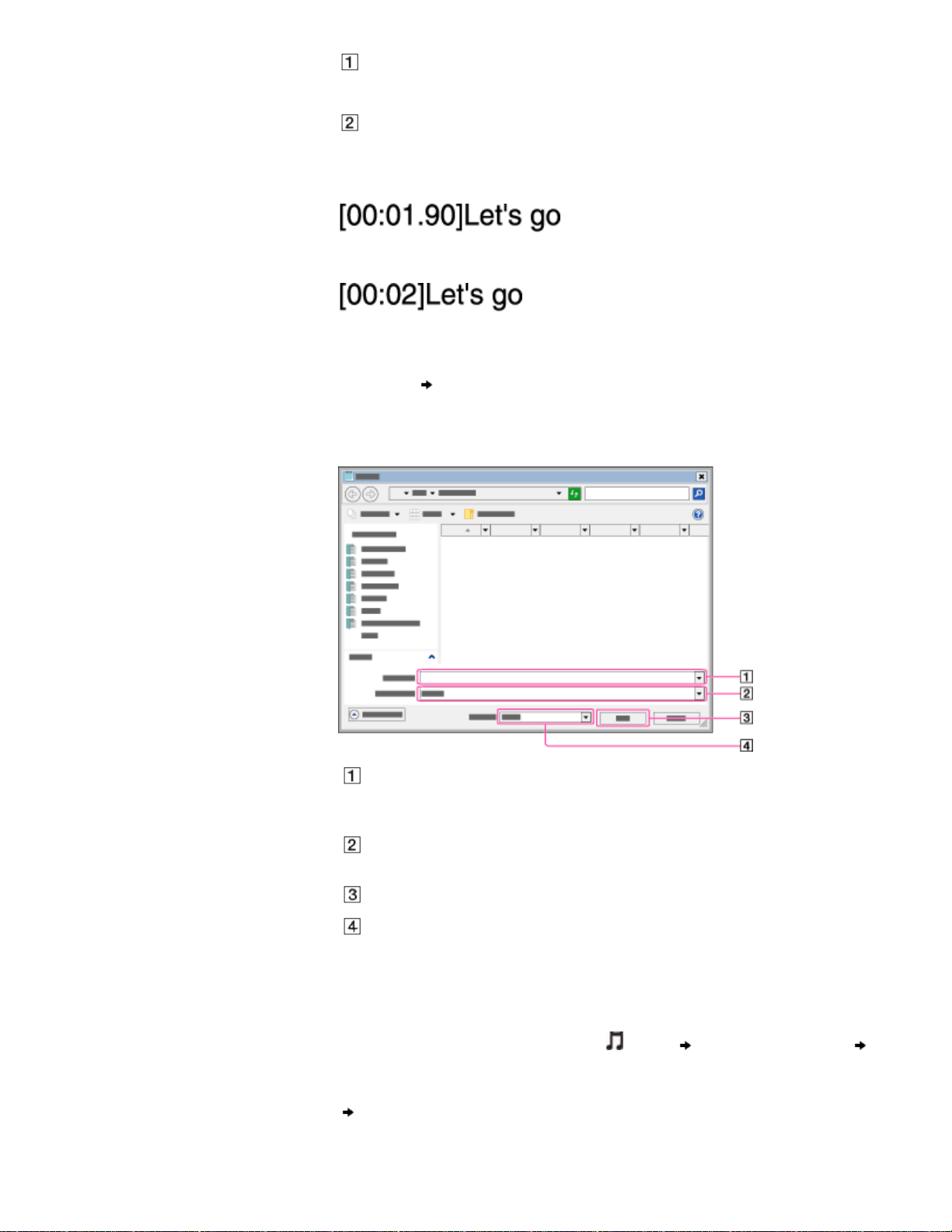
Time information
[mm:ss:xx] where mm means minutes, ss means seconds, and xx means hundredths of a
second. Enter mm, ss and xx in two digits. Use a colon to separate values.
Lyric text line
The player recognizes up to 95 characters to display the text line on the screen. If a text line
cannot fit in the screen, it will be wrapped (up to 3 lines). Characters beyond 3 lines will not
be displayed.
You can separate seconds and hundredths of a second by a period instead of a colon.
You can omit hundredths of a second.
5. After finishing lyrics text input, save it as a file.
Select [File]
[Save As…] to open the [Save As] screen. Select [All Files] in the [Save as
type:] list at the bottom of the screen. Select [UTF-8] in the [Encode:] list. Enter the file name
into the [File name:] text box. The file name must be the same as the audio file, with
extension “.lrc”. Click [Save] to save the LRC file.
[File name:]
Enter the same file name as the audio file, with extension “.lrc” (for example, “abc.lrc”
for an audio file “abc.mp3”).
[Save as type:]
Select [All Files] in the [Save as type:] list.
[Save]
[Encoding:]
Select [UTF-8] in the [Encode:] list.
The maximum size of LRC files is 512 KB.
6. Create a new folder in the [MUSIC] folder of the player, then drag and drop both the audio
file and LRC file into the new folder to transfer them.
7. From the Home menu of the player, select
[Music] desired search method
transferred song.
8. Press the OPTION/PWR OFF button to bring up the option menu, then select [Display Lyrics]
[On] or [On (No Screen Off)].
The lyrics are displayed on the screen, synchronizing with audio playback.
Lyrics display on the player
96

Notes on creating LRC files
The text encoding of LRC files must be UTF-8.
An LRC file must have the same file name as the audio file, with extension “.lrc”. Otherwise,
the player cannot recognize the LRC file.
The maximum size of LRC files is 512 KB.
Notes on lyrics text
A character string that follows time information at the beginning of the text line is recognized
as a lyric text line.
Space characters (both 1-byte and 2-byte) immediately following time information will be
ignored.
Maximum number of displayable characters for each lyric text line
The player recognizes up to 95 characters to display the text line on the screen. Characters
beyond this limitation are not displayed.
If a text line cannot fit in the screen, it will be wrapped (up to 3 lines). Characters beyond 3
lines will not be displayed.
The player can display up to 1,024 lines of lyrics for each song.
Notes on new line control characters
Any CR, CRLF and LF is recognized properly.
A text line that contains only a new line is skipped.
Notes on LRC file format
Time information must be at the beginning of a text line. Otherwise, it will be ignored and the
number of displayable character may decrease.
Time information must be entered in chronological order. If a line’s time information is
chronologically equal or before the previous line, the line will be skipped. In this case, text
lines will also be skipped until a text line with time information that follows chronologically the
last accepted line.
A text line that contains time information only is displayed as a blank line (treated as a text
that contains no characters).
The player supports only lyrics display and does not support other information of LRC file
format.
Copyright notice
When creating LRC files using copyrighted materials authored by others, created LRC files are
limited to private use only. Use of LRC files beyond this limitation requires permission of the
copyright holders.
Back to top
Copyright 2010 Sony Corporation
97
WALKMAN User Guide
Print
Getting Started
How to Use the Software
Music
“SensMe™ Channels”
Videos/Podcasts/Photos
FM Radio
Making/Playing Voice
Recordings
Timer
Settings
Troubleshooting
Important Information
Specifications
Contents list
Top page > Music > Music Settings > Optimizing the quality of the sound output from the
speakers [SP Output Optimizer]
Optimizing the quality of the sound output from the speakers
[SP Output Optimizer]
The player is equipped with the Digital Linear Phase Speaker feature to optimize the quality of
sound from the speakers.
The Digital Linear Phase Speaker feature achieves a precise localization of sounds by improving
the frequency-amplitude and phase characteristics.
Note
This function is effective for the supplied speakers only. If your player is not supplied with
speakers, set [SP Output Optimizer] to [Off].
Speaker bundled model is not available in some countries/regions.
1. From the Home menu, select
[Settings] [Music Settings] [SP Output Optimizer]
desired setting type.
Type Description
[SRS-
NWGT015]
Activates the [SP Output Optimizer] function when sounds output from the
speakers. The sound is optimized for SRS-NWGT015.
[Off]
Disables the [SP Output Optimizer] function and outputs normal sound from the
speakers.
Note
[SP Output Optimizer] is not applied to the sound output from the headphones.
[SP Output Optimizer] is effective for music, audio podcast and “SensMe™ Channels” only.
This function is not applied while playing a video, FM radio, or video podcast.
Back to top
Copyright 2010 Sony Corporation
98
WALKMAN User Guide
Print
Getting Started
How to Use the Software
Music
“SensMe™ Channels”
Videos/Podcasts/Photos
FM Radio
Making/Playing Voice
Recordings
Timer
Settings
Troubleshooting
Important Information
Specifications
Contents list
Top page > “SensMe™ Channels” > Playing songs using “SensMe™ Channels” > What is
“SensMe™ Channels”?
What is “SensMe™ Channels”?
“SensMe™ Channels” is a function that automatically picks up songs to fit the themes of
channels, and plays them back. You can play songs according to your mood, activity, time of the
day, etc.
Before playing songs using “SensMe™ Channels,” the sound pattern of the songs needs to be
analyzed through 12 TONE ANALYSIS, a Sony development. 12 TONE ANALYSIS is loaded
with software such as Content Transfer. For details about analysis of the software, refer to the
Help of each software. You can also analyze songs using the player [Details].
Related Topics
Playing songs using “SensMe™ Channels”
Analyzing songs on the player
Using the “SensMe™ Channels” option menu
Back to top
Copyright 2010 Sony Corporation
99
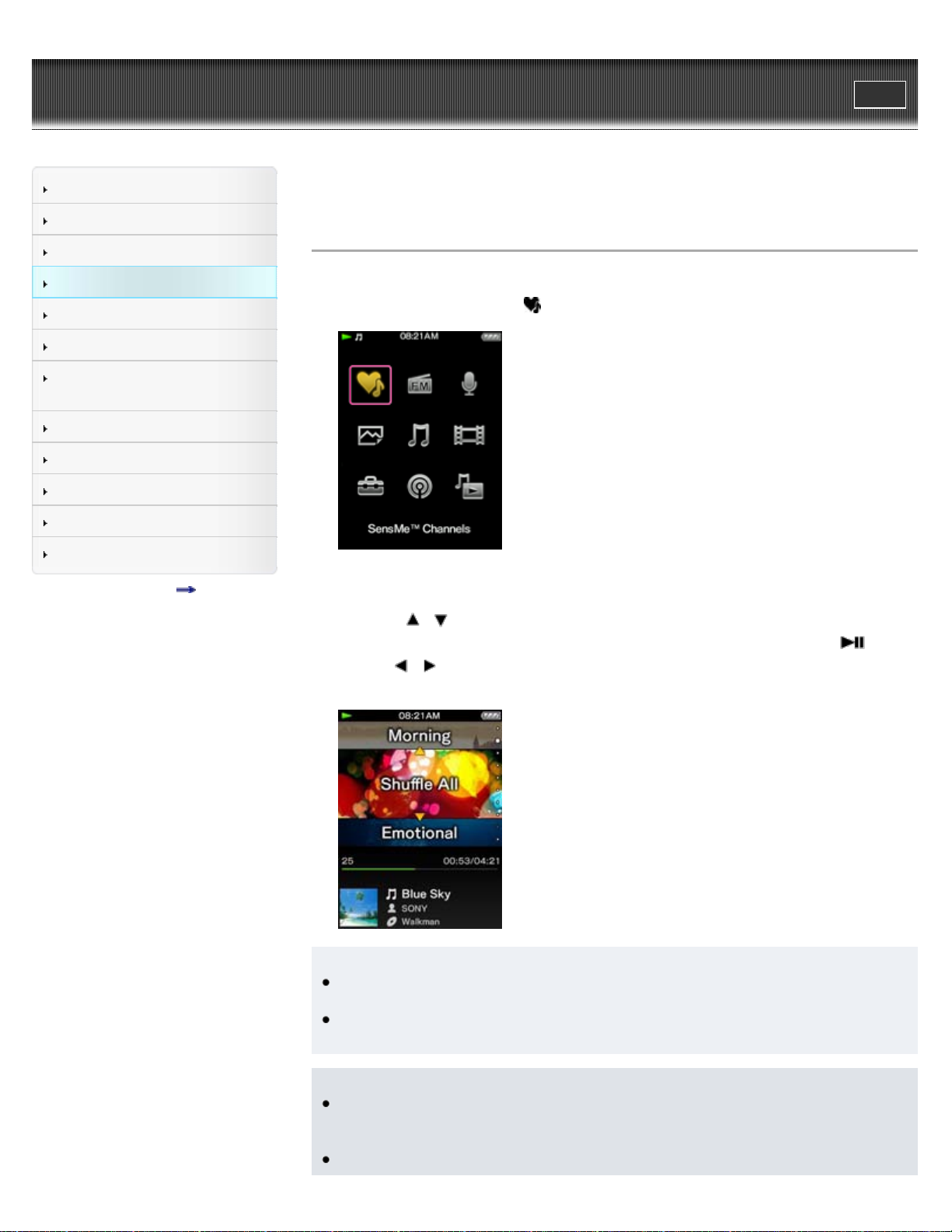
WALKMAN User Guide
Print
Getting Started
How to Use the Software
Music
“SensMe™ Channels”
Videos/Podcasts/Photos
FM Radio
Making/Playing Voice
Recordings
Timer
Settings
Troubleshooting
Important Information
Specifications
Contents list
Top page > “SensMe™ Channels” > Playing songs using “SensMe™ Channels” > Playing songs
using “SensMe™ Channels”
Playing songs using “SensMe™ Channels”
You can play songs to fit your mood, activity or time of day, etc., by selecting channels.
1. From the Home menu, select
[SensMe™ Channels].
The playback screen of “SensMe™ Channels” appears and the player starts playing back
songs.
2. Press the
/ button to select a desired channel.
When changing channels, the song starts from the middle of it. You can use the
button
and the
/ button to play/pause, fast forward/rewind, and find the beginning of a song
in the same way as music playback [Details].
Hint
Songs are played in random order. Each time you select a channel, the order of playback
will vary.
If you transfer songs using Content Transfer, the songs are played back from the most
melodic and rhythmical section.
Note
Depending on the file format, certain songs cannot be analyzed by 12 TONE ANALYSIS of
Content Transfer. For those files, perform [Updating Channels] from the option menu
[Details].
You cannot play back recorded voice files or podcast episodes using “SensMe™
100
Channels.”
You cannot display lyrics while using “SensMe™ Channels.”
According to the analysis, a song may be selected by several channels or not selected at all.
However, all songs can be played back using the [Shuffle All] channel.
Every time you perform [Updating Channels], the result of analysis may vary.
List of channels
Channel Description
[Morning]
Plays music for various times of the day.
[Daytime]
[Evening]
[Night]
[Midnight]
[Shuffle All] Plays all songs in random order.
[Energetic] Plays uptempo and high-energy music.
[Relax] Plays calm and relaxing music.
[Upbeat] Plays cheerful and uplifting music.
[Mellow] Plays soft and slow-tempo music.
[Lounge] Plays jazz and easy listening music.
[Emotional] Plays ballads.
[Dance] Plays rhythm, rap and R & B music.
[Extreme] Plays loud and powerful music.
Note
Channels that do not contain any songs are not displayed in the list.
To listen to [Morning], [Daytime], [Evening], [Night] or [Midnight] according to the timetable,
[Set Date-Time] [Details] needs to be set. If [Set Date-Time] is not set, [Morning] will be
selected.
While playing back a time-based channel, the channel will not shift to the next time-based
channel even if the set time has passed. To listen to the next time-based channel, change
to another channel and go back.
If there are no songs for [Morning], [Daytime], [Evening], [Night] or [Midnight], all songs will
be played back in random order in those channels.
Back to top
Copyright 2010 Sony Corporation
101
WALKMAN User Guide
Print
Getting Started
How to Use the Software
Music
“SensMe™ Channels”
Videos/Podcasts/Photos
FM Radio
Making/Playing Voice
Recordings
Timer
Settings
Troubleshooting
Important Information
Specifications
Contents list
Top page > “SensMe™ Channels” > Playing songs using “SensMe™ Channels” > Analyzing
songs on the player
Analyzing songs on the player
If you transferred songs other than by using Content Transfer and want to listen to them using
the “SensMe™ Channels,” analyze them on the player.
1. From the Home menu, select
[SensMe™ Channels].
2. Press the OPTION/PWR OFF button to bring up the option menu.
The option menu appears.
3. Select [Updating Channels].
The player starts analyzing songs.
When the analysis is finished, the “SensMe™ Channels” screen appears.
To stop analyzing
Press the BACK/HOME button to stop analyzing. All songs analyzed up to the point where you
stopped analyzing will be playable by “SensMe™ Channels.”
Note
If songs without analysis are transferred to the player, [There is an unanalyzed song. Please
select Updating Channels from Option menu.] appears.
The player analyzes all songs at once. You cannot analyze songs individually.
The results of the analysis may vary between the player, the software, and the other
devices.
If you change channels, analyzed songs using [Updating Channels] are played back from
approximately 45 seconds into the songs. And, if a song is less than 90 seconds, playback
starts roughly from the middle of the song.
If the alarm goes off [Details] during the analysis, the analysis process will be stopped.
Songs analyzed up to the point where the alarm went off will be playable by “SensMe™
Channels.”
Back to top
Copyright 2010 Sony Corporation
102

WALKMAN User Guide
Print
Getting Started
How to Use the Software
Music
“SensMe™ Channels”
Videos/Podcasts/Photos
FM Radio
Making/Playing Voice
Recordings
Timer
Settings
Troubleshooting
Important Information
Specifications
Contents list
Top page > “SensMe™ Channels” > “SensMe™ Channels” Option Menu > Using the
“SensMe™ Channels” option menu
Using the “SensMe™ Channels” option menu
Option items appearing on the “SensMe™ Channels” screen
You can bring up the “SensMe™ Channels” option menu by pressing the OPTION/PWR OFF
button on the “SensMe™ Channels” screen. For details on how to use the option menu, see
[Details].
The option items shown on the option menu vary depending on the screen from which you bring it
up. See the reference page for settings and usage.
Option items appearing on the “SensMe™ Channels” screen
Option items Description/reference page
[Updating
Channels]
Analyzes the songs in the player through 12 TONE ANALYSIS [Details].
[DPC (Speed
Control)]
Adjusts the playback speed of songs [Details].
[Equalizer] Customizes the sound quality [Details].
[VPT(Surround)] Customizes the [VPT(Surround)] settings [Details].
[Detailed
Information]
Displays detailed information of a song, such as playing time, audio format,
bit rate, and file name [Details].
Back to top
Copyright 2010 Sony Corporation
103
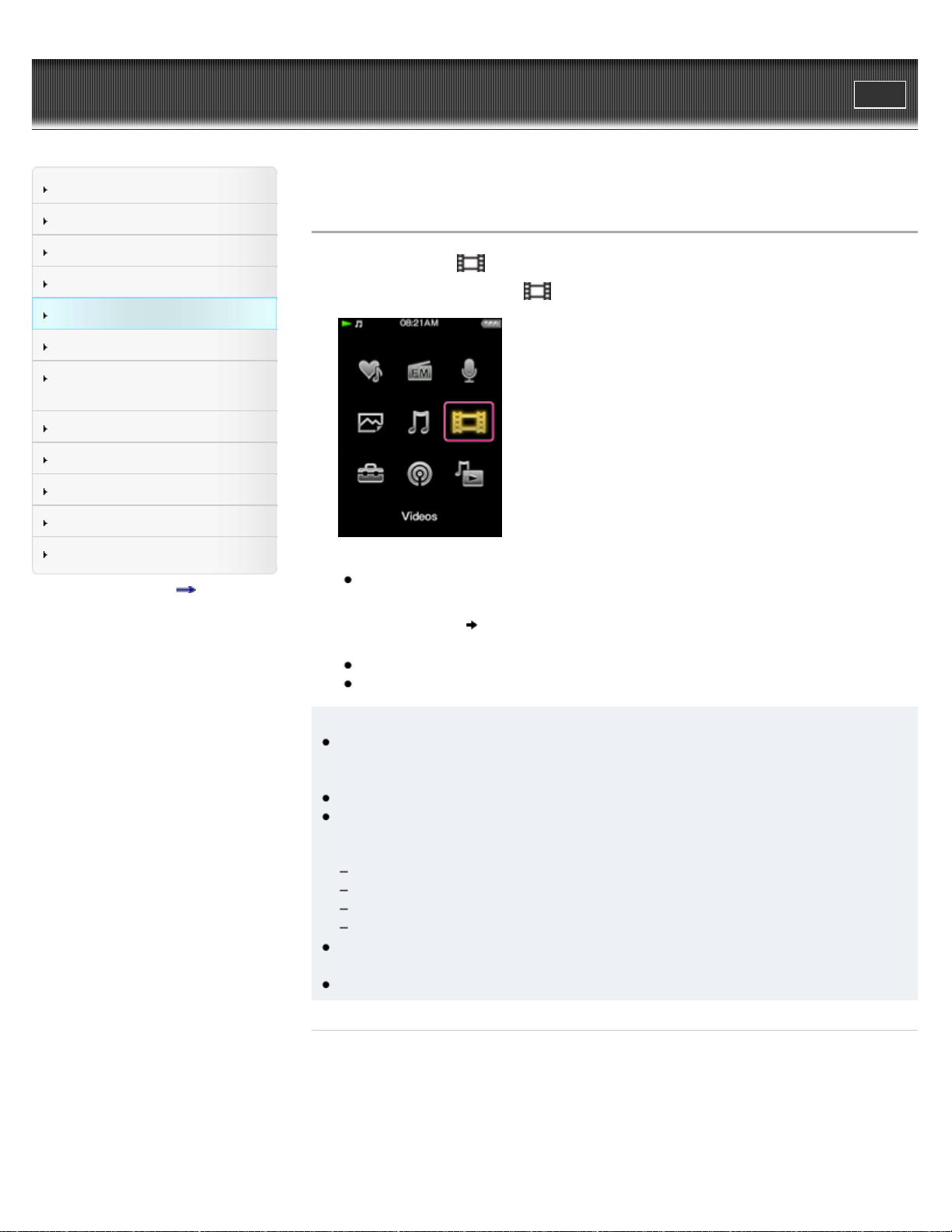
WALKMAN User Guide
Print
Getting Started
How to Use the Software
Music
“SensMe™ Channels”
Videos/Podcasts/Photos
FM Radio
Making/Playing Voice
Recordings
Timer
Settings
Troubleshooting
Important Information
Specifications
Contents list
Top page > Videos/Podcasts/Photos > Watching Videos > Watching videos [Videos]
Watching videos [Videos]
To play a video, select [Videos] on the Home menu to display the [Videos] screen.
1. From the Home menu, select [Videos].
The [Videos] screen appears.
You can select the desired search method to display the video list screen and search for
videos [Details].
2. Select desired item
desired video.
The video playback screen appears and playback of the video begins.
Select items until a video list appears.
For details on how to operate the video playback screen, see [Details].
Hint
When the [On-Hold Display] option is set to [No], you can turn off the screen to enjoy sound
only by setting the HOLD switch to on during video playback [Details]. By this operation, you
can reduce power consumption for longer battery life.
You can arrange the video list by transfer date or by video title [Details].
You can set JPEG files as thumbnails of video files. When you display the video list, you
can see the thumbnails (small pictures to display on the list) for the video files on the player.
Use a computer to create a thumbnail, observing the following rules:
The thumbnail image file must be in JPEG format.
The image dimension must be horizontal 160 × vertical 120 dots.
The file name must be the same as the video file, with extension “.jpg”.
The thumbnail and video file must be placed in the same folder of the player.
The maximum video size playable on the player is 720 × 480. For detailed specifications,
see [Details].
Videos are not played back continuously. They are played back one by one.
Related Topics
Transferring videos/photos/podcasts using Content Transfer
Transferring videos/photos/podcasts using Windows Explorer
Browsing and using the video screen
Searching for videos
Deleting videos
104

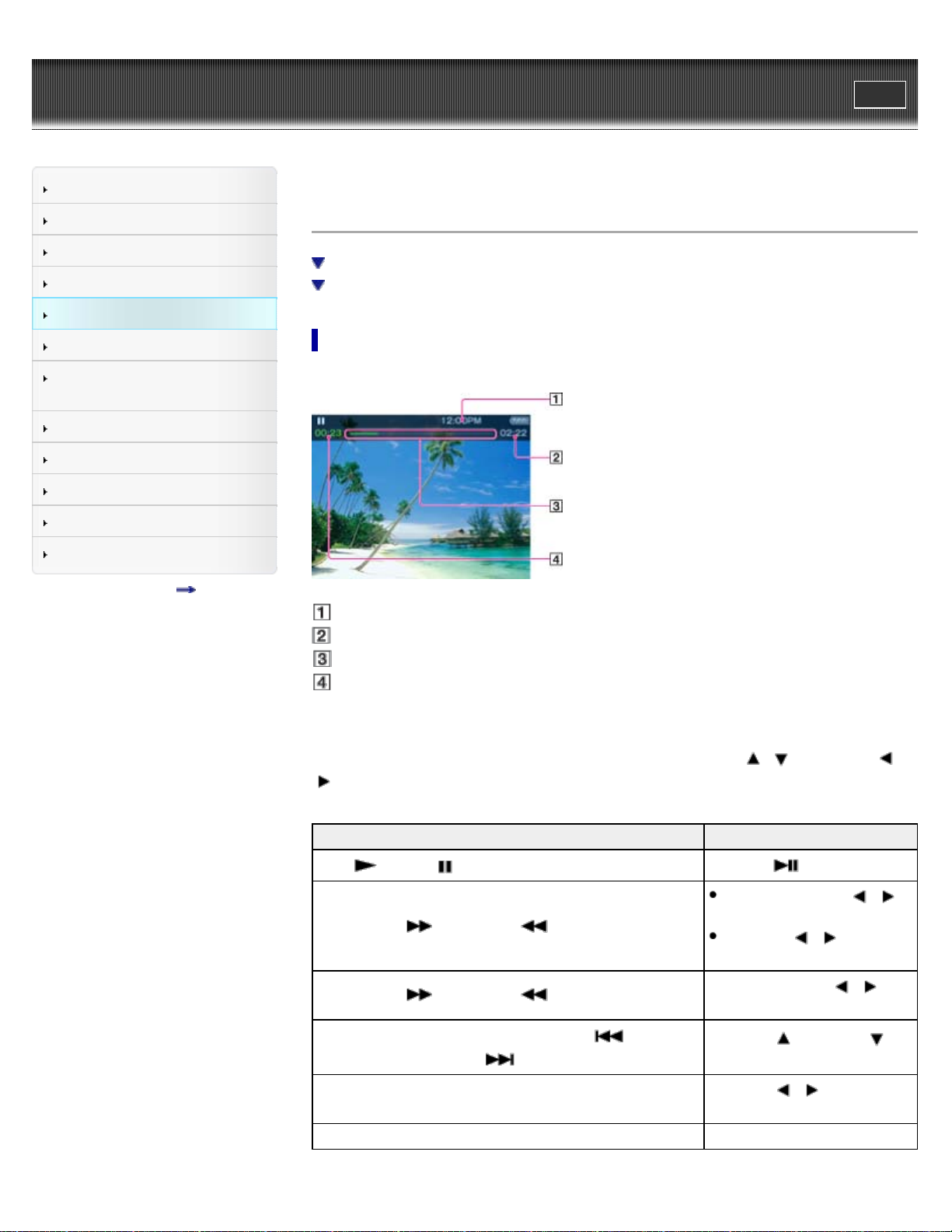
WALKMAN User Guide
Print
Getting Started
How to Use the Software
Music
“SensMe™ Channels”
Videos/Podcasts/Photos
FM Radio
Making/Playing Voice
Recordings
Timer
Settings
Troubleshooting
Important Information
Specifications
Contents list
Top page > Videos/Podcasts/Photos > Watching Videos > Browsing and using the video screen
Browsing and using the video screen
Video playback screen
Video list screen
Video playback screen
The player plays back videos in landscape orientation.
Information area
Total time
Progress bar
Elapsed time
These indications disappear after a while.
Operations on the video playback screen
While the player is playing back a video in landscape orientation, the / buttons and /
buttons swap functions.
To (Screen indication) Do this
Play ( )/pause ( ) (*1) Press the button.
Fast forward (
)/fast rewind ( )
Press and hold the
/
button.
Press the
/ button.
(*2)
Fast forward (
)/fast rewind ( ) during pause (*3)
Press and hold the
/
button during pause.
Move to the previous scene (*4) or chapter ( )/move to
the next scene or chapter (
)
Press the (previous)/
(next) button.
Forward slightly/rewind slightly
Press the / button during
pause.
Return to the list screen Press the BACK/HOME button.
106
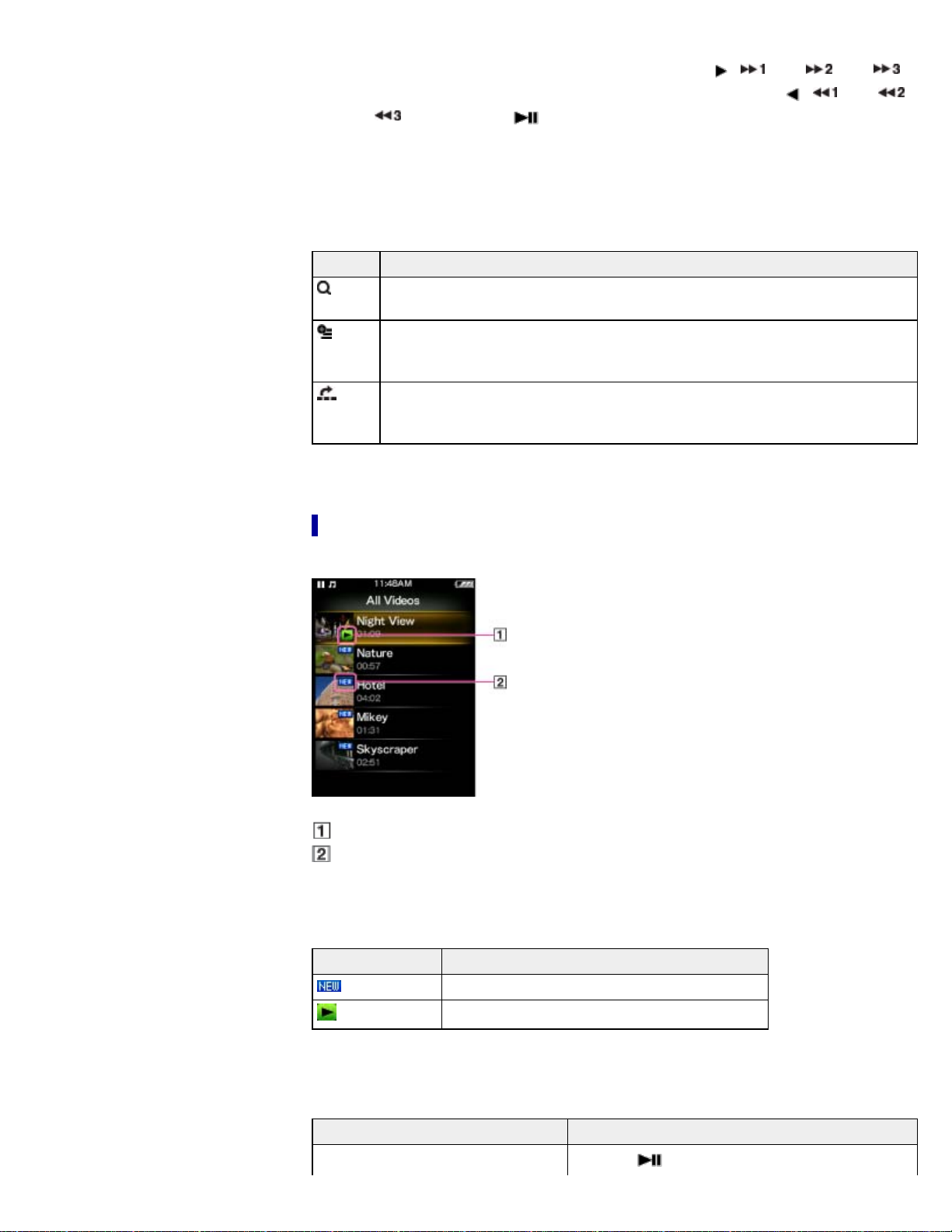
(*1) During pause, if there is no operation for a while, the player automatically enters standby mode.
(*2) Forward speed changes through 3 levels by repeatedly pressing
( (×10), (×30),
(×100)). Also, rewind speed changes through 3 levels by repeatedly pressing ( (×10),
(×30), (×100)). Press the button to exit the operation and resume normal playback.
(*3) The speed of fast forward/fast rewind during pause varies depending on the length of the video.
(*4) If there is only one chapter in the video, the playback position moves back/forward in steps of 5
minutes.
Icons which appear by pressing the OPTION/PWR OFF button
Icon Description
(Search)
Shows the search menu. You can select the desired search method to display the
list screen and search for videos [Details].
(Option
Menu)
Shows the option menu. For details on the video option menu, see [Details].
[Scene
Scroll]
Shows the scene scroll screen. You can browse scenes or chapters by scrolling the
thumbnail (*1) on the screen, to select the desired scene [Details].
(*1) Thumbnail refers to a reduced size image of one scene of a video.
Video list screen
The following is an example of video list screens.
Playback icon
New icon
Icons of videos
The following icons are displayed in the video field.
Icon Description
(New icon) Shows that the video has never been played back.
(Playback icon)
Shows that the video is currently playing.
Operations on the video list screen
To Do this
Select an item Press the button.
107
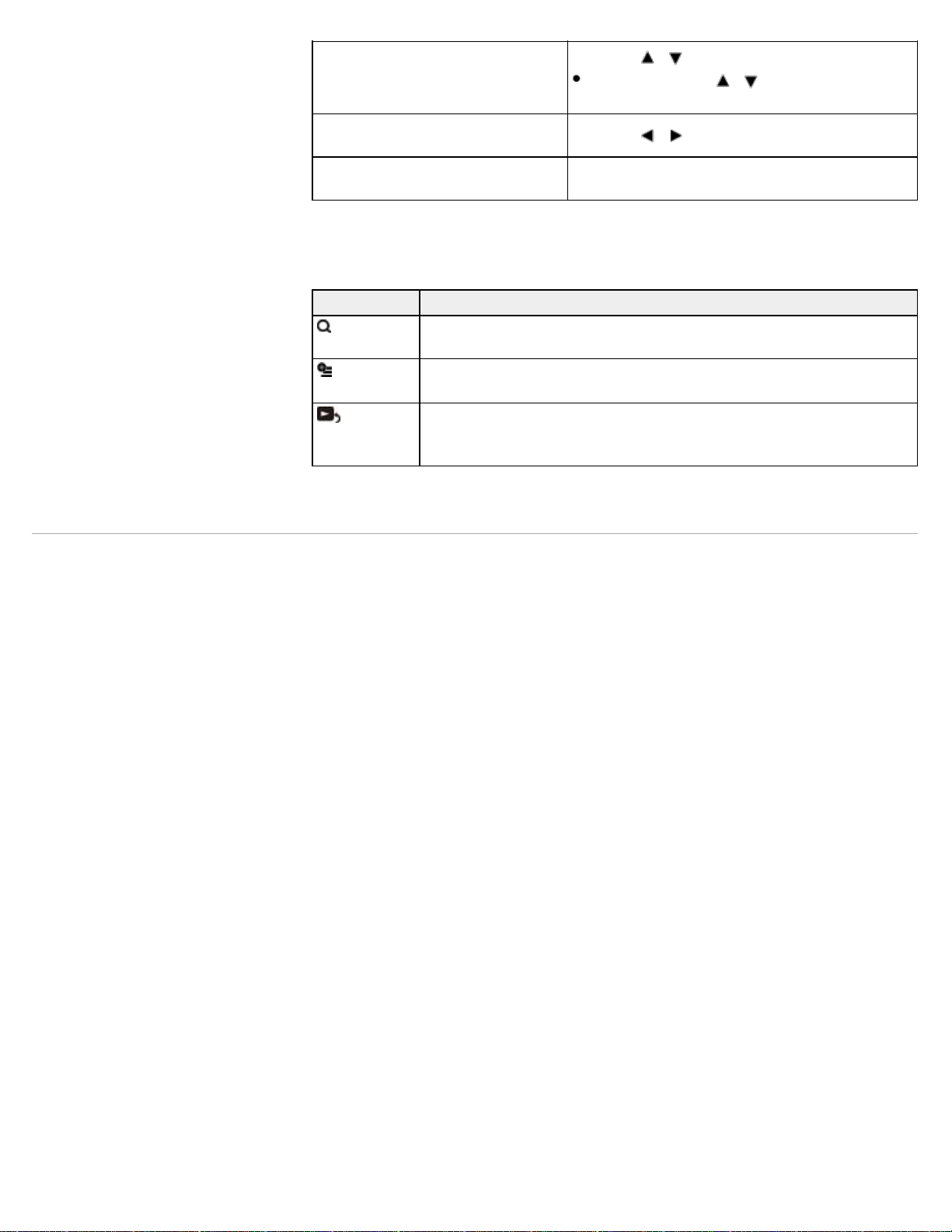
Move the cursor up or down
Press the / button.
Press and hold the
/ button to scroll up or
down faster.
Display the previous/next screen of the
list
Press the
/ button.
Return to the list screen of the next
upper level
Press the BACK/HOME button.
Icons which appear by pressing the OPTION/PWR OFF button
Icon Description
(Search)
(*1)
Shows the search menu. You can select the desired search method to
display the list screen and search for videos [Details].
(Option
Menu) (*1)
Shows the option menu. For details on the video option menu, see [Details].
[To
Playback
Screen]
Returns to the video playback screen.
(*1) These icons may not appear depending on the screen.
Back to top
Copyright 2010 Sony Corporation
108
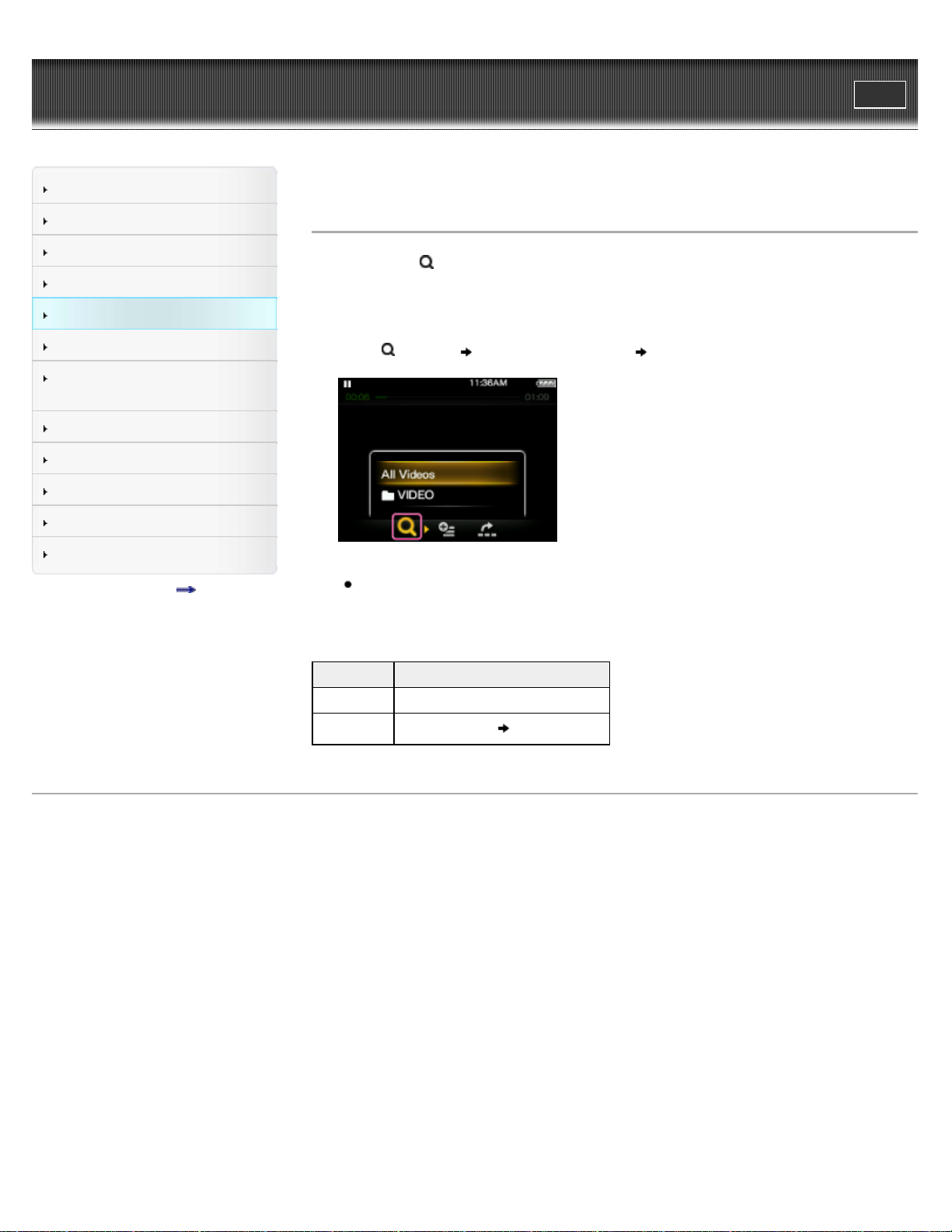
WALKMAN User Guide
Print
Getting Started
How to Use the Software
Music
“SensMe™ Channels”
Videos/Podcasts/Photos
FM Radio
Making/Playing Voice
Recordings
Timer
Settings
Troubleshooting
Important Information
Specifications
Contents list
Top page > Videos/Podcasts/Photos > Watching Videos > Searching for videos
Searching for videos
When you select (Search) on the video playback screen or the list screen, the search menu
appears. You can select the desired search method on the search menu to search the video list
for a desired video.
1. On the video playback screen or the list screen, press the OPTION/PWR OFF button.
2. Select
(Search) desired search method desired video.
The video playback screen appears and playback of the video begins.
Select items as follows until a video list appears.
Search method
Method Description
[All Videos] Select a video from the video list.
[VIDEO] Select a folder
video.
Back to top
Copyright 2010 Sony Corporation
109
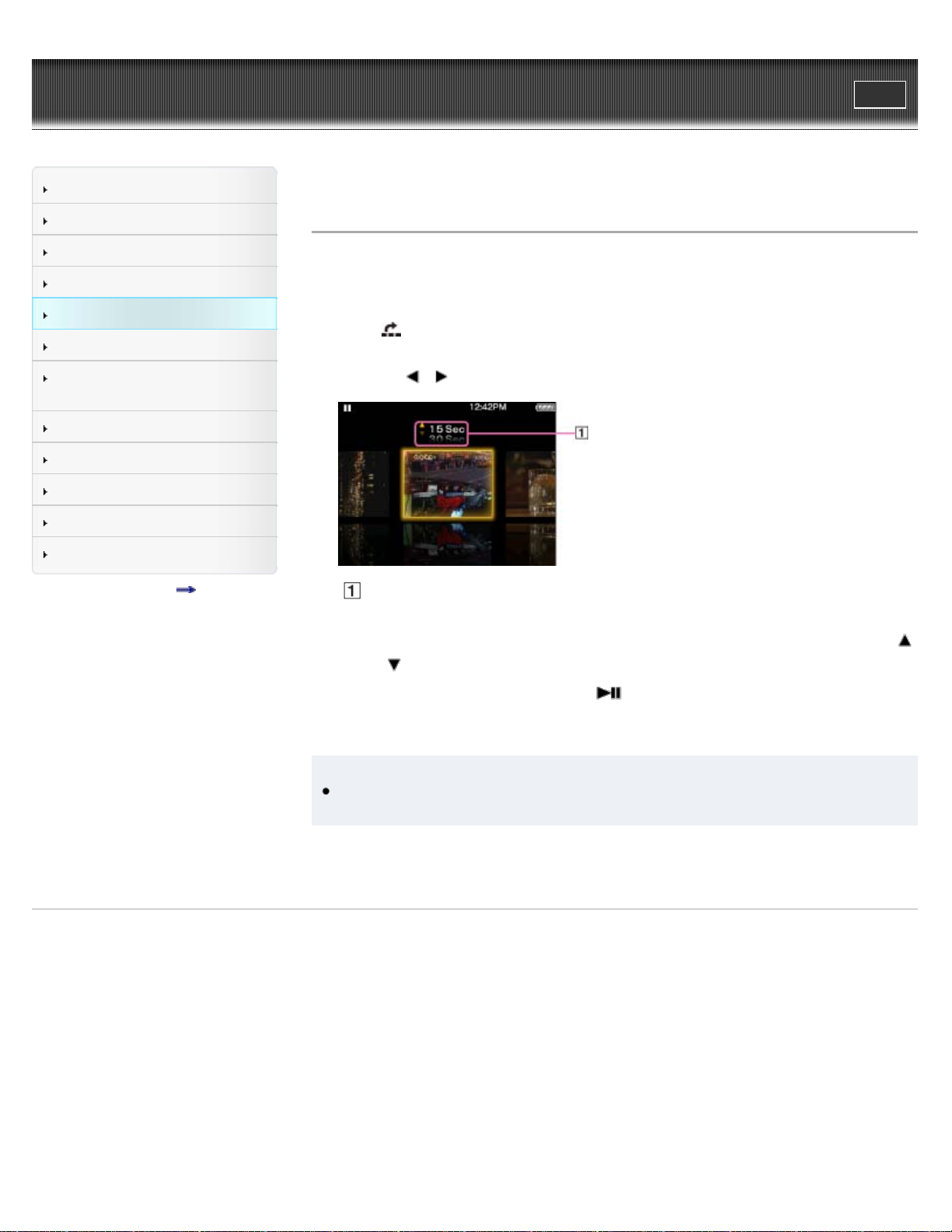
WALKMAN User Guide
Print
Getting Started
How to Use the Software
Music
“SensMe™ Channels”
Videos/Podcasts/Photos
FM Radio
Making/Playing Voice
Recordings
Timer
Settings
Troubleshooting
Important Information
Specifications
Contents list
Top page > Videos/Podcasts/Photos > Watching Videos > Browsing scenes [Scene Scroll]
Browsing scenes [Scene Scroll]
You can display thumbnails (*1) to select a scene or chapter to play back.
(*1) Thumbnail refers to a reduced size image of one scene of a video.
1. On the video playback screen, press the OPTION/PWR OFF button.
2. Select [Scene Scroll].
The scene scroll screen appears.
3. Press the
/ button to scroll images.
Scene interval setting
You can set the interval of scenes displayed as thumbnails.
You can set the interval to [15 Sec], [30 Sec], [1 Min], [2 Min] or [5 Min]. Press the
/ button to select the desired interval.
4. Select the desired image, then press the
button to confirm.
The video playback screen reappears and playback begins from the beginning of the scene
you selected.
Hint
Use the scene thumbnails as a guide (because each thumbnail may have a deviation from
the exact time interval).
To cancel the browsing
Press the BACK/HOME button.
Back to top
Copyright 2010 Sony Corporation
110
WALKMAN User Guide
Print
Getting Started
How to Use the Software
Music
“SensMe™ Channels”
Videos/Podcasts/Photos
FM Radio
Making/Playing Voice
Recordings
Timer
Settings
Troubleshooting
Important Information
Specifications
Contents list
Top page > Videos/Podcasts/Photos > Watching Videos > Deleting videos
Deleting videos
Deleting a currently playing video
Deleting videos by selecting from a list
You can delete videos from the player.
Deleting a currently playing video
1. From the playback screen of the video, press the OPTION/PWR OFF button to bring up the
option menu.
2. Select [Delete Video]
[Yes].
The video is deleted.
Deleting videos by selecting from a list
1. From the video list screen, press the OPTION/PWR OFF button to bring up the option menu.
2. Select [Delete Video].
The [Delete Video] screen appears.
3. Select a video you intend to delete
[Yes].
The selected video is deleted.
4. Repeat step 3 to delete other videos, if necessary.
5. Press the BACK/HOME button to return to the video list screen.
Hint
While selecting a video to be deleted, you can press the BACK/HOME button to cancel
deleting and return to the previous list screen.
Back to top
Copyright 2010 Sony Corporation
111

WALKMAN User Guide
Print
Getting Started
How to Use the Software
Music
“SensMe™ Channels”
Videos/Podcasts/Photos
FM Radio
Making/Playing Voice
Recordings
Timer
Settings
Troubleshooting
Important Information
Specifications
Contents list
Top page > Videos/Podcasts/Photos > Video Option Menu > Using the video option menu
Using the video option menu
Option items appearing on the video list screen
Option items appearing on the video playback screen
You can bring up the video option menu by pressing the OPTION/PWR OFF button on the video
list or on the video playback screen. For details on how to use the option menu, see [Details].
The option items shown on the option menu vary depending on the screen from which you bring it
up. See the reference page for settings and usage.
Option items appearing on the video list screen
Option items Description/reference page
[Order of Video List] Arranges the video list by date or by title [Details].
[Delete Video] Deletes videos [Details].
Option items appearing on the video playback screen
Option
items
Description/reference page
[Zoom
Settings]
Sets the zoom function [Details].
[Brightness] Adjusts the brightness of the screen [Details].
[On-Hold
Display]
Sets to turn off the video screen while the player is on hold [Details].
[Detailed
Information]
Displays file information, such as file size, resolution, video/audio
compression format, and file name, etc.
[Delete Video] Deletes the videos from the player [Details].
Back to top
Copyright 2010 Sony Corporation
112
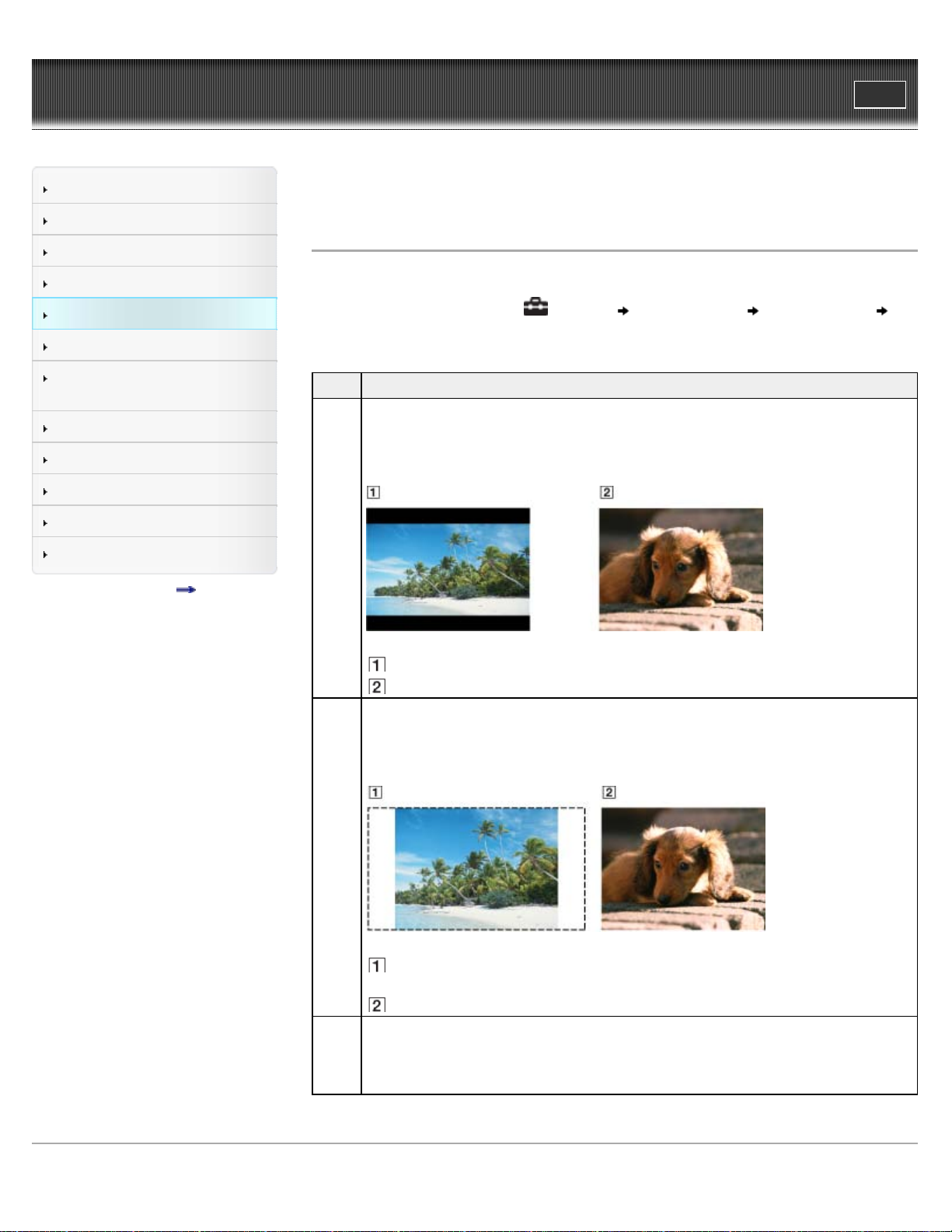
WALKMAN User Guide
Print
Getting Started
How to Use the Software
Music
“SensMe™ Channels”
Videos/Podcasts/Photos
FM Radio
Making/Playing Voice
Recordings
Timer
Settings
Troubleshooting
Important Information
Specifications
Contents list
Top page > Videos/Podcasts/Photos > Video Settings > Setting the zoom function [Zoom
Settings]
Setting the zoom function [Zoom Settings]
You can zoom in the currently playing video.
1. From the Home menu, select [Settings] [Video Settings] [Zoom Settings]
desired zoom setting type.
Type Description
[Auto]
The video image is resized to fit the display area, maintaining the original aspect ratio
(Default setting).
When a 16:9 (wide size) video image is displayed, black bands appear on the top and
bottom of the screen.
16:9 source
4:3 source
[Full]
The video image is resized to fill the available display area, maintaining the aspect
ratio.
When a 16:9 (wide size) video image is displayed, the right/left sides of the image are
trimmed to fit.
16:9 source
The dotted line frame represents the original video image size.
4:3 source
[Off]
The video image is not resized, and appears in the original resolution. If video
resolution is too high, the left, right, top and bottom of the screen will be cut. If video
resolution is too low, black bars will appear on the right, left, top and bottom of the
screen.
Back to top
Copyright 2010 Sony Corporation
113
WALKMAN User Guide
Print
Getting Started
How to Use the Software
Music
“SensMe™ Channels”
Videos/Podcasts/Photos
FM Radio
Making/Playing Voice
Recordings
Timer
Settings
Troubleshooting
Important Information
Specifications
Contents list
Top page > Videos/Podcasts/Photos > Video Settings > Playing only video sound [On-Hold
Display]
Playing only video sound [On-Hold Display]
You can set to turn off the video screen while the player is on hold, allowing you to enjoy video
sound only.
Setting this option to [No] saves battery power for longer battery life.
1. From the Home menu, select
[Settings] [Video Settings] [On-Hold Display]
desired On-Hold Display setting type.
Type Description
[Yes]
When the player is on hold, the buttons are deactivated, but videos will be played back
normally. (Default setting)
[No]
When the player is on hold, the buttons are deactivated and the screen turns off, but
the sound of the current video is played back.
Back to top
Copyright 2010 Sony Corporation
114

WALKMAN User Guide
Print
Getting Started
How to Use the Software
Music
“SensMe™ Channels”
Videos/Podcasts/Photos
FM Radio
Making/Playing Voice
Recordings
Timer
Settings
Troubleshooting
Important Information
Specifications
Contents list
Top page > Videos/Podcasts/Photos > Video Settings > Arranging the video list [Order of Video
List]
Arranging the video list [Order of Video List]
Arranges the video list by date or by title.
1. From the Home menu, select [Settings] [Video Settings] [Order of Video List]
desired order of video list type.
Type Description
[Date/Time
(Oldest)]
Arranges the video list by transfer/record date in ascending order.
[Date/Time
(Newest)]
Arranges the video list by transfer/record date in descending order.
(Default setting)
[Title (A>Z)] Arranges the video list by title in ascending order.
[Title (Z>A)] Arranges the video list by title in descending order.
Back to top
Copyright 2010 Sony Corporation
115
WALKMAN User Guide
Print
Getting Started
How to Use the Software
Music
“SensMe™ Channels”
Videos/Podcasts/Photos
FM Radio
Making/Playing Voice
Recordings
Timer
Settings
Troubleshooting
Important Information
Specifications
Contents list
Top page > Videos/Podcasts/Photos > Playing a Podcast > What is a podcast?
What is a podcast?
A “podcast” is a group of audio or video files that is published on the Internet. The files, called
episodes, can be downloaded to a computer automatically by using RSS, to play back. Many
news sites, corporations, or individuals publish podcasts by using RSS. You can subscribe to a
podcast by using your computer. When the latest episodes are added to the podcast, you can
download them to your computer. After downloading, you can transfer them to the player by
using Windows Explorer or Content Transfer, and play them back on the player.
Related Topics
Transferring videos/photos/podcasts using Content Transfer
Transferring videos/photos/podcasts using Windows Explorer
Playing podcast [Podcasts]
Browsing and using the podcast screen
Deleting podcasts
Using the podcast option menu
Back to top
Copyright 2010 Sony Corporation
116
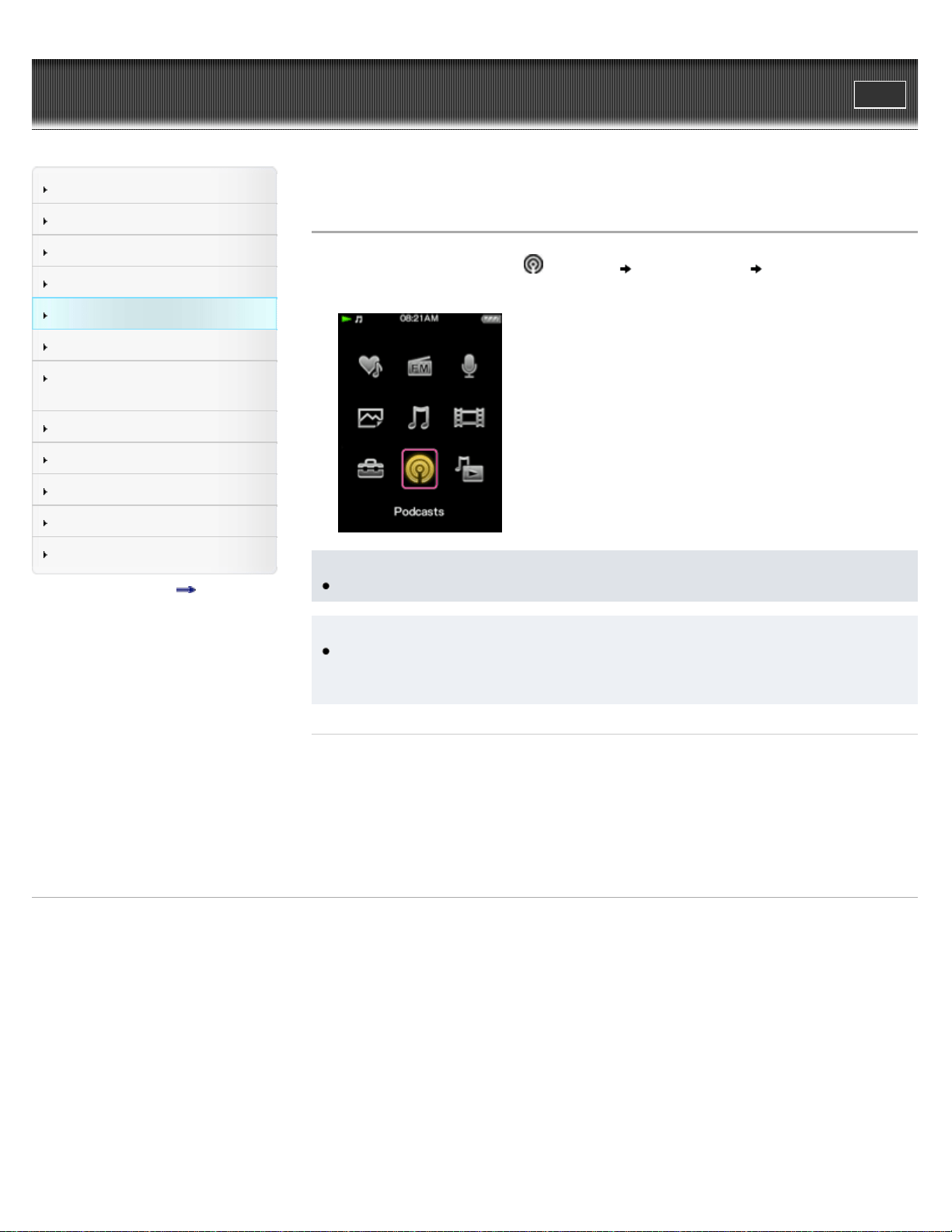
WALKMAN User Guide
Print
Getting Started
How to Use the Software
Music
“SensMe™ Channels”
Videos/Podcasts/Photos
FM Radio
Making/Playing Voice
Recordings
Timer
Settings
Troubleshooting
Important Information
Specifications
Contents list
Top page > Videos/Podcasts/Photos > Playing a Podcast > Playing podcast [Podcasts]
Playing podcast [Podcasts]
1. From the Home menu, select [Podcasts] desired podcast desired episode.
The podcast playback screen appears.
Note
You cannot play back podcast episodes continuously.
Hint
When [Podcast Language Study] is set to [On], you can use the [Quick Replay] function and
the A-B repeat function in the podcast’s audio playback screen [Details]. The [DPC (Speed
Control)] setting also affects the playback speed of the audio podcast [Details].
Related Topics
Transferring videos/photos/podcasts using Content Transfer
Transferring videos/photos/podcasts using Windows Explorer
Browsing and using the podcast screen
Deleting podcasts
Using the podcast option menu
Back to top
Copyright 2010 Sony Corporation
117
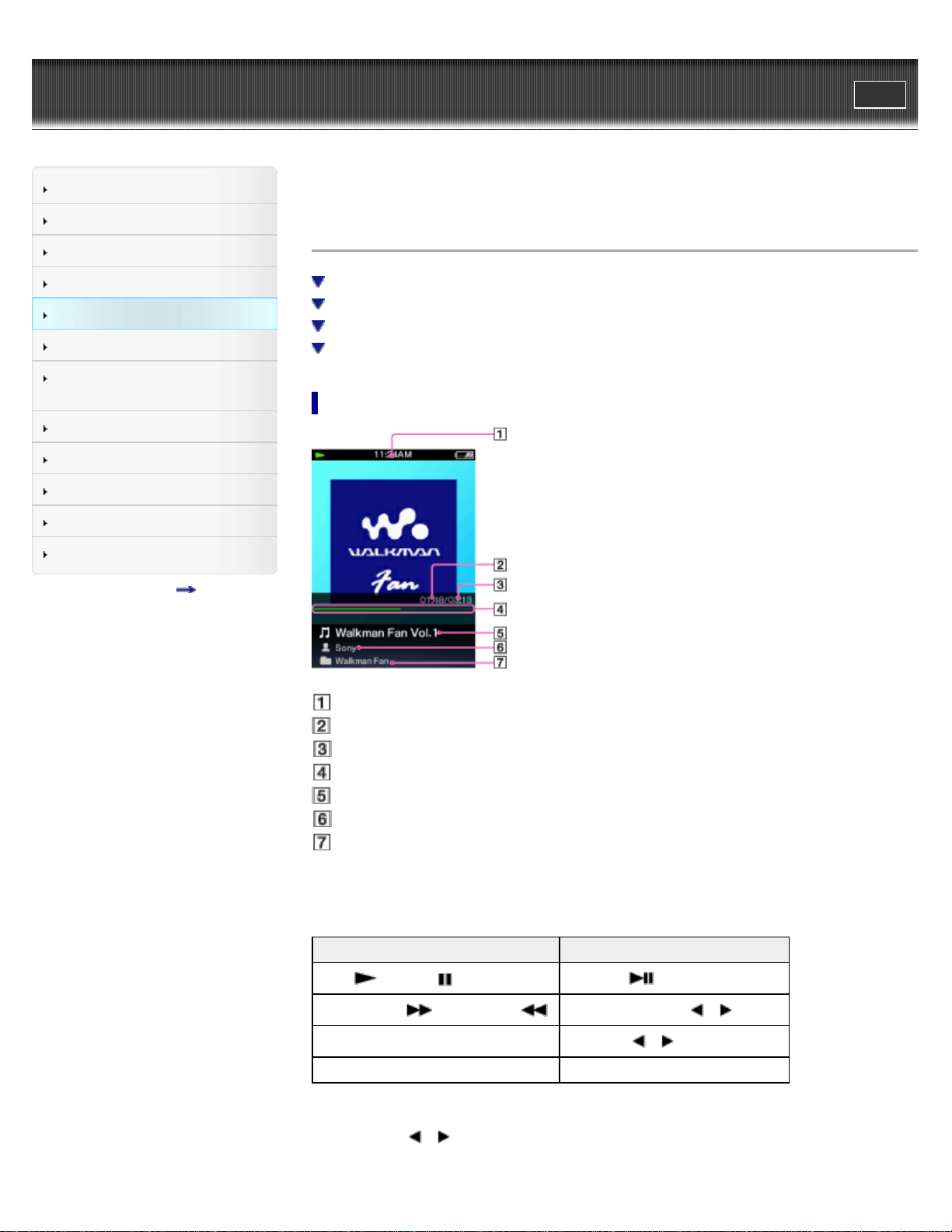
WALKMAN User Guide
Print
Getting Started
How to Use the Software
Music
“SensMe™ Channels”
Videos/Podcasts/Photos
FM Radio
Making/Playing Voice
Recordings
Timer
Settings
Troubleshooting
Important Information
Specifications
Contents list
Top page > Videos/Podcasts/Photos > Playing a Podcast > Browsing and using the podcast
screen
Browsing and using the podcast screen
Audio podcast playback screen
Video podcast playback screen
Episode list screen
Podcast list screen
Audio podcast playback screen
Information area
Elapsed time (*1)
Total time (*1)
Progress bar (*1)
Episode name
Artist name
Podcast name
(*1) These items disappear after a while.
Operations on the audio podcast playback screen
To (Screen indication) Do this
Play ( )/pause ( ) (*1) Press the button.
Fast forward ( )/fast rewind ( ) Press and hold the / button.
Find the beginning of the episode (*2) Press the / button.
Return to the list screen Press the BACK/HOME button.
(*1) During pause, if there is no operation for a while, the player automatically enters standby mode.
(*2) Both of the
/ buttons find the beginning of the episode. To play back the next episode, press
the BACK/HOME button to display the episode list to select the desired episode.
118
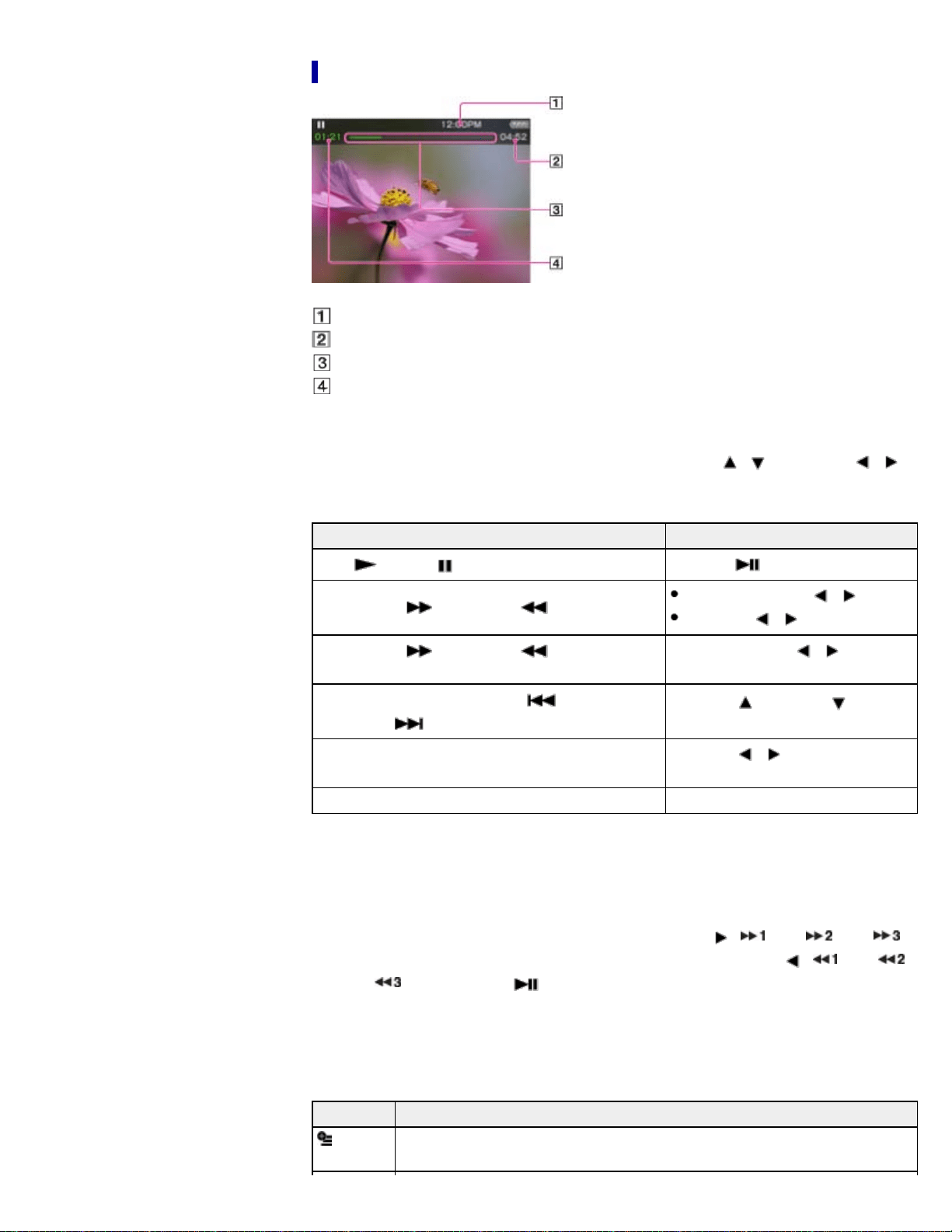
Video podcast playback screen
Information area
Total time
Progress bar
Elapsed time
These indications disappear after a while.
Operations on the video podcast playback screen
While the player is playing back a video in landscape orientation, / buttons and /
buttons interchange their functions with each other.
To (Screen indication) Do this
Play ( )/pause ( ) (*1) Press the button.
Fast forward (
)/fast rewind ( ) (*2) (*3)
Press and hold the
/ button.
Press the
/ button. (*4)
Fast forward ( )/fast rewind ( ) during pause
(*5)
Press and hold the / button
during pause.
Move to the previous scene (*6) ( )/move to the
next scene (
)
Press the (previous)/ (next)
button.
Rewind slightly/forward slightly
Press the / button during
pause.
Return to the list screen Press the BACK/HOME button.
(*1) During pause, if there is no operation for a while, the player automatically enters standby mode.
(*2) If you fast-forward to the end of the episode, playback pauses. If you fast-rewind to the beginning of
an episode during playback, playback restarts automatically. If you fast-rewind to the beginning of an
episode during pause, playback remains paused.
(*3) These buttons may not work as described above depending on the episode.
(*4) Forward speed changes through 3 levels by repeatedly pressing
( (×10), (×30),
(×100)). Also, rewind speed changes through 3 levels by repeatedly pressing ( (×10),
(×30), (×100)). Press the button to exit the operation and resume normal playback.
(*5) The speed of fast forward/fast rewind during pause varies depending on the length of the video.
(*6) If there is only one chapter in the video, the playback position moves with an interval of 5 minutes.
Icons which appear by pressing the OPTION/PWR OFF button
Icon Description
(Option
Menu)
Shows the option menu. For details on the podcast option menu, see [Details].
119
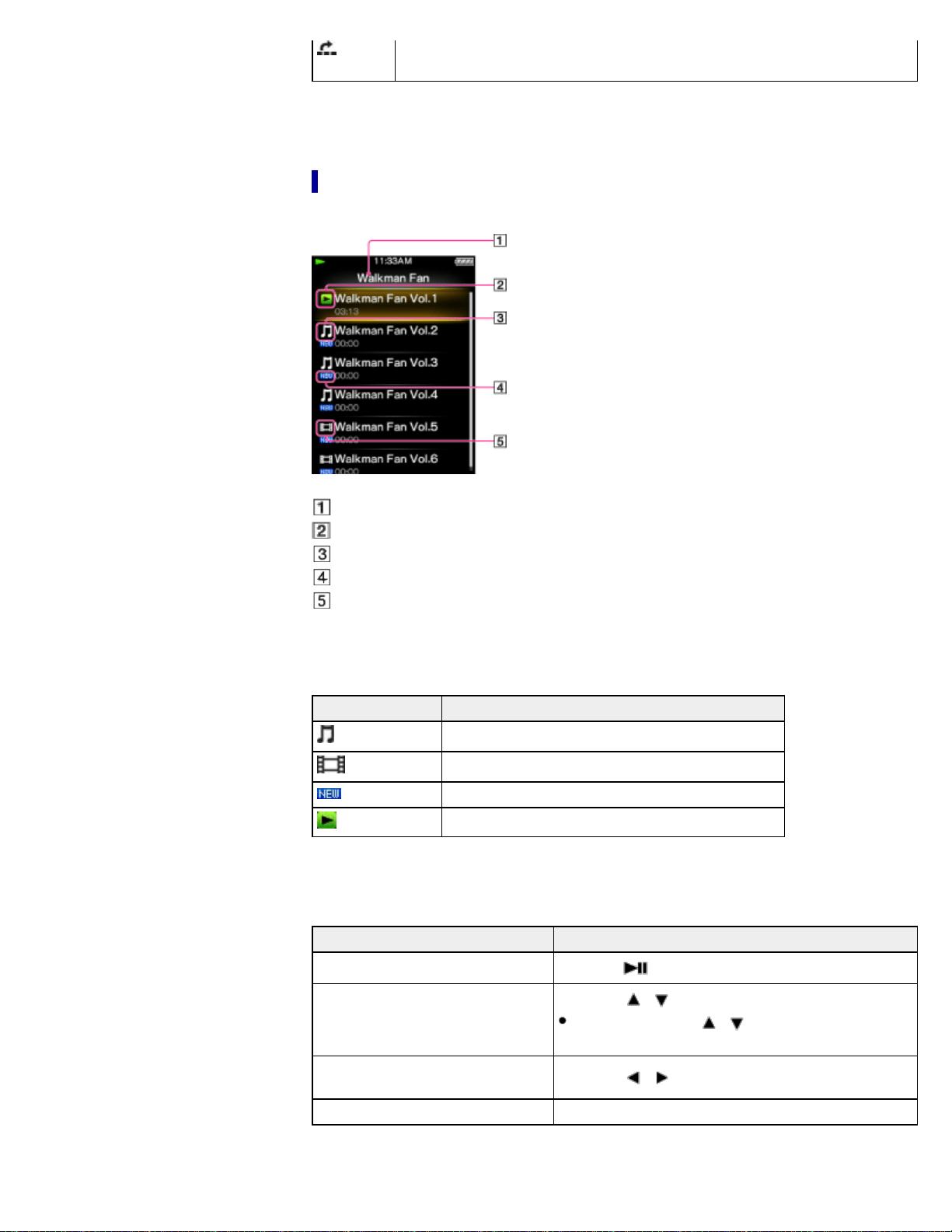
[Scene
Scroll] (*1)
Shows the scene scroll screen. You can browse scenes or chapters by scrolling
thumbnails (*2) on the screen, to select a desired scene [Details].
(*1) Scene Scroll icon appears on the video playback screen only.
(*2) Thumbnail refers to a reduced size image of one scene of a video.
Episode list screen
Episodes are displayed in the episode list screen in name order.
Podcast name
Playback icon
Audio icon
New icon
Video icon
Icons of episodes
The following icons are displayed in the episode field.
Icon Description
(Audio icon)
Shows that the episode is an audio episode.
(Video icon)
Shows that the episode is a video episode.
(New icon) Shows that the episode has never been played back.
(Playback icon)
Shows that the episode is currently playing.
Operations on the episode list screen
To (Screen indication) Do this
Select an item Press the button.
Move the cursor up or down
Press the / button.
Press and hold the
/ button to scroll up or
down faster.
Display the previous/next screen of
the list
Press the
/ button.
Return to the [Podcast List] screen Press the BACK/HOME button.
120
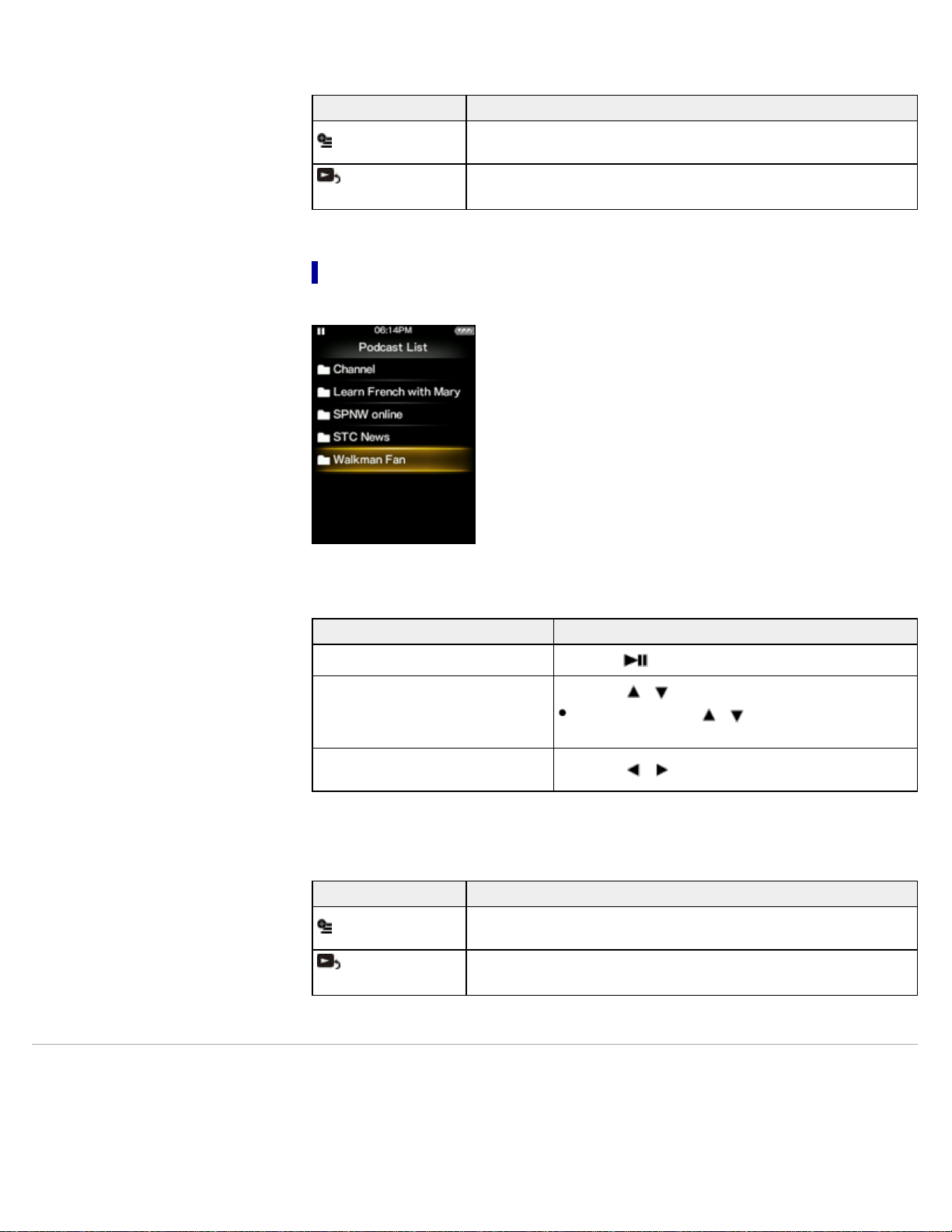
Icons which appear by pressing the OPTION/PWR OFF button
Icon Description
(Option Menu)
Shows the option menu. For details on the podcast option menu, see
[Details].
[To Playback
Screen]
Returns to the podcast playback screen.
Podcast list screen
Podcasts are displayed in the [Podcast List] screen in name order.
Operations on the [Podcast List] screen
To (Screen indication) Do this
Select an item Press the button.
Move the cursor up or down
Press the / button.
Press and hold the
/ button to scroll up or
down faster.
Display the previous/next screen of
the list
Press the
/ button.
Icons which appear by pressing the OPTION/PWR OFF button
Icon Description
(Option Menu)
Shows the option menu. For details on the podcast option menu, see
[Details].
[To Playback
Screen]
Returns to the podcast playback screen.
Back to top
Copyright 2010 Sony Corporation
121
WALKMAN User Guide
Print
Getting Started
How to Use the Software
Music
“SensMe™ Channels”
Videos/Podcasts/Photos
FM Radio
Making/Playing Voice
Recordings
Timer
Settings
Troubleshooting
Important Information
Specifications
Contents list
Top page > Videos/Podcasts/Photos > Playing a Podcast > Deleting podcasts
Deleting podcasts
Deleting the currently playing episode
Deleting an episode in the episode list
Deleting a podcast
Deleting all podcasts
You can delete an episode, a podcast, or all transferred podcasts.
Deleting the currently playing episode
1. From the playback screen of the episode you intend to delete, press the OPTION/PWR OFF
button to bring up the option menu.
2. Select [Delete This Episode]
[Yes].
Deleting an episode in the episode list
1. From the episode list, press the OPTION/PWR OFF button to bring up the option menu.
2. Select [Delete Episode].
The [Delete Episode] screen appears.
3. Select an episode you intend to delete
[Yes].
The selected episode is deleted.
4. Repeat step 3 to delete other episodes, if necessary.
5. Press the BACK/HOME button to return to the episode list screen.
Deleting a podcast
The following operations delete all episodes of a podcast and delete the podcast itself.
1. From the [Podcast List] screen, press the OPTION/PWR OFF button to bring up the option
menu.
2. Select [Delete Podcast].
The [Delete Podcast] screen appears.
3. Select a podcast you intend to delete
[Yes].
The selected podcast is deleted.
4. Repeat step 3 to delete other podcasts, if necessary.
5. Press the BACK/HOME button to return to the [Podcast List] screen.
or,
1. From the episode list of the podcast you intend to delete, press the OPTION/PWR OFF
button to bring up the option menu.
2. Select [Delete This Podcast]
[Yes].
Deleting all podcasts
This operation deletes all episodes and podcasts.
122

WALKMAN User Guide
Print
Getting Started
How to Use the Software
Music
“SensMe™ Channels”
Videos/Podcasts/Photos
FM Radio
Making/Playing Voice
Recordings
Timer
Settings
Troubleshooting
Important Information
Specifications
Contents list
Top page > Videos/Podcasts/Photos > Podcast Option Menu > Using the podcast option menu
Using the podcast option menu
Option items appearing on the podcast playback screen
Option items appearing on the episode list screen
Option items appearing on the [Podcast List] screen
You can bring up the podcast option menu by pressing the OPTION/PWR OFF button on the
podcast playback screen or on the list screen. For details on how to use the option menu, see
[Details].
The option items shown on the option menu vary depending on the screen from which you bring it
up. See the reference page for settings and usage.
Option items appearing on the podcast playback screen
Option items Description/reference page
[Podcast Language Study]
(audio only)
Allows you to use the [Quick Replay] function and the A-B
repeat function [Details].
[DPC (Speed Control)] (audio
only)
Adjusts the playback speed of songs [Details].
[Equalizer] (audio only) Customizes the sound quality [Details].
[VPT(Surround)] (audio only) Customizes the [VPT(Surround)] settings [Details].
[Zoom Settings] (video only) Sets the zoom function [Details].
[Brightness] (video only) Adjusts the brightness of the screen [Details].
[On-Hold Display] (video
only)
Sets to turn off the video screen while the player is on hold
[Details].
[Detailed Information] Displays detailed information of an episode.
[Delete This Episode] Deletes the current episode [Details].
Option items appearing on the episode list screen
Option items Description/reference page
[Delete Episode]
Displays the delete episode screen to select an episode to delete
[Details].
[Delete This
Podcast]
Deletes the current podcast [Details].
Option items appearing on the [Podcast List] screen
124

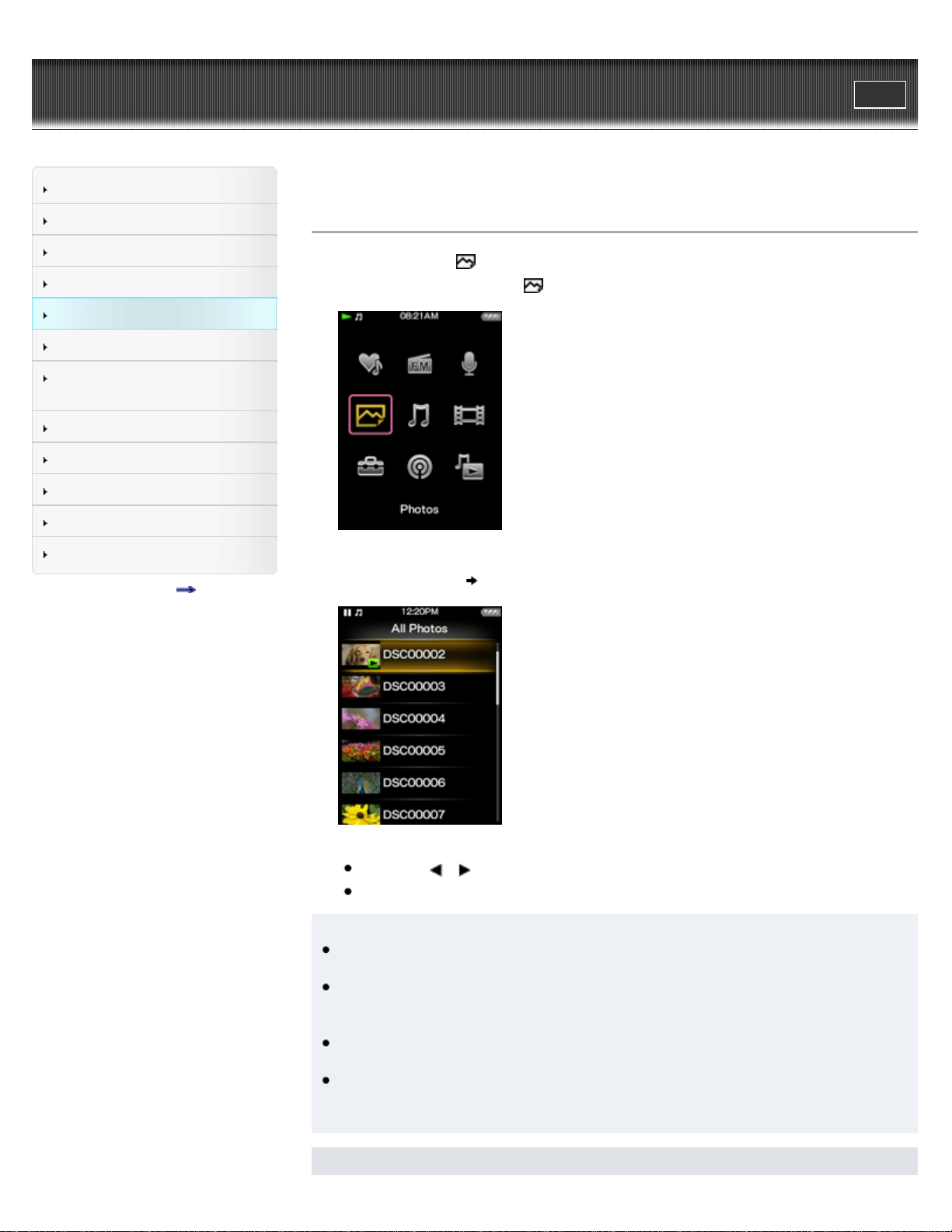
WALKMAN User Guide
Print
Getting Started
How to Use the Software
Music
“SensMe™ Channels”
Videos/Podcasts/Photos
FM Radio
Making/Playing Voice
Recordings
Timer
Settings
Troubleshooting
Important Information
Specifications
Contents list
Top page > Videos/Podcasts/Photos > Viewing Photos > Viewing photos [Photos]
Viewing photos [Photos]
To view photos, select [Photos] on the Home menu to display the [Photos] screen.
1. From the Home menu, select [Photos].
The [Photos] screen appears.
2. Select desired item
desired photo.
The photo display screen appears.
Press the
/ button to display the previous or next photo.
For details on how to operate the photo display screen, see [Details].
Hint
Playback of songs continues even while you are searching for photos in the photo folder
lists or photo lists, or when the photo display screen is displayed.
You can arrange photos transferred to the player by folder. Select the player (as
[WALKMAN]) using Windows Explorer, and drag and drop a new folder just under the
[DCIM], [PICTURE] or [PICTURES] folder. For details on data hierarchy, see [Details].
You can transfer photos to the [SCREENSAVER] folder in the [PICTURE] folder to specify
photos to display in a slide show as a screensaver [Details].
Photo files are displayed in alphabetical order. The files under the [PICTURE], [PICTURES]
and [DCIM] folders are displayed in the [PICTURE], [PICTURES] and [DCIM] folders
respectively.
Note
126

If the size of a photo is too large, or the photo file is damaged, appears, and the photo
cannot be displayed.
Related topics
Transferring videos/photos/podcasts using Content Transfer
Transferring videos/photos/podcasts using Windows Explorer
Browsing and using the photo screen
Deleting photos
Using the photo option menu
Back to top
Copyright 2010 Sony Corporation
127
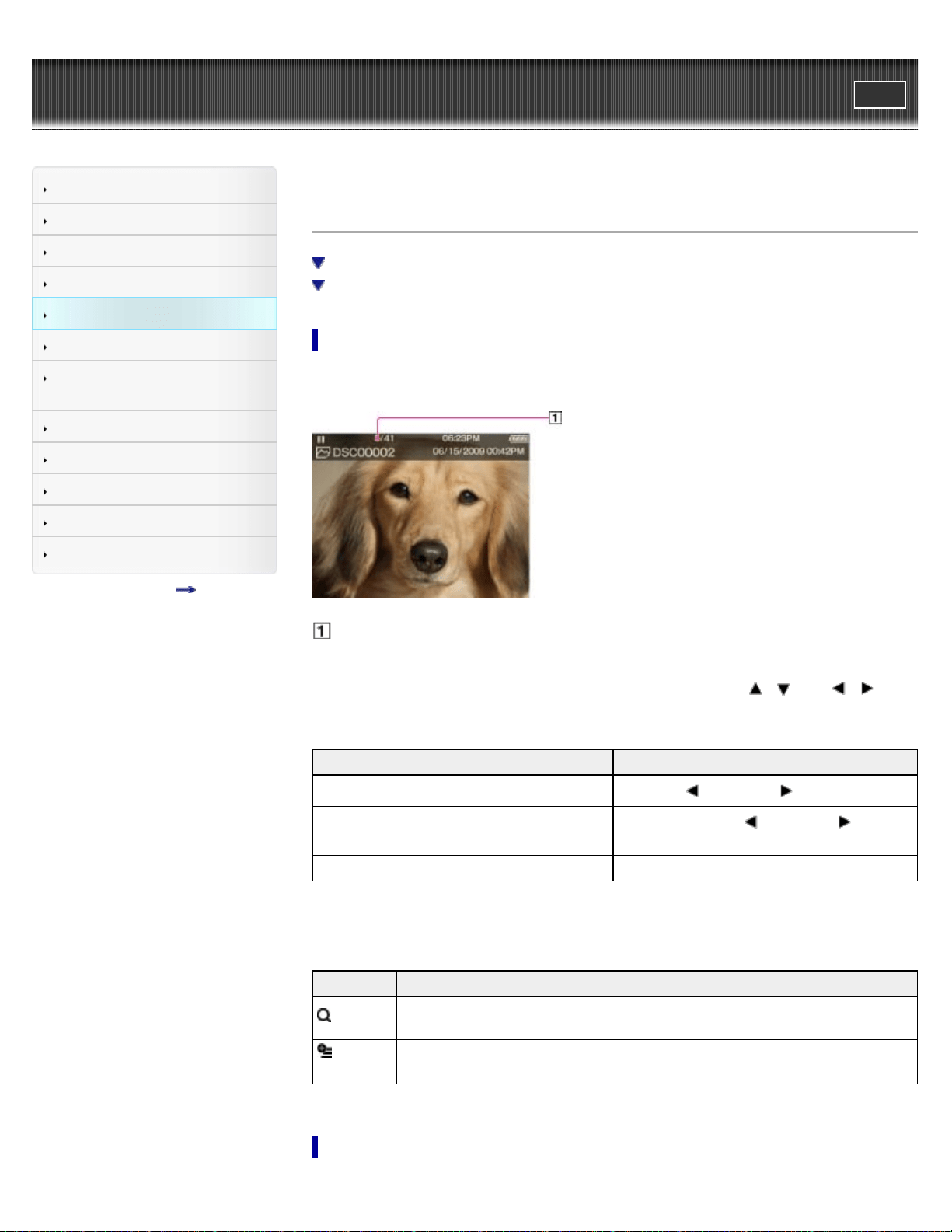
WALKMAN User Guide
Print
Getting Started
How to Use the Software
Music
“SensMe™ Channels”
Videos/Podcasts/Photos
FM Radio
Making/Playing Voice
Recordings
Timer
Settings
Troubleshooting
Important Information
Specifications
Contents list
Top page > Videos/Podcasts/Photos > Viewing Photos > Browsing and using the photo screen
Browsing and using the photo screen
Photo display screen
Photo list screen
Photo display screen
When a photo appears on the screen, information such as the photo’s file name is displayed for a
few seconds.
Information area
Operations on the photo display screen
While the player is playing back a photo in landscape orientation, the / and /
buttons interchange their functions with each other.
To (Screen indication) Do this
Display the next/previous photo Press the (previous)/ (next) button.
Display the following/previous photos
consecutively
Press and hold the (previous)/ (next)
button.
Return to the list screen Press the BACK/HOME button.
Icons which appear by pressing the OPTION/PWR OFF button
Icon Description
(Search)
Shows the search menu. You can select the desired search method to display
the list screen and search for photos.
(Option
Menu)
Shows the option menu. For details on the photo option menu, see [Details].
Photo list screen
128
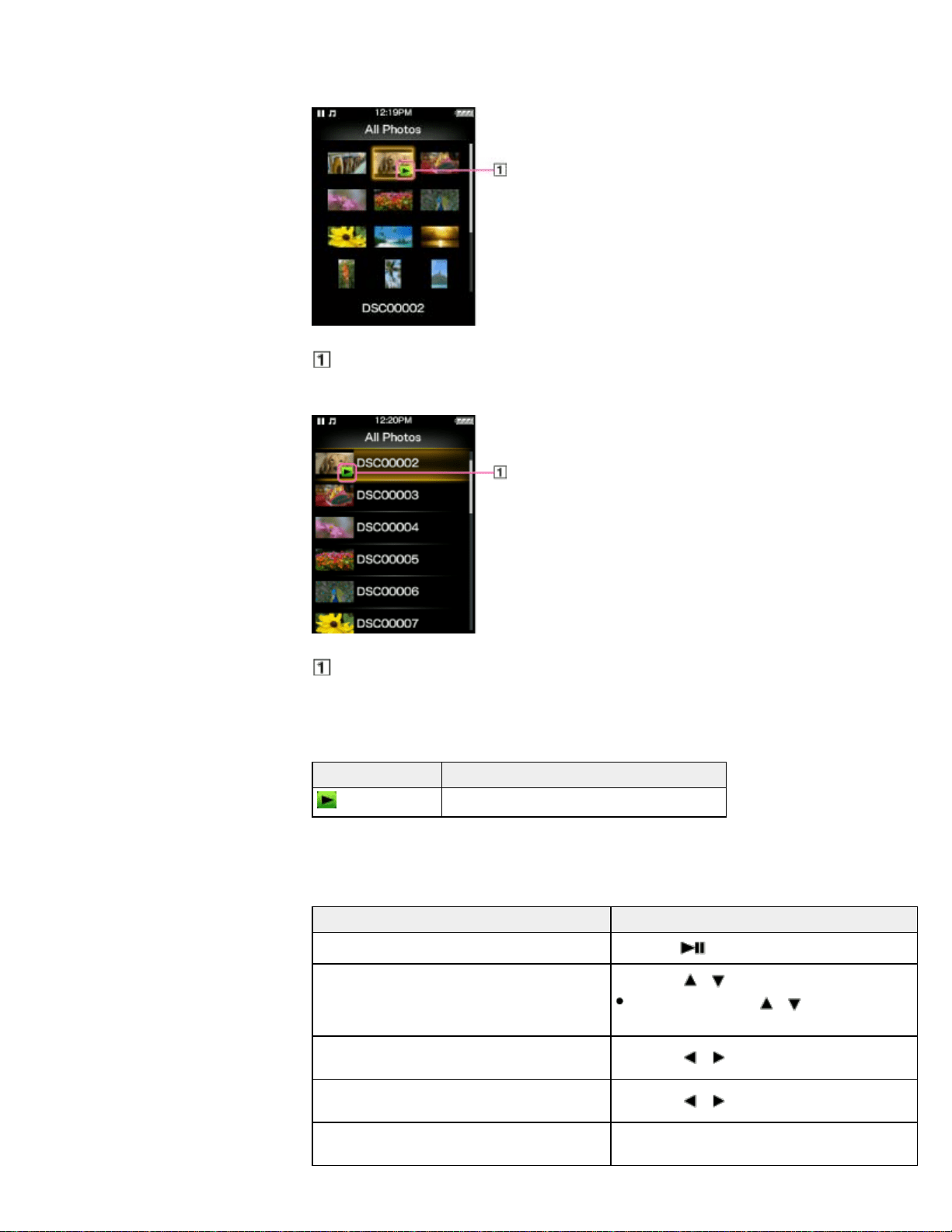
The following are examples of photo list screens.
[Thumbnail Only]
Playback icon
[Thumbnail + Title]
Playback icon
Icon of photos
The following icon is displayed in the photo field.
Icon Description
(Playback icon)
Shows that the photo is currently displayed.
Operations on the photo list screen
To (Screen indication) Do this
Select an item Press the button.
Move the cursor up or down
Press the / button.
Press and hold the
/ button to scroll
up or down faster.
Display the previous/next screen of the list
([Thumbnail + Title])
Press the
/ button.
Move the cursor right or left ([Thumbnail
Only])
Press the
/ button.
Return to the list screen of the next upper
level
Press the BACK/HOME button.
129
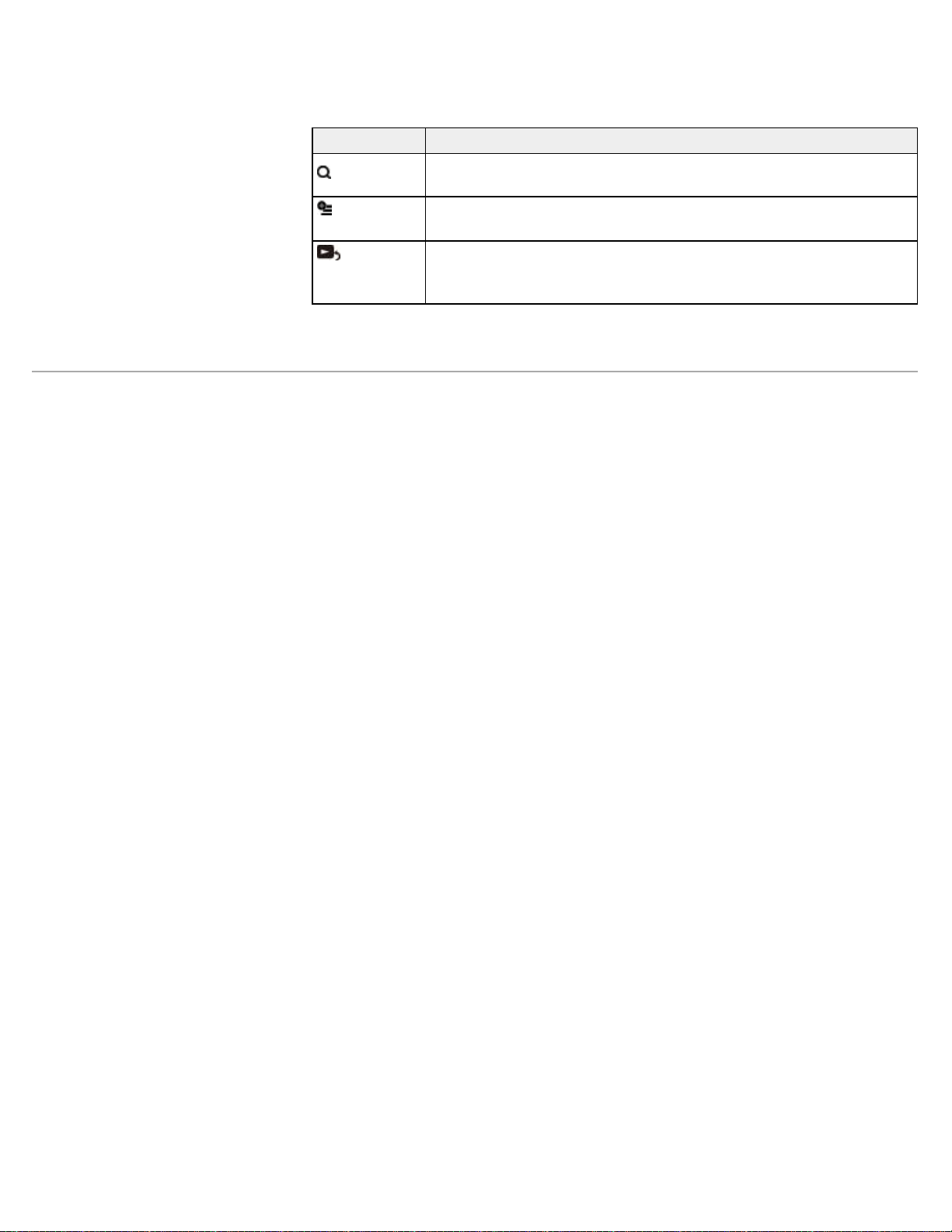
Icons which appear by pressing the OPTION/PWR OFF button
Icon Description
(Search) (*1)
Shows the search menu. You can select the desired search method to
display the list screen and search for photos.
(Option
Menu) (*1)
Shows the option menu. For details on the photo option menu, see [Details].
[To
Playback
Screen]
Returns to the photo display screen.
(*1) These icons may not appear depending on the screen.
Back to top
Copyright 2010 Sony Corporation
130
WALKMAN User Guide
Print
Getting Started
How to Use the Software
Music
“SensMe™ Channels”
Videos/Podcasts/Photos
FM Radio
Making/Playing Voice
Recordings
Timer
Settings
Troubleshooting
Important Information
Specifications
Contents list
Top page > Videos/Podcasts/Photos > Viewing Photos > Deleting photos
Deleting photos
When you delete photos from the player, use the software you used to transfer the photos, or
Windows Explorer.
For details about using the software, see the Help of the software.
Note
The player itself cannot delete photos without connecting to a computer.
Back to top
Copyright 2010 Sony Corporation
131
WALKMAN User Guide
Print
Getting Started
How to Use the Software
Music
“SensMe™ Channels”
Videos/Podcasts/Photos
FM Radio
Making/Playing Voice
Recordings
Timer
Settings
Troubleshooting
Important Information
Specifications
Contents list
Top page > Videos/Podcasts/Photos > Photo Option Menu > Using the photo option menu
Using the photo option menu
Option item appearing on the photo folder/photo list screen
Option items appearing on the photo display screen
You can bring up the photo option menu by pressing the OPTION/PWR OFF button on the photo
folder list or photo list, or on the photo display screen. For details on how to use the option menu,
see [Details].
The option items shown on the option menu vary depending on the screen from which you bring it
up. See the reference page for settings and usage.
Option item appearing on the photo folder/photo list screen
Option items Description/reference page
[Photo List Format] Sets the photo list display format [Details].
Option items appearing on the photo display screen
Option items Description/reference page
[Brightness] Adjusts the brightness of the screen [Details].
[Detailed Information] Displays file information, such as file size, resolution, and file name, etc.
[Set as Wallpaper] Sets the currently displayed photo as the wallpaper [Details].
Back to top
Copyright 2010 Sony Corporation
132
WALKMAN User Guide
Print
Getting Started
How to Use the Software
Music
“SensMe™ Channels”
Videos/Podcasts/Photos
FM Radio
Making/Playing Voice
Recordings
Timer
Settings
Troubleshooting
Important Information
Specifications
Contents list
Top page > Videos/Podcasts/Photos > Photo Settings > Setting the photo list display format
[Photo List Format]
Setting the photo list display format [Photo List Format]
The player offers 2 display formats: [Thumbnail + Title] (*1) or [Thumbnail Only].
1. From the Home menu, select [Settings] [Photo Settings] [Photo List Format]
desired photo list format type.
Type Description
[Thumbnail + Title] Displays a photo title with a thumbnail image in the photo list.
[Thumbnail Only] Displays only thumbnails in the photo list. (Default setting)
(*1) Thumbnail refers to a reduced size image of a photo.
Note
Thumbnails may not be displayed, depending on the file format.
Back to top
Copyright 2010 Sony Corporation
133
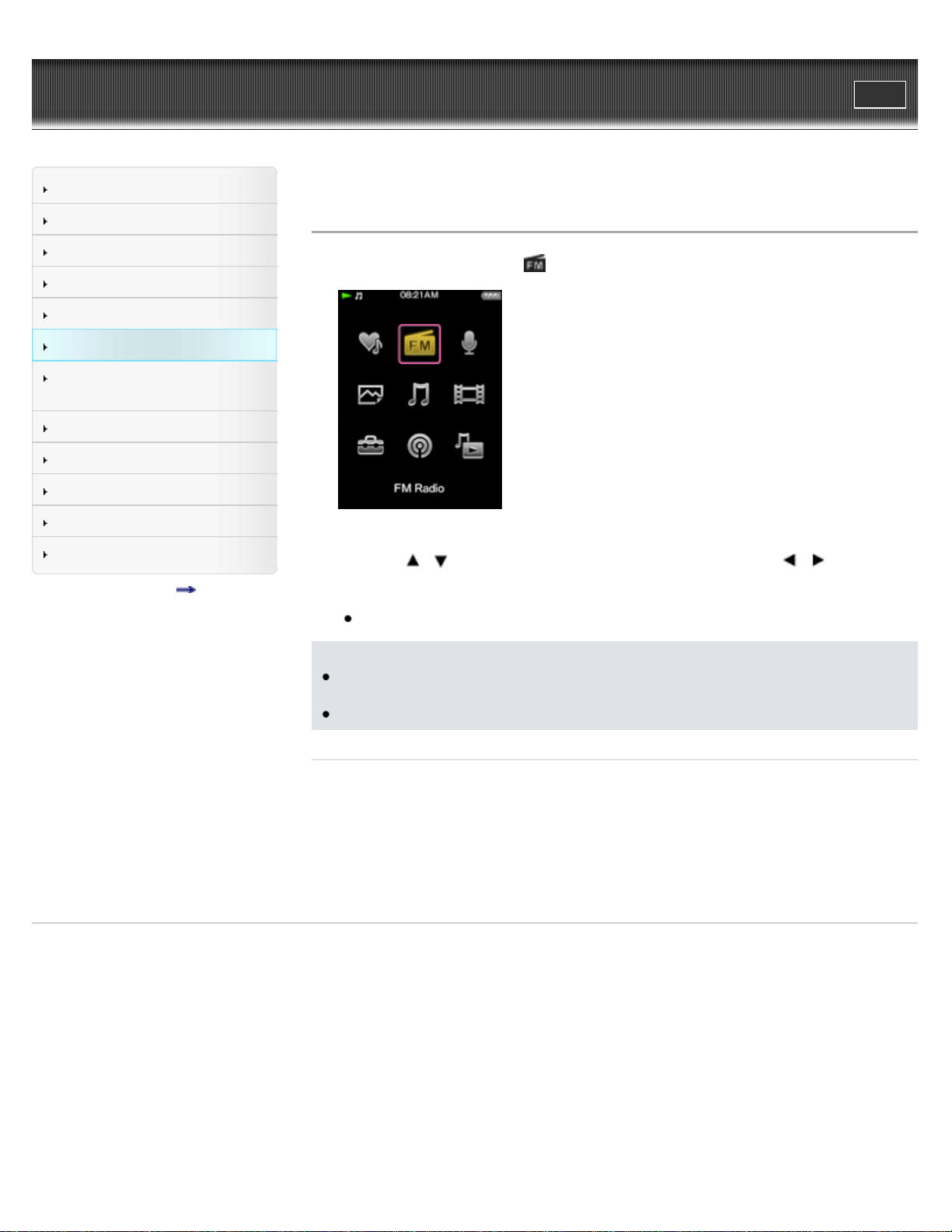
WALKMAN User Guide
Print
Getting Started
How to Use the Software
Music
“SensMe™ Channels”
Videos/Podcasts/Photos
FM Radio
Making/Playing Voice
Recordings
Timer
Settings
Troubleshooting
Important Information
Specifications
Contents list
Top page > FM Radio > Listening to FM Radio > Listening to FM radio [FM Radio]
Listening to FM radio [FM Radio]
1. From the Home menu, select [FM Radio].
The [FM Radio] screen appears.
2. Press the
/ button to select the desired frequency, or press the / button to
select the desired preset number.
The FM radio broadcasting of the selected frequency or preset number is received.
For details on how to operate the FM Radio screen, see [Details].
Note
You cannot select a preset number if no preset station is stored. Preset receivable stations
using [Auto Preset] [Details], or preset the receivable stations manually [Details].
The headphone cord serves as an antenna, so extend it as far as possible.
Related Topics
Browsing and using the FM radio screen
Presetting broadcast stations automatically [Auto Preset]
Presetting broadcast stations manually [Save to Preset]
Deleting preset broadcast stations [Delete from Preset]
Using the FM radio option menu
Back to top
Copyright 2010 Sony Corporation
134
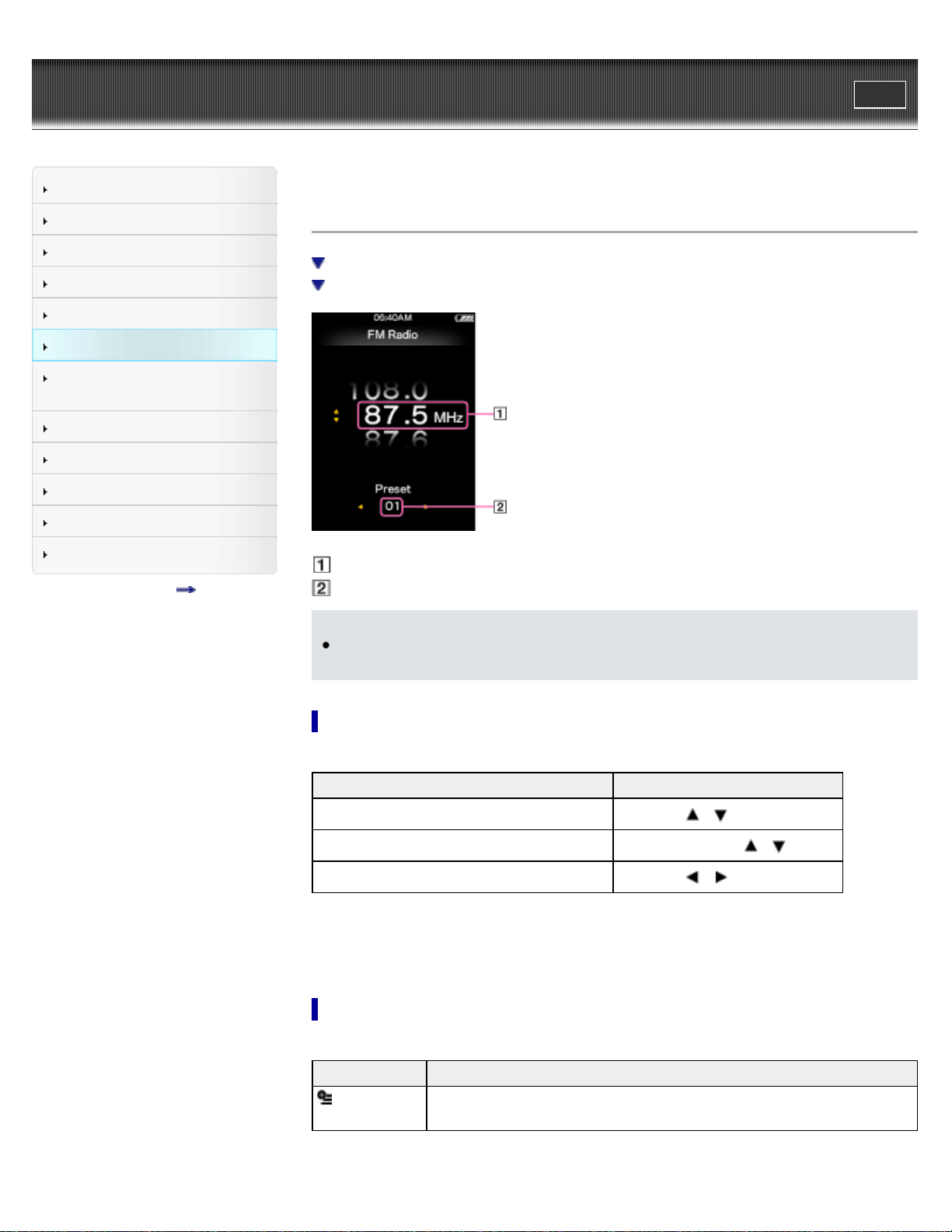
WALKMAN User Guide
Print
Getting Started
How to Use the Software
Music
“SensMe™ Channels”
Videos/Podcasts/Photos
FM Radio
Making/Playing Voice
Recordings
Timer
Settings
Troubleshooting
Important Information
Specifications
Contents list
Top page > FM Radio > Listening to FM Radio > Browsing and using the FM radio screen
Browsing and using the FM radio screen
Operations on the [FM Radio] screen
Icon which appears by pressing the OPTION/PWR OFF button
Frequency
Preset number
Note
Depending on the country/region in which you have purchased the player, the screen
appearance may differ.
Operations on the [FM Radio] screen
To Do this
Select the previous/next frequency Press the / button.
Select the previous/next receivable station (*1) Press and hold the / button.
Select the previous/next preset number (*2) Press the / button.
(*1) If sensitivity is too high, change the [Scan Sensitivity] setting [Details] to [Low].
(*2) You cannot select a Preset number if no preset station is stored. Preset receivable stations using
[Auto Preset] [Details].
Icon which appears by pressing the OPTION/PWR OFF button
Icon Description
(Option
Menu)
Shows the option menu. For details on the FM radio option menu, see
[Details].
135

WALKMAN User Guide
Print
Getting Started
How to Use the Software
Music
“SensMe™ Channels”
Videos/Podcasts/Photos
FM Radio
Making/Playing Voice
Recordings
Timer
Settings
Troubleshooting
Important Information
Specifications
Contents list
Top page > FM Radio > Listening to FM Radio > Presetting broadcast stations automatically
[Auto Preset]
Presetting broadcast stations automatically [Auto Preset]
You can preset (up to 30) receivable broadcast stations in your area automatically by selecting
[Auto Preset]. When you use the FM radio for the first time, or when you move to a new area, we
recommend you preset receivable broadcast stations by selecting [Auto Preset].
1. On the [FM Radio] screen, press the OPTION/PWR OFF button.
The option menu appears.
2. Select [Auto Preset]
[Yes].
Receivable broadcast stations will be preset in order of frequency (low to high).
[Auto Preset completed.] appears when presetting is completed, and the first preset station is
received.
Select [No] to cancel automatic presetting.
Hint
If high sensitivity causes the player to receive many unwanted broadcast stations, change
the [Scan Sensitivity] setting [Details] to [Low].
Note
The [Auto Preset] operation will delete already preset broadcast stations.
If the alarm goes off during the [Auto Preset] operation, the operation will be canceled.
Back to top
Copyright 2010 Sony Corporation
137
WALKMAN User Guide
Print
Getting Started
How to Use the Software
Music
“SensMe™ Channels”
Videos/Podcasts/Photos
FM Radio
Making/Playing Voice
Recordings
Timer
Settings
Troubleshooting
Important Information
Specifications
Contents list
Top page > FM Radio > Listening to FM Radio > Presetting broadcast stations manually [Save
to Preset]
Presetting broadcast stations manually [Save to Preset]
You can manually preset broadcast stations that [Auto Preset] cannot detect [Details].
1. On the [FM Radio] screen, select the desired frequency.
2. Press the OPTION/PWR OFF button to bring up the option menu.
3. Select [Save to Preset].
The frequency you select in step 1 is preset and the assigned preset number appears below
the frequency.
Hint
You can preset up to 30 stations.
Note
The preset numbers are stored in order, from low to high frequency.
Back to top
Copyright 2010 Sony Corporation
138
WALKMAN User Guide
Print
Getting Started
How to Use the Software
Music
“SensMe™ Channels”
Videos/Podcasts/Photos
FM Radio
Making/Playing Voice
Recordings
Timer
Settings
Troubleshooting
Important Information
Specifications
Contents list
Top page > FM Radio > Listening to FM Radio > Deleting preset broadcast stations [Delete from
Preset]
Deleting preset broadcast stations [Delete from Preset]
1. On the [FM Radio] screen, select the preset number you intend to delete.
2. Press the OPTION/PWR OFF button to bring up the option menu.
3. Select [Delete from Preset].
The preset broadcast station is deleted.
Back to top
Copyright 2010 Sony Corporation
139
WALKMAN User Guide
Print
Getting Started
How to Use the Software
Music
“SensMe™ Channels”
Videos/Podcasts/Photos
FM Radio
Making/Playing Voice
Recordings
Timer
Settings
Troubleshooting
Important Information
Specifications
Contents list
Top page > FM Radio > FM Radio Option Menu > Using the FM radio option menu
Using the FM radio option menu
You can bring up the FM radio option menu by pressing the OPTION/PWR OFF button on the
[FM Radio] screen. For details on how to use the option menu, see [Details].
The option items shown on the option menu vary depending on the screen from which you bring it
up. See the reference page for settings and usage.
Option items Description/reference page
[Save to Preset ] Presets the currently tuned-in broadcast station [Details].
[Delete from Preset] Deletes a broadcast station from a preset station [Details].
[Auto Preset] Presets a broadcast stations automatically [Details].
[Scan Sensitivity] Adjusts the sensitivity of radio reception [Details].
[Mono/Auto] Changes to either monaural or stereo [Details].
Back to top
Copyright 2010 Sony Corporation
140
WALKMAN User Guide
Print
Getting Started
How to Use the Software
Music
“SensMe™ Channels”
Videos/Podcasts/Photos
FM Radio
Making/Playing Voice
Recordings
Timer
Settings
Troubleshooting
Important Information
Specifications
Contents list
Top page > FM Radio > FM Radio Settings > Setting the reception [Scan Sensitivity]
Setting the reception [Scan Sensitivity]
When you select stations using the [Auto Preset] function [Details] or the / button, the FM
receiver may receive unwanted broadcast stations as a result of sensitivity being too high. In this
case, set the reception to [Low]. [High] is set by default.
1. From the Home menu, select
[Settings] [FM Radio Settings] [Scan Sensitivity]
[Low].
To set the reception sensitivity back to the default, select [High].
Back to top
Copyright 2010 Sony Corporation
141
WALKMAN User Guide
Print
Getting Started
How to Use the Software
Music
“SensMe™ Channels”
Videos/Podcasts/Photos
FM Radio
Making/Playing Voice
Recordings
Timer
Settings
Troubleshooting
Important Information
Specifications
Contents list
Top page > FM Radio > FM Radio Settings > Setting monaural/stereo [Mono/Auto]
Setting monaural/stereo [Mono/Auto]
If noise occurs during FM reception, set the receiver to [Mono] for monaural. If you set it to
[Auto], monaural/stereo reception is selected automatically, depending on reception conditions.
[Auto] is set by default.
1. From the Home menu, select
[Settings] [FM Radio Settings] [Mono/Auto]
[Mono].
To return to automatic setting, select [Auto].
Back to top
Copyright 2010 Sony Corporation
142
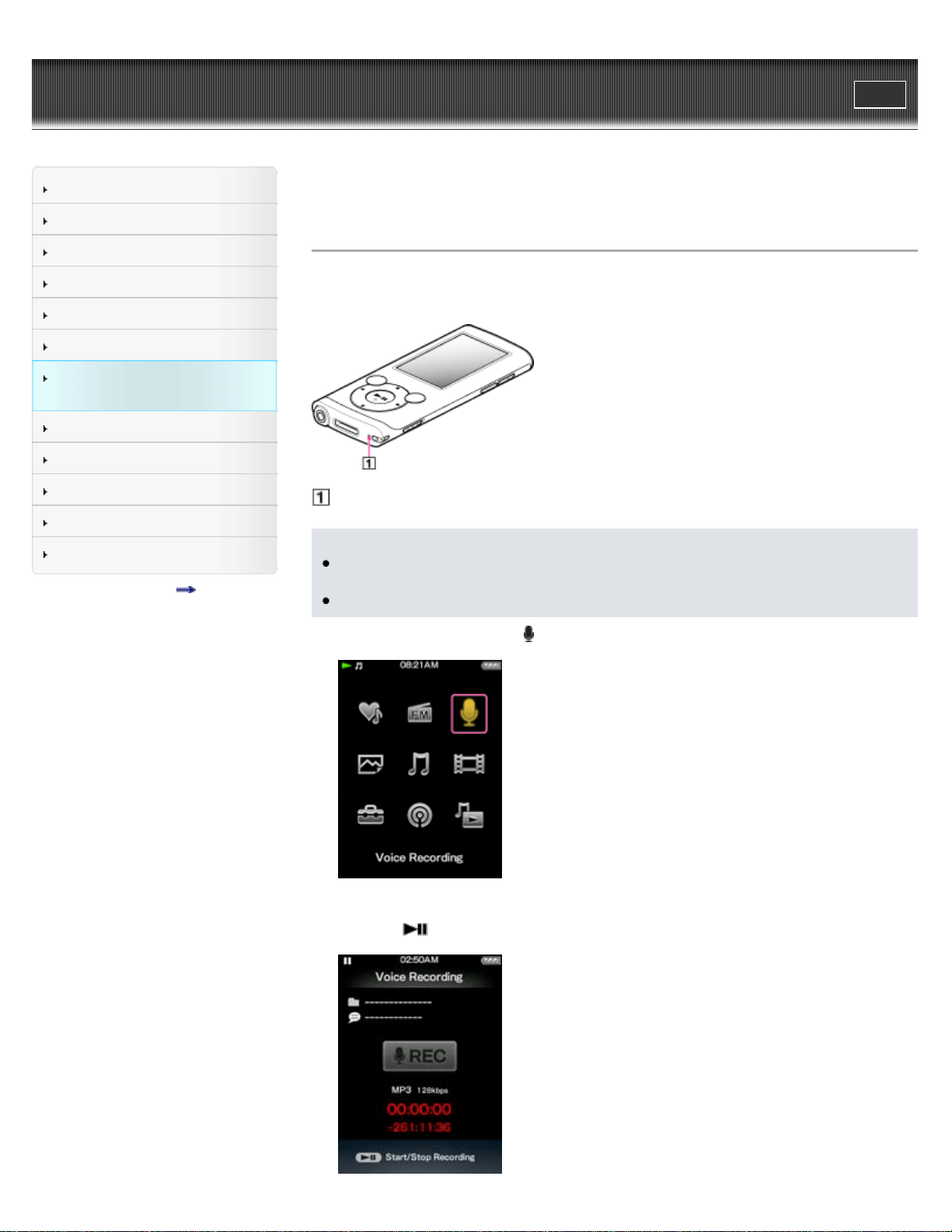
WALKMAN User Guide
Print
Getting Started
How to Use the Software
Music
“SensMe™ Channels”
Videos/Podcasts/Photos
FM Radio
Making/Playing Voice
Recordings
Timer
Settings
Troubleshooting
Important Information
Specifications
Contents list
Top page > Making/Playing Voice Recordings > Making Voice Recordings > Making voice
recordings
Making voice recordings
You can record voice using the player’s built-in microphone and play back the recorded voice
files. Files are recorded in MP3 format.
Microphone
Note
If the [Set Date-Time] setting is not accurate, the date folder may not be named correctly.
Set the current date and time before recording [Details].
During recording, you cannot listen to sound from the headphones.
1. From the Home menu, select
[Voice Recording].
The [Voice Recording] screen appears and the player goes into record standby.
2. Press the
button.
143
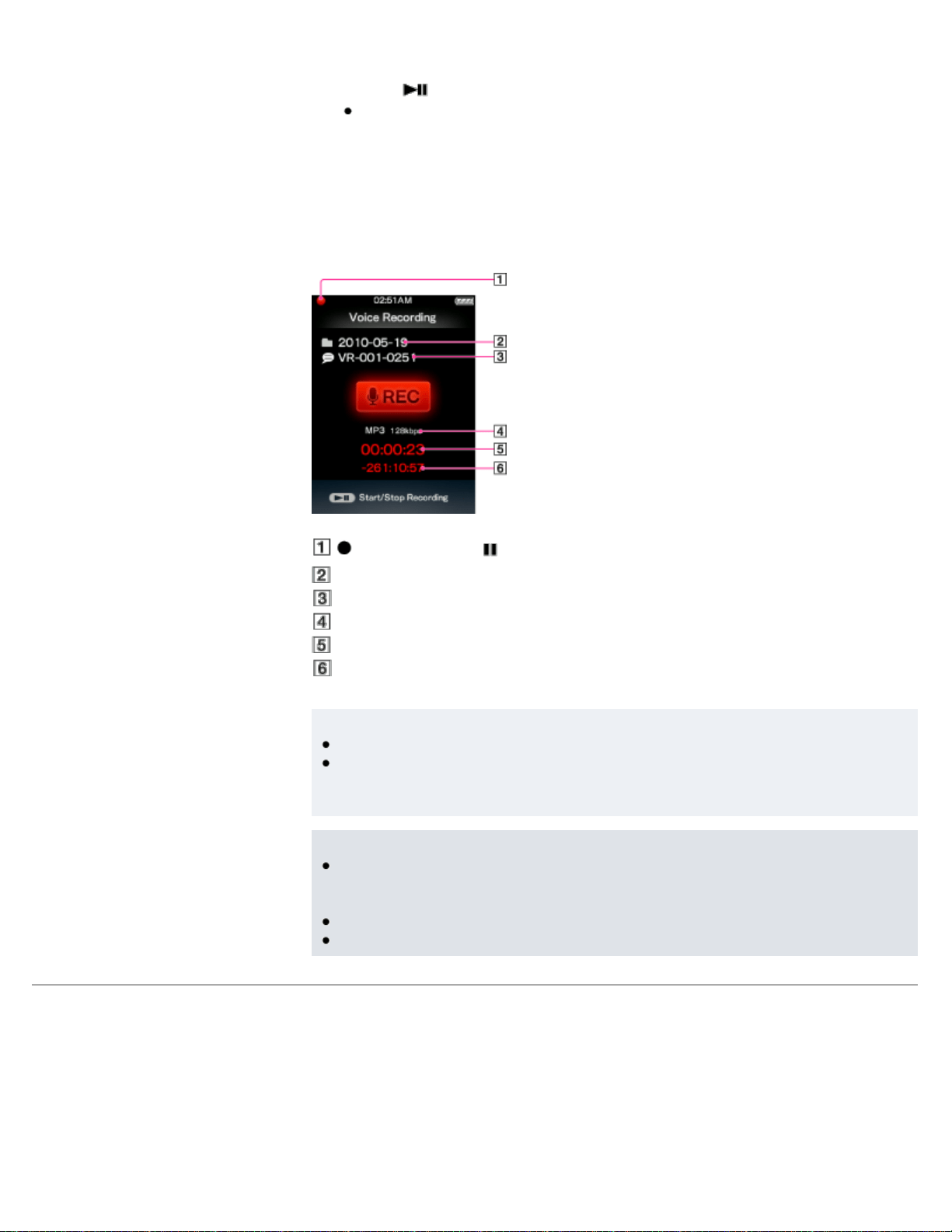
Recording starts.
3. Press the
button once more to stop recording.
The recording is saved as a file “VR- nnn-hhmm” (*1) in the [RECORD] – [VOICE] –
[yyyy-mm-dd] (*2) folder.
(*1) File names are automatically assigned to “VR -nnn-hhmm” (VR – serial number – hour and
minutes).
(*2) Folder names are automatically assigned to “yyyy-mm-dd” (year – month – day). In the case of
subsequent folders created on the same day, an attached folder number (2 to 999) is added after
“dd” of the folder name.
[Voice Recording] screen
(during recording), (during record pause)
Folder name
File name
Codec/bit rate
Elapsed time
Available remained time
The available remained time does not appear if it is more than 1,000 hours.
Hint
You can select the recording quality (bit rate) [Details].
To record to a new folder, press the OPTION/PWR OFF button on the [Voice Recording]
screen while recording is stopped, and then select [New Folder] from the option menu. The
next recording is sent to the new folder.
Note
If you rename files in the [RECORD] and [VOICE] folders on your computer, or put files
which have been imported to your computer back into the [RECORD] and [VOICE] folders,
they may become unplayable on the player.
Up to 4,000 files of recorded voice can be recorded.
For the maximum recordable number of voice recording files and folders, see[Details].
Back to top
Copyright 2010 Sony Corporation
144

WALKMAN User Guide
Print
Getting Started
How to Use the Software
Music
“SensMe™ Channels”
Videos/Podcasts/Photos
FM Radio
Making/Playing Voice
Recordings
Timer
Settings
Troubleshooting
Important Information
Specifications
Contents list
Top page > Making/Playing Voice Recordings > Playing Voice Recordings > Playing voice
recordings
Playing voice recordings
To play back recorded voice files, select [Music] to display the [Music] screen [Details]. You
can display the folder list in the [VOICE] folder.
1. From the Home menu, select
[Music] [Voice Recording] desired folder
desired recorded voice file.
The music playback screen appears and playback of the recorded voice file begins.
Recorded voice icon
For details on how to operate the music playback screen, see [Details].
Back to top
Copyright 2010 Sony Corporation
145
WALKMAN User Guide
Print
Getting Started
How to Use the Software
Music
“SensMe™ Channels”
Videos/Podcasts/Photos
FM Radio
Making/Playing Voice
Recordings
Timer
Settings
Troubleshooting
Important Information
Specifications
Contents list
Top page > Making/Playing Voice Recordings > Playing Voice Recordings > Deleting recorded
voice files
Deleting recorded voice files
Deleting a recorded voice file
Deleting a recorded voice folder
Deleting all recorded voice folders
You can delete recorded voice files on the player.
Deleting a recorded voice file
1. From the Home menu, select [Music] [Voice Recording] desired folder
desired voice file.
2. Press the OPTION/PWR OFF button to bring up the option menu.
3. Select [Delete This Song]
[Yes].
The selected voice file is deleted.
Select [No] to cancel deletion.
or,
1. From the Home menu, select
[Music] [Voice Recording] desired folder.
2. Press the OPTION/PWR OFF button to bring up the option menu.
3. Select [Select a Song to Delete].
4. Press the
/ button to select the recorded voice you intend to delete, and then press
the
button.
5. Select [Yes].
The selected voice file is deleted.
Select [No] to cancel deletion.
Deleting a recorded voice folder
1. From the Home menu, select [Music] [Voice Recording].
2. Press the OPTION/PWR OFF button to bring up the option menu.
3. Select [Select a Folder to Delete].
4. Press the
/ button to select the folder you intend to delete, and then press the
button.
5. Select [Yes].
The selected folder is deleted.
Select [No] to cancel deletion.
Deleting all recorded voice folders
1. From the Home menu, select [Music] [Voice Recording].
2. Press the OPTION/PWR OFF button to bring up the option menu.
3. Select [Delete All Folders]
[Yes].
146

WALKMAN User Guide
Print
Getting Started
How to Use the Software
Music
“SensMe™ Channels”
Videos/Podcasts/Photos
FM Radio
Making/Playing Voice
Recordings
Timer
Settings
Troubleshooting
Important Information
Specifications
Contents list
Top page > Making/Playing Voice Recordings > Voice Recording Option Menu > Using the voice
recording option menu
Using the voice recording option menu
Option items appearing on the [Voice Recording] screen
Option items appearing on the file list screen of recorded voice files
Option items appearing on the folder list screen of recorded voice files
Option items appearing on the music playback screen of recorded voice files
You can bring up the voice recording option menu by pressing the OPTION/PWR OFF button on
the Voice Recording screen. You can also bring up the voice recording option menu from the
folder/file list of recorded voices or the music playback screen of recorded voices. For how to use
the option menu, see [Details].
The option items shown on the option menu vary depending on the screen from which you bring
them up. See the reference page for settings and usage.
Option items appearing on the [Voice Recording] screen
Option items Description/reference page
[New Folder] Adds a new folder to the [VOICE] folder of the [RECORD] folder [Details].
[Bit Rate Settings] Sets recording quality [Details].
Option items appearing on the file list screen of recorded voice
files
Option items Description/reference page
[Select a Song to Delete] Selects a recorded voice file and deletes it [Details].
Option items appearing on the folder list screen of recorded
voice files
Option items Description/reference page
[Select a Folder to Delete] Selects a folder of recorded voice files and deletes it [Details].
[Delete All Folders] Deletes all folders of recorded voice files [Details].
Option items appearing on the music playback screen of
recorded voice files
148

Option items Description/reference page
[Play Mode] Sets the play mode [Details].
[Playback Range] Sets the playback range [Details].
[Karaoke/Language
Study]
Sets the karaoke/language study mode [Details].
[DPC (Speed
Control)]
Adjusts the playback speed of songs [Details].
[Display Lyrics] Displays the lyrics of the playing song [Details].
[Equalizer] Customizes the sound quality [Details].
[VPT(Surround)] Customizes the [VPT(Surround)] settings [Details].
[Detailed
Information]
Displays detailed information of a recorded voice file, such as playing
time, audio format, bit rate, and file name.
[Set As Alarm
Song]
Sets the playing song as the alarm song [Details].
[Delete This Song] Deletes a recorded voice [Details].
Back to top
Copyright 2010 Sony Corporation
149
WALKMAN User Guide
Print
Getting Started
How to Use the Software
Music
“SensMe™ Channels”
Videos/Podcasts/Photos
FM Radio
Making/Playing Voice
Recordings
Timer
Settings
Troubleshooting
Important Information
Specifications
Contents list
Top page > Making/Playing Voice Recordings > Recording Settings > Selecting a level of
recording quality [Bit Rate Settings]
Selecting a level of recording quality [Bit Rate Settings]
You can select the bit rate for voice recording. High bit rate offers better sound quality, though
requires more memory.
1. From the Home menu, select
[Settings] [Recording Settings] [Bit Rate Settings]
desired setting type.
Type Description
[MP3 256kbps] Records at the bit rate of 256 kbps.
[MP3 128kbps] Records at the bit rate of 128 kbps. (Default setting)
[MP3 64kbps] Records at the bit rate of 64 kbps.
Back to top
Copyright 2010 Sony Corporation
150
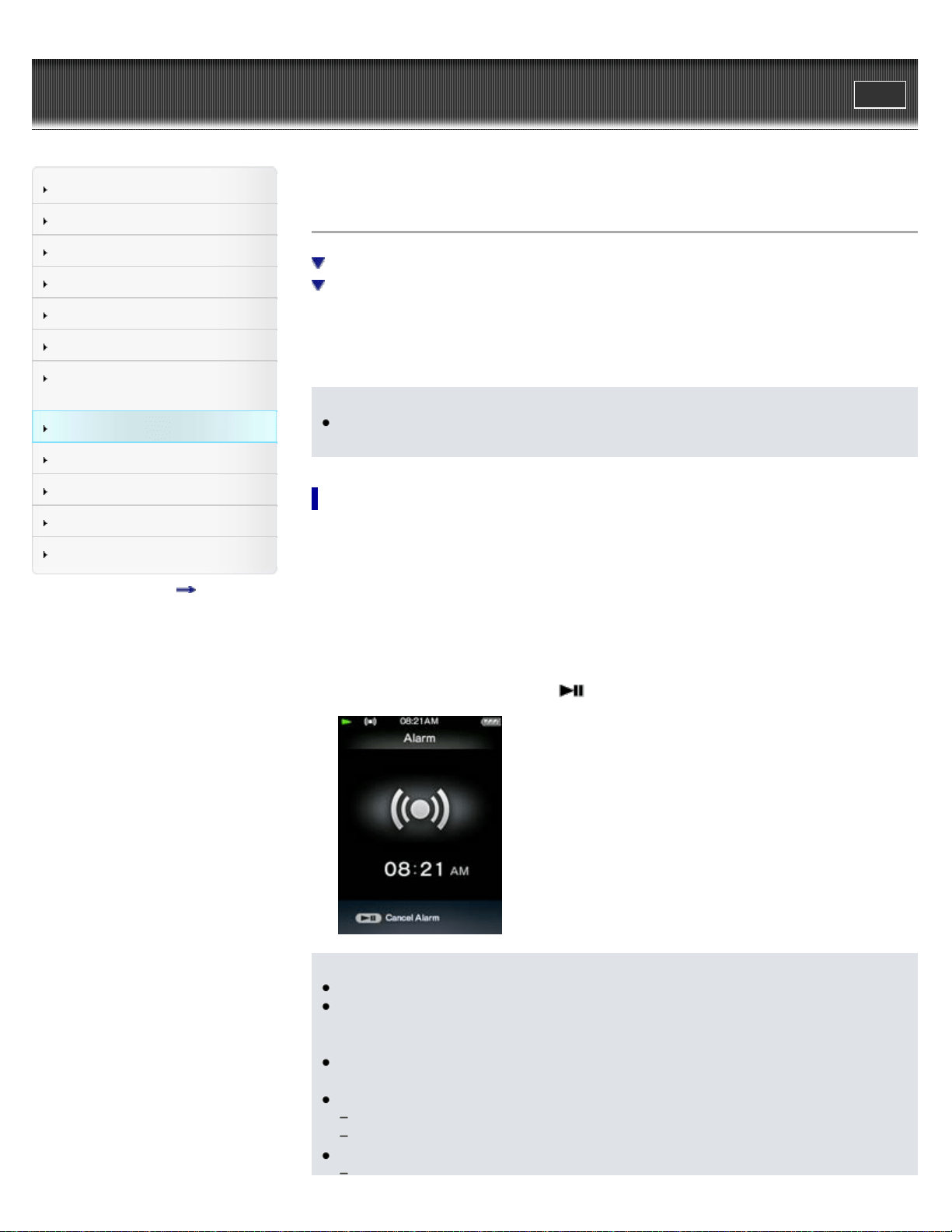
WALKMAN User Guide
Print
Getting Started
How to Use the Software
Music
“SensMe™ Channels”
Videos/Podcasts/Photos
FM Radio
Making/Playing Voice
Recordings
Timer
Settings
Troubleshooting
Important Information
Specifications
Contents list
Top page > Timer > Setting the Timer > About the timer
About the timer
Using the alarm timer
Using the sleep timer
You can set the timer to play back songs at a specified time (Alarm). You can also set the period
of time after which the player automatically enters standby mode and the screen turns off (Sleep
Timer).
Note
If the [Set Date-Time] setting is not accurate, timer settings cannot be set correctly. Set the
current date and time before setting the timer [Details].
Using the alarm timer
You can set the alarm timer to play back a selected song at a specified time as an alarm. To use
the alarm timer, follow the instructions below. Click [Details] to see the detailed instructions for
each operation.
1. Select a song as the alarm sound [Details].
2. Set the alarm time [Details].
3. If necessary, set the repeat setting [Details].
4. Set the alarm to on [Details].
5. When the alarm sounds, press the
button to stop it.
Note
The alarm will automatically stop after 60 minutes.
To prevent damage to the ears, the alarm volume of headphones is limited by the AVLS
function regardless of whether [AVLS (Volume Limit)] is set to [On] or [Off] [Details]. The
alarm volume of speakers is not limited.
Do not fall asleep while wearing headphones. If you sleep wearing headphones, the
headphone cord may wind around your neck, which may cause suffocation.
In the following situations, the alarm will be postponed until the process is finished.
Deleting data.
Formatting memory.
The alarm will not sound in the following situations.
151

Recording voice (though the alarm icon flashes in the information area).
Connected to a computer.
Using the sleep timer
You can also set the sleep timer to turn off the player automatically after a preset duration. For
how to set the sleep timer, see [Details].
Back to top
Copyright 2010 Sony Corporation
152
WALKMAN User Guide
Print
Getting Started
How to Use the Software
Music
“SensMe™ Channels”
Videos/Podcasts/Photos
FM Radio
Making/Playing Voice
Recordings
Timer
Settings
Troubleshooting
Important Information
Specifications
Contents list
Top page > Timer > Setting the Timer > Setting the alarm to on/off [Alarm On/Off]
Setting the alarm to on/off [Alarm On/Off]
1. From the Home menu, select [Settings] [Alarm/Sleep Timer] [Alarm Settings]
[Alarm On/Off] desired setting type.
Type Description
[On] Set the alarm to on.
[Off] Set the alarm to off. (Default setting)
Note
When the alarm is set to on,
appears in the information area.
Back to top
Copyright 2010 Sony Corporation
153
WALKMAN User Guide
Print
Getting Started
How to Use the Software
Music
“SensMe™ Channels”
Videos/Podcasts/Photos
FM Radio
Making/Playing Voice
Recordings
Timer
Settings
Troubleshooting
Important Information
Specifications
Contents list
Top page > Timer > Setting the Timer > Setting the alarm time [Alarm Time]
Setting the alarm time [Alarm Time]
1. From the Home menu, select [Settings] [Alarm/Sleep Timer] [Alarm Settings]
[Alarm Time]
2. Press the
/ button to select the hour, and then press the / button to change
the value.
3. As in step 2, adjust the minute setting.
4. Press the
button to confirm.
Back to top
Copyright 2010 Sony Corporation
154
WALKMAN User Guide
Print
Getting Started
How to Use the Software
Music
“SensMe™ Channels”
Videos/Podcasts/Photos
FM Radio
Making/Playing Voice
Recordings
Timer
Settings
Troubleshooting
Important Information
Specifications
Contents list
Top page > Timer > Setting the Timer > Setting the repeat setting [Repeat]
Setting the repeat setting [Repeat]
You can set the alarm to sound only one time, everyday, from Monday to Friday, or from Monday
to Saturday.
1. From the Home menu, select
[Settings] [Alarm/Sleep Timer] [Alarm Settings]
[Repeat] desired setting type.
Type Description
[Off] Sounds the alarm only one time. (Default setting)
[Every Day] Sounds the alarm at the specified time every day.
[Mon - Fri] Sounds the alarm at the specified time from Monday to Friday.
[Mon - Sat] Sounds the alarm at the specified time from Monday to Saturday.
Back to top
Copyright 2010 Sony Corporation
155

WALKMAN User Guide
Print
Getting Started
How to Use the Software
Music
“SensMe™ Channels”
Videos/Podcasts/Photos
FM Radio
Making/Playing Voice
Recordings
Timer
Settings
Troubleshooting
Important Information
Specifications
Contents list
Top page > Timer > Setting the Timer > Selecting the alarm sound [Alarm Sound Settings]
Selecting the alarm sound [Alarm Sound Settings]
You can select a song as the alarm sound. When the alarm goes off, the selected song is
repeatedly played back until you stop it.
1. From the Home menu, select
[Settings] [Alarm/Sleep Timer] [Alarm Settings]
[Alarm Sound Settings] desired setting type.
Type Description
[Default
Alarm Sound]
Produces a preset alarm sound when the alarm goes off. (Default setting)
[Alarm Song]
Plays back the selected song when the alarm goes off. For how to select the
alarm song, see the following instructions.
Selecting the alarm song
1. From the Home menu, select [Music] desired search method desired song.
2. Press the OPTION/PWR OFF button to bring up the option menu.
3. Select [Set As Alarm Song].
Back to top
Copyright 2010 Sony Corporation
156
WALKMAN User Guide
Print
Getting Started
How to Use the Software
Music
“SensMe™ Channels”
Videos/Podcasts/Photos
FM Radio
Making/Playing Voice
Recordings
Timer
Settings
Troubleshooting
Important Information
Specifications
Contents list
Top page > Timer > Setting the Timer > Setting the sleep timer [Sleep Timer Settings]
Setting the sleep timer [Sleep Timer Settings]
You can set the period of time after which the player automatically enters standby mode and the
screen turns off (Sleep Timer).
1. From the Home menu, select
[Settings] [Alarm/Sleep Timer] [Sleep Timer
Settings]
desired setting type.
Type Description
[Off] Disables the sleep timer. (Default setting)
[After 30 Min] Turns off the player after 30 minutes.
[After 60 Min] Turns off the player after 60 minutes.
[After 90 Min] Turns off the player after 90 minutes.
[After 120 Min] Turns off the player after 120 minutes.
Hint
After setting the sleep timer,
appears in the information area.
Note
In the following situations, the sleep timer will be postponed until the process is finished.
Deleting data.
Formatting memory.
The sleep timer will not activate in the following situations.
Recording voice.
Connected to a computer.
Using [Auto Preset] function of the FM radio.
Analyzing songs for “SensMe™ Channels.”
Sounding the alarm.
The sleep timer will be canceled in the following situations.
Entering standby mode.
Connecting the player to a computer.
Back to top
Copyright 2010 Sony Corporation
157
WALKMAN User Guide
Print
Getting Started
How to Use the Software
Music
“SensMe™ Channels”
Videos/Podcasts/Photos
FM Radio
Making/Playing Voice
Recordings
Timer
Settings
Troubleshooting
Important Information
Specifications
Contents list
Top page > Settings > Common Settings > Displaying the player information [Unit Information]
Displaying the player information [Unit Information]
Information such as model name, firmware version, etc., is displayed.
1. From the Home menu, select [Settings] [Common Settings] [Unit Information].
Item Description
[Model:] Displays the model name of the player.
[Firmware:] Displays version information of the player’s firmware.
[Free/Total
Memory Space:]
Displays the available free space size/total capacity of the player.
[Total Songs:]
Displays the total number of songs (including audio podcasts and voice
recordings) stored on the player.
[Total Videos:]
Displays the total number of videos (including video podcasts) stored on
the player.
[Total Photos:] Displays the total number of photos stored on the player.
[WM-PORT:] Displays the version information for WM-PORT.
Back to top
Copyright 2010 Sony Corporation
158
WALKMAN User Guide
Print
Getting Started
How to Use the Software
Music
“SensMe™ Channels”
Videos/Podcasts/Photos
FM Radio
Making/Playing Voice
Recordings
Timer
Settings
Troubleshooting
Important Information
Specifications
Contents list
Top page > Settings > Common Settings > Limiting the volume [AVLS (Volume Limit)]
Limiting the volume [AVLS (Volume Limit)]
You can set [AVLS (Volume Limit)] (Automatic Volume Limiter System) to limit the maximum
volume to prevent auditory issues or distraction. With [AVLS (Volume Limit)], you can listen to
music at a comfortable volume level.
1. From the Home menu, select
[Settings] [Common Settings] [AVLS (Volume
Limit)]
desired setting type.
Type Description
[On] Maintains a moderate volume level.
[Off] Plays back audio at the original volume. (Default setting)
Back to top
Copyright 2010 Sony Corporation
159
WALKMAN User Guide
Print
Getting Started
How to Use the Software
Music
“SensMe™ Channels”
Videos/Podcasts/Photos
FM Radio
Making/Playing Voice
Recordings
Timer
Settings
Troubleshooting
Important Information
Specifications
Contents list
Top page > Settings > Common Settings > Turning off the beep sound [Beep Settings]
Turning off the beep sound [Beep Settings]
You can turn on or off the operation sounds of the player.
1. From the Home menu, select [Settings] [Common Settings] [Beep Settings]
desired setting type.
Type Description
[On] Produces beep sounds. (Default setting)
[Off] Does not produce beep sounds.
Back to top
Copyright 2010 Sony Corporation
160
WALKMAN User Guide
Print
Getting Started
How to Use the Software
Music
“SensMe™ Channels”
Videos/Podcasts/Photos
FM Radio
Making/Playing Voice
Recordings
Timer
Settings
Troubleshooting
Important Information
Specifications
Contents list
Top page > Settings > Common Settings > Setting the screensaver [Screensaver Settings]
Setting the screensaver [Screensaver Settings]
Setting the screensaver to on/off
Setting the screensaver type
Setting the screensaver waiting time
When there is no operation for a while, the player starts the screensaver. You can set the
screensaver either to simply blank the screen or to display the slide show of photos in the player.
You can also set the waiting time for starting the screensaver.
Setting the screensaver to on/off
1. From the Home menu, select [Settings] [Common Settings] [Screensaver]
[On/Off] desired setting type.
Type Description
[On]
Runs the screensaver when there is no operation for specific period of time. (Default
setting)
[Off] Does not run the screensaver.
Setting the screensaver type
1. From the Home menu, select [Settings] [Common Settings] [Screensaver]
[Type] desired setting type.
Type Description
[Blank] Blanks the screen. (Default setting)
[Slide
Show]
Displays the slide show when the player is connected to the AC outlet. Set the slide
show setting as follow. (*1)
(*1) The slide show is displayed only when the player is connected to an AC outlet and there are photos
to be displayed for the slide show. If the player is working from the battery, the screensaver blanks
the screen regardless of the setting. When fully charged, if no songs are playing back, the slide show
will stop. If there are no photos to be displayed for the slide show, the screensaver dims the screen.
Setting the slide show setting
When you select [Slide Show], the [Slide Show] screen appears to set the slide show setting.
Select the desired setting type.
Type Description
[All Photos
(VERT)]
Displays a slide show of all pictures in the player, in portrait orientation.
[All Photos
161
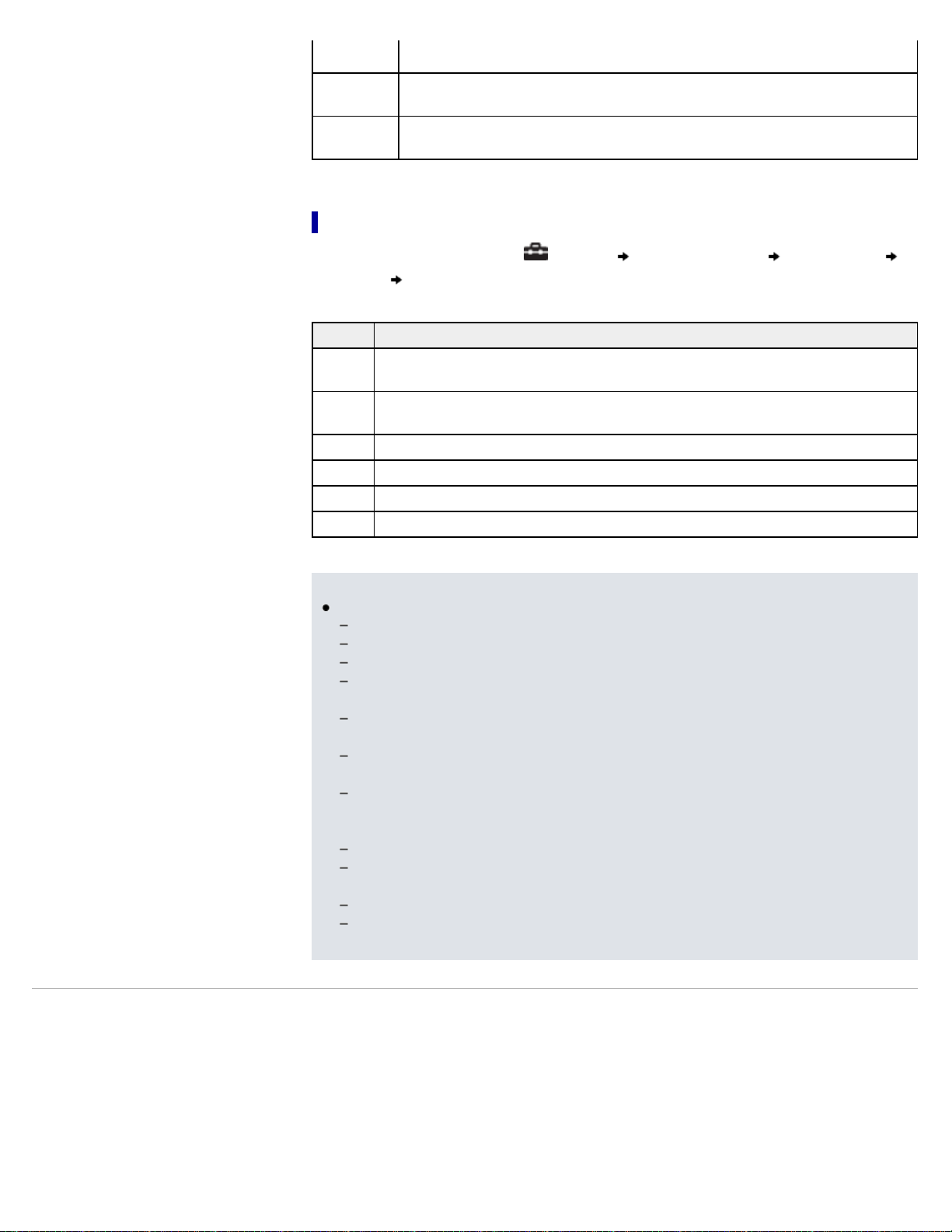
(HORZ)]
Displays a slide show of all pictures in the player, in landscape orientation.
[Folder
(VERT)]
Displays a slide show of pictures in the [SCREENSAVER] folder in the
[PICTURE] folder, in portrait orientation. (Default setting)
[Folder
(HORZ)]
Displays a slide show of pictures in the [SCREENSAVER] folder in the
[PICTURE] folder, in landscape orientation.
Setting the screensaver waiting time
1. From the Home menu, select [Settings] [Common Settings] [Screensaver]
[Delay] desired setting type.
Type Description
[15
Sec]
Displays the screensaver when there is no operation for 15 seconds.
[30
Sec]
Displays the screensaver when there is no operation for 30 seconds. (Default setting)
[1 Min] Displays the screensaver when there is no operation for 1 minute.
[3 Min] Displays the screensaver when there is no operation for 3 minutes.
[5 Min] Displays the screensaver when there is no operation for 5 minutes.
[30 Min] Displays the screensaver when there is no operation for 30 minutes.
Note
The player does not display the screensaver during the following situations.
Playing back a video.
Playing back a video podcast.
Playing back a song with [Display Lyrics] set to [On (No Screen Off)].
Playing back a song with [Karaoke/Language Study] set to either [Maximum Karaoke
Mode] or [Minimum Karaoke Mode].
Displaying the [Voice Recording] screen. (The screen will dim regardless of the
screensaver settings.)
Searching for a receivable FM radio station and using the [Auto Preset] function of the FM
radio.
Connected to a computer. (The screen will dim instead of run the screensaver. After fully
charged, the screen will be turned off after a while regardless of the screensaver
settings.)
Building or recovering the database.
Analyzing songs for “SensMe™ Channels.” (The screen will dim instead of run the
screensaver.)
Sounding the alarm.
Charging the battery with [Type] set to [Blank]. (The screen will dim instead of run the
screensaver.)
Back to top
Copyright 2010 Sony Corporation
162
WALKMAN User Guide
Print
Getting Started
How to Use the Software
Music
“SensMe™ Channels”
Videos/Podcasts/Photos
FM Radio
Making/Playing Voice
Recordings
Timer
Settings
Troubleshooting
Important Information
Specifications
Contents list
Top page > Settings > Common Settings > Adjusting the brightness of the screen [Brightness]
Adjusting the brightness of the screen [Brightness]
You can set the display brightness to one of 5 levels.
1. From the Home menu, select [Settings] [Common Settings] [Brightness].
2. Press the
/ button to select the desired setting, and then press the button to
confirm.
You can adjust to any of 5 levels. The larger the number, the brighter the screen. [3] is set
by default.
Note
After selecting a setting value, be sure to press the
button to confirm. If you press the
BACK/HOME button before confirming, the setting will be canceled.
Hint
If you set the brightness of the screen to a lower level, the battery will last longer [Details].
While the player is connected via the USB cable, the brightness of the screen may be set to
a lower level regardless of the setting.
Back to top
Copyright 2010 Sony Corporation
163
WALKMAN User Guide
Print
Getting Started
How to Use the Software
Music
“SensMe™ Channels”
Videos/Podcasts/Photos
FM Radio
Making/Playing Voice
Recordings
Timer
Settings
Troubleshooting
Important Information
Specifications
Contents list
Top page > Settings > Common Settings > Setting up wallpaper [Wallpaper Settings]
Setting up wallpaper [Wallpaper Settings]
To set a desired photo as the wallpaper
You can set the wallpaper of the screen.
1. From the Home menu, select [Settings] [Common Settings] [Wallpaper Settings]
desired wallpaper type.
Type Description
[No
Wallpaper]
Displays the default wallpaper. (Default setting)
[User’s
Wallpaper]
Displays the photo set as the wallpaper. (See the following instructions.)
[User’s
W.p.(dark)]
Displays the photo set as the wallpaper. (See the following instructions.)
This option reduces the brightness of the photo so that you can easily
recognize menu items or icons.
To set a desired photo as the wallpaper
You need to designate a photo on the player before selecting [User’s Wallpaper] or [User’s
W.p.(dark)] to set the photo as the wallpaper.
1. From the Home menu, select
[Photos] desired search method desired photo.
2. Press the OPTION/PWR OFF button to bring up the option menu.
3. Select [Set as Wallpaper].
Back to top
Copyright 2010 Sony Corporation
164
WALKMAN User Guide
Print
Getting Started
How to Use the Software
Music
“SensMe™ Channels”
Videos/Podcasts/Photos
FM Radio
Making/Playing Voice
Recordings
Timer
Settings
Troubleshooting
Important Information
Specifications
Contents list
Top page > Settings > Common Settings > Setting the current time [Set Date-Time]
Setting the current time [Set Date-Time]
You can set the date and time.
1. From the Home menu, select [Settings] [Common Settings] [Clock Settings]
[Set Date-Time].
2. Press the
/ button to select the year, and then press the / button to change
the value.
3. As in step 2, adjust the settings for month, date, hour, and minutes, and then press the
button to confirm.
Hint
You can select the date format from [YYYY/MM/DD], [MM/DD/YYYY], or [DD/MM/YYYY]
[Details]. Furthermore, you can select the time format from either [12-hour] or [24-hour]
[Details].
Note
If battery power is used up because, for example, the player has not been used for a long
time, your settings for date and time may be lost, and “-” will be displayed instead of the
current date and time.
The clock may gain or lose up to 60 seconds per month. In this case, set the clock again.
Related Topics
How to use the Home menu
Back to top
Copyright 2010 Sony Corporation
165
WALKMAN User Guide
Print
Getting Started
How to Use the Software
Music
“SensMe™ Channels”
Videos/Podcasts/Photos
FM Radio
Making/Playing Voice
Recordings
Timer
Settings
Troubleshooting
Important Information
Specifications
Contents list
Top page > Settings > Common Settings > Setting the date format [Date Display Format]
Setting the date format [Date Display Format]
You can set the date format displayed for the current date [Details] as [YYYY/MM/DD],
[MM/DD/YYYY], or [DD/MM/YYYY].
1. From the Home menu, select
[Settings] [Common Settings] [Clock Settings]
[Date Display Format] desired format type.
Type Description
[YYYY/MM/DD] Displays the date as year/month/day.
[MM/DD/YYYY] Displays the date as month/day/year.
[DD/MM/YYYY] Displays the date as day/month/year.
Back to top
Copyright 2010 Sony Corporation
166
WALKMAN User Guide
Print
Getting Started
How to Use the Software
Music
“SensMe™ Channels”
Videos/Podcasts/Photos
FM Radio
Making/Playing Voice
Recordings
Timer
Settings
Troubleshooting
Important Information
Specifications
Contents list
Top page > Settings > Common Settings > Setting the time format [Time Display Format]
Setting the time format [Time Display Format]
You can select the format to display the current time [Details] from either a [12-hour] or [24-hour]
display.
1. From the Home menu, select
[Settings] [Common Settings] [Clock Settings]
[Time Display Format] desired format type.
Type Description
[12-hour] Displays the current time in the 12-hour format.
[24-hour] Displays the current time in the 24-hour format.
Back to top
Copyright 2010 Sony Corporation
167
WALKMAN User Guide
Print
Getting Started
How to Use the Software
Music
“SensMe™ Channels”
Videos/Podcasts/Photos
FM Radio
Making/Playing Voice
Recordings
Timer
Settings
Troubleshooting
Important Information
Specifications
Contents list
Top page > Settings > Common Settings > Limiting the charge amount [Battery Care]
Limiting the charge amount [Battery Care]
Charge and discharge cycles cause the capacity of the lithium-ion battery to decrease, resulting
in shortening the battery life. You can use the [Battery Care] mode to reduce the capacity
decrement caused by charge and discharge cycles, i.e., prevent shortening the battery life.
1. From the Home menu, select
[Settings] [Common Settings] [Battery Care]
desired setting type.
Type Description
[On] Uses the [Battery Care] mode.
[Off] Uses the normal recharge mode. (Default setting)
Note
When [Battery Care] is set to [On], the maximum recharge capacity is limited to 90%. As a
result, the battery life between charges is shortened by about 10%.
In the [Battery Care] mode, the first bar of the battery indicator will disappear somewhat
quicker than normal. This is a result of stopping recharging the battery before becoming fully
charged (in order to extend the battery lifespan) and is not a malfunction.
Back to top
Copyright 2010 Sony Corporation
168
WALKMAN User Guide
Print
Getting Started
How to Use the Software
Music
“SensMe™ Channels”
Videos/Podcasts/Photos
FM Radio
Making/Playing Voice
Recordings
Timer
Settings
Troubleshooting
Important Information
Specifications
Contents list
Top page > Settings > Common Settings > Returning to the factory settings [Reset All Settings]
Returning to the factory settings [Reset All Settings]
You can reset the player to the default settings. Resetting the player will not delete data such as
music, video, and photos.
Note
If you select this function during playback, the player will pause playback before performing
the reset process.
1. From the Home menu, select
[Settings] [Common Settings] [Reset/Format]
[Reset All Settings] [Yes].
[Restored factory settings.] appears.
To cancel the operation, select [No] on the confirmation screen.
Back to top
Copyright 2010 Sony Corporation
169
WALKMAN User Guide
Print
Getting Started
How to Use the Software
Music
“SensMe™ Channels”
Videos/Podcasts/Photos
FM Radio
Making/Playing Voice
Recordings
Timer
Settings
Troubleshooting
Important Information
Specifications
Contents list
Top page > Settings > Common Settings > Formatting memory [Format]
Formatting memory [Format]
You can format the built-in flash memory of the player.
Note
If the memory is formatted, all data (songs, videos, photos, etc., including sample data
installed at the factory, bundled software installer, and the User Guide) will be erased. Be
sure to verify the data stored in memory prior to formatting, and export any important data
to the hard disk of your computer.
Be sure not to initialize (format) the built-in flash memory of the player using Windows
Explorer. If you have formatted with Windows Explorer, format again using the player.
1. From the Home menu, select
[Settings] [Common Settings] [Reset/Format]
[Format].
[All data including songs will be deleted. Proceed?] appears.
2. Select [Yes].
[All data will be deleted. Proceed?] appears.
To cancel the operation, select [No].
3. Select [Yes].
When initialization finishes, [Memory formatted.] appears.
To cancel the operation, select [No].
Back to top
Copyright 2010 Sony Corporation
170
WALKMAN User Guide
Print
Getting Started
How to Use the Software
Music
“SensMe™ Channels”
Videos/Podcasts/Photos
FM Radio
Making/Playing Voice
Recordings
Timer
Settings
Troubleshooting
Important Information
Specifications
Contents list
Top page > Settings > Common Settings > Using USB connection mode [USB Connection
Mode]
Using USB connection mode [USB Connection Mode]
When connecting to a computer by the USB cable, some computers may fail to establish USB
connection with the player, causing the player to not display [Connecting].
In such a case, before connecting, display the USB connection standby screen to allow the
player to focus on establishing USB connection with more reliability.
1. From the Home menu, select
[Settings] [Common Settings] [USB Connection
Mode].
[Use when USB connection cannot be established. Use this mode?] appears.
2. Select [Yes].
The player enters USB connection standby mode, displaying the USB connection standby
screen. After connecting to a computer with the USB cable, [Connecting] appears.
Back to top
Copyright 2010 Sony Corporation
171
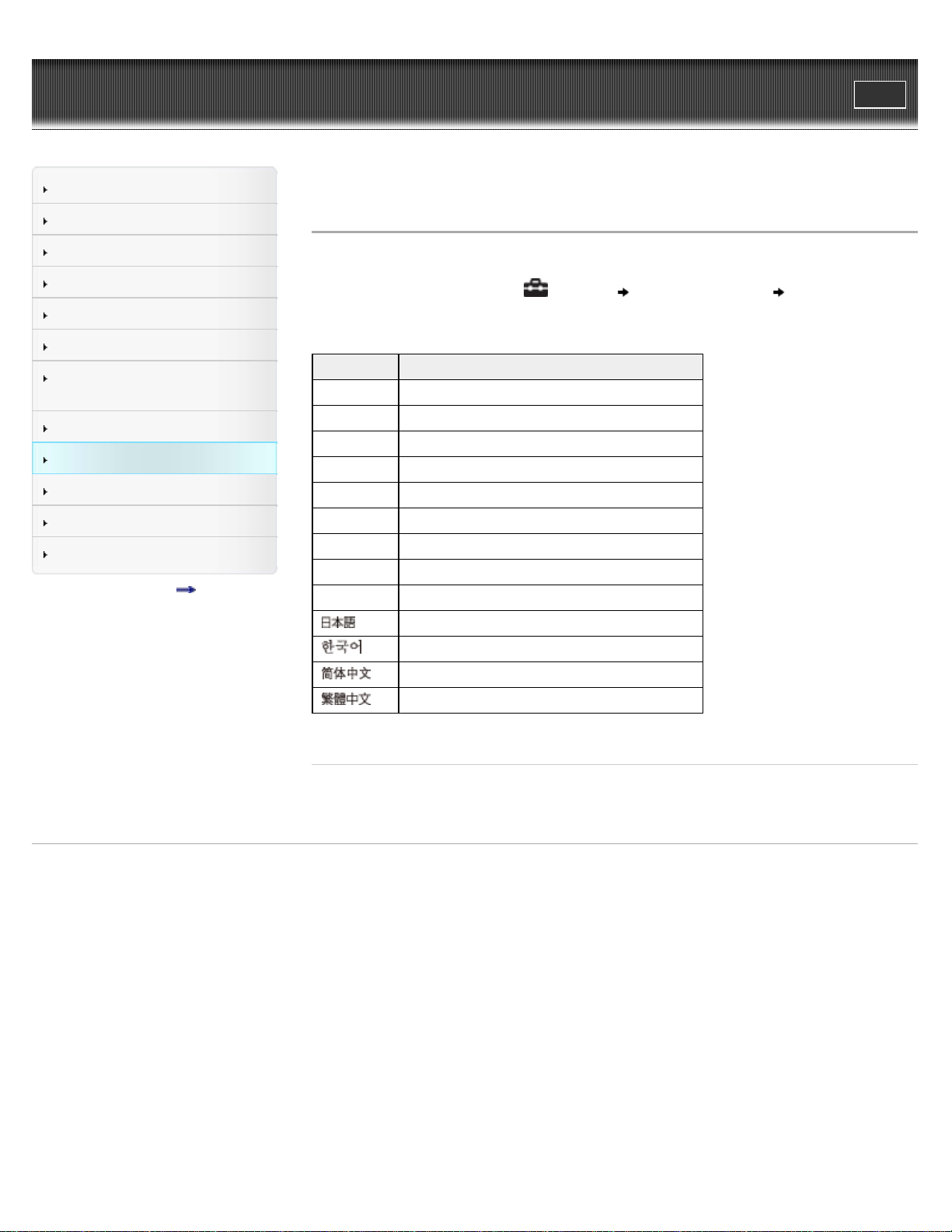
WALKMAN User Guide
Print
Getting Started
How to Use the Software
Music
“SensMe™ Channels”
Videos/Podcasts/Photos
FM Radio
Making/Playing Voice
Recordings
Timer
Settings
Troubleshooting
Important Information
Specifications
Contents list
Top page > Settings > Common Settings > Selecting the display language [Language Settings]
Selecting the display language [Language Settings]
You can select from a variety of languages for menus and messages.
1. From the Home menu, select [Settings] [Language Settings] desired language
setting.
Language Messages and menus are displayed in
[Deutsch] German
[English] English
[Español] Spanish
[Français] French
[Italiano] Italian
[Polski] Polish
[Português] Portuguese
[Русский] Russian
[Türkçe] Turkish
[
] Japanese
[
] Korean
[
] Simplified Chinese
[
] Traditional Chinese
Related Topics
How to use the Home menu
Back to top
Copyright 2010 Sony Corporation
172
WALKMAN User Guide
Print
Getting Started
How to Use the Software
Music
“SensMe™ Channels”
Videos/Podcasts/Photos
FM Radio
Making/Playing Voice
Recordings
Timer
Settings
Troubleshooting
Important Information
Specifications
Contents list
Top page > Settings > Music Settings > Setting the playback range [Playback Range]
Setting the playback range [Playback Range]
You can set the playback range of songs.
1. From the Home menu, select [Settings] [Music Settings] [Playback Range]
desired playback range type.
Type - icon Description
[All Range] - No
icon
Plays back all the songs in all the lists of the selected search method.
For example, if you start playback from an album list, all the albums in the
player are played back.
[Selected
Range] -
Plays back songs only in the lists from which playback starts. (Default
settings)
For example, if you start playback from an album list, the songs in that album
only are played back.
Note
If you start playback from a bookmark list, the songs in that bookmark list only are played
back and songs in other bookmark lists are not played back even if [Playback Range] is set
to [All Range].
Back to top
Copyright 2010 Sony Corporation
174

WALKMAN User Guide
Print
Getting Started
How to Use the Software
Music
“SensMe™ Channels”
Videos/Podcasts/Photos
FM Radio
Making/Playing Voice
Recordings
Timer
Settings
Troubleshooting
Important Information
Specifications
Contents list
Top page > Settings > Music Settings > Setting the sound quality (CLEAR BASS) [Equalizer]
Setting the sound quality (CLEAR BASS) [Equalizer]
Setting the sound quality
Customizing sound quality
You can set the sound quality according to the music genre, etc.
Equalizer settings contain the CLEAR BASS setting. Increasing the CLEAR BASS setting value
allows the player to reproduce dynamic deep bass without distortion, even at a high volume.
Setting the sound quality
1. From the Home menu, select [Settings] [Music Settings] [Equalizer] desired
equalizer type.
Type -
icon
Description
[None] -
No icon
Sound quality setting is not activated. (Default setting) (*1)
[Heavy] -
Emphasizes high and low ranges for a powerful sound.
[Pop] - Stresses the middle range audio, ideal for vocals.
[Jazz] -
Emphasizes high and low ranges for a lively sound.
[Unique] -
Emphasizes high and low ranges, so that even soft sounds can be heard easily.
[Custom 1]
-
User-customizable sound settings for which you can adjust each frequency range
individually. See [Details] for details.
[Custom 2]
-
(*1) The default setting of players sold in the Latin America region is [Custom 1], and CLEAR BASS is set
to level +3.
Note
If your personal settings saved as [Custom 1] and [Custom 2] seem to produce a different
volume level than other settings, you may have to adjust the volume manually to
compensate.
The [Equalizer] setting is not applied while playing a video, FM radio or video podcast.
Customizing sound quality
You can preset the value of CLEAR BASS (bass) and 5 band Equalizer as [Custom 1] or
[Custom 2].
1. From the Home menu, select
[Settings] [Music Settings] [Equalizer]
[Custom 1] or [Custom 2].
175

2. Press the / button to select CLEAR BASS or the frequency range setting, and press
the
/ button to adjust the setting level, and then press the button to confirm.
The [Music Settings] screen reappears.
CLEAR BASS can be set to any of 4 sound levels, and the 5 frequency ranges can be
set to any of 7 sound levels.
After you have adjusted the setting level, be sure to press the
button to confirm. If
you press the BACK/HOME button before you confirm, the setting will be canceled.
Back to top
Copyright 2010 Sony Corporation
176
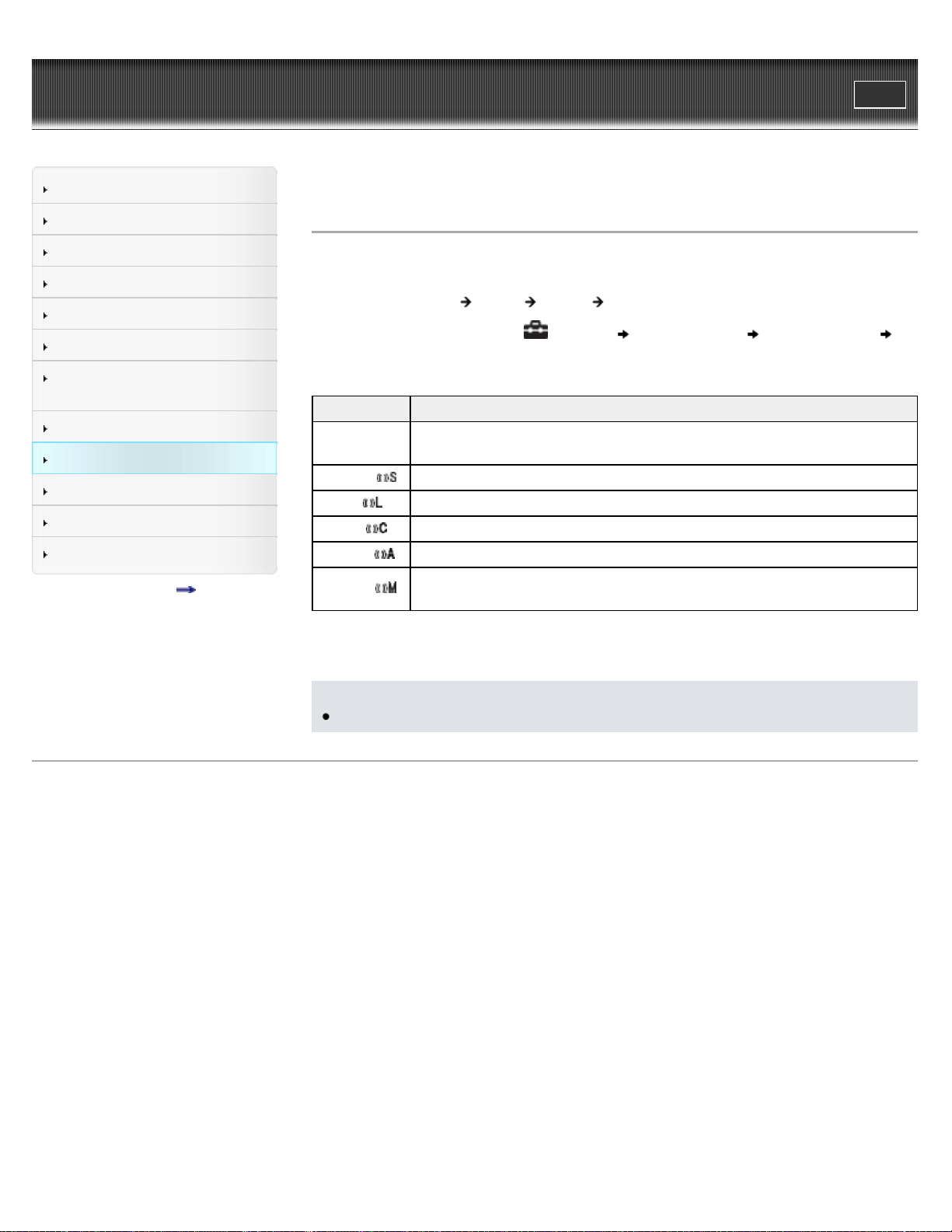
WALKMAN User Guide
Print
Getting Started
How to Use the Software
Music
“SensMe™ Channels”
Videos/Podcasts/Photos
FM Radio
Making/Playing Voice
Recordings
Timer
Settings
Troubleshooting
Important Information
Specifications
Contents list
Top page > Settings > Music Settings > Customizing the surround sound [VPT(Surround)]
Customizing the surround sound [VPT(Surround)]
You can customize the surround sound by using the VPT (*1) (Surround) function to enrich the
sound reproduction quality of the audio playback. The sense of realism is increasingly enhanced
in the order of [Studio] [Live] [Club] [Arena] (most enhanced).
1. From the Home menu, select [Settings] [Music Settings] [VPT(Surround)]
desired VPT (Surround) type.
Type - icon Description
[None] - No
icon
[VPT(Surround)] setting is not activated. (Default setting)
[Studio] -
Creates the sound of a recording studio.
[Live] -
Creates the sound of a concert hall.
[Club] -
Creates the sound of a club.
[Arena] -
Creates the sound of an arena.
[Matrix] -
Reproduces an additional surround effect, and creates a natural, yet richly
enhanced sound.
(*1) VPT, which stands for Virtualphones Technology, is a proprietary sound processing technology
developed by Sony.
Note
The [VPT(Surround)] setting is not applied while playing a video, FM radio or video podcast.
Back to top
Copyright 2010 Sony Corporation
177
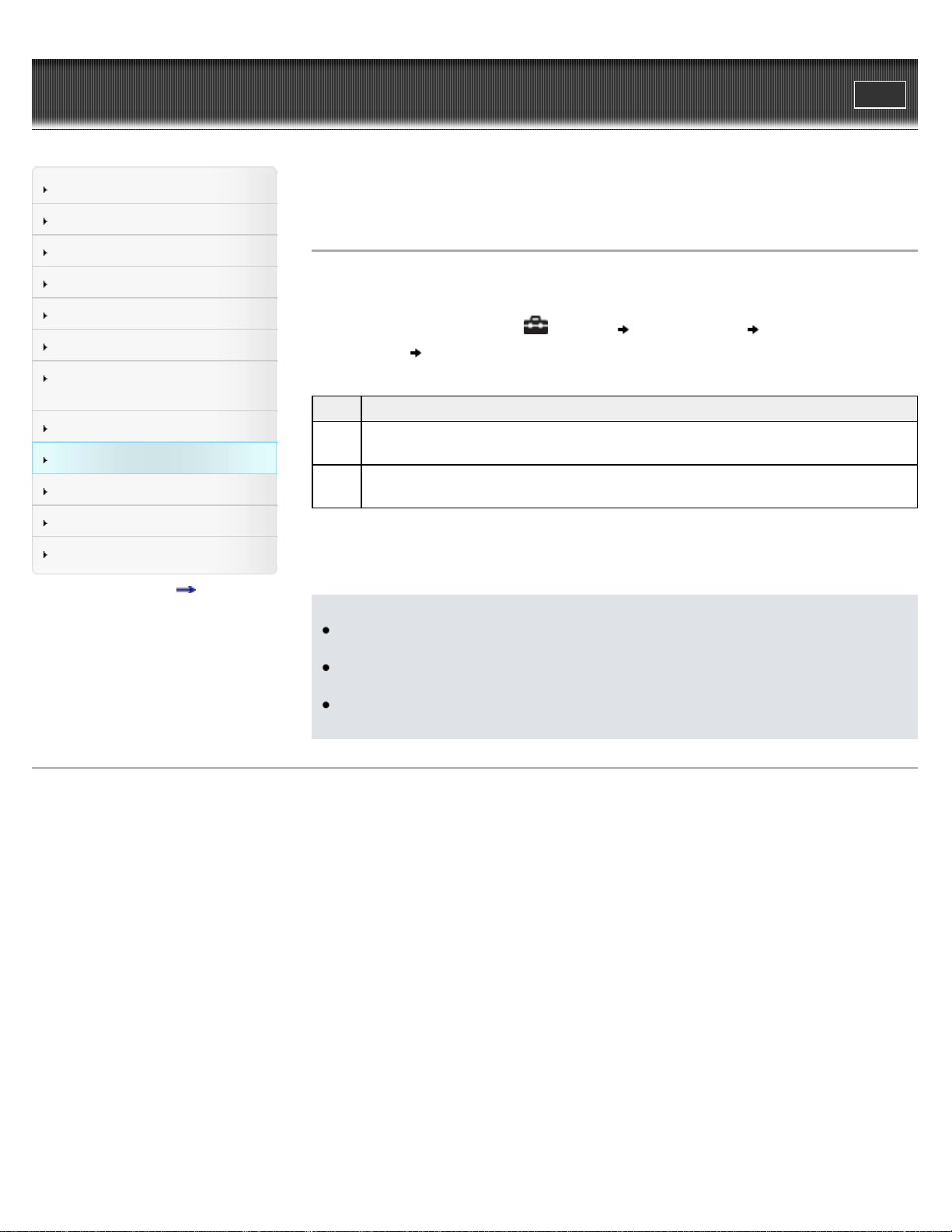
WALKMAN User Guide
Print
Getting Started
How to Use the Software
Music
“SensMe™ Channels”
Videos/Podcasts/Photos
FM Radio
Making/Playing Voice
Recordings
Timer
Settings
Troubleshooting
Important Information
Specifications
Contents list
Top page > Settings > Music Settings > Listening with DSEE (Sound Enhance) [DSEE(Sound
Enhance)]
Listening with DSEE (Sound Enhance) [DSEE(Sound Enhance)]
By activating the [DSEE(Sound Enhance)] (*1) feature, you can hear a rich and natural sound
almost exactly like the original source.
1. From the Home menu, select
[Settings] [Music Settings] [DSEE(Sound
Enhance)]
desired DSEE (Sound Enhance) type.
Type Description
[On]
Activates the [DSEE(Sound Enhance)] (*1) function, and plays back naturally extended
sound, close to the original sound.
[Off]
Disables the [DSEE(Sound Enhance)] function and plays back sound normally. (Default
setting)
(*1) DSEE, which stands for Digital Sound Enhancement Engine, is a technology developed by Sony, to
enhance the sound quality of compressed audio files by restoring high-range sound removed by the
compression process.
Note
The [DSEE(Sound Enhance)] setting is not applied while playing a video, FM radio or video
podcast.
The [DSEE(Sound Enhance)] function is not effective for songs of a file format that is not
compressed, or songs that are of a high bit rate with no treble loss.
In the case of songs of very low bit rate, the [DSEE(Sound Enhance)] function will not be
effective.
Back to top
Copyright 2010 Sony Corporation
178
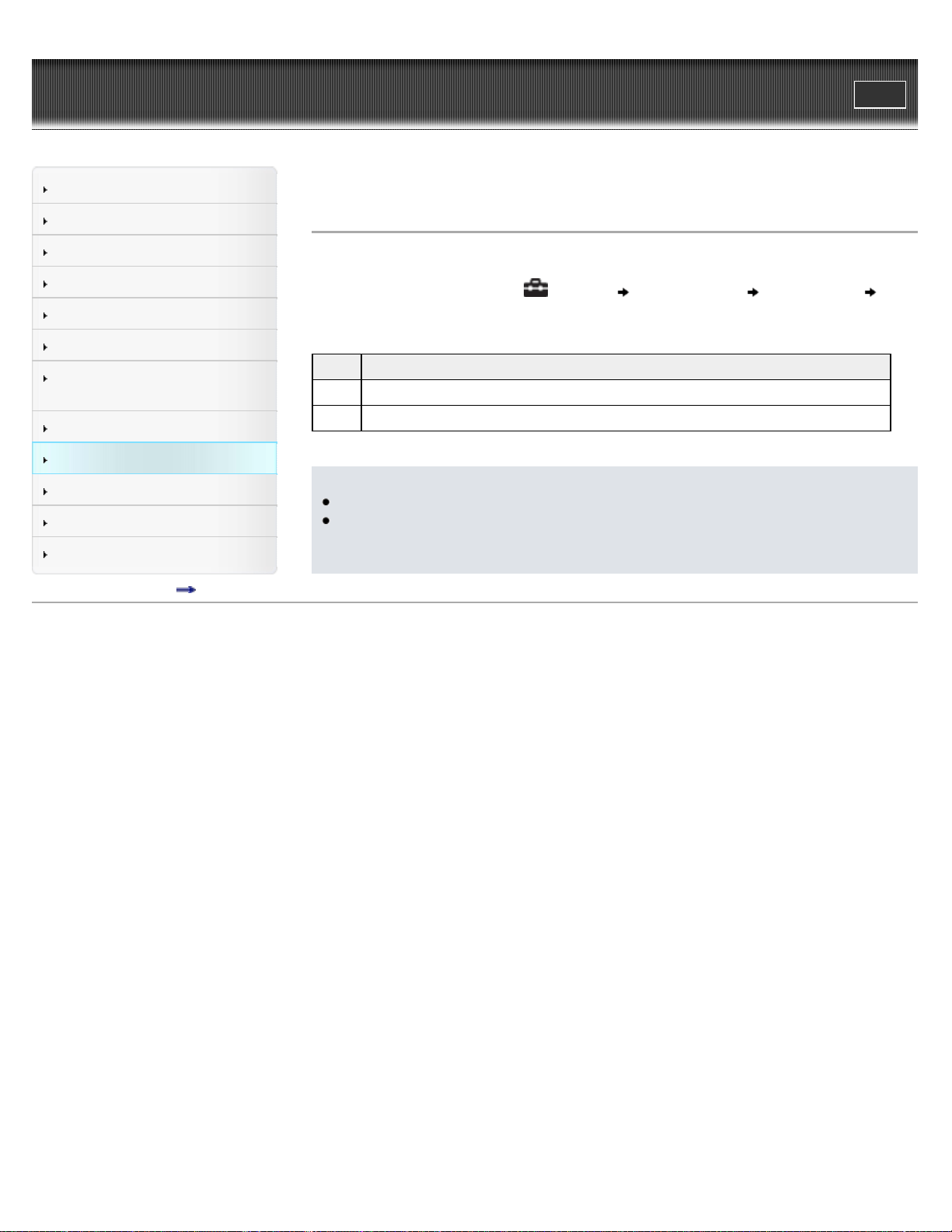
WALKMAN User Guide
Print
Getting Started
How to Use the Software
Music
“SensMe™ Channels”
Videos/Podcasts/Photos
FM Radio
Making/Playing Voice
Recordings
Timer
Settings
Troubleshooting
Important Information
Specifications
Contents list
Top page > Settings > Music Settings > Listening with Clear Stereo [Clear Stereo]
Listening with Clear Stereo [Clear Stereo]
[Clear Stereo] enables individual left and right digital processing of the sound.
1. From the Home menu, select [Settings] [Music Settings] [Clear Stereo]
desired Clear Stereo type.
Type Description
[On] Activates the [Clear Stereo] function when you use the supplied headphones.
[Off] Disables the [Clear Stereo] function and plays back normal sound. (Default setting)
Note
The [Clear Stereo] setting is not applied while playing a video, FM radio or video podcast.
The [Clear Stereo] function is designed to obtain maximum effect with the supplied
headphones. The [Clear Stereo] effect may not be obtained with other headphones. When
using other headphones, set [Clear Stereo] to [Off].
Back to top
Copyright 2010 Sony Corporation
179
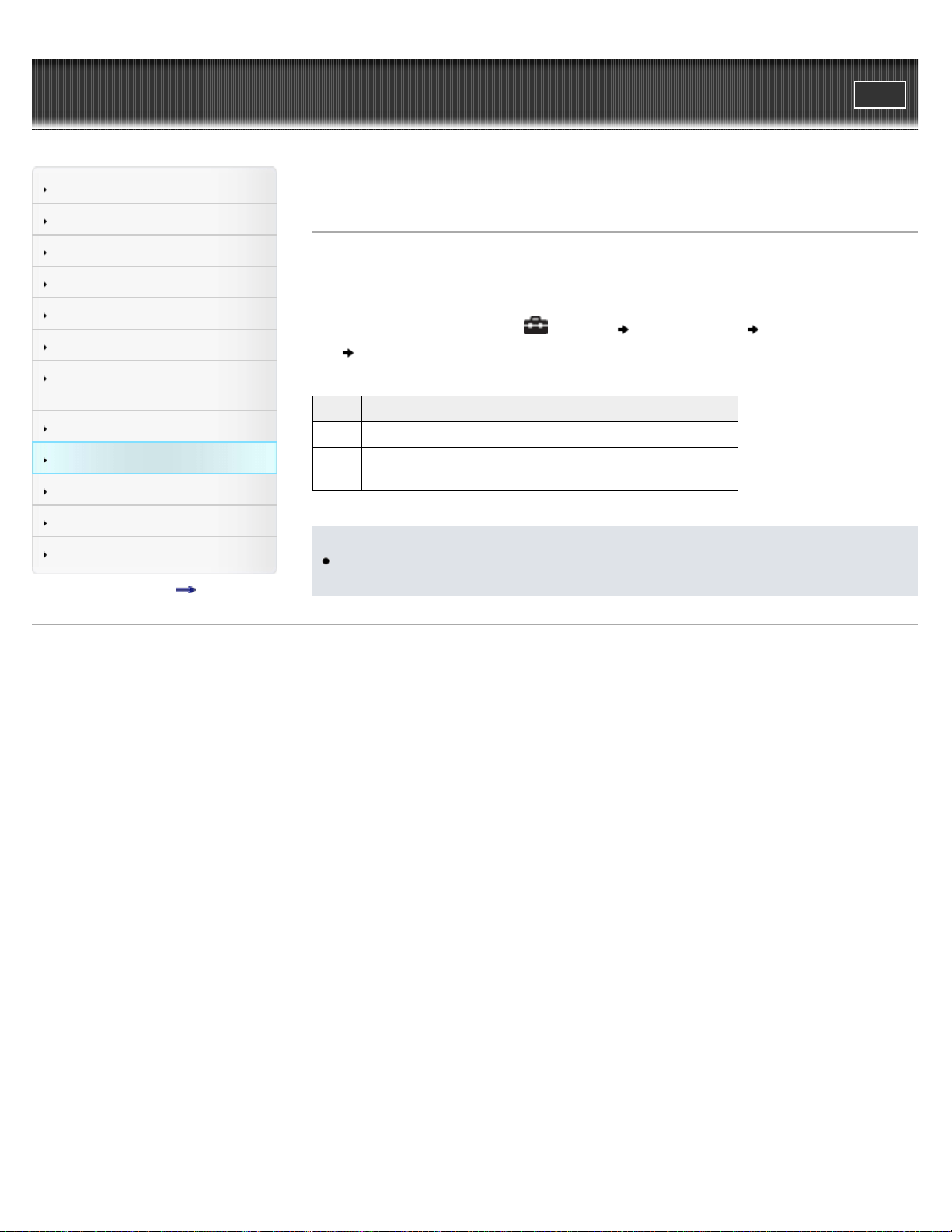
WALKMAN User Guide
Print
Getting Started
How to Use the Software
Music
“SensMe™ Channels”
Videos/Podcasts/Photos
FM Radio
Making/Playing Voice
Recordings
Timer
Settings
Troubleshooting
Important Information
Specifications
Contents list
Top page > Settings > Music Settings > Adjusting the volume level [Dynamic Normalizer]
Adjusting the volume level [Dynamic Normalizer]
You can reduce the volume level between songs. With this setting, when listening to album songs
in the shuffle play mode, the volume level between songs is moderated to minimize differences in
their recording levels.
1. From the Home menu, select
[Settings] [Music Settings] [Dynamic Normalizer]
desired Dynamic Normalizer type.
Type Description
[On] Minimizes the difference in volume level between songs.
[Off]
Plays back songs at their original transferred volume level.
(Default setting)
Note
The [Dynamic Normalizer] setting is not applied while playing a video, FM radio or video
podcast.
Back to top
Copyright 2010 Sony Corporation
180
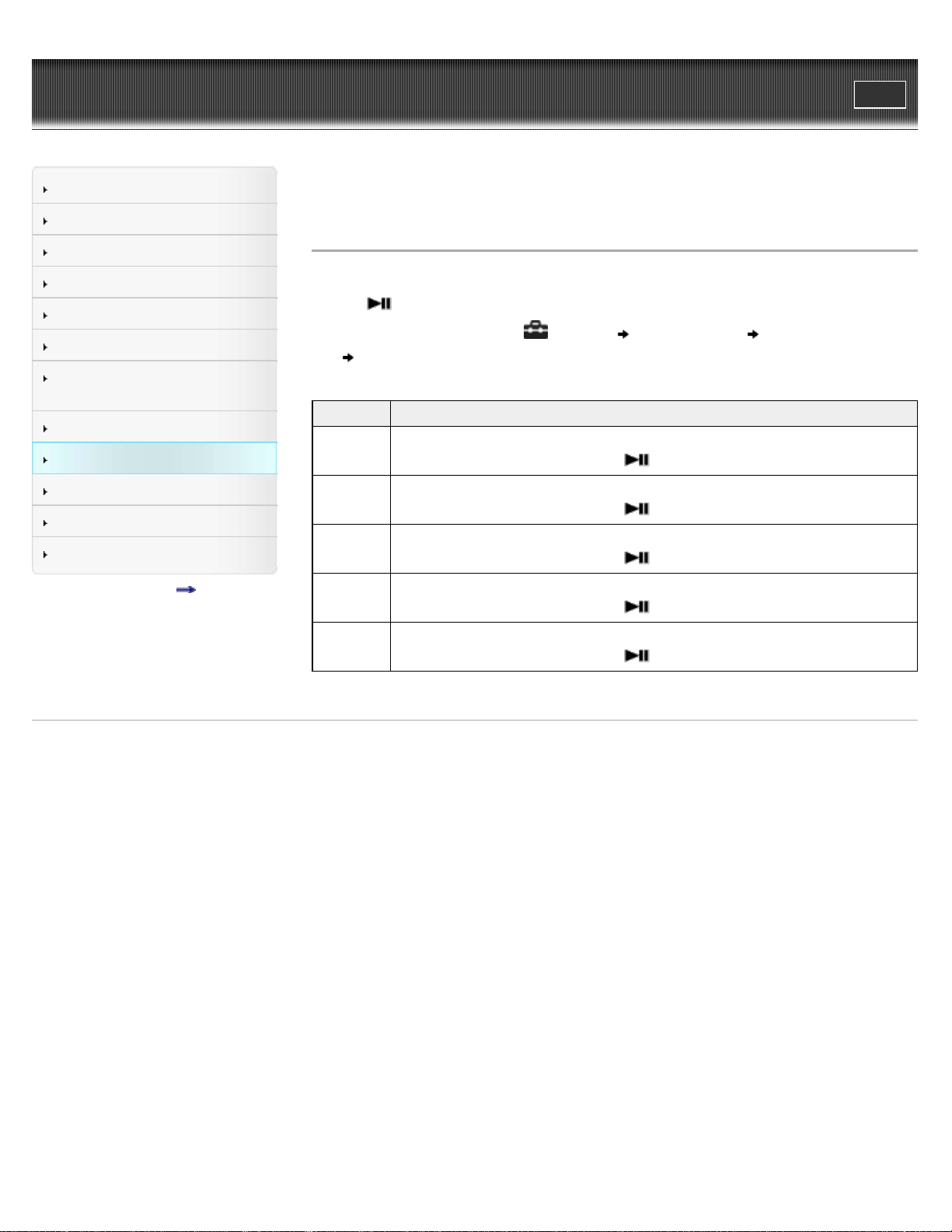
WALKMAN User Guide
Print
Getting Started
How to Use the Software
Music
“SensMe™ Channels”
Videos/Podcasts/Photos
FM Radio
Making/Playing Voice
Recordings
Timer
Settings
Troubleshooting
Important Information
Specifications
Contents list
Top page > Settings > Music Settings > Changing the default bookmark list [Default Bookmark
List]
Changing the default bookmark list [Default Bookmark List]
You can change the default bookmark list, to which you can add a song when you press and
hold the
button in the music playback screen or song list screen.
1. From the Home menu, select [Settings] [Music Settings] [Default Bookmark List]
desired bookmark list.
Item Description
[Bookmark
List 1]
Selects [Bookmark List 1] as the default book mark list to which a song will be
added when you press and hold the button. (Default setting)
[Bookmark
List 2]
Selects [Bookmark List 2] as the default book mark list to which a song will be
added when you press and hold the button.
[Bookmark
List 3]
Selects [Bookmark List 3] as the default book mark list to which a song will be
added when you press and hold the button.
[Bookmark
List 4]
Selects [Bookmark List 4] as the default book mark list to which a song will be
added when you press and hold the button.
[Bookmark
List 5]
Selects [Bookmark List 5] as the default book mark list to which a song will be
added when you press and hold the button.
Back to top
Copyright 2010 Sony Corporation
181
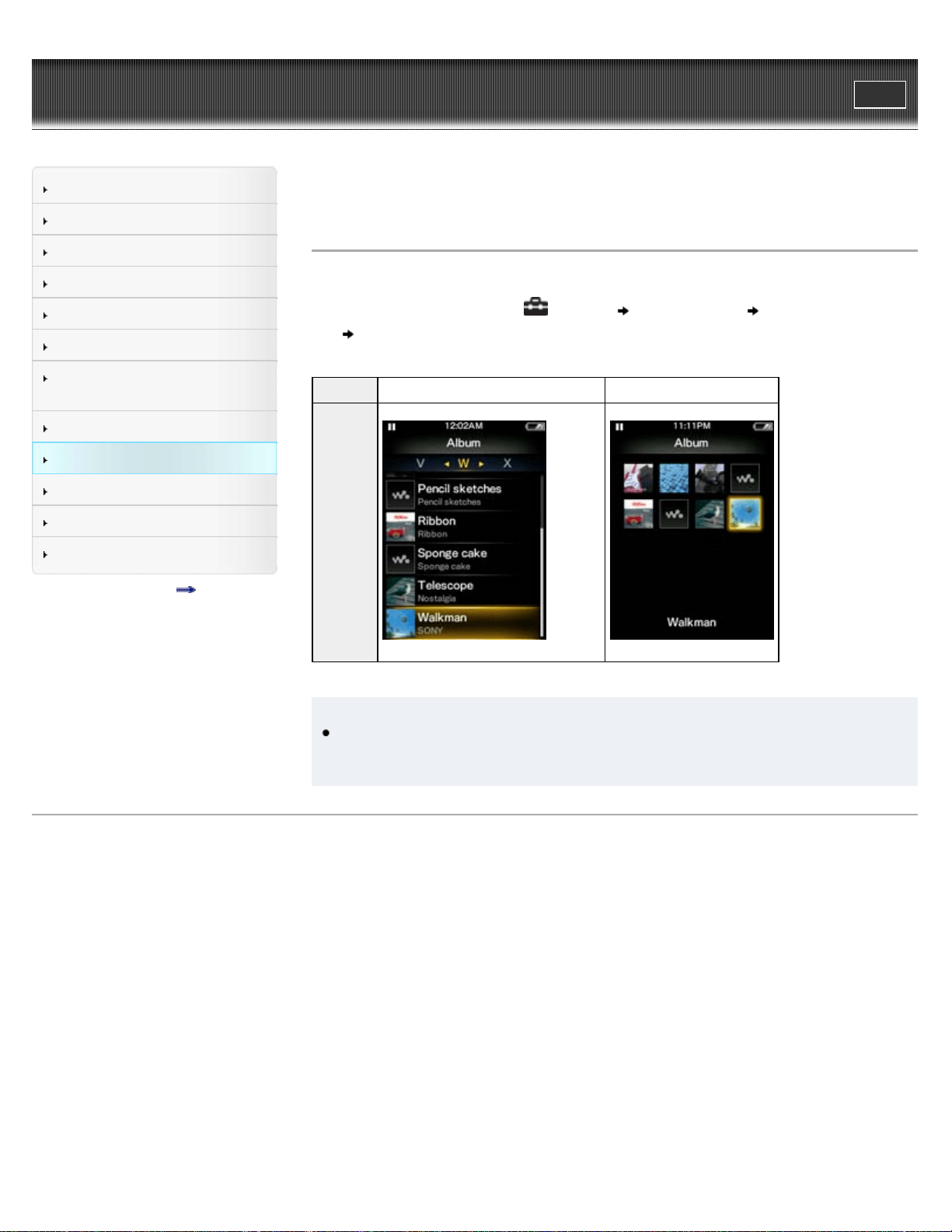
WALKMAN User Guide
Print
Getting Started
How to Use the Software
Music
“SensMe™ Channels”
Videos/Podcasts/Photos
FM Radio
Making/Playing Voice
Recordings
Timer
Settings
Troubleshooting
Important Information
Specifications
Contents list
Top page > Settings > Music Settings > Selecting the album display format [Album Display
Format]
Selecting the album display format [Album Display Format]
You can select the album display format.
1. From the Home menu, select [Settings] [Music Settings] [Album Display Format]
desired Album Display Format type.
Type [Title & Cover Art] (Default setting) [Cover Art Only]
Screen
Hint
Cover art will not appear if there is no cover art information for the album. You can set cover
art using Windows Media Player. For details on operation, refer to the Help of Windows
Media Player. Note that the player will not display cover art attached to playlists.
Back to top
Copyright 2010 Sony Corporation
182
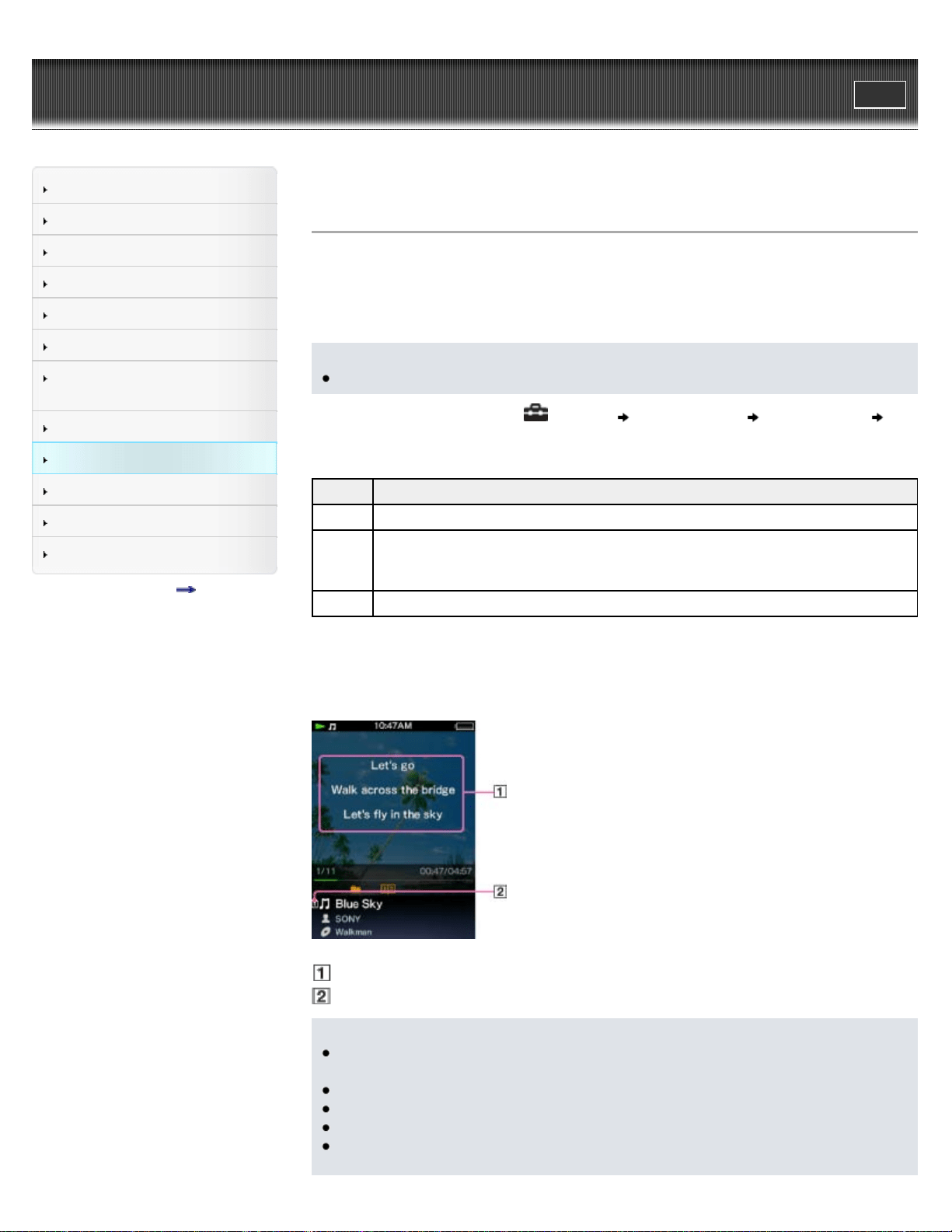
WALKMAN User Guide
Print
Getting Started
How to Use the Software
Music
“SensMe™ Channels”
Videos/Podcasts/Photos
FM Radio
Making/Playing Voice
Recordings
Timer
Settings
Troubleshooting
Important Information
Specifications
Contents list
Top page > Settings > Music Settings > Displaying lyrics [Display Lyrics]
Displaying lyrics [Display Lyrics]
You can display song lyrics when there is an LRC file for the song in the player. The LRC file
must have the same file name as the song file, with extension “.lrc” (for example, “abc.lrc” for a
song file “abc.mp3”). Place the LRC file in the same folder as the song file. The player
synchronizes song lyrics with song playback. For how to create LRC files, see [Details].
Note
Some LRC files may not be playable on the player depending on the file format.
1. From the Home menu, select
[Settings] [Music Settings] [Display Lyrics]
desired display type.
Type Description
[On] Displays lyrics if the playing song has an LRC file. (Default setting)
[On (No
Screen
Off)]
Displays lyrics if the playing song has an LRC file. The player will not turn off the
screen or run the screensaver during song playback regardless of whether an LRC
file for the current song exists or not.
[Off] Does not display lyrics. (*1)
(*1) When [Karaoke/Language Study] is set to [Maximum Karaoke Mode] or [Minimum Karaoke Mode],
lyrics will be displayed regardless of this setting [Details].
Music playback screen while displaying lyrics
Lyrics
Lyrics icon
Note
If lyrics are not displayed properly, save the LRC file in the UTF-8 encoding and transfer it
again to the player.
The player can display up to 1,024 lines of lyrics for each song.
Playback and lyrics may become slightly out of sync.
You cannot display lyrics on the audio podcast playback screen [Details].
When set to [On], the screen turns off or changes to slide show when there is no operation
for the time set in [Delay] [Details].
183


WALKMAN User Guide
Print
Getting Started
How to Use the Software
Music
“SensMe™ Channels”
Videos/Podcasts/Photos
FM Radio
Making/Playing Voice
Recordings
Timer
Settings
Troubleshooting
Important Information
Specifications
Contents list
Top page > Settings > Music Settings > How to create LRC files
How to create LRC files
Notes on creating LRC files
1. Prepare an audio file for which you intend to display lyrics during playback.
2. Open Notepad.
Click [start]
[All programs] [Accessories] [Notepad] to open it.
3. Type lyrics text into Notepad.
The screen images are of Windows Vista.
4. Play back the audio file to check the time [minutes:seconds:hundredths of a second] for
displaying each text line, then enter the time information to the left of the text line.
Examples:
185
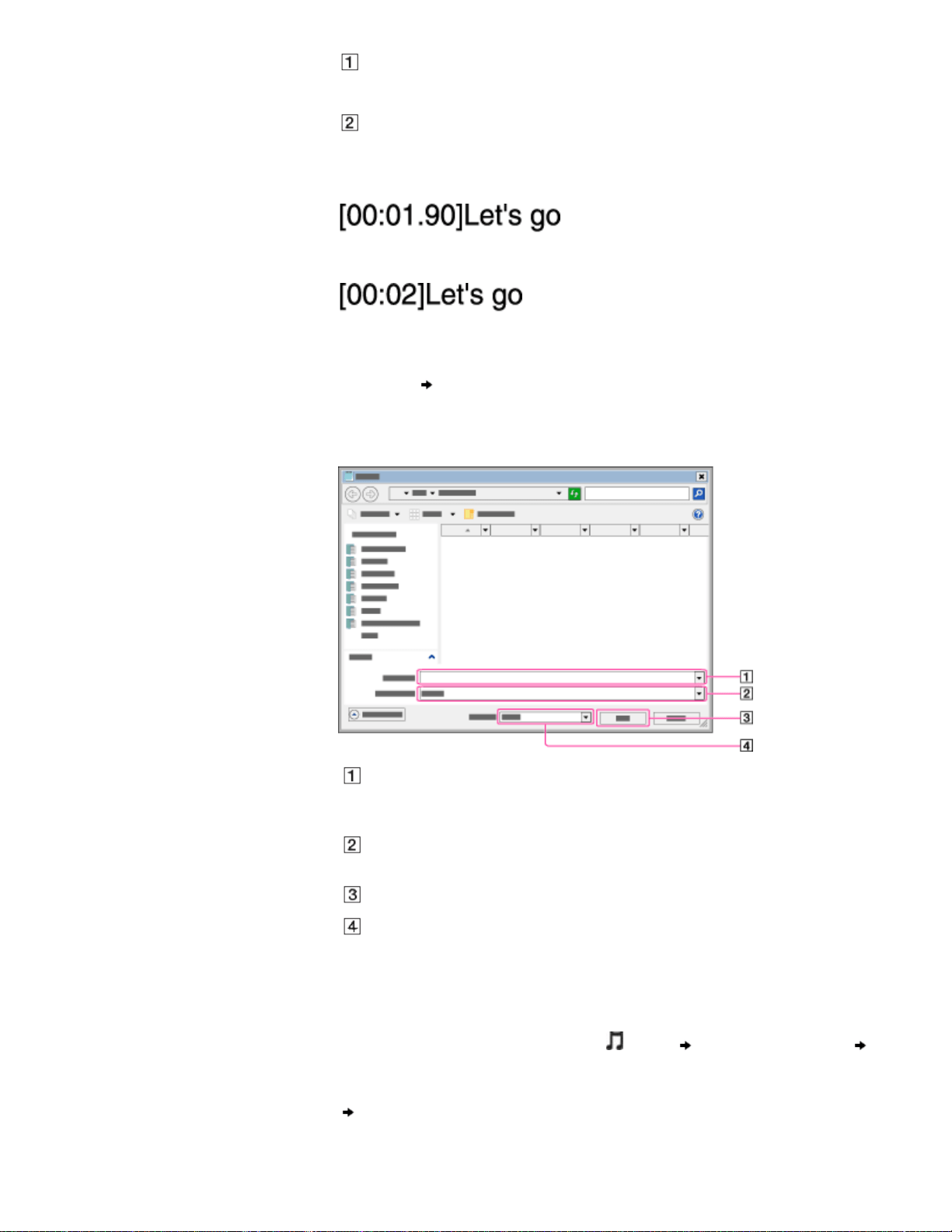
Time information
[mm:ss:xx] where mm means minutes, ss means seconds, and xx means hundredths of a
second. Enter mm, ss and xx in two digits. Use a colon to separate values.
Lyric text line
The player recognizes up to 95 characters to display the text line on the screen. If a text line
cannot fit in the screen, it will be wrapped (up to 3 lines). Characters beyond 3 lines will not
be displayed.
You can separate seconds and hundredths of a second by a period instead of a colon.
You can omit hundredths of a second.
5. After finishing lyrics text input, save it as a file.
Select [File]
[Save As…] to open the [Save As] screen. Select [All Files] in the [Save as
type:] list at the bottom of the screen. Select [UTF-8] in the [Encode:] list. Enter the file name
into the [File name:] text box. The file name must be the same as the audio file, with
extension “.lrc”. Click [Save] to save the LRC file.
[File name:]
Enter the same file name as the audio file, with extension “.lrc” (for example, “abc.lrc”
for an audio file “abc.mp3”).
[Save as type:]
Select [All Files] in the [Save as type:] list.
[Save]
[Encoding:]
Select [UTF-8] in the [Encode:] list.
The maximum size of LRC files is 512 KB.
6. Create a new folder in the [MUSIC] folder of the player, then drag and drop both the audio
file and LRC file into the new folder to transfer them.
7. From the Home menu of the player, select
[Music] desired search method
transferred song.
8. Press the OPTION/PWR OFF button to bring up the option menu, then select [Display Lyrics]
[On] or [On (No Screen Off)].
The lyrics are displayed on the screen, synchronizing with audio playback.
Lyrics display on the player
186

Notes on creating LRC files
The text encoding of LRC files must be UTF-8.
An LRC file must have the same file name as the audio file, with extension “.lrc”. Otherwise,
the player cannot recognize the LRC file.
The maximum size of LRC files is 512 KB.
Notes on lyrics text
A character string that follows time information at the beginning of the text line is recognized
as a lyric text line.
Space characters (both 1-byte and 2-byte) immediately following time information will be
ignored.
Maximum number of displayable characters for each lyric text line
The player recognizes up to 95 characters to display the text line on the screen. Characters
beyond this limitation are not displayed.
If a text line cannot fit in the screen, it will be wrapped (up to 3 lines). Characters beyond 3
lines will not be displayed.
The player can display up to 1,024 lines of lyrics for each song.
Notes on new line control characters
Any CR, CRLF and LF is recognized properly.
A text line that contains only a new line is skipped.
Notes on LRC file format
Time information must be at the beginning of a text line. Otherwise, it will be ignored and the
number of displayable character may decrease.
Time information must be entered in chronological order. If a line’s time information is
chronologically equal or before the previous line, the line will be skipped. In this case, text
lines will also be skipped until a text line with time information that follows chronologically the
last accepted line.
A text line that contains time information only is displayed as a blank line (treated as a text
that contains no characters).
The player supports only lyrics display and does not support other information of LRC file
format.
Copyright notice
When creating LRC files using copyrighted materials authored by others, created LRC files are
limited to private use only. Use of LRC files beyond this limitation requires permission of the
copyright holders.
Back to top
Copyright 2010 Sony Corporation
187
WALKMAN User Guide
Print
Getting Started
How to Use the Software
Music
“SensMe™ Channels”
Videos/Podcasts/Photos
FM Radio
Making/Playing Voice
Recordings
Timer
Settings
Troubleshooting
Important Information
Specifications
Contents list
Top page > Settings > Music Settings > Optimizing the quality of the sound output from the
speakers [SP Output Optimizer]
Optimizing the quality of the sound output from the speakers
[SP Output Optimizer]
The player is equipped with the Digital Linear Phase Speaker feature to optimize the quality of
sound from the speakers.
The Digital Linear Phase Speaker feature achieves a precise localization of sounds by improving
the frequency-amplitude and phase characteristics.
Note
This function is effective for the supplied speakers only. If your player is not supplied with
speakers, set [SP Output Optimizer] to [Off].
Speaker bundled model is not available in some countries/regions.
1. From the Home menu, select
[Settings] [Music Settings] [SP Output Optimizer]
desired setting type.
Type Description
[SRS-
NWGT015]
Activates the [SP Output Optimizer] function when sounds output from the
speakers. The sound is optimized for SRS-NWGT015.
[Off]
Disables the [SP Output Optimizer] function and outputs normal sound from the
speakers.
Note
[SP Output Optimizer] is not applied to the sound output from the headphones.
[SP Output Optimizer] is effective for music, audio podcast and “SensMe™ Channels” only.
This function is not applied while playing a video, FM radio, or video podcast.
Back to top
Copyright 2010 Sony Corporation
188
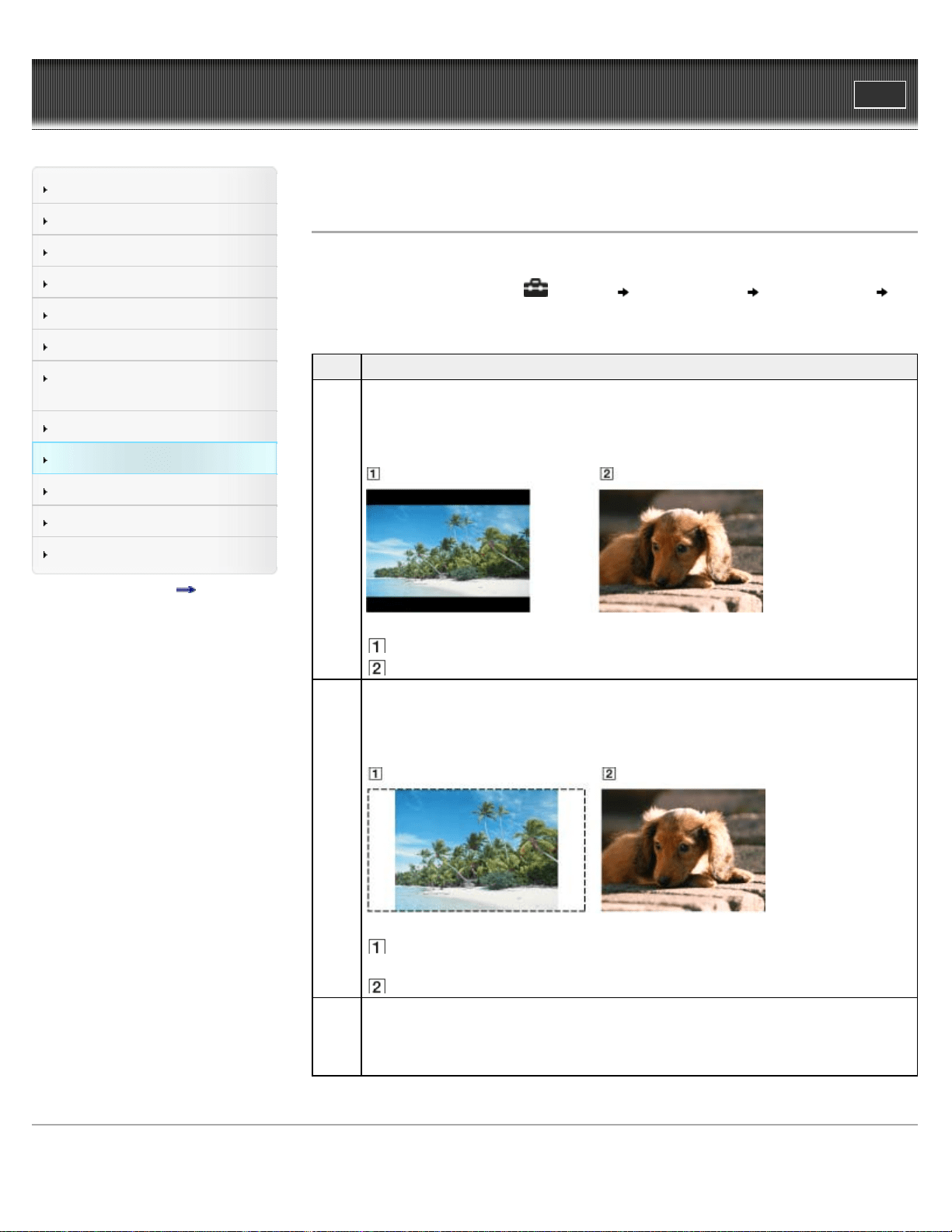
WALKMAN User Guide
Print
Getting Started
How to Use the Software
Music
“SensMe™ Channels”
Videos/Podcasts/Photos
FM Radio
Making/Playing Voice
Recordings
Timer
Settings
Troubleshooting
Important Information
Specifications
Contents list
Top page > Settings > Video Settings > Setting the zoom function [Zoom Settings]
Setting the zoom function [Zoom Settings]
You can zoom in the currently playing video.
1. From the Home menu, select [Settings] [Video Settings] [Zoom Settings]
desired zoom setting type.
Type Description
[Auto]
The video image is resized to fit the display area, maintaining the original aspect ratio
(Default setting).
When a 16:9 (wide size) video image is displayed, black bands appear on the top and
bottom of the screen.
16:9 source
4:3 source
[Full]
The video image is resized to fill the available display area, maintaining the aspect
ratio.
When a 16:9 (wide size) video image is displayed, the right/left sides of the image are
trimmed to fit.
16:9 source
The dotted line frame represents the original video image size.
4:3 source
[Off]
The video image is not resized, and appears in the original resolution. If video
resolution is too high, the left, right, top and bottom of the screen will be cut. If video
resolution is too low, black bars will appear on the right, left, top and bottom of the
screen.
Back to top
Copyright 2010 Sony Corporation
189
WALKMAN User Guide
Print
Getting Started
How to Use the Software
Music
“SensMe™ Channels”
Videos/Podcasts/Photos
FM Radio
Making/Playing Voice
Recordings
Timer
Settings
Troubleshooting
Important Information
Specifications
Contents list
Top page > Settings > Video Settings > Playing only video sound [On-Hold Display]
Playing only video sound [On-Hold Display]
You can set to turn off the video screen while the player is on hold, allowing you to enjoy video
sound only.
Setting this option to [No] saves battery power for longer battery life.
1. From the Home menu, select
[Settings] [Video Settings] [On-Hold Display]
desired On-Hold Display setting type.
Type Description
[Yes]
When the player is on hold, the buttons are deactivated, but videos will be played back
normally. (Default setting)
[No]
When the player is on hold, the buttons are deactivated and the screen turns off, but
the sound of the current video is played back.
Back to top
Copyright 2010 Sony Corporation
190
WALKMAN User Guide
Print
Getting Started
How to Use the Software
Music
“SensMe™ Channels”
Videos/Podcasts/Photos
FM Radio
Making/Playing Voice
Recordings
Timer
Settings
Troubleshooting
Important Information
Specifications
Contents list
Top page > Settings > Video Settings > Arranging the video list [Order of Video List]
Arranging the video list [Order of Video List]
Arranges the video list by date or by title.
1. From the Home menu, select [Settings] [Video Settings] [Order of Video List]
desired order of video list type.
Type Description
[Date/Time
(Oldest)]
Arranges the video list by transfer/record date in ascending order.
[Date/Time
(Newest)]
Arranges the video list by transfer/record date in descending order.
(Default setting)
[Title (A>Z)] Arranges the video list by title in ascending order.
[Title (Z>A)] Arranges the video list by title in descending order.
Back to top
Copyright 2010 Sony Corporation
191
WALKMAN User Guide
Print
Getting Started
How to Use the Software
Music
“SensMe™ Channels”
Videos/Podcasts/Photos
FM Radio
Making/Playing Voice
Recordings
Timer
Settings
Troubleshooting
Important Information
Specifications
Contents list
Top page > Settings > Photo Settings > Setting the photo list display format [Photo List Format]
Setting the photo list display format [Photo List Format]
The player offers 2 display formats: [Thumbnail + Title] (*1) or [Thumbnail Only].
1. From the Home menu, select [Settings] [Photo Settings] [Photo List Format]
desired photo list format type.
Type Description
[Thumbnail + Title] Displays a photo title with a thumbnail image in the photo list.
[Thumbnail Only] Displays only thumbnails in the photo list. (Default setting)
(*1) Thumbnail refers to a reduced size image of a photo.
Note
Thumbnails may not be displayed, depending on the file format.
Back to top
Copyright 2010 Sony Corporation
192
WALKMAN User Guide
Print
Getting Started
How to Use the Software
Music
“SensMe™ Channels”
Videos/Podcasts/Photos
FM Radio
Making/Playing Voice
Recordings
Timer
Settings
Troubleshooting
Important Information
Specifications
Contents list
Top page > Settings > FM Radio Settings > Setting the reception [Scan Sensitivity]
Setting the reception [Scan Sensitivity]
When you select stations using the [Auto Preset] function [Details] or the / button, the FM
receiver may receive unwanted broadcast stations as a result of sensitivity being too high. In this
case, set the reception to [Low]. [High] is set by default.
1. From the Home menu, select
[Settings] [FM Radio Settings] [Scan Sensitivity]
[Low].
To set the reception sensitivity back to the default, select [High].
Back to top
Copyright 2010 Sony Corporation
193
WALKMAN User Guide
Print
Getting Started
How to Use the Software
Music
“SensMe™ Channels”
Videos/Podcasts/Photos
FM Radio
Making/Playing Voice
Recordings
Timer
Settings
Troubleshooting
Important Information
Specifications
Contents list
Top page > Settings > FM Radio Settings > Setting monaural/stereo [Mono/Auto]
Setting monaural/stereo [Mono/Auto]
If noise occurs during FM reception, set the receiver to [Mono] for monaural. If you set it to
[Auto], monaural/stereo reception is selected automatically, depending on reception conditions.
[Auto] is set by default.
1. From the Home menu, select
[Settings] [FM Radio Settings] [Mono/Auto]
[Mono].
To return to automatic setting, select [Auto].
Back to top
Copyright 2010 Sony Corporation
194
WALKMAN User Guide
Print
Getting Started
How to Use the Software
Music
“SensMe™ Channels”
Videos/Podcasts/Photos
FM Radio
Making/Playing Voice
Recordings
Timer
Settings
Troubleshooting
Important Information
Specifications
Contents list
Top page > Settings > Recording Settings > Selecting a level of recording quality [Bit Rate
Settings]
Selecting a level of recording quality [Bit Rate Settings]
You can select the bit rate for voice recording. High bit rate offers better sound quality, though
requires more memory.
1. From the Home menu, select
[Settings] [Recording Settings] [Bit Rate Settings]
desired setting type.
Type Description
[MP3 256kbps] Records at the bit rate of 256 kbps.
[MP3 128kbps] Records at the bit rate of 128 kbps. (Default setting)
[MP3 64kbps] Records at the bit rate of 64 kbps.
Back to top
Copyright 2010 Sony Corporation
195
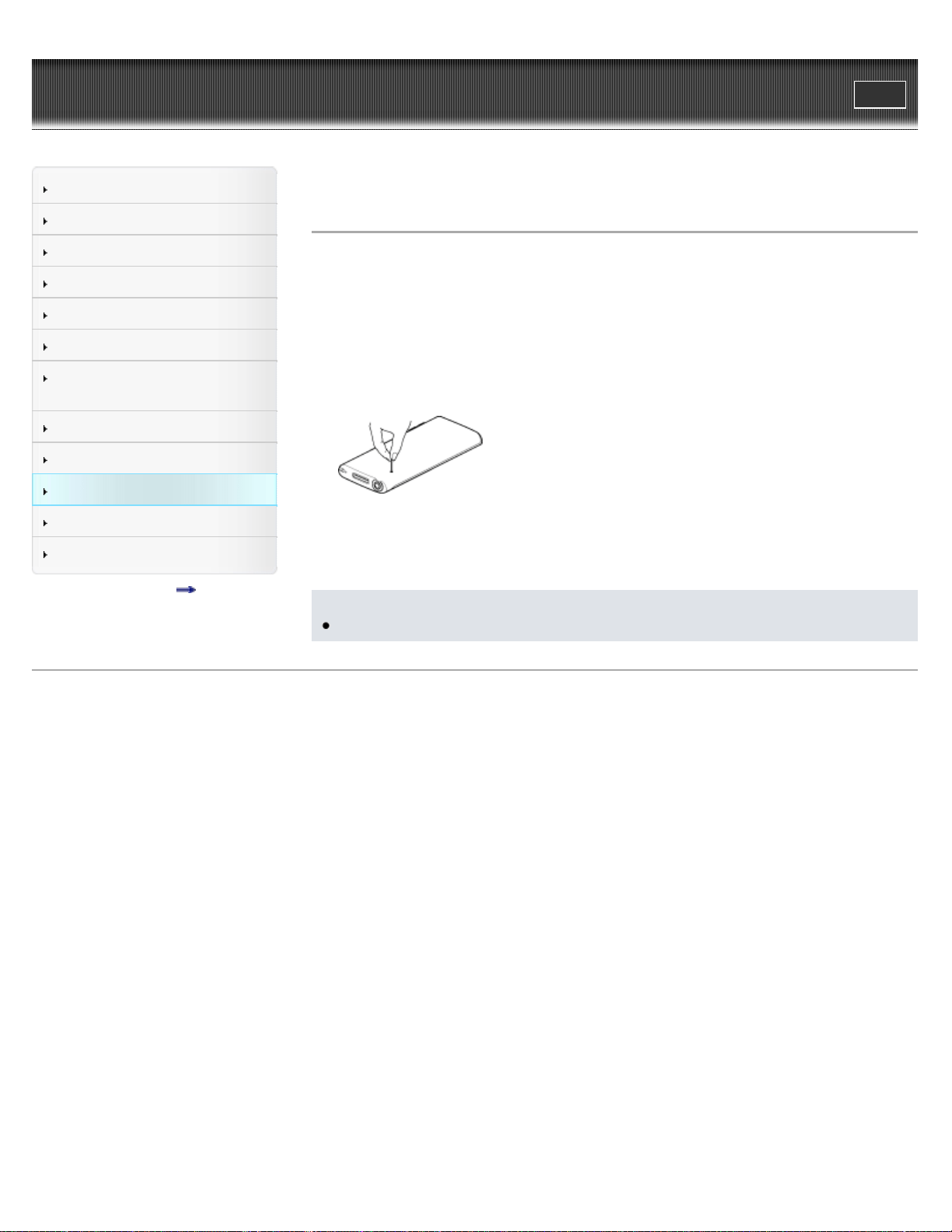
WALKMAN User Guide
Print
Getting Started
How to Use the Software
Music
“SensMe™ Channels”
Videos/Podcasts/Photos
FM Radio
Making/Playing Voice
Recordings
Timer
Settings
Troubleshooting
Important Information
Specifications
Contents list
Top page > Troubleshooting > To Deal with a Trouble > What can I do to solve a problem?
What can I do to solve a problem?
If the player does not function as expected, try the following steps to resolve the issue.
1. Find the symptoms of the issue in this manual, and try any corrective actions listed.
2. Connect the player to your computer to charge the battery.
You may be able to resolve some issues by charging the battery [Details].
3. Press the RESET button with a small pin, etc.
If you press the RESET button while operating the player, stored data and player settings
may be lost.
4. Check information on the issue in the Help of each software.
5. Look up information on the issue on one of the customer support Web sites [Details].
6. If the approaches listed above fail to resolve the issue, consult your nearest Sony dealer.
Note
No data will be deleted and no settings will be changed by resetting the player.
Back to top
Copyright 2010 Sony Corporation
196
WALKMAN User Guide
Print
Getting Started
How to Use the Software
Music
“SensMe™ Channels”
Videos/Podcasts/Photos
FM Radio
Making/Playing Voice
Recordings
Timer
Settings
Troubleshooting
Important Information
Specifications
Contents list
Top page > Troubleshooting > To Deal with a Trouble > Customer support Web site
Customer support Web site
If you have any questions or issues with this product, or would like information on compatible
items with this product, visit the following Web sites.
For customers in the USA:
http://www.sony.com/walkmansupport
For customers in Canada:
http://www.sony.ca/ElectronicsSupport/
For customers in Europe:
http://support.sony-europe.com/DNA
For customers in Latin America:
http://www.sony-latin.com/index.crp
For customers in other countries/regions:
http://www.sony-asia.com/support
For customers who purchased the overseas models:
http://www.sony.co.jp/overseas/support/
Back to top
Copyright 2010 Sony Corporation
197
WALKMAN User Guide
Print
Getting Started
How to Use the Software
Music
“SensMe™ Channels”
Videos/Podcasts/Photos
FM Radio
Making/Playing Voice
Recordings
Timer
Settings
Troubleshooting
Important Information
Specifications
Contents list
Top page > Troubleshooting > Possible Causes of Symptoms > Table of contents for symptoms
and possible causes
Table of contents for symptoms and possible causes
The following topics show possible causes and remedies for symptoms. See an appropriate topic
according to your problem.
Operation
Display
Power
Connection to a computer
“SensMe™ Channels”
FM Radio
Recording
Podcast
Other
Messages
Back to top
Copyright 2010 Sony Corporation
198
WALKMAN User Guide
Print
Getting Started
How to Use the Software
Music
“SensMe™ Channels”
Videos/Podcasts/Photos
FM Radio
Making/Playing Voice
Recordings
Timer
Settings
Troubleshooting
Important Information
Specifications
Contents list
Top page > Troubleshooting > Possible Causes of Symptoms > Operation
Operation
There is no sound.
The volume level is set to zero.
Turn the volume up.
The headphone plug is not connected properly.
If the headphones are connected improperly, the sound from the headphones will be
impaired. Insert the headphone plug until it clicks into place [Details].
The headphone plug is dirty.
Clean the headphone plug with a soft dry cloth.
After prescribing the remedies above, if the problem still persists, press the RESET button of
the player [Details].
Data cannot be played.
The battery is consumed.
Charge the battery fully [Details].
If the player does not react, even after charging the battery, press the RESET button to
reset the player [Details].
After transferring by drag-and-drop in Windows Explorer, data hierarchy levels do not
correspond to the player.
Place the data in the correct place by drag-and-drop [Details].
Transferred files are not in a playable format.
For information on the playable formats, see [Details]. Some files may not be played back,
depending on certain file specifications.
You are placing audio MP4 files in a video folder by drag-and-drop.
Place them in the [MUSIC] folder by drag-and-drop.
The playback limitation period of the song has expired due to subscription conditions, etc.
Songs with an expired playback limitation period cannot be played back. Update them
using the software used for transferring.
Songs or photos cannot be deleted on the player.
You cannot delete songs or photos on the player.
Delete them using the software you used to transfer the data, or Windows Explorer.
Transferred data is not displayed in its list.
Videos and photos in unsupported format may not be recognized by the player and may not
appear in a list [Details].
If you rename a video file that is transferred from a computer to the player, or move it to
another folder, it may not be recognized by the player and may not appear in a video list.
199

Data was placed in the wrong location by drag-and-drop.
Place the data in the correct place by drag-and-drop [Details].
The built-in flash memory of the player was formatted using Windows Explorer.
Format the built-in flash memory on the player [Details].
The USB cable (supplied) was disconnected from the player while data was being transferred.
Transfer usable files back to your computer and format the built-in flash memory on the
player [Details].
When [All Songs] or [Album] is selected, all the songs will appear, but
some songs do not appear when [Folder] is selected.
The audio files are not in folders under the [MUSIC] folder.
Place them in folders under the [MUSIC] folder by drag-and-drop.
Songs are played back within a limited playback range only, such as
within one album.
[Playback Range] [Details] is set to [Selected Range].
Change the playback range setting.
Noise is generated.
A device emitting radio signals, such as a mobile phone is being used near the player.
When using devices such as mobile phones, keep them away from the player.
Music data imported from CDs, etc., is damaged.
Delete the data, then import and transfer it again. When importing data to your computer,
close any other applications to avoid data damage.
Transferred files are not in a playable format. For details, see [Details].
Some songs may not be played back, depending on certain file specifications.
The headphone plug is dirty.
Clean the headphone plug with a soft dry cloth.
[VPT(Surround)] setting or [Clear Stereo] function is not effective.
When outputting to external audio speakers using the cradle (not supplied), [VPT(Surround)]
settings and the [Clear Stereo] function may not be effective because the player is designed
for compatible headphones only. This is not a malfunction.
The player does not respond to any button operations.
The HOLD switch is set to the HOLD position.
Slide the HOLD switch on the right side to the opposite position [Details].
The player contains moisture condensation.
Wait a few hours to let the player dry out.
The remaining battery power is low or insufficient.
Charge the battery by connecting the player to a running computer [Details].
If you charge the battery and nothing changes, press the RESET button to reset the player
[Details].
The player is connected to the computer via USB connection.
Disconnect the USB connection, then operate the player.
200

Playback does not stop.
With this player, there is no difference between stopping and pausing. When you press the
button, appears and playback pauses/stops.
There is insufficient volume.
[AVLS (Volume Limit)] is enabled.
Disable [AVLS (Volume Limit)] [Details].
There is no sound from the right channel of the headphones. Or the right
channel sound is heard from both sides of the headphones.
The headphone plug is not fully inserted.
If the headphones are not connected correctly, sound will not be output properly. Insert the
headphone plug into the jack until it clicks [Details].
Playback has stopped suddenly.
The remaining battery power is insufficient.
Charge the battery by connecting the player to a running computer [Details].
The songs or video files that cannot be played are played.
Play back another song or video file.
Lyrics are not displayed.
There is no lyrics data for the song [Details].
Create an LRC file for the song to display lyrics.
The file name or file format is incorrect.
See [Details] for information on the file naming rule and file format.
Thumbnails (such as cover art) are not displayed.
Songs of a file format supported by the player do not have cover art information. Thumbnails
are displayed only when songs have cover art information and whose file format is supported
by the player.
Transfer again using Windows Media Player 11, or another transfer capable software.
Thumbnail name does not match its video, or the video is not in the correct location.
Place a JPEG file of the same name as the video into the folder under the [VIDEO] folder.
If photos do not have thumbnails that comply with Exif file format, the thumbnails cannot be
displayed.
If you have transferred a song without cover art to the player, you cannot attach cover art to
the song even if you transfer it once more along with its cover art.
Delete the song from the player, then transfer it to the player again along with its cover art.
The player’s power turned off, and then on again.
If a malfunction occurs, the player turns off, and then on again automatically.
The player does not work properly.
The computer was started or restarted with the player connected to it.
Reset the player by pressing the RESET button of the player [Details]. Disconnect the
201


WALKMAN User Guide
Print
Getting Started
How to Use the Software
Music
“SensMe™ Channels”
Videos/Podcasts/Photos
FM Radio
Making/Playing Voice
Recordings
Timer
Settings
Troubleshooting
Important Information
Specifications
Contents list
Top page > Troubleshooting > Possible Causes of Symptoms > Display
Display
“ ” appears for a title or song lyrics.
Characters that cannot be displayed on the player are included in the title or song lyrics.
[Unknown] is displayed for an album or artist name, etc.
Information such as album or artist name, etc., is not contained in the data.
Garbled characters are displayed.
The wrong language is selected.
Select the correct language from [Language Settings] [Details], and then transfer data to
the player again.
The screen darkens while displaying a photo.
The screensaver is running [Details].
Press any button.
The screen turns off.
The screensaver is running [Details].
Press any button.
[On-Hold Display] is set to [No].
Set [On-Hold Display] to [Yes] [Details].
Back to top
Copyright 2010 Sony Corporation
203
WALKMAN User Guide
Print
Getting Started
How to Use the Software
Music
“SensMe™ Channels”
Videos/Podcasts/Photos
FM Radio
Making/Playing Voice
Recordings
Timer
Settings
Troubleshooting
Important Information
Specifications
Contents list
Top page > Troubleshooting > Possible Causes of Symptoms > Power
Power
Battery life is short.
The operating temperature is below 5 °C (41 ºF).
Battery life becomes shorter as a result of the battery characteristics. This is not a
malfunction.
Battery charging time is not sufficient.
Charge the battery until
appears.
By adjusting the settings or managing the power supply properly, it is possible to save the
battery power and use the player for a longer time [Details].
You have not used the player for more than a year.
Depending on the conditions under which your player is used, the battery may have been
deteriorated. Consult your nearest Sony dealer.
[Battery Care] is set to [On].
If [Battery Care] is set to [On], the maximum recharge capacity is limited to about 90%,
resulting in the first bar of the battery indication disappearing quickly [Details].
When usable battery life becomes half the usual time, even after charging the battery fully,
the battery should be replaced.
Consult your nearest Sony dealer.
The player cannot charge the battery.
The USB cable is not connected to a USB connector on your computer properly.
Disconnect the USB cable, and then reconnect it.
Use the supplied USB cable.
The battery is charged in an ambient temperature out of the range of 5 °C (41 ºF) to 35 °C (95
ºF).
You cannot charge the battery when
icon appears. Charge the battery in an ambient
temperature of 5 °C (41 ºF) to 35 °C (95 ºF).
The computer is not on.
Turn on the computer.
Your computer has entered Sleep or Hibernation status.
Release the computer from Sleep or Hibernation status.
A USB hub is being used.
Connecting the player via a USB hub may not work. Connect the player to your computer
using the USB cable (supplied).
The operating system installed on the computer is not supported by the player.
To charge the player, connect the player to a computer with the operating system that is
supported by the player [Details].
You have not used the player for more than a year.
Depending on the conditions under which your player is used, the battery may have been
deteriorated. Consult your nearest Sony dealer.
204

After prescribing the remedies above, if the problem still persists, press the RESET button of
the player [Details] and reconnect it to the computer by using the USB cable (supplied).
The player turns off automatically.
To avoid unnecessary battery consumption, the player automatically turns off.
Press any button to turn the player on.
Charging completes very quickly.
If the battery is already almost fully charged when charging begins, little time is needed to
reach full charge.
Back to top
Copyright 2010 Sony Corporation
205
WALKMAN User Guide
Print
Getting Started
How to Use the Software
Music
“SensMe™ Channels”
Videos/Podcasts/Photos
FM Radio
Making/Playing Voice
Recordings
Timer
Settings
Troubleshooting
Important Information
Specifications
Contents list
Top page > Troubleshooting > Possible Causes of Symptoms > Connection to a computer
Connection to a computer
Cannot install the software.
Your computer is installed with an operating system that is not supported by the player.
Check the operating system of your computer [Details].
Other software is running on Windows.
If another software is running, it may interfere with installation. Particularly, be sure to stop
security software as it can put a heavy load on the computer.
There is not enough free space for the hard drive.
Check the required hard drive space for installing the application, and delete unnecessary
files.
Your account has no administrator privileges, or you have not logged in as the computer’s
administrator.
To install the software, log in with an account with administrator privileges or log in as the
computer’s administrator.
A message dialog is covered from your site by the install screen.
Press and hold the [Alt] key and press the [Tab] key several times until the message dialog
appears. Then follow the message.
The progress bar on the install screen does not proceed. Or, the access
lamp of the hard drive does not light for several minutes.
Wait until the installation is completed, because it is progressing properly. The installation may
take 30 minutes or more depending on the computer.
[Connected USB. The player cannot be operated.] or [Connected USB
(MTP). The player cannot be operated.] does not appear when
connected to the computer with the USB cable (supplied) (The
computer does not recognize the player).
The USB cable is not connected to a USB connector on your computer properly.
Disconnect the USB cable, and then reconnect it.
Use the supplied USB cable.
A USB hub is being used.
Connecting the player via a USB hub may not work. Connect the player directly to your
computer using the USB cable (supplied).
The USB connector on your computer may have a problem.
Connect the player to another USB connector on your computer.
When you use the player for the first time, or when the battery is low, it may take the player
about 30 seconds to display the message after connected to a computer. This is not a
malfunction.
The software authentication may be performed and it may take rather a long time. Wait for a
while.
206

The software installation has been failed.
Reinstall the software by using the installer. The imported data will remain untouched.
By setting the player to the USB connection standby mode before connecting it to a
computer, you may be able to establish connection between the player and the computer with
more reliability.
Select [Yes] for the [USB Connection Mode] [Details]. The player enters the USB
connection standby mode and the USB connection standby screen appears.
The computer is running another software other than the one used for transferring.
Disconnect the USB cable, wait a few minutes, and reconnect it. If the problem persists,
disconnect the USB cable, restart the computer, and then reconnect the USB cable.
[Connected USB. The player cannot be operated.] or [Connected USB (MTP). The player
cannot be operated.] may not appear on the player, depending on the software environment
that is running on your computer.
Activate Windows Media Player, or Windows Explorer.
After prescribing the remedies above, if the problem still persists, press the RESET button of
the player and reconnect it to the computer by using the USB cable (supplied).
Data cannot be transferred to the player from your computer.
Transferring may be stopped due to noise, such as static electricity, etc. This happens to
protect data information.
Disconnect the player, then reconnect it.
If you transfer files by drag-and-drop on a computer that does not have Windows Media
Player 11 installed, only a limited amount of files (AAC, video files, etc.) may be transferrable
by drag-and-drop.
Install Windows Media Player 11 from the Windows Media Player download site, then
transfer files by drag-and-drop again. Before installing Windows Media Player 11 on your
computer, make sure to check whether your software or service corresponds to Windows
Media Player 11. For details on usage, or support on Windows Media Player, visit the
following web site:
http://support.microsoft.com/
The USB cable is not connected to a USB connector on your computer properly.
Disconnect the USB cable, and then reconnect it.
There is not enough free space in the built-in flash memory.
Delete any unnecessary data to increase free space.
For details on the maximum recordable number of files and folders, see [Details].
Songs with a limited playing period or playing count may not be transferred due to restrictions
set by copyright holders. For details on the settings of each audio file, contact the distributor.
Abnormal data exists on the player.
Transfer usable files back to your computer and format the built-in flash memory on the
player [Details].
You may not be using the supported software to transfer data to the player.
Install the supported software and use it to transfer data.
The data may be damaged.
Delete the data that cannot be transferred from your computer, then import it to your
computer again. When importing data to your computer or transferring data to the player,
close any other applications to avoid data damage.
You may be attempting to transfer a file that is not in a playable format.
For information on the supported file format, see [Details]. You may not transfer a file
depending on the file specification.
You are trying to transfer .m4a, .mp4, .3gp or .m4v files on a computer that already has
Windows Media Player 10 installed.
207
If you are using Windows XP or Windows Vista, install Windows Media Player 11 from the
Windows Media Player download site.
If you transfer data using an appropriate software for transferring, but the transfer is not made,
refer to the manufacturer.
The transfer takes too long time.
You are transferring a large file.
It may take a long time to transfer a large file.
Only a small amount of data can be transferred to the player.
There is not enough free space in the built-in flash memory.
Delete any unnecessary data to increase free space.
Data that cannot be played on the player is stored on the player.
If data other than song, video, or photo data is stored on the player, less data can be
transferred. Transfer back data that cannot be played on the player to the computer to
increase the available space.
Cannot return a song on the player to the computer.
You may attempt return a song to a computer that was not used to transfer the song to the
player.
If you transfer a song from a computer to the player by using software, you may become
unable to return the song to another computer. Return the song to the computer from
which you transferred the song to the player. If you cannot return the song to the computer
and intend to delete the song, use software to select and delete it.
You may have deleted the song on the computer from which you transferred the song to the
player.
If you delete the song on the computer from which you transferred the song to the player,
you cannot return the song to the computer.
The player becomes unstable while it is connected to the computer.
A USB hub or USB extension cable is being used.
Connecting the player via a USB hub or extension cable may not work. Connect the player
directly to your computer using the USB cable (supplied).
Folders cannot be renamed or deleted.
You cannot delete or rename the [MUSIC], [MP_ROOT], [MPE_ROOT], [VIDEO], [DCIM],
[PICTURE], [PICTURES], [PODCASTS], [RECORD] and [VOICE] folders.
Back to top
Copyright 2010 Sony Corporation
208
WALKMAN User Guide
Print
Getting Started
How to Use the Software
Music
“SensMe™ Channels”
Videos/Podcasts/Photos
FM Radio
Making/Playing Voice
Recordings
Timer
Settings
Troubleshooting
Important Information
Specifications
Contents list
Top page > Troubleshooting > Possible Causes of Symptoms > “SensMe™ Channels”
“SensMe™ Channels”
You cannot find your desired channel.
If there are no songs to match the theme of the channel, the channel is not displayed on the
[SensMe™ Channels] screen.
[Morning] always displayed for the time-based channel.
If you have not set the clock of the player, [Morning] always appears for the time-based
channel.
Set the clock of the player [Details].
Unsuitable songs for selected time-based channels are played.
If there are no songs to match the theme of the time-based channel, all the songs in the
player are shuffle-played.
Audio podcasts and voice recordings are not played by “SensMe™
Channels.”
Audio podcasts and voice recordings are not analyzed by 12 TONE ANALYSIS and you
cannot play them back using “SensMe™ Channels.”
Back to top
Copyright 2010 Sony Corporation
209
WALKMAN User Guide
Print
Getting Started
How to Use the Software
Music
“SensMe™ Channels”
Videos/Podcasts/Photos
FM Radio
Making/Playing Voice
Recordings
Timer
Settings
Troubleshooting
Important Information
Specifications
Contents list
Top page > Troubleshooting > Possible Causes of Symptoms > FM Radio
FM Radio
FM broadcasts are unclear.
The received station is not fully tuned in.
Tune the station in manually using the
/ button [Details].
Reception is weak and sound quality is poor.
The radio signal is weak.
Listen to the FM broadcast near a window since the signal may be weak inside buildings or
in vehicles.
The headphone cord is not fully extended.
The headphone cord functions as an antenna. Extend the headphone cord as far as
possible.
Setting the receiver to monaural may reduce noise.
Set the [Mono/Auto] option to [Mono] [Details].
FM broadcasts are affected by interference.
A device emitting radio signals, such as a mobile phone, is being used near the player.
When using devices such as mobile phones, keep them away from the player.
FM broadcasts cannot be heard.
The headphones are not connected.
The headphone cord functions as an antenna. When a peripheral device (not supplied) is
connected to the WM-PORT jack and the headphones cannot be connected, FM broadcast
reception is unavailable.
Back to top
Copyright 2010 Sony Corporation
210
WALKMAN User Guide
Print
Getting Started
How to Use the Software
Music
“SensMe™ Channels”
Videos/Podcasts/Photos
FM Radio
Making/Playing Voice
Recordings
Timer
Settings
Troubleshooting
Important Information
Specifications
Contents list
Top page > Troubleshooting > Possible Causes of Symptoms > Recording
Recording
The remaining recording time remains the same even though files are
deleted.
Due to system restrictions, the remaining recording time may not increase if only short files
are deleted.
Cannot record.
There is not enough free space in the built-in flash memory.
Delete unnecessary files [Details].
Export recorded files to a computer. Necessary free space may vary, depending on the bit
rate or recording time.
The maximum number of files that can be recorded is reached. For information on the
maximum number of recordable files and folders, see [Details].
Delete unnecessary files [Details].
Export the recorded files to a computer.
The player is connected to a computer.
Disconnect the player from the computer.
The serial number of the file name has reached 999.
Create a new folder [Details].
The combined total elapsed and remaining recording time does not
equal the maximum recording time.
Due to system restrictions, remaining recording time may decrease by a few seconds when
starting recording.
Recorded files cannot be deleted.
A file or the folder that cannot be deleted is set to [Readonly] on a computer.
Delete the data using Windows Explorer.
The battery power is low or exhausted.
Charge the battery fully [Details].
A folder is not deleted even though all recorded files have been deleted.
Files other than recorded files are included in the folder.
Open the folder using Windows Explorer, and delete all files other than those recorded by
the player.
Back to top
Copyright 2010 Sony Corporation
211
WALKMAN User Guide
Print
Getting Started
How to Use the Software
Music
“SensMe™ Channels”
Videos/Podcasts/Photos
FM Radio
Making/Playing Voice
Recordings
Timer
Settings
Troubleshooting
Important Information
Specifications
Contents list
Top page > Troubleshooting > Possible Causes of Symptoms > Podcast
Podcast
Cannot play back an episode.
The player does not support the file format of the episode.
Check the file format playable on the player [Details].
Back to top
Copyright 2010 Sony Corporation
212
WALKMAN User Guide
Print
Getting Started
How to Use the Software
Music
“SensMe™ Channels”
Videos/Podcasts/Photos
FM Radio
Making/Playing Voice
Recordings
Timer
Settings
Troubleshooting
Important Information
Specifications
Contents list
Top page > Troubleshooting > Possible Causes of Symptoms > Other
Other
There is no beep sound when the player is operated.
[Beep Settings] is set to [Off].
Set [Beep Settings] to [On] [Details].
The beep does not sound when the player is connected to the cradle (not supplied), or
another device.
The player gets warm.
The player may become warm when the battery is being charged and just after charging. The
player also may get warm when a large amount of data is transferred. This behavior is normal
and not cause for a concern. Set the player aside for a while to allow it to cool down.
The date and time have been reset.
If you left the player for a while with the battery used up, the date and time may be reset. This
is not a malfunction. Charge the battery until
appears on the screen, and set the date
and time again [Details].
Noise is generated when plugging or unplugging the headphones.
Take off the headphones when plugging or unplugging the headphones. If you plug or unplug
the headphones while playing a song, you may hear noise from the headphones. This is not a
malfunction.
Cannot add audio podcasts or voice recordings to a bookmark list.
You can add transferred songs only to a bookmark list, and you cannot add audio podcasts
or voice recordings.
The slide show is not displayed as the screensaver.
The slide show is displayed only when the player is connected to the AC outlet.
If there are no photos to be displayed for the slide show, the screensaver dims the screen
[Details].
The alarm does not go off.
[Alarm On/Off] is set to [Off].
Set [Alarm On/Off] to [On] [Details].
The alarm will not sound in the following situations.
Recording voice (though the alarm icon flashes in the information area).
Connected to a computer.
213

The alarm is delayed
In the following situations, the alarm will be postponed until the process is finished.
Deleting data.
Formatting memory.
The sleep timer does not work.
The sleep timer will not activate in the following situations.
Recording voice.
Connected to a computer.
Using [Auto Preset] function of the FM radio.
Analyzing songs for “SensMe™ Channels.”
Sounding the alarm.
The sleep timer will be canceled in the following situations.
Entering standby mode.
Connecting the player to a computer.
The sleep timer is delayed.
In the following situations, the sleep timer will be postponed until the process is finished.
Deleting data.
Formatting memory.
The preset alarm sound is produced instead of the selected alarm song.
You have deleted the song selected as the alarm song.
Select another song as the alarm song and set [Alarm Sound Settings] to [Alarm Song]
[Details].
Cannot adjust the playback speed.
You cannot adjust the playback speed when using the karaoke function.
Set [Karaoke/Language Study] to [Off] or [Language Study] [Details].
Cannot suppress the vocal of the song.
The effects of vocal suppression differ among songs. Depending on the song, the vocal may
hardly be suppressed.
Back to top
Copyright 2010 Sony Corporation
214
WALKMAN User Guide
Print
Getting Started
How to Use the Software
Music
“SensMe™ Channels”
Videos/Podcasts/Photos
FM Radio
Making/Playing Voice
Recordings
Timer
Settings
Troubleshooting
Important Information
Specifications
Contents list
Top page > Troubleshooting > Possible Causes of Symptoms > Messages
Messages
Follow the instructions below if a message appears in the display.
[Cannot play; file format is not supported.]
You are trying to play a file that cannot be played on the player.
You cannot play a song in an unsupported format file [Details].
[Cannot play; license has expired.]
The playback limitation period of the song has expired.
Update the license information of songs using the software used for transferring.
[Delete failed.]
You attempted to delete a video but the player failed to delete it.
Delete the video by using Content Transfer or Windows Explorer.
[Do not disconnect.]
The player is connected to a computer or other external devices to transfer data.
This is not an error message. Do not disconnect the USB cable until transferring
completes.
[Firmware update failed.]
Updating the firmware failed to complete.
Follow the instructions displayed on your computer to retry updating the firmware.
[LOW BATTERY. Please Charge.]
The player’s battery is running low.
Charge the battery [Details].
[Not enough free space in memory. Delete files to ensure free space.]
The player’s available capacity is insufficient.
Connect the player to your computer using the supplied USB cable, and then delete any
unnecessary data from the player using another software used for transferring, or Windows
Explorer.
[Unable to set photo as wallpaper.]
The selected photo cannot be designated as the wallpaper.
215

WALKMAN User Guide
Print
Getting Started
How to Use the Software
Music
“SensMe™ Channels”
Videos/Podcasts/Photos
FM Radio
Making/Playing Voice
Recordings
Timer
Settings
Troubleshooting
Important Information
Specifications
Contents list
Top page > Important Information > Precautions > Important product information
Important product information
Notice for customers: the following information is only applicable
to equipment sold in countries applying EU directives
The manufacturer of this product is Sony Corporation, 1-7-1 Konan Minato-ku Tokyo, 108-0075
Japan. The Authorized Representative for EMC and product safety is Sony Deutschland GmbH,
Hedelfinger Strasse 61, 70327 Stuttgart, Germany. For any service or guarantee matters please
refer to the addresses given in separate service or guarantee documents.
Disposal of Old Electrical & Electronic Equipment (Applicable in
the European Union and other European countries with separate
collection systems)
This symbol on the product or on its packaging indicates that this product shall not be treated as
household waste. Instead it shall be handed over to the applicable collection point for the
recycling of electrical and electronic equipment. By ensuring this product is disposed of correctly,
you will help prevent potential negative consequences for the environment and human health,
which could otherwise be caused by inappropriate waste handling of this product. The recycling
of materials will help to conserve natural resources. For more detailed information about
recycling of this product, please contact your local Civic Office, your household waste disposal
service or the shop where you purchased the product.
Applicable accessories: Headphones
Disposal of waste batteries (applicable in the European Union
and other European countries with separate collection systems)
This symbol on the battery or on the packaging indicates that the battery provided with this
product shall not be treated as household waste.
On certain batteries this symbol might be used in combination with a chemical symbol. The
chemical symbols for mercury (Hg) or lead (Pb) are added if the battery contains more than
0.0005% mercury or 0.004% lead.
By ensuring these batteries are disposed of correctly, you will help prevent potentially negative
consequences for the environment and human health which could otherwise be caused by
inappropriate waste handling of the battery. The recycling of the materials will help to conserve
natural resources.
In case of products that for safety, performance or data integrity reasons require a permanent
connection with an incorporated battery, this battery should be replaced by qualified service staff
only.
To ensure that the battery will be treated properly, hand over the product at end-of-life to the
applicable collection point for the recycling of electrical and electronic equipment.
For all other batteries, please view the section on how to remove the battery from the product
217

safely. Hand the battery over to the applicable collection point for the recycling of waste
batteries.
For more detailed information about recycling of this product or battery, please contact your local
Civic Office, your household waste disposal service or the shop where you purchased the
product.
Back to top
Copyright 2010 Sony Corporation
218
WALKMAN User Guide
Print
Getting Started
How to Use the Software
Music
“SensMe™ Channels”
Videos/Podcasts/Photos
FM Radio
Making/Playing Voice
Recordings
Timer
Settings
Troubleshooting
Important Information
Specifications
Contents list
Top page > Important Information > Precautions > Warning
Warning
The following descriptions are important for using the player. Be sure to follow the instructions
below.
Be sure not to short-circuit the terminals of the player with metallic objects.
Do not pour water or put any foreign object in the player. Doing so may cause fire or electric
shock.
If this occurs, turn off the player immediately, disconnect the USB cable from the player, and
consult your nearest Sony dealer or Sony Service Center.
Do not place the player in fire.
Do not take apart or remodel the player. Doing so can result in electric shock. Consult your
nearest Sony dealer or Sony Service Center for exchange of rechargeable batteries, internal
checks or repair.
Do not put any heavy object on top of the player or apply a strong shock to the player. It may
cause a malfunction or damage.
Back to top
Copyright 2010 Sony Corporation
219
WALKMAN User Guide
Print
Getting Started
How to Use the Software
Music
“SensMe™ Channels”
Videos/Podcasts/Photos
FM Radio
Making/Playing Voice
Recordings
Timer
Settings
Troubleshooting
Important Information
Specifications
Contents list
Top page > Important Information > Precautions > Caution
Caution
Notes on use
Notes on usage environment
Notes on handling the player
Notes on protecting the player from getting wet
Notes on use
The following descriptions are important for using the player. Be sure to follow the instructions
below.
Do not touch the rechargeable battery with bare hands if it is leaking. Since battery liquid may
remain in the player, consult your nearest Sony dealer if the battery has leaked. If the liquid
gets into your eyes, do not rub your eyes as it may lead to blindness. Wash out your eyes
with clean water, and consult a doctor.
Also, if the liquid gets on to your body or clothes, wash it off immediately. If you do not, it may
cause burns or injury. If you get burned or injured by the liquid from the battery, consult a
doctor.
If the player causes interference to radio or television reception, turn the player off and move
it away from the radio or television.
In particularly dry air conditions, mild tingling may be felt on your ears. This is a result of
static electricity accumulated in the body, and not a malfunction of the player.
The effect can be minimized by wearing clothes made from natural materials.
When using a strap (not supplied), be careful to avoid catching it on objects you pass by.
Furthermore be careful not to swing the player by the strap to avoid bumping people.
Refrain from using the player according to the in-flight announcements during take off or
landing in an aircraft.
If you see lightning or hear thunder, take off the headphones immediately and refrain from
using the player.
If you experience an allergic reaction to the supplied headphones, stop using them at once
and contact a doctor.
Notes on usage environment
Never use the player where it will be subjected to extremes of light, temperature, moisture or
vibration. Also, never leave the player exposed to high temperature, such as in a car parked
in the sun or under direct sunlight. The player may become discolored, distorted or damaged.
Do not leave the player in a place subject to excessive dust.
Do not leave the player on an unstable surface or in an inclined position.
Notes on handling the player
When you unplug the headphones from the player, make sure to hold the headphone plug to
unplug it. Pulling the headphone cord itself may cause damage to the headphone cord.
Do not apply strong force to the surface of the LCD. This may cause a distortion in colors or
brightness, or cause a malfunction of the LCD.
When using the player, remember to follow the precautions below in order to avoid warping
the cabinet or causing the player to malfunction.
Make sure not to sit down with the player in your back pocket.
220
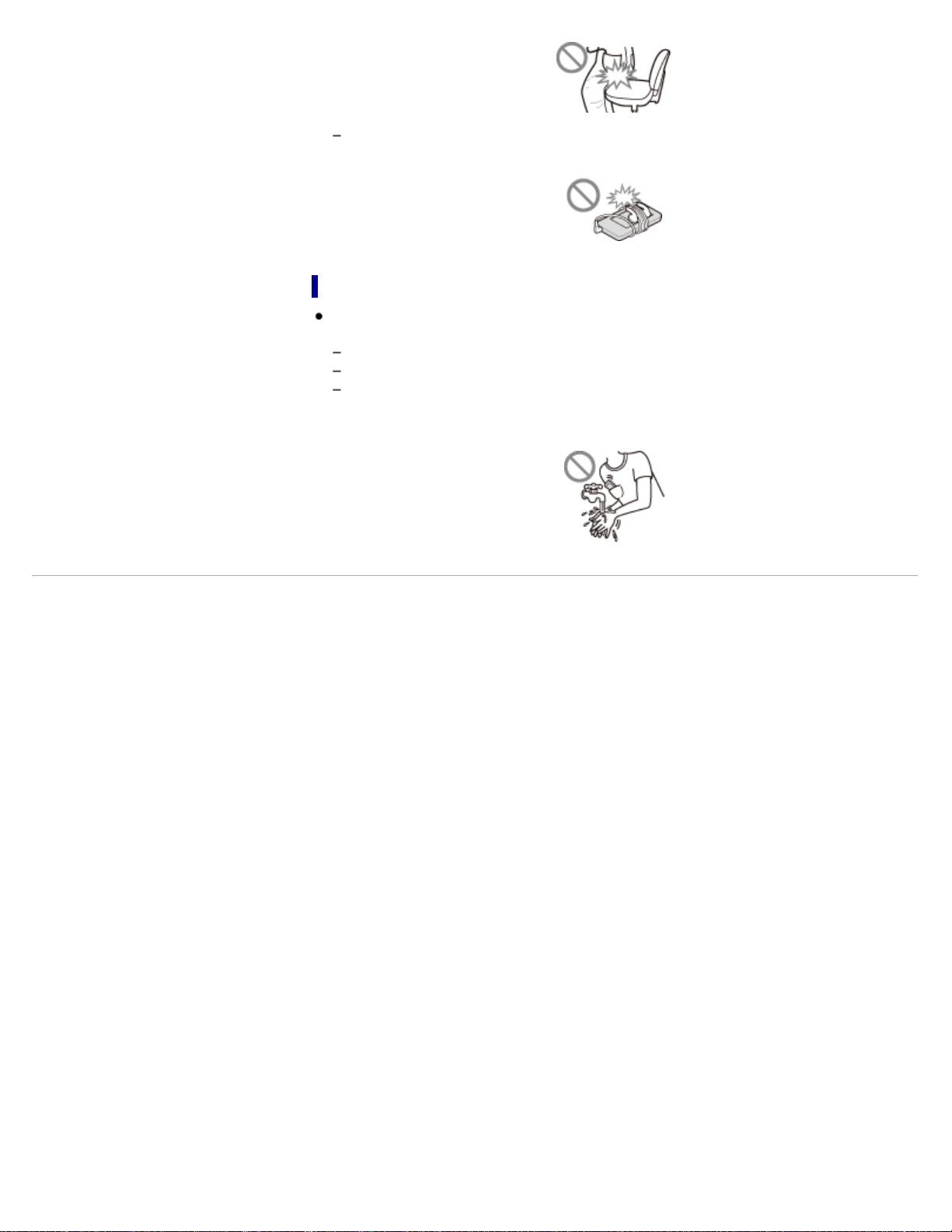
Make sure not to put the player into a bag with the headphones/earphones cord wrapped
around it and then subject the bag to strong impact.
Notes on protecting the player from getting wet
Do not expose the player to water. The player is not waterproof. Remember to follow the
precautions below.
Be careful not to drop the player into a sink or other container filled with water.
Do not use the player in humid locations or bad weather, such as in the rain or snow.
Do not get the player wet.
If you touch the player with wet hands, or put the player in a damp article of clothing, the
player may get wet and this may cause a malfunction of the player.
Back to top
Copyright 2010 Sony Corporation
221
WALKMAN User Guide
Print
Getting Started
How to Use the Software
Music
“SensMe™ Channels”
Videos/Podcasts/Photos
FM Radio
Making/Playing Voice
Recordings
Timer
Settings
Troubleshooting
Important Information
Specifications
Contents list
Top page > Important Information > Precautions > Notice for users
Notice for users
The recorded song is limited to private use only. Use of the song beyond this limit requires
permission of the copyright holders.
Sony is not responsible for incomplete recording/downloading or damaged data due to
problems of the player or computer.
Depending on the type of the text and characters, the text shown on the player may not be
displayed properly on device. This is due to:
The capacity of the connected player.
The player is not functioning normally.
Content information is written in language or character that are not supported by the player.
Heat may build up in the player while charging if it is used for an extended period of time.
Note that condensation may form temporarily in cases such as when the player is moved
quickly from a low-temperature environment to a high temperature environment, or used in a
room that has a heater just turned on. Condensation creates a phenomenon where moisture
in the air adheres to surfaces such as metal panels, etc., and then changes to liquid.
If condensation forms in the player, leave it turned off until the condensation disappears. If
you use the player with condensation present, a malfunction may result.
If you use the player in a cold location, images may appear with black bands around them.
This is not a malfunction of the player.
About sample data (*1)
The player is pre-installed with sample data.
If you delete the sample data, you cannot restore it, and we will not supply any replacement data.
(*1) In some countries/regions some sample data is not installed.
Back to top
Copyright 2010 Sony Corporation
222
WALKMAN User Guide
Print
Getting Started
How to Use the Software
Music
“SensMe™ Channels”
Videos/Podcasts/Photos
FM Radio
Making/Playing Voice
Recordings
Timer
Settings
Troubleshooting
Important Information
Specifications
Contents list
Top page > Important Information > Precautions > Notes on the headphones
Notes on the headphones
Road safety
Avoid listening with your headphones in situations where hearing must not be impaired.
Preventing hearing damage
Avoid using the headphones at a high volume. Hearing experts advise against continuous, loud
and extended play. If you experience a ringing in your ears, reduce the volume or discontinue
use.
Do not turn the volume up high all at once, especially when using headphones. Turn up the
volume gradually to avoid excessive levels hurting your ears.
Caring for others
Keep the volume at a moderate level. This will allow you to hear outside sounds and to be
considerate to the people around you.
Back to top
Copyright 2010 Sony Corporation
223
WALKMAN User Guide
Print
Getting Started
How to Use the Software
Music
“SensMe™ Channels”
Videos/Podcasts/Photos
FM Radio
Making/Playing Voice
Recordings
Timer
Settings
Troubleshooting
Important Information
Specifications
Contents list
Top page > Important Information > Precautions > Notes on the software
Notes on the software
Copyright laws prohibit reproducing the software or the manual accompanying it in whole or in
part, or renting the software without the permission of the copyright holder.
In no event will Sony be liable for any financial damage, or loss of profits, including claims
made by third parties, arising out of the use of the software supplied with this player.
The software provided with this player cannot be used with equipment other than that to
which it is so designated.
Please note that, due to continued efforts to improve quality, the software specifications may
be changed without notice.
Operation of this player with software other than that provided is not covered by the warranty.
The ability to display the languages on supplied software will depend on the installed OS on
your computer. For better results, please ensure that the installed OS is compatible with the
desired language you want to display.
We do not guarantee all the languages will be able to be displayed properly on the supplied
software.
User-created characters and some special characters may not be displayed.
The explanations in this manual assume that you are familiar with the basic operations of
Windows.
For details on the use of your computer and operating system, please refer to the respective
manuals.
Back to top
Copyright 2010 Sony Corporation
224
WALKMAN User Guide
Print
Getting Started
How to Use the Software
Music
“SensMe™ Channels”
Videos/Podcasts/Photos
FM Radio
Making/Playing Voice
Recordings
Timer
Settings
Troubleshooting
Important Information
Specifications
Contents list
Top page > Important Information > Cleaning > Notes on cleaning
Notes on cleaning
Clean the player’s case with a soft cloth, such as a cleaning cloth for eyeglasses.
If the player’s case should become very dirty, clean it with a soft cloth slightly moistened with
water or a mild detergent solution.
Do not use any type of abrasive pad, scouring powder, or solvent, such as alcohol or
benzene, as it may mar the finish of the case.
Be careful not to let water get into the player from the opening near the connector.
Clean the headphone plug periodically.
Back to top
Copyright 2010 Sony Corporation
225
WALKMAN User Guide
Print
Getting Started
How to Use the Software
Music
“SensMe™ Channels”
Videos/Podcasts/Photos
FM Radio
Making/Playing Voice
Recordings
Timer
Settings
Troubleshooting
Important Information
Specifications
Contents list
Top page > Important Information > Storing Data > Storing data
Storing data
You can store computer data into the built-in flash memory of the player by transferring the data
from your computer using Windows Explorer, or other transfer-capable software. If the player is
connected to the computer, the built-in flash memory appears in Windows Explorer as
[WALKMAN].
Note
Do not use the bundled software while using Windows Explorer to interact with the built-in
flash memory of the player.
Do not disconnect the USB cable (supplied) while [Do not disconnect.] appears during data
transfer. Otherwise, the data being transferred or the data stored in the player may be
damaged.
Do not rename the [MUSIC], [MP_ROOT], [MPE_ROOT], [VIDEO], [DCIM], [PICTURE],
[PICTURES], [SCREENSAVER] [PODCASTS] [RECORD] and [VOICE] folders. Also, do not
rename files and folders under them. Otherwise, they will not be displayed on the player.
Back to top
Copyright 2010 Sony Corporation
226
WALKMAN User Guide
Print
Getting Started
How to Use the Software
Music
“SensMe™ Channels”
Videos/Podcasts/Photos
FM Radio
Making/Playing Voice
Recordings
Timer
Settings
Troubleshooting
Important Information
Specifications
Contents list
Top page > Important Information > Upgrading the Player’s Firmware > Upgrading the player’s
firmware
Upgrading the player’s firmware
You can update the player’s firmware. Installing the latest player’s firmware allows you to add
new features to the player. For details on the latest firmware information and how to install it, visit
the customer support Web sites [Details].
1. Download the update program to your computer from the Web site.
2. Connect the player to your computer, and then start the update program.
3. Follow the on-screen instructions to update the player’s firmware.
Firmware update is complete.
Hint
Version information for the player’s firmware can be displayed by selecting
[Settings]
[Common Settings] [Unit Information] from the Home menu [Details].
Back to top
Copyright 2010 Sony Corporation
227
WALKMAN User Guide
Print
Getting Started
How to Use the Software
Music
“SensMe™ Channels”
Videos/Podcasts/Photos
FM Radio
Making/Playing Voice
Recordings
Timer
Settings
Troubleshooting
Important Information
Specifications
Contents list
Top page > Important Information > License and Trademark Notice > License and trademark
notice
License and trademark notice
Important information on software
GNU LESSER GENERAL PUBLIC LICENSE
GNU GENERAL PUBLIC LICENSE
ATRAC is trademark of Sony Corporation.
“WALKMAN” and “WALKMAN” logo are registered trademarks of Sony Corporation.
and are trademarks of Sony Corporation.
12 TONE ANALYSIS and its logo are trademarks of Sony Corporation.
SensMe™ and the SensMe™ logo are trademarks or registered trademarks of Sony Ericsson
Mobile Communications AB.
“PlayStation” and “PSP” are registered trademarks of Sony Computer Entertainment Inc.
Microsoft, Windows, Windows Vista and Windows Media are trademarks or registered
trademarks of Microsoft Corporation in the United States and/or other countries.
MPEG Layer-3 audio coding technology and patents licensed from Fraunhofer IIS and
Thomson.
IBM and PC/AT are registered trademarks of International Business Machines Corporation.
Apple, Macintosh and iTunes are trademarks of Apple Inc., registered in the U.S. and other
countries.
Pentium is a trademark or a registered trademark of Intel Corporation.
This software is based in part on the work of the Independent JPEG Group.
THIS PRODUCT IS LICENSED UNDER THE MPEG-4 VISUAL PATENT PORTFOLIO
LICENSE FOR THE PERSONAL AND NON-COMMERCIAL USE OF A CONSUMER FOR
(i) ENCODING VIDEO IN COMPLIANCE WITH THE MPEG-4 VISUAL STANDARD (“MPEG-
4 VIDEO”) AND/OR
(ii) DECODING MPEG-4 VIDEO THAT WAS ENCODED BY A CONSUMER ENGAGED IN A
PERSONAL AND NON-COMMERCIAL ACTIVITY AND/OR WAS OBTAINED FROM A
VIDEO PROVIDER LICENSED BY MPEG LA TO PROVIDE MPEG-4 VIDEO.
NO LICENSE IS GRANTED OR SHALL BE IMPLIED FOR ANY OTHER USE. ADDITIONAL
INFORMATION INCLUDING THAT RELATING TO PROMOTIONAL, INTERNAL AND
COMMERCIAL USES AND LICENSING MAY BE OBTAINED FROM MPEG LA, LLC. SEE
HTTP://WWW.MPEGLA.COM
THIS PRODUCT IS LICENSED UNDER THE AVC PATENT PORTFOLIO LICENSE FOR
THE PERSONAL AND NON-COMMERCIAL USE OF A CONSUMER TO
(i) ENCODE VIDEO IN COMPLIANCE WITH THE AVC STANDARD (“AVC VIDEO”) AND/OR
(ii) DECODE AVC VIDEO THAT WAS ENCODED BY A CONSUMER ENGAGED IN A
PERSONAL AND
NON-COMMERCIAL ACTIVITY AND/OR WAS OBTAINED FROM A VIDEO PROVIDER
LICENSED TO PROVIDE AVC VIDEO. NO LICENSE IS GRANTED OR SHALL BE IMPLIED
FOR ANY OTHER USE. ADDITIONAL INFORMATION MAY BE OBTAINED FROM MPEG
LA, L.L.C. SEE
HTTP://WWW.MPEGLA.COM
THIS PRODUCT IS LICENSED UNDER THE VC-1 PATENT PORTFOLIO LICENSE FOR
THE PERSONAL AND NON-COMMERCIAL USE OF A CONSUMER TO
(i) ENCODE VIDEO IN COMPLIANCE WITH THE VC-1 STANDARD (“VC-1 VIDEO”)
AND/OR
(ii) DECODE VC-1 VIDEO THAT WAS ENCODED BY A CONSUMER ENGAGED IN A
PERSONAL AND NON-COMMERCIAL ACTIVITY AND/OR WAS OBTAINED FROM A
228

VIDEO PROVIDER LICENSED TO PROVIDE VC-1 VIDEO.
NO LICENSE IS GRANTED OR SHALL BE IMPLIED FOR ANY OTHER USE. ADDITIONAL
INFORMATION MAY BE OBTAINED FROM MPEG LA, L.L.C. SEE
HTTP://WWW.MPEGLA.COM
All other trademarks and registered trademarks are trademarks or registered trademarks of
their respective holders. In this manual, TM and ® marks are not specified.
This product is manufactured in compliance with “Embedded Memory with Playback and
Recording Function System” (hereafter referred to as EMPR (*1)) standard. “MagicGate Type-R
for Secure Video Recording for EMPR” is applied to this product as a content protection method.
(*1) “EMPR” is a name of a standard for systems that support copyright protection system developed by
Sony Corporation. “MagicGate Type-R for Secure Video Recording for EMPR” has received approval
from Dpa (The Association for Promotion of Digital Broadcasting) as a content protection method for
making a recording of digital broadcasting.
This product is protected by certain intellectual property rights of Microsoft Corporation. Use or
distribution of such technology outside of this product is prohibited without a license from
Microsoft or an authorized Microsoft subsidiary.
Content providers are using the digital rights management technology for Windows Media
contained in this device (“WM-DRM”) to protect the integrity of their content (“Secure Content”)
so that their intellectual property, including copyright, in such content is not misappropriated.
This device uses WM-DRM software to play Secure Content (“WM-DRM Software”). If the
security of the WM-DRM Software in this device has been compromised, owners of Secure
Content (“Secure Content Owners”) may request that Microsoft revoke the WM-DRM Software’s
right to acquire new licenses to copy, display and/or play Secure Content. Revocation does not
alter the WM-DRM Software’s ability to play unprotected content. A list of revoked WM-DRM
Software is sent to your device whenever you download a license for Secure Content from the
Internet or from a PC. Microsoft may, in conjunction with such license, also download revocation
lists onto your device on behalf of Secure Content Owners.
Program ©2010 Sony Corporation
Documentation ©2010 Sony Corporation
Information on Expat
Copyright ©1998, 1999, 2000 Thai Open Source Software Center Ltd and Clark Cooper.
Copyright ©2001, 2002, 2003, 2004, 2005, 2006 Expat maintainers.
Permission is hereby granted, free of charge, to any person obtaining a copy of this software and
associated documentation files (the “Software”), to deal in the Software without restriction,
including without limitation the rights to use, copy, modify, merge, publish, distribute, sublicense,
and/or sell copies of the Software, and to permit persons to whom the Software is furnished to
do so, subject to the following conditions:
The above copyright notice and this permission notice shall be included in all copies or
substantial portions of the Software.
THE SOFTWARE IS PROVIDED “AS IS”, WITHOUT WARRANTY OF ANY KIND, EXPRESS OR
IMPLIED, INCLUDING BUT NOT LIMITED TO THE WARRANTIES OF MERCHANTABILITY,
FITNESS FOR A PARTICULAR PURPOSE AND NONINFRINGEMENT.
IN NO EVENT SHALL THE AUTHORS OR COPYRIGHT HOLDERS BE LIABLE FOR ANY
CLAIM, DAMAGES OR OTHER LIABILITY, WHETHER IN AN ACTION OF CONTRACT, TORT
OR OTHERWISE, ARISING FROM, OUT OF OR IN CONNECTION WITH THE SOFTWARE OR
THE USE OR OTHER DEALINGS IN THE SOFTWARE.
Information on ncurses
Copyright (c) 1998-2004,2006 Free Software Foundation, Inc.
Permission is hereby granted, free of charge, to any person obtaining a copy of this software and
associated documentation files (the “Software”), to deal in the Software without restriction,
including without limitation the rights to use, copy, modify, merge, publish, distribute, distribute
229

with modifications, sublicense, and/or sell copies of the Software, and to permit persons to whom
the Software is furnished to do so, subject to the following conditions:
The above copyright notice and this permission notice shall be included in all copies or
substantial portions of the Software.
THE SOFTWARE IS PROVIDED “AS IS”, WITHOUT WARRANTY OF ANY KIND, EXPRESS OR
IMPLIED, INCLUDING BUT NOT LIMITED TO THE WARRANTIES OF MERCHANTABILITY,
FITNESS FOR A PARTICULAR PURPOSE AND NONINFRINGEMENT. IN NO EVENT SHALL
THE ABOVE COPYRIGHT HOLDERS BE LIABLE FOR ANY CLAIM, DAMAGES OR OTHER
LIABILITY, WHETHER IN AN ACTION OF CONTRACT, TORT OR OTHERWISE, ARISING
FROM, OUT OF OR IN CONNECTION WITH THE SOFTWARE OR THE USE OR OTHER
DEALINGS IN THE SOFTWARE.
Except as contained in this notice, the name(s) of the above copyright holders shall not be used
in advertising or otherwise to promote the sale, use or other dealings in this Software without
prior written authorization.
Information on netkit-ftp
Copyright (c) 1985, 1989 Regents of the University of California.
All rights reserved.
Redistribution and use in source and binary forms, with or without modification, are permitted
provided that the following conditions are met:
1. Redistributions of source code must retain the above copyright notice, this list of conditions
and the following disclaimer.
2. Redistributions in binary form must reproduce the above copyright notice, this list of conditions
and the following disclaimer in the documentation and/or other materials provided with the
distribution.
3. All advertising materials mentioning features or use of this software must display the following
acknowledgement:
This product includes software developed by the University of California, Berkeley and its
contributors.
4. Neither the name of the University nor the names of its contributors may be used to endorse
or promote products derived from this software without specific prior written permission.
THIS SOFTWARE IS PROVIDED BY THE REGENTS AND CONTRIBUTORS “AS IS” AND ANY
EXPRESS OR IMPLIED WARRANTIES, INCLUDING, BUT NOT LIMITED TO, THE IMPLIED
WARRANTIES OF MERCHANTABILITY AND FITNESS FOR A PARTICULAR PURPOSE ARE
DISCLAIMED. IN NO EVENT SHALL THE REGENTS OR CONTRIBUTORS BE LIABLE FOR
ANY DIRECT, INDIRECT, INCIDENTAL, SPECIAL, EXEMPLARY, OR CONSEQUENTIAL
DAMAGES (INCLUDING, BUT NOT LIMITED TO, PROCUREMENT OF SUBSTITUTE GOODS
OR SERVICES; LOSS OF USE, DATA, OR PROFITS; OR BUSINESS INTERRUPTION)
HOWEVER CAUSED AND ON ANY THEORY OF LIABILITY, WHETHER IN CONTRACT,
STRICT LIABILITY, OR TORT (INCLUDING NEGLIGENCE OR OTHERWISE) ARISING IN ANY
WAY OUT OF THE USE OF THIS SOFTWARE, EVEN IF ADVISED OF THE POSSIBILITY OF
SUCH DAMAGE.
Information on strace
Copyright (c) 1991, 1992 Paul Kranenburg <[email protected]>
Copyright (c) 1993 Branko Lankester <[email protected]>
Copyright (c) 1993 Ulrich Pegelow <[email protected]-muenster.de>
Copyright (c) 1995, 1996 Michael Elizabeth Chastain <[email protected]>
Copyright (c) 1993, 1994, 1995, 1996 Rick Sladkey <[email protected]>
Copyright (c) 1998-2001 Wichert Akkerman <[email protected]>
All rights reserved.
Redistribution and use in source and binary forms, with or without modification, are permitted
provided that the following conditions are met:
1. Redistributions of source code must retain the above copyright notice, this list of conditions
230

and the following disclaimer.
2. Redistributions in binary form must reproduce the above copyright notice, this list of conditions
and the following disclaimer in the documentation and/or other materials provided with the
distribution.
3. The name of the author may not be used to endorse or promote products derived from this
software without specific prior written permission.
THIS SOFTWARE IS PROVIDED BY THE AUTHOR “AS IS” AND ANY EXPRESS OR IMPLIED
WARRANTIES, INCLUDING, BUT NOT LIMITED TO, THE IMPLIED WARRANTIES OF
MERCHANTABILITY AND FITNESS FOR A PARTICULAR PURPOSE ARE DISCLAIMED.
IN NO EVENT SHALL THE AUTHOR BE LIABLE FOR ANY DIRECT, INDIRECT, INCIDENTAL,
SPECIAL, EXEMPLARY, OR CONSEQUENTIAL DAMAGES (INCLUDING, BUT NOT LIMITED
TO, PROCUREMENT OF SUBSTITUTE GOODS OR SERVICES; LOSS OF USE, DATA, OR
PROFITS; OR BUSINESS INTERRUPTION) HOWEVER CAUSED AND ON ANY THEORY OF
LIABILITY, WHETHER IN CONTRACT, STRICT LIABILITY, OR TORT (INCLUDING
NEGLIGENCE OR OTHERWISE) ARISING IN ANY WAY OUT OF THE USE OF THIS
SOFTWARE, EVEN IF ADVISED OF THE POSSIBILITY OF SUCH DAMAGE.
Important information on software
Included with this product is software, of which permission for use is obtained either directly or
indirectly by Sony Corporation (hereafter Sony) through a third party. Make sure to read this
important information on software.
Information on software applicable to GNU GPL/LGPL
Included with this product is software (refer to the following “Package List”) which is subject to the
following GNU General Public License (hereafter GPL) or GNU Lesser General Public License
(hereafter LGPL). Users have the right to obtain, modify and redistribute the source code of
software in accordance with the attached GPL/LGPL.
Sony provides these source codes on the following web site. Please visit the following web site
to obtain the source codes.
http://www.sony.net/Products/Linux/
Please do not make direct requests for the contents of the source codes.
Package List
busybox dosfstools mdadm sysvinit
udev u-boot linux-kernel procps
e2fsprogs alsa-lib alsa-utils gcc
glibc lrzsz coreutils net-tools
nfs-utils
GNU LESSER GENERAL PUBLIC LICENSE
Version 2.1, February 1999
Copyright (C) 1991, 1999 Free Software Foundation, Inc. 59 Temple Place, Suite 330, Boston,
MA 02111-1307 USA Everyone is permitted to copy and distribute verbatim copies of this license
document, but changing it is not allowed.
[This is the first released version of the Lesser GPL. It also counts as the successor of the GNU
Library Public License, version 2, hence the version number 2.1.]
Preamble
The licenses for most software are designed to take away your freedom to share and change it.
By contrast, the GNU General Public Licenses are intended to guarantee your freedom to share
231

and change free software--to make sure the software is free for all its users.
This license, the Lesser General Public License, applies to some specially designated software
packages--typically libraries--of the Free Software Foundation and other authors who decide to
use it. You can use it too, but we suggest you first think carefully about whether this license or
the ordinary General Public License is the better strategy to use in any particular case, based on
the explanations below.
When we speak of free software, we are referring to freedom of use, not price. Our General
Public Licenses are designed to make sure that you have the freedom to distribute copies of free
software (and charge for this service if you wish); that you receive source code or can get it if you
want it; that you can change the software and use pieces of it in new free programs; and that
you are informed that you can do these things.
To protect your rights, we need to make restrictions that forbid distributors to deny you these
rights or to ask you to surrender these rights. These restrictions translate to certain
responsibilities for you if you distribute copies of the library or if you modify it.
For example, if you distribute copies of the library, whether gratis or for a fee, you must give the
recipients all the rights that we gave you. You must make sure that they, too, receive or can get
the source code. If you link other code with the library, you must provide complete object files to
the recipients, so that they can relink them with the library after making changes to the library and
recompiling it. And you must show them these terms so they know their rights.
We protect your rights with a two-step method: (1) we copyright the library, and (2) we offer you
this license, which gives you legal permission to copy, distribute and/or modify the library. To
protect each distributor, we want to make it very clear that there is no warranty for the free
library. Also, if the library is modified by someone else and passed on, the recipients should know
that what they have is not the original version, so that the original author’s reputation will not be
affected by problems that might be introduced by others.
Finally, software patents pose a constant threat to the existence of any free program. We wish to
make sure that a company cannot effectively restrict the users of a free program by obtaining a
restrictive license from a patent holder. Therefore, we insist that any patent license obtained for a
version of the library must be consistent with the full freedom of use specified in this license.
Most GNU software, including some libraries, is covered by the ordinary GNU General Public
License. This license, the GNU Lesser General Public License, applies to certain designated
libraries, and is quite different from the ordinary General Public License. We use this license for
certain libraries in order to permit linking those libraries into non-free programs.
When a program is linked with a library, whether statically or using a shared library, the
combination of the two is legally speaking a combined work, a derivative of the original library.
The ordinary General Public License therefore permits such linking only if the entire combination
fits its criteria of freedom. The Lesser General Public License permits more lax criteria for linking
other code with the library.
We call this license the “Lesser” General Public License because it does Less to protect the
user’s freedom than the ordinary General Public License. It also provides other free software
developers Less of an advantage over competing non-free programs. These disadvantages are
the reason we use the ordinary General Public License for many libraries. However, the Lesser
license provides advantages in certain special circumstances.
For example, on rare occasions, there may be a special need to encourage the widest possible
use of a certain library, so that it becomes a de-facto standard. To achieve this, non-free
programs must be allowed to use the library. A more frequent case is that a free library does the
same job as widely used non-free libraries. In this case, there is little to gain by limiting the free
library to free software only, so we use the Lesser General Public License.
In other cases, permission to use a particular library in non-free programs enables a greater
number of people to use a large body of free software. For example, permission to use the GNU
232

C Library in non-free programs enables many more people to use the whole GNU operating
system, as well as its variant, the GNU/Linux operating system.
Although the Lesser General Public License is Less protective of the users’ freedom, it does
ensure that the user of a program that is linked with the Library has the freedom and the
wherewithal to run that program using a modified version of the Library.
The precise terms and conditions for copying, distribution and modification follow. Pay close
attention to the difference between a “work based on the library” and a “work that uses the
library”. The former contains code derived from the library, whereas the latter must be combined
with the library in order to run.
TERMS AND CONDITIONS FOR COPYING, DISTRIBUTION AND
MODIFICATION
0. This License Agreement applies to any software library or other program which contains a
notice placed by the copyright holder or other authorized party saying it may be distributed under
the terms of this Lesser General Public License (also called “this License”). Each licensee is
addressed as “you”.
A “library” means a collection of software functions and/or data prepared so as to be
conveniently linked with application programs (which use some of those functions and data) to
form executables.
The “Library”, below, refers to any such software library or work which has been distributed under
these terms. A “work based on the Library” means either the Library or any derivative work under
copyright law: that is to say, a work containing the Library or a portion of it, either verbatim or
with modifications and/or translated straightforwardly into another language. (Hereinafter,
translation is included without limitation in the term “modification”.)
“Source code” for a work means the preferred form of the work for making modifications to it. For
a library, complete source code means all the source code for all modules it contains, plus any
associated interface definition files, plus the scripts used to control compilation and installation of
the library.
Activities other than copying, distribution and modification are not covered by this License; they
are outside its scope. The act of running a program using the Library is not restricted, and output
from such a program is covered only if its contents constitute a work based on the Library
(independent of the use of the Library in a tool for writing it). Whether that is true depends on
what the Library does and what the program that uses the Library does.
1. You may copy and distribute verbatim copies of the Library’s complete source code as you
receive it, in any medium, provided that you conspicuously and appropriately publish on each
copy an appropriate copyright notice and disclaimer of warranty; keep intact all the notices that
refer to this License and to the absence of any warranty; and distribute a copy of this License
along with the Library.
You may charge a fee for the physical act of transferring a copy, and you may at your option
offer warranty protection in exchange for a fee.
2. You may modify your copy or copies of the Library or any portion of it, thus forming a work
based on the Library, and copy and distribute such modifications or work under the terms of
Section 1 above, provided that you also meet all of these conditions:
a) The modified work must itself be a software library.
b) You must cause the files modified to carry prominent notices stating that you changed the files
and the date of any change.
c) You must cause the whole of the work to be licensed at no charge to all third parties under the
233

terms of this License.
d) If a facility in the modified Library refers to a function or a table of data to be supplied by an
application program that uses the facility, other than as an argument passed when the facility is
invoked, then you must make a good faith effort to ensure that, in the event an application does
not supply such function or table, the facility still operates, and performs whatever part of its
purpose remains meaningful.
(For example, a function in a library to compute square roots has a purpose that is entirely well-
defined independent of the application. Therefore, Subsection 2d requires that any application-
supplied function or table used by this function must be optional: if the application does not
supply it, the square root function must still compute square roots.)
These requirements apply to the modified work as a whole. If identifiable sections of that work
are not derived from the Library, and can be reasonably considered independent and separate
works in themselves, then this License, and its terms, do not apply to those sections when you
distribute them as separate works. But when you distribute the same sections as part of a whole
which is a work based on the Library, the distribution of the whole must be on the terms of this
License, whose permissions for other licensees extend to the entire whole, and thus to each and
every part regardless of who wrote it.
Thus, it is not the intent of this section to claim rights or contest your rights to work written
entirely by you; rather, the intent is to exercise the right to control the distribution of derivative or
collective works based on the Library.
In addition, mere aggregation of another work not based on the Library with the Library (or with a
work based on the Library) on a volume of a storage or distribution medium does not bring the
other work under the scope of this License.
3. You may opt to apply the terms of the ordinary GNU General Public License instead of this
License to a given copy of the Library. To do this, you must alter all the notices that refer to this
License, so that they refer to the ordinary GNU General Public License, version 2, instead of to
this License. (If a newer version than version 2 of the ordinary GNU General Public License has
appeared, then you can specify that version instead if you wish.) Do not make any other change
in these notices.
Once this change is made in a given copy, it is irreversible for that copy, so the ordinary GNU
General Public License applies to all subsequent copies and derivative works made from that
copy.
This option is useful when you wish to copy part of the code of the Library into a program that is
not a library.
4. You may copy and distribute the Library (or a portion or derivative of it, under Section 2) in
object code or executable form under the terms of Sections 1 and 2 above provided that you
accompany it with the complete corresponding machine-readable source code, which must be
distributed under the terms of Sections 1 and 2 above on a medium customarily used for
software interchange.
If distribution of object code is made by offering access to copy from a designated place, then
offering equivalent access to copy the source code from the same place satisfies the requirement
to distribute the source code, even though third parties are not compelled to copy the source
along with the object code.
5. A program that contains no derivative of any portion of the Library, but is designed to work
with the Library by being compiled or linked with it, is called a “work that uses the Library”. Such
a work, in isolation, is not a derivative work of the Library, and therefore falls outside the scope of
this License.
However, linking a “work that uses the Library” with the Library creates an executable that is a
234

derivative of the Library (because it contains portions of the Library), rather than a “work that
uses the library”. The executable is therefore covered by this License. Section 6 states terms for
distribution of such executables.
When a “work that uses the Library” uses material from a header file that is part of the Library,
the object code for the work may be a derivative work of the Library even though the source
code is not. Whether this is true is especially significant if the work can be linked without the
Library, or if the work is itself a library. The threshold for this to be true is not precisely defined by
law.
If such an object file uses only numerical parameters, data structure layouts and accessors, and
small macros and small inline functions (ten lines or less in length), then the use of the object file
is unrestricted, regardless of whether it is legally a derivative work. (Executables containing this
object code plus portions of the Library will still fall under Section 6.)
Otherwise, if the work is a derivative of the Library, you may distribute the object code for the
work under the terms of Section 6. Any executables containing that work also fall under Section
6, whether or not they are linked directly with the Library itself.
6. As an exception to the Sections above, you may also combine or link a “work that uses the
Library” with the Library to produce a work containing portions of the Library, and distribute that
work under terms of your choice, provided that the terms permit modification of the work for the
customer’s own use and reverse engineering for debugging such modifications.
You must give prominent notice with each copy of the work that the Library is used in it and that
the Library and its use are covered by this License. You must supply a copy of this License. If the
work during execution displays copyright notices, you must include the copyright notice for the
Library among them, as well as a reference directing the user to the copy of this License. Also,
you must do one of these things:
a) Accompany the work with the complete corresponding machine-readable source code for the
Library including whatever changes were used in the work (which must be distributed under
Sections 1 and 2 above); and, if the work is an executable linked with the Library, with the
complete machine-readable “work that uses the Library”, as object code and/or source code, so
that the user can modify the Library and then relink to produce a modified executable containing
the modified Library. (It is understood that the user who changes the contents of definitions files
in the Library will not necessarily be able to recompile the application to use the modified
definitions.)
b) Use a suitable shared library mechanism for linking with the Library. A suitable mechanism is
one that (1) uses at run time a copy of the library already present on the user’s computer
system, rather than copying library functions into the executable, and (2) will operate properly
with a modified version of the library, if the user installs one, as long as the modified version is
interface-compatible with the version that the work was made with.
c) Accompany the work with a written offer, valid for at least three years, to give the same user
the materials specified in Subsection 6a, above, for a charge no more than the cost of performing
this distribution.
d) If distribution of the work is made by offering access to copy from a designated place, offer
equivalent access to copy the above specified materials from the same place.
e) Verify that the user has already received a copy of these materials or that you have already
sent this user a copy.
For an executable, the required form of the “work that uses the Library” must include any data
and utility programs needed for reproducing the executable from it. However, as a special
exception, the materials to be distributed need not include anything that is normally distributed (in
either source or binary form) with the major components (compiler, kernel, and so on) of the
operating system on which the executable runs, unless that component itself accompanies the
235

executable.
It may happen that this requirement contradicts the license restrictions of other proprietary
libraries that do not normally accompany the operating system. Such a contradiction means you
cannot use both them and the Library together in an executable that you distribute.
7. You may place library facilities that are a work based on the Library side-by-side in a single
library together with other library facilities not covered by this License, and distribute such a
combined library, provided that the separate distribution of the work based on the Library and of
the other library facilities is otherwise permitted, and provided that you do these two things:
a) Accompany the combined library with a copy of the same work based on the Library,
uncombined with any other library facilities. This must be distributed under the terms of the
Sections above.
b) Give prominent notice with the combined library of the fact that part of it is a work based on
the Library, and explaining where to find the accompanying uncombined form of the same work.
8. You may not copy, modify, sublicense, link with, or distribute the Library except as expressly
provided under this License. Any attempt otherwise to copy, modify, sublicense, link with, or
distribute the Library is void, and will automatically terminate your rights under this License.
However, parties who have received copies, or rights, from you under this License will not have
their licenses terminated so long as such parties remain in full compliance.
9. You are not required to accept this License, since you have not signed it. However, nothing
else grants you permission to modify or distribute the Library or its derivative works. These
actions are prohibited by law if you do not accept this License. Therefore, by modifying or
distributing the Library (or any work based on the Library), you indicate your acceptance of this
License to do so, and all its terms and conditions for copying, distributing or modifying the Library
or works based on it.
10. Each time you redistribute the Library (or any work based on the Library), the recipient
automatically receives a license from the original licensor to copy, distribute, link with or modify
the Library subject to these terms and conditions. You may not impose any further restrictions on
the recipients’ exercise of the rights granted herein. You are not responsible for enforcing
compliance by third parties with this License.
11. If, as a consequence of a court judgment or allegation of patent infringement or for any other
reason (not limited to patent issues), conditions are imposed on you (whether by court order,
agreement or otherwise) that contradict the conditions of this License, they do not excuse you
from the conditions of this License. If you cannot distribute so as to satisfy simultaneously your
obligations under this License and any other pertinent obligations, then as a consequence you
may not distribute the Library at all. For example, if a patent license would not permit royalty-free
redistribution of the Library by all those who receive copies directly or indirectly through you, then
the only way you could satisfy both it and this License would be to refrain entirely from
distribution of the Library.
If any portion of this section is held invalid or unenforceable under any particular circumstance,
the balance of the section is intended to apply, and the section as a whole is intended to apply in
other circumstances.
It is not the purpose of this section to induce you to infringe any patents or other property right
claims or to contest validity of any such claims; this section has the sole purpose of protecting
the integrity of the free software distribution system which is implemented by public license
practices. Many people have made generous contributions to the wide range of software
distributed through that system in reliance on consistent application of that system; it is up to the
author/donor to decide if he or she is willing to distribute software through any other system and
a licensee cannot impose that choice.
This section is intended to make thoroughly clear what is believed to be a consequence of the
236

rest of this License.
12. If the distribution and/or use of the Library is restricted in certain countries either by patents
or by copyrighted interfaces, the original copyright holder who places the Library under this
License may add an explicit geographical distribution limitation excluding those countries, so that
distribution is permitted only in or among countries not thus excluded. In such case, this License
incorporates the limitation as if written in the body of this License.
13. The Free Software Foundation may publish revised and/or new versions of the Lesser
General Public License from time to time. Such new versions will be similar in spirit to the
present version, but may differ in detail to address new problems or concerns.
Each version is given a distinguishing version number. If the Library specifies a version number of
this License which applies to it and “any later version”, you have the option of following the terms
and conditions either of that version or of any later version published by the Free Software
Foundation. If the Library does not specify a license version number, you may choose any
version ever published by the Free Software Foundation.
14. If you wish to incorporate parts of the Library into other free programs whose distribution
conditions are incompatible with these, write to the author to ask for permission. For software
which is copyrighted by the Free Software Foundation, write to the Free Software Foundation; we
sometimes make exceptions for this. Our decision will be guided by the two goals of preserving
the free status of all derivatives of our free software and of promoting the sharing and reuse of
software generally.
NO WARRANTY
15. BECAUSE THE LIBRARY IS LICENSED FREE OF CHARGE, THERE IS NO WARRANTY
FOR THE LIBRARY, TO THE EXTENT PERMITTED BY APPLICABLE LAW. EXCEPT WHEN
OTHERWISE STATED IN WRITING THE COPYRIGHT HOLDERS AND/OR OTHER PARTIES
PROVIDE THE LIBRARY “AS IS” WITHOUT WARRANTY OF ANY KIND, EITHER EXPRESSED
OR IMPLIED, INCLUDING, BUT NOT LIMITED TO, THE IMPLIED WARRANTIES OF
MERCHANTABILITY AND FITNESS FOR A PARTICULAR PURPOSE. THE ENTIRE RISK AS
TO THE QUALITY AND PERFORMANCE OF THE LIBRARY IS WITH YOU. SHOULD THE
LIBRARY PROVE DEFECTIVE, YOU ASSUME THE COST OF ALL NECESSARY SERVICING,
REPAIR OR CORRECTION.
16. IN NO EVENT UNLESS REQUIRED BY APPLICABLE LAW OR AGREED TO IN WRITING
WILL ANY COPYRIGHT HOLDER, OR ANY OTHER PARTY WHO MAY MODIFY AND/OR
REDISTRIBUTE THE LIBRARY AS PERMITTED ABOVE, BE LIABLE TO YOU FOR
DAMAGES, INCLUDING ANY GENERAL, SPECIAL, INCIDENTAL OR CONSEQUENTIAL
DAMAGES ARISING OUT OF THE USE OR INABILITY TO USE THE LIBRARY (INCLUDING
BUT NOT LIMITED TO LOSS OF DATA OR DATA BEING RENDERED INACCURATE OR
LOSSES SUSTAINED BY YOU OR THIRD PARTIES OR A FAILURE OF THE LIBRARY TO
OPERATE WITH ANY OTHER SOFTWARE), EVEN IF SUCH HOLDER OR OTHER PARTY
HAS BEEN ADVISED OF THE POSSIBILITY OF SUCH DAMAGES.
END OF TERMS AND CONDITIONS
How to Apply These Terms to Your New Libraries
If you develop a new library, and you want it to be of the greatest possible use to the public, we
recommend making it free software that everyone can redistribute and change. You can do so by
permitting redistribution under these terms (or, alternatively, under the terms of the ordinary
General Public License).
To apply these terms, attach the following notices to the library. It is safest to attach them to the
start of each source file to most effectively convey the exclusion of warranty; and each file
should have at least the “copyright” line and a pointer to where the full notice is found.
<one line to give the library’s name and an idea of what it does.>
Copyright (C) <year> <name of author>
237

This library is free software; you can redistribute it and/or modify it under the terms of the GNU
Lesser General Public License as published by the Free Software Foundation; either version 2.1
of the License, or (at your option) any later version.
This library is distributed in the hope that it will be useful, but WITHOUT ANY WARRANTY;
without even the implied warranty of MERCHANTABILITY or FITNESS FOR A PARTICULAR
PURPOSE. See the GNU Lesser General Public License for more details.
You should have received a copy of the GNU Lesser General Public License along with this
library; if not, write to the Free Software Foundation, Inc., 59 Temple Place, Suite 330, Boston,
MA 02111-1307 USA
Also add information on how to contact you by electronic and paper mail.
You should also get your employer (if you work as a programmer) or your school, if any, to sign a
“copyright disclaimer” for the library, if necessary. Here is a sample; alter the names:
Yoyodyne, Inc., hereby disclaims all copyright interest in the library ‘Frob’ (a library for tweaking
knobs) written by James Random Hacker.
signature of Ty Coon, 1 April 1990
Ty Coon, President of Vice
That’s all there is to it!
GNU GENERAL PUBLIC LICENSE
Version 2, June 1991
Copyright (C) 1989, 1991 Free Software Foundation, Inc. 59 Temple Place - Suite 330, Boston,
MA 02111-1307, USA
Everyone is permitted to copy and distribute verbatim copies of this license document, but
changing it is not allowed.
Preamble
The licenses for most software are designed to take away your freedom to share and change it.
By contrast, the GNU General Public License is intended to guarantee your freedom to share
and change free software--to make sure the software is free for all its users. This General Public
License applies to most of the Free Software Foundation’s software and to any other program
whose authors commit to using it. (Some other Free Software Foundation software is covered by
the GNU Library General Public License instead.) You can apply it to your programs, too.
When we speak of free software, we are referring to freedom, not price. Our General Public
Licenses are designed to make sure that you have the freedom to distribute copies of free
software (and charge for this service if you wish), that you receive source code or can get it if you
want it, that you can change the software or use pieces of it in new free programs; and that you
know you can do these things.
To protect your rights, we need to make restrictions that forbid anyone to deny you these rights
or to ask you to surrender the rights. These restrictions translate to certain responsibilities for
you if you distribute copies of the software, or if you modify it.
For example, if you distribute copies of such a program, whether gratis or for a fee, you must
give the recipients all the rights that you have. You must make sure that they, too, receive or can
get the source code. And you must show them these terms so they know their rights.
We protect your rights with two steps: (1) copyright the software, and (2) offer you this license
which gives you legal permission to copy, distribute and/or modify the software.
Also, for each author’s protection and ours, we want to make certain that everyone understands
that there is no warranty for this free software. If the software is modified by someone else and
238

passed on, we want its recipients to know that what they have is not the original, so that any
problems introduced by others will not reflect on the original authors’ reputations.
Finally, any free program is threatened constantly by software patents. We wish to avoid the
danger that redistributors of a free program will individually obtain patent licenses, in effect
making the program proprietary. To prevent this, we have made it clear that any patent must be
licensed for everyone’s free use or not licensed at all.
The precise terms and conditions for copying, distribution and modification follow.
TERMS AND CONDITIONS FOR COPYING, DISTRIBUTION AND
MODIFICATION
0. This License applies to any program or other work which contains a notice placed by the
copyright holder saying it may be distributed under the terms of this General Public License. The
“Program”, below, refers to any such program or work, and a “work based on the Program”
means either the Program or any derivative work under copyright law: that is to say, a work
containing the Program or a portion of it, either verbatim or with modifications and/or translated
into another language. (Hereinafter, translation is included without limitation in the term
“modification”.) Each licensee is addressed as “you”.
Activities other than copying, distribution and modification are not covered by this License; they
are outside its scope. The act of running the Program is not restricted, and the output from the
Program is covered only if its contents constitute a work based on the Program (independent of
having been made by running the Program). Whether that is true depends on what the Program
does.
1. You may copy and distribute verbatim copies of the Program’s source code as you receive it,
in any medium, provided that you conspicuously and appropriately publish on each copy an
appropriate copyright notice and disclaimer of warranty; keep intact all the notices that refer to
this License and to the absence of any warranty; and give any other recipients of the Program a
copy of this License along with the Program.
You may charge a fee for the physical act of transferring a copy, and you may at your option
offer warranty protection in exchange for a fee.
2. You may modify your copy or copies of the Program or any portion of it, thus forming a work
based on the Program, and copy and distribute such modifications or work under the terms of
Section 1 above, provided that you also meet all of these conditions:
a) You must cause the modified files to carry prominent notices stating that you changed the files
and the date of any change.
b) You must cause any work that you distribute or publish, that in whole or in part contains or is
derived from the Program or any part thereof, to be licensed as a whole at no charge to all third
parties under the terms of this License.
c) If the modified program normally reads commands interactively when run, you must cause it,
when started running for such interactive use in the most ordinary way, to print or display an
announcement including an appropriate copyright notice and a notice that there is no warranty
(or else, saying that you provide a warranty) and that users may redistribute the program under
these conditions, and telling the user how to view a copy of this License. (Exception: if the
Program itself is interactive but does not normally print such an announcement, your work based
on the Program is not required to print an announcement.)
These requirements apply to the modified work as a whole. If identifiable sections of that work
are not derived from the Program, and can be reasonably considered independent and separate
works in themselves, then this License, and its terms, do not apply to those sections when you
distribute them as separate works. But when you distribute the same sections as part of a whole
which is a work based on the Program, the distribution of the whole must be on the terms of this
239

License, whose permissions for other licensees extend to the entire whole, and thus to each and
every part regardless of who wrote it.
Thus, it is not the intent of this section to claim rights or contest your rights to work written
entirely by you; rather, the intent is to exercise the right to control the distribution of derivative or
collective works based on the Program.
In addition, mere aggregation of another work not based on the Program with the Program (or
with a work based on the Program) on a volume of a storage or distribution medium does not
bring the other work under the scope of this License.
3. You may copy and distribute the Program (or a work based on it, under Section 2) in object
code or executable form under the terms of Sections 1 and 2 above provided that you also do
one of the following:
a) Accompany it with the complete corresponding machine-readable source code, which must be
distributed under the terms of Sections 1 and 2 above on a medium customarily used for
software interchange; or,
b) Accompany it with a written offer, valid for at least three years, to give any third party, for a
charge no more than your cost of physically performing source distribution, a complete machine-
readable copy of the corresponding source code, to be distributed under the terms of Sections 1
and 2 above on a medium customarily used for software interchange; or,
c) Accompany it with the information you received as to the offer to distribute corresponding
source code. (This alternative is allowed only for noncommercial distribution and only if you
received the program in object code or executable form with such an offer, in accord with
Subsection b above.)
The source code for a work means the preferred form of the work for making modifications to it.
For an executable work, complete source code means all the source code for all modules it
contains, plus any associated interface definition files, plus the scripts used to control
compilation and installation of the executable. However, as a special exception, the source code
distributed need not include anything that is normally distributed (in either source or binary form)
with the major components (compiler, kernel, and so on) of the operating system on which the
executable runs, unless that component itself accompanies the executable.
If distribution of executable or object code is made by offering access to copy from a designated
place, then offering equivalent access to copy the source code from the same place counts as
distribution of the source code, even though third parties are not compelled to copy the source
along with the object code.
4. You may not copy, modify, sublicense, or distribute the Program except as expressly provided
under this License. Any attempt otherwise to copy, modify, sublicense or distribute the Program is
void, and will automatically terminate your rights under this License. However, parties who have
received copies, or rights, from you under this License will not have their licenses terminated so
long as such parties remain in full compliance.
5. You are not required to accept this License, since you have not signed it. However, nothing
else grants you permission to modify or distribute the Program or its derivative works. These
actions are prohibited by law if you do not accept this License. Therefore, by modifying or
distributing the Program (or any work based on the Program), you indicate your acceptance of
this License to do so, and all its terms and conditions for copying, distributing or modifying the
Program or works based on it.
6. Each time you redistribute the Program (or any work based on the Program), the recipient
automatically receives a license from the original licensor to copy, distribute or modify the
Program subject to these terms and conditions. You may not impose any further restrictions on
the recipients’ exercise of the rights granted herein. You are not responsible for enforcing
compliance by third parties to this License.
240

7. If, as a consequence of a court judgment or allegation of patent infringement or for any other
reason (not limited to patent issues), conditions are imposed on you (whether by court order,
agreement or otherwise) that contradict the conditions of this License, they do not excuse you
from the conditions of this License. If you cannot distribute so as to satisfy simultaneously your
obligations under this License and any other pertinent obligations, then as a consequence you
may not distribute the Program at all. For example, if a patent license would not permit royalty-
free redistribution of the Program by all those who receive copies directly or indirectly through
you, then the only way you could satisfy both it and this License would be to refrain entirely from
distribution of the Program.
If any portion of this section is held invalid or unenforceable under any particular circumstance,
the balance of the section is intended to apply and the section as a whole is intended to apply in
other circumstances.
It is not the purpose of this section to induce you to infringe any patents or other property right
claims or to contest validity of any such claims; this section has the sole purpose of protecting
the integrity of the free software distribution system, which is implemented by public license
practices. Many people have made generous contributions to the wide range of software
distributed through that system in reliance on consistent application of that system; it is up to the
author/donor to decide if he or she is willing to distribute software through any other system and
a licensee cannot impose that choice.
This section is intended to make thoroughly clear what is believed to be a consequence of the
rest of this License.
8. If the distribution and/or use of the Program is restricted in certain countries either by patents
or by copyrighted interfaces, the original copyright holder who places the Program under this
License may add an explicit geographical distribution limitation excluding those countries, so that
distribution is permitted only in or among countries not thus excluded. In such case, this License
incorporates the limitation as if written in the body of this License.
9. The Free Software Foundation may publish revised and/or new versions of the General Public
License from time to time. Such new versions will be similar in spirit to the present version, but
may differ in detail to address new problems or concerns.
Each version is given a distinguishing version number. If the Program specifies a version number
of this License which applies to it and “any later version”, you have the option of following the
terms and conditions either of that version or of any later version published by the Free Software
Foundation. If the Program does not specify a version number of this License, you may choose
any version ever published by the Free Software Foundation.
10. If you wish to incorporate parts of the Program into other free programs whose distribution
conditions are different, write to the author to ask for permission. For software which is
copyrighted by the Free Software Foundation, write to the Free Software Foundation; we
sometimes make exceptions for this. Our decision will be guided by the two goals of preserving
the free status of all derivatives of our free software and of promoting the sharing and reuse of
software generally.
NO WARRANTY
11. BECAUSE THE PROGRAM IS LICENSED FREE OF CHARGE, THERE IS NO WARRANTY
FOR THE PROGRAM, TO THE EXTENT PERMITTED BY APPLICABLE LAW. EXCEPT WHEN
OTHERWISE STATED IN WRITING THE COPYRIGHT HOLDERS AND/OR OTHER PARTIES
PROVIDE THE PROGRAM “AS IS” WITHOUT WARRANTY OF ANY KIND, EITHER
EXPRESSED OR IMPLIED, INCLUDING, BUT NOT LIMITED TO, THE IMPLIED WARRANTIES
OF MERCHANTABILITY AND FITNESS FOR A PARTICULAR PURPOSE. THE ENTIRE RISK
AS TO THE QUALITY AND PERFORMANCE OF THE PROGRAM IS WITH YOU. SHOULD
THE PROGRAM PROVE DEFECTIVE, YOU ASSUME THE COST OF ALL NECESSARY
SERVICING, REPAIR OR CORRECTION.
241

12. IN NO EVENT UNLESS REQUIRED BY APPLICABLE LAW OR AGREED TO IN WRITING
WILL ANY COPYRIGHT HOLDER, OR ANY OTHER PARTY WHO MAY MODIFY AND/OR
REDISTRIBUTE THE PROGRAM AS PERMITTED ABOVE, BE LIABLE TO YOU FOR
DAMAGES, INCLUDING ANY GENERAL, SPECIAL, INCIDENTAL OR CONSEQUENTIAL
DAMAGES ARISING OUT OF THE USE OR INABILITY TO USE THE PROGRAM (INCLUDING
BUT NOT LIMITED TO LOSS OF DATA OR DATA BEING RENDERED INACCURATE OR
LOSSES SUSTAINED BY YOU OR THIRD PARTIES OR A FAILURE OF THE PROGRAM TO
OPERATE WITH ANY OTHER PROGRAMS), EVEN IF SUCH HOLDER OR OTHER PARTY
HAS BEEN ADVISED OF THE POSSIBILITY OF SUCH DAMAGES.
END OF TERMS AND CONDITIONS
How to Apply These Terms to Your New Programs
If you develop a new program, and you want it to be of the greatest possible use to the public,
the best way to achieve this is to make it free software which everyone can redistribute and
change under these terms.
To do so, attach the following notices to the program. It is safest to attach them to the start of
each source file to most effectively convey the exclusion of warranty; and each file should have
at least the “copyright” line and a pointer to where the full notice is found.
<one line to give the program’s name and an idea of what it does.>
Copyright (C) <year> <name of author>
This program is free software; you can redistribute it and/or modify it under the terms of the GNU
General Public License as published by the Free Software Foundation; either version 2 of the
License, or (at your option) any later version.
This program is distributed in the hope that it will be useful, but WITHOUT ANY WARRANTY;
without even the implied warranty of MERCHANTABILITY or FITNESS FOR A PARTICULAR
PURPOSE. See the GNU General Public License for more details.
You should have received a copy of the GNU General Public License along with this program; if
not, write to the Free Software Foundation, Inc., 59 Temple Place - Suite 330, Boston, MA
02111-1307, USA.
Also add information on how to contact you by electronic and paper mail.
If the program is interactive, make it output a short notice like this when it starts in an interactive
mode:
Gnomovision version 69, Copyright (C) year name of author
Gnomovision comes with ABSOLUTELY NO WARRANTY; for details
type ‘show w’. This is free software, and you are welcome to redistribute it under certain
conditions; type ‘show c’ for details.
The hypothetical commands ‘show w’ and ‘show c’ should show the appropriate parts of the
General Public License. Of course, the commands you use may be called something other than
‘show w’ and ‘show c’; they could even be mouse-clicks or menu items--whatever suits your
program.
You should also get your employer (if you work as a programmer) or your school, if any, to sign a
“copyright disclaimer” for the program, if necessary. Here is a sample; alter the names:
Yoyodyne, Inc., hereby disclaims all copyright interest in the program ‘Gnomovision’ (which
makes passes at compilers) written by James Hacker.
<signature of Ty Coon>, 1 April 1989
Ty Coon, President of Vice
This General Public License does not permit incorporating your program into proprietary
242

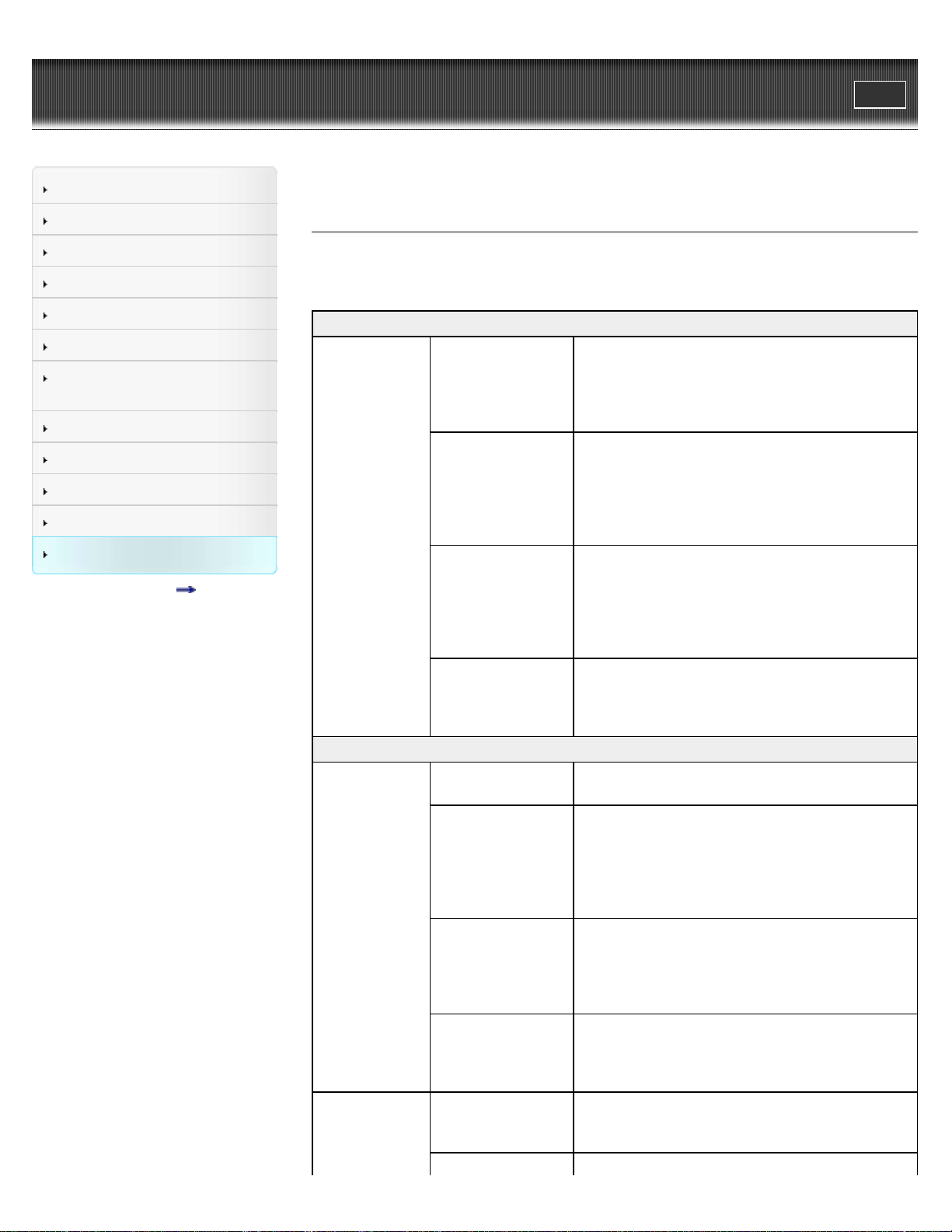
WALKMAN User Guide
Print
Getting Started
How to Use the Software
Music
“SensMe™ Channels”
Videos/Podcasts/Photos
FM Radio
Making/Playing Voice
Recordings
Timer
Settings
Troubleshooting
Important Information
Specifications
Contents list
Top page > Specifications > Specifications > Specifications
Specifications
Supported file format
Music (including podcasts (*1))
Audio Formats
(Codec)
MP3
Media File format: MP3 (MPEG-1 Layer3) file format
File extension: .mp3
Bit rate: 32 to 320 kbps (Supports variable bit rate
(VBR))
Sampling frequency (*2): 32, 44.1, 48 kHz
WMA
Media File format: ASF file format
File extension: .wma
Bit rate: 32 to 192 kbps (Supports variable bit rate
(VBR))
Sampling frequency (*2): 44.1 kHz
* Compatible with WM-DRM 10
AAC-LC (*3)
Media File format: MP4 file format
File extension: .mp4, .m4a, .3gp
Bit rate: 16 to 320 kbps (Supports variable bit rate
(VBR)) (*4)
Sampling frequency (*2): 8, 11.025, 12, 16, 22.05,
24, 32, 44.1, 48 kHz
Linear PCM
Media File format: Wave-Riff file format
File extension: .wav
Bit rate: 1,411 kbps
Sampling frequency (*2): 44.1 kHz
Video (including podcasts (*1))
Video Formats
(Codec)
Frame rate: Max. 30 fps
Resolution: Max. 720 × 480 (*5)
AVC
(H.264/AVC)
Media File format: MP4 file format, “Memory Stick”
video format
File extension: .mp4, .m4v
Profile: Baseline Profile
Level: 1.2, 1.3, 2, 2.1, 2.2, 3
Bit rate: Max. 10 Mbps
MPEG-4
Media File format: MP4 file format, “Memory Stick”
video format
File extension: .mp4, .m4v
Profile: Simple Profile
Bit rate: Max. 6 Mbps
Windows Media
Video 9 (*6)
Media File format: ASF file format
File extension: .wmv
Profile: VC1 simple profile, main profile
Bit rate: Max. 6 Mbps
Audio Formats
AAC-LC
(for AVC, MPEG-4)
Channel number: Max. 2 channels
Sampling frequency (*2): 24, 32, 44.1, 48 kHz
Bit rate: Max. 288 kbps / channel
Bit rate: 32 to 192 kbps (Supports variable bit rate
244
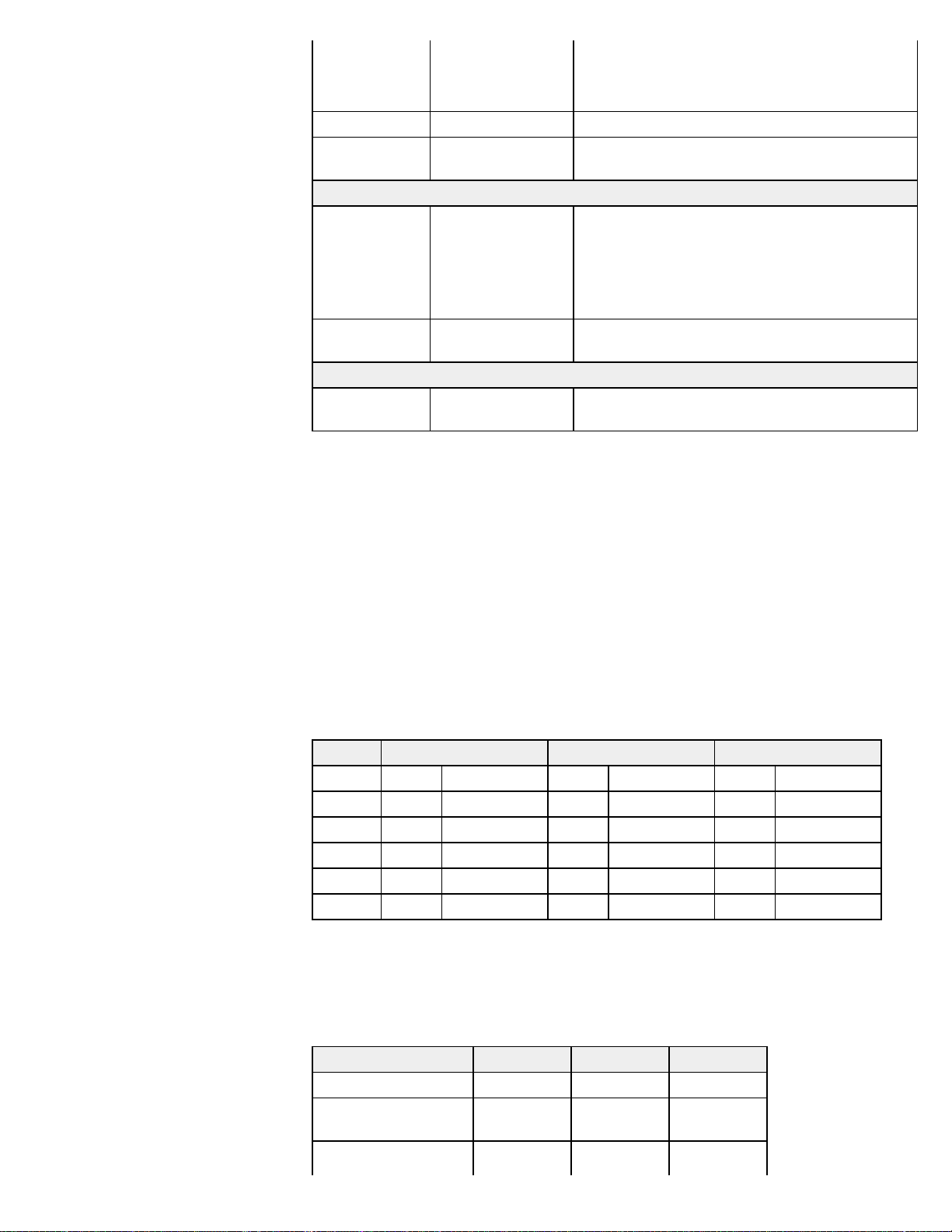
(Codec)
WMA
(for Windows Media
Video 9)
(VBR))
Sampling frequency (*2): 44.1 kHz
* Compatible with WM-DRM 10
File size Max. 4 GB
The number of
files
Max. 2,000
Photo (*7)
Photo Format
(Codec)
JPEG
Media File format: Compatible with DCF 2.0/Exif 2.21
file format
File extension: .jpg
Profile: Baseline Profile
Number of pixels: Max. 4,096 × 4,096 pixels
(16,000,000 pixels)
The number of
files
Max. 20,000
Voice Recording
Audio Format
(Codec)
MP3
Bit rate: 64, 128, 256 kbps
Sampling Frequency: 44.1 kHz
(*1) The maximum recordable number of podcasts is 20,000.
(*2) Sampling frequency may not correspond to all encoders.
(*3) Copyright protected AAC-LC files cannot be played back.
(*4) Non-standard bit rates or non-guaranteed bit rates are included depending on the sampling
frequency.
(*5) These numbers indicate the maximum resolution of playable video, and do not indicate the player’s
display resolution. The display resolution is 320 × 240.
(*6) Some WMV files can be played back only by transferring using Windows Media Player.
(*7) Some photo files cannot be played back, depending on their file formats.
Maximum recordable number of songs and time (Approx.)
The approximate times are based on the case in which you transfer or record only 4 minute
songs (not including videos and photos) in the MP3 format. Other playable audio file format song
numbers and times may differ from MP3 format.
NWZ-E453 NWZ-E454 NWZ-E455
Bit rate Number Time Number Time Number Time
48 kbps 2,350 156 hr. 40 min. 4,950 330 hr. 00 min. 10,000 666 hr. 40 min.
64 kbps 1,750 116 hr. 40 min. 3,650 243 hr. 20 min. 7,450 496 hr. 40 min.
128 kbps 880 58 hr. 40 min. 1,800 120 hr. 00 min. 3,700 246 hr. 40 min.
256 kbps 440 29 hr. 20 min. 925 61 hr. 40 min. 1,850 123 hr. 20 min.
320 kbps 355 23 hr. 40 min. 740 49 hr. 20 min. 1,500 100 hr. 00 min.
Maximum recordable time of videos (Approx.)
The approximate recordable times are estimated in the case where only videos are transferred.
The time may differ, depending on the conditions under which the player is used.
NWZ-E453 NWZ-E454 NWZ-E455
Bit rate Time Time Time
Video Format: 384 kbps
Audio Format: 128 kbps
14 hr. 00 min. 29 hr. 20 min. 59 hr. 40 min.
Video Format: 768 kbps
8 hr. 00 min. 16 hr. 40 min. 34 hr. 00 min.
245

Audio Format: 128 kbps
Maximum recordable number of photos that can be transferred
(Approx.)
Max. 20,000
Recordable number of photos may be less depending on file sizes.
Maximum recordable number of voice recordings
Maximum recordable number of voice recording files: 4,000
Maximum recordable number of voice recording folders: 255
Maximum recordable number of voice recording files in each folder: 255
Maximum recordable number of playlists
Maximum transferrable number of playlists: 8,192
Maximum containable number of songs in each playlist: 999
Capacity (User available capacity) (*1)
NWZ-E453: 4 GB (Approx. 3.35 GB = 3,602,841,600 bytes)
NWZ-E454: 8 GB (Approx. 6.99 GB = 7,513,178,112 bytes)
NWZ-E455: 16 GB (Approx. 14.1 GB = 15,224,602,624 bytes)
(*1) Available storage capacity of the player may vary.
A portion of the memory is used for data management functions.
Output (headphones)
Frequency response
20 to 20,000 Hz (when playing data file, single signal measurement)
FM radio
FM Frequency range
87.5 to 108.0 MHz
(You cannot use the FM radio function while the player is installed into the speaker system.)
IF (FM)
128 kHz
Antenna
Headphone cord antenna
Interface
Headphone: Stereo mini-jack
WM-PORT (multiple connecting terminal): 22 pins
Hi-Speed USB (USB 2.0 compliant)
Operating temperature
5 °C to 35 °C (41 ºF to 95 ºF)
Power source
Built-in rechargeable lithium-ion battery
USB power (from a computer via a USB connector of the player)
Charging time
USB-based charging
Approx. 3 hours (full charge), Approx. 1.5 hours (approx. 80 %)
Battery life (continuous playback)
Actual battery life may vary depending on settings. The estimated battery usage hours shown
below are based on typical usage conditions with “Basic setting of battery life measurement” as
shown in the table below.
246
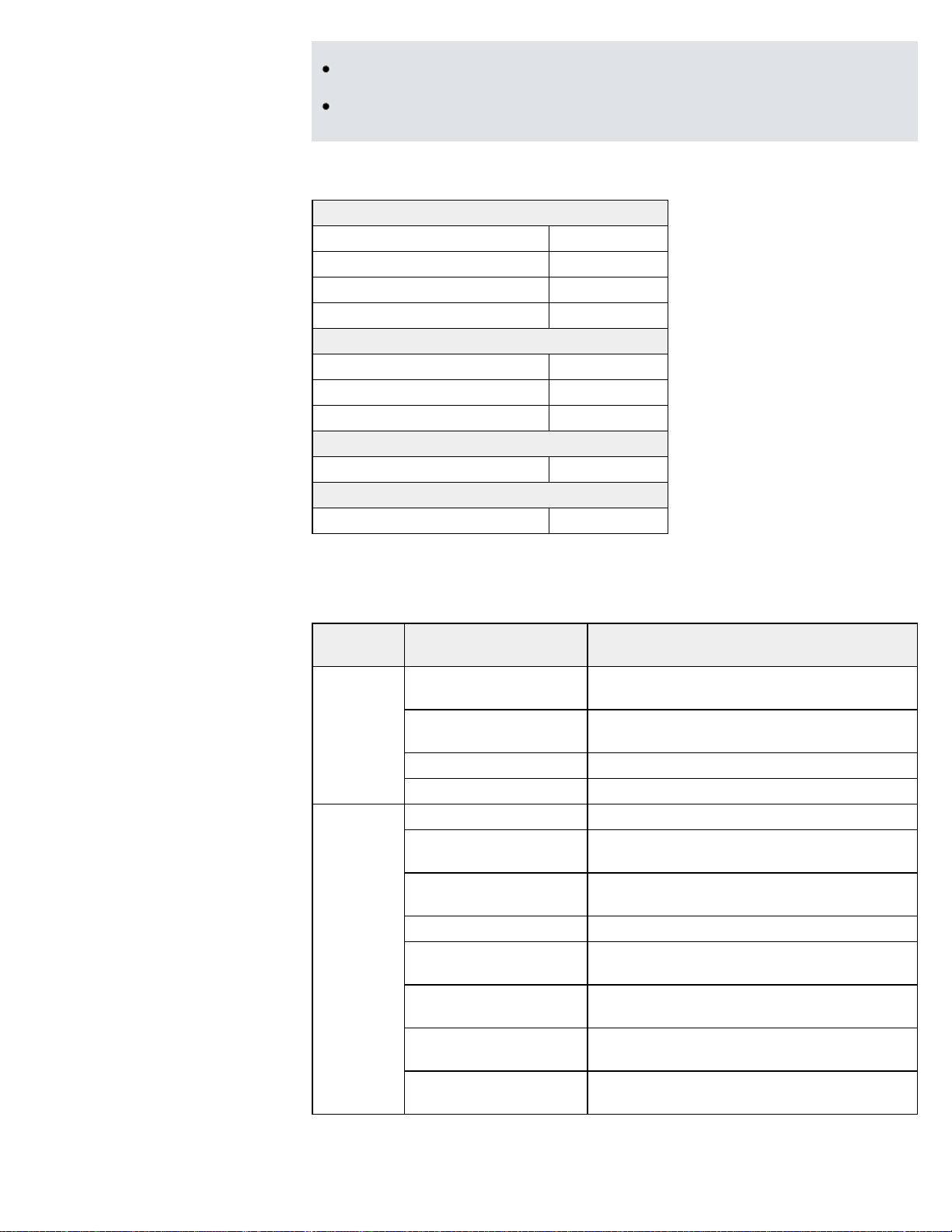
Note
Even if the player is turned off for an extended period, a small amount of battery power is
still consumed.
Battery life may vary depending on volume setting, conditions of use, and ambient
temperature.
Music
Playback at MP3 128 kbps Approx. 50 hours
Playback at WMA 128 kbps Approx. 50 hours
Playback at AAC-LC 128 kbps Approx. 48 hours
Playback at Linear PCM 1,411 kbps Approx. 56 hours
Video
Playback at MPEG-4 384 kbps Approx. 10 hours
Playback at AVC Baseline 384 kbps Approx. 10 hours
Playback at WMV 384 kbps Approx. 10 hours
FM radio
Receiving FM broadcasting Approx. 20 hours
Voice recording
Recording Approx. 9 hours
Player settings which affect battery life
Setting
Basic setting of battery life
measurement (Default setting)
[Common
Settings]
[Screensaver]:[On/Off] (*1)
[Details]
[On]
[Screensaver]:[Delay] (*2)
[Details]
[30 Sec]
[Brightness] (*3) [Details] [3]
[Battery Care] (*4) [Details] [Off]
[Music
Settings]
[Equalizer] (*5) [Details] [None] (*6)
[VPT(Surround)] (*5)
[Details]
[None]
[DSEE(Sound Enhance)]
(*5) [Details]
[Off]
[Clear Stereo] (*5) [Details] [Off]
[Dynamic Normalizer] (*5)
[Details]
[Off]
[DPC (Speed Control)] (*7)
[Details]
[Off]
[Display Lyrics] (*8)
[Details]
[On]
[Karaoke/Language Study]
(*9) [Details]
[Off]
(*1) The [Off] setting shortens the battery life for continuous music playback by about 85% compared with
the [On] setting.
247

(*2) The longer the waiting time, the shorter the battery life for continuous music playback.
(*3) The [5] setting shortens the battery life for continuous video playback by about 45% compared with
the [3] setting.
(*4) The [On] setting shortens the battery life by about 10% compared with the [Off] setting.
(*5) Setting [Equalizer] to other than [None], [VPT(Surround)] to other than [None], [DSEE(Sound
Enhance)] to [On], [Clear Stereo] to [On] and [Dynamic Normalizer] to [On] shortens the battery life
for continuous music playback by about 55% compared with setting them to [None] or [Off].
(*6) The default setting of players sold in the Latin America region is [Custom 1]. The [Custom 1] setting
shortens the battery life for continuous music playback by about 20% compared with the [None]
setting.
(*7) The [x2.0] setting shortens the battery life for continuous music playback by about 70% compared
with the [Off] setting.
(*8) The [On (No Screen Off)] setting shortens the battery life for continuous music playback by about
85% compared with the [On] setting.
(*9) The [Maximum Karaoke Mode] setting shortens the battery life for continuous music playback by
about 90% compared with the [Off] setting.
Display
2-inch, TFT color display with white LED-backlight, QVGA (240 × 320 pixels), 262,144 colors
Dimensions (w/h/d, projecting parts not included)
44 × 94.7 × 9.7 mm (1 3/4 × 3 3/4 × 13/32 inches)
Dimensions (w/h/d)
44.1 × 95 × 10.4 mm (1 3/4 × 3 3/4 × 7/16 inches)
Mass
Approx. 58 g (2.1 oz)
Design and specifications are subject to change without notice.
Back to top
Copyright 2010 Sony Corporation
248
WALKMAN User Guide
Print
Getting Started
How to Use the Software
Music
“SensMe™ Channels”
Videos/Podcasts/Photos
FM Radio
Making/Playing Voice
Recordings
Timer
Settings
Troubleshooting
Important Information
Specifications
Contents list
Top page > Specifications > Specifications > Supplied items
Supplied items
Headphones (1)
USB cable (1)
Attachment (1)
Use when connecting the player to the cradle (not supplied), etc.
Quick Start Guide
Software
The software is stored in the built-in flash memory of the player, and includes the following
items. For details on how to install, refer to “Quick Start Guide.”
Content Transfer
WALKMAN Guide
User Guide, etc.
Design and specifications are subject to change without notice.
Back to top
Copyright 2010 Sony Corporation
249
WALKMAN User Guide
Print
Getting Started
How to Use the Software
Music
“SensMe™ Channels”
Videos/Podcasts/Photos
FM Radio
Making/Playing Voice
Recordings
Timer
Settings
Troubleshooting
Important Information
Specifications
Contents list
Top page > Specifications > Specifications > System requirements
System requirements
Computer
IBM PC/AT compatible computer preinstalled with the following Windows operating systems
(*1):
Windows XP Home Edition (*2) (Service Pack 3 or later)
Windows XP Professional (*2) (Service Pack 3 or later)
Windows Vista Home Basic (Service Pack 1 or later)
Windows Vista Home Premium (Service Pack 1 or later)
Windows Vista Business (Service Pack 1 or later)
Windows Vista Ultimate (Service Pack 1 or later)
Windows 7 Home Basic
Windows 7 Home Premium
Windows 7 Professional
Windows 7 Ultimate
Not supported by OSs other than above.
[Compatibility mode] for Windows XP (included with Windows Vista and Windows 7) is not
supported.
(*1) Excluding OS Versions not supported by Microsoft.
(*2) Excluding 64-bit OS versions.
CPU: Pentium III 450 MHz or higher for Windows XP, Pentium III 800 MHz or higher for
Windows Vista, Pentium III 1 GHz or higher for Windows 7
RAM: 256 MB or more for Windows XP, 512 MB or more for Windows Vista, 1 GB or more for
Windows 7 32-bit versions, 2 GB or more for Windows 7 64-bit versions
Hard Disk Drive: 600 MB or more of available space
Display:
Screen Resolution: 800 × 600 pixels (or higher) (recommended 1,024 × 768 or higher)
Colors: 8 bit or higher (16 bit recommended)
CD-ROM drive (supporting Digital Music CD playback capabilities using WDM)
Sound card
USB connector (Hi-Speed USB is recommended)
Windows Media Player 11 for Windows XP and Windows Vista, Windows Media Player 12 for
Windows 7
Internet Explorer 7 or later
Broadband Internet connection is required to use Electronic Music Distribution (EMD) or to
visit the web site.
We do not guarantee operation for all computers even if they meet the above System
Requirements.
Not supported by the following environments:
Personally constructed computers or operating systems
An environment that is an upgrade of the original manufacturer-installed operating system
Multi-boot environment
Multi-monitor environment
Macintosh
Design and specifications are subject to change without notice.
Back to top
Copyright 2010 Sony Corporation
250
WALKMAN User Guide
Print
Getting Started
How to Use the Software
Music
“SensMe™ Channels”
Videos/Podcasts/Photos
FM Radio
Making/Playing Voice
Recordings
Timer
Settings
Troubleshooting
Important Information
Specifications
Contents list
Top page > Specifications > What are Format and Bit Rate > What is audio format?
What is audio format?
What is copyright protection?
What is bit rate?
What is the relationship between bit rate, sound quality, and storage size?
Audio format refers to the method used to import audio data from the Internet or audio CDs to a
computer, to save as an audio file.
Common formats include MP3 and WMA, etc.
MP3: MP3 (MPEG-1 Audio Layer3) is a common audio compression technology developed by
the MPEG working group of the ISO (International Organization for Standardization).
MP3 can compress audio files to about 1/10 the size of standard CD audio files.
WMA: WMA (Windows Media Audio) is a common audio compression technology developed by
Microsoft Corporation. The WMA format produces the same sound quality as that of the MP3
format with a smaller file size.
AAC: AAC (Advanced Audio Coding) is a common audio compression technology developed by
the MPEG working group of the ISO (International Organization for Standardization). The AAC
format produces the same sound quality as that of the MP3 format, with a smaller file size.
Linear PCM: Linear PCM is an audio recording format without digital compression. You can
achieve CD sound quality by recording with this format.
Hint
For details on supported file formats and bit rates, see [Details].
What is copyright protection?
Certain music files or video files, etc., that you purchase from a music download service site, etc.,
may have access control technologies applied, such as encryption, to limit usage and duplication
of the material, in accordance with copyright laws.
What is bit rate?
Bit rate refers to the amount of data used to store each second of audio, expressed in kbps (kilo
bits per second), such as 64 kbps. Generally, higher bit rates provide better sound quality, but
require more storage space for the same length of audio.
What is the relationship between bit rate, sound quality, and
storage size?
Generally, higher bit rates provide better sound quality, but require more storage space for the
same length of audio, so you can store fewer songs on the player.
Lower bit rates enable you to store more songs, but at a lower sound quality.
Note
If you import a song from a CD to your computer at a low bit rate, you cannot improve the
251

WALKMAN User Guide
Print
Getting Started
How to Use the Software
Music
“SensMe™ Channels”
Videos/Podcasts/Photos
FM Radio
Making/Playing Voice
Recordings
Timer
Settings
Troubleshooting
Important Information
Specifications
Contents list
Top page > Specifications > What are Format and Bit Rate > What is video format?
What is video format?
Video format refers to the method used when importing video and audio data to a computer and
saving it as a video file.
Common formats include MPEG-4 and AVC, etc.
MPEG-4: MPEG-4 refers to Moving Picture Experts Group phase 4, developed by the MPEG
working group of the ISO (International Organization for Standardization). The compression
format is for video and audio data.
AVC: AVC refers to Advanced Video Coding, developed by the MPEG working group of the ISO
(International Organization for Standardization). It enables reproduction of more vivid images at a
lower bit rate. AVC files include four profiles, and “AVC Baseline Profile” is one of them. AVC
format is based on the MPEG-4 AVC standard of the ISO (International Organization for
Standardization), and since AVC is standardized as the MPEG-4 Part 10 Advanced Video
Coding, it is commonly referred to as MPEG-4 AVC/H.264 or H.264/AVC.
WMV: WMV (Windows Media Video) is a video compression format developed by Microsoft
Corporation. It was built upon MPEG-4, achieves a high compression rate, and supports copy
control by DRM.
Hint
For details on supported file formats and bit rates, see [Details].
Back to top
Copyright 2010 Sony Corporation
253
WALKMAN User Guide
Print
Getting Started
How to Use the Software
Music
“SensMe™ Channels”
Videos/Podcasts/Photos
FM Radio
Making/Playing Voice
Recordings
Timer
Settings
Troubleshooting
Important Information
Specifications
Contents list
Top page > Specifications > What are Format and Bit Rate > What is photo format?
What is photo format?
Photo format refers to the method used to import images to a computer to save as image files.
JPEG is one example of a commonly used format.
JPEG: JPEG (Joint Photographic Experts Group) is a common image compression format
developed by the JPEG. JPEG can compress an image file to between 1/10 and 1/100 the size
of original image files.
Hint
For details on supported file formats and bit rates, see [Details].
Back to top
Copyright 2010 Sony Corporation
254