1991 Civic Wagon 4WD Online Reference Owner's Manual
Use these links (and links throughout this manual) to navigate through this reference.
For a printed owner's manual, click on authorized manuals or go to www.helminc.com.
Features & Safety ................................................................................................................................ 2
What you should know before driving your car.
Starting & Driving............................................................................................................................. 39
What gas to use, how to change gears, etc.
Maintenance ....................................................................................................................................... 58
The Required Maintenance Schedule and some items you can service.
Emergency Service .......................................................................................................................... .. 97
Changing a flat, jump starting, towing.
Specifications ................................................................................................................................... 108
Dimensions, weights and capacities.
Consumer Information .................................................................................................................... 110
Reporting Safety Detects, warranty service, vehicle identification numbers, etc.
Index ................................................................................................................................................ 118
Gas Station Information
Contents
Owner's Identification
This Owner's Manual should be considered a permanent part of the
vehicle, and must remain with the vehicle at time of resale.
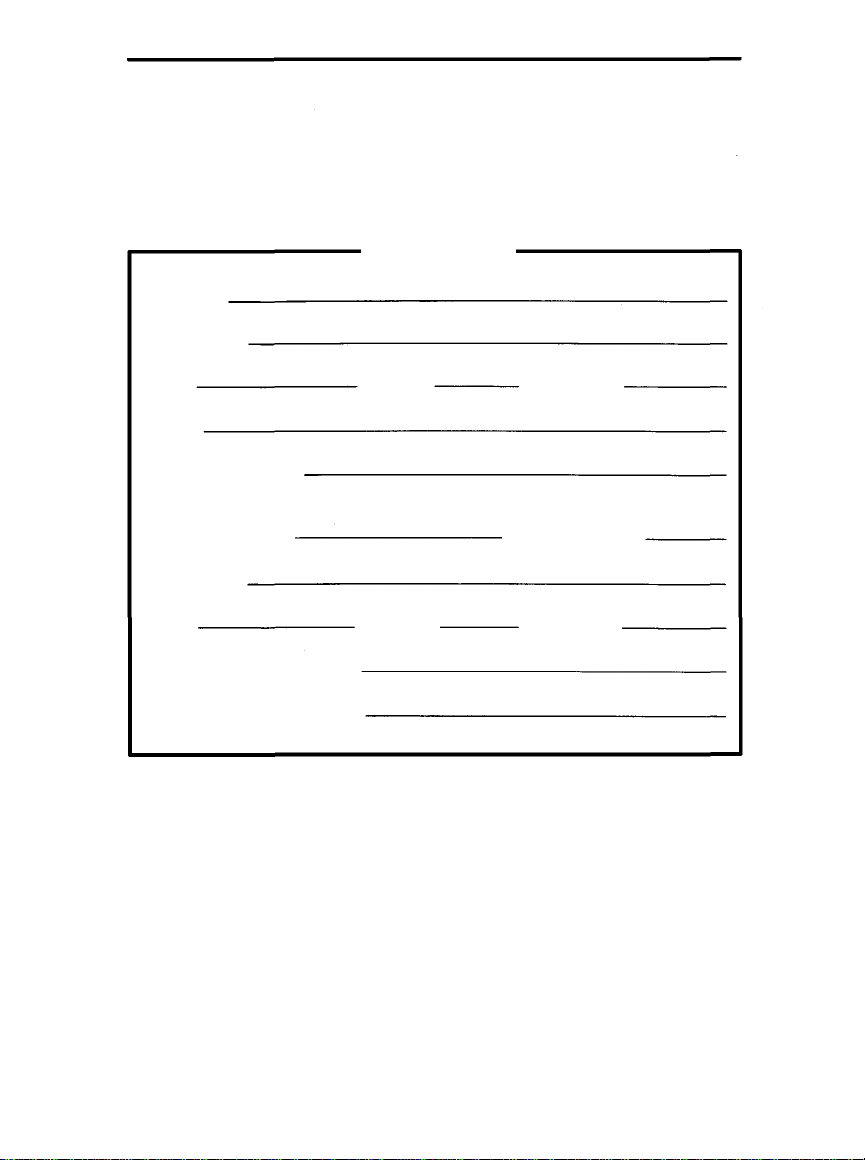
OWNER'S I.D.
OWNER
ADDRESS
The information and specifications included in this publication were
in effect at the time of approval for printing. Honda Motor Co., Ltd.
reserves the right however, to discontinue or change specifications
or design at any time without notice and without incurring any
CITY
STATE
V.I.N.
DELIVERY DATE
DEALER NAME
ADDRESS
ZIP CODE
(Date sold to original retail purchaser)
DEALER NO.
ZIP CODE
STATE
CITY
OWNER'S SIGNATURE
DEALER'S SIGNATURE
obligation whatever.
Main Menu
▲
▼
Introduction
This manual contains important information about the safe
operation and maintenance of your Honda CIVIC Wagon and CIVIC
Wagon with Real Time
®
Four-Wheel Drive (4WD).
We urge you to read it carefully, become familiar with the controls it
describes, and follow its recommendations, to help make your
driving trouble-free and enjoyable.
Statements or labels on the product preceded by the following
words are of special significance:
indicates severe personal injury or death will result if
instructions are not followed.
indicates a strong possibility of severe personal
injury or death if instructions are not followed.
means hazards or unsafe practices which could
cause minor personal injury or product or property
damage.
NOTE: gives helpful information.
Break-in Period
During the first 600 miles (1,000 km) of driving, avoid full throttle
starts and cruising for extended periods at a constant speed.
NOTE:
This break-in procedure also applies to exchanged or overhauled
engines.
During and after the break-in period, drive the car at moderate
speeds until the engine is fully warmed up.
CAUTION:
(4WD:) Although 4WD provides better traction on poor road
surfaces or when driving in snow or mud, this car is not designed
for off-road use.
During the first 200 miles (300 km), try to avoid severe braking.
Brake misuse during this period will reduce future braking efficiency.
Remember, your Honda Automobile dealer knows your car best,
and should be consulted for service assistance and advice.
Main Menu
▲
▼
Keys and Locks
Keys
Two identical keys come with your car. You should keep one of
them in a safe place, away from the car, as a spare. Also write
down the number stamped on the key and keep it in your wallet or
purse in case you ever need to have a duplicate made. The key fits
the ignition switch, door locks, and tailgate lock. The key can be
inserted into the locks with either edge up.
Door Locks
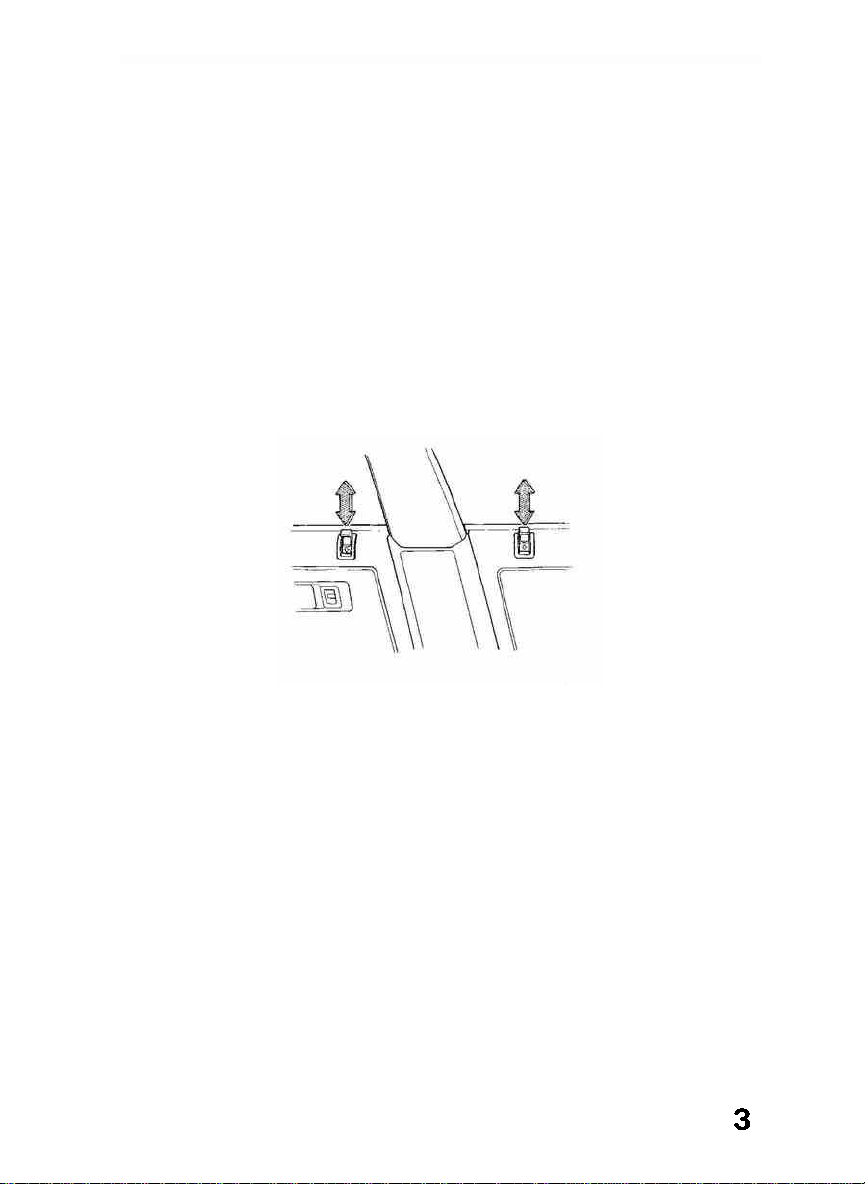
You can lock the doors by pushing the tabs down.
The doors must be unlocked before you can open them. The
passenger door can be locked when open, and will stay locked when
you close it; the driver's door cannot be locked when open unless
you hold the door handle open. Both doors can be locked and
unlocked from the outside with the key.
(cont'd)
Unlock
Lock
Unlock
Lock
Main Menu
▲
▼
Keys and Locks (cont'd)
Tailgate Lock
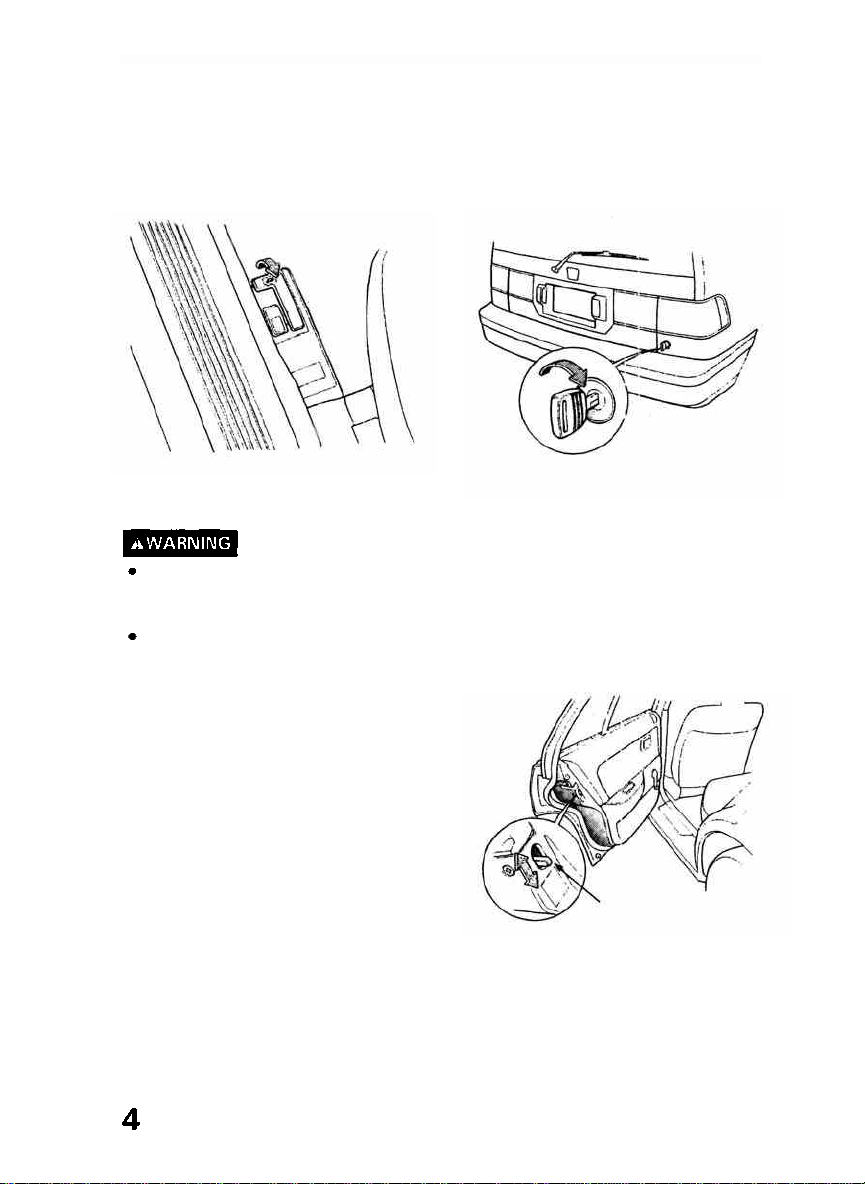
To open the tailgate from outside, put the ignition key in the lock
and turn clockwise.
The tailgate can also be opened inside the car by pulling the tailgate
release lever up at the left side of the driver's seat. It locks
automatically when closed.
Keep the tailgate closed while driving, to keep poisonous carbon
monoxide exhaust fumes out of the interior; prolonged exposure
can cause unconsciousness that may lead to death.
Weight limits shown on the label located in the glove box must
be observed. The total weight of passengers and cargo must
not exceed the total weight limit on the label.
Child Proof Door Locks
The child proof door locks are de-
signed to prevent accidental open-
ing of the rear doors. To activate
the locks, push down the lock tabs
located on each door, then close the
doors. When the doors are locked in
this way, they can only be opened
from the outside.
Pull up
Open
Unlock
LOCK TAB
Lock
Main Menu
▲
▼

Front Seat
Adjust the seat position by pulling up on the adjustment lever under
the front edge of the seat cushion, and sliding the seat to the
desired position. Then release the lever and make sure the seat is
locked in position by moving it back and forth.
The angle of the seat-back can be changed by pulling up on the lever
at the outside edge of the seat and leaning forward or back. Release
the lever and let the seat lock into place when it reaches the desired
angle.
Seat belts are most effective when the driver and passenger are
sitting up straight and well back in each seat.
Do not adjust the driver's seat while the car is moving; the seat
could move suddenly, causing loss of vehicle control.
To reduce the risk of sliding under the seat belts in a collision,
the seat-backs should be reclined no more than is necessary for
comfort.
(cont'd)
ADJUSTMENT
LEVER
Pull up
Pull up
RELEASE LEVER
Seats
Main Menu
▲
▼
Seats (cont'd)
Head Restraints
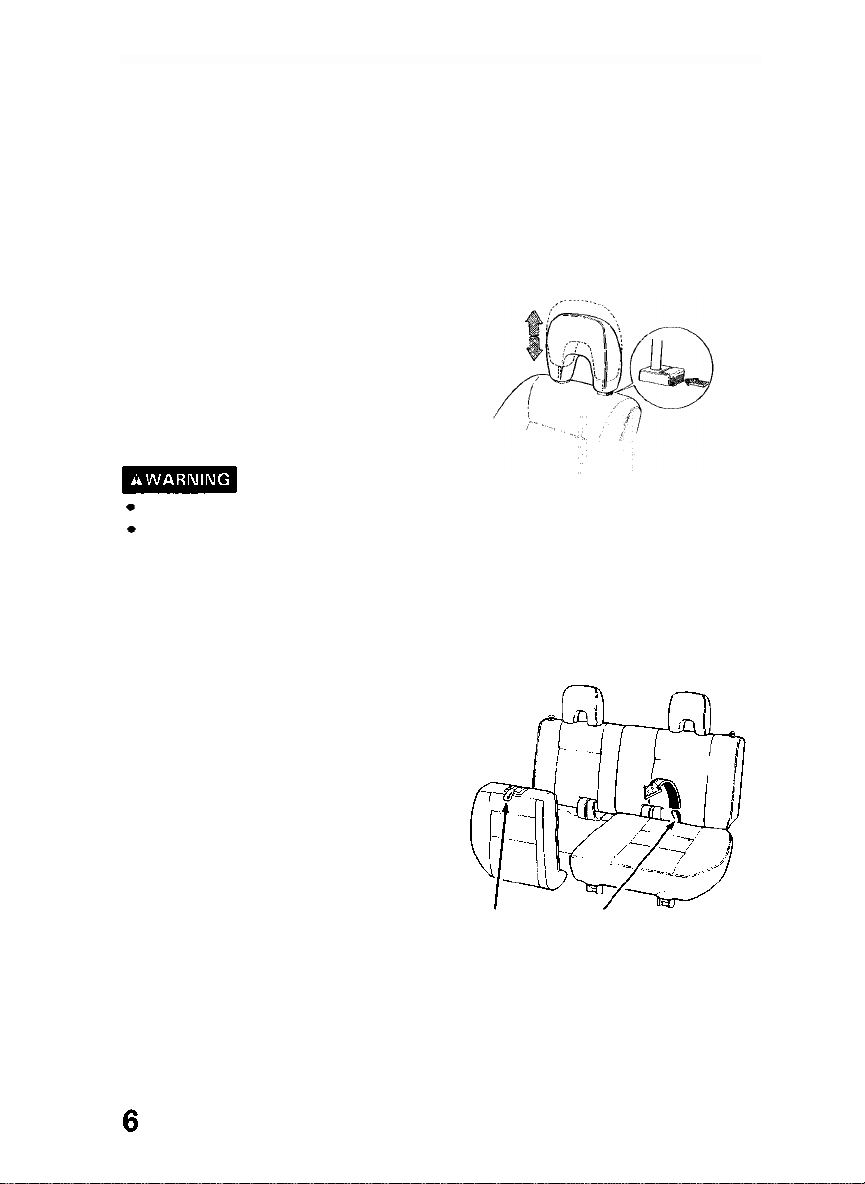
The head restraints are designed to help reduce injuries due to
whiplash. They are located at the top of each seat-back and have
several height positions. They can be adjusted by pulling up to the
recommended position. To lower them, slide the button next to the
restraint's height bar, while pushing the restraint down.
Adjust so the top of the restraint is approximately level with the
tops of your ears.
If a head restraint must be removed
(for cleaning, fabric repair, etc.) pull
the restraint up to its highest posi-
tion, then slide the button while
pulling the restraint out.
To reinstall, reverse the above pro-
cedure.
Do not drive the car with head restraints removed.
Do not try to adjust head restraints while driving.
Folding Rear Seat
The rear seat-back can be folded down to provide more luggage
space.
Each of the rear seat can be folded separately.
1. Move the front seat-backs fully
forward.
2. Pull up the strap at the center of
the seat and lift the seat cushion
up and forward.
3. Remove the head restraints while
pushing the button next to the
head restraint's height bar. Pull up
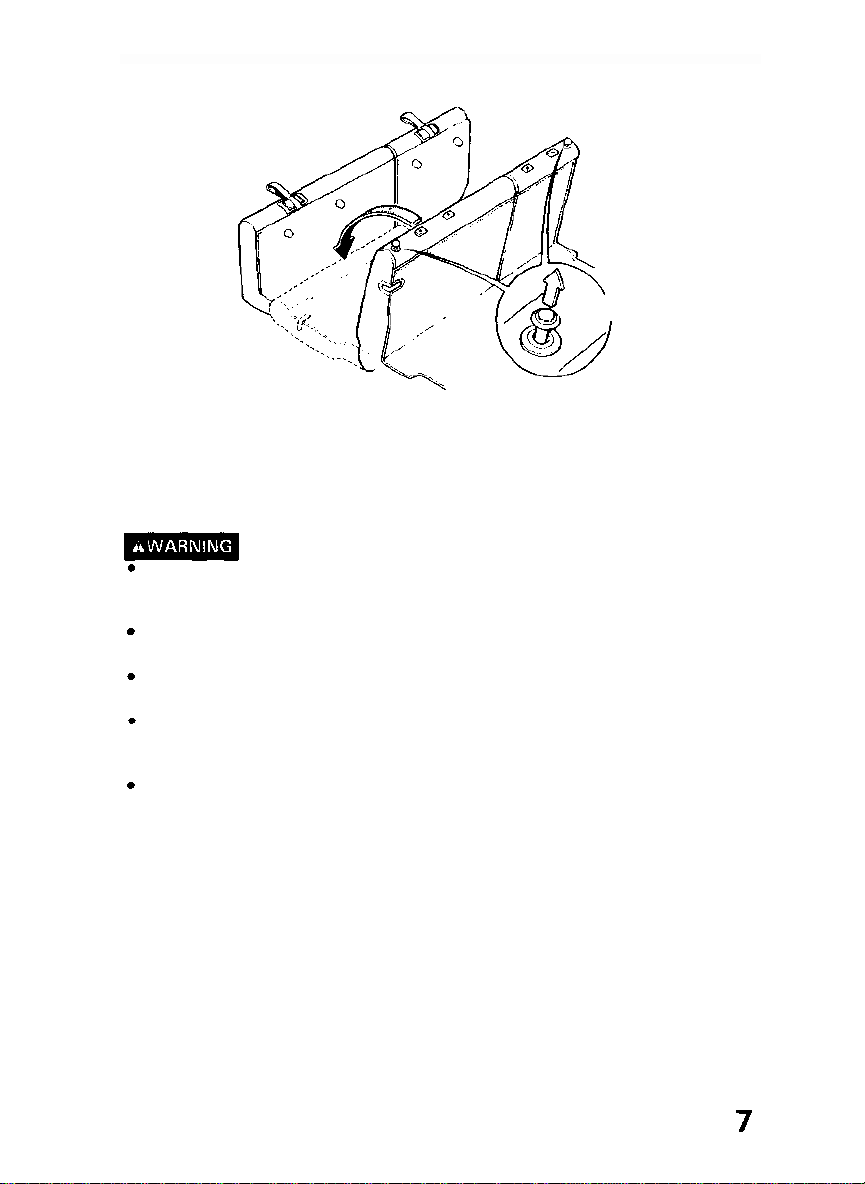
the release knob on the upper
edge of each seat-back, then fold
the seat-backs forward.
Slide
STRAP
STRAP
Pull up
Main Menu
▲
▼
CAUTION:
Make sure to fold the front seat-back forward whenever you
attempt to fold up or down the rear seat-back, or you may damage
the release located on top of the rear seat-back.
Weight limits shown on the label located in the glove box must
be observed. The total weight of passengers and cargo must
not exceed the total weight limit on the label.
Make sure the seat-back latches engage securely when the
seat-back is returned to its normal position.
Always replace the head restraints when the seat-back is
returned to upright position.
When transporting luggage or other cargo, do not pile it higher
than the front seats. This precaution will help prevent such
items from becoming dangerous projectiles in an accident.
Cargo weight should be distributed as far forward as possible
for better vehicle handling.
CAUTION:
Make sure both rear shoulder belts are positioned in front of the
rear seat-backs whenever the seat-backs are in their upright
position.
Pull up
Main Menu
▲
▼
Seat Belts
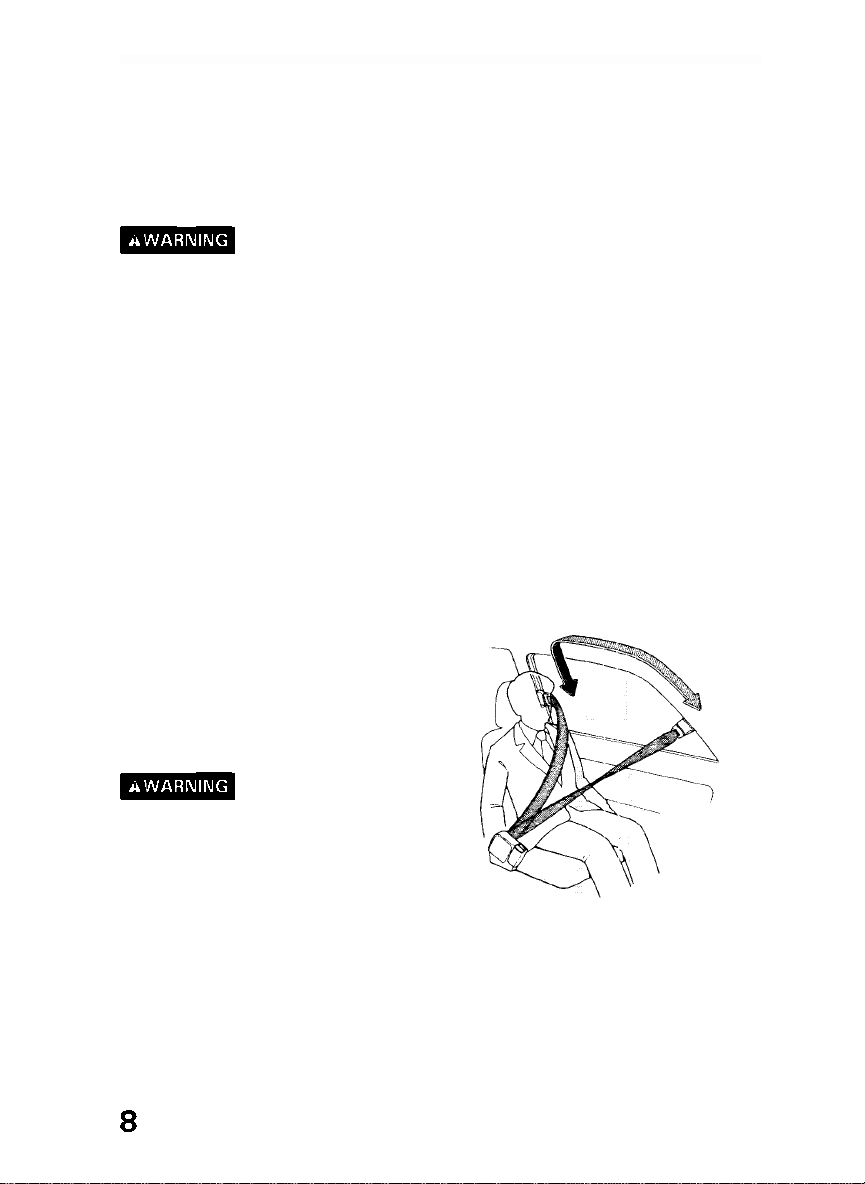
Your Honda is provided with seat belts to minimize the chance of
injury to yourself and your passengers in a sudden stop or accident.
For precautions on using seat belts for children, babies and pregnant
women, see pages 14 — 16.
Seat belts are most effective when the driver and passengers are
sitting up straight and well back in the seat.
In the event of a collision, occupants not wearing seat belts could
be seriously or fatally injured. Make sure you and all your
passengers ALWAYS put on the seat belts before driving away.
CAUTION:
Be careful the seat belts are not damaged by catching or
entangling in the door or seat mechanism.
Front Seat Belts
The front seats have an automatic ("passive") restraint system
consisting of a shoulder belt and knee bolsters. The shoulder belt
should remain permanently latched. Always wear the lap belt in
addition to the shoulder belt for full protection.
The automatic and manual belts have emergency locking retractors
designed to lock only during a sudden stop or impact. Otherwise,
they allow some freedom of movement in the seat.
Operation
1. Enter the car and close the door
completely. Move the seat a
comfortable distance from the
steering wheel, sit straight up and
well back in the seat.
Never drive the car with the doors
ajar. The front doors must be
closed completely for the front
seat belts to function properly.
2. Turn the ignition ON. The shoulder belt buckle will move to its
rear locked position. The length of the shoulder belt will adjust
automatically to your body and seating position.
Make sure the shoulder belt goes over your shoulder and across
your body to evenly distribute the belt's restraining force.
If the belt is too near your neck and throat, move toward the
center of the seat.
Main Menu
▲
▼
Normal movement of the shoulder belt buckle may cause injury.
Be sure all parts of your body, especially fingers and hands, are
clear of the shoulder buckle while it is moving.
CAUTION:
If the sunvisor is positioned near the door area, movement of the
seat belt buckle can damage the sunvisor. Before opening or
closing a front door, turning the ignition on or removing the key
from the ignition, make sure the sunvisor is returned to its clip
above the windshield.
NOTE:
If the door is not closed completely, the shoulder belt buckle will
not move and the door warning light will come on (see page 11).
If the door is opened with the ignition on, the buckle will release
itself from its locked position and move forward.
If the shoulder belt buckle stops halfway or does not move at all,
see page 106 for shoulder belt buckle operation.
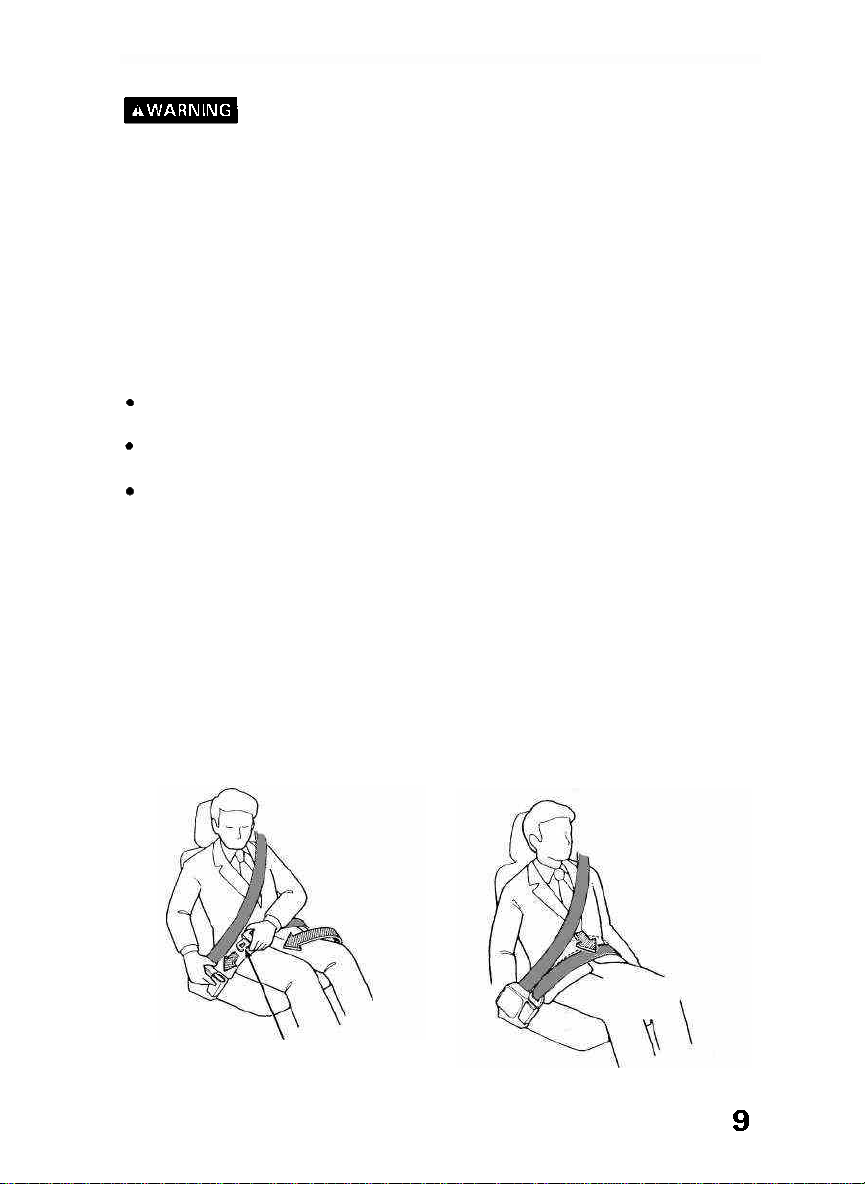
3. Take hold of the lap belt's tongue plate and pull it from its
retractor. Be sure the belt is not twisted or caught on anything.
NOTE:
If pulled too fast, the belt will lock. If this happens, allow the belt to
retract then pull it out more slowly.
4. Push the tongue plate into the buckle until it clicks locked.
Position the belt across your lap, low on your hipbone and below
your abdomen. This way, if the car is involved in an accident you
would be less likely to slide under the seat belts.
Pull the belt
across your
lap
Keep below
hip bone
(cont'd)
TONGUE PLATE
Main Menu
▲
▼
Seat Belts (cont'd)
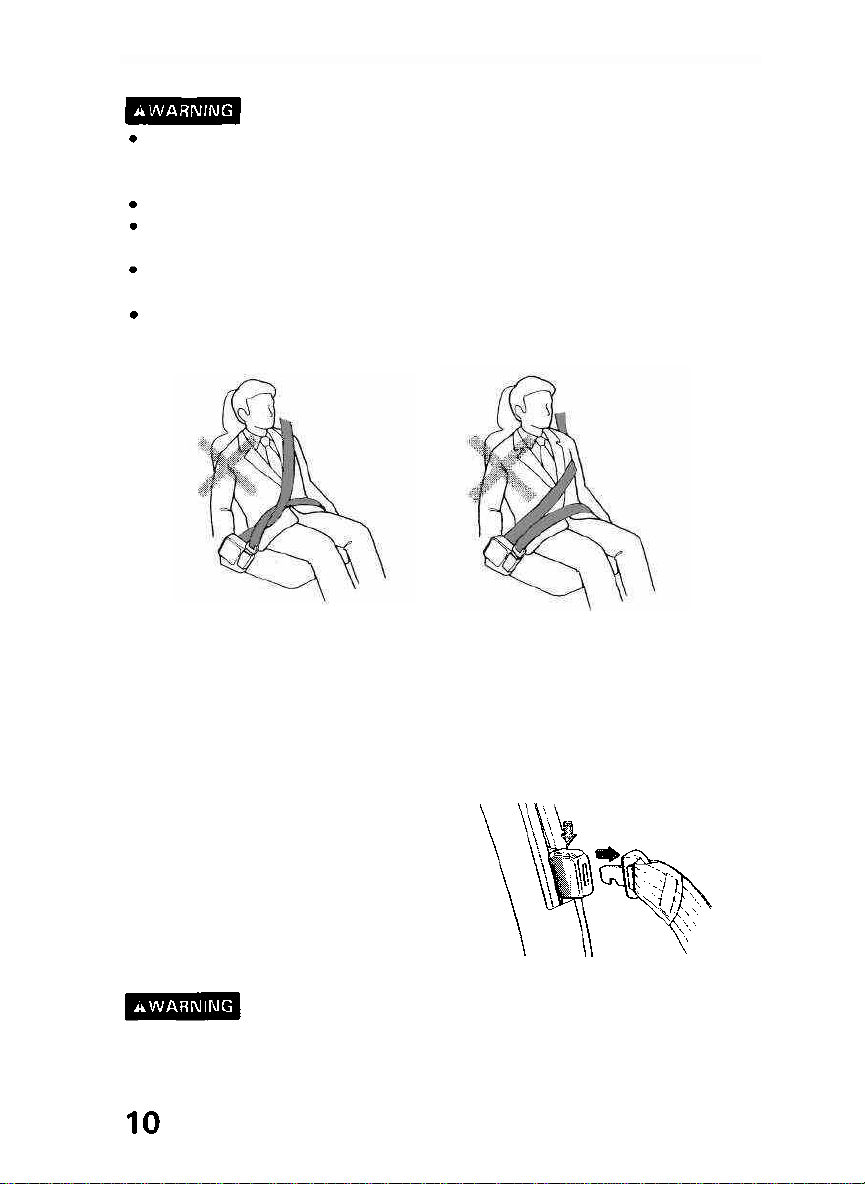
Avoid placing the lap belt across your abdomen. In the event of
a collision, the pressure of the belt on the abdomen may
increase the extent of injury.
Never use one belt for more than one person, child or adult.
Comfort clips sold on the open market are not recommended
since they could impair the function and safety of the belts.
Make sure the strap of the shoulder belt and the lap belt are not
crossed.
Do not wear the shoulder portion of the belt under your arm or
out of position. Such use could increase the chance and amount
of injury in an accident.
Releasing the Seat Belts
1. To release the manual lap belt, push the "PRESS" button in the
buckle, the belt should retract automatically when released.
2. The driver's shoulder belt buckle will release and travel to its off
position when the key is removed from the ignition.
3. The shoulder belt buckle will also release and travel to its off
position when the door is opened.
Emergency Belt Release
The shoulder belt should always re-
main buckled. In case of an emergen-
cy, however, the shoulder belt can
be released from the shoulder belt
buckle by pushing the button.
Relatch the shoulder belt before
operating the car, making sure the
belt is not twisted.
Driving with a twisted seat belt can increase your chance and
extent of injury during a collision. Be sure the shoulder belt is not
twisted before driving the car.
Push
Main Menu
▲
▼
Fasten Seat Belt Warning Light and Warning Beeper
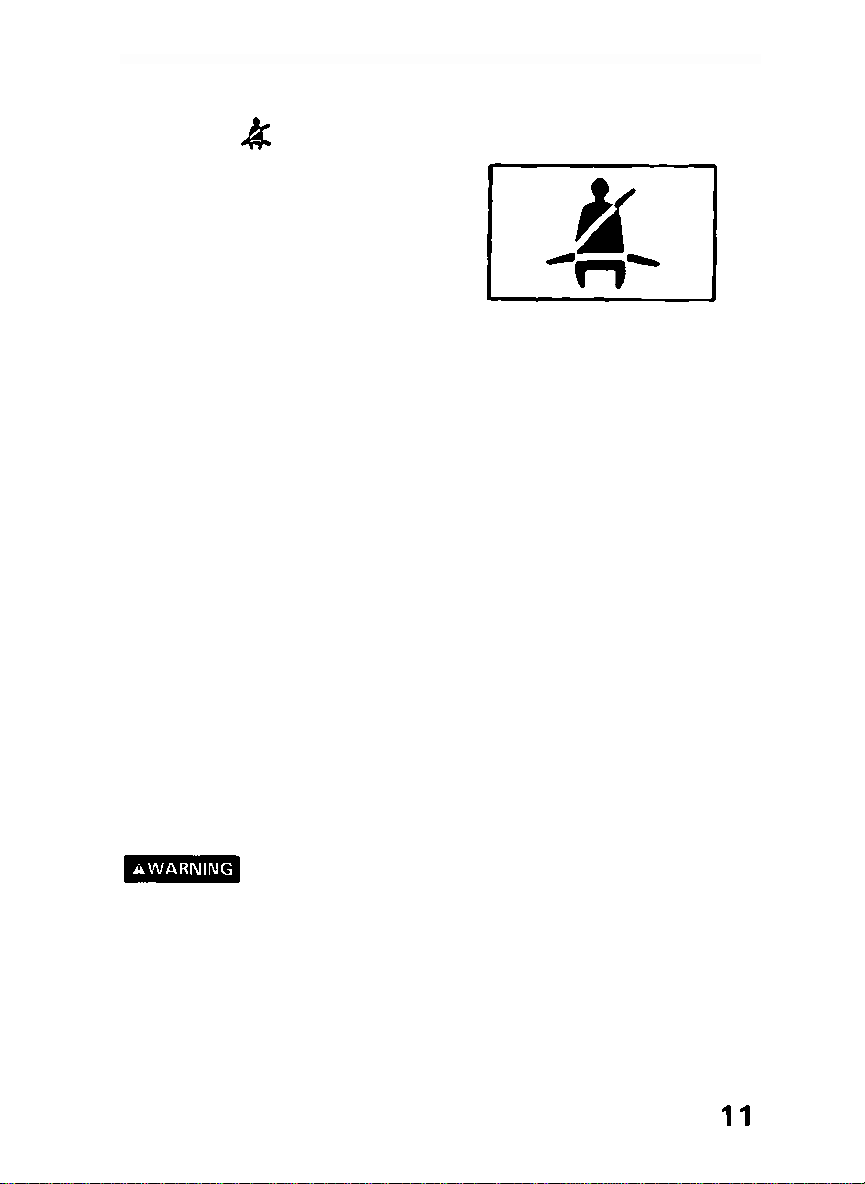
Lap Belt Warning Indicator:
Both the light and the
warning beeper will go on for about
six seconds if the ignition switch is
turned on when the driver's lap belt
is not fastened. The beeper will not
go on if the driver's lap belt is
fastened, but the warning light will
come on for about six seconds each
time, to remind the driver to have
passengers put their belts on.
Automatic Shoulder Belt Warning Indicator:
The warning light will come on if either of the automatic shoulder
belts is unlatched with the ignition ON. The beeper will sound for
approximately six seconds while the warning light is ON. Relatch the
belt: the light should go off when the belt is latched.
The warning light will also come on while the shoulder belt buckle
moves from its front off position to its rear locked position.
Automatic Shoulder Belt Malfunction Indicator:
The warning light will flash and the beeper will sound rapidly if either
shoulder belt buckle stops before completing its full cycle (see page
106 for normal operation).
NOTE:
If the shoulder belt's tensioner mechanism locks and prevents the
buckle from moving fully forward when you want to get out,
recycle the system by closing the door and reopening it.
The buckle should move fully forward; if it does not, recline the
seat-back and use Emergency Belt Release (see page 10 ).
When the system does not function by either method, have the
system checked by an authorized Honda dealer.
If the lights and beeper do not function at all or if they come on
even with the belts latched and doors fully closed, it indicates a
malfunction in the seat belt system. In the event of a collision,
severe personal injury could result. The system should be checked
immediately by an authorized Honda dealer.
(cont'd)
Main Menu
▲
▼
Seat Belts (cont'd)
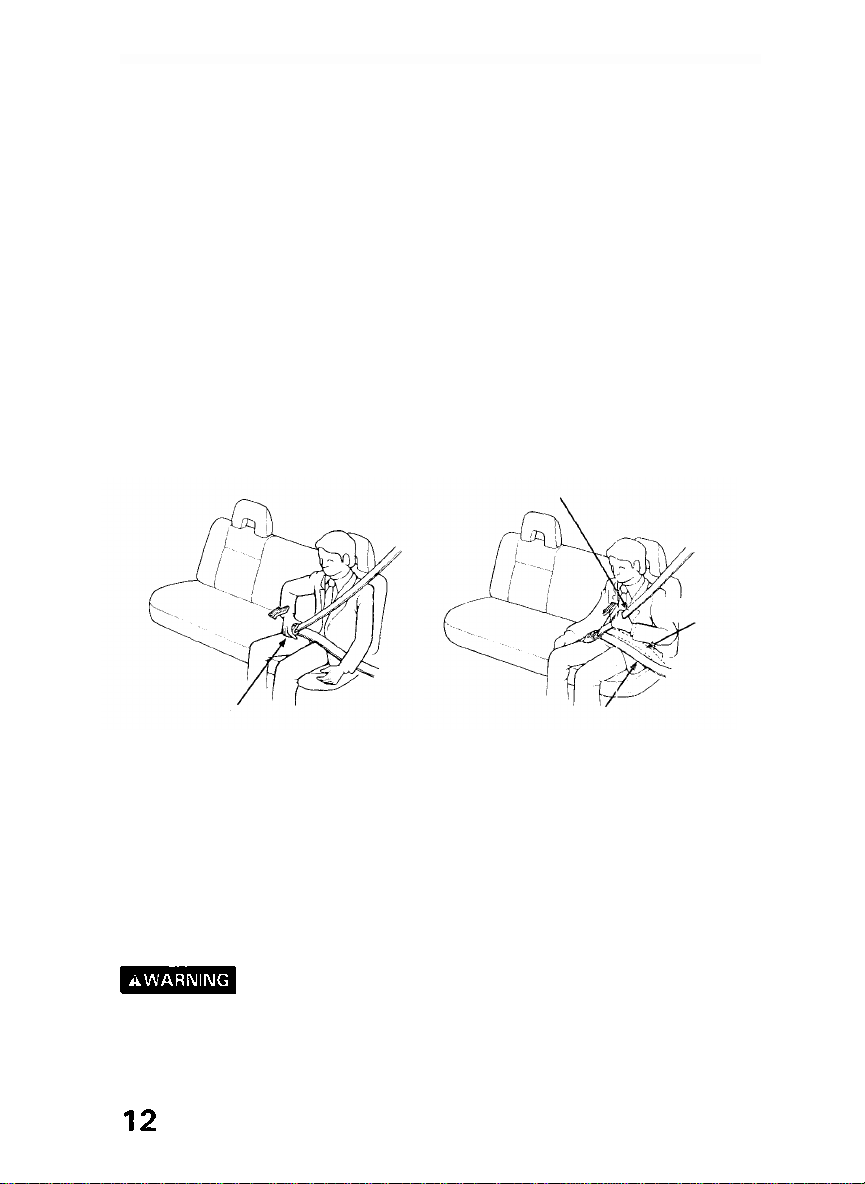
Buckling the Rear Seat Belts
In the rear seat, there are two one-piece combination lap/shoulder
belts and a center lap belt.
The seat-backs and seat belts provide best restraint when the
occupant is sitting well back and straight up in the seat.
The right and left rear seat belts are one-piece combination lap/
shoulder belts with an emergency locking retractor designed to lock
only during a sudden stop or impact. Otherwise, they allow you
some freedom of movement in the seat.
NOTE:
The emergency locking system of the rear seat belts will also be
activated if you pull the belt too fast. If this happens, release the
belt slightly then pull it out more slowly.
1. Take hold of the tongue plate and pull the belt across your lap. Be
sure the belt is not twisted or caught on anything.
2. Push the tongue plate into the buckle until it clicks locked.
The seat belt should fit snugly against your body. The shoulder
portion of the belt should go over your shoulder and across your
body to evenly distribute the belt's restraining force.
Check that the lap portion of the belt is positioned low on your
hipbone and below your abdomen. This way, if the car is involved
in an accident, you will be less likely to slide under the seat belts.
If the belt is too near your neck and throat, move toward the
center of the seat.
Avoid placing the lap belt across your abdomen. In the event of a
collision, the pressure of the belt on the abdomen may increase
the extent of injury.
Pull the belt across your lap
Take up slack
Too high
TONGUE PLATE
Keep below hipbone
Main Menu
▲
▼
3. To release the seat belt, push the "PRESS" button in the buckle;
the belt should retract automatically when released. If the belt
does not fully retract, pull it out and check for kinks or twists.
CAUTION:
Make sure both rear shoulder belts are positioned in front of the
rear seat-backs whenever the seat-backs are in their upright
position.
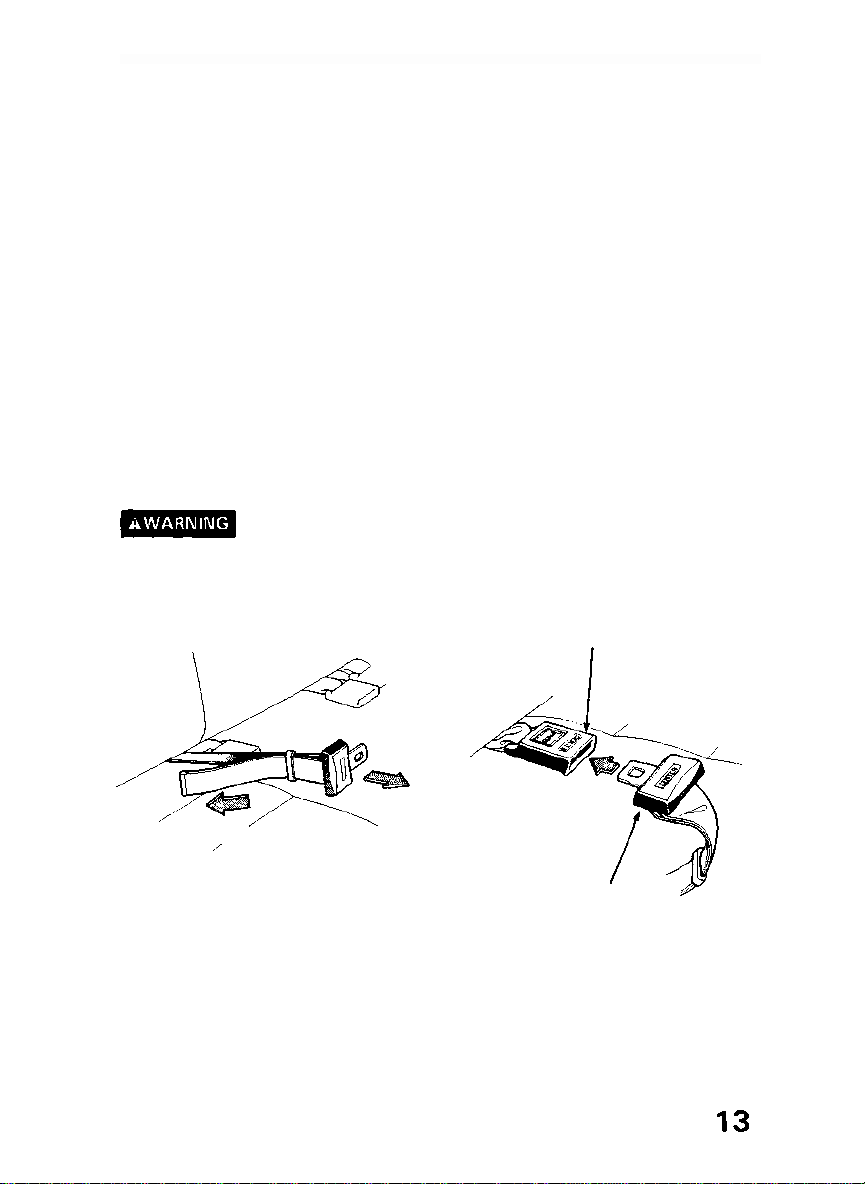
Rear Center Seat Belt
Adjust the center lap belt length to fit snugly but comfortably when
buckled.
A slack belt will greatly reduce the protection afforded to the
wearer. Hold the tongue plate perpendicular to the belt as shown.
* To shorten, pull the end of the belt away from the tongue plate.
* To lengthen, pull the tongue plate.
Push the tongue plate into the buckle until it clicks locked. Position
the belt across your lap, not your abdomen, as low on your hips as
possible.
Avoid placing the lap belt across your abdomen. In the event of a
collision, the pressure of the belt on the abdomen may increase
the extent of injury.
To shorten
BUCKLE
To lengthen
TONGUE PLATE
Main Menu
▲
▼
Seat Belts (cont'd)
Child Restraint
Children riding in the car should be restrained to minimize the risk of
injury in an accident, sudden stop or sudden maneuver.
According to accident statistics provided to the National Highway
Traffic Safety Administration (NHTSA), children are safer when
properly restrained in the rear seating positions than in the front
seat.
For smaller children, we strongly recommend the use of a
commercially available child restraint system that meets the Federal
Motor Vehicle Safety Standard (FMVSS) because it offers the most
protection against injury. All states now have laws which require
that small children must be seated in a child passenger seat restraint
system. Check local laws.
Before buying a particular child restraint system, make sure it fits
your car seat and seat belts, and fits your child. Follow the child seat
manufacturer's instructions when installing the child seat.
Children who have outgrown the child restraint system should use
one of the seat belts.
Make sure the belt is snug against the child's body with the
shoulder portion going over the shoulder and across the body to
evenly distribute the belt's restraining force.
Check that the lap portion of the belt is positioned low on the
child's hipbone and below the abdomen.
This way if the car is involved in an accident, the child will be less
likely to slide under the seat belts.
If the belt is too close to the child's neck or throat, you may want
to consider putting the child in an automobile booster seat that
meets the Federal Motor Vehicle Safety Standard (FMVSS).
Children should never ride unrestrained in an automobile.
Never use an infant carrier or child safety seat that "hooks"
over a seat-back; it may not provide adequate security in an
accident.
Never allow a child to be held in a person's arms while they are
in a moving vehicle. Holding a child in a moving vehicle does not
provide the child with any means of protection during an
accident, even if the person holding the child is wearing a seat
belt.
Main Menu
▲
▼
Installation of Child Seat
All child restraint systems are designed to be secured by lap belts or
the lap belt portion of a lap-shoulder belt. The automatic shoulder
belt system at the front passenger seat should not be used to
secure the child restraint system. If a child seat must be installed on
the front seat, place the shoulder portion of the belt behind the child
seat and secure the child seat with the lap belt only.
Children could be endangered in a crash, if their child restraints are
not properly secured. Follow the child seat manufacturer's
instructions when installing the seat.
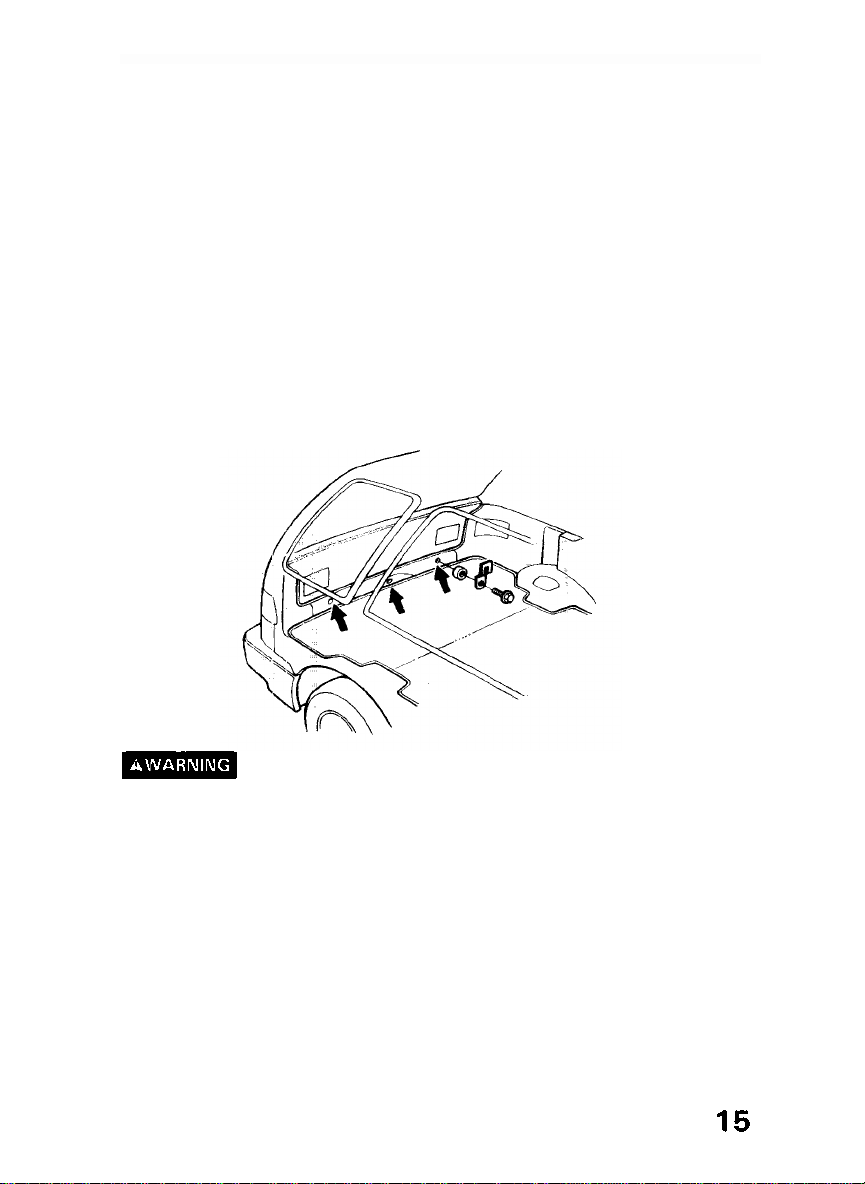
Your Honda automobile is equipped with attachment points
specifically for a rear seat mounted child restraint system which
uses a top tether.
The tether attachment points are located on the rear panel, below
the tailgate.
When the child restraint system is not in use, remove it from the
car or secure it with the seat belt to keep it from becoming a
projectile in the event of an accident.
NOTE:
See your Honda dealer for installation of the child restraint system.
Main Menu
▲
▼
Seat Belts (cont'd)
Pregnant Women
A pregnant woman should use the shoulder and lap belts to help
lessen the chance of injury and/or the amount of injury in an
accident.
It is desirable that a pregnant woman ask her doctor at each
medical check-up if she can drive, and also ask about the most
appropriate way of wearing the lap/shoulder belt.
If a rear seat lap belt is used, it should be worn as low and snugly
as possible over the hips.
Inspection
All parts of the seat belts, including the belt fabric, should be
regularly inspected for fraying, loosening, wear and other damage.
Keep the belts in good condition at all times to reduce the chance of
being injured in an accident, and to minimize any injuries that do
occur. Make sure the buckles, retractors, tongue plates, guides and
anchors all work properly.
Don't let anything get inside the buckle or the retractor; it could
cause latch or retractor failure.
Cleaning
The belts should always be kept clean and dry; wet or damp belts
can cause rewinding problems. To clean the belts, pull them all the
way out of their retractors and use warm water and a mild soap;
then let them air-dry fully extended, in the shade, with the car
windows open.
Never bleach, dye or clean the belts with chemical solvents; it
will weaken the fabric.
Do not remove the seat belts from the car to wash them.
Replacement
Replace the seat belt if:
1.The belting is cut, punctured, burned, etc.
2.The buckle or retractor does not work properly.
3. It was being worn at the time of a collision (also check for
deformation damage at all seat belt anchor points).
4. Its condition is questionable.
Main Menu
▲
▼
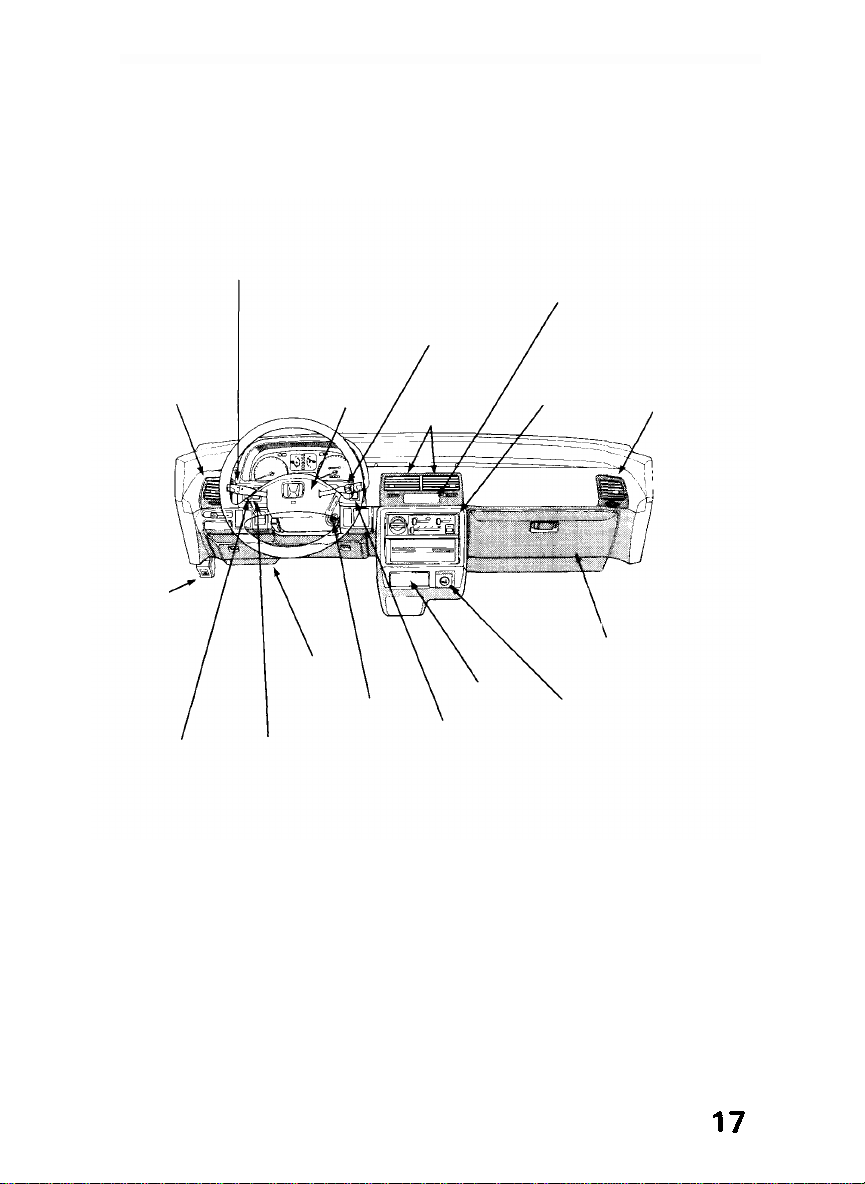
Instrument Panel
(cont'd)
LIGHT SWITCH/
TURN SIGNAL/
HI/LO BEAM SWITCH
DASH
CORNER
VENT
WIPER/
WASHER
SWITCH
HORN
BUTTON
CENTER
VENTS
DIGITAL
CLOCK
HEATING/
COOLING
CONTROL
PANEL
DASH
CORNER
VENT
HOOD
RELEASE
HANDLE
FUSE
BOX
REAR
WINDOW
DEFOGGER
SWITCH
PANEL
BRIGHTNESS
CONTROL
DIAL
IGNITION
SWITCH
HAZARD
WARNING
LIGHT
SWITCH
ASHTRAY
CIGARETTE
LIGHTER
GLOVE BOX
Main Menu
▲
▼
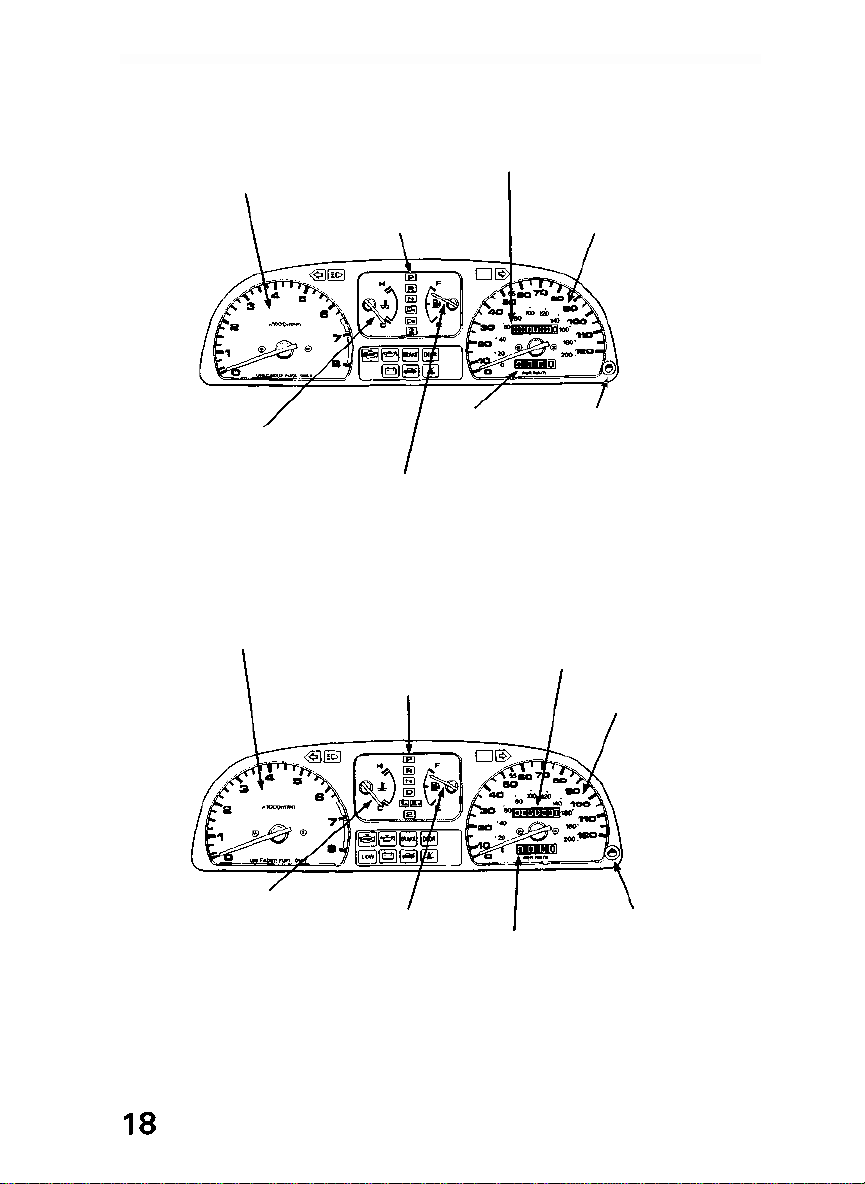
Instrument Panel (cont'd)
CIVIC WAGON
4WD
TACHOMETER
SHIFT LEVER
POSITION
INDICATOR
(Automatic
Trans. only)
ODOMETER
SPEEDOMETER
COOLANT
TEMPERATURE
GAUGE
FUEL GAUGE
TRIP METER
TRIP METER
RESET BUTTON
TACHOMETER
SHIFT LEVER
POSITION
INDICATOR
(Automatic
Trans. only)
ODOMETER
SPEEDOMETER
COOLANT
TEMPERATURE
GAUGE
FUEL GAUGE
TRIP
METER
TRIP METER
RESET BUTTON
Main Menu
▲
▼

Speedometer
The speed is indicated in miles per hour (outside scale) and
kilometers per hour (inside scale).
Odometer
The numbers on the odometer indicate miles.
The odometer registers total distance traveled, and serves as your
guide for determining when periodic maintenance is due. Federal law
makes it illegal to alter the odometer of any motor vehicle with the
intent to change the number of miles indicated.
Trip Meter
The numbers on the trip meter indicate miles.
The trip meter can be returned to zero by pushing in the reset
button. Use it for checking fuel consumption or distance traveled
per trip.
Tachometer
The tachometer indicates engine speed in revolutions per minute.
The beginning of the RED ZONE indicates the maximum allowable
engine R.P.M. Do not run the engine with the tachometer indicator
needle in the RED ZONE.
Fuel Gauge
FUEL TANK CAPACITY: 45 (11.9 US gal, 9.9 Imp gal)
As a convenience, the gauge continues to show the same fuel level
as when the ignition was last on. After refueling, the gauge will
slowly change to the new fuel level when the ignition is switched on.
When the needle first indicates E (empty), you have a usable
reserve left in the tank of about:
4 (1.1 US gal, 0.9 Imp gal)
Coolant Temperature Gauge
CAUTION:
The needle should stay within the white range. If the needle
reaches the red line at "H" (Hot), pull safely off the road, stop the
engine and check the coolant level in the reserve tank on the
driver's side of the radiator under the hood.
Do not remove the radiator cap when the engine is hot. The
coolant is under pressure and may blow out and scald you.
Gauges
Main Menu
▲
▼
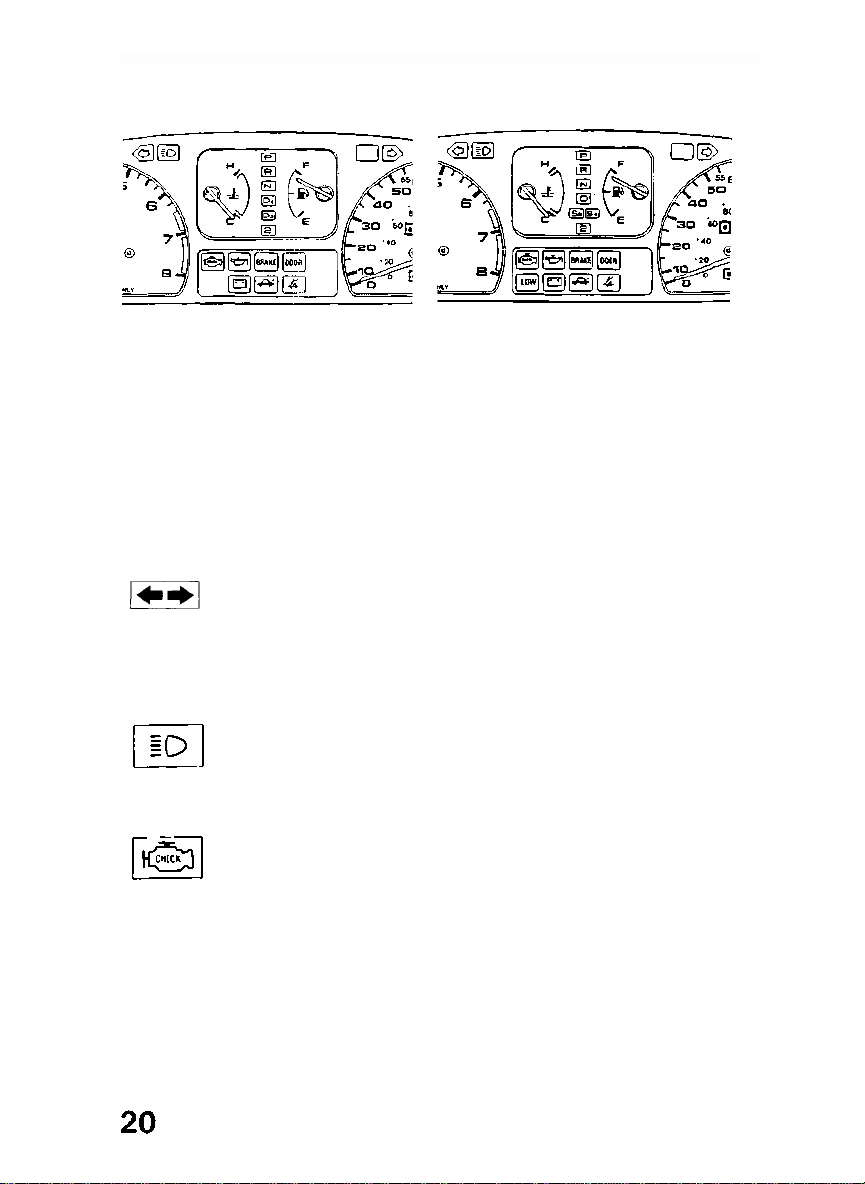
Warning and Indicator Lights
CIVIC WAGON
4WD
Shift Lever Position Indicator (Automatic Transmission only)
An indicator between the fuel and coolant temperature gauges
shows which gear you have selected.
NOTE: (4WD Automatic only)
The S
3
indicator light in the instrument panel also serves a second
function. If the light flashes while driving (in any gear range) it
indicates a possible malfunction in the transmission; avoid rapid
acceleration and have the transmission checked by an authorized
Honda dealer as soon as possible.
Turn Signal/Hazard Warning Indicator Lights
When the turn signal lever is pushed for left or right turns, the
appropriate green indicator arrow on the instrument panel will blink
along with the signal. Pushing the hazard warning switch will make
all turn signals and both arrows blink (see page 28).
Headlight High Beam Indicator Light
This blue indicator light will go on whenever the high beams are
switched on (see page 27).
Check Engine Warning Light
This light comes on for a couple of seconds each time the ignition is
turned on. It will also come on, and remain on, if there is a
malfunction in the emission control system. If the light comes on
while driving, avoid driving at high speed, and have the system
checked by a Honda dealer as soon as possible.
Main Menu
▲
▼
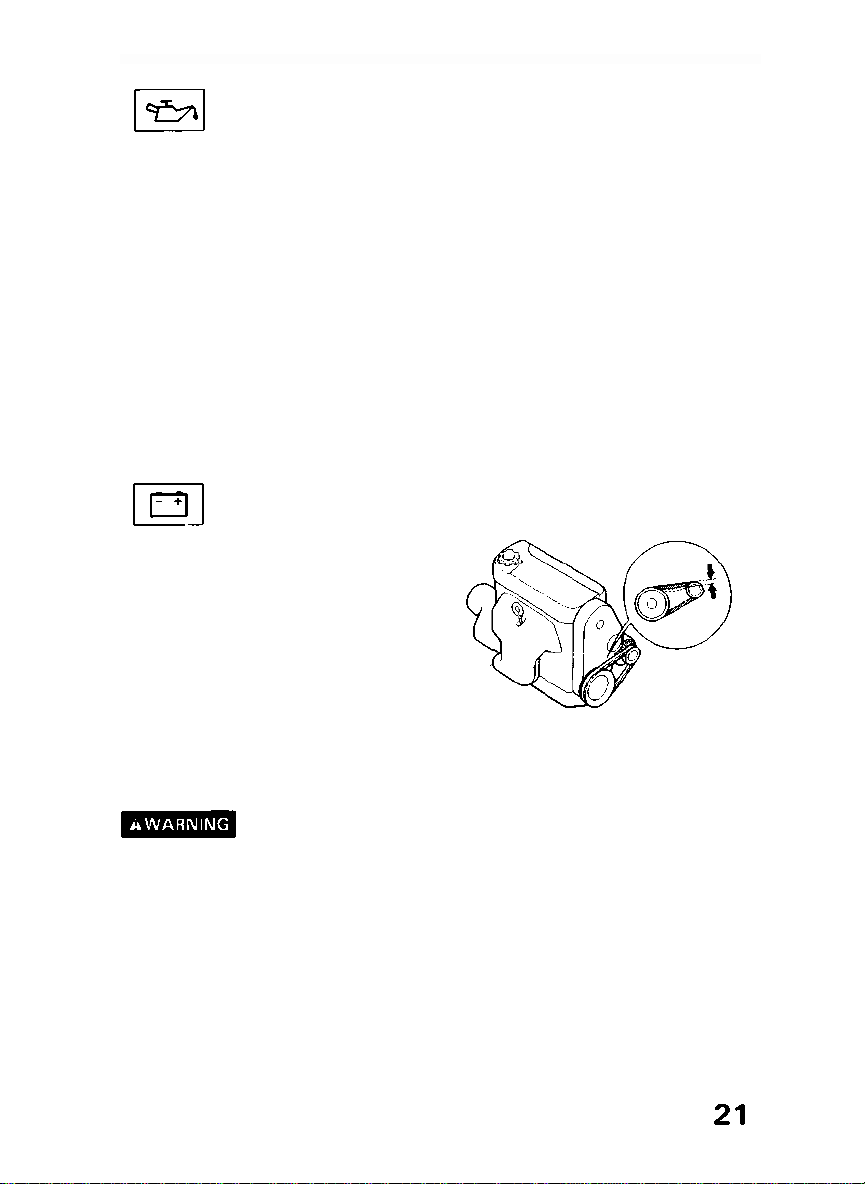
Oil Pressure Warning Light
The oil pressure warning light will come on, and remain on, if there is
insufficient oil pressure or when the ignition switch is turned on
with the engine not running. If the light should come on while driving,
get the car off the road as soon as you can, turn the engine off and
check the engine oil level (see page 65 ).
Even if the oil level is correct, the engine should be checked by a
Honda dealer before the car is driven again.
NOTE:
The oil pressure warning light will only light as a result of low oil
pressure. It is not directly an oil level indicator.
CAUTION:
Running the engine while the oil pressure warning light is on
constantly may cause immediate and severe engine damage.
Charging System Warning Light
The charging system warning light
comes on when there is a problem
with the electrical charging system
or when the ignition switch is turn-
ed on with the engine not running. If
the light comes on while driving, get
off the road, stop the car and turn
off the ignition. Then check the
alternator belt for proper tension.
To check the belt tension, push with about 98 N (22 Ib) of force on
the middle of the belt as shown. The belt should deflect about:
9.0 — 11.0 mm (0.35 — 0.43 in)
If the engine has been running, some engine components may be
hot enough to burn you.
NOTE:
If necessary, have the charging system checked by an authorized
Honda dealer.
(cont'd)
Main Menu
▲
▼
Warning and Indicator Lights (cont'd)
CIVIC WAGON
4WD
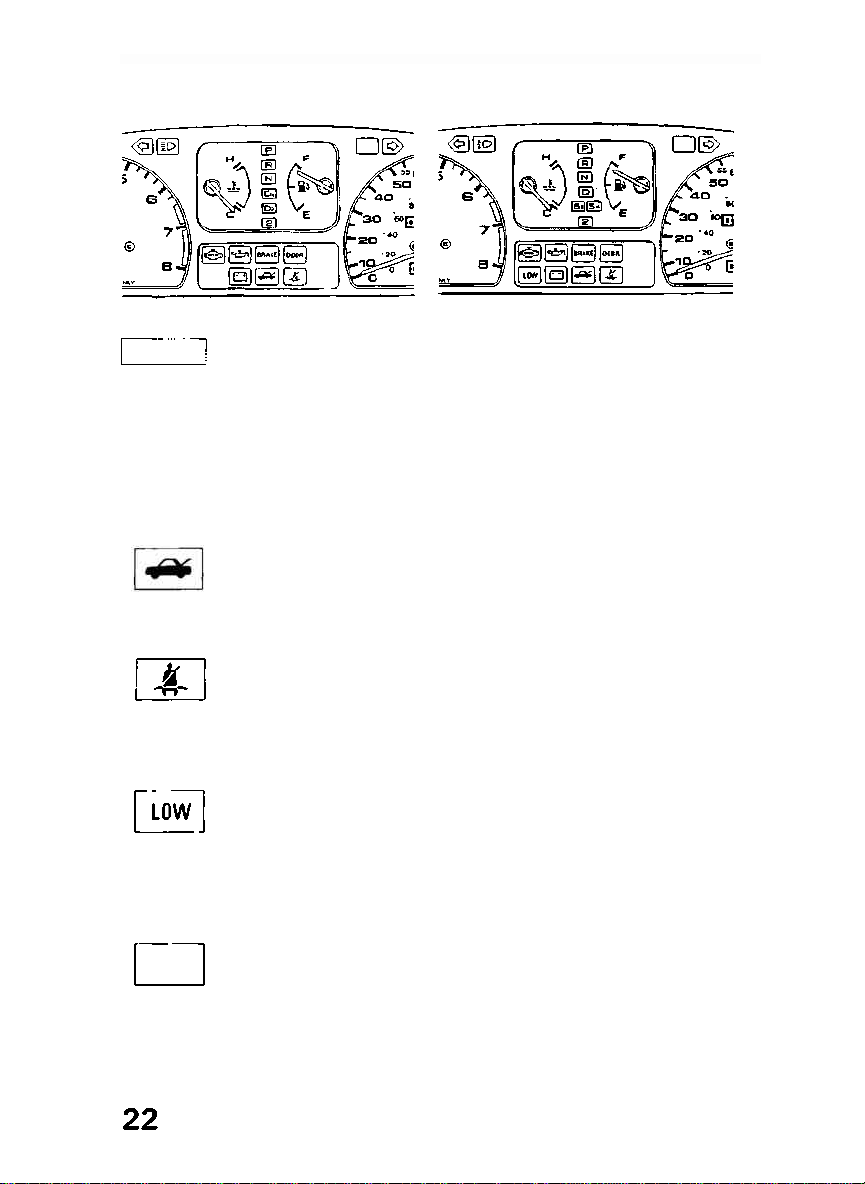
Parking Brake/Brake Failure Warning Light
Check the brake warning light every time you start the car.
With the parking brake set, the warning light should go on when the
ignition switch is turned to II or III. With the parking brake released,
the light should go on when the ignition switch is turned to III. If the
light goes on at any other time, it means the brake fluid level in the
master cylinder reservoir is too low; add fluid and have your dealer
check for leaks and brake pad wear immediately. (See page 76)
Seat Belt Warning Light
The seat belt warning light comes on when the ignition switch is
turned on. If the front seat belts are fastened, it goes off in about six
seconds. Otherwise, it stays on. (See page 11)
LOW Indicator Light(4WD Automatic only)
This indicator light is on while you are driving in the LOW mode (see
page 55 ).
When the ignition switch is turned to the "II", this indicator light
comes on for a couple of seconds; this is normal.
Door Warning Light
If a door is open when the ignition is switched on, this light will go
on and stay on until the door is closed.
BRAKE
DOOR
Tailgate-open Indicator Light
This light will go on when you turn on the ignition switch if the
tailgate is not fully closed.
Main Menu
▲
▼
Tilt Steering
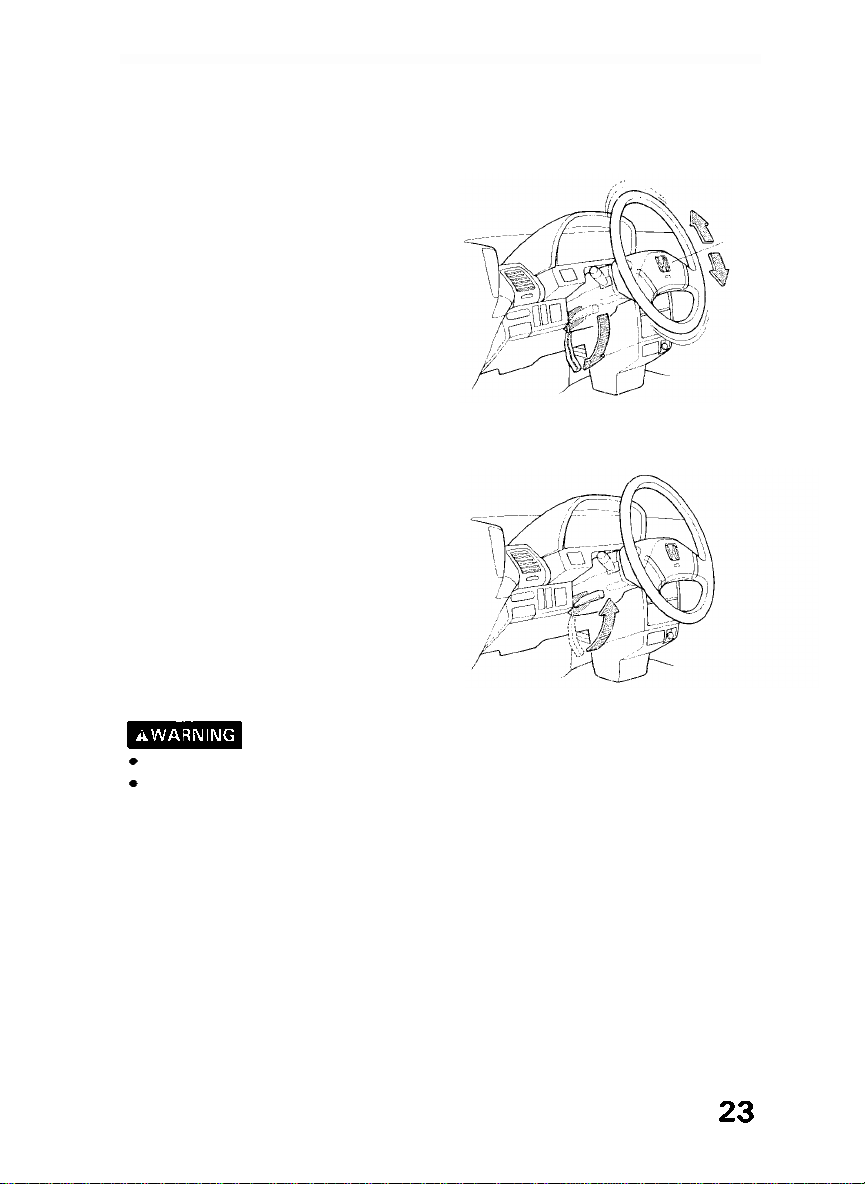
Tilt Steering
The steering wheel position can be adjusted to suit the driver
preference.
1. Push the lever located on the left
side of the steering column all the
way down and hold it while ad-
justing the steering wheel to the
desired position.
Push down
2. Hold the steering wheel in the
desired position and pull the lever
all the way up to lock it in place.
Do not adjust the steering wheel position while driving.
After adjusting the steering wheel position, make sure it is
securely locked in place by "rocking" it up and down slightly.
Pull up
Main Menu
▲
▼
Windshield Wipers/Washer/Defogger
Windshield Wipers
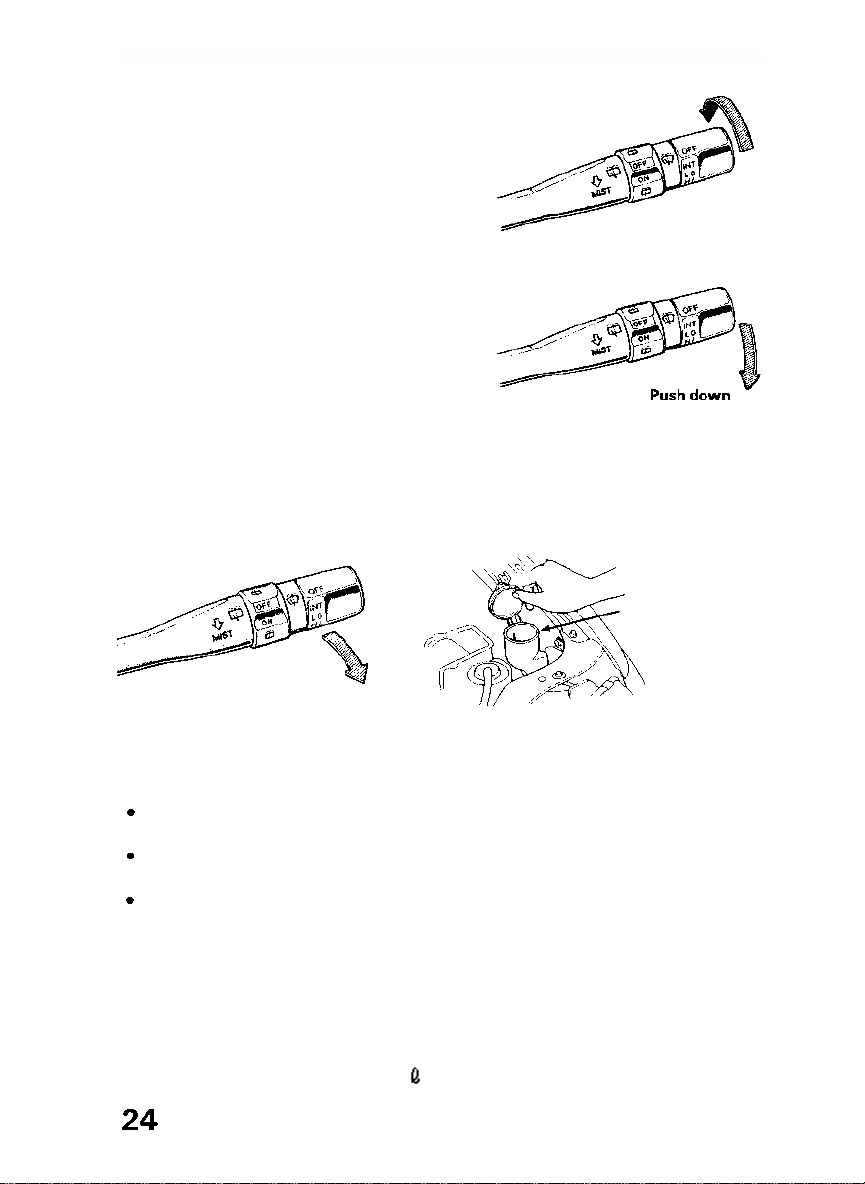
Switch the wipers to INT for inter-
mittent operation; LO for low speed
operation; and HI for high speed
operation.
In fog or very light rain, push the
lever down to the MIST position for
temporary high speed operation of
the wipers. The wipers will return
to the rest position and the motor
will shut off as soon as you release
the lever.
Windshield Washer
Pull the wiper switch lever toward you to turn on the washer.
Check the washer fluid regularly, especially during bad weather or
whenever the washer has been in frequent use.
PULL
WASHER FLUID
RESERVOIR
Use a good quality commercial washer fluid for all-weather cleaning.
CAUTION:
Do not use radiator antifreeze in the windshield washer; it will
damage the paint.
Do not use a vinegar/water combination in the windshield
washer; it will damage the pump.
Prolonged operation of the washer without fluid may damage
the pump.
In freezing weather, warm the windshield with the defrosters
before using the washer. This will help prevent icing which could
seriously impair visibility.
WINDSHIELD WASHER
RESERVOIR CAPACITY: 2.5 (2.6 US qt , 2.2 Imp qt)
Main Menu
▲
▼
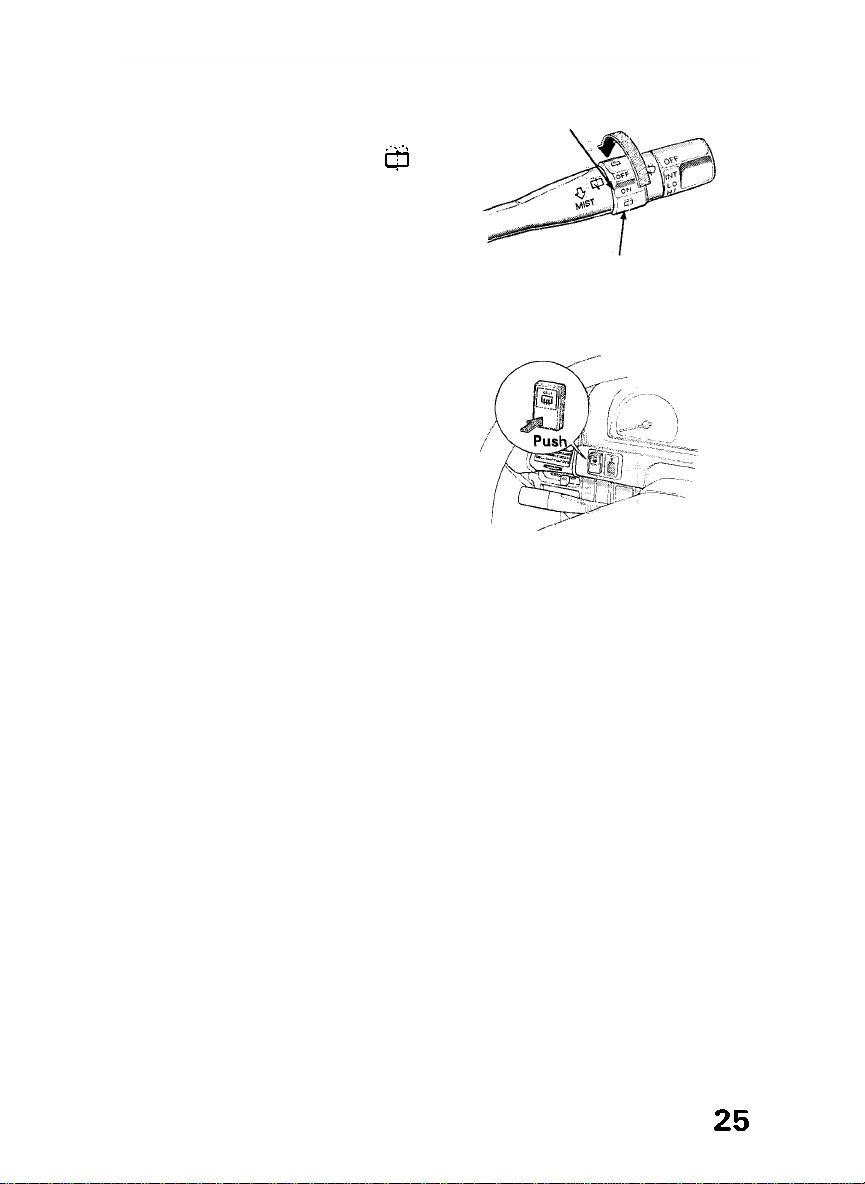
Rear Window Wiper/Washer
Switch to "ON" to activate the rear
wiper. Turn and hold the switch one
more step clockwise to " "
to activate the washer and wiper;
or turn and hold the switch one step
counterclockwise from "OFF" to
activate the washer only. The rear
washer uses the same fluid reser-
voir as the front washer.
WIPER
WASHER
Rear Window Defogger
Push the switch to turn the de-
fogger on or off. The indicator will
light when the defogger is on.
The switch will turn off automat-
ically 25 minutes after it is turned on.
CAUTION:
When cleaning the inside of the rear window, be careful not to
damage the printed heater wires on the rear window. Wipe the
window horizontally along the wires, not up and down.
Main Menu
▲
▼
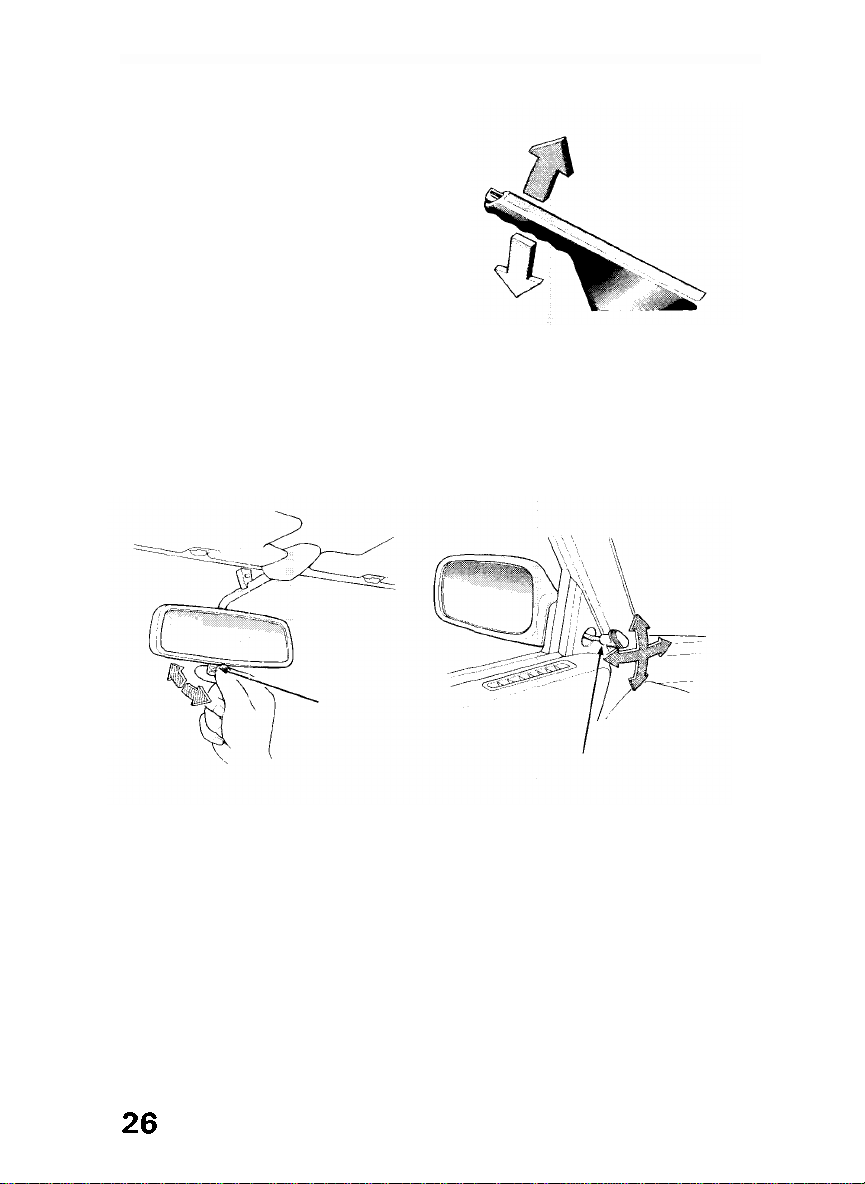
Parking Brake and Mirrors
Parking Brake
To apply the parking brake, pull up
on the lever. To release it, pull up
slightly, push the button, and lower
the lever; when fully released, the
BRAKE warning light will go out.
Rearview Mirrors
Keep the inside and outside mirrors clean and adjusted for best
visibility. Be sure to adjust mirror angles before you start driving.
The outside mirror can be adjusted by moving the knob on the
inside of the driver's door.
ADJUSTMENT
KNOB
The inside mirror has day and night positions. The night position re-
duce
s glare from the headlights of vehicles behind you. Flip the small
tab on the bottom of the mirror forward or backward to select day
o
r night position.
Pull up
DAY/NIGHT
ADJUSTMENT
TAB
Main Menu
▲
▼
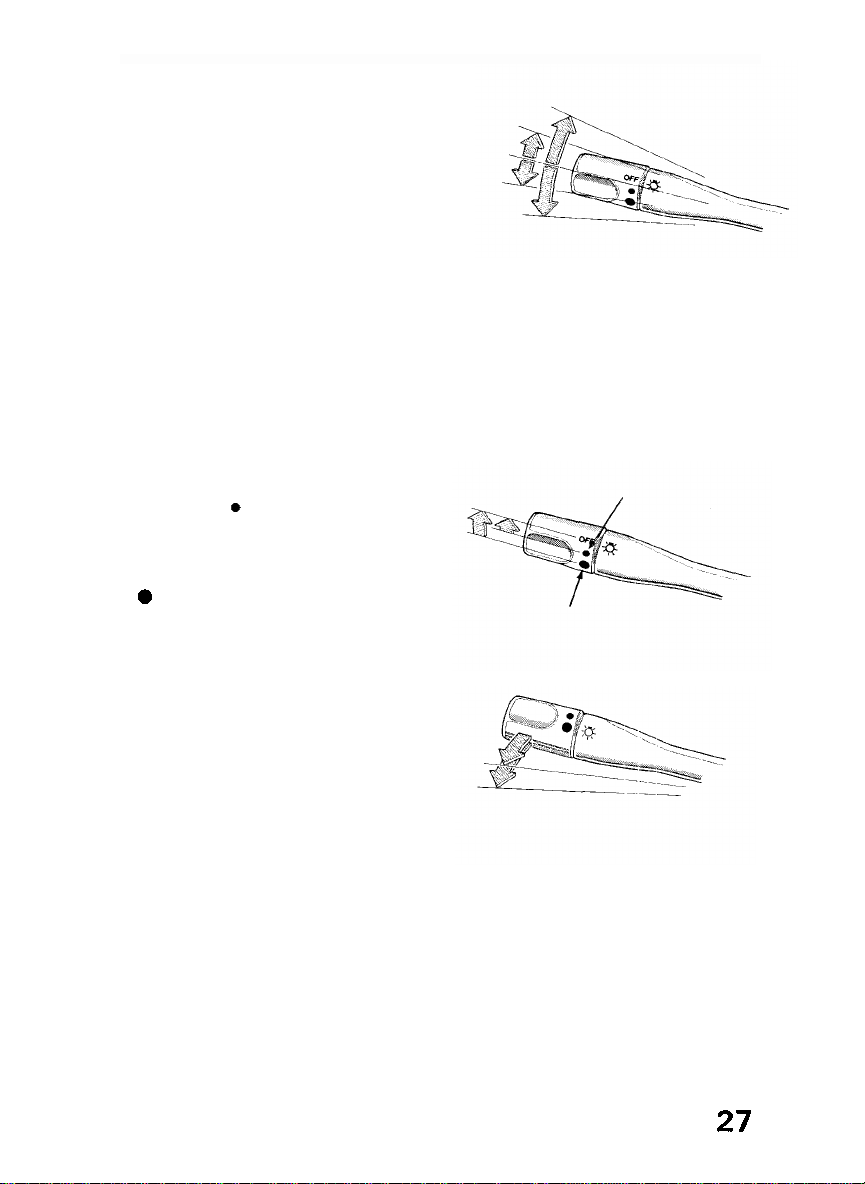
Lights
Turn Signals
Push the turn signal lever down to
signal a left turn, and up for a right
turn. The indicator and appropriate
signal lights will blink. The lever will
return automatically to its original
position when the steering wheel is
returned to straight ahead.
For lane changing, you can signal by pushing the lever part way up
or down (to the first stop) and holding it there; the lever will return
to its original position when you release it. If either turn signal
indicator lights up but does not blink, blinks faster than usual or does
not light up at all, check for a burned out bulb or fuse.
Headlights
Turn the light switch to the first
position ( ) for taillights, side
marker lights, position lights, license
plate lights, and instrument panel
lights. Turn to the second position
( ) to add the headlights.
High Beam/Low Beam Switch
The headlights may be switched
between low beam and high beam
by pulling the turn signal lever
towards you. The blue high beam
indicator light will be on when the
high beam is on.
Headlight Flasher
To flash the headlights, pull lightly
on the turn signal lever and release.
(cont'd)
FIRST
STOP
RIGHT TURN
FIRST
STOP
LEFT TURN
Pull and release
Turn
FIRST POSITION
SECOND
POSITION
Main Menu
▲
▼
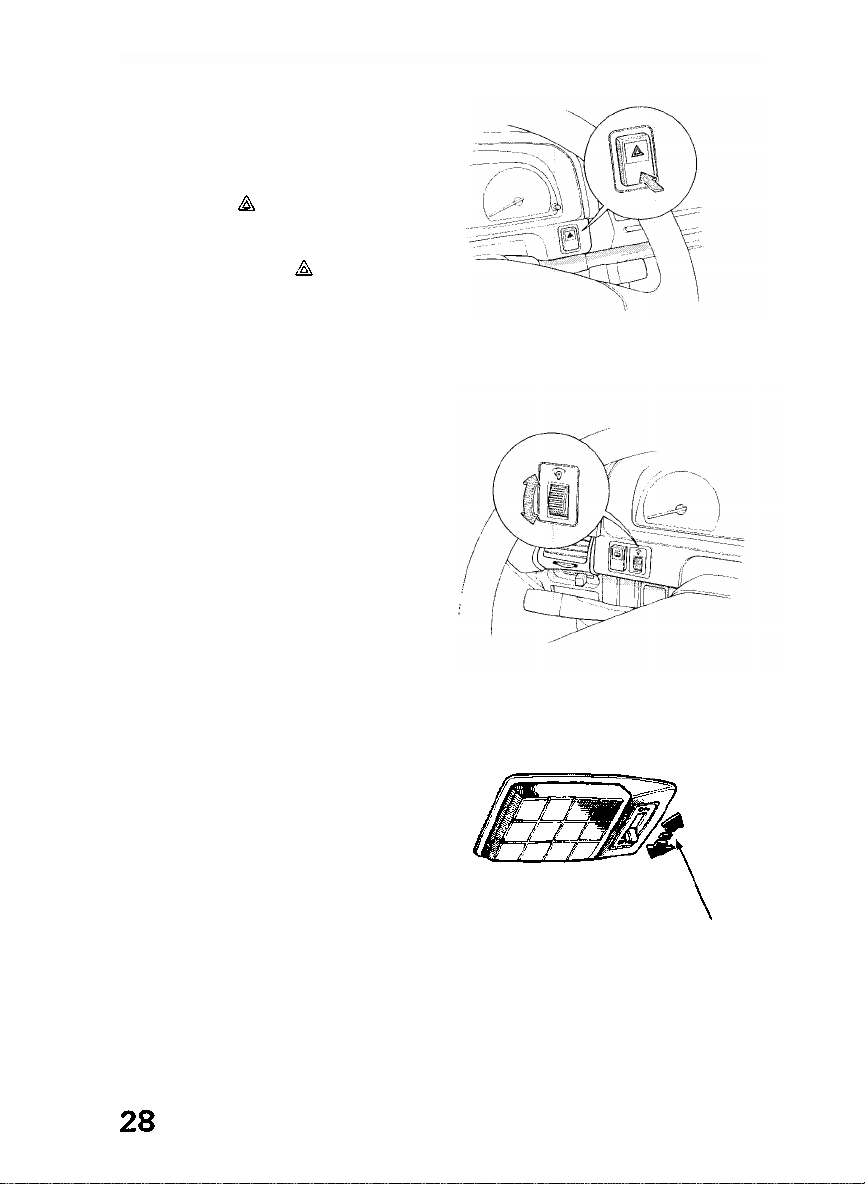
Lights (cont'd)
Hazard Warning System
This system should be used only
when your car is stopped under
emergency or hazardous conditions.
To activate, push the hazard warn-
ing switch ( ). The front and rear
turn signals will blink simultaneously
and both indicator lights will flash.
Push the switch ( ) again to turn
the system off.
Panel Brightness Control
When the light switch is in either of
the two "ON" positions, the intensi-
ty of the instrument lights can be
adjusted by turning the panel bright-
ness control dial.
Interior Light
The interior light has a three posi-
tion switch. The light is off all the
time in the OFF position. In the mid-
dle position, it goes on only when a
door is opened. In the ON position, it
is on all the time.
DOOR
ACTIVATED
OFF
ON
Push
Main Menu
▲
▼
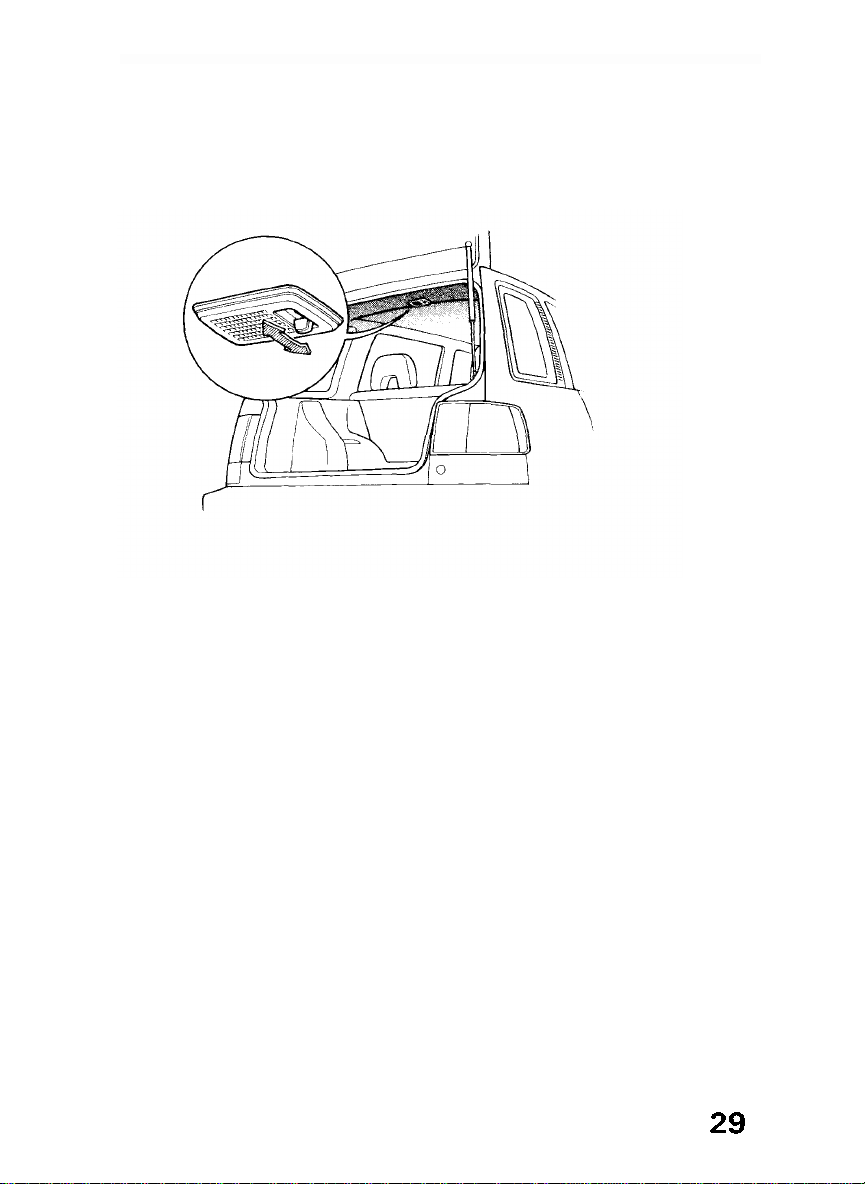
Luggage Area Light
The luggage area light has a two-position switch. In the first position
it is OFF all the time, in the second position it goes ON only when
the tailgate is opened.
Main Menu
▲
▼
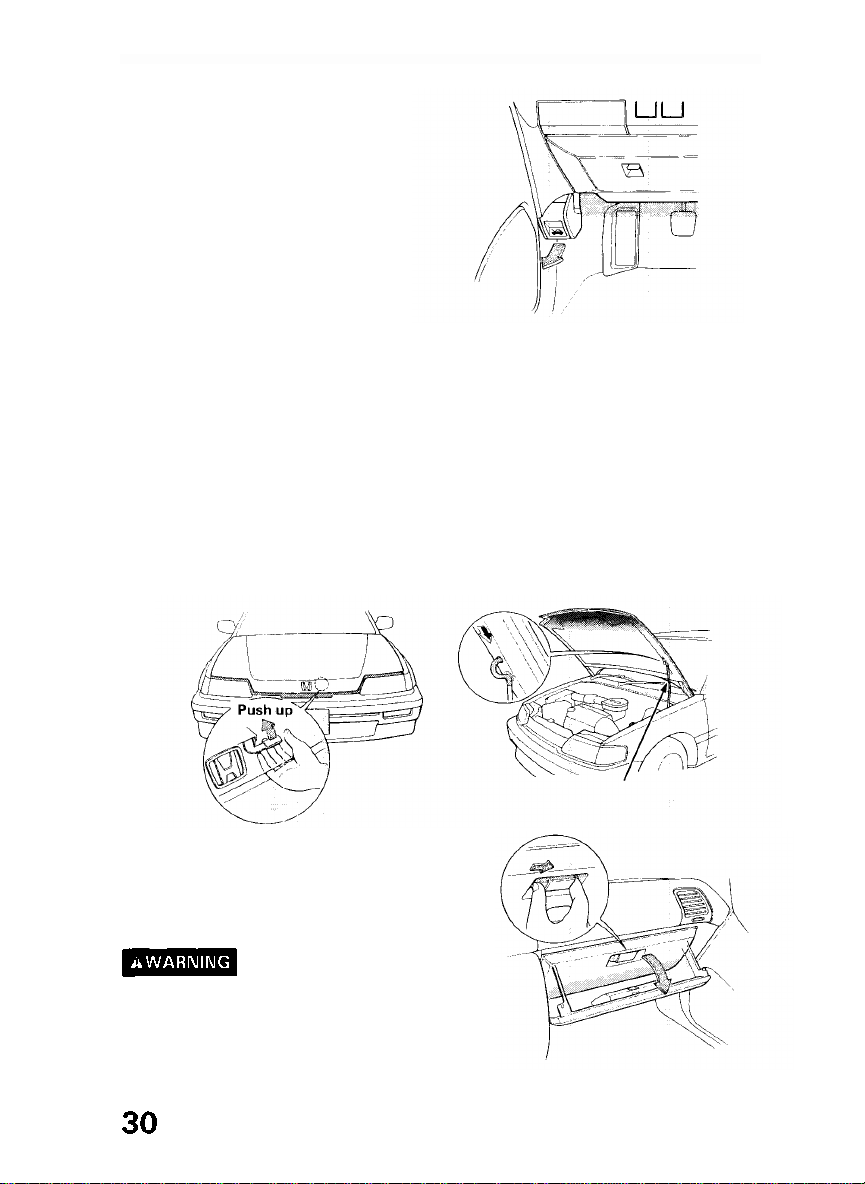
Hood and Glove Box
Hood
To open, pull back on the handle
under the left side of the dash.
The hood latch is spring-loaded, so the hood will pop up slightly.
Release the safety catch under the front center of the hood by
pushing the rubber-tipped handle up.
Lift the hood and prop it open with the support rod.
To close, take the support rod down, and return it to its clip , then
lower the hood until it is approximately one foot from the closed
position, then let it drop. Be sure the hood is securely latched before
driving away.
SUPPORT ROD
Glove Box
Open by pushing the knob as shown.
Close with a firm push.
Do not drive the car with the glove
box door open; it could cause injury
in an accident.
Pull to release
Push
Main Menu
▲
▼
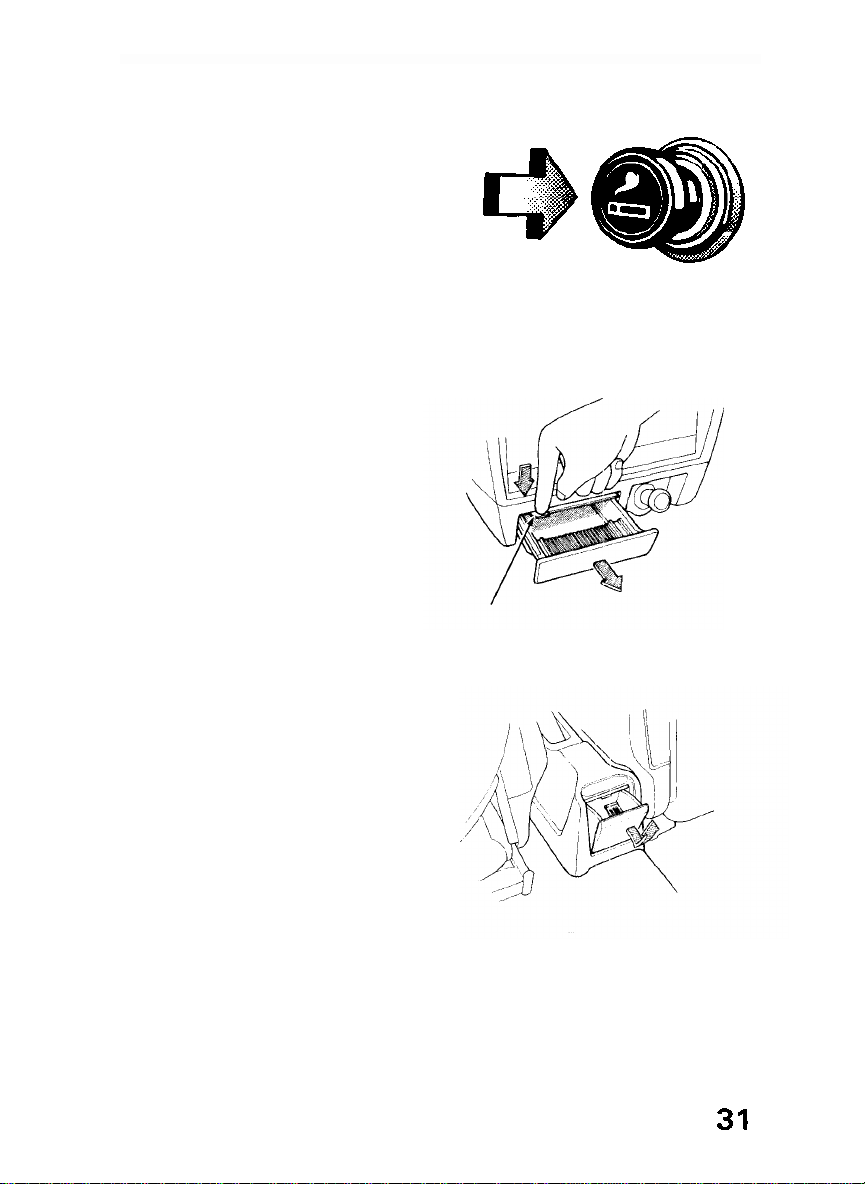
Cigarette Lighter and Ashtrays
Cigarette Lighter
Push in to heat up. It will automati-
cally release when the element is
hot. DO NOT hold it in while it is
heating up, it may overheat and
damage the lighter and the heating
element.
Front Ashtray
Open the ashtray by pulling its bot-
tom edge toward you.
To remove it, pull it out further
while pushing down on the spring
loaded plate inside.
To install, reverse the removal pro-
cedure.
PLATE
Rear Ashtray
Open the ashtray by pulling its top
edge.
To remove it, open the ashtray and
release its bottom edge by pulling up,
then out. To install, reverse the
removal procedure.
CAUTION:
Do not use the ashtrays as trash
containers; use them only for
extinguished cigarettes. Putting lit
cigarettes or matches in an ashtray
with other combustible materials
may cause a fire.
To remove, pull up and out
Push
Main Menu
▲
▼
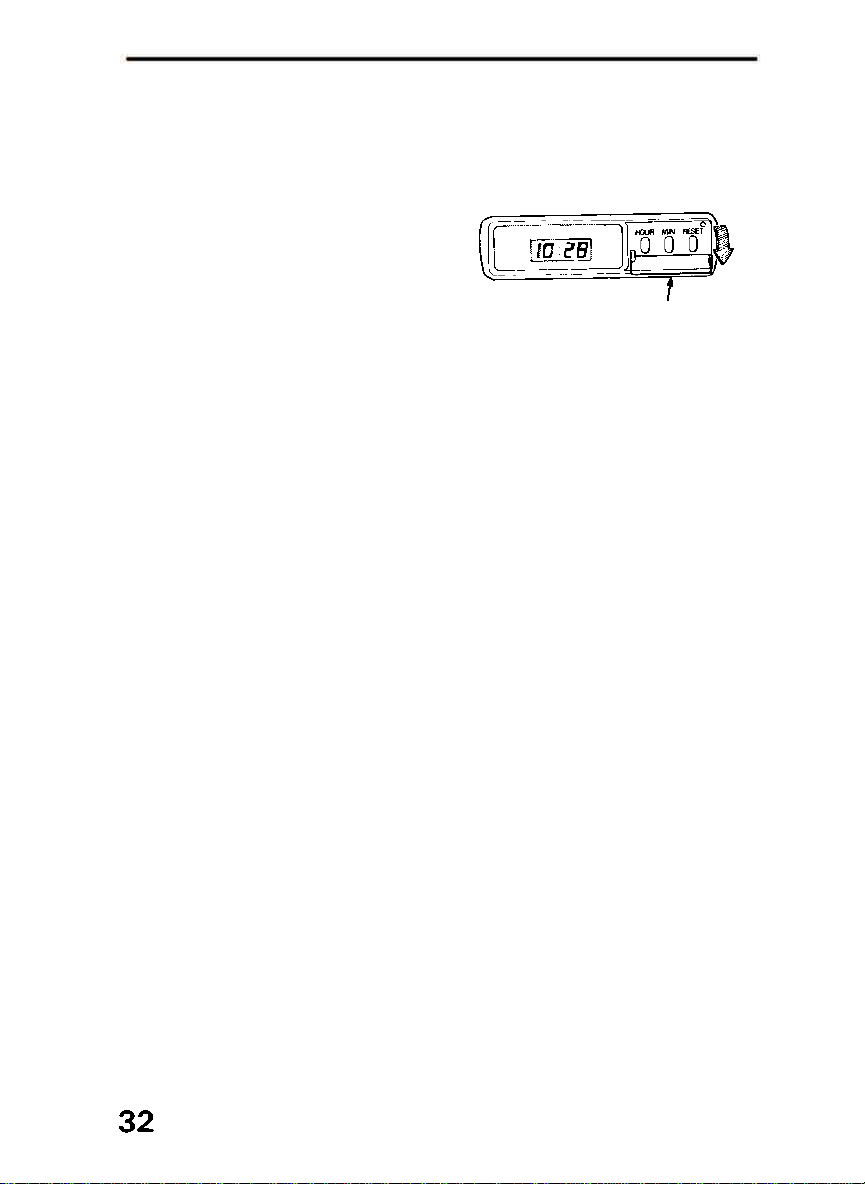
Digital Clock
The time is displayed continuously when the ignition is on.
At all other times, push in on the lid to display the time.
To adjust the time:
1. Lower the lid.
2. Push the minute button (MIN.) and
hold it until the numbers advance
to the desired minutes.
3. Push the hour button (HOUR) and
hold it until the numbers advance
to the desired hour.
4. The RESET button allows you to synchronize your clock to the
closest hour. If the time on the clock is before the half hour,
pressing the RESET button will return the time to the previous
hour. If the time is beyond the half hour, the RESET button will
change the time to the next hour.
NOTE:
Be careful not to push the HOUR, MIN. or RESET buttons acciden-
tally. Pushing any of them will change the clock's time setting.
Clock
LID
Main Menu
▲
▼
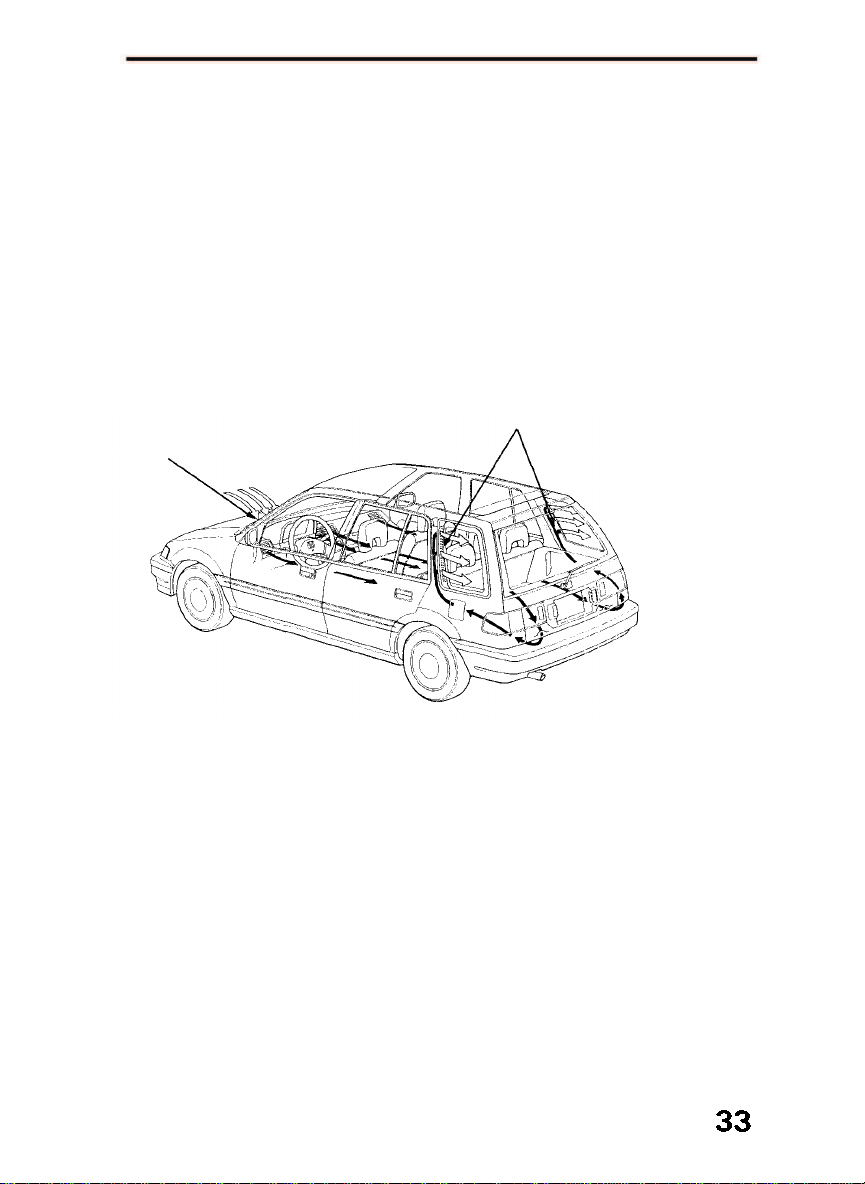
Heating and Cooling
The vents, heater and air conditioner are combined in one system;
adjusting four basic controls to different settings can provide a full
range of interior temperatures for safe and comfortable driving.
Airconditioner: optional
Ventilation
The flow-through ventilation system can provide fresh air to the
interior when the car is moving or stopped, even with the windows
closed.
NOTE:
For proper air flow, the flow-through vents must not be covered.
Keep the air inlet at the base of the windshield free of leaves or
other debris.
You can adjust the controls to direct cool or warm outside air
throughout the car for defogging windows, heating, or cooling.
When stopped or driving at low speeds, you can increase the air
flow by turning on the fan.
(cont'd)
AIR OUTLET
AIR INLET
Main Menu
▲
▼
Heating and Cooling (cont'd)
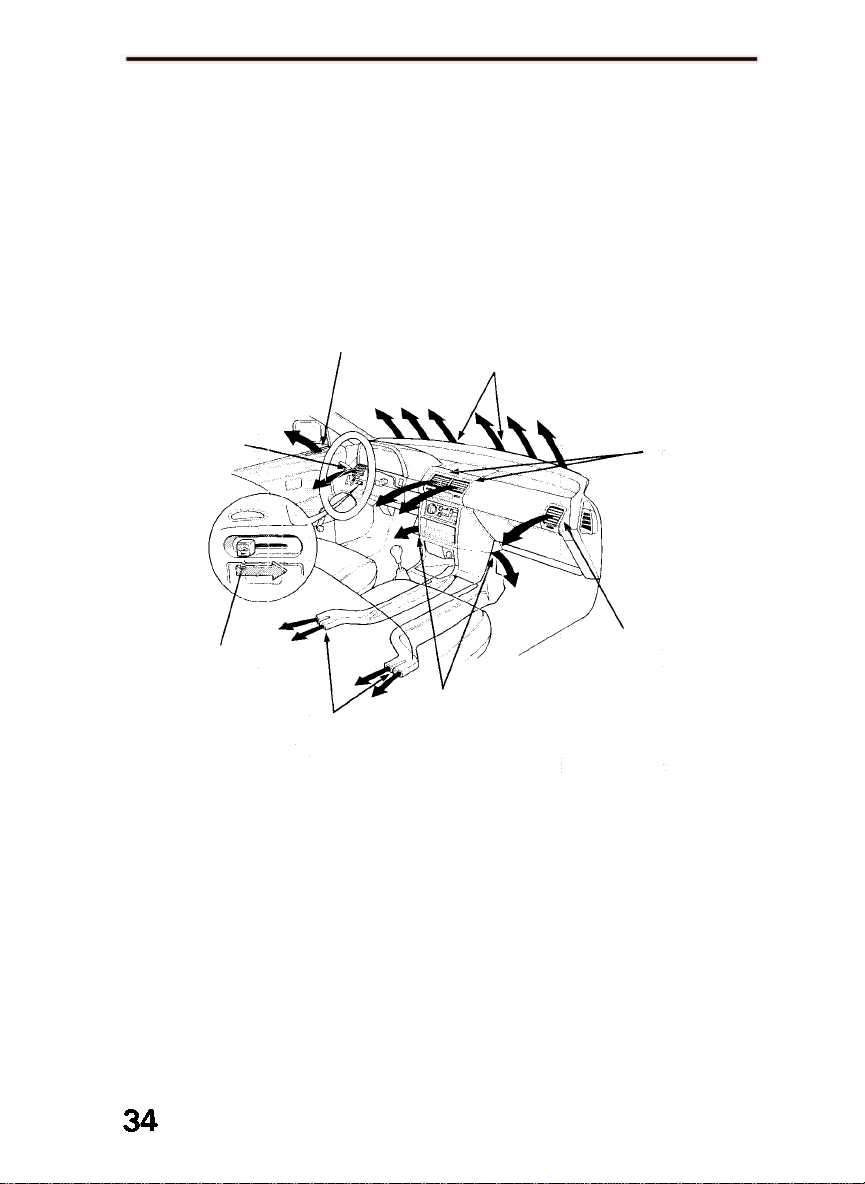
Dash Vents
The corner vents can be used for flow-through ventilation, or for
heating and air conditioning. When the car is moving, the driver's
corner vent can also route fresh air directly from the outside by
sliding the corner vent lever below it to the right and shutting it off
from the heater and air conditioner system.
The louvers in the corner and center vents can be tilted up or down
and right or left, to change the direction of air flow.
SIDE DEFROSTER
OUTLET WINDSHIELD DEFROSTER
OUTLETS
CORNER
VENT
CENTER
VENTS
CORNER
VENT
FRONT FLOOR
OUTLETSREAR FLOOR
OUTLETS
CORNER
VENT
LEVER
Main Menu
▲
▼
What the Controls Do:
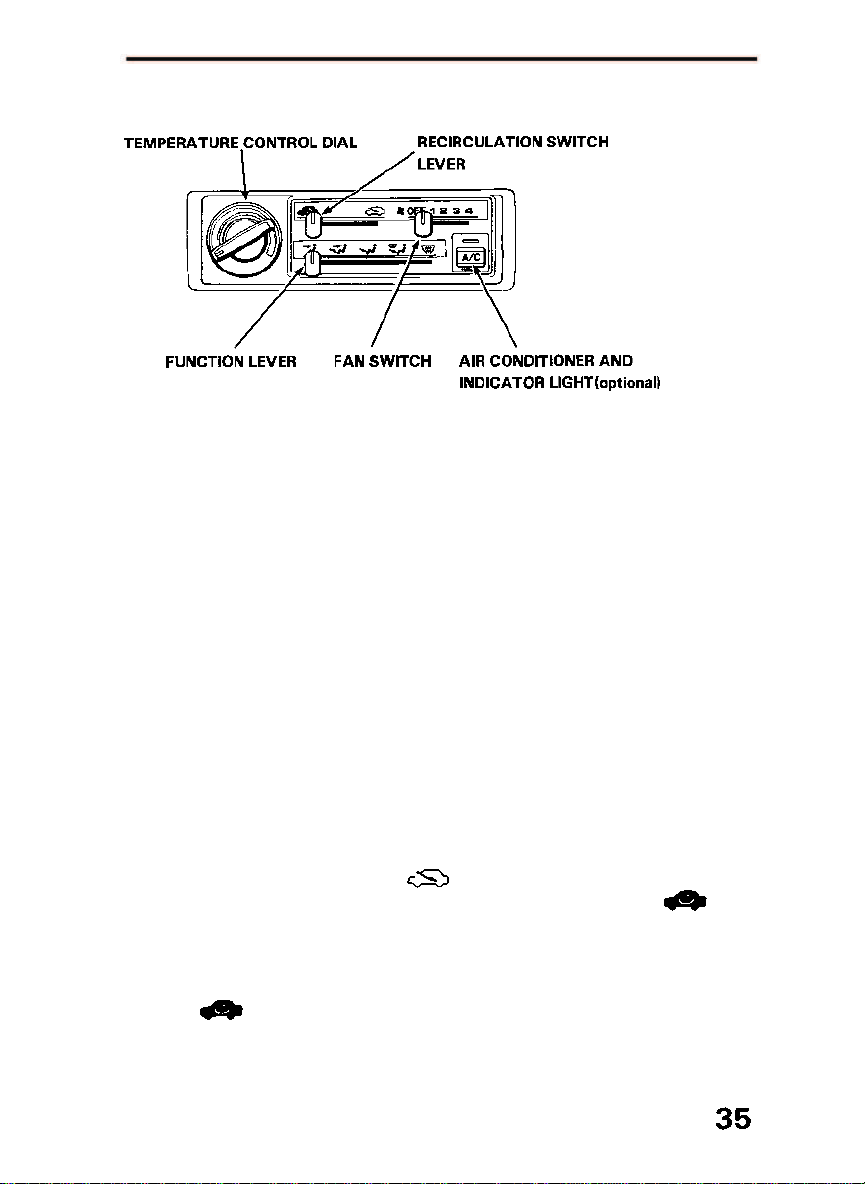
Fan Switch
Switch the fan to low (1), medium (2), medium high (3) or high (4)
speed, to circulate warm, cool, or outside air, depending on where
the temperature control dial and function lever are set.
Whenever the fan is switched on, air flows from the dash corner
vents regardless of function selection.
Function Lever
Slide the lever right or left to direct outside air or recirculated
(inside) air to and from the heater, air conditioner and vents.
Temperature Control Dial
Turn the dial clockwise to make air warmer when the appropriate
function is selected.
Air Conditioner Switch (optional)
With the fan on, push the A/C switch to operate the air conditioner;
the indicator light will come on.
Push the switch again to turn the air conditioner off.
Recirculation Lever
When the lever is set at the position, outside air will be al-
lowed to circulate inside the car. When the lever is set at po-
sition, outside air is shut off and the air inside the car is recirculated.
If the heater or air conditioner is on and you want to warm up or
cool down the interior more quickly, or keep smoke or dust out of
the car without losing the heat or cool function, simply set the lever
to the position.
(cont'd)
Main Menu
▲
▼
Heating and Cooling (cont'd)
NOTE:
The windows may become fogged if the system is in the po-
sition for an extended period of time with the air conditioner off. As
soon as the interior is warmed, slide the lever to the posi-
tion.
How to Use the Controls
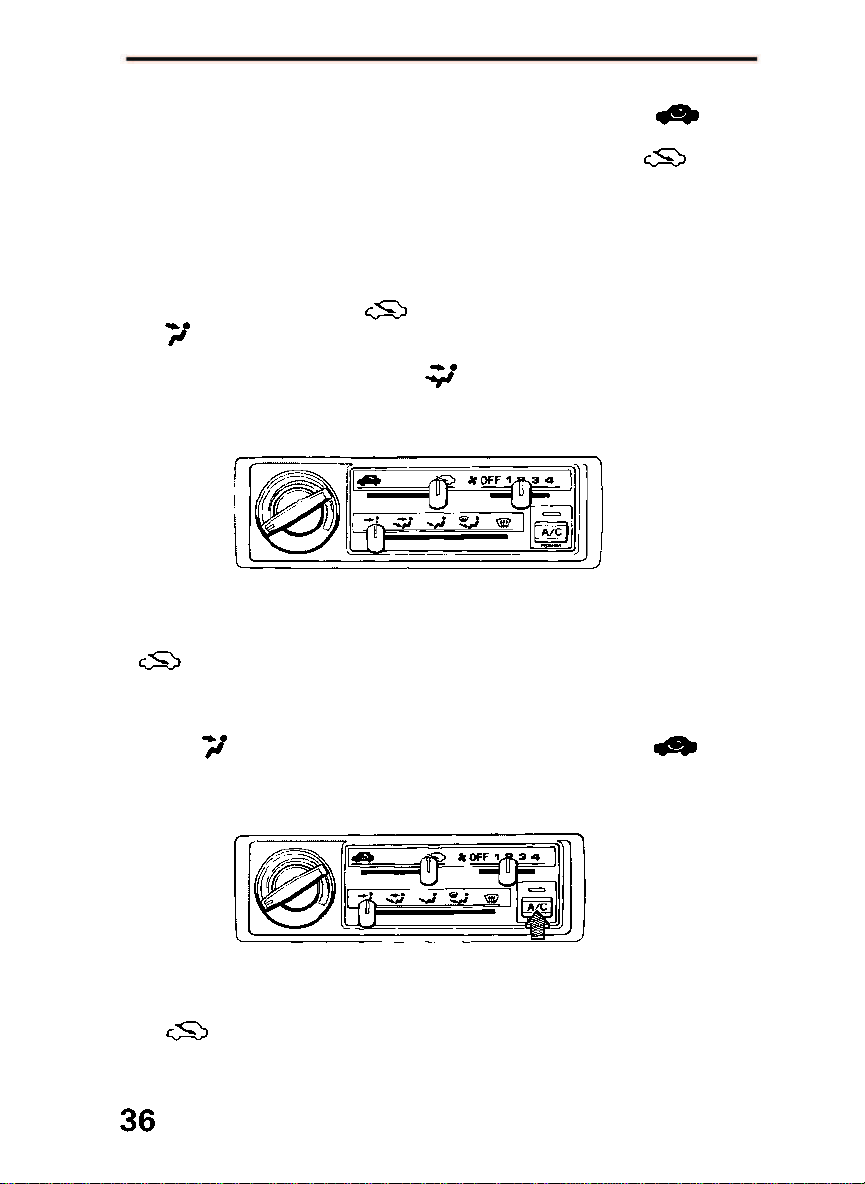
To Ventilate
Turn the temperature control dial counterclockwise, slide the
recirculation lever to the position and the function lever to
the position. Switch the fan on and outside air will flow
through the corner and center vents. To change air distribution,
slide the function lever to the position, and outside air will
also flow from the floor level outlet at the heater.
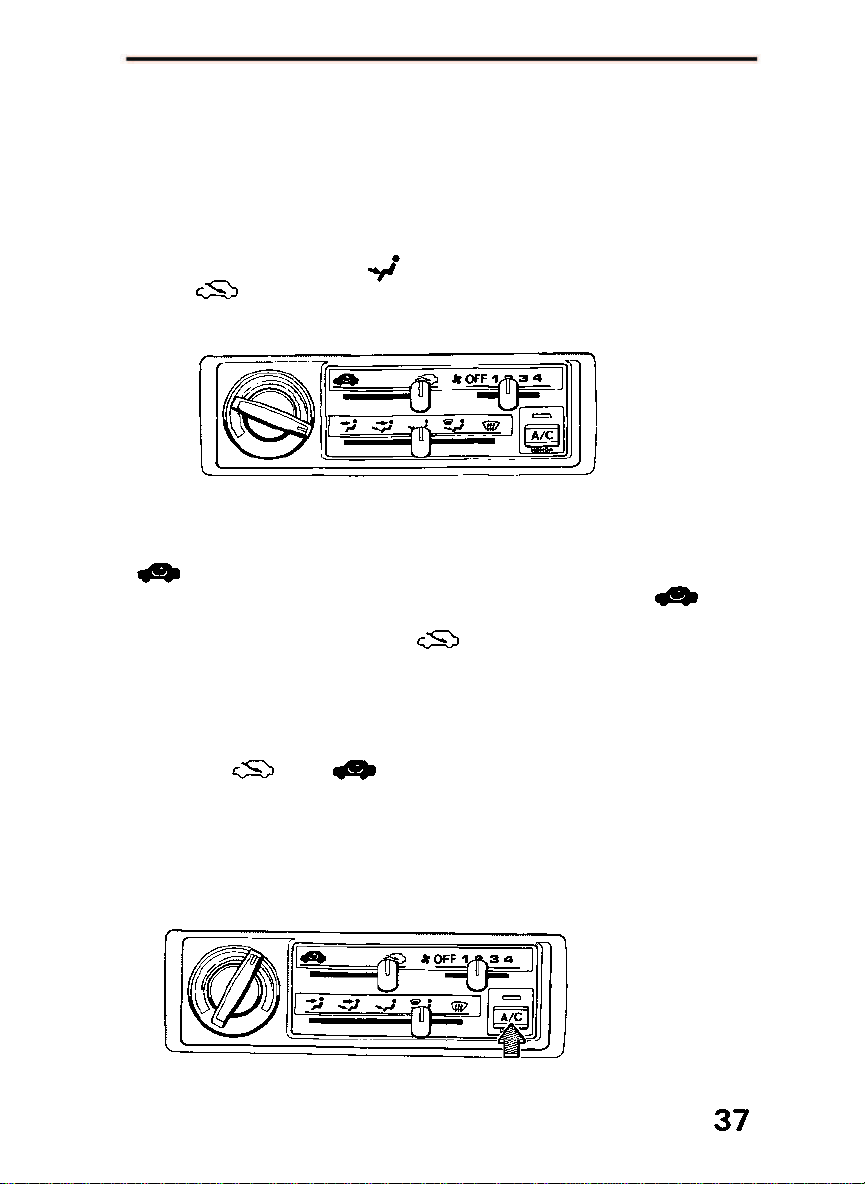
To Cool (with optional air conditioner)
To cool the car down quickly, slide the recirculation lever to the
position, start the engine, turn the temperature control dial
counterclockwise all the way, switch the fan to high ( 4 ), push the
A/C button in, and open the window briefly.
Then close the windows and corner vents, slide the function lever
to the position and the recirculation lever to the po-
sition so inside air will recirculate to the air conditioner for maximum
cooling.
When the interior has cooled sufficiently, switch the fan to low (1),
medium (2) or medium high (3), then slide the recirculation lever to
the position to direct fresh (outside) air to the air
conditioner.
Main Menu
▲
▼
When using the air conditioner in heavy traffic, or while driving up
long hills, watch the coolant temperature gauge: if the needle moves
near the "H" end of the scale, turn the air conditioner off by
pushing the A/C button; leave it off until the needle goes back into
the middle of the scale.
To Heat
Switch the fan on, turn the temperature control dial clockwise, slide
the function lever to the position and the recirculation lever
to the position, and warmed (outside) air will begin flowing
from the floor outlets.
To warm up the interior quickly, slide the recirculation lever to the
position so inside air will recirculate to the heater.
The windows may become fogged if the system is in the po-
sition for an extended period of time. As soon as the interior is
warmed, slide the lever to the position.
T
o
Dehumidify (with optional air conditioner)
Because an air conditioner dehumidifies as it works, you can use it
in cool or cold weather in any function position to help defog the
windows. Just switch the fan on, push the A/C button on, set
either the or positions, and adjust the temperature
control dial to a comfortable setting.
NOTE:
This setting is desirable for most operating conditions in ambient
temperatures above approximately 32°F (0°C).
(cont'd)
Main Menu
▲
▼
Heating and Cooling (cont'd)
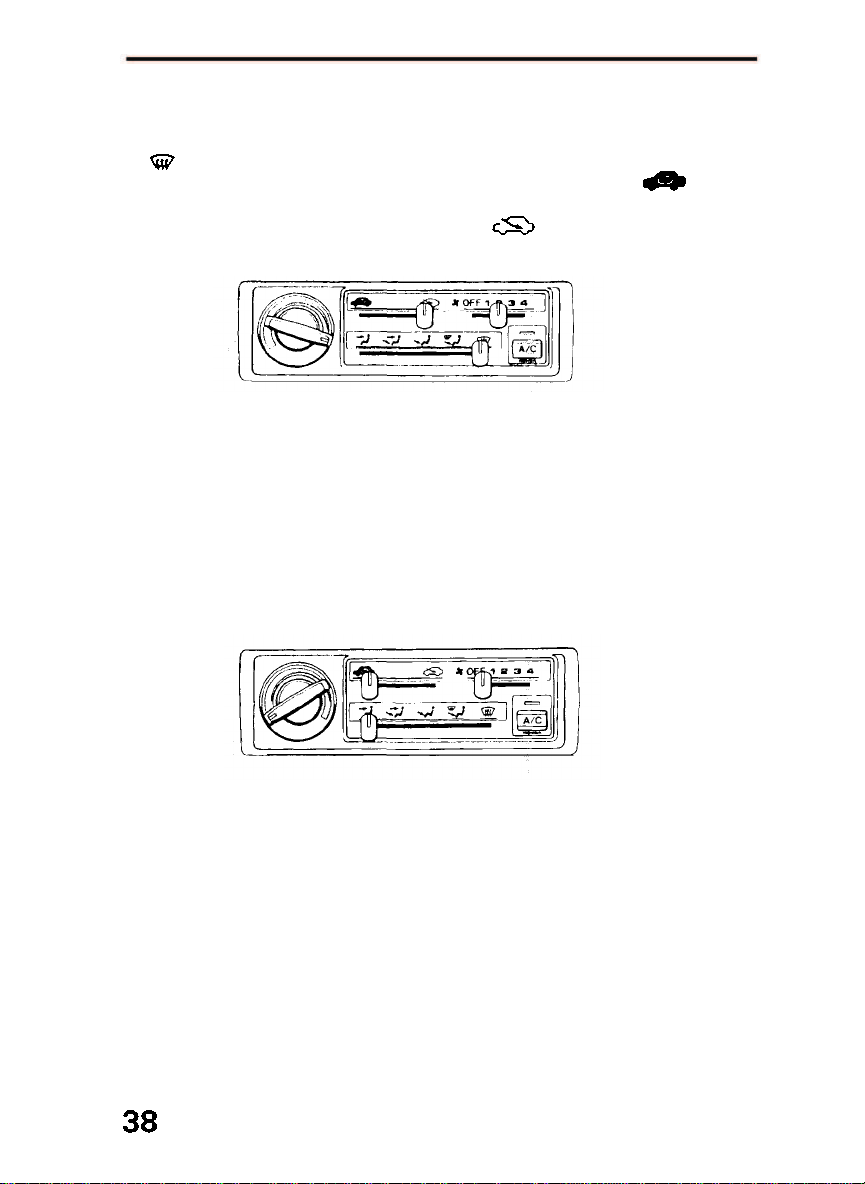
To Defrost
To defrost or defog the windshield and door windows, turn the
temperature control dial clockwise, slide the function lever to the
(defrost) position, and switch the fan on.
If there is actual frost on the windows, first select the posi-
tion.
If the windows are fogged, select the position. Warmed air
will then flow from the windshield and side defroster vents.
To Turn Everything OFF
Slide all levers to the left, turn the temperature control dial
counterclockwise all the way, and push the A/C switch off.
NOTE:
This setting should only be used in cold weather for the first few
minutes of driving to prevent cold air from blowing into the cabin.
Under normal operating conditions, the fan should always be kept
ON to prevent the accumulation of stale air in the system.
Main Menu
▲
▼

For proper operation of your car's emission controls, your engine is
designed to use unleaded fuel only.
CAUTION:
Using leaded or even low-lead gasoline could damage some of your
emission controls, and also void their coverage under the emission
controls warranty.
Use gasoline from pumps labeled unleaded, with a pump octane
number of 86 or higher. The pump octane number is an average of
the Research (R) octane and Motor (M) octane numbers. Use of a
lower octane gasoline can cause persistent, heavy "spark knock" (a
metallic rapping noise), which can lead to engine damage if severe.
CAUTION:
If you notice steady spark knock while holding a steady speed on a
level road, try changing brands of gasoline. If the spark knock
persists, consult your Honda dealer. Failure to do so is considered
misuse, and misuse is not covered under the New Car Warranty.
Occasionally you may notice light spark knock while accelerating or
driving up hills. This is no cause for concern, it simply means your
engine is running at its most economical.
Gasoline Containing Alcohol
If you decide to use a gasoline containing alcohol ("gasohol"), be
sure its octane rating is at least as high as that recommended for
unleaded gasoline. There are two types of "gasohol": that
containing ethanol, and that containing methanol. Do not use
gasohol that contains more than 10% ethanol. Do not use gasoline
containing methanol (methyl or wood alcohol) that does not also
contain cosolvents and corrosion inhibitors for methanol. Never use
gasoline containing more than 5% methanol, even if it has
cosolvents and corrosion inhibitors.
(cont'd)
Gasoline
Main Menu
▲
▼
Gasoline (cont'd)
NOTE:
Fuel system damage or vehicle performance problems resulting
from the use of such fuels is not covered under the new car
warranties. Honda cannot endorse the use of fuels containing
methanol since evidence of their suitability is as yet incomplete.
Before purchasing fuel from an unfamiliar station, try to confirm
whether the fuel contains alcohol, of what kind, and how much. If
you notice any undesirable operating symptoms after using a
gasoline that contains alcohol; or one that you think contains
alcohol, switch to an unleaded gasoline as recommended on page
39.
Operation In Foreign Countries
In order to comply with U.S. Federal Emissions Regulations, you
must use unleaded fuels of the recommended octane rating. These
fuels may not be available in other countries. If you intend taking
your car outside the U.S. or Canada, write to American Honda
Consumer Affairs (stating the year and model of your car) at the
address below for information regarding modifications you may
need to have done.
American Honda Motor Co., Inc.
Consumer Affairs
1919 Torrance Blvd.
Torrance, CA 90501-2722
Fuel Filler Door and Cap
Gasoline is extremely flammable and is explosive under certain
conditions. Perform this operation in a well-ventilated area with
the engine stopped. Do not smoke or allow open flames or sparks
in the area or where gasoline is stored.
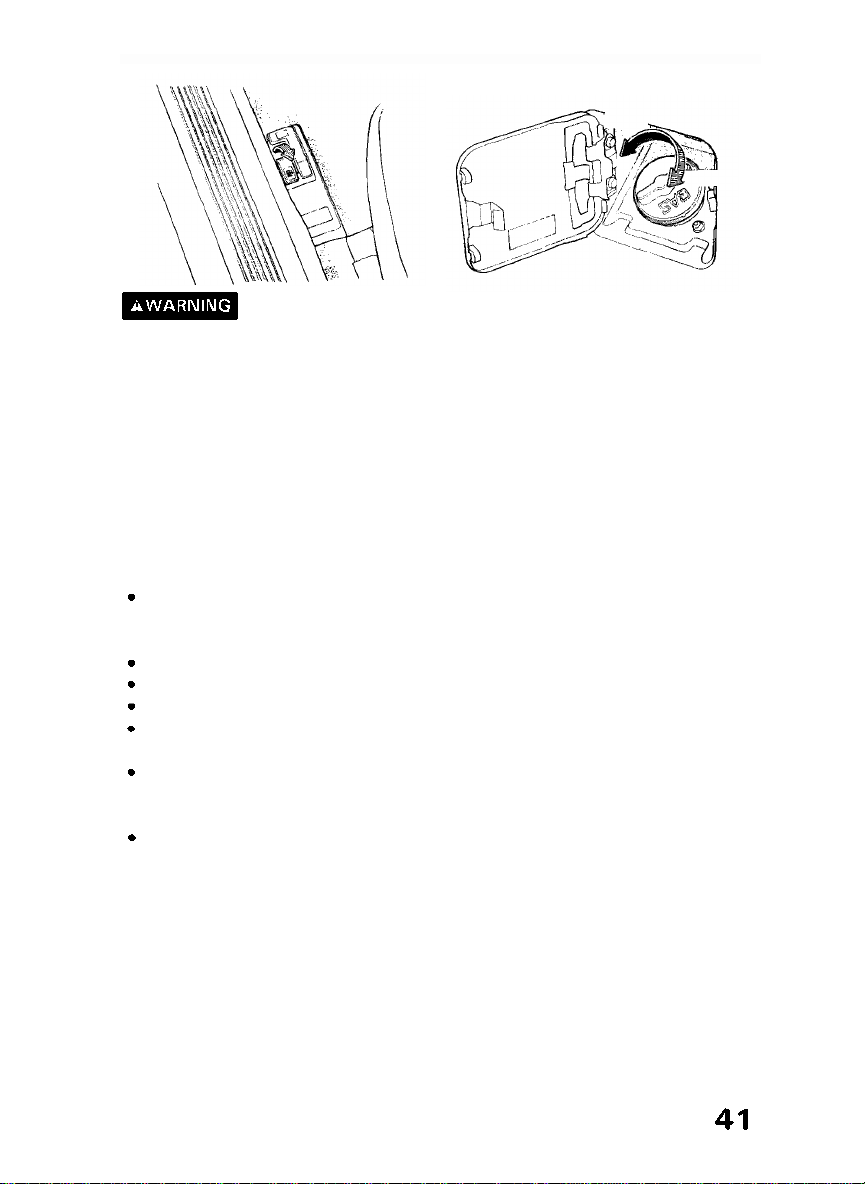
The fuel filler door is opened by pulling up on the lever at the left
side of the driver's seat.
The door will lock automatically when closed; push it until it clicks.
CAUTION:
You may hear a hiss when you open the filler cap. This sound is
residual pressure escaping from the fuel tank. Open the cap slowly
and remove the cap after the hissing stops. Fuel spray may cause
injury. Do not overfill the tank; fill only until the gas pump clicks off
automatically and never top off.
Main Menu
▲
▼
Fuel vapor is extremely hazardous under certain conditions.
Always stop the engine before refueling, and never refuel near
sparks or open flames.
CAUTION:
When reinstalling the fuel cap, be sure both tabs on the cap are
engaged in the slots of the filler neck and turn the cap until it stops.
If you replace the cap, use only a genuine Honda replacement part
or its equivalent. Failure to use the proper part could cause serious
fuel system problems.
How to Improve Your Gas Mileage:
Drive at a smooth, steady pace to avoid unnecessary decele-
rations and stops — accelerating back to speed uses more fuel.
Plan trips to avoid rush hour traffic if possible.
Make sure the parking brake is completely released.
Consolidate trips whenever possible.
Keep vehicle weight to a minimum by removing unnecessary
items from the luggage area.
Whenever possible, use fresh air from the dash vents to keep
cool when driving; open windows, or use of the optional air
conditioning both affect fuel economy.
Keep the tires adjusted to the recommended pressure.
Tire Pressure (measured cold): Front/Rear
CIVIC WAGON 220 kPa (32 psi) / 220 kPa (32 psi)
4WD 195 kPa (28 psi) / 195 kPa (28 psi)
Condition of Your Car
You can only get maximum fuel economy if your car is in top
running condition. Have all required maintenance done at the proper
intervals. Check tire pressures and tire wear frequently. If tire wear
is uneven, have the alignment checked by your Honda dealer.
Proper alignment saves gasoline and prolongs tire life.
Open
Close
Main Menu
▲
▼
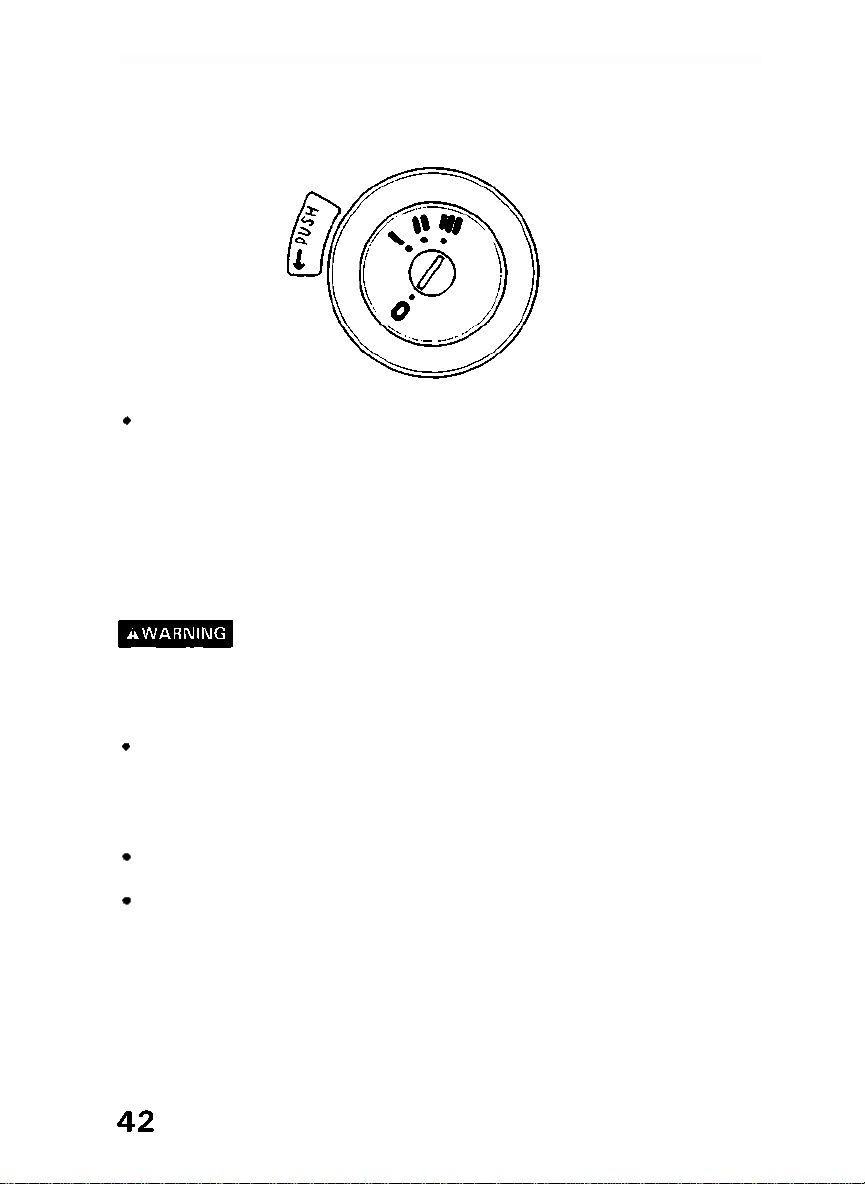
Ignition Switch
The combined ignition switch/anti-theft lock is located on the right
side of the steering column and has four positions:
0-LOCK position: The key can be removed or inserted in this
position. To remove the key, push it in at position I, then turn it to
0 and pull it out. When the key is removed, the steering column
will lock.
NOTE:
On cars equipped with automatic transmissions, the transmission
must be in Park before pushing and turning the key to the 0-LOCK
position.
Never turn the ignition switch to the lock position or remove the
key while the car is in motion; the steering wheel can lock causing
a loss of directional control, and an accident could result.
I-ACCESSORY position: In this position, the accessory circuit is
on, but the ignition circuit is off.
If the key is difficult to turn from the 0 to the I position, turn the
steering wheel slightly to relieve pressure on the lock.
II-ON position: This is the normal running position.
III-START position: The starter will engage when the key is
turned to this position.
To remind you to remove the ignition key when leaving your car, a
beeper will sound if the key is still in the ignition when you open the
driver's door. The beeper system is deactivated when you turn the
ignition to 0 (Lock) and fully remove the key.
Main Menu
▲
▼

Starting the Engine
Before Starting
Manual Transmission:
1. Apply the parking brake.
2. Push the clutch pedal all the way in (see NOTE below).
3. Shift the transmission to neutral.
NOTE:
On cars equipped with manual transmissions, the engine will not
crank unless the clutch pedal is fully depressed.
Automatic Transmission:
1. Make sure the shift lever is in Park (P).
2. Apply the parking brake and the foot brake.
NOTE:
When starting in cold weather, keep all unnecessary electrical
circuits off (lights, defogger, etc.) for the best battery output.
Do not crank the engine for more than 15 seconds at a time. Wait
10 seconds before going to the next step.
Starting the Engine
1. With your foot off the accelerator start the engine by turning the
key to the III position.
2. If the engine won't start within 15 seconds or starts but fails to
continue to run, push the accelerator pedal halfway, and hold it
there while cranking the engine. Once the engine starts, release
the accelerator gradually as the engine speeds up.
3. If it doesn't start within 15 seconds, push the accelerator pedal
down to the floor and hold it there while cranking in order to clear
flooding. Try step 2 again.
Cold Weather at High Altitude Starting
1. When starting in cold weather at high altitude (above 8,000 feet),
push the accelerator pedal about halfway and hold it there while
cranking the engine. Once the engine starts, release the
accelerator gradually as the engine speeds up.
2. If it doesn't start within 15 seconds, push the accelerator pedal
down to the floor and hold it there while cranking in order to clear
flooding. Try step 1 again.
NOTE:
If the outside temperature is below freezing, or if your car has not
been driven for several days, warm up the engine for a few minutes
before driving.
Main Menu
▲
▼

Safety Items
Before driving away, check that:
The doors are closed properly.
The mirrors are properly adjusted, and the windows clean.
The driver and passengers are wearing properly adjusted seat
belts.
The head restraints are properly adjusted.
The warning and indicator lights are operating properly.
The brake pedal feels normal.
All luggage and cargo is secured.
Nothing is interfering with the driver's feet or blocking vision to
the rear.
While driving remember to:
Always drive defensively; expect the unexpected.
Reduce your speed during night hours and bad weather.
Follow at a safe distance; don't tailgate.
Get off the highway when you are tired; stop and take a rest.
When stopping for repairs:
Park the car well off the road.
Turn on the hazard warning flasher.
Use flares or other warning devices to warn other motorists.
After parking your car:
Apply the parking brake and shift to first gear if equipped with
manual transmission, or PARK on automatic transmission equip-
ped cars.
Take your keys.
Make sure the windows are closed and the doors are locked.
If parked on a hill:
1. Turn the front wheels away from the curb if facing uphill.
2. Turn the front wheels toward the curb if facing downhill.
Never leave children unattended in a parked car.
Main Menu
▲
▼
Engine Exhaust Gas Warning
A properly maintained car is your best protection against exhaust
gas entering the passenger compartment.
The exhaust system should be thoroughly inspected by a compe-
tent mechanic whenever:
The car is raised for oil change.
You notice a change in the sound of the exhaust.
The exhaust system or the rear or underside of the car is
damaged.
Avoid breathing exhaust gases. They contain carbon monoxide,
which is a colorless, odorless gas that can cause loss of con-
sciousness and eventual death. If you suspect that exhaust gas
is entering the passenger compartment, have the cause deter-
mined and corrected as soon as possible. If you must drive
under these conditions, drive only with all windows fully open.
Do not drive with the tailgate open. An open tailgate may draw
exhaust gases into the passenger compartment. If you must
drive with the tailgate open, drive only with all the windows
wide open.
Do not run the engine in confined areas, such as garages, any
longer than necessary to move the car in or out.
If you must sit in a parked car with the engine running for more
than a short time, adjust the heating/ventilation system as
follows:
1 .Set the function lever to the position.
2.Set the temperature control dial for best comfort.
3.Set the recirculation lever to the position.
4.Turn the fan to the highest speed.
NOTE:
To insure proper operation of the car's ventilation system, keep the
front air inlet clear of snow, mud, leaves or other obstructions.
Main Menu
▲
▼
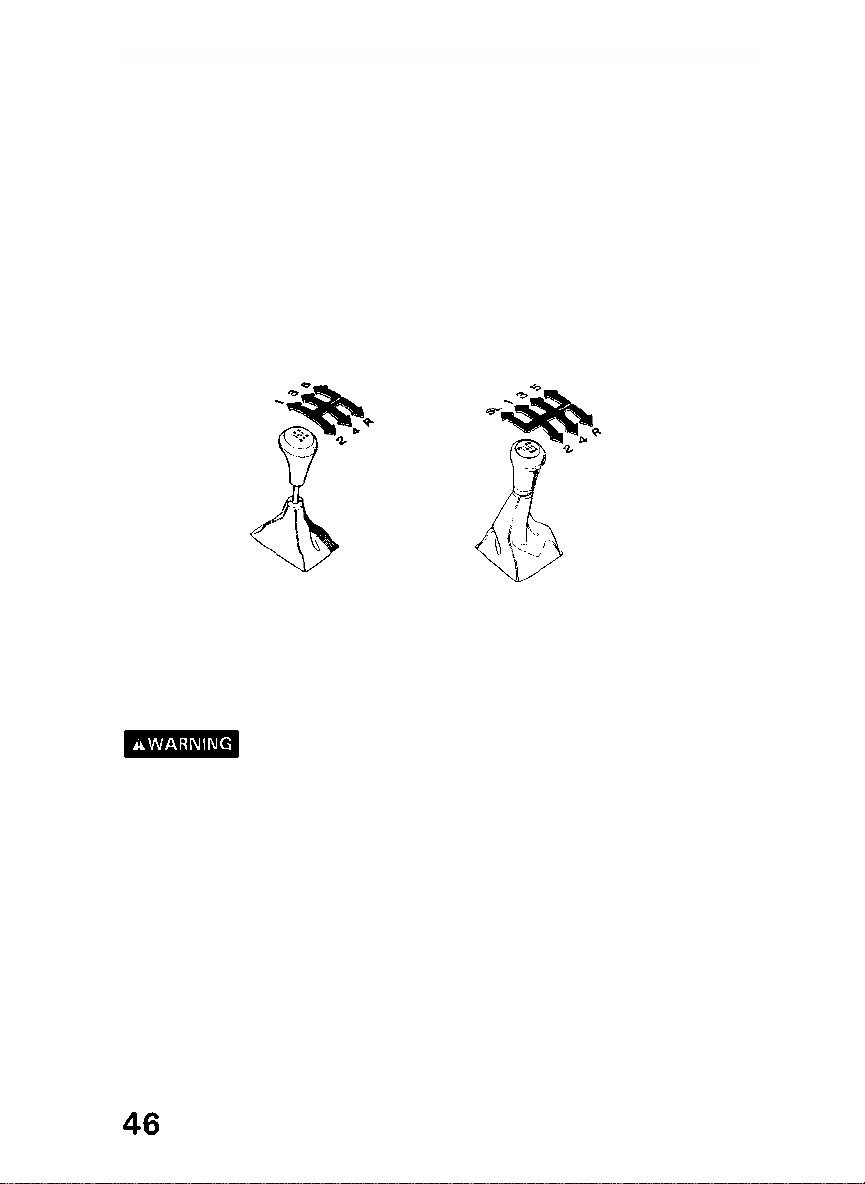
Shifting the 5 or 6 Speed
The fully synchronized manual transmission is very easy to shift up
or down. When you slow down for traffic, steep hills, or corners,
shift to a lower gear before the engine starts to labor. When de-
scending steep grades, select a lower gear to help maintain a safe
speed and to prevent the brakes from overheating.
When shifting, depress the clutch pedal fully, shift gears and then
release the clutch gradually. Do not speed-shift; allow time for the
gears to synchronize.
To prevent grinding the gears when shifting into reverse, hold the
clutch pedal depressed briefly before shifting, or shift the lever into
one of the forward gears before selecting reverse.
A safety lockout prevents accidental shifting straight from 5th to
Reverse.
SL-Super Low Gear (4WD)
This super low ratio gear reduces the possibility of spinning the
wheels when accelerating on roads covered with snow, sand or
mud, or on steep hills.
Avoid rapid acceleration or sudden deceleration when either or
both driving wheels are on a slippery surface. Decreased traction
could cause loss of directional control.
CAUTION:
When downshifting to SL, do so only at speeds of 3 mph (5km/h)
or less and release the clutch gradually to avoid any sudden engine
over-revving.
5 Speeds
(CIVIC WAGON)
6 Speeds
(4WD)
Main Menu
▲
▼
Clutch Pedal Adjustment
Clutch pedal free travel must be adjusted periodically to
compensate for lining wear. There should be approximately 25 mm
(1 in) of pedal free travel. If not, or if the clutch seems to slip or
you have difficulty shifting, have your dealer check the clutch
adjustment.
CAUTION.
Do not drive with your foot on the clutch pedal as this will cause
premature wear of clutch components.
Do not shift into reverse while the car is moving.
Driving with the clutch pedal free travel improperly adjusted can
cause premature wear of the clutch components.
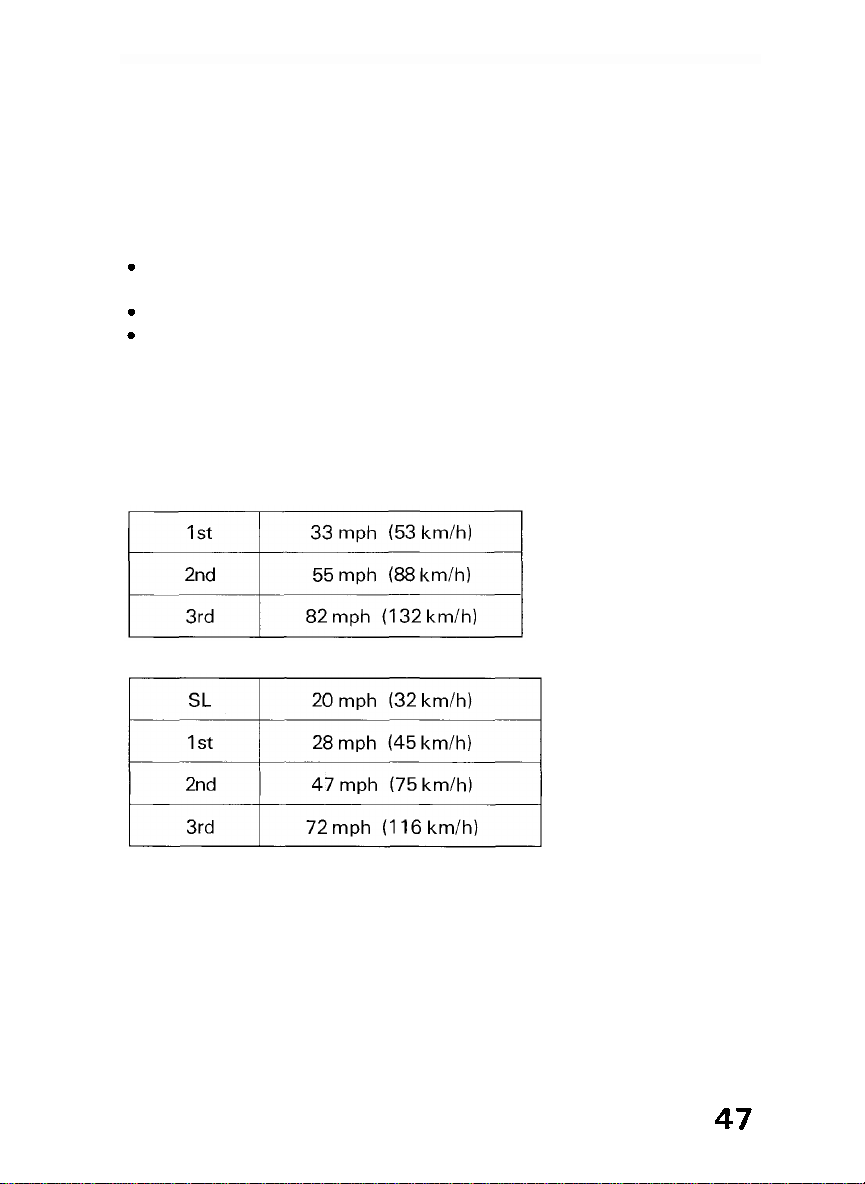
Maximum Allowable Speeds
The speeds shown below are the maximum at which the car can be
driven or downshifted in each gear without over-revving the engine.
CIVIC WAGON
4WD
(cont'd)
Main Menu
▲
▼
Shifting the 5 or 6 Speed (cont'd)
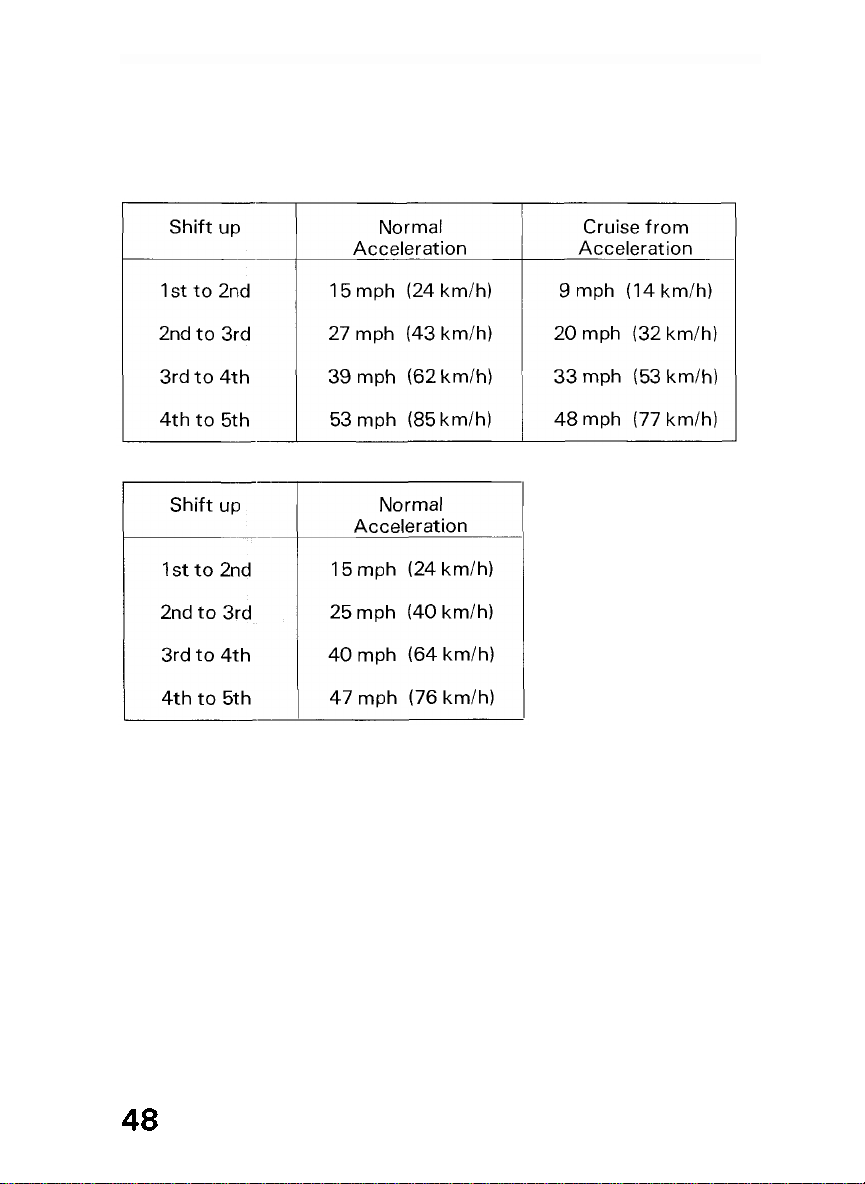
Recommended Shift Speeds
For best fuel economy, and effective emission control, shift at the
speeds shown:
CIVIC WAGON
4WD
Main Menu
▲
▼
Shifting the Automatic (CIVIC WAGON)
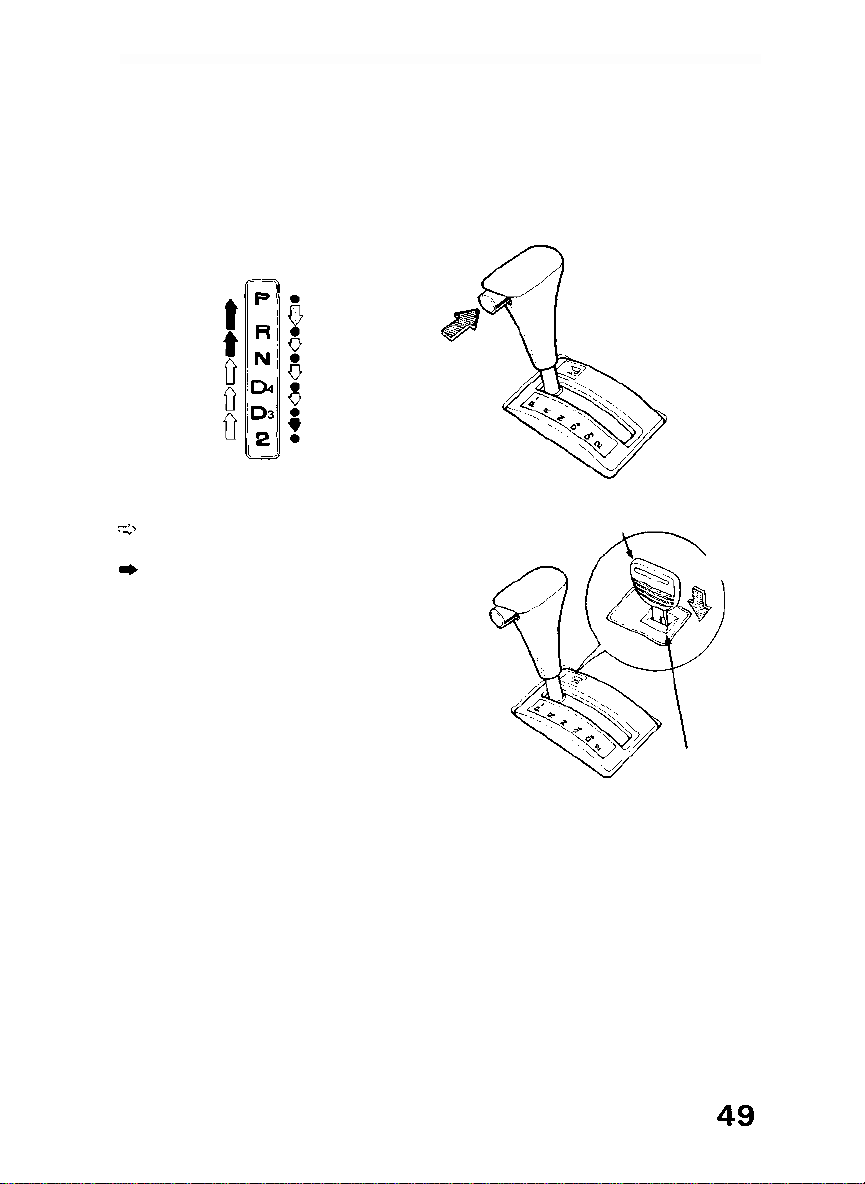
The automatic transmission shift lever has a locking mechanism to
prevent accidental shifting into Reverse (R), Park (P) or 2nd (2). Also,
an Automatic Shift Lock prevents you from shifting out of Park
unless the brake pedal is already depressed and the ignition switch is
in the II position.
Push the button on the shift handle to shift into 2nd, Reverse or
Park; depress the brake pedal and then push the button on the shift
handle to shift out of Park.
: Depress the brake pedal first
and push the button, then shift.
:
Push the button, then shift.
:
Shift as desired.
If you cannot shift out of Park with
the brake pedal depressed and the
ignition switch in the II position:
1.Turn the ignition switch off and
remove the key.
2. Insert the key in the Shift Lock
Release located to the right of the
shift lever.
3. Press and hold the key down,
then press the button on the shift
handle and move the shift lever to
Neutral.
4. Return the key to the ignition
switch, depress the brake pedal
and restart the engine.
NOTE:
If you encounter any problem shifting out of Park, have your
authorized Honda dealer check the system as soon as possible.
(cont'd)
Depress
button
KEY
Insert
SHIFT LOCK
RELEASE
Main Menu
▲
▼

Shifting the Automatic (CIVIC WAGON) (cont'd)
Operating Tips
Fo r smoother operation, apply the brakes when shifting from
Neutral or Park to a forward or reverse gear.
When parking: bring the car to a stop with the foot brake, hold the
brake on and shift into Park, set the hand brake and then turn off
the engine.
NOTE:
Your 4 speed automatic transmission is equipped with a torque
converter lock-up clutch. Because of this, you may notice what
feels like an extra shift as the clutch engages.
CAUTION:
Shift into P only after the car has come to a complete stop.
Shift into or out of R only after the car has come to a complete
stop.
Do not "rev-up" the engine when the brake is on and the shift
lever is in D
4
, D
3
, 2 or R.
When stopped on a hill, use the brakes to hold your position, not
the accelerator pedal.
Do not shift from N or P into D4, D3, 2 or R when the engine is
above idle speed. Before shifting into gear, make sure your foot
is firmly on the brake pedal.
Do not rest your hand on the shift lever or push the shift button
while driving.
Main Menu
▲
▼

Driving Technique
D4-4th
Use the D
4
range for normal in-town and highway driving. The car
will start off in 1st and shift automatically to 2nd, 3rd, and 4th. The
further down you push the accelerator, the later the transmission
will shift and the faster the car will accelerate.
D3-3rd
Use of D
3
will allow the transmission to start off in 1st and shift
automatically to 2nd and 3rd. Use D
3
when climbing grades to
prevent the transmission from "hunting" between 3rd and 4th gear;
or when increased braking is needed.
NOTE:
If rapid acceleration is necessary, depress the accelerator to the
floor; the transmission will automatically shift down according to
load and engine speed. This applies to both D
4
and D
3
ranges.
2-2nd
Use 2nd gear for increased engine braking when driving downhill,
and increased power when driving uphill; also for driving on slippery
roads, and freeing the car from mud or sand, where 1st gear could
provide too much power and cause skidding or wheelspin. The
maximum recommended speed in 2nd gear is:
62 mph (100 km/h)
R-Reverse
CAUTION:
Shift into or out of reverse only after the car has come to a
complete stop; the transmission may be damaged if you shift
while the car is moving.
P-Park
CAUTION:
Use this position when starting the engine, or when parking. Shift
into Park only when the car is COMPLETELY stopped.
N-Neutral
Use when starting the engine or during prolonged idling in traffic.
Main Menu
▲
▼

:
Push the button, then shift.
: Shift as desired.
If you cannot shift out of Park with
the brake pedal depressed and the
ignition switch in the II position:
1. Turn the ignition switch off and
remove the key.
2. Insert the key in the Shift Lock
Release located to the right of the
shift lever.
3. Press and hold the key down,
then press the button on the shift
handle and move the shift lever to
Neutral.
4. Return the key to the ignition
switch, depress the brake pedal
and restart the engine.
NOTE:
If you encounter any problem shifting out of Park, have your
authorized Honda dealer check the system as soon as possible.
Depress
button
KEY
SHIFT LOCK
RELEASE
Insert
Main Menu
▲
▼

Operating Tips
For smoother operation, apply the brakes when shifting from
Neutral or Park to a forward or reverse gear.
When parking: bring the car to a stop with the foot brake, hold the
brake on and shift into Park, set the hand brake and then turn off
the engine.
NOTE:
Your 4 speed automatic transmission is equipped with a torque
converter lock-up clutch. Because of this, you may notice what
feels like an extra shift as the clutch engages.
CAUTION:
Shift into P only after the car has come to a complete stop.
Shift into or out of R only after the car has come to a complete
stop.
Do not "rev-up" the engine when the brake is on and the shift
lever is in D, S, 2 or R.
When stopped on a hill, use the brakes to hold your position, not
the accelerator pedal.
Do not shift from N or P into D, S, 2 or R when the engine is
above idle speed. Before shifting into gear, make sure your foot
is firmly on the brake pedal.
Do not rest your hand on the shift lever or push the shift button
while driving.
(cont'd)
Main Menu
▲
▼

Shifting the Automatic (4WD) (cont'd)
Driving Technique
D-4th
Use the D range for normal in-town and highway driving. The car
will start off in 1st and shift automatically to 2nd, 3rd, and 4th. The
further down you push the accelerator, the later the transmission
will shift and the faster the car will accelerate.
S (S3-3rd/S4-4th)
The "S" shift selector range changes the shift points under part
throttle acceleration, allowing the transmission to stay in each lower
gear for a longer period before automatically upshifting. With the
shift selector in the "S" range, the transmission will shift from 1st
to 2nd and 3rd but not 4th. This is especially useful when climbing
or descending grades. While driving in the "S" range, the car's
performance is improved but fuel economy is reduced.
While driving in the "S" range, you can select 4th gear by pushing
the "S4" switch. Depending upon vehicle speed and throttle pedal
position, the transmission will shift to 4th gear when the switch is
pressed; the "S4" indicator light in the instrument panel will come
on. Pushing the "S4" switch again will cause the transmission to
downshift to 3rd gear in the "S3" mode. The "S4" indicator light in
the instrument panel will go out, and the "S3" light on the
instrument panel will come on.
If the shift lever is moved to any other driving range, the "S4"
switch will be cancelled automatically.
NOTE:
If rapid acceleration is necessary, depress the accelerator to the
floor; the transmission will automatically shift down according to
load and engine speed. This applies to both D and S ranges.
S
4
SWITCH
Push
Main Menu
▲
▼
2-1st/2nd
Use "2" to increase engine braking when driving downhill and engine
power when driving uphill.
Using "2" will allow the transmission to automatically shift up or
down between the 1st gear and the 2nd gear. The maximum
recommended speed for the "2" range is:
62mph (100km/h)
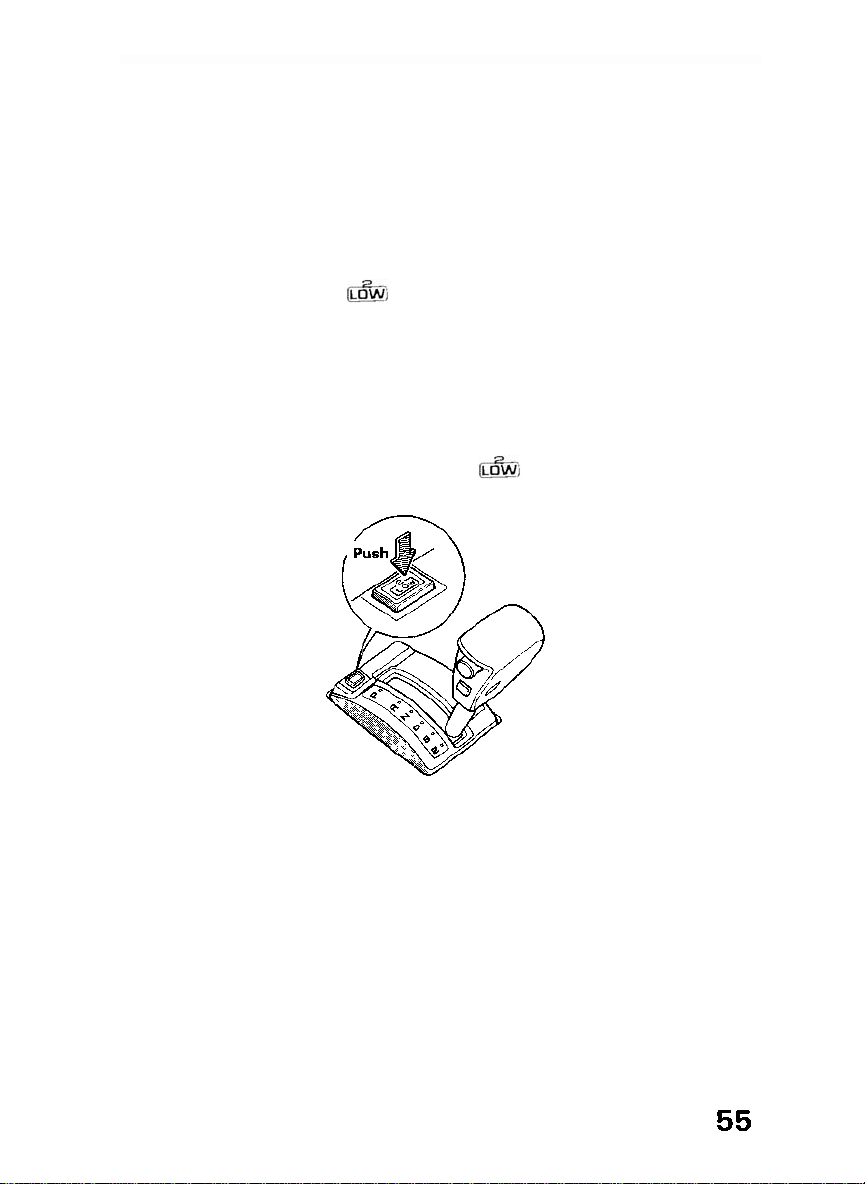
If you need more engine braking or engine power when using the
"2" position, push the switch to use the 1st gear only.
When the speed is more than 31 mph (50 km/h):
The indicator light in the instrument panel will come on but the
transmission will remain in 2nd gear. However, when the speed goes
below 31 mph (50 km/h), the transmission downshifts from 2nd to
1st and locks in 1st.
The maximum recommended speed when locked in 1st gear is:
37mph (60km/h)
To release the Low lock, push the switch again or select
any other driving range.
R-Reverse
CAUTION:
Shift into or out of reverse only after the car has come to a
complete stop; the transmission may be damaged if you shift
while the car is moving.
P-Park
CAUTION:
Use this position when starting the engine, or when parking. Shift
into Park only when the car is COMPLETELY stopped.
N-Neutral
Use when starting the engine or during prolonged idling in traffic.
Main Menu
▲
▼
Real Time 4WD
The 4WD system automatically engages between the front and rear
wheels.
Service
To prevent sudden movement of the car, which may result in
personal injury, always disengage the 4WD system manually
before performing service that requires either the front or rear
wheels to be raised and turning.
Towing
CAUTION:
Before towing the car with either the front or rear wheels raised
off the ground, place the transmission in neutral and manually
disengage the 4WD system to prevent the raised wheels from
turning.
4WD Disengagement (Manual Transmission)
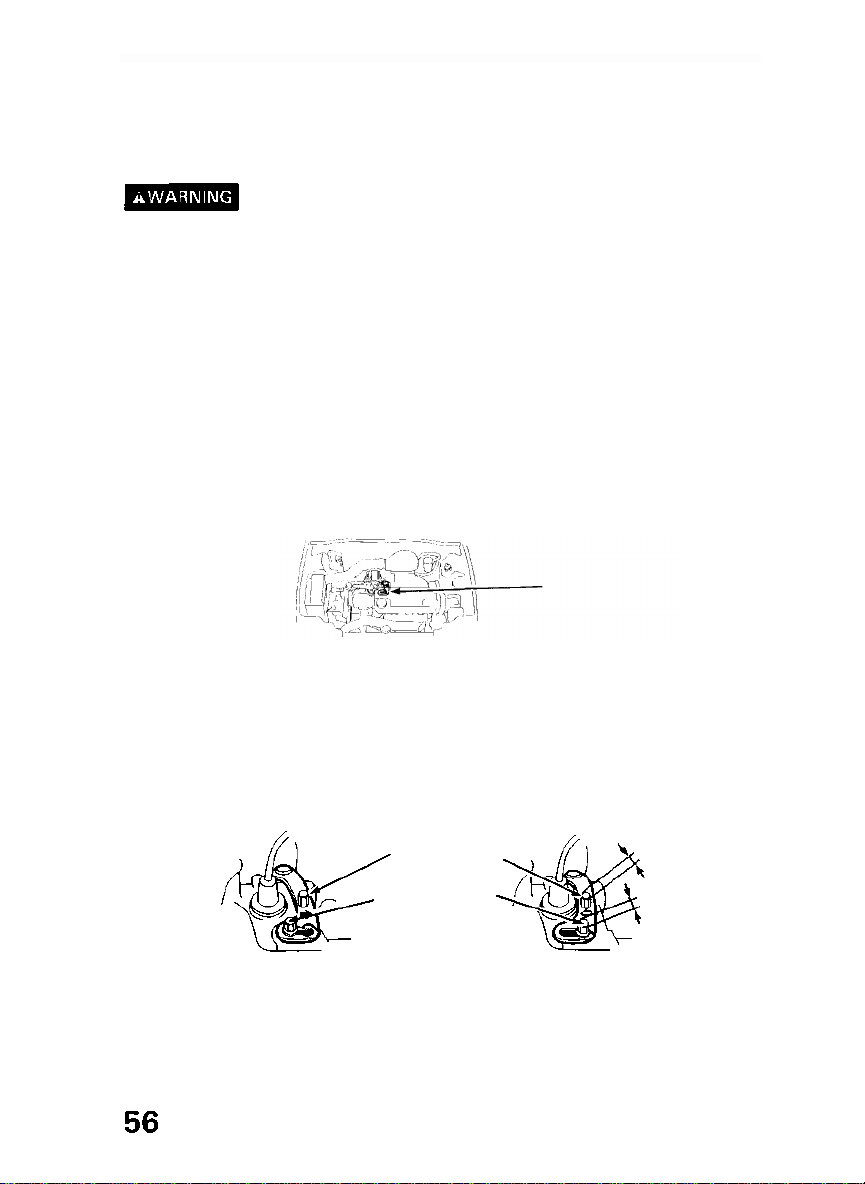
1. Locate the orange disengagement lever at the rear of the engine
compartment.
2. Loosen the lock bolt at the slotted end of the lever.
NOTE:
For better accessibility, use a socket and a long extension bar.
CAUTION:
Do not loosen the lock bolt more than 5 — 7 turns. Replacement is
extremely difficult.
3. Move the lever by turning the middle bolt counterclockwise.
4.Tighten the lock bolt.
NOTE:
After service or towing is completed, return the lever to the normal
(4WD on) position and tighten the lock bolt.
DISENGAGEMENT
LEVER
Unlocked Position (4WD off)
Locked Position (4WD on)
MIDDLE BOLT
LOCK BOLT
10 mm
10 mm
Main Menu
▲
▼
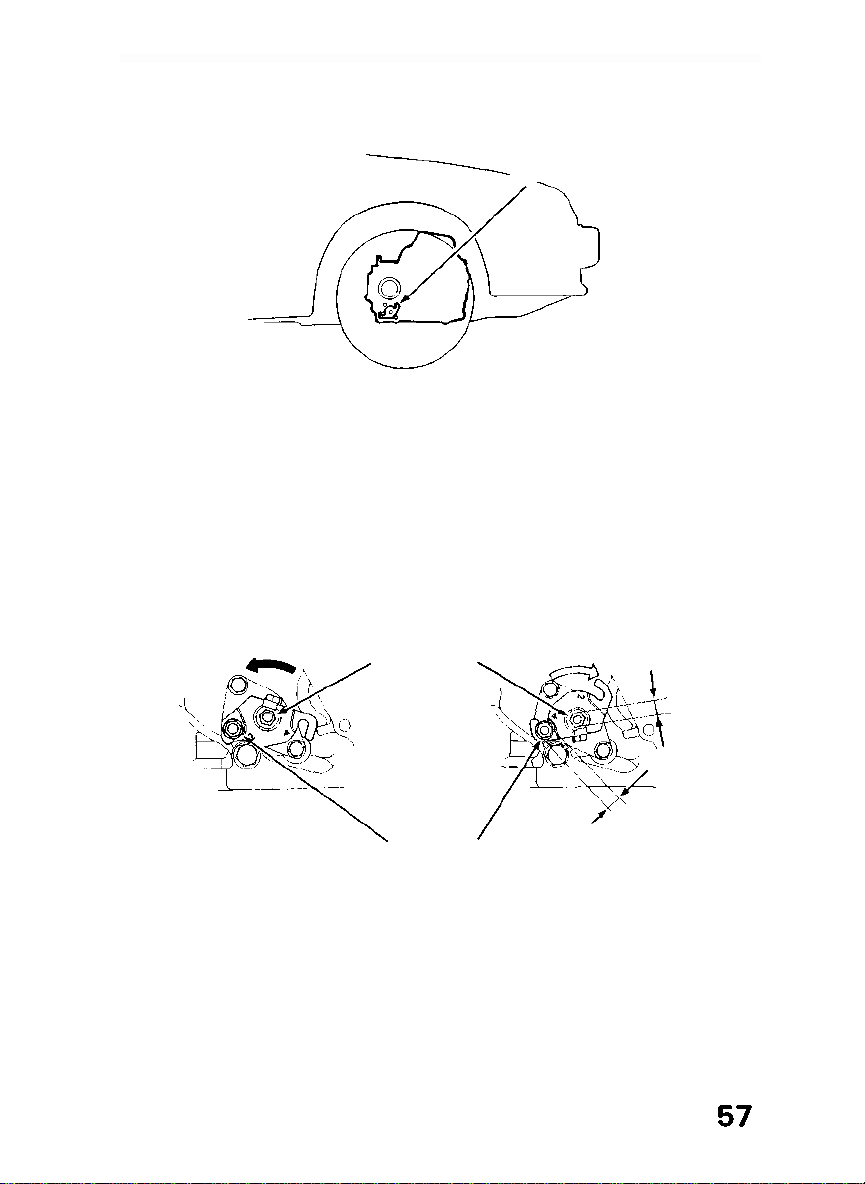
4WD Disengagement (Automatic Transmission)
1. Locate the disengagement plate at the rear of the transmission
case behind the right front wheel.
2. Loosen the lock bolt in the notch on the plate.
NOTE:
For better accessibility, use a socket and a long extension bar.
CAUTION:
Do not loosen the lock bolt more than 5 — 7 turns. Replacement is
extremely difficult.
Unlocked Position
(4WD
off)
Locked Position
(4WD on)
3. Turn the middle bolt counterclockwise until the plate rotates
about 150° and is stopped by the lock bolt.
4.Tighten the lock bolt.
NOTE:
After service or towing is completed, return the plate to the normal
(4WD on) position and tighten the lock bolt.
DISENGAGEMENT
LEVER
MIDDLE BOLT
10 mm
LOCK BOLT
10 mm
Main Menu
▲
▼

Maintenance Schedule and Records
Your Honda automobile must be properly maintained to ensure that
it is in peak operating condition and the emission levels are within
the standards set by the Federal Clean Air Act.
The following instructions and maintenance procedures are based
on the assumption that your car will be used exclusively for the
purpose for which it was designed:
1. To carry passengers and cargo within the load limits shown on
the label in the glove box.
2. To be driven on reasonable road surfaces within legal limits.
3. To generally be driven daily over a distance of several miles.
4. Use gasoline from pumps labeled unleaded, with a pump octane
number of 86 or higher. The pump octane number is an average of
the Research (R) octane and Motor (M) octane numbers.
NOTE:
Failures which occur due to a lack of maintenance will not be
covered under warranty.
The Required Maintenance Schedule* specifies all maintenance
required to keep your car in peak operating condition. Work should
be done by a Honda dealer but may be done by any qualified service
facility or individual who is competent in this type of work.
Maintenance, replacement, or repair of emission control devices
and systems may be done by any automotive repair establishment
or individual using parts that are "certified" to EPA standards.
After the maintenance has been done, be sure to complete the
Maintenance Records on pages 61 — 63. All required maintenance is
considered normal owner operating cost and you will be charged for
it by your dealer.
* Maintenance operations indicated by *4 are recommended by the
manufacturer for vehicle sold in California, but not required. Other
maintenance operations are required by California regulations and
condition the emission warranty. All operations (including *4) are
required for vehicles sold outside California.
Main Menu
▲
▼

Check the following items at each fuel stop:
1. Engine oil level.
2. Radiator coolant level.
Check the following items periodically:
1. Brakes: for braking efficiency, brake pedal travel and hydraulic
fluid level.
2. Lights: for operation of headlights, taillights, side marker lights,
stoplights, turn signals and back-up lights.
3. Tires: for correct pressures (including spare); inspect for cuts and
uneven or excessive wear. Rotate every 7,500 miles (12,000 km)
in the pattern shown on page 90.
4. Steering: for excessive play or vibration while driving.
5. Exhaust system: for leaks or loose mounts.
6. Wipers: for operation of windshield wipers and washer, and
condition of wiper blades.
7. Seat belts: for condition of fabric and buckles, and operation of
the restraint mechanism.
8. Battery condition.
9. Clutch adjustment (clutch pedal free travel).
(cont'd)
Main Menu
▲
▼
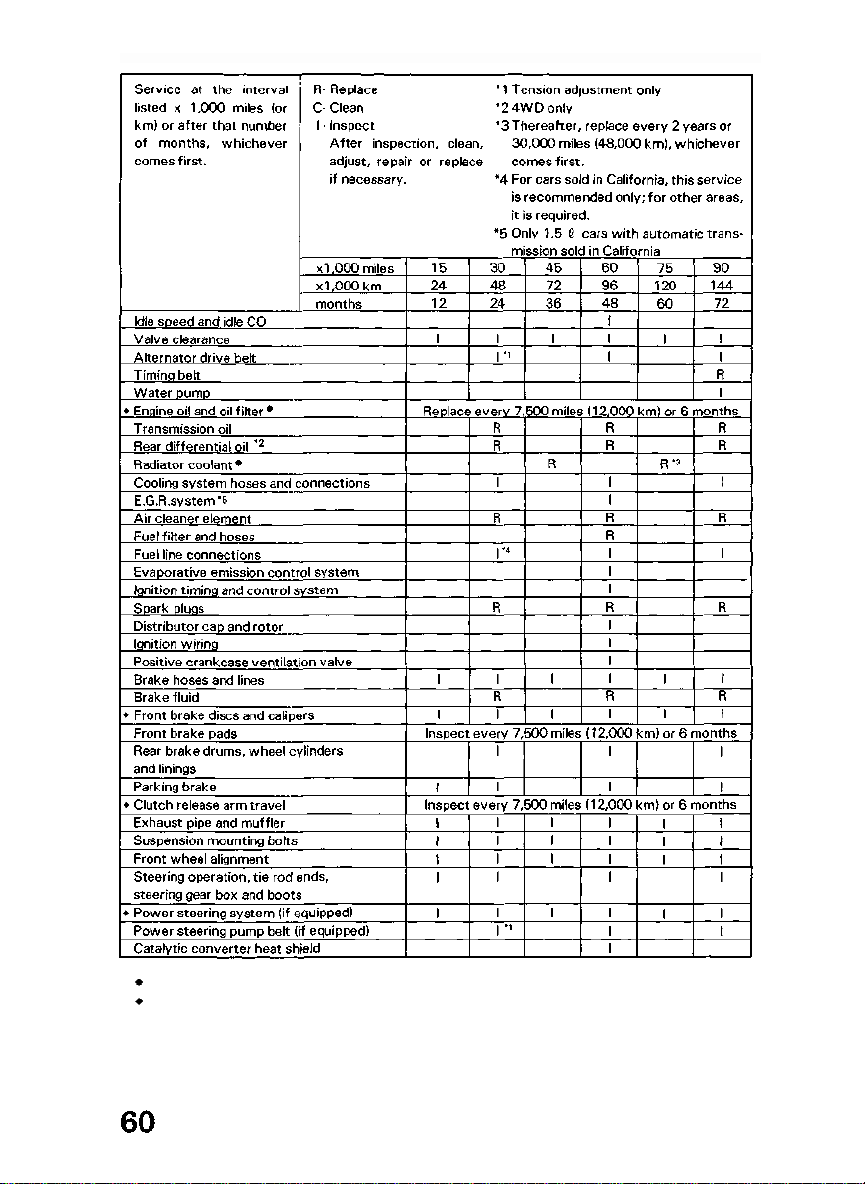
Maintenance Schedule and Records (cont'd)
: Check oil and coolant level at each fuel stop.
: Under severe driving conditions, service these items twice as often. (See page 62)
Main Menu
▲
▼
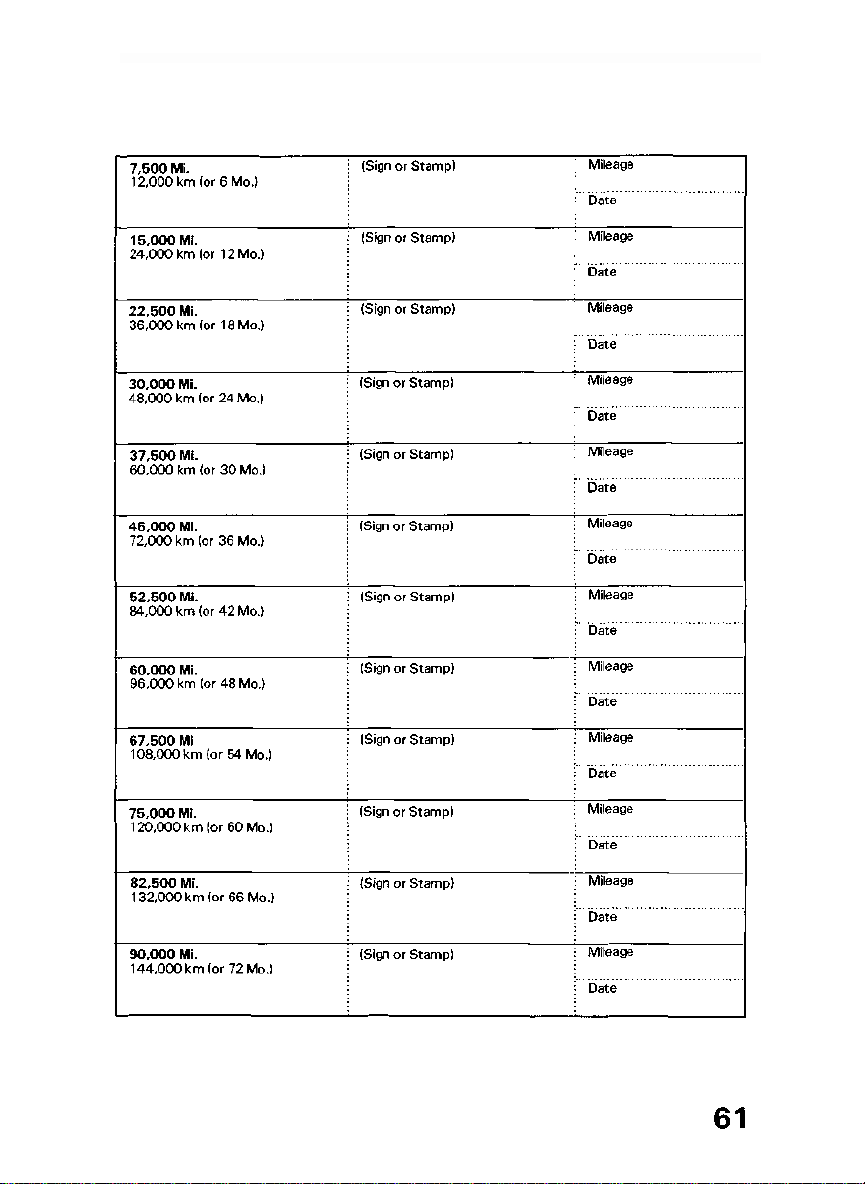
Required Maintenance Record
• Have your servicing dealer record all Required Maintenance below.
• Keep receipts for all work done on your car.
(cont'd)
Main Menu
▲
▼
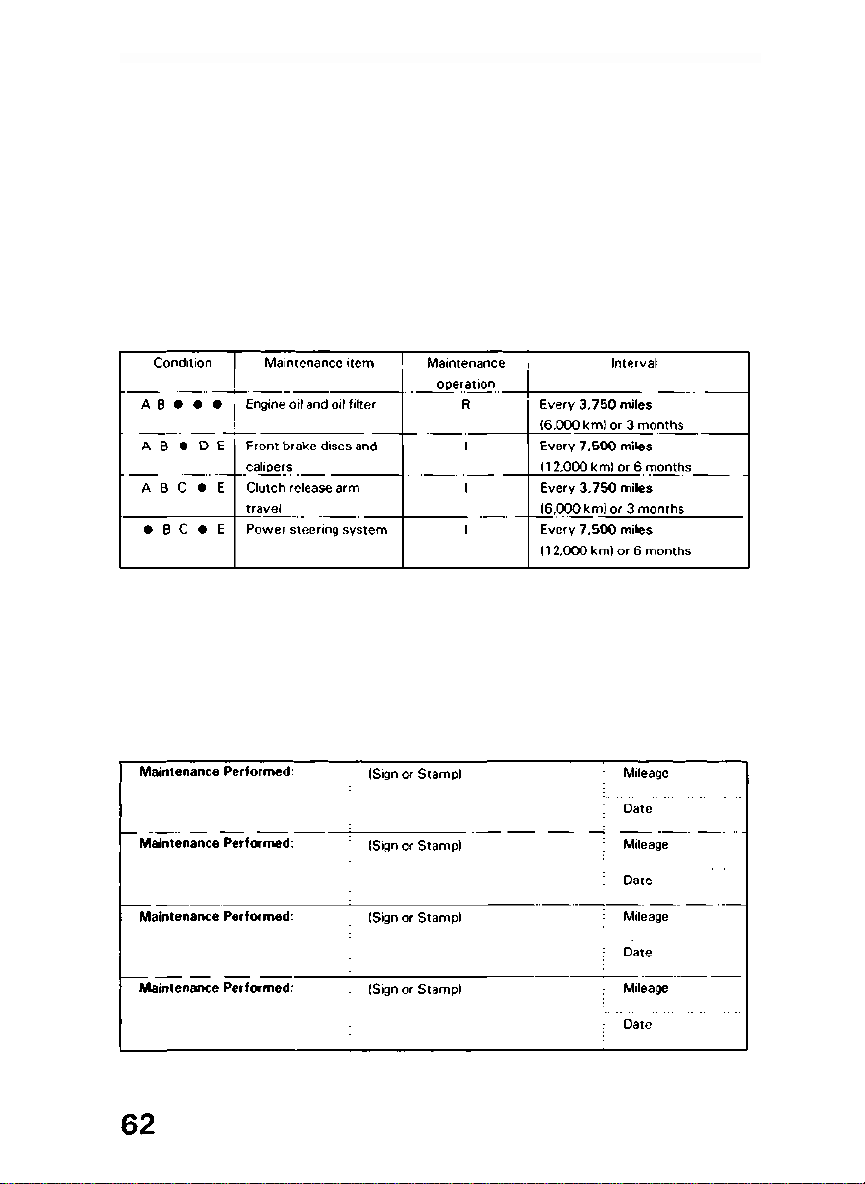
Maintenance Schedule and Records (cont'd)
Severe Driving Conditions
CAUTION:
The following items must be serviced more frequently on cars
normally used under severe driving conditions. Refer to the chart
below for the appropriate maintenance intervals.
Severe driving conditions include:
A: Repeated short distance driving
B: Driving in dusty conditions
C: Driving in severe cold weather
D: Driving in areas using road salt or other corrosive materials
E: Driving on rough and/or muddy roads
R-Replace
I -Inspect
After inspection, clean, adjust, repair or replace if necessary.
Non-Scheduled Maintenance Record
Record additional maintenance for severe driving conditions or non-
scheduled maintenance on this page. (See page 60 )
Main Menu
▲
▼
Main Menu
▲
▼
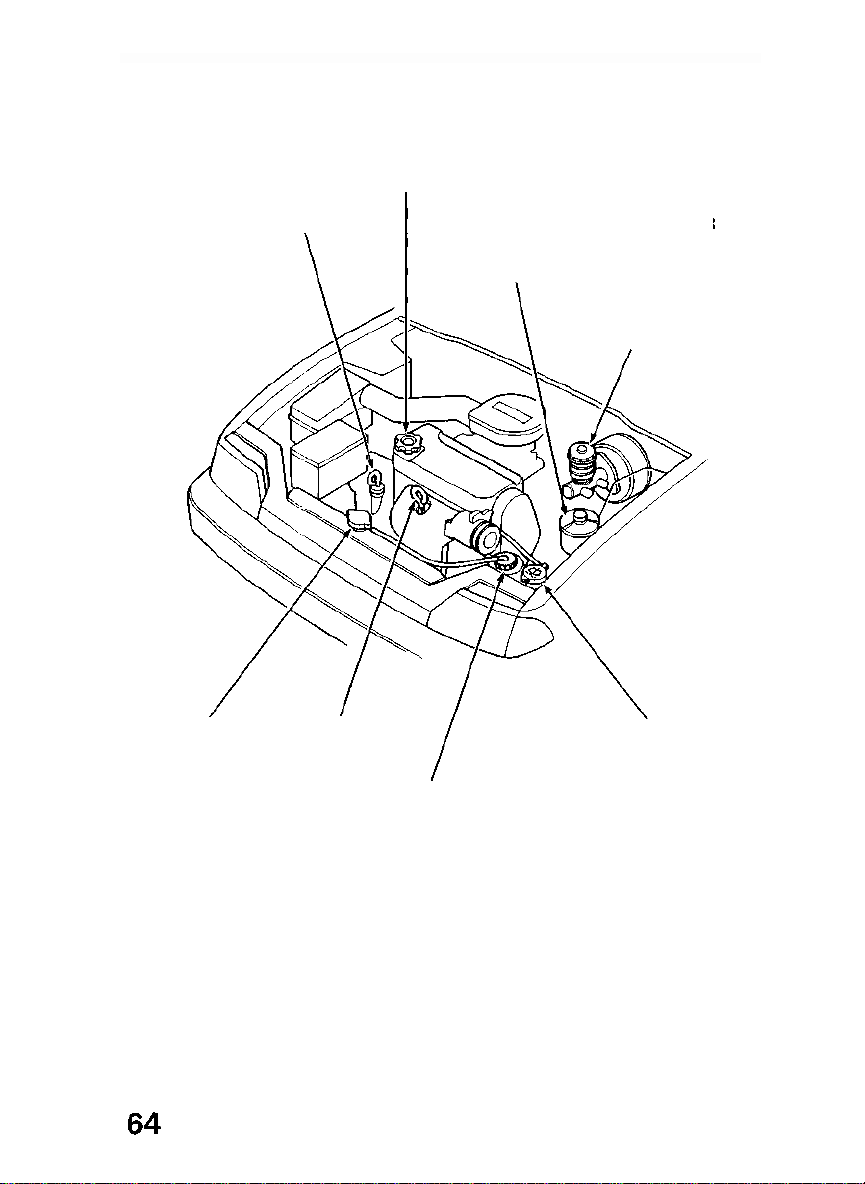
Fluid Locations
AUTOMATIC TRANSMISSION
FLUID DIPSTICK
ENGINE OIL
FILLER CAP
POWER STEERING FLUID RESERVOIR
(CIVIC WAGON with automatic
transmission and 4WD)
BRAKE FLUID
RESERVOIR
RADIATOR
CAP
ENGINE OIL
DIPSTICK
WASHER FLUID
RESERVOIR CAP
RADIATOR
RESERVOIR
CAP
Main Menu
▲
▼
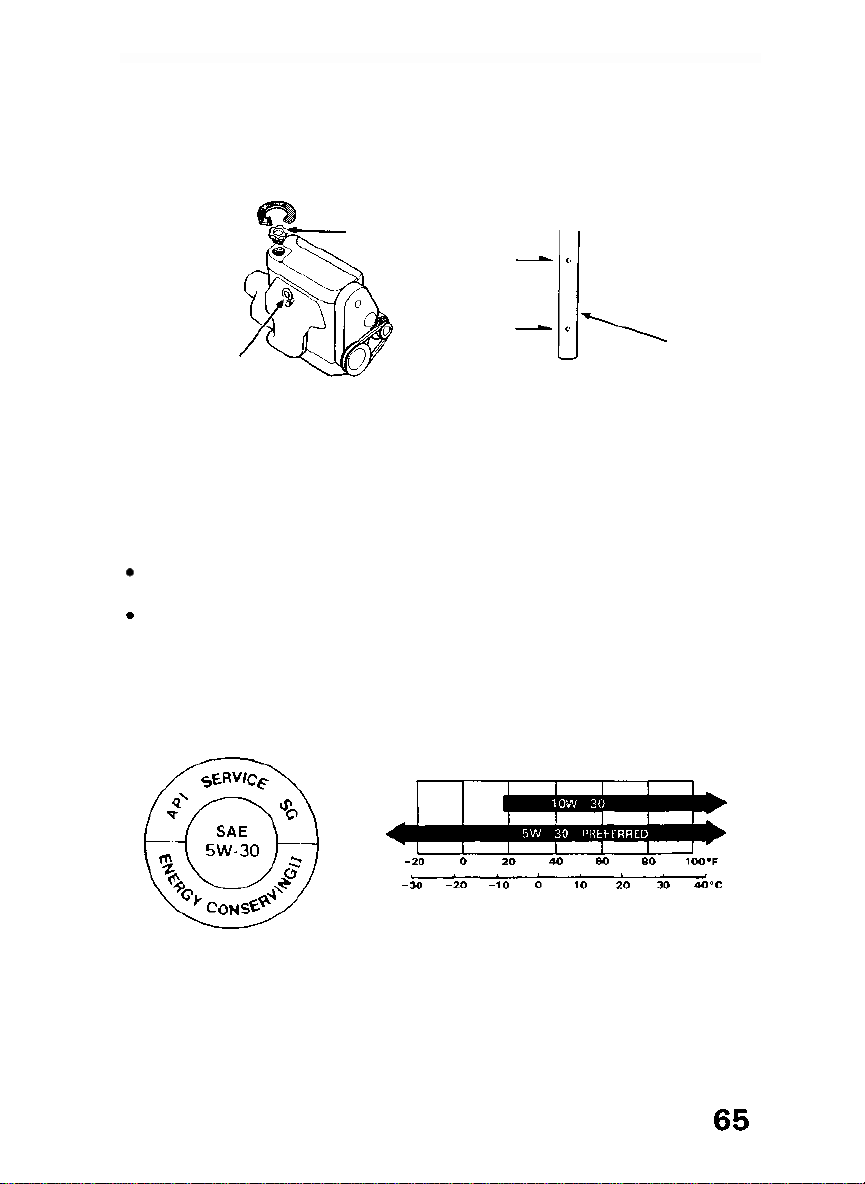
Engine Oil and Filter
Checking
Check the engine oil a couple of minutes after shutting the engine
off, with the car parked on level ground. Remove the dipstick and
wipe it clean. Re-insert it all the way down, then pull it out and read
the level. The level should be between the upper and lower marks.
Adding
If the level has dropped close to the lower mark, add oil until it is
even with the upper mark.
1.Turn the oil filler cap counterclockwise to remove. Add oil, then
check the level again. Do not overfill.
2. Reinstall the cap and twist clockwise until it stops.
CAUTION:
Be sure the oil filler cap is correctly replaced before starting the
engine.
Engine oil is a major factor affecting the performance and
service life of the engine, you should use only a premium quality
detergent oil labeled SG grade.
LOO
K
FOR THIS LABEL ON
THE OIL CONTAINER
Use the proper viscosity oil for the
climate in which you drive:
Some oil labels may also include additional designations of quality
such as CC or CD. However, these are acceptable only when used
together with SG.
NOTE:
5W-30 viscosity oil is recommended for improved fuel economy.
(cont'd)
ENGINE OIL
FILLER CAP
UPPER
LOWER
DIPSTICK
DIPSTICK
Ambient Temperature
Main Menu
▲
▼
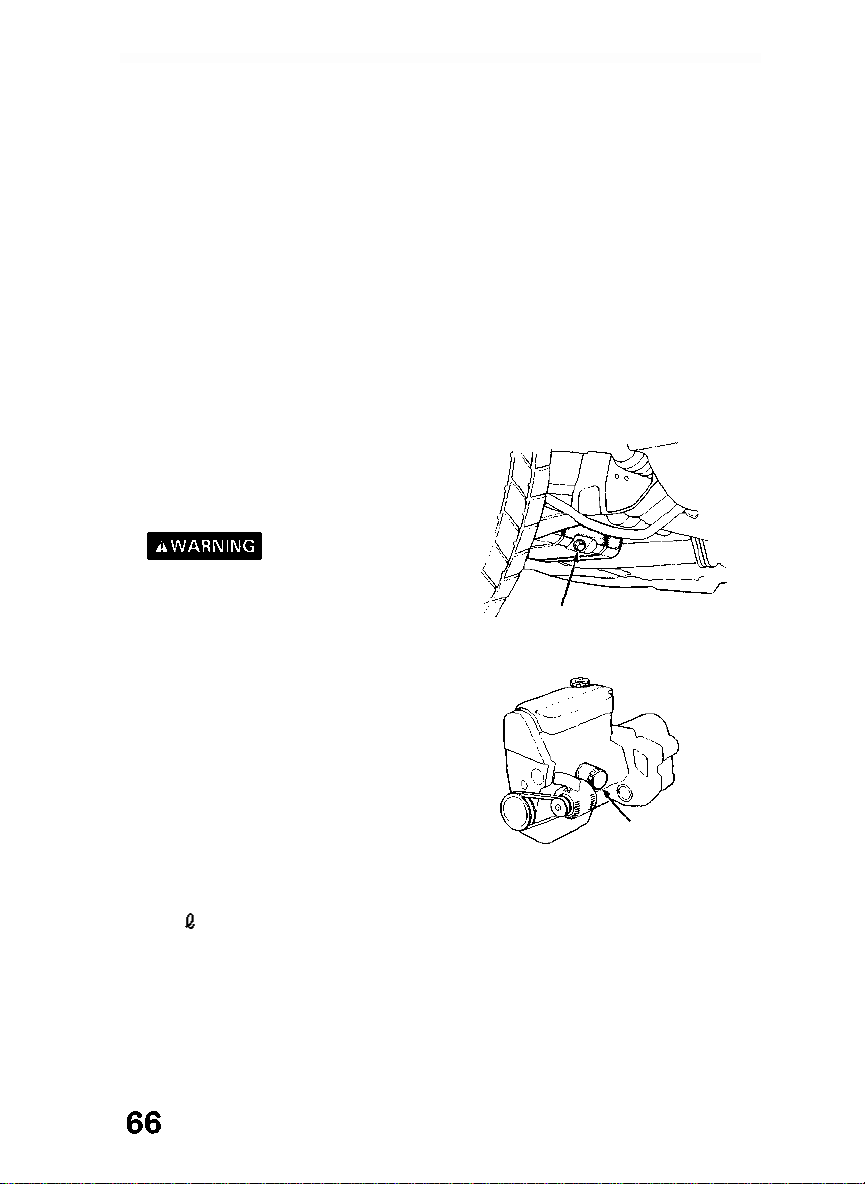
Engine Oil and Filter (cont'd)
Fuel Efficient Oil
For the best fuel economy from your car, it is recommended that
you use a fuel efficient SG grade oil. This oil is usually identified by
the words such as: "Energy Conserving II," "Gas Saving," and
"Fuel Saving," etc.
Changing Oil and Filter
Engine oil and the filter should be changed together every 6 months
or 7,500 miles (12,000 km), whichever comes first. The filter is
located on the engine block, below the intake manifold.
CAUTION:
The oil filter cannot easily be removed from above the engine. For
this reason it is recommended that the oil filter change be done by
a skilled mechanic.
1. Start the car to warm up the
engine, then shut it off.
2. Remove the engine oil filler cap
and drain bolt, and drain the oil.
A warmed-up engine and the oil
in it are hot; be careful not to
burn yourself.
3. Remove the oil filter and let the
remaining oil drain out.
4. Install a new filter according to
the instructions on or with the
filter.
5. Reinstall the drain bolt with a new
washer and tighten it securely.
Refill the engine with the recom-
mended oil, to the upper mark on
the dipstick.
ENGINE OIL CAPACITY (including filter):
3.5 (3.7 US qt , 3.1 Imp qt)
OIL FILTER
ENGINE OIL
DRAIN BOLT
Main Menu
▲
▼

6. Reinstall the filler cap securely.
7. Start the engine and make sure oil is not leaking from the drain
bolt or the filter.
8. Shut off the engine and recheck the oil level.
NOTE:
Please dispose of used motor oil in a manner that is compatible with
the environment. We suggest you take it in a sealed container to
your local service station for reclamation. Do not throw it in the
trash or pour it on the ground.
CAUTION:
Used motor oil may cause skin cancer if repeatedly left in contact
with the skin for prolonged periods. Although this is unlikely
unless you handle used oil on a daily basis, it is still advisable to
thoroughly wash your hands with soap and water as soon as
possible after handling used oil.
Main Menu
▲
▼
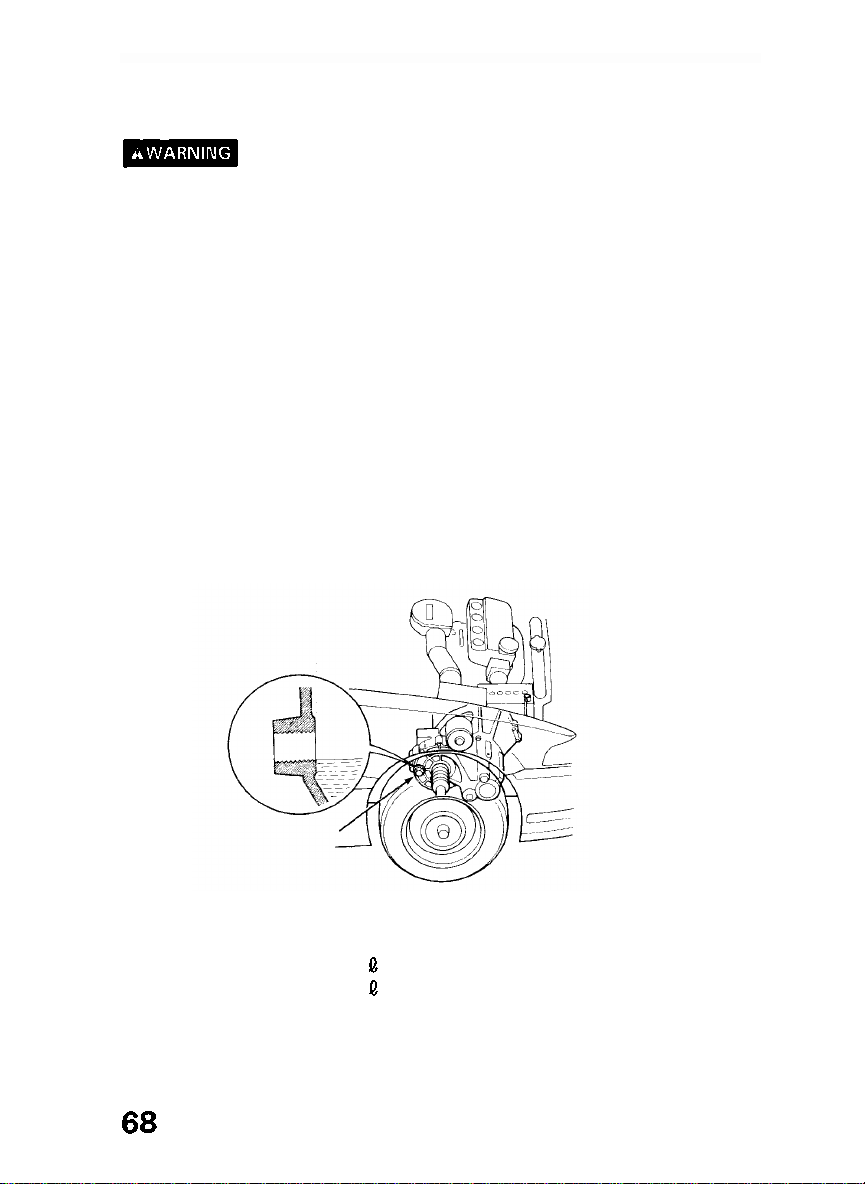
Transmission Oil/Fluid Check
Transmission oil/fluid must be checked with the engine off and the
car on level ground.
If the engine has been running, some engine components may be
hot enough to burn you.
CAUTION:
If the oil/fluid level is low, check for possible leaks before adding
oil. Do not overfill.
Since the transmission and differential are in the same housing, you
are actually checking both oil/fluid levels in one procedure. Change
transmission oil/fluid according to the Maintenance Schedule on
page 60.
Manua
l
Remove the oil filler bolt (beside the right axle). Feel inside the bolt
hole with your finger. If the oil is up to the bottom edge of the hole,
the oil level is correct. If it is not, slowly add oil until it runs out of
the hole, then reinstall the bolt and tighten it securely with a wrench.
MANUAL TRANSMISSION
OIL CHANGE CAPACITY:
CIVIC WAGON: 1.8 (1.9 US qt , 1.6 Imp qt)
4WD: 2.3 (2.4 US qt, 2.0 Imp qt)
Use only SF or SG grade motor oil when adding or changing transmis-
sion oil.
CORRECT LEVEL
OIL CHECK/
FILLER BOLT
Main Menu
▲
▼
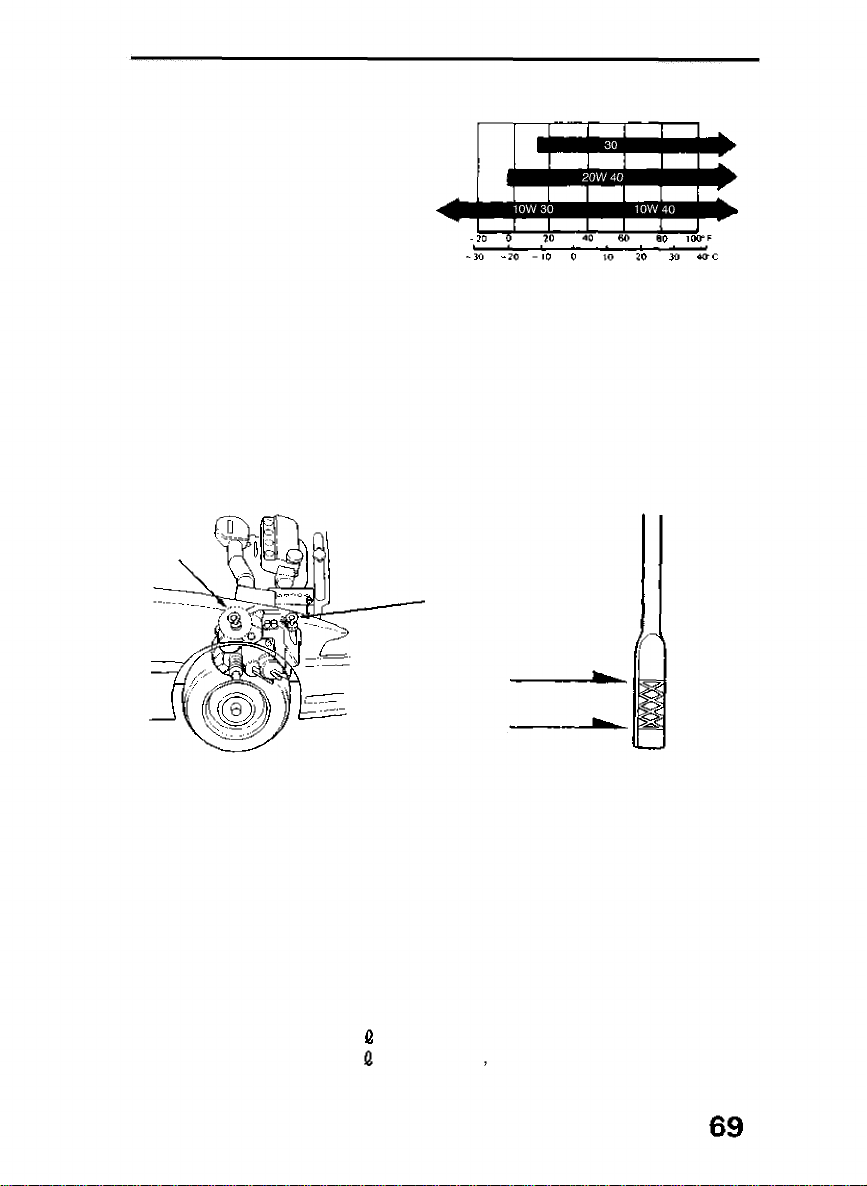
Use the proper viscosity oil for the
climate in which you drive:
Ambient Temperature
Automatic
The automatic transmission fluid level is checked (with the engine
off and the car on level ground) using the dipstick in the right end of
the transmission housing. Remove the dipstick and wipe it off.
4WD
DIPSTICK
UPPER
LOWER
Insert the dipstick and remove it. The fluid level should be between
the upper and lower marks.
If necessary, add fluid and recheck. Use only DEXRON® II
Automatic Transmission Fluid (A.T.F.) when adding or changing fluid.
After checking the fluid level, push the dipstick in securely.
AUTOMATIC TRANSMISSION
FLUID CHANGE CAPACITY:
CIVIC WAGON: 2.4
4WD:
3.2
(2.5
US qt ,
(3.4
US qt
2.1 Imp qt)
2.8 Imp qt)
Main Menu
▲
▼
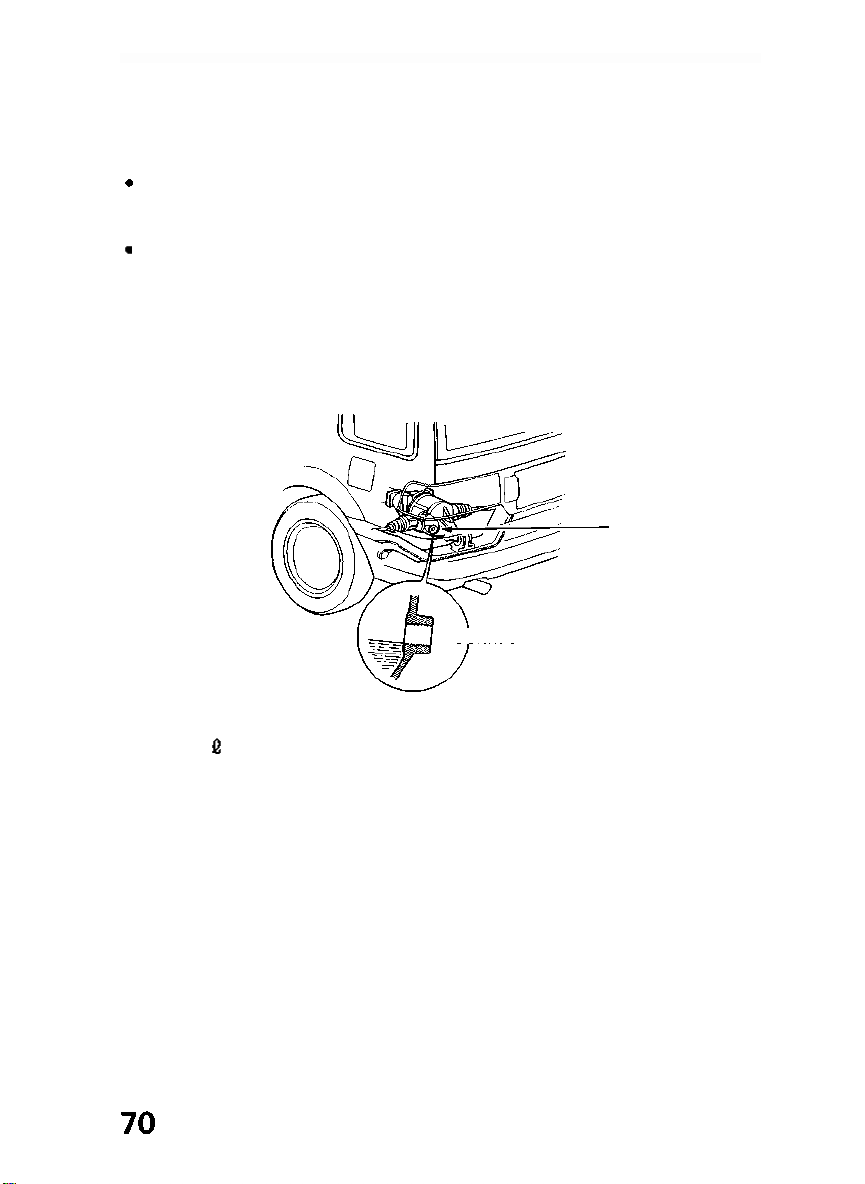
Rear Differential Oil (4WD)
Rear differential oil must be checked or filled with the engine off and
the car on the level ground.
CAUTION:
When checking the rear differential oil level, remember that if
the car has been running, the differential and exhaust pipe will
be hot.
If the oil level is low, check for possible leaks before adding oil.
Do not overfill.
Remove the oil filler bolt. Feel inside the bolt hole with your finger. If
the oil is up to the bottom edge of the hole, the oil level is correct. If
it is not, slowly add oil until it runs out of the hole, then reinstall the
bolt and tighten it securely with a wrench.
REAR DIFFERENTIAL OIL CHANGE CAPACITY:
0.65 (0.69 US qt, 0.57 Imp qt)
Recommended oil:
HYPOID GEAR OIL (API GL5) SAE 90 above 5°C (41 °F)
HYPOID GEAR OIL (API GL5) SAE 80 below 5°C (41 °F)
OIL CHECK/
FILLER BOLT
CORRECT LEVEL
Main Menu
▲
▼

Cooling System
The engine in your Honda contains a number of aluminum parts.
Therefore, it requires an antifreeze/coolant specifically formulated
to protect the aluminum parts from corrosion. Failure to use a
suitable antifreeze/coolant may seriously shorten the life of the
engine as the result of rapid corrosion damage. Some antifreeze/
coolants, although labeled for use in engines containing aluminum,
may not provide adequate protection for your engine.
Therefore, use only a Honda RECOMMENDED antifreeze/coolant.
CHECK WITH YOUR AUTHORIZED HONDA DEALER.
For best corrosion protection, the mixture of coolant and water
must be maintained year-round at 50/50. Concentrations less than
50% coolant may not provide sufficient protection against
corrosion and freezing. Concentrations of greater than 60% coolant
will impair cooling efficiency and are not recommended. Low-
mineral drinking water or distilled water should be mixed with the
antifreeze/coolant. Coolant loss should be replenished by a mixture
containing the proper concentration of antifreeze and water.
Do not mix different antifreeze/coolants.
Do not use additional rust inhibitors or anti-rust products, as they
may not be compatible with the radiator coolant.
ENGINE DAMAGE CAUSED BY IMPROPER COOLANT USAGE IS
NOT COVERED BY THE NEW CAR WARRANTY.
(cont'd)
Main Menu
▲
▼
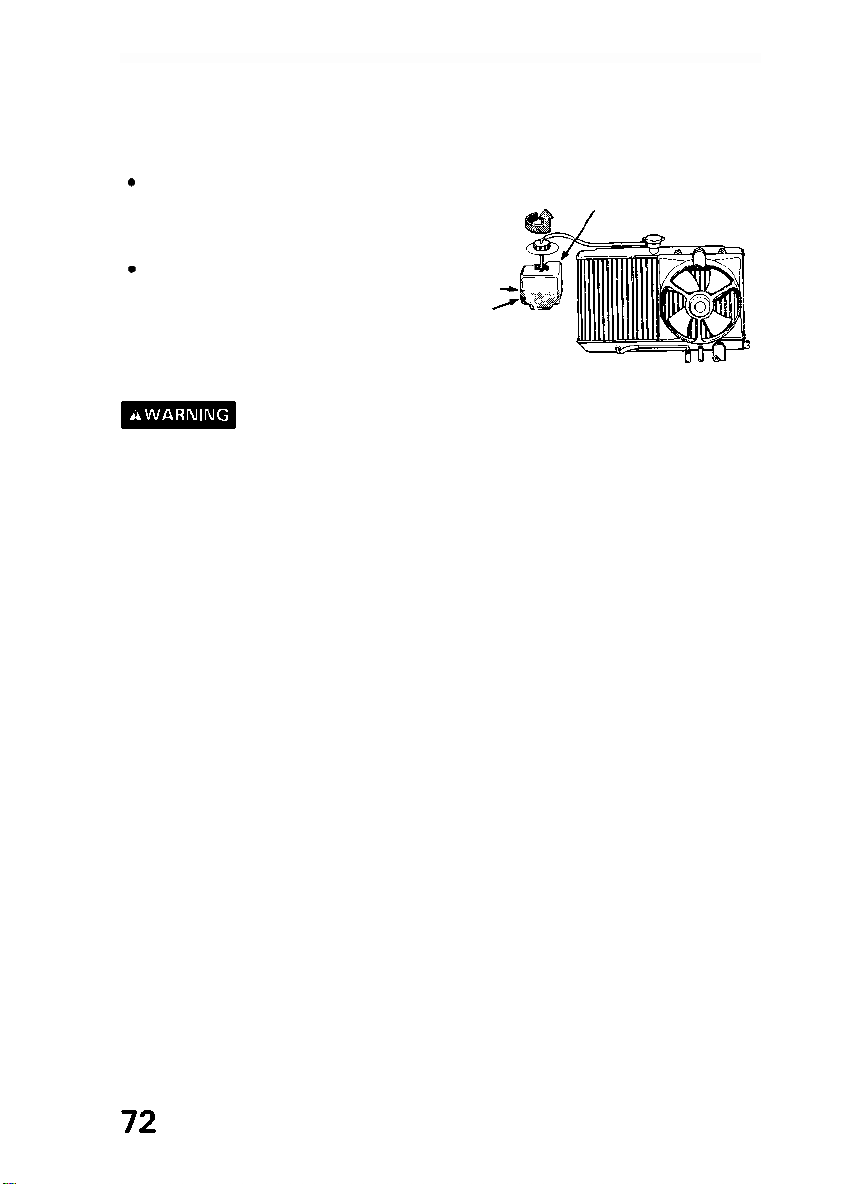
Cooling System (cont'd)
Checking Coolant
Check the coolant level in the reserve tank when the engine is at
normal operating temperature.
If the level is below the MAX
mark, but still visible, add a 50/50
solution of antifreeze and water
to bring it up to MAX.
If there is no coolant in the re-
serve tank, the cooling system
should be checked for leaks and
repaired if necessary. Coolant
must then be added to the radi-
ator.
Do not remove the radiator cap when the engine is hot; the
coolant is under pressure and could severely scald you.
CAUTION:
Radiator coolant will damage paint. Quickly rinse any spilled
coolant from painted surfaces.
Wait until the engine is cool, then turn the radiator cap counterclock-
wise until it stops. DO NOT PRESS DOWN WHILE TURNING THE
CAP. After any remaining pressure has been relieved, remove the
cap by pressing down and again turning it counterclockwise. Add
enough coolant to fill the radiator, and reinstall the cap. Be sure to
tighten it securely. Fill the reserve tank up to the MAX mark with
the engine cold.
Maintenance
1. Check the freeze protection level of the coolant with a hydrome-
ter.
2. Keep the front of the radiator free of dirt and debris.
3. Check hoses and hose clamps regularly.
RESERVE TANK
MIN
MAX
Main Menu
▲
▼
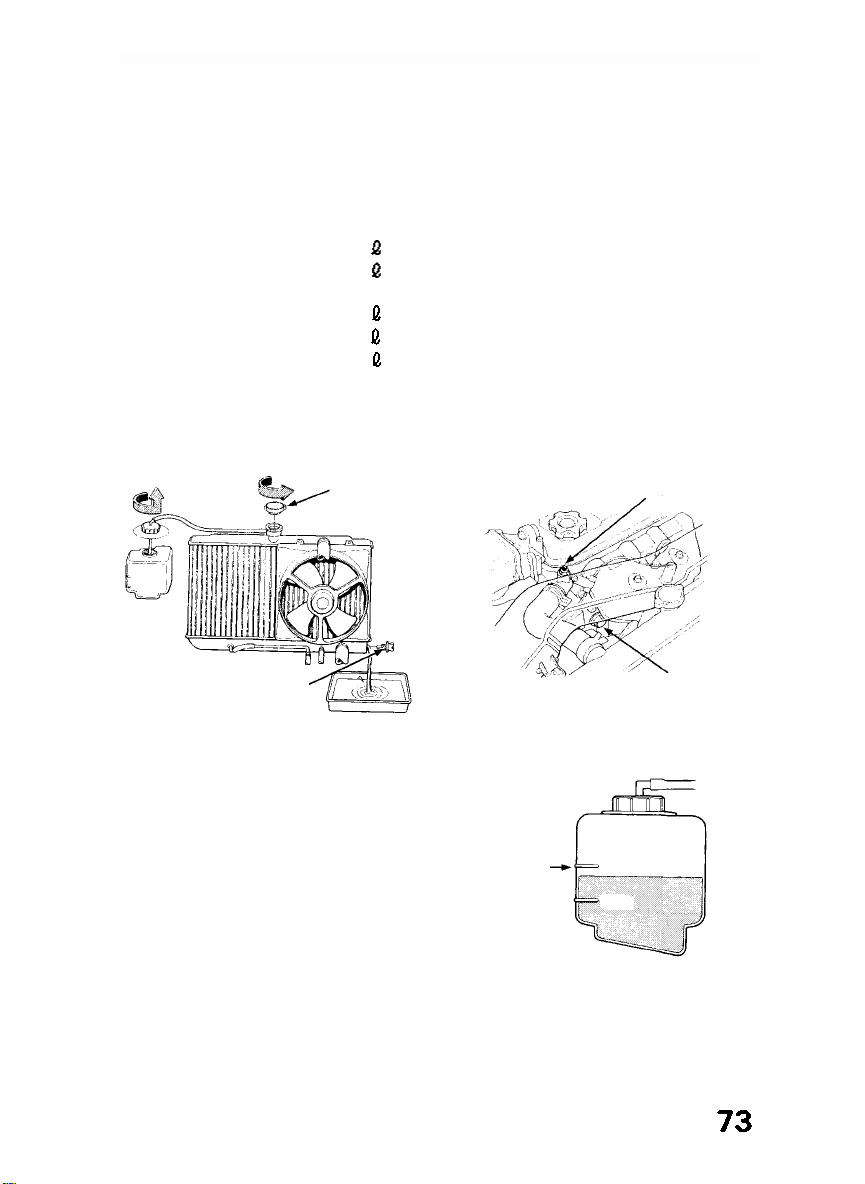
Replacing Coolant
Replace coolant at 36 months or 45,000 miles (72,000 km), which-
ever comes first. Thereafter, replace every 2 years or 30,000 miles
(48,000 km), whichever comes first.
RADIATOR COOLANT
REFILL CAPACITY:
Manual Transmission
(CIVIC WAGON): 4.1 (1.08 US gal, 0.90 Imp gal)
(4WD): 4.0 (1.06 US gal, 0.88 Imp gal)
Automatic Transmission
(CIVIC WAGON): 4.0 (1.06 US gal, 0.88 Imp gal)
(4WD): 4.5 (1.19 US gal ,0.99 Imp gal)
Plus reserve tank 0.4 (0.11 US gal, 0.09 Imp gal)
1. Set the heater temperature control dial to maximum heat.
2. Remove the radiator cap and drain plug when the radiator is cool,
and drain the radiator.
3. Remove the drain bolt from the
front side of the cylinder block,
and drain the engine and heater.
4.Apply non-hardening sealant to
the drain bolt threads, then rein-
stall the bolt and tighten it se-
curely.
5. Tighten the radiator drain plug se-
curely.
6. Mix the recommended antifreeze
with an equal amount of low-
mineral or distilled water and fill
the reservoir to maximum, as
illustrated.
(cont'd)
RADIATOR
CAP
DRAIN PLUG
DRAIN BOLT
BLEED BOLT
Fill to
here
MAX
MIN
Main Menu
▲
▼
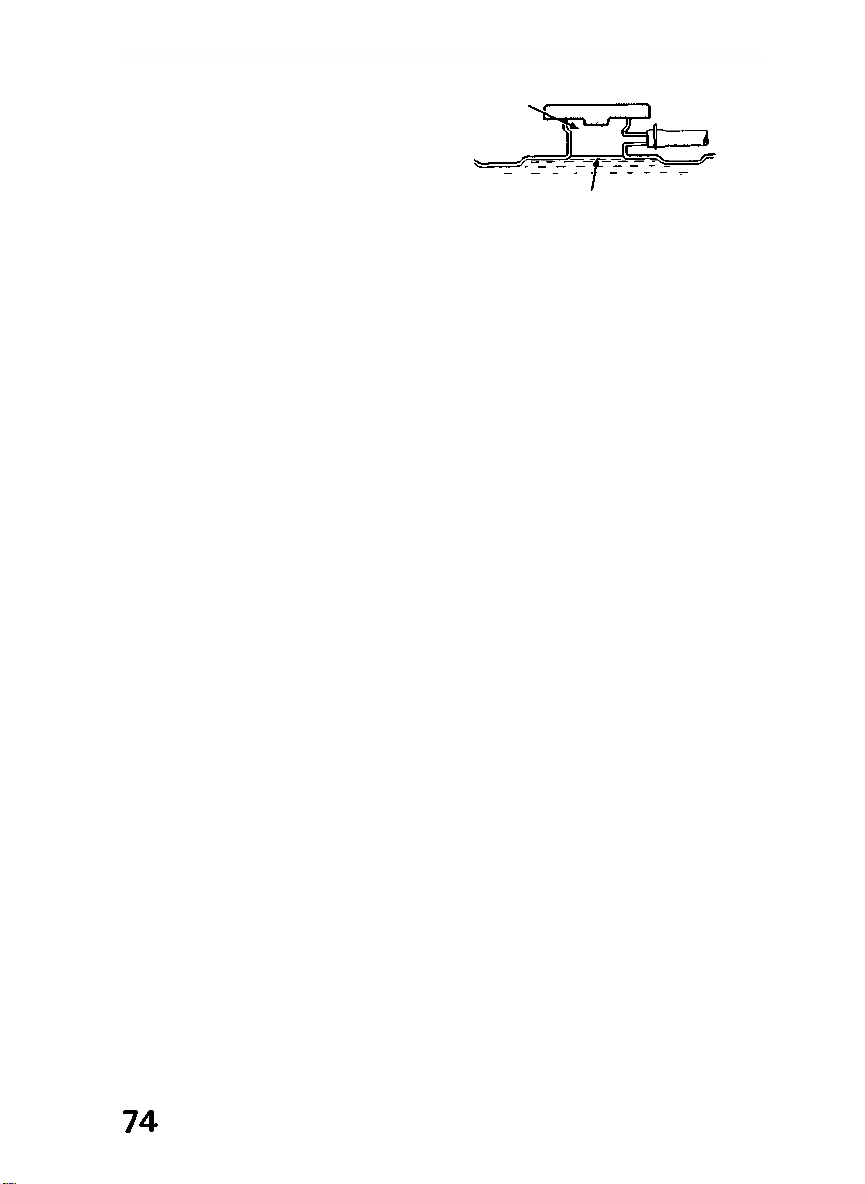
Cooling System (cont'd)
7. Loosen the air bleed bolt in the
thermostat housing, then fill the
radiator to the filler neck with the
coolant mixture. Tighten the
bleed bolt as soon as coolant
starts to run out in a steady
stream without bubbles.
8. With the radiator cap off, start the engine and let it run until
warmed up (fan goes on at least twice). Then, if necessary, add
more coolant mix to bring the level back up to the filler neck.
9. Put the radiator cap on, then run the engine again and check for
leaks.
FILLER
NECK
Fill to here
Main Menu
▲
▼
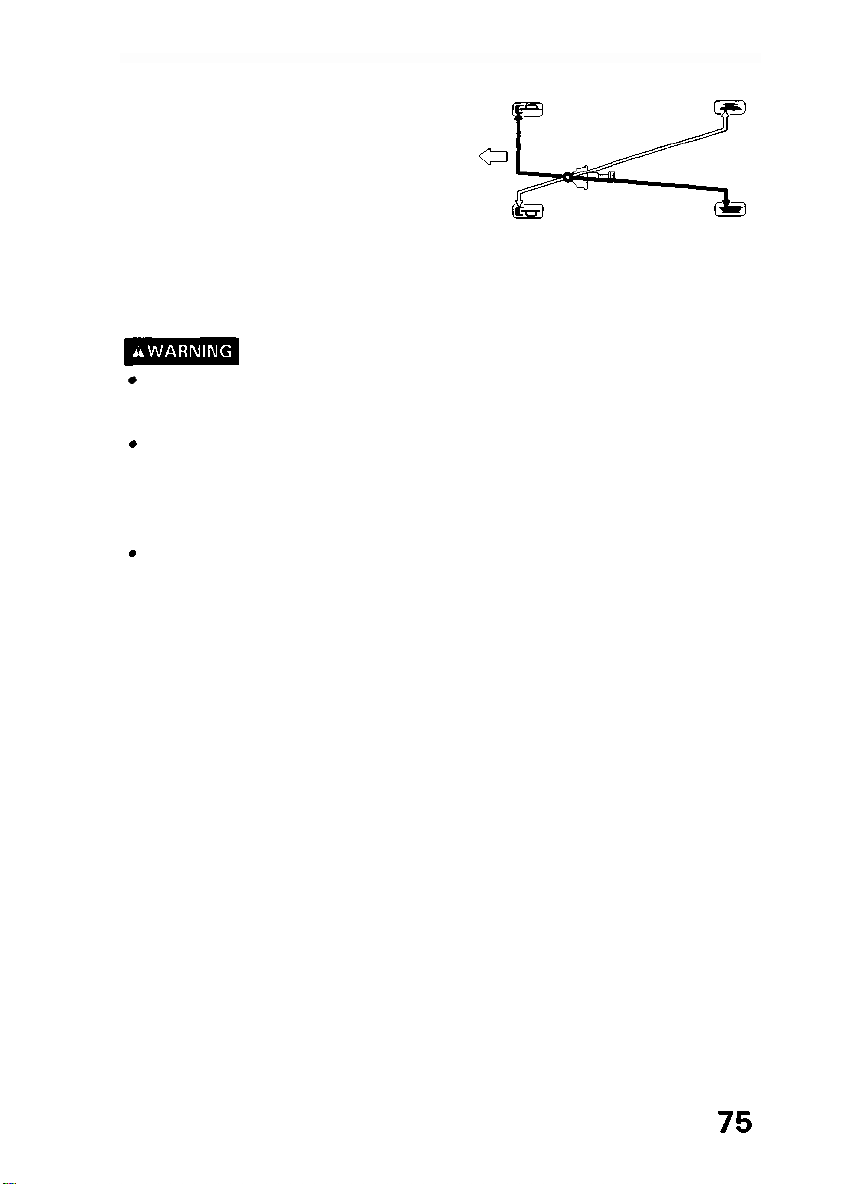
Brakes
Brake System Design
The diagonally-separated dual serv-
ice brake system is designed so half
the system will still provide braking
action if the other half fails.
Stopping the car after losing the
brake fluid from half the system will
require more pedal pressure and pedal travel than normal. Also, the
distance required to stop will be longer using only half the brake
system. If the brakes fail suddenly, downshift to a lower gear for
increased engine braking, and pull off the road as soon as possible.
It is dangerous to drive your car with a problem in either the
brake electrical or hydraulic system; have your dealer check
both systems if you suspect brake trouble.
Do not ride the brakes. In other words, don't put your foot on
the brake pedal unless you intend to brake. This causes
excessive brake wear and can damage, or lead to loss of braking
effectiveness through overheating. Your brake lights may also
confuse drivers behind you.
Driving through deep water may affect the brakes.
Check their effectiveness by pressing the brake pedal gently.
If the car does not slow down at the normal rate, continue
gently applying the brakes, while maintaining a safe speed, until
they dry out and normal performance returns.
Brake Wear
Both front and rear brakes should be inspected for wear at the
intervals shown in the Maintenance Schedule on page 60.
When the brakes require maintenance, use only genuine Honda
replacement parts or their equivalent.
(cont'd)
Main Menu
▲
▼
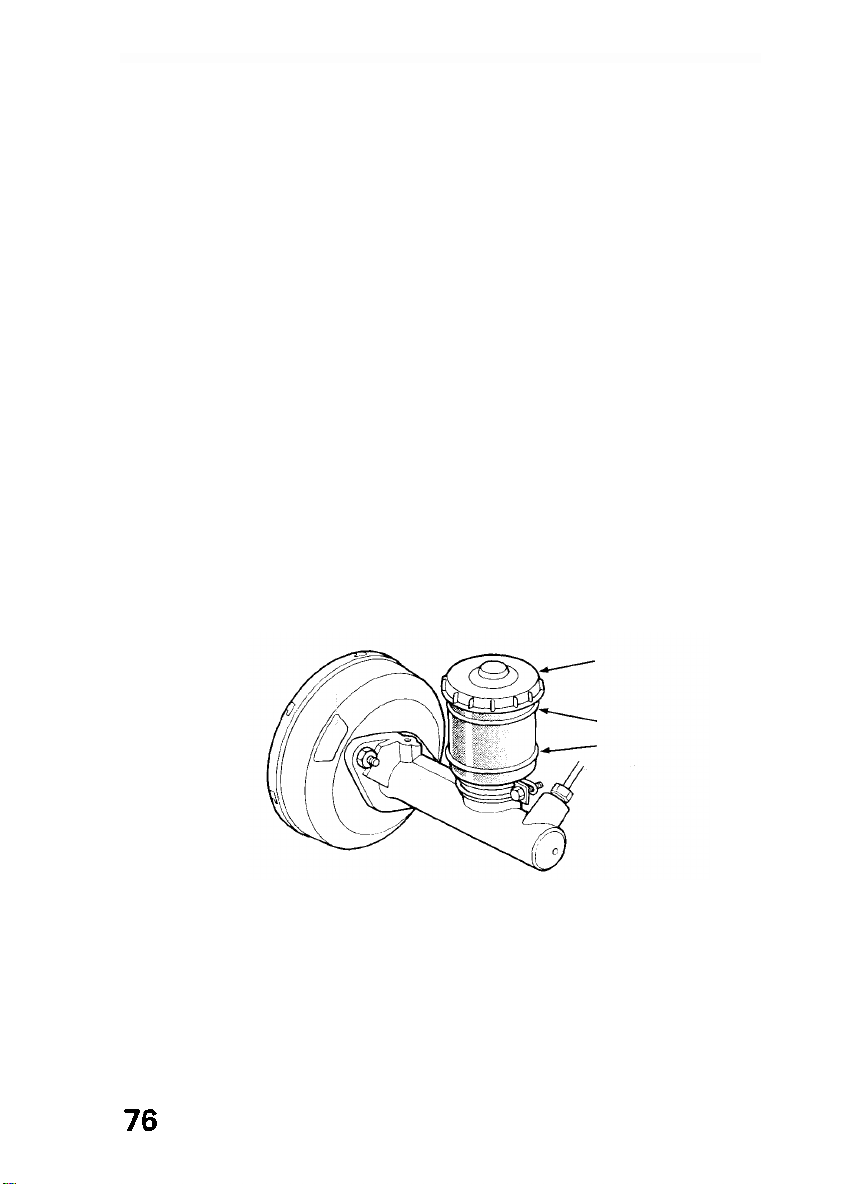
Brakes (cont'd)
Front Brake Wear Indicators
Your car is equipped with audible brake wear indicators. When the
brake pads need to be replaced, the wear indicators will make a
"screeching" sound or a high pitch chirp.
NOTE:
Due to some driving habits or climates, brakes may "squeal" when
you first apply them or when you have them partially applied; this is
normal, and does not indicate excessive wear. The wear indicator
makes a "screeching" sound while the brakes are applied.
Brake Fluid
Check the fluid level in the brake reservoir periodically; it should be
between the MAX and MIN marks on the reservoir.
If the level is near the MIN mark, add fluid to raise it to the MAX
mark. Do not overfill. Use only brake fluid manufactured to DOT 3
or DOT 4 specifications (see reservoir cap) from a sealed container.
Follow the manufacturer's instructions printed on the can.
NOTE:
A low brake fluid level may be an indication of brake pad wear or of
brake fluid leakage. You should have your brakes checked if the
brake fluid level in the reservoir is low before re-filling it.
CAUTION:
The arrow on the reservoir cap must be pointing forward after the
cap is installed. Make sure the brake warning switch wiring doesn't
get caught between the cap and top edge of the reservoir.
BRAKE FLUID
RESERVOIR
MAX
MIN
Main Menu
▲
▼
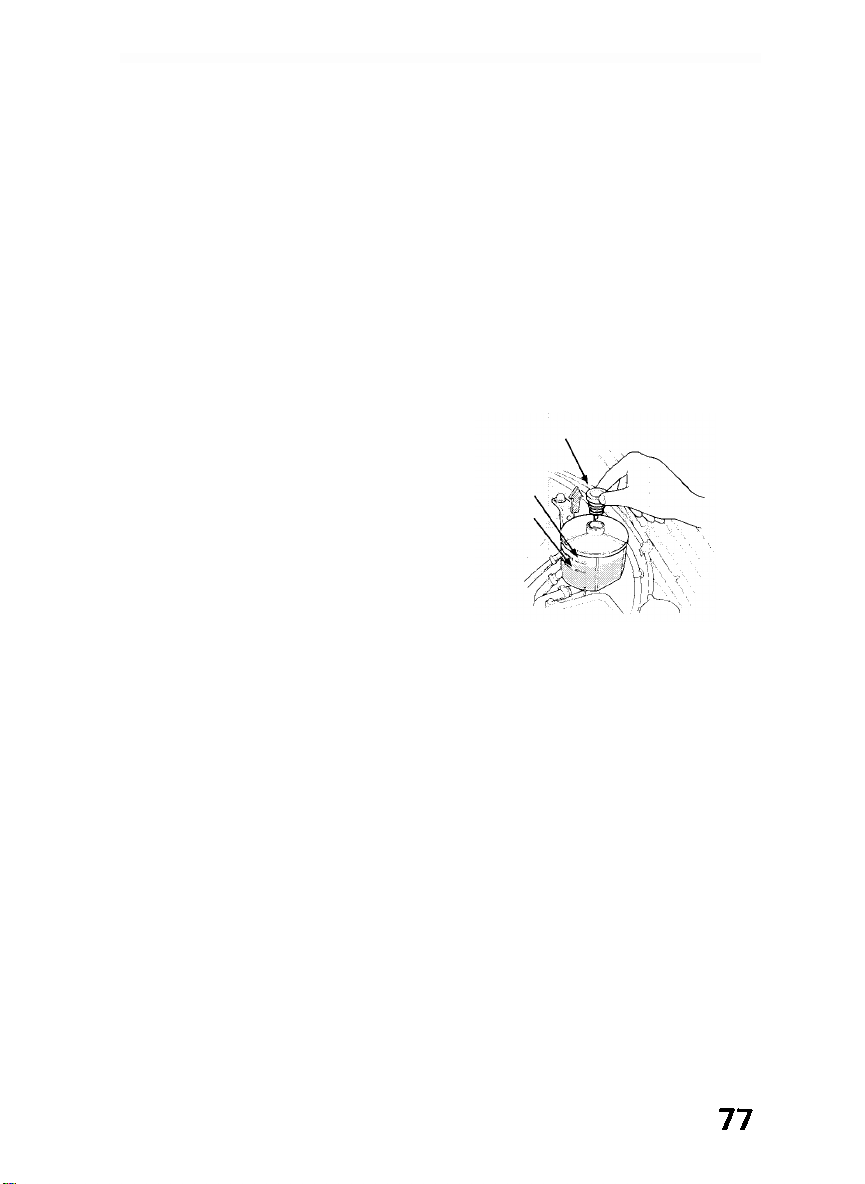
The power steering on your car provides easy handling while
parking and maneuvering in traffic, without loss of road "feel" at
highway speeds. An engine-driven hydraulic pump provides full
power assist at low speeds and decreasing assist as the car goes
faster.
CAUTION:
If the power steering system should fail, or if the engine should
stall, the car can still be steered. However, much greater effort
will be required, particularly in sharp turns at low speed.
NOTE:
You may feel a slight clunk or knock when turning the wheel with
the engine off. This is a normal condition due to the design of the
system.
Power Steering Fluid
Check the power steering fluid level
with the engine cold and the car
parked on level ground. Make sure
the fluid level is between the upper
and lower marks on the reservoir. If
the level has dropped close to or
below the lower mark, check for
leaks before adding fluid to the
upper mark. Do not overfill.
CAUTION:
Use only genuine Honda power steering fluid. The use of other
fluids such as A.T.F. or other manufacturer's power steering fluid
will damage the system.
Power Steering(4WD or CIVIC WAGON with Automatic)
RESERVOIR CAP
UPPER
LOWER
Main Menu
▲
▼
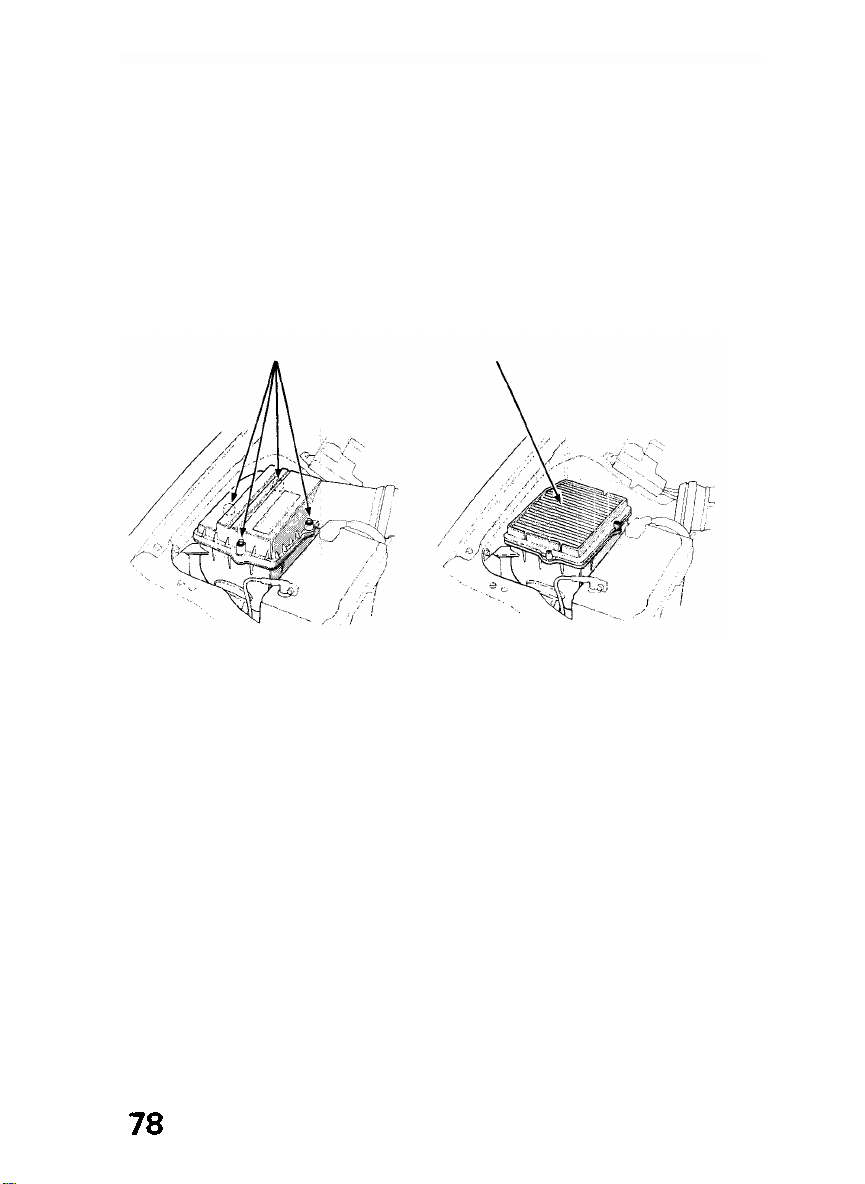
Air and Fuel Filters
Air Filter
Replace the air filter every 24 months or 30,000 miles (48,000 km),
whichever comes first (more often in extremely dusty conditions).
Replacement
Remove the four screws holding the air filter cover halves together.
Remove the top half of the air filter cover. Replace the filter.
Reinstall the cover and screws securely.
Fuel Filters
The fuel filter is located in the engine compartment, on the right
center of the lower dashboard. It should be replaced at 60,000 miles
(96,000 km) or 48 months whichever comes first, or any time you
suspect contaminated gas may have clogged it.
CAUTION:
Because the fuel system is under pressure, the filter should be
replaced only by a qualified Honda technician.
SCREWS
AIR FILTER
Main Menu
▲
▼
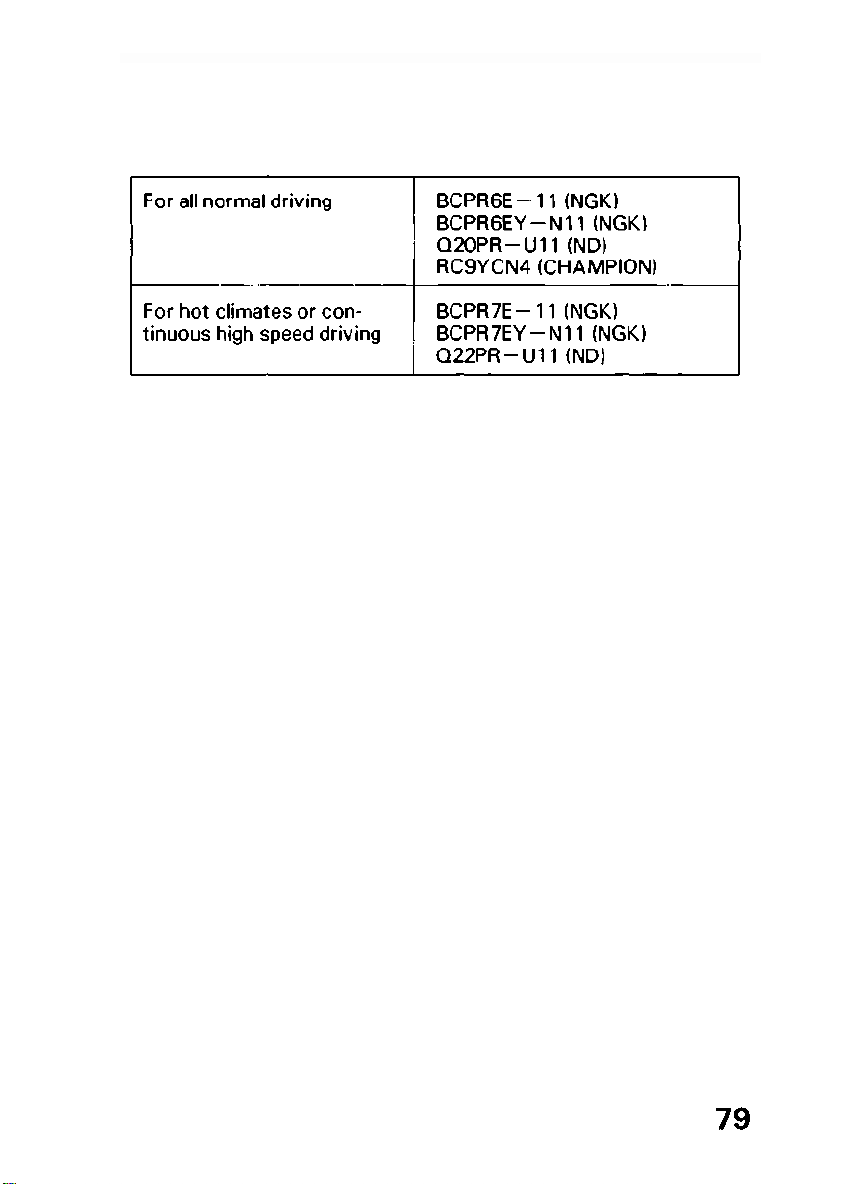
Spark Plugs
Spark plugs should be replaced every 24 months or 30,000 miles
(48,000 km), whichever comes first.
Recommended spark plugs:
CAUTION:
Never use spark plugs with an improper heat range; they will
adversely affect engine performance and durability.
(cont'd)
Main Menu
▲
▼
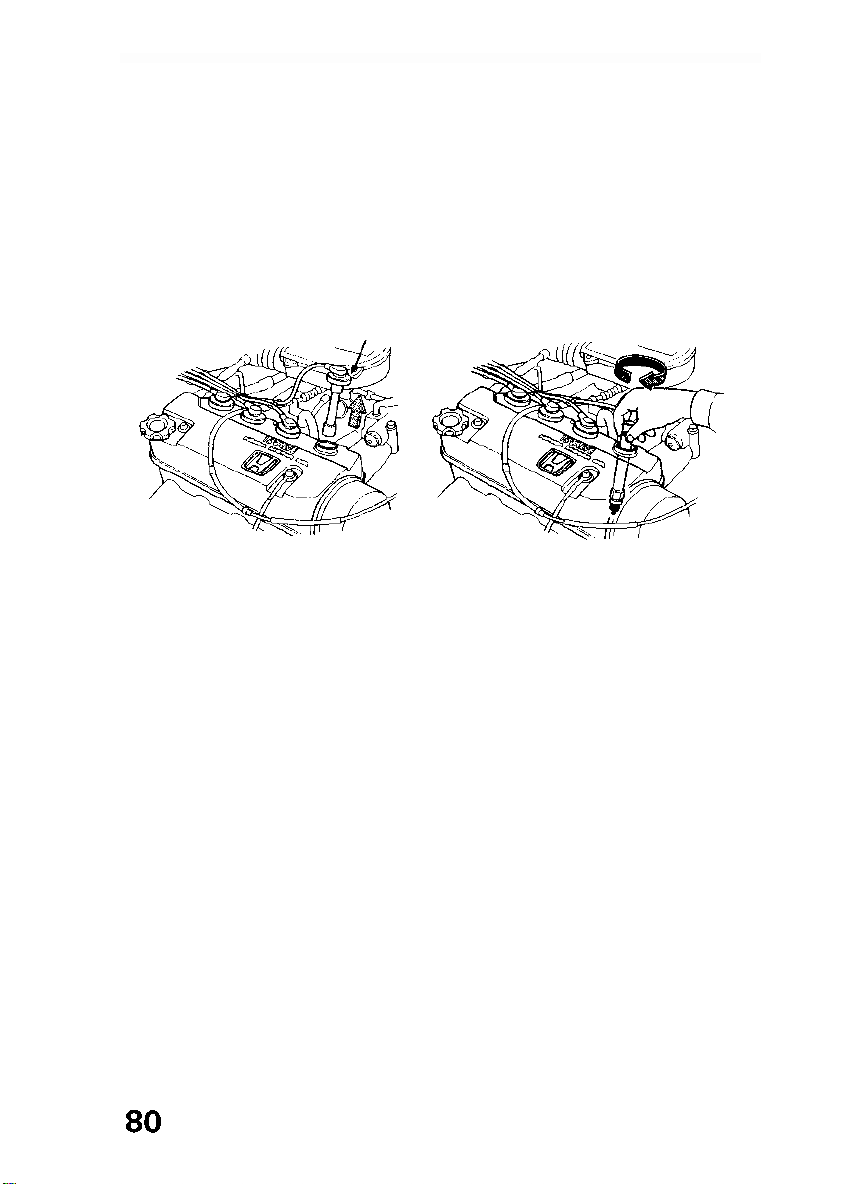
Spark Plugs (cont'd)
Spark Plug Replacement
Replace plugs one at a time, so you don't get the wires mixed up.
1. Clean any dirt from around the spark plug base.
2. Disconnect the plug cap, then remove and discard the old plug.
3. Check the gap of the new spark plug before installation.
Plug gap should be: 1.1mm (0.04in ).
4.Thread the new spark plug in by hand to prevent cross-threading.
5. After the plug seats against the cylinder head, tighten 1/2 turn
with a spark plug wrench to compress the washer.
6. Reinstall the spark plug cap.
CAUTION:
The spark plugs must be securely tightened, but not overtightened.
A plug that's too loose can get very hot and possibly damage the
engine; one that's too tight could damage the threads in the
cylinder head.
PLUG CAP
Main Menu
▲
▼
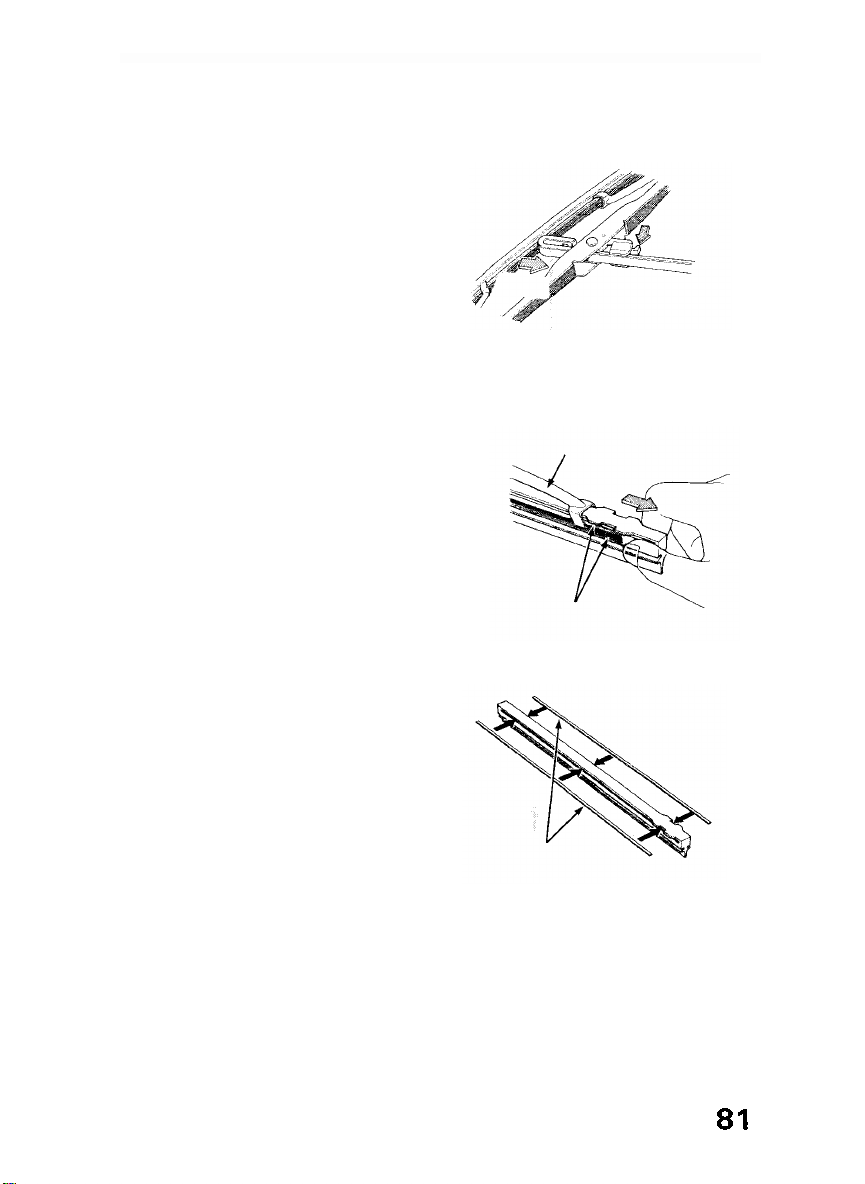
Wiper Blades
2. Firmly grasp the end of the blade
rubber and pull until the tabs are
free of the metal support.
3. Remove the metal retainers from
the worn-out blade rubber and
put them in a new blade rubber.
4. Insert the new blade rubber from
the opposite side of the blade
tabs and position the tabs in the
metal support.
TABS
Pull out
METAL SUPPORT
RETAINERS
For maximum visibility, replace worn or cracked wiper blades when
you notice they do not wipe the windshield cleanly or smoothly.
To Replace Worn-out Blades
1. Detach the blade assembly from
the arm by pressing the lock tab
in, then pushing the blade toward
the base of the arm.
Push
Press Lock
Tab in
Main Menu
▲
▼
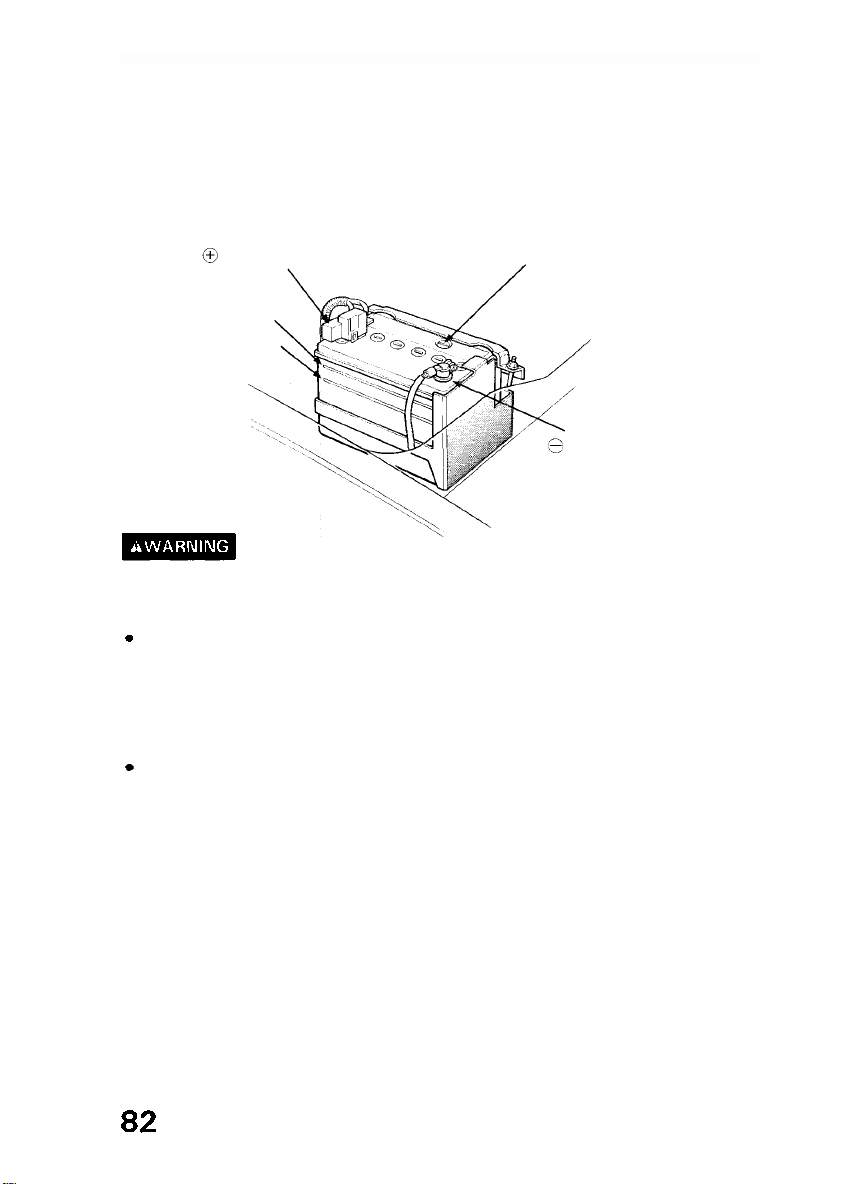
The condition of the battery can be determined by checking the
test indicator. Service as required according to the label on the
battery.
Any corrosion around the positive and negative terminals should be
washed off with a solution of baking soda and warm water. Dry the
terminals and then coat them with grease.
• The battery gives off explosive gases; keep sparks, flames and
cigarettes away. Provide adequate ventilation when charging or
using the battery in an enclosed space.
The battery contains sulfuric acid (electrolyte). Contact with
skin or eyes may cause severe burns. Wear protective clothing
and a face shield.
— If electrolyte gets on your skin, flush with water.
— If electrolyte gets in your eyes, flush with water for at least
15 minutes and call a physician immediately.
Electrolyte is poisonous.
— If swallowed, drink large quantities of water or milk and follow
with milk of magnesia or vegetable oil and get immediate
medical assistance.
KEEP OUT OF REACH OF CHILDREN.
TERMINAL
TEST INDICATOR
TERMINAL
UPPER
LOWER
Battery
Main Menu
▲
▼
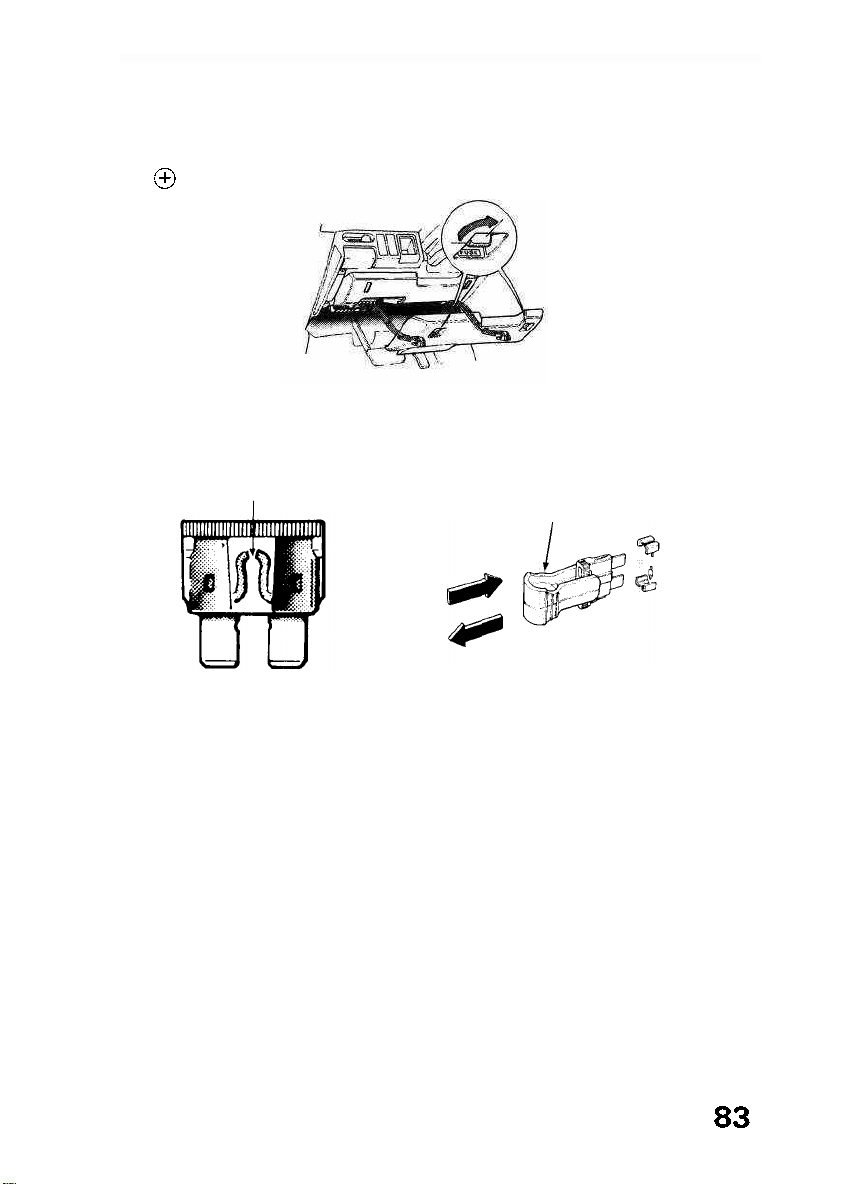
Fuse Replacement
The fuse box is located under the dashboard on the driver's side.
The circuits protected by each fuse are listed inside the box.
The fuses for automatic shoulder belt buckle motor are installed on
the terminal of the battery.
If any of your car's lights, accessories, or controls don't work,
check their fuses. If a fuse has blown, the wire inside it will be
burned through.
Checking the fuses:
1. Turn off the ignition and all other switches.
2. If you find a blown or possibly faulty fuse, use the fuse remover,
stored beside the spare fuse to pull the blown fuse out of its clips.
3. Check all other fuses as well as the one you suspect.
4. Push in a new fuse of the same rating, and make sure it fits tightly
in the clips. If it fits loosely, have your dealer fix it.
If you don't have a spare, take a fuse of the same rating (or lower)
out of a circuit you may not need, like the radio or cigarette lighter.
Remember to replace the borrowed fuse and the missing spares.
CAUTION:
A blown fuse may be just a symptom of some other problem. If a
new fuse blows right away, the cause should be diagnosed and
corrected by a qualified Honda technician. Never replace a fuse
with anything but another fuse of the same or lower rating. A
higher capacity fuse could cause damage and even start a fire.
(cont'd)
BLOWN
FUSE
REMOVER
Main Menu
▲
▼
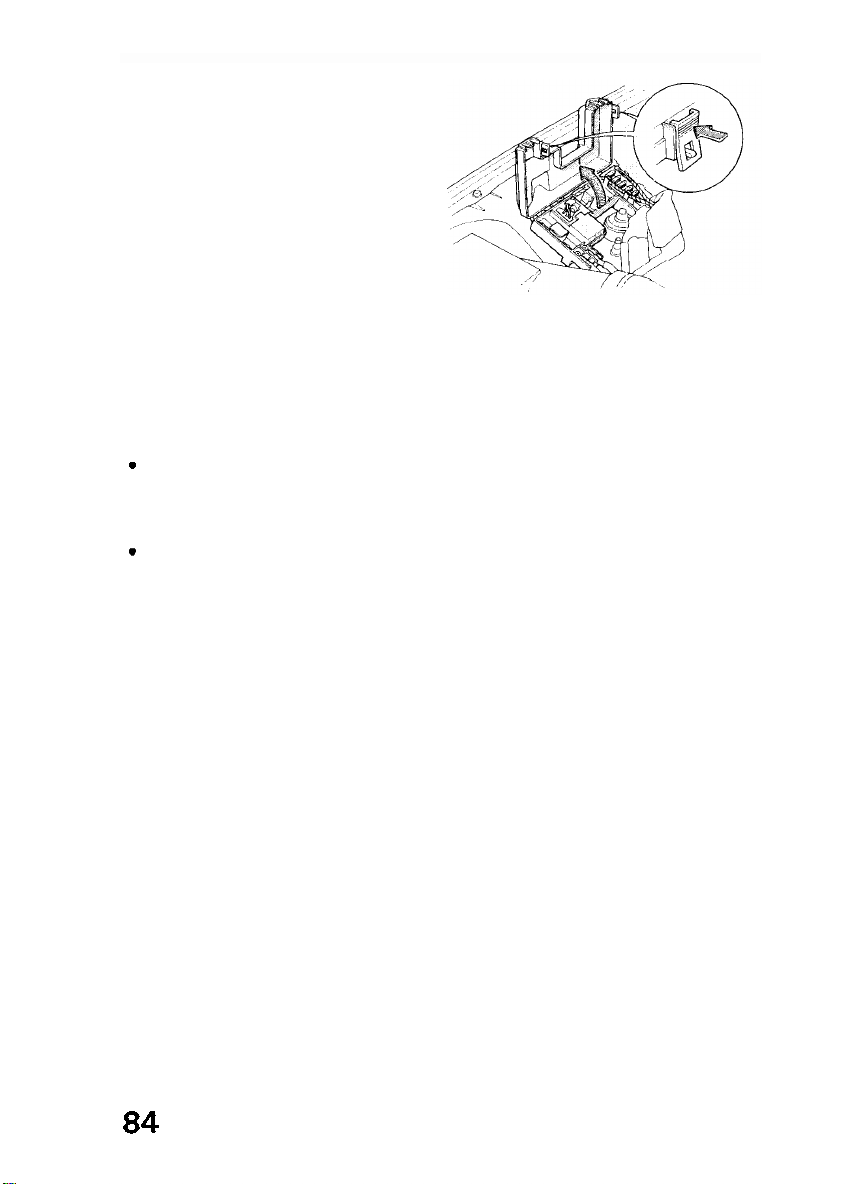
Fuse Replacement (cont'd)
The main fuse and some primary
fuses are installed on the right
front fender beside the battery.
If the circuits from the battery are ever overloaded (by a short in
the system drawing too much current for example) the main or a
primary fuse will blow, preventing damage to the entire wiring
harness. If the main fuse blows, have a Honda dealer check the
system, repair the cause, and replace the fuse.
CAUTION:
The electrical system is protected by fuses that are designed to
fail and prevent damage to the wire harness. Always replace
blown fuses with the same rating as specified to prevent wiring
damage that can result in a possible fire.
For proper electrical contact after replacing these fuses, make
sure all screws are tight.
Main Menu
▲
▼
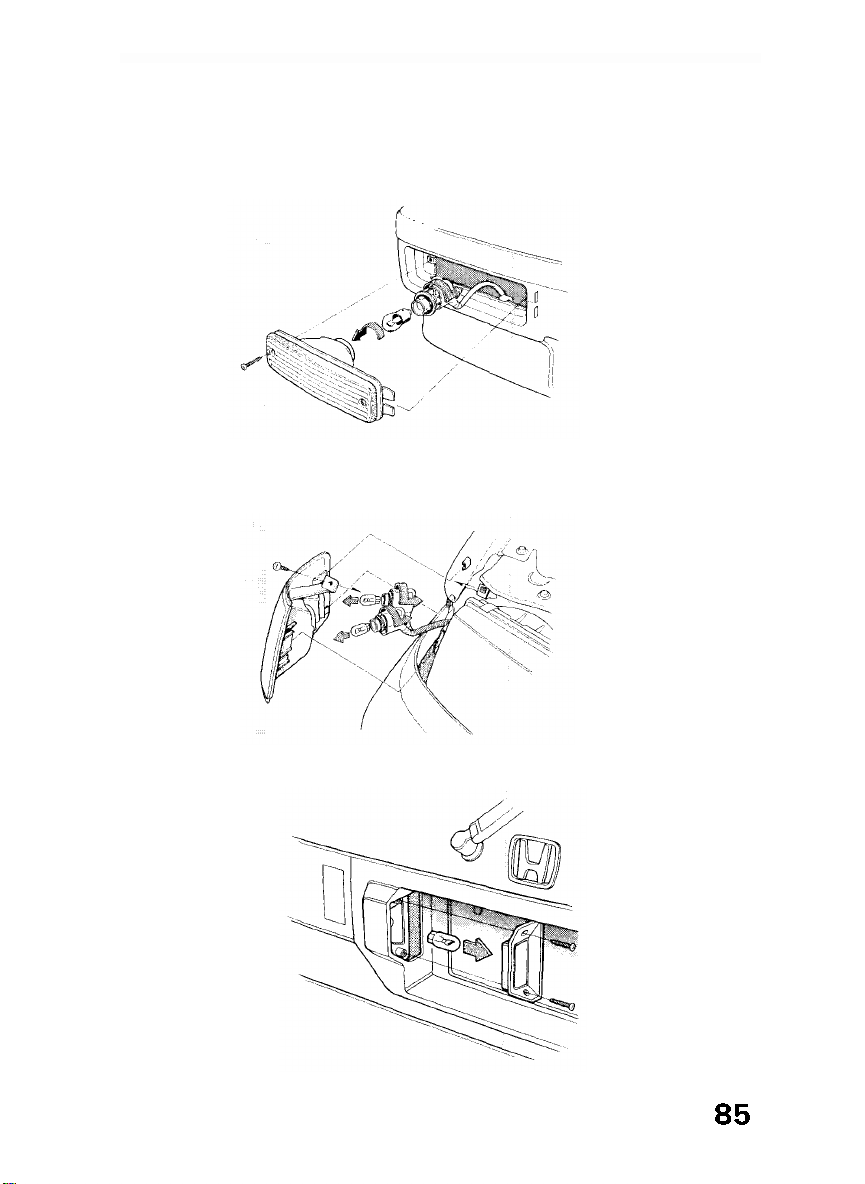
Bulb Replacement
(cont'd)
NOTE:
See page 109 for bulb specifications.
Front turn signal lights
Front side marker and parking lights
License plate lights
Main Menu
▲
▼
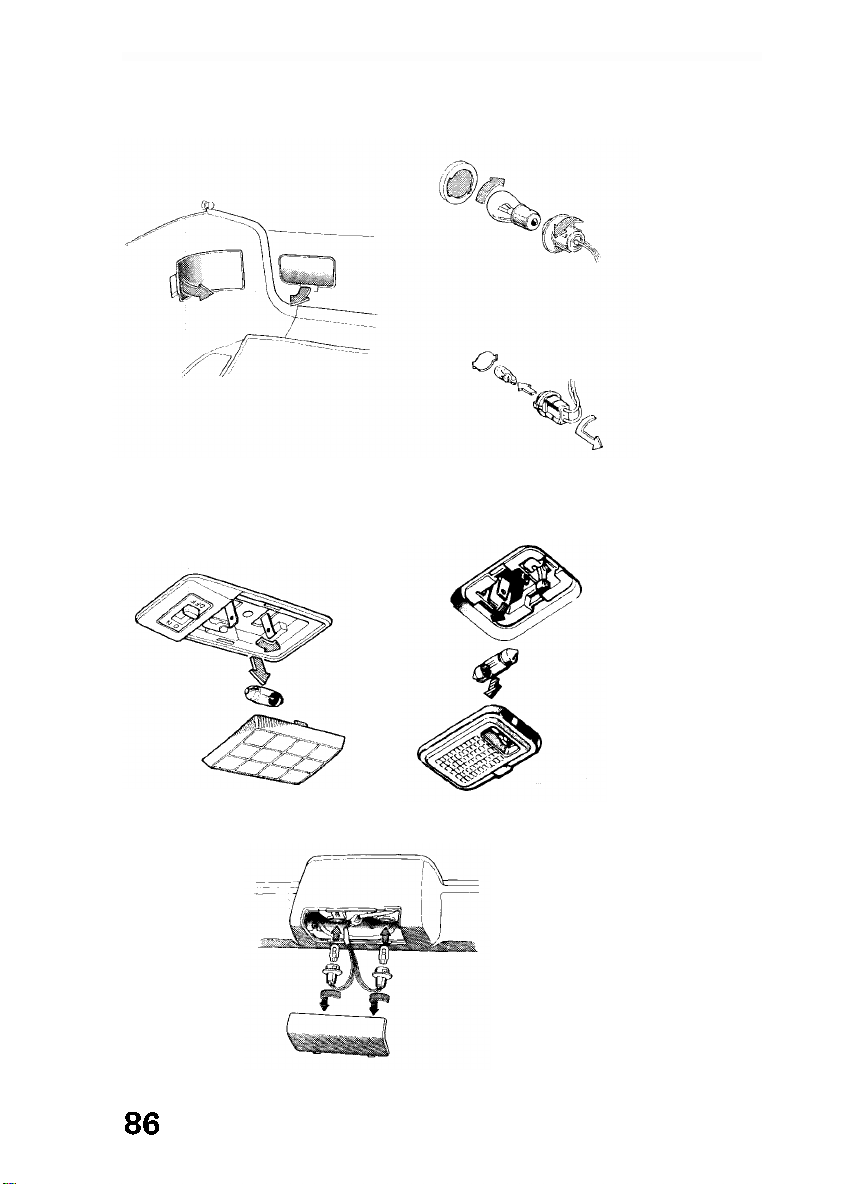
Bulb Replacement (cont'd)
Rear side marker, turn signal, brake/taillights and back-up lights
High-mount brake light
Luggage area lightInterior light
Main Menu
▲
▼
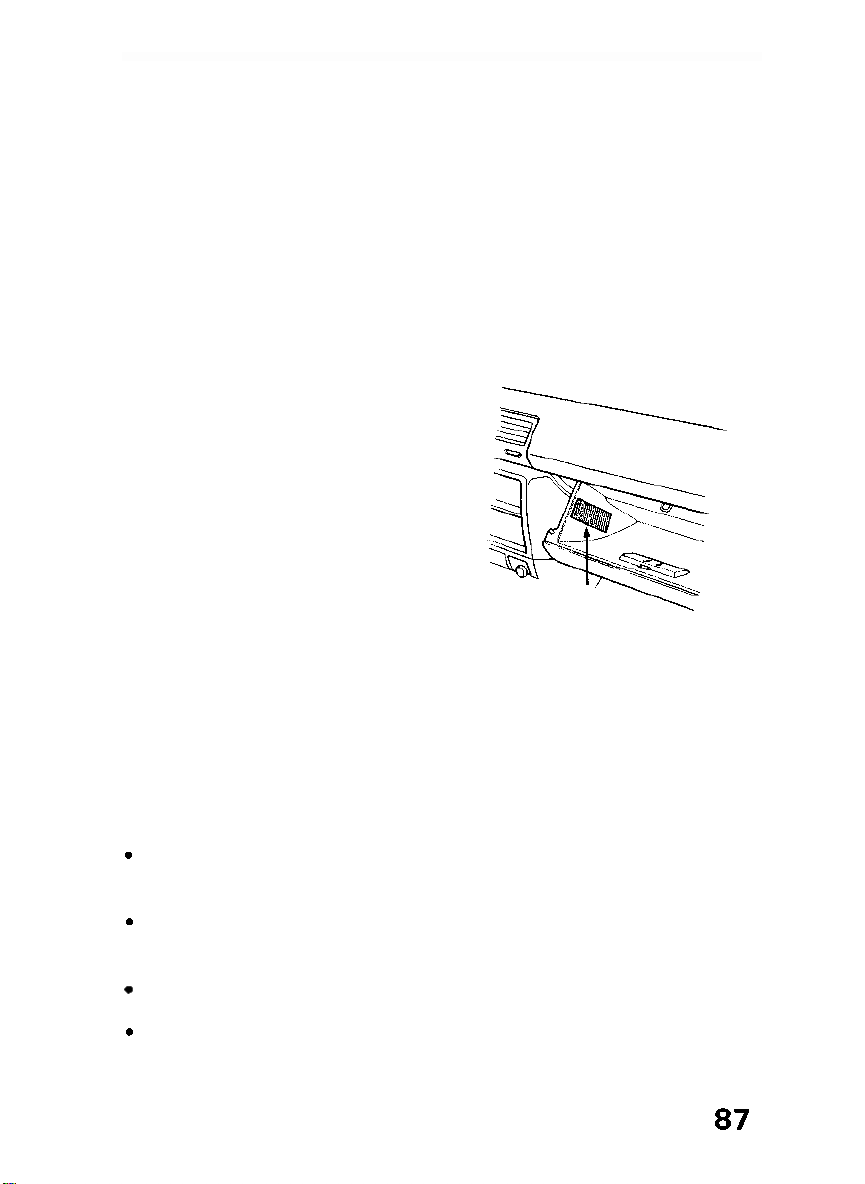
The factory installed tires on your car were selected to match the
car's performance capabilities and to provide the best combination
of handling, ride comfort and tread wear.
We recommend that you get the same size, type, and grade of tires
when replacement is necessary. If your tires have an all-season
tread design, the model name will be followed by the marking: "M +
S" (mud and snow) or "all-season".
If you decide not to get the same brand of tires as those originally
installed, you should make sure that the replacements are the radial
type, of the same size, load range and speed rating as the original
tires.
If you have any questions about your car's tires, please contact
your Honda dealer.
Inflation Pressures
The tire label in the glove box lists
recommended tire pressures for
carrying loads up to the limit shown.
(Tire pressures are also listed on the
back cover of this manual.)
These pressures were chosen to
provide you with the best combi-
nation of tread life, riding comfort
and stability under normal driving
conditions.
Improper inflation can reduce both tire life and load carrying
capacity. Check the tire pressures at least once a month, including
the spare.
Lower pressure than recommended lets the tread and sidewalls flex
too much, causing increased tire temperatures, uneven wear, and
poor handling. Pressure higher than recommended can make the tire
too stiff, increasing the chance of damage from road hazards, and
also causing uneven wear.
CAUTION:
Check tire pressure when the tires are cold.
(After the car has been parked for more than 3 hours or driven
less than 1 mile/1.6 km.)
Tire pressure may increase as much as 41 kPa (6 psi) when the
tire is hot, so NEVER ADJUST tire pressure when the tires are
hot.
Never inflate load range B tires to more than 220 kPa (32 psi)
cold.
Cars with luggage racks or cartop carriers DO NOT have greater
load limits than those on the label.
(cont'd)
TIRE LABEL
Tires
Main Menu
▲
▼

Tires (cont'd)
Winter Driving
Tires marked "M + S" or "all season" have an all-weather tread
design and should be suitable for most driving conditions. However,
snow tires and tire chains may be required under some conditions. If
your tires do not have these markings, they may not be suitable for
winter driving conditions. We recommend snow tires or tire chains
for snow and icy conditions.
Snow Tires
If you use snow tires, they should be of the same size, construction
and load capacity as the original tires on your car. Snow tires must
be installed in sets of four, or they may cause poor handling. Driving
with snow tires on dry roads can reduce your car's performance
during acceleration, turning and stopping.
If you need further information on snow tires, please contact your
Honda dealer.
Tire Chains
Use chains only when you have to. Check with local authorities or
Provinces for requirements prior to installing tire chains. Make sure
the chains are the right size for your tires. Install them only on the
drive wheels of your car, and do so as tightly as possible, following
the manufacturer's instructions. If metal chains are used, they must
be SAE Class "S." Cable type traction devices can also be used.
Drive slowly with chains installed. If you hear the chains contacting
your car's body or chassis, stop and tighten them.
CAUTION:
If the contact continues, slow down until it stops or your car can
be damaged.
Chains that are the wrong size or improperly installed can
damage your car's brake lines, suspension, body, and wheels.
If you need further information on tire chains, please see your
Honda dealer.
Remove the chains as soon as the road is clear of ice and snow.
Main Menu
▲
▼
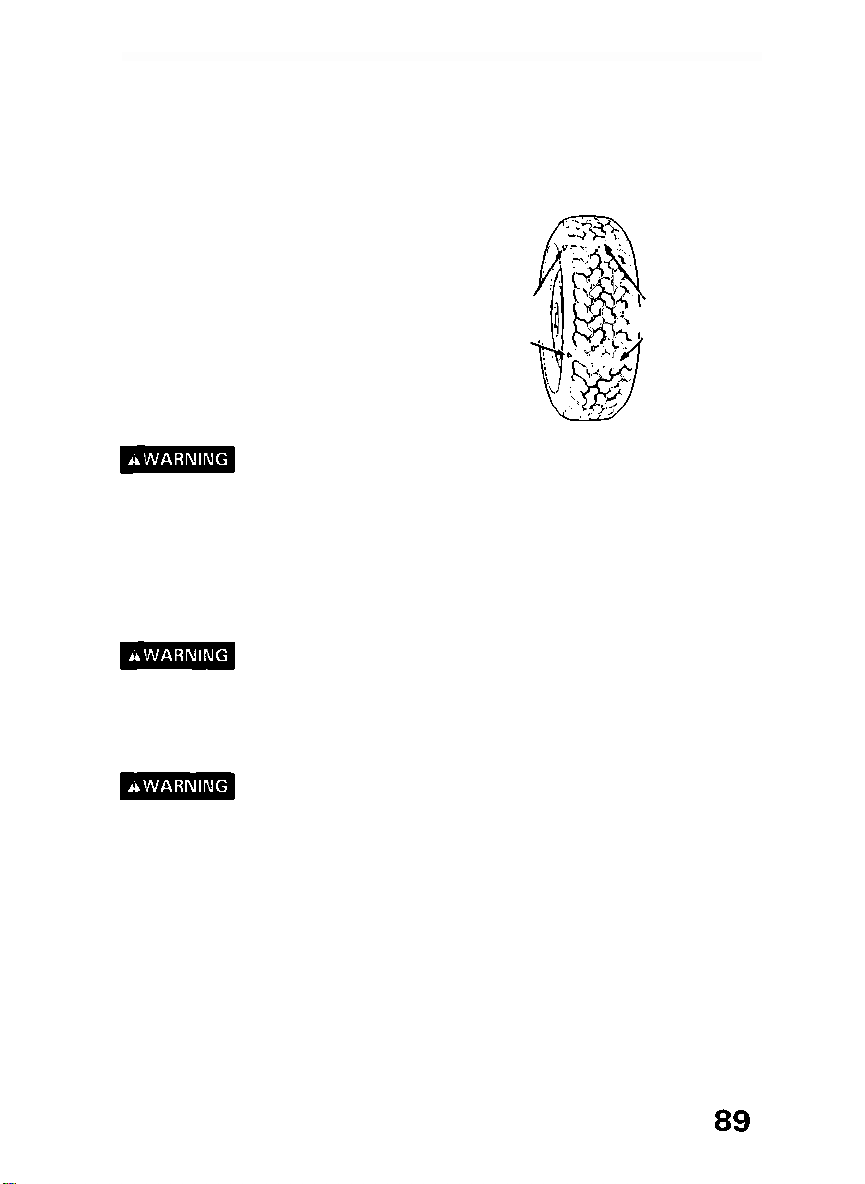
Tire Replacement
Honda recommends that you replace tires in sets of four, or in pairs,
front or rear. If you need to replace only one tire, mount the new
tire opposite the tire showing the least amount of wear.
For instance, if the left front tire shows the least amount of wear,
mount the new tire on the front right side.
The original tires on your car have
tread wear indicators to indicate
when they should be replaced.
The indicators appear as bands
about 12.7 mm (1/2 in) wide when
the tire tread depth is less than
1.6 mm (1/16 in). When indicators
appear across two or more
grooves in a row, you should re-
place the tire.
Driving on worn-out tires is very hazardous, and will reduce
braking effectiveness, steering accuracy and traction.
When replacing tires, use only the recommended tire size. Wheel
rim widths and offsets must be those recommended by American
Honda Motor Co., Inc. Contact the Zone Office nearest you as
shown on the inside of the back cover.
Tires and wheels other than those recommended may be unsafe.
Do not mix radial and bias ply tires on the same car.
Tire Balancing
Unbalanced tires may affect handling and tire wear. A tire should
always be rebalanced after it has been dismounted from the wheel.
Your original tires were properly balanced before the car left the
factory, but may need rebalancing at some time during the life of the
tire. Tire balancing for the COMPACT spare is not necessary.
(cont'd)
INDICATOR
LOCATION
MARKS
INDICATORS
TREAD WEAR
Main Menu
▲
▼
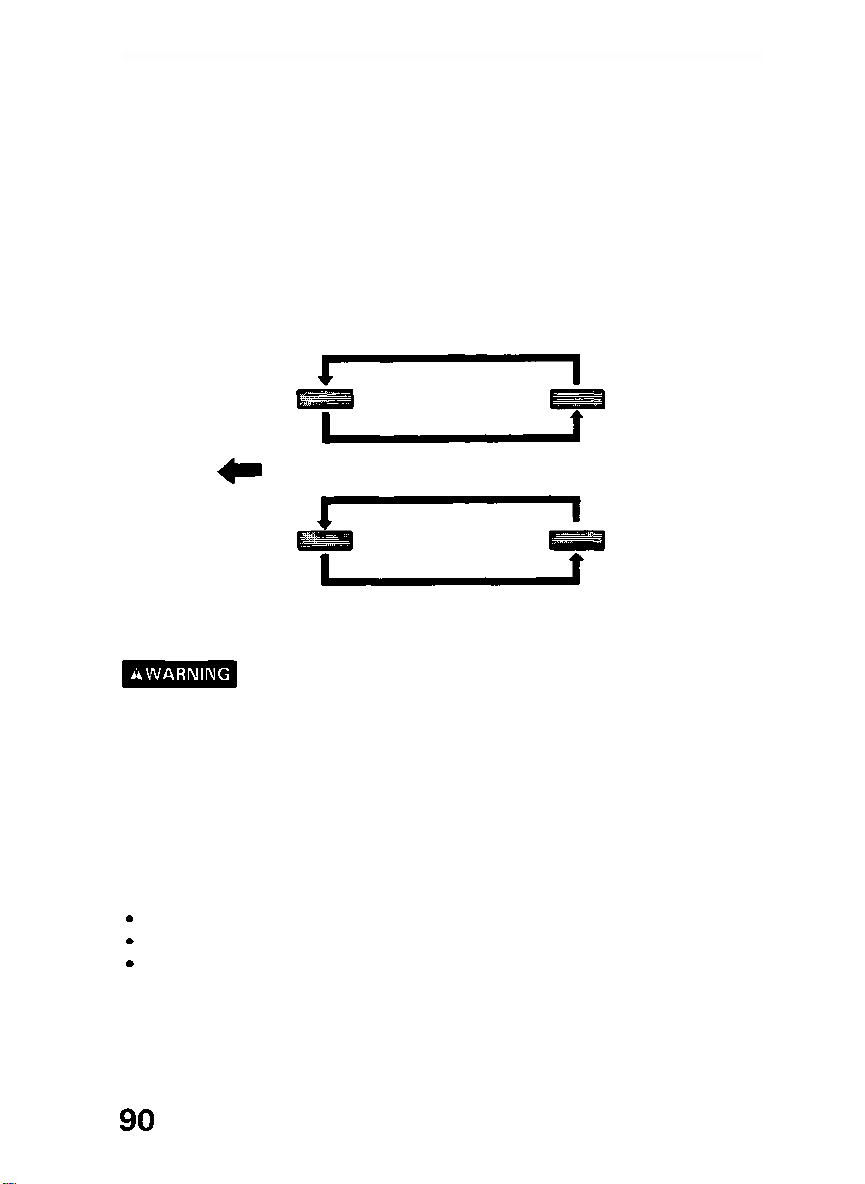
Tire Rotation
Tires may wear unevenly when used for a long time in the same
position on the car. To avoid this, rotate the tires every 7,500 miles
(12,000 km). If abnormal or uneven wear develops between
rotations, the cause should be found and corrected as soon as
possible. The illustration shows how the tires can be rotated. The
COMPACT spare tire must not be included in tire rotation.
NOTE:
Front brake pads should be inspected for wear whenever the tires
are rotated.
Worn tires or slippery road surfaces can reduce driving, cornering
and braking traction. To reduce the possibility of losing traction,
slow down when the road gets slippery, replace tires when wear
indicators are visible, and KEEP TIRES PROPERLY INFLATED.
Additional 4WD Tire Information
Unevenly worn tires, or different sized tires, can cause the 4WD
mechanism to engage abnormally, which may eventually damage
the transmission. Therefore, observe the following precautions
carefully:
Rotate the tires at least every 7,500 miles (12,000 km).
Replace worn tires in sets of four.
If replacement of all four tires is not practical (because of damage
to an individual tire, for example), always replace with the same
size, brand and type as those currently on the car.
Tire Traction
Front
Main Menu
▲
▼
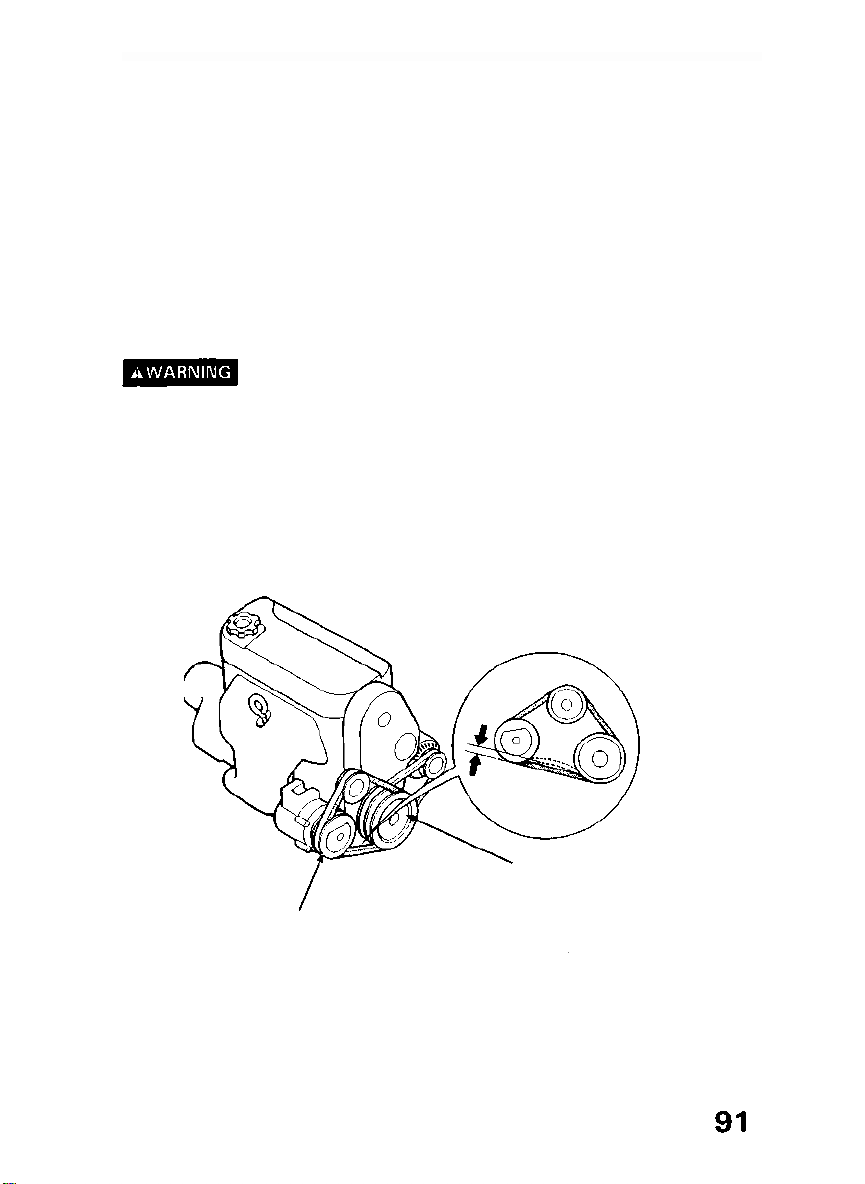
Air Conditioner Care
Condenser and Radiator
Check the engine radiator and the air conditioner condenser (in front
of the radiator) for accumulated dirt, insects or leaves. Carefully
brush or hose them off to assure maximum cooling performance.
CAUTION:
Radiator and condenser fins are very thin and easily damaged; do
not bend them with the high water pressure or brush.
Compressor Drive Belt
Check the compressor belt tension monthly, during periods when
you use the air conditioner a lot.
If the engine has been running, some engine components may be
hot enough to burn you.
When pushed with 98 N (22 Ib) of force midway between the
compressor drive pulley and the engine crankshaft pulley, the belt
should deflect about:
7.0 — 9.0 mm (0.28 — 0.35 in)
Have the belt adjusted whenever necessary.
COMPRESSOR DRIVE PULLEY
CRANKSHAFT
PULLEY
Main Menu
▲
▼

Air Conditioner Care (cont'd)
System Maintenance
Run your air conditioner at least once a week for about ten minutes,
even during the off season, to lubricate the seals and the inside of
the compressor and, to verify that the system is functional.
If the air conditioner is not cooling properly, it may indicate an
undercharged system. Have your dealer check the system for leaks,
then evacuate and charge the system with refrigerant 12.
Charging quantity:
850 — 950 g (30.1 — 33.6 oz)
CAUTION:
Prolonged use of an undercharged system may damage the
compressor.
Main Menu
▲
▼

Appearance Care
Interior Trim
Remove dust and loose dirt with a vacuum cleaner.
Wipe the vinyl with a clean, damp cloth or sponge. Stains can be
removed with a commercially available vinyl cleaner.
CAUTION:
Do not use thinner, gasoline, kerosene, naphtha or other solvents
on the interior. They are toxic, flammable and hazardous and could
damage the material you're cleaning.
Windows
A 10 to 1 mix of water and white vinegar, or a commercially
available glass cleaner may be used to clean windows and to remove
the dust film sometimes caused by the ingredients used in interior
vinyls and plastics.
NOTE:
Do not put this solution in the windshield washer reservoir, it will
damage the windshield washer pump.
Be careful not to scratch or damage the defogger wires when clean-
ing the inside of the rear window; wipe the window horizontally
along the wires, not up and down.
Dry the windows with a lint-free cloth or paper towel. Keep all the
windows clean for maximum visibility.
Exterior Care
Washing
Rinse all loose dirt off the car by spraying it with lukewarm or cold
water. Do not use hot water.
Wash using a soft-bristle brush, sponge or cloth with water
containing a mild detergent such as a liquid dishwashing detergent.
Remove oil, tar, tree sap, etc., with tar remover or turpentine.
Remove road salt, insects, etc., with mild detergent and lukewarm
water. Any of these substances may damage the finish if left on
painted surfaces.
Rinse the car well. Promptly wipe with a chamois or soft towel to
prevent water-spotting. Do not let water or soap air-dry on painted
surfaces.
During wiping, inspect the surface for stone chips and scratches;
paint them with touch-up paint so they won't rust (touch-up paint
is available through your Honda dealer).
For further instructions on corrosion protection, refer to the Rust
Prevention section on page 94.
(cont'd)
Main Menu
▲
▼

Appearance Care (cont'd)
Waxing
Wax the car when water will no longer "bead" on the paint.
Always wash and dry the car before you wax it.
Use a good quality liquid or paste wax, and follow the manufacturer's
instructions. Wax all the metal trim to keep its luster.
NOTE:
Removing oil, tar, etc., with a spot remover will usually strip the
wax from the surrounding finish. Be sure to re-wax these areas
even if the rest of the car does not yet need waxing.
Rust Prevention
Rusting is likely to occur in parts of the car where water is trapped
or where there is continual dampness.
Water will collect inside doors and body panels if drain holes
become clogged.
Water which seeps under or soaks floor mats will subject floor
sections to prolonged wetness or dampness.
Road dirt or sand, which collects and fills recesses on the
underside of the car, retains moisture long after the rest of the
car has dried.
The removal of paint and undercoating by stones, gravel, and minor
accidents immediately exposes metal to air and moisture.
Rusting is increased by high humidity and by the presence of
corrosive substances in the air or on the roads.
Salt used for road de-icing will coat the bottom of the car and
hasten rusting.
Localities with high humidity have greater potential for rust
problems, especially where salt is also present on the road or in
moist sea air.
Industrial pollution will accelerate the deterioration of paint
finishes and promote rusting.
Main Menu
▲
▼
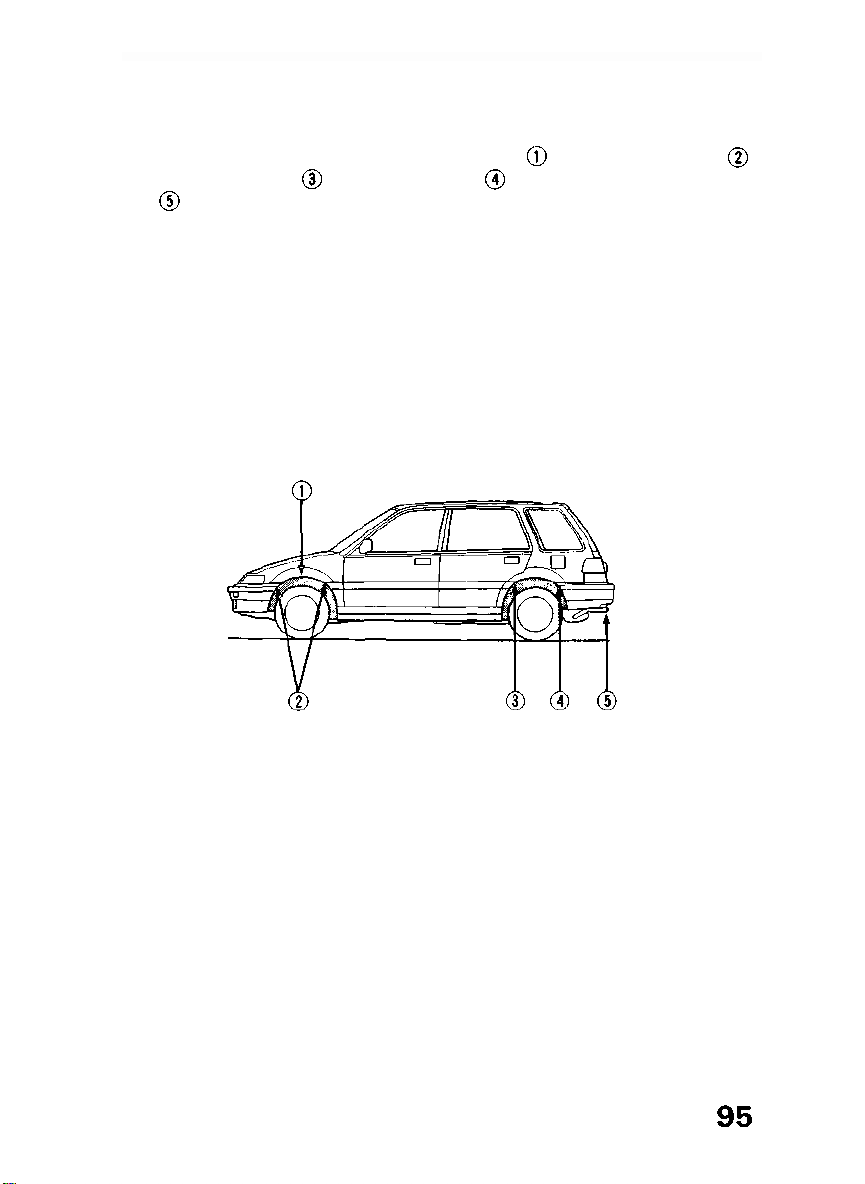
Preventive Service
Check all drain holes in the doors and body panels for clogging and
clear if necessary. When washing your car, also clean the underside
of the car by using high pressure water; above subframe,
inside front fender, rear suspension, inside rear wheel housing,
and under rear bumper.
After washing your car or after heavy rain, check for leaks. While
checking for leaks, lift the floor mats in the passenger, cargo and
spare tire areas, and check beneath them. Water can collect in
these areas and remain unseen for prolonged periods. Dry any wet
areas of your car's interior. Remove and dry wet floor mats. Have
leaks repaired as soon as possible.
After driving your car, wipe off any road dirt or salt on the radio
antenna, with it fully extended.
Main Menu
▲
▼

Body Repair
Replacement Body and Fender Parts
If your vehicle incurs body damage and requires replacement parts,
we encourage you to use only Genuine Honda sheet metal body and
fender parts. Many insurance companies are specifying imitation
sheet metal parts for collision repairs in an effort to reduce claim
costs; however, if imitation parts are used the following conditions
may apply:
There is no assurance that imitation parts will equal the fit and
finish of Genuine Honda sheet metal parts; and in our experience
they often do not.
There is no assurance that imitation parts will resist corrosion as
well as Genuine Honda sheet metal parts.
Imitation sheet metal parts are not covered by the Honda Limited
Warranty.
To ensure your continued satisfaction with your Honda vehicle in
the event of an accident, contact your insurance adjuster and insist
on Genuine Honda parts in the repair of your vehicle.
Main Menu
▲
▼
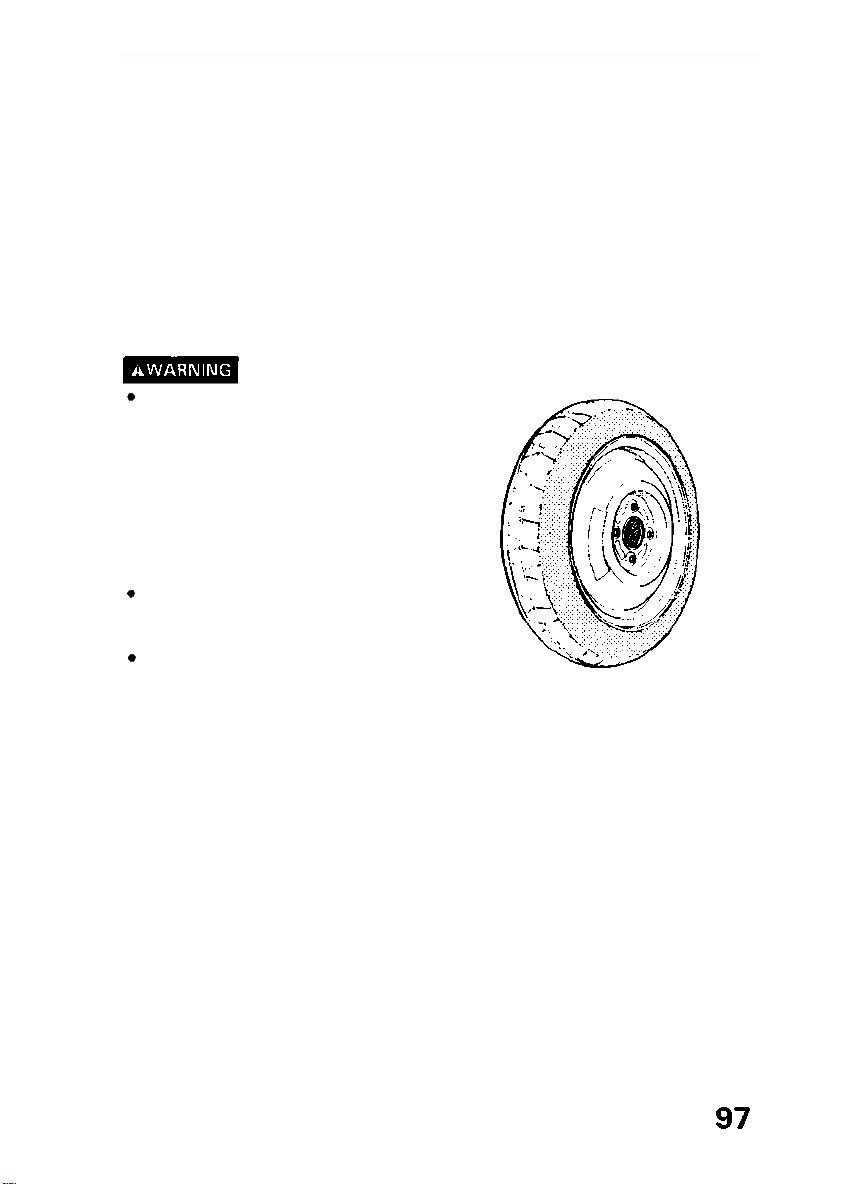
Spare Tire
COMPACT Spare Tire
Your car is supplied with a COMPACT spare tire and wheel for
temporary use only in the event of a flat tire. Use the COMPACT
spare only when you have to, and only to go as far as the next
garage or dealer to have the regular tire repaired and reinstalled.
Because you will rarely use the COMPACT spare, be sure to
regularly check its condition and air pressure (415 kPa, 60 psi), so it
will be ready when you need it. This type of tire holds less air at
higher pressure than a regular tire, so it will inflate (or deflate if there
is a leak) more rapidly; check its pressure often and add air gradually
if it needs any.
The COMPACT spare tire has a
different tire size, air pressure re-
quirement, tread life and maxi-
mum speed rating than the four
regular tires on your car. Disre-
garding these warnings may re-
sult in tire failure, loss of vehicle
control and possible injury to
vehicle occupants.
Do not exceed 50 mph (80 km/h)
under any circumstances when
using the COMPACT spare.
Do not mount snow chains on
the COMPACT spare. They will
not fit properly and will damage the tire and possibly your car. If
you must use the COMPACT spare when driving on roads
covered with snow or ice, use it as one of the rear tires and
mount chains only on the front two regular tires.
(cont'd)
Main Menu
▲
▼
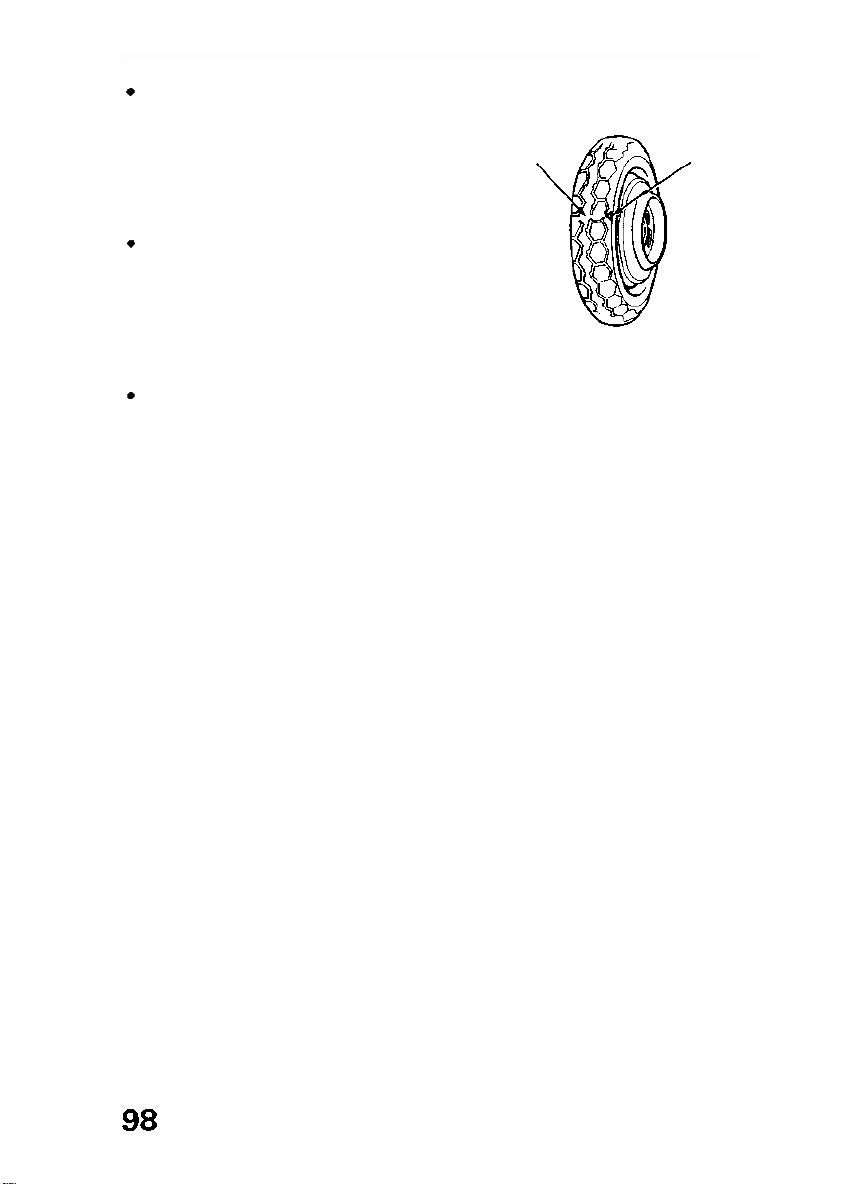
Spare Tire (cont'd)
The COMPACT spare tire has a
much shorter tread life than regu-
lar tires. Replace the tire as soon
as tread wear indicators appear
as solid bands across the tread.
Replace with a tire of exactly the
same size and construction.
The COMPACT spare tire and
wheel set was designed espe-
cially for your car; do not use it
on any other vehicle; do not in-
stall any other tire on this wheel
which is not identical to the original in size and construction, and
do not use the COMPACT spare tire on any other wheel.
Because the COMPACT spare is smaller in size and higher in air
pressure than a regular tire, it will ride more harshly with less
ground clearance and may have less traction on some road
surfaces. Drive cautiously.
TREAD
WEAR
INDICATOR
INDICATOR
LOCATION
MARK
Main Menu
▲
▼
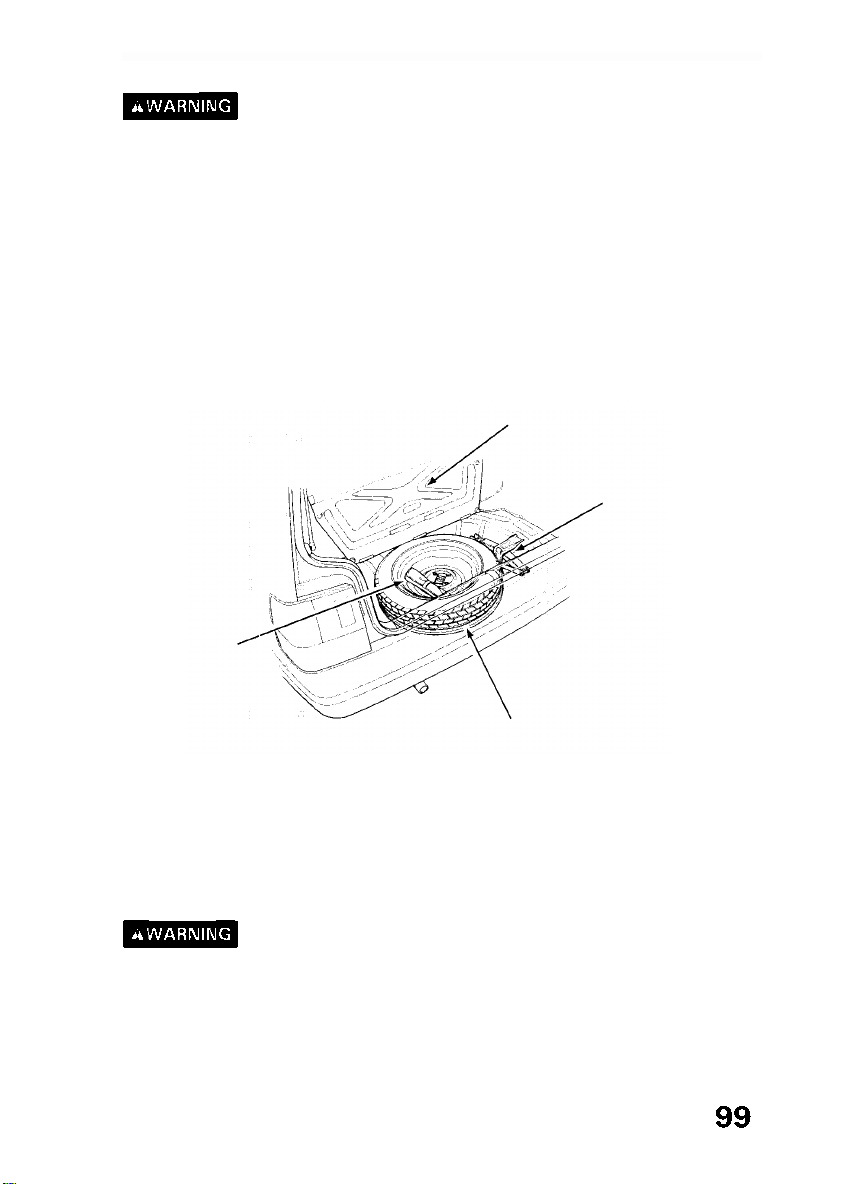
Changing a Flat Tire
Do not attempt to change a tire unless the car is on firm, level
ground and well out of the flow of traffic.
Park the car on a firm, level surface, apply the parking brake, turn
on the hazard warning switch and put the transmission in gear (Park
for automatic).
1. Remove the jack, lug wrench/jack handle and jack handle
extension (in the tool bag) from the location shown.
NOTE:
To remove the jack, release its tension against the mount by turning
the screw counterclockwise.
2. Remove the spare tire. (On the 4WD, remove the spare tire
bucket before removing the spare tire.)
3. Place blocks in front and back of the wheel diagonally opposite
the tire you are changing.
4. Use the lug wrench/jack handle to loosen the wheel lug nuts
counterclockwise one-half turn.
Follow tire changing preparations and procedures carefully to
reduce the possibility of injury. The jack is designed for changing
tires only. STAND CLEAR, DO NOT get under the car and DO NOT
run the engine when the car is supported only by the jack.
(cont'd)
SPARE TIRE LID
JACK
COMPACT SPARE
TOOL
BAG
Main Menu
▲
▼
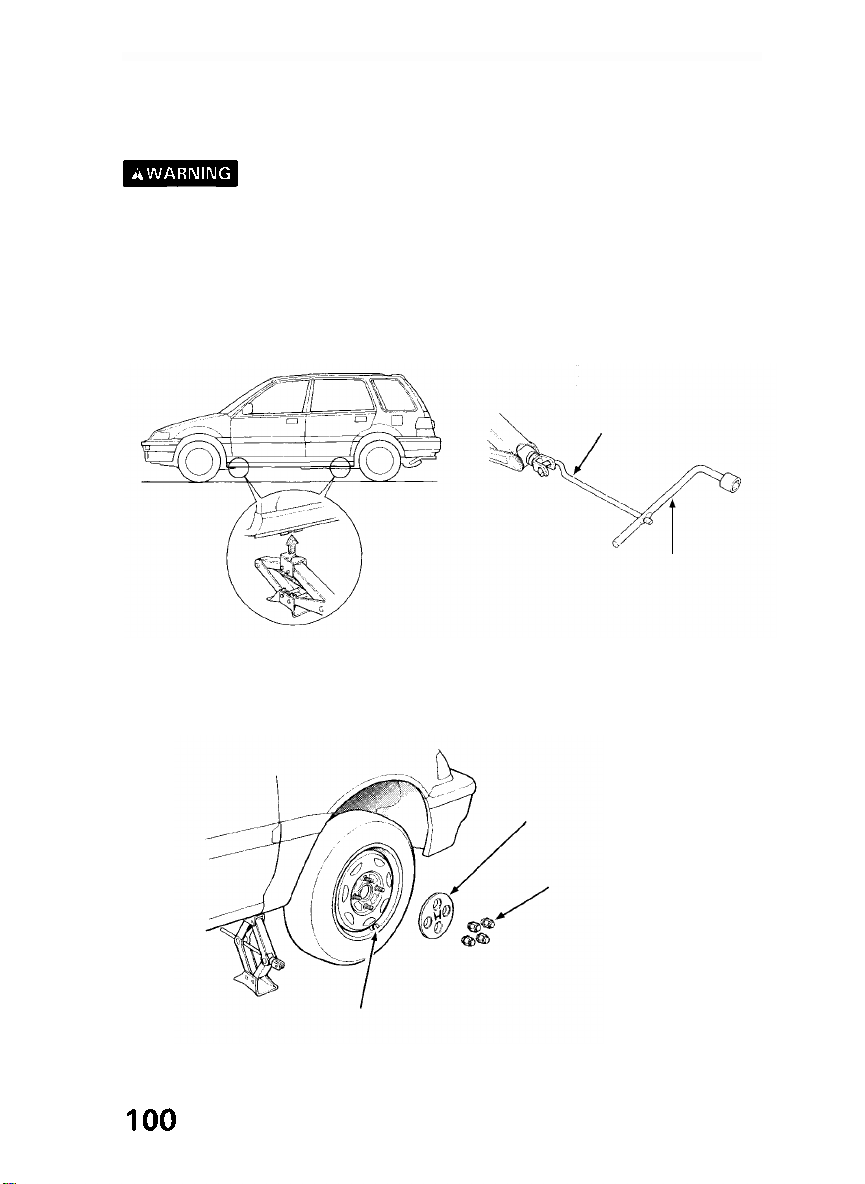
Changing a Flat Tire (cont'd)
5. Place the jack under the jack point nearest the wheel you are
removing; align the jack head so the car frame will fit in the recess
as you raise the jack.
To reduce the possibility of injury, be sure to use the jack provided
with the car and the correct jacking points; never use any other
part of the car for jack support.
6. Set the jack handle extension in the connector on the end of the
jack and install the lug wrench/jack handle. Turn the lug wrench/
jack handle clockwise until the tire is slightly off the ground.
7. Remove the lug nuts, semi-cap and wheel.
(Semi-cap: 4WD)
JACK HANDLE EXTENSION
LUG WRENCH/JACK HANDLE
SEMI-CAP
LUG NUT
VALVE
Main Menu
▲
▼
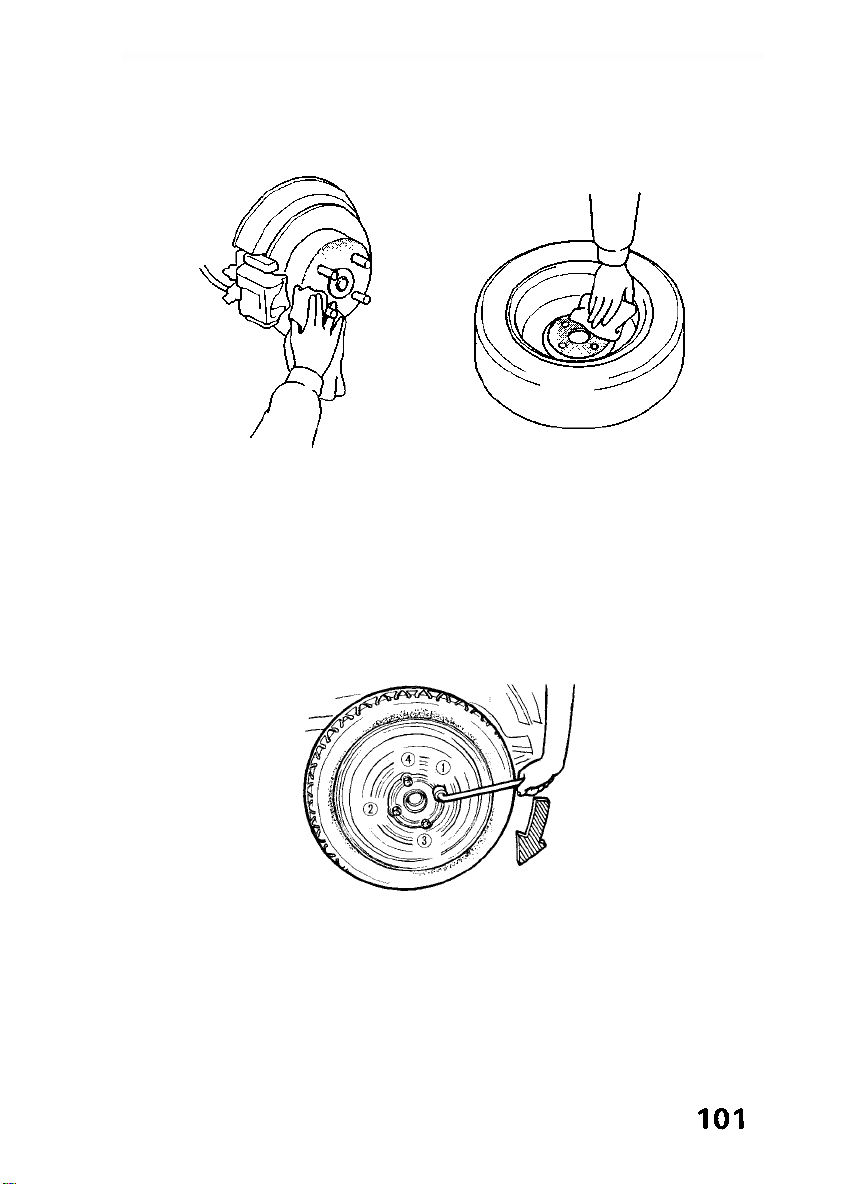
8. Everytime you install the wheel on the brake hub, use a rag to
wipe any dirt off the mounting surface of the hub and the wheel.
This will assure a tight, even contact between the wheel and hub.
9. Install the spare, and lug nuts hand tight.
10. Lower the car, remove the jack, then tighten the lug nuts
securely in an "X" pattern as shown.
11 .Tighten the lug nuts to the recommended torque is:
110 N·m(11.0 kg-m,80 Ib-ft)
If a torque wrench was not used, ask an authorized Honda dealer
to verify the torque as soon as possible.
TIGHTENING TORQUE:
110 N·m(11 kg-m,80 Ib-ft)
(cont'd)
Main Menu
▲
▼
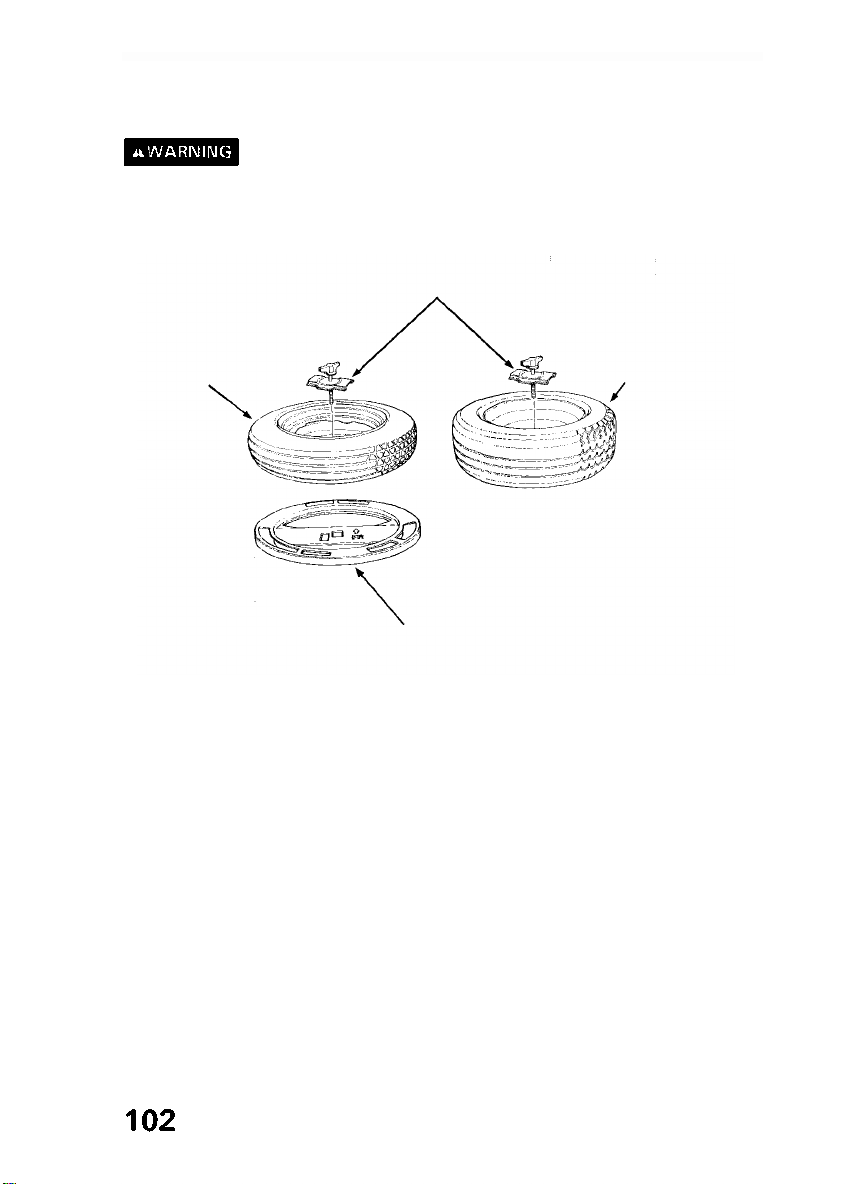
Changing a Flat Tire (cont'd)
12. Repair or replace the damaged tire as soon as you can, reinstall it
in its original position, then put the spare back in the car.
Always stow the jack, tools and tire securely to prevent them
from becoming dangerous projectiles in an accident.
13.Secure the tire and the spacer as shown in the illustration.
SPACER
COMPACT
SPARE TIRE
NORMAL
TIRE
SPARE TIRE PAN
Main Menu
▲
▼
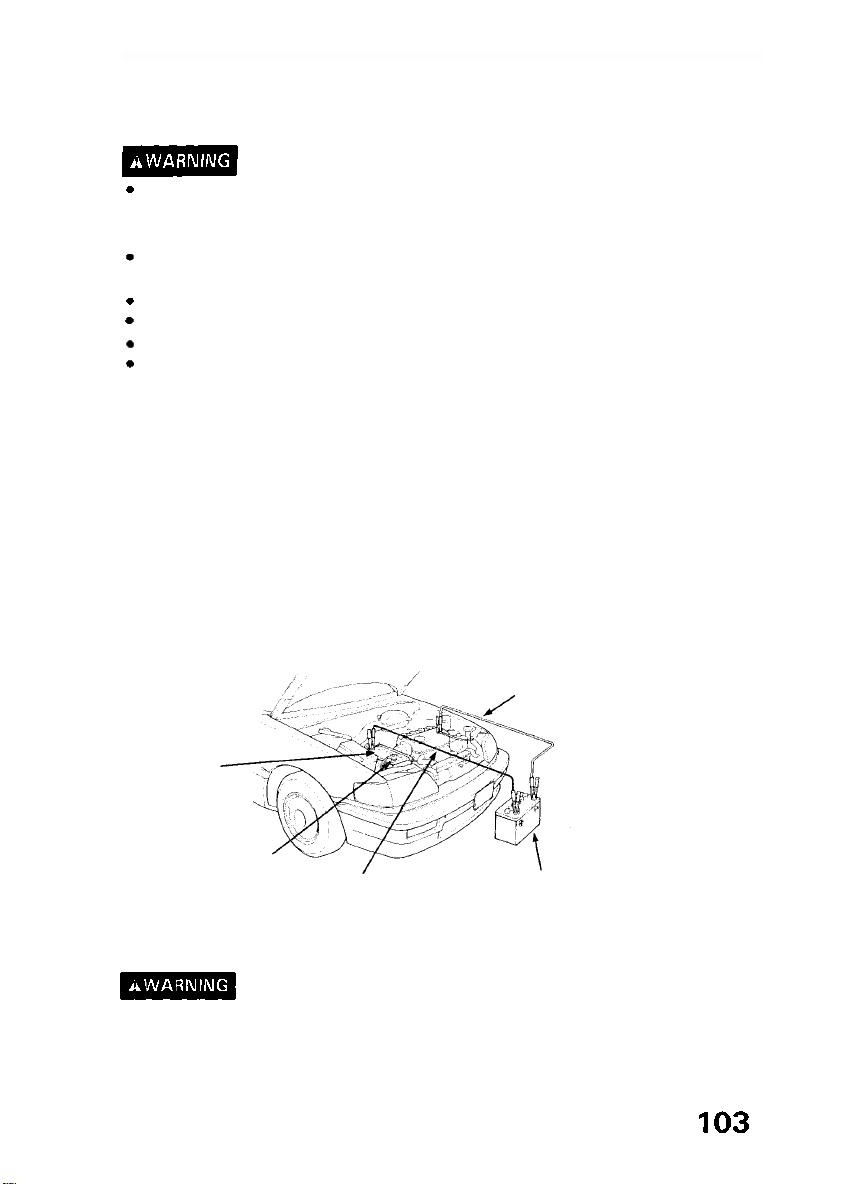
Jump Starting
To start a car with a dead battery, use another battery of the same
voltage, and the proper jumper cables.
Procedures other than those below could cause injury or
damage from battery acid spray, explosion or charging system
overload.
Never connect the jumper cable directly to the negative post of
the "dead" battery.
Never allow the two cars to touch each other.
Never allow the jumper cable clamps to touch each other.
Never lean over the battery when making connections.
Never attempt to jump start a vehicle with a frozen battery. The
battery could rupture and explode. If you suspect a frozen
battery, remove the vent caps and check the fluid. If there
seems to be no fluid, or if you see ice, do not attempt a jump
start until the fluid thaws.
CAUTION:
If jumper cables are connected backwards, the car's main fuse
may blow.
1 .Turn off all lights, heater and other electrical loads, set the parking
brake, and shift the transmission to Neutral or Park.
2. Use one cable to connect the positive terminal of the booster
battery to the positive terminal of the "dead" battery.
3. Use the other cable to connect the negative terminal of the
booster battery to the engine at the ground cable as shown.
4.To remove the cables, reverse the above procedures exactly.
DO NOT push or tow a car to start it. The forward surge when the
engine starts could cause a collision. Also, under some conditions,
the catalytic converter could be damaged. A car equipped with an
automatic transmission cannot be started by pushing or towing.
Negative to the engine at the
ground cable, not to the battery
BOOSTER BATTERY
Positive to positive
Do not attach
cable here
DEAD
BATTERY
Main Menu
▲
▼

Towing
If towing is necessary, contact a professional towing service. Your
authorized Honda dealer can assist you with detailed towing
instructions.
Never use tow chains or rope to tow a car; your ability to safely
control the car may be adversely affected.
We recommend the following:
Flat Bed Equipment — Entire car is winched on a flat bed vehicle.
This is the best way of transporting your Honda.
Wheel Lift Type — Tow with the front wheels off the ground.
If the car can only be towed with the front wheels on the ground:
make sure the transmission is full of fluid (see pages 68 — 69) and
tow with the transmission in neutral (N) and the ignition key in the I
position.
CAUTION:
To avoid serious damage on automatic transmission cars, first
start the engine and shift to D
4
(D on 4WD) then to N and shut the
engine off. If the engine does not run or the transmission cannot
be shifted while the engine is running, the car must be transported
on flat bed equipment.
Check local regulations for towing.
CAUTION:
Do not exceed 35 mph (55 km/h) or tow for distances of more
than 50 miles (80 km).
If a sling type tow is used, the tow truck driver should position
wood spacer blocks between your car's frame and the chains
and lift straps to avoid damaging the bumper and the body.
Do not use the bumpers to lift the car or to support the car's
weight while towing.
(4WD) Before towing the car with either the front or rear
wheels raised off the ground, place the transmission in neutral
and manually disengage the 4WD system to prevent the raised
wheels from turning (see page 56).
Main Menu
▲
▼

If Your Car Gets Stuck
If your car gets stuck in sand, mud, or snow, call a professional
towing service for assistance in getting your car out.
CAUTION:
Do not rev up the engine and allow the wheels to spin freely at
high speed. Severe transmission damage may result if the
wheels are allowed to spin for more than a few seconds.
DO NOT try to free a car with automatic transmission from
snow, etc. by rocking the car alternately between forward and
reverse gears. Severe transmission damage may result from
shifting into gear with the wheels moving.
Main Menu
▲
▼
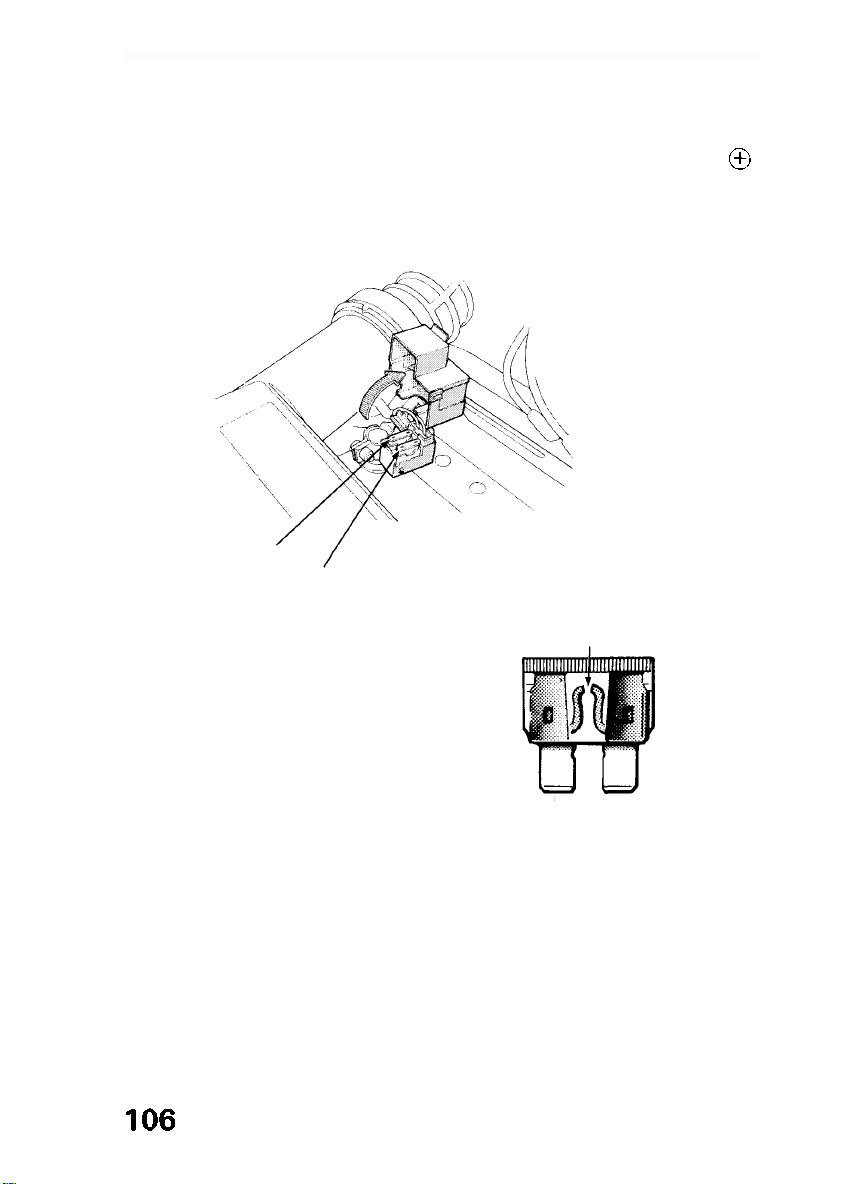
Shoulder Belt Buckle
Proceed as follows if the shoulder belt buckle stalls.
1. Lift the hood and remove the cover from the fuse case (for the
automatic shoulder belt buckle motor) located on the battery's
terminal.
2. Remove the fuse for the automatic ("passive") shoulder belt
buckle motor that does not work.
3. If the fuse has blown, replacing it
with a new fuse of the same am-
perage should allow the shoulder
belt buckle motor to work. How-
ever, if the fuse hasn't blown, or
if a new fuse did not solve the
problem, remove the fuse and
operate the motor manually.
CAUTION:
Always remove the fuse before manually operating the shoulder
belt buckle motor, otherwise the motor may suddenly activate.
BLOWN
RIGHT MOTOR
LEFT MOTOR
Main Menu
▲
▼
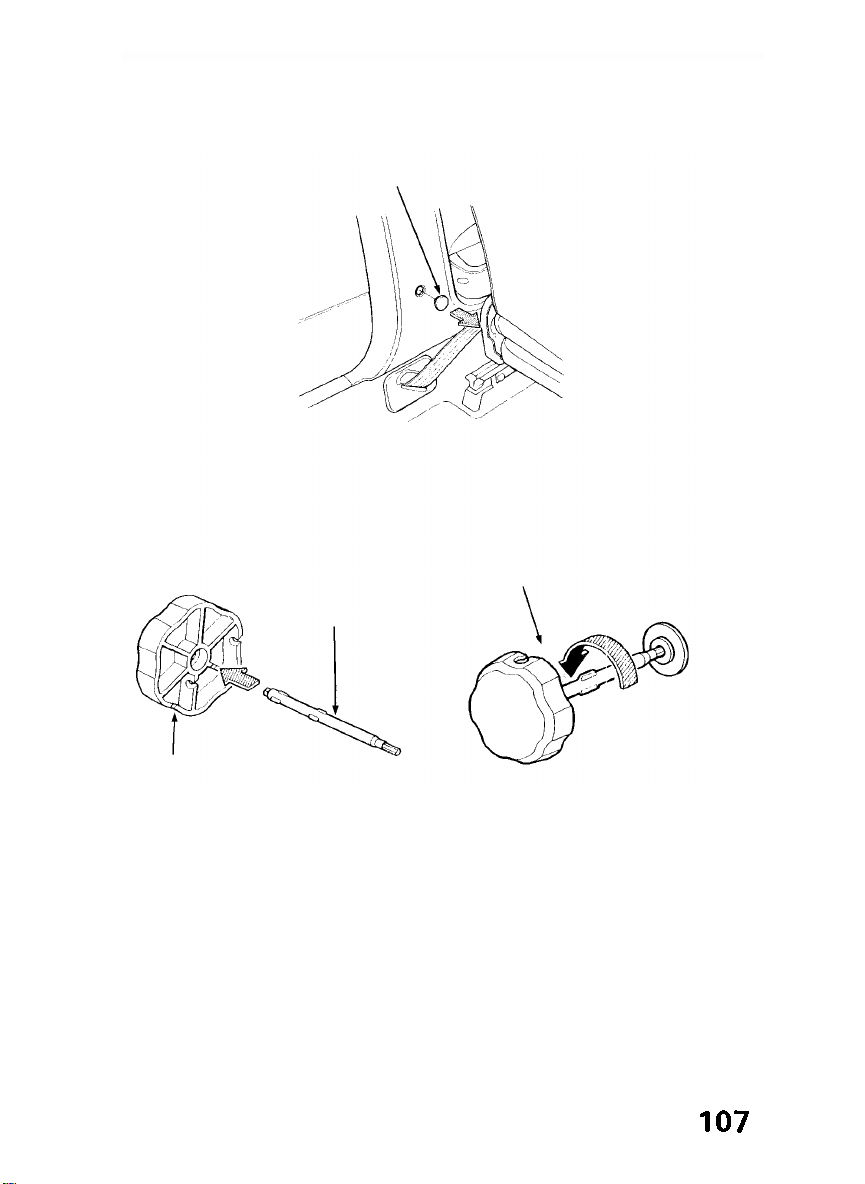
4. Remove the cover located on the center pillar.
5. Set the wrench extension into the wrench grip (both provided in
the tool bag) then insert the wrench into the socket and turn it
counterclockwise until the shoulder belt buckle reaches its rear
locked position.
NOTE:
After the manual operation, make sure that the seat belt warning
light is off and the shoulder belt buckle is seated properly in its
locked position.
6. Replace the cover on the center pillar.
7. Reinstall the fuse, the fuse remover and both fuse box covers.
WRENCH
WRENCH
EXTENSION
WRENCH GRIP
COVER
Main Menu
▲
▼

Specifications
*1 Excluding the coolant in the reserve tank and that remaining in the engine:
0.4 (0.11 US gal, 0.09 Imp gal)
*2 Excluding the oil remaining but including that remaining in the oil fitter.
Main Menu
▲
▼
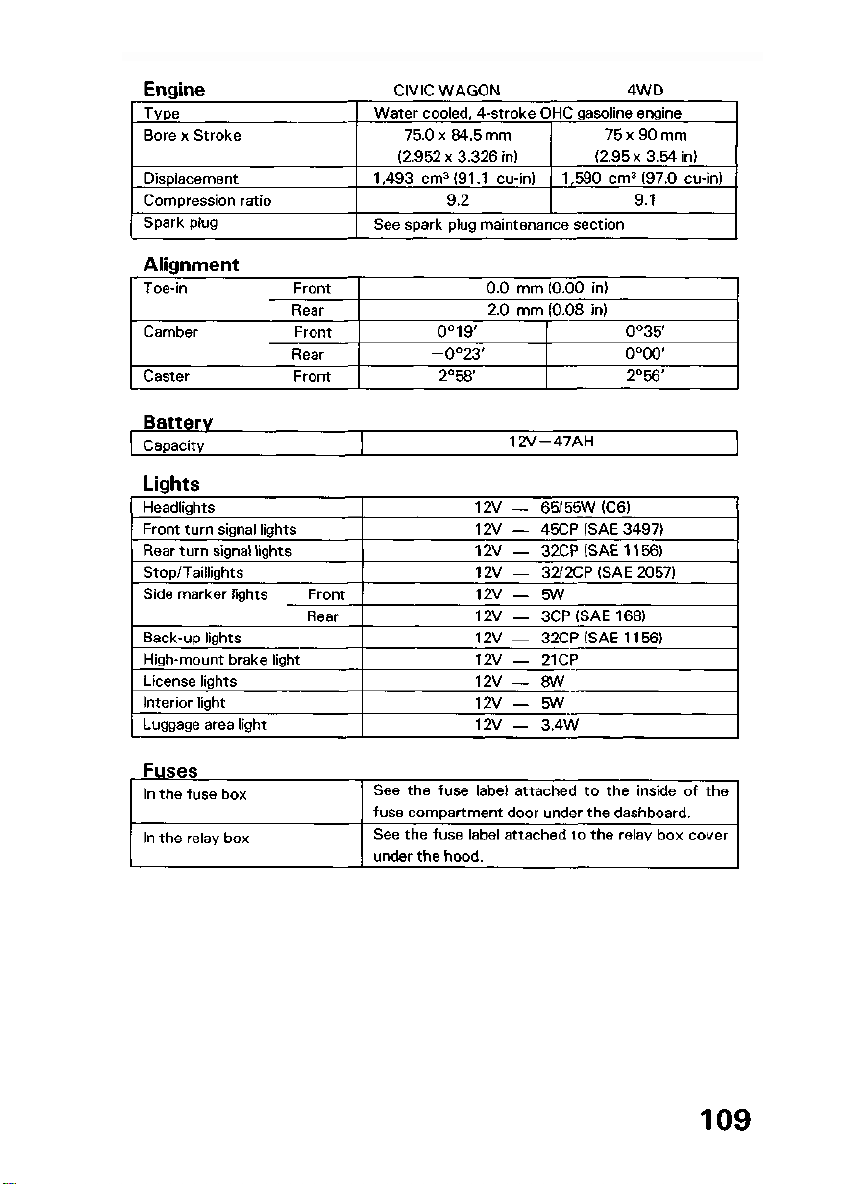
pag
e
79.
Main Menu
▲
▼
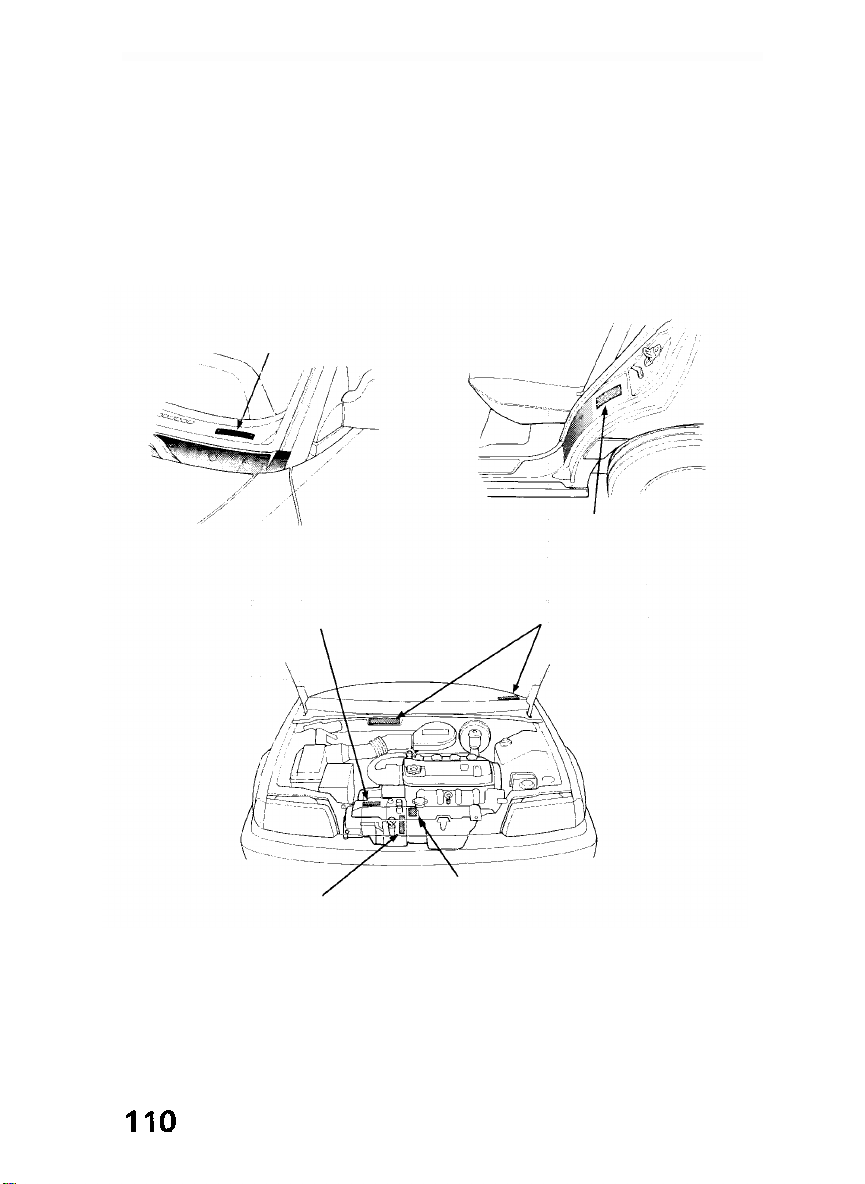
Identification Numbers
The Vehicle Identification Number (V.I.N.) is stamped on a plate
attached to the top left side of the dashboard.
It also appears on the Certification label attached to the left rear
door jamb, as well as under the hood on the body, directly behind
the engine.
NOTE:
The V.I.N. is also provided in bar code on the Certification label.
The Engine Number is stamped on the right front side of the engine
block.
The Transmission Number appears on a label on the top edge of the
transmission where it attaches to the engine.
VEHICLE
IDENTIFICATION
NUMBER
CERTIFICATION
LABEL
AUTOMATIC
TRANSMISSION
NUMBER
VEHICLE IDENTIFICATION
NUMBER
MANUAL
TRANSMISSION NUMBER
ENGINE NUMBER
Main Menu
▲
▼
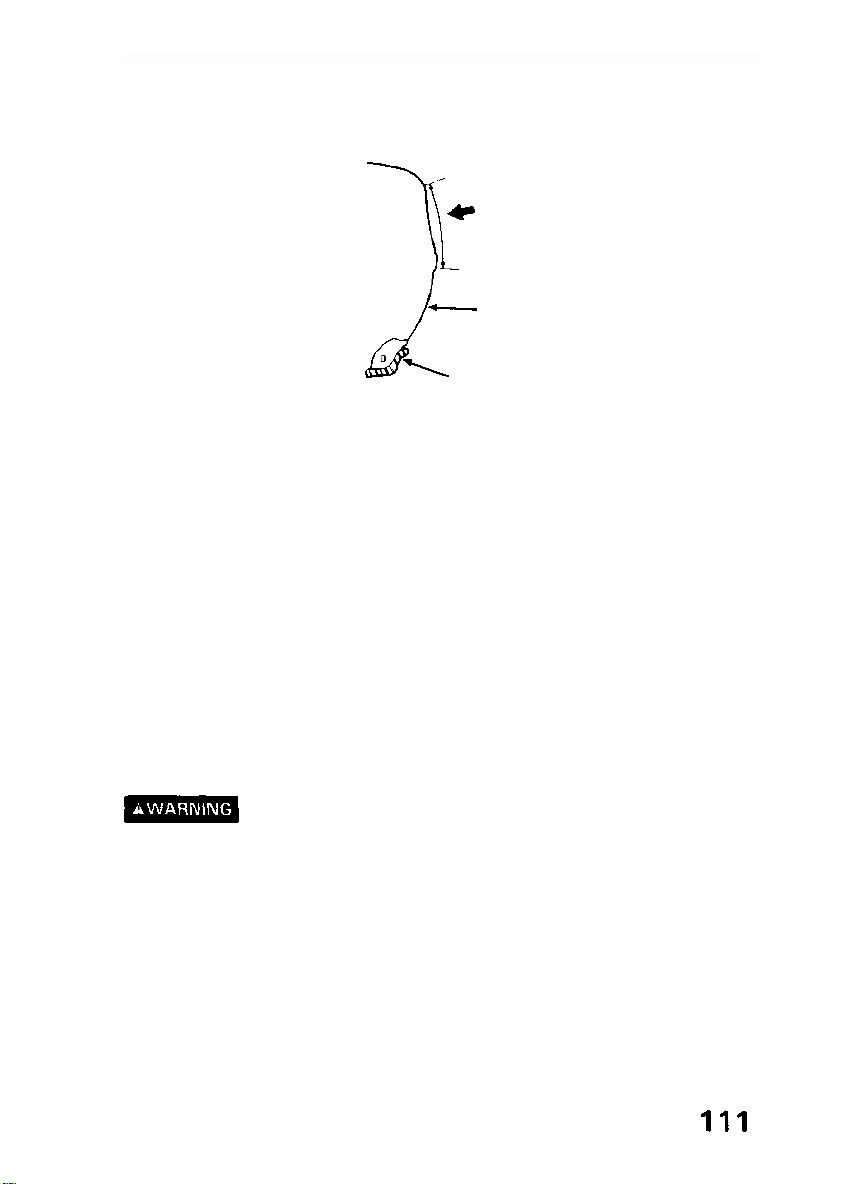
DOT Tire Quality Grades
The tires on your car meet Federal Safety Requirements. All tires
are also "graded" according to Department of Transportation (DOT)
standards for tread wear, traction and temperature.
Tread Wear
The tread wear grade is a comparative rating based on the wear rate
of the tire when tested under controlled conditions on a specified
government test course. For example, a tire graded 150 would wear
one and one half (1-1/2) times as well on the government course as
a tire graded 100.
The relative performance of tires depends upon the actual
conditions of their use, however, and may depart significantly from
the norm due to variations in driving habits, service practices and
differences in road characteristics and climate.
Traction
The traction grades, from highest to lowest, are A, B, and C, and
they represent the tire's ability to stop on wet pavement as
measured under controlled conditions on specified government test
surfaces of asphalt and concrete. A tire marked C may have poor
traction performance.
The traction grades assigned are based on braking (straight ahead)
traction tests and do not include cornering (turning) traction.
(cont'd)
Three grades
are shown on the
tire sidewall
TIRE
WHEEL RIM
Main Menu
▲
▼
Temperature
The temperature grades are A (the highest), B and C representing
the tire's resistance to the generation of heat and its ability to
dissipate heat when tested under controlled conditions on a
specified indoor laboratory test wheel. Sustained high temperature
can cause the material of the tire to degenerate and reduce tire life,
and excessive temperature can lead to sudden tire failure. The grade
C corresponds to a level of performance which all passenger car
tires must meet under the Federal Motor Vehicle Safety Standard
No. 109. Grades B and A represent higher levels of performance on
the laboratory test wheel than the minimum required by law.
The tire temperature grade is established for a tire that is properly
inflated and not overloaded. Excessive speed, underinflation, or
excessive loading, either separately or in combination, can cause
heat buildup and possible tire failure.
Main Menu
▲
▼

Emission Controls
Sources of Emissions
The combustion process produces carbon monoxide, oxides of
nitrogen and hydrocarbons. The evaporation of fuel in the fuel tank
also produces hydrocarbons. Control of oxides of nitrogen and
hydrocarbons is very important since, under certain conditions,
when subjected to sunlight, they react to form photochemical smog.
Carbon monoxide does not react to form smog, but it is toxic.
Honda Motor Co., Ltd. has developed a number of systems which
are highly effective in reducing carbon monoxide, oxides of nitrogen
and hydrocarbons.
The Clean Air Act
The Clean Air Act requires all vehicle manufacturers to explain in
writing, the operation and maintenance of their emission control
systems.
Maintenance instructions are included on pages 58 — 63; the
operation of each system is explained on the following.
Replacement Parts
The emission control systems on your new Honda were designed,
built and certified to conform with the Federal regulations
implementing the Clean Air Act. Honda recommends only the use of
new, genuine Honda parts or their equivalent. The use of other
replacement parts which are not of equivalent quality may impair
the effectiveness of your car's emission control systems.
Crankcase Emission Control System
To prevent crankcase emissions, your car is equipped with a
Positive Crankcase Ventilation (PCV) System which routes blowby
gases from the crankcase, through the PCV valve and intake
manifold, into the combustion chamber.
(cont'd)
Main Menu
▲
▼

Emission Controls (cont'd)
Evaporative Emission Control System
The Evaporative Emission Control System is designed to prevent
fuel vapors from escaping into the atmosphere.
Fuel vapors from the fuel tank are directed into the charcoal
canister where they are adsorbed and stored while the engine is
stopped or idling. When the coolant temperature rises to a certain
value, the vapors are drawn into the engine through the throttle
body and the intake manifold during normal engine operation.
Engine Exhaust Emission Controls
The engine exhaust emission control systems are designed to
control combustion during idle, acceleration, cruise, and deceleration.
These systems are entirely separate from the crankcase and
evaporative emission control systems described previously.
HONDA PGM Fl System
The PGM-FI system consists of three independent sub-systems;
Air Intake, Electronic Control and Fuel Control, thus allowing more
accurate control of air/fuel ratios under all operating conditions.
The Electronic Control Unit (ECU) detects the amount of air
drawn into the cylinders and determines the amount of fuel to be
injected to provide the optimum air/fuel ratio for all engine needs.
Ignition Timing Control System
This system automatically controls the ignition timing to reduce
the amount of HC and NOx.
Catalytic Converter
Three Way Catalyst
The catalyst is used to convert hydrocarbons (HC), carbon
monoxide (CO) and oxides of nitrogen (NOx) in the exhaust gas,
to carbon dioxide (CO
2
), dinitrogen (N
2
) and water vapor.
Exhaust Gas Recirculation (EGR)
[California automatic models with 1.5 engine]
The EGR system is designed to control the formation of oxides of
nitrogen (NOx) caused when fuel mixture burns at high
temperature. It works by recirculating exhaust gas through the
EGR valve and intake manifold into the combustion chambers
where it reduces peak temperature by diluting the air/fuel mixture.
Main Menu
▲
▼
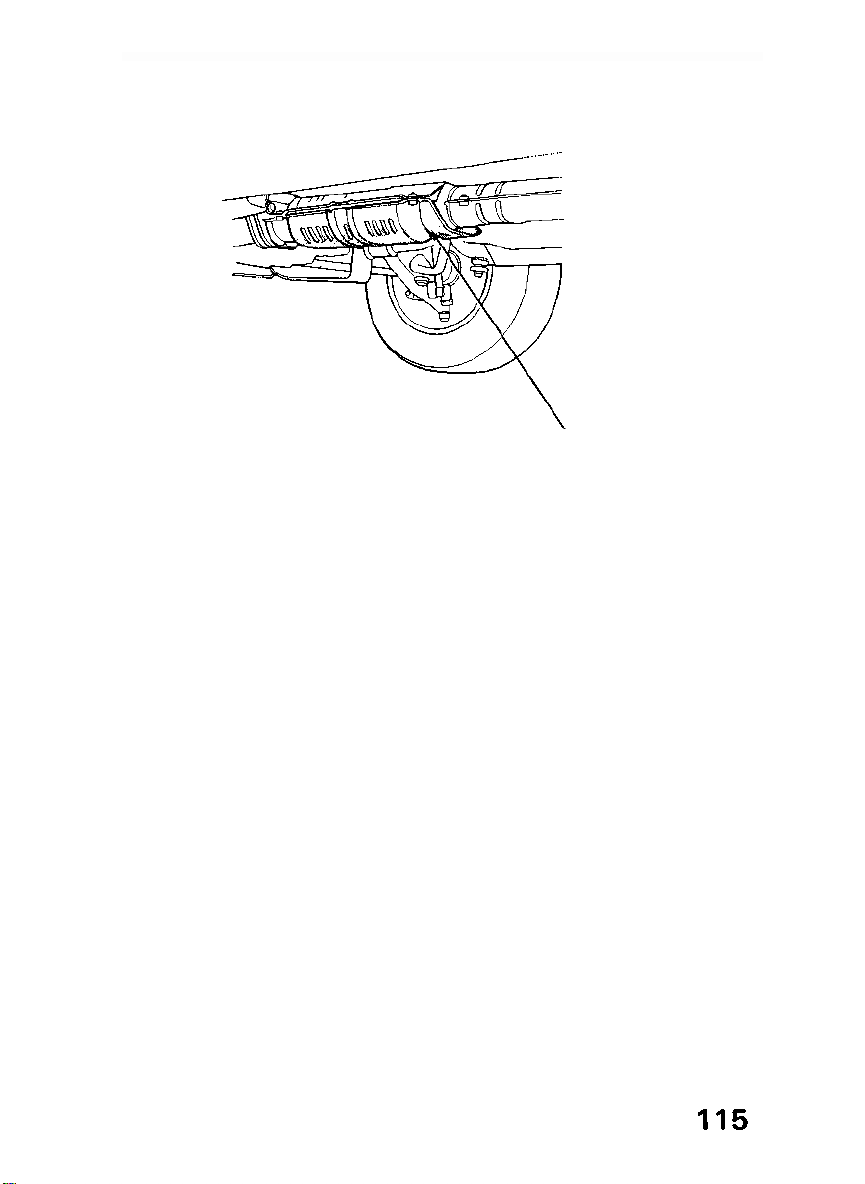
Catalytic Converter
A catalytic converter is installed in the exhaust system to help
clean-up the harmful exhaust gases that can cause air pollution.
To be effective, the converter must work at high temperature, so
don't park your car over dry grass, leaves or anything else that
could burn easily.
To stay effective, the converter must not be contaminated by
leaded gasoline; use only unleaded gas as explained on page 39.
CAUTION:
The converter can be overheated and damaged if it's fed too much
unburned fuel mixture from the engine, so:
— Don't push or tow the car to start it; if the battery is dead, jump
start the car as shown on page 103.
— Don't turn the key off while the engine is running above idle
speed.
— Don't change the ignition timing, or remove any emission control
parts.
— Use only the spark plugs specified in this manual.
— Don't keep driving your car if it isn't running properly, or if its
CHARGE warning light comes on; have it checked by your
Honda dealer.
CATALYTIC CONVERTER
Main Menu
▲
▼
Warranty Service
Warranty
The following warranties are provided with every new vehicle:
1. New Car Limited Warranty
2. Emission Control Systems Defects Warranty
3. Emission Performance Warranty
4. Original Equipment Battery Limited Warranty
5. Rust Perforation Limited Warranty
6. Accessory Limited Warranty
7. Replacement Parts Limited Warranty
8. Replacement Muffler Lifetime Limited Warranty
9. Seat Belt Limited Warranty
10.Replacement Battery Limited Warranty
Your car's original tires are covered by their manufacturer. Tire
warranty information is in a separate booklet.
All warranty details pertaining to your car can be found in the
Warranty booklet provided with your new car except the required
maintenance schedule which is contained here in the Owner's
Manual.
If you are unable to obtain warranty service or are dissatisfied with
the warranty decision or service you received at an authorized
Honda dealership, you should review the matter with that
dealership's Service Manager. This will normally resolve your
problem. If it does not resolve your problem you should appeal the
decision with the owner of the dealership. Please bear in mind that
your problem will likely be resolved at the dealership, using the
dealer's facilities, equipment and personnel. So it is very important
that your initial contact be with the dealer or his management.
After following these steps, if you wish to have the matter
reviewed by American Honda you should contact the Zone Office
serving your area, as shown on the map on the inside of the back
cover. When contacting American Honda, please provide the Zone
Office with the following information:
Vehicle Identification Number
Servicing Dealer Name and Address
Date of Purchase
Mileage on your Car
Your Name, Address, and Phone Number
Nature of Problem
Selling Dealer
After a review of the facts, you will be advised of what can be done.
Main Menu
▲
▼

Reporting Safety Defects
If you believe that your vehicle has a defect which could cause a
crash or could cause injury or death, you should immediately inform
the National Highway Traffic Safety Administration (NHTSA) in
addition to notifying American Honda Motor Co., Inc.
If NHTSA receives similar complaints, it may open an investigation,
and if it finds that a safety defect exists in a group of vehicles, it
may order a recall and remedy campaign.
However, NHTSA cannot become involved in individual problems
between you, your dealer, or American Honda Motor Co., Inc.
To contact NHTSA, you may either call the Auto Safety Hotline toll-
free at 1-800-424-9393 (or 366-0123 in Washington, D.C. area) or
write to:
NHTSA, U.S. Department of Transportation
Washington, D.C. 20590.
You can also obtain other information about motor vehicle safety
from the Hotline.
Main Menu
▲
▼

Index
Air Conditioner
Care........................................... 91
Operation.................................. 36
Air Filter.......................................... 78
Air Pressure, Tires......................... 87
Antifreeze... See"Radiator Coolant"
Anti-theft Steering Column Lock
System....................................42
AppearanceCare............................ 93
Ashtrays........................................ . 31
Automatic Transmission
Driving Technique
(CIVIC WAGON)................... 51
Driving Technique
(4WD).................................. 54
Fluid.......................................... 69
Operation (CIVIC WAGON).... 49
Operation (4WD)...................... 52
Shift Lever Position Indicator. 20
Battery
Charging System Warning Light
............................................... 21
Jump Starting........................ 103
Maintenance............................. 82
Specification.......................... 109
Beepe
r System
Fasten Seat Belt Warning Beeper
............................................... 11
Key Reminder........................... 42
Belts, Seat............. See"Seat Belts"
Body Repair.................................... 96
Brake Warning Light......................
22
Brakes
Brake Failur
e Warning Light.... 22
Brake Fluid................................ 76
Brake System Design .............. 75
Brake Wear............................... 75
Brake Wear Indicators............. 76
Parking Brake........................... 26
Parking Brake Warning Light... 22
Break-in Period.................................
2
Bulb
Replacement.............................
85
Specification.......................... 109
Buzzer............ See"Beeper System"
Capacities..................................... 108
Care and Cleaning.......................... 93
Catalytic Converter..................... 115
Certification Label....................... 110
Chains, Tires................................... 88
Check Engine Warning Light......... 20
Child Proof Door Locks................... 4
Child Restraint System ................. 14
Cigarette Lighter............................ 31
Clock............................................... 32
Clutch Pedal Adjustment.............. 47
COMPACT Spare Tire................... 97
Coolant Temperature Gauge ........ 19
Cooling (with A/C)......................... 36
Cooling System.............................. 71
Crankcase Emission Control System
................................................. 113
Defogger......................................... 25
Defroster........................................ 38
Doors
Child Proof Door Locks............... 4
Door Locks................................... 3
Emergency
Changing a Flat Tire .................
99
Hazard Warning
System..........
28
If Your
Car Gets Stuck.......... 105
Jump Starting........................ 103
Shoulder Belt Buckle ............. 106
Towing.................................... 104
Warning and Indicator Lights.. 20
Emission Controls........................ 113
Engine
Coolant...................................... 71
Coolant Temperature Gauge ..19
Exhaust Controls................... 114
Identification Number............ 110
Oil and Filter..............................
65
Oil Pressure
Warning Light...... 21
Specification.......................... 109
Engine Exhaust Gas Warning........
45
(cont'd)
Main Menu
▲
▼

Evaporative Emission Control
System................................... 114
Exhaust Gas Recirculation.......... 114
Exterior Care.................................. 93
Filters
Air............................................. 78
Engine Oil.................................. 66
Fuel........................................... 78
Fluid...................................... See "Oil"
Foreign Countries, Operation in ... 40
Four-Wheel Drive
................. See"Real Time 4WD"
Front Seat Adjustment.................... 5
Fuel
Filler Door and Cap .................. 40
Filter.......................................... 78
Gasohol..................................... 39
Gasoline.................................... 39
Gauge........................................ 19
Requirement............................. 39
Fuse
Checking and Replacing........... 83
Specification.......................... 109
Identification Numbers................ 110
Ignition
Keys............................................ 3
Switch...................................... 42
Indicator Lights .............................. 20
Inflation Pressures, Tire ................ 87
Instrument Panel............................ 17
Instrument Panel Brightness Control
.................................................. 28
Interior Light................................... 28
Interior Trim Care .......................... 93
Jack ................................................ 99
Jump Starting.............................. 103
Keys
Door Locks................................. 3
Ignition....................................... 42
Key Reminder Buzzer.............. 42
Keys............................................ 3
Tailgate Lock .............................. 4
Gasoline............................. See"Fuel"
Gas Station Information. Back cover
Gauges............................................ 19
Glove Box....................................... 30
Hazard Warning System................ 28
Headlights
Flasher...................................... 27
High Beam Indicator................. 20
High Beam/Low Beam Switch
.............................................. 27
Headlight High Baem Indicator Light
.................................................. 20
Head Restraints................................ 6
Heating............................................ 37
High Beam
Indicator Light .......................... 20
Switch....................................... 27
Hood Latch..................................... 30
Lap/Shoulder Belts
........................... See"Seat Belts"
Light
Bulb Replacement.................... 85
Fuse Replacement................... 83
Operation.................................. 27
Warning and Indicator Light.... 20
Locks
Anti-theft Steering Column Lock
.............................................. 42
Child Proof Door Locks............. 4
Doors........................................... 3
Fuel Filler Door......................... 40
Tailgate........................................ 4
Luggage Area Light........................ 29
(cont'd)
Main Menu
▲
▼

Index (cont'd)
Maintenanse
Non-Scheduled Maintenance
Record................................... 62
Required Maintenance Record
.............................................. 61
Schedule ................................... 58
Manual Transmission
Clutch Pedal Adjustment........ 47
Maximum Allowable Speeds .. 47
Oil.............................................. 68
Recommended Shift Speeds .. 48
Shifting ..................................... 46
Meters, Gauges........... See"Gauges"
Mirrors
Rearview Mirrors..................... 26
Numbers, Identification............... 110
Octane Rating, Gasoline .. See"Fuel"
Odometer....................................... 19
Oil
Engine Oil.................................. 65
Fluid Locations......................... 64
Oil Pressure Warning Light...... 21
Transmission Oil/Fluid.............. 68
Operation In Foreign Countries .... 40
Panel Brightness Control............... 28
Parking Brake................................. 26
Power Steering.............................. 77
Passive Belt...................................... 8
Pressures, Tire Inflation ................ 87
Preventive Service........................ 95
Radiator Coolant............................ 71
Real Time 4WD .............................. 56
4WD Disengagement............... 56
Rear Seat.......................................... 6
Rearview Mirrors........................... 26
Rear Window Defogger................. 25
Rear Window Wiper/Washer....... 25
Reminder Lights
................... See"Warning Lights"
Replacement
Air Filter.................................... 78
Body and Fender Parts............ 96
Bulb............................................ 85
Engine Oil.................................. 66
Fuel Filter.................................. 78
Fuse........................................... 83
Oi l Filter................................... 66
Radiator Coolant...................... 73
Spark Plugs............................... 79
Tire............................................ 89
Wiper Blades ............................
81
Rust Prevention.............................
95
Safety Defects, Reporting.......... 117
Safety Items................................... 44
Seat Belt Warning Light and Beeper
................................................... 11
Seat Belts
Anchor Points .......................... 15
Automatic Belt........................... 8
Buckling the Rear Seat
Combination Lap/
Shoulder Belts .................... 12
Child Restraint.......................... 14
Cleaning.................................... 16
Emergency Belt Release.......... 10
Fasten Seat Belt Warning Light
and Warning Beeper............ 11
Front Seat Belts ......................... 8
Inspection................................. 16
Installation of Child Seat.......... 15
Pregnant Women..................... 16
Rear Center Seat Belts............ 13
Releasing the Seat Belts.......... 10
Replacement............................ 16
Shoulder Belt Buckle ............. 106
Seats
Front Seat................................... 5
Head Restraints.......................... 6
Rear Seat.................................... 6
Shoulder Belts .................................. 8
Shifting
Automatic (CIVIC WAGON)... 49
Automatic (4WD)..................... 52
Manual ...................................... 46
Main Menu
▲
▼

Shift Lever Position Indicator....... 20
Spare Tire
Changing a Flat Tire ................. 99
COMPACT Spare Tire............. 97
Spark Plugs
Replacement ............................ 79
Specifications.............................. 108
Speedometer................................. 19
Starting the Engine........................ 43
Steering
Anti-theft Column Lock .......... 42
Power Steering........................ 77
Tilt Steering.............................. 23
Stuck Car..................................... 105
Tachometer.................................... 19
Tailgate ............................................. 4
Tailgate-open Indicator Light........ 22
Temperature Gauge, Coolant....... 19
Tilt Steering.................................... 23
Tire
Air Pressure.............................. 87
Additional 4WD Tire Information
.............................................. 90
Balancing................................... 89
Chains........................................ 88
Changing a Flat Tire ................. 99
COMPACT Spare..................... 97
DOT Tire Quality Grades ...... 111
Inflation Pressures................... 87
Requirement........................... 111
Rotation.................................... 90
Snow Tires ...............................
88
Spare Tire.................................
97
Specification.......................... 108
Winter Driving .......................... 88
Towing.......................................... 104
Transmission
Capacity ................................. 108
Identification Number............ 110
Oil/Fluid..................................... 68
Shifting the Automatic
(CIVIC WAGON)................... 49
Shifting the Automatic
(4WD)................................... 52
Shifting the Manual
Transmission........................ 46
Tread Wear.................................. 111
Trip Meter...................................... 19
Turn Signals.................................... 27
Vehicle Identification Number.... 110
Ventilation...................................... 33
Warning Lights............................... 20
Warranty Service........................ 116
Washer
Rear Window Washer............. 25
Reservoir Capacity................ 108
Windshield Washer.................. 24
Washing.......................................... 93
Waxing............................................ 94
Windows Appearance Care ......... 93
Windshield Defogger..................... 38
Windshield Washer........................ 24
Windshield Wipers......................... 24
Wiper Blades.................................. 81
Wipers
Rear Window Wipers .............. 25
Windshield Wipers................... 24
Main Menu
▲
▼
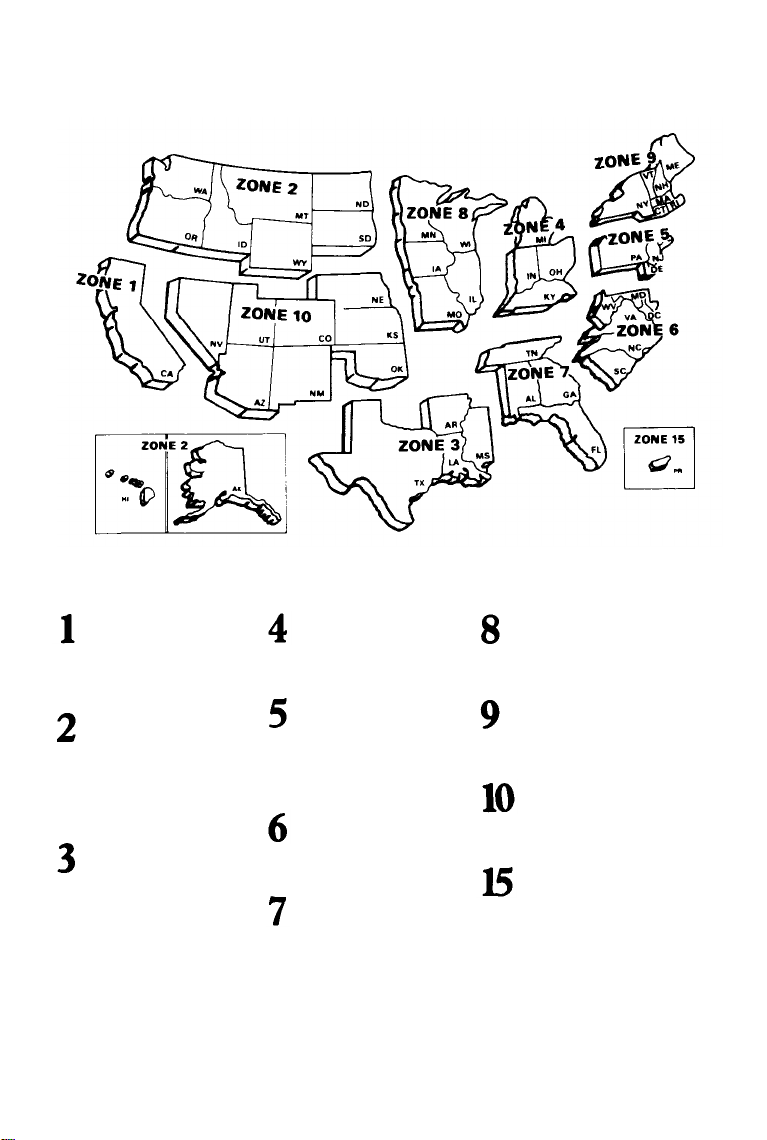
Automobile Zone Office Locations
Western Zone
P.O. Box 2260
700 Van Ness Avenue
Torrance, California 90509-2260
(213) 781-4565
Northwestern Zone
P.O. Box 20186
12439 N.E. Airport Way
Portland, Oregon 97220
(503) 256-0943
(also includes Alaska and
Hawaii)
South Central Zone
4529 Royal Lane
Irving, Texas 75063
(214) 929-5481
Central Zone
101 South Stanfield Road
Troy, Ohio 45373
(513) 332-6250
Northeastern Zone
P.O. Box 337
Eastgate Industrial Park
115 Gaither Drive
Moorestown, New Jersey 08057
(609) 235-5533
Mid-Atlantic Zone
209 Perry Parkway, Suite 10
Gaithersburg, Maryland 20877
(301) 990-2020
Southeastern Zone
1500 Morrison Parkway
Alpharetta, Georgia 30201
(404) 442-2045
North Central Zone
601 Campus Drive, Suite A-9
Arlington Heights, Illinois 60004
(312) 870-5600
New England Zone
555 Old County Road
Windsor Locks, Connecticut 06096
(203) 623-3310
West Central Zone
1600 South Abilene Street, Suite D
Aurora, Colorado 80012
(303) 696-3935
Puerto Rico and U.S. V.I.
Bella International
P.O.
Box
816
Hato Rey, Puerto Rico 00919
(809) 765-8070
The above addresses and telephone numbers are subject to
change. If you cannot reach your Zone office, ask your Honda
dealer for the current information.
Main Menu
▲
▼
AMERICAN HONDA MOTOR CO., INC.
1919 Torrance Blvd. Torrance, CA 90501- 2722
31SH5630 30009008M
OOX31-SH5-6300 PRINTED IN JAPAN
Gas Station Information
Gasoline UNLEADED only
Pump octane of 86 or higher.
Gas Tank-Capacity 45 l (11.9 US gal, 9.9 Imp gal)
Tire Pressure (measurd cold) front/rear
CIVIC WAGON:220 kPa (32 psi)/220 kPa (32 psi)
4WD: 195 kPa (28 psi)/195 kPa (28 psi)
COMPACT spare:415 kPa (60 psi)
Other Tire Information See "Tires" pages 87 — 90 .
Hood Release Pull handle under left side of dash.
Engine Oil Use "Energy Conserving II " SG grade oil.
5W — 30 preferred (see page 65 for complete
viscosity recommendations).
Capacity (including filter):
3.5 l
(3.7 US qt, 3.1 Imp qt)
Rear Differential Oil (4WD)
Rear Differential Oil (4WD): SAE 90 or 80
Hypoid Gear Oil: See page 70 .
Manual Transmission Oil
Use SF or SG grade oil.
10W — 30 or 10W — 40 preferred (see page 68 for
complete viscosity recommendations).
Capacity (including differential):
CIVIC WAGON: 1.8 l (1.9 US qt, 1.6 Imp qt)
4WD: 2.3
l(2.4 US qt , 2.0 Imp qt)
Automatic Transmission Fluid
Use DEXRON
®
II type Automatic Transmission
Fluid (ATF). Unscrew dipstick in right end of
transmission, wipe off, reinsert, remove and read
fluid level — do not screw-in to check fluid level.
Capacity(Including differential):
CIVIC WAGON: 2.4 l (2.5 US qt, 2.1 Imp qt)
4WD: 3.2 l
(3.4 US qt, 2.8 Imp qt)
Honda Motor Co., Ltd. 1990 All Rights Reserved
Main Menu
▲
▼