
49-80694-2 10-14 GE
GEAppliances.com
Write the model and serial
numbers here:
Model # __________________
Serial # ___________________
You can find them on a label
behind the door or drawer.
Printed in the United States
Printed on
Recycled Paper
For a Spanish version of this
manual, visit our Website at
GEAppliances.com.
Para consultar una version
en español de este manual
de instrucciones, visite
nuestro sitio de internet
GEAppliances.com.
PS920 - 30" Slide-In Range
PS950 - 30" Slide-In Range
Owner’s Manual
Ranges
Electric Slide-In
Safety Information ............2
Warranty .......................7
Assistance / Accessories .....8
Using The Range
Surface Units .....................9
Cookware for Radiant
Glass Cooktop .................12
Single Oven Controls ............13
Double Oven Controls ...........14
Special Features ................15
Oven Racks .....................16
Aluminum Foil and Oven Liners . . 17
Cookware .......................17
Cooking Modes .................18
Cooking Guide ..................20
Warming Drawer ................22
Care and Cleaning
Cleaning the Range – Exterior . . . 23
Cleaning the Range – Interior ....24
Cleaning the Glass Cooktop ......25
Probe ........................... 26
Maintenance ....................27
Troubleshooting Tips .......30
2
49-80694-2
SAVE THESE INSTRUCTIONS
Read all safety instructions before using the product. Failure to follow these instructions may result in fire,
electrical shock, serious injury or death.
STATE OF CALIFORNIA PROPOSITION 65 WARNING
ANTI-TIP DEVICE
WARNING
The California Safe Drinking Water and Toxic Enforcement Act requires the Governor of California to
publish a list of substances known to the state to cause cancer, birth defects or other reproductive harm,
and requires businesses to warn customers of potential exposure to such substances.
WARNING This product contains one or more chemical known to the State of California to
cause cancer, birth defects or other reproductive harm.
Self-clean ovens can cause low-level exposure to some of these substances, including carbon monoxide,
during the cleaning cycle. Exposure can be minimized by venting with an open window or using a
ventilation fan or hood.
IMPORTANT SAFETY INFORMATION.
READ ALL INSTRUCTIONS BEFORE USING.
SAFETY INFORMATION
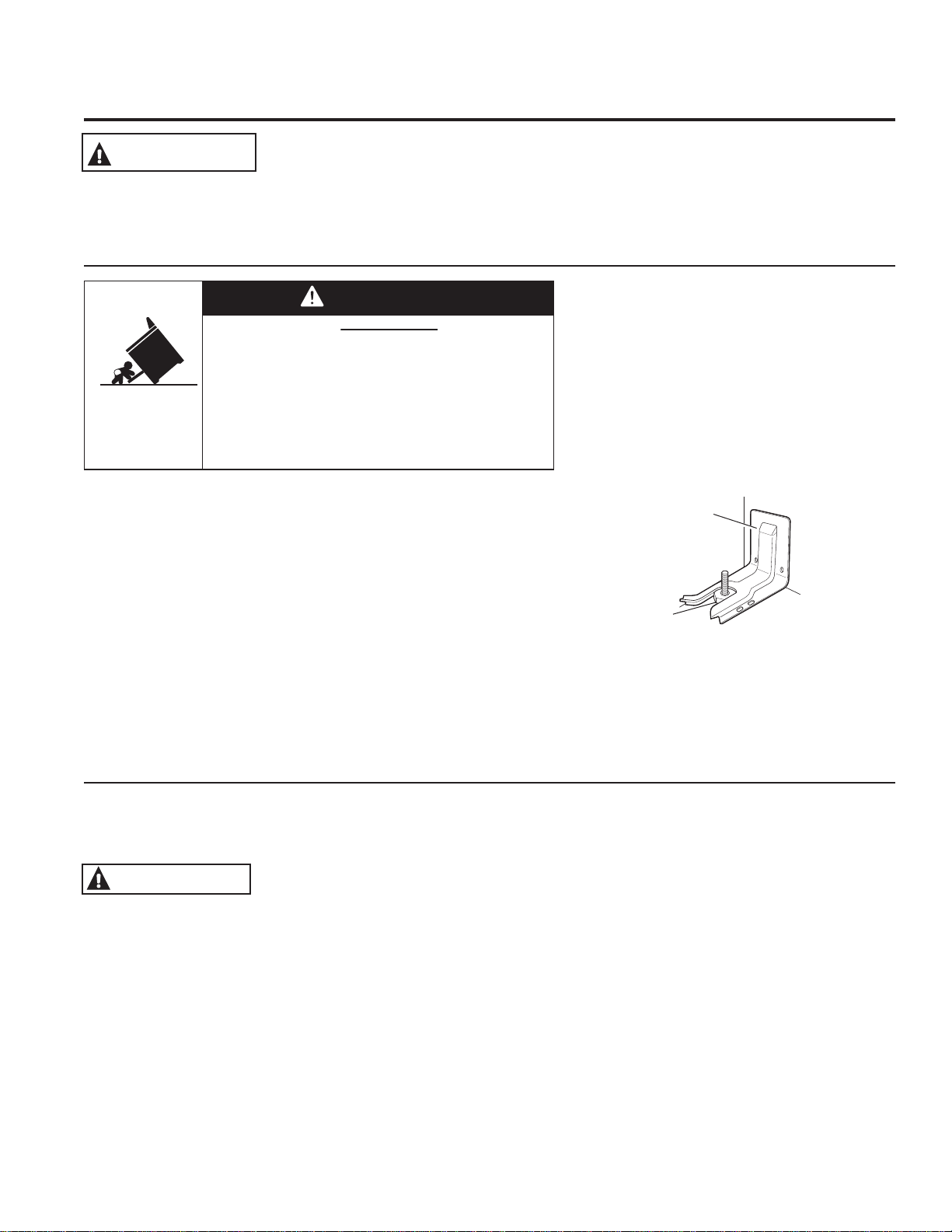
To reduce the risk of tipping the range,
the range must be secured by a properly
installed anti-tip bracket. See installation
instructions shipped with the bracket for
complete details before attempting to install.
For Free-Standing and Slide-In Ranges
To check if the bracket is installed and
engaged properly, look underneath the
range to see that the rear leveling leg
is engaged in the bracket. On some models, the storage
drawer or kick panel can be removed for easy inspection.
If visual inspection is not possible, slide the range forward,
confirm the anti-tip bracket is securely attached to the floor
or wall, and slide the range back so the rear leveling leg is
under the anti-tip bracket.
If the range is pulled from the wall for any reason, always
repeat this procedure to verify the range is properly secured
by the anti-tip bracket.
Never completely remove the leveling legs or the range will
not be secured to the anti-tip device properly.
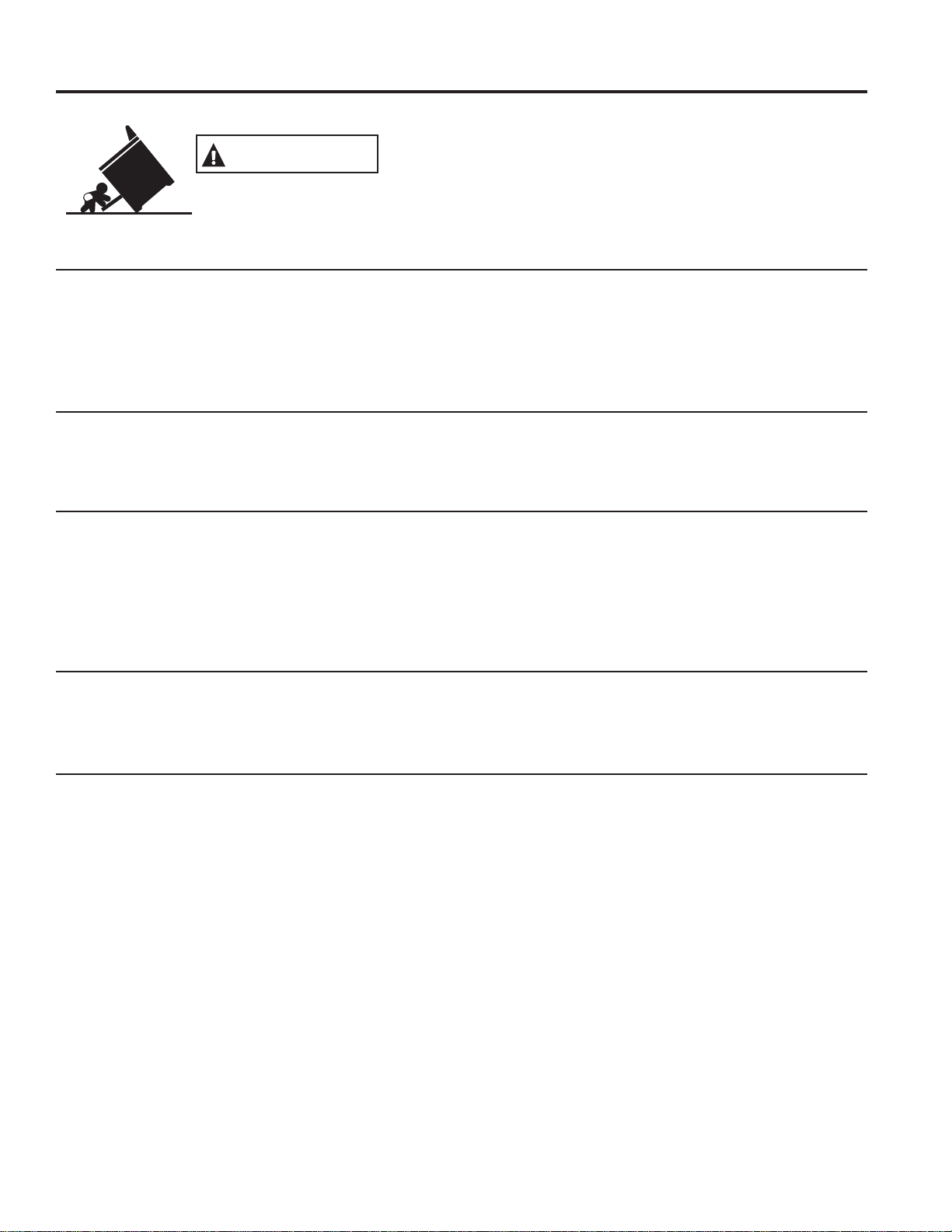
A child or adult can tip the range and be killed.
Verify the anti-tip bracket has been properly installed
and engaged.
Ensure the anti-tip bracket is re-engaged when the range
is moved.
Do not operate the range without the anti-tip bracket in
place and engaged.
Failure to follow these instructions can result in death or
serious burns to children or adults.
Tip-Over Hazard
WARNING
Anti-Tip
Bracket
Leveling Leg
Free-Standing and Slide-In Ranges
49-80694-2
3
SAVE THESE INSTRUCTIONS
SAFETY INFORMATION
Ŷ8VHWKLVDSSOLDQFHRQO\IRULWVLQWHQGHGSXUSRVH
as described in this Owner’s Manual.
Ŷ%HVXUH\RXUDSSOLDQFHLVSURSHUO\LQVWDOOHGDQG
grounded by a qualified installer in accordance
with the provided installation instructions.
Ŷ'RQRWDWWHPSWWRUHSDLURUUHSODFHDQ\SDUWRI
your range unless it is specifically recommended
in this manual. All other servicing should be
transferred to a qualified technician.
Ŷ%HIRUHSHUIRUPLQJDQ\VHUYLFHXQSOXJWKHUDQJH
or disconnect the power supply at the household
distribution panel by removing the fuse or
switching off the circuit breaker.
Ŷ'RQRWOHDYHFKLOGUHQDORQH²FKLOGUHQVKRXOGQRW
be left alone or unattended in an area where an
appliance is in use. They should never be allowed
to climb, sit or stand on any part of the appliance.
Ŷ
CAUTION: Do not store items of
interest to children above a range or on the
EDFNJXDUGRIDUDQJH²FKLOGUHQFOLPELQJRQWKH
range to reach items could be seriously injured.
Ŷ8VHRQO\GU\SRWKROGHUV²PRLVWRUGDPSSRW
holders on hot surfaces may result in burns from
steam. Do not let pot holders touch hot surface
units or heating elements. Do not use a towel or
other bulky cloth in place of pot holders.
Ŷ 1HYHUXVH\RXUDSSOLDQFHIRUZDUPLQJRUKHDWLQJ
the room.
Ŷ 'RQRWWRXFKWKHVXUIDFHXQLWVWKHKHDWLQJ
elements or the interior surface of the oven.
These surfaces may be hot enough to burn
even though they are dark in color. During and
after use, do not touch, or let clothing or other
flammable materials contact the surface units,
areas nearby the surface units or any interior
area of the oven; allow sufficient time for cooling
first. Other surfaces of the appliance may
become hot enough to cause burns. Potentially
hot surfaces include the cooktop, areas facing
the cooktop, oven vent opening, surfaces near
the opening and crevices around the oven door.
Ŷ 'RQRWXVHDQ\W\SHRIIRLORUOLQHUWRFRYHUWKH
oven bottom or anywhere in the oven, except as
described in this manual. Oven liners can trap
heat or melt, resulting in damage to the product
and risk of shock, smoke or fire.
Ŷ 'RQRWXVHDQ\W\SHRIIRLORUOLQHUWRFRYHUWKH
oven bottom or anywhere in the oven, except as
described in this manual. Oven liners can trap
heat or melt, resulting in damage to the product
and risk of shock, smoke or fire.
Ŷ $YRLGVFUDWFKLQJRULPSDFWLQJJODVVGRRUVFRRN
tops or control panels. Doing so may lead to
glass breakage. Do not cook on a product with
broken glass. Shock, fire or cuts may occur.
Ŷ &RRNPHDWDQGSRXOWU\WKRURXJKO\²PHDWWR
at least an internal temperature of 160°F and
poultry to at least an internal temperature of
180°F. Cooking to these temperatures usually
protects against foodborne illness.
GENERAL SAFETY INSTRUCTIONS
WARNING
Ŷ 'RQRWVWRUHRUXVHIODPPDEOHPDWHULDOVLQ
an oven or near the cooktop, including paper,
plastic, pot holders, linens, wall coverings,
curtains, drapes and gasoline or other flammable
vapors and liquids.
Ŷ
Never wear loose-fitting or hanging garments while
using the appliance. These garments may ignite if
they contact hot surfaces causing severe burns.
Ŷ 'RQRWOHWFRRNLQJJUHDVHRURWKHUIODPPDEOH
materials accumulate in or near the range.
Grease in the oven or on the cooktop may ignite.
Ŷ &OHDQYHQWLODWLQJKRRGVIUHTXHQWO\*UHDVH
should not be allowed to accumulate on the hood
or filter.
KEEP FLAMMABLE MATERIALS AWAY FROM THE RANGE
Failure to do so may result in fire or personal injury.
WARNING
4
49-80694-2
IMPORTANT SAFETY INFORMATION.
READ ALL INSTRUCTIONS BEFORE USING.
SAFETY INFORMATION
Ŷ 'RQRWXVHZDWHURQJUHDVHILUHV1HYHUSLFNXS
a flaming pan. Turn the controls off. Smother a
flaming pan on a surface unit by covering the
pan completely with a well-fitting lid, cookie sheet
RUIODWWUD\8VHDPXOWLSXUSRVHGU\FKHPLFDORU
foam-type fire extinguisher.
Ŷ If there is a fire in the oven during baking,
smother the fire by closing the oven door and
turning the oven off or by using a multi-purpose
dry chemical or foam-type fire extinguisher.
Ŷ If there is a fire in the oven during self-clean, turn
the oven off and wait for the fire to go out. Do
not force the door open. Introduction of fresh air
at self-clean temperatures may lead to a burst
of flame from the oven. Failure to follow this
instruction may result in severe burns.
IN THE EVENT OF A FIRE, TAKE THE FOLLOWING
STEPS TO PREVENT INJURY AND FIRE SPREADING
WARNING
Ŷ
Never leave the surface units unattended at
PHGLXPRUKLJKKHDWVHWWLQJV%RLORYHUVFDXVH
smoking and greasy spillovers that may catch
on fire.
Ŷ 1HYHUOHDYHRLOXQDWWHQGHGZKLOHIU\LQJ,I
allowed to heat beyond its smoking point, oil
may ignite resulting in fire that may spread
WRVXUURXQGLQJFDELQHWV8VHDGHHSIDW
thermometer whenever possible to monitor oil
temperature.
Ŷ
To avoid oil spillover and fire, use a minimum
amount of oil when shallow pan-frying and
avoid cooking frozen foods with excessive
amounts of ice.
Ŷ 8VHSURSHUSDQVL]H²VHOHFWFRRNZDUHKDYLQJ
flat bottoms large enough to cover the surface
heating element. The use of undersized
cookware will expose a portion of the surface
unit to direct contact and may result in ignition
of clothing. Proper relationship of cookware to
surface unit will also improve efficiency.
Ŷ 2QO\FHUWDLQW\SHVRIJODVVJODVVFHUDPLF
earthenware or other glazed containers are
suitable for cooktop service; others may break
because of the sudden change in temperature.
Ŷ 7RPLQLPL]HWKHSRVVLELOLW\RIEXUQVLJQLWLRQRI
flammable materials and spillage, the handle of a
container should be turned toward the center of
the range without extending over nearby surface
units.
Ŷ :KHQSUHSDULQJIODPLQJIRRGVXQGHUDKRRGWXUQ
the fan on.
COOKTOP SAFETY INSTRUCTIONS
WARNING
SAVE THESE INSTRUCTIONS
49-80694-2
5
Ŷ 6WDQGDZD\IURPWKHUDQJHZKHQRSHQLQJWKH
oven door. Hot air or steam which escapes can
FDXVHEXUQVWRKDQGVIDFHDQGRUH\HV
Ŷ 'RQRWXVHWKHRYHQLIDKHDWLQJHOHPHQW
develops a glowing spot during use or shows
other signs of damage. A glowing spot indicates
the heating element may fail and present a
potential burn, fire, or shock hazard. Turn the
oven off immediately and have the heating
element replaced by a qualified service
technician.
Ŷ .HHSWKHRYHQYHQWXQREVWUXFWHG
Ŷ .HHSWKHRYHQIUHHIURPJUHDVHEXLOGXS*UHDVH
in the oven may ignite.
Ŷ 3ODFHRYHQUDFNVLQGHVLUHGORFDWLRQZKLOHRYHQ
is cool. If rack must be moved while oven is hot,
do not let pot holder contact hot heating element
in oven.
Ŷ :KHQXVLQJFRRNLQJRUURDVWLQJEDJVLQWKH
oven, follow the manufacturer’s directions.
Ŷ 3XOOWKHRYHQUDFNWRWKHVWRSORFNSRVLWLRQZKHQ
loading and unloading food from the oven. This
helps prevent burns from touching hot surfaces
of the door and oven walls.
Ŷ 'RQRWOHDYHLWHPVVXFKDVSDSHUFRRNLQJ
utensils or food in the oven when not in use.
Items stored in an oven can ignite.
Ŷ 1HYHUSODFHFRRNLQJXWHQVLOVSL]]DRUEDNLQJ
stones, or any type of foil or liner on the oven
floor. These items can trap heat or melt, resulting
in damage to the product and risk of shock,
smoke or fire.
OVEN SAFETY INSTRUCTIONS
WARNING
SAVE THESE INSTRUCTIONS
SAFETY INFORMATION
Ŷ8VHFDUHZKHQWRXFKLQJWKHFRRNWRS7KHJODVV
surface of the cooktop will retain heat after the
controls have been turned off.
Ŷ'RQRWFRRNRQDEURNHQFRRNWRS,IJODVV
cooktop should break, cleaning solutions and
spillovers may penetrate the broken cooktop and
create a risk of electric shock. Contact a qualified
technician immediately.
Ŷ$YRLGVFUDWFKLQJWKHJODVVFRRNWRS7KHFRRNWRS
can be scratched with items such as knives,
sharp instruments, rings or other jewelry, and
rivets on clothing.
Ŷ'RQRWSODFHRUVWRUHLWHPVWKDWFDQPHOWRUFDWFK
fire on the glass cooktop, even when it is not
being used. If the cooktop is inadvertently turned
on, they may ignite. Heat from the cooktop or
oven vent after it is turned off may cause them to
ignite also.
Ŷ8VH&(5$0$%5<7(
®
ceramic Cooktop Cleaner
DQG&(5$0$%5<7(
®
Cleaning Pad to clean
the cooktop. Wait until the cooktop cools and
the indicator light goes out before cleaning. A
wet sponge or cloth on a hot surface can cause
steam burns. Some cleaners can produce
noxious fumes if applied to a hot surface. Note:
Sugar spills are an exception. They should be
scraped off while still hot using an oven mitt and
a scraper. See the Cleaning the glass cooktop
section for detailed instructions.
Ŷ5HDGDQGIROORZDOOLQVWUXFWLRQVDQGZDUQLQJVRQ
the cleaning cream label.
RADIANT COOKTOP SAFETY INSTRUCTIONS
WARNING
6
49-80694-2
SAVE THESE INSTRUCTIONS
IMPORTANT SAFETY INFORMATION.
READ ALL INSTRUCTIONS BEFORE USING.
SAFETY INFORMATION
The self-cleaning feature operates the oven at temperatures high enough to burn away food soils in the
oven. Follow these instructions for safe operation.
Ŷ 'RQRWWRXFKRYHQVXUIDFHVGXULQJVHOIFOHDQ
RSHUDWLRQ.HHSFKLOGUHQDZD\IURPWKHRYHQ
during self-cleaning. Failure to follow these
instructions may cause burns.
Ŷ
%HIRUHRSHUDWLQJWKHVHOIFOHDQF\FOHUHPRYHSDQV
shiny metal oven racks and other utensils from the
oven. Only gray porcelain-coated oven racks may
be left in the oven. Do not use self-clean to clean
other parts, such as drip pans or bowls.
Ŷ %HIRUHRSHUDWLQJWKHVHOIFOHDQF\FOHZLSH
grease and food soils from the oven. Excessive
amount of grease may ignite leading to smoke
damage to your home.
Ŷ ,IWKHVHOIFOHDQLQJPRGHPDOIXQFWLRQVWXUQWKH
oven off and disconnect the power supply. Have
it serviced by a qualified technician.
Ŷ 'RQRWFOHDQWKHGRRUJDVNHW7KHGRRUJDVNHWLV
essential for a good seal. Care should be taken
not to rub, damage or move the gasket.
Ŷ 'RQRWXVHRYHQFOHDQHUV1RFRPPHUFLDORYHQ
cleaner or oven liner protective coating of any kind
should be used in or around any part of the oven.
Ŷ The purpose of the warming drawer is to hold hot
FRRNHGIRRGVDWVHUYLQJWHPSHUDWXUH%DFWHULD
will grow in food while it is below 140°F. Do not
put cold food in warming drawer. Do not heat
food for more than 2 hours. Failure to follow
these instructions may result in foodborne illness.
Ŷ Do not leave paper products, plastics, canned
food or combustible materials in the drawer.
They may ignite.
Ŷ Do not touch the heating element or the interior
surface of the drawer. These surfaces may be
hot enough to cause burns.
Ŷ 8VHFDUHZKHQRSHQLQJWKHGUDZHU2SHQWKH
drawer a crack and let hot air or steam escape
before removing or replacing food. Hot air or
steam that escapes can cause burns to hands,
IDFHDQGRUH\HV
Ŷ Do not use aluminum foil to line the lower
drawer. The foil will trap heat below, and upset
the performance of the oven. Foil can melt
and permanently damage the drawer bottom.
Damage from improper use of aluminum foil is
not covered by the product warranty.
SELF-CLEANING OVEN SAFETY INSTRUCTIONS
WARMING DRAWER SAFETY INSTRUCTIONS (some models)
WARNING
WARNING

49-80694-2
7
GE Electric Range Warranty
GEAppliances.com
All warranty service is provided by our Factory Service Centers, or an authorized Customer Care
®
technician.
7RVFKHGXOHVHUYLFHRQOLQHYLVLWXVDWZZZJHDSSOLDQFHVFRPVHUYLFHBDQGBVXSSRUWRUFDOO*(&$5(6
(800.432.2737). Please have serial number and model number available when calling for service.
Servicing your appliance may require the use of the onboard data port for diagnostics. This gives a GE factory
service technician the ability to quickly diagnose any issues with your appliance and helps GE improve its products
by providing GE with information on your appliance. If you do not want your appliance data to be sent to GE, please
advise your technician not to submit the data to GE at the time of service.
For the period of one year from the date of the original purchase. GE will provide any part of the range which fails due
to a defect in materials or workmanship. During this limited one-year warranty, GE will also provide, free of charge, all
labor and in-home service to replace the defective part.
What GE will not cover:
Ŷ Service trips to your home to teach you how to use
the product.
Ŷ Improper installation, delivery or maintenance.
Ŷ Failure of the product if it is abused, misused,
modified or used for other than the intended purpose
or used commercially.
Ŷ Damage to the glass cooktop caused by use of
cleaners other than the recommended cleaning
creams and pads.
Ŷ Damage to the glass cooktop caused by hardened
spills of sugary materials or melted plastic that
are not cleaned according to the directions in the
Owner's Manual.
Ŷ Replacement of house fuses or resetting of circuit
breakers.
Ŷ Damage to the product caused by accident, fire,
floods or acts of God.
Ŷ Incidental or consequential damage caused by
possible defects with this appliance.
Ŷ Damage caused after delivery.
Ŷ Product not accessible to provide required service.
Ŷ Service to repair or replace light bulbs, except for
LED lamps.
EXCLUSION OF IMPLIED WARRANTIES
<RXUVROHDQGH[FOXVLYHUHPHG\LVSURGXFWUHSDLUDVSURYLGHGLQWKLV/LPLWHG:DUUDQW\$Q\LPSOLHGZDUUDQWLHV
including the implied warranties of merchantability or fitness for a particular purpose, are limited to one year or the
shortest period allowed by law.
This warranty is extended to the original purchaser and any succeeding owner for products purchased for home use
ZLWKLQWKH86$,IWKHSURGXFWLVORFDWHGLQDQDUHDZKHUHVHUYLFHE\D*($XWKRUL]HG6HUYLFHULVQRWDYDLODEOH\RX
may be responsible for a trip charge or you may be required to bring the product to an Authorized GE Service location
for service. In Alaska, the warranty excludes the cost of shipping or service calls to your home.
Some states do not allow the exclusion or limitation of incidental or consequential damages. This warranty gives you
specific legal rights, and you may also have other rights which vary from state to state. To know what your legal rights
are, consult your local or state consumer affairs office or your state’s Attorney General.
Warrantor: General Electric Company. Louisville, KY 40225
Extended Warranties: Purchase a GE extended warranty and learn about special discounts that are available while
\RXUZDUUDQW\LVVWLOOLQHIIHFW<RXFDQSXUFKDVHLWRQOLQHDQ\WLPH
ZZZJHDSSOLDQFHVFRPVHUYLFHBDQGBVXSSRUWVKRSIRUH[WHQGHGVHUYLFHSODQVKWP
or call 800.626.2224 during normal business hours. GE Consumer Home Services will still be there after your
warranty expires.
Register Your Appliance: Register your new appliance on-line at your convenience!
ZZZJHDSSOLDQFHVFRPVHUYLFHBDQGBVXSSRUWUHJLVWHU
Timely product registration will allow for enhanced communication and prompt service under the terms of your warranty,
VKRXOGWKHQHHGDULVH<RXPD\DOVRPDLOLQWKHSUHSULQWHGUHJLVWUDWLRQFDUGLQFOXGHGLQWKHSDFNLQJPDWHULDO
Staple your receipt here. Proof of the original purchase
date is needed to obtain service under the warranty.
WARRANTY
Thank You! ... for your purchase of a GE Brand appliance.

8
49-80694-2
Try the GE Appliancesz Website (www.geappliances.com/service_and_support/) 24 hours a day, any day of the
year! For greater convenience and faster service, you can now download Owner’s Manuals, order parts or even
schedule service on-line.
Schedule Service: Expert GE repair service is only one
step away from your door. Get on-line and schedule your
VHUYLFHDWZZZJHDSSOLDQFHVFRPVHUYLFHBDQGBVXSSRUW
Or call 800.GE.CARES (800.432.2737) during normal
business hours.
Parts and Accessories: Individuals qualified to service their
own appliances can have parts or accessories sent directly
to their homes (VISA, MasterCard and Discover cards are
accepted).Order on-line today, 24 hours every day or by
phone at 800.626.2002 during normal business hours.
Instructions contained in this manual cover procedures
to be performed by any user. Other servicing generally
should be referred to qualified service personnel. Caution
must be exercised, since improper servicing may cause
unsafe operation.
Real Life Design Studio: *(VXSSRUWVWKH8QLYHUVDO
Design concept of products, services and environments
that can be used by people of all ages, sizes and
capabilities. We recognize the need to design for a wide
range of physical and mental abilities and impairments.
)RUGHWDLOVRI*(¶V8QLYHUVDO'HVLJQDSSOLFDWLRQV
including kitchen design ideas for people with disabilities,
check out our Website today. For the hearing impaired,
please call 800.TDD.GEAC (800.833.4322).
Contact Us: If you are not satisfied with the service you
receive from GE, contact us on our Website with all the
details including your phone number, or write to:
General Manager, Customer Relations
GE Appliances, Appliance Park Louisville, KY 40225
Accessories
Looking For Something More?
GE offers a variety of accessories to improve your cooking and maintenance experiences!
To place an order visit us online at:
www.GEApplianceParts.com86RUwww.GEAppliances.ca (Canada)
or call 800.626.200286800.661.1616 (Canada)
The following products and more are available:
How to Remove Protective Shipping Film and Packaging Tape
Carefully grasp a corner of the protective shipping film
with your fingers and slowly peel it from the appliance
surface. Do not use any sharp items to remove the film.
Remove all of the film before using the appliance for the
first time.
To assure no damage is done to the finish of the
product, the safest way to remove the adhesive from
packaging tape on new appliances is an application of
a household liquid dishwashing detergent. Apply with a
soft cloth and allow to soak.
NOTE: The adhesive must be removed from all parts. It
cannot be removed if it is baked on.
Accessories
6PDOO%URLOHU3DQô´[ó´[ò³ :%;86'*&DQDGD
/DUJH%URLOHU3DQô´[ó´[ò³ :%;86'*&DQDGD
;/%URLOHU3DQ´[ó´[ó³ :%;861RWDYDLODEOHLQ&DQDGD
Parts
Oven racks Part numbers vary by model
Oven elements Part numbers vary by model
Light bulbs Part numbers vary by model
Cleaning Supplies
&LWUX6KLQH6WDLQOHVV6WHHO:LSHV :;;
&HUDPD%U\WH6WDLQOHVV6WHHO$SSOLDQFH&OHDQHU 30;
&(5$0$%5<7(
®
&OHDQLQJ3DGVIRU&HUDPLF&RRNWRSV :;;
&(5$0$%5<7(
®
&HUDPLF&RRNWRS&OHDQHU :;;
&(5$0$%5<7(
®
&HUDPLF&RRNWRS6FUDSHU :;;
.LW.LWLQFOXGHVFUHDPDQGFRRNWRSVFUDSHU :%;
7KHODUJHEURLOHUSDQGRHVQRWILWLQ´´UDQJHV
7KH;/EURLOHUSDQGRHVQRWILWLQ´ZDOORYHQV´GURSLQVRU´´UDQJH
Have a question or need assistance with your appliance?
ASSISTANCE / ACCESSORIES
49-80694-2
9
USING THE RANGE: Surface Units
Surface Units
FIRE HAZARD: Never leave the range unattended with the cooktop on medium or high
VHWWLQJV.HHSIODPPDEOHLWHPVDZD\IURPWKHFRRNWRS7XUQRIIDOOFRQWUROVZKHQGRQH
cooking. Failure to follow these instructions can result in fire, serious injury or death.
WARNING
Throughout this manual, features and appearance may vary from your model.
Surface Unit Cook Settings
7KHFRRNWRSRIIHUVSRZHUOHYHOV3RZHUOHYHOVUDQJH
from "L" (Lo) to "H" (Hi) in precise half-step increments.
)RUH[DPSOH/òòDQGXSWR+,
3RZHU/HYHO³/´WKHORZHVWVHWWLQJLVUHFRPPHQGHGIRU
keeping food warm.
The power level increases one-half level with each touch.
NOTE: When changing from a high heat setting to a
lower heat setting, the surface unit may stop glowing.
This is normal. The unit is still on and hot.
NOTE: This cooktop has a rapid heat-up feature. If the
cooktop is cool when turned on, it will glow red for a short
period of time until the desired power setting is reached.
The power level with a fraction
indicates the additional half-
step setting. You may hear
clicking sounds indicating the
control is maintaining your
desired setting.
6LQJOH6XUIDFH8QLW³&RRN6HWWLQJV
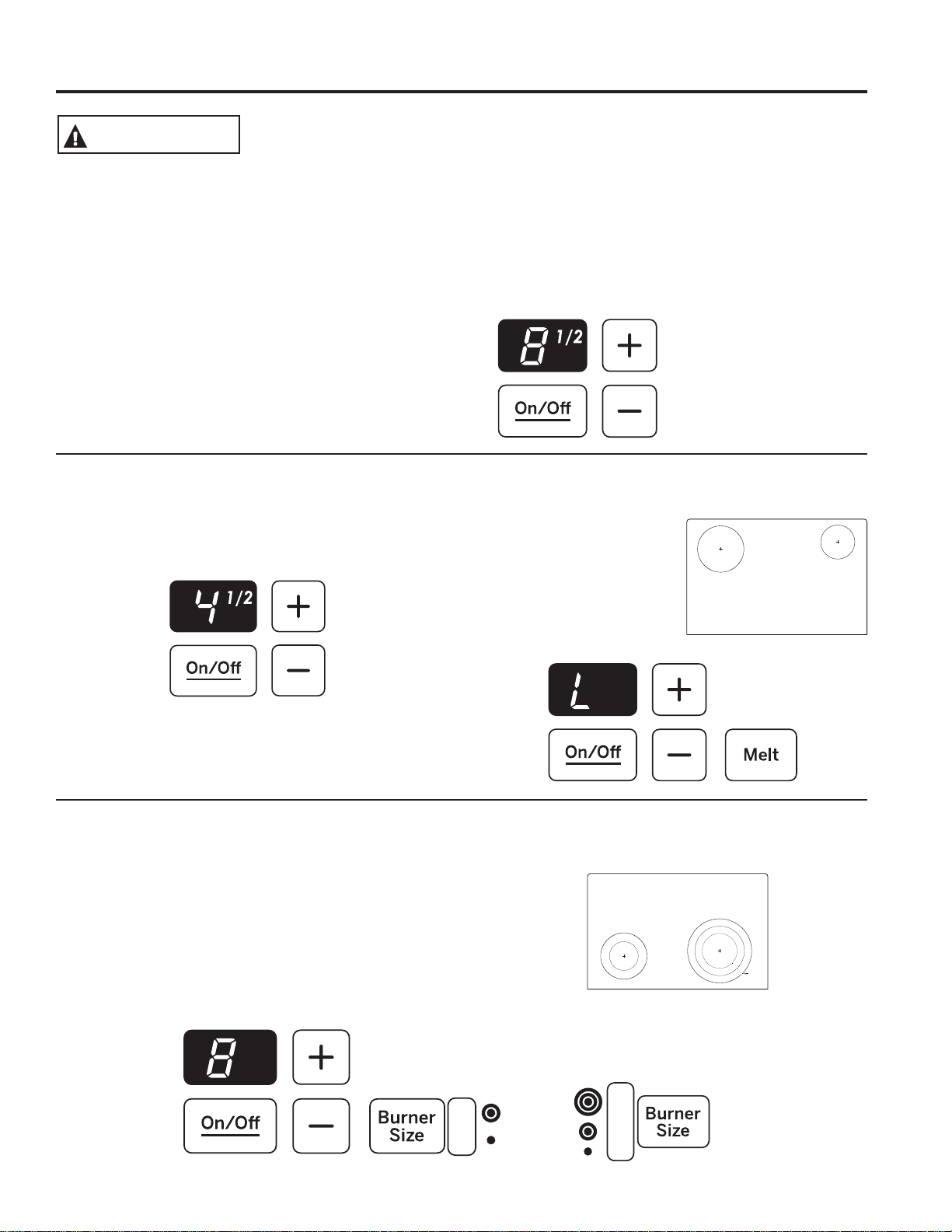
To turn on a single surface unit:
1. Touch the On/Off pad; then touch the + or – pad.
8VHWKH+ or – pad to choose the desired power setting.
To use the Melt feature:
Touch the On/Off pad; then
touch Melt. The element
will automatically set to a
predetermined setting and
³/´ZLOOEHGLVSOD\HG7RWXUQ
off a single surface unit,
touch the On/Off pad again.
Or
Multi-Ring Burner (can be dual or triple, depending on model)
1. Touch the On/Off pad for the right front surface unit
or the left front surface unit.
8VHWKH+ or – pad to choose the desired power setting.
3. Touch the Burner Size pad as needed to select the
desired burner size.
The light next to the
Burner Size
pad indicates which
size the surface unit is on. To turn the surface unit off,
touch the On/Off pad.
10
49-80694-2
Surface Units (Cont.)
USING THE RANGE: Surface Units
Throughout this manual, features and appearance may vary from your model.
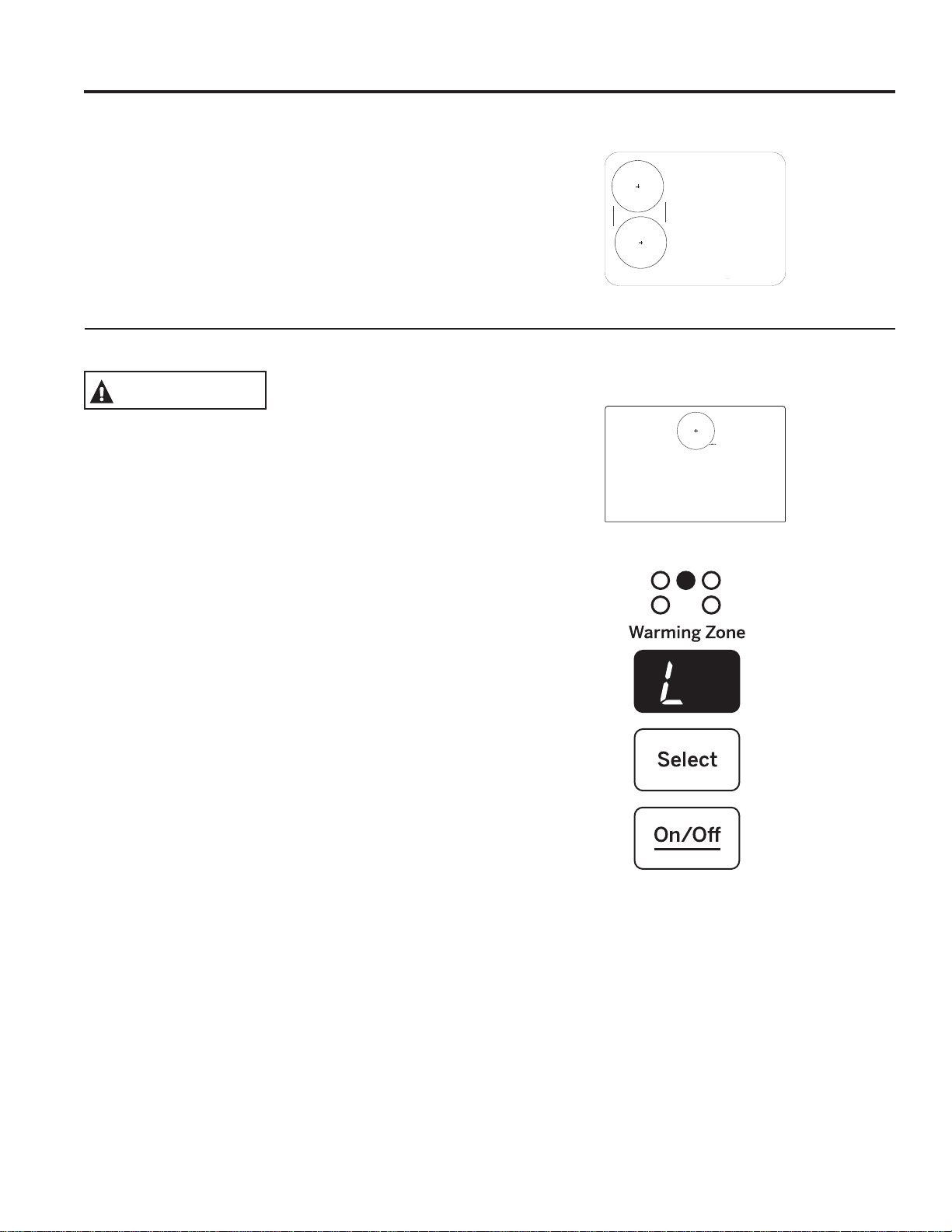
Using the Bridge Zone (on some models)
To use the bridge zone, adjust the settings for the left
rear and left front burners to create one large area for
even cooking. Turning both burners to the same setting
will maintain an even power across the bridge zone.
Using the Warming Zone
FOOD POISON HAZARD:%DFWHULDPD\JURZLQIRRGDW
temperatures below 140°F.
Ŷ $OZD\VVWDUWZLWKKRWIRRG'RQRWXVHZDUPVHWWLQJWR
heat cold food.
Ŷ 'RQRWXVHZDUPVHWWLQJIRUPRUHWKDQKRXUV
The Warming Zone is located in the back center of the
glass surface.
To use the Warming Zone:
1. Touch the Warming Zone On/Off pad.
2. To select the desired control setting, touch the
Select pad once for Low, twice for Medium or three
times for High.
To turn off the Warming Zone:
Touch the Warming Zone On/Off pad.
For best results, all foods on the Warming Zone should
be covered with a lid or aluminum foil.
Always use pot holders or oven mitts when removing
food from the Warming Zone, as cookware will be hot.
Ŷ 'RQRWXVHSODVWLFZUDSWRFRYHUIRRG3ODVWLFPD\
melt onto the surface and be very difficult to clean.
Ŷ 8VHRQO\FRRNZDUHUHFRPPHQGHGIRUWRSRIUDQJH
cooking.
Models with a bridge zone only.
WARNING
49-80694-2
11
Home Canning Tips
%HVXUHWKHFDQQHULVFHQWHUHGRYHUWKHVXUIDFHXQLW
Make sure the canner is flat on the bottom.
To prevent burns from steam or heat, use caution when
canning.
8VHUHFLSHVDQGSURFHGXUHVIURPUHSXWDEOHVRXUFHV
7KHVHDUHDYDLODEOHIURPPDQXIDFWXUHUVVXFKDV%DOO
®
DQG.HUU
®
and the Department of Agriculture Extension
Service.
)ODWERWWRPHGFDQQHUVDUHUHFRPPHQGHG8VHRIZDWHU
bath canners with rippled bottoms may extend the time
required to bring the water to a boil.
Temperature Limiter on Radiant Glass Cooktops
Every radiant surface unit has a temperature limiter.
The temperature limiter protects the glass cooktop from
getting too hot.
The temperature limiter may cycle the surface units off
for a time if:
Ŷ WKHSDQERLOVGU\
Ŷ WKHSDQERWWRPLVQRWIODW
Ŷ WKHSDQLVRIIFHQWHU
Ŷ WKHUHLVQRSDQRQWKHXQLW
For Models With a Radiant Glass Cooktop
The radiant cooktop features heating units beneath a
smooth glass surface.
NOTE: A slight odor is normal when a new cooktop is
used for the first time. It is caused by the heating of new
parts and insulating materials and will disappear in a
short time.
NOTE: On models with light-colored glass cooktops, it is
normal for the cooking zones to change color when hot
or cooling down. This is temporary and will disappear as
the glass cools to room temperature.
The surface unit will cycle on and off to maintain your
selected control setting.
It is safe to place hot cookware on the glass surface
even when the cooktop is cool.
Even after the surface units are turned off, the glass
cooktop retains enough heat to continue cooking. To
avoid overcooking, remove pans from the surface units
when the food is cooked. Avoid placing anything on the
surface unit until it has cooled completely.
Ŷ :DWHUVWDLQVPLQHUDOGHSRVLWVDUHUHPRYDEOHXVLQJ
the cleaning cream or full-strength white vinegar.
Ŷ 8VHRIZLQGRZFOHDQHUPD\OHDYHDQLULGHVFHQWILOPRQ
the cooktop. The cleaning cream will remove this film.
Ŷ 'RQ¶WVWRUHKHDY\LWHPVDERYHWKHFRRNWRS,IWKH\
drop onto the cooktop, they can cause damage.
Ŷ 'RQRWXVHWKHVXUIDFHDVDFXWWLQJERDUG
USING THE RANGE: Surface Units
Surface Units (Cont.)
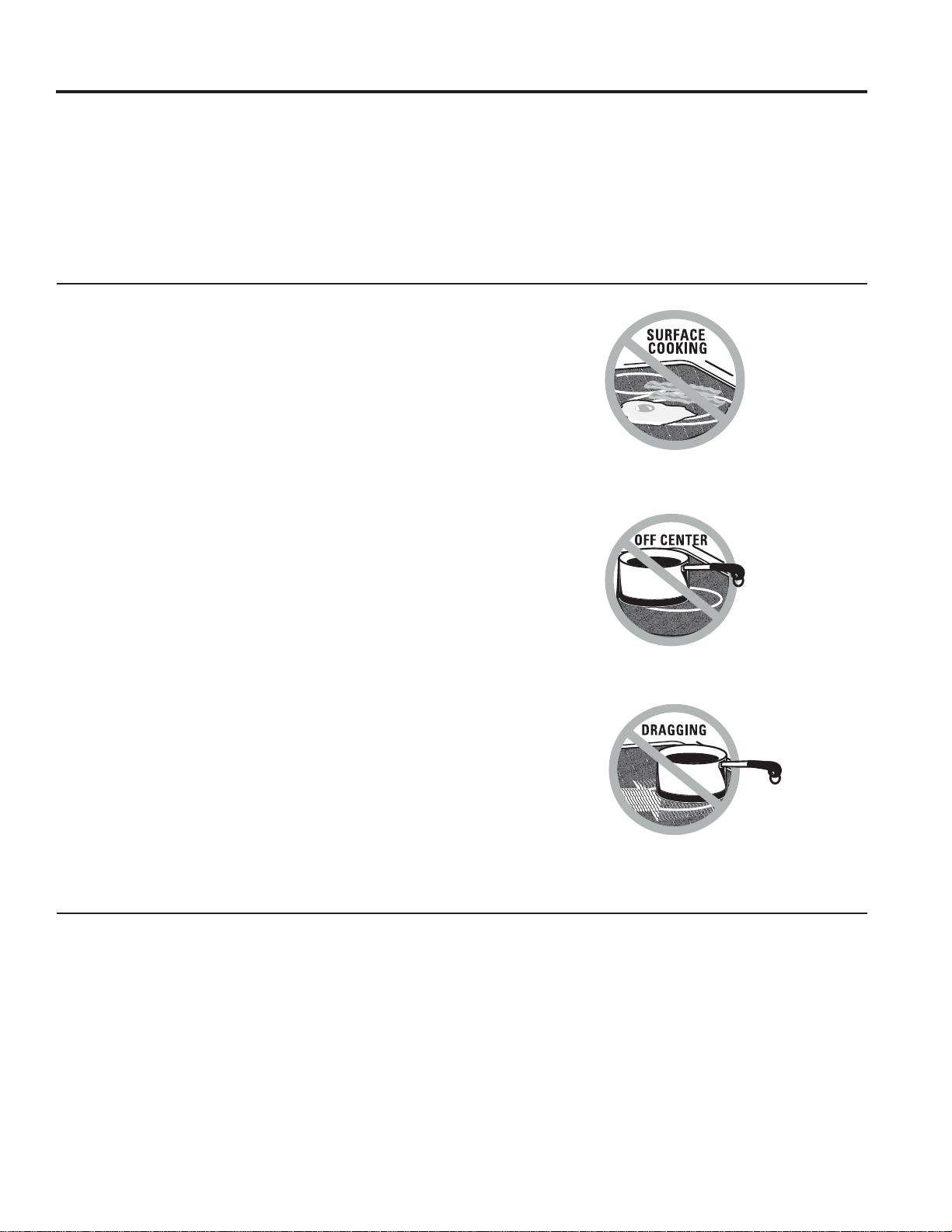
Never cook directly on the glass.
Always use cookware.
Always place the pan in the center of
the surface unit you are cooking on.
Do not slide cookware across the cooktop
EHFDXVHLWFDQVFUDWFKWKHJODVV³WKHJODVV
is scratch-resistant, not scratch proof.
12
49-80694-2
Cookware for Radiant Glass Cooktop
USING THE RANGE: Cookware for Radiant Glass Cooktop
The following information will help you choose cookware which will give good performance on glass cooktops.
NOTE: Follow all cookware manufacturer’s recommendations when using any type of cookware on the ceramic cooktop.
Stainless Steel:
recommended
Aluminum:
heavy weight recommended
Good conductivity. Aluminum residues
sometimes appear as scratches on the
cooktop but can be removed if cleaned
LPPHGLDWHO\%HFDXVHRILWVORZPHOWLQJ
point, thin weight aluminum should not
be used.
Copper Bottom:
recommended
Copper may leave residues which can
appear as scratches. The residues can
be removed, as long as the cooktop
is cleaned immediately. However, do
not let these pots boil dry. Overheated
metal can bond to glass cooktops. An
overheated copper bottom pot will leave
a residue that will permanently stain the
cooktop if not removed immediately.
Porcelain Enamel on Cast Iron:
recommended if bottom of pan is coated
Porcelain Enamel on Steel:
not recommended
Heating empty pans can cause
permanent damage to cooktop glass.
The enamel can melt and bond to the
ceramic cooktop.
Glass-ceramic:
not recommended
Poor performance. Will scratch the
surface.
Stoneware:
not recommended
Poor performance. May scratch the
surface.
Cast Iron:
QRWUHFRPPHQGHG²XQOHVVGHVLJQHG
specifically for glass cooktops
Poor conductivity and slow to absorb
heat. Will scratch the cooktop surface.
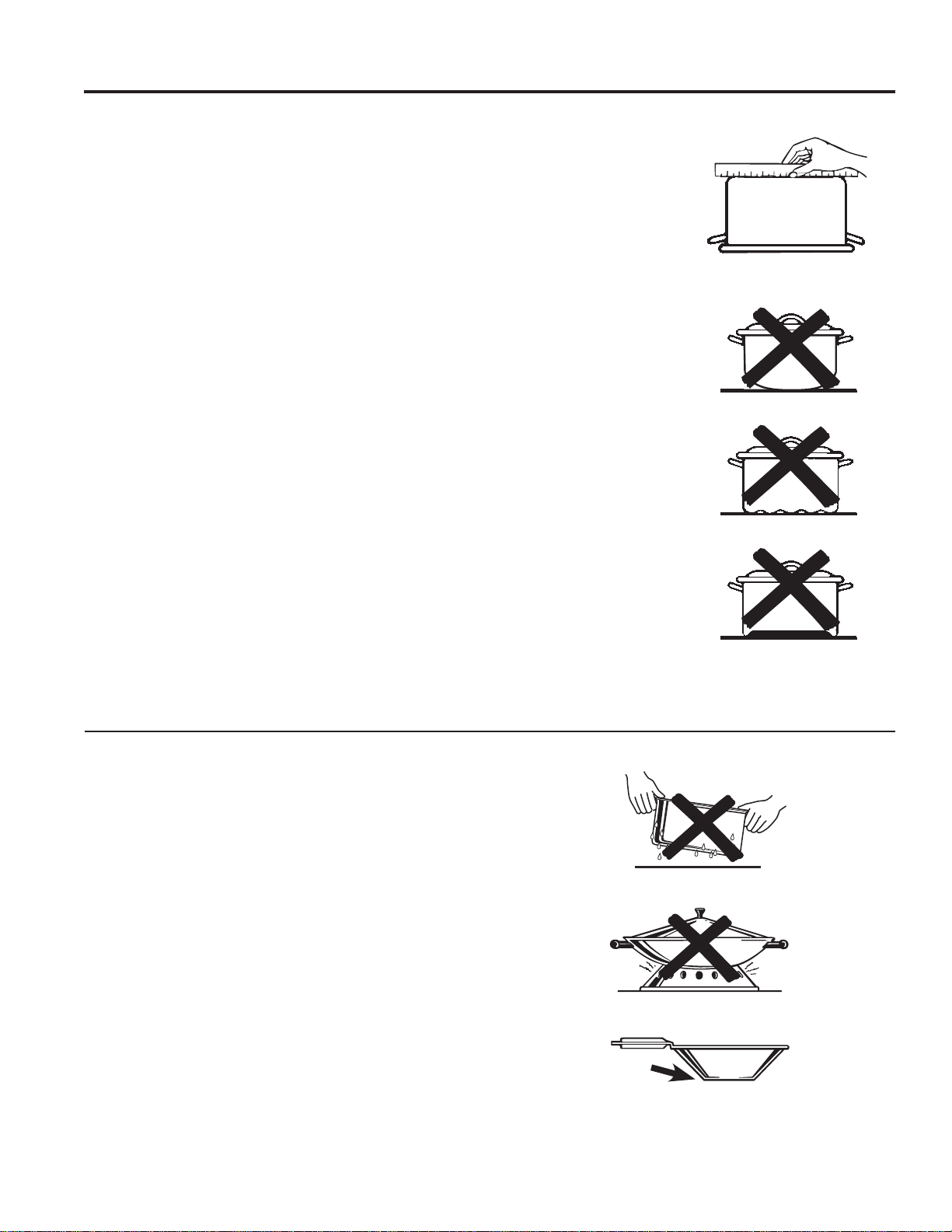
Check pans for flat bottoms by using
a straight edge.
Pans with rounded, curved, ridged or
warped bottoms are not recommended.
Do not place wet pans on the glass cooktop.
Do not use woks with support rings on the
glass cooktop.
Use flat-bottomed woks on the glass cooktop.
For Best Results
Ŷ 3ODFHRQO\GU\SDQVRQWKHVXUIDFHHOHPHQWV'RQRW
place lids on the surface elements, particularly wet
lids. Wet pans and lids may stick to the surface when
cool.
Ŷ 'RQRWXVHZRNVWKDWKDYHVXSSRUWULQJV7KLVW\SHRI
wok will not heat on glass surface elements.
Ŷ :HUHFRPPHQGWKDW\RXXVHRQO\DIODWERWWRPHG
wok. They are available at your local retail store. The
bottom of the wok should have the same diameter as
the surface element to ensure proper contact.
Ŷ 6RPHVSHFLDOFRRNLQJSURFHGXUHVUHTXLUHVSHFLILF
cookware such as pressure cookers or deep-fat
fryers. All cookware must have flat bottoms and be
the correct size.
49-80694-2
13
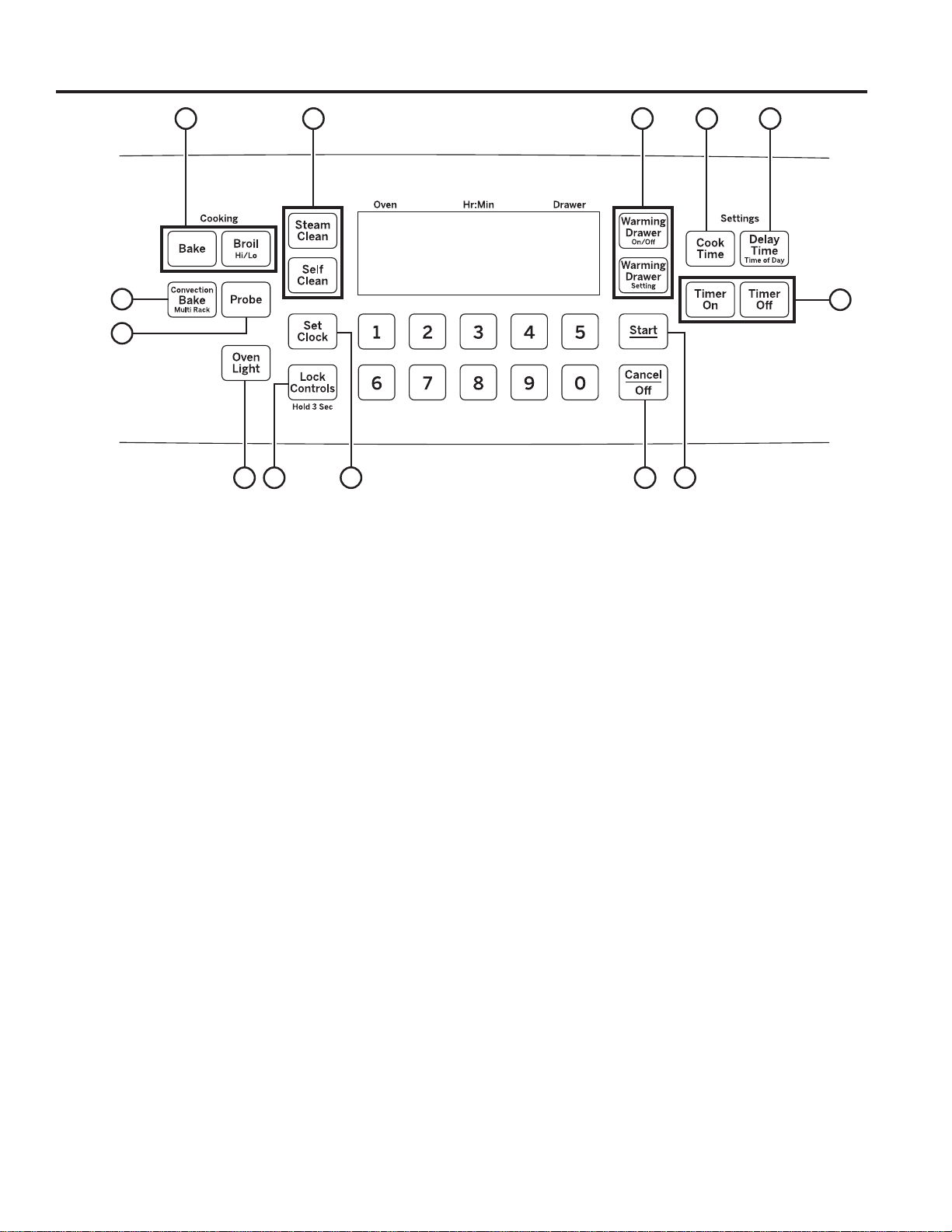
1. Convection Cooking Mode: Convection
cooking mode uses increased air circulation to improve
performance. See the Cooking Modes section for more
information.
2. Traditional Cooking Modes: <RXURYHQKDV
WKHIROORZLQJWUDGLWLRQDOFRRNLQJPRGHV%DNHDQG
%URLO+L/R6HHWKH&RRNLQJ0RGHVVHFWLRQIRUPRUH
information.
3. Clean: <RXURYHQKDVWZRFOHDQLQJPRGHV6HOI
Clean and Steam Clean. See the Cleaning the Oven
section for important information about using these
modes.
4. Start: Must be pressed to start any cooking,
cleaning, or timed function.
5. Cancel/Off: Cancels ALL oven operations except
the clock, timer and warming drawer.
6. Cook Time: Counts down cooking time and turns
off the oven when the cooking time is complete. Press
the Cook Time pad, use the number pads to program
a cooking time in hours and minutes, then press Start.
7KLVFDQRQO\EHXVHGZLWK%DNHDQG&RQYHFWLRQ%DNH
7. Clock: Sets the oven clock time. Press the Set
Clock SDG8VHWKHQXPEHUSDGVWRSURJUDPWKHFORFN
Press Start to save the time.
8. Timer: Works as a countdown timer. Press the
Timer On pad and the number pads to program the
time in hours and minutes. Press the Start pad. The
timer countdown is complete. To turn the timer off
press the Timer Off pad.
9. Delay Time: Delays when the oven will turn on.
8VHWKLVWRVHWDWLPHZKHQ\RXZDQWWKHRYHQWRVWDUW
Press the Delay Time pad and use the number pads
to program the time of day for the oven to turn on
then press Start. Press the desired cooking mode and
temperature then press Start. A Cook Time may also
be programmed if desired. Follow the directions under
Cook Time for setting this feature. This can only be
XVHGZLWK%DNHDQG&RQYHFWLRQ%DNH
NOTE: When using the Delay Time feature, foods that
VSRLOHDVLO\²VXFKDVPLONHJJVILVKVWXIILQJVSRXOWU\
DQGSRUN²VKRXOGQRWEHDOORZHGWRVLWIRUPRUHWKDQ
1 hour before or after cooking. Room temperature
SURPRWHVWKHJURZWKRIKDUPIXOEDFWHULD%HVXUHWKDW
the oven light is off because heat from the bulb will
speed harmful bacteria growth.
10. Oven Light: Turns the oven light on or off.
11. Lock Controls: Locks out the control so that
pressing the pads does not activate the controls. Press
the Lock Controls pad, for three seconds to lock or
unlock the control. Cancel/Off is always active, even
when the control is locked.
12. Warming Drawer: Will keep hot, cooked foods
at serving temperature. Press the Warming Drawer
On/Off pad, Warming Drawer Setting pad begins
to blink. Press the Warming Drawer Setting pad to
set the warming drawer to "HI", "STD", or "LO". To
cancel, press the Warming Drawer On/Off pad.
See
the Cooking Modes section for more information.
NOTE: The Cancel/Off pad does not turn off the
Warming Drawer.
13. Probe: Monitors internal food temperature and turns
the oven off when the food reaches the programmed
temperature. Insert the probe, program the cooking
mode, and program the probe temperature. See the
Cooking Modes section for more information. The probe
FDQRQO\EHXVHGZLWK%DNHDQG&RQYHFWLRQ%DNH
USING THE RANGE: Single Oven Controls
Single Oven Controls
1
8
23 69
475
13
12
1110

14
49-80694-2
1. Upper Oven and Lower Oven: Designates
which oven the controls will operate.
2. Convection Cooking Mode: Convection
cooking mode uses increased air circulation
WRLPSURYHSHUIRUPDQFH<RXURYHQKDVWKH
&RQYHFWLRQ%DNHPRGHORZHURYHQRQO\6HHWKH
Cooking Modes section for more information.
3. Traditional Cooking Modes: <RXURYHQ
KDVWKHIROORZLQJWUDGLWLRQDOFRRNLQJPRGHV%DNH
%URLO+L/RDQG:DUPXSSHURYHQRQO\6HHWKH
Cooking Modes section for more information.
4. Self Clean: See the Cleaning the Oven section
for important information about using this mode.
5. Start: Must be pressed to start any cooking,
cleaning, or timed function.
6. Cancel/Off: Cancels ALL oven operations except
the clock and timer.
7. Clock: Sets the oven clock time. Press the Set Clock
SDG8VHWKHQXPEHUSDGVWRSURJUDPWKHFORFN3UHVV
Start to save the time.
8. Timer:
Works as a countdown timer. Press the
Timer On pad and the number pads to program
the time in hours and minutes. Press the Start pad.
If the oven is on, it will not turn off when the timer
countdown is complete. To turn the timer off press
the Timer OFF pad.
9. Delay Time: Delays when the oven will turn
RQ8VHWKLVWRVHWDWLPHZKHQ\RXZDQWWKHRYHQ
to start. Press the Delay Time pad and use the
number pads to program the time of day for the
oven to turn on then press Start. Press the desired
cooking mode and temperature then press Start.
A Cook Time may also be programmed if desired.
Follow the directions under Cook Time for setting
WKLVIHDWXUH7KLVFDQRQO\EHXVHGZLWK%DNH
&RQYHFWLRQ%DNHDQG6HOI&OHDQ
NOTE: When using the Delay Time feature, foods
WKDWVSRLOHDVLO\²VXFKDVPLONHJJVILVKVWXIILQJV
SRXOWU\DQGSRUN²VKRXOGQRWEHDOORZHGWRVLWIRU
more than 1 hour before or after cooking. Room
temperature promotes the growth of harmful
EDFWHULD%HVXUHWKDWWKHRYHQOLJKWLVRIIEHFDXVH
heat from the bulb will speed harmful bacteria
growth.
10. Cook Time: Counts down cooking time and turns
off the oven when the cooking time is complete.
Press the Cook Time pad, use the number pads to
program a cooking time in hours and minutes, then
press Start.7KLVFDQRQO\EHXVHGZLWK%DNHRU
&RQYHFWLRQ%DNH
11. Oven Lights: Turns the oven lights on or off in
both ovens. Note that lights in both ovens will not
turn on if the door is opened while the other oven is
in a clean mode.
12. Lock Controls: Locks out the control so that
pressing the pads does not activate the controls.
Press and hold the Lock Controls pad for three
seconds to lock or unlock the control. Cancel/Off is
always active, even when the control is locked.
13. Probe:
Monitors internal food temperature
and turns the oven off when the food reaches
the programmed temperature. Insert the probe,
program the cooking mode, and program the probe
temperature. See the Cooking Modes section for
more information. The probe can only be used with
%DNHDQG&RQYHFWLRQ%DNH
USING THE RANGE: Double Oven Controls
Double Oven Controls
1 1335566
427
49 9
8
12 10
13
1110

49-80694-2
15
Special Features
USING THE RANGE: Special Features
There are several different special features on your range. To change the settings of these special features
7KHORZHURYHQ%DNHDQG%URLOSDGVZLOOQRWDFWLYDWHVSHFLDOIHDWXUHV
Ŷ 3UHVVWKH8SSHU2YHQBake and Broil pads at the same time and hold for three seconds.
Ŷ ³6)´ZLOODSSHDULQWKHGLVSOD\
Ŷ 6HOHFWWKHIHDWXUH\RXZDQWWRFKDQJH
Ŷ :KHQWKHFKDQJHKDVEHHQPDGHSUHVVWKHStart key to save the change and return to the time of day.
Adjust the Oven Temperature
This feature allows the oven baking and convection baking
WHPSHUDWXUHWREHDGMXVWHGXSWR)KRWWHURUGRZQ
WR)FRROHU8VHWKLVIHDWXUHLI\RXEHOLHYH\RXURYHQ
temperature is too hot or too cold and wish to change it.
7KLVDGMXVWPHQWDIIHFWV%DNHDQG&RQYHFWLRQ%DNHPRGHV
No other cooking modes are affected.
Press the Bake pad (for double ovens use the Upper Oven
Bake pad or Lower Oven Bake pad corresponding to the
oven to be adjusted). Press the Bake pad again to enter the
WHPSHUDWXUHDGMXVWPHQWPRGH$QXPEHUEHWZHHQDQG
ZLOOGLVSOD\8VHWKHQXPEHUSDGVWRVHWWKHGHVLUHG
temperature adjustment and use the Bake pad to change
between negative and positive.
Press the Start pad to save the temperature adjustment.
End of Timer Signals
This is the tone that signals the end of a timer. The tone
can be continuous (Con bEEP) or one repeating beep
(bEEP). A continuous setting will continue to sound a tone
until a button on the control is pressed. Press the Broil pad
to view the current setting and then to change the setting.
Fahrenheit or Celsius Temperature Display
The oven control is set to use Fahrenheit temperatures
(F), but you can change it to use Celsius temperatures (C).
Press the Cook Time and Broil Hi/Lo at the same time to
view the current setting, press again to change the setting.
Clock Display
This feature specifies how the time of day will be displayed
RULIQRWLPHRIGD\ZLOOEHGLVSOD\HG<RXFDQVHOHFWD
standard 12-hour clock (12 H), 24-hour military time display
(24 H), or no clock displayed (oFF). Press the Clock pad to
view the current setting, press again to change the setting.
Auto Recipe Conversion
:KHQXVLQJ&RQYHFWLRQ%DNHFRRNLQJ$XWR5HFLSH
Conversion will automatically convert the regular baking
temperatures entered to convection bake cooking
temperatures when turned on. Note that this option does
not convert convection bake cooking times, it only converts
temperatures. Press the Convection Bake pad to view the
conversion settings, press again to toggle between On (Con
On) and Off (Con oFF).
Sound Volume
This feature allows the oven tone volume to be adjusted
between high (HI bEEP HI), medium (Std bEEP Std),
low (Lo bEEP Lo) and off (oFF bEEP oFF). Press the
Cook Time pad to view the current setting or to change
the setting. The control will sound the oven tone at the new
volume level each time the sound level is changed.
12-hour auto shut-off and Sabbath
2SWLRQVIRUWKLVIHDWXUHDUH³6+GQ´³QR6+GQ´DQG
³6$EE$W+´
12-hour auto shut-off turns off the oven after 12 hours of
continuous operations.
Sabbath mode disables all sounds (the control will not beep
ZKHQDEXWWRQLVSUHVVHG&RQYHFWLRQ%URLO:DUP&RRN
Time, Timer, Clock, and Delay Time functions. Sabbath
PRGHFDQRQO\EHXVHGZLWK%DNH7KLVIHDWXUHFRQIRUPVWR
WKH6WDU.-HZLVK6DEEDWKUHTXLUHPHQWV
NOTE: The oven light comes on automatically (on some
models) when the door is opened and goes off when the door
is closed. The bulb may be removed. See the Oven Light
Replacement section. On models with a light switch on the
control panel, the oven light may be turned on and left on.
Press the Delay Time pad to view the current setting and
then to change the setting.
7RXVH6DEEDWKPRGHVHOHFW³6$EE$W+´DQGSUHVVStart.
A ] will appear in the display and the clock will not display.
Note that if you have a double oven, when you place the
control into Sabbath mode, both ovens are now in Sabbath
mode and available for cooking.
Once in Sabbath mode, at any time you can press Bake,
use the number pads to enter a temperature between
)DQG)DQGSUHVVStart. No sound will be given
when the keys are pressed. At a random time between
30 seconds and 1 minute, ][, will appear in the display
indicating the oven is running. Note that both ovens of a
double oven can be used in Sabbath mode. Each oven can
be programmed to a different temperature and each oven
must be programmed separately.
If you need to adjust the temperature, press Bake, use the
QXPEHUSDGVWRHQWHUDQHZWHPSHUDWXUHEHWZHHQ)
DQG)DQGSUHVVStart.
To exit Sabbath mode, make sure that the oven is turned
off. To turn the oven off, press Cancel/Off. The oven will
immediately turn off and ][ will change to ] indicating that
the oven has turned off. Press and hold the Bake and Broil
pads for 3 seconds to enter special features then press
Delay Time until either "12 Shdn" or "no Shdn" is in the
display and press Start.
NOTE: If power outage occurs during Sabbath mode the
unit will remain in Sabbath mode but off when power is
restored.
If you wish to use the Cook Time feature (if available) to
bake in the oven and then have the oven automatically
turn off, you will need to press the Cook Time pad, enter a
cooking time duration, and press Start. Then enter special
features to start Sabbath mode as detailed above.
16
49-80694-2
Recommended rack positions for various types of
foods are provided in the Cooking Guide. Adjusting
rack position is one way to impact cooking results. For
example, if you would prefer darker tops on cakes,
muffins, or cookies, try moving food one rack position
higher. If you find foods are too brown on top try moving
them down next time.
When baking with multiple pans and on multiple racks,
HQVXUHWKHUHLVDWOHDVWòEHWZHHQSDQVWRDOORZ
sufficient space for air to flow.
<RXU2YHQPD\KDYHH[WHQVLRQUDFNVDQGRUWUDGLWLRQDO
flat racks.
To avoid possible burns, place the racks in the desired
position before you turn the oven on.
Extension Racks
Always pull the rack out by its upper front rail to its fully
open position, when placing or removing cookware.
If extension racks are difficult to extend, lubricate the
racks with the graphite lubricant provided with your
oven. Remove the rack from the oven, remove debris in
the side tracks with a paper towel, shake the graphite
lubricant and place 4 small drops on the two bottom
tracks of the left and right sides. Open and close the
rack several times to distribute the lubricant.
To order additional graphite lubricant, read the
Assistance and Accessories section at the beginning of
the manual.
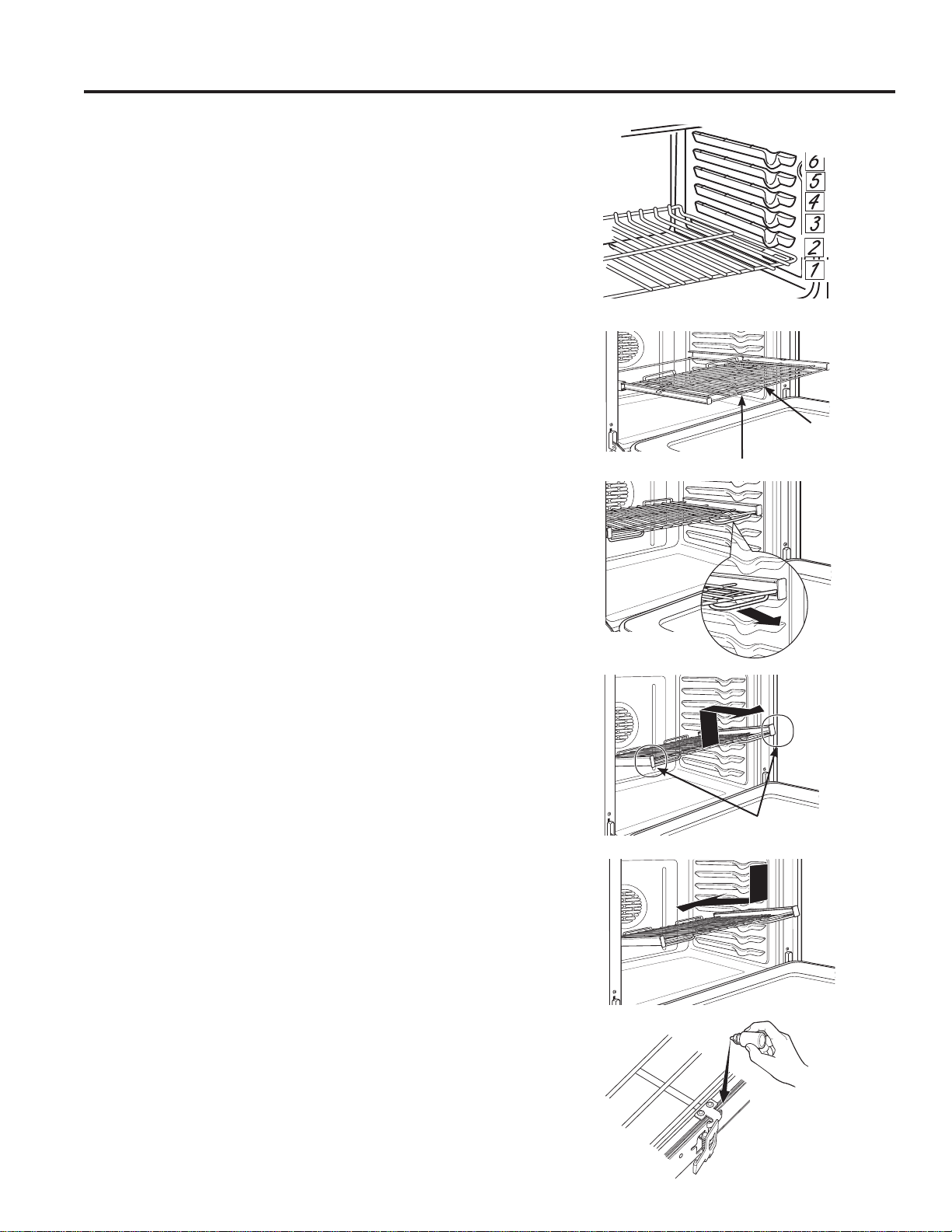
To Remove An Extension Rack:
1. Make sure the rack is pushed all the way into the
oven so that side paddles on the rack disengage from
the oven support.
2. Slide the rack toward you to the bump (stop position)
on the rack support.
3. Firmly grasp both sides of the rack frame and the
sliding rack, tilt the front end up and pull it out.
To Replace An Extension Rack:
1. Firmly grasp both sides of the rack frame and the
sliding rack.
2. Place the curved end of the rack (stop-locks) onto the
oven supports, tilt up the front of the rack and push it
in as far as it will go.
If extension racks are difficult to replace or remove, wipe
the oven rack supports with cooking oil. Do not wipe oil
on the rack slides.
To Lubricate the Paddle:
Shake lubricant and apply to the moving parts of the
paddle mechanisms as shown.
The number of rack positions may vary by model.
Upper Front
Rail
Fully Open Position
Grasp here
USING THE RANGE: Oven Racks
Oven Racks

49-80694-2
17
USING THE RANGE: Aluminum Foil and Oven Liners / Cookware
Cookware
Cookware Guidelines
The material, finish, and size of cookware affect baking
performance.
Dark, coated and dull pans absorb heat more readily
than light, shiny pans. Pans that absorb heat more
readily can result in a browner, crisper, and thicker crust.
If using dark and coated cookware check food earlier
than minimum cook time. If undesirable results are
obtained with this type of cookware consider reducing
RYHQWHPSHUDWXUHE\)QH[WWLPH
Shiny pans can produce more evenly cooked baked
goods such as cakes and cookies.
Glass and ceramic pans heat slowly but retain heat well.
These types of pans work well for dishes such as pies
and custards.
Air insulated pans heat slowly and can reduce bottom
browning.
.HHSFRRNZDUHFOHDQWRSURPRWHHYHQKHDWLQJ
CAUTION: Do not use any type of foil or oven liner to cover the oven bottom. These items can trap
heat or melt, resulting in damage to the product and risk of shock, smoke or fire. Damage from improper use
of these items is not covered by the product warranty.
Foil may be used to catch spills by placing a sheet on a lower rack, several inches below the food. Do not use more
IRLOWKDQQHFHVVDU\DQGQHYHUHQWLUHO\FRYHUDQRYHQUDFNZLWKDOXPLQXPIRLO.HHSIRLODWOHDVW´IURPRYHQZDOOV
to prevent poor heat circulation.
Aluminum Foil and Oven Liners

18
49-80694-2
<RXUQHZRYHQKDVDYDULHW\RIFRRNLQJPRGHVWRKHOS\RXJHWWKHEHVWUHVXOWV7KHVHPRGHVDUHGHVFULEHGEHORZ
Refer to the Cooking Guide section for recommendations for specific foods. Remember, your new oven may perform
differently than the oven it is replacing.
Baking and Roasting Modes
Select a mode for baking and roasting based on the
type and quantity of food you are preparing. When
preparing baked goods such as cakes, cookies, and
pastries always preheat the oven first. Follow recipe
recommendations for food placement. If no guidelines
are provided, center food in the oven.
Bake
The bake mode is intended for single rack cooking. This
mode uses heat primarily from the lower element but
also from the upper element to cook food. To use this
mode press the Bake pad, enter a temperature, and
then press Start. Preheating is generally recommended
when using this mode.
Convection Bake Multi Rack
7KH&RQYHFWLRQ%DNH0XOWL5DFNPRGHLVLQWHQGHG
for baking on multiple racks at the same time. This
mode uses heat primarily from the rear element, when
available, but also heat from the upper and lower
elements, along with air movement from the convection
IDQWRHQKDQFHFRRNLQJHYHQQHVV<RXURYHQLV
equipped with Auto Recipe Conversion, so it is not
necessary to convert the temperature when using this
PRGH%DNLQJWLPHPLJKWEHVOLJKWO\ORQJHUIRUPXOWLSOH
racks than what would be expected for a single rack. To
use this mode press the Convection Bake pad, enter a
temperature, and then press Start. Always preheat when
using this mode.
Broiling Modes
For better broiling, when two cavities are available, the
lower oven is recommended. When broiling in the upper
oven, the door should remain CLOSED. When broiling in
the lower oven, or single oven, the door should remain
23(10RQLWRUIRRGFORVHO\ZKLOHEURLOLQJ8VHFDXWLRQ
when broiling on upper rack positions as placing food
closer to the broil element increases smoking, spattering,
and the possibility of fats igniting. For best performance
center food below the broil heating element. Broiling on
the highest rack position is not recommended.
Try broiling foods that you would normally grill. Adjust
rack positions to adjust the intensity of the heat to the
food. Place foods closer to the broil element when a
seared surface and rare interior is desired. Thicker foods
and foods that need to be cooked through should be
broiled on a rack position farther from the broiler or by
XVLQJ%URLO/R
Broil Hi
7KH%URLO+LPRGHXVHVLQWHQVHKHDWIURPWKHXSSHU
HOHPHQWWRVHDUIRRGV8VH%URLO+LIRUWKLQQHUFXWVRI
PHDWDQGRUIRRGV\RXSUHIHUOHVVGRQHRQWKHLQWHULRU
To use this mode press the Broil pad once and then
press Start. It is not necessary to preheat when using
this mode.
Broil Lo
7KH%URLO/RPRGHXVHVOHVVLQWHQVHKHDWIURPWKHXSSHU
element to cook food thoroughly while also producing
VXUIDFHEURZQLQJ8VH%URLO/RIRUWKLFNHUFXWVRIPHDW
DQGRUIRRGVWKDW\RXZRXOGOLNHFRRNHGDOOWKHZD\
through. To use this mode press the Broil pad twice and
then press Start. It is not necessary to preheat when
using this mode.
USING THE RANGE: Cooking Modes
Cooking Modes

49-80694-2
19
Warm (on some models)
Warm mode is designed to keep hot food hot, it is not
intended to heat cold food. To use this mode, press the
Warm pad then press Start. Preheating is not required.
Cover foods that need to remain moist and do not
cover foods that should be crisp. It is recommended,
for food quality, that food not be kept warm for more
than 2 hours.
Probe
Internal food temperature is frequently used as an
indicator of doneness, especially for roasts and poultry.
The Probe mode monitors the internal food temperature
and turns the oven off when the internal food
temperature reaches the programmed temperature.
Minimum temperatures for food safety can be found at
ZZZ,V,W'RQH<HWJRY7KHWHPSHUDWXUHSUREHFDQRQO\
EHXVHGZLWK%DNHDQG&RQYHFWLRQ%DNH
To use the probe with preheating:
1. Press the desired cook mode (Bake or Convection
Bake) pad and enter the desired cooking
temperature.
2. Insert the probe into the food (see Proper Probe
Placement Guidelines in this section).
3. Once the oven is preheated, place the food in the
oven and connect the probe to the probe outlet,
PDNLQJVXUHLWLVIXOO\LQVHUWHG8VHFDXWLRQWKHRYHQ
walls and probe outlet are hot.
4. Program the probe temperature by pressing
the Probe pad and entering the desired food
temperature. The maximum internal food temperature
WKDW\RXFDQVHWLV)
To use the probe without preheating:
1. Insert the probe into the food (see Proper Probe
Placement Guidelines in this section).
2. Place the food in the oven and connect the probe into
the probe outlet in the oven.
3. Program the desired probe and cooking mode
settings by pressing the Probe pad and entering the
desired food temperature, then pressing the cook
mode pad (Bake or Convection Bake) and entering
the desired cooking temperature and press Start.
Proper Probe Placement Guidelines
After preparing the meat and placing it on the cooking
pan follow these guidelines for proper probe placement.
Ŷ Insert the probe completely into the meat, up to the
handle, such that the point of the probe will rest in the
center of the thickest part of the meat.
Ŷ The probe should not touch bone, fat or gristle.
Ŷ For whole poultry insert the probe into the thickest
part of the breast.
Ŷ For boneless roasts, insert the probe into the center
of the roast.
Ŷ For bone-in ham or lamb, insert the probe into the
center of the lowest large muscle or joint.
Ŷ For casseroles or dishes such as meatloaf, insert the
probe into the center of the dish.
Ŷ For fish, insert the probe from just above the gill into
the meatiest area, parallel to the backbone.
Check the temperature at other locations in the food
with a food thermometer once the probe temperature
is reached to ensure that all portions of the food have
reached desired temperatures.
Probe Care Guidelines
Note: double oven models have a probe in one oven only.
Ŷ 8VHRISUREHVRWKHUWKDQWKHRQHSURYLGHGZLWKWKLV
product may result in damage to the probe.
Ŷ 8VHWKHKDQGOHVRIWKHSUREHDQGSOXJZKHQLQVHUWLQJ
and removing them from the meat and outlet
Ŷ To avoid damaging your probe, do not use tongs to
pull on the cable when removing it.
Ŷ To avoid breaking the probe, make sure food is
completely defrosted before inserting the probe.
Ŷ To prevent possible burns, do not unplug the probe
from the outlet until the oven has cooled.
Ŷ Never leave the probe inside the oven during a self or
steam clean cycle.
Ŷ Do not store the probe in the oven.
USING THE OVEN: Cooking Modes
Cooking Modes (Cont.)
20
49-80694-2
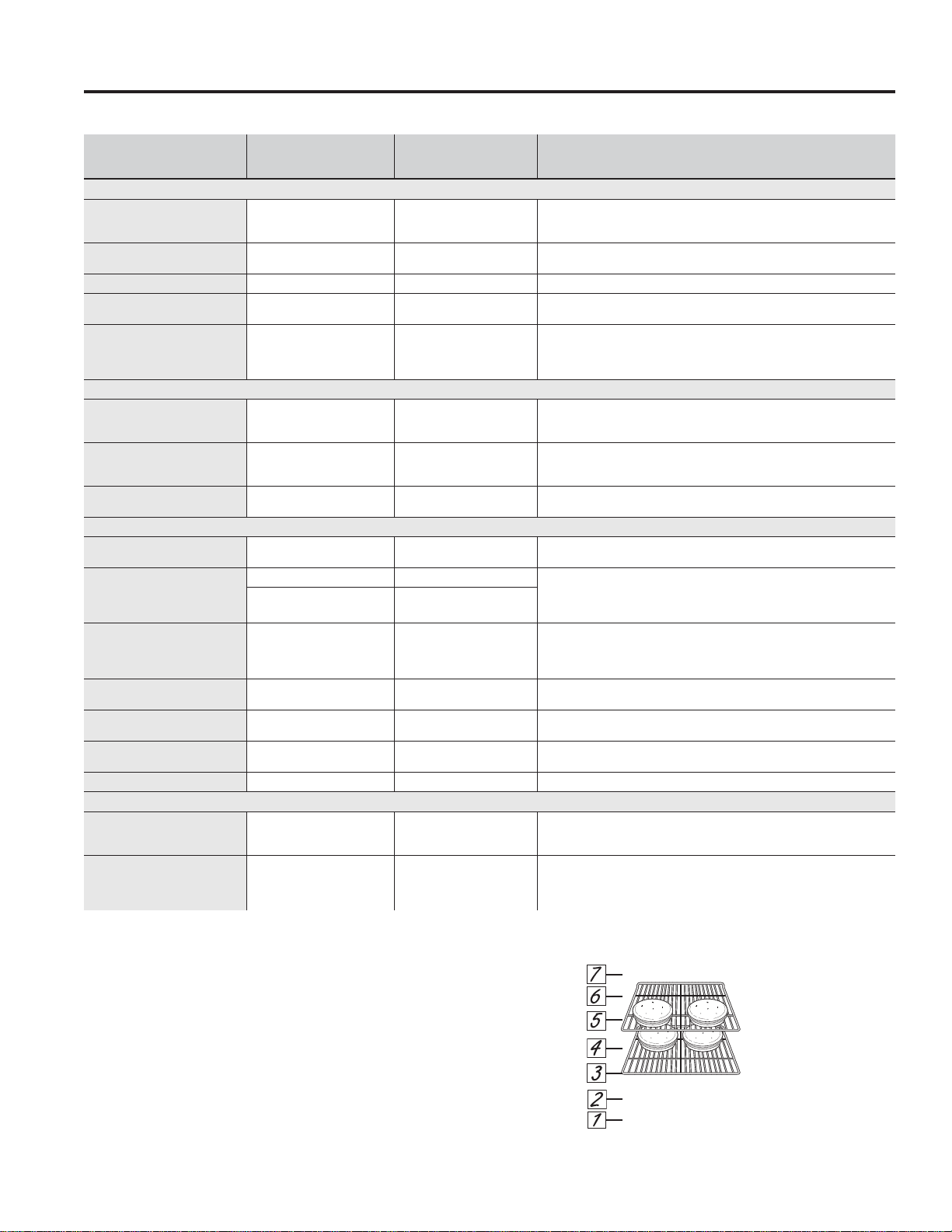
FOOD TYPE
RECOMMENDED
MODE(S)
RECOMMENDED
RACK POSITION(S) ADDITIONAL SUGGESTIONS
Baked Goods
Layer cakes, sheet cakes,
bundt cakes, muffins, quick
breads on a Single Rack
%DNH 4 8VHVKLQ\FRRNZDUH
Layer cakes* on Multiple
Racks
%DNH DQG
Ensure adequate airflow
(see illustration below).
Chiffon cakes (angel food) %DNH 1 8VHVKLQ\FRRNZDUH
Cookies, biscuits, scones
on a Single Rack
%DNH 4 8VHVKLQ\FRRNZDUH
Cookies, biscuits, scones
on Multiple Racks
%DNH
&RQYHFWLRQ%DNHLIDYDLODEOH
DQG
2, 4, and 6 (3 rack
recommended only for
&RQYHFWLRQ%DNH
Ensure adequate airflow.
Beef & Pork
Hamburgers %URLO+L 6
.HHSWKHGRRURSHQZKHQEURLOLQJLQWKHORZHURYHQ8VHDEURLOSDQPRYH
IRRGGRZQIRUPRUHGRQHQHVVOHVVVHDULQJ:DWFKIRRGFORVHO\ZKHQEURLOLQJ
For best performance center food below the broil heating element.
Steaks & Chops %URLO+L 6
.HHSWKHGRRURSHQZKHQEURLOLQJLQWKHORZHURYHQ8VHDEURLOSDQPRYH
IRRGGRZQIRUPRUHGRQHQHVVOHVVVHDULQJ:DWFKIRRGFORVHO\ZKHQEURLOLQJ
For best performance center food below the broil heating element.
Roasts %DNH 3 or 4 8VHDORZVLGHGSDQVXFKDVDEURLOSDQ3UHKHDWLQJLVQRWQHFHVVDU\
Poultry
Whole chicken %DNH 3 or 4 8VHDORZVLGHGSDQVXFKDVDEURLOSDQ
%RQHLQFKLFNHQEUHDVWV
legs, thighs
%URLO+L 2 ,IEUHDGHGRUFRDWHGLQVDXFHDYRLG%URLO+LPRGHV%URLOVNLQVLGHGRZQILUVW
:DWFKIRRGFORVHO\ZKHQEURLOLQJ.HHSWKHGRRURSHQZKHQEURLOLQJLQWKH
lower oven. For best performance when broiling, center food below the broil
heating element.
%URLO/R
%DNH
2 or 3
%RQHOHVVFKLFNHQEUHDVWV
%URLO/R
%DNH
2 or 3
.HHSWKHGRRURSHQZKHQEURLOLQJLQWKHORZHURYHQ0RYHIRRGGRZQIRU
PRUHGRQHQHVVOHVVVHDULQJDQGXSIRUJUHDWHUVHDULQJEURZQLQJZKHQ
broiling. For best performance when broiling, center food below the broil
heating element.
Whole turkey %DNH 1 or 2 8VHDORZVLGHGSDQVXFKDVDEURLOSDQ
7XUNH\%UHDVW %DNH 2 or 3 8VHDORZVLGHGSDQVXFKDVDEURLOSDQ
Fish %URLO/R
LQFKWKLFNRUOHVV
!LQFK
.HHSWKHGRRURSHQZKHQEURLOLQJLQWKHORZHURYHQ:DWFKIRRGFORVHO\ZKHQ
broiling. For best performance center food below the broil heating element.
Casseroles %DNH 3 or 4
Frozen Convenience Foods
Pizza, french fries, tator
tots, chicken nuggets,
appetizers on a Single Rack
%DNH
3 or 4
8VHVKLQ\FRRNZDUH
Pizza, french fries, tator
tots, chicken nuggets,
appetizers on Multiple
Racks
%DNH
&RQYHFWLRQ%DNHLIDYDLODEOH
DQG 8VHVKLQ\FRRNZDUH
*When baking four cake layers at a time, use racks 3
DQG. Place the pans as shown so that one pan is not
directly above another.
Cook food thoroughly to help protect against food
borne illness. Minimum safe food temperature
recommendations for food safety can be found at
www.IsItDoneYet.gov. Make sure to use a food
thermometer to take food temperatures.
Rack position for baking 4 layer cakes.
Cooking Guide
USING THE RANGE: Cooking Guide
Single Oven/Lower Oven for Double Oven Models
49-80694-2
21
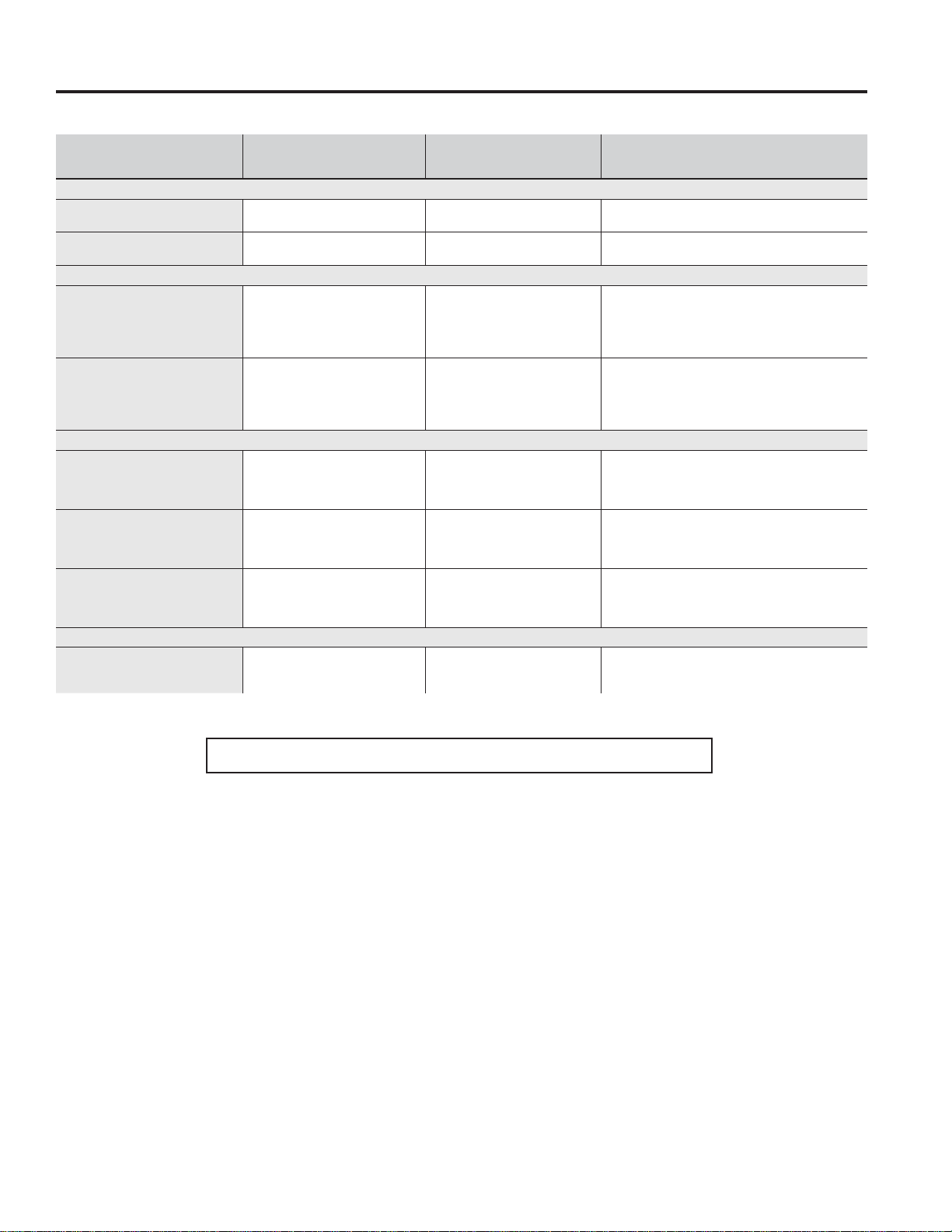
FOOD TYPE
RECOMMENDED
MODE(S)
RECOMMENDED
RACK POSITION(S) ADDITIONAL SUGGESTIONS
Baked Goods
Layer cakes, sheet cakes,
muffins, baked on Single Rack
%DNH 1 8VHVKLQ\FRRNZDUH
Cookies, biscuits, scones on a
Single Rack
%DNH 1 8VHVKLQ\FRRNZDUH
Beef & Pork
Hamburgers %URLO+L 1
.HHSWKHGRRUFORVHGZKHQEURLOLQJLQWKHXSSHU
RYHQ8VHDEURLOSDQPRYHIRRGGRZQIRUPRUH
GRQHQHVVOHVVVHDULQJ:DWFKIRRGFORVHO\ZKHQ
broiling. For best performance center food below the
broil heating element.
Steaks & Chops %URLO+L 1
.HHSWKHGRRUFORVHGZKHQEURLOLQJLQWKHXSSHU
RYHQ8VHDEURLOSDQPRYHIRRGGRZQIRUPRUH
GRQHQHVVOHVVVHDULQJ:DWFKIRRGFORVHO\ZKHQ
broiling. For best performance center food below the
broil heating element.
Poultry
%RQHLQFKLFNHQEUHDVWVOHJV
thighs
%URLO/R
%DNH
1
%URLOVNLQVLGHGRZQILUVW:DWFKIRRGFORVHO\ZKHQ
EURLOLQJ.HHSWKHGRRUFORVHGZKHQEURLOLQJLQWKH
upper oven. For best performance when broiling,
center food below the broil heating element.
%RQHOHVVFKLFNHQEUHDVWV
%URLO/R
%DNH
1
.HHSWKHGRRUFORVHGZKHQEURLOLQJLQWKHXSSHU
oven. For best performance when broiling, center
food below the broil heating element.
Fish %URLO/R 1
.HHSWKHGRRUFORVHGZKHQEURLOLQJLQWKHXSSHU
oven. Watch food closely when broiling. For best
performance center food below the broil heating
element.
Frozen Convenience Foods
Pizza, french fries, tator tots,
chicken nuggets, appetizers
on a Single Rack
%DNH 1 8VHVKLQ\FRRNZDUH
Upper Oven for Double Oven Models
USING THE RANGE: Cooking Guide
Cooking Guide (Cont.)
NOTE: For better broiling, the lower oven is recommended.
22
49-80694-2
When Using the Warming Drawer
The warming drawer will keep hot, cooked foods warm.
Always start with hot food. Do not use to heat cold food
other than crisping crackers, chips or dry cereal.
Do not line the warming drawer or pan with
aluminum foil. Foil is an excellent heat insulator
and will trap heat beneath it. This will upset the
performance of the drawer and could damage the
interior finish.
AllowDSSUR[LPDWHO\PLQXWHVIRUWKHZDUPLQJGUDZHU
to preheat.
Ŷ 'RQRWSXWOLTXLGRUZDWHULQWKHZDUPLQJGUDZHU
Ŷ $OOIRRGVSODFHGLQWKHZDUPLQJGUDZHUVKRXOGEH
covered with a lid or aluminum foil. When warming
pastries or breads, the cover should be vented to
allow moisture to escape.
Ŷ )RRGVKRXOGEHNHSWKRWLQLWVFRRNLQJFRQWDLQHURU
transferred to a heat-safe serving dish.
NOTE: Plastic containers or plastic wrap will melt if
in direct contact with the drawer, pan or a hot utensil.
Melted plastic may not be removable and is not covered
under your warranty.
Ŷ 5HPRYHVHUYLQJVSRRQVHWFEHIRUHSODFLQJ
containers in warming drawer.
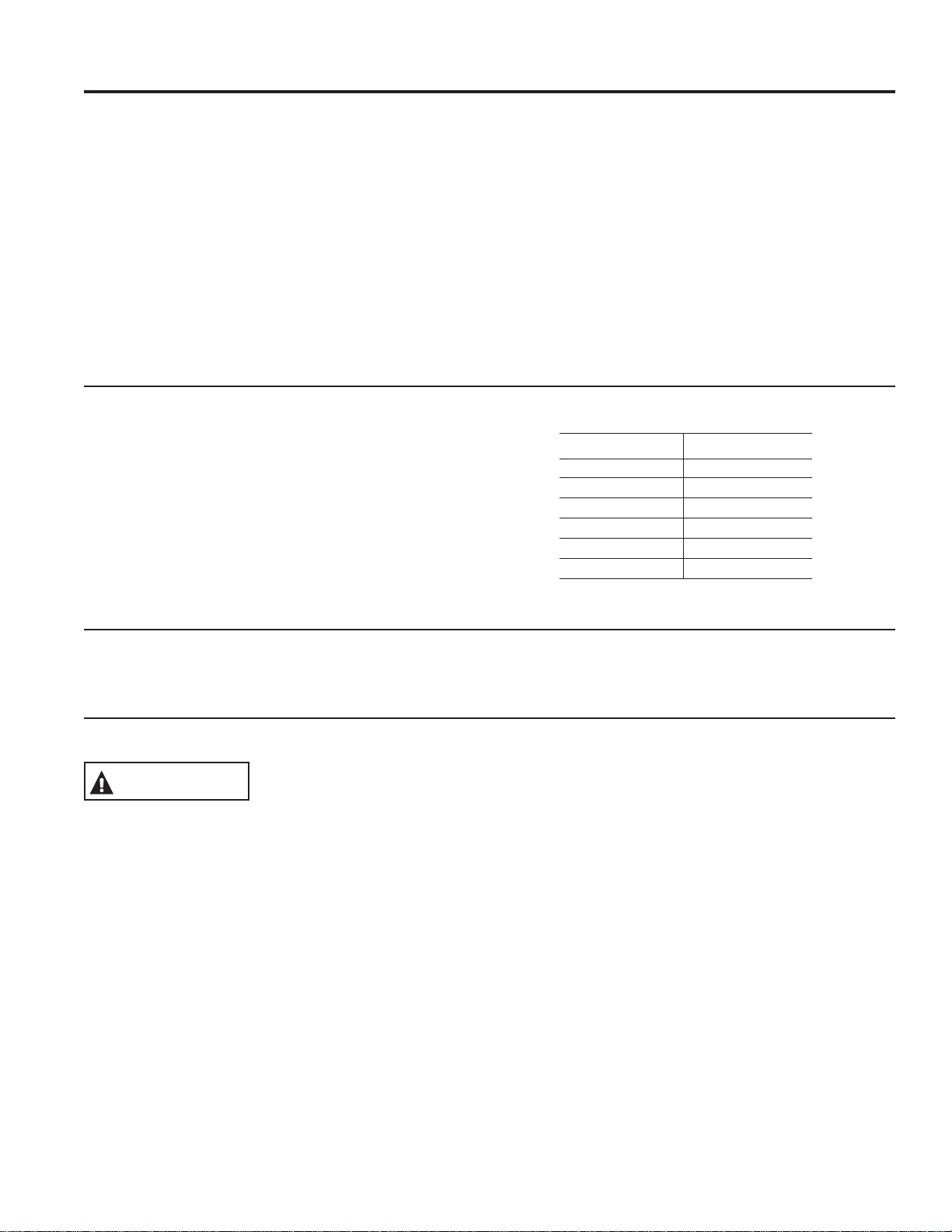
Temperature Selection Chart
To keep several different foods hot, set the control to the
food needing the highest setting.
Ŷ 7KHWHPSHUDWXUHW\SHDQGDPRXQWRIIRRGDQGWKH
time held will affect the quality of the food.
Ŷ 5HSHDWHGRSHQLQJRIWKHGUDZHUDOORZVWKHKRWDLUWR
escape and the food to cool.
Ŷ :LWKODUJHORDGVLWPD\EHQHFHVVDU\WRXVHDKLJKHU
warming drawer setting and cover some of the
cooked food items.
Ŷ 'RQRWXVHSODVWLFFRQWDLQHUVRUSODVWLFZUDS
To Warm Serving Bowls and Plates
'LVKHVZLOOEHKRW8VHSRWKROGHUVRUPLWWVZKHQ
removing hot dishes.
To warm serving bowls and plates, set the control on LO/1.
Ŷ 8VHRQO\KHDWVDIHGLVKHV
Ŷ ,I\RXZDQWWRKHDWILQHFKLQDSOHDVHFKHFNZLWKWKH
manufacturer of the dishes for their maximum heat
tolerance.
Ŷ <RXPD\ZDUPHPSW\VHUYLQJGLVKHVZKLOHSUHKHDWLQJ
the drawer.
To Crisp Stale Items
Ŷ 3ODFHIRRGLQORZVLGHGGLVKHVRUSDQV
Ŷ 3UHKHDWRQLO/1 setting.
Ŷ &KHFNFULVSQHVVDIWHUPLQXWHV$GGWLPHDV
needed.
Food Type Control Setting
&DVVHUROH 0('
&KLOL +,
3L]]D 0('
3RWDWRHVEDNHG +,
7RUWLOOD&KLSV /2
:DIIOHV /2
USING THE RANGE: Warming Drawer
Warming Drawer (on some models)
CAUTION
49-80694-2
23
Cleaning the Range – Exterior
CARE AND CLEANING: Cleaning the Range – Exterior
If your range is removed for cleaning, servicing or any reason, be
sure the anti-tip device is reengaged properly when the range is
replaced. Failure to take this precaution could result in tipping of
the range and can result in death or serious burns to children or
adults. Do not use oven cleaners, abrasive cleansers, strong liquid
cleansers, steel wool, plastic scouring pads, or cleaning powders on
the interior or exterior of the range.
WARNING
%HVXUHDOOFRQWUROVDUHRIIDQGDOOVXUIDFHVDUHFRROEHIRUHFOHDQLQJDQ\SDUWRIWKHUDQJH
Control Lockout
If desired, the touch pads may be deactivated before
cleaning.
See Lock Controls in the Oven Controls section in this
manual.
Clean up splatters with a damp cloth.
<RXPD\DOVRXVHDJODVVFOHDQHU
Remove heavier soil with warm, soapy water. Do not use
abrasives of any kind.
Reactivate the touch pads after cleaning.
Control Panel
It’s a good idea to wipe the control panel after each use.
Clean with mild soap and water or vinegar and water,
rinse with clean water and polish dry with a soft cloth.
Do not use abrasive cleansers, strong liquid cleansers,
plastic scouring pads or oven cleaners on the control
SDQHO²WKH\ZLOOGDPDJHWKHILQLVK
Range Exterior
Clean with a mild soap and water or vinegar and water
solution. Rinse with clean water and dry with a soft cloth.
When cleaning surfaces, make sure that they are at
room temperature and not in direct sunlight.
If stain on the door vent trim is persistent, use a mild
abrasive cleaner and a sponge-scrubber for best results.
Spillage of marinades, fruit juices, tomato sauces and
basting liquids containing acids may cause discoloration
and should be wiped up immediately. Let hot surfaces
cool, then clean and rinse.
Painted Surfaces
Painted surfaces include the sides of the range and the
doors, and top of control panel. Clean these with soap and
water or a vinegar and water solution.
Do not use commercial oven cleaners, cleaning powders,
steel wool or harsh abrasives on any painted surface.
Stainless Steel Surfaces
Do not use a steel wool pad; it will scratch the surface.
To clean the stainless steel surface, use warm sudsy
water or a stainless steel cleaner or polish. Always wipe
the surface in the direction of the grain. Follow the cleaner
instructions for cleaning the stainless steel surface.
To inquire about purchasing cleaning products including
stainless steel appliance cleaner or polish read the
Assistance and Accessories sections at the beginning of
this manual.

24
49-80694-2
The interior of your new oven can be cleaned manually or by using Steam Clean or Self Clean modes.
Spillage of marinades, fruit juices, tomato sauces and basting liquids containing acids may cause discoloration and
should be wiped up immediately. Let hot surfaces cool, then clean and rinse.
Manual Cleaning
Do not use oven cleaners, abrasive cleaners, strong
liquid cleansers, steel wool, scouring pads, or cleaning
powders on the interior of the oven. Clean with a mild
soap and water or vinegar and water solution. Rinse with
clean water and dry with a soft cloth. When cleaning
surfaces, make sure that they are at room temperature.
Self Clean Mode
Read Self-Cleaning Oven Safety Instructions at the
beginning of this manual before using Self Clean Mode.
Self clean uses very high temperatures to clean the oven
interior. The oven door will lock when using this feature.
%HIRUHRSHUDWLQJWKHVHOIFOHDQF\FOHZLSHXSJUHDVHDQG
soils from the oven. Remove all items from the oven other
than enameled (dark color) racks. Shiny or silver racks
and any cookware or other items should all be removed
from the oven before initiating a self-clean cycle. Close
the door. Press the Self Clean pad and a default self-
clean time is displayed. The clean time can be changed
WRDQ\WLPHEHWZHHQDQGKRXUVE\XVLQJWKH
number pads to enter a different time and pressing Start.
)RUKHDYLO\VRLOHGRYHQVWKHPD[LPXPKRXUFOHDQWLPH
is recommended. If you wish to use the default time, press
the Start pad immediately after pressing the Clean pad.
The oven will turn off automatically when the self-clean
cycle is complete. The door will stay locked until the oven
has cooled down. After the oven has cooled down wipe
any ash out of the oven.
We recommend venting your kitchen with an open
window or using a ventilation fan or hood during the first
self-clean cycle.
Soil on the front frame of the range and outside the
gasket on the door will need to be cleaned by hand.
Clean these areas with hot water, soap-filled steel-wool
pads or cleansers such as Soft Scrub
®
. Rinse well with
clean water and dry.
Do not clean the gasket. The fiberglass material of
the oven door gasket cannot withstand abrasion. It is
essential for the gasket to remain intact. If you notice it
becoming worn or frayed, replace it.
Make sure the oven light bulb cover is in place and the
oven light is off.
IMPORTANT: The health of some birds is extremely
sensitive to the fumes given off during the self-cleaning
cycle of any range. Move birds to another well-
ventilated room.
On Some Models:
The surface units are automatically disabled during the
self-clean cycle. Make sure that all surface unit controls
are turned off at all times during the self-clean cycle.
$Q\VXUIDFHXQLWWKDWLVVHWWRDQ³RQ´SRVLWLRQZKLOHWKH
self-clean cycle is operating will automatically come on
after the self-clean cycle is finished, and could result in
DQ³RQ´XQDWWHQGHGVXUIDFHXQLW:DLWXQWLOWKHVHOIFOHDQ
cycle is finished to set and use the surface units.
CARE AND CLEANING: Cleaning the Range – Interior
Cleaning the Range – Interior
Racks
All racks can be washed with warm, soapy water.
Enameled (not shiny) racks can be left in the cavity
during self clean.
Racks may be more difficult to slide, especially after
a self-clean. Put some vegetable oil on a soft cloth or
paper towel and rub onto the left and right edges.
Oven Heating Elements
Do not clean the broil element. Any soil will burn off
when the elements are heated.
The bake element is not exposed and is under the oven
floor. Clean the oven floor with warm, soapy water.
Steam Clean Mode
Steam clean is intended to clean small spills using water
and a lower cleaning temperature than Self-Clean.
To use the Steam Clean feature, wipe grease and soils
from the oven. Pour one cup of water into the bottom of
the oven. Close the door. Press the Steam Clean pad
DQGWKHQSUHVV6WDUW7KHRYHQGRRUZLOOORFN<RXFDQ
not open the door during the 30 minute steam clean as
this will decrease the steam clean performance. At the
end of the steam clean cycle the door will unlock. Wipe
out any excess water and any remaining soil.
Wipe up heavy soil on the oven bottom.
49-80694-2
25
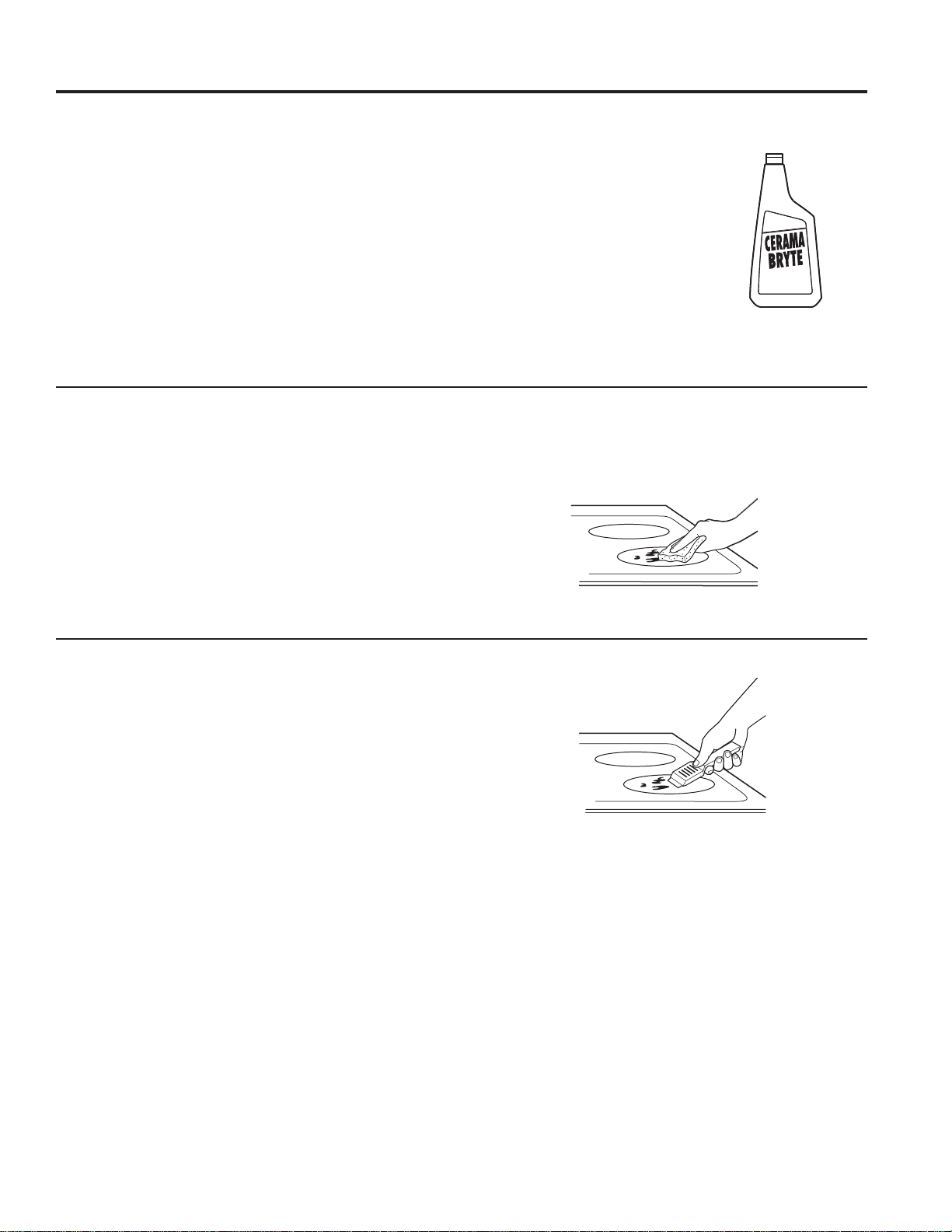
Use a CERAMA BRYTE
®
Cleaning
Pad for Ceramic Cooktops.
Cleaning the Glass Cooktop
Normal Daily Use Cleaning
21/<XVH&(5$0$%5<7(
®
Ceramic Cooktop Cleaner
on the glass cooktop. Other creams may not be as
effective.
To maintain and protect the surface of your glass
cooktop, follow these steps:
%HIRUHXVLQJWKHFRRNWRSIRUWKHILUVWWLPHFOHDQLW
ZLWK&(5$0$%5<7(
®
Ceramic Cooktop Cleaner.
This helps protect the top and makes cleanup easier.
'DLO\XVHRI&(5$0$%5<7(
®
Ceramic Cooktop
Cleaner will help keep the cooktop looking new.
3. Shake the cleaning cream well. Apply a few drops of
&(5$0$%5<7(
®
Ceramic Cooktop Cleaner directly
to the cooktop.
8VHDSDSHUWRZHORU
&(5$0$%5<7(
®
Cleaning
Pad for Ceramic Cooktops
to clean the entire cooktop
surface.
8VHDGU\FORWKRUSDSHUWRZHO
to remove all cleaning residue.
No need to rinse.
NOTE: It is very important that
you DO NOT heat the cooktop
until it has been cleaned
thoroughly.
Burned-On Residue
NOTE: DAMAGE to your glass surface may occur if you
use scrub pads other than those recommended.
1. Allow the cooktop to cool.
6SUHDGDIHZGURSVRI&(5$0$%5<7(
®
Ceramic
Cooktop Cleaner on the entire burned residue area.
8VLQJWKHLQFOXGHG&(5$0$%5<7(
®
Cleaning Pad
for Ceramic Cooktops, rub the residue area, applying
pressure as needed.
4. If any residue remains, repeat the steps listed above
as needed.
)RUDGGLWLRQDOSURWHFWLRQDIWHUDOOUHVLGXHKDVEHHQ
removed, polish the entire surface with CERAMA
%5<7(
®
Ceramic Cooktop Cleaner and a paper towel.
Heavy, Burned-On Residue
1. Allow the cooktop to cool.
8VHDVLQJOHHGJHUD]RUEODGHVFUDSHUDWDSSUR[LPDWHO\
DDQJOHDJDLQVWWKHJODVVVXUIDFHDQGVFUDSHWKH
soil. It will be necessary to apply pressure to the razor
scraper in order to remove the residue.
3. After scraping with the razor scraper, spread a few drops
RI&(5$0$%5<7(
®
Ceramic Cooktop Cleaner on the
HQWLUHEXUQHGUHVLGXHDUHD8VHWKH&(5$0$%5<7(
®
Cleaning Pad to remove any remaining residue.
4. For additional protection, after all residue has been
removed, polish the entire surface with CERAMA
%5<7(
®
Ceramic Cooktop Cleaner and a paper towel.
Clean your cooktop after each
spill. Use CERAMA BRYTE
®
Ceramic Cooktop Cleaner.
The CERAMA BRYTE
®
Ceramic Cooktop Scraper and all recommended
supplies are available through our Parts Center. See instructions under
“Assistance / Accessories” section.
NOTE: Do not use a dull or nicked blade.
CARE AND CLEANING: Cleaning the Glass Cooktop
26
49-80694-2
Metal Marks and Scratches
%HFDUHIXOQRWWRVOLGHSRWVDQGSDQVDFURVV\RXU
cooktop. It will leave metal markings on the cooktop
surface.
These marks are removable using the CERAMA
%5<7(
®
Ceramic Cooktop Cleaner with the CERAMA
%5<7(
®
Cleaning Pad for Ceramic Cooktops.
2. If pots with a thin overlay of aluminum or copper
are allowed to boil dry, the overlay may leave black
discoloration on the cooktop.
This should be removed immediately before heating
again or the discoloration may be permanent.
NOTE: Carefully check the bottom of pans for roughness
that would scratch the cooktop.
Damage from Sugary Spills and Melted Plastic
Special care should be taken when removing hot substances to avoid permanent damage of the glass surface.
Sugary spillovers (such as jellies, fudge, candy, syrups) or melted plastics can cause pitting of the surface of your
cooktop (not covered by the warranty) unless the spill is removed while still hot. Special care should be taken when
removing hot substances.
%HVXUHWRXVHDQHZVKDUSUD]RUVFUDSHU
Do not use a dull or nicked blade.
1. Turn off all surface units. Remove hot pans.
2. Wearing an oven mitt:
D8VHDVLQJOHHGJHUD]RUEODGHVFUDSHU&(5$0$
%5<7(
®
Ceramic Cooktop Scraper) to move the
spill to a cool area on the cooktop.
b. Remove the spill with paper towels.
3. Any remaining spillover should be left until the surface
of the cooktop has cooled.
4. Don’t use the surface units again until all of the
residue has been completely removed.
NOTE: If pitting or indentation in the glass surface has
already occurred, the cooktop glass will have to be
replaced. In this case, service will be necessary.
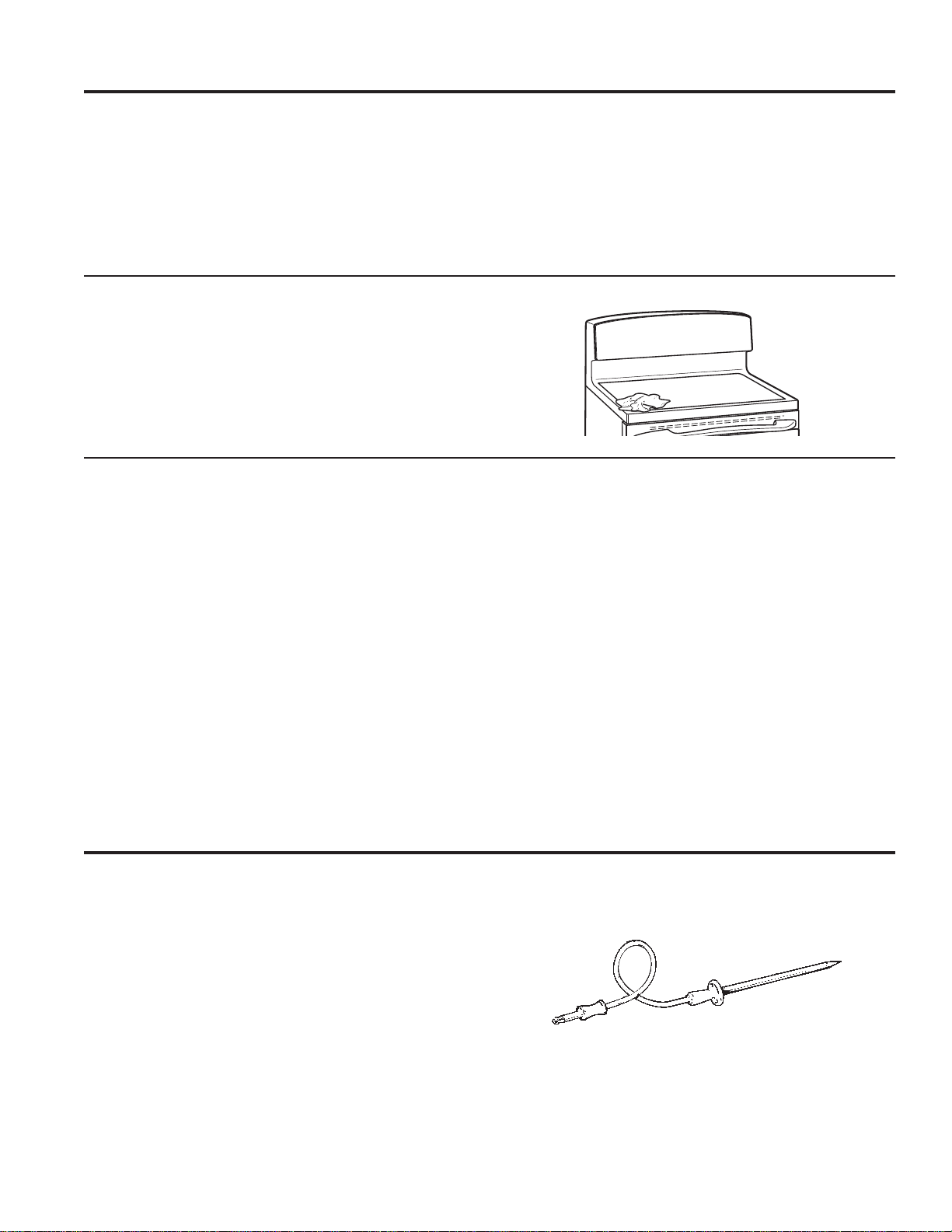
The temperature probe may be cleaned with soap and
water or a soap-filled scouring pad. Cool the temperature
probe before cleaning. Scour stubborn spots with a soap-
filled scouring pad, rinse and dry.
To order additional temperature probes read the
Assistance and Accessories sections at the beginning of
this manual.
Ŷ Do not immerse the temperature probe in water.
Ŷ Do not store the temperature probe in the oven.
Ŷ Do not leave the temperature probe inside the oven
during a self or steam clean cycle.
Cooktop Seal
To clean the cooktop seal around the edges of the glass,
lay a wet cloth on it for a few minutes, then wipe clean
with nonabrasive cleaners.
CARE AND CLEANING: Cleaning the Glass Cooktop / Probe
Cleaning the Glass Cooktop (Cont.)
Probe
49-80694-2
27
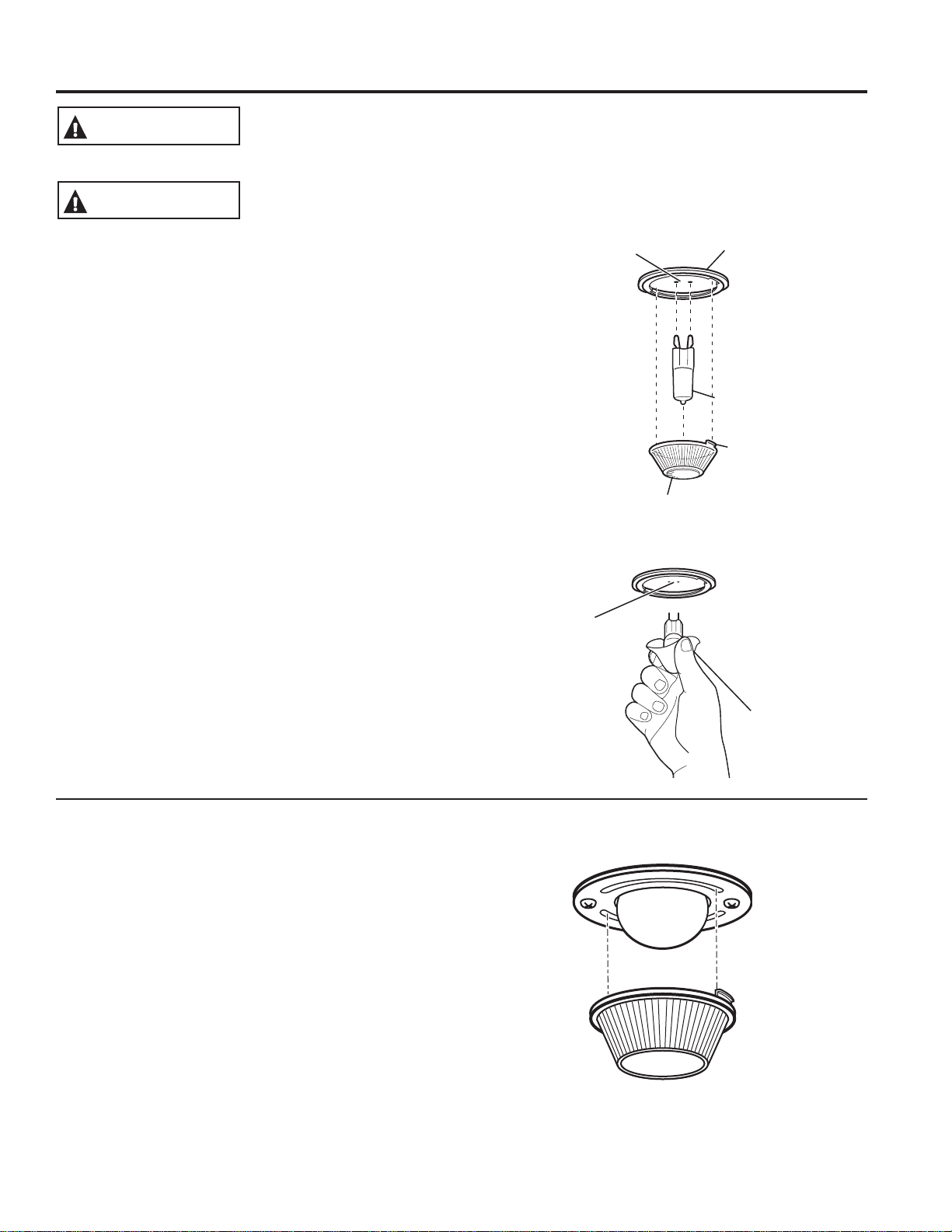
Use
gloves or
cloth
Receptacle
G9 Bulb
Socket
Tab
Glass cover
Receptacle
(on some models)
SHOCK OR BURN HAZARD:%HIRUHUHSODFLQJRYHQOLJKWEXOEGLVFRQQHFWWKHHOHFWULFDO
power to the range at the main fuse or circuit breaker panel. Failure to do so may result
in electric shock or burn.
WARNING
BURN HAZARD: The glass cover and bulb should be removed when cool. Touching hot
glass with bare hands or a damp cloth can cause burns.
CAUTION
Oven Light Replacement (on some models)
To remove:
7XUQWKHJODVVFRYHUFRXQWHUFORFNZLVHWXUQXQWLO
the tabs of the glass cover clear the grooves of the
socket. Wearing latex gloves may offer a better grip.
8VLQJJORYHVRUDGU\FORWKUHPRYHWKHEXOEE\
pulling it straight out.
To replace:
8VHDQHZYROWKDORJHQEXOEQRWWRH[FHHG
ZDWWV5HSODFHWKHEXOEZLWKWKHVDPHW\SHRIEXOE
WKDWZDVUHPRYHG%HVXUHWKHUHSODFHPHQWEXOELV
rated 120 volts or 130 volts (NOT 12 volts).
8VLQJJORYHVRUDGU\FORWKUHPRYHWKHEXOEIURPLWV
packaging. Do not touch the bulb with bare fingers.
Oil from skin will damage the bulb and shorten its life.
3. Push the bulb straight into the receptacle all the way.
4. Place the tabs of the glass cover into the grooves of
WKHVRFNHW7XUQWKHJODVVFRYHUFORFNZLVHWXUQ
For improved lighting inside the oven, clean the glass
cover frequently using a wet cloth. This should be
done when the oven is completely cool.
5HFRQQHFWHOHFWULFDOSRZHUWRWKHRYHQ
Oven Light Replacement (on some models)
To remove:
7XUQWKHJODVVFRYHUFRXQWHUFORFNZLVHWXUQXQWLO
the tabs of the glass cover clear the grooves of the
socket. Wearing latex gloves may offer a better grip.
2. Remove the bulb by turning it counter-clockwise.
To replace:
1. Replace bulb with a new 40-watt appliance bulb.
Insert the bulb and turn it clockwise until it is tight.
2. Place the tabs of the glass cover into the grooves of
WKHVRFNHW7XUQWKHJODVVFRYHUFORFNZLVHWXUQ
For improved lighting inside the oven, clean the glass
cover frequently using a wet cloth. This should be
done when the oven is completely cool.
3. Reconnect electrical power to the oven.
CARE AND CLEANING: Maintenance
Maintenance
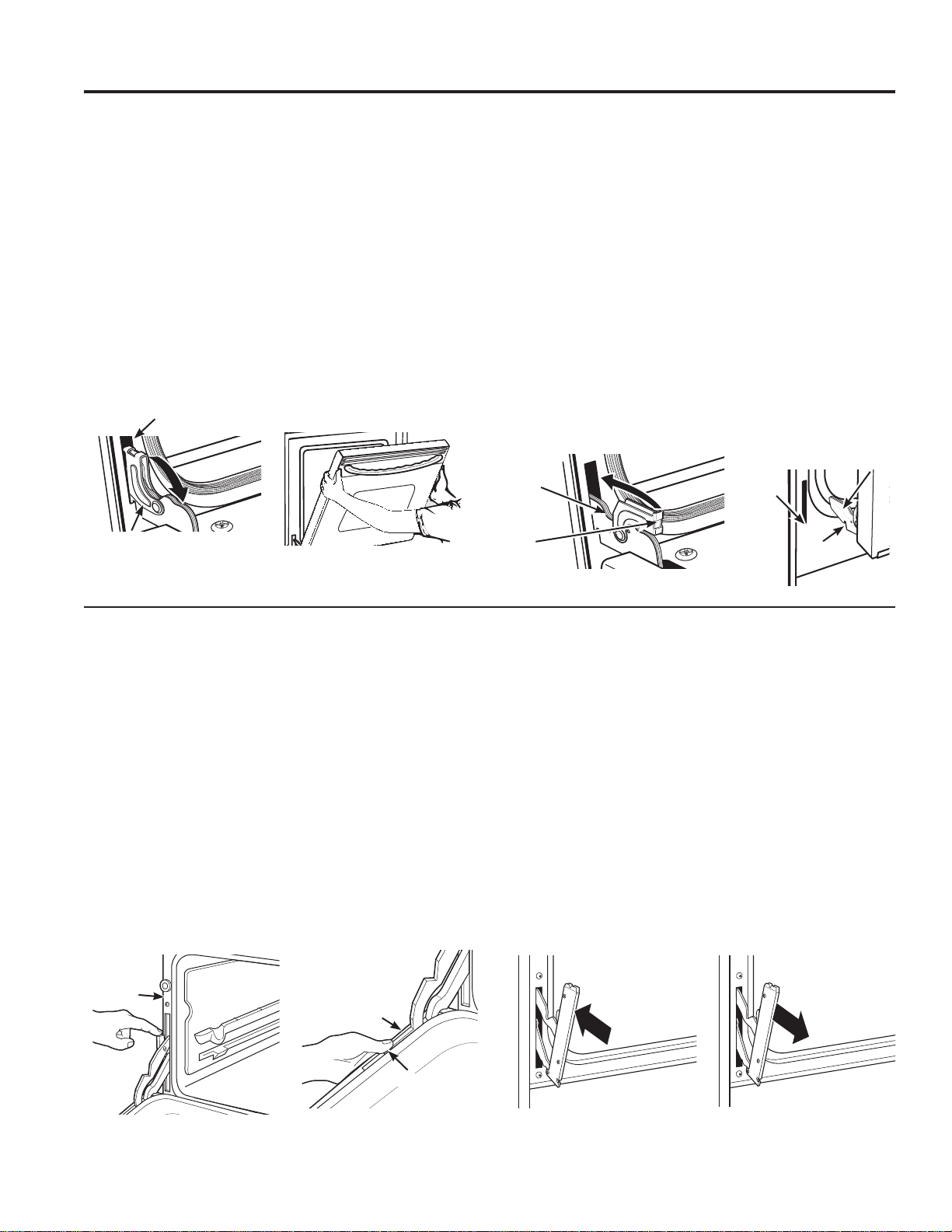
28
49-80694-2
Lift-Off Single/Lower Oven Door
7KHGRRULVYHU\KHDY\%HFDUHIXOZKHQUHPRYLQJDQGOLIWLQJWKHGRRU
Do not lift the door by the handle.
To remove the door:
1. Fully open the door.
2. Pull the hinge locks down toward the door frame, to
the unlocked position. A tool, such as a small flat-
blade screwdriver, may be required.
3. Firmly grasp both sides of the door at the top.
4. Close door to the door removal position. The door
should be open approximately 3" with no obstruction
above the door.
/LIWGRRUXSDQGRXWXQWLOERWKKLQJHDUPVDUHFOHDURI
the slots.
To replace the door:
1. Firmly grasp both sides of the door at the top.
2. Starting on the left side, with the door at the same
angle as the removal position, seat the indentation of
the hinge arm into the bottom edge of the hinge slot.
The notch in the hinge arm must be fully seated into
the bottom of the slot. Repeat for right side.
3. Fully open the door. If the door will not fully open, the
indentation is not seated correctly in the bottom edge
of the slot.
4. Push the hinge locks up against the front frame of the
oven cavity, to the locked position.
&ORVHWKHRYHQGRRU
Lift-Off Upper Oven Door (for double oven)
To remove the door:
1. Fully open the door.
2. Lift up on the hinge lock toward the oven frame until
they stop.
&ORVHWKHGRRUWRGHJUHHV\RXZLOOIHHOWKHGRRU
stop). The hinge lock will contact the oven frame.
4. On both sides of the door, press down on the release
buttons on each hinge.
/LIWGRRUXSXQWLOLWLVFOHDURIWKHKLQJH
6. Pull on hinge arms slightly to relieve pressure on the
locking tabs.
7. Push the hinge locks down onto the hinge.
8. Push the hinges in toward the unit so they are closed.
To replace the door:
1. Pull the hinges down away from the oven frame to
the fully open position.
2. Lift up on the hinge locks toward the oven frame until
they stop.
7KHKLQJHVZLOOUHOHDVHWRWKHGHJUHHSRVLWLRQ7KH
hinge locks will contact the oven frame.
4. Slide the door back onto the hinges. Make sure the
buttons pop back out.
)XOO\RSHQWKHGRRU
6. Push the hinge locks down onto the hinge.
7. Close the oven door.
Removal position
Hinge lock
Slot
Pull hinge locks down to unlock
Push hinge locks up to lock
Hinge
lock
Hinge
arm
Indentation
Bottom
edge of
slot
Hinge arm
CARE AND CLEANING: Maintenance
Maintenance (Cont.)
Oven
frame
Door
frame
Release
buttons
Pull down
Push in
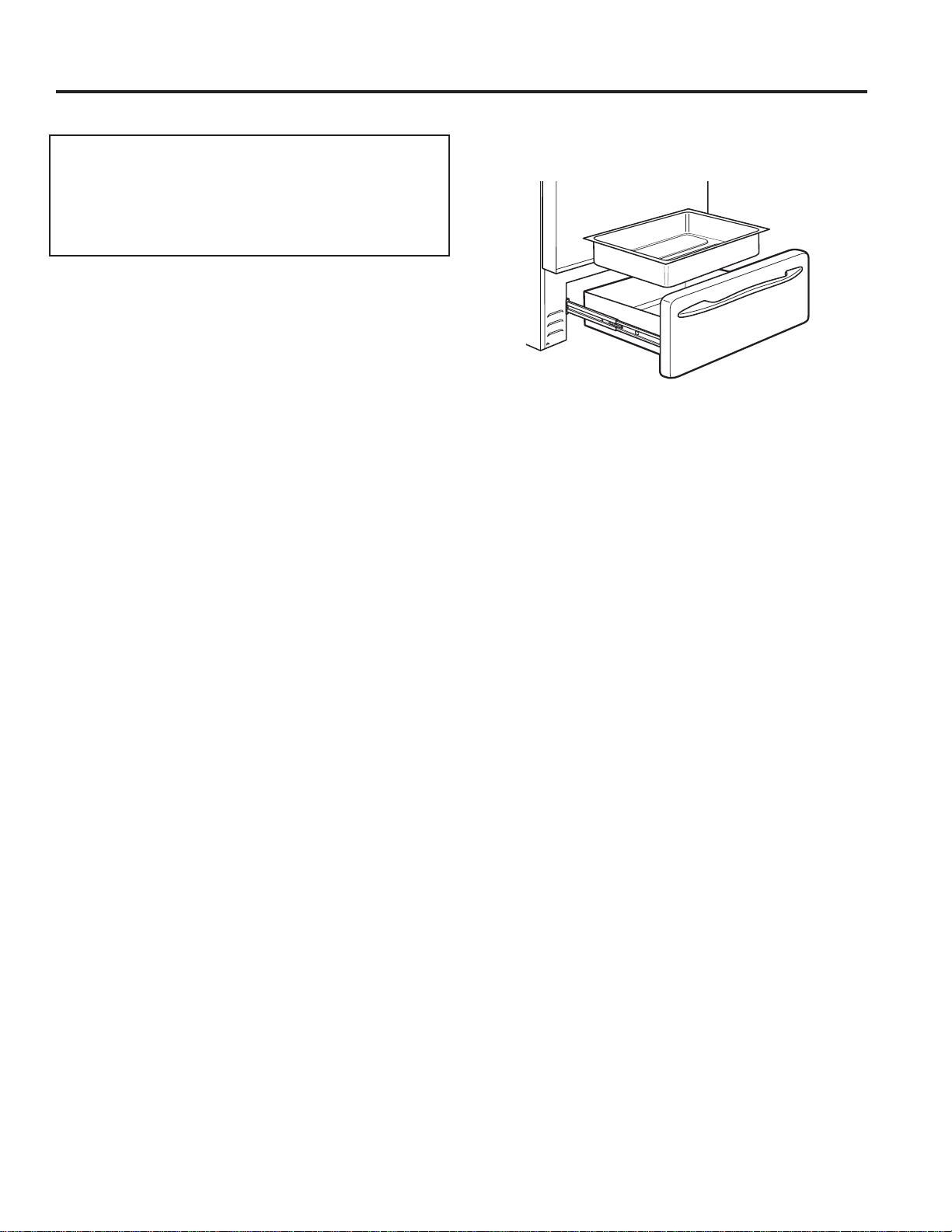
49-80694-2
29
Removable Warming Drawer Pan (on some models)
NOTE: For models with an electric warming drawer
before performing any adjustments, cleaning or service,
disconnect the range electrical power supply at the
household distribution panel by removing the fuse or
switching off the circuit breaker. Make sure the drawer
heating element is cool.
NOTE: Allow warming drawer to cool before removing pan.
NOTE: Wipe spills promptly after each use.
Ŷ 1HYHUSODFHXVHRUVHOIFOHDQWKHGUDZHUSDQLQWKH
upper oven.
Ŷ :DUPLQJGUDZHUKDVDUHPRYDEOHSDQIRUHDV\
cleaning. Clean with hot, soapy water and a sponge
or dish towel. Dry with a clean cloth. Replace the pan
in the warming drawer.
CARE AND CLEANING: Maintenance
Maintenance (Cont.)
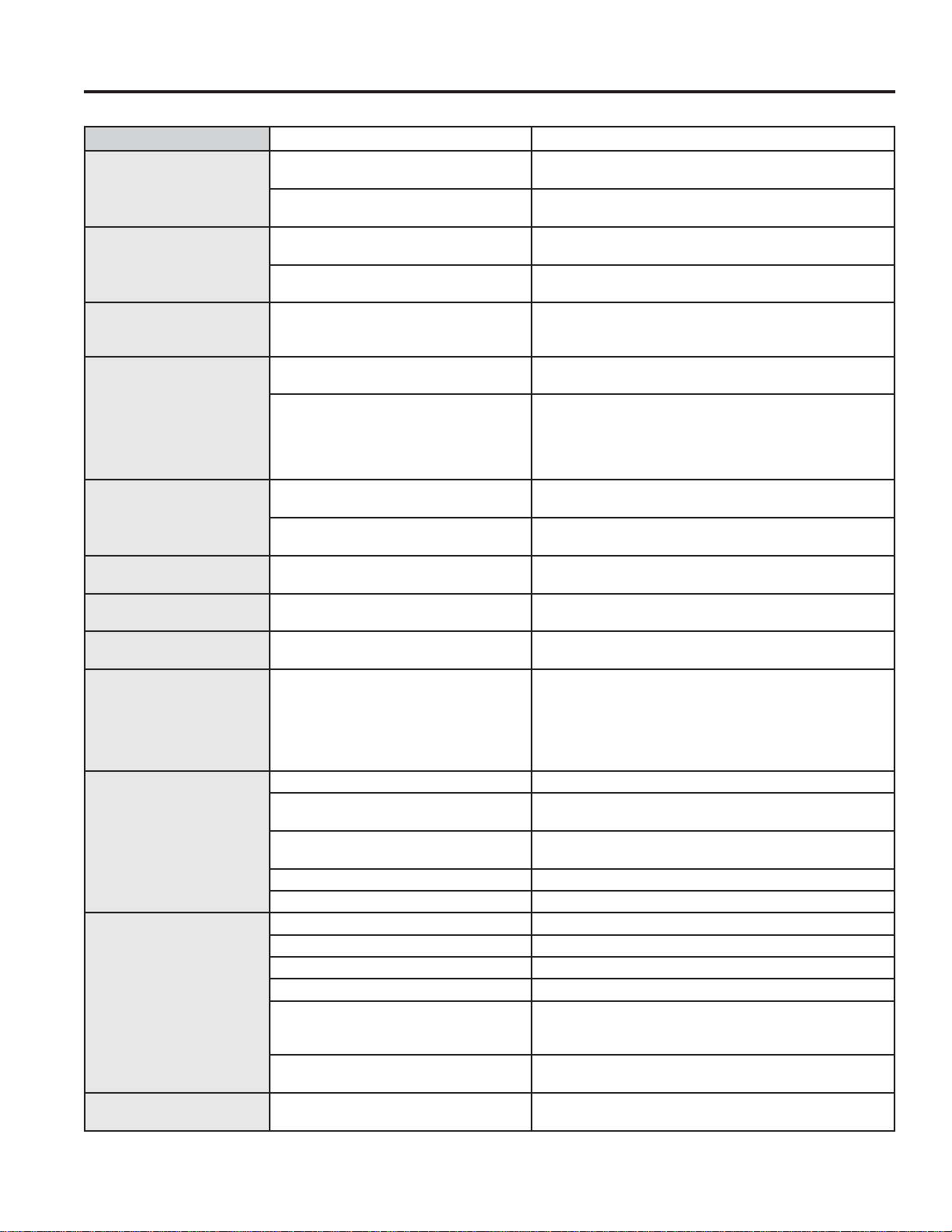
30
49-80694-2
Save time and money! Review the charts on the following pages first and you may not need to call for service.
Problem Possible Cause What To Do
Surface units will not
maintain a rolling boil
or cooking is not fast
enough
Improper cookware being used. 8VHSDQVZKLFKDUHIODWDQGPDWFKWKHGLDPHWHURIWKH
surface unit selected.
In some areas, the power (voltage)
may be low.
Cover pan with a lid until desired heat is obtained.
Surface units do not work
properly
A fuse in your home may be blown or
the circuit breaker tripped.
Replace the fuse or reset the circuit breaker.
Cooktop controls improperly set. Check to see the correct control is set for the surface unit
you are using.
Surface unit stops
glowing when turned to a
lower setting
The unit is still on and hot. This is normal.
Scratches (may appear as
cracks) on cooktop glass
surface
Incorrect cleaning methods being used.
Scratches are not removable. Tiny scratches will become
less visible in time as a result of cleaning.
Cookware with rough bottoms being
used or coarse particles (salt or sand)
were between the cookware and the
surface of the cooktop. Cookware has
been slid across the cooktop surface.
To avoid scratches, use the recommended cleaning
procedures. Make sure bottoms of cookware are clean
before use, and use cookware with smooth bottoms.
Areas of discoloration on
the cooktop
Food spillovers not cleaned before
next use.
See the Cleaning the glass cooktop section.
Hot surface on a model with a light-
colored cooktop.
This is normal. The surface may appear discolored when it is
hot. This is temporary and will disappear as the glass cools.
Plastic melted to the
surface
Hot cooktop came into contact with
plastic placed on the hot cooktop.
6HHWKH*ODVVVXUIDFH²SRWHQWLDOIRUSHUPDQHQWGDPDJH
section in the Cleaning the glass cooktop section.
Pitting (or indentation) of
the cooktop
Hot sugar mixture spilled on the
cooktop.
Call a qualified technician for replacement.
Frequent cycling off and
on of surface units
Improper cookware being used. 8VHRQO\IODWFRRNZDUHWRPLQLPL]HF\FOLQJ
My new oven doesn't
cook like my old one. Is
something wrong with the
temperature settings?
Your new oven has a different cooking
system from your old oven and
therefore may cook differently than
your old oven.
For the first few uses, follow your recipe times and
temperatures carefully. If you still think your new oven is
too hot or too cold, you can adjust the temperature yourself
to meet your specific cooking preference. NOTE: This
DGMXVWPHQWDIIHFWV%DNHDQG&RQYHFWLRQ%DNHWHPSHUDWXUHV
LWZLOOQRWDIIHFW%URLORU&OHDQ
Food does not bake
properly
Oven controls improperly set. See the Cooking Modes section.
Rack position is incorrect or rack is
not level.
See the Cooking Modes section and Cooking Guide.
Incorrect cookware or cookware of
improper size being used.
See the Cookware section.
Oven temperature needs adjustment. See the Special Features section.
Ingredient substitution Substituting ingredients can change the recipe outcome.
Food does not broil
properly
Oven controls improperly set. Make sure you select the appropriate broil mode.
Improper rack position being used. See Cooking Guide for rack location suggestions.
Food being cooked in a hot pan. Make sure cookware is cool.
Cookware not suited for broiling. 8VHDSDQVSHFLILFDOO\GHVLJQHGIRUEURLOLQJ
Aluminum foil used on the broiling
pan and grid has not been fitted
properly and slit as recommended.
If using aluminum foil conform to pan slits.
In some areas the power (voltage)
may be low.
Preheat the broil element for 10 minutes.
Oven temperature too hot
or too cold
Oven temperature needs adjustment. See the Special Features section.
Troubleshooting tips ... Before you call for service
TROUBLESHOOTING TIPS
49-80694-2
31
Problem Possible Cause What To Do
Oven does not work or
appears not to work
A fuse in your home may be blown
or the circuit breaker tripped.
Replace the fuse or reset the circuit breaker.
Oven controls improperly set. 6HHWKH8VLQJWKH2YHQVHFWLRQ
Oven is in Sabbath Mode. Verify, that the oven is not in Sabbath Mode. See the Special
Features section.
“Crackling” or “popping”
sound
This is the sound of the metal
heating and cooling during both the
cooking and cleaning functions.
This is normal.
Why is my range making
a "clicking" noise when
using my oven?
Your range cycles the heating
elements by turning relays on and
off to maintain the oven temperature.
This is normal.
Clock and timer do not
work
A fuse in your home may be blown
or the circuit breaker tripped.
Replace the fuse or reset the circuit breaker.
Plug on range is not completely
inserted in the electrical outlet.
Make sure electrical plug is plugged into a live, properly
grounded outlet.
Oven controls improperly set. 6HHWKH8VLQJWKHNLWFKHQWLPHUVHFWLRQ
Oven door is crooked The door is out of position. %HFDXVHWKHRYHQGRRULVUHPRYDEOHLWVRPHWLPHVJHWVRXWRI
position during installation. To straighten the door, re-install the
door. See the "Lift-Off Oven Door" instructions in the "Care and
Cleaning" section.
Oven light does not work Light bulb is loose or defective. Tighten or replace bulb.
Pad operating light is broken. Call for service.
Oven will not self-clean The temperature is too high to set a
self-clean operation.
Allow the oven to cool and reset the controls.
Oven controls improperly set. See the Cleaning the Oven section.
Oven will not steam clean Display flashes HOT. Allow the oven to cool to room temperature and reset the
controls.
Oven controls improperly set. 6HHWKH8VLQJ6WHDP&OHDQVHFWLRQ
Oven door is not closed. Make sure you close the door to start steam clean cycle.
Excessive smoking during
clean cycle
Excessive soil or grease. Press the Cancel/Off pad. Open the windows to rid the room
of smoke. Wait until the LOCKED light goes off. Wipe up the
excess soil and reset the clean cycle.
Excessive smoking during
broiling
Food too close to burner element. Lower the rack position of the food.
Oven door will not open
after a clean cycle
Oven too hot. Allow the oven to cool below locking temperature.
Oven not clean after a
clean cycle
Oven controls improperly set. See the Cleaning the Oven section.
Oven was heavily soiled. Clean up heavy spillovers before starting the clean cycle.
Heavily soiled ovens may need to self-clean again or for a
longer period of time.
"LOCK DOOR" flashes in
the display
The self-clean cycle has been
selected but the door is not closed.
Close the oven door.
DOOR LOCK
light is on
when you want to cook
The oven door is locked because
the temperature inside the oven
has not dropped below the locking
temperature.
Press the Cancel/Off pad. Allow the oven to cool.
“F— and a number or
letter” flash in the display
You have a function error code. 3UHVVWKH&DQFHO2IISDG$OORZWKHRYHQWRFRROIRURQHKRXU
Put the oven back into operation.
If the function code repeats. Disconnect all power to the oven for at least 30 seconds and
then reconnect power. If the function error code repeats, call
for service.
Display goes blank A fuse in your home may be blown
or the circuit breaker tripped.
Replace the fuse or reset the circuit breaker.
The clock is turned off. See the Special features section.
Oven is in Sabbath Mode. Verify that the oven is not in Sabbath Mode. See the Special
Features section.
TROUBLESHOOTING TIPS
Troubleshooting tips (Cont.) ... Before you call for service