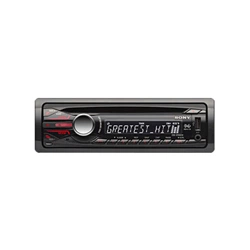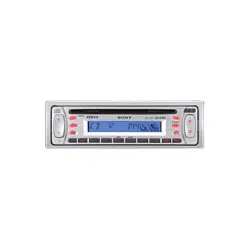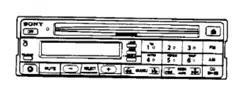
Operating Instructions
1998 by Sony Corporation
EN
FM/AM
Compact Disc
Player
CDX-C780
For installation and connections, see the supplied installation/connections
manual.
Owner’s Record
The model and serial numbers are located on the bottom of the unit.
Record the serial number in the space provided below.
Refer to these numbers whenever you call upon your Sony dealer regarding this
product.
Model No. CDX-C780 Serial No.

2
EN
Welcome !
Thank you for purchasing the Sony Compact
Disc Player. This unit lets you enjoy a variety
of features by using either an optional rotary
commander or an optional wireless remote.
In addition to the CD playback and radio
operations, you can expand your system by
connecting an optional CD/MD unit*
1
.
If you operate this unit or connect an optional
CD unit with the CD TEXT function, the
CD TEXT information will appear in the
display when you play back a CD TEXT disc*
2
.
*
1
You can connect to a CD changer and an MD
changer.
*
2
A CD TEXT disc is an audio CD that includes
information such as the disc name, artist name
and track names.
This information is recorded on the disc.
Warning
This equipment has been tested and found to
comply with the limits for a Class B digital
device, pursuant to Part 15 of the FCC Rules.
These limits are designed to provide
reasonable protection against harmful
interference in a residential installation. This
equipment generates, uses, and can radiate
radio frequency energy and, if not installed
and used in accordance with the instructions,
may cause harmful interference to radio
communications. However, there is no
guarantee that interference will not occur in a
particular installation. If this equipment does
cause harmful interference to radio or
television reception, which can be determined
by turning the equipment off and on, the user
is encouraged to try to correct the interference
by one or more of the following measures:
— Reorient or relocate the receiving antenna.
— Increase the separation between the
equipment and receiver.
— Connect the equipment into an outlet on a
circuit different from that to which the
receiver is connected.
— Consult the dealer or an experienced radio/
TV technician for help.
You are cautioned that any changes or
modifications not expressly approved in this
manual could void your authority to operate
this equipment.
CAUTION
The use of optical instruments with this
product will increase eye hazard.
3
EN
Table of Contents
This Unit Only
With Optional Equipment
Location of controls ................................................. 4
Getting Started
Resetting the unit ................................................ 6
Detaching the front panel .................................. 6
Setting the clock .................................................. 7
CD Player
Listening to a CD ................................................ 8
Playing a CD in various modes ........................ 9
Creating a program
— CD Program Memory ............................ 10
Radio
Memorizing stations automatically
— Best Tuning Memory (BTM) ................. 13
Memorizing only the desired stations ........... 13
Receiving the memorized stations.................. 13
Storing the station names
—Station Memo ........................................... 14
Locating a station by name
— List-up ...................................................... 15
Other Functions
Using the rotary commander .......................... 16
Adjusting the sound characteristics ............... 17
Attenuating the sound ..................................... 17
Changing the sound and display settings ..... 18
Adjusting the frequency of the
subwoofer(s) ................................................. 18
CD/MD Unit
Playing a CD or MD ......................................... 19
Scanning the tracks
— Intro Scan ................................................ 20
Playing tracks repeatedly
— Repeat Play ............................................. 20
Playing tracks in random order
— Shuffle Play .............................................. 20
Creating a program
— Program Memory ....................................
21
Labeling a CD
— Disc Memo ............................................... 23
Locating a disc by name
— List-up ...................................................... 25
Selecting specific tracks for playback
— Bank .......................................................... 25
DSP
Selecting a surround menu .............................. 26
Storing a surround effect onto CDs
— Digital Signal Processor (DSP) Custom
File.................................................................. 27
Selecting the listening position ....................... 28
Adjusting the fader (FAD) ............................... 29
Adjusting the volume of the subwoofer(s).... 29
Adjusting the volume of the bass and
treble .............................................................. 30
Listening to each program source in its
registered surround menu
— Last Sound Memory (LSM) ................... 30
Changing the line output level ....................... 30
TV/Video
Watching the TV ............................................... 31
Watching a video .............................................. 31
Memorizing TV channels automatically ....... 31
Memorizing only the desired TV channels ... 31
Storing the TV channel names ........................ 32
Displaying the information stored on discs ...
32
Watching the TV or video while listening to a
CD or MD
— Simultaneous Play .................................. 33
Additional Information
Precautions......................................................... 33
Maintenance....................................................... 34
Dismounting the unit ....................................... 35
Attaching the label to the rotary
commander ................................................... 35
Specifications ..................................................... 36
Troubleshooting guide ..................................... 37
4
EN
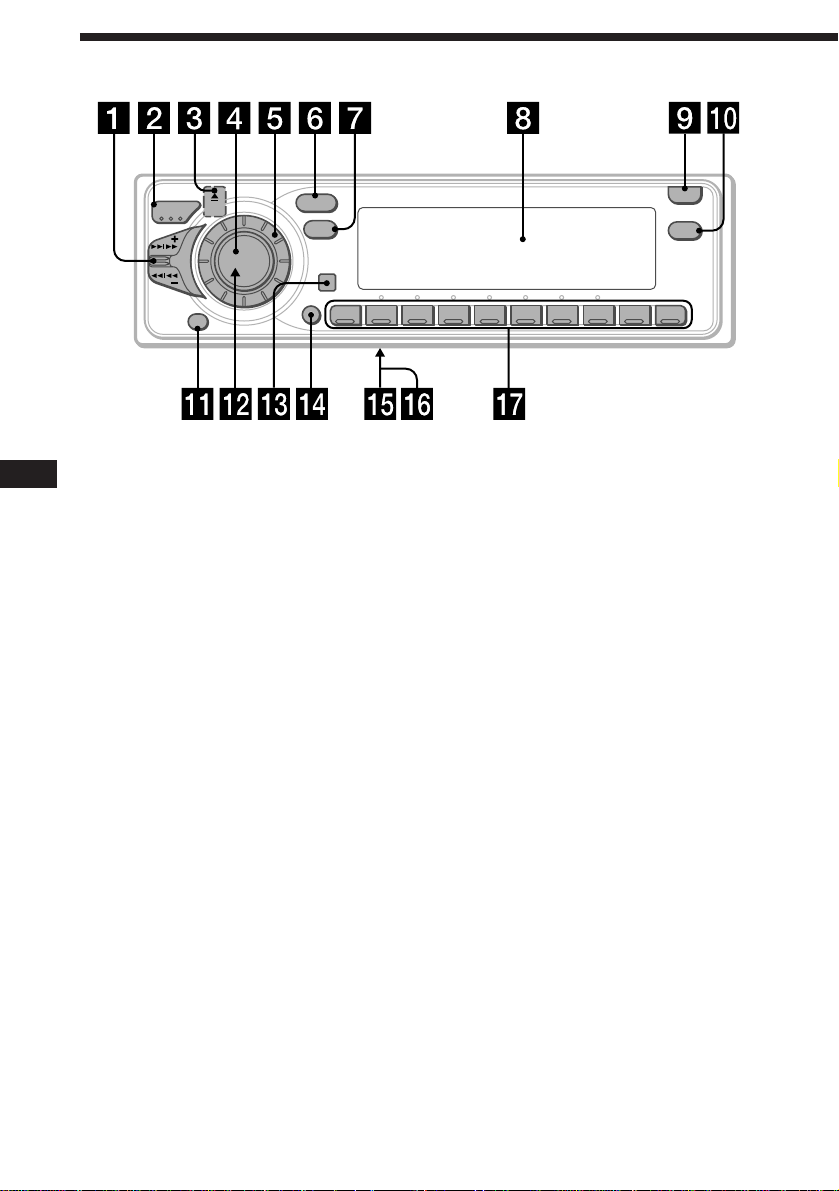
Location of controls
Refer to the pages for details.
1 SEEK/AMS (seek/Automatic Music
Sensor/manual search) control
9, 10, 12, 13, 14, 20, 21, 22, 25, 31
2 MODE (band/unit select) button
13, 19, 21, 24, 31
3 6 (eject) button (located on the front of
the unit hidden by the front panel) 8
4 SOURCE (source select) button
8, 13, 18, 19, 21, 24, 26, 27, 29, 30, 31, 33
5 Dial (volume/subwoofer volume/bass/
treble/left-right/rear-front control)
7, 15, 17, 23, 24, 26, 27, 28, 29, 30
6 SOUND button 17, 26, 27, 28, 29, 30
7 DSPL (display mode change) button
8, 9, 14, 15, 19, 24, 25
8 Display window
9 OPEN button 6, 8, 34
!º LIST button
Station Memo 14, 15, 32
Disc Memo 23, 24
List-up 15, 25
DSP Custom File 27
!¡ OFF button 6, 8
!™ Reset button (located on the front side
of the unit behind by the front panel) 6
!£ Receptor for the optional wireless
remote
!¢ SHIFT button
PLAY MODE 9, 10, 11, 12, 13, 14, 20, 21,
22, 23, 25, 26, 27, 31
REP 10, 20
SET UP 7, 9, 18, 19, 30
SHUF 10, 20
!∞ POWER SELECT switch (located on the
bottom of the unit)
See “POWER SELECT Switch” in the
Installation/Connections manual.
!§ LINE-OUT/IN SELECT switch (located on
the bottom of the unit)
See “LINE-OUT/IN SELECT switch” in
the Installation/Connections manual.
!¶ During radio reception:
Number buttons 13
During CD/MD playback:
Direct disc selection buttons 20, 21
During TV reception:
Number buttons 31
S
E
E
K
/
A
M
S
MODE
OFF
SOUND
DSPL
LIST
OPEN
SOURCE
SHIFT
12345678910
CDX-C780
5
EN
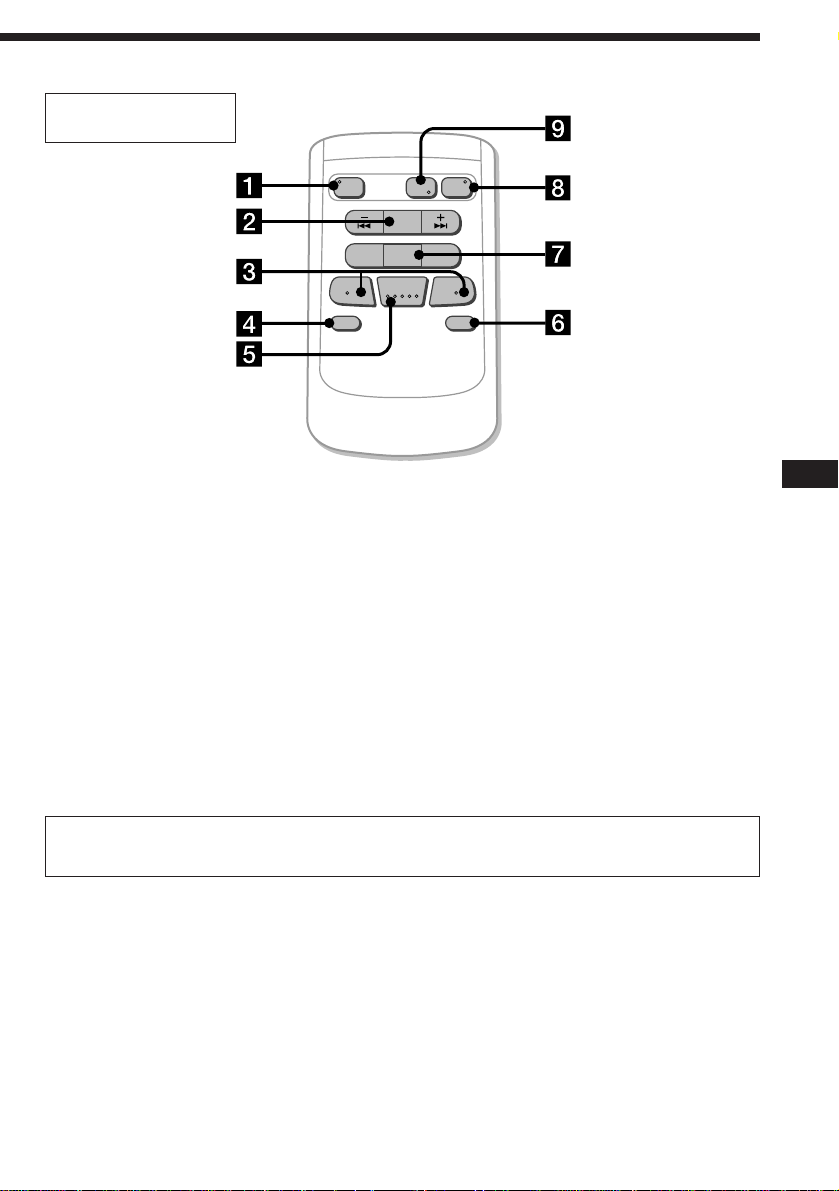
Optional wireless
remote (RM-X47)
The buttons of the wireless remote
work the same functions as those on
this unit.
1 OFF button
2 SEEK/AMS button
3 (–) (+) buttons
4 ATT button
5 SOUND/SEL button
6 DSPL button
7 PRESET/DISC button
You cannot do manual search and manual
tuning with the remote.
8 SOURCE button
9 MODE/DIR button
(MODE) controls the same function on this
unit.
When the POWER SELECT switch is set to the B position, the unit cannot be operated with the
wireless remote unless (SOURCE) on the unit is pressed or a CD is inserted to activate the unit
first.
OFF
SOURCE
DIR
SEL
+
FF
–
REW
SOUND
–
+
ATT DSPL
SEEK
AMS
PRESET
DISC
MODE
6
EN
Reset button
Getting Started
Resetting the unit
Before operating the unit for the first time or
after replacing the car battery, you must reset
the unit.
Press the reset button with a pointed object,
such as a ball-point pen.
Notes
• Pressing the reset button will erase the clock and
some memorized functions.
• When you connect the power supply cord to the
unit or reset the unit, wait for about 10 seconds
before you insert a disc. If you insert a disc within
these 10 seconds, the unit will not be reset, and
you will have to press the reset button again.
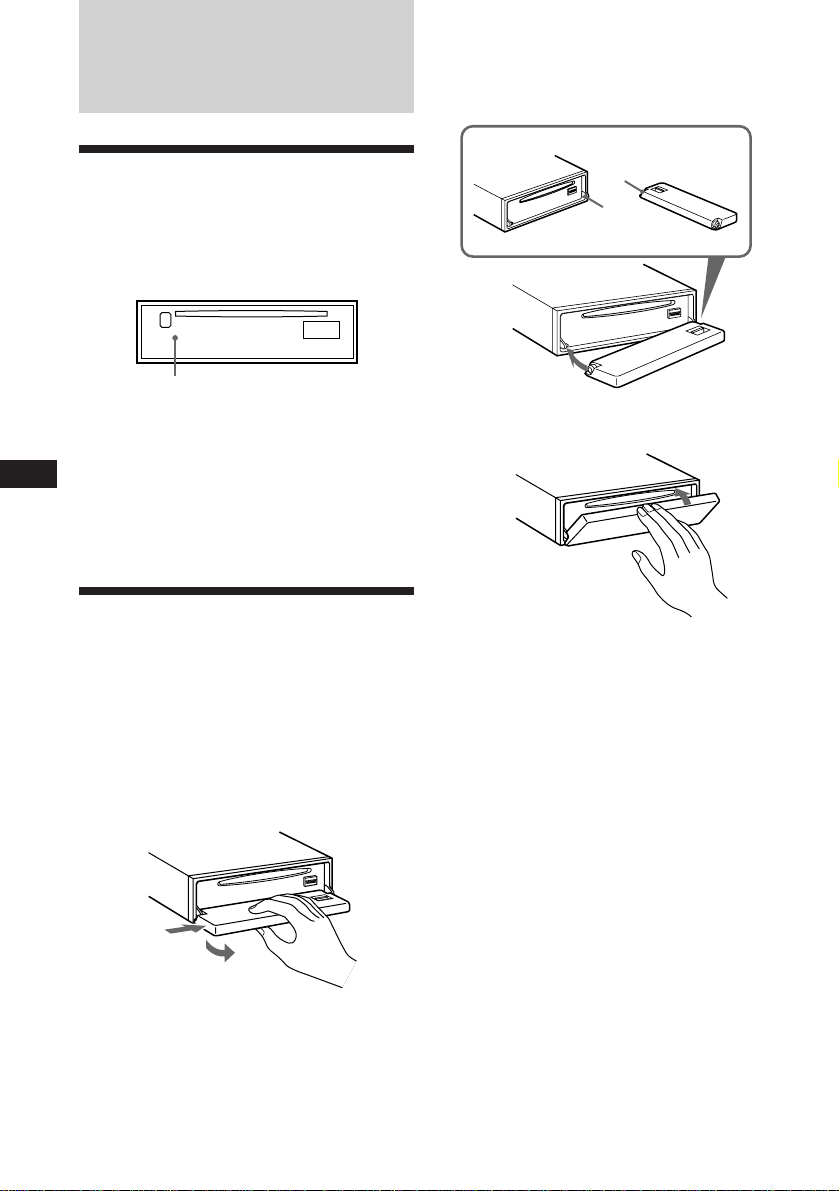
Detaching the front panel
You can detach the front panel of this unit to
prevent the unit from being stolen.
1 Press (OFF).
2 Press (OPEN) to open the front panel,
then slide the front panel to the right
side, and pull out the left side of the
front panel.
Notes
• Do not put anything on the inner surface of the
front panel.
• Be sure not to drop the panel when detaching it
from the unit.
• If you detach the panel while the unit is still on,
the power will turn off automatically to prevent
the speakers from being damaged.
• When you carry the front panel with you, put it
in the supplied front panel case.
Attaching the front panel
Place the hole a in the front panel onto the
spindle b on the unit as illustrated, then push
the left side in.
Notes
• Be sure not to attach the front panel upside
down.
• Do not press the front panel hard against the
unit when attaching it. Press it lightly against the
unit.
• Do not press hard or put excessive pressure on
the display windows of the front panel.
• Do not expose the front panel to direct sunlight,
heat sources such as hot air ducts, and do not
leave it in a humid place. Never leave it on the
dashboard of a car parked in direct sunlight
where there may be a considerable rise in
temperature.
Caution alarm
If you turn the ignition key switch to the OFF
position without removing the front panel, the
caution alarm will beep for a few seconds
(only when the POWER SELECT switch is set
to the A position).
1
2
µ
a
b
7
EN
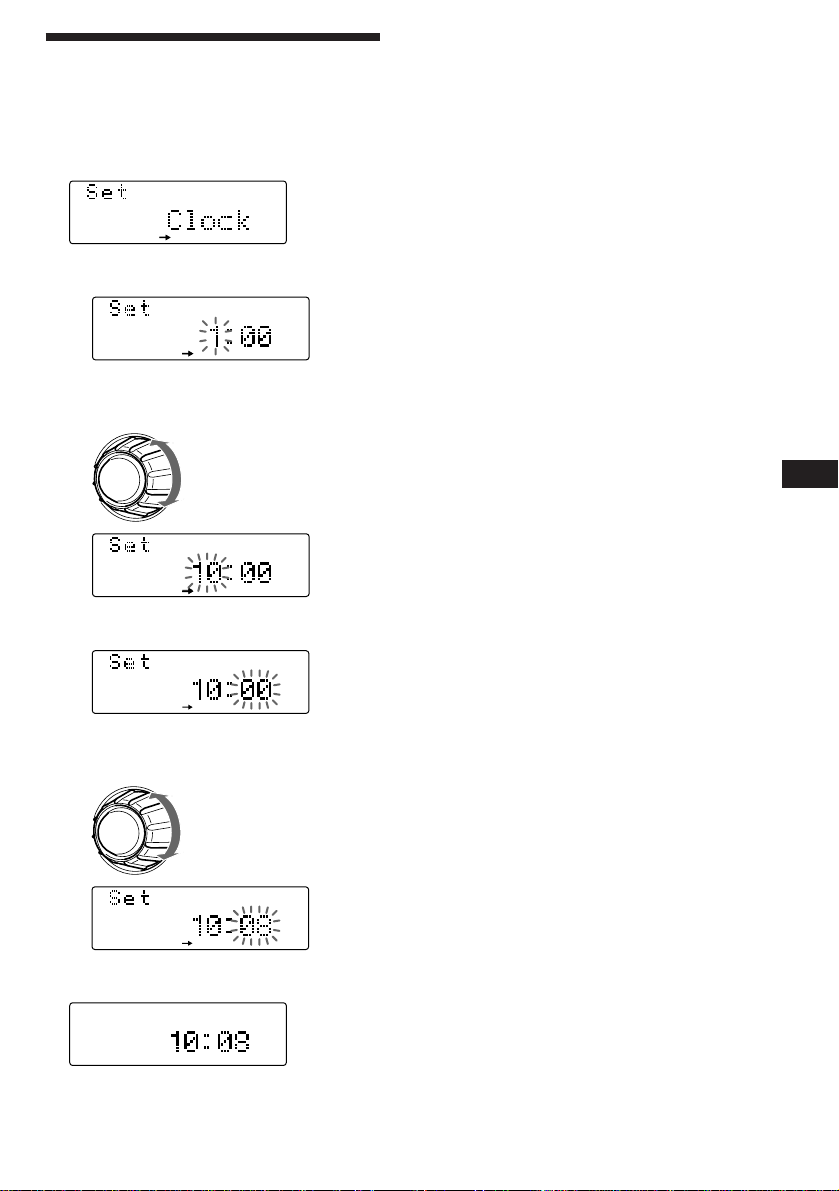
Setting the clock
The clock uses a 12-hour digital indication.
Example: Set the clock to 10:08
1 Press (SHIFT), then press (3) (SET UP).
1 Press (5) (n).
The hour digit flashes.
2 Set the hour.
3 Press (5) (n).
The minute digits flash.
4 Set the minute.
2 Press (SHIFT).
The clock starts.
to go forward
to go backward
to go forward
to go backward
SET UP
SET UP
SET UP
SET UP
SET UP
SET UP
Getting Started
3 Press (SHIFT).
After the mode setting is complete, the
display goes back to normal playback
mode.
Note
If the POWER SELECT switch on the bottom of the
unit is set to the B position, turn the power on
first, then set the clock.
SET UP
8
EN
Changing the displayed item
Each time you press (DSPL), the item changes
as follows:
$
Elapsed playback time
$
Disc name*
1
/Artist name*
2
$
Track name*
1
$
Clock
$
MOTION DISPLAY*
3
*
1
If you inserted a non-CD TEXT disc,
“NO D.Name” or “NO T.Name” appears in the
display.
*
2
If you play a CD TEXT disc, the artist name
appears in the display after the disc name. (Only
for CD TEXT discs with the artist name.)
*
3
All the items above are scrolled in the display
one by one in order.
You can label CD and CD TEXT discs with a
personalized name using the disc memo
function, refer to “Labeling a CD” (page 23).
However, if you use personalized labels, they
will always take priority over the original CD
TEXT information when such information is
displayed.
Tips
• If the name of the CD TEXT disc is too long, you
can scroll it across the display by pressing
(SHIFT), then (2) (N).
• If you want to display the original CD TEXT
information after labeling the CD TEXT disc with
a personalized name, press (SHIFT) , then (5)
(n).
Automatically scrolling a disc name
— Auto Scroll
If the disc name/artist name or track name on
a CD TEXT disc exceeds 10 characters and the
Auto Scroll function is on, automatically
scrolls on the display as follows:
• The disc name appears when the disc has
changed (if the disc name is selected).
• The track name appears when the track has
changed (if the track name is selected).
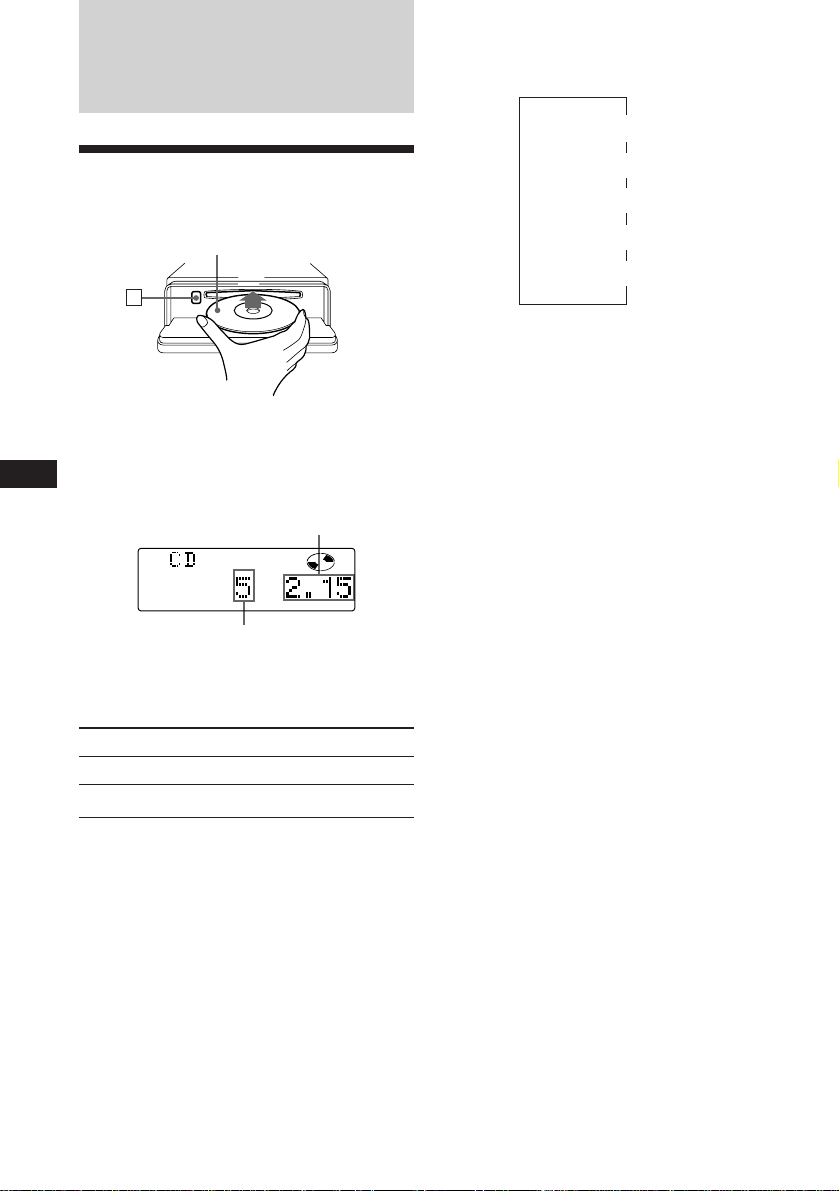
Track number
Elapsed playing time
TRACK
CD Player
Listening to a CD
1 Press (OPEN) and insert the CD.
2 Close the front panel.
Playback starts automatically.
If a CD is already inserted, press (SOURCE)
repeatedly until “CD” appears.
Note
To play back an 8 cm (3 in.) CD, use the optional
Sony compact disc single adapter (CSA-8).
To Press
Stop playback (OFF)
Eject the CD (OPEN) then 6
Labeled side up
6
9
EN
If you press (DSPL) to change the display
item, the disc or track name of the CD TEXT
disc is scrolled automatically whether you set
the function on or off.
1 During playback, press (SHIFT).
2 Press (3) (SET UP) repeatedly until
“A.Scrl” appears.
3 Press (5) (n) to select “A.Scrl on.”
4 Press (SHIFT)
To cancel Auto Scroll, select “A.Scrl off” in
step 2 above.
Note
For some CD TEXT discs with extremely many
characters, the following cases may happen:
— Some of the characters are not displayed.
— Auto Scroll does not work.
Locating a specific track
— Automatic Music Sensor (AMS)
During playback, push the SEEK/AMS
control up or down momentarily.
Locating a specific point in a track
— Manual Search
During playback, push the SEEK/AMS
control up or down and hold. Release
when you have found the desired point.
Note
If “
” or “ ” appears in the display,
that means you have reached the beginning or the
end of the disc and you cannot go any further.
To locate
preceding tracks
To locate succeeding
tracks
To search backward
To search forward
CD Player
A
F
SHIFT
12345678910
SET UP PLAY MODE
REP SHUF
Playing a CD in various
modes
You can play CDs in various modes:
•Intro (Intro Scan) lets you play the first 10
seconds of all the tracks.
•Repeat (Repeat Play) repeats the current
track.
•Shuf (Shuffle Play) plays all the tracks in
random order.
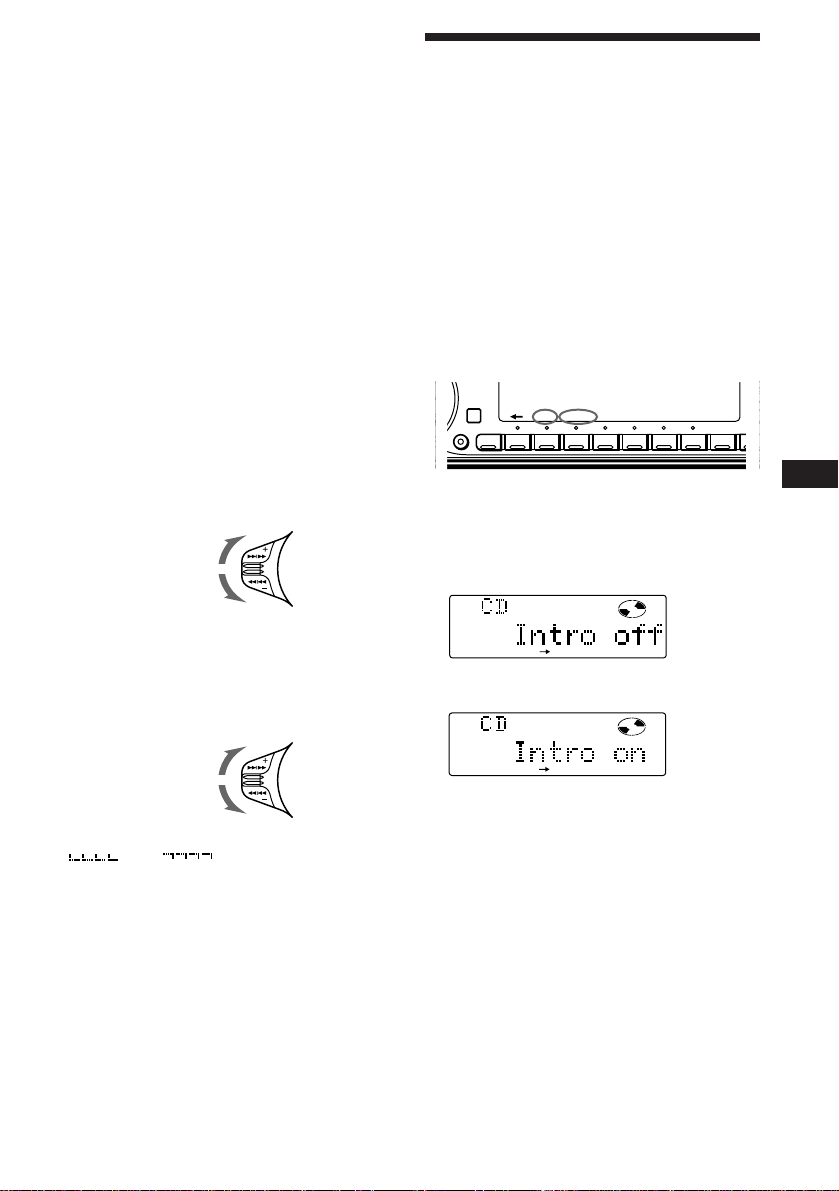
Searching for the desired track
— Intro scan
1 Press (SHIFT).
Every time you press (SHIFT), only the
items you can select light up.
2 Press (4) (PLAY MODE) repeatedly until
“Intro” appears.
Each time you press (4) (PLAY MODE),
the item changes as follows:
Intro ˜ PGM
3 Press (5) (n) to select “Intro on.”
Intro Scan starts.
4 Press (SHIFT).
To go back to normal playback mode, select
“Intro off” in step 3 above.
PLAY MODE
PLAY MODE
10
EN
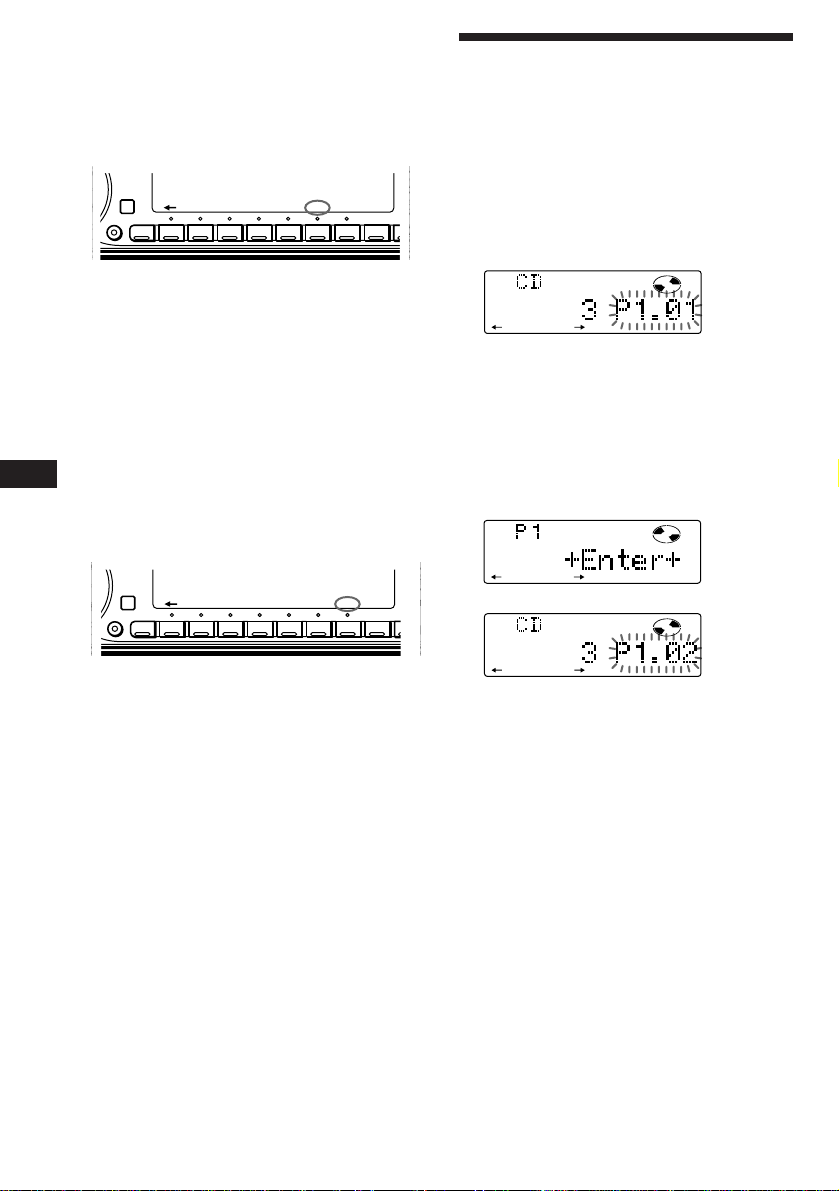
Creating a program
— CD Program Memory
You can play the tracks in the order you want
by making your own program. You can make
two programs: Program 1 and Program 2. You
can select up to 12 tracks for each program.
You can store the programs in memory.
1 Press (SHIFT), then press (4) (PLAY
MODE) for two seconds.
“P 1” shows Program 1 is selected.
To select Program 2, press (5) (n)
repeatedly until “P 2” appears.
2 Push the SEEK/AMS control up or down
to select the track you want.
3 Press (6) (ENTER) momentarily.
4 To continue entering tracks, repeat steps
2 and 3.
5 When you finish selecting tracks, press
(4) (PLAY MODE) for two seconds.
6 Press (SHIFT).
Notes
• “*Wait*” appears in the display while the unit is
reading the data.
• “*Mem Full*” appears in the display when you
try to enter more than 12 tracks into a program.
PLAY
TRACK
MODE ENTER
µ
PLAY MODE ENTER
PLAY
TRACK
MODE ENTER
Playing tracks repeatedly
— Repeat Play
1 During playback, press (SHIFT).
2 Press (7) (REP) repeatedly until ”Repeat
1“ appears.
Repeat Play starts.
3 Press (SHIFT).
To go back to normal playback mode, select
“Repeat off” in step 2 above.
Playing tracks in random order
— Shuffle Play
1 During playback, press (SHIFT).
2 Press (8) (SHUF) repeatedly until ”Shuf
1“ appears.
Shuffle Play starts.
3 Press (SHIFT).
To go back to normal playback mode, select
“Shuf off” in step 2 above.
DSPL
A
SHIFT
1234567891
0
SET UP PLAY MODE
REP SHUF
DSPL
PT
AF/
T
SHIFT
12345678910
T
SET UP PLAY MODE
REP SHUF
11
EN
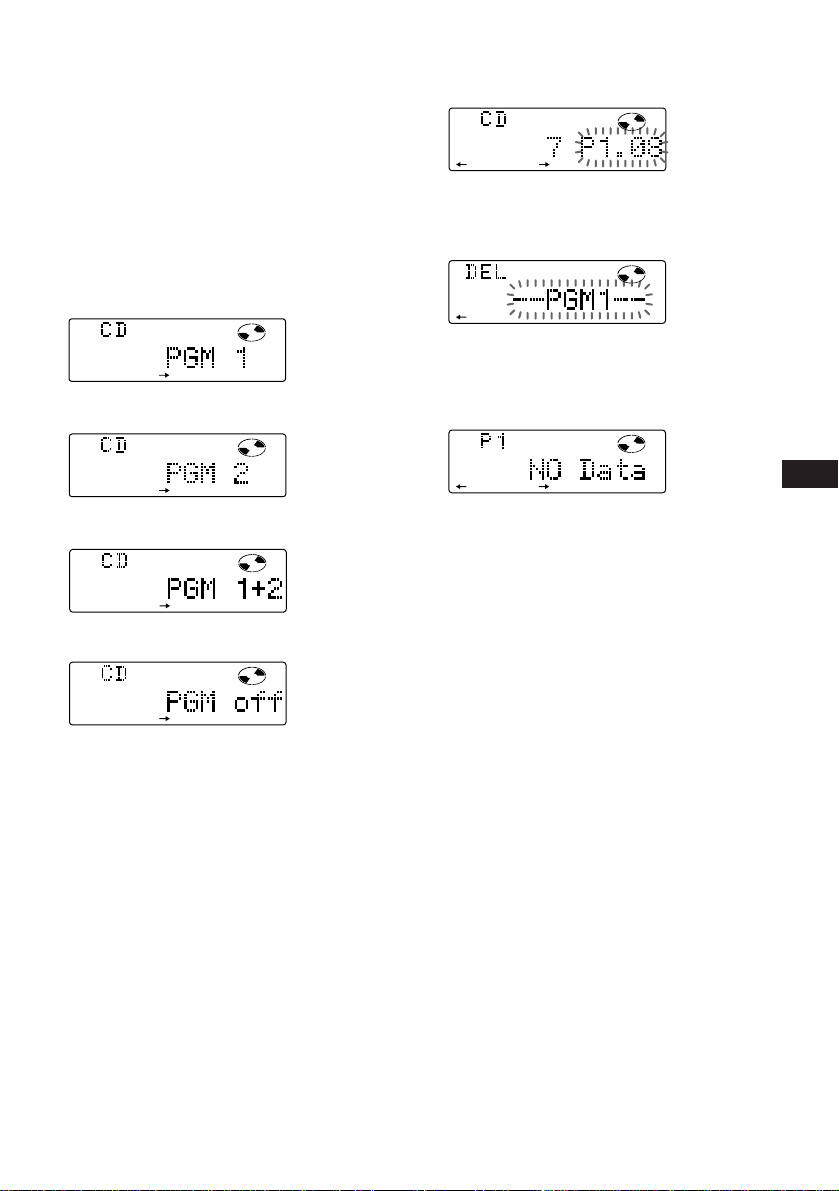
Playing the stored program
You can select:
•PGM 1 to play Program 1.
•PGM 2 to play Program 2.
•PGM 1+2 to play Programs 1 and 2.
1 Press (SHIFT).
2 Press (4) (PLAY MODE) repeatedly until
“PGM” appears.
3 Press (5) (n) repeatedly until the
desired program appears.
Program 1 playback
µ
Program 2 playback
µ
Programs 1 and 2 playback
µ
Normal playback
Program Play starts.
4 Press (SHIFT).
To go back to normal playback mode, select
“PGM off” in step 3 above.
Note
“Not ready” appears in the display if no track is
stored in the program.
PGM
1
PLAY MODE
PGM
2
PLAY MODE
PGM
1+2
PLAY MODE
PLAY MODE
CD Player
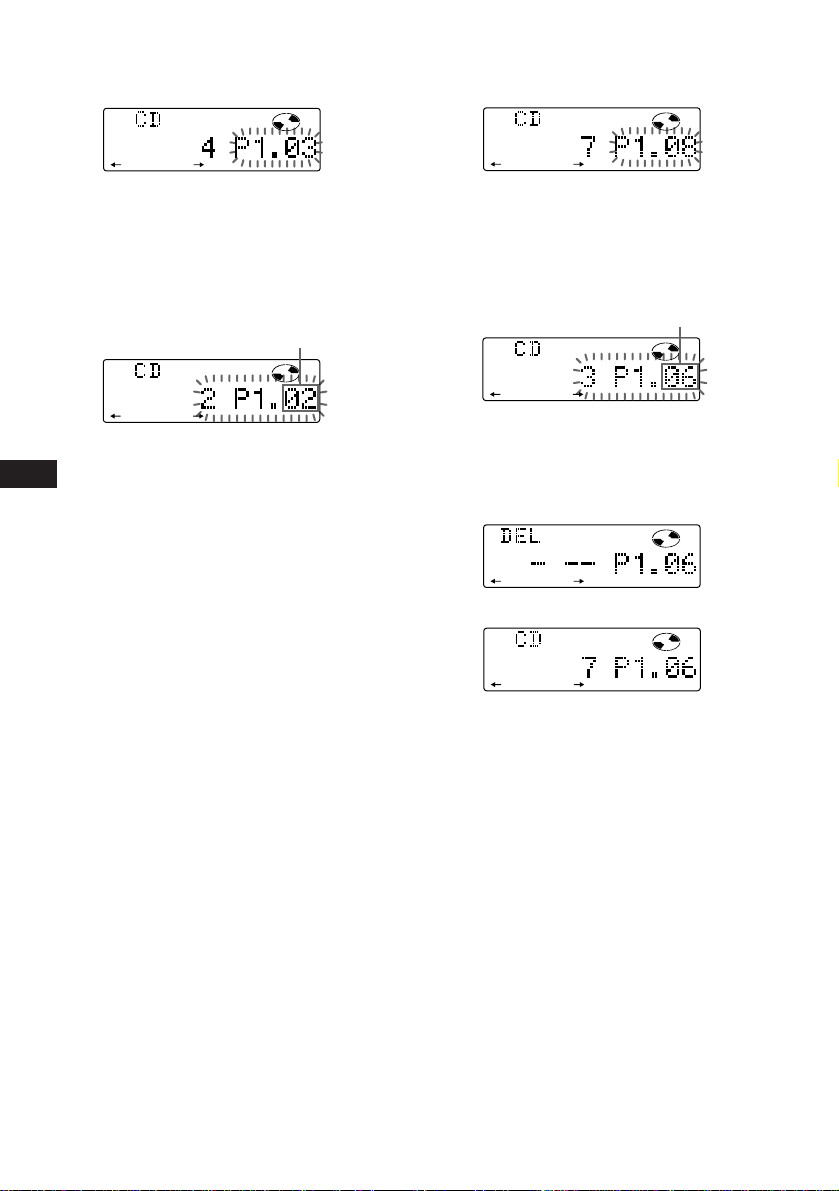
Erasing an entire program
1 Press (SHIFT), then press (4) (PLAY
MODE) for two seconds.
“P 1” shows Program 1 is selected.
2 Press (2) (N) repeatedly until “DEL”
appears.
To delete Program 2, press (5) (n)
repeatedly until “PGM 2” appears.
3 Press (6) (ENTER) for two seconds.
The entire program is erased.
4 When you finish erasing programs, press
(4) (PLAY MODE) for two seconds.
5 Press (SHIFT).
PLAY
TRACK
MODE ENTER
PLAY MODE ENTER
PLAY MODE ENTER
12
EN
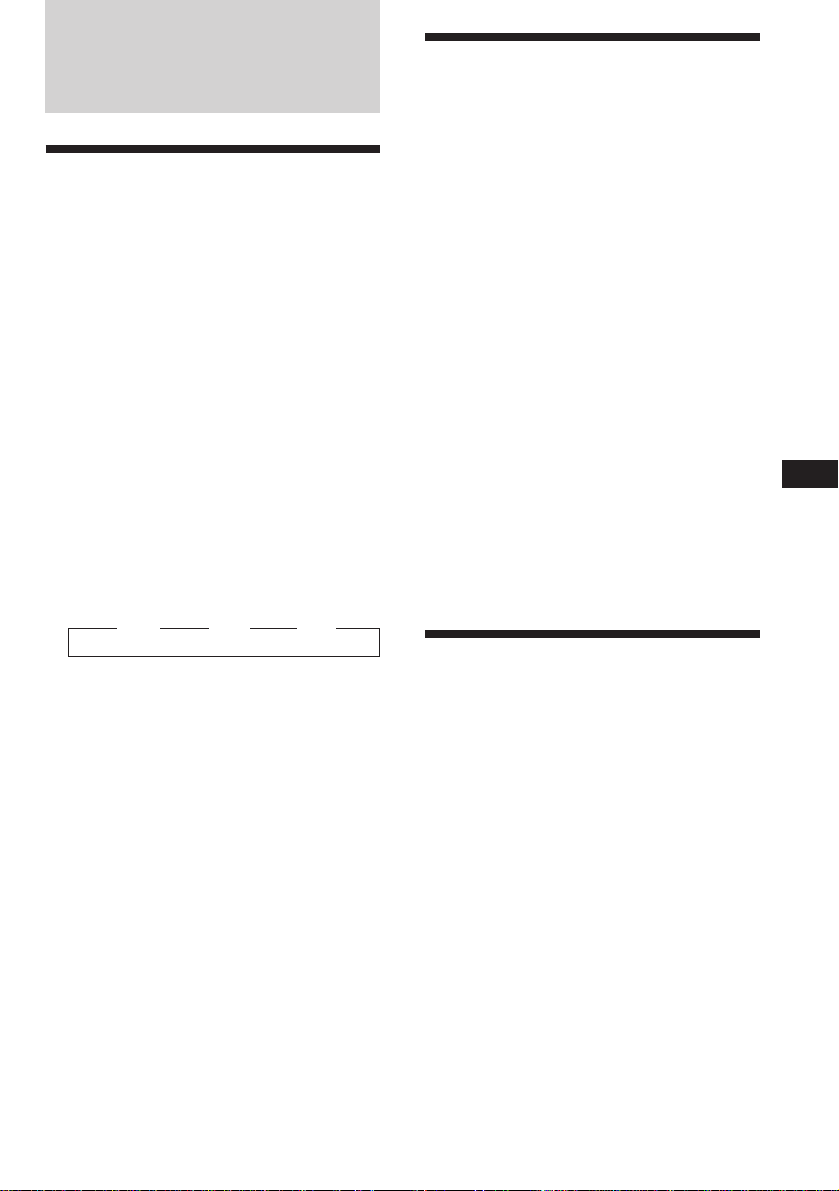
Erasing tracks in a program
1 Press (SHIFT), then press (4) (PLAY
MODE) for two seconds.
“P 1” shows Program 1 is selected.
To select Program 2, press (5) (n)
repeatedly until “P 2” appears.
2 Press (2) (N) or (5) (n) to select the
track you want to erase.
The track currently registered in slot 6 of
Program 1.
3 Press (6) (ENTER) for two seconds.
When you erase a track from a slot number,
the succeeding tracks shift up to fill the gap.
4 To continue erasing tracks, repeat steps
2 and 3.
5 When you finish erasing tracks, press (4)
(PLAY MODE) for two seconds.
6 Press (SHIFT).
Track slot number
µ
PLAY
TRACK
MODE ENTER
PLAY
TRACK
MODE ENTER
PLAY
DISC TRACK
MODE ENTER
Track slot number
PLAY
TRACK
MODE ENTER
PLAY
TRACK
MODE ENTER
Adding tracks to a program
1 Press (SHIFT), then press (4) (PLAY
MODE) for two seconds.
“P 1 ” shows Program 1 is selected.
To select Program 2, press (5) (n)
repeatedly until “P 2” appears.
2 Press (2) (N) or (5) (n) to select the
track slot number where you want to
insert a track.
3 Push the SEEK/AMS control up or down
to select the track you want to insert.
4 Press (6) (ENTER) momentarily to enter
the track.
The current track in that slot number and
the succeeding tracks shift down.
5 To continue inserting tracks, repeat steps
2 through 4.
Note
Once all 12 slots have been filled, “*Mem
Full*” appears in the display, and you cannot
insert tracks.
6 When you finish inserting tracks, press
(4) (PLAY MODE) for two seconds.
7 Press (SHIFT).
PLAY
TRACK
MODE ENTER
13
EN
CD Player/Radio
Radio
Memorizing stations
automatically
— Best Tuning Memory (BTM)
The unit selects the stations with the strongest
signals and memorizes them in the order of
their frequencies. You can store up to 10
stations on each band (FM1, FM2 and AM).
Caution
When tuning in stations while driving, use
Best Tuning Memory to prevent accidents.
1 Press (SOURCE) repeatedly to select the
tuner.
Each time you press (SOURCE), the source
changes as follows:
CD ˜ TUNER
2 Press (MODE) repeatedly to select the
band.
Each time you press (MODE), the band
changes as follows:
z FM1 z FM2 z AM
3 Press (SHIFT), then press (4) (PLAY
MODE) repeatedly until “B.T.M” appears.
4 Press (5) (n).
The unit stores stations in the order of their
frequencies on the number buttons.
A beep sound and the setting is stored.
5 Press (SHIFT).
Notes
• The unit does not store stations with weak
signals. If only a few stations are received, some
number buttons will retain heir former setting.
• When a number is indicated in the display, the
unit starts storing stations from the one currently
displayed.
Memorizing only the
desired stations
You can store up to 10 stations on each band
(20 for FM1 and FM2, 10 for AM) in the order
of your choice.
1 Press (SOURCE) repeatedly to select the
tuner.
2 Press (MODE) repeatedly to select the
band (FM1, FM2 or AM).
3 Push the SEEK/AMS control up or down
to tune in the station you want to store
on the number button.
4 Press and hold the desired number
button ((1) to (10)) until “MEM”
appears.
The number button indication appears in
the display.
Note
If you try to store another station on the same
number button, the previously stored station will
be erased.
Receiving the memorized
stations
1 Press (SOURCE) repeatedly to select the
tuner.
2 Press (MODE) repeatedly to select the
band (FM1, FM2 or AM).
3 Press the number button ((1) to (10))
momentarily where the desired station is
stored.

14
EN
If you cannot tune in a preset
station
Push the SEEK/AMS control up or down
momentarily to search for the station
(automatic tuning).
Scanning stops when the unit receives a
station. Push the SEEK/AMS control up or
down repeatedly until the desired station is
received.
Note
If the automatic tuning stops too frequently, press
(SHIFT), then press (4) (PLAY MODE) repeatedly
until “Local” (local seek mode) is displayed. Then
press (5) (n) to select “Local on.” Press (SHIFT).
Only the stations with relatively strong signals will
be tuned in.
Tip
If you know the frequency of the station you want
to listen to push the SEEK/AMS control up or down
and hold until the desired frequency appears
(manual tuning).
If FM stereo reception is poor
— Monaural Mode
1 Press (SHIFT), then press (4) (PLAY
MODE) repeatedly until “Mono” appears.
2 Press (5) (n) repeatedly until “Mono
on“ appears.
The sound improves, but becomes
monaural (“ST” disappears).
3 Press (SHIFT).
To go back to normal mode, select “Mono off”
in step 2 above.
If interference occurs during FM
reception
If there is interference from neighboring
stations, follow the steps below and select
“Narrow”. If interference is not a problem,
select “Wide” to maximize signal reception
and improve sound quality or “IF Auto ”to
switch between “Narrow” and “Wide”
automatically.
1 Press (SHIFT) during FM reception.
2 Press (4) (PLAY MODE) repeatedly until
“IF Auto“ appears.
3 Press (5) (n) repeatedly to select
desired setting
z IF Auto z Wide
Narrow Z
4 Press (SHIFT).
Changing the displayed items
Each time you press (DSPL), the item changes
as follows:
z Frequency z Clock
MOTION DISPLAY* Z
* All the items above are scrolled in the display
one by one in order.
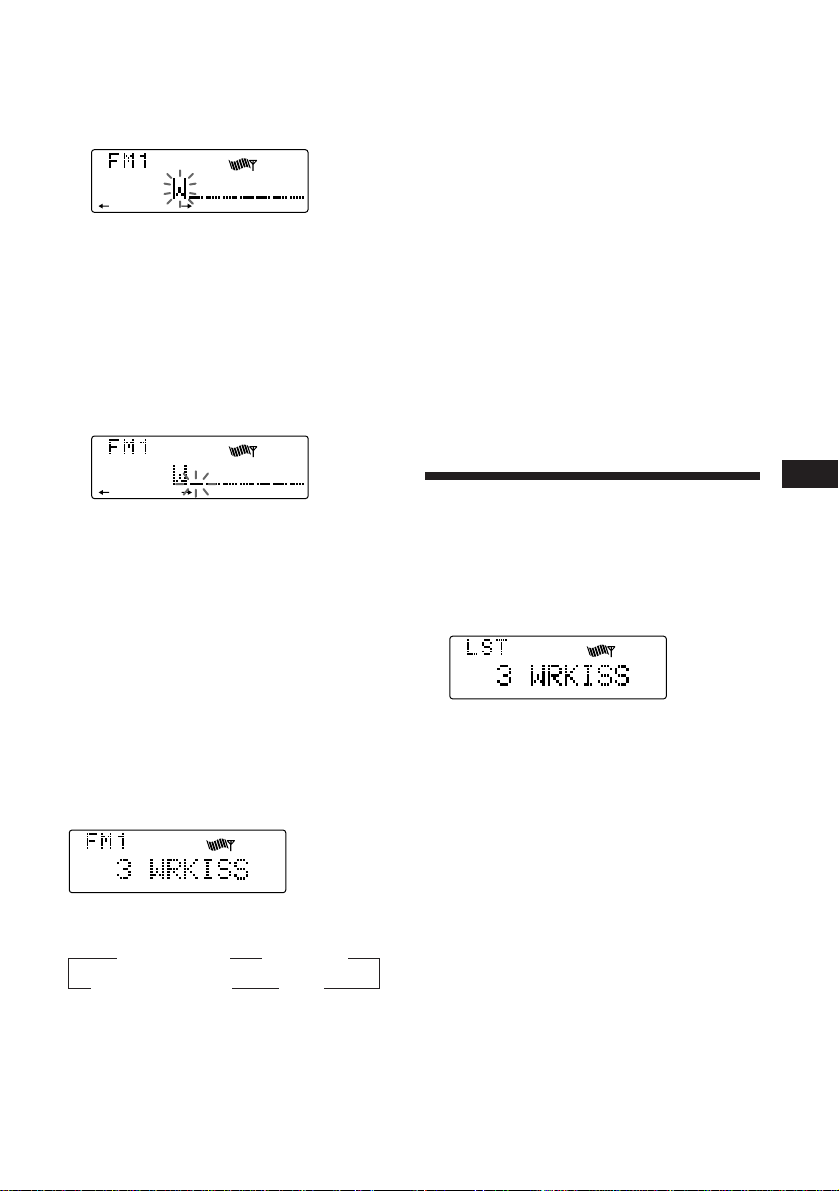
Storing the station names
—Station Memo
You can assign a name to each radio station
and store it in memory. The name of the
current station appears in the display. You can
store up to eight characters for each station.
Storing the station names
1 Tune in a station whose name you want
to store.
2 Press (LIST) for two seconds.
15
EN
Radio
Erasing the station name
1 Tune in any station and press (LIST) for
two seconds.
2 Press (DSPL) for two seconds.
The station name appears in the display.
3 Rotate the dial to select the name you
want to erase.
4 Press (6) (ENTER) for two seconds.
The name is erased.
Repeat steps 3 and 4 if you want to erase
other names.
5 Press (LIST) for two seconds.
The unit returns to normal radio reception
mode.
Locating a station by
name — List-up
1 Press (LIST) momentarily.
The name assigned to the current station
appears in the display.
2 Press (LIST) repeatedly until you find the
desired station.
3 Press (6) (ENTER) to tune in the desired
station.
Note
After the station name or frequency has been
displayed for five seconds, the display goes back to
normal mode. To turn off the display, press
(DSPL).
ENTER
3 Enter the characters.
1 Rotate the dial clockwise to select the
desired characters.
(A n B n C n ··· Z n 0 n 1 n 2 n
··· 9 n + n – n * n / n \ n > n <
n . n _ )
If you rotate the dial counterclockwise,
the characters appear in the reverse
order.
If you want to put a blank space
between characters, select “_” (under-
bar).
2 Press (5) (n) after locating the
desired character.
The flashing cursor moves to the next
space.
If you press (2) (N), the flashing cursor
moves to the left.
3 Repeat steps 1 and 2 to enter the
entire name.
4 To return to normal radio reception,
press (LIST) for two seconds.
Tip
To erase/correct a name, enter “_” (under-bar) for
each character.
Displaying the station name
Press (DSPL) during radio reception.
Each time you press (DSPL), the item
changes as follows:
z Station name*
1
z Frequency
MOTION DISPLAY*
2
Z ClockZ
*
1
If the station name is not stored, “NO
Name” appears in the display for one
second.
*
2
All the items above are scrolled in the
display one by one in order.
16
EN
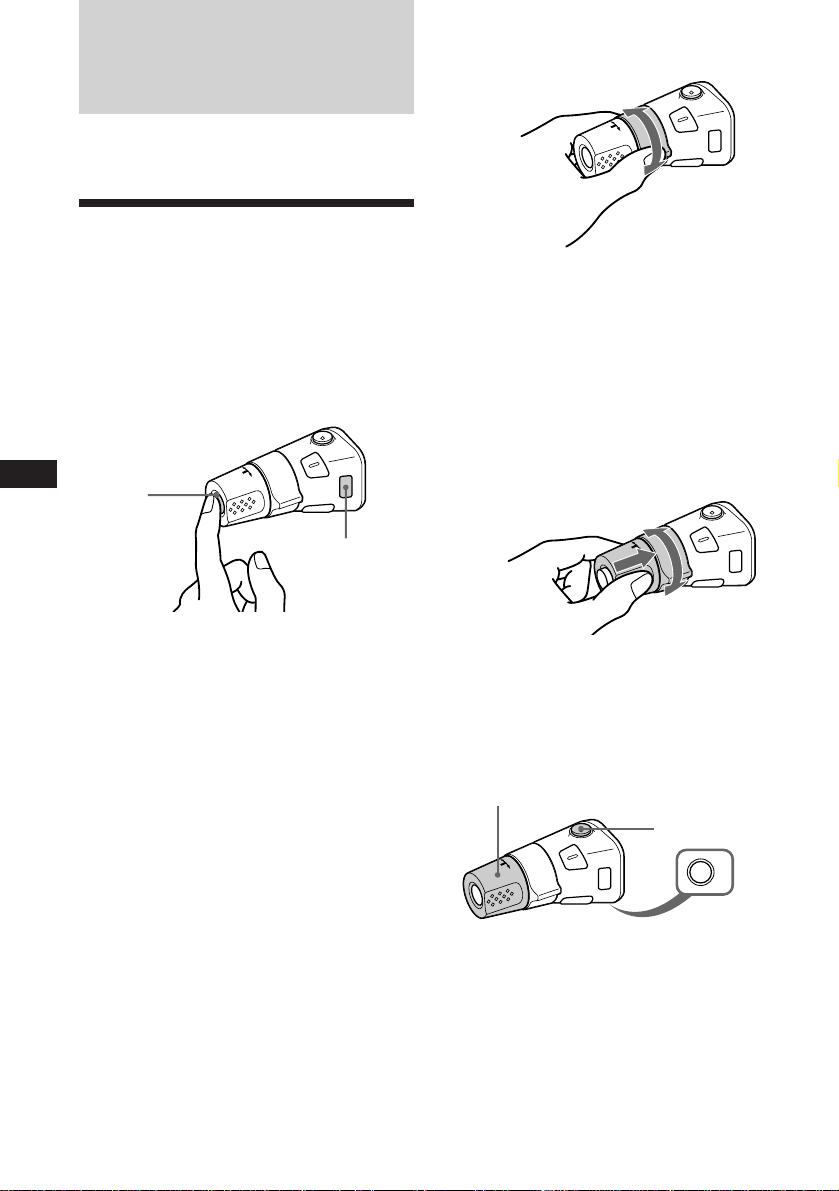
By rotating the control (the SEEK/
AMS control)
Rotate the control momentarily and
release it to:
•Locate a specific track on a disc. Rotate
and hold the control until you locate the
specific point in a track, then release it to
start playback.
•Tune in stations automatically. Rotate and
hold the control to tune in a specific
station.
By pushing in and rotating the
control (the PRESET/DISC control)
Push in and rotate the control to:
•Receive the stations memorized on the
number buttons.
•Change the disc.
Other operations
Rotate the VOL control to
adjust the volume.
Press (OFF) to turn
off the unit.
Other Functions
You can connect an optional rotary
commander (RM-X4S) with this unit.
Using the rotary
commander
The rotary commander works by pressing
buttons and/or rotating controls.
You can control an optional CD or MD unit
with the rotary commander.
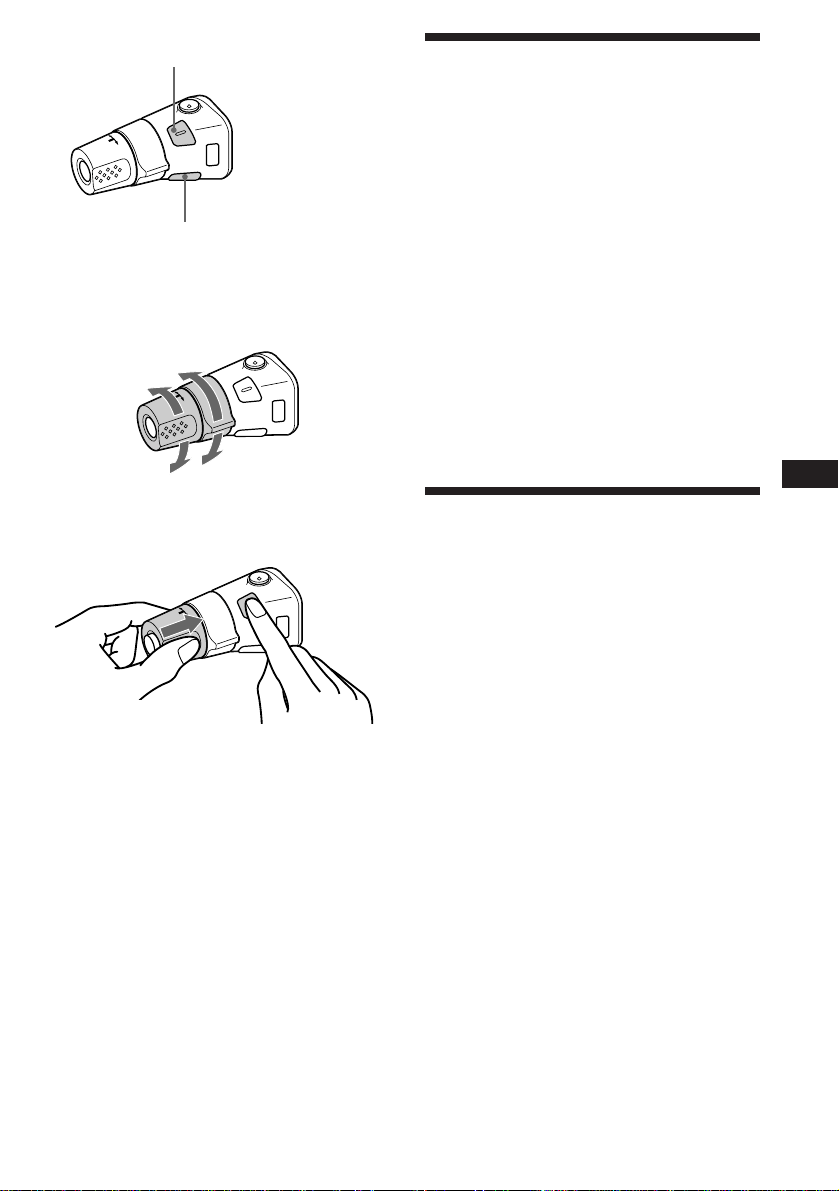
By pressing buttons (the SOURCE
and MODE buttons)
Each time you press (SOURCE), the
source changes as follows:
TUNER n CD n MD n TV*
* When an optional TV tuner or Video is
connected.
Pressing (MODE) changes the operation
in the following ways;
• Tuner: FM1 n FM2 n AM
• CD unit: CD1 n CD2 n …
• MD unit: MD1 n MD2 n …
• TV/Video: TV n Video1 n Video2 n …
Tip
When the POWER SELECT switch is set to position
B, you can turn on this unit by pressing (SOURCE)
on the rotary commander.
(SOURCE)
(MODE)
OFF
Press (ATT) to
attenuate the sound.
17
EN
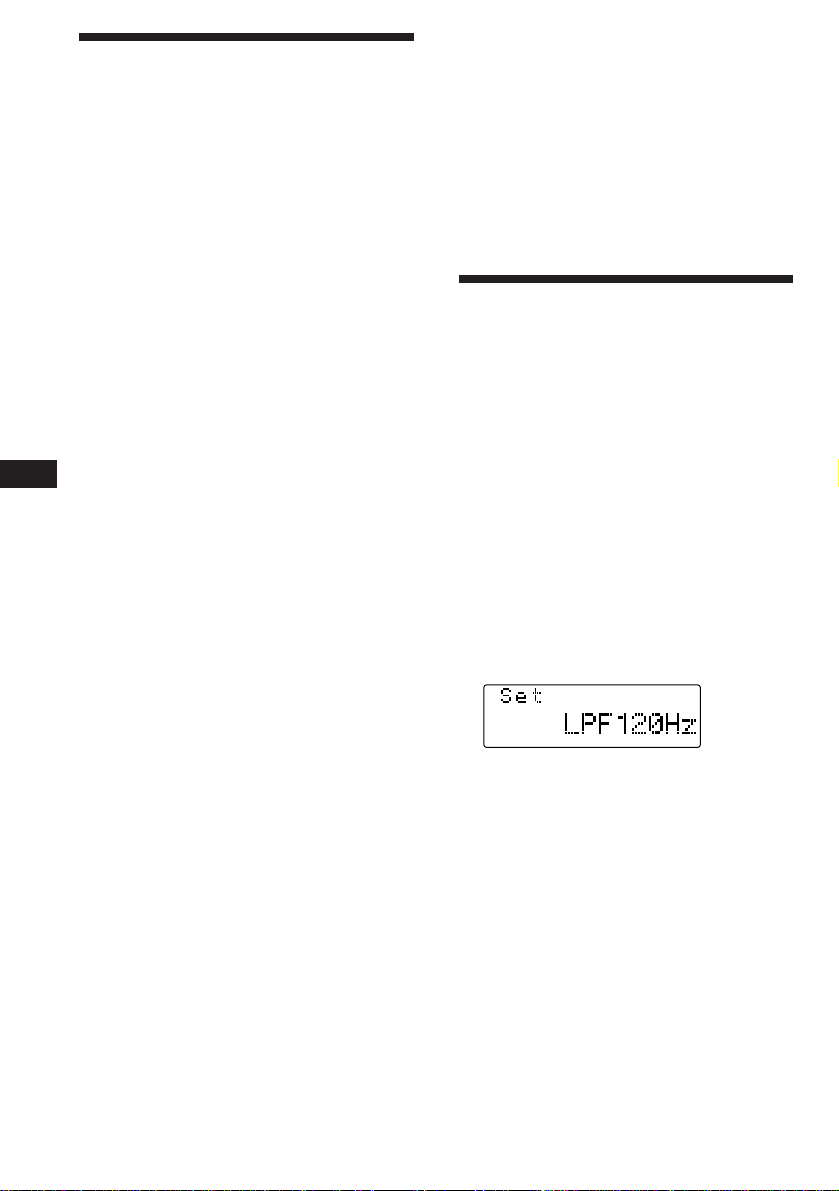
Changing the operative direction
The operative direction of controls is factory-
set as in the illustration below.
If you need to mount the rotary commander on
the right side of the steering column, you can
reverse the operative direction.
Press (SOUND) for two seconds while
pushing the VOL control.
Tip
You can control the operative direction of controls
with the unit (page 18).
Press (SOUND) to adjust the
volume and sound menu.
To increase
To decrease
Press (LIST) to display the
memorized names.
Adjusting the sound
characteristics
You can adjust the bass, treble, balance and
fader.
Each source can store the bass and treble levels
respectively.
1 Select the item you want to adjust by
pressing (SOUND) repeatedly.
VOL (volume) n SUB (subwoofer volume)
n BAS (bass) n TRE (treble)
n BAL (left-right) n FAD (rear-front)
2 Adjust the selected item by rotating the
dial.
Adjust within three seconds after selecting
the item. (After three seconds, the dial
functions as the volume control.)
Attenuating the sound
Press (ATT) on the rotary commander or
wireless remote.
“ATT on” flashes momentarily.
To restore the previous volume level, press
(ATT) again.
Tip
The unit decreases the volume automatically when
a telephone call comes in (Telephone ATT function).
Other Functions
18
EN
3 Press (5) (n) to select the desired
setting (for example: on or off).
For the “Contrast” setting, pressing (5)
(n) makes the contrast higher, and
pressing (2) (N) makes the contrast lower.
4 Press (SHIFT).
After the mode setting is complete, the
display goes back to normal playback
mode.
Adjusting the frequency
of the subwoofer(s)
To match the characteristics of the connected
subwoofer(s), you can cut out the unwanted
high and middle frequency signals entering
the subwoofer(s). By setting the cut-off
frequency, the subwoofer(s) will output only
low frequency signals so you can get a clearer
sound image.
1 Press (SOURCE) to select a source (radio,
CD or MD).
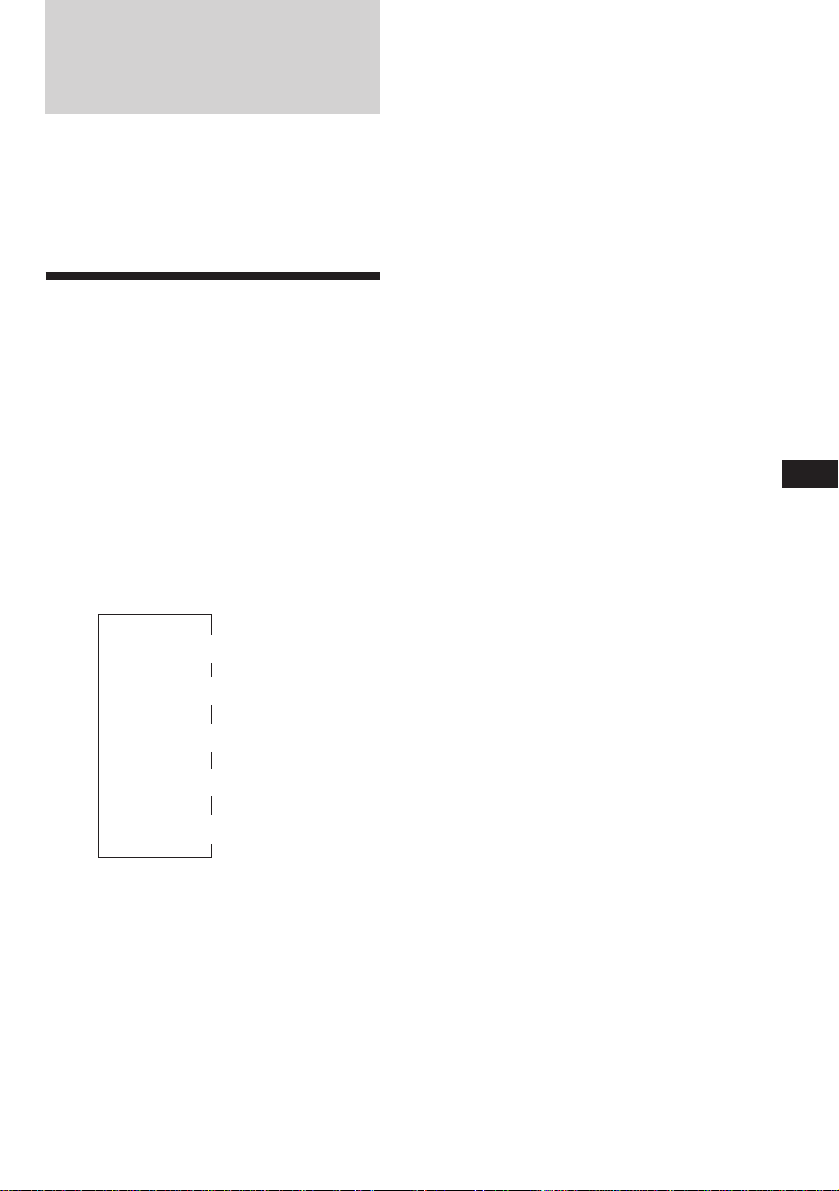
2 Press (SHIFT), then press (3) (SET UP)
repeatedly until “LPF” appears.
3 Press (5) (n) or (2) (N) repeatedly to
select desired setting.
Each time you press (5) (n) or (2) (N),
the cut-off frequency in the display changes
as follows:
LPF off ˜ LPF 80 Hz ˜ LPF 120 Hz
4 Press (SHIFT).
When the frequency setting is complete, the
display goes back to the normal playback
mode.
Changing the sound and
display settings
You can set:
•Clock (page 7).
•D.Info (Dual Information) to display the
clock and the play mode at the same time
(ON) or to display the information
alternately (OFF).
•Amber/Green to change the illumination
color to amber or green.
•Dimmer to change the brightness of the
display.
— Select “Auto” to dim the display only
when you turn the lights on.
— Select “on” to dim the display.
•Contrast to adjust the contrast if the
indications in the display are not
recognizable because of the unit‘s installed
position.
•Beep to turn on or off the beeps.
•RM (Rotary Commander) to change the
operative direction of the controls of the
rotary commander.
— Select “norm” to use the rotary
commander as the factory-set position.
— Select “rev” when you mount the rotary
commander on the right side of the
steering column.
•Loud (Loudness) to enjoy bass and treble
even at low volume. The bass and treble will
be reinforced.
•LPF (Low Pass Filter)
•A.Scrl (Auto Scroll) (page 8, 19).
1 Press (SHIFT).
2 Press (3) (SET UP) repeatedly until the
desired item appears.
Each time you press (3) (SET UP), the item
changes as follows:
Clock n D.Info* n Amber/Green n Dimmer
n Contrast n Beep n RM n Loud* n LPF*
n A.Scrl*
* When you have not tune the station or there
is no CD/MD being played, these items will
not appear.
Note
The displayed item will differ depending on
the source.
19
EN
With Optional Equipment
CD/MD Unit
You can control up to 7 CD and MD units with
this unit.
If you connect an optional CD unit with the
CD TEXT function, the CD TEXT information
will appear in the display when you play back
a CD TEXT disc.
Playing a CD or MD
1 Press (SOURCE) repeatedly to
select the CD or MD.
2 Press (MODE) until the desired
unit appears.
CD/MD playback starts.
When a CD/MD unit is connected, all the
tracks play from the beginning.
Changing the displayed item
Each time you press (DSPL) during CD,
CD TEXT or MD playback, the item changes as
follows:
$
Elapsed playback time
$
Disc name*
1
/Artist name*
2
$
Track name*
3
$
Clock
$
MOTION DISPLAY*
4
*
1
If you have not labeled the disc or there
is no disc name prerecorded on the MD, “NO
D.Name” appears in the display.
*
2
If you play a CD TEXT disc, the artist
name appears in the display after the disc name.
(Only for CD TEXT discs with the artist name.)
*
3
If the track name of a CD TEXT disc or MD is not
prerecorded, “NO T.Name” appears in the
display.
*
4
AII the items above are scrolled in the display
one by one in order.
You can label CD and CD TEXT discs with a
personalized name using the disc memo
function, refer to “Labeling a CD” (page 23).
However, if you use personalized labels, they
will always take priority over the original CD
TEXT information when such information is
displayed.
Tips
• If the name of the MD or CD TEXT disc is too
long, you can scroll it across the display by
pressing (SHIFT), then (2) (N).
• If you want to display the original CD TEXT
information after labeling the CD TEXT disc with
a personalized name, press (SHIFT) , then (5)
(n).
Automatically scrolling a disc name
— Auto Scroll
If the disc name/artist name or track name on
a CD TEXT disc or MD exceeds 10 characters
and the Auto Scroll function is on,
automatically scrolls on the display as follows:
• The disc name appears when the disc has
changed (if the disc name is selected).
• The track name appears when the track has
changed (if the track name is selected).
If you press (DSPL) to change the display
item, the disc or track name of the MD or
CD TEXT disc is scrolled automatically
whether you set the function on or off.
1 During playback, press (SHIFT).
2 Press (3) (SET UP) repeatedly until
“A.Scrl” appears.
3 Press (5) (n) to select “A.Scrl on.”
4 Press (SHIFT)
To cancel Auto Scroll, select “A.Scrl off” in
step 2 above.
Note
For some CD TEXT discs with extremely many
characters, the following cases may happen:
—Some of the characters are not displayed.
—Auto Scroll does not work.
Other Functions/CD/MD Unit
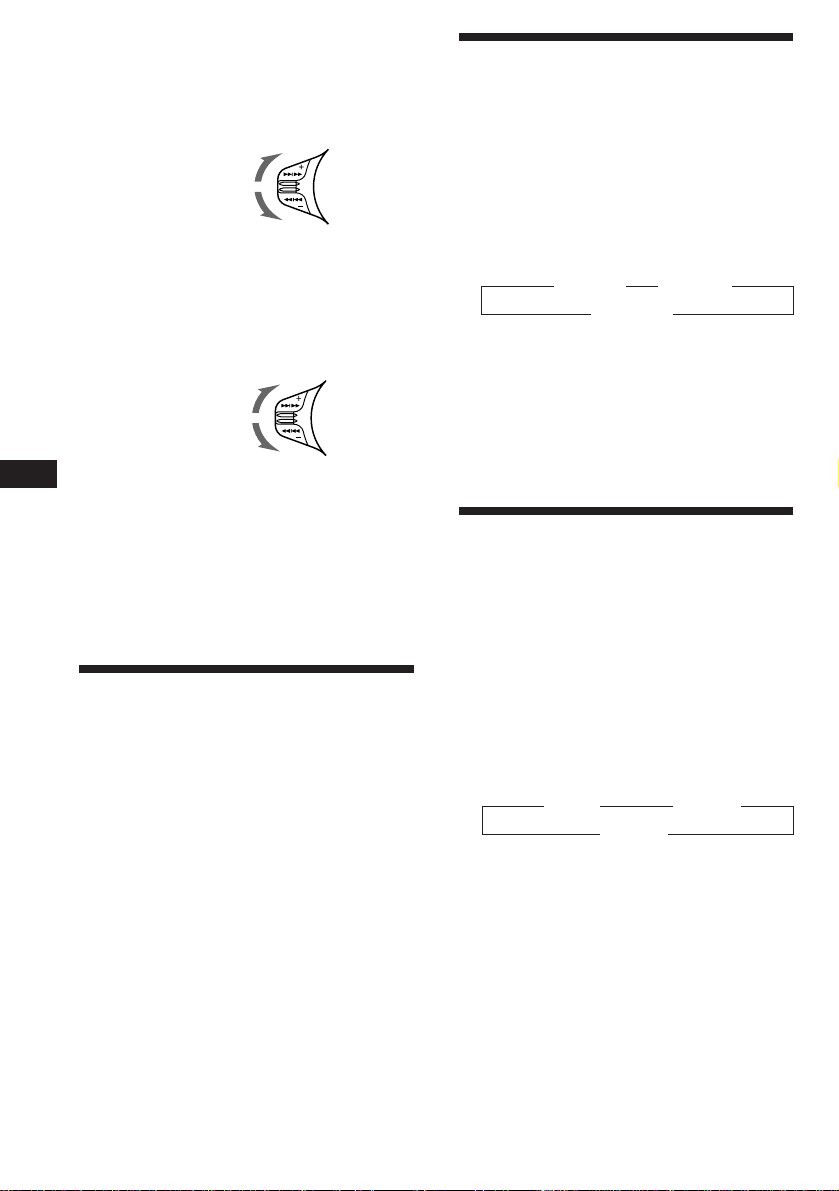
20
EN
Playing tracks repeatedly
— Repeat Play
You can select:
•Repeat 1 to repeat a track.
•Repeat 2 to repeat a disc.
1 During playback, press (SHIFT).
2 Press (7) (REP) repeatedly until the
desired setting appears.
z Repeat 1 z Repeat 2
Repeat off Z
Repeat Play starts.
3 Press (SHIFT).
To go back to normal playback mode, select
“Repeat off” in step 2 above.
Playing tracks in random
order — Shuffle Play
You can select:
•Shuf 1 to play the tracks on the current disc
in random order.
•Shuf All to play all the tracks in random
order.
1 During playback, press (SHIFT).
2 Press (8) (SHUF) repeatedly until the
desired setting appears.
z Shuf 1 z Shuf All
Shuf off Z
Shuffle Play starts.
3 Press (SHIFT).
To go back to normal playback mode, select
“Shuf off” in step 2 above.
To locate succeeding
tracks
To locate preceding
tracks
To search forward
To search backward
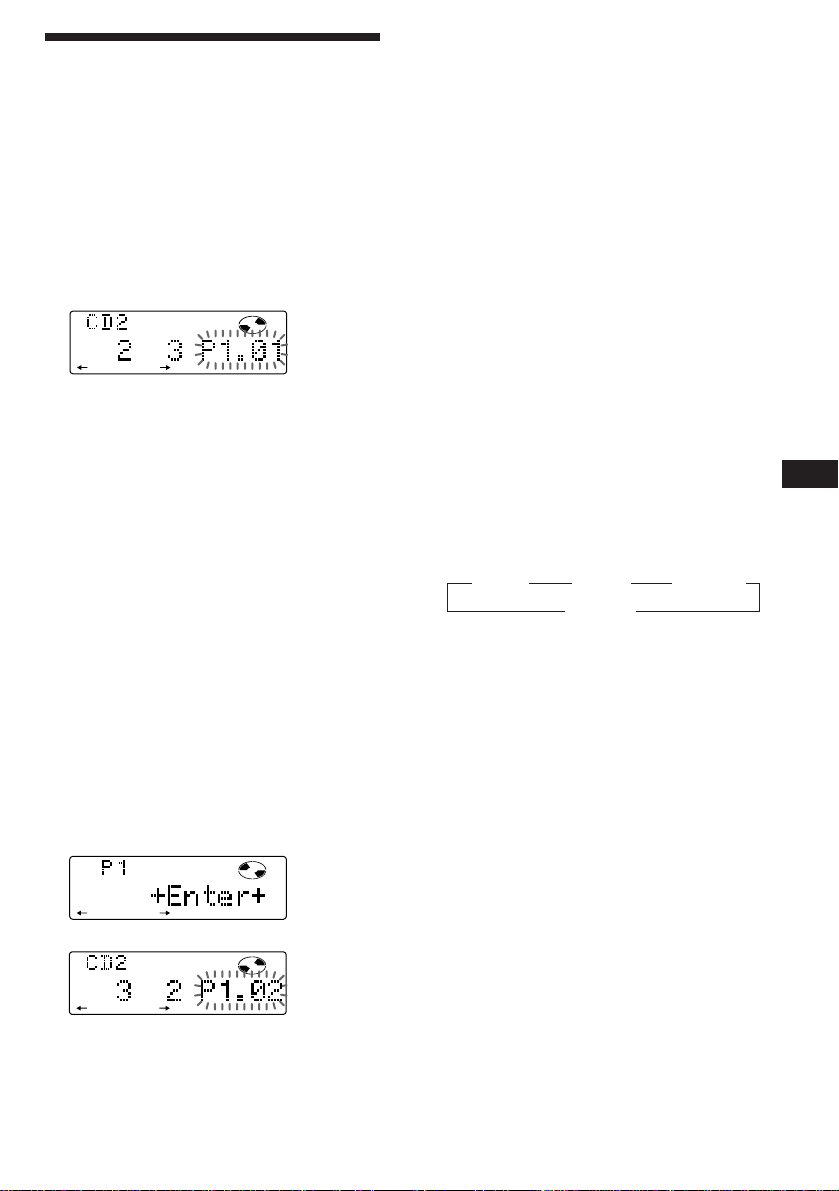
Locating a specific track
— Automatic Music Sensor (AMS)
During playback, push the SEEK/AMS
control up or down once for each track
you want to skip.
Locating a specific point in a track
— Manual Search
During playback, push the SEEK/AMS
control up or down and hold.
Release when you have found the
desired point.
Locating a disc by disc number
— Direct Disc Selection
Press the number button that
corresponds with the desired disc
number.
The desired disc in the current unit begins
playback.
Scanning the tracks
— Intro Scan
You can play the first 10 seconds of all the
tracks on the current disc.
1 During playback, press (SHIFT), then
press (4) (PLAY MODE) repeatedly until
“Intro” appears.
2 Press (5) (n) to select “Intro on.”
Intro Scan starts.
3 Press (SHIFT).
To go back to normal playback mode, select
“Intro off” in step 2 above.
21
EN
Creating a program
— Program Memory (CD/MD unit with the
program memory function)
You can play tracks in the order you want by
making your own program. You can make two
programs: Program 1 and Program 2. You can
select up to 12 tracks for each program. You
can store the programs in memory.
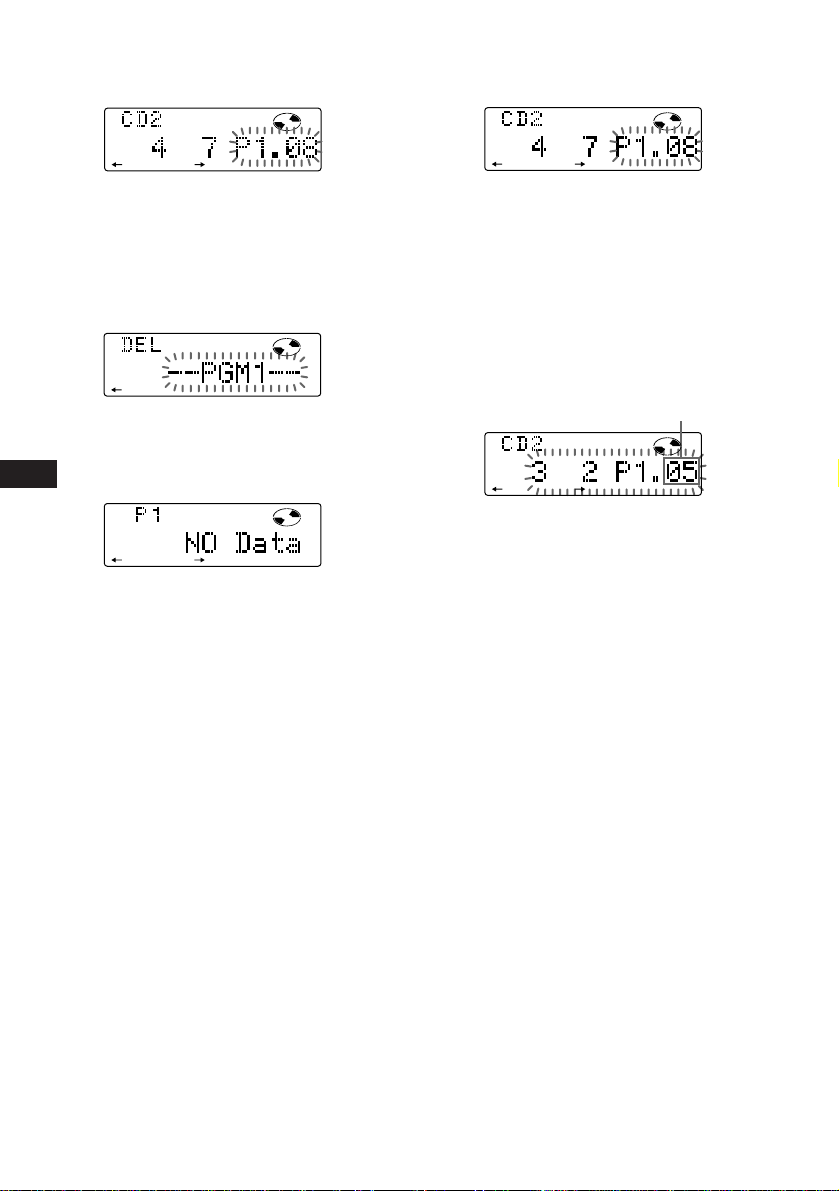
1 Press (SHIFT), then press (4) (PLAY
MODE) for two seconds.
Program edit mode
“P 1” shows Program 1 is selected.
If you have labeled the disc, the bank edit
mode appears. Press (4) (PLAY MODE) to
display “P 1” above.
To select Program 2, press (5) (n)
repeatedly until “P 2” appears.
2 Select the track you want.
1 Press (SOURCE) repeatedly to select
CD or MD.
2 Press (MODE) repeatedly to select the
unit.
3 Press (SHIFT), then press the number
button to select the disc.
4 Press (SHIFT).
5 Push the SEEK/AMS control up or
down to select the track.
3 Press (6) (ENTER) momentarily.
4 To continue entering tracks, repeat steps
2 and 3.
µ
PLAY
DISC TRACK
MODE ENTER
PLAY MODE ENTER
PLAY
DISC TRACK
MODE ENTER
CD/MD Unit
5 When you finish entering tracks, press
(4) (PLAY MODE) for two seconds.
6 Press (SHIFT).
Notes
• “*Wait*” appears in the display while the unit is
reading the data, or when a disc has not been
put into the unit.
• “*Mem Full*” appears in the display when you
try to enter more than 12 tracks into a program.
Playing the stored program
Changing the disc order in the unit will not
affect program memory play.
You can select:
•PGM 1 to play Program 1.
•PGM 2 to play Program 2.
•PGM 1+2 to play Programs 1 and 2.
1 Press (SHIFT).
2 Press (4) (PLAY MODE) repeatedly until
“PGM” appears.
3 Press (5) (n) repeatedly until the
desired program appears.
z PGM 1 z PGM 2 z PGM 1+2
PGM off Z
Program Play starts.
4 Press (SHIFT).
To go back to normal playback mode, select
“PGM off” in step 3 above.
Notes
• If you press a number button during program
memory play, program memory play is
interrupted, and playback of the selected disc
starts.
• “NO Data” appears in the display if no track is
stored in the program.
• If a track stored into the program memory is not
in the disc magazine, the track will be skipped.
• When the disc magazine contains no tracks
stored into the program memory, or when the
program information has not been loaded yet,
“Not ready” appears.
22
EN
Adding tracks to a program
1 Press (SHIFT), then press (4) (PLAY
MODE) for two seconds.
“P 1” shows Program 1 is selected.
If you have labeled the disc, the bank edit
mode appears. Press (4) (PLAY MODE) to
display “P 1” above.
To select Program 2, press (5) (n)
repeatedly until “P 2” appears.
2 Press (2) (N) or (5) (n) to select the
track slot number where you want to
insert a track.
3 Push the SEEK/AMS control up or down
to select the track you want to insert.
4 Press (6) (ENTER) momentarily to enter
the track.
The current track in that slot number and
the succeeding tracks shift down.
To continue inserting tracks, repeat steps 2
through 4.
Note
Once all 12 slots have been filled,
“*Mem Full*” appears in the display, and you
cannot insert tracks.
5 When you finish inserting tracks, press
(4) (PLAY MODE) for two seconds.
6 Press (SHIFT).
Track slot number
PLAY
DISC TRACK
MODE ENTER
PLAY
DISC TRACK
MODE ENTER
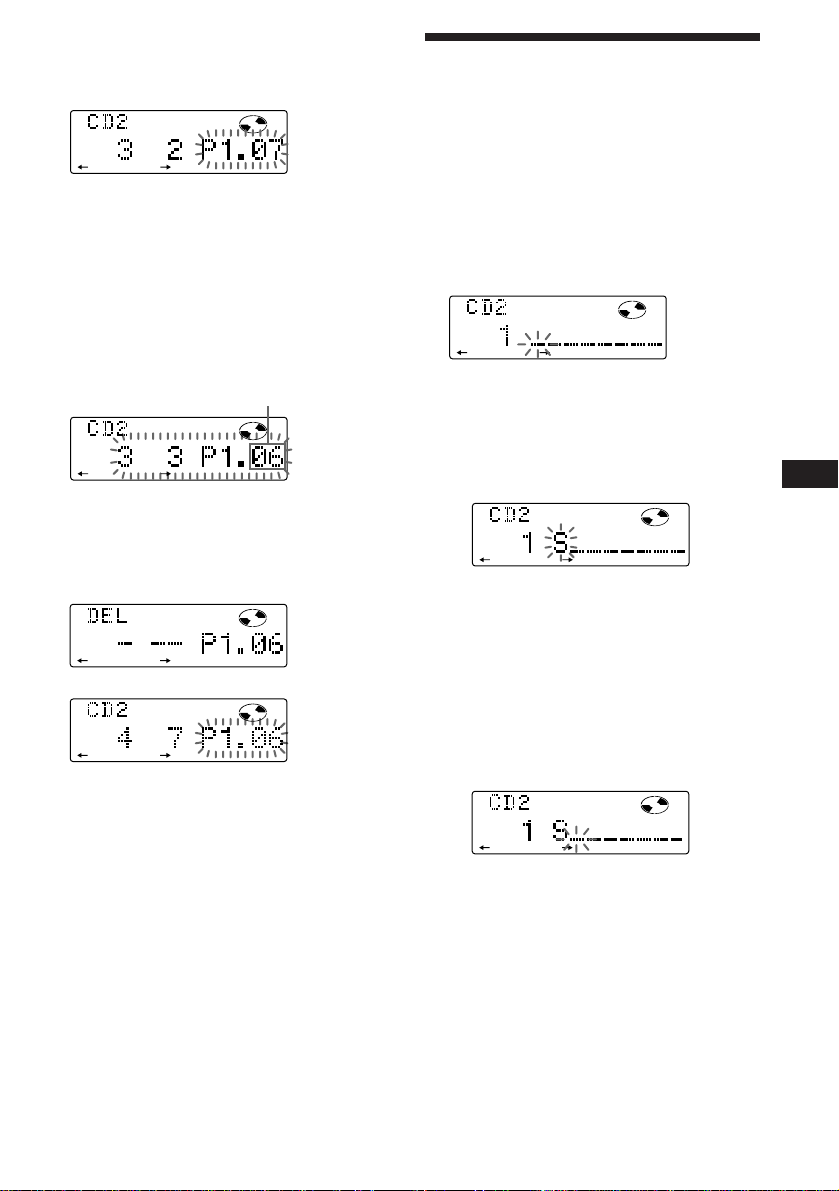
Erasing an entire program
1 Press (SHIFT), then press (4) (PLAY
MODE) for two seconds.
“P 1” shows Program 1 is selected.
If you have labeled the disc, the bank edit
mode appears. Press (4) (PLAY MODE) to
display “P 1” above.
2 Press (2) (N) repeatedly until “DEL”
appears.
To erase Program 2, press (5) (n)
repeatedly until “PGM 2” appears.
3 Press (6) (ENTER) for two seconds.
The entire program is erased.
4 When you finish erasing programs, press
(4) (PLAY MODE) for two seconds.
5 Press (SHIFT).
PLAY
DISC TRACK
MODE ENTER
PLAY MODE ENTER
PLAY MODE ENTER
23
EN
Erasing tracks in a program
1 Press (SHIFT), then press (4) (PLAY
MODE) for two seconds.
“P 1” shows Program 1 is selected.
If you have labeled the disc, the bank edit
mode appears. Press (4) (PLAY MODE) to
display “P 1” above.
To select Program 2, press (5) (n)
repeatedly until “P 2” appears.
2 Press (2) (N) or (5) (n) to select the
track you want to erase.
The track currently registered in slot 6 of
Program 1.
3 Press (6) (ENTER) for two seconds.
When you erase a track from a slot number,
the succeeding tracks shift up to fill the gap.
4 To continue erasing tracks, repeat steps
2 and 3.
5 When you finish erasing tracks, press (4)
(PLAY MODE) for two seconds.
6 Press (SHIFT).
Track slot number
µ
PLAY
DISC TRACK
MODE ENTER
PLAY
DISC TRACK
MODE ENTER
PLAY
DISC TRACK
MODE ENTER
PLAY
DISC TRACK
MODE ENTER
Labeling a CD
— Disc Memo (CD unit with the custom file
function)
You can label each disc with a personalized
name. You can enter up to eight characters for
a disc. If you label a CD, you can locate the
disc by name (page 25) and select the specific
tracks for playback (page 25).
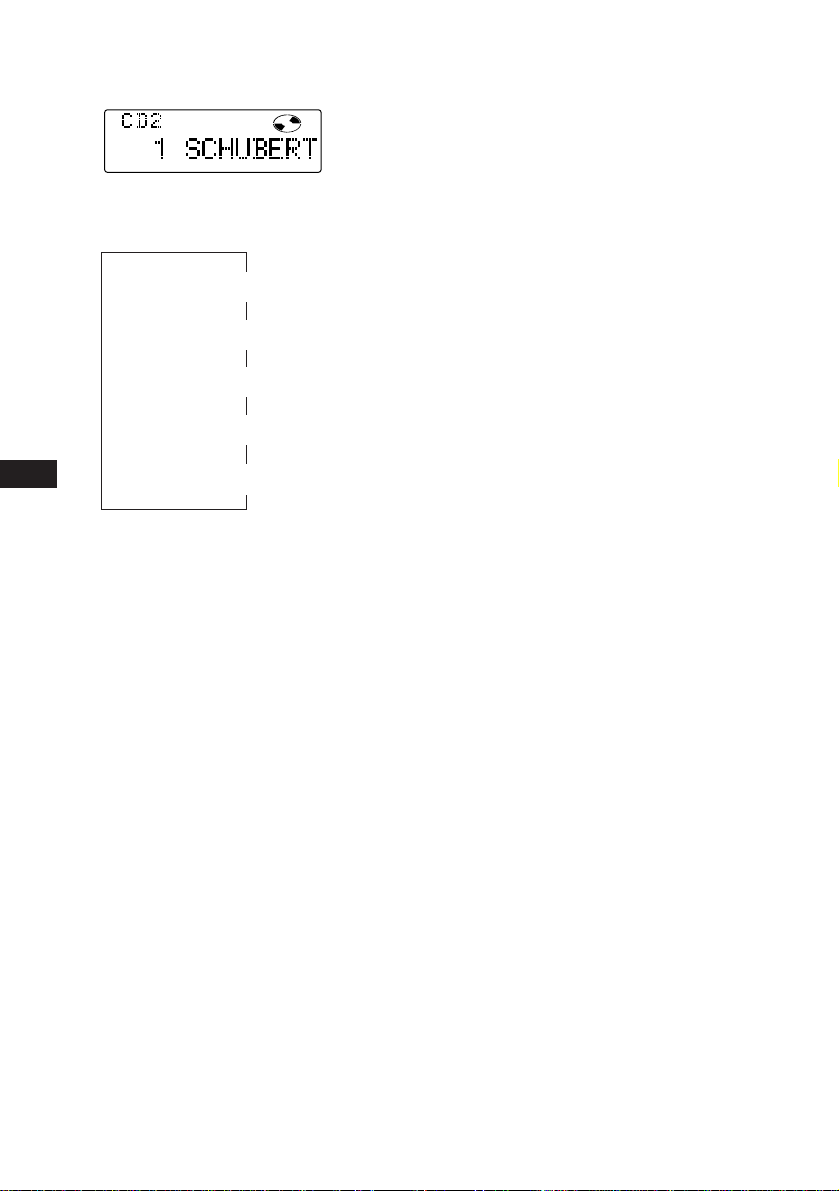
1 Play the CD and press (LIST) for two
seconds.
2 Enter the characters.
1 Rotate the dial clockwise to select the
desired characters.
(A n B n C n ··· Z n 0 n 1 n 2 n
··· 9 n + n – n * n / n \ n > n <
n . n _ )
If you rotate the dial counterclockwise,
the characters appear in the reverse
order.
If you want to put a blank space
between characters, select “_” (under-
bar).
2 Press (5) (n) after locating the
desired character.
The flashing cursor moves to the next
space.
If you press (2) (N), the flashing cursor
moves to the left.
3 Repeat steps 1 and 2 to enter the
entire name.
3 To return to normal CD playback mode,
press (LIST) for two seconds.
Tip
To erase/correct a name enter “_” (under-bar) for
each character.
DISC
DISC
DISC
CD/MD Unit
24
EN
Erasing the disc memo
1 Press (SOURCE) repeatedly to select CD.
2 Press (MODE) repeatedly to select the CD
unit.
3 Press (LIST) for two seconds.
4 Press (DSPL) for two seconds.
5 Rotate the dial to select the name you
want to erase.
6 Press (6) (ENTER) for two seconds.
The name is erased.
Repeat steps 5 and 6 if you want to erase
other names.
7 Press (LIST) for two seconds.
The unit returns to normal CD playback
mode.
Note
When the personalized label is erased, the original
CD TEXT information will appear in the display.
DISC
Displaying the disc memo name
Press (DSPL) during CD or CD TEXT disc
playback.
Each time you press (DSPL) during CD or
CD TEXT disc playback, the item changes
as follows:
$
Elapsed playback time
$
Disc memo name
$
Track name*
1
$
Clock
$
MOTION DISPLAY*
2
*
1
If you connect an optional CD unit with the
CD TEXT function, the CD TEXT information
will appear in the display when you playback
a CD TEXT disc.
*
2
All the items above are scrolled in the
display one by one in order.
25
EN
Locating a disc by name
— List-up (CD unit with the custom file
function or MD unit)
You can use this function for discs that have
been assigned a custom name. For more
information on disc names, refer to “Labeling a
CD” (page 23).
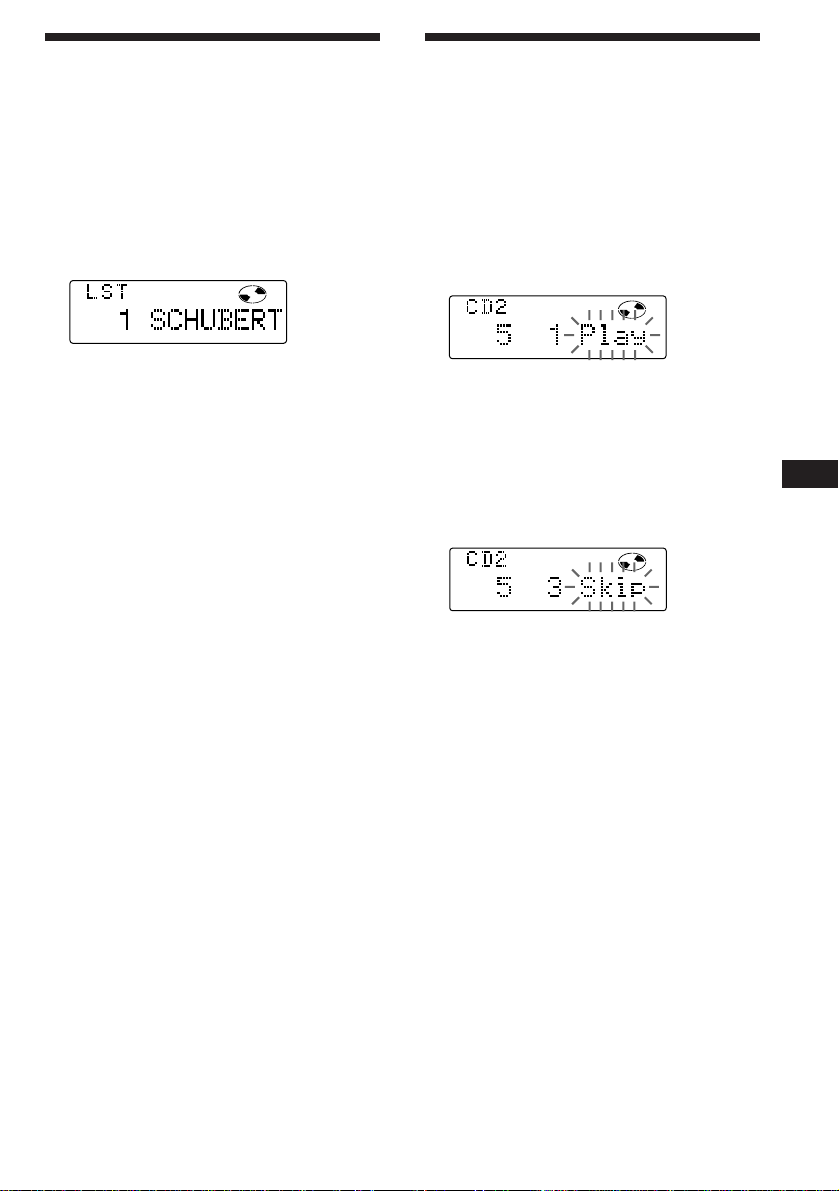
1 Press (LIST) momentarily.
The name assigned to the current disc
appears in the display.
When you assign a disc memo label to a
CD TEXT disc, it takes priority over the
original CD TEXT information.
2 Press (LIST) repeatedly until you find the
desired disc.
3 Press (6) (ENTER) to play back the disc.
Notes
• After a disc name has been displayed for five
seconds, the display goes back to normal
playback mode. To turn off the display, press
(DSPL).
• The track names are not displayed during MD or
CD TEXT disc playback.
• If there are no discs in the magazine, “NO Disc”
appears in the display.
• If a disc has not been assigned a custom file,
“********” appears in the display.
• If the disc information has not been read by the
unit, “?” appears in the display. To load the disc,
first press the number button, then choose the
disc that has not been loaded.
• The information appears only in upper case.
There are also some letters which cannot be
displayed (during MD or CD TEXT disc playback).
DISC
ENTER
Selecting specific tracks
for playback
— Bank (CD unit with the custom file
function)
If you label the disc, you can set the unit to
skip tracks and play only the tracks you want.
1 Start playing the disc and press (SHIFT).
Then press (4) (PLAY MODE) for two
seconds.
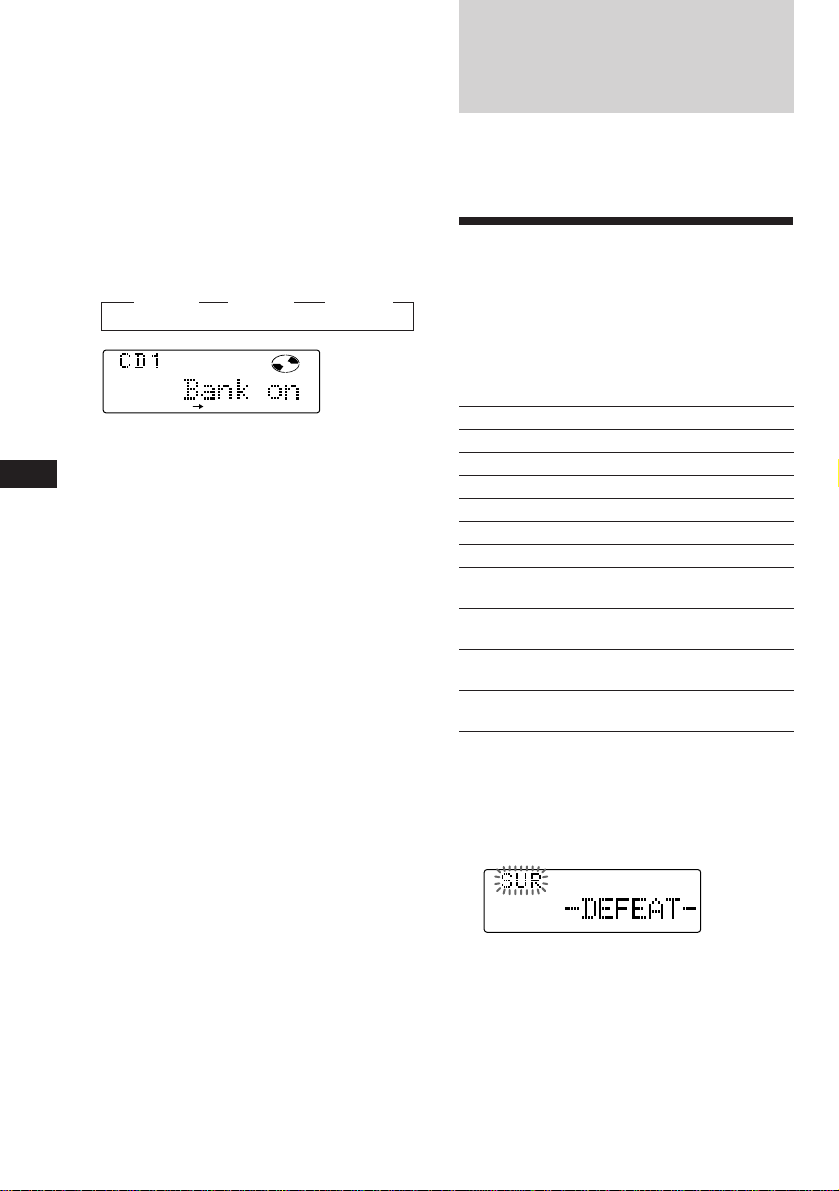
Bank edit mode.
Note
If you have not labeled the disc, the bank edit
mode does not appear and the program edit
mode appears. To go back to normal playback
mode, press (SHIFT).
2 Push the SEEK/AMS control up or down
to select the track number you want to
skip and press (6) (ENTER).
The indication changes from “Play” to
“Skip.” If you want to return to “Play,”
press (6) (ENTER) again.
3 Repeat step 2 to set the “Play” or “Skip”
mode on all the tracks.
4 Press (4) (PLAY MODE) for two seconds.
The unit returns to normal CD playback
mode.
5 Press (SHIFT).
Notes
• You can set the “Play” and “Skip” mode on up
to 24 tracks.
• You cannot set the “Skip” mode on all the
tracks.
CD/MD Unit
PLAY
DISC TRACK
MODE ENTER
PLAY
DISC TRACK
MODE ENTER
26
EN
Playing the specific tracks only
You can select:
•Bank on to play the tracks with the “Play”
setting.
•Bank inv (Inverse) to play the tracks with the
“Skip” setting.
1 During playback, press (SHIFT), then
press (4) (PLAY MODE) repeatedly until
“Bank” appears.
2 Press (5) (n) to repeatedly until the
desired setting appears.
z Bank on z Bank inv z Bank off
Playback starts from the track following the
current one.
3 Press (SHIFT).
To go back to normal playing mode, select
“Bank off“ in step 2 above.
BANK
PLAY MODE
With Optional Equipment
DSP
The optional XDP-U50D lets you add some
effects to the sound field of the currently
selected source.
Selecting a surround menu
You can select a desired surround menu to
best fit the audio source. The following menus
can simulate different sound fields and
enhance the sound so that you can feel as if
you are in a live concert.
Surround menu
HALL Concert hall
JAZZ Jazz club
DISCO Disco with thick walls
THEATER Movie theater
PARK Big open space
LIVE Live concert
OPERA Opera house
CHURCH Church/chapel with a lot of
reverberation
STADIUM Open-air concert in a
stadium
CELLAR Cellar with a lot of
reverberation
DEFEAT Normal sound without any
DSP effects
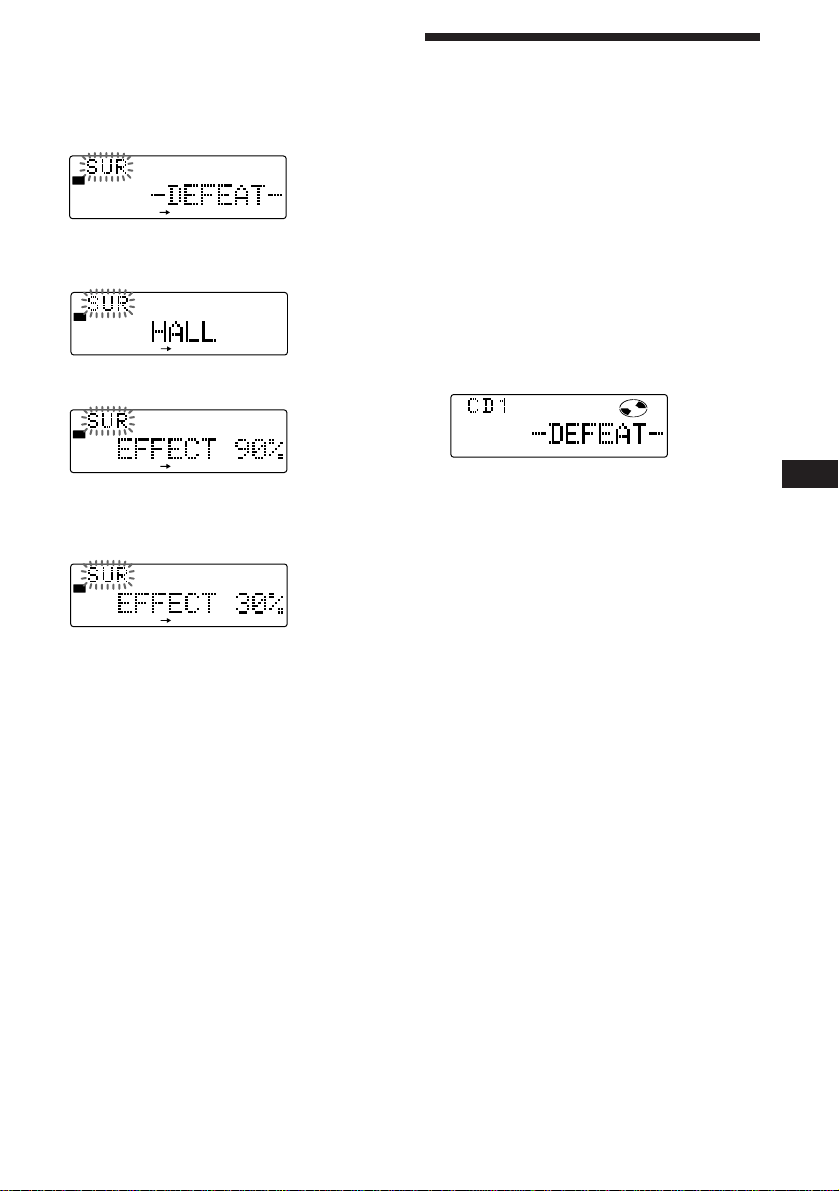
1 Press (SOURCE) to select a source (tuner,
CD or MD).
2 Press (SOUND) repeatedly until “SUR”
appears.
3 Rotate the dial to select the desired
surround menu.
The surround menu appear in the order
shown above.
After three seconds, the display goes back
to normal mode.
27
EN
Storing a surround effect
onto CDs
— Digital Signal Processor (DSP) Custom
File (CD unit the with custom file function)
Once you have registered the desired surround
menu onto the discs, you can enjoy the same
surround menu every time you play that disc.
(Only when you have labeled a disc by the
Custom File function.)
1 Press (LIST) for two seconds.
2 Press (LIST) until the surround menu
appears.
DSP custom file mode
3 Rotate the dial to select the desired
surround menu.
4 Press (LIST) for two seconds.
After the effect setting is complete, the
display goes back to normal playback
mode.
Playing the disc with the stored
surround menu
1 Press (SHIFT), then press (4) (PLAY
MODE) repeatedly until “D.File”
appears.
2 Press (5) (n) to select the “D.File on.”
After five seconds, the display goes back to
normal playback mode.
3 Press (SHIFT).
To cancel to play the disc with stored surround
menu, select “D.File off” in step 2.
Changing the stored surround
effect
Play the disc whose surround mode you want
to change, and follow the steps of “Storing the
surround effect onto CDs.”
Erasing the stored surround effect
Select “DEFEAT” in step 3 of “Storing the
surround effect onto CDs.”
Adjusting the effect level
1 Press (SOURCE) to select a source (tuner,
CD or MD).
2 Press (SOUND) for two seconds.
3 Rotate the dial until the desired
surround menu appears.
4 Press (4) (n).
5 Rotate the dial to adjust the level.
You can adjust the level from 0 to 100%.
Increase the level to enhance the effect.
6 Press (SOUND) for two seconds.
CD/MD Unit/DSP
SUR
SUR
SUR
SUR
28
EN
Display
window
LP1
All
LP2
Front
LP3
Front R
LP4
Front L
LP5
Rear
Center of sound
field
Normal setting
(1 + 2 + 3)
Front part
(1 + 2)
Right front (2)
Left front (1)
Rear part (3)
2
1
3
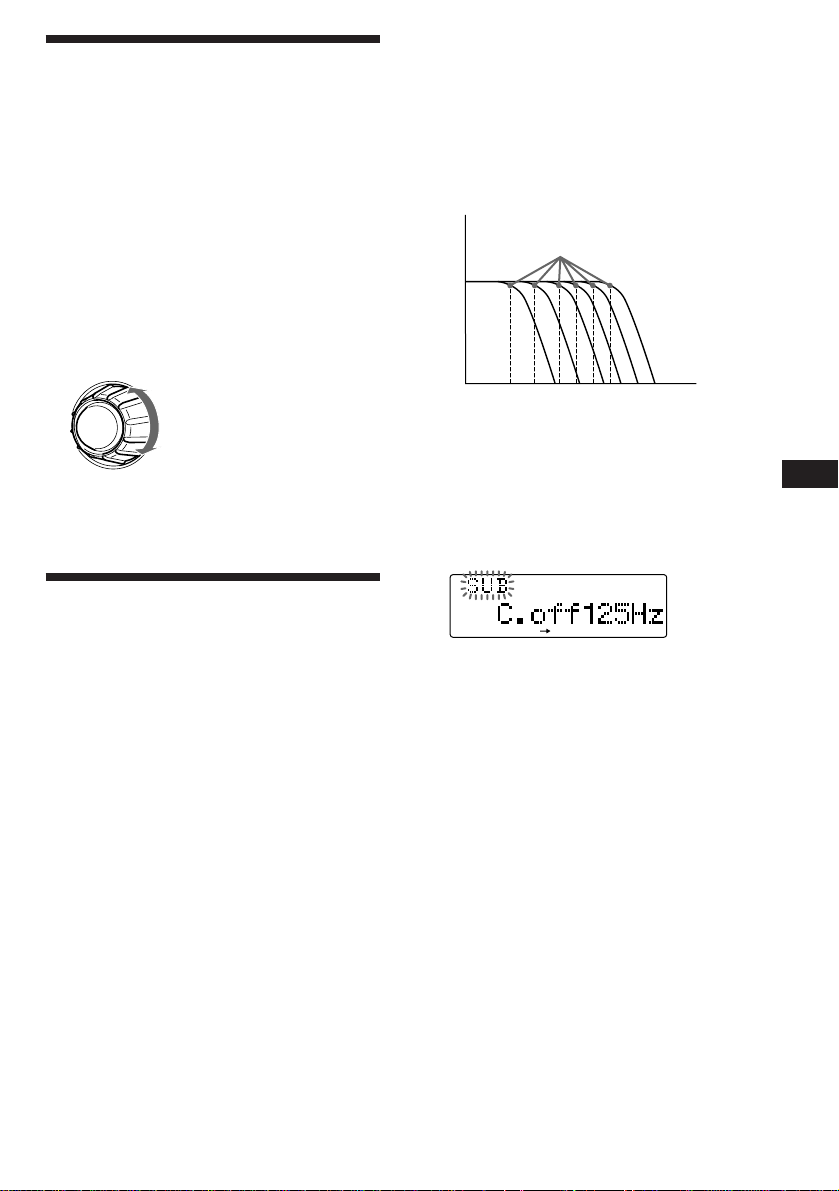
4 Rotate the dial to adjust the center of
the sound field to the left or right. Then
set the center of the sound field.
5 Press (5) (n).
6 Rotate the dial to adjust the center of
the sound field to the front or rear.
7 Press (SOUND) for two seconds.
After the position setting is complete,
normal playback mode appears.
Center moves to the R (rear).
Center moves to the F (front).
Center moves to the L (left).
Center moves to the R (right).
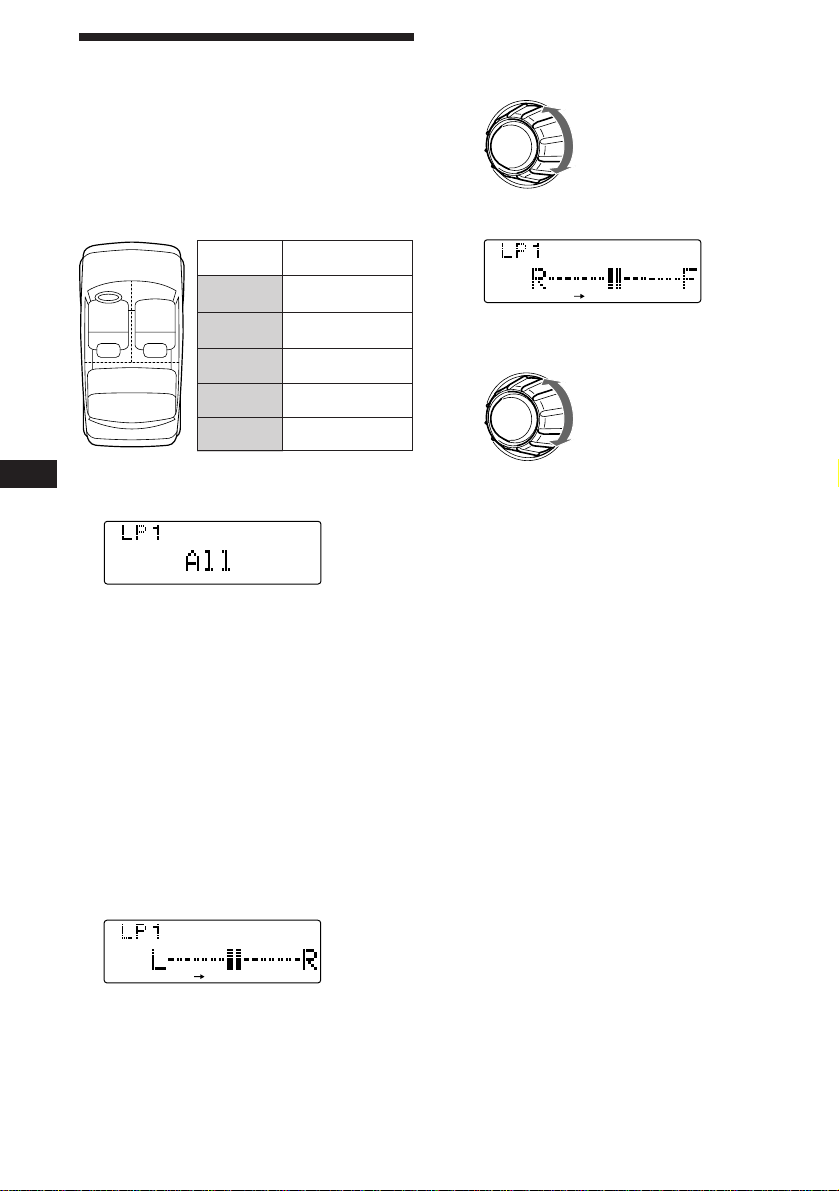
Selecting the listening
position
You can set the time for the sound to reach the
listeners from the speakers.
The unit can simulate a natural sound field so
that you can feel as if you are in the center of
the sound field wherever you sit in the car.
1 Press (SOUND) momentarily until “LP1”
appears.
2 Rotate the dial to select the desired
listening position.
The listening positions appear in the order
shown above.
After three seconds, the display goes back
to normal playback mode.
Adjusting the listening position
1 Press (SOUND) for two seconds.
2 Press (SOUND) repeatedly until the
desired listening position appears.
3 Press (5) (n).
29
EN
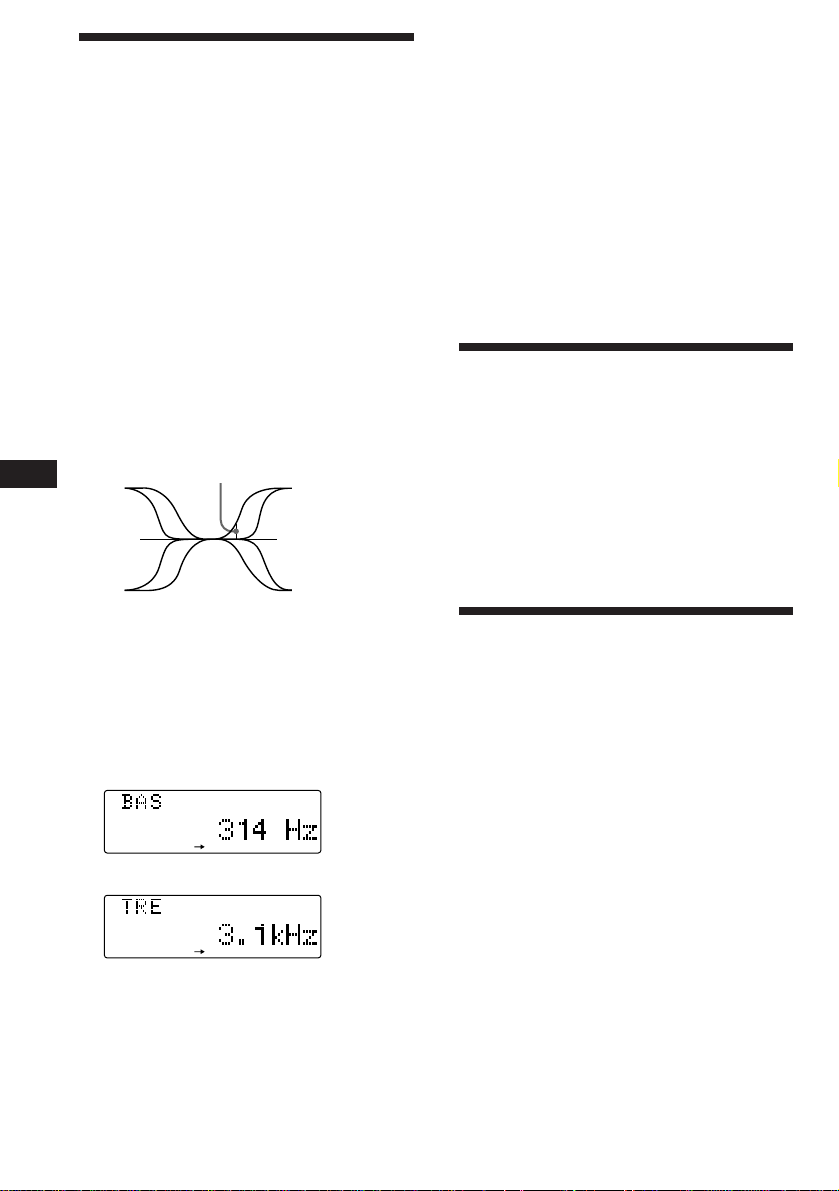
Adjusting the frequency of the
subwoofer(s)
To match the characteristics of the connected
subwoofer(s), you can cut out the unwanted
high and middle frequency signals entering
the subwoofer(s). By setting the cut-off
frequency (see the diagram below), the
subwoofer(s) will output only low frequency
signals so you can get a clearer sound image.
1 Press (SOURCE) to select a source (tuner,
CD or MD).
2 Press (SOUND) for two seconds.
3 Press (SOUND) repeatedly until “SUB”
appears.
4 Rotate the dial to select the desired cut-
off frequency.
The cut-off frequency in the display
changes.
62 n 78 n 99 n 125* n 157 n 198 Hz
* Factory-set frequency
5 Press (SOUND) for two seconds.
After the frequency setting is complete, the
display goes back to normal playback
mode.
Level
Cut-off frequency
Frequency (Hz)
Adjusting the fader (FAD)
Normally, with the DSP mode on, the volume
of the output sound from the rear speakers is
lowered automatically to improve the
efficiency of the listening position setting. If
you want to raise the rear speaker volume,
adjust the fader.
1 Follow steps 1 through 3 of “Selecting a
surround menu” (page 26).
2 Press (SOUND) repeatedly until “FAD”
appears.
3 Rotate the dial to adjust the fader.
After three seconds, the display goes back
to normal playback mode.
Adjusting the volume of
the subwoofer(s)
1 Press (SOURCE) to select a source (tuner,
CD or MD).
2 Press (SOUND) repeatedly until “SUB”
appears.
3 Rotate the dial to adjust the volume.
After three seconds, the display goes back
to normal playback mode.
Tip
When you rotate the dial to turn the volume all
the way down, “Sub ATT” appears and the cut-off
frequency of the subwoofer is disabled.
Increases front speaker volume
Decreases front speaker volume
DSP
62
78
99 125
157
198
30
EN
Adjusting the volume of
the bass and treble
You can adjust the volume of the bass and
treble to best fit the acoustic characteristics
inside your car.
1 Press (SOURCE) to select a source (tuner,
CD or MD).
2 Press (SOUND) repeatedly until “BAS” or
“TRE” appears.
3 Rotate the dial to adjust the volume.
After three seconds, the display goes back
to normal playback mode.
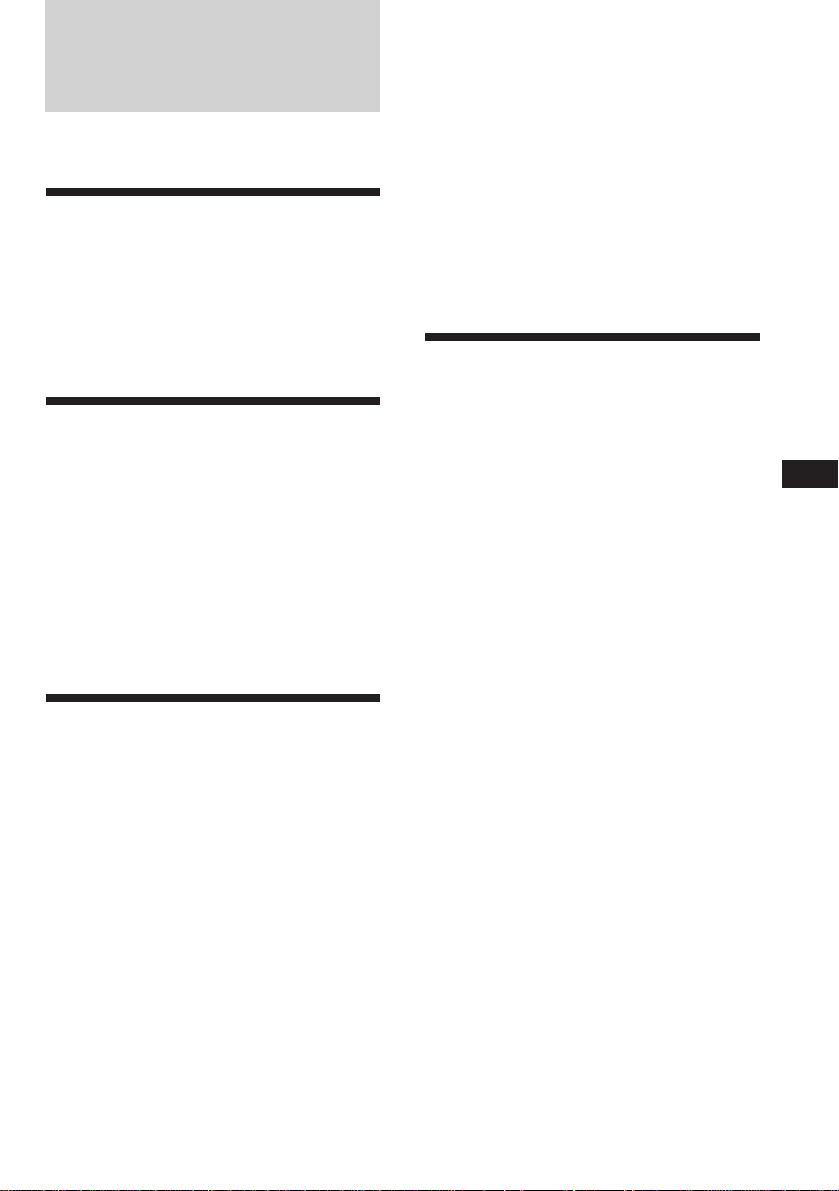
Adjusting the turn-over frequency
You can adjust the bass and treble turn-over
frequencies.
1 Press (SOURCE) to select a source (tuner,
CD or MD).
2 Press (SOUND) for two seconds.
3 Press (SOUND) repeatedly until “BAS” or
“TRE” appears.
Bass adjusting mode
Treble adjusting mode
Frequency (Hz)
Turn-over frequency
4 Rotate the dial to select the turn-over
frequency.
The turn-over frequencies change as
follows:
Bass:
198 Hz n 250 Hz n 314 Hz* n 396 Hz
Treble:
2.0 kHz n 3.1 kHz* n 4.0 kHz n 5.0 kHz
* Factory-set frequency
5 Press (SOUND) for two seconds.
The display goes back to normal playback
mode.
Listening to each program
source in its registered
surround menu
— Last Sound Memory (LSM)
You can listen to the same source always in the
same surround menu even after changing the
program source or turning the unit on and off
again.
Changing the line output
level
You can change the line output level if you
hear distortion or other noise.
1 Press (SHIFT), then press (3) (SET UP)
until “L.out” appears.
2 Press (5) (n) to select the desired
setting (–10 dB or –16 dB).
3 Press (SHIFT).
31
EN
3 Press (5) (n).
The unit stores TV channels in the order of
their frequencies on the number buttons.
A beep sound and the setting is stored.
4 Press (SHIFT).
Notes
• The unit does not store TV channels with weak
signals. If only a few TV channels are received,
some number buttons will remain empty.
• When a preset number is indicated in the display,
the unit starts storing TV channels from the one
currently displayed.
Memorizing only the
desired TV channels
You can store up to 10 channels on the number
buttons in the order of your choice.
1 Press (SOURCE) repeatedly until “TV”
appears.
2 Push the SEEK/AMS control up or down
to tune in the TV program you want to
store on the number button.
3 Press and hold the desired number
button ((1) to (10)) until you hear a
beep tone.
The number button indication appears in
the display.
Note
If you try to store another program on the same
number button, the previously stored program will
be erased.
With Optional Equipment
TV/Video
You can connect an optional TV tuner and TV
monitor with this unit.
Watching the TV
1 Press (SOURCE) repeatedly until “TV”
appears.
2 Push the SEEK/AMS control up or down
to select the desired TV band.
Watching a video
1 Press (SOURCE) repeatedly until
“TV” appears.
2 Press (MODE) repeatedly to select
“Video 1.”
Play back the video.
Note
“Video 2” appears if the VIDEO 2 terminal of the
TV monitor is selected.
Memorizing TV channels
automatically
The unit selects the TV channels with the
strongest signals and memorizes them in the
order of their frequency.
Caution
When tuning in a station while driving, use
Best Tuning Memory to prevent accidents.
1 Press (SOURCE) repeatedly until “TV”
appears.
2 Press (SHIFT), then press (4) (PLAY
MODE) repeatedly until “Auto mem”
appears.
DSP/TV/Video
32
EN
Storing the TV channel
names
Follow the steps in “Storing the station
names” (page 14).
Displaying the TV or radio station
names
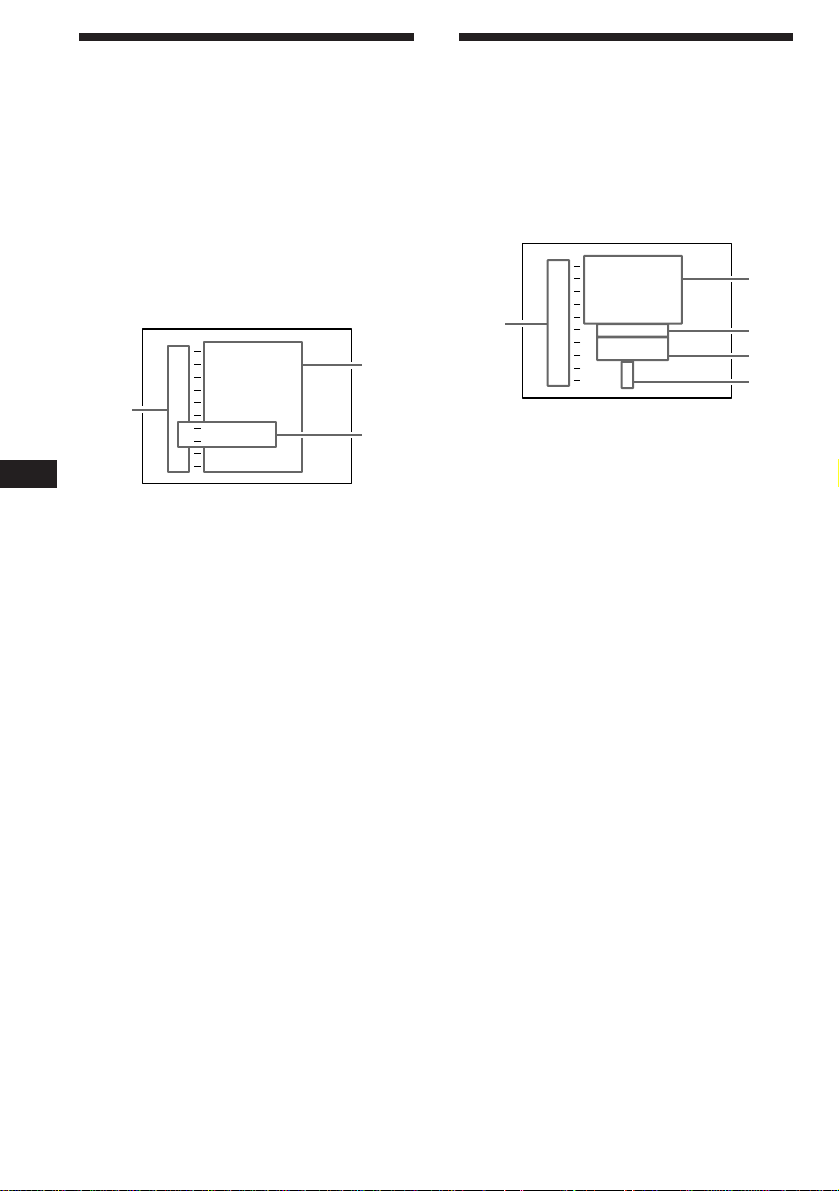
Press (LIST) momentarily during TV or
radio reception.
Example: When receiving the FM1 band
1 Preset number
2 Stored station names
3 Frequencies*
* If the name of a station is not stored, the
frequency of that station will be displayed
instead.
Notes
• It may take some time before all indications
appear in the display.
• The TV monitor does not appear during list
display.
• The contents of the preset memory cannot be
listed when the unit is in the simultaneous play
mode (page 33).
Turning off the display
During radio reception, press (LIST)
again.
During TV reception, the list display on the
TV monitor will automatically turn off after
a few seconds.
1
2
3
FM
1
2
3
4
5
6
7
9
1 0
8
W
W
W
W
W
C
B
K
E
R
B
T
V
F
S
U
M
S
WR K I
S
1
S
L
D
W
W
P
Y
L
NY
J
01 .9
02 .7
1
1
Displaying the
information stored on
discs
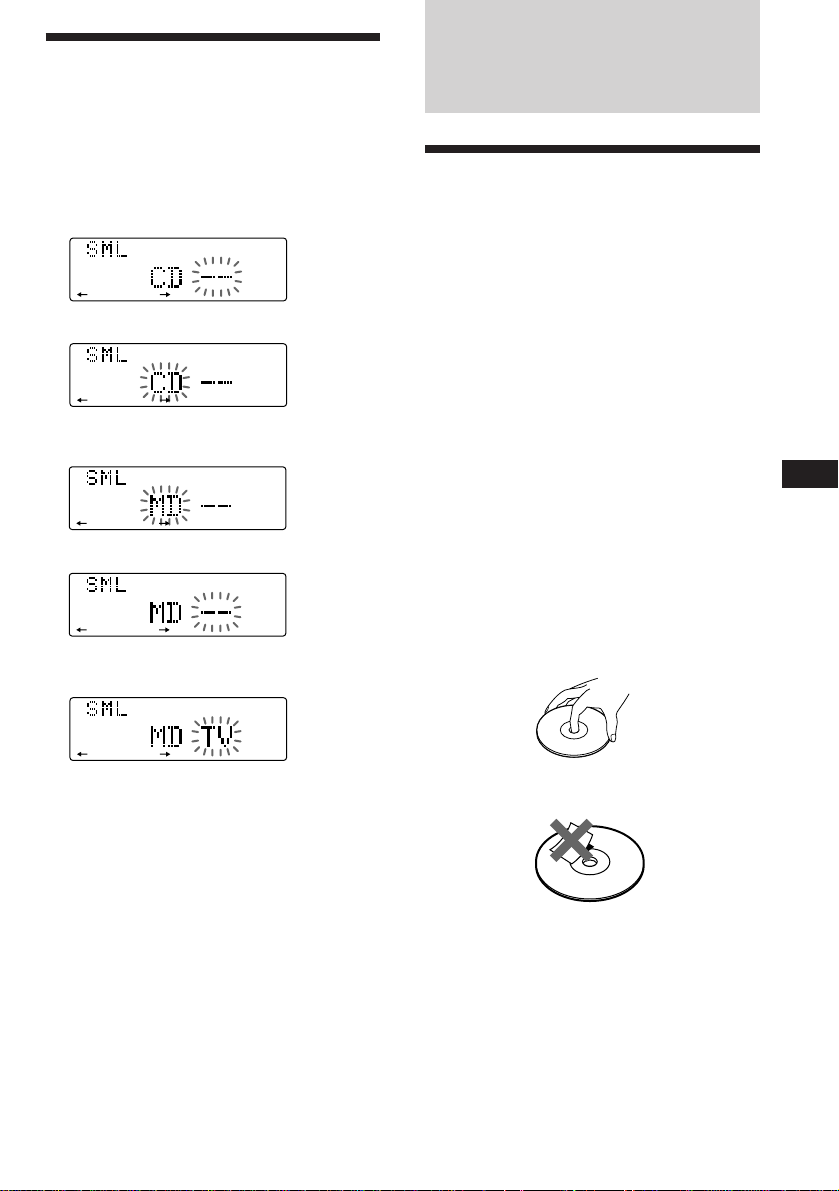
Press (LIST) momentarily during CD/MD
playback.
Example: When CD unit 1 is selected.
1 Disc numbers
2 Titles stored as custom files
3 No disc is loaded*
1
4 No stored titles*
2
5 TOC information has not been identified
yet*
3
*
1
A blank space is displayed next to a disc
numbers representing empty slots in the disc
magazine.
*
2
If a title is not registered in the custom file,
“******” is displayed.
*
3
If the disc information has not been read yet,
“?” is displayed.
Notes
• It may take some time until all indications appear
in the display.
• The TV program does not appear during list
display.
• The contents of the preset memory cannot be
listed when the unit is in the simultaneous play
mode.
Turning off the display
Press (LIST) again.
Note
Press (LIST) twice when you connect the MD
unit(s).
5
4
3
2
1
CD 1
1
2
3
4
5
6
7
9
1 0
8
S
M
B
L
C
C
O
A
I
H
H
Z
C
S
O
U
A
H
Z
P
B
R
T
I
E
T
N
RT
*
?
?
*****
******
33
EN
Watching the TV or video
while listening to a CD or
MD
— Simultaneous Play
The simultaneous play function does not work
while you are listening to the radio.
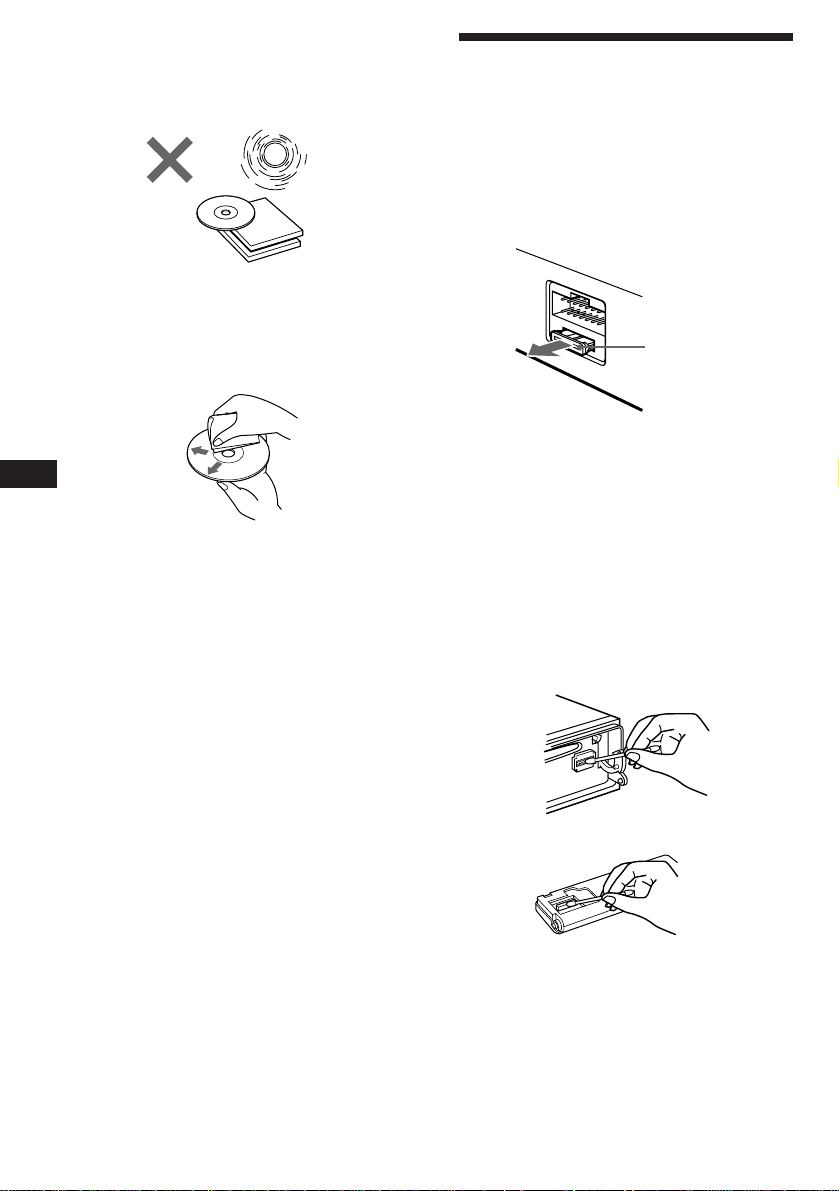
1 Press (SOURCE) for two seconds.
2 Press (2) (N).
3 Press (SOURCE) repeatedly to select a CD
or MD.
4 Press (5) (n).
5 Press (SOURCE) repeatedly to select a TV
or video.
6 Press (SOURCE) for two seconds.
Simultaneous Play starts.
If you want to change the sound to CD or MD
while watching the TV or video with its sound,
please follow the steps, but press (5) (n) in
step 2 and press (2) (N) in step 4.
Returning to normal mode
To cancel the CD or MD, follow the steps
above and select “– –” in step 3.
To cancel the TV or video, follow the
steps above and select “– –” in step 5.
Notes
If you press the EJECT button on a CD/MD unit
while the unit is in simultaneous play mode,
Simultaneous Play is canceled.
TV/Video/Additional Information
Additional
Information
Precautions
• If your car was parked in direct sunlight
resulting in a considerable rise in
temperature inside the car, allow the unit to
cool off before operating it.
• If no power is being supplied to the unit,
check the connections first. If everything is in
order, check the fuse.
• If no sound comes from the speakers of
two-speaker systems, set the fader control to
the centre position.
•If your car is equipped with a power
antenna, it will extend automatically while
the unit is operating.
If you have any questions or problems
concerning your unit that are not covered in
this manual, please consult your nearest Sony
dealer.
Notes on handling CDs
A dirty or defective disc may cause sound
dropouts while playing. To enjoy optimum
sound, handle the disc as follows.
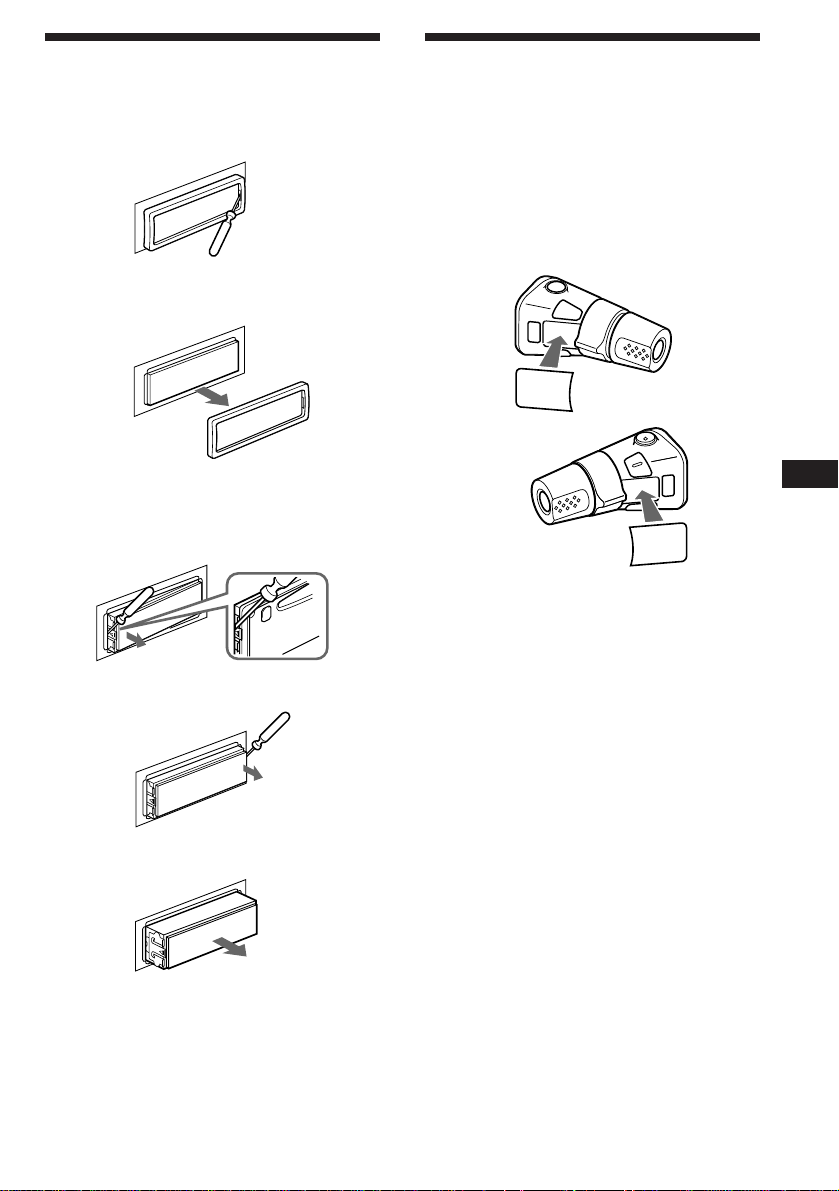
Handle the disc by its edge. To keep the disc
clean, do not touch the surface.
Do not stick paper or tape on the labelled
surface.
continue to next page n
34
EN
Maintenance
Fuse replacement
When replacing the fuse, be sure to use one
that matches the amperage described on the
fuse. If the fuse blows, check the power
connection and replace the fuse. If the fuse
blows again after replacement, there may be an
internal malfunction. In such a case, consult
your nearest Sony dealer.
Warning
Never use a fuse with an amperage rating
exceeding the one supplied with the unit as
this could damage the unit.
Cleaning the connectors
The unit may not function properly if the
connectors between the unit and the front
panel are not clean. To prevent this, open the
front panel by pressing (OPEN), then detach it
and clean the connectors with a cotton swab
dipped in alcohol. Do not apply too much
force. Otherwise, the connectors may be
damaged.
Main unit
Back of the front panel
Notes
• For safety, before cleaning the connectors, turn
off the engine and remove the key from the
ignition switch.
• Never touch the connectors directly with your
fingers or any metal device.
Fuse (10 A)
Do not expose the discs to direct sunlight or
heat sources such as hot air-ducts, or leave
them in a car parked in direct sunlight where
there can be a considerable rise in the
temperature inside the car.
Before playing, clean the discs with an optional
cleaning cloth. Wipe each disc from the centre
out.
Do not use solvents such as benzine, thinner,
commercially available cleaners or antistatic
spray intended for analog discs.
Note on moisture condensation
On a rainy day or in a very damp area,
moisture may condense on the lenses inside
the CD player. Should this occur, the unit will
not operate properly. In this case, remove the
disc and wait for about an hour until the
moisture evaporates.
When you play 8 cm (3 in.) CDs
Use the optional Sony compact disc single
adapter (CSA-8) to protect the CD player from
being damaged.
35
EN
Dismounting the unit
1 Press the clip inside the front cover with
a thin screwdriver, and lever the front
cover free.
2 Repeat step 1 on the left side.
The front cover is removed.
3 Use a thin screwdriver to push in the clip
on the left side of the unit, then pull out
the left side of the unit until the catch
clears the mounting.
4 Repeat step 3 on the right side.
5 Slide the unit out of the mounting.
Additional Information
Attaching the label to the
rotary commander
You can control this unit with the optional
rotary commander (RM-X4S).
Several labels are supplied with the rotary
commander. Attach the label that matches the
functions of this unit and the mounting
position of the rotary commander.
After you mount the rotary commander, attach
the label in the illustration below.
SOUND
LIST
MODE
SOUND
LIST
MODE

36
EN
Specifications
AUDIO POWER SPECIFICATIONS
POWER OUTPUT AND TOTAL HARMONIC DISTORTION
19 watts per channel minimum continuous average power into
4 ohms, 4 channels driven from 20 Hz to 20 kHz with no more than
1 % total harmonic distortion.
Other specifications
CD player section
System Compact disc digital audio
system
Signal-to-noise ratio 99 dB
Frequency response 10 – 20,000 Hz
Wow and flutter Below measurable limit
Laser Diode Properties
Material GaAlAs
Wavelength 780 nm
Emission Duration Continuous
Laser output power Less than 44.6 µW*
* This output is the value measured at a distance
of 200 mm from the objective lens surface on the
Optical Pick-up Block.
Tuner section
FM
Tuning range 87.5 – 107.9 MHz
Antenna terminal External antenna connector
Intermediate frequency 10.7 MHz
Usable sensitivity 8 dBf
Selectivity 75 dB at 400 kHz
50 dB at 200 kHz
Signal-to-noise ratio 65 dB (stereo),
68 dB (mono)
Harmonic distortion at 1 kHz
0.7 % (stereo),
0.4 % (mono)
Separation 35 dB at 1 kHz
Frequency response 30 – 15,000 Hz
AM
Tuning range 530 – 1,710 kHz
Antenna terminal External antenna connector
Intermediate frequency 10.71 MHz/450 kHz
Sensitivity 30 µV
Power amplifier section
Outputs Speaker outputs
(sure seal connectors)
Speaker impedance 4 – 8 ohms
Maximum power output 45 W × 4 (at 4 ohms)
General
Outputs EQ output
Line outputs (3)
Power antenna relay
control lead
Power amplifier control
lead
Telephone ATT control
lead
Illumination control lead
Tone controls Bass ±8 dB at 100 Hz
Treble ±8 dB at 10 kHz
Power requirements 12 V DC car battery
(negative ground)
Dimensions Approx. 178 × 50 × 182 mm
(7
1
/8 × 2 × 7
1
/4 in.)
(w/h/d)
Mounting dimensions Approx. 182 × 53 × 163 mm
(7
1
/4 × 2
1
/8 × 6
1
/2 in.)
(w/h/d)
Mass Approx. 1.4 kg (3 lb. 1 oz.)
Supplied accessories Parts for installation and
connections (1 set)
Front panel case (1)
Optional accessories Rotary commander
RM-X4S
Wireless remote RM-X47
BUS cable (supplied with
an RCA pin cord)
RC-61 (1 m), RC-62 (2 m)
Compact disc single
adapter CSA-8
Optional equipment CD changer
CDX-805 (10 discs),
CDX-715 (10 discs),
CDX-T65 (6 discs),
CDX-T62 (6 discs)
MD changer
MDX-62
Digital preamplifier
XDP-U50D
Source selector
XA-C30
TV tuner
XT-40V, etc.
Design and specifications are subject to change
without notice.
37
EN
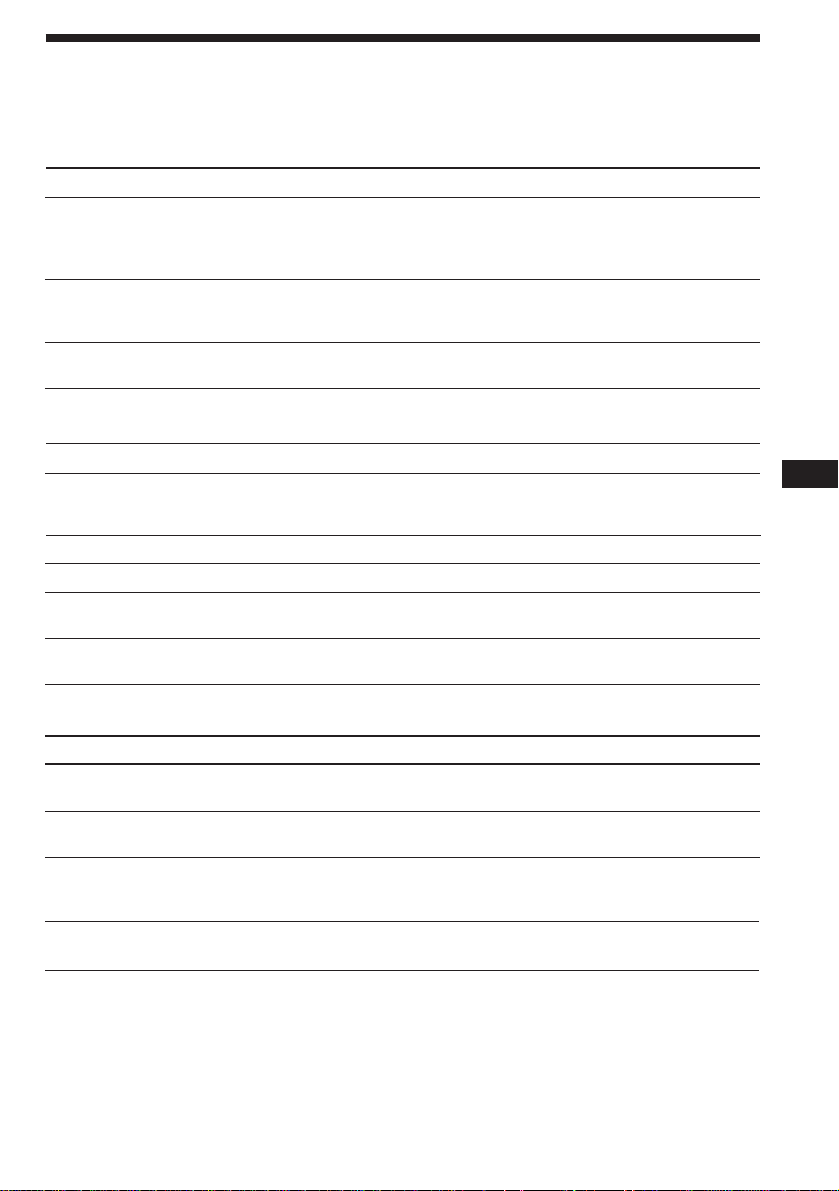
Troubleshooting guide
Problem
No sound.
The contents of the memory
have been erased.
Indications do not appear in the
display.
Cause/Solution
•Cancel the ATT function.
•Set the fader control to the center position for two-speaker
systems.
•Rotate the dial in a clockwise direction to adjust the volume.
• The power cord or battery has been disconnected.
• The reset button has been pressed.
n Store again into the memory.
Remove the front panel and clean the connectors. See “Cleaning
the connectors” (page 34) for details.
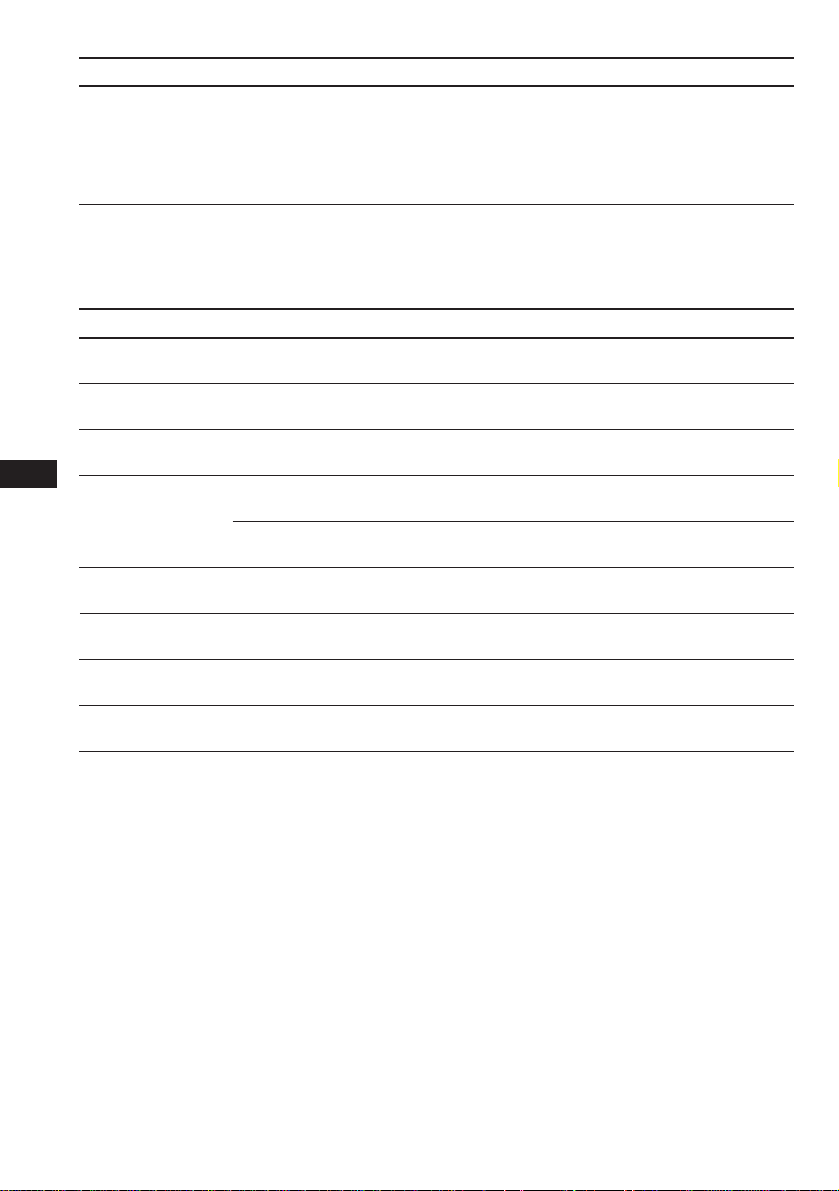
CD/MD playback
Cause/Solution
•Another CD is already loaded.
•The CD is forcibly inserted upside down or in the wrong way
(MD).
Defective MD or dusty CD.
The ambient temperature exceeds 50°C (122°F).
Press the reset button.
• The unit is installed at an angle of more than 60°.
• The unit is not installed in a sturdy part of the car.
Problem
A disc cannot be loaded.
Playback does not begin.
A disc is automatically ejected.
The operation buttons do not
function.
The sound skips due to
vibration.
Radio reception
Problem
Preset tuning is not possible.
Automatic tuning is not
possible.
The “ST” indication flashes.
Interference occurs during FM
reception.
Cause/Solution
• Memorize the correct frequency.
• The broadcast signal is too weak.
The broadcast signal is too weak.
n Use manual tuning.
•Tune in the frequency accurately.
•The broadcast signal is too weak.
n Set to the MONO mode (page 14).
The Wide mode is selected.
n Set to Narrow or IF Auto mode (page 14).
The following checklist will help you remedy the problems you may encounter with your unit.
Before going through the checklist below, check the connection and operating procedures.
General
Additional Information
38
EN
Solution
Insert the disc magazine in the CD/
MD unit.
Insert discs in the CD/MD unit.
Insert another CD/MD.
Clean or insert the CD correctly.
Insert another MD.
Play an MD with tracks recorded on
it.
Press the reset button of the unit.
Close the lid or insert the MDs
properly.
Wait until the temperature goes down
below 50°C (122°F).
Display
NO Mag
NO Disc
NG Discs
Error
Blank
PushReset
Not Ready
HighTemp
Cause
The disc magazine is not inserted in
the CD/MD unit.
No disc is inserted in the CD/MD unit.
A CD/MD cannot play because of
some problem.
A CD is dirty or inserted upside
down.*
2
An MD does not play because of some
problems.*2
No tracks have been recorded on an
MD.*
2
The CD/MD unit cannot be operated
because of some problem.
The lid of the MD unit is open or MDs
are not inserted properly.
The ambient temperature is more than
50°C (122°F).
*
1
*
1
Error displays
The following indications will flash for about five seconds, and an alarm sound will be heard.
*
1
When an error occurs during playback of an MD or CD, the disc number of the MD or CD does not appear
in the display.
*
2
The disc number of the disc causing the error appears in the display.
If the above-mentioned solutions do not help improve the situation, consult your nearest Sony
dealer.
Cause/Solution
The volume of the rear speakers may have been automatically
lowered in order to maximize the effect of the listening position
adjustment.
n Rotate the dial in a clockwise direction to adjust the balance.
The speaker balance can be set separately for DSP on mode
and DSP off mode (page 28).
Problem
No sound, or sound is too low.
DSP functions

39
EN

*I-3-862-316-12*(2)Sony Corporation Printed in Japan