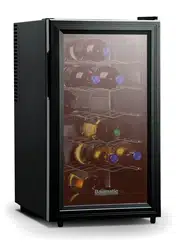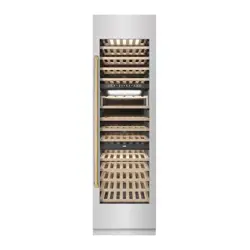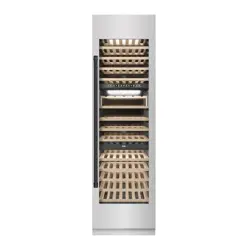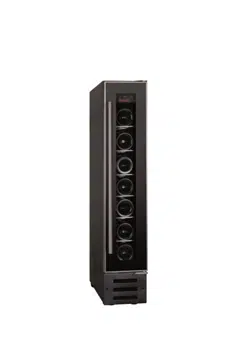
BWC155SS
15 cm 7 Bottle
Built-in wine cabinet
INSTRUCTION MANUAL
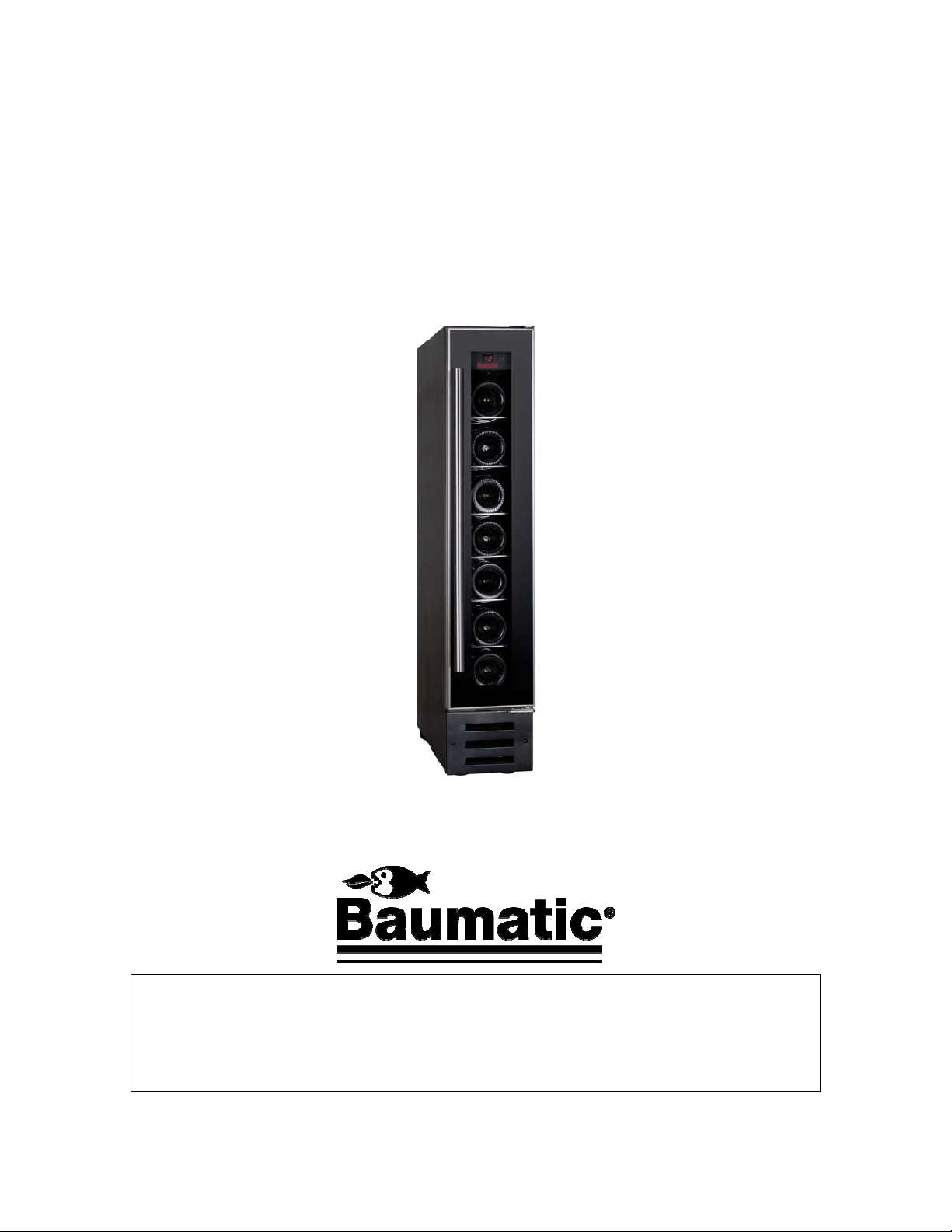
USER MANUAL FOR YOUR BAUMATIC
BWC155SS
15 cm 7 Bottle
Built-in wine cabinet
NOTE: This User Instruction Manual contains important
information, including safety & installation points, which will
enable you to get the most out of your appliance. Please keep it
in a safe place so that it is easily available for future reference, for
you or any person not familiar with the operation of the appliance.
GS 09/08/13
2

3
Contents
Environmental note 4
Important safety information 5 – 6
Specifications of your wine cabinet 7 – 8
Dimensions 7
Product specifications 7
Description of the appliance 8-9
Product features 8
Control panel 9
Description of the product features 9
Using your Baumatic wine cabinet 10-13
Before switching on 10
During first use 11
Turning the appliance on and off 11
Unlocking the control panel 11
The interior light 12
Setting the temperature 12
Changing between Fahrenheit and Celsius 12
Loading the wine cabinet 13
Storing your wines 13-14
Wine storage problems 15
Cleaning and maintenance 16-18
Defrosting 17
Removing the shelves for cleaning 17
Moving your wine cabinet 18
Power failure 18
Vacation time 18
Installation 18-25
Electrical connection 19
Positioning 20
Built-in installation 21
Adjusting the height and levelling off your wine cabinet 22
Installing the handle 23
Reversing the door of your wine cabinet 23-25
Troubleshooting 26-27
Baumatic consumables 28
Technical data 29
Contact details 31
Environmental note
Note
: Before discarding an old appliance, switch off and
disconnect it from the power supply. Cut off and render any plug
useless. Cut the cable off directly behind the appliance to prevent
misuse. This should be undertaken by a competent person. Disable
the door lock to make sure that children cannot get stuck inside
the appliance.
o The packaging materials that Baumatic uses are environmentally
friendly and can be recycled.
o Please discard all packaging material with due regard for the
environment.
4
Important safety information
Your safety is of the utmost importance to Baumatic.
Please make sure that you read this instruction booklet
before attempting to install or use the appliance. If you
are unsure of any of the information contained in this
booklet, please contact the Baumatic Advice Line.
IMPORTANT: Any installation work must be carried
out by a qualified electrician or competent person.
Use of the appliance
o Your appliance is only designed to be used in the
home. It is suitable for storing and chilling wine.
NO food stuffs must be stored in the appliance. If it
is used for any other purpose or it is not used
correctly, then Baumatic Ltd. will accept no liability
for any damage that is caused.
o Altering the specification of the appliance must not be attempted
for reasons of safety.
Before using your appliance
o Check the appliance for any signs of transport damage. If you
notice any damage, then you should not connect your appliance
to your mains supply and should contact your retailer.
Refrigerant
o Your appliance contains R600a refrigerant, which is a natural gas
that does not contain CFCs that can damage the environment.
However it is a flammable substance, therefore care should be
taken:
During the transportation and installation of the
appliance, make sure that the refrigeration pipework
does not get damaged.
If it does become damaged then sources of ignition and
open flames should be avoided. Also the room that the
appliance is situated in should be
thoroughly ventilated.
5
o Do not place any objects on top of the appliance,
as this may damage the table top.
Child safety
o Packaging material should be kept away from
children.
6
o Children should not be allowed to touch the
controls or play with the appliance.
General safety
o Do not pull on the power supply cable to remove the plug from
your mains supply socket.
o Do not pull out or insert the plug with wet
hands.
o Do not attempt to use your appliance outdoors
or any place where it is likely to come into
contact with the elements.
o Before cleaning the appliance or performing
maintenance work, ensure that the appliance has been
disconnected from your mains supply.
o Never allow the back coils of the appliance to come into contact
with the wall surface.
o Always ensure that the location where you are installing your
appliance is free of stored items such as papers and other
flammable materials.
o Never block the ventilation openings of the appliance, either on
the inside or its exterior.
o It is vital to keep your appliance well
ventilated, so that there is proper air flow
between the bottom of the unit and the
plinth/kick plate which it is sitting on.
o Do not place electrical devices inside of the appliance, such as
mixers or ice cream makers.
Service
You should not attempt to repair the appliance
yourself, as this could cause injury or a more serious
malfunction. If you require a service call then please
contact the Customer Care Department.
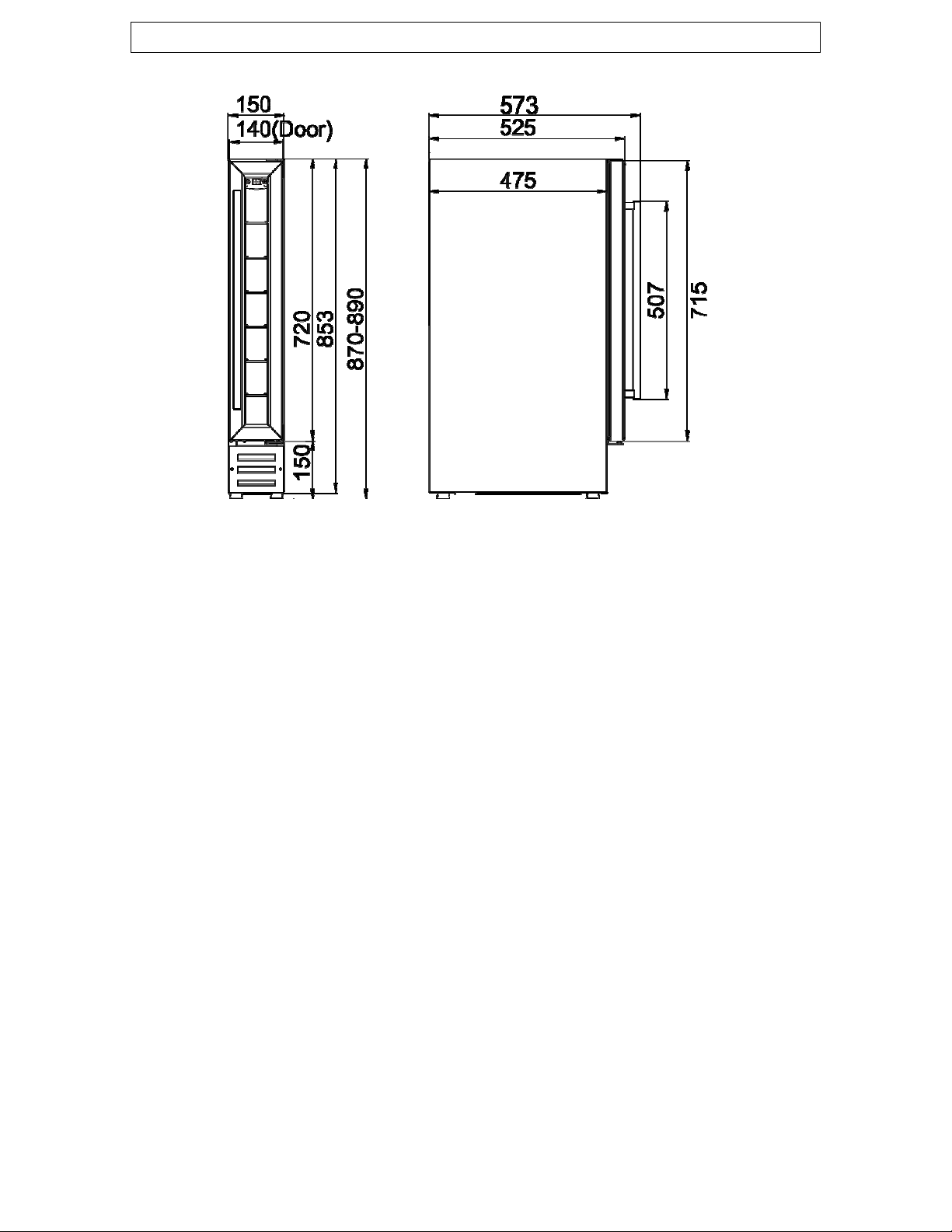
Specifications of your wine cabinet
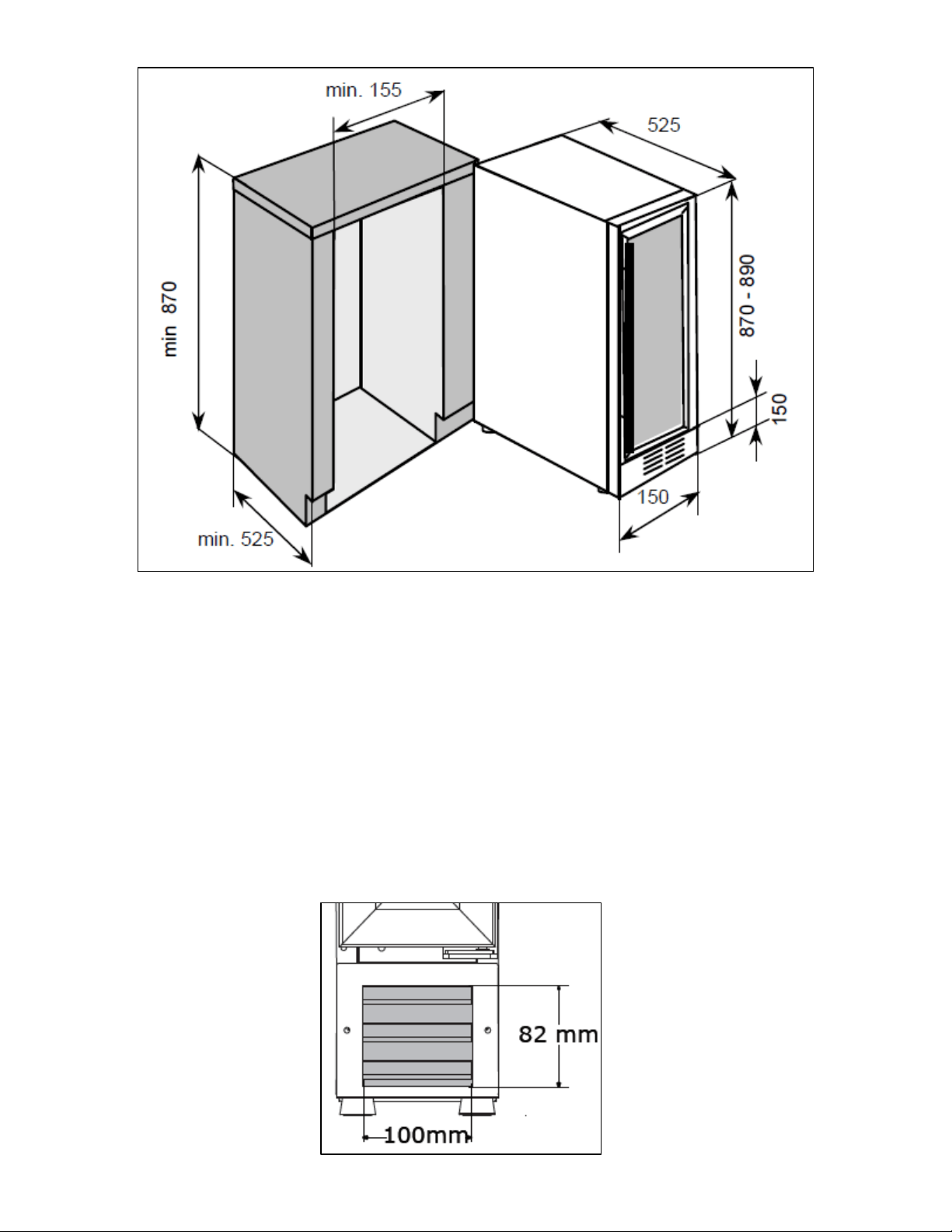
Dimensions of appliance Dimensions o
f aperture*
Height: >870 mm
Height: 870 - 890 mm
Width: 155 mm
Width: 150 mm
Depth: >525 mm
Depth: 525 mm
Product specifications
o Gross capacity: 22 litres
o Net capacity: 21 litres
o Bottle capacity: 7 x 0.75 litre Bordeaux style wine bottles
o Energy efficiency class: C
o Quiet operation (Noise level: 39 dB)
o Touch-key control operation
o LED display
o Celsius and Fahrenheit option
o 6 Chrome shelves
o Adjustable temperature
o Digital thermometer
o Internal light
o Fan Cooling System
o Water drainage
o Black exterior
o Reversible door
o Tempered glass door
o Stainless steel door frame and handle
o Designed to store wine at its optimum temperature between 5°C
- 22°C.
7
* Please refer to the installation instructions for more specific
information on the size of aperture that you will require.
IMPORTANT: When you install your appliance it is important to bear
in mind its climatic rating.
In order to find out the climatic rating of your appliance, you should
check the rating plate. The rating plate is located on the front left edge
of the appliance. The rating plate will indicate the ambient temperature
range that your appliance will function correctly within. It is also
advisable to make a note of the model number and the serial number
of the appliance before installing it.
Model number ………………………………………………
Serial number ………………………………………………
Date of purchase ……………………………………………..
Description of the appliance
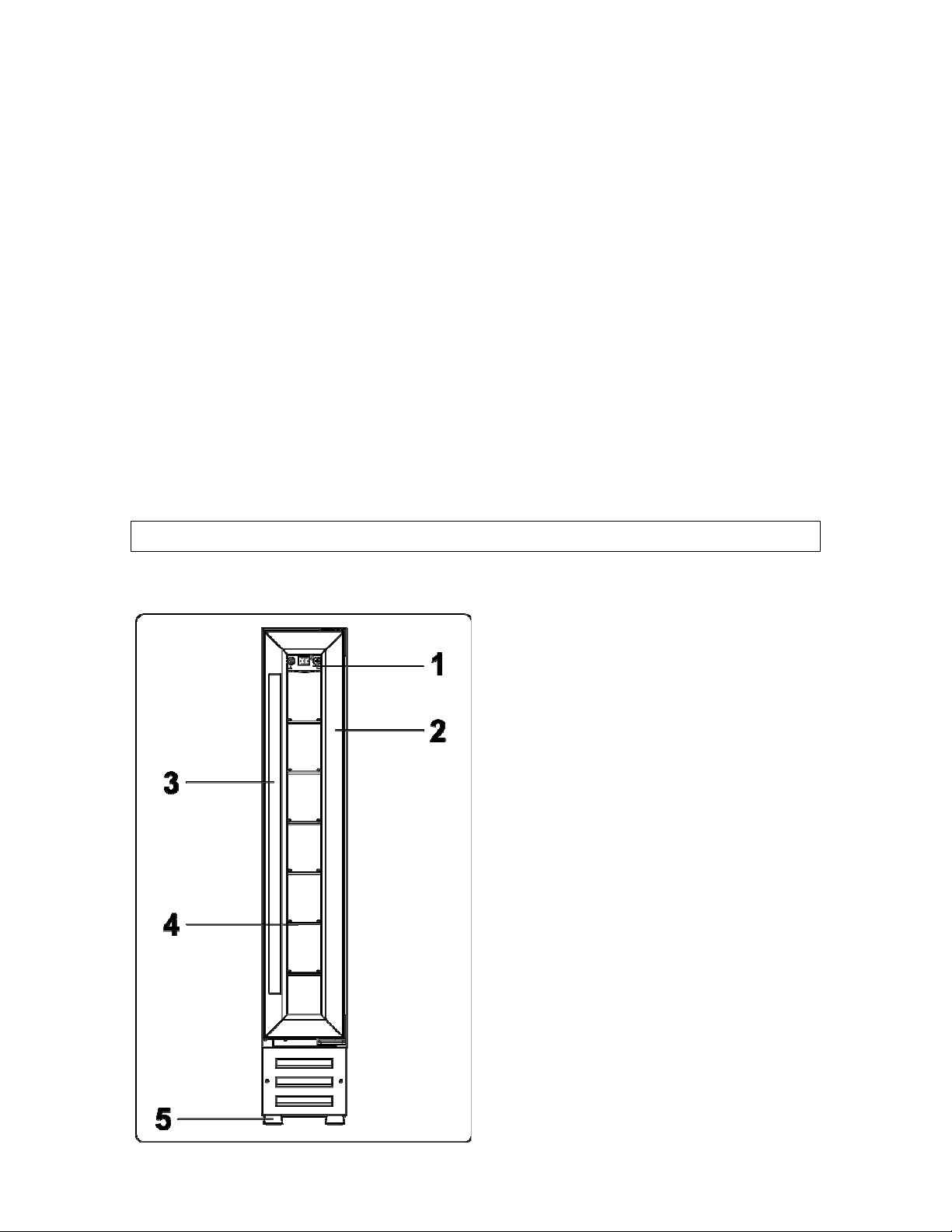
Product features
1.Digital control panel
2.Stainless steel door
3.Stainless steel handle
4.Adjustable chrome shelves
5.Adjustable foot
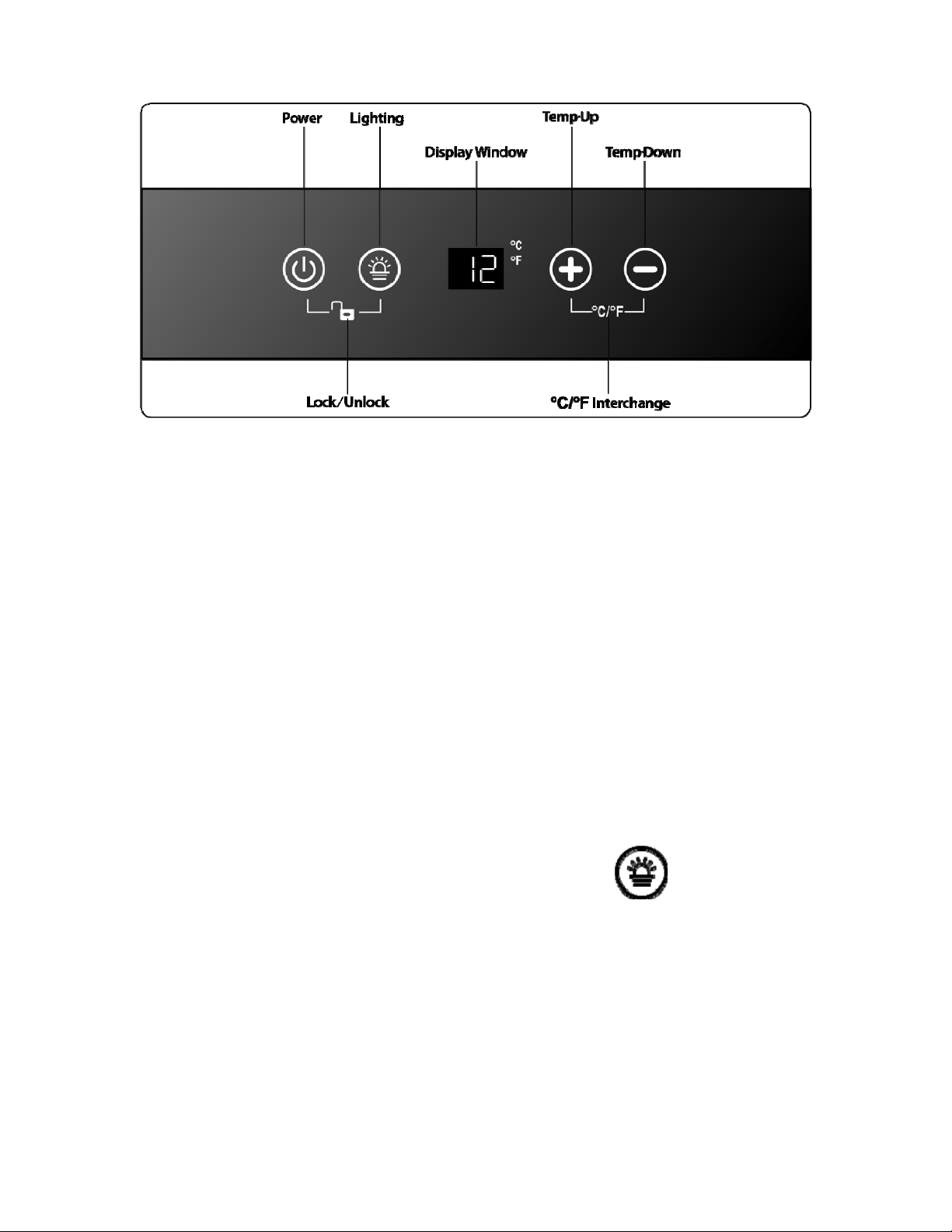
Control panel
The control panel is located in the middle of the appliance.
Description of the product features
Control panel
o The control panel is located at the top of the appliance, behind
the glass door. This means it is easy to set the temperature of
the appliance and see what temperature the appliance is set to.
One cooling zone
o There is one cooling zone inside of your wine cabinet.
o The cooling zone has a temperature control and temperature
display.
Interior light
o The cooling zone has an interior light. The light can be switched
on and off by using the light control button
The wine cabinet shelves
o To prevent damaging the door gasket, make sure the door is
fully open when pulling shelves out of the rail compartment.
o For easy access to the bottles stored, pull the shelves out
approximately 1/3 of the way.
9
Using your Baumatic wine cabinet
Before switching on
o Make sure that it has been installed by a suitably qualified
person, as per the information contained in Baumatic’s
installation instructions.
o After delivery, wait for eight hours before connecting the
appliance to your mains supply. This will allow any refrigerant
gasses that may have been disturbed during the transportation
process to settle.
o he outside of the appliance and the removable accessories
contained within it, should be cleaned with a solution of liquid
detergent and water.
o The interior of the appliance should be cleaned
with a solution of sodium bicarbonate dissolved in
lukewarm water. The interior and accessories
should be thoroughly dried, after the cleaning
process has been completed.
o There can be an odour when you first switch on the appliance. It
will lessen as the appliance starts to cool.
10
During first use
IMPORTANT: When you use the wine cabinet for the first time
or restart the appliance after it has been turned off for a long
time, there could be a few degrees variance between the
temperature you select and the one indicated on the LED
display. This is normal and it is due to the length of activation
time. Once the wine cabinet has been running for a few hours
everything will be back to normal.
o When you first switch on the appliance, the compressor will run
continuously until the wine cabinet reaches a cool enough
temperature.
o During this period of time, you should try not to open the door
frequently or place bottles inside of the appliance.
o If the unit is switched off or unplugged, you must allow at least 5
minutes before restarting the appliance or reconnecting it to
your mains supply.
Turning the appliance on and off
o When the wine cabinet is connected to the power outlet
it will turn on automatically.
o Press and hold the power button for approximately 10 seconds to
turn the appliance on and off.
o Even if the safety lock is activated, the appliance can still be
turned off by pressing and holding the power button for about 10
seconds.
Unlocking the control panel
o To unlock the control panel press the power and
light buttons simultaneously for about 3 seconds.
A buzz will sound to indicate that the control panel
has unlocked.
o The control panel will automatically lock after 10 seconds if no
buttons are pressed. A buzz will sound to indicate that the
control panel has locked.
o When the control panel is locked no buttons can be operated
except for the power button to turn the appliance off.
11
The interior light
12
o When the control panel is unlocked, you can use the light
button to switch the interior light on and off.
o The light will remain on unless it is turned off manually by
pressing the light button.
Setting the temperature
o The temperature setting is adjustable within the range of 5°C -
22°C / 41°F - 72°F.
o Use the temperature plus button and minus button to
select the temperature you want the wine cabinet to operate at.
o The first touch of these buttons will automatically set the
previous set temperature. However if the appliance has been
unplugged or there has been a power failure, the first touch of
these buttons will automatically set the default temperature of
12°C (54°F) .
o Each press of the temperature plus button will increase the
set temperature by 1°C/1°F. Each press of the temperature
minus button will decrease the set temperature by
1°C/1°F.
o When the display shows the desired temperature release all
buttons and the display will change to show the actual
temperature inside of the cabinet after about 10 seconds.
Changing between Fahrenheit and Celsius
o You can select whether the temperature display
shows Celsius or Fahrenheit.
o To alter what the temperature display is showing, press the plus
and minus buttons simultaneously. This will change the
temperature display for both cooling zones.
Loading the wine cabinet
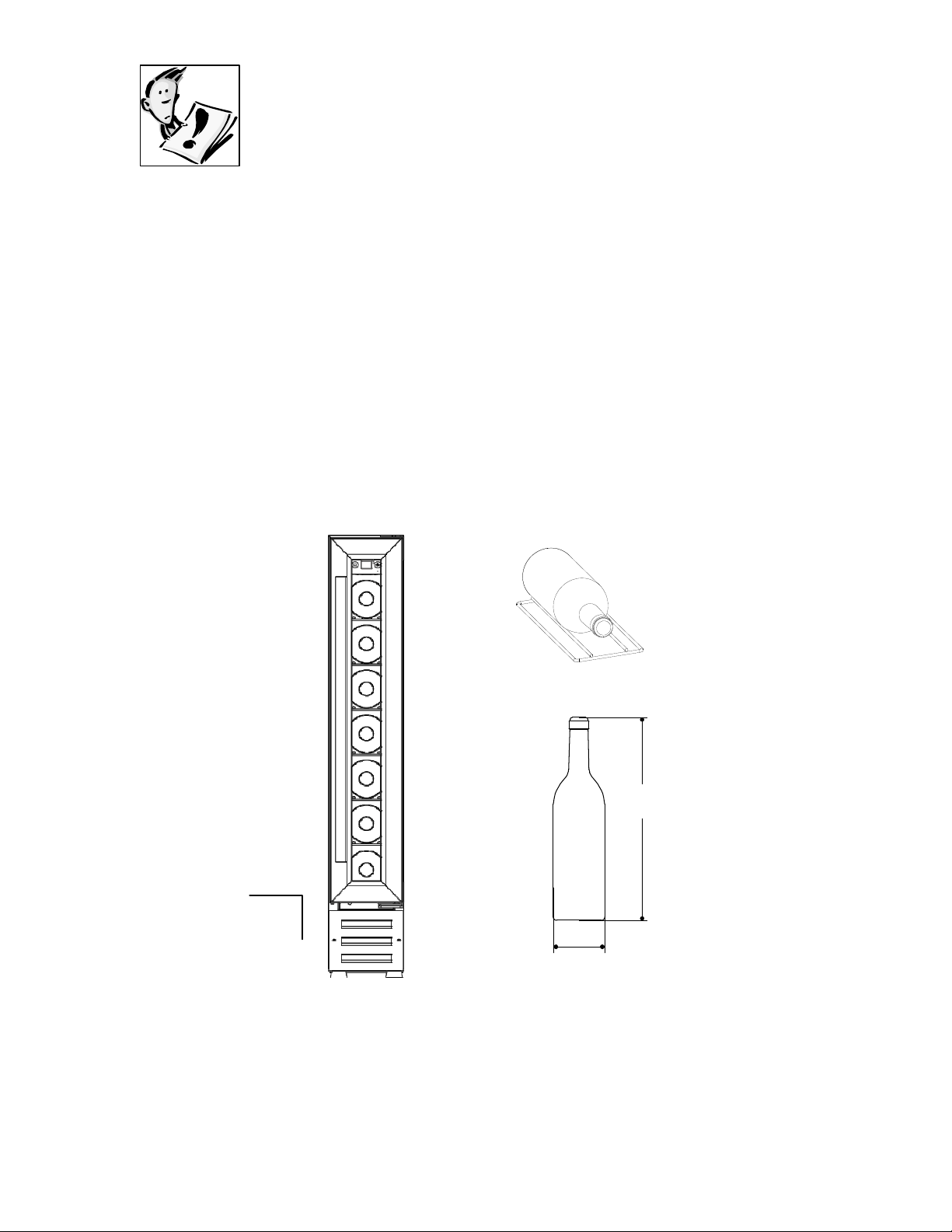
o IMPORTANT: Your appliance is ideally suited to store
0.75 litre Bordeaux style wine bottles. While it can
store larger bottles, you must make sure that they do
not prevent the door from shutting properly.
o Always check that you can close the door without it fouling on
a wine bottle, before shutting it.
o When loading several bottles of wine at once, it will take
longer for the appliance to cool the individual bottles.
o As many bottles may differ in size and dimensions, the actual
number of bottles you are able to store may vary. The
maximum storage number is based on standard 0.75 litre
Bordeaux style wine bottles.
o You can place 7 standard bottles in your appliance with 1
bottles on each shelf .
1
1
1
750ml Bordeau
1
1
305mm
13
1
7
1
Φ
76.20mm
14
Storing your wines
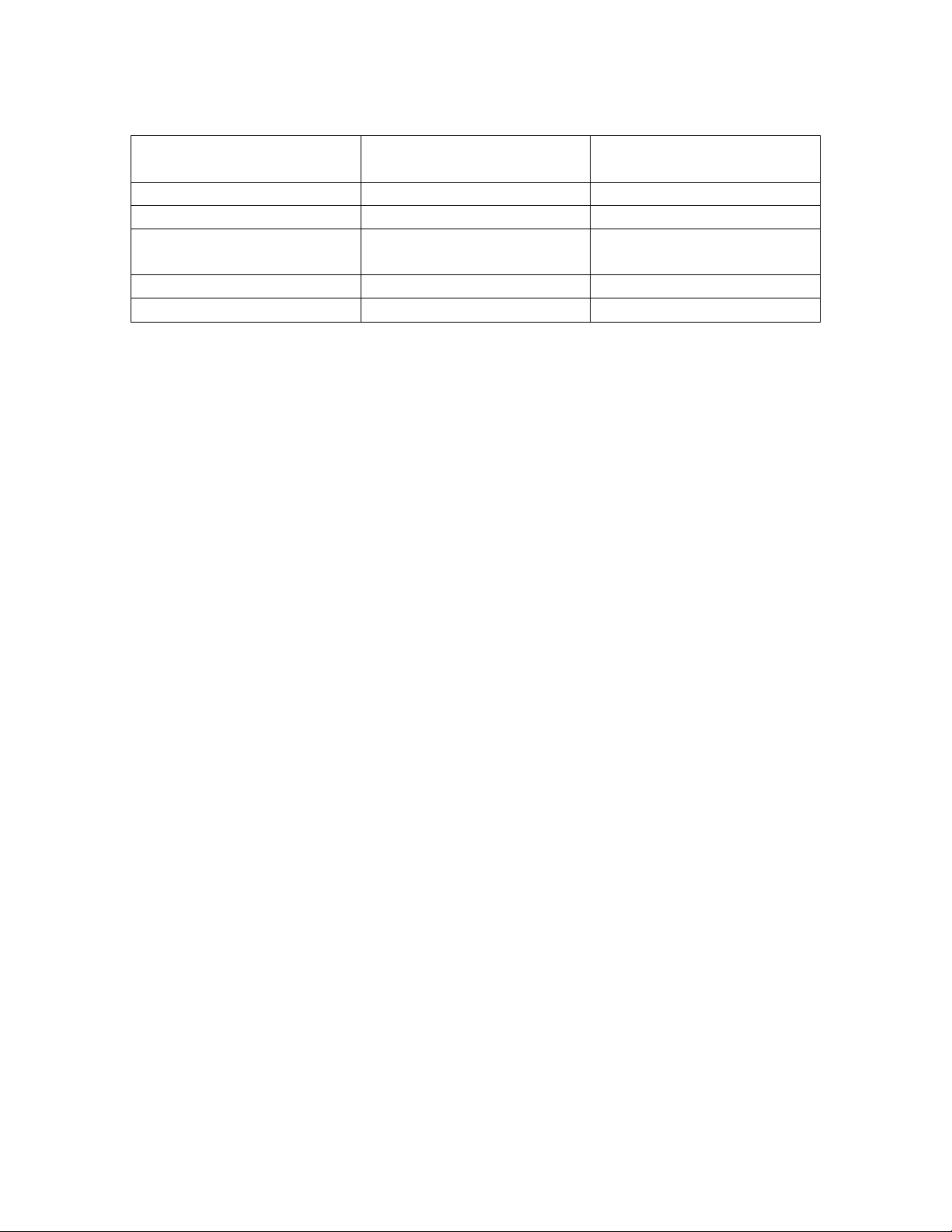
The chart below indicates the ideal storage temperatures for different
types of wine:-
Type of wine
Temperature
(Celsius)
Temperature
(Fahrenheit)
Red wine (*) 15.5 – 18.5°C 59.9 – 65.3°F
White wine (**) 10 - 15°C 50 – 59°F
Sparkling
wines/champagne
7.2 – 9.5°C 45 – 49.1°F
Rose wine 9.5 – 10.5°C 49.1 – 50.9°F
Vintage wine 13°C 55°F
* Light red wines, such as Beaujolais, Pinot Noir and Cabernet Franc
benefit from being served slightly cooler than full-bodied reds.
** Chardonnay is often served too cold. You should chill it at a warmer
temperature inside of your wine cabinet. Or leave it to warm slightly
when you remove it from your wine cabinet.
o Temperature stability is the most important factor when it comes
to storing wine.
o Exposure to light, vibrations or fluctuations in temperature and
humidity can all cause wine to spoil. When properly stored,
wines not only maintain their quality but many will actually
improve in aroma, flavour and complexity as they mature.
o Wines kept at a higher temperature will age faster. Wine that is
exposed to temperatures that are greater than 21°C (70°F) will
suffer from poorer flavour and aroma.
o If wine is kept at too low a temperature, this can result in the
development of harmful deposits. A humidity of 70% is ideal for
keeping corks from shrinking.
o After a bottle of wine has been opened, the wine comes into
contact with air. So it is best to store the remainder of the bottle
upright, to minimize the surface area of the wine that is coming
into contact with the air.
o Once opened, wine will remain in a drinkable condition for two
days for delicate whites or three days for rich reds, as long as
the bottle as been resealed. You should make sure that the seal
is firm by checking the stopper.

15
o Special stoppers that keep wine sparkling and Champagne
bubbling for one or two days after opening, can be bought at
most good wine shops.
o When stored correctly, white wines can keep well for up to two
years. Full bodied reds will age well for ten years and dessert
wines will age well for up to twenty years.
o When you buy a bottle of wine, you should transfer it to a
suitable storage location immediately (if you are not going to
store it in your wine cabinet).
o Cheaper bottles of wine will not age as well as more expensive
ones.
o To make the most of the bouquet and taste of your wine, never
fill more than half a glass at a time. It will also help if the shape
of your wine glass is appropriate for your wine. The size and
shape of your wine glass’s bowl will determine the intensity and
complexity of the bouquet. The stem should be long enough to
allow you to avoid hand contact with the bowl of the glass and
should be tulip-shaped or tapered at the top.
Wine storage problems
Corking- a tiny percentage of bottled wine (about 1%) will suffer from
this. The cork reacts with the wine and gives it a musty, unpleasant
taste. It is the most common wine storage problem and is caused by
harmless bacteria growing on the cork. As unfortunate as this is, there
is nothing to do but to discard all of the wine in the affected bottle.
This is not to be confused with small fragments of cork floating in the
wine itself, which will not impair the flavour.
Oxidisation- when wine has been opened and left for longer than a
day; it tends to lose its aroma and colour, giving an overall flat taste.
The only way to avoid this, it to either drink the wine on the same day
it was opened or to use a vacuum device specially designed for
removing oxygen from opened wine bottles. If you use such a device,
the wine should still be consumed shortly afterwards.
Ullage- this is loss of wine from the bottle by evaporation or leakage.
Signs of ullage include wine seeping around the cork, a protruding cork
or a stained label. It can happen if the bottle has been allowed to get
too warm. The wine may still be drinkable, if the leakage was recent;
however, you should be aware that if the wine cools down again,
contraction can cause more air to be sucked into the bottle and result
in further deterioration.
Slight effervescence in still wine- this isn’t really a problem with
the way the wine has been stored, but as a result of incomplete
malolactic fermentation before the wine was bottled. A good way to
get rid of the effervescence is to let the wine breathe. Alternatively
you can use a bottle vacuum device, after about five minutes the
effervescence will vanish.
Sediment- this is not normally a problem, however both red and
white wines can produce sediment after a number of months in a
bottle. The sediment consists of tartrate crystals and is totally
harmless. If anything the building of sediment can be considered a
good sign because it means that the wine was not subjected to much
(if any) filtering, meaning that the flavours and aromas should be
preserved better.
A good way to get around sediment (if it is a problem) is to stand the
bottle upright, the day before opening, so that the sediment can settle
to the bottom of the bottle.
You can also decant your wine; decanting will “open up” the flavour of
both young and old wines, but younger wines in particular. To decant,
pour the wine slowly and evenly into your decanter.
Cleaning and maintenance
WARNING: PLEASE ENSURE THAT
YOUR APPLIANCE IS DISCONNECTED
FROM YOUR MAINS SUPPLY BEFORE
ATTEMPTING TO CLEAN IT.
16
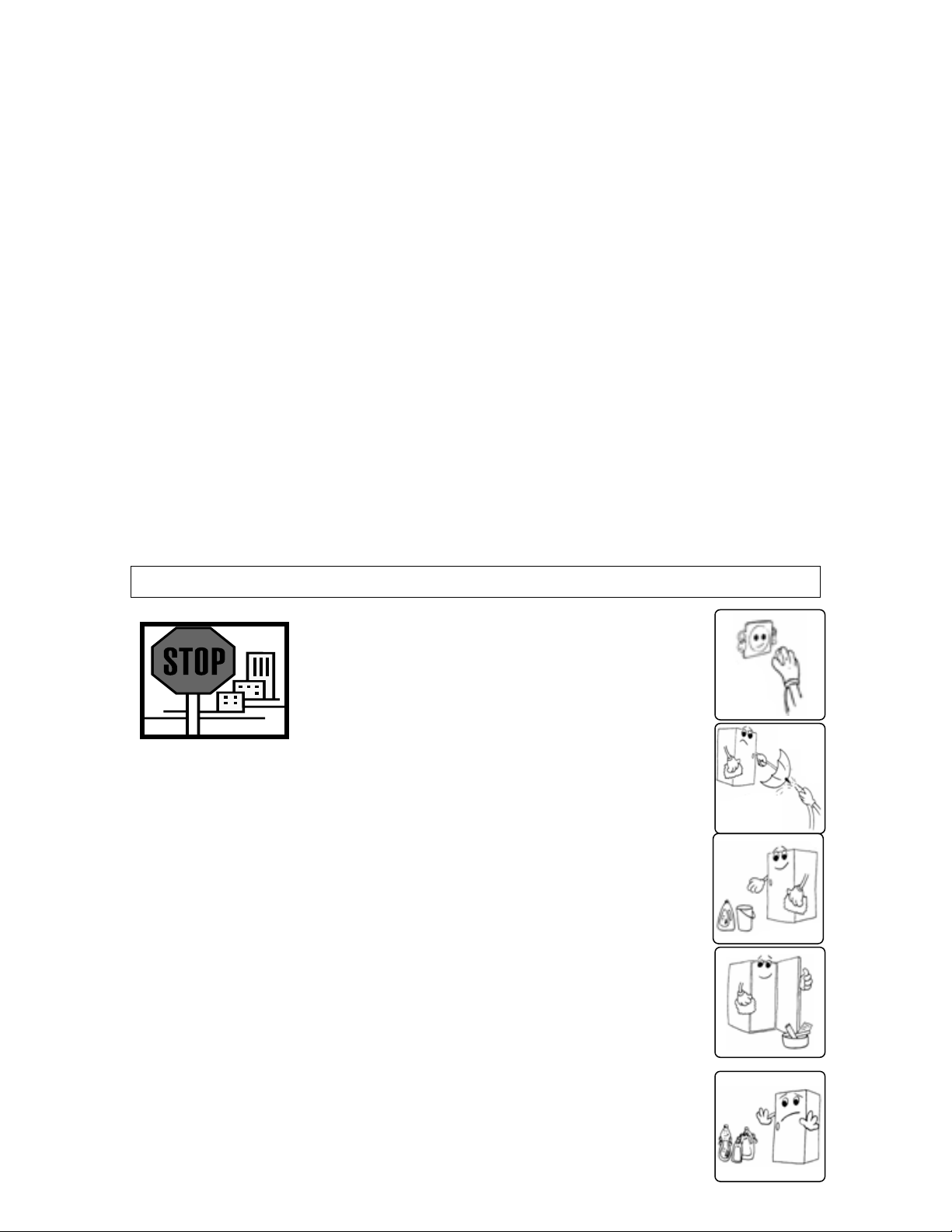
water onto it
o The interior of the wine cabinet should be cleaned
o Clean the accessories separately with soap and water.
o Do not use abrasive products, detergents or soaps.
o Do not clean the appliance by pouring
or spraying water over it.
periodically, using a solution of bicarbonate of soda
and lukewarm water.
Do not clean them in a dishwasher.
17
o After washing the appliance, wipe over the area that you have
.
reconnect
the plug to your mains supply.
ng occurs automatically inside of the wine cabinet during
operation. The defrost water is collected by the evaporating tray
rost water drain hole should be
cleaned periodically. This will prevent water from collecting in
er down the drain hole
to clean inside of it.
ul to make sure that wine bottles do not
touch the rear wall of the appliance, as this can interrupt the
o t, firstly
remove any bottle from the shelf. Then tilt the shelf by putting a
cleaned with a damp cloth and then dry it thoroughly
o When cleaning is complete, dry your hands and then
Defrosting
o Defrosti
and evaporates automatically.
o The evaporating tray and def
the bottom of the wine cabinet, instead of flowing down the
defrost drainage channel and drain hole.
o You can also pour a small amount of wat
o You should be caref
automatic defrosting process and deflect water into the base of
your wine cabinet.
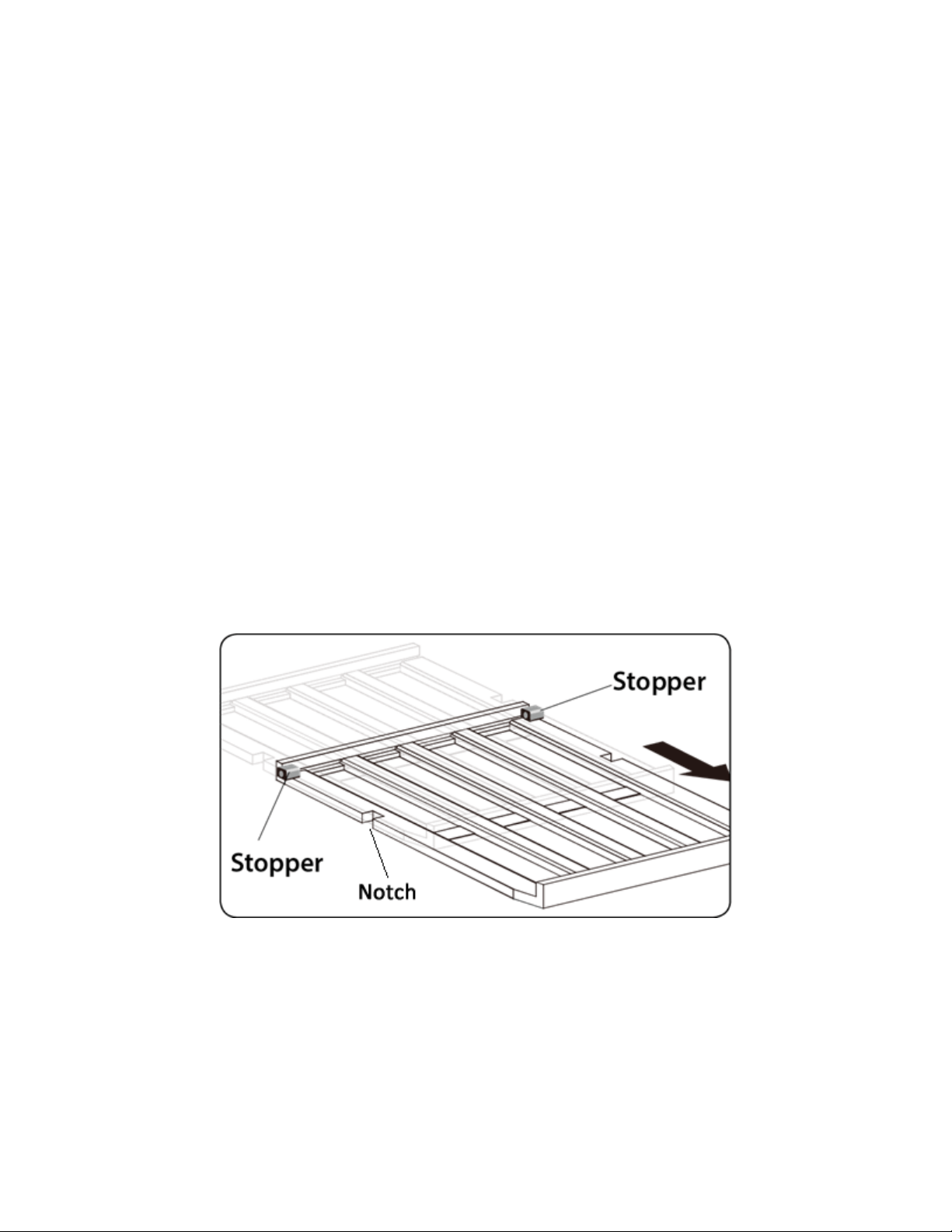
Removing the shelves for cleaning
To remove any of the shelves from the rail compartmen
little pressure on the front – so that the back of the shelf lifts. As
you pull out the shelf, the notches of the shelf will become
directly under the stoppers, allowing them to slide through the
notch gaps.

18
Make sure the shelves are fully engaged before loading any
bottle into the cabinet. Pull the shelves out all the way to the
e cabinet to another location you should
llow the steps outlined below.
ine cabinet.
s the shelves inside of
the appliance.
able foot up to the base to avoid damage.
ays secure in the upright position during
transportation. Also protect the outside of the appliance with a
r failures are corrected within a few hours and should
not affect the temperature of your appliance if you minimise the
longer period of time, you
need to take the proper steps to protect the contents.
is lost or
rned off you must wait 3 to 5 minutes before restarting the
: Leave the wine cabinet in operation for holidays of
ss than 3 weeks.
the appliance will not be used for several months,
move all items, turn off the appliance and unplug the electricity
o
STOP position and push them back in to make sure the shelves
are properly engaged.
Moving your wine cabinet
If you need to move your win
fo
o Remove all items from the w
o Securely tape down all loose items such a
o Turn the adjust
o Tape the door closed.
o Ensure the appliance st
blanket or similar item.
Power failure
o Most powe
number of times the door is opened.
o If the power is going to be off for a
IMPORTANT: If the appliance is unplugged, the power
tu
wine cabinet. If you attempt to restart before this time delay,
the wine cabinet will not turn on.
Vacation time
Short holidays
le
Long absences: If
re
cable. Clean and dry the interior thoroughly. To prevent odour and
mould growth, leave the door open slightly by blocking it open if
necessary.
Installation
19
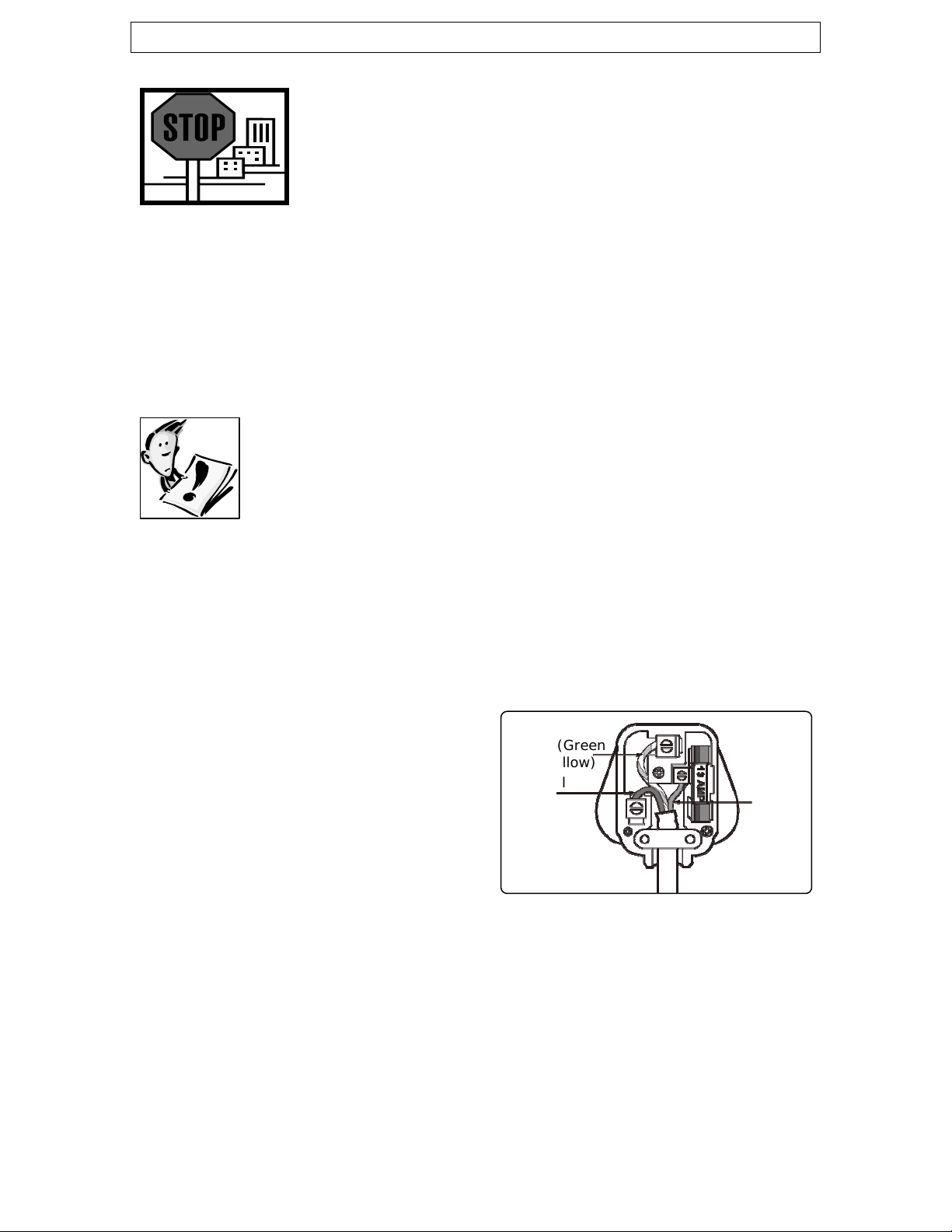
Earth (Green
nd Yellow)
Live
(Brown
a
Neutral
(Blue)
)
IMPORTANT: Before installation and usage read
all the instructions and make sure that the
esponsibility in the event of the installer
iling to observe all the accident prevention regulations in force,
ction
E CABINET IS INTENDED FOR FITTED AND
PERMANENT INSTALLATION.
We recommend that the appliance is connected by a qualified
electrician, who is a member of the N.I.C.E.I.C. and who will comply
ed with a 13 amp plug fitted. If in
future you need to change the fuse in this plug, then a 13 amp
coloured as follows:
..Live
lue……………………………Neutral
o As the colours of the wires in the appliance’s mains lead may not
correspond with the coloured markings identifying the terminals
terminal marked “L”
(live), or coloured red.
connected to the terminal marked “N”
eutral), or coloured black.
voltage (V) and the frequency (Hz) indicated on
the rating plate are exactly the same as the
voltage and frequency in your home. The rating
plate can be found on the front left edge of the
ine cabinet.
The manufacturer declines all r
inside of the w
fa
which are necessary for normal use and the regular operation of the
electric system.
Electrical conne
YOUR WIN
with the I.E.E. and local regulations.
o Your wine cabinet comes suppli
ASTA approved (BS 1362) fuse must be used.
o The wiring in the mains lead is
Brown…………………....
B
Green and yellow……Earth
in your spur box, please proceed as follows:
The brown wire must be connected to the
The blue wire must be
(n

20
green
nd yellow.
o
sent. The cord clamp must be secured over the
uter sheath.
o It is advisable that your appliance is only installed in a location
he ambient temperature of the room, corresponds with
the climate classification that is stated on the rating plate of your
The green and yellow wire must be connected to the terminal
marked “E” (earth), or by the earth symbol, or coloured
a
When the connection is completed, no stray strands or cut wire
should be pre
o
Positioning
where t
appliance. Your appliance may not function correctly if the
ambient temperature falls outside of the following ranges.
Climate classification
Appropriate ambient temperature
SN +10 to +32 degrees centigrade
N +16 to +32 degrees centigrade
ST +18 to +38 degrees centigrade
T +18 to +43 degrees centigrade
o Positioning the appliance requires avoid
injuries o amage to the a
emes of temperature (e.g.
next to a radiator or boiler). If this is not feasible, then you
after your appliance is installed.
, which
should be used to level the appliance.
nal injury.
of this vent;
otherwise your wine cabinet may not operate properly.
two people in order to
ppliance. r d
o Your appliance should not be located in direct sunlight or
exposed to continuous heat or extr
should install an insulation plate between the appliance and the
adjacent heat source.
o You should check whether there is an electrical socket available,
which will be accessible
o Place the appliance flatly and firmly on a solid base. The
appliance is fitted with adjustable feet on the front side
o Be sure to leave enough space for the opening of the door, to
avoid damage to the appliance or perso
o IMPORTANT: The vent at the base of the appliance is for
ventilation. Nothing should be placed in front
Built-in installation
o Your wine cabinet can be used as a freestanding or a built in
unit. The clearances shown in the above drawing should be
followed for both types of installation.
21
o In particular the depth dimension must be observed.
ed in front of this vent;
otherwise your wine cabinet may not operate properly.
o A decorative plinth can be fitted to the front of the base vent as
o IMPORTANT: The vent at the base of the appliance is for
ventilation. Nothing should be plac
long as the cut out shown in the diagram below is made in the
plinth. This cut out is required whether the vent is removed or
not.
MPORTANT: If the applianc
oor seal may be affected.
MPORTANT: Do not move t
djusted high, as there is a ri
22
Adjusting the height and levelling off your wine cabinet
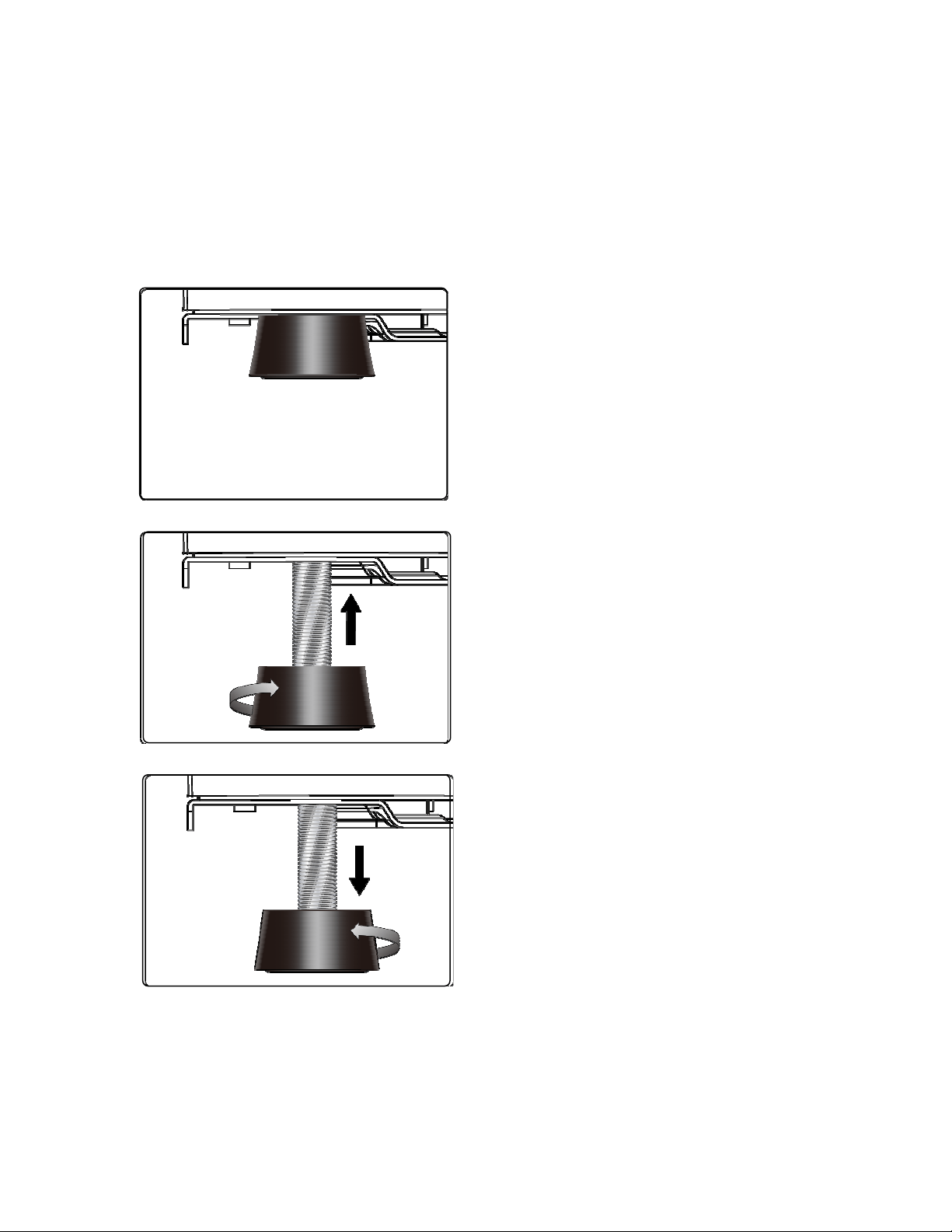
o The appliance is equipped with adjustable feet, so that the
height may be adjusted to level the cabinet on uneven floor
surfaces.
o We recommend that two people carry out this procedure.
nce into
the housing unit and it should be set at such a height that the
o Tilt the appliance approximately
adjustable feet.
Twist the foot into a suitable
e is not level, then the door and
he appliance when the feet are
sk that the feet will break.
o The height must be adjusted prior to building the applia
top panel of the appliance fits exactly below the kitchen worktop.
60° to allow access to the
o Take care to ensure the cabinet is
supported at all times.
o
position to level the cabinet.
o Repeat these steps for the other
adjustable feet.
I
d
I
a
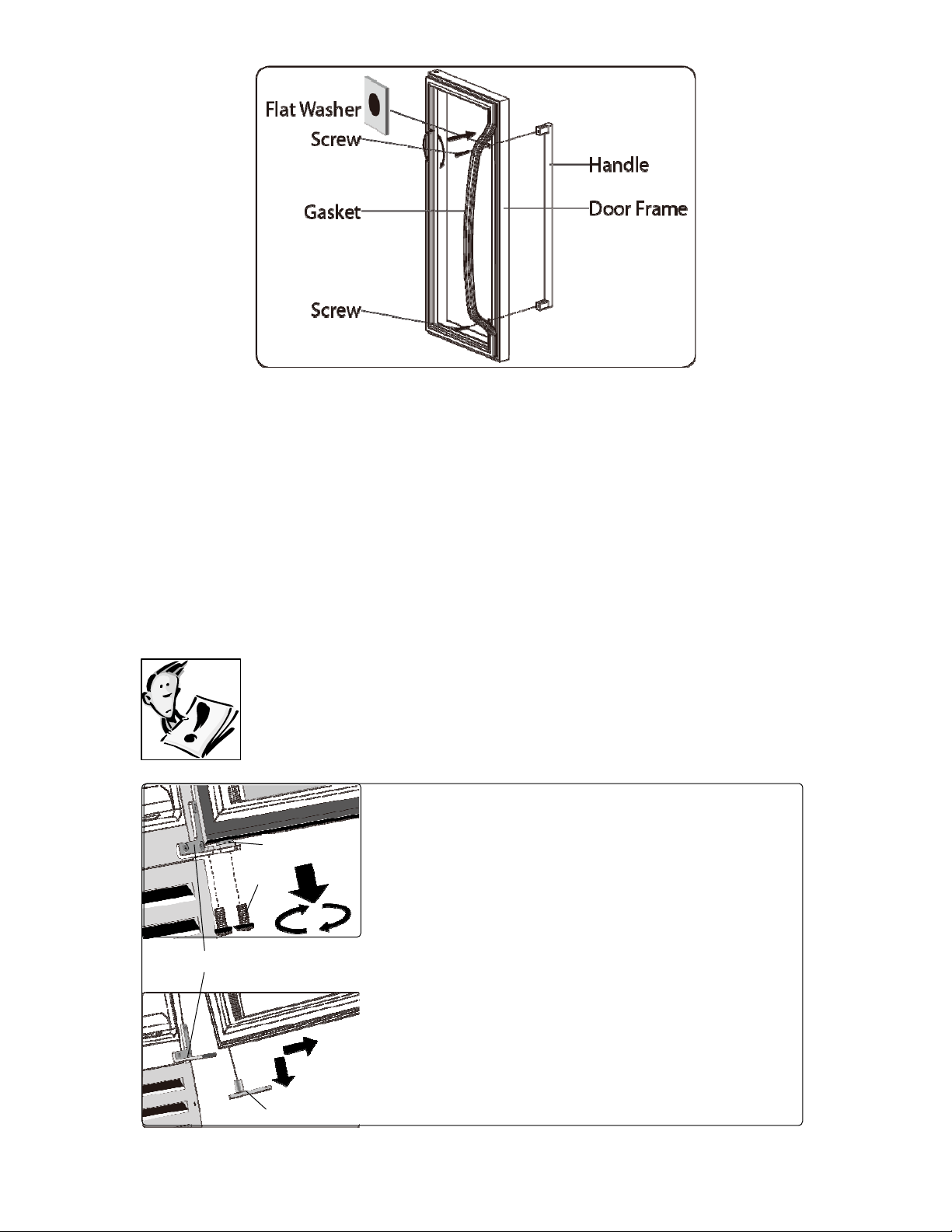
Installing the handle
o Remove the door gasket on the side you wish to install the
handle. You can see two designated holes for handle installation.
o Install the handle tightly as shown in the diagram above with the
two screws, lock washers and flat washers provided.
o Replace the door gasket.
eversing the door of your wine cabinet
remove from the appliance whilst
reversing the door, should be retained for later use.
rt Rod under the right
ful to support the glass door with
R
This appliance has the capability of the door opening from either the
left or right hand side.
Any parts that you
23
event
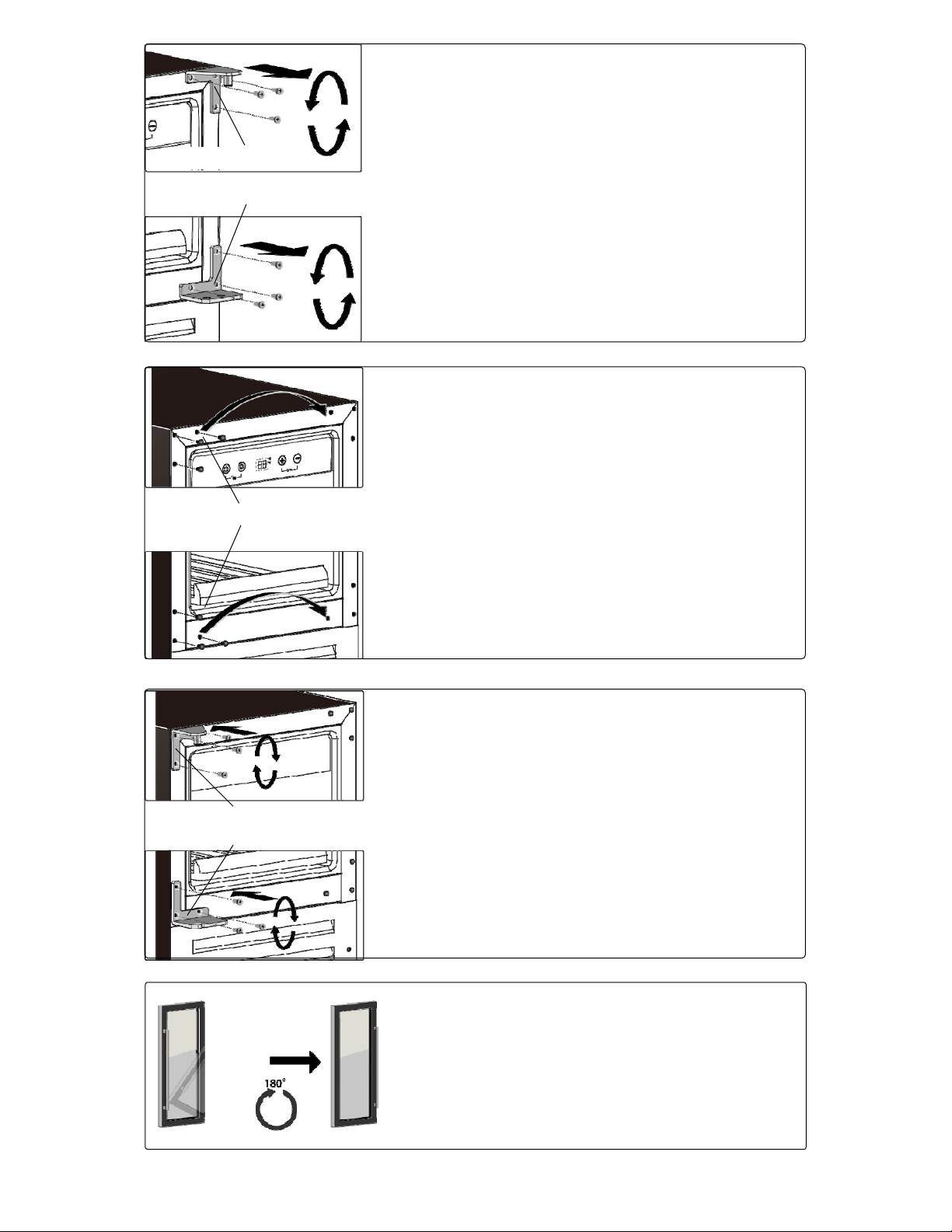
o Open the glass door and remove the two
screws from Suppo
Be care
both hands to prevent it dropping after
removing the screws.
o
scratching it.
Support Rod
bottom corner of the glass door.
Screws
o
Pull down to remove the glass door and
place it on a padded surface to pr
Support Rod
Right Lower Hinge
24
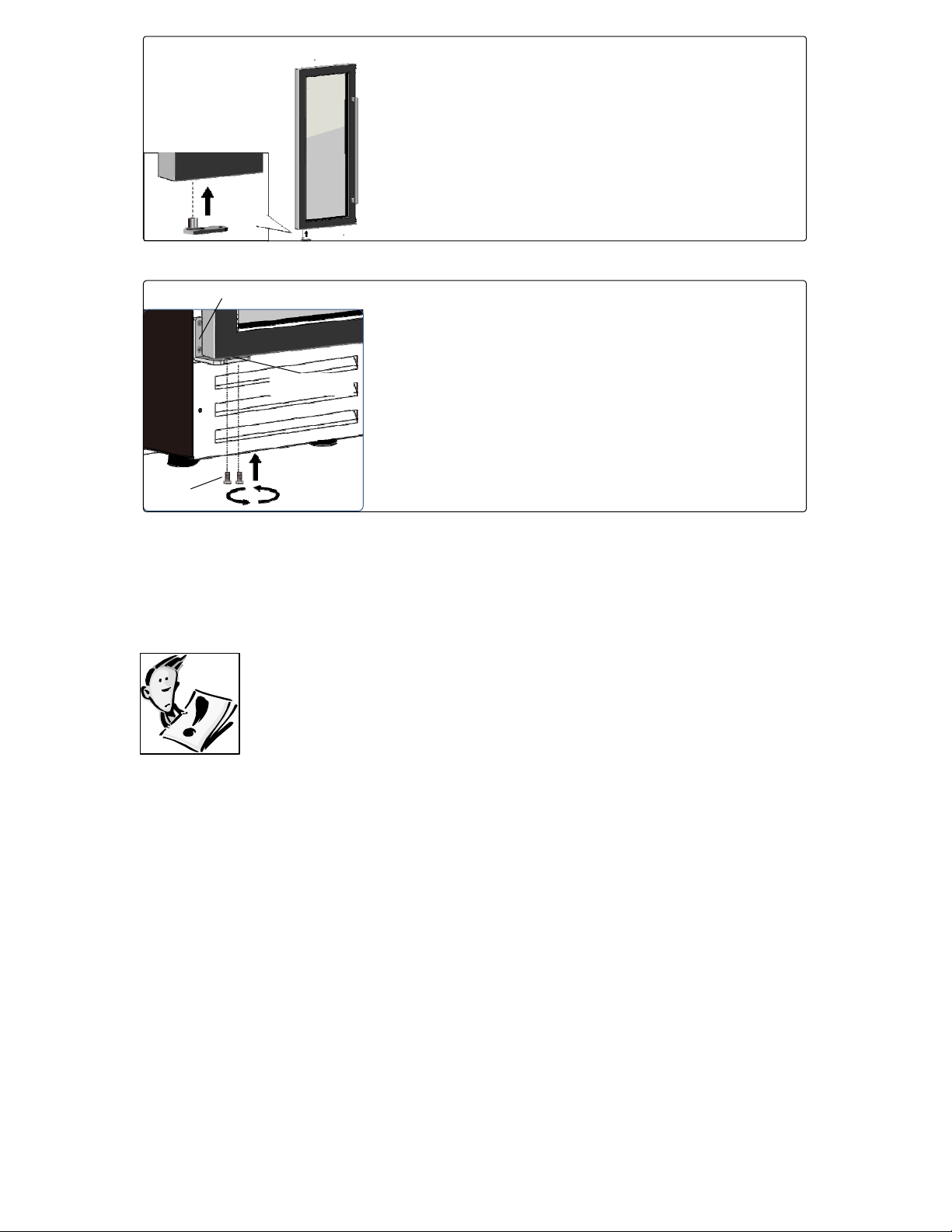
p hinge and right o Remove the right to
lower hinge.
Pull out the 6 Plastic Caps at the front
left corner of the cabinet. And move
them all to the right side.
o
Take the left top hinge and left lower
hinge from the plastic bag that contained
this manual then install them in the
designated positions on the left side of
the cabinet.
o
o ss door around 180° and
reinstall it.
Turn the gla
Right Lower Hinge
Right Top Hinge
Right Lower Hinge
Left Top Hinge
Left Lower Hinge
25
e left hinge side by
ith the 2
not be creased or crushed; otherwise there will be a
gap between it and the inside of the door.
o If the seal is not adhering to the cabinet properly, then you
d
e
r door.
r seal that are not adhering correctly. The heat
will make the seal more pliable and this will allow you to
e left hinge side by
ith the 2
not be creased or crushed; otherwise there will be a
gap between it and the inside of the door.
o If the seal is not adhering to the cabinet properly, then you
d
e
r door.
r seal that are not adhering correctly. The heat
will make the seal more pliable and this will allow you to
o
Insert the Support Rod into the Left
Lower Hinge hole of the door
er Hinge hole of the door
Left Lower Hinge
oo Install the door to th
tightening the Support Rod w
screws.
Install the door to th
tightening the Support Rod w
screws.
IMPORTANT: Check that the door opens and shuts correctly,
without fouling, after you have completed the door reversal
process.
After the door has been reversed, you should check
the door seal of the wine cabinet. The seal should
IMPORTANT: Check that the door opens and shuts correctly,
without fouling, after you have completed the door reversal
process.
After the door has been reversed, you should check
the door seal of the wine cabinet. The seal should
o The seal must adhere properly all the way around the door.
o The seal must adhere properly all the way around the door.
shoul
a) Us
adhe
shoul
a) Us
adhe
either:-
a warm damp cloth and manipulate the seal until it does
e to the cabinet properly, all the way around the
either:-
a warm damp cloth and manipulate the seal until it does
e to the cabinet properly, all the way around the
or or
b) Use a hair dryer on its lowest heat setting and lightly heat the
areas of the doo
b) Use a hair dryer on its lowest heat setting and lightly heat the
areas of the doo
manipulate the seal into the correct position. manipulate the seal into the correct position.
Support Rod
Screws
26
IMPORTANT: DO NOT HEAT THE DOOR SEAL ON ANYTHING BUT
THE
PERI
THE
THE G
MPORTANT: WHEN YOU HAVE REVERSED THE DOOR OF THE
LOWEST HEAT SETTING, OR HEAT THE SEAL FOR A LONG
OD OF TIME. OTHERWISE DAMAGE MAY BE CAUSED TO
DOOR SEAL, WHICH WOULD NOT BE RECTIFIED UNDER
UARANTEE FREE OF CHARGE.
I
APPLIANCE, IF YOU HAVE PLACED THE APPLIANCE ON ITS
BACK, YOU MUST WAIT FOR 8 HOURS BEFORE SWITCHING THE
APPLIANCE BACK ON.
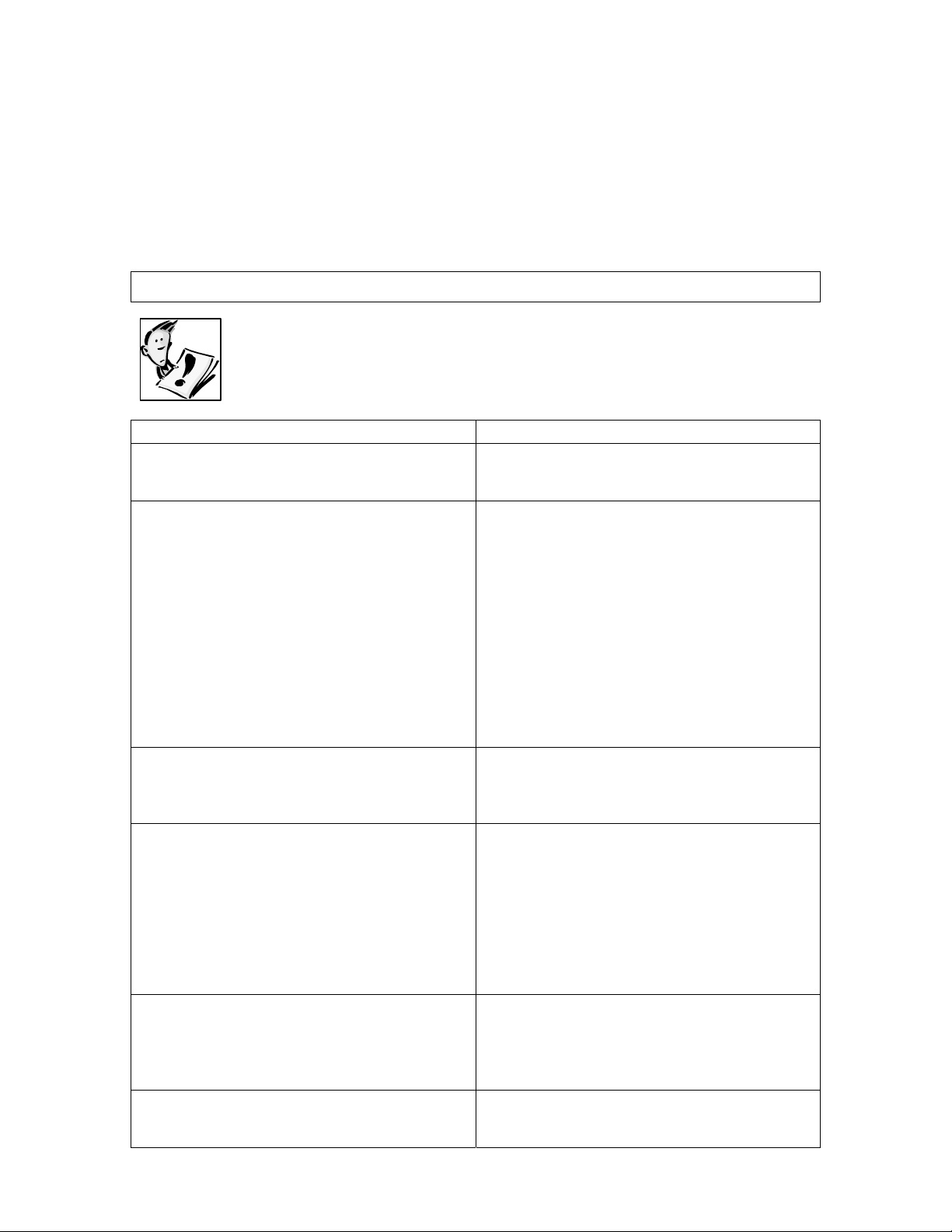
Troubleshooting
IMPORTANT: If your wine cabinet appears not to be
operating properly, before contacting the Customer
Care Department, please refer to the checklist below.
PROBLEM POSSIBLE CAUSE
Appliance does not operate Not plugged in.
The circuit breaker has tripped or the
fuse has blown.
Temperatu
warm.
r
the temperature to stabilise.
The door ng or is
is
e.
y.
e inside the appliance is too The temperature controls are set too
warm. Set the temperature controls to a
cooler setting and allow several hours for
is being kept open too lo
frequently, whichbeing opened too
allowing warm air to enter the applianc
The door is not closed completely.
The door gasket is not sealing correctl
The appliance has recently been
disconnected from the mains supply; it
will take at least four hours for it to get
down to temperature again.
Temperature inside the appliance is too
cold
The temperature controls are set too
cold. Set the temperature controls to a
urs warmer setting and allow several ho
for the temperature to stabilise.
Vibration
Check to ensure that the applianc
a level surface.
The appliance is touching the back wall
behind it. Reposition the appliance and
e is on
move it from the wall.
If vibration continues to occur, then turn
off the appliance and unplug it from your
mains supply. Then contact the Customer
Care Department for assistance.
Moisture is forming on the inside of the
appliance. is
The door is slightly open.
The door is being kept open too long or
being opened too frequently. Open the
door less often.
The door is not sealed properly.
Moisture is forming on the outside of the
appliance.
The door is slightly open, causing cold air
from inside the appliance to meet warm,
moist air from the outside.

27
ou s not to be
operating correctly
from your mains e
Customer Care Dep umber
DO NOT ATTEMPT PPLIANCE
h
t
fault, then you may be liable for the cost of the call out
The appliance must be accessible for the engineer to perform
ny necessary repair. If your appliance is installed in such a
his includes situations where appliances have been tiled in,
fer to the conditions of guarantee that appear on the
arranty card that you receive with the appliance.
IMPORTANT: If y r appliance appear
, then you should disconnect it
supply and then contact th
artment on telephone n
(0118) 933 6911.
TO REPAIR THE A
YOURSELF.
at if an engineer is asked to attend whilst the product is
ee and finds that the problem is not the result of an
Please note t
under guaran
appliance
charge.
a
way that an engineer is concerned that damage will be caused
to the appliance or your kitchen, then they will not complete a
repair.
T
sealed in with sealant, have wooden obstructions placed in
front of the appliance - like plinths, or any installation other
than the one specified by Baumatic Ltd. has been completed.
Please re
w
IMPORTANT: Baumatic Ltd. operates a policy of continuous
improvement and reserves the right to adjust and modify its
products without prior notification.

28
aumatic consumables B
o BC001 Degreaser for Dishwashers (200g)
o BC002 Descaler for Washing Machines and Dishwashers (200g)
ner (250ml)
h
o BC003 Ceramic Hob Clea
o BC004 Oven Cleaner (250ml)
o BC005 Stainless Steel Cleaner and Protector (250ml)
o BC007 E-Cloth – General Purpose Clot
o BC008 Microwave Cover
To order a Baumatic consumable product please call 0123 5437 244
online from and quote the product code. You can also order
shop.baumatic.co.uke
29
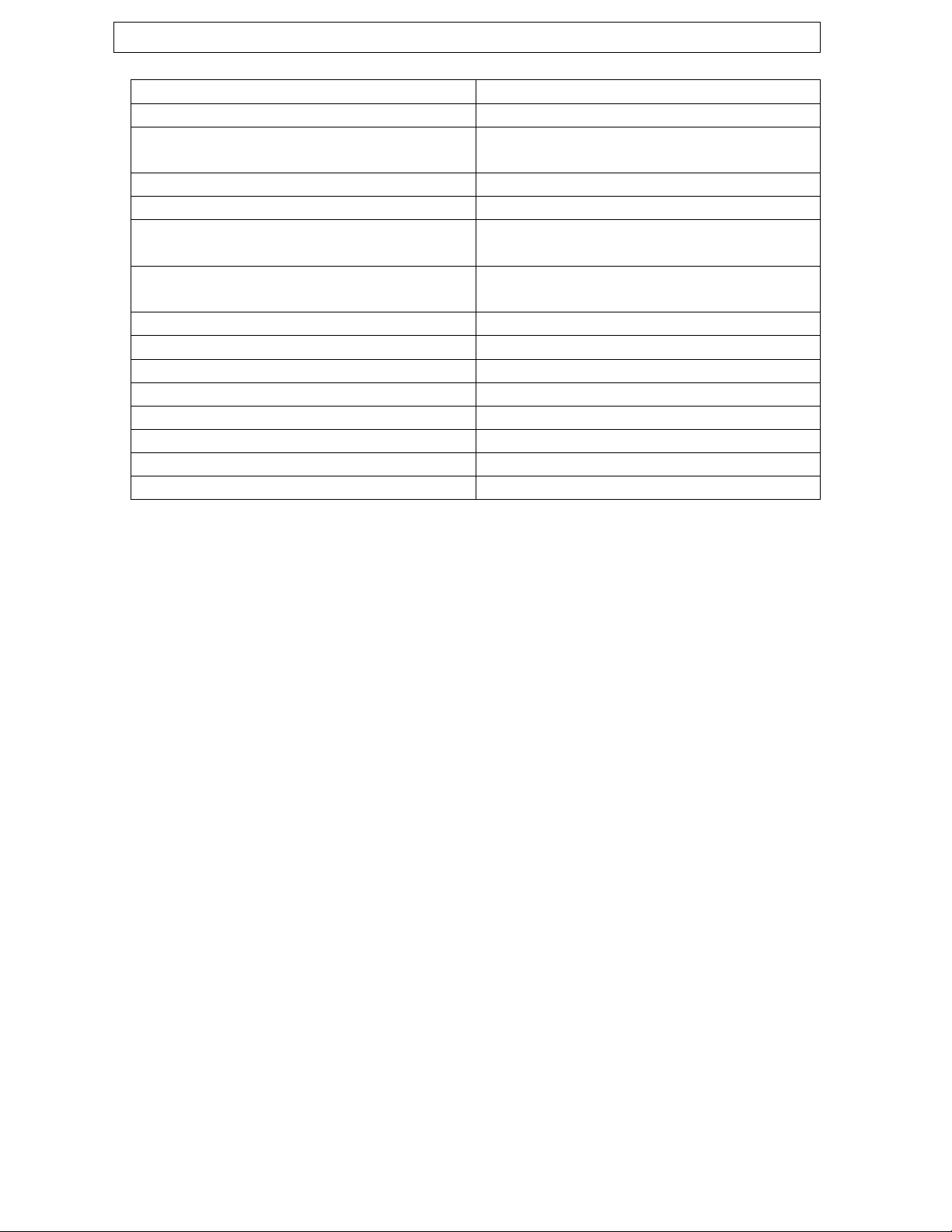
echnical Data T
Manufacturer BAUMATIC
Model Number BWC155SS
Product Category 2 – Refrigeration-cellar, Cellar and
wine storage appliances
Energy Efficiency Class (1) C
Annual Energy Consumption (2) 215 kWh
Storage Volume of Fridge
Compartment
21 litres
Storage Volume of Freezer
Compartment
N/A
Star Rating N/A
Coldest Storage Temperature 5°C
Frost Free Compartments N/A
Temperature Rise Time N/A
Freezing Capacity N/A
Climate Class (3) N
Noise Level 39 dB
Installation Type in Built-
This appliance is intended to be u xclusively for the storage of
A+++ (highest
consumption bas ndard test results for 24
hours. The actual energy consumption will depend on how the
3) This appliance is intended to be used at an ambient temperature
temperature).
sed e
wine.
(1) On a scale from efficiency) to G (lowest efficiency).
(2) Annual energy ed on sta
appliance is used and where it is located.
(
between “16°C” (lowest temperature) and “32°C” (highest

30

31
nited Kingdom
aumatic Ltd.,
aumatic Buildings,
U
B
B
6 Bennet Road,
eading, Berkshire
G2 0QX
nited Kingdom
R
R
U
Sales Telephone
0 (0118) 933 690
Sales Fax
(0118) 931 0035
ephoneCustomer Care Tel
3 6911
Fax
(0118) 93
Customer Care
(0118) 986 9124
Spares Telephone
phone
(01235) 437244
TeleAdvice Line
(0118) 933 6933
E-mail:
ma
tic.co.uk
uk
co.uk
customercare@bau
spares@baumatic.co.
tic.technical@bauma
Website:
ww.baumatic.co.uw k
Facebook:
www.facebook.com/baumatic.uk
lephone
Republic of Ireland
Service Te
phone
1-890 812 724
Spares Tele
Czech Republic/Slovakia
Baumatic s.r.o.
Lípová 665/1
460 01 Liberec 4
Czech Republic
Panenská 34
11 03 Bratislava - Staré Mesto
420 483 577 200 (CZ)
421 255 640 618 (SK)
ww.baumatic.cz
ww.baumatic.sk
rsatzteile
49(0)180-5888975
) 820 / 420423
ww.baumatic.de
Italia S.R.L.
ia Galvani N.3
3904 9920 2297
olland
enelux B.V.
1332 BH ALMERE
3136 549 1555
8
Slova
kia
+
+
w
w
Germany
Kundendienst & E
Deutschland 00
Oesterreich +43 (0
w
Italy
Baumatic
V
35011 Campodarsego (PD)
+
www.baumatic.it
H
Baumatic B
Dukdalfweg 15d
Nederland
09
1 756 771
+
www.baumatic.nl

32
www.baumatic.com