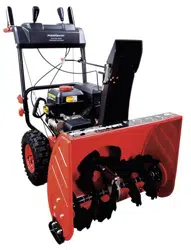
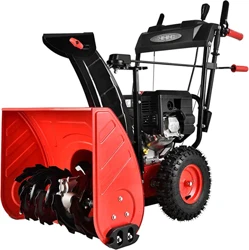
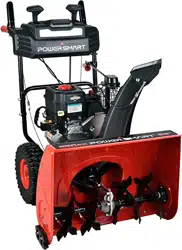
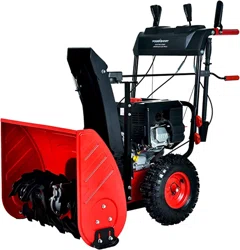
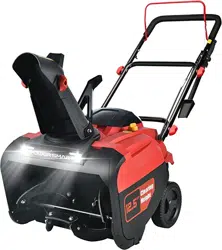
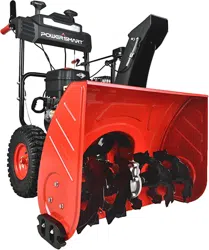
User Manual PowerSmart DBSM24E 24" Electric Gas Snow Blower
KNOWING YOUR SNOW THROWER
Use the illustrations below to become familiar with the locations and functions of the various components and controls of this snow thrower.


Drive Control Lever
Located on the right side of the upper handle, the Drive Control Handle is used to engage and disengage the drive wheels. Squeeze the Drive Control Handle against the upper handle to engage the wheels; release to disengage.
Drive Speed/Gear Control
The Speed/Gear Control is located on the center of the panel and is used to set the drive speed and direction of travel. It can be moved into any of six positions (four forward and two reverse gear settings)
Auger Control Lever
Located on the left side of the upper handle, the Auger Control Handle is used to engage and disengage the augers. Squeeze the Auger Control Handle to engage the augers; release to disengage the augers.
Chute Rotation Handle
To adjust snow discharge direction, rotate the handle clockwise or counter-clockwise....should rotate degrees.
Skid Shoe
Position the shoes based on the surface conditions. Adjust upward for hard-packed snow. Adjust downward when operating on gravel or crushed rock surfaces.
Auger Blade and Impeller
When engaged, the auger blades rotate to cut snow and direct it into the auger/impeller housing to be discharged out the chute.
Clean-out Tool
The chute Clean-out Tool is conveniently fastened to the rear of the auger housing with a mounting clip.
It is used to clean the chute assembly and chute opening when snow and ice become lodged.
WARNING! Never use your hands to clear a clogged chute assembly. Shut off engine and remain behind handles until all moving parts have stopped before unclogging.
ASSEMBLY AND ADJUSTMENTS
The following section describes steps necessary to prepare the snow thrower for use. If after reading this section, you are unsure about how to perform any of the steps please call (800) 791-9458 Mon-Fri 9-5 EST for customer service assistance. Failure to perform these steps properly can damage the snow thrower.
Unpacking
Unpack the snow thrower and all its parts, and compare against the list below.
- Snow Thrower
- Discharge Chute Assembly
- Upper handle
- Chute Rotation Handle
- (Qty. 2) one set of Skid Shoes with attaching hardware
- (Qty. 4) extra M6 Shear Pins and M6 Locknuts
ASSEMBLY
Your Snow Thrower will require some assembly. Please complete the following steps before using your Snow Thrower.
 WARNING: This snow thrower is heavy. Assembly procedures may require lifting equipment utilizing two people.
Step 1:Installing the Upper Handle
1. When installing the Upper Handle, please note that the Drive, Auger & Shift Cables will already be pre-attached to Upper Handle.
2. Attach Upper Handle using the Frame Handle Assembly Hardware (Qty. 4 sets /Knob, Saddle Washer, M8 Nut, T-Screw) for your Upper & Lower Handle connection.
3. VERY IMPORTANT!!!*** When attaching Assembly Hardware, make sure ALL cables are underneath the Frame (Upper & Lower) Handles after installation as indicated in Figure 1.

***Assembling Drive, Auger & Shift Cables over the top of the Frame Handle will cause unnecessary tension in the cables, resulting in the Snow blower propelling forward when starting the engine and may cause damage to the drive & auger control levers) when trying to engage them.
4. Cut and remove all tie wraps that are on Cables, Frame Handles, Drive Control (Lever) & Auger Control (Lever).
5. Verify that the connection for the Upper & Lower Drive/Auger Cables is accurate. (See Figure 2)

Step 2:Installing the Chute Assembly
- Install the discharge chute on the flange of the auger housing chute as illustrated.
- Attached two bolts in the chute hole and install the mounting bracket as illustrated below.(See Figure 3)

Step 3:Installing the Chute Handle
1. Slide Chute Handle through Chute Handle Guide near the Upper Panel, as indicated on Figure 4.

2. Attach Chute Handle to base of Chute Gear Connection and secure with Cotter Pin, as indicated on Figure 5.

Step 4 – Skid shoes installation and adjustments
- Locate the set of skid shoes from parts bag and remove the bolts.
- Loosely install the skid shoes using the bolts and hex nuts as shown on each side of the auger housing. Make sure the skid shoe tip faces out. Adjustment of the skid shoes sets the height above the ground at which the auger shave plate operates. For clearing snow from concrete, asphalt, and other smooth surfaces, set the auger shave plate so that the bottom of the plate is just above the ground. For clearing snow from gravel, dirt, and other rough surfaces set the auger shave plate slightly above the ground to avoid dirt and gravel from entering the auger. The optimal height of the plate will vary depending on the type of surface being cleared. Surfaces with larger gravel or stones require a higher shave plate setting.
- Move the snow thrower to a solid, smooth, and level surface.
- Place a spacer board on the ground underneath the auger shave plate between the skid shoes. The thickness of the board should be the same as the height above the ground you wish to raise the auger shave plate. The skid shoes should not touch the board.
- With the two (Qty. 4)) nuts loose (Qty. 2 on each side) allow the skid shoe to slide to the ground then tighten the nuts to secure the skid shoe.

SNOW THROWER PREPARATION
ADD OIL
The snow thrower is shipped without oil. User must add the proper amount of oil before operating the snow blower for the first time. The oil capacity of the engine crankcase is 16 fl. oz. For general use, we recommend 5W, 4-stroke engine oil.
ENGINE OIL RECOMMENDATIONS
Select good quality detergent oil bearing the American Petroleum Institute (API) service classifications SJ, SL, or SM (synthetic oils may be used). Use the ASE viscosity grade of oil from the following chart that matches the starting temperature anticipated before the next oil changes.

To add oil, follow these steps:
- Make sure the snow thrower is on a level surface. Tilting the snow thrower to assist in filling will cause oil to flow into engine areas and will cause damage. Keep snow thrower level!
- Remove the dipstick from the engine.
- Add oil slowly as to not overflow the unit.
- To check the oil level, wipe the dipstick with a clean rag. Insert the dipstick into the oil fill opening without screwing it in. Remove the dipstick to check the oil mark.
- Slowly add more oil and repeat step 4 until the oil mark reaches to the top of the dipstick. Do not overfill the crankcase.
- Check for oil leaks. Tighten dipstick firmly.

ADD GASOLINE
Use fresh (within 30 days from purchase), lead-free gasoline with a minimum of 87 octane rating. Do not mix oil with gasoline.
To add gasoline, follow these steps:
- Make sure the snow thrower is on a level surface.
- Unscrew fuel tank cap and set aside. NOTE: The fuel cap may be tight and hard to unscrew.
- Slowly add unleaded gasoline to the fuel tank. Be careful not to overfill. The capacity of the fuel tank is 0.66 gallons. NOTE: Do not fill the fuel tank to the very top. Gasoline will expand and spill over during use even with the fuel cap in place.
- Reinstall fuel cap and wipe clean any spilled gasoline with a dry cloth.
IMPORTANT:
- Never use an oil/gasoline mixture.
- Never use old gasoline.
- Avoid getting dirt or water into the fuel tank.
- Gasoline can age in the tank and make starting difficult. Never store snow thrower for extended periods of time with fuel in the tank or the carburetor.
- NOTE: After completing the above preparation, the engine is ready to be started.
WARNING! Keep the area of operation free from foreign objects that can be thrown by the auger and/or impeller blades. Perform a thorough inspection of the area since some objects may be hidden from view by surrounding snow. If the snow thrower hits an obstruction or picks up a foreign object during use, stop the snow thrower immediately, remove the obstruction, and inspect it for damage. Repair or replace any damaged parts before restarting and operating you snow thrower.
- Keep children, pets, and bystanders away from the area of operation. Be aware that the normal noise of the snow thrower when turned on may make it difficult for you to hear approaching people.
- Start your clearing path by throwing snow in a back and forth motion. To clear in the opposite direction, stop your snow thrower and pivot it on its’ wheels to face the opposite direction. Make sure to overlap clearing paths.
- Determine the direction of the wind. If possible, move in the same direction as the wind so that the snow is not thrown against the wind, back into your face and on the just cleared path.
WARNING! DO NOT USE YOUR HANDS TO UNCLOG CHUTE. Stop the motor before removing debris. Use the supplied Clean-out tool to unclog the chute. Do not walk in front of your running snow thrower. Do not direct discharged snow towards bystanders.
- Do not apply additional man-made load to the engine since this may damage the engine.
- Some parts of your snow thrower may freeze under extreme temperature conditions. Do not attempt to operate your snow thrower with frozen parts. If the parts freeze while your snow thrower is in use, stop the unit and inspect it for frozen parts. Thaw all parts before restarting and operating your snow thrower. Never force parts or controls that are frozen. Never use an open flame of any sort to thaw frozen parts.
Pre-Operation Inspection - IMPORTANT!!!
Before using your snow thrower for the first time, check the following:
- Have you read and followed all setup and operation procedures for the engine as outlined in the ENGINE manual?
- Has the engine been filled with oil and gasoline to the proper level?
- Are all snow thrower components properly attached and assembled?
- Are there any broken or damaged parts?
- Are all fasteners tight?
- Are the tires inflated to the proper pressure?
NOTICE: If you are unsure about the assembly or condition of any of your snow thrower parts, please call our customer service department at (800)791 9458.
AUGER AND DRIVE CONTROLS
- To engage the auger (blades), press down on the auger control lever (left side handle).
- To engage the drive, press down on the drive control lever (right side handle). The machine should start moving in the direction and speed for the respective setting on the speed/gear control.
- When finished clearing a snow path, release the auger control lever (handle) and the drive control lever (handle).

Attention: Release (disengage) the auger and drive control lever (handles) before adjusting the drive speed control lever. NEVER change the drive/gear speed while your snow thrower is in motion, as it will damage the drive mechanism and void the warranty.
DRIVE SPEED/GEAR CONTROL
Move the drive speed control lever to the desired speed. There are six (6) settings: four (4) forward speeds and two (2) reverse speeds. 1 is the slowest forward speed and 4 is the fastest forward speed. R1 is the slowest reverse speed and R2 is the fastest reverse speed.
Note: There is no neutral drive setting since the drive control handle must be engaged for movement. Neutral is achieved when the drive control handle is disengaged.

CHUTE DISCHARGE DIRECTION ADJUSTMENT
 WARNING - Never direct the snow discharge chute at the operator, bystanders, vehicles or nearby windows. Discharged snow and foreign objects accidentally picked up by the Snow Thrower can cause serious damage and severe bodily injury. Always point the discharge chute in the opposite direction from potential hazards. The discharge chute can be adjusted 180o by rotating the chute rotation handle. Rotate the chute rotation handle clockwise to move the discharge chute to the left; counterclockwise to move the chute to the right.
OPERATING YOUR SNOW THROWER
MANUAL START THE ENGINE
To manual start the engine, perform the following steps:
- Check the oil and fuel levels.
- Turn the fuel valve to the “ON” position.
- Move the choke lever to the “CLOSE” position.
- Make sure insert the switch key.
- Press the primer bulb 3 times.
- Pull on the recoil starter handle slowly until a slight resistance is felt, then pull quickly to start the engine. Return cord gently into the recoil starter. Never allow the cord to snap back.
- If engine fails to start, repeat step 6. NOTE: After repeated failed attempts to start the engine, please consult the troubleshooting guide before attempting again. If problems persist, please call customer service.
- Once the engine has started, slowly return the choke lever all the way to the “OPEN” position.
- Allow the engine to run for several minutes before cleaning snow. This allows the engine to stabilize its speed and temperature.
ELECTRIC START THE ENGINE
To start the engine using the electric start function, perform the following steps:
- Check the oil and gas levels.
- Turn the fuel valve to the “ON” position.
- Move the choke lever to the “CLOSE” position.
- Make sure insert the switch key.
- Press the primer bulb 3 times.
- Plug the power cord to starting motor.
- Press the start button for 2-3 seconds or until the engine starts. NOTE: If the engine does not start after 2-3 seconds, release the start button.
- If engine fails to start, wait 10 seconds, then repeat step 7. NOTE: After repeated attempts to start the engine, please consult the troubleshooting guide before attempting again. If problems persist please call customer service.
- Once the engine has started. Slowly move the choke lever all the way to the “OPEN” position. Allow the engine to run for several minutes before attempting to clean snow.
CLEARING SNOW
Start the engine once your snow thrower has been running outside for several minutes, it is now ready for use. Make sure the path in front of your Snow Thrower is free from people, animals, objects, and all other obstructions except for snow.
Adjust the chute outlet to the desired direction.
Turn the chute rotation handle clockwise or counter-clockwise until the desired position is reached.
WARNING! Never direct the chute outlet toward people or animals. While snow may seem harmless, it can contain rocks or other debris that can cause serious injury when projected through the chute.
- Engage/depress the auger control lever (handle) to start the augers and impeller turning.
- Set the desired direction and speed using the speed/gear control lever.
- Engage/depress the drive control lever (handle) and direct the snow thrower into the snow to be cleared.
NOTICE: NEVER change speed/gear positions while the drive control lever (handle) is engaged.
Disengage the drive control handle BEFORE changing speeds or directions. If the snow is deeper than the height of the auger, remove it in several steps taking narrower swaths. Make several passes with the auger overlapping the cleared areas and reduce forward speed.
For the best clearing efficiency, clear snow before it melts, refreezes and hardens. Hard packed and wet snow can be very difficult to clear.
Clearing wet heavy snow can be a challenge, depending on ambient temperature, humidity levels, and overall climate conditions including actual snow conditions, there may be no 100% solution as snow may be too wet or compacted to move or throw. Wet snow will tend to clog and stick more to the augers and chute. Keep the auger engaged as much as possible when clearing wet snow to help prevent clogging.
WARNING! If snow is filled with foreign material, damage to the snow thrower may result. Avoid snow with foreign materials.
STOPPING
When finished using your snow thrower, perform the following steps to shut it down.
- Engage the auger and impeller for 30 seconds to clear any remaining snow inside your snow thrower.
- Stop the auger blade rotation by releasing the (left) auger control lever (handle).
- Remove Engine Safety Switch Key to stop engine operation...see ENGINE manual.
- Remove snow from all snow thrower surfaces including the auger housing and chute areas.
CLEARING RESTRICTIONS
If the snow discharge chute or auger housing becomes clogged Remove the switch key to STOP the engine, and make sure that all rotating parts have come to a complete stop. Use the supplied snow clean out tool to clear the obstruction. After unclogging, wipe the tool clean, and place it in the holder on top of the auger housing.
MAINTENANCE
WARNING! Never perform maintenance while your snow thrower is running. Turn OFF the engine by removing the switch key before performing any maintenance tasks on your Snow Thrower.
Proper maintenance of your snow thrower will help prolong its life. Please perform the following maintenance procedures as required.
Do not attempt to repair your snow thrower unless you have the proper tools and instructions for disassembly and repair.
Check the bolts at frequent intervals for proper tightness to ensure that the equipment is in safe working condition.
After each snow removal session, run the snow thrower for a few minutes to prevent the auger/impeller system from freezing. Stop the engine, wait for all revolving parts to stop completely, and wipe residual ice and snow off the unit. Rotate the chute rotation handle several times to remove any excess snow.
MAINTENANCE PROCEDURES
TIRE INFLATION
Before each use of your Snow Thrower, check the tire pressure. The pressure in each tire should be in the range of 20-24 psi for the best performance. The pressure can be checked using an ordinary tire pressure gauge. Fill the tires using a small or pressure regulated air compressor.
WARNING! DO NOT OVER-INFLATE THE TIRES. Over-inflating could cause a tire to burst and cause severe bodily injury.
SHAVE PLATE REPLACEMENT
Remove both skid shoes and hardware including carriage bolts and nuts which attach shave plate to snow thrower housing. Reassemble new shave plate, making sure heads of the carriage bolts are to the inside of the auger housing.
AUGER OR IMPELLER JAMS
WARNING! The auger and impeller rotate at fast speeds which can cause harm or even amputation to a person's body parts. Even if you do not see the auger or impeller rotating, it may start at any time if the engine is running. The chute clean-out tool is fastened to the top of the auger housing with mounting clips.
- Always turn OFF the engine before attempting to clear any clogs or jams.
- Keep hands and feet away from rotating parts while the engine is running.
- Do not wear loose fitting clothing that can become entangled in rotating parts.
- Wait until the auger and impeller have come to a full stop.
- Clear any visible jams using the clean out tool attached to your machine.
WARNING! DO NOT try to clear jams with your hands or feet.
AUGER SHEAR PINS REPLACEMENT
Shear pins are used to attach the auger shaft to the auger blades. A clog or jam in the augers may cause one or multiple shear pins to break. The shear pins are a safety mechanism and designed to break under high load or impact and protect the auger drive system from damage.

Replacement shear pins and nylon locknuts are provided with your snow thrower.
For additional replacement shear pins, please call the customer service department at (800)791 9458.
1. Turn off the engine and wait for all moving parts to come to a complete stop. Remove any remnants of the broken shear pin. It may be necessary to unscrew the nut from the broken shear pin and drive out the broken pin.
2. Insert a new shear pin through the hole in the auger shaft and tighten using the shear pin nylon locknut. Do not over-tighten the nylon locknut.
NOTICE: Never replace the shear pins with standard pins or fasteners. Damage may occur to the snow blower and drive systems.
DRIVE SPEED CONTROL CABLE ADJUSTMENT
WARNING! Entanglement Hazard – Use caution when performing the speed control cable adjustment.
The speed/gear control lever is connected to two cables that work in tandem to control machine speed and direction. As the speed/gear control lever is moved from forward to reverse gears (up to down) one cable is pulled and one is pushed.

Depending on if the cable setting towards forward or reverse, adjustment of the cables will vary.
To adjust the cables, one cable should be moved up and the other down equally in their respective brackets until there is a positive direction change when the lever is shifted between F1 and R1. The middle position between these two settings is neutral (there is no actual neutral "notched" position on the control panel).
1. With the engine running engage the drive control handle and move the speed control lever between 1 and R1 to determine which way the cables need to be adjusted. Release the drive control handle when shifting between gears.
2. Loosen the jam nuts on each cable (only one or two threads) and move each cable up and down as required until a positive direction change is achieved when the lever is shifted between F1 and R1. This may take multiple attempts to find the exact setting.
3. Tighten the cable jam nuts once the proper setting has been achieved.
AUGER BELT REMOVAL
WARNING! Entanglement Hazard – Before performing any service procedures, make sure the engine is off and remove the spark plug wire from the spark plug to ensure the engine cannot accidently start.
Note: Record component position before disassembly, to assist in reassembly.
1. Disconnect the upper cable from the auger control handle.
2. Remove (Qty. 2) hex screws and remove belt cover.
3. Loosen the belt guide pin hex screw (installed on engine crankcase) and rotate the pin away from the pulley.

4. Left Side - Loosen the hex nuts attaching the auger housing to the main frame.
5. Right Side - Remove the hex nuts, lock washers and flat washers attaching the auger housing to the main frame.
6. Remove the belt from the drive pulley while pulling the right side of the auger housing away from the main frame just enough to access the belt and auger pulley.
7. Push the auger tension pulley arm to move the auger brake, away from the belt to allow removal of the belt.
8. Remove the auger belt.

AUGER BELT INSTALLATION
WARNING! Entanglement Hazard – Before performing any service procedures, make sure the engine is off and remove the spark plug wire from the spark plug to ensure the engine cannot accidently start.
1. Push the auger tension pulley arm to move the auger brake to allow access for installation of the belt into the auger pulley.
2. Route the belt to the inside of the tension pulley, auger brake and install the auger belt onto the drive pulley while pulling the auger housing into position with the main frame.
3. Install and/or tighten the hex nuts attaching the auger housing to the main frame. Tighten all fasteners securely, do not over tighten.
4. With the belt installed on both pulleys and tension pulley in position, move the belt guide pin to within 3/16 to 3/8 in. from the belt seated in the pulley and tighten the pin in position.

Note: The belt guide pin helps keep the belt in the pulley when the belt is disengaged. The pin should not be tight to the belt. The pin should be loose enough to allow the belt to spin freely but not allow the belt to jump off the pulley.
5. Connect the upper cable to the auger control handle.
6. Install belt cover using (Qty. 2) hex screws.
WARNING! Ensure the belt cover is installed and all safety guards are in place before the engine is started and at all times when the engine or machine are operating.
AUGER BELT AND RELATED COMPONENT INSPECTION
When replacing your snow blower auger belt, it is important to determine the cause of the failure (if applicable) and take corrective action to avoid repeated failure.
Inspect the belt:
- Correct size and type
- Fraying or peeling apart
- Missing pieces
- Cracks and tears
- Burning
- Uneven wear patterns
- General damage
- Foreign material on belt, oil, grease, dirt etc.
Inspect the auger pulleys:
- Broken sheave or hub
- Loose or missing mounting bolts
- Bent or "out-of-round" condition (pulley doesn’t spin true)
- Misaligned pulleys
- Foreign material on pulleys, oil, grease, dirt, etc.
- Misaligned tension pulley
- Tension pulley loose or damaged
- Tension pulley and arm assembly operation
- Does the tension arm move freely both engaged and disengaged directions without binding?
- Misaligned tension pulley, the pulley should move parallel to the belt centered to the belt
- Check return spring operation and tension
Inspect the auger control lever (handle) and cable:
- Cable and connection damage
- Free movement (from engage to disengaged positions)
- Binding or improperly routed cable
- Cable pulley(s) damage, misalignment and binding
- Cable adjustment plate damaged or improper installation
- Handle damaged or binding at pivot
STORAGE & CLEANING
PROPER STORAGE PROCEDURES
WARNING! Never store your snow shrower for extended periods of time with fuel in the tank or carburetor. Fuel stabilizer can be added to the fuel in can to extend its shelf life for storage.
Store the unit in a locked, dry place out of the reach of children to prevent unauthorized use or damage.
Cover loosely with a tarp for added protection.
CLEANING
- To clean your Snow Thrower, use a damp cloth and mild detergent on the surfaces only. Never get soap or water inside the working mechanisms of your Snow Thrower.
- Clean the Snow Thrower of snow and ice buildup before storing or transporting. Be sure to secure the unit while transporting.
- Inspect the Snow Thrower carefully for worn, loose, or damaged parts. Check connections and screws and tighten if necessary.
TROUBLESHOOTING
WARNING - Before attempting to make any inspections, repairs or adjustments, stop the engine, wait for all moving parts to stop moving and carefully disconnect the engine spark plug wire. If tipping or turning the snow blower is required for any inspection or repair, first wait until the engine is cool to the touch and then drain the engine of all fuel and oil into suitable containers and store or dispose of in a proper manner.
Engine Systems - Note: For all engine problems, see the Engine Operator's manual for additional troubleshooting information and engine manufacturer contact information.
Engine Fails to Start (Engine cranks over)
1. Spark plug wire disconnected
- Connect wire to spark plug
2. Faulty spark plug
- Clean, adjust gap, or replace spark plug, see Engine Operator's manual
3. Engine flooded with fuel
- Discontinue choke or primer use, clean or replace spark plug.
4. Safety key not inserted in engine ignition
- Insert key fully into the switch
5. Choke not in START position
- Move choke to START position, after engine starts slowly move to RUN position as engine speed and operation stabilizes at the set rpm. If engine still does not start move to half choke and crank engine.
6. Engine not primed with fuel
- Prime engine, see Engine Operator's manual
7. Fuel incorrect, old or stale, will not ignite
- Empty and clean fuel tank & carburetor, refill with fresh, clean gasoline. (Note: Fuel may become stale after days in some cases)
8. Blocked or clogged fuel system or line
- Clean fuel system or line
9. Fuel shut-off valve in OFF position
- Turn fuel shut-off valve to ON position
10. Extension cord is not properly attached to electric starter terminal
- Re-insert extension cord into electric starter terminal.
Engine electric starter will not crank engine
1. No power from power supply, tripped breaker
- Check power supply extension cord is attached to.
2. Extension cord wire gauge is too small or cord is too long
- Use proper rated and length extension cord, see Engine Operator's manual
3. CHOKE in ON or partial ON position
Engine runs erratic, stalls or seems low on power
1. Fuel incorrect, old or stale
- Empty and clean fuel tank & carburetor, refill with fresh, clean gasoline. (Note: Fuel may become stale after days in some cases)
2. Blocked or clogged fuel system or line
- Clean fuel system or line
3. Carburetor is in need of cleaning
- Clean fuel system and carburetor
4. Spark plug wire loose
- Connect and tighten spark plug wire
5. Faulty spark plug
- Clean, adjust gap, or replace spark plug, see Engine Operator's manual
6. Engine oil over filled
- Drain oil to proper level. Oil should not be above the top 2 threads of LOWER fill plug.
7. Engine oil level low or empty
Drive system
No forward or reverse drive movement when drive handle engaged
1. Drive belt loose or damaged
- Check drive belt tension pulley for damage or incorrect tension, repair as necessary. Replace drive belt.
2. Friction drive wheel is worn or damaged
- Replace friction drive wheel
3. Friction drive wheel wet or slipping
- Allow snow blower to dry and or warm up or adjust drive cable tension as necessary
4. Wheel to axle pins broken or missing
- Replace pins attaching wheels to axle
Drive speed control stuck in gear or won’t change gears
1. Speed control lever loose or damaged, not moving speed control cables
- Check speed control lever and cables for damage or loose or missing parts. Repair or replace parts as needed, ensure pivot stud spring tension is correct, adjust pivot nut spring tension as needed.
2. Speed control cables loose, damaged or binding
- Repair, adjust or replace as necessary
Drive speed control allows only 1 direction
1. Speed control cables misadjusted, loose, damaged or binding
- Check speed control lever and cables for damage or loose or missing parts. Repair or replace parts as needed. Adjust drive speed control cables, see Drive Speed Control Cables Adjustment
Drive engaged when drive control handle released
1. Drive control cable binding, won’t release
- Repair, replace cable as necessary
2. Friction drive wheel return spring broke or missing
- Replace spring, adjust cable as necessary
Auger System
Auger not rotating when auger control handle engaged or Not blowing snow or Poor snow blowing performance
1. Chute assembly clogged
- Clean chute and inside of auger housing with clean-out tool
2. Auger shear pins broken
- Replace shear pins. Check each auger blade shear pin.
3. Foreign object in auger or impeller causing auger to stop without shearing pins
- Remove object from auger or impeller areas
4. Auger belt loose, slipping, worn or damaged
5. Auger belt tension cable loose, damaged or binding
- Repair, adjust or replace as necessary
6. Auger blade(s) damaged or bent
7. Auger gearbox mechanical damage, auger drive system not rotating freely (binding)
- Check bearings, bushings and all system parts for damage or mechanical binding. Repair or replace as necessary using proper lubrication
8. Impeller damaged
9. Impeller not connected to impeller shaft, impeller or shear pins broken
- Replace shear pins or impeller as necessary
10. Forward speed too fast while blowing snow, overload
- Allow engine to maintain its speed.
Auger System
Auger belt broken, or repeated failure
1. Auger tension pulley arm return spring broken or missing
- Replace tension arm return spring
2. Auger tension pulley arm stuck or binding
- Repair or replace tension arm as necessary
3. Auger tension pulley arm or pulley misaligned or damaged
- Repair, replace or align tension arm and or pulley as necessary
4. Foreign material on pulleys and belt, oil, grease, dirt etc.
- Clean belt and pulleys as necessary, replace belt if necessary
5. Auger pulleys misaligned, loose, damaged or bent
- Replace or align pulleys as necessary
6. Incorrect or damaged auger belt
- Replace with correct size and type belt
7. Auger belt guide pin not adjusted
- Adjust belt guide pin to within 1/8 to 3/16 in. from pulley. (Guide pin keeps belt in pulley when disengaged)
Auger rotating when auger control handle released
1. Auger tension pulley arm return spring broken or missing
- Replace tension arm return spring
TWO (2) YEARS LIMITED WARRANTY
PowerSmart is committed to building tools that are dependable for years. Our warranties are consistent with our commitment and dedication to quality.
TWO (2) YEARS LIMITED WARRANTY OF POWER SMART PRODUCTS FOR HOME USE.
PowerSmart (“Seller") warrants to the original purchaser only, that all PowerSmart consumer power tools will be free from defects in material or workmanship for a period of two (2) years from date of purchase. Ninety (90) days for all PowerSmart Products, if the tool is used for professional or commercial use.
SELLER’S SOLE OBLIGATION AND YOUR EXCLUSIVE REMEDY under this Two (2) Years Limited Warranty and, to the extent permitted by law, any warranty or condition implied by law, shall be the repair or replacement of parts, without charge, which are defective in material or workmanship and which have not been misused, carelessly handled, or misrepaired by persons other than Seller or Authorized Service Center. To make a claim under this Limited Warranty, you must return the entire power tool product; transportation prepaid, to PowerSmart Include a legible copy of the original receipt, which lists the date of purchase (month and year) and the name of the company purchased from.
THIS LIMITED WARRANTY DOES NOT APPLY TO ANY ACCESSORY ITEMS INCLUDED WITH THE TOOL SUCH AS CIRCULAR SAW BLADES OTHER RELATED ITEMS OR TO ANY REPLACEMENT PARTS LISTED UNDER MAINTENANCE.
ANY IMPLIED WARRANTIES SHALL BE LIMITED IN DURATION TO TWO (2) YEARS FROM DATE OF PURCHASE. SOME STATES IN THE U.S. AND SOME CANADIAN PROVINCES DO NOT ALLOW LIMITATIONS ON HOW LONG AN IMPLIED WARRANTY LASTS, SO THE ABOVE LIMITATION MAY NOT APPLY TO YOU.
IN NO EVENT SHALL SELLER BE LIABLE FOR ANY INCIDENTAL OR CONSEQUENTIAL DAMAGES INCLUDING BUT NOT LIMITED TO LIABILITY FOR LOSS OF PROFITS) ARISING FROM THE SALE OR USE OF THIS PRODUCT. SOME STATES IN THE U.S. AND SOME CANADIAN PROVINCES DO NOT ALLOW THE EXCLUSION OR LIMITATION OF INCIDENTAL OR CONSEQUENTIAL DAMAGES, SO THE ABOVE LIMITATION OR EXCLUSION MAY NOT APPLY TO YOU.
THIS LIMITED WARRANTY GIVES YOU SPECIFIC LEGAL RIGHTS, AND YOU MAY ALSO HAVE OTHER RIGHTS WHICH VARY FROM STATE TO STATE IN THE U.S., PROVINCE TO PROVINCE IN CANADA AND FROM COUNTRY TO COUNTRY.
For questions / comments, technical assistance or repair parts – Please call toll free at: 1-800-791-9458 (M-F 9am – 5pm EST)
SAVE YOUR RECEIPTS. THIS WARRANTY IS VOID WITHOUT THEM.