
A Division of Snow Joe
®
, LLC Model 24V-WSB-LTE Form No. SJ-24V-WSB-LTE-880E-M
R
OPERATOR’S MANUAL
© 2020 by Snow Joe
®
, LLC
All rights reserved. Original instructions.
SAVE THESE INSTRUCTIONS
1
CORDLESS WORKSHOP BLOWER + VACUUM
24-VOLT MAX* | 2.0 Ah | 180 MPH
IMPORTANT!
Safety Instructions
All Operators Must Read These
Instructions Before Use
Read all the instructions contained in this manual. Keep this
manual in a safe place, so that the information is available at
all times. If you give the equipment to another person,
make sure to provide these operating instructions. Basic safety
precautions should always be followed to reduce the risk of
re, electric shock, and personal injury.
mDANGER! This indicates a hazardous situation, which,
if not followed, will result in serious injury or death.
mWARNING! This indicates a hazardous situation, which,
if not followed, could result in serious injury or death.
mCAUTION! This indicates a hazardous situation, which,
if not followed, could result in minor or moderate injury.
Improper use of the machine will invalidate the warranty,
relieve the manufacturer from all liabilities. The user will
consequently be liable for all and any damage or injury to
himself/herself or others.
General Safety
FOR HOUSEHOLD USE ONLY
mCAUTION! Wear appropriate hearing protection during
use. After long periods of extended use, the noise generated
from this appliance may cause hearing loss if your ears are
not properly protected.
mWARNING! When using the power tool, basic safety
precautions should always be followed to reduce the risk of
re, electric shock, and personal injury. These include:
1. Keep work area clean and well-lit – Cluttered, dark
areas invite accidents.
2. Replacement parts – When servicing this unit, use only
identical replacement parts.
3. Keep children, bystanders, and pets away –
All spectators, including pets, should be kept a safe
distance away from the work area.
4. Dress properly – Do not wear loose clothing or jewelry
as such articles can get caught in moving parts. Wear a
protective covering to contain long hair. Wearing rubber
gloves and substantial non-slip footwear is recommended
when working outdoors.
5. Prevent unintentional starting – Ensure the switch is in
the o-position before connecting to battery pack, picking
up or carrying the appliance. Carrying the appliance with
your nger on the switch or energizing an appliance that
has the switch on invites accidents.
6. Disconnect battery pack before cleaning or servicing –
Disconnect the battery pack from the appliance before
making any adjustments, changing accessories,
or storing. Such preventive safety measures reduce the
risk of starting the appliance accidentally.
mWARNING! Do not modify or attempt to repair the
appliance or the battery pack (as applicable) except as
indicated in the instructions for use and care.
7. Moving parts – Keep hands and feet away from moving
parts. Keep guards in place and in proper working order.
8. Do not force the tool – It will perform better with less
likelihood of personal or mechanical injury if it is used at
the rate for which it is designed.
9. Wear personal protective equipment – When using this
tool, wear safety glasses with side shields or goggles to
provide necessary eye protection. Wear ear defenders to
prevent hearing damage. Use a face or dust mask if the
work environment is dusty.
10. Remove the battery – Remove the battery when the
tool is not in use, before servicing it, when changing
accessories, and when performing any other maintenance
task.
11. Store idle tool indoors – When not in use, the workshop
blower + vacuum should be stored indoors in a dry and
high or locked-up place out of the reach of children.
12. Use the right tool – Do not use the tool for any job except
that for which it is intended.
13. Avoid dangerous environments – Do not use the
workshop blower + vacuum in rain, damp, or wet
locations.
14. Stay alert – Watch what you are doing. Use common
sense. Do not operate the workshop blower + vacuum
when you are tired or under the inuence of drugs,
alcohol, or other medication.

2
Additional Safety Instructions
• Do not use the workshop blower + vacuum in the rain or in
a damp area.
• Use extra care when cleaning on stairs or steps.
• Keep rm footing and maintain good balance at all times.
Do not overreach. Overreaching can result in loss of
balance.
• Turn o all controls before unplugging the tool.
• Do not use the tool if the power switch does not turn it ON
or OFF. Any tool that cannot be controlled with the switch is
dangerous and must be repaired.
• Carefully inspect your appliance prior to use and follow all
label and marking instructions.
• Keep all parts of your body away from any moving parts
and all hot surfaces of the unit.
• Do not put any object into the tool's openings. Do not use
the tool with any opening blocked; keep openings free of
dust, lint, hair, or any other object that may reduce air ow.
• Check the work area before each use. Remove all objects
such as rocks, broken glass, nails, wire, or string, which can
be thrown or become entangled in the machine.
• Service on the product must be performed by qualied
repair personnel only. Service or maintenance performed
by unqualied personnel could result in injury to the user or
damage to the product.
• This workshop blower + vacuum is intended for residential
use only. Commercial use of this product is prohibited and
will void the manufacturer's warranty.
• Never run the unit without the proper equipment attached.
Always ensure the workshop blower + vacuum tube is
properly installed.
• Always grasp the handle when operating the unit,
only operate the machine in its intended orientation.
•
Do not use to pick up ammable or combustible liquids,
such as gasoline, or use in areas where they may be present.
• Do not pick up anything that is burning or smoking, such as
cigarettes, matches, or hot ashes.
• Do not use without dust bag in place.
Specic Safety Rules For
Workshop Blower + Vacuum
• The workshop blower + vacuum has been designed to clear
light debris and leaves from hard surfaces – not for clearing
grassed areas.
• When operating the unit, never point the workshop Blower
+ vacuum tube in the direction of people or pets or in the
direction of windows. Use extra caution when blowing
debris near solid objects, such as trees, automobiles,
and walls.
• Be sure to secure the unit when transporting it.
• Never douse or squirt the unit with water or any other liquid.
Clean the unit after each use as described in the cleaning
and storage section.
Battery & Charger
Safety Instructions
We pay a great deal of attention to the design of every battery
pack to ensure that we supply you with batteries that are safe,
durable and have a high energy density. The battery cells have
a wide range of safety devices. Each individual cell is initially
formatted and its electrical characteristic curves are recorded.
This data is then used exclusively to be able to assemble the
best possible battery packs.
Despite all the safety precautions, caution must always be
exercised when handling batteries. The following points must
be obeyed at all times to ensure safe use. Safe use can only
be guaranteed if undamaged cells are used. Incorrect handling
of the battery pack can cause cell damage.
IMPORTANT! Analyses conrm that incorrect use and poor
care of high-performance batteries are the main factors
responsible for personal and/or product damage.
mWARNING! Use only approved replacement batteries;
other batteries may damage the workshop blower + vacuum
and cause it to malfunction.
mCAUTION! To reduce the risk of injury, charge the
iON+ 24V lithium-ion battery pack only in its designated
iON+ 24V lithium-ion charger. Other types of chargers present
risk of re, personal injury and damage. Do not wire a battery
pack to a power supply plug or car cigarette lighter. Such
misuse will permanently disable or damage the battery pack.
• Avoid dangerous environments – Do not charge the
battery pack in rain, snow or in damp or wet locations.
Do not use the battery pack or charger in the presence of
explosive atmospheres (gaseous fumes, dust or ammable
materials) because sparks may be generated when inserting
or removing the battery pack, which could lead to a re.
• Charge in a well-ventilated area – Do not block the
charger vents. Keep them clear to allow for proper
ventilation. Do not allow smoking or open ames near a
charging battery pack. Vented gases may explode.
NOTE: The safe temperature range for the battery is
41°F – 105ºF (5°C – 40.5°C). Do not charge the battery
outside in freezing weather; charge it at room temperature.
• Maintain charger cord – When unplugging the charger,
pull the plug, not the cord, from the receptacle to reduce
the risk of damage to the electrical plug and cord.
Never carry the charger by its cord or yank it by the cord
to disconnect it from the receptacle. Keep the cord away
from heat, oil and sharp edges. Make sure the cord will not
be stepped on, tripped over or subjected to damage or
stress when the charger is in use. Do not use the charger
with a damaged cord or plug. Replace a damaged charger
immediately.
• Do not use an extension cord unless it is absolutely
necessary – Using the wrong, damaged or improperly
wired extension cord poses a risk of re and electric shock.
If an extension cord must be used, plug the charger into a
properly wired 16 gauge or larger extension cord with the
female plug matching the male plug on the charger. Make
sure that the extension cord is in good electrical condition.

3
• Charger 24VCHRG-QC is rated for 120 volt AC only – The
charger must be plugged into an appropriate receptacle.
• Use only recommended attachments – Use of an
attachment not recommended or sold by the battery
charger or battery pack manufacturer may result in risk of
re, electric shock or personal injury.
• Unplug charger when not in use – Make sure to remove
battery packs from unplugged chargers.
mWARNING! To reduce the risk of electric shock,
always unplug the charger before performing any cleaning
or maintenance. Do not allow water to ow into the charger.
Use a Ground Fault Circuit Interrupter (GFCI) to reduce shock
hazards.
• Do not burn or incinerate battery packs – Battery packs
may explode, causing personal injury or damage.
Toxic fumes and materials are created when battery packs
are burned.
• Do not crush, drop or damage battery packs – Do not
use the battery pack or charger if they have sustained a
sharp blow, been dropped, run over or have been damaged
in any way (i.e. pierced with a nail, hit with a hammer,
stepped on, etc.).
• Do not disassemble – Incorrect reassembly may pose
a serious risk of electric shock, re or exposure to toxic
battery chemicals. If the battery or charger are damaged,
please contact an authorized Snow Joe
®
+ Sun Joe
®
dealer
or call the Snow Joe
®
+ Sun Joe
®
customer service center
at 1-866-SNOWJOE (1-866-766-9563).
• Battery chemicals cause serious burns – Never let a
damaged battery pack contact the skin, eyes or mouth.
If a damaged battery pack leaks battery chemicals, use
rubber or neoprene gloves to safely dispose of it. If skin
is exposed to battery uids, wash the aected area with
soap and water and rinse with vinegar. If eyes are exposed
to battery chemicals, immediately ush with water for 20
minutes and seek medical attention. Remove and dispose
of contaminated clothing.
• Store your battery pack and charger in a cool, dry
place – Do not store the battery pack or charger where
temperatures may exceed 105ºF (40.5ºC), such as in direct
sunlight or inside a vehicle or metal building during the
summer.
mWARNING! Read all safety warnings and instructions
Failure to follow the warnings and instructions may
result in electric shock, re and/or serious injury
Information about the battery
1. The battery pack supplied with your cordless workshop
blower + vacuum is only partially charged. The battery
pack has to be charged completely before you use the
tool for the rst time.
2. For optimum battery performance, avoid low discharge
cycles by charging the battery pack frequently.
3. Store the battery pack in a cool place, ideally at 77°F
(25°C) and charged to at least 40%.
4. Lithium-ion batteries are subject to a natural aging
process. The battery pack must be replaced at the latest
when its capacity falls to just 80% of its capacity when
new. Weakened cells in an aged battery pack are no
longer capable of meeting the high power requirements
needed for the proper operation of your workshop blower
+ vacuum, and therefore pose a safety risk.
5. Do not throw battery packs into an open re as this poses
a risk of explosion.
6. Do not ignite the battery pack or expose it to re.
7. Do not exhaustively discharge batteries. Exhaustive
discharge will damage the battery cells. The most
common cause of exhaustive discharge is lengthy storage
or non-use of partially discharged batteries. Stop working
as soon as the performance of the battery falls noticeably
or the electronic protection system triggers. Place the
battery pack in storage only after it has been fully charged.
8. Protect batteries and the tool from overloads. Overloads
will quickly result in overheating and cell damage inside
the battery housing even if this overheating is not apparent
externally.
9. Avoid damage and shocks. Immediately replace batteries
that have been dropped from a height of more than one
meter or those that have been exposed to violent shocks,
even if the housing of the battery pack appears to be
undamaged. The battery cells inside the battery may have
suered serious damage. In such instances, please read
the waste disposal information for proper battery disposal.
10. If the battery pack suers overloading and overheating,
the integrated protective cuto will switch o the
equipment for safety reasons.
IMPORTANT! Do not press the ON/OFF switch any more
if the protective cut-o has been activated. This may
damage the battery pack.
11. Recharge only with the charger specied by the
manufacturer. A charger that is suitable for one type of
battery pack may create a risk of re when used with
another battery pack.
12. Use appliances only with specically designated battery
packs. Use of any other battery packs may create a risk of
injury and re.
13. Under abusive conditions, liquid may be ejected from
the battery; avoid contact. If contact accidentally occurs,
ush with water. If liquid contacts eyes, additionally seek
medical help. Liquid ejected from the battery may cause
irritation or burns. (This advice is considered correct
for conventional NiMh, NiCd, lead acid and lithium-ion
cell types. If this advice is incorrect for a cell design
that diers from these, then the correct advice may be
substituted.)
14. Do not use a battery pack or appliance that is damaged
or modied. Damaged or modied batteries may exhibit
unpredictable behavior resulting in re, explosion or risk of
injury.
15. Do not expose a battery pack or appliance to re or
excessive temperature. Exposure to re or temperature
above 266ºF (130°C) may cause explosion.

4
16. Follow all charging instructions and do not charge the
battery pack or appliance outside of the temperature range
specied in the instructions. Charging improperly or at
temperatures outside of the specied range may damage
the battery and increase the risk of re.
17. Prevent unintentional starting – Ensure the switch is in the
o-position before connecting to battery pack, picking up
or carrying the appliance. Carrying the appliance with your
nger on the switch or energizing an appliance that has the
switch on invites accidents.
18. Disconnect battery pack before cleaning or servicing –
Disconnect the battery pack from the appliance before
making any adjustments, changing accessories, or storing.
Such preventive safety measures reduce the risk of starting
the appliance accidentally.
19. Do not short circuit – When battery pack is not in use,
keep it away from other metal objects, like paper clips,
coins, keys, nails, screws or other small metal objects,
that can make a connection from one terminal to another.
Shorting the battery terminals together may cause burns or
a re.
20. Replacement parts – When servicing this unit, use only
identical replacement parts.
21. Do not modify or attempt to repair the appliance or the
battery pack (as applicable) except as indicated in the
instructions for use and care.
22. Have servicing performed by a qualied repair person
using only identical replacement parts. This will ensure
that the safety of the product is maintained.
Information about the charger and the
charging process
1. Please check the data marked on the rating plate of the
battery charger. Be sure to connect the battery charger to a
power supply with the voltage marked on the rating plate.
Never connect it to a dierent mains voltage.
2. Protect the battery charger and its cord from damage. Keep
the charger and its cord away from heat, oil and sharp
edges. Have damaged cords repaired without delay by a
qualied technician at an authorized Snow Joe
®
+
Sun Joe
®
dealer or call the Snow Joe
®
+ Sun Joe
®
customer
service center at 1-866-SNOWJOE (1-866-766-9563).
3. Electrical plugs must match the outlet. Never modify
the plug in any way. Do not use any adapter plugs with
grounded appliances. Unmodied plugs and matching
outlets will reduce the risk of electric shock.
4. Keep the battery charger, battery pack(s) and the cordless
tool out of the reach of children.
5. Do not use the supplied battery charger to charge other
cordless tools.
6. During periods of heavy use, the battery pack will become
warm. Allow the battery pack to cool to room temperature
before inserting it into the charger to recharge.
7. Do not overcharge batteries. Do not exceed the maximum
charging times. These charging times only apply to discharged
batteries. Frequent insertion of a charged or partially charged
battery pack will result in overcharging and cell damage.
Do not leave batteries in the charger for days on end.
8. Never use or charge batteries if you suspect that it has been
more than 12 months since the last time they were charged.
There is a high probability that the battery pack has already
suered dangerous damage (exhaustive discharge).
9. Charging batteries at a temperature below 41°F (5°C) will
cause chemical damage to the cells and may cause a re.
10. Do not use batteries that have been exposed to heat during
the charging process, as the battery cells may have suered
dangerous damage.
11. Do not use batteries that have suered curvature or
deformation during the charging process or those that
exhibit other atypical symptoms (gassing, hissing, cracking,
etc.)
12. Never fully discharge the battery pack (maximum
recommended depth of discharge is 80%). A complete
discharge of the battery pack will lead to premature aging of
the battery cells.
Protection from environmental inuences
1. Wear suitable work clothes. Wear safety goggles.
2. Protect your cordless tool and the battery charger from
moisture and rain. Moisture and rain can cause dangerous
cell damage.
3. Do not use the cordless tool or the battery charger near
vapors and ammable liquids.
4. Use the battery charger and cordless tools only in dry
conditions and at an ambient temperature of 41ºF – 105°F
(5°C – 40.5°C).
5. Do not keep the battery charger in places where the
temperature is liable to reach over 105°F (40.5°C).
In particular, do not leave the battery charger in a car that is
parked in the sunshine.
6. Protect batteries from overheating. Overloads, overcharging
and exposure to direct sunlight will result in overheating and
cell damage. Never charge or work with batteries that have
been overheated – replace them immediately, if possible.
7. Store the charger and your cordless tool only in dry
locations with an ambient temperature of 41ºF – 105°F (5°C
– 40.5°C). Store your lithium-ion battery pack in a cool, dry
place at a temperature of 77°F (25°C).
Protect the battery pack, charger and cordless tool from
humidity and direct sunlight. Only place fully charged
batteries in storage (charged to at least 40%).
8. Prevent the lithium-ion battery pack from freezing.
Battery packs that were stored below 32°F (0°C) for more
than 60 minutes must be discarded.
9. When handling batteries, be wary of electrostatic charge.
Electrostatic discharges can damage the electronic
protection system and the battery cells. Avoid electrostatic
charging and never touch the battery poles.
5
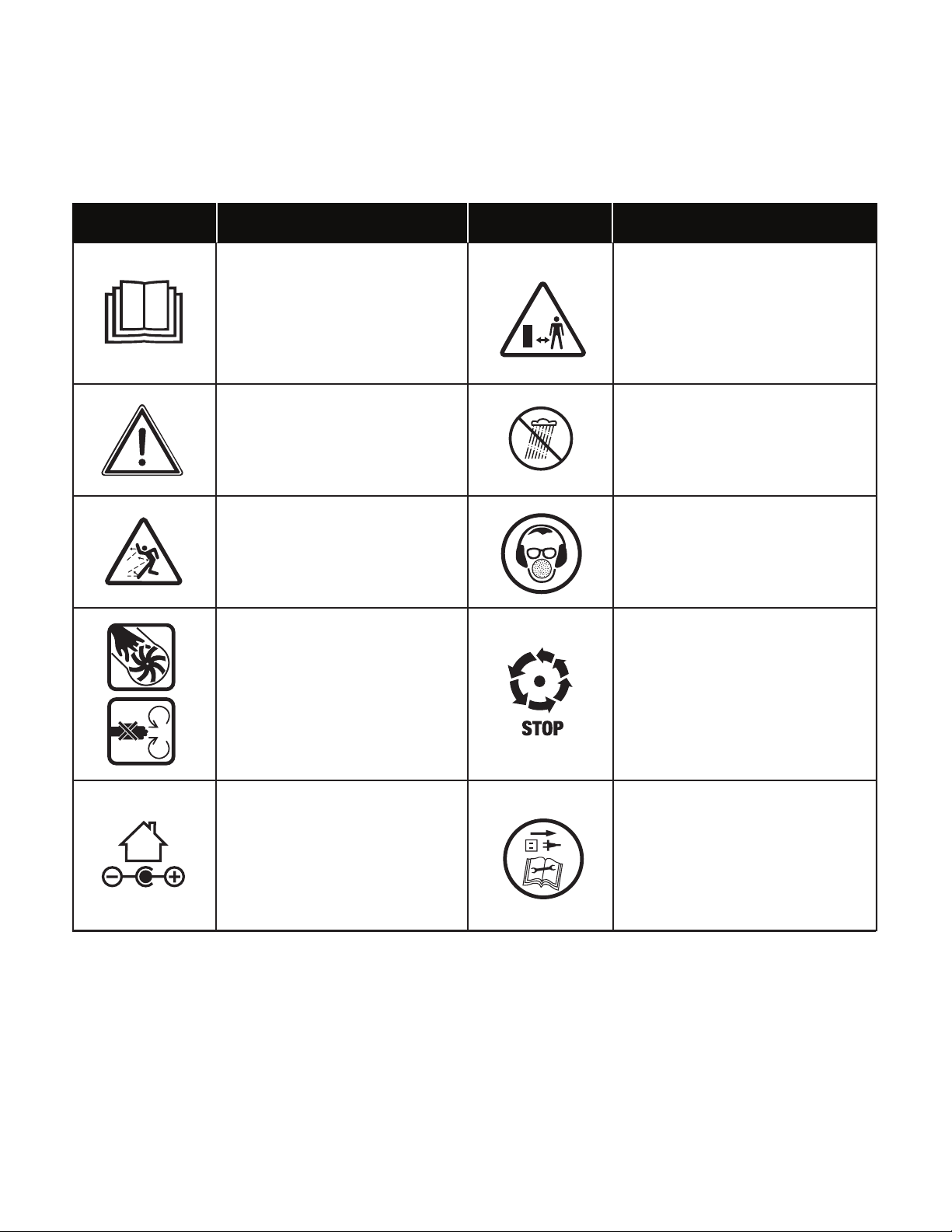
Safety Symbols
The following table depicts and describes safety symbols that may appear on this product. Read, understand and follow all
instructions on the machine before attempting to assemble and operate.
READ THE OPERATOR'S
MANUAL(S) – Read, understand
and follow all instructions in the
user manual(s) before attempting
to assemble and operate.
SAFETY ALERT – Indicates
a precaution, a warning or
a danger.
WARNING! Do not expose the unit
to rain or wet conditions.
Wear hearing protection.
Wear eye protection.
Wear breathing protection.
Keep bystanders and children
a safe distance away.
Symbols Symbols
Descriptions
Descriptions
DANGER! Rotating blades
pose a serious risk of injury.
Keep hands and feet away from
openings while the machine is
running.
The rotating part will continuously run
for several seconds after you turn o
the machine.
Beware of ying objects and
debris.
WARNING! Turn the machine OFF
and disconnect it from the power
supply before inspecting, cleaning,
changing accessories or conducting
any other maintenance task.
Indoor use only. Only use battery
charger indoors.
6
Know Your Cordless Workshop Blower + Vacuum
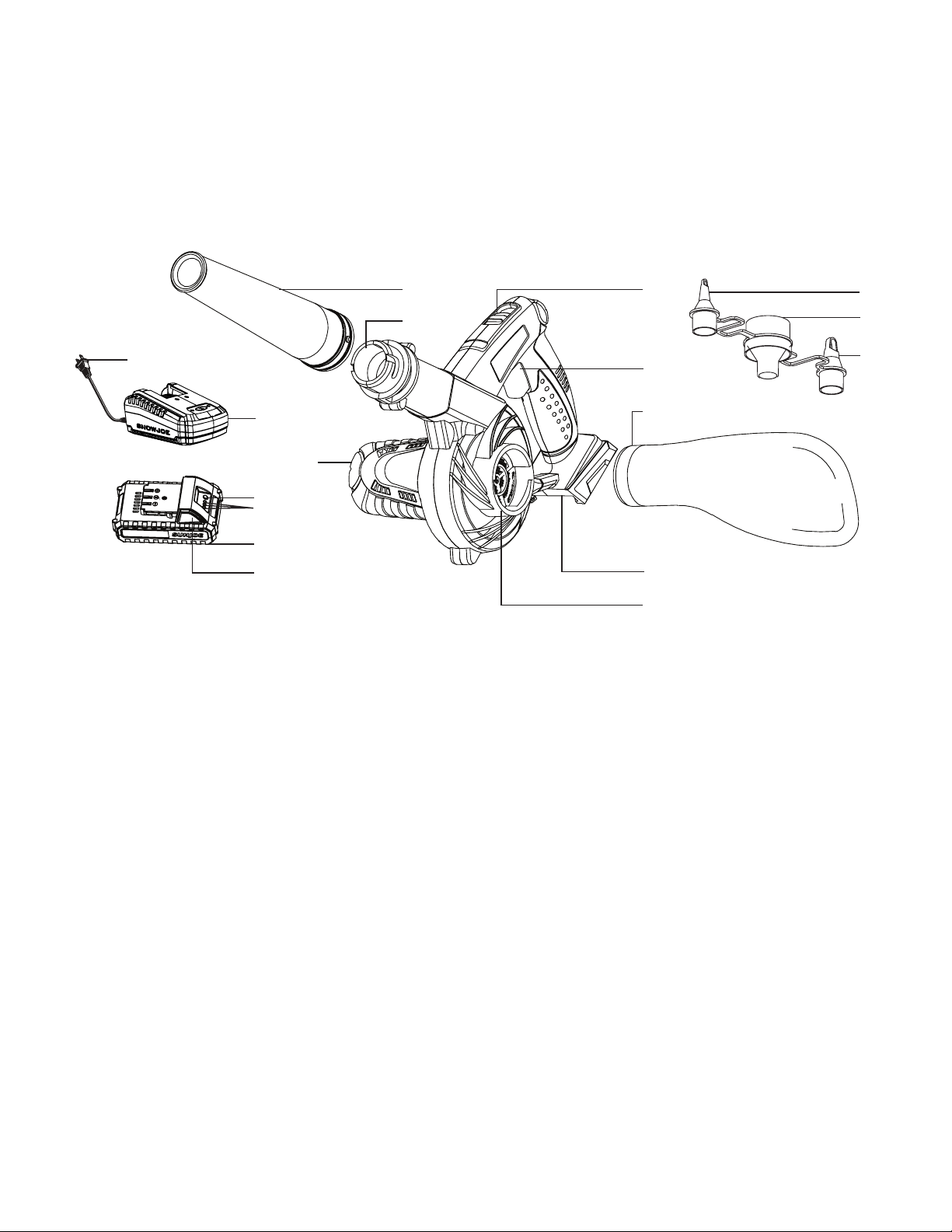
Read the owner’s manual and safety instructions carefully before operating the cordless workshop blower + vacuum.
Compare the illustration below to the cordless workshop blower + vacuum in order to familiarize yourself with the location of the
various controls and adjustments. Save this manual for future reference.
1. Blower + vacuum tube
2. Air outlet
3. Speed selector
4. Small nozzle
5. Large nozzle
6. Medium nozzle
7. ON/OFF trigger
8. Collection bag (x2)
9. Battery compartment
10. Air inlet
11. Motor housing
12. Charger plug
13. iON+ 24V lithium-ion charger
(24VCHRG-QC)
14. Push button for battery indicator
15. Battery indicators
16. iON+ 24V lithium-ion battery
(24VBAT-LTE) featuring exclusive
EcoSharp
®
technology
17. Push lock button
*Initial no-load voltage, when fully charged, peaks at 24 volts; nominal voltage under typical load is 21.6 volts.
Technical Data
Motor ............................................................................ 400 W
Battery Voltage Max* ............................................... 24 V D.C.
Battery Capacity ........................................................... 2.0 Ah
Battery Runtime Max (on High) ...................................10 min
Battery Runtime Max (on Low) ....................................15 min
Charge Time Max .........................................................55 min
Charger Input...............................................120V~ 60Hz 75W
Charger Output .................................................. 26VD.C. 2.2A
Speed Settings ...................................................................... 2
Air Speed Max ........................................................... 185 mph
Air Flow Max .............................................................. 105 cfm
Small Nozzle Diameter .................................... 0.2 in (5.3 mm)
Medium Nozzle Diameter .............................. 0.5 in (13.2 mm)
Large Nozzle Diameter .................................. 0.9 in (22.2 mm)
Weight (blower + vacuum alone) .......................... 2 lbs (0.9 kg)
Weight (blower + vacuum with battery) ............... 3.1 lbs (1.4 kg)
2
9
8
10
7
4
5
6
3
11
12
13
16
17
14
15
1
7
Unpacking
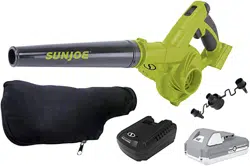
Carton Contents
• Small, medium, and large nozzles (attached)
• Cordless workshop blower + vacuum body
• Blower + vacuum tube
• Collection bag (2)
• iON+ 24V lithium-ion battery
• iON+ 24V lithium-ion charger
• Manual with registration card
1. Carefully remove the cordless workshop blower + vacuum
and check to see that all of the above items are supplied.
2. Inspect the product carefully to make sure no breakage or
damage occurred during shipping. If you nd damaged or
missing parts, DO NOT return the unit to the store. Please
call the Snow Joe
®
+ Sun Joe
®
customer service center at
1-866-SNOWJOE (1-866-766-9563).
NOTE: Do not discard the shipping carton and packaging
material until you are ready to use the cordless workshop
blower + vacuum. The packaging is made of recyclable
materials. Properly dispose of these materials in accordance
with local regulations.
IMPORTANT! The equipment and packaging material are not
toys. Do not let children play with plastic bags, foils or small
parts. These items can be swallowed and pose a suocation risk!
Battery Pack Operation
The equipment is powered by a lithium-ion battery. The battery
pack is completely sealed and maintenance free.
Battery Charge Level Indicator
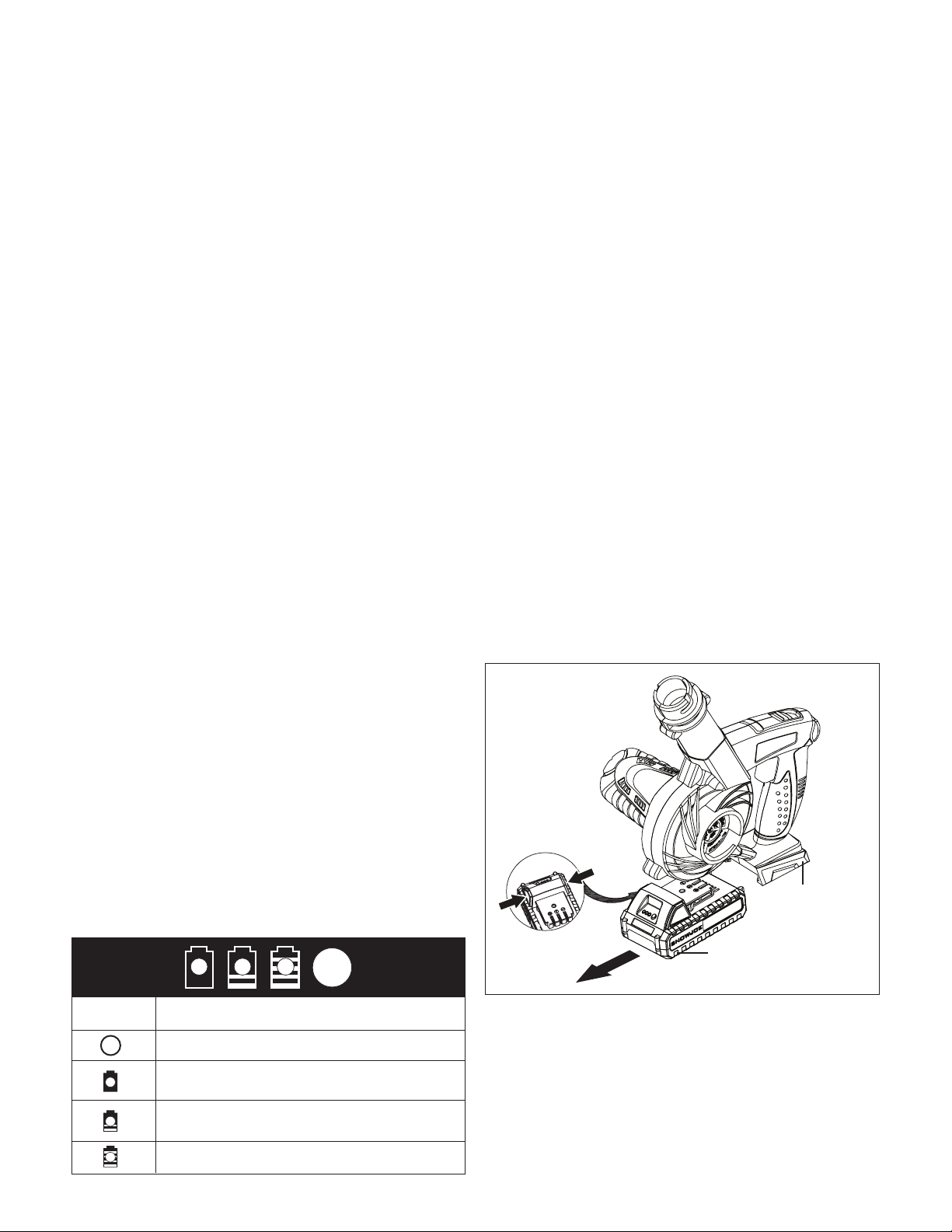
The battery pack is equipped with a push button for checking the
charge level. Simply press the push button to read o the battery
charge level from the LEDs of the battery indicator:
• All 3 level monitoring LEDs are lit: Battery charge level is high.
• 2 level monitoring LEDs are lit: Battery charge level is
decreasing. Stop work as soon as possible.
• 1 level monitoring LED is lit: Battery is at. Stop work
IMMEDIATELY and charge the battery. Otherwise the
battery’s service life will be greatly shortened.
NOTE: If the charge level button does not appear to be working,
insert the battery and charge as needed.
NOTE: Immediately after using the battery pack, the charge level
button may display a lower charge than it will if checked a few
minutes later. The battery cells “recover” some of their charge
after resting.
Charger Operation
m
WARNING! Charge only iON+ 24V lithium-ion battery
packs with its compatible iON+ 24V lithium-ion charger.
Other types of batteries may cause personal injury and damage.
To reduce the risk of electric shock, do not allow water to ow
into the charger's AC/DC plug.
When to Charge the iON+ 24VBAT-LTE
Lithium-iON Battery
NOTE: The iON+ 24VBAT-LTE lithium-ion battery packs do not
develop a "memory" when charged after only a partial discharge.
Therefore, it is not necessary to run down the battery pack before
inserting the charger plug.
• Use the battery indicator lights to determine when to charge
your iON+ 24VBAT-LTE lithium-ion battery pack.
• You can "top-o" your battery pack's charge before starting a
big job or after a long day of use.
Charging the Battery
1. Push the push lock button on the battery to pull it out of the
equipment (Fig. 1).
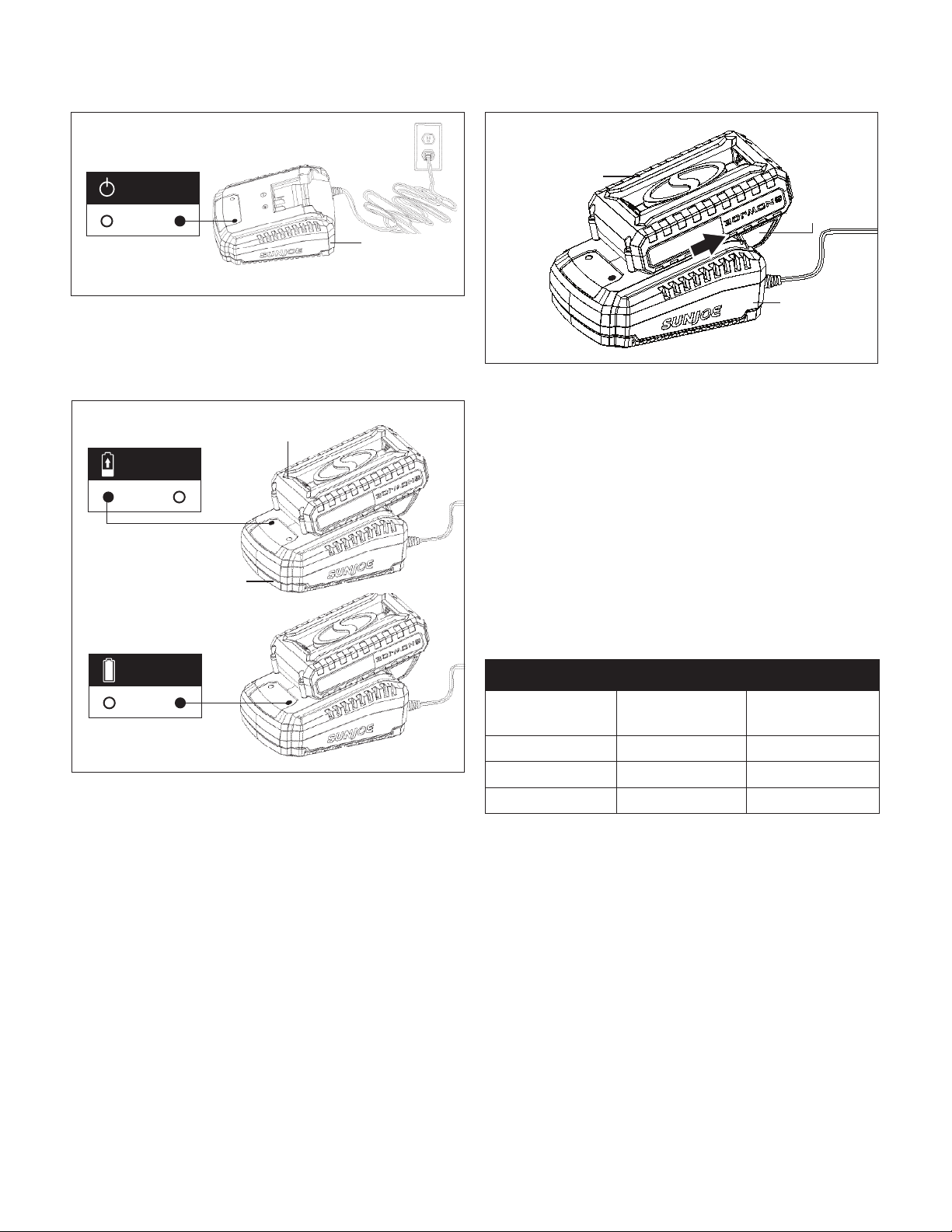
2. Check that the mains voltage is the same as that marked
on the rating plate of the battery charger. Then, insert the
charger's plug into the electrical wall outlet. When you
plug in the charger, the top right green light will illuminate
and stay green (Fig. 2).
Charge level button
The battery is at 30% capacity
and requires charging
The battery is at 60% capacity
and requires charging soon
The battery is at full capacity
Light IndicatorsLights
Fig. 1
Battery
pack
Battery
Compartment
Push
lock
button
8
3. Place the battery pack into the charger by sliding the
pack to lock it into position. When you insert the battery
into the charger, the top right green light will go o,
and the top left red light will illuminate to indicate that the
battery is charging (Fig. 3).
4. When the charger light turns green, the battery is fully
charged (Fig. 3).
NOTE: A fully discharged pack with an internal
temperature in the normal range will fully charge in
55 mins (between 32ºF/0ºC and 113ºF/45ºC).
5. If the light indicators do not come on at all, check that
the battery pack is fully seated into the bay. Remove
the battery pack and reinsert. If the problem persists,
contact an authorized Snow Joe
®
+ Sun Joe
®
dealer or
call the Snow Joe
®
+ Sun Joe
®
customer service center at
1-866-SNOWJOE (1-866-766-9563) for assistance.
6. When charging is complete, remove the battery from the
charger by pressing the push lock button and sliding the
battery backward to unlock it from the charger (Fig. 4).
7. Timely recharging of the battery will help prolong the
battery's life. You must recharge the battery pack when
you notice a drop in the equipment's power.
IMPORTANT! Never allow the battery pack to become fully
discharged as this will cause irreversible damage to the
battery.
Charging a Hot or Cold Battery Pack
A red and green ashing indicator light on the charger base
indicates that the battery pack temperature is outside the
charging range. Once the pack is within the acceptable
range, normal charging will take place and the red light will
be continuous. Hot or cold battery packs may take longer to
charge.
Assembly
m
WARNING! To avoid serious personal injury, read and
understand all safety instructions provided.
mWARNING! Do not insert battery until assembly is
complete. Failure to comply could result in accidental starting
and possible serious personal injury.
mWARNING! Before performing any maintenance,
make sure battery is removed. Failure to heed this warning
could result in serious personal injury.
mWARNING! To prevent serious personal injury,
make sure the switch is in the OFF (0) position, the battery is
removed and the impeller has come to a complete stop before
attaching or detaching the tubes.
Fig. 2
Charger
green
Power on
Fig. 3
Battery pack
Charger
red
Charging
green
Fully
Charged
Fig. 4
Battery pack
Charger
Push lock
button
Battery Pack
Temperature
Lithium-Ion Charging Status
Too hot Flashing Not charging
Normal range Red Normal charging
Too cold Flashing Not charging
Charger Base
Indicator Light
Charging
Status
9
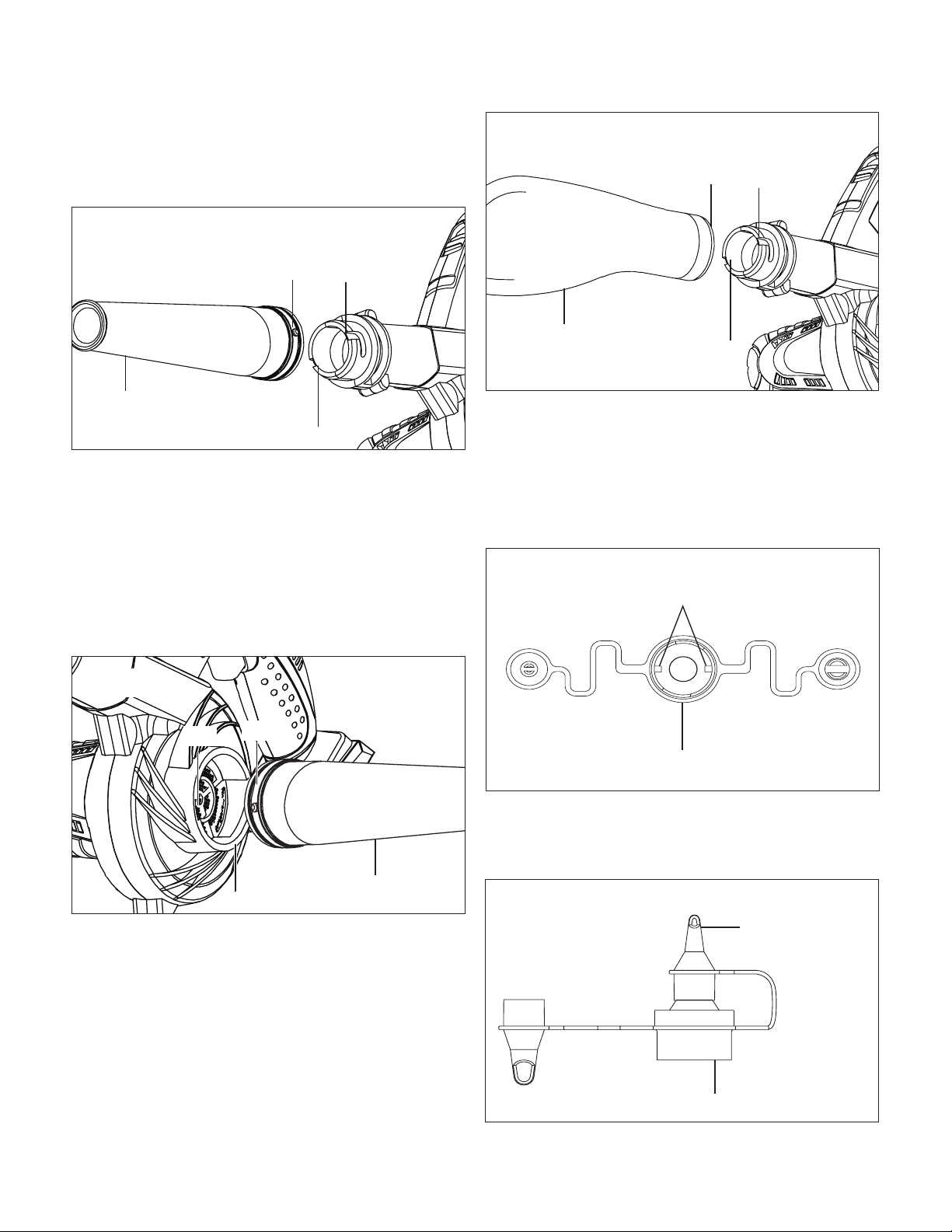
Assembling for Blower Mode
1. Align the notches on the blower + vacuum tube with the
slots on the air outlet and slide together. Rotate to lock
into place (Fig. 5).
Assembling for Vacuum Mode
Make sure both the blower + vacuum tube and collection bag
are assembled for Vacuum mode.
mCAUTION! Only use vacuum mode in workshops and
garages to clean up sawdust, dirt, and dust.
1. Align the notches on the blower + vacuum tube with the
slots on the air inlet and slide together. Rotate to lock into
place (Fig. 6).
2. Align the notches on the collection bag with the slots on
the air outlet and slide together. Rotate counter clockwise
to lock into place (Fig. 7).
Assembling the Nozzles
Attach either of the three nozzles to the air outlet only to blow
ne debris from hard-to-reach nooks and crannies.
1. Align the notches on the inside of the large nozzle with the
slots on the air outlet and slide together. Rotate to lock
into place (Fig. 8).
2. To use either the small or medium nozzle, simply place
either on top of the large nozzle and press on until secure
(Fig. 9).
Fig. 5
Blower + vacuum
tube
Air outlet
Notch
Slot
Fig. 6
Blower + vacuum tube
Air inlet
Notch
Slot
Fig. 7
Collection bag
Air outlet
Notch
Slot
Fig. 8
Large nozzle
Notches
Fig. 9
Large nozzle
Small nozzle
10
Operation
Starting + Stopping
mCAUTION! Starting, stopping, and restarting a DC
motor repeatedly within a few seconds can generate a great
deal of heat and damage the motor. To protect the life of your
cordless workshop blower + vacuum, always wait at least ve
seconds after stopping before restarting the workshop blower
+ vacuum.
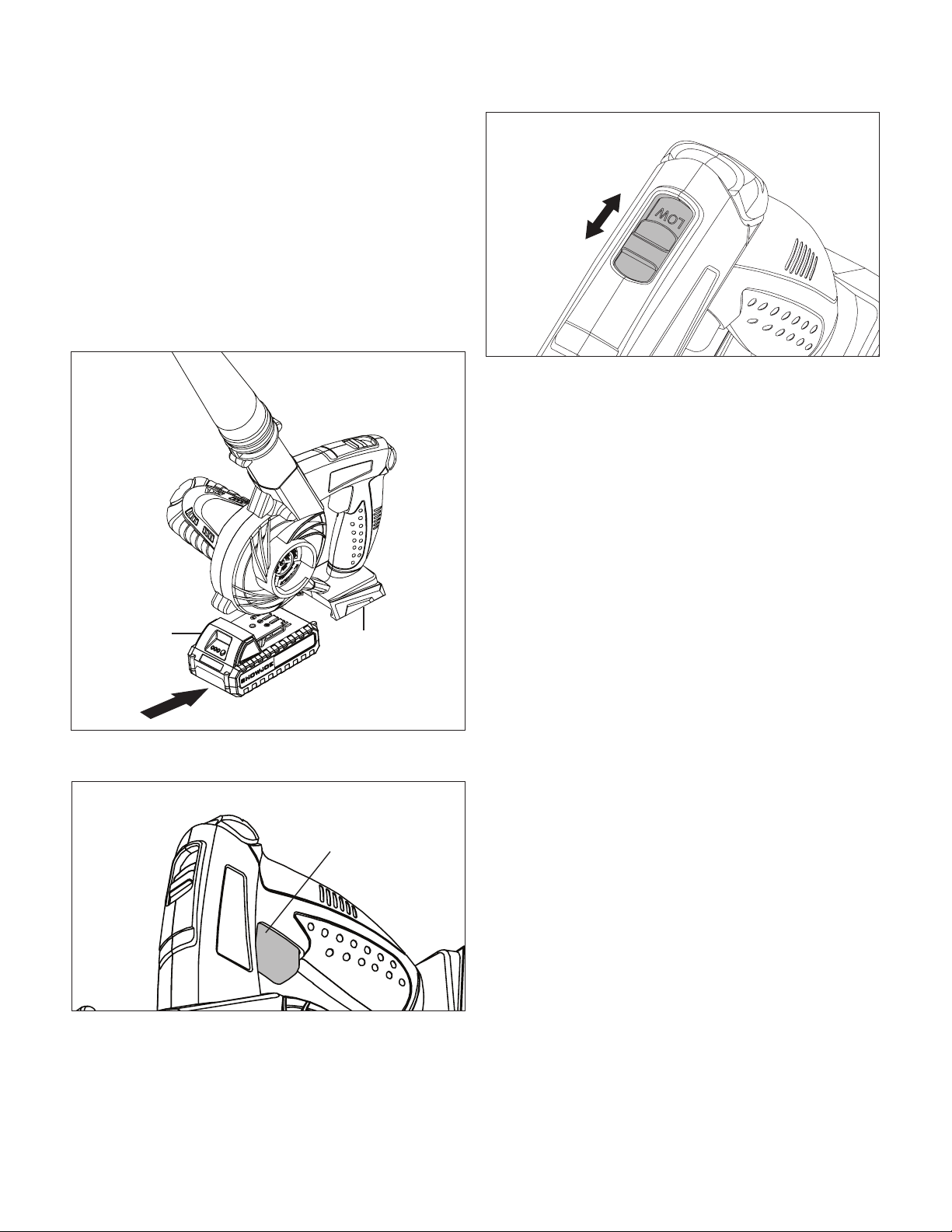
1. Insert the battery into the battery compartment until it
clicks to lock it into position (Fig. 10).
2. To start the cordless workshop blower + vacuum,
press the ON/OFF trigger once (Fig. 11).
3. To turn the tool o, press the ON/OFF trigger once more
(Fig. 11).
4. To control the speed, use the speed selector and slide to
choose HIGH or LOW (Fig. 12).
Operating Tips
mWARNING! Use the cordless workshop blower +
vacuum only in daylight or good articial light.
• When using the cordless workshop blower + vacuum,
plant your feet rmly on the ground and place your
dominant hand on the unit handle to control the unit.
Use your other hand to steady the unit as needed.
• Wear personal protective equipment during your work
session. This includes boots, safety glasses/goggles,
ear defenders, long pants and a long-sleeve shirt.
• Make sure the Blower + vacuum tube is not directed at
anybody or any loose debris before starting the unit.
• Verify that the unit is in good working condition. Make sure
the tubes are in place and secure.
• Keep a rm grip on the unit handle while in use.
• To reduce the risk of hearing loss associated with
increased sound levels, hearing protection is required.
• Operate power equipment only at reasonable hours—
not early in the morning or late at night when people might
be disturbed. Comply with times listed in local ordinances.
Usual recommendations are 9:00 am to 5:00 pm,
Monday through Saturday.
• To reduce noise levels, limit the number of pieces of
power equipment used at any one time and operate power
workshop blower + vacuums at the lowest possible speed
setting necessary to do the job.
• Use rakes and brooms to loosen debris before blowing.
• In dusty conditions, slightly dampen surfaces.
• Blow debris into a safe, open area away from children,
pets, open windows or freshly washed cars.
• Clean up after using the workshop blower + vacuum and
other lawn equipment. Dispose of debris appropriately.
mWARNING! To avoid serious personal injury,
wear ear defenders, goggles or safety glasses at all times
when operating this unit. Wear a face mask or dust mask in
dusty locations.
Fig. 10
Battery
pack
Battery
Compartment
Fig. 11
ON/OFF trigger
Fig. 12
11
mWARNING! To prevent serious personal injury or
damage to the unit, make sure the Blower + vacuum tube is in
place before operating the unit.
Air Vents
Never cover air vents. Keep them free from obstructions
and debris. They must always remain clear for proper motor
cooling.
mWARNING! To avoid serious personal injury, do not
wear loose tting clothing or articles such as scarves, strings,
chains, ties, etc., that could get drawn into the air vents.
To make sure long hair does not get drawn into the air vents,
tie back long hair.
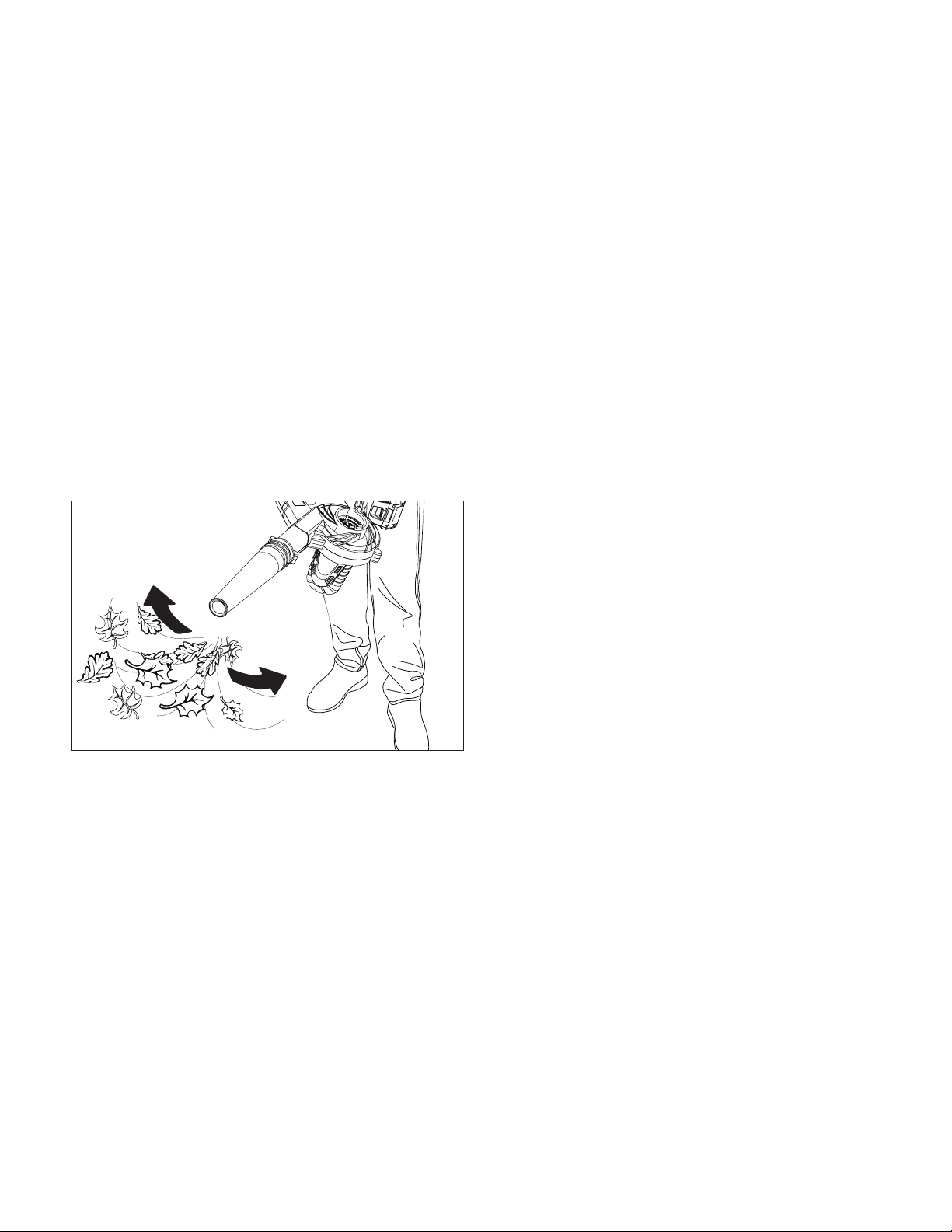
Blower Mode
• Hold the workshop blower + vacuum rmly with your
dominant hand on the unit handle. Sweep from side to
side with the lower tube several inches above the ground
or oor (Fig. 13).
• Slowly advance the unit, keeping the accumulated pile
of debris in front of you. Most dry blowing operations are
better suited to low speeds rather than high speeds.
High speed blowing is best for moving heavier items like
large debris or gravel.
Vacuum Mode
• Once you have blown the debris/dust into a pile,
you can convert to vacuum mode to collect the debris.
• Ensure collection bag is attached securely.
• With a rm hold on the unit, tilt the Blower + vacuum tube
2 in. – 4 in. (5 cm – 10 cm) from the ground and use a
sweeping action to collect light debris. The debris will ow
into the bag. For longer bag life and optimal performance,
empty the bag frequently.
• As the bag lls, suction power will decrease. When this
happens, use the ON/OFF trigger to turn the unit OFF
remove the battery. Remove the bag and empty the
debris.
Maintenance
mWARNING! Always wear protective gloves during
maintenance operations. Do not carry out maintenance when
the engine is running or hot.
mWARNING! Use only original manufacturer’s
replacement parts, accessories and attachments. Failure to do
so can cause possible injury and poor performance.
To order genuine replacement parts or accessories for the
Sun Joe
®
iON+ 24V-WSB-LTE cordless workshop blower +
vacuum, please visit sunjoe.com or contact the Snow Joe
®
+
Sun Joe
®
customer service center at 1-866-SNOWJOE
(1-866-766-9563).
mWARNING! Remove the battery before performing any
maintenance task. If the battery is connected with the unit,
someone could accidentally turn on the unit while you are
inspecting it, which could result in serious personal injury.
1. Store the tool, instruction manual and accessories in a
secure, dry place. In this way, you will always have the
information ready at hand.
2. Keep the tool’s air vents unclogged and clean at all times.
3. Remove dust and dirt regularly. Cleaning is best done with
a rag or brush.
4. Never use caustic agents to clean plastic parts.
mWARNING! Do not use cleaning agents to clean the
plastic parts of the tool. A mild detergent on a damp cloth is
recommended. Water must never come into contact with the
tool.
Storage
1. Examine the cordless workshop blower + vacuum
thoroughly for worn, loose, or damaged parts. Should you
need to repair or replace a part, contact an authorized
Snow Joe
®
+ Sun Joe
®
dealer or call the Snow Joe
®
+
Sun Joe
®
customer service center at 1-866-SNOWJOE
(1-866-766-9563) for assistance.
2. Remove the battery from the cordless workshop blower +
vacuum before storing.
3. Store the workshop blower + vacuum in a dry,
well-ventilated place that is inaccessible to children.
Keep away from corrosive agents.
Battery Caution + Disposal
Always dispose of your battery pack according to federal,
state, and local regulations. Contact a recycling agency in your
area for recycling locations.
mCAUTION! Even discharged battery packs contain
some energy. Before disposing, use electrical tape to cover the
terminals to prevent the battery pack from shorting,
which could cause a re or explosion.
Fig. 13

12
mWARNING! To reduce the risk of injury or explosion,
never burn or incinerate a battery pack even if it is damaged,
dead, or completely discharged. When burned, toxic fumes
and materials are emitted into the surrounding atmosphere.
1. Batteries vary according to device. Consult your manual
for specic information.
2. Install only new batteries of the same type in your product
(where applicable).
3. Failure to insert batteries in the correct polarity,
as indicated in the battery compartment or manual, may
shorten the life of the batteries or cause batteries to leak.
4. Do not mix old and new batteries.
5. Do not mix Alkaline, Standard (Carbon-Zinc),
or Rechargeable (Nickel Cadmium, Nickel Metal Hydride,
or Lithium-Ion) batteries.
6. Do not dispose of batteries in re.
7. Batteries should be recycled or disposed of as per state
and local guidelines.
Service and Support
If your Sun Joe
®
iON+ 24V-WSB-LTE cordless workshop
blower + vacuum requires service or maintenance, please call
1-866-SNOWJOE (1-866-766-9563) for assistance.
Model and Serial Numbers
When contacting the company, reordering parts, or arranging
service from an authorized dealer, you will need to provide the
model and serial numbers, which can be found on the decal
located on the housing of the unit. Copy these numbers into
the space provided below.
Record the following numbers from the housing or handle of your
new product:
Model #:
Serial #:
24V-WSB-LTE
13
Optional Accessories
mWARNING! ALWAYS use only authorized Snow Joe
®
+ Sun Joe
®
replacement parts and accessories. NEVER use
replacement parts or accessories that are not intended for use with this cordless blower + vacuum. Contact Snow Joe
®
+
Sun Joe
®
if you are unsure whether it is safe to use a particular replacement part or accessory with your cordless blower +
vacuum. The use of any other attachment or accessory can be dangerous and could cause injury or mechanical damage.
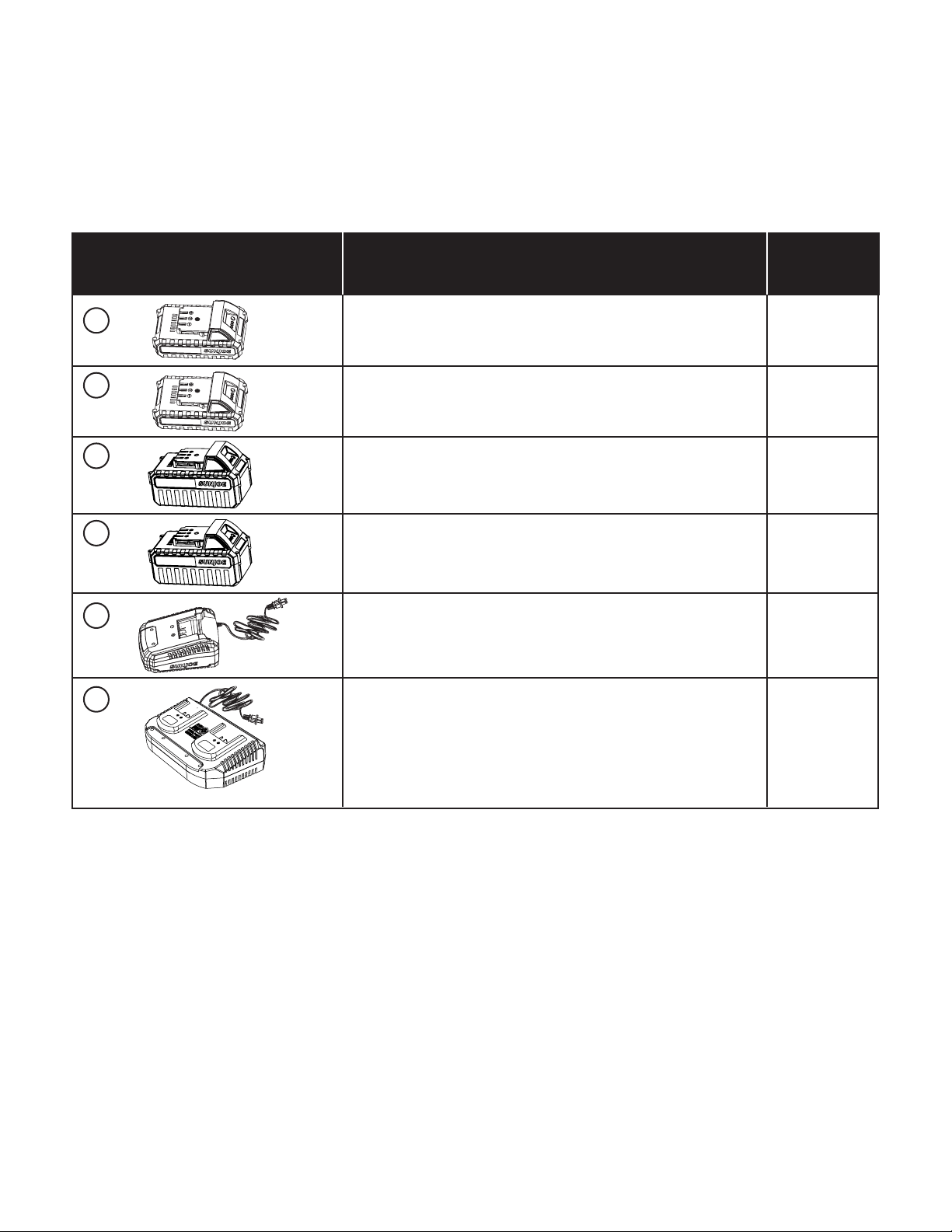
iON+ 24V Lithium-Ion Battery Quick Charger
24VCHRG-QC
ModelAccessories Item
1
2
3
4
5
6
iON+ 24V 2.0 Ah Lithium-Ion Battery
Battery Charge Time Max:
24VCHRG-QC: 55 min | 24VCHRG-DPC: 55 min
Battery Runtime Max: 10 min on high | 15 min on low
24VBAT-LTE
iON+ 24V 2.5 Ah Lithium-Ion Battery
Battery Charge Time Max:
24VCHRG-QC: 1 hr 10 min | 24VCHRG-DPC: 1 hr 10 min
Battery Runtime Max: 15 min on high | 20 min on low
24VBAT-LT
iON+ 24V 4.0 Ah Lithium-Ion Battery
Battery Charge Time Max:
24VCHRG-QC: 1 hr 50 min | 24VCHRG-DPC: 1 hr 50 min
Battery Runtime Max: 20 min on high | 30 min on low
24VBAT
iON+ 24V 5.0 Ah Lithium-Ion Battery
Battery Charge Time Max:
24VCHRG-QC: 2 hrs 20 min | 24VCHRG-DPC: 2 hrs 20 min
Battery Runtime Max: 30 min on high | 40 min on low
24VBAT-XR
iON+ 24V Lithium-Ion Battery Charger
24VCHRG-DPC
NOTE: Accessories are subject to change without any obligation on the part of Snow Joe
®
+ Sun Joe
®
to provide notice of such
changes. Accessories can be ordered online at sunjoe.com or via phone by contacting the Snow Joe
®
+ Sun Joe
®
customer
service center at 1-866-SNOWJOE (1-866-766-9563).