English
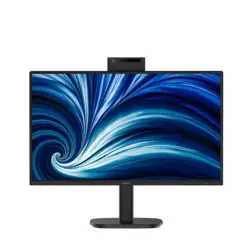
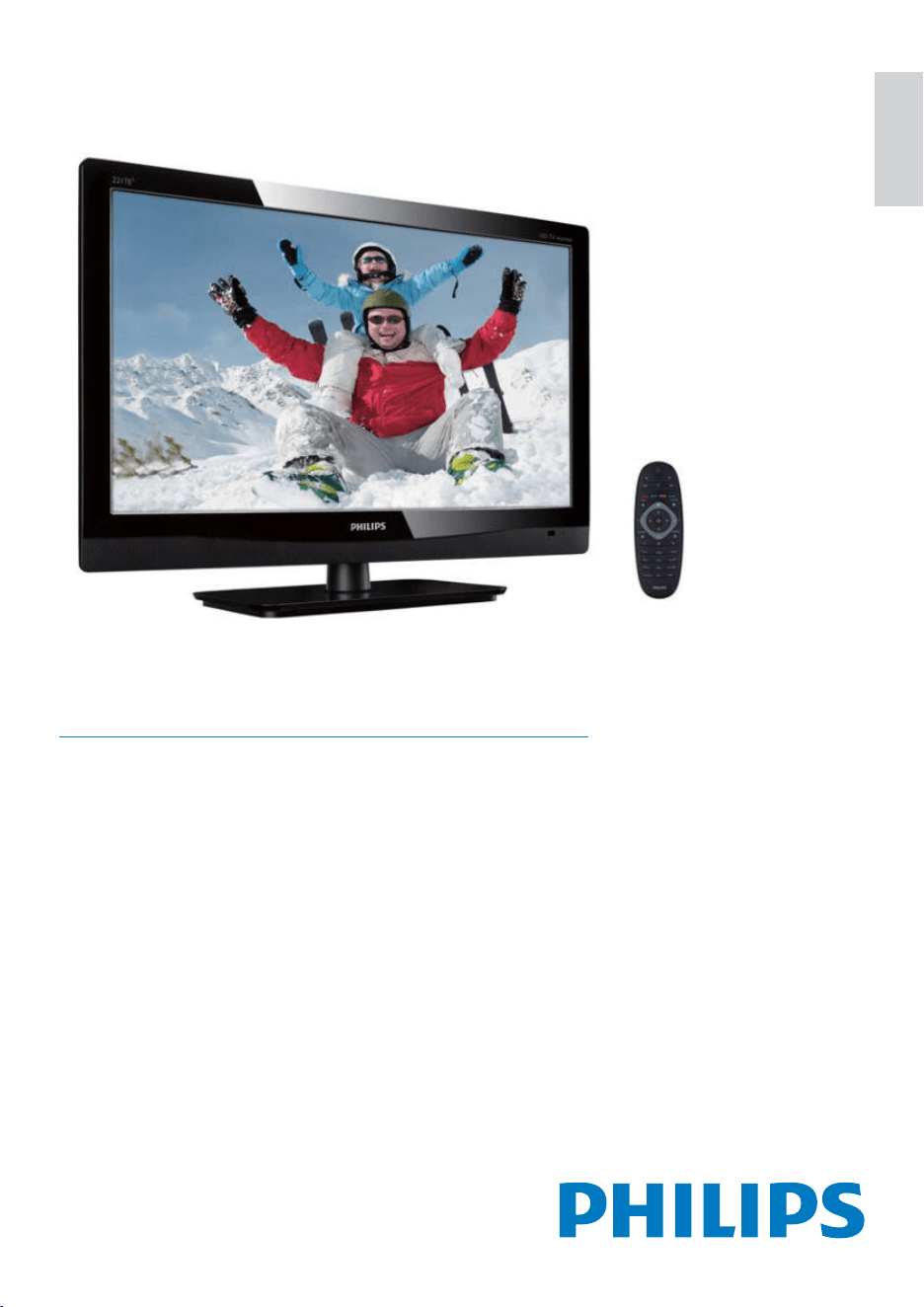
221TE4L
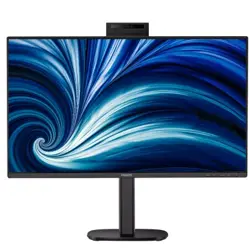
231TE4L
www.philips.com/welcome
EN Notice & important information 2
User manual 5
Troubleshooting 34
www.philips.com/support
Model
Serial
This information is correct at the time of press. For updated information, see www.philips.com/support.
Country Code Telephone number Tariff
Austria +43 0810 000206
0.07
Belgium +32 078 250851
0.06
Denmark +45 3525 8761 Local call tariff
Finland +358 09 2290 1908 Local call tariff
France +33 082161 1658
0.09
Germany +49 01803 386 853
0.09
Greece +30 00800 3122 1223 Free of charge
Ireland +353 01 601 1161 Local call tariff
Italy +39 840 320 041
0.08
Luxembourg +352 26 84 30 00 Local call tariff
The Netherlands +31 0900 0400 063
0.10
Norway +47 2270 8250 Local call tariff
Poland +48 0223491505 Local call tariff
Portugal +351 2 1359 1440 Local call tariff
Spain +34 902 888 785
0.10
Sweden +46 08 632 0016 Local call tariff
Switzerland +41 02 2310 2116 Local call tariff
United Kingdom +44 0207 949 0069 Local call tariff
Register your product and get support at
www.philips.com/welcome

1EN
EnglishEnglish
Contents
1 Notice 2
2 Important 3
The most updated user manual on line 4
3 Get started and connect your
devices 5
Back connector 5
Side connector 6
Use a Conditional Access Module 7
Use Philips EasyLink 7
4 Controls 9
Side control buttons 9
Remote control 10
5 Start to use 11
Switch your monitor on/off or to standby 11
Switch channels 12
Watch connected devices 12
Adjust monitor volume 13
6 Product information 14
Supported display resolutions 14
Tuner/Reception/Transmission 14
Remote control 14
Power 14
Supported monitor mounts 14
7 TV/Channel installation 15
Automatically install channels 15
Manually install channels 16
Rename channels 16
Rearrange channels 17
Test digital reception 17
8 Settings 18
Access TV menus 18
Change picture and sound settings 18
Use the universal access menu 21
Use advanced teletext features 22
Create and use lists of favourite channels 22
Use the Electronic Programme Guide 23
Display the TV clock 24
Use timers 25
Lock unsuitable content 25
Change language 26
Update the TV software 27
Change TV preferences 28
Start a TV demo 28
Reset the TV to factory settings 28
9 Multimedia 29
Play photos and music on USB storage
devices 29
10 Pixel policy 31
11 Troubleshooting 34
General monitor issues 34
TV channel issues 34
Picture issues 34
Sound issues 35
HDMI connection issues 35
Computer connection issues 35
Contact us 35

2 EN
Mains fuse (UK only)
approved moulded plug. Should it
become necessary to replace the mains
fuse, this must be replaced with a fuse of
the same value as indicated on the plug
(example 10A).
1 Remove fuse cover and fuse.
2 The replacement fuse must comply with
BS 1362 and have the ASTA approval
mark. If the fuse is lost, contact your
dealer in order to verify the correct type.
3
In order to maintain conformity to the
EMC directive, the mains plug on this
product must not be detached from the
mains cord cable.
Copyright
VESA, FDMI and the VESA Mounting Compliant
logo are trademarks of the Video Electronics
Standards Association.
® Kensington and Micro Saver are registered
US trademarks of ACCO World Corporation
with issued registrations and pending
applications in other countries throughout the
world.
1 Notice
2012 © Koninklijke Philips Electronics N.V.
All rights reserved.
Philips and the Philips Shield Emblem are
registered trademarks of Koninklijke Philips
Electronics N.V. and are used under licence
from Koninklijke Philips Electronics N.V.
notice.
Warranty
Risk of injury, damage to monitor or void
of warranty! Never attempt to repair the
monitor yourself.
Use the monitor and accessories only as
intended by the manufacturer.
Any operation expressly prohibited in
this manual, or any adjustments and
assembly procedures not recommended
or authorised in this manual shall void the
warranty.
Warranty coverage begins from the day
you purchase your monitor. For two years
thereafter, your monitor will be replaced
by at least an equivalent monitor in case
of defects provided by the warranty
coverage.
Pixel characteristics
This monitor product has a high number
of color pixels. Although it has effective
pixels of 99.999% or more, black dots or
bright points of light (red, green or blue)
may appear constantly on the screen.
This is a structural property of the display
(within common industry standards) and
is not a malfunction.
Please refer to the Pixel Policy section in
this manual for details.

3EN
English
2 Important
Read and understand all instructions before you
use your monitor. If damage is caused by failure
to follow instructions, the warranty does not
apply.
Safety
"
Never expose the monitor to rain or
water. Never place liquid containers,
such as vases, near the monitor.
If liquids are spilt on or into the
monitor, disconnect the monitor
from the power outlet immediately.
Contact Philips Consumer Care to
have the monitor checked before
use.
Never place the monitor, remote
control or batteries near naked
#$
including direct sunlight.
$
#&
the monitor, remote control and
batteries at all times.
Never insert objects into the
ventilation slots or other openings on
the monitor.
When the monitor is swivelled,
ensure that no strain is exerted on
the power cord. Strain on the power
cord can loosen connections and
cause arcing.
"
Never expose the remote control or
batteries to rain, water or excessive
heat.
Avoid force coming onto power
plugs. Loose power plugs can cause
Risk of injury or damage to the monitor!
Two people are required to lift and
carry a monitor that weights more
than 25 kg.
When stand mounting the monitor,
use only the supplied stand. Secure
the stand to the monitor tightly. Place
#$
that can support the combined
weight of the monitor and the stand.
When wall mounting the monitor,
use only a wall mount that can
support the weight of the monitor.
Secure the wall mount to a wall that
can support the combined weight
of the monitor and wall mount.
Koninklijke Philips Electronics N.V.
bears no responsibility for improper
wall mounting that results in accident,
injury or damage.
Risk of injury to children! Follow these
precautions to prevent the monitor
from toppling over and causing injury to
children:
Never place the monitor on a surface
covered by a cloth or other material
that can be pulled away.
Ensure that no part of the monitor
hangs over the edge of the surface.
Never place the monitor on tall
furniture (such as a bookcase)
without anchoring both the furniture
and monitor to the wall or a suitable
support.
Educate children about the dangers
of climbing on furniture to reach the
monitor.
Risk of overheating! Never install the
'&
at least 4 inches of space around the
monitor for ventilation. Ensure curtains or
other objects never cover the ventilation
slots on the monitor.
Risk of damage to the monitor! Before
you connect the monitor to the power
outlet, ensure that the power voltage
matches the value printed on the back of
the monitor. Never connect the monitor
to the power outlet if the voltage is
different.
4 EN
Recycling
Your display is manufactured with high quality
materials and components which can be
recycled and reused.
To learn more about our recycling program,
please visit www.philips.com/about/
sustainability/recycling.
When you see the crossed-out wheeled bin
symbol attached to a product, it means the
product is covered by the European Directive
2002/96/EC:
Never dispose of your product with other
household waste. Please inform yourself about
the local rules on the separate collection of
electrical and electronic products. The correct
disposal of your old product helps prevent
potentially negative consequences for the
environment and human health.
Your product contains batteries covered by
the European Directive 2006/66/EC, which
cannot be disposed of with normal household
waste.
Please inform yourself about the local rules
on the separate collection of batteries. The
correct disposal of batteries helps prevent
potentially negative consequences for the
environment and human health.
The most updated user
manual on line
The contents of the user manual are subject
to change. Please refer to www.philips.com/
support for the most updated user manual info
reference.
&$"
Never place the monitor or any objects
on the power cord.
To easily disconnect the monitor power
cord from the power outlet, ensure that
you have full access to the power cord at
all times.
When you disconnect the power cord,
always pull the plug, never the cable.
Disconnect the monitor from the power
outlet and aerial before lightning storms.
During lightning storms, never touch any
part of the monitor, power cord or aerial
cable.
Risk of hearing damage! Avoid using
earphones or headphones at high
volumes or for prolonged periods of time.
If the monitor is transported in
temperatures below 5°C, unpack the
monitor and wait until the monitor
temperature matches the room
temperature before connecting the
monitor to the power outlet.
Screen care
Avoid stationary images as much as
possible. Stationary images are images
that remain on-screen for extended
periods of time. Examples include:
on-screen menus, black bars and time
displays. If you must use stationary images,
reduce screen contrast and brightness to
avoid screen damage.
Unplug the monitor before cleaning.
Clean the monitor and frame with a soft,
damp cloth. Never use substances such as
alcohol, chemicals or household cleaners
on the monitor.
Risk of damage to the monitor screen!
Never touch, push, rub or strike the
screen with any object.
To avoid deformations and color fading,
wipe off water drops as soon as possible.
5EN
English
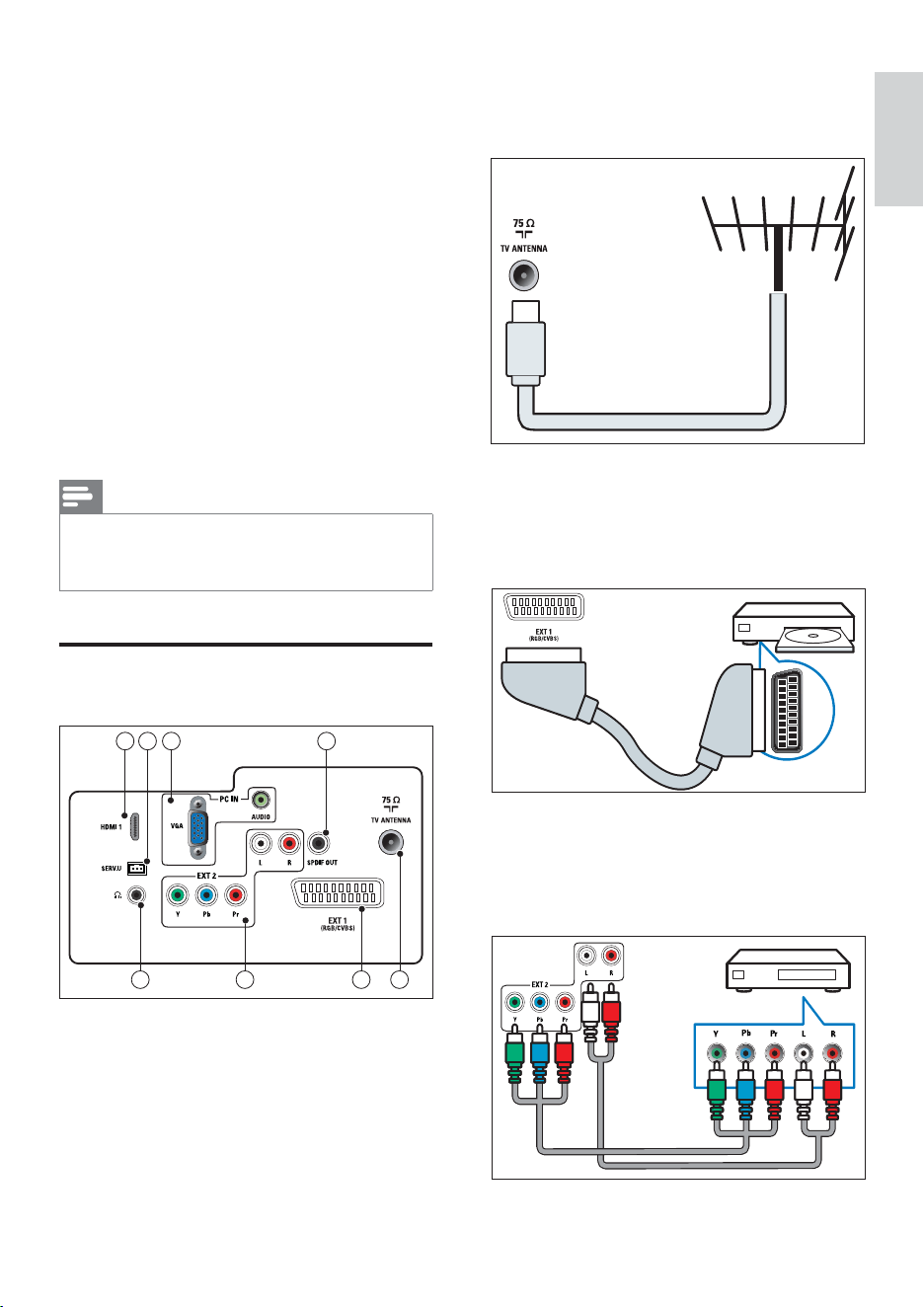
a TV ANTENNA
Signal input from an antenna, cable or
satellite.
b EXT 1 (RGB / CVBS) (SCART)
Analogue audio and video input from
analogue or digital devices such as DVD
players or game consoles.
c EXT 2 (Y Pb Pr and AUDIO L/R)
Analogue audio and video input from
analogue or digital devices such as DVD
players or game consoles.
3 Get started and
connect your
devices
Congratulations on your purchase, and
*"&
support that Philips offers, register your product
at www.philips.com/welcome.
This section describes how to connect
various devices with different connectors and
supplements examples provided in the Quick
Start Guide.
Note
Different types of connectors may be used to
connect a device to your monitor, depending on
availability and your needs.
Back connector
1234
5 6 7 8
6 EN
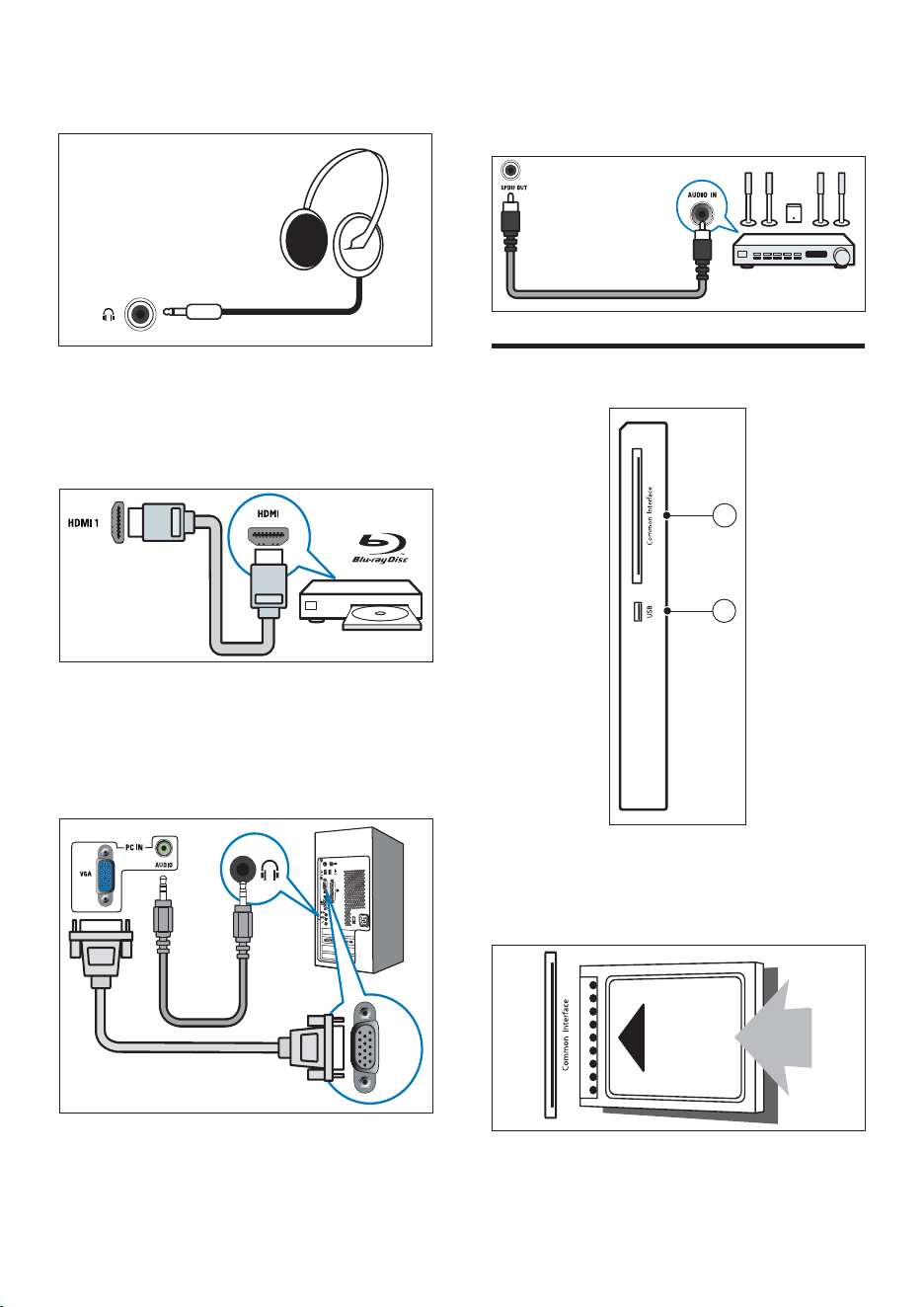
h SPDIF OUT
Digital audio output to home theaters
and other digital audio systems.
Side connector
1
2
a COMMON INTERFACE
Slot for a Conditional Access Module
(CAM).
b USB
For music and photo.
d HEADPHONE
Audio output to your headphones.
e HDMI
Digital audio and video input from high-
+;&
players.
f SERV. U
For use by service personnel only.
g PC IN (VGA and AUDIO IN)
Audio and video input from a computer.
VGA
The connection via VGA requires an
additional audio cable.
7EN
English
Note
This menu option is available only if the CAM is
inserted and activated correctly.
Use Philips EasyLink
Get the most out of your HDMI-Consumer
Electronic Control (CEC) compliant device
with Philips EasyLink enhanced control features.
If your HDMI-CEC compliant devices are
connected through HDMI, you can control
them at the same time with your TV remote
control.
To enable Philips EasyLink, you need to:
Connect an HDMI-CEC compliant device
through HDMI
<=>?@;<J<
device properly
Switch on EasyLink
Note
The EasyLink-compliant device must be
switched on and selected as the source.
Philips does not guarantee 100% interoperability
with all HDMI CEC devices.
Switch on or off EasyLink
When you play an HDMI-CEC compliant
device, the TV switches on from standby, and
switches to the correct source.
Note
If you do not intend to use Philips EasyLink,
switch it off.
1. Press
.
2. Select [Setup] > [TV settings] >
[EasyLink] > [EasyLink].
3. Select [On] or [Off], then press OK.
Use a Conditional Access
Module
A Conditional Access Module (CAM) is
provided by digital TV service operators to
decode digital TV channels.
Note
Refer to the documentation from your service
operator on how to insert a smart card into the
Conditional Access Module.
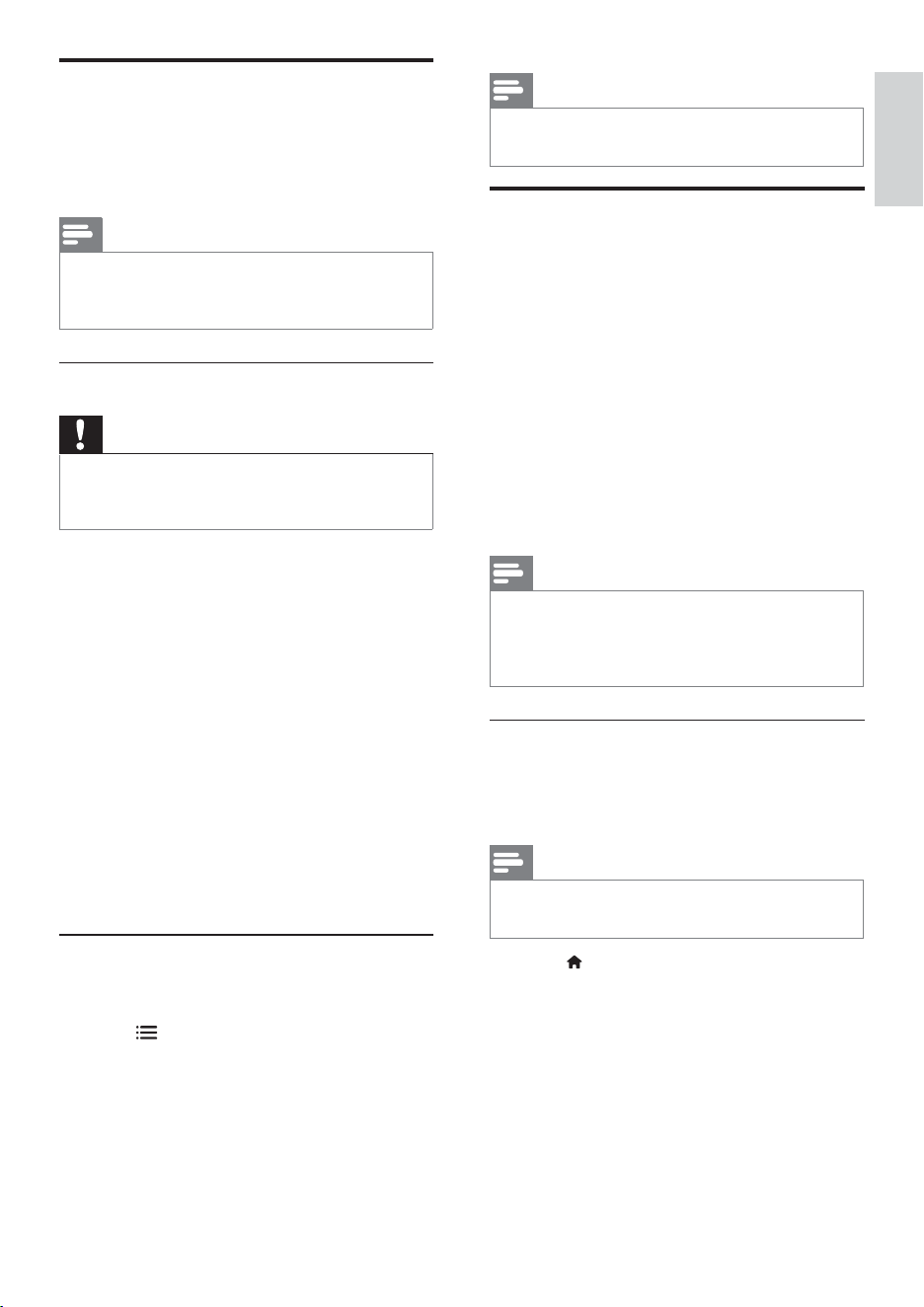
Insert and activate a CAM
Caution
Be sure to follow the instructions described
below. Wrong insertion of a CAM may damage
both the CAM and your TV.
1. Switch off the TV and disconnect it from
the power outlet.
2. Following the directions printed on the
CAM, gently insert the CAM into the
COMMON INTERFACE at the side of the
TV.
3. Push the CAM in as far as it will go.
4. Reconnect the TV to the power outlet.
5. Turn on the TV and wait for the CAM to
be activated. This may take several minutes.
Do not remove the CAM from the slot
when in use — this action deactivates
digital services.
Access CAM services
1. Insert and activate the CAM.
2. Press
OPTIONS.
3. Select [Common interface].
» Applications provided by the digital TV
service operator are displayed.

8 EN
Select speaker output with Adjust
menu
If [EasyLink] or [EasyLink autostart] are
selected, access the adjust menu to switch the
TV audio.
1. While you watch TV, press
ADJUST.
2. Select [Speaker], then press OK.
3. Select one of the following, then press OK:
[TV]: On by default. Stream TV audio
through TV and the connected HDMI-
CEC audio device until the connected
device switches to system audio
control. TV audio is then streamed
through the connected device.
Stream audio through
the connected HDMI-CEC device. If
system audio mode is not enabled on
the device, audio continue to stream
from the TV speakers. If [EasyLink
autostart] was enabled, the TV
prompts the connected device to
switch to system audio mode.
Set TV speakers to EasyLink mode
If you connect an HDMI-CEC compliant device
that includes speakers, you can choose to hear
the TV from those speakers instead of the TV
speakers.
When you play content from an EasyLink
compliant home theatre, if you want to mute
the TV speakers automatically, turn on EasyLink
mode.
1. Connect an HDMI-CEC compliant device
to the HDMI connector.
2. Connect an audio cable from the SPDIF
OUT connector to the EasyLink-compliant
device’s AUDIO IN connector (see ‘Back
connections’ on page 5).
3. Configure the HDMI-CEC compliant device
properly (see the device user manual).
4. Press
.
5. Select [Setup] > [TV settings] >
[EasyLink] > [EasyLink].
6. Select [On], then press OK.
7. Select [TV speakers], then press OK.
8. Select one of the following, then press OK.
Switch off TV speakers.
Switch on TV speakers.
Stream TV audio through
the connected HDMI-CEC device.
Switch the TV audio to the connected
HDMI-CEC audio device through the
adjust menu.
Turn off TV
speakers automatically and streams TV
audio to the connected HDMI-CEC
audio device.
Note
To mute the TV speakers, select [TV speakers]
> [Off].
9EN
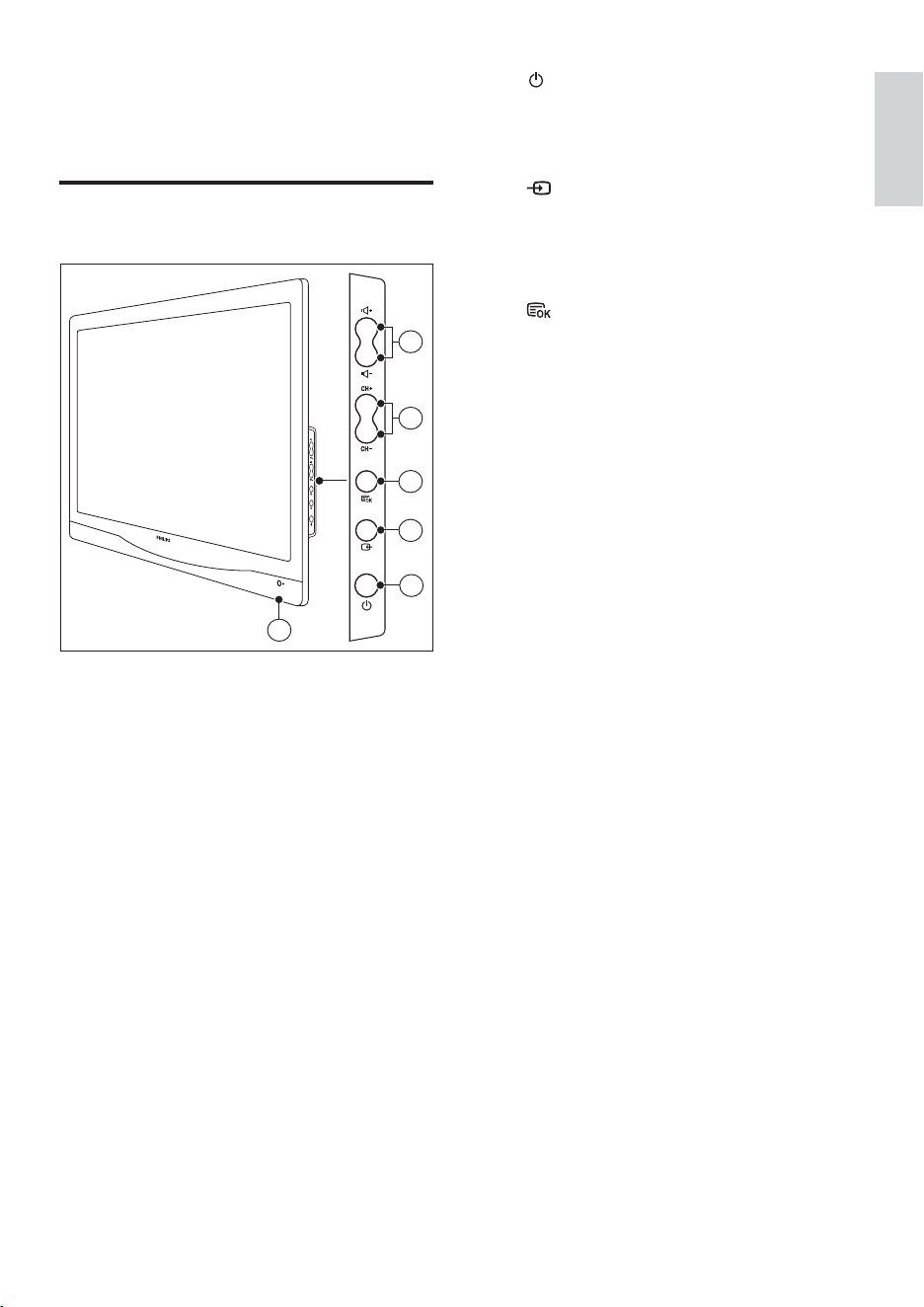
English
a Switch the monitor on
or off. The monitor is not powered
off completely unless it is physically
unplugged.
b
Select an input source.
Return to the previous screen or exit
from the on-screen menu.
c
!"#$
Display the on-screen menu.
<
d %'#*Switch to the next or previous
channel.
e +'#*Increase or decrease volume.
f -:;
Red LED: RC standby mode. / PC standby
mode.
4 Controls
Side control buttons
6
2
3
1
5
4
10 EN
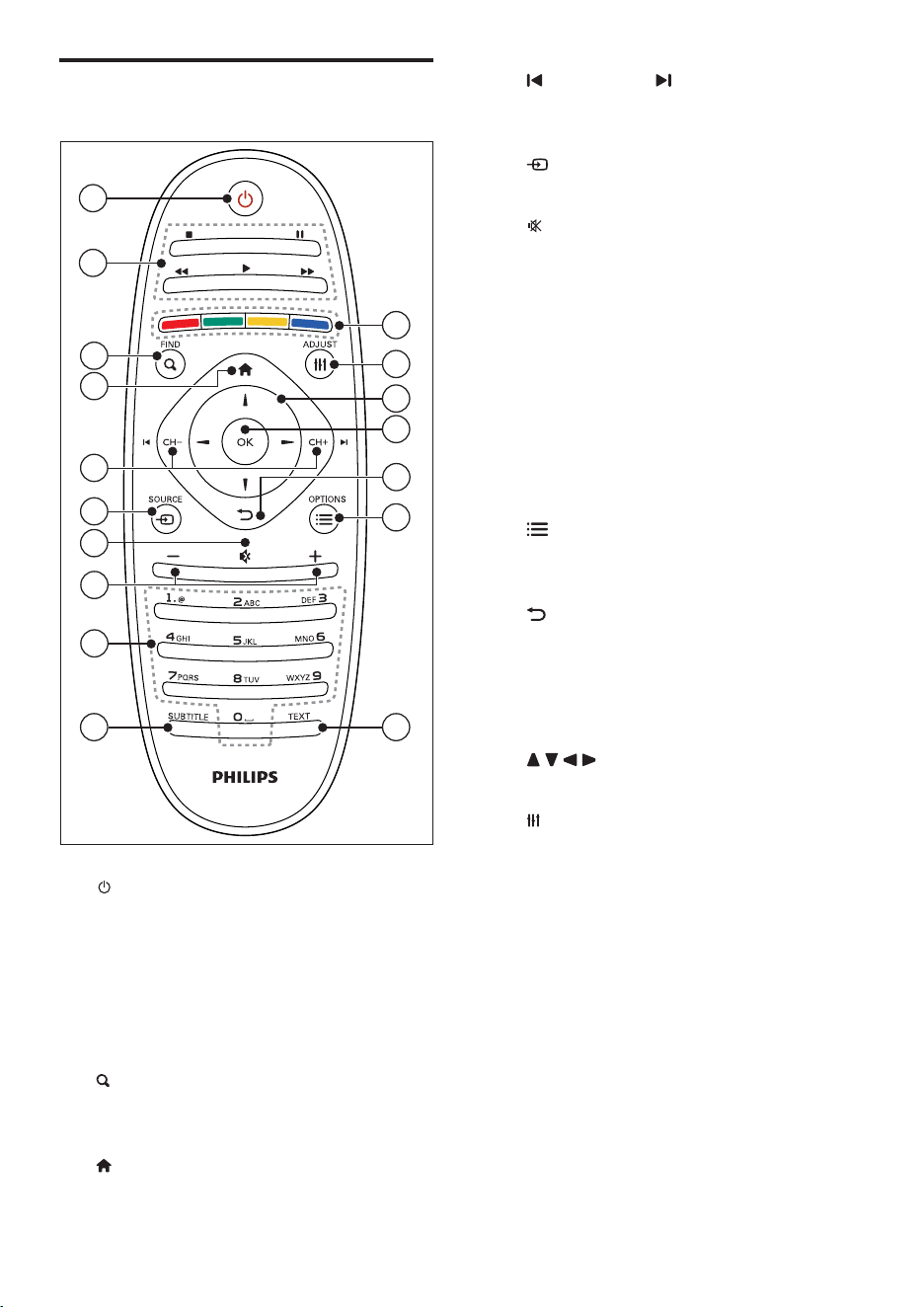
Remote control
1110
1
2
17
16
12
15
14
13
7
4
5
3
6
9
8
a (Standby-On)
Switch the monitor to standby if the
monitor is on.
Switch the monitor on if the monitor
is in standby.
b Play buttons
Control video or music.
c
FIND
Access the menu to select a TV channel
list.
d (Home)
Access the home menu.
e
CH - / CH + (Previous/Next)
Switch channels or navigate through menu
pages, tracks, albums or folders.
f
SOURCE
Select connected devices.
g
(Mute)
Switch the sound On or Off.
h +/- (Volume)
Increase or decrease the volume.
i 0-9 ( Numeric buttons )
Select a channel.
j SUBTITLE
Enable or disable subtitles.
k TEXT
Enable or disable teletext
l
OPTION
Access options for the current activity or
selection.
m
(Back)
Return to the previous screen.
Return to the last viewed channel.
n OK
<&
o
(Navigation buttons)
Navigate through menus and select items.
p
ADJUST
Access the menu to adjust settings.
q Colour buttons
Select tasks or options.
11EN
English
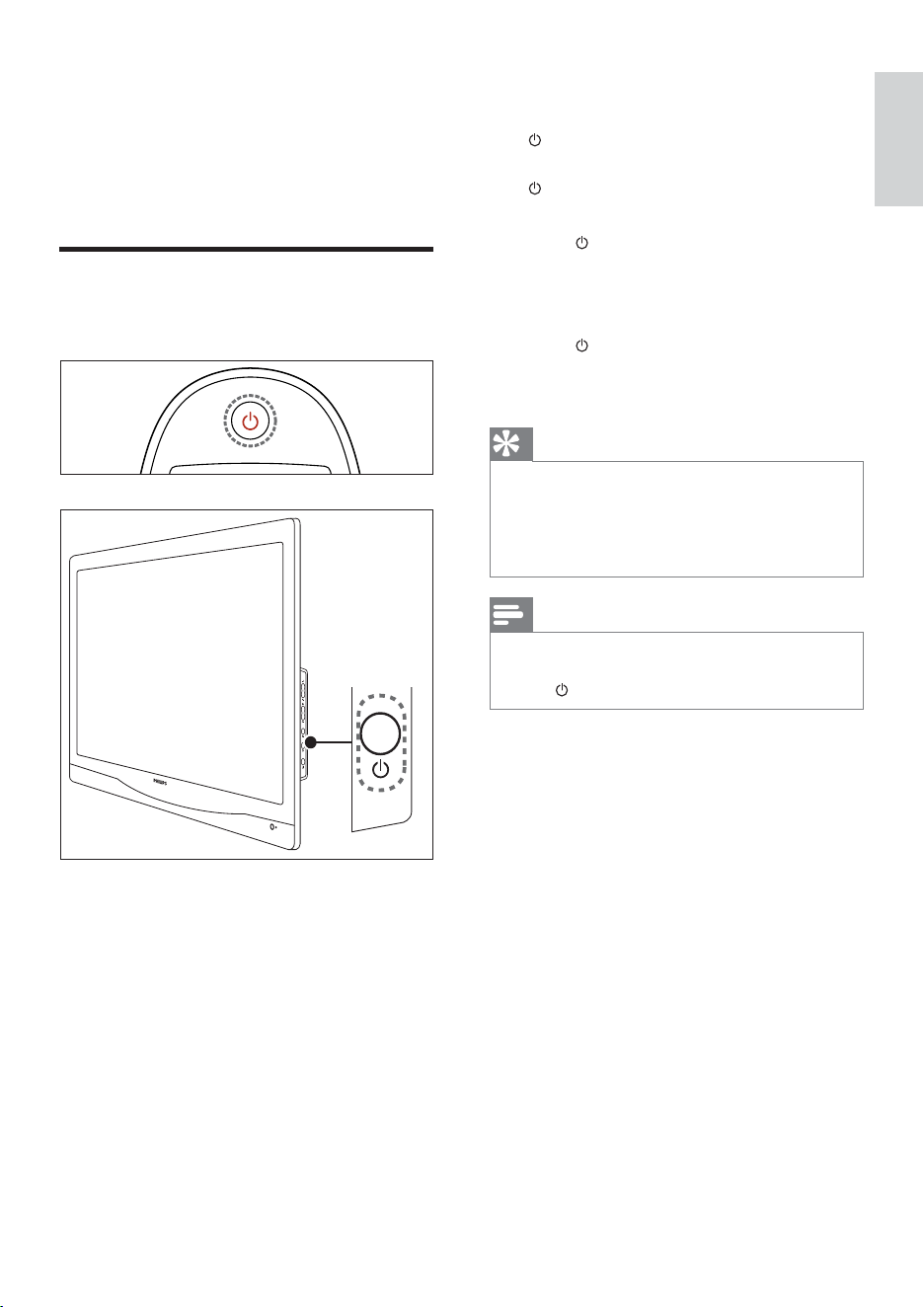
To switch on
If the standby indicator is off, press
POWER at the side of the monitor.
If the standby indicator is red, press
(Standby-On) on the remote control.
To switch to standby
Press (Standby-On) on the remote
control.
» The standby indicator switches to red.
To switch off
Press POWER at the side of the
monitor.
» The standby indicator switches off.
Tip
Though your monitor consumes very little
power when in standby, energy continues to be
consumed. When not in use for an extended
period of time, disconnect the monitor power
cable from the power outlet.
Note
If you cannot locate your remote control and
want to switch on the monitor from standby,
press POWER at the side of the monitor.
5 Start to use
This section helps you perform basic monitor
operations.
Switch your monitor on/off
or to standby
12 EN
Watch connected devices
Note
Switch on the connected device before selecting
it as a source on the monitor.
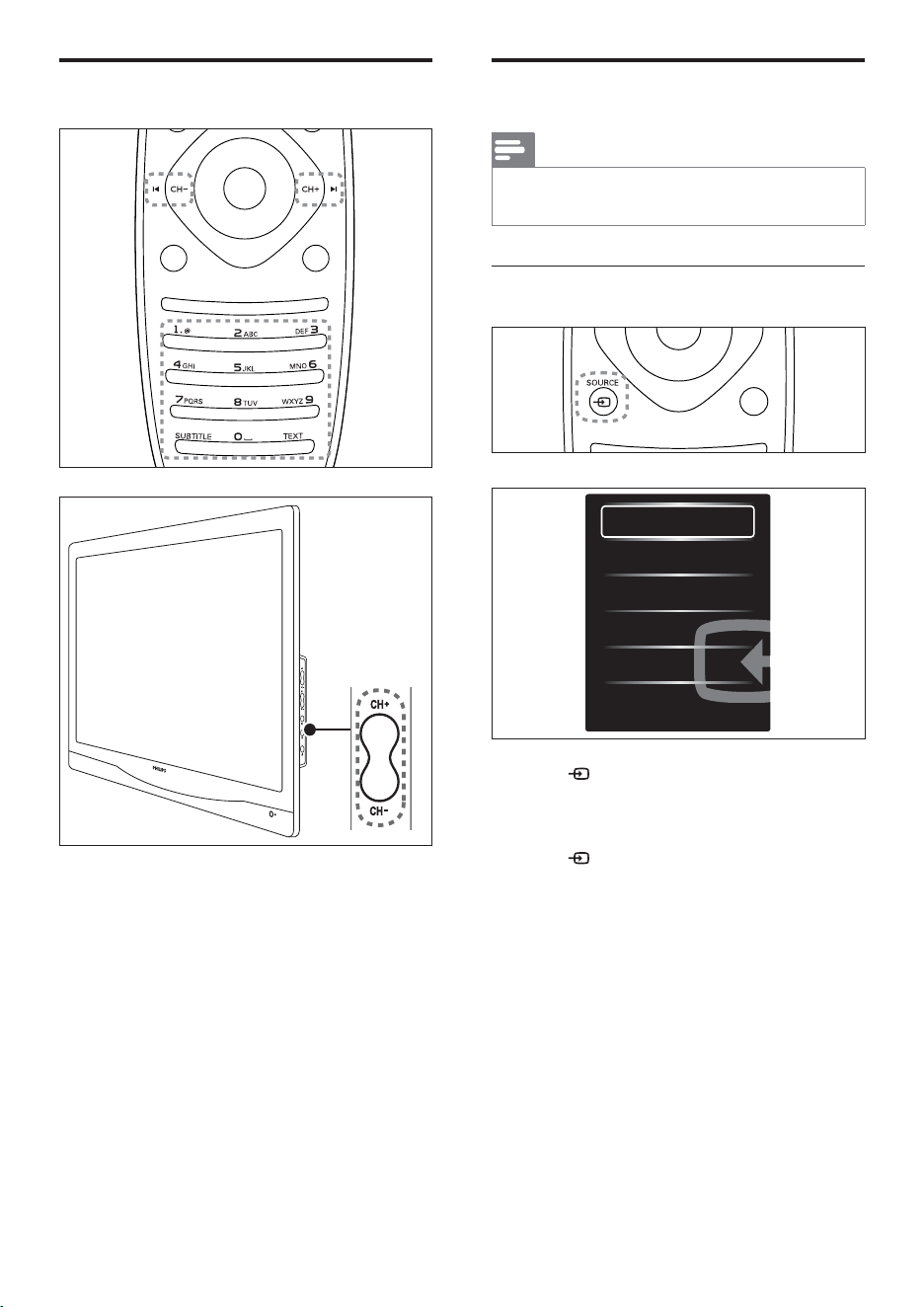
To select from the SOURCE button
TV
EXT 1
EXT 2
VGA
HDMI
1. Press SOURCE to display the source
list.
» The source list appears.
2. Press
SOURCE$Z[
device.
3. Press OK to confirm your selection.
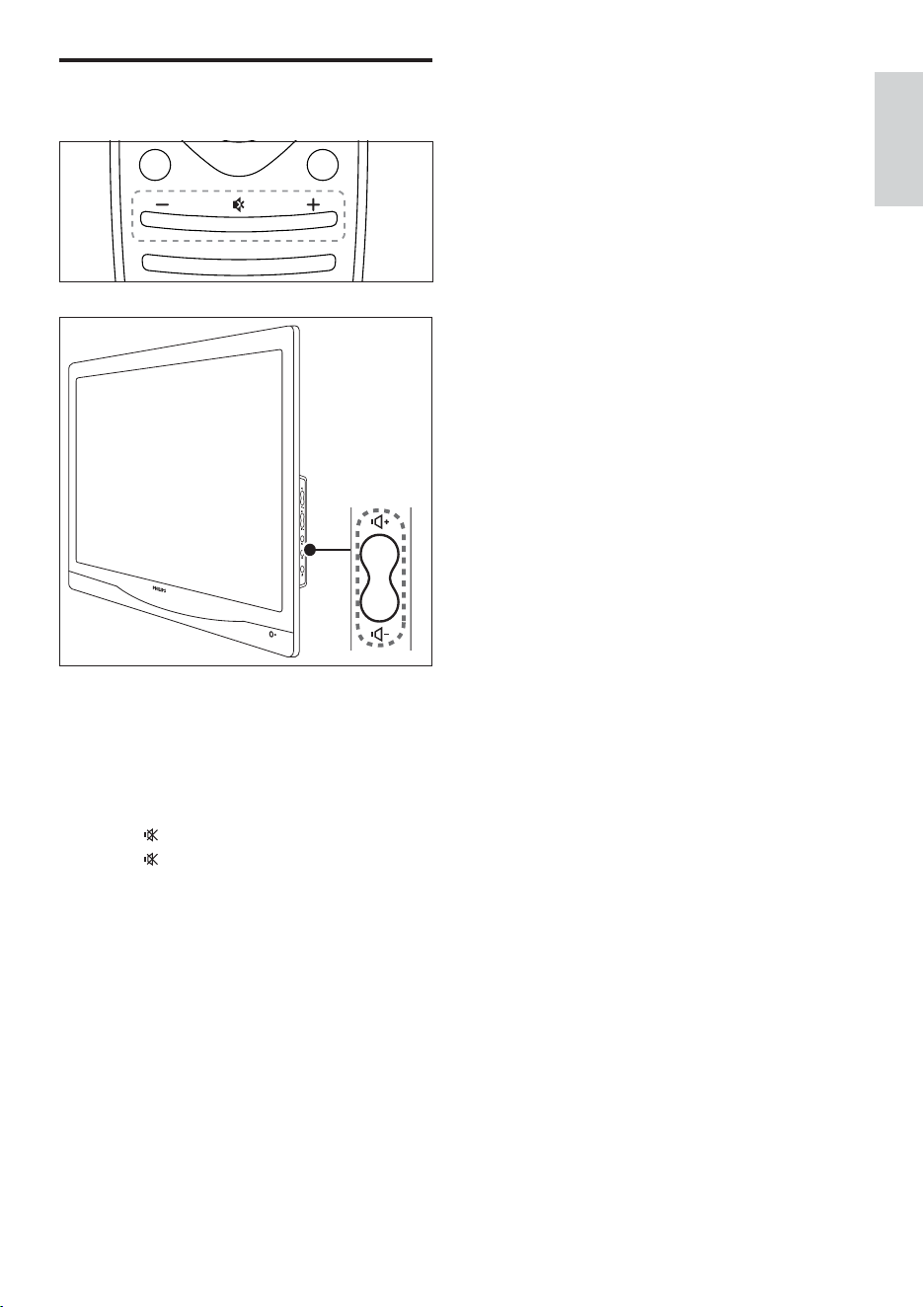
Switch channels
Press CH +/-, or enter a channel number
using the numeric buttons on the remote
control.
Press the CH +/- button at the side of
the monitor.
13EN
English
Adjust monitor volume
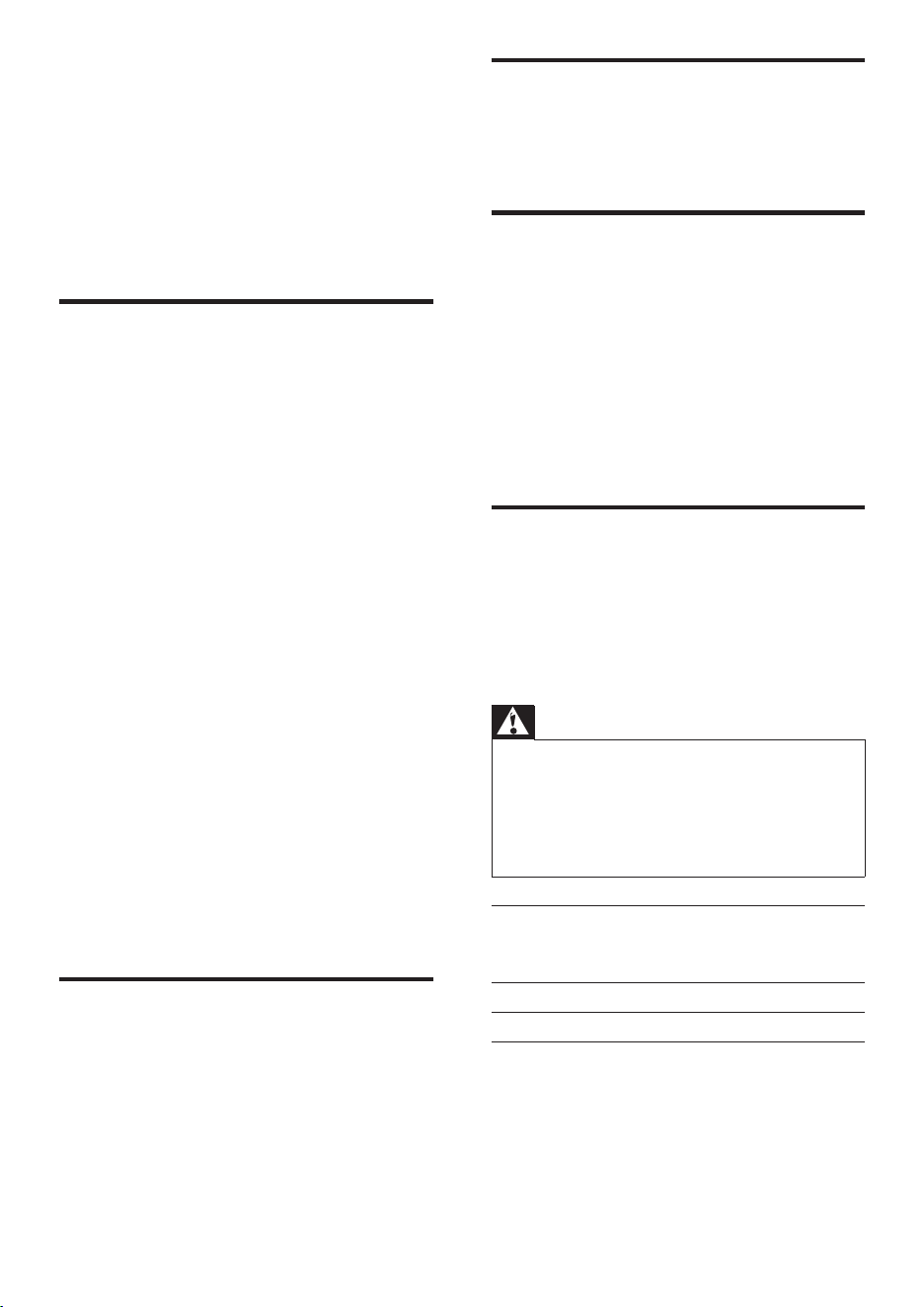
To turn up or down the volume
Press VOL +/- on the remote control.
Press VOL +/- buttons at the side of the
monitor
To mute or restore the muted sound
Press
to mute the sound.
Press again to restore the sound.
14 EN
Remote control
Type: 221TE4L, 231TE4L RC
Batteries: 2 x AAA
Power
Mains power: 100-240V, 60-50Hz
On mode power:
221TE4L: 26W(typ.), 34W(max.)
231TE4L: 27W(typ.), 38W(max.)
><\]^_`
&\]^_`{&|
Ambient temperature: 5 to 40 degrees
Celsius
Supported monitor mounts
To mount the monitor, purchase a Philips
monitor mount or a VESA-compatible monitor
mount. To prevent damage to cables and
connectors, be sure to leave a clearance of at
least 5.5 cm from the back of the monitor.
Warning
Follow all instructions provided with
the monitor mount. Koninklijke Philips
Electronics N.V. bears no responsibility for
improper monitor mounting that results in
accident, injury or damage.
Monitor
screen size
(inches)
Required
pitch (mm)
Required
mounting bolts
21.5 100 x 100 4 x M4
23 100 x 100 4 x M4
6 Product
information
Product information is subject to change
without notice. For detailed product
information, go to www.philips.com/support.
Supported display resolutions
Computer formats
Resolution - refresh rate:
640 x 480 - 60Hz
640 x 480 - 72Hz
640 x 480 - 75Hz
720 x 400 - 70Hz
800 x 600 - 56Hz
800 x 600 - 60Hz
800 x 600 - 72Hz
800 x 600 - 75Hz
1024 x 768 - 60Hz
1024 x 768 - 70Hz
1024 x 768 - 75Hz
1280 x 1024 - 60Hz
1280 x 1024 - 70Hz
1280 x 1024 - 75Hz
1440 x 900 - 60Hz
1680 x 1050 - 60Hz
1920 x 1080 - 60Hz
Video formats
Resolution - refresh rate:
480i - 60Hz
480p - 60Hz
576i - 50Hz
576p - 50Hz
720p - 50Hz, 60Hz
1080i - 50Hz, 60Hz
1080p - 24Hz, 50Hz, 60Hz
Tuner/Reception/Transmission
Antenna input: 75ohm coaxial (IEC 75)
DVB: DVB Terrestrial, DVB-T, DVB-C
TV system: PAL I, B/G, D/K; SECAM B/G, D/K,
L/L’
Video playback: NTSC, SECAM, PAL
Tuner Bands: Hyperband, S-channel, UHF,
VHF
Common Interface Plus (CI+)
15EN
English
>;;
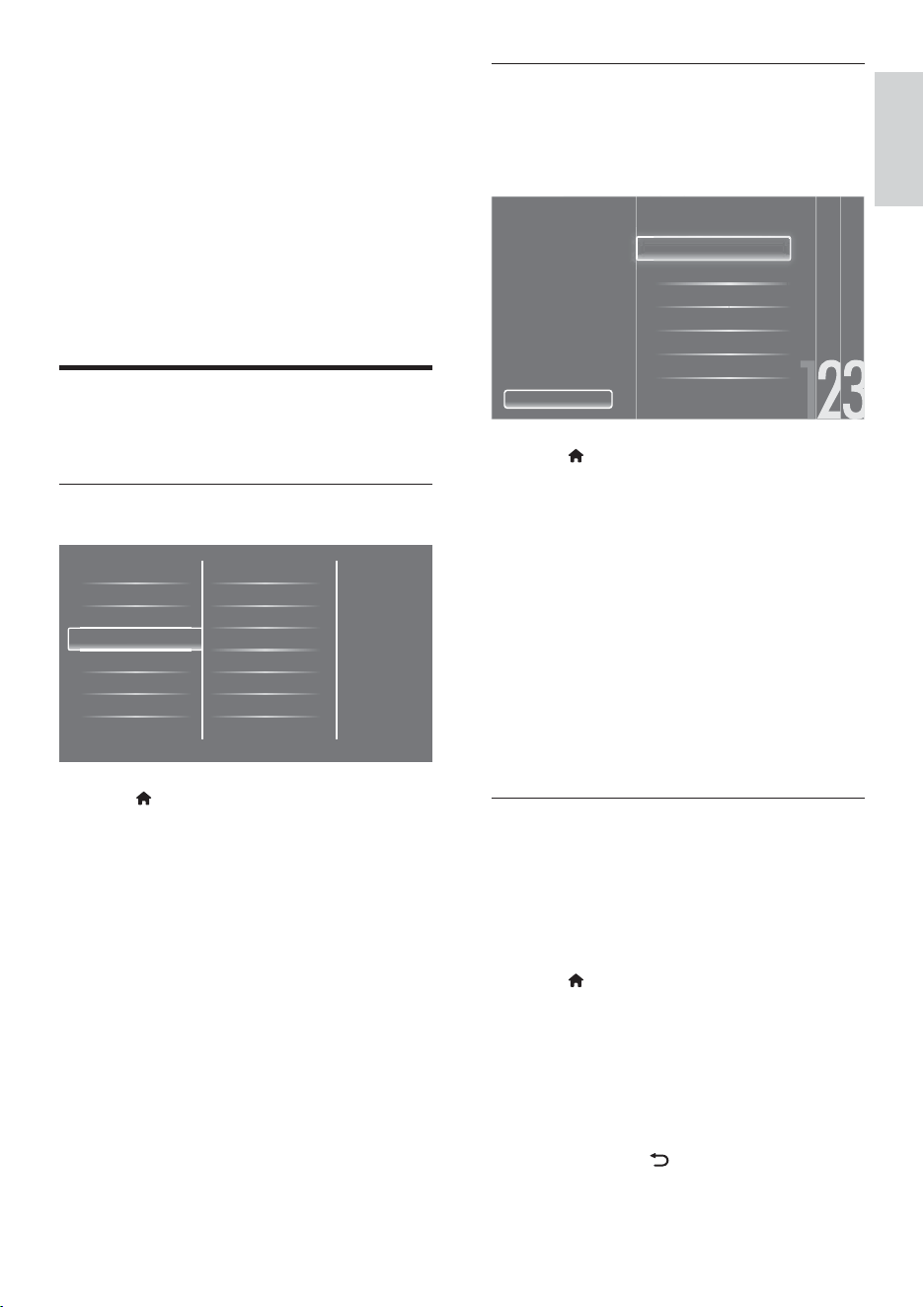
Select the country where you are installing the
TV. The available channels for the country are
installed on the TV.
Select Re-install channels to search and
store all channels. Select update
channels to update your current list.
Update channels
Re-install Channels
Cancel
C
ance
l
1. Press .
2. Select [Setup] > [Search for channels],
then press OK.
3. Select [Reinstall channels], then press OK.
» The country menu appears.
4. Select your country, then press OK.
» The channel installation guide begins.
5. Select [Start], then press OK.
» All available channels are stored.
6. To exit, press OK.
Update the channel list
You can enable automatic update of channels
when your TV is in standby mode. The channels
stored in your TV are updated every morning
according to the channel information in the
broadcast.
1. Press
.
2. Select [Setup] > [Channel settings] >
[Channel installation] > [Automatic
channel update].
3. Select [On] to enable the automatic
update or select [Off] to disable it.
4. To return, press
.
7 TV/Channel
installation
&&$&
prompted to select a menu language and to
install TV and digital radio channels (if available).
'$&;
channels.
Automatically install channels
You can search and store channels automatically.
?;@@
Menu language
Sleep timer
Location
Volume bar
Auto switch off
Channel information size
Audio out delay
Teletext 2.5
Picture
Sound
EasyLink
Preferences
Factory settings
Reinstall TV
Preference
s
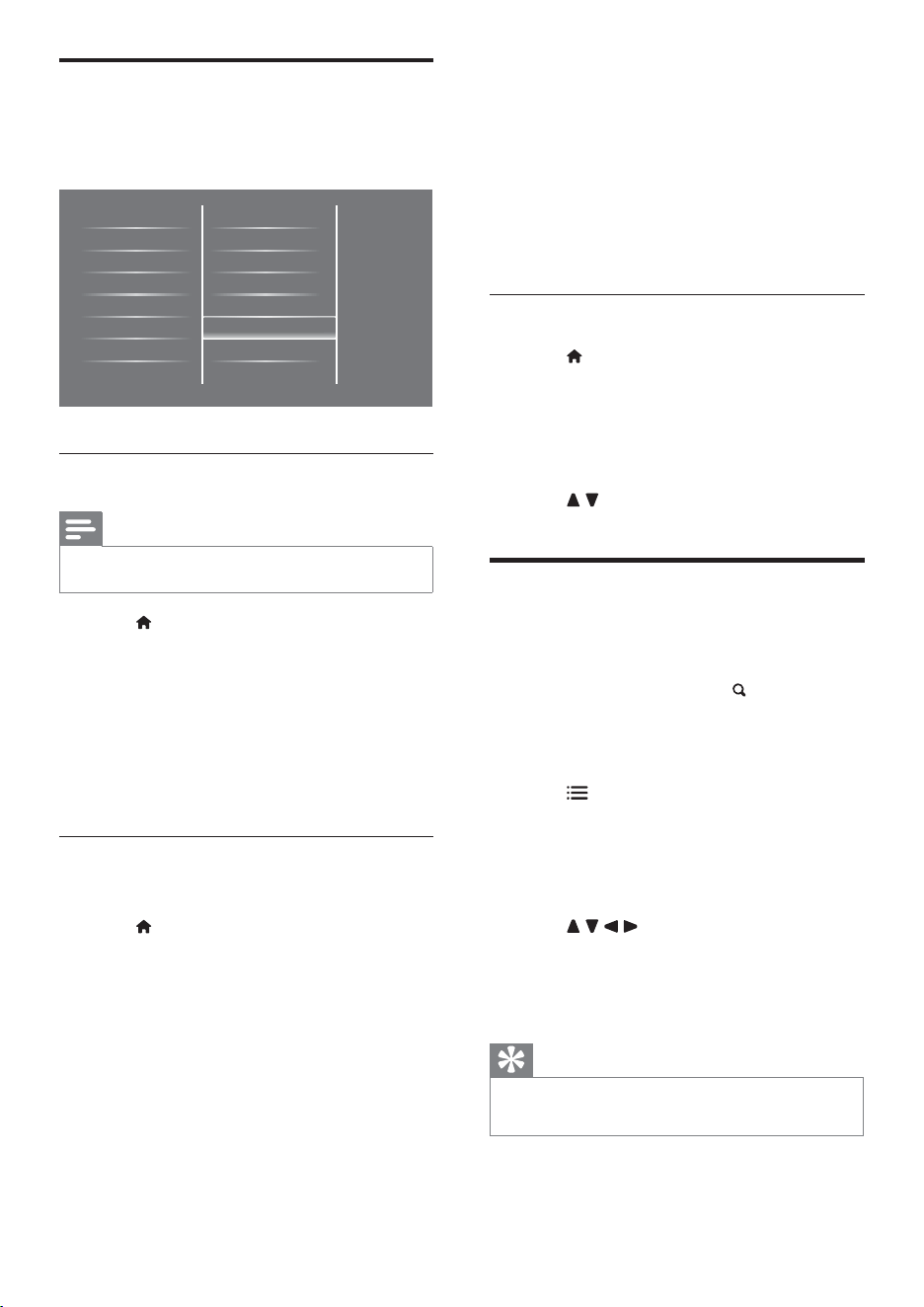
1. Press .
2. Select [Setup] > [TV settings] >
[Preferences] > [Menu language], then
press OK.
3. Select a language, then press OK.
16 EN
3. When the channel is found, select [Done],
then press OK.
To store the channel as a new number,
select [Store as new channel], then
press OK.
To store the channel as the previously
selected channel, select [Store current
channel], then press OK.
QZ*@;\
1. Press .
2. Select [Setup] > [Channel settings] >
[Channel installation] > @!
antenna installation] > [Fine-tune], then
press OK.
3. Press
to fine-tune the channel.
Rename channels
You can rename channels. The name appears
when you select the channel.
1. While you watch TV, press FIND.
» The channel matrix menu is displayed.
2. Select the channel to rename.
3. Press
OPTIONS.
» The channel options menu appears.
4. Select [Rename channel], then press OK.
» A text input box appears
5. Press
to select each character,
then press OK.
6. When the name is complete, select [Done],
then press OK.
Tip
Press [Aa] to change an uppercase letter to a
lowercase letter and vice versa.
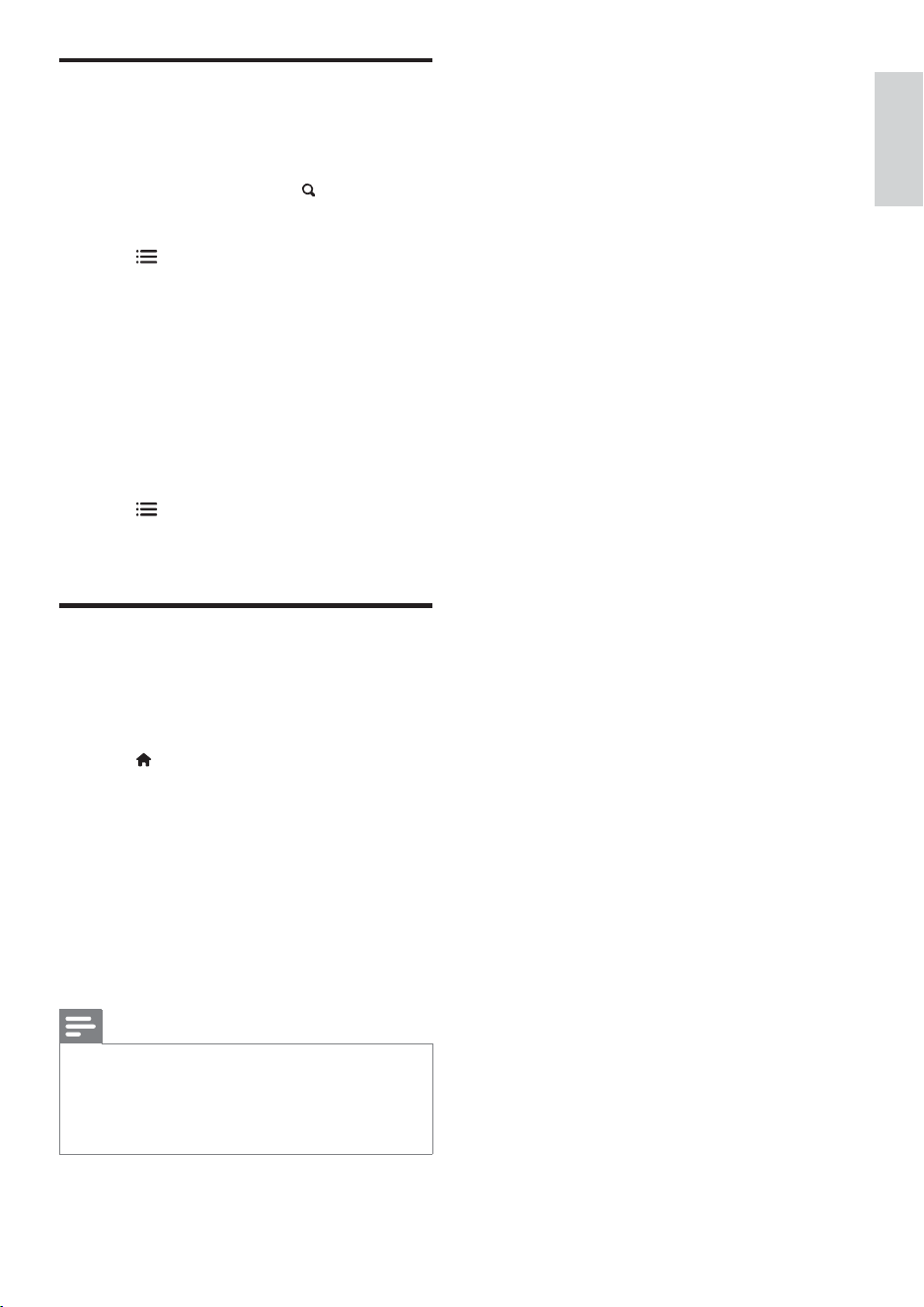
Manually install channels
This section describes how to search and store
analogue TV channels manually.
Automatic channel update
Channel update message
Digital: Reception test
Symbol rate mode
Symbol rate
Analogue: Manual antenna i...
Installation mode
Language
Channel installation
Child lock
Analogue: Manual antenna i...
?;
Note
Skip this step if your system settings are correct.
1. Press
.
2. Select [Setup] > [Channel settings] >
[Channel installation] > @!
antenna installation] > [System], then
press OK.
3. Select the correct system for your country
or region, then press OK.
>;\:-^+
channels
1. Press .
2. Select [Setup] > [Channel settings] >
[Channel installation] > @!
antenna installation] > [Find channel], then
press OK.
If you know the three-digit frequency
of the channel, enter it.
To search, select [Search], then press
OK.
17EN
English
Rearrange channels
After you install channels, you can rearrange the
order in which they appear.
1. While you watch TV, press
FIND.
» The channel matrix menu is displayed.
2. Press
OPTIONS.
» The channel options menu appears.
3. Select [Reorder], then press OK.
4. Select the channel to rearrange, then press
OK.
» The selected channel is highlighted.
5. Move the highlighted channel to its new
location, then press OK.
6. Press
OPTIONS.
7. Select [Done reordering], then press OK.
Test digital reception
You can check the quality and signal strength
of digital channels. This allows you to reposition
and test your antenna or satellite dish.
1. Press
.
2. Select [Setup] > [Channel settings]
> [Channel installation] > _@
Reception test] , then press OK.
3. Enter the frequency to test, then press OK.
4. Select [Search], then press OK.
5. When the channel is found, select [Store],
then press OK.
Note
If the signal quality and strength is poor,
reposition the aerial or satellite dish and retest.
If you still have problems with the reception
of your digital broadcast, contact a specialised
installer.
18 EN
Change picture and sound
settings
Change picture and sound settings to suit your
&;
or change settings manually.
Note
While you watch TV or external devices, press
ADJUST, then select [Smart picture] or
[Smart sound] for quick access to picture and
sound settings.
Use smart picture
&;
settings.
Smart Picture
S
mart Picture Smart Sound Picture Format
1. Press ADJUST.
2. Select [Smart picture], then press OK.
3. Select one of the following settings, then
press OK.
+`: Rich and dynamic settings,
ideal for daytime.
" Natural picture settings.
Ideal settings for movies.
{ Ideal settings for games.
@`@ Settings that conserve
the most energy.
:: Default settings that suit
most environments and types of video.
\ Ideal settings for photos.
Customise and store your
personal picture settings.
8 Settings
This chapter describes how to change settings
and customize functions.
Access TV menus
Menus help you to install channels, change
picture and sound settings and access other
features.
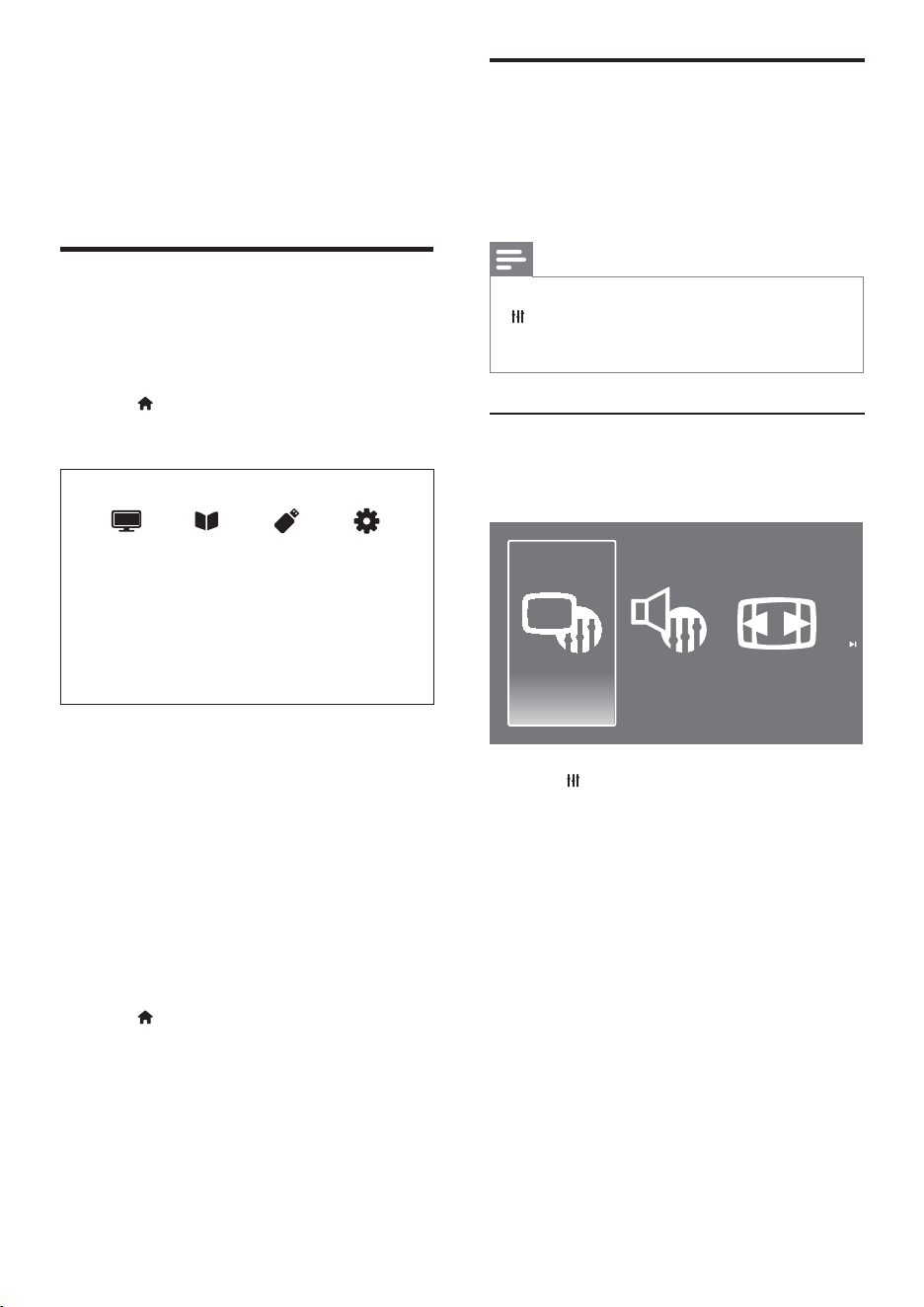
1. Press .
» The menu screen appears.
Watch TV Programme guide Browse USB Setup
2. Select one of the following, then press OK.
;\^+ If a source other than
antenna is selected, switch back to the
antenna source.
@@: Access the
electronic programme guide.
|-| If a USB device
is connected, access the content
browser.
Access menus to change
picture, sound and other settings.
3. Press
to exit.

19EN
English
_;};@\ Adjust
brightness of the TV backlight to
match lighting conditions.
!{;:; Smooth
out transitions on digital pictures.
You can switch this feature on or
off.
\; Make
colours more vivid and improve the
details in bright colours.
{ Adjust the midtone
intensity in the picture. Black and
white are not affected.
: Adjust the picture when a
PC is connected to the TV via HDMI
or DVI.
; Change the picture
format.
;:@ Adjust the viewing
area. (when set to maximum, you may
see noise or the rough edge of an
image).
;\ Adjust the picture
position for all picture formats except
for [Auto zoom] and [Wide screen].
Manually adjust picture settings
Smart picture
Reset
Contrast
Brightness
Colour
Sharpness
Noise reduction
Tint
Picture
Sound
EasyLink
Preferences
Factory settings
Reinstall TV
Picture
1. Press .
2. Select [Setup] > [TV settings] > [Picture],
then press OK.
3. Select one of the following settings, then
press OK.
;'
smart picture settings.
Reset to factory default
settings.
Adjust the intensity
of backlight areas, while the video
contents are kept unchanged.
|@\ Adjust the intensity and
details of dark areas.
Adjust colour saturation.
\ Adjust sharpness in the
image.
":; Filter and reduce
noise in an image.
^ Adjust the colour balance in an
image.
Customise tint setting.
(Only available if [Tint] > [Custom] is
selected)
+: Fine-tune each pixel to
match surrounding pixels. This setting
$;
image.
:`;\ Enable
superior picture sharpness.
_;; Enhance
contrast. [Medium] setting is
recommended.
20 EN
:; Scale 4:3
format to 16:9.
;: For HD and PC
mode only, and in selected
models only. Allow maximum
sharpness. Some distortion
may be present due to the
broadcaster’s systems. Set
your PC resolution to wide
screen mode for best results.
Use smart sound
Smart Picture Smart Sound
S
mart
S
ound Picture Format
&;
settings.
1. Press ADJUST.
2. Select [Smart sound], then press OK.
3. Select one of the following settings, then
press OK.
Apply the settings that
were customised in the sound menu.
:: Settings that suit most
environments and types of audio.
"- Ideal settings for spoken
audio, such as news.
Ideal settings for movies.
{ Ideal settings for games.
_ Ideal settings for drama
programmes.
Ideal settings for sports
programmes.
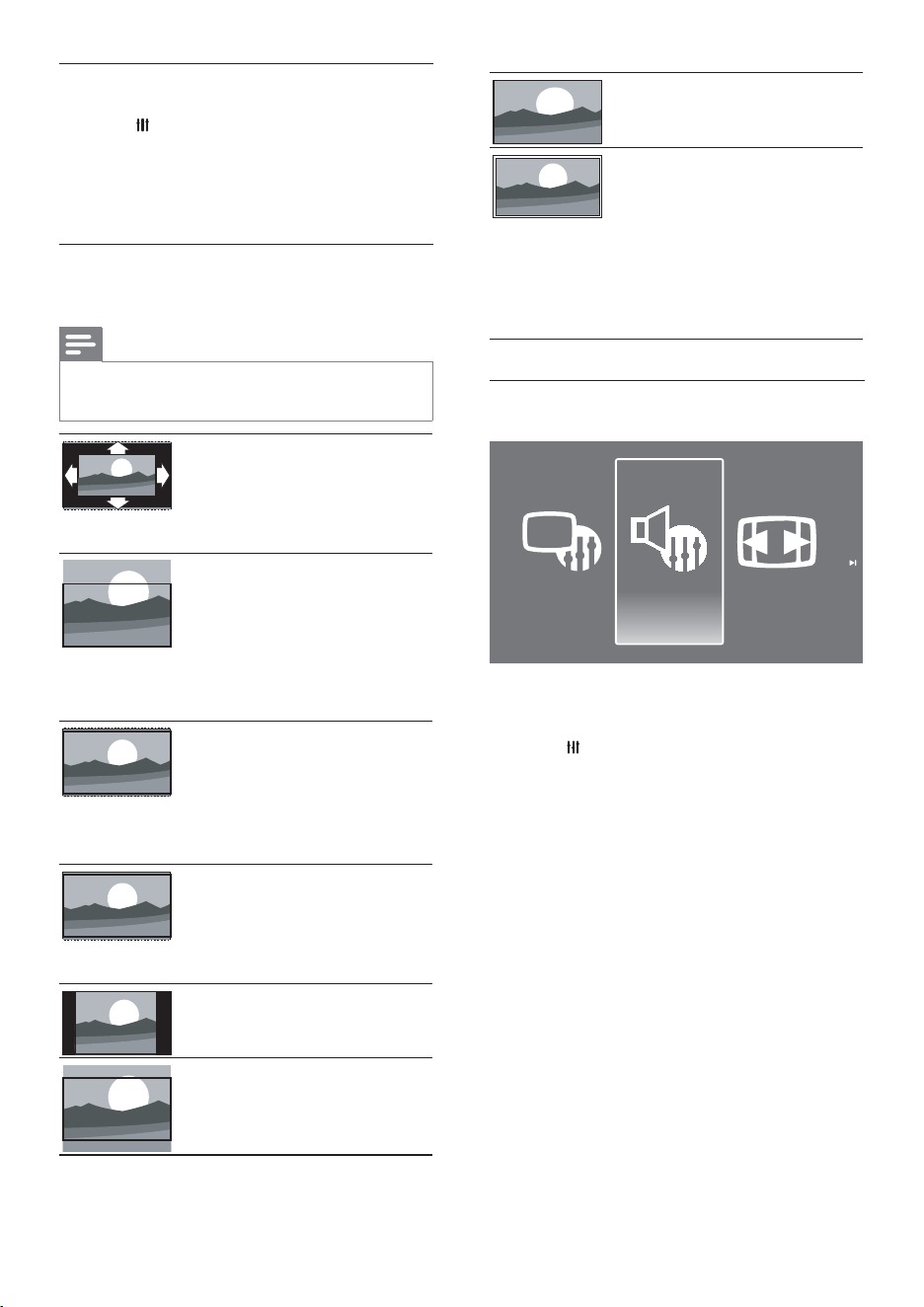
Change picture format
1. Press ADJUST.
2. Select [Picture format], then press OK.
3. Select a picture format, then press OK.
Summary of picture formats
Note
Depending on the format of the picture source,
some picture settings are not available.
For selected
models. (Not for PC mode.)
Automatically display the
suitable picture format. If not,
widescreen is applied.
For selected
models. Adjust the
(subtitles remain visible).
Recommended for minimal
screen distortion but not for
HD or PC.
~ For selected
models. Enlarge the
Recommended for minimal
screen distortion but not for
HD or PC.
~ (Not for HD
and PC mode.) Remove the
black bars on the side of 4:3
broadcasts. There is minimal
distortion.
Q Show the classic 4:3
format.
!`:? (Not
for HD and PC mode.) Scale
4:3 format to 16:9.

21EN
English
Use the universal access
menu
You can switch on or off visually impaired and
hearing impaired options for enhanced visual or
audio cues.
1. While you watch TV, press
.
2. Select [Setup] > [Channel settings] >
[Language].
3. Select one of the following options, then
press OK.
:@@If
the selected audio language is
broadcasting, it is set to default
language.
;::@@If
the primary audio language is not
broadcasting, the secondary audio will
be displayed.
}@@ If the
selected subtitle is broadcasting, it is
selected by default.
;:}@@ If the
primary subtitle is not broadcasting,
the secondary subtitle will be
displayed.
If the selected
teletext is broadcasting, it is selected
by default.
;:If the primary
teletext is not broadcasting, the
secondary teletext will be displayed.
%@: Enable or disable
hearing impaired subtitles.
+: Some digital
TV channels broadcast special audio
adapted for people who are visually
impaired. The normal audio is mixed
with extra commentary. Select an
option:
Turn off visually impaired
audio.
Hear visually impaired
audio from speakers only
Manually adjust sound settings
Smart sound
Reset
SmartClear
Bass
Treble
Surround
Headphone volume
Auto volume levelling
Picture
Sound
Easyink
Preferences
Factory settings
Reinstall TV
S
oun
d
1. Press .
2. Select [Setup] > [TV settings] > [Sound],
then press OK.
» The [Sound] menu appears.
3. Select one of the following settings, then
press OK.
:'
smart sound settings.
Reset to factory default
settings.
Enhance the sound
clarity.
| Adjust the bass level.
^} Adjust the treble level.
: Switch on spatial sound.
%:\` (For models
with headphones) Adjust headphone
volume.
``@ Automatically
reduce sudden volume changes, for
example when switching channels.
|; Adjust the balance of the
right and left speakers.
_@ Select the
type of digital audio output through
digital audio output connector.
! Convert non-PCM audio
type to PCM format.
!;\ Output audio to the
home theatre.

22 EN
Select teletext subpages
A teletext page can contain several subpages.
Subpages are displayed next to the main page
number.
1. Press TEXT.
» The teletext screen appears.
2. Press
or to select a teletext page.
3. Press
or to enter a subpage.
Select T.O.P. teletext broadcasts
Jump from one subject to another without
entering page numbers with Table Of Pages
(T.O.P.) teletext broadcasts. T.O.P. teletext
broadcasts are available on selected TV channels.
1. Press TEXT.
» The teletext screen appears.
2. Press
OPTIONS.
3. Select [T.O.P. overview], then press OK.
» The T.O.P. overview appears.
4. Select a subject.
5. Press OK to view the page.
Create and use lists of
favourite channels
You can create a list of your preferred TV
&
easily.
View only the list of favourite
channels
1. While you watch TV, press FIND.
» The channel matrix menu is displayed.
2. Press
OPTIONS.
%:\ Hear visually impaired
audio from headphones only.
'\:\ Hear
visually impaired audio from both
speakers and headphone.
+`: Adjust the
volume of visually impaired audio.
4. To exit, press
.
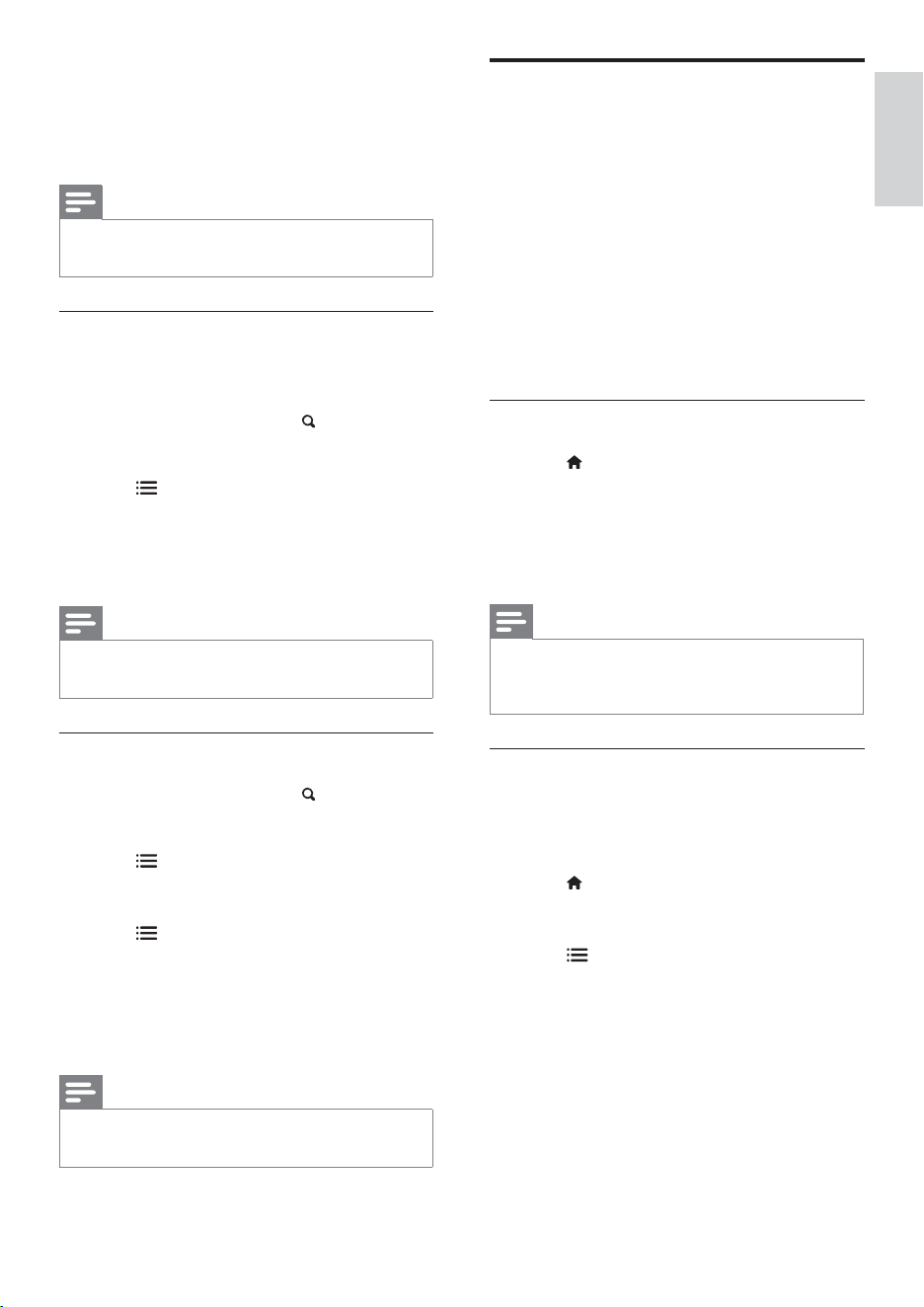
Use advanced teletext
features
Access the teletext options menu
Access the teletext features through the
teletext options menu.
1. Press TEXT.
» The teletext screen appears.
2. Press
OPTIONS.
» The teletext options menu appears.
3. Select one of the following options, then
press OK.
[Freeze page] / ~@
Freeze/unfreeze the current page.
[Dual screen] / Z; Switch
between full screen and dual screen
teletext.
^``- Switch on Table of
Pages teletext broadcasts
[Enlarge] / "`- Switch
between enlarged and normal view of
teletext pages.
` Hide or reveal hidden
information on a page, such as
solutions to riddles or puzzles.
;}@ If subpages are
available, automatically display each
subpage in sequence.
@@ Select a language for
teletext.
23EN
English
3. Select [Select list] > [Favourites], then
press OK.
» Only channels in the favourites list
appear in the channel grid.
Note
The favourites channel grid is empty until you
add channels into the favourites list.
View all channels
You can exit the favourites list, and view all
installed channels.
1. While you watch TV, press FIND.
» The channel matrix menu is displayed.
2. Press
OPTIONS.
3. Select [Select list] > [All], then press OK.
» All channels are displayed in the channel
grid.
Note
All favourite channels are marked by an asterisk
when you view the channel grid.
Manage the favourites list
1. While you watch TV, press FIND.
» The channel matrix menu appears.
2. Press
OPTIONS.
3. Select [Select list] > [All], then press OK.
4. Press
OPTIONS.
5. Select [Mark as favourite] or [Unmark as
favourite], then press OK.
» The channel is added or removed from
the favourite list.
Note
All favourite channels are marked by an asterisk
in the channel grid.
Use the Electronic
Programme Guide
The programme guide is an on-screen guide
available for digital channels. It allows you to:
View a list of digital programmes being
broadcast
View upcoming programmes
Group programmes by genre
Set reminders when programmes start
Setup preferred programme guide
channels
Switch on EPG
1. Press .
2. Select [Programme guide], then press OK.
» The programme guide appears
displaying information about the
scheduled programmes.
Note
Programme guide data is available only in
selected countries and can take some time to
load.
Change programme guide options
You can set or clear reminders, change the
day, and access other useful options in the
programme guide options menu
1. Press .
2. Select [Programme guide], then press OK.
3. Press
OPTIONS.
» The programme guide menu appears.
4. Select one of the following options, then
press OK.
[Set reminder] / :
Set or clear programme reminders.
\@: Set the programme
guide day.
\- Display programme
information.
24 EN
;\}@ Search TV
programmes by genre.
;\::: List
programme reminders. Only available
for upcoming programmes.
;{: Update the latest
programme guide information.
Display the TV clock
You can display a clock on the TV screen. The
clock displays the current time using time data
received from your TV service operator.
Set the TV clock manually
In some countries, you need to set TV clock
manually.
1. Press .
2. Select [Setup] > [TV settings] >
[Preferences] > [Clock].
3. Select [Auto clock], then press OK.
4. Select [Manual], then press OK.
5. Select [Time] or [Date], then press OK.
6. Press the Navigation buttons to set the
time or date.
7. Select [Done], then press OK.
8. Press
to exit.
Note
If your selected country supports digital
broadcast, the clock displays the time data from
your TV service operator as priority.
Display the TV clock
1. While you watch TV, press OPTIONS.
» The options menu is displayed.
2. Select [Clock].
3. Press OK.
Note
To disable the clock, repeat the procedure.
Change the clock mode
1. Press .
2. Select [Setup] > [TV settings] >
[Preferences] > [Clock] > [Auto clock].
3. Select [Automatic] or [Manual], then press
OK.
Change the time zone
Note
This option is only available if you select [Auto
clock] > [Automatic] (in countries with clock
transmission data).
1. Press
.
2. Select [Setup] > [TV settings] >
[Preferences] > [Clock] > [Time zone].
3. Select your time zone.
4. Press OK to confirm.
25EN
English
Use daylight saving
Note
This option is only available if you select [Auto
clock] > [Manual].
1. Press
.
2. Select [Setup] > [TV settings] >
[Preferences] > [Clock] > [Daylight
saving], then press OK.
3. Select [Standard time] or [Daylight saving
time], then press OK.
Use timers
You can set timers to switch the TV to standby
Tip
Set the TV clock before you use timers.
Automatically switch the TV to
standby (sleep timer)
Sleep timer switches the TV to standby after a
;
Tip
You can switch off your TV earlier or reset the
sleep timer during the countdown.
1. Press
.
2. Select [Setup] > [TV settings] >
[Preferences] > [Sleep timer].
» The [Sleep timer] menu appears.
3. Select a value.
» If you select zero, the sleep timer
switches off.
4. Press OK to switch on the sleep timer.
» The TV switches to standby after the
Lock unsuitable content
You can prevent your children from watching
certain programmes or channels by locking the
TV controls.
Set or change code
1. Press .
2. Select [Setup] > [Channel settings] >
[Child lock].
3. Select [Set code] or [Change code].
» The [Set code] / [Change code] menu
appears.
4. Enter your code using the Numeric
buttons.
» Follow the on-screen instructions to
create or change your PIN code.
Tip
If you forget your code, enter ‘8888’ to override
any existing codes.
Lock or unlock one or more channels
1. Press > [Setup] > [Channel settings] >
[Child lock] > [Channel lock].
» A list of channels is displayed.
2. Select the channel that you want to lock or
unlock, then press OK.
» &
channel, you are prompted to enter
your PIN code.
3. Enter your code and press OK.
» If the channel is locked, a lock icon is
displayed.
4. Repeat the process to lock or unlock more
channels.
26 EN
Change audio language
You can choose an audio language if it is
available from your broadcaster. For digital
channels, multiple languages may be available.
For analogue channels, two languages may be
available.
1. While you watch TV, press OPTIONS.
2. For digital channels, select [Audio language],
select the language, then press OK.
3. For analogue channels, select [Dual I-II],
select either language, then press OK.
Show or hide subtitles
1. While you watch TV, press SUBTITLE.
2. Select one of the following, then press OK.
Always display subtitles.
Never display subtitles.
:@ When audio is
muted, display subtitles.
Note
Repeat this procedure to enable subtitles on
each analogue channel.
Select [Subtitles] > [Subtitles off] to disable
subtitles.
Select a subtitle language in digital
channels
Note
When you select a subtitle language in a digital
TV channel as described below, the preferred
subtitle language set in the installation menu is
temporarily overruled.
1. While you watch TV, press
OPTIONS.
2. Select [Subtitle language], then press OK.
3. Select a subtitle language.
4. Press OK to confirm.
5. To activate the locks, switch the TV on and
off.
» When you switch channels with
CH - or CH +, the locked channels are
skipped.
» When you access the locked channels
from the channel grid, you are
prompted to enter your PIN code.
Set parental ratings
Some digital broadcasters rate their
programmes according to age. You can set your
TV to display only programmes with age ratings
lower than your child’s age.
1. Press
.
2. Select [Setup] > [Channel settings] >
[Child lock] > [Parental rating].
» A code setup screen appears.
3. Enter your code using Numeric buttons.
» The rating menu appears.
4. Select an age rating, then press OK.
5. Press
to exit.
Change language
Depending on your broadcaster, you can change
the audio language, subtitle language, or both,
for a TV channel.
Multiple audio languages, subtitles, or both, are
broadcast through teletext or DVB-T digital
broadcasts. Dual sound broadcasts: With digital
broadcasts, you can select a subtitle language.
Change menu language
1. Press .
2. Select [Setup] > [TV settings] >
[Preferences] > [Menu language], then
press OK.
3. Select a language, then press OK.
27EN
English
5. Connect the USB storage device to your
computer, then double-click the file.
» A Web page is launched.
6. Follow the instructions in the Web page.
If the current software version
matches the latest software update
$&&
TV software.
If the current software version is
smaller than the latest software update
$
&
your USB device.
7. Disconnect the USB storage device from
the computer.
|:-\:\@\
digital broadcasts
If you receive digital broadcasts (DVB-T), your
TV can automatically receive software updates.
When your TV receives a software update, it
will prompt you to update the TV software.
1. Press
.
2. Select [Setup] > [Software settings] >
[Announcement].
3. If a message appears to prompt you
to update your software, follow the
instructions to start the update.
» The TV restarts after the software
update is complete.
4. If you do not want to update the software,
select [Setup] > [Software settings] >
[Clear announcement], then press OK.
Note
If you skip the update, you can update it
manually later (see ‘C: Check for updates
through digital broadcasts’ on page 28).
Update the TV software
Philips continuously tries to improve its
products and we recommend that you update
the TV software when updates are available.
Ways to update the TV software
You can update the TV software in one of the
following ways:
A: with a USB storage device,
B: when prompted through digital broadcasts, or
C: after being prompted through digital
broadcasts.
-\|@:`;
To update with a USB storage device, you need:
A computer with Internet access
A USB storage device.
?\;\;-
version
1. Press .
2. Select [Setup] > [Software settings] >
[Current software info].
» The current software information is
displayed.
3. Write down the software version number.
4. To return, press OK.
5. To exit, press
.
>_-:::\
latest software version
1. Connect a USB storage device.
2. Press
.
3. Select [Setup] > [Update software].
4. Follow the instructions to load a file onto
your USB storage device.

28 EN
\;:\@\:@
broadcasts
You can check if there are updates available
through digital broadcasts.
1. Press
.
2. Select [Setup] > [Software settings] >
[Check for major updates].
3. If an update is available, follow the
on-screen instructions to start the update.
» The TV restarts after the software
update is complete.
Change TV preferences
Use the preferences menu to customise your
TV settings.
1. Press .
2. Select [Setup] > [TV settings] >
[Preferences].
3. Select one of the following, then press OK.
!@@ Select a menu
language.
Switch the TV to
&;
; Optimise TV settings for
your location - home or shop.
*; This item set the TV to
Shop mode. When any other OSD on
screen, E-Sticker would not come out.
+} Display the volume bar
when you adjust the volume.
-;\ To conserve energy,
set the TV to switch off automatically
after a period of inactivity.
\~ Change
the type of information that is
displayed when you switch channels.
:: Automatically sync
the image on your TV to the audio
from a connected Home Theatre.
^> With Teletext 2.5, you
can view text with more colours and
better graphics than normal text.
; Display or remove the time
from the TV, and set clock options.
Start a TV demo
You can use demonstrations to better
understand the features of your TV. Some
demos are not available on certain models.
Available demos are displayed in the menu list.
1. While you watch TV, press
.
2. Select [Setup] > [Watch demo], OK.
3. Select a demo and press OK to view it.
4. To exit, press
.
Reset the TV to factory
settings
You can restore the default picture and sound
settings of your TV. The channel installation
settings remain the same.
1. Press
.
2. Select [Setup] > [TV settings] > [Factory
settings], then press OK.
3. If you are prompted to enter a code, enter
the child-lock code (see ‘Set or change
code’ on page 25).
» '&
4. Press OK to confirm.
29EN
English
View a slide show of your photos
1. When a full screen image of a photo is
displayed, press OK.
» A slide show begins from the selected
photo.
Press the following buttons to control
play:
to play.
to pause.
or to play the previous or next
photo.
to stop.
To return, press .
Change slide show settings
1. While you view a slide show, press
OPTIONS.
» The slide show options menu is
displayed.
2. Select one of the following, then press OK.
#:\- Start or stop
slideshow.
:\- Set the
transition from one picture to the
next.
:\-; Select the
display time for each photo.
[Repeat] / ; View the
pictures in the folder once only, or
repeatedly.
\ / \ View the
pictures in sequential order, or at
random.
@ Rotate photo.
\- Display the picture name,
date, size and next picture in the slide
show.
; Set the selected
picture as the TV wallpaper.
3. To return, press
.
Note
[Rotate image] and [Show info] appear only
when the slideshow is paused.
9 Multimedia
This chapter describes how to use the
multimedia function.
Play photos and music on
USB storage devices
Caution
Philips is not responsible if the USB storage
device is not supported, nor is it responsible for
damage or loss of data from the device.
Connect a USB storage device to play photos
or music stored on it.
1. Switch on the TV.
2. Connect the USB device to the USB port
on the side of your TV.
3. Press
.
4. Select [Browse USB], then press OK.
» The USB browser appears.
View photos
1. In the USB browser, select [Picture], then
press OK.
2. Select a photo or a photo album, then
press OK to view the photo enlarged to fill
the TV screen.
To view the next or previous photo,
press
.
3. To return, press
.
30 EN
Listen to music
1. In the USB browser, select [Music], then
press OK.
2. Select a music track or album, then press
OK to play.
3. To control play, press the play buttons:
to play.
to pause.
or to play the previous or next
track.
or to search forward or
backward.
to stop.
Change music settings
While you play music, press OPTIONS
to access one of the following settings,
then press OK.
}; Stop music play.
Play a song once or
repeatedly.
\ / \ Play songs
in sequence or at random.
\->&
View a slideshow with music
You can view a picture slide show with
background music.
1. Select an album of songs.
2. Press OK.
3. Press
to return to the USB content
browser.
4. Select an album of pictures.
5. Press OK.
» The slideshow begins.
6. To exit, press .
Disconnect a USB storage device
Caution
Follow this procedure to avoid damage to your
USB storage device.
1. Press
to exit the USB browser.
2. Wait for five seconds, then disconnect the
USB storage device.
Listen to digital radio channels
1. Press FIND.
» The channel matrix menu is displayed.
2. Press
OPTIONS, then select [Select
list] > [Radio].
» The radio channel grid appears.
3. Select a radio channel and press OK to
listen.
31EN
English
10 Pixel policy
Philips strives to deliver the highest quality
products. We use some of the industry's most
advanced manufacturing processes and practice
stringent quality control. However, pixel or
sub pixel defects on a flat monitor panel are
sometimes unavoidable. No manufacturer can
guarantee that all panels will be free from pixel
defects, but Philips guarantees that any monitor
with an unacceptable number of defects will be
repaired or replaced under warranty. This notice
explains the different types of pixel defects and
defines acceptable defect levels for each type.
In order to qualify for repair or replacement
under warranty, the number of pixel defects on
a monitor panel must exceed these acceptable
levels. For example, no more than 0.0004% of
the sub pixels on a monitor may be defective.
Furthermore, Philips sets even higher quality
standards for certain types or combinations
of pixel defects that are more noticeable than
others. This policy is valid worldwide.
Pixels and Sub pixels
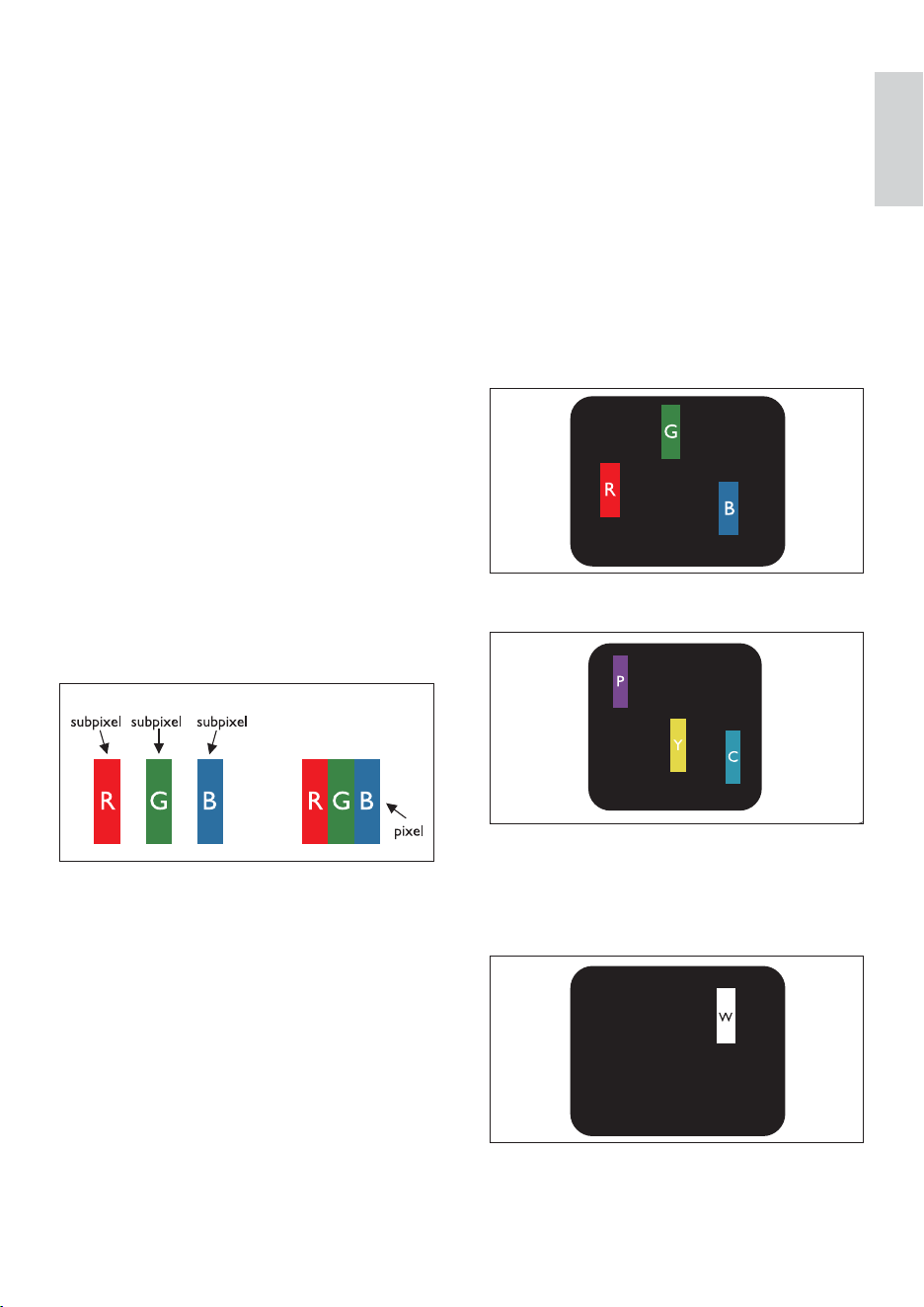
A pixel, or picture element, is composed of
three sub pixels in the primary colors of red,
green and blue. Many pixels together form an
image. When all sub pixels of a pixel are lit, the
three colored sub pixels together appear as a
single white pixel. When all are dark, the three
colored sub pixels together appear as a single
black pixel. Other combinations of lit and dark
sub pixels appear as single pixels of other colors.
Types of Pixel Defects
Pixel and sub pixel defects appear on the screen
in different ways. There are two categories of
pixel defects and several types of sub pixel
defects within each category.
Bright Dot Defects: bright dot defects appear
as pixels or sub pixels that are always lit or 'on'.
That is, a bright dot is a sub-pixel that stands out
on the screen when the monitor displays a dark
pattern.
These are some types of bright dot defects:
One lit red, green or blue sub pixel
Two adjacent lit sub pixels:
- Red + Blue = Purple
- Red + Green = Yellow
- Green + Blue = Cyan (Light Blue)
Three adjacent lit sub pixels (one white pixel)
32 EN
Note
A red or blue bright dot must be more
than 50 percent brighter than neighboring
dots while a green bright dot is 30 percent
brighter than neighboring dots.
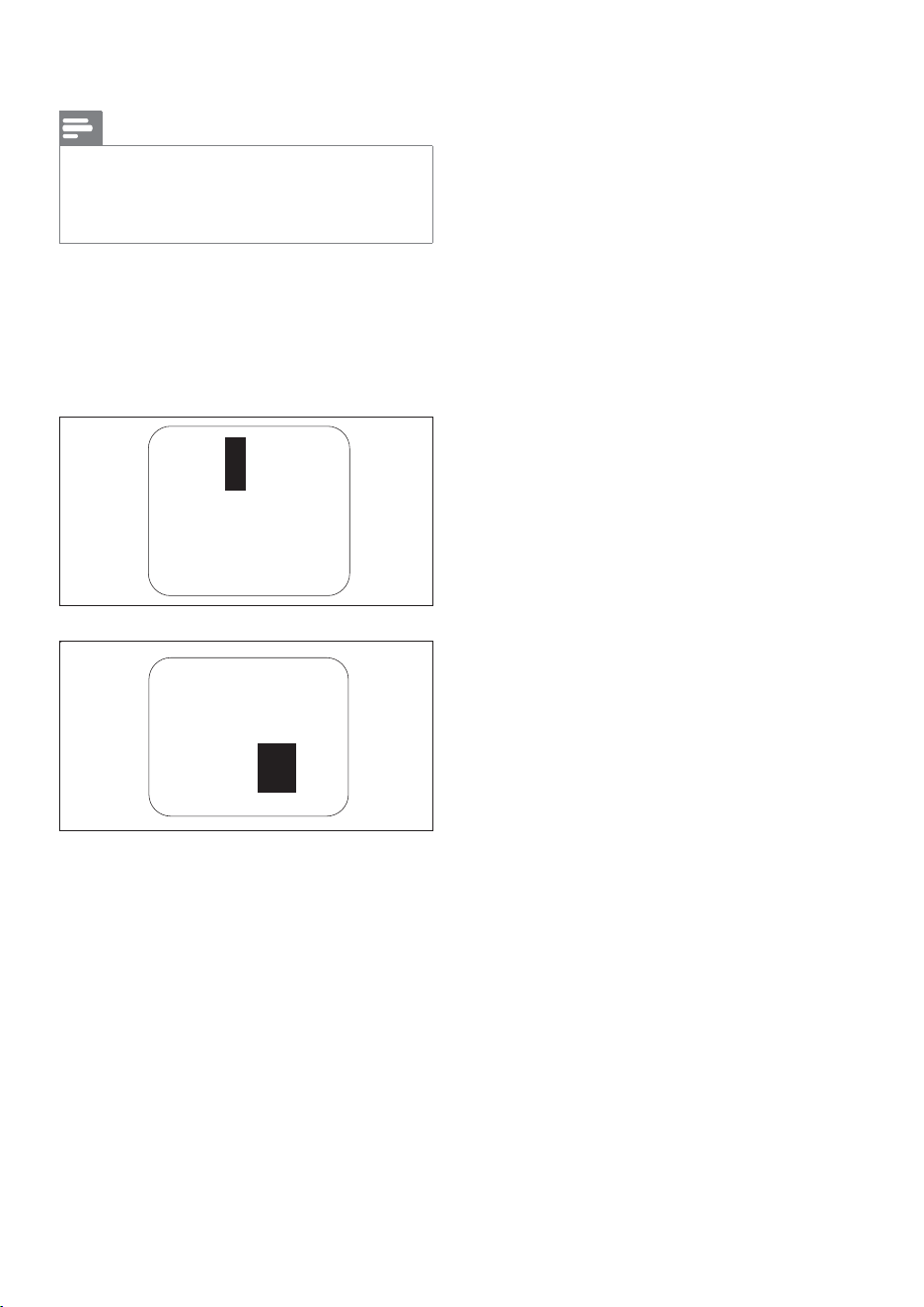
Black Dot Defects: black dot defects appear as
pixels or sub pixels that are always dark or 'off'.
That is, a dark dot is a sub-pixel that stands out
on the screen when the monitor displays a light
pattern.
These are some types of black dot defects:
Proximity of Pixel Defects
Because pixel and sub pixels defects of the same
type that are near to one another may be more
noticeable, Philips also specifies tolerances for
the proximity of pixel defects.
Pixel Defect Tolerances
In order to qualify for repair or replacement
due to pixel defects during the warranty period,
a Philips flat monitor panel must have pixel or
sub pixel defects exceeding the tolerances listed
in the following tables.
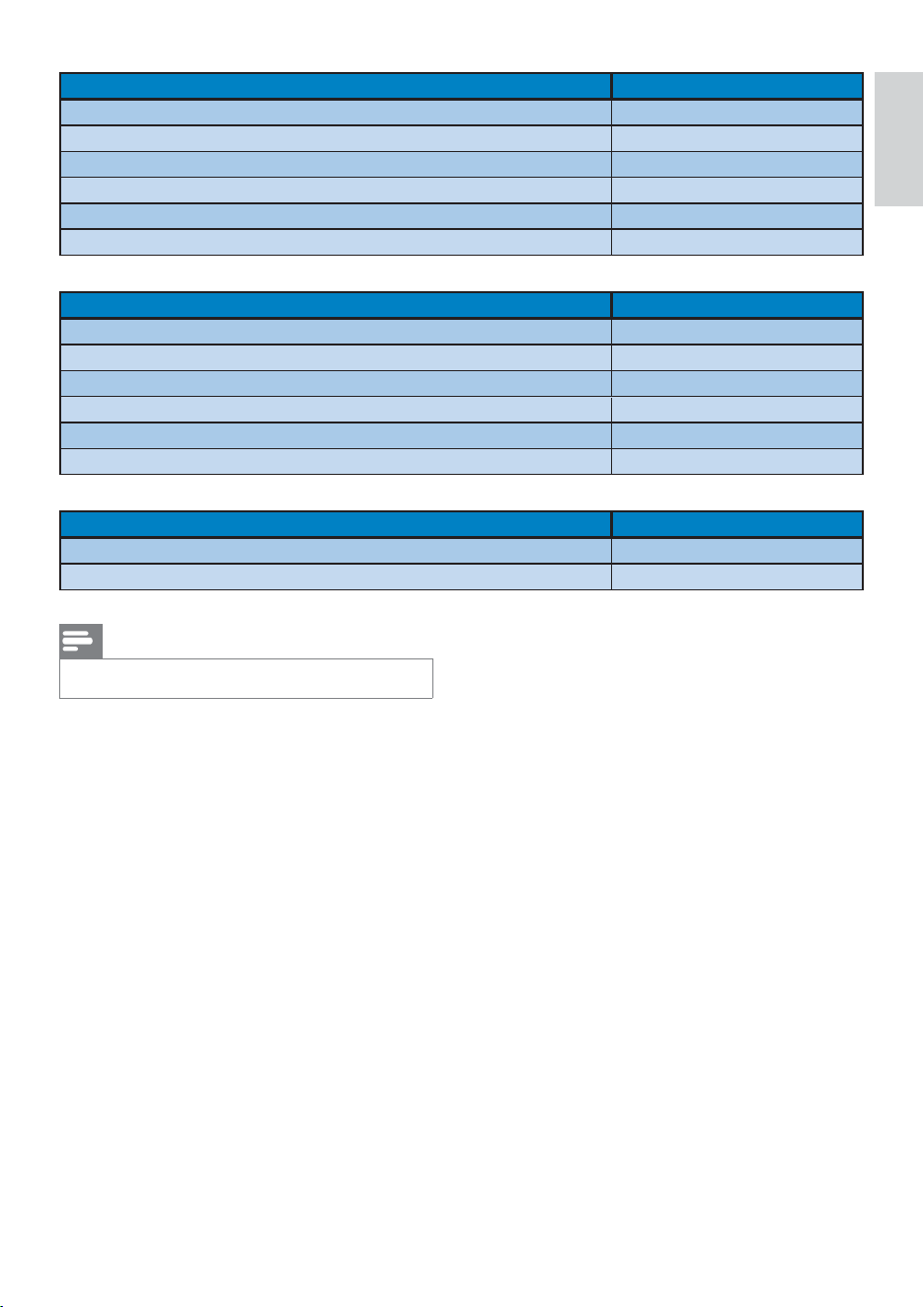
33EN
English
BRIGHT DOT DEFECTS ACCEPTABLE LEVEL
MODEL 221TE4L / 231TE4L
1 lit subpixel 3
2 adjacent lit subpixels 1
3 adjacent lit subpixels (one white pixel) 0
Distance between two bright dot defects* >15mm
Total bright dot defects of all types 3
BLACK DOT DEFECTS ACCEPTABLE LEVEL
MODEL 221TE4L / 231TE4L
1 dark subpixel 5 or fewer
2 adjacent dark subpixels 2 or fewer
3 adjacent dark subpixels 0
Distance between two black dot defects* >15mm
Total black dot defects of all types 5 or fewer
TOTAL DOT DEFECTS ACCEPTABLE LEVEL
MODEL 221TE4L / 231TE4L
Total bright or black dot defects of all types 5 or fewer
Note
1 or 2 adjacent sub pixel defects = 1 dot defect

34 EN
Picture issues
^\}\;
Check that the antenna is properly
connected to the monitor.
Check that the correct device is selected
as the monitor source.
^\:};
Check that the picture settings are
correctly set.
There is poor monitor reception from an
;;
Check that the antenna is properly
connected to the monitor.
Loud speakers, unearthed audio devices,
neon lights, high buildings and other large
#&
If possible, try to improve the reception
quality by changing the antenna direction
or moving devices away from the monitor.
If reception on only one channel is poor,
There is poor picture quality from connected
:`;
Check that the devices are connected
properly.
Check that the picture settings are
correctly set.
The monitor did not save your picture
@
Check that the monitor location is set to
the home setting. This mode offers you
#&
^\;:\;
}@
Try a different picture format.
^\;;;
Picture signals from some devices may not
&<
output of the device.
11 Troubleshooting
This section describes commonly encountered
issues and suggested solutions.
General monitor issues
^\:-;\
Disconnect the power cable from the
power outlet. Wait for one minute then
reconnect it.
Check that the power cable is securely
connected.
^\;-@
Check that the remote control batteries
are correctly inserted according to the
+/- orientation.
Replace the remote control batteries if
&#
Clean the remote control and monitor
sensor lens.
The monitor menu is in the wrong language
Change the monitor menu to your
preferred language.
\@\##:}
you hear a creaking sound from the monitor
;\
No action is required. The creaking sound
is normal expansion and contraction of
the monitor as it cools and warms up.
This does not impact performance.
TV channel issues
Previously installed channels do not appear in
\;\
Check that the correct channel list is
selected.
No digital channels were found during the
Check that the monitor supports DVB-T
or BVD-C in your country. See the listed
countries on the back of the monitor.
35EN
English
Computer connection issues
The computer display on the monitor is not
}
Check that a supported resolution and
refresh rate is selected on the computer.
Set the monitor picture format to
unscaled.
Contact us
If you cannot resolve your problem, refer to
the FAQs for this monitor at www.philips.com/
support.
If the problem remains unresolved, contact
Philips Consumer Care in your country as
listed in this User Manual.
Warning
Do not attempt to repair the monitor yourself.
This may cause severe injury, irreparable
damage to your monitor or void your warranty.
Note
Make a note of your monitor model and serial
number before you contact Philips. These
numbers are printed on the back of the
monitor and on the packaging.
Sound issues
There is a picture but no sound from the
Note
If no audio signal is detected, the monitor
automatically switches the audio output off —
this does not indicate malfunction.
Check that all cables are properly
connected.
Check that the volume is not set to 0.
Check that the sound is not muted.
There is a picture but the sound quality is
Check that the sound settings are
correctly set.
There is a picture but sound comes from one
Verify that sound balance is set to the
center.
HDMI connection issues
^\}-\%_!:`;
Note that HDCP support can delay
the time taken for a monitor to display
content from an HDMI device.
If the monitor does not recognise the
HDMI device and no picture is displayed,
try switching the source from one device
to another and back again.
If there are intermittent sound
disruptions, check that output settings
from the HDMI device are correct.
If an HDMI-to-DVI adaptor or HDMI
to DVI cable is used, check that an
additional audio cable is possible could be
connected to PC AUDIO IN (mini-jack
only).

Version: M4221TEE1T
2012 © Koninklijke Philips Electronics N.V. All rights reserved.
Koninklijke Philips Electronics N.V.”
www.philips.com