
Table of Contents Useful Recording Techniques Index
Click
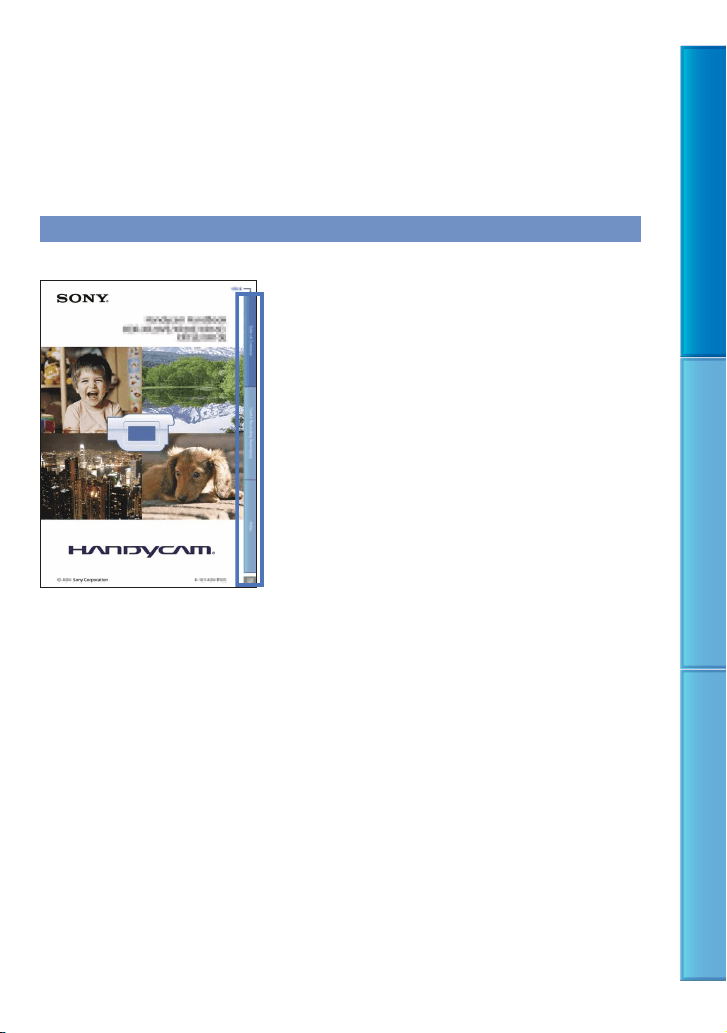
“Handycam” Handbook
HDR-CX500/CX500V/CX520/CX520V
2009 Sony Corporation 4-149-352-11(1)
US
2
Table of Contents Useful Recording Techniques Index
Using the “Handycam” Handbook
You will find information on using your camcorder to its fullest in this “Handycam”
Handbook. Read the “Handycam” Handbook in addition to the Operating Guide (a separate
volume). Information on using your camcorder connected to a computer will be found in the
Operating Guide and the “PMB Guide” that is the Help of the supplied “PMB (Picture Motion
Browser)” software.
Searching for information quickly
Click an item on the right edge of each page, and you will jump to the page for that item.
You can search for an item by keyword using Adobe Reader. Refer to the Help of Adobe Reader for tips
on how to use Adobe Reader.
You can print out the “Handycam” Handbook.
About this “Handycam” Handbook
The example images used in this “Handycam” Handbook for illustration purposes are captured using a
digital still camera, and therefore may appear different from images and screen indicators that actually
appear on your camcorder.
The HDR-CX520V is used for illustrations in this book, unless otherwise mentioned.
In this “Handycam” Handbook, the internal memory of your camcorder and “Memory Stick PRO Duo”
media are called “recording media.”
“Memory Stick PRO Duo” media and “Memory Stick PRO-HG Duo” media are both referred to as
“Memory Stick PRO Duo” media in this manual.
Design and specifications of your camcorder and accessories are subject to change without notice.
Click here.

3
Table of Contents Useful Recording Techniques Index
Table of contents
Using the “Handycam” Handbook . . . . . . . . . . . . . . . . . . . . . . . . . . . . . . . . . . . . . . . . . . . . . . . . . . . . . . . . . . . . . . . 2
Searching for information quickly . . . . . . . . . . . . . . . . . . . . . . . . . . . . . . . . . . . . . . . . . . . . . . . . . . . . . . . 2
Useful recording techniques . . . . . . . . . . . . . . . . . . . . . . . . . . . . . . . . . . . . . . . . . . . . . . . . . . . . . . . . . . . . . . . . . . . . . . 6
Parts and controls . . . . . . . . . . . . . . . . . . . . . . . . . . . . . . . . . . . . . . . . . . . . . . . . . . . . . . . . . . . . . . . . . . . . . . . . . . . . . . . . . . . 7
Screen indicators . . . . . . . . . . . . . . . . . . . . . . . . . . . . . . . . . . . . . . . . . . . . . . . . . . . . . . . . . . . . . . . . . . . . . . . . . . . 9
Using menus . . . . . . . . . . . . . . . . . . . . . . . . . . . . . . . . . . . . . . . . . . . . . . . . . . . . . . . . . . . . . . . . . . . . . . . . . . . . . . . . . . . . . . . 11
Using MY MENU . . . . . . . . . . . . . . . . . . . . . . . . . . . . . . . . . . . . . . . . . . . . . . . . . . . . . . . . . . . . . . . . . . . . . . . . . . . 11
To change settings by using MENU . . . . . . . . . . . . . . . . . . . . . . . . . . . . . . . . . . . . . . . . . . . . . . . . . . . 12
Using the
OPTION MENU . . . . . . . . . . . . . . . . . . . . . . . . . . . . . . . . . . . . . . . . . . . . . . . . . . . . . . . . . . . 12
Menu lists . . . . . . . . . . . . . . . . . . . . . . . . . . . . . . . . . . . . . . . . . . . . . . . . . . . . . . . . . . . . . . . . . . . . . . . . . . . . . . . . . . . . . . . . . . . 14
Read this before operating your camcorder . . . . . . . . . . . . . . . . . . . . . . . . . . . . . . . . . . . . . . . . . . . . . . . . . 16
Getting started
Step 1: Charging the battery pack . . . . . . . . . . . . . . . . . . . . . . . . . . . . . . . . . . . . . . . . . . . . . . . . . . . . . . . . . . . . . 19
Step 2: Turning the power on, and setting the date and time . . . . . . . . . . . . . . . . . . . . . . . . . . . 22
Changing the language setting . . . . . . . . . . . . . . . . . . . . . . . . . . . . . . . . . . . . . . . . . . . . . . . . . . . . . . . . 23
Recording/Playback
Five pieces of advice for successful recording . . . . . . . . . . . . . . . . . . . . . . . . . . . . . . . . . . . . . . . . . . . . . . . 24
Recording . . . . . . . . . . . . . . . . . . . . . . . . . . . . . . . . . . . . . . . . . . . . . . . . . . . . . . . . . . . . . . . . . . . . . . . . . . . . . . . . . . . . . . . . . . . 25
Recording movies . . . . . . . . . . . . . . . . . . . . . . . . . . . . . . . . . . . . . . . . . . . . . . . . . . . . . . . . . . . . . . . . . . . . . . . . 25
Shooting photos . . . . . . . . . . . . . . . . . . . . . . . . . . . . . . . . . . . . . . . . . . . . . . . . . . . . . . . . . . . . . . . . . . . . . . . . . . 27
Useful functions for recording movies and photos . . . . . . . . . . . . . . . . . . . . . . . . . . . . . . . . . . . . . . . . 29
Zooming . . . . . . . . . . . . . . . . . . . . . . . . . . . . . . . . . . . . . . . . . . . . . . . . . . . . . . . . . . . . . . . . . . . . . . . . . . . . . . . . . . . . 29
Prioritizing the subject . . . . . . . . . . . . . . . . . . . . . . . . . . . . . . . . . . . . . . . . . . . . . . . . . . . . . . . . . . . . . . . . . . 29
Capturing smiles automatically (Smile Shutter) . . . . . . . . . . . . . . . . . . . . . . . . . . . . . . . . . . . 30
Recording sound with more presence (5.1ch surround recording) . . . . . . . . . . . . . 30
Recording high quality photos during movie recording (Dual Rec) . . . . . . . . . . . . 31
Recording in dark places (NightShot). . . . . . . . . . . . . . . . . . . . . . . . . . . . . . . . . . . . . . . . . . . . . . . . . 31
Recording in mirror mode . . . . . . . . . . . . . . . . . . . . . . . . . . . . . . . . . . . . . . . . . . . . . . . . . . . . . . . . . . . . . . 32
Recording fast action in slow-motion (SMTH SLW REC) . . . . . . . . . . . . . . . . . . . . . . . . . . . 32
Controlling the image settings manually with the MANUAL dial . . . . . . . . . . . . . . . 33
Acquiring location information (GPS) (HDR-CX500V/CX520V) . . . . . . . . . . . . . . . . . . 34
Playback on the camcorder . . . . . . . . . . . . . . . . . . . . . . . . . . . . . . . . . . . . . . . . . . . . . . . . . . . . . . . . . . . . . . . . . . . . . 36
Playing movies . . . . . . . . . . . . . . . . . . . . . . . . . . . . . . . . . . . . . . . . . . . . . . . . . . . . . . . . . . . . . . . . . . . . . . . . . . . . 36
Viewing photos . . . . . . . . . . . . . . . . . . . . . . . . . . . . . . . . . . . . . . . . . . . . . . . . . . . . . . . . . . . . . . . . . . . . . . . . . . . 37
Useful functions for playing movies and photos . . . . . . . . . . . . . . . . . . . . . . . . . . . . . . . . . . . . . . . . . . . 39
Searching for desired images by date (Date Index) . . . . . . . . . . . . . . . . . . . . . . . . . . . . . . . . 39

4
Table of Contents Useful Recording Techniques Index
Searching for a desired scene by recording location (Map Index)
(HDR-CX500V/CX520V) . . . . . . . . . . . . . . . . . . . . . . . . . . . . . . . . . . . . . . . . . . . . . . . . . . . . . . . . . . . . . . . . . . 40
Searching for desired scene by pinpoint (Film Roll Index) . . . . . . . . . . . . . . . . . . . . . . . 41
Searching for desired scene by face (Face Index) . . . . . . . . . . . . . . . . . . . . . . . . . . . . . . . . . . 42
Playing back a digest of your movies (Highlight Playback) . . . . . . . . . . . . . . . . . . . . . . 43
Using PB zoom with photos . . . . . . . . . . . . . . . . . . . . . . . . . . . . . . . . . . . . . . . . . . . . . . . . . . . . . . . . . . . . 45
Playing back a series of photos (Slide show) . . . . . . . . . . . . . . . . . . . . . . . . . . . . . . . . . . . . . . . . 46
Playing images on a TV . . . . . . . . . . . . . . . . . . . . . . . . . . . . . . . . . . . . . . . . . . . . . . . . . . . . . . . . . . . . . . . . . . . . . . . . . . 47
Connecting a TV using [TV CONNECT Guide] . . . . . . . . . . . . . . . . . . . . . . . . . . . . . . . . . . . . . . . 47
Connecting to a high definition TV . . . . . . . . . . . . . . . . . . . . . . . . . . . . . . . . . . . . . . . . . . . . . . . . . . . 48
Connecting to a non-high-definition 16:9 (wide) or 4:3 TV . . . . . . . . . . . . . . . . . . . . . . 49
Using “BRAVIA” Sync . . . . . . . . . . . . . . . . . . . . . . . . . . . . . . . . . . . . . . . . . . . . . . . . . . . . . . . . . . . . . . . . . . . . . . 51
Editing
Deleting movies and photos . . . . . . . . . . . . . . . . . . . . . . . . . . . . . . . . . . . . . . . . . . . . . . . . . . . . . . . . . . . . . . . . . . . . 52
Acquiring the current location information (HDR-CX500V/CX520V) . . . . . . . . . . . . . . . . . . . 54
Capturing a photo from a movie . . . . . . . . . . . . . . . . . . . . . . . . . . . . . . . . . . . . . . . . . . . . . . . . . . . . . . . . . . . . . . . 55
Dubbing/copying movies and photos from the internal memory to
“Memory Stick PRO Duo” media . . . . . . . . . . . . . . . . . . . . . . . . . . . . . . . . . . . . . . . . . . . . . . . . . . . . . . . . . . . . . . . . 56
Dubbing movies . . . . . . . . . . . . . . . . . . . . . . . . . . . . . . . . . . . . . . . . . . . . . . . . . . . . . . . . . . . . . . . . . . . . . . . . . . 56
Copying photos . . . . . . . . . . . . . . . . . . . . . . . . . . . . . . . . . . . . . . . . . . . . . . . . . . . . . . . . . . . . . . . . . . . . . . . . . . . 57
Protecting recorded movies and photos (Protect) . . . . . . . . . . . . . . . . . . . . . . . . . . . . . . . . . . . . . . . . . 58
Dividing a movie . . . . . . . . . . . . . . . . . . . . . . . . . . . . . . . . . . . . . . . . . . . . . . . . . . . . . . . . . . . . . . . . . . . . . . . . . . . . . . . . . . 59
Using the Playlist of movies . . . . . . . . . . . . . . . . . . . . . . . . . . . . . . . . . . . . . . . . . . . . . . . . . . . . . . . . . . . . . . . . . . . . . 60
Creating the Playlist . . . . . . . . . . . . . . . . . . . . . . . . . . . . . . . . . . . . . . . . . . . . . . . . . . . . . . . . . . . . . . . . . . . . . 60
Playing the Playlist . . . . . . . . . . . . . . . . . . . . . . . . . . . . . . . . . . . . . . . . . . . . . . . . . . . . . . . . . . . . . . . . . . . . . . . 60
Creating a disc with a DVD writer, recorder . . . . . . . . . . . . . . . . . . . . . . . . . . . . . . . . . . . . . . . . . . . . . . . . . . 62
Creating a disc with the dedicated DVD writer, DVDirect Express . . . . . . . . . . . . . . 62
Creating a high definition image quality (HD) disc with a DVD writer, etc.,
other than DVDirect Express . . . . . . . . . . . . . . . . . . . . . . . . . . . . . . . . . . . . . . . . . . . . . . . . . . . . . . . . . . . 64
Creating a standard definition image quality (SD) disc with a recorder, etc.,
other than DVDirect Express . . . . . . . . . . . . . . . . . . . . . . . . . . . . . . . . . . . . . . . . . . . . . . . . . . . . . . . . . . . 65
Utilizing recording media
Changing the recording media. . . . . . . . . . . . . . . . . . . . . . . . . . . . . . . . . . . . . . . . . . . . . . . . . . . . . . . . . . . . . . . . . 67
Selecting the recording media for movies . . . . . . . . . . . . . . . . . . . . . . . . . . . . . . . . . . . . . . . . . . . 67
Selecting the recording media for photos . . . . . . . . . . . . . . . . . . . . . . . . . . . . . . . . . . . . . . . . . . . 67
Inserting “Memory Stick PRO Duo” media . . . . . . . . . . . . . . . . . . . . . . . . . . . . . . . . . . . . . . . . . . . 67
Preventing data on the internal memory from being recovered . . . . . . . . . . . . . . . . . . . . . . . . 69
Customizing your camcorder
MANUAL SETTINGS (Items to adjust for scene condition) . . . . . . . . . . . . . . . . . . . . . . . . . . 70
SHOOTING SET (Items for customized shooting) . . . . . . . . . . . . . . . . . . . . . . . . . . . . . . . . . . . . . 77

5
Table of Contents Useful Recording Techniques Index
PHOTO SETTINGS (Items for recording photos) . . . . . . . . . . . . . . . . . . . . . . . . . . . . . . . . . . . . . . . . 84
PLAYBACK (Items for playback) . . . . . . . . . . . . . . . . . . . . . . . . . . . . . . . . . . . . . . . . . . . . . . . . . . . . . . . . . . . . 87
EDIT (Items for editing) . . . . . . . . . . . . . . . . . . . . . . . . . . . . . . . . . . . . . . . . . . . . . . . . . . . . . . . . . . . . . . . . . . . . . 90
OTHERS (Items for other settings) . . . . . . . . . . . . . . . . . . . . . . . . . . . . . . . . . . . . . . . . . . . . . . . . . . . . . . . . . . 91
MANAGE MEDIA (Items for recording media) . . . . . . . . . . . . . . . . . . . . . . . . . . . . . . . . . . . . . . . . . . . 92
GENERAL SET (Other setup items) . . . . . . . . . . . . . . . . . . . . . . . . . . . . . . . . . . . . . . . . . . . . . . . . . . . . . . . . . 94
Troubleshooting
Troubleshooting . . . . . . . . . . . . . . . . . . . . . . . . . . . . . . . . . . . . . . . . . . . . . . . . . . . . . . . . . . . . . . . . . . . . . . . . . . . . . . 102
Self-diagnosis display/Warning indicators. . . . . . . . . . . . . . . . . . . . . . . . . . . . . . . . . . . . . . . . . . 108
Additional information
Recording time of movies/number of recordable photos . . . . . . . . . . . . . . . . . . . . . . . . . . . . . . . 111
Expected time of recording and playback with each battery pack . . . . . . . . . . . . 111
Expected recording time of movies . . . . . . . . . . . . . . . . . . . . . . . . . . . . . . . . . . . . . . . . . . . . . . . . . . 111
Expected number of recordable photos . . . . . . . . . . . . . . . . . . . . . . . . . . . . . . . . . . . . . . . . . . . . 113
Using your camcorder abroad . . . . . . . . . . . . . . . . . . . . . . . . . . . . . . . . . . . . . . . . . . . . . . . . . . . . . . . . . . . . . . . . . 114
File/folder structure on the internal memory and “Memory Stick PRO Duo” media
. . . . . . . . . . . . . . . . . . . . . . . . . . . . . . . . . . . . . . . . . . . . . . . . . . . . . . . . . . . . . . . . . . . . . . . . . . . . . . . . . . . . . . . . . . . . . . . . . . . . . . . 116
Maintenance and precautions . . . . . . . . . . . . . . . . . . . . . . . . . . . . . . . . . . . . . . . . . . . . . . . . . . . . . . . . . . . . . . . . . 118
About the AVCHD format . . . . . . . . . . . . . . . . . . . . . . . . . . . . . . . . . . . . . . . . . . . . . . . . . . . . . . . . . . . . . . 118
About GPS (HDR-CX500V/CX520V) . . . . . . . . . . . . . . . . . . . . . . . . . . . . . . . . . . . . . . . . . . . . . . . . . . 118
About the “Memory Stick” media . . . . . . . . . . . . . . . . . . . . . . . . . . . . . . . . . . . . . . . . . . . . . . . . . . . . . 120
About the “InfoLITHIUM” battery pack . . . . . . . . . . . . . . . . . . . . . . . . . . . . . . . . . . . . . . . . . . . . . . 121
About x.v.Color . . . . . . . . . . . . . . . . . . . . . . . . . . . . . . . . . . . . . . . . . . . . . . . . . . . . . . . . . . . . . . . . . . . . . . . . . . . 122
About handling of your camcorder . . . . . . . . . . . . . . . . . . . . . . . . . . . . . . . . . . . . . . . . . . . . . . . . . . 122
Index . . . . . . . . . . . . . . . . . . . . . . . . . . . . . . . . . . . . . . . . . . . . . . . . . . . . . . . . . . . . . . . . . . . . . . . . . . . . . . . . . . . . . . . . . . . . . . . . 127
6
Table of Contents Useful Recording Techniques Index
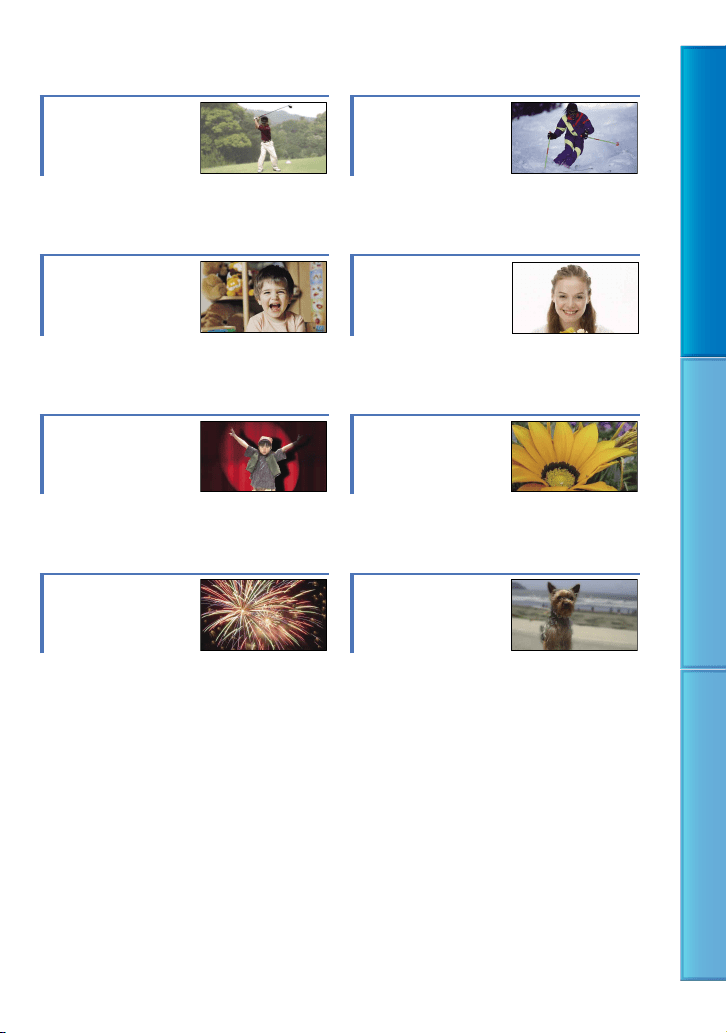
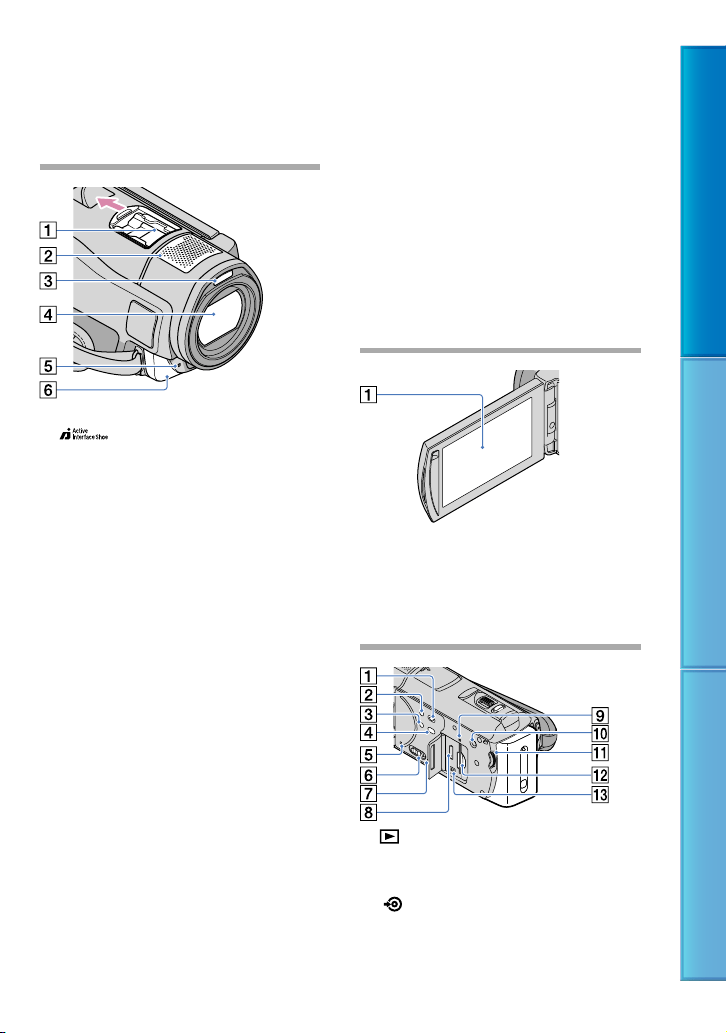
Useful recording techniques
Checking your golf
swing
Getting a good shot
of a ski slope or
beach
SMTH SLW REC .......................................... 32 BEACH ....................................................... 70
SNOW ....................................................... 70
Capturing photos
during movie
recording
Capturing smiles
automatically
Dual Rec .................................................... 31 Smile Shutter ............................................ 30
A child on the stage
under a spot light
Flowers in close-up
SPOTLIGHT ................................................ 70 PORTRAIT .................................................. 70
FOCUS ....................................................... 74
TELE MACRO .............................................. 75
Fireworks with all its
splendor
Focusing on the dog
on the left side of
the screen
FIREWORKS ............................................... 70
FOCUS ....................................................... 74
FOCUS ....................................................... 74
SPOT FOCUS .............................................. 73
SPOT MTR/FCS ........................................... 72
7
Table of Contents Useful Recording Techniques Index
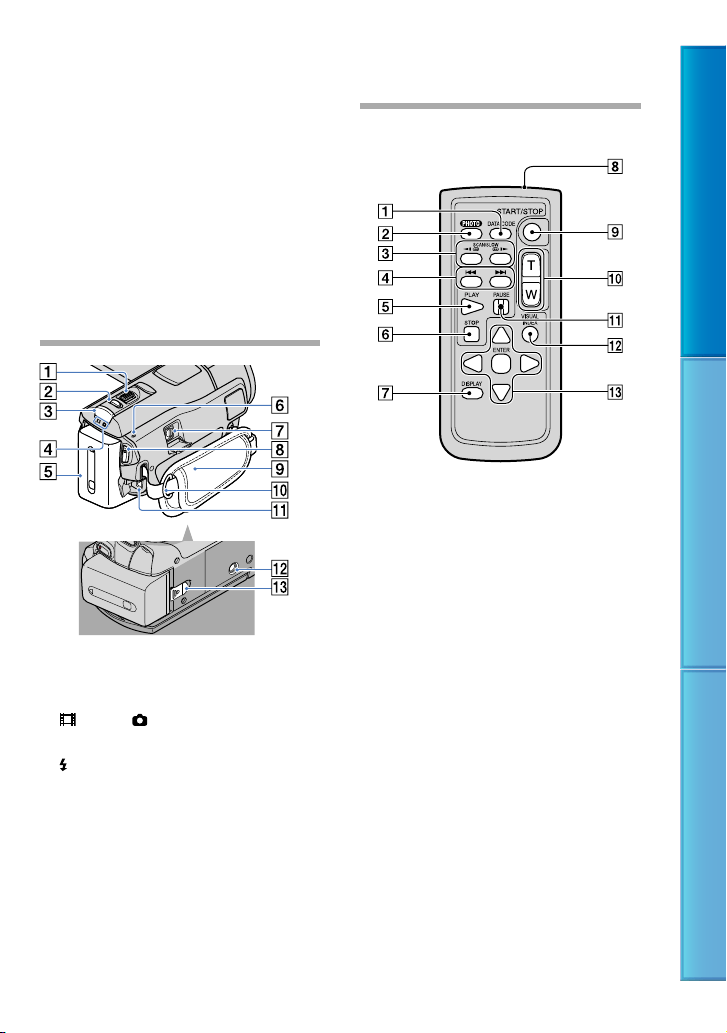
Parts and controls
Figures in ( ) are reference pages.
Active Interface Shoe
The Active Interface Shoe supplies power to
accessories such as a video light, a flash, or a
microphone (sold separately). The accessory
can be turned on or off as you open or close
the LCD screen of your camcorder. Refer to
the operating instructions supplied with your
accessory for details.
The Active Interface Shoe has a safety device
for fixing the installed accessory securely. To
connect an accessory, press down and push
it to the end, and then tighten the screw. To
remove an accessory, loosen the screw, and
then press down and pull out the accessory.
When you open or close the shoe cover,
slide it as indicated by the arrow.
When you are recording movies with an
external flash (sold separately) connected
to the accessory shoe, turn off the power of
the external flash to prevent charging noise
being recorded.
You cannot use an external flash (sold
separately) and the built-in flash at the same
time.
When an external microphone (sold
separately) is connected, it takes precedence
o
ver the built-in microphone (p. 30).
Built-in microphone (30)
Flash
Lens (Sony G lens)
Camera recording lamp (100)
The camera recording lamp lights up in red
during recording. The lamp flashes when the
remaining recording media capacity or battery
power is low.
Remote sensor/Infrared port
Point the Wireless Remote Commander (p. 8)
towards the remote sensor to operate your
camcorder.
LCD screen/Touch panel (11, 32)
If you rotate the LCD panel 180 degrees, you
can close the LCD panel with the LCD screen
facing out. This is convenient during playback
operations.
(VIEW IMAGES) button (36)
POWER button (22)
NIGHTSHOT button (31)
(DISC BURN) button (see Operating
Guide)
RESET button
Press RESET using a pointed object.
8
Table of Contents Useful Recording Techniques Index
Press RESET to initialize all the settings
including the clock setting.
GPS switch (HDR-CX500V/CX520V) (34)
Speaker
HDMI OUT jack (48)
Access lamp (Internal memory, “Memory
Stick PRO Duo” media) (68)
While the lamp is lit or flashing, the
camcorder is reading or writing data.
MANUAL button (33)
MANUAL dial (33)
“Memory Stick Duo” media slot (68)
(USB) jack (64)
Power zoom lever (29, 45)
PHOTO button (28)
MODE button (22)
(Movie)/ (Photo) lamps (22)
Battery pack (19)
/CHG (flash/charge) lamp (19)
A/V Remote Connector (47)
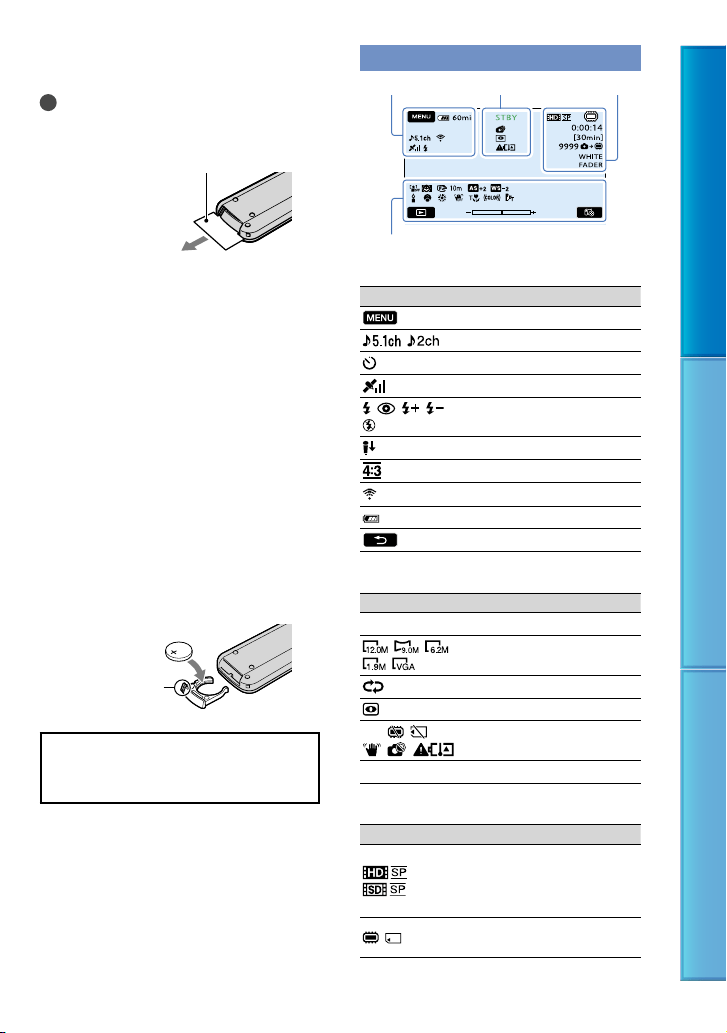
START/STOP button (25)
Grip belt (25)
Hook for a shoulder belt
DC IN jack (19)
Tripod receptacle
Attach a tripod (sold separately) to the
tripod receptacle using a tripod screw (sold
separately: the length of the screw must be less
than 5.5 mm (7/32 in.)).
BATT (battery) release lever (20)
Wireless Remote Commander
DATA CODE button (88)
Displays the date and time, camera setting
data, or coordinates (HDR-CX500V/CX520V)
of the recorded images when you press this
button during playback.
PHOTO button (28)
The on-screen image when you press this
button will be recorded as a still image.
SCAN/SLOW buttons (37)
/ (Previous/Next) buttons (36)
PLAY button
STOP button
DISPLAY button (26)
Transmitter
START/STOP button (25)
Power zoom buttons
PAUSE button
VISUAL INDEX button (36)
Displays a VISUAL INDEX screen during
playback.
////ENTER buttons
When you press any of these buttons, the
orange frame appears on the LCD screen.
9
Table of Contents Useful Recording Techniques Index
Select a desired button or an item with
///, then press ENTER to enter.
Notes
Remove the insulation sheet before using the
Wireless Remote Commander.
Point the Wireless Remote Commander
towards the remote sensor to operate your
c
amcorder (p. 7).
When no commands have been sent from the
Wireless Remote Commander within a certain
period, the orange frame disappears. When
you press any of
///, or ENTER again,
the frame appears at the position where it was
displayed last.
You cannot select some buttons on the LCD
screen using
///.
To change the battery of the Wireless
Remote Commander
While pressing on the tab, inset your fingernail
into the slit to pull out the battery case.
Place a new battery with the + side facing up.
Insert the battery case back into the Wireless
Remote Commander until it clicks.
WARNING
Battery may explode if mistreated. Do not
recharge, disassemble or dispose of in fire.
When the lithium battery becomes weak, the
operating distance of the Wireless Remote
Commander may shorten, or the Wireless
Remote Commander may not function
properly. In this case, replace the battery with
a Sony CR2025 lithium battery. Use of another
battery may present a risk of fire or explosion.
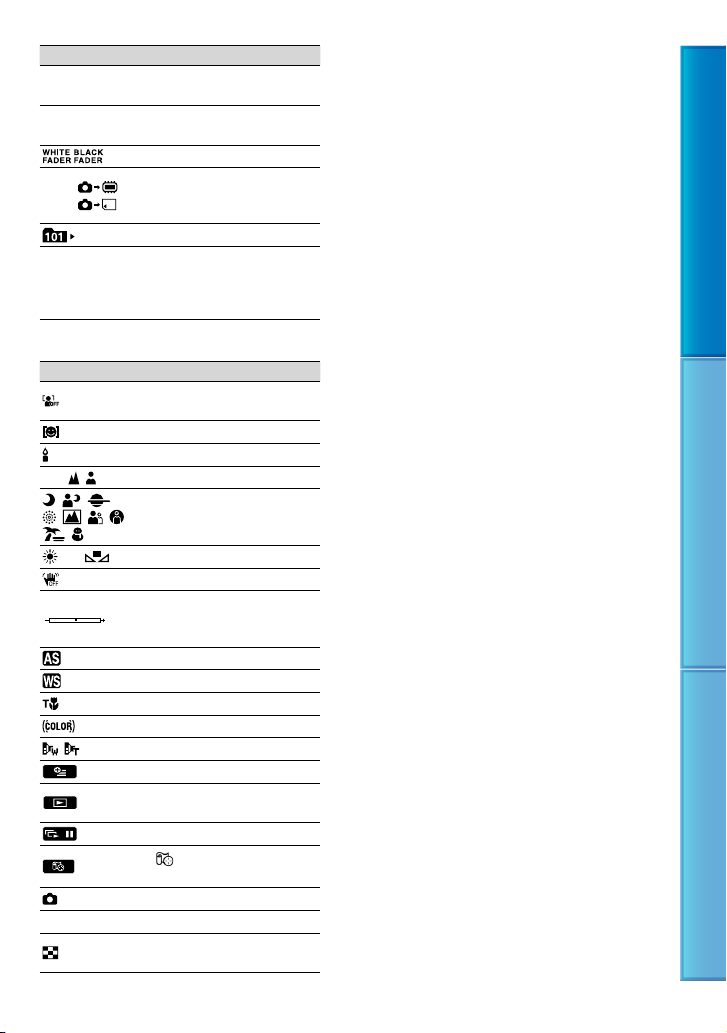
Screen indicators
Upper left
Indicator Meaning
MENU button (11)
AUDIO MODE (81)
Self-timer recording (84)
GPS tracking status (34)
Flash (85)/
REDEYE REDUC (85)
MICREF LEVEL low (81)
WIDE SELECT (83)
BLT-IN ZOOM MIC (81)
60 min Remaining battery
Return button (12)
Center
Indicator Meaning
[STBY]/[REC] Recording status (25)
Photo size (84)
Slide show set (46)
NightShot (31)
Warning (108)
Playback mode (37)
Upper right
Indicator Meaning
Recording image quality
(HD/SD) and recording
mode (FH/HQ/SP/LP)
(77)
Recording/playback/
editing media (67)
Insulation sheet
Tab
Upper left Center Upper right
Bottom
10
Table of Contents Useful Recording Techniques Index
Indicator Meaning
0:00:00
Counter (hour:minute:
second) (37)
[00min]
Estimated recording
remaining time (25)
FADER (71)
9999
9999
Approximate number of
recordable photos and
recording media (28)
Playback folder (38)
100/112
Current playing movie or
photo/Number of total
recorded movies or photos
(37)
Bottom
Indicator Meaning
[FACE DETECTION] set
to [OFF] (79)
SMILE DETECTION (80)
LOW LUX (79)
Manual focus (74)
SCENE SELECTION (70)
White balance (71)
SteadyShot off (78)
SPOT MTR/FCS (72)/
SPOT METER (73)/
EXPOSURE (74)
AE SHIFT (75)
WB SHIFT (76)
TELE MACRO (75)
X.V.COLOR (83)
CONVERSION LENS (78)
OPTION button (12)
VIEW IMAGES button
(36)
Slide show button (46)
YOUR
LOCATION button (54)
101-0005
Data file name (38)
Protected image (58)
Index button (38)
Indicators and their positions are approximate
and may differ from what you actually see.
Some indicators may not appear, depending on
your camcorder model.
11
Table of Contents Useful Recording Techniques Index
Using menus
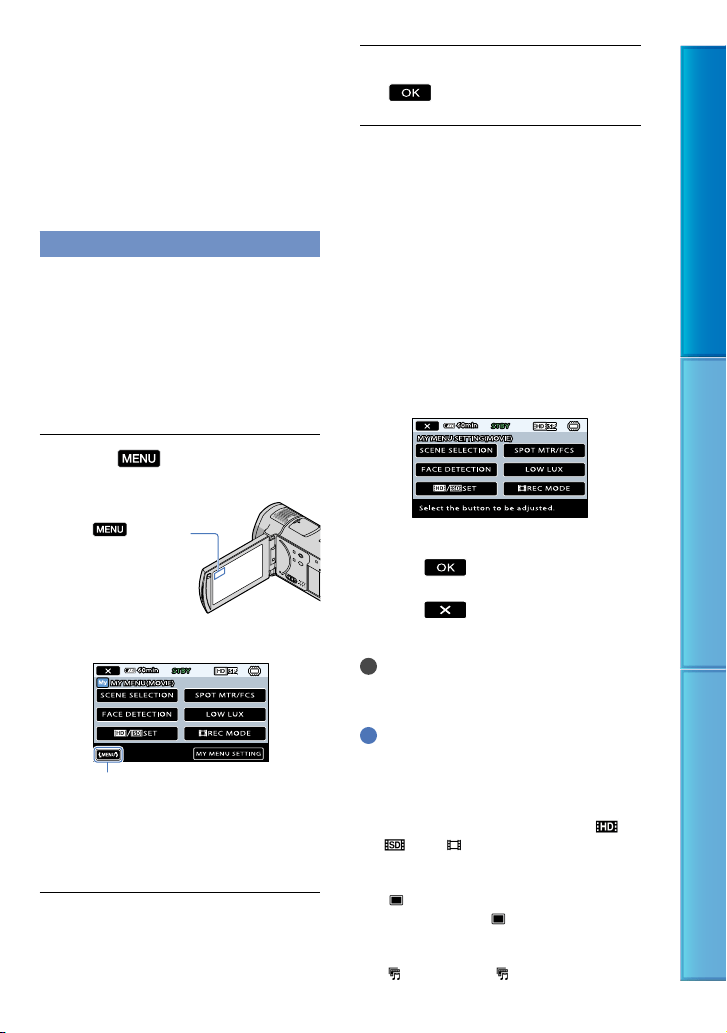
Your camcorder has MY MENU where
6 menu items you use most often can be
registered, and MENU, where all menu
items are displayed.
Using MY MENU
Open the L
CD screen of your
camcorder.
The lens cover is opened and your
camcorder is turned on.
To turn on your camcorder when the LCD
screen is already open, press POWER
(p
. 22).
Touch
(MENU).
The MY MENU screen is displayed.
MY MENU items that appear on the
screen depend on the status of your
camcorder, recording (movie/photo) or
playback.
Touch the menu item to be
changed.
After changing the setting, touch
.
To register your favorite menu items to
MY MENU
In step 3, touch [MY MENU SETTING].
T
ouch the MY MENU type you want to
change.
[MOVIE]: Change the MY MENU for
movie recording
[PHOTO]: Change the MY MENU for
photo recording
[PLAYBACK]: Change the MY MENU
for playback
Touch the item to be changed.
T
ouch the item to be
registered.
T
ouch , after MY MENU screen is
displayed.
Notes
You can register up to 6 menu items in each
MY MENU.
Tips
The default settings for each MY MENU are the
following:
MY MENU(MOVIE)
[SCENE SELECTION], [SPOT MTR/FCS],
[FACE DETECTION], [LOW LUX], [
/
SET], [ REC MODE]
MY MENU(PHOTO)
[SCENE SELECTION], [SPOT MTR/FCS],
[
SELF-TIMER], [SMILE DETECTION],
[FLASH MODE], [
IMAGE SIZE]
MY MENU(PLAYBACK)
[DELETE], [PHOTO CAPTURE],
[
HIGHLIGHT], [ SCENARIO], [TV
To MENU screen
(MENU)
12
Table of Contents Useful Recording Techniques Index
CONNECT Guide], [OUTPUT SETTINGS]
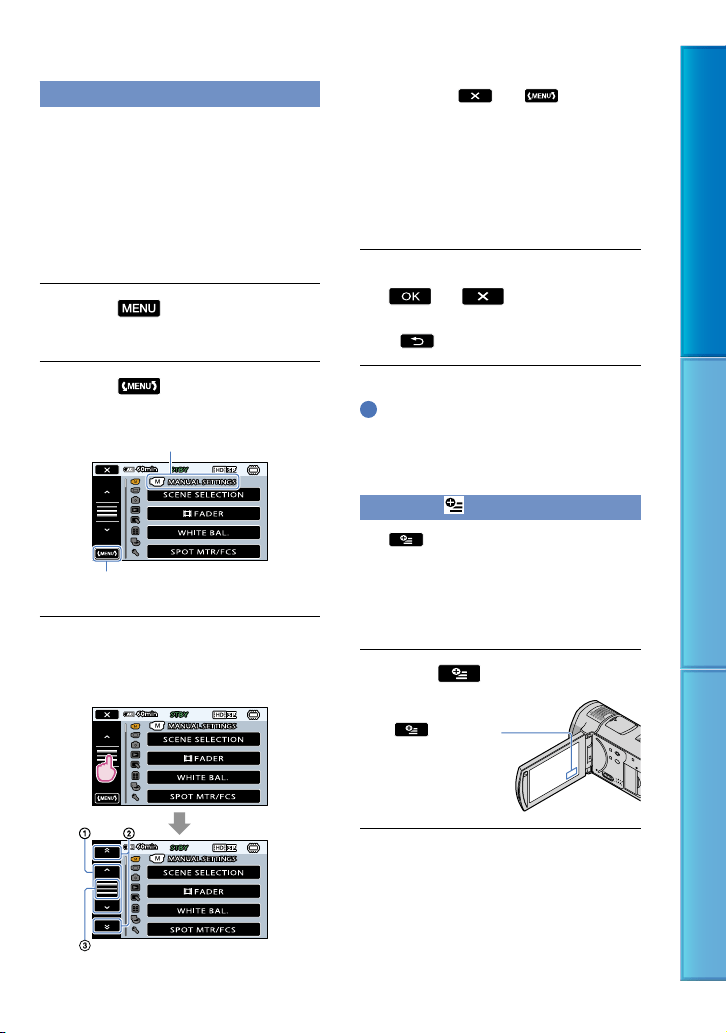
To change settings by using MENU
Open the L
CD screen of your
camcorder.
The lens cover is opened and your
camcorder is turned on.
To turn on your camcorder when the LCD
screen is already open, press POWER
(p
. 22).
Touch
(MENU).
The MY MENU screen is displayed.
Touch
.
The MENU items are displayed.
Touch the menu item to be
changed.
Moves through 4 items at once
Moves from category to category
Displays
and
You may not be able to set some menu
items, depending on the recording or
playback conditions.
Grayed out menu items or settings are not
available.
You can touch or and drag on the
screen to scroll the list of the menu.
After changing the setting, touch
.
To return to the previous screen, touch
.
Tips
Depending on the menu items being changed,
your camcorder switches between playback
mode and recording mode (movie/photo).
Using the OPTION MENU
The OPTION MENU appears just
like the pop-up window that appears when
you right-click the mouse on a computer.
The menu items you can change in the
context appear.
Touch
(OPTION).
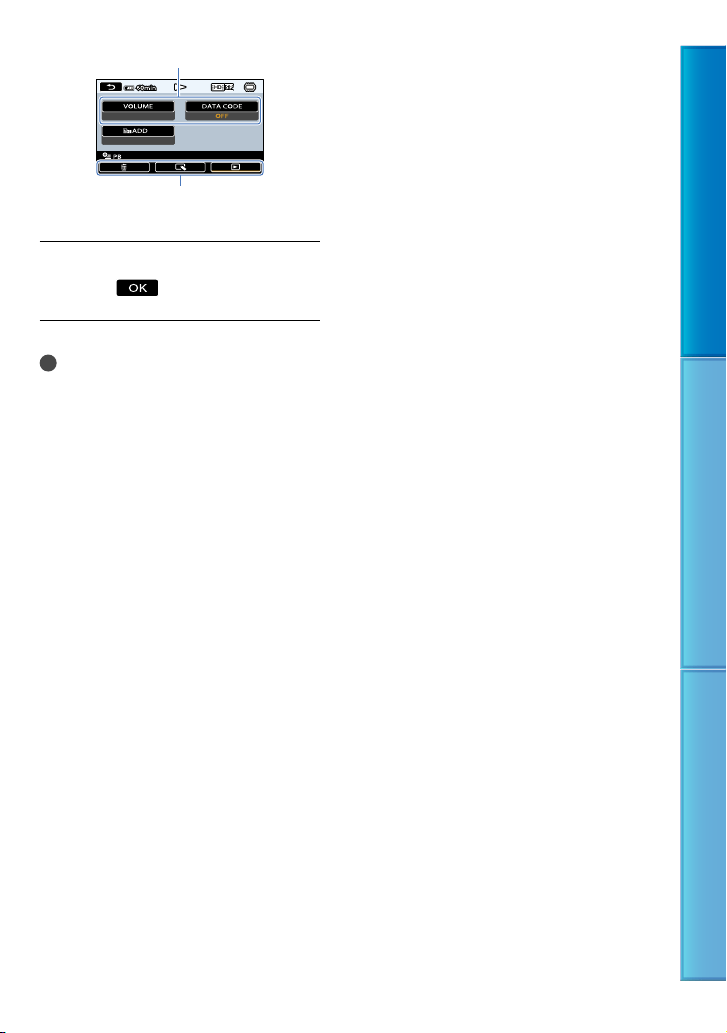
Touch the desired tab the
item to change the setting.
(OPTION)
Category
To MY MENU screen
13
Table of Contents Useful Recording Techniques Index
After completing the setting,
touch
.
Notes
Grayed out menu items or settings are not
available.
When the item you want is not on the screen,
touch another tab. (There may be no tab.)
The tabs and items that appear on the screen
depend on the recording/playback status of
your camcorder at the time.
Menu item
Tab
14
Table of Contents Useful Recording Techniques Index
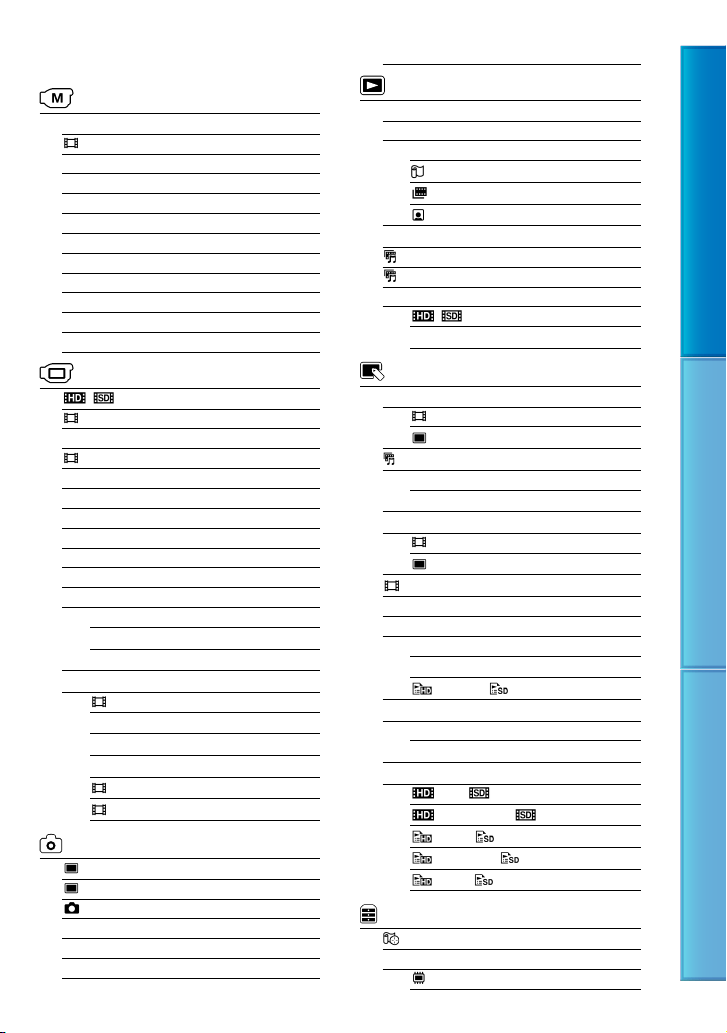
Menu lists
(MANUAL SETTINGS) category
SCENE SELECTION 70
FADER 71
WHITE BAL. 71
SPOT MTR/FCS 72
SPOT METER 73
SPOT FOCUS 73
EXPOSURE 74
FOCUS 74
TELE MACRO 75
AE SHIFT 75
WB SHIFT 76
SMTH SLW REC 32
(SHOOTING SET) category
/ SET 77
REC MODE 77
GUIDEFRAME 78
STEADYSHOT 78
CONVERSION LENS 78
LOW LUX 79
FACE DETECTION 79
PRIORITY SETTING 80
SMILE DETECTION 80
SMILE SENSITIVITY 80
AUDIO REC SET
BLT-IN ZOOM MIC 81
MICREF LEVEL 81
AUDIO MODE 81
OTHER REC SET
DIGITAL ZOOM 81
AUTO BACK LIGHT 82
DIAL SETTING 33
NIGHTSHOT LIGHT 82
X.V.COLOR 83
WIDE SELECT 83
(PHOTO SETTINGS) category
SELF-TIMER 84
IMAGE SIZE 84
STEADYSHOT 84
FLASH MODE 85
FLASH LEVEL 85
REDEYE REDUC 85
FILE NO. 86
(PLAYBACK) category
VISUAL INDEX 36
VIEW IMAGES
DATE INDEX 39
MAP* 40
FILM ROLL 41
FACE 42
PLAYLIST 60
HIGHLIGHT 43
SCENARIO 44
PLAYBACK SET
/ SET 87
DATA CODE 88
(EDIT) category
DELETE
DELETE 52
DELETE 52
SCENARIO ERASE
ERASE 44
ERASE ALL 44
PROTECT
PROTECT 58
PROTECT 58
DIVIDE 59
PHOTO CAPTURE 55
MOVIE DUB
DUB by select 56
DUB by date 56
DUB ALL/ DUB ALL 56
PHOTO COPY
COPY by select 57
COPY by date 57
PLAYLIST EDIT
ADD/ ADD 60
ADD by date/ ADD by date 60
ERASE/ ERASE 61
ERASE ALL/ ERASE ALL 61
MOVE/ MOVE 61
(OTHERS) category
YOUR LOCATION* 54
USB CONNECT
USB CONNECT 64

15
Table of Contents Useful Recording Techniques Index
USB CONNECT 64
DISC BURN Operating Guide
TV CONNECT Guide 47
MUSIC TOOL
EMPTY MUSIC 44
DOWNLOAD MUSIC 44
BATTERY INFO 91
(MANAGE MEDIA) category
MEDIA SETTINGS
MOVIE MEDIA SET 67
PHOTO MEDIA SET 67
MEDIA INFO 92
MEDIA FORMAT
INT. MEMORY 69, 92
MEMORY STICK 92
REPAIR IMG.DB F.
INT. MEMORY 106, 109
MEMORY STICK 106, 109
(GENERAL SET) category
SOUND/DISP SET
VOLUME 37, 94
BEEP 94
LCD BRIGHT 94
LCD BL LEVEL 94
LCD COLOR 95
DISPLAY SET 95
OUTPUT SETTINGS
TV TYPE 95
COMPONENT 96
HDMI RESOLUTION 96
DISP OUTPUT 97
CLOCK/
LANG
CLOCK SET 22
AREA SET 97
AUTO CLOCK ADJ
* 97
AUTO AREA ADJ
* 98
DST SET/SUMMERTIME 98
LANGUAGE SET 98
POWER SETTINGS
A.SHUT OFF 99
POWER ON BY LCD 99
OTHER SETTINGS
DEMO MODE 99
CALIBRATION 123
CTRL FOR HDMI 100
REC LAMP 100
REMOTE CTRL 101
* HDR-CX500V/CX520V
16
Table of Contents Useful Recording Techniques Index
Read this before
operating your
camcorder
Supplied items
The numbers in ( ) are the supplied
quantity.
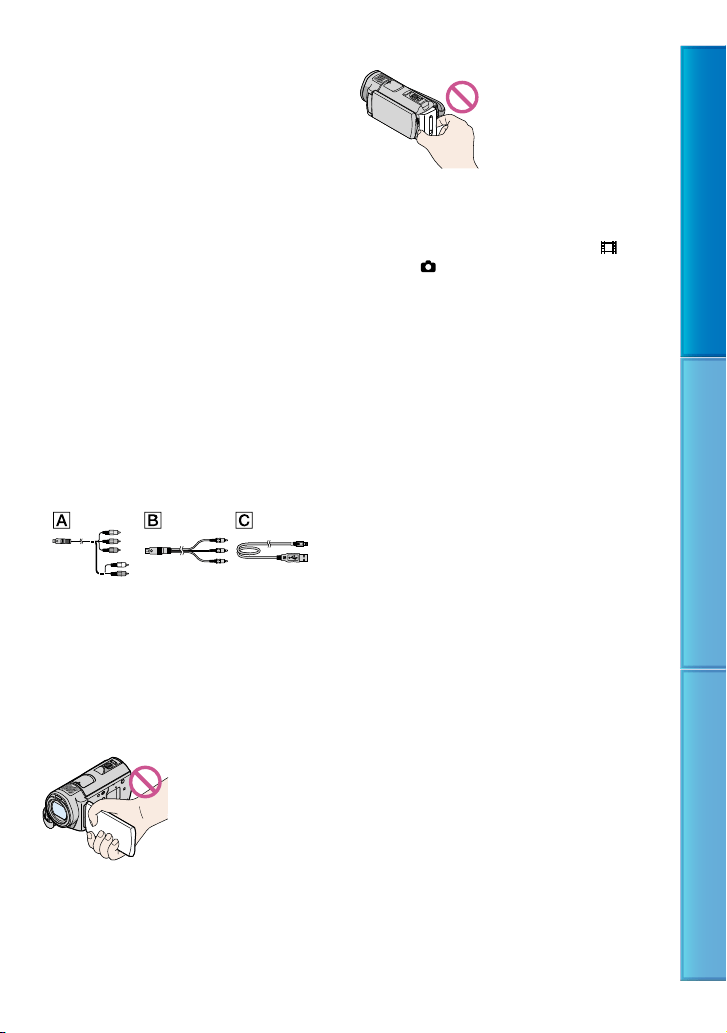
AC Adaptor (1)
Power cord (Mains lead) (1)
Component A/V cable (1)
A/V connecting cable (1)
USB cable (1)
Wireless Remote Commander (1)
A button-type lithium battery is already
installed.
Rechargeable battery pack NP-FH60 (1)
CD-ROM “Handycam” Application
Software (1)
“PMB” (software, including “PMB Guide”)
“Handycam” Handbook (PDF)
“Operating Guide” (1)
See page 67 for the “Memory Stick” media you
can use with this camcorder.
Using the camcorder
Do not hold the camcorder by the following
parts, and also do not hold the camcorder by
the jack covers.
LCD screen
Battery
The camcorder is not dustproofed, dripproofed
or waterproofed. See “About handling of your
camcorder” (p
. 122).
Do not do any of the following when the
(Movie)/
(Photo) lamps (p. 22) or the access
lamp (p. 68) are lit or flashing. Otherwise, the
recording media may be damaged, recorded
images may be lost or other malfunctions could
occur.
Ejecting the “Memory Stick PRO Duo” media
from the camcorder
Removing the battery pack or AC Adaptor
from the camcorder
Applying mechanical shock or vibration to
the camcorder
When connecting your camcorder to another
device with a cable, be sure to insert the
connector plug in the correct way. Pushing the
plug forcibly into the terminal will damage the
terminal and may result in a malfunction of
your camcorder.
Disconnect the AC Adaptor from the
camcorder, holding both the camcorder and the
DC plug.
Even if the camcorder is turned off, the GPS
function is working as long as the GPS switch
is set to ON. Make sure that the GPS switch is
set to OFF during take off and landing of an
airplane (HDR-CX500V/CX520V).
Menu items, LCD panel, and lens
A menu item that is grayed out is not available
under the current recording or playback
conditions.
The LCD screen is manufactured using
extremely high-precision technology, so over
99.99% of the pixels are operational for effective
use. However, there may be some tiny black
points and/or bright points (white, red, blue,
or green in color) that appear constantly on the
LCD screen. These points are normal results of
the manufacturing process and do not affect the
recording in any way.

17
Table of Contents Useful Recording Techniques Index
Exposing the LCD screen or the lens to direct
sunlight for long periods of time may cause
malfunctions.
Do not aim at the sun. Doing so might cause
your camcorder to malfunction. Take images
of the sun only in low light conditions, such as
at dusk.
About changing the language setting
The on-screen displays in each local language
are used for illustrating the operating
procedures. Change the screen language before
u
sing your camcorder if necessary (p. 23).
Recording
Before starting to record, test the recording
function to make sure that the image and sound
are recorded without any problems.
Compensation for the contents of recordings
cannot be provided, even if recording or
playback is not possible due to a malfunction of
the camcorder, storage media, etc.
TV color systems differ depending on the
country/region. To view your recordings on a
TV, you need an NTSC system-based TV.
Television programs, films, video tapes,
and other materials may be copyrighted.
Unauthorized recording of such materials may
be contrary to copyright laws.
Playing back recorded images on other
devices
Your camcorder is compatible with MPEG-4
AVC/H.264 High Profile for high definition
image quality (HD) recording. Therefore,
you cannot play back images recorded with
high definition image quality (HD) on your
camcorder with the following devices;
Other AVCHD format compatible devices
which are not compatible with High Profile
Devices which are not compatible with the
AVCHD format
Discs recorded with HD image quality
(high definition)
This camcorder captures high definition footage
in the AVCHD format. DVD media containing
AVCHD footage should not be used with DVD
based players or recorders, as the DVD player/
recorder may fail to eject the media and may
erase its contents without warning. DVD media
containing AVCHD footage may be played on
a compatible Blu-ray Disc
player/recorder or
other compatible device.
Save all your recorded image data
To prevent your image data from being lost,
save all your recorded images on external media
periodically. It is recommended that you save
the image data on a disc such as a DVD-R using
your computer (see Operating Guide). Also,
you can save your image data using a VCR, or a
DVD/HDD r
ecorder (p. 62).
Notes on battery pack/AC Adaptor
Be sure to remove the battery pack or the AC
Adaptor after turning off the camcorder.
Note on the camcorder/battery pack
temperature
When the temperature of the camcorder
or battery pack becomes extremely high or
extremely low, you may not be able to record
or play back on the camcorder, due to the
protection features of the camcorder being
activated in such situations. In this case, an
in
dicator appears on the LCD screen (p. 108).
When the camcorder is connected to a
computer
Do not try to format the media of the
camcorder using a computer. If you do so, your
camcorder may not operate correctly.
Note on disposal/transfer
Even if you perform [ DELETE ALL],
[
DELETE ALL], [ DELETE ALL] or
[MEDIA FORMAT] (p
. 92) or formatting the
media of the camcorder, you may not delete
data from the media completely. When you
transfer the camcorder, it is recommended that
Black points
White, red, blue or green points

18
Table of Contents Useful Recording Techniques Index
you perform [ EMPTY] (p. 69) to prevent the
recovery of your data. Also, when you dispose
of the camcorder, it is recommended that you
destroy the actual body of the camcorder.
If you cannot record/play back images,
perform [MEDIA FORMAT]
If you repeat recording/deleting images for
a long time, fragmentation of data occurs on
the recording media. Images cannot be saved
or recorded. In such a case, save your images
o
n some type of external media first (p. 62,
see Operating Guide too), and then perform
[MEDIA FORMAT] (p
. 92).
19
Table of Contents Useful Recording Techniques Index
Getting started
Step 1: Charging the battery pack
You can charge the “InfoLITHIUM” battery pack (H series) after attaching it to your
camcorder.
You cannot attach any “InfoLITHIUM” battery pack other than the H series to your camcorder.
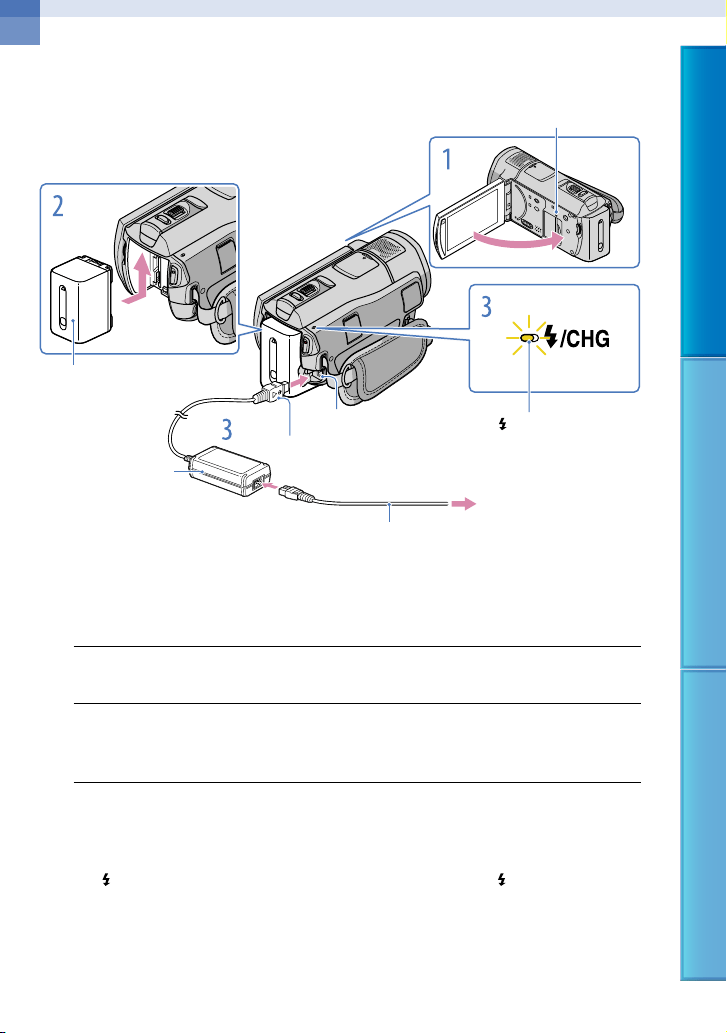
1
Turn off your camcorder by closing the LCD screen.
2
Attach the battery pack by sliding it in the direction of the arrow until it
clicks.
3
Connect the AC Adaptor and the power cord (mains lead) to your
camcorder and the wall outlet (wall socket).
Align the mark on the DC plug with that on the DC IN jack.
The /CHG (flash/charge) lamp lights up and charging starts. The /CHG (flash/charge)
lamp turns off when the battery pack is fully charged.
Battery pack
DC IN jack
DC plug
AC Adaptor
Power cord
(Mains lead)
/CHG (flash/charge)
lamp
To the wall outlet
(wall socket)
Access lamp
20
Table of Contents Useful Recording Techniques Index
4
When the battery is charged, disconnect the AC Adaptor from the DC IN
jack of your camcorder.
See page 111 on recording and playing time.
When your camcorder is on, you can check the approximate amount of remaining battery power with the
remaining battery indicator at the upper left on the LCD screen.
Charging time
Approximate time (min.) required when you fully charge a fully discharged battery pack.
Battery pack Charging time
NP-FH50 135
NP-FH60 (supplied) 135
NP-FH70 170
NP-FH100 390
Times measured with the camcorder at 25 C (77 ˚F).
10
C to 30 C (50 ˚F to 86 ˚F) is recommended.
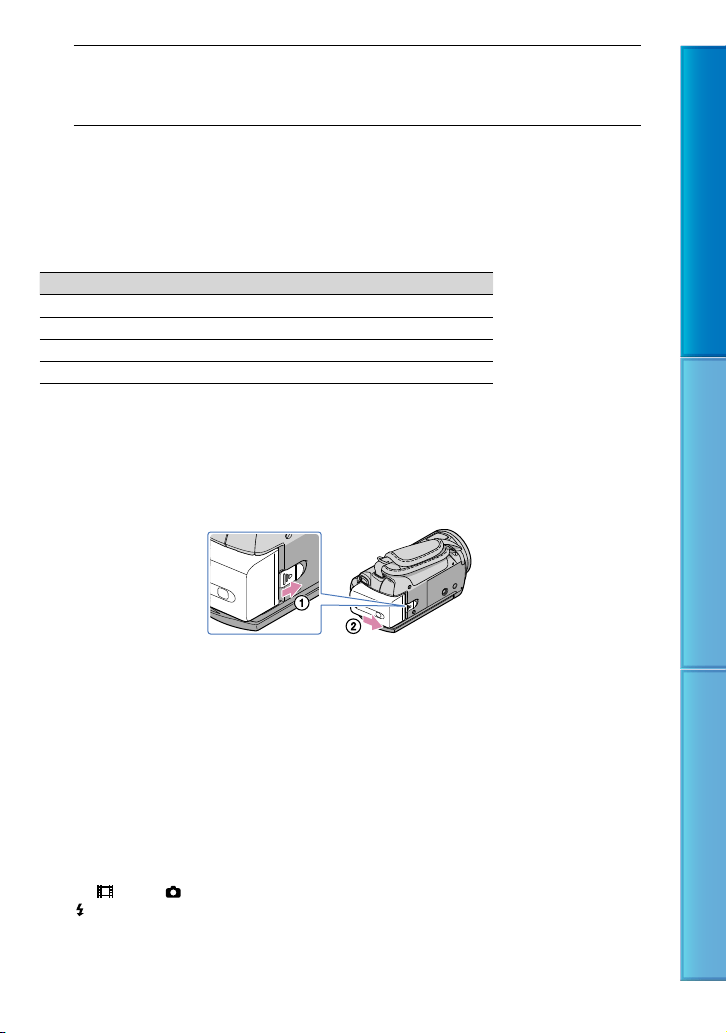
To remove the battery pack
Close the LCD screen. Slide the BATT (battery) release lever () and remove the battery
pack ().
To use a wall outlet (wall socket) as a power source
Make the same connections as “Step 1: Charging the battery pack.” Even if the battery pack is
attached, the battery pack is not discharged.
Charging the battery pack abroad
You can charge the battery pack in any countries/regions using the AC Adaptor supplied with
your camcorder within the AC 100 V - 240 V, 50 Hz/60 Hz range.
Do not use an electronic voltage transformer.
Notes on the battery pack
When you remove the battery pack or disconnect the AC Adaptor, close the LCD screen and make sure
that the
(Movie)/ (Photo) lamps (p. 22), the access lamp (p. 19) are turned off.
The
/CHG (flash/charge) lamp flashes during charging under the following conditions:
The battery pack is not attached correctly
The battery pack is damaged

21
Table of Contents Useful Recording Techniques Index
The temperature of the battery pack is low
Remove the battery pack from your camcorder and put it in a warm place
The temperature of the battery pack is high
Remove the battery pack from your camcorder and put it in a cool place
When attaching a video light (sold separately), it is recommended that you use an NP-FH70 or NP-
FH100 battery pack.
We do not recommend using an NP-FH30, which only allows short recording and playback times, with
your camcorder.
In the default setting, the power turns off automatically if you leave your camcorder without any
operation for about 5 minutes, to save battery power ([A.SHUT OFF], p
. 99).
Notes on the AC Adaptor
Use the nearby wall outlet (wall socket) when using the AC Adaptor. Disconnect the AC Adaptor from
the wall outlet (wall socket) immediately if any malfunction occurs while using your camcorder.
Do not use the AC Adaptor placed in a narrow space, such as between a wall and furniture.
Do not short-circuit the DC plug of the AC Adaptor or battery terminal with any metallic objects. This
may cause a malfunction.
22
Table of Contents Useful Recording Techniques Index
Step 2: Turning the power on, and setting the
date and time
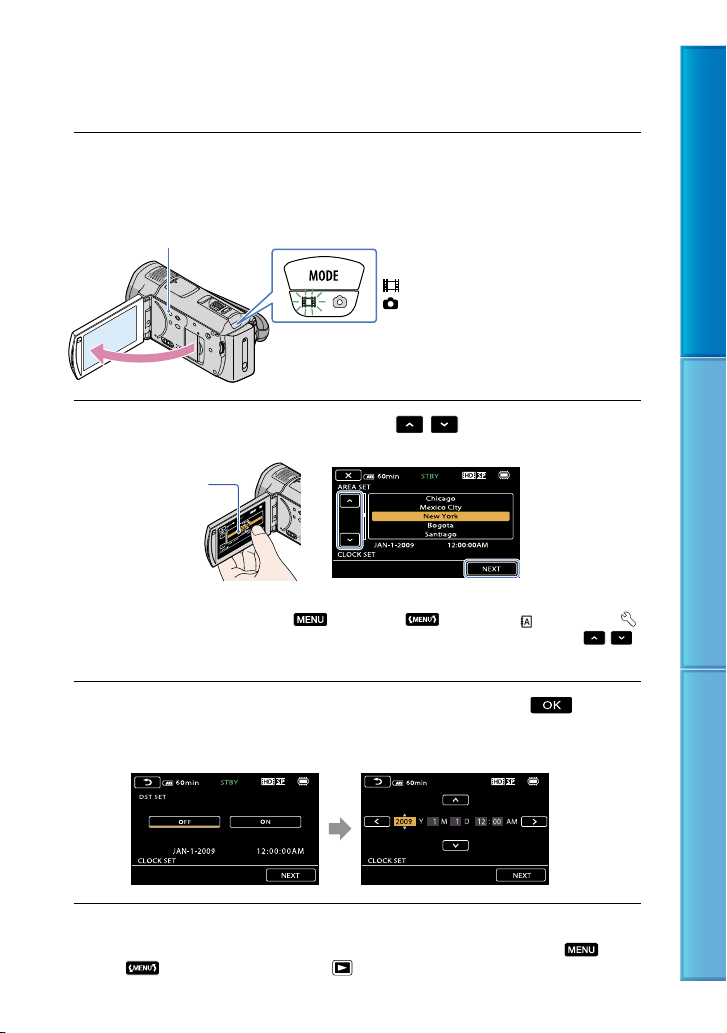
1
Open the LCD screen of your camcorder.
The lens cover is opened and your camcorder is turned on.
To turn on your camcorder when the LCD screen is open, press POWER.
2
Select the desired geographical area with
/ , then touch [NEXT].
To set the date and time again, touch (MENU) [CLOCK/ LANG] (under
[GENERAL SET] category) [CLOCK SET]. When an item is not on the screen, touch
/
until the item appears.
3
Set [DST SET] or [SUMMERTIME], date and time, then touch
.
The clock starts.
If you set [DST SET] or [SUMMERTIME] to [ON], the clock advances 1 hour.
The date and time does not appear during recording, but they are automatically recorded on the
recording media, and can be displayed during playback. To display the date and time, touch
(MENU)
[PLAYBACK SET] (under [PLAYBACK] category) [DATA CODE]
Touch the button on
the LCD screen.
(Movie): To record movies
(Photo): To record photos
MODE button
POWER button

23
Table of Contents Useful Recording Techniques Index
[DATE/TIME] .
You can turn off the operation beeps by touching
(MENU) [SOUND/DISP SET]
(under
[GENERAL SET] category) [BEEP] [OFF] .
If the button you touch does not react correctly, calibrate the touch panel (p. 123).
Once the clock is set, the clock time is automatically adjusted with [AUTO CLOCK ADJ] and [AUTO
AREA ADJ] set to [ON] (p
. 97). The clock may not be adjusted to the correct time automatically,
depending on the country/region selected for your camcorder. In this case, set [AUTO CLOCK ADJ] and
[AUTO AREA ADJ] to [OFF] (HDR-CX500V/CX520V).
To turn off the power
Close the LCD screen. The (Movie) lamp flashes for a few seconds and the power is turned
off.
You can turn off your camcorder also by pressing POWER.
When [POWER ON BY LCD] (p
. 99) is set to [OFF], turn off your camcorder by pressing POWER.
Changing the language setting
You can change the on-screen displays to show messages in a specified language.
Touch
(MENU) [CLOCK/ LANG] (under [GENERAL SET]
category) [
LANGUAGE SET] a desired language .
POWER button

24
Table of Contents Useful Recording Techniques Index
Recording/Playback
Five pieces of advice for successful recording
Stabilizing your camcorder
When you hold the camcorder, keep your upper body upright,
and hold your arms close to your body.
The SteadyShot function is effective against camera-shake,
however, it is essential that you not move the camcorder.
Zooming smoothly
Zoom in and out slowly and smoothly. And, use zooming
sparingly. Excessive zooming will make movies that may make
the viewer feel tired when viewing them.
Evoking a feeling of spaciousness
Use the panning technique. Stabilize yourself, move your
camcorder horizontally as you turn your upper body slowly. Stay
still at the end of panning for a while to make the scene look
stable.
Accentuating movies with narration
Consider the sound to be recorded with your movies. Narrate
the subject, or talk to the subject during shooting.
Aim for a balanced volume of voices, since the recording person
is closer to the microphone than the recorded person.
Using accessories
Make good use of camcorder accessories.
For example, using a tripod, you can make a time-lapse
recording or record subjects in dim light, such as scenes of
fireworks, or night views. By always carrying spare batteries, you
can continue recording without worrying about battery power
shortages.
25
Table of Contents Useful Recording Techniques Index
Recording
Recording movies
In the default setting, movies are recorded with high definition image quality (HD) on the
internal memory (p. 67, 77).
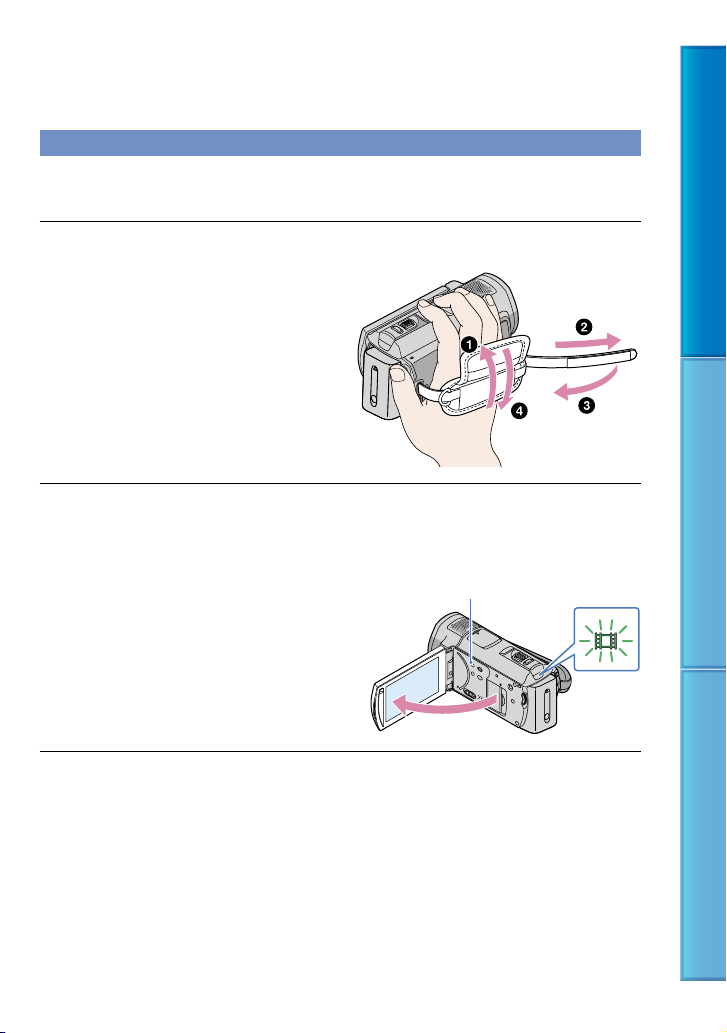
Fasten the grip belt.
Open the LCD screen of your camcorder.
The lens cover is opened and your camcorder is turned on.
To turn on your camcorder when the LCD screen is already open, press POWER.
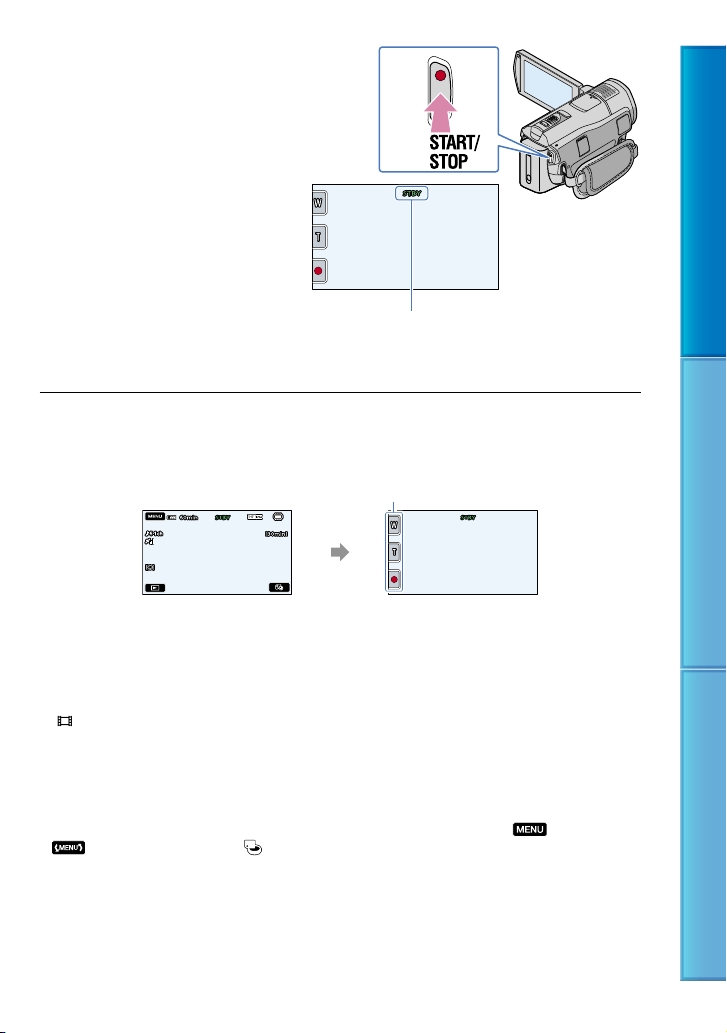
Press START/STOP to start recording.
You can start recording also by touching on the LCD screen.
POWER button
26
Table of Contents Useful Recording Techniques Index
To stop recording, press START/STOP again.
You can stop recording also by touching on the LCD screen.
The icons and indicators on the LCD panel will be displayed for about 3 seconds, then disappear after
turning on your camcorder or switching the recording (movie/photo)/playback modes. To display the
icons and indicators again, touch anywhere on the screen except the rec & zoom buttons on the LCD.
If you close the LCD screen while recording movies, the camcorder stops recording.
See page 111 on the recordable time of movies.
The maximum continuous recordable time of movies is about 13 hours.
When a movie file exceeds 2 GB, the next movie file is created automatically.
Y
ou can change the recording media and the recording mode (p. 67, 77).
[
STEADYSHOT] is set to [ACTIVE] in the default setting.
It will take several seconds until you can start recording after you turn on the camcorder. You cannot
operate your camcorder during this time.
If the access lamp is lit or flashing after recording is finished, it means that data is still being written onto
the recording media. Do not apply shock or vibration to your camcorder, and do not remove the battery
or AC Adaptor.
You can check the recordable time, estimated remaining capacity, etc., by touching
(MENU)
[MEDIA INFO] (under [MANAGE MEDIA] category) (p. 92).
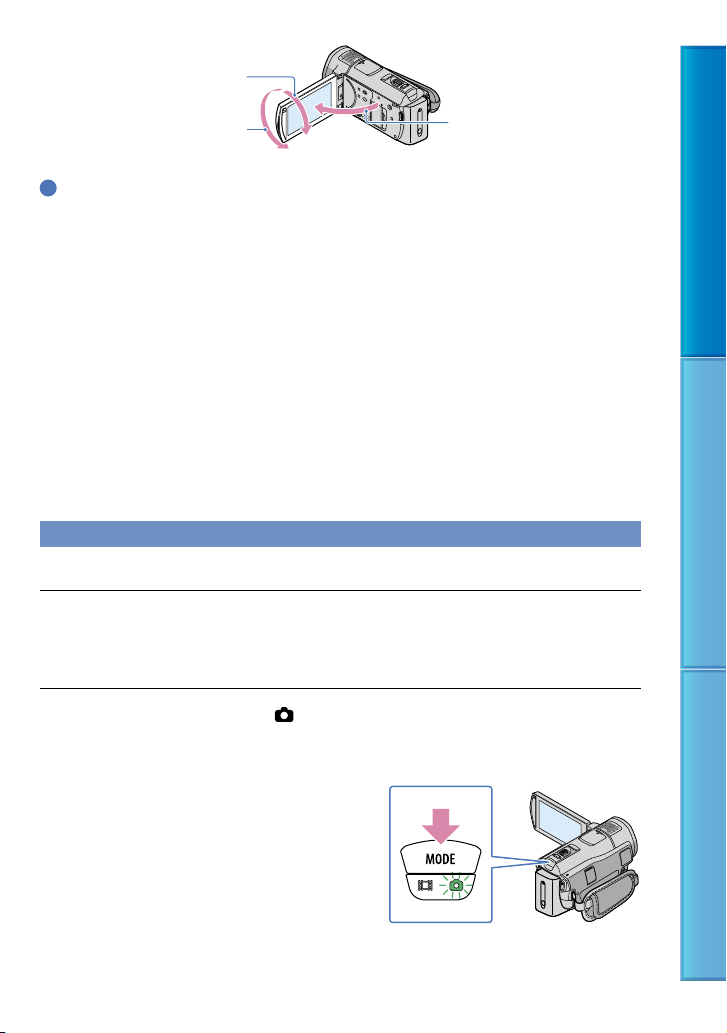
To adjust the angle of the LCD panel, first open the LCD panel 90 degrees to the camcorder (), and
then adjust the angle (). If you rotate the LCD panel 180 degrees to the lens side (), you can record
movies/photos in mirror mode.
Rec & zoom buttons on LCD
about 3sec
after
[STBY] [REC]
27
Table of Contents Useful Recording Techniques Index
Tips
You can record photos during movie recording by pressing PHOTO fully (Dual Rec, p
. 31).
When a face is detected, a white frame appears and the image quality around the face is optimized
automatically ([FACE DETECTION], p
. 79).
You can specify the priority face by touching it (p. 29).
In the default setting, a photo is recorded automatically when the camcorder detects the smile of a person
d
uring movie recording (Smile Shutter, p. 30).
Y
ou can capture photos from recorded movies (p. 55).
The LCD screen of your camcorder can display recording images across the entire screen (full pixel
display). However, this may cause slight trimming of the top, bottom, right and left edges of images when
played back on a TV which is not compatible with full pixel display. In this case, set [GUIDEFRAME] to
[ON] (p
. 78), and record images using the outer frame displayed on the screen as a guide.
Data code during recording
The recording date, time and condition , and coordinates (HDR-CX500V/CX520V) are
recorded automatically on the recording media. They are not displayed during recording.
However, you can check them as [DATA CODE] d
uring playback (p. 88).
Shooting photos
In the default setting, photos are recorded on the internal memory (p. 67).
Open the LCD screen of your camcorder.
The lens cover is opened and your camcorder is turned on.
To turn on your camcorder when the LCD screen is already open, press POWER (p. 22).
Press MODE to turn on the (Photo) lamp.
The LCD screen display switches for photo recording mode, and the screen aspect ratio
becomes 4:3.
90 degrees (max.)
180 degrees (max.)
90 degrees to
the camcorder
28
Table of Contents Useful Recording Techniques Index
Press PHOTO lightly to adjust the focus, then press it fully.
You can record photos also by touching on the LCD screen.
When disappears, the photo is recorded.
See page 113 on the recordable number of photos.
To change the image size, touch
(MENU) [ IMAGE SIZE] (under [PHOTO
SETTINGS] category) a desired setting
(p. 84).
You can record photos during movie recording by pressing PHOTO (Dual Rec, p
. 31).
Your camcorder flashes automatically when there is insufficient ambient light. The flash does not work
during movie recording. You can change how your camcorder flashes by [FLASH MODE] (p
. 85).
If you record photos using a flash with a conversion lens, the shadow may be reflected.
You cannot record photos while
is displayed.
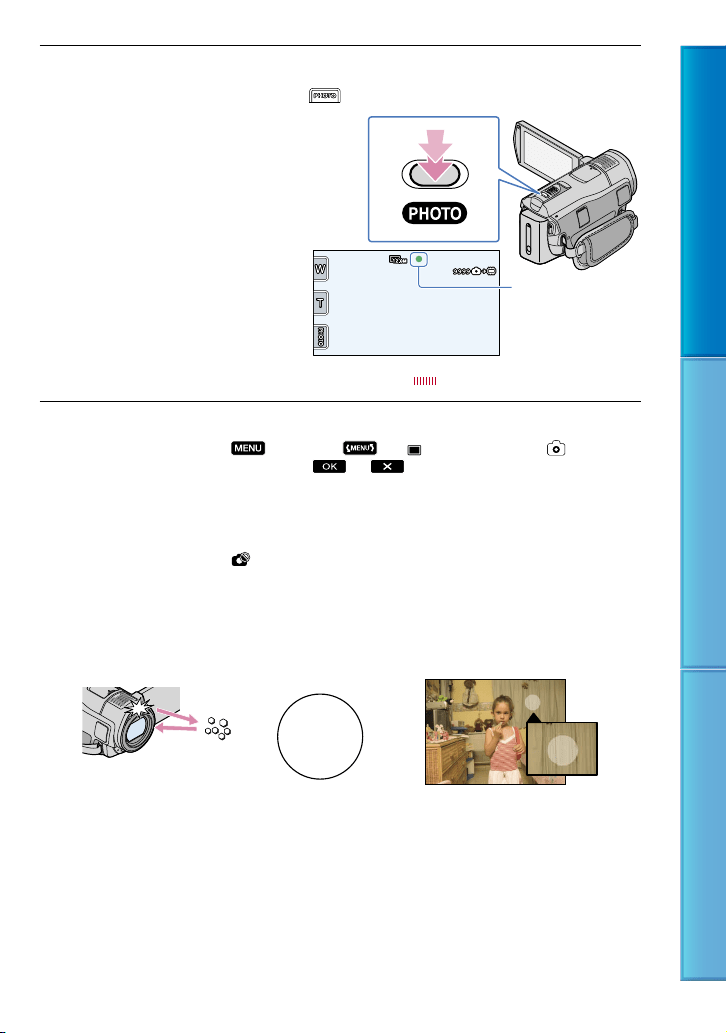
If white circular spots appear on photos
This is caused by particles (dust, pollen, etc.) floating close to the lens. When they are
accentuated by the camcorder’s flash, they appear as white circular spots.
To reduce the white circular spots, light the room and shoot the subject without a flash.
Particles (dust,
pollen, etc.) in
the air
Subject
Flashes Lights up
29
Table of Contents Useful Recording Techniques Index
Useful functions for recording movies and photos
Zooming
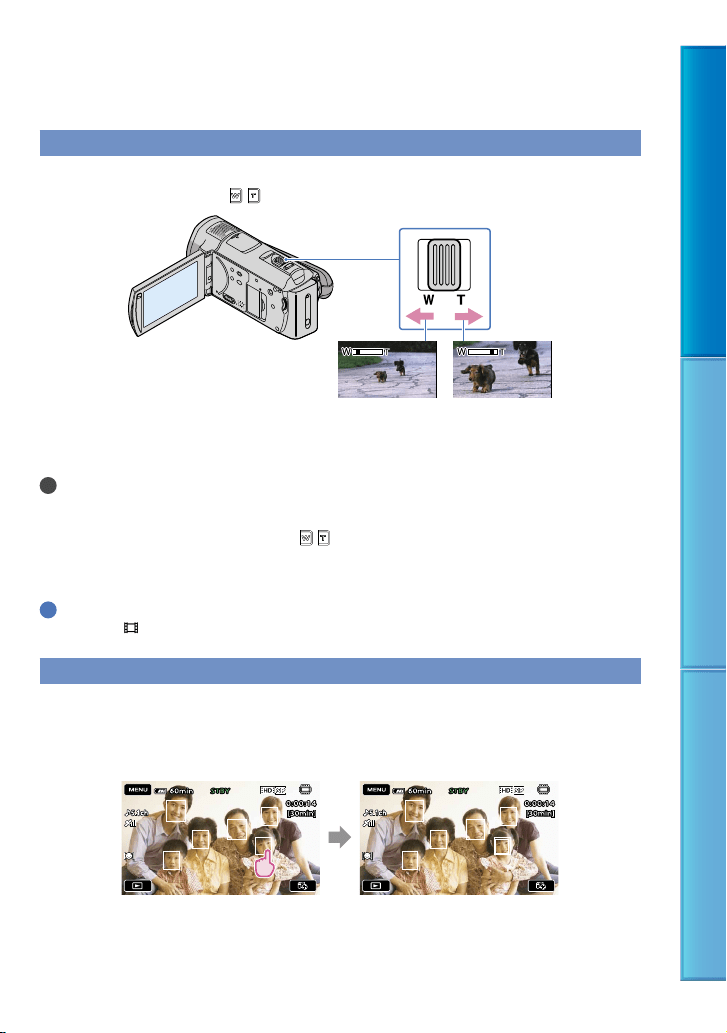
You can magnify images up to 12 times the original size with the power zoom lever. You can
magnify images also with the
/ on the LCD screen.
Move the power zoom lever slightly for a slower zoom. Move it further for a faster zoom.
Notes
Be sure to keep your finger on the power zoom lever. If you move your finger off the power zoom lever,
the operation sound of the power zoom lever may also be recorded.
You cannot change the zoom speed with the
/ button on the LCD screen.
The minimum possible distance between camcorder and subject while maintaining sharp focus is about 1
cm (about 13/32 in.) for wide angle and about 80 cm (about 31 1/2 in.) for telephoto.
Tips
You can set [
DIGITAL ZOOM] (p. 81) if you want to zoom to a greater level.
Prioritizing the subject
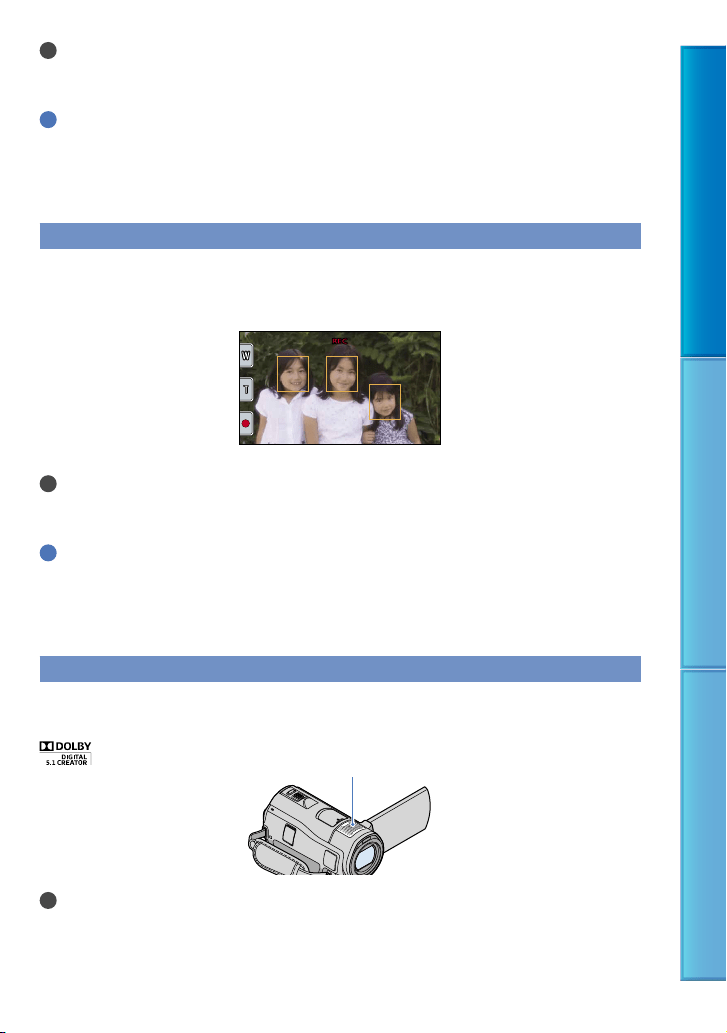
When [FACE DETECTION] (p. 79) is set to [ON] (the default setting), and several faces are
detected, touch the face you want to record as priority. Focus/color/exposure are adjusted
automatically for the selected face.
Touch the face with the double-lined frame again to cancel.
Touch the face you want to
record as priority.
The double-lined frame is
displayed.
Wider range of view
(Wide angle)
Close view
(Telephoto)
30
Table of Contents Useful Recording Techniques Index
Notes
The face you touched may not be detected, depending on the surrounding brightness or hairstyle of the
subject. In this case, touch the face again when you record.
Tips
In the default setting, the face you touched has priority also with the Smile Shutter function.
The double-lined frame around a face targeted for possible smile detection shot turns orange.
If the face you touched disappears from the LCD screen, the subject selected in [PRIORITY SETTING]
(p
. 80) has priority. If the face you touched returns to the screen, the face has priority.
Capturing smiles automatically (Smile Shutter)
In the default setting, a photo is recorded automatically when the camcorder detects the smile
of a person during movie recording. An orange frame appears around a face targeted for
possible smile detection shot.
Notes
Smiles may not be detected depending on recording conditions, subject conditions, and the setting of
your camcorder.
Tips
You can select the subject that has priority for face detection and smile detection with [PRIORITY
SETTING] (p
. 80). When you specify the priority subject by touching the detection frame on the LCD
screen, the face with a double-lined frame has priority.
If a smile is not detected, set the [SMILE SENSITIVITY] (p
. 80).
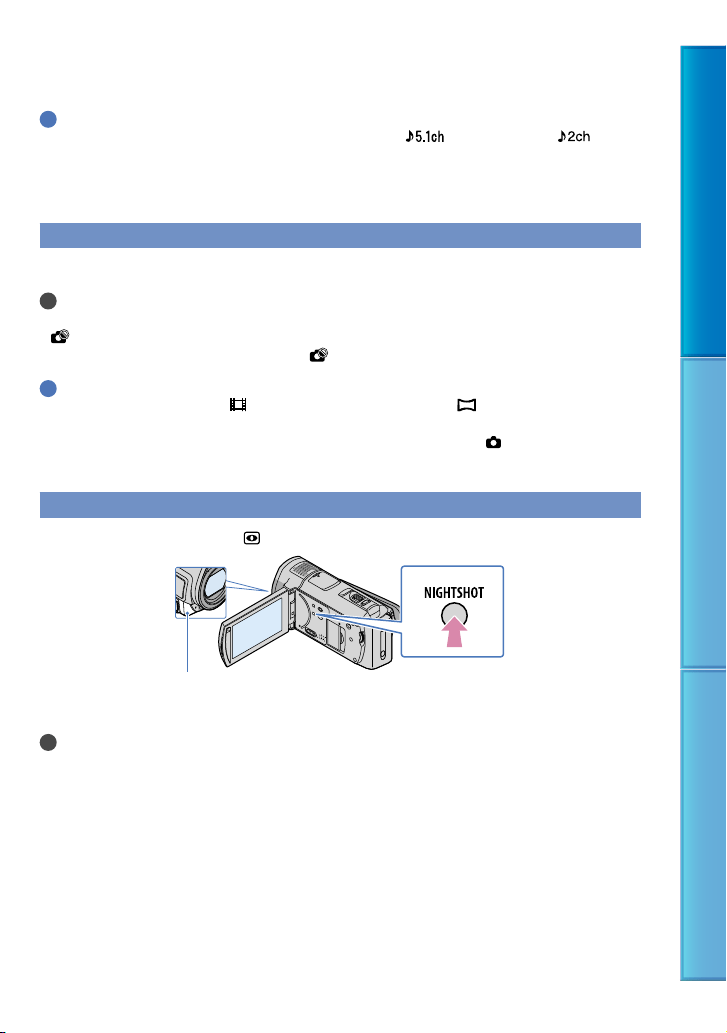
Recording sound with more presence (5.1ch surround recording)
You can record Dolby Digital 5.1ch surround sound with the built-in microphone. Realistic
sound can be enjoyed when playing a movie on devices that support 5.1ch surround sound.
Notes
If you play back 5.1ch sound on your camcorder, 5.1ch sound is automatically converted and output in
2ch.
To enjoy the 5.1ch surround sound of the movies recorded with high definition image quality (HD) in
5.1ch sound, you need an AVCHD format device compatible with 5.1ch surround.
Built-in microphone
31
Table of Contents Useful Recording Techniques Index
When you connect your camcorder with an HDMI cable (sold separately), the sound of high definition
image quality (HD) movies recorded in 5.1ch sound is automatically output in 5.1ch sound. The sound of
standard definition image quality (SD) movies is converted to 2ch.
Tips
You can select the recording sound from [5.1ch SURROUND] (
) or [2ch STEREO] ( )
([AUDIO MODE], p
. 81).
You can create a disc, which contains the movies recorded on your camcorder, on a computer using the
supplied software. If you play the disc on a 5.1ch surround system, you can enjoy realistic sound.
Recording high quality photos during movie recording (Dual Rec)
You can record photos during movie recording by pressing PHOTO.
Notes
You cannot use the flash during Dual Rec.
may appear when the capacity of the recording media is not enough or when you record photos
continuously. You cannot record photos while
is displayed.
Tips
When the MODE lamp is set to
(Movie), the size of photos becomes [ 8.3M] (16:9 wide) or [6.2M]
(4:3).
You can record photos during recording standby in the same way as when the
(Photo) lamp is turned
on. You can also record with the flash.
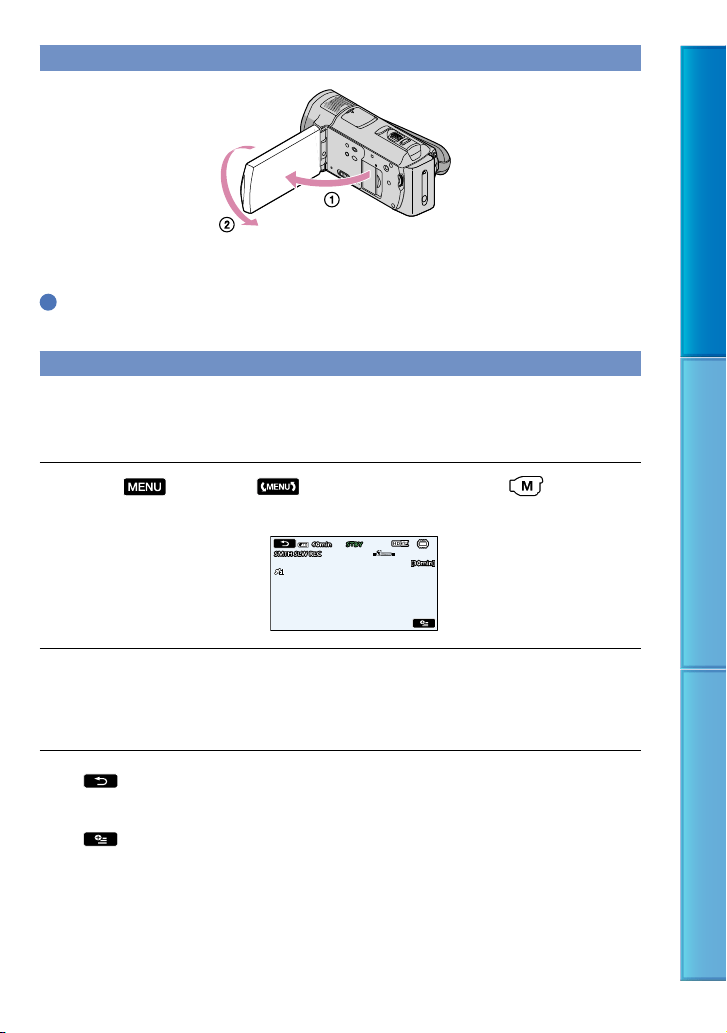
Recording in dark places (NightShot)
When you press NIGHTSHOT, appears, and you can record images even in total darkness.
Press NIGHTSHOT again to cancel the NightShot function.
Notes
The NightShot function uses infrared light. Therefore, do not cover the infrared port with your fingers or
other objects.
Remove the conversion lens (sold separately).
Adjust the focus manually ([FOCUS], p
. 74) when it is hard to focus automatically.
Do not use the NightShot function in bright places. This may cause a malfunction.
Set [LOW LUX] (p
. 79) when you record photos with color images in dim light.
Infrared port
32
Table of Contents Useful Recording Techniques Index
Recording in mirror mode
Open the LCD panel 90 degrees to the camcorder (), then rotate it 180 degrees to the lens
side ().
Tips
A mirror-image of the subject appears on the LCD screen, but the image will be normal when recorded.
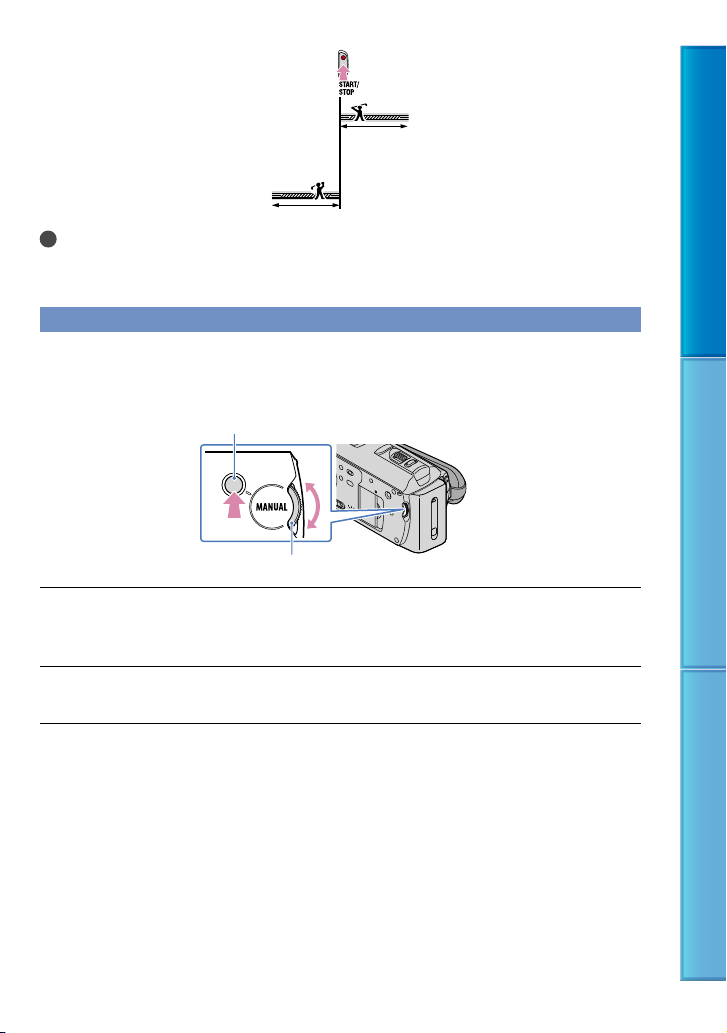
Recording fast action in slow-motion (SMTH SLW REC)
Fast moving subjects and actions, which cannot be captured under the ordinary shooting
conditions, can be shot in smooth moving slow-motion for about 3 seconds.
This is useful to shoot fast actions such as a golf or tennis swing.
Touch (MENU) [SMTH SLW REC] (under [MANUAL
SETTINGS] category).
Press START/STOP.
An about-3-second movie is recorded as a 12-second-slow-motion movie.
[Recording…] disappears, when recording is finished.
Touch
to cancel the smooth slow recording.
To change the setting
Touch (OPTION), then select the setting you want to change.
[TIMING]
Select the recording start point after START/STOP is pressed. The default setting is [3sec
AFTER].
33
Table of Contents Useful Recording Techniques Index
Notes
You cannot record sound with [SMTH SLW REC].
Image quality of [SMTH SLW REC] is not as good as that of normal recording.
Controlling the image settings manually with the MANUAL dial
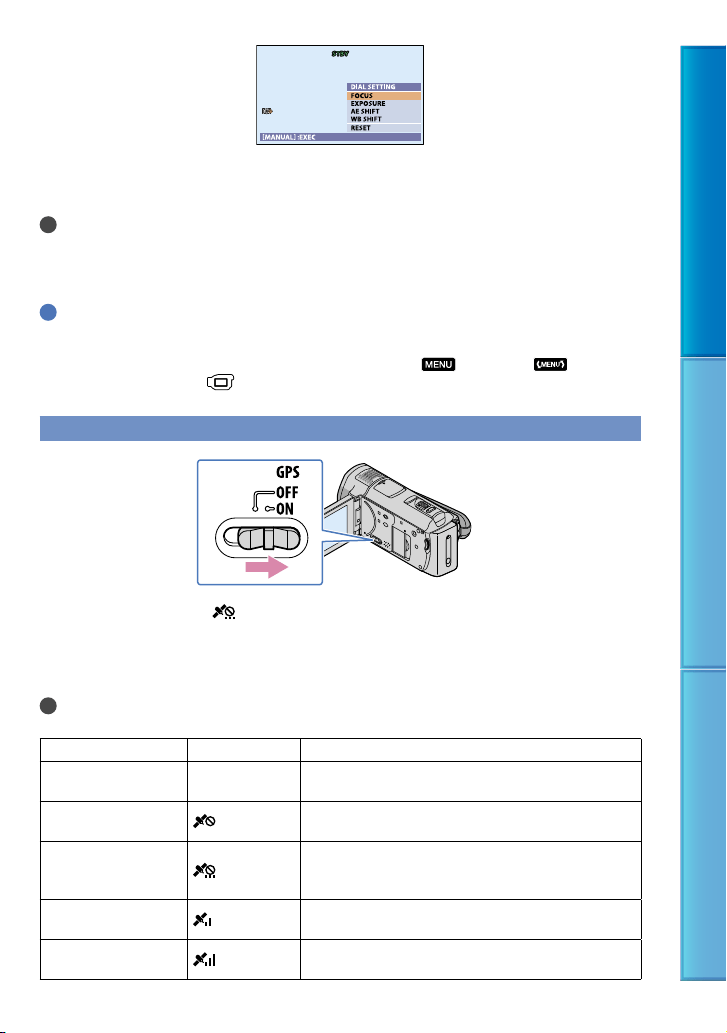
You can assign 1 menu item you use often to the MANUAL dial.
Since the focus adjustment is assigned to the MANUAL dial in the default settings, the
operation below is described as adjusting the focus using the dial.
Press MANUAL to activate the manual adjustment mode.
Pressing MANUAL switches the setting mode between automatic and manual.
Rotate the MANUAL dial to adjust the focus.
Items you can assign to the MANUAL dial
[FOCUS] (p. 74)
[EXPOSURE] (p
. 74)
[AE SHIFT] (p
. 75)
[WB SHIFT] (p
. 76)
To assign the menu items to the MANUAL dial
Press and hold MANUAL down for a few seconds.
MANUAL button
MANUAL dial
[3sec AFTER]
[3sec BEFORE]
34
Table of Contents Useful Recording Techniques Index
Rotate the MANUAL dial and select the item to be assigned.
P
ress MANUAL.
Notes
Manual settings will be retained even if you change the assigned item of the MANUAL dial. However, if
you set [EXPOSURE] after setting [AE SHIFT] manually, [EXPOSURE] will override [AE SHIFT].
If you select [RESET] in step , all the items adjusted manually are reset to the default settings.
Tips
The functions of the items that can be assigned to the MANUAL dial are the same as those of menu
operation.
You can also assign menu items to the MANUAL dial by touching
(MENU)
[OTHER REC SET] (under
[SHOOTING SET] category) [DIAL SETTING].
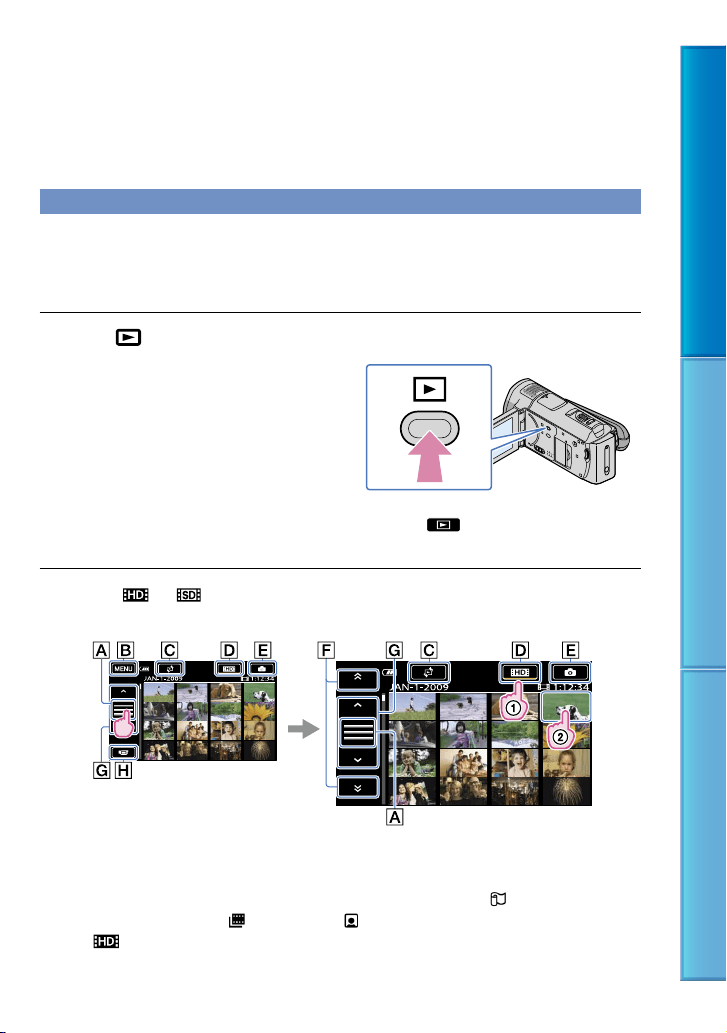
Acquiring location information (GPS) (HDR-CX500V/CX520V)
Set the GPS switch to ON ( appears on the LCD screen). Your camcorder starts trying
to triangulate. When your camcorder triangulates successfully, it will record the location
information at the time movies and photos were recorded.
Using the supplied software, “PMB,” you can display where movies and photos were recorded on a map.
Notes
The indicator changes according to the strength of GPS signal reception.
Triangulating status GPS indicators GPS reception status
Function off No indicator
The GPS switch is set to OFF, or the GPS receiver is not
functioning normally.
Difficult
Your camcorder cannot find a GPS signal, therefore, it
cannot triangulate. Use your camcorder in an open area.
Processing
Your camcorder is confirming the GPS signal, and will be
able to acquire location information soon. Wait until your
camcorder completes the triangulation.
Triangulating
Your camcorder is receiving a GPS signal, and can acquire
location information.
Triangulating
Your camcorder is receiving a strong GPS signal, and can
acquire location information.

35
Table of Contents Useful Recording Techniques Index
The GPS switch is set to ON in the default setting. Movies and photos recorded during triangulation by
GPS will be recorded with location information. If you do not want to record location information, set
the GPS switch to OFF.
It may take from several seconds to several minutes to acquire the location information when you use the
GPS for the first time or use it again after long intervals.
Even if the camcorder is turned off, the GPS function is working as long as the GPS switch is set to ON.
Make sure that the GPS switch is set to OFF during take off and landing of an airplane.
You may not be able to acquire location information in locations where radio signals from GPS satellites
do n
ot reach (p. 118).
The 3 dots in the lower right of
show GPS signal stability. When fewer than 3 dots are displayed, the
GPS signal is not stable enough to triangulate in the current environment. To successfully triangulate,
move to an open area first, and turn the GPS switch to OFF and ON again, or turn the power of your
camcorder off and on.
Your camcorder quits trying to triangulate after a few minutes of unsuccessful attempts. If your
camcorder continues to display
(triangulation process not started) even after moved to an open area,
turn the GPS switch to OFF and ON again, or turn the power of your camcorder off and on.
Tips
Y
ou can acquire your current location information to check where you are at the moment (p. 54).
You can search for movies and photos to be played on the Map Index (p
. 40).
When you play movies and photos with [DATA CODE] set to [COORDINATES], the location
inf
ormation appears on the LCD screen (p. 88).
You can use [AUTO CLOCK ADJ] and [AUTO AREA ADJ] t
o adjust the clock and the area (p. 97).
36
Table of Contents Useful Recording Techniques Index
Playback on the camcorder
In the default setting, movies and photos that are recorded on the internal memory are played
(p. 67).
Playing movies
Open the LCD screen of your camcorder.
The lens cover is opened and your camcorder is turned on.
To turn on your camcorder when the LCD screen is already open, press POWER.
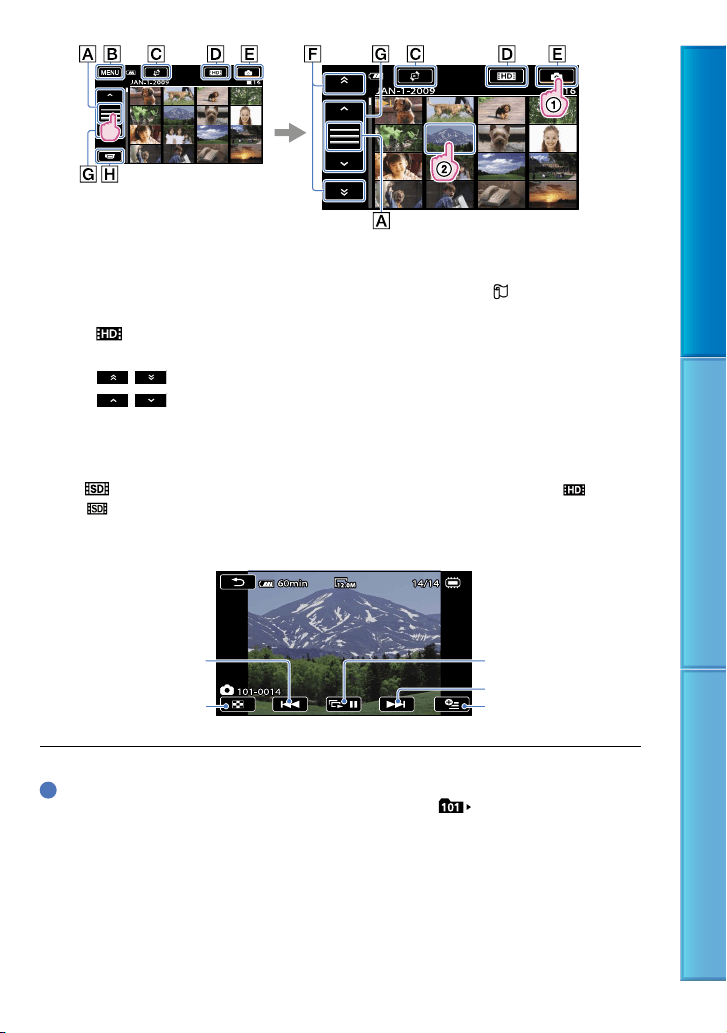
Press (VIEW IMAGES).
The VISUAL INDEX screen appears after some seconds.
You can display the VISUAL INDEX screen also by touching (VIEW IMAGES) on the LCD
screen.
Touch (or ) () a desired movie ().
Movies are displayed and sorted by recording date.
Switches operating button display.
To MENU screen
Displays the screen to select the index type ([DATE INDEX]/[
MAP] (HDR-
CX500V/CX520V)/[
FILM ROLL]/[ FACE]) (p. 39, 40, 41, 42).
: Displays high definition image quality (HD) movies*.
Displays photos.
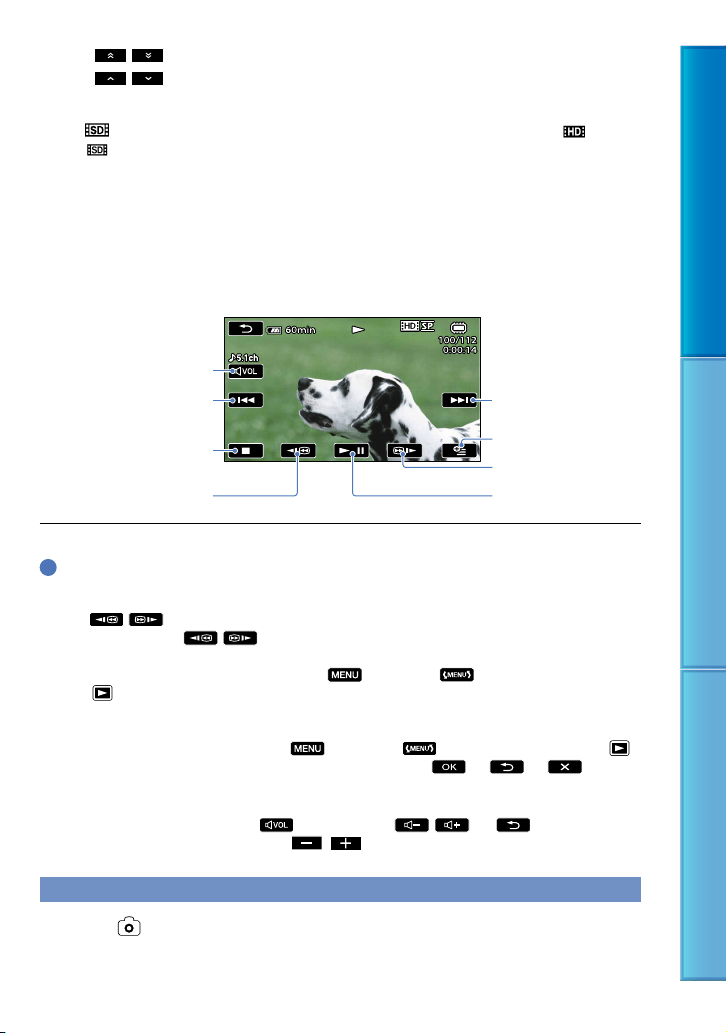
37
Table of Contents Useful Recording Techniques Index
/ : Displays movies recorded on the previous/next date.**
/ : Displays the previous/next movie.
Returns to the recording screen.
* appears when the standard definition image quality (SD) movie is selected with [ /
SET] (p. 77).
** is displayed when is touched.
You can scroll the display by touching and dragging or .
appears with the movie or photo that was most recently played or recorded. If you touch the
movie or photo with , you can continue playback from the previous time. ( appears on the
photo recorded on “Memory Stick PRO Duo” media.)
Your camcorder starts playing the selected movie.
Tips
When playback from the selected movie reaches the last movie, the screen returns to the VISUAL INDEX
screen.
Touch
/ during pause to play back movies slowly.
As you repeat touching
/ during playback, movies are played as fast as about 5 times
about 10 times about 30 times about 60 times.
You can display the VISUAL INDEX by touching
(MENU) [VISUAL INDEX]
(under
[PLAYBACK] category).
The recording date, time, and shooting conditions , and coordinates (HDR-CX500V/CX520V) are
recorded automatically during recording. This information is not displayed during recording, but you
can display it during playback by touching
(MENU) [PLAYBACK SET] (under
[PLAYBACK] category) [DATA CODE] a desired setting
.
To adjust the sound volume of movies
While playing back movies, touch adjust with / .
You can adjust the sound volume by using / in the OPTION MENU.
Viewing photos
Touch the (Photo) () a desired photo () on the VISUAL INDEX screen.
Volume adjustment
To stop
To fast-reverse
Next
OPTION
To fast-forward
To pause/play
Previous
38
Table of Contents Useful Recording Techniques Index
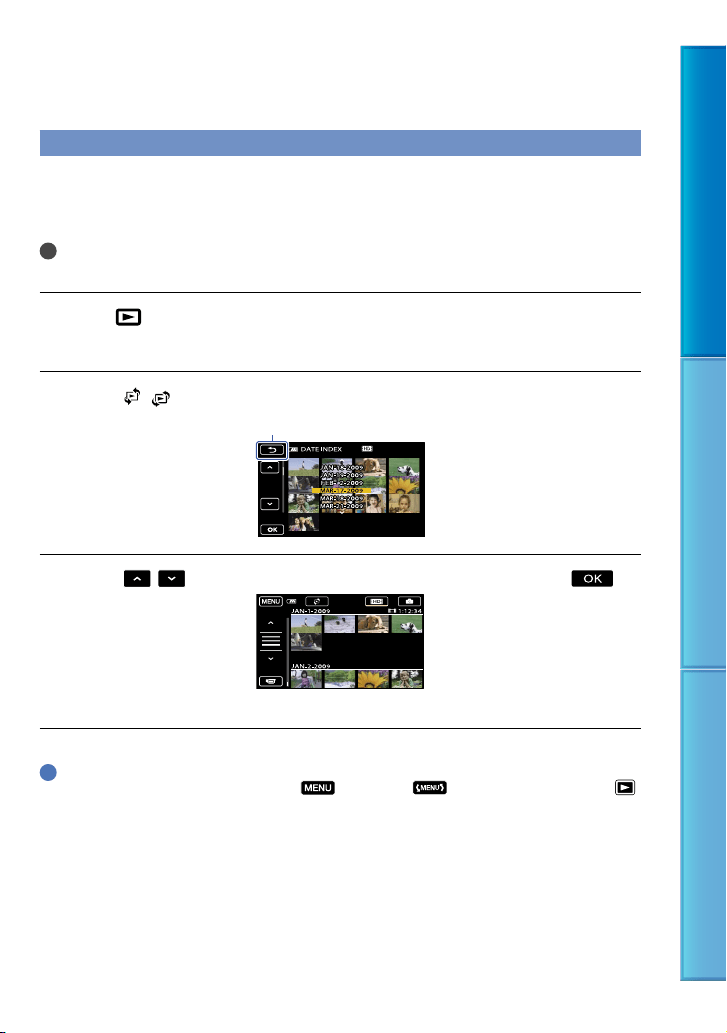
Switches operating button display.
To MENU screen
Displays the screen to select the index type ([DATE INDEX]/[
MAP] (HDR-
CX500V/CX520V))
*
1
(p. 39, 40).
: Displays high definition image quality (HD) movies.*
2
Displays photos.
/ : Displays photos recorded on the previous/next date.*
3
/ : Displays the previous/next photo.
Returns to the recording screen.
*
1
The screen to select the index type is not displayed when [PHOTO MEDIA SET] (p. 67) is set to
[MEMORY STICK].
*
2
appears when the standard definition image quality (SD) movie is selected with [ /
SET] (p. 77).
*
3
is displayed when is touched.
Your camcorder displays the selected photo.
Tips
When viewing photos recorded on “Memory Stick PRO Duo” media,
(playback folder) appears on
the screen.
Previous
To the VISUAL
INDEX screen
To start/stop slide show
Next
OPTION MENU
39
Table of Contents Useful Recording Techniques Index
Useful functions for playing movies and photos
Searching for desired images by date (Date Index)
You can search for desired images by date efficiently.
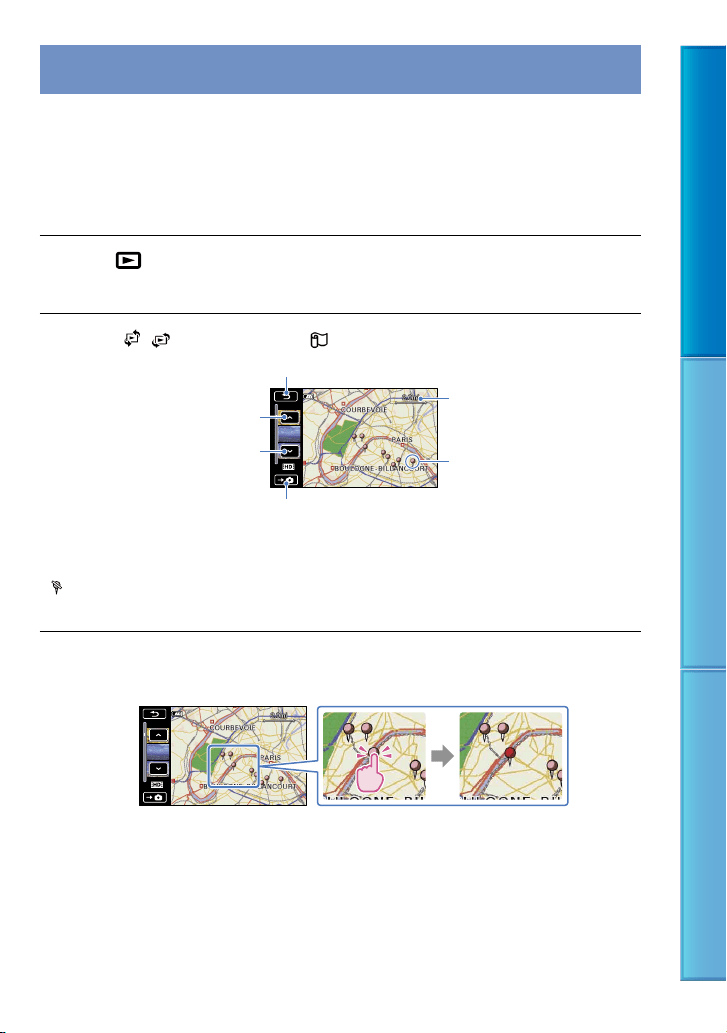
Select the recording media which contains the image you want to play back before the
o
peration (p. 67).
Notes
You cannot use the Date Index function for photos on the “Memory Stick PRO Duo” media.
Press (VIEW IMAGES).
The VISUAL INDEX screen appears.
Touch ( VIEW IMAGES) [DATE INDEX].
Touch / to select the date of the desired image, then touch .
The images of the selected date are displayed on the VISUAL INDEX screen.
Tips
You can also display Date Index by touching
(MENU) [VIEW IMAGES] (under
[PLAYBACK] category) [DATE INDEX].
On the [Film Roll Index]/[Face Index] screen, you can display the Date Index by touching the date in the
upper right corner of the screen.
Returns to the VISUAL INDEX screen
40
Table of Contents Useful Recording Techniques Index
Searching for a desired scene by recording location (Map Index) (HDR-
CX500V/CX520V)
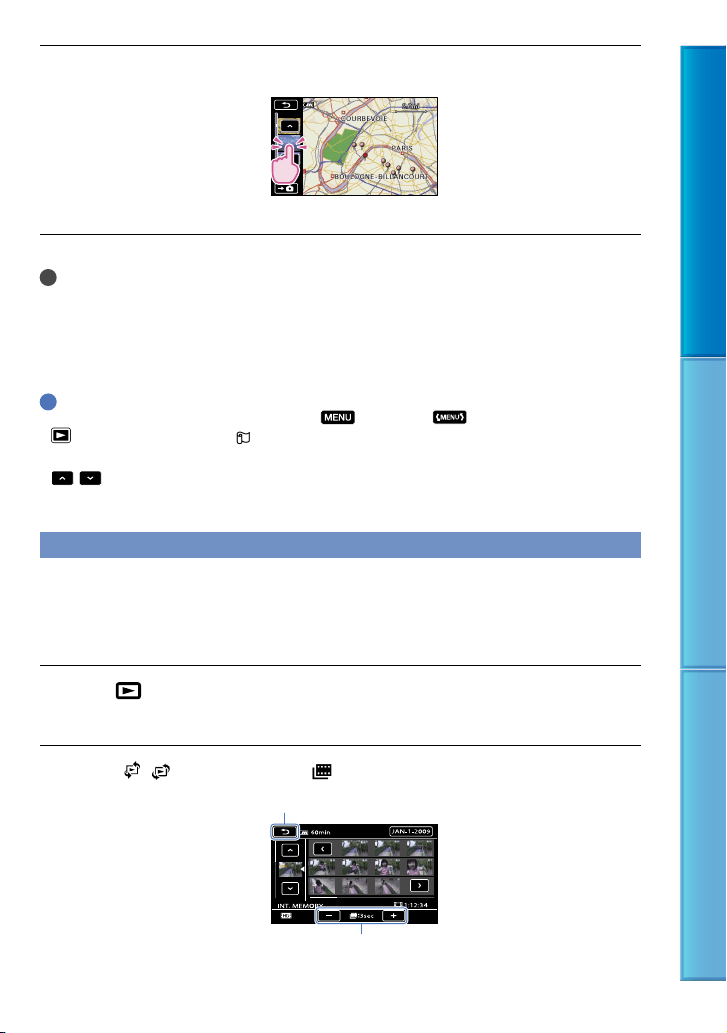
Where movies and photos were recorded is marked on a map. You can select a movie or photo
by recording location. Select the recording media which contains the movie or photo you
wa
nt to play back before starting this operation (p. 67).
You can use the Map Index only with movies and photos having location information that was recorded
with the GPS switch set to ON (p
. 34).
You cannot use the Map Index with photos recorded on “Memory Stick PRO Duo” media.
Press (VIEW IMAGES).
The VISUAL INDEX screen appears.
Touch ( VIEW IMAGES) [ MAP].
You can change the scale using the zoom lever (W: larger, T: smaller).
The point you touch on the map scrolls to the center automatically. If you hold a certain point, the map
keeps scrolling.
will appear at the upper right corner of the thumbnail of the movie or photo without location
information.
Touch the image marker where you recorded the movies and photos to be
played back.
The image marker turns red. The movies or photos recorded at that location are displayed
on the left of the screen.
Returns to the VISUAL INDEX screen
Scale
Image marker
Displays photos
Previous
Next
41
Table of Contents Useful Recording Techniques Index
Touch the desired movie or photo.
Playback starts from the selected scene.
Notes
Make sure that you set the GPS switch to ON (p
. 34) prior to recording, to be able to create movies and
photos that you can search for on the Map Index.
The map always displays the north at the top.
When you record several movies and photos at the same location, the movie or photo recorded most
recently will be displayed on the LCD screen.
Tips
You can also display the Map Index by touching
(MENU) [VIEW IMAGES] (under
[PLAYBACK] category) [ MAP].
You can also search for the thumbnail of the movie or photo you want to play by touching
/ in step 3. The recording location of the movie or photo will be displayed at the
center of the map.
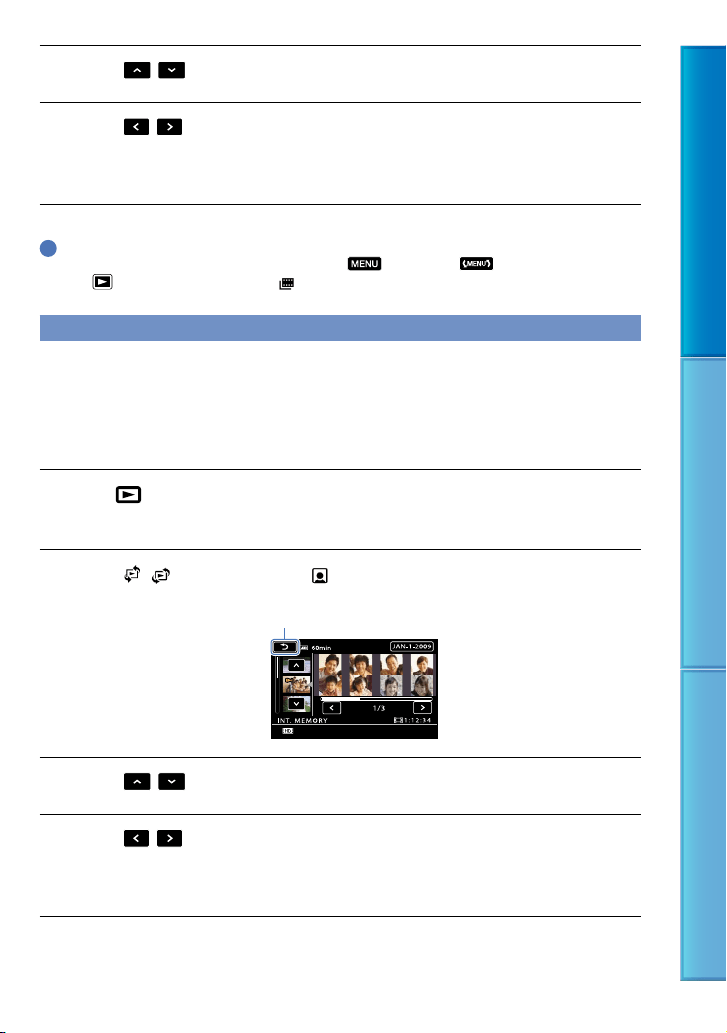
Searching for desired scene by pinpoint (Film Roll Index)
Movies can be divided by a set time and the first scene of each division is displayed on the
INDEX screen. You can start playing back a movie from the selected thumbnail.
Select the recording media which contains the movie you want to play back before the
o
peration (p. 67).
Press (VIEW IMAGES).
The VISUAL INDEX screen appears.
Touch ( VIEW IMAGES) [ FILM ROLL].
Returns to the VISUAL INDEX screen
Sets the interval at which to create thumbnails of
scenes in a movie.
42
Table of Contents Useful Recording Techniques Index
Touch
/ to select the desired movie.
Touch / to search for the desired scene, then touch the scene you
want to play back.
Playback starts from the selected scene.
Tips
You can also display the Film Roll Index by touching
(MENU) [VIEW IMAGES]
(under
[PLAYBACK] category) [ FILM ROLL].
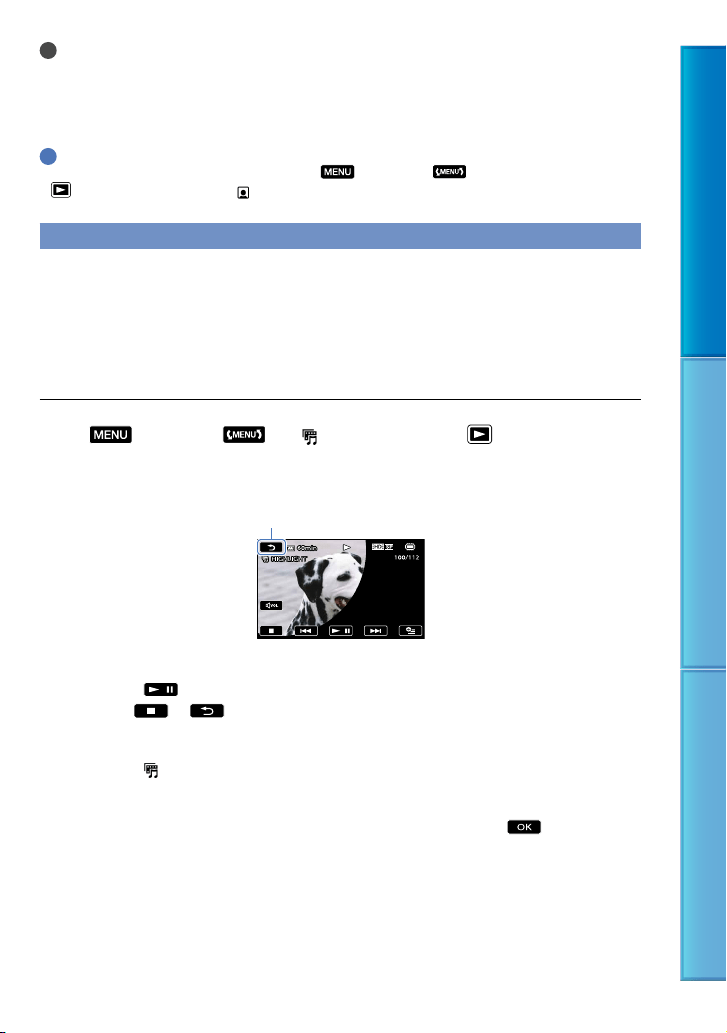
Searching for desired scene by face (Face Index)
The face images detected or touched during movie recording are displayed on the INDEX
screen.
You can play back the movie from the selected face image.
Select the recording media which contains the movie you want to play back before the
o
peration (p. 67).
Press (VIEW IMAGES).
The VISUAL INDEX screen appears.
Touch ( VIEW IMAGES) [ FACE].
Touch / to select the desired movie.
Touch / to search for the desired face image, then touch the desired
face image to view the scene.
Playback starts from the beginning of the scene with the selected face image.
Returns to the VISUAL INDEX screen
43
Table of Contents Useful Recording Techniques Index
Notes
Faces may not be detected depending on recording conditions.
Example: People wearing glasses or hats, or who do not face towards the camera.
Make sure that you set [FACE DETECTION] to [ON] (p
. 79) (the default setting) prior to recording, to
search movies on the Face Index.
Tips
You can also display the Face Index by touching
(MENU) [VIEW IMAGES] (under
[PLAYBACK] category) [ FACE].
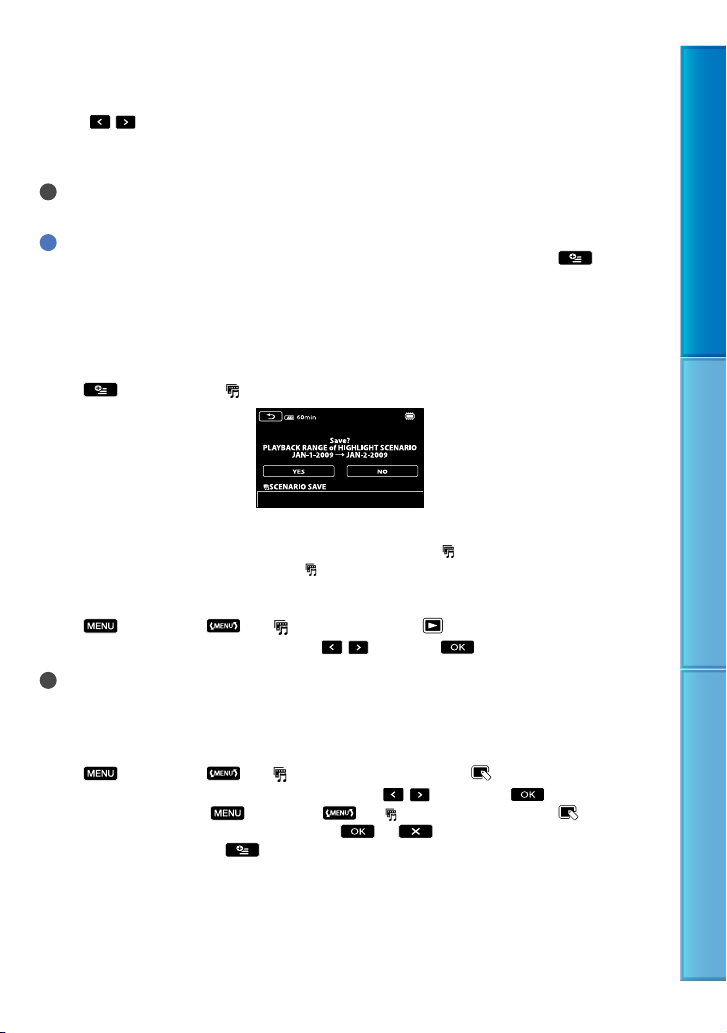
Playing back a digest of your movies (Highlight Playback)
Your camcorder selects Highlight Playback scenes at random, puts them together, and plays
them back as a digest of your high definition image quality (HD) movies with music and
visual effects. Scenes for Highlight Playback differ each time Highlight Playback is selected.
You can save the desired Highlight Playback scenario.
Select the recording media which contains the movie you want to play back before you start
t
he operation (p. 67).
Touch (MENU) [ HIGHLIGHT] (under [PLAYBACK]
category)
The settings for Highlight Playback appear. The Highlight Playback starts after several
seconds.
To stop Highlight Playback
To pause, touch .
To stop, touch
or .
To change the settings for Highlight Playback
After touching [ HIGHLIGHT], touch [HIGHLIGHT SET] before the Highlight Playback
starts. You can set following items.
[PLAYBACK RANGE]
Set the range of movies to be played by selecting the from and to date, then touch
.
If no range is set, your camcorder plays the movies starting from those of the date displayed on the
VISUAL INDEX screen until the most recently recorded movie.
[THEME]
Select one of the following: [SIMPLE], [NOSTALGIC], [STYLISH], [ACTIVE] (the default setting)
The music category is selected automatically according to the theme.
[MUSIC]
From the music category, you can add one or more of the following: [MUSIC1] - [MUSIC4] (the default
Returns to the VISUAL INDEX screen
44
Table of Contents Useful Recording Techniques Index
setting), [MUSIC5] - [MUSIC8] (the desired music*).
* To change music files, for details, see page 44.
[AUDIO MIX]
The original sound is played back with the music.
Touch
/ to adjust the balance between the original sound and the music.
[SHUFFLE]
To play back movies in random order, select [ON].
Notes
The [PLAYBACK RANGE] setting is cleared when the Highlight Playback stops.
Tips
You can change the settings for Highlight Playback during Highlight Playback by touching
(OPTION).
If you change the settings for Highlight Playback, Highlight Playback scenes are re-selected.
If you change [MUSIC] after you select [THEME], the music will be selected automatically for the theme
from next time.
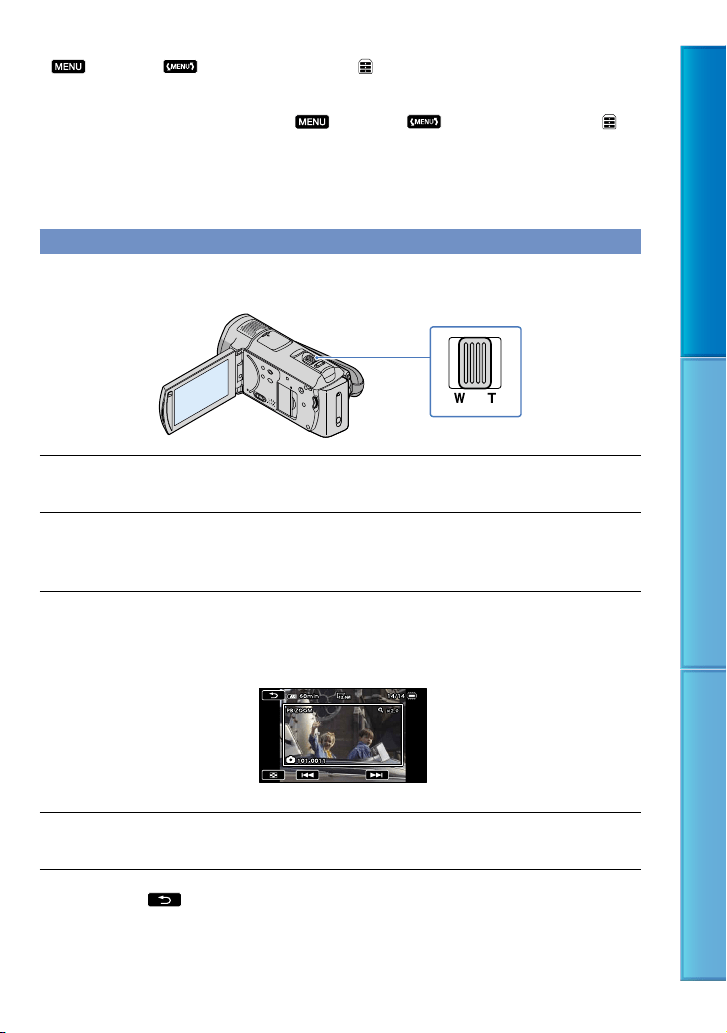
To save a scenario for Highlight Playback
Touch (OPTION) [ SCENARIO SAVE] [YES] during Highlight Playback.
You can save a maximum of 8 scenarios. If 8 scenarios have already been saved, [HIGHLIGHT
SCENARIO full. HIGHLIGHT SCENARIOS may be erased when the
SCENARIO ERASE button is
pressed.] appears on the LCD screen. Touch [
SCENARIO ERASE] to delete unwanted scenarios.
To play back a saved Highlight Playback scenario
Touch (MENU) [ SCENARIO] (under [PLAYBACK] category) and
select a scenario you want to play back with
/ and touch .
Notes
If movies included in the Highlight Playback scenario you are going to play are deleted or divided, the
scenario is played back with those movies skipped.
To erase the saved Highlight Playback scenario
Touch (MENU) [ SCENARIO ERASE] (under [EDIT] category)
[ERASE] and select a scenario you want to erase with
/ , then touch .
To erase all scenarios, touch (MENU) [ SCENARIO ERASE] (under [EDIT]
category) [ERASE ALL] [YES] [YES]
.
You can erase also by touching
(OPTION) during Highlight Playback or on the scenario selection
screen.
To change music files
You can transfer music files from audio CDs or MP3 files to your camcorder, and play them with
Highlight Playback. To transfer music files, you need to install the supplied software “PMB” on your
computer. Turn on your camcorder and computer, connect them with the supplied USB cable, then touch
45
Table of Contents Useful Recording Techniques Index
[DOWNLOAD MUSIC] on the camcorder screen. (If the [USB SELECT] screen does not appear, touch
(MENU) [MUSIC TOOL] (under [OTHERS] category) [DOWNLOAD
MUSIC]). For details, see the “PMB Guide.”
After the music file is transferred to the camcorder, if you cannot play the music, the music file may be
damaged. Delete the music file by touching
(MENU) [MUSIC TOOL] (under
[OTHERS] category) [EMPTY MUSIC], then transfer the music file again. If you delete music files
using [EMPTY MUSIC], the music data recorded on your camcorder at the factory will be deleted too.
In this case, you can restore them using Music Transfer supplied with “PMB.” For details, see the “PMB
Guide.”
Using PB zoom with photos
You can magnify photos from about 1.1 to 5 times the original size.
Magnification can be adjusted with the power zoom lever.
Play back the photo you want to magnify.
Magnify the photo with T (Telephoto).
The screen is framed.
Touch the screen at the point you want to display in the center of the
displayed frame.
The point where you touched on the screen is moved to the center of the display frame.
Adjust the magnification with W (Wide angle)/T (Telephoto).
To cancel, touch .
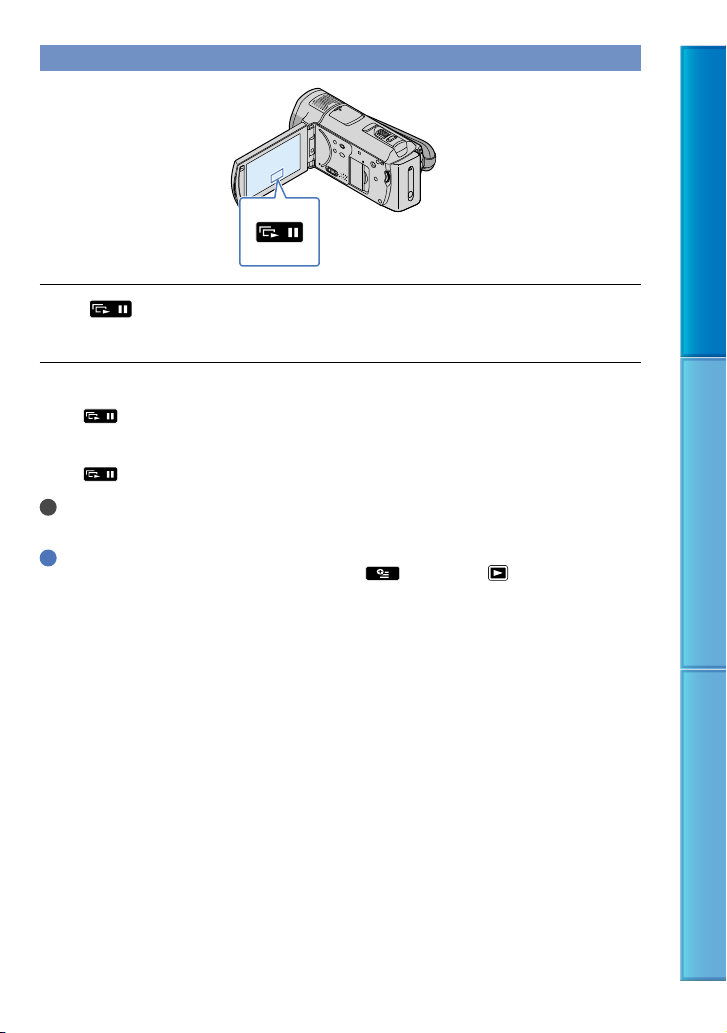
46
Table of Contents Useful Recording Techniques Index
Playing back a series of photos (Slide show)
Touch on the photo playback screen.
The slide show begins from the selected photo.
To stop the slide show
Touch .
To restart the slide show
Touch again.
Notes
You cannot operate playback zoom during slide show.
Tips
You can set continuous slide show playback by selecting
(OPTION) tab [SLIDE SHOW
SET] while playing photos. The default setting is [ON] (continuous playback).
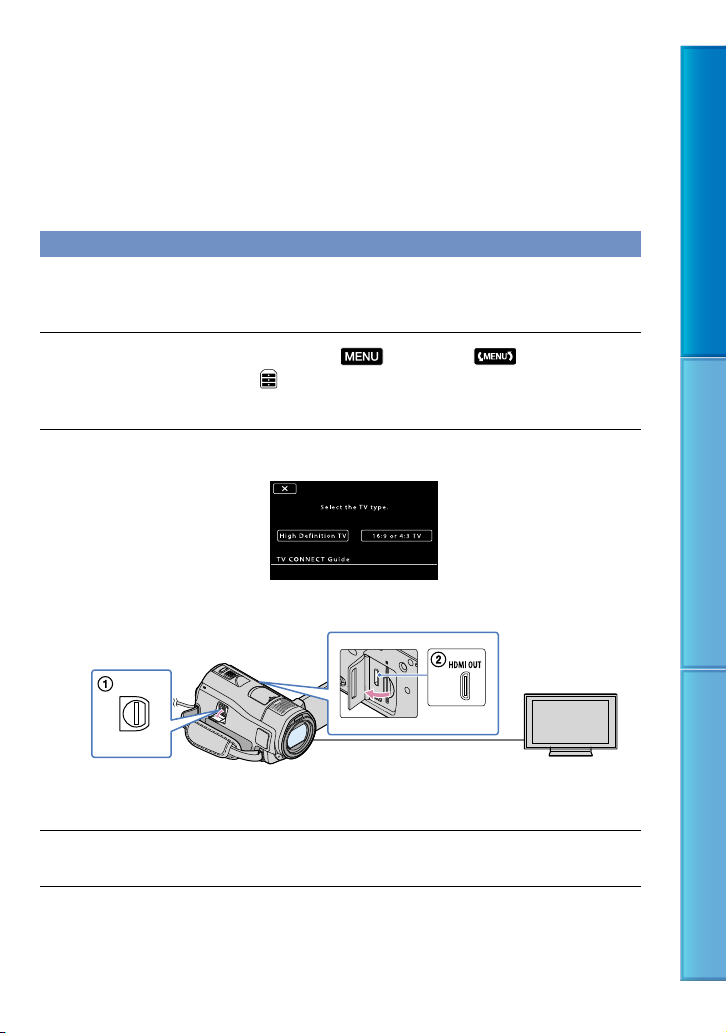
47
Table of Contents Useful Recording Techniques Index
Playing images on a TV
Connection methods and the image quality (high definition (HD) or standard definition
(SD)) viewed on the TV screen differ depending on what type of TV is connected, and the
connectors used. You can connect your camcorder to the TV easily following the instructions
displayed on the LCD screen, [TV CONNECT Guide].
Connecting a TV using [TV CONNECT Guide]
Switch the input on the TV to the connected jack.
Refer to the instruction manuals of the TV.
Turn on your camcorder, and touch (MENU) [TV
CONNECT Guide] (under [OTHERS] category) on the LCD screen.
Use the supplied AC Adaptor as the power source (p. 20).
Connect your camcorder and TV referring to [TV CONNECT Guide].
When the A/V connecting cable is used to output movies, movies are output with standard
definition image quality (SD).
Play back movies and photos on your camcorder (p. 36).
Connectors on your camcorder
Input connectors on
the TV
A/V Remote
Connector
HDMI OUT jack
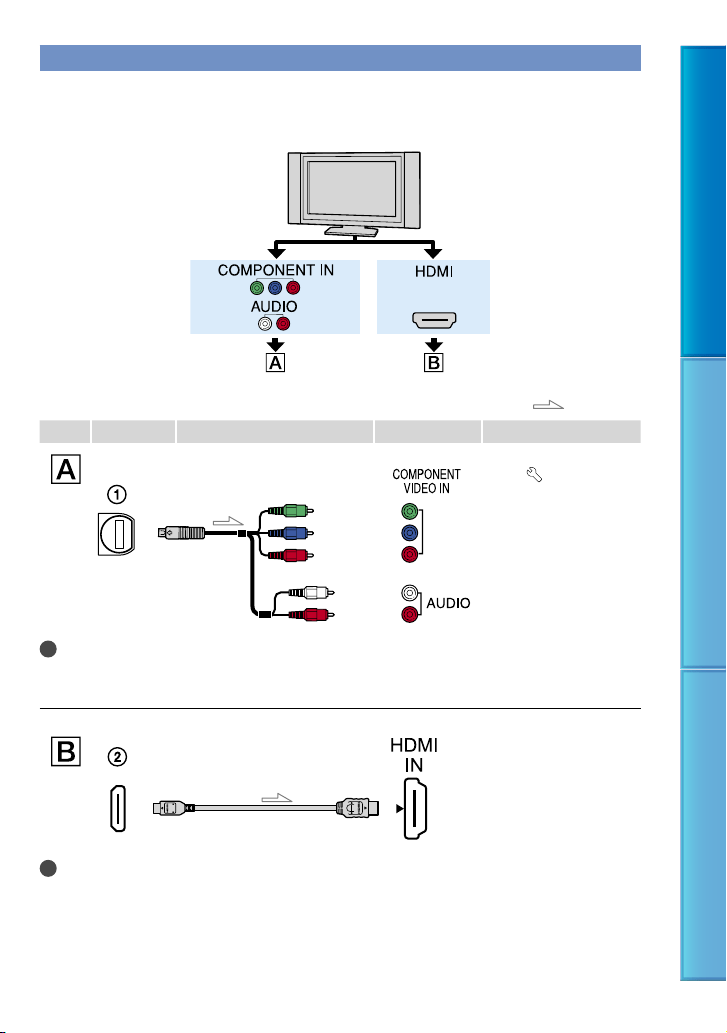
48
Table of Contents Useful Recording Techniques Index
Connecting to a high definition TV
High definition image quality (HD) movies are played back with high definition image quality
(HD). Standard definition image quality (SD) movies are played back with standard definition
image quality (SD).
: Signal flow
Type Camcorder Cable TV MENU setting
[OUTPUT SETTINGS]
(under
[GENERAL
SET] category)
[COMPONENT]
[1080i/480i] (p
. 96)
Notes
If you connect only component video plugs, audio signals are not output. Connect the white and red
plugs to output audio signals.
Notes
Use an HDMI cable with the HDMI logo.
Use an HDMI mini connector on one end (for the camcorder), and a plug suitable for connecting your
TV on the other end.
Copyright-protected images are not output from the HDMI OUT jack of your camcorder.
Some TVs may not function correctly (e.g., no sound or image) with this connection.
Component A/V cable
(supplied)
(Green) Y
(Blue) P
B/CB
(Red) PR/CR
(White)
(Red)
HDMI cable (sold separately)
(p. 48) (p. 48)
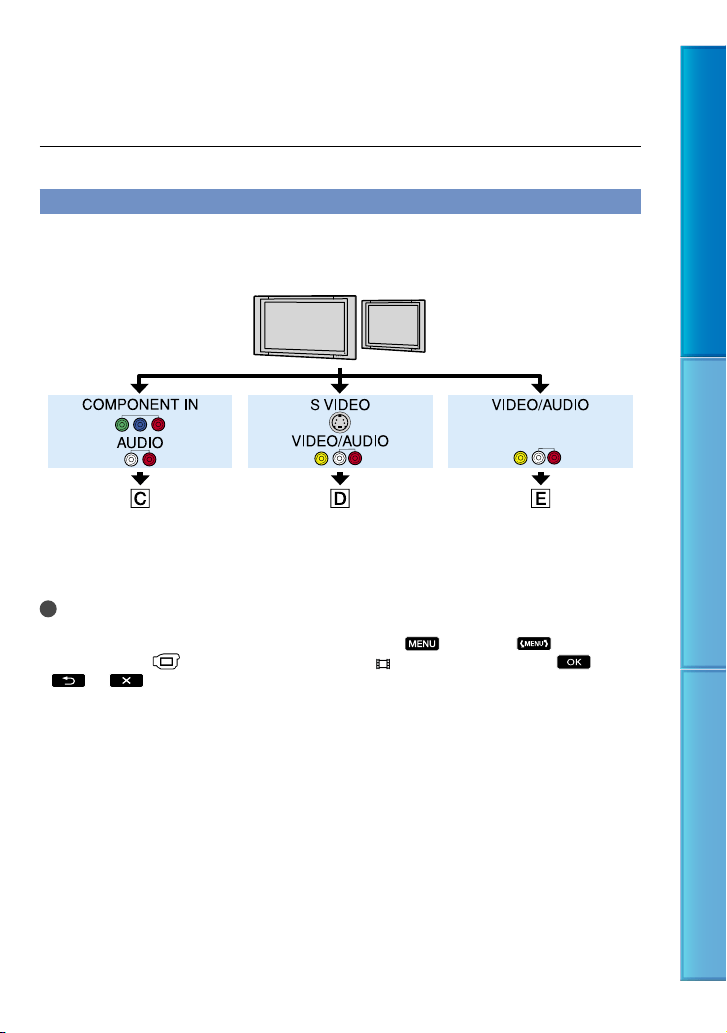
49
Table of Contents Useful Recording Techniques Index
Do not connect the camcorder HDMI OUT jack to an external device HDMI OUT jack, as malfunction
may result.
When the connected device is compatible with 5.1ch surround sound, high definition image quality (HD)
movies are output in 5.1ch surround sound automatically. Standard definition image quality (SD) movies
are converted to 2ch sound.
Connecting to a non-high-definition 16:9 (wide) or 4:3 TV
High definition image quality (HD) movies are converted to standard definition image quality
(SD) and played back. Standard definition image quality (SD) movies are played back with
standard definition image quality (SD).
To set the aspect ratio according to the connected TV (16:9/4:3)
Set [TV TYPE] to [16:9] or [4:3] according to your TV (p. 95).
Notes
When you play back standard definition image quality (SD) movies on a 4:3 TV that is not compatible
with the 16:9 signal, record movies with 4:3 aspect ratio. Touch
(MENU) [OTHER
REC SET] (under
[SHOOTING SET] category) [ WIDE SELECT] [4:3]
(p. 83).
(p. 50) (p. 50) (p. 50)
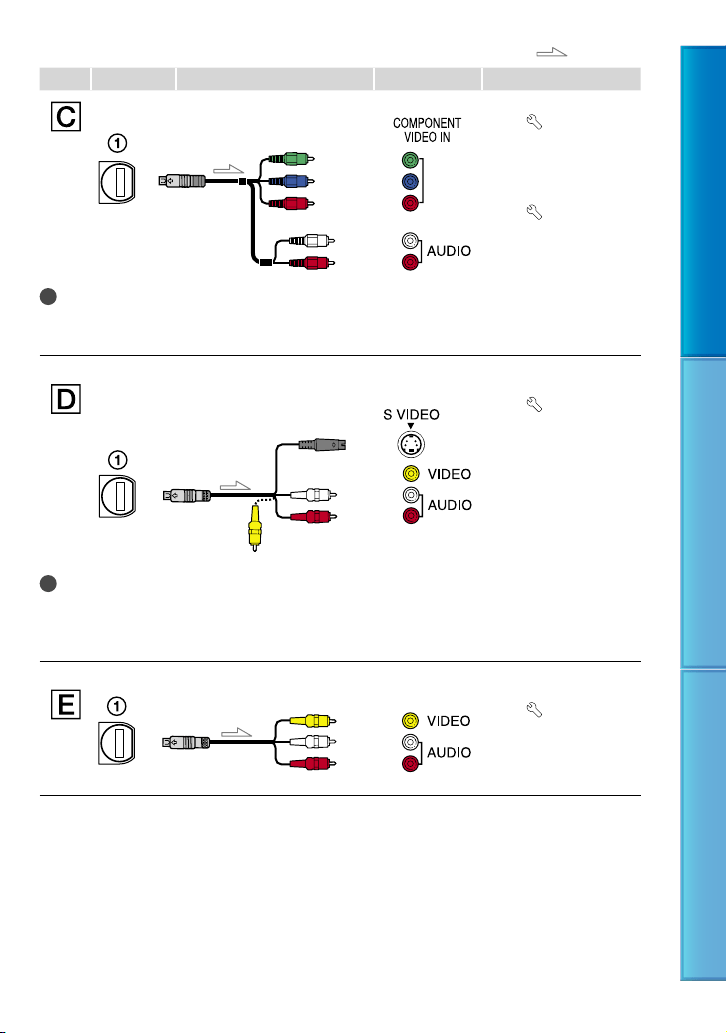
50
Table of Contents Useful Recording Techniques Index
: Signal flow
Type Camcorder Cable TV MENU setting
[OUTPUT SETTINGS]
(under
[GENERAL
SET] category)
[COMPONENT]
[480i] (p
. 96)
[OUTPUT SETTINGS]
(under
[GENERAL
SET] category) [TV
TYPE] [16:9]/[4:3]
*
(p. 95)
Notes
If you connect only component video plugs, audio signals are not output. Connect the white and red
plugs to output audio signals.
[OUTPUT SETTINGS]
(under
[GENERAL
SET] category) [TV
TYPE] [16:9]/[4:3]
*
(p. 95)
Notes
When the S VIDEO plug (S VIDEO channel) is connected, audio signals are not output. To output audio
signals, connect the white and red plugs to the audio input jack of your TV.
This connection produces higher resolution images compared with the A/V connecting cable (Type ).
[OUTPUT SETTINGS]
(under
[GENERAL
SET] category) [TV
TYPE] [16:9]/[4:3]
*
(p. 95)
* Set [TV TYPE] according to your TV.
When connecting to your TV via a VCR
Connect your camcorder to the LINE IN input on the VCR using the A/V connecting cable.
Set the input selector on the VCR to LINE (VIDEO 1, VIDEO 2, etc.).
When your TV is monaural (When your TV has only one audio input jack)
Connect the yellow plug of the A/V connecting cable to the video input jack and connect the
(White)
(Red)
(Yellow)
A/V connecting cable
(supplied)
A/V connecting cable with
S VIDEO (sold separately)
(White)
(Red)
(Yellow)
(Green) Y
(Blue) P
B/CB
(Red) PR/CR
(White)
(Red)
Component A/V cable (supplied)
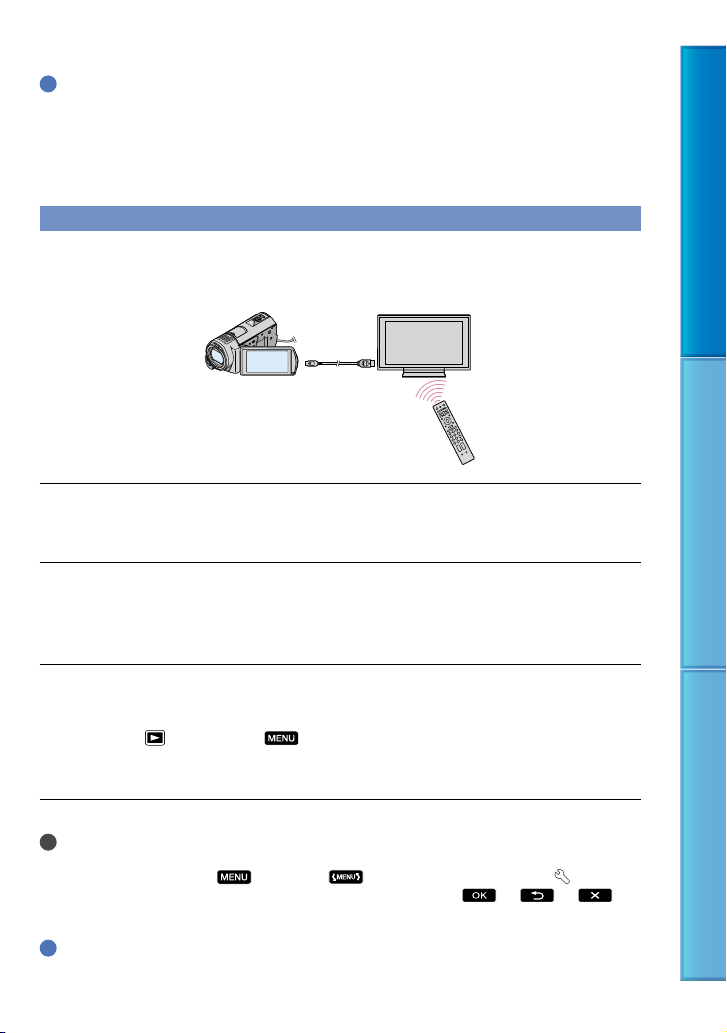
51
Table of Contents Useful Recording Techniques Index
white (left channel) or red (right channel) plug to the audio input jack of your TV or VCR.
Tips
If you connect your camcorder to the TV using more than one type of cable to output images, the order
of priority of the TV input jacks is as follows:
HDMI component S VIDEO video
HDMI (High Definition Multimedia Interface) is an interface to send both video/audio signals. The
HDMI OUT jack outputs high quality images and digital audio.
Using “BRAVIA” Sync
You can operate your camcorder with the remote commander of your TV by connecting your
camcorder to a “BRAVIA” Sync compatible TV launched in 2008 or later with the HDMI
cable.
Connect your camcorder and a “BRAVIA” Sync compatible TV with the HDMI
cable (sold separately).
Turn on your camcorder.
The TV input is switched automatically, and the image of your camcorder is displayed
on the TV.
Operate it with the remote commander of the TV.
You can do the following operations.
To display [PLAYBACK] of (MENU) by pressing the SYNC MENU button.
To display an index screen, such as the VISUAL INDEX screen, and play back the desired movies
or photos by pressing up/down/left/right/enter buttons on the remote commander of your TV.
Notes
There may be some operations you cannot do with the remote commander.
To set your camcorder, touch
(MENU) [OTHER SETTINGS] (under [GENERAL
SET] category) [CTRL FOR HDMI] [ON] (the default setting)
.
Also set your TV. Refer to the instruction manual of the TV for details.
Tips
If you turn off the TV, your camcorder is turned off simultaneously.
HDMI cable
(sold separately)
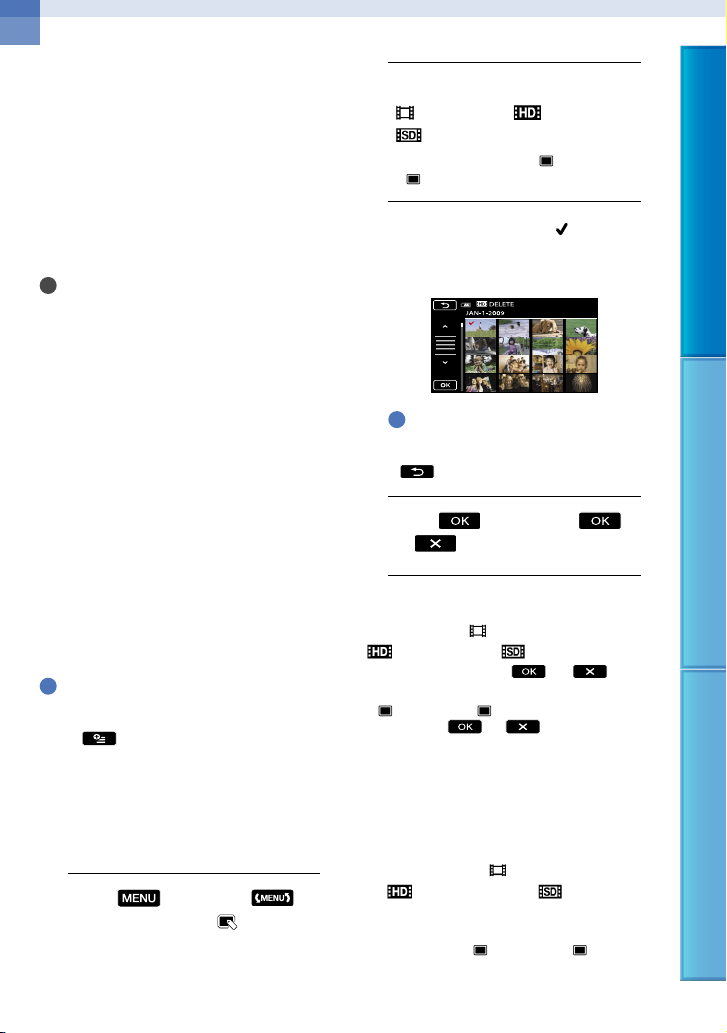
52
Table of Contents Useful Recording Techniques Index
Editing
Deleting movies and
photos
You can free media space by deleting
movies and photos from recording media.
Select the recording medium that contains
the movies and photos you want to delete
b
efore starting the operation (p. 67). For
m
ovies, select the image quality (p. 77).
Notes
You cannot restore images once they are
deleted.
Do not remove the battery pack or the AC
Adaptor from your camcorder while deleting
the images. It may damage the recording media.
Do not eject “Memory Stick PRO Duo” media
while deleting images from the “Memory Stick
PRO Duo” media.
You cannot delete protected movies and photos.
Undo the protection of the movies and photos
to delete them, before you try to delete them
(p
. 58).
If the deleted movie is included in the Playlist
(p
. 60), the movie added to the Playlist is
deleted also from the Playlist.
If the deleted movie is included in the saved
H
ighlight Playback scenario (p. 44), the movie
is also deleted from the scenario.
Save important movies and photos in advance
(p
. 62, see Operating Guide too).
Tips
You can select up to 100 images at one time.
You can delete an image on the playback screen
from
OPTION MENU.
To delete all images recorded in the recording
media, and recover all the recordable space of
t
he media, format the media (p. 92).
Reduced-size images which enable you to view
many images at the same time on an index
screen are called “thumbnails.”
1
Touch (MENU)
[DELETE] (under [EDIT]
category).
2
To delete movies, touch
[ DELETE] [ DELETE] or
[ DELETE].
To delete photos, touch [ DELETE]
[
DELETE].
3
Touch and display the mark
on the movies or photos to be
deleted.
Tips
Press and hold the image down on the
LCD screen to confirm the image. Touch
to return to the previous screen.
4
Touch [YES]
.
To delete all movies/photos at one time
In step 2, touch [ DELETE]
[
DELETE ALL]/[ DELETE ALL]
[YES] [YES]
.
To delete all photos at one time, touch
[
DELETE] [ DELETE ALL] [YES]
[YES]
.
To delete all the movies/photos
recorded on the same day at one time
You can delete photos by selecting
recording dates only when photos are
recorded on the internal memory.
I
n step 2, touch [ DELETE]
[
DELETE by date]/[ DELETE
by date].
To delete all photos on the same day at one
time, touch [
DELETE] [ DELETE
by date].

53
Table of Contents Useful Recording Techniques Index
Touch / to select the recording
date of the desired movies/photos, then
touch
.
Tips
Touch the image down on the LCD screen
to confirm the image. Touch
to
return to the previous screen.
Touch [YES] .
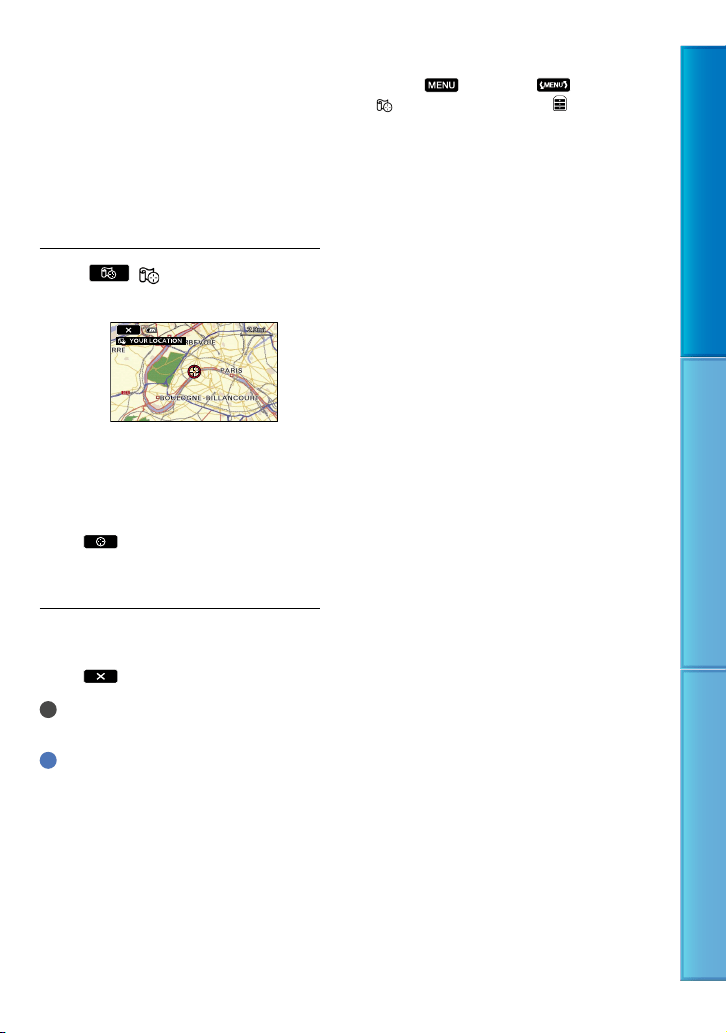
54
Table of Contents Useful Recording Techniques Index
Acquiring the current
location information
(HDR-CX500V/CX520V)
You can display the current location on a
map. Set the GPS switch to ON so that your
camcorder can acquire the current location
inf
ormation (p. 34).
Touch ( YOUR LOCATION) on
the recording screen.
The current location is displayed and
marked at the center of the LCD screen. If
you touch a certain point on the screen, the
map shows the area with that point at the
center.
Touch
(your location) at the bottom
left of the LCD screen to move the current
location back to the center.
To close the map screen
Touch .
Notes
The map always displays the north at the top.
Tips
You can change the scale using the zoom lever
(W: larger, T: smaller).
Your camcorder acquires the current location
information every 10 seconds. The displays
of the center marker, etc., appear differently
according to the status of the current inquiry.
When your camcorder cannot acquire the
current location information, the center marker
turns gray and the map shows the last location
acquired.
If you hold a certain point, the map keeps
scrolling.
You can also display the current location by
touching
(MENU)
[
YOUR LOCATION] (under [OTHERS]
category).
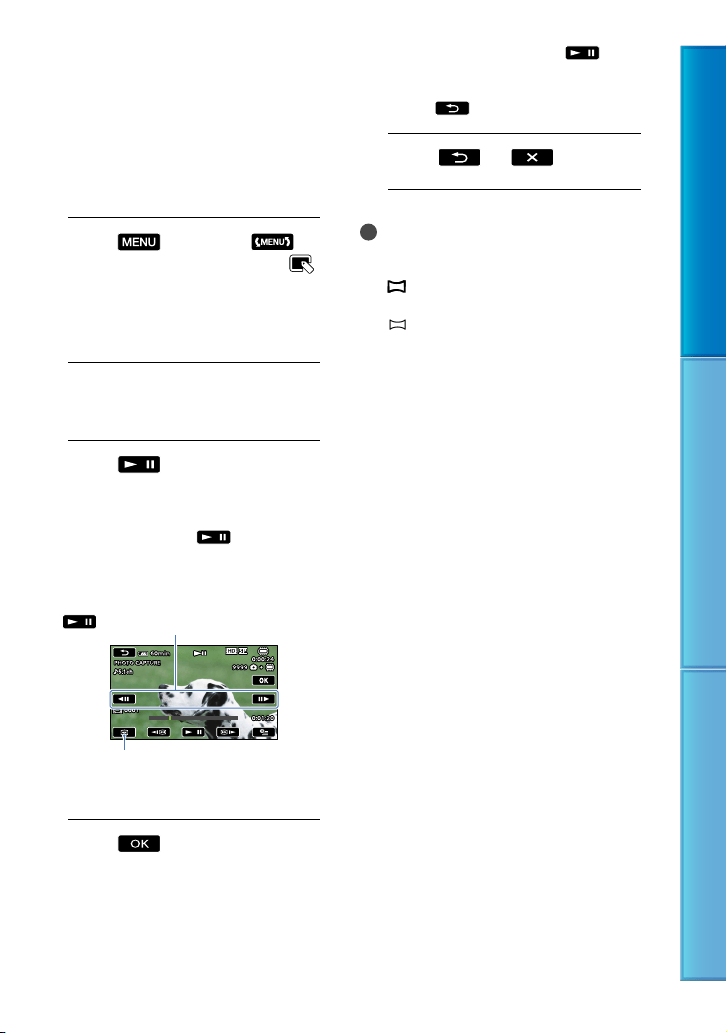
55
Table of Contents Useful Recording Techniques Index
Capturing a photo
from a movie
Select the recording media which contains
movies and the image quality, and the
recording media where you want to save
p
hotos before the operation (p. 67, 77).
1
Touch (MENU)
[PHOTO CAPTURE] (under
[EDIT] category).
The [PHOTO CAPTURE] screen
appears.
2
Touch the movie to be captured.
The selected movie starts playback.
3
Touch at the point where
you want to capture.
The movie pauses. Play and pause
toggles as you press
.
4
Touch .
The captured photo is saved on the
recording media selected in [PHOTO
MEDIA SET] (p
. 67).
When capturing is finished, the screen
returns to pause.
To continue capturing, touch , then
repeat steps from step 3.
To capture a photo from another movie,
touch
, then repeat steps from step 2.
5
Touch .
Notes
The image size is fixed depending on the image
quality of the movie:
[
2.1M] with high definition image quality
(HD)
[
0.2M] in 16:9 (wide) with standard
definition image quality (SD)
[VGA(0.3M)] in 4:3 with standard definition
image quality (SD)
The recording medium where you want to save
photos should have enough free space.
The recording date and time of captured photos
is the same as the recording date and time of
the movies.
If the movie you are capturing from has no data
code, the recording date and time of the photo
will be the date and time you captured from
the movie.
Adjust the capturing point with more
precision after you selected the point with
.
Returns to the beginning of the selected
movie
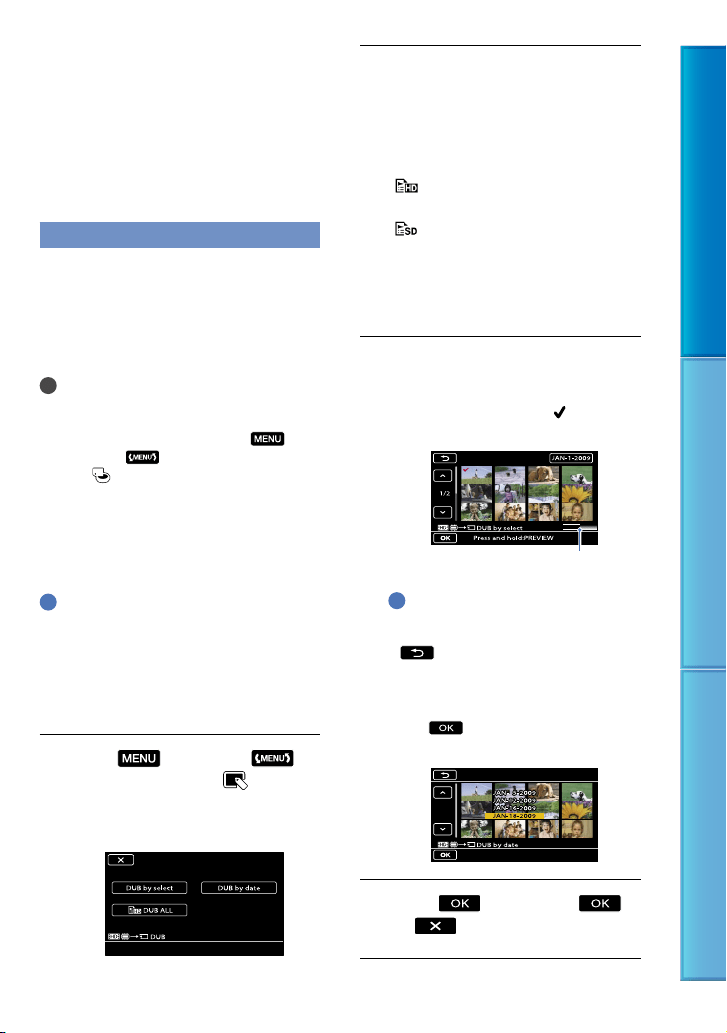
56
Table of Contents Useful Recording Techniques Index
Dubbing/copying
movies and photos
from the internal
memory to “Memory
Stick PRO Duo” media
Dubbing movies
You can dub movies recorded on the
internal memory of your camcorder to
“Memory Stick PRO Duo” media.
Insert “Memory Stick PRO Duo” media
into your camcorder before the operation.
Notes
When you record a movie on the “Memory
Stick PRO Duo” media for the first time, create
the image database file by touching
(MENU)
[REPAIR IMG.DB F.]
(under
[MANAGE MEDIA] category)
[MEMORY STICK].
Connect your camcorder to the wall outlet
(wall socket) using the supplied AC Adaptor to
prevent your camcorder from running out of
power during dubbing.
Tips
The original movie will not be deleted after
dubbing.
All included images in a Playlist will be dubbed.
The images recorded by this camcorder and
stored onto the recording media are called
“original.”
Touch
(MENU)
[MOVIE DUB] (under [EDIT]
category).
The [MOVIE DUB] screen appears.
Touch the type of dubbing.
[DUB by select]: To select movies and
dub
[DUB by date]: To dub all movies of a
specified date
[
DUB ALL]: To dub the high
definition image quality (HD) Playlist
[
DUB ALL]: To dub the standard
definition image quality (SD) Playlist
When you select the Playlist as the
source of dubbing, follow the on-screen
instructions to dub the Playlist.
Select the movie to be dubbed.
[DUB by select]: Touch the movie to be
dubbed, and mark it with
. You can
select multiple movies.
Tips
Press and hold the image down on the
LCD screen to confirm the image. Touch
to return to the previous screen.
[DUB by date]: Select the recording
date of the movie to be dubbed, then
touch
. You cannot select multiple
dates.
Touch
[YES]
.
Remaining capacity of the
“Memory Stick PRO Duo” media
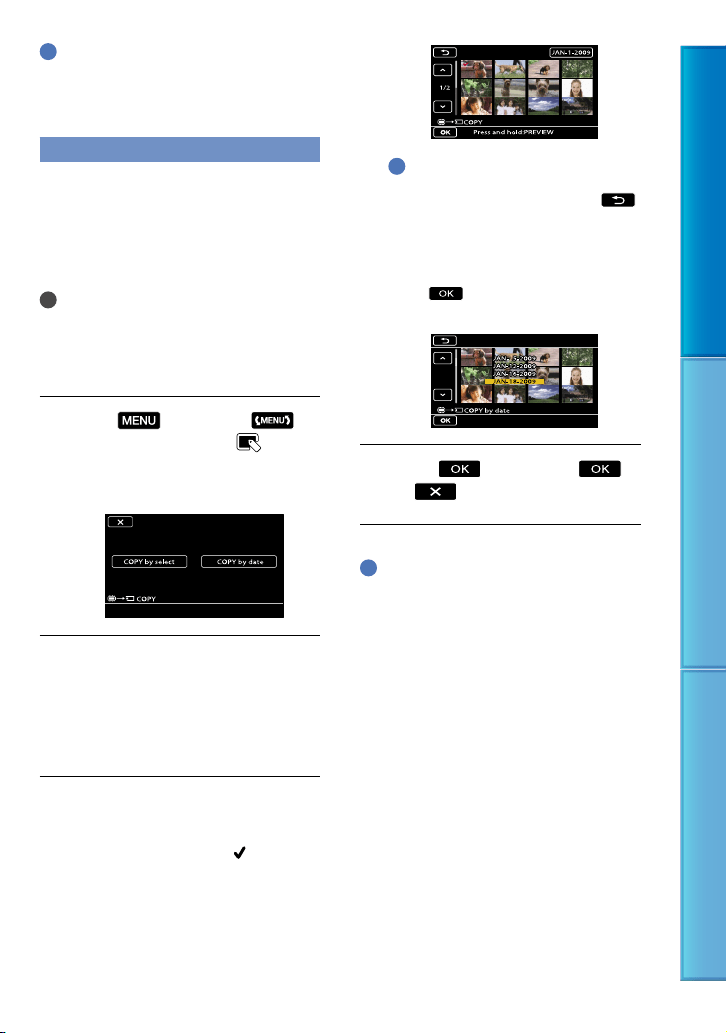
57
Table of Contents Useful Recording Techniques Index
Tips
To check the dubbed movies after dubbing is
finished, select [MEMORY STICK] on [MOVIE
MEDIA SET] a
nd play them back (p. 67).
Copying photos
You can copy photos from the internal
memory of the camcorder to “Memory
Stick PRO Duo” media.
Insert a “Memory Stick PRO Duo” media
into your camcorder before the operation.
Notes
Connect your camcorder to the wall outlet
(wall socket) using the supplied AC Adaptor to
prevent your camcorder from running out of
power during copying.
Touch
(MENU)
[PHOTO COPY] (under
[EDIT]
category).
The [PHOTO COPY] screen appears.
Touch the type of copying.
[COPY by select]: To copy selected
photos
[COPY by date]: To copy all photos of
a specified date
Select the photo to be copied.
[COPY by select]: Touch the photo to
be copied, and mark with
. You can
select multiple photos.
Tips
Press and hold the image down on the
screen to confirm the image. Touch
to return to the previous screen.
[COPY by date]: Select the recording
date of the photo to be copied, then
touch
. You cannot select multiple
dates.
Touch
[YES]
.
Tips
To check the copied photos after copying
is finished, select [MEMORY STICK] on
[PHOTO MEDIA SET] and play them back
(p
. 67).
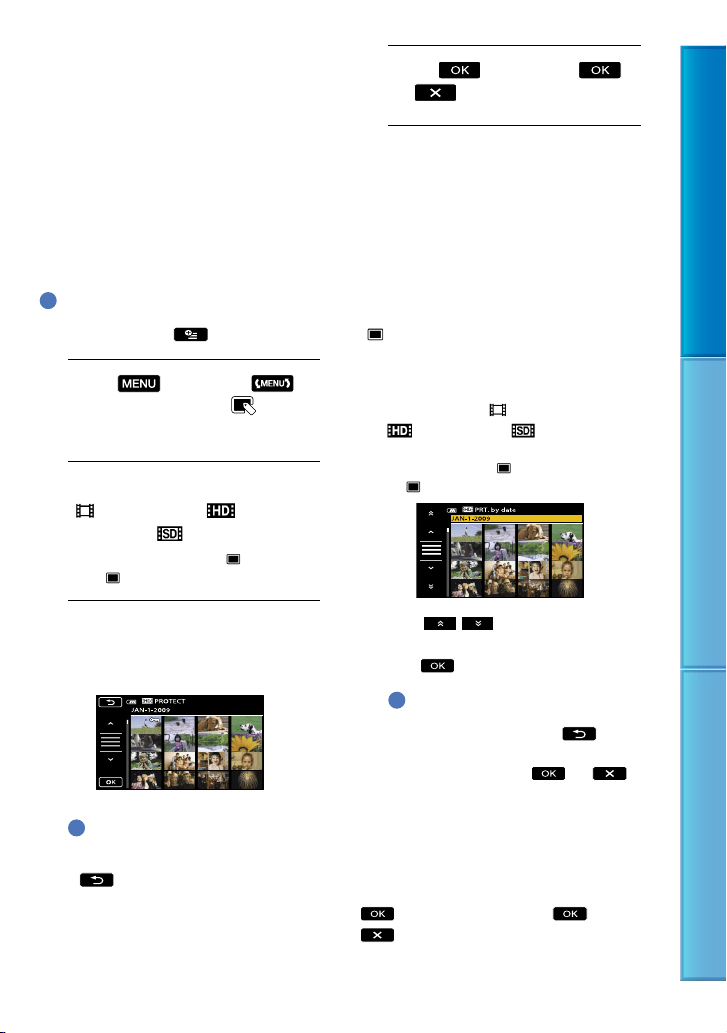
58
Table of Contents Useful Recording Techniques Index
Protecting recorded
movies and photos
(Protect)
Protect movies and photos to avoid deleting
them by mistake.
Select the recording medium that contains
the movies and photos you want to protect
b
efore starting the operation (p. 67). For
m
ovies, select the image quality (p. 77).
Tips
You can protect movies and photos on the
playback screen from
OPTION MENU.
1
Touch (MENU)
[PROTECT] (under [EDIT]
category).
2
To protect movies, touch
[ PROTECT] [
PROTECT]/[ PROTECT].
To protect photos, touch [ PROTECT]
[
PROTECT].
3
Touch the movies and photos to
be protected.
is displayed on the selected images.
Tips
Press and hold the image down on the
LCD screen to confirm the image. Touch
to return to the previous screen.
You can select up to 100 images at one
time.
4
Touch [YES]
.
To undo the protection of movies and
photos
Touch the movie or photo marked with
in step 3.
disappears.
To protect all the movies and photos
recorded on the same day at one time
[ PRT. by date] of a photo is only valid
when the recorded media is an internal
memory.
I
n step 2, touch [ PROTECT]
[
PRT. by date]/[ PRT. by date].
To protect all photos on the same day at
one time, touch [
PROTECT]
[
PRT. by date].
Touch / to select the recording
date of the desired movies/photos, then
touch
.
Tips
Touch the image down on the LCD screen
to confirm the image. Touch
to
return to the previous screen.
Touch [PROTECT] .
To undo the protection of movies and
photos recorded on the same day at
one time
In step above, select the recording date
of the desired movies/photos, then touch
[UNPROTECT]
.
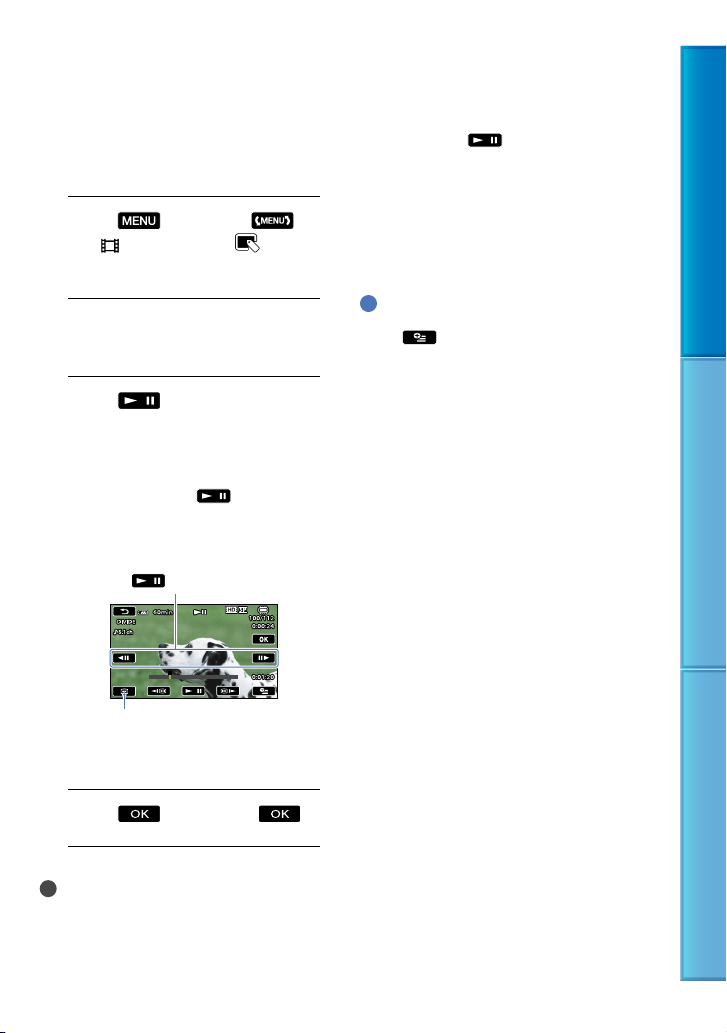
59
Table of Contents Useful Recording Techniques Index
Dividing a movie
Select the recording media which contains
the movie and the image quality you want
t
o divide before the operation (p. 67, 77).
1
Touch (MENU)
[ DIVIDE] (under [EDIT]
category).
2
Touch the movie to be divided.
The selected movie starts playback.
3
Touch at the point where
you want to divide the movie into
scenes.
The movie pauses. Play and pause
toggles as you press
.
4
Touch [YES] .
Notes
You cannot restore movies once they are
divided.
Do not remove the battery pack or the AC
Adaptor from your camcorder while dividing
the movie. It may damage the recording media.
Also, do not eject the “Memory Stick PRO Duo”
media while dividing movies on the “Memory
Stick PRO Duo” media.
A slight difference may occur from the point
where you touch
and the actual dividing
point, as your camcorder selects the dividing
point based on about half-second increments.
If you divide the original movie, the movie
added to the Playlist will also be divided.
If the divided movie is included in the saved
H
ighlight Playback scenario (p. 44), the movie
is deleted from the scenario.
Tips
You can divide a movie on the playback screen
from
OPTION MENU.
Adjusts the dividing point with more
precision after you selected the dividing
point with
.
Returns to the beginning of the selected
movie
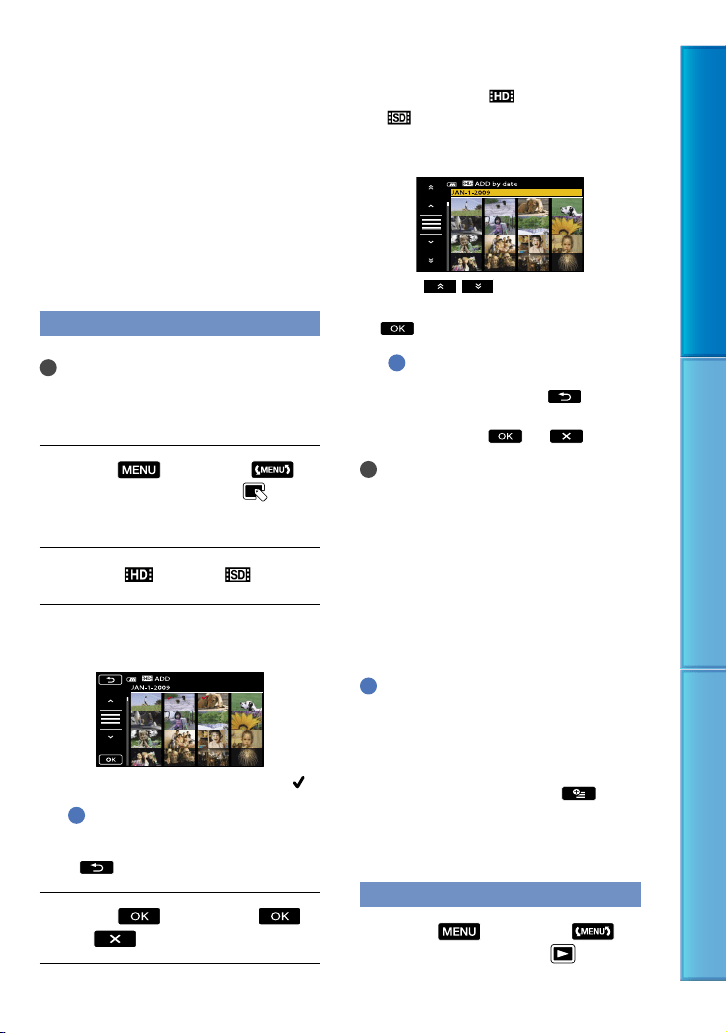
60
Table of Contents Useful Recording Techniques Index
Using the Playlist of
movies
The Playlist is a list showing thumbnails of
the movies that you have selected.
The original movies are not changed even if
you edit or delete the movies added to the
Playlist.
Select the recording media and the image
quality you want to create, play, or edit a
P
laylist before the operation (p. 67, 77).
Creating the Playlist
Notes
High definition image quality (HD) movies and
standard definition image quality (SD) movies
are added to an individual Playlist.
Touch
(MENU)
[PLAYLIST EDIT] (under [EDIT]
category).
Touch [
ADD] or [ ADD].
Touch the movie to be added to
the Playlist.
The selected movie is marked with .
Tips
Press and hold the image down on the
LCD screen to confirm the image. Touch
to return to the previous screen.
Touch
[YES]
.
To add all the movies recorded on the
same day at one time
In step 2, touch [ ADD by date]/
[
ADD by date].
The recording dates of movies are
displayed on the screen.
Touch / to select the recording
date of the desired movie, then touch
.
Tips
Touch the image on the LCD screen to
confirm the image. Touch
to return
to the previous screen.
Touch [YES] .
Notes
Do not remove the battery pack or the AC
Adaptor from your camcorder while adding
movies to the Playlist. It may damage the
recording media. Also, do not eject the
“Memory Stick PRO Duo” media while editing
movies on the “Memory Stick PRO Duo” media.
You cannot add photos to the Playlist.
You cannot create a Playlist which contains both
high definition image quality (HD) movies and
standard definition image quality (SD) movies.
Tips
You can add a maximum of 999 high definition
image quality (HD) movies, or 99 standard
definition image quality (SD) movies to the
Playlist.
You can add a movie on the playback screen
or the INDEX screen by touching
(OPTION).
You can copy the Playlist to a disc as it is, by
using the supplied software.
Playing the Playlist
T
ouch (MENU)
[PLAYLIST] (under
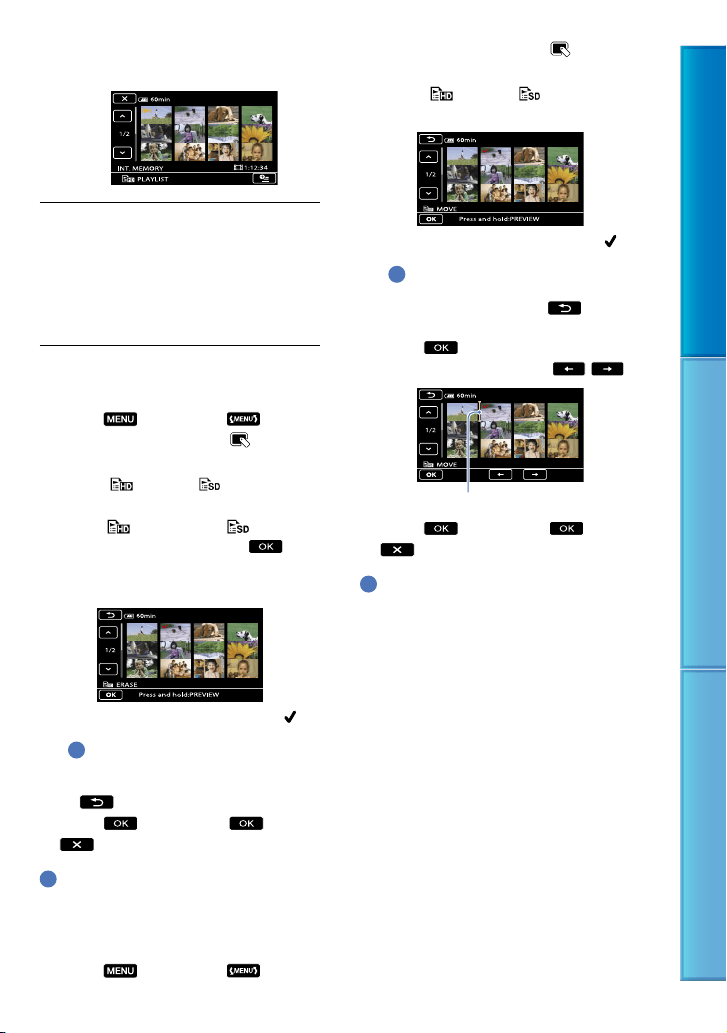
61
Table of Contents Useful Recording Techniques Index
[PLAYBACK] category).
Movies added to the Playlist appear.
Touch the movie you want to
play back.
The Playlist is played back from the
selected movie to the end, then the
screen returns to the Playlist screen.
To erase unnecessary movies from the
Playlist
Touch (MENU)
[PLAYLIST EDIT] (under
[EDIT]
category).
T
ouch [ ERASE]/[ ERASE].
To erase all the movies from the Playlist,
touch [
ERASE ALL]/[ ERASE
ALL] [YES] [YES]
.
S
elect the movie to be erased from the
list.
The selected movie is marked with .
Tips
Press and hold the image down on the
LCD screen to confirm the image. Touch
to return to the previous screen.
Touch [YES]
.
Tips
Even if you erase a movie from a Playlist, the
original movie is not erased.
To change the order within the Playlist
Touch (MENU)
[PLAYLIST EDIT] (under [EDIT]
category).
T
ouch [ MOVE]/[ MOVE].
S
elect the movie to be moved.
The selected movie is marked with .
Tips
Touch the image on the LCD screen to
confirm the image. Touch
to return
to the previous screen.
Touch .
S
elect the destination with / .
Touch [YES]
.
Tips
When you select multiple movies, the movies
are moved following the order appearing in the
Playlist.
Destination bar
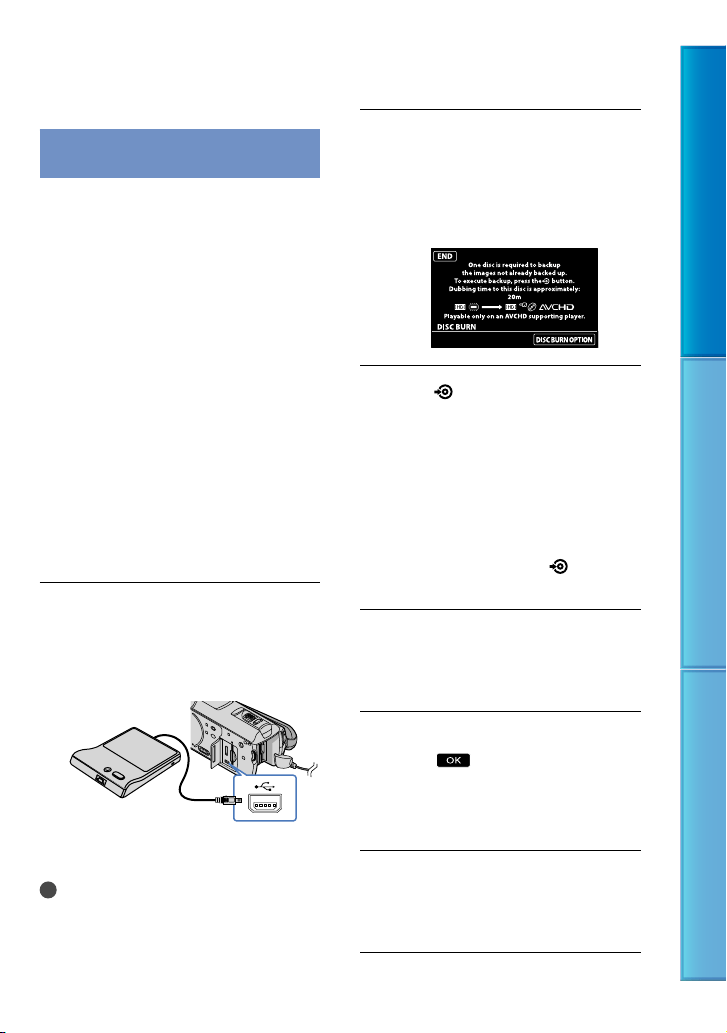
62
Table of Contents Useful Recording Techniques Index
Creating a disc with a
DVD writer, recorder
Creating a disc with the dedicated
DVD writer, DVDirect Express
You can perform the following operations
by using the dedicated DVD writer,
DVDirect Express (sold separately):
Create a disc of the same image quality as that
of the recorded movie.
Convert high definition image quality (HD)
movies to standard definition image quality
(SD) movies, for playback on any DVD
player, etc., and create a disc (DISC BURN
OPTION).
Play back the images on a created disc.
Refer also to the instruction manual
supplied with the DVD writer.
DVDirect Express is referred to as “DVD
writer” in this section.
Only unused discs of the following types can
be used:
12cm DVD-R
12cm DVD+R
The device does not support two-layered discs.
Turn on your camcorder, and
connect the DVD writer to the
(USB) jack of your camcorder with
the USB cable of the DVD writer.
The [EXTERNAL DRIVE] screen
appears on the camcorder screen.
Notes
Use the supplied AC Adaptor as the power
s
ource (p. 20). When using battery power, the
DVD writer does not work.
When there are unsaved high definition (HD)
and standard definition (SD) image quality
movies, they will be saved on individual discs
according to the image quality.
Insert an unused disc into the
DVD writer, and close the disc
tray.
The [DISC BURN] screen appears on
the camcorder screen.
Press
(DISC BURN) on the DVD
writer.
Movies recorded on the internal
memory that have not been saved on
any discs will be recorded onto the
disc. After the disc has been created,
the disc tray on the DVD writer opens
and you can remove the disc.
You can also operate with (DISC
BURN) on your camcorder.
Repeat steps 2 and 3 when the
total memory size of movies to
be burnt exceeds that of the disc.
After the operation is completed,
touch
[END] on the
camcorder screen.
Touch [EJECT DISC] and remove any
inserted disc.
Close the disc tray on the DVD
writer, and disconnect the USB
cable.
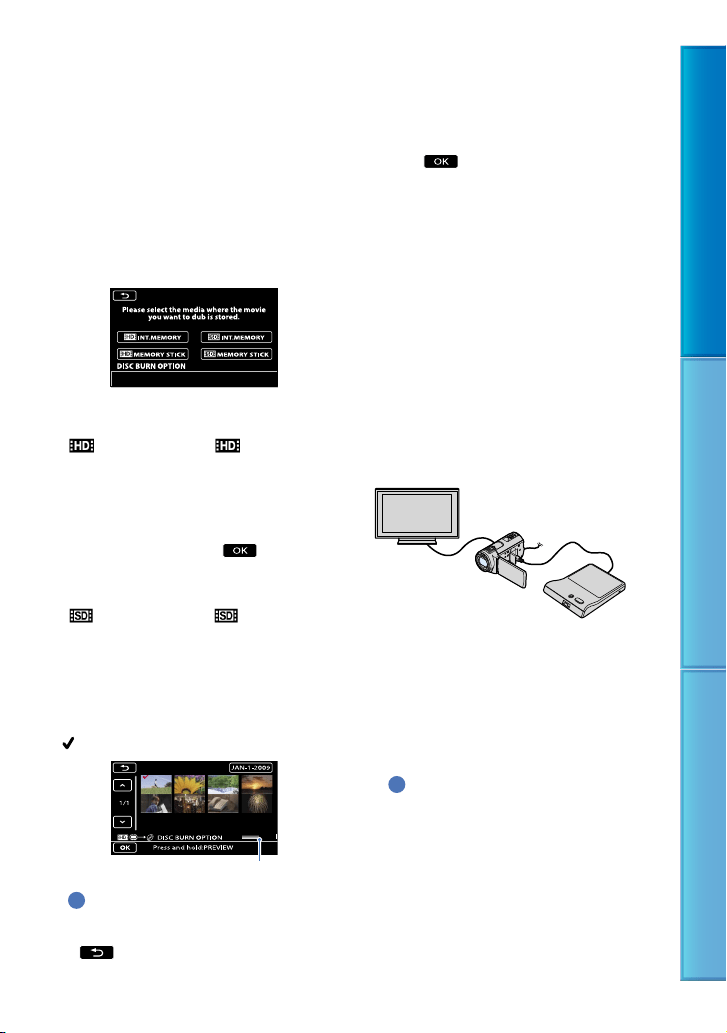
63
Table of Contents Useful Recording Techniques Index
To customize a disc with DISC BURN
OPTION
Perform this operation in the following
cases:
When dubbing a desired image
When creating multiple copies of the same
disc
When converting high definition (HD)
movies to standard definition (SD) movies,
and creating a disc.
Touch [DISC BURN OPTION] in step 3
above.
Select the recording media containing
the movie(s) you want to save.
[
INT. MEMORY]/[ MEMORY
STICK]:
The screen to select the image quality
of the disc to be created appears on
the LCD screen. Select the desired
image quality, and touch
. Movie
thumbnails appear on the camcorder
screen.
[
INT. MEMORY]/[ MEMORY
STICK]:
Movie thumbnails appear on the
camcorder screen.
T
ouch the movie you want to burn on
the disc.
appears.
Tips
Press and hold the image down on the
LCD screen to confirm the image. Touch
to return to the previous screen.
By touching date, you can search for
images by date.
The image quality of the disc depends on
the recording time of the selected movies
when you create a disc converting them
from high definition image quality (HD)
to standard definition image quality (SD).
Touch [YES] on the camcorder
screen.
The disc tray on the DVD writer opens
after creating the disc.
R
emove the disc from the DVD writer,
and close the disc tray.
To create another disc of the same
contents, insert a new disc and touch
[CREATE SAME DISC].
A
fter the operation is completed, touch
[EXIT] [END] on the camcorder
screen.
Di
sconnect the USB cable from your
camcorder.
To play back a disc on the DVD writer
Turn on your camcorder, and connect
the DVD writer to the (USB) jack of
your camcorder with the USB cable of
the DVD writer.
The [EXTERNAL DRIVE] screen
appears.
Tips
You can play back movies on the TV
screen by connecting the camcorder to a
T
V (p. 47).
Insert a created disc into the DVD
writer.
The movies on the disc appear as
VISUAL INDEX on the camcorder
screen.
P
ress the play button on the DVD writer.
Remaining Disc capacity

64
Table of Contents Useful Recording Techniques Index
The movie plays back on the camcorder
screen.
You can also operate by the camcorder
screen.
Touch [END] [EJECT DISC] on the
camcorder screen and remove the disc
after the operation is completed.
T
ouch and disconnect the USB
cable.
Notes
Be sure to turn on the camcorder. The DVD
writer is powered from the camcorder.
You can use [DISC BURN OPTION] to create
many of the same disc.
Do not do any of the following when creating
a disc.
Turn off the camcorder
Close the LCD screen of the camcorder
Disconnect the USB cable or the AC adaptor
Subject the camcorder to mechanical shock
or vibration
Eject the “Memory Stick PRO Duo” media
from the camcorder
You cannot add movies to a created disc.
Play the created disc to make sure dubbing was
performed correctly before deleting the movies
on your camcorder.
If [Failed.] or [DISC BURN failed.] appears on
the screen, insert another disc into the DVD
writer and perform the DISC BURN operation
again.
The created high definition (HD) image quality
disc can be played back only on AVCHD format
compatible devices. You can also play back the
disc with a DVD writer connecting with your
camcorder.
The high definition image quality (HD) disc
that you created should not be used in DVD
players/recorders. Because DVD players/
recorders are not compatible with the AVCHD
format, DVD players/recorders may fail to eject
the disc.
Tips
If the total memory size of movies to be burnt
by the DISC BURN operation exceeds that of
the disc, disc creation stops when the limit is
reached. The last movie on the disc may be
cut off.
Disc creation time to dub movies to the limit
of the disc is about 20 to 60 minutes. It may
take more time depending on the recording
mode or the number of scenes. Also, if high
definition image quality (HD) is converted to
standard definition image quality (SD), image
quality conversion takes longer than the actual
recording.
You can play back created standard definition
(SD) image quality discs on any DVD player. If
playback is not possible for any reason, connect
the camcorder to the DVD writer, and then
play back.
The disc mark appears on the camcorder
screen.
Creating a high definition image
quality (HD) disc with a DVD writer,
etc., other than DVDirect Express
Use USB cable to connect your camcorder
to a disc creation device, which is
compatible with high definition image
quality (HD) movies, such as a Sony DVD
writer. Refer also to the instruction manuals
supplied with the device to be connected.
Connect your camcorder to the wall outlet (wall
socket) using the supplied AC Adaptor for this
o
peration (p. 20).
Sony DVD writer may not be available in some
countries/regions.
Turn on your camcorder, and
connect a DVD writer, etc. to the
(USB) jack of your camcorder
with the USB cable (supplied).
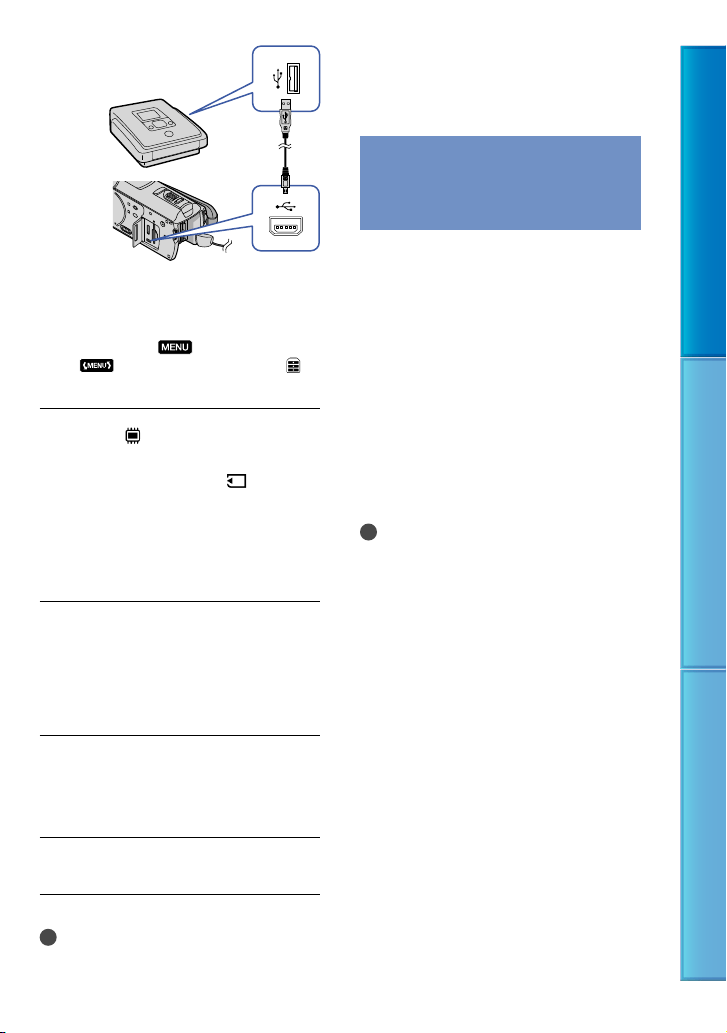
65
Table of Contents Useful Recording Techniques Index
The [USB SELECT] screen appears on
the camcorder screen.
If the [USB SELECT] screen does not
appear, touch
(MENU)
[USB CONNECT] (under
[OTHERS] category).
Touch [
USB CONNECT] when
movies are recorded on the
internal memory, or [ USB
CONNECT] when movies are
recorded on “Memory Stick PRO
Duo” media on the camcorder
screen.
Record movies on the connected
device.
For details, refer to the instruction
manuals supplied with the device to be
connected.
After the operation is completed,
touch [END] [YES] on the
camcorder screen.
Disconnect the USB cable.
Notes
The high definition image quality (HD) disc
that you created should not be used in DVD
players/recorders. Because DVD players/
recorders are not compatible with the AVCHD
format, DVD players/recorders may fail to eject
the disc.
Creating a standard definition
image quality (SD) disc with a
recorder, etc., other than DVDirect
Express
You can dub images played back on your
camcorder on a disc or video cassette,
by connecting your camcorder to a disc
recorder, a Sony DVD writer, etc. with
the A/V connecting cable. Connect the
device in either way of or . Refer
also to the instruction manuals supplied
with the devices to be connected. Select the
recording media that contains movies you
want to dub and the image quality before
s
tarting the operation (p. 67, 77).
Sony DVD writer may not be available in some
countries/regions.
Notes
Connect your camcorder to the wall outlet (wall
socket) using the supplied AC Adaptor for this
o
peration (p. 20).
High definition image quality (HD) movies
will be dubbed with standard definition image
quality (SD).
A/V connecting cable (supplied)
Connect the A/V connecting cable to the
input jack of another device.
A/V connecting cable with S VIDEO
(sold separately)
When connecting to another device
via the S VIDEO jack, by using an A/V
connecting cable with an S VIDEO cable
(sold separately), higher quality images can
be produced than with an A/V connecting
cable. Connect the white and red plug
(left/right audio) and the S VIDEO plug
(S VIDEO channel) of the A/V connecting
cable with an S VIDEO cable. If you
connect the S VIDEO plug only, you will
hear no sound. The yellow plug (video)
connection is not necessary.
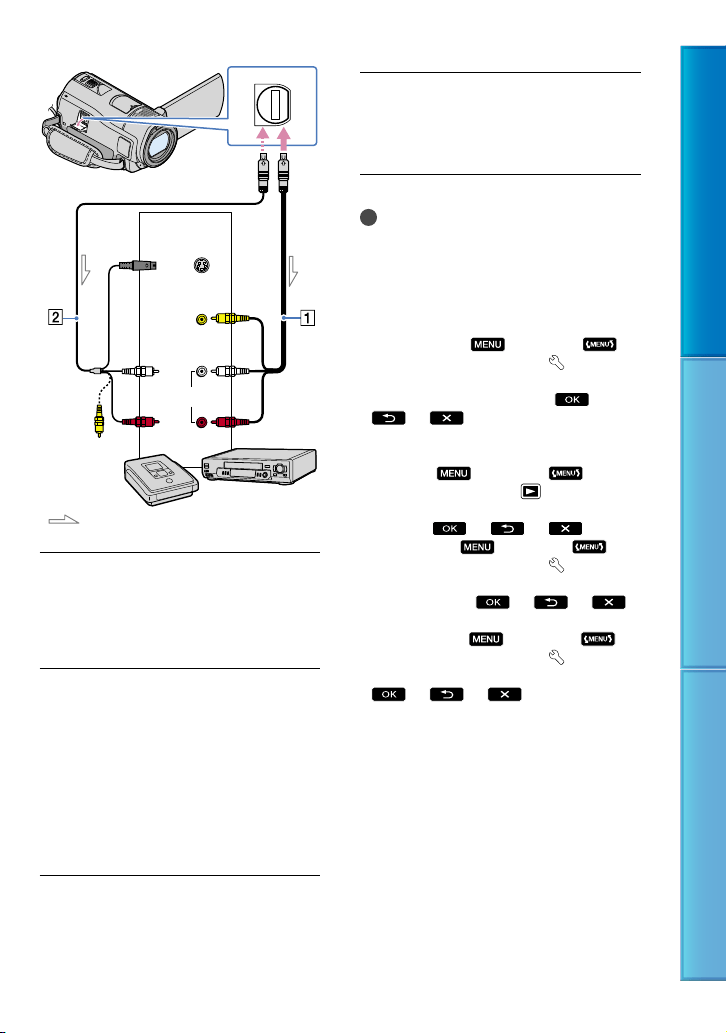
66
Table of Contents Useful Recording Techniques Index
Insert the recording media in the
recording device.
If your recording device has an input
selector, set it to the input mode.
Connect your camcorder to the
recording device (a disc recorder,
etc.) with the A/V connecting
cable (supplied) or an A/V
connecting cable with S VIDEO
(sold separately).
Connect your camcorder to the input jacks
of the recording device.
Start playback on your
camcorder, and record it on the
recording device.
Refer to the instruction manuals supplied
with your recording device for details.
When dubbing is finished, stop
the recording device, and then
your camcorder.
Notes
Since dubbing is performed via analog data
transfer, the image quality may deteriorate.
You cannot dub images to recorders connected
with an HDMI cable.
To hide the screen indicators (such as a counter,
etc.) on the screen of the monitor device
connected, touch
(MENU)
[OUTPUT SETTINGS] (under
[GENERAL
SET] category) [DISP OUTPUT] [LCD
PANEL] (the default setting)
.
To record the date/time, coordinates (HDR-
CX500V/CX520V), or camera settings
data, touch
(MENU)
[PLAYBACK SET] (under
[PLAYBACK]
category) [DATA CODE] a desired
setting
. In
addition, touch
(MENU)
[OUTPUT SETTINGS] (under
[GENERAL
SET] category) [DISP OUTPUT] [V-
OUT/PANEL]
.
When the screen size of display devices (TV,
etc.) is 4:3, touch
(MENU)
[OUTPUT SETTINGS] (under
[GENERAL
SET] category) [TV TYPE] [4:3]
.
When you connect a monaural device, connect
the yellow plug of the A/V connecting cable
to the video input jack, and the white (left
channel) or the red (right channel) plug to the
audio input jack on the device.
A/V Remote Connector
Signal flow
S VIDEO
VIDEO
(Yellow)
(White)
AUDIO
(Red)
Input
(Yellow)
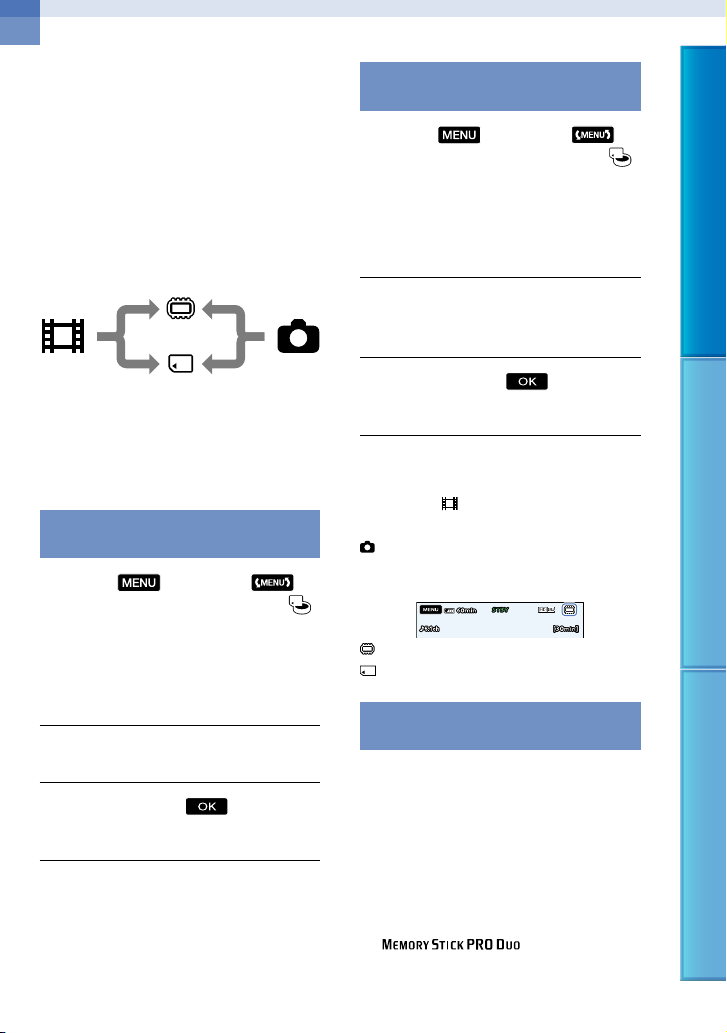
67
Table of Contents Useful Recording Techniques Index
Utilizing recording media
Changing the
recording media
You can select the internal memory or
“Memory Stick PRO Duo” media as the
recording, playback, or editing medium on
your camcorder. Select the medium to be
used for movies and photos separately. In
the default setting, both movies and photos
are recorded on the internal memory.
You can do recording, playback, and editing
operations on the selected medium.
See page 111 for the recordable time of movies.
See page 113 for the number of recordable
photos.
Selecting the recording media for
movies
T
ouch (MENU)
[MEDIA SETTINGS] (under
[MANAGE MEDIA] category)
[MOVIE MEDIA SET].
The [MOVIE MEDIA SET] screen
appears.
Touch the desired medium.
Touch [YES]
.
The recording medium is changed.
Selecting the recording media for
photos
T
ouch (MENU)
[MEDIA SETTINGS] (under
[MANAGE MEDIA] category)
[PHOTO MEDIA SET].
The [PHOTO MEDIA SET] screen
appears.
Touch the desired recording
medium.
Touch [YES]
.
The recording medium is changed.
To check the recording media settings
Light up the (Movie) lamp to check the
recording medium used for movies, or the
(Photo) lamp for photos. The media icon
is displayed at the top right corner of the
screen.
: Internal memory
: “Memory Stick PRO Duo” media
Inserting “Memory Stick PRO Duo”
media
Set the recording medium to [MEMORY
STICK] to record movies and/or photos on
“Memory Stick PRO Duo” media.
Types of “Memory Stick” media you can
use with your camcorder
For recording movies, it is recommended that
you use “Memory Stick PRO Duo” media of 1
GB or larger marked
with:
(“Memory Stick
PRO Duo” media)
*
Movies
Internal memory
“Memory Stick” media
Photos
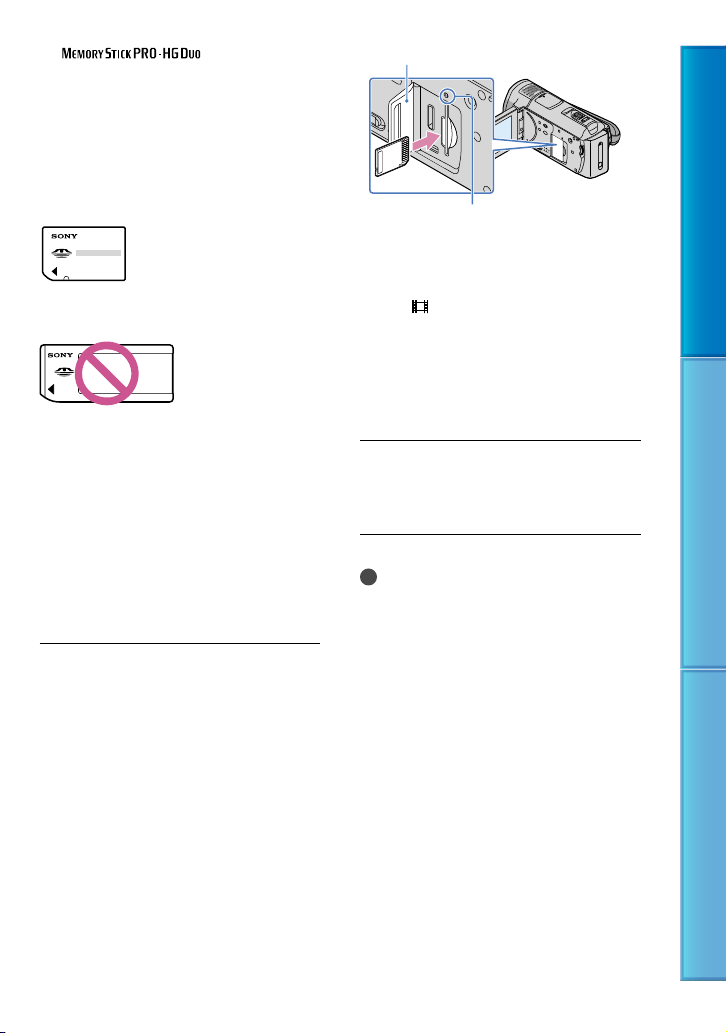
68
Table of Contents Useful Recording Techniques Index
(“Memory Stick
PRO-HG Duo” media)
* Marked with Mark2 or not, either can be
used.
See page 112 for the recordable time of
“Memory Stick PRO Duo” media.
“Memory Stick PRO Duo” media/“Memory Stick PRO-HG
Duo” media
(This size can be used with your camcorder.)
“Memory Stick” media
(You cannot use it in your camcorder.)
You cannot use any type of memory card other
than those mentioned above.
“Memory Stick PRO Duo” media can be
used only with “Memory Stick PRO” media
compatible equipment.
Do not attach a label or the like on “Memory
Stick PRO Duo” media or “Memory Stick Duo”
media adaptor.
Insert the “Memory Stick PRO Duo” media into
the “Memory Stick Duo” media adaptor when
using “Memory Stick PRO Duo” media with
“Memory Stick” media compatible equipment.
Open the “Memory Stick Duo”
media/jack cover, and insert the
“Memory Stick PRO Duo” media
into the “Memory Stick Duo”
media slot until it clicks.
Close the “Memory Stick Duo” media/jack
cover after inserting the “Memory Stick
PRO Duo” media.
The [Create a new Image Database
File.] screen appears if you insert new
“Memory Stick PRO Duo” media when
the
(Movie) lamp is lit.
Confirm the direction of the “Memory
Stick PRO Duo” media. If you forcibly
insert the “Memory Stick PRO Duo” media
in the wrong direction, the “Memory Stick
PRO Duo” media, “Memory Stick Duo”
media slot, or image data may be damaged.
Touch [YES].
To record only photos on “Memory Stick
PRO Duo” media, touch [NO].
Notes
If [Failed to create a new Image Database File.
It may be possible that there is not enough
free space.] is displayed in step 2, format the
“Memory Stick PRO Duo” media (p
. 92).
To eject the “Memory Stick PRO Duo”
media
Open the “Memory Stick Duo” media/jack
cover and lightly push the “Memory Stick
PRO Duo” media in once.
Do not open the “Memory Stick Duo” media/
jack cover during recording.
When inserting or ejecting the “Memory
Stick PRO Duo” media, be careful so that the
“Memory Stick PRO Duo” media does not pop
out and drop.
Access lamp
“Memory Stick Duo” media/jack cover
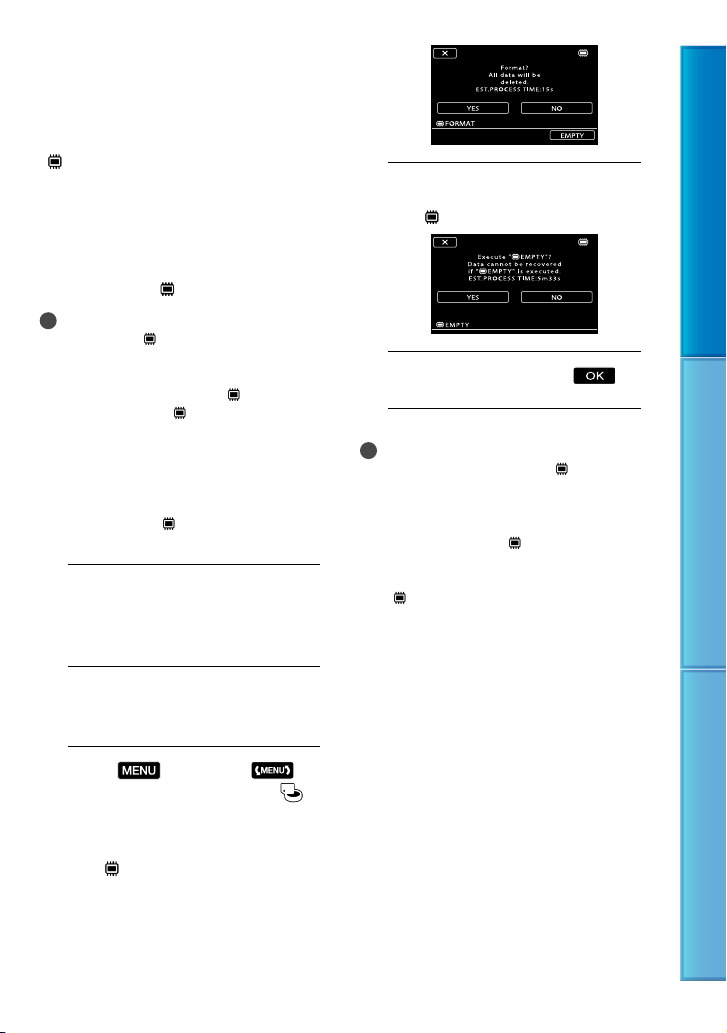
69
Table of Contents Useful Recording Techniques Index
Preventing data on the
internal memory from
being recovered
[ EMPTY] allows you to write
unintelligible data onto the internal
memory of the camcorder. In this way,
it may become more difficult to recover
any original data. When you dispose of or
transfer the camcorder, it is recommended
that you perform [
EMPTY].
Notes
If you perform [
EMPTY], all the images are
deleted. To avoid the loss of important images,
t
hey should be saved (p. 62, see Operating
Guide too) before performing [
EMPTY].
You cannot perform [
EMPTY] unless you
connect the AC Adaptor to the wall outlet (wall
socket).
Disconnect all cables except the AC Adaptor.
Do not disconnect the AC Adaptor during the
operation.
While performing [
EMPTY], do not apply
any vibrations or shocks to your camcorder.
1
Connect the AC Adaptor to the
DC IN jack on the camcorder and
the wall outlet (wall socket).
2
Open the LCD screen to turn on
your camcorder.
3
Touch (MENU)
[MEDIA FORMAT] (under
[MANAGE MEDIA] category)
[INT. MEMORY].
The [ FORMAT] screen appears.
4
Touch [EMPTY].
The [ EMPTY] screen appears.
5
Touch [YES] [YES] .
Notes
The actual performing time for [
EMPTY] is
as follows;
HDR-CX500/CX500V: a
bout 3 minutes
HDR-CX520/CX520V: a
bout 6 minutes
If you stop performing [
EMPTY] while
[Executing…] appears, be sure to complete the
operation by performing [MEDIA FORMAT]
or [
EMPTY] when you use the camcorder
next time.

70
Table of Contents Useful Recording Techniques Index
Customizing your camcorder
MANUAL SETTINGS (Items to adjust for scene
condition)
The default settings are marked with .
SCENE SELECTION
You can record images effectively in various situations.
Steps
(MENU)
[SCENE SELECTION] (under [MANUAL SETTINGS]
category)
a desired setting
AUTO
Automatically records images effectively without the [SCENE SELECTION]
function.
TWILIGHT* (
)
Maintains the darkening atmosphere of the distant
surroundings in twilight scenes.
TWILIGHT PORT. ( )
Enables to take photos of people and background using
a flash.
SUNRISE&SUNSET*
(
)
Reproduces the atmosphere of scenes such as sunsets or
sunrises.
FIREWORKS* ( )
Takes spectacular shots of fireworks.
LANDSCAPE*( )
Shoots distant subjects clearly. This setting also prevents
your camcorder from focusing on glass or metal mesh in
windows between the camcorder and the subject.
PORTRAIT (Soft
portrait) (
)
Brings out the subject such as people or flowers while
creating a soft background.
SPOTLIGHT**( )
Prevents people’s faces from appearing excessively white
when subjects are lit by strong light.
BEACH** ( )
Takes the vivid blue of the ocean or a lake.
SNOW** ( )
Takes bright pictures of a white landscape.
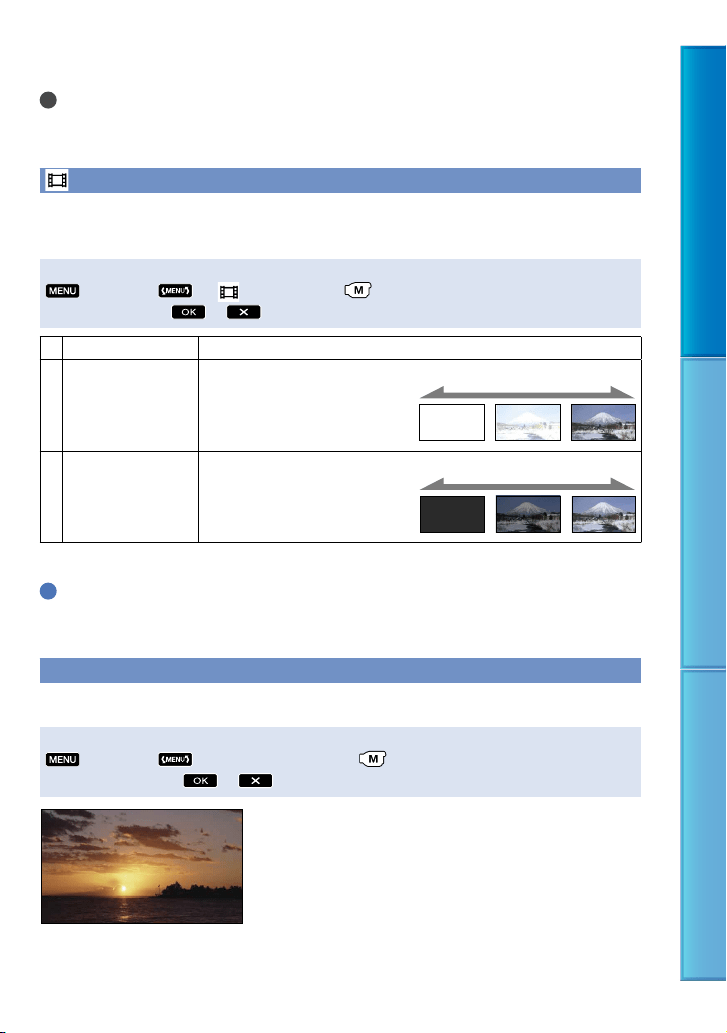
71
Table of Contents Useful Recording Techniques Index
* Adjusted to focus on subjects farther away only.
** Adjusted not to focus on subjects a short distance away.
Notes
Even if you set [TWILIGHT PORT.], the setting changes to [AUTO] in movie recording mode.
If you set [SCENE SELECTION], [WHITE BAL.] setting is canceled.
FADER
You can record a transition with the following effects adding to the interval between scenes.
Select the desired effect in [STBY] (to fading in) or [REC] (to fading out) mode.
Steps
(MENU)
[ FADER] (under [MANUAL SETTINGS] category)
a
desired setting
OFF
Does not use an effect.
WHITE FADER
Fades in/out with the white effect.
BLACK FADER
Fades in/out with the black effect.
To cancel the fader before starting the operation, touch [OFF].
Tips
When you press START/STOP, the setting is cleared.
A movie recorded using [BLACK FADER] may be difficult to see in the VISUAL INDEX screen.
WHITE BAL. (White balance)
You can adjust the color balance to the brightness of the recording environment.
Steps
(MENU)
[WHITE BAL.] (under [MANUAL SETTINGS] category)
a desired setting
Out In
Out In
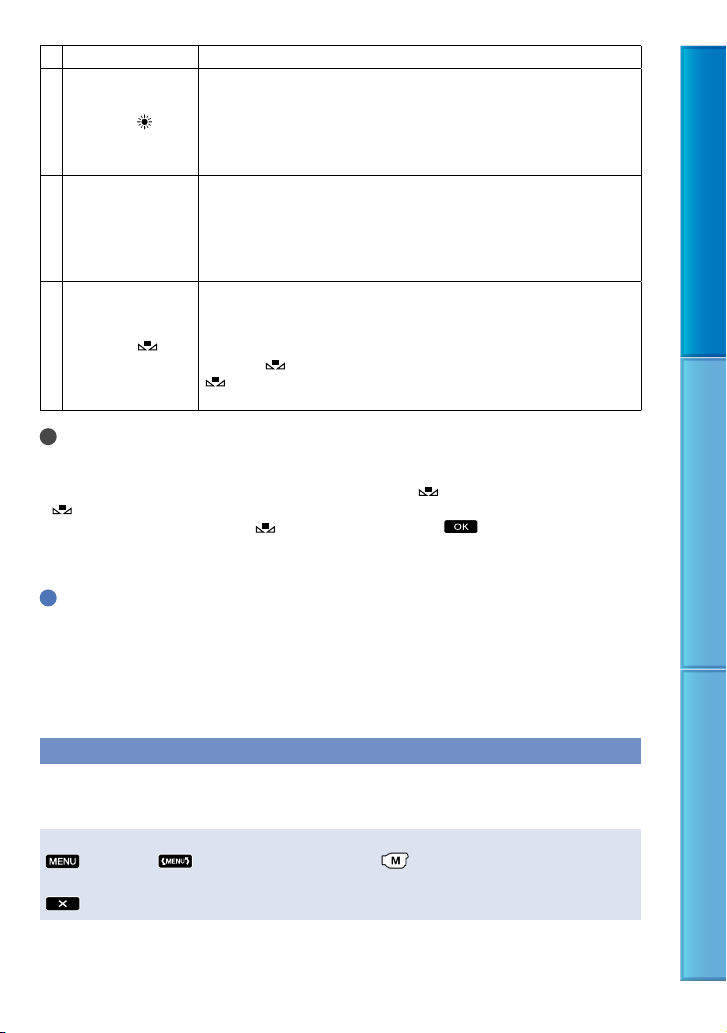
72
Table of Contents Useful Recording Techniques Index
AUTO
The white balance is adjusted automatically.
OUTDOOR (
)
The white balance is appropriately adjusted for the following recording
conditions:
Outdoors
Night views, neon signs and fireworks
Sunrise or sunset
Under daylight fluorescent lamps
INDOOR ()
The white balance is appropriately adjusted for the following recording
conditions:
Indoors
At party scenes or studios where the lighting conditions change quickly
Under video lamps in a studio, or under sodium lamps or incandescent-
like color lamps
ONE PUSH ( )
The white balance will be adjusted according to the ambient light.
Touch [ONE PUSH].
Frame a white object such as a piece of paper, to fill the screen under the
same lighting conditions as you will shoot the subject.
Touch [ ].
flashes quickly. When the white balance has been adjusted and stored in
the memory, the indicator stops flashing.
Notes
Set [WHITE BAL.] to [AUTO] or adjust the color in [ONE PUSH] under white or cool white fluorescent
lamps.
When you select [ONE PUSH], keep framing white objects while
is flashing quickly.
flashes slowly if [ONE PUSH] could not be set.
When [ONE PUSH] was selected, if
keeps flashing after touching , set [WHITE BAL.] to
[AUTO].
If you set [WHITE BAL.], [SCENE SELECTION] is set to [AUTO].
Tips
If you have changed the battery pack while [AUTO] was selected, or taken your camcorder outdoors after
inside use (or vice versa), select [AUTO] and aim your camcorder at a nearby white object for about 10
seconds for better color balance adjustment.
When the white balance has been set with [ONE PUSH], if the lighting conditions changed by bringing
your camcorder outdoors from inside the house, or vice versa, you need to redo the [ONE PUSH]
procedure to readjust the white balance.
SPOT MTR/FCS (Spot meter/focus)
You can adjust the brightness and focus for the selected subject simultaneously. This function
enables you to use [SPOT METER] (p
. 73) and [SPOT FOCUS] (p. 73) at the same time.
Steps
(MENU)
[SPOT MTR/FCS] (under [MANUAL SETTINGS] category)
touch the subject you want to adjust the brightness and focus on
[END]
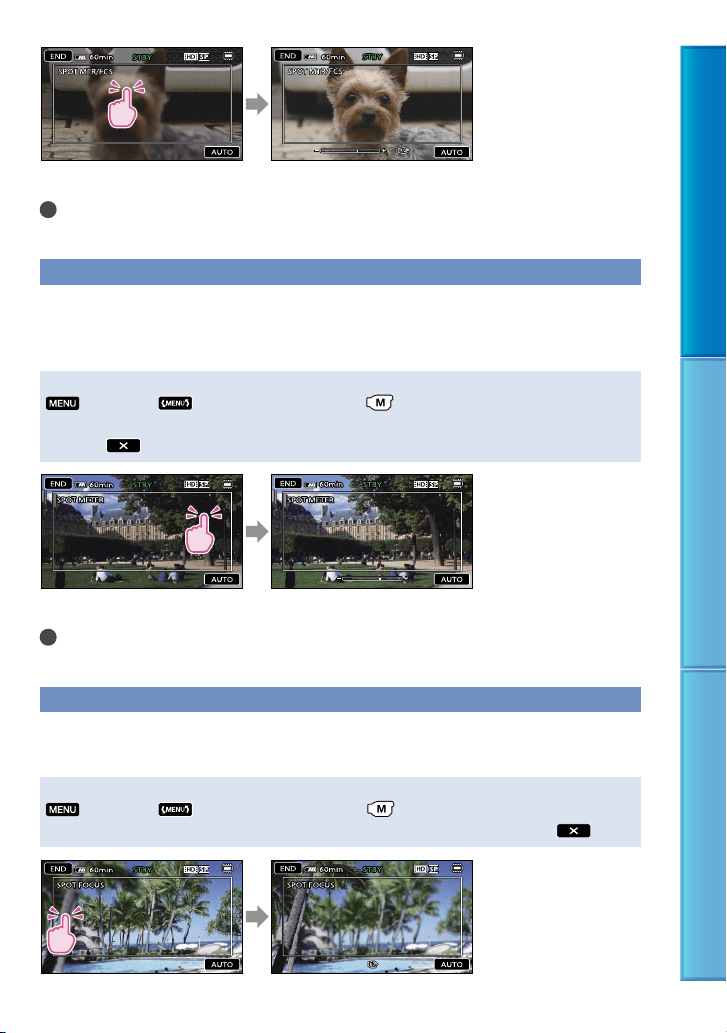
73
Table of Contents Useful Recording Techniques Index
To adjust the brightness and focus automatically, touch [AUTO].
Notes
[EXPOSURE] and [FOCUS] are automatically set to [MANUAL].
SPOT METER
You can adjust and fix the exposure to the subject, so that it is recorded in suitable brightness
even when there is strong contrast between the subject and the background, such as subjects
in the spotlight on stage.
Steps
(MENU)
[SPOT METER] (under [MANUAL SETTINGS] category)
touch the point where you want to fix and adjust the exposure on the screen
[END]
To return the setting to automatic exposure, touch [AUTO].
Notes
[EXPOSURE] is automatically set to [MANUAL].
SPOT FOCUS
You can select and adjust the focal point to aim it at a subject not located at the center of the
screen.
Steps
(MENU)
[SPOT FOCUS] (under [MANUAL SETTINGS] category)
touch the point to be focused within the frame on the screen
[END]
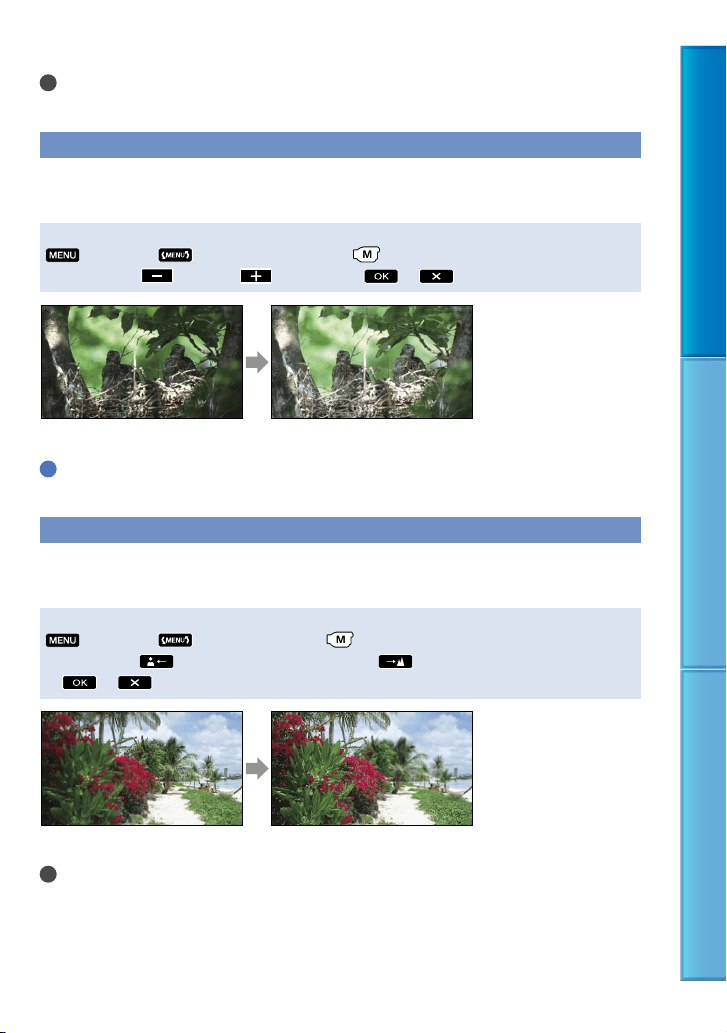
74
Table of Contents Useful Recording Techniques Index
To adjust the focus automatically, touch [AUTO].
Notes
[FOCUS] is automatically set to [MANUAL].
EXPOSURE
You can fix the brightness of a picture manually. Adjust the brightness when the subject is too
bright or too dark.
Steps
(MENU)
[EXPOSURE] (under [MANUAL SETTINGS] category)
[MANUAL]
(darker)/ (brighter)
To adjust the exposure automatically, touch [AUTO].
Tips
You can also adjust manually by using the MANUAL di
al (p. 33).
FOCUS
You can adjust the focus manually. You can select this function also when you want to focus
on a certain subject intentionally.
Steps
(MENU)
[FOCUS] (under [MANUAL SETTINGS] category)
[MANUAL]
(focusing on close subjects)/ (focusing on distant subjects)
To adjust the focus automatically, touch [AUTO].
Notes
When you set [FOCUS] to [MANUAL], appears.
The minimum possible distance between camcorder and subject while maintaining sharp focus is about 1
cm (about 13/32 in.) for wide angle and about 80 cm (about 31 1/2 in.) for telephoto.
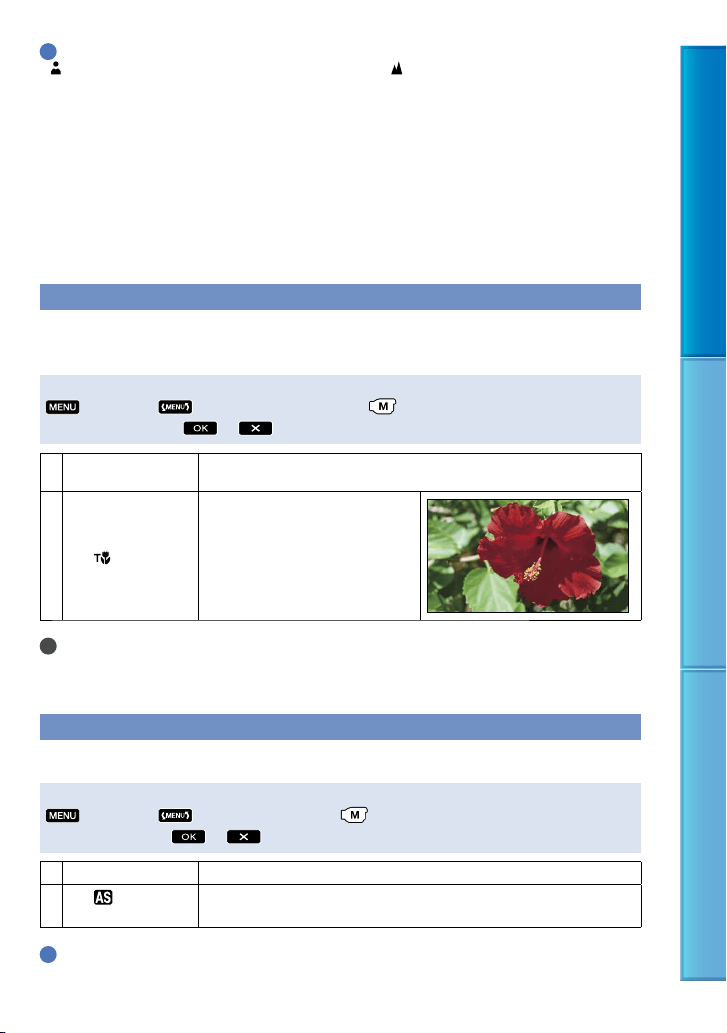
75
Table of Contents Useful Recording Techniques Index
Tips
appears when the focus cannot be adjusted any closer, and appears when the focus cannot be
adjusted farther away.
It is easier to focus on the subject by moving the power zoom lever towards T (telephoto) to adjust the
focus, then towards W (wide angle) to adjust the zoom for recording. When you want to record a subject
at close range, move the power zoom lever to W (wide angle), then adjust the focus.
The focal distance information (distance at which the subject is focused on; used as a guide if it is dark
and focus adjustment is difficult) appears for a few seconds in the following cases. (This information will
not display correctly if a conversion lens (sold separately) is being used.)
When the focus mode is switched from automatic to manual
When you set focus manually
You can also adjust manually by using the MANUAL di
al (p. 33).
TELE MACRO
This is useful to shoot small subjects, such as flowers or insects. You can blur out backgrounds
and the subject stands out clearer.
Steps
(MENU)
[TELE MACRO] (under [MANUAL SETTINGS] category)
a desired setting
OFF
Cancels TELE MACRO. (TELE MACRO is also canceled when you move the
zoom lever to the W side.)
ON (
)
The zoom (p. 29) moves to the top of
the T (telephoto) side automatically
and allows recording subjects at a
close distance down to about 45 cm
(17 3/4 in.).
Notes
When recording a distant subject, focusing may be difficult and can take some time.
Adjust the focus manually ([FOCUS], p
. 74) when it is hard to focus automatically.
AE SHIFT
You can adjust the exposure manually.
Steps
(MENU)
[AE SHIFT] (under [MANUAL SETTINGS] category)
a
desired setting
OFF
Adjusts the exposure automatically.
ON (
and the
adjustment value)
Adjusts the exposure manually.
Tips
You can adjust the automatic exposure level to brighter or darker when [EXPOSURE] is set to [AUTO].
76
Table of Contents Useful Recording Techniques Index
Touch if the subject is white or the backlight is bright, or touch if the subject is black or the
light is dim.
You can also adjust manually by using the MANUAL di
al (p. 33).
WB SHIFT (White Balance Shift)
You can adjust the white balance manually.
Steps
(MENU)
[WB SHIFT] (under [MANUAL SETTINGS] category)
a
desired setting
OFF
Adjusts the white balance automatically.
ON (
and the
adjustment value)
Adjusts the white balance manually.
Tips
When the white balance is set to a lower value, images appear bluish, and when set to a higher value,
images appear reddish.
You can also adjust manually by using the MANUAL di
al (p. 33).
SMTH SLW REC (Smooth slow rec)
See page 32.
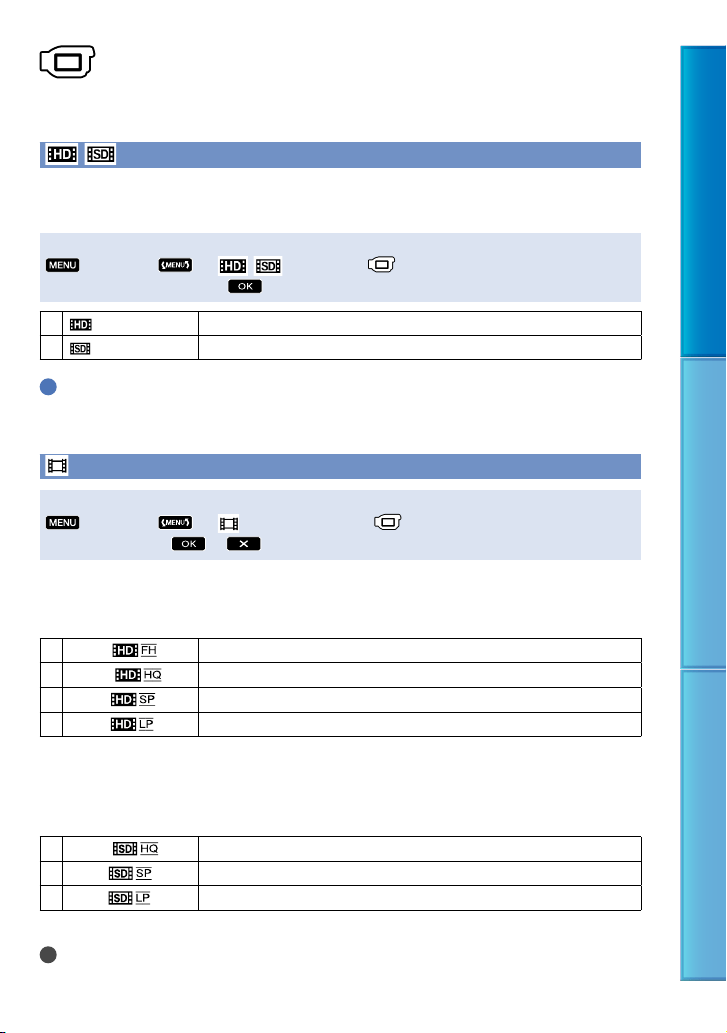
77
Table of Contents Useful Recording Techniques Index
SHOOTING SET (Items for customized shooting)
The default settings are marked with .
/ SET
You can select image quality for recording, playback, or editing from high definition image
quality (HD) or standard definition image quality (SD).
Steps
(MENU)
[ / SET] (under [SHOOTING SET] category)
a
desired setting
[YES]
HD QUALITY
Records, plays, or edits high definition image quality (HD) images.
SD QUALITY
Records, plays, or edits standard definition image quality (SD) images.
Tips
You can record, play, or edit movies in the selected image quality only. To record, play, or edit movies in
another image quality, change this setting.
REC MODE (Recording mode)
Steps
(MENU)
[ REC MODE] (under [SHOOTING SET] category)
a
desired setting
You can select a recording mode to record high definition image quality (HD) movies
from 4 levels. When recording fast moving subject, a high image quality, such as [FH], is
recommended.
HD FH ( )
Records in the highest quality mode (AVC HD 16M (FH))
*
1
.
HD HQ (
)
Records in high quality mode (AVC HD 9M (HQ))
*
2
.
HD SP (
)
Records in standard quality mode (AVC HD 7M (SP))
*
2
.
HD LP (
)
Increases the recording time (Long Play) (AVC HD 5M (LP))
*
2
.
*
1
Movies are recorded with AVCHD 1920 1080/60i format.
*
2
Movies are recorded with AVCHD 1440 1080/60i format.
You can select a recording mode to record standard definition image quality (SD)*
3
movies
from 3 levels.
SD HQ ( )
Records in high quality mode (SD 9M (HQ)).
SD SP (
)
Records in standard quality mode (SD 6M (SP)).
SD LP (
)
Increases the recording time (Long Play) (SD 3M (LP)).
*
3
Movies are recorded with MPEG-2 format.
Notes
If you record in the LP mode, the quality of movies may be degraded, or scenes with quick movements
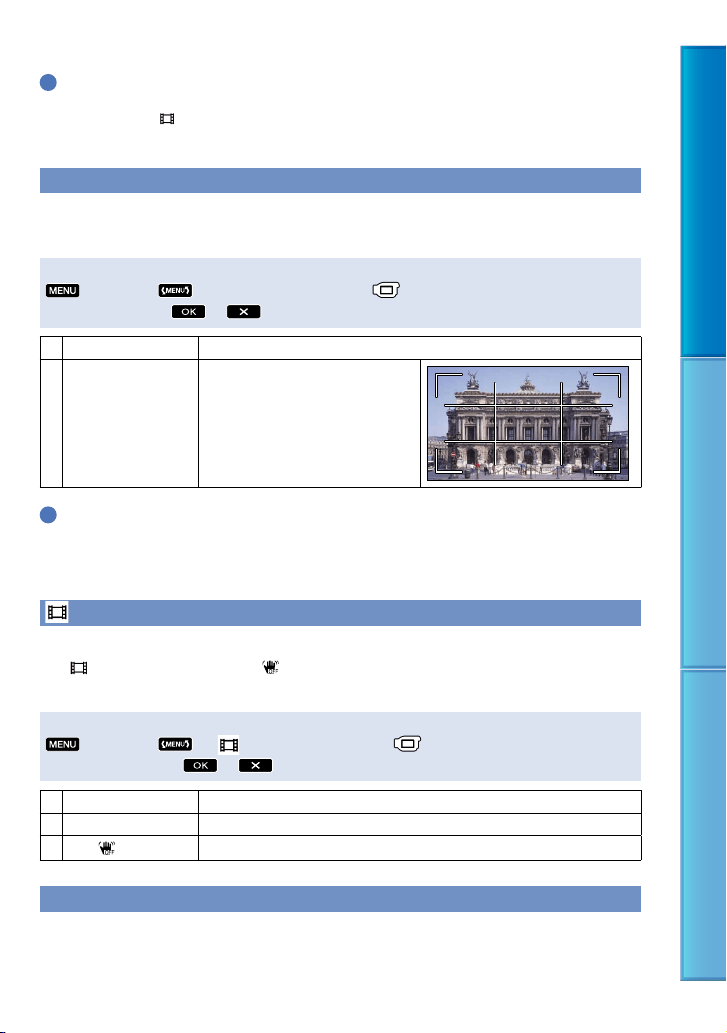
78
Table of Contents Useful Recording Techniques Index
may appear with block noise when you play back the image.
Tips
See page 111 for the expected recording time of each recording mode.
You can select the [
REC MODE] for each recording media separately.
Figures such as 16M in the table show the average movie recording bit rate. M stands for Mbps.
GUIDEFRAME
You can display the frame and check that the subject is horizontal or vertical.
The frame is not recorded.
Steps
(MENU)
[GUIDEFRAME] (under [SHOOTING SET] category)
a
desired setting
OFF
Does not display the guide frame.
ON
Displays the guide frame.
Tips
Positioning the subject at the cross point of the guide frame makes a balanced composition.
The outer frame of [GUIDEFRAME] shows the display area of a TV which is not compatible with full
pixel display.
STEADYSHOT
You can compensate for camera shake.
Set [
STEADYSHOT] to [OFF] ( ) when using a tripod (sold separately), then the image
becomes natural.
Steps
(MENU)
[ STEADYSHOT] (under [SHOOTING SET] category)
a desired setting
ACTIVE
Provides a more powerful SteadyShot effect.
STANDARD
Provides the SteadyShot effect under relatively stable recording conditions.
OFF (
)
The SteadyShot function is not used.
CONVERSION LENS
When using a conversion lens (sold separately), use this function to record using the optimum
compensation for camera shake and focus for the lens.
79
Table of Contents Useful Recording Techniques Index
Steps
(MENU)
[CONVERSION LENS] (under [SHOOTING SET] category)
a desired setting
OFF
Select this when you do not use a conversion lens.
WIDE CONVERSION
(
)
Select this when you use a wide-conversion lens.
TELE CONVERSION
(
)
Select this when you use a tele-conversion lens.
Note
The built-in flash is not flashed when [CONVERSION LENS] is set to [WIDE CONVERSION] or [TELE
CONVERSION], you cannot also set [FLASH MODE] (p
. 85).
LOW LUX
You can record bright color images, even in dim light.
Steps
(MENU)
[LOW LUX] (under [SHOOTING SET] category)
a
desired setting
OFF
The LOW LUX function is not used.
ON (
)
The LOW LUX function is used.
FACE DETECTION
Detects the faces of your subjects and adjusts the focus/color/exposure automatically. Also,
it adjusts the image quality of face parts more finely, in the case of the high definition image
quality (HD) movies.
Steps
(MENU)
[FACE DETECTION] (under [SHOOTING SET] category)
a desired setting
ON
Detects faces.
OFF (
)
Does not detect faces.
Notes
Faces may not be detected depending on recording conditions, subject conditions, and the setting of your
camcorder.
[FACE DETECTION] may not function properly depending on recording conditions. Set [FACE
DETECTION] to [OFF] in this case.
Tips
For better face detection performance, shoot the subject(s) under the following conditions:
Shoot in a sufficiently bright place
The subject(s) does not wear glasses, a hat or mask
80
Table of Contents Useful Recording Techniques Index
The subject(s) faces directly towards the camera
The detected faces are recorded in Face Index, however, some faces may not be. Also, there is a limit to
the number of faces that can be recorded in Face Index. To play back from the Face Index, see page 42.
PRIORITY SETTING
Selects the priority subject for the face detection or the smile shutter.
Adjusts focus/color/exposure automatically for the selected faces.
Steps
(MENU)
[PRIORITY SETTING] (under [SHOOTING SET] category)
a desired setting
AUTO
Detects faces automatically.
CHILD PRIORITY
Detects with priority on a child’s face.
ADULT PRIORITY
Detects with priority on an adult’s face.
Tips
When you specify the priority subject by touching the detection frame on the LCD screen, the face with a
do
uble-lined frame has priority (p. 29).
SMILE DETECTION
The shutter is released when the camcorder detects a smile (Smile Shutter).
Steps
(MENU)
[SMILE DETECTION] (under [SHOOTING SET] category)
a desired setting
DUAL CAPTURE (
)
Only during movie recording, the shutter is released automatically, when the
camcorder detects a smile.
ALWAYS ON (
)
The shutter is released when the camcorder detects a smile whenever the
camcorder is in recording mode.
OFF
Smiles are not detected, so photos are not recorded automatically.
Notes
Smiles may not be detected depending on recording conditions, subject conditions, and the setting of
your camcorder.
When [DUAL CAPTURE] is selected,
appears on the screen in movie recording standby, and
changes into
when movie recording starts.
SMILE SENSITIVITY
Sets the smile detection sensitivity using the Smile Shutter function.
Steps
(MENU)
[SMILE SENSITIVITY] (under [SHOOTING SET] category)
a desired setting
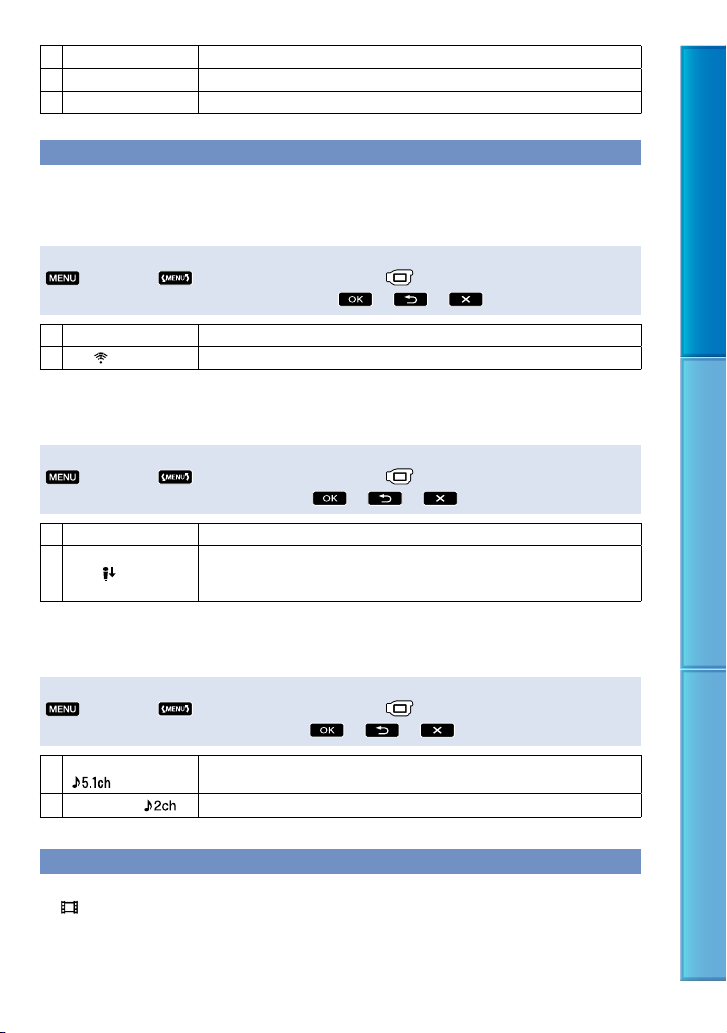
81
Table of Contents Useful Recording Techniques Index
HIGH
Detects even a slight smile.
MEDIUM
Detects a normal smile.
LOW
Detects a big smile.
AUDIO REC SET
BLT-IN ZOOM MIC (Built-in zoom microphone)
You can record a movie with vivid sound appropriate to the zoom position.
Steps
(MENU)
[AUDIO REC SET] (under [SHOOTING SET] category)
[BLT-IN ZOOM MIC]
a desired setting
OFF
The microphone does not record sound following zooming in or out.
ON (
)
The microphone records sound following zooming in or out.
MICREF LEVEL (Microphone reference level)
You can select the microphone level for recording sound.
Steps
(MENU)
[AUDIO REC SET] (under [SHOOTING SET] category)
[MICREF LEVEL]
a desired setting
NORMAL
Records various ambient sounds, converting them into the appropriate level.
LOW (
)
Records ambient sound faithfully. Select [LOW] when you want to record
an exciting and powerful sound in a concert hall, etc. (This setting is not
suitable for recording conversations.)
AUDIO MODE
You can change the recording sound format.
Steps
(MENU)
[AUDIO REC SET] (under [SHOOTING SET] category)
[AUDIO MODE]
a desired setting
5.1ch SURROUND
(
)
Records sound in 5.1ch surround.
2ch STEREO (
)
Records sound in 2ch stereo.
OTHER REC SET
DIGITAL ZOOM
You can select the maximum zoom level up to 12 × in case you want to zoom to a level greater
than following optical zoom during recording. Note that the image quality decreases when
you use the digital zoom.

82
Table of Contents Useful Recording Techniques Index
Steps
(MENU)
[OTHER REC SET] (under [SHOOTING SET] category)
[
DIGITAL ZOOM]
a desired setting
OFF
U
p to 12 × zoom is performed optically.
24×
U
p to 12 × zoom is performed optically, and after that, up to 24 × zoom is
performed digitally.
150×
U
p to 12 × zoom is performed optically, and after that, up to 150 × zoom is
performed digitally.
AUTO BACK LIGHT
Your camcorder adjusts the exposure for backlit subjects automatically.
Steps
(MENU)
[OTHER REC SET] (under [SHOOTING SET] category)
[AUTO BACK LIGHT]
a desired setting
ON
Adjusts the exposure for backlit subjects automatically.
OFF
Does not adjust the exposure for backlight subjects.
DIAL SETTING
You can select an item you want to set to the MANUAL dial. For details, see page 33.
NIGHTSHOT LIGHT
When using the NightShot (p. 31) function, you can record clearer images by activating
[NIGHTSHOT LIGHT], which emits infrared light (invisible).
Steps
(MENU)
[OTHER REC SET] (under [SHOOTING SET] category)
[NIGHTSHOT LIGHT]
a desired setting
ON
Emits infrared light.
OFF
Does not emit infrared light.
Notes
D
o not cover the infrared port (p. 7) with your fingers or other objects.
Remove the conversion lens (sold separately).
The maximum shooting distance using [NIGHTSHOT LIGHT] is about 3 m (10 feet).
The right side of the bar shows the digital zooming factor. The
zooming zone appears when you select the zooming level.
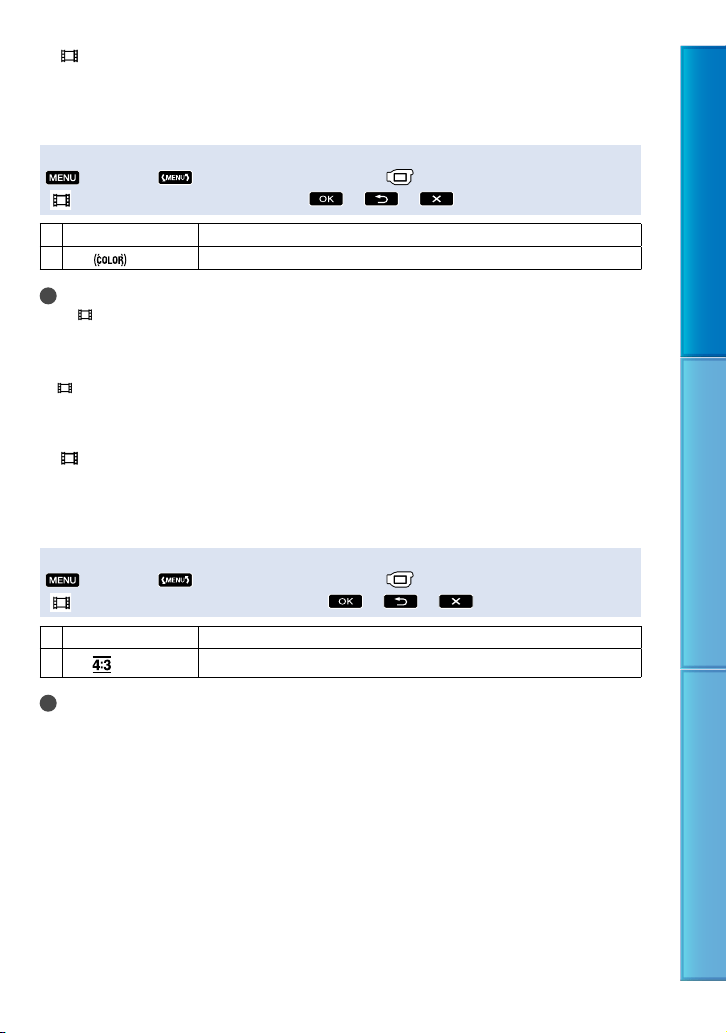
83
Table of Contents Useful Recording Techniques Index
X.V.COLOR
You can capture wider range of colors. Various colors such as the brilliant color of flowers and
turquoise blue of the sea can be more faithfully reproduced. Refer to the instruction manuals
of the TV.
Steps
(MENU)
[OTHER REC SET] (under [SHOOTING SET] category)
[
X.V.COLOR]
a desired setting
OFF
Records in ordinary color range.
ON (
)
Records in x.v.Color.
Notes
Set [
X.V.COLOR] to [ON] when the recorded movie will be played back on an x.v.Color-compliant
TV.
If the movie recorded with this function [ON] is played back on a non-x.v.Color-compliant TV, the color
may not be reproduced correctly.
[
X.V.COLOR] cannot be set to [ON]:
When recording standard definition image quality (SD) movies
While recording a movie
WIDE SELECT
When recording standard definition image quality (SD) movies, you can select the horizontal
to vertical ratio according to the TV connected. Refer also to the instruction manuals supplied
with your TV.
Steps
(MENU)
[OTHER REC SET] (under [SHOOTING SET] category)
[
WIDE SELECT]
a desired setting
16:9 WIDE
Records movies to the full screen on a 16:9 (wide) TV screen.
4:3 (
)
Records movies to the full screen on a 4:3 TV screen.
Notes
Set [TV TYPE] co
rrectly according to the TV connected for playback (p. 95).
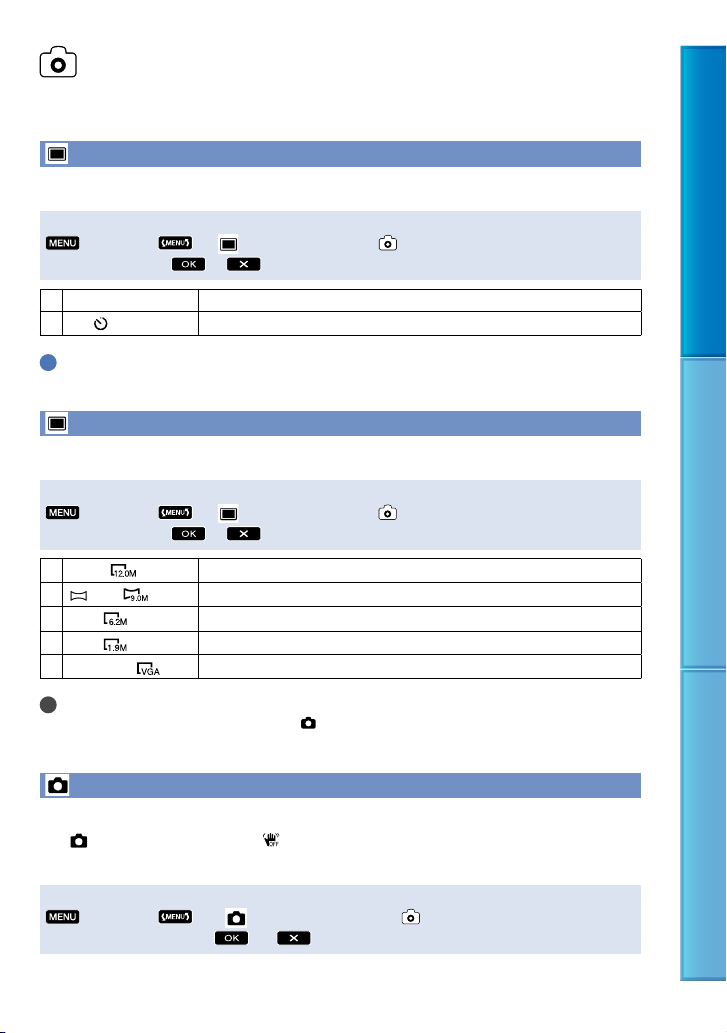
84
Table of Contents Useful Recording Techniques Index
PHOTO SETTINGS (Items for recording photos)
The default settings are marked with .
SELF-TIMER
Press PHOTO to start the count down. A photo is recorded after about 10 seconds.
Steps
(MENU)
[ SELF-TIMER] (under [PHOTO SETTINGS] category)
a
desired setting
OFF
Cancels the self-timer.
ON (
)
Starts the self-timer recording. To cancel the recording, touch [RESET].
Tips
You can also operate by pressing PHOTO o
n the Wireless Remote Commander (p. 8).
IMAGE SIZE
You can select a photo size to be shot.
Steps
(MENU)
[ IMAGE SIZE] (under [PHOTO SETTINGS] category)
a
desired setting
12.0M (
)
Records photos in the highest quality (4,000 × 3,000).
9.0M ( )
Records photos in the high quality in the 16:9 (wide) ratio (4,000 × 2,250).
6.2M (
)
Records photos clearly (2,880 × 2,160).
1.9M (
)
Allows you to record more photos in relatively clear quality (1,600 × 1,200).
VGA(0.3M) (
)
Allows the maximum number of photos to be recorded (640 × 480).
Notes
The selected image size is effective when the
(Photo) lamp is lit.
See page 113 for the number of recordable photos.
STEADYSHOT
You can compensate for camera shake.
Set [
STEADYSHOT] to [OFF] ( ) when using a tripod (sold separately), then the image
becomes natural.
Steps
(MENU)
[ STEADYSHOT] (under [PHOTO SETTINGS] category)
a desired setting
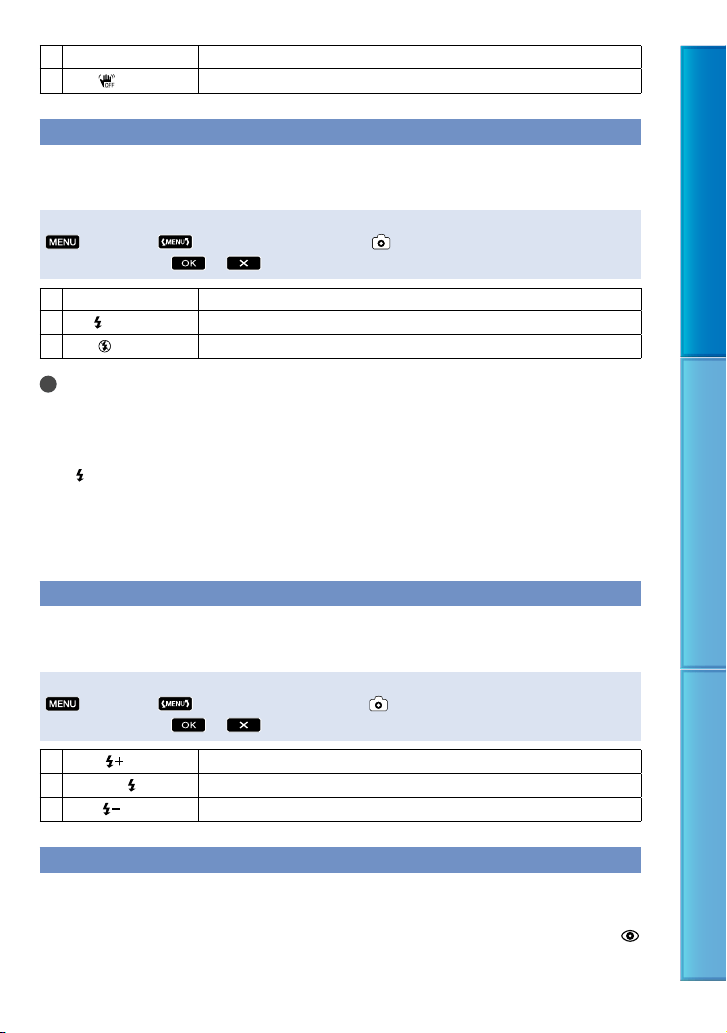
85
Table of Contents Useful Recording Techniques Index
ON
The SteadyShot function is used.
OFF (
)
The SteadyShot function is not used.
FLASH MODE
You can select the flash setting when you record photos using the built-in flash, or an external
flash (sold separately) that is compatible with your camcorder.
Steps
(MENU)
[FLASH MODE] (under [PHOTO SETTINGS] category)
a
desired setting
AUTO
Automatically flashes when there is insufficient ambient light.
ON (
)
Always uses the flash regardless of the surrounding brightness.
OFF (
)
Records without flash.
Notes
The recommended distance to the subject when using the built-in flash is approximately 0.3 to 2.0 m (1
to 6.5 feet).
Remove any dust from the surface of the flash before using it. Flash effect may be impaired if heat
discoloration or dust obscures the lamp.
The
/CHG (flash/charge) lamp (p. 19) flickers while charging the flash, and remains lit when the battery
charge is complete.
If you use the flash in bright places such as when shooting a backlit subject, the flash may not be effective.
The built-in flash is not flashed when [CONVERSION LENS] (p
. 78) is set to [WIDE CONVERSION] or
[TELE CONVERSION], you cannot also set [FLASH MODE].
FLASH LEVEL
You can set this function when you record photos using the built-in flash, or an external flash
(sold separately) that is compatible with your camcorder.
Steps
(MENU)
[FLASH LEVEL] (under [PHOTO SETTINGS] category)
a
desired setting
HIGH ( )
Makes the flash level higher.
NORMAL (
)
LOW (
)
Makes the flash level lower.
REDEYE REDUC (Redeye reduction)
You can set this function when you record photos using the built-in flash, or an external flash
(sold separately) that is compatible with your camcorder.
When you set [REDEYE REDUC] to [ON], then set [FLASH MODE] to [AUTO] or [ON],
appears. You can prevent redeye by activating the pre-flash before the flash flashes.
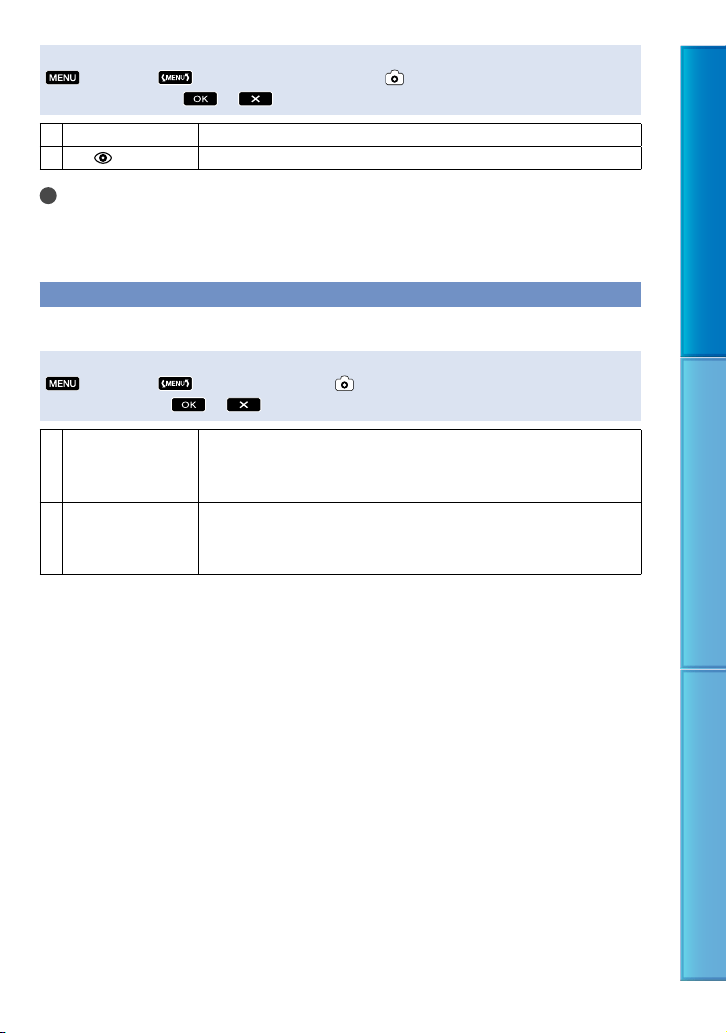
86
Table of Contents Useful Recording Techniques Index
Steps
(MENU)
[REDEYE REDUC] (under [PHOTO SETTINGS] category)
a desired setting
OFF
Does not prevent redeye.
ON (
)
Prevents redeye.
Notes
The redeye reduction may not produce the desired effect due to individual differences and other
conditions.
The redeye function does not work with automatic recording by [SMILE DETECTION].
FILE NO. (File number)
You can select the way to assign file number of photos.
Steps
(MENU)
[FILE NO.] (under [PHOTO SETTINGS] category)
a
desired setting
SERIES
Assigns file numbers of photos in sequence.
The file number becomes larger each time you record a photo.
Even if the “Memory Stick PRO Duo” media is replaced with another one,
the file number is assigned in sequence.
RESET
Assigns file numbers in sequence, following the largest file number existing
on the current recording medium.
When the “Memory Stick PRO Duo” media is replaced with another one,
the file number is assigned for each “Memory Stick PRO Duo” media.
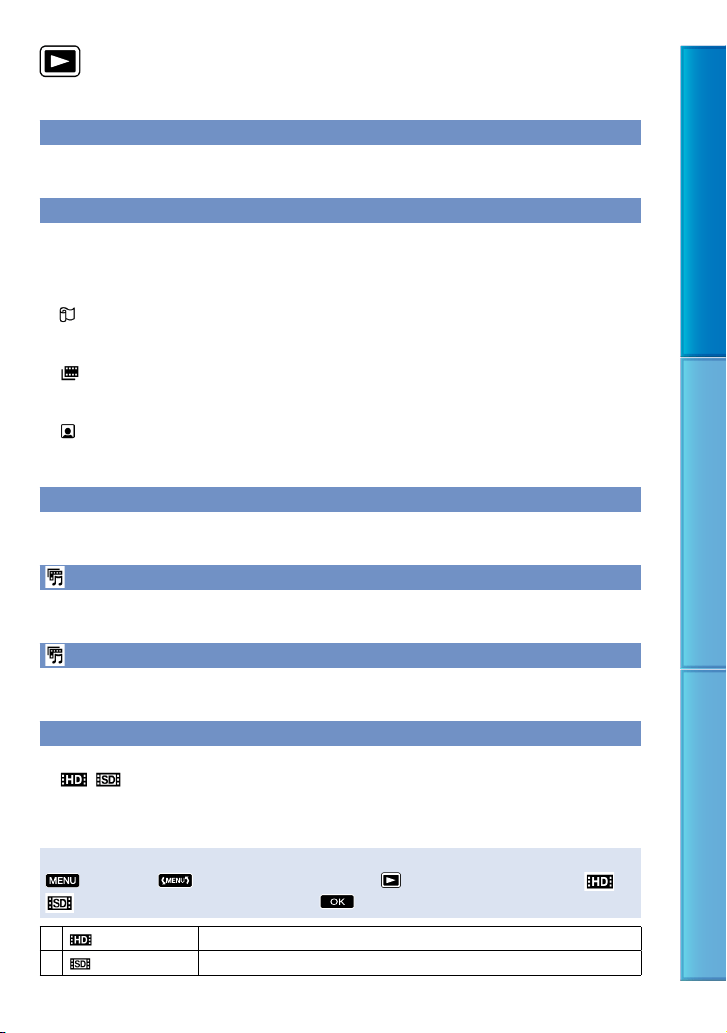
87
Table of Contents Useful Recording Techniques Index
PLAYBACK (Items for playback)
VISUAL INDEX
See page 36.
VIEW IMAGES
DATE INDEX
See page 39.
MAP (HDR-CX500V/CX520V)
See page 40.
FILM ROLL
See page 41.
FACE
See page 42.
PLAYLIST
See page 60.
HIGHLIGHT
See page 43.
SCENARIO
See page 44.
PLAYBACK SET
/ SET
You can select image quality for recording, playback, or editing from high definition image
quality (HD) or standard definition image quality (SD).
Steps
(MENU)
[PLAYBACK SET] (under [PLAYBACK] category)
[ /
SET]
a desired setting
[YES]
HD QUALITY
Records, plays, or edits high definition image quality (HD) image.
SD QUALITY
Records, plays, or edits standard definition image quality (SD) image.
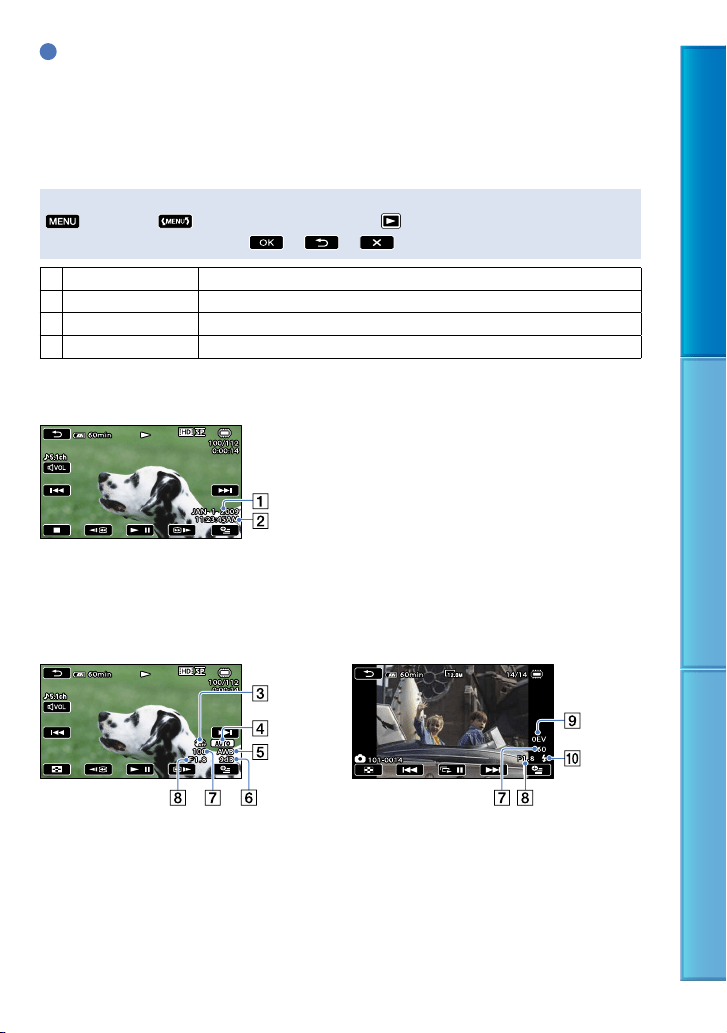
88
Table of Contents Useful Recording Techniques Index
Tips
You can record, play, or edit movies in the selected image quality only. To record, play, or edit movies in
another image quality, perform this setting again.
DATA CODE
During playback, your camcorder displays the information (Date/time, Camera data,
Coordinates) recorded automatically at the time of recording.
Steps
(MENU)
[PLAYBACK SET] (under [PLAYBACK] category)
[DATA
CODE]
a desired setting
OFF
Data code is not displayed.
DATE/TIME
Displays the date and time.
CAMERA DATA
Displays camera setting data.
COORDINATES
*
Displays coordinates.
* HDR-CX500V/CX520V
DATE/TIME
Date
Time
CAMERA DATA
SteadyShot off
Brightness
White balance
Gain
Shutter speed
Aperture value
Exposure
Flash
Movie Photo

89
Table of Contents Useful Recording Techniques Index
COORDINATES (HDR-CX500V/CX520V)
Latitude
Longitude
Tips
The data code is displayed on the TV screen if you connect your camcorder to a TV.
The indicator toggles through the following sequences as you press DATA CODE on the Wireless Remote
Commander: [DATE/TIME] [CAMERA DATA] [COORDINATES] (HDR-CX500V/CX520V)
[OFF] (no indication).
Depending on the recording media condition, bars [--:--:--] appear.

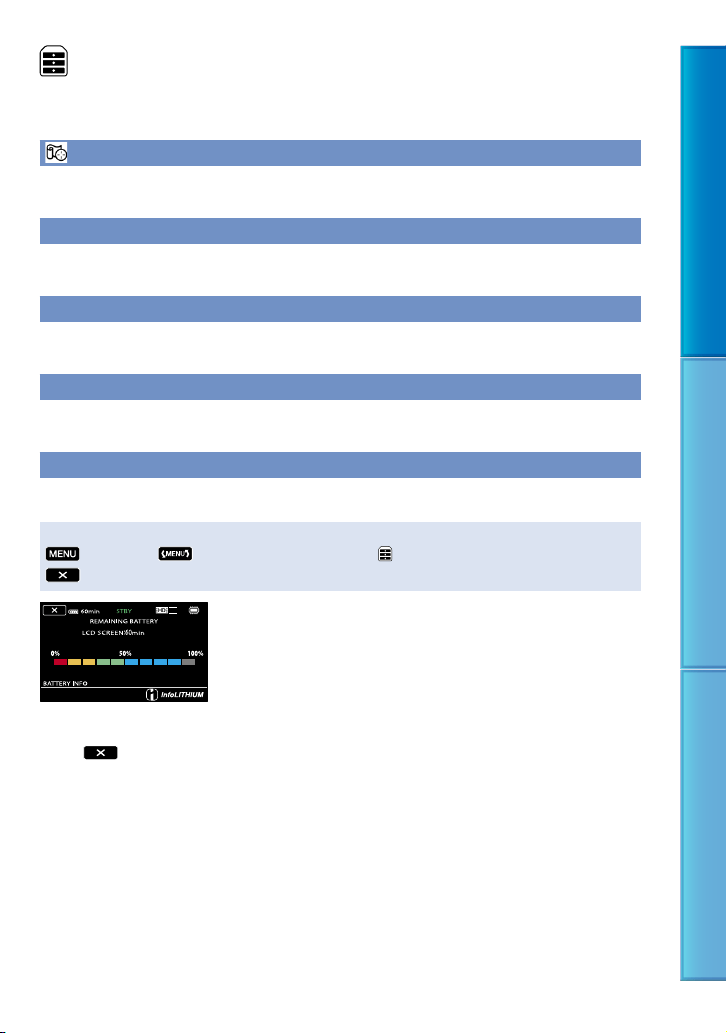
91
Table of Contents Useful Recording Techniques Index
OTHERS (Items for other settings)
The default settings are marked with .
YOUR LOCATION (HDR-CX500V/CX520V)
See page 54.
USB CONNECT
See page 64.
TV CONNECT Guide
See page 47.
MUSIC TOOL
See page 44.
BATTERY INFO
You can check the estimated remaining capacity of the battery.
Steps
(MENU)
[BATTERY INFO] (under [OTHERS] category)
check
.
SP
To close the battery information screen
Touch .
92
Table of Contents Useful Recording Techniques Index
MANAGE MEDIA (Items for recording media)
MEDIA SETTINGS
See page 67.
MEDIA INFO
You can check the remaining recordable time for each recording mode of the recording media
selected on [MOVIE MEDIA SET] (p
. 67), and the approximate free and used media space of
the recording media.
Steps
(MENU)
[MEDIA INFO] (under [MANAGE MEDIA] category)
check
.
To turn off the display
Touch .
Notes
Since there is a management file area, the used space is not displayed as 0 % even if you perform [MEDIA
FORMAT] (p
. 92).
Tips
Only the information of the medium selected on [MOVIE MEDIA SET] (p
. 67) is displayed. Change the
medium setting if necessary.
MEDIA FORMAT
Formatting deletes all the movies and photos to recover recordable free space. Select the
recording media to be formatted.
Steps
(MENU)
[MEDIA FORMAT] (under [MANAGE MEDIA] category)
[INT. MEMORY]/[MEMORY STICK]
[YES]
[YES]
.
Notes
Connect your camcorder to the wall outlet (wall socket) using AC Adaptor supplied for this operation
(p
. 20).
T
o avoid the loss of important images, you should save them (p. 62, see Operating Guide too) before
formatting the recording media.
Protected movies and photos will also be deleted.
While [Executing…] is displayed, do not close the LCD screen, operate the buttons on the camcorder,
disconnect the AC Adaptor, or eject the “Memory Stick PRO Duo” media from your camcorder (The
access lamp is lit or flashing while formatting the medium.).

94
Table of Contents Useful Recording Techniques Index
GENERAL SET (Other setup items)
The default settings are marked with .
SOUND/DISP SET
VOLUME
You can adjust the volume of playback sound.
Steps
(MENU)
[SOUND/DISP SET] (under [GENERAL SET] category)
[VOLUME]
(quieter)/ (louder)
BEEP
Steps
(MENU)
[SOUND/DISP SET] (under [GENERAL SET] category)
[BEEP]
a desired setting
ON
A melody sounds when you start/stop recording, or operate the touch panel.
OFF
Cancels the melody.
LCD BRIGHT
You can adjust the brightness of the LCD screen.
Steps
(MENU)
[SOUND/DISP SET] (under [GENERAL SET] category)
[LCD BRIGHT]
(darker)/ (brighter)
Tips
This adjustment does not affect the recorded images in any way.
LCD BL LEVEL (LCD back light level)
You can adjust the brightness of the LCD screen’s backlight.
Steps
(MENU)
[SOUND/DISP SET] (under [GENERAL SET] category)
[LCD BL LEVEL]
a desired setting
NORMAL
Standard brightness.
BRIGHT
Brightens the LCD screen.
Notes
When you connect your camcorder to the wall outlet (wall socket) using the supplied AC Adaptor,
[BRIGHT] is automatically selected for the setting.
When you select [BRIGHT], battery life is slightly reduced during recording.

95
Table of Contents Useful Recording Techniques Index
If you open the LCD panel 180 degrees to face the screen outside and close the LCD panel to the
camcorder body, the setting becomes [NORMAL] automatically.
Tips
This adjustment does not affect the recorded images in any way.
LCD COLOR
You can adjust the color of the LCD screen.
Steps
(MENU)
[SOUND/DISP SET] (under [GENERAL SET] category)
[LCD COLOR]
(lower intensity)/ (higher intensity)
Tips
This adjustment does not affect the recorded images in any way.
DISPLAY SET
You can set the duration of displaying the icons or indicators on the LCD screen.
Steps
(MENU)
[SOUND/DISP SET] (under [GENERAL SET] category)
[DISPLAY SET]
a desired setting
AUTO1
Displays for about 3 seconds. The rec & zoom buttons on the LCD is
displayed.
AUTO2
Displays for about 3 seconds. The rec & zoom buttons on the LCD is not
displayed.
ON
Always displays. The rec & zoom buttons on the LCD is not displayed.
Tips
The icons or indicators are displayed in the following cases.
When you turn on your camcorder.
The LCD screen is touched (Except rec & zoom buttons on LCD).
When you switch your camcorder to the movie recording, photo recording, or playback modes.
OUTPUT SETTINGS
TV TYPE
You need to convert the signal depending on the TV connected when playing back movies
and photos. The recorded movies and photos are played back as following illustrations.
Steps
(MENU)
[OUTPUT SETTINGS] (under [GENERAL SET] category)
[TV TYPE]
a desired setting
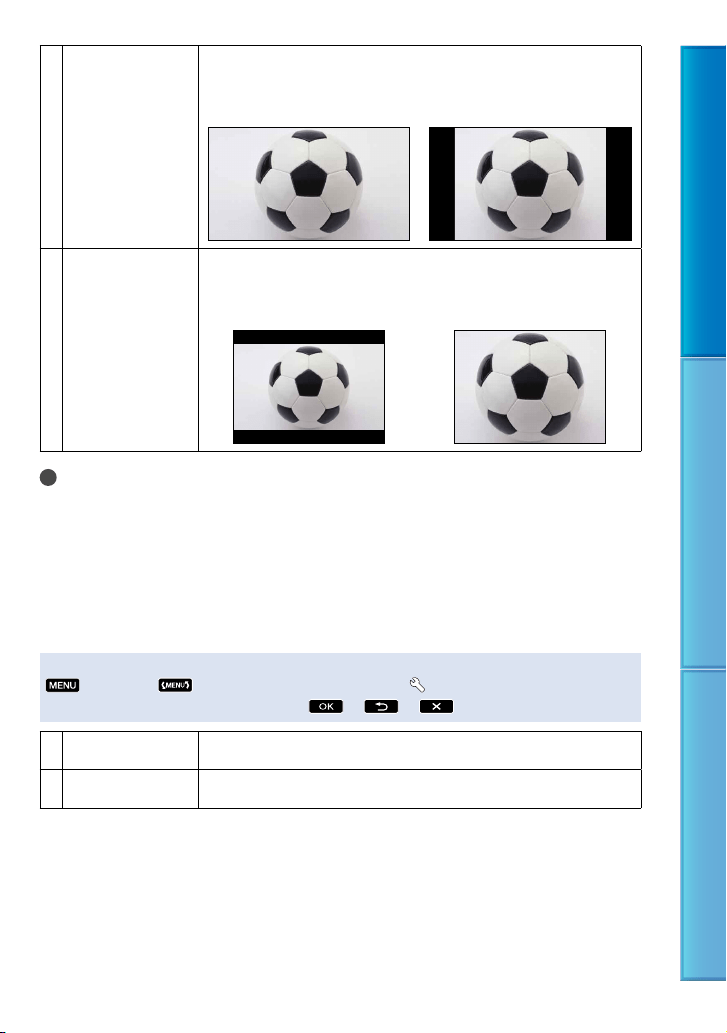
96
Table of Contents Useful Recording Techniques Index
16:9
Select this to view your movies on a 16:9 (wide) TV. The recorded movies
and photos are played back as shown below.
Movies and photos recorded in 16:9
(wide) mode
Movies and photos recorded in 4:3
mode
4:3
Select this to view your movies and photos on a 4:3 standard TV. The
recorded movies and photos are played back as shown below.
Movies and photos recorded in 16:9
(wide) mode
Movies and photos recorded in 4:3
mode
Notes
Horizontal to vertical ratio of high definition image quality (HD) movies is 16:9.
When you connect your camcorder to a TV compatible with the ID-1/ID-2 system, set [TV TYPE] to
[16:9]. The TV switches to full mode automatically. Refer also to the instruction manuals supplied with
your TV.
COMPONENT
Select [COMPONENT] when connecting your camcorder to a TV with the component input
jack.
Steps
(MENU)
[OUTPUT SETTINGS] (under [GENERAL SET] category)
[COMPONENT]
a desired setting
480i
Select this when connecting your camcorder to a TV with the component
input jack.
1080i/480i
Select this when connecting your camcorder to a TV that has the component
input jack and is capable of displaying the 1080i signal.
HDMI RESOLUTION
Select the output image resolution when connecting your camcorder to a TV with an HDMI
cable (sold separately).
97
Table of Contents Useful Recording Techniques Index
Steps
(MENU)
[OUTPUT SETTINGS] (under [GENERAL SET] category)
[HDMI RESOLUTION]
[HD CONTENTS]/[SD CONTENTS]
a desired setting
HD CONTENTS
Set the output image resolution recorded with high definition image quality (HD).
AUTO
Normal setting (outputs the signal according to the TV automatically).
1080p
Outputs the 1080p signal.
1080i
Outputs the 1080i signal.
720p
Outputs the 720p signal.
480p
Outputs the 480p signal.
SD CONTENTS
Set the output image resolution recorded with standard definition image quality (SD).
AUTO
Normal setting (outputs the signal according to the TV automatically).
480p
Outputs the 480p signal.
480i
Outputs the 480i signal.
DISP OUTPUT (Display output)
You can set where the screen displays are to be output.
Steps
(MENU)
[OUTPUT SETTINGS] (under [GENERAL SET] category)
[DISP OUTPUT]
a desired setting
LCD PANEL
Shows displays such as the time code on the LCD screen.
V-OUT/PANEL
Shows displays such as the time code on the LCD screen, and on the TV
screen.
CLOCK/ LANG
CLOCK SET
See page 22.
AREA SET
You can adjust a time difference without stopping the clock. Set your local area when using
your camcorder in other time zones. Refer to the world time difference on page 115.
Steps
(MENU)
[CLOCK/ LANG] (under [GENERAL SET] category)
[AREA SET]
set your local area using /
AUTO CLOCK ADJ (Auto clock adjustment) (HDR-CX500V/CX520V)
Your camcorder will maintain the correct clock time by acquiring the time from GPS.
98
Table of Contents Useful Recording Techniques Index
Set the GPS switch to ON in advance.
Steps
(MENU)
[CLOCK/ LANG] (under [GENERAL SET] category)
[AUTO CLOCK ADJ]
a desired setting
ON
Adjusts the clock automatically.
OFF
Does not adjust the clock automatically.
Notes
Y
ou must set the date and time on your camcorder before using your camcorder (p. 22).
There may be discrepancies of a few seconds even if [AUTO CLOCK ADJ] is activated.
The clock is adjusted automatically by [AUTO CLOCK ADJ] when you turn off your camcorder if the
camcorder is receiving a GPS signal while it is being used. The clock is not adjusted until the camcorder
is turned off. Also, the clock is not adjusted unless the camcorder is receiving a GPS signal, even if the
GPS switch is set to ON.
AUTO AREA ADJ (Auto area adjustment) (HDR-CX500V/CX520V)
Your camcorder will compensate for a time differences with the current area automatically
when it detects a time difference, by acquiring the current location information from GPS.
Set the GPS switch to ON in advance.
Steps
(MENU)
[CLOCK/ LANG] (under [GENERAL SET] category)
[AUTO AREA ADJ]
a desired setting
ON
Compensates for the time difference with the current area automatically.
OFF
Does not compensate for the time difference with the current area
automatically.
Notes
Y
ou must set date and time on your camcorder before using your camcorder (p. 22).
DST SET/SUMMERTIME
You can change this setting without stopping the clock. Set to [ON] to move the time forward
1 hour.
Steps
(MENU)
[CLOCK/ LANG] (under [GENERAL SET] category)
[DST SET] or [SUMMERTIME]
a desired setting
OFF
Does not set the DST SET.
ON
Sets the DST SET.
LANGUAGE SET
You can select the language to be used on the LCD screen.
99
Table of Contents Useful Recording Techniques Index
Steps
(MENU)
[CLOCK/ LANG] (under [GENERAL SET] category)
[
LANGUAGE SET]
a desired setting
Tips
Your camcorder offers [ENG[SIMP]] (simplified English) for when you cannot find your native tongue
among the options.
POWER SETTINGS
A.SHUT OFF (Auto shut off)
You can set your camcorder to turn off automatically when you do not operate your
camcorder for more than about 5 minutes.
Steps
(MENU)
[POWER SETTINGS] (under [GENERAL SET] category)
[A.SHUT OFF]
a desired setting
5min
The camcorder turns off automatically.
NEVER
The camcorder does not turn off automatically.
Notes
When you connect your camcorder to a wall outlet (wall socket), [A.SHUT OFF] is automatically set to
[NEVER].
POWER ON BY LCD
You can set your camcorder to turn on and off when you open and close the LCD screen.
Steps
(MENU)
[POWER SETTINGS] (under [GENERAL SET] category)
[POWER ON BY LCD]
a desired setting
ON
The camcorder turns on and off when the LCD screen opens and closes.
OFF
The camcorder does not turn on and off when the LCD screen opens and
closes.
OTHER SETTINGS
DEMO MODE
When your camcorder is connected to a wall outlet (wall socket), a demonstration movie
appear about 10 minutes after you turn on the
(Movie) lamp by pressing MODE.
Steps
(MENU)
[OTHER SETTINGS] (under [GENERAL SET] category)
[DEMO MODE]
a desired setting
100
Table of Contents Useful Recording Techniques Index
ON
The demonstration appears.
OFF
The demonstration does not appear.
Tips
When you set this item to [ON] and touch
, the demonstration starts playing.
The demonstration will be suspended:
When you press START/STOP or PHOTO
When you touch the screen during the demonstration (The demonstration starts again after about 10
minutes)
When you turn on the
(Photo) lamp
When you press
(VIEW IMAGES)
A movie you have recorded will be registered as the demonstration movie if the movie satisfies all of the
following conditions.
The movie is protected
The movie is the first one displayed on the VISUAL INDEX screen
The movie is saved on the internal memory
The movie is recorded with high definition image quality (HD)
CALIBRATION
See page 123.
CTRL FOR HDMI (Control for HDMI)
When connecting your camcorder to a “BRAVIA” Sync compatible TV with the HDMI cable
(sold separately), you can play back movies on your camcorder by aiming the TV’s Remote
C
ommander at the TV (p. 51).
Steps
(MENU)
[OTHER SETTINGS] (under [GENERAL SET] category)
[CTRL FOR HDMI]
a desired setting
ON
Operates your camcorder using the TV’s Remote Commander.
OFF
Does not operate your camcorder using the TV’s Remote Commander.
REC LAMP (Recording lamp)
You can make the camera recording lamp on the front of your camcorder not to turn on.
Steps
(MENU)
[OTHER SETTINGS] (under [GENERAL SET] category)
[REC LAMP]
a desired setting
ON
The camera recording lamp lights up.
OFF
The camera recording lamp does not light up.

101
Table of Contents Useful Recording Techniques Index
REMOTE CTRL (Remote control)
Steps
(MENU)
[OTHER SETTINGS] (under [GENERAL SET] category)
[REMOTE CTRL]
a desired setting
ON
S
elect this when you use the supplied Wireless Remote Commander (p. 8).
OFF
Select this when you do not use supplied Wireless Remote Commander.
Tips
Select [OFF] when you want to prevent your camcorder from responding to a command sent by another
remote control unit.

102
Table of Contents Useful Recording Techniques Index
Troubleshooting
Troubleshooting
If you run into any problems using your
camcorder, use the following list to
troubleshoot the problem. If the problem
persists, disconnect the power source and
contact your Sony dealer.
Overall operations/Wireless Remote
Commander ...................................................p
. 102
Batteries/power sources ..............................p
. 103
LCD screen ....................................................p
. 103
“Memory Stick PRO Duo” media ...............p
. 104
Recording ....................................................... p
. 104
Playback .........................................................p
. 105
Playing back images stored on “Memory Stick
PRO Duo” media on other devices ............. p
. 106
Editing movies/photos on your camcorder
.........................................................................p
. 106
Playback on the TV ......................................p
. 107
Dubbing/Connecting to other devices .......p
. 107
GPS (HDR-CX500V/CX520V) ...................p
. 107
Examples of functions that cannot be used
simultaneously ...............................................p
. 107
Notes before sending your camcorder
for repair
Your camcorder may be required to initialize
or change the current internal memory of your
camcorder, depending on the problem. In the
event of this, the data stored on the internal
memory will be deleted. Be sure to save the
data on the internal memory on other media
(backup) before sending your camcorder for
r
epair (p. 62, see Operating Guide too). We
will not compensate you for any loss of internal
memory data.
During repair, we may check a minimum
amount of data stored on the internal memory
in order to investigate the problem. However,
your Sony dealer will neither copy nor retain
your data.
Overall operations/Wireless
Remote Commander
The power does not turn on.
Attach a charged battery pack to the
camcorder (p. 19).
The plug of the AC Adaptor has been
disconnected from the wall outlet (wall
socket). Connect it to the wall outlet (wall
socket) (p
. 19).
The camcorder does not operate even
when the power is set to on.
It takes a few seconds for your camcorder to
be ready to shoot after the power is turned on.
This is not a malfunction.
Disconnect the AC Adaptor from the wall
outlet (wall socket) or remove the battery
pack, then reconnect it after about 1 minute.
If the functions still do not work, press RESET
(p
. 7) using a pointed object. (If you press
RESET, all settings, including the clock setting,
are reset.)
The menu settings have changed
automatically.
The following menu items return to the
default settings in more than 12 hours after
you close the LCD screen.
[SCENE SELECTION]
[WHITE BAL.]
[SPOT MTR/FCS]
[SPOT METER]
[SPOT FOCUS]
[EXPOSURE]
[FOCUS]
[LOW LUX]
[BLT-IN ZOOM MIC]
[MICREF LEVEL]
[AUTO BACK LIGHT]
The following menu items return to the
default settings when you switch between
movie recording and photo recording and
playback modes.
[ FADER]
[TELE MACRO]
[
SELF-TIMER]
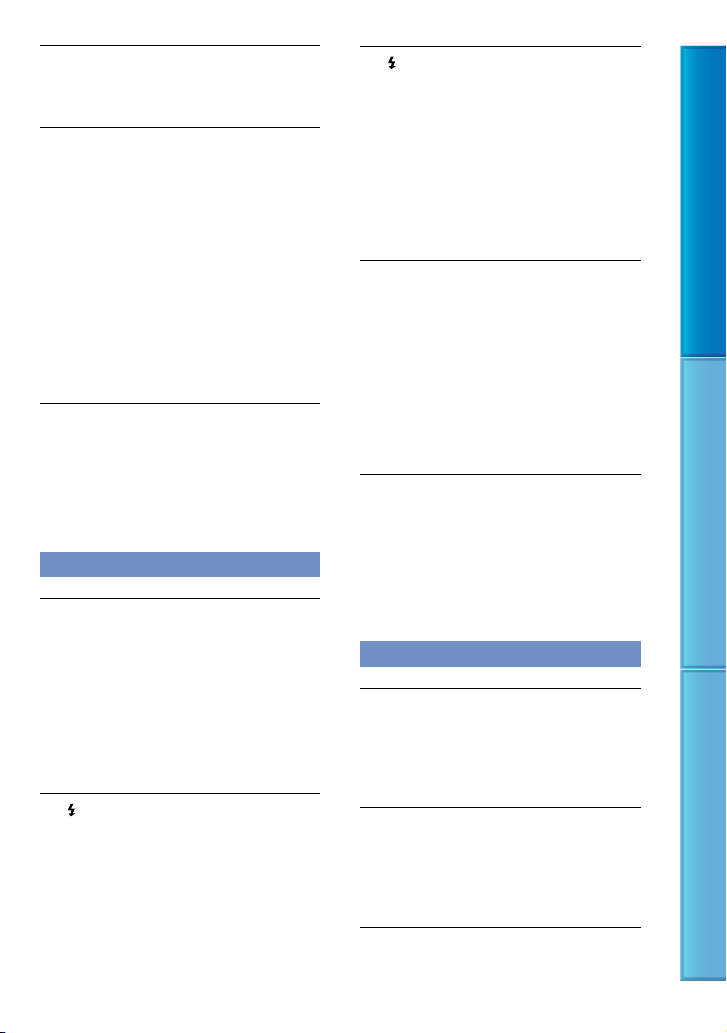
103
Table of Contents Useful Recording Techniques Index
Your camcorder gets warm.
Your camcorder may become warm during
operation. This is not a malfunction.
The supplied Wireless Remote
Commander does not function.
Set [REMOTE CTRL] to [ON] (p. 101).
Insert a battery into the battery holder with
the +/– polarities correctly matching the
+/– marks (p. 9).
Remove any obstructions between the
Wireless Remote Commander and the remote
sensor.
Point the remote sensor away from strong light
sources such as direct sunlight or overhead
lighting. Otherwise, the Wireless Remote
Commander may not function properly.
Another DVD device malfunctions when
you use the supplied Wireless Remote
Commander.
Select a commander mode other than DVD 2
for your DVD device, or cover the sensor of
your DVD device with black paper.
Batteries/power sources
The power abruptly turns off.
Use the AC Adaptor.
In the default setting, when about 5 minutes
have elapsed while you do not operate your
camcorder, the camcorder is automatically
turned off (A.SHUT OFF). Change the setting
of [A.SHUT OFF] (p
. 99), or turn on the
power again.
C
harge the battery pack (p. 19).
The /CHG (flash/charge) lamp does
not light while the battery pack is being
charged.
Close the LCD screen (p. 19).
Attach the battery pack to the camcorder
co
rrectly (p. 19).
Connect the power cord (mains lead) to the
wall outlet (wall socket) properly.
Th
e battery charge is completed (p. 19).
The /CHG (flash/charge) lamp flashes
while the battery pack is being charged.
If the temperature of the battery pack is too
high or too low, you may not be able to charge
i
t (p. 121).
Attach the battery pack to the camcorder
co
rrectly (p. 19). If the problem persists,
disconnect the AC Adaptor from the wall
outlet (wall socket) and contact your Sony
dealer. The battery pack may be damaged.
The remaining battery time indicator does
not indicate the correct time.
The ambient temperature is too high or too
low. This is not a malfunction.
The battery pack has not been charged
enough. Fully charge the battery again. If the
problem persists, replace the battery pack with
a n
ew one (p. 122).
The indicated time may not be correct
depending on the environment of use.
The battery pack is quickly discharged.
The ambient temperature is too high or low.
This is not a malfunction.
The battery pack has not been charged
enough. Fully charge the battery again. If the
problem persists, replace the battery pack with
a n
ew one (p. 122).
LCD screen
Menu items are grayed out.
You cannot select grayed items in the current
recording/playback situation.
There are some functions you cannot activate
sim
ultaneously (p. 107).
The buttons do not appear on the touch
panel.
Touch the LCD screen lightly.
Press DISPLAY on the Wireless Remote
C
ommander (p. 8).
The buttons on the touch panel do not

104
Table of Contents Useful Recording Techniques Index
work correctly or do not work at all.
Adjust the touch panel ([CALIBRATION])
(p. 123).
The buttons on the touch panel quickly
disappear.
Set [DISPLAY SET] to [ON] (p. 95).
“Memory Stick PRO Duo” media
Operations using the “Memory Stick PRO
Duo” media cannot be performed.
If you use “Memory Stick PRO Duo” media
formatted on a computer, format it again on
y
our camcorder (p. 92).
Images stored on the “Memory Stick PRO
Duo” media cannot be deleted.
The maximum number of images that you can
delete on the index screen at one time is 100.
You cannot delete the protected images.
The data file name is not indicated
correctly or flashes.
The file is damaged.
The file format is not supported by your
c
amcorder (p. 121).
Recording
Refer also to “Memory Stick PRO Duo”
media (p
. 104).
Pressing START/STOP or PHOTO does not
record images.
The playback screen is displayed. Press MODE
to turn on the
(Movie) or (Photo) lamp
(p. 22).
Your camcorder is recording the image you
have just shot on the recording media. You
cannot make new recording during this
period.
The recording media is full. Delete
unn
ecessary images (p. 52).
Total number of movie scenes or photos
exceeds the recordable capacity of your
camcorder (p. 111, 113). Delete unnecessary
images (p. 52).
Photos cannot be recorded.
You cannot record photos together with:
[SMTH SLW REC]
[FADER]
The access lamp remains lit or flashing
even if recording was stopped.
Your camcorder is recording the scene you
have just shot on the recording media.
The imaging field looks different.
The imaging field may look different
depending on the condition of your
camcorder. This is not a malfunction.
The flash does not work.
You cannot record with the built-in flash
while:
Capturing photos while recording a movie
[CONVERSION LENS] is set to [WIDE
CONVERSION] or [TELE CONVERSION]
Even if auto flash or (Auto redeye
reduction) is selected, you cannot use the
flash with:
NightShot
[SPOT MTR/FCS]
[SPOT METER]
[MANUAL] in [EXPOSURE]
[TWILIGHT], [SUNRISE&SUNSET],
[FIREWORKS], [LANDSCAPE],
[SPOTLIGHT], [BEACH] or [SNOW] in
[SCENE SELECTION]
The actual recording time for movies is
less than the expected recording time of
the recording media.
Depending on the recording conditions, the
time available for recording may be shorter, for
example when recording a fast moving object,
et
c. (p. 111).
There is a time difference between the
point when START/STOP is pressed and
the point that the recording movie is
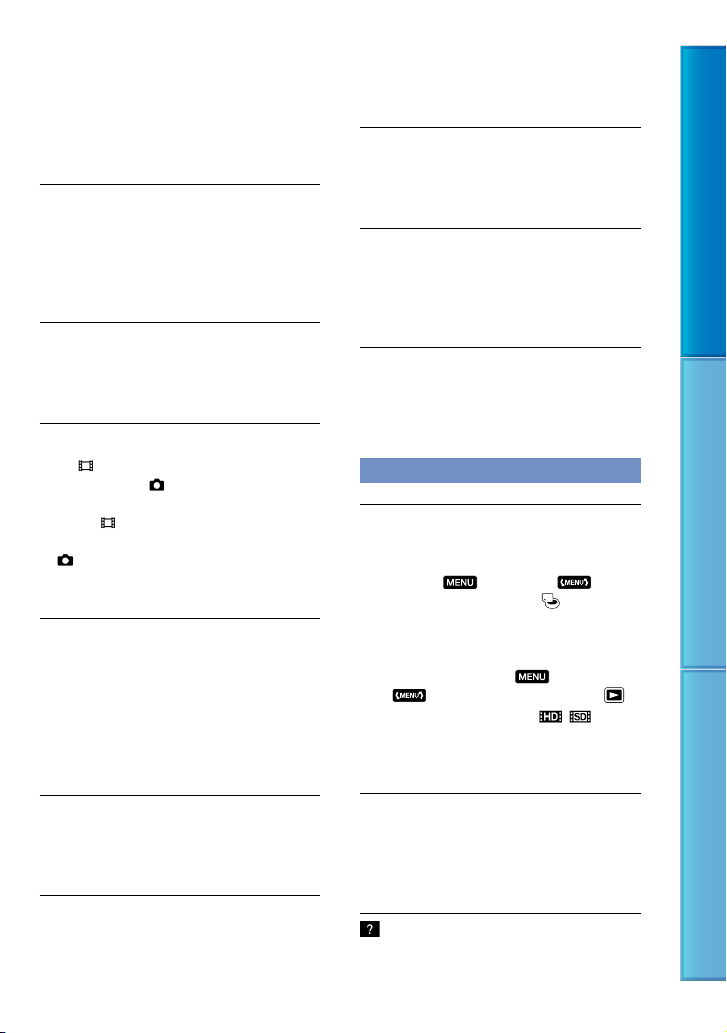
105
Table of Contents Useful Recording Techniques Index
started or stopped actually.
On your camcorder, there may be a slight
time difference between the point where you
press START/STOP and the actual point that
recording movie starts/stops. This is not a
malfunction.
The horizontal to vertical ratio of the
movie (16:9 (wide)/4:3) cannot be
changed.
The horizontal to vertical ratio of high
definition image quality (HD) movies is 16:9
(wide).
The auto focus does not function.
Set [FOCUS] to [AUTO] (p. 74).
The recording conditions are not suitable for
a
uto focus. Adjust the focus manually (p. 74).
SteadyShot does not function.
Set [ STEADYSHOT] to [ACTIVE] or
[STANDARD], [
STEADYSHOT] to [ON]
(p. 78, 84).
Even if [
STEADYSHOT] is set to
[ACTIVE] or [STANDARD],
[
STEADYSHOT] to [ON], your camcorder
may not be able to compensate for excessive
vibrations.
The subjects passing by the screen very
fast appear crooked.
This is called the focal plane phenomenon.
This is not a malfunction. Because of the way
the image device (CMOS sensor) reads out
image signals, the subjects passing by the lens
rapidly might appear crooked depending on
the recording conditions.
The color of the image is not correctly
displayed.
Press NIGHTSHOT to cancel the NightShot
function (p. 31).
The screen image is bright, and the
subject does not appear on the screen.
Press NIGHTSHOT to cancel the NightShot
function (p. 31).
Horizontal stripes appear on the images.
This occurs when recording images under a
fluorescent lamp, sodium lamp, or mercury
l
amp. This is not a malfunction.
[LCD BL LEVEL] cannot be adjusted.
You cannot adjust [LCD BL LEVEL] when:
The LCD panel is closed on your camcorder
with the LCD screen facing out.
The power is supplied from the AC Adaptor.
Magnification changes when the
recording mode is switched.
You cannot use digital zoom when your
camcorder is in the photo recording mode.
Playback
Images cannot be played back.
Select the recording media and the image
quality of a movie you want to play back
by touching
(MENU)
[MEDIA SETTINGS] (under
[MANAGE
MEDIA] category) [MOVIE MEDIA
SET]/[PHOTO MEDIA SET] (p
. 67).
Select the image quality of a movie you want
to play back by touching
(MENU)
[PLAYBACK SET] (under
[PLAYBACK] category) [
/ SET]
(p. 87).
Images recorded on other devices may not be
played back. This is not a malfunction.
Photos cannot be played back.
Photos cannot be played back if you have
modified files or folders, or have edited the
data on a computer. (The file name flashes in
that case.) This is not a malfunction.
is indicated on an image on the
106
Table of Contents Useful Recording Techniques Index
VISUAL INDEX screen.
This may appear on an image recorded on
other devices, edited on a computer, etc.
You removed the AC Adaptor or the battery
pack before the access lamp is turned off after
recording. This may damage your image data
and
is displayed.
is indicated on an image on the
VISUAL INDEX screen.
The image data base file may be damaged.
Check the data base file by touching
(MENU)
[REPAIR IMG.DB F.]
(under
[MANAGE MEDIA] category)
the recording medium. If it still appears, delete
the image with
(p. 52).
No sound or only a quiet sound is heard
during playback.
Turn up the volume (p. 37).
Sound is quiet when the LCD screen is closed
facing out. Open the LCD screen.
When you record sound with [MICREF
LEVEL] (p
. 81) set to [LOW], the recorded
sound may be difficult to hear.
Sounds cannot be recorded while shooting
an about-3-second movie using [SMTH SLW
REC].
Left and right sound will be heard
unbalanced when playing back movies on
computers or other devices.
This happens when sound recorded in 5.1ch
surround is converted to 2ch (normal stereo
sound) by a computer or other device. This is
not a malfunction.
Change the sound conversion type (downmix
type) when playing back on 2ch stereo devices.
Refer to the instruction manual supplied with
your playback device for details.
Change the sound to 2ch when creating a disc
using the supplied software “PMB.”
Record sound with [AUDIO MODE] set to
[2ch STEREO] (p
. 81).
A movie is played back automatically.
Movies play automatically as a demonstration
movie when the filmed movie fulfills a certain
co
ndition on your camcorder (p. 99). This is
not a malfunction.
Playing back images stored on
“Memory Stick PRO Duo” media on
other devices
Images cannot be played back or the
“Memory Stick PRO Duo” media is not
recognized.
You cannot play back high definition image
quality (HD) movies on “Memory Stick PRO
Duo” media on a device that is not compatible
with AVCHD format.
Editing movies/photos on your
camcorder
Unable to edit.
Unable to edit because of the condition of the
image.
Movies cannot be added in the Playlist.
There is no free space in the recording media.
You can add no more than 999 high definition
image quality (HD) movies, or 99 standard
definition image quality (SD) movies, to a
Playlist. Erase unnecessary movies from the
P
laylist (p. 61).
You cannot add photos in the Playlist.
A movie cannot be divided.
A movie that is too short cannot be divided.
A protected movie cannot be divided.
A photo cannot be captured from a
movie.
The recording media where you want to save
photos is full.

107
Table of Contents Useful Recording Techniques Index
Playback on the TV
Neither image nor sound is played on the
connected TV.
When you are using the component A/V
cable, set [COMPONENT] according to the
r
equirements of the connected device (p. 96).
When you are using the component video
plug, make sure the red and white plugs of the
A/V co
nnecting cable are connected (p. 48,
49).
Images are not output from the HDMI OUT
jack, if copyright protection signals are
recorded in the images.
When you are using the S VIDEO plug,
make sure the red and white plugs of the A/V
co
nnecting cable are connected (p. 50).
The top, bottom, right, and left edges
of images are trimmed slightly on a
connected TV.
The LCD screen of your camcorder can
display recording images across the entire
screen (full pixel display). However, this may
cause slight trimming of the top, bottom, right,
and left edges of images when played back on
a TV which is not compatible with full pixel
display.
It is recommended you record images using
the outer frame of [GUIDEFRAME] (p
. 78)
as a guide.
The image appears distorted on the 4:3
TV.
This happens when viewing an image
recorded in the 16:9 (wide) mode on a 4:3 TV.
Set [TV TYPE] co
rrectly (p. 95) and play back
the image.
Black bands appear at the top and bottom
of the screen of the 4:3 TV.
This happens when viewing an image recorded
in the 16:9 (wide) mode on a 4:3 TV. This is
not a malfunction.
Dubbing/Connecting to other
devices
Images are not dubbed correctly.
You cannot dub images using the HDMI cable
(sold separately).
The A/V connecting cable is not connected
properly. Make sure to connect the cable to the
in
put jack of another device (p. 65).
GPS (HDR-CX500V/CX520V)
The camcorder is not receiving a GPS
signal.
Your camcorder may not be able to receive
radio signals from GPS satellites because of
obstructions. Bring your camcorder to an
open area, and set the GPS switch to ON
again. See page 118 for details on locations or
situations where radio signals may not reach.
The current location on the map of the
camcorder is different from the actual
current location.
The margin of error of the radio signal from
GPS satellites is large. The margin of error can
be as wide as several-hundred meters at the
maximum.
Examples of functions that cannot
be used simultaneously
The following list shows examples of
unworkable combinations of functions and
menu items.
108
Table of Contents Useful Recording Techniques Index
Cannot use Because of following settings
[FACE
DETECTION]
NightShot, [SMTH SLW
REC], [
DIGITAL
ZOOM], [SPOT MTR/FCS],
[SPOT METER], [SPOT
FOCUS], [EXPOSURE],
[FOCUS], [TWILIGHT],
[SUNRISE&SUNSET],
[FIREWORKS],
[LANDSCAPE],
[SPOTLIGHT], [BEACH],
[SNOW], [WHITE BAL.]
[PRIORITY
SETTING]/
[SMILE
DETECTION]/
[SMILE
SENSITIVITY]
NightShot, [SMTH SLW
REC], [
DIGITAL
ZOOM], [SPOT MTR/FCS],
[SPOT METER], [SPOT
FOCUS], [EXPOSURE],
[FOCUS], [TWILIGHT],
[SUNRISE&SUNSET],
[FIREWORKS],
[LANDSCAPE],
[SPOTLIGHT], [BEACH],
[SNOW], [WHITE BAL.],
[
FADER], [ SELF-
TIMER]
[SCENE
SELECTION]
NightShot, LOW LUX,
[
FADER], [TELE
MACRO]
Self-diagnosis display/Warning
indicators
If indicators appear on the LCD screen,
check the following.
If the problem persists even after you
have tried to fix a couple of times, contact
your Sony dealer or local authorized Sony
service facility.
C:(or E:) : (Self-diagnosis display)
C:04:
The battery pack is not an “InfoLITHIUM”
battery pack (H series). Use an
“InfoLITHIUM” battery pack (H series).
(p. 121).
Connect the DC plug of the AC Adaptor to the
DC IN j
ack of your camcorder securely (p. 19).
C:06:
The battery pack temperature is high. Change
the battery pack or place it in a cool place.
C:13:
/ C:32:
Remove the power source. Reconnect it and
operate your camcorder again.
E:20:
/ E:31:
/ E:61:
/ E:62:
/
E:91:
/ E:92:
/ E:94:
/ E:95:
/
E:96:
Turn on the power again to restore your
c
amcorder by pressing RESET (p. 7).
101-0001 (Warning indicator pertaining
to files)
Slow flashing
The file is damaged.
The file is unreadable.
(Battery level warning)
Slow flashing
The battery pack is nearly used up.
Depending on the operating environment or
battery conditions,
may flash, even if there
are about 20 minutes remaining.
(Warning indicator pertaining to
battery pack temperature)
The battery pack temperature is high. Change
the battery pack or place it in a cool place.
(Warning indicator pertaining to
“Memory Stick PRO Duo” media)
Slow flashing
Free spaces for recording images are running
out. For the type of “Memory Stick” media you
can use with your camcorder, see page 67.
No “Memory Stick PRO Duo” media is
in
serted (p. 67).
Fast flashing
There are not enough free spaces for recording
images. After storing the images on other
m
edia (p. 62, see Operating Guide too), delete
unnecessary images, or format the “Memory
109
Table of Contents Useful Recording Techniques Index
Stick PRO Duo” media (p. 92).
The image data base file may be damaged.
Check the data base file by touching
(MENU)
[REPAIR IMG.DB F.]
(under
[MANAGE MEDIA] category)
the recording medium.
The “Memory Stick PRO Duo” media is
damaged.
(Warning indicators pertaining
to “Memory Stick PRO Duo” media
formatting)
The “Memory Stick PRO Duo” media is
damaged.
The “Memory Stick PRO Duo” media is not
f
ormatted correctly (p. 92).
(Warning indicator pertaining to
incompatible “Memory Stick Duo” media)
Incompatible “Memory Stick Duo” media are
inserted (p. 67).
(Warning indicator pertaining to
the write-protect of the “Memory Stick
PRO Duo” media)
Access to the “Memory Stick PRO Duo” media
was restricted on another device.
(Warning indicator pertaining to the
flash)
Fast flashing
There is something wrong with the flash.
(Warning indicator pertaining to
camera-shake warning)
The amount of lights is not sufficient, so
camera-shake easily occurs. Use the flash.
The camcorder is unsteady, so camera-shake
easily occurs. Hold the camcorder steady with
both hands and record the image. However,
note that the camera-shake warning indicator
does not disappear.
(Warning indicator pertaining to
photo recording)
The recording media is full.
Photos cannot be recorded during processing.
Wait for a while, then record.
Tips
You may hear a melody when some warning
indicators appear on the screen.
Description of warning messages
If messages appear on the screen, follow the
instructions.
Recording media
Internal memory format error.
The internal memory of the camcorder
is set differently from the default format.
Performing [MEDIA FORMAT] (p
. 92) may
enable you to use your camcorder. This will
delete all data in the internal memory.
Data error.
An error occurred during reading or writing
the internal memory of the camcorder.
If the message is preceded by a GPS indicator,
there may be some trouble with the GPS
receiver. Turn on your camcorder again.
(HDR-CX500V/CX520V)
Movies recorded on other devices may not be
played back.
The Image Database File is damaged. Do
you want to create a new file?
HD movie management information is
damaged. Create new information?
The image management file is damaged. When
you touch [YES], a new image management
file is created. The old recorded images on the
media cannot be played back (Image files are
not damaged). If you execute [REPAIR IMG.
DB F.] after creating new information, playing
back the old recorded images may become
possible. If it does not work, copy the image
using the supplied software.
There is no HD movie management

110
Table of Contents Useful Recording Techniques Index
information. Create new information?
You cannot record or play back movies
because no high definition image quality (HD)
movie management information exists. If you
touch [YES], new management information
is created and you can record or play back
movies with high definition image quality
(HD).
You can record standard definition image
quality (SD) movies or photos.
Inconsistencies found in Image Database
File. Do you want to repair the Image
Database File?
The Image Database File is damaged. Do
you want to repair the Image Database
File?
Inconsistencies found in Image Database
File. Cannot record or play HD movies. Do
you want to repair the Image Database
File?
The image management file is damaged, and
you cannot record movies or photos. Touch
[YES] to repair.
You can record photos on “Memory Stick PRO
Duo” media.
Recovering data.
Your camcorder tries to recover data
automatically if the data writing was not
performed properly.
Cannot recover data.
Writing data onto the media of the camcorder
has failed. Attempts were made to recover the
data, but they were unsuccessful.
Reinsert the Memory Stick.
Reinsert the “Memory Stick PRO Duo” media
a few times. If even then the indicator flashes,
the “Memory Stick PRO Duo” media could
be damaged. Try with another “Memory Stick
PRO Duo” media.
This Memory Stick is not formatted
correctly.
Check the format, then format the “Memory
Stick PRO Duo” media with your camcorder if
n
ecessary (p. 92).
Still picture folder is full. Cannot record
still pictures.
You cannot create folders exceeding
999MSDCF. You cannot create or delete
created folders using your camcorder.
Format the “Memory Stick PRO Duo” media
(p
. 92), or delete folders using your computer.
This Memory Stick may not be able to
record or play movies.
Use “Memory Stick” media recommended for
your camcorder (p. 67).
This Memory Stick may not be able to
record or play images correctly.
Use “Memory Stick” media recommended for
your camcorder (p.67).
Do not eject the Memory Stick during
writing. Data may be damaged.
Reinsert the “Memory Stick PRO Duo” media,
and follow the instructions on the LCD screen.
Other
No further selection is possible.
You can select only 100 images at one time for:
Deleting movies/photos
Protecting movies/photos, or releasing the
protection
Dubbing movies
Copying photos
Editing the Playlist of high definition image
quality (HD) movies/Photos
Data protected.
You tried to delete protected data. Release the
protection of the data.
111
Table of Contents Useful Recording Techniques Index
Additional information
Recording time of
movies/number of
recordable photos
“HD” stands for high definition image
quality, and “SD” stands for standard image
quality.
Expected time of recording and
playback with each battery pack
Recording time
Approximate time available when you use a
fully charged battery pack.
(unit: minute)
Battery pack Continuous
recording time
Typical recording
time
Image quality HD SD HD SD
NP-FH50 85 120 45 60
NP-FH60
(supplied)
115 160 60 80
NP-FH70 190 255 95 130
NP-FH100 430 580 215 290
Each recording time is measured when the
[
REC MODE] is set to SP.
Typical recording time shows the time when
you repeat recording start/stop, switching the
MODE ramp, and zooming.
Times measured when using the camcorder at
25
C (77 ˚F) . 10 C to 30 C (50 ˚F to 86 ˚F) is
recommended.
The recording and playback time will be
shorter when you use your camcorder in low
temperatures.
The recording and playback time will be shorter
depending on the conditions under which you
use your camcorder.
Playing time
Approximate time available when you use a
fully charged battery pack.
(unit: minute)
Battery pack
Image quality HD SD
NP-FH50 145 195
NP-FH60
(supplied)
195 260
NP-FH70 315 415
NP-FH100 710 925
Expected recording time of movies
Internal memory
High definition image quality (HD) in h (hour) and m
(minute)
Recording mode Recording time
HDR-CX500 HDR-CX500V
[HD FH] 3 h 50 m 3 h 45 m
[HD HQ] 7 h 50 m 7 h 35 m
[HD SP] 9 h 30 m 9 h 15 m
[HD LP]
(5.1ch)
*
12 h 40 m 12 h 20 m
[HD LP]
(2ch)
*
13 h 20 m 13 h
Recording mode Recording time
HDR-CX520 HDR-CX520V
[HD FH] 7 h 45 m 7 h 40 m
[HD HQ] 15 h 50 m 15 h 35 m
[HD SP] 19 h 10 m 18 h 55 m
[HD LP]
(5.1ch)
*
25 h 35 m 25 h 15 m
[HD LP]
(2ch)
*
26 h 55 m 26 h 35 m

112
Table of Contents Useful Recording Techniques Index
Standard definition image quality (SD) in h (hour) and
m (minute)
Recording mode Recording time
HDR-CX500 HDR-CX500V
[SD HQ] 7 h 50 m 7 h 40 m
[SD SP] 11 h 35 m 11 h 20 m
[SD LP]
(5.1ch)
*
22 h 15 m 21 h 40 m
[SD LP]
(2ch)
*
24 h 15 m 23 h 40 m
Recording mode Recording time
HDR-CX520 HDR-CX520V
[SD HQ] 15 h 50 m 15 h 35 m
[SD SP] 23 h 25 m 23 h 5 m
[SD LP]
(5.1ch)
*
44 h 50 m 44 h 20 m
[SD LP]
(2ch)
*
48 h 55 m 48 h 20 m
* You can change the recording sound format with
[AUDIO MODE] (p
. 81).
Tips
You can record movies of a maximum of 3,999
scenes with high definition image quality (HD),
and 9,999 scenes with standard definition image
quality (SD).
The maximum continuous recording time of
movies is approximately 13 hours.
Your camcorder uses the VBR (Variable Bit
Rate) format to automatically adjust image
quality to suit the recording scene. This
technology causes fluctuations in the recording
time of the media. Movies containing quickly
moving and complex images are recorded at
a higher bit rate, and this reduces the overall
recording time.
“Memory Stick PRO Duo” media
High definition image quality (HD)
(unit: minute)
AVC HD
16M
(FH)
AVC HD
9M
(HQ)
AVC HD
7M
(SP)
AVC HD
5M
(LP)
5.1ch
*
AVC HD
5M
(LP)
2ch
*
1GB 6
(6)
10
(9)
15
(10)
20
(15)
20
(15)
(unit: minute)
AVC HD
16M
(FH)
AVC HD
9M
(HQ)
AVC HD
7M
(SP)
AVC HD
5M
(LP)
5.1ch
*
AVC HD
5M
(LP)
2ch
*
2GB 10
(10)
25
(20)
30
(20)
45
(35)
45
(35)
4GB 25
(25)
55
(40)
65
(45)
90
(70)
95
(75)
8GB 55
(55)
115
(80)
140
(100)
185
(150)
195
(155)
16GB 110
(110)
230
(160)
280
(200)
375
(300)
395
(315)
32GB 225
(225)
465
(325)
565
(405)
750
(605)
790
(630)
Standard definition image quality (SD)
(unit: minute)
SD 9M
(HQ)
SD 6M
(SP)
SD 3M
(LP)
5.1ch
*
SD 3M
(LP)
2ch
*
1GB 10
(10)
20
(10)
35
(25)
40
(25)
2GB 25
(25)
40
(25)
80
(50)
85
(55)
4GB 55
(50)
80
(50)
160
(105)
175
(110)
8GB 115
(100)
170
(100)
325
(215)
355
(230)
16GB 230
(205)
340
(205)
655
(435)
715
(465)
32GB 465
(415)
685
(415)
1315
(875)
1435
(930)
* You can change the recording sound format with
[AUDIO MODE] (p
. 81).
Notes
Numbers in the table are based on using Sony
“Memory Stick PRO Duo” media.
The recordable time may vary depending on
the recording and subject conditions, [
REC
MODE] (p
. 77), and the type of “Memory Stick”
media.
The number in ( ) is the minimum recordable
time.

113
Table of Contents Useful Recording Techniques Index
Expected number of recordable
photos
Internal memory
You can record the maximum 9,999 photos.
“Memory Stick PRO Duo” media
12.0M
1GB 165
2GB 345
4GB 680
8GB 1350
16GB 2750
32GB 5500
The selected image size is effective when the
(Photo) lamp is lit.
The number of recordable photos shown is for
the maximum image size of your camcorder.
The actual number of recordable photos is
displayed on the LCD screen during recording
(p
. 9).
Notes
Numbers in the table are based on using Sony
“Memory Stick PRO Duo” media. The number
of recordable photos may vary depending
on the recording conditions, and the type of
“Memory Stick” media.
The unique pixel array of Sony’s ClearVid and
the image processing system (BIONZ) allow
still image resolution equivalent to the sizes
described.
Tips
You can also use “Memory Stick Duo” media
with a capacity of under 1 GB for recording
photos.

114
Table of Contents Useful Recording Techniques Index
Using your camcorder
abroad
Power supply
You can use your camcorder in any
countries/regions using the AC Adaptor
supplied with your camcorder within the
AC 100 V to 240 V, 50 Hz/60 Hz range.
Viewing high definition image quality
(HD) movies
In countries/regions where 1080/60i is
supported, you can view the movies with
the same high definition image quality
(HD) as that of the recorded movies.
You need an NTSC-system-based and
1080/60i compatible TV (or monitor) with
component and AUDIO/VIDEO input
jacks. A component A/V cable or an HDMI
cable (sold separately) must be connected.
Viewing standard definition image
quality (SD) movies
To view standard definition image quality
(SD) movies, you need an NTSC-system-
based TV with AUDIO/VIDEO input
jacks. An A/V connecting cable must be
connected.
On TV color systems
Your camcorder is an NTSC-system-based
camcorder. If you want to view the playback
image on a TV, it must be an NTSC-
system-based TV with an AUDIO/VIDEO
input jack.
System Used in
NTSC Bahama Islands, Bolivia,
Canada, Central America,
Chile, Colombia, Ecuador,
Guyana, Jamaica, Japan,
Korea, Mexico, Peru, Surinam,
Taiwan, the Philippines, the
USA, Venezuela, etc.
System Used in
PAL Australia, Austria, Belgium,
China, Czech Republic,
Denmark, Finland, Germany,
Holland, Hong Kong, Hungary,
Italy, Kuwait, Malaysia, New
Zealand, Norway, Poland,
Portugal, Singapore, Slovak
Republic, Spain, Sweden,
Switzerland, Thailand, United
Kingdom, etc.
PAL-M Brazil
PAL-N Argentina, Paraguay, Uruguay
SECAM Bulgaria, France, Guiana, Iran,
Iraq, Monaco, Russia, Ukraine,
etc.

115
Table of Contents Useful Recording Techniques Index
Setting to the local time
You can easily set the clock to the local time by setting a time difference when using your
camcorder abroad. Touch
(MENU) [CLOCK/ LANG] (under
[GENERAL SET] category) [AREA SET] and [DST SET] or [SUMMERTIME] (p
. 97).
HDR-CX500V/CX520V
When [AUTO CLOCK ADJ] and [AUTO AREA ADJ] are set to [ON], the clock is set to the
local time automatically by the GPS f
unction (p. 97).
World time difference
Time-zone
differences
Area setting
GMT Lisbon, London
+01:00 Berlin, Paris
+02:00 Helsinki, Cairo, Istanbul
+03:00 Moscow, Nairobi
+03:30 Tehran
+04:00 Abu Dhabi, Baku
+04:30 Kabul
+05:00 Karachi, Islamabad
+05:30 Calcutta, New Delhi
+06:00 Almaty, Dhaka
+06:30 Yangon
+07:00 Bangkok, Jakarta
+08:00 Hong Kong, Singapore,
Beijing
+09:00 Seoul, Tokyo
+09:30 Adelaide, Darwin
+10:00 Melbourne, Sydney
Time-zone
differences
Area setting
+11:00 Solomon Is
+12:00 Fiji, Wellington, Eniwetok,
Kwajalein
–11:00 Samoa
–10:00 Hawaii
–09:00 Alaska
–08:00 Los Angeles, Tijuana
–07:00 Denver, Arizona
–06:00 Chicago, Mexico City
–05:00 New York, Bogota
–04:00 Santiago
–03:30 St.John’s
–03:00 Brasilia, Montevideo
–02:00 Fernando de Noronha
–01:00 Azores, Cape Verde Is.
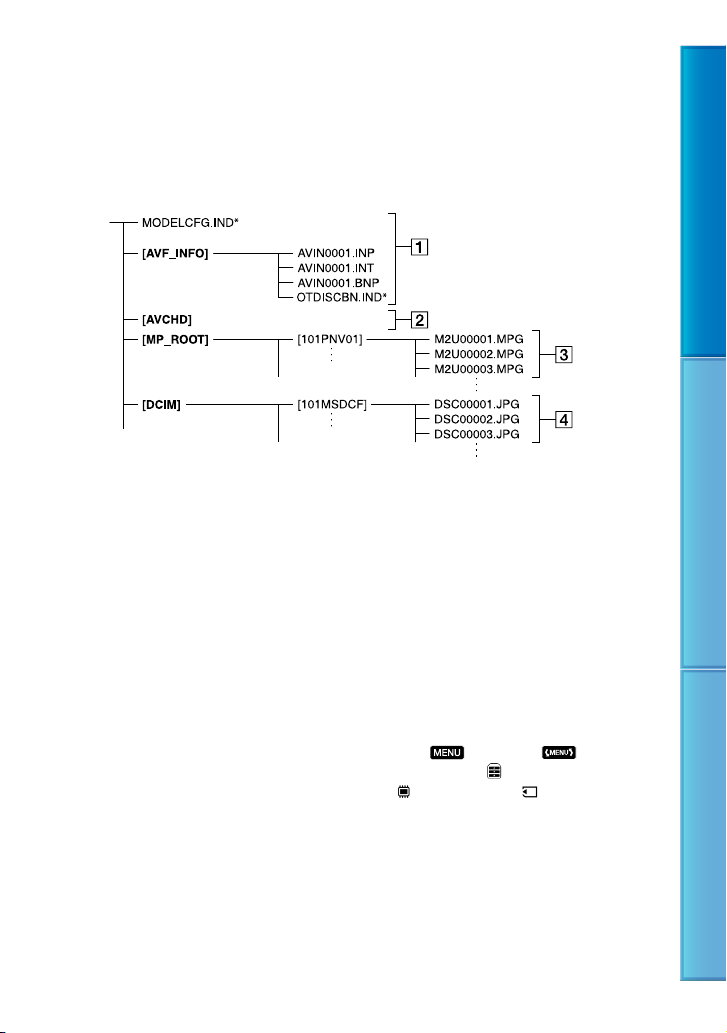
116
Table of Contents Useful Recording Techniques Index
File/folder structure on the internal memory and
“Memory Stick PRO Duo” media
The file/folder structure is shown below. You do not usually need to acknowledge the file/
folder structure, when recording/playing back movies and photos on the camcorder. To enjoy
movies or photos by connecting your camcorder to a computer, see “PMB Guide” then use the
supplied application.
* Only for the internal memory
Image management files
When you delete the files, you cannot
record/play back the images correctly.
The files are defaulted as hidden files
and not usually displayed.
HD mo
vie management information
folder
This folder contains recording data of
high definition image quality (HD)
movies. Do not try to open this folder
or access the contents of this folder from
a computer. Doing so might damage
image files, or prevent image files from
being played back.
SD mo
vie files (MPEG-2 files)
The extension of the files is “.MPG”.
The maximum size is 2 GB. When the
capacity of a file exceeds 2 GB, the file
becomes divided.
The file numbers go up automatically.
When the capacity of a file number
exceeds 9999, another folder is created
to record new movie files.
The folder name goes up: [101PNV01]
[102PNV01]
Photo files (JPEG files)
The extension of the files is “.JPG”. The
file numbers go up automatically. When
the capacity of a file number exceeds
9999, another folder is created to store
new photo files.
The folder name goes up: [101MSDCF]
[102MSDCF]
By setting (MENU) [USB
CONNECT] (under
[OTHERS] category)
[
USB CONNECT]/[ USB CONNECT],
you can access the recording media from the
computer through USB connection.
Access from the computer using the supplied
software “PMB.” Do not modify the files or
folders on the camcorder from the computer.
The image files may be destroyed or may not be
played back.
Operation is not guaranteed, if you perform the
above operation.

117
Table of Contents Useful Recording Techniques Index
When you delete image files, follow the steps
on page 52. Do not delete the image files on the
camcorder directly from the computer.
Do not format the recording media using a
computer. The camcorder may not operate
correctly.
Do not copy the files on the recording
media from the computer. Operation is not
guaranteed.

118
Table of Contents Useful Recording Techniques Index
Maintenance and
precautions
About the AVCHD format
What is the AVCHD format?
The AVCHD format is a high definition
digital video camera format used to
record a high definition (HD) signal of
either the 1080i specification
*
1
or the
720p specification
*
2
using efficient data
compression coding technology. The
MPEG-4 AVC/H.264 format is adopted to
compress video data, and the Dolby Digital
or Linear PCM system is used to compress
audio data.
The MPEG-4 AVC/H.264 format is capable
of compressing images at higher efficiency
than that of the conventional image
compressing format. The MPEG-4 AVC/
H.264 format enables a high definition
video signal shot on a digital video camera
recorder to be recorded on 8 cm DVD
discs, hard disk drive, flash memory,
“Memory Stick PRO Duo” media, etc.
Recording and playback on your
camcorder
Based on the AVCHD format, your
camcorder records with the high definition
image quality (HD) mentioned below.
In addition to high definition image
quality (HD), your camcorder is capable of
recording a standard definition (SD) signal
in the conventional MPEG-2 format.
Video signal
*
3
: MPEG-4 AVC/H.264 1920
1080/60i, 1440 1080/60i
Audio signal: Dolby Digital 2ch/5.1ch
Recording media: Internal memory,
“Memory Stick PRO Duo” media
*
1
1080i specification
A high definition specification which utilizes
1,080 effective scanning lines and the interlace
system.
*
2
720p specification
A high definition specification which utilizes
720 effective scanning lines and the progressive
system.
*
3
Data recorded in AVCHD format other than
the above mentioned cannot be played on your
camcorder.
About GPS (HDR-CX500V/CX520V)
The GPS (Global Positioning System) is a
system that calculates geographical location
from highly accurate US space satellites.
This system allows you to pinpoint your
exact location on the earth. The GPS
satellites are located in 6 orbits, 20,000 km
above the earth. The GPS system consists of
24 or more GPS satellites. A GPS receiver
receives radio signals from the satellites,
and calculates the current location of the
receiver based on the orbital information
(almanac data) and travel time of the
signals, etc.
Determining a location is called
“triangulating.” A GPS receiver can
determine the location’s latitude and
longitude by receiving signals from 3 or
more satellites.
As the positions of GPS satellites vary
constantly, it may take longer to determine
the location or the receiver may not be able to
determine the location at all, depending on the
location and time you use the camcorder.
“GPS” is a system for determining geographic
location by triangulating radio signals from
GPS satellites. Avoid using the camcorder
in places where radio signals are blocked or
reflected, such as a shadowy place surrounded
by buildings or trees, etc. Use the camcorder in
open sky environments.
You may not be able to record location
information at locations or in situations where
radio signals from the GPS satellites do not
reach the camcorder as follows.
In tunnels, indoors or under the shade of
buildings.

119
Table of Contents Useful Recording Techniques Index
Between tall buildings or at narrow streets
surrounded by buildings.
In underground locations, locations
surrounded by dense trees, under an elevated
bridge, or in locations where magnetic fields
are generated, such as near high voltage
cables.
Near devices that generate radio signals of the
same frequency band as the camcorder: near
1.5 GHz band mobile telephones, etc.
On triangulating errors
If you move to another location right after
setting the GPS switch to ON, it may take
a longer time for the camcorder to start
trianguating, compared to when you stay in the
same place.
Error caused by the position of GPS satellites
The camcorder automatically triangulates your
current location when the camcorder receives
radio signals from 3 or more GPS satellites. The
triangulating error allowed by the GPS satellites
is about 30 m (98 feet). Depending on the
environment of the location, the triangulating
error can be greater. In this case, your actual
location may not match the location on the map
based on the GPS information. Meanwhile,
the GPS satellites are controlled by the United
States Department of Defense, and the degree of
accuracy may be changed intentionally.
Error during the triangulating process
The camcorder acquires location information
every 10 seconds during triangulating. There
is a slight time difference between when the
location information is acquired and when the
location information is recorded on an image,
therefore, the actual recording location may not
match exactly the location on the map based on
the GPS information.
On the restriction of use of GPS on an
airplane
During take off and landing of an airplane,
set the GPS switch to OFF and turn off the
camcorder, as you will be instructed to do by
the on-board announcement. In other cases, use
GPS in accordance with the regulations of the
place or situation.
On the map data
The camcorder contains map data for the
following countries/regions. Europe, Japan,
North America, Oceania, etc.
Built-in map is powered by companies as
follows; Map of Japan by Zenrin Co., Ltd., other
areas by NAVTEQ.
The map data included is as of the date of
production of this manual.
GPS maps will appear in 2-dimensional
graphics except for certain landmarks in Japan,
which will appear in 3D.
The map always displays the north at the top.
You cannot change the language on the map.
You cannot update the map data.
The scale of the map is 100 feet to 6,000 miles.
On the geographic coordinate system
The “WGS-84” geographic coordinate system
is used.
On copyright
The map data of the camcorder is copyrighted.
Unauthorized copying or other usage of the
map data may be contrary to the copyright laws.
On the navigation function
The camcorder does not have a navigation
function that uses GPS.
Australia
Copyright. Based on data provided under
license from PSMA Australia Limited (www.
psma.com.au).
Austria
© Bundesamt für Eich- und Vermessungswesen
Croatia, Estonia, Latvia, Lithuania, Poland and
Slovenia
© EuroGeographics
France
source: Géoroute® IGN France & BD Carto®
IGN France
Germany
Die Grundlagendaten wurden mit
Genehmigung der zustaendigen Behoerden
entnommen.
Great Britain
Based upon Crown Copyright material.
Greece
© EuroGeographics; Copyright Geomatics Ltd.
Hungary
Copyright © 2003; Top-Map Ltd.
Italy
120
Table of Contents Useful Recording Techniques Index
La Banca Dati Italiana è stata prodotta usando
quale riferimento anche cartografia numerica
ed al tratto prodotta e fornita dalla Regione
Toscana.
Japan
Norway
Copyright © 2000; Norwegian Mapping
Authority
Portugal
Source: IgeoE – Portugal
Spain
Información geográfica propiedad del CNIG
Sweden
Based upon electronic data © National Land
Survey Sweden.
Switzerland
Topografische Grundlage: © Bundesamt für
Landestopographie.
About the “Memory Stick” media
“Memory Stick” media are a compact,
portable IC recording medium with a large
data capacity.
You can use only “Memory Stick Duo”
media, which are about the half size of
standard “Memory Stick” media, with your
camcorder.
However, we do not guarantee the
operation of all types of “Memory Stick
Duo” media on your camcorder.
Types of “Memory Stick” media Recording/Playback
“Memory Stick Duo”
media (with MagicGate)
“Memory Stick PRO
Duo” media
“Memory Stick PRO-HG
Duo” media
*
* This product does not support 8-bit parallel
data transfer but it supports 4-bit parallel data
transfer the same as with “Memory Stick PRO
Duo” media.
This product cannot record or play data that
uses “MagicGate” technology. “MagicGate” is
a copyright protection technology that records
and transfers the contents in an encrypted
format.
“Memory Stick PRO Duo” media formatted by a
computer (Windows OS/Mac OS) does not have
guaranteed compatibility with your camcorder.
Data read/write speed may vary depending on
the combination of the “Memory Stick PRO
Duo” media and “Memory Stick PRO Duo”
media compliant product you use.
Damaged or lost data may occur in the
following cases (the data will not be
compensated for):
If you eject the “Memory Stick PRO Duo”
media, or turn off your camcorder while your
camcorder is reading or writing image files on
the “Memory Stick PRO Duo” media (while
the access lamp is lit or flashing)
If you use the “Memory Stick PRO Duo”
media near magnets or magnetic fields
It is recommended that you make a back-up of
important data on the hard disk of a computer.
Be careful not to apply excessive force when
writing a memo area on “Memory Stick PRO
Duo” media.
Do not attach a label or the like on “Memory
Stick PRO Duo” media or “Memory Stick Duo”
media adaptor.
When you carry or store “Memory Stick PRO
Duo” media, put it in its case.
Do not touch, or allow metallic objects to come
into contact with the terminals.
Do not bend, drop or apply strong force to the
“Memory Stick PRO Duo” media.
Do not disassemble or modify the “Memory
Stick PRO Duo” media.
Do not let the “Memory Stick PRO Duo” media
get wet.
Keep the “Memory Stick PRO Duo” media out
of the reach of small children. There is danger
that a child might swallow it.
Do not insert anything other than “Memory
Stick PRO Duo” media into the “Memory
Stick Duo” media slot. Doing so may cause a

121
Table of Contents Useful Recording Techniques Index
malfunction.
Do not use or keep the “Memory Stick PRO
Duo” media in the following locations:
Places subject to extremely high temperature,
such as a car parked outside in the summer
Places under direct sunlight
Places with extremely high humidity or
subject to corrosive gases
On the “Memory Stick Duo” media
adaptor
When using “Memory Stick PRO Duo” media
with “Memory Stick” media compliant device,
be sure to insert the “Memory Stick PRO Duo”
media into “Memory Stick Duo” media adaptor.
When using “Memory Stick PRO Duo” media
with “Memory Stick” media compliant device
inserting “Memory Stick PRO Duo” media
into “Memory Stick Duo” media adaptor, make
sure the “Memory Stick PRO Duo” media are
inserted facing in the correct direction. Note
that improper use may cause a malfunction.
When using “Memory Stick PRO Duo” media
inserted into “Memory Stick Duo” media
adaptor on “Memory Stick” media compliant
device, make sure the “Memory Stick PRO
Duo” media adaptor is inserted into the device
in the correct direction. If inserted in the wrong
direction, the device may be damaged.
Do not insert “Memory Stick Duo” media
adaptor without “Memory Stick PRO Duo”
media attached into “Memory Stick” media
compliant device. Doing so may result in
malfunctions of the device.
On “Memory Stick PRO Duo” media
The maximum memory capacity of “Memory
Stick PRO Duo” media that can be used with
your camcorder is 32 GB.
On image data compatibility
Image data files recorded on “Memory Stick
PRO Duo” media by your camcorder conform
to the “Design rule for Camera File system”
universal standard established by the JEITA
(Japan Electronics and Information Technology
Industries Association).
On your camcorder, you cannot play back
photos recorded on other devices (DCR-
TRV900 or DSC-D700/D770) that do not
conform to the universal standard. (These
models are not sold in some regions.)
If you cannot use “Memory Stick PRO Duo”
media that have been used with another device,
f
ormat it with your camcorder (p. 92). Note
that formatting erases all information on the
“Memory Stick PRO Duo” media.
You may not be able to play back images with
your camcorder:
When playing back image data modified on
your computer
When playing back image data recorded with
other devices
About the “InfoLITHIUM” battery
pack
Your camcorder operates only with an
“InfoLITHIUM” H series battery packs.
“InfoLITHIUM” H series battery packs
have the
mark.
What is an “InfoLITHIUM” battery pack?
An “InfoLITHIUM” battery pack is a
lithium-ion battery pack that has functions
for communicating information related to
operating conditions between your camcorder
and an AC Adaptor/charger (sold separately).
The “InfoLITHIUM” battery pack calculates the
power consumption according to the operating
conditions of your camcorder, and displays the
remaining battery time in minutes.
To charge the battery pack
Be sure to charge the battery pack before you
start using your camcorder.
We recommend charging the battery pack in an
a
mbient temperature of between 10
C to 30 C
(50 ˚F to 86 ˚F) until the
/CHG (flash/charge)
lamp turns off. If you charge the battery pack
outside of this temperature range, you may not
be able to charge it efficiently.
To use the battery pack effectively
Battery pack performance decreases when the
ambient temperature is 10
C (50 °F) or below,
and the length of time you can use the battery
pack becomes shorter. In that case, do one
of the following to use the battery pack for a
longer time.
Put the battery pack in a pocket to warm it

122
Table of Contents Useful Recording Techniques Index
up, and install it on your camcorder right
before you start taking shots.
Use a large capacity battery pack: NP-FH70/
FH100 (sold separately).
Frequent use of the LCD screen or a frequent
playback, fast forward or reverse operation
wears out the battery pack faster. We
recommend using a large capacity battery pack:
NP-FH70/FH100 (sold separately).
Be sure to close the LCD screen when not
recording or playing back on your camcorder.
The battery pack is also consumed when your
camcorder is in recording standby or playback
pause.
Have spare battery packs ready for 2 or 3 times
the expected recording time, and make trial
recordings before making the actual recording.
Do not expose the battery pack to water. The
battery pack is not water resistant.
About the remaining battery time
indicator
When the power goes off even though the
remaining battery time indicator indicates that
the battery pack has enough power to operate,
charge the battery pack fully again. Remaining
battery time will be indicated correctly. Note,
however, that the battery indication will not be
restored if it is used in high temperatures for
a long time, or if left in a fully charged state,
or when the battery pack is frequently used.
Use the remaining battery time indication as a
rough guide only.
The mark that indicates low battery flashes
even if there are still 20 minutes of battery
time remaining, depending on the operating
conditions or ambient temperature.
About storage of the battery pack
If the battery pack is not used for a long time,
fully charge the battery pack and use it up on
your camcorder once a year to maintain proper
function. To store the battery pack, remove it
from your camcorder and put it in a dry, cool
place.
To discharge the battery pack on your
camcorder completely, touch
(MENU)
[POWER SETTINGS] (under
[GENERAL SET] category) [A.SHUT
OFF] [NEVER], and leave your camcorder
in recording standby until the power goes off
(p. 99).
About battery life
Battery capacity decreases over time and
through repeated use. If decreased usage time
between charges becomes significant, it is
probably time to replace it with a new one.
Each battery’s life is governed by storage,
operating and environmental conditions.
About x.v.Color
x.v.Color is a more familiar term for the xvYCC
standard proposed by Sony, and is a trademark
of Sony.
xvYCC is an international standard for color
space in video. This standard can express a
wider color range than the currently used
broadcast standard.
About handling of your camcorder
On use and care
Do not use or store the camcorder and
accessories in the following locations:
Anywhere extremely hot, cold or humid.
Never leave them exposed to temperatures
a
bove 60
C (140 °F), such as under direct
sunlight, near heaters or in a car parked in
the sun. They may malfunction or become
deformed.
Near strong magnetic fields or mechanical
vibration. The camcorder may malfunction.
Near strong radio waves or radiation. The
camcorder may not be able to record properly.
Near AM receivers and video equipment.
Noise may occur.
On a sandy beach or anywhere dusty. If
sand or dust gets in your camcorder, it may
malfunction. Sometimes this malfunction
cannot be repaired.
Near windows or outdoors, where the LCD
screen, or the lens may be exposed to direct
sunlight. This damages the LCD screen.
Operate your camcorder on DC 6.8 V/7.2 V
(battery pack) or DC 8.4 V (AC Adaptor).
For DC or AC operation, use the accessories
recommended in these operating instructions.
Do not let your camcorder get wet, for example,
from rain or sea water. If your camcorder

123
Table of Contents Useful Recording Techniques Index
gets wet, it may malfunction. Sometimes this
malfunction cannot be repaired.
If any solid object or liquid gets inside the
casing, unplug your camcorder and have it
checked by a Sony dealer before operating it
any further.
Avoid rough handling, disassembling,
modifying, physical shock, or impact such
as hammering, dropping or stepping on the
product. Be particularly careful of the lens.
Keep the LCD screen closed when you are not
using your camcorder.
Do not wrap your camcorder with a towel, for
example, and operate it. Doing so might cause
heat to build up inside.
When disconnecting the power cord (mains
lead), pull it by the plug and not the cord.
Do not damage the power cord (mains lead)
such as by placing anything heavy on it.
Do not use a deformed or damaged battery
pack.
Keep metal contacts clean.
If the battery electrolytic liquid has leaked:
Consult your local authorized Sony service
facility.
Wash off any liquid that may have contacted
your skin.
If any liquid gets in your eyes, wash with
plenty of water and consult a doctor.
When not using your camcorder for a
long time
To keep your camcorder in optimum state for a
long time, turn it on and let it run by recording
and playing back images about once a month.
Use up the battery pack completely before
storing it.
Moisture condensation
If your camcorder is brought directly from a cold
place to a warm place, moisture may condense
inside your camcorder. This may cause a
malfunction to your camcorder.
If moisture condensation has occurred
Leave your camcorder for about 1 hour without
turning it on.
Note on moisture condensation
Moisture may condense when you bring your
camcorder from a cold place into a warm place
(or vice versa) or when you use your camcorder
in a humid place as follows:
You bring your camcorder from a ski slope
into a place warmed up by a heating device.
You bring your camcorder from an air
conditioned car or room into a hot place
outside.
You use your camcorder after a squall or a
shower.
You use your camcorder in a hot and humid
place.
How to prevent moisture condensation
When you bring your camcorder from a cold
place into a warm place, put your camcorder in
a plastic bag and seal it tightly. Remove the bag
when the air temperature inside the plastic bag
has reached the surrounding temperature (after
about 1 hour).
LCD screen
Do not exert excessive pressure on the LCD
screen, as it may cause uneven color and other
damage.
If your camcorder is used in a cold place, a
residual image may appear on the LCD screen.
This is not a malfunction.
While using your camcorder, the back of
the LCD screen may heat up. This is not a
malfunction.
To clean the LCD screen
If fingerprints or dust make the LCD screen
dirty, it is recommended that you use a soft
cloth to clean it.
When you use the LCD Cleaning Kit (sold
separately), do not apply the cleaning liquid
directly to the LCD screen. Use cleaning paper
moistened with the liquid.
On adjustment of the touch panel
(CALIBRATION)
The buttons on the touch panel may not work
correctly. If this happens, follow the procedure
below. It is recommended that you connect your
camcorder to the wall outlet (wall socket) using
the supplied AC Adaptor during the operation.
(MENU) [OTHER
SETTINGS] (under
[GENERAL SET]
category) [CALIBRATION].

124
Table of Contents Useful Recording Techniques Index
Touch “” displayed on the screen with the
corner of “Memory Stick PRO Duo” media or
the like 3 times.
T
ouch [CANCEL] to cancel calibration.
Notes
If you did not press the right spot, try the
calibration again.
Do not use a sharp-pointed object for
calibration. Doing so may damage the LCD
screen.
You cannot calibrate the LCD screen if it is
rotated, or closed with the screen facing out.
On handling the casing
If the casing is soiled, clean the camcorder body
with a soft cloth lightly moistened with water,
and then wipe the casing with a dry soft cloth.
Avoid the following to avoid damage to the
finish:
Using chemicals such as thinner, benzine,
alcohol, chemical cloths, repellent, insecticide
and sunscreen
Handling the camcorder with above
substances on your hands
Leaving the casing in contact with rubber or
vinyl objects for a long period of time
About care and storage of the lens
Wipe the surface of the lens clean with a soft
cloth in the following instances:
When there are fingerprints on the lens
surface
In hot or humid locations
When the lens is exposed to salty air such as
at the seaside
Store in a well-ventilated location subject to
little dirt or dust.
To prevent mold, periodically clean the lens as
described above.
On charging the pre-installed
rechargeable battery
Your camcorder has a pre-installed rechargeable
battery to retain the date, time, and other settings
even when the LCD screen is closed. The pre-
installed rechargeable battery is always charged
while your camcorder is connected to the wall
outlet (wall socket) via the AC Adaptor or while
the battery pack is attached. The rechargeable
battery will be fully discharged in about 3 months
if you do not use your camcorder at all. Use
your camcorder after charging the pre-installed
rechargeable battery.
However, even if the pre-installed rechargeable
battery is not charged, the camcorder operation
will not be affected as long as you are not
recording the date.
How to charge the pre-installed
rechargeable battery
Connect your camcorder to a wall outlet (wall
socket) using the supplied AC Adaptor, and leave
it with the LCD screen closed for more than 24
hours.
Note on disposal/transfer of the
“Memory Stick PRO Duo” media
Even if you delete data in the “Memory Stick PRO
Duo” media or format the “Memory Stick PRO
Duo” media on your camcorder or a computer,
you may not delete data from the “Memory Stick
PRO Duo” media completely. When you give the
“Memory Stick PRO Duo” media to somebody, it
is recommended that you delete date completely
using data deletion software on a computer. Also,
when you dispose of the “Memory Stick PRO
Duo” media, it is recommended that you destroy
the actual body of the “Memory Stick PRO Duo”
media.

125
Table of Contents Useful Recording Techniques Index
On trademarks
“Handycam” and are
registered trademarks of Sony Corporation.
“AVCHD” and “AVCHD” logotype are
trademarks of Panasonic Corporation and Sony
Corporation.
“Memory Stick,” “
,” “Memory Stick Duo,”
“
,”
“Memory Stick PRO Duo,”
“ ,” “Memory Stick
PRO-HG Duo,” “
,”
“MagicGate,” “
,” “MagicGate
Memory Stick” and “MagicGate Memory Stick
Duo” are trademarks or registered trademarks
of Sony Corporation.
“InfoLITHIUM” is a trademark of Sony
Corporation.
“x.v.Color” is a trademark of Sony Corporation.
“BIONZ” is a trademark of Sony Corporation.
“BRAVIA” is a trademark of Sony Corporation.
“DVDirect” is a trademark of Sony
Corporation.
“Blu-ray Disc” and the logo are trademarks.
Dolby and the double-D symbol are trademarks
of Dolby Laboratories.
HDMI, the HDMI logo and High-Definition
Multimedia Interface are trademarks or
registered trademarks of HDMI Licencing LLC.
Microsoft, Windows, Windows Media,
Windows Vista, and DirectX are either
registered trademarks or trademarks of
Microsoft Corporation in the United States and/
or other countries.
Macintosh and Mac OS are registered
trademarks of Apple Inc. in the U.S. and other
countries.
Intel, Intel Core, and Pentium are trademarks
or registered trademarks of Intel Corporation
or its subsidiaries in the United States and other
countries.
“PLAYSTATION” is a registered trademark of
Sony Computer Entertainment Inc..
Adobe, the Adobe logo, and Adobe Acrobat
are either registered trademarks or trademarks
of Adobe Systems Incorporated in the United
States and/or other countries.
NAVTEQ and the NAVTEQ Maps logo are
trademarks of NAVTEQ in the US and other
countries.
All other product names mentioned herein may
be the trademarks or registered trademarks of
their respective companies. Furthermore,
and
are not mentioned in each case in this
Handbook.
Notes on the License
ANY USE OF THIS PRODUCT OTHER
THAN CONSUMER PERSONAL USE IN ANY
MANNER THAT COMPLIES WITH THE
MPEG-2 STANDARD FOR ENCODING VIDEO
INFORMATION FOR PACKAGED MEDIA
IS EXPRESSLY PROHIBITED WITHOUT A
LICENSE UNDER APPLICABLE PATENTS IN
THE MPEG-2 PATENT PORTFOLIO, WHICH
LICENSE IS AVAILABLE FROM MPEG LA,
L.L.C., 250 STEELE STREET, SUITE 300,
DENVER, COLORADO 80206.
THIS PRODUCT IS LICENSED UNDER THE
AVC PATENT PORTFOLIO LICENSE FOR THE
PERSONAL AND NON-COMMERCIAL USE
OF A CONSUMER TO
(i) ENCODE VIDEO IN COMPLIANCE
WITH THE AVC STANDARD (“AVC VIDEO”)
AND/OR
(ii) DECODE AVC VIDEO THAT WAS
ENCODED BY A CONSUMER ENGAGED IN A
PERSONAL AND
NON-COMMERCIAL ACTIVITY AND/OR
WAS OBTAINED FROM A VIDEO PROVIDER
LICENSED TO PROVIDE AVC VIDEO.
NO LICENSE IS GRANTED OR SHALL BE
IMPLIED FOR ANY OTHER USE.
ADDITIONAL INFORMATION MAY BE
OBTAINED FROM MPEG LA, L.L.C.
SEE <HTTP://MPEGLA.COM>
“C Library,” “Expat,” “zlib,” “libjpeg,” “dtoa,” and
“pcre” software are provided in your camcorder.
We provide this software based on license
agreements with their owners of copyright. Based
on requests by the owners of copyright of these
software applications, we have an obligation
to inform you of the following. Please read the
following sections.
Read “license1.pdf ” in the “License” folder on the
CD-ROM. You will find licenses (in English) of
“C Library,” “Expat,” “zlib,” “libjpeg,” “dtoa,” and
“pcre” software.
On GNU GPL/LGPL applied software
The software that is eligible for the following
GNU General Public License (hereinafter referred
to as “GPL”) or GNU Lesser General Public
License (hereinafter referred to as “LGPL”) are
included in the camcorder.

126
Table of Contents Useful Recording Techniques Index
This informs you that you have a right to have
access to, modify, and redistribute source code for
these software programs under the conditions of
the supplied GPL/LGPL.
Source code is provided on the web. Use
the following URL to download it. When
downloading the source code, select HDR-
CX500V as the model for your camcorder.
http://www.sony.net/Products/Linux/
We would prefer you do not contact us about the
contents of source code.
Read “license2.pdf ” in the “License” folder on the
CD-ROM. You will find licenses (in English) of
“GPL,” and “LGPL” software.
To view the PDF, Adobe Reader is needed. If
it is not installed on your computer, you can
download it from the Adobe Systems web page:
http://www.adobe.com/

127
Table of Contents Useful Recording Techniques Index
Symbols
1080i/480i ....................................96
16:9 ...............................................95
4:3 .................................................95
480i ...............................................96
5.1ch surround recording ..........30
A
A.SHUT OFF ..............................99
A/V connecting cable.................65
Abroad .......................................114
AE SHIFT ....................................75
AREA SET ...................................97
AUDIO MODE ...........................81
AUDIO REC SET .......................81
AUTO AREA ADJ ......................98
AUTO BACK LIGHT ................82
AUTO CLOCK ADJ...................97
AVCHD format .........................118
B
BATTERY INFO .........................91
Battery of the Wireless Remote
Commander ..................................9
Battery pack .................................19
BEACH ........................................70
BEEP.............................................94
BLACK FADER ..........................71
BLT-IN ZOOM MIC ..................81
“BRAVIA” Sync ...........................51
C
CALIBRATION ........................123
CAMERA DATA ........................88
Capturing a photo from a movie
.......................................................55
Charging the battery pack .........19
Charging the battery pack abroad
.............................................. 20, 114
CLOCK/LANG ...........................97
CLOCK SET ................................22
COMPONENT ...........................96
CONVERSION LENS ................78
Copy .............................................57
Creating a disc ............................62
CTRL FOR HDMI ....................100
D
DATA CODE ........................22, 88
DATE/TIME..........................22, 88
Date Index ...................................39
DELETE .......................................52
DEMO MODE ............................99
DIAL SETTING ..........................33
DIGITAL ZOOM .......................81
Disc recorder ...............................65
DISPLAY SET .............................95
DISP OUTPUT ...........................97
DIVIDE ........................................59
DOWNLOAD MUSIC ..............44
DST SET ......................................98
Dual Rec ......................................31
Dubbing .......................................56
DVDirect Express .......................62
DVD writer............................62, 64
E
EDIT .............................................52
EMPTY ........................................69
EMPTY MUSIC..........................44
EXPOSURE .................................74
F
FACE DETECTION .......... 79, 108
Face Index ....................................42
FADER .........................................71
FH .................................................77
File ..............................................116
FILE NO. ......................................86
Film Roll Index ...........................41
FIREWORKS ..............................70
FLASH LEVEL ............................85
FLASH MODE ............................85
FOCUS .........................................74
Folder .........................................116
Format ..........................................92
Fully charged ...............................19
G
GENERAL SET ...........................94
GPS ...............................................34
GUIDEFRAME...........................78
H
HD/SD SET ...........................77, 87
HDMI RESOLUTION ...............96
HD movie management
information folder ....................116
HIGHLIGHT ..............................43
Highlight Playback .....................43
HQ ................................................77
I
Image management files ..........116
Image quality ...............................77
IMAGE SIZE ...............................84
INDOOR .....................................72
“InfoLITHIUM” battery pack
.....................................................121
J
JPEG ...........................................116
L
LANDSCAPE ..............................70
LANGUAGE SET .................23, 98
LCD BL LEVEL ..........................94
LCD BRIGHT .............................94
LCD COLOR ...............................95
LOW LUX....................................79
LP ..................................................77
M
Maintenance ..............................118
MANAGE MEDIA ...............67, 92
MANUAL SETTINGS ...............70
Map Index....................................40
MEDIA FORMAT ......................92
MEDIA INFO .............................92
MEDIA SETTINGS ....................67
“Memory Stick” media ...... 67, 120
“Memory Stick PRO-HG Duo”
media ................................... 68, 120
Index

128
Table of Contents Useful Recording Techniques Index
“Memory Stick PRO Duo” media
.............................................. 67, 120
Menus .....................................11, 14
MICREF LEVEL .........................81
Mirror mode ...............................32
Moisture condensation ............123
MOVIE DUB ..............................56
MOVIE MEDIA SET .................67
Movies ....................................25, 36
MPEG .........................................116
MPEG-2 .....................................116
MPEG-4 AVC/H.264 ...............118
MUSIC TOOL ............................44
MY MENU ..................................11
MY MENU SETTING ...............11
N
NightShot .....................................31
NIGHTSHOT LIGHT ...............82
NTSC..........................................114
O
ONE PUSH .................................72
OPTION MENU ........................12
Original ........................................56
OTHER REC SET .......................81
OTHERS ......................................91
OTHER SETTINGS ...................99
OUTDOOR .................................72
OUTPUT SETTINGS ................95
P
PB zoom .......................................45
PHOTO CAPTURE ...................55
PHOTO COPY ...........................57
PHOTO MEDIA SET ................67
Photos ....................................27, 37
PHOTO SETTINGS ...................84
PLAYBACK .................................87
PLAYBACK SET .........................87
Playing..........................................36
Playlist ..........................................60
PMB Guide ....................................2
PORTRAIT ..................................70
Power on ......................................22
POWER ON BY LCD ................99
POWER SETTINGS ..................99
Precautions ................................118
PRIORITY SETTING ....... 80, 108
PROTECT ...................................58
R
Rec & zoom buttons on LCD ....26
REC LAMP ................................100
REC MODE .................................77
Recording ....................................25
Recording and playback time
.....................................................111
Recording media.........................67
Recording time of movies/
number of recordable photos
.....................................................111
REDEYE REDUC .......................85
REMOTE CTRL .......................101
Repair .........................................102
REPAIR IMG.DB F. ......... 106, 109
RESET ............................................7
S
SCENARIO..................................44
SCENARIO ERASE ....................44
SCENE SELECTION ........ 70, 108
Screen indicators ..........................9
Self-diagnosis display/Warning
indicators ...................................108
SELF-TIMER ...............................84
SHOOTING SET ........................77
Slide show ....................................46
SLIDE SHOW SET .....................46
SMILE DETECTION ........ 80, 108
SMILE SENSITIVITY ....... 80, 108
Smile Shutter ...............................30
SMTH SLW REC ........................32
SNOW ..........................................70
SP ..................................................77
SPOT FOCUS .............................73
SPOTLIGHT ...............................70
SPOT METER .............................73
SPOT MTR/FCS .........................72
STEADYSHOT .....................78, 84
SUMMERTIME ..........................98
SUNRISE&SUNSET...................70
Supplied items .............................16
T
TELE MACRO ............................75
Telephoto .....................................29
Thumbnail ...................................52
TIMING .......................................32
Tripod.............................................8
Troubleshooting ........................102
TV .................................................47
TV color systems ......................114
TV CONNECT Guide ...............47
TV TYPE .....................................95
TWILIGHT .................................70
TWILIGHT PORT. ....................70
U
USB cable ...............................62, 64
USB CONNECT ...................62, 64
V
VBR ............................................111
VIEW IMAGES ....................36, 39
VISUAL INDEX .........................36
Volume ...................................37, 94
W
Wall outlet (wall socket) ............19
Warning messages ....................109
WB SHIFT ...................................76
WHITE BAL. ..............................71
WHITE FADER ..........................71
Wide angle ...................................29
WIDE SELECT ...........................83
X
x.v.Color .............................. 83, 122
Y
YOUR LOCATION ....................54