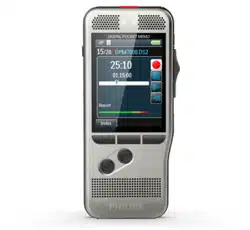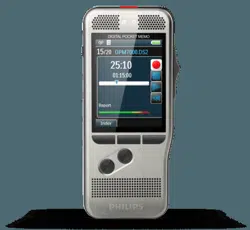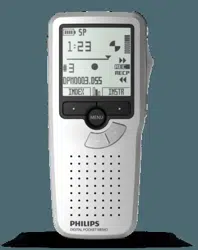
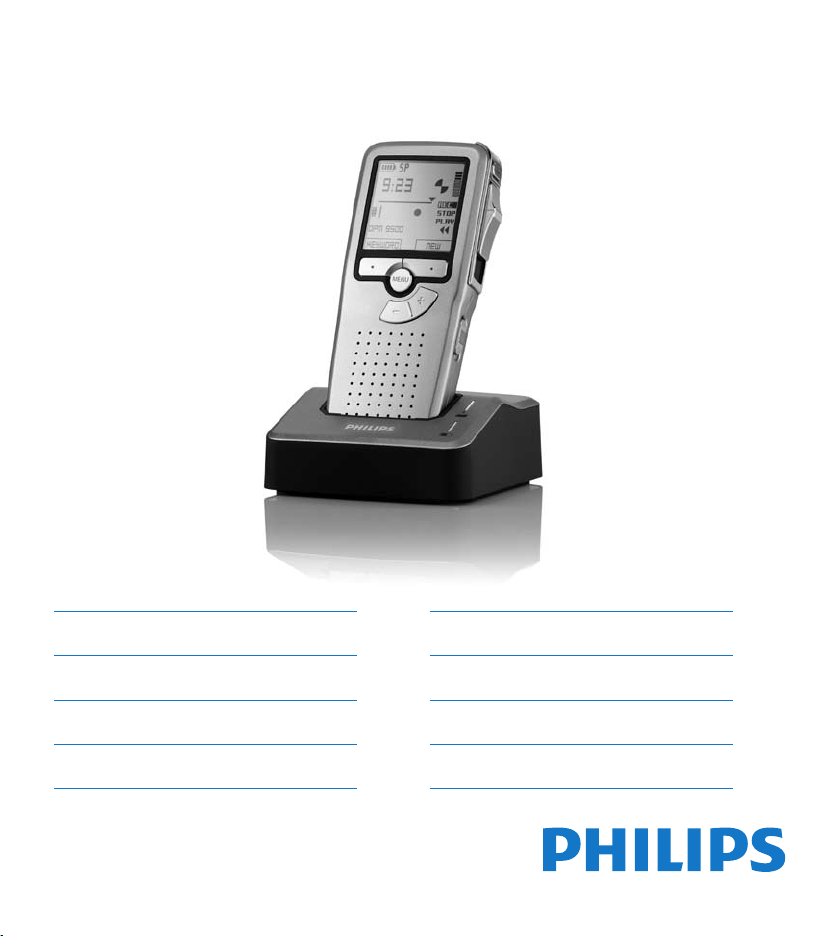
LFH9500
LFH9520
For product information and support, visit
www.philips.com/dictation POCKET MEMO
IT Manuale di istruzioni 83
NL Gebruikershandleiding 103
PT Manual do utilizador 123
SV Användarhandbok 143
EN User manual 3
DE Benutzerhandbuch 23
FR Manuel de l‘utilisateur 43
ES Manual del usuario 63
Declaration of Conformity
Tested to comply with FCC standards
FOR HOME OR OFFICE USE
Model Number: LFH9500 / LFH9520
Trade Name: Philips Digital Pocket Memo 9500 / 9520
Responsible Party: Philips Speech Processing
Address: 64 Perimeter Center East, Atlanta, GA 30346, USA
Telephone number: 888-260-6261
Website: www.philips.com/dictation
This device complies with Part 5 of the FCC Rules. Operation is subject to the following two conditions:
) This device may not cause harmful interference.
2) This device must accept any interference received, including interference that may cause undesired operation.
The CE mark confirms that the device corresponds to the relevant guidelines of the
European Union.
The cardboard used for packaging can be recycled. This electronic device contains
recyclable material.

3User manual
ENGLISH
1 Welcome 4
1.1 Product highlights 4
1.2 What’s in the box 4
1.3 Overview – controls and connections 5
1.4 Overview – display indicators and
symbols 6
2 Get started 7
2.1 Install the batteries 7
2.2 Recharge the batteries 7
2.2.1 Recharge the batteries through the
USB cable 7
2.2.2 Recharge the batteries through the
docking station 7
2.2.3 Recharge the batteries using the optional
Philips power supply 8
2.3 Insert and eject the memory card 8
2.4 Format a new memory card 9
2.5 Activate the Digital Pocket Memo 9
2.5.1 Set the language 9
2.5.2 Set the date and time 10
2.6 Power-save mode 10
3 Use your Digital Pocket Memo 11
3.1 Recording 11
3.1.1 Create a recording 11
3.1.2 Record a spoken instruction 12
3.1.3 Add to a recording (insert/overwrite) 12
3.1.4 Finish (lock) a recording 13
3.1.5 Change the recording format 14
3.1.6 Adjust the microphone sensitivity 14
3.2 Playback 15
3.2.1 Overview playback functions 15
3.3 Delete 16
3.3.1 Delete a file 16
3.3.2 Delete part of a recording 16
3.3.3 Delete all dictations 17
4 Use more of your Digital Pocket
Memo 18
4.1 Use Philips SpeechExec software 18
4.1.1 Advanced configuration 18
4.1.2 Download recordings to the PC 18
4.2 Use voice-activated recording 19
4.3 Work with index marks 20
4.3.1 Insert an index mark 20
4.3.2 Delete an index mark 20
4.3.3 Delete all index marks 20
4.4 Assign a keyword 21
4.5 Menu settings 21
4.5.1 Menu list 22
User manual
4 User manual
Welcome1
Congratulations on your purchase and welcome to Philips!
To fully benefit from the support that Philips oers, visit our Website for support information such
as user manuals, software downloads and more: www.philips.com/dictation.
Product highlights1.1
The Digital Pocket Memo’s asymmetrical and ergonomic design delivers unparalleled user-friendly •
operation. All buttons are within the sweep-angle of the thumb.
Dock the Digital Pocket Memo to the USB Docking Station and transfer your dictation files •
to the PC in seconds. At the same time, the USB Docking Station can be used to recharge the
batteries of the Digital Pocket Memo.
The Digital Pocket Memo is designed around standardized technologies. From SD (SecureDigital) •
or MMC (Multimedia) cards, mini-USB cables, batteries and sockets to the industry-standard .dss
file format for speech processing, Philips employs non-proprietary accessories and technologies
for the ultimate compatibility.
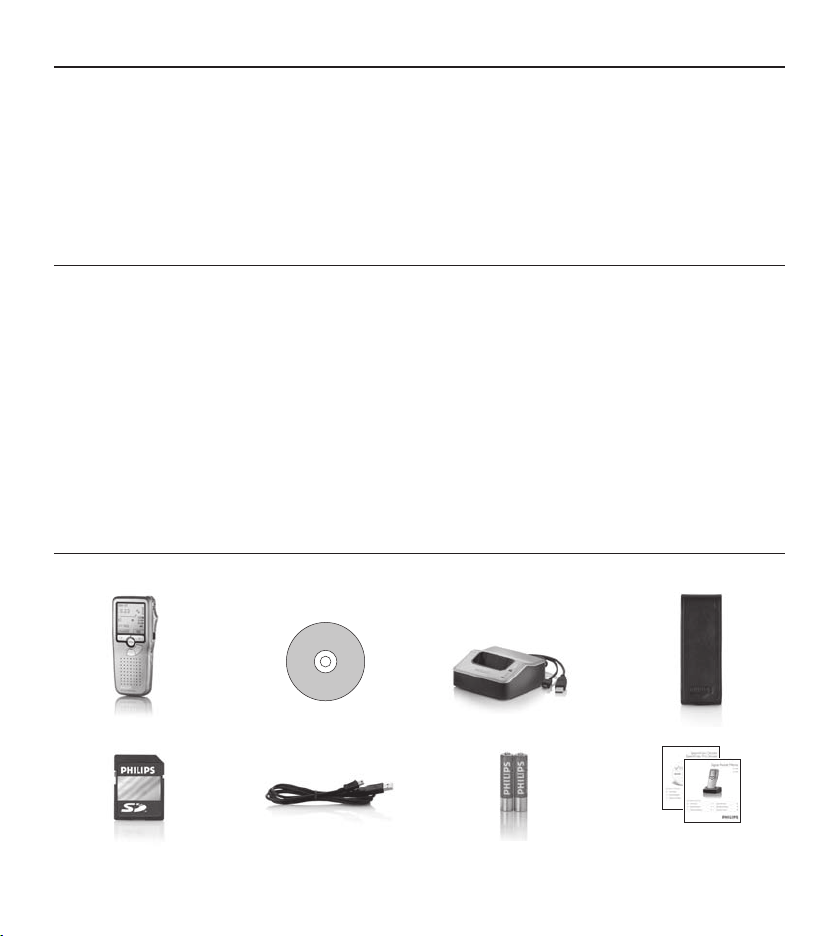
What’s in the box1.2
Digital Pocket Memo
Quick start guide,
user manual
CD-ROM
SD memory card Mini-USB cable 2 rechargeable
batteries
USB Docking Station Pouch
5User manual
ENGLISH
Overview – controls and connections1.3
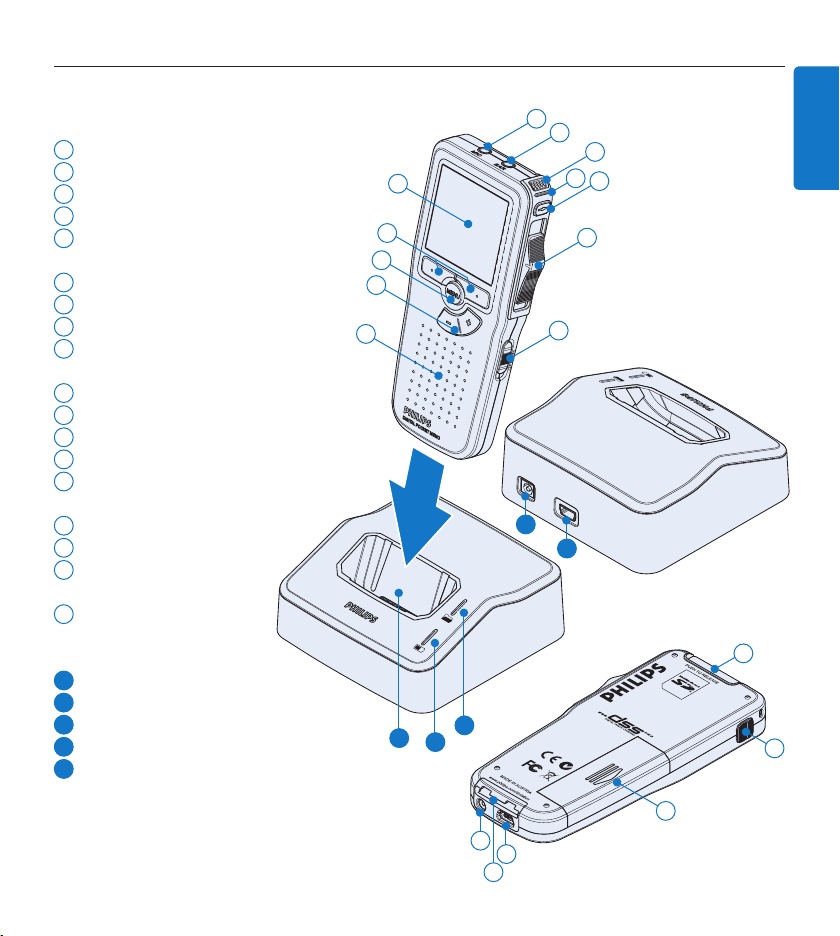
Digital Pocket Memo
1
Microphone socket
2
Headphone socket
3
Built-in microphone
4
Status LED
5
LFH 9500: EOL (end-of-letter) button
LFH 9520: REC (record) button
6
Slide switch
7
On/o switch
8
Speaker
9
+/–, menu navigation and
volume control
10
Menu button
11
Smart buttons
12
Display
13
Memory card slot
14
LFH 9500: FWD (forward) button
LFH 9520: EOL (end-of-letter) button
15
Battery compartment
16
USB connection slot
17
Docking station
connection slot
18
Power supply socket
USB Docking Station
19
Power supply socket
20
USB connection slot
21
Download indicator LED
22
Charge indicator LED
23
Docking slot for the Digital Pocket Memo
1
2
3
5
4
6
7
8
9
10
12
11
13
14
15
16
18
21
22
23
19
20
17
6 User manual
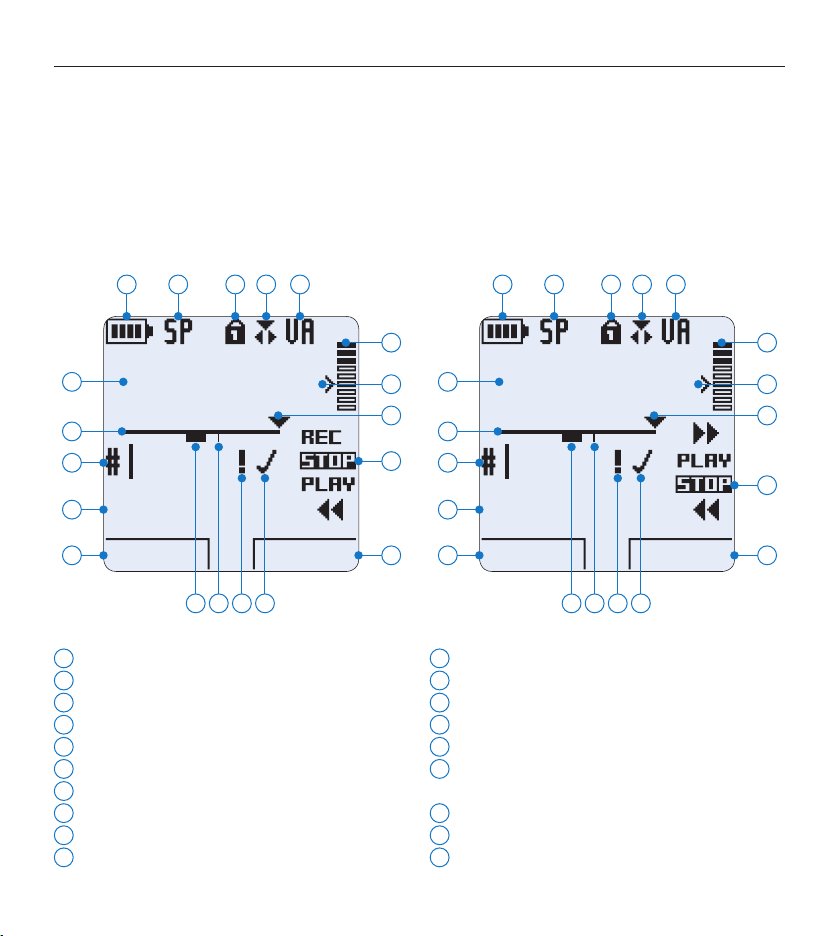
1
Current function of the left smart button
2
Keyword 1 (such as author name)
3
Recording number
4
Position bar
5
Recording / playback time
6
Battery level indicator
7
Recording format
8
Memory card is write-protected (locked)
9
Insert recording mode is activated
10
Voice-activated recording in progress
Overview – display indicators and symbols1.4
D Note
The slide switch has dierent function placements on each of the two models of the Digital Pocket
Memo 9500 series (LFH 9500 and LFH 9520). This user manual will describe functions for both
models.
11
Recording level meter
12
Sensitivity level for voice-activated recording
13
Current position in the recording
14
Positions of the slide switch
15
Current function of the right smart button
16
Recording is marked finished (EOL) and
locked
17
Recording is marked priority
18
Recording contains index mark
19
Recording contains spoken instruction
DPM 9500
KEYWORD NEW
9:23
1
2
3
4
5
6 7 8 9 10
12
11
14
15
13
1719 18 16
Digital Pocket Memo 9500
with international slide switch
Digital Pocket Memo 9520
with Philips slide switch
DPM 9520
KEYWORD NEW
9:23
1
2
3
4
5
6 7 8 9 10
12
11
14
15
13
1719 18 16
7User manual
ENGLISH
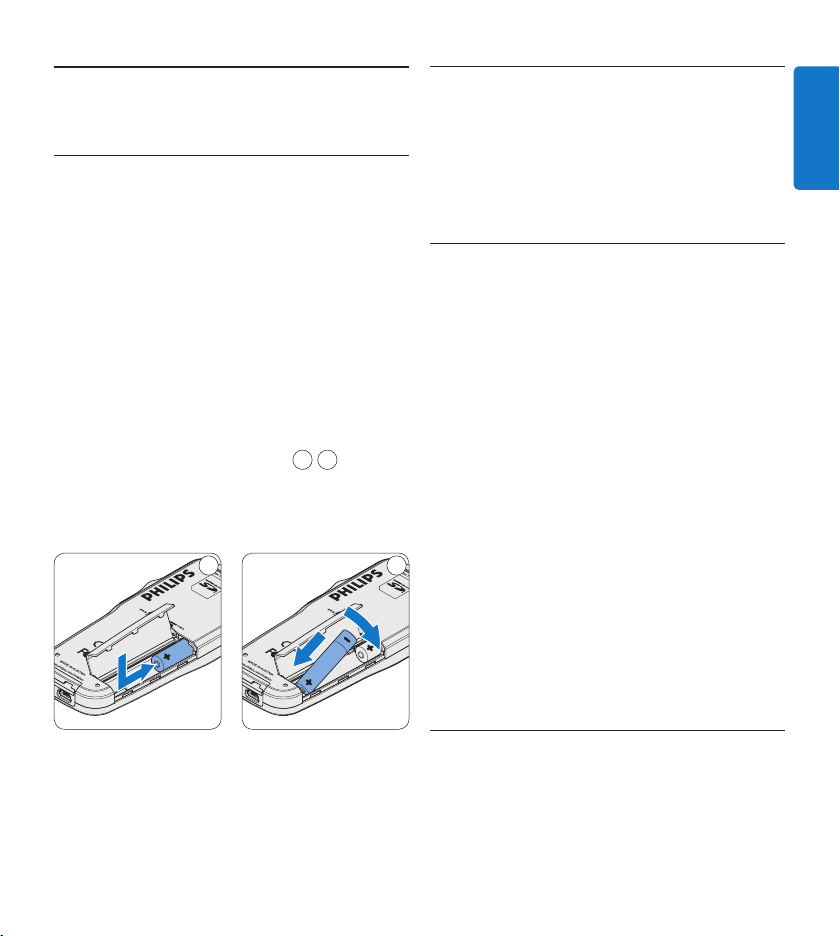
Recharge the batteries2.2
The Digital Pocket Memo can be operated
with the rechargeable Philips AAA batteries. To
recharge these batteries, use the Docking Station,
the USB cable or the optional Philips power
supply.
Recharge the batteries through the 2.2.1
USB cable
When the Digital Pocket Memo is connected to
a PC or notebook computer with the supplied
USB cable, the rechargeable batteries are
automatically recharged. If the USB port on the
computer is high powered, a complete recharge
cycle takes about 2.5 hours.
D Note
The PC must be ON when charging battery via
the USB cable connection. The Digital Pocket
Memo may become warm during fast recharging.
C Important
If the USB port of the computer does not
supply enough power capacity (500 mA), disable
the USB quick charge function in the menu of the
Digital Pocket Memo and recharge the batteries
using the optional power supply.
Recharge the batteries through the 2.2.2
docking station
Make sure that the docking station is 1
connected to PC with the USB cable and
that the PC is on.
Get started2
Install the batteries2.1
The Digital Pocket Memo can be operated with
the two rechargeable AAA batteries delivered
with the product. Standard (non-rechargeable)
AAA alkaline batteries may also be used.
The on/o switch of the Digital Pocket 1
Memo must be in the
OFF position.
Open the battery compartment on the back 2
side of the Digital Pocket Memo by sliding it
outwards then folding it up.
Insert the two AAA batteries. The correct 3
polarity is indicated on the inside of the
battery compartment cover.
1
2
Close the battery compartment by folding it 4
down and sliding the battery compartment
cover inward until it clicks.
21
D Note
Do not mix battery types! Use two rechargeable
batteries or two non-rechargeable alkaline
batteries.
8 User manual
Insert the Digital Pocket Memo into the 2
docking slot of the docking station and press
it down firmly until it locks. The green LED
illuminates, indicating that the batteries
of the Digital Pocket Memo are being
recharged in fast recharge mode.
When the green LED blinks, recharging is 3
complete and the Digital Pocket Memo can
be removed from the docking slot.
D Note
When the Digital Pocket Memo is connected
to the docking station, it is powered by the
docking station and not by the batteries. If
the Digital Pocket Memo is operated with
rechargeable batteries, the batteries are
automatically recharged while the Digital Pocket
Memo is connected to the docking station.
Recharge the batteries using the 2.2.3
optional Philips power supply
Connect the Philips power supply to the 1
main power supply.
Connect the Digital Pocket Memo to the 2
Philips power supply.
D Note
It is okay to continue using the Digital Pocket
Memo during recharge. The batteries will be
recharged while you work, and will continue
recharging even when the Digital Pocket Memo
is turned o.
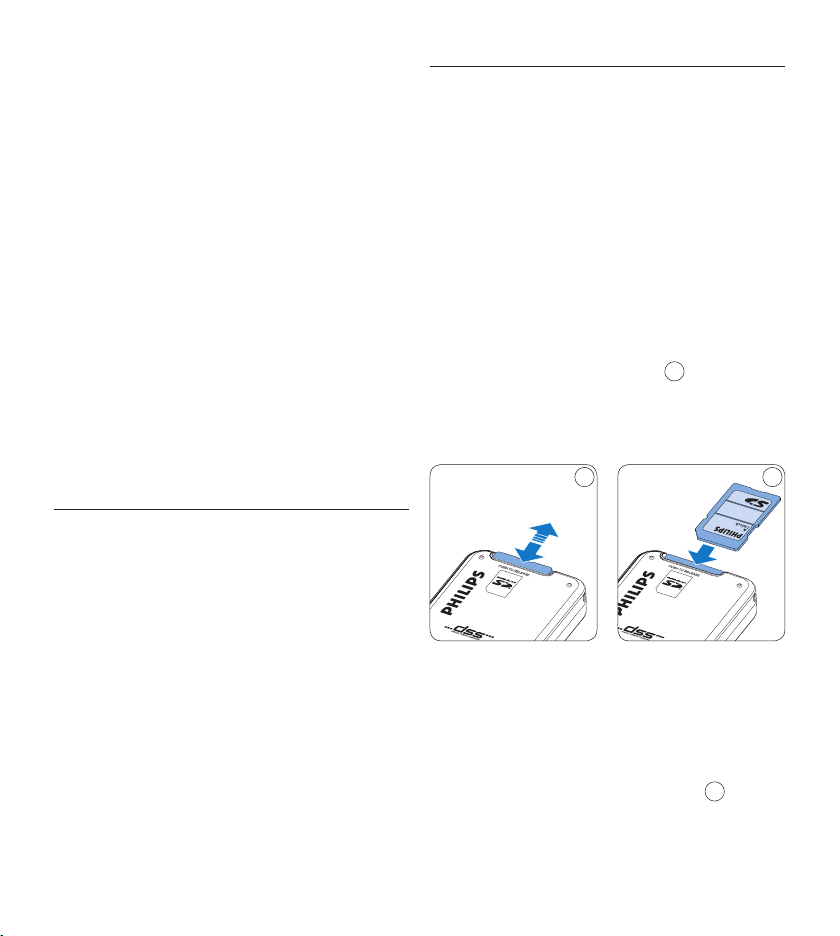
Insert and eject the memory card2.3
The Digital Pocket Memo operates with a SD
(SecureDigital) memory card and supports
SDHC cards with storage capacities of up to 32
GB.
Your Digital Pocket Memo is packaged with a
memory card already inserted and formatted.
To eject the memory card:
Locate the memory card slot on the top 1
back side of the Digital Pocket Memo.
Press the memory card into the Digital 2
Pocket Memo until it clicks.
1
Release the memory card. It will slightly 3
emerge from the memory card slot. Simply
slide it out.
1 2
To insert a memory card:
Locate the memory card slot on the top 1
back side of the Digital Pocket Memo.
Slide the memory card into the slot. A small 2
illustration under the memory card slot
indicates the correct orientation.
2
Push the memory card in until it clicks.3
9User manual
ENGLISH
the first time, you will be prompted to set the
language, date and time.
Set the language2.5.1
When using the Digital Pocket Memo for the
first time, you will be prompted to set the
language.
Press the 1 + or – button
1
on the Digital
Pocket Memo to select a language.
Press the 2
OK smart button
2
to confirm
the selection. The selected language will be
displayed.
D Note
It is possible to change the language later using
the menu. See Menu settings on page 21 for
more information.
2
1
D Note
If the Digital Pocket Memo is turned to the
ON
position and there is no memory card inserted,
a warning screen is displayed.
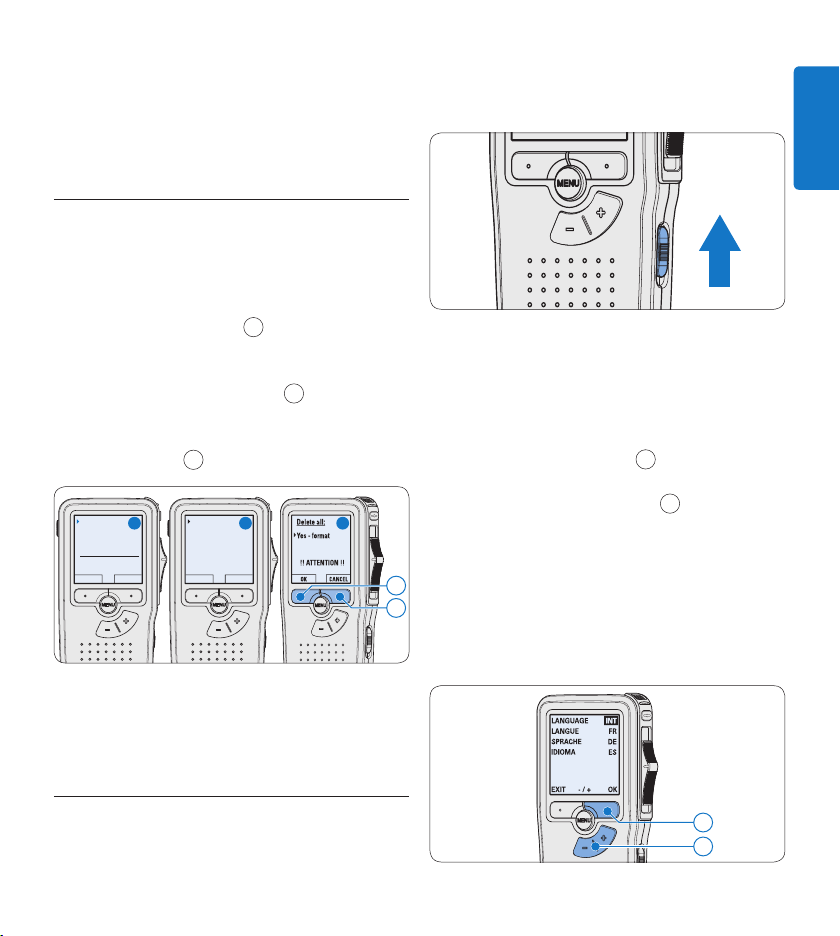
Format a new memory card2.4
When a new, unformatted memory card (or a
memory card that was formatted with a non-
Digital Pocket Memo device) is inserted, the
Digital Pocket Memo will display a prompt to
format the memory card.
A
To confirm and start the formatting process, 1
press the
OK smart button
1
.
To cancel the formatting process, remove 2
the memory card or press the
CANCEL
smart button
2
.
Format memory
Volume
Font
Language
Delete all?
BACK ENTER
Delete all ?
All files
will be lost !
Yes -format
BACK ENTER
A B C
1
2
D Note
Formatting is not possible if the memory card is
in read-only mode (locked).
Activate the Digital Pocket Memo2.5
The Digital Pocket Memo is turned on and o
by sliding the
ON/OFF switch. When using it for
10 User manual
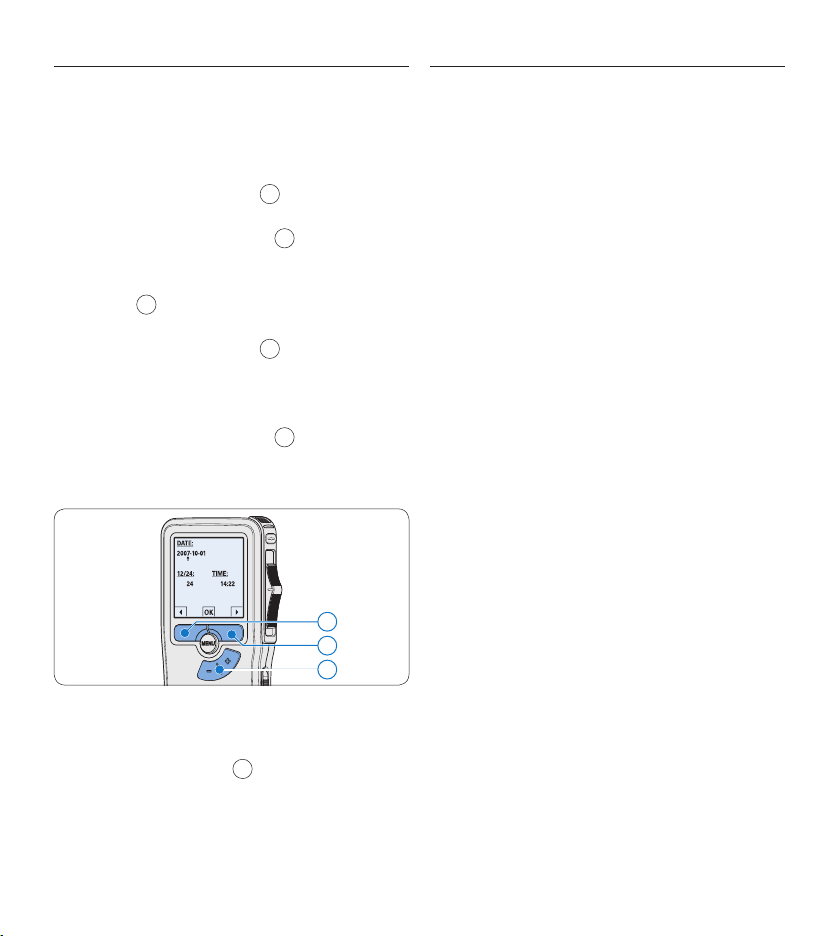
Set the date and time2.5.2
After selecting the user interface language, the
Digital Pocket Memo will prompt you to set the
current date and time.
Press the 1 + or – button
1
to change the
value for the year, month or day.
Press the 2 → smart button
2
to advance the
arrow (↑) to the next entry.
After setting the day, press the 3 → smart
button
2
to advance the settings to the
correct time.
Press the 4 + or – button
1
to select a
2-hour or 24-hour clock, AM or PM (if a
2-hour clock is selected), and to change
the value of the hour and minute settings.
Press the 5 → smart button
2
to confirm the
date and time. The Digital Pocket Memo is
now ready to function.
2
1
3
D Note
If a mistake is made in setting the date/time,
use the ← smart button
3
any time during the
procedure to step back to make corrections.
It is also possible to change the date and time
later using the menu. See Menu settings on page
21 for more information.
Power-save mode2.6
After 60 minutes of inactivity, the Digital Pocket
Memo automatically goes into power-save mode
and the LCD screen will display the date and
time. Press any button to reactivate it.
If the Digital Pocket Memo is not used for more
than two hours, it turns o completely. Turn the
unit on by moving the On/O switch to the OFF
position and then back to the ON position.
11User manual
ENGLISH
Use your Digital Pocket 3
Memo
Recording3.1
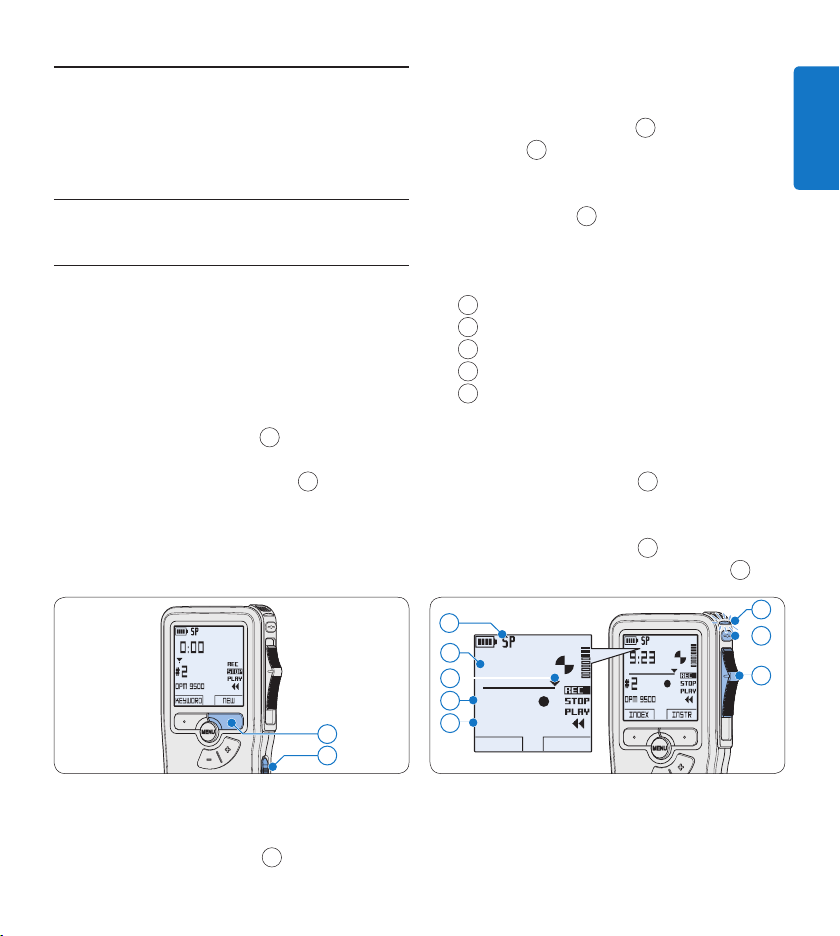
Create a recording3.1.1
Follow these steps to create a recording with
the Digital Pocket Memo:
A memory card must be inserted into the 1
memory card slot. See Insert and eject the
memory card on page 8 for more information.
Slide the On/O switch 2
1
to the ON posi-
tion to switch on the Digital Pocket Memo.
Press the 3
NEW smart button
2
to create a
new recording.
D Note
The
NEW smart button is not displayed if
the current recording is empty.
2
1
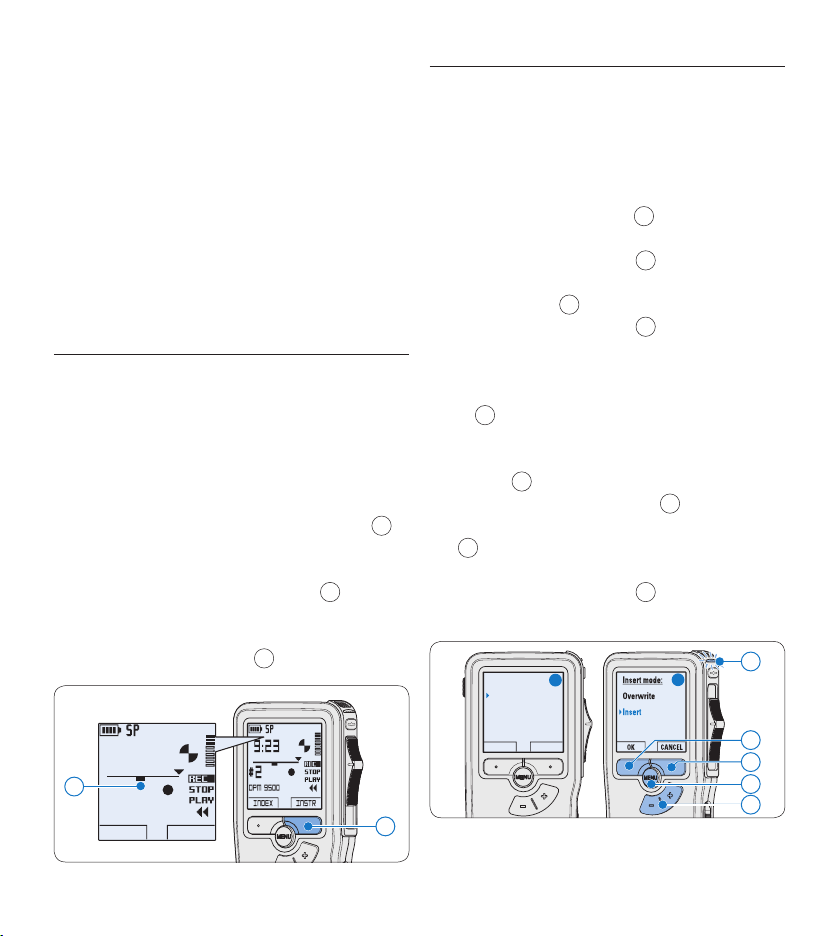
To start recording:4
On the • Digital Pocket Memo 9500,
move the slide switch
4
to the REC
position and start speaking.
On the • Digital Pocket Memo 9520,
press the
REC button
3
, move the slide
switch
4
to the REC position and start
speaking.
The status LED
5
glows in red (in
overwrite mode) or green (in insert mode)
while recording. The following information is
displayed:
a
Recording format
b
Recording time
c
Current position in the recording
d
File number
e
Keyword 1 (author name)
To stop recording:5
On the • Digital Pocket Memo 9500,
move the slide switch
4
to the STOP
position.
On the • Digital Pocket Memo 9520,
move the slide switch
4
to the RECP
position and press the
REC button
3
.
DPM 9500
INDEX INSTR
9:23
#2
5
b
4
c
3
d
e
a
D Note
For best results, speak clearly and keep •
the microphone about four inches (ten
12 User manual
centimeters) away from your mouth.
A beep will sound when the battery level •
drops below 10 % or the remaining recording
time reaches two minutes.
Press the •
INDEX smart button during
recording or playback to insert an index mark.
See Work with index marks on page 20 for
more information.
Press and hold the •
INSTR smart button during
recording to record a spoken instruction. See
the next chapter for more information.
Record a spoken instruction3.1.2
Spoken instructions are recorded comments
by the author that are directed to the person
transcribing the dictation.
To insert a spoken instruction into a dictation
file:
Press and hold the 1
INSTR smart button
1
while recording.
Dictate the instruction.2
Release the 3
INSTR smart button
1
when
the spoken instruction is complete. The
spoken instruction is displayed as a solid line
on the file position bar
a
.
DPM 9500
INDEX INSTR
9:23
#2
1
a
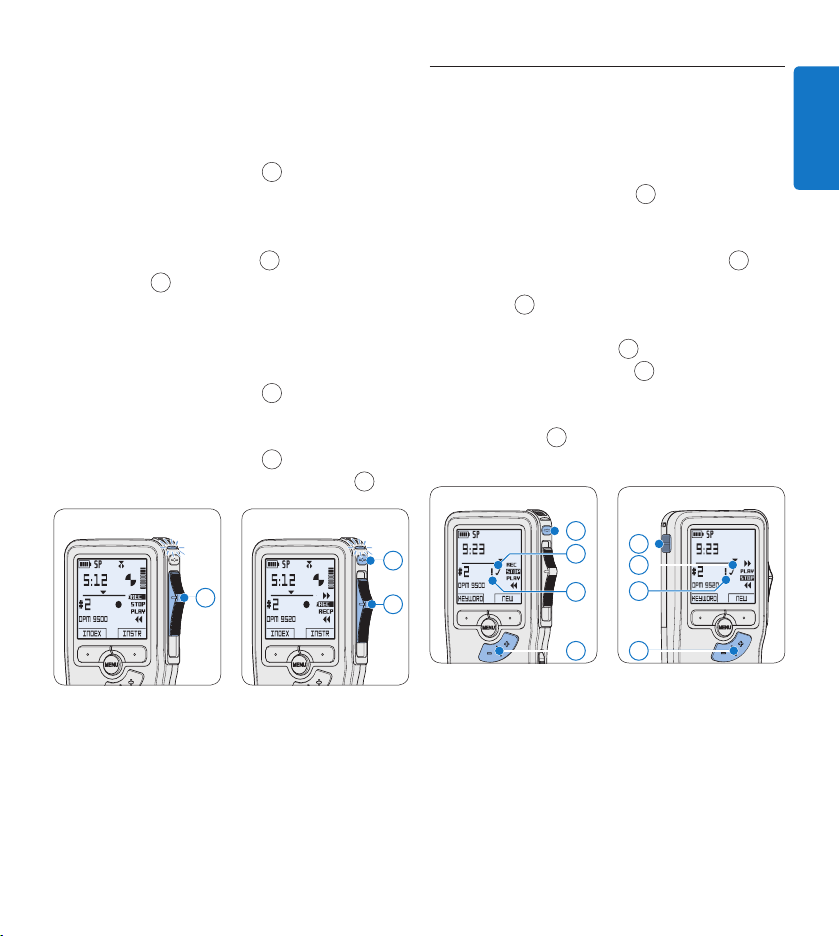
3.1.3 Add to a recording (insert/
overwrite)
Files are recorded in overwrite mode by default.
Follow these steps to switch to insert mode to
make additions to a recording:
Press the 1
MENU button
1
while in the stop
position to open the menu.
Press the 2 + or – button
2
to select the
Insert mode menu and press the
ENTER
smart button
3
to enter the submenu.
Press the 3 + or – button
2
to choose
between Insert or Overwrite mode.
In • insert mode, the record position of the
slide switch reads
iREC and the status LED
4
glows in green while recording.
In • overwrite mode, the record position of
the slide switch reads
REC and the status
LED
4
glows in red while recording.
Press the 4
OK smart button
5
to save the
setting or press the
CANCEL smart button
3
to exit the sub-menu without changing
the setting.
Press the 5 + or – button
2
to select the file
into which the insertion should be made.
Delete dictation
Insert mode
Keywords
Setup
Overwrite
BACK ENTER
5
3
1
A
B
2
4
13User manual
ENGLISH
Play, forward or rewind to the position 6
where the insertion should be made.
To insert an additional recording:7
On the • Digital Pocket Memo 9500,
move the slide switch
6
to the iREC
position and start speaking. The insertion
will not overwrite the recording.
On the • Digital Pocket Memo 9520,
press the
REC button
5
, move the slide
switch
6
to the iREC position and start
speaking. The insertion will not overwrite
the recording.
To end the inserted recording:8
On the • Digital Pocket Memo 9500,
move the slide switch
6
to the STOP
position.
On the • Digital Pocket Memo 9520,
move the slide switch
6
to the RECP
position and press the
REC button
5
.
Digital Pocket Memo 9500
6
6
5
Digital Pocket Memo 9520
If the recording is not finished, simply fast 9
forward to the end of the file and continue
recording.
⑩ Repeat from step 1 to return to overwrite
recording mode.
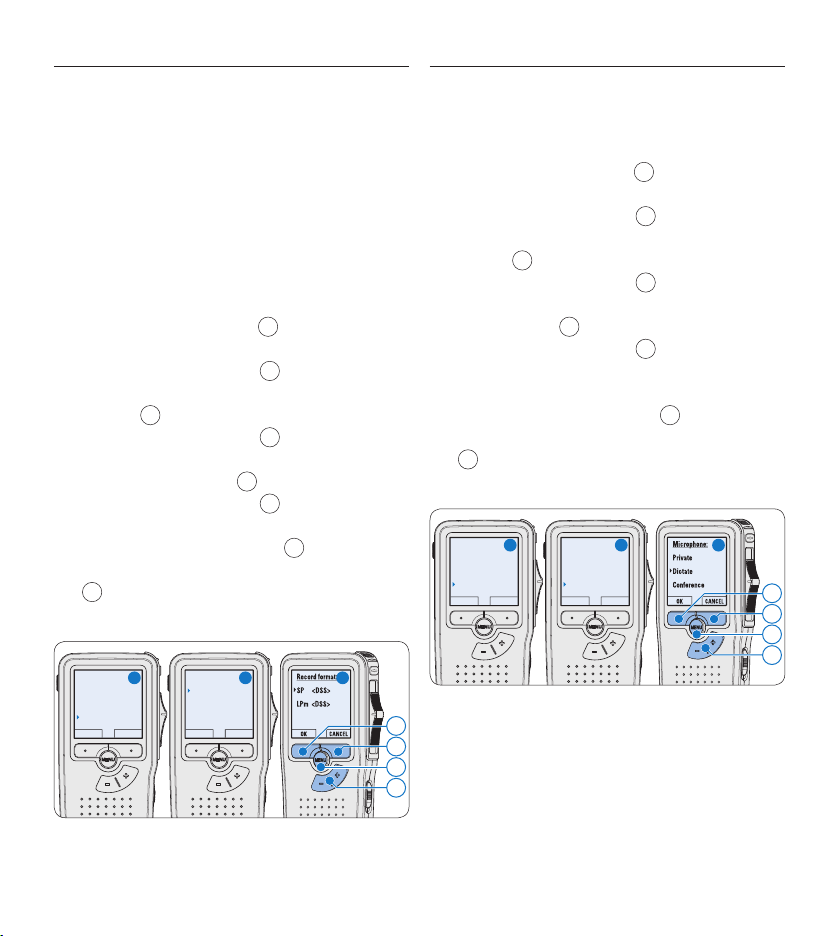
3.1.4 Finish (lock) a recording
When a recording is finished and no additional
changes will be made, follow these steps to
mark it as finished and protect it from being
accidentally deleted:
Press the 1 + or – button
1
while in the
stop position to select the recording to be
marked finished.
Press the end-of-letter (2
EOL) button
2
to
lock the file and mark it as finished. The
symbol
a
is displayed.
To assign priority status to the recording, 3
press the
EOL button
2
again within half
a second. The ! symbol
b
is displayed,
indicating that the file has priority status.
To make changes to the recording, press the 4
EOL button
2
again to remove the finished
mark.
Digital Pocket Memo 9500
2
b
a
1
2
b
a
Digital Pocket Memo 9520
1
E Tip
Philips SpeechExec software can be configured to
download only those files from the Digital Pocket
Memo to the PC that are marked finished.
C Caution
Locked files are deleted when the memory card
is formatted or the delete-all-dictations function
is used.
14 User manual
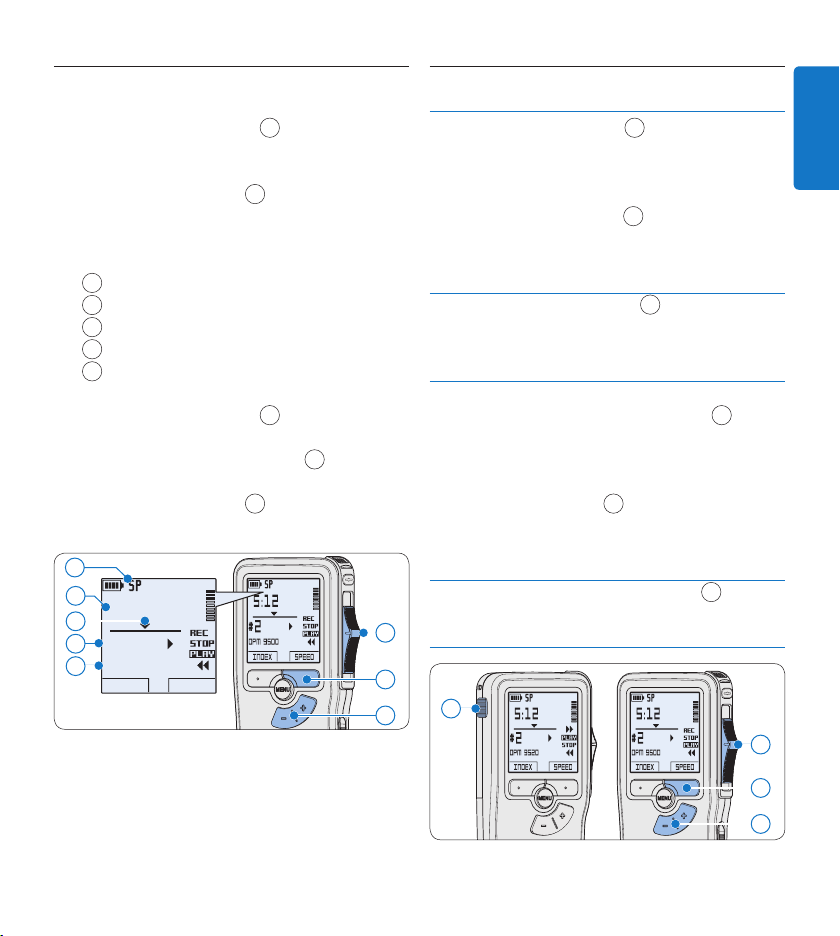
3.1.5 Change the recording format
The recording format determines the audio
quality of recordings and aects the number of
audio files that can fit on the memory card. The
Digital Pocket Memo supports the following
recording formats:
Quality Play (QP) requires 1 megabyte for 5 •
minutes of recording.
Standard Play (SP) requires 1 megabyte for 10 •
minutes of recording.
Press the 1
MENU button
1
while in the stop
position to open the menu.
Press the 2 + or – button
2
to select the
Setup menu item and press the
ENTER smart
button.
3
Press the 3 + or – button
2
to select the
Record format menu item and press the
ENTER smart button
3
.
Press the 4 + or – button
2
to choose
between QP and SP.
Press the 5
OK smart button
4
to save the
setting or press the
CANCEL smart button
3
to exit the sub-menu without changing
the setting.
Delete dictation
Insert mode
Keywords
Setup
Language
BACK ENTER
Language
Record format
Voice activation
Backlight
SP <DSS>
BACK ENTER
4
3
1
2
A B C
3.1.6 Adjust the microphone sensitivity
Set the microphone sensitivity for the
environment and your recording preferences.
Press the 1
MENU button
1
while in the stop
position to open the menu.
Press the 2 + or – button
2
to select the
Setup menu item and press the
ENTER smart
button
3
.
Press the 3 + or – button
2
to select the
Microphone menu item and press the
ENTER
smart button
3
.
Press the 4 + or – button
2
to choose the
microphone sensitivity: Private (low), Dictate
(medium) and Conference (high).
Press the 5
OK smart button
4
to save the
setting or press the
CANCEL smart button
3
to exit the sub-menu without changing
the setting.
Delete dictation
Insert mode
Keywords
Setup
Language
BACK ENTER
Record lamp
Contrast
Device beep
Microphone
Dictate
BACK ENTER
4
3
1
2
A B C
15User manual
ENGLISH
Playback3.2
Press the 1 + or – button
1
while in the stop
position to select the file to play and locate
the beginning of the recording.
Move the slide switch 2
2
to the PLAY
position to start playback.
The following information is displayed:
a
Recording format
b
Playback position (minutes : seconds)
c
Current position in the recording
d
File number
e
Keyword 1 (author name)
Press the 3 + or – button
1
to adjust the
playback volume during playback.
Press the 4
SPEED smart button
3
to adjust
faster or slower file playback.
Move the slide switch 5
2
to the STOP
position to stop playback.
DPM 9500
INDEX SPEED
5:12
#2
b
2
c
3
d
e
a
1
Overview of playback functions3.2.1
File
selection
Press the + button
1
once while in the
stop position to skip to the end of a file.
Press the + button again to skip to the
beginning of the next file.
Press the – button
1
once while in the
stop position to skip to the beginning of a
file. Press the – button again to skip to the
end of the previous file.
Fast
rewind
Move the slide switch
2
to the ┤ position.
Move the slide switch to the STOP position
to stop rewinding or the PLAY position to
stop rewinding and begin playback.
Fast
forward
On the Digital Pocket Memo 9500,
press and hold the FWD button
3
while
in the stop or play position. Release the
FWD button to stop forwarding.
On the Digital Pocket Memo 9520, move
the slide switch
2
to the ┢ position.
Move the slide switch to the STOP position
to stop forwarding or the PLAY position to
stop forwarding and begin playback.
Playback
speed
Press the SPEED smart button
4
during
playback to adjust faster or slower file
playback.
1
2
4
3
16 User manual
Delete3.3
D Note
Before deleting a file, make sure that it is not
marked finished and that the memory card is not
set to read-only (locked). If the file is marked fin-
ished, unlock it by pressing the
EOL button once.
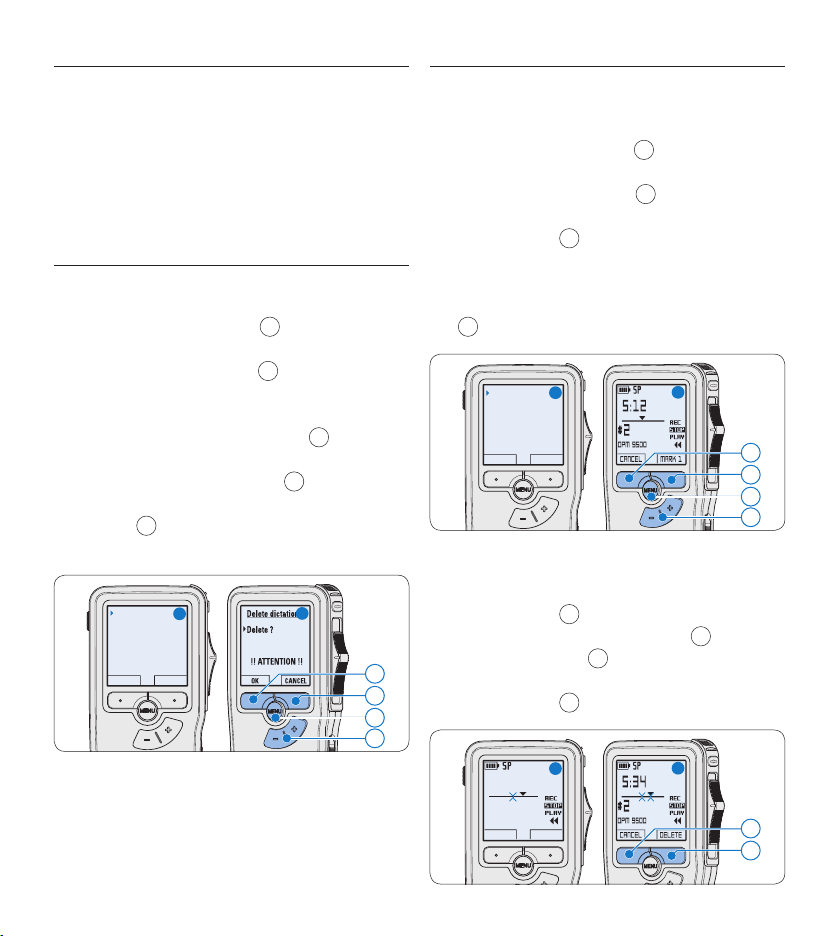
3.3.1 Delete a file
Follow these steps to delete a file entirely:
Press the 1 + or – button
1
while in the stop
position to select the file to be deleted.
Press the 2
MENU button
2
to open the
menu. The Delete dictation
menu item is
selected.
Press the 3
ENTER smart button
3
to enter
the sub menu.
Press the 4
OK smart button
4
to delete the
file permanently. Press the
CANCEL smart
button
3
to cancel the operation and leave
the recording intact.
Delete dictation
Insert mode
Keywords
Setup
Delete ?
BACK ENTER
4
3
2
A
B
1
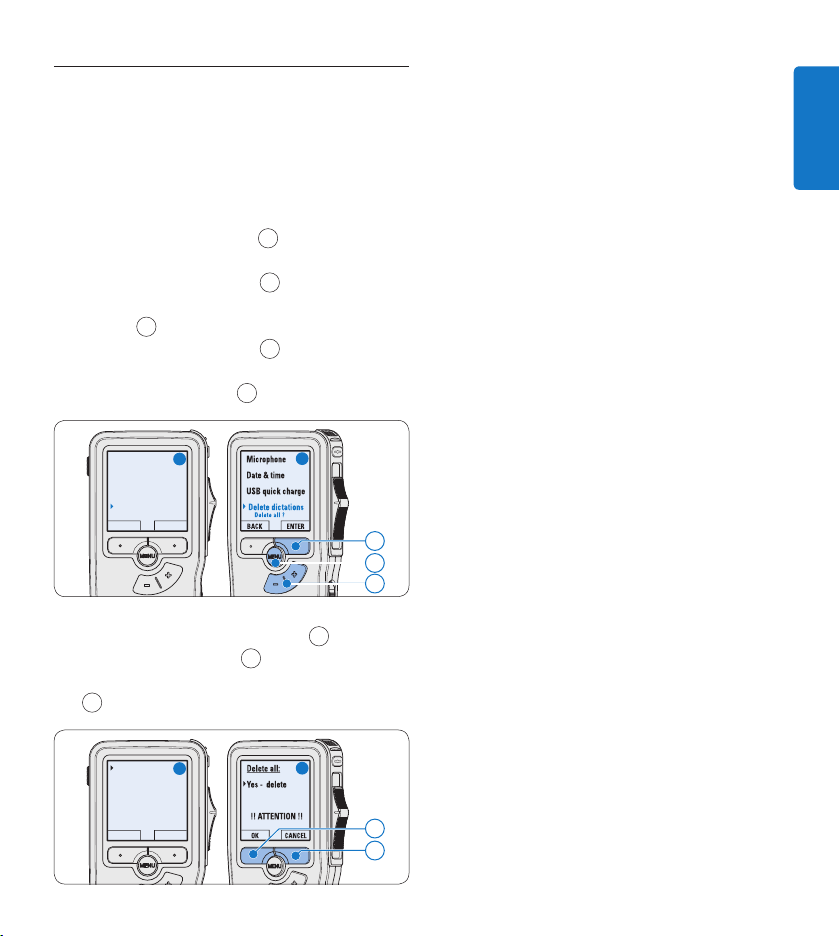
3.3.2 Delete part of a recording
Follow these steps to delete a section from a
recording:
Press the 1
MENU button
1
while in the stop
position to open the menu.
Press the 2 + or – button
2
to select the
Delete section menu item and press the
OK
smart button
3
.
Using the play, forward or rewind functions, 3
navigate to the beginning of the section to
be deleted. Press the
MARK smart button
4
. A cross symbol appears on the screen.
Delete section
Delete dictation
Priority high
Index set
OK CANCEL
3
4
1
A
B
2
Navigate to the second mark position using 4
playback, forward or rewind. Press the
MARK 2
smart button
5
. The second cross appears.
Press the 5
DELETE smart button
5
and the
OK smart button
6
to confirm the deletion
of the marked section, or press the
CANCEL
smart button
5
to exit without deleting.
DPM 9500
CANCEL MARK 2
5:34
#2
6
5
C
D
17User manual
ENGLISH
3.3.3 Delete all dictations
C Caution
Files marked finished (EOL) are deleted when
the delete-all-dictations function is used.
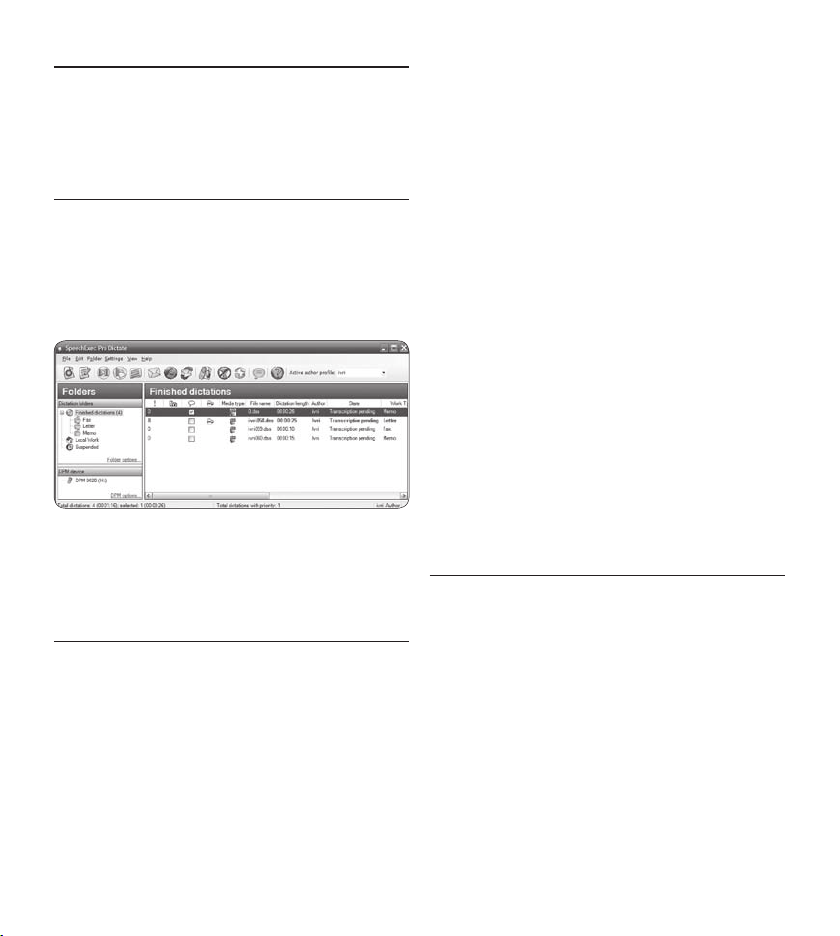
Follow these steps to delete all recordings:
Press the 1
MENU button
1
while in the stop
position to open the menu.
Press the 2 + or – button
2
to select the
Setup menu item and press the
ENTER smart
button
3
.
Press the 3 + or – button
2
to select the
Delete dictations menu item and press the
ENTER smart button
3
.
Delete dictation
Insert mode
Keywords
Setup
Language
BACK ENTER
3
1
A
B
2
Press the 4 ENTER smart button
4
and
the
OK smart button
5
to confirm the
deletion, or press the
CANCEL smart button
4
to exit without deleting.
Delete all ?
All dictations
will be lost !
Yes - delete
BACK ENTER
5
4
C
D
18 User manual
Use more of your Digital 4
Pocket Memo
Use Philips SpeechExec software4.1
Philips SpeechExec software can be used for
advanced configuration of the Digital Pocket
Memo, automatic download, conversion and
routing of dictation files.
D Note
For detailed information about SpeechExec
software, refer to the SpeechExec user manual.
Advanced configuration4.1.1
The Digital Pocket Memo Configuration Wizard
is part of the Philips SpeechExec Pro Dictate soft-
ware. It guides users through the device configu-
rations and settings of the Digital Pocket Memo.
The wizard assists in configuring time format,
sound feedback, voice-activated recording,
display appearance (standard or advanced display
mode), recording format, microphone sensitivity,
keywords, and file download to the PC.
Connect the Digital Pocket Memo to the PC 1
using a USB cable.
Start 2 Philips SpeechExec Pro Dictate software.
Click 3
Settings > General settings on the menu
bar of SpeechExec to open the settings
menu and select
DPM/DT Configuration > DPM
Wizard
from the list on the left side.
Click the 4
Start Wizard… button to open the
wizard. Follow the on-screen instructions to
customize the Digital Pocket Memo.
Click the 5
Finish button to close the wizard
and confirm the transfer of the new settings
to the Digital Pocket Memo.
D Note
When the Digital Pocket Memo is connected
to the PC for the first time, Windows detects
the new hardware and automatically installs
the required drivers. When the installation is
complete, Windows may prompt you to restart
the PC.
Download recordings to the PC4.1.2
With USB mass storage support, the Digital
Pocket Memo is automatically displayed as an
external drive when it is connected to the com-
puter. It can then be accessed easily with any
Microsoft Windows program as a regular drive.
Use Philips SpeechExec software for automatic
download, conversion, and routing of files.
Make a recording with the Digital Pocket 1
Memo.
Start 2 Philips SpeechExec Pro Dictate software.
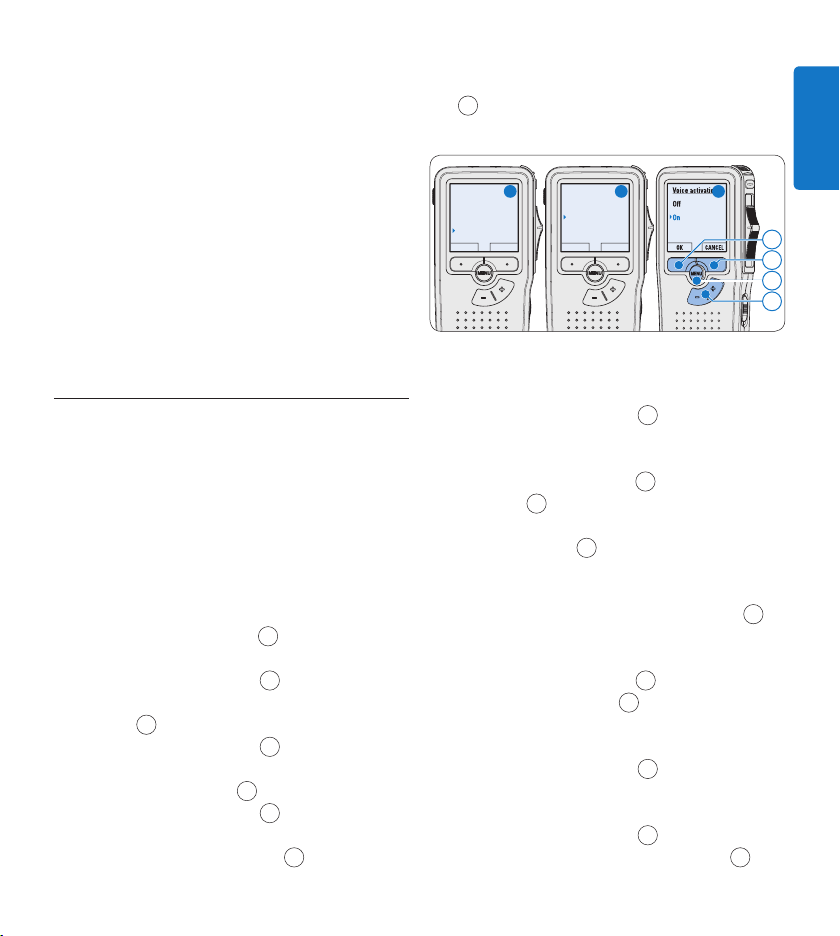
19User manual
ENGLISH
Connect the Digital Pocket Memo to the 3
PC using the USB cable or the USB docking
station.
By default, the recordings on the Digital 4
Pocket Memo will be downloaded
automatically to the PC and moved to the
Finished dictations folder of the work list.
D Note
How and which files are downloaded after
a Digital Pocket Memo is connected can be
configured in the settings menu of SpeechExec
or with the Configuration Wizard.
Use voice-activated recording4.2
Voice-activated recording is a convenience
feature for hands-free recording. When voice-
activated recording is enabled, recording will
start when you begin speaking. When you
stop speaking, the Digital Pocket Memo will
automatically pause recording after three
seconds of silence, and resume only when you
begin speaking again.
Press the 1
MENU button
1
while in the stop
position to open the menu.
Press the 2 + or – button
2
to select the
Setup menu item and press the
ENTER smart
button
3
.
Press the 3 + or – button
2
to select the
Voice activation menu item and press the
ENTER smart button
3
.
Press the 4 + or – button
2
to choose O
or On.
Press the 5
OK smart button
4
to save the
setting or press the
CANCEL smart button
3
to exit the sub-menu without changing
the setting.
Delete dictation
Insert mode
Keywords
Setup
Language
BACK ENTER
Language
Record format
Voice activation
Backlight
Off
BACK ENTER
4
3
1
2
A B C
To start recording:6
On the • Digital Pocket Memo 9500,
move the slide switch
6
to the REC
position and start speaking.
On the • Digital Pocket Memo 9520,
press the
REC button
5
, move the slide
switch
6
to the REC position and start
speaking.
The status LED
7
glows in red (in
overwrite mode) or green (in insert mode)
while recording. When the sound level
drops below the threshold sound level
a
,
recording pauses after three seconds and
the status LED flashes.
Press the 7 + or – button
8
to adjust the
threshold sound level
a
while recording.
To stop recording:8
On the • Digital Pocket Memo 9500,
move the slide switch
6
to the STOP
position.
On the • Digital Pocket Memo 9520,
move the slide switch
6
to the RECP
position and press the
REC button
5
.

20 User manual
DPM 9500
INDEX INSTR
9:23
#2
5
6
7
a
8
Work with index marks4.3
Index marks can be used to mark certain points
in a recording as points of reference. A point
of reference may be the beginning of a major
section, or a part of the recording that you may
want to revise later or access quickly.
Insert an index mark4.3.1
Press the 1
INDEX smart button
1
during
recording or playback to insert an index
mark
a
. The index number is displayed for
two seconds.
DPM 9500
INDEX INSTR
9:23
INDEX 1
1
a
Delete an index mark4.3.2
Play, fast forward or fast rewind to the index 1
mark to be deleted
a
.
Press the 2
MENU button
1
while in the stop
position to open the menu.
Press the 3 + or – button
2
to select the
Index clear menu and press the
OK smart
button
3
.
DPM 9500
KEYWORD NEW
6:32
#2
3
1
A
B
2
a
4.3.3 Delete all index marks
Press the 1
MENU button
1
while in the stop
position to open the menu.
Press the 2 + or – button
2
to select the
Delete indices menu item and press the
ENTER smart button
3
.
Press the 3
ENTER smart button
3
and
the
OK smart button
4
to confirm the
deletion, or press the
CANCEL smart button
3
to exit without deleting.
Insert mode
Keywords
Setup
Delete indices
Delete all ?
BACK ENTER
Delete all ?
All indices
will be lost !
Yes - delete
BACK ENTER
4
3
1
2
A B C
21User manual
ENGLISH
D Note
The Delete Indices menu item is available only if
the current file has at least one index mark.
Assign a keyword4.4
One or more keywords, such as the author’s
name, can be assigned to every recording.
Keywords can be used to identify recordings
and automatic file routing in Philips SpeechExec
software.
D Note
Keywords must first be set up with Philips
Speech Exec software. See Advanced configuration
on page 18 for more information. By default,
the keyword category Author with the keywords
‘DPM 9500’ and ‘- - -’ (empty) and the category
Work type with the keywords ‘Memo’, ‘Letter’,
‘Fax’ and ‘Report’ are available on the Digital
Pocket Memo.
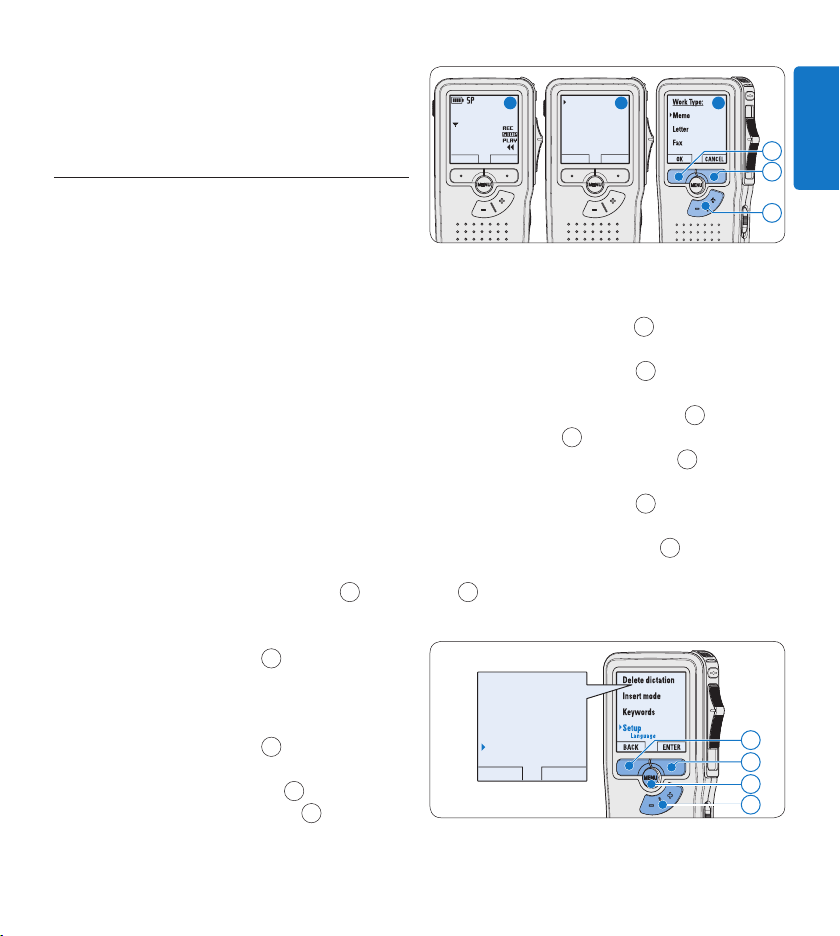
To assign a keyword to a recording:
Press the 1
KEYWORD smart button
1
while
in the stop position to display the list of
keyword categories.
Press the 2 + or − button
2
to select a
category.
Press the 3
ENTER smart button to display the
list of keywords for the category.
Press the 4 + or − button
2
to select a
keyword.
Press the 5
OK smart button
4
to confirm
or the
CANCEL smart button
3
to exit
without assigning a keyword.
Work Type
Author
BACK ENTER
DPM 9500
KEYWORD NEW
0:00
#2
1
3
2
A B C
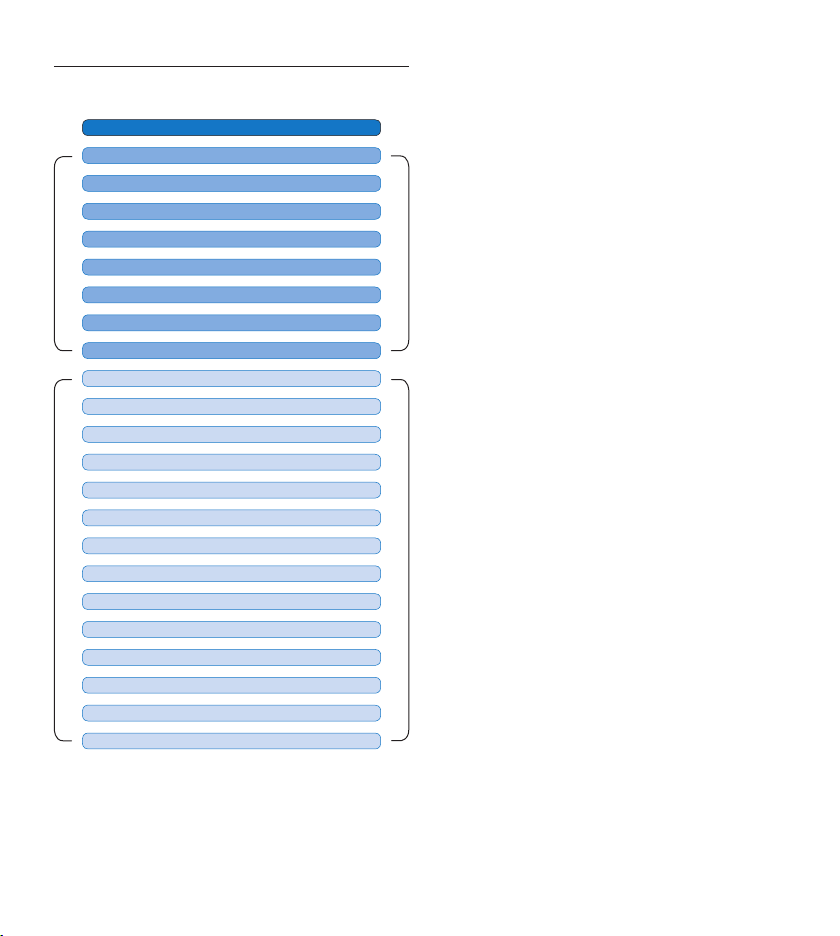
Menu settings4.5
To access the Digital Pocket Memo menu:
Press the 1
MENU button
1
while in the stop
position to open the menu.
Press the 2 + or – button
2
to select the
next/previous menu item.
Press the 3
ENTER smart button
3
or the
MENU button
1
to enter a sub-menu.
Press the
BACK smart button
4
to exit the
menu.
Press the 4 + or – button
2
to select a
function.
Press the 5
OK smart button
4
to confirm
a selection or the
CANCEL smart button
3
to exit a sub-menu without changing a
setting.
Delete dictation
Insert mode
Keywords
Setup
Language
BACK ENTER
4
3
1
2
22 User manual
Menu list4.5.1
Press the MENU button
DELETE DICTATION (see 3.3.1 page 16)
INDEX SET / CLEAR (see 4.3 page 20)
PRIORITY HIGH / NORMAL (see 3.1.4 page 13)
INSERT MODE (see 3.1.3 page 12)
DELETE SECTION (see 3.3.2 page 16)
DELETE ALL INDICES (see 4.3.3 page 20)
SETUP
VOICE ACTIVATION (see 4.2 page 19)
LANGUAGE (see 2.5.1 page 9)
BACKLIGHT (OFF / 8 s / 20 s)
LCD CONTRAST
RECORD LAMP ON / OFF
DEVICE BEEP ON / OFF
USB QUICK CHARGE ON / OFF
MICROPHONE SENSITIVITY (see 3.1.6 page 14)
FORMAT MEMORY (see 2.4 page 9)
DEVICE FONT (MODERN / CLASSIC)
PLAYBACK VOLUME
KEYWORDS (see 4.4 page 21)
RECORD FORMAT (see 3.1.5 page 14)
DATE & TIME (see 2.5.2 page 10)
DELETE ALL DICTATIONS (see 3.3.3 page 17)
MAIN MENU
SETUP MENU
D Note
Some settings, such as defining keywords or
switching to the simple display mode, are
available only through Philips SpeechExec Pro
Dictate. See Advanced configuration on page 18
for more information.
D Note
Press and hold the
MENU button for a few
seconds to access additional information about
files, the device, and the memory card.
Disclaimer and Notices
Philips performs extensive testing with the most
popular configurations. However, since PC add-
ons and device drivers are updated continually,
conflict-free operation cannot be guaranteed.

Connectivity
Docking connector: 8-pin female•
USB: Mini-USB 2.0 female (full speed, 12 Mbit/s)•
DC in: 6 V•
Microphone: 3.5 mm, impedance 2 k•
Earphone: 3.5 mm, impedance 8 or more•
Memory card: Secure Digital (SD)/Multimedia •
(MMC)
Display
Type: TFT-Transreflective•
Diagonal screen size: 44 mm / 1.71 "•
Resolution: 128 x 128 pixels•
Backlight color: White•
Green Specifications
Compliant to 2002/95/EC (RoHS)•
Lead-free soldered product•
Operation conditions
Temperature: 5° - 45° C / 41° - 113° F•
Humidity: 10 % - 90 %•
Recording format
.dss (Digital Speech Standard)•
Recording media
Memory: Secure Digital (SD)/MMC: up to 32 GB•
Recording time (QP/SP): 21/44 hours with 256 •
MB card
Sampling frequency
Quality Play mode (QP): 16 kHz•
Standard Play mode (SP): 12 kHz•
Technical data
Compression rate
Quality Play mode (QP): 26 kbit/s•
Standard Play mode (SP): 13.5 kbit/s•
Speaker
Built-in 30 mm round, dynamic speaker•
Output power: 200 mW•
Accesssories
Philips Secure Digital (SD) memory card•
Two Philips AAA rechargeable batteries•
Travel pouch, user manual, quick start guide•
Installation CD•
Optional accesssories
USB Docking Station 9120•
Power supply 9146•
Secure Digital (SD) memory card 9256•
Headphones 334 •
Power
Battery type: two Philips AAA Ni-MH •
rechargeable batteries (LFH 9154) or two
AAA batteries (LR03 or R03)
Power supply (optional): 6 V DC / 850 mA•
Battery life (Standard Play mode)
21 hours with Philips rechargeable batteries•
19 hours with Philips alkaline batteries•
Specifications
Product dimensions (W x D x H): •
50 x 17 x 116 mm / 2.0 x 0.7 x 4.6 in.
Weight: 106 g / 3.7 oz. (including batteries)•

Specifications are subject to change without notice.
Trademarks are the property of Royal Philips Electronics or their respective owners.
© 2010 Royal Philips Electronics. All rights reserved.
Document Version 2.1, 2010-01-22.
5103 109 9663.2
Discover the comprehensive range of high-end dictation products from Philips
www.philips.com/dictation