Reader™ User Guide
Print
Search
Getting started
Basic Operations
Adding/Getting Content
Browsing Content Lists
Reading
Organizing
Other Applications
Settings
Other Information
Contents list
Top page
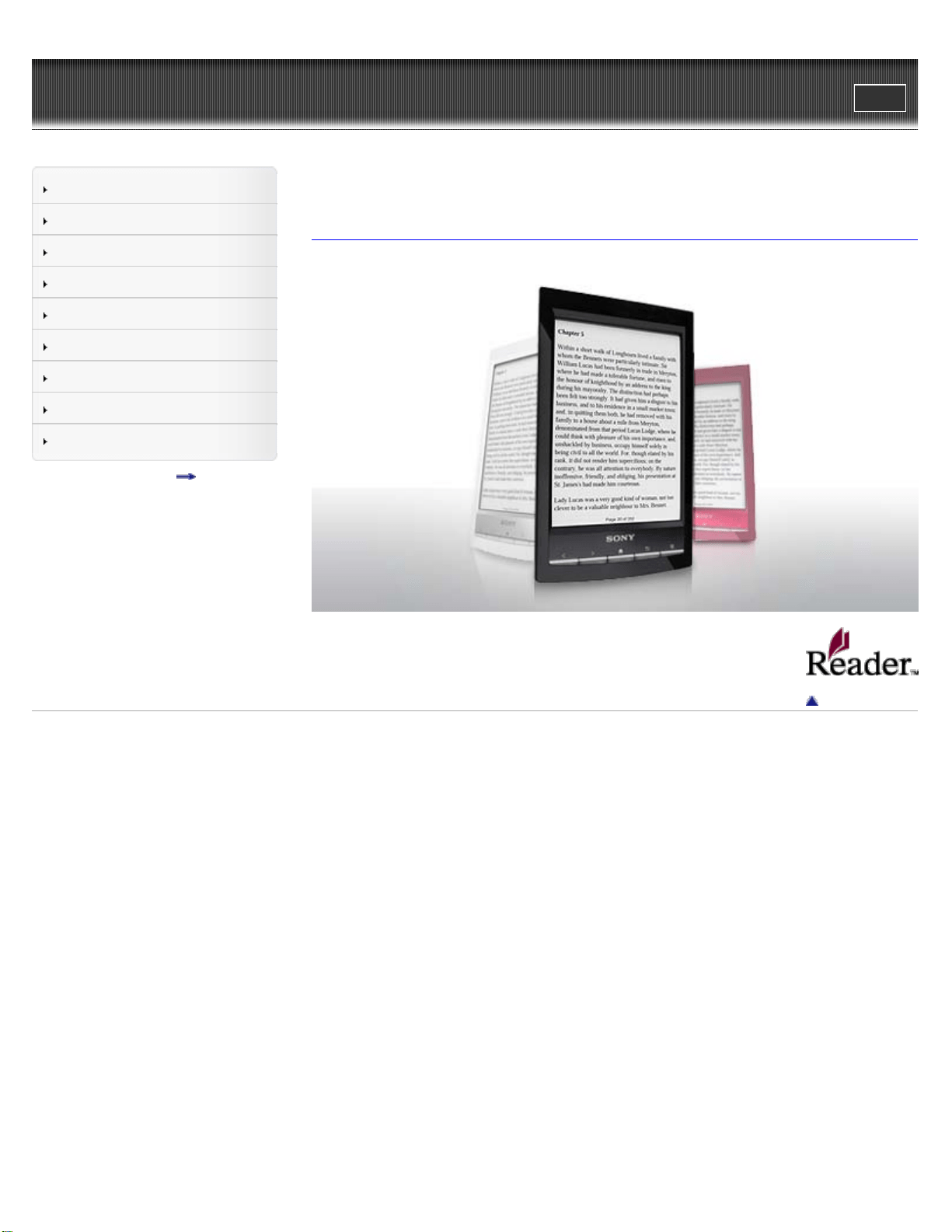
PRS-T1
User Guide
Use this manual if you encounter any problems, or have any questions about your Reader™.
Go to page top
Copyright 2011 Sony Corporation

Table Of Contents
PRS-T1User Guide i..........................................................................................................................
Getting started 1................................................................................................................................
About your Reader™ 15.................................................................................................................
Reader Features and Functions 17.............................................................................................
Join a Wi-Fi® Network 19............................................................................................................
Charging the Reader 26..............................................................................................................
Maximizing Battery Life 29..........................................................................................................
Turning the Power On/Off 30.......................................................................................................
Overview 31.................................................................................................................................
Buttons 33...................................................................................................................................
microSD Card Slot 34..................................................................................................................
Basic Operations 2............................................................................................................................
Applications and the [Home] Screen 35......................................................................................
Touchscreen Operations 38........................................................................................................
On-Screen Keyboard 41..............................................................................................................
Adding/Getting Content 3..................................................................................................................
Buying Books and Periodicals 43................................................................................................
Adding Content 45.......................................................................................................................
Browsing Content Lists 4...................................................................................................................
Browsing Content List Pages 47.................................................................................................
Browsing in Thumbnail View and List View 49............................................................................
Using the Page Jump Panel in Content List Pages 51................................................................
Finding Content with a Keyword 52.............................................................................................
Tools 53.......................................................................................................................................
Using (Menu) Items 54................................................................................................................
Reading 5..........................................................................................................................................
Opening a Book 55......................................................................................................................
Page Navigation 56.....................................................................................................................
Appearance 58............................................................................................................................
Annotations 62.............................................................................................................................
Using the Dictionary 68...............................................................................................................
Finding Pages with a Keyword 69...............................................................................................
Changing Book Page Settings 70................................................................................................
Using (Menu) Items 71................................................................................................................
Opening a Periodical Issue 72.....................................................................................................
Page Navigation 73.....................................................................................................................
Organizing 6......................................................................................................................................
Deleting a Single Item 75............................................................................................................
TOC-1

Enjoying Audio 118......................................................................................................................
Using (Menu) Items 120..............................................................................................................
Settings 9...........................................................................................................................................
Changing the Settings 121..........................................................................................................
General Settings 122...................................................................................................................
Wireless Network Settings 123....................................................................................................
Application Preferences 124........................................................................................................
Date and Time Settings 125........................................................................................................
System Management 126............................................................................................................
Initialization 127...........................................................................................................................
About 128....................................................................................................................................
Device Shutdown 129..................................................................................................................
Other Information 10..........................................................................................................................
Troubleshooting Tips 130............................................................................................................
Support PC Web Site 131...........................................................................................................
Reader Device 132......................................................................................................................
Wireless Connectivity 134...........................................................................................................
Reading Books and Periodicals 136............................................................................................
Playing Audio Files 137...............................................................................................................
Viewing Pictures 138...................................................................................................................
Connecting to your Computer 139...............................................................................................
microSD Card 140.......................................................................................................................
Safety Information 141................................................................................................................
Applications on the Reader 144..................................................................................................
About Pre-installed Sample Content 145....................................................................................
Reader Disposal Reference 146.................................................................................................
Additional Information for Customers in the US/Canada 148......................................................
Additional Information for Customers Outside the US/Canada 150............................................
Notes on microSD Cards 151......................................................................................................
Legal Notice 152..........................................................................................................................
Specifications 153.......................................................................................................................
Supported File Types 155...........................................................................................................
System Requirements 156..........................................................................................................
TOC-3
Reader™ User Guide
Print
Search
Getting started
Basic Operations
Adding/Getting Content
Browsing Content Lists
Reading
Organizing
Other Applications
Settings
Other Information
Contents list
Top page > Getting started
Getting started
Welcome!
About your Reader™
Reader Features and Functions
Wireless Connectivity
Join a Wi-Fi® Network
Battery
Charging the Reader
Maximizing Battery Life
Turning the Power On/Off
Turning the Power On/Off
Parts and Controls
Overview
Buttons
microSD Card Slot
Go to page top
Copyright 2011 Sony Corporation
1
Reader™ User Guide
Print
Search
Getting started
Basic Operations
Adding/Getting Content
Browsing Content Lists
Reading
Organizing
Other Applications
Settings
Other Information
Contents list
Top page > Basic Operations
Basic Operations
[Home] Screen
Applications and the [Home] Screen
Touchscreen Operations
On-Screen Keyboard
Go to page top
Copyright 2011 Sony Corporation
2
Reader™ User Guide
Print
Search
Getting started
Basic Operations
Adding/Getting Content
Browsing Content Lists
Reading
Organizing
Other Applications
Settings
Other Information
Contents list
Top page > Adding/Getting Content
Adding/Getting Content
Adding Content
Buying Books and Periodicals
Adding Content
Go to page top
Copyright 2011 Sony Corporation
3
Reader™ User Guide
Print
Search
Getting started
Basic Operations
Adding/Getting Content
Browsing Content Lists
Reading
Organizing
Other Applications
Settings
Other Information
Contents list
Top page > Browsing Content Lists
Browsing Content Lists
Content Lists
Browsing Content List Pages
Browsing in Thumbnail View and List View
Using the Page Jump Panel in Content List Pages
Finding Content with a Keyword
Tools
Using (Menu) Items
Go to page top
Copyright 2011 Sony Corporation
4
Reader™ User Guide
Print
Search
Getting started
Basic Operations
Adding/Getting Content
Browsing Content Lists
Reading
Organizing
Other Applications
Settings
Other Information
Contents list
Top page > Reading
Reading
Reading Books
Opening a Book
Page Navigation
Appearance
Annotations
Using the Dictionary
Finding Pages with a Keyword
Changing Book Page Settings
Using (Menu) Items
Reading Periodicals
Opening a Periodical Issue
Page Navigation
Go to page top
Copyright 2011 Sony Corporation
5
Reader™ User Guide
Print
Search
Getting started
Basic Operations
Adding/Getting Content
Browsing Content Lists
Reading
Organizing
Other Applications
Settings
Other Information
Contents list
Top page > Organizing
Organizing
Organizing Your Content
Deleting a Single Item
Deleting Multiple Items at Once
Protecting a Single Item
Protecting Multiple Items at Once
Using Collections
Creating a Collection
Adding Items to a Collection
Removing Items from a Collection
Renaming a Collection
Deleting a Collection
Using (Menu) Items
Go to page top
Copyright 2011 Sony Corporation
6
Reader™ User Guide
Print
Search
Getting started
Basic Operations
Adding/Getting Content
Browsing Content Lists
Reading
Organizing
Other Applications
Settings
Other Information
Contents list
Top page > Other Applications
Other Applications
Google Books
Downloading Public Domain Books from Google Books*
Public Libraries
Borrowing Books from Public Libraries
Web Browsing
Browsing the Web
Browsing Tools
Downloads
Multiple Windows
Bookmarks and History
Browser Settings
Using (Menu) Items
Purchased Content
Purchased Content
All Notes
Finding Annotations Across All Books and Periodicals
Dictionary
Using the Dictionary
Changing the Dictionary
Listing Previously Looked-up Words
Using (Menu) Items
Handwriting
Creating a Drawing
Editing an Existing Drawing
Deleting/Protecting a Drawing
Capturing a Screenshot
Using (Menu) Items
Text Memo
Creating a Text Memo
Editing an Existing Memo
Deleting/Protecting a Memo
Using (Menu) Items
Pictures
Viewing Pictures
Changing the Orientation
Zooming in on a Picture
Viewing Pictures in a Slideshow
Deleting Pictures
7

Reader™ User Guide
Print
Search
Getting started
Basic Operations
Adding/Getting Content
Browsing Content Lists
Reading
Organizing
Other Applications
Settings
Other Information
Contents list
Top page > Settings
Settings
Changing the Settings
Changing the Settings
General Settings
Wireless Network Settings
Application Preferences
Date and Time Settings
System Management
Initialization
About
Device Shutdown
Go to page top
Copyright 2011 Sony Corporation
9
Reader™ User Guide
Print
Search
Getting started
Basic Operations
Adding/Getting Content
Browsing Content Lists
Reading
Organizing
Other Applications
Settings
Other Information
Contents list
Top page > Other Information
Other Information
Troubleshooting
Troubleshooting Tips
Support PC Web Site
Reader Device
Wireless Connectivity
Reading Books and Periodicals
Playing Audio Files
Viewing Pictures
Connecting to your Computer
microSD Card
Precautions
Safety Information
Applications on the Reader
About Pre-installed Sample Content
Reader Disposal Reference
Additional Information for Customers in the US/Canada
Additional Information for Customers Outside the US/Canada
Notes on microSD Cards
Legal Notice
Legal Notice
Appendix
Specifications
Supported File Types
System Requirements
Go to page top
Copyright 2011 Sony Corporation
10
Reader™ User Guide
Print
Search
Getting started
Basic Operations
Adding/Getting Content
Browsing Content Lists
Reading
Organizing
Other Applications
Settings
Other Information
Contents list
Top page > Contents list
Contents list
Getting started
Welcome!
About your Reader™
Reader Features and Functions
Wireless Connectivity
Join a Wi-Fi® Network
Battery
Charging the Reader
Maximizing Battery Life
Turning the Power On/Off
Turning the Power On/Off
Parts and Controls
Overview
Buttons
microSD Card Slot
Go to page top
Basic Operations
[Home] Screen
Applications and the [Home] Screen
Touchscreen Operations
On-Screen Keyboard
Go to page top
Adding/Getting Content
Adding Content
Buying Books and Periodicals
Adding Content
Go to page top
Browsing Content Lists
Content Lists
Browsing Content List Pages
Browsing in Thumbnail View and List View
Using the Page Jump Panel in Content List Pages
Finding Content with a Keyword
11

Tools
Using (Menu) Items
Go to page top
Reading
Reading Books
Opening a Book
Page Navigation
Appearance
Annotations
Using the Dictionary
Finding Pages with a Keyword
Changing Book Page Settings
Using (Menu) Items
Reading Periodicals
Opening a Periodical Issue
Page Navigation
Go to page top
Organizing
Organizing Your Content
Deleting a Single Item
Deleting Multiple Items at Once
Protecting a Single Item
Protecting Multiple Items at Once
Using Collections
Creating a Collection
Adding Items to a Collection
Removing Items from a Collection
Renaming a Collection
Deleting a Collection
Using (Menu) Items
Go to page top
Other Applications
Google Books
Downloading Public Domain Books from Google Books*
Public Libraries
Borrowing Books from Public Libraries
Web Browsing
Browsing the Web
Browsing Tools
Downloads
Multiple Windows
Bookmarks and History
12

Browser Settings
Using (Menu) Items
Purchased Content
Purchased Content
All Notes
Finding Annotations Across All Books and Periodicals
Dictionary
Using the Dictionary
Changing the Dictionary
Listing Previously Looked-up Words
Using (Menu) Items
Handwriting
Creating a Drawing
Editing an Existing Drawing
Deleting/Protecting a Drawing
Capturing a Screenshot
Using (Menu) Items
Text Memo
Creating a Text Memo
Editing an Existing Memo
Deleting/Protecting a Memo
Using (Menu) Items
Pictures
Viewing Pictures
Changing the Orientation
Zooming in on a Picture
Viewing Pictures in a Slideshow
Deleting Pictures
Using (Menu) Items
Audio
Enjoying Audio
Using (Menu) Items
Go to page top
Settings
Changing the Settings
Changing the Settings
General Settings
Wireless Network Settings
Application Preferences
Date and Time Settings
System Management
Initialization
About
Device Shutdown
13

Go to page top
Other Information
Troubleshooting
Troubleshooting Tips
Support PC Web Site
Reader Device
Wireless Connectivity
Reading Books and Periodicals
Playing Audio Files
Viewing Pictures
Connecting to your Computer
microSD Card
Precautions
Safety Information
Applications on the Reader
About Pre-installed Sample Content
Reader Disposal Reference
Additional Information for Customers in the US/Canada
Additional Information for Customers Outside the US/Canada
Notes on microSD Cards
Legal Notice
Legal Notice
Appendix
Specifications
Supported File Types
System Requirements
Go to page top
Copyright 2011 Sony Corporation
14
Reader™ User Guide
Print
Search
Getting started
Basic Operations
Adding/Getting Content
Browsing Content Lists
Reading
Organizing
Other Applications
Settings
Other Information
Contents list
Top page > Getting started > Welcome! > About your Reader™
About your Reader™
Enjoy the most natural and intuitive reading experience Sony has to offer. This is e-reading.
Unplug and unwind. Wi-Fi
®
functionality lets you download books and periodicals directly via
your Reader™.
Superior touchscreen. Bookmark, highlight and take notes on the high-contrast e-paper
screen. Read clearly under direct sunlight.
Zoom. Easily adjust the font size, or zoom into images for a closer look.
Dictionary and Wikipedia
®
. Simply tap and hold a word to look up its definition, translate it or
learn more from the Wikipedia Web site.
You can also:
Personalize the standby screen with either your favorite pictures or the cover of the last-read
book.
Create your own collections and organize your books by bestsellers, favorites, genre and
more.
About this guide
Please read the Quick Start Guide and Important Product Information in this package to help you
get started.
This User Guide describes key features of your Reader. You can also find this guide in [Books]
on your Reader. You can find the User Guide in your language at the support PC Web site.
USA:
http://www.sony.com/readersupport
Canada:
http://www.sony.ca/readersupport
Europe:
http://support.sony-europe.com/eBook/PRS
Australia:
http://www.sony.com.au/support
New Zealand:
http://www.sony.co.nz/support
Note
Screenshots in the User Guide may depict screens different from your Reader.
Searching for a specific topic in this User Guide
Use the [Table of Contents] feature of your Reader to search for topics, and then tap a topic to
jump to it.
While viewing this User Guide on your Reader, press the
(Menu) button tap [Navigate
Page]
[Table of Contents] to view the Table of Contents.
You can also tap the page number at the bottom of the screen
tap [Table of Contents].
Jumping to a linked section in this User Guide
Tap the link to a chapter or section indicated with a highlight to open the page.
To return to the page you were previously viewing, while viewing a book or periodical, tap
after tapping a link.
To hide the / icons, press the (Back) button.
15

Reader™ User Guide
Print
Search
Getting started
Basic Operations
Adding/Getting Content
Browsing Content Lists
Reading
Organizing
Other Applications
Settings
Other Information
Contents list
Top page > Getting started > Welcome! > Reader Features and Functions
Reader Features and Functions
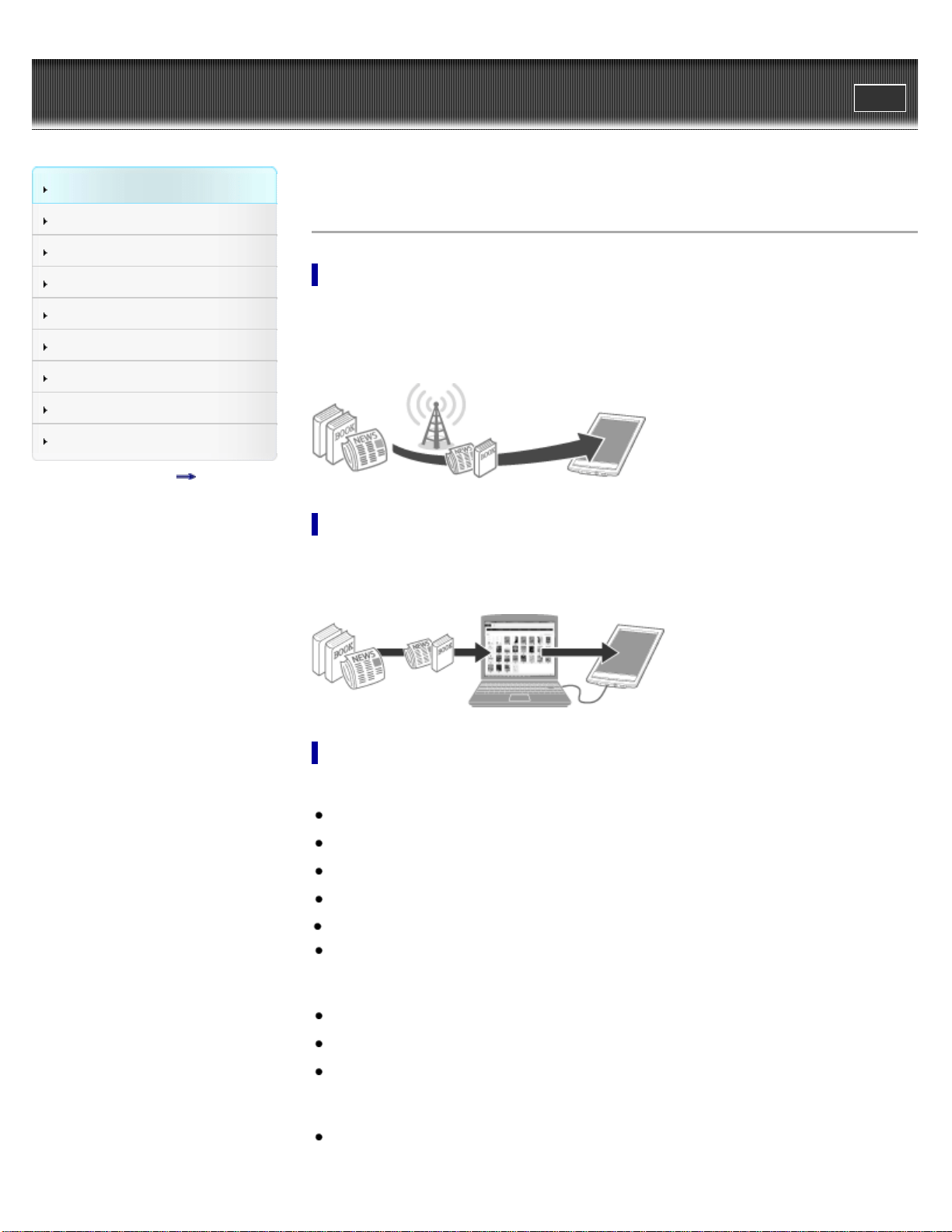
Shopping for books at Reader™ Store
Visit Reader Store and find books that you are interested in from a large variety of titles and
genres. The [Reader Store] application may be found on the [Home] screen. The initial setup of
the country/region of the Reader will determine if Reader Store is available in your area. See
Details.
Transferring content from your computer
To enjoy books, music and pictures on the Reader, use the supplied Reader software to transfer
them from your computer to the Reader. See Details. You can also use the Reader software to
backup and manage the content on the Reader.
Useful features
Wi-Fi network access Details
Access Reader Store Details
Access Google Books Details
Wikipedia Details
Use the Web browser for internet access Details
Check purchased content Details
Check out books from public libraries for reading on the Reader Details
Annotation Details
Add bookmarks Details
Highlight words Details
Handwrite notes on a page Details
Resize
Adjust font size Details
Change the page view mode Details
17

Zoom in Details
Adjust content view Details
Search
Find notes Details
Find pages with a keyword Details
Search content via keyword Details
Jump to pages Details
Dictionary Details
Look up words while reading Details
Look up words in a dictionary Details
List previously looked-up words Details
Read periodicals Details
Collections Details
Supplementary applications
Handwriting Details
Text memo Details
Picture viewer Details
Audio player Details
Go to page top
Copyright 2011 Sony Corporation
18
Reader™ User Guide
Print
Search
Getting started
Basic Operations
Adding/Getting Content
Browsing Content Lists
Reading
Organizing
Other Applications
Settings
Other Information
Contents list
Top page > Getting started > Wireless Connectivity > Join a Wi-Fi® Network
Join a Wi-Fi
®
Network
To shop at Reader Store or connect to the internet wirelessly, set up a wireless (Wi-Fi
®
) internet
connection with the following steps.
Preparing to set up a Wi-Fi connection
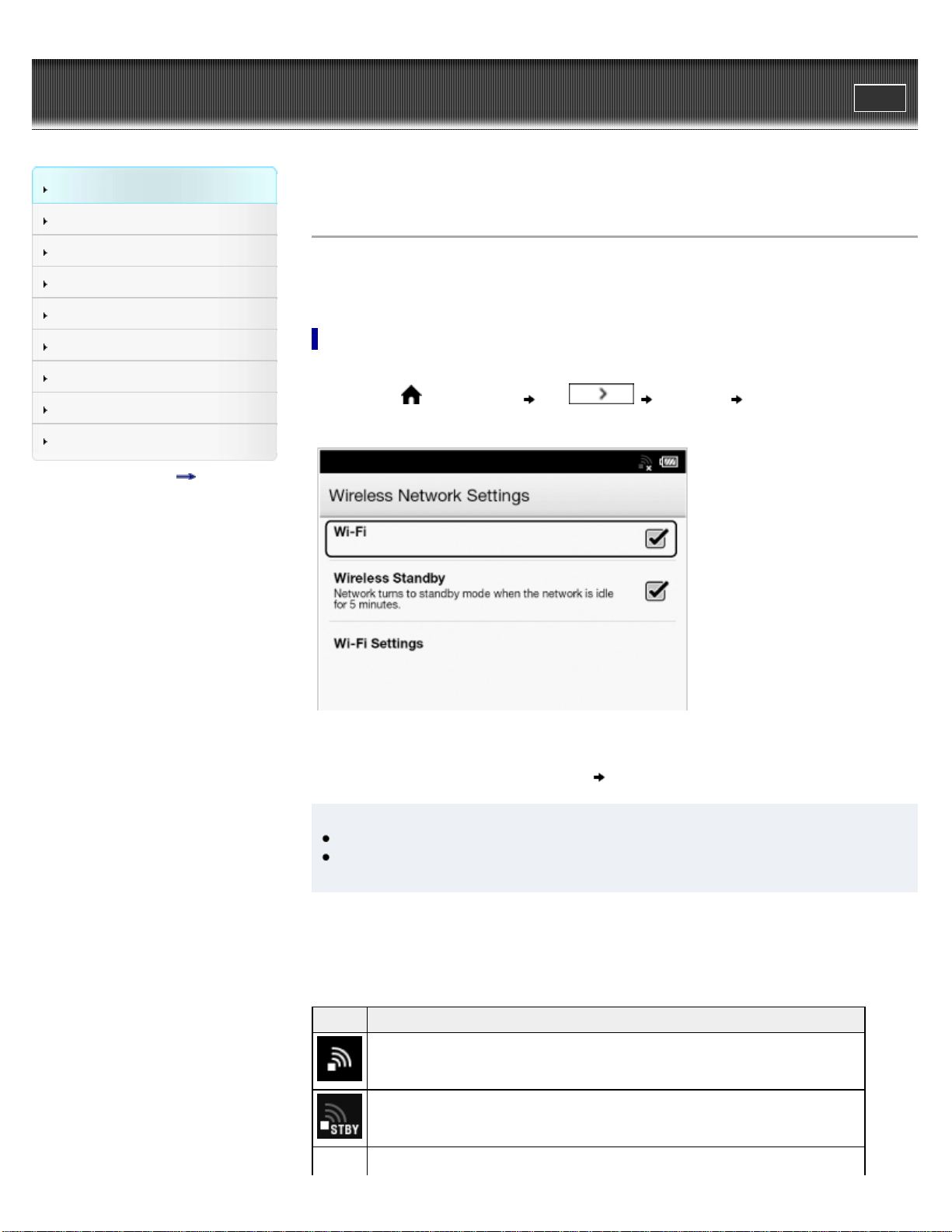
Before connecting to an access point, turn on [Wi-Fi] on the Reader.
1. Press the
(Home) button tap [Settings] [Wireless Network
Settings].
2. Confirm that there is a check in the box to the right of [Wi-Fi].
A check indicates that [Wi-Fi] is turned on. Wi-Fi is turned on by default.
Alternatively, you can tap the status bar [Wi-Fi].
Tip
Turn off [Wi-Fi] when it is not in use in order to extend the battery life of the Reader.
If you do not perform any wireless operations for more than 5 minutes, the wireless feature
automatically enters standby mode. See Details.
Wi-Fi status icons
The following icons in the status bar indicate the status of the Wi-Fi connection.
Icon Status
Wi-Fi is activated. The number of bars indicates the Wi-Fi signal strength.
The Wi-Fi network feature of the Reader is in standby mode. See Details.
19
There is no Wi-Fi access point. In this state, you cannot access Reader Store.
The [Wi-Fi] setting is turned off.
Choosing a connection type
Depending on your Wi-Fi environment, connect to an access point via one of the following
methods.
The following questions will determine the most suitable case for setting the Reader’s Wi-Fi
network connection.
Internet
*WPS: Wi-Fi Protected Setup
Case A
A WPS-compatible Wi-Fi router with WPS button Details
Case B
A WPS-compatible Wi-Fi router with PIN input Details
20
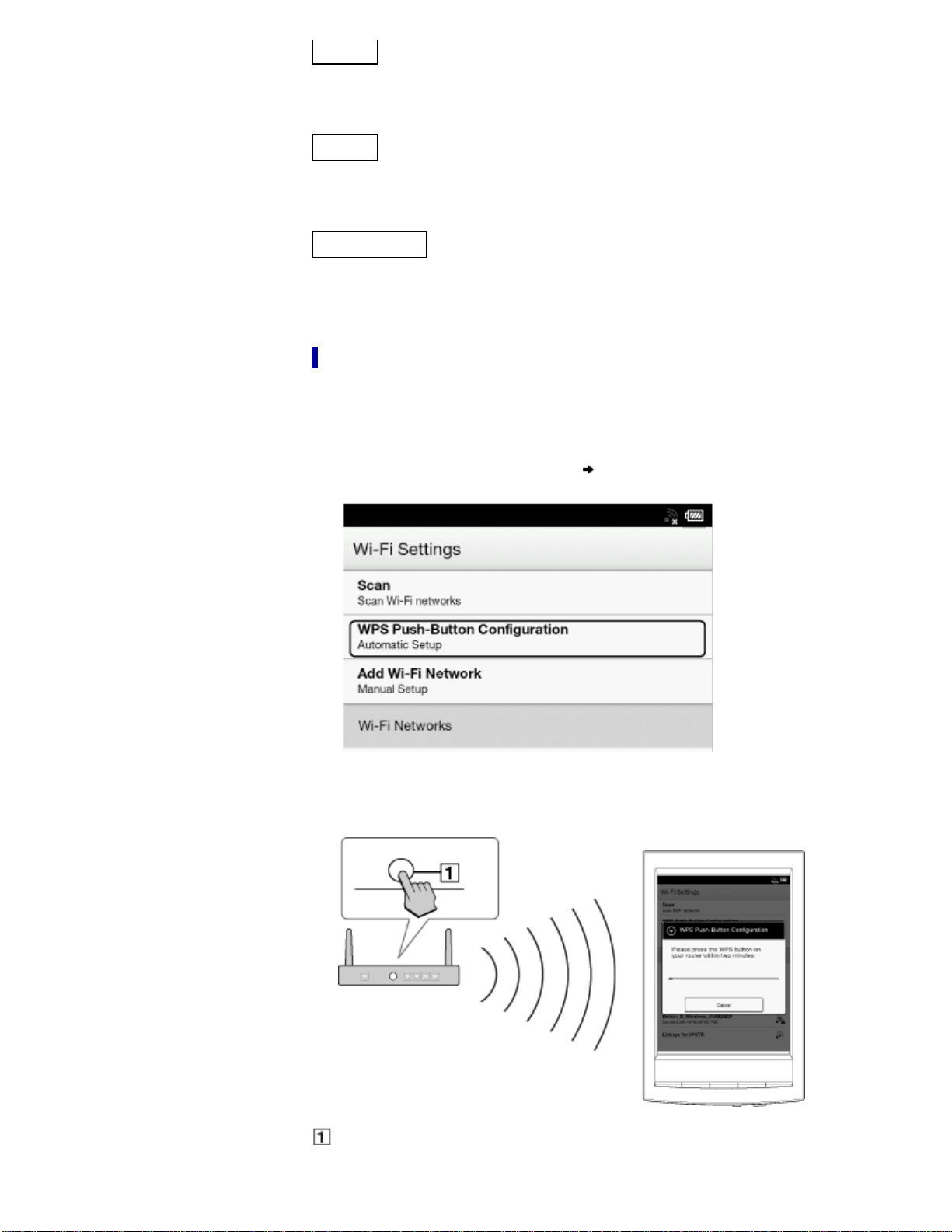
Case C
Connecting to a Wi-Fi router without WPS support Details
Case D
Connecting to an available Wi-Fi network Details
Manual setup
Set up a Wi-Fi network connection manually; connect to an access point for which the SSID is
set to be invisible. See Details.
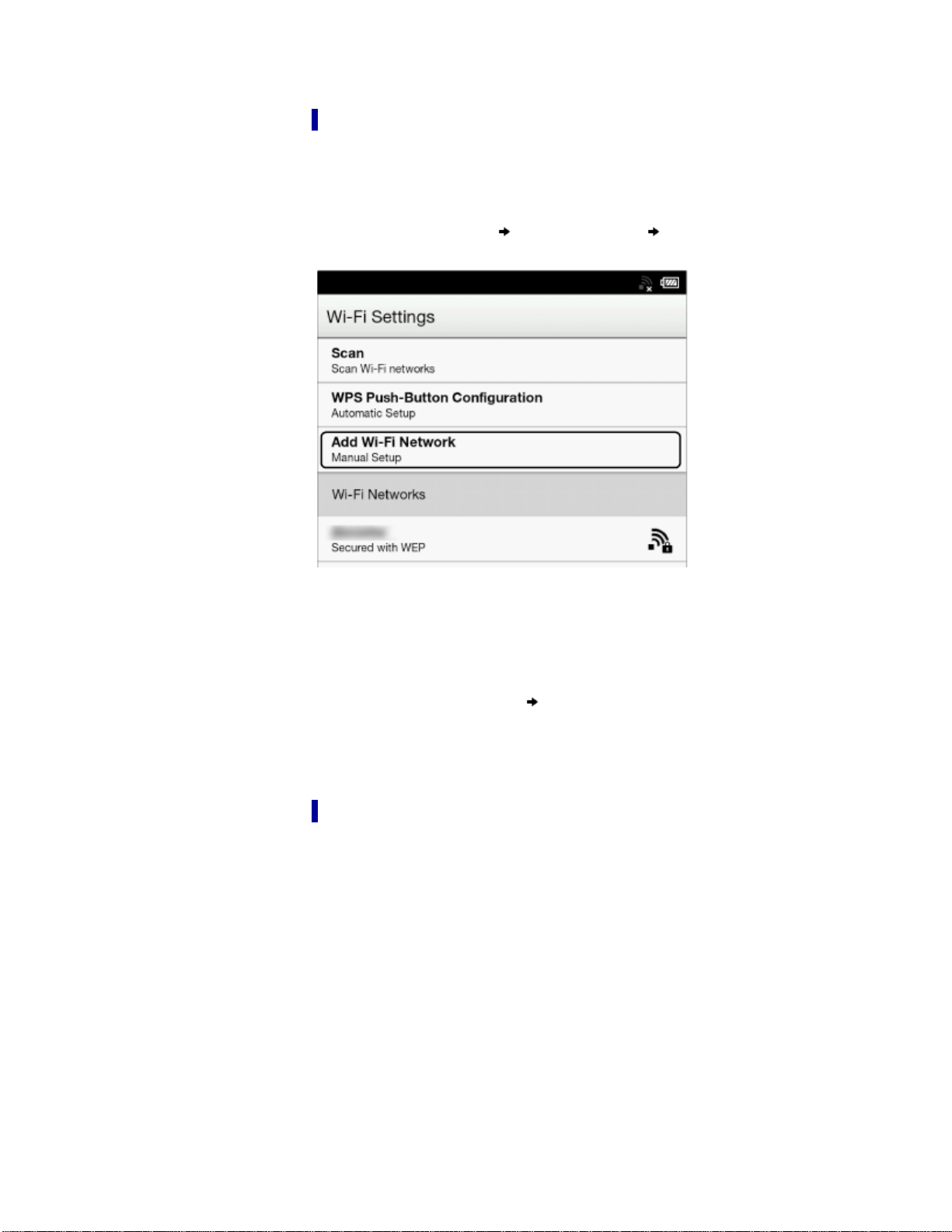
Case A: A WPS-compatible Wi-Fi router with WPS button
The Reader is compatible with WPS (Wi-Fi Protected Setup), which lets you easily make a Wi-Fi
connection using the “WPS” or “Connect” button on your WPS-compatible Wi-Fi router. Make
sure to turn on [Wi-Fi] and tap [Wi-Fi Settings] on the [Wireless Network Settings] screen.
Alternatively, you can turn on [Wi-Fi] by tapping the status bar and tapping [Wi-Fi Settings].
1. Tap [WPS Push-Button Configuration]
[Start ].
2. On your Wi-Fi router, press the “WPS” or “Connect” button within 2 minutes.*
The Reader automatically attempts to establish a Wi-Fi connection.
* The name of the button on your Wi-Fi router may vary.
“WPS” or “Connect” button
3. After the Reader screen shows the setup completion, tap [OK].
21
The wireless connection status is displayed in the status bar. See Details.
For more technical notes, see Details.
Case B: A WPS-compatible Wi-Fi router with PIN input
If your WPS-compatible Wi-Fi router does not support push-button configuration, connect by
using a PIN (Personal Identification Number). Make sure to turn on [Wi-Fi] and tap [Wi-Fi
Settings] on the [Wireless Network Settings] screen. Alternatively, you can turn on [Wi-Fi] by
tapping the status bar and tapping [Wi-Fi Settings].
1. Tap [Add Wi-Fi Network]
[WPS PIN Method] [Start ].
A PIN will be shown on the screen of the Reader.
Enter the PIN into your Wi-Fi router. Refer to your Wi-Fi router’s instruction manual for
further details.
2. After entering the PIN, tap [OK] on the Reader. Your Wi-Fi router’s SSID (Service Set
Identifier) is displayed in the [Wi-Fi Networks] list on the [Wi-Fi Settings] screen.
3. Tap your Wi-Fi router’s SSID
[Connect].
The Reader connects to the wireless network.
The wireless connection status is displayed in the status bar. See Details.
For more technical notes, see Details.
Case C: Connecting to a Wi-Fi router without WPS support
Make sure to turn on [Wi-Fi] and tap [Wi-Fi Settings] on the [Wireless Network Settings] screen.
Alternatively, you can turn on [Wi-Fi] by tapping the status bar and tapping [Wi-Fi Settings].
1. Tap [Scan].
The available access points are listed under [Wi-Fi Networks].
22
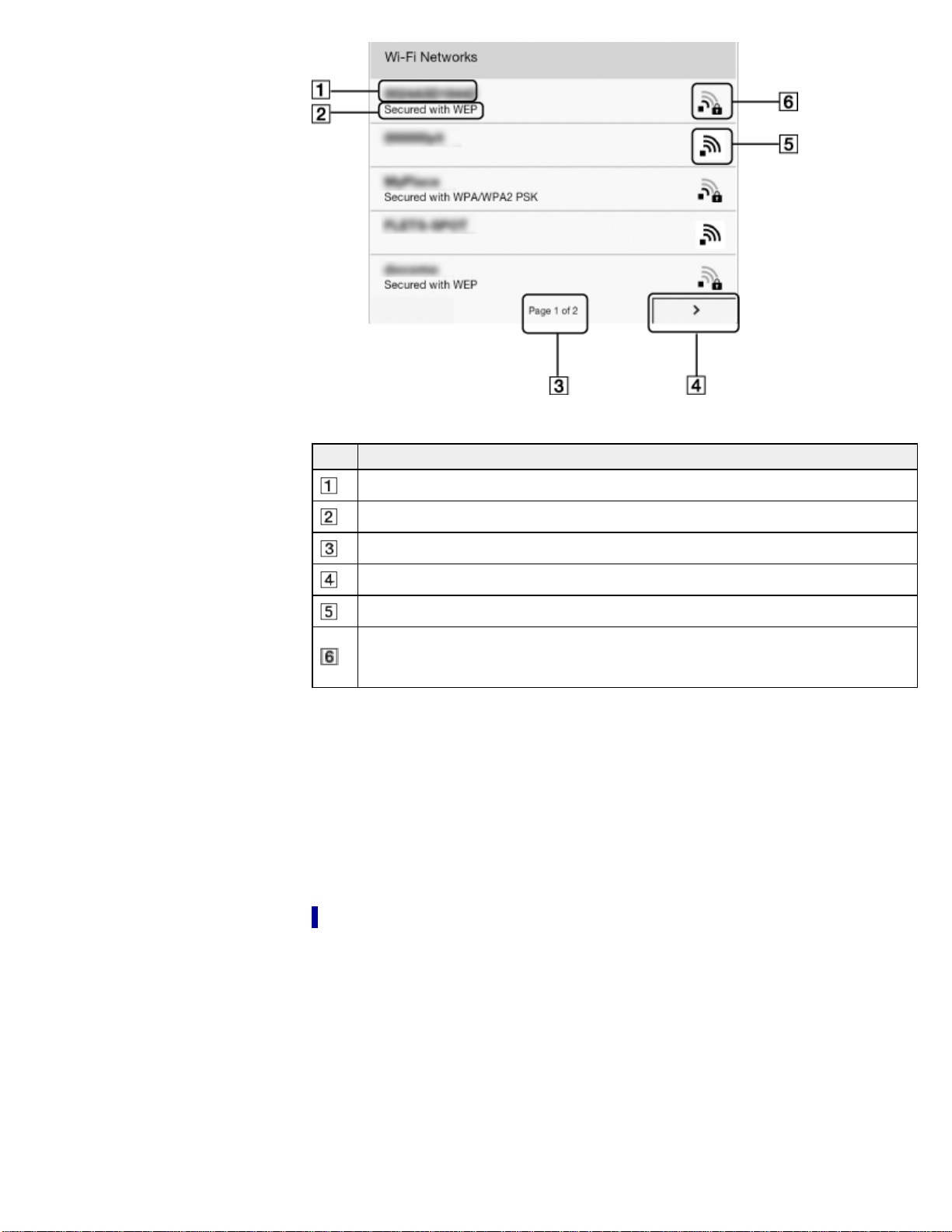
Item Description
Network SSID
Security type
Page indicator
Page turn icon
Wi-Fi is activated and the Reader detects an unsecured network.
Wi-Fi is activated and the Reader detects a secured network. The Wi-Fi router to which
you want to connect requires a password. A password may also be called a WEP
key/WPA key/encryption key/network key, etc.
2. Tap your Wi-Fi router’s SSID (Service Set Identifier) in the [Wi-Fi Networks] list. For details
on determining your Wi-Fi router’s SSID, refer to your Wi-Fi router’s instruction manual.
3. If prompted for a password, tap the input area and type in the password using the on-screen
keyboard.
4. Tap [Connect].
The Reader connects to the Wi-Fi network.
The wireless connection status is displayed in the status bar. See Details.
For more technical notes, see Details.
Case D: Connecting to an available Wi-Fi network
Some public wireless access points, or “hotspots”, are open and you can simply connect to
them. Make sure to turn on [Wi-Fi] and tap [Wi-Fi Settings] on the [Wireless Network Settings]
screen. Alternatively, you can turn on [Wi-Fi] by tapping the status bar and tapping [Wi-Fi
Settings].
1. Tap [Scan].
The available access points are listed under [Wi-Fi Networks].
23
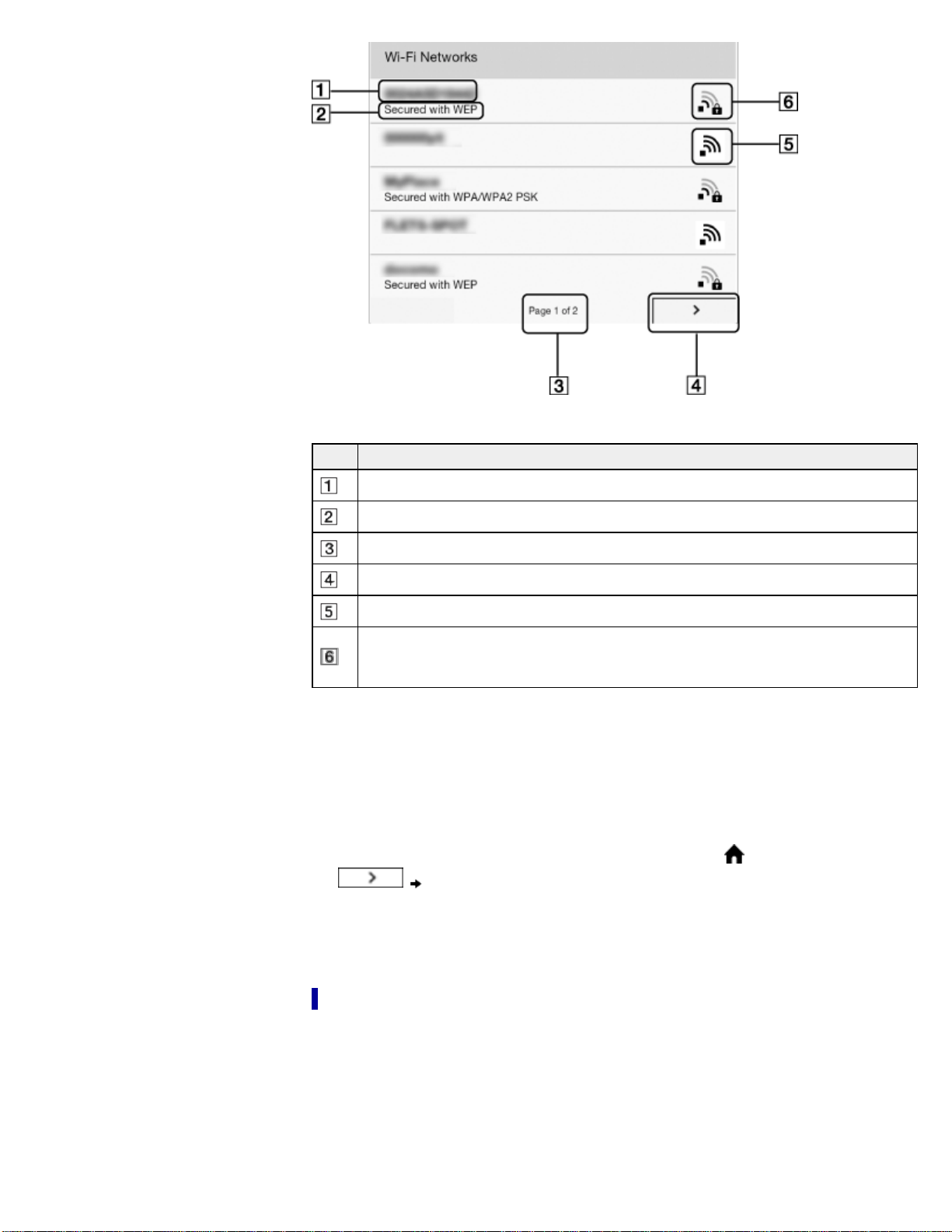
Item Description
Network SSID
Security type
Page indicator
Page turn icon
Wi-Fi is activated and the Reader detects an unsecured network.
Wi-Fi is activated and the Reader detects a secured network. The Wi-Fi router to which
you want to connect requires a password. A password may also be called a WEP
key/WPA key/encryption key/network key, etc.
2. Tap your Wi-Fi router’s SSID (Service Set Identifier) in the [Wi-Fi Networks] list.
3. If prompted for a password, tap the input area and type in the password using the on-screen
keyboard.
4. Tap [Connect].
The wireless connection status is displayed in the status bar.
5. The [Browser] application may start automatically to connect to a public access point.
Otherwise, start the [Browser] application manually; press the
(Home) button, tap
[Browser].
6. The browser screen may show further information about completing the connection. Follow
any instruction(s) where applicable.
For more technical notes, see Details.
Manually setting a Wi-Fi connection
You can set up a Wi-Fi network connection manually by inputting the required information for
connection. Make sure to turn on [Wi-Fi] and tap [Wi-Fi Settings] on the [Wireless Network
Settings] screen. Alternatively, you can turn on [Wi-Fi] by tapping the status bar and tapping [Wi-
Fi Settings].
1. Tap [Add Wi-Fi Network].
24
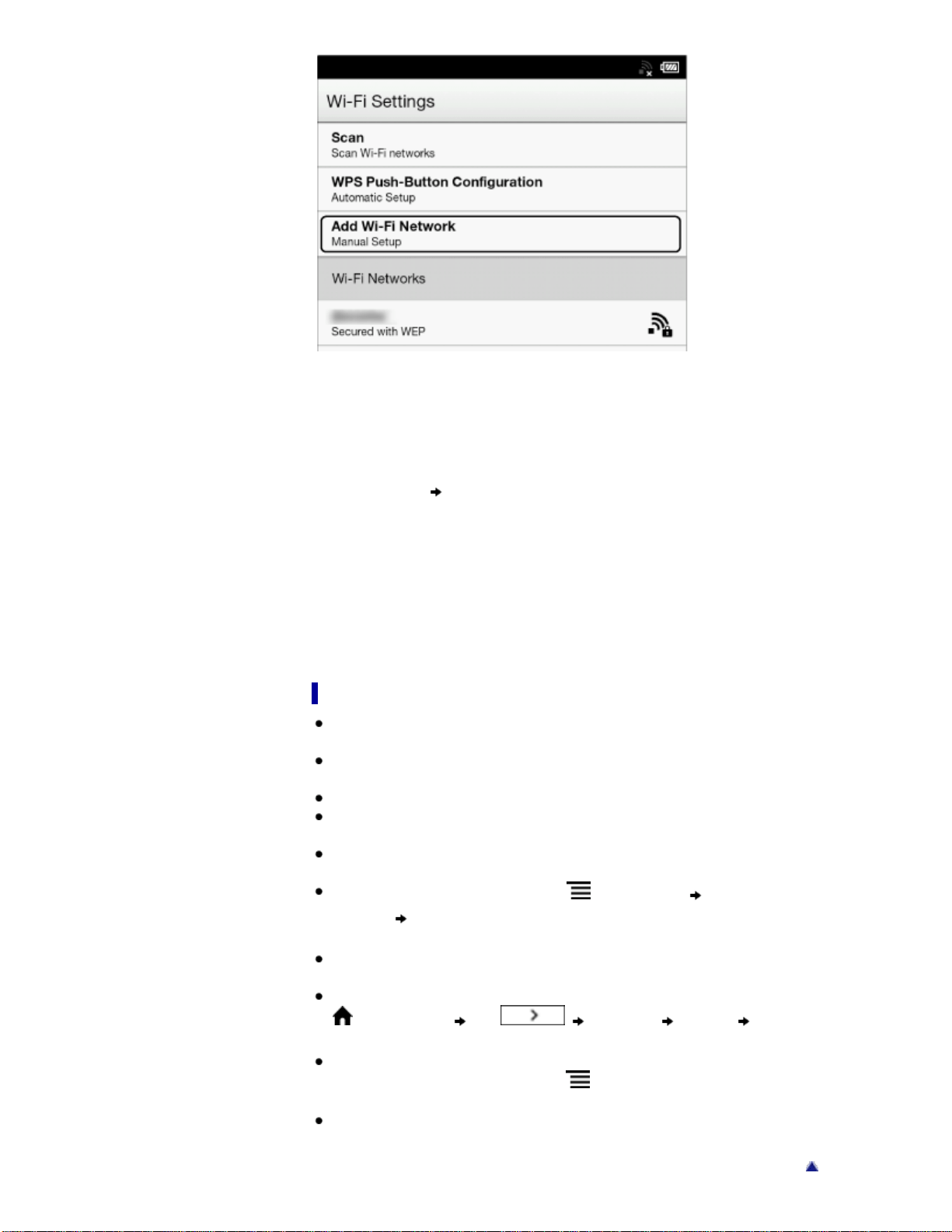
2. Tap [Manual Registration].
3. Tap the [SSID] input area and type in using the on-screen keyboard.
4. Tap the [Security Method] menu (the default value is [Open]), and then tap the supported
security type.
5. Tap the [Password] input area and type in your password using the on-screen keyboard, and
then tap [OK] [Save].
6. Tap the saved network SSID in the [Wi-Fi Networks] list on the [Wi-Fi Settings] screen.
7. If prompted for a password, tap the input area and type in the password using the on-screen
keyboard.
8. Tap [Connect].
The Reader connects to the Wi-Fi network.
The Wi-Fi connection status is displayed in the status bar. See Details.
For more technical notes, see Details.
General notes on Wi-Fi connectivity
Tap and hold a network SSID in the [Wi-Fi Networks] list to display the access point’s status
and related information.
Before connecting to a wireless network, check all requirements, user name and/or password
details with the internet/Wi-Fi service provider.
You can configure up to 20 Wi-Fi network connections.
The Reader does not support certain custom Wi-Fi network security systems. For details,
contact the internet/Wi-Fi service provider.
If you edit the password of a Wi-Fi network to which you are currently connected, the Reader
will attempt to reconnect to the Wi-Fi network using the new password.
To use a static IP address, press the
(Menu) button tap [Advanced] in the [Wi-Fi
Settings]
tap [Use Static IP]. Do not change this setting unless instructed to by a network
administrator, as the Wi-Fi network connection may not be established correctly.
If an access point’s SSID (Service Set Identifier) is private, enter Wi-Fi connection information
manually.
The access point may filter access by MAC address. Check the MAC address by pressing the
(Home) button tap [Settings] [About] [Device Information],
then register the MAC address with the access point to establish a Wi-Fi connection.
When you are connected to a Wi-Fi network, you can also display speed, security and other
Wi-Fi network details by pressing the
(Menu) button and tapping [Connection Information]
in the [Wi-Fi Settings] screen.
An access point, once configured, can be connected to again simply by tapping it in the [Wi-Fi
Networks] list and tapping [Connect].
Go to page top
25
Reader™ User Guide
Print
Search
Getting started
Basic Operations
Adding/Getting Content
Browsing Content Lists
Reading
Organizing
Other Applications
Settings
Other Information
Contents list
Top page > Getting started > Battery > Charging the Reader
Charging the Reader
The charge/battery status icon at the right side of the status bar shows the battery level. See
Details.
If it is low, choose one of the methods in the following sections to charge the Reader.
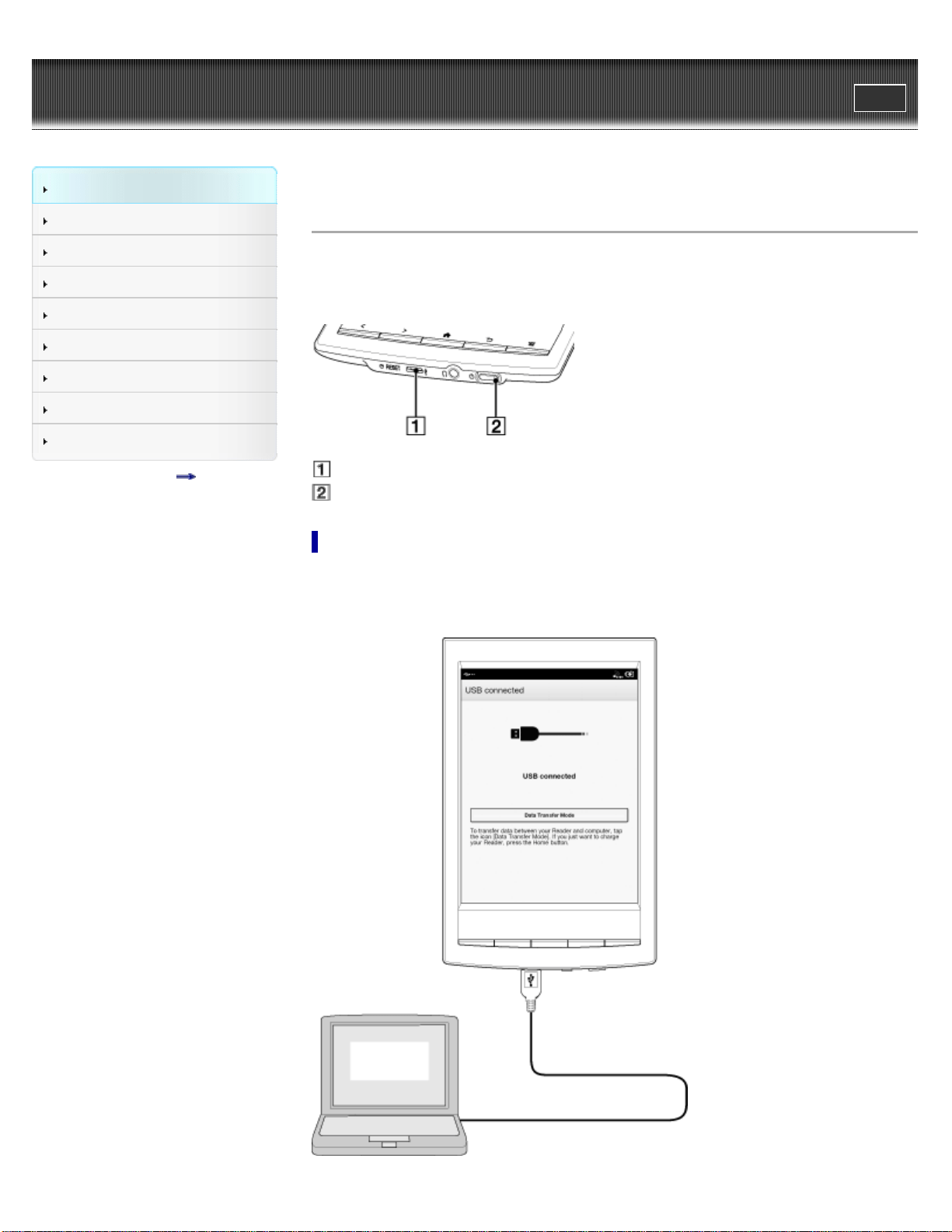
USB connector
Charge/Busy indicator
Charging via your computer
1. Power on your computer.
2. Connect the Reader to your computer with the supplied USB cable.
Wait until the [USB connected] screen is displayed on the Reader.
26
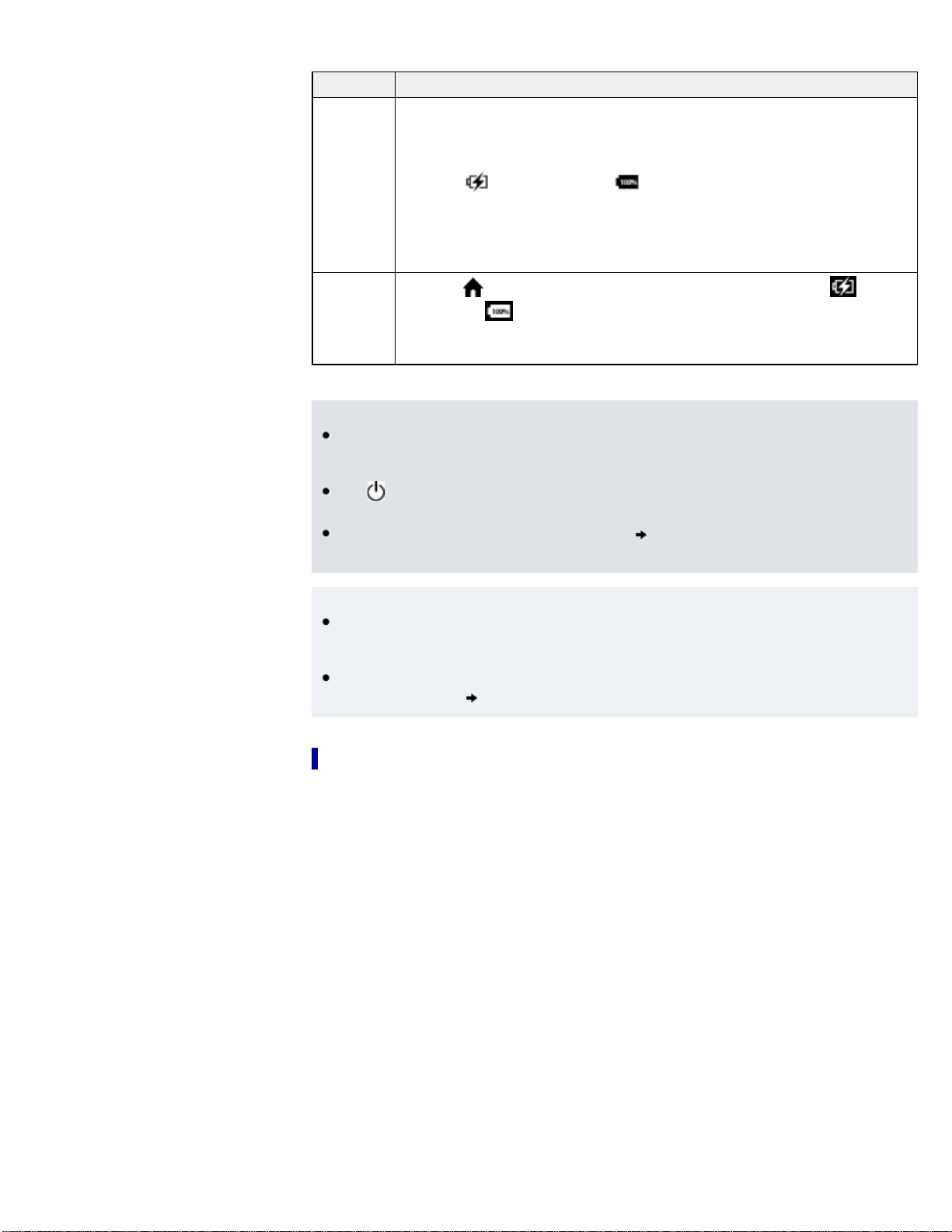
Method Description
Data
transfer
mode
You can install the Reader software, or transfer files from your computer to the
Reader while charging. The Reader cannot be operated.
After the USB storage screen is displayed on the Reader, it is detected on your
computer, and the “READER” and “SETTING” drives appear on your computer.
When the
icon* turns into the icon, charging is complete.
When charging is complete, disconnect the USB cable from the Reader and your
computer.
After a short time, the [Home] screen will appear.
* This icon is only displayed when the Reader is in data transfer mode.
Charging
mode
Press the (Home) button. The [Home] screen appears. When the icon
turns into the icon, charging is complete.
In this mode, the Reader is not detected by your computer. When charging is
complete, disconnect the USB cable from the Reader and your computer.
Note
Your computer must be turned on to charge the Reader. The Reader will not be charged if
your computer enters sleep mode or standby mode. Keep your computer turned on with a
stable and continuous power supply while charging the Reader.
The
(Power) button cannot be used when the Reader is connected to your computer and
charging.
If you turn off the Reader by tapping [Settings] [Device Shutdown] while in charging
mode, the Reader will stop charging.
Tip
You can also charge the Reader using the AC Adapter (PRSA-AC10/PRSA-AC1A, sold
separately). This method of charging will take approximately 2 hours to fully charge the
battery.
To change from charge mode to data transfer mode, tap the status bar to display the
notification window
tap [USB connected].
Battery status indicator
The battery status indicator shows the charging status or approximate remaining charge of the
battery.
27
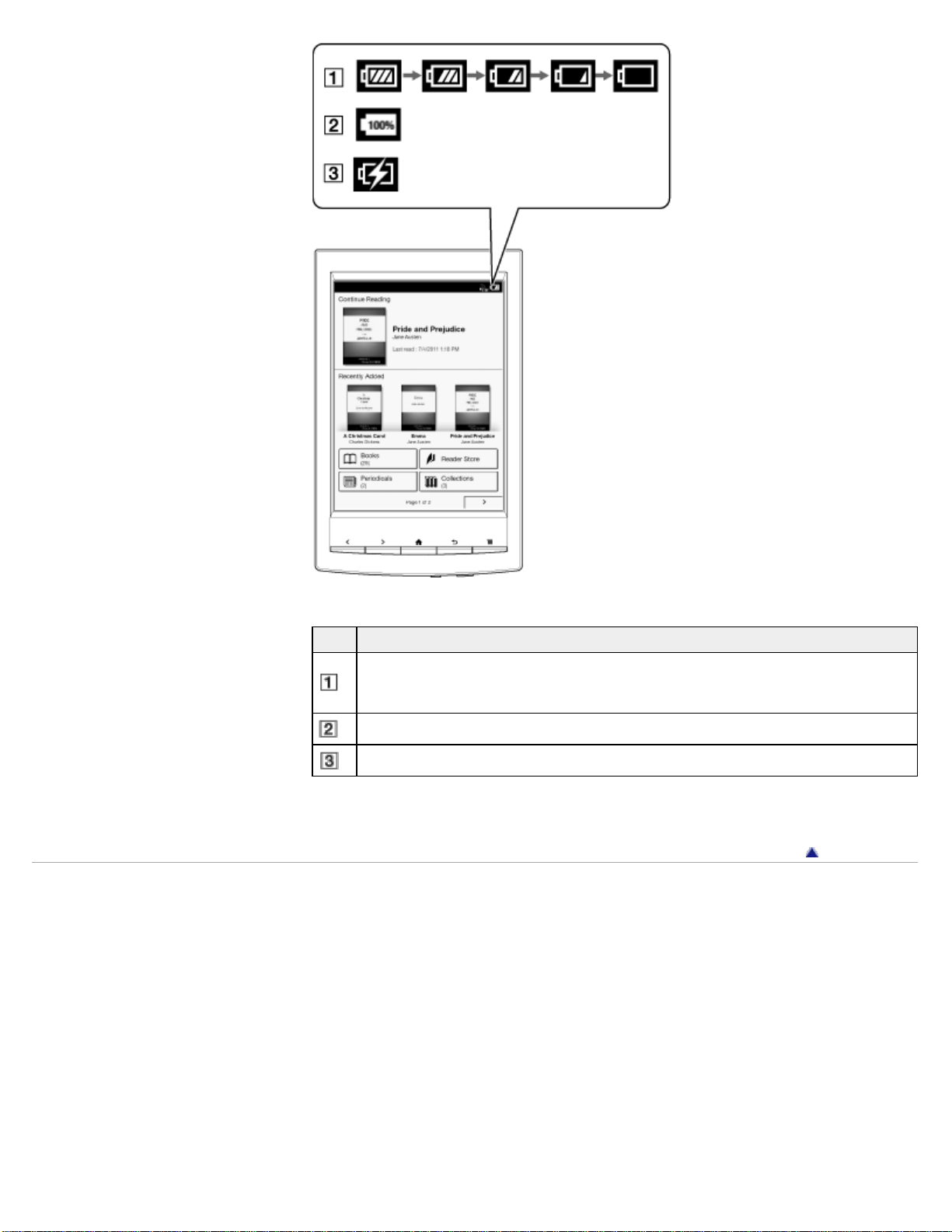
Icon Description
Four bars indicate a fully charged or almost-fully charged battery. The number of bars
decreases with the battery’s charge. Zero bars indicate that the battery has almost no
remaining charge.
The battery is fully charged.
The battery is charging.
Go to page top
Copyright 2011 Sony Corporation
28
Reader™ User Guide
Print
Search
Getting started
Basic Operations
Adding/Getting Content
Browsing Content Lists
Reading
Organizing
Other Applications
Settings
Other Information
Contents list
Top page > Getting started > Battery > Maximizing Battery Life
Maximizing Battery Life
There are many ways to conserve battery power. To extend battery life:
If you have no plans to use the Reader, completely power off the Reader.
Do not leave the Reader with the battery depleted for a prolonged period of time. Battery
capacity may be affected.
Use and store the Reader at room temperature, or within the recommended temperature
range of 5°C to 35°C (41°F to 95°F).
Turn off Wi-Fi when no wireless communication is necessary.
Power-consuming operations
The following may require more power than normal reading operations.
Wi-Fi communications
Constantly updating the [Wi-Fi Networks] list
Displaying graphic-intensive books, periodicals, files or Web sites
Playing audio
Displaying a slideshow with a short interval setting
Using a microSD card
Frequent insertion and removal of a microSD card
Having a large volume of content stored on a microSD card
Annotations, keyword searches and dictionary searches
Go to page top
Copyright 2011 Sony Corporation
29
Reader™ User Guide
Print
Search
Getting started
Basic Operations
Adding/Getting Content
Browsing Content Lists
Reading
Organizing
Other Applications
Settings
Other Information
Contents list
Top page > Getting started > Turning the Power On/Off > Turning the Power On/Off
Turning the Power On/Off
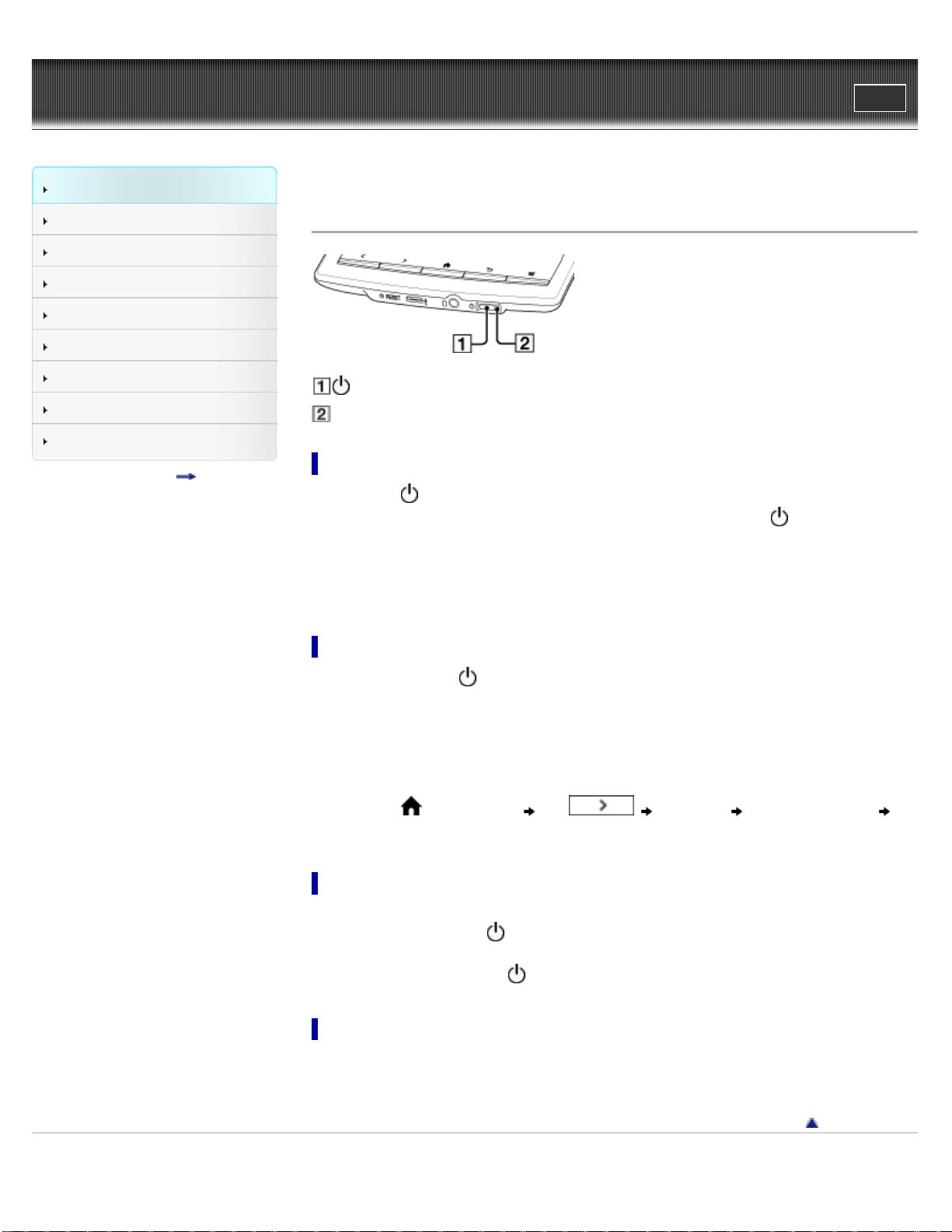
(Power) button
Charge/Busy indicator
Turning on the power
1. Press the (Power) button.
If the battery is completely depleted, power will not be supplied to the
(Power) button, and
you may not be able to turn on the Reader. In this case, the Charge/Busy indicator may blink
red 3 times. Connect the Reader to your computer via the supplied USB cable; the Reader
will automatically turn on approximately 5 minutes later. Wait until the Reader turns on before
trying to operate it.
Shutting down/turning off the power completely
1. Press and hold the (Power) button for about 3 seconds.
2. Tap [Yes] to turn off the Reader.
Completely turning off the Reader can preserve battery power longer than sleep mode when
you are not using the Reader for a prolonged period of time.
The same operation can be done via [Settings].
1. Press the (Home) button tap [Settings] [Device Shutdown]
[Yes].
Sleep mode
To save battery life and prevent unintentional operation of the touchscreen, set the Reader to
sleep mode by pressing the
(Power) button. The standby screen appears. You can
personalize the standby screen. See Details.
To wake the Reader, press the (Power) button again.
Automatic power-saving modes
The Reader will enter sleep mode after 10 minutes of inactivity. After 3 days in sleep mode, the
Reader will shut down/power off automatically. The automatic power-saving modes cannot be
turned off.
Go to page top
Copyright 2011 Sony Corporation
30
Reader™ User Guide
Print
Search
Getting started
Basic Operations
Adding/Getting Content
Browsing Content Lists
Reading
Organizing
Other Applications
Settings
Other Information
Contents list
Top page > Getting started > Parts and Controls > Overview
Overview
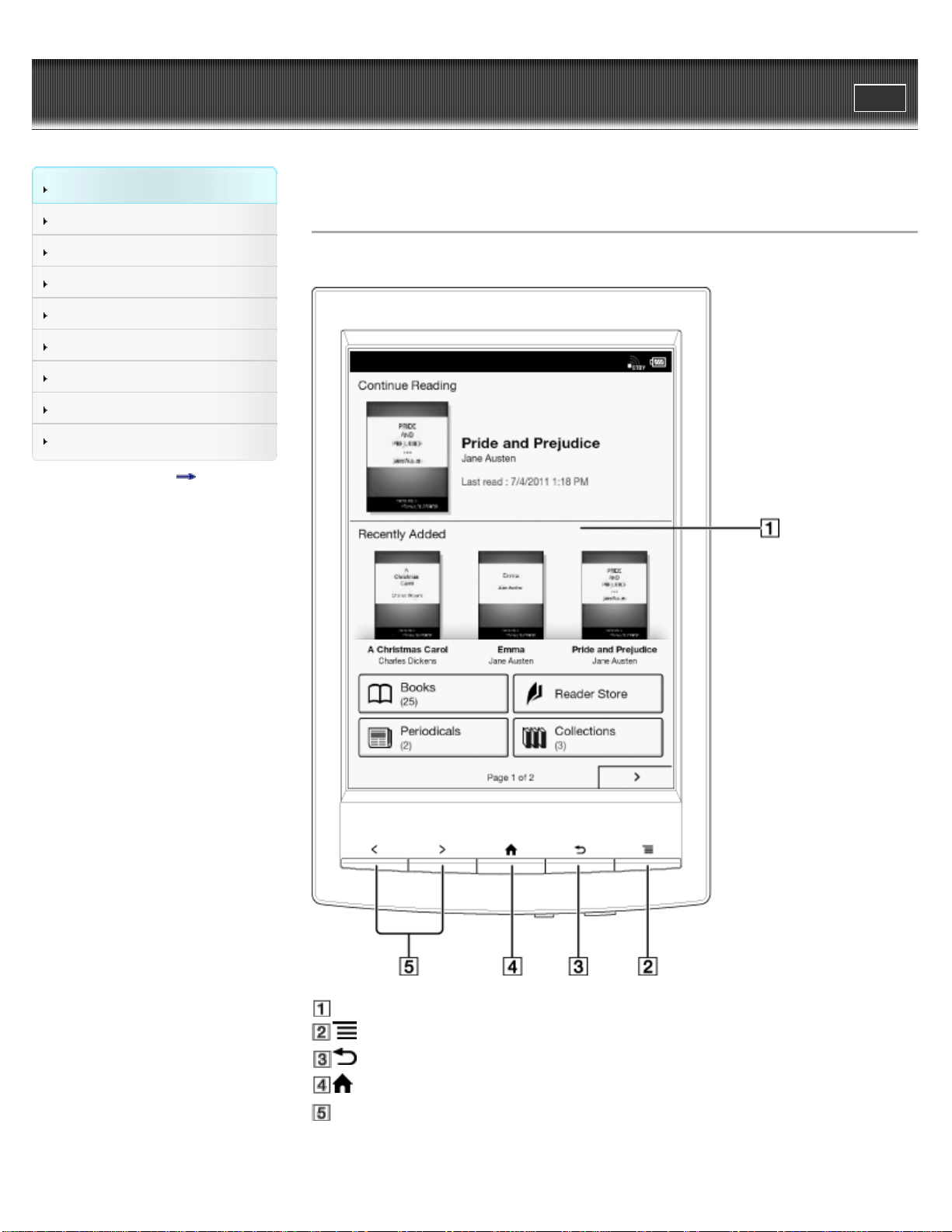
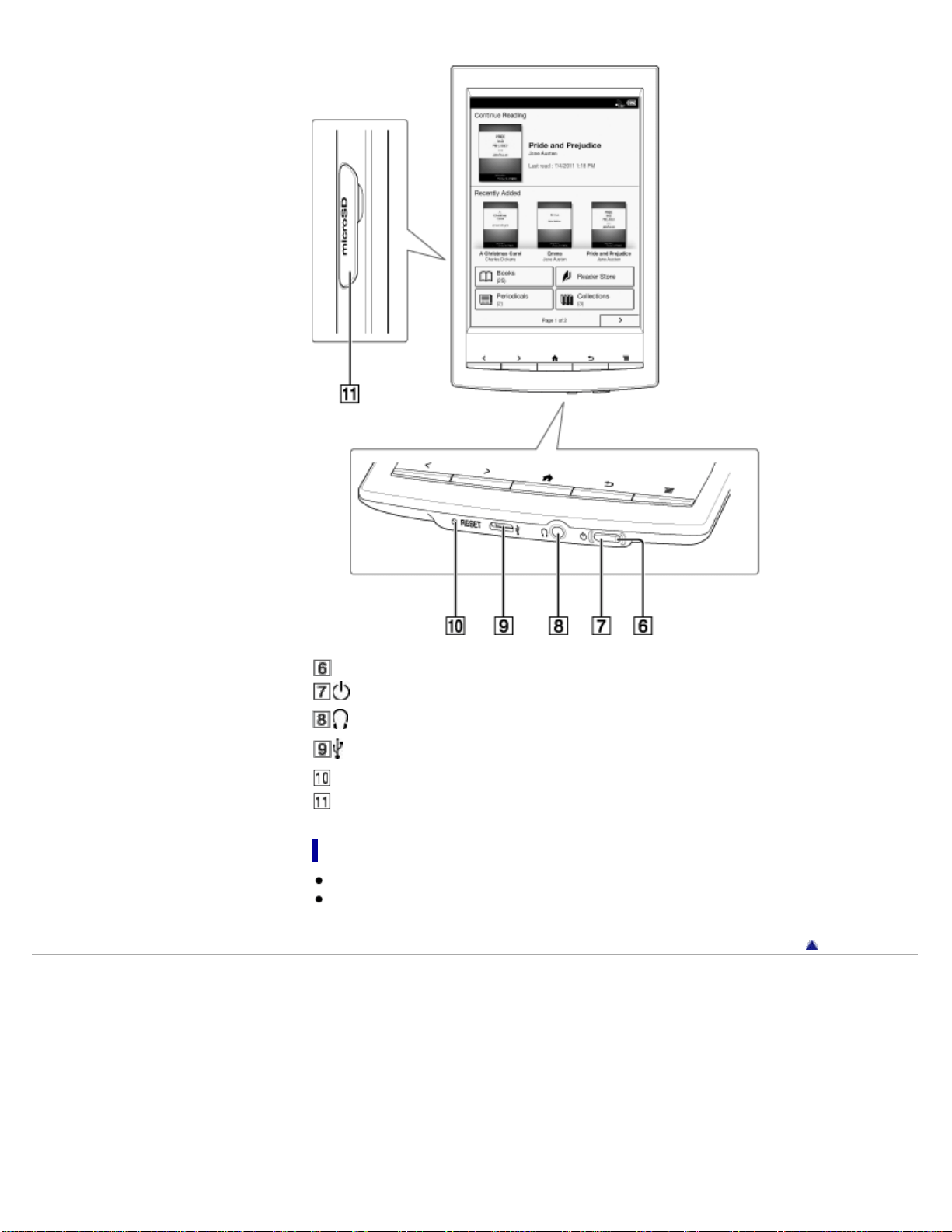
This section describes the features and controls of the Reader.
Touchscreen
(Menu) button
(Back) button
(Home) button
< > (Page turn) buttons
31
Reader™ User Guide
Print
Search
Getting started
Basic Operations
Adding/Getting Content
Browsing Content Lists
Reading
Organizing
Other Applications
Settings
Other Information
Contents list
Top page > Getting started > Parts and Controls > Buttons
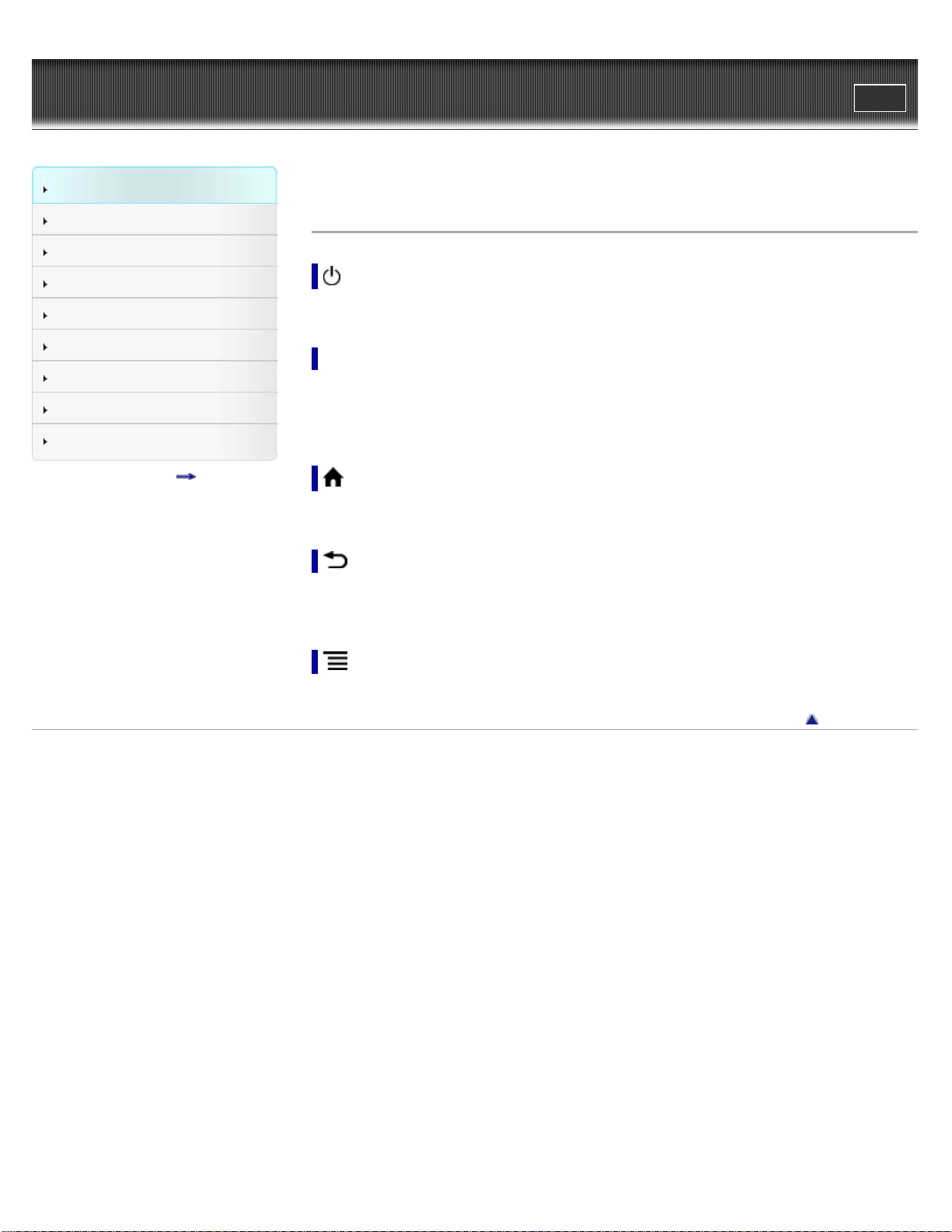
Buttons
(Power)
Turns the Reader on/off, and sets it to sleep mode. See Details.
< > (Page turn)
When reading a book or periodical: Press either button to turn the page back or forward,
respectively. Press and hold either button to turn pages continuously.
When using the Web browser: Press either button to scroll the page up or down, respectively.
(Home)
Displays the first page of the [Home] screen.
(Back)
Returns to the previous screen, or returns to the content list from a book. Also closes the on-
screen keyboard or a dialog box/navigation bar/tool bar.
(Menu)
Displays the available option items.
Go to page top
Copyright 2011 Sony Corporation
33
Reader™ User Guide
Print
Search
Getting started
Basic Operations
Adding/Getting Content
Browsing Content Lists
Reading
Organizing
Other Applications
Settings
Other Information
Contents list
Top page > Getting started > Parts and Controls > microSD Card Slot
microSD Card Slot
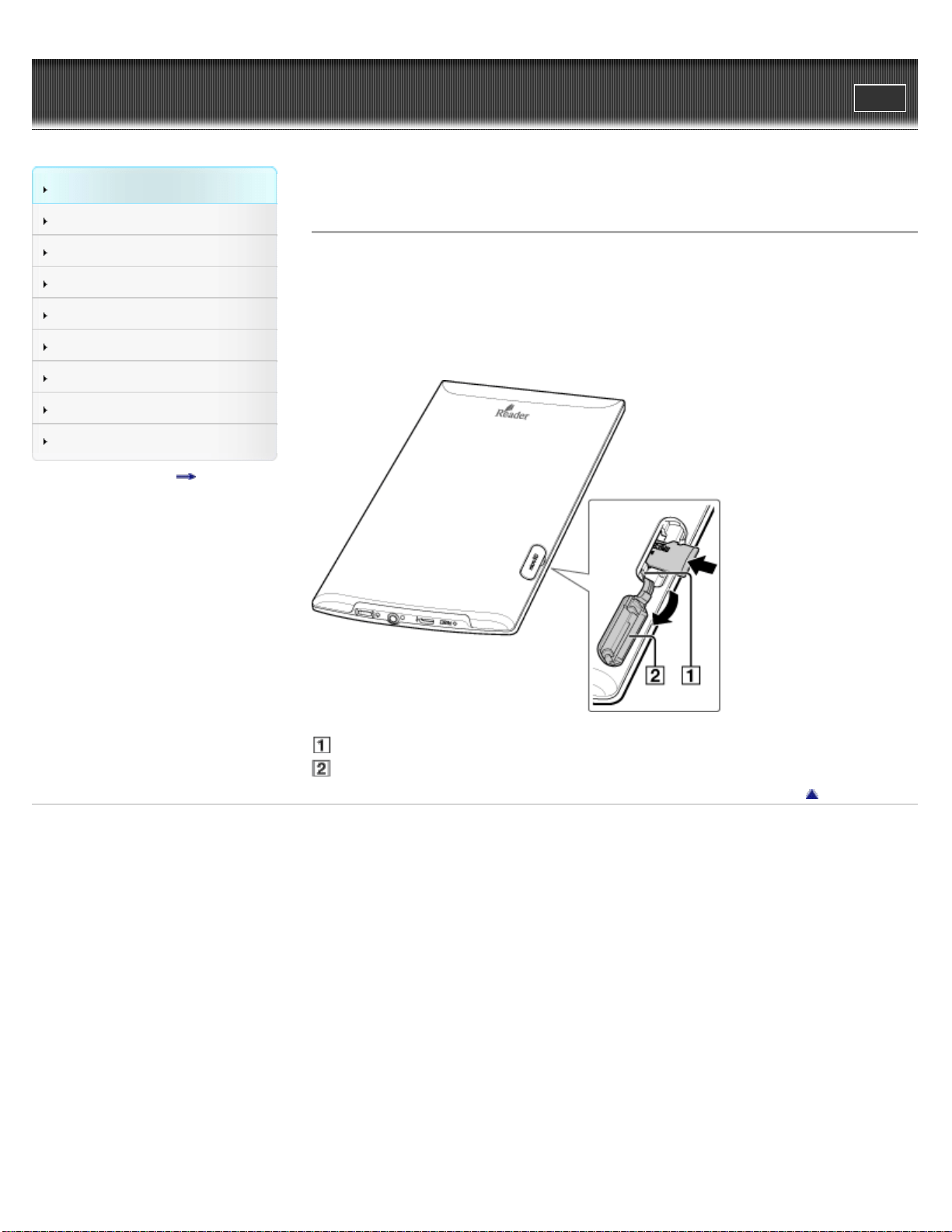
The microSD card slot is located on the lower-right side of the back of the Reader. Hold the
microSD card with the contacts facing down and the arrow pointing toward the microSD card
slot, and then insert it until it clicks into place. The access indicator lights up in orange while the
Reader is accessing the microSD card.
Close the slot cover when using a microSD card.
You can format the microSD card if necessary. See Details.
Access indicator
Slot cover
Go to page top
Copyright 2011 Sony Corporation
34
Reader™ User Guide
Print
Search
Getting started
Basic Operations
Adding/Getting Content
Browsing Content Lists
Reading
Organizing
Other Applications
Settings
Other Information
Contents list
Top page > Basic Operations > [Home] Screen > Applications and the [Home] Screen
Applications and the [Home] Screen
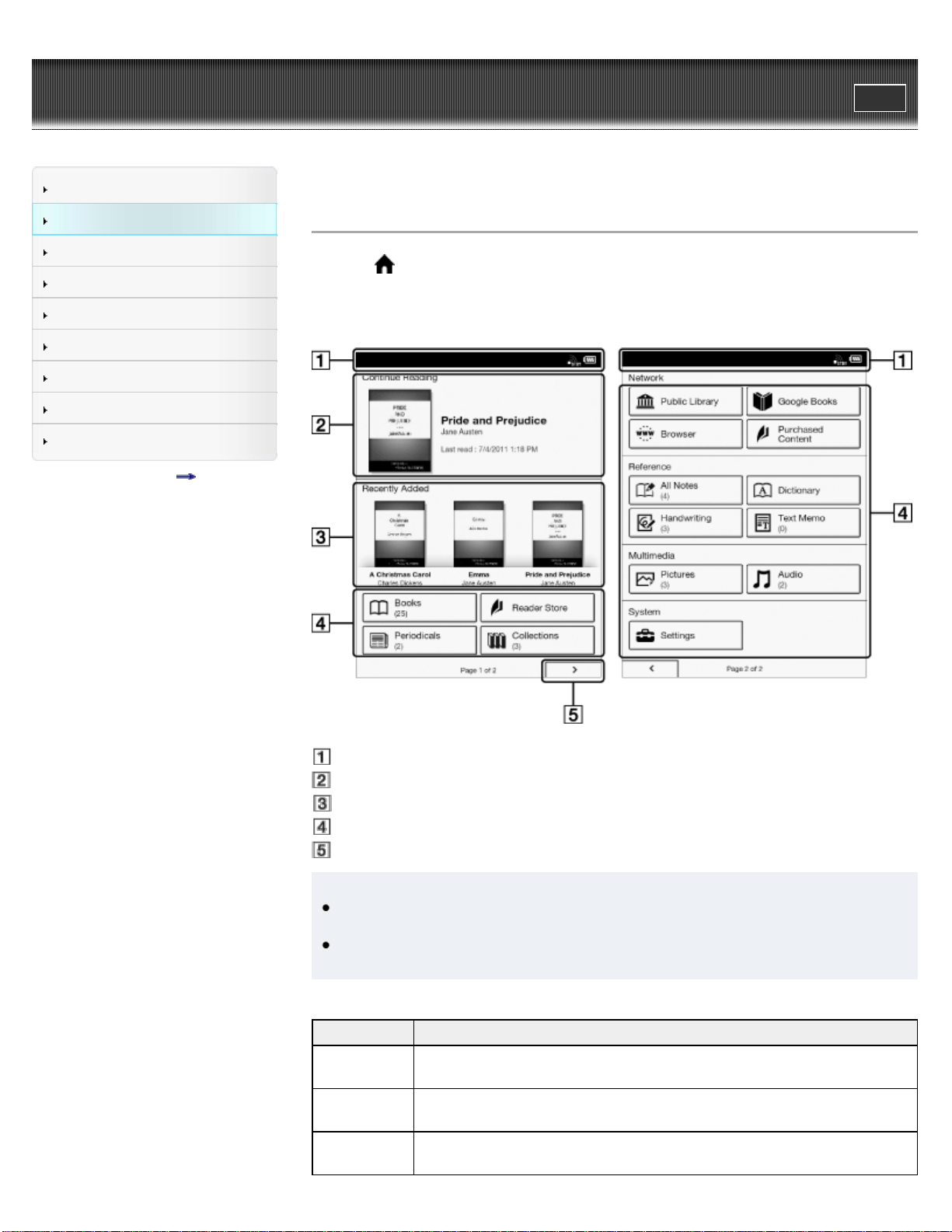
Press the (Home) button to display the [Home] screen. The [Home] screen has the following
applications.
Applications appear on the first and second page of the [Home] screen.
The displayed icons may vary depending on the country/region setting.
Status bar
Last read book/periodical
Newly added books
Applications
Navigate to the second page of the [Home] screen
Tip
The most recent book/periodical that you opened is shown under [Continue Reading] on the
first page of the [Home] screen. Tap it to continue reading where you previously left off.
The three most recent books that have been added to the Reader are displayed under
[Recently Added] on the first page of the [Home] screen. Tap one to start reading it.
Application Description
[Books]
Lists all the books/transferred content in the Reader and, if inserted, the
microSD card. See Details.
[Reader
Store]*
Enters Reader Store. You can find featured titles, bestsellers, new arrivals and
more. See Details.
[Periodicals]*
Lists all the periodicals in the Reader and, if inserted, the microSD card. See
Details.
35
[Collections] Lists preset and user-created collections. See Details.
[Public
Library]*
Helps you find public libraries where you can borrow books for the Reader.
See Details.
[Google
Books]*
Takes you to Google Books. See Details.
[Browser] Launches the Web browser. See Details.
[Purchased
Content]*
Takes you to [My Account] at Reader Store for downloading your purchased
books and periodicals. See Details.
[All Notes]
Lists the bookmarks/annotations made on the books and periodicals. See
Details.
[Dictionary] Allows you to look up a word in the dictionary. See Details.
[Handwriting] Allows you to use a drawing pad for drawing. See Details.
[Text Memo] Allows you to use a notepad for typing memos. See Details.
[Pictures] Shows pictures in the Reader and, if inserted, the microSD card. See Details.
[Audio]
Lists and plays the albums and songs that you have in the Reader. See
Details.
[Settings] Displays the items for setting the Reader. See Details.
* The availability of these applications varies depending on the country/region setting.
Status bar
The status bar shows the current status of the Reader, such as Wi-Fi status, the battery level and
the status of downloading files from Reader Store.
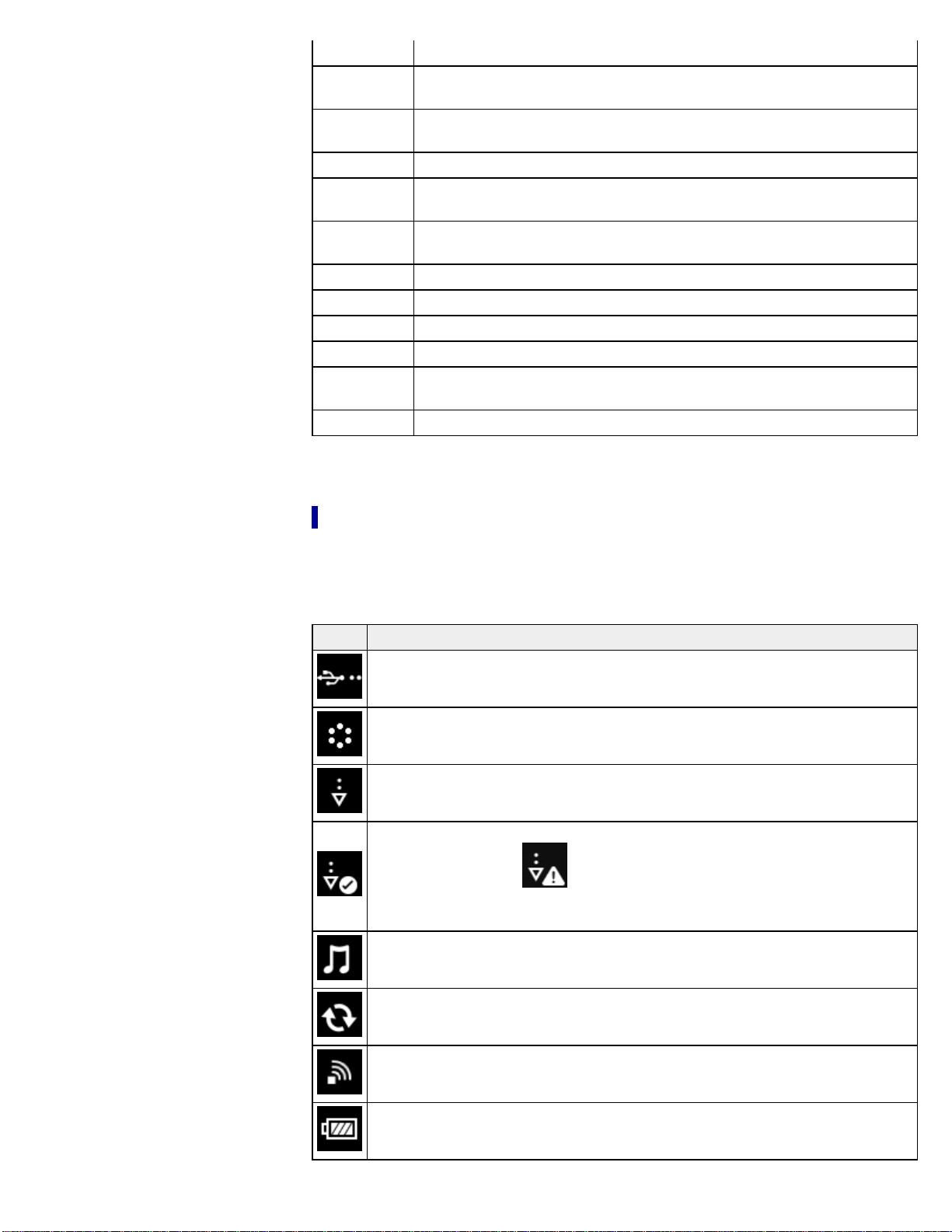
The following items are displayed in the status bar.
Icon Indication
Connected via the USB cable.
Connecting to a network.
A download is in progress. When multiple downloads are in progress, the number of
downloads is displayed next to this icon.
A download has completed.
If downloading fails, the (Fail) icon is displayed.
The icon disappears when you open the notification window and tap [Clear], or when
you tap the downloaded items in the [Notification] list.
An audio track is currently being played.
Updating database.
Wi-Fi network signal strength. See Details.
Current battery level. See Details.
36
Note
Depending on the situation, not all icons will be displayed at once.
Tip
When you press the
(Menu) button from the [Home] screen, the time is displayed at the
left side of the status bar for approximately 5 seconds.
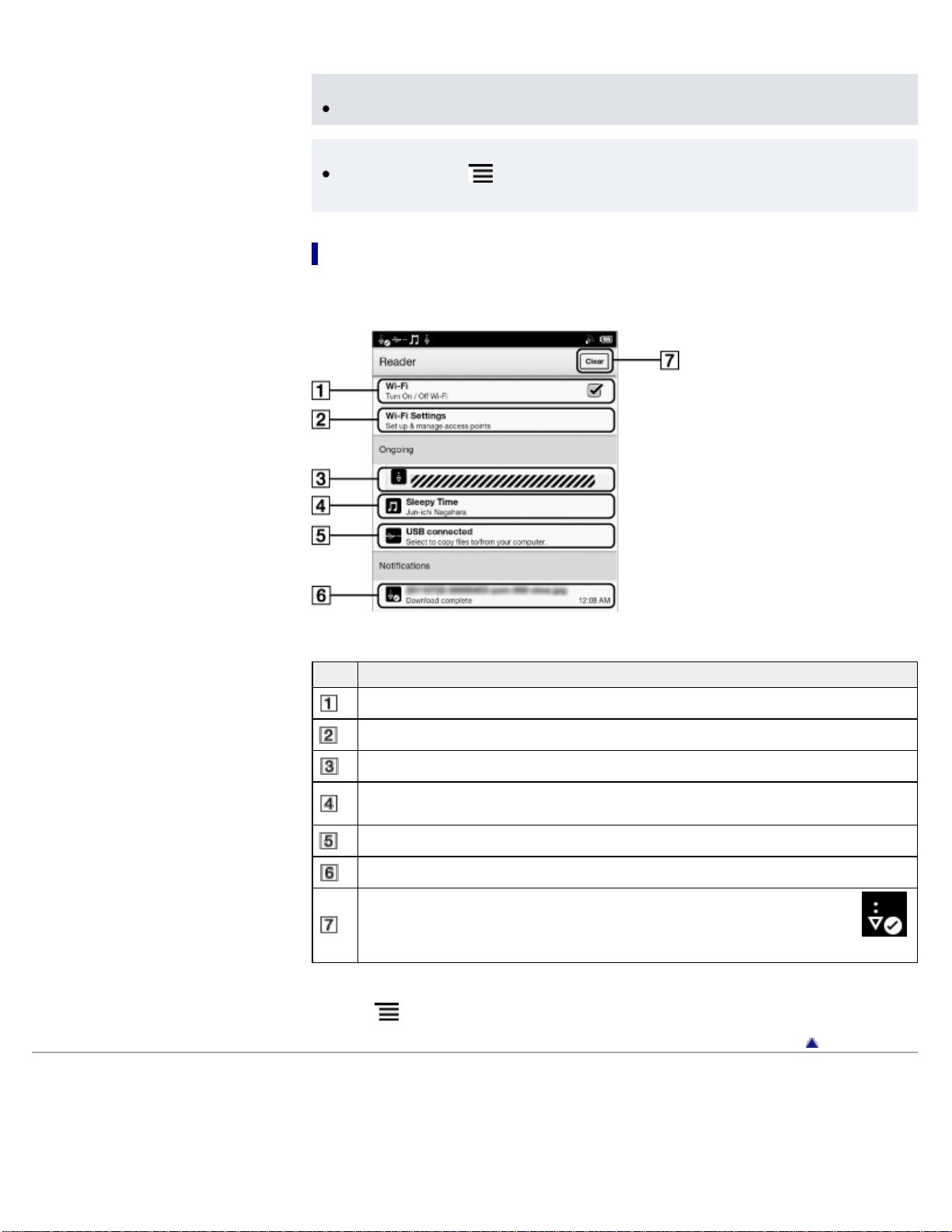
Notification window
Tapping on the status bar reveals the notification window, which contains network-related items
and other current operations.
Item Description
Turn [Wi-Fi] on/off. See Details.
Go to the [Wi-Fi Settings] screen. See Details.
Displays the status of items that are downloading from Reader Store or the Web.
Displayed when an audio track is currently playing. Tap to jump to the audio player.
See Details.
Enter data transfer mode. See Details.
Item for which downloading has completed. Tap to open the item.
Displayed when notifications are displayed. Tap to clear the notification list. The
(Download complete) icon also disappears from the status bar.
Depending on the status of the Reader, other items may also appear in the notification window.
Press the (Menu) button to close the notification window.
Go to page top
Copyright 2011 Sony Corporation
37
Reader™ User Guide
Print
Search
Getting started
Basic Operations
Adding/Getting Content
Browsing Content Lists
Reading
Organizing
Other Applications
Settings
Other Information
Contents list
Top page > Basic Operations > [Home] Screen > Touchscreen Operations
Touchscreen Operations
The touchscreen recognizes the following gestures. You can also use the supplied stylus for
more precise touchscreen operation.
Operation with the stylus makes it easier to select small items or specific areas of text.
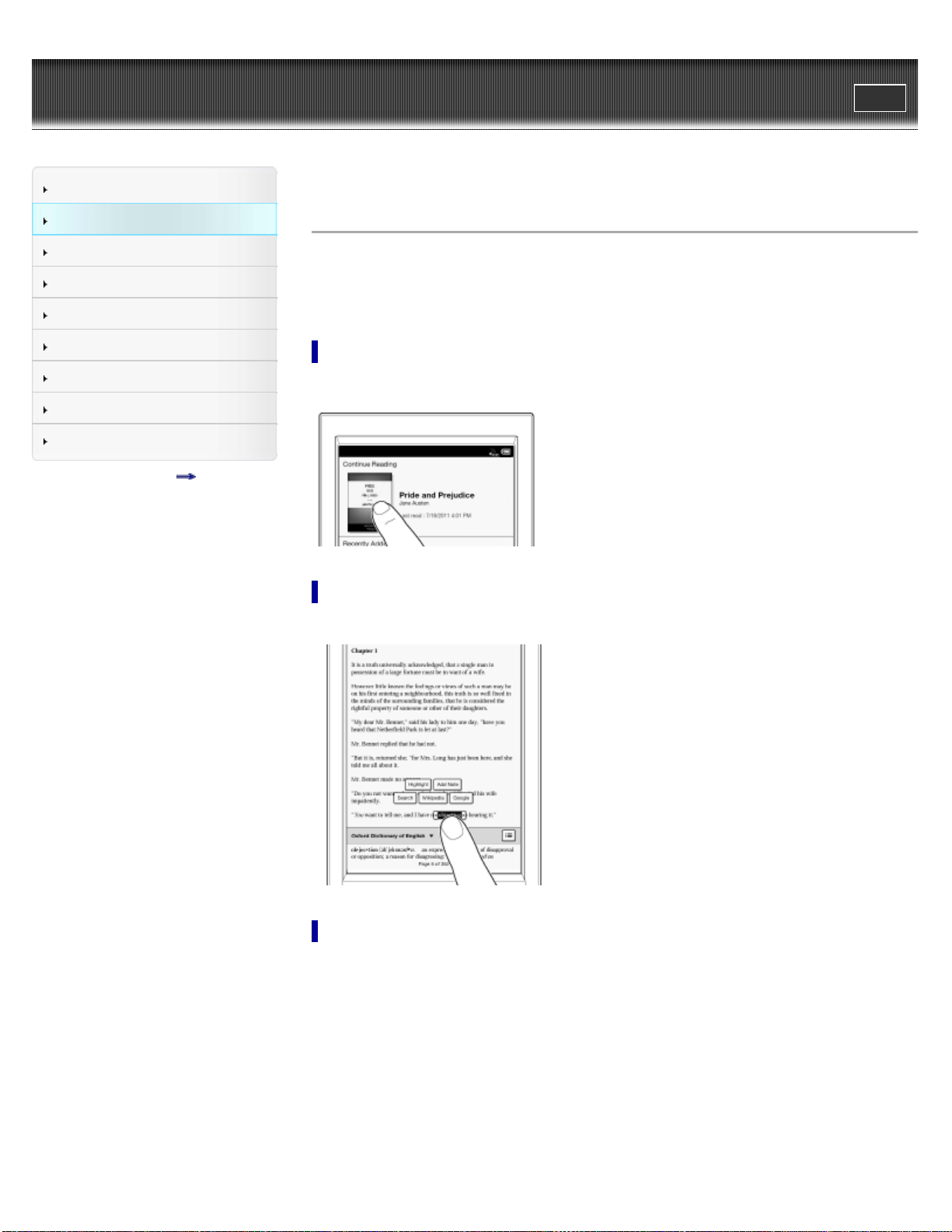
Tap
Tap an icon, a button or a menu item and raise your finger quickly to select or perform an action.
Tap and hold
Tap and hold your finger to select a word and display a pop-up menu for further operations.
Tap, hold and drag
Touch and hold your finger to the display and drag your finger; you can select a group of text
and display a pop-up menu for further operations.
38
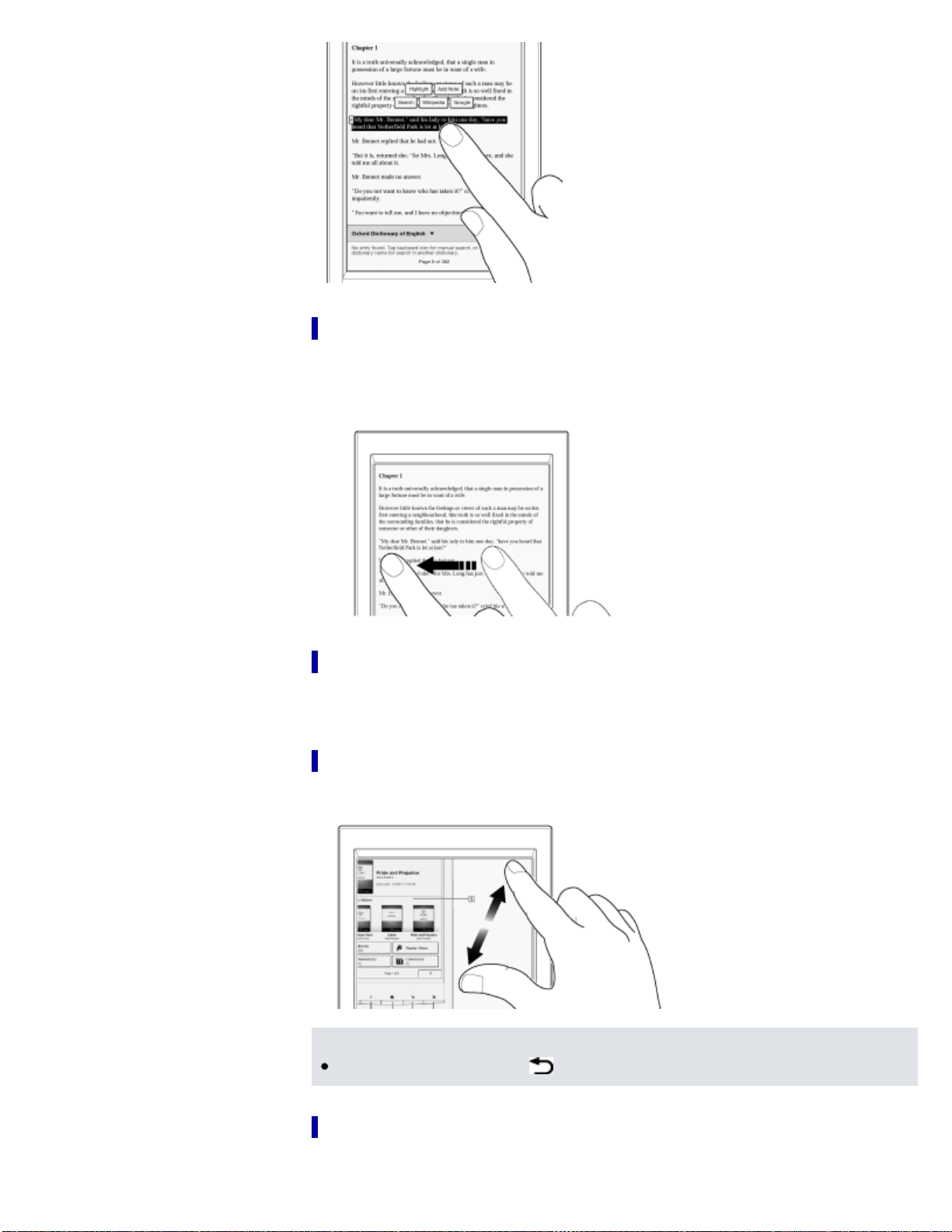
Swipe
Slide your finger gently and swiftly on the touchscreen to turn the page; you can turn the page
forward by swiping to the left, or backward by swiping to the right. You can also navigate pages
of content lists.
Swipe and hold
To turn multiple pages continuously, swipe and hold your finger on the screen. Release your
finger to stop.
Pinch
Pinch your fingers in or out to zoom in or out of the current page or image.
Note
To exit zoom mode, press the
(Back) button.
Drag
Touch and drag your finger to reposition a zoomed-in page or image. The page or image is
39

Reader™ User Guide
Print
Search
Getting started
Basic Operations
Adding/Getting Content
Browsing Content Lists
Reading
Organizing
Other Applications
Settings
Other Information
Contents list
Top page > Basic Operations > [Home] Screen > On-Screen Keyboard
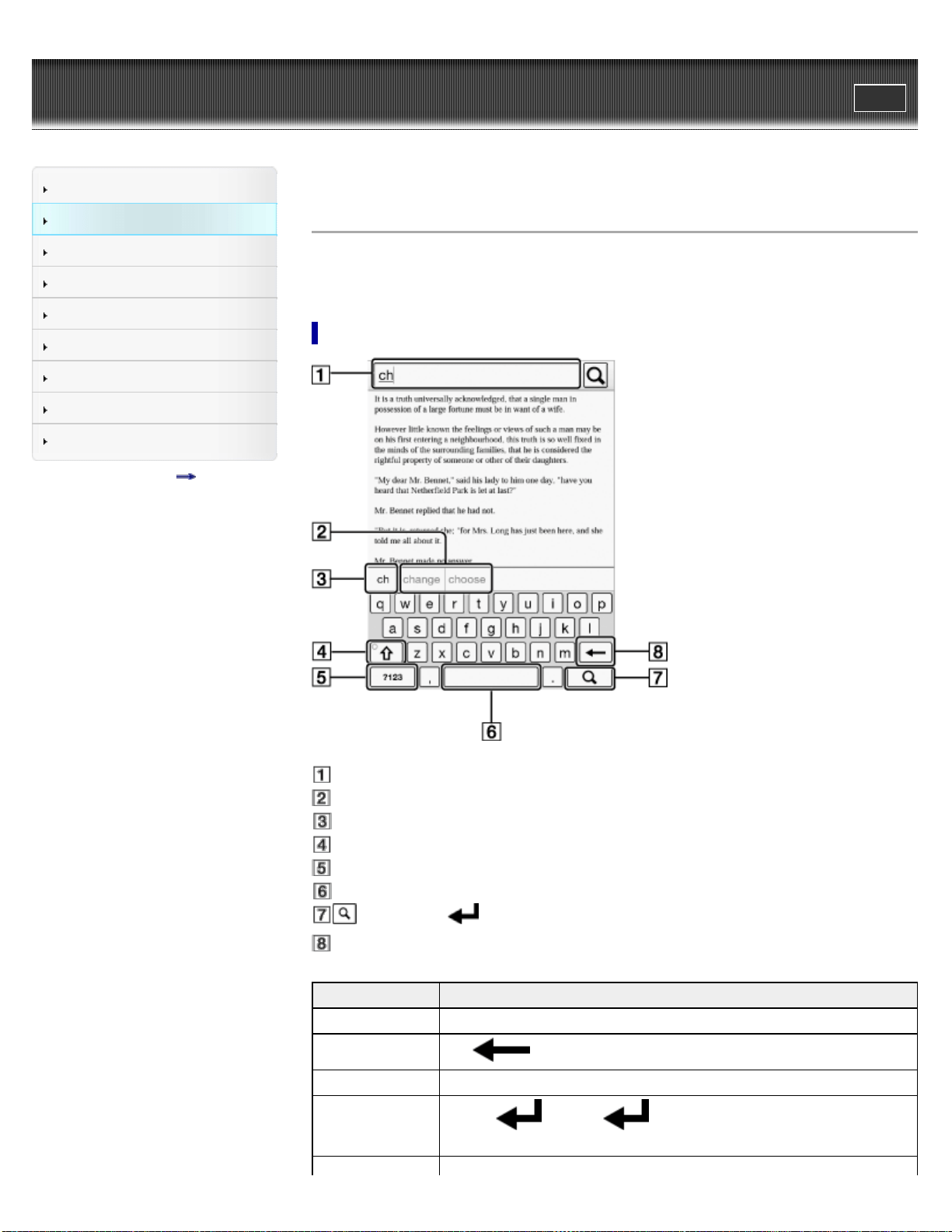
On-Screen Keyboard
The on-screen keyboard is used when you need to type. If the keyboard does not automatically
appear, tap the input area on the screen.
On-screen keyboard layout
Input area
Keyboard history
Current word input box
Shift key/[ALT]
[?123]/[ABC]
Space
(Search icon)/ (Line feed icon)/[Go]
Backspace
To Do this
Input text Tap the input area.
Delete a character
Tap
.
Finish typing Tap [Go]/[Done].
Insert line feed Tap the
key. The key is enabled only when multi-line input
is available.
41
Switch the
keyboard type
Tap [?123] to display the symbol keyboard. Tap [ALT] to switch to
additional characters. Tap [ABC] to return to the alphabetical keys.
Capitalize a single
letter
Tap
. Tap and hold to activate caps lock. To cancel, tap
again.
Enter a space Tap the space key.
Enter a previously
registered word
A list of words you registered to the keyboard history* displayed next to
the current word input box. Tap the desired word to enter it.
Tap and hold the current word input box to register the word in it to the
keyboard history. (The word must consist of at least 3 letters.)
Move the cursor in
the input area
Tap the location to which you want to move the cursor.
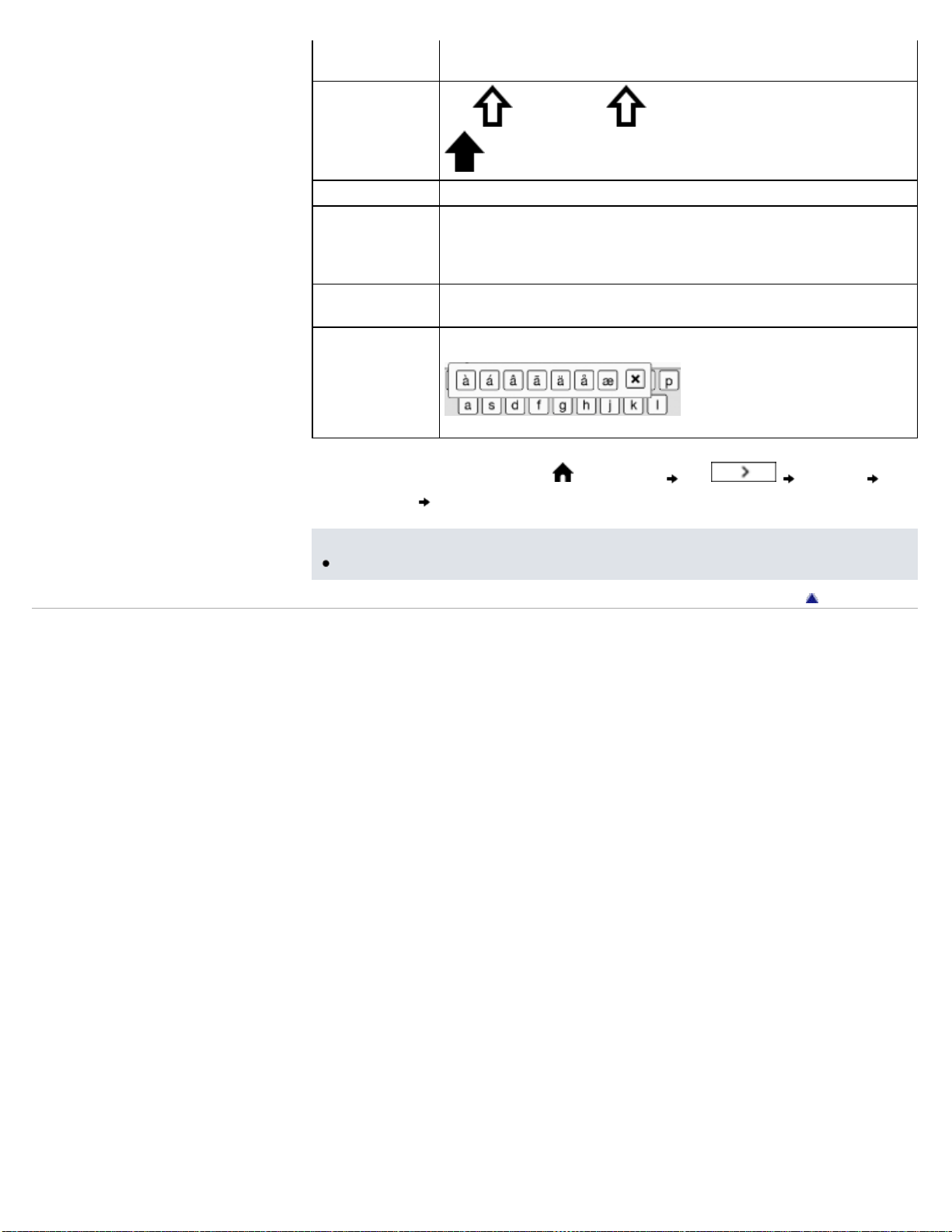
Type extended
characters
Tap and hold a key and choose one from the keys.
* To clear the keyboard history, press the (Home) button tap [Settings]
[Initialization] [Clear Keyboard History].
Note
The available types of keyboards and input methods differ depending on the application.
Go to page top
Copyright 2011 Sony Corporation
42
Reader™ User Guide
Print
Search
Getting started
Basic Operations
Adding/Getting Content
Browsing Content Lists
Reading
Organizing
Other Applications
Settings
Other Information
Contents list
Top page > Adding/Getting Content > Adding Content > Buying Books and Periodicals
Buying Books and Periodicals
Getting books and periodicals at Reader Store*
* Available in certain countries/regions only.
Download new releases and bestsellers at Reader Store. Purchased content will be downloaded
to the Reader directory.
1. Configure Wi-Fi settings of the Reader to access Reader Store. See Details.
2. Press the
(Home) button tap [Reader Store].
Tip
Magazines or newspapers that you are subscribed to are not automatically downloaded to
the Reader.
Creating a Reader Store account
In order to purchase and download books or periodicals, you need to create an account at
Reader Store.
Tap the input area and enter your information using the on-screen keyboard. The Reader will
then be associated with your account at Reader Store.
Buying books and periodicals
The Reader supports purchases and downloads from Reader Store. For your convenience, you
can access Reader Store via the [Reader Store] application to begin building your own set of
content.
1. Sign in to your account.
If you do not have an account, create one by following Reader Store instructions.
If you already have a Reader Store account, sign in via your e-mail address and password.
If you already have an Adobe account and use a different e-mail address or password for
Reader Store and your Adobe account, the screen for entering your Adobe ID (e-mail
address) and password is displayed.
2. Select or search for the title you wish to purchase.
Follow Reader Store instructions to complete your purchase. The Reader will begin
downloading the title shortly after you complete the checkout process.
You can check content that you have purchased from Reader Store via [Purchased Content].
See Details.
Navigating Reader Store
To return to the previous page of Reader Store, press the (Back) button. (The < > (Page
turn) buttons and the zoom in function are disabled.)
Pressing the
(Menu) button allows you to display the options items for navigation.
Navigation
Description
43
method
[Store Home] Go to the top page of Reader Store.
[My Account] View your purchase history and re-download purchased content.
[Refresh / Stop]
Updates the content displayed on the Reader Store page, or stops loading
the page.
[Forward] Advances to a previously viewed page.
[Continue
Reading]
Closes the [Reader Store] application and returns to the last read page of
your last read book.
[More] Displays more option items.
[Help and
Support]
Jumps to the FAQ page of Reader Store.
[Legal
Information]
Displays legal information about Reader Store.
Checking downloaded content
When downloading content from Reader Store, you can check the download progress in the
status bar and by tapping it to display the notification window. See Details.
When you exit Reader Store, your three most recent purchases are displayed under [Recently
Added] on the first page of the [Home] screen. You can check all purchased content in the
[Books] or [Collections] applications.
When you are subscribing to newspapers and magazines, all content is stored in the
[Periodicals] application.
You can directly access content that you have purchased by going to [My Account] at Reader
Store by using the [Purchased Content] application. See Details.
Accessing Reader Store from your computer
In addition to shopping at Reader Store from your computer, you can transfer books from your
computer to the Reader using the Reader software. Install either Reader™ for PC or Reader™
for Mac
®
by launching the corresponding installer on the Reader. See Details.
Go to page top
Copyright 2011 Sony Corporation
44
Reader™ User Guide
Print
Search
Getting started
Basic Operations
Adding/Getting Content
Browsing Content Lists
Reading
Organizing
Other Applications
Settings
Other Information
Contents list
Top page > Adding/Getting Content > Adding Content > Adding Content
Adding Content
Transferring content via the Reader software
You can use the Reader software to transfer books, audio and pictures to the Reader. You will
need to install the Reader software and organize content on your computer in advance. You can
also backup the contents on the Reader to the Reader software.
Installing Reader software
1. Turn on your computer, connect your computer to the internet, and then connect the Reader
to your computer using the supplied USB cable.
Make sure you have administrator access to your computer.
2. Set the Reader to [Data Transfer Mode]. See Details.
3. To install on Windows computers:
From your computer, click on the “Start” menu
“Computer” (“My Computer” for Windows
XP users)
double-click the “SETTING” drive double-click “Setup Reader for PC”.
To install on Mac computers:
When the Reader is connected to your Mac, the “SETTING” and “READER” drives will
appear on the desktop. Double-click the “SETTING” drive
double-click “Setup Reader
for Mac”.
4. Follow the on-screen instructions to complete the installation of the Reader software.
For details on purchasing content via Reader Store, transferring content to the Reader and
syncing, refer to the [Help] menu of the Reader software.
5. When transfer is complete, click “Disconnect” on the Reader software, and then disconnect
the USB cable from the Reader. After a short time, the [Home] screen will appear.
Content will be sent to its corresponding application based on the file format of the content.
Personal documents other than pictures and audio files will be sent to the [Books]
application.
Tip
When you transfer data to the microSD card, insert the microSD card to the Reader in Step
2.
For details on the system requirements for the Reader software, see Details.
For details on supported file formats, see Details.
Transferring content via drag-and-drop
You can directly transfer content by drag-and-drop to your computer.
1. Connect the Reader to your computer using the supplied USB cable.
Make sure the Reader is in [Data Transfer Mode]. See Details.
2. For Windows users, click on the “Start” menu
“Computer” (“My Computer” for Windows
XP users
double-click the “READER” drive, and then drag and drop your data onto the
“READER” drive.
For Mac users, double-click the “READER” drive, and then drag and drop your data onto the
“READER” drive.
3. When transfer is complete, use the safely remove hardware function of your computer
45

before disconnecting the USB cable from the Reader and your computer. After a short time,
the [Home] screen will appear.
Content will be sent to its corresponding application based on the file format of the content.
Personal documents other than pictures and audio files will be sent to the [Books]
application.
Note
Content transferred via drag-and-drop may not be displayable on the Reader, or thumbnails
of the content may not be properly displayed on the Reader. Sony recommends that you
transfer data via the Reader software.
Do not delete any system default folders created by the Reader on the “READER” drive, the
“SETTING” drive or the microSD card.
If you disconnect the USB cable while data is being transferred, data corruption may occur.
To disconnect the Reader or the microSD card when the Reader is connected to your
computer, make sure to use the safely remove hardware function of your computer, and
then disconnect the USB cable.
Do not format the Reader or your microSD card via your computer. If you have formatted
the Reader or microSD card on your computer, the Reader may not be able to display
transferred content. In this case, use the Reader’s [Format Memory] function to reformat the
Reader and your microSD card. See Details.
Tip
When you transfer data to the microSD card, insert the microSD card to the Reader in Step
1, and drag-and-drop to the microSD (removable disk) drive in Step 2 above.
For details on the system requirements for the Reader software, see Details.
For details on supported file formats, see Details.
Go to page top
Copyright 2011 Sony Corporation
46
Reader™ User Guide
Print
Search
Getting started
Basic Operations
Adding/Getting Content
Browsing Content Lists
Reading
Organizing
Other Applications
Settings
Other Information
Contents list
Top page > Browsing Content Lists > Content Lists > Browsing Content List Pages
Browsing Content List Pages
The Reader organizes content by content type and file format using applications. For example,
books or your personal documents (such as PDF files or text files) are stored in the [Books]
application, newspapers/magazines in the [Periodicals] application and pictures in the [Pictures]
application, etc.
Content list pages allow you to sort content, as well as search content on the Reader.
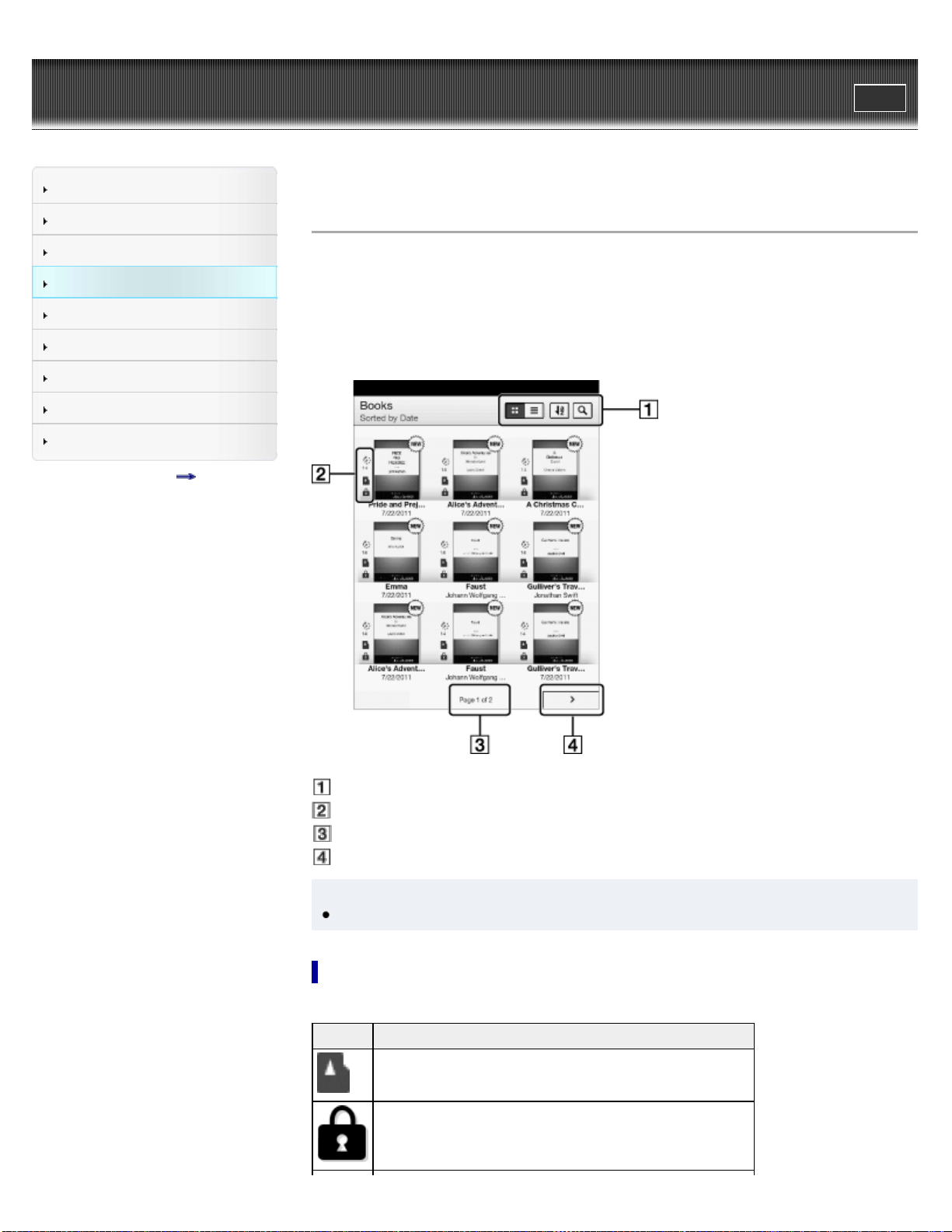
The following instructions use the [Books] application as an example.
Tool icons Details
Status icons
Page indicator
Page navigation icon
Tip
Depending on the application, several tools are available for content list pages. See Details.
Status icons
Icon Description
The item is stored on the microSD card.
The item is protected from deletion. See Details.
47
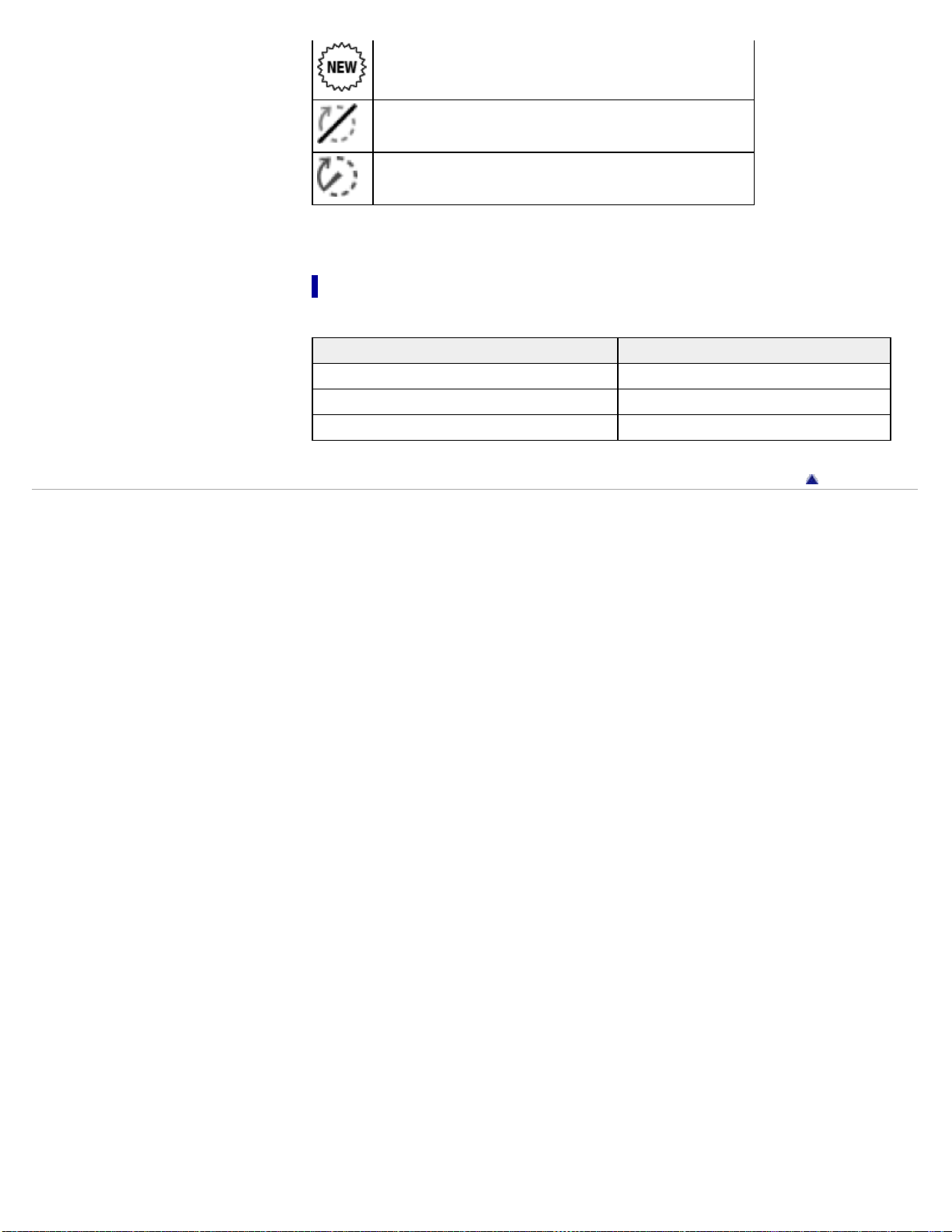
The item has not been opened.*
The item has expired.* See Details.
The item expires in the given number of days.* See Details.
* This icon is displayed for books/periodicals only.
Navigation
Navigation method Description
Page indicator Display the page jump panel. See Details.
Page navigation icon or the < (Previous) button View the previous page or item.
Page navigation icon or the > (Next) button View the next page or item.
Go to page top
Copyright 2011 Sony Corporation
48
Reader™ User Guide
Print
Search
Getting started
Basic Operations
Adding/Getting Content
Browsing Content Lists
Reading
Organizing
Other Applications
Settings
Other Information
Contents list
Top page > Browsing Content Lists > Content Lists > Browsing in Thumbnail View and List View
Browsing in Thumbnail View and List View
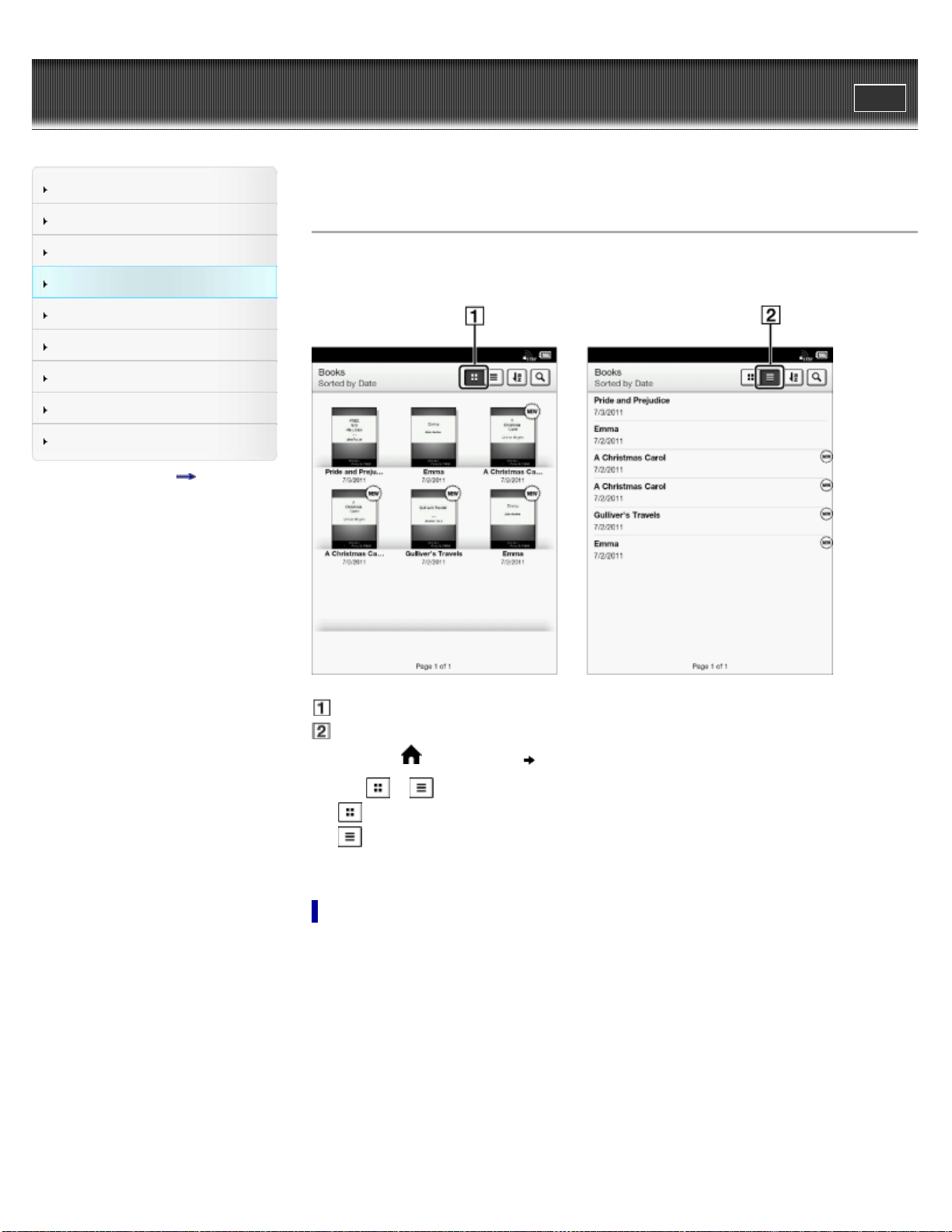
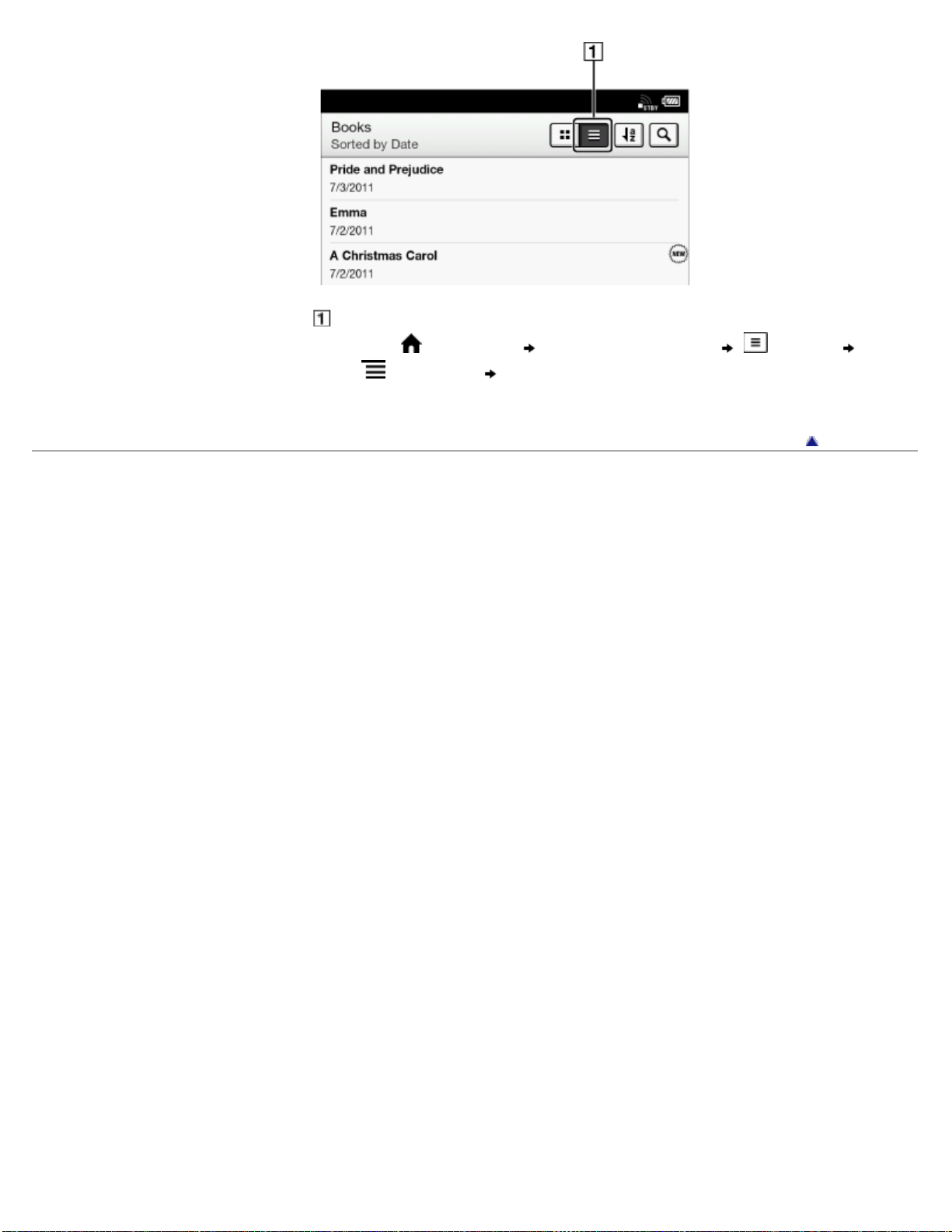
Content can be displayed as individual thumbnails or in a list.
The following instructions use the [Books] application as an example.
Thumbnail view icon
List view icon
1. Press the (Home) button tap [Books].
2. Tap
or .*
displays thumbnails of content.
displays a list of content.
* Some applications only allow list view.
Adjusting the title view
The titles of some books/periodicals may be cut off if they are too long. To avoid this, you can set
the Reader to display titles across two lines instead of one line.
49
Reader™ User Guide
Print
Search
Getting started
Basic Operations
Adding/Getting Content
Browsing Content Lists
Reading
Organizing
Other Applications
Settings
Other Information
Contents list
Top page > Browsing Content Lists > Content Lists > Using the Page Jump Panel in Content
List Pages
Using the Page Jump Panel in Content List Pages
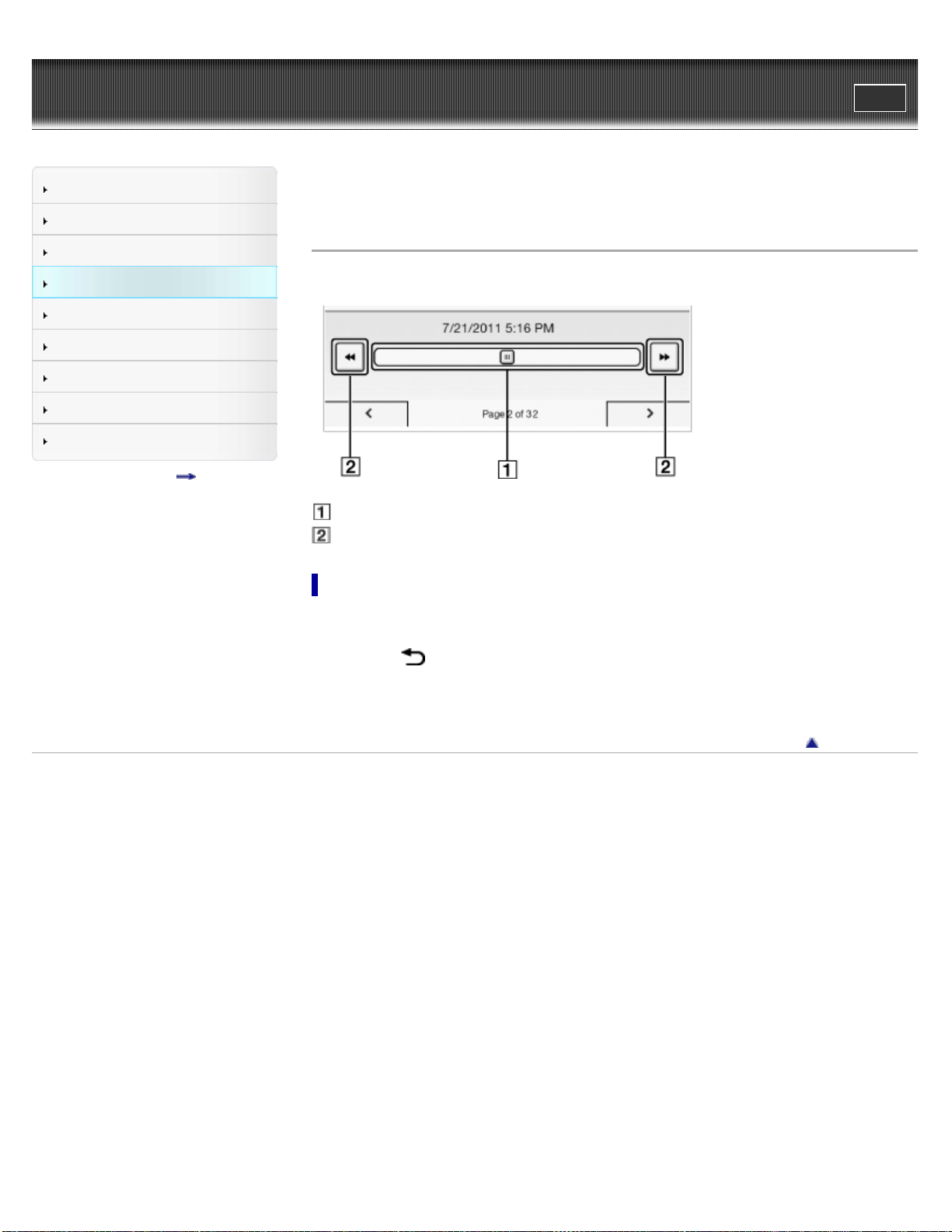
Content list pages can be turned conveniently via the page jump panel.
Page jump bar
Page skip icon
To use the page jump bar
1. When viewing a content list page, tap the page indicator at the bottom of the screen.
2. Tap and slide the bar left or right to navigate back or forward.
Press the (Back) button to hide the page jump panel.
Skipping 10 pages at a time
When the page jump bar is displayed, tap << or >> (Page skip) to skip back 10 pages or skip
forward 10 pages at a time.
Go to page top
Copyright 2011 Sony Corporation
51
Reader™ User Guide
Print
Search
Getting started
Basic Operations
Adding/Getting Content
Browsing Content Lists
Reading
Organizing
Other Applications
Settings
Other Information
Contents list
Top page > Browsing Content Lists > Content Lists > Finding Content with a Keyword
Finding Content with a Keyword
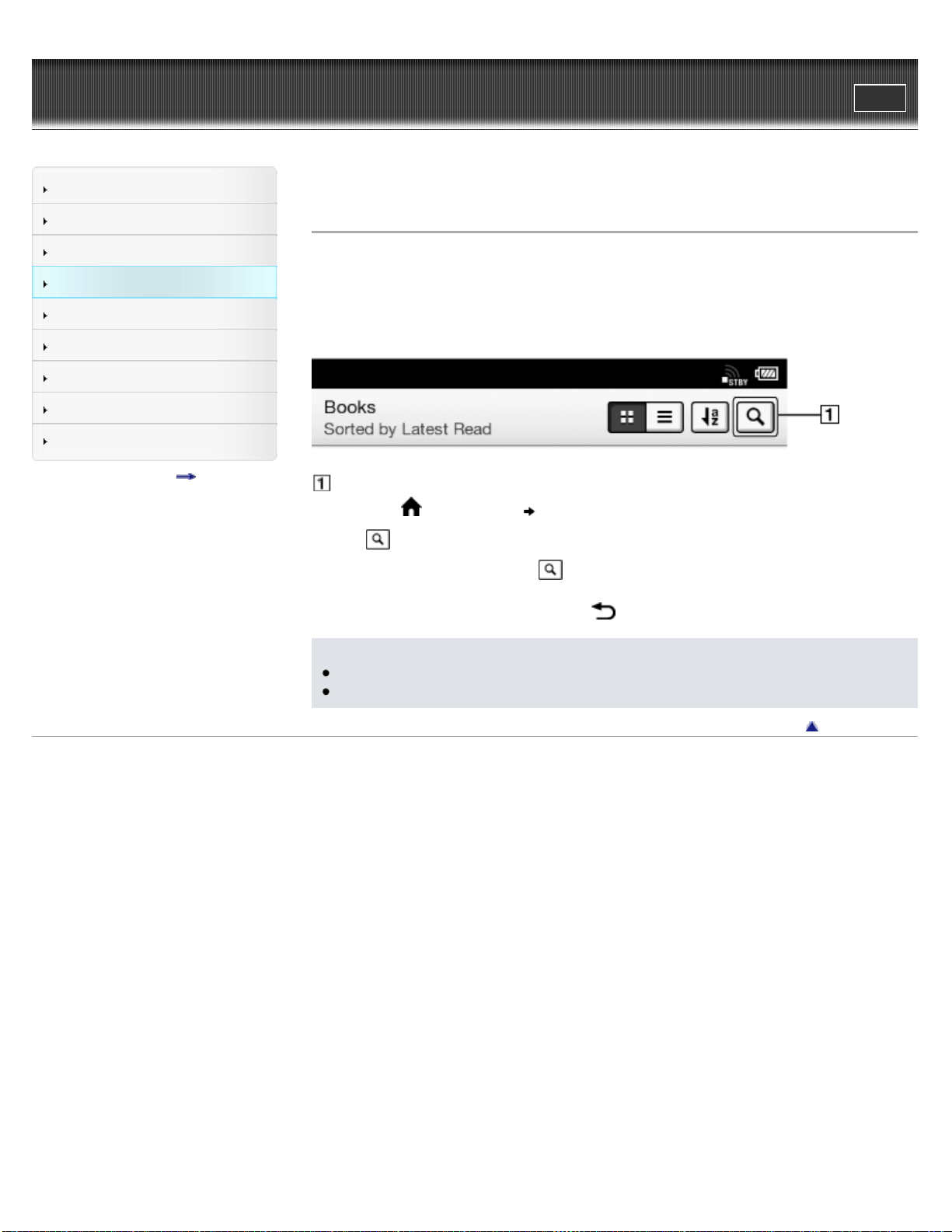
You can find a specific item quickly with a keyword search.
You can locate a book or author of a book on the Reader via the [Books] application, or search
for annotations via the [All Notes] application, etc.
The following instructions use the [Books] application as an example.
Search icon
1. Press the
(Home) button tap [Books].
2. Tap
; the keyword input area and the on-screen keyboard appear.
3. Input a search keyword and tap
.
The view shows only the items that satisfy the search criteria.
To exit the search result view, press the
(Back) button.
Note
Some applications do not support keyword searching.
The available search target varies among content types.
Go to page top
Copyright 2011 Sony Corporation
52
Reader™ User Guide
Print
Search
Getting started
Basic Operations
Adding/Getting Content
Browsing Content Lists
Reading
Organizing
Other Applications
Settings
Other Information
Contents list
Top page > Browsing Content Lists > Content Lists > Tools
Tools
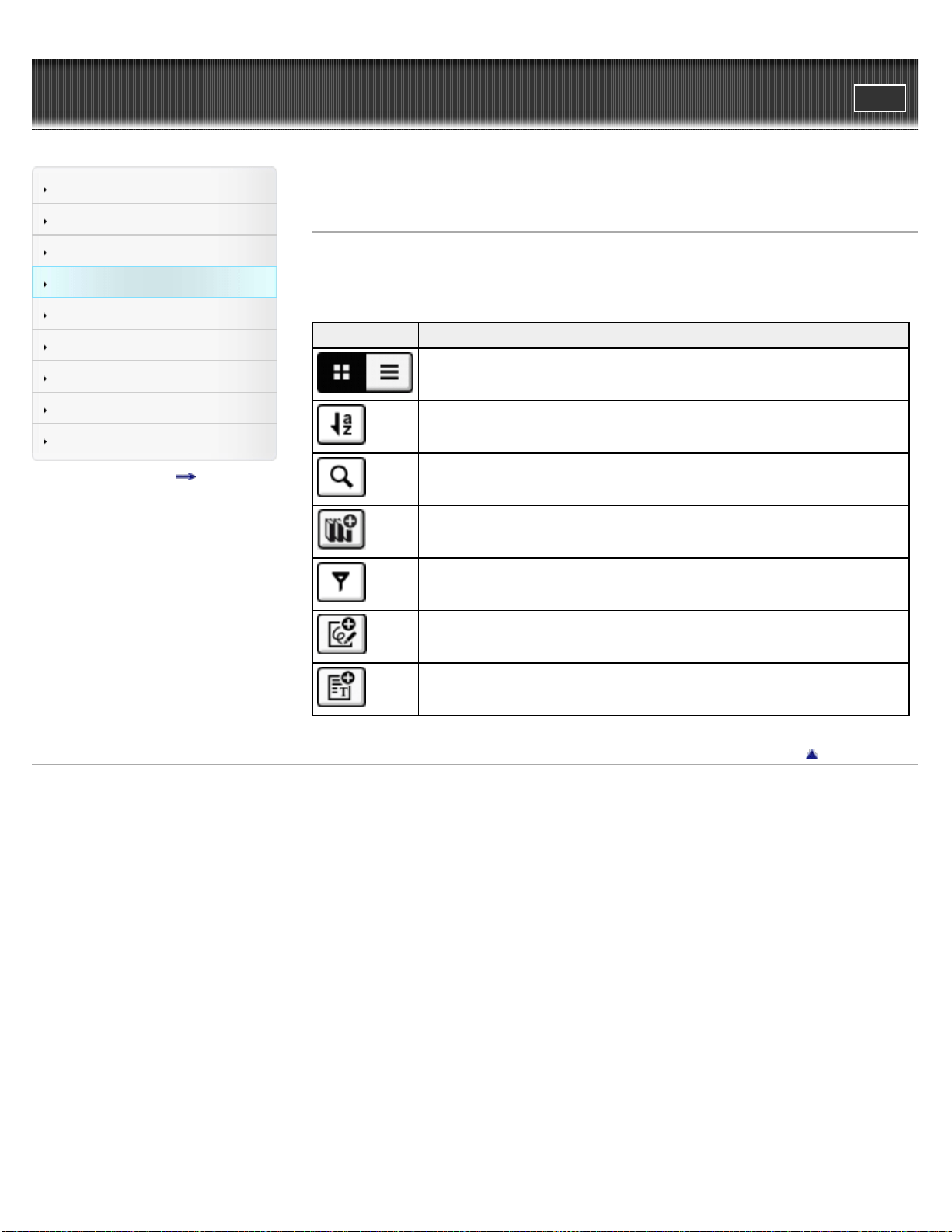
Below is a list of the tools available on each application’s content list page.
Not all tools are available in each application.
Tool icon Description
Changes the view between the thumbnail view and the list view. See Details.
Changes the sort order.
Finds content with a keyword. See Details.
Creates a new collection.
Specifies the notes type to view in the list.
Creates a new drawing.
Creates a new memo.
Go to page top
Copyright 2011 Sony Corporation
53
Reader™ User Guide
Print
Search
Getting started
Basic Operations
Adding/Getting Content
Browsing Content Lists
Reading
Organizing
Other Applications
Settings
Other Information
Contents list
Top page > Browsing Content Lists > Content Lists > Using (Menu) Items
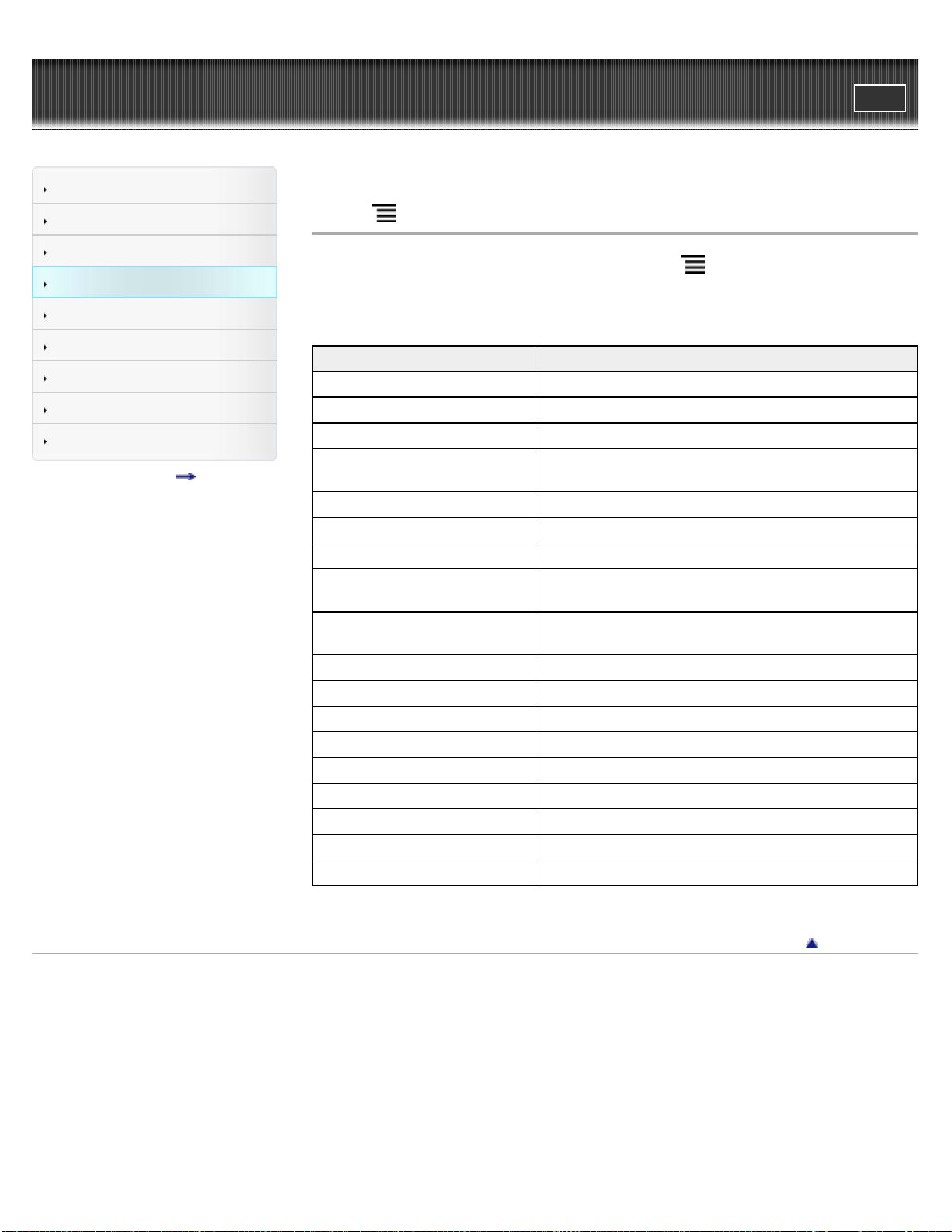
Using (Menu) Items
Below is a list of option items available when you press the (Menu) button on each
application’s content list page.
Not all options are available in each application.
Option Description
[Add to Collection] Adds one or more books to a collection. See Details.
[Delete Books] Deletes one or more books from the Reader. See Details.
[Protect Books] Protects one or more books from deletion. See Details.
[Title (1 Line View)]/[Title (2 Line
View)]
Displays the full title string without truncating it. See
Details.
[Return Books] Shows how to return a public library eBook. See Details.
[Delete Issues] Deletes one or more issues from the Reader. See Details.
[Protect Issues] Protects one or more issues from deletion. See Details.
[Add Content]
Adds items to a collection that you have created. See
Details.
[Remove Content]
Removes items from a collection that you have created.
See Details.
[Rename Collection] Renames a collection. See Details.
[Delete Notes] Deletes one or more notes.
[Delete Memos] Deletes one or more text memos. See Details.
[Protect Memos] Protects one or more text memos. See Details.
[Delete Drawings] Deletes one or more drawings. See Details.
[Protect Drawings] Protects one or more text memos/drawings. See Details.
[Delete Pictures] Deletes one or more pictures. See Details.
[Settings] Changes the slideshow interval. See Details.
[Delete Audio] Deletes one or more audio tracks. See Details.
Go to page top
Copyright 2011 Sony Corporation
54
Reader™ User Guide
Print
Search
Getting started
Basic Operations
Adding/Getting Content
Browsing Content Lists
Reading
Organizing
Other Applications
Settings
Other Information
Contents list
Top page > Reading > Reading Books > Opening a Book
Opening a Book
1. Press the (Home) button tap [Books].
The [Books] content list opens. See Details.
2. Tap a book.
The book opens.
You can also open a book by tapping and holding the book you want to open.
To navigate within a book, see Details.
Go to page top
Copyright 2011 Sony Corporation
55
Reader™ User Guide
Print
Search
Getting started
Basic Operations
Adding/Getting Content
Browsing Content Lists
Reading
Organizing
Other Applications
Settings
Other Information
Contents list
Top page > Reading > Reading Books > Page Navigation
Page Navigation
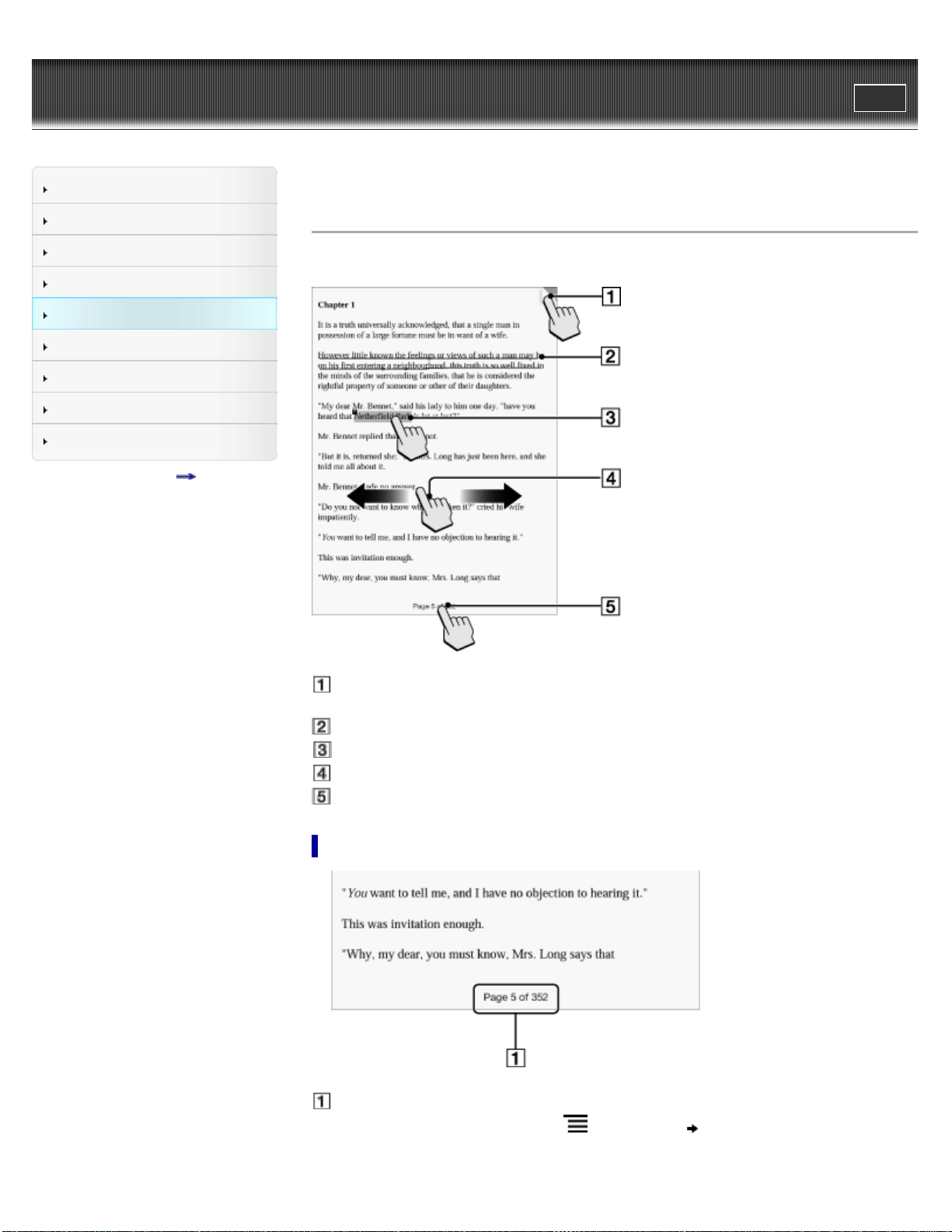
There are several ways to navigate through books.
Tap to add a bookmark Details
Tap and hold to add a note
Draw a handwritten note Details
Tap and hold to open option items Details
Swipe the screen to turn the page
Tap to open the page navigation panel.
Using the page navigation panel
Page indicator
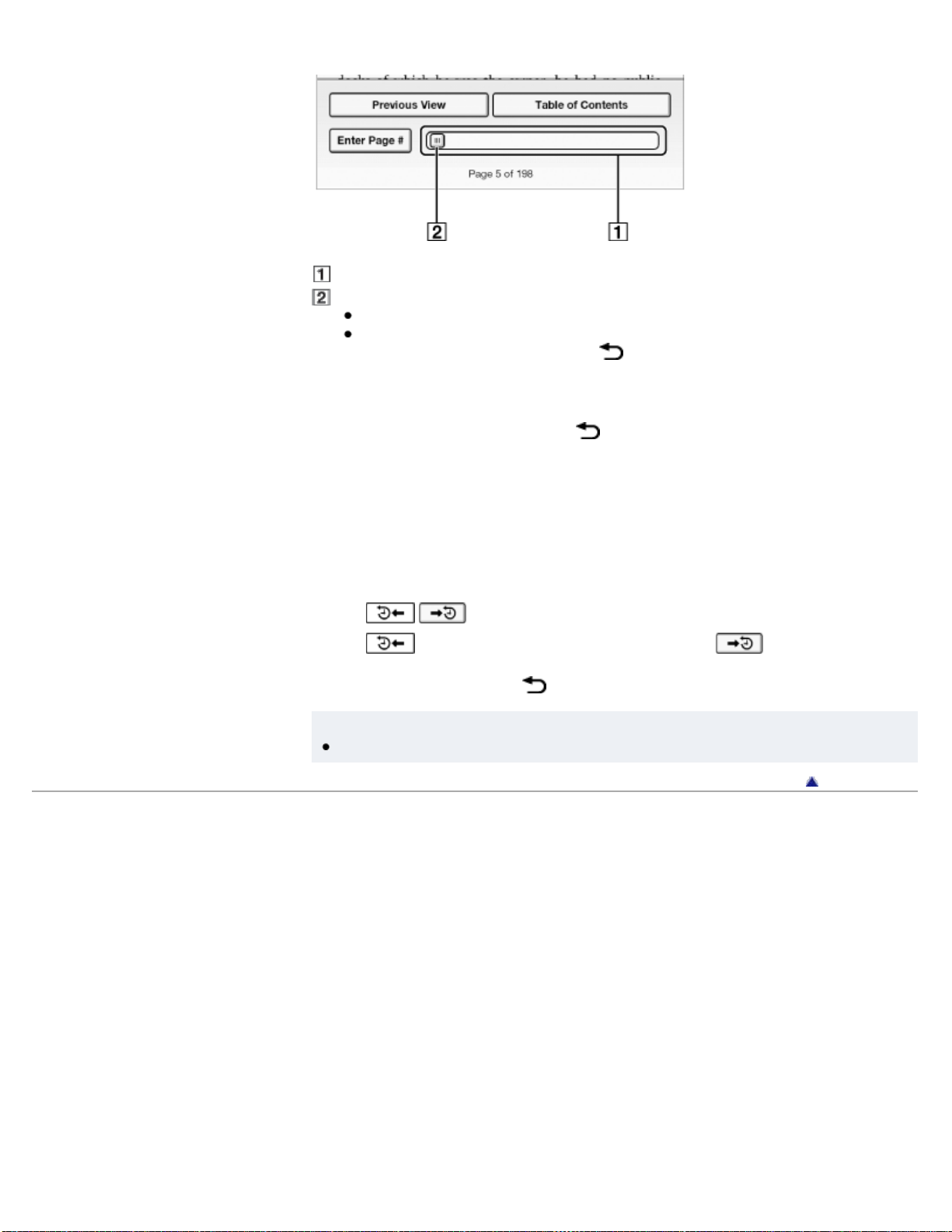
1. Tap the page indicator, or press the (Menu) button tap [Navigate Page] to open the
page navigation panel.
56
Using the paging bar
Paging bar
Slider
Tap on a point on the paging bar to jump to a page that corresponds with that point.
Tap and drag the slider.
To close the page navigation panel, press the
(Back) button.
Using [Table of Contents]
1. Tap [Table of Contents].
To return to the book page, press the (Back) button.
2. Tap to open the selected chapter or section.
Using [Enter Page #]
1. Tap [Enter Page #] to enter the page number with the on-screen numeric keyboard, and tap
[OK].
Jumping to viewed pages
1. Tap [Previous View].
The / (Page history) icons are displayed.
2. Tap
to go backward in the page display history. Tap to go forward in the
page display history.
To cancel page history, press the
(Back) button.
Tip
This is the same operation for when you tap on a highlighted link.
Go to page top
Copyright 2011 Sony Corporation
57
Reader™ User Guide
Print
Search
Getting started
Basic Operations
Adding/Getting Content
Browsing Content Lists
Reading
Organizing
Other Applications
Settings
Other Information
Contents list
Top page > Reading > Reading Books > Appearance
Appearance
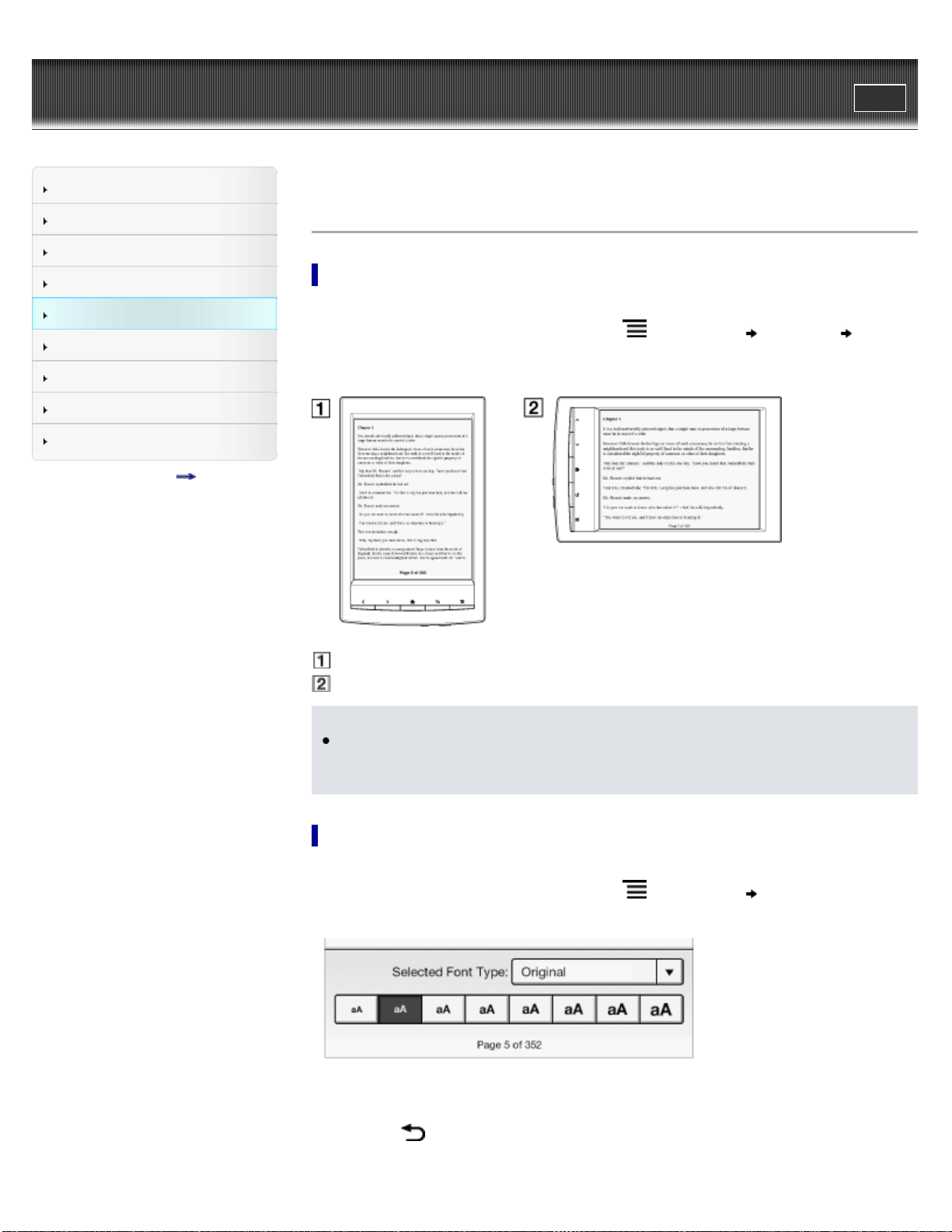
Changing the orientation
You can view books or periodicals in either portrait or landscape mode.
1. When viewing a book or periodical, press the (Menu) button tap [More]
[Orientation].
The screen orientation changes.
Portrait mode
Landscape mode
Note
The orientation can be changed for the [Books], [Periodicals], [Browser] and [Pictures]
applications. Changing the orientation in one application does not affect the orientation
setting of the other applications.
Changing the font and font size
You can change the font and font size to your preference.
1. When viewing a book or periodical, press the (Menu) button tap [Font].
The font bar is displayed.
2. To change the font size, tap on one of the font size icons. The book or periodical will be
updated to apply the specified font size.
Press the
(Back) button when done.
3. To change the font, tap [Original] and select from one of the fonts in the list.
58
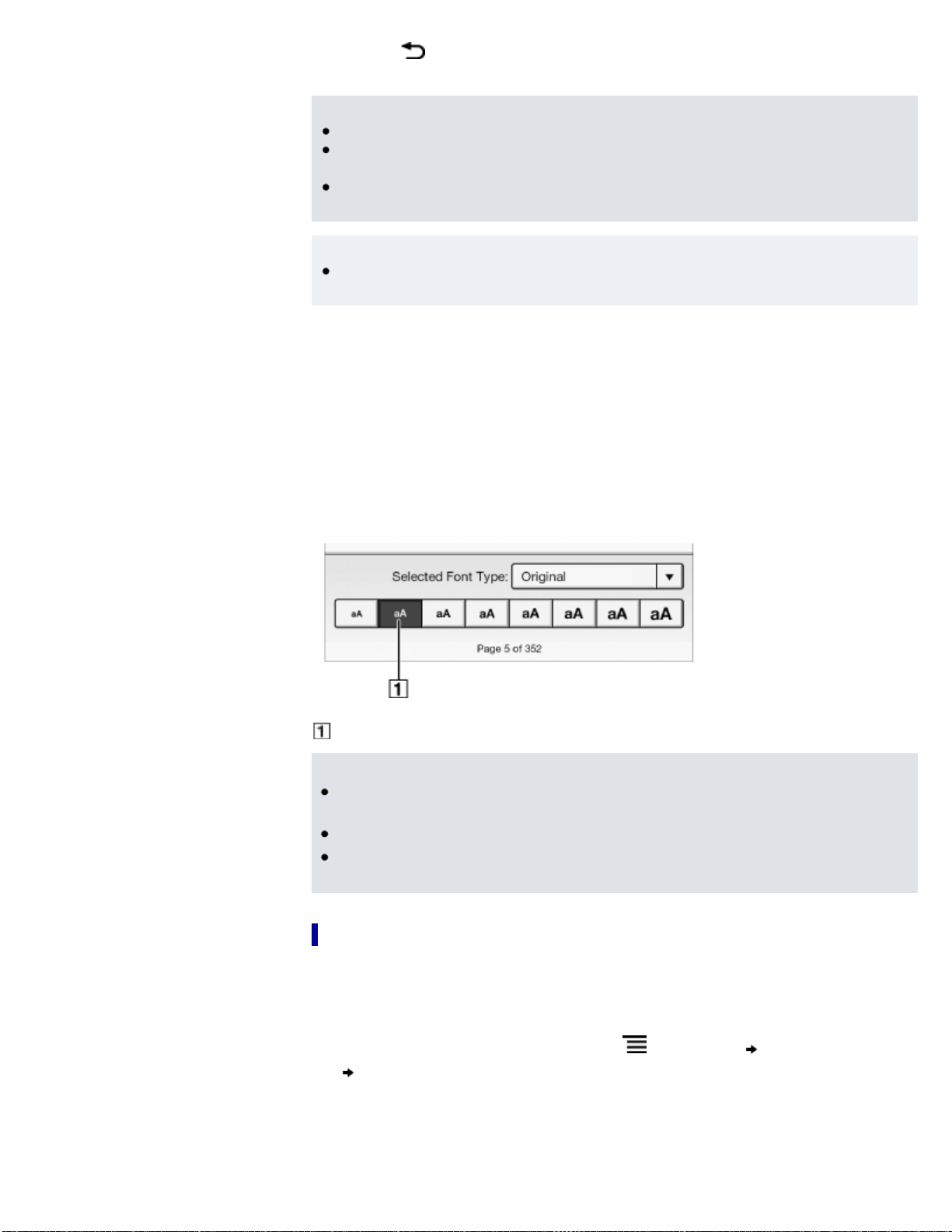
Press the (Back) button when done.
The book or periodical will be updated to apply the specified font and font size.
Note
The font size and font of some content with embedded fonts may not change.
When you select other than the [Original] font, performance may be slightly lower when
opening books or turning pages.
When you select other than the [Original] font, boldface/italics/italicized boldface may not be
displayed correctly.
Tip
You can change the default font for all content in the [Books] and [Periodicals] applications.
See Details.
About PDF files
The Reader provides the ability to display most text-based PDF files in several font sizes.
Documents are displayed in the default font position with their original layouts.
Due to the complex nature of PDF files, in certain situations when you change the font size, only
text will appear. This is because some tables and graphics may be reformatted and altered
during the reflow process.
Also, in cases where PDF files are created using image data only, there is no text to reflow or
resize.
In these cases, if retaining the original layout of a PDF file is required, Sony recommends that
you view the PDF file at its original font size.
To display the original layout
Note
If you modified the default font size with [Font Size Preference] under [Settings], return it to
its original layout to view PDF files normally.
To view the document in a different size, use the zoom in function.
When you view PDF files in other than their original layout, some functions such as
highlighting or searching may not work correctly.
Changing the page mode
You can change the page viewing style for PDF files. This is convenient for viewing pages with
text arranged in columns.
This mode remains active as you continue reading. The setting applies only to the currently open
book.
1. When viewing a book or periodical, press the
(Menu) button tap [Customize View]
[Page Mode].
The [Page Mode] screen appears.
2. Choose from one of the following options.
59
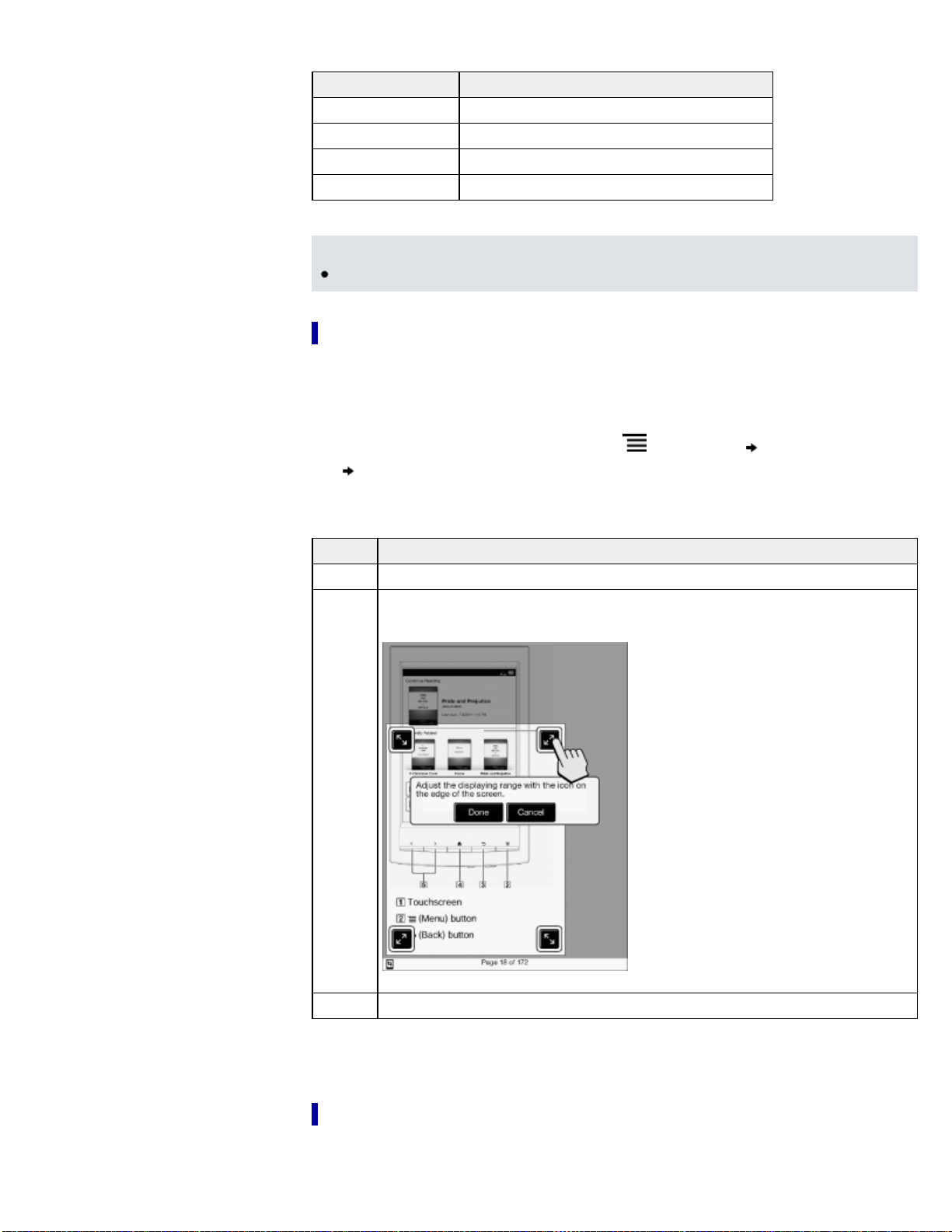
Option Description
[Original] Set to the default view.
[2-Column Split] Splits the page into two columns and two rows.
[3-Column Split] Splits the page into three columns and two rows.
[Fit Landscape Width] Displays the page fit to landscape view.
Note
In order to attach a handwritten note, the page mode needs to be restored to [Original].
Cropping a page
You can crop the page margins to create a wider viewing area. This is convenient for viewing
pages that have large margins.
This mode remains active as you continue reading. The setting applies only to the currently open
book.
1. When viewing a book or periodical, press the
(Menu) button tap [Customize View]
[Crop Page].
2. Choose from one of the following options.
Option Description
[Uncrop] Disables cropping.
[Manual]
Allows you to adjust the crop area manually by dragging arrows at the corners. Tap
[Done] to set the area, or tap [Cancel] to cancel editing the crop area.
[Auto] Automatically crops the margins of a document.
Adjusting the brightness and contrast
A page that is hard to read, such as a scanned or color-converted document, can be made more
readable by adjusting the brightness and contrast. This mode remains active as you continue
60
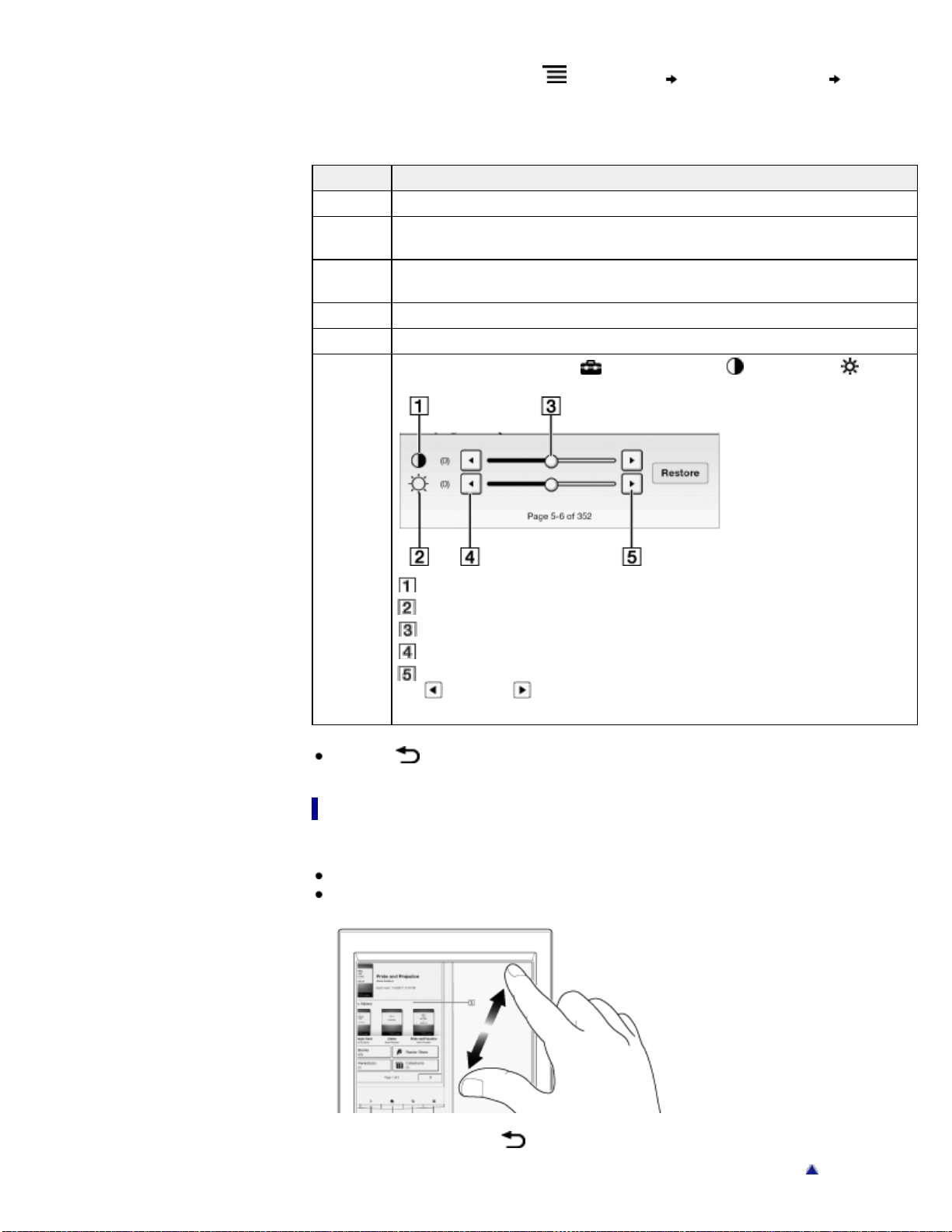
reading. The setting applies only to the currently open book.
1. When viewing a book, press the (Menu) button tap [Customize View] [Adjust
View].
2. Choose from one of the following options.
Option Description
[Original] Displays the page in the original quality.
[Saturated]
Improves readability by emphasizing contrast.
[Details]
Backlight compensation; brings up details in a dark area.
[Brighter] Increases the brightness.
[Darker] Decreases the brightness.
[Custom]
Create a custom setting. Tap
(Settings) to adjust (Contrast) and
(Brightness).
Contrast
Brightness
Slider
Lower
Higher
Tap
(Lower) or (Higher), or tap on the slider.
Tap [Restore] to revert to the previously saved custom settings.
Press the
(Back) button when done.
Zooming in
Use the zoom function when you want to temporarily zoom in on part of a page.
The viewer shows the zoom bar and viewing position indicator while in zoom mode.
Pinch out to zoom in.
Pinch in to zoom out.
To exit zoom mode, press the (Back) button.
61
Reader™ User Guide
Print
Search
Getting started
Basic Operations
Adding/Getting Content
Browsing Content Lists
Reading
Organizing
Other Applications
Settings
Other Information
Contents list
Top page > Reading > Reading Books > Annotations
Annotations
Bookmarking a page
You can bookmark a page and take a note so that you will remember what the bookmark is for.
1. Tap the top right corner of the page.
Tip
To search, sort and view all annotations across all books and periodicals, use the [All
Notes] application. See Details.
To search annotations for the currently open book/periodical, press the
(Menu) button
tap [Notes].
Adding text notes
1. Tap and hold the bookmark.
2. Tap [by Keyboard].
3. Type the notes using the on-screen keyboard.
4. Tap [Save].
The icon appears on the bookmark, indicating that a note is attached.
Adding handwritten notes
1. Tap and hold the bookmark.
2. Tap [by Drawing].
3. Draw with the stylus or your finger on the drawing pad.
To erase, tap (Erase), and then tap the line(s) you want to erase.
4. Tap [Save].
The icon appears on the bookmark, indicating that a note is attached.
Notes on handwriting
While writing, make sure that you are not touching another area on the touchscreen; this
could affect the notes that you write with the stylus or your finger.
To ensure that your notes are correctly saved, do not handwrite notes too close to the edge
of the touchscreen.
If you experience difficulties when handwriting or drawing on the Reader:
avoid applying excessive pressure to the touchscreen.
try not to handwrite or draw too quickly.
this functionality is not designed for very detailed drawings or for writing small characters.
Editing notes
1. Tap and hold on the bookmark.
The notepad or the drawing pad opens.
2. Tap [Edit].
The on-screen keyboard or the drawing pad opens.
3. Edit the note.
4. Tap [Save].
The notepad or the drawing pad closes, returning to the viewer.
62
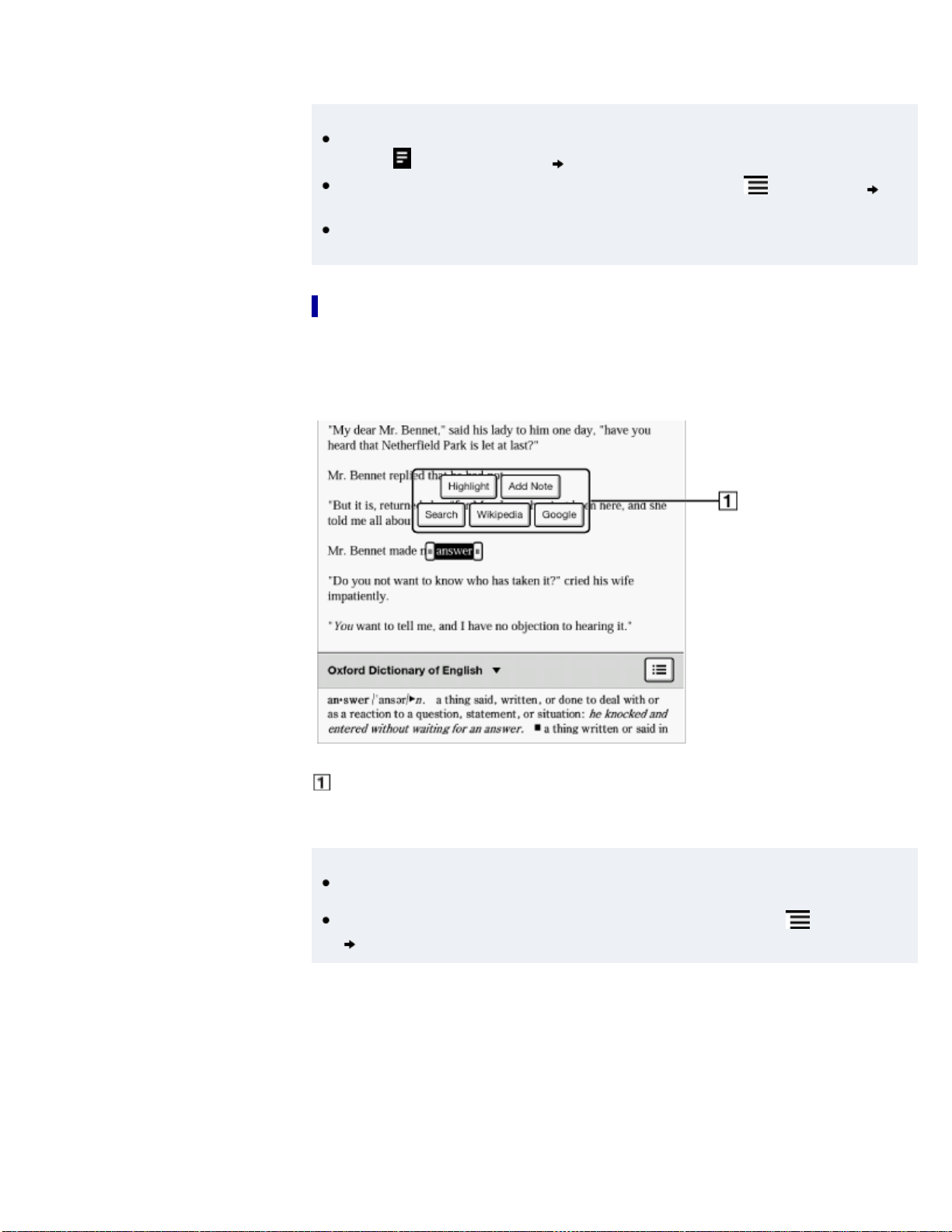
Removing a bookmark
1. Tap the bookmark.
Tip
This will remove the bookmark and any note attached to it. To delete only a note, tap and
hold the
icon and tap [Delete] [Yes].
To delete all bookmarks in the current book/periodical, press the
(Menu) button tap
[Notes]. See Details.
To delete annotations across all books and periodicals, use the [All Notes] application. See
Details.
Highlighting words on a page
You can highlight words and take notes.
1. Tap and hold the first word and drag across to the last word of the section you would like to
highlight.
The pop-up menu appears.
Pop-up menu
2. Tap [Highlight].
The selected words are now highlighted.
Tip
To search, sort and view all annotations across all books and periodicals, use the [All
Notes] application. See Details.
To search annotations for the currently open book/periodical, press the
(Menu) button
tap [Notes]. See Details.
Adding text notes or handwritten notes to a highlight
1. Tap and hold a highlighted word.
The pop-up menu appears.
2. Select [Add Note].
3. Select from [by Keyboard] and [by Drawing].
Create a note.
For a text note, see Details.
For a handwritten note, see Details.
4. Tap [Save].
63
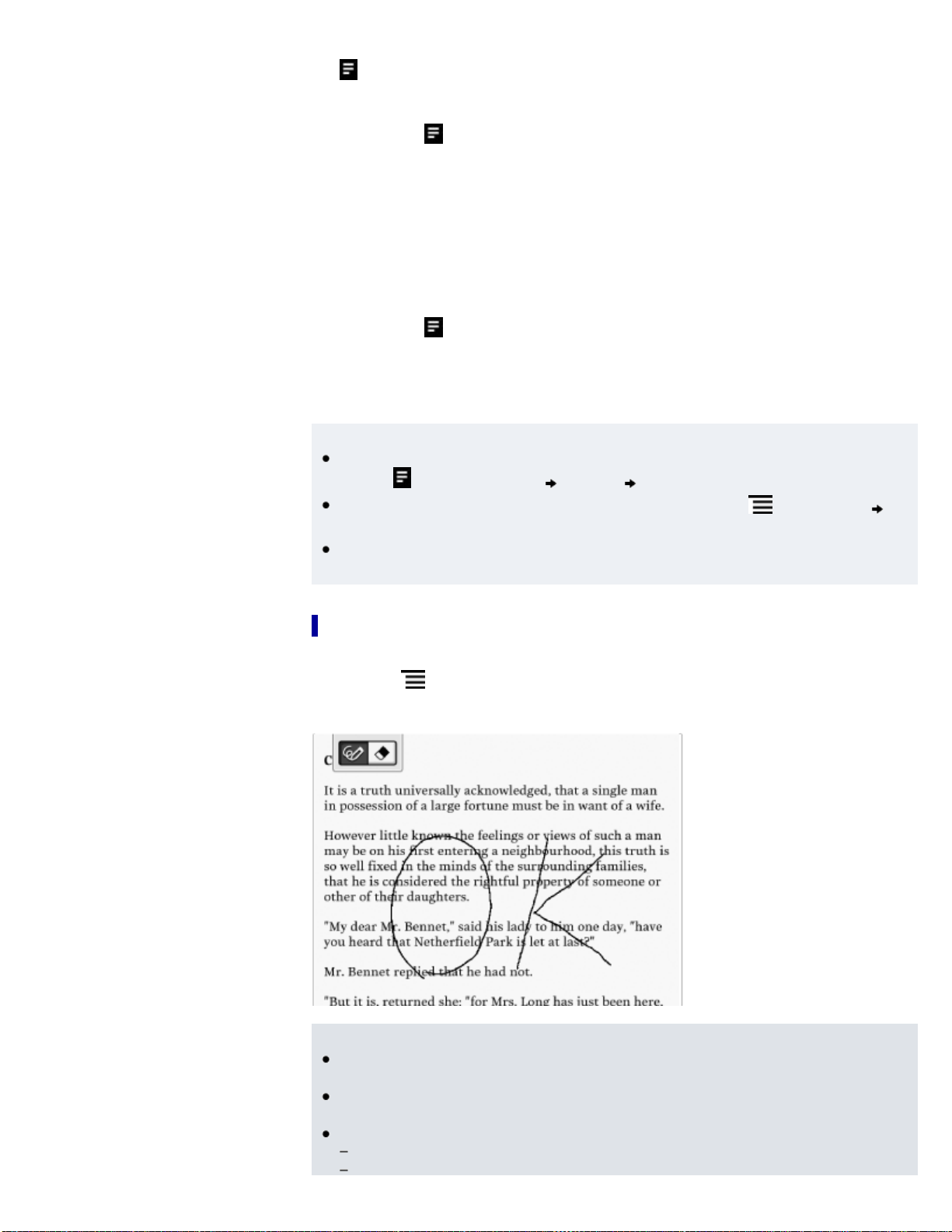
To cancel adding notes, tap [Cancel].
The icon appears at the beginning of the highlight, indicating that a note is attached.
Editing notes on a highlight
1. Tap and hold at the beginning of the highlight.
The pop-up menu appears.
2. Tap [Edit Note].
The on-screen keyboard or the drawing pad opens.
3. Edit the note.
4. Tap [Save].
The notepad or the drawing pad closes, returning to the viewer.
Removing highlights
1. Tap and hold at the beginning of the highlight.
The pop-up menu appears.
2. Tap [Remove Highlight].
3. Tap [Yes] when prompted.
Tip
This will remove the highlight and any note attached to it. To delete only a note, tap and
hold the
icon, tap [Edit Note] [Delete] [Yes].
To delete all annotations in the current book/periodical, press the
(Menu) button tap
[Notes]. See Details.
To delete annotations across all books and periodicals, use the [All Notes] application. See
Details.
Handwriting a note on a page
You can use the stylus or your finger and draw directly on a page.
1. Press the (Menu) button.
2. Tap [Handwriting] and use the stylus or your finger to draw a line.
Note
While writing, make sure that you are not touching another area on the touchscreen; this
could affect the notes that you write with the stylus or your finger.
To ensure that your notes are correctly saved, do not handwrite notes too close to the edge
of the touchscreen.
If you experience difficulties when handwriting or drawing on the Reader:
avoid applying excessive pressure to the touchscreen.
64
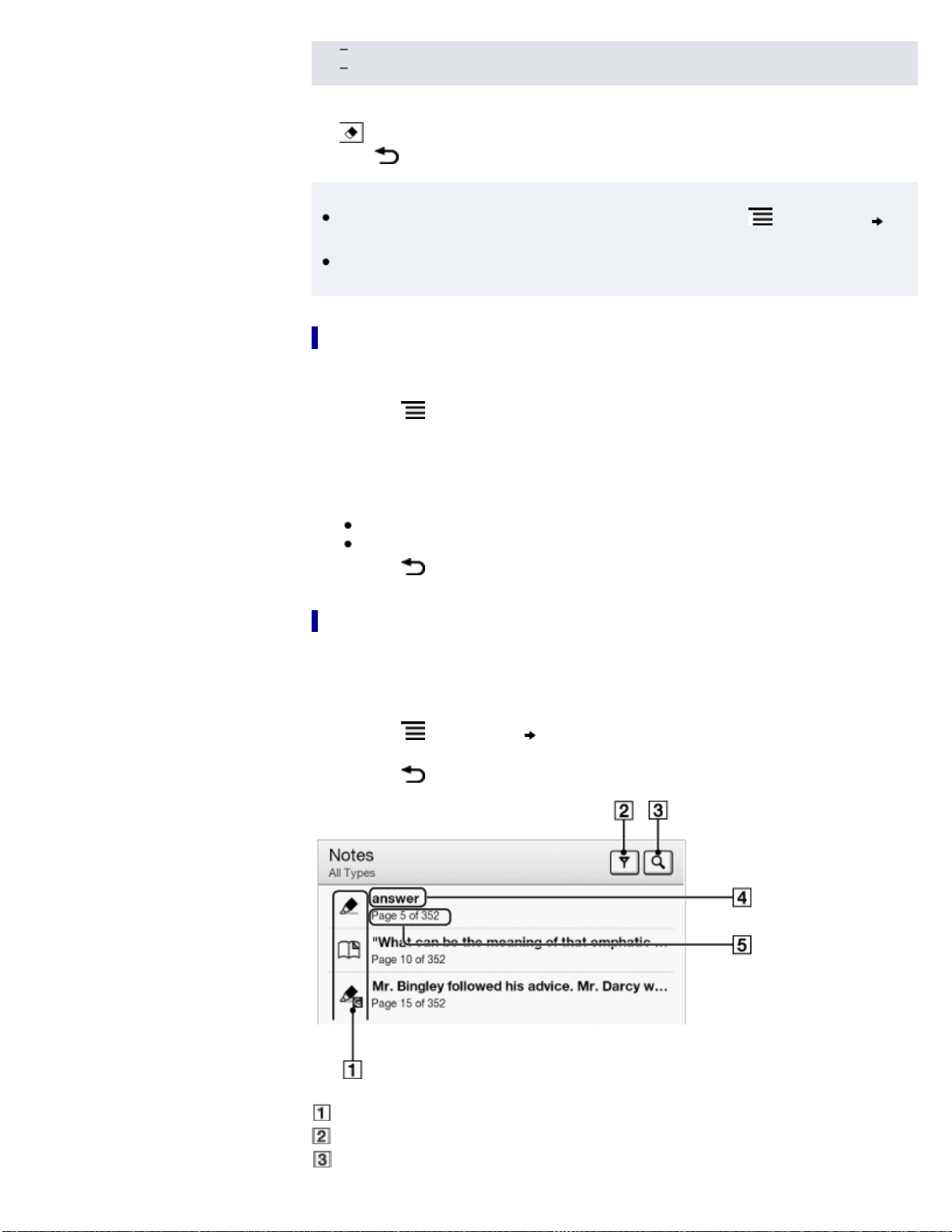
try not to handwrite or draw too quickly.
this functionality is not designed for very detailed drawings or for writing small characters.
To delete a drawn line
Tap (Erase) and drag across the drawn line.
Press the (Back) button when you are done to continue reading.
Tip
To delete all annotations in the current book/periodical, press the
(Menu) button tap
[Notes]. See Details.
To delete annotations across all books and periodicals, use the [All Notes] application. See
Details.
Hiding annotations
You can set the viewer to show or hide the annotations that you have made to the book. This is
convenient for when a highlight overlaps with a link.
1. Press the
(Menu) button.
The option items appear.
2. Tap [More].
3. Tap [Settings].
4. Tap [Show Notes].
Check the checkbox to show annotations.
Uncheck it to hide annotations.
5. Press the
(Back) button when done.
Finding annotations within a book or periodical
You can search and view all annotations (bookmarks/highlights/handwritten notes) in the
currently open book or periodical.
To search, sort and view all annotations across all books and periodicals, use the [All Notes]
application. See Details.
1. Press the
(Menu) button tap [Notes].
The annotations in the book/periodical are listed.
Press the
(Back) button to return to the book.
Note icons
Filter note type
Search icon
65
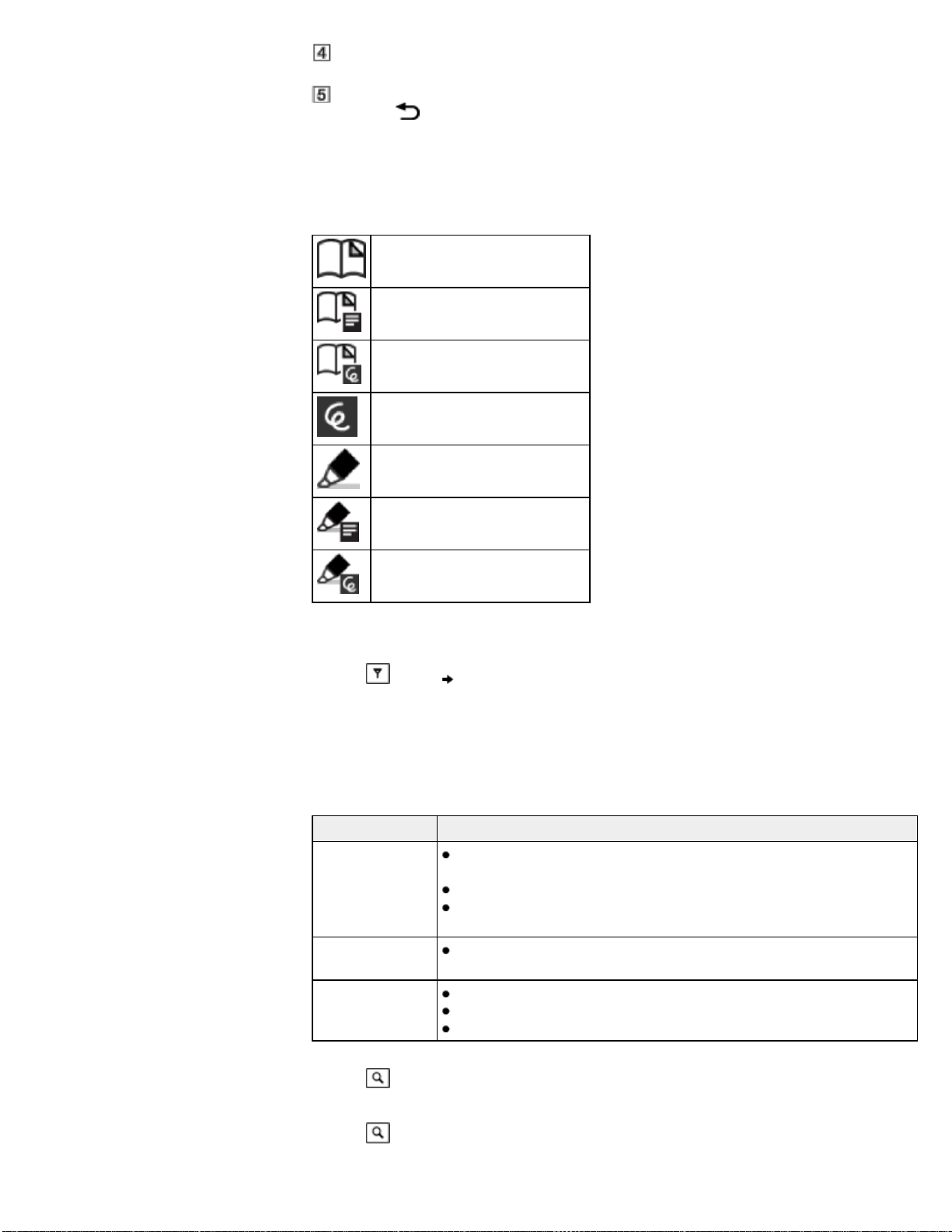
Headline (the highlighted text, the text note, the beginning text of the bookmarked page, or
the beginning text of the page with the handwritten note)
Page number of the note
Press the (Back) button to return to the book.
2. Tap a note in the list.
The page containing the selected note is displayed.
Note icons
Bookmark only
Bookmark with text notes
Bookmark with handwritten notes
Handwritten note on a page
Highlight only
Highlight with text notes
Highlight with handwritten notes
Filtering
1. Tap (Filter) tap one of the annotation types.
Annotations of the type that you select are shown.
Searching for notes via keyword
You can perform a search for all or one of the specific note types.
The search target changes depending on the type of annotation that is being searched.
Item type Target
For [Bookmark]
items
Bookmarks only: The first 100 characters of bookmarked pages are
searched.
Bookmark text notes: Entire text notes are searched.
Bookmark handwritten notes: The first 100 characters of bookmarked
pages are searched.
For [Handwriting]
items
The first 100 characters of pages with handwriting on them are
searched.
For [Highlight]
items
Highlights only: The highlighted words are searched.
Highlight text notes: Entire text notes are searched.
Highlight handwritten notes: The highlighted words are searched.
1. Tap
(Search).
2. Type a search keyword using the on-screen keyboard.
3. Tap
(Search) next to the search box.
The [Search Results] view is shown.
66
The view shows notes that satisfy the search criteria.
Press the (Back) button to return to the [Notes] list.
Note
If you apply a filter before searching, the search will be performed only on the filtered items.
To delete annotations
1. Press the (Menu) button tap [Delete Notes]. See Details.
To delete all annotations
1. Press the (Menu) button tap [Delete Notes] press the (Menu) button tap
[Select All]
[Done] [Yes].
Using (Menu) Items
Press the (Menu) button from the [Notes]/[All Notes] list to select an option.
Option Description
[Delete Notes] Deletes one or more notes from the Reader. See Details.
Go to page top
Copyright 2011 Sony Corporation
67
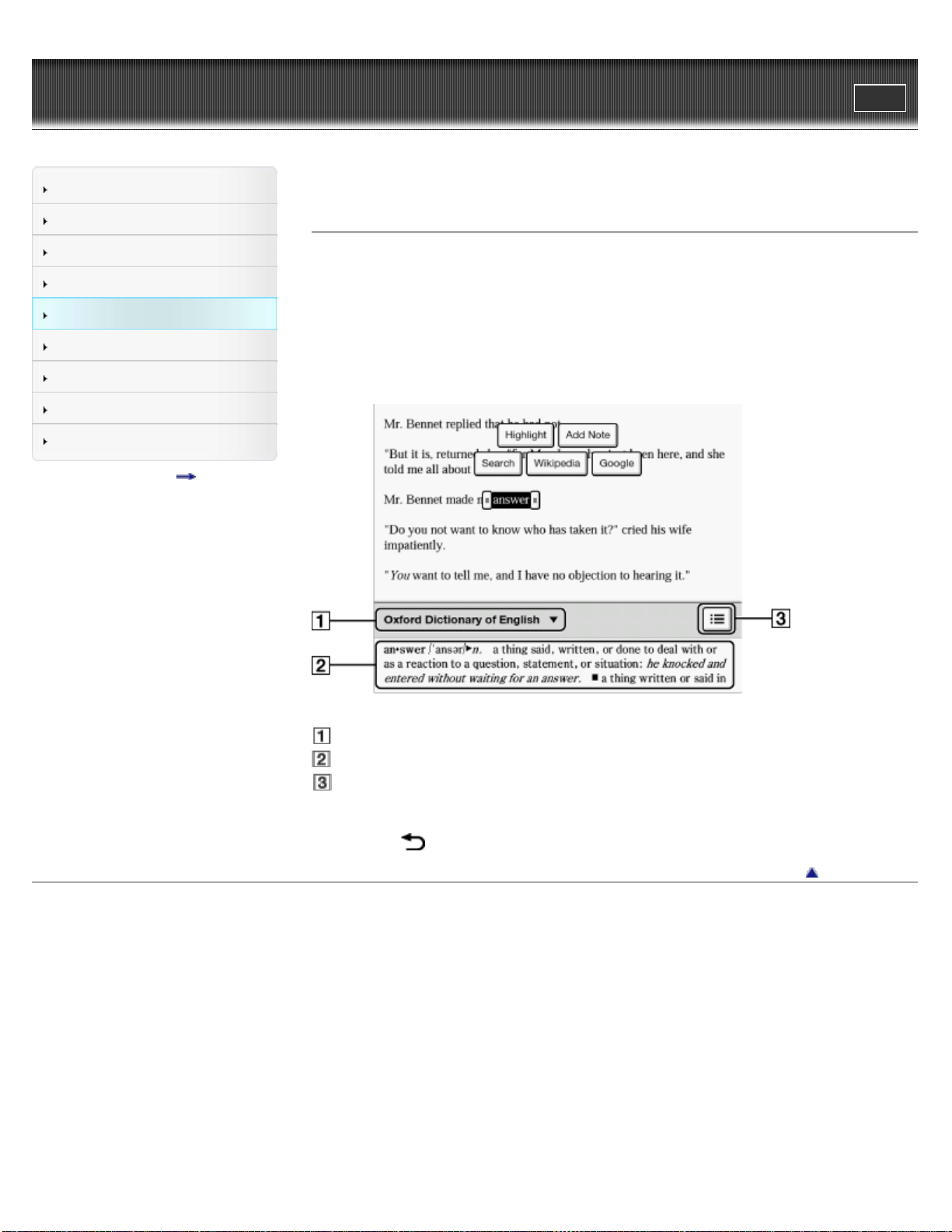
Reader™ User Guide
Print
Search
Getting started
Basic Operations
Adding/Getting Content
Browsing Content Lists
Reading
Organizing
Other Applications
Settings
Other Information
Contents list
Top page > Reading > Reading Books > Using the Dictionary
Using the Dictionary
The Reader has built-in dictionaries to assist you with looking up the definition of a word on a
page.
You can choose one of several bilingual dictionaries to use. See Details.
Only the dictionaries included on the Reader can be used. New dictionaries cannot be installed
or added.
1. Tap and hold a word on a page.
The dictionary panel is displayed at the bottom.
Title of the current dictionary. Tap to change the dictionary.
Definition area. Tap to open the dictionary viewer. See Details.
Tap to display a list of candidate words. See Details.
2. Tap the definition area. The definition is displayed in the dictionary viewer.
To go to the next page, either swipe or press the < or > (Page turn) buttons.
Press the
(Back) button to return to the book page.
Go to page top
Copyright 2011 Sony Corporation
68
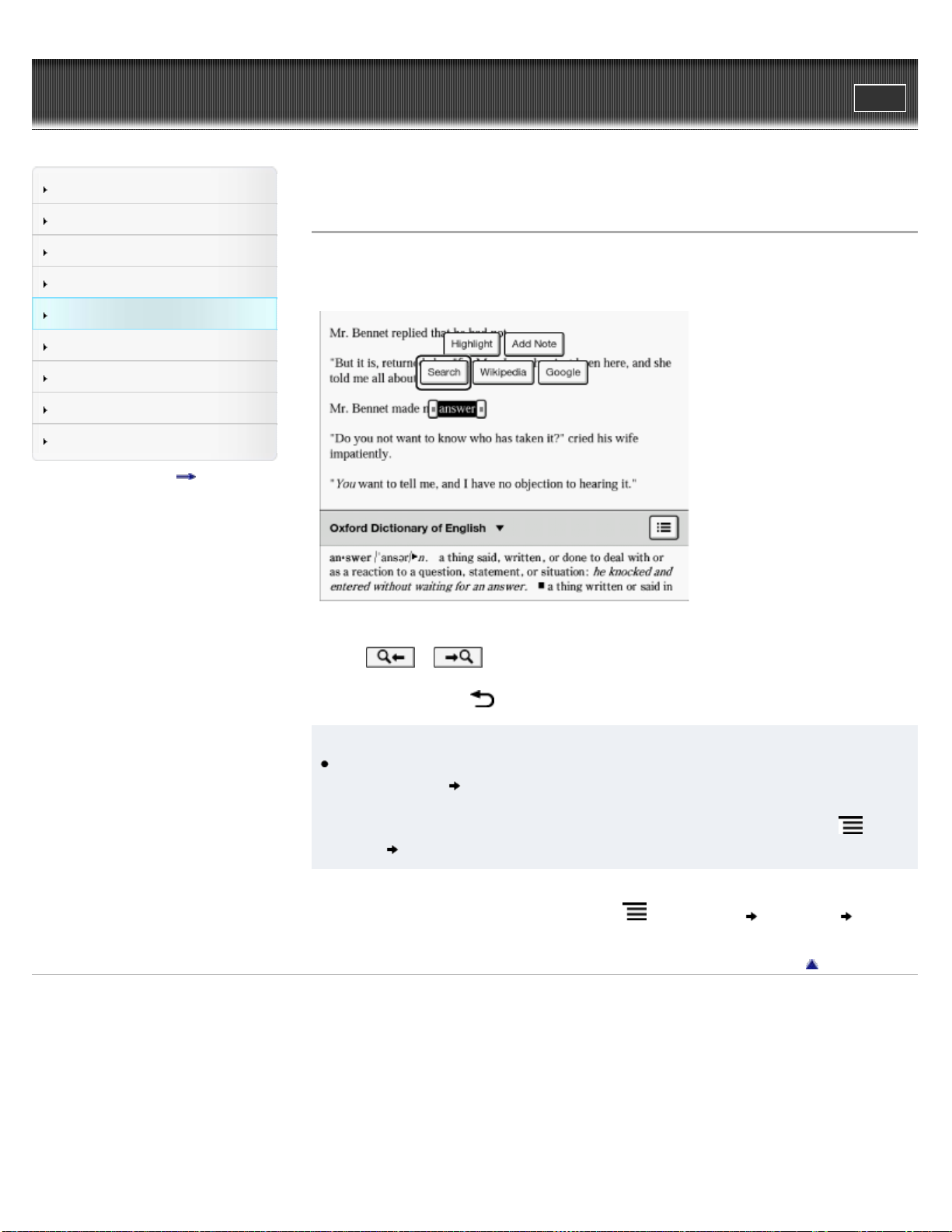
Reader™ User Guide
Print
Search
Getting started
Basic Operations
Adding/Getting Content
Browsing Content Lists
Reading
Organizing
Other Applications
Settings
Other Information
Contents list
Top page > Reading > Reading Books > Finding Pages with a Keyword
Finding Pages with a Keyword
You can find pages that contain specific words using a keyword search.
1. Tap and hold a word, and tap [Search] in the pop-up menu.
2. A page that includes the keyword for which you searched is displayed.
Tap or to display to the previous/next page that contains the selected
keyword.
To cancel, press the
(Back) button.
Tip
You can find the definition of a word and more at the Wikipedia and Google Web sites. Tap
and hold a word
tap [Wikipedia] or [Google] on the option menu. The [Browser]
application will open to the Wikipedia or Google Web site and search for the word. (A Wi-Fi
network connection is necessary. See Details.) To return to the book, press the
(Menu)
button
tap [Continue Reading].
You can also directly enter the keyword for a search.
1. When viewing a book or periodical, press the (Menu) button tap [More]
[Search], and enter the keyword using the on-screen keyboard.
Go to page top
Copyright 2011 Sony Corporation
69
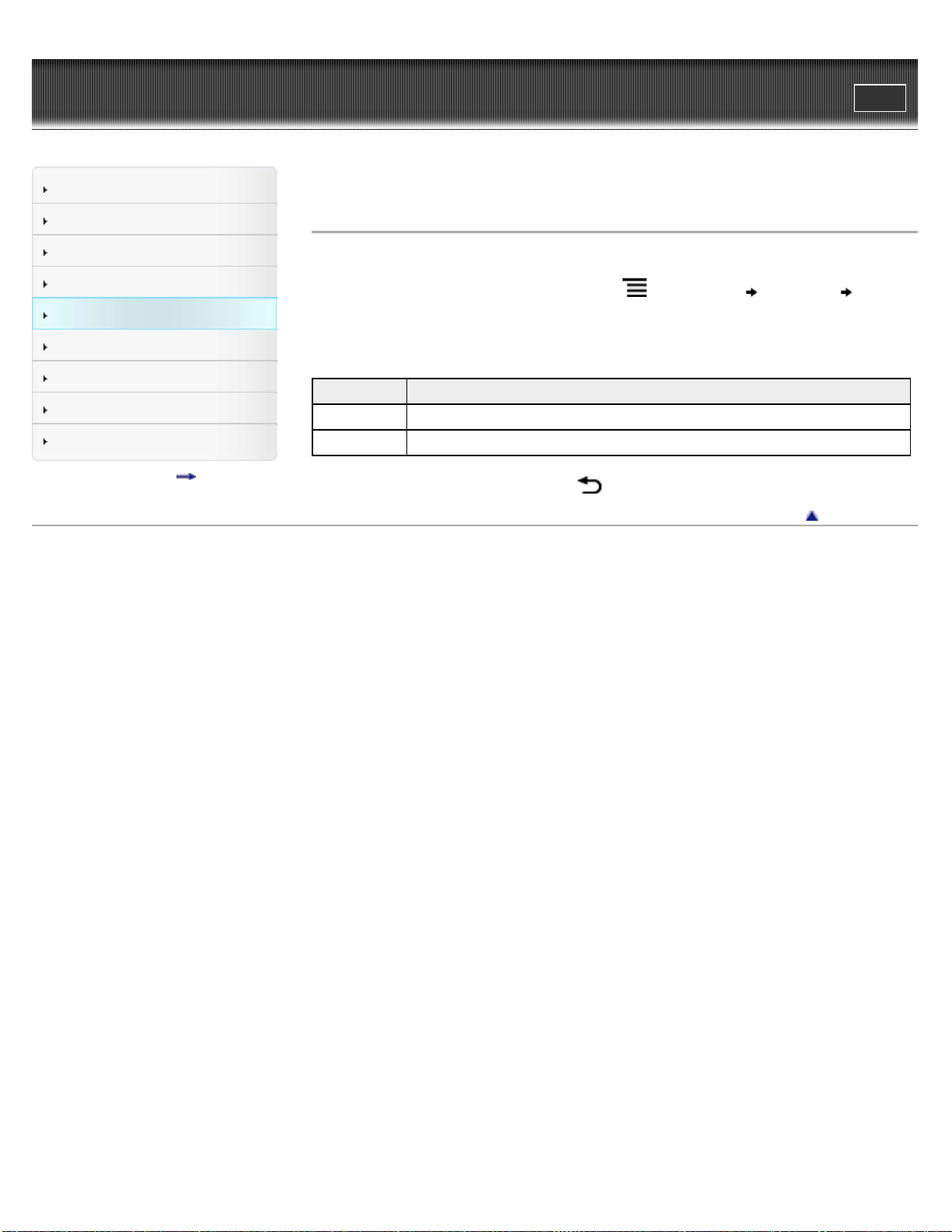
Reader™ User Guide
Print
Search
Getting started
Basic Operations
Adding/Getting Content
Browsing Content Lists
Reading
Organizing
Other Applications
Settings
Other Information
Contents list
Top page > Reading > Reading Books > Changing Book Page Settings
Changing Book Page Settings
The following settings are available for the current book or periodical issue you are reading.
1. When viewing a book or periodical, press the (Menu) button tap [More]
[Settings].
2. Choose from one of the following options.
Option Description
[Show Notes] This is convenient when notes are obscuring your view of the text. See Details.
[Info] Information for the book or periodical that is currently open is displayed.
To return to the book/periodical, press the
(Back) button.
Go to page top
Copyright 2011 Sony Corporation
70
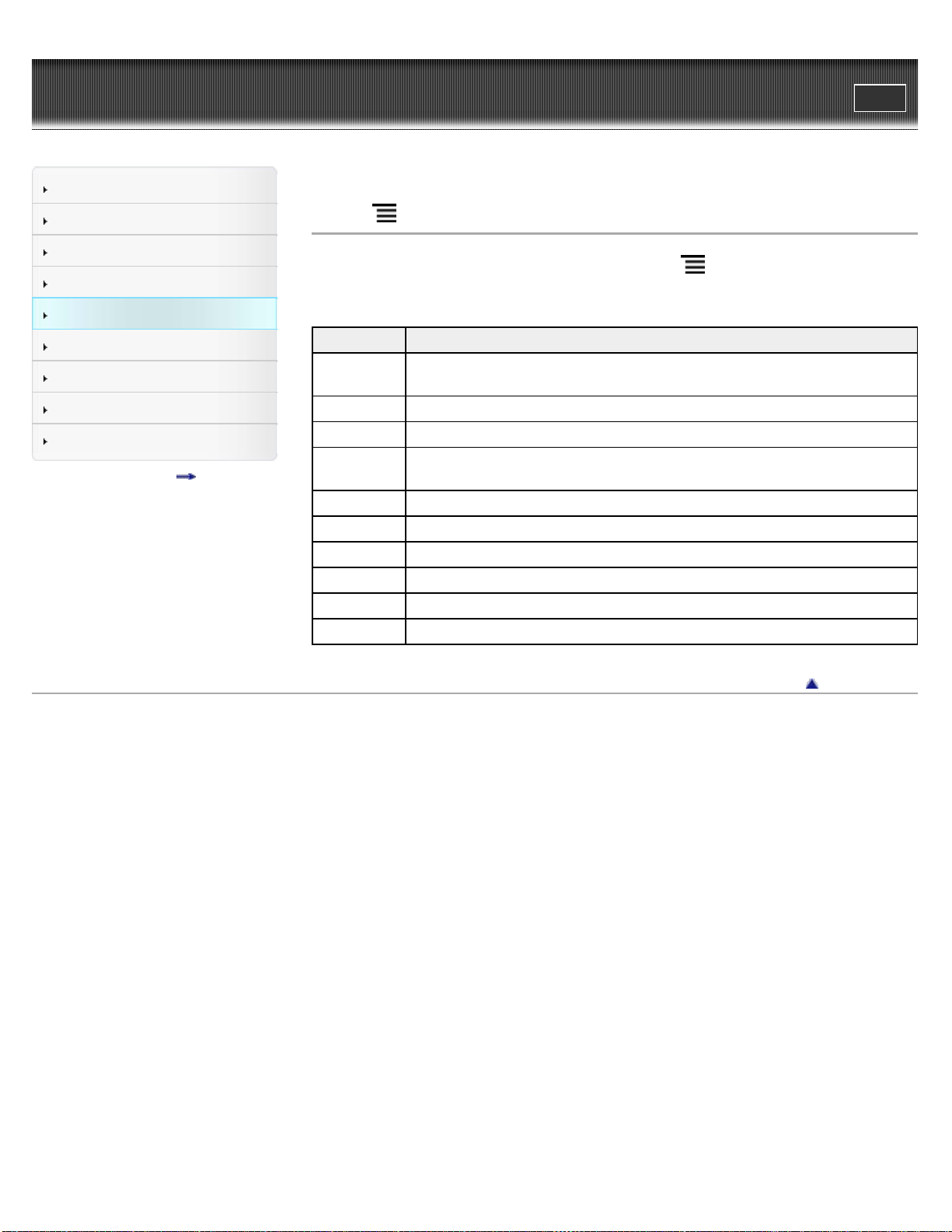
Reader™ User Guide
Print
Search
Getting started
Basic Operations
Adding/Getting Content
Browsing Content Lists
Reading
Organizing
Other Applications
Settings
Other Information
Contents list
Top page > Reading > Reading Books > Using (Menu) Items
Using (Menu) Items
Below is a list of option items available when you press the (Menu) button from the
book/periodical viewer.
Option Description
[Navigate
Page]
Selects a method for navigating through a book. See Details.
[Notes] Displays a list of annotations in the book. See Details.
[Font] Changes the font and font size. See Details.
[Customize
View]
Adjusts the page mode (see Details), crops the page margins (see Details) or
adjusts the brightness (see Details).
[Adjust View] Adjusts the page mode. See Details.
[Handwriting] Allows you to draw on a page. See Details.
[More] Displays more option items.
[Search] Finds pages with a keyword. See Details.
[Orientation] Changes to portrait or landscape mode. See Details.
[Settings] Changes book settings. See Details.
Go to page top
Copyright 2011 Sony Corporation
71
Reader™ User Guide
Print
Search
Getting started
Basic Operations
Adding/Getting Content
Browsing Content Lists
Reading
Organizing
Other Applications
Settings
Other Information
Contents list
Top page > Reading > Reading Periodicals > Opening a Periodical Issue
Opening a Periodical Issue
Newspapers and magazines that you have purchased at Reader Store are downloaded to
[Periodicals] on the [Home] screen.
1. Press the
(Home) button tap [Periodicals].
The periodicals content list opens.
2. Tap a periodical title.
The issues list opens.
3. Tap an issue.
The issue opens.
4. Use the navigation bar as you read. See Details.
To browse the periodicals and issue content list, see Details.
When viewing the periodicals and issues content lists, you can use option items by pressing the
(Menu) button. See Details.
Go to page top
Copyright 2011 Sony Corporation
72
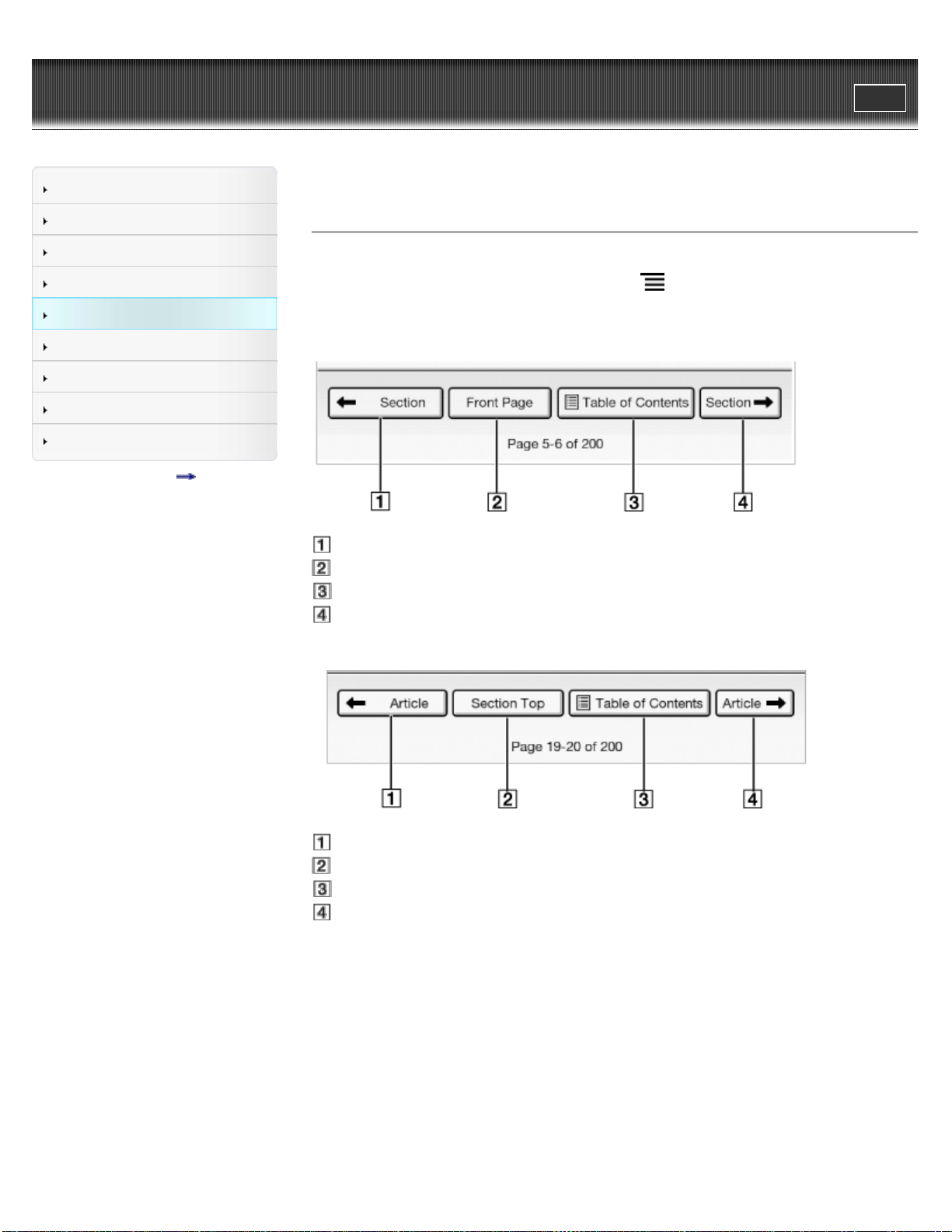
Reader™ User Guide
Print
Search
Getting started
Basic Operations
Adding/Getting Content
Browsing Content Lists
Reading
Organizing
Other Applications
Settings
Other Information
Contents list
Top page > Reading > Reading Periodicals > Page Navigation
Page Navigation
You can add bookmarks and notes to a page in the same manner as books. See Details.
For the option items that appear when you press the
(Menu) button, see Details.
Periodicals also feature the navigation bar, which helps redirect you to sections of a periodical.
Navigation items for a section
Previous section
Return to the first page
Table of Contents
Next section
Navigation items for an article
Previous article
Return to the first page of the section
Table of Contents
Next article
Appearance
See Details.
Annotations
See Details.
Using the Dictionary
See Details.
Finding Pages with a Keyword
See Details.
73

Reader™ User Guide
Print
Search
Getting started
Basic Operations
Adding/Getting Content
Browsing Content Lists
Reading
Organizing
Other Applications
Settings
Other Information
Contents list
Top page > Organizing > Organizing Your Content > Deleting a Single Item
Deleting a Single Item
You can delete individual items.
The following instructions use the [Books] application as an example; this feature is also available
in other applications.
1. Press the
(Home) button tap [Books].
2. Tap and hold an item.
The option items appear.
3. Tap [Delete].
4. Tap [Yes] when prompted.
The item is deleted from the Reader.
Note
Depending on the application, it may not be possible to delete certain files.
Sony recommends that you create a backup of the contents of the Reader using the Reader
software before deleting an item.
Go to page top
Copyright 2011 Sony Corporation
75
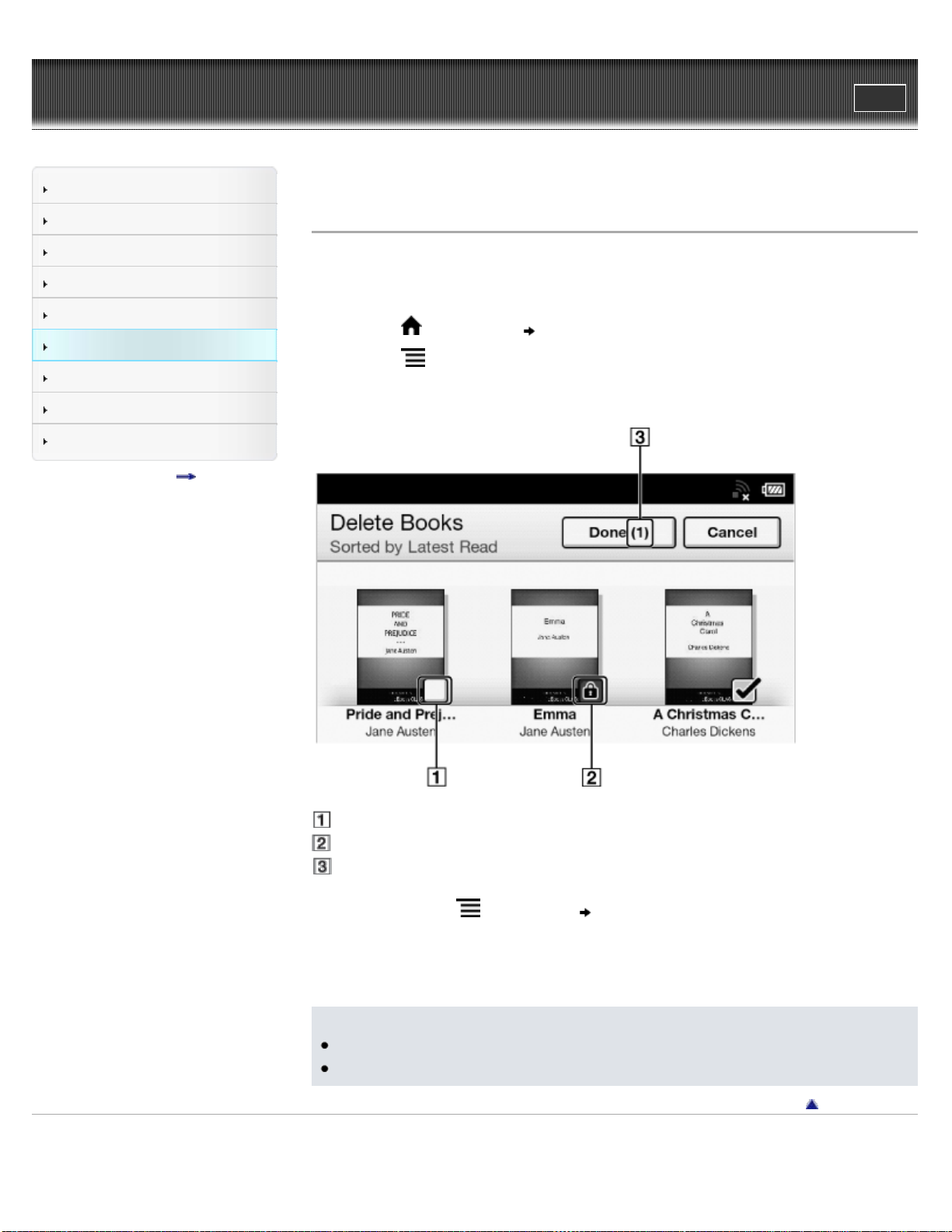
Reader™ User Guide
Print
Search
Getting started
Basic Operations
Adding/Getting Content
Browsing Content Lists
Reading
Organizing
Other Applications
Settings
Other Information
Contents list
Top page > Organizing > Organizing Your Content > Deleting Multiple Items at Once
Deleting Multiple Items at Once
You can delete multiple items at once. This is convenient for clearing up space on the Reader.
The following instructions use the [Books] application as an example; this feature is also available
in other applications.
1. Press the
(Home) button tap [Books].
2. Press the (Menu) button.
3. Tap [Delete Books].
Boxes appear next to the thumbnails or list entries.
Box
Protect icon
Selected number of items
4. Tap to check the items to delete.
You can press the
(Menu) button tap [Select All] if you wish to delete all items.
5. Tap [Done].
6. Tap [Yes] when prompted.
The selected items are deleted from the Reader.
Note
Depending on the application, it may not be possible to delete certain files.
Sony recommends that you create a backup of your files using the Reader software.
Go to page top
Copyright 2011 Sony Corporation
76
Reader™ User Guide
Print
Search
Getting started
Basic Operations
Adding/Getting Content
Browsing Content Lists
Reading
Organizing
Other Applications
Settings
Other Information
Contents list
Top page > Organizing > Organizing Your Content > Protecting a Single Item
Protecting a Single Item
You can protect an item so that you will not delete it accidentally.
The following instructions use the [Books] application as an example; this feature is also available
in other applications.
1. Press the
(Home) button tap [Books].
2. Tap and hold an item.
The option items appear.
3. Tap [Protect].
You can remove the protection from the item in the same manner. Tap [Unprotect] in Step 3
above.
Note
This protection feature works only on the Reader. Protected content may still be deleted via
your computer.
Go to page top
Copyright 2011 Sony Corporation
77
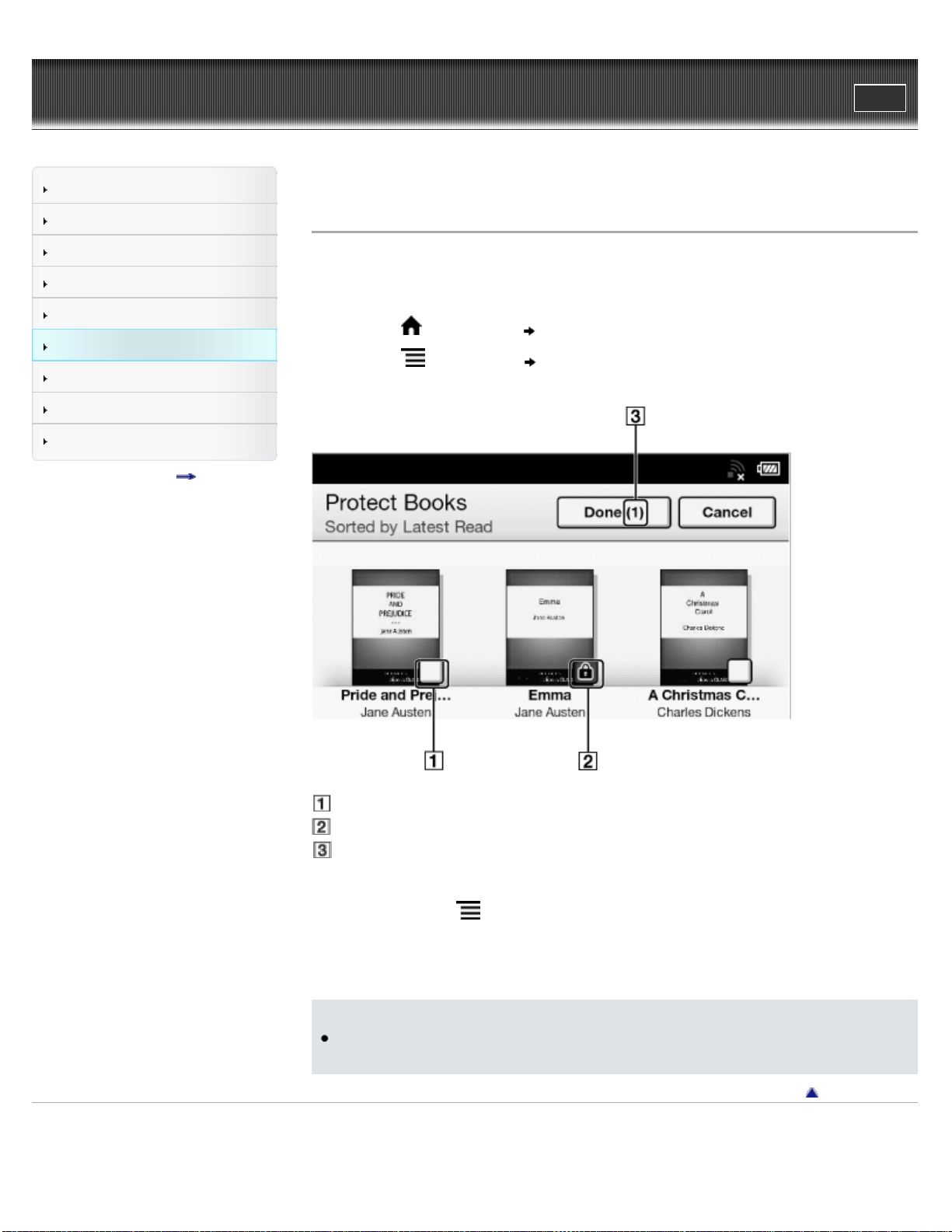
Reader™ User Guide
Print
Search
Getting started
Basic Operations
Adding/Getting Content
Browsing Content Lists
Reading
Organizing
Other Applications
Settings
Other Information
Contents list
Top page > Organizing > Organizing Your Content > Protecting Multiple Items at Once
Protecting Multiple Items at Once
You can protect one or more items at once.
The following instructions use the [Books] application as an example; this feature is also available
in other applications.
1. Press the
(Home) button tap [Books].
2. Press the (Menu) button tap [Protect Books].
Boxes appear next to the thumbnails or list entries.
Box
Protect icon
Selected number of items
3. Tap the box of the item to be protected.
Selected items are indicated with a protect icon.
You can press the (Menu) button and tap [Select All] if you wish to protect all items.
4. Tap [Done].
The protect icon appears next to the protected items. You can remove protection in Step 3 above
by tapping items with the protect icon.
Note
The protection feature works only on the Reader. Protected content may still be deleted via
your computer.
Go to page top
Copyright 2011 Sony Corporation
78
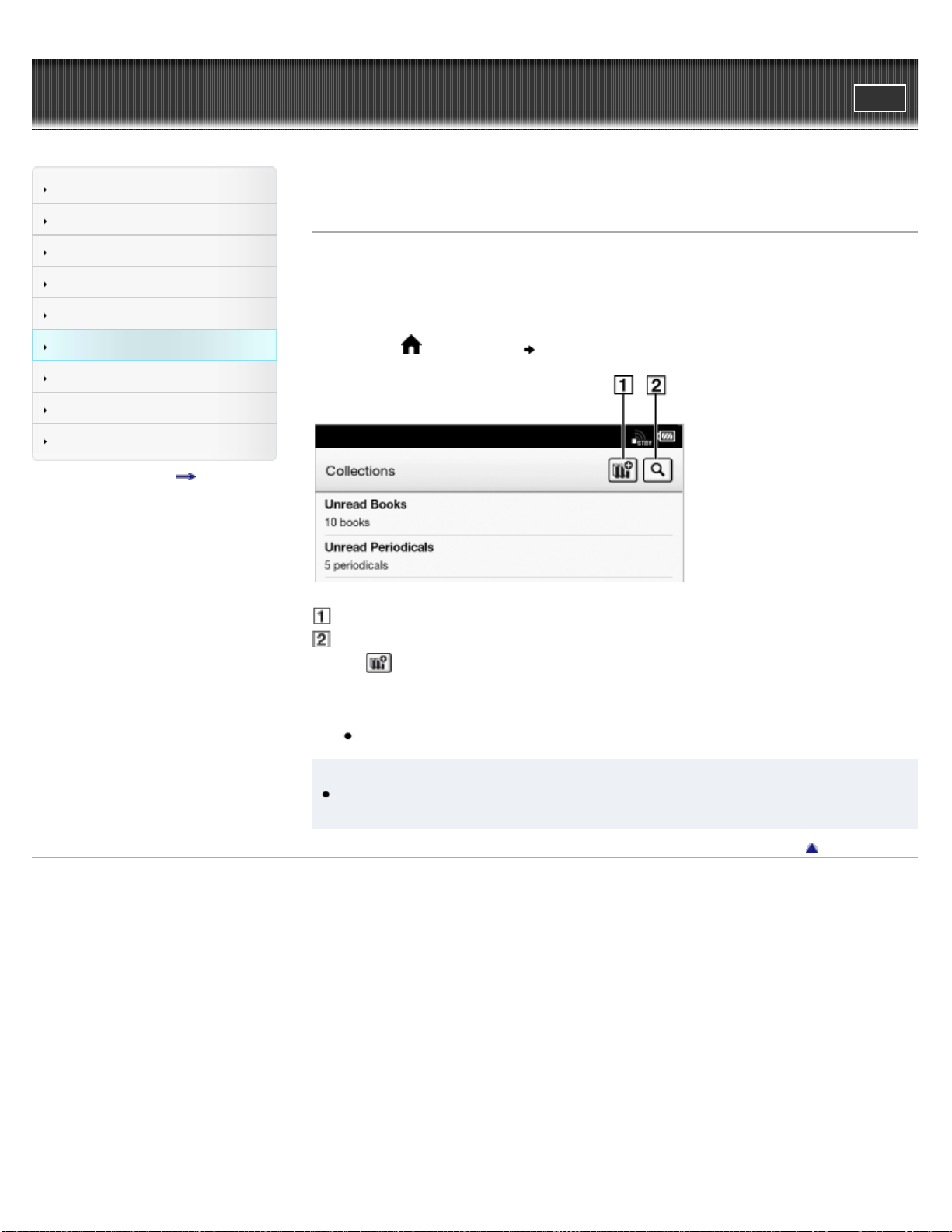
Reader™ User Guide
Print
Search
Getting started
Basic Operations
Adding/Getting Content
Browsing Content Lists
Reading
Organizing
Other Applications
Settings
Other Information
Contents list
Top page > Organizing > Using Collections > Creating a Collection
Creating a Collection
A collection is a custom set of books and other items that you create from items on the Reader. It
is a unique and convenient way to organize your items.
You can organize and personalize your content by creating collections by subject matter, date,
genre or anything that best suits your purpose.
1. Press the
(Home) button tap [Collections].
Create a new collection
Search by collection name
2. Tap
.
3. Enter a collection name using the on-screen keyboard and tap [OK].
4. Select the location to store the collection.
A new collection is added to the [Collections] list.
Tip
You can also create and sync collections with the Reader software. For details, refer to the
[Help] menu of the Reader software.
Go to page top
Copyright 2011 Sony Corporation
79
Reader™ User Guide
Print
Search
Getting started
Basic Operations
Adding/Getting Content
Browsing Content Lists
Reading
Organizing
Other Applications
Settings
Other Information
Contents list
Top page > Organizing > Using Collections > Adding Items to a Collection
Adding Items to a Collection
You can add items to existing collections.
From the [Collections] application
1. Press the (Home) button tap [Collections].
2. Tap a collection that you have created.
3. Press the (Menu) button tap [Add Content] [Books] or [Periodicals].
For periodicals, tap the periodical title to view its issues list.
4. Select one or more books or periodical issues from the list.
Selected items are indicated with a check.
5. Tap [Done].
From the [Books] and [Periodicals] applications
1. Press the (Home) button tap [Books] or [Periodicals].
For periodicals, tap the periodical title to view its issues list.
2. Press the
(Menu) button tap [Add to Collection].
3. Tap a collection that you have created that appears in the list.
4. Select one or more books or periodical issues that you wish to add.
Selected items are indicated with a check.
5. Tap [Done].
Note
A collection and its items must be stored in the same location. For example, if the
book/periodical is stored on the Reader’s internal memory, you may not add items stored on
a microSD card to the collection.
Go to page top
Copyright 2011 Sony Corporation
80
Reader™ User Guide
Print
Search
Getting started
Basic Operations
Adding/Getting Content
Browsing Content Lists
Reading
Organizing
Other Applications
Settings
Other Information
Contents list
Top page > Organizing > Using Collections > Removing Items from a Collection
Removing Items from a Collection
You can remove one or more items from a collection that you have created.
1. Press the
(Home) button tap [Collections] tap a collection that you have created
press the (Menu) button tap [Remove Content].
You can also tap and hold an item
tap [Remove].
2. Tap one or more items.
Selected items are indicated with a check.
3. Tap [Done].
4. Tap [Yes] when prompted.
The selected item(s) will be removed from the collection.
Note
If you have deleted an item from [Books] or [Periodicals], it will be automatically removed
from all of the collections with which it was associated.
Removing items from a collection does not delete them from the Reader or their stored
locations.
Tip
You can remove all items at once. After completing Step 1 above, press the
(Menu)
button
[Select All].
Go to page top
Copyright 2011 Sony Corporation
81
Reader™ User Guide
Print
Search
Getting started
Basic Operations
Adding/Getting Content
Browsing Content Lists
Reading
Organizing
Other Applications
Settings
Other Information
Contents list
Top page > Organizing > Using Collections > Renaming a Collection
Renaming a Collection
You can change the name of a collection.
1. Press the
(Home) button tap [Collections] tap a collection that you have created
press the (Menu) button tap [Rename Collection].
You can also tap and hold a collection that you have created
tap [Rename].
2. Enter a new name for the collection using the on-screen keyboard.
3. Tap [OK].
Go to page top
Copyright 2011 Sony Corporation
82
Reader™ User Guide
Print
Search
Getting started
Basic Operations
Adding/Getting Content
Browsing Content Lists
Reading
Organizing
Other Applications
Settings
Other Information
Contents list
Top page > Organizing > Using Collections > Deleting a Collection
Deleting a Collection
You can delete a collection that you have created.
1. Press the
(Home) button tap [Collections] press the (Menu) button tap
[Delete Collections].
You can also tap and hold a collection that you have created tap [Delete].
2. Tap the collection to be deleted.
Selected items are indicated with a check.
3. Tap [Done].
4. Tap [Yes] when prompted.
The selected item(s) will be removed from the collection.
Note
Deleting a collection does not delete content from the Reader or their stored locations.
Go to page top
Copyright 2011 Sony Corporation
83
Reader™ User Guide
Print
Search
Getting started
Basic Operations
Adding/Getting Content
Browsing Content Lists
Reading
Organizing
Other Applications
Settings
Other Information
Contents list
Top page > Organizing > Using Collections > Using (Menu) Items
Using (Menu) Items
Below is a list of option items available when you press the (Menu) button from a collection
list.
Option Description
[Delete Collections] Deletes collections that you created. See Details.
Go to page top
Copyright 2011 Sony Corporation
84
Reader™ User Guide
Print
Search
Getting started
Basic Operations
Adding/Getting Content
Browsing Content Lists
Reading
Organizing
Other Applications
Settings
Other Information
Contents list
Top page > Other Applications > Google Books > Downloading Public Domain Books from
Google Books*
Downloading Public Domain Books from Google Books*
* Available in certain countries/regions only.
You can choose from thousands of free public domain books from Google.
Note
You must have a Reader Store account to use Google Books. See Details.
1. Configure Wi-Fi settings of the Reader to access Google Books. See Details.
2. Press the
(Home) button tap [Google Books].
You will be taken to Google Books.
Sign in to Reader Store when prompted.
3. Click the download link for a book.
The download will start shortly. You can check the downloading progress in the status bar
and by tapping it to display the notification window. See Details.
Navigation of the [Google Books] application is similar to that of the [Reader Store] application.
See Details.
Once the title has downloaded, it will be stored in the [Books] application.
Go to page top
Copyright 2011 Sony Corporation
85
Reader™ User Guide
Print
Search
Getting started
Basic Operations
Adding/Getting Content
Browsing Content Lists
Reading
Organizing
Other Applications
Settings
Other Information
Contents list
Top page > Other Applications > Public Libraries > Borrowing Books from Public Libraries
Borrowing Books from Public Libraries
Many public libraries (available in certain countries/regions only) offer digital library services so
that you can borrow books for the Reader with your library card.* You can download them
directly to the Reader.
* Using public library services requires a library card. For details, contact your local library.
Locating your public library
1. Configure Wi-Fi settings of the Reader to access your public library. See Details.
2. Press the
(Home) button tap [Public Library].
Follow the directions on the screen to use public library services.
For using the browser, see Details. For using the browser option items, see Details.
Borrowing books
1. Find what you wish to borrow via the public library Web site.
2. Follow the site instructions and download the book. You can check the downloading progress
in the status bar and by tapping it to display the notification window. See Details.
You may be asked to specify the lending period.
Once the title has downloaded, it will be stored in the [Books] application.
You can check the loan periods for borrowed books by viewing the icons in the [Books] content
list. See Details.
Returning books
1. Configure Wi-Fi settings of the Reader to access your public library. See Details.
2. Press the
(Home) button tap [Books] press the (Menu) button tap
[Return Books].
3. Tap the book you want to return. A check mark appears next to the selected book. You can
select multiple books.
4. Tap [Done]
[Yes].
You can check the returning progress in the status bar and by tapping it to display the
notification window. See Details.
The selected books are returned.
Note
If you reach the limit for borrowed books, the public library may prevent you from borrowing
more until you return some of the books you have borrowed.
Some public libraries may allow you to return books early.
Go to page top
Copyright 2011 Sony Corporation
86
Reader™ User Guide
Print
Search
Getting started
Basic Operations
Adding/Getting Content
Browsing Content Lists
Reading
Organizing
Other Applications
Settings
Other Information
Contents list
Top page > Other Applications > Web Browsing > Browsing the Web
Browsing the Web
The Reader has a Web browser that enables you to visit Web sites and download files and
images directly to it.
1. Make sure that Wi-Fi is set up and turned on.
2. Press the (Home) button tap [Browser].
3. Navigate to a Web site.
Tap (Bookmarks) tap one of the bookmarks.
Tap the URL box and type the URL address using the on-screen keyboard, and tap [Go].
4. Browse the Web site.
Press the < (Previous) button to scroll up.
Press the > (Next) button to scroll down.
Tap and drag to move the view area.
Press the
(Back) button to go back to the previous Web page.
Note
You must agree to the terms and conditions before using [Browser]. Please read the terms
and conditions carefully. When you tap [Accept], [Browser] opens.
Tip
You can press the
(Menu) button tap [Continue Reading] to return to the last read
page of your last read book.
Go to page top
Copyright 2011 Sony Corporation
87
Reader™ User Guide
Print
Search
Getting started
Basic Operations
Adding/Getting Content
Browsing Content Lists
Reading
Organizing
Other Applications
Settings
Other Information
Contents list
Top page > Other Applications > Web Browsing > Browsing Tools
Browsing Tools
Zooming in
While in zoom mode, the zoom bar is shown at the bottom-right of the screen.
Pinch out to zoom in.
Pinch in to zoom out.
Double-tap to fit the page to the window size.
To exit zoom mode, press the
(Back) button.
Capturing a screenshot
You can capture the current page as a screenshot.
1. When viewing a Web page, press the (Menu) button tap [More] [Capture
Screenshot]
[OK].
Screenshots are stored in the [Pictures] application. See Details.
Go to page top
Copyright 2011 Sony Corporation
88
Reader™ User Guide
Print
Search
Getting started
Basic Operations
Adding/Getting Content
Browsing Content Lists
Reading
Organizing
Other Applications
Settings
Other Information
Contents list
Top page > Other Applications > Web Browsing > Downloads
Downloads
When you click a download link, the item will be downloaded onto the Reader.*
You can view the download history by pressing the
(Menu) button tap [More]
[Downloads].
* Only supported file types can be downloaded. For supported file types, see Details.
Downloading a linked file
You can download a file behind a link without opening it in the browser window.
1. Tap and hold the link
tap [Save Link].
2. Tap [Yes] when prompted.
Depending on the Web site, a file may begin downloading once you tap the download icon.
The downloaded file can be found in the [Books] application.
Downloading an image
You can download an image displayed in the browser window.
1. Tap and hold the image
tap [Save Image].
2. Tap [Yes] when prompted.
Viewing download progress
You can view items that you are currently downloading or have recently downloaded.
1. When an item is downloading, an icon indicating that the download is in progress appears in
the status bar.
Tap the status bar to open the notification window. See Details.
Items that you are currently downloading are listed under [Ongoing].
Recent items that have been downloaded and recent items which were not downloaded
successfully are listed under [Notification].
2. Press the
(Back) button to return to the Web page.
Cancelling a download
You can cancel a download that is currently in progress.
1. When viewing a Web page, press the (Menu) button tap [More] [Downloads].
You can also tap the status bar
tap the item currently downloading under [Ongoing].
The download history opens.
2. Tap and hold an item
tap [Cancel Download], or press the (Menu) button tap
[Cancel Download].
To return to the Web page, press the
(Back) button.
Opening a downloaded file/image
You can view the files downloaded from a Web site. Downloaded files are stored in [Books],
89

[Pictures] or [Audio], depending on the file type.
1. When viewing a Web page, press the (Menu) button tap [More] [Downloads].
You can also tap the status bar
tap the item currently downloading under [Notification].
2. Tap a downloaded file, or tap and hold an item
tap [Open].
The Reader opens the file in the appropriate application.
To return to the Web page, press the
(Back) button.
Deleting a downloaded file
You can delete downloaded files.
1. When viewing a Web page, press the (Menu) button tap [More] [Downloads].
2. Tap and hold an item
tap [Delete].
The file is deleted from the Reader.
Depending on the file type, files can also be deleted from their respective applications.
Go to page top
Copyright 2011 Sony Corporation
90
Reader™ User Guide
Print
Search
Getting started
Basic Operations
Adding/Getting Content
Browsing Content Lists
Reading
Organizing
Other Applications
Settings
Other Information
Contents list
Top page > Other Applications > Web Browsing > Multiple Windows
Multiple Windows
Opening a new window
1. When viewing a Web page, press the (Menu) button [More] [Windows]
[New Window].
A maximum of 3 windows can be open at one time. If [New Window] is not displayed, tap
[Close] in the Window list.
Opening a link in a new window
Instead of the current window, you can open a link in a new window so that you can keep the
current window open.
1. Tap and hold a link
tap [Open in New Window].
The link opens in a new window.
A maximum of 3 windows can be open at one time. After the third window is opened, [Open in
New Window] is not displayed.
Changing the browser window in view
When you have more than one browser window open, you can change the window in view.
1. When viewing a Web page, press the (Menu) button tap [More] [Windows].
2. Select another browser window.
Closing a browser window
You can close browser windows.
1. When viewing a Web page, press the (Menu) button tap [More] [Windows].
2. Tap [Close].
The window is closed.
Note
If there is only one browser window open and you tap [Close], the browser home page is
automatically opened.
Go to page top
Copyright 2011 Sony Corporation
91
Reader™ User Guide
Print
Search
Getting started
Basic Operations
Adding/Getting Content
Browsing Content Lists
Reading
Organizing
Other Applications
Settings
Other Information
Contents list
Top page > Other Applications > Web Browsing > Bookmarks and History
Bookmarks and History
Bookmarking a Web site
You can bookmark your favorite Web sites so that you can return to them quickly.
1. Visit the Web site that you wish to bookmark.
2. Add the current site to the bookmarks by doing one of the following:
Tap next to the URL box tap [Add bookmark...].
Press the
(Menu) button tap [More] [Add Bookmark].
3. Optionally, edit the bookmark name by tapping the text input area under [Name] and using
the on-screen keyboard. See Details.
4. Tap [OK].
The current Web page is now added to the bookmark list.
Opening a bookmarked Web site
You can quickly return to your favorite Web sites using bookmarks.
1. When viewing a Web page, tap
next to the URL box.
The bookmark list opens.
2. Tap the bookmark to open it.
Editing a bookmark
You can change a bookmark name or the address (URL) if necessary.
1. When viewing a Web page, tap
next to the URL box.
The bookmark list opens.
2. Tap and hold the bookmark that you wish to edit
tap [Edit Bookmark].
3. Edit the bookmark name/location by tapping the text input area under [Name]/[Location] and
using the on-screen keyboard.
4. Tap [OK].
To return to the Web page you were browsing, press the
(Back) button.
Deleting bookmarks
You can remove bookmarks from the bookmark list to keep only the ones you need.
1. When viewing a Web page, tap
next to the URL box.
The bookmark list opens.
2. Tap and hold the bookmark that you wish to remove from the list
tap [Delete Bookmark].
3. Tap [OK] when prompted.
The bookmark is removed from the list.
To return to the Web page you were browsing, press the
(Back) button.
92
Opening a previously visited Web site
You can view a list of Web sites that you have previously visited.
1. When viewing a Web page, tap
next to the URL box.
2. Tap [History].
A list of sites that you have previously visited opens.
3. Tap an item to open it in the browser.
Deleting browsing history items
You can remove entries from the browsing history.
1. When viewing a Web page, tap
next to the URL box.
2. Tap [History].
A list of sites that you have previously visited opens.
3. Tap and hold the entry that you wish to remove from the list
tap [Remove from History].
4. Press the
(Back) button to return to the Web page you were browsing.
Tip
You can delete all browsing history items by pressing the (Menu) button tapping
[Clear History] in Step 2.
Go to page top
Copyright 2011 Sony Corporation
93
Reader™ User Guide
Print
Search
Getting started
Basic Operations
Adding/Getting Content
Browsing Content Lists
Reading
Organizing
Other Applications
Settings
Other Information
Contents list
Top page > Other Applications > Web Browsing > Browser Settings
Browser Settings
You can change the following browser settings to your preference. When viewing a Web page,
press the
(Menu) button and tap [More] [Settings] to change the settings.
Setting Description
[Default Zoom] The default zoom ratio. Set to “Medium” by default.
[Open Pages in
Overview]
Opens the page scaled to the window size. Enabled by default.
[Text Encoding]
Set to “Unicode (UTF-8)” by default. The browser supports the following
encodings:
Latin-1 (ISO-8859-1)
Unicode (UTF-8)
[Block Pop-up
Windows]
Blocks pop-up windows. Enabled by default.
[Load Images] Loads images on a Web page. Enabled by default.
[Auto-fit Pages] Formats Web pages to the window size. Enabled by default.
[Enable
JavaScript]
Enables JavaScript. Enabled by default.
[Set Home Page]
Sets the default Web page to display. You can set the currently opened
Web page as your home page.
[Page Information] Displays the details of a Web page.
[Clear Cache] Empties the cache.
[Clear History] Deletes the browsing history.
[Accept cookies] Accepts cookies from Web sites. Enabled by default.
[Clear All Cookie
Data]
Removes all cookies.
[Remember Form
Data]
Allows the browser to remember the form history. Enabled by default.
[Clear Form Data] Empties the search and form history.
[Remember
Passwords]
Allows the browser to remember some entered passwords. Enabled by
default.
[Clear Passwords] Deletes the passwords saved by the browser.
[Reset to Default] Restores the default settings, and deletes all browser data.
[Legal Information] Displays the terms and conditions of use of the browser.
To return to the Web page you were browsing, press the
(Back) button.
Go to page top
Copyright 2011 Sony Corporation
94
Reader™ User Guide
Print
Search
Getting started
Basic Operations
Adding/Getting Content
Browsing Content Lists
Reading
Organizing
Other Applications
Settings
Other Information
Contents list
Top page > Other Applications > Web Browsing > Using (Menu) Items
Using (Menu) Items
Below is a list of option items available when you press the (Menu) button from a browser
window.
Option Description
[Browse Home] Displays the home page. See Details.
[Refresh] Updates the content displayed on the Web page.
[Forward] Advances to a previously viewed page.
[Orientation] Changes to portrait or landscape mode.
[Continue
Reading]
Closes the [Browser] application and returns to the last read page of your
last read book.
[More] Displays more option items.
[Windows] Opens the window list. See Details.
[Add Bookmark] Allows you to bookmark a Web page. See Details.
[Capture
Screenshot]
Captures a screenshot of the current Web page. See Details.
[Downloads] Opens the download history. See Details.
[Settings] Changes browser settings. See Details.
Go to page top
Copyright 2011 Sony Corporation
95
Reader™ User Guide
Print
Search
Getting started
Basic Operations
Adding/Getting Content
Browsing Content Lists
Reading
Organizing
Other Applications
Settings
Other Information
Contents list
Top page > Other Applications > Purchased Content > Purchased Content
Purchased Content
You can view and download content that you have purchased from Reader Store.
1. Configure Wi-Fi settings of the Reader to access Reader Store. See Details.
2. Press the
(Home) button tap [Purchased Content].
Sign in with your Reader Store e-mail address and password if prompted.
Follow Reader Store instructions to view and download your purchased content.
Go to page top
Copyright 2011 Sony Corporation
96
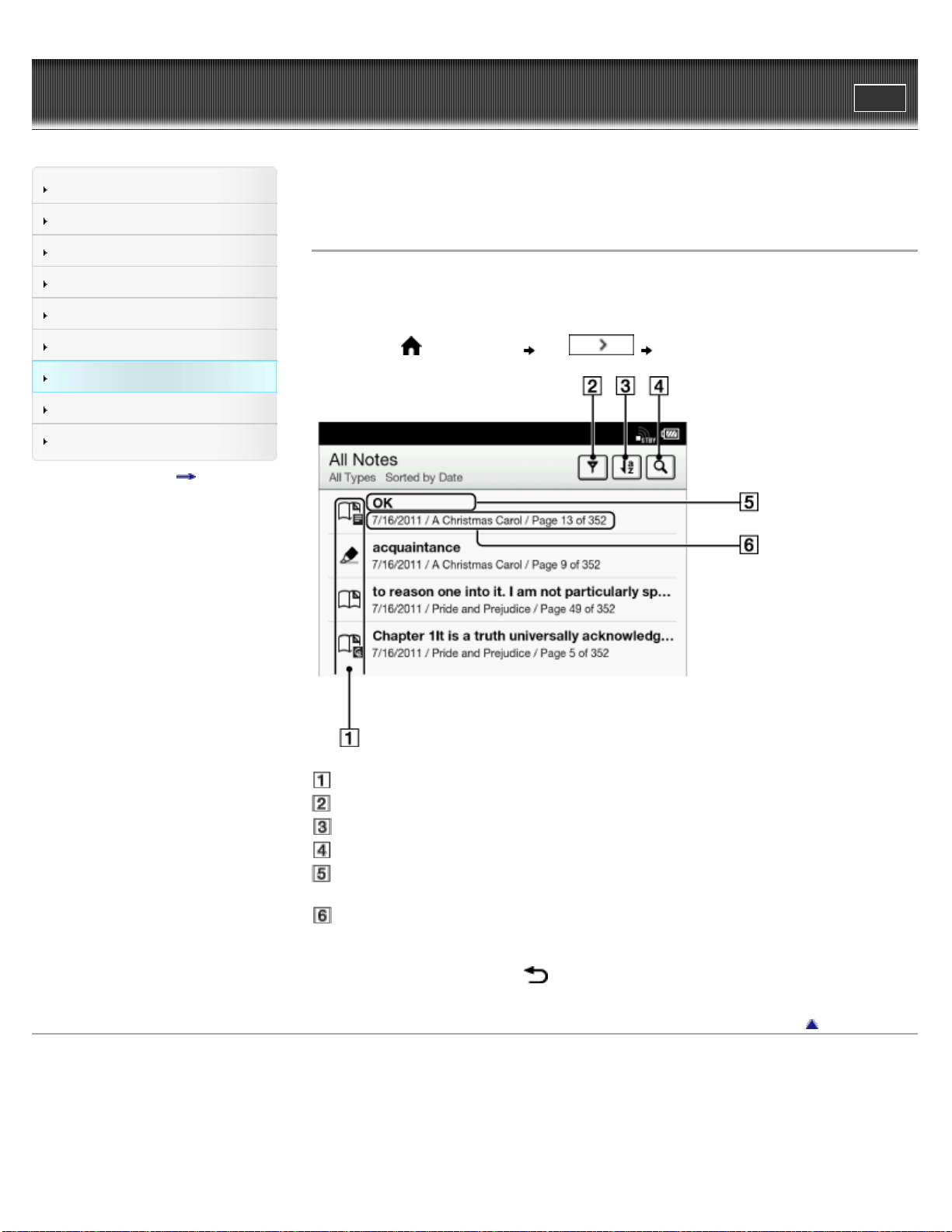
Reader™ User Guide
Print
Search
Getting started
Basic Operations
Adding/Getting Content
Browsing Content Lists
Reading
Organizing
Other Applications
Settings
Other Information
Contents list
Top page > Other Applications > All Notes > Finding Annotations Across All Books and
Periodicals
Finding Annotations Across All Books and Periodicals
You can use [All Notes] to find annotations across all books and periodicals. The application
stores all annotations including bookmarks, highlights and drawings that you have added on
pages. Tap an item in the list to jump to the page on which that annotation is located.
1. Press the
(Home) button tap [All Notes].
Note icons Details
Filter note type Details
Sort icon; sort by date, title or file name
Search icon Details
Headline (the highlighted text, the text note, the beginning text of the bookmarked page, or
the beginning text of the page with the handwritten note)
Annotation creation date, book/periodical title, page number
2. Tap a note in the list.
The page containing the selected note is displayed.
To return to [All Notes], press the
(Back) button.
To delete annotations, see Details.
Go to page top
Copyright 2011 Sony Corporation
97
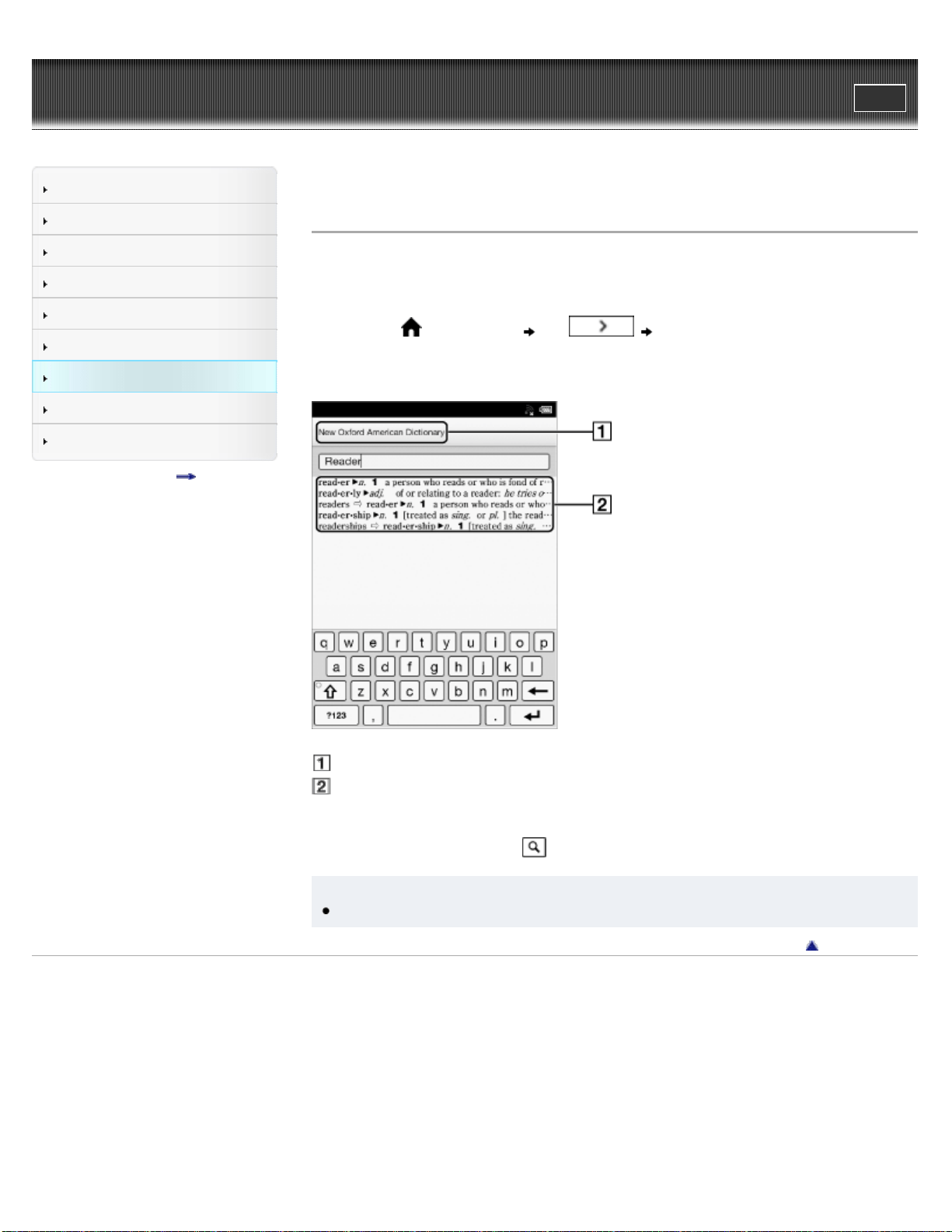
Reader™ User Guide
Print
Search
Getting started
Basic Operations
Adding/Getting Content
Browsing Content Lists
Reading
Organizing
Other Applications
Settings
Other Information
Contents list
Top page > Other Applications > Dictionary > Using the Dictionary
Using the Dictionary
You can choose one of several embedded dictionaries to use.
Only the dictionaries included on the Reader can be used. New dictionaries cannot be installed
or added.
1. Press the
(Home) button tap [Dictionary].
2. Type a word that you wish to look up by using the on-screen keyboard.
The list of candidate words is displayed.
Title of the current dictionary
List of candidate words
3. Tap one of the candidate words.
The definition is displayed in the dictionary viewer.
To look up another word, tap (Search) in the dictionary viewer.
Tip
In the dictionary viewer, tap and hold another word to look that word up in the dictionary.
Go to page top
Copyright 2011 Sony Corporation
98
Reader™ User Guide
Print
Search
Getting started
Basic Operations
Adding/Getting Content
Browsing Content Lists
Reading
Organizing
Other Applications
Settings
Other Information
Contents list
Top page > Other Applications > Dictionary > Changing the Dictionary
Changing the Dictionary
You can choose a different dictionary.
The dictionary can also be changed as you look up a word.
1. Press the
(Menu) button tap [Change Dictionary].
2. Tap one of the dictionaries.
3. The dictionary is changed, and the list of candidate words or the dictionary viewer for the
dictionary to which you changed is displayed.
When you change the dictionary in the [Dictionary] application, the dictionary used when you
look up a word in the [Books] and [Periodicals] applications also changes.
Go to page top
Copyright 2011 Sony Corporation
99
Reader™ User Guide
Print
Search
Getting started
Basic Operations
Adding/Getting Content
Browsing Content Lists
Reading
Organizing
Other Applications
Settings
Other Information
Contents list
Top page > Other Applications > Dictionary > Listing Previously Looked-up Words
Listing Previously Looked-up Words
You can view a list of words that you have previously looked up in the selected dictionary.
1. When a dictionary is open, press the (Menu) button tap [Word Logs: Dictionary].
A list of words that you have previously looked up opens.
2. Tap a word to look it up in the dictionary.
Deleting items in the look-up history
You can delete words that you have previously looked up.
1. Press the (Menu) button tap [Delete Word Logs].
2. Tap the items that you want to delete.
A check appears next to selected items.
3. Tap [Done]
[Yes].
To return to the dictionary viewer, press the (Back) button.
Go to page top
Copyright 2011 Sony Corporation
100
Reader™ User Guide
Print
Search
Getting started
Basic Operations
Adding/Getting Content
Browsing Content Lists
Reading
Organizing
Other Applications
Settings
Other Information
Contents list
Top page > Other Applications > Dictionary > Using (Menu) Items
Using (Menu) Items
Below is a list of option items available when you press the (Menu) button from the dictionary
viewer.
Option Description
[Previous
View]
Opens a previously looked-up word in the dictionary viewer after you have
looked up another word from the dictionary viewer.
[Change
Dictionary]
Changes to another dictionary and searches again.
[Font] Changes the font size of the candidate words list and the definition viewer.
[Word Logs:
Dictionary]
Displays a list of previously looked-up words. See Details.
Go to page top
Copyright 2011 Sony Corporation
101
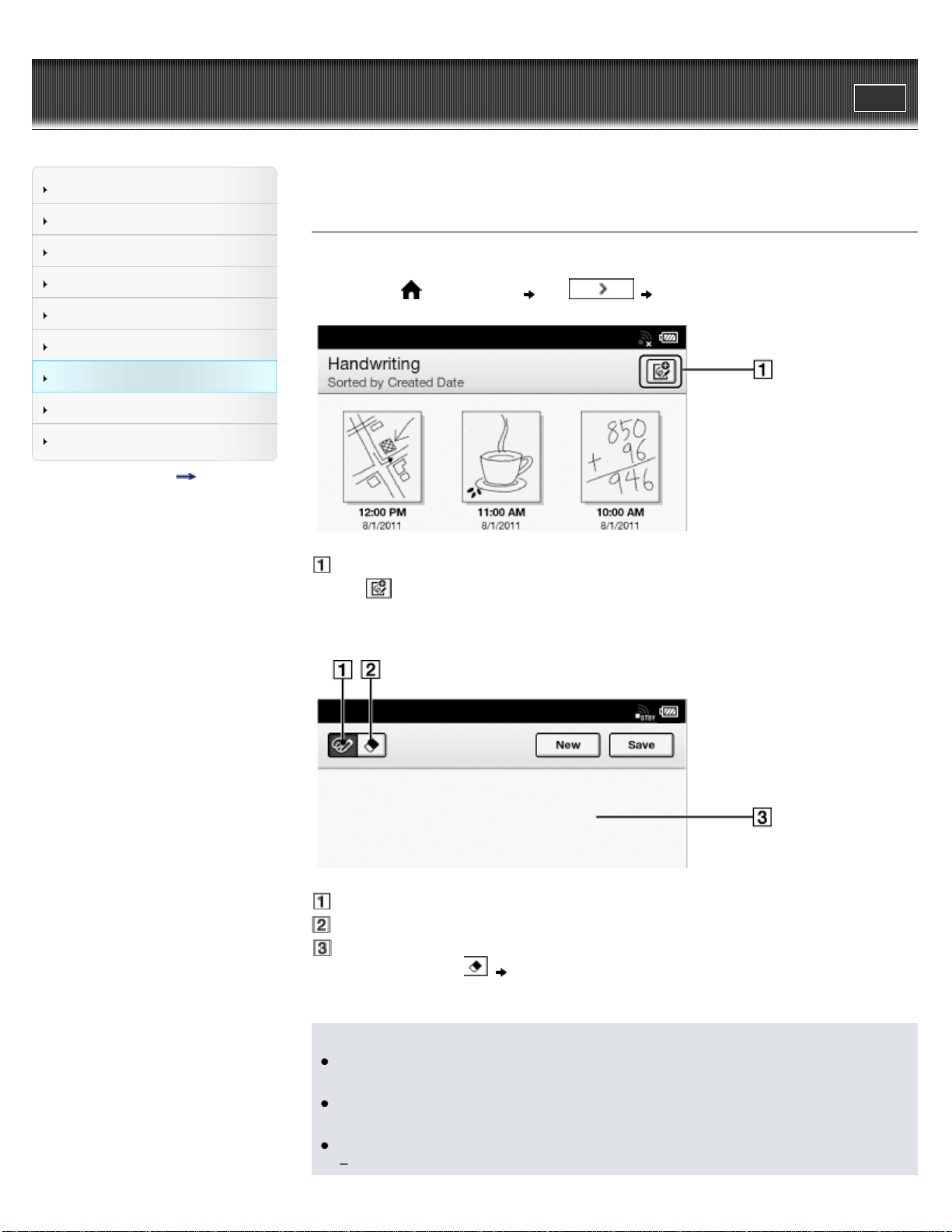
Reader™ User Guide
Print
Search
Getting started
Basic Operations
Adding/Getting Content
Browsing Content Lists
Reading
Organizing
Other Applications
Settings
Other Information
Contents list
Top page > Other Applications > Handwriting > Creating a Drawing
Creating a Drawing
You can use the [Handwriting] application to create a drawing.
1. Press the
(Home) button tap [Handwriting].
Create a new drawing.
2. Tap
at the upper-right corner of the screen.
The canvas opens.
3. Draw in the drawing area with the supplied stylus or your finger.
Pencil tool
Eraser tool
Drawing area
To erase a line, tap
tap or stroke a part of the line.
4. Tap [Save].
Note
While writing, make sure that you are not touching another area on the screen. This could
affect the notes that you write.
To ensure that your notes are correctly saved, do not draw too close to the edge of the
canvas.
If you experience difficulties when drawing on the Reader:
avoid applying excessive pressure to the screen.
102

try not to draw too quickly.
this functionality is not designed for very detailed drawings or for writing small characters.
Tip
If you tap [New] while creating a drawing, the current drawing is saved, and a new canvas
opens.
These drawings will be saved only in the internal memory.
Go to page top
Copyright 2011 Sony Corporation
103
Reader™ User Guide
Print
Search
Getting started
Basic Operations
Adding/Getting Content
Browsing Content Lists
Reading
Organizing
Other Applications
Settings
Other Information
Contents list
Top page > Other Applications > Handwriting > Editing an Existing Drawing
Editing an Existing Drawing
1. Press the (Home) button tap [Handwriting] tap the drawing that
you wish to edit.
2. Edit the drawing.
You can use the supplied stylus or your finger.
To erase a line, tap
(Erase) tap or stroke a part of the line.
3. Tap [Save].
Tip
If you tap [New] while creating a drawing, the current drawing is saved, and a new canvas
opens.
These drawings will be saved only in the internal memory.
To delete the currently viewed drawing, press the
(Menu) button tap [Delete
Drawing]
[Yes].
Go to page top
Copyright 2011 Sony Corporation
104
Reader™ User Guide
Print
Search
Getting started
Basic Operations
Adding/Getting Content
Browsing Content Lists
Reading
Organizing
Other Applications
Settings
Other Information
Contents list
Top page > Other Applications > Handwriting > Deleting/Protecting a Drawing
Deleting/Protecting a Drawing
You can delete or protect drawings.
1. Press the
(Home) button tap [Handwriting].
2. Press the (Menu) button tap [Delete Drawings] or [Protect Drawings].
To delete drawings, see Details.
You can also delete a drawing after step 1 by tapping and holding it. See Details.
To protect drawings, see Details.
You can also protect a drawing after step 1 by tapping and holding it. See Details.
Go to page top
Copyright 2011 Sony Corporation
105
Reader™ User Guide
Print
Search
Getting started
Basic Operations
Adding/Getting Content
Browsing Content Lists
Reading
Organizing
Other Applications
Settings
Other Information
Contents list
Top page > Other Applications > Handwriting > Capturing a Screenshot
Capturing a Screenshot
The Reader allows you to capture a screenshot of a drawing and store the image as a picture
file.
1. Press the (Home) button tap [Handwriting] tap a drawing.
2. Press the (Menu) button tap [Capture Screenshot] [OK].
You can view your captured screenshots via the [Pictures] application.
Go to page top
Copyright 2011 Sony Corporation
106
Reader™ User Guide
Print
Search
Getting started
Basic Operations
Adding/Getting Content
Browsing Content Lists
Reading
Organizing
Other Applications
Settings
Other Information
Contents list
Top page > Other Applications > Handwriting > Using (Menu) Items
Using (Menu) Items
Below is a list of option items available when you press the (Menu) button from the
[Handwriting] content list.
Option Description
[Delete Drawings] Deletes one or more drawings from the Reader. See Details.
[Protect Drawings] Protects one or more drawings from deletion. See Details.
Go to page top
Copyright 2011 Sony Corporation
107
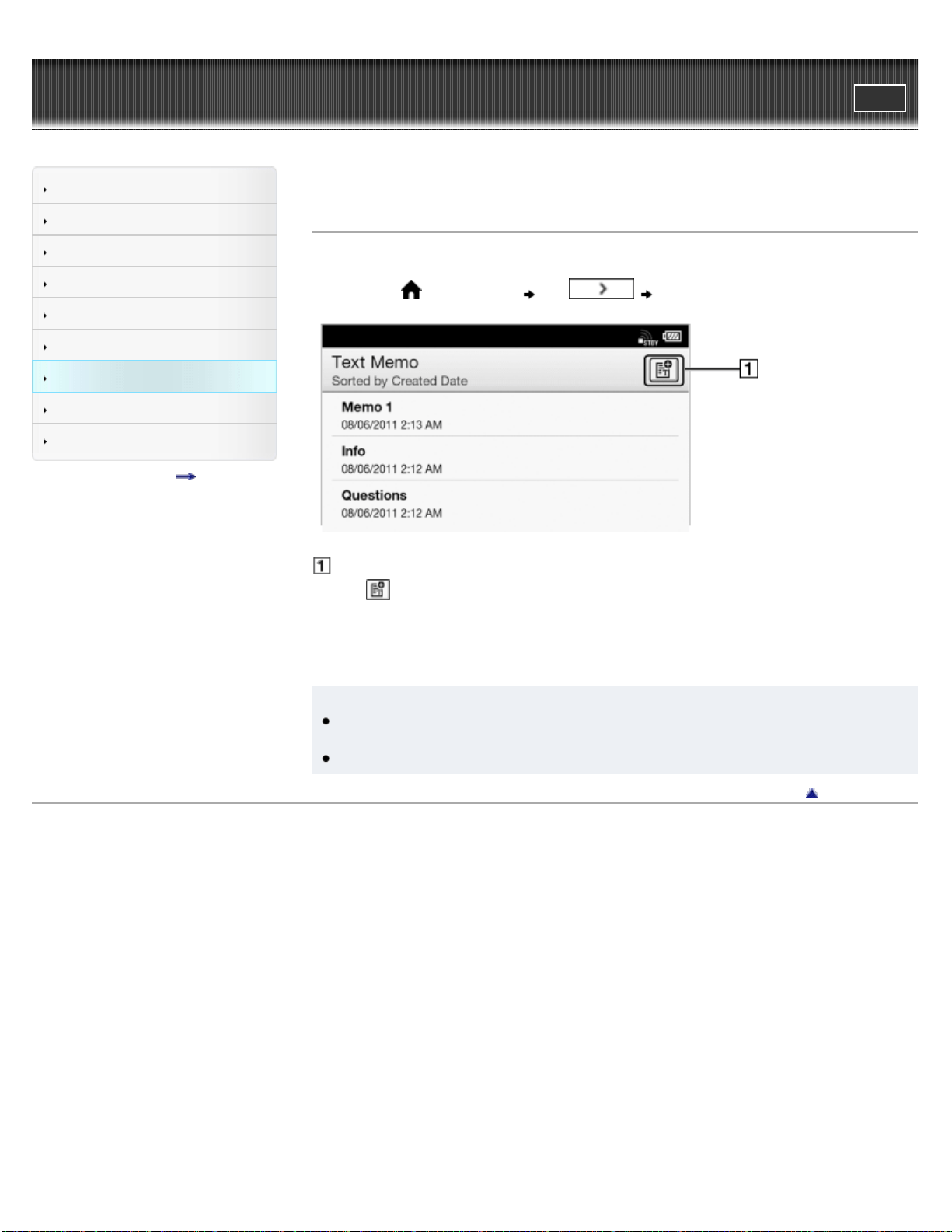
Reader™ User Guide
Print
Search
Getting started
Basic Operations
Adding/Getting Content
Browsing Content Lists
Reading
Organizing
Other Applications
Settings
Other Information
Contents list
Top page > Other Applications > Text Memo > Creating a Text Memo
Creating a Text Memo
You can use the [Text Memo] application to create a memo.
1. Press the
(Home) button tap [Text Memo].
Create a new memo.
2. Tap
at the upper-right corner of the screen.
A notepad opens.
3. Type a memo using the on-screen keyboard.
4. Tap [Save].
Tip
If you tap [New] while creating a memo, the current memo is saved, and a new notepad
opens.
Newly created memos will be saved only in the internal memory.
Go to page top
Copyright 2011 Sony Corporation
108
Reader™ User Guide
Print
Search
Getting started
Basic Operations
Adding/Getting Content
Browsing Content Lists
Reading
Organizing
Other Applications
Settings
Other Information
Contents list
Top page > Other Applications > Text Memo > Editing an Existing Memo
Editing an Existing Memo
1. Press the (Home) button tap [Text Memo] tap the memo that you
wish to edit.
2. Tap [Edit].
The on-screen keyboard opens.
Edit the memo using the on-screen keyboard.
3. Tap [Save].
Tip
If you tap [New] while creating a memo, the current memo is saved, and a new notepad
opens.
Newly created memos will be saved only in the internal memory.
To delete the currently viewed memo, press the
(Menu) button tap [Delete Memo]
[Yes].
Go to page top
Copyright 2011 Sony Corporation
109
Reader™ User Guide
Print
Search
Getting started
Basic Operations
Adding/Getting Content
Browsing Content Lists
Reading
Organizing
Other Applications
Settings
Other Information
Contents list
Top page > Other Applications > Text Memo > Deleting/Protecting a Memo
Deleting/Protecting a Memo
You can delete or protect one or more memos.
1. Press the
(Home) button tap [Text Memo].
2. Press the (Menu) button tap [Delete Memos] or [Protect Memos].
To delete memos, see Details.
You can also delete a memo after step 1 by tapping and holding it. See Details.
To protect memos, see Details.
You can also protect a memo after step 1 by tapping and holding it. See Details.
Go to page top
Copyright 2011 Sony Corporation
110
Reader™ User Guide
Print
Search
Getting started
Basic Operations
Adding/Getting Content
Browsing Content Lists
Reading
Organizing
Other Applications
Settings
Other Information
Contents list
Top page > Other Applications > Text Memo > Using (Menu) Items
Using (Menu) Items
Below is a list of option items available when you press the (Menu) button from the [Text
Memo] content list.
Option Description
[Delete Memos] Deletes one or more text memos from the Reader. See Details.
[Protect Memos] Protects one or more text memos from deletion. See Details.
Go to page top
Copyright 2011 Sony Corporation
111
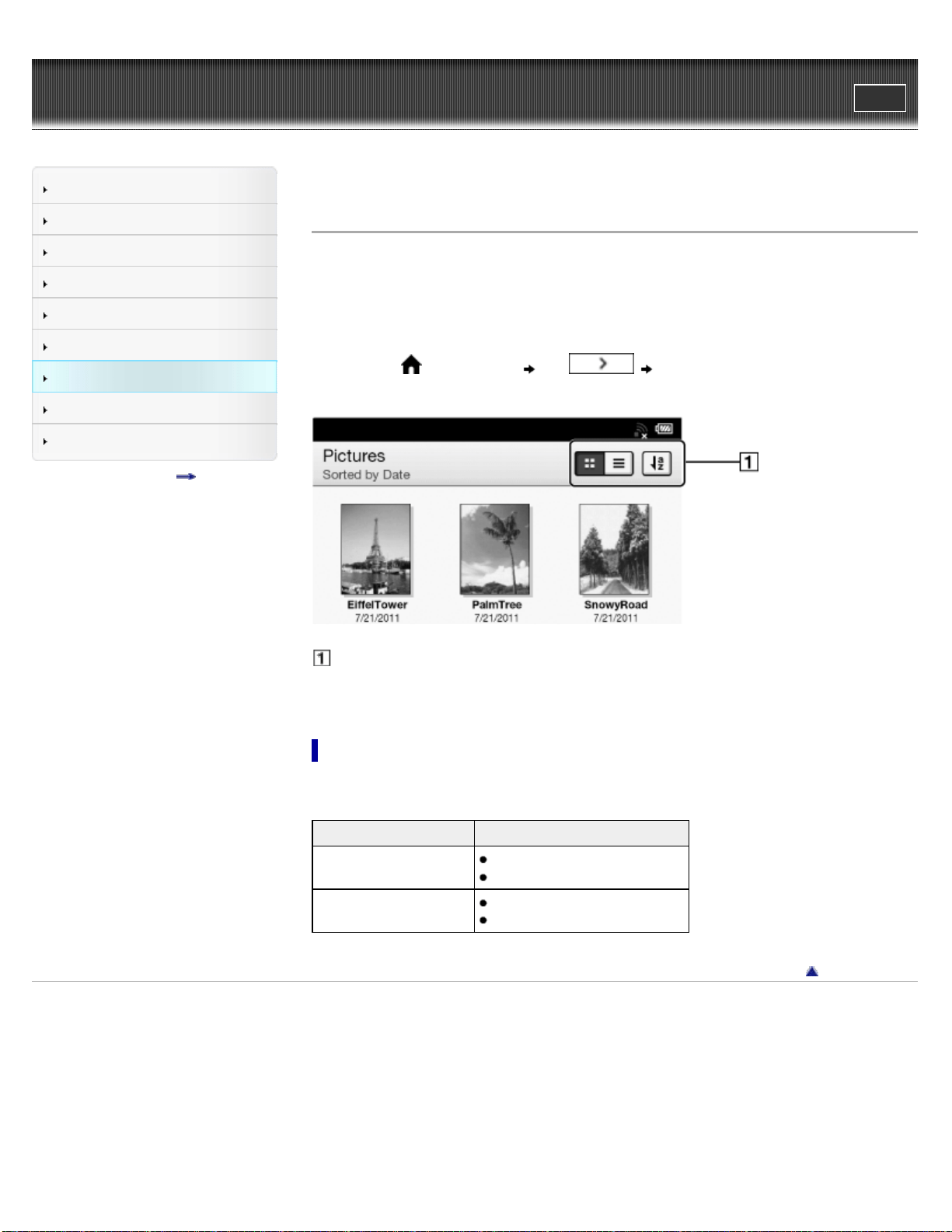
Reader™ User Guide
Print
Search
Getting started
Basic Operations
Adding/Getting Content
Browsing Content Lists
Reading
Organizing
Other Applications
Settings
Other Information
Contents list
Top page > Other Applications > Pictures > Viewing Pictures
Viewing Pictures
You can use the [Pictures] application to view pictures one by one or as a slideshow. You can
also select the picture of your choice for the Reader’s standby screen.
For details on setting pictures to the standby screen, see Details.
For details on transferring pictures to the Reader, see Details.
For details on supported file types, see Details.
1. Press the
(Home) button tap [Pictures].
To browse the pictures list, see Details.
Tool icons Details
2. Tap a picture.
The picture viewer opens.
Picture viewer navigation
Perform the following operations with a picture open.
To Do this
Go to the next page
Press the > (Next) button.
Swipe left.
Go to the previous page
Press the < (Previous) button.
Swipe right.
Go to page top
Copyright 2011 Sony Corporation
112
Reader™ User Guide
Print
Search
Getting started
Basic Operations
Adding/Getting Content
Browsing Content Lists
Reading
Organizing
Other Applications
Settings
Other Information
Contents list
Top page > Other Applications > Pictures > Changing the Orientation
Changing the Orientation
You can adjust the view to either portrait or landscape.
1. Press the
(Home) button tap [Pictures].
2. Tap a picture press the (Menu) button tap [Orientation].
The orientation switches between landscape and portrait mode.
Pictures are shown in the orientation that you have specified.
Go to page top
Copyright 2011 Sony Corporation
113
Reader™ User Guide
Print
Search
Getting started
Basic Operations
Adding/Getting Content
Browsing Content Lists
Reading
Organizing
Other Applications
Settings
Other Information
Contents list
Top page > Other Applications > Pictures > Zooming in on a Picture
Zooming in on a Picture
You can zoom in on pictures for easier visibility.
The viewer shows the zoom bar and viewing position indicator while in zoom mode.
Pinch out to zoom in.
Pinch in to zoom out.
You can drag on the screen to move the viewing position.
To exit zoom mode, press the
(Back) button.
Go to page top
Copyright 2011 Sony Corporation
114
Reader™ User Guide
Print
Search
Getting started
Basic Operations
Adding/Getting Content
Browsing Content Lists
Reading
Organizing
Other Applications
Settings
Other Information
Contents list
Top page > Other Applications > Pictures > Viewing Pictures in a Slideshow
Viewing Pictures in a Slideshow
The slideshow displays pictures one by one in the current sort order. You can also specify the
display interval.
1. Press the (Home) button tap [Pictures].
2. Tap a picture press the (Menu) button tap [Slideshow].
The slideshow starts from the current picture.
To stop the slideshow and return to the viewer
Press the (Back) button.
Tap on the picture.
To change the slideshow interval
1. Press the (Home) button tap [Pictures].
2. Tap a picture press the (Menu) button tap [Settings] [Slide Duration].
Choose from one of the following displayed items.
3. Press the (Back) button to return to the picture viewer.
The selected interval is now applied when you start a slideshow.
TIP
You can also change the slideshow interval from the [Settings] application. See Details.
Go to page top
Copyright 2011 Sony Corporation
115
Reader™ User Guide
Print
Search
Getting started
Basic Operations
Adding/Getting Content
Browsing Content Lists
Reading
Organizing
Other Applications
Settings
Other Information
Contents list
Top page > Other Applications > Pictures > Deleting Pictures
Deleting Pictures
You can delete one or more pictures.
1. Press the
(Home) button tap [Pictures].
2. Press the (Menu) button tap [Delete Pictures].
To delete pictures, see Details.
You can also delete a picture by tapping and holding it. See Details.
Go to page top
Copyright 2011 Sony Corporation
116
Reader™ User Guide
Print
Search
Getting started
Basic Operations
Adding/Getting Content
Browsing Content Lists
Reading
Organizing
Other Applications
Settings
Other Information
Contents list
Top page > Other Applications > Pictures > Using (Menu) Items
Using (Menu) Items
Below is a list of option items available when you press the (Menu) button from the [Pictures]
content list.
Option Description
[Delete Pictures] Deletes one or more pictures from the Reader. See Details.
[Settings] Changes the slideshow interval. See Details.
Go to page top
Copyright 2011 Sony Corporation
117
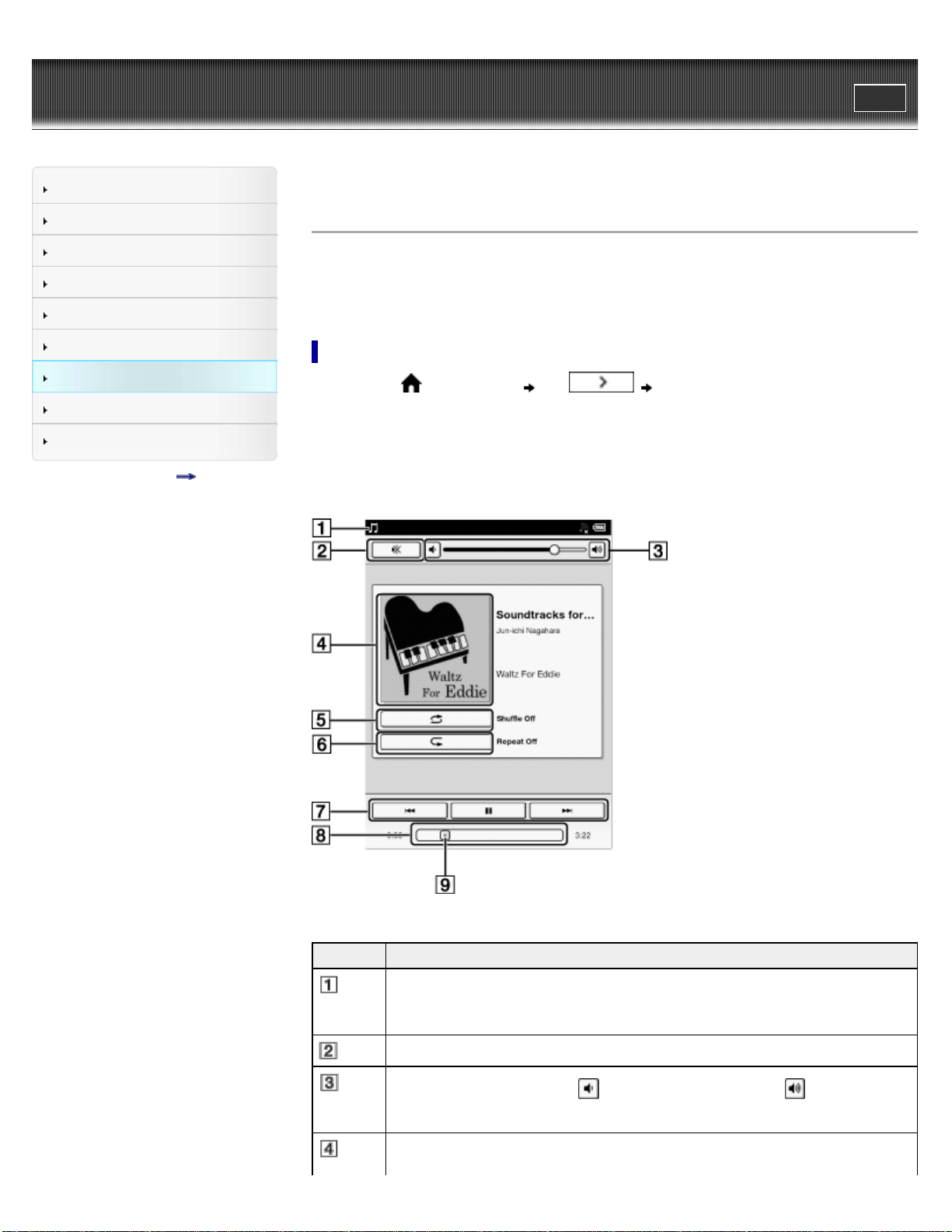
Reader™ User Guide
Print
Search
Getting started
Basic Operations
Adding/Getting Content
Browsing Content Lists
Reading
Organizing
Other Applications
Settings
Other Information
Contents list
Top page > Other Applications > Audio > Enjoying Audio
Enjoying Audio
The Reader has an audio player so that you can enjoy listening to music while reading.
For details on transferring audio to the Reader, see Details.
For details on supported file types, see Details.
Playing audio
1. Press the (Home) button tap [Audio].
The album list opens. For browsing an audio list, see Details.
2. Tap an album.
The track list opens.
3. Tap a track.
The audio player opens and starts playing the track.
Item Description
Playback
icon
Appears during playback.
You can tap the status bar to display the notification window and jump to the audio
player.
Mute Tap to temporarily turn off audio output from the player.
Volume
control
Adjusts the volume level. Tap
to decrease the volume, and to increase the
volume.
Displayed when available.
118
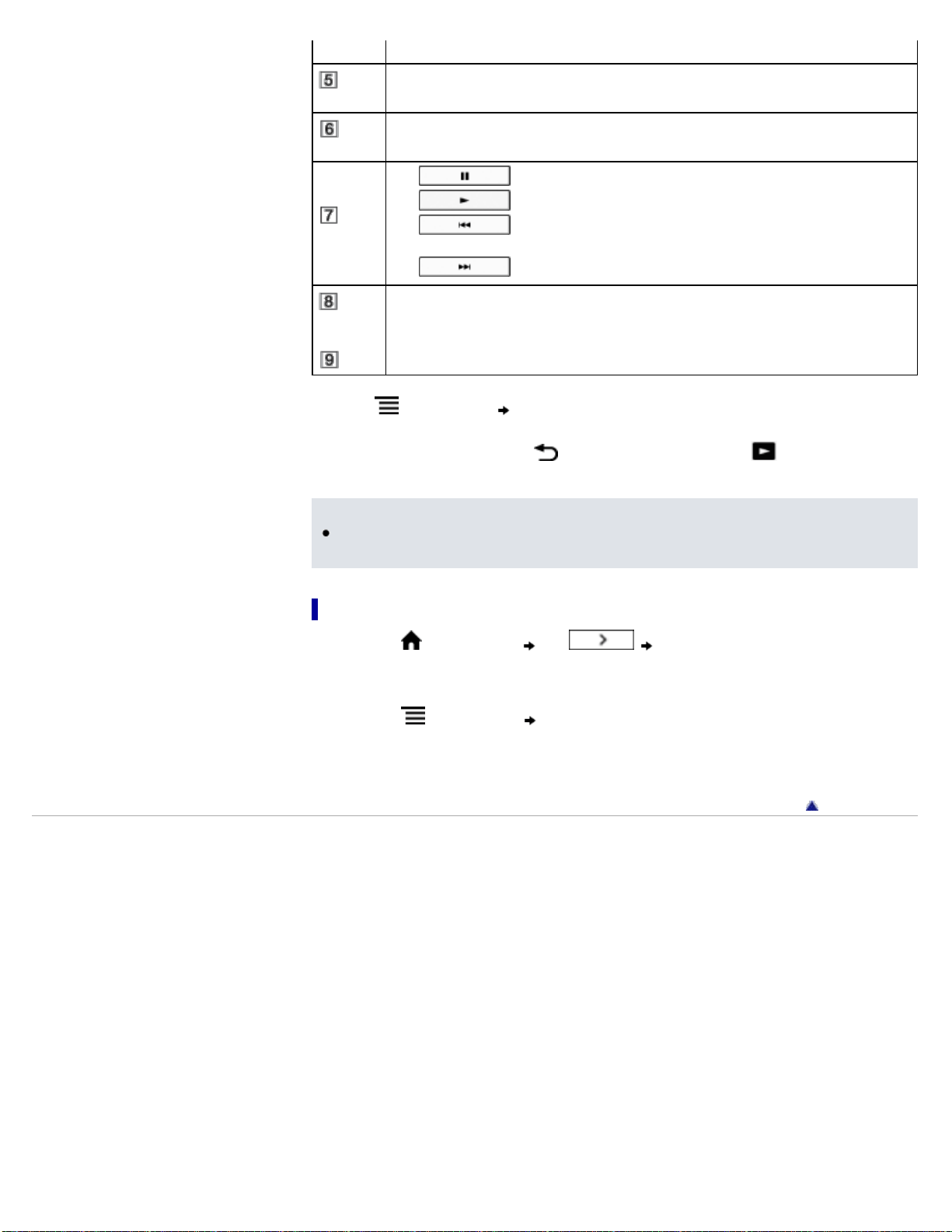
Cover art
Shuffle
Tap to enable shuffle playback.
Repeat
Tap to disable repeat play/repeat all songs in the album/repeat the current song.
Audio
controls
Tap
to pause.
Tap to play.
Tap to skip to the beginning of the previous audio file (or the
beginning of the current file if you tap more than 3 seconds into the track).
Tap to skip to the beginning of the next audio file.
Position
bar
Slider
Tap on a point on the bar or tap and drag the slider to adjust the playback position.
Press the
(Menu) button tap [Continue Reading] to return to the last content you were
reading. You can read while listening to audio.
To return to the track list, press the
(Back) button. In the track list, appears for the track
currently playing.
Note
The Reader will not enter sleep mode or automatic power saving modes during audio
playback.
Deleting an audio track
1. Press the (Home) button tap [Audio].
2. Tap an album.
The track list opens.
3. Press the
(Menu) button tap [Delete Audio].
To delete tracks, see Details.
You can also delete a track by tapping and holding it. See Details.
Go to page top
Copyright 2011 Sony Corporation
119
Reader™ User Guide
Print
Search
Getting started
Basic Operations
Adding/Getting Content
Browsing Content Lists
Reading
Organizing
Other Applications
Settings
Other Information
Contents list
Top page > Other Applications > Audio > Using (Menu) Items
Using (Menu) Items
Below is a list of option items available when you press the (Menu) button from the [Audio]
track list.
Option Description
[Delete Audio] Deletes one or more tracks from the Reader. See Details.
Go to page top
Copyright 2011 Sony Corporation
120
Reader™ User Guide
Print
Search
Getting started
Basic Operations
Adding/Getting Content
Browsing Content Lists
Reading
Organizing
Other Applications
Settings
Other Information
Contents list
Top page > Settings > Changing the Settings > Changing the Settings
Changing the Settings
The [Settings] application allows you to personalize the Reader, set the date and time, configure
the Wi-Fi connection, and change the standby screen and other Reader settings.
Go to page top
Copyright 2011 Sony Corporation
121
Reader™ User Guide
Print
Search
Getting started
Basic Operations
Adding/Getting Content
Browsing Content Lists
Reading
Organizing
Other Applications
Settings
Other Information
Contents list
Top page > Settings > Changing the Settings > General Settings
General Settings
Setting Description
[Page Turn
Preference]
Sets the swipe direction for turning pages.
[Menu
Language]
Sets the menu language.
[Keyboard] Sets the on-screen keyboard layout.
[Country /
Region]
Sets the country/region.
Depending on the country that you select, applications on the [Home] screen may
vary.
Reader Store varies depending on the country/region that you select. You will
need to register an account for each region in order to use Reader Store in
multiple regions.
Go to page top
Copyright 2011 Sony Corporation
122
Reader™ User Guide
Print
Search
Getting started
Basic Operations
Adding/Getting Content
Browsing Content Lists
Reading
Organizing
Other Applications
Settings
Other Information
Contents list
Top page > Settings > Changing the Settings > Wireless Network Settings
Wireless Network Settings
Setting Description
[Wi-Fi] Turn Wi-Fi on/off. See Details.
[Wireless
Standby]
Wireless standby helps avoid unnecessary battery consumption caused by wireless
communication. If you do not perform any wireless operations for more than 5
minutes, the wireless feature automatically enters standby mode.
Note
Accessing Reader Store and the [Browser] application from wireless standby
mode takes more time than accessing when the Reader is connected to the
wireless network.
If you deactivate wireless standby, the Reader retains a wireless connection at all
times, resulting in higher battery consumption.
[Wi-Fi
Settings]
Wi-Fi settings enable the Reader to use local Wi-Fi networks to connect to the
Internet. See Details.
Go to page top
Copyright 2011 Sony Corporation
123
Reader™ User Guide
Print
Search
Getting started
Basic Operations
Adding/Getting Content
Browsing Content Lists
Reading
Organizing
Other Applications
Settings
Other Information
Contents list
Top page > Settings > Changing the Settings > Application Preferences
Application Preferences
Setting Description
[Books /
Periodicals]
Sets preferences for all books/periodicals. You can adjust the default font
size.
[Dictionary] Specifies the default dictionary.
[Pictures] Sets the slideshow interval.
[Browser] Sets the browser preferences.
Go to page top
Copyright 2011 Sony Corporation
124
Reader™ User Guide
Print
Search
Getting started
Basic Operations
Adding/Getting Content
Browsing Content Lists
Reading
Organizing
Other Applications
Settings
Other Information
Contents list
Top page > Settings > Changing the Settings > Date and Time Settings
Date and Time Settings
Setting Description
[Date] Sets the date.
[Time] Sets the time.
[Date Format] Sets the date format.
[24-Hour Format] Check to display time in 24 hour-format.
[Time Zone] Sets the time zone.
Tip
When you start the Reader software and connect the Reader to your computer, the
Reader’s time setting is updated to match your computer’s time.
Go to page top
Copyright 2011 Sony Corporation
125
Reader™ User Guide
Print
Search
Getting started
Basic Operations
Adding/Getting Content
Browsing Content Lists
Reading
Organizing
Other Applications
Settings
Other Information
Contents list
Top page > Settings > Changing the Settings > System Management
System Management
Setting Description
[Device
Lock]
Sets a 4-digit PIN for the Reader to prevent unauthorized use.
To set [Device Lock] to [On], input your 4-digit PIN tap [Continue] to enter it
again
tap [OK]. When [Device Lock] is set to [On], you must unlock the
Reader with the 4-digit PIN when waking up the Reader from sleep mode, or
when turning on the power.
To set [Device Lock] to [Off], input your 4-digit PIN and tap [Continue].
Note
Sony recommends that you make a note of your password and keep it in a
safe place separate from the Reader.
If you forget your password, contact Sony Customer Support. Note that in
unlocking your device, all content on it will be erased.
[Standby
Screen]
Sets standby screen preferences.
[Type of Image]: You can select whether to display the cover of the last read
book or pictures from the [Pictures] application. When you select [Selected
Pictures], continue by tapping [Select Pictures] tap to add a check next to the
pictures you want to display
tap [Done].
[Show Message]: You can select whether to display a message about waking up
the Reader from sleep mode on the standby screen.
[Download
Destination]
Sets the destination for content downloaded from Reader Store or files
downloaded from the browser. Select between [Internal Memory] and [SD Card].
Go to page top
Copyright 2011 Sony Corporation
126
Reader™ User Guide
Print
Search
Getting started
Basic Operations
Adding/Getting Content
Browsing Content Lists
Reading
Organizing
Other Applications
Settings
Other Information
Contents list
Top page > Settings > Changing the Settings > Initialization
Initialization
Setting Description
[Restore
Defaults]
Restores the default Reader settings.
[Clear
Keyboard
History]
Deletes words registered to the on-screen keyboard history.
[Format
Memory]
Allows you to format the Reader’s internal memory and the microSD card.
Note
If you have formatted the Reader or microSD card on your computer, the Reader
may not be able to display transferred content. In this case, use the Reader’s
[Format Memory] function to reformat the Reader and your microSD card.
When either memory is formatted, audio file playback and content download
stop, and the Wi-Fi feature is disabled.
Tip
Before formatting, make sure to backup data you wish to keep to your computer
via the Reader software. Note that protected content will also be deleted when
you format it.
Go to page top
Copyright 2011 Sony Corporation
127
Reader™ User Guide
Print
Search
Getting started
Basic Operations
Adding/Getting Content
Browsing Content Lists
Reading
Organizing
Other Applications
Settings
Other Information
Contents list
Top page > Settings > Changing the Settings > About
About
Setting Description
[Device
Information]
Displays the device details including the memory capacity, Adobe DRM
authorization and MAC address in use.
[Legal Information] Displays trademark and copyright information.
[Regulatory
Information]
Displays the C-Tick mark.
[End User License
Agreement]
Displays the terms and conditions on use of the Reader.
Go to page top
Copyright 2011 Sony Corporation
128
Reader™ User Guide
Print
Search
Getting started
Basic Operations
Adding/Getting Content
Browsing Content Lists
Reading
Organizing
Other Applications
Settings
Other Information
Contents list
Top page > Settings > Changing the Settings > Device Shutdown
Device Shutdown
Enables you to shut down (turn off) the Reader, instead of leaving it in sleep mode.
Go to page top
Copyright 2011 Sony Corporation
129
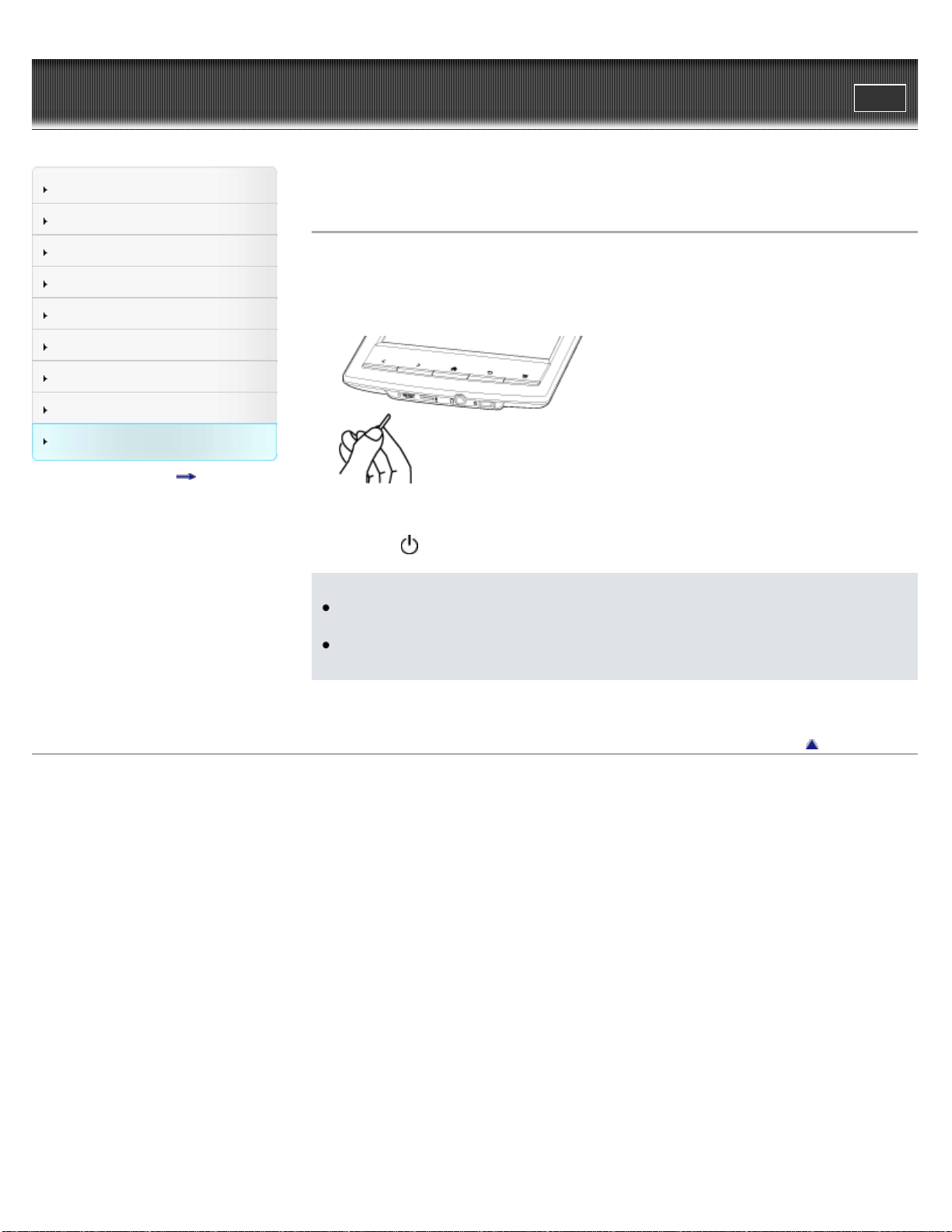
Reader™ User Guide
Print
Search
Getting started
Basic Operations
Adding/Getting Content
Browsing Content Lists
Reading
Organizing
Other Applications
Settings
Other Information
Contents list
Top page > Other Information > Troubleshooting > Troubleshooting Tips
Troubleshooting Tips
Troubleshooting tips may help you quickly resolve technical issues.
1. Charge the Reader completely.
2. Reset the Reader.
Press the RESET button with a small pin or clip.
The screen will freeze; the Reader will not restart automatically.
Press the (Power) button, and the startup screen appears.
Note
The bookmarks, highlights, handwritten notes or the setting information may be deleted by
resetting.
Do not push the RESET button with a breakable point, such as the graphite of a mechanical
pencil. It can cause the RESET button to be blocked.
3. Comprehensive support and troubleshooting information is available at the support PC Web
site. See Details.
Go to page top
Copyright 2011 Sony Corporation
130
Reader™ User Guide
Print
Search
Getting started
Basic Operations
Adding/Getting Content
Browsing Content Lists
Reading
Organizing
Other Applications
Settings
Other Information
Contents list
Top page > Other Information > Troubleshooting > Support PC Web Site
Support PC Web Site
For comprehensive support and troubleshooting information, visit the support PC Web site.
Support PC Web
USA:
http://www.sony.com/readersupport
Canada:
http://www.sony.ca/readersupport
Europe:
http://support.sony-europe.com/eBook/PRS
Australia:
http://www.sony.com.au/support
New Zealand:
http://www.sony.co.nz/support
Warranty Information
Australia:
http://www.sony.com.au/warranty
New Zealand:
http://www.sony.co.nz/section/warrantyinfo
Go to page top
Copyright 2011 Sony Corporation
131
Reader™ User Guide
Print
Search
Getting started
Basic Operations
Adding/Getting Content
Browsing Content Lists
Reading
Organizing
Other Applications
Settings
Other Information
Contents list
Top page > Other Information > Troubleshooting > Reader Device
Reader Device
Power On/Off
The Reader cannot turn on.
The Reader cannot be operated if connected to your computer and set to data transfer mode.
Use the safely remove hardware function of your computer, and then disconnect the USB
cable from the Reader.
Moisture condensation may have occurred. Wait for a few hours and then turn on the Reader.
If the battery is completely depleted, power will not be supplied to the
(Power) button, and
you may not be able to turn on the Reader. In this case, the Charge/Busy indicator may blink
red 3 times. Connect the Reader to your computer via the supplied USB cable; the Reader
will automatically turn on approximately 5 minutes later. Wait until the Reader turns on before
trying to operate it.
The Reader cannot turn off or enter sleep mode.
If the Reader screen freezes and stops responding, the (Power) button will also not work.
In this case, reset the Reader. See Details.
The Reader automatically enters sleep mode or turns off.
To conserve the battery’s charge, the Reader includes automatic power saving modes. The
Reader will enter sleep mode after 10 minutes of inactivity. After 3 days* in sleep mode, the
Reader will shut down/power off automatically.
* If the battery’s charge is low, the Reader may automatically turn off within 3 days. However, when
playing audio or viewing a slideshow, this feature does not work. The automatic power saving modes
cannot be turned off.
Battery
Cannot charge the Reader.
If you use other than the supplied USB cable to charge the Reader, it may not charge
correctly. To charge the Reader, use only the supplied USB cable and, optionally, the AC
Adapter (PRSA-AC10/PRSA-AC1A, sold separately). See Details.
If you are charging from the USB port on your computer, make sure that the Reader is
connected directly to the USB port with the supplied USB cable. Do not use a USB hub.
The battery has not been given enough time to fully charge. Charge the Reader until the
icon changes to the icon. (The charge icon does not indicate the remaining battery power
while charging.)
Your computer must be turned on to charge the Reader. The Reader will not be charged if
your computer enters sleep mode or standby mode. Keep your computer turned on with a
132
stable and continuous power supply while charging the Reader.
If your computer enters sleep mode while the Reader is connected and charging, the Reader
battery’s charge will gradually drain, the Reader will shut down and the Reader’s battery will
not charge. In this case, disconnect the USB cable from the Reader, wake the computer from
sleep mode, and then reconnect the USB cable to the Reader.
Your computer may not be supplying sufficient power. If you connect the Reader to your
laptop computer, maintain a stable and continuous power supply to the laptop computer while
charging the Reader.
Battery life seems short.
The Reader may not have been charged fully. Make sure that you charge the Reader until
changes to .
The operating temperature is below 5°C (41°F). This is due to the battery characteristics and
not a malfunction.
The Reader requires power while in sleep mode. If you are not planning to use the Reader,
turn it off instead of leaving it in sleep mode.
If you are not browsing on the Web, exit [Browser] by pressing the
(Home) button.
The
icon in the status bar indicates that the Reader is playing audio. Audio playback
consumes battery power. Go to the audio player and pause playback if necessary. See
Details. The Reader does not automatically enter into sleep mode while playing audio.
The Reader battery gradually discharges when not in use for a prolonged period of time.
Before turning on the Reader after a prolonged period of disuse, charge the Reader again.
If you are not using wireless communications, turn off Wi-Fi. See Details.
If you are charging the Reader by data transfer mode and the computer enters sleep mode or
standby mode, the Reader will be unable to charge, and the battery may drain. When
charging the Reader, confirm that your computer is on, and completely charge the Reader
before using it. See Details.
Touchscreen
The Reader does not wake up or start immediately.
In cold temperatures, the touchscreen may respond slower than usual. This is due to the
touchscreen characteristics and is not a malfunction.
After resetting or turning off the Reader, it may take time for the startup screen to appear.
The screen does not respond.
Reset the Reader. See Details.
The screen responds slowly.
If the touchscreen becomes dirty, it may not function correctly. Clean the touchscreen with a
soft cloth, such as a cleaning cloth for eyeglasses.
In cold temperatures, the touchscreen may respond slower than usual. Turn off the Reader
and leave it for a few hours until it adjusts to the ambient temperature.
Go to page top
Copyright 2011 Sony Corporation
133
Reader™ User Guide
Print
Search
Getting started
Basic Operations
Adding/Getting Content
Browsing Content Lists
Reading
Organizing
Other Applications
Settings
Other Information
Contents list
Top page > Other Information > Troubleshooting > Wireless Connectivity
Wireless Connectivity
Reader Store
Reader Store provides comprehensive support information. For Reader Store support, press the
(Home) menu tap the [Reader Store] application press the (Menu) button
tap [Help and Support].
Cannot connect to the store.
The Wi-Fi network connection may have been interrupted. Make sure that Wi-Fi is turned on
and set up correctly, check the signal strength of the access point and try again. See Details.
Cannot find the purchased books or periodicals.
Books are downloaded to the [Books] application, and newspapers/magazines are
downloaded to the [Periodicals] application. Tap on the status bar to open the notification
window, and check under [Notification] to check your downloaded items. See Details.
If the download of an item failed, press the
(Home) button tap
[Purchased Content] to go to [My Account] at Reader Store and re-download it.
Wi-Fi connection
The Reader does not connect to the Wi-Fi network.
The network feature could not be turned on because the remaining battery power is too low.
Charge the Reader for a few minutes, and then try again.
Make sure that Wi-Fi is turned on and check the signal strength of the access point.
Scan the available access points in the vicinity and select a new one.
Make sure that the security method (WEP/WPA), the static IP address and the proxy settings
are correct.
The access point is using an unsupported security method or encryption key.
Public Wi-Fi networks may require a user ID and password. In this case, you must enter a
correct user ID and password to establish a network connection.
The access point has the MAC address filter enabled. To check the MAC address, press the
(Home) button tap [Settings] [About] [Device Information].
Make sure that this MAC address is accepted by the access point.
The Wi-Fi network settings of the access point are not correct. Adjust the settings as
described in the manuals that came with the access point and in any information provided by
the network administrator.
The Reader is too far from the access point. Move the Reader closer to the access point and
scan again.
134
Obstacles such as walls, metal or concrete between the Reader and an access point may
adversely affect the connection. Try moving the Reader to a different location and scan again.
There is other equipment nearby using the 2.4 GHz frequency band (such as a cordless
phone, a microwave oven, or Bluetooth computer equipment). Move the equipment away or
turn it off.
The Wi-Fi network service is temporarily not available or degraded. Check with the network
administrator for the status.
Cannot find the access point in the Wi-Fi networks list.
The access point you want to use is set to not broadcast its SSID to users. In this case, the
access point may not be shown on the Wi-Fi network list. Tap [Add Wi-Fi Network] and enter
the SSID manually. See Details.
Browser
The Web page is not displayed properly.
The Wi-Fi network connection may have been interrupted. Make sure that Wi-Fi is turned on
and set up correctly, check the signal strength of the access point, and then refresh the Web
page.
Due to the vast range of standards and technologies used to design Web pages, it is not
possible to guarantee that all pages will be displayed correctly.
Cannot change the font size.
The font size does not change if it is specified by the Web page. You can use the zoom
feature to enlarge the page display.
Go to page top
Copyright 2011 Sony Corporation
135
Reader™ User Guide
Print
Search
Getting started
Basic Operations
Adding/Getting Content
Browsing Content Lists
Reading
Organizing
Other Applications
Settings
Other Information
Contents list
Top page > Other Information > Troubleshooting > Reading Books and Periodicals
Reading Books and Periodicals
Cannot open a book.
The book may have expired. Check the expiration for the borrowed book.
You must be the account holder who purchased the book to read it.
The transferred book/periodical may be protected by digital rights management; in this case,
the Reader and the computer must first be authorized. For details, refer to the [Help] menu of
the Reader software.
The book or the periodical issue may be protected by unsupported digital rights management
technology.
The book or the periodical issue may be in an unsupported file type. For details on supported
file types, see Details.
“Continue Reading” does not work, or the bookmark is missing.
If the file status has changed (such as in the following cases), data under [Continue Reading]
or notes may be deleted.
A text/PDF file is edited.
A book purchased with an authorized Reader is read on another deauthorized Reader by
memory card transfer.
Cannot find content on the Reader.
If you have formatted the Reader on your computer, the Reader may not be able to display
transferred content. In this case, use the Reader’s [Format Memory] function to reformat the
Reader. See Details.
Although protected on the Reader, books and periodicals may be deleted if you sync the
Reader after they have been deleted from the Reader software.
If you delete or modify folders or files in the “database” folder on your computer, content or
notes may be deleted.
Go to page top
Copyright 2011 Sony Corporation
136
Reader™ User Guide
Print
Search
Getting started
Basic Operations
Adding/Getting Content
Browsing Content Lists
Reading
Organizing
Other Applications
Settings
Other Information
Contents list
Top page > Other Information > Troubleshooting > Playing Audio Files
Playing Audio Files
Thumbnail of an album is not displayed.
An album or an audio file with cover art information can only display its thumbnail in the
album list.
Cannot play audio.
The audio may be in an unsupported file type. For details on supported file types, see Details.
Sound cannot be heard.
Increase the volume.
Make sure that your headphones (not supplied) are connected properly to the headphone
jack on the Reader.
Go to page top
Copyright 2011 Sony Corporation
137
Reader™ User Guide
Print
Search
Getting started
Basic Operations
Adding/Getting Content
Browsing Content Lists
Reading
Organizing
Other Applications
Settings
Other Information
Contents list
Top page > Other Information > Troubleshooting > Viewing Pictures
Viewing Pictures
Cannot view a picture.
The picture may be in an unsupported file type. For details on supported file types, see
Details.
If the size of a picture that you transferred with the Reader software is too large, a thumbnail
may not be created on the Reader and the picture may not be displayed in the [Pictures]
content list. In this case, delete the picture via the Reader software.
Go to page top
Copyright 2011 Sony Corporation
138
Reader™ User Guide
Print
Search
Getting started
Basic Operations
Adding/Getting Content
Browsing Content Lists
Reading
Organizing
Other Applications
Settings
Other Information
Contents list
Top page > Other Information > Troubleshooting > Connecting to your Computer
Connecting to your Computer
The computer does not detect the Reader.
After connecting the Reader to your computer via the USB cable, you must set the Reader to
data transfer mode. See Details.
It may take a while for the computer to detect the Reader.
Make sure that the Reader is connected directly to the USB port with the supplied USB cable.
Do not use a USB hub.
Try connecting to a different USB port on the computer.
Try disconnecting the Reader and connecting it again.
If none of the above solves the problem, reset the Reader. See Details.
Cannot sync content with the Reader.
The Reader may not have been authorized. Authorize the Reader first. For details, refer to the
[Help] menu of the Reader software.
There may not be enough space on the Reader or the memory card. Check [About] for the
amount of free space on internal memory. See Details. Delete some content, or copy it to the
Reader software to make some space on the Reader or the memory card.
Go to page top
Copyright 2011 Sony Corporation
139
Reader™ User Guide
Print
Search
Getting started
Basic Operations
Adding/Getting Content
Browsing Content Lists
Reading
Organizing
Other Applications
Settings
Other Information
Contents list
Top page > Other Information > Troubleshooting > microSD Card
microSD Card
The Reader does not detect the microSD card, or cannot open an item
stored on the microSD card.
If you have formatted the microSD card on the computer, the Reader may not be able to
display transferred content. Use the Reader to format the microSD card. See Details.
It may take a while for the Reader to detect the microSD card and load all files stored on it.
Wait a little longer after inserting the microSD card to the card slot.
Make sure that the microSD card is supported by the Reader. See Details.
Make sure that the microSD card is inserted properly. See Details.
Make sure that the gold contact point of the microSD card and the card slot are clean. If dirty
or dusty, clean them carefully.
The Reader may not have been authorized. Authorize the Reader first. For details, refer to the
[Help] menu of the Reader software.
Data transferred via drag-and-drop may not be displayable on the Reader, or thumbnails of
the data may not be properly displayed on the Reader. Sony recommends that you transfer
data via the Reader software.
Cannot save the book or other items on the microSD card.
The Reader does not offer a feature that enables you to move files to or from the microSD
card. You need to use the Reader software to do so.
Cannot delete the book or other items from the microSD card.
You cannot delete the file if it is read-only. You must use the computer and remove the read-
only attribute from the file.
Go to page top
Copyright 2011 Sony Corporation
140
Reader™ User Guide
Print
Search
Getting started
Basic Operations
Adding/Getting Content
Browsing Content Lists
Reading
Organizing
Other Applications
Settings
Other Information
Contents list
Top page > Other Information > Precautions > Safety Information
Safety Information
Protected content
Protected content is limited to personal use only. Use of the content beyond this limit requires
permission of the copyright holders.
Handling the Reader
In order to comply with FCC radio-frequency radiation exposure guidelines for an
uncontrolled exposure, this device and its antenna must not be co-located or operating in
conjunction with any other antenna or transmitter.
If the Reader causes interference to radio or television reception, turn the Reader off and
move it away from the radio or television.
Refrain from using the Reader according to the in-flight announcements during take off or
landing in an aircraft.
Do not drop, or put any heavy object on top of the Reader or apply a strong shock to the
Reader. It may cause a malfunction or damage.
Never subject the Reader to extremes of light, temperature, moisture or vibration.
If part of the Reader that generates heat contacts your skin for a prolonged period, you may
suffer from symptom of burn, such as redness, swelling, even if temperature is moderate.
Avoid prolonged contact, especially if you have sensitive skin.
Do not leave the Reader on an unstable surface.
Do not poke people using the supplied stylus.
Do not treat or use the supplied stylus roughly, such as bending it, or scratching the
touchscreen with it.
Use the supplied stylus only for touchscreen operations.
Do not use the stylus if it is damaged or deformed.
If any object is placed on the touchscreen, it may cause a malfunction. When not in use, leave
the Reader in sleep mode, or turn it off.
When using the Reader internationally, it is your responsibility to ensure that the Reader is
used in compliance with the following specifications:
AC voltage
Wireless products regulations
Other safety regulations or requirements
Be sure not to short-circuit the terminals of the Reader with metallic objects.
Never leave the Reader exposed to high temperature, such as in a car parked in the sun or
under direct sunlight.
Avoiding water and moisture
Note that condensation may form temporarily in cases such as when the player is moved
quickly from a low-temperature environment to a high temperature environment or used in a
room that has a heater just turned on. Condensation creates a phenomenon where moisture
in the air adheres to surfaces such as metal panels, etc., and then changes to liquid. If
condensation forms in the Reader, leave it turned off until the condensation disappears. If you
use the Reader with condensation present, a malfunction may result.
The Reader is not waterproof. Remember to follow the precautions below.
Be careful not to drop the Reader into a sink or other container filled with water.
141
Do not use the Reader in humid locations or bad weather, such as in the rain or snow.
Do not get the Reader wet.
If you touch the Reader with wet hands, or put the Reader in a damp article of clothing, the
Reader may get wet and this may cause a malfunction.
Charging the Reader
Heat may build up in the Reader while charging, or if it is used for an extended period of time.
Use the supplied USB cable or the optional AC adapter (PRSA-AC10/PRSA-AC1A, sold
separately) only. Do not use other USB cable and AC Adapter.
Never wrap the Reader in anything when it is being charged. Heat build-up in the Reader may
cause malfunction or damage.
If the battery quickly runs out of power after being fully charged, it may be reaching the end of
its life and should be replaced. Consult Sony Support Center.
Road safety
Do not use headphones (not supplied) while driving, cycling, or operating any motorized vehicle.
It may create a traffic hazard and is illegal in many areas. It can also be potentially dangerous to
play at a high volume while walking, especially at pedestrian crossings. You should exercise
extreme caution or discontinue use in potentially hazardous situations.
Preventing hearing damage
Avoid using the headphones (not supplied) at a high volume. Hearing experts advise against
continuous, loud and extended play. If you experience a ringing in your ears, reduce the volume
or discontinue use.
Caring for others
Keep the volume at a moderate level. This will allow you to hear outside sounds and to be
considerate to the people around you.
Warning for headphones (not supplied)
If lightning occurs while you are using the Reader, take off your headphones (not supplied)
immediately.
Wi-Fi connectivity
The Wireless LAN functionality has passed Wi-Fi certification and complies with the
interoperability specifications established by WFA (Wi-Fi Alliance).
Cleaning the Reader
Clean the Reader with a soft cloth, such as a cleaning cloth for eyeglasses. Make sure that
there is no dust or dirt on the soft cloth, as the Reader may be damaged.
Do not use any type of abrasive pad, scouring powder or solvent, such as alcohol or
benzene, as it may mar the finish of the case.
Wipe the stylus with a dry cloth when it gets dirty. Tapping or dragging on the touchscreen
using a dirty stylus may damage the surface.
Be sure to keep the Reader away from water or spills.
Touchscreen
Do not apply excessive pressure to the touchscreen. The color or lighting may become
142

blurred or uneven, and the Reader may become damaged.
When using the Reader in a cold environment, thin lines may appear on the touchscreen. This
is not a malfunction.
The outside cover of the touchscreen is made of glass. This glass could break if the Reader is
dropped on a hard surface or receives a substantial impact. It could also be damaged by
scratching and abrasion while being carried in a bag. If you are concerned about damages to
the touchscreen, you can use a protective case (sold separately).
Wireless feature
Turn off the wireless feature when you are in a location in which radio communications are
prohibited. When you are in such a location, you must obtain permission from the appropriate
authorities before enabling the wireless feature of this device.
Turn off the wireless feature in health care facilities where any regulations posted in such
areas instruct you to do so. Hospitals or health care facilities may be using equipment that
could be effected by radio frequency (RF) energy which is generated by wireless
communication.
Do not use your Reader near medical equipment without first obtaining permission to do so.
General notes on using the Wi-Fi (Wireless LAN) function.
In some countries or regions, use of Wi-Fi products may be restricted by the local regulations
(e.g. limited number of channels).
Go to page top
Copyright 2011 Sony Corporation
143
Reader™ User Guide
Print
Search
Getting started
Basic Operations
Adding/Getting Content
Browsing Content Lists
Reading
Organizing
Other Applications
Settings
Other Information
Contents list
Top page > Other Information > Precautions > Applications on the Reader
Applications on the Reader
Disclaimer: In no event will SONY be liable for any financial damage, or loss of profits,
including claims made by third parties, arising out of the use of the software supplied with this
Reader.
Sony is not responsible for incomplete recording/downloading or damaged data due to
problems of the Reader or computer.
Copyright laws prohibit reproducing the software or the manual accompanying it in whole or in
part, or renting the software without the permission of the copyright holder.
The software provided with this Reader cannot be used with equipment other than that which
is so designated.
Due to continued efforts to improve quality, software specifications may be changed without
notice.
Please note that, due to continued efforts to improve quality, software specifications may be
changed without notice.
Operation of this Reader with software other than that provided is not covered by the
warranty.
By updating the Reader device software, you can ensure your Reader has the latest features.
The latest software updates can be performed by going to the [Help] menu of the Reader
software and clicking [Check for Updates].
Depending on the types of the text and characters, the text shown on the Reader may not be
displayed properly. This is due to:
− The capacity of the Reader.
− The Reader is not functioning normally.
− Content information is written in the language or the character that is not supported by the
Reader.
The ability to display the languages on your Reader will depend on the OS installed on your
computer. For better results, please ensure that the installed OS is compatible with the
desired language you want to display.
− We do not guarantee all the languages will be able to be displayed properly on your
Reader.
− User-created characters and some special characters may not be displayed.
Go to page top
Copyright 2011 Sony Corporation
144
Reader™ User Guide
Print
Search
Getting started
Basic Operations
Adding/Getting Content
Browsing Content Lists
Reading
Organizing
Other Applications
Settings
Other Information
Contents list
Top page > Other Information > Precautions > About Pre-installed Sample Content
About Pre-installed Sample Content
Sample content is pre-installed in the Reader so that you can try them out right away.
The pre-installed sample content is for the purpose of trial reading, viewing and listening.
Note
You will not be able to restore the pre-loaded samples once you delete them from the
Reader. Sony does not supply any replacement samples.
Go to page top
Copyright 2011 Sony Corporation
145
Reader™ User Guide
Print
Search
Getting started
Basic Operations
Adding/Getting Content
Browsing Content Lists
Reading
Organizing
Other Applications
Settings
Other Information
Contents list
Top page > Other Information > Precautions > Reader Disposal Reference
Reader Disposal Reference
The built-in rechargeable battery of the Reader is recyclable. Do not remove the battery yourself;
consult Sony Support Center.
For customers in the USA and Canada
RECYCLING LITHIUM-ION BATTERIES
Lithium-ion batteries are recyclable. You can help preserve our
environment by returning your used rechargeable batteries to the
collection and recycling location nearest you. For more information
regarding recycling of rechargeable batteries, call toll free 1-800-822-
8837, or visit www.rbrc.org.
Caution: Do not handle damaged or leaking Lithium-ion batteries
Disposal of Old Electrical & Electronic Equipment (Applicable in
the European Union and other European countries with separate
collection systems)
This symbol on the product or on its packaging indicates that this product shall not be treated as
household waste. Instead it shall be handed over to the applicable collection point for the
recycling of electrical and electronic equipment. By ensuring this product is disposed of correctly,
you will help prevent potential negative consequences for the environment and human health,
which could otherwise be caused by inappropriate waste handling of this product. The recycling
of materials will help to conserve natural resources. For more detailed information about
recycling of this product, please contact your local Civic Office, your household waste disposal
service or the shop where you purchased the product.
Applicable accessories: USB cable, stylus
Disposal of waste batteries (applicable in the European Union
and other European countries with separate collection systems)
146

This symbol on the battery or on the packaging indicates that the battery provided with this
product shall not be treated as household waste.
On certain batteries this symbol might be used in combination with a chemical symbol. The
chemical symbols for mercury (Hg) or lead (Pb) are added if the battery contains more than
0.0005% mercury or 0.004% lead.
By ensuring these batteries are disposed of correctly, you will help prevent potentially negative
consequences for the environment and human health which could otherwise be caused by
inappropriate waste handling of the battery. The recycling of the materials will help to conserve
natural resources.
In case of products that for safety, performance or data integrity reasons require a permanent
connection with an incorporated battery, this battery should be replaced by qualified service staff
only.
To ensure that the battery will be treated properly, hand over the product at end-of-life to the
applicable collection point for the recycling of electrical and electronic equipment.
For all other batteries, please view the section on how to remove the battery from the product
safely. Hand the battery over to the applicable collection point for the recycling of waste
batteries.
For more detailed information about recycling of this product or battery, please contact your local
Civic Office, your household waste disposal service or the shop where you purchased the
product.
Go to page top
Copyright 2011 Sony Corporation
147
Reader™ User Guide
Print
Search
Getting started
Basic Operations
Adding/Getting Content
Browsing Content Lists
Reading
Organizing
Other Applications
Settings
Other Information
Contents list
Top page > Other Information > Precautions > Additional Information for Customers in the
US/Canada
Additional Information for Customers in the US/Canada
FCC Compliance Statement
For United States customers. Not applicable in Canada, including in the province of Quebec.
The following FCC/IC statement applies only to the version of this model manufactured for sale in
the U.S.A. and Canada. Other versions may not comply with FCC/IC technical regulations.
NOTE:
This equipment has been tested and found to comply with the limits for a Class B digital device,
pursuant to Part 15 of the FCC Rules. These limits are designed to provide reasonable
protection against harmful interference in a residential installation. This equipment generates,
uses and can radiate radio frequency energy and, if not installed and used in accordance with
the instructions, may cause harmful interference to radio communications.
However, there is no guarantee that interference will not occur in a particular installation. If this
equipment does cause harmful interference to radio or television reception, which can be
determined by turning the equipment off and on, the user is encouraged to try to correct the
interference by one or more of the following measures:
Reorient or relocate the receiving antenna.
Increase the separation between the equipment and receiver.
Connect the equipment into an outlet on a circuit different from that to which the receiver is
connected.
Consult the dealer or an experienced radio/TV technician for help.
You are cautioned that any changes or modifications not expressly approved in this manual
could void your authority to operate this equipment.
For customers in the USA and Canada
If you have any questions about this product:
Support PC Web
USA:
http://www.sony.com/readersupport
Canada:
http://www.sony.ca/readersupport
Declaration of Conformity
Trade Name: SONY
Model No.: PRS-T1
Responsible Party: Sony Electronics Inc.
Address: 16530 Via Esprillo, San Diego, CA 92127 U.S.A.
Telephone Number: 858-942-2230
This device complies with Part 15 of the FCC Rules.
Operation is subject to the following two conditions: (1) this device may not cause harmful
interference, and (2) this device must accept any interference received, including interference
that may cause undesired operation of the device.
FCC Radiation Exposure Statement
The available scientific evidence does not show that any health problems are associated with
148

using low power wireless devices. There is no proof, however, that these low power wireless
devices are absolutely safe. Low power Wireless devices emit low levels of radio frequency
energy (RF) in the microwave range while being used. Whereas high levels of RF can produce
health effects (by heating tissue), exposure of low-level RF that does not produce heating effects
causes no known adverse health effects. Many studies of low-level RF exposures have not found
any biological effects. Some studies have suggested that some biological effects might occur,
but such findings have not been confirmed by additional research. PRS-T1 has been tested and
found to comply with FCC/IC radiation exposure limits set forth for an uncontrolled environment
and meets the FCC radio frequency (RF) Exposure Guidelines in Supplement C to OET65 and
RSS-102 of the IC radio frequency (RF) Exposure rules. The maximum SAR levels tested for
PRS-T1 has been shown to be 0.897 W/kg at Body.
Go to page top
Copyright 2011 Sony Corporation
149
Reader™ User Guide
Print
Search
Getting started
Basic Operations
Adding/Getting Content
Browsing Content Lists
Reading
Organizing
Other Applications
Settings
Other Information
Contents list
Top page > Other Information > Precautions > Additional Information for Customers Outside the
US/Canada
Additional Information for Customers Outside the US/Canada
The following information is only applicable to equipment sold in
countries applying EU directives
The manufacturer of this product is Sony Corporation, 1-7-1 Konan Minato-ku Tokyo, 108-0075
Japan. The Authorized Representative for EMC and product safety is Sony Deutschland GmbH,
Hedelfinger Strasse 61, 70327 Stuttgart, Germany. For any service or guarantee matters please
refer to the addresses given in separate service or guarantee documents.
EU Declaration of Conformity
Hereby, Sony Corp., declares that this equipment is in compliance with the essential
requirements and other relevant provisions of Directive 1999/5/EC. For details, please access
the following URL:
http://www.compliance.sony.de/
This product is intended to be used in the following countries.
AT/BE/CH/DE/DK/ES/FI/FR/GB/IE/IT/NL/NO/SE
France: The Wi-Fi feature of this Reader shall exclusively be used inside buildings. Any use of
the Wi-Fi feature of this Reader outside of the buildings is prohibited on the French territory.
Please make sure that the Wi-Fi feature of this Reader is disabled before any use outside of the
buildings. (ART Decision 2002-1009 as amended by ART Decision 03-908, relating to radio-
frequencies use restrictions).
Italy: Use of the RLAN network is governed:
with respect to private use, by the Legislative Decree of 1.8.2003, no. 259 (“Code of
Electronic Communications”). In particular Article 104 indicates when the prior obtainment of
a general authorization is required and Art. 105 indicates when free use is permitted;
with respect to the supply to the public of the RLAN access to telecom networks and
services, by the Ministerial Decree 28.5.2003, as amended, and Art. 25 (general authorization
for electronic communications networks and services) of the Code of electronic
communications.
Norway: Use of this radio equipment is not allowed in the geographical area within a radius of 20
km from the centre of Ny-Ålesund, Svalbard.
For customers in France
MDR-E10LP
When replacing the headphones/earphones (not supplied), please choose the
appropriate model of headphones/earphones for your device as indicated
above.
At high volume, prolonged listening to the personal audio player can damage
the user’s hearing.
150
Reader™ User Guide
Print
Search
Getting started
Basic Operations
Adding/Getting Content
Browsing Content Lists
Reading
Organizing
Other Applications
Settings
Other Information
Contents list
Top page > Other Information > Precautions > Notes on microSD Cards
Notes on microSD Cards
SD cards are made to standards and are commonly used as storage media for portable devices.
microSD and microSDHC cards are members of the SD card family.
The Reader supports the following card types.
microSD and microSDHC cards
Up to 32 GB
microSD cards of up to 32 GB has been tested to work with the Reader; however, not all
microSD cards are guaranteed to work.
Precautions
Insert into the correct slot with the card’s label side up until it clicks into place.
To avoid a choking hazard, keep the microSD card out of the reach of children.
Do not touch the gold contact point of the microSD card.
Do not disassemble or modify a memory card.
Do not allow a memory card to get wet.
Avoid the following to prevent data damage. Sony does not provide any guarantee for
damaged data.
− Remove a memory card or turn off the Reader while reading or writing data.
− Operate the Reader in the location where static charge or electrical noise is present.
Do not strike, bend, drop, disassemble, open, crush, deform, puncture, shred, microwave,
incinerate or paint the microSD card.
Do not use force, a thin stick or tweezers to remove the microSD card. If you cannot remove
the microSD card, contact customer support.
Do not remove the microSD card or turn off the Reader while data on the memory card is
being edited or accessed. Otherwise, edited data will not be saved.
Do not insert a deformed microSD card into the Reader.
If you change or erase a folder name via computer, or move a file to a folder other than
“database”, there is a possibility that data recorded in a memory card might be lost or become
unreadable by this product.
Formatting a microSD card
You can use the Reader to format a microSD card if necessary.
WARNING
Formatting the microSD card will delete all files stored on it. You can use the Reader software
to backup files. Files that you have set protection for via the Reader’s applications will also be
deleted.
1. Press the
(Home) button tap [Settings] [Initialization] [Format
Memory]
[SD Card].
2. Tap [Yes] when prompted.
To cancel, tap [No].
It may take a few minutes to finish formatting the microSD card.
Go to page top
Copyright 2011 Sony Corporation
151
Reader™ User Guide
Print
Search
Getting started
Basic Operations
Adding/Getting Content
Browsing Content Lists
Reading
Organizing
Other Applications
Settings
Other Information
Contents list
Top page > Other Information > Legal Notice > Legal Notice
Legal Notice
The contents of each book pre-loaded on this product are copyrighted works, edited with the
cooperation of the publisher.
Copyright laws prohibit copying the data of this product or the contents of this manual
(illustrations, related documents, etc.) in whole or in part without the permission of the copyright
holder. Additionally, use of the data of this product or the contents of this manual is not allowed
without Sony’s permission except for personal use.
Sony, the Sony logo, “Reader”, “BBeB” and their logos are either trademarks or registered
trademarks of Sony Corporation.
EPUB is a registered trademark of the IDPF.
Frutiger, Univers, Helvetica and Palatino are trademarks of Linotype Corp. registered in the
United States Patent and Trademark Office and may be registered in certain jurisdictions in
the name of Linotype Corp. or its licensee Linotype GmbH.
Bitstream is a registered trademark, and Dutch, Font Fusion, and Swiss are trademarks, of
Bitstream Inc.
Microsoft, Windows, Windows Vista and Windows Media are trademarks or registered
trademarks of Microsoft Corporation in the United States and / or other countries.
Macintosh and Mac OS are trademarks of Apple Inc., registered in the U.S. and other
countries.
This PRS-T1 contains Adobe® Reader® Mobile software under license from Adobe Systems
Incorporated, Copyright © 1995-2011 Adobe Systems Incorporated. All rights reserved.
Adobe and Reader are trademarks of Adobe Systems Incorporated.
MPEG Layer-3 audio coding technology and patents licensed from Fraunhofer IIS and
Thomson.
This product includes software developed by the OpenSSL Project for use in the OpenSSL
Toolkit. (http://www.openssl.org/) Copyright© 1998-2011 The OpenSSL Project. All rights
reserved. This product includes cryptographic software written by Eric Young
([email protected]). This product includes software written by Tim Hudson
([email protected]). For details on OpenSSL License, refer to [End User License Agreement]
in [About] at [Settings] on the Reader.
Wi-Fi, the Wi-Fi CERTIFIED logo, WPA, WPA2 and Wi-Fi Protected Setup are trademarks or
registered trademarks of Wi-Fi Alliance.
All other system names and product names appearing in this document are the registered
trademarks or trademarks of their respective owners. Further, the trademark ™ and registered
trademark ® symbols are not indicated throughout this document.
Program © 2011 Sony Corporation
Documentation © 2011 Sony Corporation
4-288-613-11(1)
Go to page top
Copyright 2011 Sony Corporation
152
Reader™ User Guide
Print
Search
Getting started
Basic Operations
Adding/Getting Content
Browsing Content Lists
Reading
Organizing
Other Applications
Settings
Other Information
Contents list
Top page > Other Information > Appendix > Specifications
Specifications
Model name
PRS-T1
Power source
Built-in rechargeable battery: 3.7 V DC, 1000mAh
USB powered from a computer or the optional AC Adapter PRSA-AC10/PRSA-AC1A (sold
separately) via the supplied USB cable.
Battery life (continuous page turn)
Maximum Battery: Approximately 14,000 continuous page turns when reading only.*
* Measured using a text based content in ePub format and a fully charged battery, consecutive page-
turns at approximately one second per page under the recommended operating temperature. Actual
battery life may vary based on usage patterns and individual device.
Charging time
Computer-based charging: Approximately 2.5 hours
AC Adapter PRSA-AC10/PRSA-AC1A (sold separately)-based charging: Approximately 2 hours
Internal memory capacity (for data storage)
Approximately 1.4 GB after initial setting.
Depending on size of pre-loaded excerpts, available memory capacity may vary.
Operating/Charging temperature
5°C to 35°C (41°F to 95°F)
Dimensions (w/h/d)
Approximately 110 × 173 × 8.9 mm (4 3/8 × 6 7/8 × 3/8 inches)
Mass
Approximately 168 g (5.9 oz.)
Display
152.4 mm (6 inch) diagonal electrophoretic display
600 × 800 pixels, 16-level grayscale
Wi-Fi
153

Wireless standards: IEEE 802.11b/g/n compliant
Wireless security: WEP (Open System), WEP (Shared Key), WPA-PSK (TKIP), WPA-PSK
(AES), WPA2-PSK (TKIP), WPA2-PSK (AES)
Expansion slots
microSD card slot
See Details for supported card types and precautions.
Supplied items
USB cable × 1
Stylus × 1
Quick Start Guide
Go to page top
Copyright 2011 Sony Corporation
154
Reader™ User Guide
Print
Search
Getting started
Basic Operations
Adding/Getting Content
Browsing Content Lists
Reading
Organizing
Other Applications
Settings
Other Information
Contents list
Top page > Other Information > Appendix > Supported File Types
Supported File Types
The following files can be managed on the Reader software and transferred to the Reader
device.
However, depending on the file size and format, it may not be possible to view/display/play some
data.
Books
EPUB files (.epub)
EPUB (OPS version 2.0) supported.
PDF files (.pdf)
Support is based on the PDF 1.6 specification.
Text files (.txt)
Audio
MP3 files (.mp3)
The following specifications should be met in order to import an MP3 file:
Bit rate: 8 to 320 kbps
Sampling frequency: 8 to 48 kHz
File must be unsecured.
AAC files (.mp4, .m4a)
Raw AAC is not supported.
The following specifications should be met in order to import an AAC file:
Bit rate: up to 160 kbps
Sampling frequency: 8 to 48 kHz
File must be unsecured.
Pictures
JPEG files (.jpg, .jpeg)
GIF files (.gif)
PNG files (.png)
BMP files (.bmp)
Note
If the size of a picture that you transferred with the Reader software is too large, a thumbnail
may not be created on the Reader and the picture may not be displayed in the [Pictures]
content list. In this case, delete the picture via the Reader software.
For an animated GIF file, only the first frame will be shown.
Go to page top
Copyright 2011 Sony Corporation
155
Reader™ User Guide
Print
Search
Getting started
Basic Operations
Adding/Getting Content
Browsing Content Lists
Reading
Organizing
Other Applications
Settings
Other Information
Contents list
Top page > Other Information > Appendix > System Requirements
System Requirements
The Reader software will work with the following operating systems.
Operating System Details
Microsoft Windows 7 (32/64-
bit)
Windows 7 Starter
Windows 7 Home Basic
Windows 7 Home Premium
Windows 7 Professional
Windows 7 Ultimate
Microsoft Windows Vista
(32/64-bit)
Windows Vista Home Basic with Service Pack 2 or later
Windows Vista Home Premium with Service Pack 2 or later
Windows Vista Business with Service Pack 2 or later
Windows Vista Ultimate with Service Pack 2 or later
Microsoft Windows XP (32-
bit only)
Windows XP Home Edition with Service Pack 3 or later
Windows XP Professional with Service Pack 3 or later
Windows XP Media Center Edition 2004 & 2005 with Service
Pack 3 or later
Mac OS X 10.7 (64-bit only) Mac OS X version 10.7 or later
Mac OS X 10.6 (32/64-bit) Mac OS X version 10.6.6
Mac OS X 10.5 (32-bit only) Mac OS X version 10.5.8
The Reader software also requires at minimum the following computing environment.
Requirement Details
CPU 1 GHz Intel processor
RAM 512 MB
Free space on hard disc 250 MB or more*
Screen 1,024 x 768 display resolution with 24-bit color
Network Broadband internet connection
* Depending on the content amount, more space may be required.
Note
The Reader software is not supported with the following:
An operating system other than those listed above
A personally built computer or operating system
A multi-boot environment
A multi-monitor environment
Go to page top
Copyright 2011 Sony Corporation
156