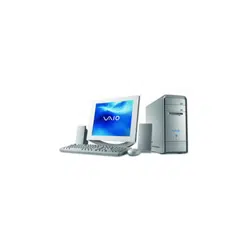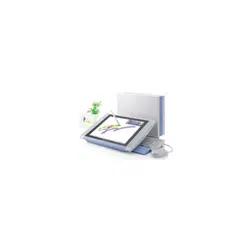

VAIO Slimtop
™
LCD
Computer User Guide
PCV-LX900

VAIO Slimtop™ LCD Computer User Guide
2
NOTICE
© 2001 Sony Electronics Inc. Reproduction in
whole or in part without written permission is
prohibited. All rights reserved. This manual and
the software described herein, in whole or in
part, may not be reproduced, translated, or
reduced to any machine-readable form without
prior written approval.
SONY ELECTRONICS INC. PROVIDES NO
WARRANTY WITH REGARD TO THIS
MANUAL, THE SOFTWARE, OR OTHER
INFORMATION CONTAINED HEREIN AND
HEREBY EXPRESSLY DISCLAIMS ANY
IMPLIED WARRANTIES OF
MERCHANTABILITY OR FITNESS FOR
ANY PARTICULAR PURPOSE WITH
REGARD TO THIS MANUAL, THE
SOFTWARE, OR SUCH OTHER
INFORMATION. IN NO EVENT SHALL
SONY ELECTRONICS INC. BE LIABLE
FOR ANY INCIDENTAL,
CONSEQUENTIAL, OR SPECIAL
DAMAGES, WHETHER BASED ON TORT,
CONTRACT, OR OTHERWISE, ARISING
OUT OF OR IN CONNECTION WITH THIS
MANUAL, THE SOFTWARE, OR OTHER
INFORMATION CONTAINED HEREIN OR
THE USE THEREOF.
Sony Electronics Inc. reserves the right to make
any modification to this manual or the
information contained herein at any time
without notice. The software described herein is
governed by the terms of a separate user license
agreement.
This product contains software owned by Sony
and licensed by third parties. Use of such
software is subject to the terms and conditions
of license agreements enclosed with this
product. Some of the software may not be
transported or used outside the United States.
Software specifications are subject to change
without notice and may not necessarily be
identical to current retail versions.
Updates and additions to software may require
an additional charge. Subscriptions to online
service providers may require a fee and credit
card information. Financial services may
require prior arrangements with participating
financial institutions.
Sony, VAIO, the VAIO logo, VAIO Smart,
VAIO Slimtop, ImageStation, DVgate, Media
Bar, Handycam, Memory Stick, the Memory
Stick logo, MovieShaker, Smart Capture,
VisualFlow, PictureGear, PictureToy and
i.LINK are trademarks of Sony. Intel and
Pentium are trademarks of the Intel
Corporation. Microsoft, Windows Me,
Windows, and the Windows logo are registered
trademarks of Microsoft Corporation. PS/2 is a
trademark of IBM Corporation.
All other trademarks are trademarks or
registered trademarks of their respective
owners.
Owner’s Record
The model number and serial number are
located on the back of your Sony VAIO
computer. Record the serial number in the space
provided here. Refer to the model and serial
numbers when you call your Sony Service
Center.
Model Number:
PCV-LX900
Serial Number:________________________
3
Safety Information and Caution
CD-RW Laser Diode Properties
❑ To prevent fire or shock hazard, do not
expose your desktop to rain or
moisture.To avoid electrical shock, do not
open the cabinet. Refer servicing to
qualified personnel only.
❑
Never install modem or telephone wiring
during a lightning storm.
❑
Never install telephone jacks in wet
locations unless the jack is specifically
designed for wet locations.
❑
Never touch uninsulated telephone wire or
terminals unless the telephone line has
been disconnected at the network
interface.
❑ Use caution when installing or modifying
telephone lines.
❑
Avoid using the modem during an
electrical storm.
❑
Do not use the modem or a telephone to
report a gas leak in the vicinity of the leak.
❑ The socket outlet shall be installed near
the equipment and shall be easily
accessible.
❑ Pour prévenir tout risque d’incendie ou
d’électrocution, garder cet appareil à
l’abri de la pluie et de l’humidité.
❑
Pour prévenir tout risque d’électrocution,
ne pas ouvrir le châssis de cet appareil et
ne confier son entretien qu’à une personne
qualifiée.
❑
Ne jamais effectuer l’installation de fil
modem ou téléphone durant un orage
électrique.
Laser Output
1.0mW(Read)
35mW (Write)
Wave Length
777–787nm
To change the backup battery,
please contact your nearest
Sony Service Center.
Danger - Visible and invisible
laser radiation when open.
Avoid direct exposure to beam.
Caution - The use of optical
instruments with this product
will increase eye hazard. As
the laser beam used in this
product is harmful to the eyes,
do not attempt to disassemble
the drive cabinet. Refer
servicing to qualified
personnel only.
For CD-RW: Danger - Invisible
laser radiation when open.
Avoid direct exposure to beam.
Caution: For ADSL modem
models, to reduce the risk of
fire, use only No. 26 AWG or
larger telecommunication line
cord.
VAIO Slimtop™ LCD Computer User Guide
4
❑ Ne jamais effectuer l’installation d’une
prise téléphonique dans un endroit
mouillé à moins que la prise soit conçue à
cet effet.
❑ Ne jamais toucher un fil téléphonique à
découvert ou un terminal à moins que la
ligne téléphonique n’ait été débranché de
l’interface réseau.
❑
Soyez très prudent lorsque vous installez
ou modifiez les lignes téléphoniques.
❑ Évitez d’utiliser le modem durant un
orage électrique.
❑
N'utilisez pas le modem ni le téléphone
pour prévenir d'une fuite de gaz vous êtes
près de la fuite.
❑
L’appareil doit être le plus près possible
d’une prise murale pour en faciliter
l’accès.
For questions regarding your product or for the
Sony Service Center nearest you, call
1-888-476-6972 in the United States or
1-800-961-7669 in Canada.
Sony Customer Support can be reached at
http://www.sony.com/pcsupport
Pour changer la pile de
rechange, veuillez contacter
votre centre de service Sony le
plus près.
Danger : Radiation laser
visible et invisible si ouvert.
Évitez l’exposition directe au
faisceau.
Avertissement - L'utilisation
d'instruments optiques avec ce
produit augmente les risques
pour les yeux. Puisque le
faisceau laser utilisé dans ce
produit est dommageable pour
les yeux, ne tentez pas de
désassembler le boîtier.
Adressez-vous à un agent de
service qualifié.
Pour les CD-RW : Danger :
Radiation laser visible et
invisible si ouvert. Évitez
l'exposition directe au
faisceau.
Attention : Pour ADSL modele
modem, afin de réduire les
risques d’indendie, n’utilisez
qu’un cordon de
communication NO. 26 AWG ou
plus gros.

5
Regulatory Information
This equipment has been tested and found to
comply with the limits for a Class B digital
device, pursuant to Part 15 of the Rules. These
limits are designed to provide reasonable
protection against harmful interference in a
residential installation. This equipment
generates, uses, and can radiate radio frequency
energy and, if not installed and used in
accordance with the instructions, may cause
harmful interference to radio communications.
However, there is no guarantee that interference
will not occur in a particular installation. If this
equipment does cause harmful interference to
radio or television reception, which can be
determined by turning the equipment off and
on, the user is encouraged to try to correct the
interference by one or more of the following
measures:
❑ Reorient or relocate the receiving antenna.
❑
Increase the separation between the
equipment and the receiver.
❑ Connect the equipment into an outlet on a
circuit different from that to which the
receiver is connected.
❑
Consult the dealer or an experienced
radio/TV technician for help.
You are cautioned that any changes or
modifications not expressly approved in this
manual could void your authority to operate this
equipment.
Only peripherals (computer input/output
devices, terminals, printers, etc.) that comply
with FCC Class B limits may be attached to this
computer product. Operation with
noncompliant peripherals is likely to result in
interference to radio and television reception.
All cables used to connect peripherals must be
shielded and grounded. Operation with cables,
connected to peripherals, that are not shielded
and grounded, may result in interference to
radio and television reception.
Declaration of Conformity
Trade Name: SONY
Model No.: PCV-LX900
Responsible
Party:
Sony Electronics Inc.
Address: 1 Sony Drive
Park Ridge, NJ 07656
Telephone: 201-930-6972
This phone number is for FCC-related
matters only.
This device complies with Part 15 of the
FCC rules. Operation is subject to the
following two conditions:
(1) This device may not cause harmful
interference, and
(2) this device must accept any interference
received, including interference that may
cause undesired operation.

VAIO Slimtop™ LCD Computer User Guide
8
DISPOSAL OF LITHIUM BATTERY
You can return your unwanted lithium batteries
to your nearest Sony Service Center or Factory
Service Center.
For the Sony Service Center nearest you, call
1-888-476-6972 in the United States or
1-800-961-7669 in Canada.
✍
In some areas the disposal of lithium
batteries in household or business
trash may be prohibited.
Do not handle damaged or
leaking lithium batteries.
Danger of explosion if battery
is incorrectly replaced.
Replace only with the same or
equivalent type recommended
by the manufacturer. Discard
used batteries according to the
manufacturer’s instructions.
The battery pack used in this
device may present a fire or
chemical burn hazard if
mistreated. Do not
disassemble, heat above
212
°
F (100
°
C) or incinerate.
Dispose of used battery
promptly.
Keep away from children.
Ne pas manipuler les batteries
au lithium qui fuient ou sont
endommagées.
Une batterie non conforme
présente un danger
d'explosion. La remplacer
seulement par une batterie
identique ou de type équivalent
recommandé par le fabricant.
Évacuer les batteries usées
selon les directives du
fabricant.
La manutention incorrecte du
module de batterie de cet
appareil présente un risque
d'incendie ou de brûlures
chimiques. Ne pas démonter,
incinérer ou exposer à une
température de plus de 100°C.
Évacuer promptement la
batterie usée.
Garder hors de portée des
enfants.

9
INDUSTRY CANADA NOTICE
NOTICE: The Industry Canada label identifies
certified equipment. This certification means
that the equipment meets certain
telecommunications network protective,
operational and safety requirements as
prescribed in the appropriate Terminal
Equipment Technical Requirements
document(s). The Department does not
guarantee the equipment will operate to the
user’s satisfaction.
Before installing this equipment, users should
ensure that it is permissible to be connected to
the facilities of the local telecommunications
company. The equipment must also be installed
using an acceptable method of connection.
The customer should be aware that compliance
with the above conditions may not prevent
degradation of service in some situations.
Repairs to certified equipment should be
coordinated by a representative designated by
the supplier. Equipment malfunctions or any
repairs or alterations made by the user to this
equipment may give the telecommunications
company cause to request that the user
disconnect the equipment.
Users should ensure for their own protection
that the electrical ground connections of the
power utility, telephone lines and internal
metallic water pipe system, if present, are
connected together. This precaution may be
particularly important in rural areas.
CAUTION: Users should not attempt to make
such connections themselves, but should
contact the appropriate electrical inspection
authority, or electrician, as appropriate.
NOTICE: The Ringer Equivalence Number
(REN) assigned to each terminal device
provides an indication of the maximum number
of terminals allowed to be connected to a
telephone interface. The termination on an
interface may consist of any combination of
devices subject only to the requirement that the
sum of the Ringer Equivalence Numbers of all
the devices does not exceed 5. The Ringer
Equivalence Number for this equipment is 0.7.
AVIS DE L’INDUSTRIE CANADA
AV I S : L’étiquette d’Industrie Canada identifie
le matériel homologué.
Cette étiquette certifie que le matériel est
conforme aux normes de protection,
d’exploitation et de sécurité des réseaux de
télécommunications, comme le prescrivent les
documents concernant les exigences techniques
relatives au matériel terminal. Le Ministère
n’assure toutefois pas que le matériel
fonctionnera à la satisfaction de l’utilisateur.
Avant d’installer ce matériel, l’utilisateur doit
s’assurer qu’il est permis de le raccorder aux
installations de l’entreprise locale de
télécommunication. Le matériel doit également
être installé en suivant une méthode acceptée de
raccordement. L’abonné ne doit pas oublier
qu’il est possible que la conformité aux
conditions énoncées ci-dessus n’empêche pas la
dégradation du service dans certaines
situations.
Les réparations de matériel homologué doivent
être coordonnées par un représentant désigné
par le fournisseur. L’entreprise de
télécommunications peut demander à
l’utilisateur de débrancher un appareil à la suite
de réparations ou de modifications effectuées
par l’utilisateur ou à cause de mauvais
fonctionnement.
Pour sa propre protection, l’utilisateur doit
s’assurer que tous les fils de mise à la terre de la
source d’énergie électrique, des lignes
téléphoniques et des canalisations d’eau
métalliques, s’il y en a, sont raccordés
ensemble. Cette précaution est particulièrement
importante dans les régions rurales.
Avertissement: L’utilisateur ne doit pas tenter
de faire ces raccordements lui-même; il doit

VAIO Slimtop™ LCD Computer User Guide
14
level. Use the display’s tilting feature to find the best position. You can
reduce eye strain and muscle fatigue by placing the display in the proper
position.
❑
Lighting — Choose a location where windows and lights do not create glare
and reflection on the display. Use indirect lighting to avoid bright spots on
the display. You can also purchase accessories for your display that help
reduce glare. Proper lighting adds to your comfort and work effectiveness.
Front Panel Overview
The front panel of your VAIO Slimtop™ Computer allows for access to the
CD-RW drive. It also contains Universal Serial Bus (USB) and i.LINK
®
ports to
connect USB devices, digital equipment, or other components.
✍
i.LINK is a trademark of Sony used only to designate that a product contains an
IEEE1394 connection. The i.LINK connection may vary, depending on the software
applications, operating system and i.LINK-compatible devices. All products with an
i.LINK connection may not communicate with each other.
Please refer to the documentation that came with your i.LINK-compatible device for
information on operating conditions and proper connection. Before connecting i.LINK-
compatible PC peripherals to your system, such as a CD-RW or Hard Disk Drive,
confirm their operating system compatibility and required operating conditions.

Front Panel Overview
15
Locating Controls and Ports
Front Panel
1 CD-RW eject button
Ejects a disc from the CD-RW drive.
2 CD-RW drive
Reads data from a CD and writes data to a CD-R or CD-RW disc.
3 Memory Stick® access indicator light
Lights in amber while reading and writing data from and to a Memory Stick media.
4 Hard disk drive access indicator light
Lights in amber while reading and writing data from and to the hard disk.
5 CD-RW drive access indicator light
Lights in amber while reading and writing data from and to a CD-R or CD-RW disc.
6 Power switch and indicator light
Turns on/off the computer and the display.
The indicator light is green while the power is on and amber when the computer is in
standby mode.
7 Front panel cover
A Sliding panel that covers the PC card slot, Memory Stick slot, and connectors.
OPEN/CLOSE
MEMORY
STICK
HD
DISC

VAIO Slimtop™ LCD Computer User Guide
16
Front Panel (cont.)
8 PC Card slot
A PC card (also called a PCMCIA card) can be installed in this slot. PC cards enable
you to add functionality to your system.
9 MEMORY STICK® media slot
Insert a Sony MEMORY STICK media into this slot.
10 Universal Serial Bus (USB) port
Connection for a USB device.
11 i.LINK 4-pin port (IEEE1394)
Connection for an i.LINK-compatible digital device, such as a Sony Digital
Handycam® Camcorder.
OPEN/CLOSE
MEMORY
STICK
MEMORY
STICK
USB
i.LINK S400
HD
PC CARD
DISC
Back Panel Overview
17
Back Panel Overview
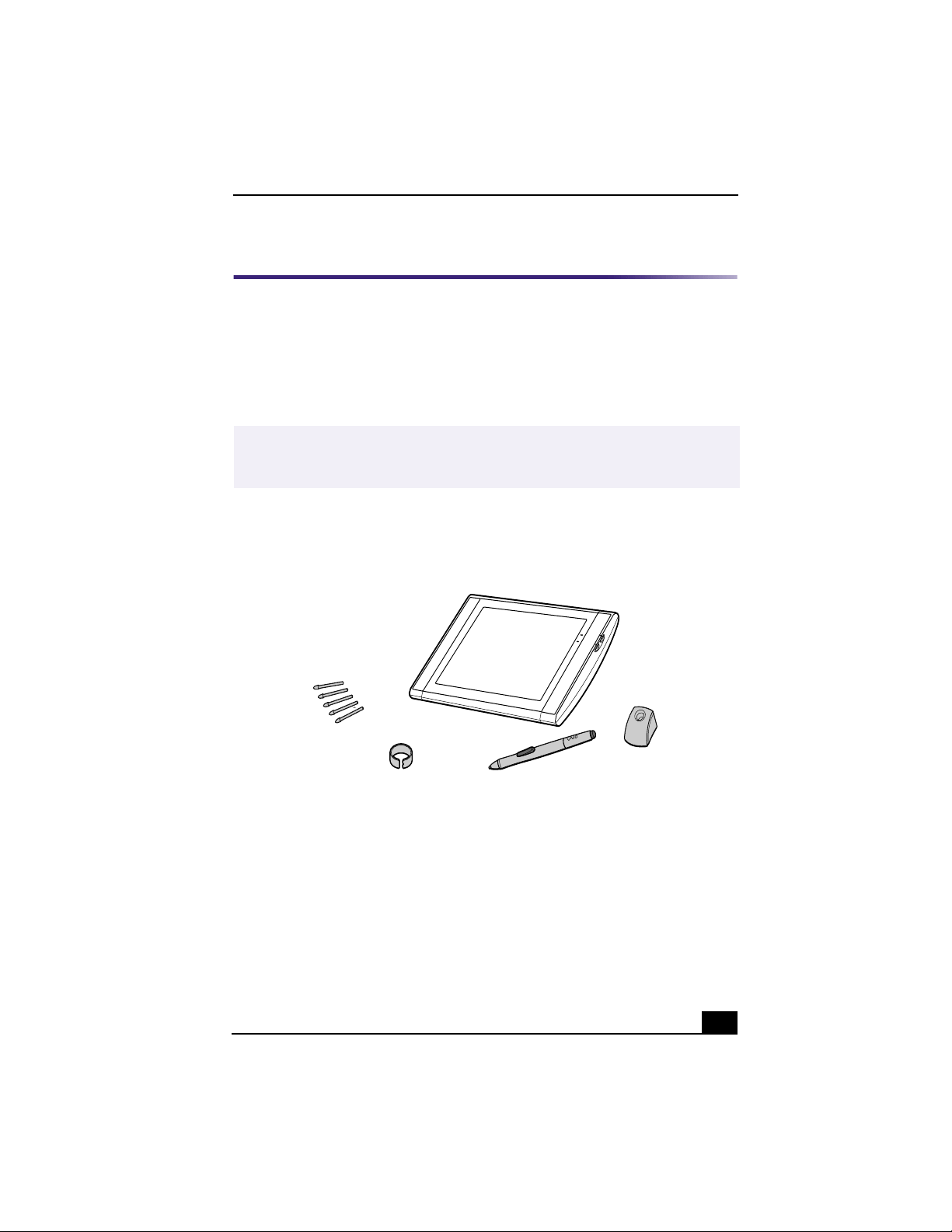
The back panel of your computer contains the ports for supplied and optional
accessories. The icons on the back panel help locate and identify the ports on
your computer.
Locating Ports
Back Panel
1 AC Input port
Connection for the supplied power cord.
2 T-Lever
A handle that is used to remove the unit’s cover.
3 Monitor port
Connection for a standard CRT display.
MONITOR
MIC
PHONES
NETWORK/USB
LINE IN
i.LINK S400
LCD
LINE PHONE
USB

VAIO Slimtop™ LCD Computer User Guide
18
4 ETHERNET port
10Base-T/100Base-TX Fast Ethernet interface.
(The port marked with (Network) is for LAN connections only.)
5 Universal Serial Bus (USB) ports (2)
Connections for USB devices. Two USB ports are located on the back panel and one USB
port is located on the modem card (See #13).
6 Headphones jack
Connection for optional headphones or computer speakers.
7 Line In jack
Connection for an optional audio device.
8 Microphone jack
Connection for an optional microphone.
9 i.LINK® 6-pin port (IEEE1394)
Connection for a compatible digital device such as a Sony Digital Handycam
®
Camcorder.
10 LCD display (monitor) port
Connection for the supplied Sony Pen Tablet.
Note: Do not connect any other display to this port.
11 Line jack
Connection for the supplied modem cable to the wall jack.
12 Telephone cable jack
Connection for the phone cable to the computer.
13 Universal Serial Bus (USB) port
Connection for a USB device.
✍
i.LINK is a trademark of Sony used only to designate that a product contains an
IEEE1394 connection. The i.LINK connection may vary, depending on the software
applications, operating system, and i.LINK-compatible devices. All products with an
i.LINK connection may not communicate with each other.
Please refer to the documentation that came with your i.LINK-compatible device for
information on operating conditions and proper connection. Before connecting
i.LINK-compatible PC peripherals to your system, such as a CD-RW or Hard Disk
Drive, confirm their operating system compatibility and required operating conditions.
Sony Pen Tablet Overview
19
Sony Pen Tablet Overview
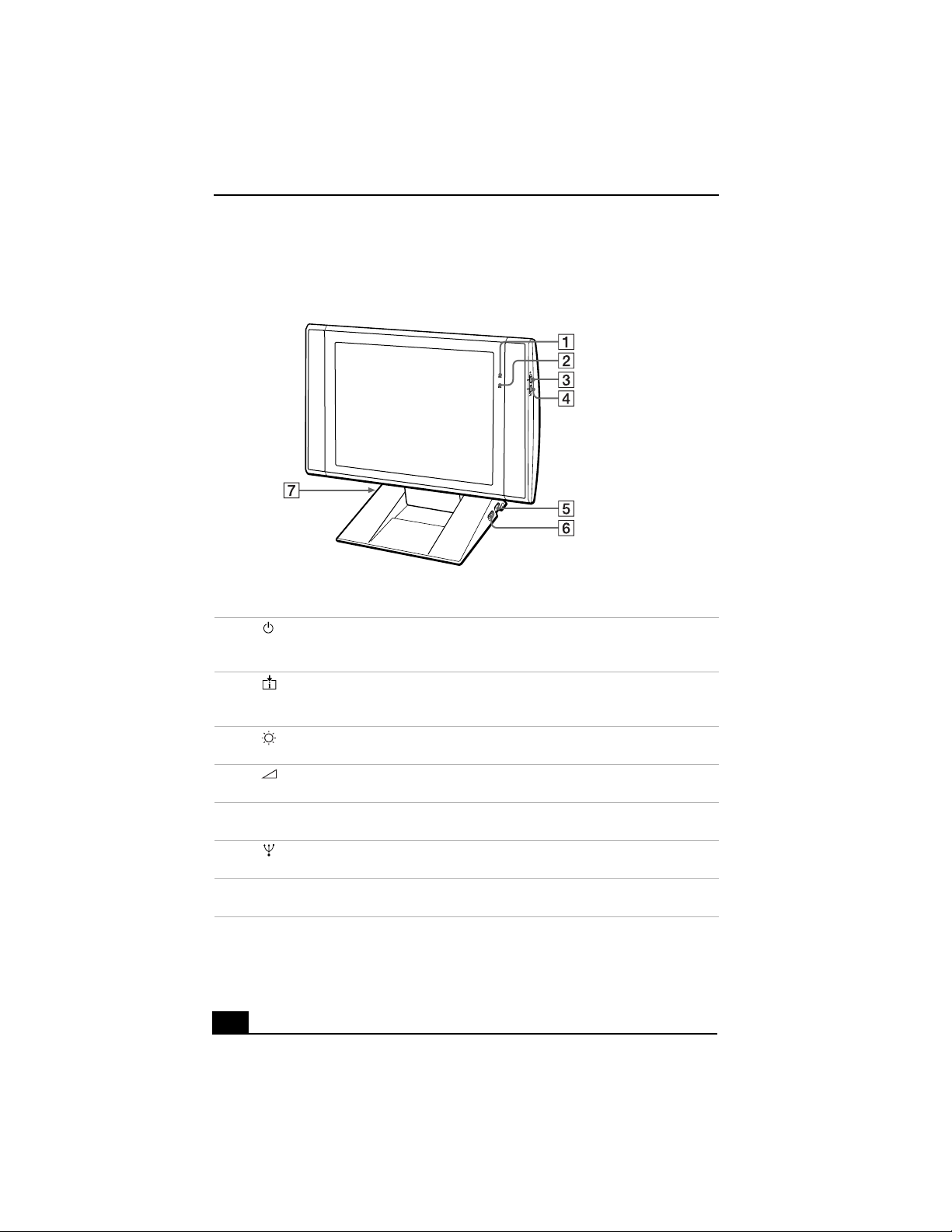
Your VAIO Slimtop™ Computer is supplied with a Sony Pen Tablet display
(TA-15A), a VAIO Pen and accessories.
The Sony Pen Tablet is a graphic interface that provides a pressure-sensitive work
area. The VAIO Pen is a cordless input device that controls the movement of the
cursor on the surface of the tablet screen. The pen stand, pen tip replacements,
and pen tip removing tool help you protect and care for your VAIO Pen.
✍
Place the VAIO Pen in the supplied pen stand when it is not in use, to maintain the
sensitivity of the pen tip and to avoid interference with other pointing devices, such as
your mouse.
Sony Pen Tablet and accessories
Sony Pen Tablet display
Pen stand
VAIO Pen
Pen tip replacements (5)
Pen tip removing tool
VAIO Slimtop™ LCD Computer User Guide
20
Sony Pen Tablet Display (Shown in an upright position)
1 Power indicator light
Light is green while the power is on. When the computer enters standby mode, this
indicator light turns amber.
2 Information LED light
Light turns red to alert the user to activities, such as the arrival of e-mail. See “AutoAlert
E-mail Notification System.”
3 Brightness control
Adjusts the brightness of the screen.
4 Volume control
Adjusts the volume of the integrated speakers on the LCD display.
5 PS/2® mouse port
Connection for a mouse.
6 Universal Serial Bus (USB) port
Connection for a USB device.
7 PS/2
®
keyboard port
Connection for a VAIO Convertible Keyboard.
USB
M
OUSE

VAIO Slimtop™ LCD Computer User Guide
22
VAIO Pen Overview
The VAIO Pen controls the cursor movements on the Sony Pen Tablet screen.
Hold the pen in the same manner as a pen or pencil, making sure that the rocker
switch on the side is within reach of your thumb or forefinger, but cannot be
accidentally pressed while drawing or writing.
The VAIO Pen is activated when it is held within close proximity to the pen tablet
screen. You can position the cursor on the pen tablet screen or use the rocker
switch, without touching the pen tip to the tablet surface. The upper/lower switch
positions and eraser can be programmed to perform different functions. See the
Sony Pen Tablet online help for more information on VAIO Pen settings.
VAIO Pen
1 Eraser
Delete unwanted portions of your work, depending on the application in use.
2 Upper switch position
The upper side of the rocker switch is set to deliver a double left click by default.
3 Lower switch position
The lower side of the rocker switch is set to deliver a right click by default.
4 Pen tip
You can use the pen tip to draw or write. Tapping the pen tip against the tablet screen
delivers a click in the same manner as the left button on a mouse.
Rocker Switch
VAIO Pen Overview
23
Your VAIO Pen, eraser, and the upper/lower switch positions are programmable.
By default, the basic functions performed by the VAIO Pen are:
❑
Pointing — Place the tip of the pen anywhere on the pen tablet screen and
the screen cursor will automatically correspond to that point.
❑
Clicking — Tap the pen tablet screen once with the tip of the pen, or press
the pen tip against the screen with enough pressure to register a single click.
❑
Double clicking — Quickly tap the pen tablet screen twice in the same place
with the tip of the pen. You can also register a double click by pressing the
upper switch position of the pen’s rocker switch.
❑
Dragging — Point to and select an object by pressing the pen to the pen
tablet screen. Slide the pen tip across the tablet to move the object to the
desired location. To select text, point to the beginning of the text, and then
drag the pen across the tablet until all of the desired text is highlighted.
To replace the Pen tip
Your VAIO Pen is supplied with pen tip replacements. The pen tip wears with
normal use and must be replaced when the tip becomes too short or develops a
flat point. Follow these steps to replace the pen tip:
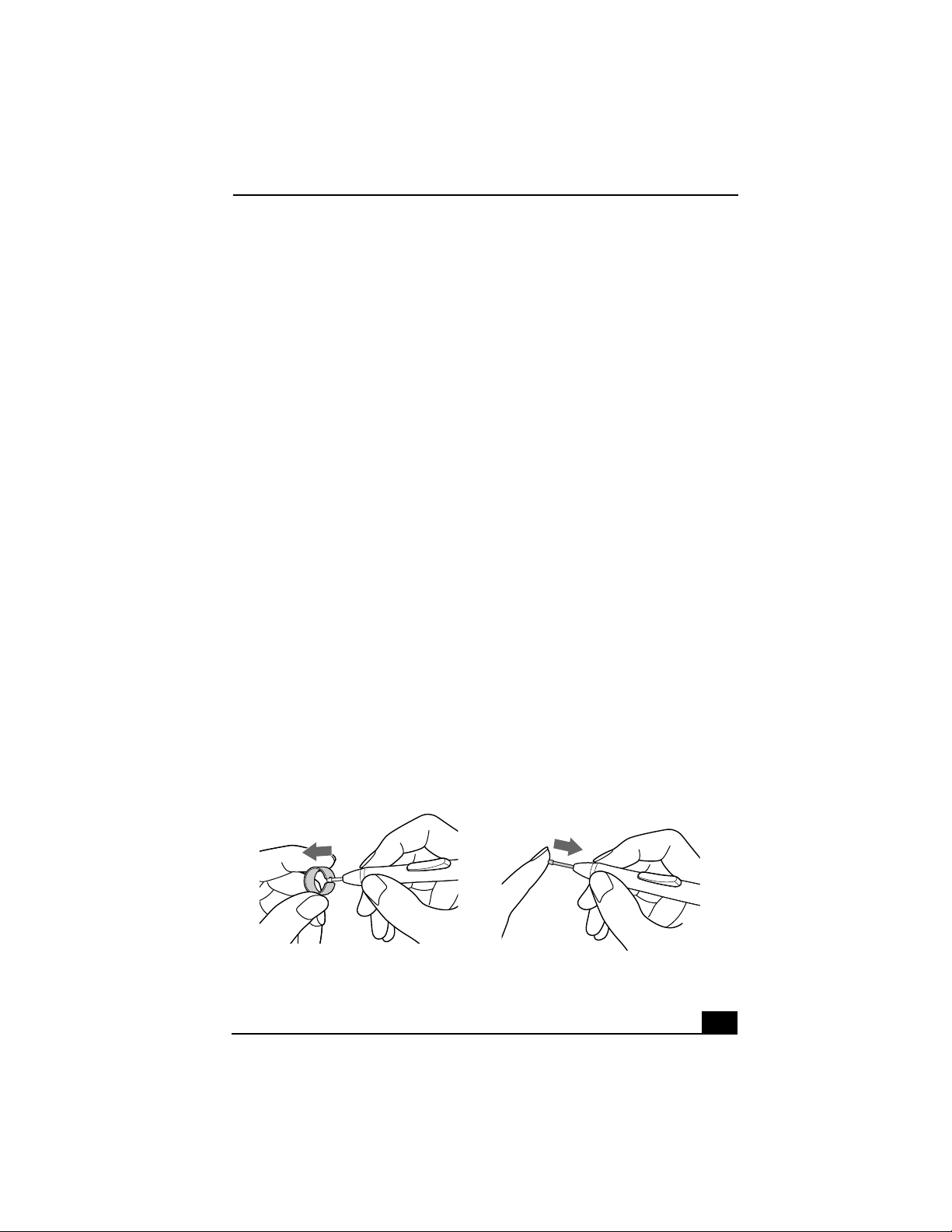
1 Clasp the worn pen tip with the pen tip removing tool and pull it straight out
of the VAIO Pen barrel.
2 Slide the flat end of a new pen tip straight into the barrel, pushing the tip
firmly until it stops.
Replacing the pen tip
Step One
Step Two

VAIO Slimtop™ LCD Computer User Guide
24
Configuring the VAIO Pen
To change the pen tip, eraser and upper/lower switch functions
1 From the Start menu, point to Settings, and then click on Control Panel.
2 Click on Sony Tablet. The Sony Tablet Properties window appears.
3 From the Tool Buttons tab, click the drop-down list for the pen function you
wish to change. Select the desired function for the pen tip, eraser, or the
upper/lower switch positions.
Sony Tablet Properties main window
Function Description
Left-Click
Single click of the left mouse button.
Left Double-Click
Double-click of the left mouse button.
Right-Click
Single click of the right mouse button.
Middle-Click
Clicking the center wheel button of a wheel mouse.
Left-Click Lock
Holds down the left mouse button.
VAIO Pen Overview
25
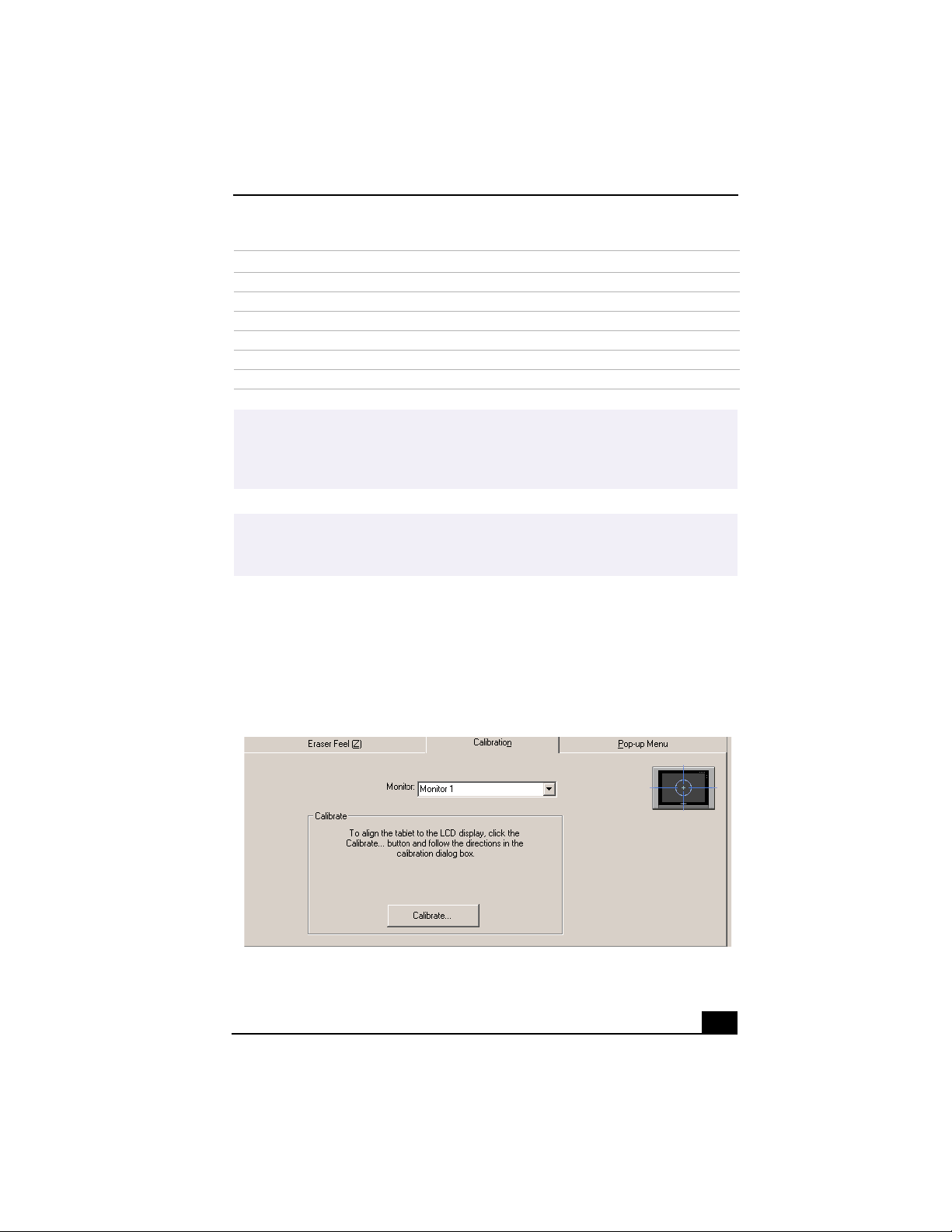
To calibrate your pen to your tablet screen
1 From the Sony Tablet Properties screen, click on the Calibration tab.
2 Click on the “Calibrate...” button. Follow the onscreen instructions to align
your pen’s cursor positioning to the tablet screen coordinates.
Pressure Hold
Keeps the pen tip pressure constant.
Pop-up Menu
Displays a pop-up menu at the cursor position.
Erase
Operates as an eraser.
Keystroke
Performs a programmed keystroke.
Modifier
Operates as the Shift, Alt, or Ctrl key (as programmed).
Ignored
No function is assigned.
✍
The Left-Click function is assigned by default to the pen tip. Before you change the
pen tip setting to perform a different function, assign the Left-Click function to another
switch. Sony suggests assigning the Left-Click function to the pen tip when using the
pen with drawing applications.
✍
You can reset your VAIO Pen functions to the factory default settings by using the
“Reset Tab to Default” button. You can revert to a previously saved setting by using
the “Revert tab.”
Calibration Tab
Function Description

VAIO Slimtop™ LCD Computer User Guide
30
Customizing the pen settings for specific software
applications
You can customize your pen settings for a specific software application. When
you use different software, the associated pen settings are applied automatically,
enabling you to take full advantage of each software application’s features.
To add an application to the custom settings list
1 From the Sony Tablet Properties window, click on the “Add Application to
List...” button. The “Add Application for Custom Settings” dialog box
appears.
2 Click OK.
To create custom settings for an application
1 Select a software application from the “Applications with Customized Tool
Settings” list.
2 Customize the pen settings for each software application according to the
software’s features. The settings apply only to the selected application.
3 Click Apply.
To remove an application from the custom settings list
1 Click on the Remove menu, click on “Custom Settings for Application”, and
then select the application(s) to be removed.
2 Click OK.
✍
If you have pen settings that you want to apply to all software applications, select “All
Other Apps” before changing the setting.
✍
For more information on customizing your VAIO Pen settings, see the Sony Tablet
online help.

Using PC Cards
35
4 Push the PC card eject button on the front panel of the system unit. You may
need to extend the eject button out from the computer before you can eject
the card.
5 When the PC card ejects from the PC card slot, remove it by holding the
edges and pulling it out carefully.

VAIO Slimtop™ LCD Computer User Guide
36

VAIO® Action Setup
37
VAIO® Action Setup
VAIO Action Setup manages the settings for your computer's Programmable
Power Keys (PPK), internal timer, i.LINK® interface, and Memory Stick®
media. For more information on changing these settings using VAIO Action
Setup, see the online VAIO Action Setup Help.
To access VAIO Action Setup Help:
1 Click Start, point to Programs, and then point to VAIO Action Setup.
2 Click VAIO Action Setup Help.
Programmable Power Keys
Your Sony computer is equipped with technology that allows you to access your
favorite applications quickly. Each Programmable Power Key (PPK) on your
VAIO Convertible keyboard is programmed to launch a preset application with a
single press of the key. If you wish, you can use VAIO Action Setup to change the
PPK functions.
The Programmable Power Keys are located at the right side of your keyboard,
and are numbered P1 through P4. The keys work even when the computer is
turned off. Pressing one of the PPK buttons turns on the computer and launches
the preset application.
The four Programmable Power Keys preprogrammed to perform the following
functions.
Key Function
P1 (MAIL) Starts Microsoft® Outlook® Express.
P2 (INTERNET) Starts Microsoft® Internet Explorer for Windows Me™.
P3 (PICTURE) Starts Sony’s PictureGear™.
P4 (HELP) Starts VAIO® Demo/Help.

Presetting i.LINK® devices
39
Presetting i.LINK® devices
You can preset your i.LINK-equipped devices to perform desired functions, such
as automatically starting DVgate™ software or connecting two VAIO®
computers.
To preset your i.LINK device to perform a desired function
1 From the Start menu, point to Programs, point to VAIO Action Setup, and
then click on VAIO Action Setup.
The VAIO Action Setup windows appears.
2 Click i.LINK.
3 Click the Advanced Setting tab.
4 Click the Enable i.LINK launcher function checkbox and click Apply.
5 Connect the device to your computer with your i.LINK cable.
6 Turn on the device.
The VAIO Action Setup dialog box appears.
7 Click OK.
8 To modify the device name, click the current device name in the list box and
click Modify device name.
9 Type the desired name and click Apply.
10 To assign an application, click Modify.
The Select Application dialog box appears.
11 Select the desired application and click Next.
✍
i.LINK is a trademark of Sony used only to designate that a product contains an
IEEE1394 connection. The i.LINK connection may vary, depending on the software
applications, operating system and i.LINK-compatible devices. All products with an
i.LINK connection may not communicate with each other.
Please refer to the documentation that came with your i.LINK-compatible device for
information on operating conditions and proper connection. Before connecting i.LINK-
compatible PC peripherals to your system, such as a CD-RW or Hard Disk Drive,
confirm their operating system compatibility and required operating conditions.

VAIO Slimtop™ LCD Computer User Guide
40
12 Click Next to confirm the application name.
The Input Application Name dialog box appears. You may change the name
and description of the application you want to launch.
13 Click Finish to complete this step.
The next time the device is connected and turned on, the assigned application will
launch automatically.
Changing the Window Design of Sony Software
To change the window design
1 From the Start menu, point to Settings, and then click on Control Panel.
2 Click UI Design Selector.
3 Click << or >> and select the desired design.
4 Click Apply.
5 The “UI Design Selector” window design changes. The window design for
your Sony software will match the “UI Design Selector” window.
6 To try another selection, click << or >> and then click OK.
7 The UI Design Selector closes and the Sony software window design
displays.
✍
You may use the feature with UI Design Selector-compatible software only.

VAIO Slimtop™ LCD Computer User Guide
42
If you are using Microsoft
®
Outlook
®
Express
When using the AutoAlert E-mail Notification System with Microsoft Outlook
Express, select the “Dial automatically” setting in your Microsoft Outlook
Express software. To adjust this setting:
1 Start Outlook Express.
2 Click Tools, and then select Options.
3 From the drop-down box, select “Connect even when working offline.”
4 Click OK.
5 Click Send/Receive.
A dial-up connection window appears. Select the desired ISP, and then click
Connect Automatically.

Configuring your VAIO Slimtop™ LCD Computer
43
Configuring your VAIO
Slimtop™ LCD Computer
Hard Disk Drive Partition
In order to improve the performance of the DVgate™ software, the hard disk
drive on your computer has been formatted with two partitions, C and D. The
DVgate™ software saves files to the D partition. This prevents large video
captures from consuming the available space on your C partition. To maintain
optimum DVgate™ performance, you should defragment your D partition
regularly.
Defragmenting your Hard Disk Drive
If you encounter frame dropping while recording digital video onto your hard
disk drive, defragmentation may be necessary.
To defragment your hard disk drive
1 Deactivate your screen saver, if applicable.
2 From the Start menu, point to Programs, point to Accessories, point to
System Tools, and then click on Disk Defragmenter.
3 Run Disk Defragmenter.
✍
It may take more than a couple of hours to complete defragmentation, depending on
the data capacity and utilization of your computer’s hard disk drive(s).

VAIO Slimtop™ LCD Computer User Guide
44
i.LINK®
(IEEE1394) Compatibility
Your VAIO computer includes a 4-pin i.LINK port on the front of the system and
a 6-pin i.LINK port on the back of the system.
A 4-pin i.LINK port cannot supply power to a connected device.
A 6-pin i.LINK port can:
❑
supply power from the computer to the connected device if the device is
equipped with a 6-pin connector, and
❑
supply 10V to 12V.
The following Sony i.LINK 400 Mbps cables are available and recommended for
use with your computer: VMC-IL4415, VMC-IL4435, VMC-IL4615,
VMC-IL4635, VMC-IL6615, and VMC-IL6635. Sony computer supplies,
accessories, and peripherals can be purchased from your local retailer or by
contacting Sony VAIO® Direct Web site (http://vaio.sonystyle.com), or by
calling 1-888-315-7669 (toll free).
✍
i.LINK is a trademark of Sony used only to designate that a product contains an
IEEE1394 connection. The i.LINK connection may vary, depending on the software
applications, operating system and i.LINK-compatible devices. All products with an
i.LINK connection may not communicate with each other.
Please refer to the documentation that came with your i.LINK-compatible device for
information on operating conditions and proper connection. Before connecting i.LINK-
compatible PC peripherals to your system, such as a CD-RW or Hard Disk Drive,
confirm their operating system compatibility and required operating conditions.
The total power supplied by the 6-pin i.LINK port cannot exceed 6 watts.

VAIO Slimtop™ LCD Computer User Guide
46
Enabling Ethernet
Your computer comes with a preinstalled Ethernet interface. Your computer may
ship with the Ethernet function disabled. You can enable Ethernet connectivity by
following the instructions below.
To enable the Ethernet connection
1 Right-click My Computer on the desktop and select Properties.
2 Click the Device Manager tab.
3 Select “SiS 900 PCI Fast Ethernet Adapter” under the Network Adapters
category.
4 Click Properties.
5 Click Enable Device and then click OK.
6 Click Close.
Warning: Your computer has a protective sticker next to the Ethernet port
located on the rear panel. Connect only 10Base-T and 100Base-TX cables to
the Ethernet port. Using other cables or a telephone cable may result in an
electric current overload and can cause a malfunction, excessive heat or fire
in the port. For help on connecting to a network, see your network
administrator.

VAIO® AV Applications
47
VAIO® AV Applications
Your VAIO computer comes with a collection of audio and video (AV)
applications that make it easy to use advanced multimedia formats. This section
describes these VAIO AV applications.
DVgate™
Sony Electronics, Inc.
DVgate software makes it easy to edit digital videos. You can grab and edit digital video
clips, and then assemble them into a polished home video everyone will enjoy. You can
also use DVgate software to capture individual frames from digital video clips, and then
save them as graphic files. Enhance your Web page, send family and friends your favorite
stills, create your own wallpaper—the possibilities are endless.
Media Bar™
Sony Electronics, Inc.
Media Bar software is your all-in-one solution for audio/video playback. Media Bar
software handles all common computer multimedia formats, and controls certain Sony
devices. Media Bar software encompasses audio/video library cataloging and playlist
management, in addition to digital video quality control and effects features. Media Bar
seamlessly integrates a variety of new media formats with an easy-to-use software
interface.
MovieShaker™
Sony Electronics, Inc.
Sony’s original MovieShaker software creates personal movies that have transitions,
background music, and text. Just import your video clips and “shake” with a click of the
mouse. Your personal movies are easy to create and fun to share with family and friends.
OpenMG™ Jukebox
Sony Electronics, Inc.
OpenMG Jukebox software enables you to import digital audio files by downloading from
Electronic Music Distribution (EMD) services over digital networks, such as the Internet.
You can record audio CDs onto your hard drive in a variety of formats.

VAIO Slimtop™ LCD Computer User Guide
48
PictureGear™
Sony Electronics, Inc.
PictureGear is a digital image management application that allows you to see all the
images stored in any directory on your computer. Thumbnail views provide quick
reminders of your pictures. Brighten, contrast, enhance, resize, crop, and color-correct
your pictures. Create panoramic views, animations, screen savers, wallpaper, and even
HTML photo albums.
Smart Capture™
Sony Electronics, Inc.
Smart Capture is a fun new way to send multimedia messages via e-mail. Smart Capture
manages the i.LINK® connection between your computer and a Sony Digital Handycam
Camcorder, or other cameras that support the i.LINK interface. Smart Capture allows you
to capture and compress video or still images that you can save or share via e-mail.
Captures are low resolution, making it ideal for e-mail. For high-quality captures, use
DVgate.
VisualFlow™
Sony Electronics, Inc.
VisualFlow is a state-of-the-art Sony multimedia browser designed specifically for
Memory Stick® media. It displays any still picture, movie or sound files stored in a
Memory Stick media in a visually pleasing, artistic manner. VisualFlow not only plays a
selected movie or sound file, but also enables playback of files by other applications like
PictureGear, Memory Stick Slideshow and Windows Explorer.
✍
i.LINK is a trademark of Sony used only to designate that a product contains an
IEEE1394 connection. The i.LINK connection may vary, depending on the software
applications, operating system, and i.LINK-compatible devices. All products with an
i.LINK connection may not communicate with each other.
Please refer to the documentation that came with your i.LINK-compatible device for
information on operating conditions and proper connection. Before connecting i.LINK-
compatible PC peripherals to your system, such as a CD-RW or Hard Disk Drive,
confirm their operating system compatibility and required operating conditions.
VAIO® AV Applications
49
MovieShaker™
This application can be used to create fun and innovative movies without any
knowledge of film editing. In a few simple steps, motion pictures can be
combined with special effects, still images, and music files, and then saved in a
format compatible with most computers.
Importing Images and Sound Clips
1 Click (File Import) or (DV Import).
2 Find the file you want to add.
3 Select the file.
4 Click Open. The file is added to the Clip tray.
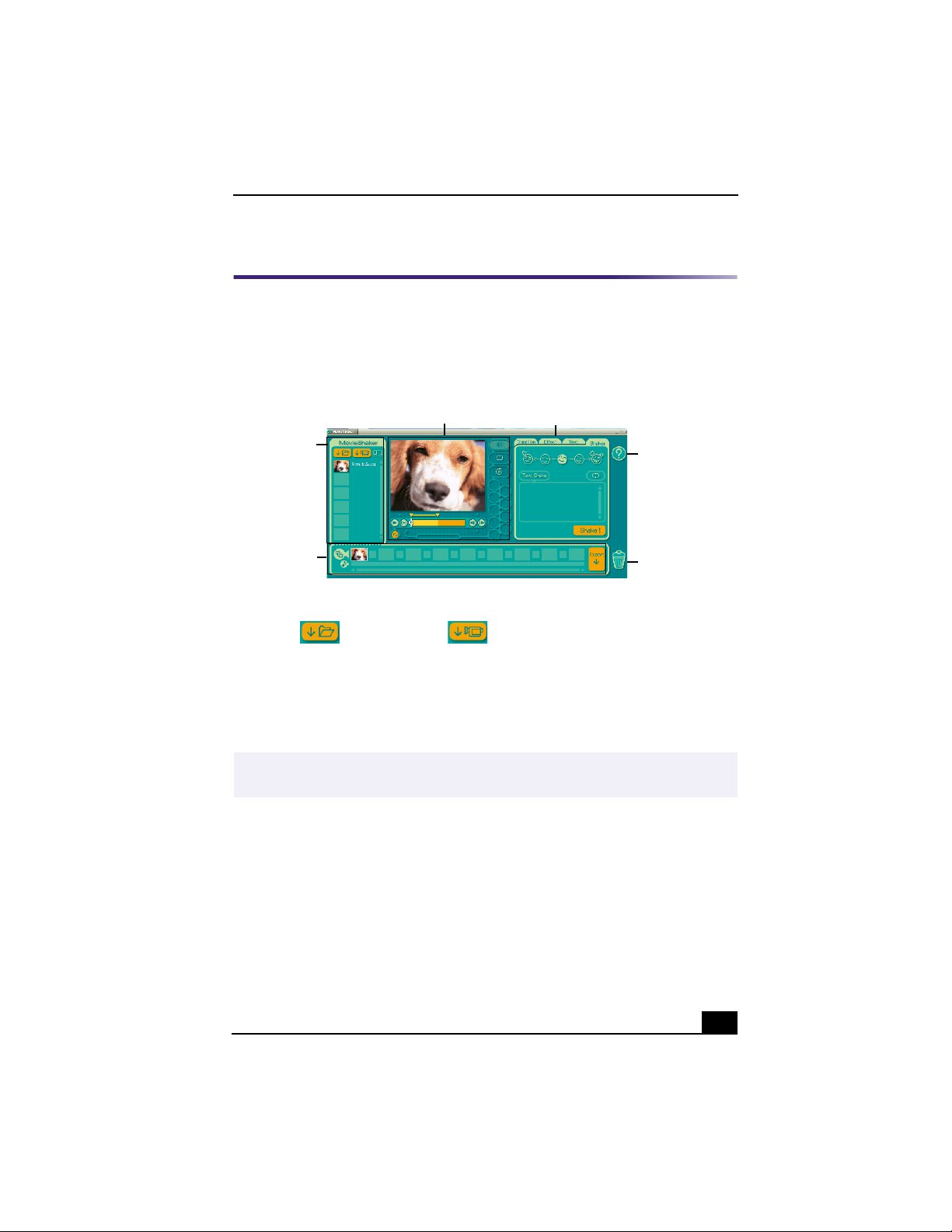
Main Window
✍
Importing lengthy image or sound files may cause the MovieShaker software to stop
responding.
Clip tray
Working Panel
Product tray
Editing trays
Help
Tras h
VAIO Slimtop™ LCD Computer User Guide
50
Create a Movie using Shaker
After adding clip(s) to the Clip tray, you can create a short movie using the
Shaker feature. Shaker randomly selects clips from the Clip tray to create a
30-second scene.
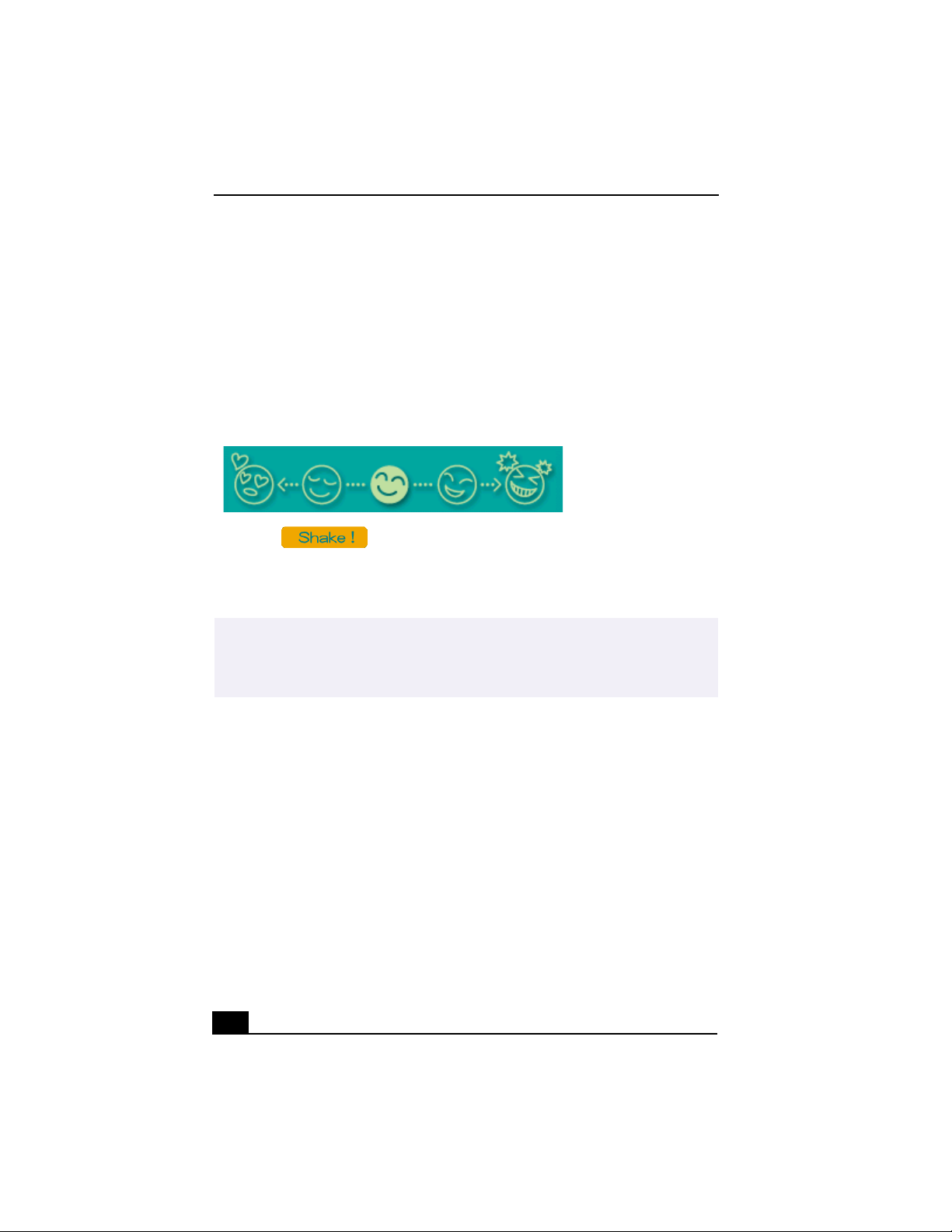
1 Click the Shaker tab.
2 Select a mood by clicking a face in the Shaker tray.
3 Click . A thirty second scene is automatically generated and
saved to the Product tray.
4 To preview, switch the Work Panel to Product tray mode and press play.
Shaker tray
✍
Scenes created with Shaker begin with a black frame and after processing are placed
in the first available slot on the Product tray. Limit the number of scenes placed on the
Product tray to 5 or less. MovieShaker software may stop responding if too many
scenes are placed on the Product tray.

VAIO Slimtop™ LCD Computer User Guide
52
Saving a Movie
1 Verify that the clip(s) you want to save is on the Product tray. See Help for
more details on saving movies.
2 Click Export.
3 Select the format in which you want the document to be saved.
4 Click Next.
5 Locate the folder to which you want the file saved.
6 Name the file.
7 Click Save.
Exporting movies may take a long time to complete—“Save movie as DV”
(Digital Video) takes the longest and Quick-Save is the fastest. MovieShaker
software can play AVI files up to 65 MB in length.

VAIO Slimtop™ LCD Computer User Guide
54
Using Panorama Maker
Panorama Maker stitches a group of still images into a 360 degree panoramic
picture. The source images should be the same size and overlap 20%.
How to stitch a panoramic picture:
1 Gather the source images into the same folder or collection.
2 Select the images you want to use.
3 From the Utilities menu select Panorama Maker.
4 Select the correct lens and click Okay. (If 35mm lens is selected, the prompt
does not appear. To select a different lens, click on the lens icon.)
5 Click the panoramic icon, near the bottom of the window.
6 Click Full Stitch.
Making Still Images and Panoramic from MPEG
1 Select the MPEG file.
2 From the Movie/Sound menu, select Scene Break Down.
3 Then select Movie Stitch, to create a panoramic picture.
✍
Sony recommends creating your panoramic picture with 12 landscaped or 16 portrait
pictures.
VAIO® AV Applications
57
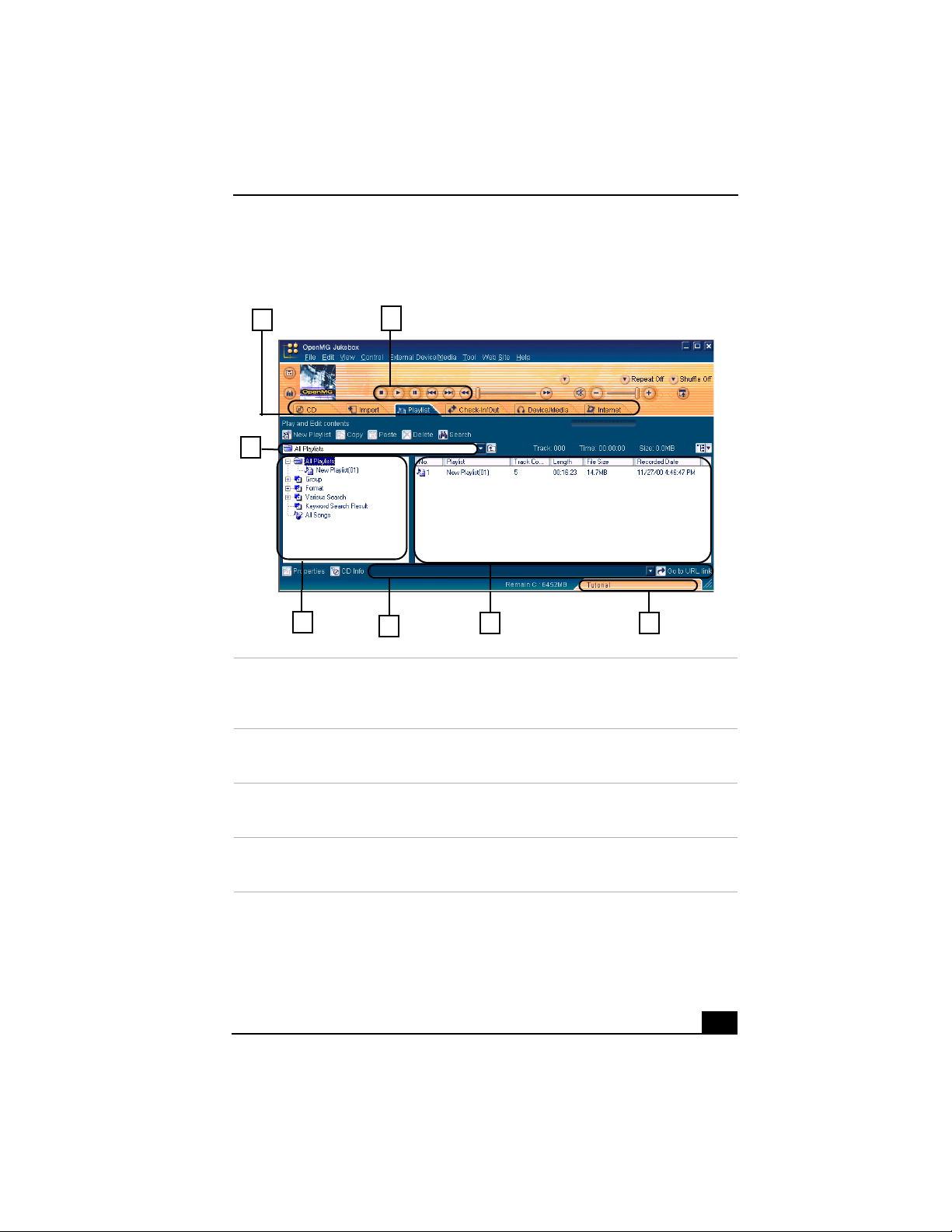
OpenMG Jukebox main window
1 Feature tabs
Changes the screen view according to
the selected feature.
5 Internet address drop-down list
Displays Internet addresses, if available.
You can click on the “Go to URL link”
button to immediately connect to Web site.
2 Player control buttons
Controls playback functions, such as play,
pause, stop, fast forward and reverse.
6 File list view
Displays the contents of the folder selected
in the file tree view.
3 Playlist drop-down list
Displays available playlists and audio files
of the current feature tab.
7 Tutorial tab
Opens and closes the Tutorial feature.
4 File tree view
Displays the folders available on your
computer.
2
3
6
5
7
4
1
http://www.cddb.com

VAIO® AV Applications
59
Transferring Songs (Check-in/Check-out)
You can transfer songs between the playlists of your OpenMG Jukebox and
external devices or media. For more information on using your external devices
or media, see the documentation that came with the product.
These instructions are for using the Check-in/Check-out 1 step mode. For
information on using 2 step mode, see “Changing the check-in/check-out
settings” in the OpenMG Jukebox Help menu.
Check-out
1 Connect the external device or insert the media into your computer.
2 Click on the Check-in/Out tab to display the Check-in/Out tab window. Your
computer automatically recognizes the connected external device or media
and lists the content information in a new panel on the right side of the
Check-in/Out tab window.
✍
You can display the name of the CD and its songs by clicking on the CD Info button.
Check-In/Out tab window

VAIO® AV Applications
61
For more information about using OpenMG Jukebox 2.0 software, go to the
online OpenMG Jukebox Help. You can access the online help file using either of
the following instructions:
❑
Click the Start button on the Windows taskbar, point to Programs, point to
OpenMG Jukebox, and then click on OpenMG Jukebox Help.
❑
From the OpenMG Jukebox Help menu, select OpenMG Jukebox Help.
Additional Features
❑
OpenMG Jukebox Tutorial — The features of OpenMG Jukebox 2.0 are
described in the Tutorial. The user friendly interface guides you directly to
the OpenMG Jukebox 2.0 features.
❑
OpenMG Jukebox Backup Tool — You can back up and restore all of the
music, graphics and information data managed by OpenMG Jukebox. You
must be connected to the Internet to use the OpenMG Jukebox Backup Tool.
❑
Import audio files in various formats — You can import audio files with
various formats, such as MP3 or WAV standards. You can also import audio
files that comply with the Microsoft® Windows Media™ Technologies
(WMT) standard, identified by .asf or .wma extensions. Manage your audio
files through the Playlist feature of OpenMG Jukebox 2.0.
❑
Manage imported songs on the Playlist — Additional features are
available when you register your imported songs through the Playlist feature
of OpenMG Jukebox. You can manage your music by creating your own list
of songs categorized by genre or artist, displaying your song list in the
Playlist feature, and arranging your songs in a customized order using the
Playlist folders. Edit your music by combining multiple songs into a single
song, or divide one song into two, by using the Combine and Divide features.
❑
Simple mode — The main OpenMG Jukebox window in simple mode is a
smaller, compact version of the full mode view. This can be useful when you
want to listen to songs with OpenMG Jukebox while using other software, or
whenever you feel that full mode view is intrusive. The design of the main
OpenMG Jukebox window in simple mode can be changed by adding a new
“skin” which enhances the window’s appearance. The Simple mode feature
allows you to perform playback operations only.

VAIO® AV Applications
63
Using Still mode
1 From the Start button, point to Programs, point to Smart Capture, and then
click on Smart Capture. The Smart Capture main window appears.
2 Connect your i.LINK-compatible digital camera or camcorder to your
computer with an i.LINK cable. An image appears in the Smart Capture
main window.
3 Check that the Mode dial is set to Still. Click on the Mode dial to switch
between Still mode and Net Movie mode.
1 Mode indicator
Displays the current mode (Still or Net
Movie).
5 Help button
Connects you directly to the online Smart
Capture help.
2 Mode dial
Switches Smart Capture from Still mode to
Net Movie mode with a single click of your
mouse.
6 Capture button
Captures your individual still images in the
same manner as a camera. You can select
different characteristics for the Capture
button when capturing a Net Movie.
3 Options button
Displays the configuration options
available for either Still or Net Movie mode.
7 Application Switch drop-down list
Switches between the Still image and Net
movie modes, using a drop-down list.
4 Effects button
Displays the special effects that you can
apply to your pictures or video clips.
8 Image window
Displays the still or video image from your
digital camera or camcorder
✍
The Smart Capture main window opens with a blue screen image, indicating that there
is no data input from a digital camera or camcorder. When you connect your digital
camera or camcorder to your system with an i.LINK cable and turn it on, an image
appears in the main window. Some cameras and camcorders need to have a recording
media inserted before an image can be displayed in the Smart Capture window.
Consult the manual that came with your digital camera or camcorder for more
information.

VAIO® AV Applications
65
Effect Setting window
✍
You can use a different special effect for each picture, or you can remove all special
effects by clicking on the No Effects button.
VAIO Slimtop™ LCD Computer User Guide
68
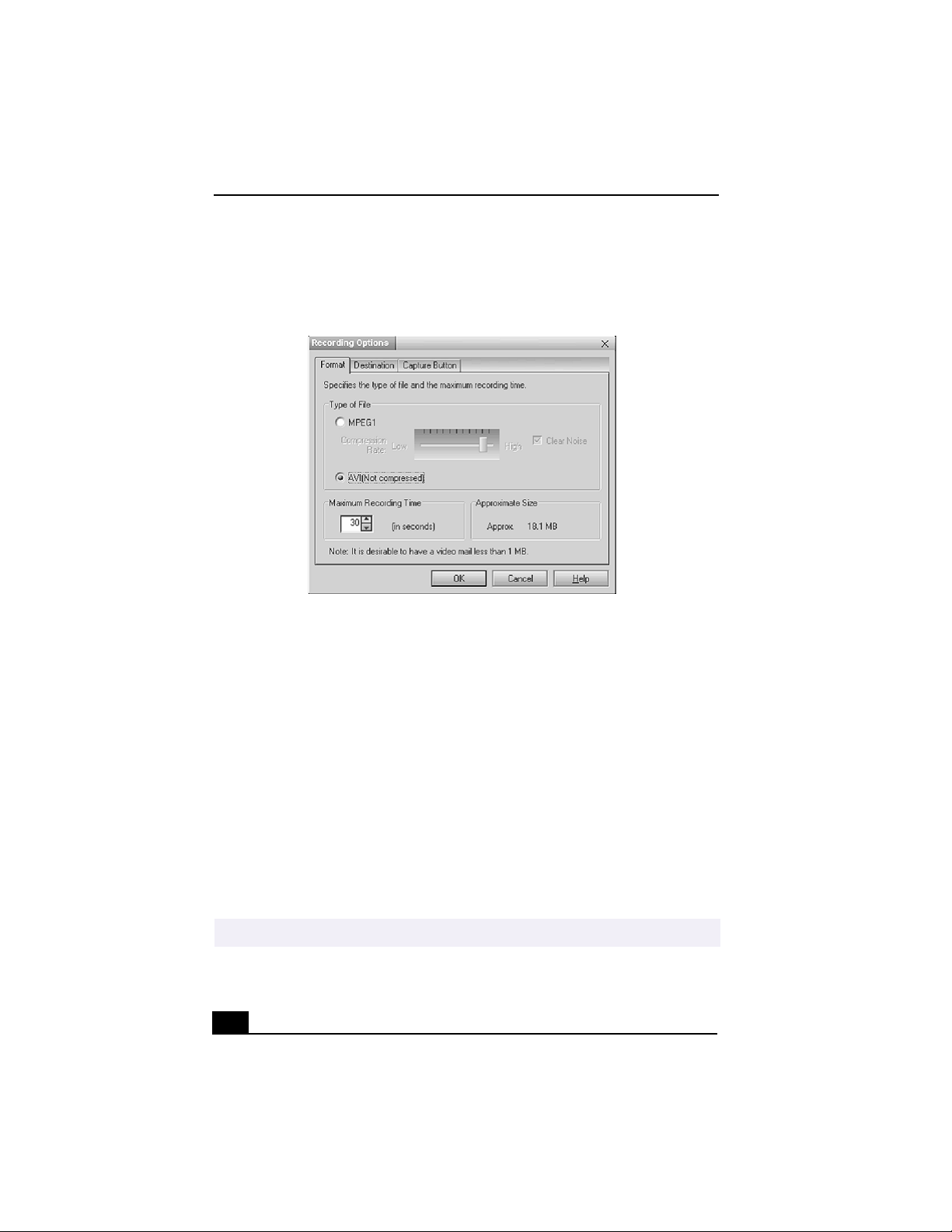
4 Click on the Options button to view the available options for your movie
capture. The Recording Options window appears.
The Recording Options window has three tabs:
❑
Format: — You can adjust the compression rate for your movies in
MPEG1 format or choose the AVI option for no compression. You can
also set the maximum recording time for your movie capture.
❑
Destination: — Select a file destination for your movies when
recording video clips.
❑
Capture Button: — Set the characteristics of the Capture button. You
can start and stop recording by pressing the Capture button (this is the
default characteristic). You can select Anti-Ground Shooting, which
allows recording to occur only while the Capture button is pressed.
Recording will stop when you release the button.
5 Click on the Effects button to select a special image effect. The Effect
Setting window appears. Use the drop-down list to view and customize the
available effects.
Recording Options window
✍
You can remove all special effects by clicking on the No Effects button.

VAIO Slimtop™ LCD Computer User Guide
72
2 For first time users, the ImageStation registration wizard guides you through
the initial registration process. Follow the onscreen instructions. If you are
already a registered member, provide your login name and password. The
Image Uploader window appears.
3 From the Still Viewer or Movie Player window, click on the Upload button to
transfer your pictures or movies to the ImageStation Web site. The Image
Uploader windows displays your Internet connection and upload status.
Click on to see thumbnail previews of your pictures or movies.
4 Go to http://www.imagestation.com to view your uploaded pictures or
movies. Follow the onscreen instructions to access your ImageStation
account. The ImageStation Web site may ask you to complete a full login
again, if your current session is not active.
Image Uploader window
✍
The ImageStation preview feature is available when you upload two or more pictures
or a movie. No preview is shown if a single picture is being uploaded.

VAIO® AV Applications
73
VisualFlow™
VisualFlow is a Sony state-of-the-art multimedia browser designed specifically
for Memory Stick media. It displays any still picture, movie or sound files stored
in a Memory Stick media in a visually pleasing, artistic manner. VisualFlow
plays a selected movie or sound file, and enables playback of files by other
applications like PictureGear™, PictureToy™, Memory Stick Slideshow and
Windows® Explorer.
To use VisualFlow
1 From the Start menu, point to Programs, point to VisualFlow, and then click
on VisualFlow.
2 Click on an icon in the View section on the main toolbar to select a display
layout.
3 Click on an icon in the Sort section on the main toolbar to select a sorting
method.
4 Placing your cursor on the left end of the main toolbar activates the current
Memory Stick properties.
5 Placing your cursor on the right end of the main toolbar activates a
secondary toolbar with more functions.
6 Click on an image to show a normal view centered on the screen.
Double-clicking an image shows an enlarged view.
7 The movie file starts playback when the view is enlarged. Click again on the
movie files to restore the view to normal.
✍
If your system is Memory Stick-compatible, the VAIO Action Setup may be configured
to launch the VisualFlow browser upon insertion of a Memory Stick media. In this
case, VisualFlow starts automatically when a Memory Stick media is inserted.
✍
While an image is enlarged, the Launch toolbar appears at the bottom of the window.
Any associated application can be activated from this point.

VAIO® AV Applications
75
When recording AVI files to tape
❑
Do not use DVgate software when the connected digital video device is in
Timer Recording mode, as this could produce a malfunction in the device.
❑
To avoid recording problems, such as a single frame appearing in multiple
frames, close other applications on your system while recording.
❑
You cannot use different audio modes on the same tape. If you have AVI files
that use different audio modes, they cannot be recorded at the same time, but
must be recorded separately.
❑
Do not attempt to work with AVI files that are smaller than 4 MB.
❑
DVgate software does not support hard disk compression. Do not use disk
compression if you are planning to work with DVgate.
❑
In order to maximize recording capabilities, video and audio data are not
available while you are recording.
❑
If DVgate software indicates that frames have been dropped, close all open
applications, or defragment your hard drive.
✍
You can record only AVI files. MPEG files cannot be recorded.

System, Application and Driver Recovery CD(s)
77
System, Application and
Driver Recovery CD(s)
System Recovery CD(s)
Sony Electronics
The System Recovery CD program allows you to restore the software titles that shipped
with your computer if they become corrupted or are erased. It can be used only to restore
the hard disk of the Sony computer you purchased. VAIO Slimtop™ LCD Computer User
Guide
Application Recovery CD(s)
Sony Electronics
The Application Recovery CD program allows you to reinstall individual applications.
Use it to restore corrupted or erased files.
Driver Recovery CD
Sony Electronics
The Driver Recovery CD program allows you to reinstall individual device drivers. Use it
to restore corrupted or erased files.
Using the System Recovery CD(s)
You can reinstall software titles that shipped with your computer if they become
corrupted or are erased. You may not need to recover the entire contents of your
hard drive. If you experience a problem with your computer, reinstalling a
software title may correct the problem.
Full Restore with Format
The System Recovery utility formats your hard disk drive, and then restores all
the original software.
✍
Use the Application Recovery CD program to reinstall individual applications.
You will lose any software you have installed and any other files you have
created since you started to use your computer. You must reinstall any
applications that were not included with the computer when you purchased it.

VAIO Slimtop™ LCD Computer User Guide
78
To use the System Recovery CD(s)
1 Insert the Sony System Recovery CD in the CD-RW drive.
2 Shut down your computer.
3 Wait 30 seconds and turn on your computer.
4 Click OK to signify you have read and accepted the Microsoft End-User
License Agreement.
5 When the System Recovery menu appears, follow the on-screen instructions
to complete the recovery process.
Using the Application Recovery CD(s)
The Application Recovery CD utility allows you to reinstall individual
applications if they become corrupted or are erased. Reinstalling an individual
software title may correct a problem that you are experiencing with your
computer or software application. You may not need to reinstall the entire
contents of your hard drive.
✍
You need to complete the Windows registration process when you use the System
Recovery CD(s).
✍
The System Recovery utility boots from the CD-RW drive. It must be in the drive when
you turn on the computer.
✍
Your system may include one or more System Recovery CDs. If you have more than
one System Recovery CD, insert the first CD to run the System Recovery program.
You are prompted to insert the next CD(s) once the information from the first CD has
been installed.
The recovery process takes 30 to 60 minutes to complete.
After recovering your system using the System Recovery CD(s), you may be prompted
to insert your Application Recovery CD(s) after restarting Windows. Use the
Application Recovery CD(s) to complete the full recovery of your system.

System, Application and Driver Recovery CD(s)
79
You must be in Windows to run the Application Recovery CD utility. If you have
any questions on using the Application Recovery CD(s), contact Sony Customer
Support.
To use the Application Recovery CD(s)
1 Turn on your computer. If your computer is already on, close all
applications.
2 When the Windows desktop appears, insert the Application Recovery CD in
the CD-RW drive. The Application Recovery utility loads automatically.
3 When the Application Recovery menu appears, follow the on-screen
instructions to complete the recovery process.
Using the Driver Recovery CD
The Driver Recovery CD utility allows you to reinstall individual drivers and
repair software applications if they become corrupted or are erased. You can
reinstall an individual driver to correct a problem that you are experiencing with
your computer, hardware, or software application. VAIO Support Agent, an
application repair utility, uses a vault feature on the Driver Recovery CD during
its software healing process.
You must be in Windows to run the Driver Recovery CD utility.
✍
If you need to reinstall all the software titles that shipped with your computer, use the
System Recovery CD(s).
✍
Your system may include one or more Application Recovery CDs. If you have more
than one Application Recovery CD, insert the first CD to run the Application Recovery
utility. You may be prompted to insert the next CD(s), depending on the application
you wish to restore.
✍
A list of software titles that are protected by VAIO Support Agent can be located in the
section, “Using the VAIO Support Agent.” If you need to reinstall all of the software
titles that shipped with your computer, use the System Recovery CD(s)

VAIO Slimtop™ LCD Computer User Guide
80
To reinstall drivers with the Driver Recovery CD
1 Turn on your computer. If your computer is already on, close all
applications.
2 When the Windows desktop appears, insert the Driver Recovery CD in the
CD-RW drive. Use My Computer or Windows Explorer to view the contents
of the Driver Recovery CD. Select the appropriate driver.
To repair software applications using VAIO Support Agent
The Driver Recovery CD utility has an information vault that contains the
original characteristics for the preinstalled software applications that are
protected by VAIO Support Agent. See “Using the VAIO Support Agent” for
instructions on how to fix your software problems.

Using the VAIO Support Agent
81
Using the VAIO Support
Agent
VAIO Support Agent helps you repair your own software problems without the
assistance of a support analyst. VAIO Support Agent's advanced diagnostic
technology identifies and tracks characteristics of your software applications,
Internet configuration, and operating system components. These diagnostics
protect and store information in a retrievable format that allows you to restore
your software to a previous working state. The software and operating system
items you can fix are those identified by Sony as protected by VAIO Support
Agent.
VAIO Support Agent has three features to help you fix your software problems:
Quick Fix Wizard, Common Solutions, and Support Central. This section briefly
describes these three features.
VAIO Support Agent main screen

VAIO Slimtop™ LCD Computer User Guide
82
Using the Quick Fix Wizard
The Quick Fix Wizard automatically checks your system when a problem occurs
and brings your software back to a previous working state.
1 Click the Quick Fix Wizard button.
2 When the Welcome screen appears, click Next.
3 If you know which software is causing the problem, click Diagnose and fix
my software. If you are unsure of what is causing the problem, click
Diagnose and fix problems in the following area and select the items you
want VAIO Support Agent to examine.
4 Click Next to continue.
5 Follow the instructions on the screen.
Quick Fix Wizard: Begin Support.com Diagnostics screen
Using the VAIO Support Agent
83
Using Common Solutions
Common Solutions offers automated, One-Click Fixes to repair common
software problems. These solutions can integrate information such as knowledge
base articles and Frequently Asked Questions (FAQs). You can run One-Click
Fixes directly from VAIO Support Agent or from a web browser.
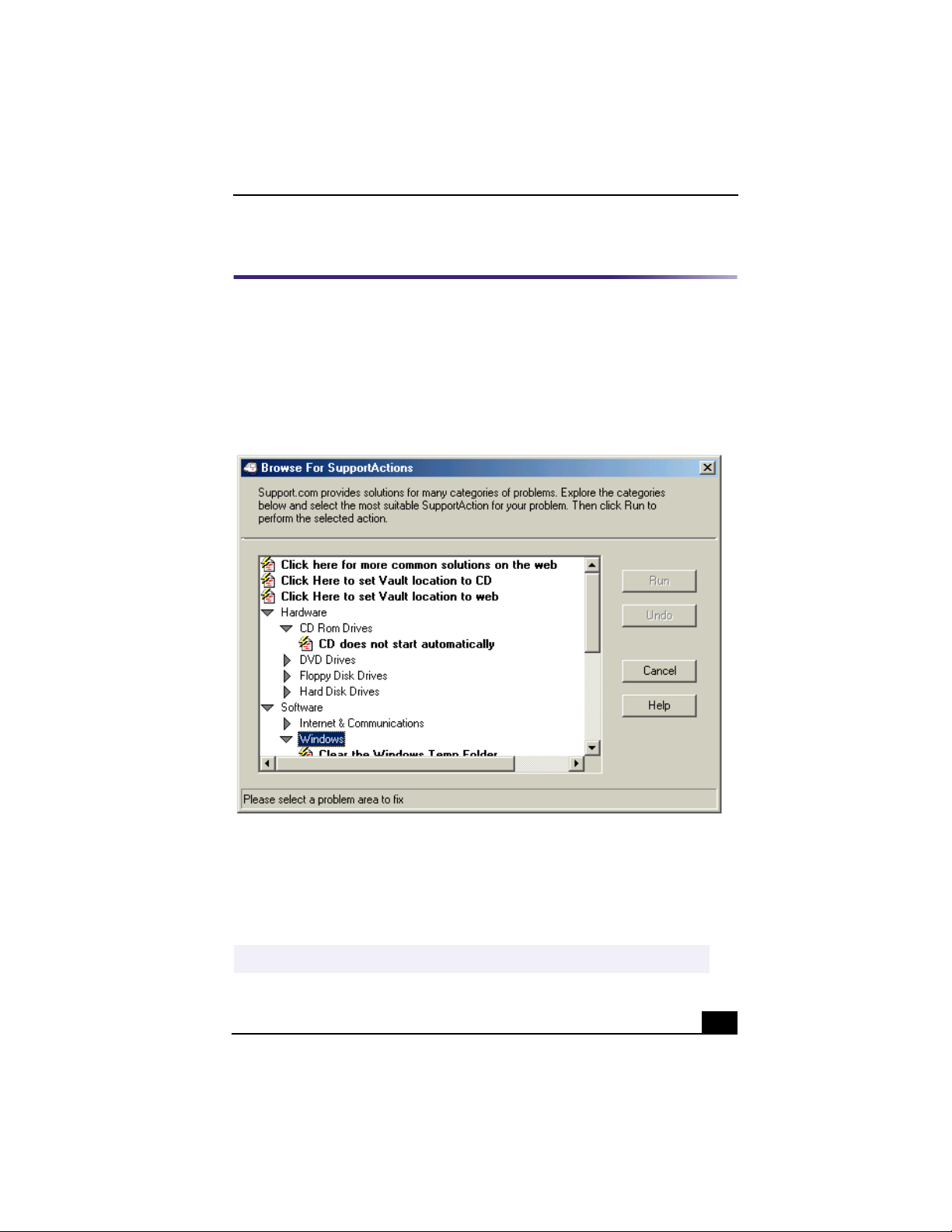
1 Click the Common Solutions button.
2 Click the arrows next to the SupportAction categories to expand and collapse
the list.
3 Select a SupportAction from the list.
4 Click Run, or double-click the selected SupportAction.
Common Solutions: Browse for SupportActions screen
✍
You cannot undo One-Click Fixes.
Using the VAIO Support Agent
85
5 Support Central has a tracking feature that stores the issues you are currently
working on. When you log on to Support Central, a Current Issues page
displays, allowing you to continue working on your open issues or to close
them if you are finished.
✍
Support Central retains your registration information, so you are only required to
register once. If you log on to your computer with a different user name or have
recovered your system using the System Recovery CDs, Support Central may require
another registration.
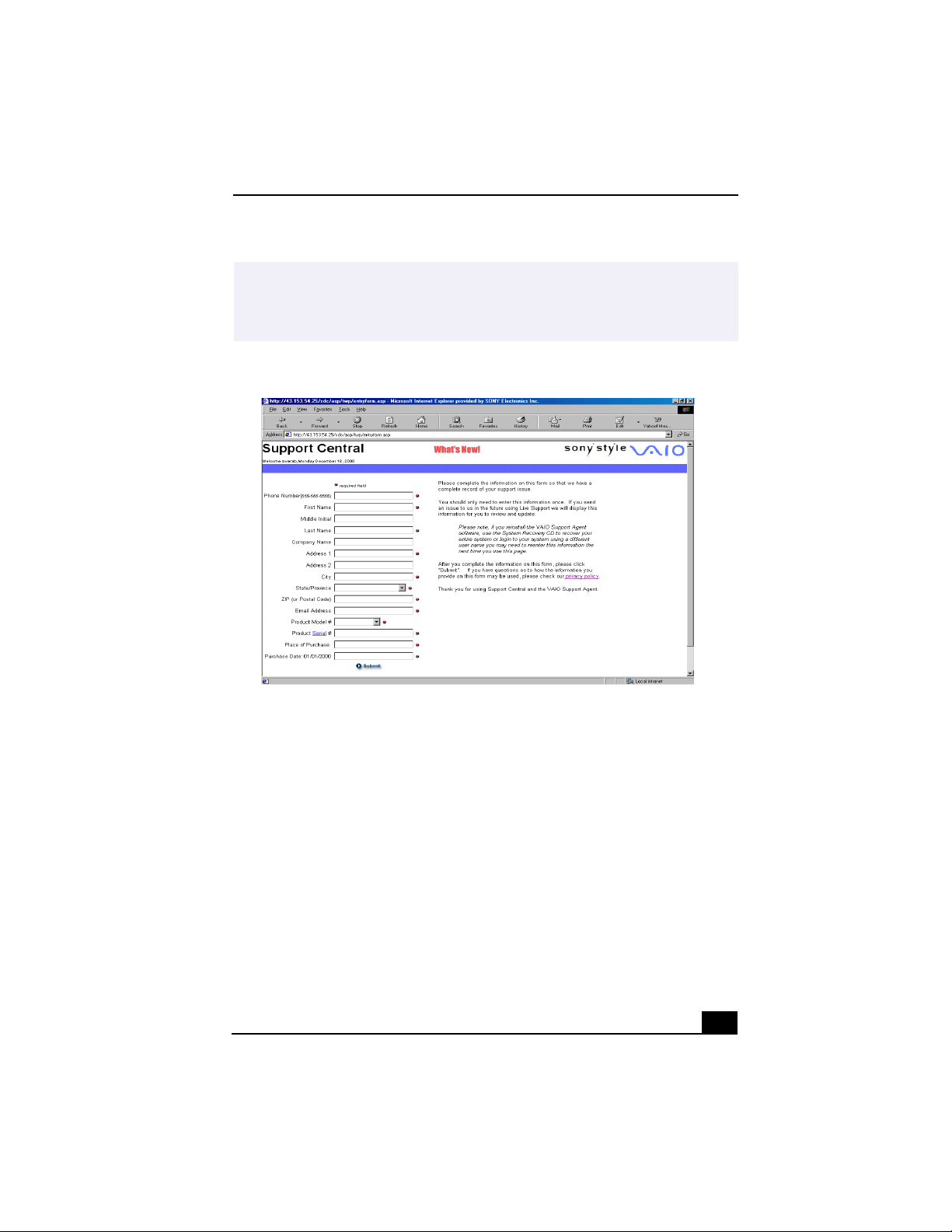
Support Central: Registration

89
Troubleshooting
This section describes how to solve common problems you may
encounter when using your computer. Many problems have simple
solutions, so try these suggestions before you call Sony Customer
Support.
Topics
Topic: My computer does not start
❑
Check that the computer is plugged into a power source and that it is turned
on. Check that the power light is lit on the front panel of the computer.
❑
Confirm that a diskette is not in the diskette drive (unless you are using a
bootable diskette).
❑
Confirm that the power cord and all cables are connected firmly.
❑
If you plugged the computer into a power strip or Universal Power
Supply (UPS), make sure the power strip or UPS is turned on and working.
❑
Check that the display is plugged into a power source and turned on. Check
that the brightness and contrast controls are adjusted correctly. See the
manual that came with your display for details.
❑
Check that the computer is not in standby mode.
Topic: My computer or software program stops responding
1 Press Ctrl+Alt+Delete to close the application that has stopped responding
2 In the Close Program dialog box, scroll down until you locate the message
“Not responding” next to an application.
3 Select this application and click End Task. Windows attempts to close the
application. If the attempt is unsuccessful, a second dialog box appears.
4 Select End Task again.
❑
If you are unable to “unlock” the application, repeat the above steps but
select Shut Down when the Close Program dialog box appears.

VAIO Slimtop™ LCD Computer User Guide
90
❑
If the above steps fail to “unlock” your computer, try the following steps:
1 Save any unsaved work, if possible.
2 Press Alt+F4.
3 Select Restart.
4 Click OK.
❑
If you cannot restart as described in the preceding steps, you can restart the
computer by pressing Ctrl+Alt+Delete or by pressing the power switch for
more than six seconds.
❑
Contact the software publisher or designated provider for technical support.
See the contact information in this manual.
Topic: Windows® Millennium Edition operating System locks up during
shutdown
The Windows Me™ operating system may not shut down properly for many
reasons, including incompatible or conflicting drivers, damaged files, or non-
responsive hardware. For troubleshooting information, you can search Windows
Help.
1 From the Start menu, select Help. Microsoft Help and Support appears.
2 Click on Troubleshooting and continue clicking on the subject(s) for which
you want information.
3 When you find the appropriate information, close the Help and Support.
Topic: My CD-RW drive tray does not open
❑
Use the eject button
1 Make sure the computer is turned on.
2 Press the Eject button on the drive.
❑
Use the My Computer icon
1 Click the My Computer icon on the Windows
®
desktop.
✍
Pressing Ctrl+Alt+Delete twice consecutively may result in the loss of changes made
to files that are currently open.

Topics
91
2 Right-click the CD-RW icon.
3 Select the Eject option from the pop-up menu.
Topic: I cannot play a CD
❑
After inserting your CD, wait a few seconds for it to be detected before
trying to access it.
❑
Make sure you place the disc in the tray with the label side facing up.
❑
Make sure the software is installed according to the program’s instructions.
❑
If your drive reads some CDs, but not others, check the shiny side of the disc
for dirt or scratches. You may also need to clean the disc drive lens with an
appropriate cleaner.
Topic: I want to play a CD with my Microsoft CD Player
When you insert a music CD, the Sony Media Bar™ automatically launches to
play your CD. When the Sony Media Bar is running, the Microsoft CD Player
does not have access to the CD. Close Media Bar to use the Microsoft CD Player.
If you do not hear any music, check all your volume controls.
Topic: When I click an application icon, a message such as “You must insert
the application CD into your drive” appears and the software does not start
❑
Some titles require specific files that are located on the application’s CD.
Insert the disc and try starting the program again.
❑
Check to make sure you inserted the CD with the label side facing up.

VAIO Slimtop™ LCD Computer User Guide
92
Topic: Why doesn't my CD-RW drive record at the highest speed?
You must use 8x CD-R or 4x CD-RW media to achieve optimum performance.
If you must use other media and are having difficulty formatting non-4x CD-RW
media, change the write speed from 4x to a lower setting. Follow these steps to
switch the write speed to a lower setting.
1 From the Start menu, select Programs > Adaptec Easy CD Creator 4>
Create CD
2 Click Audio, then click Audio CD.
3 On the Tools menu, click CD Drive Properties. The CD Drive Properties
dialog box appears.
4 At the Write Speed drop-down list, select 2x or 4 x.
5 Click Close.
Topic: How do I change the video resolution of my display?
1 From the Start menu, select Settings > Control Panel.
2 Click the Display icon and select the Settings tab.
3 Move the Display area slider to change the resolution.
4 Click OK.
Topic: The cursor on my Sony Pen Tablet display does not move or moves in an
unpredictable manner when I use the VAIO pen.
You may need to reconfigure your pen’s switch functions.
✍
The VAIO Slimtop™ computer has a maximum record rate of 8x for CD-R and 4x for
CD-RW media.
✍
Your CD-RW drive is assigned drive G: as its default.
✍
1X writing is not supported.

Topics
95
❑
If you suspect your modem is not functioning, you can perform a simple test
to find out.
1 Click the My Computer icon on your desktop.
2 Click Control Panel.
3 Click Modems.
4 Click the Diagnostics tab.
5 Select COM3.
6 Click More Info.
If your modem is functioning, a More Info dialog box will display. If your
modem is not functioning, an error message will appear.
Topic: How do I change my modem to rotary or Touch-Tone dialing?
1 Click the My Computer icon on your desktop.
2 Click Control Panel and then click Modems.
3 Click Dialing Properties.
4 Select the Tone dial or Pulse dial option next to “Dial using.”
5 Click OK.
Topic: My microphone does not work
Check that the microphone is plugged into the MIC jack.
Topic: My microphone is too sensitive to background noise
If you find there is too much background noise when you record sound, you
should adjust the microphone gain by following these steps:
1 Right-click the speaker icon (Volume) in the lower-right Windows
®
task
tray.
2 Click Open Volume Controls.
The Volume Control screen appears.
3 In the Options menu, select Properties.
The Properties screen appears.

VAIO Slimtop™ LCD Computer User Guide
96
4 Change the setting for “Adjust volume for” from Playback to Recording,
then click OK.
5 Decrease the microphone level.
6 If available, click the Advanced button under Microphone Balance.
The Advanced Controls for Microphone screen appears.
7 Deselect the check box for 1 Microphone Boost, then click the Close button.
8 Close the Recording Control window.
Topic: My mouse does not work
❑
Check that the mouse is plugged into the MOUSE port on the Sony Pen
Tablet.
❑
There may be dust or dirt inside the mouse mechanism. To clean the mouse,
follow these steps:
1 Turn off your computer and turn the mouse upside down.
2 Remove the mouse ball cover on the back of the mouse by turning
clockwise the ring that covers the mouse ball.
3 Turn the mouse upright, and drop the mouse ball into your hand.
4 Using a piece of tape, remove any dust or dirt on the mouse ball and
inside the mouse ball socket.
5 Return the mouse ball to the socket, and replace the mouse ball cover.
Secure the cover by turning the ring counter-clockwise.
Topic: My mouse needs to be set up for left-hand use
1 Click the My Computer icon on your desktop.
2 Click Control Panel, and then click Mouse.
3 In the Buttons tab, select Left-handed under the Button Configuration
options.
4 Click Apply, then OK
Topic: My keyboard does not work
Check that the keyboard is plugged into the KEYBOARD port.

Topics
97
Topic: I cannot find the Windows
®
taskbar
❑
Check that the taskbar is not hidden or shrunken.
❑
Use the mouse to point to the left, right, top, and bottom edges of the screen.
Topic: Why is my system running slowly?
❑
The system responsiveness varies depending on the number of applications
that are open and running. Close any applications that you are not currently
using.
❑
Increasing the system memory may also help. The computer has two
memory slots. For memory upgrades, use only 3.3V 64-bit PC-133 SDRAM
DIMM modules. For information on installing memory, please see the online
manual, “Upgrading and Maintaining Your Slimtop™ LCD Computer” .
Topic: My i.LINK
®
device does not appear on the desktop
1 Turn off and disconnect your device.
2 Reconnect your device.
3 Then turn on the power.
Topic: My connected printer doesn't function after the computer resumes from
a power saving mode
When this occurs, follow the procedures below to reset the printer connection:
1 Right-click the My Computer icon on the desktop, and then select
Properties.
2 Click the Device Manager tab.
3 Select Refresh, and then click OK.
4 The printer should now function properly.
Topic: How do I enable my Ethernet interface?
1 Click on My Computer icon on the desktop.
2 Click on Control Panel, and then click on System.
3 Click the Device Manager tab.

Notes on Use
101
❑
Unplug your computer from the wall outlet if you will not be using the
computer for a long time.
❑
Before touching anything inside the computer, turn the system off and let it
cool for ten minutes. This will ensure that the processor heat sink will not be
hot.
❑
Do not attempt to open the power supply. There are no user-serviceable parts
in the power supply. To avoid personal injury or damage to your equipment,
refer the repair or replacement of the power supply to qualified personnel
only.
On Disposal of the Lithium Battery
Dispose of the lithium battery properly. In some areas, the disposal of lithium
batteries in household or business trash may be prohibited. You can return your
unwanted lithium batteries to your nearest Sony Service Center or Factory
Service Center. For the Sony Service Center nearest you, call 1-888-4SONY-PC
(1-888-476-6972).
On Handling the Computer System
❑
Do not place your Sony computer in a location subject to:
❑
Heat sources, such as radiators or air ducts
❑
Direct sunlight
❑
Excessive dust
❑
Mechanical vibration or shock
❑
Strong magnets or speakers that are not magnetically shielded
❑
Ambient temperature of more than 95ºF (35ºC) or less than 50ºF (10ºC)
❑
High humidity, moisture, or rain
❑
Do not place electronic equipment near your computer. The computer’s
electromagnetic field may cause a malfunction.
Do not handle damaged or leaking lithium batteries.
The lithium battery may explode if mistreated. Do not disassemble it or
dispose of it in fire.
Replace the battery with a Sony CR2032 lithium battery. Using any battery
other than a CR2032 may present a risk of fire or explosion.

VAIO Slimtop™ LCD Computer User Guide
102
❑
Provide adequate air circulation to prevent internal heat build-up. Attach the
stand to your system to prevent overheating. Do not place your computer on
loose surfaces (such as rugs or blankets) or near materials (such as curtains
or draperies) that may block its ventilation slots. Leave a space of at least 8
inches from the back panel of your computer. Overheating of your computer
may permanently damage your system.
❑
Clean your computer’s cabinet with a soft, dry cloth or a soft cloth lightly
moistened with a mild detergent solution. Do not use any type of abrasive
pad, scouring powder, or solvent such as alcohol or benzine, as it may
damage the finish of your Sony computer.
❑
Should any solid object or liquid fall into the cabinet, keyboard, or mouse,
shut down your computer and then unplug it. You may want to have the
computer checked by qualified personnel before operating it any further.
❑
The computer uses high-frequency radio signals and may cause interference
to radio or TV reception. Should this occur, relocate the computer a suitable
distance away from the set.
❑
Use only specified peripheral equipment and interface cables; otherwise,
problems may result.
❑
Do not use cut or damaged connection cables.
❑
Always switch the power off before connecting your computer to peripheral
equipment; otherwise, damage may occur to the integrated circuits in your
computer.
❑
Your computer, keyboard, and mouse consist of high-precision electronic
parts. Do not drop them or bump them against other objects.
❑
Your Sony computer will not work with party lines, cannot be connected to a
coin-operated telephone, and may not work with multiple phone lines or a
private branch exchange (PBX).
❑
If the telephone company makes a service call to your home or office and
determines that your computer is responsible for the problem, the telephone
company may bill you for the service call. Also, if you do not disconnect
your computer when it is adversely affecting the telephone line, the
telephone company has the right to disconnect your service until you correct
the problem.

VAIO Slimtop™ LCD Computer User Guide
104
❑
Using the computer in low temperature conditions may produce a residual
image on the screen. This is not a malfunction. When the computer returns to
normal temperature, the screen returns to normal.
❑
A residual image may appear on the screen if the same image is displayed
for a lengthy period of time. The image disappears after a period of time.
You can use a screen saver to prevent residual images.
❑
The screen becomes warm during operation. This is normal and does not
indicate a malfunction.
❑
Your Sony Pen Tablet consists of high-precision electronic parts. Do not
drop or bump it against other objects.
❑
The Sony Pen Tablet display uses high-frequency radio signals and may
cause interference to radio or TV reception. Should this occur, relocate the
computer a suitable distance away from the radio or TV.
On Handling a CRT Display
❑
Do not place the display near a strong magnetic force.
❑
Do not block the ventilation slots on the display.
On Using the Hard Disk Drive
❑
Do not place the computer in a location that is subject to vibration or shock.
❑
Do not move the computer during operation.
❑
Do not subject the computer to sudden changes in temperature.
❑
Do not turn off the power while the computer is accessing the hard disk
drive.
On Handling Diskettes
❑
Do not open the shutter manually and touch the surface of the diskette.
❑
Keep diskettes away from magnets.
❑
Keep diskettes away from direct sunlight and other heat sources.

For Answers to Your Software Questions
105
On Handling CD Media
❑
Do not touch the surface of the disc.
❑
Do not drop or bend the disc.
❑
Do not use adhesive labels to identify the disc. The label may come off while
the disc is in use in the optical drive.
On Cleaning CD Media
❑
Fingerprints and dust on the surface of a disc may cause read errors. Proper
care of the disc is essential to maintain its reliability. Do not use solvents
such as benzine, thinner, commercially available cleaners or anti-static spray,
as they may cause damage to the disc.
❑
For normal cleaning, hold the disc by its edge and use a soft cloth to wipe the
surface from the center out.
❑
If the disc is badly soiled, moisten a soft cloth with water, wring it out well,
and use it to wipe the surface of the disc from the center out. Wipe off any
remaining moisture with a dry soft cloth.
For Answers to Your Software Questions
Sony Service Center
For the Sony Service Center nearest you, call 1-888-4SONYPC
(1-888-476-6972). This service is free of charge for 90 days after the original
date of purchase.
Acrobat® Reader, Adobe GoLive™, Adobe LiveMotion™,
Adobe Photoshop® LE, Adobe Premiere® LE
(Adobe Systems Incorporated)
Web site http://www.adobe.com/
phone 206-675-6126 (fee-based support)
fax
206-628-5737
e-mail [email protected]
hours M - F, 6 AM - 5 PM PT

Resources
109
Sony Fax-on-Demand
This service provides you with answers to commonly asked
questions. You can use this automated service to request a list
of available topics and then select the topics that you want to
receive. To contact the Sony fax-on-demand service, call 1-
888-4SONYPC (1-888-476-6972). (Requires a fax machine or
fax software.)
Software Updates
You can download the latest software updates and software
patches for your Sony computer by selecting Software Updates
on the Sony PC Support web page at
http://www.sony.com/pcsupport
VAIO System
Reference Manual
Provides detailed technical information about your computer's
hardware. This document is available from Sony's website at
http://www.sony.com/pcsupport

VAIO Slimtop™ LCD Computer User Guide
110

Specifications
111
Specifications
Model PCV-LX900
Processor
1B GHz
*
Intel® Pentium® III
Hard Disk Drive
C / D Partition
40 GB ATA-66
C = 16GB / D = 24GB
Standard SDRAM
128
†
MB PC-133 SDRAM, expandable to 512MB
Video RAM
Shared with system memory
Graphics
SiS 630 graphics hardware acceleration
Sound Capabilities
SiS 630 (AC97 Compliance)
CD-RW Drive
32X max. CD-ROM reading,
8X max. CD-R writing,
32X max. CD-R reading,
4X max. CD-RW writing,
20X max. CD-RW reading
‡
Modem
Lucent 1648 technology/V.90 compatible data/fax modem
(REN 0.7)
**
Expansion
Capabilities
PCI slots (2)
Connection
Capabilities
(Front)
PC card slot (Card bus support)
USB port
Memory Stick® media slot
i.LINK® (4-pin) port
Connection
Capabilities (Rear)
USB ports (3)
Modem line jack (RJ-11)
Phone line jack (RJ-11)
CRT display
Sony Pen Tablet display
Line In jack
i.LINK (6-pin) port
10Base-T/100Base-TX Fast Ethernet LAN jack (RJ-45)
Headphone jack
Microphone jack
Connection
Capabilities
(Sony Pen Tablet)
PS/2® mouse port
PS/2® keyboard port
USB port

VAIO Slimtop™ LCD Computer User Guide
114
Driver Recovery CD 79
DVgate software 47
using 74
E
electronic
documentation 108
equipment 101
Eraser, on VAIO Pen 22
ETHERNET port 18
G
glare 14
H
handling diskettes 104
hard disk 104
defragmenting 43
partition 43
hardware
adding additional
precaution 101
troubleshooting 89, 96
headphones jack 18
help 108
I
i.LINK devices, connecting 44
i.LINK port 16, 18
Information LED, on LCD 20
input devices
setting up 13
installing additional hardware
precaution 101
interference 102, 104
K
keyboard 13
troubleshooting 96
L
launching applications
problems with 91
LCD
adjusting 21
port 18
line jack 18
lithium battery
disposal 8
safety precautions 8
locations, choosing 13
losing power 100
lower switch position,
on VAIO Pen 22
M
Media Bar 47
Memory Stick media
slot 16
using 31
microphone jack 18
microphones
troubleshooting 95
minimizing glare 14
modem
troubleshooting 94
monitor port 17
mouse 13
cleaning 96
troubleshooting 96

115
MovieShaker 47
O
online
help 108
support options 108
opening
applications
problems with 91
CD tray
problems with 90
OpenMG Jukebox 47
P
palmrest 13
PC (PCMCIA) card, using 33
PC card slot 16
pen tip
on VAIO pen 22
removing tool 19
replacements 19
phones
service precautions 102
PictureGear 48
port
AC input 17
ETHERNET 18
i.LINK 16, 18
LCD 18
monitor 17
power cords 100
precautions 102
printer 18
PS/2 keyboard 20
PS/2 mouse 20
Universal Serial Bus (USB)
16, 18, 20
ports
locating 17
power cords 100
disconnecting 100
power fluctuations or loss 100
power indicator
on LCD 20
power source, precautions 100–
101
printer port 18
problem solving 89
Programmable Power Keys
(PPK), using 37
PS/2 keyboard port 20
PS/2 mouse port 20
R
radio interference 102, 104
reducing glare 14
removing computer cover 100
rocker switch 22
S
screens
reducing glare 14
selecting
locations 13
setting up your computer
ergonomic location 13
Smart Capture 48
Sony 19
Sony Fax-on-Demand service
109

VAIO Slimtop™ LCD Computer User Guide
116
Sony Multimedia Computer
Display
problems with 89
Sony Online Support
options 108
speakers
precaution 101
starting your computer
problems with 89
surge protectors 100
system
troubleshooting 89
System Recovery CD 77
T
taskbar
problems viewing 97
technical support
support options 108
telephone cable jack 18
telephone jack 18
troubleshooting 89
turning on your computer
problems with 89
TV interference 102, 104
U
Universal Serial Bus (USB) port
16, 18, 20
upgrading your computer 103
upper switch position,
on VAIO Pen 22
UPS (Uninterrupted
Power Supply) 100
V
VAIO Action Setup 37
VAIO AV Applications 47
VAIO Pen 22
VAIO Support Agent 81
ventilation 13, 102
viewing the taskbar
problems with 97
VisualFlow 48
voltage settings 100
volume control, on LCD 20
W
window design 40
Windows taskbar
problems viewing 97
work surfaces 13