4-130-258-12(2)
© 2009 Sony Corporation
DVP-NS710H
DVP-NS718H
DVP-NS728H
Operating Instructions
Manual de instrucciones
ES
US
For customers in the U.S.A
Owner’s Record
The model and serial numbers are located at the rear of the unit.
Record the serial number in the space provided below. Refer to them
whenever you call upon your Sony dealer regarding this product.
Model No. DVP-NS710H
Serial No.______________
For Customers in Canada
If this product is not working properly, please call 1-877-602-2008 for
Peace of Mind Warranty Replacement service.
For other product related questions please contact our Customer
Information Service Centre at 1-877-899-7669 or write to us at:
Customer Information Service 115 Gordon Baker Road, Toronto,
Ontario, M2H 3R6
CD/DVD
Player
2
US
WARNING
To reduce the risk of fire or
electric shock, do not expose
this apparatus to rain or
moisture.
To avoid electrical shock, do
not open the cabinet. Refer
servicing to qualified
personnel only.
The AC power cord must be
changed only at a qualified
service shop.
Batteries or batteries
installed apparatus shall not
be exposed to excessive heat
such as sunshine, fire or the
like.
CAUTION
The use of optical instruments with
this product will increase eye
hazard. As the laser beam used in
this CD/DVD player is harmful to
eyes, do not attempt to disassemble
the cabinet.
Refer servicing to qualified
personnel only.
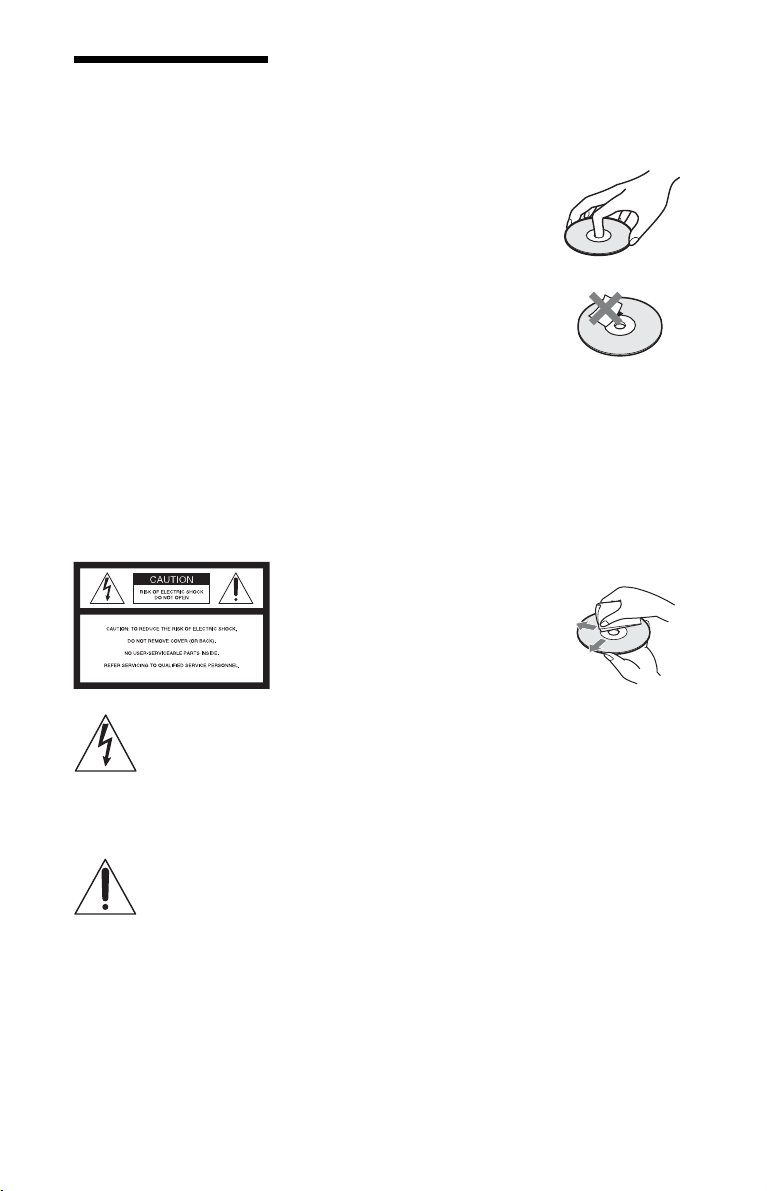
This symbol is
intended to alert the
user to the presence
of uninsulated
“dangerous voltage”
within the product’s enclosure that
may be of sufficient magnitude to
constitute a risk of electric shock to
persons.
This symbol is
intended to alert the
user to the presence
of important
operating and
maintenance (servicing)
instructions in the literature
accompanying the appliance.
CAUTION
You are cautioned that any
changes or modifications not
expressly approved in this manual
could void your authority to
operate this equipment.
b
This equipment has been tested
and found to comply with the
limits for a Class B digital device,
pursuant to Part 15 of the FCC
Rules. These limits are designed to
provide reasonable protection
against harmful interference in a
residential installation. This
equipment generates, uses, and can
radiate radio frequency energy
and, if not installed and used in
accordance with the instructions,
may cause harmful interference to
radio communications. However,
there is no guarantee that
interference will not occur in a
particular installation. If this
equipment does cause harmful
interference to radio or television
reception, which can be
determined by turning the
equipment off and on, the user is
encouraged to try to correct the
interference by one or more of the
following measures:
– Reorient or relocate the
receiving antenna.
– Increase the separation between
the equipment and receiver.
– Connect the equipment into an
outlet on a circuit different from
that to which the receiver is
connected.
– Consult the dealer or an
experienced radio/TV technician
for help.
Lightning
For added protection for this set
during a lightning storm, or when it
is left unattended and unused for
long periods of time, unplug it
from the wall outlet. This will
prevent damage to the set due to
lightning and power-line surges.
Notes about the discs
• To keep the disc clean, handle
the disc by its edge. Do not touch
the surface. Dust, fingerprints, or
scratches on the disc may cause
it to malfunction.
• Do not expose the disc to direct
sunlight or heat sources such as
hot air ducts, or leave it in a car
parked in direct sunlight as the
temperature may rise
considerably inside the car.
• After playing, store the disc in its
case.
• Clean the disc with a cleaning
cloth.
Wipe the disc from the center
out.
• Do not use solvents such as
benzine, thinner, commercially
available cleaners, or anti-static
spray intended for vinyl LPs.
• If you have printed the disc’s
label, dry the label before
playing.
• Do not use the following discs:
– A disc recorded in a color
system other than NTSC, such
as PAL or SECAM (this player
conforms to the NTSC color
system).
– A disc that has a non-standard
shape (e.g., card, heart).
– A disc with a label or sticker
on it.
– A disc that has cellophane tape
or sticker adhesive on it.

3
US
US
Important
Safety
Instructions
1) Read these instructions.
2) Keep these instructions.
3) Heed all warnings.
4) Follow all instructions.
5) Do not use this apparatus near
water.
6) Clean only with dry cloth.
7) Do not block any ventilation
openings. Install in accordance
with the manufacturer’s
instructions.
8) Do not install near any heat
sources such as radiators, heat
registers, stoves, or other
apparatus (including
amplifiers) that produce heat.
9) Do not defeat the safety
purpose of the polarized or
grounding-type plug. A
polarized plug has two blades
with one wider than the other.
A grounding type plug has two
blades and a third grounding
prong. The wide blade or the
third prong are provided for
your safety. If the provided
plug does not fit into your
outlet, consult an electrician for
replacement of the obsolete
outlet.
10)Protect the power cord from
being walked on or pinched
particularly at plugs,
convenience receptacles, and
the point where they exit from
the apparatus.
11)Only use attachments/
accessories specified by the
manufacturer.
12)Use only with the cart, stand,
tripod, bracket, or table
specified by the manufacturer,
or sold with the apparatus.
When a cart is used, use caution
when moving the cart/
apparatus combination to avoid
injury from tip-over.
13)Unplug this apparatus during
lightning storms or when
unused for long periods of
time.
14)Refer all servicing to qualified
service personnel. Servicing is
required when the apparatus
has been damaged in any way,
such as power-supply cord or
plug is damaged, liquid has
been spilled or objects have
fallen into the apparatus, the
apparatus has been exposed to
rain or moisture, does not
operate normally, or has been
dropped.
Precautions
The power requirements and
power consumption of this player
are indicated on the back of the
player. Check that the player’s
operating voltage is identical with
your local power supply.
On safety
• To prevent fire or shock hazard,
do not place objects filled with
liquids, such as vases, on the
apparatus.
• Should any solid object or liquid
fall into the cabinet, unplug the
player and have it checked by
qualified personnel before
operating it any further.
On power sources
• The player is not disconnected
from the AC power source as
long as it is connected to the wall
outlet, even if the player itself
has been turned off.
• If you are not going to use the
player for a long time, be sure to
disconnect the player from the
wall outlet. To disconnect the
AC power cord, grasp the plug
itself; never pull the cord.
On placement
• Place the player in a location
with adequate ventilation to
prevent heat build-up in the
player.
• Do not place the player on a soft
surface such as a rug.
• Do not place the player in a
location near heat sources, or in a
place subject to direct sunlight,
excessive dust, or mechanical
shock.
• Do not install the player in an
inclined position. It is designed
to be operated in a horizontal
position only.
• Keep the player and the discs
away from equipment with
strong magnets, such as
microwave ovens, or large
loudspeakers.
• Do not place heavy objects on
the player.
• Do not install this player in a
confined space, such as a
bookshelf or similar unit.
DVP–XXXX
00V 00Hz
00W
NO.
0-000-000-00
X
Power
requirements
and power
consumption
t
,continued
4
US
• Install the player so that the AC
power cord can be unplugged
from the wall socket
immediately in the event of
trouble.
• If the player is brought directly
from a cold to a warm location,
or is placed in a very damp room,
moisture may condense on the
lenses inside the player. Should
this occur, the player may not
operate properly. In this case,
remove the disc and leave the
player turned on for about half an
hour until the moisture
evaporates.
• When you move the player, take
out any discs. If you don’t, the
disc may be damaged.
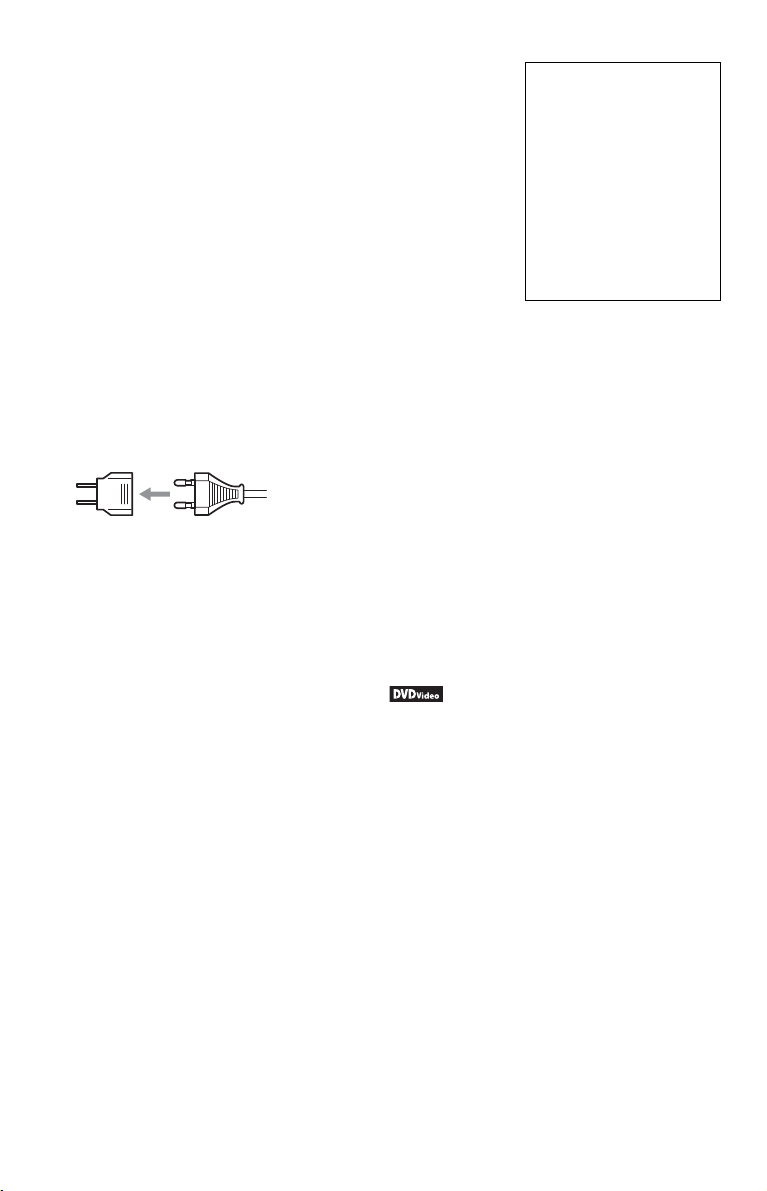
For the model supplied with
the AC plug adaptor
If the AC plug of your unit does not
fit into the wall outlet, attach the
supplied AC plug adaptor.
On adjusting volume
Do not turn up the volume while
listening to a section with very low
level inputs or no audio signals. If
you do, the speakers may be
damaged when a peak level section
is played.
On cleaning
Clean the cabinet, panel, and
controls with a soft cloth slightly
moistened with a mild detergent
solution. Do not use any type of
abrasive pad, scouring powder or
solvent such as alcohol or benzine.
On cleaning discs, disc/lens
cleaners
Do not use cleaning discs or disc/
lens cleaners (including wet or
spray types). These may cause the
apparatus to malfunction.
On replacement of parts
In the event that this unit is
repaired, repaired parts may be
collected for reuse or recycling
purposes.
Copyrights
• This product incorporates
copyright protection technology
that is protected by U.S. patents
and other intellectual property
rights. Use of this copyright
protection technology must be
authorized by Macrovision, and
is intended for home and other
limited viewing uses only unless
otherwise authorized by
Macrovision. Reverse
engineering or disassembly is
prohibited.
• “DVD+RW,” “DVD-RW,”
“DVD+R,” “DVD+R DL,”
“DVD-R,” “DVD VIDEO,” and
“CD” logos are trademarks.
• This DVD player incorporates
High-Definition Multimedia
Interface (HDMI™) technology.
HDMI, the HDMI Logo and
High-Definition Multimedia
Interface are trademarks or
registered trademarks of HDMI
Licensing LLC.
About this manual
• The instructions in this manual
are for 3 models: DVP-NS710H,
DVP-NS718H, and DVP-
NS728H. Check your model
name by looking at the rear panel
of the player. DVP-NS728H is
the model used for instruction
purposes. Any difference in
operation is clearly indicated in
the text, for example, “DVP-
NS728H only.”
• Icons, such as , listed at
the top of each explanation
indicate what kind of media can
be used with the function being
explained.
For details see “Playable Media”
(page 42).
• Instructions in this manual
describe the controls on the
remote. You can also use the
controls on the player if they
have the same or similar names
as those on the remote.
• “DVD” may be used as a general
term for commercial DVDs,
DVD+RWs/DVD+Rs/DVD+R
DLs (+VR mode) and DVD-
RWs/DVD-Rs/DVD-R DLs (VR
mode, video mode).
• NEED-to-know information (to
prevent incorrect operation) is
listed under the
b icon. NICE-
to-know information (tips and
other useful information) is
listed under the
z icon.
If you have any questions or
problems concerning your player,
please consult your nearest Sony
dealer.
IMPORTANT NOTICE
Caution: This player is capable
of holding a still video image or
on-screen display image on your
television screen indefinitely. If
you leave the still video image or
on-screen display image
displayed on your TV for an
extended period of time you risk
permanent damage to your
television screen. Plasma display
panel televisions and projection
televisions are susceptible to
this.

5
US
Table of Contents
WARNING . . . . . . . . . . . . . . . . . . . . . . . . . . . . . . . . . . . . . . . . . . . . . . . . . . . . 2
Important Safety Instructions . . . . . . . . . . . . . . . . . . . . . . . . . . . . . . . . . . . . . . 3
Precautions . . . . . . . . . . . . . . . . . . . . . . . . . . . . . . . . . . . . . . . . . . . . . . . . . . . 3
Guide to Parts and Controls. . . . . . . . . . . . . . . . . . . . . . . . . . . . . . . . . . . . . . . 7
Hookups and Settings . . . . . . . . . . . . . . . . . . . . . . . . . . . . . . . . . 11
Step 1: Connecting to Your TV . . . . . . . . . . . . . . . . . . . . . . . . . . . . . . . . . . . 11
About the CONTROL FOR HDMI functions for ‘BRAVIA Sync’
(for HDMI connections only) . . . . . . . . . . . . . . . . . . . . . . . . . . . . . . . 12
Step 2: Connecting to Your Audio Component . . . . . . . . . . . . . . . . . . . . . . . 13
Step 3: Connecting the Power Cord . . . . . . . . . . . . . . . . . . . . . . . . . . . . . . . 14
Step 4: Preparing the Remote . . . . . . . . . . . . . . . . . . . . . . . . . . . . . . . . . . . . 14
Controlling TVs with the remote. . . . . . . . . . . . . . . . . . . . . . . . . . . . . . . . 15
Step 5: Quick Setup. . . . . . . . . . . . . . . . . . . . . . . . . . . . . . . . . . . . . . . . . . . . 15
Connecting a USB Device (DVP-NS728H only) . . . . . . . . . . . . . . . . . . . . . . 17
Playback . . . . . . . . . . . . . . . . . . . . . . . . . . . . . . . . . . . . . . . . . . 18
Playing Discs . . . . . . . . . . . . . . . . . . . . . . . . . . . . . . . . . . . . . . . . . . . . . . . . . 18
Control Menu display . . . . . . . . . . . . . . . . . . . . . . . . . . . . . . . . . . . . . . . . 20
List of Control Menu items . . . . . . . . . . . . . . . . . . . . . . . . . . . . . . . . . . . . 21
Guide to the ‘BRAVIA Sync’ Display . . . . . . . . . . . . . . . . . . . . . . . . . . . . . . . 23
‘BRAVIA Sync’ display . . . . . . . . . . . . . . . . . . . . . . . . . . . . . . . . . . . . . . . 23
Various Play Mode Functions . . . . . . . . . . . . . . . . . . . . . . . . . . . . . . . . . . . . 24
Creating your own program (Program Play) . . . . . . . . . . . . . . . . . . . . . . 24
Playing in random order (Shuffle Play) . . . . . . . . . . . . . . . . . . . . . . . . . . 25
Playing repeatedly (Repeat Play) . . . . . . . . . . . . . . . . . . . . . . . . . . . . . . 25
Repeating a specific portion (A-B Repeat Play). . . . . . . . . . . . . . . . . . . . 26
Customizing the Playback Configuration . . . . . . . . . . . . . . . . . . . . . . . . . . . . 27
Adjusting the playback picture
(CUSTOM PICTURE MODE) . . . . . . . . . 27
Sharpening the picture (SHARPNESS) . . . . . . . . . . . . . . . . . . . . . . . . . . 27
Adjusting the delay between the picture and sound (AV SYNC) . . . . . . . 27
Locking discs (PARENTAL CONTROL) . . . . . . . . . . . . . . . . . . . . . . . . . 28
Playing Video, Photo, and Music Files . . . . . . . . . . . . . . . . . . . . . . . . . . . . . 29
Playing video, photo, and music files from USB device
(DVP-NS728H only). . . . . . . . . . . . . . . . . . . . . . . . . . . . . . . . . . . . . . 29
Selecting a photo file . . . . . . . . . . . . . . . . . . . . . . . . . . . . . . . . . . . . . . . . 30
Viewing a high quality slide show (PhotoTV HD). . . . . . . . . . . . . . . . . . . 30
Setting the pace for a slide show (INTERVAL) . . . . . . . . . . . . . . . . . . . . 31
Selecting the slides’ appearance (EFFECT) . . . . . . . . . . . . . . . . . . . . . . 31
,continued

6
US
Settings and Adjustments . . . . . . . . . . . . . . . . . . . . . . . . . . . . . . 32
Using the Setup Display. . . . . . . . . . . . . . . . . . . . . . . . . . . . . . . . . . . . . . . . . 32
LANGUAGE SETUP . . . . . . . . . . . . . . . . . . . . . . . . . . . . . . . . . . . . . . . . . . . 32
SCREEN SETUP . . . . . . . . . . . . . . . . . . . . . . . . . . . . . . . . . . . . . . . . . . . . . . 33
CUSTOM SETUP . . . . . . . . . . . . . . . . . . . . . . . . . . . . . . . . . . . . . . . . . . . . . 35
AUDIO SETUP. . . . . . . . . . . . . . . . . . . . . . . . . . . . . . . . . . . . . . . . . . . . . . . . 36
Setting the digital output signal . . . . . . . . . . . . . . . . . . . . . . . . . . . . . . . . 36
HDMI SETUP. . . . . . . . . . . . . . . . . . . . . . . . . . . . . . . . . . . . . . . . . . . . . . . . . 37
Additional Information . . . . . . . . . . . . . . . . . . . . . . . . . . . . . . . . 39
Troubleshooting . . . . . . . . . . . . . . . . . . . . . . . . . . . . . . . . . . . . . . . . . . . . . . . 39
Self-diagnosis Function (When letters/numbers appear on the screen) . . . . 41
Playable Media . . . . . . . . . . . . . . . . . . . . . . . . . . . . . . . . . . . . . . . . . . . . . . . 42
Specifications. . . . . . . . . . . . . . . . . . . . . . . . . . . . . . . . . . . . . . . . . . . . . . . . . 45
Language Code List. . . . . . . . . . . . . . . . . . . . . . . . . . . . . . . . . . . . . . . . . . . . 46
Parental Control Area Code List . . . . . . . . . . . . . . . . . . . . . . . . . . . . . . . . . . 46
Index . . . . . . . . . . . . . . . . . . . . . . . . . . . . . . . . . . . . . . . . . . . . . . . . . . . . . . . 47
7
US
Guide to Parts and Controls
For more information, see the pages indicated in parentheses.
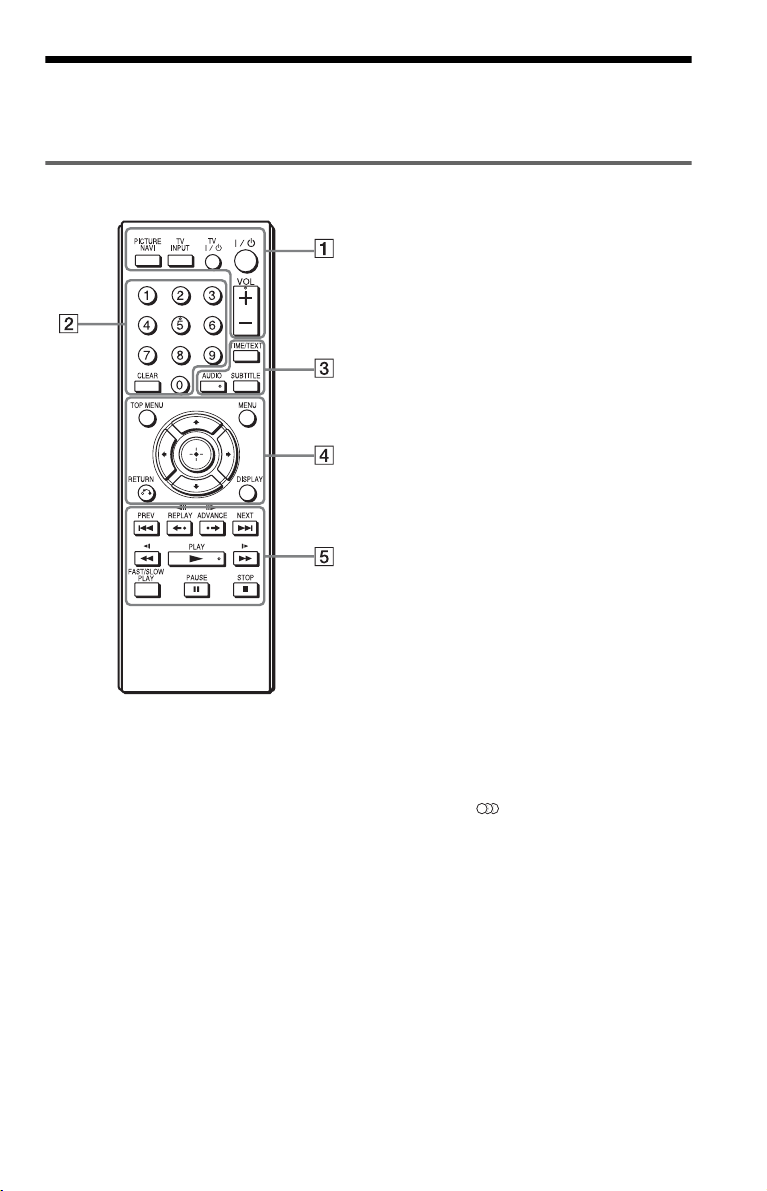
Remote
VOL +, number 5, AUDIO, and N buttons have a
tactile dot. Use the tactile dot as a reference when
operating the player.
A PICTURE NAVI (30)
Divides the screen into 9 subscreens
so you can choose the desired scene
quickly.
Each time you press the button, the
display changes as follows:
• CHAPTER VIEWER
• TITLE VIEWER
• TRACK VIEWER
The photo files in the album appear in
16 subscreens.
TV INPUT (input select) (15)
Switches between TV and other input
sources.
TV [/1 (on/standby) (15)
Turns on the TV, or sets to standby
mode.
[/1 (on/standby) (15)
Turns on the player, or sets to standby
mode.
VOL +/– (15)
Adjusts the TV volume.
B Number buttons
Enters the title/chapter numbers, etc.
CLEAR (21)
Clears the entry field.
C TIME/TEXT (10)
Displays the playing time and
remaining time on the TV screen or
front panel display. Press repeatedly
to change the displayed information.
CD/DVD text appears only when text
is recorded on the disc.
If music file has an ID3 tag, the player
will display the album name/track title
from the ID3 tag information. This
player supports ID3 versions 1.0/1.1
and 2.2/2.3.
AUDIO ( )
Changes the audio language or audio
channel.
When 4 digits are displayed, they
indicate a language code. See
“Language Code List” on page 46 to
see which language the code
represents.
,continued

8
US
*
1
For DivX video files and DVDs except
DVD+RWs/DVD+Rs/DVD+R DLs.
*
2
For DVDs and DivX video files only.
*
3
These functions may not work with some
scenes.
*
4
For DVD VIDEOs and DVD-VR mode only.
*
5
For DVDs, VIDEO CDs, and video files only.
*
6
For DVDs and VIDEO CDs only.
b
Some playback functions may not work with
unsupported MPEG-4 format (page 42).
SUBTITLE ( ) (29)
– Changes the subtitles when
subtitles are recorded on DVD
VIDEOs/DVD-VR mode/DivX
video files only.
– Displays lyrics for a music file
when pressed during playback. For
details see page 29.
D TOP MENU
Displays the DVD’s top menu.
MENU (29)
Displays the menu.
O RETURN (19)
Returns to the previous display.
DISPLAY (20)
Displays the playback information on
the screen.
C/X/x/c (21)
Moves the highlight to select a
displayed item.
Center button (ENTER) (15)
Enters the selected item.
E ./> PREV/NEXT
Skips to the previous/next chapter,
track, or scene in continuous play
mode.
/ REPLAY/STEP/
STEP/ADVANCE
– Replays the scene
*1*3
/briefly fast
forward the scene
*2*3
when pressed
during playback.
–Plays backward
*4
/forward
*5
one
frame at a time when pressed during
pause mode.
– Changes the LUN (Logical Unit
Number) devices when pressed
during the list of albums or tracks is
displayed. (page 29).
m/M (scan/slow)
– Fast reverses/fast forwards when
pressed during playback. The speed
changes when pressed repeatedly.
–Plays backward
*4
/forward
*5
in
slow motion when pressed
repeatedly during pause mode.
N PLAY
Starts or re-starts playback.
X PAUSE
Pauses or re-start playback.
x STOP
Stops playback.
FAST/SLOW PLAY
Plays in various speed with sound
*6
when pressed repeatedly during
playback.
9
US
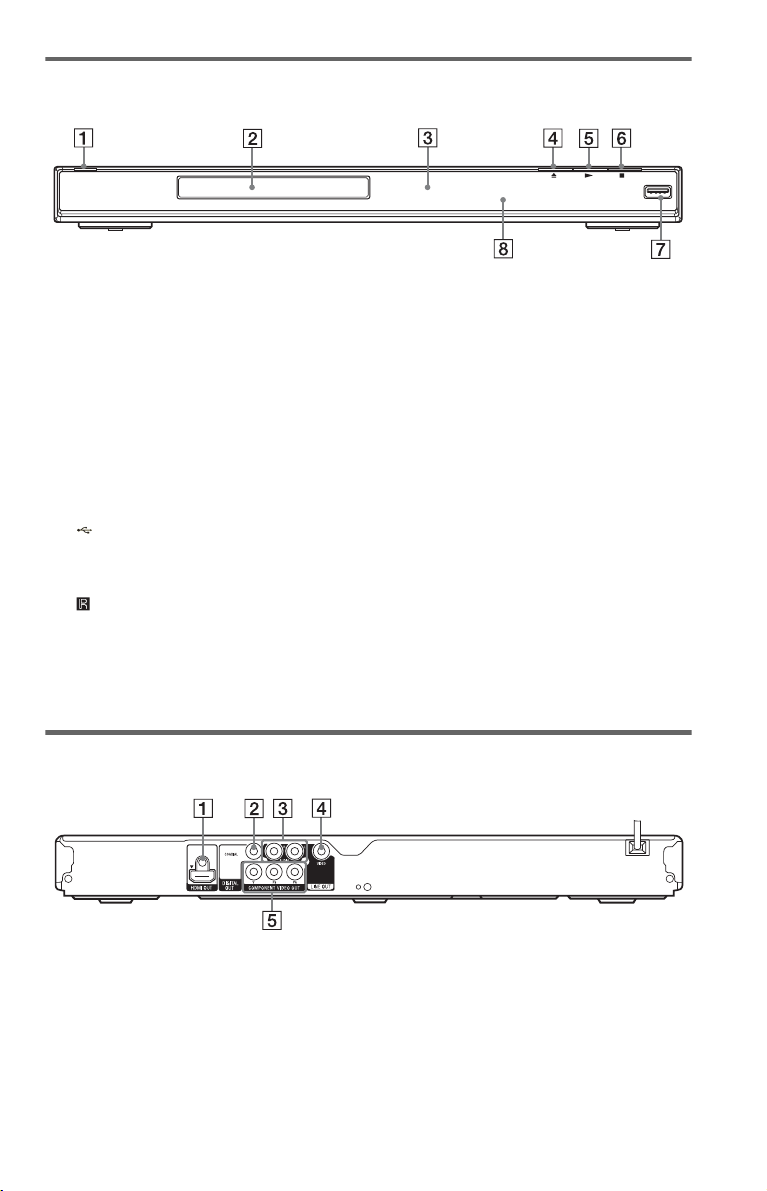
Front panel
A [/1 (on/standby) button (15)
B Disc tray (18)
C Front panel display (10)
D Z (open/close) button (18)
Opens or closes the disc tray.
E N (play) button (18)
The N button has a tactile dot*.
F x (stop) button (18)
Stops playback.
G USB jack (type A) (17, 29)
(DVP-NS728H only)
Connect a USB device to this jack.
H (remote sensor) (14)
* Use the tactile dot as a reference when operating
the player.
To lock the disc tray (Child Lock)
You can lock the disc tray to prevent it being
opened by mistake.
When the player is in standby mode, press
O RETURN, ENTER, and then [/1 on the
remote.
The player turns on and “LOCKED” appears
on the front panel display. The Z button on
the player does not work while the Child
Lock is set.
To unlock the disc tray
When the player is in standby mode, press O
RETURN, ENTER, and then [/1 again.
b
Even if you select “RESET” under “SETUP” in the
Control Menu (page 32), the disc tray remains
locked.
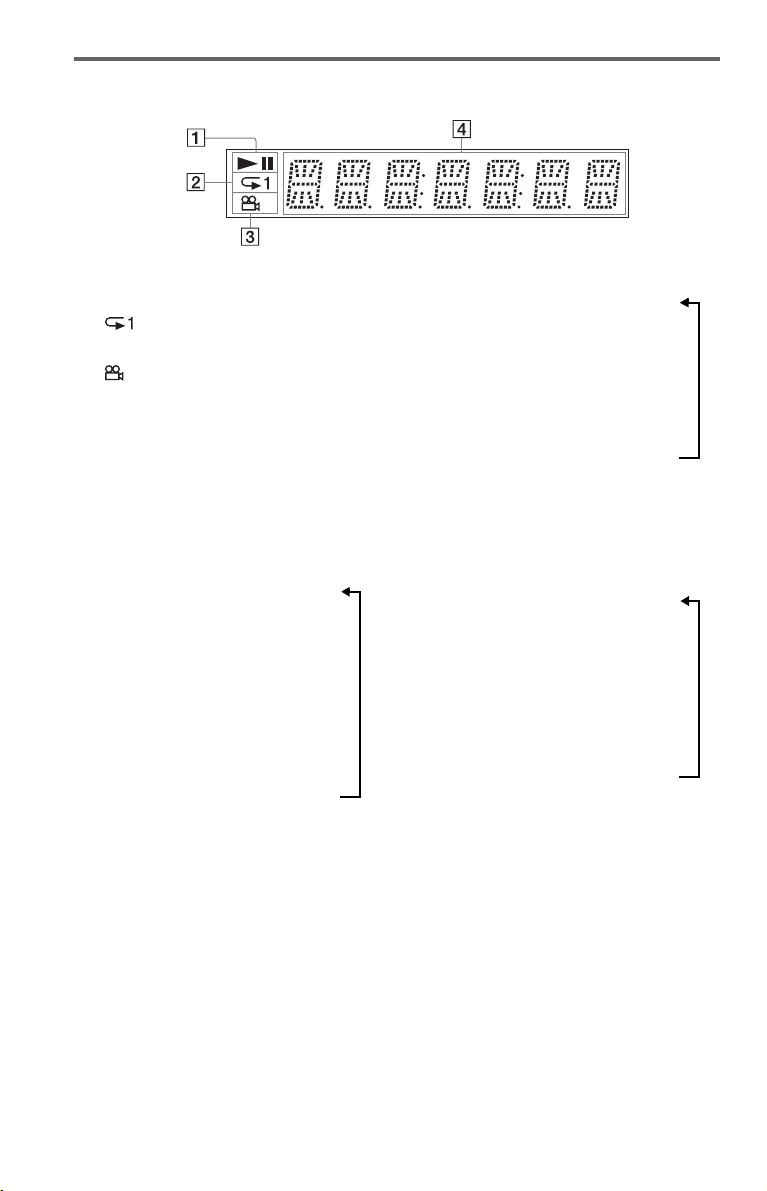
Rear panel
A HDMI OUT (High-Definition
Multimedia Interface out) jack (11, 13)
B DIGITAL OUT (COAXIAL) jack (13)
C LINE OUT L/R (AUDIO) jacks (13)
D LINE OUT (VIDEO) jack (11)
E COMPONENT VIDEO OUT jacks
(11)
,continued
10
US
Front panel display
A N, X
Lights up during playback or pause.
B
Lights up during Repeat Play.
C
Lights up when you can change the
angle.
D Playback information
You can view the time and text
information by pressing the TIME/
TEXT button on the remote repeatedly.
The display changes as follows:
When playing a DVD
Current title playing time
r
Current title remaining time
r
Current chapter playing time
r
Current chapter remaining time
r
Text
r
Current title and chapter number
(Returns to top automatically)
Wh
en p
l
ay
i
ng mus
i
c or v
id
eo
fil
es
Current file
*1
or track
*2
playing
time and number
r
Current file
*1
or track name/MP3
ID3 track title
*2
r
Current album and file
*1
or
track
*2
number
(Returns to top automatically)
*
1
for video file
*
2
for music file
When playing a VIDEO CD (without
PBC functions) or CD
Current track playing time and
number
r
Current track remaining time
r
Disc playing time
r
Disc remaining time
r
Text

Hookups and Settings
11
US
Hookups and Settings
When unpacking, check the supplied accessories by referring to page 45.
b
• Plug cords securely to prevent unwanted noise.
• Refer to the operating instructions supplied with the components to be connected.
• Be sure to disconnect the power cord of each component before connecting.
Step 1: Connecting to Your TV
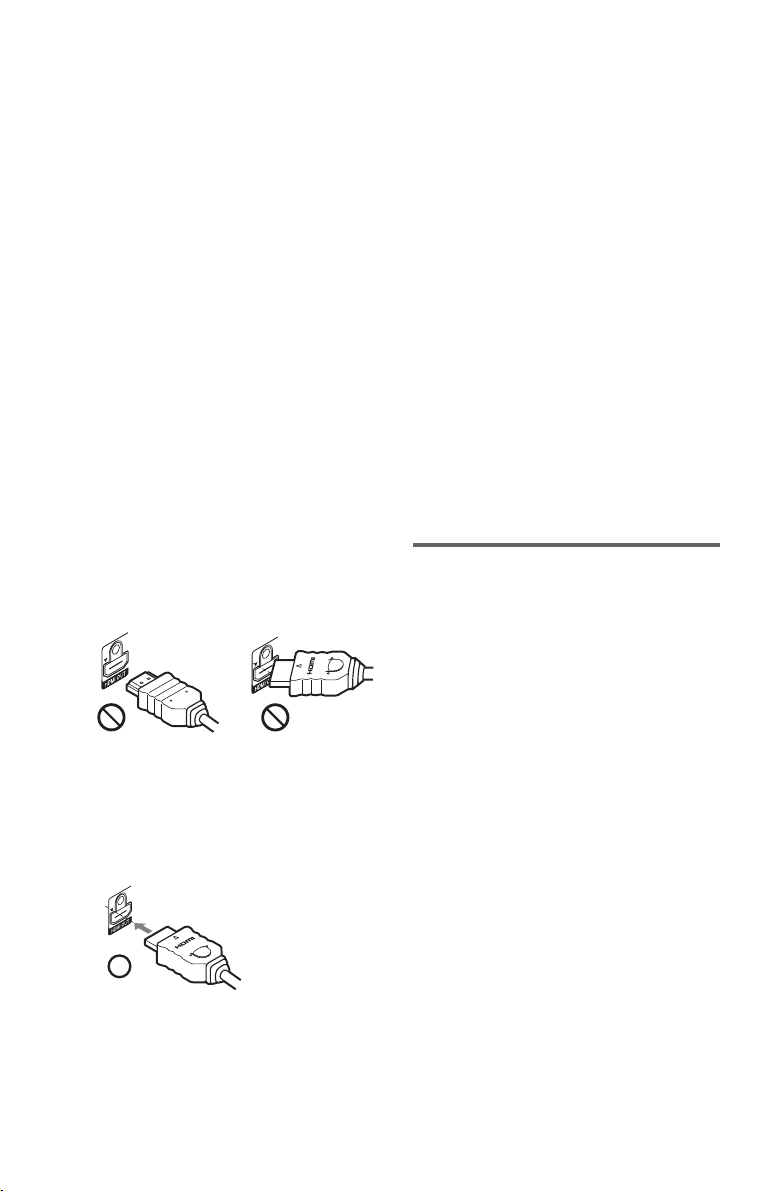
Connect this player to your TV using a video cord. Select one of the patterns A through C,
according to the input jack on your TV.
In order to view progressive signal (480p) pictures with a compatible TV, you must use pattern
B. Select pattern C when connecting to a TV equipped with HDMI input.
A
VIDEO
AUDIO
INPUT
L
R
PR
PB
Y
COMPONENT
VIDEO IN
B
HDMI IN
C
Audio/video cord (supplied)
Component
video cord
(not
supplied)
(yellow)
TV
(green)
TV
(red)
(green)
(blue)
(red)
to LINE OUT (VIDEO)
l : Signal flow
CD/DVD player
to COMPONENT
VIDEO OUT
(blue)
(yellow)
(white)(red)
(white)
(red)
to HDMI OUT
TV
HDMI cord
(not supplied)
,continued
12
US
A Video input jack
You will enjoy standard quality images.
B Component video input jacks
(Y, P
B, PR)
You will enjoy accurate color reproduction
and high quality images.
C HDMI/DVI input jack
Use a certified Sony HDMI cord to enjoy
high quality digital picture and sound through
the HDMI OUT jack.
When connecting to a Sony TV that is
compatible with the CONTROL FOR HDMI
function, see page 12.
When connecting to the HDMI OUT jack
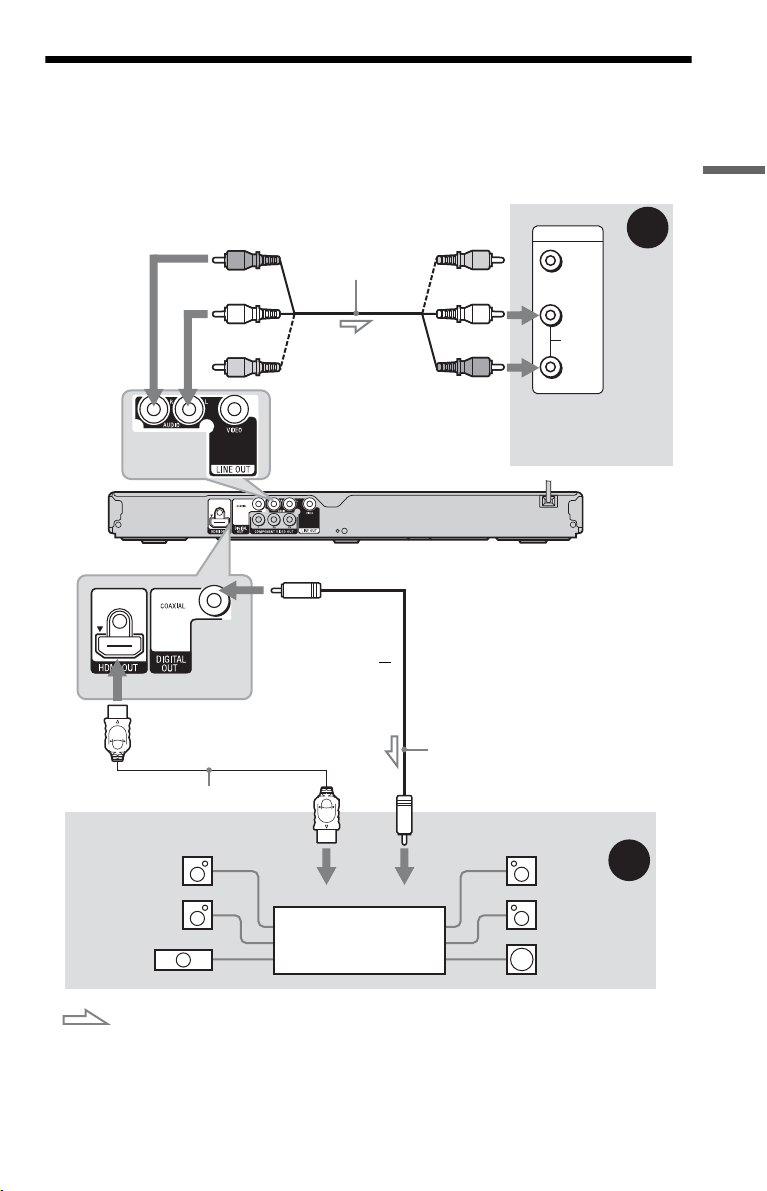
Follow the steps below. Improper handling
may damage the HDMI OUT jack and
the connector.
1 Carefully align the HDMI OUT jack on
the back of the player and the HDMI
connector by checking their shapes.
Make sure the connector is not upside
down or tilted.
2 Insert the HDMI connector straight into
the HDMI OUT jack.
Do not bend or apply force to the HDMI
connector.
To connect to a TV with DVI input
Use an HDMI-DVI converter cord (not
supplied). The DVI jack will not accept any
audio signals, so you have to use another
audio connection in addition to this
connection (page 13). Furthermore, you
cannot connect the HDMI OUT jack to DVI
jacks that are not HDCP compliant (e.g., DVI
jacks on PC displays).
When connecting to a wide screen TV
Some images may not fit your TV screen. To
change the picture size, see page 33.
b
• Do not connect a VCR, etc., between your TV and
the player. If you pass the player signals via the
VCR, you may not receive a clear image on the
TV screen. If your TV has only one audio/video
input jack, connect the player to this jack.
• If the picture appears too white when you are
using A connection, set “BLACK LEVEL” in
“SCREEN SETUP” to “OFF” (page 33).
• Be sure to disconnect the HDMI cord when
moving the player.
• Do not apply too much pressure to the cabinet
wall, if you place the player on the cabinet with
the HDMI cord connected. It may damage the
HDMI OUT jack or the HDMI cord.
• When connecting or disconnecting, do not screw
in or rotate the HDMI connector.
About the CONTROL FOR HDMI
functions for ‘BRAVIA Sync’ (for
HDMI connections only)
By connecting to Sony components that are
compatible with the CONTROL FOR HDMI
function with an HDMI cord (not supplied),
you can enjoy the following features:
• One-Touch Play (page 18)
• System-Power Off
When you turn the TV off by using the [/1 button
on the TV’s remote, the components compatible
with CONTROL FOR HDMI function turn off
automatically.
b
Depending on the connected component, the
CONTROL FOR HDMI function may not work.
Refer to the operating instructions supplied with the
component.
Connector is
upside down
Not straight
Hookups and Settings
13
US
Step 2: Connecting to Your Audio Component
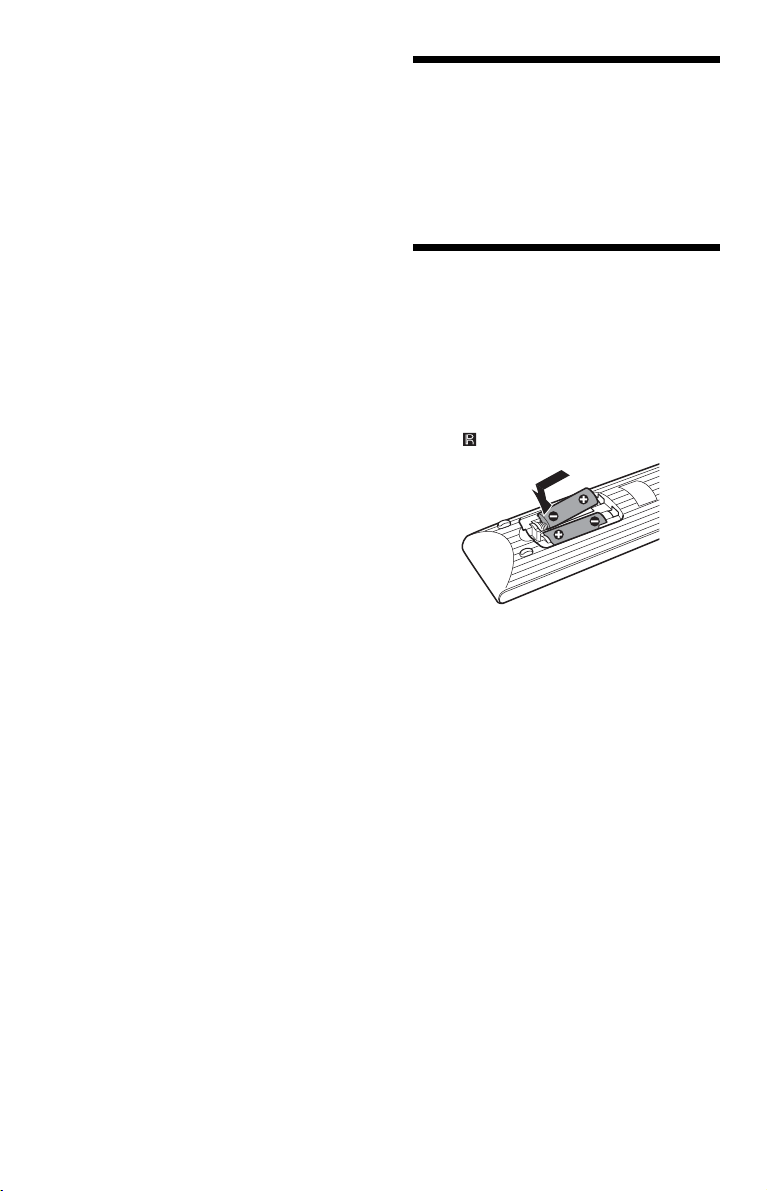
Select one of the following patterns A or B, according to the input jack on your TV monitor,
projector, or audio component such as an AV amplifier (receiver).
This will enable you to listen to sound.
z
For correct speaker location, see the operating instructions supplied with the connected components.
VIDEO
AUDIO
INPUT
L
R
B
A
Audio component with
a decoder
(red)
TV, projector, or
audio component
Audio/video
cord (supplied)
: Signal flow
Coaxial digital cord
(not supplied)
to DIGITAL OUT (
COAXIAL)/
HDMI OUT
to LINE OUT L/R (AUDIO)
Rear (L)
CD/DVD player
(white)
(yellow)*
(yellow)*
(white)
(red)
[Speakers]
Front (L)
[Speakers]
Rear (R)
Front (R)
SubwooferCenter
* The yellow plug is used for video signals (page 11).
to coaxial/HDMI digital input
HDMI cord (not supplied)
or
,continued
14
US
A Audio L/R input jacks
This connection will use your TV’s or audio
component’s two speakers for sound.
B Digital audio input jack
If your audio component has a Dolby*
1
Digital or DTS*
2
decoder and a digital input
jack, use this connection. You can enjoy
Dolby Digital (5.1ch) and DTS (5.1ch)
surround effect.
If you connect to a Sony audio component
that is compatible with the CONTROL FOR
HDMI function, refer to the operating
instructions supplied with the audio
component.
*1
Manufactured under license from Dolby
Laboratories.
Dolby, Pro Logic, and the double-D symbol are
trademarks of Dolby Laboratories.
*2
Manufactured under license under U.S. Patent #:
5,451,942 & other U.S. and worldwide patents
issued & pending. DTS and DTS Digital Out are
registered trademarks and the DTS logos and
Symbol are trademarks of DTS, Inc. © 1996-
2008 DTS, Inc. All Rights Reserved.
b
• After you have completed the connection, make
the appropriate settings in Quick Setup (page 15).
Otherwise, no sound or a loud noise will come
from your speakers.
• The TVS effects of this player cannot be used
with this connection.
• When you connect the player to an audio
component using an HDMI cord, you will need to
do one of the following:
– Connect the audio component to the TV with the
HDMI cord.
– Connect the player to the TV with a video cord
other than HDMI cord (component video cord or
audio/video cord).
• When connecting to the HDMI OUT jack,
carefully align the HDMI connector with the jack.
Do not bend and apply force to the HDMI cord.
Step 3: Connecting the
Power Cord
Plug the player and TV power cords into an
AC outlet.
Step 4: Preparing the
Remote
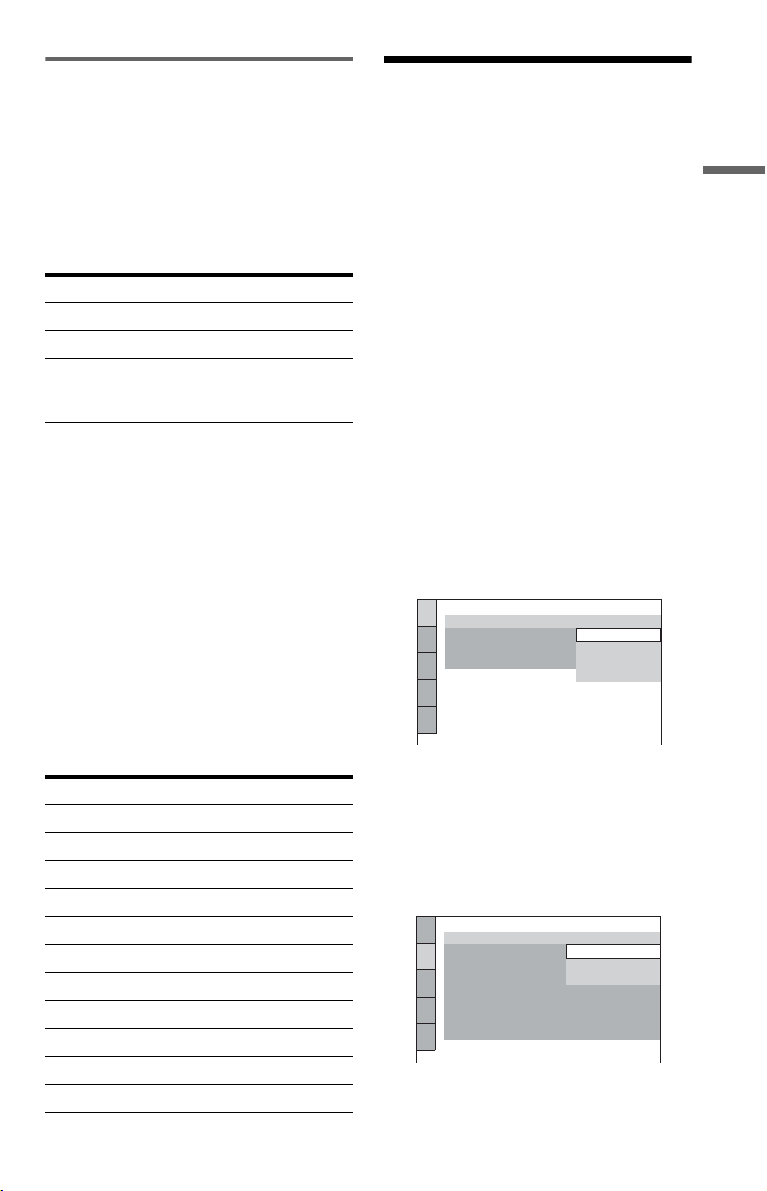
Insert two Size AA (R6) batteries by
matching the 3 and # ends on the batteries
to the markings inside the compartment.
When using the remote, point it at the remote
sensor on the player.
b
• Do not leave the remote in an extremely hot or
humid place.
• Do not drop any foreign object into the remote
casing, particularly when replacing the batteries.
• Do not expose the remote sensor to direct light
from the sun or a lighting apparatus. Doing so
may cause a malfunction.
• If you do not use the remote for an extended
period of time, remove the batteries to avoid
possible damage from battery leakage and
corrosion.
Hookups and Settings
15
US
Controlling TVs with the remote
You can control the sound level, input source,
and power switch of your Sony TV with the
supplied remote.
Available buttons
Depending on the connected unit, you may
not be able to control your TV using all or
some of the buttons on the supplied remote.
To control other TVs with the remote
You can control the volume, input source, and
power switch of non-Sony TVs as well.
If your TV is listed in the table below, set the
appropriate manufacturer’s code.
b
When you replace the batteries of the remote, the
code number may be reset to the default setting. Set
the appropriate code number again.
1 While holding down TV [/1, press the
number buttons to select your TV’s
manufacturer’s code.
2 Release TV [/1.
Code numbers of controllable TVs
Step 5: Quick Setup
Follow the steps below to make the minimum
number of basic adjustments for using the
player.
To skip an adjustment, press >. To return
to the previous adjustment, press ..
1 Turn on the TV then press [/1.
2 Switch the input selector on your
TV so that the signal from the
player appears on the TV screen.
“Press [ENTER] to run QUICK SETUP”
appears at the bottom of the screen. If this
message does not appear, select
“QUICK” under “SETUP” in the Control
Menu to run Quick Setup (page 21).
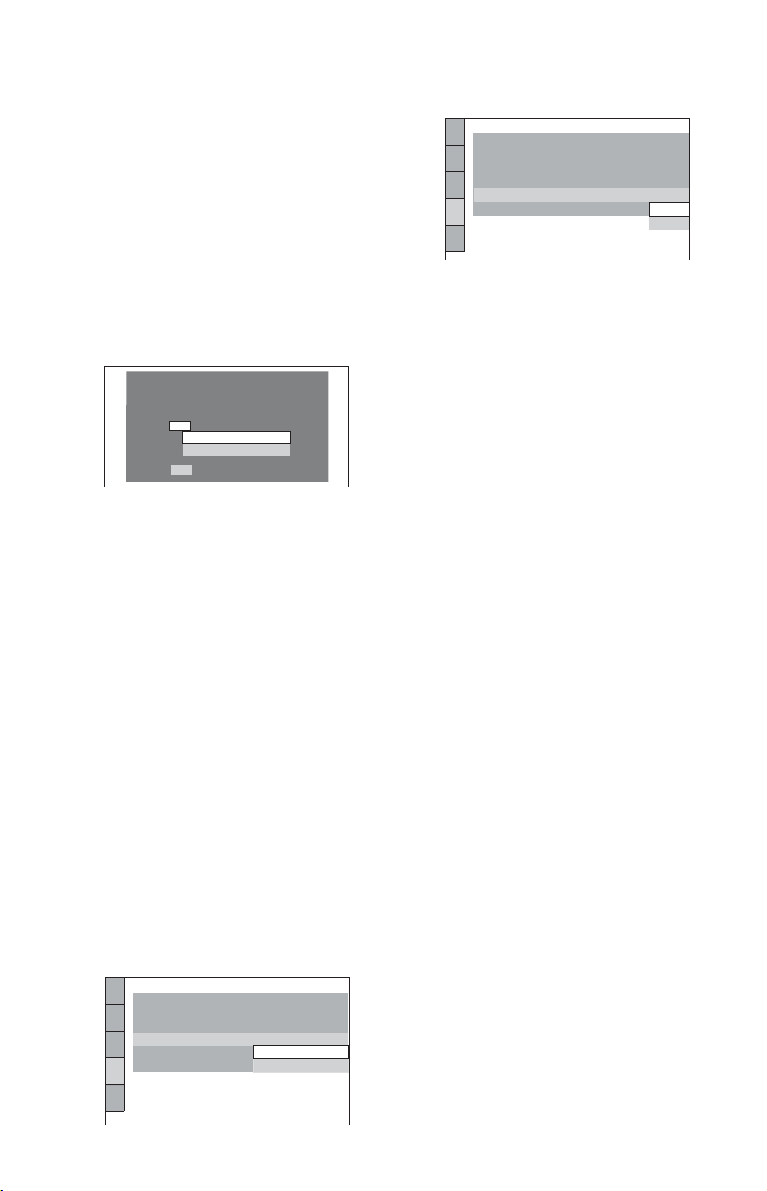
3 Press ENTER without inserting a
disc.
The Language Setup Display appears.
4 Press X/x to select a language.
The player displays the menu and
subtitles in the selected language.
5 Press ENTER.
The Screen Setup Display appears.
Buttons Operations
TV [/1 Turn the TV on or off
VOL +/– Adjust the volume of the TV
TV INPUT
(input select)
Switch the TV’s input source
between the TV and other
input sources
Manufacturer Code number
Sony 01 (default)
Hitachi 02
LG/Goldstar/NEC 04
MGA/Mitsubishi 13
Panasonic 19
Philips 21
Pioneer 16
RCA 10
Samsung 20
Sharp 18
Toshiba 07
LANGUAGE SETUP
OSD:
MENU:
AUDIO:
SUBTITLE:
FRENCH
ENGLISH
ENGLISH
SPANISH
PORTUGUESE
SCREEN SETUP
TV TYPE:
16:9
4:3 PAN SCAN
4:3 LETTER BOX
SCREEN SAVER:
OFF
BACKGROUND:
BLACK LEVEL:
BLACK LEVEL
(COMPONENT OUT)
:
OFF
PROGRESSIVE
(COMPONENT OUT ONLY)
:
AUTO
MODE
(PROGRESSIVE)
:
FULL
4:3 OUTPUT:
16:9
,continued
16
US
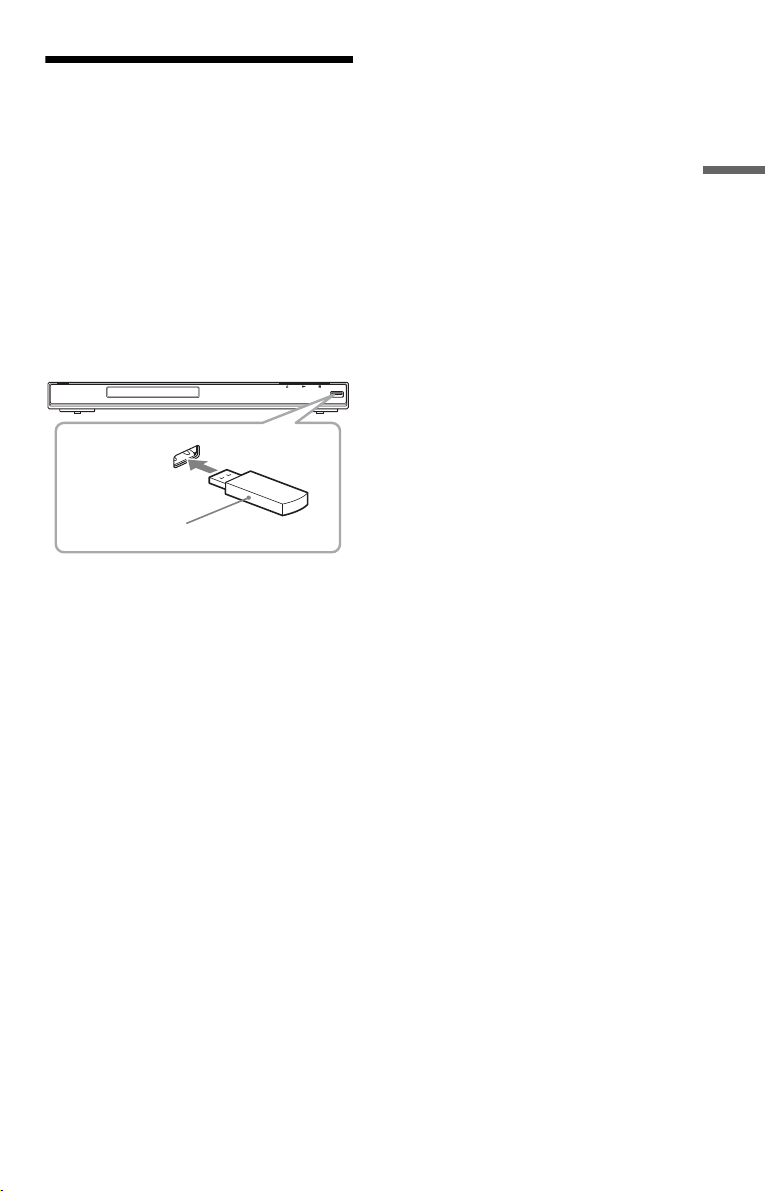
6 Press X/x to select the setting that
matches your TV type.
◆ If you have a wide-screen TV or a 4:3
standard TV with a wide-screen mode
• 16:9 (page 33)
◆ If you have a 4:3 standard TV
• 4:3 LETTER BOX or 4:3 PAN SCAN
(page 33)
7 Press ENTER.
The Setup Display for selecting the type
of jack used to connect your audio
component appears.
8 Press X/x to select the type of jack
(if any) you are using to connect to
an audio component, then press
ENTER.
Select “NO,” if you do not connect an
audio component, then go to step 12.
Select “YES: LINE OUTPUT L/R
(AUDIO),” if you connect an audio
component using an audio cord, then go
to step 12.
Select “YES: DIGITAL OUTPUT,” if
you connect an audio component using a
digital coaxial/HDMI cord.
9 Press X/x to select the type of
Dolby Digital signal to your audio
component.
If your audio component has a Dolby
Digital decoder, select “DOLBY
DIGITAL.” Otherwise, select “D-PCM.”
10Press ENTER.
“DTS” is selected.
11Press X/x to select whether or
not to send a DTS signal to your
audio component.
If your audio component has a DTS
decoder, select “ON.” Otherwise, select
“OFF.”
12Press ENTER.
Quick Setup is finished and connections
are complete.
b
When “PhotoTV HD” mode is activated (page 30),
the selection for “TV TYPE” is skipped.
YES
NO
Is this player connected to an amplifier
(receiver) ? Select the type of jack you
are using.
LINE OUTPUT L/R (AUDIO)
DIGITAL OUTPUT
48kHz/96kHz PCM:
AUDIO SETUP
AUDIO DRC:
DIGITAL OUT:
DOLBY DIGITAL:
DTS:
STANDARD
ON
DOWNMIX:
DOLBY SURROUND
DOLBY DIGITAL
D-PCM
DOLBY DIGITAL
AUDIO SETUP
AUDIO DRC:
DIGITAL OUT:
DOLBY DIGITAL:
STANDARD
ON
DOWNMIX:
DOLBY SURROUND
DOLBY DIGITAL
DTS:
48kHz/96kHz PCM:
OFF
OFF
ON
Hookups and Settings
17
US
Connecting a USB Device
(DVP-NS728H only)
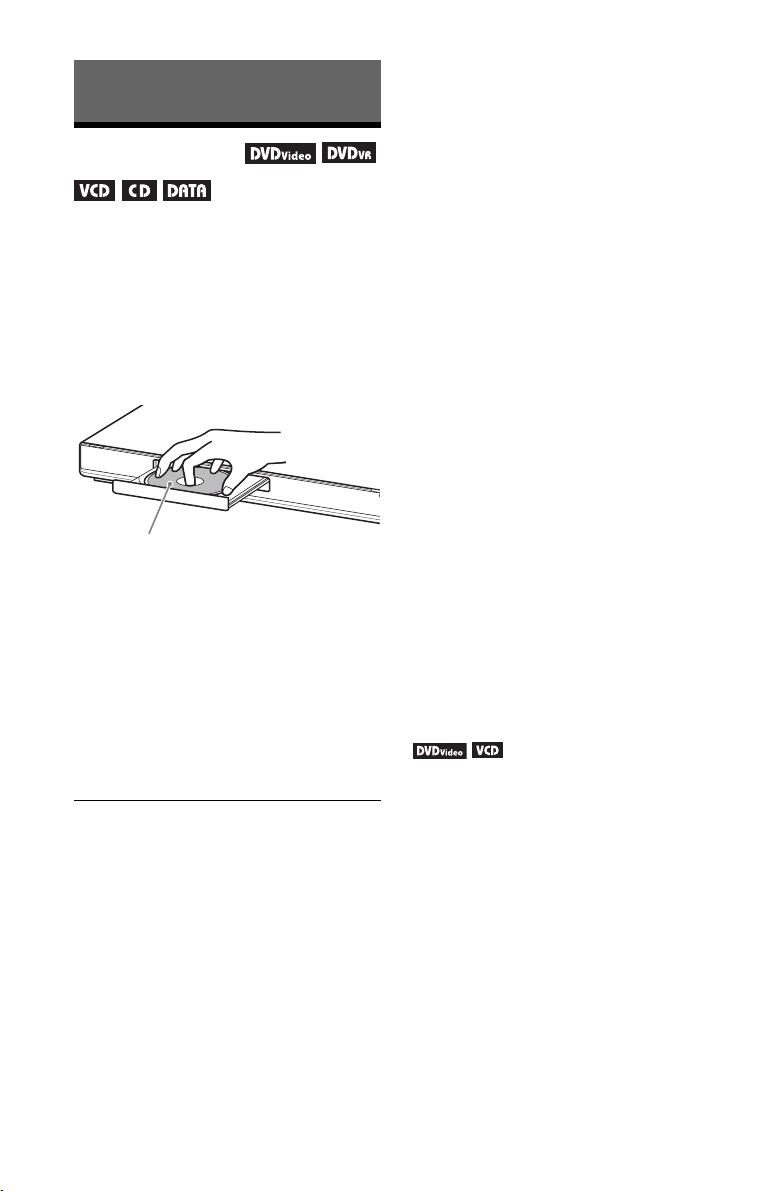
You can connect a USB device to the USB
jack of the player to play video, photo, or
music files. For a list of USB devices that can
be connected to the player, refer “Playable
USB Devices” (supplement). For details on
playable files, see “Playable Media” page 42.
Refer to the operating instructions supplied
with the USB device before connecting it to
the player.
To play data files, see “Playing video, photo,
and music files from USB device (DVP-
NS728H only)” (page 29).
To remove the USB device
Stop playback and disconnect the USB device
from the USB jack.
b
• Take the precaution of backing up important files
on the USB device before connecting it to the
player.
• Do not forcibly connect the USB device and make
sure the plug is oriented correctly.
• Do not connect the player and the USB device
through a USB hub.
• Make sure no virus-infected files are contained on
a USB device before use.
• This player supports USB Mass Storage Class
only.
• This player supports USB device with FAT12,
FAT16, or FAT32 format only.
• Some USB devices may not work with this player.
USB device
18
US
Playback
Playing Discs
1 Switch the input selector on your
TV so that the signal from the
player appears on your TV screen.
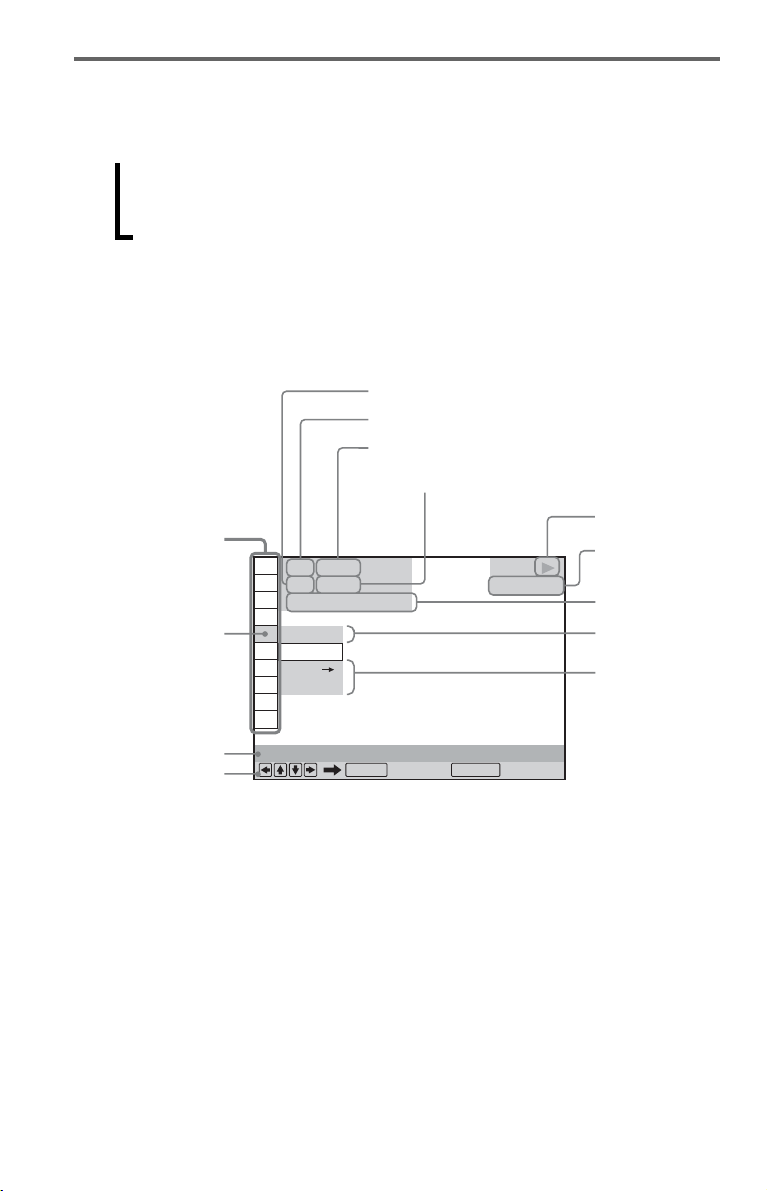
2 Press Z on the player, and place a
disc on the disc tray.
3 Press N.
The disc tray closes. The player starts
playback (continuous play). Adjust the
volume on the TV or the audio
component.
Depending on the disc, a menu may
appear on the TV screen. For DVD
VIDEOs, see page 8. For VIDEO CDs,
see page 19.
If a disc is inside the player
Press N.
To stop playback
Press x.
To pause playback
Press X.
One-Touch Play (for HDMI connections
only)
With one touch of the N button on the
remote, the player and your TV automatically
turn on and the TV’s input is switched to the
player. Playback starts automatically.
The TV’s input will also switch to the player
automatically, in the following cases:
–You press
N, TOP MENU, MENU, or
DISPLAY buttons on the remote.
Note that these buttons are not effective
when you play audio CD or music files in
“MUSIC” mode.
– If a disc with auto play function is loaded.
– If you push the disc tray to close.
z
You can have the player turned off automatically
whenever you leave it in stop mode for more than
30 minutes. To turn this function on or off, set
“AUTO POWER OFF” in “CUSTOM SETUP” to
“ON” or “OFF” (page 35).
b
• Depending on the DVD or VIDEO CD, some
operations may be different or restricted.
Refer to the operating instructions supplied with
your disc.
• Discs created on DVD recorders must be correctly
finalized before they can be played. For more
information about finalizing, refer to the
operating instructions supplied with the DVD
recorder.
Note on playing DTS sound tracks on a
DVD VIDEO
DTS audio signals are output only through the
DIGITAL OUT (COAXIAL)/HDMI OUT
jack.
To resume playback from the point where
you stopped the disc (Multi-disc Resume)
When you press N again after you stop
playback, the player starts playback from the
point when you pressed x.
z
• To play from the beginning of the disc, press x
twice, then press N.
• With DVD VIDEOs and VIDEO CDs, the player
stores the point where you stopped the disc for up
to 6 discs and resumes playback the next time you
insert the same disc. If you store a resume
playback point for the seventh disc, the resume
playback point for the first disc is deleted.
Playback side
facing down

Playback
19
US
b
• “MULTI-DISC RESUME” in “CUSTOM
SETUP” must be set to “ON” (default) for this
function to work (page 35).
• Resume Play does not work during Shuffle Play
and Program Play.
• With some discs, Resume Play may not work,
depending on the point you stop playback, or if
you press [/1.
To play VIDEO CDs with PBC functions
(PBC Playback)
PBC (Playback Control) allows you to play
VIDEO CDs interactively using the menu on
your TV screen.
When you start playing a VIDEO CD with
PBC functions, the menu for your selection
appears.
Select an item using the number buttons, and
press ENTER. Then, follow the instructions
in the menu (press N when “Press
SELECT” appears).
To return to the menu
Press O RETURN.
z
To play without using PBC, press ./> or the
number buttons while the player is stopped to select
a track, then press N or ENTER.
“Play without PBC” appears on the TV screen and
the player starts continuous play. You cannot play
still pictures such as a menu.
To return to PBC playback, press x twice then
press N.
,continued
20
US
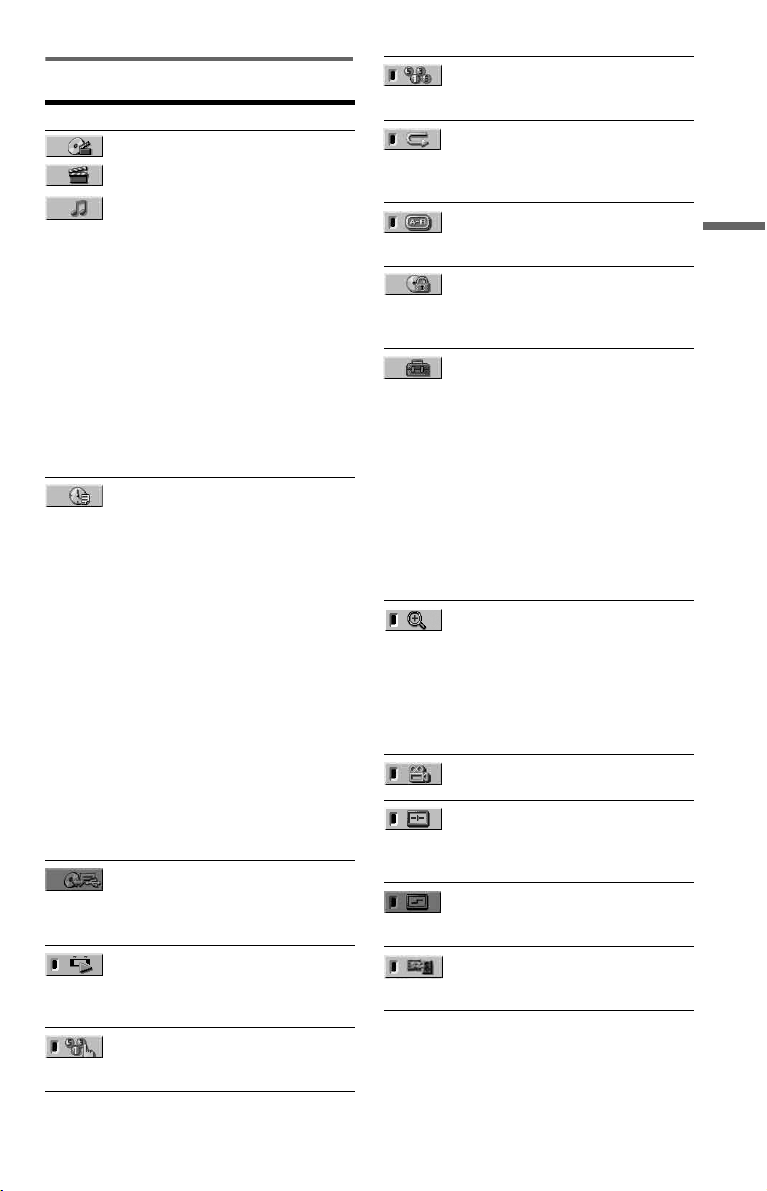
Control Menu display
Use the Control Menu to select a function and to view related information. Press DISPLAY
repeatedly to turn on or change the Control Menu display as follows:
The Control Menu display 1 and 2 will show different items depending on the media type.
Example: Control Menu display 1 when playing a DVD VIDEO.
Press X/x to select the Control Menu item, then press ENTER.
For details about the item, see “List of Control Menu items” (page 21, 22).
*
1
Displays the album number for video, photo, and
music files, scene number for VIDEO CDs (PBC
is on), and track number for VIDEO CDs/CDs.
*
2
Displays the video, photo, music files numbers,
and index numbers for VIDEO CDs.
*
3
Displays Super VCD as “SVCD.”
*
4
Displays the date for photo files.
Control Menu display 1
m
Control Menu display 2 (Except CD and when “MEDIA” is set to “MUSIC”)
m
Control Menu display off
,
OFF
OFF
SET
ON
PLAY
1 8
(
3 4
)
1 2
(
2 7
)
T
1 : 3 2 : 5 5
DVD VIDEO
Quit:
PROGRAM
ENTER DISPLAY
Currently playing chapter number*
2
Playing time*
4
Total number of chapters*
2
Options
Current setting
Total number of titles*
1
Playback status
(N Playback,
X Pause,
x Stop, etc.)
Function name of
selected Control
Menu item
Operation message
Selected item
Control Menu items
Type of disc
being played*
3
Currently playing title number*
1
Playback
21
US
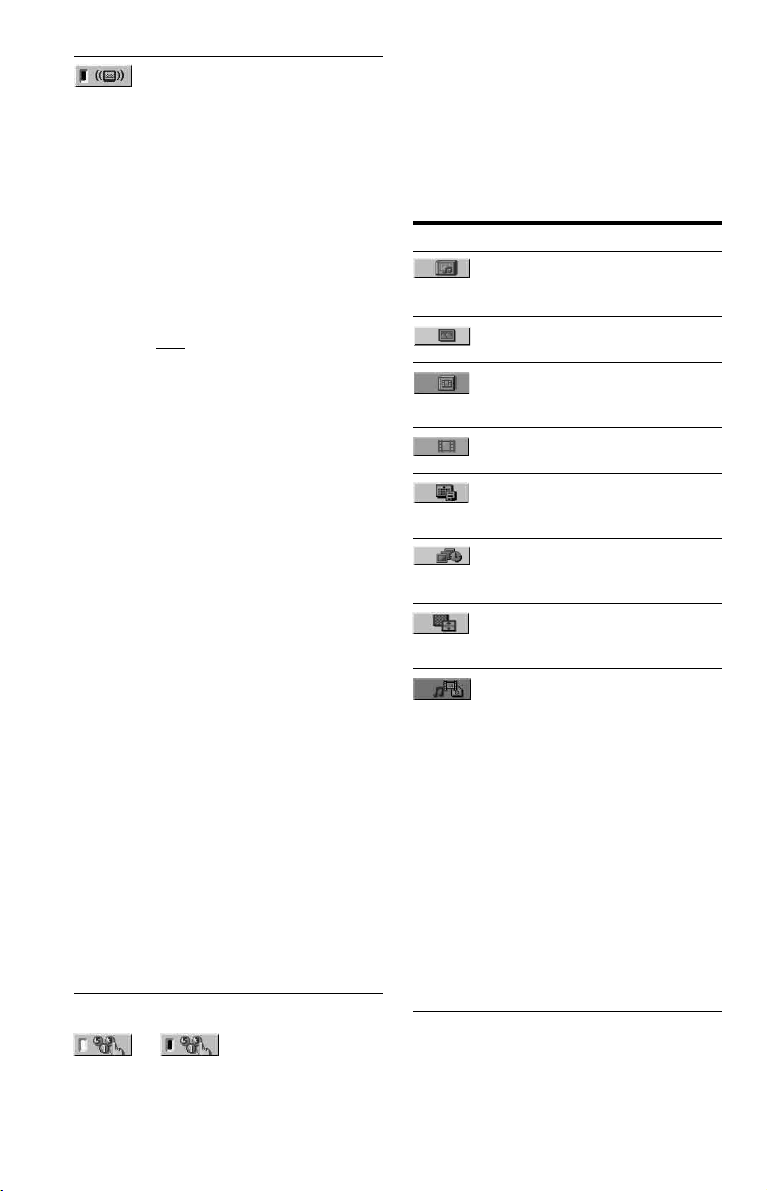
List of Control Menu items
Item Item Name, Function
TITLE/SCENE/TRACK
CHAPTER/INDEX
TRACK
Selects the title, scene, track,
chapter, or index to be played.
1 Press X/x to select the search
method.
“** (**)” is selected (** refers
to a number).
2 Press ENTER.
“** (**)” changes to “-- (**).”
3 Press the number buttons to
select the number you want to
search.
4 Press ENTER.
TIME/TEXT
Checks the elapsed time and the
remaining playback time.
Input the time code for picture and
music searching (DVD and DivX
video files only).
1 Press ENTER.
2 Input the time code using the
number buttons, then press
ENTER.
For example, to find the scene
at 2 hours, 10 minutes, and 20
seconds after the beginning,
just enter “2:10:20.”
b
You cannot search for a scene on a
DVD+RW/DVD+R/DVD+R DL
using the time code.
DISC/USB for DVP-NS728H
only (page 29)
Selects either USB or DISC
playback mode.
ORIGINAL/PLAY LIST
Selects the type of titles (DVD-VR
mode) to be played, the ORIGINAL
one, or an edited PLAY LIST.
PROGRAM (page 24)
Selects the title, chapter, or track to
play in the order you want.
SHUFFLE (page 25)
Plays the title, chapter, or track in
random order.
REPEAT (page 25)
Plays all titles/tracks/albums or a
single title/chapter/track/album/file
repeatedly.
A-B REPEAT (page 26)
Specifies the parts you want to play
repeatedly.
PARENTAL CONTROL
(page 28)
Set to prohibit playback on this
player.
SETUP (page 15, 32)
QUICK:
Use Quick Setup to choose the
desired language of the on-screen
display, the aspect ratio of the TV
and the audio output signal.
CUSTOM:
In addition to the Quick Setup
setting, you can adjust various other
settings.
RESET:
Returns the settings in “SETUP” to
the default setting.
ZOOM
Magnifies the image up to four times
the original size, and scroll using C/
X/x/c.
To return to normal view, press
CLEAR.
This function is available for all
pictures except a background image.
ANGLE
Changes the angle.
CUSTOM PICTURE MODE
(page 27)
Selects the picture quality that best
suits the program you are watching.
SHARPNESS (page 27)
Exaggerates the outline of the image
to produce a sharper picture.
AV SYNC (page 27)
Adjust the delay between the picture
and sound.
,continued
22
US
z
The Control Menu icon indicator lights up in green
when you select any item
except “OFF” (“PROGRAM,” “SHUFFLE,”
“REPEAT,” “A-B REPEAT,” “SHARPNESS,”
“ZOOM,” “TVS” only). The “ORIGINAL/PLAY
LIST” indicator lights up in green when you select
“PLAY LIST” (default setting). The “ANGLE”
indicator lights up in green when you can change
the angle. The “CUSTOM PICTURE MODE”
indicator lights up in green when any setting other
than “STANDARD” is selected. The “AV SYNC”
indicator lights up in green when set to more than 0
ms.
◆Items for DATA discs or USB (DVP-NS728H
only)
TVS (TV Virtual Surround)
Selects surround sound effect when
connecting a stereo TV or 2 front
speakers. This only works when
playing a multichannel Dolby audio
sound track. Furthermore, if the
player is set up to output the signal
from the DIGITAL OUT
(COAXIAL)/HDMI OUT jack, the
surround effect will only be heard
when “DOLBY DIGITAL” is set to
“D-PCM” in “AUDIO SETUP”
(page 36).
The default setting is underlined.
•OFF
Cancels the setting.
• TVS DYNAMIC THEATER
• TVS DYNAMIC
• TVS WIDE
This mode is effective when the
distance between the front L and R
speakers is short, such as with built-
in speakers on a stereo TV.
• TVS NIGHT
This feature is useful when you want
to hear the dialog and enjoy the
surround sound effects of “TVS
WIDE” at low volume.
• TVS STANDARD
Use this setting when you want to
use TVS with 2 separate speakers.
b
• When you select one of the TVS
modes, turn off the surround setting
of the connected TV or audio
component.
• The TVS effects do not work when
using the Fast Play or Slow Play
functions, even though you can
change the TVS modes.
• If you use the DIGITAL OUT
(COAXIAL)/HDMI OUT jack and
set “DOLBY DIGITAL” to
“DOLBY DIGITAL,” and “DTS” to
“ON” in “AUDIO SETUP,” sound
will come from your speakers but it
will not have the surround effect.
t
Item Item Name, Function
ALBUM
Selects the album that contains
music and photo files to be played.
FILE
Selects the photo file to be played.
ALBUM
Selects the album that contains video
file to be played.
FILE
Selects the video file to be played.
DATE
Displays the date the picture was
taken by a digital camera.
INTERVAL (page 31)
Specifies the duration for which the
slides are displayed on the screen.
EFFECT (page 31)
Selects the effects to be used for
changing slides during a slide show.
MEDIA
VIDEO: plays video files.
PHOTO/MUSIC: plays photo and
music files as a slide show.
PHOTO (BGM): plays photo files
with the player’s internal
background sound. To choose the
melody of the background sound,
press AUDIO repeatedly while
viewing the image.
MUSIC: plays music files.
b
• For details on playable files, see
“Playable Media” page 42.
• Depending on the contents, the
player will play all files regardless of
the “MEDIA” settings.

Playback
23
US
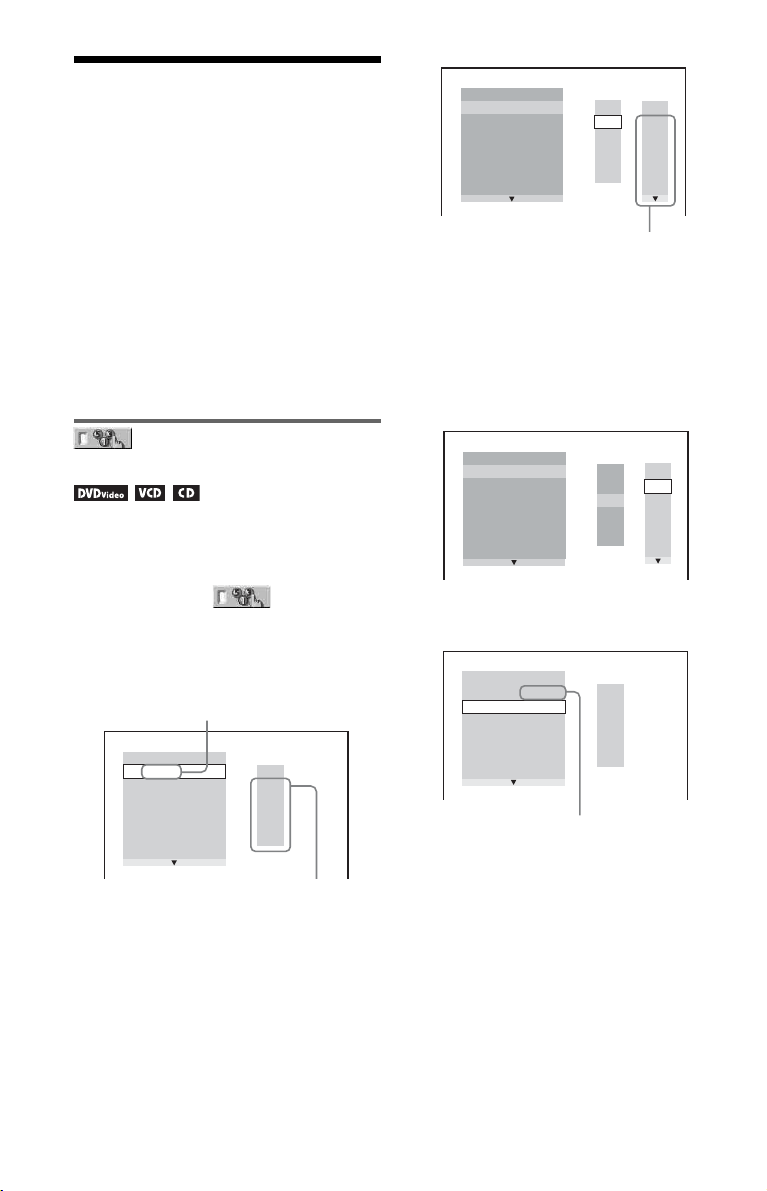
Guide to the ‘BRAVIA Sync’ Display
You can control the player by selecting the SYNC MENU button on the TV’s remote or TV’s
option menu.
‘BRAVIA Sync’ display
The ‘BRAVIA Sync’ display will show different items depending on the disc type.
Example: ‘BRAVIA Sync’ display when playing a DVD VIDEO
Select an item using C/X/x/c and then press
ENTER.
◆ When playing a DVD VIDEO
Displays MENU and TOP MENU.
◆ When playing in DVD-VR mode
Displays ., >, and chapter number.
◆ When playing a CD, VIDEO CD, or Super
VCD (without PBC)
Displays ., >, and track number.
◆ When playing a VIDEO CD or Super VCD
(with PBC) (page 19)
Displays ., >, and scene number.
When the disc’s menu appears, you can select
an item by pressing X/x.
◆ When playing video, photo, and music
files
Displays MENU and PICT. NAVI (Picture
Navigation).
To change the display
Press SYNC MENU on the TV’s remote
repeatedly to turn or change the display.
‘BRAVIA Sync’ display and Control Menu
are displayed alternately.
To turn off the display
Press RETURN or SYNC MENU button on
the TV’s remote repeatedly.
z
You can also control these functions on the player’s
remote.
b
• The items in the ‘BRAVIA Sync’ display have the
same functions as the player’s remote buttons
(page 7).
• You can only use this function if your TV
supports the ‘BRAVIA Sync’.
• For more details of ‘BRAVIA Sync’, please refer
to the operating instructions supplied with the TV.
24
US
Various Play Mode
Functions
You can set the following play modes:
• Program Play (page 24)
• Shuffle Play (page 25)
• Repeat Play (page 25)
• A-B Repeat Play (page 26)
b
The play mode is canceled when:
– you open the disc tray.
– you remove the USB device (DVP-NS728H
only).
– you press [/1 and the player enters standby mode.
– you change the setting of “DISC/USB” (DVP-
NS728H only).
Creating your own
program (Program Play)
You can play the contents in the order you
want. You can program up to 99 titles,
chapters, and tracks.
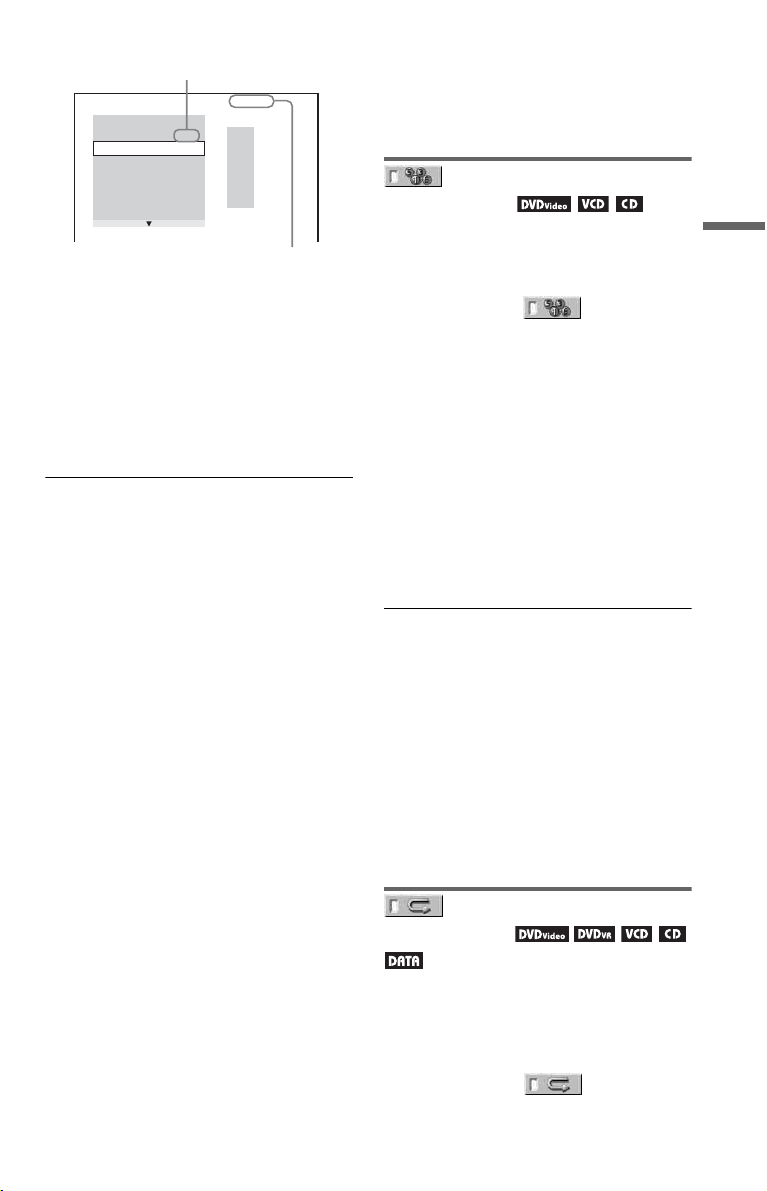
1 After selecting (PROGRAM)
on the Control Menu (page 20), press
X/x to select “SET
t,” then press
ENTER.
2 Press c.
The cursor moves to the title or track row
“T” (in this case, “01”).
3 Select the title, chapter, or track you
want to program.
◆ When playing a DVD VIDEO
For example, select chapter “03” of title
“02.”
Press X/x to select “02” under “T,” then
press ENTER.
Next, press X/x to select “03” under “C,”
then press ENTER.
◆ When playing a VIDEO CD or CD
For example, select track “02.”
Press X/x to select “02” under “T,” then
press ENTER.
PROGRAM
1. TITLE
ALL CLEAR
2. TITLE
– –
3. TITLE
– –
4. TITLE
– –
5. TITLE
– –
6. TITLE
– –
7. TITLE
– –
T
– –
01
02
03
04
05
“TRACK” is displayed when you play
a VIDEO CD or CD.
Recorded titles or tracks
PROGRAM
1. TITLE
– –
ALL CLEAR
2. TITLE
– –
3. TITLE
– –
4. TITLE
– –
5. TITLE
– –
6. TITLE
– –
7. TITLE
– –
T
C
ALL
01
02
03
04
05
06
– –
02
03
04
05
01
Recorded chapters
PROGRAM
1. TITLE
– –
ALL CLEAR
2. TITLE
– –
3. TITLE
– –
4. TITLE
– –
5. TITLE
– –
6. TITLE
– –
7. TITLE
– –
C
ALL
03
04
05
06
T
– –
01
02
03
04
05
02
01
T
– –
01
02
03
04
05
PROGRAM
1. TITLE 0 2
–
0 3
ALL CLEAR
2. TITLE
– –
3. TITLE
– –
4. TITLE
– –
5. TITLE
– –
6. TITLE
– –
7. TITLE
– –
Selected title and chapter
Playback
25
US
4 Repeat steps 2 to 3, to program other
titles, chapters, or tracks.
The programmed titles, chapters, and
tracks are displayed in the selected order.
5 Press N.
Program Play begins.
When the program ends, you can restart
the same program again by pressing N.
To return to normal play
Press CLEAR, or select “OFF” in step 1. To
play the same program again, select “ON” in
step 1 and press ENTER.
To change or cancel a program
1 Follow step 1 of “Creating your own
program (Program Play).”
2 Select the program number of the title,
chapter, or track you want to change or
cancel using X/x and press c. If you
want to delete the title, chapter, or track
from the program, press CLEAR.
3 Follow step 3 of “Creating your own
program (Program Play)” for new
programming. To cancel a program,
select “--” under “T,” then press ENTER.
To cancel all of the titles, chapters, or
tracks in the programmed order
Press X and select “ALL CLEAR” in step 2 of
“Creating your own program (Program
Play)” and press ENTER.
z
You can perform Repeat Play or Shuffle Play of
programmed titles, chapters, or tracks. During
Program Play, follow the steps of Repeat Play
(page 25) or Shuffle Play (page 25).
b
• When you program tracks on a Super VCD, the
total playing time is not displayed.
• You cannot use this function with VIDEO CDs or
Super VCDs with PBC playback.
Playing in random order
(Shuffle Play)
You can have the player “shuffle” titles,
chapters, or tracks. Subsequent “shuffling”
may produce a different playing order.
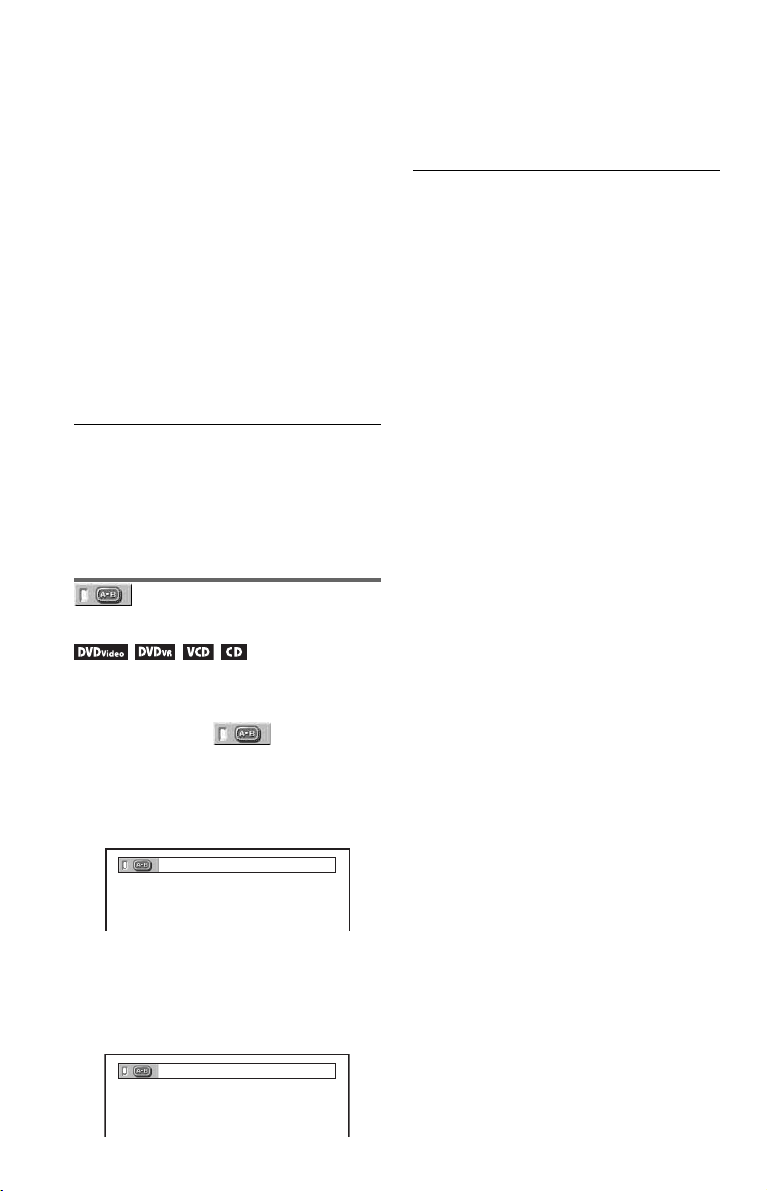
1 After selecting (SHUFFLE) on
the Control Menu (page 20), press X/
x to select the item to be shuffled.
◆ When playing a DVD VIDEO
•TITLE
• CHAPTER
◆ When playing a VIDEO CD or CD
• TRACK
◆ When Program Play is activated
• ON: shuffles titles, chapters, or tracks
selected in Program Play
2 Press ENTER.
Shuffle Play starts.
To return to normal play
Press CLEAR, or select “OFF” in step 1.
z
• You can set Shuffle Play while the player is
stopped. After selecting the “SHUFFLE” option,
press N. Shuffle Play starts.
• Up to 200 chapters in a disc can be played in
random order when “CHAPTER” is selected.
b
You cannot use this function with VIDEO CDs or
Super VCDs with PBC playback.
Playing repeatedly
(Repeat Play)
You can play all of the titles or tracks, or a
single title, chapter, or track repeatedly.
You can use a combination of Shuffle or
Program Play modes.
1 After selecting (REPEAT) on
the Control Menu (page 20), press X/
x to select the item to be repeated.
PROGRAM
1. TRACK 0 2
ALL CLEAR
2. TRACK
– –
3. TRACK
– –
4. TRACK
– –
5. TRACK
– –
6. TRACK
– –
7. TRACK
– –
0:15:30
– –
01
02
03
04
05
T
Selected track
Total time of the programmed tracks
,continued
26
US
• DISC: repeats all of the titles, tracks, or
albums. (Select ORIGINAL or PLAY
LIST in DVD-VR mode)
• USB: repeats all albums (DVP-
NS728H only)
• TITLE: repeats the current title
• CHAPTER: repeats the current chapter
• TRACK: repeats the current track
• FILE (video files only): repeats the
current file
• ALBUM: repeats the current album
◆ When Program Play or Shuffle Play is
activated
• ON: repeats Program Play or Shuffle
Play
2 Press ENTER.
Repeat Play starts.
To return to normal play
Press CLEAR, or select “OFF” in step 1.
b
You cannot use this function with VIDEO CDs or
Super VCDs with PBC playback.
Repeating a specific
portion (A-B Repeat Play)
You can play a specific portion of a title,
chapter, or track repeatedly.
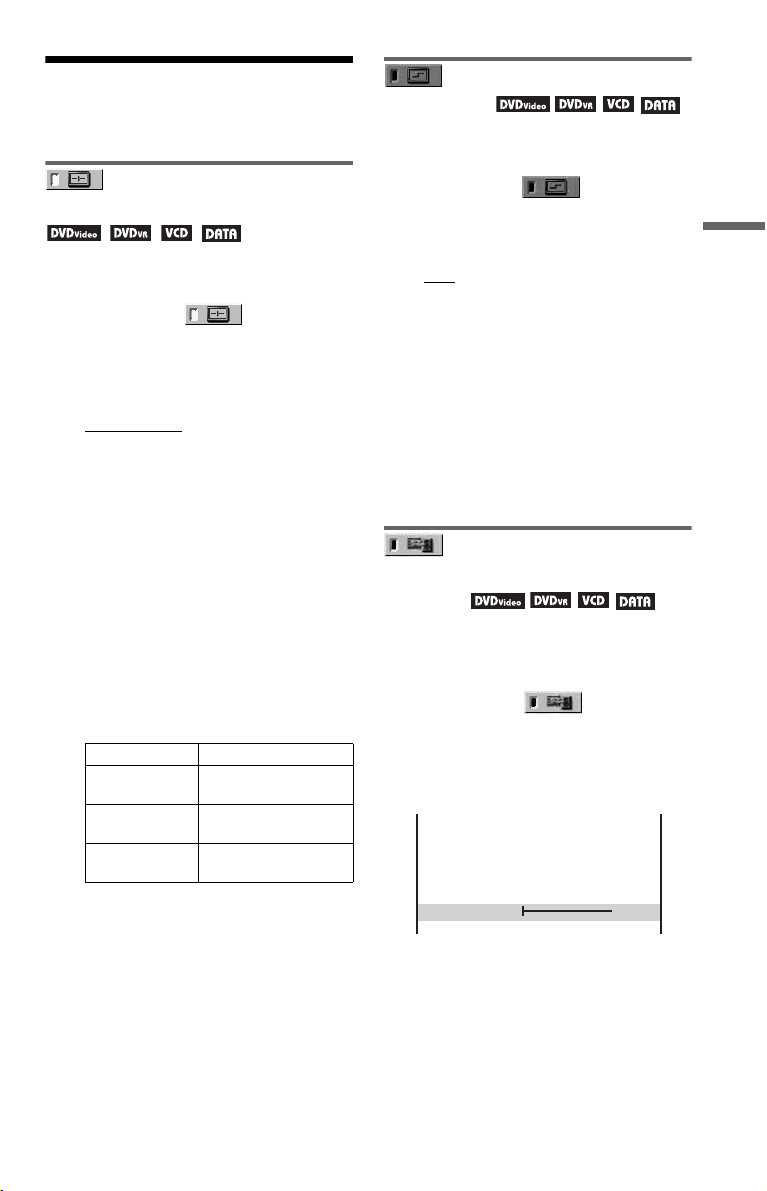
1 After selecting (A-B REPEAT)
on the Control Menu (page 20), press
X/x to select “SET t,” then press
ENTER.
The “A-B REPEAT” setting bar appears.
2 During playback, when you find the
starting point (point A) of the portion to
be played repeatedly, press ENTER.
The starting point (point A) is set.
3 When you reach the ending point
(point B), press ENTER again.
The set points are displayed and the
player starts repeating this specific
portion.
To return to normal play
Press CLEAR, or select “OFF” in step 1.
b
• A-B Repeat Play does not work across multiple
titles.
• You may not set A-B Repeat Play for contents in
DVD-VR mode that contains still pictures.
A 18 - 1:32:30 B
A 18 - 1:32:55 B 18 - 1:33:05
Playback
27
US
Customizing the
Playback Configuration
Adjusting the playback
picture
(CUSTOM PICTURE MODE)
You can adjust the video signal from the
player to obtain the picture quality you want.
1 After selecting (CUSTOM
PICTURE MODE) on the Control Menu
(page 20), press X/x to select the
setting you want.
The default setting is underlined.
• STANDARD:
displays a standard
picture
• DYNAMIC 1: produces a bold
dynamic picture by increasing the
picture contrast and the color intensity
• DYNAMIC 2: produces a more
dynamic picture than DYNAMIC 1 by
further increasing the picture contrast
and color intensity
• CINEMA 1: enhances details in dark
areas by increasing the black level
• CINEMA 2: white colors become
brighter and black colors become
richer, and the color contrast is
increased
•MEMORYt: adjusts the picture in
greater detail
2 Press ENTER.
The selected setting takes effect.
z
When you watch a movie, “CINEMA 1” or
“CINEMA 2” is recommended.
b
• This function does not work when “PhotoTV HD”
mode is activated (page 30).
• This function does not work if your TV supports
Theater mode and it is set to “On.” For more
details, refer to the operating instructions supplied
with the TV.
Sharpening the picture
(SHARPNESS)
You can enhance the outlines of images to
produce a sharper picture.
1 After selecting (SHARPNESS)
on the Control Menu (page 20), press
X/x to select a level.
The default setting is underlined.
•OFF
: cancels this option
• 1: enhances the outline
• 2: enhances the outline more than 1
2 Press ENTER.
The selected setting takes effect.
b
• This function does not work when “PhotoTV HD”
mode is activated (page 30).
• This function does not work if your TV supports
Theater mode and it is set to “On.” For more
details, refer to the operating instructions supplied
with the TV.
Adjusting the delay
between the picture and sound
(AV SYNC)
When the sound does not match the pictures
on the screen, you can adjust the delay
between the picture and sound.
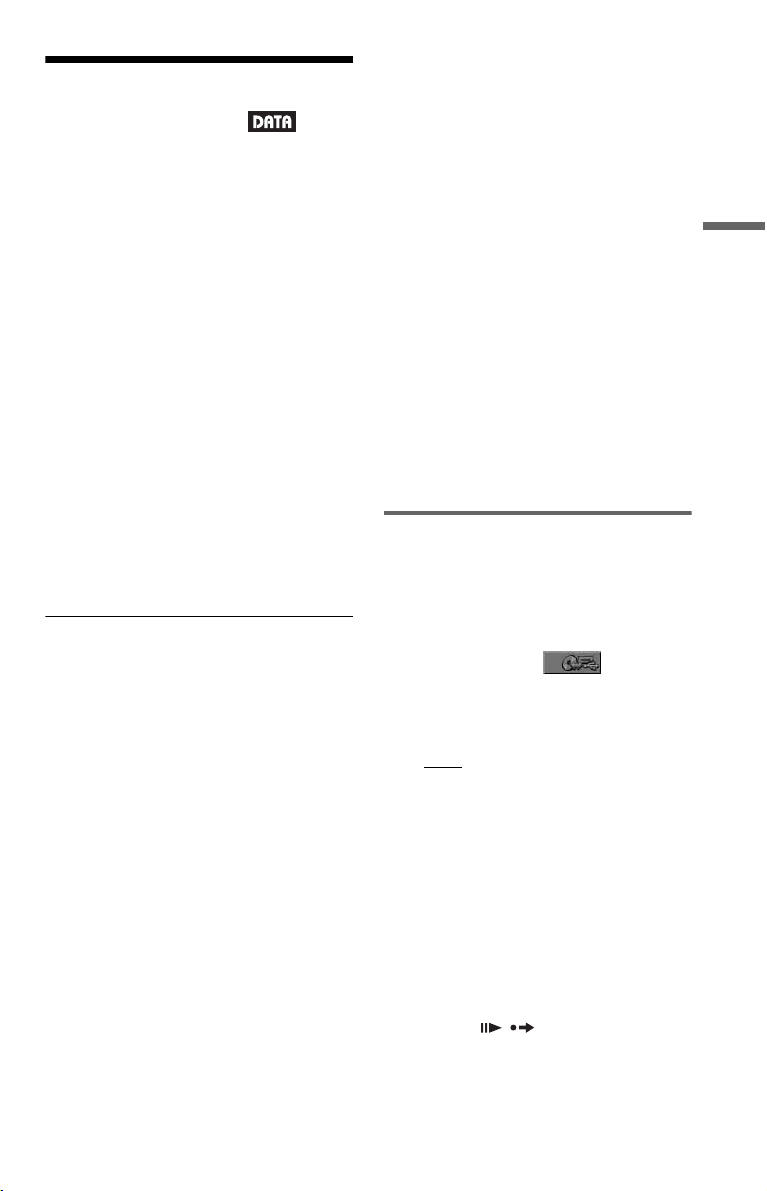
1 After selecting (AV SYNC) on
the Control Menu (page 20), press c
to select “SET t,” then press ENTER.
The “AV SYNC” adjustment bar
appears.
2 Press c repeatedly to adjust the
delay.
Each time you press C/c, the delay is
adjusted by 10 milliseconds.
3 Press ENTER.
The selected setting takes effect.
PICTURE Changes the contrast.
BRIGHTNESS Changes the overall
brightness.
COLOR Makes the colors
deeper or lighter.
HUE Changes the color
balance.
AV SYNC 0ms
,continued

28
US
To reset the “AV SYNC” setting
Press CLEAR in step 2.
b
• This function is not effective if you use the
DIGITAL OUT (COAXIAL) jack, and set
“DOLBY DIGITAL” or “DTS” in “AUDIO
SETUP” to “DOLBY DIGITAL” or “ON”
respectively (page 36).
• This function is not effective if you connect a
Dolby Digital or DTS-compliant device via the
HDMI OUT jack, and set “DOLBY DIGITAL” or
“DTS” in “AUDIO SETUP” to “DOLBY
DIGITAL” or “ON” respectively (page 36).
• For DATA disc or USB (DVP-NS728H only),
this function works for video files only.
Locking discs (PARENTAL
CONTROL)
You can set two kinds of playback restrictions
as following:
• Custom Parental Control
• Parental Control
After selecting (PARENTAL
CONTROL) on the Control Menu (page 20),
the options appear as shown below.
Select the option you want.
The default setting is underlined.
• ON t: Sets the playback restrictions so
that the player will not play inappropriate
discs (Custom Parental Control)
• PLAYER t: Playback of some DVD
VIDEOs can be limited according to a
predetermined level such as the age of the
users. Scenes may be blocked or replaced
with different scenes (Parental Control).
See “Parental Control (limited playback)”
(page 28) for detailed settings
• PASSWORD t: Enter a 4-digit password
using the number buttons. The same
password is used for both Custom Parental
Control and Parental Control. Also use this
menu to change the password
•OFF
t: Turns off the Custom Parental
Control function
Parental Control (limited playback)
You can set a playback limitation level.
1 After selecting (PARENTAL
CONTROL) on the Control Menu
(page 20), press X/x to select “PLAYER
t,” then press ENTER.
The password is required.
2 Enter or re-enter your 4-digit password
using the number buttons, then press
ENTER.
The display for setting the playback
limitation level appears.
3 Press X/x to select “STANDARD,” then
press ENTER.
The selection items for “STANDARD”
are displayed.
4 Press X/x to select a geographic area as
the playback limitation level, then press
ENTER.
The area is selected.
When you select “OTHERS t,” select
and enter a standard code in the table on
page 46 using the number buttons.
5 Press X/x to select “LEVEL,” then press
ENTER.
The selection items for “LEVEL” are
displayed.
6 Select the level you want using X/x, then
press ENTER.
Parental Control setting is complete.
The lower the value, the stricter the
limitation.
To turn off the Parental Control function,
set “LEVEL” to “OFF.”
z
If you forget your password, remove the disc and
repeat step 1 of “Parental Control (limited
playback).” When you are asked to enter your
password, enter “199703” using the number
buttons, then press ENTER. The display will ask
you to enter a new 4-digit password. After you enter
a new 4-digit password, replace the disc in the
player and press N. When the display for entering
your password appears, enter your new password.
b
Depending on the disc, you may be asked to change
the parental control level while playing the disc. In
this case, enter your password, then change the
level. If the Resume Play mode is canceled, the
level returns to the previous level.
Playback
29
US
Playing Video, Photo,
and Music Files
The player can play video, photo, or music
files. For details on playable files, see
“Playable Media” page 42.
b
DATA CDs recorded in KODAK Picture CD
format automatically start playing when inserted.
1 Press MENU.
The list of albums appears.
2 Press X/x to select the album.
3 Press N.
Playback starts from the selected album.
To select a specific video or music file,
press ENTER and press X/x to select a
track or file, and then press ENTER.
To select a specific photo file, see
“Selecting a photo file” (page 30).
To stop playback
Press x.
To go to the next or previous page
Press c or C.
To return to the previous display
Press O RETURN.
To go to the next or previous music and
video files
Press > or . during playback.
Note that you cannot return to the previous
album by using ., and that you need to
select the previous album from the album list.
To turn the display on or off
Press MENU repeatedly.
To play music with lyrics
Press SUBTITLE while playing music files
that contain unsynchronized lyric
information. To display next/previous line,
press X/x.
z
• By setting “MEDIA” to “PHOTO/MUSIC,” you
can view a slideshow with sound when the music
and photo files are placed in the same album.
• Set “MEDIA” to “MUSIC” to enable lyrics
function.
• Depending on the contents, the player will play all
files regardless of the “MEDIA” settings.
• If the number of viewing times is preset, you can
play DivX video files as many times as the preset
number. The following occurrences are counted:
– when the disc tray is opened.
– when another file is played.
– when “DISC/USB” (DVP-NS728H only) or
“MEDIA” settings are changed.
b
The player supports MP3 ID3 Lyrics only.
Playing video, photo, and music
files from USB device
(DVP-NS728H only)
1 After connecting the USB device
(page 17), select (DISC/USB)
on the Control Menu (page 20).
2 Press ENTER.
The default setting is underlined.
•DISC
: Plays files from a disc
• USB: Plays files from a USB device
3 Select USB and follow step 3 of
“Playing Video, Photo, and Music
Files” (page 29) to start playback.
You can change to DISC mode
automatically by pressing Z without
turning on the Control Menu display.
Press N to start disc playback.
b
• For some device, LUN (Logical Unit Number)
may appear. To change the LUN or original
storage, press
when the list of albums
or tracks is displayed.
,continued
30
US
• If the number of viewing times is preset, you can
play DivX video files as many times as the preset
number. The following occurrences are counted:
– when Z is pressed.
– when another file is played.
– when the player is turned off. This includes
when the player is automatically turned off by
the Auto Power Off function. Press X instead of
x to stop viewing.
– when USB device is removed.
– when “DISC/USB” or “MEDIA” settings are
changed.
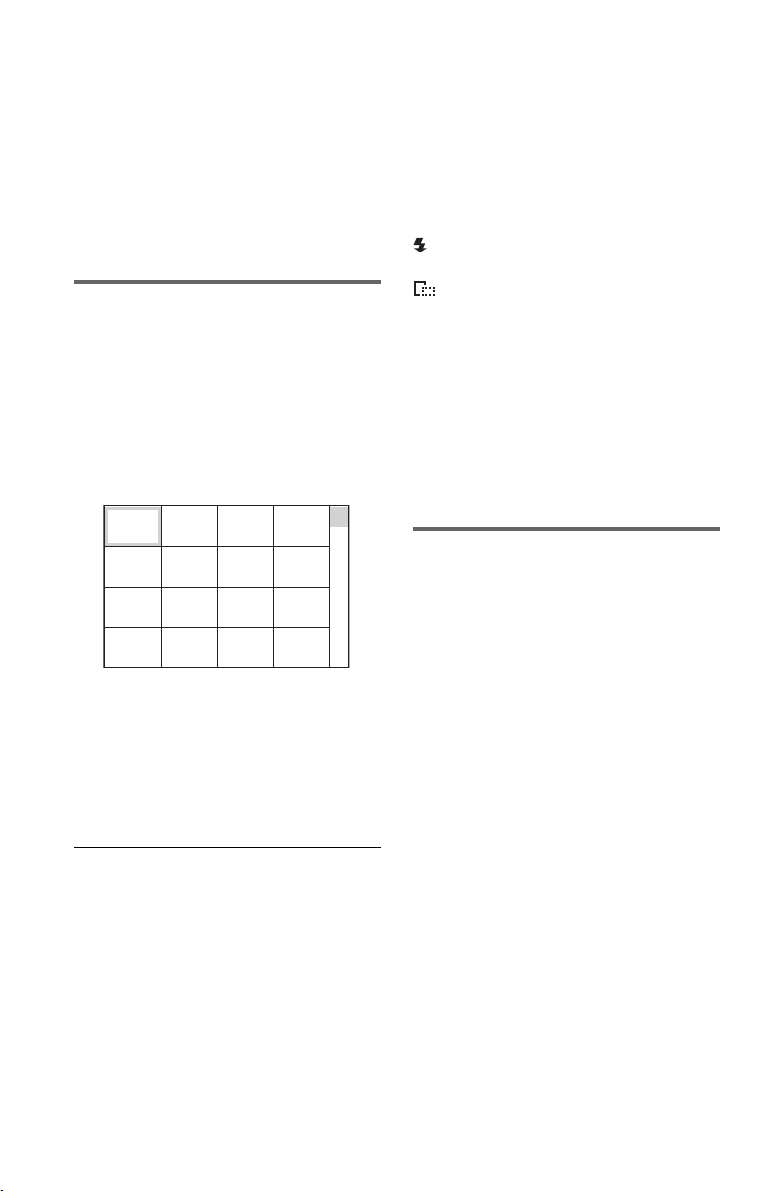
Selecting a photo file
1 Press MENU.
The list of albums appears.
2 Press X/x to select the album, then
press PICTURE NAVI.
The image files in the album appear in 16
subscreens. A scroll box is displayed on
the right.
To display additional images, select a
bottom image and press x. To return to a
previous image, select a top image and
press X.
3 Press C/X/x/c to select the image you
want to view, and press ENTER.
The selected image appears.
To go to the next or previous photo file
Press C or c during playback.
Note that you cannot return to the previous
album by using C. Select the previous album
from the album list.
To rotate a photo image
Press X/x while viewing the image. Each
time you press X, the image rotates
counterclockwise by 90 degrees.
To return to normal view, press CLEAR.
Note that the view also returns to normal if
you press C/c to go to the next or previous
image.
To display photo information
Press SUBTITLE while viewing photo files.
The detailed information for the selected
photo file appears.
is displayed when the picture was taken
using flash.
is displayed when the image is
automatically rotated.
To hide the information, press SUBTITLE.
Note that the above information may not
appear depending on the digital camera.
To stop viewing the photo
Press x.
b
PICTURE NAVI does not work if “MUSIC” is
selected in “MEDIA” (page 22).
Viewing a high quality slide
show (PhotoTV HD)
If you have a Sony TV that is compatible with
“PhotoTV HD,” you can enjoy the best
quality images by the following connection
and setting.
1 Connect the player to the TV using an
HDMI cord (not supplied).
2 Set the TV’s video setting to “Video-A”
mode.
For details about “Video-A,” refer to the
operating instructions supplied with the
TV.
3 Set “JPEG RESOLUTION” to “PhotoTV
HD” in “HDMI SETUP” (page 37).
On “PhotoTV HD”
“PhotoTV HD” allows for highly-detailed
pictures, and photo-like expression of subtle
textures and colors. By connecting Sony
“PhotoTV HD” compatible devices using an
HDMI cord, whole new world of photos can
be enjoyed in breathtaking Full HD quality.
For instance, the delicate texture of the
human skin, flowers, sand, and waves can
now be displayed on a large screen in
beautiful photo-like quality.
1234
5678
13 14 15 16
9 10 11 12
Playback
31
US
b
• By connecting to a Sony “PhotoTV HD”
compatible device using an HDMI cord, the TV
will set the optimal image quality for viewing still
picture automatically. For more details, refer to
the operating instructions supplied with the TV.
• “PhotoTV HD” is activated when “JPEG
RESOLUTION” is set to “PhotoTV HD,” photo
playback is available, and the player is connected
to a TV by HDMI cord.
• You cannot select “CUSTOM PICTURE MODE”
and “SHARPNESS,” when “PhotoTV HD” mode
is activated.
• When “PhotoTV HD” mode is activated, the
player changes video signal output from “HDMI
RESOLUTION” to “1920×1080i,” “TV TYPE”
to “16:9,” and “YC
BCR/RGB (HDMI)” to
“YC
BCR” automatically even though the current
settings are kept.
• You cannot select “HDMI RESOLUTION” or
“YC
BCR/RGB (HDMI)” in “HDMI SETUP”
(page 37), or “TV TYPE” in “SCREEN SETUP”
(page 33), when “PhotoTV HD” mode is
activated.
• If you set “PhotoTV HD” mode, the effect,
rotation and zoom functions are not available.
• When “PhotoTV HD” mode is activated, the
selection for “TV TYPE” is skipped during Quick
Setup (page 15).
Setting the pace for a
slide show (INTERVAL)
You can set the time the slides are displayed
on the screen.
1 After selecting (INTERVAL) on
the Control Menu (page 20), press X/
x to select a setting.
The default setting is underlined.
• NORMAL
: sets to standard duration
• FAST: sets a duration shorter than
NORMAL
• SLOW 1: sets a duration longer than
NORMAL
• SLOW 2: sets a duration longer than
SLOW 1
2 Press ENTER.
b
Duration of interval depends on “JPEG
RESOLUTION” setting in “HDMI SETUP”
(page 37).
Selecting the slides’
appearance (EFFECT)
You can select the way the slides are
displayed during a slide show.
1 After selecting (EFFECT) on
the Control Menu (page 20), press X/
x to select a setting.
The default setting is underlined.
• MODE 1
: the images randomly cycle
through the effects
• MODE 2: the next image sweeps in
from top left to bottom right
• MODE 3: the image sweeps in from top
to bottom
• MODE 4: the image sweeps in from left
to right
• MODE 5: the image stretches out from
the center of the screen
• OFF: turns off this function
2 Press ENTER.
b
• Note that this setting does not work if the JPEG
file has rotation information.
• Depending on the “JPEG RESOLUTION” setting
(page 37), some effect may not function.
32
US
Settings and Adjustments
Using the Setup Display
You can make various adjustments to items,
such as picture and sound.
For details on each Setup Display item, see
pages from 32 to 38.
b
Playback settings stored in the disc take priority
over the Setup Display settings and not all of the
functions described may work.
1 Press DISPLAY when the player is
in stop mode.
The Control Menu appears.
2 Press X/x to select
(SETUP), then press ENTER.
The options for “SETUP” appear.
• QUICK: makes the basic adjustments
(page 15)
• CUSTOM: makes various adjustments
• RESET: resets all the settings explained
on pages 32 to 38
3 Press X/x to select “CUSTOM,”
then press ENTER.
The Setup Display appears.
Select the setup category and adjust each
item following the instruction on pages
32 to 38.
LANGUAGE SETUP
You can set various languages for the on-
screen display or sound track.
◆ OSD (On-Screen Display)
Switches the display language on the screen.
◆ MENU (DVD VIDEO only)
You can select the desired language for the
disc’s menu.
◆ AUDIO (DVD VIDEO only)
Switches the language of the sound track.
When you select “ORIGINAL,” the language
given priority in the disc is selected.
◆ SUBTITLE (DVD VIDEO only)
Switches the language of the subtitle recorded
on the DVD VIDEO.
When you select “AUDIO FOLLOW,” the
language for the subtitles changes according
to the language you selected for the sound
track.
z
If you select “OTHERS t” in “MENU,”
“SUBTITLE,” or “AUDIO,” select and enter a
language code from “Language Code List” on
page 46 using the number buttons.
b
If you select a language in “MENU,”
“SUBTITLE,” or “AUDIO” that is not recorded on
a DVD VIDEO, one of the recorded languages will
be automatically selected.
LANGUAGE SETUP
OSD:
MENU:
AUDIO:
SUBTITLE:
ENGLISH
ENGLISH
ORIGINAL
ENGLISH
Settings and Adjustments
33
US
SCREEN SETUP
Choose settings according to the TV to be
connected.
The default settings are underlined.
◆ TV TYPE
Selects the aspect ratio of the connected TV
(4:3 standard or wide).
You cannot select this when “PhotoTV HD”
mode is activated (page 30).
b
Depending on the DVD, “4:3 LETTER BOX” may
be selected automatically instead of “4:3 PAN
SCAN” or vice versa.
◆ SCREEN SAVER
The screen saver image appears when the
player in pause or stop mode for 15 minutes,
or when you play a CD, or music files for
more than 15 minutes. The screen saver will
help prevent your display device from
becoming damaged (ghosting). Press N to
turn off the screen saver.
◆ BACKGROUND
Selects the background color or picture on the
TV screen when the player is in stop mode or
while playing a CD, or music files.
◆ BLACK LEVEL
Selects the black level (setup level) for the
video signals output from the jacks other than
COMPONENT VIDEO OUT/HDMI OUT.
16:9 Select this when connecting to a
wide-screen TV or a TV with a
wide mode function.
4:3
LETTER
BOX
Select this when connecting to a
4:3 screen TV. Displays a wide
picture with bands on the upper
and lower portions of the
screen.
4:3
PAN SCAN
Select this when connecting to a
4:3 screen TV. Automatically
displays the wide picture on the
entire screen and cuts off the
portions that do not fit.
16:9
4:3 LETTER BOX
4:3 PAN SCAN
ON Turns on the screen saver.
OFF Turns off the screen saver.
JACKET
PICTURE
The jacket picture (still picture)
appears, but only when the
jacket picture is already
recorded on the disc (CD-
EXTRA, etc.). If the disc does
not contain a jacket picture, the
“GRAPHICS” picture appears.
GRAPHICS A preset picture stored in the
player appears.
BLUE The background color is blue.
BLACK The background color is black.
ON
Sets the black level of the
output signal to the standard
level.
OFF Lowers the standard black
level. Use this when the picture
becomes too white.
,continued

34
US
◆ BLACK LEVEL (COMPONENT OUT)
Selects the black level (setup level) for the
video signals output from the COMPONENT
VIDEO OUT jacks. You cannot select this
when the player outputs progressive signals
(page 34).
◆ PROGRESSIVE (COMPONENT OUT
ONLY)
If your TV accepts progressive (480p) format
signals, set “PROGRESSIVE
(COMPONENT OUT ONLY)” to “ON.”
Note that you must connect to a progressive
format TV using the COMPONENT VIDEO
OUT jacks (page 11).
To output progressive signals
1 Select “PROGRESSIVE
(COMPONENT OUT ONLY),” and
press ENTER.
2 Select “ON,” and press ENTER.
The display asks for confirmation.
3 Select “Start,” and press ENTER.
The video switches to a progressive
signal for 5 seconds.
4 If the picture appears normal, select
“YES,” and press ENTER.
If not, select “NO,” and press ENTER.
To reset the setting
If the picture does not appear normal or goes
blank, press [/1 to turn off the player, and
enter “369” using the number buttons on the
remote, then press [/1 to turn on the player
again.
◆ MODE (PROGRESSIVE)
In order for these images to appear natural on
your screen when output in progressive
mode, the progressive video signal needs to
be converted to match the type of DVD
software that you are watching.
This setting is effective only when you set
“PROGRESSIVE (COMPONENT OUT
ONLY)” in “SCREEN SETUP” to “ON.”
◆ 4:3 OUTPUT
This setting is effective only when you set
“TV TYPE” in “SCREEN SETUP” to
“16:9.”
Adjust this to watch 4:3 aspect ratio. If you
can change the aspect ratio on your TV,
change the setting on your TV, not the player.
OFF Sets the black level of the
output signal to the standard
level. Normally, select this
position.
ON Raises the standard black level.
Use this setting when the
picture appears too dark.
OFF
To output normal (interlace)
signals.
ON To output progressive signals.
AUTO Automatically detects the
software type (film-based or
video-based) and selects the
appropriate conversion mode.
Normally, select this position.
VIDEO Fixes the conversion mode to
the mode for video-based
software.
FULL
Select this when you can
change the aspect ratio on your
TV.
NORMAL Select this when you cannot
change the aspect ratio on your
TV. Shows a 16:9 aspect ratio
signal with black bands on left
and right sides of the image.
16:9 aspect ratio TV
Settings and Adjustments
35
US
CUSTOM SETUP
Use this to set up playback related and other
settings.
The default settings are underlined.
◆ AUTO POWER OFF
Switches the Auto Power Off setting on or
off.
◆ AUTO PLAY
Switches the Auto Play setting on or off. This
function is useful when the player is
connected to a timer (not supplied).
◆ DIMMER
Adjusts the lighting of the front panel display.
◆ PAUSE MODE (DVDs only)
Selects the picture in pause mode.
◆ TRACK SELECTION (DVD VIDEO only)
Gives the sound track which contains the
highest number of channels priority when you
play a DVD VIDEO on which multiple audio
formats (PCM, DTS, or Dolby Digital
format) are recorded.
b
• When you set the item to “AUTO,” the language
may change. The “TRACK SELECTION” setting
has higher priority than the “AUDIO” settings in
“LANGUAGE SETUP” (page 32).
• If you set “DTS” to “OFF” (page 37), the DTS
sound track is not played even if you set “TRACK
SELECTION” to “AUTO.”
• If PCM, DTS, and Dolby Digital sound tracks
have the same number of channels, the player
selects PCM, DTS, and Dolby Digital sound
tracks in this order.
◆ MULTI-DISC RESUME (DVD VIDEO/
VIDEO CD only)
Switches the Multi-disc Resume setting on or
off. Resume playback can be stored in
memory for up to 6 different DVD VIDEOs/
VIDEO CDs (page 18).
b
If you run Quick Setup, Multi-disc Resume setting
stored in memory may return to the default settings.
◆ DivX (Except DVP-NS710H)
Displays the registration code for this player.
For more information, go to
http://www.divx.com/vod
on the Internet.
OFF Switches this function off.
ON The player enters standby mode
when left in stop mode for more
than 30 minutes.
OFF
Switches this function off.
ON Automatically starts playback
when the player is turned on by
a timer (not supplied).
BRIGHT
Makes the lighting bright.
DARK Makes the lighting dark.
AUTO
DARK
Makes the lighting dark if you
do not operate the player or
remote for a short while.
AUTO
The picture, including subjects
that move dynamically, is
output with no jitter. Normally,
select this position.
FRAME The picture, including subjects
that do not move dynamically,
is output in high resolution.
OFF No priority given.
AUTO Priority given.
ON
Stores the resume setting in
memory for up to 6 discs.
OFF Does not store the resume
setting in memory. Playback
restarts at the resume point only
for the current disc in the player.
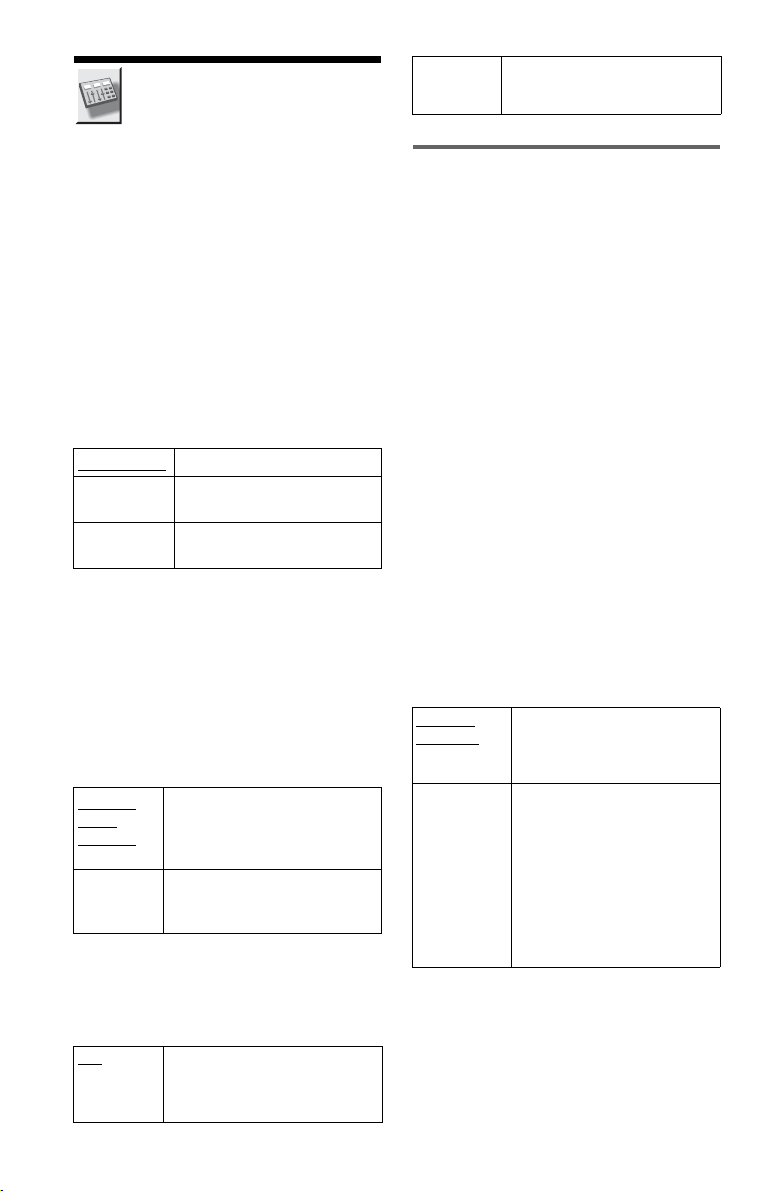
36
US
AUDIO SETUP
You can set the sound according to the
playback and connection conditions.
The default settings are underlined.
◆ AUDIO DRC (Dynamic Range Control)
(DVDs only)
Makes the sound clear when the volume is
turned down when playing a DVD that
conforms to “AUDIO DRC.”
This function affects the output from the
following jacks:
– LINE OUT L/R (AUDIO) jacks.
– DIGITAL OUT (COAXIAL)/HDMI OUT
jack only when “DOLBY DIGITAL” is set
to “D-PCM” (page 36).
◆ DOWNMIX (DVDs only)
Switches the method for mixing down to 2
channels when you play a DVD which has
rear sound elements (channels) or is recorded
in Dolby Digital format. This function affects
the output of the following jacks:
– LINE OUT L/R (AUDIO) jacks.
– DIGITAL OUT (COAXIAL)/HDMI OUT
jack when “DOLBY DIGITAL” is set to
“D-PCM” (page 36).
◆ DIGITAL OUT
Selects if audio signals are output via the
DIGITAL OUT (COAXIAL)/HDMI OUT
jack.
Setting the digital output signal
Switches the method of outputting audio
signals when you connect a component such
as an audio component or MD deck with a
digital input jack.
For connection details, see page 13.
Select “DOLBY DIGITAL,” “DTS,” and
“48kHz/96kHz PCM” after setting
“DIGITAL OUT” to “ON.”
If you connect a component that is
incompatible with the selected audio signal, a
loud noise (or no sound) may be heard from
the speakers, risking damage to your ears or
speakers.
b
• The AV SYNC function (page 27) is not effective
if you use the DIGITAL OUT (COAXIAL) jack,
and set “DOLBY DIGITAL” or “DTS” to
“DOLBY DIGITAL” or “ON” respectively.
• The AV SYNC function (page 27) is not effective
if you connect a Dolby Digital or DTS-compliant
device via the HDMI OUT jack, and set “DOLBY
DIGITAL” or “DTS” to “DOLBY DIGITAL” or
“ON” respectively.
◆ DOLBY DIGITAL (DVDs only)
Selects the type of Dolby Digital signal.
b
If the HDMI OUT jack is connected to equipment
not compatible with DOLBY DIGITAL signals, the
“D-PCM” signals will be automatically output even
when you select “DOLBY DIGITAL.”
STANDARD Normally, select this position.
TV MODE Makes low sounds clear even if
you turn the volume down.
WIDE
RANGE
Gives you the feeling of being
at a live performance.
DOLBY
SUR-
ROUND
Normally, select this position.
Multi-channel audio signals are
output to 2 channels for enjoying
surround sounds.
NORMAL Multi-channel audio signals are
downmixed to 2 channels for use
with your stereo.
ON
Normally, select this position.
When you select “ON,” see
“Setting the digital output signal”
for further settings.
OFF The influence of the digital
circuit upon the analog circuit is
minimal.
DOLBY
DIGITAL
Select this when the player is
connected to an audio
component with a built-in
Dolby Digital decoder.
D-PCM Select this when the player is
connected to an audio
component without a built-in
Dolby Digital decoder. You can
select whether the signals
conform to Dolby Surround
(Pro Logic) or not by making
adjustments to the
“DOWNMIX” item in
“AUDIO SETUP” (page 36).
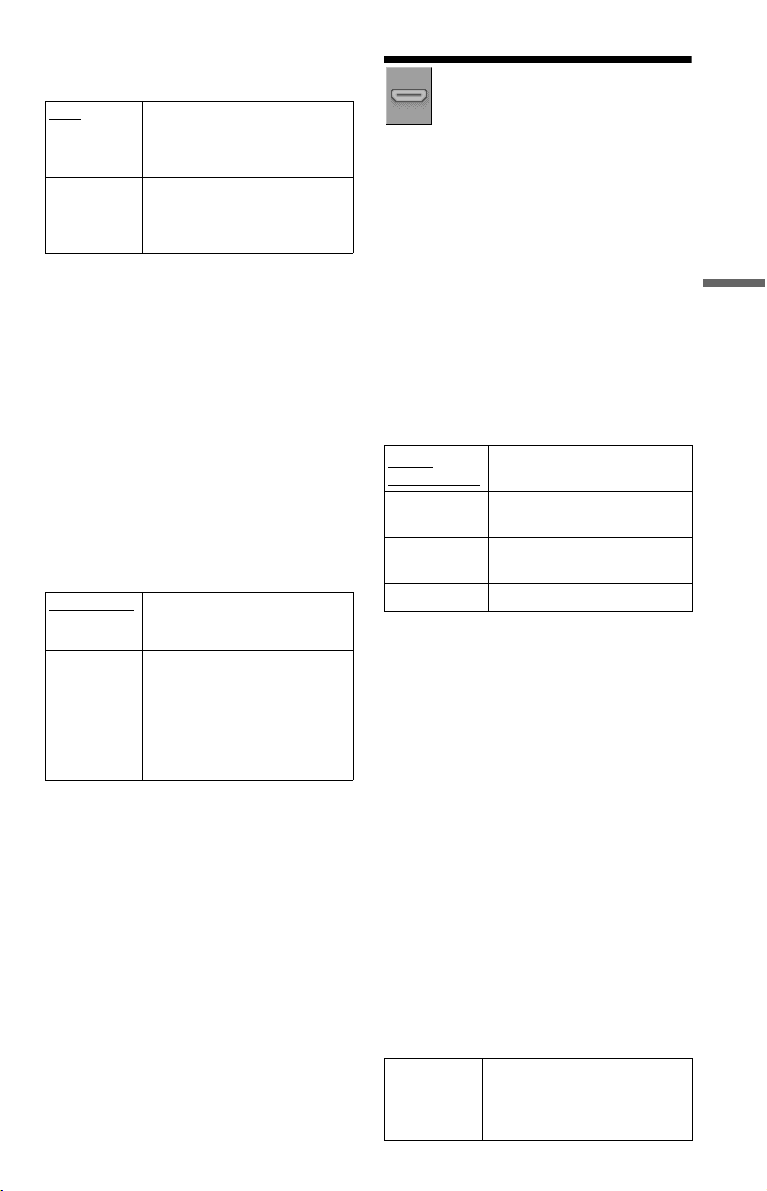
Settings and Adjustments
37
US
◆ DTS
Selects the type of DTS audio signals.
b
• When you play a DVD VIDEO with DTS sound
tracks, set “DTS” to “ON” in “AUDIO SETUP”
(page 37).
• If you connect the player to audio equipment
without a DTS decoder, do not set “DTS” to “ON”
in “AUDIO SETUP” (page 37). A loud noise may
come out from the speakers, affecting your ears or
causing the speakers to be damaged.
• If the HDMI OUT jack is connected to equipment
not compatible with DTS signals, the “OFF”
signals will be automatically output even when
you select “ON.”
◆ 48kHz/96kHz PCM (DVD VIDEO only)
Selects the sampling frequency of the audio
signal.
b
• The analog audio signals from the LINE OUT
L/R (AUDIO) jacks are not affected by this
setting and keep their original sampling frequency
level.
• If the HDMI OUT jack is connected to equipment
not compatible with 96 kHz/24 bit signals,
48 kHz/16 bit PCM will be automatically output
even when you select “96kHz/24bit.”
HDMI SETUP
You can adjust items related to the HDMI
connection.
◆ HDMI RESOLUTION
Selects the type of video signals output from
the HDMI OUT jack. When you select
AUTO (1920×1080p) (default), the player
outputs video signals of the highest resolution
acceptable for your TV. If the picture is not
clear, natural or to your satisfaction, try
another option that suits the disc and your
TV/projector, etc. For details, refer also to the
instruction manual supplied with the TV/
projector, etc.
You cannot select this when “PhotoTV HD”
mode is activated (page 30).
To reset the setting
If the picture does not appear normal or goes
blank, press [/1 to turn off the player, and
enter “369” using the number buttons on the
remote, then press [/1 to turn on the player
again.
b
In case of “AUTO (1920×1080p),” the player
automatically adjusts the video signals that are
suitable for the TV.
Other cases, the player directly send the signal even
if TV cannot accept.
◆ JPEG RESOLUTION
Selects the type of JPEG resolution so that
you can enjoy high picture quality via your
HDMI connection.
You cannot select this when “HDMI
RESOLUTION” is set to “720×480p” or “TV
TYPE” is set to “4:3 LETTER BOX” or “4:3
PAN SCAN.”
OFF Select this when the player is
connected to an audio
component without a built-in
DTS decoder.
ON Select this when the player is
connected to an audio
component with a built-in DTS
decoder.
48kHz/16bit
The audio signals of DVD
VIDEOs are always converted
to 48kHz/16bit.
96kHz/24bit All types of signals including
96kHz/24bit are output in their
original format. However, if the
signal is encrypted for
copyright protection purposes,
the signal is only output as
48kHz/16bit.
AUTO
(1920
×
1080p)
Normally, select this.
1920
×
1080i
Sends 1920×1080i video
signals.
1280
×
720p
Sends 1280×720p video
signals.
720
×
480p
Sends 720×480p video signals.
PhotoTV HD
Displays extra highly-detailed
picture when connecting to a
Sony’s “PhotoTV HD”-
compatible device.
,continued
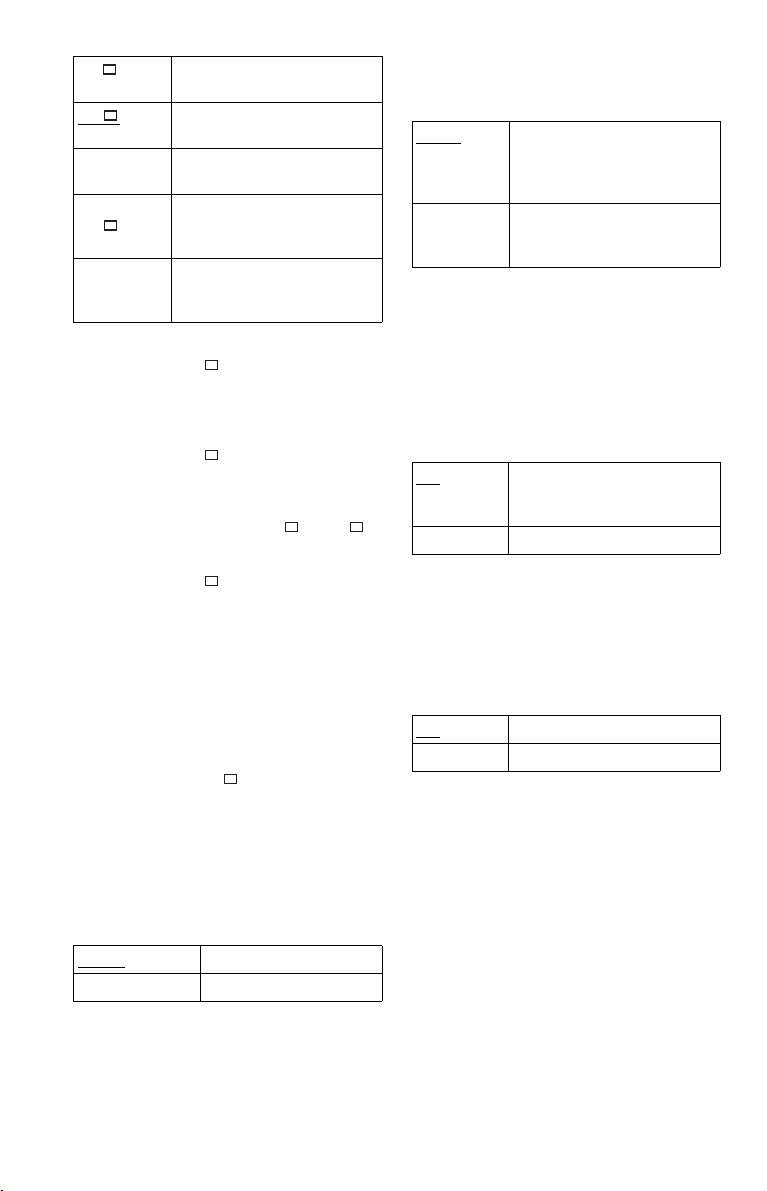
38
US
b
• “(1920×1080i) HD ” and “(1920×1080i) HD”
are effective only when you set “HDMI
RESOLUTION” to “1920×1080i” and “TV
TYPE” to “16:9.”
• If you set this setting to “PhotoTV HD,”
“(1920×1080i) HD ” or “(1920×1080i) HD,”
effect, rotation, and zoom function are not
available.
• If you want to use effect, rotation, and zoom
function; sets this setting to “SD ,” “HD ,”
or “HD.”
• If you set this setting to “PhotoTV HD,”
“(1920×1080i) HD ” or “(1920×1080i) HD,”
next image appears after black mute.
• HDMI signal will stop momentarily during
loading or unloading DATA disc or USB (DVP-
NS728H only).
• When you set to “PhotoTV HD,” the player
changes video signal output from “HDMI
RESOLUTION” to “1920×1080i,” “TV TYPE”
to “16:9,” and “YC
BCR/RGB (HDMI)” to
“YC
BCR” automatically even though the current
settings are kept.
• Set this setting to “SD ,” when you want to
view photo files in analog video outputs with the
HDMI connection.
◆ YCBCR/RGB (HDMI)
Selects the type of HDMI signal output from
HDMI OUT jack.
You cannot select this when “PhotoTV HD”
mode is activated (page 30).
b
• If the playback picture becomes distorted, set this
setting to “RGB.”
• If the HDMI OUT jack is connected to equipment
with a DVI jack, “RGB” signals will be
automatically output even when you select
“YC
BCR.”
◆ AUDIO (HDMI)
Selects the type of audio signal output from
the HDMI OUT jack.
b
A loud noise (or no sound) will be output if you
connect the player to a TV that is not compatible
with DOLBY DIGITAL/DTS signals and “AUTO”
is selected. In this case, select “PCM.”
◆ CONTROL FOR HDMI
Switches the Control For HDMI setting
on or off.
◆ LANGUAGE FOLLOW
Switches the languages of the DVD player
to the same as the current TV OSD
language.
You cannot select this when “CONTROL
FOR HDMI” is set to “OFF.”
b
• Turn off any display before using this function.
• The OSD language for player keeps if the TV’s
language cannot be supported.
SD
Displays standard definition
picture with black frame.
HD
Displays high definition picture
with black frame.
HD
Displays high definition picture
without black frame.
(1920
×
1080i)
HD
Displays high definition picture
with black frame at 1920×1080
pixels.
(1920
×
1080i)
HD
Displays high definition picture
without black frame at
1920×1080 pixels.
YC
BCR Outputs YCBCR signals.
RGB Outputs RGB signals.
AUTO Normally, select this. Outputs
audio signals according to the
“DIGITAL OUT” settings
(page 36).
PCM Converts Dolby Digital, or 96
kHz/24 bit PCM signals to 48
kHz/16 bit PCM.
ON
Allows you to use the
CONTROL FOR HDMI
features (page 12).
OFF Switches this function off.
ON
Switches this function on.
OFF Switches this function off.

Additional Information
39
US
Additional Information
Troubleshooting
If you experience any of the following
difficulties while using the player, use this
troubleshooting guide to help remedy the
problem before requesting repairs. Should
any problem persist, consult your nearest
Sony dealer.
Power
The power is not turned on.
, Check that the power cord is connected
securely.
Picture
There is no picture/picture noise appears.
, Re-connect the connecting cord securely.
, The connecting cords are damaged.
, Check the connection to your TV (page 11)
and switch the input selector on your TV so
that the signal from the player appears on
the TV screen.
, The disc is dirty or flawed.
, You set the “PROGRESSIVE
(COMPONENT OUT ONLY)” to “ON” in
“SCREEN SETUP” (page 34) even though
your TV cannot accept the progressive
signal. In this case, refer to page 34 to reset
the setting.
, Even if your TV is compatible with
progressive format 480p signals and
connected using COMPONENT VIDEO
OUT jacks, the image may be affected when
you set the player to progressive format. In
this case, set the “PROGRESSIVE
(COMPONENT OUT ONLY)” in
“SCREEN SETUP” to “OFF” (page 34) so
that the player is set to normal (interlace)
format.
, The player is connected to an input device
that is not HDCP compliant. See page 12.
, If the HDMI OUT jack is used for video
output, changing the “HDMI
RESOLUTION” setting in “HDMI
SETUP” may solve the problem (page 37).
Connect the TV and the player using a video
jack other than the HDMI OUT, and switch
the TV’s input to the connected video input
so that you can see the on-screen displays.
Change the “HDMI RESOLUTION”
setting in “HDMI SETUP,” and switch the
TV’s input back to HDMI. If the picture still
does not appear, repeat the steps and try
other options.
, Press [/1 to turn off the player, and enter
“369” using the number buttons on the
remote, then press [/1 to turn on the player
again (page 38).
There is no picture/picture noise appears
when connected to the HDMI OUT jack.
, Try the following: 1Turn the player off
and on again. 2Turn the connected
equipment off and on again. 3Disconnect
and then connect the HDMI cord again.
Sound
There is no sound.
, Re-connect the connecting cord securely.
, The connecting cord is damaged.
, The player is connected to the wrong input
jack on the audio component (page 13).
, The audio component input is not correctly
set.
, The player is in pause mode or in Slow-
motion Play mode.
, The player is in fast forward or fast reverse
mode.
, If the audio signal does not come through
the DIGITAL OUT (COAXIAL)/HDMI
OUT jack, check the audio settings (page
36).
, While playing a Super VCD on which the
audio track 2 is not recorded, no sound will
come out when you select “2:STEREO,”
“2:1/L,” or “2:2/R.” Press AUDIO to select
the recorded track.
, The equipment connected to the HDMI
OUT jack does not conform to the audio
signal format, in this case set “AUDIO
(HDMI)” in “HDMI SETUP” to “PCM”
(page 38).
No sound is output from the HDMI OUT
jack
, Try the following: 1Turn the player off
and on again. 2Turn the connected
equipment off and on again. 3Disconnect
and then connect the HDMI cord again.
, The HDMI OUT jack is connected to a DVI
device (DVI jacks do not accept audio
signals).
,continued

40
US
The sound volume is low.
, The sound volume is low on some DVDs.
The sound volume may improve if you set
“AUDIO DRC” in “AUDIO SETUP” to
“TV MODE” (page 36).
Operation
The remote does not function.
, The batteries in the remote are weak.
, There are obstacles between the remote and
the player.
, The distance between the remote and the
player is too far.
, The remote is not pointed at the remote
sensor on the player.
The disc does not play.
, The disc is turned over.
Insert the disc with the playback side facing
down.
, The disc is skewed.
, The player cannot play certain discs
(page 2).
, The region code on the DVD does not match
the player.
, Moisture has condensed inside the player
(page 3).
, The player cannot play a recorded disc that
is not correctly finalized (page 43).
The album/track/file names are not
displayed correctly.
, The player can only display numbers and
alphabet. Other characters are displayed as
“
*
”.
The disc does not start playing from the
beginning.
, Program Play, Shuffle Play, Repeat Play, or
A-B Repeat Play is selected (page 24).
, Resume play has taken effect (page 18).
“Copyright lock” appears and the screen
turns blue when playing in DVD-VR mode.
, Images taken from digital broadcasts, etc.,
may contain copy protection signals, such
as complete copy protection signals, single
copy signals, and restriction-free signals.
When images that contain copy protection
signals are played, a blue screen may appear
instead of the images. It may take a while
when looking for playable images. (For
player that cannot play images that contain
a copy protection only)
Some functions such as Stop, Fast Play,
Slow Play, Slow-motion Play, Repeat
Play, Shuffle Play, or Program Play cannot
be performed.
, Depending on the disc, you may not be able
to do some of the operations above.
The player does not operate properly.
, When static electricity, etc., causes the
player to operate abnormally, unplug the
player.
5 numbers or letters are displayed on the
screen.
, The self-diagnosis function was activated.
(See the table on page 41.)
The disc tray does not open and “LOCKED”
appears on the front panel display.
, Child Lock is set (page 9).
The disc tray does not open and “TRAY
LOCKED” appears on the front panel
display.
, Contact your Sony dealer or local
authorized Sony service facility.
“Data error” appears on the TV screen
when playing video, photo, and music
files.
, The video, photo, and music files you want
to play is broken.
The CONTROL FOR HDMI function does
not work.
, Make sure that the connected component is
compatible with the CONTROL FOR
HDMI function. Please refer to the
operating instructions of the component for
detailed explanation.
, Make sure that the TV’s input is switched to
DVD player so that the signal from the
player appears on the TV screen, and
“CONTROL FOR HDMI” is set to “ON”
(page 38).
‘BRAVIA Sync’ display does not appear.
, Turn off any display of the DVD player
displays. Then, try again.
, Please return to the one screen mode if your
TV is in two screen mode. Then, try again.

Additional Information
41
US
Your TV automatically turns on or the TV’s
input is switched to the player.
, “CONTROL FOR HDMI” is set to “ON”
(page 38). Switch this function to “OFF”.
Display language on the screen switches
automatically.
, When “LANGUAGE FOLLOW” is set to
“ON” in the “HDMI SETUP” (page 38), the
display language on the screen
automatically switches, according to the
language setting of the connected TV, if you
change the language settings on your TV,
etc.
USB (DVP-NS728H only)
The player does not detect a USB device
connected to the player.
, The USB device is not securely connected
to the player (page 17).
, The USB device or a cord is damaged.
, Disc mode has not been switched to USB
mode.
, Compatibility with all encoding/writing
softwares, recording devices, and recording
media cannot be guaranteed. Incompatible
USB device may produce noise or
interrupted audio or may not play at all.
Self-diagnosis Function
(When letters/numbers appear on the
screen)
When the self-diagnosis function is activated
to prevent the player from malfunctioning, a
five-character service number (e.g., C 13 50)
with a combination of a letter and four digits
appears on the screen. In this case, check the
following table.
First three
characters of
the service
number
Cause and/or corrective
action
C 13 The disc is dirty or recorded
in a format that this player
cannot play (page 42).
,Clean the disc with a
cleaning cloth or check its
format.
C 31 The disc is not inserted
correctly.
,Re-insert the disc
correctly.
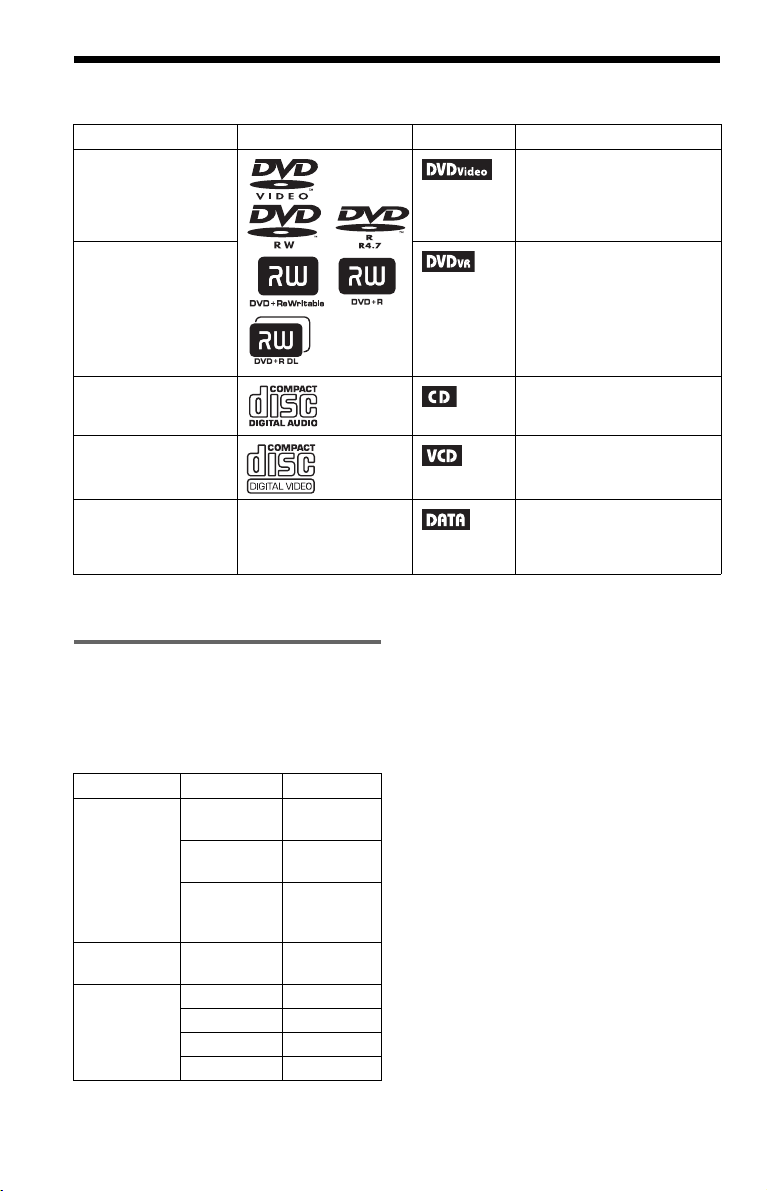
42
US
Playable Media
*
1
DVP-NS728H only.
*
2
DVP-NS710H can play video file in MPEG-1 format only.
Notes about video, photo, or
music files that the player can
play
The player can play the following files:
*
1
Except DVP-NS710H.
*
2
DivX
®
is a video file compression technology,
developed by DivX, Inc.
DivX, DivX Certified, and associated logos are
trademarks of DivX, Inc. and are used under
license.
*
3
Only support movie data of cyber shot.
*
4
Files with copyright protection (Digital Right
Management) cannot be played.
*
5
MP3 (MPEG-1 Audio Layer III) is a standard
format defined by ISO (International
Organization for Standardization)/IEC
(International Electrotechnical Commission)
MPEG which compresses audio data.
The player will play any file in the above
table, even if the file format differs. Playing
such data may generate noise that can result
in speaker damage. The player can play the
following files:
• Photo files that conform to the DCF*
image file format.
• DATA CDs recorded according to ISO
9660** Level 1/Level 2, or its extended
format, Joliet.
• DATA DVDs recorded according to UDF
(Universal Disk Format).
Type Disc Logo Icon Characteristic
DVD VIDEO
• Commercial DVD
• DVD+RWs/DVD+Rs/
DVD+R DLs in +VR mode
• DVD-RWs/DVD-Rs/DVD-R
DLs in video mode
DVD-VR mode • DVD-RWs/DVD-Rs/DVD-R
DLs in VR (Video
Recording) mode
CD • Music CD
• CD-Rs/CD-RWs in music
format
VIDEO CD • Super VCDs
• CD-Rs/CD-RWs in video
CD/Super VCD format
DATA disc or USB
*1
–
• DATA CD/DATA DVD or
USB
*1
devices containing
video
*2
, photo, or music
files
File Type File format Extension
Video
DivX
*1*2
“.avi” or
“.divx”
MPEG-1
*3
“.mpg” or
“.mpeg”
MPEG-4
(simple
profile)
*1*4
“.mp4” or
“.m4v”
Photo JPEG “.jpeg” or
“.jpg”
Music MP3
*5
“.mp3”
WMA
*4
“.wma”
AAC
*4
“.m4a”
LPCM/WAVE “.wav”
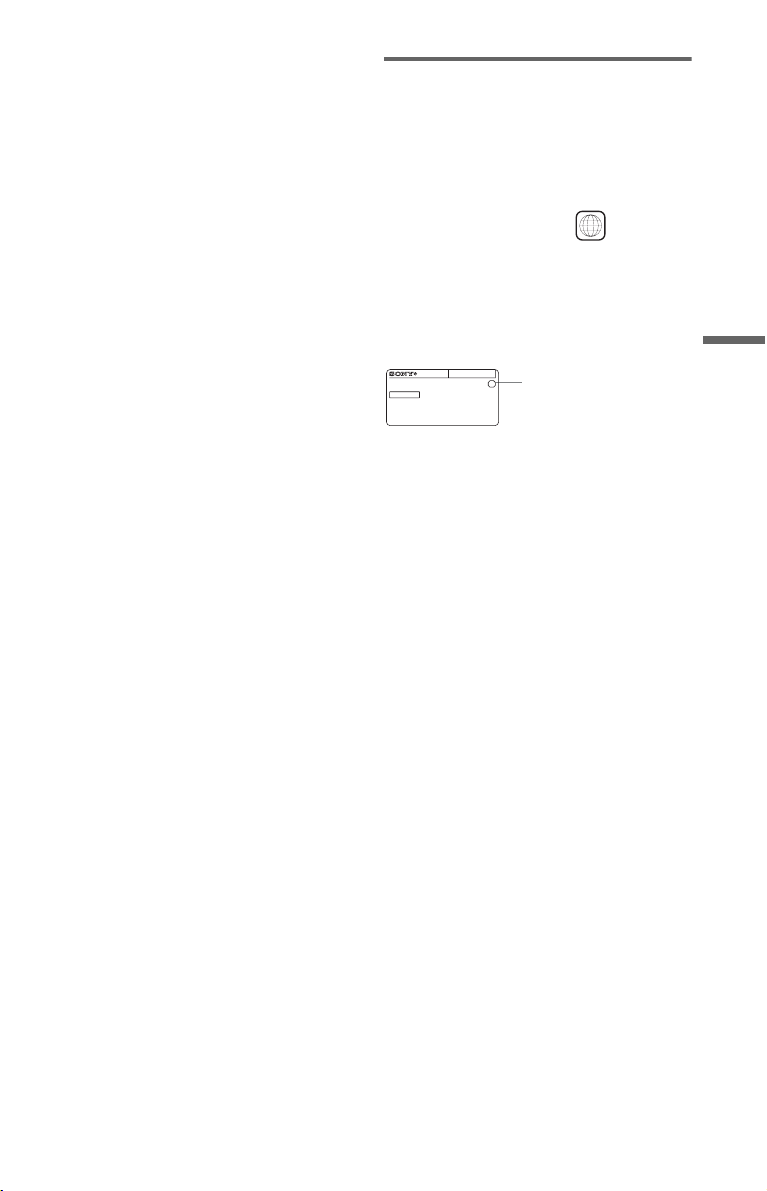
Additional Information
43
US
* “Design rule for Camera File system”: Image
standards for digital cameras regulated by JEITA
(Japan Electronics and Information Technology
Industries Association).
** A logical format of files and folders on CD-
ROMs, defined by ISO (International
Organization for Standardization).
z
• If you add numbers (01, 02, 03, etc.) to the front
of the file names, the files will be played in that
order.
• To play a complex hierarchy of folders may take
some time. Create albums with no more than two
hierarchies.
• Set “MEDIA” to “PHOTO/MUSIC” to repeat
both music and photo files. See “Playing
repeatedly (Repeat Play)” page 25.
b
• Some video, photo, and music files may not play,
depending on the encoding/recording condition.
• To start playback and proceed to the next or
another album may take some time.
• The player cannot play music files in mp3PRO or
WMA Pro format.
• If the playing time of either music or photo is
longer, the longer one continues without sound or
image.
• To display Progressive photo files or photo files
of 3,000,000 pixels or more may take time and the
duration may seem longer than your selected
setting.
• The player will recognize a maximum of 200
albums, regardless of the selected mode. It can
recognize up to 300 music files and 300 photo
files when “PHOTO/MUSIC” is selected, 600
music files when “MUSIC” is selected, 600 photo
files when “PHOTO (BGM)” is selected, and 600
video files when “VIDEO” is selected.
• The player may not play a combination of two or
more video files.
• The player cannot play a video file of size more
than 720 (width) × 576 (height)/2 GB.
• The player may not play certain video files that
are longer than 3 hours.
• Depending on the file, normal playback may not
be possible. The picture may be unclear, playback
may not appear smooth, the sound may skip, etc.
You are recommended to create the file at a lower
bit rate.
• The player may not playback the high bit rate
video file on the DATA CD smoothly. You are
recommended to playback using DATA DVD.
• When playing visual data that is not supported by
MPEG-4 format, only sound will be heard.
Region code
Your player has a region code printed on the
back of the unit and only will play
commercial DVDs (playback only) labeled
with identical region codes. This system is
used to protect copyrights.
Commercial DVDs labeled will also
play on this player.
Depending on the commercial DVD, there
may be no region code indication, even
though playing the commercial DVD is
prohibited by area restrictions.
b
• Notes about recordable media
Some recordable media cannot be played on this
player due to the recording quality or physical
condition of the disc, or the characteristics of the
recording device and authoring software.
The disc will not play if it has not been correctly
finalized. For more information, refer to the
operating instructions for the recording device.
Note that some playback functions may not work
with some DVD+RWs/DVD+Rs/DVD+R DLs,
even if they have been correctly finalized. In this
case, view the disc by normal playback. Also
some DATA discs created in Packet Write format
cannot be played.
• Music discs encoded with copyright protection
technologies
This product is designed to playback discs that
conform to the Compact Disc (CD) standard.
Various music discs encoded with copyright
protection technologies are marketed by some
record companies. Please be aware that among
those discs, there are some that do not conform to
the CD standard and may not be playable by this
product.
• For player that cannot play images that
contain a copy protection only
Images in DVD-VR mode with CPRM*
protection may not be played if they contain a
copy protection signal, “Copyright lock” appears
on the screen.
* CPRM (Content Protection for Recordable
Media) is a coding technology that protects the
copyright of images.
ALL
DVP–XXXX
00V 00Hz
00W
NO.
0-000-000-00
X
Region code
,continued

44
US
• Note on DualDiscs
A DualDisc is a two sided disc product which
mates DVD recorded material on one side with
digital audio material on the other side.
However, since the audio material side does not
conform to the Compact Disc (CD) standard,
playback on this product is not guaranteed.
Note on playback operations of
DVDs and VIDEO CDs
Some playback operations of DVDs and
VIDEO CDs may be intentionally set by
software producers. Since this player plays
DVDs and VIDEO CDs according to the disc
contents the software producers designed,
some playback features may not be available.
Also, refer to the operating instructions
supplied with the DVDs or VIDEO CDs.
About MPEG-4 VISUAL (Except
DVP-NS710H)
THIS PRODUCT IS LICENSED UNDER
THE MPEG-4 VISUAL PATENT
PORTFOLIO LICENSE FOR THE
PERSONAL AND NON-COMMERCIAL
USE OF A CONSUMER FOR DECODING
VIDEO IN COMPLIANCE WITH THE
MPEG-4 VISUAL STANDARD (“MPEG-4
VIDEO”) THAT WAS ENCODED BY A
CONSUMER ENGAGED IN A PERSONAL
AND NON-COMMERCIAL ACTIVITY
AND/OR WAS OBTAINED FROM A
VIDEO PROVIDER LICENSED BY MPEG
LA TO PROVIDE MPEG-4 VIDEO.
NO LICENSE IS GRANTED OR SHALL
BE IMPLIED FOR ANY OTHER USE.
ADDITIONAL INFORMATION
INCLUDING THAT RELATING TO
PROMOTIONAL, INTERNAL AND
COMMERCIAL USES AND LICENSING
MAY BE OBTAINED FROM MPEG LA,
LLC. SEE HTTP://WWW.MPEGLA.COM

Additional Information
45
US
Specifications
System
Laser: Semiconductor laser
Outputs
(Jack name: Jack type/Output level/Load
impedance)
LINE OUT (AUDIO):
Phono jack/2 Vrms/10 kilohms
DIGITAL OUT (COAXIAL):
Phono jack/0.5 Vp-p/75 ohms
HDMI OUT: HDMI
19 pin-Standard Connector
COMPONENT VIDEO OUT(Y, P
B, PR):
Phono jack/Y: 1.0 Vp-p, P
B, PR:
interlace*
1
= 0.648 Vp-p,
progressive or interlace*
2
= 0.7 Vp-p/75
ohms
*
1
BLACK LEVEL (COMPONENT OUT) is ON
*
2
BLACK LEVEL (COMPONENT OUT) is OFF
LINE OUT (VIDEO):
Phono jack/1.0 Vp-p/75 ohms
USB (DVP-NS728H only):
USB jack Type A, maximum current
500 mA (For connecting USB device)
General
Power requirements:
U.S. / Canadian models: 120 V AC, 60 Hz
Models for other areas: 110 – 240 V AC,
50/60 Hz
See page 3 for further information.
Power consumption:
DVP-NS710H and DVP-NS718H : 10 W
DVP-NS728H : 12 W
Dimensions (approx.):
430 × 43 × 206 mm (17 × 1
11
/16 × 8
1
/10 in.)
(width/height/depth) incl. projecting
parts
Mass (approx.):
DVP-NS710H and DVP-NS718H:
1.5 kg (3
3
/10 lb)
DVP-NS728H: 1.6 kg (3
1
/2 lb)
Operating temperature: 5 °C to 35 °C
(41 °F to 95 °F)
Operating humidity: 25 % to 80 %
Supplied accessories
• Audio/Video cord (phono plug × 3 y
phono plug × 3) (1)
• Remote commander (remote) (1)
• Size AA (R6) batteries (2)
A plug adaptor is included with some models.
Specifications and design are subject to
change without notice.
ENERGY STAR and the ENERGY STAR
mark are registered U.S. marks
ENERGY STAR is a registered mark owned
by the U.S. government

46
US
Language Code List
For details, see pages 7, 32.
The language spellings conform to the ISO 639: 1988 (E/F) standard.
Parental Control Area Code List
For details, see page 28.
Code Language Code Language Code Language Code Language
1027 Afar
1028 Abkhazian
1032 Afrikaans
1039 Amharic
1044 Arabic
1045 Assamese
1051 Aymara
1052 Azerbaijani
1053 Bashkir
1057 Byelorussian
1059 Bulgarian
1060 Bihari
1061 Bislama
1066 Bengali;
Bangla
1067 Tibetan
1070 Breton
1079 Catalan
1093 Corsican
1097 Czech
1103 Welsh
1105 Danish
1109 German
1130 Bhutani
1142 Greek
1144 English
1145 Esperanto
1149 Spanish
1150 Estonian
1151 Basque
1157 Persian
1165 Finnish
1166 Fiji
1171 Faroese
1174 French
1181 Frisian
1183 Irish
1186 Scots Gaelic
1194 Galician
1196 Guarani
1203 Gujarati
1209 Hausa
1217 Hindi
1226 Croatian
1229 Hungarian
1233 Armenian
1235 Interlingua
1239 Interlingue
1245 Inupiak
1248 Indonesian
1253 Icelandic
1254 Italian
1257 Hebrew
1261 Japanese
1269 Yiddish
1283 Javanese
1287 Georgian
1297 Kazakh
1298 Greenlandic
1299 Cambodian
1300 Kannada
1301 Korean
1305 Kashmiri
1307 Kurdish
1311 Kirghiz
1313 Latin
1326 Lingala
1327 Laothian
1332 Lithuanian
1334 Latvian;
Lettish
1345 Malagasy
1347 Maori
1349 Macedonian
1350 Malayalam
1352 Mongolian
1353 Moldavian
1356 Marathi
1357 Malay
1358 Maltese
1363 Burmese
1365 Nauru
1369 Nepali
1376 Dutch
1379 Norwegian
1393 Occitan
1403 (Afan)Oromo
1408 Oriya
1417 Punjabi
1428 Polish
1435 Pashto;
Pushto
1436 Portuguese
1463 Quechua
1481 Rhaeto-
Romance
1482 Kirundi
1483 Romanian
1489 Russian
1491 Kinyarwanda
1495 Sanskrit
1498 Sindhi
1501 Sangho
1502 Serbo-
Croatian
1503 Singhalese
1505 Slovak
1506 Slovenian
1507 Samoan
1508 Shona
1509 Somali
1511 Albanian
1512 Serbian
1513 Siswati
1514 Sesotho
1515 Sundanese
1516 Swedish
1517 Swahili
1521 Tamil
1525 Telugu
1527 Tajik
1528 Thai
1529 Tigrinya
1531 Turkmen
1532 Tagalog
1534 Setswana
1535 Tonga
1538 Turkish
1539 Tsonga
1540 Tatar
1543 Twi
1557 Ukrainian
1564 Urdu
1572 Uzbek
1581 Vietnamese
1587 Volapük
1613 Wolof
1632 Xhosa
1665 Yoruba
1684 Chinese
1697 Zulu
1703 Not specified
Code
Area Code Area Code Area Code Area
2044 Argentina
2047 Australia
2046 Austria
2057 Belgium
2070 Brazil
2079 Canada
2090 Chile
2092 China
2115 Denmark
2165 Finland
2174 France
2109 Germany
2248 India
2238 Indonesia
2254 Italy
2276 Japan
2304 Korea
2363 Malaysia
2362 Mexico
2376 Netherlands
2390 New Zealand
2379 Norway
2427 Pakistan
2424 Philippines
2436 Portugal
2489 Russia
2501 Singapore
2149 Spain
2499 Sweden
2086 Switzerland
2528 Thailand
2184 United
Kingdom

Additional Information
47
US
Index
Numerics
16:9
33
4:3 LETTER BOX
33
4:3 OUTPUT
34
4:3 PAN SCAN
33
48kHz/96kHz PCM
37
5.1 Channel Surround
14
A
A-B REPEAT
21, 26
A-B Repeat Play
26
ADVANCE
8
ALBUM
22
ANGLE
21
AUDIO
32
AUDIO DRC
36
AUDIO SETUP
36
AUTO PLAY
35
AUTO POWER OFF
35
AV SYNC
21, 27
B
BACKGROUND
33
Batteries
14
BLACK LEVEL
33
BLACK LEVEL
(COMPONENT OUT)
34
‘BRAVIA Sync’
12
C
CD
18, 42
CHAPTER
21
CHAPTER VIEWER
7
Child Lock
9
Connecting
11
Continuous play
CD/VIDEO CD
18
DVD
18
Control Menu
20
CUSTOM
32
Custom Parental Control
28
CUSTOM PICTURE MODE
21, 27
CUSTOM SETUP
35
D
DATA CD
42
DATA DVD
42
DATE
22
DIGITAL OUT
36
Digital output
36
DIMMER
35
Display
Control Menu display
20
Front panel display
10
Setup Display
32
DivX
®
35
DOLBY DIGITAL
36
DOWNMIX
36
DTS
37
DVD
8, 18
DVD+RW
8, 42
DVD-RW
42
E
EFFECT
22, 31
F
Fast forward
8
Fast reverse
8
FAST/SLOW PLAY
8
FILE
22
Film based software
34
Front panel display
10
H
Handling discs
2
HDMI
AUDIO (HDMI)
38
CONTROL FOR HDMI
12,
38
HDMI RESOLUTION
37
LANGUAGE FOLLOW
38
HDMI SETUP
37
I
ID3 tag
7
INDEX
21
INTERVAL
22, 31
J
JPEG
42
JPEG RESOLUTION
37
L
LANGUAGE SETUP
32
M
MEDIA
22
MEMORY
27
MENU
32
MODE (PROGRESSIVE)
34
MP3
42
MULTI-DISC RESUME
18, 35
O
On-screen display
Control Menu display
20
Setup Display
32
ORIGINAL
21
ORIGINAL/PLAY LIST
21
OSD
32
P
PARENTAL CONTROL
21,
28
PAUSE MODE
35
PBC Playback
19
PhotoTV HD
30, 37
PICTURE NAVI
7, 30
PLAY LIST
21
Playable Media
42
PROGRAM
21, 24
Program Play
24
PROGRESSIVE
(COMPONENT OUT
ONLY)
34
Q
QUICK
21
Quick Setup
15
R
Remote
7, 14, 15
REPEAT
21, 25
Repeat Play
25
REPLAY
8
RESET
21
Resume
18, 35
S
SCENE
21
SCREEN SAVER
33
SCREEN SETUP
33
SETUP
21, 32
Setup Display
32
SHARPNESS
21, 27
SHUFFLE
21, 25
Shuffle Play
25
Slow-motion Play
8
SUBTITLE
30, 32
T
TIME/TEXT
21
TITLE
21
TITLE VIEWER
7
TRACK
21
TRACK SELECTION
35
TRACK VIEWER
7
Troubleshooting
39
TV TYPE
33
TVS
22
U
USB
17, 29
V
Video based software
34
VIDEO CD
18, 42
Z
ZOOM
21


1
ES
ES
Tabla de contenido
Conexiones y ajustes . . . . . . . . . . . . . . . . . . . . . . . . . . . . . . . . . . 2
Paso 1: Conexión del televisor . . . . . . . . . . . . . . . . . . . . . . . . . . . . . . . . . . . . 2
Acerca de lasfunciones del CONTROL PARA HDMI para ‘BRAVIA Sync’
(para conexiones HDMI solamente) . . . . . . . . . . . . . . . . . . . . . . . . . . 3
Paso 2: Conexión al componente de audio . . . . . . . . . . . . . . . . . . . . . . . . . . . 4
Paso 3: Conexión del cable de alimentación. . . . . . . . . . . . . . . . . . . . . . . . . . 5
Paso 4: Preparación del control remoto. . . . . . . . . . . . . . . . . . . . . . . . . . . . . . 5
Control del televisor con el control remoto. . . . . . . . . . . . . . . . . . . . . . . . . 6
Paso 5: Ajuste rápido. . . . . . . . . . . . . . . . . . . . . . . . . . . . . . . . . . . . . . . . . . . . 7
Conexión de un dispositivo USB (DVP-NS728H solamente) . . . . . . . . . . . . . 8
Reproducción . . . . . . . . . . . . . . . . . . . . . . . . . . . . . . . . . . . . . . . 9
Reproducción de discos. . . . . . . . . . . . . . . . . . . . . . . . . . . . . . . . . . . . . . . . . . 9
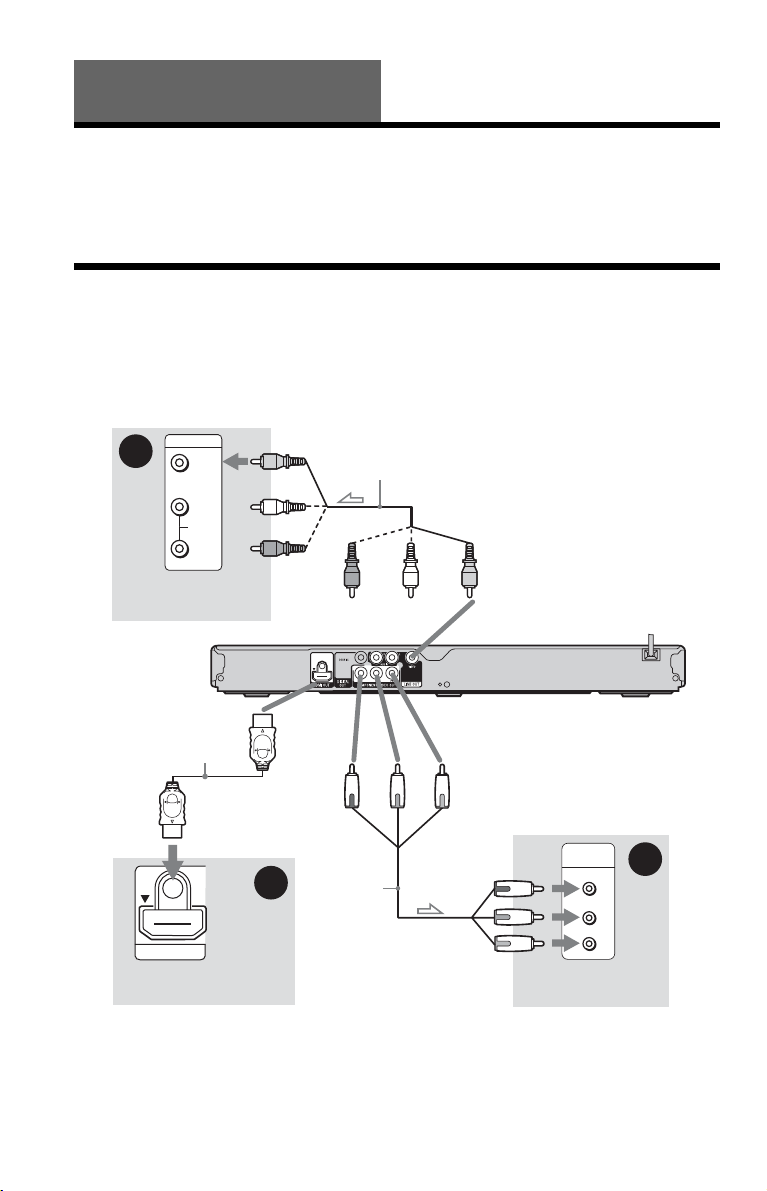
2
ES
Conexiones y ajustes
Al desembalar la unidad, compruebe los accesorios suministrados que se detallan en la versión
en inglés de las instrucciones de uso.
b
• Enchufe los cables firmemente para evitar ruidos no deseados.
• Consulte las instrucciones de uso suministradas con los componentes que desea conectar.
• Asegúrese de desconectar el cable de alimentación de cada componente antes de realizar las conexiones.
Paso 1: Conexión del televisor
Conecte este reproductor al televisor mediante un cable de video. Seleccione uno de los patrones
A a C según la toma de entrada del televisor.
Para ver imágenes de señales progresivas (480p) con un televisor compatible, debe usar el patrón
B. Seleccione el patrón C para conectar a un televisor equipado con entrada HDMI.
A
VIDEO
AUDIO
INPUT
L
R
PR
PB
Y
COMPONENT
VIDEO IN
B
HDMI IN
C
Cable de audio/video
(suministrado)
l: Flujo de señal
(amarillo)
Reproductor de CD/
DVD (disco
compacto/
videodisco digital)
(verde)
Cable de video
componente
(no suministrado)
Televisor
(rojo)
(azul)
(amarillo)
a LINE OUT (VIDEO)
a COMPONENT
VIDEO OUT
(salida de video del
componente)
(verde)
(azul)
(rojo)
Televisor
cable HDMI (no
suministrado)
a HDMI OUT
(salida interfaz
multimedia de alta
definición)
Televisor
(blanco)
(rojo)
(blanco)
(rojo)
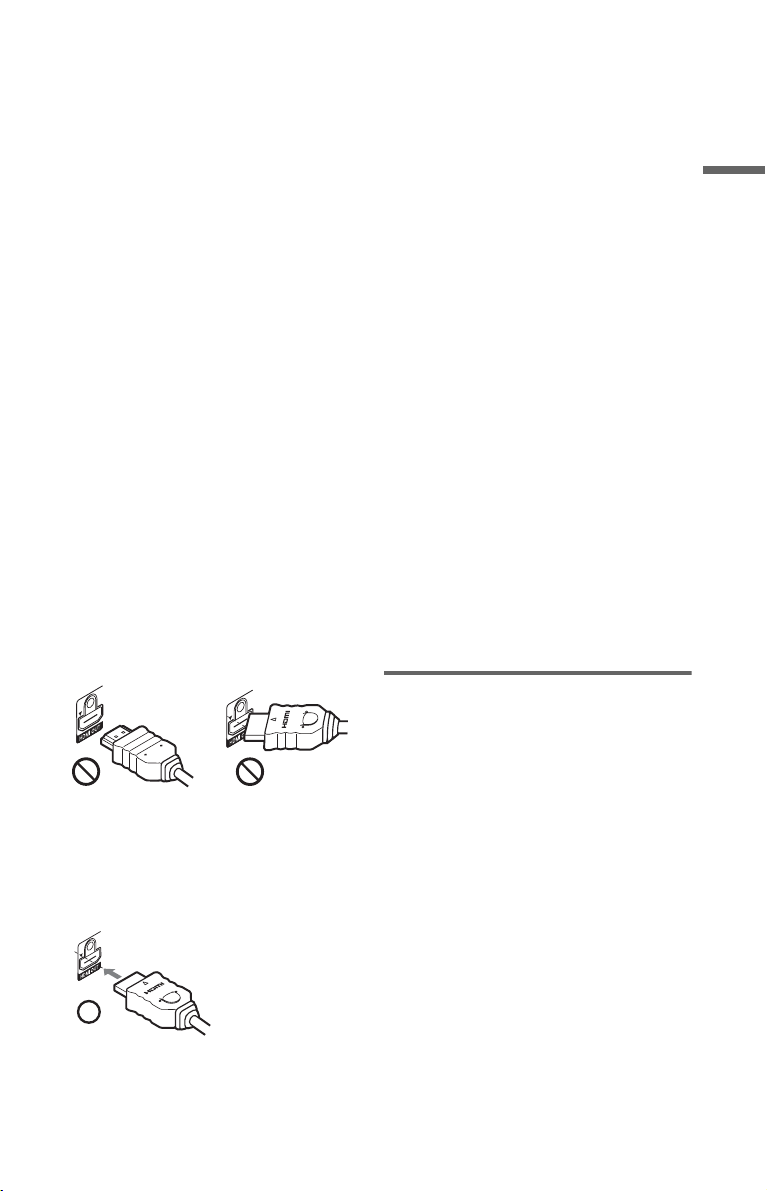
Conexiones y ajustes
3
ES
A Toma de entrada de video
Disfrutará de imágenes de calidad estándar.
B Tomas de entrada de video
componente (Y, P
B, PR)
Este tipo de conexiones proporciona
imágenes de alta calidad con una
reproducción fiel de los colores.
C Toma de entrada HDMI/DVI
Utilice un cable HDMI certificado por Sony
para disfrutar de imagen y sonido digital de
alta calidad mediante la toma HDMI OUT.
Cuando realice una conexión a un televisor
Sony compatible con la función CONTROL
PARA HDMI, consulte la versión en inglés
de las instrucciones de uso.
Cuando conecte a la toma HDMI OUT
Siga los pasos que se detallan a continuación.
El manejo inapropiado puede ocasionar
daños en la toma HDMI OUT y el conector.
1 Alinee con cuidado la toma HDMI OUT
ubicada en la parte posterior del
reproductor y el conector HDMI;
compruebe que coincidan en forma.
Asegúrese de que el conector no se
encuentre inclinado ni en posición
invertida.
2 Inserte el conector HDMI directamente
en la toma HDMI OUT.
No doble el conector HDMI ni aplique
fuerza sobre él.
Para conectar a un televisor con entrada
DVI (interfaz visual digital)
Utilice un cable de conversión HDMI-DVI
(no suministrado). La toma DVI no acepta
señales de audio, por lo tanto, deberá contar
con una conexión de audio adicional a esta
conexión (página 4). Además, no es posible
conectar la toma HDMI OUT a tomas DVI
que no sean compatibles con HDCP (por
ejemplo, tomas DVI de pantallas de PC).
Si lo conecta a un televisor de pantalla
panorámica
Es probable que las imágenes no se ajusten a
la pantalla del televisor. Para cambiar la
relación de aspecto, consulte la versión en
inglés de las instrucciones de uso.
b
• No conecte una videograbadora, etc., entre el
televisor y el reproductor. Si filtra las señales del
reproductor por medio de la videograbadora, es
posible que no reciba una imagen clara en la
pantalla del televisor. Si el televisor cuenta con
una sola toma de entrada de audio/video, conecte
el reproductor a dicha toma.
• Si la imagen se ve muy blanca al usar la conexión
A, configure en “OFF” el “BLACK LEVEL”
desde la opción “SCREEN SETUP” (Para obtener
información detallada, consulte la versión en
inglés del Manual de instrucciones).
• Desconecte el cable HDMI para trasladar el
reproductor.
• Si ubica al reproductor en el gabinete con el cable
HDMI conectado, no aplique mucha presión a la
pared del gabinete. Podría dañar la toma HDMI
OUT o el cable HDMI.
• Al conectar o desconectar, no apriete con fuerza
ni gire el conector HDMI.
Acerca de lasfunciones del
CONTROL PARA HDMI para
‘BRAVIA Sync’ (para conexiones
HDMI solamente)
Al conectar componentes Sony compatibles
con la función CONTROL PARA HDMI por
medio de un cable HDMI (no suministrado),
puede disfrutar de las siguientes funciones:
• Reproducción con sólo presionar un botón
(página 9)
• Apagado del sistema
Al apagar el televisor con el botón [/1 del control
remoto, los componentes compatibles con la
función CONTROL PARA HDMI se apagan de
manera automática.
b
La función CONTROL PARA HDMI estará
disponible o no según el componente conectado.
Consulte las instrucciones de uso suministradas con
el componente.
Conector en posición
invertida
Conector inclinado
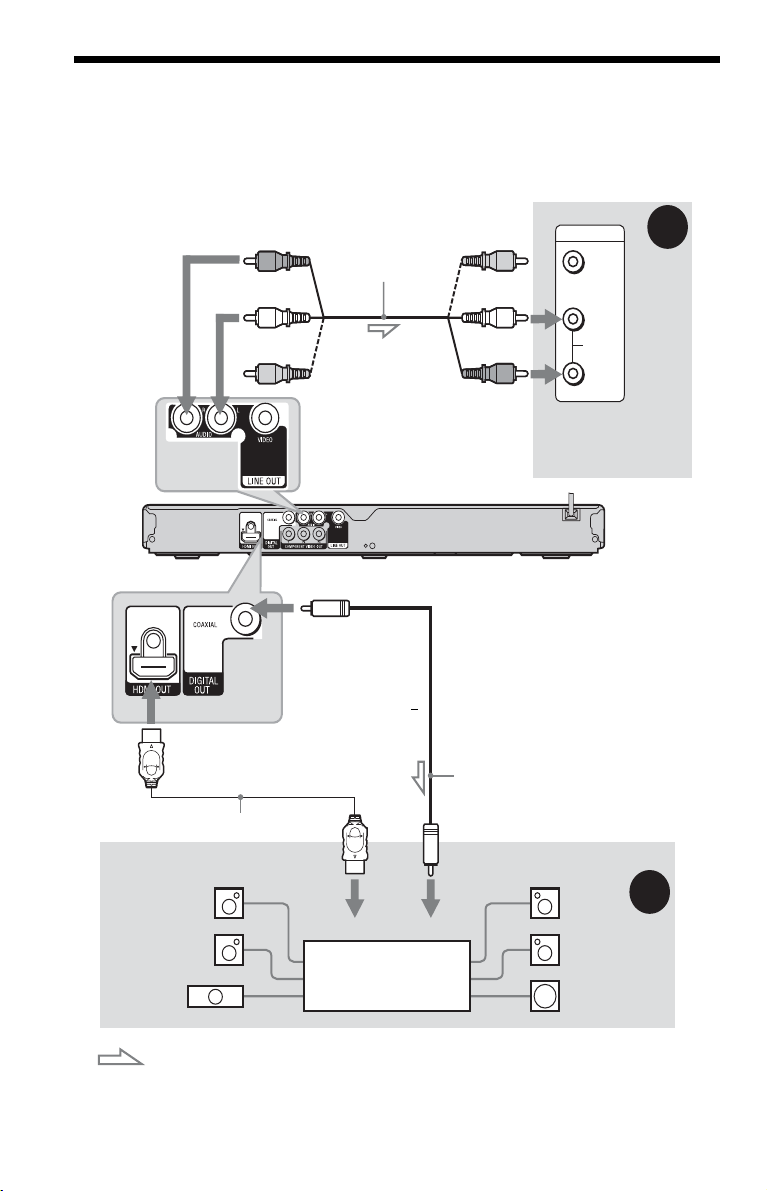
4
ES
Paso 2: Conexión al componente de audio
Seleccione uno de los siguientes patrones A o B , de acuerdo con la toma de entrada del monitor
del televisor, del proyector o de un componente de audio como un amplificador de audio y video
(receptor).
Esto le permitirá escuchar sonido.
z
Para obtener información acerca de la distribución correcta de los altavoces, consulte el manual de
instrucciones suministrado con los componentes conectados.
VIDEO
AUDIO
INPUT
L
R
B
A
: Flujo de señal
* El adaptador amarillo se utiliza para señales de video (página 2).
Componente de audio
con codificador
(rojo)
Televisor, proyector o
componente de audio
Cable de audio/video
(suministrado)
Cable digital coaxial
(no suministrado)
Tomas LINE OUT L/R (AUDIO)
(salida línea izquierda/derecha)
Posterior
(izquierdo)
Reproductor de CD/
DVD (disco
compacto/videodisco
digital)
(blanco)
(amarillo)*
(amarillo)*
(blanco)
(rojo)
[Altavoces]
Frontal
(izquierdo)
[Altavoces]
a la entrada digital coaxial/HDMI
Posterior
(derecho)
Frontal (derecho)
Subwoofer
(parlante de
frecuencias graves)
Central
o
cable HDMI (no suministrado)
a DIGITAL OUT (COAXIAL)/HDMI OUT
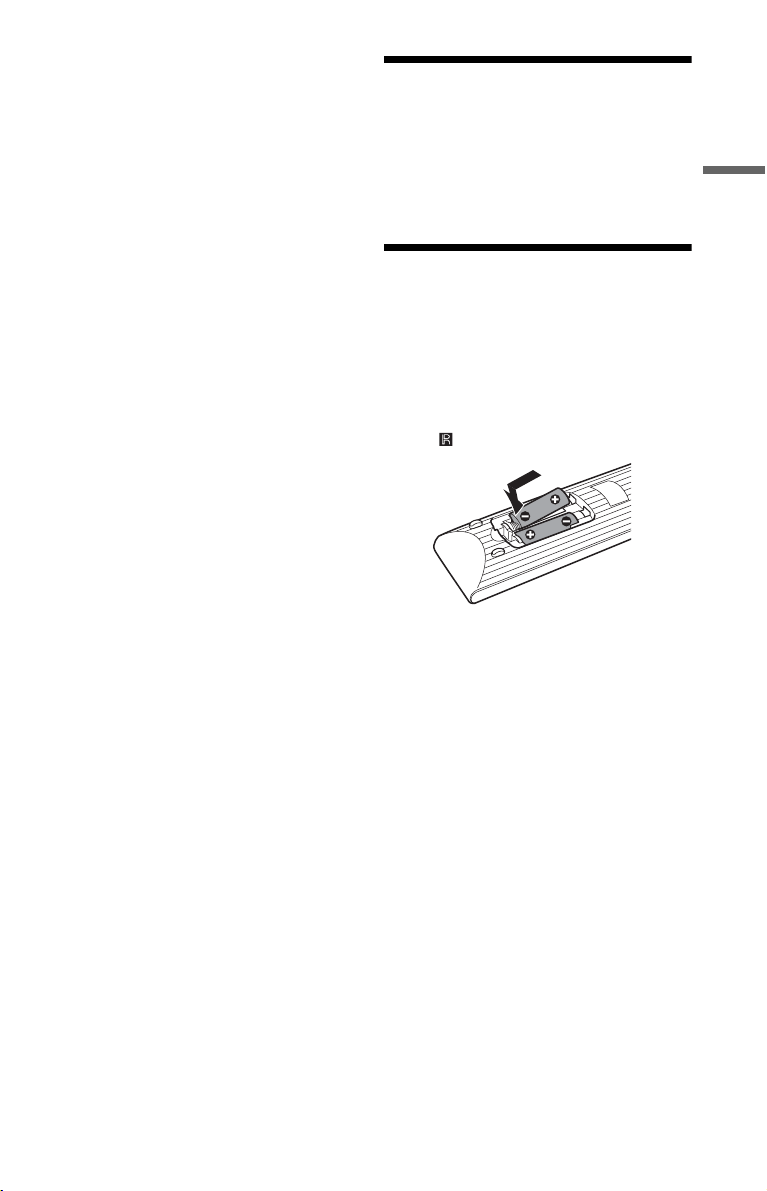
Conexiones y ajustes
5
ES
A
Tomas de entrada de audio (I/D)
Esta conexión utilizará los dos altavoces del
televisor o de los componentes de audio para
el sonido.
B Toma de entrada de audio
digital
Si el componente de audio dispone de
decodificador Dolby*
1
Digital o DTS
(sistema digital de sala de cine)*
2
y una toma
de entrada digital, utilice esta conexión.
Podrá disfrutar de los efectos de sonido
envolvente de Dolby Digital (5.1ch) y DTS
(sistema digital de sala de cine) (5.1ch).
Si conecta un componente de audio Sony
compatible con la función CONTROL PARA
HDMI, consulte las instrucciones de uso
suministradas con el componente.
*1
Fabricado bajo licencia de Dolby Laboratories.
Dolby, Pro Logic y el símbolo de la doble D son
marcas comerciales de Dolby Laboratories.
*2
Fabricado bajo licencia según Patente de los
EE.UU. N°: 5.451.942 y otras patentes emitidas
y pendientes en los EE.UU. y el resto del mundo.
DTS y DTS Digital Out son marcas registradas,
y los logos y símbolo de DTS son marcas
comerciales de DTS, Inc. © 1996-2008 DTS,
Inc. Reservados todos los derechos.
b
• Tras completar la conexión, realice los ajustes
apropiados en Ajuste rápido (página 7). De lo
contrario, los altavoces no emitirán el sonido o
emitirán un ruido estridente.
• Los efectos TVS (sonido envolvente virtual de
televisor) de este reproductor no son compatibles
con esta conexión.
• Cuando conecta el reproductor a un componente
de audio con un cable HDMI, es necesario realizar
uno de los siguientes pasos:
– Conectar el componente de audio al televisor con
un cable HDMI.
– Conectar el reproductor al televisor con un cable
de video que no sea HDMI (cable de video
componente o cable de audio/video).
• Para conexiones a la toma HDMI OUT, alinee con
cuidado el conector HDMI con la toma. No doble
el cable HDMI ni aplique fuerza sobre él.
Paso 3: Conexión del
cable de alimentación
Conecte los cables de alimentación del
reproductor y del televisor a una salida CA.
Paso 4: Preparación del
control remoto
Inserte dos pilas AA (R6) de manera tal que
los extremos 3 y # con coincidan las marcas
del interior del compartimiento. Al utilizar el
control remoto, oriéntelo hacia el sensor
remoto del reproductor.
b
• No deje el control remoto en ambientes con
temperatura o húmedas excesivas.
• No permita que caigan objetos extraños sobre el
control remoto, especialmente cuando sustituya
las pilas.
• No exponga el sensor del control remoto a la luz
directa del sol ni a dispositivos de iluminación. De
lo contrario, pueden producirse fallas en el
funcionamiento.
• Cuando no vaya a usar el control remoto durante
un tiempo prolongado, extraiga las pilas para
evitar posibles daños por fugas y corrosión.
,continúa
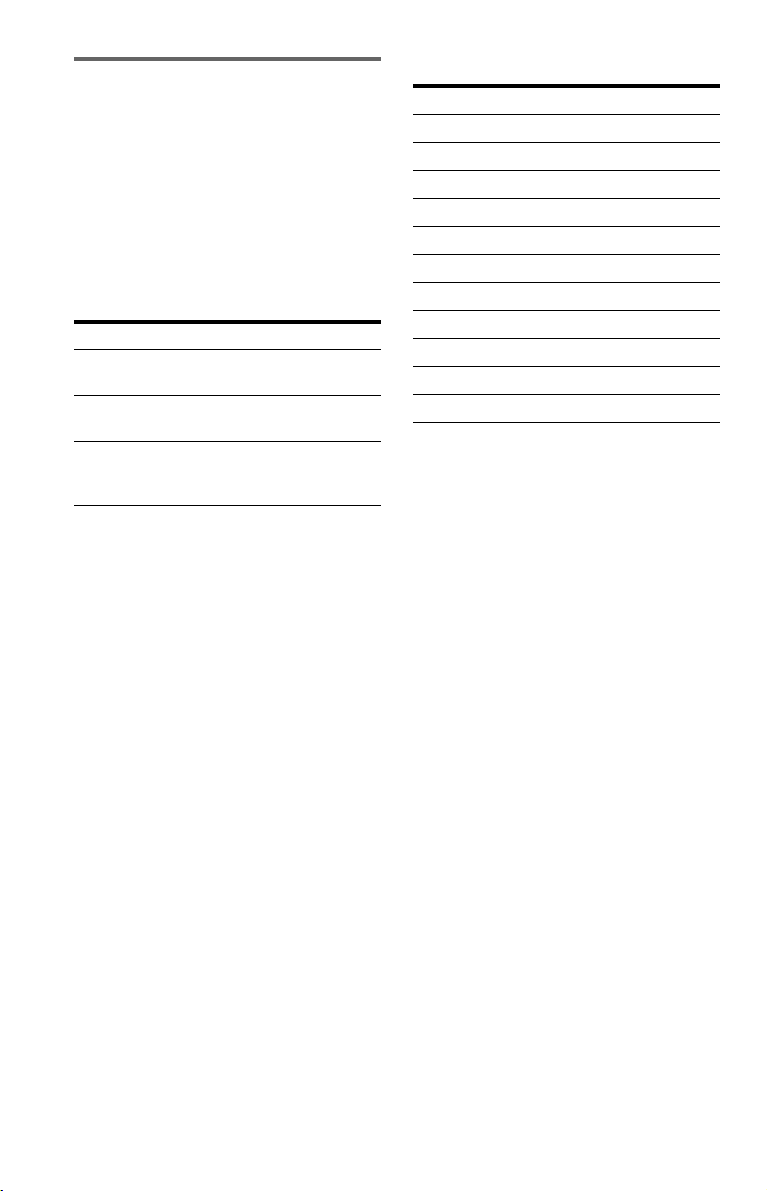
6
ES
Control del televisor con el
control remoto
Puede controlar el nivel del sonido, la fuente
de entrada y el interruptor de alimentación del
televisor Sony con el control remoto
suministrado.
Botones disponibles
Según la unidad que conecte, podrá controlar
el televisor mediante algunos o todos los
botones del control remoto suministrado.
Para controlar otros televisores con el
control remoto
También puede controlar el volumen, la
fuente de entrada y el interruptor de
alimentación de un televisor de otro
proveedor con el control remoto
suministrado.
Si el televisor figura en la tabla que aparece a
continuación, establezca el código del
fabricante correspondiente.
b
Al sustituir las pilas del control remoto, es probable
que el código recupere el valor de fábrica. Vuelva a
establecer el número de código apropiado.
1 Mientras mantiene presionado TV
(televisor) [/1, presione los botones
numéricos para seleccionar el código del
fabricante del televisor.
2 Suelte el botón TV (televisor) [/1.
Códigos de televisores controlables
Botones Operaciones
TV (televisor)
[/1
Encienda o apague el
televisor
VOL (volumen)
+/–
Ajuste del volumen del
televisor
TV INPUT
(selección de
entrada)
Alterne la fuente de entrada
del televisor entre el televisor
y otras fuentes de entrada
Fabricante Número de código
Sony 01 (predeterminado)
Hitachi 02
LG/Goldstar/NEC 04
MGA/Mitsubishi 13
Panasonic 19
Philips 21
Pioneer 16
RCA 10
Samsung 20
Sharp 18
Toshiba 07
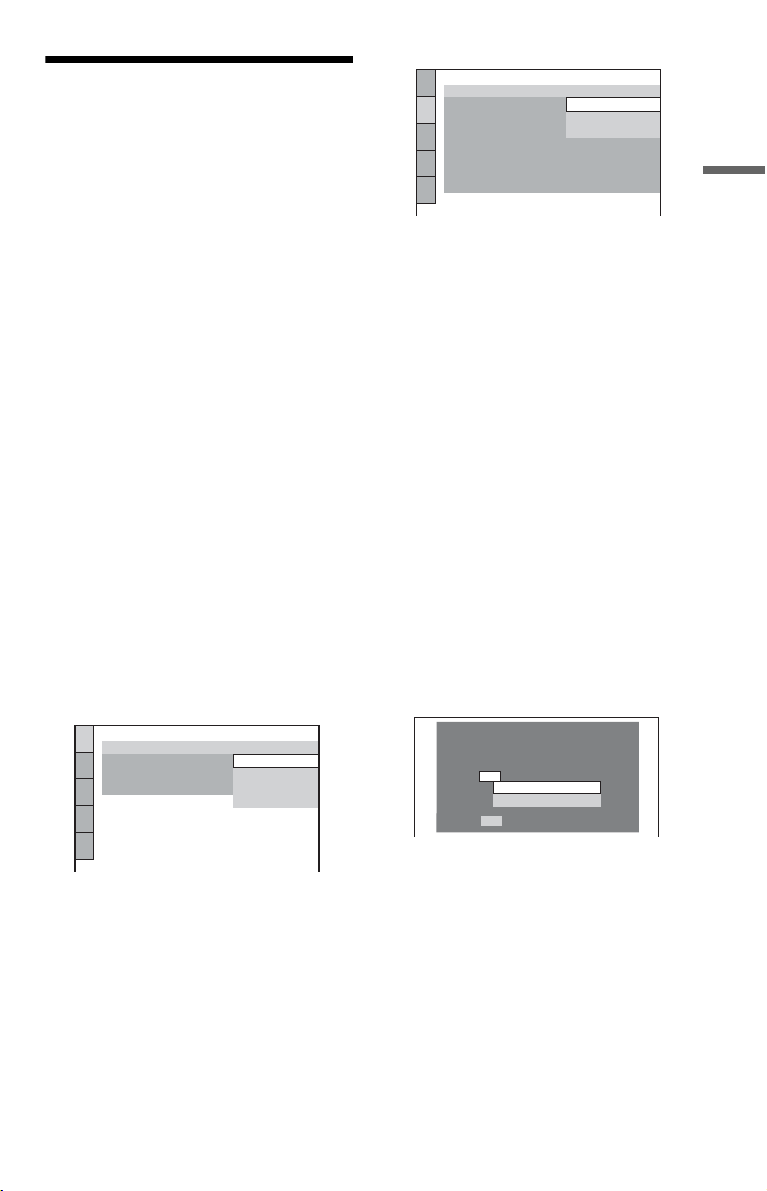
Conexiones y ajustes
7
ES
Paso 5: Ajuste rápido
Siga los pasos que se detallan a continuación
para realizar los ajustes básicos mínimos para
el uso del reproductor.
Para omitir un ajuste, presione >. Para
volver al ajuste anterior, presione ..
1 Encienda el televisor y, a
continuación, presione [/1.
2 Cambie el selector de entrada del
televisor para que la señal del
reproductor aparezca en la
pantalla del televisor.
En la parte inferior de la pantalla,
aparecerá “Press [ENTER] to run
QUICK SETUP”. Si este mensaje no
aparece, seleccione “QUICK” en
“SETUP” del menú de control para
ejecutar el ajuste rápido (Para obtener
información detallada, consulte la
versión en inglés del Manual de
instrucciones).
3 Presione ENTER (ingresar) sin
insertar ningún disco.
Aparece la pantalla de ajustes de idioma.
4 Presione X/x para seleccionar un
idioma.
El reproductor muestra el menú y los
subtítulos en el idioma seleccionado.
5 Presione ENTER (ingresar).
Aparece la pantalla de ajustes de pantalla.
6 Presione X/x para seleccionar el
ajuste apropiado para el tipo de
televisor.
◆ Si tiene un televisor con pantalla
panorámica o un televisor 4:3 estándar
con el modo de pantalla panorámica
• 16:9 (Para obtener información
detallada, consulte la versión en inglés
del Manual de instrucciones)
◆ Si tiene un televisor 4:3 estándar
• 4:3 LETTER BOX (tipo buzón) o 4:3
PAN SCAN (exploración PAN) (Para
obtener información detallada, consulte
la versión en inglés del Manual de
instrucciones)
7 Presione ENTER (ingresar).
Aparece la pantalla de ajustes que le
permitirá seleccionar el tipo de toma
utilizada para conectar su componente de
audio.
8 Presione X/x para seleccionar (si
existe) el tipo de toma que utilice
para conectar a un componente de
audio y, a continuación, presione
ENTER (ingresar).
Seleccione “NO” si no conecta un
componente de audio y, a continuación,
vaya al paso 12.
Seleccione “YES: LINE OUTPUT L/R
(AUDIO)”, si conectó el componente de
audio con un cable de audio y, a
continuación, vaya al paso 12.
LANGUAGE SETUP
OSD:
MENU:
AUDIO:
SUBTITLE:
FRENCH
ENGLISH
ENGLISH
SPANISH
PORTUGUESE
SCREEN SETUP
TV TYPE:
16:9
4:3 PAN SCAN
4:3 LETTER BOX
SCREEN SAVER:
OFF
BACKGROUND:
BLACK LEVEL:
BLACK LEVEL
(COMPONENT OUT)
:
OFF
PROGRESSIVE
(COMPONENT OUT ONLY)
:
AUTO
MODE
(PROGRESSIVE)
:
FULL
4:3 OUTPUT:
16:9
YES
NO
Is this player connected to an amplifier
(receiver) ? Select the type of jack you
are using.
LINE OUTPUT L/R (AUDIO)
DIGITAL OUTPUT
,continúa
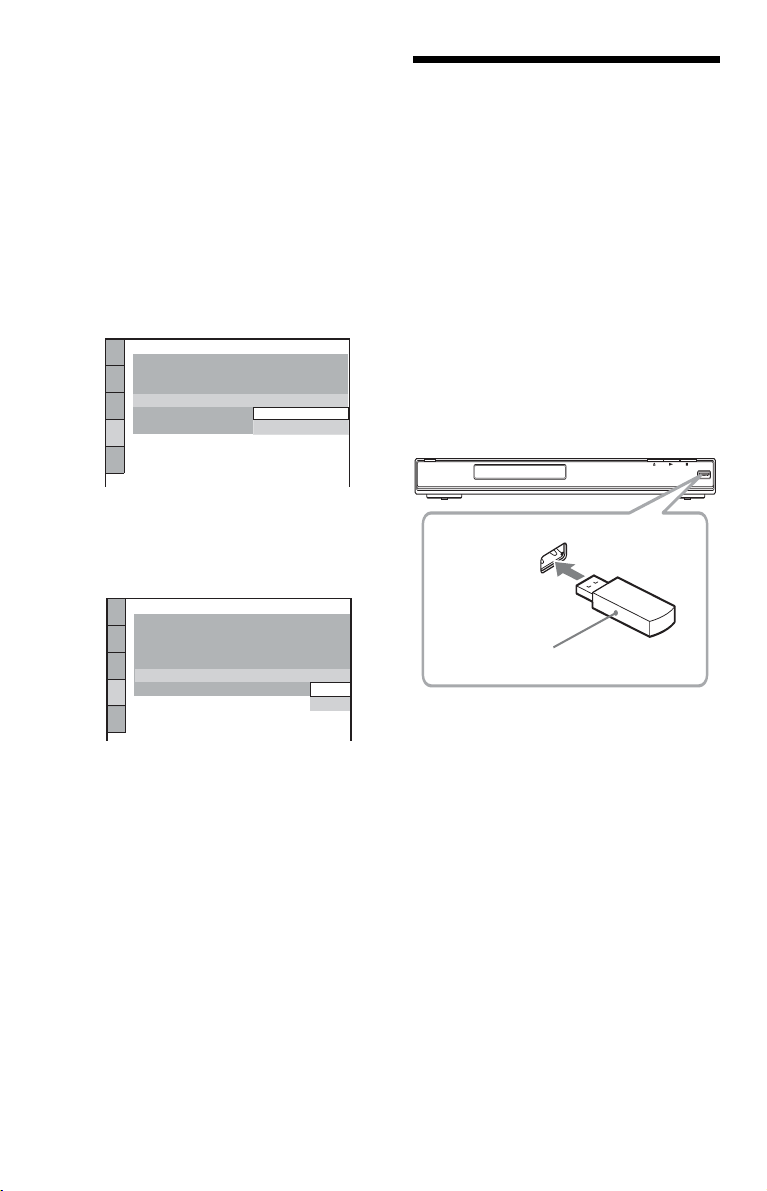
8
ES
Seleccione “YES: DIGITAL OUTPUT”,
si conectó un componente de audio
mediante un cable digital coaxial/HDMI.
9 Presione X/x para seleccionar el
tipo de señal Dolby Digital que
desee enviar al componente de
audio.
Si el componente de audio posee un
decodificador Dolby Digital, seleccione
“DOLBY DIGITAL”. De lo contrario,
seleccione “D-PCM”.
10Presione ENTER (ingresar).
Se selecciona “DTS” (sistema digital de
sala de cine).
11Presione X/x para seleccionar si
desea o no enviar una señal DTS
(sistema digital de sala de cine) al
componente de audio.
Si el componente de audio dispone de
decodificador DTS, seleccione “ON”. De
lo contrario, seleccione “OFF”.
12Presione ENTER (ingresar).
El ajuste rápido ha finalizado y las
conexiones se han completado.
b
Cuando se activa el modo “PhotoTV HD” (Para
obtener información detallada, consulte la versión
en inglés del Manual de instrucciones), se omite la
selección “TV TYPE”.
Conexión de un
dispositivo USB (DVP-
NS728H solamente)
Puede conectar un dispositivo USB a la toma
USB del reproductor para reproducir archivos
de música, imágenes o video. Para obtener
una lista de los dispositivos USB que se
pueden conectar al reproductor, consulte
“Playable USB Devices” (suplemento). Para
obtener detalles sobre archivos reproducibles,
consulte la versión en inglés de las
instrucciones de uso.
Consulte las instrucciones de uso
suministradas con el dispositivo USB antes
de conectarlo al reproductor.
Para reproducir archivos de datos, consulte la
versión en inglés de las instrucciones de uso.
Para extraer el dispositivo USB
Detenga la reproducción y desconecte el
dispositivo USB de la toma correspondiente.
b
• Asegúrese de realizar una copia de seguridad de
los archivos importantes que se encuentran en el
dispositivo USB antes de conectarlo al
reproductor.
• No conecte a la fuerza el dispositivo USB y
asegúrese de que el adaptador esté correctamente
conectado.
• No conecte el reproductor ni el dispositivo USB
mediante un concentrador USB.
• Antes de utilizar el dispositivo USB, asegúrese de
que no haya archivos infectados con virus.
• Este reproductor admite la clase de
almacenamiento masivo USB solamente.
• Este reproductor admite dispositivos USB sólo
con formatos FAT12, FAT16 o FAT32.
• Es probable que algunos dispositivos USB no
funcionen en este reproductor.
48kHz/96kHz PCM:
AUDIO SETUP
AUDIO DRC:
DIGITAL OUT:
DOLBY DIGITAL:
DTS:
STANDARD
ON
DOWNMIX:
DOLBY SURROUND
DOLBY DIGITAL
D-PCM
DOLBY DIGITAL
AUDIO SETUP
AUDIO DRC:
DIGITAL OUT:
DOLBY DIGITAL:
STANDARD
ON
DOWNMIX:
DOLBY SURROUND
DOLBY DIGITAL
DTS:
48kHz/96kHz PCM:
OFF
OFF
ON
Dispositivo USB
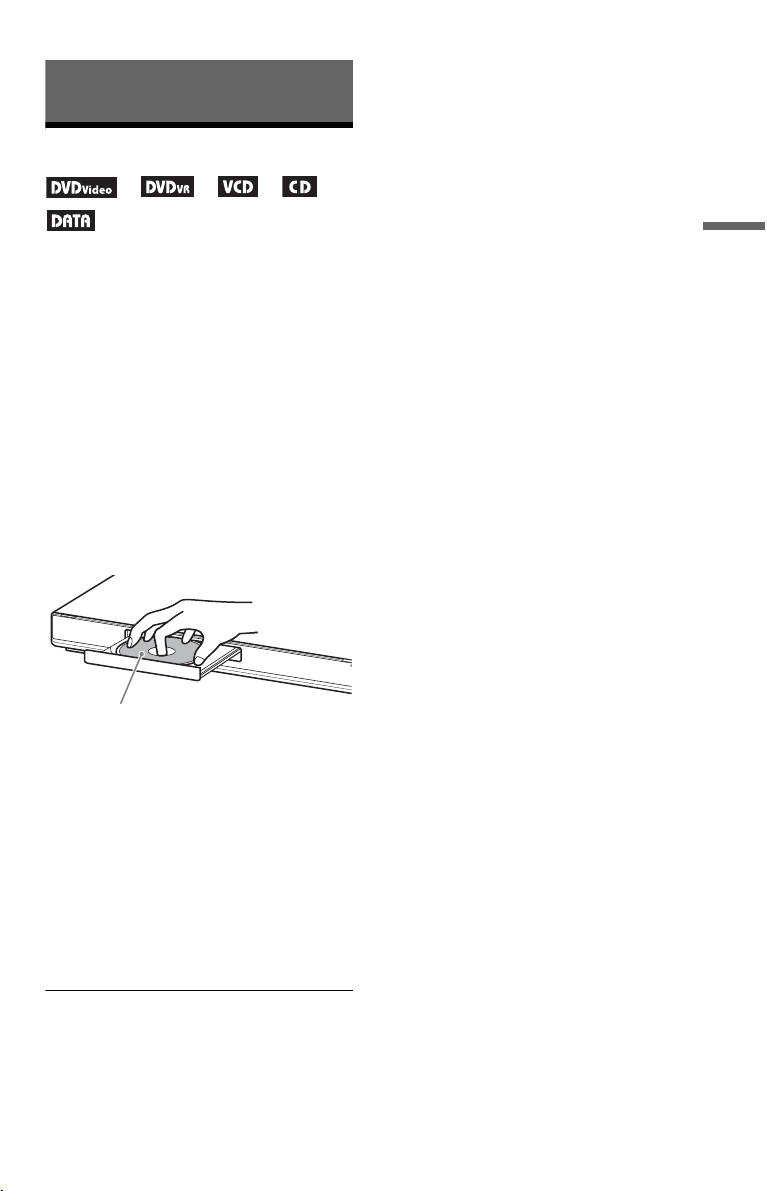
Reproducción
9
ES
Reproducción
Reproducción de discos
*
1
DVD video (video de videodisco digital).
*
2
DVD-VR (videodisco digital sin funcion de
grabacion de video).
*
3
VCD (videodisco compacto).
*
4
CD (disco compacto).
*
5
DATA (disco de datos).
1 Cambie el selector de entrada del
televisor para que la señal del
reproductor aparezca en la
pantalla del televisor.
2 Pulse Z en el reproductor y
coloque un disco en la bandeja.
3 Presione N.
Se cierra la bandeja del disco. El
reproductor inicia la reproducción
(continua). Ajuste el volumen en el
televisor o en el componente de audio.
Según disco, es posible que aparezca un
menú en la pantalla del televisor. Para
obtener información detallada, consulte
la versión en inglés del Manual de
instrucciones.
Si hay un disco dentro del reproductor
Presione N.
Para detener la reproducción
Presione x.
Para pausar la reproducción
Presione X.
Reproducción con sólo presionar un botón
(únicamente para conexiones HDMI)
Con sólo presionar una vez el botón N del
control remoto, se encienden
automáticamente el reproductor y el televisor,
y se alterna la entrada del televisor para
recibir la señal del reproductor. La
reproducción comienza de manera
automática.
La entrada del televisor también se alternará
al reproductor de manera automática en los
siguientes casos:
– Si presiona los botones N, TOP MENU
(menú superior), MENU (menú) o
DISPLAY (indicación) del control remoto.
Estos botones no funcionan al reproducir un
CD de audio o archivos de música en el
modo “MUSIC”.
– Si se carga un disco con la función de
reproducción automática.
– Si presiona la bandeja del disco para
cerrarla.
z
Es posible configurar el reproductor para que se
apague de manera automática siempre que
permanezca en modo de detención durante más de
30 minutos. Para activar o desactivar esta función,
ajuste “AUTO POWER OFF” en “CUSTOM
SETUP” en “ON” o “OFF” (Para obtener
información detallada, consulte la versión en inglés
del Manual de instrucciones).
b
• Algunas operaciones pueden ser distintas o estar
limitadas en función del DVD (videodisco digital)
o VIDEO CD (videodisco compacto).
Consulte las instrucciones de uso suministradas
con el disco.
• Los discos creados con grabadoras de DVD
(videodisco digital) deberán estar finalizados
correctamente para poder reproducirse. Para
obtener más información acerca de la
finalización, consulte el manual de instrucciones
suministrado con la grabadora de DVD
(videodisco digital).
*
1
*
2
*
3
*
4
*
5
Con la cara de
reproducción hacia abajo
,continúa

10
ES
Notas sobre la reproducción de pistas con
sonido DTS (sistema digital de sala de
cine) de un DVD VIDEO (video de
videodisco digital)
Las señales de audio de DTS (sistema digital
de sala de cine) se emiten únicamente por
medio de las tomas DIGITAL OUT
(COAXIAL)/HDMI OUT (salida interfaz
multimedia de alta definición).
Reanudación de la reproducción a partir
del punto en el que se detuvo el disco
(Reanudación multidisco)
Si vuelve a presionar N después de detener
la reproducción, el reproductor iniciará la
reproducción a partir del punto en el que la
detuvo al presionar x.
*
1
DVD video (video de videodisco digital).
*
2
VCD (videodisco compacto).
z
• Para reproducir el disco desde el principio,
presione x dos veces y, a continuación, presione
N.
• Con discos DVD VIDEO (video de videodisco
digital) y VIDEO CD (videodisco compacto), el
reproductor memoriza el punto en el que se
detuvo el disco hasta un máximo de 6 discos y
reanuda la reproducción la próxima vez que
inserte el mismo disco. Si memoriza un punto de
reanudación de reproducción para el disco
número 7, el punto de reanudación de
reproducción del primer disco se borrará.
b
• Para que esta opción funcione, se debe ajustar
“MULTI-DISC RESUME” de “CUSTOM
SETUP” en “ON” (predeterminado) (Para obtener
información detallada, consulte la versión en
inglés del Manual de instrucciones).
• La reanudación de reproducción no funciona
durante la reproducción aleatoria ni durante la
reproducción de programa.
• Es posible que en algunos discos la función de
reanudación de la reproducción no funcione,
dependiendo del punto en el que la haya detenido,
o si presiona [/1.
Reproducción de VIDEO CD (videodiscos
compactos) con funciones PBC (control de
reproducción)
La reproducción PBC (Playback Control
(Control de reproducción)) permite
reproducir discos VIDEO CD (videodisco
compacto) en forma interactiva si sigue las
instrucciones del menú que aparece en la
pantalla del televisor.
Al reproducir un VIDEO CD (videodisco
compacto) con funciones PBC (control de
reproducción), aparecerá el menú en la
pantalla.
Seleccione un elemento con los botones
numéricos y presione ENTER (ingresar). A
continuación, siga las instrucciones del menú
(presione N cuando aparezca “Press
SELECT” (presione seleccionar)).
*
1
VCD (videodisco compacto).
Para volver al menú
Presione O RETURN (volver).
z
Para reproducir sin la opción PBC (control de
reproducción), presione ./> o los botones
numéricos mientras el reproductor está detenido
para seleccionar una pista y, a continuación,
presione N o ENTER (ingresar).
En la pantalla del televisor aparece “Play without
PBC” y el reproductor inicia la reproducción
continua. No puede reproducir imágenes fijas,
como un menú.
Para regresar a la reproducción con PBC (control de
reproducción), presione x dos veces y, a
continuación, presione N.
*
1
*
2
*
1

Sony Corporation Printed in Malaysia
Printed on 70% or more recycled paper using VOC (Volatile Organic Compound)-free
vegetable oil based ink.