Table of
Contents
Let’s Use Enjoying More Troubleshooting Index
2
GB
Read this before using
Notes on playback
Connect the AC adaptor to an easily
accessible AC outlet. Should you notice an
abnormality in it, disconnect it from the
AC outlet immediately.
Notes on copyrights
Duplication, edition, or printing of a CD,
TV programs, copyrighted materials such
as pictures or publications, or any other
materials except for your own recording or
creation is limited to private or domestic
use only. Unless you hold copyright or
have permission of copyright holders for
the materials to be duplicated, use of those
materials beyond this limit may infringe
the provisions of the copyright law and be
subject to the copyright holder’s claim for
damages. When using photo images with
this digital photo frame, pay special
attention not to infringe the provisions of
the copyright law. Any unauthorized use or
modification of other’s portrait may also
infringe on their rights. For some
demonstrations, performances, or exhibits,
photography may be forbidden.
Recorded content not
guaranteed
Sony shall assume no responsibility for any
accidental or consequential damages or
loss of recorded content which may be
caused by use or malfunction of the digital
photo frame or memory card.
Backup recommendations
To avoid potential risk of data loss caused
by accidental operation or malfunction of
the digital photo frame, we recommend
that you save a backup copy of your data.
Notes on the LCD screen
• Do not press against the LCD screen.
The screen may become discolored, and
that may cause a malfunction.
• Exposing the LCD screen to direct
sunlight for a long period may cause
malfunctions.
• The LCD screen is manufactured using
extremely high-precision technology,
and over 99.99% of the pixels are
operational for effective use. However,
there may be some tiny black points and/
or bright points (white, red, blue, or
green in color) that constantly appear on
the LCD screen. These points are normal
for the manufacturing process and do not
affect the viewing in any way.
• Images may trail across on the LCD
screen in a cold location. This is not a
malfunction.
On descriptions in this manual
• The illustrations and screen shots used in
this manual are of the DPF-HD700
unless noted otherwise. The illustrations
and screen shots used in this manual may
not be identical to what is seen in actual
use.
• Not all models of the digital photo frame
are available in all countries and regions.
• The operations described in this manual
are of the remote control button
operations. When different operation is
possible between the buttons on the
remote control and the photo frame, it
will be noted as such.
• “Memory card” in this manual means
memory card or USB memory except
where further explanation is given.

3
GB
Table of
Contents
Let’s Use Enjoying More Troubleshooting Index
Table of Contents
Let’s Use
Identifying the parts ············································································4
Compatible Memory Card/USB memory ············································6
Preparation: 1 Checking included items ··········································· 8
Preparation: 2 Attaching the stand ···················································9
Preparation: 3 Turning on the photo frame····································· 11
Preparation: 4 Setting up the photo frame······································ 13
Enjoying a slideshow ········································································ 14
Changing the view mode ·································································· 16
Playing a movie ················································································ 20
Saving images in your photo frame (import)····································· 21
Specifying the playback memory······················································ 23
Enjoying More
Playing a slideshow with background music ···································· 24
Adjusting image size and orientation················································27
Registering a favorite mark·······························································29
Sorting images (Filtering) ································································· 30
Deleting an image············································································· 31
Exporting an image from internal memory········································ 33
Using the auto power on/off timer····················································· 35
Changing the settings······································································· 38
Connecting to a computer ································································ 42
Copying images and music from a computer ··································· 44
Troubleshooting
Troubleshooting················································································ 46
Precautions······················································································· 53
Specifications ··················································································· 55
Index
Index································································································· 60
4
GB
Table of
Contents
Let’s Use Enjoying More Troubleshooting Index
Identifying the parts
Front
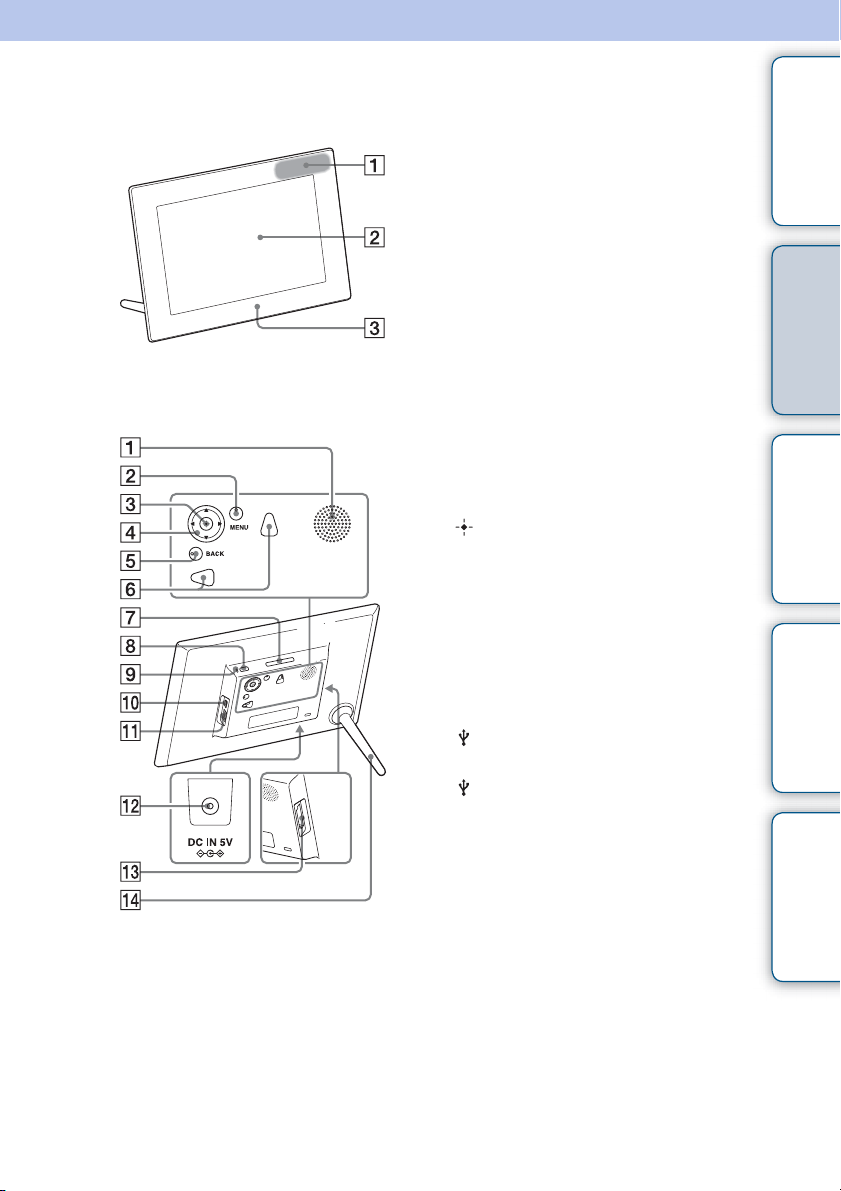
A Remote sensor
B LCD screen
C Sony logo (page 9)
Rear
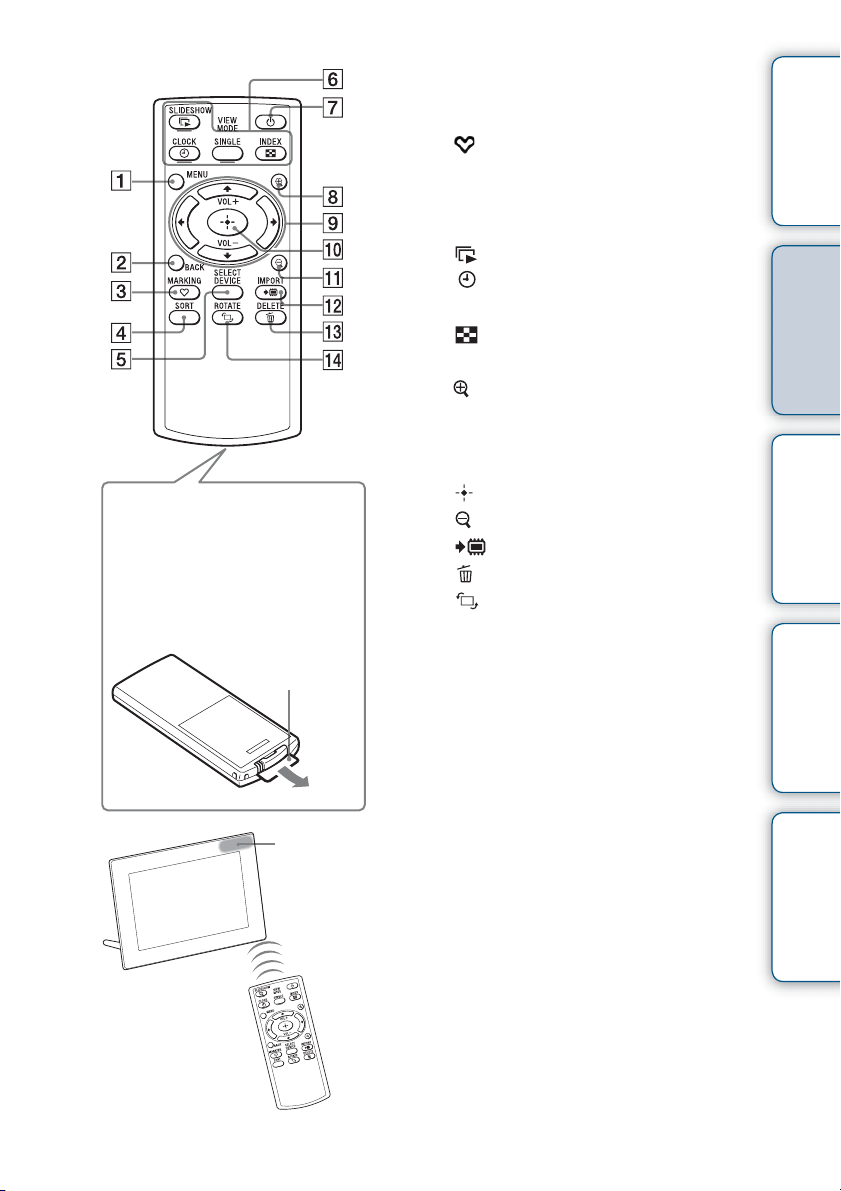
A Speaker
B MENU button
C (enter) button
D v/V/B/b buttons
E BACK button
F Holes for hanging the unit on a wall
(page 10)
G VIEW MODE button (page 16)
H 1 (on/standby) button
I Standby indicator
J USB Mini-B connector (page 14,
42)
K USB A connector (page 14)
L DC IN jack (page 11)
M Memory card slot (page 14)
N Stand (page 9)
Let’s Use
Continued r
5
GB
Table of
Contents
Let’s Use Enjoying More Troubleshooting Index
Remote control
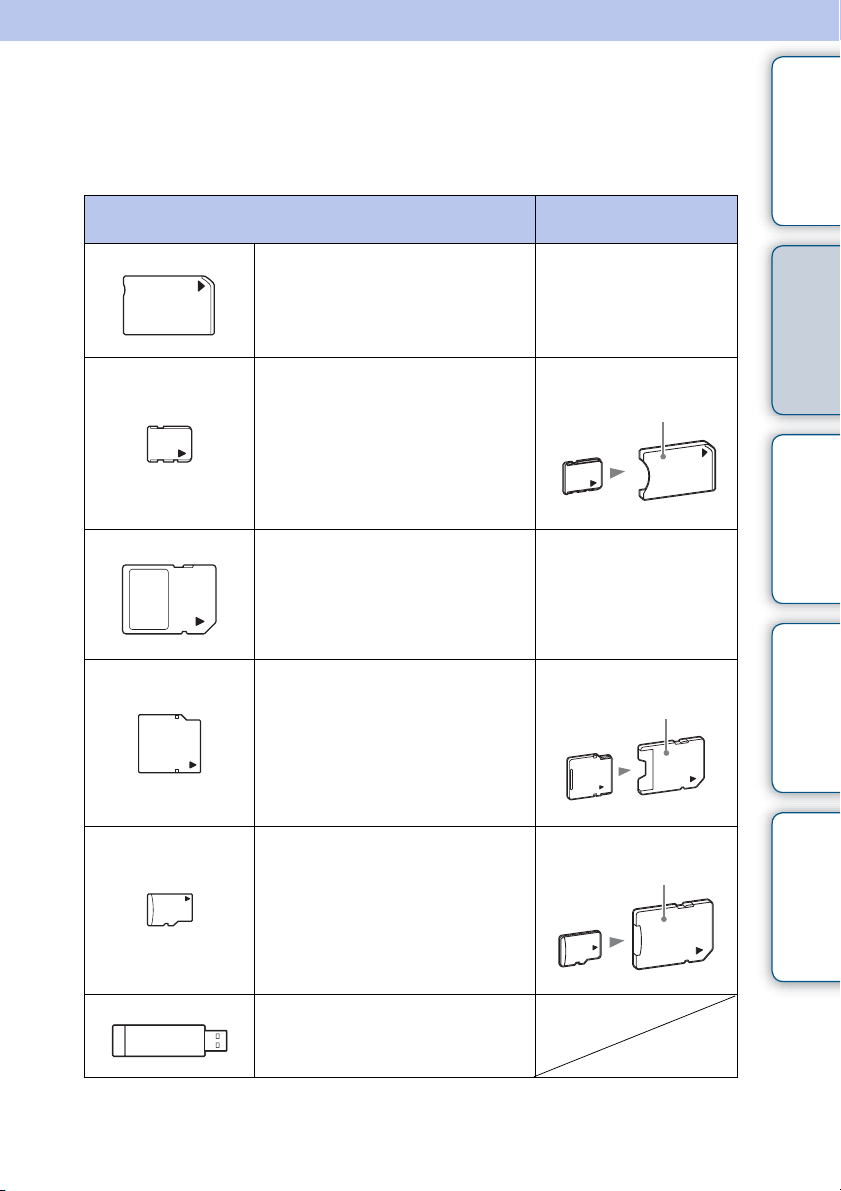
A MENU button (page 38)
B BACK button (page 20)
C MARKING button (page 29)
D SORT button (page 30)
E SELECT DEVICE button (page 23)
F VIEW MODE buttons
SLIDESHOW button (page 16)
CLOCK button (page 16)
SINGLE button (page 16)
INDEX button (page 16)
G 1 (on/standby) button (page 12)
H (zoom in) button (page 27)
I v/V/B/b buttons (page 13)
VOL +/VOL – (volume) buttons
(page 20)
J (enter) button (page 13)
K (zoom out) button (page 27)
L IMPORT button (page 21)
M DELETE button (page 31)
N ROTATE button (page 28)
The supplied lithium battery
(CR2025) has already been
inserted into the remote control.
Pull out the protective sheet
before use, as illustrated below.
Protective
sheet
Remote sensor
To use the remote control
Point the top end of the remote control
towards the remote sensor on the photo
frame.
6
GB
Table of
Contents
Let’s Use Enjoying More Troubleshooting Index
Compatible Memory Card/USB memory
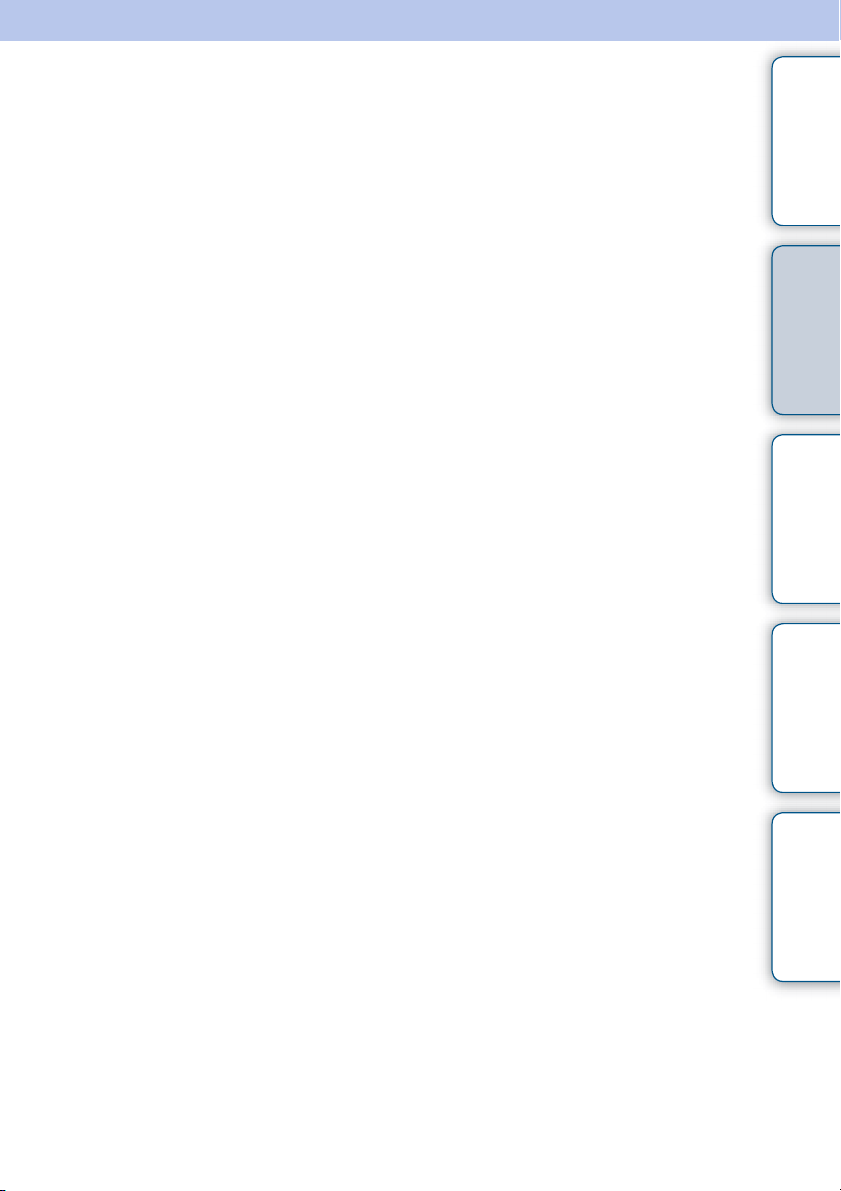
You can view images only by inserting a memory card (“Memory Stick Duo” or SD
memory card) or USB memory removed from a digital camera or equivalent, into the
photo frame.
Memory cards/USB memory supported
by the photo frame
Adaptor
• “Memory Stick Duo” (Not
compatible/Compatible with
“MagicGate”)
• “Memory Stick PRO Duo”
• “Memory Stick PRO-HG Duo”
Not necessary
• “Memory Stick Micro” (“M2”)
• SD memory card
• SDHC memory card
• SDXC memory card
Not necessary
• miniSD card
• miniSDHC card
• microSD card
• microSDHC card
• USB memory
“M2” adaptor
(Duo size)
miniSD/miniSDHC
adaptor
microSD/microSDHC
adaptor
Continued r
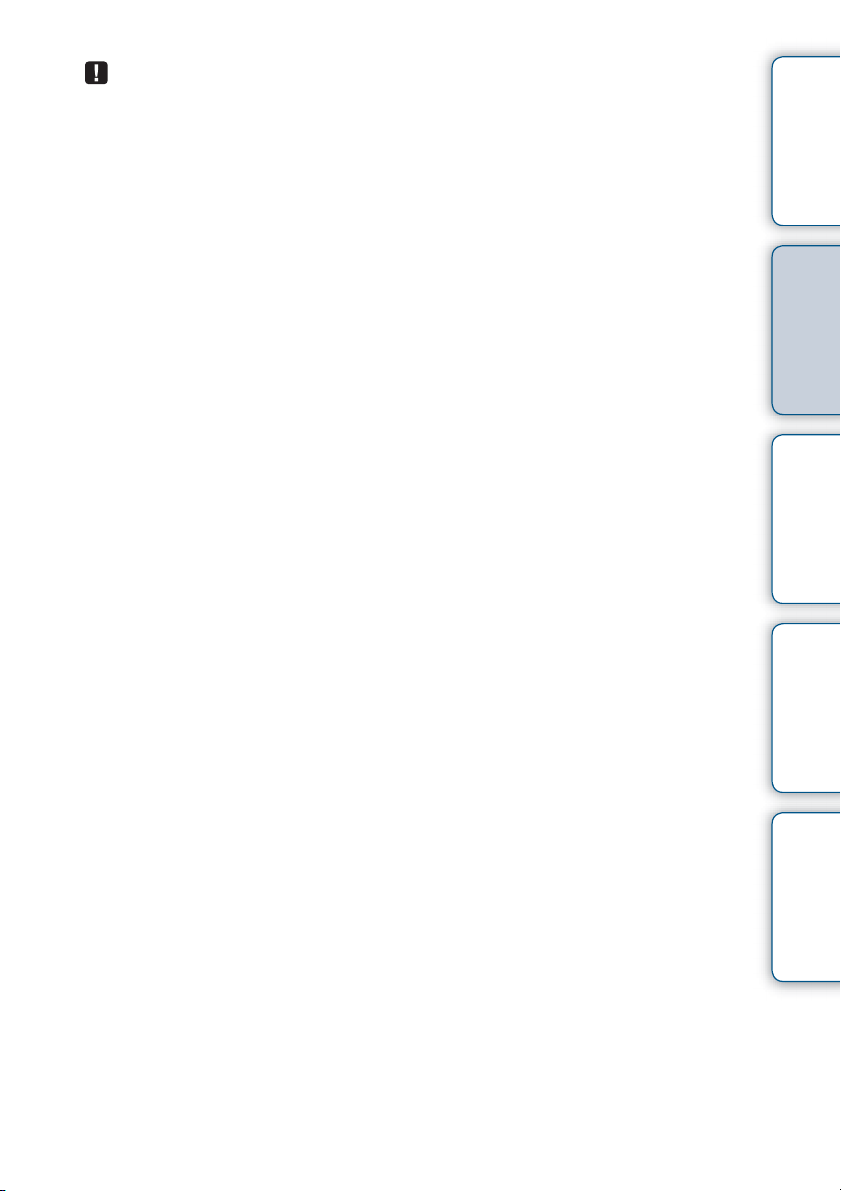
Table of
Contents
Let’s Use Enjoying More Troubleshooting Index
7
GB
• The photo frame has been demonstrated to be operable with “Memory Stick Duo” with a
capacity of 32 GB or less manufactured by Sony Corporation.
• “M2” is an abbreviation for “Memory Stick Micro”. In this section, “M2” is used to describe
a “Memory Stick Micro”.
• The photo frame has been demonstrated to be operable with an SD memory card with
capacity of 2 GB or less.
• The photo frame has been demonstrated to be operable with an SDHC memory card with
capacity of 32 GB or less.
• The photo frame has been demonstrated as operable with an SDXC memory card with a
capacity of 64 GB or less.
• We do not guarantee connection with all types of memory card devices.
• This photo frame is equipped with a “Memory Stick Duo” slot. A “Memory Stick” (standard)
cannot be used in this slot.
• When using miniSD/miniSDHC, microSD/microSDHC, or “Memory Stick Micro”, be sure
to mount it in an appropriate card adaptor. If you insert the card in a slot without an adaptor,
it may not be removable.
• In this photo frame, do not use the card adaptor with another card adaptor in which a memory
card is inserted.
• No card adaptor is supplied with the photo frame.
• We cannot guarantee proper operations for all types of SD memory cards.
• For more information, see “Notes on using a memory card” (page 53).
8
GB
Table of
Contents
Let’s Use Enjoying More Troubleshooting Index
Preparation: 1 Checking included items
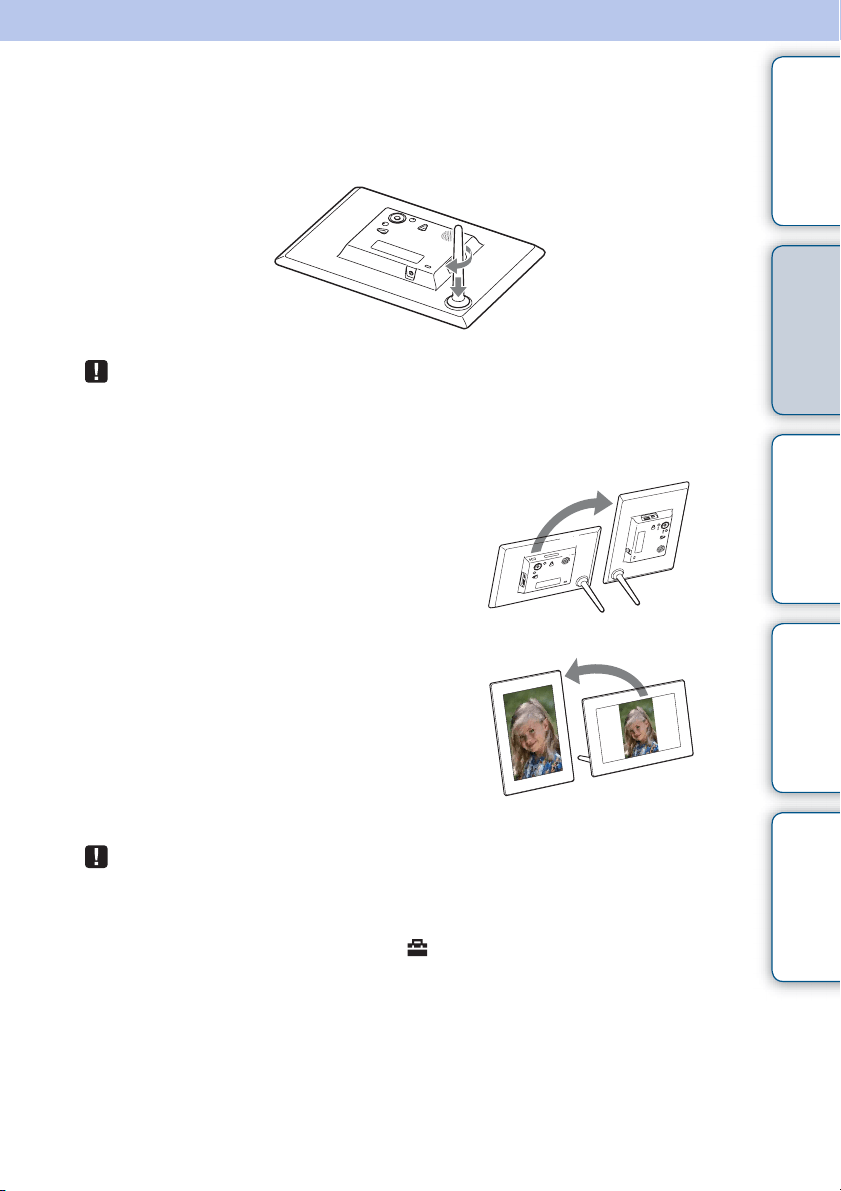
Make sure that the following items are included.
• Digital photo frame (1)
• Remote control (1)
•Stand (1)
• AC adaptor (1)
• Operating Instructions (1)
• CD-ROM (Digital Photo Frame Handbook) (1)
• Warranty (1) (In some regions, the warranty is not packaged together.)
9
GB
Table of
Contents
Let’s Use Enjoying More Troubleshooting Index
Preparation: 2 Attaching the stand
Turn the stand clockwise as far as it will go, such that it is firmly attached to the stand
socket on the rear panel.
• Do not place the photo frame on an unstable or tilted surface.
To change the orientation of the photo frame
You can set the photo frame to portrait or
landscape orientation by rotating it without
moving the stand.
When the photo frame is placed vertically, the
display is also automatically rotated to portrait
orientation.
The directions indicated on v/V/B/b on the rear
panel depend on the orientation of the photo
frame.
• When the photo frame is placed in portrait orientation or when you turn off the power, the
Sony logo doesn’t light up.
• The photo frame does not detect and rotate the orientation of images when [Auto display
orientation] of [General Settings] under the (Settings) tab is set to [OFF].
• A movie file is not rotated automatically even if you change the orientation of the photo
frame.
• It is easier to turn the stand if you wind or wrap a rubber band tightly around the stand when
you remove the stand from the photo frame.
• An image file shot with a DSC that doesn’t support Exif rotate tag recording cannot be
rotated automatically.
Continued r
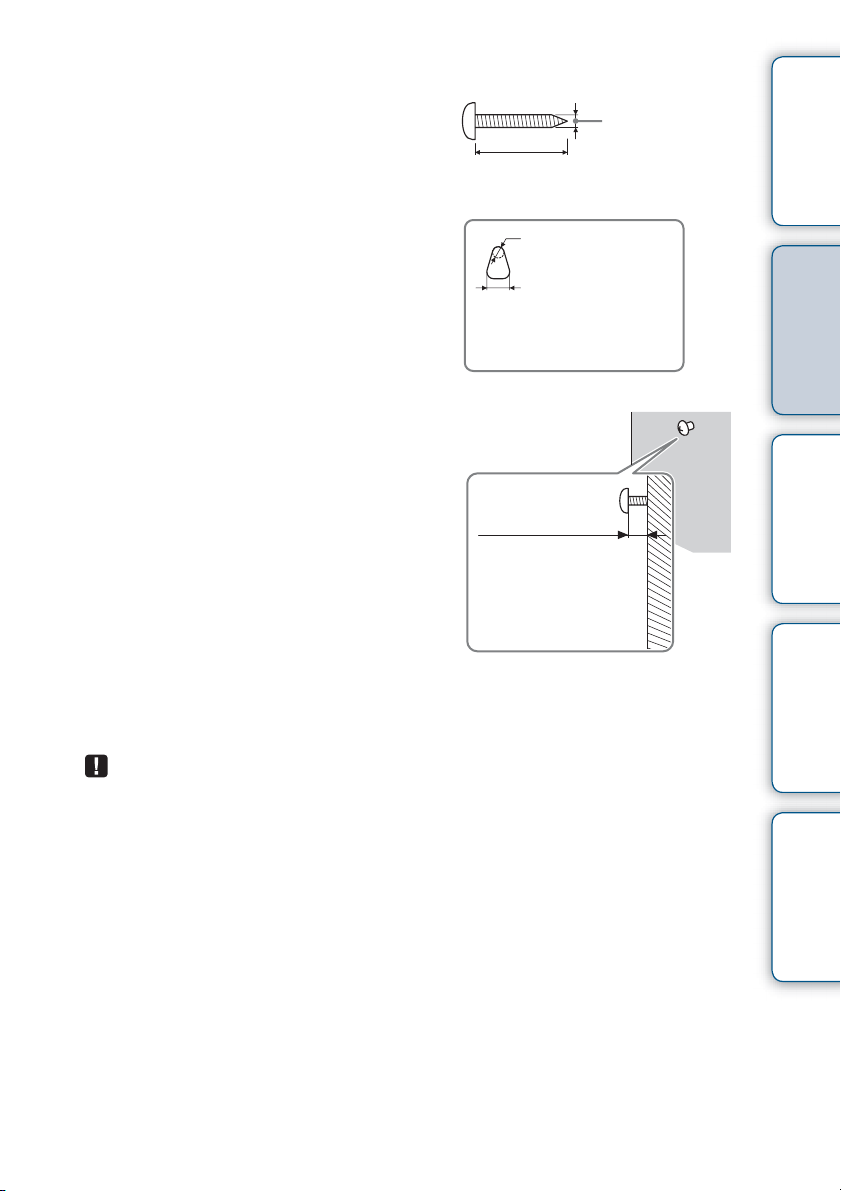
Table of
Contents
Let’s Use Enjoying More Troubleshooting Index
10
GB
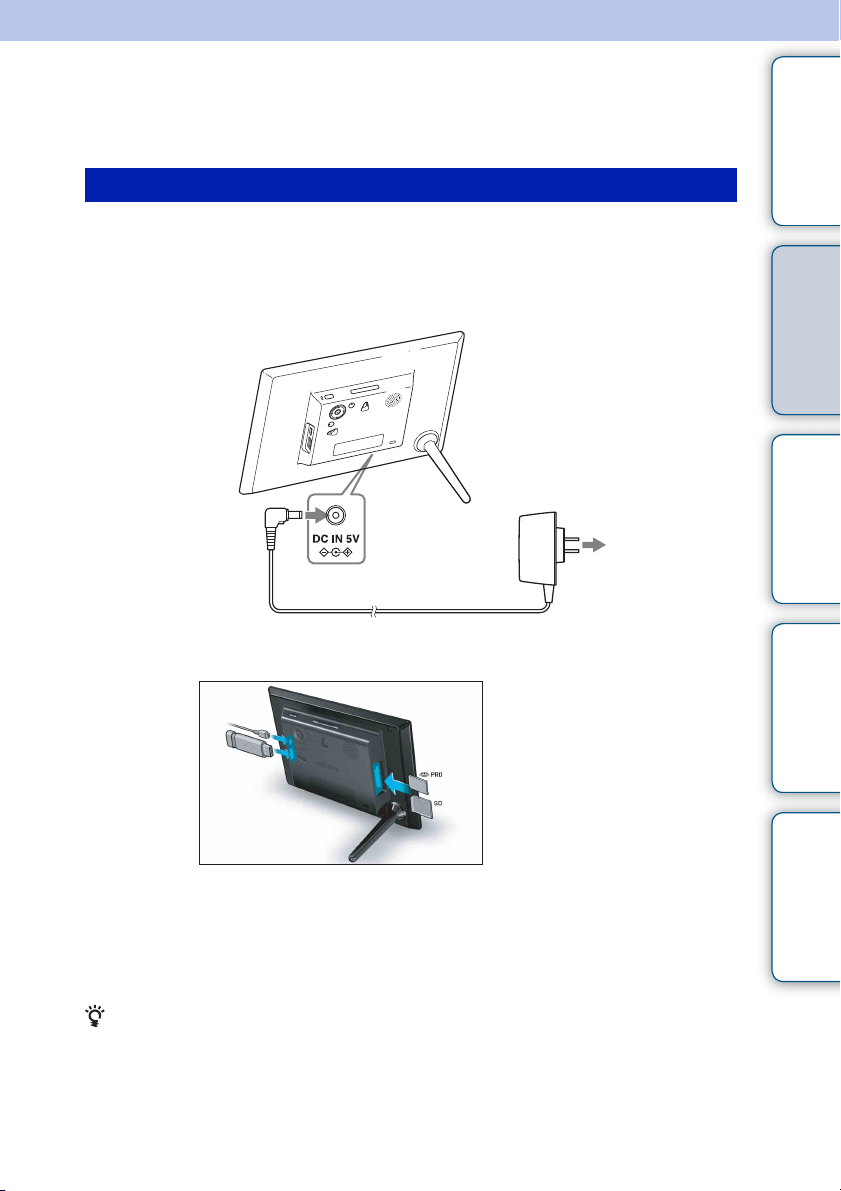
To hang the photo frame on a wall
1 Prepare commercially available
screws suitable for the holes on the
rear of the unit.
2 Drive the commercially available
screws into the wall.
Make sure the screws protrude 2.5 mm to 3
mm (approx. 1/8 inch) from the surface of
the wall.
3 Hang the photo frame on the wall by fitting the screw head to the hole
on the rear of the unit.
• Use screws suited for the wall material. The screws may be damaged, depending on the type
of material used in the wall. Drive the screws into a stud in the wall or a pillar.
• Firmly tighten the screw so that the photo frame will not fall from the wall.
• When you want to re-insert a memory card, remove the photo frame from the wall then eject
and re-insert the memory card while the photo frame is placed on a stable surface.
• Remove the stand when you hang the photo frame on a wall.
• Connect the DC cable of the AC adaptor to the photo frame and hang the photo frame on the
wall. Then plug the AC adaptor into the wall outlet.
• Sony takes no responsibility for any accidents or damage caused by defects of attachment,
misuse, natural disasters, etc.
• While the photo frame is mounted on a wall, it may fall if you use buttons on it. We
recommend you to operate it with the remote commander. If you operate the photo frame
from the main unit, support it carefully so as not to drop it.
4 mm (
3
/
16
inch)
More than 25 mm (1 inch)
Ø 5 mm (
7
/
32
inch)
10 mm (
13
/
32
inch)
Holes for hanging the unit
on the wall
Approx.
2.5 mm - 3 mm
(
1
/
8
inch)
11
GB
Table of
Contents
Let’s Use Enjoying More Troubleshooting Index
Preparation: 3 Turning on the photo
frame
Connect the AC adaptor as illustrated below.
The photo frame is automatically turned on.
When using it for the first time
c Proceed to “Preparation: 4 Setting up the photo frame” (page 13).
If the initial settings have already been made
c Proceed to “Enjoying a slideshow” (page 14).
• If the photo frame is not operated for a certain time, the demonstration mode is displayed. If
any other button than the power button is pressed, the screen returns to the initial display.
• To adjust the volume of the demonstration display, press v/V.
Connecting the AC adaptor
To DC IN jack
To wall outlet
Initial display
12
GB
Table of
Contents
Let’s Use Enjoying More Troubleshooting Index
To turn on the power
Press 1 (on/standby).
The standby indicator changes from red to green.
To turn off the power
Hold 1 (on/standby) pressed until the power turns off. The standby indicator changes from
green to red.
• Do not turn the photo frame off or disconnect the AC adaptor from an AC outlet or the DC
IN jack of the photo frame. Doing so may damage the photo frame.
• Connect the AC adaptor to an easily accessible wall outlet close by. If trouble occurs while
using the adaptor, immediately shut off the power by disconnecting the plug from the wall
outlet.
• Do not short the plug of the AC adaptor with a metal object. Doing so may cause a
malfunction.
• Do not use the AC adaptor placed in a narrow space, such as between a wall and furniture.
• If you will not be using the photo frame for a long time, disconnect the AC adaptor from the
DC IN jack on the unit and unplug the AC adaptor from the wall outlet after use.
• The supplied AC adaptor is exclusive for this photo frame. It must not be used with other
devices.
Turning on/off the power
13
GB
Table of
Contents
Let’s Use Enjoying More Troubleshooting Index
Preparation: 4 Setting up the photo
frame
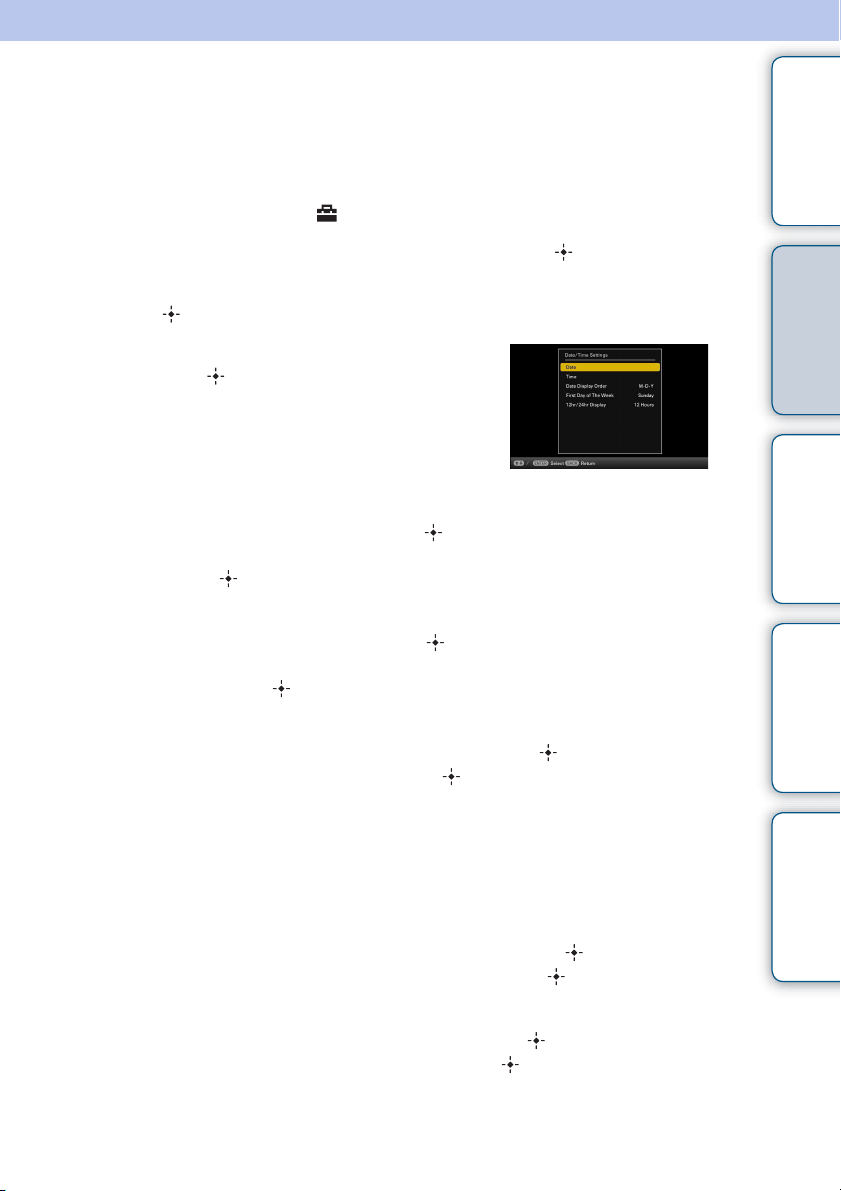
1 Press MENU with the initial display.
2 Press B/b to select the (Settings) tab.
3 Press v/V to select [Language Setting] then press (enter).
4 Press v/V to select the language for display on the LCD screen then
press (enter).
5 Press v/V to select [Date/Time Settings]
then press (enter).
6 Set the date.
1 Press v/V to select [Date] and press (enter).
2 Press B/b to select the month, day, and year, press v/V to select a value,
then press (enter).
7 Set the time.
1 Press v/V to select [Time] and press (enter).
2 Press B/b to select the hour, minute, and second, press v/V to select a
value, then press (enter).
8 Select the display format for the date.
1 Press v/V to select [Date Display Order] and press (enter).
2 Press v/V to select a format and press (enter).
• Y-M-D
• M-D-Y
• D-M-Y
9 Set either Sunday or Monday to start the week for the calendar.
You can set the day of the week that appears on the very left when the calendar is
displayed.
1 Press v/V to select [First Day of The Week] and press (enter).
2 Press v/V to select [Sunday] or [Monday] and press (enter).
10Select the time display.
1 Press v/V to select [12hr/24hr Display] and press (enter).
2 Press v/V to select the time display and press (enter).
11Press MENU.
14
GB
Table of
Contents
Let’s Use Enjoying More Troubleshooting Index
Enjoying a slideshow
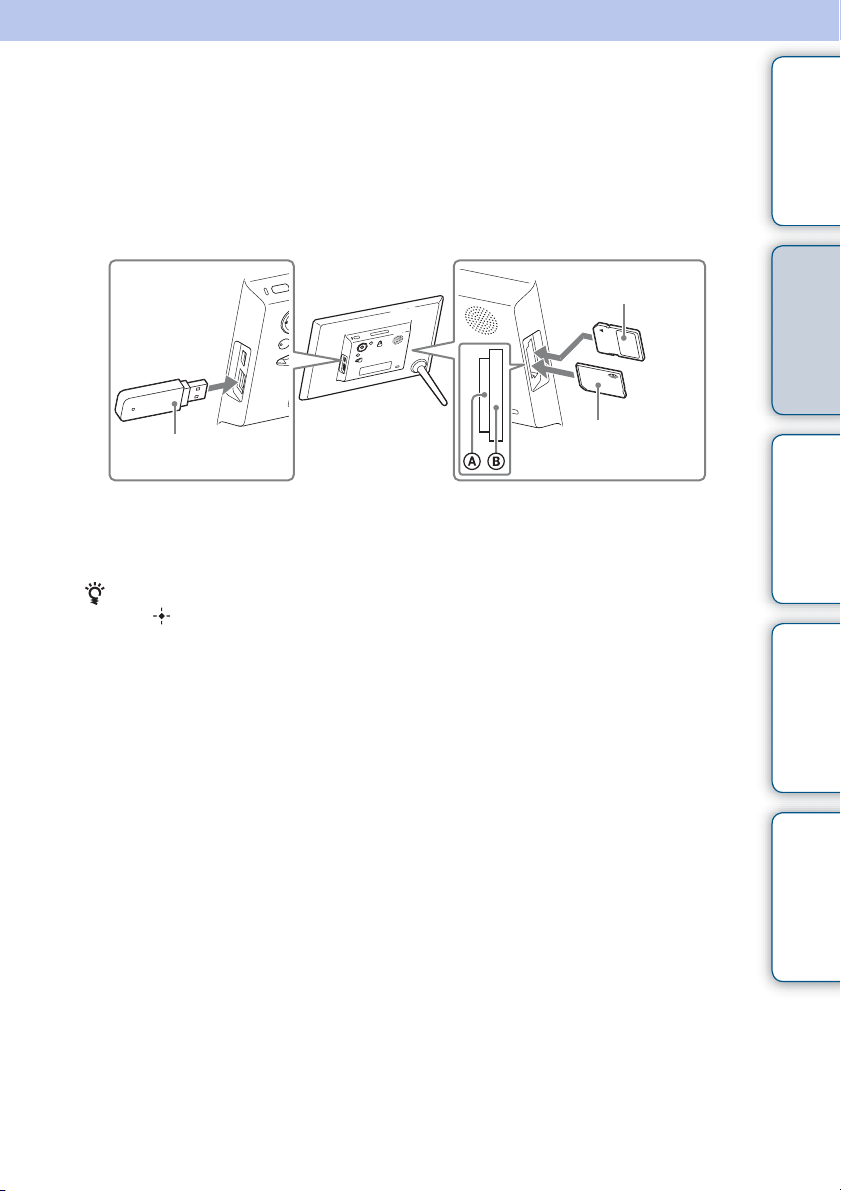
Insert a memory card or USB memory.
Insert the memory card or USB memory firmly into the corresponding slot with its front
facing away from the screen. Playback automatically begins, and images in the memory
card or USB memory are displayed one after another as a slideshow.
• When (enter) is pressed during a slideshow, a single image is displayed.
To remove the memory card
Remove the memory card from its slot in the opposite direction from which it was inserted.
Do not remove the memory card while an image is displayed on the screen. Doing so may
damage the recorded data in the memory card. It is better to press MENU to display the
menu display before removing a memory card.
Have the labels of memory cards facing outward
USB memory
SD memory card
“Memory Stick
Duo”
Continued r
Table of
Contents
Let’s Use Enjoying More Troubleshooting Index
15
GB
• If playback does not start even if you insert a memory card, check the direction and reinsert
it.
• When no memory card is inserted, if no image is stored in internal memory, the
demonstration display appears automatically. The demonstration display closes when a
memory card with image data is inserted, or when any button other than 1 (on/satndby) is
pressed.
• Do not simultaneously insert multiple memory cards and USB memory into the memory card
slots A/B or the USB connector. If multiple memory cards and USB memory media are
inserted, the photo frame may be damaged.
• Note the following when you select a slideshow using the image stored in a memory card.
– Owing to the characteristics of memory card devices, images may be subject to data errors
when read too often.
– Do not run a slideshow for a long time with a small number of images. This may cause data
errors.
– We recommend you back up images in the memory card often.
• The slideshow will not start from the point where you stopped if you turn off the photo
frame.
• When the screen is too bright, it may make you feel nauseous. Be careful not to have the
brightness set too high when you use the photo frame.
16
GB
Table of
Contents
Let’s Use Enjoying More Troubleshooting Index
Changing the view mode
You can change the view mode to another one except with a slideshow or change the
display style as you prefer.
1 Press VIEW MODE on the remote control to select the desired view
mode.
To operate using the buttons on the photo frame
• Press VIEW MODE repeatedly to select the desired view mode.
2 Select a style then press (enter).
• If the cursor is in the view mode selection area, move it to the style selection area by pressing
v.
• In Clock and Calendar mode, only the (Settings) tab can be operated.
• In the single image display, press B or b to select an image to be displayed.
• In Index mode, the display is switched to the single image display when you select an image
with v/V/B/b and press (enter).
• While the index is displayed, the size of the thumbnails can be changed with / to change
the number of the thumbnails on the display.
• If you have not operated the photo frame for an extended period of time, the style indicated
by the cursor is automatically selected.
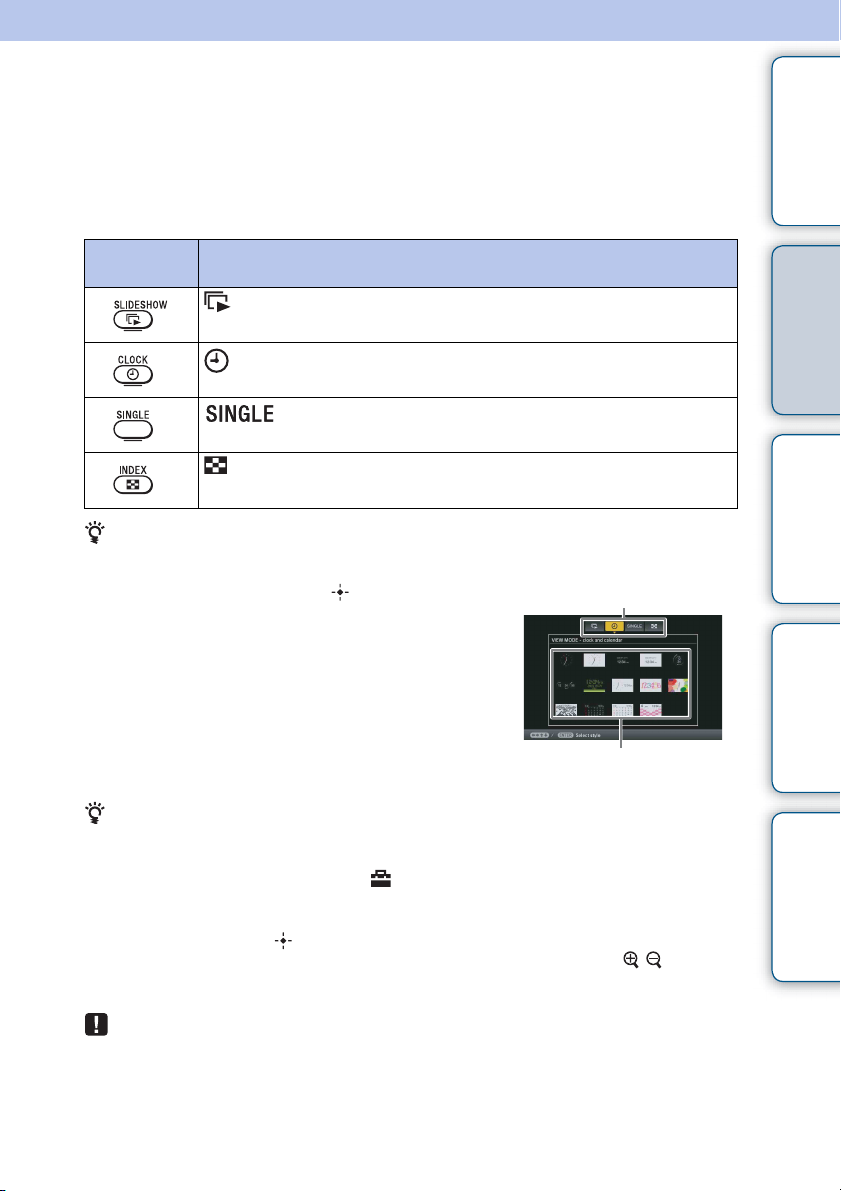
Operation
button
View mode
slideshow
Displays a single screen, one after another.
clock and calendar
Displays a clock or calender.
single image display
Displays a single image on the screen.
index
Displays a list of thumbnails
View mode selection area
Style selection area
17
GB
Table of
Contents
Let’s Use Enjoying More Troubleshooting Index
• You can set the display interval, effect, listing order, color effect or display mode when you
select the Slideshow display. See “Slideshow Settings” (page 39).
• Some of the images may not be displayed completely with the selected slideshow style,
depending on the type of data.
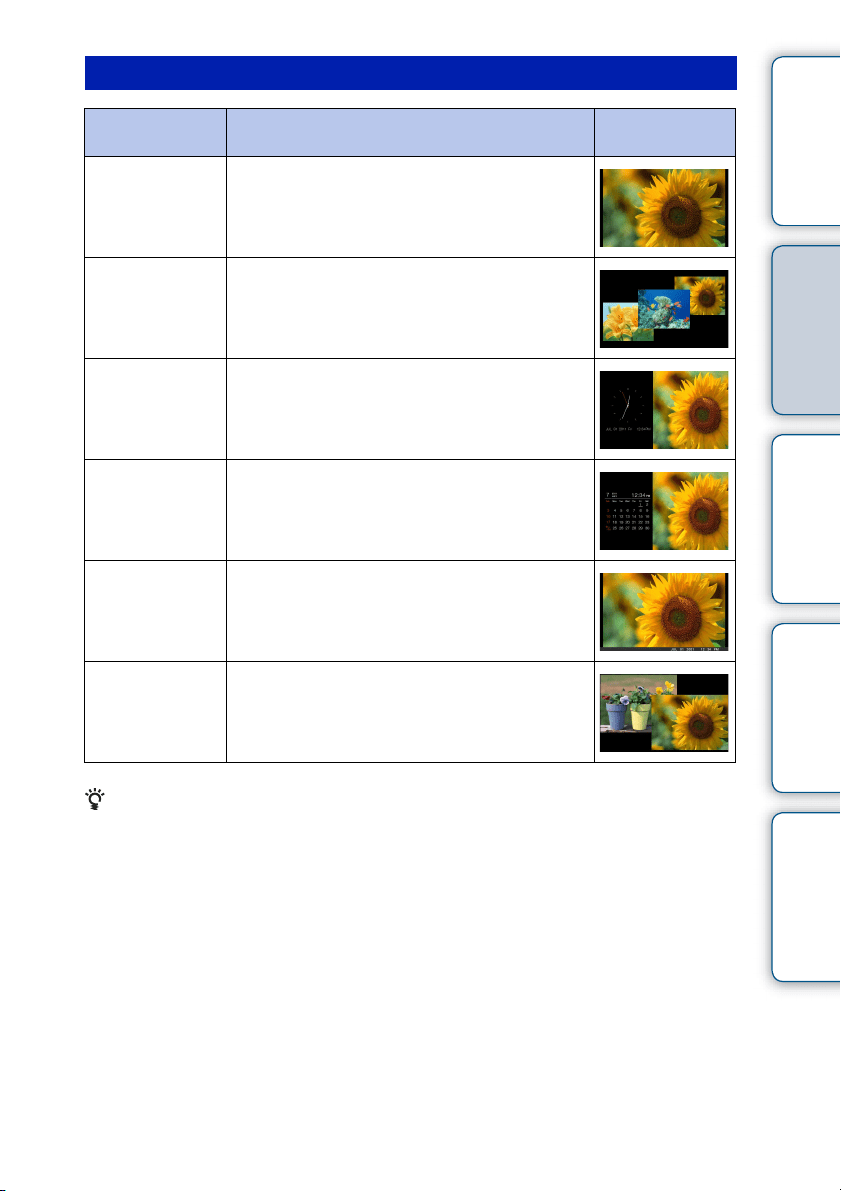
Slideshow styles
Style Description
Display
example
Single View
Displays a single screen, one after another.
Multi image
View
Displays multiple images at the same time.
For a movie file, only the first frame of the file is
displayed.
Clock View
Displays a clock with the current date and time
while showing images one after another.
Calendar View
Displays a calendar with the date and time while
showing images one after another.
With this style current date and time are
displayed.
Time Machine
Displays each image with the date and time when
it was taken. With this style, the current date and
time are not displayed.
Random View
Displays images while switching among the
various slideshow style and effects (page 39).
18
GB
Table of
Contents
Let’s Use Enjoying More Troubleshooting Index
• When “Fit to Screen” or “Fit to Screen (with Exif)” is selected, the following states may
occur for some images.
– A part of the edge of the image is not displayed.
– A whole image is not displayed.
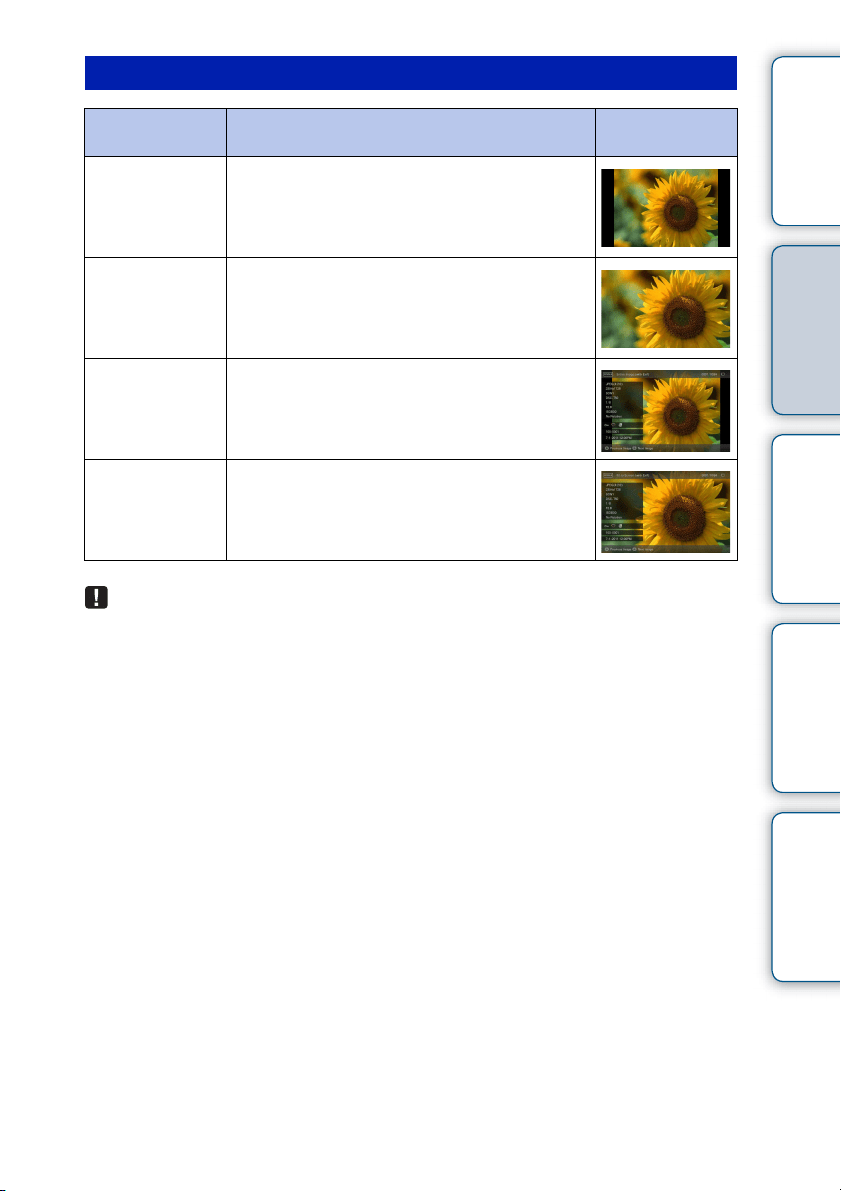
Single View styles
Style Description
Display
example
Entire Image
Displays an entire image on the screen.
Fit to Screen
Displays an image over the whole screen.
Entire Image
(with Exif)
Displays image information, such as the image
number, file name, and shooting date, while
displaying the entire image.
Fit to Screen
(with Exif)
Displays image information, such as the image
number, file name, and shooting date in “Fit to
Screen” mode.
Continued r
19
GB
Table of
Contents
Let’s Use Enjoying More Troubleshooting Index
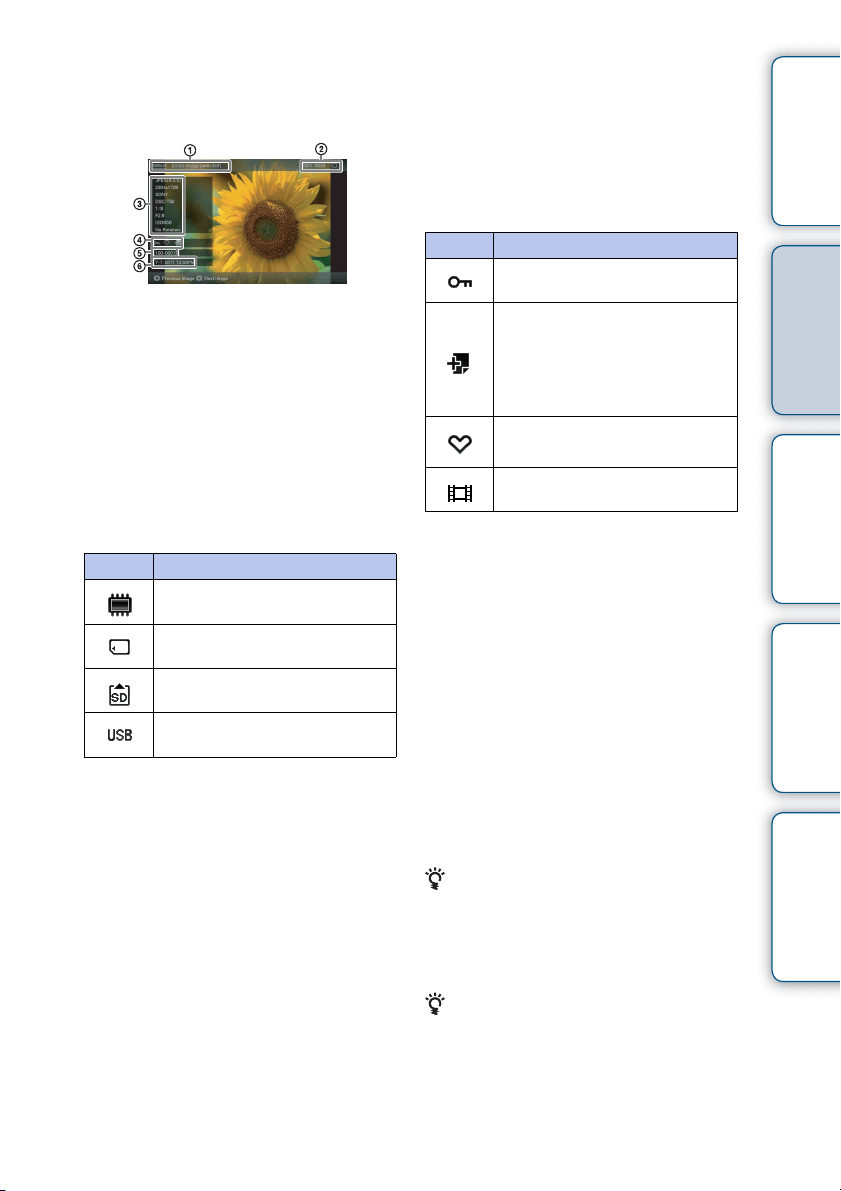
Overview of the information
display
The following information is displayed:
1 Display style (In Single View
mode)
– Entire Image
– Fit to Screen
– Entire Image (with Exif)
– Fit to Screen (with Exif)
2 Ordinal number of the displayed
image/Total number of images
The input media source indication of the
displayed image is shown as follows:
3 Image details
When a photo is displayed
– File format (JPEG (4:4:4), JPEG (4:2:2),
JPEG (4:2:0), BMP, TIFF, RAW)
– Number of pixels (width × height)
– Manufacturer name of image input
device
– Model name of image input device
– Shutter speed (e.g.: 1/8)
– Aperture value (e.g.: F2.8)
– ISO sensitivity (e.g.: ISO800)
– Rotation information
When a movie file is played
– File format (AVI, MOV, MP4, MPEG-
2 PS, MPEG-2 TS)
– File size
– Playback duration
– Movie file size (video width × video
height)
– Video codec
–Audio codec
4 Setting information
5 Image number (folder-file
number)
This is displayed if the image is DCF
compliant. If the image does not comply
with DCF, its file name is displayed. If you
named or renamed the file on your
computer and the file name includes
characters other than alphanumeric
characters, the file name may not be
displayed properly on the photo frame.
Also, for a file created on a computer or
other device, the first 10 characters at
maximum of the file name can be
displayed.
• Only alphanumeric characters can be
displayed.
6 Shooting date/time
• This is not displayed for movie files.
Icons Meaning
Internal memory
“Memory Stick Duo” input
SD memory card input
USB memory input
Icons Meaning
Protected indication
Associated file indication
(displayed when there is an
associated file, such as a motion
file or a miniature e-mail image
file.)
Displayed when you have
registered a favorite mark.
Displayed for a movie file.
20
GB
Table of
Contents
Let’s Use Enjoying More Troubleshooting Index
Playing a movie
1 Press .
2 Select a movie file you want to play.
3 Press (enter).
The selected movie file starts playback.
To adjust the volume
Press VOL +/VOL – during playback or playback pause of the movie file.
• Depending on the movie file, fast forward/backward playback may not be available with the
photo frame.
• You cannot play the following types of movie file:
– Movie files with copyright protection
– Movie files that exceed the maximum number of pixels either in width or height (We
cannot guarantee operation with movie files not mentioned above.)
• Fast forward/backward playback and playback pause are not available during Slideshow
display.
• Continuous playback of a movie that has been divided into multiple files during recording is
not allowed. Play the divided files one by one.
• Dropped frames may occur, depending on the types of data or the transmission speed of the
memory card.
• Some of the movie files may not be played smoothly, depending on the type of data.
• For details on movie files, see the instruction manual of your camera.
Function Operation
To pause playback Press (enter).
To resume playback, press (enter) again.
Fast forward/backward
playback
Press B/b.
When you press (enter), normal playback starts from that
point.
To stop playback Press BACK.

21
GB
Table of
Contents
Let’s Use Enjoying More Troubleshooting Index
Saving images in your photo frame
(import)
If you save the data of a memory card in internal memory, the still images can be displayed
on this photo frame without the memory card.
• When saving images to internal memory, you can use [Image import size] of the menu to
preset whether to resize images to the optimum size or save them as-is without compressing
them (page 41).
• When [Image import size] is set to [Resize], up to approximately 4000 images can be saved
in the internal memory. When set to [Original], the number of images that can be saved may
vary, depending on the original image file sizes.
1 Press IMPORT when an image stored
in the memory card is displayed on the
screen.
To operate using the buttons on the photo frame
1Press MENU with an image stored in the memory card displayed.
2Press B/b to select the (Editing) tab, select B/b, [Import] with v/V then press
(enter).
2 Select an item and press (enter).
[Import This Image]: The image currently displayed is imported to the internal
memory.
This item cannot be selected on the slideshow display.
[Import Multiple Images]: Select the image to be imported from the image list and
press (enter).
If you want to import multiple images at a time, repeat this step.
[Import All Images]: An image list will appear with the check boxes checked for all
images.
Press MENU to display the folder selection screen.
Saving still images
Continued r
Table of
Contents
Let’s Use Enjoying More Troubleshooting Index
22
GB
3 Select the folder in which you want to save the files then press
(enter).
A confirmation screen for importing images is displayed.
A new folder is created automatically when you select [New folder].
4 Select [Yes] and press (enter).
The image(s) is (are) imported to the specified folder.
5 Press (enter) when confirmation screen is displayed.
• Avoid the following while an image is being imported to internal memory. Doing so may
damage the photo frame, memory card, or data:
– Turning off the power
– Removing a memory card
– Inserting another memory card
Importing movie files from the memory card to internal memory is not available. To
import a movie file, connect a computer to the photo frame first, then transfer the file from
the computer to the internal memory of the photo frame. For details, see “Copying images
and music from a computer” (page 44).
Saving movies
23
GB
Table of
Contents
Let’s Use Enjoying More Troubleshooting Index
Specifying the playback memory
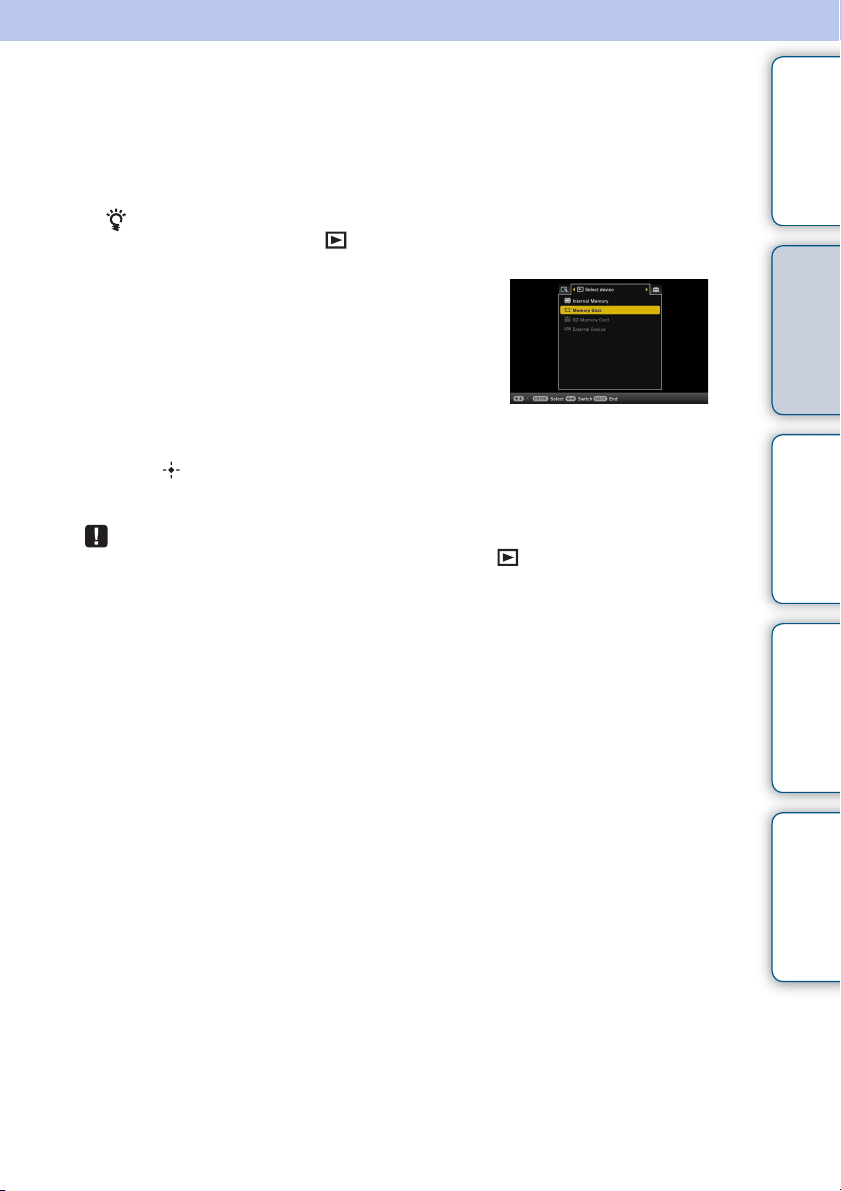
You can specify the device among a memory card, internal memory, etc, the contents of
which you want to have displayed.
1 Press SELECT DEVICE.
To operate using the buttons on the photo frame
• Press MENU then select the (Select device) tab with B/b.
If the memory card you want to select is not inserted,
insert it now.
2 Select the memory whose contents you want to have displayed then
press (enter).
The images in the selected memory are displayed.
• During clock and calendar display, you cannot select the (Select device) tab.
24
GB
Table of
Contents
Let’s Use Enjoying More Troubleshooting Index
Playing a slideshow with background
music
1 Press MENU, select (Settings) tab with B/b, then select [Slideshow
BGM Settings].
2 Select [Import BGM] and press (enter).
3 Select a music file you want to play from the built-in music file list then
press (enter).
A check mark (✔) is displayed next to the selected file.
4 Repeat step 3 if you want to select two or more files.
5 Press MENU.
6 Start a slideshow.
See “Enjoying a slideshow” (page 14).
The music file(s) with the check mark (
✔) is (are) played.
To adjust the volume
Press VOL +/VOL – during playback or playback pause mode of the movie file.
To stop the background music
Select the file with a check mark (✔) and press (enter) to delete the check mark.
Alternatively, select [BGM ON/OFF] in [Slideshow BGM Settings] of the menu then set it
to [OFF].
• Only music files imported to internal memory can be played.
• Fast forward/backward playback of background music is not available. Also, you cannot
change the playback order of background music files.
• Background music cannot be played during playback of movie. The sound of the movie file is
played with the movie. The background music for the photo displayed, soon after the playback
of the movie, will start playback from the beginning of the next music file.
Enjoying More
25
GB
Table of
Contents
Let’s Use Enjoying More Troubleshooting Index
You can use your favorite music file as background music by importing it to the photo
frame.
• Before importing a music file, make sure that the file can be played with the photo frame. For
files that can be played, see “Background music” (page 56) of “Specifications”.
1 Insert a memory card or USB memory that contains a music file into the
memory card slot of the photo frame.
2 Press MENU, select (Settings) tab with B/b, then press v/V to
select [Slideshow BGM Settings].
3 Select [Import BGM] and press (enter).
4 Select the memory card inserted in step 1.
5 Select a music file you want to import from the music file list and press
(enter).
A check mark (✔) is displayed next to the selected file.
To clear the selection, select the file you want to clear then press (enter).
6 Repeat step 5 if you want to select two or more files.
7 Press MENU after you finish selecting the music file(s).
8 Press (enter) when the confirmation screen is displayed.
The selected music file is imported to internal memory of the photo frame.
To delete a music file imported to internal memory
1 Select [Delete BGM] on the [Slideshow Settings] screen in step 2 then press (enter).
2 Select the music file you want to delete from the music file list then press (enter).
3 Press MENU, then press (enter) when the confirmation screen appears.
The selected music file will be deleted.
Importing a music file
Continued r
26
GB
Table of
Contents
Let’s Use Enjoying More Troubleshooting Index
• Playback of the imported music file is enabled only as background music for a slideshow.
• The music files provided in the internal memory at the factory as BGM1, BGM2, and BGM3
cannot be deleted.
• Up to 40 music files can be imported to internal memory of the photo frame.
• Up to 200 music files can be shown on the importing music file list display.
• Only the file name is displayed for a music file. A song title and artist’s name cannot be
shown.
27
GB
Table of
Contents
Let’s Use Enjoying More Troubleshooting Index
Adjusting image size and orientation
To enlarge an image, press (zoom in) in Single View mode. To reduce
an enlarged image, press (zoom out).
You can enlarge an image from 1.5 times to 5 times (maximum) the original scale. You can
pan an enlarged image.
To operate using the buttons on the photo frame
1Press MENU in Single View mode.
2Press B/b to select the (Editing) tab.
3Press v/V to select [Zoom] then press (enter).
4Press v/V to select the enlargement factor then press (enter).
To save an enlarged or reduced image (Crop and save)
1 Press MENU while the enlarged or reduced image is displayed.
2 Select the saving method.
[Save as new image]: A copy of the image is saved.
1.Select the memory in which the image is to be saved
then press (enter).
2.Select a destination folder
then press (enter).
[Overwrite]: The new image overwrites the old image.
3 Select [Yes] and press (enter).
4 When the confirmation screen appears, press (enter).
The image is saved.
• If you pan the enlarged image with v/V/B/b and press MENU in step 1, the image is cropped
to the displayed image size and saved.
• You can change the thumbnail size for the image list, using (zoom in) or (zoom out).
• You cannot overwrite files except for a JPEG files (extension: .jpg or .jpeg).
• Enlarging an image may reduce the quality, depending on the image size.
• A movie file cannot be enlarged or reduced.
Enlarging/reducing an image
28
GB
Table of
Contents
Let’s Use Enjoying More Troubleshooting Index
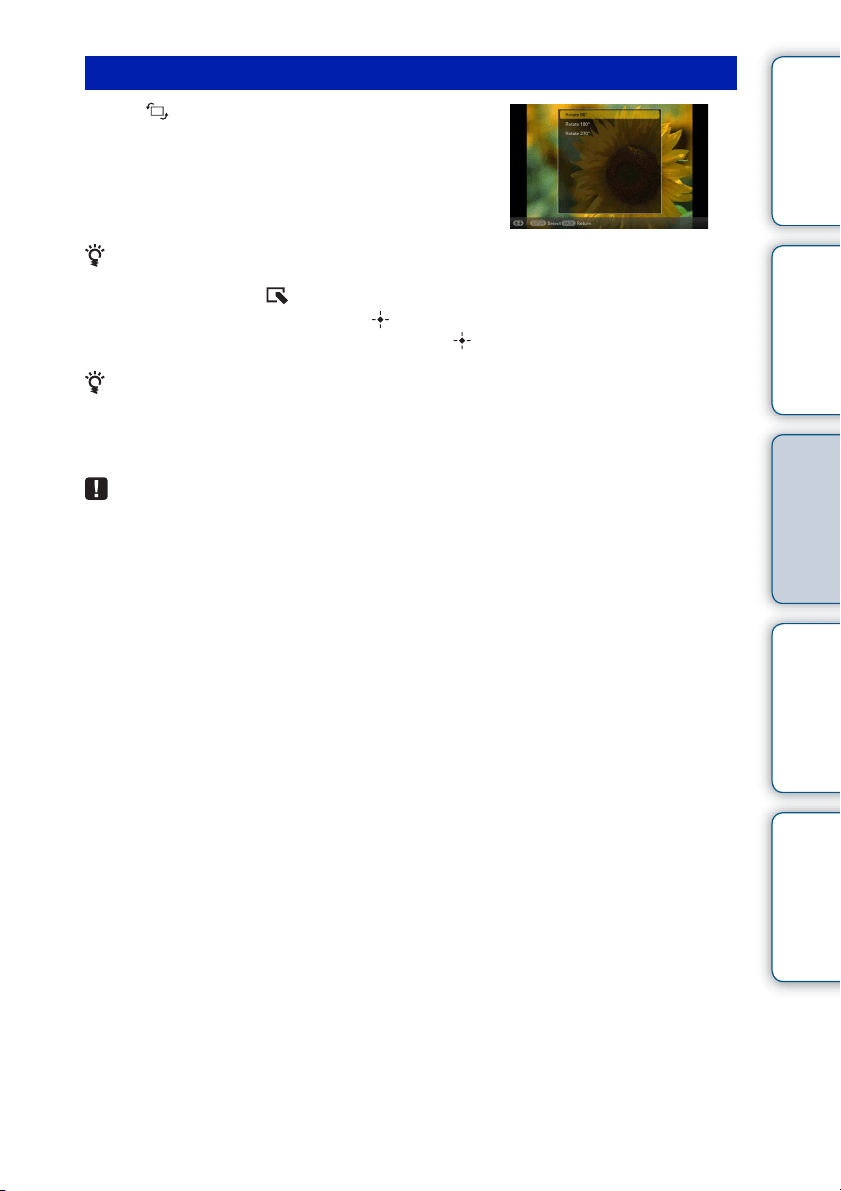
Press ROTATE on the remote control.
The image rotates 90 degrees counterclockwise each time
you press the button.
To operate using the buttons on the photo frame
1Press MENU in Single View mode.
2Press B/b to select the (Editing) tab.
3Press v/V to select [Rotate] then press (enter).
4Press v/V to select the angle of rotation then press (enter).
• For an internal memory image, image rotation data will be retained even after the power is
turned off.
• You can also rotate the index image display.
• An enlarged image cannot be rotated.
• A movie file cannot be rotated.
Rotating an image
29
GB
Table of
Contents
Let’s Use Enjoying More Troubleshooting Index
Registering a favorite mark
You can produce a slideshow with only the images preselected bearing the marks. You can
easily check for images with marks using the index image display or single view mode.
1 Press MARKING when an image for which you want to register a
mark is displayed on the screen.
To operate using the buttons on the photo frame
1 Press MENU when an image is displayed on the screen.
2Press B/b to select the (Editing) tab, select [Marking] with v/V, and press
(enter).
2 Select the desired mark then press (enter).
3 Select an item then press (enter).
[Mark This Image]: The image currently displayed will be marked. (This item cannot
be selected on the slideshow display.)
[Mark/Unmark Multiple Images]: The image list is displayed.
Select an image from the image list to be marked then press (enter). A check mark
(
✔) is added to the selected image. If you want to mark multiple images at a time,
repeat this step.
[Mark All Images]: An image list will appear with the check boxes checked for all
images.
4 Press MENU.
A confirmation screen appears.
5 Select [Yes] then press (enter).
The favorite mark is placed for the selected image(s).
To delete the mark
Select [Unmark this image] or [Unmark all images] then press (enter) in step 3.
Otherwise select an image for which you want to delete the mark then press (enter) to
delete the check mark (✔).
• When a sorting (filtering) operation (page 30) is in progress, the images that correspond to
the sorting requirements are displayed in a list in step 3.
• A mark is saved only when it is registered with an image in the internal memory.
• A mark registered on the memory card image is deleted when the power is turned off, or if
you change the playback device.
30
GB
Table of
Contents
Let’s Use Enjoying More Troubleshooting Index
Sorting images (Filtering)
You can sort images stored in internal memory or a memory card according to date, folder,
image orientation (vertical/horizontal), marks, or movies/still images.
1 Press SORT when an image is displayed on the screen.
To operate using the buttons on the photo frame
1 Press MENU with an image displayed on the screen.
2Press B/b to select the (Editing) tab, select [Sort] with v/V, then press (enter).
2 Select a sort style and press (enter).
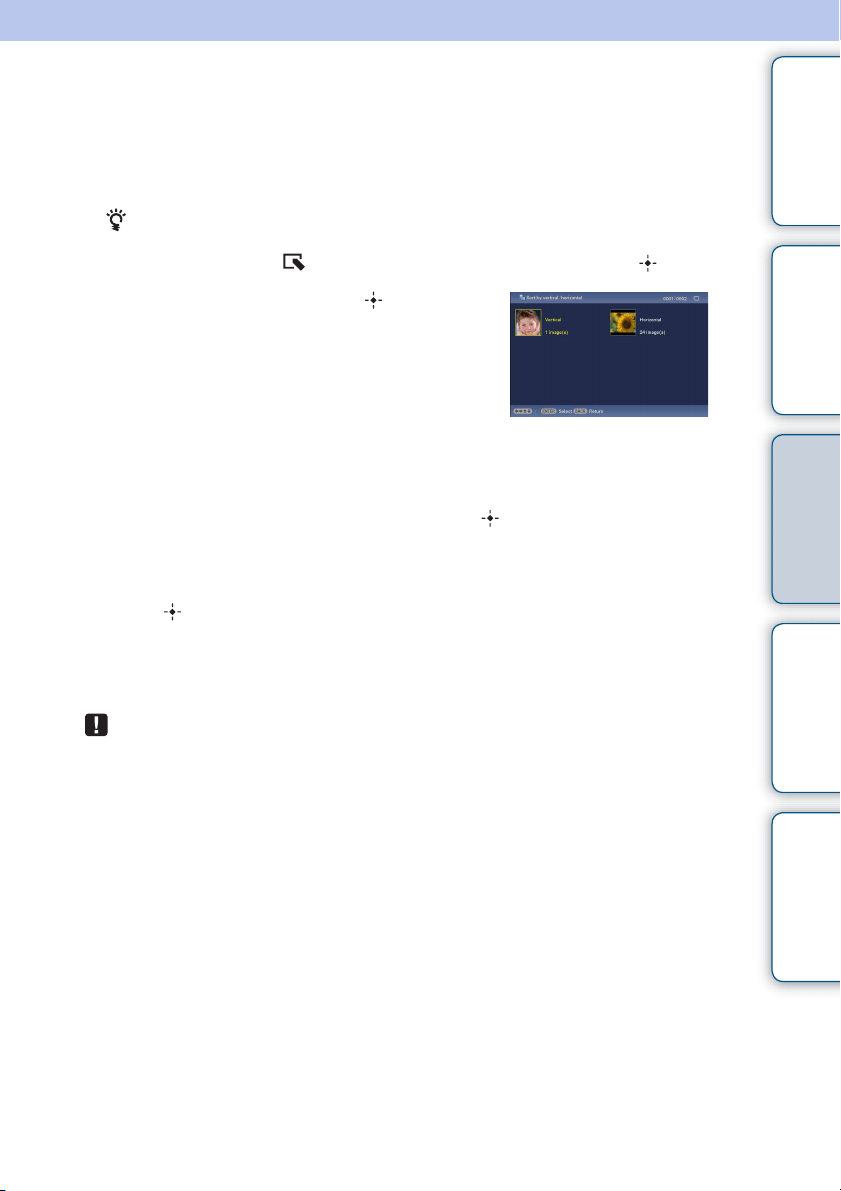
[Sort by date]: Filters by shooting date.
[Sort by folder]: Filters by folder.
[Sort by vertical/horizontal]: Filters by the image
orientation.
[Sort by mark]: Filters by mark (page 29).
[Sort by videos/photos]: Filters according to files that
contain movies (videos) or still images (photos). Either the movie files or still image
files are sorted.
3 Select the desired option item, then press (enter).
To cancel a sort operation
Press MENU while the sorted images are displayed, select [Exit sort (show all photos)],
then press
(enter).
To change the sort style
Press BACK while the sorted images are displayed.
• Do not turn the photo frame off or remove the memory card during sorting. Doing so may
damage the photo frame or the memory card or corrupt the data.
• Sorting is automatically canceled in the following cases:
– When the playback source (device) is changed
– When images in a memory card are sorted and the memory card is removed
31
GB
Table of
Contents
Let’s Use Enjoying More Troubleshooting Index
Deleting an image
1 Press DELETE when an image you want to delete is displayed on
the screen.
To operate using the buttons on the photo frame
1 Press MENU with an image you want to delete displayed on the screen.
2Press B/b to select the (Editing) tab, select [Delete] with v/V, then press (enter).
2 Select an item then press (enter).
[Delete This Image]: The image currently displayed is deleted. (When the view mode
is Slideshow, this option is not selectable.)
[Delete Multiple Images]: An image list is displayed.
Select the images to be deleted from the image list then press (enter). A check mark
(✔) is added to the selected image. If you want to delete multiple images at a time,
repeat this operation.
[Delete All Images]: An image list will appear with check boxes checked for all
images.
3 Press MENU.
A deletion confirmation screen is displayed.
4 Select [Yes] then press (enter).
The image is deleted.
5 Press (enter) when the confirmation screen is displayed.
• Avoid doing the following while an image is being deleted. Doing so may damage the photo
frame, memory card, or data:
– Turning off the power
– Removing a memory card
– Inserting another memory card
• When the message [Cannot delete a protected file.] appears on the screen, the image file was
set to “Read Only” on a computer. In this case, connect the photo frame to a computer and
delete this file using the computer.
• Once deletion has started, the deleted image cannot be recovered, even if you stop deletion.
Delete images only after confirming you actually want to delete them.
Continued r
Table of
Contents
Let’s Use Enjoying More Troubleshooting Index
32
GB
To format the internal memory
1 Press MENU button.
2 Press B/b to select the (Settings) tab.
3 Press v/V to select [Initialize] then press (enter).
4 Select [Format Internal Memory] then press (enter).
A confirmation screen for initializing the internal memory is displayed.
5 Select [Yes] then press (enter).
• Note that all the images added to the internal memory will be deleted by formatting.
• The total capacity of the internal memory is not equal to the remaining capacity even
immediately after initialization.
• Do not format the internal memory using connection to a computer.
33
GB
Table of
Contents
Let’s Use Enjoying More Troubleshooting Index
Exporting an image from internal
memory
You can export images in internal memory to a memory card.
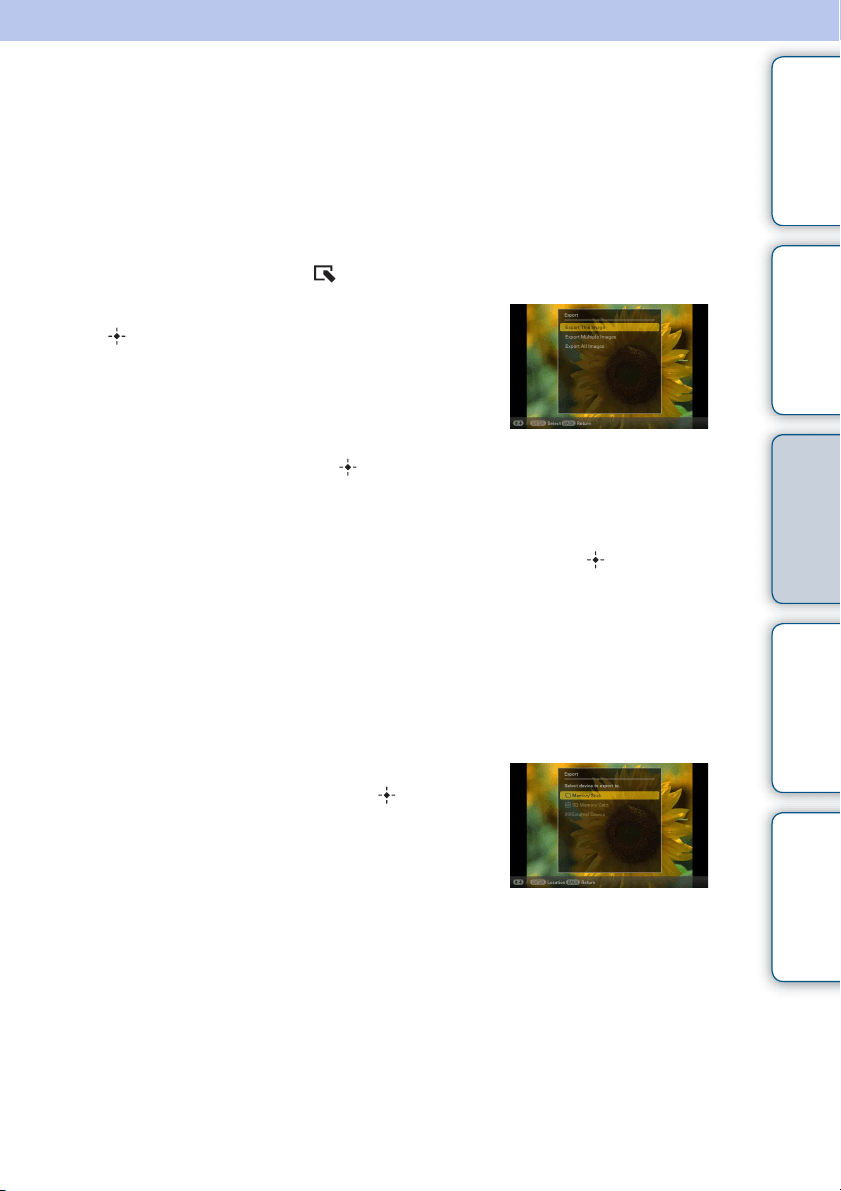
1 Press MENU when an image stored in internal memory is displayed on
the screen.
2 Press B/b to select the (Editing) tab.
3 Press v/V to select [Export] then press
(enter).
4 Select an item then press (enter).
[Export This Image]: The image currently displayed is exported to the device. (This
item cannot be selected on the slideshow display.)
[Export Multiple Images]: An image list is displayed.
Select the image to be exported from the image list then and press
(enter). A check
mark (
✔) is added to the selected image. If you want to export multiple images at a
time, repeat this operation.
[Export All Images]: An image list will appear with check boxes checked for all
images.
5 Press MENU.
A screen for selection of the memory card to which the image is to be exported is
displayed.
6 Select a memory card to which the image
is to be exported then pres
s (enter).
Continued r
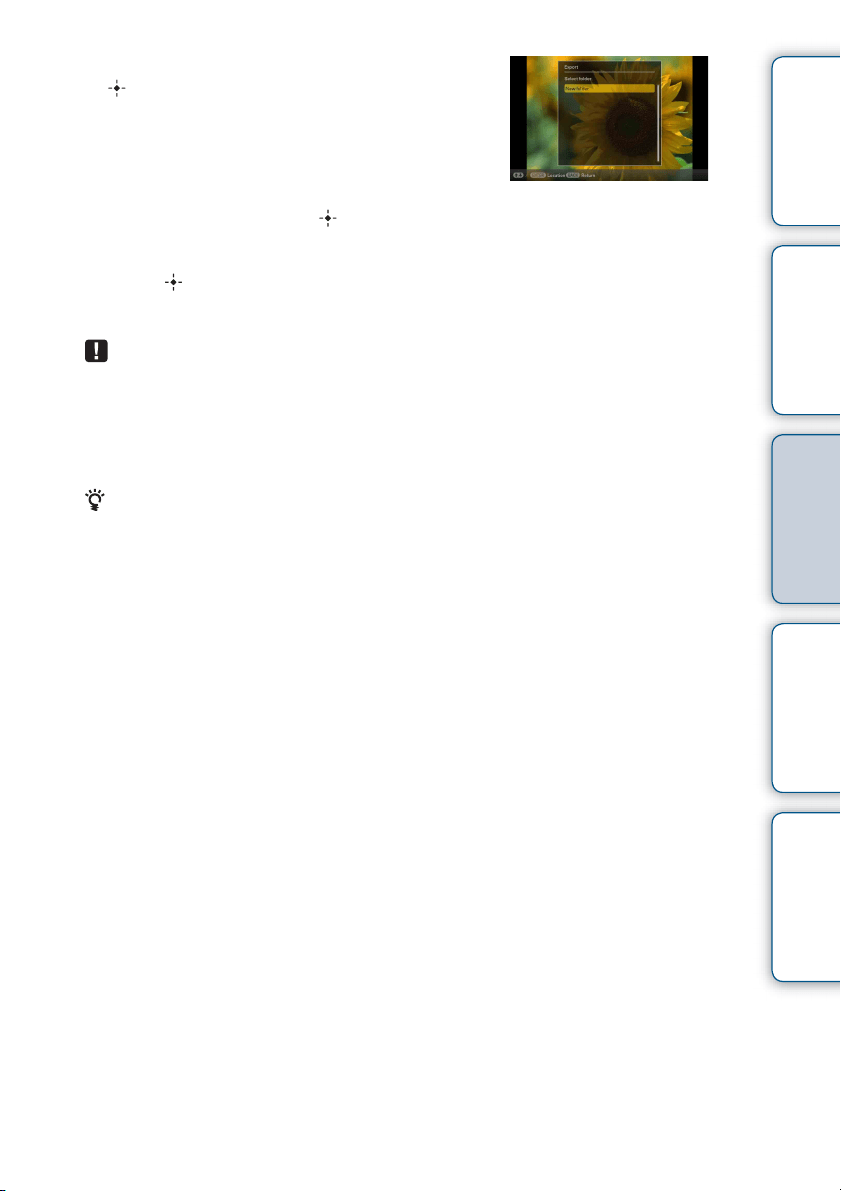
Table of
Contents
Let’s Use Enjoying More Troubleshooting Index
34
GB
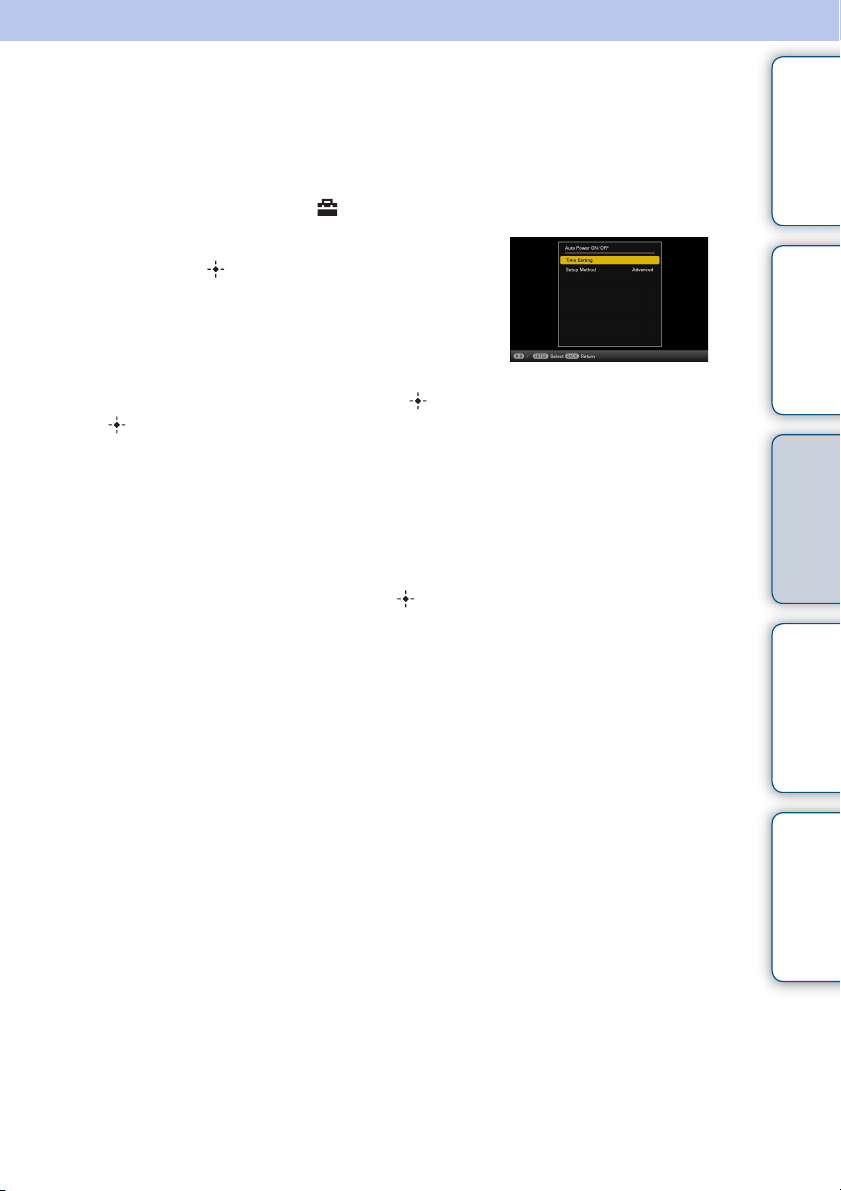
7 Select a destination folder then press
(enter).
A confirmation screen for exporting the image is
displayed.
When you select [New folder] the folder in which the
image will be stored is created automatically.
8 Select [Yes] then press (enter).
The image is exported.
9 Press (enter) when the confirmation screen is displayed.
The image is copied to the specified memory card.
• Avoid the following while an image is being exported. Doing so may damage the photo
frame, memory card, or data:
– Turning off the power
– Removing a memory card
– Inserting another memory card
• Any device that is not recognized by the photo frame is displayed in gray and cannot be
selected.
• When a sorting (filtering) operation is in progress, the images that correspond to the sorting
requirements are displayed as a list.
35
GB
Table of
Contents
Let’s Use Enjoying More Troubleshooting Index
Using the auto power on/off timer
You can use the timer function to turn the photo frame on or off automatically.
1 Press MENU.
2 Press B/b to select the (Settings) tab.
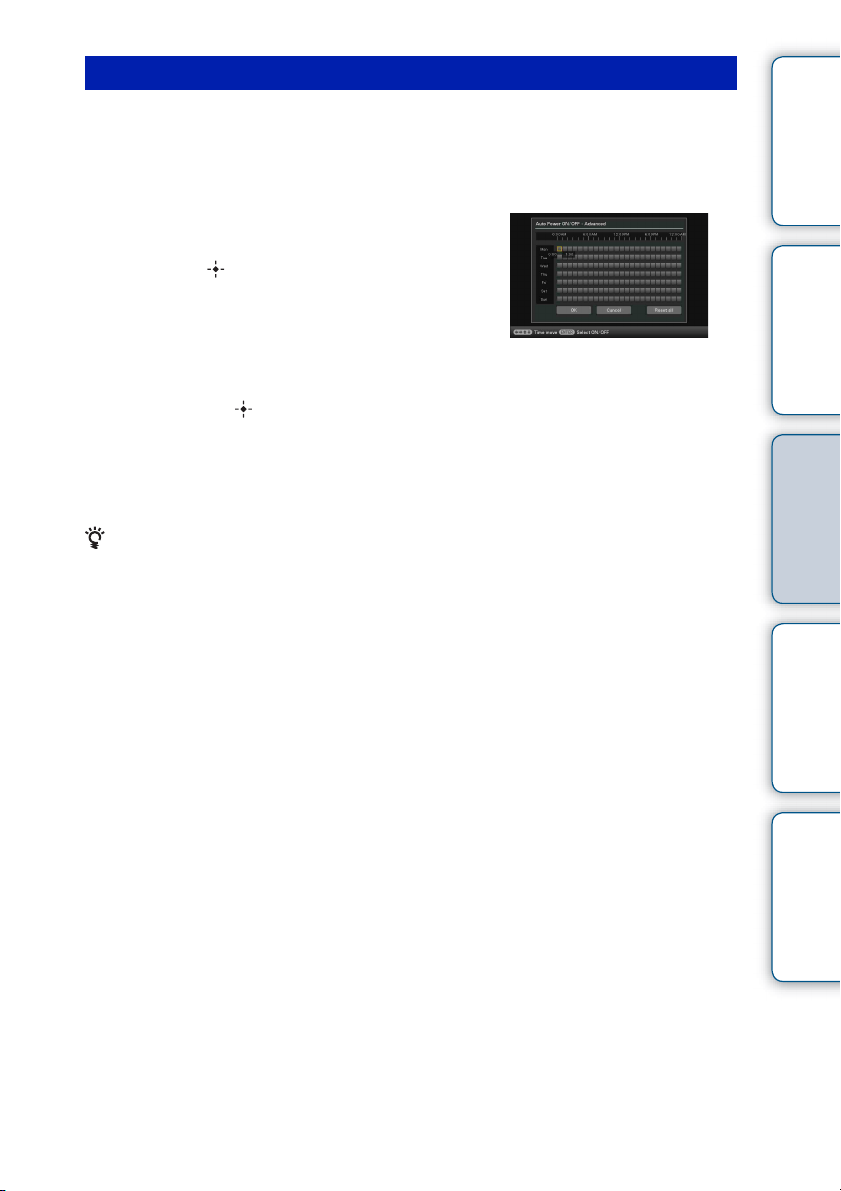
3 Press v/V to select [Auto Power ON/OFF]
then press
(enter).
4 Select [Setup Method] then press (enter). Select an item and press
(enter).
[Advanced]: You can set the auto power on/off function in one-hour units
independently for each day of the week.
[Simple]: You can set the auto power on/off function in one minute increments.
[Auto off]: You can set the auto power off time as a specified time that has elapsed with
no operation after the photo frame is turned on. You can specify two or four hours as an
elapsed time.
5 Select [Time Setting] then press (enter).
Set the time for the selected Setup Method as mentioned in “Setting the time” (page 36).
6 Press MENU.
36
GB
Table of
Contents
Let’s Use Enjoying More Troubleshooting Index
Perform the setting according to the Setup Method selected in step 4 of “Using the auto
power on/off timer” (page 35).
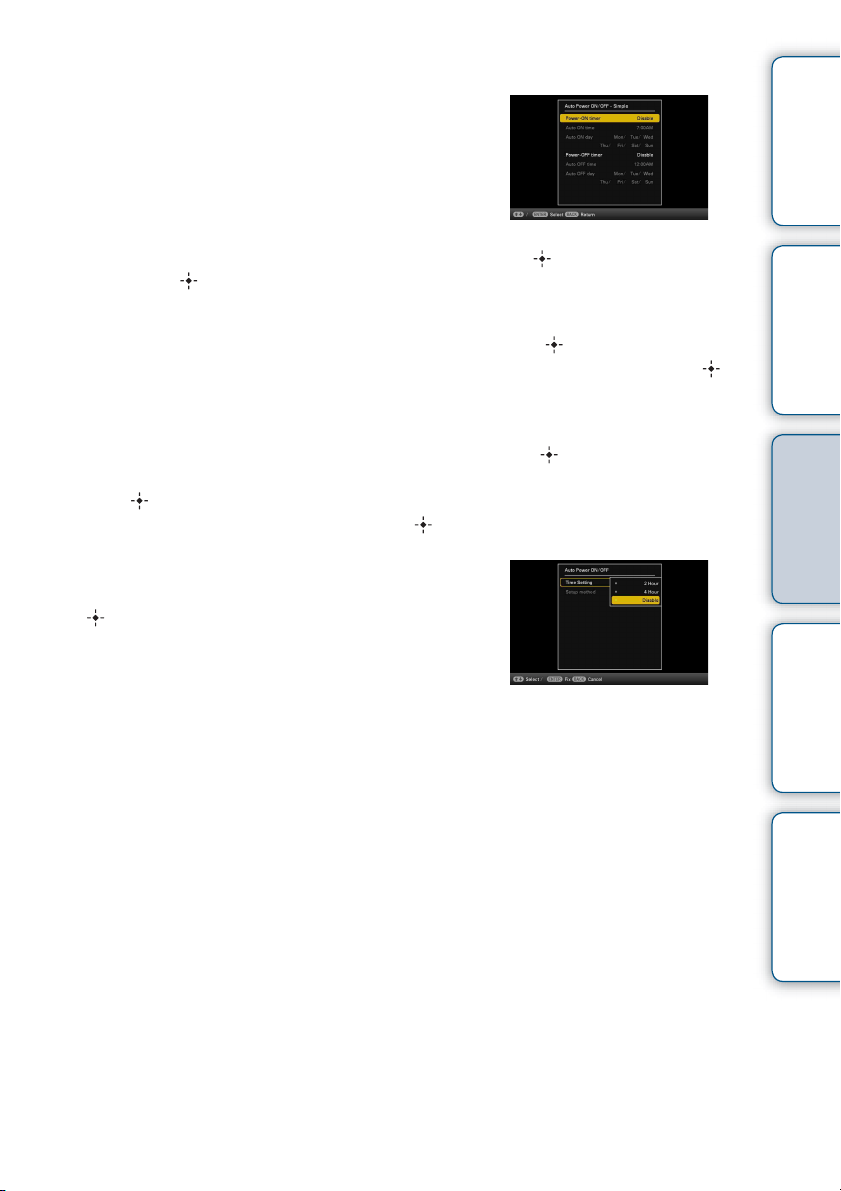
When [Advanced] is selected:
1 Press v/V/B/b to set the time after which
you want the power automatically turned on
then press (enter)
.
You can set the time by one-hour units independently
for each day of the week. The color of the selected
time zone changes to blue, and the power turns on.
2 Press v/V/B/b to set the time you want the power automatically turned
off then press (enter).
Set the time in one-hour units for each day of the week. The color of the selected time
zone changes to gray, and the power is turned off.
3 Select [OK].
• The power is turned off automatically at the time you set for [Power-OFF timer] when you
are using the photo frame.
Setting the time
Continued r
37
GB
Table of
Contents
Let’s Use Enjoying More Troubleshooting Index
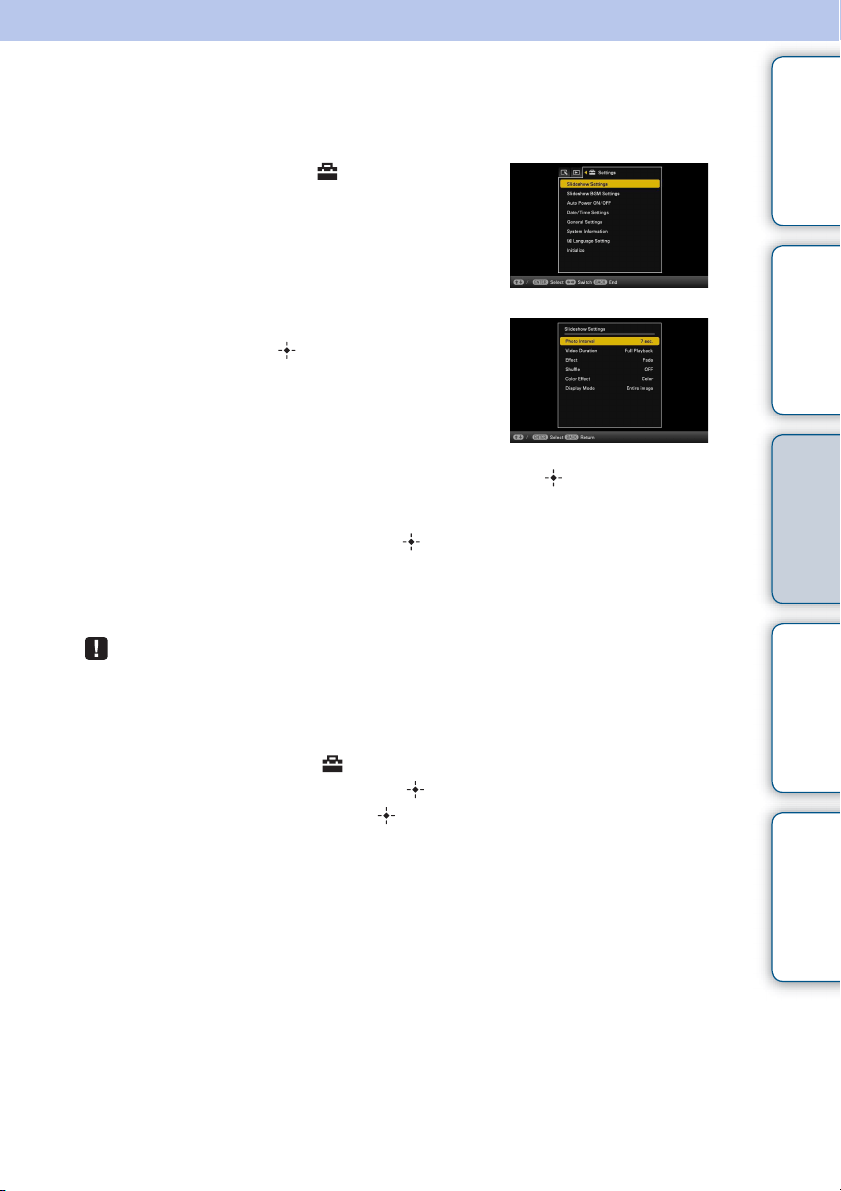
When [Simple] is selected:
1 Select an item for which you want to set the
time.
Select [Power-ON timer] or [Power-OFF timer] then press (enter). Select [Enable]
and press (enter).
2 Set the time.
1 Select [Auto ON time] or [Auto OFF time] and press (enter).
2 Press B/b to select the hour or minute, press v/V to adjust it, and press
(enter).
3 Select the day of the week.
1 Select [Auto ON day] or [Auto OFF day] then press (enter).
2 Select the day of the week on which you want the timer activated then press
(enter). The select day of the week is checked.
3 Move the cursor to [OK] then press
(enter).
When [Auto off] is selected:
Select [2 Hour], [4 Hour] or [Disable] then press
(enter).
38
GB
Table of
Contents
Let’s Use Enjoying More Troubleshooting Index
Changing the settings
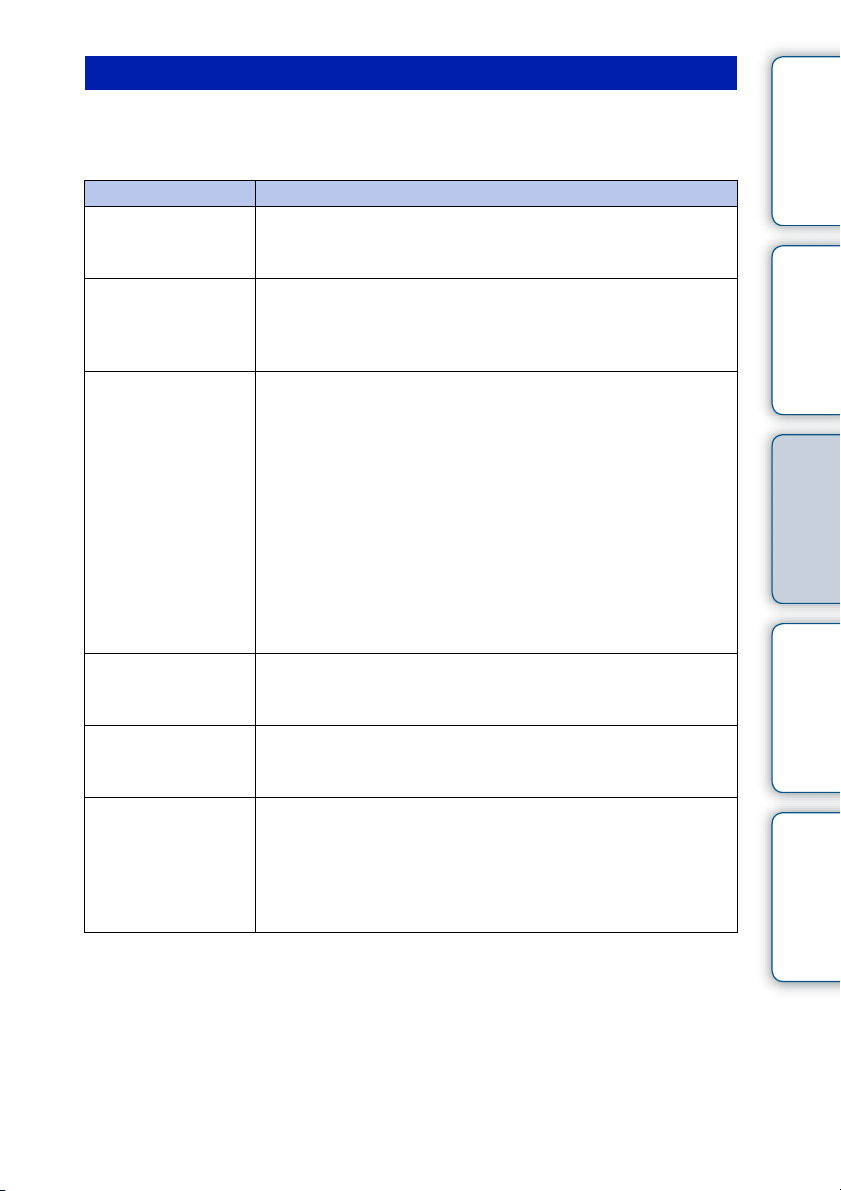
1 Press MENU.
2 Press B/b to select the (Settings) tab.
3 Press v/V to select the item you want to
change then press (enter).
The setting screen for the selected item is displayed.
4 Select the setting you want to change then press (enter).
This enables you to change the setting (page 39).
5 Select a setting value then press (enter).
6 Press MENU.
The menu closes.
• When the photo frame is, for instance, displaying a slideshow, some option settings cannot
be changed in step 4. They are displayed in gray and cannot be selected.
To reset to the factory default settings
1 Press MENU, then select the (Settings) tab by pressing B/b.
2 Press v/V to select [Initialize] then press (enter).
3 Select [Initialize Settings] then press
(enter).
All adjusted values, except for the date/time settings, are reset to the default settings.
39
GB
Table of
Contents
Let’s Use Enjoying More Troubleshooting Index
*
: Items with asterisks are the factory default settings. (Some default settings vary by region.)
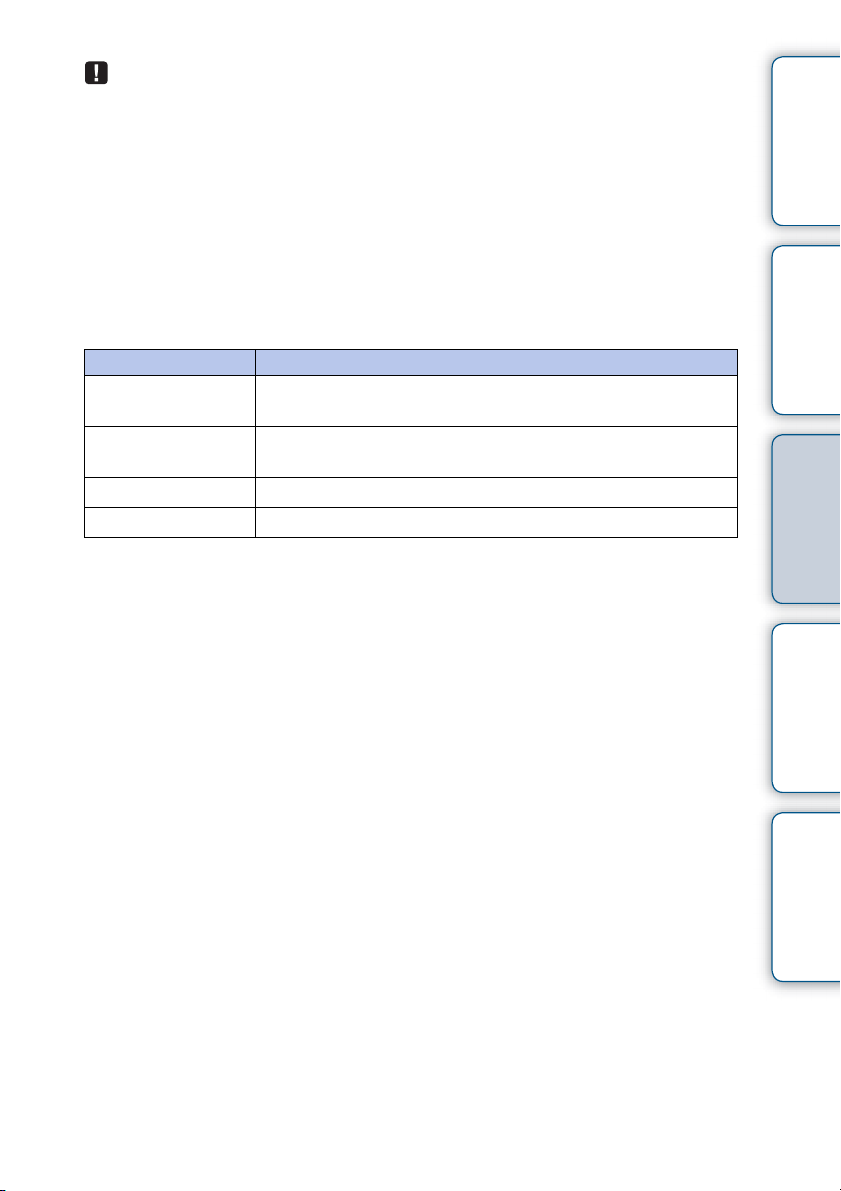
Slideshow Settings
Overview of the available settings
Setting Description
Photo Interval Selects 3 sec., 7 sec.*, 20 sec., 1 min., 5 min., 30 min., 1 hour, 3
hours, 12 hours, or 24 hours for the interval for switching still
images.
Video Duration Specifies the interval for switching movie files with the playback
time from the beginning of each files.
You can select First 10 sec., First 15 sec., First 30 sec., First 1
min., First 3 min. or Full Playback
* for the playback time.
Effect Center Cross: Transitions to the next image as though the
previous image were being pushed from the center to the four
corners.
Vert. Blinds: Transitions to the next image as though blinds
were being lowered vertically.
Horiz. Blinds: Transitions to the next image as though blinds
were being pulled horizontally.
Fade
*: Transitions to the next image by fading the current image
out and fading the next image in.
Wipe: Transitions to the next image as though the current image
were being wiped off the screen to reveal the next image.
Random: Swiching images by using the above five effects
randomly.
Shuffle ON: Displays images randomly.
OFF
*: Displays images according to the “Image Listing Order”
setting of General Settings.
Color Effect Color
*: Displays an image in color.
Sepia: Displays an image in sepia color.
Monochrome: Displays an image in monochrome.
Display Mode Entire Image: Displays an entire image enlarged without
cropping. (Some images may be displayed with black margins at
top, bottom, left, and right.)
Fit to Screen
*: Displayes an image to fill the entire screen by
partially cropping the borders as required without changing the
aspect ratio.
Continued r
40
GB
Table of
Contents
Let’s Use Enjoying More Troubleshooting Index
• The image may not be changed to the next one at the specified interval, depending on the
slideshow style, image size, or color effect.
• While a movie is being played, the movie image is always displayed in color, regardless of
the Color Effect setting.
• The original image data will not change, even if you change the Display Mode setting of
Slideshow Settings.
• An image may not be displayed in the display size you set on the menu, depending on the
style of the slideshow.
• While a movie file is being played in a slideshow, the video image is always displayed in
Entire Image mode, even if you change the Display Mode setting.
Slideshow BGM Settings
Auto Power ON/OFF
Sets the timer function to turn the photo frame on or off automatically (page 35).
Date/Time Settings
Sets the date, time, First day of the week, etc (page 13).
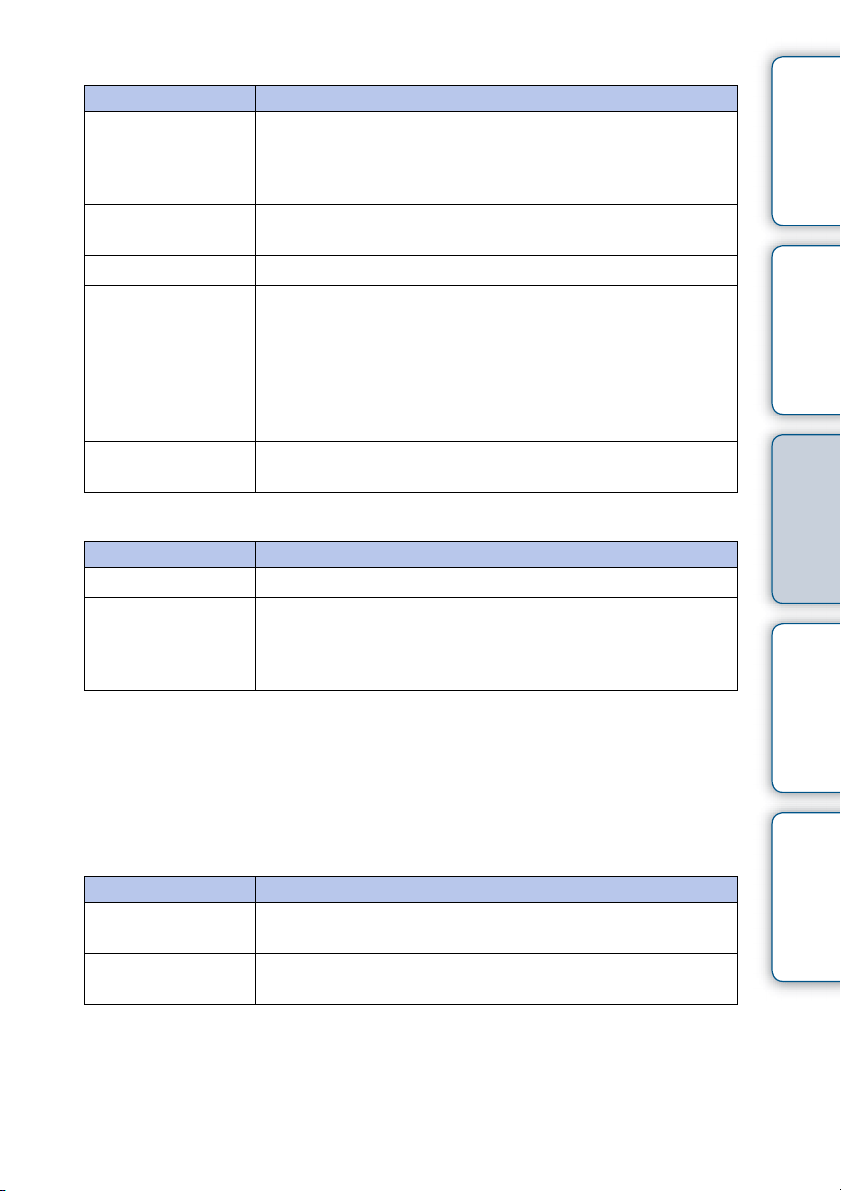
Setting Description
BGM ON/OFF ON*: Plays BGM while a slideshow is running.
OFF: Not plays BGM while a slideshow is running.
Select BGM Selects BGM on a list of music files in internal memory
(BGM1*, BGM2*, BGM3*).
Import BGM Imports music files stored on a memory card for BGM.
Delete BGM Deletes music files imported to internal memory.
Continued r
41
GB
Table of
Contents
Let’s Use Enjoying More Troubleshooting Index
General Settings
System Information
Language Setting
Selects the language for display on the LCD screen.
Japanese, English*, French, Spanish, German, Italian, Russian, Korean, Simplified
Chinese, Traditional Chinese, Dutch, Portuguese, Arabic, Persian, Hungarian, Polish,
Czech, Thai, Greek, Turkish, Malay, Swedish, Norwegian, Danish, Finnish
Initialize
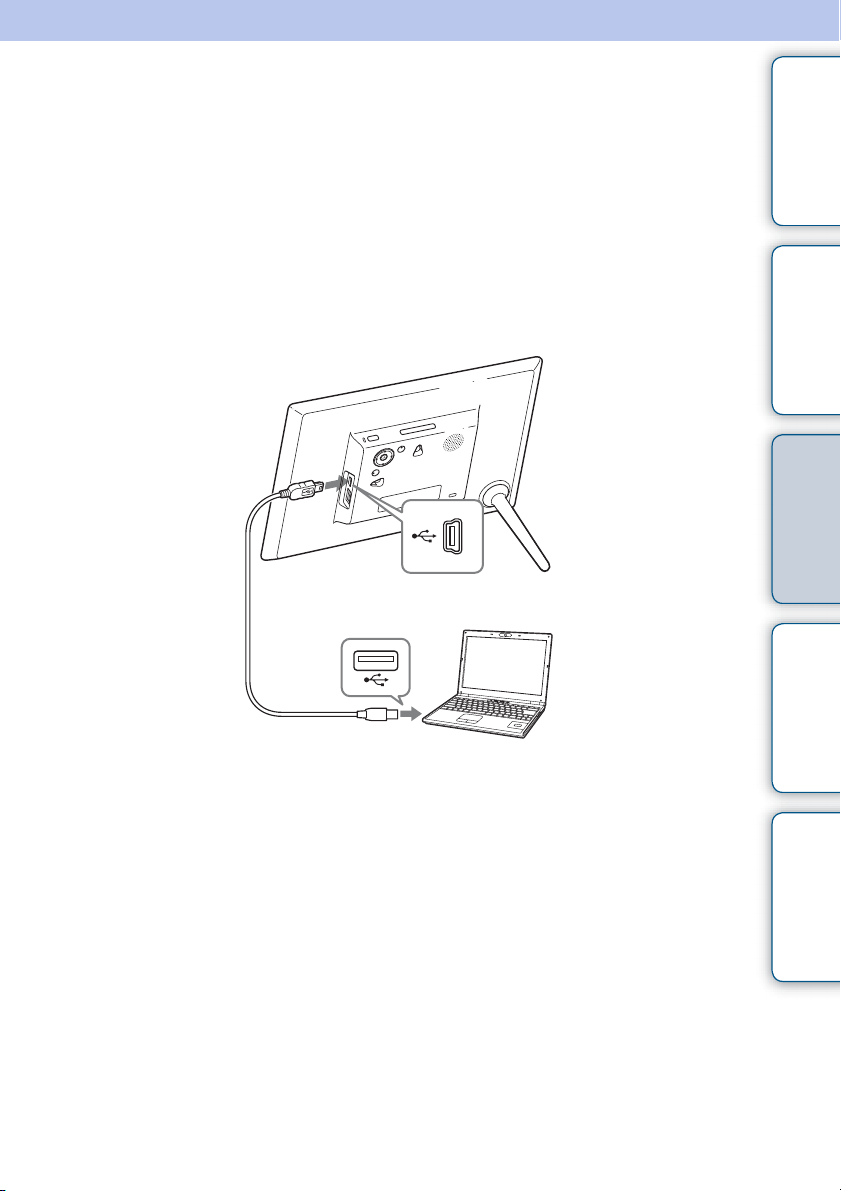
Setting Description
Image Listing Order Sets the display order of images. This setting affects the order in
[Slideshow Settings].
Shoot. Date: Displays images in order of shooting date
Number Order*: Displays images in order of file number
Auto display
orientation
ON*/OFF: Rotates the orientation of images automatically
according to the orientation of the photo frame or not.
LCD brightness Sets the brightness of the LCD screen to a level from 1 to 10*
Image import size Resize*: Resizes the images and save them to internal memory
when importing images from a memory card. You can save more
images. However, when the images are displayed on a large
monitor via a computer, etc., image quality is deteriorated
compared with the original.
Original: Saves images to internal memory without compressing
them. There is no deterioration, but you can save fewer images.
Sony logo ON/OFF ON*/OFF: Sets whether the photo frame’s Sony logo is to light
or not.
Setting Description
Version Displays the version of the firmware of the photo frame.
Internal Memory Memory capacity: Displays the maximum amount of space
available in internal memory in the initial state.
Remaining capacity: Displays the amount of free space
currently available in internal memory.
Setting Description
Format Internal
Memory
Formats the internal memory (page 32).
Initialize Settings Returns all settings to their factory defaults except for the current
date and time setting of [Date/Time Settings] (page 38).
42
GB
Table of
Contents
Let’s Use Enjoying More Troubleshooting Index
Connecting to a computer
Connecting to a computer allows you to view images in the internal memory of the photo
frame with a computer and copy them to a computer and to copy images from a computer
to the photo frame.
1 Connect the AC adaptor to the photo frame and to the AC outlet then
turn the photo frame on.
2 Connect the computer and photo frame with a commercially available
USB cable.
To USB
Mini-B
connector
Computer
To USB connector
Continued r
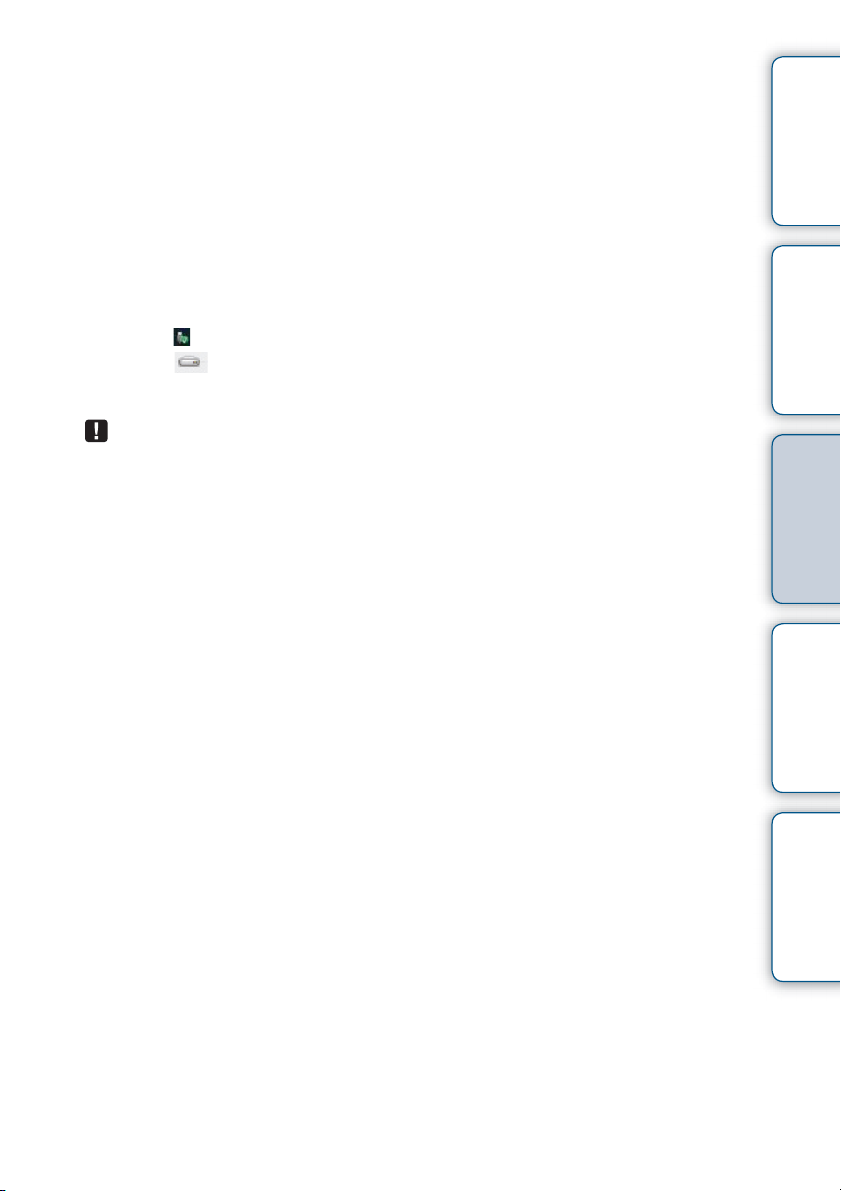
Table of
Contents
Let’s Use Enjoying More Troubleshooting Index
43
GB
System requirements
Windows
Recommended OS: Microsoft Windows 7 SP1/ Windows Vista SP2 /Windows XP SP3
Port: USB port
Macintosh
Recommended OS: Mac OS X (v. 10.4 or later)
Port: USB port
To disconnect from a computer
Unplug the USB cable or turn the photo frame off after disconnecting the photo frame from
your computer as follows:
1 Click on (Safely Remove Hardware) on the Task Tray.
2 Click on (Eject removable disk).
3 Disconnect the USB cable, according to the message.
• Use a Mini-B TYPE USB cable. If you use a commercially available USB cable, use a USB
cable with a Mini-B TYPE plug (be sure to connect the Mini-B TYPE USB connector to the
photo frame) shorter than 3 meters.
• If multiple USB devices are connected to a computer or if a hub is used, a problem may
occur.
• You cannot operate the photo frame from another USB device being used simultaneously.
• Do not disconnect the USB cable during data communication.
• Operation may not be guaranteed with some computers, even if they satisfy the
recommended system requirements.
• For USB connection, the photo frame has been demonstrated as operable when connected to
a computer. When other devices are connected to the photo frame, these devices may not
recognize the internal memory of the photo frame.
• Do not connect a computer to the USB Mini-B connector of the photo frame simultaneously
when a USB memory device is connected to the USB A connector.
• A USB hub or USB device with a built-in USB hub may not operate properly.
44
GB
Table of
Contents
Let’s Use Enjoying More Troubleshooting Index
Copying images and music from a
computer
• This section shows an example of a connection with Windows 7 SP1. Depending on the OS
you use, the screen display and procedures may vary.
1 Connect the photo frame to the computer.
See “Connecting to a computer” (page 42).
2 When the [AutoPlay] window appears on the computer display, click on
[Open folder to view files].
If the [AutoPlay] window does not appear, select the removable disc then open it.
According to the file, continue the procedure of “Copying images” or “Copying music”.
After performing step 2 of “Copying images and music from a computer” above, proceed
as follows:
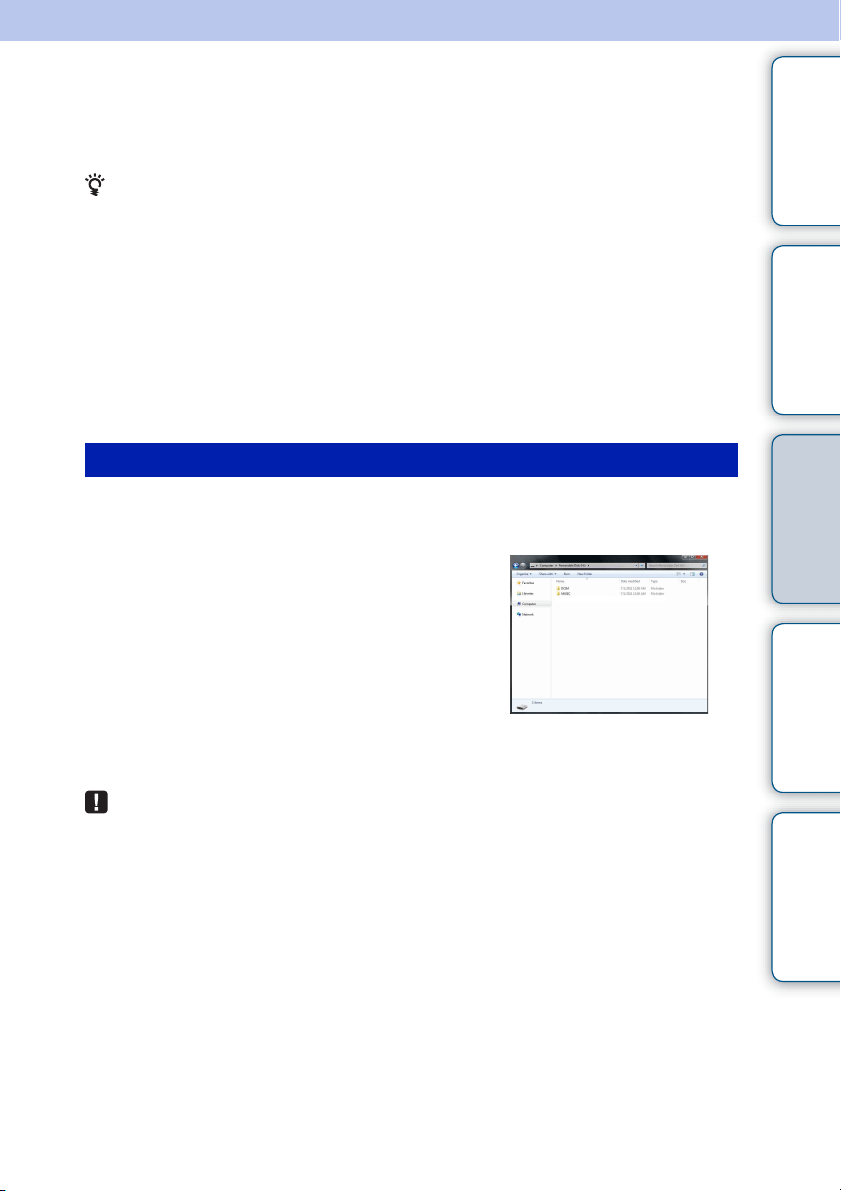
1 Move the cursor in this window and right-
click then click on [New] then on [Folder].
Name this new folder. In this manual, the folder name
“sony” is used as an example.
2 Double-click to open this “sony” folder.
3 Open the folder that contains the image files
you want to copy then copy the image files
by drag-and-drop.
• When saving images from a computer to internal memory, make a folder in internal memory
and save the images to this folder. If you do not make a folder, you can only save up to 512
images. In addition, the number of images may be reduced depending on the file name length
or character type.
• If you edit or save an image file on a computer, the shooting date of the file may be changed
or erased. In this case, images may not be displayed in the order of the shooting date on the
index image display.
• When image files from the computer are saved in internal memory of the photo frame, they
are saved without being compressed. As a result, fewer images may be saved to internal
memory of the photo frame.
• Image files made or edited on a computer may not be displayed. Image files set to “Read
Only” on a computer cannot be deleted on the photo frame. Cancel “Read Only” before
saving image files from a computer on the photo frame.
Copying images
45
GB
Table of
Contents
Let’s Use Enjoying More Troubleshooting Index
After performing step 2 of “Copying images and music from a computer” (page 44),
proceed as follows:
1 Move the cursor in this window and double-click on the [MUSIC] folder.
2 Open the folder that contains the music you want to copy then copy the
file to [MUSIC] folder by drag-and-drop.
• Copy music files to the [MUSIC] folder. If you copy them to any folder other than the
[MUSIC] folder, they cannot be played.
Copying a music
46
GB
Table of
Contents
Let’s Use Enjoying More Troubleshooting Index
Troubleshooting
Before submitting the photo frame for repair, try using the following guidance to solve the
problem.
If the problem persists, consult with your Sony dealer or Sony service facilities.
x Power supply
The power is not turned on.
• Is the AC power plug inserted correctly?
c Insert the power plug properly.
Nothing happens even if you operate the photo frame.
c Turn off the power (page 11) and turn it back on again.
x Displaying images
No images are displayed on the screen.
• Is a memory card inserted properly?
c Insert a memory card properly (page 14).
• Does the memory card contain images saved with a digital camera or other device?
c Insert a memory card containing images.
c Check the file formats that can be displayed (page 55).
• Is the file format compatible with DCF?
c A file that is not compatible with DCF may not be displayed with the photo frame,
even if it can be displayed with a computer.
• Is the image file damaged?
c If the image file is damaged, it may take approximately one minute, indicated by
display of the mark, after the image is distinguished. When it will take one
minute or more, confirm whether the image is properly displayed on the computer.
• A message “No images on file.” is displayed.
c Use a memory card containing image files that can be displayed with the photo
frame.
This error message may be displayed when you insert a memory card that stores
only music files.
• A message “Cannot open the image.” is displayed.
c The photo frame cannot display or open an image file of a non-supported format.
• A message “Memory card format not supported.” is displayed.
c For a memory card, use your digital camera or other device to format the memory
card. Use the photo frame to initialize the internal memory. When you initialize
them, all the files will be deleted.
c For an USB memory, use your computer to format it.
Troubleshooting
Continued r
Table of
Contents
Let’s Use Enjoying More Troubleshooting Index
47
GB
Images are not played back in the order of shooting date.
• Were these images edited on a computer?
c If you edited or saved an image file on a computer, the date of the file was modified.
Images are thus displayed in order of modification date instead of shooting date.
Some images are not displayed.
• Are the images displayed in the index view mode?
c If the image is displayed in the index view mode but cannot be displayed as a single
image, the image file may be damaged, even though its thumbnail preview data are
fine.
c A file that is not compatible with DCF may not be displayed with the photo frame,
even if it can be displayed with a computer.
• Does the or mark appear in the index view mode?
c The image file is not be supported by the photo frame because, for example, it is a
JPEG file that was created with your computer. Select the mark then press
(enter) to change the screen to single image display. If the mark is
displayed again, the image cannot be displayed.
c The image file is supported by the photo frame, but the thumbnail data or image
itself cannot be opened. Select the mark then press (enter). If the mark
is displayed again, the image cannot be displayed.
• Were the images created with an application on a computer?
c If you named or renamed the file on your computer and the file name includes
characters other than alphanumeric characters, the image may not be displayed on
the photo frame.
• Is there a folder with more than 8 levels in its hierarchy on the memory card?
c The photo frame cannot display images saved in a folder that is more than 8 levels
deep.
The file name is not displayed properly.
• Did you rename the file with a computer or other device?
c If you named or renamed the file on your computer and the file name includes
characters other than alphanumeric characters, the file name may not be displayed
properly on the photo frame. Also, for a file created on a computer or other device,
a maximum of 10 characters from the beginning of the file name can be displayed.
A file cannot be displayed.
• Is it a file with no image information?
c A file with only music information cannot be displayed.
Continued r
Table of
Contents
Let’s Use Enjoying More Troubleshooting Index
48
GB
x Playing a movie file
A movie file is not played.
• Does the mark appear in index or single view mode?
c The movie file is not supported by the photo frame (page 55).
Fast forward/backward playback is not available.
c Fast forward/backward playback of some movie files may not be available with the
photo frame
x Saving and deleting images
An image cannot be saved.
• Is the memory card write-protected?
c Cancel write-protection and try again.
• Is the write-protect switch of the memory card in the LOCK position?
c Slide the write-protect switch to the enable position.
• Is the memory card full?
c Replace the memory card with one with sufficient free space. Or, delete any
unwanted images (page 31).
• Is internal memory full?
c Delete any unwanted images (page 31).
• Did you save images from a computer to internal memory without making a folder in
internal memory?
c If you do not make a folder, you can only save up to 512 images. In addition, the
number of images to be saved may be reduced, depending on the file name length or
character type. When you save images in the internal memory from a computer, be
sure to make a folder in internal memory and save the images to that folder.
• The message “Error reading the Memory Stick./SD Memory Card” or “Write error on
the Memory Stick./SD Memory Card” is displayed.
c An error has occurred with memory card. Check that the memory card is inserted
correctly. If this error message appears frequently, check the status of the memory
card with a device other than the photo frame.
• The message “Error reading the internal memory.” or “Write error on the internal
memory.” is displayed.
c An error has occurred on the internal memory. Initialize the internal memory. When
you initialize the internal memory, please note that all the image files imported to
the internal memory are deleted.
• The message “The Memory Stick is protected.” is displayed
c A protected “Memory Stick” is inserted. To edit and save the images with the photo
frame, use some device to remove protection.
Continued r
Table of
Contents
Let’s Use Enjoying More Troubleshooting Index
49
GB
An image cannot be deleted.
• Is the memory card write-protected?
c Use the device you are using to cancel write-protection and try deleting again.
• Is the write-protect switch of the memory card in the LOCK position?
c Slide the write-protect switch to the enable position.
• Are you using a “Memory Stick-ROM”?
c It is not possible to delete an image from or format a “Memory Stick-ROM”.
• Is this image protected?
c Check the image information displayed in Single View mode (page 18).
• The message “Cannot delete a protected file.” is displayed.
c An image with the mark is set to “Read Only”. You cannot delete it on the
photo frame.
An image was deleted accidentally.
c An image cannot be recovered once it is deleted.
x Importing a music file
A music file cannot be imported.
• Is a memory card that stores only music files inserted?
c When a memory card that stores only music files is inserted, the message [No
images on file.] appears on the screen. In this case, do not replace the card but
merely press (enter).
x Playing the background music
A music file cannot be played.
• Is the file playable on this photo frame?
c Check if the music file is playable on this photo frame (page 56).
c Any music file not stored in internal memory of the photo frame cannot be played.
• Is the [BGM ON/OFF] set to [OFF]?
c Set it to [ON] (page 40).
A saved music file cannot be selected in Select BGM.
• Did you save music files in internal memory using a computer?
c When you save music files in internal memory using a computer, be sure to save
them in the [MUSIC] folder of internal memory. If you save a music file in any
folder other than the [MUSIC] folder, it will not be displayed on the music list in
Select BGM and cannot be played.
Continued r
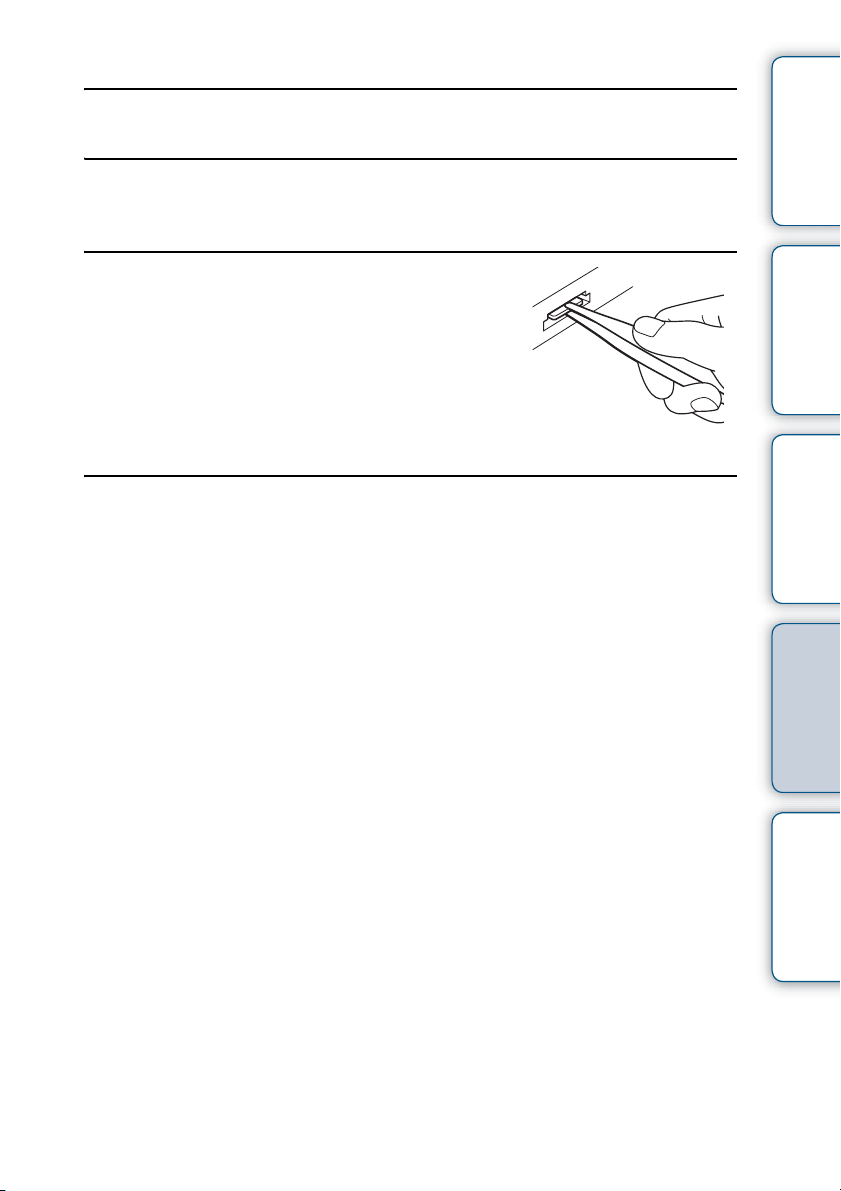
Table of
Contents
Let’s Use Enjoying More Troubleshooting Index
50
GB
x Photo Frame
Nothing happens even if you operate the photo frame.
c Turn off the power (page 12) and turn it back on again.
The message “Do you wan to refresh the internal memory?” is
displayed.
c For the refreshing operation, see “About refresh mode” (page 51).
A memory card cannot be ejected.
c If a miniSD card, microSD card, or “Memory Stick
Micro” is inserted improperly, it may be possible to
take it out using a fine-tipped tool such as tweezers
or needle-nose pliers.
In this case, be careful that this does not damage the
memory card and/or photo frame.
x Remote control
Nothing happens even if you operate the remote control.
• Is the battery inserted in the remote control properly?
c Replace the battery (page 51).
c Insert a battery in the proper orientation (page 51).
• Did you point the top end of the remote control towards the remote sensor on the
photo frame (page 5)?
• Is there any obstruction between the remote control and the remote sensor?
• Is there a protective sheet inserted?
c Remove the protective sheet (page 5).
Continued r
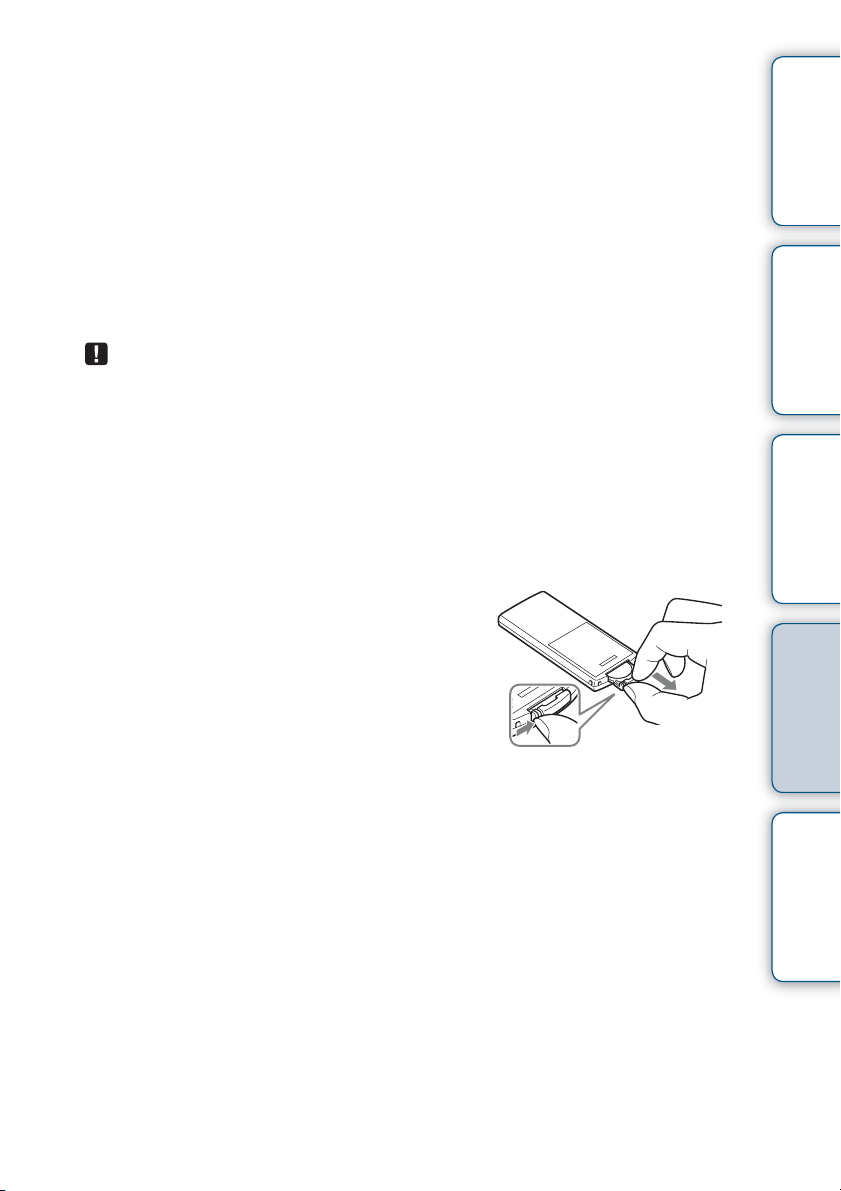
Table of
Contents
Let’s Use Enjoying More Troubleshooting Index
51
GB
About refresh mode
Owing to one of the characteristics of the device, images stored in the internal memory for
a long time or read many times may be subject to data error.
The photo frame refreshes the internal memory automatically to prevent these errors,
depending on the status of the internal memory.
When the refresh is needed, a confirmation message for refreshing the internal memory is
displayed automatically on the screen.
Select [Yes] to start refreshing. Otherwise refreshing automatically starts if no operation is
attempted within 30 seconds.
If you select [No], the confirmation screen for refreshing is displayed again when
refreshing is needed.
It may take approximately 5 minutes to refresh the internal memory.
• Do not turn off the power while the internal memory is being refreshed. It may cause a
malfunction.
• We recommend that you perform periodic backup of your data to avoid losing them.
• Avoid running a slideshow continuously with fewer than 10 images with the interval set to 3
sec. Doing so could corrupt image data stored in internal memory.
To replace the battery of the remote control
If the remote control does not operate, replace the battery (CR2025 lithium battery) with a
new one.
1 Slide the battery holder out while
pressing the tab of the battery holder in.
2 Insert a new battery so that “+” is facing upwards and slide the battery
holder back into the remote control.
Continued r
Table of
Contents
Let’s Use Enjoying More Troubleshooting Index
52
GB
• Using a battery other than the specified one may result in the battery’s rupturing.
• Dispose of used batteries as specified by the local authorities.
• Do not leave the remote control in a very hot and humid place.
• Make sure that no foreign objects get inside the remote control when you, for example,
replace the battery.
• Incorrect use of the battery may cause leakage and corrosion.
– Do not recharge the battery.
– When the remote control will not be used for a long period of time, remove the battery
from the remote control to prevent leaking and corrosion.
– Incorrectly inserting, shorting, dismantling, or heating the battery, or throwing it into a fire
may cause the battery to rupture or leak.
• When the lithium battery becomes weak, the operating distance of the remote control may
shorten, or the remote control may not function properly. In this case, replace the battery
with a Sony CR2025 lithium battery. Use of another battery may present a risk of fire or
explosion.
WARNING
Battery may explode if mistreated. Do not recharge, disassemble or dispose of in fire.
53
GB
Table of
Contents
Let’s Use Enjoying More Troubleshooting Index
Precautions
• Place the photo frame on a flat surface.
• Do not strike or drop the photo frame.
• Avoid placing the photo frame in a
location subject to:
– unstable conditions
– excessive dust
– extremely high or low temperatures
– vibration
– humidity
– direct sunlight
On the AC adaptor
• Check the shape of the AC outlet, which
may differ depending on the country or
regions. Do not use an electrical
transformer (travel converter), as this
may cause overheating or a malfunction.
• Do not use an AC adaptor other than that
supplied with the photo frame.
On moisture condensation
If the photo frame is brought directly from
a cold location to a warm location or
placed in an extremely warm or humid
room, moisture may condense inside the
unit.
In such cases the photo frame will probably
not work properly and may even develop a
problem if you persist in using it.
If moisture condensation occurs, turn the
power off and do not use the photo frame
for a certain amount of time.
On transport
When you transport the photo frame,
remove the memory card, AC adaptor, and
connected cables from the photo frame and
put the photo frame and its peripherals in
the original box with the protective
packaging. If you no longer have the
original box and packing parts, use similar
packing material so that the photo frame
will not be damaged while being
transported.
If the body of the unit is dirty, clean it with
a cloth steeped in a little neutral detergent,
then wipe dry. Do not use organic solvents
such as alcohol or thinner, as these may
cause discoloration or other damage to the
finish of the unit
“Memory Stick Duo”
• For the latest information on the
“Memory Stick Duo” types supported by
the photo frame, see the “Memory Stick”
compatibility information on the Sony
Web site.
• The photo frame supports FAT32.
However, we do not guarantee the
operations of all the “Memory Stick
Duo” media.
• Data reading/recording that requires
“MagicGate” copyright protection
cannot be performed. “MagicGate” is the
general name of a copyright protection
technology developed by Sony using
authentication and encryption.
• The photo frame does not support 8-bit
parallel data transfer.
Installation
Cleaning
Notes on using a memory
card
Continued r
54
GB
Table of
Contents
Let’s Use Enjoying More Troubleshooting Index
• When you initialize a “Memory Stick
Duo”, use the initialization function of
your digital camera. If you initialize it
with your computer, images may not be
displayed properly.
• When you perform initialization, all the
protected images are erased. Take care to
avoid accidental erasure of important
data.
• You cannot store or delete data if the
write-protect switch is set to LOCK.
• Do not attach any material other than the
supplied label in the labelling position.
When you attach the supplied label, be
sure to place it in the labelling position.
Be sure that an edge of label does not
protrude.
SD memory card
• Some commercially available card
adaptors have projected terminals on the
back. This type of adaptor may not work
properly with the photo frame.
• Data reading/recording that requires
copyright protection cannot be
performed.
• When using a card, be sure to check the
correct insertion direction of the card.
Incorrect insertion may cause damage to
the photo frame.
• When inserting a memory card, it will
only insert part of the way, so do not try
to force it, as this could damage the
memory card and/or photo frame.
• Do not remove a memory card or turn
off the photo frame while the photo
frame is reading or accessing data.
Otherwise, data may be rendered
unreadable or be erased.
• We recommend that you back up
important data.
• Data processed with the computer may
not be displayed with the photo frame.
• When you carry or store a card, put it in
the exclusive case.
• Do not touch the terminal of a card with
your hand or a metal object.
• Do not strike, bend, or drop a card.
• Do not disassemble or modify a card.
• Do not expose a card to water.
• Do not use or store a card under the
following conditions:
– Locations beyond the required
operational conditions, including
places such as the hot interior of a car
parked in the sun and/or in summer,
outdoors exposed to direct sunlight, or
a place near a heater
– Humid locations or locations with
corrosive substances present
– Locations subject to static electricity
or electrical noise
55
GB
Table of
Contents
Let’s Use Enjoying More Troubleshooting Index
Specifications
Photo frame
Model name
DPF-HD1000 DPF-HD800 DPF-HD700
LCD screen
25.7 cm/10.1-inches,
TFT active matrix
20 cm/8-inches,
TFT active matrix
18 cm/7-inches,
TFT active matrix
LCD panel
Total number of dots
1,843,200 dots
(1,024 × 3 (RGB) × 600
dots)
1,152,000 dots (800 × 3 (RGB) × 480 dots)
Effective display area
16:10
Display aspect ratio
Actual viewable size 23.4 cm/9.2-inches 18.6 cm/7.3-inches 16.2 cm/6.4-inches
Total number of dots
1,628,748 dots (914×3
(RGB) × 594 dots)
969,744 dots (712 × 3
(RGB) × 454 dots)
1,012,464 dots (712 × 3
(RGB) × 474 dots)
LCD backlight life
20,000 hours
(before brightness of the backlight is reduced to half)
Input/Output connectors
USB connector (Type Mini-B, Hi-Speed USB)
USB connector (Type A, Hi-Speed USB)
“Memory Stick PRO” (Duo)/SD memory card slots
Compatible file formats*
1
JPEG: DCF 2.0, Exif 2.3, MPF baseline, MPF extended*
2
, JFIF
TIFF: Exif 2.3 compatible
BMP: 1, 4, 8, 16, 24, 32 bit Windows format
RAW
*
3
: SRF, SR2, ARW 2.2 (preview only)
Still image
Movie
*
4
*
5
*
6
MPEG-4 AVC/H.264:
Extension: mp4, mts
Profile: Baseline Profile, Main Profile, High Profile
Level: lower than 4.2
Maximum resolution: 1920 × 1080
Audio format: Dolby Digital, AAC
MPEG-4 Visual:
Extension: mp4
Profile: Simple Profile, Advanced Simple Profile, Advanced Coding Efficiency
Profile
Level: lower than 6 (Simple Profile), lower than 5 (Advanced Simple Profile),
lower than 4 (Advanced Coding Efficiency Profile)
Maximum resolution: 1280 × 720
Audio format: AAC-LC
MPEG-1 Video:
Extension: mpg
Maximum resolution: 720 × 576
Audio format: MPEG-1 Audio Layer 2
Motion JPEG:
Extension: mov, avi
Maximum resolution: 1280 × 768
Audio format: Linear PCM, µ -law, IMA-ADPCM
Maximum bit rate: 28 Mbps
Maximum frame rate: 60 p
Continued r
Table of
Contents
Let’s Use Enjoying More Troubleshooting Index
56
GB
Background music*
4
MP3:
Extension: mp3
Bit rate: 32 kbps to 320 kbps, Supports variable bit rate (VBR)
Sampling frequency: 32 kHz, 44.1 kHz, 48 kHz
AAC:
Extension: m4a
Bit rate: 32 kbps to 320 kbps, Supports variable bit rate (VBR)
Sampling frequency: 8 kHz, 11.025 kHz, 12 kHz, 16 kHz, 22.05 kHz, 24kHz,
32 kHz, 44.1 kHz, 48 kHz
Linear PCM:
Extension: wav
Sampling frequency: 44.1 kHz, 48 kHz
Maximum picture elements*
7
16,384 × 12,288
(Progressive JPEG can be played up to 22,000,000 pixels.)
File system FAT12/16/32/exFAT
Image file name
DCF format, 256 characters within 8th hierarchy
The file name includes characters other than alphanumeric characters, the
image may not be displayed on the photo frame.
Maximum number of files
that can be handled
9,999 files for a memory card/an internal device
Internal memory capacity*
8
2 GB (Approx. 4,000 images*
9
can be saved.)
Power requirements DC IN jack, DC 5V
Power consumption
At the maximum load:
11.3 W
normal mode: 6.3 W
At the maximum load:
10.7 W
normal mode: 5.5 W
At the maximum load:
10.1 W
normal mode: 5.0 W
With the AC adaptor
Without the AC adaptor
At the maximum load:
8.5 W
At the maximum load:
8.5 W
At the maximum load:
8.0 W
Operating temperature 5 °C to 35 °C (41 °F to 95 °F)
Dimensions (width/height/
depth)
Approx. 258 mm ×
177.6 mm × 122.9 mm
(10
1
/
4
inches × 7
inches × 4
7
/
8
inches)
Approx. 220 mm ×
151.4 mm × 117.8 mm
(8
3
/
4
inches × 6
inches× 4
3
/
4
inches)
Approx. 191 mm ×
132.4 mm × 97.4 mm
(7
1
/
2
inches × 5
1
/
4
inches × 3
7
/
8
inches)
With the stand spread out
Hanging on the wall
Approx. 258 mm ×
177.6 mm × 27.5 mm
(10
1
/
4
inches × 7
inches × 1
1
/
8
inches)
Approx. 220 mm ×
151.4 mm × 29.4 mm
(8
3
/
4
inches × 6 inches
× 1
3
/
16
inches)
Approx. 191 mm ×
132.4 mm × 28.1 mm
(7
1
/
2
inches × 5
1
/
4
inches × 1
1
/
8
inches)
Mass (excluding the AC
adaptor, including the stand)
Approx. 600 g
(1 lb 5
1
/
8
oz)
Approx. 490 g
(1 lb 1
1
/
4
oz)
Approx. 370 g
(13 oz)
Included items See “Preparation: 1 Checking included items” (page 8).
Model name
DPF-HD1000 DPF-HD800 DPF-HD700
Continued r
Table of
Contents
Let’s Use Enjoying More Troubleshooting Index
57
GB
AC adaptor
See the label of AC adaptor for more details.
Design and specifications are subject to change without notice.
Manufactured under license from Dolby Laboratories.
*
1
: Some of the files may not be compatible depending on the type of data.
*
2
: Files cannot be displayed in 3D. Representative images are displayed in 2D.
*
3
: RAW files of a Sony α camera are displayed as thumbnail preview.
*
4
: Files with copyright protection cannot be played.
*
5
: Frames may be dropped during playback of a memory card due to the transfer rate of the
memory card.
*
6
: Number of frames shown may be reduced during playback of some movie files.
*
7
: 17 × 17 or more are required. An image with an aspect ratio of 20:1 or more may not be
displayed properly. Even if the aspect ratio is less than 20:1, display problem may occur in
thumbnails, slideshow or other occasions.
*
8
: When measuring media capacity, 1 GB equals 1,000,000,000 bytes, a portion of which is
used for data management and/or application files. The capacity that a user can use is
approximately 1.8 GB.
*
9
: The number of stored images is an approximate guide when resizing and importing images.
When resizing and importing images, they are automatically resized to about 2,000,000
pixels. This varies depending on the subject and shooting conditions.
Model name
AC-P5022
Power requirements AC 100 V to 240 V, 50 Hz/60 Hz, 0.4 A
Rated output voltage DC 5 V, 2.2 A
Dimensions (width/height/depth)
Approx. 79 mm × 34 mm × 65 mm
(3
1
/
8
inches × 1
3
/
8
inches × 2
5
/
8
inches)
(excluding the protruding parts)
Mass Approx. 105 g (3 3/4 oz)
Continued r
58
GB
Table of
Contents
Let’s Use Enjoying More Troubleshooting Index
On trademarks and License
• , Cyber-shot, ,
“Memory Stick”, , ,
“Memory Stick Duo”, ,
“MagicGate Memory Stick”, “Memory
Stick PRO”, , “Memory
Stick PRO Duo”, ,
“Memory Stick PRO-HG Duo”,
, “Memory Stick
Micro”, , , “Memory
Stick-ROM”, ,
“MagicGate”, and are
trademarks or registered trademarks of
Sony Corporation.
• Microsoft , Windows, and Windows
Vista are registered trademarks of
Microsoft Corporation in the United
States and/or other countries.
• Macintosh and Mac OS are registered
trademarks of Apple Inc.. in the United
States and/or other countries.
• SD Logo, SDHC Logo, SDXC Logo are
trademarks of SD-3C, LLC.
• Contains iType™ and fonts from
Monotype Imaging Inc.
iType™ is a trademark of Monotype
Imaging Inc.
• Dolby is trademark of Dolby
Laboratories.
• MPEG Layer-3 audio coding technology
and patents licensed from Fraunhofer IIS
and Thomson.
• All other companies and product names
mentioned herein may be the trademarks
or registered trademarks of their
respective companies. Furthermore, “™”
and “®” are not mentioned in each case
in this manual.
Notes on the License
• THIS PRODUCT IS LICENSED
UNDER THE MPEG-4 VISUAL
PATENT PORTFOLIO LICENSE
FOR THE PERSONAL AND
NONCOMMERCIAL USE OF A
CONSUMER FOR
(i) ENCODING VIDEO IN
COMPLIANCE WITH THE
MPEG-4 VISUAL STANDARD
(“MPEG-4 VIDEO”) AND/OR
(ii) DECODING MPEG-4 VIDEO
THAT WAS ENCODED BY A
CONSUMER ENGAGED IN A
PERSONAL AND NON-
COMMERCIAL ACTIVITY
AND/OR WAS OBTAINED
FROM A VIDEO PROVIDER
LICENSED BY MPEG LA TO
PROVIDE MPEG-4 VIDEO.
NO LICENSE IS GRANTED OR
SHALL BE IMPLIED FOR ANY
OTHER USE. ADDITIONAL
INFORMATION INCLUDING
THAT RELATING TO
PROMOTIONAL, INTERNAL AND
COMMERCIAL USES AND
LICENSING MAY BE OBTAINED
FROM MPEG LA, LLC. SEE
HTTP://WWW.MPEGLA.COM
• THIS PRODUCT IS LICENSED
UNDER THE AVC PATENT
PORTFOLIO LICENSE FOR THE
PERSONAL AND NON-
COMMERCIAL USE OF A
CONSUMER TO
(i) ENCODE VIDEO IN
COMPLIANCE WITH THE AVC
STANDARD (“AVC VIDEO”)
AND/ OR
Continued r
59
GB
Table of
Contents
Let’s Use Enjoying More Troubleshooting Index
(ii) DECODE AVC VIDEO THAT
WAS ENCODED BY A
CONSUMER ENGAGED IN A
PERSONAL AND NON-
COMMERCIAL ACTIVITY
AND/OR WAS OBTAINED
FROM A VIDEO PROVIDER
LICENSED TO PROVIDE AVC
VIDEO.
NO LICENSE IS GRANTED OR
SHALL BE IMPLIED FOR ANY
OTHER USE. ADDITIONAL
INFORMATION MAY BE
OBTAINED FROM MPEG LA,
L.L.C. SEE
HTTP://WWW.MPEGLA.COM
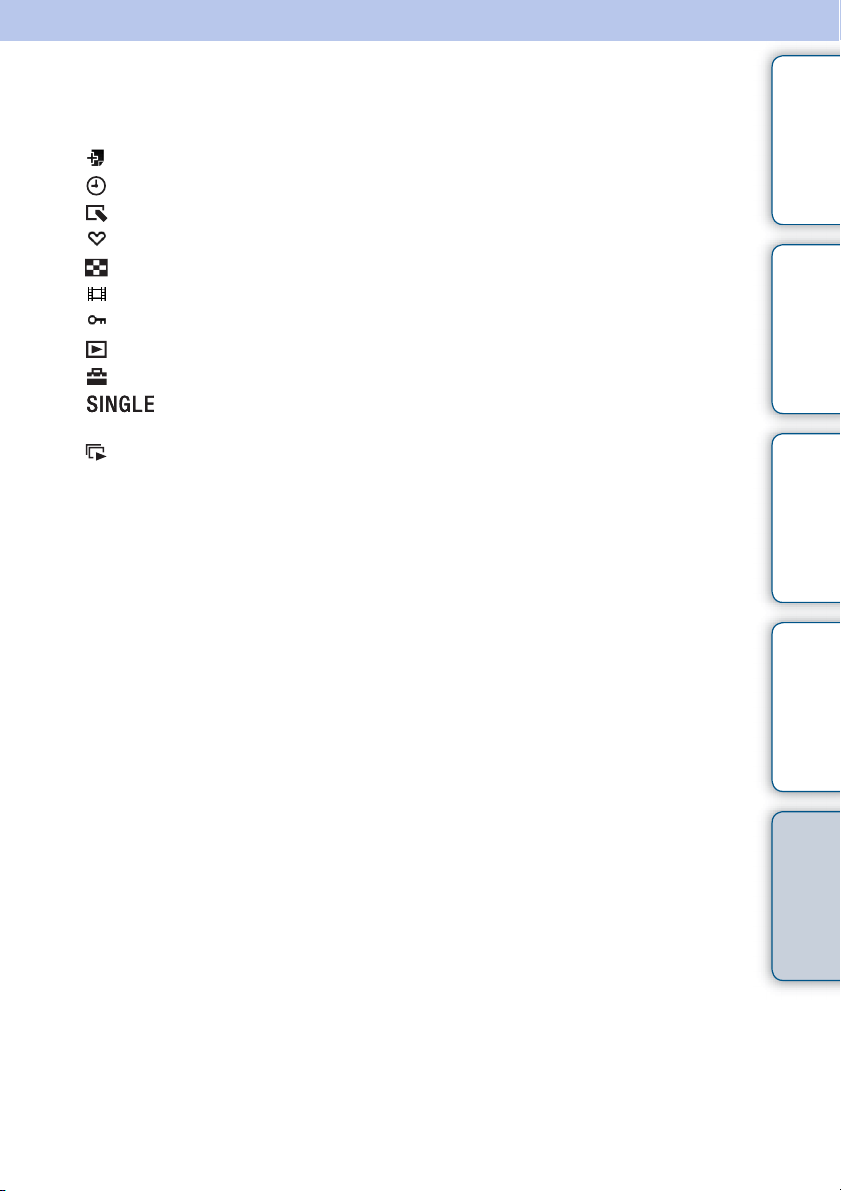
60
GB
Table of
Contents
Let’s Use Enjoying More Troubleshooting Index
Index
Index
Symbols
(Associated file)...............................19
(Clock and calendar) mode..............16
(Editing) tab.........21
, 27, 28, 29, 30, 33
(Favorite mark).......................... 19
, 29
(Index) mode ...................................16
(Movie file)......................................19
(Protected file) .................................19
(Select device) tab ...........................23
(Settings) tab........................ 13
, 35, 38
(Single image display)
mode.................................................16
(Slideshow) mode............................16
A
AC adaptor .............................................11
Attaching the stand ..................................9
[Auto Power ON/OFF] ..........................35
Advanced..........................................36
Auto off ............................................37
Simple...............................................37
B
Background music .................................24
C
Cleaning .................................................53
Compatible file formats .........................55
Compatible Memory Card .......................6
Computer
Connecting to a computer ................42
Copying from a computer ................44
Disconnecting from a computer .......43
System requirements ........................43
Connecting
Computer..........................................42
USB memory....................................14
Copying
Image................................................44
Music................................................45
D
[Date/Time Settings]..............................40
Deleting
Image................................................31
Music................................................25
Demonstration display ...........................11
E
Editing image
[Delete].............................................31
[Export] ............................................33
[Import] ............................................21
[Marking]..........................................29
[Rotate].............................................28
[Sort].................................................30
[Zoom]..............................................27
Enlarging an image ................................27
Exporting an image ................................33
F
Factory default settings ..........................38
Favorite mark .........................................29
Formatting the internal memory ............32
G
[General Settings] ..................................41
H
Hanging on the wall ...............................10
I
Identifying the parts .................................4
Importing
Image................................................21
Music................................................25
Continued r
61
GB
Table of
Contents
Let’s Use Enjoying More Troubleshooting Index
Included items..........................................8
Information display................................19
Initial display .........................................11
[Initialize]...............................................41
Internal memory ...............................32
Setting...............................................38
Inserting
Memory card ....................................14
USB memory....................................14
L
[Language Setting].................................41
M
Marking..................................................29
Memory card
Adaptor...............................................6
Inserting............................................14
“Memory Stick Duo” .................14
, 53
Removing .........................................14
SD memory card...........................6
, 54
Music
Deleting ............................................25
Importing..........................................25
Playing..............................................24
MUSIC folder ........................................45
P
Playback memory...................................23
Playing
Background music............................24
Movie ...............................................20
Slideshow .........................................14
Precautions.............................................53
R
Reducing an image.................................27
Refresh mode .........................................51
Registering a favorite mark....................29
Remote control................................... 5
, 51
Replacing the battery........................51
Reset...................................................... 38
Rotating an image.................................. 28
S
Saving (import)
Movies ............................................. 22
Still images ...................................... 21
Select device.......................................... 23
Single view style
Changing.......................................... 16
[Entire Image].................................. 18
[Entire Image (with Exif)] ............... 18
[Fit to Screen] .................................. 18
[Fit to Screen (with Exif)] ............... 18
Slideshow .............................................. 14
Slideshow BGM Settings ...................... 24
[Slideshow Settings].............................. 39
Slideshow style
[Calendar View] .............................. 17
Changing.......................................... 16
[Clock View] ................................... 17
[Multi image View] ......................... 17
[Random View] ............................... 17
[Single View]................................... 17
[Time Machine] ............................... 17
Sorting images (Filtering) ..................... 30
Specifying the playback memory.......... 23
[System Information] ............................ 41
T
Timer ..................................................... 35
Troubleshooting .................................... 46
Turning off the power ........................... 12
Turning on the power ............................ 12
U
USB connector .................................14, 42
USB memory......................................6
, 14
Continued r
62
GB
Table of
Contents
Let’s Use Enjoying More Troubleshooting Index
V
View mode .............................................16
Clock and calendar ...........................16
Index.................................................16
Single image display ........................16
Slideshow .........................................16
Volume............................................. 20
, 24
Z
Zoom in..................................................27
Zoom out................................................27

© 2011 Sony Corporation
http://www.sony.net/