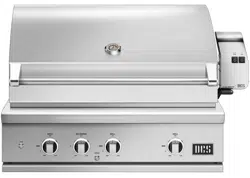
Before installation, remove shipping brackets from the grill. Loosen the four screws. Slide the shipping bracket off and re-tighten the screws.
Location
When determining a suitable location, take into account concerns such as exposure to wind, proximity to traffic paths and keeping any gas or electrical supply lines as short as possible and away from heat sources. Locate the grill only in a well ventilated area. Do not build the grill under overhead unprotected combustible construction. Never locate the grill in a building, garage, breezeway, shed or other such enclosed areas. During heavy use, the grill will produce a lot of heat and smoke. Ensure that the grill is used in a well ventilated area.
If locating the grill in a windy area, try to locate the grill so the prevailing wind will blow air at the front of the grill as shown in Fig. 01b. This will assist the grill in venting hot air through the back of the grill. In addition, this will help keep any smoke from blowing at someone who is cooking on the grill. If you have to locate the grill in a windy area where the prevailing wind is at the rear of the grill (Fig. 01a), a windscreen must be installed. The windscreen should be set-up so that it blocks wind from entering the exhaust vent in the rear of the unit as shown in Fig. 01c. Location of the windscreen relative to rear of the grill must adhere to the clearances specified for combustible or non-combustible construction as defined in these instructions. Refer to following pages.
As a high-performance gas appliance, your grill requires significant amounts of air to support the combustion process. Your grill is designed to take air in through the valve panel area, and send the exhaust products out through the exhaust gap at the rear of the hood. Using your grill in windy conditions can disrupt the proper flow of air though your grill, leading to reduced performance, or in certain severe cases, causing heat buildup in the valve panel area. This can lead to problems such as having the knobs melt, or burn hazards when the valve panel surfaces become too hot to touch.
Please note that damage to your grill resulting from use in windy conditions, such as melted knobs or igniter wires, or valve panel discoloration from heat build-up, are excluded from warranty coverage.
Locating Built-in Clearances
IMPORTANT!
Gas fittings, regulator, and installer supplied shut-off valves must be easily accessible.
Wind hitting the grill while in use, (especially wind blowing into or across the hood gap) can cause poor performance and in some cases can cause the control panel to get dangerously hot.
If wind is an issue, a windscreen should be added. The windscreen should be higher than the top of the opening in the back of the grill, with a minimum clearance of 3” (76mm) for non-combustibles, or 18” (457mm) for combustibles, from the back of the grill
Clearances to non-combustible construction*
A minimum of 3” (76mm) clearance from the back of the grill to non-combustible construction is required for the purpose of allowing the hood to open fully. It is desirable to allow at least 6” (153mm) rear and side clearance to non-combustible construction above the cooking surface for counter space. If you’ll be using the rotisserie option, the space is essential for motor and skewer clearance. The grill can be placed directly adjacent to non-combustible construction below the cooking surface (Fig. 02).
Note: if intending to use the rotisserie, the minimum clearance will be from the rotisserie motor instead of the side of the grill.
‘DEFINITION OF NON-COMBUSTIBLE MATERIAL - Material which is not capable of being ignited and burned, such as materials consisting entirely of, or a combination of, steel, iron, brick tile, concrete, slate, and plaster.
General
The grill is designed for easy placement into built-in masonry enclosures. For non-combustible applications the grill drops into the opening shown in Fig. 05 and hangs from its side flanges. A deck is not required to support it from the bottom. When using the insulated jacket in a combustible enclosure application, see the Fig. 06. The insulation jacket assembly must be supported from the bottom by a ledge on each side and back or a solid deck.
A spirit level should be used to ensure that the unit is level both front-to-back and side-to-side. If it is not level, burner combustion may be erratic or the unit may not function efficiently for grease flow. If the floor is uneven, re-leveling may be required whenever a freestanding unit is moved.
IMPORTANT!
• Failure to maintain required clearances creates a fire hazard that may result in property damage or serious personal injury.
• The grill is designed to function in an open area. Recommended minimum clearances should be maintained to all surfaces (combustible and non-combustible) for optimum performance. Noncombustible material within the minimum clearance area could result in discoloration or deterioration.
• If a non-combustible material such as stucco is covering a combustible material such as wood, the minimum clearance distance needs to be considered for wood. The presence of a non-combustible material inside the clearance zone does not eliminate the minimum clearance zone to combustible material.
Locating Built-in Clearances Clearances to combustible construction**
Minimum of 18” (457mm) from the sides and rear of grill must be maintained to adjacent vertical combustible construction, above the counter top level. Intense heat, and large volumes of smoke will exhaust from the rear of the grill (Fig. 01b). This may discolor or damage unprotected areas. Do not install under unprotected combustible construction without using a fire safe ventilation system.
A 18” (457mm) minimum clearance must be maintained under the counter top to combustible construction. The clearance can be modified by a use of an insulated jacket. Insulated jackets can be purchased from our website, www.dcsappliances.com.
"DEFINITION OF COMBUSTIBLE MATERIAL - Any materials of a building structure or decorative structure made of wood, compressed paper, plant fibers, vinyl/plastic or other materials that are capable of transferring heat or being ignited and burned. Such material shall be considered combustible even though flame-proofed, fire-retardant treated or surface-painted, or plastered.
IMPORTANT!
It is required that a minimum of three 10x10" (645 x 645mm) of ventilation opening be provided for both the left and right sides, as well as the back of enclosure (Fig. 05), in order to safely dissipate unburned gas vapors in the event of a gas supply leak.
Insulated jacket
If the grill is to be placed into a combustible enclosure, an approved insulated jacket is necessary. Insulated jackets are available from your dealer. Use only the DCS insulated jacket which has specifically been designed and tested for this purpose. Review the detail drawing shown (Fig. 06) and take into account the provisions shown for gas line hook-up clearance in the right rear corner.
It is required that ventilation holes are provided in the enclosure to eliminate the potential build-up of gas in the event of a gas leak. The supporting ledges or deck must be level and flat and strong enough to support the grill and insulated jacket. The counter should also be level.
IMPORTANT!
Installing this product into a combustible enclosure without an insulated jacket could result in fire, property damage and personal injury.
Clearances to protected combustible construction***
A minimum of 12" (305mm) clearance from the sides and rear of grill must be maintained to adjacent vertical protected combustible construction. Intense heat, and large volumes of smoke will exhaust from the rear of the grill. This may discolor or damage unprotected areas. The 12" (305mm) includes 4" (102mm) min. non-combustible material plus an additional 8" (203mm) min. clearance between the grill and the protected combustible construction. This can be achieved by brick or concrete (Fig. 04a) or a metal stud finished with non-combustible substrate (Fig. 04b).
***DEFINITION OF PROTECTED COMBUSTIBLE SURFACE - A wall of non-combustible material in front a wall of combustible material, to act as a barrier. For definitions of non-combustible and combustible material, please refer to previous pages.
Built-in Construction Details
Standard layout for non-combustible cavity
IMPORTANT!
If installing the grill into a non-combustible enclosure, all combustible construction must still be outside the 18" (457mm) clearance zone. If your island is made of stucco over the top of wooden studs, the wood can not be inside the 18 inch clearance zone to combustible, even though the stucco is what is touching the grill area.
Standard layout for cavity including insulated jacket
To order access drawers or doors, please visit www.dcsappliances.com for further details
Gas Hook-up
Gas requirements
Verify the type of gas supply to be used, either natural or LP, and make sure the marking on the appliance rating plate agrees with that of the supply. The rating plate is located on the underside of the drip tray. Never connect an unregulated gas line to the appliance. You must use a gas regulator even if the supply is controlled.
An installer-supplied gas shut-off valve must be installed in an easily accessible location. All installer supplied parts must conform to local codes, or in the absence of local codes, with the National Electrical Code, ANSI/NFPA 70 or the Canadian Electrical Code, CSA C22.1, and the National Fuel Gas Code, ANSI Z223.1 or CSA-B149.1 Natural Gas Installation Code or CSA-B149.2 Propane Installation Code.
All pipe sealants must be an approved type and resistant to the actions of LP gases. Never use pipe sealant on flare fittings. All gas connections should be made by a qualified technician and in accordance with local codes and ordinances. In the absence of local codes, the installation must comply with the National Fuel Gas Code ANSI Z223.1. Gas conversion kits are available from Customer care. When ordering gas conversion kits, have the model number, and the type of gas (natural or LP) from your grill.
Total gas consumption of the grill with all burners on HI
BE1-48R - 118,000 Btu/hr or 124.5 Mj/hr BE1-36R - 89,000 Btu/hr or 93.3 Mj/hr The appliance and its individual shut-off valve must be disconnected from the gas supply piping system during any pressure testing of that system at test pressures in excess of 1/2 PSIG (3.5 kPa). The appliance must be isolated from the gas supply piping system by closing its individual manual shut-off valve during any pressure testing of the gas supply piping system at test pressures equal to or less than 1/2 PSIG (3.5 kPa). The installation of this appliance must conform with local codes or, in the absence of local codes, with the National Fuel Gas Code, ANSI Z223.1/NFPA 54. Installation in Canada must be in accordance with Natural Gas and Propane Installation Code, CSA B149.1, and/or Propane Storage and Handling Code, B149.2 and local codes.
Natural gas built-in hook-up
(This should be performed by a technician only.)
Connection: 1/2” NPT female. Operating pressure:
4.0” W.C. Supply pressure: 5” to 14” WC. If in excess of 14” W.C. a step down regulator is required. Check with your local gas utility company or local codes for instructions on installing gas supply lines. Be sure to check on type and size of run, and how deep to bury the line. If the gas line is too small, the grill will not function properly. Any joint sealant used must be an approved type and be resistive to the actions of LP gases.
To hook-up the fittings supplied with the grill
Assemble as shown (Fig. 07). Use threading compound on male threads only. Use a second pipe wrench to hold the grill inlet pipe to avoid shifting any internal gas lines of the grill. Ensure that the regulator arrow points in the direction of gas flow towards the unit, away from the supply. Do not forget to place the installer-supplied gas valve in an accessible location.
LP cart hook-up
Grills orificed for use with LP gas come equipped with a high capacity hose/regulator assembly for connection to a standard 20 lb. LP cylinder (Type 1). The LP tank is not included. The grill system is leak tested, do not remove the Regulator/Hose assembly from the grill during cart installation.
Connection: LP Hose with a Type 1 quick disconnect and regulator is included. Operating pressure: 11.0”W.C. Note: all gas piping and connectors must conform to the Standard for Connectors for Outdoor Gas Appliances and Manufactured Homes, ANSI Z21.75/CSA 6.27.
To connect the LP regulator/hose assembly to the tank/valve assembly, first make sure the main valve on the tank is completely closed. Although the flow of gas is stopped when the Type 1 system is disconnected as part of its safety feature, you should always turn off the LP tank main valve (Fig. 08) after each use and during transport of the tank or unit. Insert the regulator inlet into the tank valve and turn to the black coupler clockwise until the coupler tightens up. Do not over tighten the coupler. Turn the main tank valve on and turn the burner control valves on the unit to the “HI” position for about 20 seconds to allow the air in the system to purge. Turn valves off and wait five minutes before attempting to ignite the burners.
To disconnect the coupler, first make sure the main tank valve is turned off. Grasp the coupler and turn counter clockwise. The inlet will then disengage. Remove the inlet from the tank valve opening if it has not already done so when it disengaged. Your local LP filling station should be equipped with the proper equipment to fill your tank.
IMPORTANT!
• Before connecting LP tank to regulator, check that all grill burners and rotisserie valves are in the OFF position and open grill hood.
• Do not place the Grill directly on the ground or any other flat surface without support. This will prevent damaging the regulator/hose assembly by the weight of the grill.
• Check the hose, regulator and connectors for damage. Look for cracks, abrasions, brittleness, holes, dents and nicks.
• Do not attempt to remove, repair, or replace the regulator/hose assembly by yourself. It must be done by a qualified licensed technician only.
LP tank requirements:
A dented or rusty LP tank may be hazardous and should be checked by your LP supplier. The cylinder that is used must have a collar to protect the cylinder valve. Never use a cylinder with a damaged valve. Always check for leaks after every LP tank change. The LP gas cylinder must be constructed and marked in accordance with the specifications for LP gas cylinders of the U.S. Department of Transportation (dot or can/csa-B339) and designed for use with a Type 1 system only. Do not change the regulator/hose assembly from that supplied with the unit or attempt to use a Type 1 equipped regulator/hose assembly with a standard 510 POL tank/valve assembly. The cylinder must be provided with a shut-off valve terminating in an LP gas supply cylinder valve outlet specified, as applicable, for connection Type 1. If the appliance is stored indoors, the cylinder must be disconnected and removed from the appliance. Cylinders must be stored outdoors in a well-ventilated area out of the reach of children.
Gas Hook-up LP built-in hook-up
If the grill is to be installed in a built-in application, then the grill must be installed in accordance with the built-in installation guidelines and the LP regulator/hose assembly must be removed from the product.
Connection: LP Hose with a Type 1 quick disconnect and regulator is included. Operating pressure: 11.0”W.C. All gas piping and connectors must conform to the Standard for Connectors for Outdoor Gas Appliances and Manufactured Homes, ANSI Z21.75/CSA 6.27.
If you intend to operate your built-in grill on LP gas utilizing a 20v lb type 1 cylinder, then a built-in LP tank restraint must be installed prior to initial use of the grill. The Installer must supply ^” ID Flex hose and fixed pipe and a flare adaptor as indicated in Fig. 09.
Note: when an LP unit is being directly connected to an LP house system, you must follow the natural gas hook up guidelines.
The installer must provide the proper gas regulator to reduce the gas pressure to 11” W.C.
IMPORTANT!
Gas piping and connectors must be clamped within the the enclosure to avoid contact with moving parts and hot surfaces. Where the gas piping passes through an opening in the enclosure, the piping must be protected for a distance of at least 2” (50mm) either side of the opening.
Leak Testing
IMPORTANT!
Gas leak testing must be carried out by a qualified technician.
General
Regularly check the whole system for leaks, or immediately check if the smell of gas is detected. Before Testing
Do not smoke while leak testing. Extinguish all open flames. Never leak test with an open flame.
Make a soap solution of one part liquid detergent and one part water. You will need a spray bottle, brush, or rag to apply the solution to the fittings. For LP units, check with a full cylinder.
To Test
Make sure all control valves are in the “OFF” position. Turn the gas supply “ON”. Check all connections from the supply line, or LP cylinder. Apply the soap solution around the connection, tubing and end of the manifold. Soap bubbles will appear where a leak is present. If a leak is present, immediately turn off gas supply, tighten any leaking connections, turn gas on, and recheck.
If you cannot stop a gas leak turn off the gas supply and call your local gas utility, or the dealer you purchased the appliance from. Only those parts recommended by the manufacturer should be used on the grill. Substitution can void the warranty.
IMPORTANT!
• Do not use the grill until all connections have been checked and do not leak.
• Check all gas supply fittings for leaks before each use. Keep a spray bottle of soapy water near the gas supply shut-off valve. Spray all the fittings, bubbles indicate leaks
Electrical Connection
IMPORTANT!
Use only a Ground Fault Interrupter (GFI) protected circuit with this grill.
General
Connection to AC Installation requires an outdoor 120VAC 15A GFI (Ground Fault Interrupter) electrical outlet adjacent to the grill. The GFI outlet features an internal breaker that reduces shock hazard. This type of outlet should be installed by a qualified electrician either inside the island enclosure for built-in units, or near the location where a free-standing unit will be used. For built-in grills, the supplied 12V transformer is connected to the grill during installation.
All grill models have a power transformer for the ignition and internal lighting, which is concealed in a box with an attached power supply cord. This transformer must be secured in a dry location and away from the grill firebox and excessive heat area. When installing, it is recommended that the transformer be located below the grill in a readily accessible location. Be sure to provide adequate access to facilitate service if the transformer or connections should need future maintenance.
If the electrical system fails to operate, a connection may have come loose in shipping or the GFI may have tripped, requiring a reset. See the Troubleshooting section for more details.
IMPORTANT!
To protect against electrical shock, do not immerse any power cords or plugs in water or any other liquid.
Burner Adjustment
IMPORTANT!
Before lighting, inspect the gas supply piping or hose prior to turning the gas “on”. If there is evidence of cuts, wear, or abrasion, it must be replaced prior to use.
Grill burner air adjustment
Each grill burner is tested and adjusted at the factory prior to shipment; however, variations in the local gas supply or a conversion from one gas to another may make it necessary to adjust the burners. The flames of the burners (except the rotisserie burner) should be visually checked and compared to that of the drawing in Fig.14. Flames should be blue and stable with no yellow tips (LP units may have some yellow tipping), excessive noise or lifting. If any of these conditions exist, check if the air shutter or burner ports are blocked by dirt, debris, spider webs, etc. If cleaning the burner ports and air shutter does not improve performance, you can alter the air shutter adjustment. The amount of air which enters a burner is governed by a metal cup at the inlet of the burner called an air shutter. It is locked in place by a screw which must be loosened prior to lighting the burner for adjustment.
Grill burner flame height
Before beginning, ensure the grill is OFF and cool. To access the grill burner air shutters, first remove the grates and radiants from the firebox, then remove the grill burner using instructions shown on page 41. With a screw driver, loosen the lock screw on the face of the air shutter slightly so that the air shutter can be adjusted.
To adjust
Be careful as the burner may be very hot.
If the flame is yellow, indicating insufficient air, turn the air shutter counter-clockwise to allow more air to the burner.
If the flame is noisy and tends to lift away from the burner, indicating too much air, turn the air shutter clockwise.
Note: reinstall the U-burner, ensuring the burner is level. Light the burner and check the flame. If the color of the flame is blue and the height is stable, remove the burner and tighten the air shutter screw. If the flames show instability or an inconsistent color, repeat the above procedure to readjust the air shutter.
Low flame setting adjustment
The valves on the grill feature an adjustable low setting. Due to fluctuations in gas pressure, heating value or gas conversion, you may feel it necessary to increase or decrease gas flow in the low position. We do not recommend adjusting the infrared rotisserie burner.
To adjust
Light the burner.
Turn the control knob to the lowest setting (counter-clockwise).
Remove the knob.
While holding the valve shaft with pliers, insert a thin, flat tipped screwdriver into the shaft and while viewing the burner adjust to a minimum stable flame.
Radiant Assembly
IMPORTANT!
Before assembling the radiant, check that the radiant trays have not moved during transit. They should sit securely on their locating pins in the base of the grill.
If a ceramic rod breaks
Unlock radiant end cap by pushing it up with two fingers.
All internal packaging and any adhesive residue removed. To remove stubborn residue, use rubbing alcohol or a commercially available adhesive remover
Removed shipping bracket
Knobs turn freely, bezels centered
Halo lighting is functioning correctly
Air shutters adjusted
Low flame setting satisfactory
Drip pan in place properly and sliding freely
Pressure regulator connected and set for 4.0’ C.E. Natural, 11.0” C.E. LP gas
Manual shut-off valve installed and accessible
Unit tested and free of leaks
User informed of gas supply shut-off valve location
Check match lighting
Internal lighting is functioning correctly
Transformer is tidy and mounted securely, in a suitable location
Each burner lights All radiant trays are satisfactorily - individually assembled and put in place or with adjacent burner lit
Please leave these instructions with the user.
User, please retain these instructions for future reference.
Contact DCS at www.dcsappliances.com if any of the listed items are missing. Please be prepared with your Model #, Serial # and description of item(s) that are missing.
IMPORTANT!
Read all installation instructions in this manual to see if the unit has been correctly installed. Ensure that installation has been completed correctly before use.
USING THE GRILL
Lighting Instructions
Grill lighting instructions
IMPORTANT!
Open the grill hood before lighting. Turn all knobs to “OFF”. Turn the main gas supply on. If you smell gas, shut-off gas supply and call for customer care.
Pushing in on the burner knob will activate the Grill Igniter, and then turning the knob from the “OFF” position will allow the flow of gas to the burner.
The Grill Igniter will glow orange, but there will be no clicking sound during ignition. Push in and hold the selected burner knob for two seconds. Verify that the hot surface igniter is glowing. Turn the burner knob to "SEAR" position. Release the knob when the burner lights. If burner does not light in four to five seconds, turn knob "OFF" and wait five minutes before trying again so any accumulated gas may dissipate.
IMPORTANT!
Only light one burner at a time.
Grill match lighting
If the burner will not light after several attempts, then the burner can be match lit. If you have attempted to light the burner with the ignition, allow five minutes for any accumulated gas to dissipate. Keep your face as far away from the outdoor appliance as possible and hold a paper book match over the hole located on the top left for burner on the left, or the right hole for the right burner (Fig. 16). Push and turn the control knob which is centered on the burner where the lit match is located, to “SEAR”. If the burner does not light in four to five seconds, turn knob off, wait five minutes and try again.
Improper lighting procedures can cause the LP tank flow control to activate resulting in reduced heat output. If this is suspected the flow control will need to be reset.
See the Quick Start Guide for how to use the griddle and Infrared Hybrid Burner.
Refer to the Troubleshooting section of the user guide if you encounter any difficulties lighting your grill.
Resetting the flow control
IMPORTANT!
Failure to follow the steps in the order shown may cause the Flow Limiting Device to activate resulting in extremely low gas flow and irregular operation
Grilling
Grill
Each grill section consists of a large stainless steel burner, stainless steel heat baffles, a series of ceramic rods encased in a stainless steel radiant, and a stainless steel heat retaining grate. Each burner is rated at 25,000 Btu/hr or 26,5MJ/h. Below the burners there is a stainless steel heat baffle which reflects usable heat upward into the cooking area and reduces temperatures of the drip pan below. Above the burners are stainless steel radiants which encase the ceramic rods and protect the grill burner ports from blockage (Fig. 17).
The grill is supplied with radiant ceramic rods. Because of the porosity of ceramic rods, performance is superior in the rods’ ability to capture heat as it rises from the grill burners. They also possess the thermal mass needed for even cooking performance. Flare ups are controlled because the radiant ceramic rods keeps grease from getting to the flames and igniting. The intense heat produced by this system produces true grilled flavor as fats and juices are brought to the surface of the food and caramelized. Discoloration of the grates is normal after use.
Direct/indirect cooking notes
Direct cooking involves placing food on grates over lighted burners. Use this method for foods that take less than 20 minutes to cook or to sear larger items at the start of the cooking process that will then be indirectly cooked to finish. Place items on the preheated surface and leave until they no longer stick. Never spray water on the grill or into grease. The patented Grease Management System™ reduces flare-ups by channeling grease away from the flame. Use a meat thermometer to achieve desired doneness and remove items one degree below how you would like to enjoy them, as the resting period before carving or consuming will raise the temperature.
Indirect cooking method is a popular alternative to direct heat grilling. Indirect cooking uses heat from an adjacent heat source to cook food and, in many cases, reduces the possibility of overcooked or overly browned food. Foods most appropriate for indirect grilling included breads, thicker pieces of chicken or steaks. Indirect cooking involves placing the food to the side of or above the heat source instead of directly over the flame and then closing the grill top to create an oven effect. All the items you usually oven-roast can be grilled to perfection using indirect heating. Preheat the burners surrounding the food to be cooked. Use your secondary cooking tray to hold food and add water or chicken broth to the tray to prevent the natural juices from burning or evaporating.
IMPORTANT!
• Season your grates before first use and then periodically to protect the grate surface from corrosion, and to stop food sticking. See 'Care and Maintenance'. To season the grates, pour a tablespoon of vegetable oil on a soft cloth and rub on both sides of the grates. Only a light coating is needed and some smoke may be visible during the preheating.
• Grilling requires high heat for searing and proper browning. Most foods are cooked at the “MEDIUM” to “LOW” heat setting for the entire cooking time. However, when grilling large pieces of meat or poultry, it may be necessary to turn the heat to a lower setting after the initial browning. This cooks the food through without burning the outside. Foods cooked for a long time or basted with a sugary marinade may need a lower heat setting near the end of the cooking time.
Secondary cooking
Two racks and one tray have been provided for secondary cooking. These can be utilized for warming, smoking, roasting or slow-cooking food. Before using the secondary cooking surfaces with the grill hood down, ensure that the height and width of food or cooking pans is not excessive. When closing the hood there is a chance that food or cooking pans may be dislodged if these items are too big. 20lbs is the maximum weight of food that should be placed in the secondary cooking area.
The secondary cooking racks and tray can be placed in four possible positions. When inserting the racks and trays above the grill, they will click into place.
Note: all trays and racks are dishwasher safe.
IMPORTANT!
Do not use the rotisserie burner when the secondary cooking racks or trays are in place. Before using the rotisserie burner, ensure that these racks and trays are removed.
Internal lighting
To add to the convenience of your grilling experience, the grill has internal lighting set inside the grill hood. This helps to help illuminate the cooking surface in low light. To turn on the lighting, push the LIGHT button on the left-hand side on the control panel. To turn it off, press the button again. For guidance on how to replace the light bulbs, please see the care and maintenance section. Replacement light bulbs are not covered by warranty.
Halo lighting
As an added feature, the grill is fitted with halo lighting. When the grill is switched on, the halo will turn white (Fig. 19), when a knob is turned away from the ‘OFF’ position, the halo will turn orange (Fig. 20).
Ensure that the drip pan and grease tray are in place.
Light the grill burners following the lighting instructions.
Once you have verified the burners are lit, put the hood down to preheat for five to 10 minutes.
Place the food on the grill and cook to the desired doneness. Adjust heat setting, if necessary. The control knob may be set to any position between “SEAR” and “LOW"
When you have finished using the grill, turn the control knobs to “OFF” and shut off the main gas supply.
Allow the grill to cool and clean the grates, drip pan and grease tray after each use.
Note: if using LP gas, your preheat time may be shorter than recommended. To prevent overcooking or burning, you may want to lower the heat settings.
Using the temperature gauge
When preheating the grill, use the temperature gauge in the hood to check if the grill has reached the desired heat setting.
Note: the temperature gauge only indicates air temperature inside the grill. For food safety and optimal cooking performance, use a meat probe to check the temperature of meat while cooking and to ensure desired internal temperatures are reached.
Wire grate
Designed to be used in conjunction with the charcoal insert, the wire grate fits on top of the insert to provide the perfect surface for smoking your food. Smoke meat straight on the grate for an intense flavour or use the grate to hold a tray of water under the meat to help even out the temperature and keep the meat moist. If you do not wish to use the charcoal insert, the wire grate is still excellent for normal grilling.
Note: the grate can only be used in a flat position (see page 32).
Dual-sided grates
Whether you or your guests crave seafood, steak or veggies, the double-sided grates provide varying surfaces for varying textures. The “W”-shaped side creates nice sear lines for steaks, chicken and chops and routes oil and grease away from the food. The opposite “radius” side offers more surface area for support and handling of delicate items like scallops. (See below for a sample list of which foods to cook on which side of the grate.)
Grilling hints
The doneness of meat, whether rare, medium or well done, can depend on the thickness of the cut. The cooking time of meat is dependent on the kind of meat, size, shape and cut along with the temperature of the meat when cooking begins. Expert chefs say it is impossible to have a rare doneness with a thin cut of meat. When defrosting meats, it is recommended to defrost overnight in a refrigerator as opposed to a microwave. This will ensure meat retains it juices. Use a spatula instead of tongs or a fork to turn the meat, as a spatula will not puncture the meat and let the juices run out. To get the juiciest meats, add seasoning or salt after the cooking is finished and turn the meat only once (juices are lost when the meat is turned several times). Turn the meat just after the juices begin to bubble to the surface. Trim any excess fat from the meat before cooking. To prevent steaks or chops from curling during cooking, slit the fat around the edges at two-inch intervals.
The cuts, temperatures, weights and grilling times in the following charts are meant to serve as a guideline. Environmental factors such as wind, outside temperature and altitude can affect cooking times, so should be taken into consideration. The USDA's definition of medium doneness is used for the cooking times of beef and lamb, unless otherwise stated. Before carving, let roasts and other large cuts of meat (including thick steaks) rest for 5 to 10 minutes after cooking. The internal temperature will increase slightly during this time.
For indirect cooking, we suggest placing the meat in the secondary cooking area in the lower or upper position depending on size and desired temperature.
Cooking Chart - Main Grill and Charcoal Insert
BEEF:
FOOD TYPE
THICKNESS
WEIGHT
METHOD
TEMP CONTROL DIAL
APPROX TIME (HRS/MINS)
New York Strip
1" Thick
Direct
High Heat
6-8 min
Steak
Porterhouse
1" Thick
Direct
High Heat
6-8 min
Rib-Eye
1" Thick
Direct
High Heat
6-8 min
T-Bone
1" Thick
Direct
High Heat
6-8 min
Ground Beef Patty
5 oz
Direct
Medium Heat
8-10 min
Fajitas
3/4" Thick
3 lb
Direct
Medium Heat
20 min
Finger Rib
2 lb
Direct/Indirect
Medium Heat
1-2 hours
Brisket
3-5 lb
Direct/Indirect
Low Heat
2-3 hours
LAMB:
FOOD TYPE
THICKNESS
WEIGHT
METHOD
TEMP CONTROL DIAL
APPROX TIME (HRS/MINS)
Chop
1" Thick
Direct
High Heat
6-8 min
Leg of Lamb Roast
3-7 lb
Direct/Indirect
Low
2-3 hours
Rack of Lamb
1-2 lb
Direct/Indirect
Medium Heat
15-20 min
PORK:
FOOD TYPE
THICKNESS
WEIGHT
METHOD
TEMP CONTROL DIAL
APPROX TIME (HRS/MINS)
Hot Dog
2-4 oz
Direct/Indirect
Medium Heat
5 min
Bratwurst
4 oz Link
Direct/Indirect
Medium Heat
10-15 min
Ribs: Baby Back
3-5 lb
Direct/Indirect
Low Heat
3-4 hours
Spare Ribs
3-5 lb
Direct/Indirect
Low Heat
4-6 hours
Boston Butt/Shoulder
3-7 lb
Direct/Indirect
Low Heat
4-6 hours
POULTRY:
FOOD TYPE
THICKNESS
WEIGHT
METHOD
TEMP CONTROL DIAL
APPROX TIME (HRS/MINS)
Chicken Breast
Boneless
6 -7 oz
Direct/Indirect
Medium Heat
10-12 min
Chicken Thigh
Boneless
3-5 oz
Direct/Indirect
Medium Heat
10-12 min
Chicken Whole
3-5 lb
Indirect/Rotisserie
Medium Heat
1-2 hours
Duck Whole
3-5 lb
Indirect/Rotisserie
Medium Heat
1-2 hours
Turkey Whole
10-12 lb
Indirect/Rotisserie
Medium Heat
2-3 hours
SEAFOOD:
FOOD TYPE
THICKNESS
WEIGHT
METHOD
TEMP CONTROL DIAL
APPROX TIME (HRS/MINS)
Halibut / -1" Thick
Direct
Medium-High Heat
6-10 min
Snapper / -1" Thick
Direct
Medium-High Heat
6-10 min
Salmon / -1" Thick
Direct
Medium-High Heat
6-10 min
Fish Fillet/Steak:
Sea Bass / -1" Thick
Direct
Medium-High Heat
6-10 min
Swordfish / -1" Thick
Direct
Medium-High Heat
6-10 min
Tuna / -1" Thick
Direct
Medium-High Heat
6-10 min
Trout / -1" Thick
Direct
Medium-High Heat
6-10 min
Shrimp
2-4 oz
Direct
Medium-High Heat
4-5 min
Fish Whole
3-5 lb
Indirect
Low-Medium Heat
20-30 min
VEGETABLES:
FOOD TYPE
THICKNESS WEIGHT
METHOD
TEMP CONTROL DIAL
APPROX TIME (HRS/MINS)
Aubergine
1" Thick Slices
Direct
Low-Medium Heat
4-6 min
Asparagus
/" Stem Diameter
Direct
Low-Medium Heat
4-6 min
Corn on the Cob
Whole
Direct/Indirect
Low-Medium Heat
20-25 min
Mushroom - Portobello
Whole
Direct
Low-Medium Heat
8-10 min
Onion
/" Thick Slices
Direct
Low-Medium Heat
10-12 min
Peppers
Halved
Direct
Low-Medium Heat
8-10 min
Potato
/" Thick Slices
Direct
Low-Medium Heat
10-15 min
Tomato
Halved
Direct
Low-Medium Heat
4-6 min
Zucchini
1" Thick Slices
Direct
Low-Medium Heat
4-6 min
Sweet Potato
1" Thick Slices
Direct
Low-Medium Heat
10-12 min
FRUIT:
FOOD TYPE
THICKNESS WEIGHT
METHOD
TEMP CONTROL DIAL
APPROX TIME (HRS/MINS)
Bananas
Halved
Direct
Low-Medium Heat
5-6 min
Peaches
Halved
Direct
Low-Medium Heat
6-8 min
Apricots
Halved
Direct
Low-Medium Heat
6-8 min
Nectarines
Halved
Direct
Low-Medium Heat
6-8 min
Pineapple
/" Thick Slices
Direct
Low-Medium Heat
5-6 min
* Slow cooking of some meat cuts may require surfaces to be seared over direct high heat prior to indirect cooking
Cooking Chart - Smoking
BEEF:
FOOD TYPE
THICKNESS
WEIGHT
METHOD
TEMP CONTROL DIAL
APPROX TIME (HRS/MINS)
Brisket
4-6 lb
Indirect
Low Heat
6-8 hours
LAMB:
FOOD TYPE
THICKNESS
WEIGHT
METHOD
TEMP CONTROL DIAL
APPROX TIME (HRS/MINS)
Leg of Lamb Roast
3-7 lb
Direct/Indirect
Low Heat
2-3 hours
PORK:
FOOD TYPE
THICKNESS
WEIGHT
METHOD
TEMP CONTROL DIAL
APPROX TIME (HRS/MINS)
Ribs: Baby Back
3-5 lb
Indirect
Low Heat
4-5 hours
Spare Ribs
3-5 lb
Indirect
Low Heat
5-6 hours
Boston Butt/Shoulder
3-7 lb
Indirect
Low Heat
6-8 hours
POULTRY:
FOOD TYPE
THICKNESS
WEIGHT
METHOD
TEMP CONTROL DIAL
APPROX TIME (HRS/MINS)
Chicken Whole
3-5 lb
Indirect
Low Heat
2-4 hours
Duck Whole
3-5 lb
Indirect
Low Heat
2-4 hours
Turkey Whole
10-12 lb
Indirect
Low Heat
8-10 hours
SEAFOOD:
FOOD TYPE
THICKNESS
WEIGHT
METHOD
TEMP CONTROL DIAL
APPROX TIME (HRS/MINS)
Salmon
A -1" Thick
Indirect
Low Heat
1 hour
Swordfish A -1" Thick
Indirect
Low Heat
1 hour
Fish Fillet/Steak:
Tuna
A -1" Thick
Indirect
Low Heat
1 hour
Trout
A -1" Thick
Indirect
Low Heat
1 hour
Mackerel A -1" Thick
Indirect
Low Heat
1 hour
Shrimp
2-4 oz
Indirect
Low Heat
1 hour
Fish Whole
3-5 lb
Indirect
Low Heat
3-4 hours
VEGETABLES:
FOOD TYPE
THICKNESS WEIGHT
METHOD
TEMP CONTROL DIAL
APPROX TIME (HRS/MINS)
Aubergine
1" Thick Slices
Indirect
Low Heat
1 hour
Corn on the Cob
Whole
Indirect
Low Heat
1 A hours
Mushroom - Portobello
Whole
Indirect
Low Heat
1 A hours
Onion
Whole/halved
Indirect
Low Heat
2 hours
Peppers
Whole/halved
Indirect
Low Heat
1 A hours
Potato
Whole/halved
Indirect
Low Heat
2 hours
Tomato
Whole/halved
Indirect
Low Heat
45 minutes
Zucchini
Halved
lengthwise
Indirect
Low Heat
1 hour
Sweet Potato
Whole/halved
Indirect
Low Heat
2 hours
Meat Temperatures
The “Remove” temperature on the left is the target temperature to remove from heat source. The “Ideal” temperature on the right is the ideal internal temperature after resting. These temperatures are all Fahrenheit. Note, these are not USDA Recommendations. The USDA temperatures are conservatively 10° - 15° higher because of food safety however most professional chefs will not cook a medium-rare steak to 150°F.
FOOD TYPE
RARE
MEDIUM- RARE
MEDIUM
MEDIUM-WELL
REMOVE
IDEAL
REMOVE
IDEAL
REMOVE
IDEAL
REMOVE
IDEAL
Beef Steaks
125°
130°
130°
135°
140°
145°
155°
160°
Beef Roasts
120°
125°
125°
130°
135°
145°
150°
160°
Lamb Chops
125°
130°
130°
135°
135°
145°
155°
160°
Lamb Roast
120°
130°
125°
130°
135°
145°
150°
160°
Pork Chops
125°
130°
135°
140°
145°
150°
Pork Roasts
125°
130°
135°
140°
145°
150°
Veal Chops
130°
135°
140°
145°
155°
160°
Veal Roasts
125°
130°
135°
145°
150°
160°
* A large Turkey can take 60 minutes of resting with a temperature shift of 20° or more
Grate positions
As well as moving the grates to be positioned to your preference along the grill, the dual-sided grates can also be placed flat or in an angled position. If the grates are hot, please use the multitool to move the grates or re-position them. Placing the grates in an angled positioned (Fig. 21), allows fat and grease to run off food and into the grease management system. It also allows for a slightly slower cooking, than if the grate was placed flat (Fig. 22). If you are using a griddle plate please ensure that the plate is flat or tilted at an upward angle, and not tilted down. Wire grates can only be used in the flat position as shown in Fig. 23.
Using the multi-tool:
The multi-tool is an accessory that comes included with the grill. This can be used to lift and move grates, lift the charcoal burner lid and adjust the charcoal burner venting filters. It can be used to scrape grease and fat residues into the hole which filters grease down into the drip pan.
To adjust grates using the multi-tool
Grip the multi-tool handle, with the flat-edged end at the top.
Rotate the multi-tool 90 degrees and insert the flat-edge end into the center grate slot, making sure the end is below the middle horizontal bar of the grate. Note: there is greater balance and control of the grate when the multi-tool is centered.
Rotate the multi-tool back 90 degrees. The notches in the flat-edged end will lock the grate into place.
Carefully lift the grate out of the grill or into your desired position.
Rotate the multi-tool again to remove it from the grate.
IMPORTANT!
Take care when using the multi-tool to move the grates. The hot and heavy grates can cause injury.
Charcoal insert
IMPORTANT!
Do not use lighter-fluid in the charcoal insert or on the grill. The solid fuel will ignite from the burners, it does not need to be lit by a match or butane lighter
Place charcoal, woodchips or briquettes into the insert.
Be careful not to overload with solid fuel (one layer of briquettes is recommended)
Remove the grates and ceramic rods. Place the charcoal insert on top of the burner. The insert will clip onto barbs in the frame of the grill.
Light the grill burners following the lighting instructions on page 24. Turn the control knob to "SEAR".
Wait eight to 10 minutes, allow smoke to get to your desired preference. The solid fuel should begin to grey around the edges.
Shut off the burner, the solid fuel will continue to burn and smoke.
When you have finished using the grill, turn the control knobs to “OFF”.
Allow the grill to cool and clean the grates, drip pan and grease tray after each use. The multi-tool can be used to scrape out the bottom of the insert. See Care and Maintenance on page 43 for more instructions on cleaning the charcoal insert.
Adjusting the charcoal insert
The heat and burn rate of the charcoal insert can be controlled by adjusting insert to reduce the level of oxygen supplied to the fire and slow the cooking rate. Removing the lid provides an excellent cooking surface for direct grilling. Note: the wire grate must be used in conjunction with the charcoal insert for direct grilling. There is also a venting adjustment on the top of the insert lid, it is recommended that the vents are modified prior to cooking. If the lid or vents have to be adjusted during cooking, please use the multi-tool as the charcoal burner insert will be hot.
Using wood and charcoal
• Wood should be soaked briefly in water beforehand
• Larger wood chunks burn slower than smaller chips, giving a longer smoking time
• Different wood types (and charcoal types) impart different flavours to the food
• Charcoal and wood can be added periodically to the tray as required to extend the cooking time
IMPORTANT!
When using multiple grill accessories (e.g. charcoal insert, griddle plate etc), at least one of the two center burners should remain accessory-free.
USING THE ROTISSERIE
IMPORTANT!
When connecting your rotisserie motor, first connect the motor to the grill and then plug the grill into the outlet.
General
The grill rotisserie system is designed to cook items from the back using infrared heat. The location of the burner allows the placement of the secondary cooking tray beneath the food to collect juices and drippings for basting and gravy. To flavor the contents of the cooking tray, you can add herbs, onion, garlic, or spices. Hams are especially good with the addition of pineapple slices and brown sugar to the cooking tray. The rotisserie burner is an infrared type which provides intense searing radiant heat. Preferred by chefs over other methods, this intense heat is magnificent for searing in the meat’s natural juices and nutrient.
The orange/red glow will even out in about five minutes. The rotisserie motor is equipped with metal gears and is capable of turning a cut of meat or poultry that weighs up to 50 lb. The rotisserie motor on the grills is secured down to a cast rotisserie block with two black screw-down knobs. The rotisserie block is in turn bolted to the side panel. The rotisserie rod is assembled into the motor assembly by placing the pointed end into the motor, and resting the handle end on the support at the left side of the grill. With the rod pushed as far as possible into the motor, the round end of the rod should rest on the rollers.
The motor is equipped with a halogen bulb to provide light when other sources of light are not sufficient. Use only a 50W (or its equivalent) Max. Halogen Narrow Flood replacement bulb.
IMPORTANT!
Halogen lamps are constructed of a glass bulb with a pressurized internal filament tube that operates at high temperatures and could unexpectedly shatter. Should the outer bulb break, particles of extremely hot glass could be discharged into the fixture enclosure and/or surrounding environment, thereby creating a risk of personal injury or fire. When replacing the bulb, let the bulb cool, and assure that power to the light has been turned off. Never allow the hot bulb to come into contact with water. DO NOT TOUCH the light bulb when in use. It may be hot enough to cause injury.
IMPORTANT!
Do not use the rotisserie burner when the secondary cooking racks or trays are in place. Before using the rotisserie burner, ensure that these racks and trays are removed.
Preparation
Recommended: dental floss or butcher string, scissors, secondary cooking tray, pliers, meat probe, foil, and hot pads.
Working area
Allow enough space to accommodate food and rotisserie rod assembly in a clean environment.
Meat preparation
Tie meat with butcher string or dental floss in three areas. Purchase a roast that is equally balanced from top to bottom in size to ensure meat will cook evenly while on the Rotisserie. For Poultry, tie wings and legs to the body using dental floss or butcher string to prevent flopping around while turning.
Determine the center placement for the food, put first prong on the rod, turn 'L’- shaped screw to tighten
Center tied meat/poultry on the rod, place second prong, turn 'L’- shaped screw to tighten.
Pick up the rod, rotate it to check for balance. If unbalanced, adjust prongs and food. Take pliers and tighten the 'L’- shaped screws on both prongs
Remove secondary cooking racks. To catch meat drippings, place secondary cooking tray onto grates or ceramic radiant rods depending on your preference. Note: grates must first be removed if placing tray on ceramic radiant rods.
To light the rotisserie burner before cooking
The location of the rotisserie burner makes it more susceptible to strong wind conditions, more so than the protected grill burners. For this reason you should avoid operating the rotisserie during windy conditions. As an added safety feature we’ve equipped the burner with an automatic safety valve which will not allow gas to flow to the rotisserie burner unless the following conditions are present with the knob on:
The safety valve button is pressed, and held down.
The safety valve thermocouple has been sufficiently heated to keep safety valve open.
Note: the Grill Igniter will glow orange, but there will be no clicking sound during ignition.
Push in and hold the selected burner knob for two seconds. Verify that the hot surface igniter is glowing. Turn the burner knob to “HI” position. Then press and hold the safety valve button in for 10 seconds or until the burner remains lit. Once lit, turn control knob to desired setting. If burner does not light, turn knob "OFF" and wait five minutes before trying again so any accumulated gas may dissipate.
• If relighting a hot burner, wait five minutes.
• Never leave the control knob on if rotisserie is not in use.
• Never light the grill burners under the rotisserie while the rear rotisserie burner is lit.
Manual lighting
To manually light the rotisserie, place a butane lighter near the tip of the thermocouple. Push in and turn the control knob to “HI”. Hold the safety valve button in for 10 seconds or until the burner remains lit. Once lit, turn control knob to desired setting. If the burner does not light, release the safety valve button and turn the control knob to “OFF” and wait 5 minutes before trying again.
IMPORTANT!
Keep hands and face away from front of burner! Stand to the side when lighting. Once lit move hand away quickly.
IMPORTANT!
Electrical Grounding Instructions: this appliance (rotisserie motor) is equipped with a three-prong (grounding) plug for your protection against shock hazard and should be plugged directly into a properly grounded three-prong receptacle or a three-prong grounded extension cord rated for the power of the rotisserie motor and approved for outdoor use with a W-A marking. Do not cut or remove the grounding prong from this plug. Use only a ground fault interrupter (GFI) protected circuit.
The rotisserie motor must be electrically grounded in accordance with local codes or, in the absence of local codes, with the National Electrical Code, ANSI/NFPA 70. Keep the rotisserie motor electric cord away from the heated surfaces of the grill. When not in use, remove and store the motor in a dry location. To protect against electric shock, do not immerse the cord or plug in water or other liquid. Unplug rotisserie unit from the outlet when not in use and before cleaning. Allow the rotisserie to cool before putting on or taking off parts.
Grilling
Place prepared rod into motor, lay across and into the rollers on other side.
Once placement has been verified, ignite burner and start rotisserie motor. Turn the control knob to the desired setting.
To check temperature of the meat, turn off motor and turn temperature to low while using a meat probe.
Once finished, turn the motor and rotisserie knob to “OFF”. If you have finished using the appliance altogether, turn the main gas supply off too.
Remove the rod and place meat or poultry on pan then remove prongs. Take care as the rod will be hot.
IMPORTANT!
The prongs are very sharp. Keep hands away from tips when removing the food.
Note: cover with foil for a 15 to 20 minute waiting time. Meat will carve better and juices will go back into the meat.
Rotisserie rod storage
The rotisserie rod can be stored in the tray located under the grill head. When storing the rotisserie rods, please use two hands to store it correctly and ensure it is locked into place. Please use two hands to remove the rod from its storage compartment, taking care to ensure it does not drop.
The following accessories can be purchased separately from authorized DCS dealers.
Grill covers
To ensure high performance and longevity of your grill, we recommend purchasing a grill cover. Particularly if your grill is going to be stored outside.
Storage unit
The unit can be bolted onto either side of the grill. Please note, if you are using the rotisserie, the storage unit will need to be installed on the opposite side to where the motor sits. You can install up to two storage units on the grill, however, as the storage unit is attached at the same location as the rotisserie motor, installing two storage units will mean that the rotisserie motor cannot be installed.
All removable parts of the storage unit are dishwasher safe. Please see the storage unit quick start guide for install instructions, use and care and further information.
Griddle plate
The griddle plate can be purchased separately.Do not place griddle plates side-by-side. Please see the griddle plate quick start guide for install instructions, use and care and further information.
Infrared hybrid burner
Provides an additional cooking option. Please see the IR burner quick start guide for install instructions, use and care and further information.
Insulated jacket
We recommend purchasing a DCS insulated jacket if installing your grill into a combustible enclosure, as it will reduce the risk of fire, property damage and personal injury. Please see the insulated jacket quick start guide for install instructions, use and care and further information.
CARE AND MAINTENANCE
IMPORTANT!
Before each use, inspect the gas supply piping or hose prior to turning the gas “on”. If there is evidence of cuts, wear, or abrasion, on the piping or hose it must be replaced prior to use.
Regulator and hose replacement
The pressure regulator and hose assembly supplied with the unit must be used. If replacements are needed, contact customer care at www.dcsappliances.com. Do not use the grill if the odor of gas is present. If the unit is LP, screw the regulator into the tank and leak check the hose and regulator connections with a soap and water solution before operating the grill. Turn all knobs to “OFF” then turn on the gas supply. If LP, check that there is gas in the tank.
IMPORTANT!
• Always keep your face and body as far away from the grill as possible when lighting.
• Do not leave the grill unattended while cooking.
• Keep a spray bottle of soapy water near the gas supply valve and check connections before each use.
• Do not attempt to light the grill if the odor of gas is present.
• Wait five minutes before relighting a hot grill.
Grill grates
Method 1
Turn U-burners on “HI” for 15-20 minutes to burn any remaining food particles. After turning the grill “OFF”, use a bristle barbeque brush to remove any remaining food particles or ash.
Method 2
The easiest way to clean the grill is immediately after cooking is completed and after turning off the flame. Wear a barbeque mitt to protect your hand from the heat and steam. Dip a soft brass bristle barbeque brush in a mixture of two cups of tap water and V cup of vinegar and scrub the hot grill. Dip the brush frequently in the bowl of water and vinegar. Steam, created as water contacts the hot grill, assists the cleaning process by softening any food particles. The food particles will fall onto the ceramic rods and burn or fall into the drip pan. If the grill is allowed to cool before cleaning, this process will be more difficult.
Method 3
Take about one foot of aluminum foil, crumpled up in a ball and rub it over cooled grates to release food particles.
Note: grill grates must be re-seasoned after cleaning to prevent rust stains.
Drip pan and grease tray
The full width drip pan with grease tray will collect grease from the grill section and boil overs and spills from the side burners. Allow the pan and its contents to cool before attempting to clean. Clean grease from the pan often to avoid the possibility of a grease fire.
Ceramic rods
It is not necessary to remove the ceramic rods for cleaning. They burn themselves clean during the next cooking operation. Periodically the trays holding the ceramic rods need to be turned over, and shaken free of debris for a thorough cleaning. How often you use the grill and the amount and type of food cooked will determine when it is necessary to clean the trays. If grease can be seen on the top of the tubes or if there are a lot of flare-ups during cooking, the tubes need to be turned over and heated on “HI” for 30 minutes; longer for heavy soil.
304 Stainless steel
The grill is made from non-rusting and non-magnetic stainless steel. After initial usage, areas of the grill may discolor from the intense heat given off by the burners, this is normal. There are many different stainless steel cleaners available. Always use the mildest cleaning procedure first, scrubbing in the direction of the grain. To touch up noticeable scratches in the stainless steel, sand very lightly with wet 100 grit emery paper in the direction of the grain. Specks of grease can gather on the surfaces of the stainless steel and bake on to the surface and give the appearance of rust.
For removal use an abrasive pad (Scotch Brite is good) in conjunction with a stainless steel cleaner. Always rub in the direction of the grain.
Note: stainless steel tends to corrode in presence of chlorides and sulfides especially in coastal areas. To ensure corrosion prevention, wash all stainless steel surfaces every three to four weeks with fresh water and stainless cleaner. Keep grill covered when not in use.
Removing the U-burners for cleaning
Ensure gas supply has been turned off. Remove the grill grates, then lift out the grill radiant tray. Use a screw driver to pry open the slot to release the u-burner.
Grip the u-burner and press downwards with your thumbs on the bracket in the back while lifting up on the u-burner. Pull it up and slightly to the rear of the unit so the burner air shutter head comes off the brass orifice at the front, angle the burner sideways, and remove.
IMPORTANT!
When re-installing the u-burner after cleaning, ensure that it is completely level and locked in place. This is needed to ensure your grill provides an even cooking performance.
Grill burner cleaning
Clean the exterior of the burner with a stainless steel wire brush. Clear stubborn scale with a metal scraper. Clear any clogged ports with a straightened paper clip. Never use a wooden toothpick as it may break off and clog the port.
Shake out any debris through the air shutter. Use a flashlight to inspect the burner inlet to ensure it is not blocked. If obstructions can be seen, use a metal wire coat hanger that has been straightened (see Fig. 35).
Orifice cleaning
With the burner removed, remove the orifice and shine a flashlight through the opening to ensure there is no blockage. Use a needle to clear any debris. Be extremely careful not to enlarge the hole or break off the needle.
Burner alignment
IMPORTANT!
Center the burner onto the orifice properly before lighting the grill to prevent fire hazard or explosion.
Be careful not to misalign the air shutters’ original position (unless readjusting). Lower the rear of the burner into the cutouts on the support channel at the rear of the burner box. Make sure it is level and does not rock. Light all of the burners and check that the flame is blue, stable and even.
If adjustments are necessary, refer to page 20. Complete these adjustments prior to cooking.
Replace internal lighting bulbs
Note: replacement bulbs are halogen, 12 volt, 10W max, T3 type with a G4 bi-pin base.
Carefully remove the light bulb covers using your fingers or a screwdriver.
Remove the light bulb and replace with a new bulb. Use gloves when handling the halogen bulbs as oils from finger-tips could damage the bulb.
Reinsert the light bulb cover. It should click back into place.
Cleaning light bulb covers
Carefully remove the light bulb covers using your fingers or a screwdriver.
Clean the covers and remove grease with a cloth, warm water and dishwashing liquid.
Reinsert the light bulb cover. It will click back into place.
IMPORTANT!
Halogen lamps are constructed of a glass bulb with a pressurized internal filament tube that operates at high temperatures and could unexpectedly shatter. Should the outer bulb break, particles of extremely hot glass could be discharged into the fixture enclosure and/or surrounding environment, thereby creating a risk of personal injury or fire. When replacing the bulb, let the bulb cool, and assure that power to the light has been turned off. Never allow the hot bulb to come into contact with water. DO NOT TOUCH the light bulb when in use. It may be hot enough to cause injury.
Care of the multi-tool
• Wash the multi-tool with hot soapy water after each use.
• To protect the condition of the natural wood handle, do not store while wet or in direct sunlight.
IMPORTANT!
Take care when handling and cleaning the multi-tool, as it has sharp edges that could cause injury. Cleaning the charcoal insert:
Once cooled, remove the charcoal insert from inside the grill and dispose of the ash safely.
Scrape off any possible food residue using the multi-tool.
Clean off the carbon deposit on the bottom of the insert using a bristle barbeque brush.
Wash the insert with hot soapy water.
IMPORTANT!
Please do not touch or move the charcoal insert while the coals are burning. Please wait until the coal or ash has cooled before cleaning out the charcoal insert. Dispose of the ash in a fireproof container.
Cleaning secondary cooking surfaces (tray and racks)
Wait until trays and/or racks have fully cooled before removing from the grill.
Place in dishwasher. All trays and racks are dishwasher safe
If handwashing is preferred:
Wait until trays and/or racks have fully cooled before removing from the grill.
Wash in hot soapy water using a non-abrasive pad.
TROUBLESHOOTING
Before calling for service
If the grill does not function properly, use the following checklist before contacting your dealer for service. You may save the cost of a service call. Troubleshooting is for general purposes only. If the problem persists and you feel you require service, contact your dealer or the nearest authorized agency to perform service. Only authorized agencies can perform warranty service. Contact DCS at www.dcsappliances.com
PROBLEM
POSSIBLE CAUSES
WHAT TO DO
Grill won’t light when the control knob is pushed
Gas supply is turned off Power supply is off
• Check gas supply,
• Check that the grill is connected to a live AC power source
• Check GFI outlet, reset if tripped
• Check power supply fuse, replace if blown
Low heat with knob in "HI/
Grill may be in a dusty area
• Move to a less dusty area ifpossible
SEAR" position
If using LP gas, tank may be empty
If only one burner is low, a port may be obstructed
• Check gas supply
• See page 41 for instructions on cleaning the orifice and burner
• Preheat grill for a full 15 minutes
Burner flame is yellow or orange in conjunction with the odor of gas
Gas supply is turned off
Power supply is off
• Check gas supply
• Check that the grill is connected to a live AC power source
Check GFI outlet, reset if tripped
Check power supply fuse,
replace if blown
See page 36 for instructions
on manually lighting the
rotisserie.
Rotisserie wont hold flame once button is released
• Continue holding safety valve button in depressed position until burner remains lit when released
Dial lights and grill lights
• Power supply is off
• Check that the grill is
don’t turn on
• GFI has tripped (Ground Fault
connected to a live AC
Interrupter)
power source
• Transformer fuse has blown
• Check GFI outlet, reset if tripped
• Check power supply fuse, replace if blown
Internal light not working
• Bulb has blown
Remove glass lens, replace with 12v G4 halogen bulb