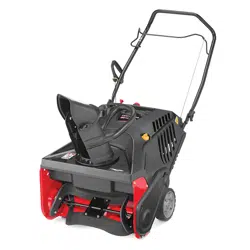
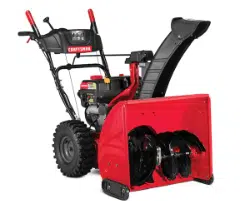
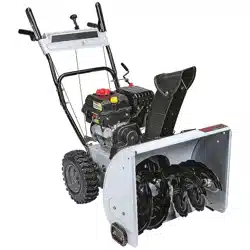
INSTRUCTION MANUAL for Gas Snow Blower
ASSEMBLY
NOTE: All references to the left or right side of the snow blower are from the operator’s position. Any exceptions will be noted.
NOTE: This Operator’s Manual covers several models. Features may vary by model. Not all features in this manual are applicable to all models and the model depicted may differ from yours.
Assembly
Positioning the Upper Handle
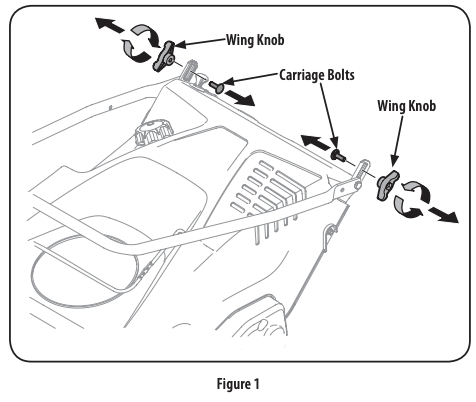
- Remove the wing knobs and carriage bolts from the top of the lower handle. See Figure 1. It is not necessary to remove the shoulder screw and flange lock nut below the wing knob and carriage bolt.
2. Pivot the upper handle into the operating position. Be sure not to pinch any of the cables in the process. See Figure 2.
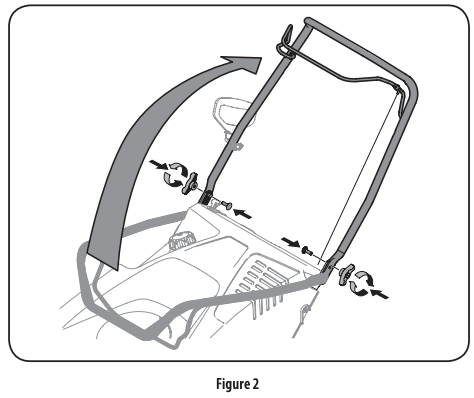
3. Tighten the previously removed hardware to secure the handle in place. See Figure 2.
Installing the Chute
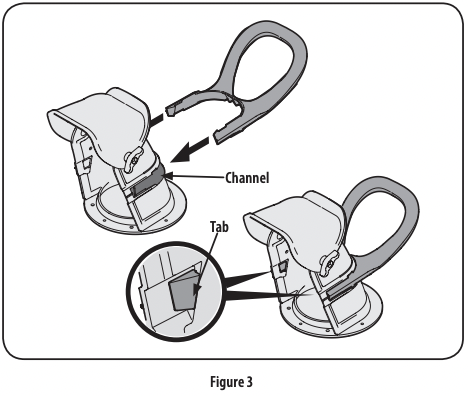
1. Place the chute handle on the lower chute as shown in Figure 3. Be certain that the handle is aligned in the channel on the chute and the tabs snap into place.
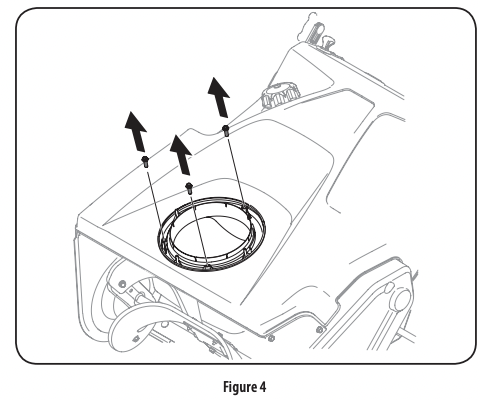
2. Remove the screws in the chute base. See Figure 4.
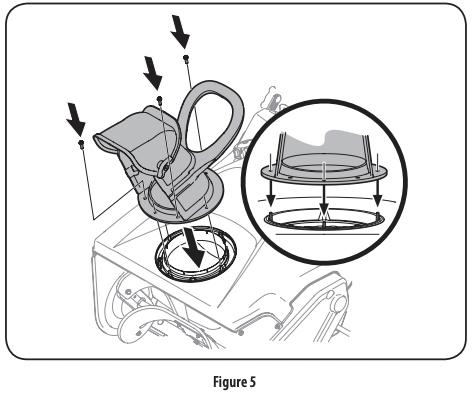
3. Align the holes in the chute base with the holes in the lower chute and secure with the previously removed screws. See Figure 5.
Installing the Recoil Starter Handle
1. Remove the eye bolt and handle knob from the manual bag.
2. Place the eye bolt and handle knob on the upper handle as shown in Figure 6. Do not fully tighten the hardware until instructed to do so.
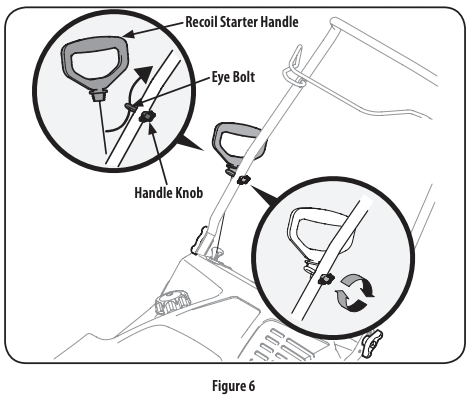
NOTE: The opening of the eye bolt should face toward the back of the snow blower.
3. Slowly pull the recoil starter handle up towards the eye bolt.
4. Slip the recoil starter rope into the eye bolt from the back side of the snow blower. See Figure 6.
5. Securely tighten the eye bolt and handle knob.
Set-Up
Fuel Recommendations
CAUTION Operating the engine with E15 or E85 fuel, an oil/gasoline mixture, dirty gasoline, or gasoline over 30 days old without fuel stabilizing additive may result in damage to your engine’s carburetor. Subsequent damage would not be covered under the manufacturer’s warranty.
Use automotive gasoline (unleaded or low leaded to minimize combustion chamber deposits) with a minimum of 87 octane. Gasoline with up to 10% ethanol (E10) or 15% MTBE (Methyl Tertiary Butyl Ether) can be used. Never use an oil/gasoline mixture or dirty gasoline. Avoid getting dirt, dust, or water in the fuel tank. DO NOT use E15 or E85 gasoline.
- Refuel in a well-ventilated area with the engine stopped. Do not smoke or allow flames or sparks in the area where the engine is refueled or where gasoline is stored.
- Do not overfill the fuel tank. After refueling, make sure the tank cap is closed properly and securely.
- Be careful not to spill fuel when refueling. Spilled fuel or fuel vapor may ignite. If any fuel is spilled, make sure the area is dry before starting the engine.
- Avoid repeated or prolonged contact with skin or breathing of vapor.
Adding Fuel
WARNING Use extreme care when handling gasoline. Gasoline is extremely flammable and the vapors are explosive. Never fuel the machine indoors or while the engine is hot or running. Extinguish cigarettes, cigars, pipes and other sources of ignition.
WARNING Always keep hands and feet clear of equipment moving parts. Do not use a pressurized starting fluid. Vapors are flammable.
1. Remove the gas cap, check the fuel level and add fuel if necessary. Fill the tank until the fuel reaches 1/2” below the bottom of the filler neck to allow for fuel expansion. Be careful not to overfill.
Checking & Adding Oil
CAUTION
The engine is shipped without oil in the engine. You must fill the engine with oil before operating. Running the engine with insufficient oil can cause serious engine damage and void the product warranty.
- Place the snow blower on a flat, level surface.
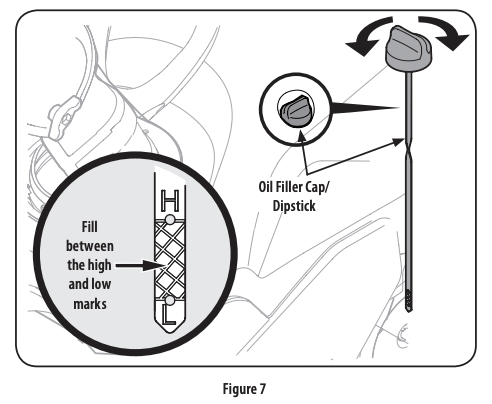
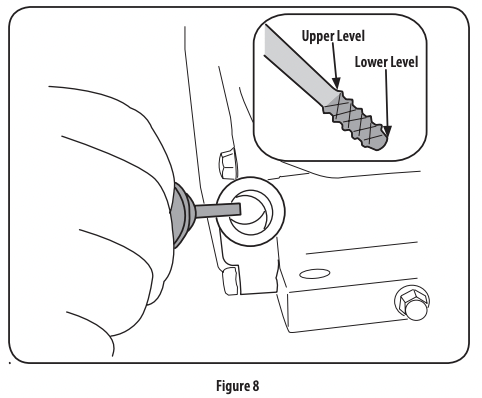
- On some models the oil filler cap/dipstick can be accessed on the left side of the shroud. See Figure 7. On other models the oil filler cap/dipstick can be accessed at the rear of the snow blower. See Figure 8.
3. Remove the oil filler cap/dipstick and wipe the dipstick clean.
4. Insert the oil filler cap/dipstick into the oil filler neck, but do not screw it in.
5. Remove the oil filler cap/dipstick. If the level is low, slowly add oil until oil level registers between the upper lever and lower level.
NOTE: Do not overfill. Overfilling with oil may cause smoking, hard starting, or spark plug fouling.
6. Replace and tighten oil filler cap/dipstick firmly before starting engine.
NOTE: DO NOT allow oil level to fall below the lover level on the dipstick. Doing so may result in equipment malfunctions or damage.
NOTE: To change the oil on your engine, see the Maintenance section of this manual.
OPERATION
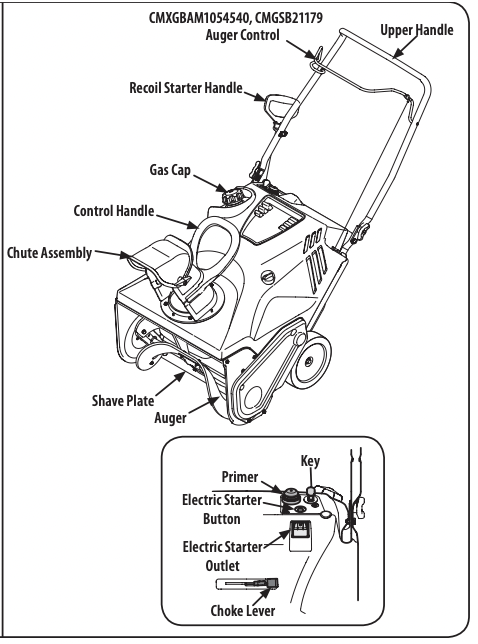
Now that you have set up your snow blower, it’s important to become acquainted with its controls and features. Refer to Figure 1.
NOTE: This Operator’s Manual covers several models. Features may vary by model. Not all features in this manual are applicable to all models and the unit depicted may differ from yours.
NOTE: References to LEFT, RIGHT, FRONT, and REAR indicate that position on the when facing forward in the operation position.
Choke Control
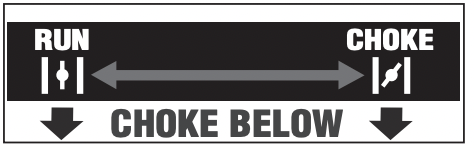
Activating the choke control closes the choke plate on carburetor and aids in starting engine. The choke lever slides between the RUN and CHOKE positions.
Primer

Pressing the primer, making sure to cover the vent hole when pushing, forces fuel directly into the engine’s carburetor to aid in cold-weather starting.
Recoil Starter Handle
The recoil starter handle is used to start the engine.
Gas Cap
Remove the gas cap to add fuel.
Key
The key is a safety device. It must be fully inserted in order for the engine to start. Remove the key when the snow blower is not in use.
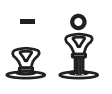
NOTE: Do not turn the key in an attempt to start the engine. Doing so may cause it to break.
Auger
When engaged, the auger rotation draws snow into the auger housing and throws it out the discharge chute. Rubber paddles on the auger also aid in propelling the snow blower as they come in contact with the pavement.
Auger Control
Located on the upper handle, the auger control handle is used to engage and disengage drive to the auger. Squeeze the control handle against the upper handle to engage the auger; release it to disengage.
Chute Assembly
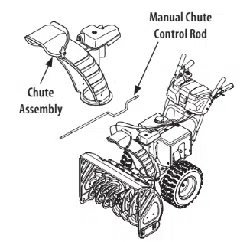
Rotate the discharge chute to the left or right using the control handle. The pitch of the discharge chute controls the angle at which the snow is thrown. Loosen the wing knob on the side of the discharge chute before pivoting the discharge chute upward or downward. Retighten the knob once the desired position has been achieved.
Shave Plate
The shave plate maintains contact with the pavement as the snow blower is propelled, allowing snow close to the pavement’s surface to be discharged.
Before Starting the Engine
WARNING
Read, understand and follow all the instructions and warnings on the machine and in this manual before operating.
Starting The Engine
Recoil Starter
WARNING
Always keep hands and feet clear of moving parts. Do not use a pressurized starting fluid. Vapors are flammable.
WARNING
To avoid carbon monoxide poisoning, make sure the engine is outdoors in a well-ventilated area.
- Make certain the auger control is in the disengaged (released) position.
- Insert ignition key into slot. Make sure it snaps into place. Do not attempt to turn the key. See Figure 2 for models CMXGBAM1054538, CMXGBAM1054539 and see Figure 3 for models CMXGBAM1054540, CMGSB21179.
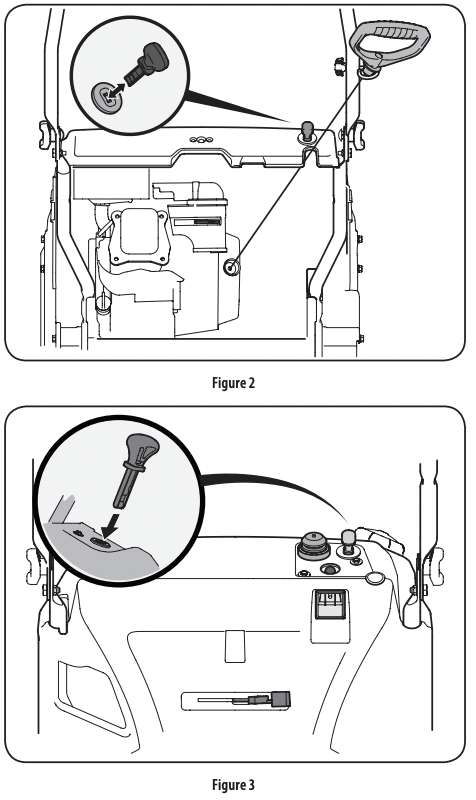
NOTE: The engine cannot start unless the key is fully inserted into the ignition switch.
3. Push the choke lever to the CHOKE position.
4. If the engine is warm, place the choke in the RUN position instead of CHOKE.
5. Push the primer five to seven (5-7) times for models CMXGBAM1054538 and CMXGBAM1054539 and three (3) times for models CMXGBAM1054540 and CMGSB21179, making sure to cover the vent hole when pushing.
6. If the engine is warm, push the primer only once.
7. Grasp the recoil starter handle and slowly pull the rope out. At the point where it becomes slightly harder to pull the rope, slowly allow the rope to recoil.
8. Pull the starter handle with a firm, rapid stroke. Do not release the handle and allow it to snap back. Keep a firm hold on the starter handle and allow it to slowly recoil.
9. Allow the engine to warm up several minutes, adjusting choke toward RUN position. Wait until engine runs smoothly before each choke adjustment.
Electric Starter (If equipped)
Determine that your home’s wiring is a three-wire grounded system. Ask a licensed electrician if you are not certain. If you have a grounded three-prong receptacle, proceed as follows:
CAUTION The extension cord can be any length, but must be rated for 15 amps at 125 volts, grounded and rated for outdoor use.
- Make certain the auger control is in the disengaged (released) position.
- Insert ignition key into slot. Make sure it snaps into place. Do not attempt to turn the key. See Figure 3 for models CMXGBAM1054540 and CMGSB21179. NOTE: The engine cannot start unless the key is fully inserted into the ignition switch.
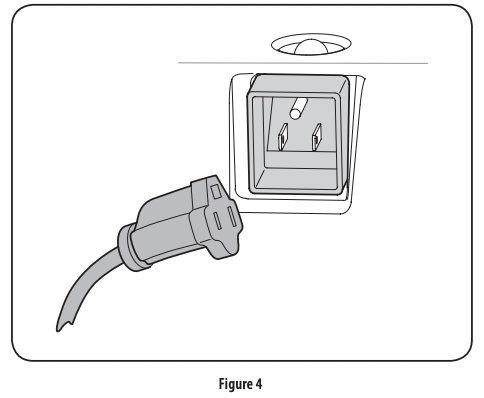
- Plug the extension cord into the outlet located on the engine’s surface. Plug the other end of extension cord into a three-prong 120-volt, grounded, AC outlet in a well-ventilated area See Figure 4.
4. Push the choke lever to the CHOKE position.
5. If the engine is warm, place the choke in the RUN position instead of CHOKE.
6. Push the primer three (3) times for models CMXGBAM1054540 and CMGSB21179, making sure to cover the vent hole when pushing.
7. If the engine is warm, push the primer button only once.
8. Push starter button to start engine.
9. Once the engine starts, release starter button.
10. Allow the engine to warm up several minutes, adjusting choke toward RUN position. Wait until engine runs smoothly before each choke adjustment
11. When disconnecting the extension cord, always unplug the end at the three-prong wall outlet before unplugging the opposite end from the snow blower.
Stopping the Engine
- Run the engine for a few minutes without engaging the auger before stopping to help dry off any moisture on the engine.
- To stop the engine remove the key and store it in a safe place. NOTE: Remove the key to quickly stop the engine in the event of an emergency.
- Wipe all the snow and moisture away from the engine controls area.
WARNING Muffler, engine and surrounding areas become hot and can cause a burn. Be careful and do not touch when they are hot.
Engaging the Auger
Engage the auger by squeezing the auger control against the upper handle. Release the control to stop the auger.
Engaging the Drive
Lift up slightly on the upper handle to allow the rubber paddles on the auger to contact the pavement and propel the snow blower forward. Pushing downward on the handle will raise the auger off the ground and stop the forward motion.
NOTE: Excessive upward pressure on the handle will result in premature wear to the rubber auger paddles.
Clearing a Clogged Discharge Chute
Hand contact with the rotating impeller inside the discharge chute is the most common cause of injury associated with snow blowers. Never use your hand to clean out the discharge chute.
To clear the chute:
- Stop the engine. See instructions above for how to stop the engine.
- Wait 10 seconds to be sure the impeller blades have stopped rotating.
- Always use a clean-out tool or stick, not your hands.
Operating the Snow Blower
- Once the auger drive is engaged, roll the snow blower into the layer of snow to be removed.
- Adjust the chute so that the snow is not thrown over other snow that is to be removed.
- Prevent possible property damage or personal injury from object ricochet by planning your snow throwing pattern to avoid discharge towards windows, walls, cars, etc.
- Do not overload machine capacity by attempting to clear snow at too fast of a rate.
- Never operate this machine without good visibility or light.
- Always be sure of your footing and keep a firm hold on the handles.
- Walk, never run when operating snow blower.
- Look down and behind and use care when backing up.
SERVICE AND MAINTENANCE
MAINTENANCE SCHEDULE
WARNING
Before performing any type of maintenance/service, disengage all controls and stop the engine. Wait until all moving parts have come to a complete stop. Disconnect spark plug wire and ground it against the engine to prevent unintended starting. Always wear safety glasses during operation or while performing any adjustments or repairs.
Follow the maintenance schedule given below. This chart describes service guidelines only. Use the Service Log column to keep track of completed maintenance tasks. To locate the nearest authorized Service Center or to schedule service, call the following toll free number: 1-888-331-4569.
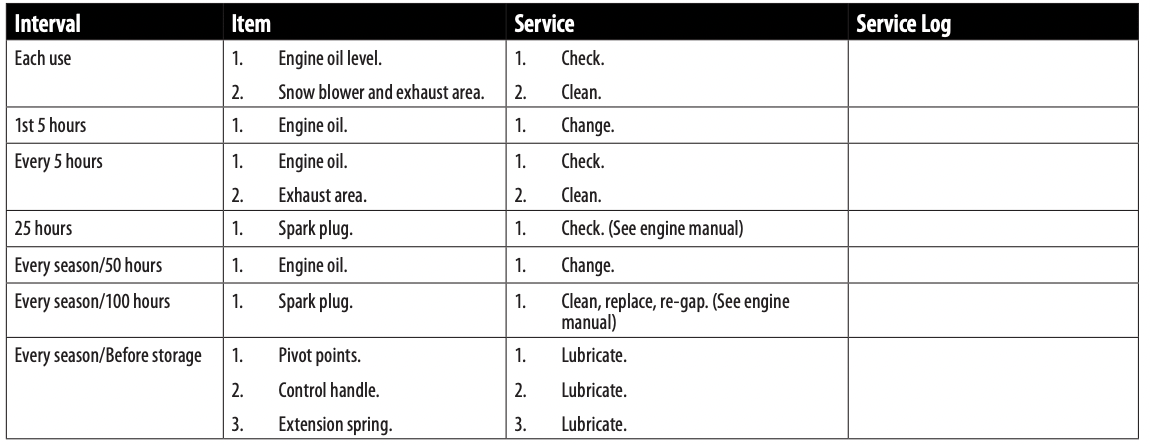
NOTE: This Operator’s Manual covers several models. Snow blower features may vary by model. Not all features in this manual are applicable to all snow blower models and the snow blower depicted may differ from yours.
Maintenance
Engine
Refer to the Engine Operator’s Manual for all engine maintenance procedures. Checking, adding and changing oil are also found in this manual.
Lubrication
Lubricate the pivot points on the control handle and the extension spring at the end of the control cable with a light oil once every season and before the snow blower is put into storage at the end of the season.
Adjustments
Shave Plate
To check the adjustment of the shave plate, place the machine on a level surface. The wheels, shave plate and auger paddles should all contact the level surface. Note that if the shave plate is adjusted too high, snow may blow under the auger housing. If the shave plate wears out excessively, or the snow blower does not selfpropel, the shave plate may be too low to the ground and needs to be adjusted.
NOTE: On new snow blowers or machines with a new shave plate installed, the auger paddles may be slightly off the ground.
To adjust the shave plate proceed as follows:
- Run the snow blower until the fuel tank is empty
- Pull the starter cord until resistance is felt. Then tip the snow blower back until it rests on the handles. To ensure that the snow blower does not tip forward, it may be necessary to secure the handle to the ground with a block or other object.
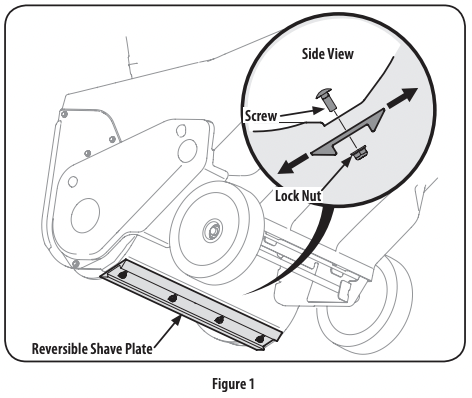
- Loosen the four flange lock nuts and carriage screws which secure the shave plate to the housing. See Figure 1. Move the shave plate to the appropriate position and retighten the nuts and screws securely.
4. Tip the snow blower back to the operating position and pull the recoil starter handle a few times to see if it is difficult to pull.
5. If the starter is difficult to pull, remove the spark plug and pull the handle several times to ensure that any oil trapped in the engine head is removed.
CAUTION Oil may come out of the spark plug hole when it is removed and the starter handle is pulled.
6. Inspect the spark plug. If it is wet, clean off any oil before re-installing.
Control Cable
As a result of both the control cable and the auger drive belt stretching due to wear, periodic adjustments may be necessary. If the auger seems to hesitate when rotating, proceed as follows:
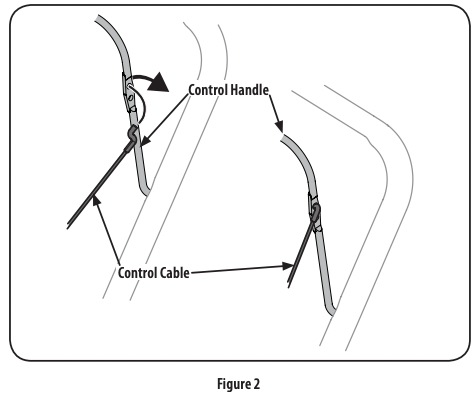
- The upper hole in the control handle provides for an adjustment in cable tension. To adjust, disconnect the end of control cable from the bottom hole in the control handle and reinsert it in the upper hole. Insert the cable from the outside as shown in Figure 2.
2. Test the snow blower to see if there is a noticeable difference. If after the adjustment to the control cable the auger still hesitates when rotating, see Auger Drive Belt Replacement for instructions on replacing the belt.
Chute Assembly
Refer to the Assembly section for instructions on adjusting the chute assembly.
Service
Auger Drive Belt Replacement
- Run the snow blower until the fuel tank is empty.
- Pull the recoil starter handle until resistance is felt. Then tip the snow blower back until it rests on the handles.
- Slide a board up through the auger and through the chute to secure the auger in place.
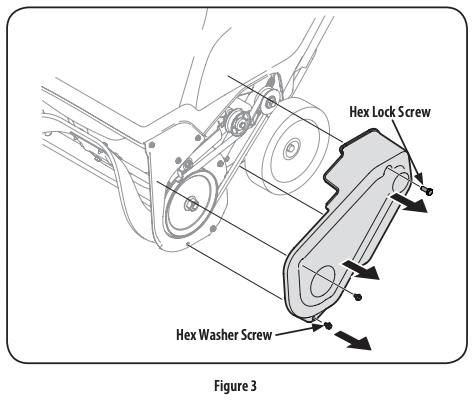
- Remove the belt cover by removing the two hex washer screws and one hex lock screw that secure it to the frame. See Figure 3.
5. Remove the flange nut that secures the auger pulley to the auger shaft. See Figure 4.
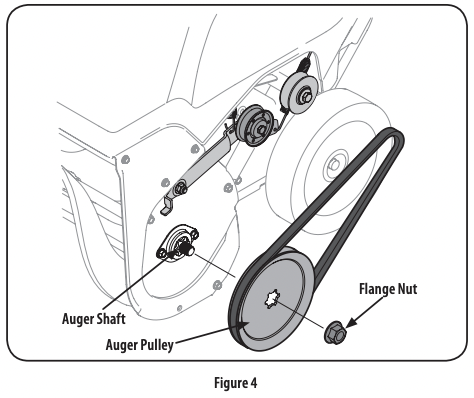
6. Remove the auger pulley and the belt.
To replace the belt follow these instructions and refer to Figure 5:
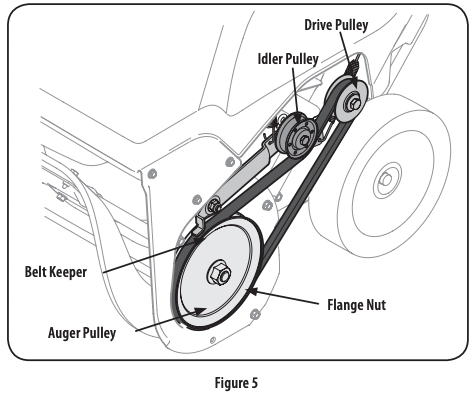
- Route the belt around the drive pulley and under the idler pulley.
- Route the end of the belt around the auger pulley and slide the pulley back on to the auger shaft. It may be necessary to push down on the idler pulley to get the auger pulley under the belt keeper.
- Replace the flange nut and tighten securely.
- Squeeze the auger control lever against the upper handle and reinstall the belt cover removed earlier.
- Remove the board from the auger and chute.
Replacing Auger Paddles
The snow blower auger’s rubber paddles are subject to wear and should be replaced if any signs of excessive wear are present.
CAUTION
Do NOT allow the auger’s rubber paddles to wear to the point where portions of the metal auger itself can come in contact with the pavement. Doing so can result in serious damage to your snow blower.
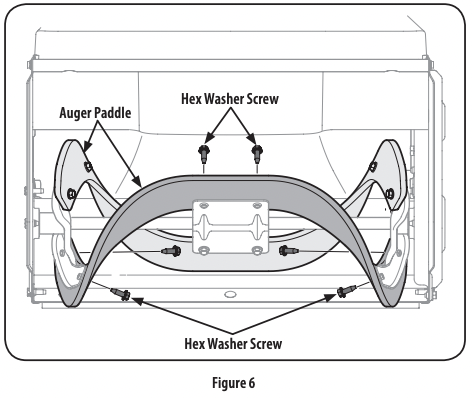
To change the rubber paddles, proceed as follows and refer to Figure 6:
- Run the snow blower until the fuel tank is empty.
- Pull the recoil starter handle until resistance is felt. Then tip the snow blower back until it rests on the handles.
- Remove the existing rubber paddles by unthreading the hex washer screws which secure them to the auger. See Figure 6. NOTE: The auger paddles should be replaced one at a time so that the auger paddle still attached can be used as an example for positioning and re-installing the new auger.
- Secure the replacement rubber paddles to the auger using the hardware removed earlier.
A full auger replacement kit including rubber paddles and hex washer screws may be obtained through and authorized Service Center or by calling 1-888-331-4569. Ask for part 753-06469.
Reversing or Replacing Shave Plate
The shave plate is attached to the bottom of the auger housing and is subject to wear. It should be checked periodically. There are two wearing edges and the shave plate can be reversed.
- Run the snow blower until the fuel tank is empty.
- Pull the recoil starter handle until resistance is felt. Then tip the snow blower back until it rests on the handles.
- Remove the four carriage bolts and flange lock nuts which attach it to the snow blower housing. Refer to Figure 1 on page 12.
- Reverse the existing shave plate or install a new one, making sure the new shave plate and the heads of the carriage bolts are on the inside of the housing.
- Adjust the shave plate as instructed on page 12.
- Tighten securely once adjusted.
A new shave plate may be obtained through an authorized Service Center or by calling 1-888-331-4569. Ask for part #731-07667.
Changing Engine Oil
WARNING
Shut off the engine and remove the ignition key before performing any maintenance. To prevent accidental start-up, disconnect the spark plug boot.
Check oil level before each use and every 5 operating hours when the engine is warm. Refer to Checking and Adding Oil in the Assembly Section.
Change the oil after the first 5 operating hours and every 50 operating hours thereafter. Engine should still be warm but NOT hot from recent use.
- Drain fuel from the tank by running the engine until the fuel tank is empty. Be sure the fuel fill cap is secure.
- Remove the three screws that secure the lower panel on model 247.887802*. Remove the lower panel by lifting up on the panel to free the tabs at the bottom of the panel from the tab slots and then pull back. See Figure 7.
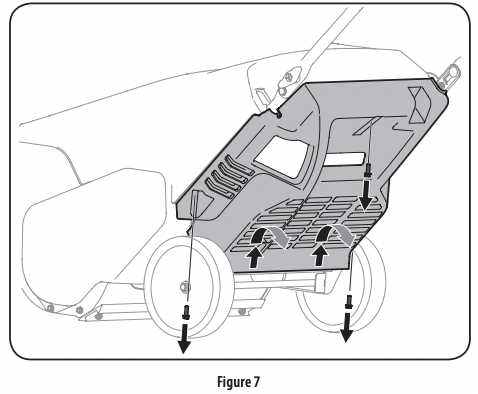
NOTE: The bottom of the panel has tabs that help hold it in place.
NOTE: An oil drain extension kit is available separately. Visit a Service Center or call 1-888-331-4569 and ask for kit #753-06684.
3. Place a suitable oil collection container under the oil drain plug.
4. Remove the oil drain plug, see Figure 8.
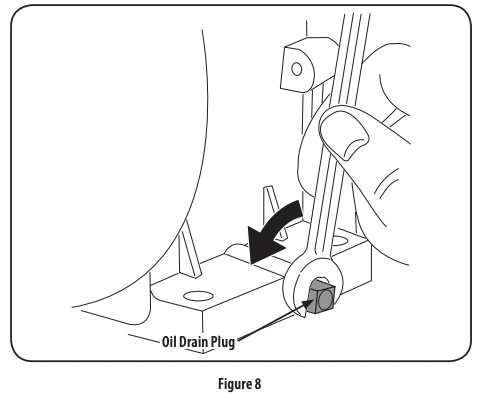
5. Tip the snow blower back to drain oil into the container. Used oil must be disposed of at a proper collection center.
6. Reinstall the drain plug and tighten it securely.
7. Refill with the recommended oil and check the oil level; refer to Checking and Adding Oil in the Assembly Section.
8. Reinstall the oil filler cap/dipstick securely.
9. Re-install the lower panel on model 247.887802* by placing the tabs in the tab slots, lifting the panel into place and secure with the three screws removed in step 2.
Off-Season Storage
Preparing the engine
Engines stored over 30 days need to be drained of fuel to prevent deterioration and gum from forming in the fuel system or on essential carburetor parts. If the gasoline in your engine deteriorates during storage, you may need to have the carburetor, and other fuel system components, serviced or replaced.
- Remove all fuel from the tank by running the engine until it stops.
- Change the engine oil.
- Remove the spark plug and pour approximately 1 oz. (30 ml) of clean engine oil into the cylinder. Pull the recoil starter several times to distribute the oil, and reinstall the spark plug.
- Clean the exterior of the engine by discarding dirt and debris from the following areas:
CAUTION
Do not spray the engine with water to clean it because the water could contaminate the fuel. Using a garden hose or pressure washing equipment can also force water into the muffler opening. Water that passes through the muffler can enter the cylinder and cause damage.
- Cooling Fins
- Air Intake Screen or Recoil Starter/Flywheel Guard Areas
- Spark Plug Connection
- Levers
- Linkage Area
- Guards
- Carburetor
- Engine Head
5. Store in a clean, dry and well ventilated area away from any appliance that operates with a flame or pilot light, such as a furnace, water heater or clothes dryer. Avoid any area with a spark producing electric motor, or where power tools are operated.
WARNING
Never store snow blower with fuel in tank indoors or in poorly ventilated areas, where fuel fumes may reach an open flame, spark or pilot light as on a furnace, water heater, clothes dryer or gas appliance.
6. If possible, avoid storage areas with high humidity.
7. Keep the engine level in storage. Tilting the engine can cause fuel or oil leakage.
Preparing Snow Blower
If the snow blower will not be used for 30 days or longer, follow the instructions below.
- Store the equipment in a clean, dry area.
- Wipe down the snow blower with a rag and remove any dirt or debris.
- If storing the snow blower in an unventilated area, rustproof the metal parts of the machine with a light oil or silicone coating.
TROUBLESHOOTING
WARNING
Disconnect the spark plug wire and ground it against the engine to prevent unintended starting. Before performing any type of maintenance/service, disengage all controls and stop the engine. Wait until all moving parts have come to a complete stop. Always wear safety glasses during operation or while performing any adjustments or repairs.
This section addresses minor service issues. To locate the nearest authorized Service Center or to schedule service, call 1-888-331-4569.
| Problem |
Cause |
Remedy |
| Engine fails to start |
- Fuel tank empty, or stale fuel.
- Blocked fuel line.
- Key not inserted all the way.
- Spark plug wire disconnected.
- Faulty spark plug.
- Engine not primed.
- Engine flooded from excessive priming
|
- Fill tank with clean fresh gasoline.
- Contact a Sears Service Center.
- Insert key all the way.
- Connect wire to spark plug.
- Clean spark plug, readjust gap, or replace.
- Push the engine primer button five to seven times for model CMXGBAM1054538, CMXGBAM1054539 and three times for model CMXGBAM1054540, CMGSB21179.
- Wait at least ten minutes before starting.
|
| Engine running erratically/ inconsistent RPM (hunting or surging) |
- Engine running on choke.
- Fuel line blocked, or stale fuel.
- Water or dirt in fuel system.
- Carburetor out of adjustment.
- Over-governed engine.
|
- Move choke control to RUN position.
- Contact an authorized Service Center.
- Run engine until the fuel tank is empty. Refill with fresh fuel.
- Contact an authorized Service Center.
- Contact an authorized Service Center.
|
| Engine overheats |
- Carburetor out of adjustment.
|
- Contact an authorized Service Center
|
| Loss of power |
- Spark plug wire loose.
- Vent in gas cap plugged.
|
- Firmly connect spark plug wire.
- Clear vent.
|
| Excessive vibration |
- Loose parts or damaged auger.
|
- Stop engine immediately and remove key. Check for possible damage. Tighten all bolts and nuts. Repair as needed. If problem persists, take snow blower to an authorized Service Center.
|
| Snow blower fails to selfpropel |
- Auger control cable out of adjustment.
- Auger drive belt loose or damaged.
|
- Adjust auger control cable as shown in Service and Maintenance section.
- Replace auger drive belt.
|
| Auger continues to rotate |
- Auger control cable out of adjustment
|
- Adjust auger control cable as shown in Service and Maintenance section.
|
| Unit fails to discharge snow |
- Chute assembly clogged.
- Foreign object lodged in auger.
- Auger control cable out of adjustment.
- Auger belt loose or damaged.
|
- Stop engine and disconnect spark plug wire. Clean chute and inside of auger housing with clean-out tool or stick.
- Stop engine immediately and disconnect the spark plug wire. Remove object from auger.
- Adjust auger control cable.
- Replace auger belt.
|