

2
nN
Contents
Before Use .........................................................................................................................................................................5
Documentation.............................................................................................................................................................5
Ergonomic Considerations...........................................................................................................................................9
Getting Started .................................................................................................................................................................11
Getting to Know Your Computer ................................................................................................................................12
About the Indicator Lights ..........................................................................................................................................19
Setting Up Your Computer.........................................................................................................................................20
Shutting Down Your Computer Safely .......................................................................................................................34
Using Your VAIO Computer .............................................................................................................................................35
Using the Optical Disc Drive ......................................................................................................................................36
Using PC Cards .........................................................................................................................................................46
Using the Memory Stick Media ..................................................................................................................................49
Using Other Memory Cards .......................................................................................................................................54
Using the Jog Controller ............................................................................................................................................58
Using the Internet.......................................................................................................................................................60
Using the Bluetooth Functionality ..............................................................................................................................61
Using Peripheral Devices.................................................................................................................................................69
Connecting a Universal Serial Bus (USB) Device......................................................................................................70
Connecting a Printer ..................................................................................................................................................72
Connecting an i.LINK Device .....................................................................................................................................74
Connecting to a Network (LAN) .................................................................................................................................76

3
nN
Customizing Your VAIO Computer ..................................................................................................................................78
Setting the Password .................................................................................................................................................79
Setting Up Your Computer with VAIO Central ...........................................................................................................82
Using the Power Saving Modes.................................................................................................................................83
Upgrading Your VAIO Computer......................................................................................................................................85
Before Upgrading Your Computer .............................................................................................................................86
Removing and Replacing Computer Panels ..............................................................................................................87
Adding and Removing Memory..................................................................................................................................93
Installing an Add-on Card ..........................................................................................................................................99
Replacing the Lithium Battery ..................................................................................................................................103
Installing the Hard Disk Drive...................................................................................................................................106
Precautions ....................................................................................................................................................................114
On Using the Power Source ....................................................................................................................................115
On Handling Your Computer....................................................................................................................................116
On Handling Floppy Disks .......................................................................................................................................118
On Handling Discs ...................................................................................................................................................119
On Using Headphones.............................................................................................................................................120
On Handling Memory Stick Media............................................................................................................................120
On Handling the Hard Disk ......................................................................................................................................121

4
nN
Troubleshooting .............................................................................................................................................................122
Computer .................................................................................................................................................................123
System Security .......................................................................................................................................................131
Internet.....................................................................................................................................................................132
Bluetooth Technology ..............................................................................................................................................134
Optical Discs ............................................................................................................................................................138
Display .....................................................................................................................................................................142
Printing.....................................................................................................................................................................144
Microphone ..............................................................................................................................................................145
Mouse ......................................................................................................................................................................146
Speakers..................................................................................................................................................................147
Keyboard..................................................................................................................................................................149
Floppy Disks ............................................................................................................................................................150
PC Cards .................................................................................................................................................................151
Audio/Video..............................................................................................................................................................153
Memory Stick Media ................................................................................................................................................154
Peripherals...............................................................................................................................................................155
Support Options .............................................................................................................................................................156
Sony Support Information ........................................................................................................................................156
Program Support Information...................................................................................................................................158

5
nN
Before Use
Before Use
Congratulations on your purchase of this Sony VAIO
®
computer, and welcome to the on-screen User Guide. Sony has
combined leading-edge technology in audio, video, computing, and communications to provide state-of-the-art personal
computing.
!
External views illustrated in this manual may look slightly different from those of your computer.
Documentation
Your documentation includes printed information and user guides to read on your VAIO computer.
Printed Documentation
❑ Welcome mat — Contains an overview of connections, setting up information, etc.
❑ Safety Information — Contains safety guidelines and owner information.
6
nN
Before Use
Non-printed Documentation
❑ User Guide (this manual) — Contains features of your computer. It also includes information about the software programs
included with your computer, as well as information on solving common problems.
❑ Specifications — The online Specifications describe the hardware and software configuration of your VAIO computer.
To view the online Specifications:
1 Connect to the Internet.
2 Go to the Sony online support Web site at:
http://esupport.sony.com/EN/VAIO/
for customers in USA,
http://www.sony.ca/support
for customers in Canada,
http://esupport.sony.com/ES/VAIO/
for customers in Spanish speaking Latin American countries or areas, or
http://esupport.sony.com/ES/VAIO/BR/
for customers in Brazil.
❑ VAIO Recovery Guide — Provides information about restoring individual software programs, software drivers, and drive
partition(s) or your entire hard disk drive to the original factory installed settings.
To access this on-screen guide:
1 Click Start and Help and Support.
2 Click Manuals & Specifications.
3 Click VAIO Recovery Guide.

7
nN
Before Use
❑ RAID Guide (Selected models only) — Provides an overview of RAID systems and the various RAID levels (or types)
that can be configured with your VAIO computer. It lists detailed procedures for using the RAID Recovery program to
configure the hard disk drives, change your computer's RAID array, or to remove the RAID configuration. Additional
procedures are also provided for using the VAIO Recovery utility and the Intel Storage Utility programs.
To access this on-screen guide:
1 Click Start and Help and Support.
2 Click Manuals & Specifications.
3 Click RAID Guide.

8
nN
Before Use
Help and Support
Help and Support is easy to access and provides a single location for information and technical assistance for your VAIO
computer. Choose from the following categories to find the answers you need.
To access Help and Support, click Start and Help and Support.
❑ Manuals & Specifications
Here you will find the on-screen User Guide, warranty information, other VAIO documents, and system and software
information for your computer.
❑ VAIO Support
Access interactive help in the form of VAIO tutorials, an escalation page containing support and contact information, and
various links to VAIO online support Web sites.
❑ Backup & Recovery
Find information on how to back up and restore your operating system, system software, and your personal data.
❑ Wireless & Network
Learn about wireless connections including Bluetooth Wireless technology and Wireless LAN. Run utilities that include
VAIO Media Setup and Windows Network and Sharing, and access to wireless tutorials.
❑ Security
Keep your data safe and your computer running efficiently with updates and maintenance programs from Microsoft and
Sony.
❑ VAIO Sites
Contains links to other Internet sites you might find interesting and useful.
9
nN
Before Use
Ergonomic Considerations
Whenever possible, you should attempt to take account of the following ergonomic considerations:
❑ Ventilation – Leave at least 6 inches (15 cm) of space on the back sides of your computer to enable proper ventilation.
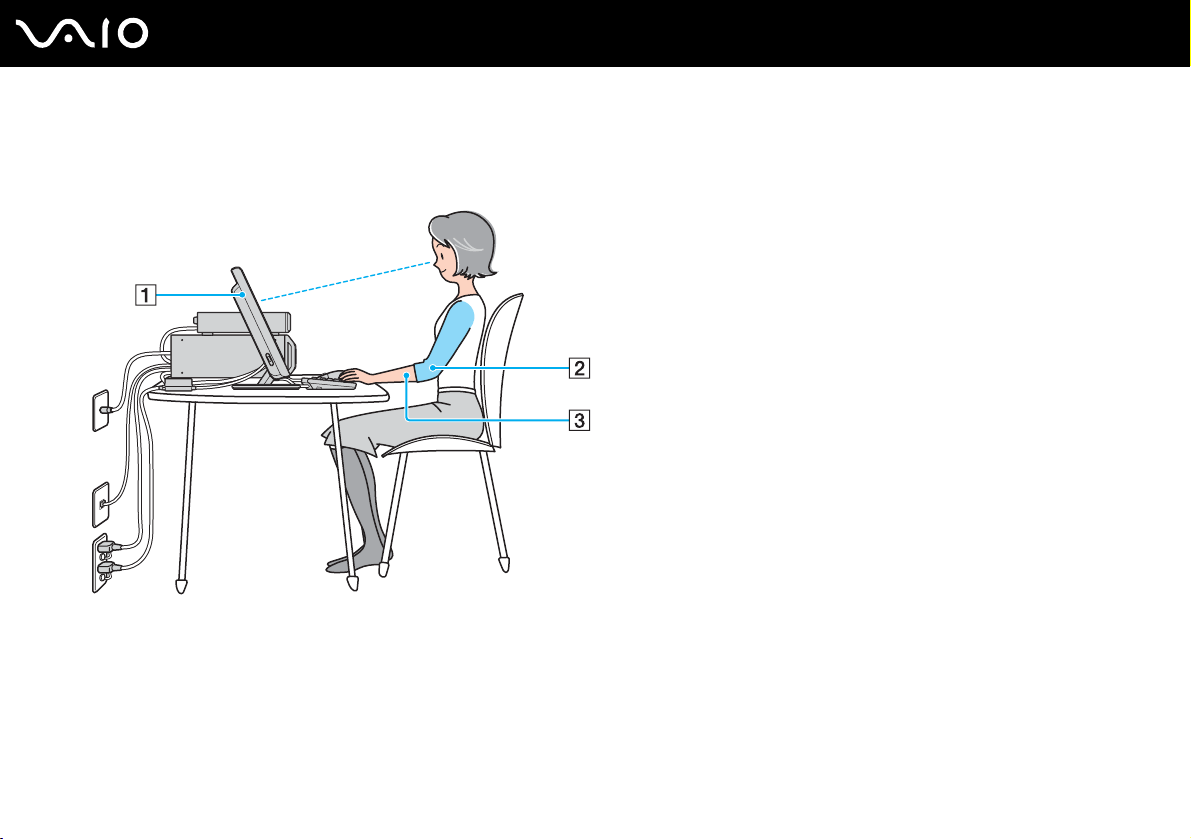
❑ Position of your computer – Place the display directly in front of you (1). Keep your forearms horizontal (2), with your
wrists in a neutral, comfortable position (3) while using the keyboard, pointing device, or external mouse. Let your upper
arms hang naturally at your sides. Have breaks during sessions with your computer. Excessive use of the computer may
strain muscles or tendons.

10
nN
Before Use
❑ Furniture and posture – Sit in a chair with good back support. Adjust the level of the chair so your feet are flat on the
floor. A footrest may make you more comfortable. Sit in a relaxed, upright posture and avoid slouching forward or leaning
far backwards.
❑ Viewing angle of the display – Position the display directly in front of you, with the top of the screen at or a little below
eye level. Use the display's tilting feature to find the best position. You can reduce eye strain and muscle fatigue by placing
the display in the proper position.
❑ Lighting – Choose a location where windows and lights do not create glare and reflection on the display. Use indirect
lighting to avoid bright spots on the display. Proper lighting adds to your comfort and work effectiveness.

11
nN
Getting Started
Getting Started
This section describes how to get started using your VAIO computer.
!
Before starting your computer for the first time, do not connect any other hardware that did not originally come with your computer. Make sure to start
up your computer with only the supplied accessories connected and set up your system. Upon completion, connect one device (for example, a printer,
an external hard disk drive, a scanner, and so on) at a time, following the manufacturers' instructions.
❑ Getting to Know Your Computer (page 12)
❑ About the Indicator Lights (page 19)
❑ Setting Up Your Computer (page 20)
❑ Shutting Down Your Computer Safely (page 34)
12
nN
Getting Started
Getting to Know Your Computer
Take a moment to identify the controls and ports shown on the following pages.
!
Your computer may not be equipped with all of the hardware features described in this section. The location of the controls, ports, and jacks may vary
from the illustrations shown below, depending on the model you purchased. See the online Specifications for your computer's specific hardware
configuration.
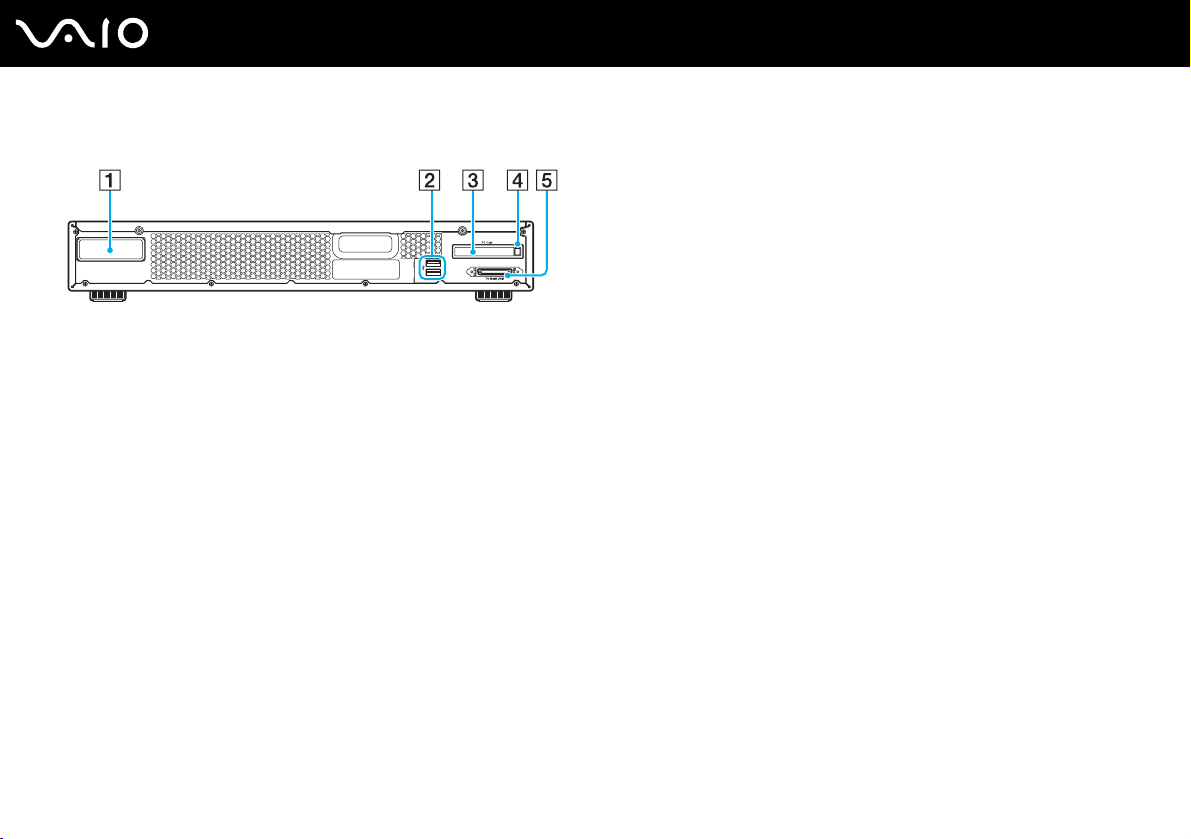
Front
Main unit
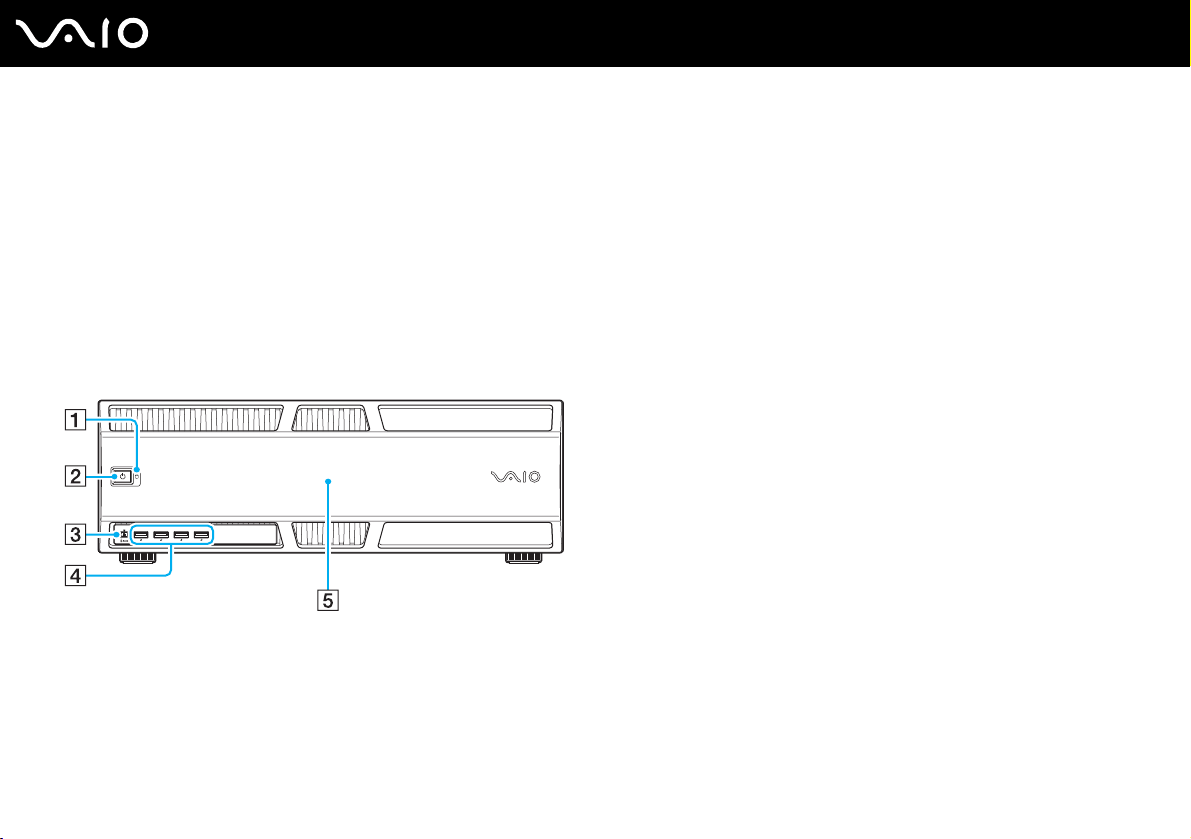
A Hard disk drive indicator (page 19)
B Power button/Power indicator (page 19)
Pressing this button will automatically turn on the access unit as
well.
C i.LINK (IEEE 1394) S400 port (4 pins) (page 74)
D Hi-Speed USB (USB 2.0) ports
*
(page 70)
E Front panel
Remove this panel to access hard disk drives.
* Supports high-/full-/low- speeds.
13
nN
Getting Started
Access unit
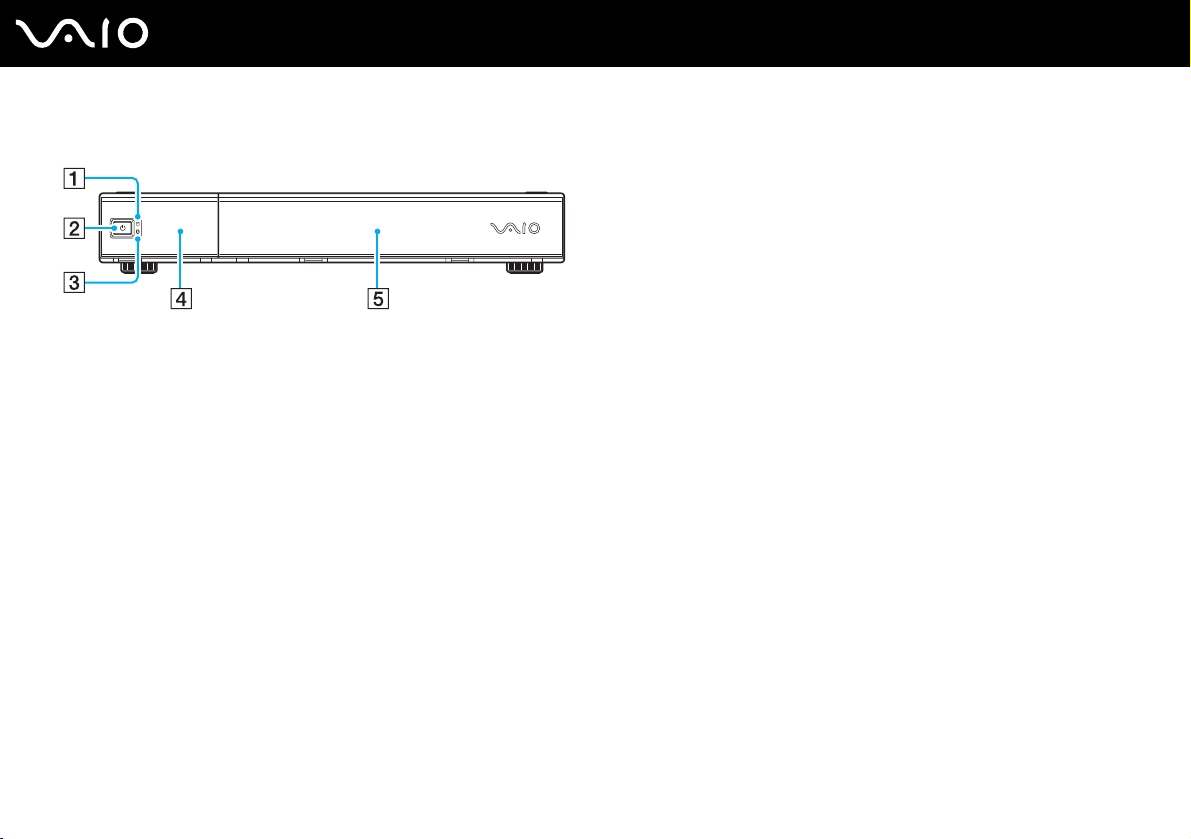
A Hard disk/Optical disc drive indicator (page 19)
B Power button/Power indicator (page 19)
Pressing this button will automatically turn on the main unit as
well.
C Bluetooth indicator (page 19)
D Left front panel
Flip this panel down to access slots, ports, and jacks.
E Right front panel
Flip this panel down to access optical disc drives.
14
nN
Getting Started
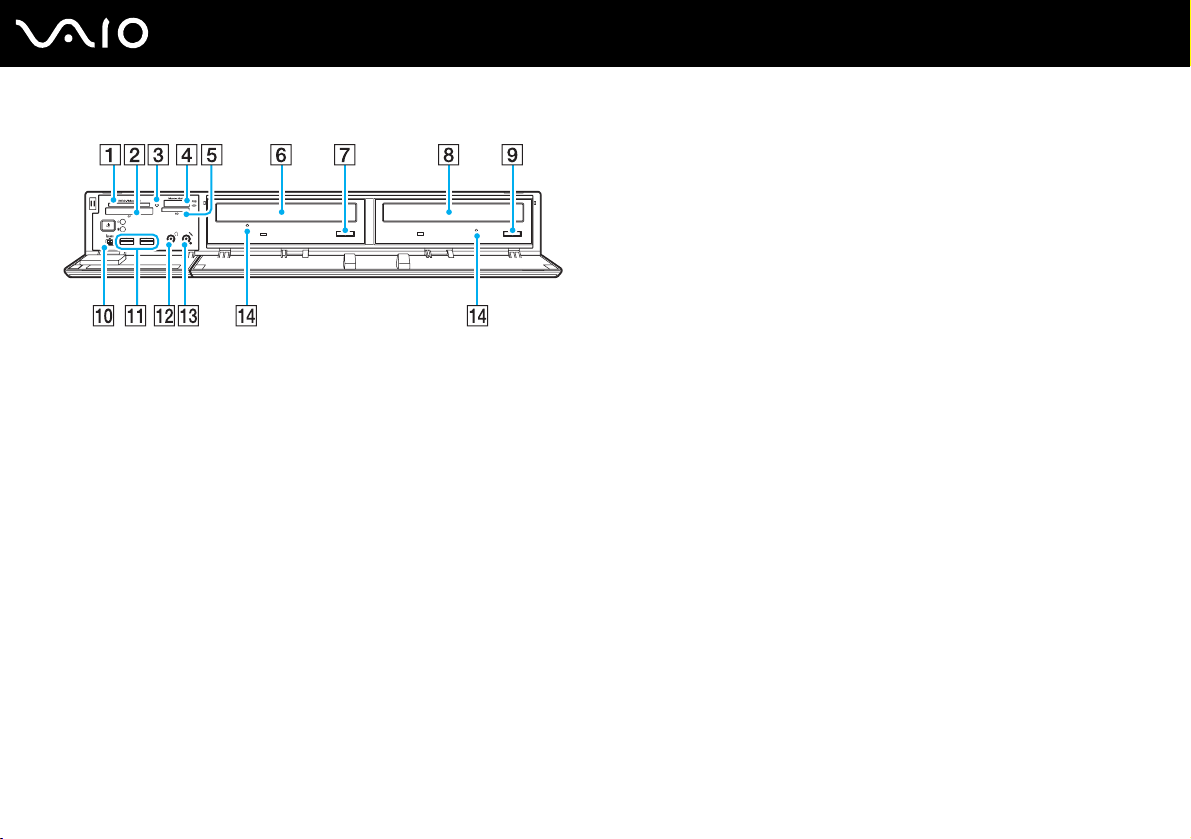
A SM/xD-Picture Card slot (page 54)
B CF (CompactFlash
®
) memory card slot (page 54)
C Media Access indicator (page 19)
D Memory Stick PRO/Duo media slot
*1
(page 49)
E SD memory card slot (page 54)
F DVD-ROM disc drive (page 36)
G DVD-ROM disc drive eject button (page 36)
H Blu-ray Disc drive (page 36)
I Blu-ray Disc drive eject button (page 36)
J i.LINK (IEEE 1394) S400 port (4 pins) (page 74)
K Hi-Speed USB (USB 2.0) ports
*2
(page 70)
L Headphones jack
Connect external headphones.
M Microphone jack
Connect an external microphone.
N Manual eject holes (page 138)
*1
Your computer supports Memory Stick Duo media and Memory Stick PRO
media with high speed and high capacity capabilities.
*2
Supports high-/full-/low- speeds.

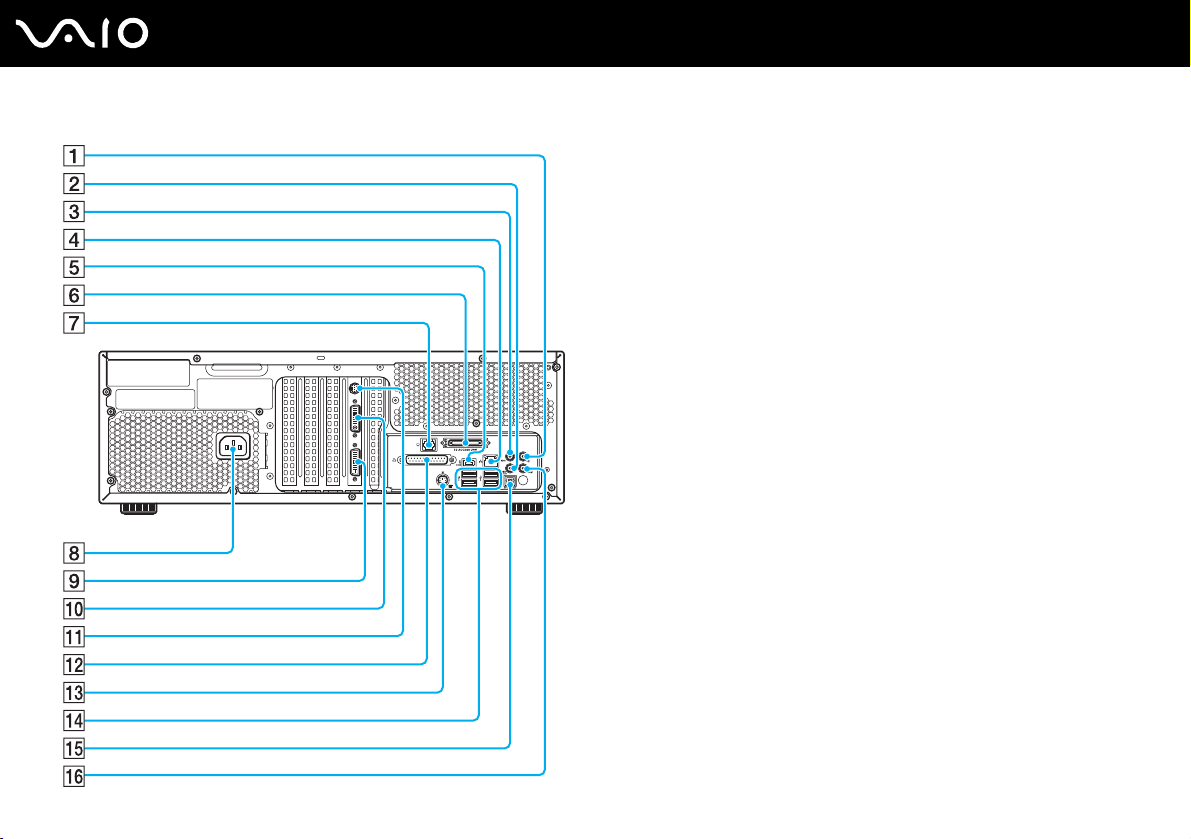
16
nN
Getting Started
A
Line In jack
B WOOFER/CENTER jack
C REAR jack
D Network (Ethernet) port (page 76)
E i.LINK (IEEE 1394) S400 port (6 pins) (page 74)
F TO ACCESS UNIT port (page 23)
G Modem port (page 29)
H AC In port (page 32)
I DVI-D port (page 24)
J DVI-I port (page 24)
K S Video/Video Out port (page 26)
L Printer port (page 73)
M Keyboard port (page 27)
N Hi-Speed USB (USB 2.0) ports
*
(page 70)
O S/PDIF OPTICAL OUT port
Connect digital equipment such as an AV amplifier.
P FRONT jack (page 26)
* Supports high-/full-/low- speeds.
18
nN
Getting Started
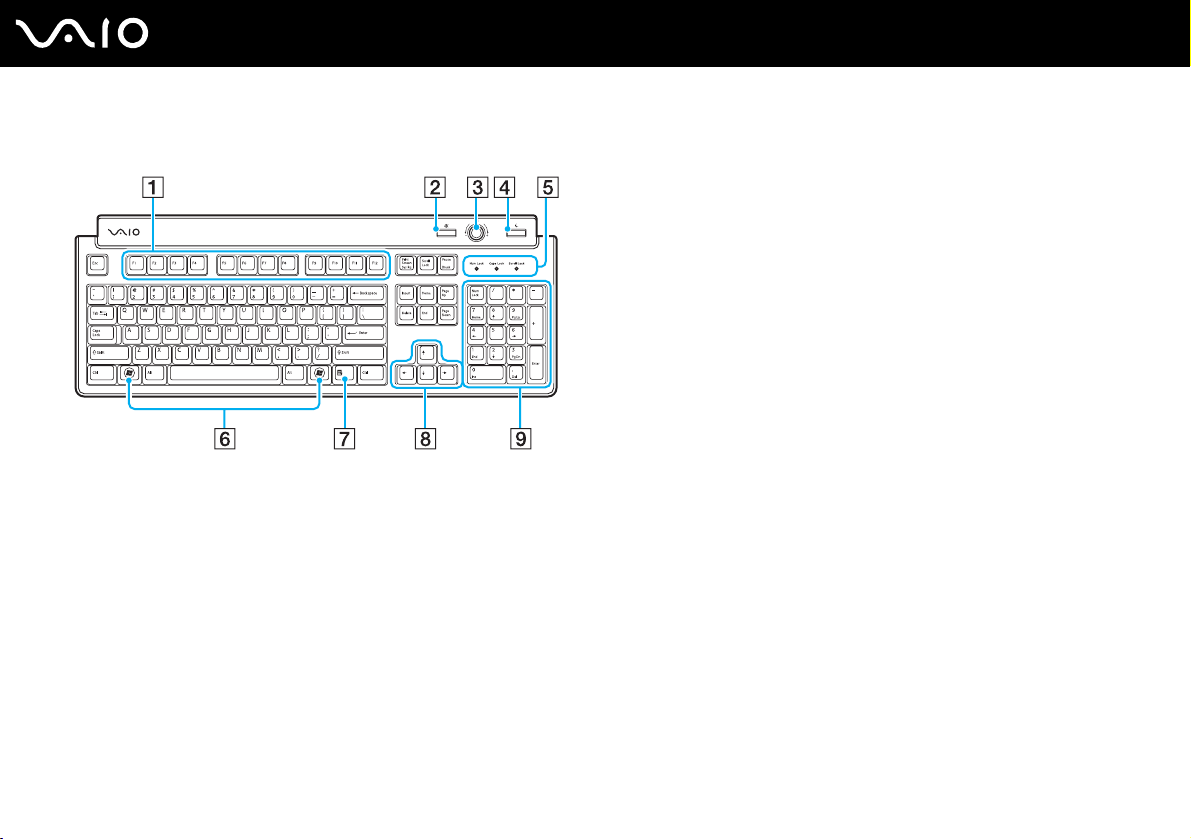
Keyboard
A Function keys
Perform certain tasks. The task associated with each function
key varies among software applications.
B Muting button
Turns the volume on and off.
C Volume control
Turn this control clockwise to increase (+) or counterclockwise
to decrease (-) the volume.
D Standby button
Places the computer into Sleep mode for power consumption.
For details on power management, see Using the Power
Saving Modes (page 83).
E Indicators
Num Lock: Turns on while in the Num Lock state.
Caps Lock: Turns on while in the Caps Lock state.
Scroll Lock: Turns on while in the Scroll Lock state.
F Windows keys
Display the Start menu.
G Applications key
Displays a shortcut menu in certain software applications.
H Directional arrow keys
Move the pointer on the screen.
I Numeric keypad
Use the numeric keypad to type numbers or to perform basic
math calculations.
19
nN
Getting Started
About the Indicator Lights
Your computer is equipped with the following indicator lights.
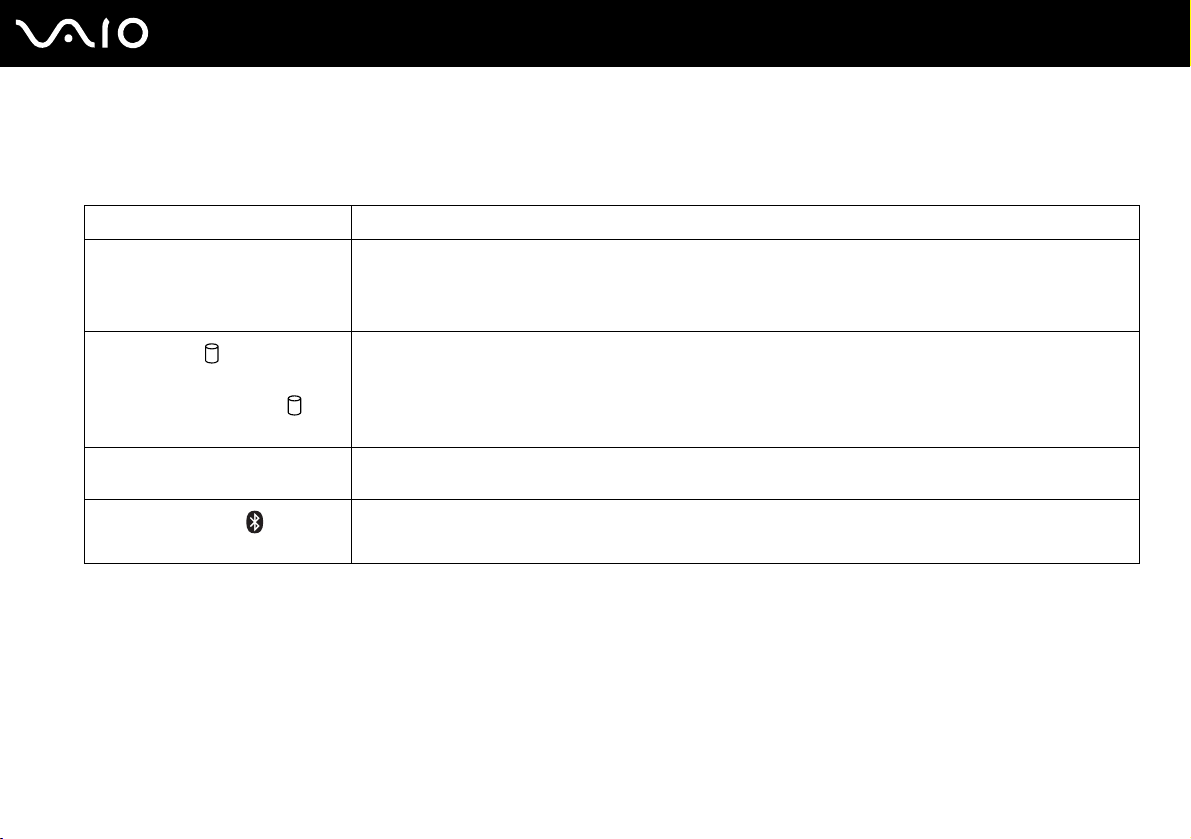
Indicator Functions
Power 1
(Both main and access units)
The indication behavior varies depending on the state of your computer unit:
Green lit: the unit is on.
Orange lit: the unit is in Sleep mode.
Off: the unit is off.
Hard disk drive
(Main unit only)
Hard disk/Optical disc drive
(Access unit only)
Illuminates when data is read from or written to the hard disk or the optical disc. Do not enter Sleep mode or
turn off the unit when this indicator is on.
Media Access
(Access unit only)
Illuminates when data is read from or written to a memory card. (Do not enter Sleep mode or turn off the unit
when this indicator is on.) When the indicator is off, the memory card is not being used.
Bluetooth technology
(Access unit only)
Illuminates when Bluetooth technology is enabled.
20
nN
Getting Started
Setting Up Your Computer
Your computer may not be equipped with all of the hardware features described in this section. The location of the controls,
ports, and jacks may vary from the illustrations shown below, depending on the model you purchased. See the online
Specifications for your computer's specific hardware configuration.
Placing Your Computer
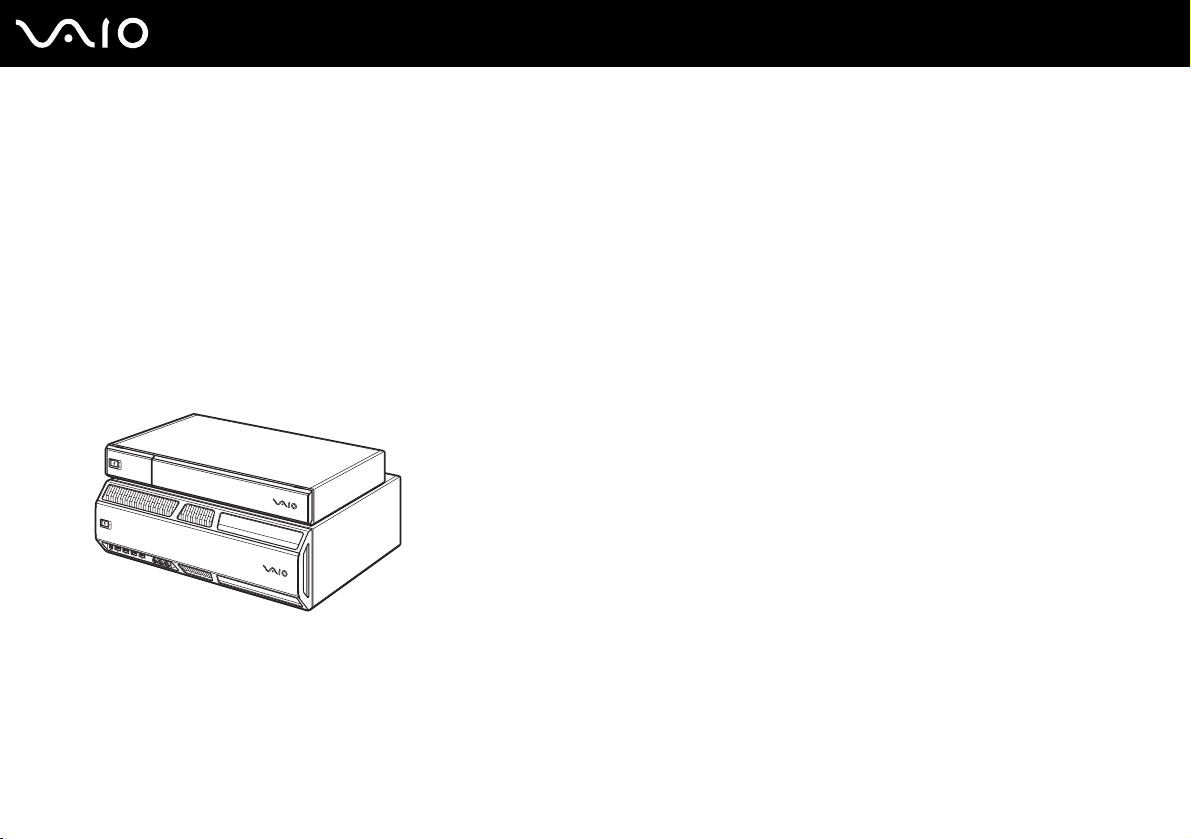
Your computer consists of the main and access units and both are designed for either flat or upright placement.
To place the units in the flat position
When placing both units in the flat position, you can put the access unit on top of the main unit.
!
Do not put the main unit on top of the access unit.
21
nN
Getting Started
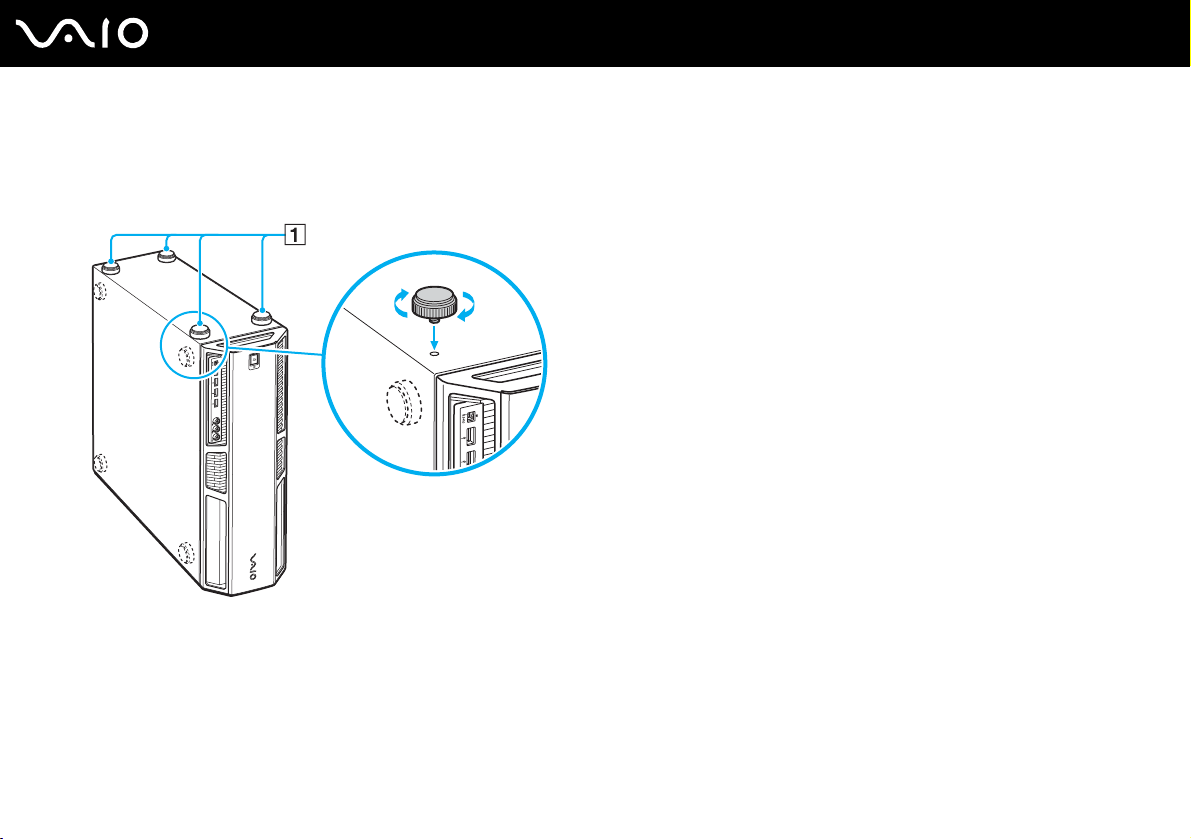
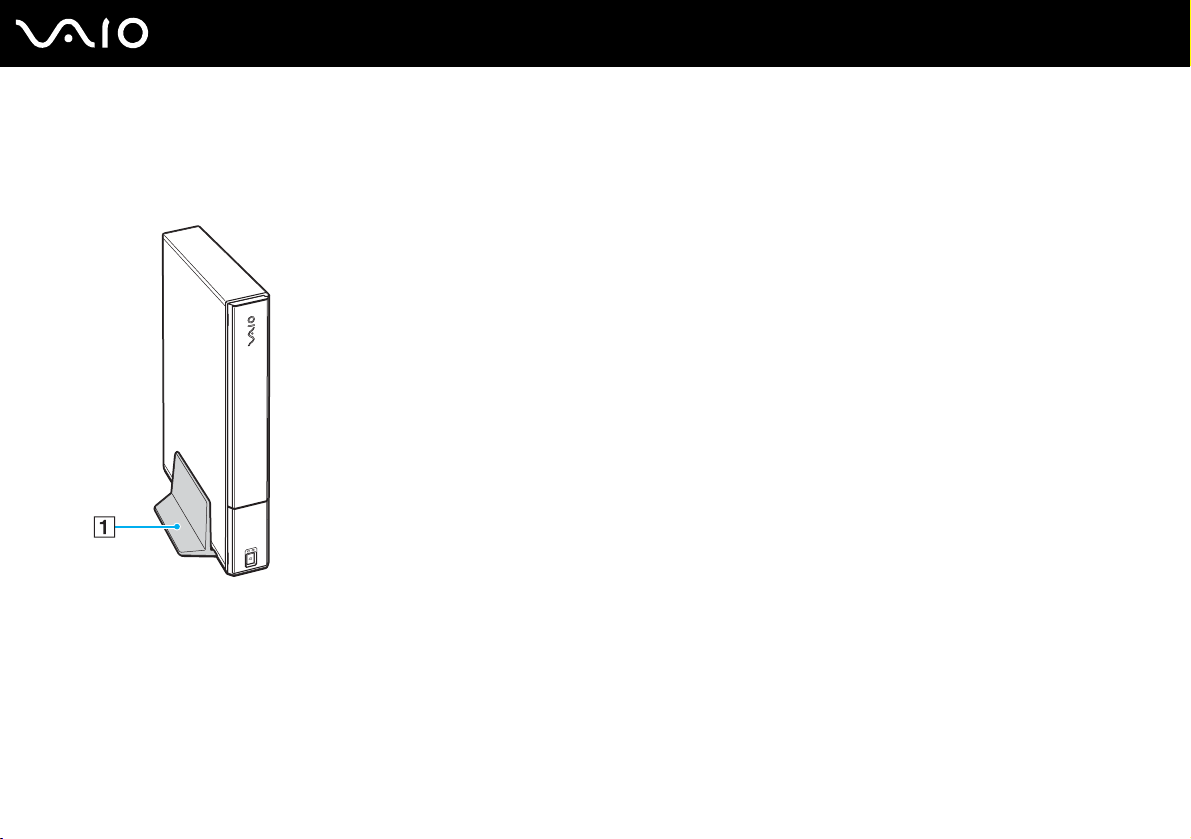
To place the main unit in the upright position
The main unit comes with the four screw-type feet (1) on its bottom surface. Remove and screw them into the holes on the
left side surface of the unit before placing the unit in the upright position.
✍
Use the supplied seals to cover the screw holes on the bottom when you use the main unit in the upright position.
23
nN
Getting Started
Connecting the Main and Access Units
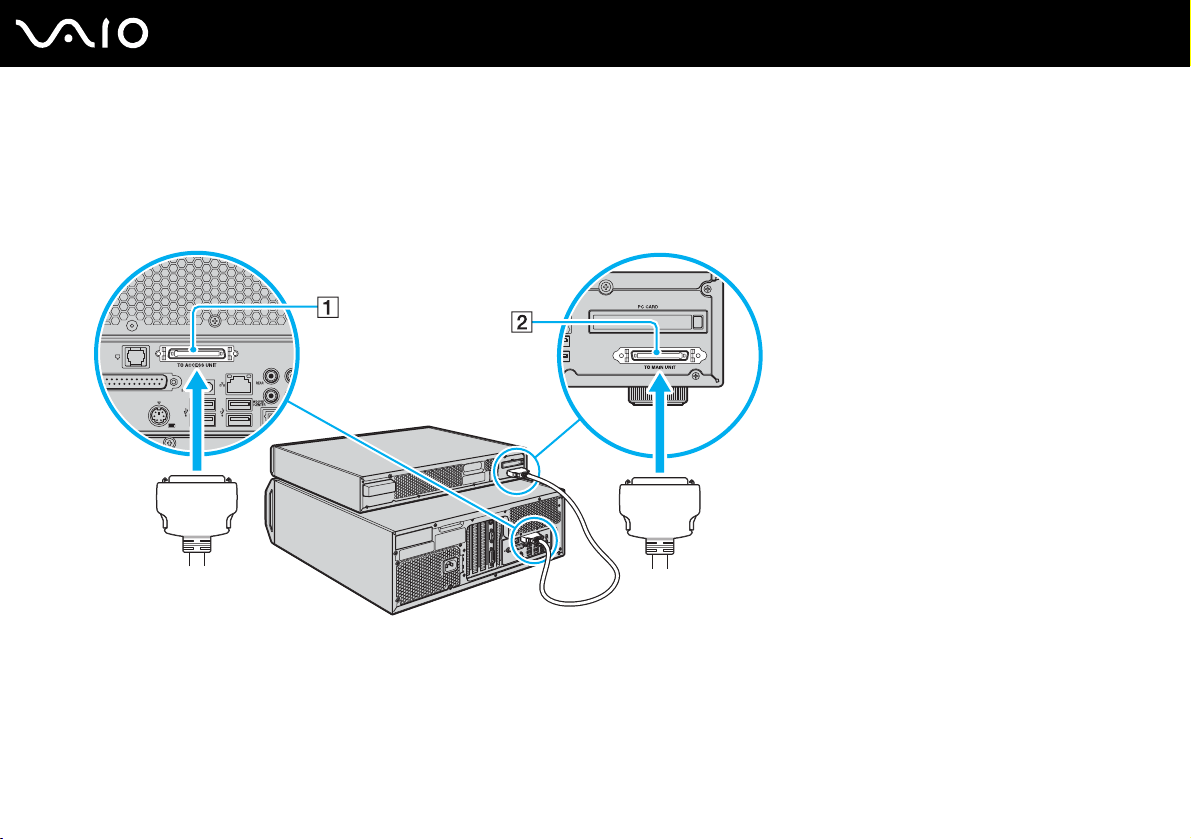
A designated connection cable is supplied with your computer for connection between the main and access units. Plug one
end of the cable to the TO ACCESS UNIT port (1) on the back of the main unit and the other end to the TO MAIN UNIT port
(2) on the back of the access unit.
!
Make sure that each end of the cable clicks into place.

24
nN
Getting Started
Connecting a Display
Connect a display (not supplied) to your computer. When connecting it, see the manual that came with your display as well.
To connect a display (monitor)
1 If you want to connect a DVI monitor, plug its cable into the DVI-D (1) or DVI-I (2) port on the back of the main unit.
If you want to connect a VGA monitor, use a video adapter device (not supplied) to connect its cable to the DVI-I port (2).
!
If your monitor is HDCP-compliant, connect it to the DVI-D port. The DVI-I port is not compliant with the High-bandwidth Digital Content Protection
(HDCP) standard.
2 If necessary, plug the display's cable into the rear of the display.
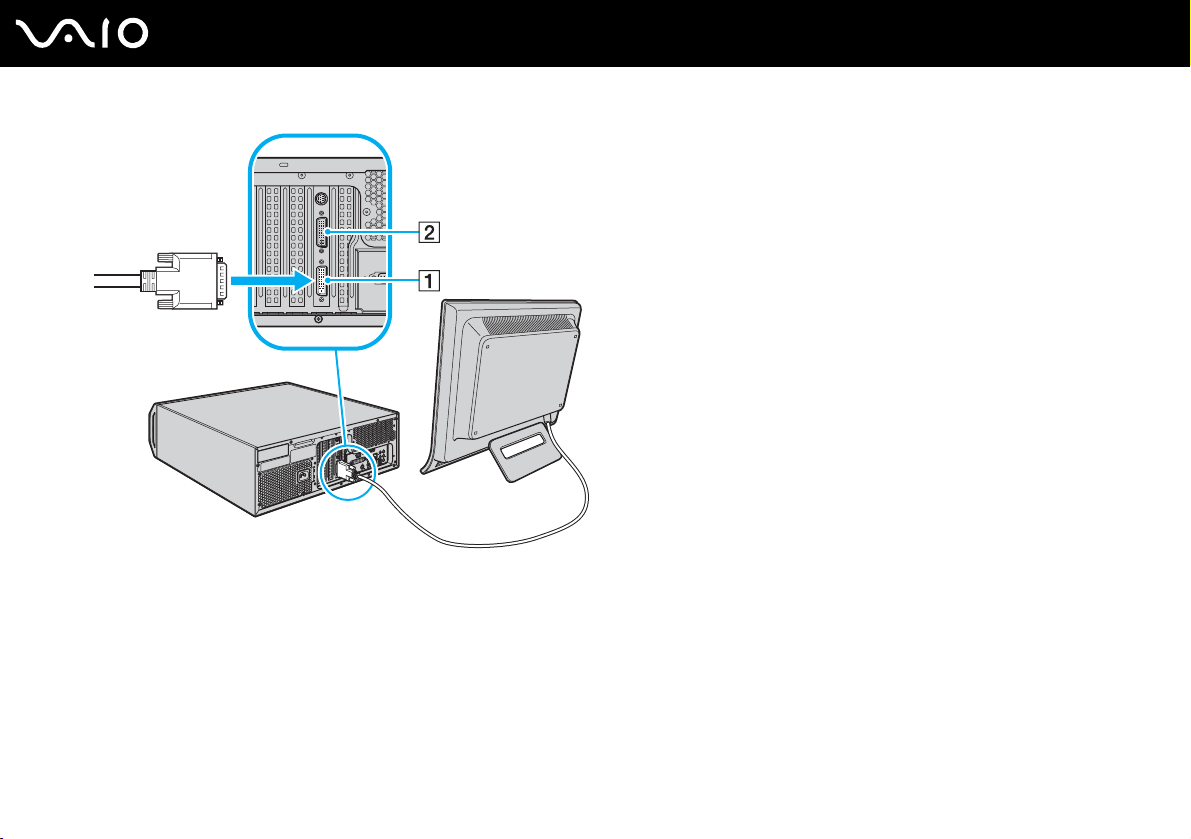
25
nN
Getting Started
!
Your computer is compliant with the HDCP standard and capable of encrypting the transmission channel of digital video signals for the purpose of
copyright protection, which enables you to play and view a wide variety of copyright protected, high-quality contents. Note that you need to connect an
HDCP-compliant monitor to your computer to view the copyright protected contents. If your computer has a non-compliant monitor connected, you
will not be able to play or view any copyright protected contents, including Blu-ray movie contents.
26
nN
Getting Started
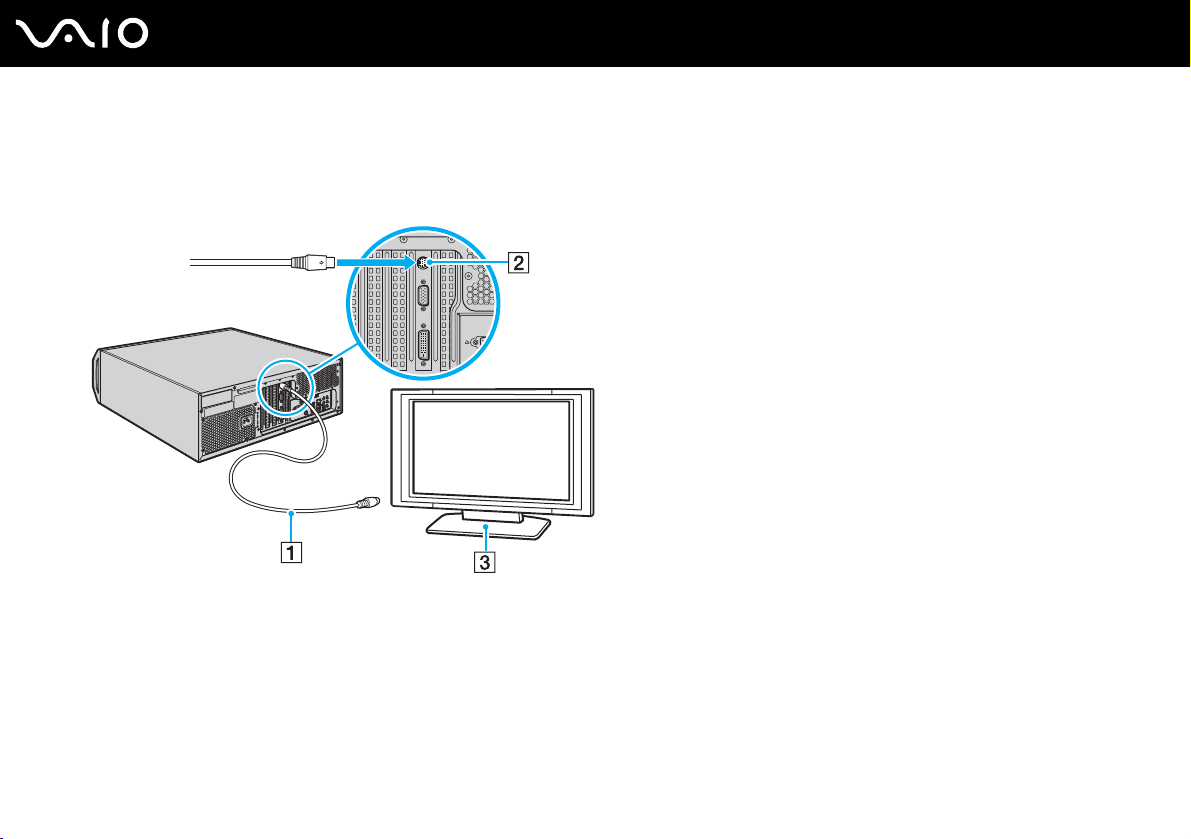
To connect a display (TV)
Plug one end of an S Video cable (1) (not supplied) into the S Video/Video Out (2) port on the back of the main unit and the
other end to the S Video input port on your TV (3).
✍
You will hear audio from the speakers connected to your computer, not from the TV. To hear audio from the TV, use an audio cable (not supplied) to
connect the FRONT jack on the back of the main unit and the audio input port on the TV. See the manual that came with your TV for more information
on installation and use.

27
nN
Getting Started
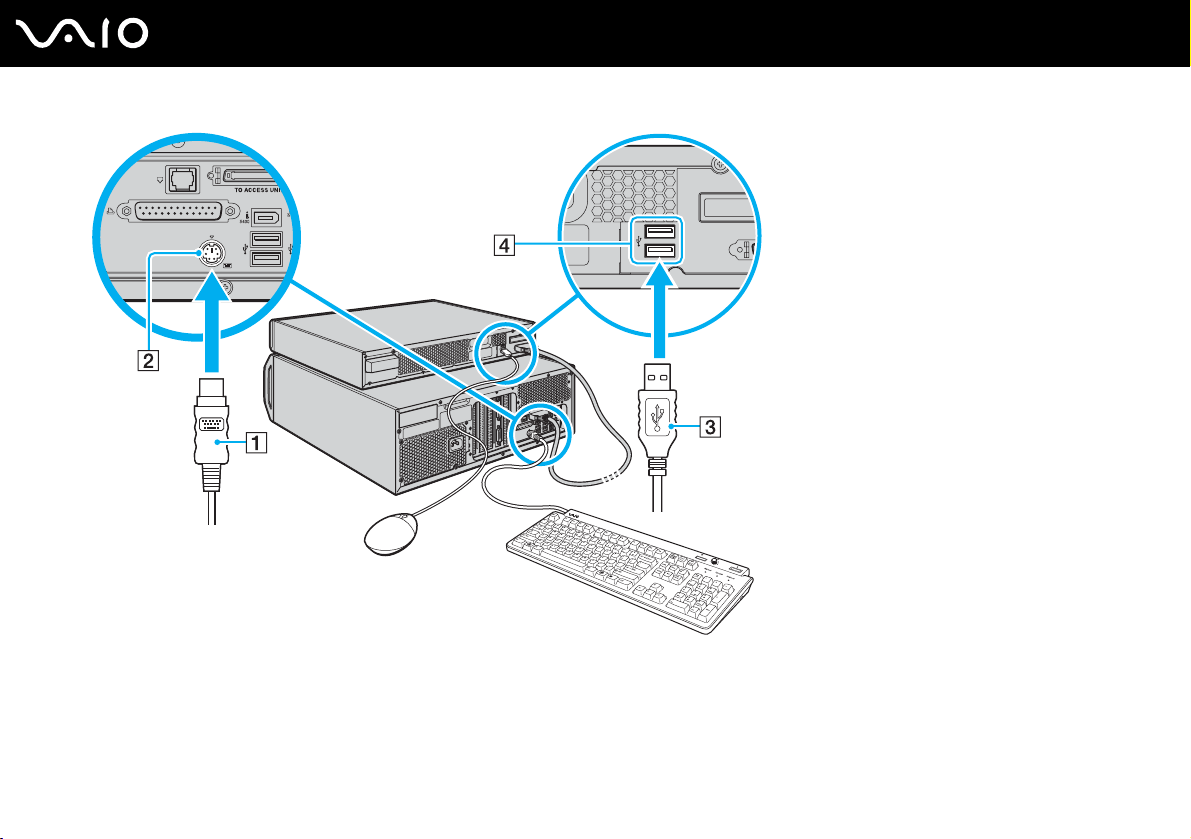
Connecting the Keyboard and Mouse
A PS/2 keyboard and a USB mouse are supplied with your computer.
To connect the keyboard and mouse
1 Plug the keyboard cable (1) into the keyboard port (2) on the back of the main unit.
2 Plug the mouse cable (3) into one of the USB ports (4) on the back of the access unit.

29
nN
Getting Started
Connecting the Telephone and Modem
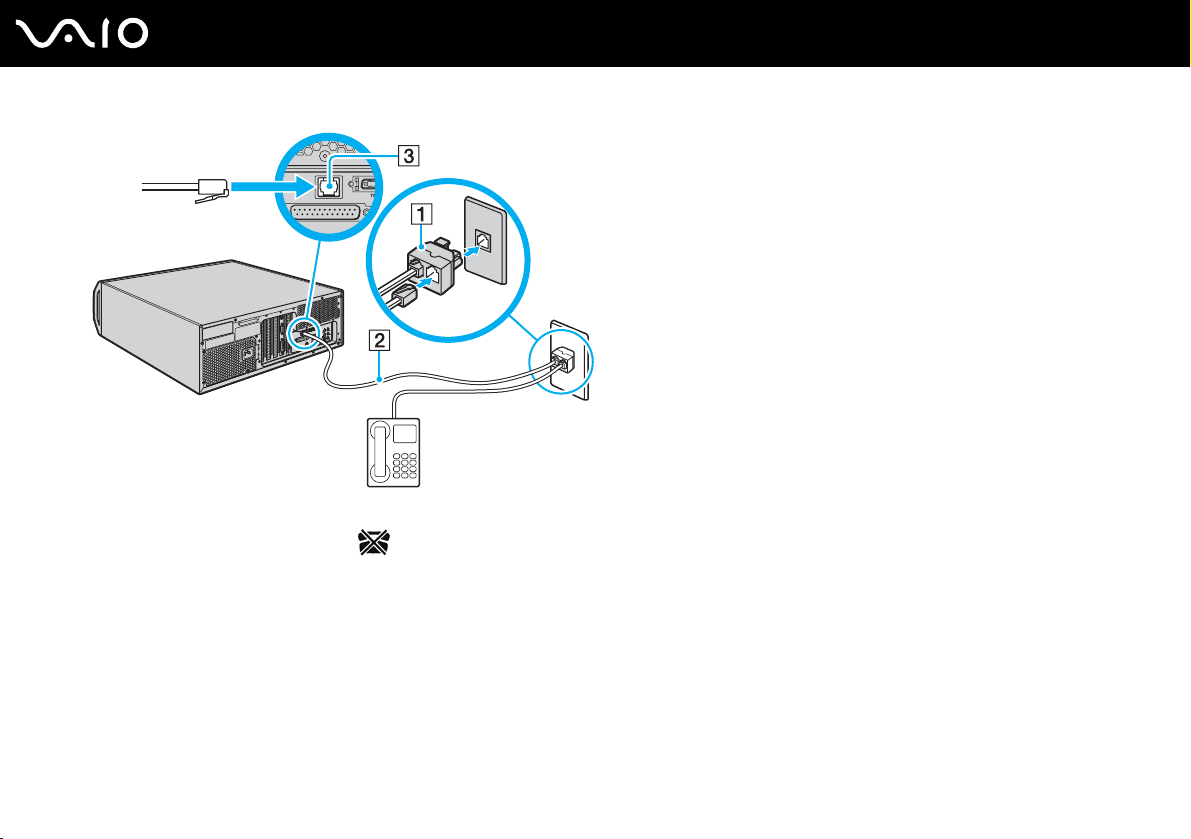
The main unit is equipped with a single modem port to connect the internal modem with a telephone wall jack. To use the
wall jack for both telephone and modem lines, purchase an additional RJ-11 phone cable and a "1-to-2" port adapter device
(splitter).
To connect the modem
1 Unplug the phone cable to your telephone from the wall jack and set aside.
2 Plug another phone cable (not supplied) into the modem port on the back of the main unit.
3 Plug the other end of the cable into the wall jack.
To connect the telephone and modem
1 Unplug the phone cable to your telephone from the wall jack.
2 Plug it into one of the ports on a "1-to-2" port adapter device (splitter) (not supplied) (1).
3 Plug one end of a second phone cable (not supplied) into the other port on the splitter device.
4 Insert the plug end of the splitter device into the wall jack.
5 Plug the other end of the second phone cable (2) into the modem port (3) on the back of the main unit.
30
nN
Getting Started
!
The main unit has a protective sticker covering the network (Ethernet) port located on its back. Connect 10BASE-T, 100BASE-TX, or 1000BASE-
T cable to the network (Ethernet) port. Using an incorrect cable, such as a phone cable, may result in an electric current overload that can cause a
malfunction, excessive heat, or fire in the network (Ethernet) port. For help on connecting to a network, see your network administrator.

31
nN
Getting Started
Connecting Speaker Systems
Note that speaker configuration varies, depending on the speaker components in use.
To set up the speakers with the computer
❑ Match the color of the mini stereo plugs (from the speaker system) to the color of the speaker jacks on the back of the
main unit.
❑ Review the connection instructions provided with your speaker system, as the connection setup may vary.
To select the speaker system
1 Click Start and Control Panel.
2 Click Hardware and Sound.
3 Click Manage audio devices under Sound.
4 On the Playback tab, select Speakers and click Configure.
5 Choose your speaker configuration.

32
nN
Getting Started
Connecting the Power Cord
!
Use only the supplied power cord for your computer.
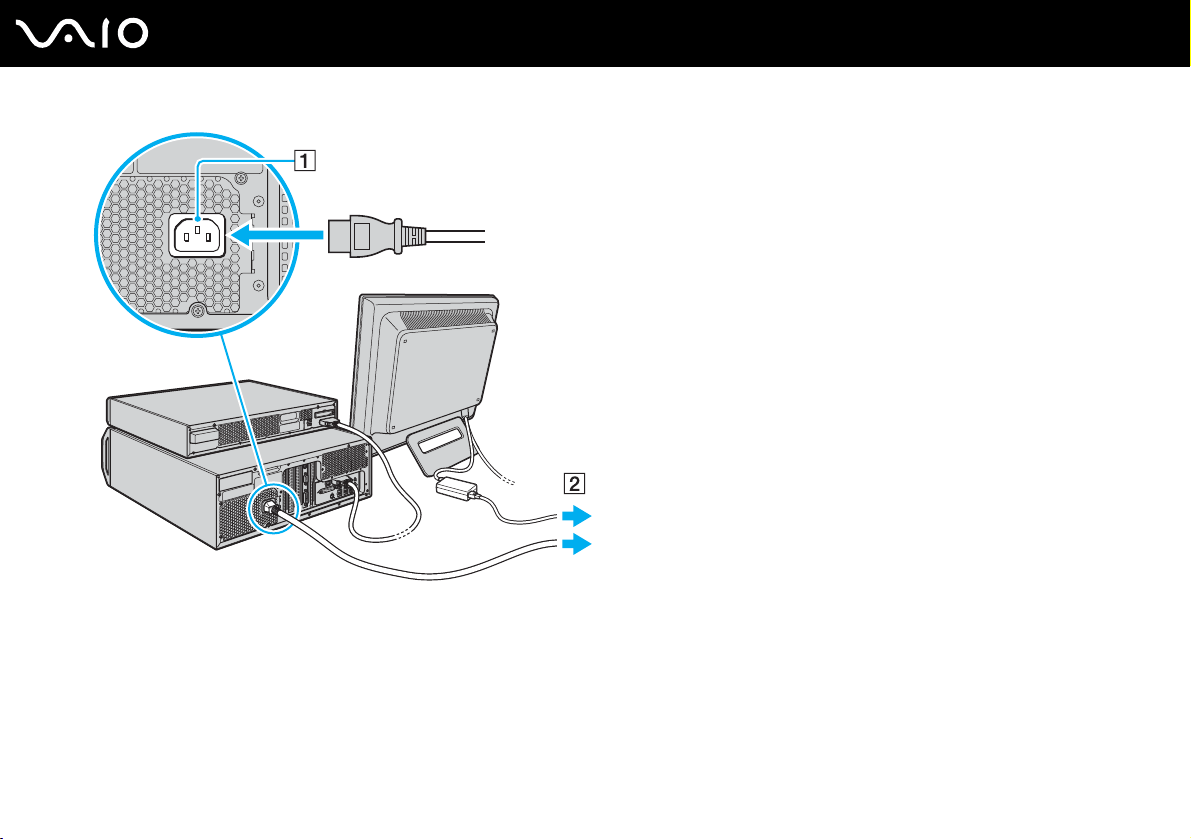
To connect the power cord
1 Insert the power cord into the AC In port (1) on the back of the main unit.
2 Insert each of the power cord plugs from the display and the main unit into a grounded AC wall outlet, surge protector, or
Universal Power Supply (UPS) (2).

34
nN
Getting Started
Shutting Down Your Computer Safely
To avoid losing unsaved data, be sure to shut down your computer properly, as described below.
To shut down your computer
1 Turn off any peripherals connected to the computer.
2 Click Start, the arrow next to the Lock button, and Shut Down.
3 Respond to any prompts warning you to save documents or to consider other users and wait for the computer to turn off
automatically.
The power indicator light turns off.

35
nN
Using Your VAIO Computer
Using Your VAIO Computer
This section describes how to get the most out of using your VAIO computer.
❑ Using the Optical Disc Drive (page 36)
❑ Using PC Cards (page 46)
❑ Using the Memory Stick Media (page 49)
❑ Using Other Memory Cards (page 54)
❑ Using the Jog Controller (page 58)
❑ Using the Internet (page 60)
❑ Using the Bluetooth Functionality (page 61)
36
nN
Using Your VAIO Computer
Using the Optical Disc Drive
The access unit of your computer is equipped with two optical disc drives: the DVD-ROM drive on the left and the Blu-ray
Disc drive on the right.
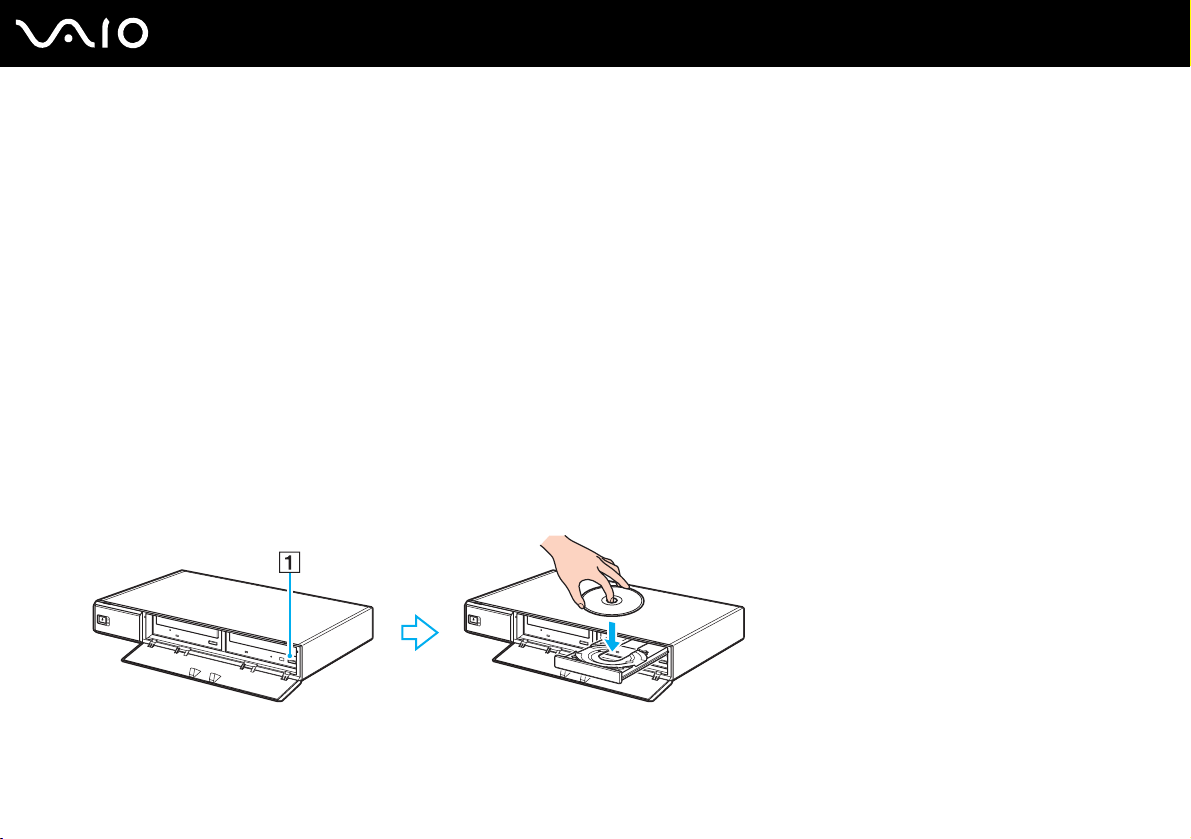
To insert a disc
1 Turn on the computer.
2 Flip down the right front panel of the access unit.
3 Press the drive eject button (1) on the optical disc drive.
The tray slides out.
4 Place a disc in the middle of the tray with the label side facing upward.
!
Be sure not to scratch the recording surface of the optical disc with any projected parts on the tray.
✍
Illustrated below is the Blu-ray Disc drive as an example.

38
nN
Using Your VAIO Computer
Reading and Writing Optical Discs
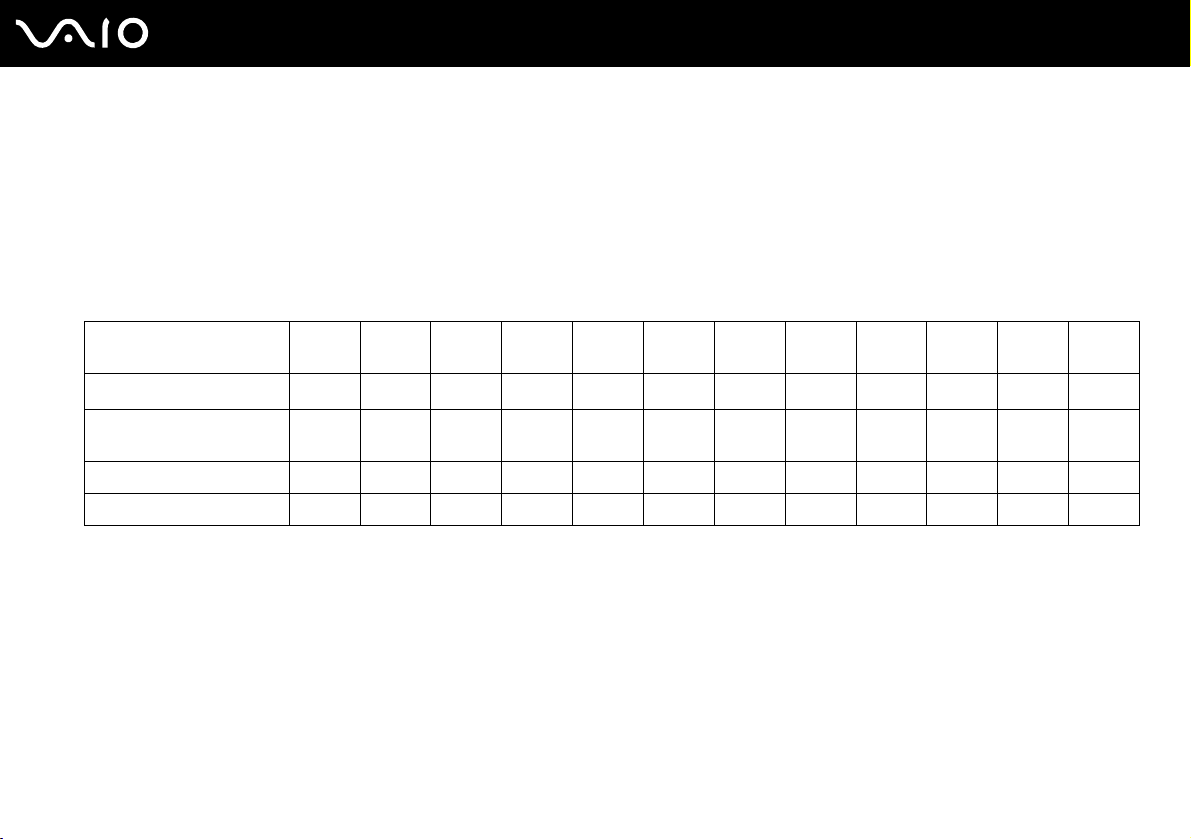
Your computer plays and records CDs, DVDs, or Blu-ray Discs, depending on the model you purchased. Check your
specifications for the type of optical disc drive installed on your model. Use the table below to see which types of media your
optical disc drive supports.
PR: playable and recordable
P: playable but not recordable
–: not playable or recordable
CD-
ROM
Video
CD
Music
CD
CD
Extra
CD-R/
RW
DVD-
ROM
DVD-
Video
DVD-R/
RW
DVD+R/
RW
DVD+R
DL
DVD-R
DL
DVD-
RAM
DVD±RW/±R DL/RAM PPPPPRPP
PR
*1 *2
PR
PR
*5
PR
*6
PR
*3 *4
DVD±RW
(Supporting DVD±R DL)
PPPPPRPP
PR
*1 *2
PR
PR
*5
PR
*6
–
CD-RW/DVD-ROM PPPPPRPPPPPP–
DVD-ROM PPPPPPPPPPP–
*1
Supports writing data to DVD-R discs compliant with DVD-R for General Version 2.0/2.1.
*2
Supports writing data to DVD-RW discs compliant with DVD-RW Version 1.1/1.2.
*3
The DVD±RW/RAM disc drive on your computer does not support the DVD-RAM cartridge. Use non-cartridge discs or discs with removable cartridge.
*4
Writing data to single-sided DVD-RAM discs (2.6 GB) compliant with DVD-RAM Version 1.0 is not supported.
DVD-RAM Version 2.2/12X-SPEED DVD-RAM Revision 5.0 disc is not supported.
*5
Writing data to DVD+R DL (Double Layer) discs is available only on discs supporting DVD+R DL (Double Layer) recording.
*6
Writing data to DVD-R DL (Dual Layer) discs is available only on discs supporting DVD-R DL (Dual Layer) recording.
39
nN
Using Your VAIO Computer
!
This product is designed to playback discs that conform to the Compact Disc Digital Audio standard specifications (CD Standard). A DualDisc is a two
sided disc product which mates DVD recorded material on one side with digital audio material on the other side. Please be aware that the audio side
(non-DVD side) of a DualDisc may not play on this product because it does not conform to the CD Standard.
Due to the multiple formats of discs now available, when buying pre-recorded or blank discs for use with a VAIO computer, be sure to read the notices
on the disc packaging carefully to check both playback and recording compatibility with your computer's optical disc drives. Sony does NOT guarantee
the compatibility of VAIO CD drives with discs that are not compliant with the official "CD" format standard (or "DVD" standard in relation to DVD drives).
USING NON-COMPLIANT DISCS CAN CAUSE FATAL DAMAGE TO YOUR VAIO PC OR CREATE SOFTWARE CONFLICTS AND CAUSE SYSTEM HANGING.
For inquiries about disc formats, contact the individual publisher of the pre-recorded disc or the manufacturer of the recordable disc.
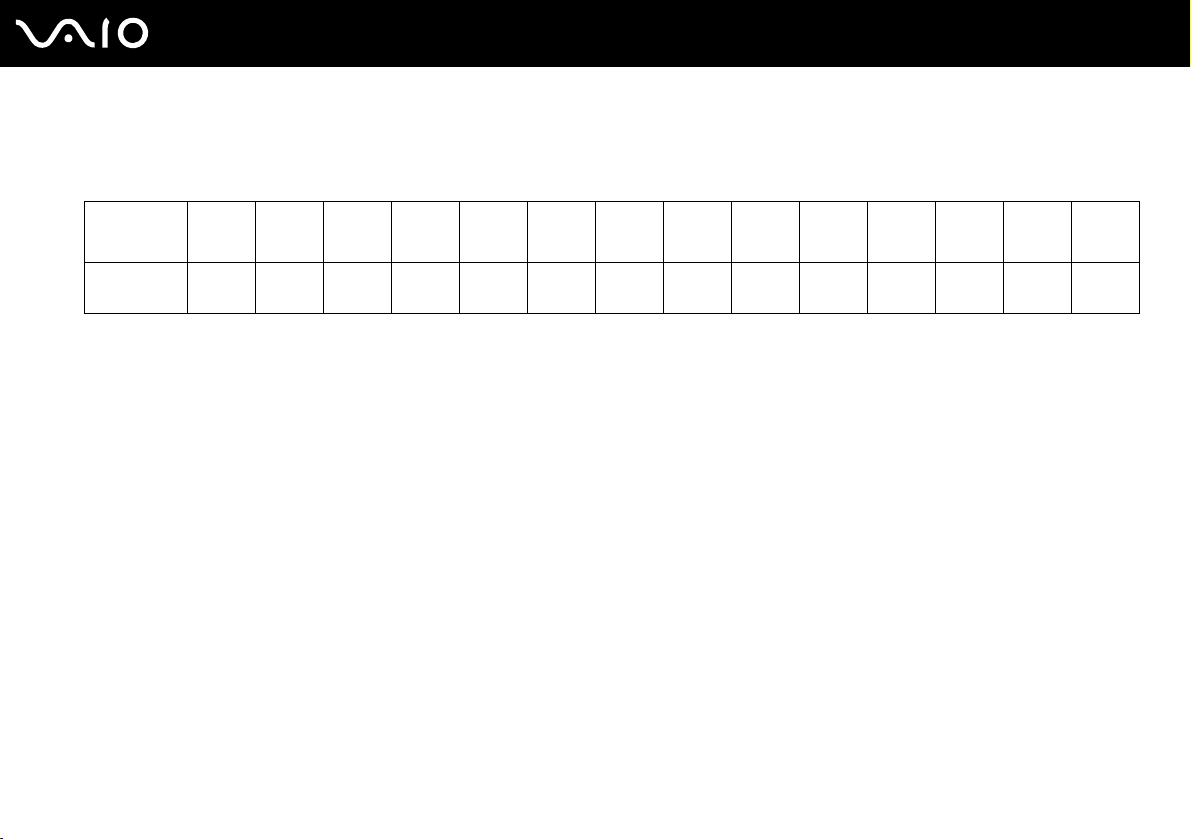
PR: playable and recordable
P: playable but not recordable
–: not playable or recordable
CD-
ROM
Video
CD
Music
CD
CD
Extra
CD-R/
RW
DVD-
ROM
DVD-
Video
BD-
ROM
DVD-R/
RW
DVD+R/
RW
DVD+R
DL
DVD-R
DL
DVD-
RAM
BD-R
*9
/
RE
*10
Blu-ray
Disc Drive
PPPP
PR
*8
PPP
PR
*1 *2
PR
PR
*5
PR
*6
PR
*3 *4
PR
*7
*7
Supports writing data to BD-R Version 1.1 discs (single-layer discs with the capacity of 25 GB, dual-layer discs with the capacity of 50 GB) and BD-RE Version 2.1
discs (single-layer discs with the capacity of 25 GB, dual-layer discs with the capacity of 50 GB). The Blu-ray Disc drive on your computer does not support BD-RE
Version 1.0 discs and Blu-ray cartridge discs.
*8
Writing data to Ultra Speed CD-RW discs is not supported on models with the Blu-ray Disc drive.
*9
BD-R stands for Blu-ray Disc-Recordable in Version 1.1 format.
*10
BD-RE stands for Blu-ray Disc-Rewritable in Version 2.1 format.

40
nN
Using Your VAIO Computer
✍
8cm disc writing is not supported.
Playing an 8cm disc with an 8cm disc adapter is not supported. To play 8cm discs, use the access unit in the flat position.
!
To play copyright protected Blu-ray Discs continually, you need to update the AACS key. Note that the AACS key update requires Internet access.
As with other optical media devices, circumstances may limit compatibility or prevent Blu-ray Disc playback. VAIO computers may not support movie
playback on packaged media recorded in AVC or VC1 formats at high bit rates.
Region settings are required for Movies and BD-ROM contents. If the region setting and the region of the disc do not match, playback is not possible.
Unless your external display is compliant with the High-bandwidth Digital Content Protection (HDCP) standard, you cannot play or view the contents
of copyright protected Blu-ray Discs.
Some contents may restrict video output to be standard definition or prohibit analog video output at all. It is strongly recommended that digital HDCP-
compliant environment be implemented for optimum compatibility and viewing quality.

41
nN
Using Your VAIO Computer
Notes on writing data to a disc
❑ Use only Sony Value-added software to write data to a disc. (e.g. Click to DVD)
Other software programs may not be fully compatible and errors may result.
❑ To make data on a disc readable on the optical disc drive, you need to close the session before you eject it. To complete
this process, follow the instructions included with your software.
❑ Only use circular discs. Do not use discs in any other shape (star, heart, card, etc.), as this may damage the optical disc
drive.
❑ Do not strike or shake your computer while writing data to a disc.
❑ Deactivate the screen saver and exit anti-virus software before writing data to a disc.
❑ Do not use memory-resident utility software while writing data to a disc. This may cause your computer to malfunction.
❑ When using your software application to burn discs, make sure you exit and close all other applications.
❑ Never touch the surface of the disc. Fingerprints and dust on the surface of a disc may cause writing errors.
❑ Do not switch power modes while using the preinstalled software or any disc burning software.
❑ Never affix an adhesive label to a disc. This will affect the use of the disc irreparably.
❑ Make sure you use the same disc burning software to add data to a used disc. Use of different disc burning software for
additional data burning may cause a failure. For example, if you have a disc with data that you burned with the Roxio
Easy Media Creator software, use the Roxio Easy Media Creator software to add some data to the same disc.

42
nN
Using Your VAIO Computer
Notes on playing discs
To achieve optimum performance when playing DVDs, you should follow these recommendations.
❑ Close all open applications before playing a DVD movie.
❑ Some CD players and computer's optical disc drives may not be able to play audio CDs created with the CD-R or CD-RW
disc media.
❑ Some DVD players and computer's optical disc drives may not be able to play DVDs created with the DVD+R DL, DVD-
R DL, DVD+R, DVD+RW, DVD-R, DVD-RW, or DVD-RAM disc media.
❑ Do not use memory-resident utility software to speed up disc access when playing a DVD. This may cause your computer
to malfunction.
❑ Deactivate the screen saver and exit anti-virus software before playing a disc.
❑ Some discs recorded at 20 or 24 bits may produce noise while playing. If you have audio devices connected, this may
damage your hearing and the speakers. Reduce the volume before playing a DVD.
❑ Do not switch to power saving modes while your computer is playing a DVD.
❑ Region code indicators are labeled on the DVDs to indicate in which region and on what type of player you can play the
disc. If the DVD is labeled "all," this means that you can play this DVD in most regions of the world. If the region code of
your residence area is different from the label on the DVD disc or on the packaging, you cannot play the disc on your
computer.
!
You can change the DVD region code only a limited number of times. When you have exceeded this number, the drive's DVD region code is permanently
assigned and you will not be able to change it again. Reconfiguring your computer does not reset this count.
If you change the DVD region code while the WinDVD or WinDVD BD software is running, restart the software or eject the disc and re-insert it to make
the new setting effective.


44
nN
Using Your VAIO Computer
Playing CDs
To play an audio CD
1 Insert a disc into the optical disc drive.
2 If nothing appears on the desktop, then click Start, All Programs, and the desired CD software to play the CD.
If the Audio CD window appears, click to select an option.
Copying Files to CDs
To copy files to a disc
!
Do not strike or shake your computer while writing data to a disc.
1 Insert a disc into the optical disc drive.
If the AutoPlay window appears, click Burn files to disc and follow the on-screen instructions until the empty disc folder
appears.
2 Open the folder that contains the file(s) you want to copy and drag them to the empty disc folder.
3 Close the disc folder.

45
nN
Using Your VAIO Computer
Playing DVDs
To play a DVD
1 Close all running software applications.
2 Insert a DVD into the optical disc drive.
3 If nothing appears on the desktop, then click Start, All Programs, and the desired DVD software to play the DVD.
For instructions on how to use the software, see the help file on your DVD software.
Copying Files to DVDs
To copy files to a disc
1 Insert a disc into the optical disc drive.
2 If nothing appears on the desktop, then click Start, All Programs, and the desired DVD software to copy files to the disc.
For instructions on how to use the software, see the help file on your DVD software.
46
nN
Using Your VAIO Computer
Using PC Cards
PC Cards allow you to connect portable external devices to your computer.
Inserting a PC Card
!
Some PC Cards or their functions may not be compatible with your computer.
You do not need to shut down your computer before inserting or removing a PC Card.
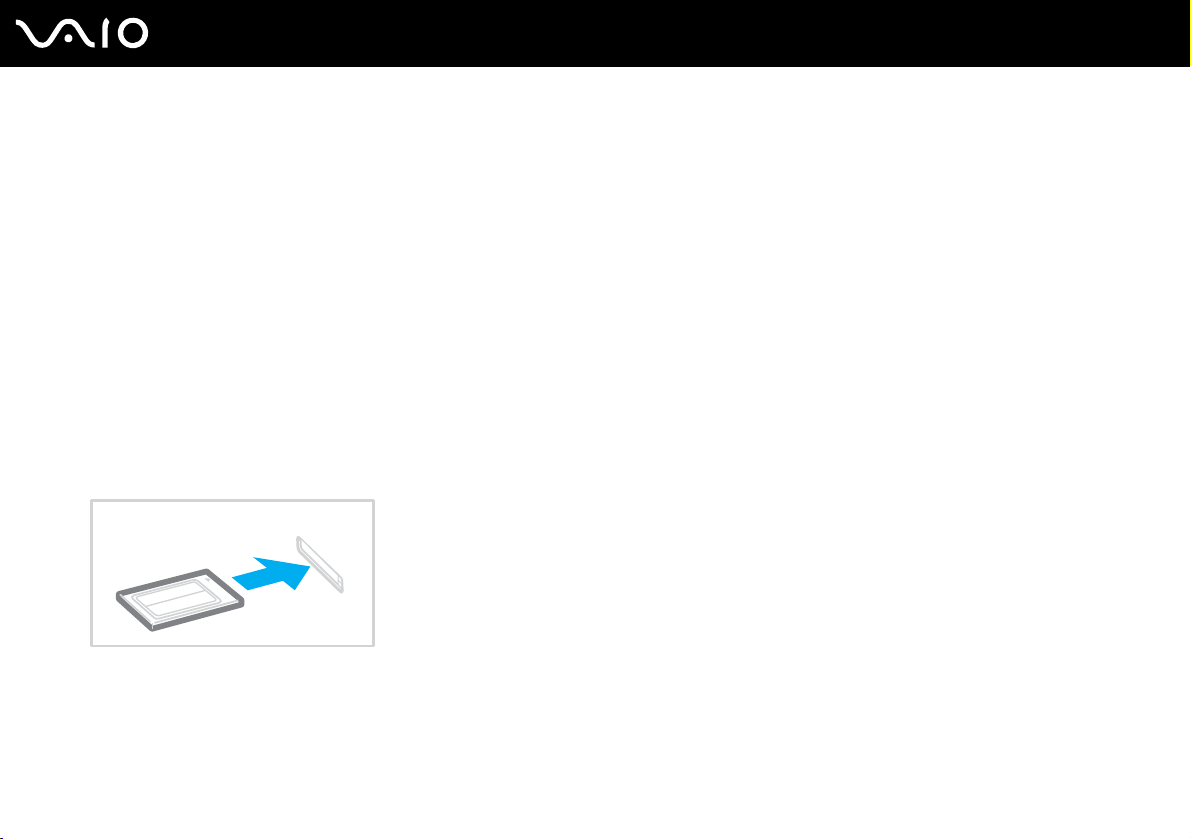
To insert a PC Card
1 With the front label facing upward, insert the PC Card into the PC Card slot on the back of the access unit.
2 Gently push the PC Card into the slot all the way to the end.
The PC Card is automatically detected by your system.
The Safely Remove Hardware icon appears on the taskbar.

47
nN
Using Your VAIO Computer
✍
Some devices may not function properly if you continually switch to Normal mode from Sleep mode. For some PC Cards, if you alternate between
Normal mode and Sleep mode while the card is inserted, you may find that a device connected to your system is not recognized. Restart your system
to correct the problem. Restarting will restore the original state of your computer.
Make sure you use the most recent software driver provided by the PC Card manufacturer.
Do not force a PC Card into the slot. It may damage the connector pins. If you have difficulty inserting a PC Card, check that you are inserting the PC
Card in the correct direction. See the manual that came with your PC Card for more information.

48
nN
Using Your VAIO Computer
Removing a PC Card
Follow the steps below to remove the PC Card while your computer is on. If it is not removed properly, your system may not
work properly.
To remove a PC Card
✍
To remove a PC Card when your computer is off, skip steps 1 to 7.
1 Double-click the Safely Remove Hardware icon on the taskbar.
The Safely Remove Hardware window appears.
2 Select the hardware you want to unplug.
3 Click Stop.
The Stop a Hardware device window appears.
4 Confirm that the device can be safely removed from the system.
5 Click OK.
A message appears stating it is now safe to remove the hardware device.
6 Click OK.
7 Click Close to close the Safely Remove Hardware window.
8 Push the PC Card release button so that the release button pops out.
9 Push the PC Card release button a second time so that the PC Card pops out.
10 Gently take hold of the Card and pull it out of the slot.
11 If the PC Card release button is still out, push it back in all the way to the end.

49
nN
Using Your VAIO Computer
Using the Memory Stick Media
Your computer supports the Memory Stick media. Memory Stick media is a compact, portable, and versatile IC recording
media especially designed for exchanging and sharing digital data with compatible products, such as digital cameras, mobile
phones and other devices. Because it is removable, it can be used for external data storage.
For the latest information about the Memory Stick media, visit the Memory Stick Web site at http://www.memorystick.com/en/
.
!
Your computer has been tested and found compatible with the Sony branded Memory Stick media with capacity of up to 4 GB that are available as of
September 2006. However, not all Memory Stick media that meet the same conditions as the compatible media are guaranteed of compatibility.
Inserting a Memory Stick media with multiple conversion adapters is not guaranteed of compatibility.
MagicGate is the general name of the copyright protection technology developed by Sony. Use a Memory Stick media with the MagicGate logo to use
this feature.
✍
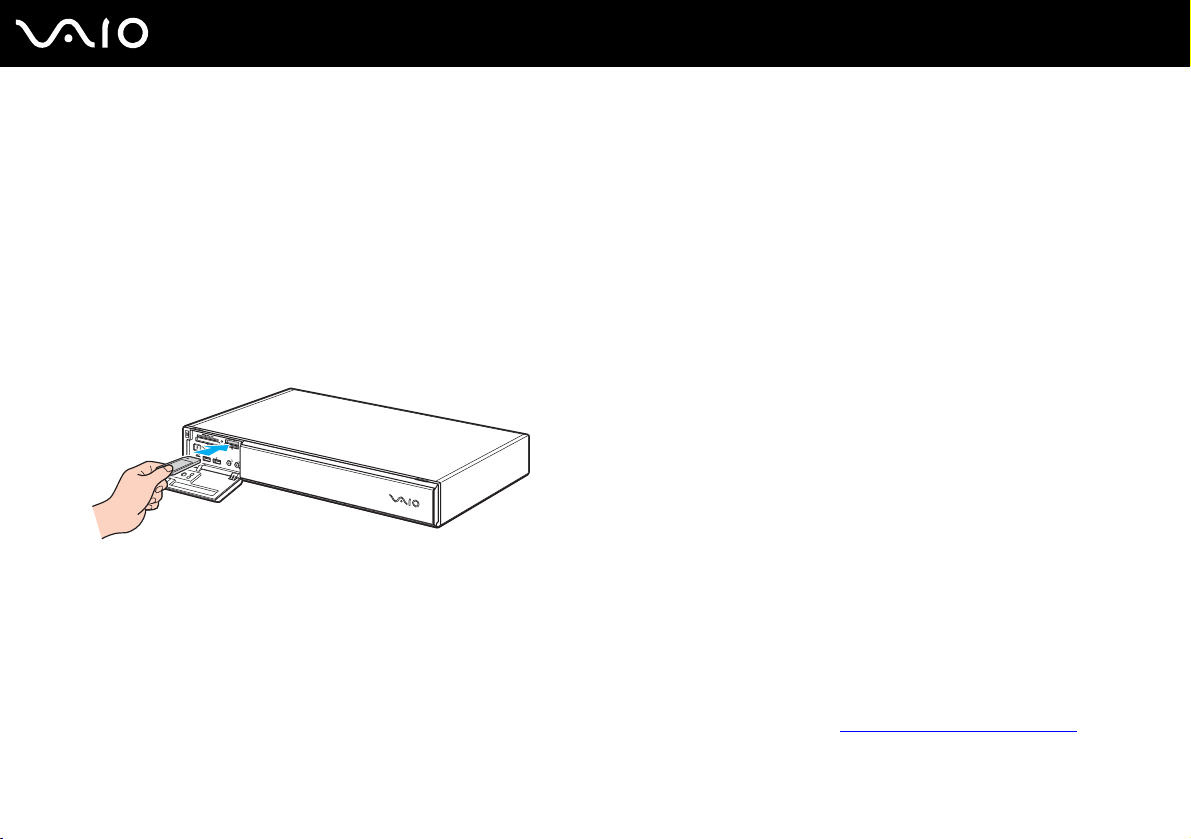
The Memory Stick PRO/Duo media slot is located behind the left front panel of the access unit. You need to open this panel before accessing the slot.
50
nN
Using Your VAIO Computer
Inserting a Memory Stick Media
To insert a Memory Stick media
1 Flip down the left front panel of the access unit.
2 Locate the Memory Stick PRO/Duo media slot (page 14).
3 Hold the Memory Stick media with the arrow facing upward and pointing toward the Memory Stick PRO/Duo media slot.
4 Carefully slide the Memory Stick media into the slot until it clicks into place.
The Memory Stick media is automatically detected by your system and appears in your Computer window as a local
drive, under the appropriate drive name (depending on the configuration of the computer).
!
Be sure to hold the Memory Stick media with the arrow pointing in the correct direction as you insert it into the slot. To avoid damaging your computer
or the Memory Stick media, do not force the Memory Stick media into the slot if you cannot insert it smoothly.
Do not insert more than one Memory Stick media into the slot. Improper insertion of the media may damage both your computer and the media.
✍
Your computer supports Memory Stick Duo media and is equipped with the Memory Stick PRO/Duo slot that is compatible with both standard- and
duo-size media. For more information on the Memory Stick Duo media, visit the Memory Stick Web site at http://www.memorystick.com/en/
.
You can insert a Memory Stick Duo media directly into the slot.

51
nN
Using Your VAIO Computer
To view the contents of the Memory Stick media
1 Click Start and Computer to open the Computer window.
2 Double-click the Memory Stick media icon to view the list of data files saved in the Memory Stick media.
To format a Memory Stick media
The Memory Stick media has been formatted in the factory default setting and is ready for use.
If you want to reformat the media with your computer, follow these steps.
!
Be sure to use the device that is designed to format the media and supports the Memory Stick media when formatting the media.
Formatting the Memory Stick media erases the entire data on the media. Avoid accidental erasure of your valuable data.
Do not remove the Memory Stick media from the slot while formatting the media. This could cause a malfunction.
1 Carefully slide the Memory Stick media into the slot until it clicks into place.
2 Click Start and Computer to open the Computer window.
3 Right-click the Memory Stick media icon and select Format.
4 Click Restore device defaults.
!
The size of the allocation unit and file system may change.
Do not select NTFS from the File system drop-down list.
✍
The formatting process will be completed more quickly if you select Quick Format in Format options.
5 Click Start.


53
nN
Using Your VAIO Computer
Removing a Memory Stick Media
To remove a Memory Stick media
1 Flip down the left front panel of the access unit.
2 Check that the Media Access indicator light is off.
3 Push the Memory Stick media in toward the computer.
The Memory Stick media ejects.
4 Pull the Memory Stick media out of the slot.
!
Always remove the Memory Stick media gently, or it may pop out unexpectedly.
Do not remove the Memory Stick media while the Media Access indicator light is turned on. If you do, you may lose data. Large volumes of data may
take time to load, so be sure the indicator is off before removing the Memory Stick media.

54
nN
Using Your VAIO Computer
Using Other Memory Cards
In addition to the Memory Stick PRO/Duo media slot, the access unit of your computer is equipped with three other memory
card slots to accommodate many popular types of memory cards. You can use these slots to transfer data among digital
cameras, camcorders, music players, and other audio/video devices.
✍
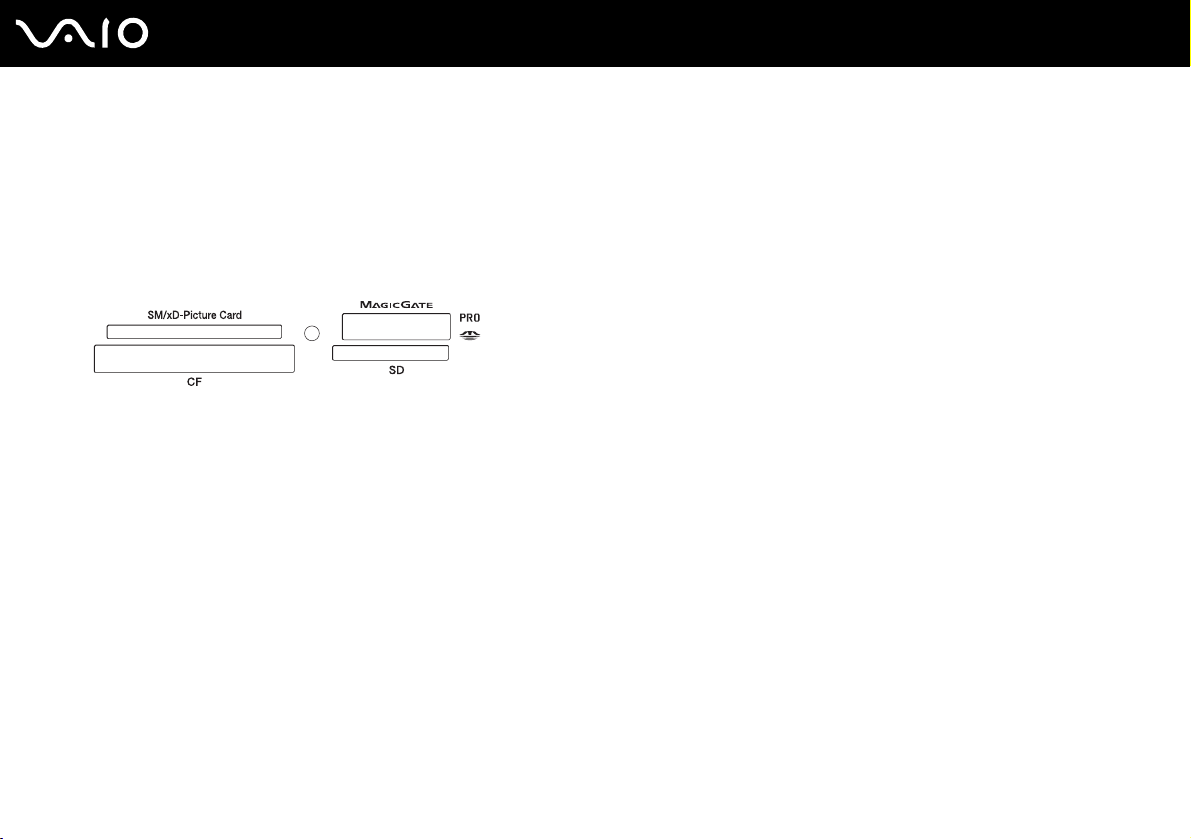
The memory card slots are located behind the left front panel of the access unit. You need to open this panel before accessing the slots.
Before You Use Memory Cards
The memory card slots on the access unit of your computer support the following memory cards:
❑ CF (CompactFlash) memory card slot
❑ CompactFlash
❑ Microdrive
❑ SD memory card slot
❑ Secure Digital (SD)
❑ MultiMediaCard (MMC)
❑ SM/xD-Picture Card slot
❑ SmartMedia
❑ xD-Picture Card
For the latest information on compatible memory cards, visit the Sony online support Web site regularly.

55
nN
Using Your VAIO Computer
!
Always insert the correct memory card into the appropriate memory card slot.
SD memory cards with capacity of over 2 GB, such as SD High Capacity (SDHC) memory cards, are not supported.
Do not attempt to insert a different memory card or memory card adapter into a different memory card slot. An incompatible memory card or adapter
may be difficult to remove from the wrong slot and can cause damage to the access unit.
Use care when inserting or removing a memory card from the slot. Do not force the memory card in or out of the slot.
The CF (CompactFlash) memory card slot on the access unit supports Type I and Type II media.
The SD memory card slot on the access unit does not support the high-speed data transfer feature of the SD memory card.
Your computer has been tested and found compatible only with major memory card media available as of September 2006. However, not all memory
card media that meet the same conditions as the compatible media are guaranteed of compatibility.
56
nN
Using Your VAIO Computer
Inserting a Memory Card
To insert a memory card
1 Flip down the left front panel of the access unit.
Do not use force to open the panel.
2 Locate the appropriate slot for the memory card you want to use.
3 Carefully slide the memory card into the slot until it clicks into place.
Do not force the card into the slot.
✍
If the memory card does not go into the slot easily, remove it gently and verify you are inserting it in the proper direction.

57
nN
Using Your VAIO Computer
Removing a Memory Card
!
Do not remove a memory card while the Media Access indicator light is on. The card or its data may become damaged.
To remove a memory card
1 Flip down the left front panel of the access unit.
2 Check that the Media Access indicator light is off.
3 Firmly grasp the extended part of the memory card.
4 Carefully pull it out of the slot.
58
nN
Using Your VAIO Computer
Using the Jog Controller
The jog controller supplied with your computer comes in handy when you edit or play videos, as application-specific tasks are
automatically assigned to the jog controller buttons. See the help file on the VAIO USB Jog Utility software for more
information.
✍
When more than one software application is running, click the desired application window to make it active.
Do not disconnect the jog controller while using the support software.
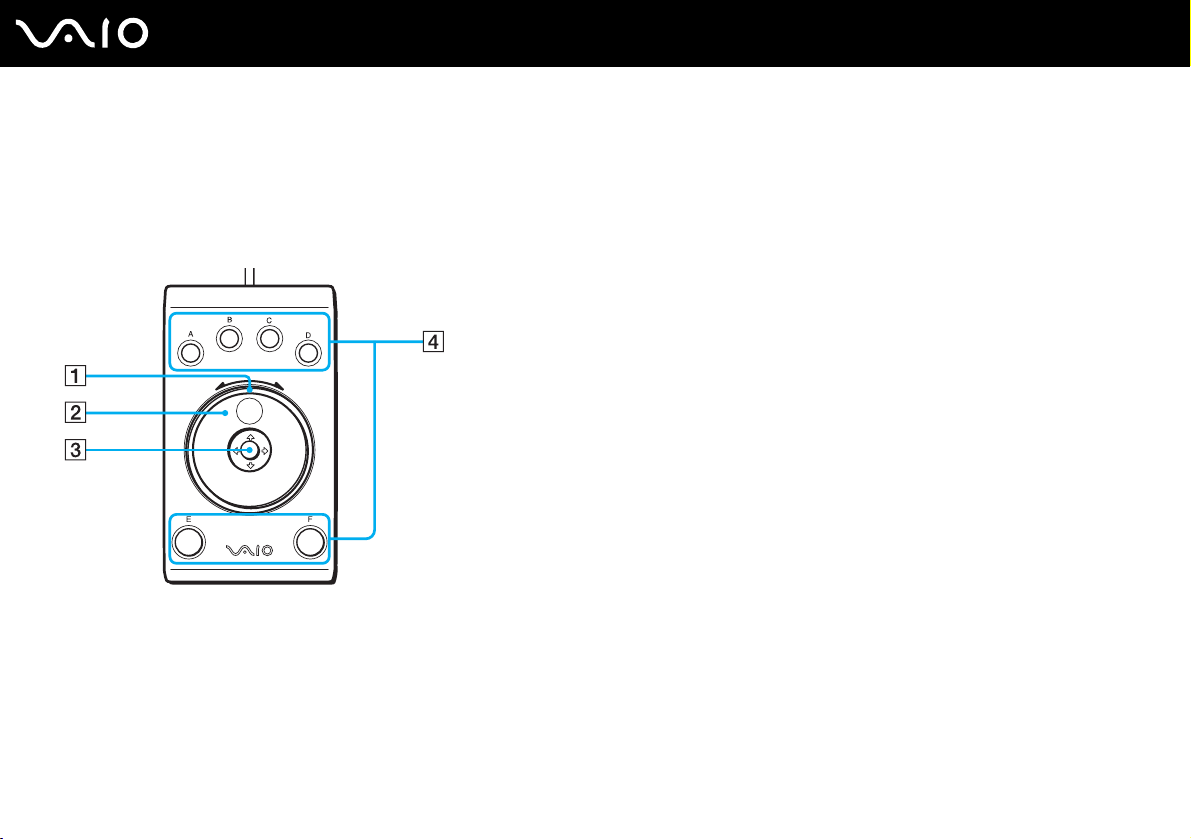
A
LED
Illuminates when the jog controller is connected to the computer
to indicate that the jog controller is ready for use.
B Jog dial
Rotate the jog dial clockwise or counterclockwise, for example,
to feed a video forward or backward by one frame.
C Center point
Push the center point up/down or sideways or push it in to
perform an assigned task. The associated task varies among
software applications.
D A to F buttons
Perform certain tasks. The task associated with each button
varies among software applications.
59
nN
Using Your VAIO Computer
Connecting the Jog Controller
To connect the jog controller
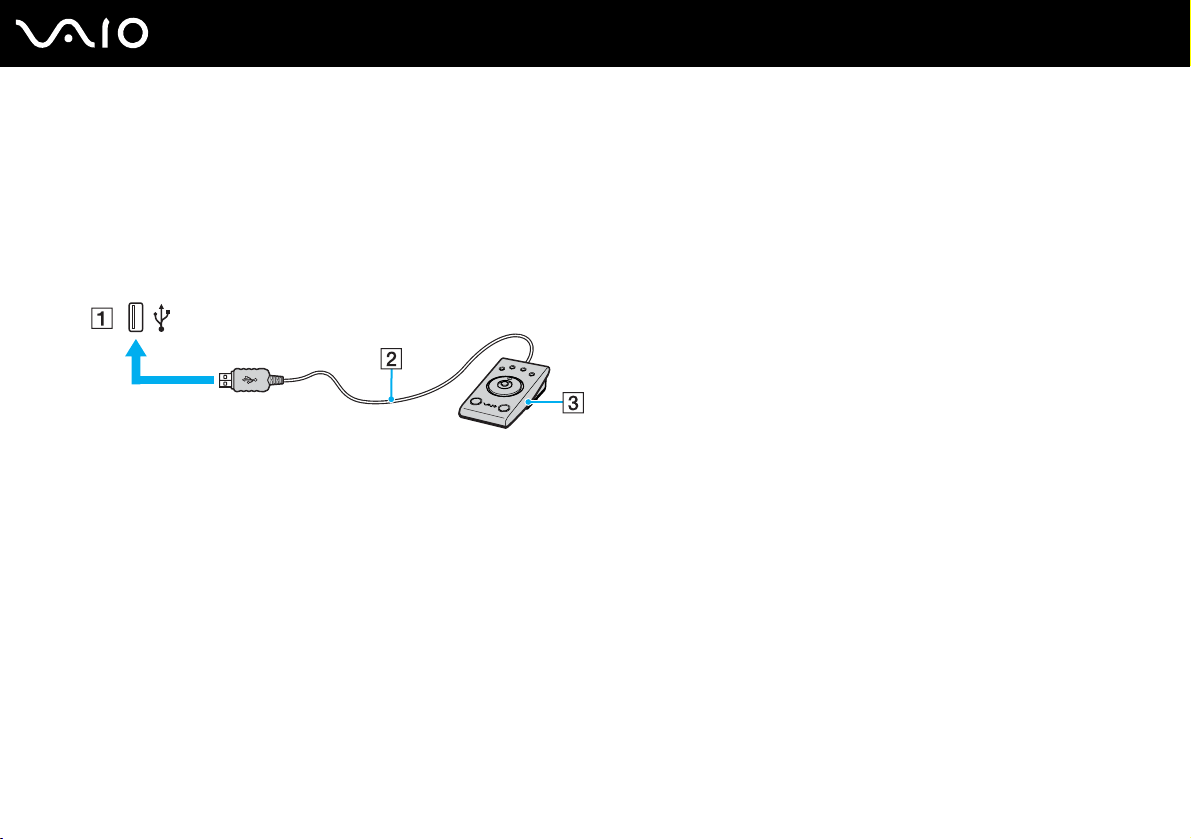
1 Choose the USB port (1) you prefer to use on the front of the main or access unit.
2 Plug the USB cable (2) into the USB port.
The jog controller icon appears on the taskbar and you can now use your jog controller (3).

60
nN
Using Your VAIO Computer
Using the Internet
Setting Up a Dial-up Internet Connection
Before you can connect to the Internet, you need to connect your computer to a telephone line with a telephone cable (not
supplied). Once you have set up your telephone cable connection, you're ready to connect to the Internet.
For details of telephone cable connections, see Connecting the Telephone and Modem (page 29).
To set up a dial-up connection to the Internet
1 Click Start and Control Panel
2 Click Connect to the Internet under Network and Internet.
The Connect to the Internet window appears.
3 Click Dial-up.
4 Follow the on-screen instructions.
61
nN
Using Your VAIO Computer
Using the Bluetooth Functionality
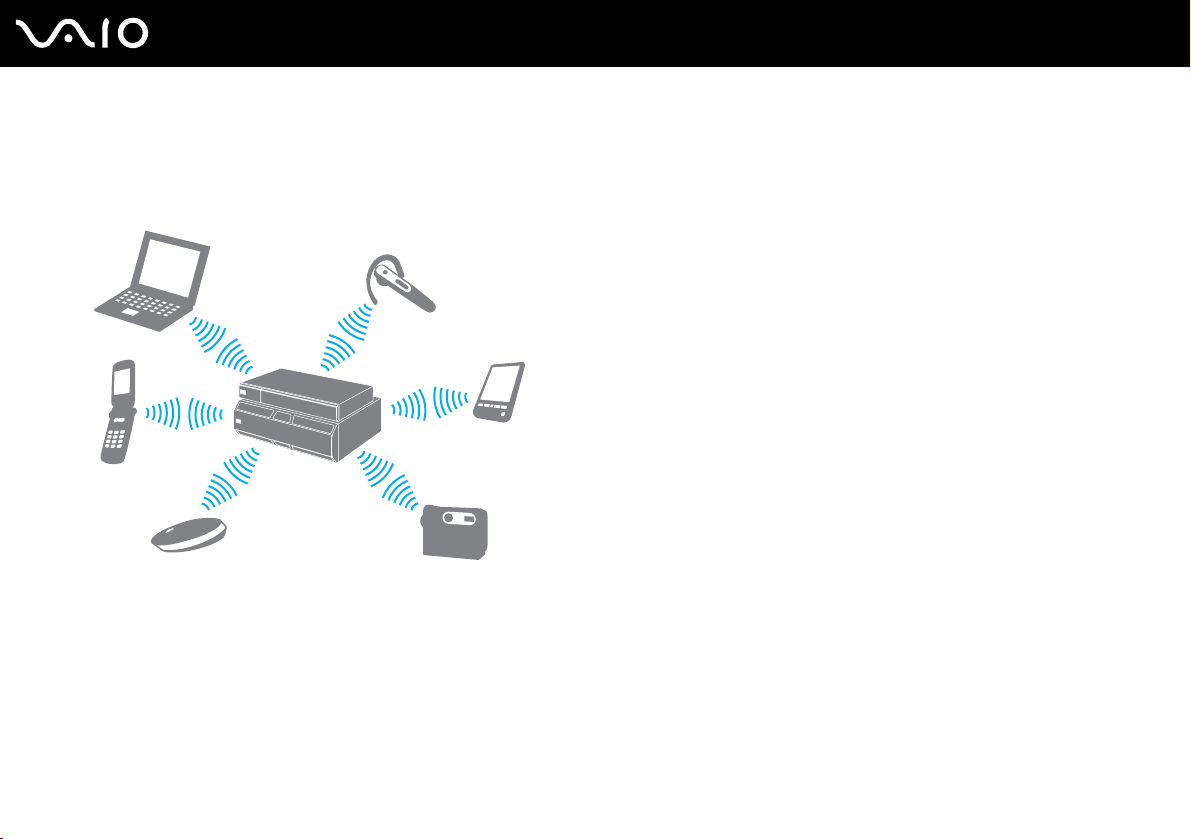
You can establish wireless communication between your computer and other Bluetooth devices such as another computer
or a mobile phone. You can transfer data between these devices without cables and up to 33 feet (10 meters) range in open
space.
To connect to a Bluetooth device
1 Double-click on the taskbar to display the Wireless Device Switch window.
2 Make sure that the Enable Bluetooth Device option is selected.
3 Click OK.

62
nN
Using Your VAIO Computer
Notes on using the Bluetooth functionality
❑ The data transfer rate varies, depending on the following conditions:
❑ Obstacles, such as walls, located between devices
❑ Distance between devices
❑ Material used in walls
❑ Proximity to microwaves and cordless telephones
❑ Radio frequency interference and other environmental conditions
❑ Device configuration
❑ Type of software application
❑ Type of operating system
❑ Size of file being exchanged
❑ Note that due to limitations of the Bluetooth standard, large files may occasionally be corrupted during continuous transfer
due to electromagnetic interference from the environment.
❑ All Bluetooth devices must be certified to make sure that the applicable standard requirements are maintained. Even if
standards are met, individual device performance, specifications, and operation procedures can vary. Data exchange may
not be possible in all situations.
❑ As general characteristics of Bluetooth technology, video and audio may go out of synchronization if you play videos on
your computer with audio output from the connected Bluetooth device.
❑ The 2.4 GHz band, with which Bluetooth devices or wireless LAN devices work, is used by various devices. Bluetooth
devices use the technology to minimize the interference from other devices that use the same wave length. Simultaneous
use of the Bluetooth functionality and wireless communication devices, however, may cause radio interference and result
in poorer communication speeds and distances than the standard values.

63
nN
Using Your VAIO Computer
❑ The Bluetooth functionality may not work depending on the third party devices or the software version used by third party
companies.
❑ As general characteristics of Bluetooth technology, connecting multiple Bluetooth devices to your computer may cause
bandwidth congestion, resulting in poor performance of the devices.

64
nN
Using Your VAIO Computer
Bluetooth Security
The Bluetooth wireless technology has an authentication function, which allows you to determine with whom you choose to
communicate. With the authentication function, you can avoid any anonymous Bluetooth device to access your computer.
The first time two Bluetooth devices communicate, a common passkey (a password required for authentication) should be
determined for both devices to be registered. Once a device is registered, there is no need to re-enter the passkey.
✍
The passkey can be different each time, but must be the same at both ends.
For certain devices, such as a mouse, no passkey can be entered.
66
nN
Using Your VAIO Computer
To communicate with another Bluetooth device
To communicate with another Bluetooth device, you need first to set up the Bluetooth functionality. For setting up and using
the Bluetooth functionality, see the help file on the Bluetooth utility software.
To see the help file
1 Right-click the Bluetooth icon on the taskbar, and select Help from the menu.
Stopping the Bluetooth Connection
1 Double-click on the taskbar to display the Wireless Device Switch window.
2 Deselect the Enable Bluetooth Device option and click OK.
67
nN
Using Your VAIO Computer
Using the Bluetooth Headset
The Bluetooth headset (not supplied) will come in handy during a video conference over the Internet using instant messaging
software. For details on using the Bluetooth headset, see the manual that came with your Bluetooth headset.
To connect the headset with your computer
1 Press and hold the headset power button for at least five seconds to turn on the Bluetooth headset.
2 Press and hold the volume buttons for at least five seconds until the indicator light blinks in red and green.
3 Right-click the Bluetooth icon on the taskbar and select Bluetooth Settings from the menu.
The Bluetooth Settings window appears and Add New Connection Wizard automatically starts.
4 If the Add New Connection Wizard window does not appear, click New Connection.
The Add New Connection Wizard window appears.
5 Select Express Mode (Recommended) and then click Next.
The wizard searches for Bluetooth devices in range and lists available devices, if any.
6 Select the device name for your Bluetooth headset and then click Next.
The Bluetooth Manager-Bluetooth Security window appears when a connection is established.
7 Enter "0000" for Bluetooth Passkey (PIN) and then click OK.
8 Click Next.
The headset icon appears in the Bluetooth Settings window.
9 Right-click the icon and select Connect from the menu.

69
nN
Using Peripheral Devices
Using Peripheral Devices
You can add functionality to your VAIO computer by using the various ports on the computer.
❑ Connecting a Universal Serial Bus (USB) Device (page 70)
❑ Connecting a Printer (page 72)
❑ Connecting an i.LINK Device (page 74)
❑ Connecting to a Network (LAN) (page 76)
70
nN
Using Peripheral Devices
Connecting a Universal Serial Bus (USB) Device
✍
You need to flip down the left front panel to access the USB ports on the front of the access unit.
Connecting a USB Floppy Disk Drive
You can purchase a USB floppy disk drive and connect it to your computer.
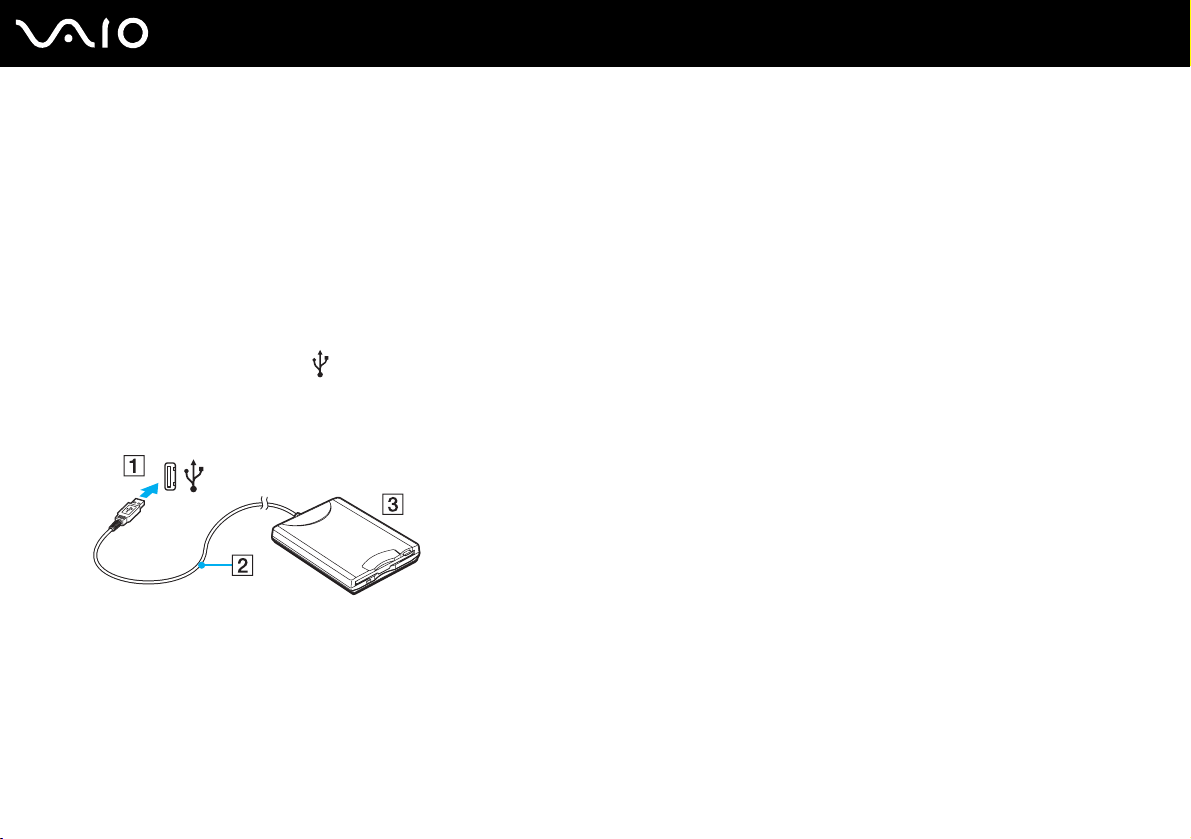
To connect a USB floppy disk drive
1 Choose the USB port (1) you prefer to use.
2 Plug the USB floppy disk drive cable (2) into the USB port.
Your USB floppy disk drive (3) is now ready for use.
!
When using a USB floppy disk drive, do not apply force on the USB port. This may cause a malfunction.

71
nN
Using Peripheral Devices
Disconnecting a USB floppy disk drive
You can disconnect a USB floppy disk drive when your computer is on or off. Disconnecting the drive when the computer is
in Sleep mode may cause the computer to malfunction.
If the computer is off, you can unplug the USB cable directly from the computer.
To disconnect a USB floppy disk drive
1 Close all programs accessing the floppy disk drive.
2 Double-click the Safely Remove Hardware icon on the taskbar.
The Safely Remove Hardware window appears.
3 Select the floppy disk drive you want to unplug.
4 Click Stop.
The Stop a Hardware device window appears.
5 Confirm that the floppy disk drive can be safely removed from the system.
6 Click OK.
A message appears stating it is now safe to remove the hardware device.
7 Click OK.
8 Click Close to close the Safely Remove Hardware window.
9 Disconnect the floppy disk drive from the computer.
72
nN
Using Peripheral Devices
Connecting a Printer
You can connect a Windows-compatible printer to your computer to print documents.
Connecting a Printer Using the USB Port
You can connect a USB printer compatible with your version of Windows to the computer.
✍
You need to flip down the left front panel to access the USB ports on the front of the access unit.
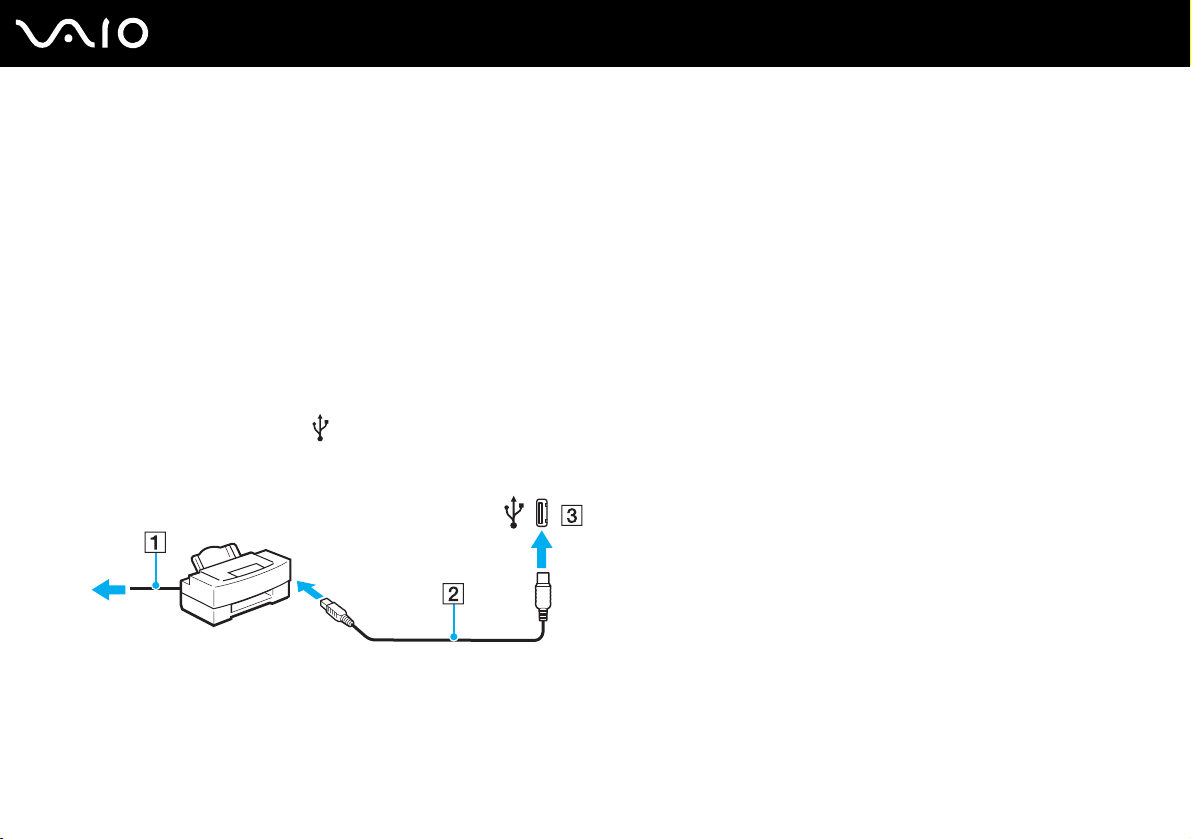
To connect a printer using the USB port
1 Plug the power cord (1) of your printer into an AC outlet.
2 Choose the USB port (3) you prefer to use.
3 Plug one end of a USB printer cable (2) (not supplied) into the USB port and the other end to your printer.
73
nN
Using Peripheral Devices
Connecting a Printer Using the Printer Port
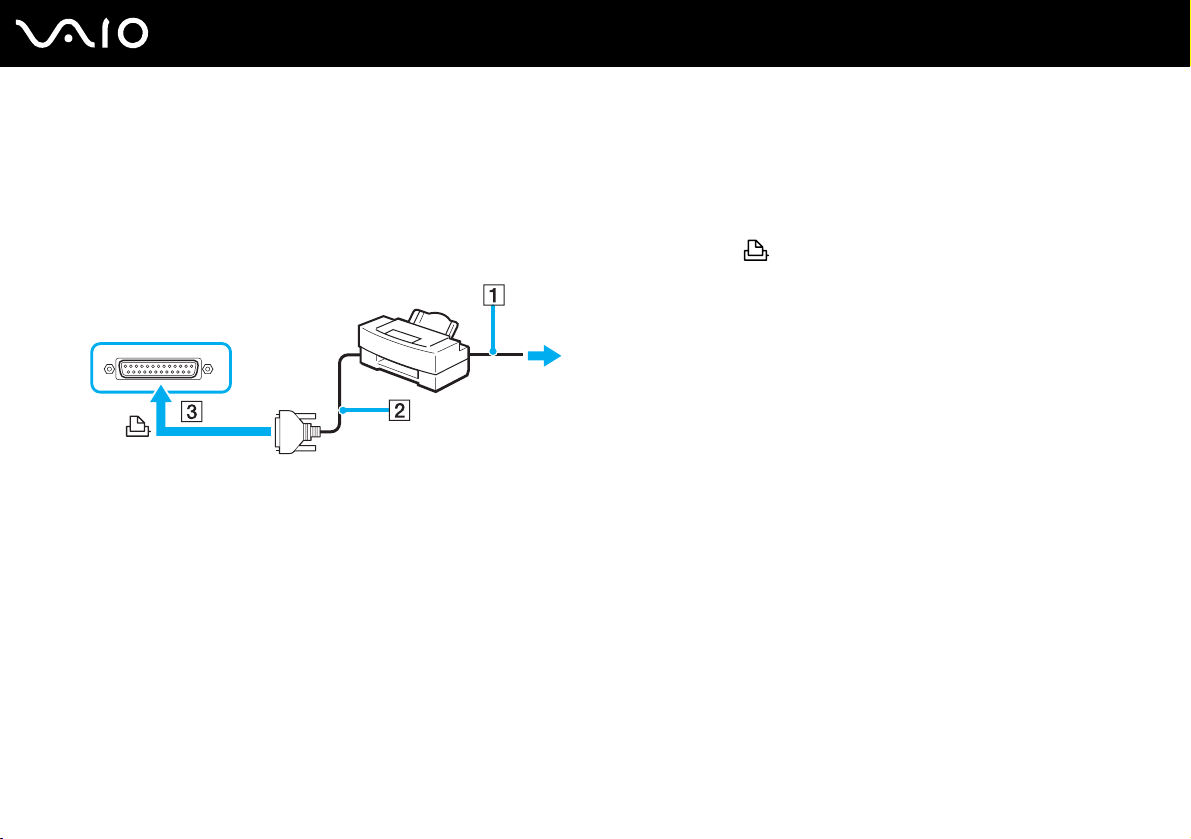
To connect a printer using the printer port
1 Plug the power cord (1) of your printer into an AC outlet.
2 Plug the printer cable (2) supplied with your printer into the printer port (3) on the back of the main unit.
✍
Before connecting the printer, turn off your computer and the printer.

74
nN
Using Peripheral Devices
Connecting an i.LINK Device
Notes on connecting i.LINK devices
❑ Your computer is equipped with an i.LINK port, which you can use to connect to an i.LINK device such as a digital video
camcorder or to connect two VAIO computers in order to copy, delete or edit files.
❑ The i.LINK port on your computer does not supply power to external devices generally powered by i.LINK ports.
❑ The i.LINK port supports transfer rates up to 400 Mbps; however, the actual transfer rate depends on the transfer rate of
the external device.
❑ The optional i.LINK cables may not be available, depending on the country or area of your residency.
❑ An i.LINK connection with other compatible devices is not fully guaranteed.
❑ The i.LINK connection varies depending on the software applications, operating system, and i.LINK-compatible devices
you use. See the manual that came with your software for more information.
❑ Check the working conditions and OS compatibility of i.LINK-compatible PC peripherals (for example, an HDD or a CD-
RW drive) before you connect them to your computer.
75
nN
Using Peripheral Devices
Connecting a Digital Video Camcorder
✍
You need to flip down the left front panel to access the i.LINK port on the front of the access unit.
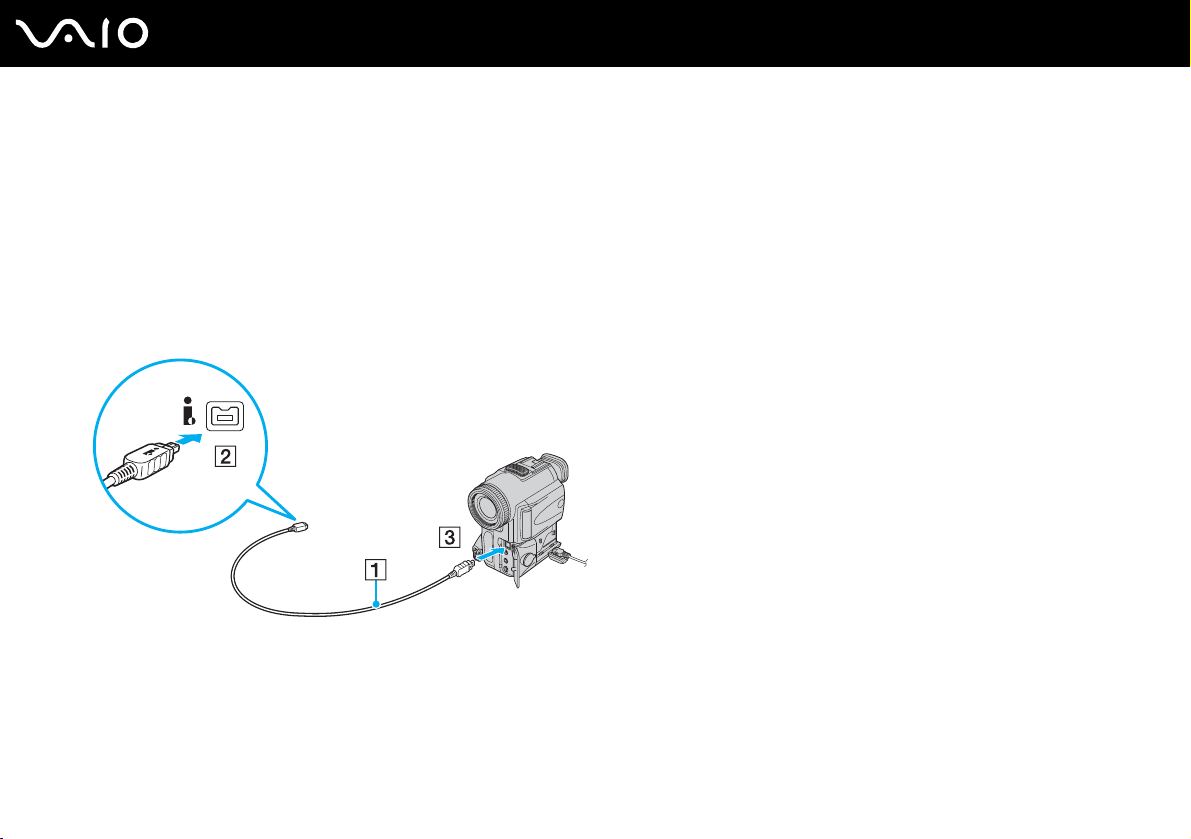
To connect a digital video camcorder
1 Plug one end of an i.LINK cable (1) (not supplied) into the i.LINK port (2) on the computer and the other end into the DV
In/Out port (3) on the digital video camcorder.
2 Launch the DVgate Plus software.
✍
On Sony digital video cameras, ports labeled DV Out, DV In/Out, or i.LINK are i.LINK-compatible.
The Sony digital video camcorder shown here is an example; your digital video camcorder may need to be connected differently.
You cannot access the pictures stored on a Memory Stick media when using an i.LINK connection.
76
nN
Using Peripheral Devices
Connecting to a Network (LAN)
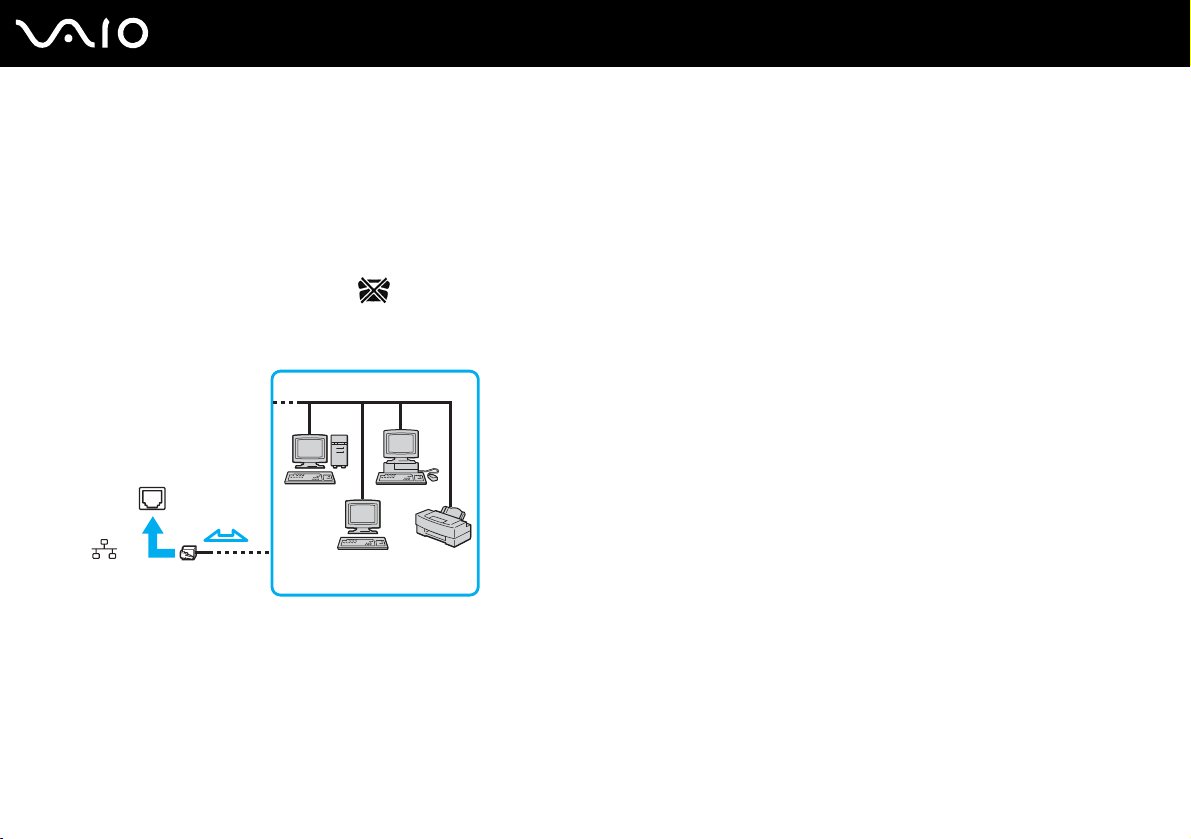
You can connect your computer to 1000BASE-T/100BASE-TX/10BASE-T-type networks with an Ethernet network cable.
Connect one end of a network cable (not supplied) to the network (Ethernet) port on the back of the main unit and the other
end to your network. For detailed settings and devices needed to connect to the network, ask your network administrator.
!
The main unit has a protective sticker covering the network (Ethernet) port located on its back. Connect 10BASE-T, 100BASE-TX, or 1000BASE-
T cable to the network (Ethernet) port. Using an incorrect cable, such as a phone cable, may result in an electric current overload that can cause a
malfunction, excessive heat, or fire in the network (Ethernet) port. For help on connecting to a network, see your network administrator.
✍
Your computer can be connected to the network with the default settings.

77
nN
Using Peripheral Devices
!
Telephone lines cannot be connected to the network (LAN) connector on your computer.
If the network (LAN) connector is connected to the telephone lines mentioned below, high electric current to the connector may cause damage,
overheating, or fire.
- Home (intercom speakerphone) or business-use telephone lines (multi-line business telephone)
- Public telephone subscriber line
- PBX (private branch exchange)
Do not plug a telephone cable into the network port.

78
nN
Customizing Your VAIO Computer
Customizing Your VAIO Computer
This section briefly describes how to change the main settings of your VAIO computer. Among other things, you will learn
how to use and customize the look of your Sony software and utilities, etc.
❑ Setting the Password (page 79)
❑ Setting Up Your Computer with VAIO Central (page 82)
❑ Using the Power Saving Modes (page 83)

79
nN
Customizing Your VAIO Computer
Setting the Password
Use one of the BIOS functions to set the password.
Once you have set the password, you will have to enter the password after the VAIO logo appears to start your computer.
The power-on password will allow you to protect the computer from unauthorized access.
Adding the Power-on Password
The power-on password is provided to protect your computer from unauthorized access.
There are two types of the power-on password: machine password and user password. The machine password is provided
for users with administrator rights on the computer to change all the setup options on the BIOS setup screen, as well as to
start the computer. The user password is provided for other standard users to allow for changing some of the BIOS setup
options, as well as starting the computer. To set the user password, you must first set the machine password.
!
Once you have set the power-on password, you cannot start your computer without entering the password. Make sure not to forget the password. Write
down your password and keep it safe and private from other people.
If you forget the power-on password and need assistance to reset it, a password reset fee will be charged, and your computer may need to be sent in
for depot service for password reset.

80
nN
Customizing Your VAIO Computer
To add the power-on password
1 Turn on the computer.
2 Press the F2 key when the VAIO logo appears.
The BIOS setup screen appears. If not, restart the computer and press the F2 key several times when the VAIO logo
appears.
3 Press the < or , key to select Security to display the Security tab, select Set User Password, and then press the
Enter key.
4 On the password entry screen, enter the password twice and press the Enter key.
The password can be at least 2 and at most 19 characters (including spaces) long.
✍
The following is to configure your computer to display the BIOS setup screen.
5 Press the < or , key to key to select Exit, select Exit Saving Changes, and then press the Enter key.
At the confirmation prompt, press the Y key.

81
nN
Customizing Your VAIO Computer
Changing/Removing the Power-on Password
To change or remove the power-on password
1 Turn on the computer.
2 Press the F2 key when the VAIO logo appears.
The BIOS setup screen appears. If not, restart the computer and press the F2 key several times when the VAIO logo
appears.
3 Enter the current password for Enter Current Password and press the Enter key.
The BIOS setup screen appears.
4 Press the < or , key to select Security to display the Security tab, select Clear User Password, and then press the
Enter key.
5 Press the < or , key to select Exit, select Exit Saving Changes, and then press the Enter key
At the confirmation prompt, press the Y key.

82
nN
Customizing Your VAIO Computer
Setting Up Your Computer with VAIO Central
The VAIO Central utility allows you to consult system information and specify preferences for system behavior.
To use VAIO Central
1 Click Start, All Programs, and VAIO Central.
The VAIO Central window appears.
2 Click the System Information tab.
3 Select the desired control item and change the settings.
4 Once finished, click OK.
The setting of the desired item has been changed.
✍
Some of the control items will not be visible if you open VAIO Central as a standard user.

83
nN
Customizing Your VAIO Computer
Using the Power Saving Modes
In addition to the normal operating mode, which allows you to turn off specific devices, your computer has a distinct power
saving mode called Sleep mode.
Using Normal Mode
This is the normal state of the computer when it is in use. To save power while not working, you can turn off a specific device
such as the connected display or the hard disk.

84
nN
Customizing Your VAIO Computer
Using Sleep Mode
Sleep mode temporarily suspends the entire system operations for lower power consumption. The orange power light is on
in this mode.
To activate Sleep mode
Click Start, the arrow next to the Lock button, and Sleep.
✍
Alternatively, you can press the standby button on the keyboard to put your computer in Sleep mode.
To return to Normal mode
Press the power button on your computer or the standby button on the keyboard.
!
If you press and hold the power button for more than four seconds, your computer will turn off automatically. You will lose any unsaved data.
If the computer is not used for more than 20 minutes, it will enter Sleep mode. To avoid this, you can change the Sleep mode
settings.
To change the Sleep mode settings
1 Right-click the power status icon on the taskbar and select Power Options.
2 Click Change plan settings under the current power plan.
3 Change the time to put the computer to sleep and click Save Changes.

85
nN
Upgrading Your VAIO Computer
Upgrading Your VAIO Computer
Your VAIO computer, memory modules, add-on cards, and hard disk drives use high precision components and electronic
connectors technology. To avoid invalidation of the warranty during your product warranty period, we recommend that:
❑ You contact your dealer to install a new component.
❑ You do not install it yourself, if you are not familiar with upgrading a computer.
❑ You do not touch the connectors on any component.
For the type of components available for upgrading and the amount of memory installed on your model, see the online
Specifications.
For assistance, contact an authorized Sony Service Center. To find the nearest center or agent, see Sony Support
Information (page 156) or visit the Sony online support Web site.
❑ Before Upgrading Your Computer (page 86)
❑ Removing and Replacing Computer Panels (page 87)
❑ Adding and Removing Memory (page 93)
❑ Installing an Add-on Card (page 99)
❑ Replacing the Lithium Battery (page 103)
❑ Installing the Hard Disk Drive (page 106)

86
nN
Upgrading Your VAIO Computer
Before Upgrading Your Computer
The upgrading procedures described in this section assume that you are familiar with the general terminology associated with
personal computers, safety practices, required regulatory compliances, and the modification of electronic equipment.
Disconnect your computer from its power source and from telecommunications links, networks, or modems before you follow
any procedures in this section.
!
Failure to disconnect your computer from its power source may result in personal injury or equipment damage. Always turn the power off before you
remove any computer panels or connect peripheral equipment. Otherwise, damage may occur to the integrated circuits.
Electrostatic discharge (ESD) can damage disk drives and other components. Follow the procedures described here only at an ESD workstation. If such
a station is not available, do not work in a carpeted area and do not handle materials that produce or hold static electricity (for example, cellophane
wrappers). Ground yourself by maintaining continuous contact with an unpainted metal portion of the chassis while performing the procedure.
87
nN
Upgrading Your VAIO Computer
Removing and Replacing Computer Panels
To access memory modules, add-on cards, and hard disks inside your computer, you need to remove and replace the top or
front panel of the main unit beforehand and afterward.
!
If you remove any panel immediately after you shut down your computer, the internal components may be too hot to touch. Wait about one hour to let
the components cool down before you attempt to remove the panel.
Removing and Replacing the Main Unit Top Panel
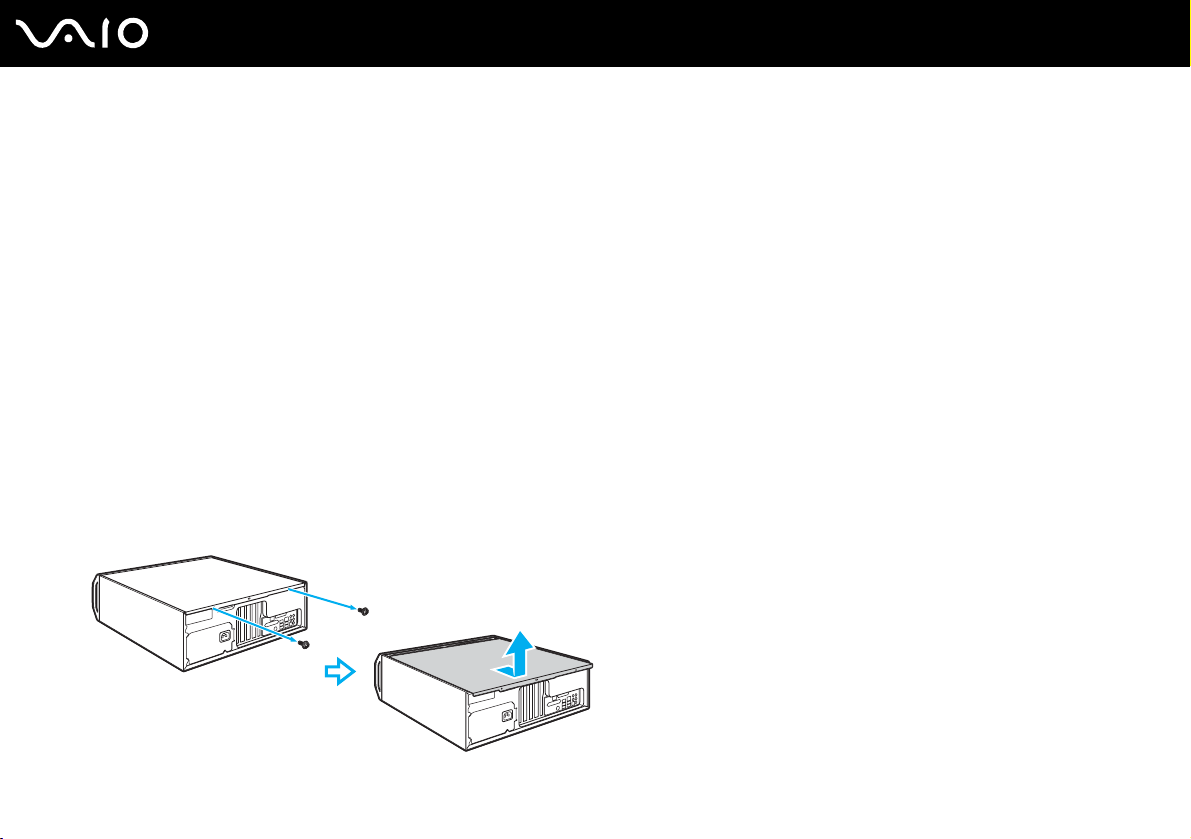
To remove the top panel
1 Shut down your computer and turn off all peripheral devices, such as a printer.
2 Unplug the main unit and disconnect all peripheral devices, including the access unit.
3 Place the main unit in the flat position.
4 Remove the two screws from the back of the main unit.
5 Slide the top panel toward the back of the unit, lift the panel, and set it aside.
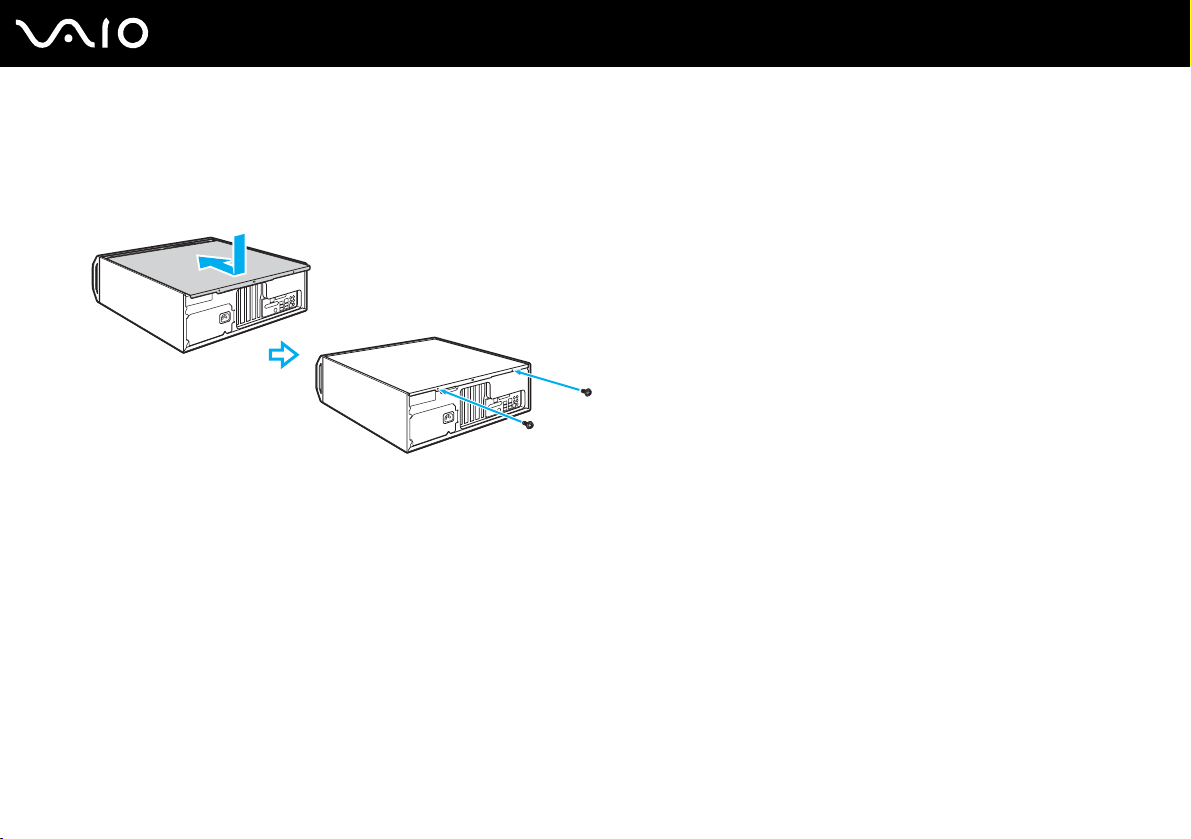
89
nN
Upgrading Your VAIO Computer
Removing and Replacing the Main Unit Front Panel
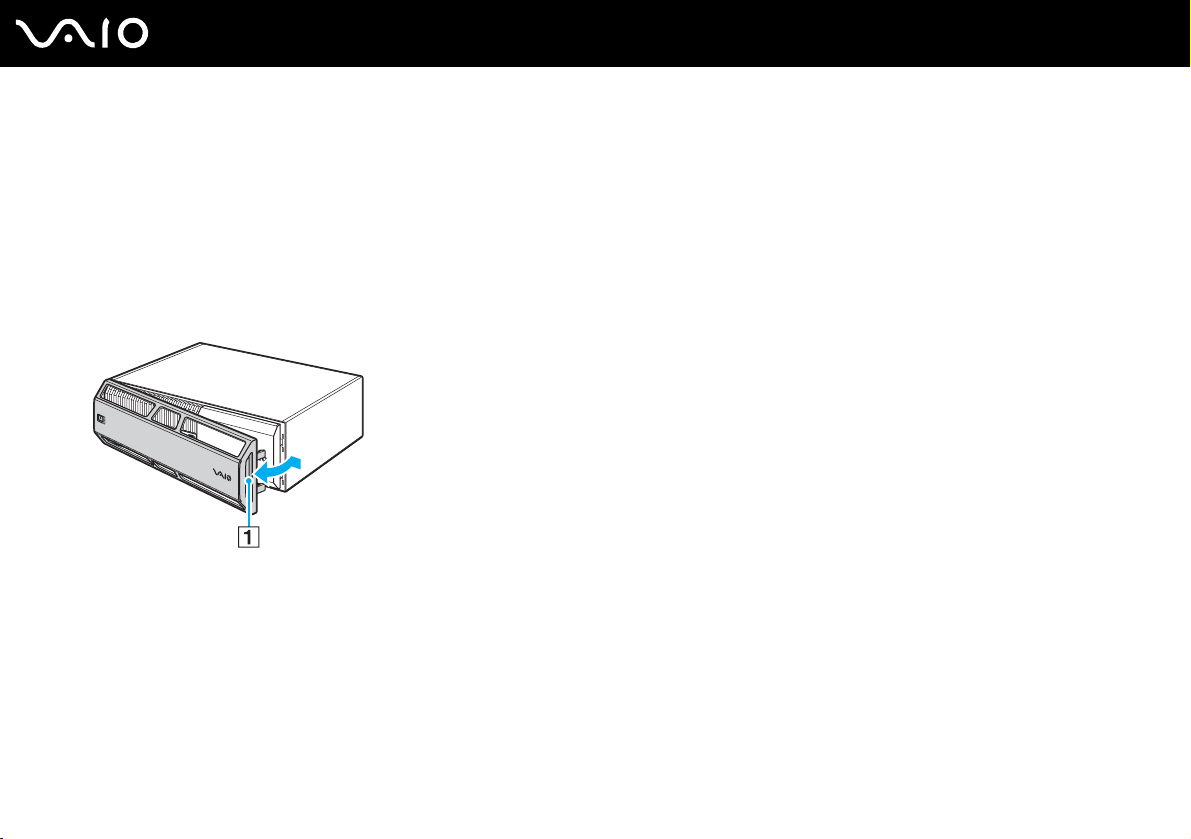
To remove the front panel
1 Shut down your computer and turn off all peripheral devices, such as a printer.
2 Unplug the main unit and disconnect all peripheral devices, including the access unit.
3 Place the main unit in the flat position.
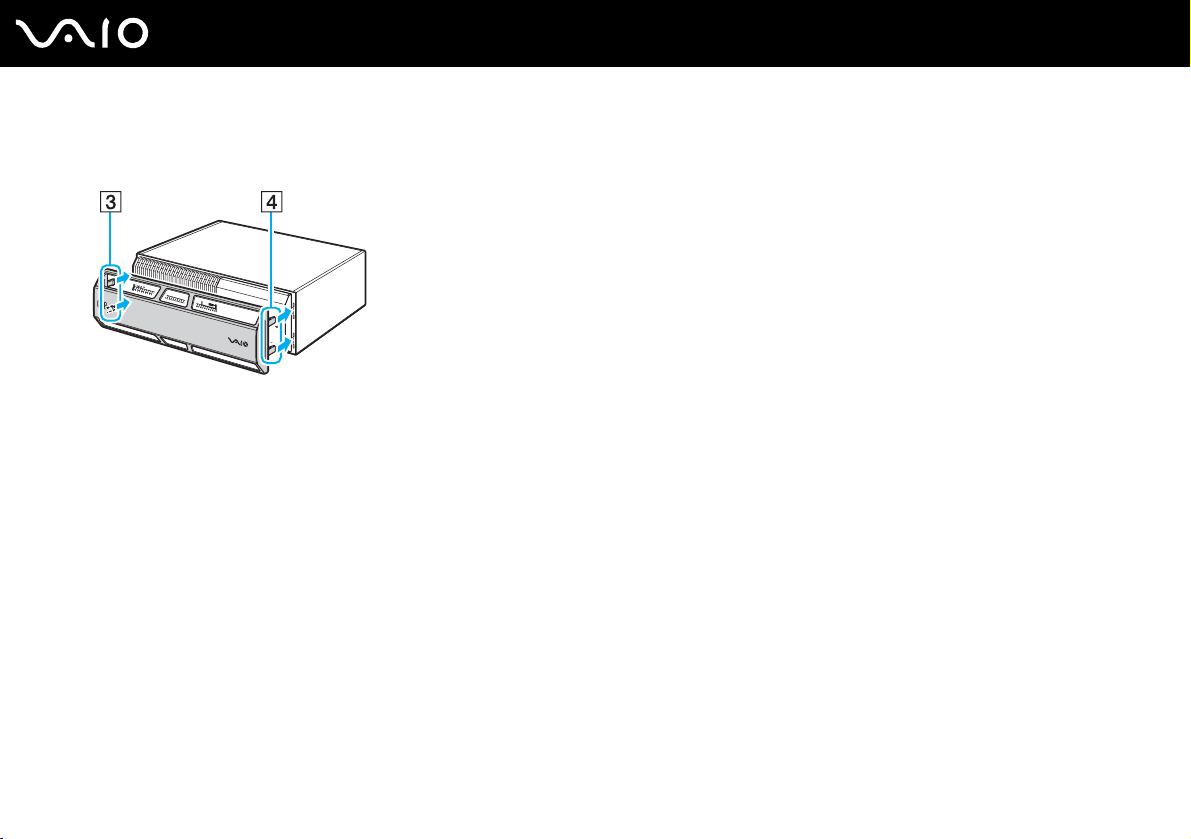
4 Pull the front panel (1) slightly toward you to disengage it from the chassis frame, and then completely take the panel off.
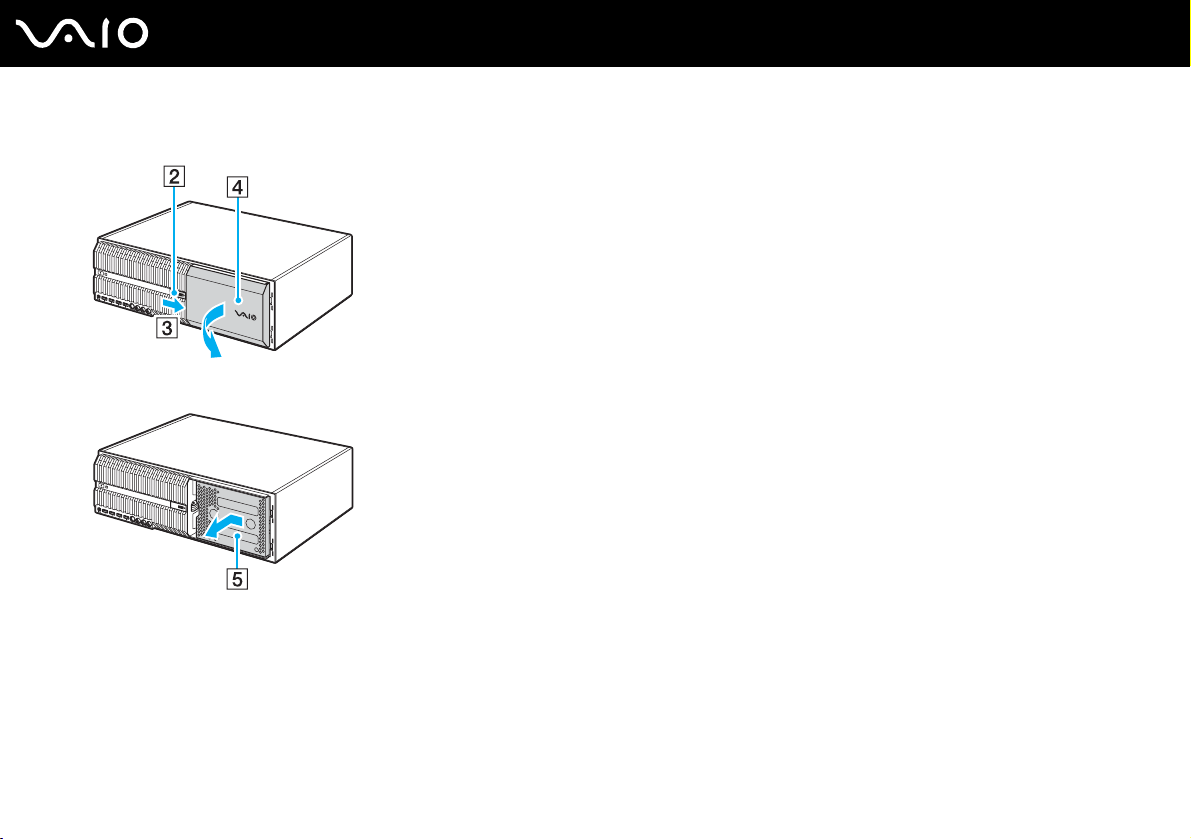
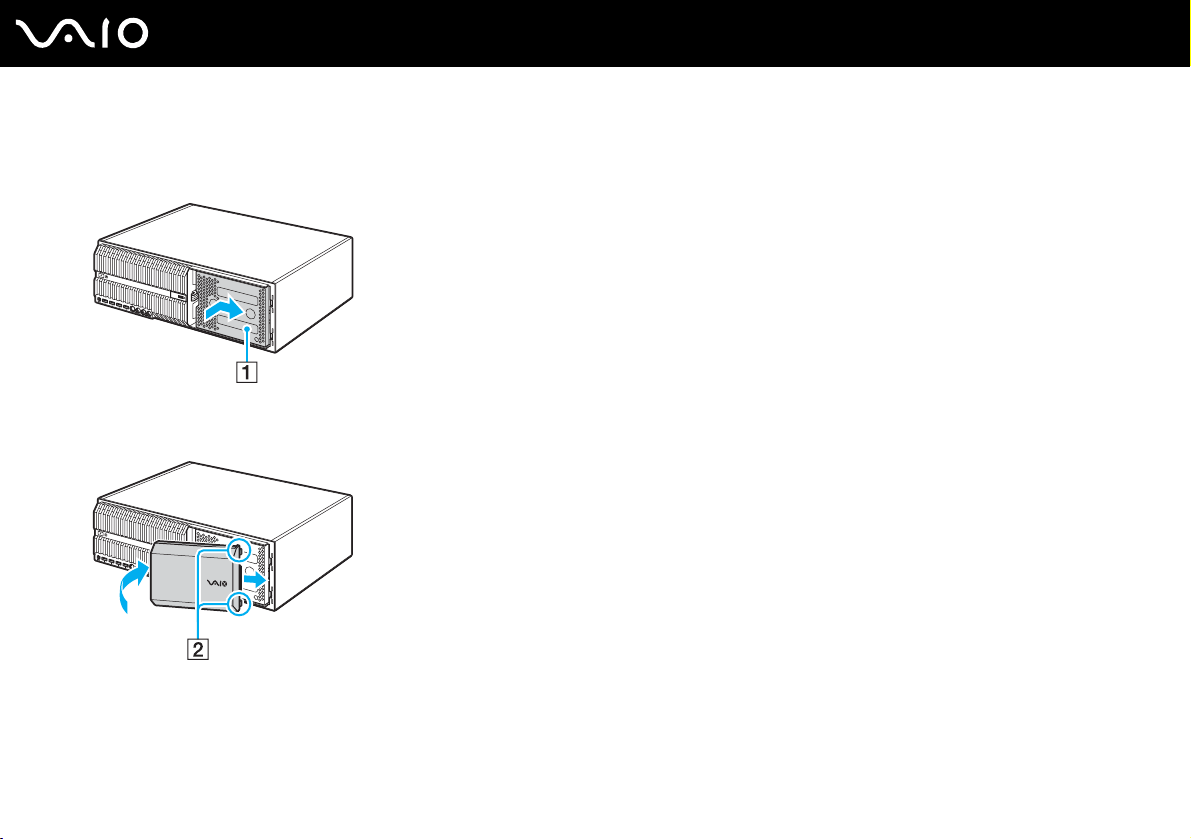

93
nN
Upgrading Your VAIO Computer
Adding and Removing Memory
If you want to expand the functionality of your computer, you can increase the memory by installing optional memory modules.
Before you upgrade your computer's memory, read the notes and procedures in this section. The number of available slots
depends on your computer's hardware configuration.
Notes on adding/removing memory modules
❑ Be careful when changing memory. Improper installation of memory modules may cause damage to your system. This
damage may void your manufacturer's warranty.
❑ Only use memory modules that are compatible with your computer. If a memory module is not detected by the computer
or the Windows operating system becomes unstable, contact your sales dealer or the manufacturer of your memory
module.
❑ Electrostatic discharge (ESD) can damage electronic components. Before touching a memory module, ensure the
following:
❑ The procedures described in this document assume familiarity with the general terminology associated with personal
computers and with the safety practices and regulatory compliance required for using and modifying electronic
equipment.
❑ Turn off your computer and disconnect it from its power source (that is, AC adapter) and from any telecommunication
links, networks, or modems before you remove any cover or panel from the computer. Failure to do so may result in
personal injury or equipment damage.
❑ ESD can damage memory modules and other components. Install the memory module only at an ESD workstation.
If such a station is not available, do not work in a carpeted area, and do not handle materials that produce or hold
static electricity (cellophane wrappers, for example). Ground yourself by maintaining contact with an unpainted metal
portion of the chassis while performing the procedure.
❑ Do not open the memory module package before you are ready to change the module. The package protects the
module from ESD.

94
nN
Upgrading Your VAIO Computer
❑ Use the special bag delivered with the memory module or wrap the module in aluminum foil to protect it from ESD.
❑ Introducing any liquids, foreign substances, or objects into the memory module slots or other internal components of your
computer will result in damage to the computer and any repair costs will not be covered by the warranty.
❑ Do not place the memory module in a location subject to:
❑ Heat sources such as radiators or air ducts
❑ Direct sunlight
❑ Excessive dust
❑ Mechanical vibration or shock
❑ Strong magnets or speakers that are not magnetically shielded
❑ Ambient temperature of more than 95°F (35°C) or less than 41°F (5°C)
❑ High humidity
❑ Handle the memory module with care. To avoid injuries to your hands and fingers, do not touch the edges of the
components and circuit boards inside your computer.
95
nN
Upgrading Your VAIO Computer
Removing and Installing a Memory Module
To change or add a memory module
1 Remove the top panel of the main unit.
See Removing and Replacing the Main Unit Top Panel (page 87) for the detailed instructions.
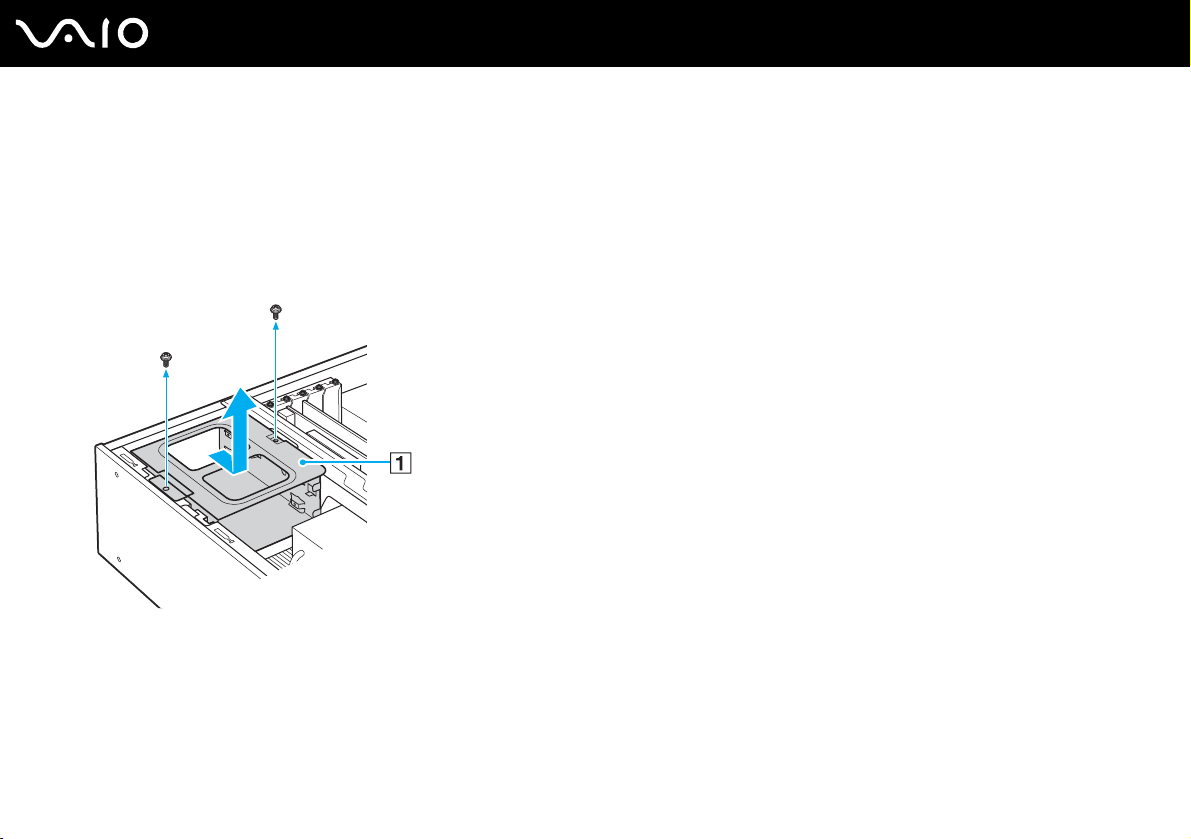
2 Remove the two screws from the chassis brace (1) and take out the brace.
3 Touch a metal object (such as the chassis frame) to discharge static electricity.
96
nN
Upgrading Your VAIO Computer
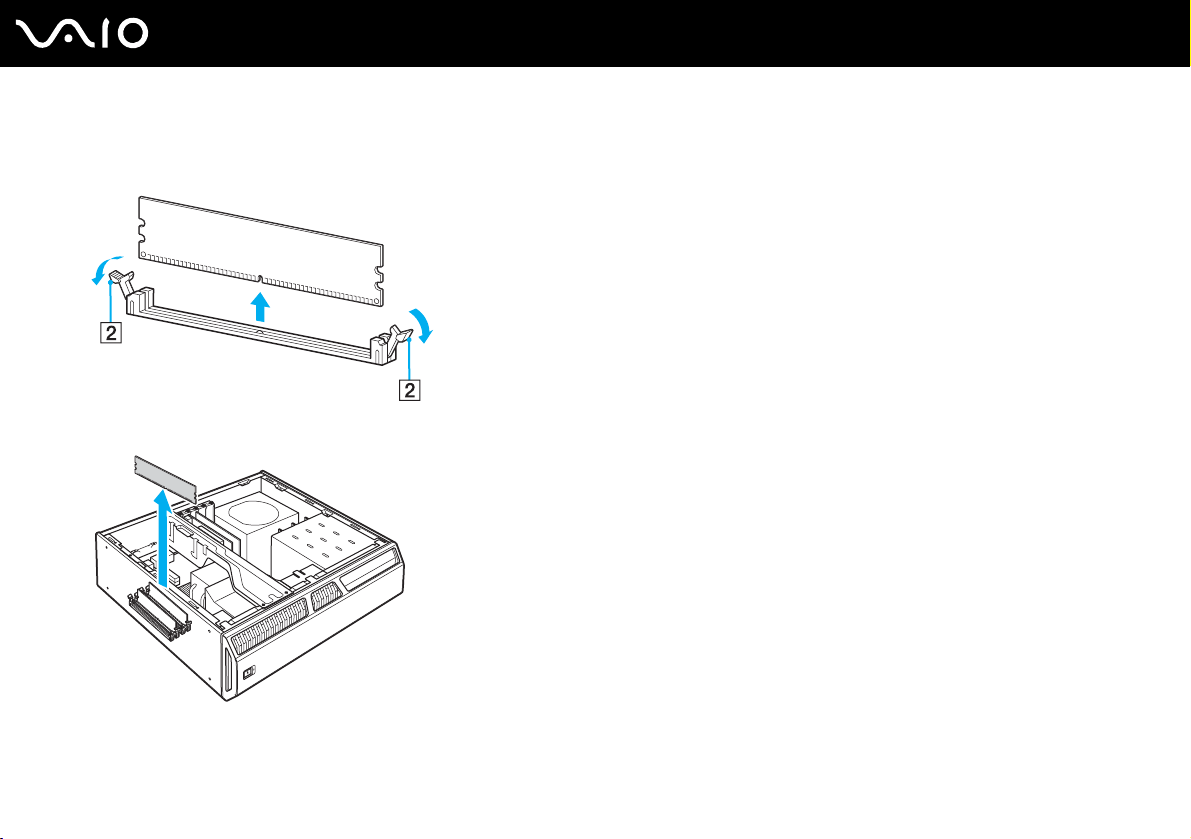
4 Locate the memory module(s) you wish to remove.
5 Push down on the latches (2), located on either side of the module, to gently eject it from the slot.
6 Grasp the memory module by the sides and remove from the main unit. Store the module in a static-free bag.
7 Remove the memory module from its anti-static package, handling it by the edges.
8 Locate the center notch (3) on the bottom edge of the memory module and align it to the center bump in the open module
slot.
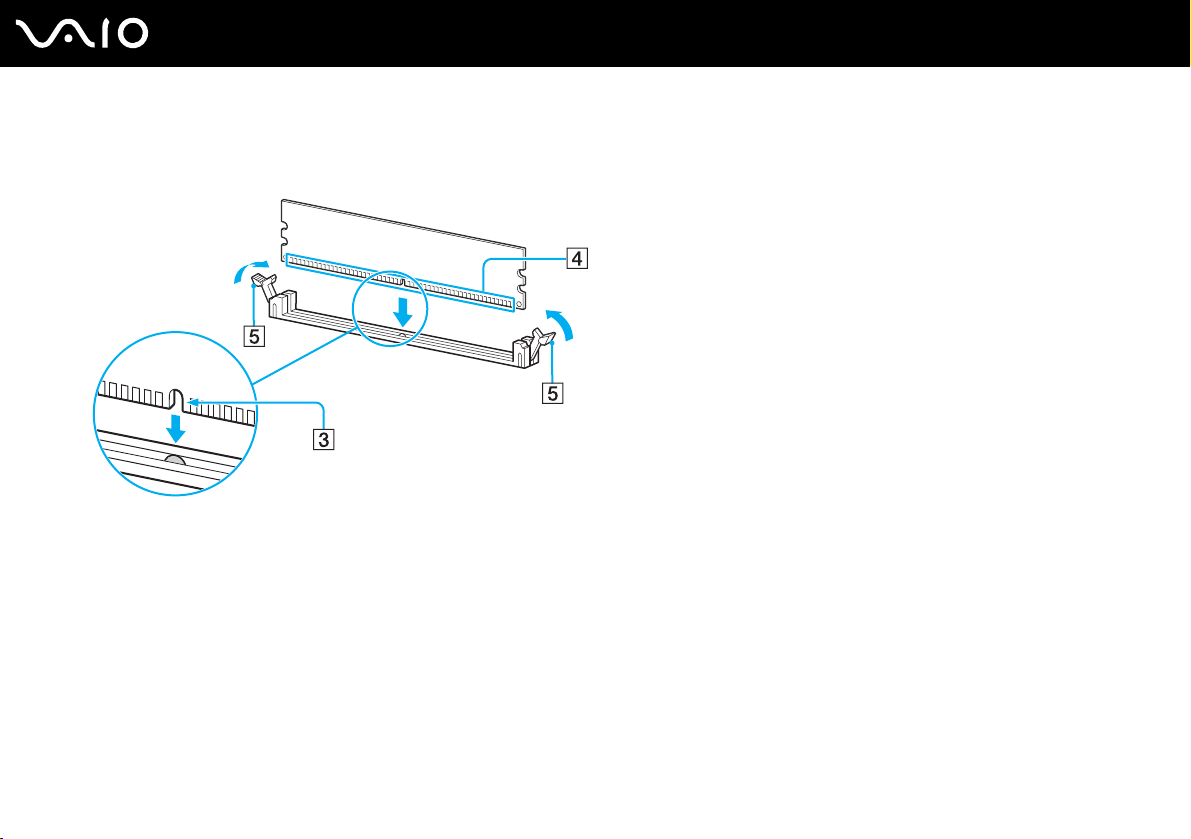
97
nN
Upgrading Your VAIO Computer
9 Firmly insert the lower edge of the module (4) into the slot by pressing down evenly against the module's upper corners.
10 The side latches (5) snap into position, holding the memory module in place.
!
To avoid damaging a memory module or the memory module slot, move the side latches slightly outward to relieve pressure.
11 Replace the chassis brace and secure it with the screws.
12 Replace the top panel.
See Removing and Replacing the Main Unit Top Panel (page 87) for the detailed instructions.

98
nN
Upgrading Your VAIO Computer
Viewing the Amount of Memory
To view the amount of memory
1 Turn on the computer.
2 Click Start, All Programs, and VAIO Central.
The VAIO Central window appears.
3 Click the System Information tab.
4 Double-click the System Information folder.
5 Double-click the System Information icon.
You can view the amount of system memory. If the additional memory does not appear, repeat the whole installation
procedure and restart the computer.
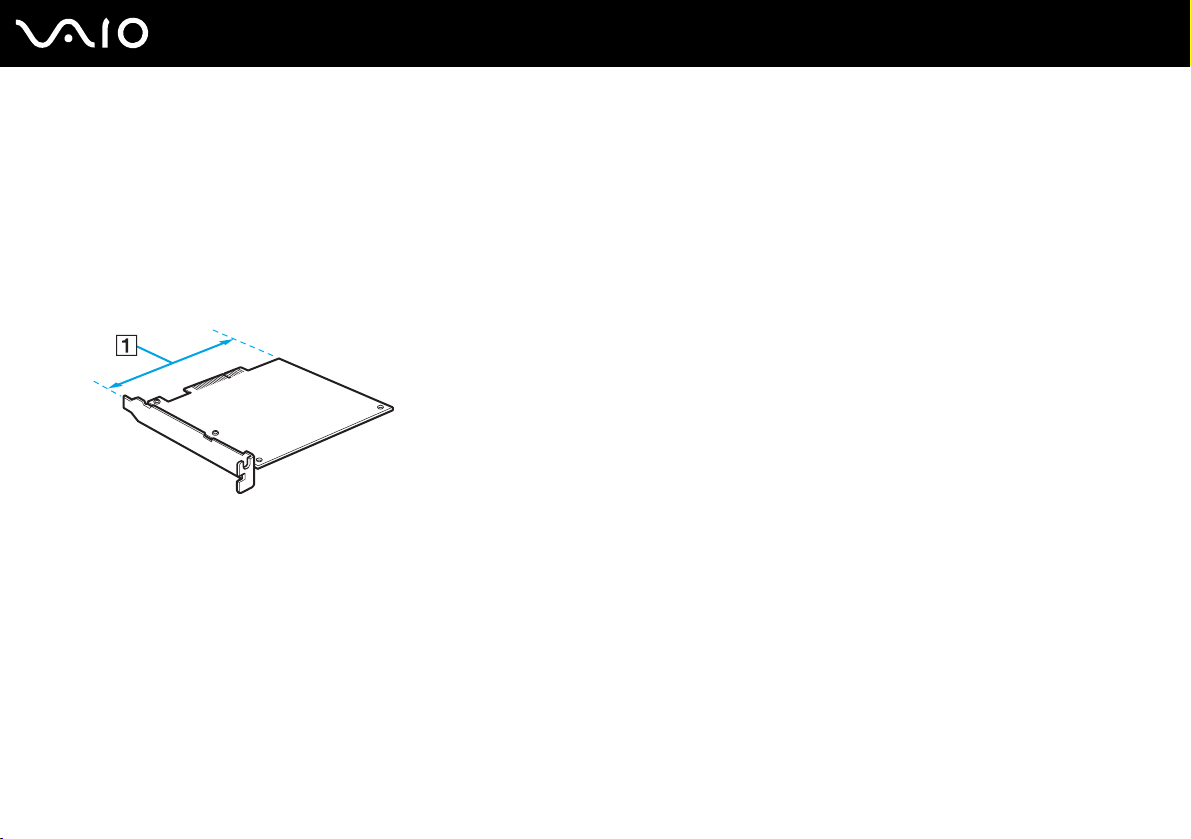
99
nN
Upgrading Your VAIO Computer
Installing an Add-on Card
The main unit of your computer has two open expansion slots: one PCI compliant slot (PCI slot 1) and one PCI Express x4
compliant slot (PCI slot 2). To PCI slot 2, you can install a PCI Express x1 or x2 compliant card as well as a PCI Express x4
compliant card. An expansion slot enables you to install a PCI standard based expansion card to expand the functionality of
your computer. Before you purchase an expansion card, make sure the card supports Windows Vista and the PCI standard.
The length of the add-on card (1) should not exceed 12.3 inches (31 cm) for PCI slot 1 and 6.7 inches (17 cm) for PCI slot 2
(the one close to the power unit).

100
nN
Upgrading Your VAIO Computer
!
Observe the proper safety precautions when you install an add-on card to your computer. See Before Upgrading Your Computer (page 86).
The entire repair cost will be charged if there is a failure or an accident arising from installation of an add-on card by yourself.
Make sure you unplug the main unit and peripheral devices, including the access unit, from the power sources and allow the main unit to cool down
before installing or removing an add-on card. Installing or removing an add-on card while the main unit is plugged to its power source may cause
damage to the both units and the peripheral devices as well as the add-on card.
Do not touch the electronic components on the internal circuit board of the main unit to avoid a malfunction as they are susceptible to external pressure
and static electricity.
Do not touch the electronic components on the add-on card to avoid a malfunction as they are susceptible to static electricity from a human body. Be
sure to touch a metal object to discharge static electricity from your body before handling the add-on card.
Do not place the add-on card on a surface that is likely to produce or hold static electricity, such as carpet. The components on the add-on card are
susceptible to static electricity, resulting in damage to the card.
Keep your hand away from the add-on card connector.
Do not drop or apply strong shock to the add-on card as it has high precision components.
Be sure to follow the proper produce to remove the add-on card from the main unit. Forceful removal of the add-on card may cause a malfunction of
the card or the unit.
Be sure to keep the add-on card dry.
If you leave a foreign object, for example a screw, inside the main unit during add-on card installation, turning on your computer may cause to produce
fumes. Be sure to remove the object from the unit and replace the top panel before turning on the computer.
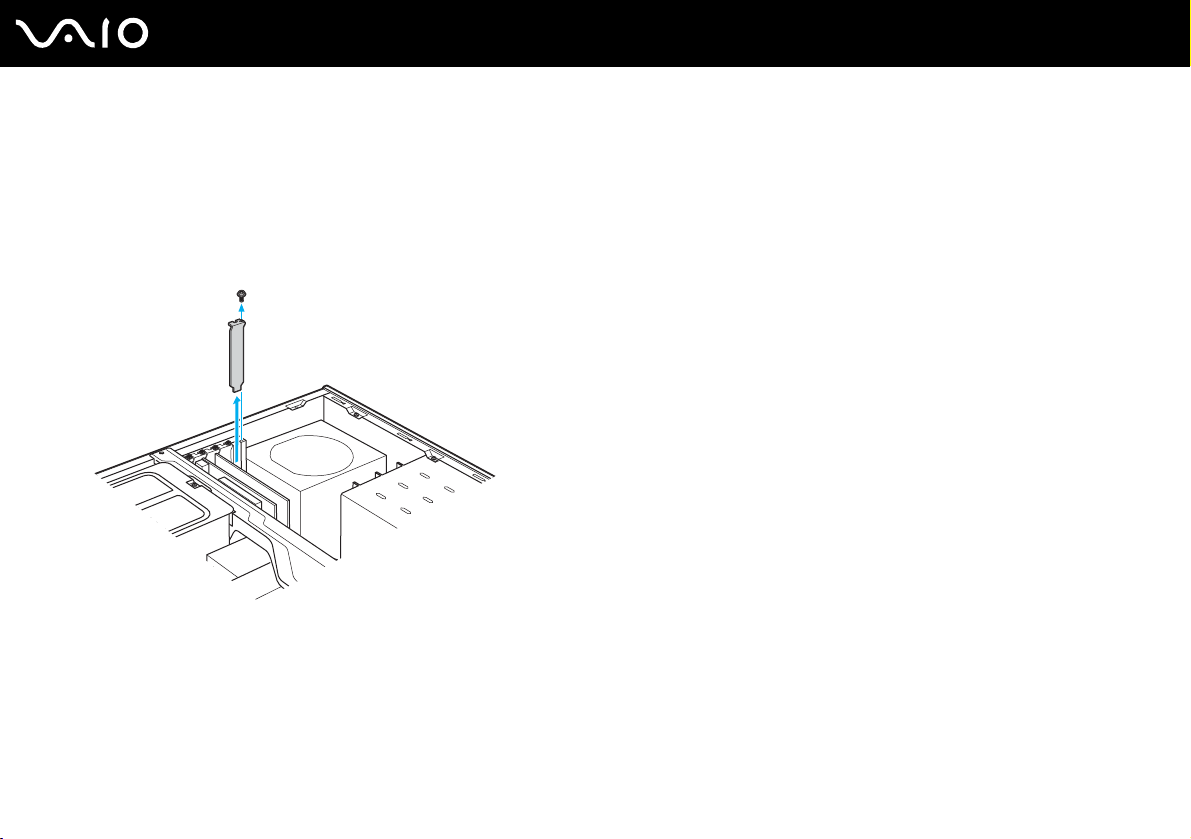
101
nN
Upgrading Your VAIO Computer
To install an add-on card
1 Remove the top panel of the main unit.
See Removing and Replacing the Main Unit Top Panel (page 87) for the detailed instructions.
2 Touch a metal object (such as the chassis frame) to discharge static electricity.
3 Locate an available expansion slot. Remove the slot cover's screw, and then remove the slot cover.
!
Be careful not to damage the circuit board and cables inside.
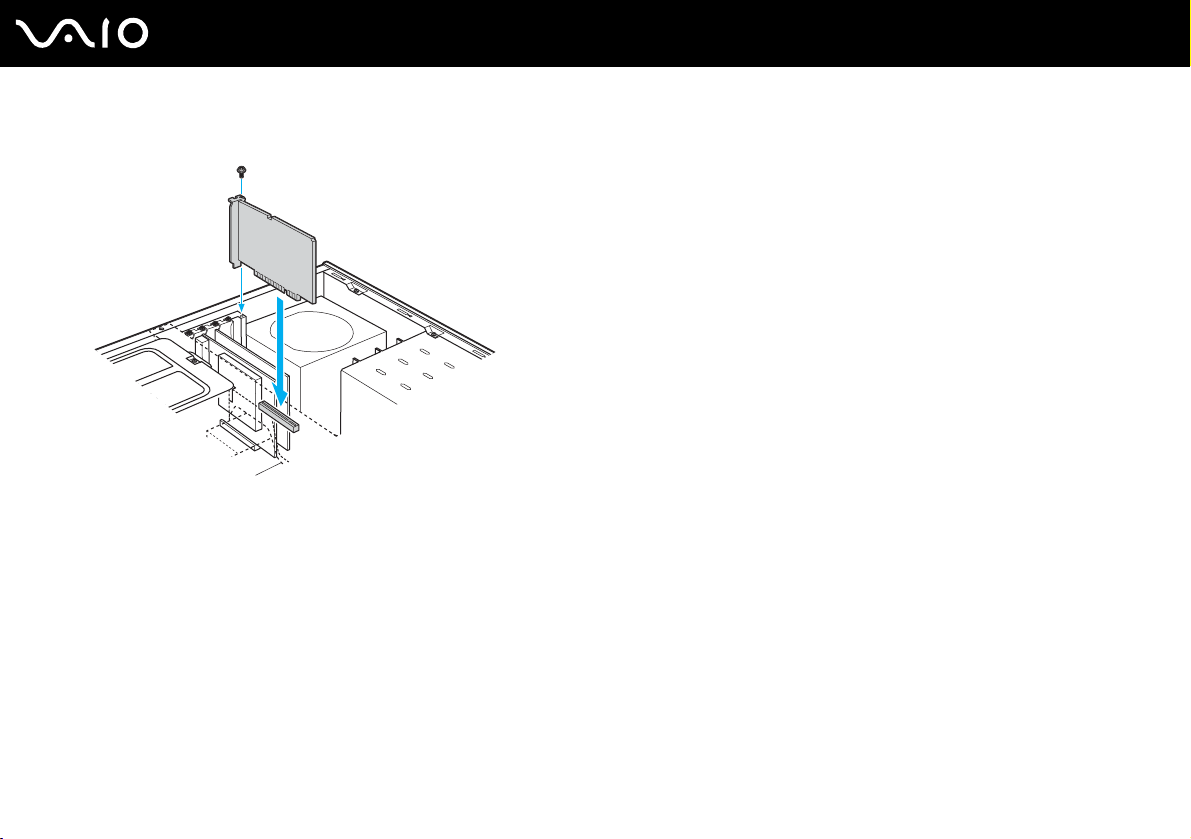
102
nN
Upgrading Your VAIO Computer
4 Insert the add-on card into the expansion slot and secure it with the screw from the expansion slot cover.
!
Be careful not to touch other internal components when inserting the card as it may cause a failure.
5 Replace the top panel.
See Removing and Replacing the Main Unit Top Panel (page 87) for the detailed instructions.
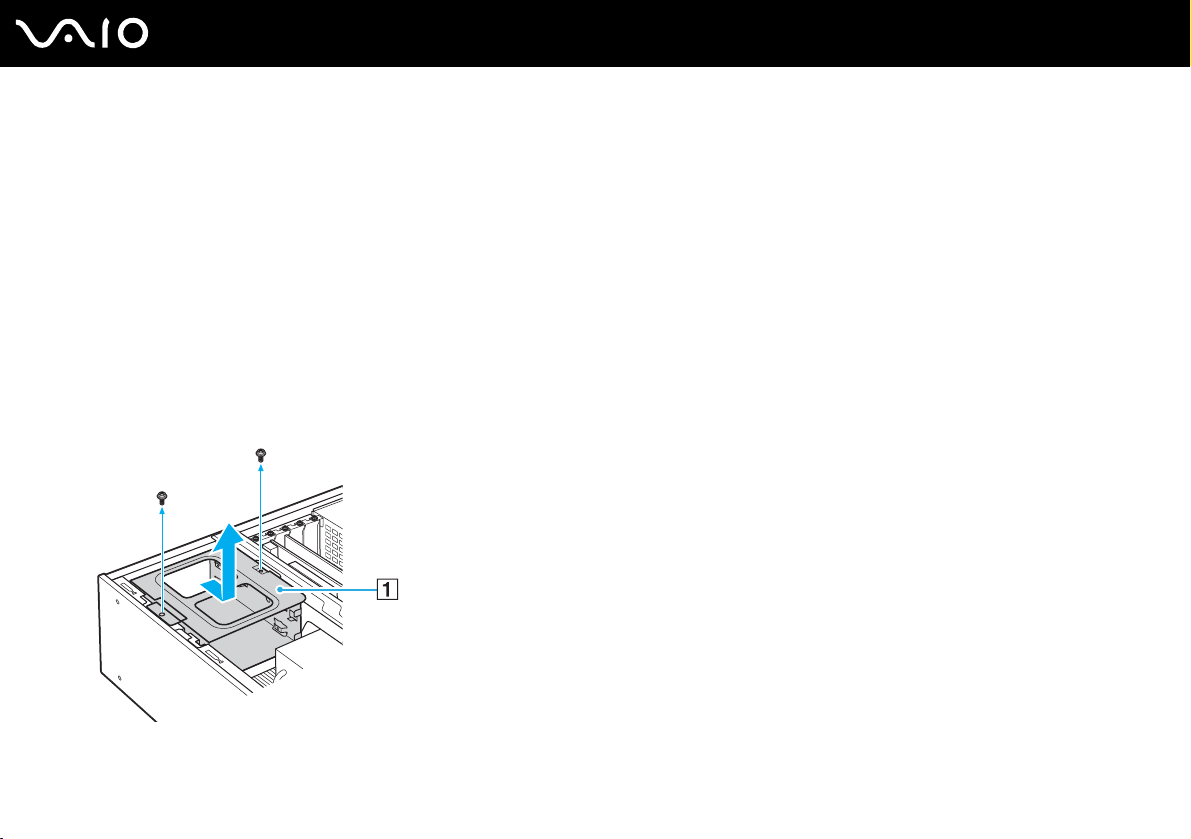
103
nN
Upgrading Your VAIO Computer
Replacing the Lithium Battery
The lithium battery starts to weaken after several years and the system settings, such as the date and time stored in CMOS
RAM, may become inaccurate. Replace the lithium battery when this occurs.
!
There is danger of the battery exploding if it is replaced incorrectly. Replace the battery only with a CR2032-type lithium battery.
To replace the lithium battery
1 Write down any changes you may have made to the settings in the BIOS Setup utility.
2 Remove the top panel of the main unit.
See Removing and Replacing the Main Unit Top Panel (page 87) for the detailed instructions.
3 Remove the two screws from the chassis brace (1) and take out the brace.
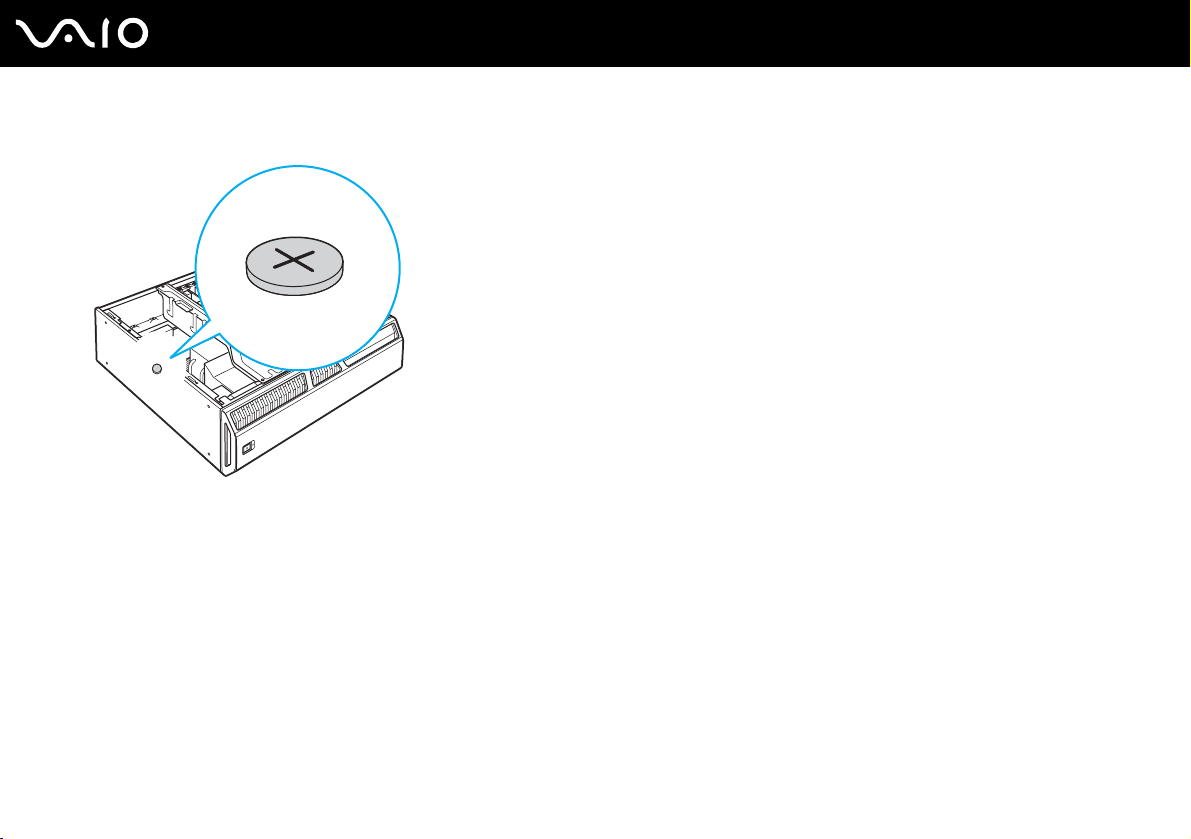
104
nN
Upgrading Your VAIO Computer
4 Remove the old battery and install the new battery with the plus (+) side facing up.
5 Replace the chassis brace and secure it with the screws.
6 Replace the top panel.
See Removing and Replacing the Main Unit Top Panel (page 87) for the detailed instructions.
The values stored in the CMOS memory are now reset to the factory default values. Run the Setup utility to reset the date,
time, passwords, and other changes you may have made to the BIOS settings. If you do not wish to customize your BIOS
settings, do not run the Setup utility.
!
Dispose of the lithium battery properly. In some areas, the disposal of lithium batteries in household or business trash may be prohibited. You can
return your unwanted lithium batteries to your nearest Sony Service Center or Factory Service Center. To find the nearest center or agent, see Sony
Support Information (page 156) or visit the Sony online support Web site.

105
nN
Upgrading Your VAIO Computer
Resetting the Computer's Date and Time
To reset the computer's date and time
1 Click the time readout displayed on the taskbar.
The window appears showing the current date and time.
2 Click Change date and time settings.
The Date and Time window appears.
3 On the Date and Time tab, change the settings as desired.
4 Click Apply.
5 Click OK.

106
nN
Upgrading Your VAIO Computer
Installing the Hard Disk Drive
The main unit of your computer is equipped with open internal bays to hold additional 3.5-inch hard disk drives.
Review the manufacturer's information provided with your new hard disk drive before attempting to install it in the unit.
✍
Certain models may already have additional hard disk drives installed that support the Redundant Array of Independent Disks (RAID) technology.
The installation information provided in this section may not apply if you have purchased a model that supports RAID.
!
The entire repair cost will be charged if there is a failure or an accident arising from installation of a hard disk by yourself.
Hard disk installation requires great care. Improper installation or removal will cause a malfunction of your computer.
If you need assistance to install a hard disk, contact an authorized Sony Service Center. To find the nearest center or agent, see Sony Support
Information (page 156) or visit the Sony online support Web site.
Be sure to avoid accidental disconnection of the internal cables of the main unit during hard disk installation.
Be sure to avoid injury during hard disk installation as the main unit contains components and circuit boards with sharp corners and edges.
If you leave a foreign object, for example a screw, inside the main unit during hard disk installation, turning on your computer may cause to produce
fumes. Be sure to remove the object from the unit and replace the top panel before turning on the computer.
Do not touch the electronic components on the internal circuit board of the main unit to avoid a malfunction as they are susceptible to external pressure
and static electricity.
The drive bay size of your computer is 3.5 inches.
Some hard disks are not compatible with your computer. Contact the manufacturer of your hard disk for compatibility with VAIO computers.
There may be some limitations on video import from i.LINK devices, depending on your hard disk.

107
nN
Upgrading Your VAIO Computer
Make sure you unplug the main unit and peripheral devices, including the access unit, from the power sources before installing or removing a hard
disk. Installing or removing a hard disk while the main unit is plugged to its power source may cause damage to the both units and the peripheral
devices as well as the hard disk.
The internal components of the main unit are too hot to touch immediately after you shut down your computer. Wait until the components cool down
before you attempt to install a hard disk.
The label of the installed hard disk, for example "Local disk (E:)" and "Local disk (F:)," depends on the hardware configuration of your computer. It may
also change after your computer recovery.
By default, recorded videos are stored on your C drive.
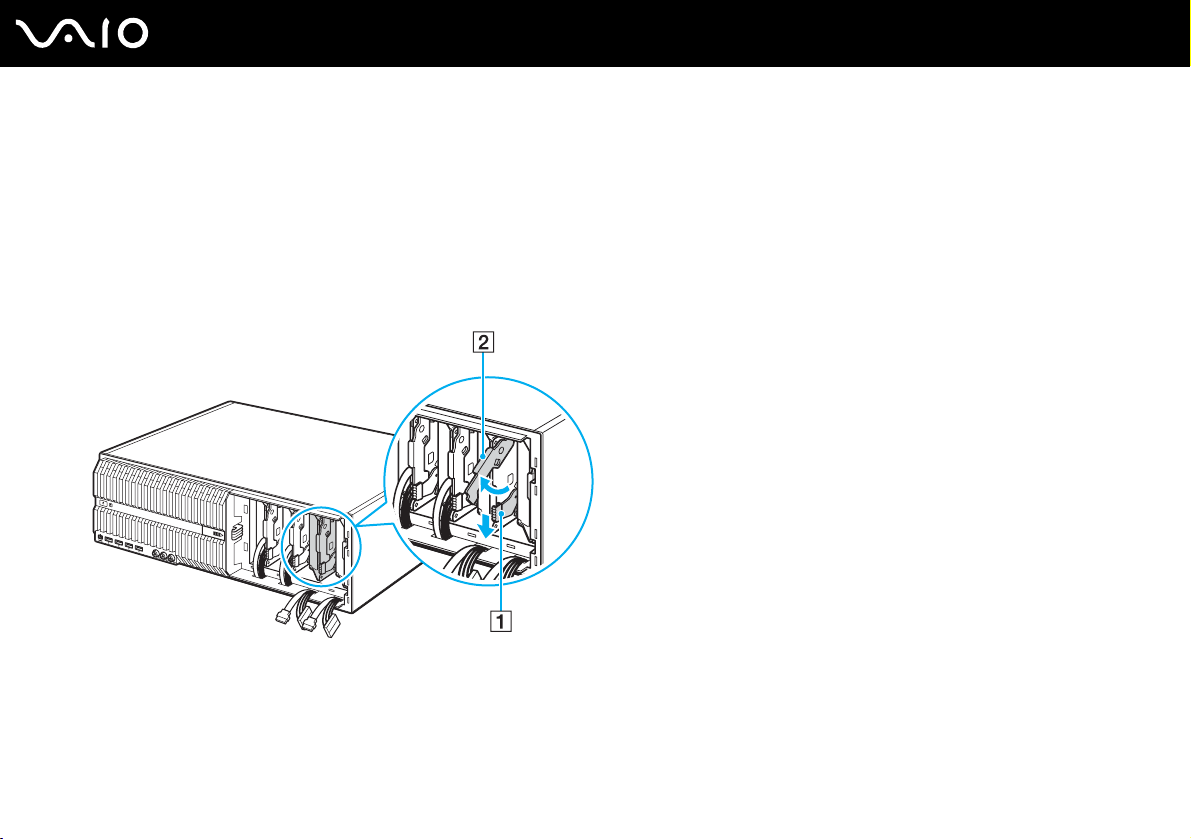
108
nN
Upgrading Your VAIO Computer
Installing an Additional Hard Disk Drive
You can install up to four SATA hard disk drives to the internal hard disk drive bay.
To install an additional hard disk drive
1 Remove the front panel of the main unit.
See Removing and Replacing the Main Unit Front Panel (page 89) for the detailed instructions.
2 Push the button (1) to release the hard disk drive holder lever (2).
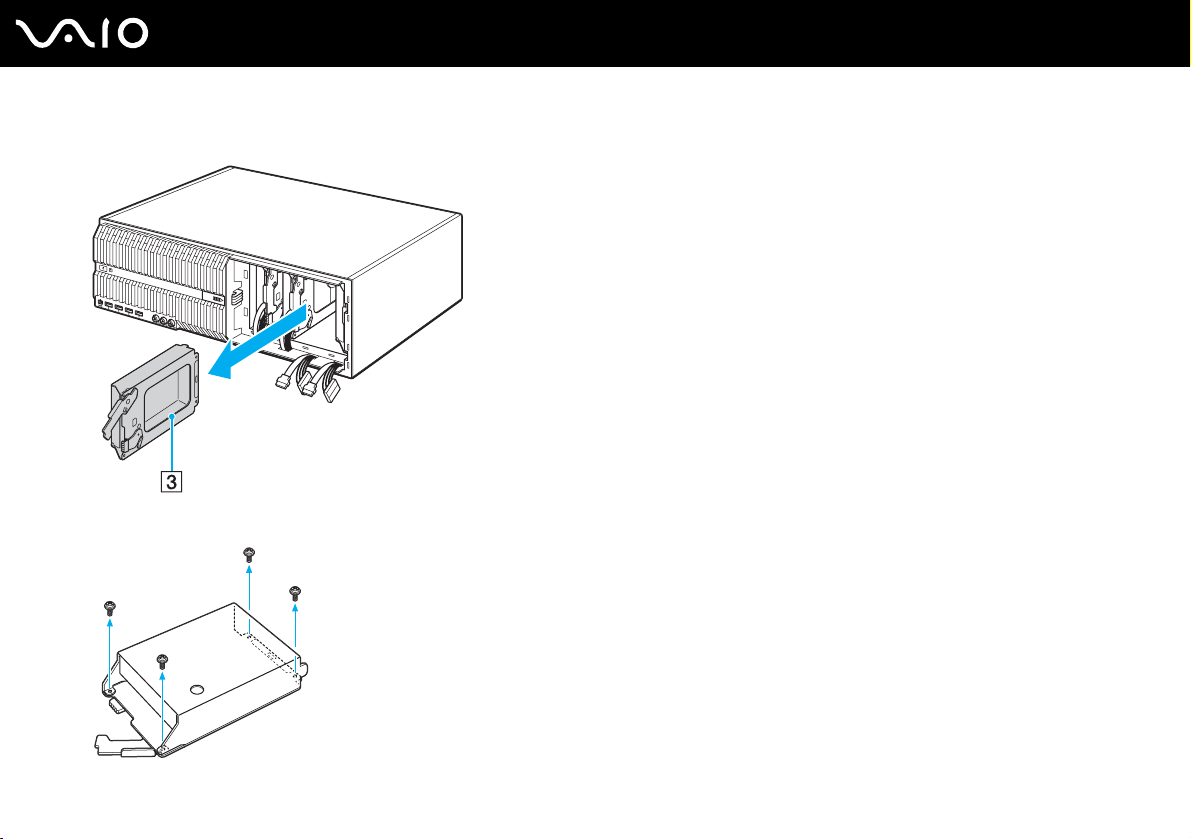
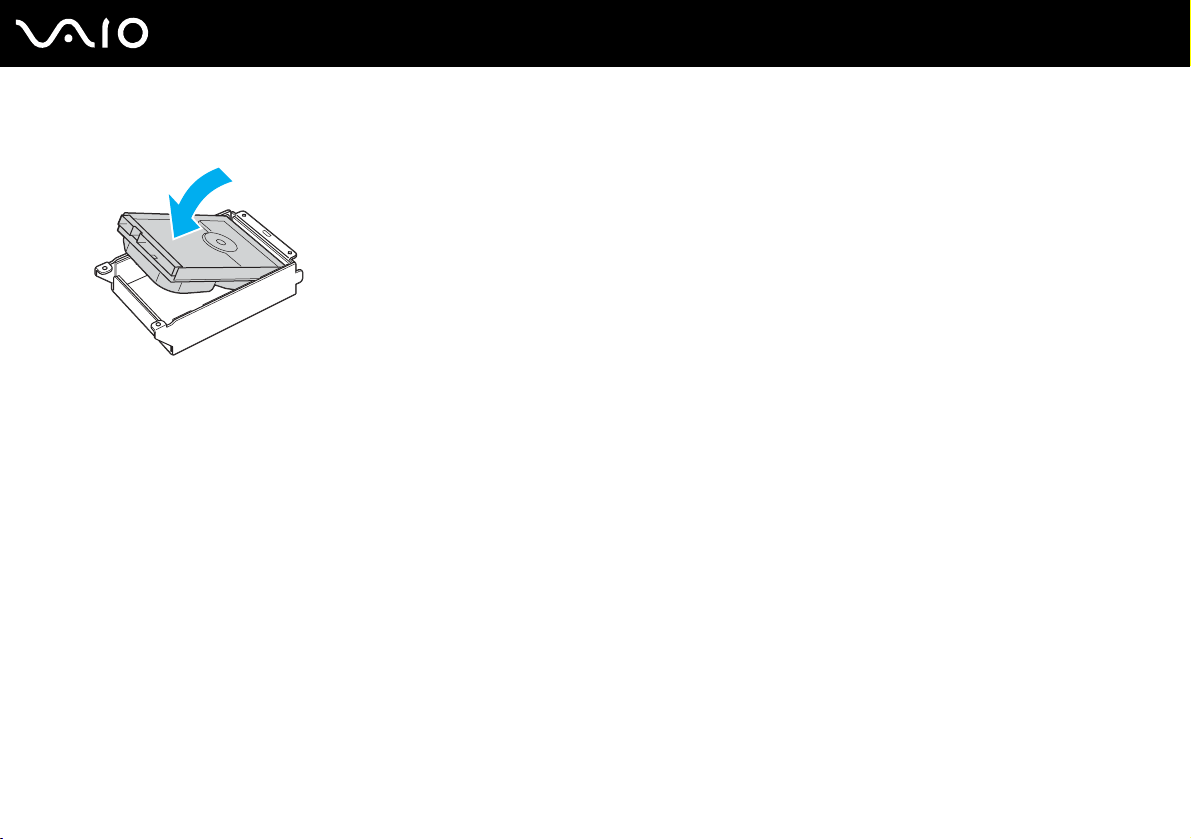
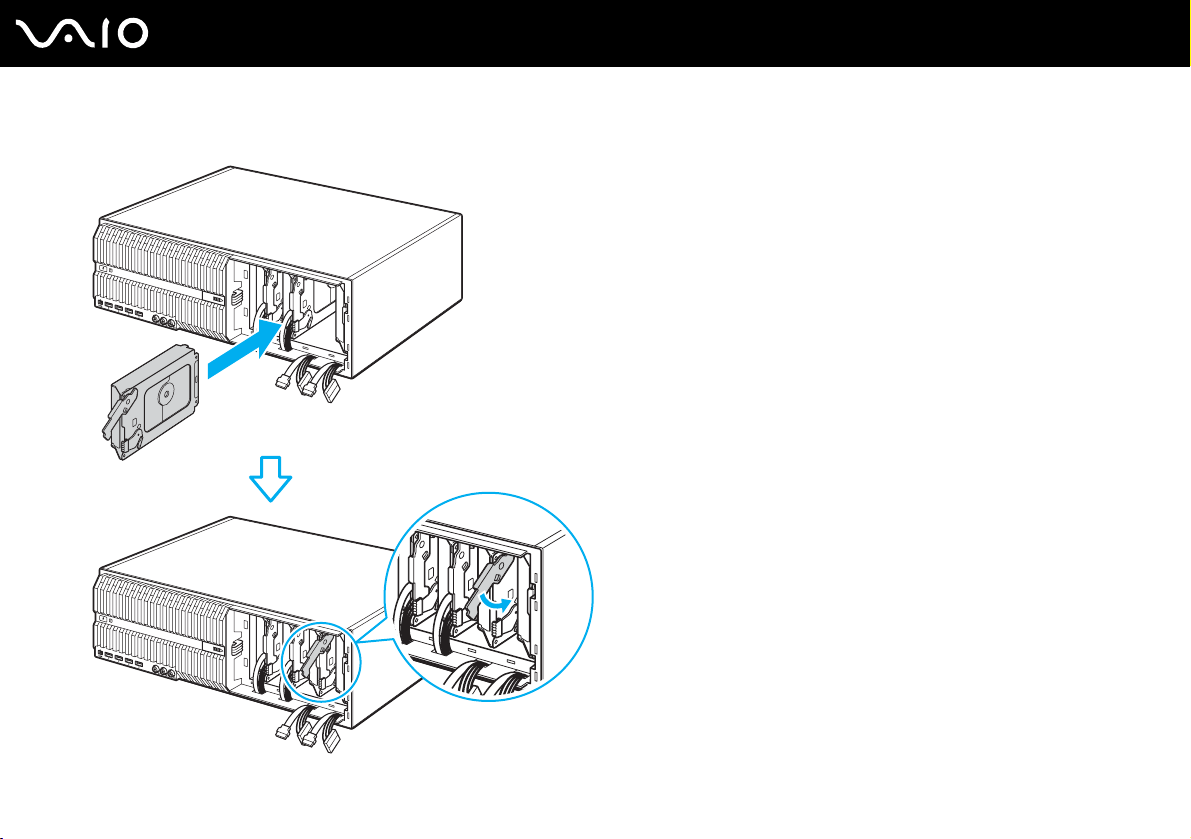
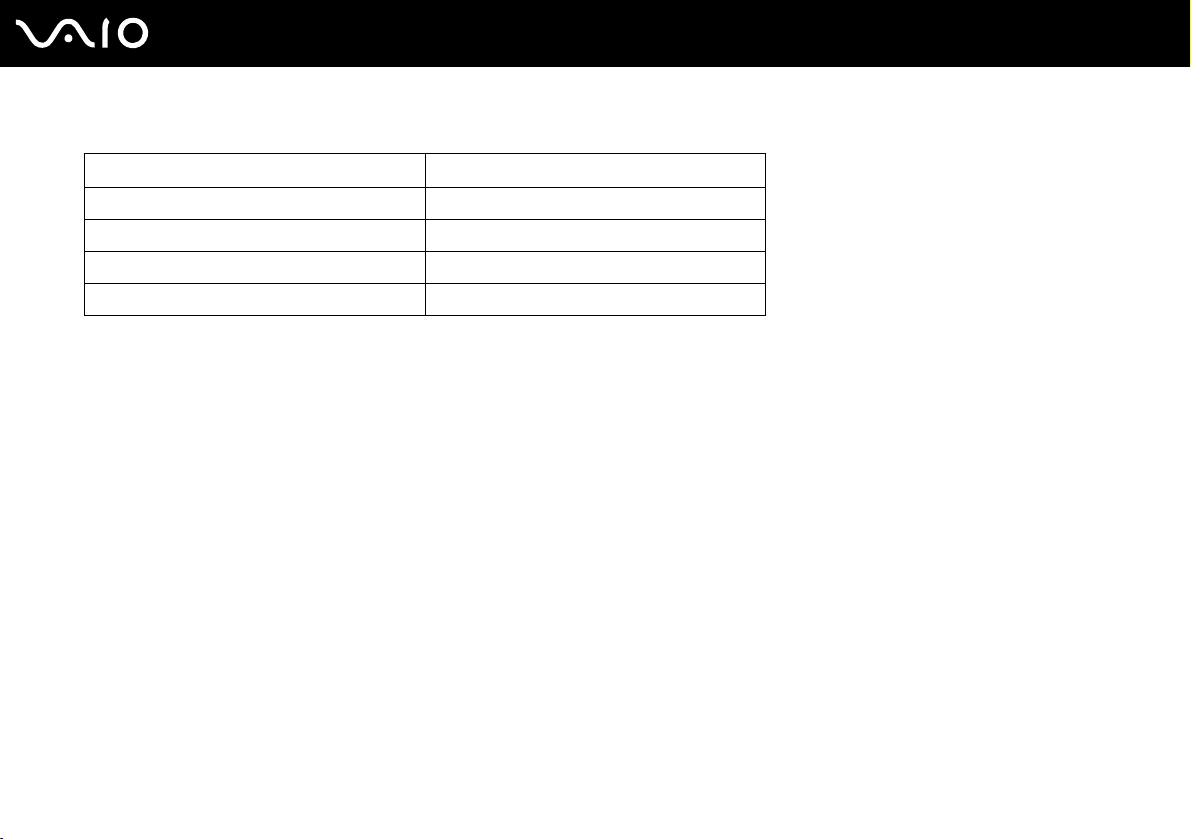
112
nN
Upgrading Your VAIO Computer
9 Connect the SATA cables to the hard disk drives as follows:
!
Use of a commercially available SATA cable with the straight-head connector may damage the connector on the hard disk drive by being pulled out
when you replace the drive holder. We recommend you use Sony SATA cables exclusively designed for your computer.
10 Replace the front panel.
See Removing and Replacing the Main Unit Front Panel (page 89) for the detailed instructions.
Connect the internal SATA cables: To the hard disk drives in:
PORT0 cable Rightmost drive bay
PORT1 cable Second drive bay from the right
PORT2 cable Third drive bay from the right
PORT3 cable Leftmost drive bay

113
nN
Upgrading Your VAIO Computer
Identifying the Additional Hard Disk Space
When you initialize the new hard disk, it must be configured as an extended partition in Windows NT file system (NTFS)
format.
To identify the additional hard disk space
1 Log on to Windows as a user with administrator rights.
2 Click Start and right-click Computer.
3 Select Manage from the menu.
The Computer Management window appears.
4 Under the file directory on the right, double-click Storage and then Disk Management.
5 Right-click on the newly installed, unformatted hard disk (disk label identified with red marking) and select Initialize Disk
from the menu.
6 Click on the allocated area of the disk.
7 Right-click the area and select New Partition from the menu.
The New Partition wizard window appears.
8 Follow the on-screen instructions to complete the process.
The Windows Vista operating system recognizes the new hard disk drive and applies the NTFS format.

114
nN
Precautions
Precautions
This section describes safety guidelines and precautions to help you protect your VAIO computer from potential damage.
❑ On Using the Power Source (page 115)
❑ On Handling Your Computer (page 116)
❑ On Handling Floppy Disks (page 118)
❑ On Handling Discs (page 119)
❑ On Using Headphones (page 120)
❑ On Handling Memory Stick Media (page 120)
❑ On Handling the Hard Disk (page 121)

115
nN
Precautions
On Using the Power Source
❑ See the online Specifications to check the power operation of your model.
❑ Do not share the AC outlet with other power-consuming equipment, such as a photocopier or shredder.
❑ You can purchase a power strip with a surge protector. This device prevents damage to your computer caused by sudden
power surges, in an electrical storm, for example.
❑ Do not place heavy objects on the power cord.
❑ To disconnect the cord, pull it out by the plug. Never pull the cord itself.
❑ Unplug your computer from the AC outlet if you are not planning to use the computer for a long period of time.
❑ Make sure that the AC outlet is easily accessible.
❑ Use the power cord supplied with your computer or genuine Sony products. Do not use any other power cord as it may
cause a malfunction.

116
nN
Precautions
On Handling Your Computer
❑ Clean the cabinet with a soft cloth, which is dry or lightly moistened with a mild detergent solution. Do not use any type
of abrasive pad, scouring powder, or solvent such as alcohol or benzine, as these may damage the finish of your
computer.
❑ If you drop a solid object or any liquid onto your computer, shut down the computer and then unplug it. You may want to
have the computer checked by qualified personnel before operating it again.
❑ Do not drop your computer.
❑ Do not place your computer in a location subject to:
❑ Heat sources, such as radiators or air ducts
❑ Direct sunlight
❑ Excessive dust
❑ Moisture or rain
❑ Mechanical vibration or shock
❑ Strong magnets or speakers that are not magnetically shielded
❑ Ambient temperature of more than 95°F (35°C) or less than 41°F (5°C)
❑ High humidity
❑ Do not place electronic equipment near your computer. The electromagnetic field of the computer may cause a
malfunction.
❑ Provide adequate air circulation to prevent internal heat from building up. Do not place your computer on porous surfaces
such as rugs or blankets, or near material such as curtains or draperies that may block its air vents.
❑ Your computer uses high-frequency radio signals and may cause interference to radio or TV reception. If this occurs,
relocate the computer a suitable distance away from the set.

117
nN
Precautions
❑ Use only specified peripheral equipment and interface cables; otherwise, problems may occur.
❑ Do not use cut or damaged connection cables.
❑ If your computer is brought directly from a cold location to a warm one, moisture may condense inside the computer. In
this case, allow at least one hour before turning on the computer. If any problems occur, unplug the computer and contact
an authorized Sony Service Center. To find the nearest center or agent, see Sony Support Information (page 156) or
visit the Sony online support Web site.
❑ Make sure you disconnect the power cord before cleaning your computer.
❑ To avoid losing data if your computer is damaged, back up your data regularly.

118
nN
Precautions
On Handling Floppy Disks
❑ Do not open the shutter manually or touch the surface of the floppy disk.
❑ Keep floppy disks away from magnets.
❑ Keep floppy disks away from direct sunlight and other sources of heat.
❑ Keep floppy disks away from any liquid. Do not let them get wet. When you are not using your floppy disk, always remove
it from the floppy disk drive and use a storage case.
❑ If the floppy disk comes with an adhesive label, make sure that the label is properly affixed. If the edge of the label is
curled up, the label may stick to the inside of the floppy disk drive and cause a malfunction or damage your floppy disk.
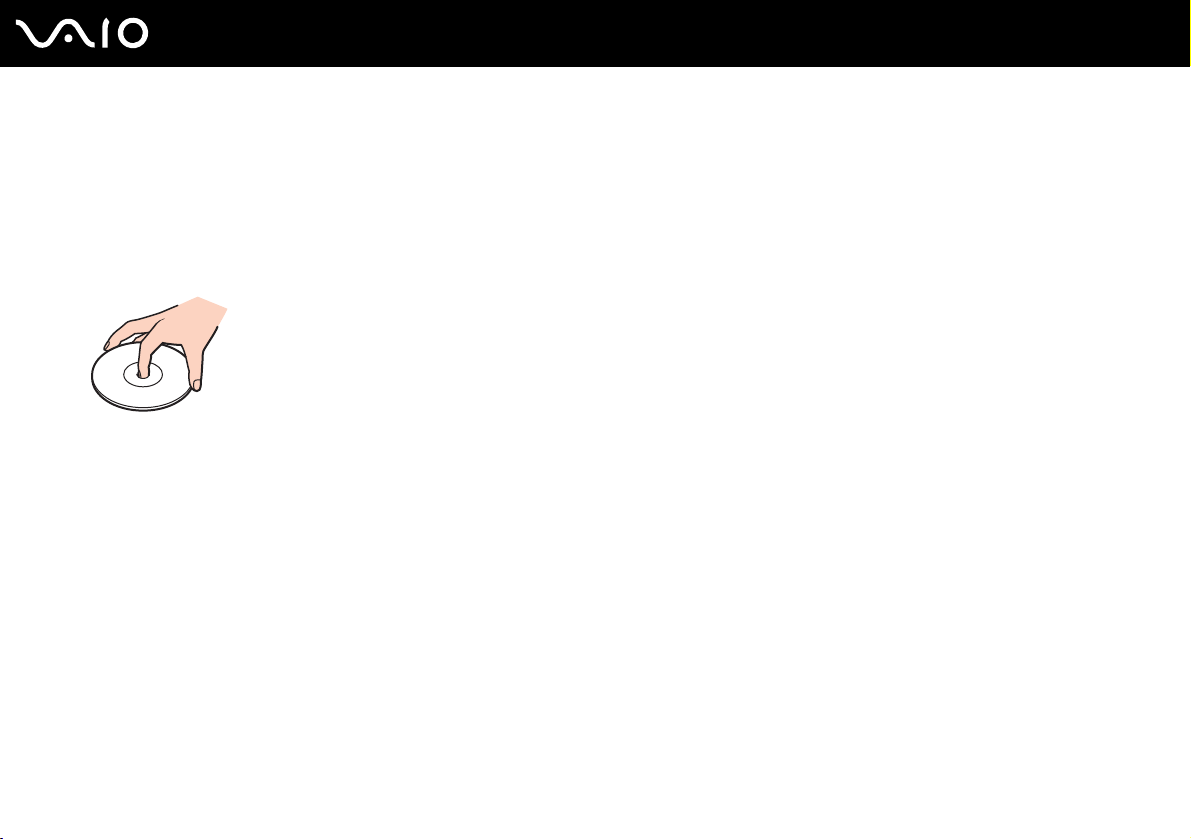
119
nN
Precautions
On Handling Discs
❑ Do not touch the surface of the disc.
❑ Do not drop or bend the disc.
❑ Fingerprints and dust on the surface of a disc may cause read errors. Always hold the disc by its edges and central hole,
as shown below:
❑ Proper care of the disc is essential to its continuous reliability. Do not use solvents (such as benzine, thinner, alcohol,
commercially available cleaners, or anti-static spray) which may cause damage to the disc.
❑ For normal cleaning, hold the disc by its edge and use a soft cloth to wipe the surface from the center out.
❑ If the disc is badly soiled, moisten a soft cloth with water, wring it out well, and use it to wipe the surface of the disc from
the center out. Wipe off any remaining moisture with a dry soft cloth.
❑ Never affix an adhesive label to a disc. This will affect the use of the disc irreparably.

120
nN
Precautions
On Using Headphones
Preventing hearing damage – Avoid using headphones at high volume. Hearing experts advise against continuous, loud
and extended play. If you experience a ringing in your ears, reduce the volume or discontinue use.
On Handling Memory Stick Media
❑ Do not use the media in a location subject to static electricity or electrical noise.
❑ Do not touch the Memory Stick media connector with your finger or metallic objects.
❑ Use only the adhesive label supplied with the Memory Stick media as a label.
❑ Do not bend, drop, or apply strong shock to the Memory Stick media.
❑ Do not disassemble or modify Memory Stick media.
❑ Do not let Memory Stick media get wet.
❑ Do not use or store Memory Stick media in a location subject to:
❑ Extremely high temperatures, such as in a car parked in the sun
❑ Direct sunlight
❑ High humidity
❑ Corrosive substances
❑ Use the storage case supplied with the Memory Stick media.
❑ Be sure to make a backup copy of your valuable data.
❑ Keep the Memory Stick media out of reach of children. There is a risk of swallowing the media.
❑ When using the Memory Stick Duo media, do not use a fine-tipped pen to write on the label adhered to the Memory Stick
Duo media. Exerting pressure on the media may damage internal components.

121
nN
Precautions
On Handling the Hard Disk
The hard disk has a high storage density and reads or writes data in a short time. However, it can be easily damaged by
mechanical vibration, shock, or dust.
Although the hard disk has the internal safety device to prevent losing data due to mechanical vibration, shock or dust, you
should be careful when handling your computer.
To avoid damaging your hard disk
❑ Do not subject your computer to sudden movements.
❑ Keep your computer away from magnets.
❑ Do not place your computer in a location subject to mechanical vibration or in an unstable position.
❑ Do not move your computer while the power is on.
❑ Do not turn off the power or restart your computer while reading or writing data to the hard disk.
❑ Do not use your computer in a place subject to extreme changes in temperature.
✍
If the hard disk is damaged, the data cannot be restored.
122
nN
Troubleshooting
Troubleshooting
This section describes how to solve common problems you might encounter when using your VAIO computer. Many problems
have simple solutions. Try these suggestions before visiting the Sony online support Web site
at:
http://esupport.sony.com/EN/VAIO/
for
customers in USA,
http://www.sony.ca/support
for customers in Canada,
http://esupport.sony.com/ES/VAIO/
for customers in Spanish speaking Latin American countries or areas, or
http://esupport.sony.com/ES/VAIO/BR/
for customers in Brazil.
❑ Computer (page 123)
❑ System Security (page 131)
❑ Internet (page 132)
❑ Bluetooth Technology (page 134)
❑ Optical Discs (page 138)
❑ Display (page 142)
❑ Printing (page 144)
❑ Microphone (page 145)
❑ Mouse (page 146)
❑ Speakers (page 147)
❑ Keyboard (page 149)
❑ Floppy Disks (page 150)
❑ PC Cards (page 151)
❑ Audio/Video (page 153)
❑ Memory Stick Media (page 154)
❑ Peripherals (page 155)

123
nN
Troubleshooting
Computer
What should I do if my computer does not start?
❑ Make sure your computer is securely plugged into a power source and turned on. Make sure the power indicator shows
the power is on.
❑ Make sure the floppy disk drive (if applicable) is empty.
❑ If your computer is plugged into a power strip or an uninterruptible power supply (UPS), make sure the power strip or UPS
is plugged into a power source and turned on.
❑ Make sure your external display is plugged into an appropriate power source and turned on.
❑ Make sure the brightness and contrast controls on your external display are adjusted correctly.
❑ Disconnect the AC adapter. Wait three to five minutes. Reattach the AC adapter and press the power button to turn on
your computer.
❑ Condensation may cause your computer to malfunction. If this occurs, do not use the computer for at least one hour.
❑ Remove any extra memory modules you may have installed since purchase.
❑ Make sure your computer is not in Sleep mode by pressing the power button on the computer or the standby button on
the keyboard.

124
nN
Troubleshooting
What should I do if a BIOS error appears when I turn on my computer?
If the message "Press <F1> to resume, <F2> to setup" appears at the bottom of the screen, follow these steps:
1 Press the F2 key.
The BIOS setup screen appears. If not, restart the computer and press the F2 key several times when the VAIO logo
appears.
2 Set the date (month/day/year) with the Tab key and the +/- keys.
3 Press the
m key to select System Time, and then set the time (hour: minute: second) with the Tab key and the +/- keys.
4 Press the
, key to select the Exit tab, and then select Load Optimal Defaults and press Enter key.
The message Load Defaults?(Y/N) appears.
5 Press the Y key.
6 Select Exit Saving Changes and press the Enter key.
The message Exit Saving Changes? (Y/N) appears.
7 Press the Y key.
Your computer restarts.
If this occurs frequently, contact an authorized Sony Service Center. To find the nearest center or agent, see Sony Support
Information (page 156) or visit the Sony online support Web site.

125
nN
Troubleshooting
What should I do if the power indicator lights but my screen stays blank?
❑ Make sure the proper input for your display (TV, VGA, DVI-D monitor) is selected.
❑ Make sure your display (TV, VGA, DVI-D monitor) is turned on.
❑ If your display is still blank, follow these steps:
1 Press the power button on your computer for more than four seconds to check that the power indicator goes out. Then
turn on your computer again.
2 If your display still stays blank, unplug the power cord and leave the computer for about a minute. Then plug in the
power cord and turn on the computer again.
!
Turning off your computer with the power button may cause loss of unsaved data.
126
nN
Troubleshooting
What should I do if my computer or software stops responding?
❑ If your computer stops responding while a software application is running, press the Alt+F4 keys to close the application
window.
❑ If the Alt+F4 keys do not work, click Start, the arrow next to the Lock button, and Shut Down to turn off your computer.
❑ If your computer does not turn off, press the Ctrl+Alt+Delete keys and click the arrow next to the Shut down button
and Shut Down.
If the Windows Security window appears, click Shut Down.
!
Turning off your computer with the Ctrl+Alt+Delete keys or the power button may cause loss of unsaved data.
❑ If your computer still does not turn off, press and hold the power button until the computer turns off.
❑ Remove the power cord.
❑ Try reinstalling the software.
❑ Contact the software publisher or designated provider for technical support.

127
nN
Troubleshooting
Why doesn't my computer enter Sleep mode?
Your computer may become unstable if the operating mode is changed before the computer completely enters Sleep mode.
To restore your computer to normal operating stability
1 Close all open programs.
2 Click Start, the arrow next to the Lock button, and Restart.
3 If your computer does not restart, press the Ctrl+Alt+Delete keys and click the arrow next to the Shut down button and
Restart.
4 If this procedure does not work, press and hold the power button until the computer turns off.
!
Turning off your computer with the power button may cause loss of unsaved data.

128
nN
Troubleshooting
What should I do if Windows does not start, showing a message, when I start my
computer?
❑ Make sure the optical disc drives on the access unit of your computer do not contain a "non-bootable" disc.
❑ If a non-bootable disc is in either drive, follow these steps:
1 Remove the disc.
2 Restart your computer and confirm that the Windows operating system launches properly.
❑ If you enter a wrong power-on password three times consecutively, the Password Check failed message appears and
Windows will not start. Press and hold the power button for more than four seconds to check that the VAIO power indicator
goes off. Wait for 10 or 15 seconds, then restart your computer and enter the correct password. When entering the
password, check that the Num Lock indicator and Caps Lock indicator on the keyboard are off. If any are lit, press the
Num Lock key or the Caps Lock key to turn off the indicator before entering the password.
❑ If the Windows operating system still does not launch, follow these steps to initialize the BIOS:
1 If there is a disc in the optical disc drive, remove it.
2 Turn off your computer.
3 Remove any peripheral devices connected to the computer.
4 Restart the computer.
5 Press the F2 key when the VAIO logo appears.
The BIOS setup screen appears. If not, restart the computer and press the F2 key several times when the VAIO logo
appears.
6 Press the
, key to select the Exit menu.
7 Press the
m key to select Load Setup Defaults.


130
nN
Troubleshooting
What should I do if my game software does not work or it keeps crashing?
❑ Check the Web site of the game if there are any patches or updates to download.
❑ Make sure you have installed the latest video driver.
❑ On some VAIO models, the graphics memory is shared with the system. The optimal graphic performance in this case is
not guaranteed.
What should I do if I cannot remember the BIOS password?
If you have forgotten the BIOS password, contact an authorized Sony Service Center to reset it. A reset fee will be charged.
To find the nearest center or agent, see Sony Support Information (page 156) or visit the Sony online support Web site.
Why does it take time before my computer starts?
If Norton Internet Security's Personal Firewall is active, it may take some time before the desktop screen appears due to
network security checkups.
Why doesn't my screen turn off when the time selected for the automatic turn-off action
has passed?
The VAIO Original Screen Saver disables the timer setting, which you can select using the Windows power options, for your
screen to turn off.
Select the screen saver other than the VAIO Original Screen Saver.

131
nN
Troubleshooting
System Security
This section provides information about keeping your computer operating smoothly and protecting against potential threats
to the computer's security.
How can I protect my computer against security threats, such as viruses?
The Microsoft Windows operating system is preinstalled on your computer. The best way to protect your computer against
security threats, such as viruses, is to download and install the latest Windows updates regularly.
You can get important Windows updates by doing the following:
!
Your computer must be connected to the Internet before you can receive updates.
1 Connect to the Internet.
2 Double-click the Windows Security Alerts icon on the taskbar.
3 Follow the on-screen instructions to set up automatic or scheduled updates.
How do I keep my antivirus software updated?
You can keep the Norton Internet Security software program current with the latest updates from Symantec Corporation.
To download and install the latest security update
1 Click Start, All Programs, Norton Internet Security, and Norton Internet Security.
2 Click the item to update the software on the left pane.
3 Follow the on-screen instructions to select and download updates.

132
nN
Troubleshooting
Internet
What should I do if my modem does not work?
❑ Make sure the telephone cable is securely plugged into the modem port on the main unit of your computer and the wall
jack.
❑ Make sure the telephone cable is working. Plug the cable into an ordinary telephone and listen for a dial tone.
❑ Make sure that the telephone number the program is dialing is correct.
❑ Make sure the software you are using is compatible with your computer's modem. (All preinstalled Sony programs are
compatible.)
❑ Follow these steps to check the settings:
1 Click Start and Control Panel.
2 Click Hardware and Sound.
3 Click Phone and Modem Options.
4 On the Modems tab, check that your modem is listed.
5 On the Dialing Rules tab, check the location information is correct.

133
nN
Troubleshooting
Why is my modem connection slow?
Your computer is equipped with a V.92/ V.90 compatible modem. Many factors may influence modem connection speed,
including telephone line noise or compatibility with telephone equipment, such as fax machines or other modems. If you think
your modem is not connecting properly to other PC-based modems, fax machines, or your Internet Service Provider (ISP),
do any of the following:
❑ Ask your telephone company to verify your telephone line is free of any line noise.
❑ If your problem is fax-related, make sure there are no problems with the fax machine you are calling and that it is
compatible with fax modems.
❑ If you are having a problem connecting with your ISP, make sure the ISP is not experiencing technical problems.
❑ If you have a second telephone line, try connecting the modem to that line.

134
nN
Troubleshooting
Bluetooth Technology
What should I do if other Bluetooth devices cannot discover my computer?
❑ Make sure both devices have the Bluetooth functionality enabled.
❑ If the Bluetooth indicator is off, activate the Bluetooth functionality. See Using the Bluetooth Functionality (page 61) for
the detailed instructions.
❑ You cannot use the Bluetooth functionality when your computer is in a power saving mode. Return to Normal mode, then
activate the Bluetooth functionality. See Using the Bluetooth Functionality (page 61) for the detailed instructions.
❑ Your computer and the device may be too far apart. Wireless Bluetooth technology works best when the devices are within
33 feet (10 meters) of each other.
Why can't my computer discover other Bluetooth devices?
If the connected device is also connected to other devices, it may not appear in the Bluetooth utility software or you may not
be able to communicate with the device.
What should I do if I cannot find the Bluetooth device with which I want to communicate?
❑ Check that the Bluetooth functionality of the device with which you want to communicate is on. See the other device's
manual for more information.
❑ If the device with which you want to communicate is already communicating with another Bluetooth device, it may not be
found or it may not be able to communicate with your computer.
❑ To allow other Bluetooth devices to communicate with your computer, right-click the Bluetooth icon on the taskbar and
select Options from the menu to open the Options window. Then, check if proper security modes are selected on the
Security tab. For details on the security modes, see the help file on the Bluetooth utility software.
For more information on the Bluetooth Device window, see Communicating with Another Bluetooth Device (page 65).
135
nN
Troubleshooting
What should I do if other Bluetooth devices cannot connect to my computer?
❑ Make sure the other device is authenticated.
❑ Your computer may not allow connections from other devices. To enable Bluetooth device connections, follow these steps:
1 Right-click the Bluetooth icon on the taskbar.
2 Select Options from the menu.
The Options window appears.
3 Check if Standard or Low is selected for the Bluetooth security level on the Security tab.
If a custom Bluetooth security level is selected, click the Default level button.
4 Click OK.
❑ The data transfer distance can be shorter than 33 feet (10 meters) depending on existing obstacles between the two
devices, on radio wave quality, and on the operating system or the software in use. Move your computer and Bluetooth
devices closer to each other.
❑ If the device with which you want to communicate is already communicating with another Bluetooth device, it may not be
found or it may not be able to communicate with your computer.
❑ Check that the Bluetooth functionality of the device with which you want to communicate is on. See the other device's
manual for more information.

136
nN
Troubleshooting
Why is my Bluetooth connection slow?
❑ The data transfer speed depends on the obstacles and/or the distance between the two devices, on the radio wave quality,
and on the operating system or the software in use. Move your computer and Bluetooth devices closer to each other.
❑ The 2.4 GHz radio frequency used by Bluetooth and wireless LAN devices is also used by other devices. Bluetooth
devices incorporate technology that minimizes interference from other devices using the same wavelength, however,
communication speed and connection range may be reduced. Interference from other devices may also stop
communication altogether.
❑ Connection availability is affected by distance and obstructions. You may need to move your computer away from
obstructions or closer to the device to which it is connected.
❑ Identify and remove obstacles between your computer and the device to which it is connected.
❑ Note that due to limitations of the Bluetooth standard, large files may occasionally be corrupted during continuous transfer
due to electromagnetic interference from the environment.
Why does the message requesting authentication appear?
The target Bluetooth-enabled device is requesting connection authentication. Mutual authentication is required to enable
Bluetooth communications with this device.
Why can't I connect to service supported by the target Bluetooth device?
Connection is only possible for services also supported by the computer with the Bluetooth functionality. For more details,
see the help file on the Bluetooth utility software.

137
nN
Troubleshooting
Can I use a device with Bluetooth technology on airplanes?
With Bluetooth technology, your computer transmits a radio frequency of 2.4 GHz. Sensitive locations, such as hospitals and
airplanes, may have restrictions on use of Bluetooth devices, due to radio interference. Check with facility staff to see if use
of the Bluetooth functionality on the computer is permitted.
Why can't I connect to a Bluetooth device by specifying its IP address on a Personal Area
Network (PAN)?
The Bluetooth utility software uses Dynamic Host Configuration Protocol (DHCP) to assign IP addresses to active wireless
devices. If you specify a fixed IP address for the device to which you want to connect, the utility cannot assign a dynamic IP
address to the device and fails. Do not specify IP addresses when using a PAN.
Why can't I use the Bluetooth functionality when I log onto my computer as a user with a
standard user account?
The Bluetooth functionality may not be available to a user with a standard user account on your computer. Log onto the
computer as a user with administrator rights.
Why can't I connect to a Bluetooth device in Personal Area Network User mode?
If the device to which you want to connect supports Bluetooth communication in Personal Area Network User mode only, you
cannot establish a connection from your computer.
Why can't I use the Bluetooth utility software when I switch a user?
If you switch a user without logging off from your system, the Bluetooth utility software will not work successfully. Make sure
to log off before switching a user. To log off from your system, click Start, the arrow next to the Lock button, and Log Off.

138
nN
Troubleshooting
Optical Discs
Why does my computer freeze when I try to read a disc?
The disc that your computer is trying to read may be dirty or damaged. Follow these steps:
1 Press the Ctrl+Alt+Delete keys and click the arrow next to the Shut down button and Restart to restart the computer.
2 Remove the disc from the optical disc drive.
3 Check the disc for dirt or damage. If you need to clean the disc, see On Handling Discs (page 119) for instructions.
What should I do if the drive tray does not open?
❑ Make sure your computer is on.
❑ Press the drive eject button.
❑ If the drive eject button does not work, click Start and Computer. Right-click the optical disc drive icon, and select Eject
from the shortcut menu.
❑ If none of the above options work, insert a thin, straight object (such as a paper clip) in the manual eject hole on the optical
disc drive.
❑ Try restarting your computer.

139
nN
Troubleshooting
What should I do if I cannot play a disc properly on my computer?
❑ Make sure the disc is inserted into the optical disc drive with the label facing upward.
❑ Make sure the necessary program(s) is installed according to the manufacturer's instructions.
❑ If a disc is dirty or damaged, your computer will stop responding. Follow these steps:
1 Press the Ctrl+Alt+Delete keys and click the arrow next to the Shut down button and Restart to restart the computer.
2 Remove the disc from the optical disc drive.
3 Check the disc for dirt or damage. If you need to clean the disc, see On Handling Discs (page 119) for instructions.
❑ If you are playing a disc and cannot hear sound, do any of the following:
❑ Check if the volume is turned off or minimized by the muting button or the volume control, respectively, on the
keyboard.
❑ Right-click the volume icon on the taskbar and click Open Volume Mixer to check the settings.
❑ Check the volume setting in the audio mixer.
❑ If you are using external speakers, check the volume settings on the speakers and the connections between the
speakers and your computer.
❑ Make sure the correct driver software is installed. Follow these steps:
1 Click Start and Control Panel.
2 Click System and Maintenance.
3 Click System.
4 Click Device Manager on the left pane.
The Device Manager window appears with a listing of your computer's hardware devices.
If an "X" or an exclamation point appears on the listed device, you may need to enable the device or reinstall the
drivers.

140
nN
Troubleshooting
5 Double-click the optical disc drive device to open a list of the optical disc drives of your computer.
6 Double-click the desired drive.
You can confirm the driver software by selecting the Driver tab, and clicking Driver Details.
7 Click OK to close the window.
❑ Make sure an adhesive label is not affixed to a disc. Adhesive labels can come off while the disc is in the optical disc drive
and damage the drive or cause it to malfunction.
❑ If a region code warning appears, the disc may be incompatible with the optical disc drive. Check the DVD package to
make sure the region code is compatible with the optical disc drive.
❑ If you notice condensation on your computer, do not use the computer for at least one hour. Condensation can cause the
computer to malfunction.

141
nN
Troubleshooting
What should I do if I cannot write data to CD media?
❑ Make sure you neither launch any software application nor allow any to launch automatically, not even a screen saver.
❑ Stop using the keyboard.
❑ If you are using a CD-R/RW disc with an adhesive label affixed, replace it with one with no affixed adhesive label. Using
a disc with an affixed adhesive label could cause a write error or other damage.
What should I do if I cannot write data to DVD media?
❑ Make sure you are using the correct DVD recordable media.
❑ Check which DVD recordable format is compatible with your optical disc drive. Note the possibility that some brands of
DVD recordable media do not work.
❑ The preinstalled software on your computer does not support copying DVD movies. Macrovision or a similar video
protection technology prevents users from copying DVD movies. Copying a DVD movie would be a copyright infringement
and therefore illegal.

142
nN
Troubleshooting
Display
Why did my screen go blank?
❑ Your display screen may go blank if your computer enters Sleep mode. If the computer is in Sleep mode, press the power
button on the computer or the standby button on the keyboard to bring the computer back into Normal mode. See Using
the Power Saving Modes (page 83) for more information.
❑ Make sure that both power cords of your computer and display are securely plugged into power sources.
❑ Make sure that your computer and display are properly connected.
❑ Make sure that both your computer and display are turned on.
❑ If your display comes with an AC adapter, make sure that the supplied adapter is used for power connection. Use of any
other AC adapter may cause this problem.
❑ If you have unplugged and re-plugged your display while your computer is on, restart the computer.
What should I do if my screen is dark?
Adjust the brightness control on your display to brighten the screen. See the manual that came with your display for the
detailed instructions.

143
nN
Troubleshooting
How do I run Windows Aero?
This Q & A entry applies to selected models only.
To run Windows Aero, follow these steps:
1 Click Start and Control Panel.
2 Click Customize colors under Appearance and Personalization.
3 Click Open classic appearance properties for more color options.
The Appearance Settings window appears.
4 Select Windows Aero from the Color scheme options on the Appearance tab.
5 Click OK.

144
nN
Troubleshooting
Printing
What should I do if I cannot print a document?
❑ Make sure your printer is on, and the printer cable is securely connected to the ports on the printer and computer.
❑ Make sure your printer is compatible with the Windows operating system installed on your computer.
❑ You may need to install the printer driver software before you use your printer. See the manual that came with your printer
for more information.
❑ If your printer is not functioning after your computer resumes from Sleep mode, then restart the computer.
❑ If the bidirectional communication functions are provided with your printer, disabling the functions on your computer may
enable printing. Follow these steps:
1 Click Start and Control Panel.
2 Click Printer under Hardware and Sound.
3 Right-click the printer icon and select Properties.
4 Click the Ports tab.
5 Click to cancel the Enable bidirectional support check box.
6 Click OK.
This change to the settings disables the bidirectional communication functions of the printer, such as data transfer, status
monitoring, and remote panel.

145
nN
Troubleshooting
Microphone
What should I do if my microphone does not work?
If you are using an external microphone, make sure the microphone is turned on and is properly plugged into the microphone
jack on your computer.
❑ If you are using an external microphone, make sure the microphone is turned on and is properly plugged into the
microphone jack on your computer.
❑ The muting button on the keyboard may have been pressed. Press the button once again.
❑ The volume may have been turned off with the volume control on the keyboard. Turn the control clockwise to turn up the
volume loud enough to hear sound.

146
nN
Troubleshooting
Mouse
What should I do if my computer does not recognize my mouse?
❑ Make sure your mouse is securely plugged into the port.
❑ Restart your computer with your mouse connected.
What should I do if the pointer does not move when I use my mouse?
❑ Make sure another mouse is not connected.
❑ If the pointer does not move while a software application is running, press the Alt+F4 keys to close the application window.
❑ If the Alt+F4 keys do not work, click Start, the arrow next to the Lock button, and Restart to restart your computer.
❑ If your computer does not restart, press the Ctrl+Alt+Delete keys and click the arrow next to the Shut down button and
Restart.
If the Windows Security window appears, click Restart.
❑ If this procedure does not work, press and hold the power button until the computer turns off.
!
Turning off your computer with the power button may cause loss of unsaved data.

147
nN
Troubleshooting
Speakers
What should I do if my speakers do not work?
❑ Make sure your speakers are properly connected and the volume is turned up loud enough to hear sound.
❑ Make sure your speakers are designed for computer use.
❑ If your speakers have a muting button, set the button to off.
❑ The speaker volume may have been turned off. Press the muting button on the keyboard.
❑ The volume may have been turned off with the volume control on the keyboard. Turn the control clockwise to turn up the
volume loud enough to hear sound.
❑ If you have connected an audio cable to the headphones jack, disconnect the cable and use the speaker cable supplied
with your speakers.
❑ If your speakers require external power, make sure the speakers are connected to a power source. See the manual that
came with your speakers for more information.
What should I do if I cannot hear sound from my speakers?
❑ If you are using a program that has its own volume control, make sure the volume control is properly set. See the
program's help file for more information.
❑ Make sure the speaker volume is turned up loud enough and the audio option is enabled.
❑ The speaker volume may have been turned off. Press the muting button on your keyboard.
❑ The volume may have been turned off with the volume control on the keyboard. Turn the control clockwise to turn up the
volume loud enough to hear sound.
❑ Check the Windows volume controls by clicking the volume icon on the taskbar.

148
nN
Troubleshooting
What should I do if I do not hear 5.1ch audio from my speakers?
Follow these steps to check the speaker setup.
1 Click Start and Control Panel.
2 Click Hardware and Sound.
3 Click Manage audio devices under Sound.
4 On the Playback tab, select Speakers and click Configure.
The Speaker Setup window appears.
5 Select 5.1 Surround under Audio channels and click Next.
6 Select the check boxes for your speakers under Optional speakers and click Next.
7 Select the check boxes under Full-range speakers and click Next.
8 Click Finish.

149
nN
Troubleshooting
Keyboard
What should I do if the keyboard configuration is wrong?
The language layout of your keyboard is labeled on the packaging box. If you choose a different regional keyboard when you
complete the Windows setup, the key configuration will be mismatched.
To change the keyboard configuration, follow these steps:
1 Click Start and Control Panel
2 Click Clock, Language, and Region, and click Regional and Language Options.
3 Change the settings as desired.
What should I do if I cannot enter certain characters with the keyboard?
If you cannot use the numeric keypad, the Num Lk key may not be activated. Check if the Num lock indicator is off. If the
Num lock indicator is off, press the Num Lk key to turn it on before entering numerals.

150
nN
Troubleshooting
Floppy Disks
Why doesn't the Safely Remove Hardware icon appear on the taskbar when the drive is
connected?
Your computer does not recognize the floppy disk drive. First, make sure the USB cable is properly connected to the USB
port. If you need to secure the connection, wait a few moments for the computer to recognize the drive. If the icon still does
not appear, follow these steps:
1 Close all programs that are accessing the floppy disk drive.
2 Wait for the LED indicator on the floppy disk drive to turn off.
3 Push the eject button to remove the disk, and disconnect the USB floppy disk drive from your computer.
4 Reconnect the floppy disk drive by inserting the USB connector (with the USB icon facing upward) into the USB port.
5 Restart the computer by clicking Start, the arrow next to the Lock button, and Restart.
What should I do if I cannot write data to a floppy disk?
❑ Make sure the floppy disk is properly inserted in the drive.
❑ If the disk is inserted properly and you are still unable to write data to it, the disk may be full or write-protected. You can
either use a floppy disk that is not write-protected or disable the write-protect feature.

151
nN
Troubleshooting
PC Cards
What should I do if my PC Card does not work?
❑ Make sure the PC Card is inserted properly. See Inserting a PC Card (page 46) for more information.
❑ Make sure the PC Card is compatible with the Microsoft Windows operating system installed on your computer.
❑ See the manual that came with your PC Card for more information. You may need to install driver software if you are not
using a Sony PC Card.
❑ If your PC Card, which worked normally before, does not work, you may need to install the most recent driver software.
Follow these steps:
1 Click Start and Control Panel.
2 Click System and Maintenance.
3 Click System.
4 Click Device Manager on the left pane.
The Device Manager window appears.
5 Double-click the device name for the PC Card to display the properties window.
6 Select the Driver tab and click Update Driver.

152
nN
Troubleshooting
Why doesn't my computer recognize attached devices?
For some PC Cards, if you alternate between Normal mode and Sleep mode while the card is inserted into the PC Card slot,
your computer may not recognize the PC Card or the connected device. Restart the computer.
Why can't I insert my PC Card?
❑ Make sure you are inserting the card correctly. See Inserting a PC Card (page 46) for more information.
❑ You may not be able to use some PC Cards or some functions of the PC Card on your computer. See the manual that
came with your PC Card for more information.

153
nN
Troubleshooting
Audio/Video
What should I do if I cannot use my DV camcorder?
If the message appears to indicate DV equipment seems to be disconnected or turned off, the i.LINK cable may not be
securely plugged into the ports on your computer or camcorder. Unplug the connectors, and plug them in again. See
Connecting an i.LINK Device (page 74) for more information.
✍
i.LINK is a trademark of Sony used only to designate that a product contains an IEEE 1394 connection. The procedure to establish an i.LINK connection
may vary, depending on a software application, an operating system, and a compatible i.LINK device. Not all products with an i.LINK connection can
communicate with each other. See the manual that came with your compatible i.LINK device for more information on operating conditions and proper
connection. Before connecting compatible i.LINK PC peripherals to your system, such as a CD-RW or hard disk drive, confirm their operating system
compatibility and required operating conditions.
How do I turn off the Windows startup sound?
To turn off the Windows startup sound, follow these steps:
1 Click Start and Control Panel.
2 Click Hardware and Sound.
3 Click Manage audio devices under Sound.
4 On the Sounds tab, click to cancel the Play Windows Startup sound check box.
5 Click OK.

154
nN
Troubleshooting
Memory Stick Media
What should I do if I cannot use Memory Stick media, which were formatted on a VAIO
computer, on other devices?
You may need to reformat your Memory Stick media.
Formatting Memory Stick media erases all data, including music data previously saved on it. Before you reformat Memory
Stick media, back up important data and confirm that the media does not contain files you want to keep.
1 Copy the data from the Memory Stick media onto your computer's hard disk to save data or images.
2 Format the Memory Stick media by following the steps in To format a Memory Stick media (page 51).
Why can't I save music files onto my Memory Stick media?
Copyright protected music cannot be checked out to any Memory Stick media other than those with the MagicGate logo.
!
Use of recorded music requires permission from the copyright holders.
Sony is not responsible for music files that cannot be recorded from a CD or downloaded from other sources.
Can I copy images from a digital camera using Memory Stick media?
Yes, and you can view video clips that you have recorded with Memory Stick media-compatible digital cameras.
Why can't I write data to Memory Stick media?
Some versions of Memory Stick media are equipped with an erasure prevention switch to protect data from accidental erasure
or overwriting. Make sure the erasure prevention switch is off.

155
nN
Troubleshooting
Peripherals
What should I do if I cannot connect a USB device?
❑ If applicable, check the USB device is turned on and using its own power supply. For example, if you are using a digital
camera, check if the battery is charged. If you are using a printer, check if the power cable is connected properly to the
AC outlet.
❑ Try using another USB port on your computer. The driver could be installed to the specific port you used the first time you
connected the device.
❑ See the manual that came with your USB device for more information. You may need to install software before you connect
the device.
❑ Try connecting a simple, low-powered device such as a mouse to test if the port is working at all.
❑ USB hubs may prevent a device from working because of the distribution of power. We recommend you connect the
device directly to your computer without a hub.

156
nN
Support Options
Support Options
This section contains information on where to go for answers to questions about your VAIO computer and the preinstalled
software.
Sony Support Information
See the following sources for answers in the sequence listed below.
1 VAIO Computer Documentation
This on-screen User Guide (this manual) and the printed Welcome mat provide information on how to maximize your
computer's capabilities and solve common problems.
2 Program Guides and Help Files
The preinstalled programs on your computer may be supplied with individual help guides. These guides are stored on the
hard disk as on-screen help files. You can find the help files from the help menu under the specific program.
3 Operating System Online Support
Your computer comes preinstalled with a Microsoft Windows operating system. For operating system support, you can
visit Microsoft customer support at: http://support.microsoft.com/directory/
.
4 Sony Computing Support
This service provides instant access to information on commonly encountered problems. Type a description of the
problem and the Knowledge Database searches for the corresponding solutions online.
You can visit the Sony online support Web site at:
http://esupport.sony.com/EN/VAIO/
for customers in USA,
http://www.sony.ca/support
for customers in Canada,
http://esupport.sony.com/ES/VAIO/
for customers in Spanish speaking Latin American countries or areas, or
http://esupport.sony.com/ES/VAIO/BR/
for customers in Brazil.

158
nN
Support Options
Program Support Information
Depending on the computer model and particular configuration you purchased, your computer may not include all of the
software programs listed below.
Contacts for Sony software products are listed below:
❑ For users in USA
Web site http://esupport.sony.com/EN/VAIO/
Telephone 888-4-SONY-PC (888-476-6972)
❑ For users in Canada
Web site http://www.sony.ca/support
Telephone 888-4-SONY-PC (888-476-6972)
❑ For users in Spanish speaking Latin American countries or areas
Web site http://esupport.sony.com/ES/VAIO/
❑ For users in Brazil
Web site http://esupport.sony.com/ES/VAIO/BR/
For contacts about third-party software products, see the following.
Adobe
®
Photoshop
®
Elements, Premiere
®
, Reader
®
Adobe Systems Inc.
❑ For users in USA and Canada
Web site http://www.adobe.com/support
Telephone 800-685-3652
159
nN
Support Options
America Online
®
(Dial-Up)
America Online, Inc.
❑ For users in USA and Canada
Web site http://www.aol.com
AOL
®
Music Now
America Online, Inc.
❑ For users in USA and Canada
Web site http://www.premiumservices.aol.com
AOL
®
Explorer
America Online, Inc.
❑ For users in USA and Canada
Web site http://www.aol.com
AOL
®
Toolbar
America Online, Inc.
❑ For users in USA and Canada
Web site http://help.aol.com/help

160
nN
Support Options
AOL
®
Instant Messenger™
America Online, Inc.
❑ For users in USA and Canada
Web site http://www.aim.com
Ask Search Assistant
IAC Search & Media, Inc.
For contacts about the software, see Program Support Information (page 158).
Ask Toolbar
IAC Search & Media, Inc.
For contacts about the software, see Program Support Information (page 158).
Bluetooth
®
Utility
TOSHIBA Corporation
For contacts about the software, see Program Support Information (page 158).
Cingular Connection Manager
Cingular Wireless
For contacts about the software, see Program Support Information (page 158).

161
nN
Support Options
Click to DVD
®
software
Sony Electronics Inc.
At the touch of a button, Click to DVD software allows you to automatically burn DVDs from a digital video (DV) device.
Create DVDs by capturing video content straight from a DV device or by importing video from stored files — and you can
also edit the video. Create DVD photo albums and slide shows with picture files or by importing pictures from a digital still
camera. What's more, you can give a professional look to your DVDs by adding chapter menus, backgrounds, and menu
screens. You are only a few clicks away from your own DVDs!
For contacts about the software, see Program Support Information (page 158).
DVgate Plus
™
software
Sony Electronics Inc.
Connect a compatible digital video camera to your computer's i.LINK port and capture video clips and still images. Edit
clips from your video, add new clips, and combine clips into new movie segments. Save your movies back to your digital
video camera or in a variety of popular file formats.
For contacts about the software, see Program Support Information (page 158).
InstantOn
InterVideo, Inc.
❑ For users in USA and Canada
Web site http://www.intervideo.com/jsp/Support.jsp
162
nN
Support Options
Microsoft
®
Office Basic Edition, Office Professional Edition, Office Small Business Edition
Microsoft Corp.
❑ For users in USA and Canada
Web site http://support.microsoft.com
60-Day Trial Version of Microsoft
®
Office
!
The Microsoft Office 60-Day Trial software included with this computer system is intended for evaluation purposes only. The software has been installed
and you must activate the software before you can use it. Product activation procedures will be detailed during initial launch of the software; activation
requires Internet access. This software has an expiration date of 60 days from the date of first use, at which time the software will operate under
reduced-functionality mode, limiting end-user options and operations.
Microsoft Corp.
❑ For users in USA and Canada
Web site http://support.microsoft.com
Microsoft
®
Internet Explorer, Movie Maker, Media Player, Works
Microsoft Corp.
❑ For users in USA and Canada
Web site http://support.microsoft.com
163
nN
Support Options
MobiTV
®
MobiTV, Inc.
❑ For users in USA and Canada
Web site http://www.mobitv.com/support/support.php
Netscape
®
Browser
America Online, Inc.
❑ For users in USA and Canada
Web site http://browser.netscape.com
Norton Internet Security
™
Symantec Corporation
❑ For users in USA and Canada
Web site http://www.symantec.com/techsupp
PenPlus for VAIO
®
PC
Sony Electronics Inc.
PenPlus for VAIO PC will allow you to write or draw directly on the screen with the stylus or create "sticky note" reminders.
For contacts about the software, see Program Support Information (page 158).

164
nN
Support Options
Protector Suite QL
Sony Electronics Inc.
Protector Suite QL Edition allows you to easily setup your fingerprint sensor that comes with your computer. Protector
Suite QL supports fingerprint logon, fast user switching, file encryption, registering forms and more.
For contacts about the software, see Program Support Information (page 158).
Quickbooks Free Starter Edition
Intuit Inc.
❑ For users in USA and Canada
Web site http://www.intuit.com/support/quicken/
Roxio
®
Easy Media Creator
®
9 Suite
Sonic Solutions
❑ For users in USA and Canada
Web site http://support.sonic.com/
SmartWi
™
Connection Utility
Sony Electronics Inc.
SmartWi Connection Utility allows you to easily switch between the various wireless components (Wireless LAN, Wireless
WAN, and Bluetooth
®
technology connectivity) that came with your computer.
For contacts about the software, see Program Support Information (page 158).

165
nN
Support Options
SonicStage
®
software
Sony Electronics Inc.
The SonicStage jukebox software program gives you all the tools you need to manage music on your computer.
SonicStage software supports high-quality digital audio storage, a sleek player skin design, and audio CD burning
capability.
For contacts about the software, see Program Support Information (page 158).
SonicStage Mastering Studio
™
software
Sony Electronics Inc.
Use SonicStage Mastering Studio software to record songs from analog records or cassette tapes into your computer
and output them to CDs, DVDs, or audio files in WAV format.
For contacts about the software, see Program Support Information (page 158).
System Mechanic
®
6
iolo technologies
®
, LLC
❑ For users in USA and Canada
Web site http://www.iolo.com/contactus.cfm
Trend Micro
™
Anti-Spyware
Trend Micro, Inc.
❑ For users in USA and Canada
Web site http://kb.trendmicro.com/search/default.asp

166
nN
Support Options
Ulead BD DiscRecorder for VAIO
®
computers
Ulead Systems, Inc.
For questions and technical assistance, please check the help and the readme files.
VAIO
®
Action Setup
Sony Electronics Inc.
VAIO Action Setup manages the settings for your computer's shortcut keys.
For contacts about the software, see Program Support Information (page 158).
VAIO
®
Camera Capture Utility
Sony Electronics Inc.
VAIO Camera Capture Utility is provided for capturing still images and movies with the external camera connected to a
USB port or an i.LINK
®
port on your computer or with the built-in MOTION EYE
®
camera on your computer.
For contacts about the software, see Program Support Information (page 158).
VAIO
®
Camera Utility
Sony Electronics Inc.
VAIO Camera Utility provides you with various video quality settings when using the internal camera.
For contacts about the software, see Program Support Information (page 158).

167
nN
Support Options
VAIO
®
Central
Sony Electronics Inc.
VAIO Central provides a central location that gathers resources to configure your VAIO computer and view your
computer's configuration and specifications.
For contacts about the software, see Program Support Information (page 158).
VAIO
®
Diagnostic
Sony Electronics Inc.
For contacts about the software, see Program Support Information (page 158).
VAIO
®
Edit Component
Sony Electronics Inc.
VAIO Edit Component provides enhanced editing functionality when using Adobe Premiere Pro or Adobe Premiere
Elements on your VAIO computer.
For contacts about the software, see Program Support Information (page 158).
VAIO
®
HDD Protection
Sony Electronics Inc.
VAIO HDD Protection allows you to customize your settings for protecting your hard disk against shock hazards.
For contacts about the software, see Program Support Information (page 158).

168
nN
Support Options
VAIO Media
™
software
Sony Electronics Inc.
VAIO Media
™
software brings multimedia to your network, enabling you to share music, video, and still image files
between your VAIO
®
computers. You can set up one or more VAIO computers as "media servers," which store your
multimedia files and make them available to other compatible VAIO computers on your wired or wireless network.
For contacts about the software, see Program Support Information (page 158).
VAIO
®
Security Center
Sony Electronics Inc.
Sony cares about your VAIO personal computer. The VAIO Security Center highlights some of the security features your
machine includes.
For contacts about the software, see Program Support Information (page 158).
VAIO
®
Touch Launcher
Sony Electronics Inc.
VAIO Touch Launcher allows you to run an application program or change the sound/display settings with the buttons on
the launcher window.
For contacts about the software, see Program Support Information (page 158).

169
nN
Support Options
VAIO
®
Update
Sony Electronics Inc.
The VAIO Update utility helps you keep your VAIO
®
computer up to date by regularly checking the Sony online support
Web site for important software updates and information for your specific VAIO computer model.
For contacts about the software, see Program Support Information (page 158).
WinDVD
®
software for VAIO
®
computers
InterVideo, Inc.
❑ For users in USA and Canada
Web site http://www.intervideo.com/jsp/Support.jsp
Telephone 510-651-0888
Xdrive
™
America Online, Inc.
❑ For users in USA and Canada
Web site http://www.xdrive.com/support
Zoom Utility
Sony Electronics Inc.
The Zoom Utility will allow you to magnify a portion of the screen.
For contacts about the software, see Program Support Information (page 158).