OWNER’S MANUAL
FRONT LOADING
AUTOMATIC WASHER
WM8500H*A
www.lg.com
Please read this owner's manual thoroughly before operating
and keep it handy for reference at all times.
MFL68005501
ENGLISH
ESPAÑOL
2
TABLE OF CONTENTS
TABLE OF CONTENTS
3 IMPORTANT SAFETY INSTRUCTIONS
3 BASIC SAFETY PRECAUTIONS
4 GROUNDING INSTRUCTIONS
5 SAFETY INSTRUCTIONS FOR INSTALLATION
6 SAFETY INSTRUCTIONS FOR USE, CARE,
CLEANING, AND DISPOSAL
7 PRODUCT FEATURES
8
INTRODUCING YOUR WASHING MACHINE
8 Parts and Accessories
9 Control panel features
11 INSTALLATION INSTRUCTIONS
11 Preview installation order
12 Checking and choosing the proper location
13 Unpacking and removing shipping bolts
14 Connecting the water lines
15 Connecting the drain line
16 Leveling the washing machine
17 Plugging in the power cord and grounding
17 Test run
18 PREPARATION
18 Sorting wash loads
18 - Precautions for fabric care before wash cycle
19 - Fabric care labels
19 - Sorting laundry
20 Using detergent/fabric softener
20 - Recommended detergent
20 - Loading the dispenser
22 USING YOUR WASHING MACHINE
22
Basic operation
23
Cycle guide
24
Main cycle
24
- Reduce laundry allergens, Allergiene™
24
- Reduce laundry bacteria, Sanitary
24
- For white fabrics, Bright Whites™
24
- Blankets or bulky items, Bulky/Large
24
- Normal items, Cotton/Normal
24
- Heavily soiled items, Heavy Duty
24
- Comforters, Jumbo Wash
24
- Wrinkle free items, Perm. Press
24
- Sheer items, Delicates
24
- For towels, Towels
24
- For a few items, Small Load
24
- Items labeled wool or hand-washable,
Hand Wash/ Wool
24 - Quick wash, Speed Wash
25 Cycle modifier buttons
25 - Setting the water temperature, Wash Temp.
25 - Setting spin speed, Spin Speed
25 - Setting soil level of laundry, Soil Level
26 Setting options before the cycle
26 - Adjusting the melody and button tones, Signal
26 - Prewashing, Prewash
26 - Rinse, drain and spin only, Rinse + Spin
26 - Drum Lighting, Drum Light
26 - Tumbling clothes to prevent wrinkles, Fresh Care
26 - Adding extra rinse cycle, Extra Rinse
27 - Presetting the start time, Delay Wash
27 - High temperature, Steam
27 - Saving energy, ColdWash™
27 - Saving time, TurboWash™
28 Setting options during the cycle
28 - Button lock feature, Child Lock
28 - Saving a customized wash cycle, PGM Save
28 - Selecting your customized cycle,
Custom PGM
28 - Language setting button, Language
29 Before using the Tag On function
29 - The Tag On icon
30 Tag On
32 MAINTENANCE
32 Care
32 - Care after wash
32 - Care in cold climates
33 Cleaning
33 - Cleaning the drum, Tub Clean
34 - Cleaning the detergent dispenser drawer
35 - Cleaning the water inlet filters
36 - Cleaning the drain pump filter
37 - Cleaning the door seal
38 TROUBLESHOOTING
38 Checking error messages
39 Before calling for service
40 SPECIFICATIONS
41 USING Smart Diagnosis™
42 WARRANTY
3
ENGLISH
IMPORTANT SAFETY INSTRUCTIONS
IMPORTANT SAFETY INSTRUCTIONS
READ ALL INSTRUCTIONS BEFORE USE
WARNING
For your safety, the information in this manual must be followed to minimize the risk of fire,
explosion, or electric shock, or to prevent property damage, injury to persons, or death.
Your safety and the safety of others are very important.
We have provided many important safety messages in this manual and on your appliance. Always read
and obey all safety messages.
This is the safety alert symbol.
This symbol alerts you to potential hazards that can kill or hurt you and others.
All safety messages will follow the safety alert symbol and either the word DANGER, WARNING or CAUTION.
These words mean:
DANGER
You will be killed or seriously injured if you don’t immediately follow instructions.
WARNING
You can be killed or seriously injured if you don’t follow instructions.
CAUTION
You may be slightly injured or cause damage to the product if you do not follow instructions.
All safety messages will tell you what the potential hazard is, tell you how to reduce the chance of injury,
and tell you what can happen if the instructions are not followed.
BASIC SAFETY PRECAUTIONS
WARNING
To reduce the risk of fire, electric shock, or injury to persons when using this appliance, follow basic precau-
tions, including the following.
• Use this appliance only for its intended purpose as
described in this owner’s Manual.
• Before use, the washer must be properly installed as
described in this manual.
• Do not wash articles that have been previously cleaned
in, washed in, soaked in, or spotted with gasoline, dry
cleaning solvents, or other flammable or explosive
substances, as they give off vapors that could ignite
or explode.
• Do not add gasoline, dry cleaning solvents, or other
flammable or explosive substances to the wash water.
These substances give off vapors that could ignite or
explode.
• Under certain conditions, hydrogen gas may be pro-
duced in a hot water system that has not been used
for 2 weeks or more. HYDROGEN GAS IS EXPLOSIVE.
If the hot water system has not been used for such a
period, before using the washer, turn on all hot water
faucets and let the water flow from each for several
minutes. This will release any accumulated hydrogen
gas. As the gas is flammable, do not smoke or use an
open flame during this time.
• Do not allow children to play on or in the washer. Close
supervision of children is necessary when the washer is
used near children.
• Before the washer is removed from service or discard-
ed, remove the lid to prevent children from climbing
inside.
• Do not install or store the washer where it will be ex-
posed to the weather or freezing temperatures.
• Do not tamper with controls.
• Keep the area underneath and around your appli-
ances free of combustible materials (lint, paper, rags,
etc.), gasoline, chemicals and other flammable vapors
and liquids.
• Do not repair or replace any part of the washer or
attempt any servicing other than as described in this
manual. We strongly recommend that any service be
performed by a qualified technician.
• See Installation Instructions for grounding require-
ments.
• ALWAYS follow the fabric care instructions supplied by
the garment manufacturer.
• Do not place items exposed to cooking oil in your wash-
er. Items contaminated with cooking oils may contrib-
ute to a chemical reaction that could cause a load to
catch fire.
• Use fabric softeners or products to eliminate static only
as recommended by the manufacturer.
• This washer is not designed for maritime use or for
mobile installations such as in RVs, aircraft, etc.
• Turn off the water faucets and unplug the washer if the
machine is to be left for an extended period of time,
such as during vacations.
• Do not use to dry articles containing foam rubber or
similarly textured rubber-like materials.
• Packaging material can be dangerous for children.
There is a risk of suffocation! Keep all packaging from
children.
• Always check the inside of the washer for foreign ob-
jects before loading laundry. Keep the lid closed when
not in use.
• Do not reach into the appliance if the tub or agitator is
moving.
• WARNING : This product contains chemicals known to
the State of California to cause cancer and birth de-
fects or other reproductive harm.
Wash hands after
handling.
4
IMPORTANT SAFETY INSTRUCTIONS
IMPORTANT SAFETY INSTRUCTIONS
READ ALL INSTRUCTIONS BEFORE USE
WARNING
For your safety, the information in this manual must be followed to minimize the risk of fire, explosion,
or electric shock, or to prevent property damage, injury to persons, or death.
GROUNDING INSTRUCTIONS
This appliance must be grounded. In the event of malfunction or breakdown, grounding will reduce
the risk of electric shock by providing a path of least resistance for electric current. This appliance is
equipped with a cord having an equipment-grounding conductor and grounding plug. The plug must
be plugged into an appropriate outlet that is properly installed and grounded in accordance with all
local codes and ordinances.
WARNING
Improper connection of the equipment-grounding conductor can result in risk of electric shock. Check
with a qualified electrician or servicer if you are in doubt as to whether the appliance is properly
grounded. Do not modify the plug provided with the appliance. If it does not fit the outlet, have a
proper outlet installed by a qualified electrician. Failure to follow these warnings can cause serious
injury, fire, electric shock, or death.
5
ENGLISH
IMPORTANT SAFETY INSTRUCTIONS
IMPORTANT SAFETY INSTRUCTIONS
READ ALL INSTRUCTIONS BEFORE USE
WARNING
For your safety, the information in this manual must be followed to minimize the risk of fire,
explosion, or electric shock, or to prevent property damage, injury to persons, or death.
SAFETY INSTRUCTIONS FOR INSTALLATION
WARNING
To reduce the risk of fire, electric shock, or injury to persons when using this appliance, follow basic
precautions, including the following.
• Refer to INSTALLATION INSTRUCTIONS for de-
tailed grounding procedures. Installation instruc-
tions are packed with the washer for installer’s
reference. If the washer is moved to a new loca-
tion, have it checked and reinstalled by a quali-
fied service technician. Failure to follow this
warning can cause serious injury, fire, electric
shock, or death.
• Do not, under any circumstances, cut or remove
the third (ground) prong from the power cord.
Failure to follow this warning can cause serious
injury, fire, electric shock, or death.
• For personal safety, this appliance must be prop-
erly grounded. Failure to follow this warning can
cause serious injury, fire, electric shock, or
death.
• The power cord of this appliance is equipped with
a 3-prong (grounding) plug which mates with a
standard 3-prong (grounding) wall outlet to mini-
mize the possibility of electric shock from this
appliance.
• This washer must be plugged into a 120 VAC, 60
Hz grounded outlet. Failure to follow this warn-
ing can cause serious injury, fire, electric shock,
or death.
• Have the wall outlet and circuit checked by a quali-
fied electrician to make sure the outlet is properly
grounded. Failure to follow this warning can
cause serious injury, fire, electric shock, or
death.
• Where a standard 2-prong wall outlet is encoun-
tered, it is your personal responsibility and obliga-
tion to have it replaced with a properly grounded
3-prong wall outlet. Failure to follow this warning
can cause serious injury, fire, electric shock, or
death.
• Do not install on carpet. Install washer on a solid
floor. Failure to follow this warning can cause
serious leak damage.
• Do not remove ground prong. Do not use an
adapter or extension cord. Plug into a grounded
3-prong outlet. Failure to follow these warnings
can cause serious injury, fire, electric shock, or
death.
• The washer should always be plugged into its own
individual electrical outlet which has a voltage
rating that matches the rating plate. This provides
the best performance and also prevents over-
loading house wiring circuits which could cause
a fire hazard from overheated wires.
• Never unplug your washer by pulling on the power
cord. Always grip plug firmly and pull straight
out from the outlet. Failure to follow this warn-
ing can cause serious injury, fire, electric shock,
or death.
• Repair or immediately replace all power cords
that have become frayed or otherwise damaged.
Do not use a cord that shows cracks or abrasion
damage along its length or at either end. Failure to
follow this warning can cause serious injury,
fire, electric shock, or death.
• When installing or moving the washer, be careful
not to pinch, crush, or damage the power cord.
Failure to follow this warning can cause serious
injury, fire, electric shock, or death.
• The washer must be installed and electrically
grounded by a qualified service person in accor-
dance with local codes to prevent shock hazard
and assure stability during operation.
• The washer is heavy. Two or more people may be
needed to install and move the appliance. Failure
to do so can result in back or other injury.
• Store and install the washer where it will not be
exposed to temperatures below freezing or ex-
posed to outdoor weather conditions. Failure to
follow this warning can cause serious leak dam-
age.
• To reduce the risk of electric shock, do not install
the washer in humid spaces. Failure to follow this
warning can cause serious injury, fire, electric
shock, or death.
• To reduce the risk of injury to persons, adhere to
all industry recommended safety procedures
including the use of long sleeved gloves and safety
glasses. Failure to follow all of the safety warn-
ings in this manual could result in property
damage, injury to persons or death.
6
IMPORTANT SAFETY INSTRUCTIONS
IMPORTANT SAFETY INSTRUCTIONS
READ ALL INSTRUCTIONS BEFORE USE
WARNING
For your safety, the information in this manual must be followed to minimize the risk of fire,
explosion, or electric shock, or to prevent property damage, injury to persons, or death.
SAFETY INSTRUCTIONS FOR USE, CARE, CLEANING, AND DISPOSAL
WARNING
To reduce the risk of fire, electric shock, or injury to persons when using this appliance, follow basic
precautions, including the following.
SAVE THESE INSTRUCTIONS
• Unplug the washer before cleaning to avoid the
risk of electric shock.
• Never use harsh chemicals, abrasive cleaners, or
solvents to clean the washer. They will damage
the finish.
• Do not put oily or greasy rags or clothing on top of
the washer. These substances give off vapors
that could ignite the materials.
• Do not wash items that are soiled with vegetable
or cooking oil. These items may contain some oil
after laundering. Due to the remaining oil, the
fabric may smoke or catch fire by itself.
• Disconnect this appliance from the power supply
before attempting any user maintenance. Turning
the controls to the OFF position does not discon-
nect this appliance from the power supply. Failure
to follow this warning can cause serious injury,
fire, electric shock, or death.
• Do not combine laundry products for use in one
load unless specified on the label.
• Do not mix chlorine bleach with ammonia or acids
such as vinegar. Follow package directions when
using laundry products. Incorrect usage can pro-
duce poisonous gas, resulting in serious injury
or death.
• Do not reach into the washer while parts are mov-
ing. Before loading, unloading, or adding items,
press the START/PAUSE button and allow the
drum to coast to a complete stop before reaching
inside. Failure to follow this warning can cause
serious injury, fire, electric shock, or death.
• Do not allow children to play on or in the washer.
Close supervision of children is necessary when
the washer is used near children. As children
grow, teach them the proper, safe use of all appli-
ances. Failure to comply with these warnings
could result in serious injury to persons or
death.
• Destroy the carton, plastic bag, and other packing
materials after the washer is unpacked. Children
might use them for play. Cartons covered with
rugs, bedspreads, or plastic sheets can become
airtight chambers. Failure to comply with these
warnings could result in serious injury to per-
sons or death.
• Keep laundry products out of children’s reach. To
prevent injury to persons, observe all warnings on
product labels. Failure to comply with these
warnings could result in serious injury to per-
sons or death.
• Remove the door to the washing compartment
before your washer is removed from service or
discarded to avoid the danger of children or small
animals getting trapped inside. Failure to do so
can result in serious injury to persons or death.
• Make sure the dispenser drawer is closed at all
times when not being filled with laundry products.
Failure to keep the drawer closed can result in
personal injury or flooding.
7
ENGLISH
PRODUCT FEATURES
PRODUCT FEATURES
INVERTER DIRECT-DRIVE MOTOR
The inverter motor, which is directly connected to the drum, is capable of producing multiple distinct
motions for optimal wash performance with very little noise and vibration. The motor assembly also
contains fewer moving parts, resulting in fewer repairs.
Smart Diagnosis™
Should you experience any technical difficulty with your washing machine, it has the capability of
transmitting data by phone to the Customer Information Center. The call center agent records the
data transmitted from your machine and uses it to analyze the issue, providing a fast and effective
diagnosis. (Refer to page 38.)
TAG ON FUNCTION
The Tag On function allows you to use most NFC-equipped, Android-based smart phones to
communicate with your appliance. Once you download the LG Smart Laundry&DW application to
your phone, you can download and install new laundry cycles on your appliance with Tag On Cycle
Download or help diagnose issues with Tag On Diagnosis. (Refer to pages 29-31.)
TUB CLEAN
Regular cleaning of the tub on a monthly basis using the Tub Clean cycle can help keep the tub clean
and fresh.
MAGNETIC DOOR PLUNGER
Safely and conveniently secure the door slightly ajar with the magnetic door plunger. This will
promote air circulation and allow the interior of the machine to dry. To use this feature, remove the
clean laundry then position the door so that the door is almost closed. When the magnetic door
plunger comes into contact with the metal washer cabinet, it will secure the door slightly open
allowing the interior of the washer to dry.
LARGE CAPACITY STAINLESS STEEL DRUM
During LG’s unique high-temperature steam cycles, the hot steam helps to remove tough stains
easier access for large items.
CHILD LOCK
Use this option to disable the controls during a wash cycle. This option can prevent children from
changing cycles or operating the machine.
DETERGENT DISPENSER DRAWER
The four-compartment dispenser drawer makes it easy to separate the Prewash detergent, the main
laundry detergent, liquid bleach, and fabric softener into different compartments.
HIGH TEMPERATURE STEAM CYCLES
During LG’s unique high-temperature steam cycles, the hot steam helps to remove tough stains.
8
INTRODUCING YOUR WASHING MACHINE
NOTE
y
Contact LG Customer Service at 1-800-243-0000 (1-888-542-2623 in Canada) if any accessories are
missing.
y
For your safety and for extended product life, use only authorized components. The manufacturer
is not responsible for product malfunction or accidents caused by the use of separately purchased
unauthorized components or parts.
y
The images in this guide may be different from the actual components and accessories, and are
subject to change by the manufacturer without prior notice for product improvement purposes.
INTRODUCING YOUR WASHING MACHINE
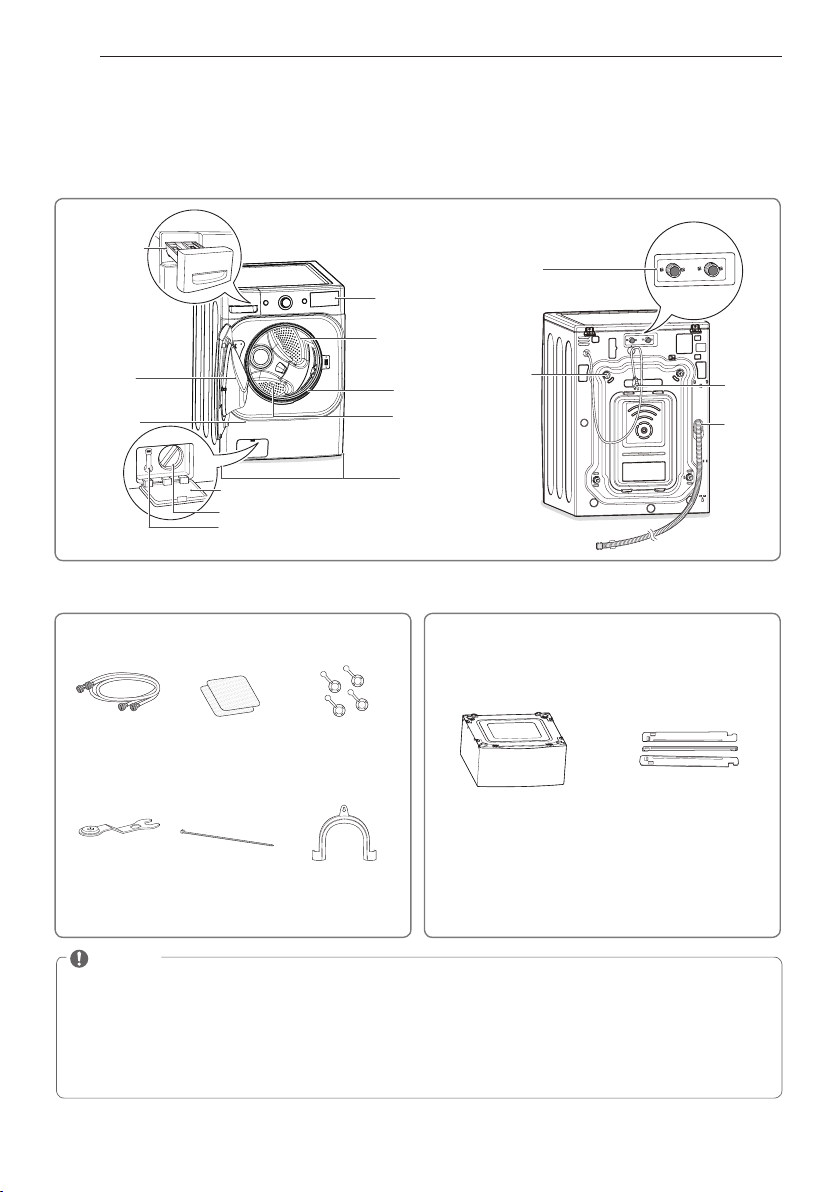
Parts and Accessories
Parts
Pedestal
(sold separately)
Stacking Kit
(sold separately)
Accessories
Hot/cold water
hoses
Non-skid pads
Caps for covering
shipping bolt
holes
Wrench Tie strap Elbow bracket
(for securing
drain hose)
Detergent
dispenser
drawer
(See page 20)
Door
Magnet Door
Plunger
(see page 7)
Control panel
(See page 9)
Door
seal
Water
circulation and
steam nozzles
Tub
Leveling
feet
Drain pump filter cover
Drain pump filter
Drain hose
Water inlets
Shipping
bolts
Power
cord
Drain
hose
Included Accessories Optional Accessories
9
ENGLISH
INTRODUCING YOUR WASHING MACHINE
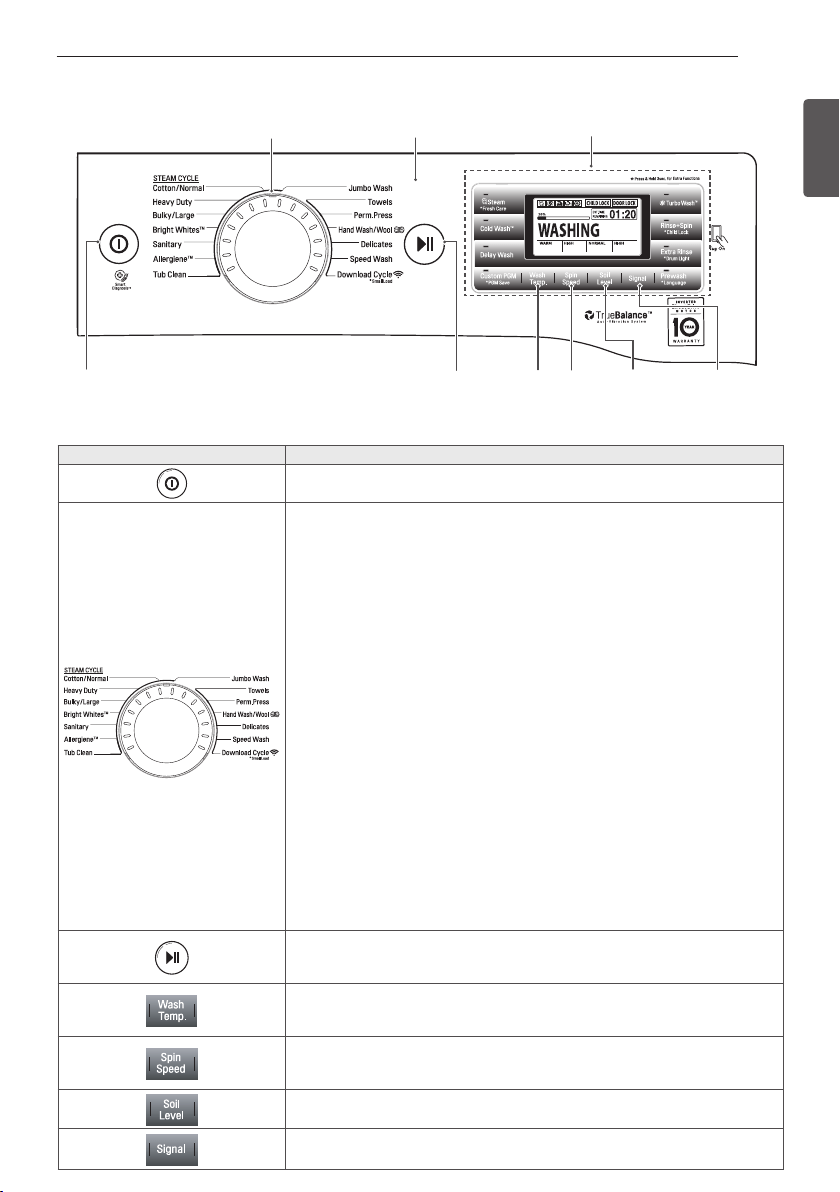
Button Description
y
The Power button turns the washing machine on and off.
y
(During the wash cycle) stops operation, and cancels the settings.
y
Allergiene™
- For cotton, underwear (see page 24)
y
Sanitary
- For underwear, diapers etc. (see page 24)
y
Bright Whites™
- For white fabrics (see page 24)
y
Bulky/Large
- For blankets or large bulky items (see page 24)
y
Heavy Duty
- For heavily soiled cotton fabric (see page 24)
y
Cotton/Normal
- For general laundry, such as cotton T-shirts or towels (see page 24)
y
Jumbo Wash
- For blankets or king size items (see page 24)
y
Towels
- For towels (see page 24)
y
Perm. Press
- For wrinkle-free fabrics (see page 24)
y
Hand Wash/Wool
- For wool or hand-wash fabrics (see page 24)
y
Delicates
- For sheer and delicate fabrics (see page 24)
y
Speed Wash
- For small quantities of lightly soiled items (see page 24)
y
Download Cycle/Small Load
- For downloadable cycles or normally soiled loads with only a few items
y
Tub Clean
- For tub clean (see page 33)
y
The Start/Pause button starts or pauses the washing machine cycle.
- If you do not press the Start/Pause button within 4 minutes of selecting a cycle, the
washing machine will turn off automatically.
y
(Press repeatedly) The Wash Temp button selects the water temperature for the
wash cycle (see page 25).
- Select water temperature from 5 settings.
y
(Press repeatedly) The Spin Speed button selects the spin speed in the desired level
(see page 25).
- Selects spin speed from 5 settings.
y
(Press repeatedly) The Soil Level button selects a wash cycle by soil level (see page 25).
- Selects soil level from 5 settings.
y
(Press repeatedly) The Signal button turns off or adjusts the volume of the melody
and button sounds (see page 26).
Control panel features
Operation
Operation
Display
Cycle selector
Soil
Level
Selection
Button
Signal
Sound
Selection
Button
Spin
Speed
Selection
Button
Water
Temperature
Selection
Button
Start/
Pause
Button
Power
Button
10
INTRODUCING YOUR WASHING MACHINE
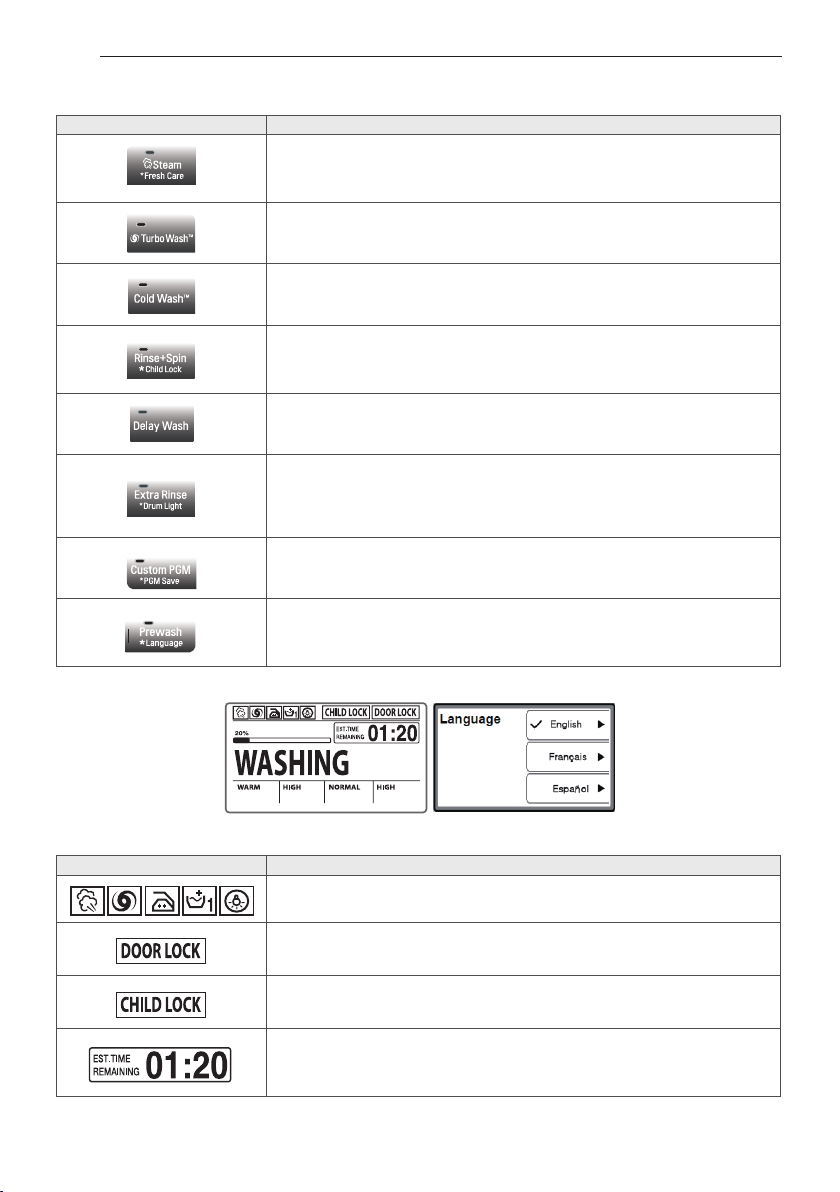
Display
Operation (continued)
Button Description
y
(Press before starting wash cycle) Use the Steam option for extra
cleaning power (See page 27).
y
(Press and hold 3 seconds) Fresh Care tumbles clothes to prevent
wrinkling (See page 26).
y
Use the Turbo Wash option to save time. (See page 27).
y
Use the Cold Wash option to save on energy consumption
(See page 27).
y
(Press before wash cycle) Use the Rinse + Spin option to rinse
detergent from a load (See page 26).
y
(Press and hold during wash cycle) Use the Child Lock option to Lock/
Unlock the controls (See page 28).
y
Use the Delay Wash button to delay the start time of the cycle
(See page 27).
y
(Press before wash cycle) Use the Extra Rinse option to add an extra
rinse to the selected cycle. (See page 26).
y
(Press and hold during wash cycle) The drum is equipped with a
white LED light that illuminates when the washer is turned on
(See page 26)
y
Use the Custom PGM button to save a special combination of settings
that you use frequently (See page 28).
y
Use the Prewash option to Prewash heavily soiled laundry
(See page 26).
y
(Press and hold 3 seconds) Allows you to change the language shown
in the display. (See page 28)
Display Icon Description
y
This portion of the display shows which options are set. (Steam,
Turbo Wash, Fresh Care, Extra Rinse or Drum Light)
y
Indicates that the door is locked. The washer door will lock while the
washer is operating. The door can be unlocked by pressing the Start/
Pause button to stop the washer.
y
When Child Lock is set, the Child Lock indicator will appear and all
buttons will be disabled except the Rinse+Spin button. This prevents
children from changing settings while the washer is operating.
y
When the Start/Pause button is pressed, the washer automatically
detects the wash load (weight) and optimizes the washing time,
based on the selected cycle and options. The display will then
indicate the estimated time remaining for the selected wash cycle.
11
ENGLISH
INSTALLATION INSTRUCTIONS
INSTALLATION INSTRUCTIONS
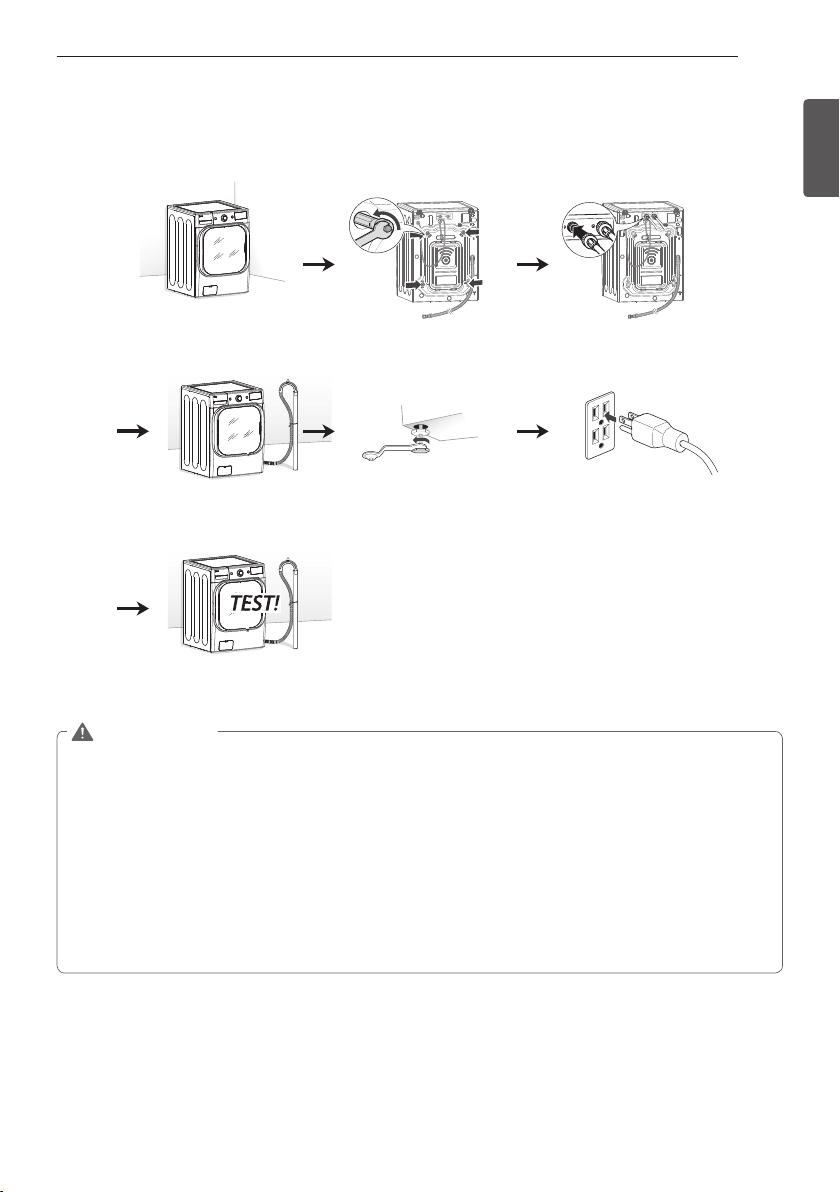
Preview installation order
WARNING
y
The washer is heavy! Two or more people are required when moving and unpacking the washer.
Failure to do so can result in back or other injury.
y
Store and install the washer where it will not be exposed to temperatures below freezing or exposed
to outdoor weather conditions.
Failure to follow this warning can cause serious injury, fire, electric
shock, or death.
y
Properly ground the washer to conform with all governing codes and ordinances.
Failure to follow
this warning can cause serious injury, fire, electric shock, or death.
y
To reduce the risk of electric shock, do not install the washer in humid spaces.
Failure to follow this
warning can cause serious injury, fire, electric shock, or death.
y
The base opening must not be obstructed by carpeting when the washer is installed on a carpeted
floor.
y
Do not remove the ground prong. Do not use an adapter or extension cord. Plug into a grounded
3-prong outlet.
Failure to follow this warning can cause serious injury, fire, electric shock, or death.
Check and choose the
proper location
Unpack and remove
shipping bolts
Connect the water line
Connect the drain line
Level the washing
machine
Plug in the power cord
and ground
Test run
12
INSTALLATION INSTRUCTIONS
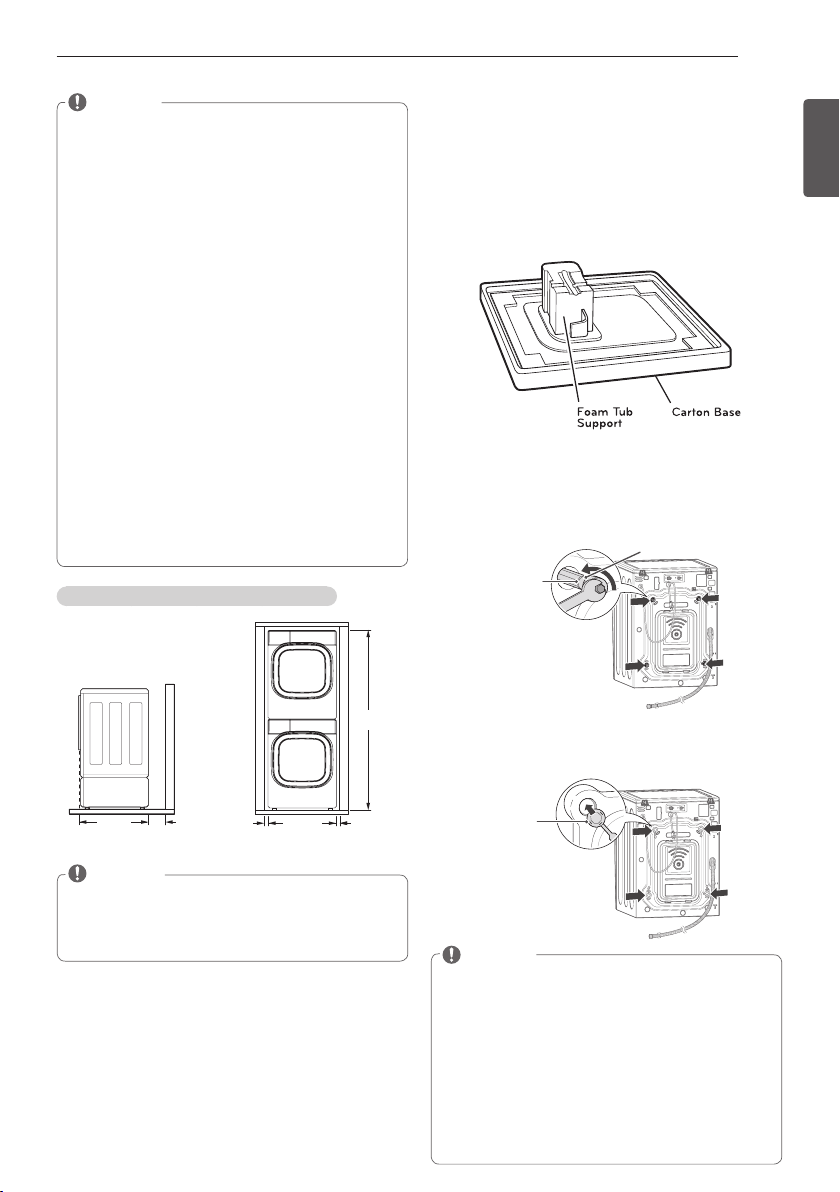
Checking and choosing the proper location
Install the washing machine on a solid floor that
is strong and rigid enough to support the weight
of the washing machine, even when fully loaded,
without flexing or bouncing. If the floor has too
much flex, you may need to reinforce it to make
it more rigid. If the floor is not solid, it may cause
severe vibration and noise.
1 Clean the floor before installation.
- Make sure to select solid and smooth ground.
2 Two or more people are needed for moving
and unpacking the washing machine.
3 Allow for sufficient space between the walls
and the washing machine for installation.
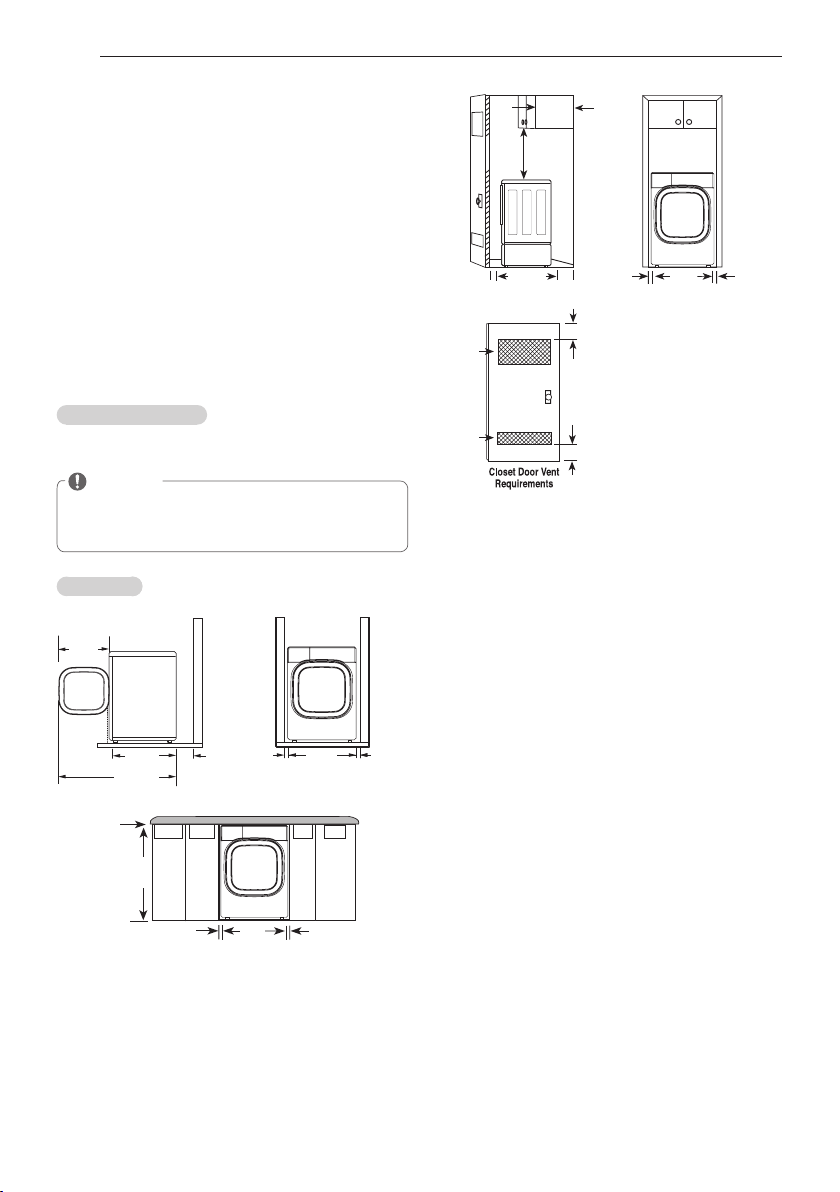
Space requirements
You must allow sufficient space for water lines,
the drain line, and airflow.
NOTE
y
Be sure to allow for wall, door, or floor
moldings that may increase the required
clearances.
Clearances
4"
(10 cm)
33.1"
(84 cm)
57.9"
(147 cm)
24.8"
(63cm)
29"
73.6 cm
1"
(2.5 cm)
1"
(2.5 cm)
24 in.
2*
(155 cm
2
)
18" min.*
(45.7 cm)
1"*
(2.5 cm)
33.1"
(84cm)
5"**
(12.7 cm)
48 in.
2*
(310 cm
2
)
14" max.*
(35.6 cm)
3"
*
(7.6 cm)
3"
*
(7.6 cm)
1"
(2.5 cm)
29"
(73.6 cm)
1"
(2.5 cm)
1"*
(2.5 cm)
5"**
(12.7 cm)
14" max.*
(35.6 cm)
18" min.*
(45.7 cm)
33.1"
(84 cm)
0"
(0 cm)
40.8"
(103.6 cm)
1"
(2.5 cm)
29"
(73.6 cm)
1"
(2.5 cm)
24 in.
2*
(155 cm
2
)
18" min.*
(45.7 cm)
1"*
(2.5 cm)
33.1"
(84cm)
5"**
(12.7 cm)
48 in.
2*
(310 cm
2
)
14" max.*
(35.6 cm)
3"
*
(7.6 cm)
3"
*
(7.6 cm)
1"
(2.5 cm)
29"
(73.6 cm)
1"
(2.5 cm)
1"*
(2.5 cm)
5"**
(12.7 cm)
14" max.*
(35.6 cm)
18" min.*
(45.7 cm)
33.1"
(84 cm)
0"
(0 cm)
40.8"
(103.6 cm)
1"
(2.5 cm)
29"
(73.6 cm)
1"
(2.5 cm)
24 in.
2*
(155 cm
2
)
18" min.*
(45.7 cm)
1"*
(2.5 cm)
33.1"
(84cm)
5"**
(12.7 cm)
48 in.
2*
(310 cm
2
)
14" max.*
(35.6 cm)
3"
*
(7.6 cm)
3"
*
(7.6 cm)
1"
(2.5 cm)
29"
(73.6 cm)
1"
(2.5 cm)
1"*
(2.5 cm)
5"**
(12.7 cm)
14" max.*
(35.6 cm)
18" min.*
(45.7 cm)
33.1"
(84 cm)
0"
(0 cm)
40.8"
(103.6 cm)
1"
(2.5 cm)
29"
(73.6 cm)
1"
(2.5 cm)
13
ENGLISH
INSTALLATION INSTRUCTIONS
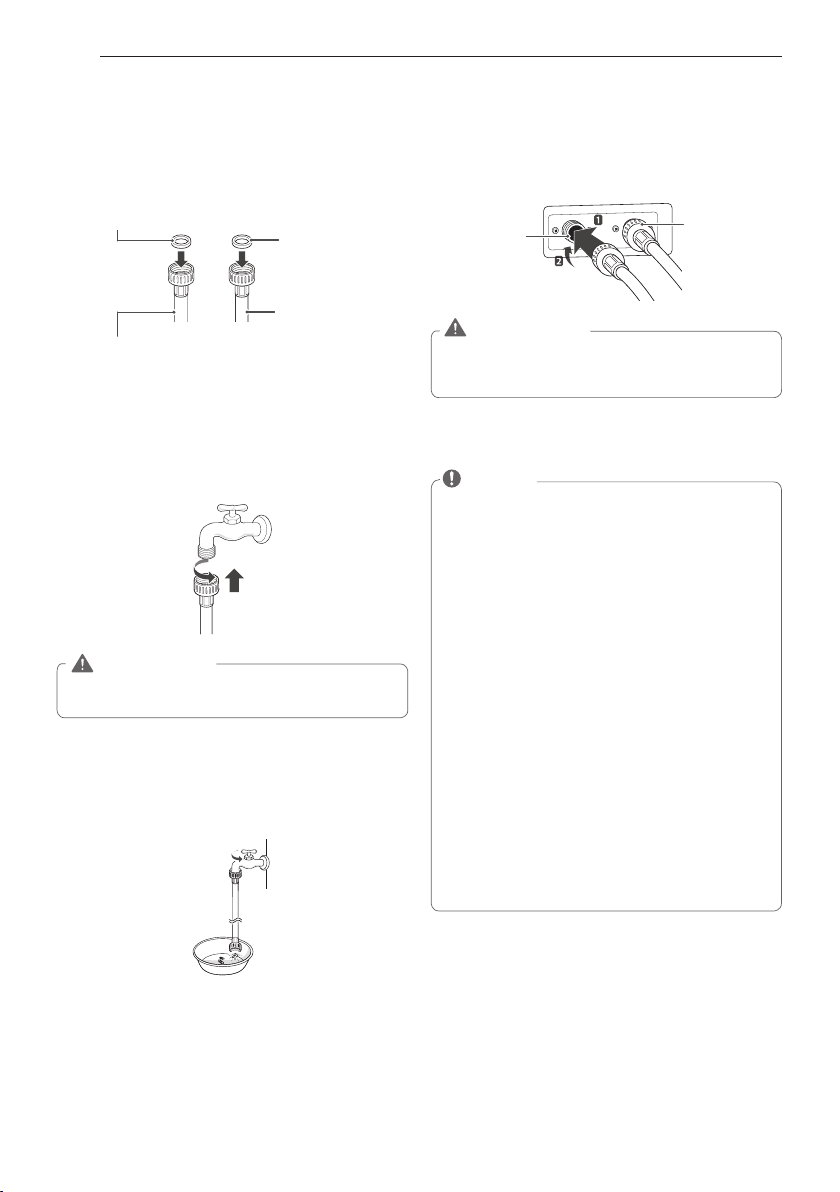
Unpacking and removing shipping bolts
When removing the washer from the carton base,
be sure to remove the foam drum support in the
middle of the carton base.
If you must lay the washer down to remove the
base packaging materials, always lay it carefully on
its side.
DO NOT lay the washer on its front or back.
1
Starting with the bottom two shipping bolts,
use the wrench (included) to fully loosen all four
shipping bolts by turning them counterclockwise.
Remove the bolt assemblies by wiggling them
slightly while pulling them out.
Shipping
bolt
Retainer
2 Locate the four hole caps included in the
accessory pack and install them in the
shipping bolt holes.
Cap
NOTE
y
Save the bolt assemblies for future use. To
prevent damage to internal components,
DO NOT transport the washer without
reinstalling the shipping bolts.
y
Failure to remove shipping bolts and
retainers may cause severe vibration and
noise, which can lead to permanent damage
to the washer. The cord is secured to the
back of the washer with a shipping bolt to
help prevent operation with shipping bolts in
place.
NOTE
y
The floor must be strong and rigid enough to
support the weight of the washer, when fully
loaded, without flexing or bouncing. If your
floor has too much flex, you may need to
reinforce it to make it more rigid.
A floor that is adequate for a top-loading
washer may not be rigid enough for a front
loading washer, due to the difference in the
spin speed and direction. If the floor is not
solid, your washer may vibrate and you may
hear and feel the vibration throughout your
house.
y
Before installing the washer, make sure
the floor is clean, dry and free of dust, dirt,
water and oils so the washer feet can not
slide easily. Leveling feet that can move or
slide on the floor can contribute to excess
vibration and noise due to poor contact with
the floor.
y
If a drip pan must be used, take extra care
to follow the instructions provided with the
drip pan and make sure the leveling feet are
adjusted for firm and even contact with the
pan. Use of drip pans and failure to properly
level the machine may result in increased
vibration and noise during operation.
Installing on a pedestal or stacking kit
33.1"
(84 cm)
4"
(10 cm)
29"
(73.6cm)
1"
(2.5 cm)
1"
(2.5 cm)
81.61"
(207.3 cm)
NOTE
y
Refer to the instructions packaged with the
optional PEDESTAL or STACKING KIT before
installing with a PEDESTAL or a STACKING
KIT.
14
INSTALLATION INSTRUCTIONS
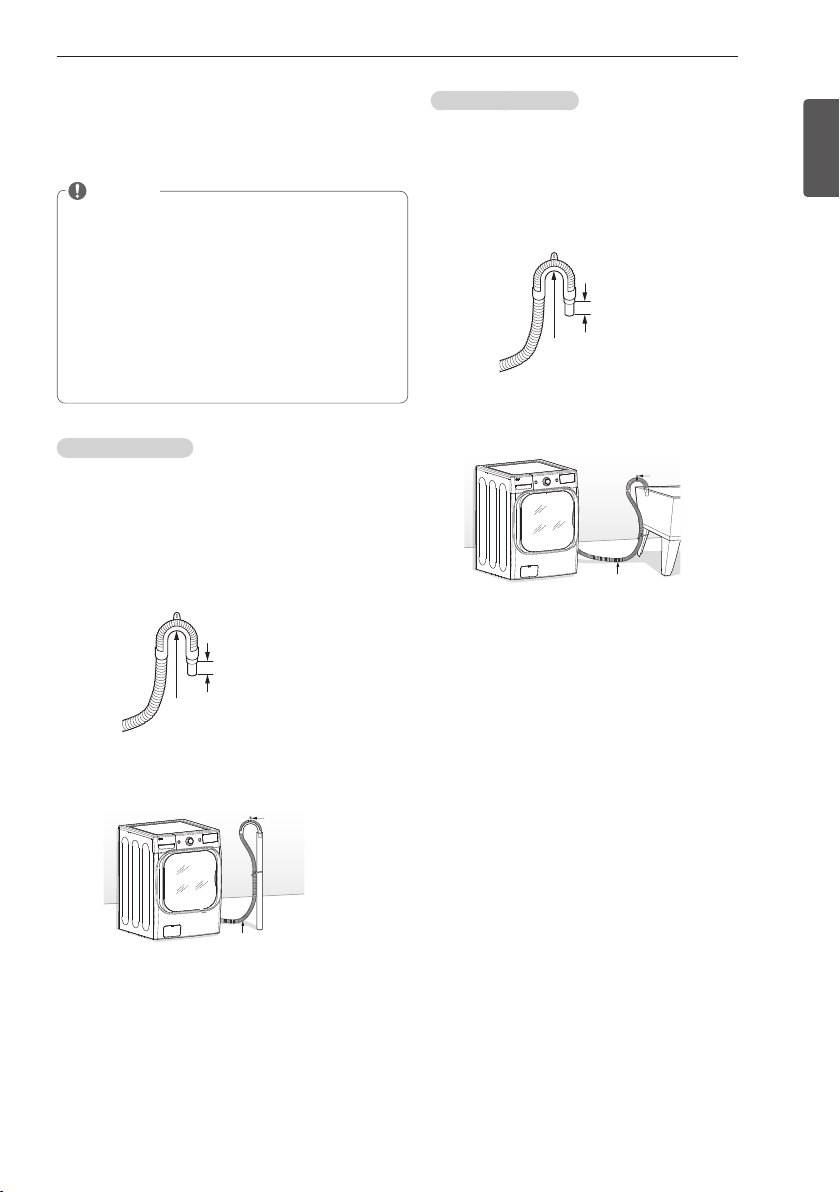
Connecting the water lines
1 Check the rubber seals on both sides of the
hose.
- Insert a rubber seal into the threaded fittings
on each hose to prevent leaking.
Rubber seal
Water hose
(To water inlet on the
washing machine)
Rubber seal
Water hose
(To faucet)
2 Connect the water supply hoses to the HOT
and COLD water faucets tightly by hand and
then tighten another 2/3 turn with pliers.
- Connect the blue hose to a cold water faucet
and the red hose to a hot water faucet.
WARNING
y
Do not overtighten.
Damage to the coupling
can result.
3 After connecting the inlet hose to the water
faucets, turn on the water faucets to flush out
foreign substances (dirt, sand or sawdust) in
the water lines. Let water drain into a bucket,
and check the water temperature.
4 Connect the hoses to the water inlets tightly
by hand and then tighten another 2/3 turn with
pliers.
- Connect the blue hose to the cold water inlet
and the red hose to the hot water inlet.
Cold
water
inlet
Hot
water
inlet
WARNING
y
Do not overtighten the hoses.
Overtightening
can damage the valves resulting in leaking
and property damage.
5 Check for leaks by turning on the faucets.
- If water leaks, check steps 1 to 4 again.
NOTE
y
For your safety, and for extended product
life, use only authorized components. The
manufacturer is not responsible for product
malfunction or accidents caused by the use
of separately purchased, unauthorized parts.
y
Use new hoses when you install the washing
machine. Do not reuse old hoses. Use only
the inlet hoses provided with the washer. LG
does not recommend the use of aftermarket
hoses.
y
Periodically check the hoses for cracks, leaks
and wear, and replace the hoses every 5
years.
y
Do not stretch the water hoses intentionally,
and make sure that they are not crushed by
other objects.
y
Water supply pressure must be between 20
psi and 120 psi (138–827 kPa). If the water
supply pressure is more than 120 psi, a
pressure reducing valve must be installed.
y
To provide optimum washing performance
the hot water temperature should be set
at 120-135°F (48-57°C) and the cold at 60°F
(15°C).
15
ENGLISH
INSTALLATION INSTRUCTIONS
Connecting the drain line
Secure the drain hose in place to prevent moving
and leaking.
NOTE
y
The drain hose should be properly secured.
Failure to properly secure the drain hose can
result in flooding and malfunction.
y
Total height of the hose end should not
exceed 96 inches (244.8 cm) from the bottom
of the washer.
y
The drain must be installed in accordance
with any applicable local codes and
regulations.
y
Make sure that the water lines are not
stretched, pinched, crushed, or kinked.
Using a standpipe
1 Clip the end of the hose into the elbow
bracket.
- Connect the elbow bracket within 4 inches
(10 cm) from the end of the drain hose. If the
drain hose is extended more than 4 inches
(10 cm) beyond the end of the elbow bracket,
mold or microorganisms could spread to the
inside of the washer.
No more than
4 inches (10 cm)
Elbow bracket
2 Insert the end of the drain hose into the
standpipe.
Drain Hose
Elbow Bracket
3 Use a tie strap to secure the drain hose in
place.
Using a laundry tub
1 Clip the end of the hose into the elbow bracket.
- Connect the elbow bracket within 4 inches
(10 cm) from the end of the drain hose. If the
drain hose is extended more than 4 inches
(10 cm) beyond the end of the elbow bracket,
mold, or microorganisms could spread to the
inside of the washer.
No more than
4 inches (10 cm)
Elbow bracket
2 Hang the end of the drain hose over the side
of the laundry tub.
Elbow Bracket
Drain Hose
3 Use a tie strap to secure the drain hose in
place.
16
INSTALLATION INSTRUCTIONS
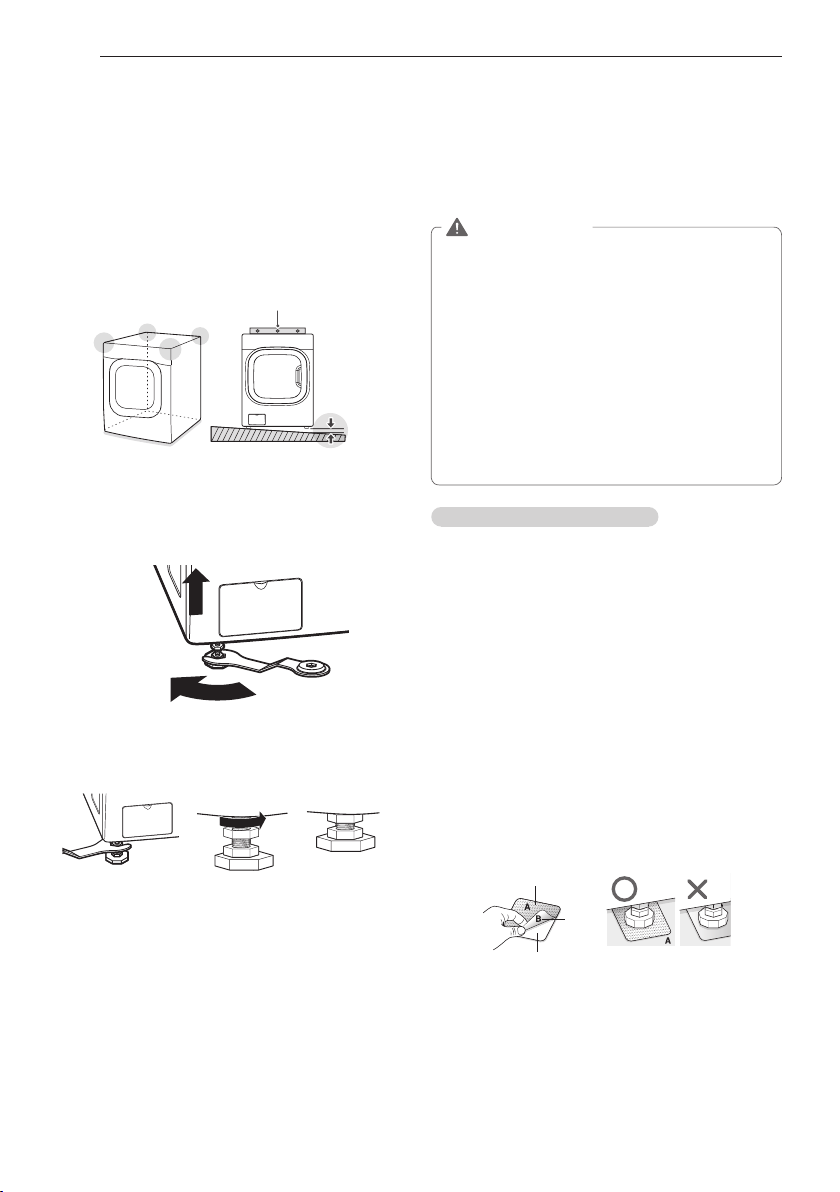
Leveling the washing machine
The washer tub of your new washing machine spins
at very high speeds. To minimize vibration, noise,
and unwanted movement, the floor must be perfectly
level and solid.
1
Check that the washing machine is level.
- Check for levelness by rocking the top edges
of the washing machine or placing a level on
the washing machine. The slope beneath the
washing machine must not exceed 1°, and all
four leveling feet must rest firmly on the floor.
Level
1°
2
Turn the lower leveling feet clockwise to level the
washing machine.
- Turning the lower leveling feet clockwise raises
the washing machine.
Raise
3
Turn the locknuts counterclockwise and tighten
them when the washing machine is level.
Tighten all 4 lock
nuts securely using
the wrench.
4 Check again that the washing machine is level.
- Push or rock the top edges of the washing
machine gently to make sure that the
washing machine does not rock.
- If the washing machine rocks, repeat steps 1
to 3.
WARNING
y
Using the washing machine without leveling
may cause it to malfunction, producing
excess vibration and noise.
y
If you are installing the washing machine
on the optional pedestal, you must adjust
the leveling feet on the pedestal to level the
washing machine. The washing machine´s
leveling feet should be minimized and the
locknuts turned counterclockwise to secure
them.
y
Use the leveling feet only when you level the
washing machine.
If you raise the leveling
feet unnecessarily, it may cause abnormal
vibration of the washing machine.
Using non-skid pads (optional)
If you install the washing machine on a slippery
surface, it may move because of excessive
vibration. Incorrect leveling may cause
malfunction through noise and vibration. If this
occurs, lay the non-skid pads under the leveling
feet and adjust the level.
1 Clean the floor to attach the non-skid pads.
- Use a dry rag to remove foreign objects or
moisture. If moisture remains, the non-skid
pads may slip.
2 Adjust the level after placing the washing
machine in the installation area.
3 Place the adhesive side of the non-skid pad on
the floor.
- It is most effective to install the non-skid pads
under the front legs. If it is hard to place the
pads under the front legs, place them under
the back legs.
Remove
backing
This side up
Adhesive
side
4 Check again that the washing machine is level.
- Push or rock the top edges of the washing
machine gently to make sure that the
washing machine does not rock. If the
washing machine rocks, level the washing
machine again.
17
ENGLISH
INSTALLATION INSTRUCTIONS
Plugging in the power cord and
grounding
Make sure to ground the washing machine to
prevent a short circuit or an electric shock when
plugging in.
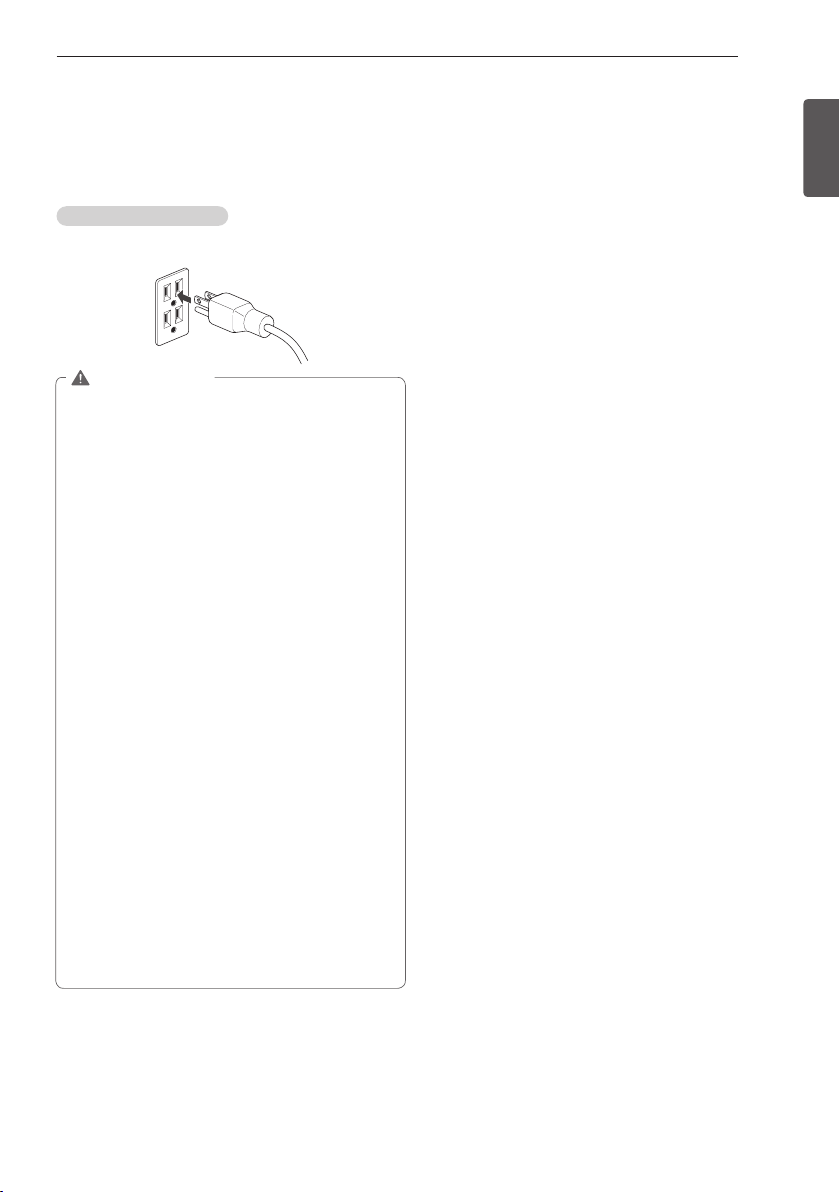
Using a 3-prong outlet
Plug in the electrical outlet without additional
grounding.
WARNING
y
The power outlet must be within 60 inches (1.5 m)
of either side of the washer.
y
The appliance and outlet must be positioned so that
the plug is easily accessible.
y
Do not overload the outlet with more than one
appliance.
y
The outlet must be grounded in accordance with
current wiring codes and regulations.
y
Time-delay fuse or circuit breaker is
recommended.
y
It is the personal responsibility and obligation
of the product owner to have a proper outlet
installed by a qualified electrician.
y
Do not use a worn or damaged power cord or
power plug. Replace or repair it immediately.
Failure to do so may result in malfunction, fire,
electric shock, or death.
y
Do not modify the power cord and take care
not to damage it when installing or moving the
washing machine.
Failure to do so may result in
malfunction, fire, electric shock, or death.
y
Make sure that the washing machine is grounded.
y
Connect this washing machine to a grounded outlet
conforming to the rating prior to use.
Failure
to do so may result in fire, electric shock, or
malfunction.
y
Do not use adaptors or extension cords.
The
washing machine should always be plugged
into its own individual electrical outlet which has
a voltage rating that matches the rating plate.
Failure to do so may result in fire, electric shock
or disorder.
y
Do not damage or cut off the ground prong of
the power cord.
Doing so may cause product
malfunction, electric shock, fire or death.
Test run
Check if the washing machine is properly
installed and run a test cycle.
1 Load the washing machine with 6 pounds of
laundry.
2 Press the Power button.
3 Press the Rinse + Spin button.
4 Press the Start/Pause button.
- The wash cycle starts.
5 Check if water is supplied, that the washing
machine does not rock or vibrate excessively,
and that it drains well during the spin cycle.
- If water leaks during water supply, see page
14,
Connecting the water lines
to connect them
properly.
- If the washing machine rocks and vibrates
excessively, see page 16,
Leveling the washing
machine
to level it again.
- If the drain does not work, see page 15,
Connecting the drain line
to install it properly.

18
PREPARATION
u Check all pockets to make sure that they are
empty.
- Items such as clips, matches, pens, coins, and
keys can damage both your washer and your
clothes.
u Close zippers, hooks, and drawstrings to
prevent these items from snagging or tangling
on other clothes.
u Pretreat heavily stained areas before washing.
- Doing so will produce clean, stain-free results.
u Combine large and small items in a load. Load
large items first.
u Large items should not be more than half of
the total washload.
u The washer can be fully loaded, but the drum
should not be tightly packed with items.
-The door of the washer should close easily.
u Do not wash single items, except for bulky
items such as blankets. Make sure to wash
laundry in similar types of loads.
- Washing a single small item may result in the
tub becoming unbalanced, vibrating and
making a noise.
u Do not wash waterproof clothes.
- This may cause abnormal vibration, or may
cause the load to bounce, which could
damage the tub.
u Check if there are any foreign objects in the
door seal and take extra care that clothes do
not get caught there.
- Foreign objects in the door seal may stain
clothes, and water may leak if clothes get
caught in the door seal.
u Wash underwear or small, light items in a
laundry net.
- Small, light items may get caught in the door
seal, and a brassiere hook may damage other
items or the tub.
u Brush heavy soil, dust, or hair off fabrics before
washing.
- Laundry may not wash clean if there is dirt or
sand on the fabrics, or clothes may be
damaged due to particles rubbing against
sheer fabrics.
u Wash blankets individually.
- Washing more than one blanket at a time may
lead to poor wash performance due to
tangling or an unbalanced load.
u Always separate fabrics according to their
colors and wash them separately to prevent
colors from running.
- Fabrics may be damaged or become stained
due to fabric dyes running, or due to foreign
objects transferring from one fabric to
another.
PREPARATION
Sorting wash loads
Precautions for fabric care before wash cycle
Read and observe the following to prevent shrinkage or damage to clothes.
19
ENGLISH
PREPARATION
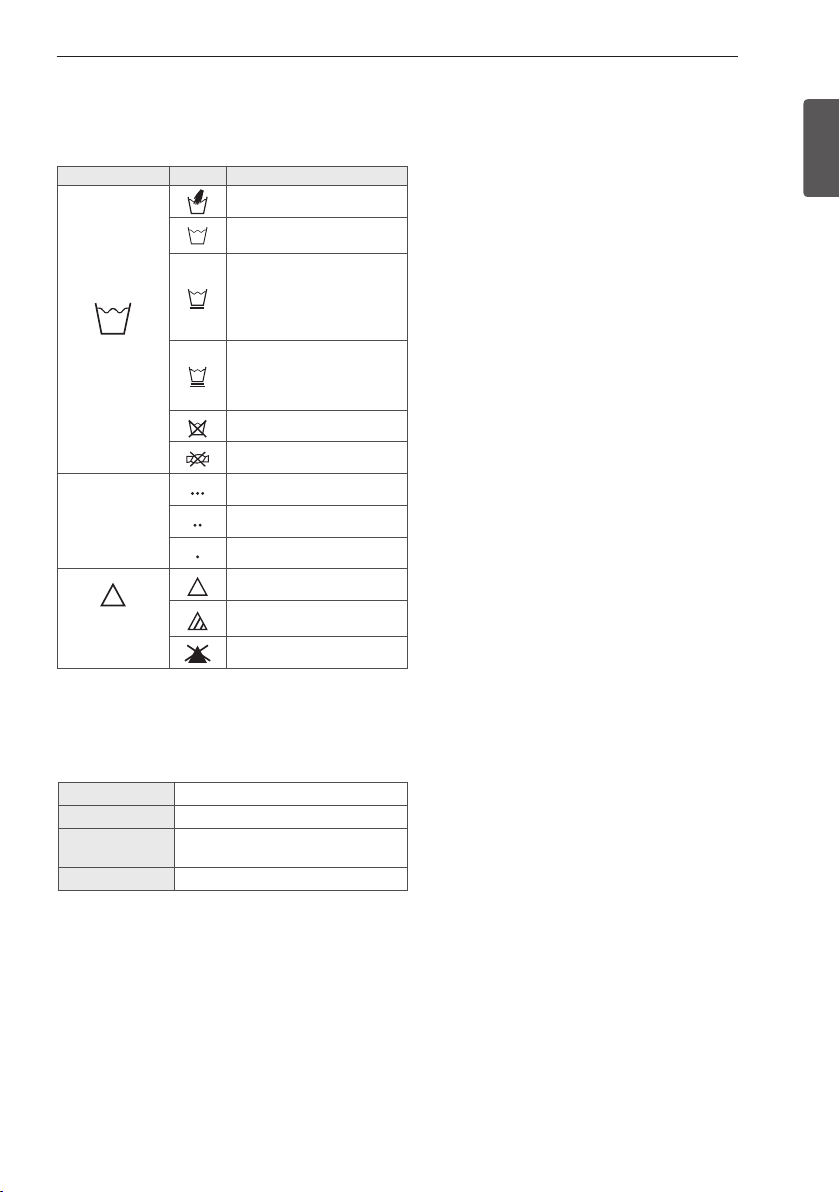
Category Label Directions
Washing
Hand Wash
Machine Wash, Normal
Cycle
Use Permanent Press/
Wrinkle Resistant washing
machine setting (which has
a cool down or cold spray
before the reduced spin)
Use Gentle/Delicate
washing machine setting
(slow agitation and/ or
reduced wash time).
Do Not Wash
Do Not Wring
Water
Temperature
Hot
Warm
Cold/Cool
Bleach
symbols
Any Bleach (When Needed)
Only Non-Chlorine Bleach
(When Needed)
Do Not Bleach
Colors
Whites / Lights / Darks
Soil
Heavy / Normal / Light
Fabric
Delicates / Easy Care / Sturdy
Cottons
Lint
Lint Producers / Lint Collectors
Fabric care labels
Most articles of clothing feature fabric care labels
that include instructions for proper care.
Sorting laundry
It is recommended that you sort laundry into
similar loads that are washable in the same cycle.
Refer to the following chart for sorting clothes
20
PREPARATION
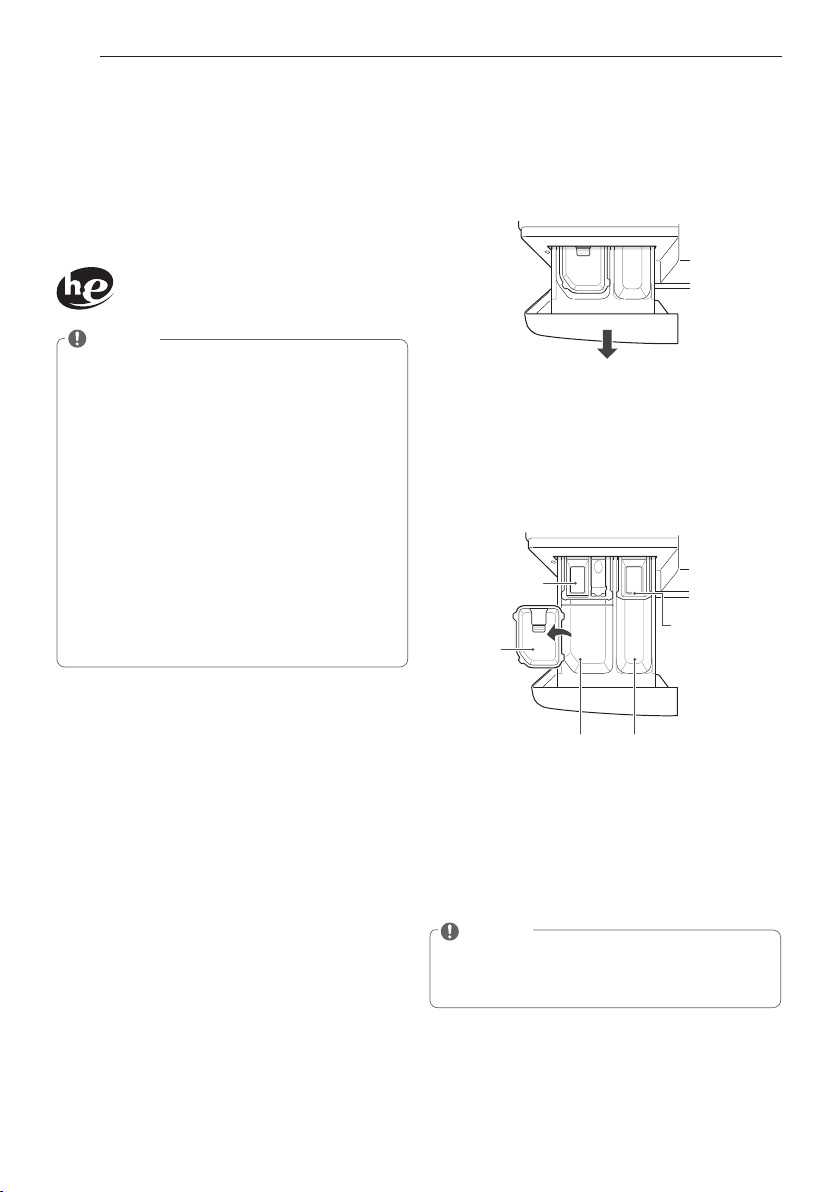
Loading the dispenser
The detergent dispenser drawer of the washing
machine has a dispenser compartment for each
detergent type. Add each detergent to its
appropriate compartment.
1 Pull out the detergent dispenser drawer.
2 Add each detergent to its appropriate
compartment.
- If you use a liquid detergent, check if the
liquid detergent cup is in place.
- If you use a powdered detergent, remove the
liquid detergent cup and put the powder in
the main wash detergent compartment.
Liquid chlorine
bleach
compartment
Liquid
detergent
cup
Main wash
detergent
compartment
Pre-wash
detergent
compartment
Liquid fabric
softener
compartment
3 Close the detergent dispenser drawer slowly.
- Slamming the detergent dispenser drawer
may result in the detergent overflowing into
another compartment or pouring into the tub
earlier than programmed.
NOTE
y
It is normal for a small amount of water to
remain in the dispenser compartments at the
end of the cycle.
Using detergent/fabric softener
Recommended detergent
Make sure to use HE (High-Efficiency) detergent
for front-loading washing machines. HE
detergents dissolve more efficiently and produce
fewer suds to ensure efficient washing and
rinsing. Use the correct amount of detergent as
indicated on the label of the detergent packaging.
Designed specially to use only
HE (High-Efficiency) detergent
NOTE
y
Only use HE detergents, since using a
regular detergent may produce excessive
suds.
y
HE detergents produce fewer suds, dissolve
more efficiently to improve washing and
rinsing performance, and help to keep the
interior of your washer clean.
y
Use less detergent for soft water.
y
Wipe up any spills immediately, as liquids
could damage the finish and the control
panel of the washing machine.
y
Using too much detergent can cause a build-
up in the tub resulting in unsatisfactory
performance and machine malfunction.
y
If you use a detergent that does not dissolve
easily or a detergent with high viscosity, it
will leave a residue on the tub, which may
not rinse properly.
21
ENGLISH
PREPARATION
Liquid Bleach Compartment
This compartment holds liquid chlorine bleach,
which will be dispensed automatically at the
proper time during the wash cycle.
NOTE
y
Do not add powdered or liquid color-safe
bleach to this compartment.
y
Always follow the manufacturer’s
recommendations when adding bleach. Do
not exceed the maximum fill line. Using too
much bleach can damage fabrics.
y
Never pour undiluted liquid chlorine bleach
directly onto the load or into the drum.
Fabric damage can occur.
Fabric Softener Compartment
This compartment holds liquid fabric softener,
which will be automatically dispensed during the
final rinse cycle.
NOTE
y
Always follow the manufacturer’s
recommendations when adding fabric
softener. Do not exceed the maximum fill
line. Using too much fabric softener may
result in stained clothes.
y
Dilute concentrated fabric softeners with
warm water. Do not exceed the maximum fill
line.
y
Never pour fabric softener directly onto the
load or into the drum.
Prewash Detergent Compartment
Add liquid or powdered detergent to this
compartment when using the Prewash option.
Always use HE (High-Efficiency) detergent with
your washing machine.
NOTE
y
If using liquid detergent for the main wash,
you must use the liquid detergent cup
accessory in the main wash dispenser when
using the Prewash option, to prevent the
main wash liquid detergent from being
dispensed immediately.
y Add 1/2 the amount of detergent for the
Prewash option as is recommended for the
main wash. For example, if the main wash
cycle requires one measure of detergent,
add 1/2 measure for the Prewash option.
Main Wash Detergent Compartment
This compartment holds laundry detergent for
the main wash cycle, which is added to the load
at the beginning of the cycle. Always use HE
(High-Efficiency) detergent with your washing
machine.
Never exceed the manufacturer’s
recommendations when adding detergent. Using
too much detergent can result in detergent
buildup in clothing and the washer. Either
powdered or liquid detergent may be used.
NOTE
y
Liquid or powdered color-safe bleach may
be added to the main wash compartment
with detergent of the same type.
y
When using liquid detergent, make sure the
liquid detergent cup and insert are in place.
Do not exceed the maximum fill line.
y
When using powdered detergent, remove
the insert and liquid detergent cup from the
compartment. Powdered detergent will not
dispense with the liquid detergent cup and
insert in place.
22
USING YOUR WASHING MACHINE
USING YOUR WASHING MACHINE
Basic operation
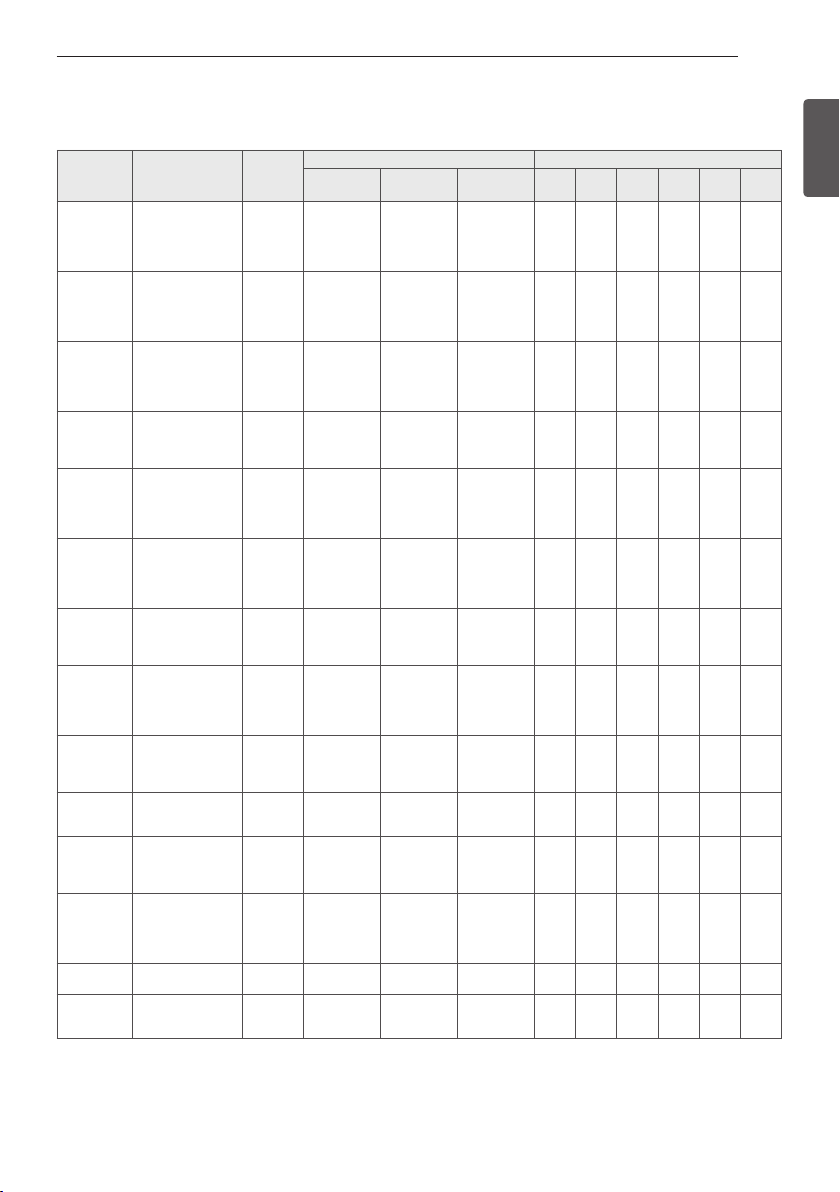
Load the laundry into the washing machine and close the door.
1
2
3
4
5
6
Press the Power button.
- The lights around the cycle selector knob will illuminate and a chime will
sound.
Turn the cycle selector knob to the desired cycle.
- The optimum default cycle settings are automatically set according to the
wash cycle. See page 23,
Cycle guide
, for more detail on the default settings
for each cycle.
- See page 24,
Main cycle
, for details on the wash cycles.
- To change the settings, press the cycle modifier buttons and select the
desired settings. See page 25,
Modifying settings before the cycle
, for more
details on modifying cycle settings.
- Skip to step 4 to use the default settings without modifying them.
Add the proper amount of detergent and additions (bleach, softener) into the
detergent dispenser drawer.
- See page 20,
Using detergent/fabric softener
, for more details on using
detergent.
Press the Start/Pause button.
- The washing machine will start.
When the melody plays, the wash cycle is finished.
- When the washing cycle is finished, the door will unlock. Open the door
and remove the laundry immediately.
- Make sure to check around the door seal when taking out the finished load.
Small items may be caught in the door seal.
NOTE
y
The front-load washing machine rotates the laundry in a way that allows it to use less water while
still fully saturating your clothing. It is normal to not be able to see water during the wash cycle.
y
If the temperature or the water level inside the machine is too high, the door locks and cannot be
opened. To open the door while washing, use the Rinse + Spin feature.
WARNING
y
To reduce the risk of fire, electric shock, or injury to persons,
read the IMPORTANT SAFETY
INSTRUCTIONS before operating this appliance.
23
ENGLISH
USING YOUR WASHING MACHINE
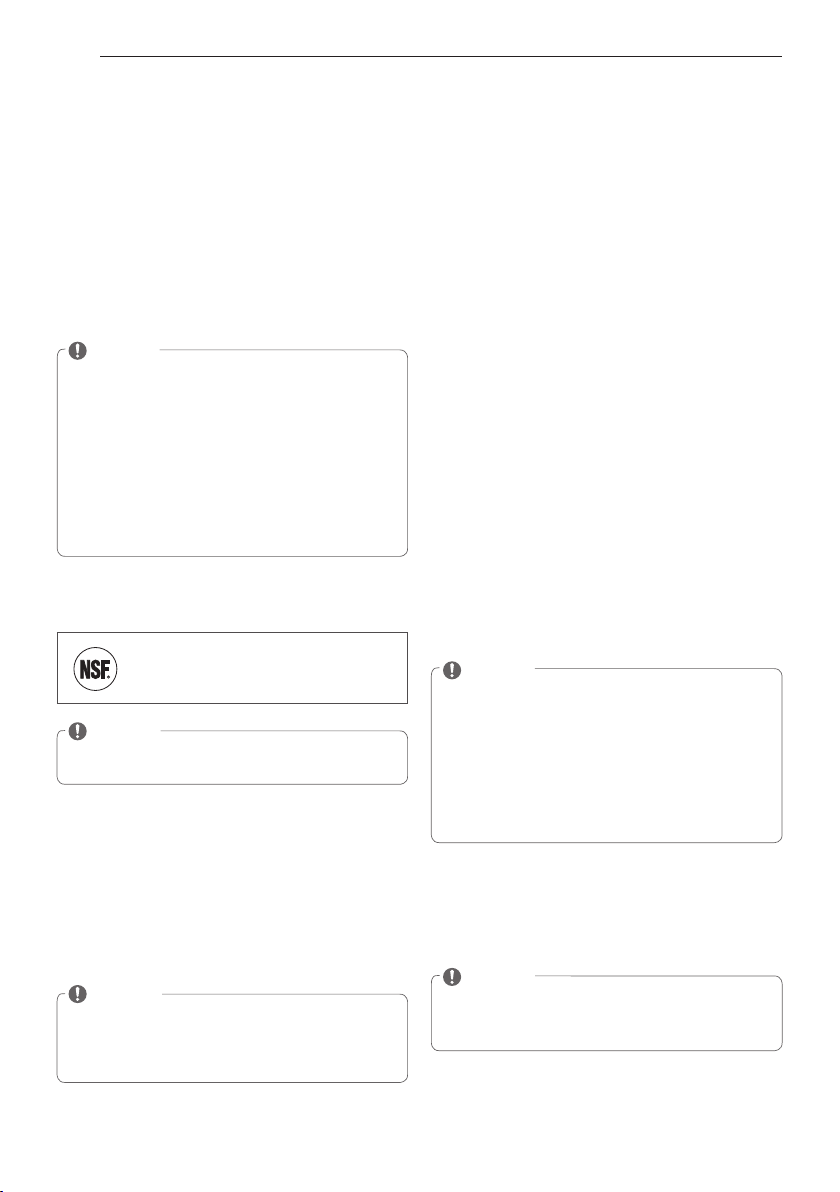
Cycle guide
The cycle guide below shows the options and recommended fabric types for each cycle.
●
= Available option
CYCLE FABRIC TYPE
DISPLAY
TIME(MIN)
CYCLE SETTINGS (
=DEFAULT) ADDITIONAL OPTIONS
Wash
Temp.
Spin
Speed
Soil
Level
Steam
Cold
Wash™
Delay
Wash
Extra
Rinse
Pre
Wash
Turbo
Wash™
Allergiene™ Cotton, underwear,
pillow covers, bed
sheets, baby wear
88 ~ 132
-
EXTRA HIGH
HIGH
★
MEDIUM
LOW
NO SPIN
-
Sanitary Heavily soiled
underwear, work
clothes, diapers,
etc.
81 ~ 112
EXTRA HOT
★
EXTRA HIGH
HIGH
★
MEDIUM
LOW
NO SPIN
HEAVY
NORMAL
★
LIGHT
Bright
Whites™
White Fabrics 52 ~ 79 HOT
★
WARM
COLD
TAP COLD
EXTRA HIGH
HIGH
★
MEDIUM
LOW
NO SPIN
HEAVY
NORMAL
★
LIGHT
Bulky/Large Large items such
as blankets and
comforters
45 ~ 68 HOT
WARM
★
COLD
TAP COLD
MEDIUM
★
LOW
NO SPIN
HEAVY
NORMAL
★
LIGHT
Heavy Duty Heavily soiled
Cotton Fabrics
60 - 117 HOT
WARM
★
COLD
TAP COLD
EXTRA HIGH
★
HIGH
MEDIUM
LOW
NO SPIN
HEAVY
★
NORMAL
LIGHT
Cotton/
Normal
Cotton, linen,
towels, shirts,
sheets, jeans, mixed
loads
27 - 99 EXTRA HOT
HOT
WARM
★
COLD
TAP COLD
EXTRA HIGH
HIGH
★
MEDIUM
LOW
HEAVY
NORMAL
★
LIGHT
Jumbo Wash Comforter 45 ~ 68 HOT
WARM
★
COLD
TAP COLD
HIGH
★
MEDIUM
LOW
NO SPIN
HEAVY
NORMAL
★
LIGHT
Towels Towels 39 - 75 HOT
WARM
★
COLD
TAP COLD
EXTRA HIGH
★
HIGH
MEDIUM
LOW
NO SPIN
HEAVY
NORMAL
★
LIGHT
Perm.
Press
Dress shirts/pants,
wrinklefree clothing,
poly/cotton blend
clothing, tablecloths
29 ~ 56 HOT
WARM
★
COLD
TAP COLD
HIGH
MEDIUM
★
LOW
HEAVY
NORMAL
★
LIGHT
Hand Wash/
Wool
Items labeled
“hand-washable”
44 ~ 55 WARM
★
COLD
TAP COLD
LOW
★
NO SPIN
NORMAL
★
LIGHT
Delicates Dress shirts/
blouses, nylons,
sheer or lacy
garments
30 ~ 53 WARM
COLD
★
TAP COLD
MEDIUM
★
LOW
NO SPIN
HEAVY
NORMAL
★
LIGHT
Speed Wash Lightly soiled
clothing and small
loads
7 ~ 25 HOT
★
WARM
COLD
TAP COLD
EXTRA HIGH
★
HIGH
MEDIUM
LOW
NO SPIN
HEAVY
NORMAL
LIGHT
★
Small Load Normally soiled and
small loads.
45 WARM
★
HIGH
★
NORMAL
★
Tub Clean
This cycle is designed
to remove a mildewy
or musty smell.
89
Cycle time depends on type and amount of load and detergent,water pressure and chosen additional options.
- If the Turbo Wash™ option is on, you cannot select “No Spin” as your Spin Speed.
(If the Turbo Wash™ option is off, you can select “No Spin” as your Spin Speed.)
24
USING YOUR WASHING MACHINE
Heavily soiled items,
Heavy Duty
This cycle is for washing heavily soiled laundry
though more powerful tub rotation.
Comforters,
Jumbo Wash
This cycle is for washing king or queen
comforters.
Wrinkle free items,
Perm.Press
This cycle is for washing items such as wrinkle-
free clothes or tablecloths to minimize wrinkles.
Sheer items,
Delicates
This cycle is for washing lingerie or sheer and
lacy clothes which can easily be damaged.
For towels,
Towels
This cycle is for washing towels.
For a few items,
Small Load
The default cycle is Small Load, for normally
soiled loads with just a few items. This cycle can
also be used for downloadable cycles (see page
31).
Items labeled wool or hand-washable,
Hand Wash/Wool
This cycle is for washing shrinkable woolen or
hand-washable items requiring delicate care.
Only wash woolen items that are labeled machine
washable or hand-washable.
NOTE
y
Laundry weight should be less than 8
pounds (3.6 kg) to prevent damage to the
fabric.
y
Use only a natural or wool-safe detergent
harmless to fabrics and load 1/2 of the
normal amount of detergent.
y
The Hand Wash/Wool cycle uses a gentle
tumble rotation angle and low speed spin for
the ultimate fabric care.
Quick wash,
Speed Wash
Use the Speed Wash cycle to quickly wash lightly
soiled clothing and small loads. For high wash
and rinse efficiency, wash small loads of 2-3
lightly soiled garments.
NOTE
y
Use only a little detergent in this cycle. If
you want more rinsing, you can add an extra
rinse by using the Extra Rinse option button.
Main cycle
You can wash laundry items more thoroughly by
selecting the wash cycle that best suits the type
of items to be washed. Turn the cycle selector
knob to the desired cycle. When you select a
wash cycle, the light for the corresponding wash
cycle will turn on. See page 22,
Basic operation
,
for more details on operating methods.
Reduce laundry allergens,
Allergiene™
This cycle is a powerful, high temperature cycle
designed specifically to reduce certain allergens.
NOTE
y
Selecting the Allergiene™ cycle
automatically incorporates steam into the
wash cycle.
y
The Allergiene™ cycle can significantly
reduce allergens in bedding and clothing.
y
The Allergiene™ cycle helps reduce dust
mite populations and helps reduce allergens.
y
Due to the higher energy and temperatures
used, the Allergiene™ cycle is not
recommended for wool, silk, leather, or any
other delicate or temperature sensitive items
Reduce laundry bacteria,
Sanitary
This wash cycle reduces 99.9% of bacteria on
laundry through high temperature.
Protocol P172
Sanitization Performance of Residential
and Commercial, Family Sized Clothes
Washers
NOTE
y
This cycle has been certified by NSF using
Tide HE powder.
For white fabrics,
Bright Whites™
This cycle is for washing white items only.
Blankets or bulky items,
Bulky/Large
This cycle is for washing blankets or bulky items.
Normal items,
Cotton/Normal
Use this cycle to wash all normal items, except
delicate fabrics such as wool or silk.
NOTE
y
If you press the Power button and the Start/
Pause button without selecting another cycle,
the washing machine proceeds to Cotton/
Normal.
25
ENGLISH
USING YOUR WASHING MACHINE
Cycle modifier buttons
Each cycle has been designed with the optimum
fabric care settings for that cycle preset
automatically. You may also customize the
settings using the cycle modifier buttons. Press
the desired cycle modifier button to view and
select other settings.
The washer automatically adjusts the water level
for the type and size of wash load for best results
and maximum efficiency. It may seem there is no
water inside the drum in some cycles, but this is
normal.
NOTE
y
To protect your garments, not every wash/
rinse temperature, spin speed, soil level, or
option is available with every cycle. See the
Cycle Guide for details.
Setting the water temperature,
Wash Temp.
The optimum water temperature is set
automatically for each cycle. To change the
water temperature setting for a cycle, follow
the instructions below. Remember to set the
appropriate temperature, as specified in the
fabric care label on your clothing.
1 Press the Power button and turn the cycle
selector knob to the desired cycle.
2 Press the Wash Temp button repeatedly to
select the desired water temperature.
- When you press the button, an indicator light
for the corresponding selection will turn on
above it.
3 You can now modify other cycle settings and
add options (see pages 25-28), or proceed to
step 4 to begin the cycle.
4 Press the Start/Pause button.
NOTE
y
Cold rinses use less energy.
y
Your washer features a heating element to
boost the hot water temperature for Extra
Hot settings. This provides improved wash
performance at normal water heater settings.
y
Select the water temperature suitable for
the type of load you are washing. Follow the
fabric care label for best results.
Setting spin speed, Spin Speed
Higher spin speeds extract more water from
clothes, reducing drying time and saving energy.
Some fabrics, such as delicates, require a slower
spin speed. To protect your clothing, not all
spin speeds are available for all cycles. The
optimum spin speeds for each cycle have been
set automatically. To change the spin speed for a
cycle, follow the instructions below.
1 Press the Power button and turn the cycle
selector knob to the desired cycle.
2 Press the Spin Speed button repeatedly to
select the desired spin speed.
- When you press the button, an indicator light
for the corresponding selection will turn on
above it.
3 You can now modify other cycle settings and
add options (see pages 25-28), or proceed to
step 4 to begin the cycle.
4 Press the Start/Pause button.
NOTE
y
The Spin Speed button also activates the
Drain & Spin cycle to drain the tub and spin
clothes; for example, if you want to remove
clothes before the cycle has ended. To use
Drain & Spin, press the Power button, then
press the Spin Speed button repeatedly to
select a spin speed. Press the Start/Pause
button to begin.
Setting soil level of laundry, Soil Level
You can wash your laundry more thoroughly
by setting the proper soil level on the washing
machine. The soil level for each cycle has been
set automatically. To change the soil level for a
cycle, follow the instructions below.
1 Press the Power button and turn the cycle
selector knob to the desired cycle.
2 Press the Soil Level button repeatedly to select
the desired soil level.
- When you press the button, an indicator light
for the corresponding selection will turn on
above it.
3 You can now modify other cycle settings and
add options (see pages 25-28), or proceed to
step 4 to begin the cycle.
4 Press the Start/Pause button.
NOTE
y
Lightly soiled loads may take less time and
heavily soiled loads may add time to the
cycle.
26
USING YOUR WASHING MACHINE
Setting options before the cycle
You can select and add desired optional functions
before you start the washing machine.
Adjusting melody and button tones, Signal
The washing machine plays a melody when the
wash cycle is finished. The buttons make a sound
each time a button is pressed. The volume of
these melody and button tones can be changed
or they can be turned off if desired.
1 Press the Power button.
2 Turn the cycle selector knob to the desired
cycle.
3 Press the Signal button to adjust the melody
and button tones as desired.
4 You can now modify the cycle settings and
add options (see pages 25-28), or proceed to
step 4 to begin the cycle.
5 Press the Start/Pause button.
Prewashing, Prewash
Prewash for 15 minutes when clothes are covered
in dirt or dust. This feature is suitable for heavily
soiled items.
1 Press the Power button and turn the cycle
selector knob to the desired cycle.
2 Press the Prewash button.
- The indicator light will turn on.
3 You can now modify the cycle settings and add
other options (see pages 25-28), or proceed to
step 4 to begin the cycle.
4 Press the Start/Pause button.
Rinse, drain and spin only, Rinse+Spin
Use this cycle to rinse detergent from the load.
1 Press the Power button and turn the cycle
selector knob to the desired cycle.
2 Press the Rinse + Spin button.
3 Press the Spin Speed button repeatedly to set
the spin speed.
-
The indicator light for the selected spin speed
will turn on.
4 Press the Start/Pause button.
Drum Lighting, Drum Light
The drum is equipped with a white LED light that
illuminates when the washer is turned on. This
light automatically turns off when the door is
closed and the cycle starts. To turn on the light
during a cycle follow the instructions below.
1 Press and hold the Extra Rinse/Drum Light
button for 3 seconds during the wash cycle.
- The drum light will illuminate and then turn
off automatically after 4 minutes.
- It is normal for clothes and the gasket to
appear yellow in the LED lighting.
Tumbling clothes to prevent wrinkles,
Fresh Care
Use this function when you are not able to
remove your clothes from ths washer as soon as
the wash cycle ends.
1 Press and hold the Steam/Fresh Care button
for 3 seconds before the wash cycle.
- The Fresh Care indicator light will turn on.
NOTE
y
This function provides periodic tumbling for
up to about 19 hours to prevent wrinkles. If
you press the Start/Pause or Power button,
you can unload your laundry at any time.
Adding an extra rinse cycle, Extra Rinse
You can add an extra rinse cycle to the default
rinse cycle.
1 Press the Power button and turn the cycle
selector knob to the desired cycle.
2 Press the Extra Rinse button.
- The Extra Rinse indicator light will turn on.
3 You can now modify the cycle settings and
add other options (see pages 25-28), or
proceed to step 4 to begin the cycle.
4 Press the Start/Pause button.
27
ENGLISH
USING YOUR WASHING MACHINE
Presetting the start time, Delay Wash
You can delay the start time of the cycle.
1 Press the Power button and turn the cycle
selector knob to the desired cycle.
2 Modify the cycle settings and add other
options (see pages 25-28), if desired.
3 Press the Delay Wash button repeatedly to
select the desired start time.
- The Delay Wash indicator light will turn on.
- The set start time will appear on the display
panel.
- Each press of the button increases the delay
time by one hour, up to 19 hours.
4 Press the Start/Pause button.
High temperature, Steam
Adding the Steam option to these cycles help to
enhance washing performance.
By using a hot steam fabrics get the cleaning
benefits of a super hot wash.
1 Press the Power button and turn the cycle
selector knob to the desired cycle.
2 Press the Steam button. The washer will
automatically adjust the cycle settings.
3 Set any other desired options.
4 Press the Start/Pause button.
WARNING
y
Do not touch the door during steam cycles.
The door surface can become very hot. Allow
the door lock to release before opening the
door.
y
Do not attempt to override the door lock
mechanism or reach into the washer during a
steam cycle.
Steam can cause severe burns.
NOTE
y
The steam option cannot be used with all
cycles.
y
Steam may not be clearly visible during
the steam cycles. This is normal. Too much
steam could damage clothing.
y
Do not add steam to cycles when washing
delicate fabrics such as wool or silk, or non-
colorfast fabrics.
Saving energy, Cold Wash™
Adding the Cold Wash™ option reduces
energy usage and provides the same washing
performance as a warm water wash.
By using 6 different washing motions (Tumbling,
Rolling, Stepping, Scrubbing, Swinging and
Filtration), fabrics get the cleaning benefits,
without the energy usage.
1 Press the Power button and turn the cycle
selector knob to the desired cycle.
2 Press the Cold Wash™ button. The washer will
automatically adjust the cycle settings.
3 Set any other desired options.
4 Press the Start/Pause button.
NOTE
y
When you select the Cold Wash™ option,
wash time will be increased up to 10
minutes.
y
For high wash efficiency, use this option with
less than 8 pounds of laundry.
Saving time, Turbo Wash™
Adding the Turbo Wash™ option to normal
cycles reduces cycle time while providing the
same wash performance. The option uses
the Twin Spray and Optimization features of
the washer to save time without sacrificing
performance.
1 Press the Power button and turn the cycle
selector knob to the desired cycle.
2 Press the Turbo Wash™ button. The washer
will automatically adjust the cycle settings.
3 Set any other desired options.
4 Press the Start/Pause button.
NOTE
y
The Turbo Wash™ option cannot be used
with all cycles.
y
Turbo Wash™ is available in the beginning
of the Cotton/Normal and Perm. Press cycles.
y
Press and hold the Turbo Wash™ button to
change the default settings.
28
USING YOUR WASHING MACHINE
Setting options during the cycle
You can add desired options during the wash
cycle.
Button lock feature, Child Lock
You can lock the controls to prevent children or
others from changing cycles or operating the
machine. This can also be useful for cleaning the
button and control panel area. Once the Child
Lock has been turned on, it must be turned off
before any controls, except the Power button,
can be used.
To turn Child Lock ON
Press and hold the Rinse + Spin button for 3
seconds during the wash cycle.
- When the Child Lock is enabled, a Child Lock
message and the remaining wash time are
displayed, in turn, on the display panel of the
washing machine.
To turn Child Lock OFF
(When the Child Lock is activated.)
Press and hold the Rinse + Spin button for 3
seconds during the wash cycle.
NOTE
y Child Lock lasts after the end of the cycle. If
you want to deactivate this function, press
and hold the Rinse+Spin button for 3
seconds.
Saving a customized wash cycle,
PGM Save
You can save a special combination of settings
that you use frequently.
To save a cycle
1 Press the Power button and turn the cycle
selector knob to the desired cycle.
2 Modify the cycle settings and add other
options (see pages 25-28), if desired.
3 Press the Start/Pause button to start the cycle.
4 Press and hold the Custom PGM button for 3
seconds during the wash cycle.
- The cycle with your preferred settings and
options is saved.
Selecting your customized cycle,
Custom PGM
You can recall the customized wash cycle you
had previously saved.
To recall a cycle
1 Press the Power button and then press the
Custom PGM button.
2 Press the Start/Pause button.
Language setting button, Language
This option allows you to change the language
shown in the display. Once set, the language
setting will remain selected even after the power
is turned off. The display language options are
English, French, and Spanish; English is the
default language.
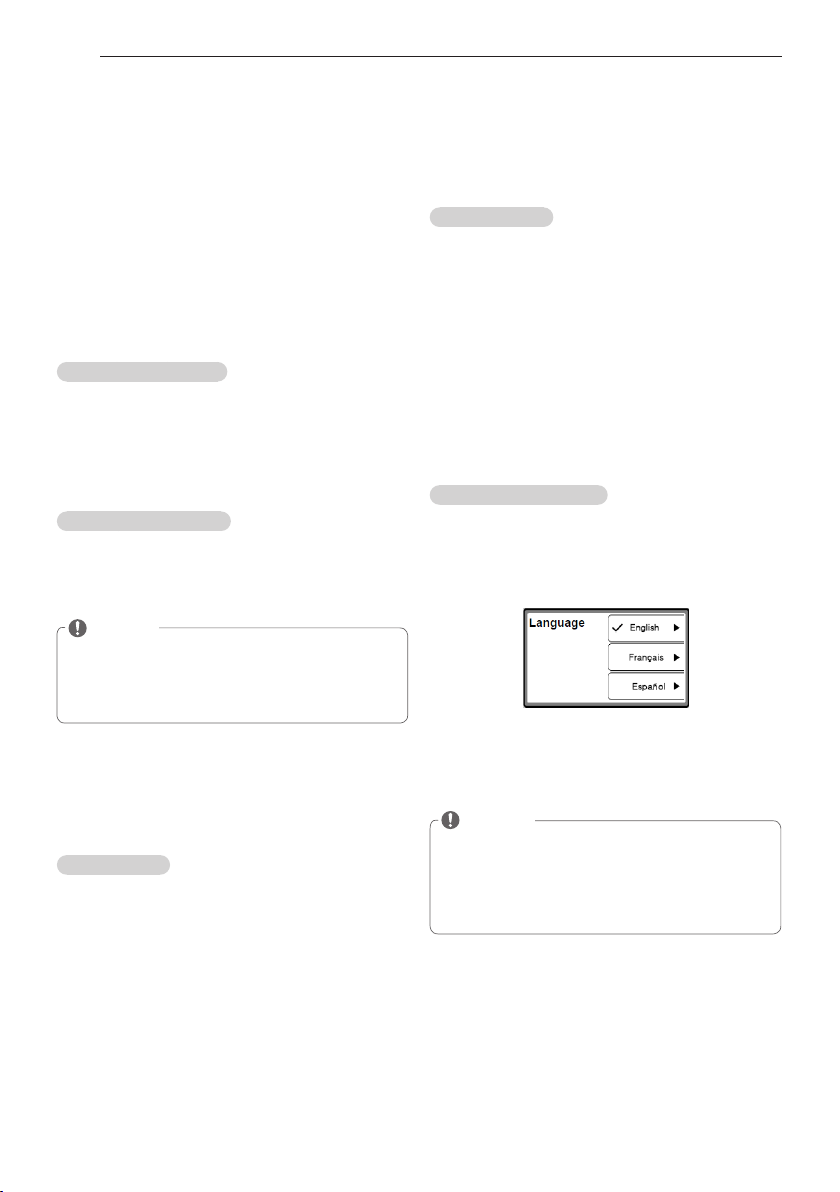
To change the language
1 Press the Power button to turn on the washer.
2 Press and hold the Prewash button for 3
seconds, until the following screen appears in
the display.
3 When the screen appears, English is displayed
as the default language. Press the Rinse+Spin
button to select Francais (French). Press the
Extra Rinse button to select Espanol (Spanish).
NOTE
y
If you don't press a button or select another
language for 3 seconds after opening the
language setting option, the language
selection function will apply the existing
language selection and close.
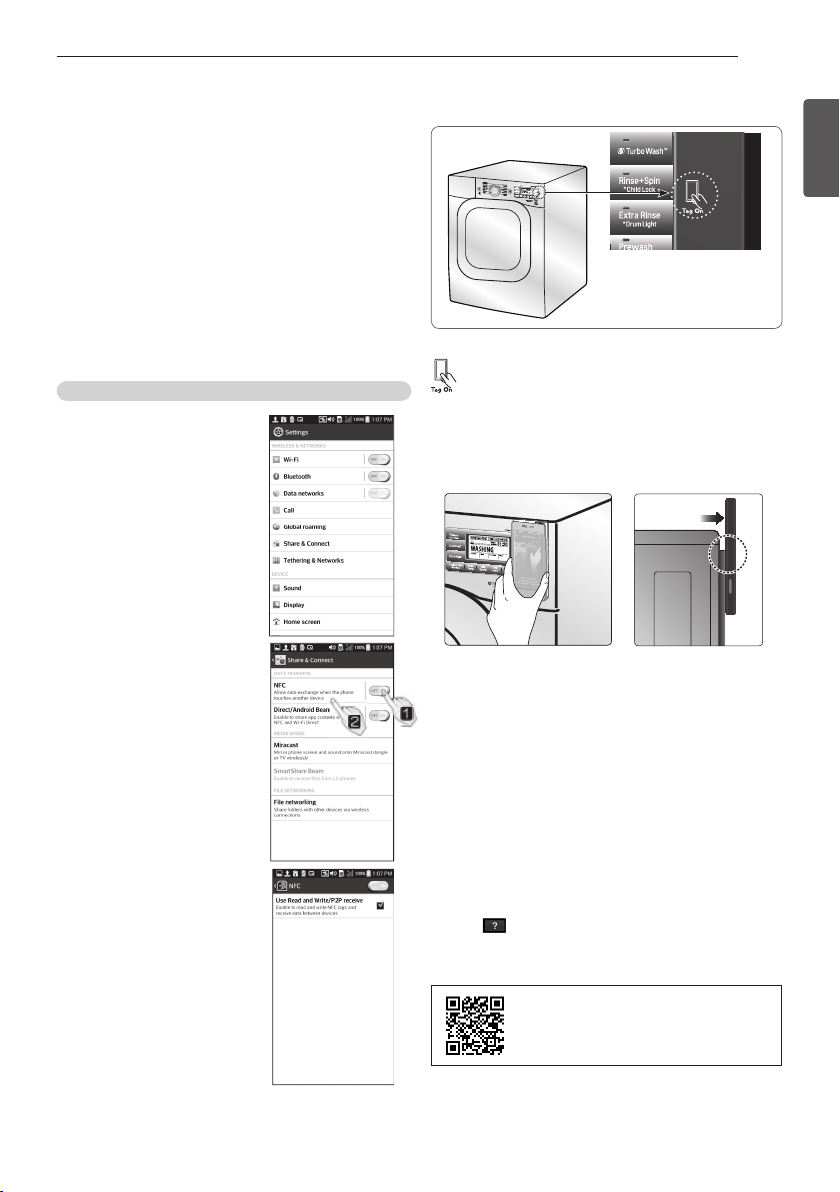
29
ENGLISH
USING YOUR WASHING MACHINE
Before using the Tag On function
- The Tag On function allows you to conveniently
use the LG Smart Diagnosis™ and Cycle
Download features to communicate with your
appliance right from your own smart phone. To
use the Tag On function:
1 Download the LG Smart Laundry&DW App to
your smart phone.
2 Turn on the NFC (Near Field Communication)
function in your smart phone.
The Tag On function can only be used with most
smart phones equipped with the NFC function
and based on the Android operating system (OS).
Turning on the NFC function of the smart phone
1 Enter the "Settings" menu
of the smart phone and
select "Share & Connect"
under "WIRELESS &
NETWORKS."
2 Set "NFC“ and “Direct
Android Beam” to ON
and select “NFC" .
3 Check "Use Read and
Write/P2P receive."
Depending on the smart
phone manufacturer and
Android OS version, the
NFC activation process
may differ. Refer to the
manual of your smart
phone for details.
The Tag On icon
Tag On position
Tag On: Look for the Tag On icon next to the
LCD screen on the control panel. This is where
you position your smart phone when using the
Tag On function with the LG Smart Diagnosis™
and Cycle Download features of the LG Smart
Laundry&DW App.
When you use the Tag On function, position your
smart phone so that the NFC antenna on the back
of your smart phone matches the position of the
Tag On icon on the appliance. If you do not know
the position of your NFC antenna, move your
smart phone very slightly in a circular motion
until the application verifies the connection.
Because of the characteristics of NFC, if the
transmission distance is too far, or if there is a
metal sticker or a thick case on the phone,
transmission will not be good. In some cases,
NFC-equipped phones may be unable to transmit
successfully.
Press [ ] in the LG Smart Laundry&DW app
for a more detailed guide on how to use the Tag
On function.
Scan this QR code with your smart
phone to quickly access the LG
Smart Laundry&DW App for
download
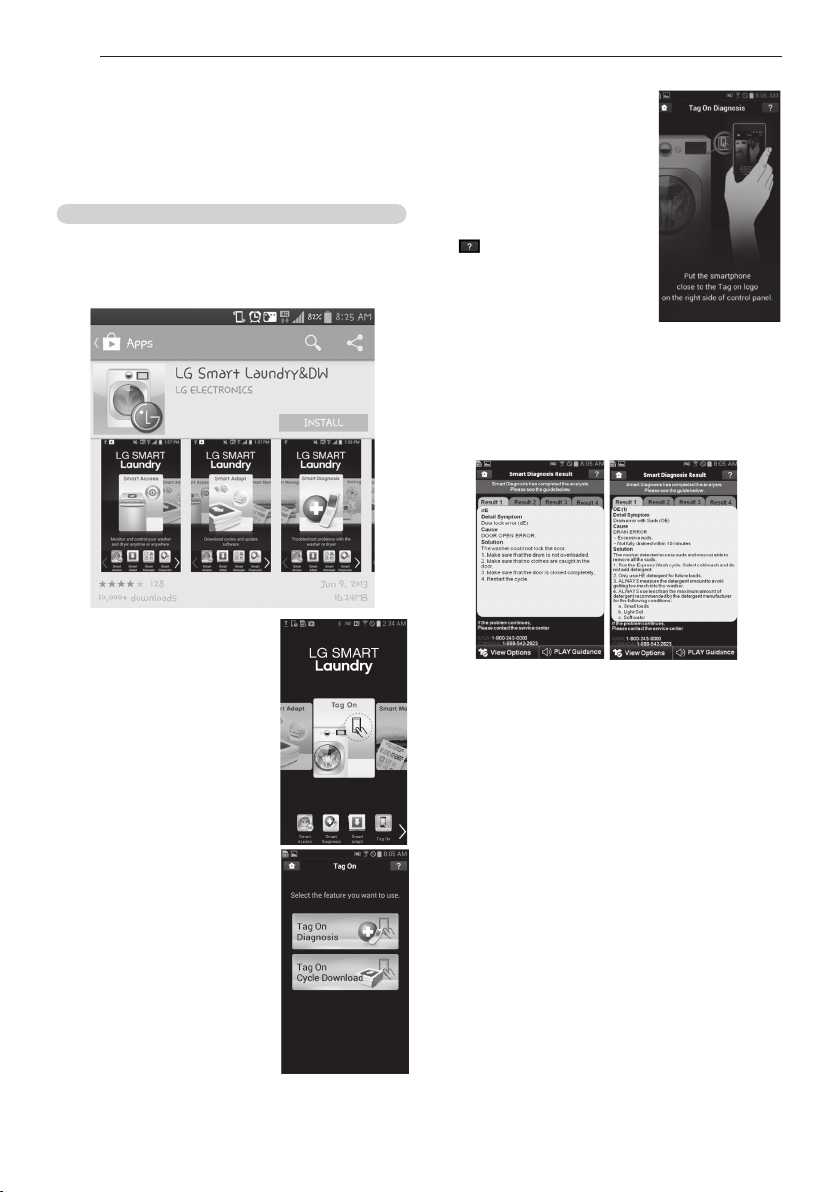
30
USING YOUR WASHING MACHINE
Tag On
Download and install the LG Smart Laundry&DW
application on an NFC-equipped smart phone.
The application includes a Tag On self-diagnosis
feature and a Tag On cycle download feature.
Tag On self-diagnosis using LG Smart Laundry&DW application
1 Install ‘LG Smart Laundry&DW’ app on a NFC-
equipped smartphone.
- Install the app from the Play store and run it.
2 Select Tag On.
Home card and icons at the
bottom of the screen are all
available to use.
3 Select Tag On Diagnosis
4 Touch the Tag On logo.
- When a Tag On screen
appears (see at right), tap
your smart phone on the
Tag On icon on the right
side of the washer's
control panel.
- If it isn't recognized, touch
on the upper right of
the Tag On screen on your
LG Smart Laundry&DW
app to see the detailed
guide. (This might happen
due to the different NFC
antenna positions for each phone.)
5 Check the diagnosis results and solutions.
- It shows the diagnosis results on the two
cycles recently used.
※ Images are for reference only. The LG Smart
Laundry&DW application may be updated.
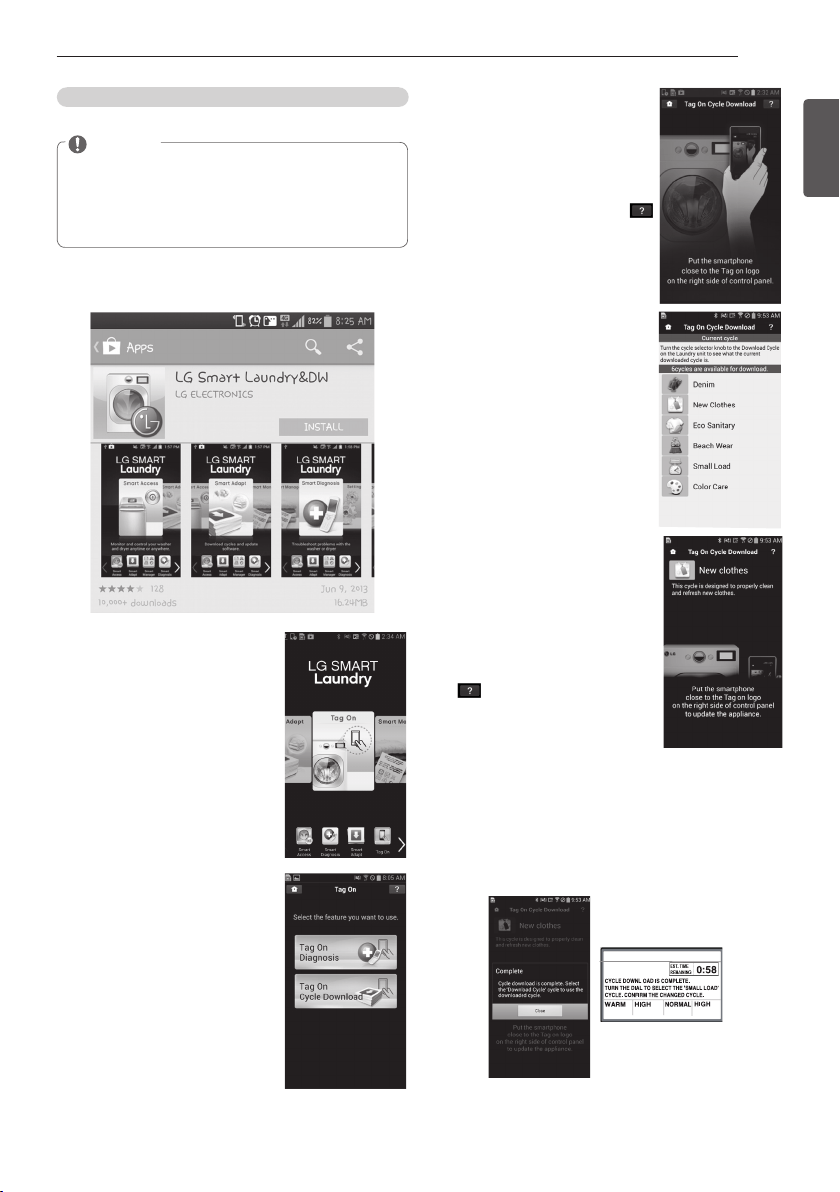
31
ENGLISH
USING YOUR WASHING MACHINE
Tag On cycles download using LG Smart Laundry&DW application
NOTE
y
The Tag On Cycle Download feature lets you
use your smart phone to download a new
cycle to your washer, replacing the Small
Load cycle. The Small Load Cycle can always
be re-downloaded, if desired.
1 Install ‘LG Smart Laundry&DW’ app on a NFC-
equipped smartphone.
- Install the app from the Play store and run it.
2 Select Tag On.
Home card and icons at the
bottom of the screen are all
available to use.
3 Select Tag On Cycles
Download.
4 Touch the Tag On logo.
- When a Tag On screen
appears (see at right), tap your
smart phone on the Tag On
icon on the right side of the
washer's control panel.
- If it isn't recognized, touch
on the upper right of the Tag
On screen on your ‘LG Smart
Laundry&DW’ app to see the
detailed guide. (This might
happen due to the different
NFC antenna positions for
each phone.)
5 Select a cycle to download.
- You can also check the
existing cycles already
downloaded.
6 Touch the Tag On logo.
- When a Tag On screen
appears (see at right), tap
your smart phone on the
Tag On icon on the right
side of the washer's control
panel.
- If it isn't recognized, touch
on the upper right of
the Tag On screen on your
LG Smart Laundry&DW app
to see the detailed guide.
(This might happen due to
the different NFC antenna positions for each
phone.)
7 The new cycle is downloaded successfully!
-
Check whether the new cycle is downloaded by
turning the cycle selector knob to Download
Cycle/Small Load.
※ Images are for reference only. The LG Smart
Laundry&DW application may be updated.
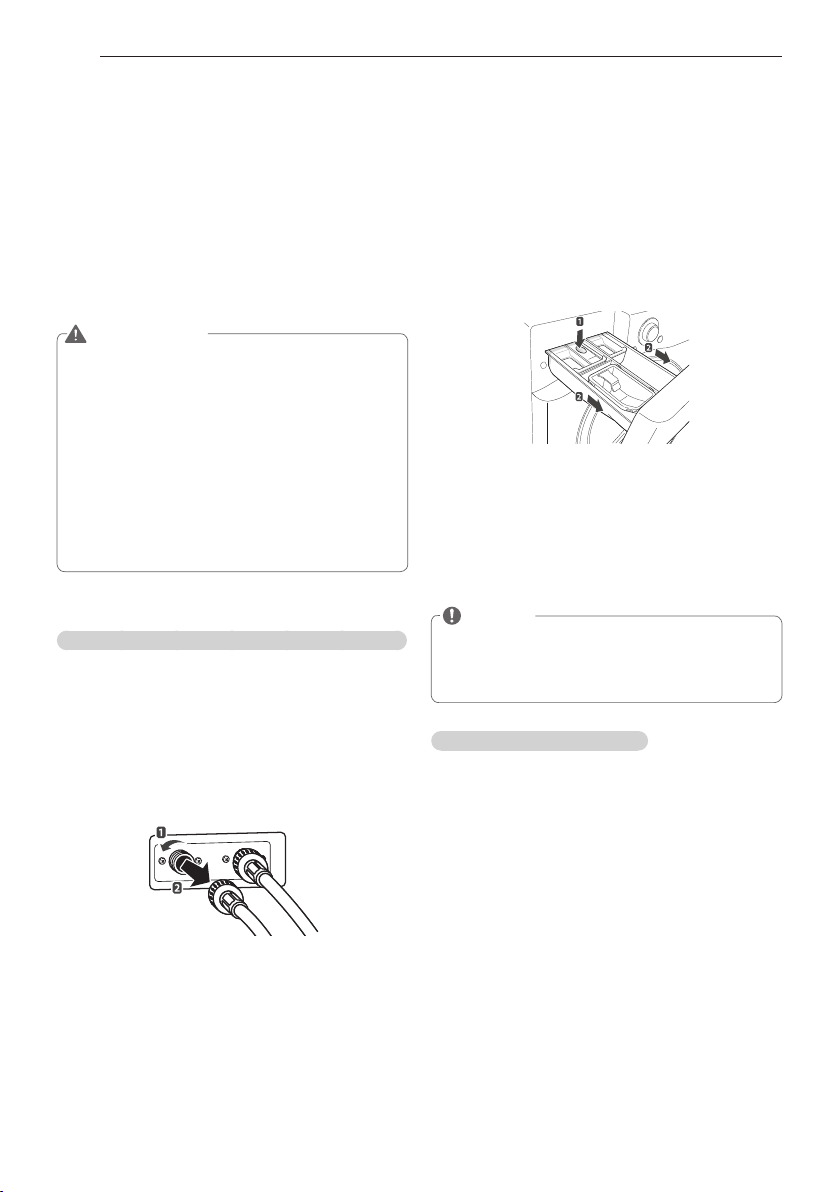
32
MAINTENANCE
Care
Care after wash
After the cycle is finished, wipe the door and the
inside of the door seal to remove any moisture.
Leave the door open to dry the washer tub
interior. Wipe the body of the washing machine
with a dry cloth to remove any moisture.
WARNING
y
Unplug the washer before cleaning to avoid
the risk of electric shock.
Failure to follow
this warning can cause serious injury, fire,
electric shock or death.
y
Never use harsh chemicals, abrasive cleaners,
or solvents to clean the washer.
They will
damage the finish.
y
Do not use volatile substances (benzene, paint
thinner, alcohol, acetone, etc.) or detergents
with strong chemical components when
cleaning the washing machine.
Doing so
may cause discoloration or damage to the
machine, or it may cause a fire.
Care in cold climates
Storing the washing machine for an extended period of time
Follow these instructions to avoid damage when
storing the washing machine for an extended
period of time in cold climates where it may be
exposed to freezing temperatures.
1 Turn off the faucets connected with the water
lines.
2 Unscrew the water lines from back of the
washer.
3 Empty any water out of the water lines.
4 Press the Power button.
5 Open the door and add 1 gallon (3.8 L) of
nontoxic recreational vehicle (RV) antifreeze to
the empty washer tub. Close the door.
6 Press the Spin Speed button draining and
spinning.
MAINTENANCE
7 Press the Start/Pause button.
- Drain the water from the washing machine
for 1 minute. Not all of the RV antifreeze will
be expelled.
8 Press the Power button to turn off the washing
machine and pull out the power plug.
9 Dry the tub interior of the washer tub with a
soft cloth, and close the door.
10 Press down hard on the disengage button and
pull out the detergent dispenser drawer.
11 Drain the water from the detergent dispenser
drawer and dry out each compartment.
12 Store the washing machine in an upright
position.
NOTE
y
To remove the antifreeze after storing the
washing machine, add detergent to the
dispenser, and run one cycle. Do not load
any laundry at this time.
When the water line is frozen
1 Turn off the faucets connected with the water
lines.
2 Pour hot water on the frozen faucets to thaw
the water lines and pull them out.
3 Immerse the water lines in hot water to thaw
them.
4 Re-connect the water lines with the water
inlets of the washing machine and with the
faucets.
- See page 14,
Connecting the water lines
for
details.
5 Turn on the faucets.
6 Press the Power button.
7 Press the Rinse+Spin button.
8 Press the Start/Pause button.
- Make sure the water fills properly.
33
ENGLISH
MAINTENANCE
When the Drain Line is Frozen
1 Pour hot water in the washer tub and close the
door.
- Leave it for 10 minutes.
2 Press the Power button after 10 minutes.
3 Press the Spin Speed button to begin draining
and spinning.
4 Press the Start/Pause button.
- Check if the water drains.
Cleaning
Periodically clean the washing machine to help
maintain its performance and to minimize the
chance of malfunction.
Cleaning the drum, Tub Clean
Improper installation or use of the washing
machine in a humid space for a long period
of time potentially could lead to a buildup of
detergent residue in the washing machine that
may produce mildew or musty smells. If you
clean the washer tub regularly on a monthly basis
using Tub Clean it will minimize the possibility
that detergent residue will build up and mildew
or musty smells may occur.
1 Add tub cleaner or lime scale remover to the
detergent dispenser drawer.
- Do not exceed the maximum detergent limit
line when you add it. Detergent may remain
in the washer tub after cleaning.
-
When you use liquid chlorine bleach,
load it
into the liquid chlorine bleach compartment.
-
When you use a powdered cleaner,
pull out
the liquid detergent cup and add the cleaner
into the main wash detergent compartment.
-
When you use cleaning tablets,
place them
directly into the washer tub. (Do not add tablet
cleaner to the drawer.)
2 Press the Power button.
3 Turn the cycle selector knob to Tub Clean.
-
t cL
message appears in the display.
- The indicator light for Tub Clean turns on.
4 Press the Start/Pause button.
NOTE
y
Never load laundry while using Tub Clean.
The laundry may be damaged. Make sure to
clean the washer tub when it is empty.
y
Leave the door open after finishing the
laundry to keep the tub clean.
y
Tub Clean should be repeated monthly.
y
If you notice mildew or musty smells, run
Tub Clean once a week for 3 consecutive
weeks.
y
Safely and conveniently secure the door
slightly ajar with the magnetic door plunger.
This will promote air circulation and help the
machine to dry.
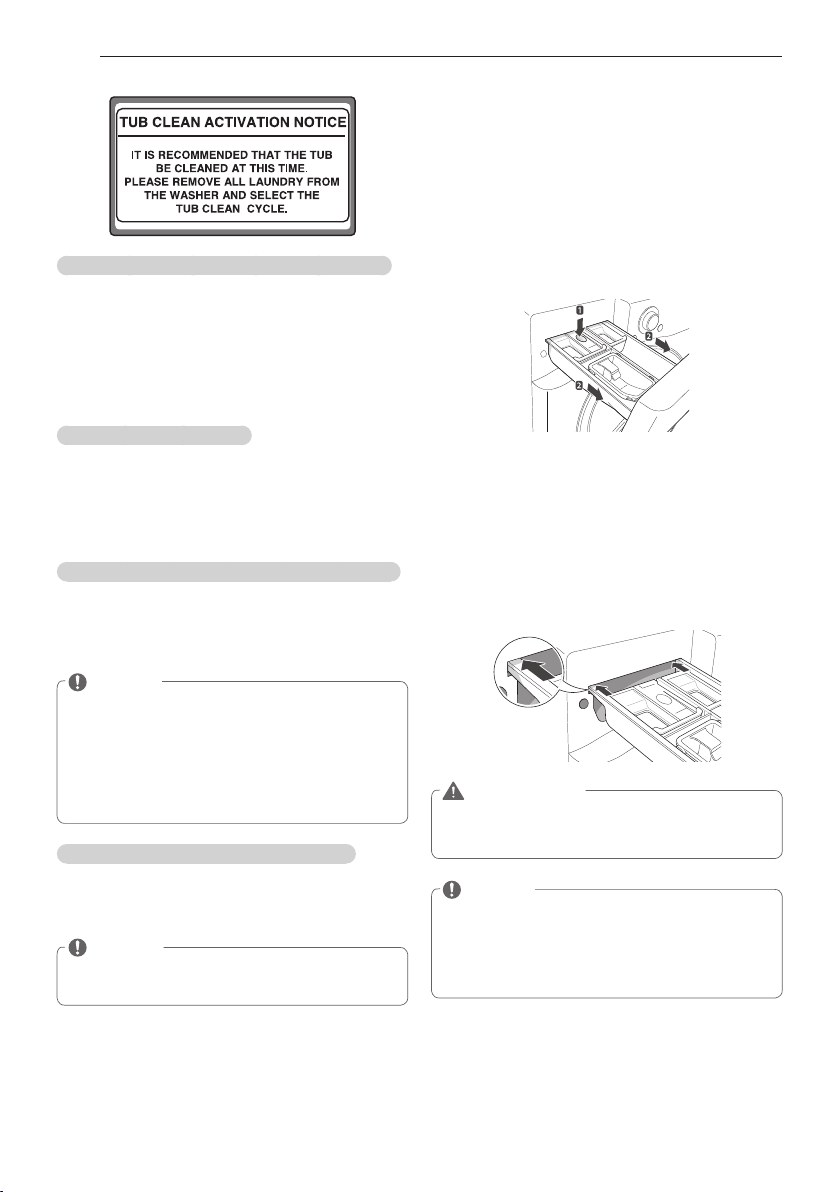
34
MAINTENANCE
Automatic alert for cleaning washing machine
When the power is on and the
t cL
message
blinks, it means the washer tub needs cleaning.
Use Tub Clean to clean the washer tub. The
automatic indication alert for cleaning the washer
tub depends on the frequency of use, however,
the message will generally blink every 1~2
months.
Removing mineral buildup
If you live in an area with hard water, mineral
scale can form on the internal components
of the washing machine. Take extra care to
periodically clean the mineral buildup on the
internal components to extend the lifespan of the
washing machine.
Removing mineral buildup from the washer tub
Check if the descaler is suitable for cleaning the
washer tub before using it and run the Tub Clean
cycle. See page 30,
Tub Clean
for details on tub
clean.
NOTE
y
In areas with hard water, a water softener is
recommended.
y
Make sure to remove all laundry from the
washer tub before cleaning the washer
tub. Cleaning the washer tub together with
laundry may result in contamination of or
damage to the laundry.
Removing lime buildup on stainless steel
Wipe lime buildup or other spots on stainless
steel with a soft cloth soaked in stainless steel
cleaner.
NOTE
y
Never use steel wool or abrasive cleansers.
Doing so may damage the washing machine.
Cleaning the detergent dispenser drawer
Leaving detergent in the detergent dispenser
drawer for an extended period of time or using
the washing machine for a long period of time
may cause the build-up of scales in the detergent
dispenser drawer. Pull out and clean the
detergent dispenser drawer once a week.
1 Pull out the detergent dispenser drawer.
2 Press down hard on the disengage button and
remove the detergent dispenser drawer.
3 Remove the inserts from the drawer.
4 Clean them with warm water.
- Use a soft cloth or brush for cleaning and
remove any residue.
5 Wipe up any moisture with a dry towel or cloth
after cleaning.
6 Replace the detergent dispenser drawer.
WARNING
y
Do not spray water inside the washing
machine.
Doing so may cause fire or electric
shock.
NOTE
y
Use water only when you clean the detergent
dispenser drawer. Make sure to use
RINSE+SPIN to rinse the washer tub before
the next wash cycle after you use a cleaning
detergent to clean the washer tub.
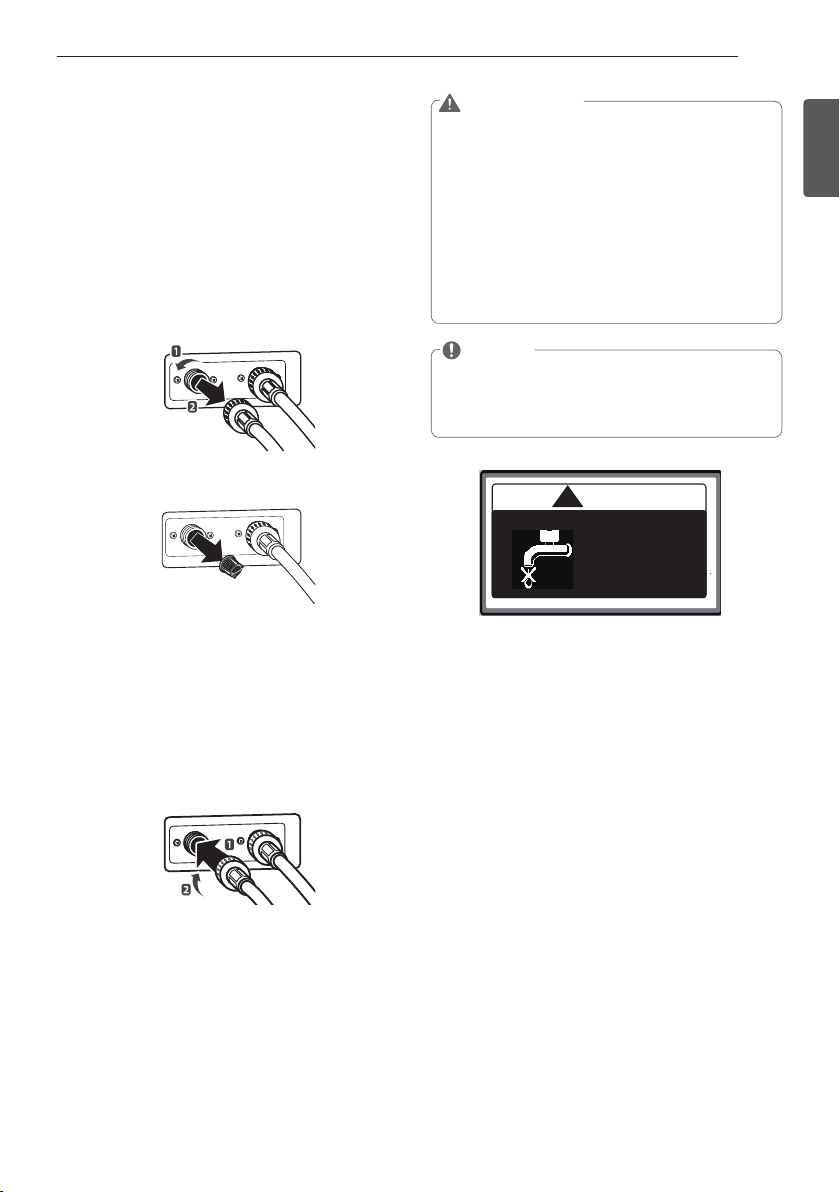
35
ENGLISH
MAINTENANCE
WARNING
y
Unplug the power cord and turn off the faucets
before cleaning.
Failure to do so may cause
electric shock.
y
Do not use the washing machine without the
inlet filters.
If you use the washing machine
without the inlet filters it will cause leaks and
malfunction.
y
If you use the washing machine in an area
with hard water, the inlet filter may clog due
to lime buildup. Contact your nearest LG
customer service center if the inlet filter is
not clean or is missing.
NOTE
y
IE
message will blink on the display when
the water pressure in the detergent drawer
is weak or an inlet filter is clogged with dirt.
Clean the inlet filter.
!
ERROR
No water supply.
Check tap & hose.
Cleaning the water inlet filters
Clean the water inlet filters periodically to prevent
clogging. Take extra care to clean the water inlet
filters for areas using hard water. Water may not
be supplied if there are foreign objects, such as
rust, sand, or stones in the water inlet filters.
1 Press the Power button to turn off the washing
machine and pull out the plug.
2 Turn off the faucets connected with the water
inlets.
3 Remove the water inlets.
4 Pull out the water inlet filter.
Inlet Filter
5 Remove foreign objects from the water filter
inlet.
- Soak the water filter inlets in white vinegar or
a lime scale remover or use a toothbrush to
remove foreign objects and rinse thoroughly.
6 Press the water filter inlets back into place.
7 Reattach the water lines to the washing
machine.
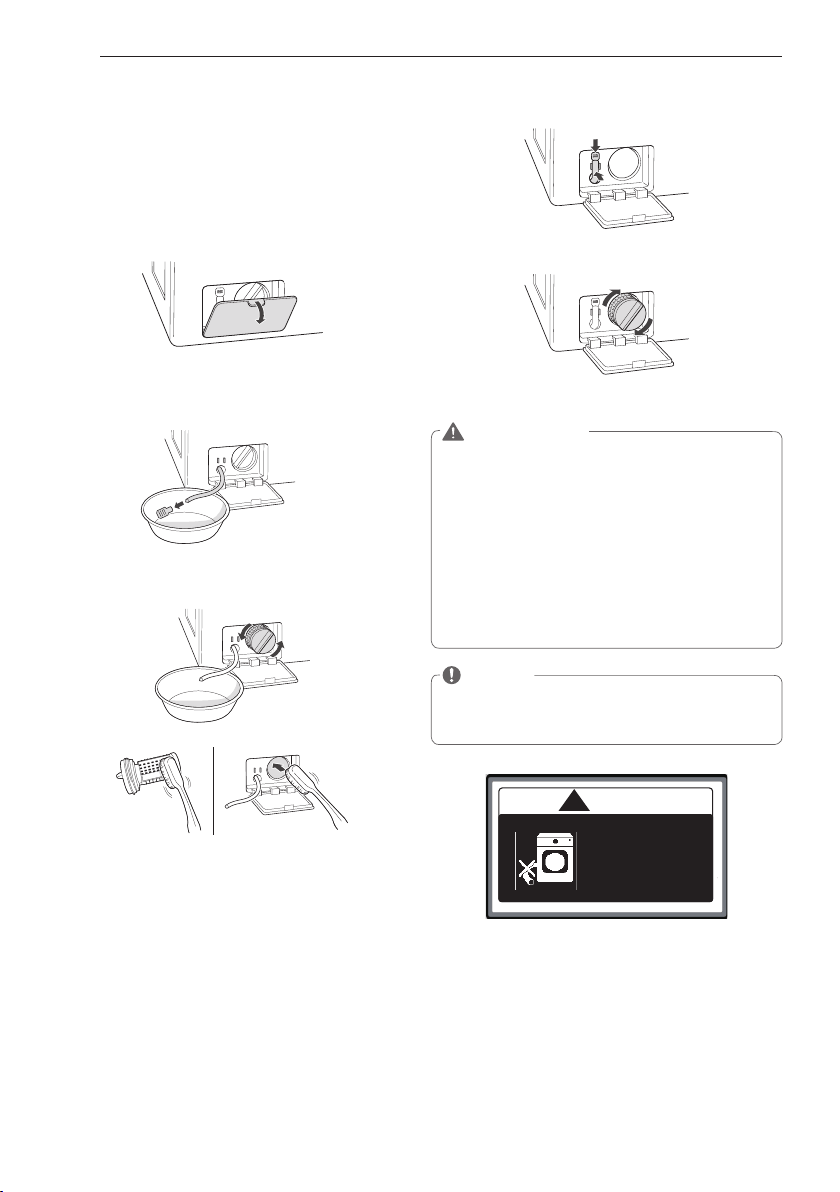
36
MAINTENANCE
Cleaning the drain pump filter
The washing machine fails to drain if the drain
pump filter is clogged. Periodically clean the
drain filter to prevent clogging with foreign
objects.
1 Press the Power button to turn off the washing
machine and pull out the plug.
2 Open the drain pump filter cover.
3 Unclip the drain hose and remove the plug
from the drain hose to drain the remaining
water.
4 Twist the pump filter counterclockwise to
remove it.
5 Clean the pump filter and opening.
6 Recap the plug onto the drain hose and
reattach the drain hose.
7 Insert the drain pump filter.
8 Close the drain pump filter cover.
WARNING
y
Unplug the power cord before cleaning.
Failure
to do so may cause electric shock.
y
Opening the drain filter will result in water
overflowing if there is water in the washer
tub.
Make sure to check if the water is
completely drained before opening the drain
filter.
y
If you use the washing machine with the
drain filter reassembled incorrectly after
cleaning it, or if you use the machine without
the filter, it may cause leaks or malfunction
of the washing machine.
NOTE
y
OE
message will blink when the drain pump
filter is clogged with dirt. Clean the drain
pump filter.
!
ERROR
Not draining.
Check the drain
hose & filter.
37
ENGLISH
MAINTENANCE
Cleaning the door seal
Clean the door seal once a month to prevent
build-up of dirt in the door seal.
1 Wear rubber gloves and protective goggles.
2 Dilute 3/4 cup (177 ml) of liquid chlorine bleach
in 1 gallon (3.8 L) of water.
3 Soak a sponge or a soft cloth in this diluted
solution and wipe down all around the door
seal.
4 Wipe up any moisture with a dry towel or cloth
after cleaning.
5 Leave the door open to allow the door seal to
dry completely.
CAUTION
y
Cleaning the door seal with undiluted bleach
may cause malfunction of the door seal and
washing machine parts You must add water
to the bleach before using it.
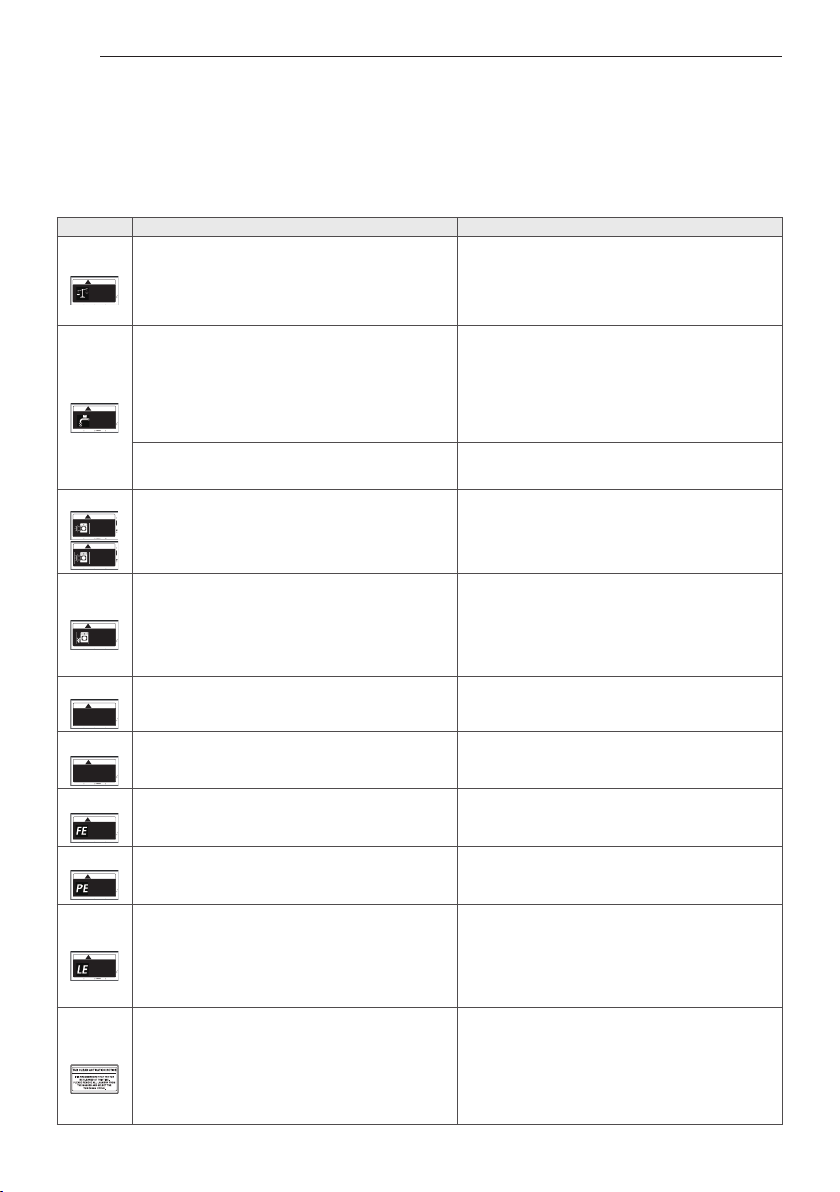
38
TROUBLESHOOTING
TROUBLESHOOTING
Checking error messages
If the following message appears on the display, check the following and take the appropriate
corrective action.
Message
Possible Causes Solutions
UE
Load is out of balance.
Rearrange wash load.
!
ERROR
Item of clothing has gathered on one side of the tub.
y
There are not enough items in the machine.
y
Have your items gathered in one area, or is the load
too small?
y
Did you wash a stuffed animal, a mat, or knitwear?
y
Did you wash two different blankets together?
y
Rearrange items to help balance the load.
y
Stuffed animals or mats can become unbalanced
during spinning and the washing machine may fail to
drain. Rearrange the knitwear to help balance the load
and drain it again.
y
Put one blanket in at a time.
IE
!
ERROR
No water supply.
Check tap & hose.
Water is not supplied or the water pressure is low
y
Is the faucet turned off?
y
Is the water supply stopped or the faucet frozen?
y
Is the water pressure low or is an inlet filter clogged?
y
Is the water line properly connected with the cold
water inlet?
y
Is the water line pinched or bent?
y
Turn on the faucets.
y
If a faucet is frozen, thaw it with warm water.
y
If the inlet filter is clogged, clean it. (see page 35)
y
Connect the water line properly with the cold water
inlet. (see page 14)
y
Check that the water lines are not pinched or bent.
Take extra care that water lines are not twisted or
pinched by other objects.
Water line leaks in connection
y
Are the water lines connected with the faucets
properly?
y
Connect the water lines properly with the faucets.
(see page 14)
dE
!
ERROR
[dE2]
The door is open.
Please close the door
completely.
!
ERROR
[dE1]
The door is open.
Please close the door
completely.
The tub does not rotate
• Is the door secured?
y
Close and secure the door. If the message keeps
appearing, unplug the power and contact your nearest
LG service center.
OE
!
ERROR
Not draining.
Check the drain
hose & filter.
The washing machine drains slowly or not at all
y
Is the drain hose installed over 3 1/4 feet (1 m) beyond
the end of the elbow bracket?
y
Is the drain hose pinched or clogged inside?
y
Is the drain hose frozen?
y
Is the drain hose clogged with foreign objects?
y
Lower the drain hose within 3 feet below the end of
the elbow bracket.
y
Place the drain hose on a smooth surface to prevent
bending.
y
If the drain hoses are frozen, thaw them in warm
water.
y
Open the drain pump plug cap and remove the dirt.
PF
!
ERROR
PF
The washer
experienced a power
failure. Restart the
cycle.
A power failure has occurred.
y
Press the Power button to turn off the washing
machine and press it again to turn it on.
tE
!
ERROR
See owner’s manual…
tE
Control Error.
y
Unplug the power cord and contact your nearest LG
service center.
FE
!
ERROR
See owner’s manual…
The water supply does not stop
y
Do the water supply and the drain keep repeating in
turn?
y
Unplug the power cord and contact your nearest LG
service center
PE
!
ERROR
See owner’s manual…
The water level is not controlled
y
Is the water level too low or high compared with the
size of the load?
y
The water level sensor is not working correctly.
y
Unplug the power cord and contact your nearest LG
service center.
LE
!
ERROR
See owner’s manual…
The tub does not rotate
y
Is the washing machine overloaded?
y
Rearrange the load size and restart the washing
machine.
y
If the load size is big, the tub may not rotate due to
an overheated motor. Allow the washing machine
to stand for a while and restart the cycle. Unplug
the power cord and contact your nearest LG service
center if the same error message appears.
tcL
y
To clean up the tub, please run the Tub Clean cycle.
y
Please empty the tub and insert bleach into the
detergent dispenser and select the Tub Clean cycle.
y
If you want to skip the Tub Clean, turn the cycle
selector knob or push the option buttons to select a
cycle. The message will keep reappearing until a few
washing cycles have been completed, after which it
will disappear until the next scheduled time to clean
the tub.
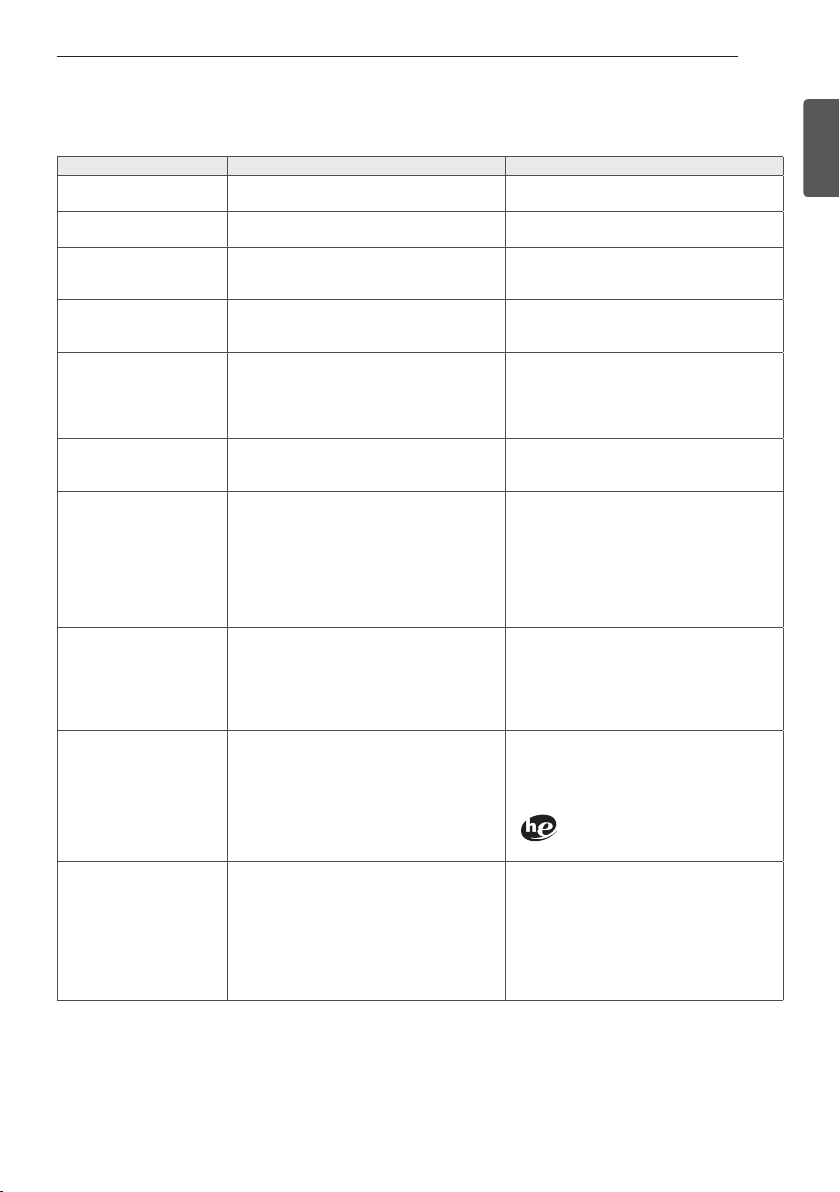
39
ENGLISH
TROUBLESHOOTING
Before calling for service
Check the following before calling for service.
Problem Possible Causes Solutions
Clicking sound
y
Do you hear a sound when you close or lock
and unlock the door?
y
This sound is normal and occurs when the
door is closed, locked or unlocked.
Spraying or hissing sound
y
Is water spraying in the tub?
y
This sound is normal as water is spraying or
circulating during the cycle.
Buzzing or gushing
sound
y
Is the washing machine draining water?
y
This sound is normal as the drain pump
drains water from the washing machine after
the cycle.
Splashing sound
y
Is the washing machine washing a load of
laundry?
y
This sound is normal as the load is moving
up and down during the wash and rinse
cycles.
Rattling and clanking noise
y
Are there any foreign objects such as keys,
coins, or safety pins in the tub or drain filter?
y
Check if there are any foreign objects in the
tub and the drain filter after stopping the
cycle.
y
Unplug the power cord and contact your
nearest LG service center if the noise persists.
Thumping sound
y
Is the washing machine overloaded?
y
Is the load out of balance?
y
This sound is normal and occurs when the
load is out of balance. Stop the cycle and
rearrange the load for balancing.
Vibrating noise
y
Are the shipping bolts removed?
y
Is the load evenly distributed in the tub?
y
Is the washing machine level balanced?
y
Is the washing machine installed on a solid
and smooth surface?
y
See page 13,
Unpacking and removing shipping
bolts
to remove the shipping bolts.
y
Stop the cycle and rearrange the load for
balancing.
y
See page 16,
Leveling the washing machine
to
level the washing machine.
y
Check if the floor is solid and level.
Water leaking around washer
y
Is water leaking from a faucet or a water line?
y
Is a drain pipe or a drain hose clogged?
y
Check the faucets or water lines.
- If the water lines are loosely connected, see
page 14,
Connecting water lines
to connect
them properly.
y
Unclog the drain pipe or drain hose. Contact
a plumber if necessary.
Excessive suds or failure to
rinse
y
Did you use more than the recommended
amount of detergent?
y
Is the soil level higher than the size of the
load?
y
Use the recommended amount of detergent
for load.
y
If the soil level is low, reduce the detergent
quantity to less than the recommended level.
Only use detergent with the HE (High-
Efficiency) logo.
Staining
y
Did you add detergent directly to the tub?
y
Did you remove the load immediately after it
finished?
y
Did you sort and wash the clothes by color or
soil?
y
Make sure to load detergent into the
detergent dispenser drawer.
y
Remove the load immediately after it finishes.
y
Sort and separate dark colors from light or
white ones, and heavily soiled items from
lightly soiled ones. See page 19,
Sorting
laundry
for details
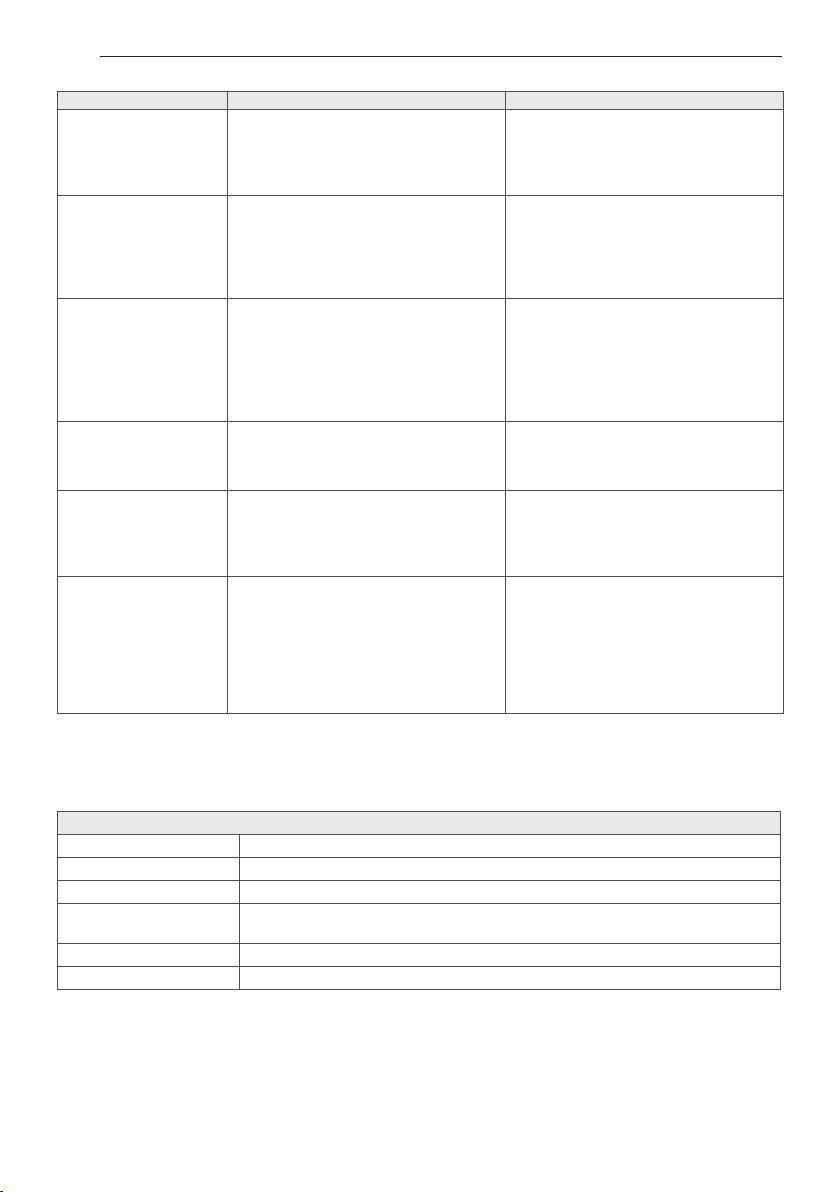
40
SPECIFICATIONS
Problem Possible Causes Solutions
Wrinkling
y
Did you remove the load immediately after it
finished?
y
Did you overload the tub?
y
Did you reverse the hot and cold water inlets?
y
Remove the load immediately after it finishes.
y
Do not overload the tub.
y
Hot water rinse can cause garments to
wrinkle. Check the inlet hose connections.
Power is not turned on
y
Is the power cord plugged in properly?
y
Has a house fuse blown, a circuit breaker
tripped, or a power outage occurred?
y
Make sure that the plug is secured in a
grounded 3-prong, 120 V (60 Hz) outlet.
y
Reset the circuit breaker or replace the
fuse. Do not increase the fuse capacity. If
the problem is a circuit overload, have it
corrected by a qualified electrician.
The door does not open when
the cycle pauses or finishes
y
Is the temperature in the tub too high?
y
Is the water level in the water high?
y
The washing machine has a safety lock built
into the door to prevent burning. Leave the
door closed and wait until the door lock icon
disappears from the display.
y
Allow the washer to complete the
programmed cycle, or Press the Spin Speed
button.
The wash cycle time is longer
than usual
y
Is the washing machine overloaded? Are
other options added to the wash cycle?
y
This is normal. The washing machine
automatically adjusts the cycle time for the
amount of laundry, water pressure, water
temperature, and other operating conditions.
It is musty or moldy in the tub
y
Has the incorrect detergent been used?
y
Did you clean the tub periodically?
y
Use only HE (High-Efficiency) detergent
recommended for a front-loading washing
machine.
y
See page 33, clean the inside and outside of
the washing machine periodically.
Banging noise when washer
is filling with water (Water
Hammer)
y
Plumbing in the home moves or flexes when
the water valves in the washer shut off.
y
Household water supply pressure is very
high.
y
Water hammer is not caused by a defect in
the washer. Install water hammer arrestors
(purchased separately at hardware or home
improvement store) between the fill hose and
the washer for best results.
y
Adjust household water supply regulator to a
lower pressure or contact a plumber to have
a regulator installed.
SPECIFICATIONS
Model WM8500H*A
Description Front-Loading Washer
Electrical requirements 120 VAC @ 60 Hz.
Max. water pressure 20–120 psi (138–827 kPa)
Dimensions 73.7cm (W) X 81.4cm (D) X 103.5cm (H), 146cm (D with door open)
29” (W) X 32” (D) X 40 ¾” (H), 57½” (D with door open)
Net weight 225lb (102kg)
Max. spin speed 1,300RPM
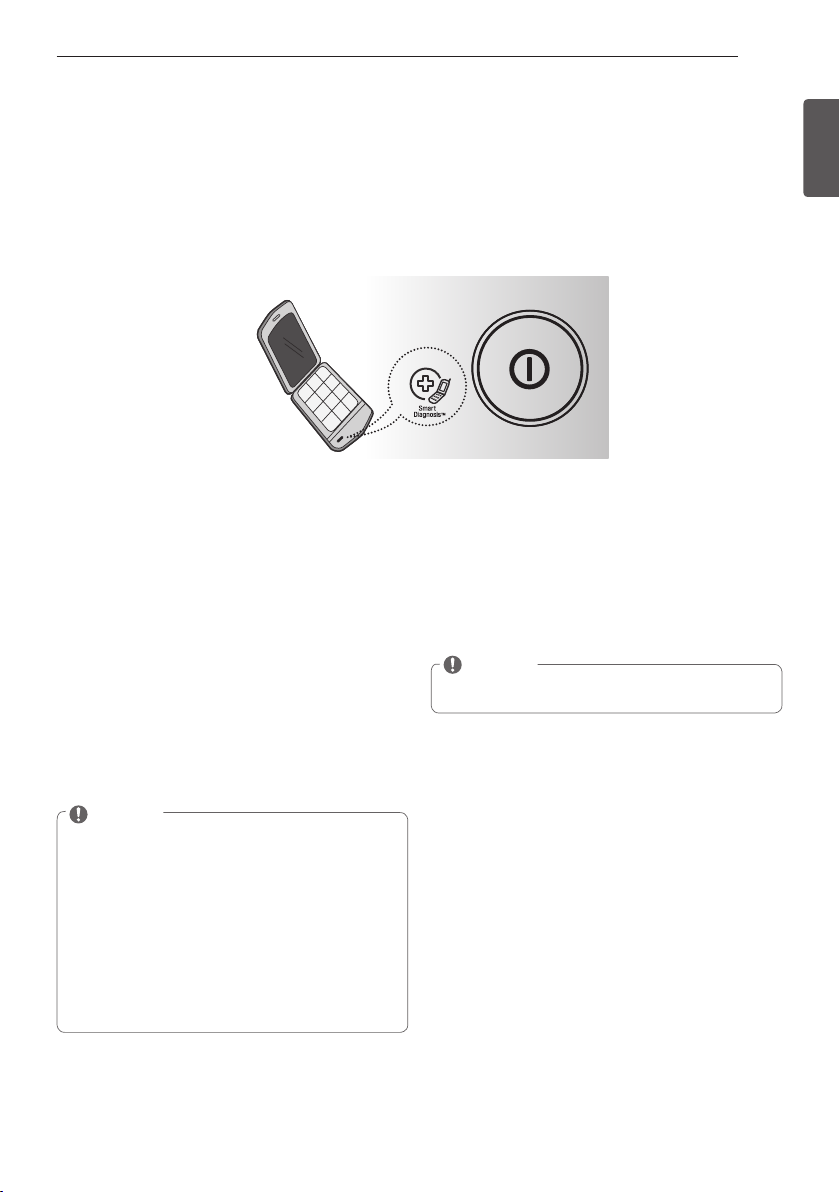
41
ENGLISH
USING Smart Diagnosis™
Should you experience any problems with your Washer, it has the capability of transmitting data to
your Smart Phone using the LG Smart Laundry Application or via your telephone to the LG call center.
Smart Diagnosis™ cannot be activated unless your Washer is turned on by pressing the POWER but-
ton. If your Washer is unable to turn on, then troubleshooting must be done without using Smart
Diagnosis™.
Audible Diagnosis
Smart Diagnosis™ Using Your Smart
Phone
1. Download the LG Smart Laundry application on
your smart phone.
2. Open the LG Smart Laundry application on your
smart phone. Press the right arrow button to ad-
vance to the next screen.
3. Press the RECORD button on the smart phone and
then hold the mouth piece of the smart phone
near the Smart Diagnosis™ logo on the
Washer.
4. With the phone held in place, press and hold the
Wash Temp button for three seconds.
5. Keep the phone in place until the tone transmis-
sion has finished. This takes about 6 seconds and
the display will count down the time.
6. When the recording is complete, view the diagno-
sis by pressing the Next button on the phone.
NOTE
y
Smart Diagnosis™ is a troubleshooting feature
designed to assist, not replace, the traditional
method of troubleshooting through service
calls. The effectiveness of this feature depends
upon various factors, including, but not limited
to, the reception of the cellular phone being
used for transmission, any external noise that
may be present during the transmission, and
the acoustics of the room where the machine
is located. Accordingly, LG does not guarantee
that Smart Diagnosis™ would accurately trou-
bleshoot any given issue.
Smart Diagnosis™ Through the
CallCenter
1. Call the LG call center at: (LG U.S.) 1-800-243-0000
(LG Canada) 1-888-542-2623.
2. When instructed to do so by the call center agent,
hold the mouthpiece of your phone over the
Smart Diagnosis™ logo on the machine. Hold the
phone no more than one inch (but not touching)
the machine.
NOTE
y
Do not touch any other buttons or icons on the
display screen.
3. Press and hold the Wash Temp button for three
seconds.
4. Keep the phone in place until the tone transmis-
sion has finished. This takes about 6 seconds and
the display will count down the time.
5. Once the countdown is over and the tones have
stopped, resume your conversation with the call
center agent, who will then be able to assist you in
using the information transmitted for analysis.
USING Smart Diagnosis™
42
WARRANTY
THIS LIMITED WARRANTY DOES NOT COVER:
1. Service trips to deliver, pick up, or install the product or for instruction on product use.
2. Replacing house fuses or resetting of circuit breakers, correction of house wiring or plumbing, or correction of product
installation.
3. Damage or failure caused by leaky/ broken/ frozen water pipes, restricted drain lines, inadequate or interrupted water supply
or inadequate supply of air.
4. Damage or failure caused by accidents, pests and vermin, lightning, wind, fire, floods or acts of God.
5. Damage or failure resulting from misuse, abuse, improper installation, repair or maintenance. Improper repair includes use
of parts not approved or specified by LG.
6. Damage or failure caused by unauthorized modification or alteration to the product.
7. Damage or failure caused by incorrect electrical current, voltage, or plumbing codes.
8. Cosmetic damage, including scratches, dents, chips or other damage to the finish of the product, unless such damage
results from defects in materials or workmanship and is reported to LG within seven (7) calendar days from the date of
delivery.
9. Damage or missing items to any display, open box, discounted, or refurbished product.
10. Product where the original factory serial numbers have been removed, defaced or changed in any way.
11. Repairs when product is used in other than normal and usual household use (e.g. rental, commercial use, offices, or
recreational facilities) or contrary to the instructions outlined in the owner’s manual.
12. The removal and reinstallation of the Product if it is installed in an inaccessible location.
HOW SERVICE IS HANDLED: In-Home Service
In-home service will be provided, as available, during the warranty period subject to servicer availability within the U.S. To
receive in-home service, the product must be unobstructed and accessible to service personnel. If the in-home service repair
cannot be completed, it may be necessary to remove, repair and return the product. If in-home service is unavailable, LG may
elect, at its option, to provide for transportation of the product to and from an LG authorized service center.
THIS WARRANTY IS IN LIEU OF ANY OTHER WARRANTY, EXPRESS OR IMPLIED, INCLUDING AND WITHOUT LIMITATION
TO, ANY WARRANTY OF MERCHANTABILITY OR FITNESS FOR A PARTICULAR PURPOSE. TO THE EXTENT ANY IMPLIED
WARRANTY IS REQUIRED BY LAW, THIS WARRANTY IS LIMITED IN DURATION TO THE TERM PERIOD EXPRESSED ABOVE.
REPAIR OR REPLACEMENT AS PROVIDED UNDER THIS WARRANTY IS THE EXCLUSIVE REMEDY FOR THE CUSTOMER.
NEITHER THE MANUFACTURER NOR ITS U.S. DISTRIBUTOR SHALL BE LIABLE FOR ANY INCIDENTAL, CONSEQUENTIAL,
INDIRECT, SPECIAL, OR PUNITIVE DAMAGES OF ANY NATURE, INCLUDING AND WITHOUT LIMITATION TO, LOST REVENUES
OR PROFITS, OR ANY OTHER DAMAGE, WHETHER BASED IN CONTRACT, TORT, OR OTHERWISE.
SOME STATES DO NOT ALLOW THE EXCLUSION OR LIMITATION OF INCIDENTAL OR CONSEQUENTIAL DAMAGES OR
LIMITATIONS ON HOW LONG AN IMPLIED WARRANTY LASTS, SO THE ABOVE EXCLUSION OR LIMITATION MAY NOT APPLY
TO YOU. THIS WARRANTY GIVES YOU SPECIFIC LEGAL RIGHTS AND YOU MAY ALSO HAVE OTHER RIGHTS THAT VARY
FROM STATE TO STATE.
HOW TO OBTAIN WARRANTY SERVICE & ADDITIONAL INFORMATION: Write your warranty information below:
Call 1-800-243-0000 or visit our website at www.lg.com. Product Registration Information:
Mail to: LG Customer Information Center (ATTN: CIC) Model:
201 James Record Road, Huntsville, AL 35824 Serial Number:
Date of Purchase:
WARRANTY:
LG Electronics U.S.A., Inc. (“LG”) warrants your LG Washing Machine (“product”) against defect in materials or workmanship
under normal household use, during the warranty period set forth below, LG will, at its option, repair or replace the product.
This limited warranty is valid only to the original retail purchaser of the product, is not assignable or transferrable to any
subsequent purchaser or user, and applies only when the product is purchased through an LG authorized dealer or distributor
and used within the United States (“U.S.”) including U.S. Territories.
Note: Replacement products and repair parts may be new or factory-remanufactured and are warranted for the remaining
portion of the original unit’s warranty period or ninety (90) days, whichever is longer. Please retain dated receipt or delivery
ticket as evidence of the Date of Purchase for proof of warranty (you may be required to submit a copy to LG or authorized
representative).
WARRANTY PERIOD:
LG WASHING MACHINE LIMITED WARRANTY (USA)
Period
One (1) year from date of
original retail purchase:
Ten (10) years from date of
original retail purchase:
Lifetime from date of
original retail purchase:
Scope of Warranty
Any internal /functional
Parts & Labor
Drum Motor
(Stator, Rotor, and Hall Sensor)
Stainless Steel Drum
Remark
LG will provide parts & labor to
repair or replace defective parts.
Parts only. Customer will be responsible for any labor or in-home
service to replace defective parts.
43
ENGLISH
WARRANTY
LG WASHING MACHINE LIMITED WARRANTY (CANADA)
WARRANTY:
Should your LG Washer (“Product”) fail due to a defect in material or workmanship under normal home use during the warranty
period set forth below, LG Canada will at its option repair or the Product upon receipt of proof of original retail purchase. This
warranty is valid only to the original retail purchaser of the product and applies only to a Product distributed in Canada by LG
Canada or an authorized Canadian distributor thereof. The warranty only applies to Products located and used within Canada.
Replacement products and parts are warranted for the remaining portion of the original warranty period or ninety (90) days,
whichever is greater.
Replacement products and parts may be new or remanufactured.
LG Authorized Service Center warranties their repair work for thirty (30) days.
LG Canada’s sole liability is limited to the warranty set out above. Except as expressly provided above, LG Canada makes no and
hereby disclaims all other warranties and conditions respecting the product, whether express or implied, including, but not limited to,
any implied warranty or condition of merchantability or fitness for a particular purpose, and no representations shall be binding on LG
Canada. LG Canada does not authorize any person to create or assume for it any other warranty obligation or liability in connection
with the product. To the extent that any warranty or condition is implied by law, it is limited to the express warranty period above. LG
Canada, the manufacturer or distributor shall not be liable for any incidental, consequential, special, direct or indirect damages, loss of
goodwill, lost profits, punitive or exemplary damages or any other damage, whether arising
Directly or indirectly from any contractual breach, fundamental or otherwise, or from any acts or omissions, tort, or otherwise.
This warranty gives you specific legal rights. You may have other rights which may vary from province to province depending on
applicable provincial laws.
Any term of this warranty that negates or varies any implied condition or warranty under provincial law is severable where it
conflicts with provincial law without affecting the remainder of this warranty’s terms.
This limited warranty does not cover:
1. Service trips to deliver, pick up, or install the product; instructing a customer on operation of the product; repair or replacement of
fuses or correction of wiring, or correction of unauthorized repairs/installation.
2. Failure of the product to perform during power failures and interruptions or inadequate electrical service.
3. Damage caused by leaky or broken water pipes, frozen water pipes, restricted drain lines, inadequate or interrupted water supply
or inadequate supply of air.
4. Damage resulting from operating the Product in a corrosive atmosphere or contrary to the instructions outlined in the Product
owner’s manual.
5. Damage to the Product caused by accidents, pests and vermin, lightning, wind, fire, floods, or acts of God.
6. Damage resulting from the misuse, abuse, improper installation, repair, or maintenance of the Product. Improper repair includes
use of parts not approved or specified by LG Canada.
7. Damage or product failure caused by unauthorized modification or alteration, or use for other than its intended purpose, or
resulting from any water leakage due to improper installation.
8. Damage or Product failure caused by incorrect electrical current, voltage, commercial or industrial use, or use of accessories,
components, or cleaning products that are not approved by LG Canada.
9. Damage caused by transportation and handling, including scratches, dents, chips, and/or other damage to the finish of your
product, unless such damage results from defects in materials or workmanship and is reported within one (1) week of delivery.
10. Damage or missing items to any display, open box, discounted, or refurbished Product.
11. Products with original serial numbers that have been removed, altered, or cannot be readily determined. Model and Serial
numbers, along with original retail sales receipt, are required for warranty validation.
12. Increases in utility costs and additional utility expenses.
13. Replacement of light bulbs, filters, or any consumable parts.
14. Repairs when your Product is used in other than normal and usual household use (including, without limitation, commercial use,
in offices or recreational facilities) or contrary to the instructions outlined in the Product owner’s manual.
15. Costs associated with removal of the Product from your home for repairs.
16. The removal and reinstallation of the Product if it is installed in an inaccessible location or is not installed in accordance with
published installation instructions, including the Product owner’s and installation manuals.
17. Accessories to the Product such as door bins, drawers, handles, shelves, etc. Also excluded are parts besides those that were
originally included with the Product.
All costs associated with the above excluded circumstances shall be borne by the consumer.
For complete warranty details and customer assistance,
please call or visit our website:
Write your warranty information below:
Call 1-888-542-2623 (24 hours a day, 365 days a year) and select
the appropriate option from the menu, or visit our website
at http://www.lg.com
Product Registration Information:
Model:
Serial Number:
Date of Purchase:
Period
One (1) year from the date of
original retail purchase
Ten (10) years from the date of
original retail purchase
Five ( 5 ) years from the date of
original retail purchase
Scope of Warranty
Parts and Labor
(internal/functional parts only)
DD Motor
(Stator, Rotor, Hall Sensor)
Stainless Steel Drum
Remark Washer
Extended Component Warranty (Parts Only)
(Consumer will be charged for Labor after one (1) year from the
date of purchase)

44
MEMO

MANUAL DEL USUARIO
LAVADORA AUTOMÁTICA
DE CARGA FRONTAL
WM8500H*A
MFL68005501
www.lg.com
Por favor lea atentamente este manual del usuario antes de operar la
máquina y consérvelo en un lugar a mano en todo momento en caso
de que necesite consultarlo.
ESPAÑOL
2
ÍNDICE
ÍNDICE
3 INSTRUCCIONES IMPORTANTES DE
SEGURIDAD
3 PRECAUCIONES BÁSICAS DE SEGURIDAD
4 INSTRUCCIONES PARA LA CONEXIÓN A
TIERRA
5 INSTRUCCIONES DE SEGURIDAD PARA LA
INSTALACIÓN
6 INSTRUCCIONES DE SEGURIDAD PARA EL
USO, CUIDADO, LIMPIEZA Y ELIMINACIÓN
7 FUNCIONES DEL PRODUCTO
8 INTRODUCCIÓN A SU LAVADORA
8 Piezas y accesorios
9 Características del panel de control
11
INSTRUCCIONES PARA LA INSTALACIÓN
11 Previsualizar el orden de instalación
12 Revisión y elección del lugar apropiado
13 Desempaquetado y retirado de los pernos de
transporte
14 Conexión de los conductos de agua
15 Conexión del conducto de desagüe
16 Nivelación de la lavadora
17 Enchufado del cable de alimentación y conexión
a tierra
17 Prueba de funcionamiento
18 PREPARACIÓN
18 Clasificación de las cargas de lavado
18 - Precauciones para el cuidado de las prendas
antes del ciclo de lavado
19 - Etiquetas de cuidado de las prendas
19 - Clasificación de la ropa sucia
20 Uso de detergente/suavizante para telas
20 - Detergente recomendado
20 - Cargando el dispensador
22 USO DE LA LAVADORA
22 Funcionamiento básico
23 Guía de ciclos
24 Ciclo principal
24
- Para reducir los alérgenos en la ropa sucia, Allergiene™
24 - Para reducir las bacterias en su ropa sucia,
Sanitary
24 - Para prendas blancas, Bright Whites™
24 - Frazadas o prendas abultadas, Bulky/Large
24 - Prendas normales, Cotton/Normal
24 - Prendas muy sucias, Heavy Duty
24 - Edredones, Jumbo Wash
24 - Prendas sin arrugas, Perm. Press
24 - Prendas trasparentes, Delicates
24 - Para toallas, Towels
24 - Para pocas prendas, Small Load
24 - Prendas con la etiqueta “lana” o “lavar a
mano, Hand Wash/Wool
24 - Lavado rápido, Speed Wash
25 Botones modificadores de ciclo
25
- Ajuste de la temperatura del agua, Wash Temp.
25
- Ajuste de la velocidad de centrifugado, Spin Speed
25
- Establecer el nivel de suciedad de la ropa, Soil Level
26 Establecer opciones antes del ciclo
26 - Ajuste de la melodía y los sonidos de los
botones, Signal
26 - Prelavado, Prewash
26 - Solo para enjuagar, desagotar y centrifugar,
Rinse+Spin
26 - Iluminación del tambor, Drum Light
26 - Secado de las prendas para evitar arrugas,
Fresh Care
26 - Agregado de un ciclo adicional de enjuague,
Extra Rinse
27 - Predeterminación del horario de inicio del
ciclo, Delay Wash
27 - Alta temperatura, Steam
27 - Ahorro de energía, Cold Wash™
27 - Ahorro de tiempo, TurboWash™
28 Establecer opciones durante el ciclo
28 - Función de bloqueo de botones, Child Lock
28 - Guardado de un ciclo de lavado personaliza-
do, PGM Save
28 -
Selección de su ciclo personalizado, Custom PGM
28 - Botón de configuración del idioma, Language
29 Antes de utilizar la función Tag On
29 - El ícono de Tag On
30 Tag On
32 MANTENIMIENTO
32 Cuidado
32 - Cuidados después del lavado
32 - Cuidados en climas fríos
33 Limpieza
33 - Limpieza del tambor, Tub Clean
34 - Limpieza de la gaveta dispensadora de
detergente
35 - Limpieza de los filtros de entrada de agua
36 - Limpieza del filtro de la bomba de desagüe
37 - Limpieza del sello de la puerta
38 SOLUCIÓN DE PROBLEMAS
38 Revisión de mensajes de error
39 Antes de solicitar asistencia técnica
40 ESPECIFICACIONES
41
USO DE Smart Diagnosis™
42 GARANTÍA
3
ESPAÑOL
INSTRUCCIONES IMPORTANTES DE SEGURIDAD
INSTRUCCIONES IMPORTANTES DE SEGURIDAD
LEA TODAS LAS INSTRUCCIONES ANTES DE USAR LA LAVADORA
ADVERTENCIA
Para su seguridad, debe seguir la información en este manual para minimizar el riesgo de incendio,
explosión o descarga eléctrica, o para evitar el daño a la propiedad, las lesiones físicas, o incluso la muerte.
Su seguridad y la de otros es muy importante.
En este manual y en el dispositivo proporcionamos varios mensajes de seguridad importantes. Lea
y cumpla siempre todos los mensajes de seguridad.
Éste es el símbolo de alerta de seguridad.
Este símbolo le avisa de posibles peligros de muerte o lesiones para usted o los demás.
Todos los mensajes de seguridad estarán a continuación del símbolo de alerta de seguridad y con la
palabra PELIGRO o ADVERTENCIA. Estas palabras significan:
PELIGRO
Corre riesgo de muerte o de sufrir heridas serias si no sigue las instrucciones inmediatamente.
ADVERTENCIA
Si no respeta las instrucciones, morirá o sufrirá lesiones graves.
PRECAUCIÓN
Si no respeta las instrucciones, es posible que sufra una lesión menor o que dañe el producto.
Todos los mensajes de seguridad le indicarán cuál es el posible peligro, lo que debe hacer para
reducir la probabilidad de lesiones y lo que puede ocurrirle si no se siguen las instrucciones.
PRECAUCIONES BÁSICAS DE SEGURIDAD
ADVERTENCIA
Para disminuir el riesgo de incendio, descarga eléctrica o lesiones a las personas que usen este
electrodoméstico, siga las precauciones básicas, incluidas las siguientes:
• Solo utilice este electrodoméstico para el fin para el que fue
diseñado como se describe en este Manual del usuario.
• Antes de utilizar la lavadora, es necesario instalarla
correctamente, según se describe en este manual.
• No lave artículos que previamente hayan sido limpiados,
lavados, sumergidos o salpicados con gasolina, disolventes
de limpieza en seco o cualquier otra sustancia inflamable o
explosiva, ya que pueden desprender vapores que podrían
incendiarse o explotar.
• No agregue gasolina, disolventes de limpieza en seco u otras
sustancias explosivas al agua de lavado. Estas sustancias
emanan vapores que podrían encenderse o explotar.
• En ciertas condiciones, podría producirse gas hidrógeno en
el sistema de agua caliente que no ha sido utilizado por 2
semanas o más. EL GAS HIDRÓGENO ES EXPLOSIVO. Si no
se ha usado el sistema de agua caliente durante tal período,
antes de utilizar la lavadora, abra todas las llaves de agua
caliente y deje que el agua fluya durante algunos minutos. Esto
eliminará el gas hidrógeno acumulado. Ya que el gas es
inflamable, no fume ni use ninguna llama abierta durante
este período.
• No deje que los niños jueguen en la lavadora o dentro de ella.
Cuando se usa la lavadora cerca de los niños se necesita
supervisión minuciosa.
• Antes de retirar la lavadora del servicio o desecharla, quite la
tapa para evitar que los niños se metan dentro.
• No instale ni guarde la lavadora cuando esté expuesta a la
intemperie o temperaturas de congelamiento.
• No toquetee los controles.
• Mantenga el área debajo y alrededor de sus
electrodomésticos libre de materiales combustibles (pelusa,
papel, trapos, etc.), gasolina, químicos y otros vapores y
líquidos inflamables.
• No repare ni cambie ninguna pieza de la lavadora ni intente dar
un mantenimiento diferente al descrito en este manual.
Recomendamos enfáticamente que el mantenimiento lo
brinde una persona calificada.
• Vea las Instrucciones para la instalación para referirse a los
requisitos de conexión a tierra.
• Siga SIEMPRE las instrucciones de cuidado de la prenda
provistas por el fabricante de las prendas.
• No coloque prendas expuestas a aceite comestible en su
lavadora. Las prendas contaminadas con aceites comestibles
podrían contribuir a la formación de una reacción química
que cause que una carga de lavado se incendie.
• Use suavizantes o productos para eliminar estática únicamente
del modo recomendado por el fabricante.
• Esta lavadora no está diseñada para uso marino o
instalaciones móviles tales como vehículos recreativos,
aeronaves, etc.
• Cierre las llaves de agua y desenchufe la lavadora si va a dejar
la lavadora sin funcionar por un período prolongado de tiempo,
como durante las vacaciones.
• No utilice el calor para secar artículos que contengan
gomaespuma o materiales con una textura similar.
• El material de embalaje podría resultar peligroso para los
niños. ¡Existe riesgo de asfixia! Mantenga todos los
envoltorios alejados de los niños.
• Antes de cargar la lavadora, siempre revise que no haya
objetos extraños en su interior. Mantenga la puerta cerrada
cuando no se use.
• No meta la mano en el electrodoméstico si la tina o el agitador
está en movimiento.
• ADVERTENCIA: Este producto contiene químicos que el
Estado de California sabe que causan cáncer y defectos de
nacimiento u otros daños reproductivos. Lávese las manos
después de su uso.
4
INSTRUCCIONES IMPORTANTES DE SEGURIDAD
INSTRUCCIONES IMPORTANTES DE SEGURIDAD
LEA TODAS LAS INSTRUCCIONES ANTES DE USAR EL LAVAVAJILLAS
ADVERTENCIA
Para su seguridad, debe seguir la información en este manual para minimizar el riesgo de incendio,
explosión o descarga eléctrica, o para evitar el daño a la propiedad, las lesiones físicas, o incluso la
muerte.
INSTRUCCIONES PARA LA CONEXIÓN A TIERRA
Este electrodoméstico debe estar conectado a tierra. En caso de avería o fallo de funcionamiento, la
conexión a tierra reducirá el riesgo de descarga eléctrica, al proporcionar a la corriente eléctrica una
trayectoria de una menor resistencia. Este electrodoméstico está equipado con un cable que dispone
de un conductor de conexión a tierra del equipo y un enchufe con conexión a tierra. El enchufe debe
conectarse a una toma de corriente adecuada que esté correctamente instalada y con conexión a tierra
según las normativas y las ordenanzas locales.
ADVERTENCIA
Una conexión inadecuada del conductor de conexión a tierra del equipo puede ocasionar un riesgo
de descarga eléctrica. Consulte a un electricista o técnico calificado si tiene dudas sobre si el
electrodoméstico está correctamente conectado a tierra. No modifique el enchufe que se entrega con
el electrodoméstico. Si no encaja en la toma de corriente, solicite a un electricista adecuadamente
formado que le instale una toma de corriente apropiada. Si no se cumple con estas advertencias se
podrán producir lesiones graves, incendios, descargas eléctricas o muerte.
5
ESPAÑOL
INSTRUCCIONES IMPORTANTES DE SEGURIDAD
INSTRUCCIONES IMPORTANTES DE SEGURIDAD
LEA TODAS LAS INSTRUCCIONES ANTES DE USAR EL LAVAVAJILLAS
ADVERTENCIA
Para su seguridad, debe seguir la información en este manual para minimizar el riesgo de incendio,
explosión o descarga eléctrica, o para evitar el daño a la propiedad, las lesiones físicas, o incluso la
muerte.
INSTRUCCIONES DE SEGURIDAD PARA LA INSTALACIÓN
ADVERTENCIA
Para disminuir el riesgo de incendio, descarga eléctrica o lesiones a las personas que usen este
electrodoméstico, siga las precauciones básicas, incluidas las siguientes:
• Consulte las INSTRUCCIONES DE INSTALACIÓN para
obtener información detallada de los procedimientos de
conexión a tierra. Junto con la lavadora se encuentran las
instrucciones de instalación como referencia para el
instalador. Si cambiara de lugar la lavadora, contrate a
una persona del servicio calificada para que la controle y
reinstale. Si no se cumple con esta advertencia, se
podrán producir lesiones graves, incendios, descargas
eléctricas o muerte.
• Bajo ninguna circunstancia corte o quite la tercera clavija
(de puesta a tierra) del cable de alimentación. Si no se
cumple con esta advertencia, se podrán producir
lesiones graves, incendios, descargas eléctricas o
muerte.
• Por motivos de seguridad personal, este electrodoméstico
debe estar conectado a tierra adecuadamente. Si no se
cumple con esta advertencia, se podrán producir
lesiones graves, incendios, descargas eléctricas o
muerte.
• El cable de alimentación de este electrodoméstico está
equipado con un enchufe de tres clavijas (de puesta a tierra)
que coincide con una toma de corriente estándar para
tres clavijas (de puesta a tierra) para así minimizar la
posibilidad de descarga eléctrica de este
electrodoméstico.
• Esta lavadora debe estar enchufada a una toma de corriente
de 120 V de CA, 60 Hz y con conexión a tierra. Si no se
cumple con esta advertencia, se podrán producir
lesiones graves, incendios, descargas eléctricas o
muerte.
• Solicite a un electricista cualificado que controle la toma de
corriente y el circuito eléctrico para asegurarse de que la
toma de corriente está correctamente conectada a tierra.
Si no se cumple con esta advertencia, se podrán
producir lesiones graves, incendios, descargas eléctricas
o muerte.
• Si únicamente se dispone de una toma de corriente de 2
clavijas, será responsabilidad y obligación suya sustituirlo
por otra de 3 clavijas, de puesta a tierra, y adecuada para
este uso. Si no se cumple con esta advertencia, se
podrán producir lesiones graves, incendios, descargas
eléctricas o muerte.
• No instalar sobre alfombra. Instale la lavadora sobre piso
firme. Si no se cumple con esta advertencia, se podrán
producir daños por filtraciones.
• No elimine el cable de conexión a tierra. No use un
adaptador o prolongador. Enchufe en una toma de corriente
con conexión a tierra de 3 clavijas. Si no se cumple con
estas advertencias se podrán producir lesiones graves,
incendios, descargas eléctricas o muerte.
• La lavadora debería estar siempre conectada a un enchufe
individual con un índice de voltaje equivalente al que figura
en su etiqueta de características técnicas. Esto garantiza el
mejor funcionamiento y además previene la sobrecarga
de los circuitos del hogar, lo cual podría ocasionar
riesgos de incendio debido al recalentamiento de cables.
• Nunca desenchufe su lavadora jalando del cable de
corriente. Siempre tome su enchufe firmemente y jale
del mismo hacia fuera para retirarlo. Si no se cumple con
esta advertencia, se podrán producir lesiones graves,
incendios, descargas eléctricas o muerte.
• Repare o reemplace de inmediato todos los cables de
alimentación pelados o con cualquier tipo de daño. No use
un cable con cortaduras o abrasión sobre su extensión o
extremos. Si no se cumple con esta advertencia, se
podrán producir lesiones graves, incendios, descargas
eléctricas o muerte.
• Al instalar o cambiar de lugar la lavadora, evite todo tipo de
cortes u otros daños en el cable de alimentación. Si no se
cumple con esta advertencia, se podrán producir
lesiones graves, incendios, descargas eléctricas o
muerte.
• La lavadora debe ser instalada y conectada a tierra por una
persona calificada del servicio técnico cumpliendo con los
códigos locales para prevenir riesgos de descargas y
asegurar la estabilidad durante el funcionamiento.
• La lavadora es pesada. Se necesitan dos o más personas
para instalar y trasladar el electrodoméstico. Si no se
respeta esta advertencia, podrá sufrir lesiones en la
espalda o de otro tipo.
• No almacene ni instale la lavadora en lugares expuestos a
temperaturas de congelación ni a inclemencias
meteorológicas. Si no se cumple con esta advertencia, se
podrán producir daños por filtraciones.
• Con el fin de reducir el riesgo de descargas eléctricas no
instale la lavadora en espacios húmedos. Si no se cumple
con esta advertencia, se podrán producir lesiones
graves, incendios, descargas eléctricas o muerte.
• Para reducir el riesgo de lesiones físicas, siga todos los
procedimientos de seguridad recomendados por la
industria, incluido el uso de guantes de mangas largas y
gafas protectoras. No cumplir con las advertencias de
seguridad de este manual podría resultar en daños a la
propiedad, lesiones físicas o muerte.
6
INSTRUCCIONES IMPORTANTES DE SEGURIDAD
INSTRUCCIONES IMPORTANTES DE SEGURIDAD
LEA TODAS LAS INSTRUCCIONES ANTES DE USAR EL LAVAVAJILLAS
ADVERTENCIA
Para su seguridad, debe seguir la información en este manual para minimizar el riesgo de incendio o
explosión, descarga eléctrica, o para evitar el daño a la propiedad, las lesiones físicas, o incluso la muerte.
INSTRUCCIONES DE SEGURIDAD PARA EL USO, CUIDADO, LIMPIEZA Y ELIMINACIÓN
ADVERTENCIA
Para disminuir el riesgo de incendio, descarga eléctrica o lesiones a las personas que usen este
electrodoméstico, siga las precauciones básicas, incluidas las siguientes:
CONSERVE ESTAS INSTRUCCIONES
• Desenchufe la lavadora antes de proceder a su
limpieza para evitar posibles descargas
eléctricas.
• Nunca utilice productos químicos fuertes,
limpiadores abrasivos o disolventes para limpiar la
lavadora. Dañarán el acabado.
• No coloque trapos grasosos o aceitosos sobre la
lavadora. Estas sustancias despiden vapores que
podrían prender fuego a los materiales.
• No lave prendas que estén sucias con aceite
vegetal o de cocina. Estos productos pueden
retener un poco de aceite luego de su lavado.
Debido al aceite restante, es posible que la tela
se incendie o largue humo por sí sola.
• Desconecte este electrodoméstico de la toma de
corriente antes de realizar cualquier función de
mantenimiento. Colocar los controles en la
posición OFF (apagado) no desconecta el
electrodoméstico de la toma de corriente. Si no
se cumple con esta advertencia, se podrán
producir lesiones graves, incendios, descargas
eléctricas o muerte.
• No combine productos de limpieza para el uso en
una sola carga a menos que se especifique en la
etiqueta.
• No mezcle blanqueador con cloro con amoniaco o
ácidos, como vinagre. Siga las direcciones del
paquete al usar productos de lavandería. Un uso
indebido puede producir gases venenosos, lo
que puede resultar en heridas graves o la
muerte.
• No coloque las manos dentro de la lavadora
cuando sus partes estén en movimiento. Antes de
cargar, descargar o agregar prendas, presione el
botón START/PAUSE (comienzo/pausa) y espere
hasta que el tambor se detenga totalmente antes
de meter las manos dentro. Si no se cumple con
esta advertencia, se podrán producir lesiones
graves, incendios, descargas eléctricas o
muerte.
• No deje que los niños jueguen en la lavadora o
dentro de ella. Cuando se usa la lavadora cerca de
los niños se necesita supervisión minuciosa. A
medida que los niños crecen, enséñeles el uso
apropiado y seguro de todos los
electrodomésticos. No cumplir con estas
advertencias puede provocar lesiones físicas
graves o incluso la muerte.
• Destruya el cartón, la bolsa de plástico y otros
materiales de embalaje después de
desempaquetar la lavadora. Los niños podrían
utilizarlos para jugar. Los cartones cubiertos con
las mantas, las colchas, o las hojas plásticas
pueden convertirse en compartimientos
herméticos. No cumplir con estas advertencias
puede provocar lesiones físicas graves o incluso
la muerte.
• Guarde los productos de lavandería fuera del
alcance de los niños. Para evitar lesiones físicas,
observe todas las advertencias de las etiquetas del
producto. No cumplir con estas advertencias
puede provocar lesiones físicas graves o incluso
la muerte.
• Antes de poner la lavadora fuera de servicio o de
tirarla, quite la tapa del compartimiento de lavado
para evitar el peligro que niños o pequeños
animales se queden atrapados en el interior. No
hacerlo puede resultar en lesiones graves e
incluso la muerte.
• Asegúrese de que la gaveta del dispensador esté
cerrada en todo momento cuando no se la esté
llenando con productos de lavandería. No
mantener la gaveta cerrada puede resultar en
lesiones físicas o inundación.
7
ESPAÑOL
FUNCIONES DEL PRODUCTO
FUNCIONES DEL PRODUCTO
MOTOR INVERSOR DE TRANSMISIÓN DIRECTA
El motor inversor, que está conectado directamente al tambor, es capaz de producir varios movi-
mientos marcados para un rendimiento de lavado óptimo con un mínimo de ruido y vibración. La
unidad de motor también contiene menor cantidad de partes móviles, lo que tiene como resultado
menor cantidad de reparaciones.
Smart Diagnosis™
Si experimenta problema técnico con la lavadora, podrá transmitir datos a través del teléfono al Cen-
tro de Información al Cliente. El agente del centro de llamadas graba los datos transmitidos desde la
máquina y los utiliza para analizar el problema, ofreciendo un diagnóstico rápido y eficaz. (Consulte
la página 38.)
FUNCIÓN TAG ON
La funcion Tag On le permite utilizar la mayoría de smartphones equipado con NFC,con sistema
operativo Android, para comunicarse con su dispositivo. Cuando haya descargado la aplicación LG
Smart Laundry&DW en su teléfono, podrá descargar e instalar nuevos ciclos de lavado en su dispo-
sitivo con Descarga de Ciclo Tag On o ayudar en los problemas de diagnóstico con Diagnóstico Tag
On. (Consulte las páginas 29-31.)
LIMPIEZA DE LA TINA
La limpieza mensual regular de la tina utilizando el ciclo Tub Clean (limpieza de la tina) puede ayudar
a mantener la tina limpia y fresca.
ÉMBOLO MAGNÉTICO PARA LA PUERTA
Asegure la puerta de manera segura y conveniente dejándola levemente abierta con el émbolo mag-
nético para la puerta. Esto promoverá la circulación del aire y permitirá que se seque el interior de la
máquina. Para usar esta característica, retire la ropa limpia y luego coloque la puerta en una posición
tal que esté casi cerrada. Cuando el émbolo magnético de la puerta entra en contacto con el armazón
metálico de la lavadora, trabará la puerta en una posición levemente abierta, permitiendo que se
seque el interior de la lavadora.
TAMBOR DE ACERO INOXIDABLE DE GRAN CAPACIDAD
El tambor de acero inoxidable de gran capacidad ofrece una durabilidad superior y está inclinado
para mejorar la eficiencia y permitir un acceso más fácil para prendas grandes.
CHILD LOCK (BLOQUEO INFANTIL)
Utilice esta opción para desactivar los controles durante un ciclo de lavado. Esta opción impide que
los niños cambien los ciclos o manejen la máquina.
GAVETA DISPENSADORA DE DETERGENTE
La gaveta dispensadora de detergente de cuatro compartimientos hace que sea fácil separar el de-
tergente previo al lavado, el detergente de lavado principal, el blanqueador líquido y el suavizante de
telas en compartimientos diferentes.
CICLOS DE VAPOR DE ALTA TEMPERATURA
Durante los excepcionales ciclos de vapor de LG, la opción de vapor de alta temperatura ayuda a
remover las manchas más difíciles.
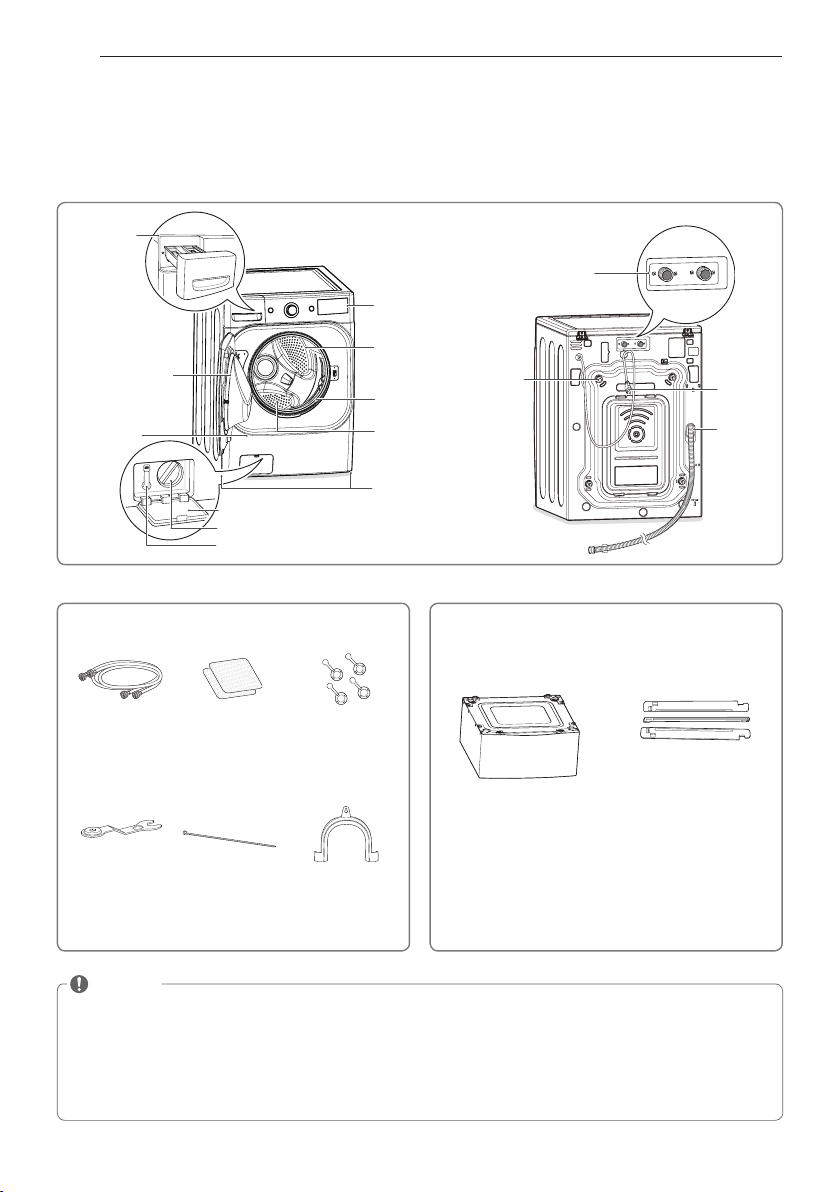
8
INTRODUCCIÓN A SU LAVADORA
NOTA
y
Contáctese con el Servicio de Atención al Cliente de LG llamando al 1-800-243-0000 (o 1-888-542-
2623 en Canadá) si falta algún accesorio.
y
Para su seguridad y una vida útil prolongada del producto, use solamente componentes
autorizados. El fabricante no es responsable por averías del producto o accidentes causados por
el uso de componentes o piezas no autorizados comprados por separado.
y
Es posible que las imágenes de esta guía difieran de los componentes y accesorios reales, y están
sujetas a cambio por parte del fabricante sin previo aviso para fines de mejora del producto.
Accesorios
Pedestal
(Adquirido por separado)
Paquete de apilado
(Adquirido por separado)
Mangueras de
agua caliente/fría
Almohadillas
antideslizantes
Tapas para cubrir
los agujeros para
los pernos de
transporte
Llave inglesa Correa
Soporte tipo codo
(para asegurar
la manguera de
desagüe)
INTRODUCCIÓN A SU LAVADORA
Piezas y accesorios
Piezas
Accesorios incluidos Accesorios opcionales
Gaveta
dispensadora
de detergente
(Consulte la
página 20)
Puerta
Émbolo
magnético
para la puerta
(Consulte la
página 7)
Panel de control
(Véase página 9).
Sello de la
puerta
Circulación del
agua y boquillas
de vapor
Tina
Patas de
apoyo
Cubierta del filtro de la bomba de desagüe
Filtro de la bomba de desagüe
Manguera de desagüe
Entradas de agua
Pernos de
transporte
Cable de
alimentación
Manguera
de desagüe
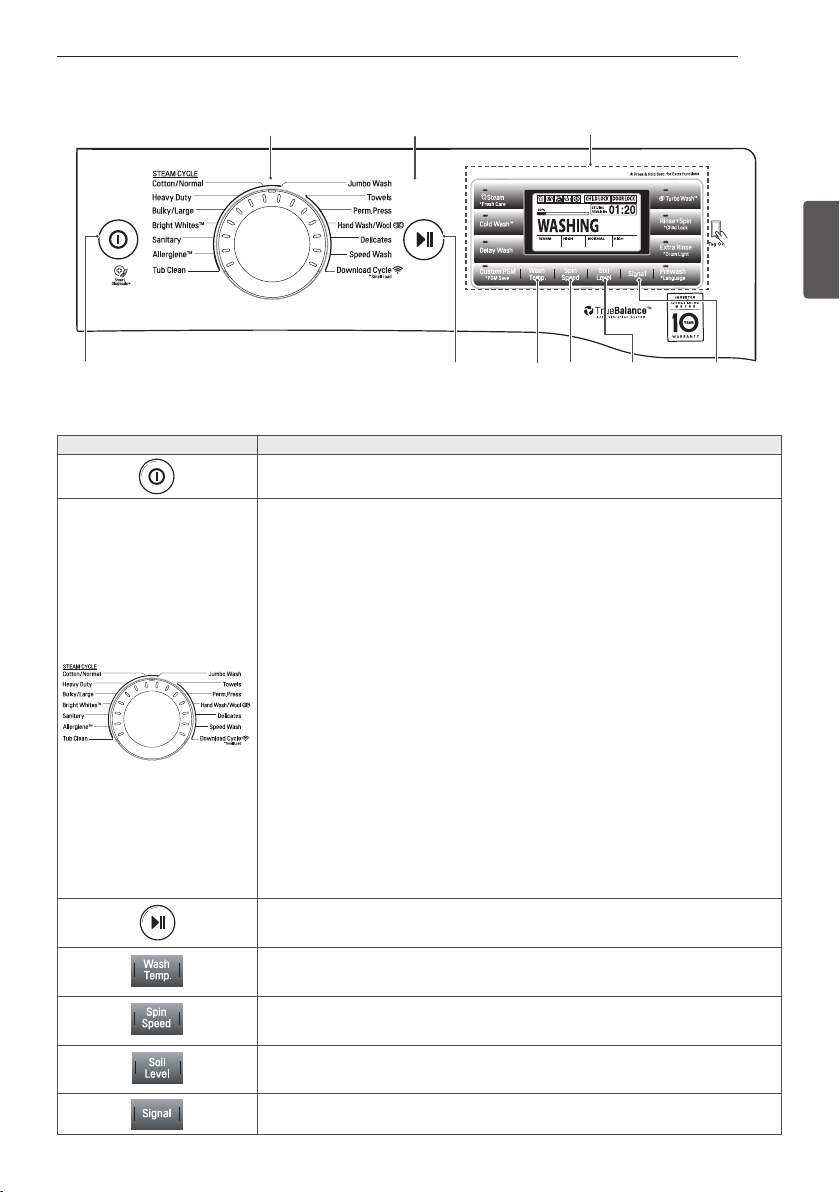
9
ESPAÑOL
INTRODUCCIÓN A SU LAVADORA
Botón Descripción
y
El botón Power enciende y apaga la lavadora.
y
Durante el ciclo de lavado, detiene el funcionamiento y cancela las configuraciones.
y
Allergiene™
- Para prendas de algodón, ropa interior (consulte la página 24)
y
Sanitary
- Para ropa interior, pañales, etc. (consulte la página 24)
y
Bright Whites™
- Para prendas blancas (consulte la página 24)
y
Bulky/Large (bultos/prendas grandes)
- Para sábanas o prendas grandes y abultadas (consulte la página 24)
y
Heavy Duty (Pesado)
- Para prendas se algodón muy manchadas y sucias (consulte la página 24)
y
Cotton/Normal (algodón/normal)
- Para prendas en general, como por ejemplo toallas o remeras de algodón (consulte la página 24)
y
Jumbo Wash (lavado de prendas de gran tamaño)
- Para sábanas o prendas de tamaño king (consulte la página 24)
y
Towels (Toallas)
- Para toallas (consulte la página 24)
y
Perm. Press (planchado permanente)
- Para prendas antiarrugas (consulte la página 24)
y
Hand Wash/Wool (lavado a mano/lana)
- Para prendas de lana o que se deben lavar a mano (consulte la página 24)
y
Delicates (ropa delicada)
- Para prendas transparentes o delicadas (consulte la página 24)
y
Speed Wash (lavado rápido)
- Para pequeñas cantidades de prendas no muy sucias (consulte la página 24)
y
Small Load (carga pequeña)
- Para pocas prendas (consulte la página 24)
y
Tub Clean (limpieza de la tina)
- Para la limpieza de la tina (consulte la página 30)
y
El botón Start/Pause comienza o detiene el ciclo de la lavadora.
- Si no presiona el botón [imagen] antes de que transcurran 4 minutos tras seleccionar un ciclo, la
lavadora se apagará automáticamente.
y
(Presionar repetidamente) El botón Wash Temp (temperatura de lavado) selecciona la temperatura del
agua para el ciclo de lavado (consulte la página 25).
- Seleccione la temperatura del agua de entre 5 opciones.
y
(Presionar repetidamente) El botón Spin Speed (velocidad de centrifugado) selecciona la velocidad
de centrifugado al nivel deseado (consulte la página 25).
- Seleccione la velocidad de centrifugado de entre 5 opciones
y
(Presionar repetidamente) El botón Soil Level (nivel de suciedad) selecciona un ciclo de lavado por
nivel de suciedad de las prendas (consulte la página 25).
- Seleccione el nivel de suciedad de entre 5 opciones.
y
(Presionar repetidamente) El botón Signal (señal) apaga o ajusta el volumen de la melodía y los
sonidos de los botones.
Características del panel de control
Funcionamiento
Selector de Ciclos Funcionamiento
Pantalla
Botón de
Selección
de Nivel de
Suciedad
Botón Signal
de selección
de sonido de
la señal
Botón de
selección de
la temperatura
del agua
Botón
Start/
Pause
Botón Power
de encendido
Botón de
Selección de
Velocidad de
Centrifugado
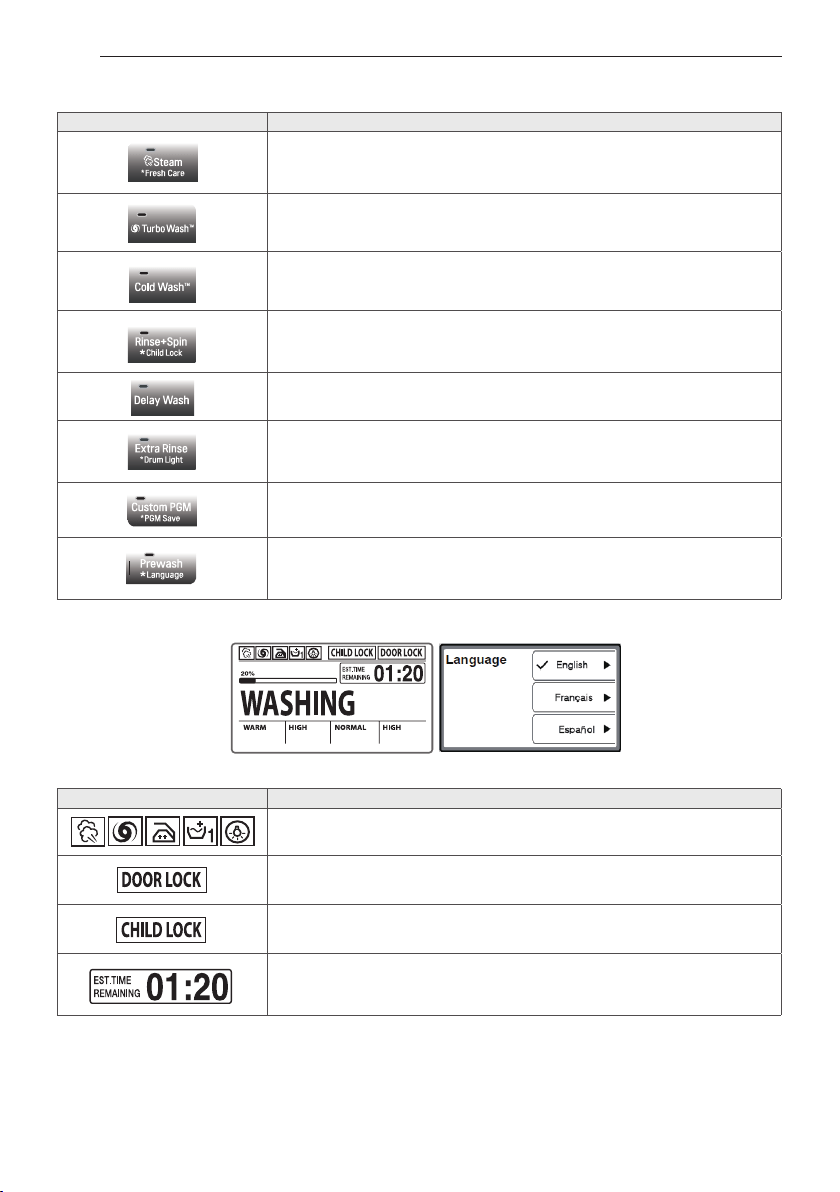
10
INTRODUCCIÓN A SU LAVADORA
Funcionamiento (continúa)
Pantalla
Botón Descripción
y
(Presionar antes de comenzar el ciclo de lavado) Utilice la opción Steam (vapor) para
un poder de limpieza adicional (consulte la página 27).
y
(Presionar y mantener durante 3 segundos) Fresh Care (cuidado fresco) seca la ropa
para evitar arrugas (consulte la página 26).
y
Utilice el botón Turbo Wash (lavado rápido) para ahorrar tiempo.
(Consulte la página 27).
y
Utilice la opción Cold Wash (lavado en frío) para ahorrar en el consumo de energía
(Consulte la página 27).
y
(Presionar antes del ciclo de lavado) Utilice la opción Rinse + Spin (enjuagar y
centrifugar) para enjuagar el detergente de una carga (consulte la página 26).
y
(Presionar y mantener durante el ciclo de lavado) Utilice la opción Child Lock (bloqueo
infantil) para Bloquear/Desbloquear los controles (consulte la página 28).
y
Utilice el botón Delay Wash (retrasar el lavado) para retrasar el horario de comienzo
del ciclo (consulte la página 27).
y
(Presionar antes del ciclo de lavado) Utilice la opción Extra Rinse (enjuague adicional)
para agregar un enjuague adicional al ciclo seleccionado. (Consulte la página 26).
y
(Presionar y mantener durante el ciclo de lavado) El tambor está equipado con una luz
LED blanca que se enciende cuando la lavadora está encendida (Consulte la página 26)
y
Utilice el botón Custom PGM (PGM personalizado) para guardar una combinación
personalizada de configuraciones que utiliza con frecuencia.
y
Utilice la opción Prewash (prelavado) para prelavar la ropa sucia que está muy sucia y
manchada (consulte la página 26).
y
(Presionar y mantener 3 segundos) Le permite cambiar el idioma que aparece en la
pantalla. (Consulte la página 28)
Icono desplegado Descripción
y
Esta parte de la pantalla muestra las opciones configuradas. (Steam, Turbo Wash,
Fresh Care, Extra Rinse o Drum Light)
y
Indica que la puerta está trabada. La puerta de la lavadora se trabará mientras la
lavadora está en funcionamiento. La puerta se puede destrabar presionando el
botón Strat/Pause para detener la lavadora.
y
Cuando Child Lock está activado, aparecerá el indicador de Child Lock y todos
los botones estarán desactivados excepto el botón Rinse+Spin. Esto evita que los
niños cambien los ajustes mientras la lavadora está en funcionamiento.
y
Cuando se presiona el botón Strat/Pause, la lavadora detecta automáticamente
la carga a lavar (su peso) y optimiza el tiempo de lavado en base al ciclo y a las
opciones seleccionados. Entonces la pantalla indicará el tiempo estimado restante
para el ciclo de lavado seleccionado.
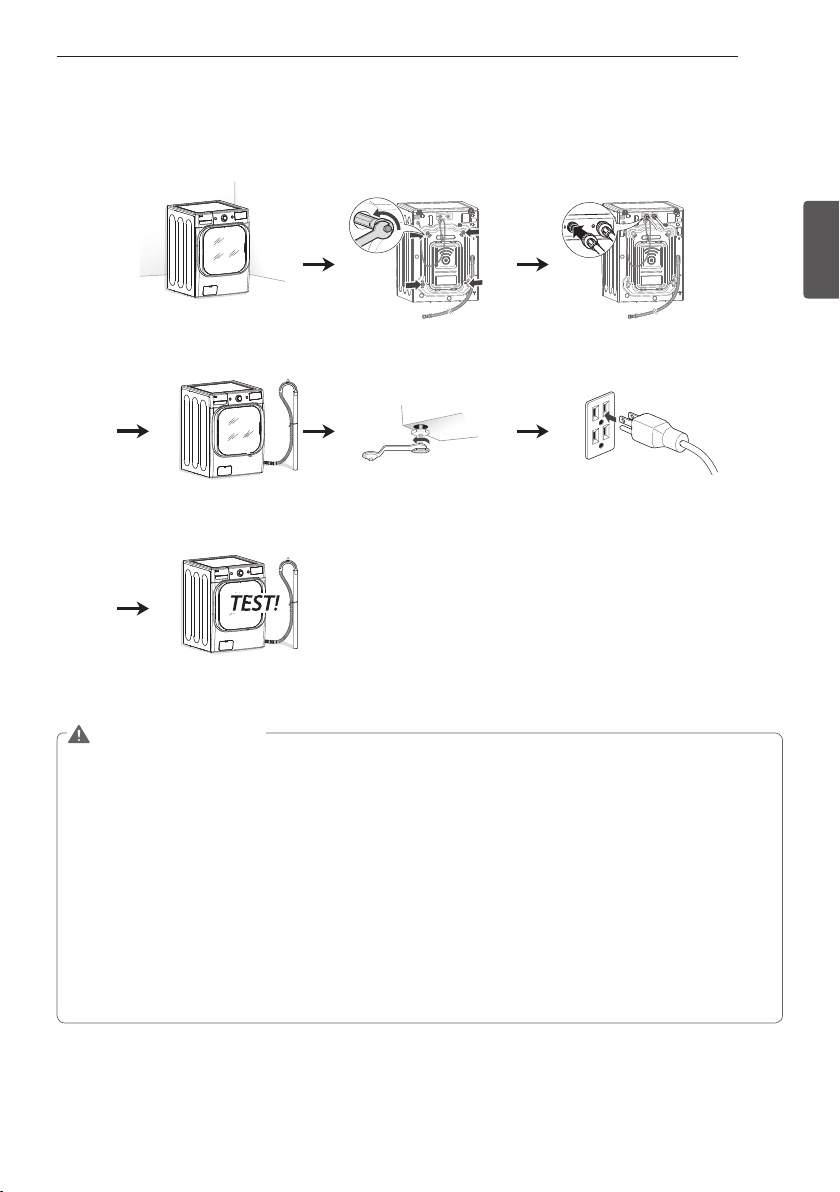
11
ESPAÑOL
INSTRUCCIONES PARA LA INSTALACIÓN
INSTRUCCIONES PARA LA INSTALACIÓN
Previsualizar el orden de instalación
ADVERTENCIA
y
¡La lavadora es pesada! Se necesitan dos o más personas para trasladar y desempaquetar la lavadora.
Si no se respeta esta advertencia, podrá sufrir lesiones en la espalda o de otro tipo.
y
No almacene ni instale la lavadora en lugares expuestos a temperaturas de congelación ni a inclemen-
cias meteorológicas.
Si no se cumple con esta advertencia, se podrán producir lesiones graves,
incendios, descargas eléctricas o muerte.
y
Conecte correctamente a tierra la lavadora cumpliendo todas las normativas y ordenanzas.
Si no se
cumple con esta advertencia, se podrán producir lesiones graves, incendios, descargas eléctricas
o muerte.
y
Con el fin de reducir el riesgo de descargas eléctricas no instale la lavadora en espacios húmedos.
Si no se cumple con esta advertencia, se podrán producir lesiones graves, incendios, descargas
eléctricas o muerte.
y
La apertura de la base no debe estar obstruida por una alfombra cuando la lavadora se instala
sobre un piso alfombrado.
y
No elimine la clavija de conexión a tierra. No use un adaptador o prolongador.
Enchufe en una toma
de corriente con conexión a tierra de 3 clavijas. Si no se cumple con esta advertencia, se podrán
producir lesiones graves, incendios, descargas eléctricas o muerte.
Revise y escoja el lugar
apropiado
Desempaque y retire los
pernos de transporte
Conecte los conductos
de agua
Conecte el conducto
de desagüe
Nivele la lavadora Enchufe el cable de alimen-
tación y conexión a tierra
Prueba de funcionamiento
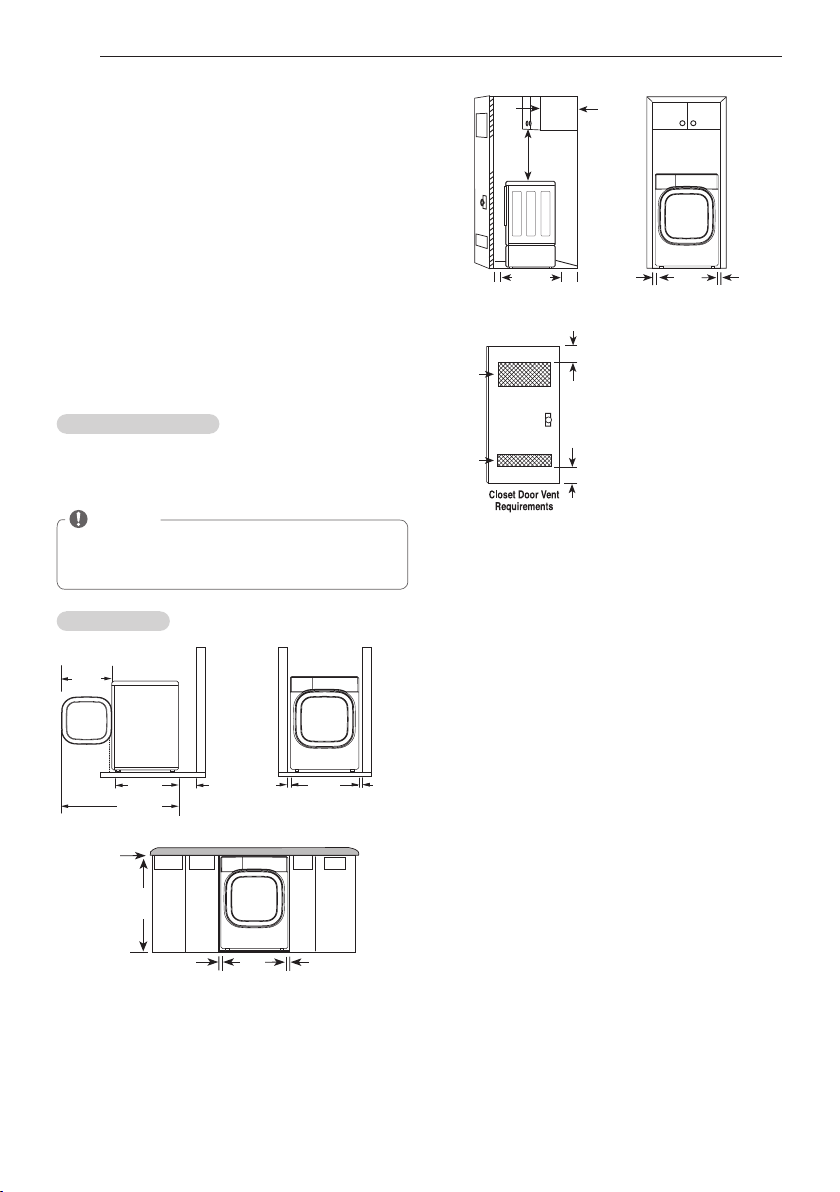
12
INSTRUCCIONES PARA LA INSTALACIÓN
Revisión y elección del lugar apropiado
Instale la lavadora sobre un suelo firme que sea
lo suficientemente fuerte y rígido para soportar el
peso de la lavadora, incluso cuando está cargada
a su capacidad máxima, sin que se flexione o re-
bote. Si el suelo se flexiona mucho, quizás deba
reforzarlo para hacerlo más rígido. Si el suelo
no es sólido, puede causar fuertes vibraciones y
ruidos.
1 Limpie el piso antes de la instalación.
- Asegúrese de elegir un suelo sólido y suave.
2 Se necesitan dos o más personas para mover
y desempaquetar la lavadora.
3 Deje espacio suficiente entre las paredes y la
lavadora para su instalación.
Requisitos de espacio
Debe dejar espacio suficiente para los conductos
de agua, el conducto de desagüe y el flujo de
aire.
NOTA
y
No olvide tener en cuenta las molduras de
paredes, puertas o piso, que podrían aumen-
tar la distancia de separación necesaria.
Espacios libres
4"
(10 cm)
33.1"
(84 cm)
57.9"
(147 cm)
24.8"
(63cm)
29"
73.6 cm
1"
(2.5 cm)
1"
(2.5 cm)
24 in.
2*
(155 cm
2
)
18" min.*
(45.7 cm)
1"*
(2.5 cm)
33.1"
(84cm)
5"**
(12.7 cm)
48 in.
2*
(310 cm
2
)
14" max.*
(35.6 cm)
3"
*
(7.6 cm)
3"
*
(7.6 cm)
1"
(2.5 cm)
29"
(73.6 cm)
1"
(2.5 cm)
1"*
(2.5 cm)
5"**
(12.7 cm)
14" max.*
(35.6 cm)
18" min.*
(45.7 cm)
33.1"
(84 cm)
0"
(0 cm)
40.8"
(103.6 cm)
1"
(2.5 cm)
29"
(73.6 cm)
1"
(2.5 cm)
24 in.
2*
(155 cm
2
)
18" min.*
(45.7 cm)
1"*
(2.5 cm)
33.1"
(84cm)
5"**
(12.7 cm)
48 in.
2*
(310 cm
2
)
14" max.*
(35.6 cm)
3"
*
(7.6 cm)
3"
*
(7.6 cm)
1"
(2.5 cm)
29"
(73.6 cm)
1"
(2.5 cm)
1"*
(2.5 cm)
5"**
(12.7 cm)
14" max.*
(35.6 cm)
18" min.*
(45.7 cm)
33.1"
(84 cm)
0"
(0 cm)
40.8"
(103.6 cm)
1"
(2.5 cm)
29"
(73.6 cm)
1"
(2.5 cm)
24 in.
2*
(155 cm
2
)
18" min.*
(45.7 cm)
1"*
(2.5 cm)
33.1"
(84cm)
5"**
(12.7 cm)
48 in.
2*
(310 cm
2
)
14" max.*
(35.6 cm)
3"
*
(7.6 cm)
3"
*
(7.6 cm)
1"
(2.5 cm)
29"
(73.6 cm)
1"
(2.5 cm)
1"*
(2.5 cm)
5"**
(12.7 cm)
14" max.*
(35.6 cm)
18" min.*
(45.7 cm)
33.1"
(84 cm)
0"
(0 cm)
40.8"
(103.6 cm)
1"
(2.5 cm)
29"
(73.6 cm)
1"
(2.5 cm)
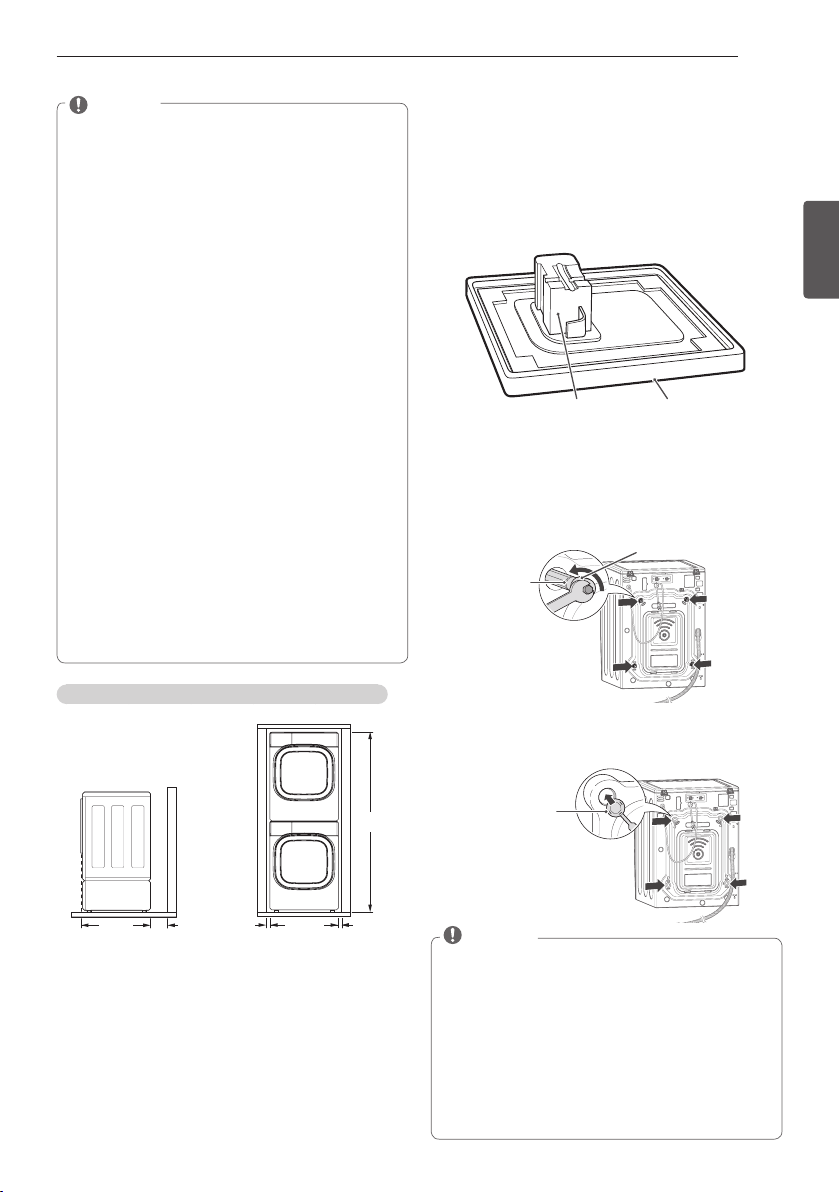
13
ESPAÑOL
INSTRUCCIONES PARA LA INSTALACIÓN
NOTA
y
El piso debe ser lo suficientemente fuerte y
rígido para soportar el peso de la lavadora,
cuando está cargada a su capacidad máxi-
ma, sin flexionarse ni rebotar. Si su piso se
flexiona demasiado, quizás deba reforzarlo
para hacerlo más rígido. Es posible que un
piso que resulta adecuado para una lavadora
que se carga desde arriba no sea lo suficien-
temente rígido para una lavadora de carga
frontal, debido a la diferencia de velocidad y
dirección de centrifugado. Si el suelo no es
sólido, es posible que su lavadora vibre y que
usted escuche y sienta la vibración en toda la
casa.
y
Antes de instalar la lavadora, asegúrese de
que el piso esté limpio, seco y libre de polvo,
suciedad, agua y aceites, de forma que las pa-
tas de apoyo del electrodoméstico no puedan
deslizarse con facilidad. Las patas de apoyo
que pueden moverse o deslizarse sobre el
piso, pueden contribuir a la vibración y ruido
excesivos derivados de un contacto deficiente
con el piso.
y
Si debe usar una bandeja de goteo, tenga
sumo cuidado de seguir las instrucciones que
se brindan con la bandeja y asegúrese de que
las patas de apoyo estén bien ajustadas para
que estén firme y equitativamente apoyadas
sobre la bandeja. El uso de bandejas de goteo
y no nivelar adecuadamente la máquina pue-
de resultar en una mayor vibración y ruido
durante el funcionamiento.
Instalación sobre un pedestal o kit de apilado
33.1"
(84 cm)
4"
(10 cm)
29"
(73.6cm)
1"
(2.5 cm)
1"
(2.5 cm)
81.61"
(207.3 cm)
Desempaquetado y retirado de los pernos de transporte
Al quitar la lavadora de la base de cartón, asegúrese de
quitar el soporte de espuma del tambor que hay en el
medio de la base de cartón. Si debe recostar la lavadora
para quitar los materiales de empaquetamiento de la
base, siempre debe recostarla con cuidado sobre uno de
sus lados. NUNCA recueste la lavadora sobre su parte
frontal o posterior.
Bloque de espuma
de la tina
Base de
carton
1
Comenzando con los dos pernos de transporte
inferiores, utilice la llave inglesa (incluida) para
aflojar por completo los cuatro pernos, haciéndo-
los girar en el sentido contrario a las agujas del
reloj. Quite los pernos moviéndolos un poco de
lado a lado mientras tira de ellos para sacarlos.
Perno de
transporte
Retén
2 Encuentre los cuatro tapones para agujeros
en el paquete de accesorios e instálelos en los
agujeros para los pernos de transporte.
Tapa
NOTA
y
Guarde los pernos para un uso futuro. Para
evitar dañar componentes internos, NO trans-
porte la lavadora sin haber reinstalado los
pernos de transporte.
y
No quitar los retenes y pernos de transporte
puede causar fuertes vibraciones y ruidos, lo
que puede resultar en daños permanentes a
la lavadora. El cable está asegurado a la parte
trasera de la lavadora con un perno de trans-
porte para ayudar a evitar el funcionamiento
con los pernos de transporte colocados.
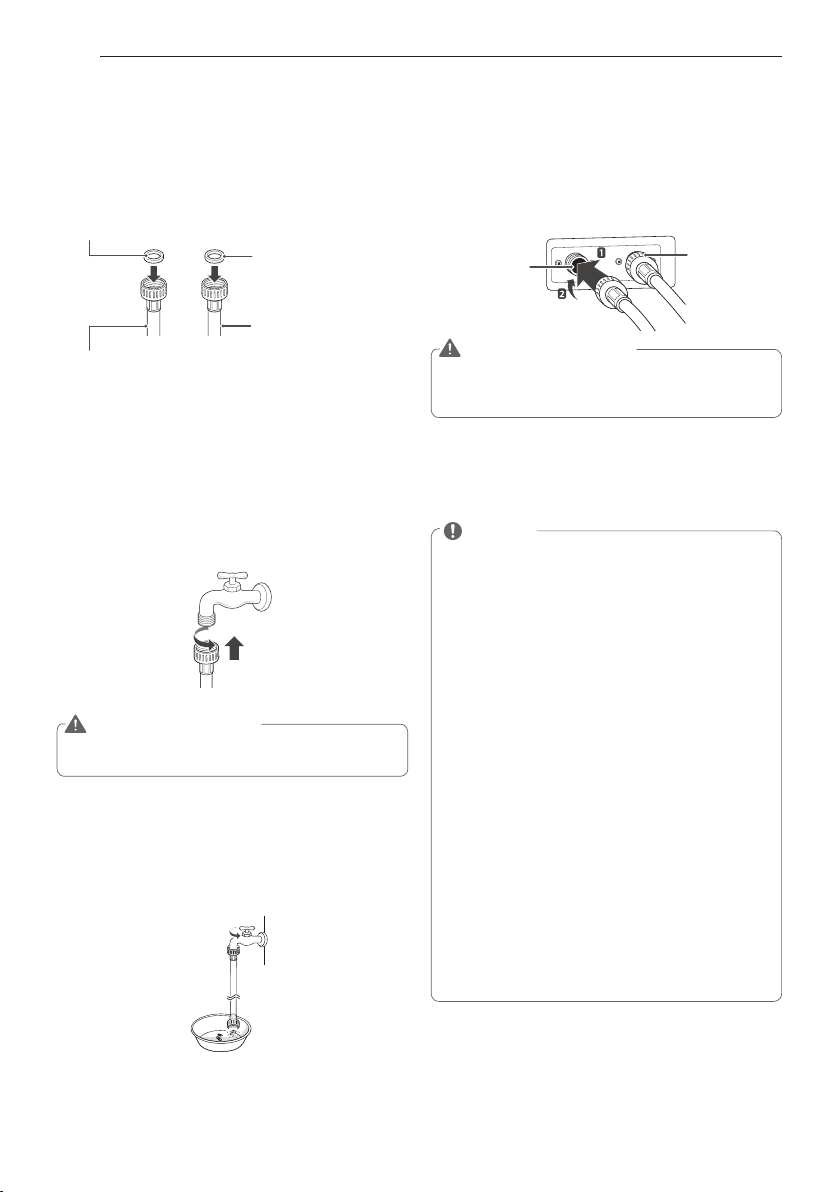
14
INSTRUCCIONES PARA LA INSTALACIÓN
Conexión de los conductos de agua
1 Revise los sellos de goma de ambos extremos
de la manquera.
- Inserte un sello de goma en la parte roscada
de cada manguera para evitar pérdidas.
Sello de goma
Manguera de agua
(a la llave)
Sello de goma
Manguera de agua (para
la entrada de agua a la
lavadora)
2 Conecte las mangueras de suministro de agua
a las llaves de paso de agua caliente y fría y
apriete las conexiones con la mano. A conti-
nuación, utilice unos alicates para apretarlas
otros 2/3 de vuelta.
- Conecte la manguera azul a una llave de
agua fría y la manguera roja a una llave de
agua caliente.
ADVERTENCIA
y
No sobreajuste las mangueras.
Podría resultar
en daños a las conexiones.
3 Después de conectar la manguera de entrada a
las llaves de agua, abra las llaves de agua para
enjuagar y quitar cualquier sustancia externa
(tierra, arena o aserrín) de las líneas de agua.
Permita que el agua se drene en un balde, y
revise la temperatura del agua.
4 Conecte las mangueras a las entradas de agua
a mano de manera que queden Justas y luego
apriételas otros 2/3 de vuelta usando unas
pinzas.
- Conecte la manguera azul a la entrada de
agua fría y la manguera roja a la entrada de
agua caliente.
Entrada de
agua fría
Entrada
de agua
caliente
ADVERTENCIA
y
No sobreajuste las mangueras.
Sobreajustar-
las puede dañar las válvulas, lo que resulta-
ría en una pérdida y daños a la propiedad.
5 Busqué pérdidas abriendo las llaves.
- Si hay una pérdida de agua, repase los pasos
del 1 al 4
NOTA
y
Para su seguridad y para una vida útil más
prolongada del producto, utilice sólo compo-
nentes autorizados. El fabricante no es res-
ponsable del funcionamiento incorrecto del
producto o accidentes causados por el uso
de piezas no autorizadas.
y
Utilice mangueras nuevas para la instalación
de la lavadora. No vuelva a utilizar mangue-
ras viejas. Utilice únicamente las mangueras
suministradas con la lavadora.
y
LG no recomienda el uso de otras mangue-
ras adquiridas en los comercios.
y
Revise periódicamente las mangueras por si
hubiera grietas, fugas y desgaste, y sustitú-
yalas cada 5 años.
y
No estire las mangueras de agua intencio-
nalmente y asegúrese de que no queden
aplastadas por otros objetos.
y
La presión de las tuberías de agua debe ser
entre 20 psi y 120 psi (138–827 kPa). Si la
presión de la tubería de agua es superior a
120 psi (827 kPa), debe instalarse una válvula
reductora de presión.
y
Para el óptimo desempeño de su lavadora,
la temperatura de su agua caliente debe ser
entre 120-135˚F (48-57˚C) y el de su agua fría
debe ser 60˚F(15˚C).
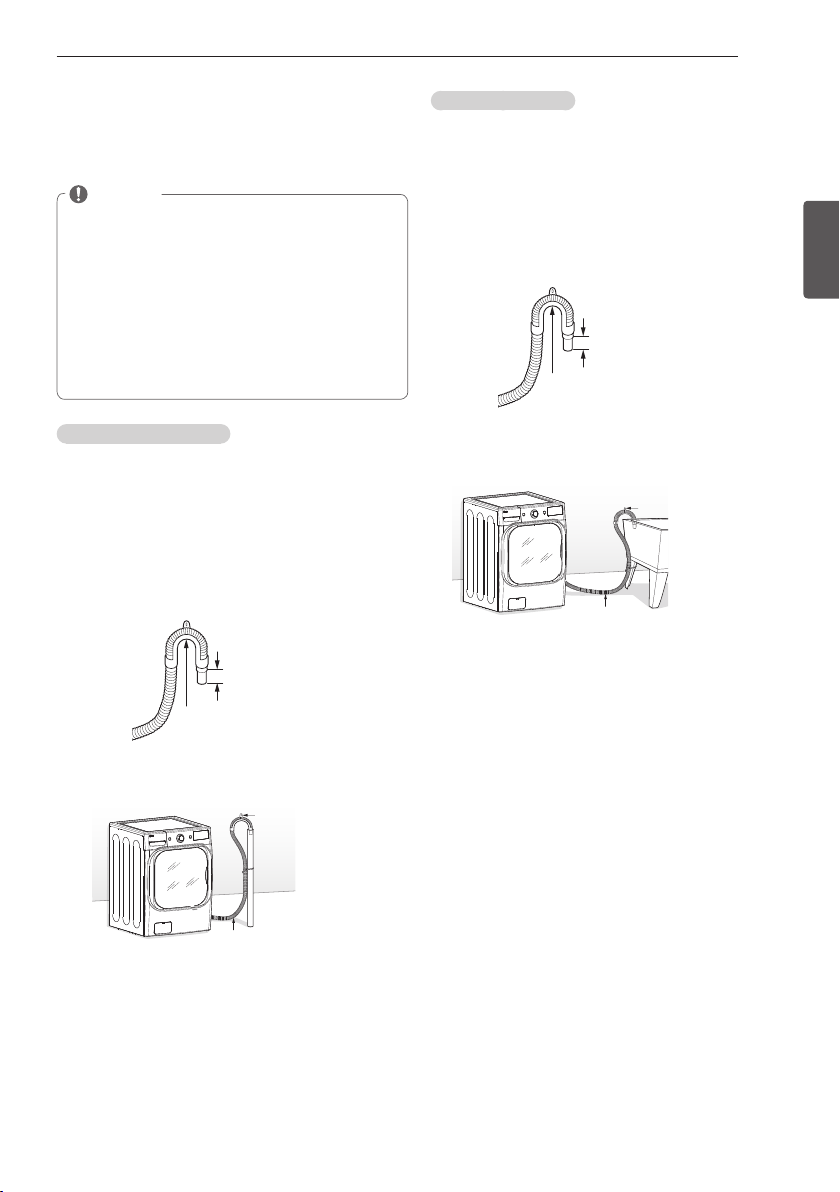
15
ESPAÑOL
INSTRUCCIONES PARA LA INSTALACIÓN
Conexión del conducto de desagüe
Asegure la manguera de desagüe en su lugar
para evitar que se mueva y las pérdidas.
NOTA
y
La manguera de desagüe siempre debe estar
asegurada adecuadamente. No asegurar
adecuadamente la manguera de desagüe
puede resultar en inundación y avería.
y
La altura total del extremo de la manguera
no debe exceder las 96 pulgadas (244,8 cm)
desde la parte inferior de la lavadora.
y
El drenaje debe instalarse según todos los
códigos y regulaciones locales vigentes.
y
Asegúrese de que las mangueras no estén
estiradas, pinzadas, aplastadas o retorcidas.
Uso de un tubo vertical
1 Sujete el extremo de la manguera al soporte
tipo codo.
- Conecte el soporte tipo codo a no más de
4 pulgadas (10 cm) desde el extremo de la
manguera de desagüe. Si la manguera de
desagüe se extiende más de 4 pulgadas (10
cm) más allá del soporte tipo codo, se podría
esparcir moho o microorganismos al interior
de la lavadora.
No más de 4
pulgadas(10 cm)
Soporte tipo codo
2 Inserte el extremo de la manguera de desagüe
en el tubo vertical.
Soporte tipo codo
Manguera de desagüe
3 Use una correa para asegurar la manguera de
desagüe en su lugar.
Uso de un lavadero
1 Sujete el extremo de la manguera al soporte
tipo codo.
- Conecte el soporte tipo codo a no más de
4 pulgadas (10 cm) desde el extremo de la
manguera de desagüe. Si la manguera de
desagüe se extiende más de 4 pulgadas (10
cm) más allá del soporte tipo codo, se podría
esparcir moho o microorganismos al interior
de la lavadora.
No más de 4
pulgadas(10 cm)
Soporte tipo codo
2 Cuelgue el extremo de la manguera de des-
agüe del borde del lavadero.
Soporte tipo codo
Manguera de desagüe
3 Use una correa para asegurar la manguera de
desagüe en su lugar.
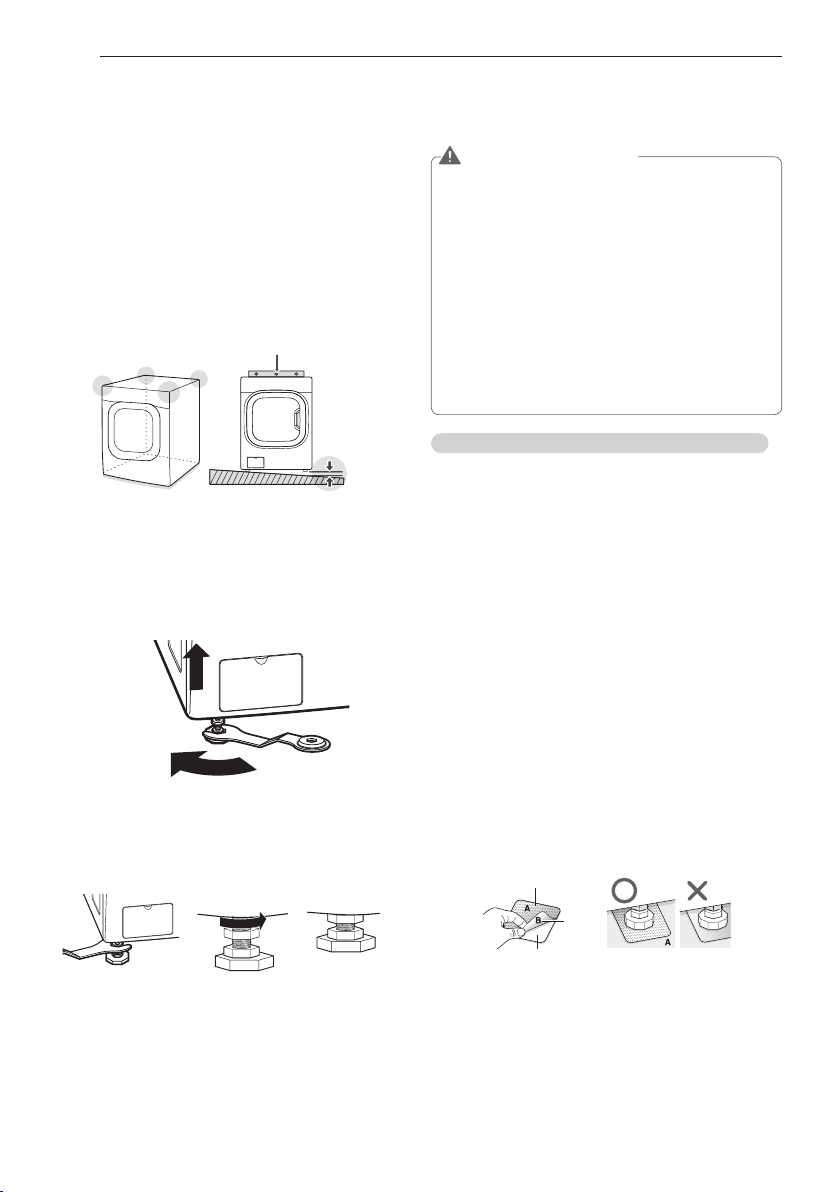
16
INSTRUCCIONES PARA LA INSTALACIÓN
Nivelación de la lavadora
La tina de su nueva lavadora gira a velocidades
muy elevadas. Para minimizar la vibración, los
ruidos y los movimientos no deseados, el suelo
debe ser una superficie perfectamente nivelada y
sólida.
1 Compruebe que la lavadora esté nivelada.
- Compruebe la nivelación sacudiendo los bor-
des superiores de la lavadora o colocando un
nivel sobre la lavadora. La pendiente debajo
de la lavadora no debe exceder 1º, y las cua-
tro patas de apoyo deben estar firmemente
apoyadas sobre el suelo.
1º
Nivelar
2 Haga girar las patas niveladoras inferiores en
el sentido de las agujas del reloj para nivelar
la lavadora.
- Girar las patas niveladoras inferiores en el
sentido de las agujas del reloj eleva la lava-
dora.
Elevar
3 Haga girar las contratuercas en el sentido con-
trario a las agujas del reloj y ajústelas cuando
la lavadora esté nivelada.
Ajustar los 4 tornillos
de fijación de manera
segura utilizando la
llave inglesa.
4 Vuelva a comprobar que la lavadora esté nive-
lada.
- Empuje o sacuda suavemente los bordes
superiores de la lavadora para asegurarse de
que la lavadora no se mueva.
- Si la lavadora se mueve, repita los pasos del
1 al 3.
ADVERTENCIA
y
Usar la lavadora sin nivelar puede causar
que se averíe, produciendo vibraciones y
ruidos excesivos.
y
Si está instalando la lavadora sobre el pedes-
tal opcional, debe ajustar las patas de apoyo
del pedestal para nivelar la lavadora. Las
patas de apoyo de la lavadora deben minimi-
zarse y las contratuercas deben girarse en el
sentido contrario a las agujas del reloj para
asegurarlas.
y
Solo usar las patas de apoyo al nivelar la
lavadora. Si eleva las patas de apoyo de
manera innecesaria, puede causar que la
lavadora vibre de manera anormal.
Uso de almohadillas antideslizantes (opcional)
Si instala la lavadora sobre una superficie res-
baladiza, es posible que se mueva debido a la
vibración excesiva. La nivelación incorrecta de la
lavadora puede causar avería a causa del ruido
y la vibración. Si esto ocurre, coloque las almo-
hadillas antideslizantes debajo de las patas de
apoyo y ajuste el nivel.
1 Limpie el piso para colocar las almohadillas
antideslizantes.
- Utilice un trapo seco para quitar objetos
externos o humedad. Si el suelo queda hú-
medo, es posible que las almohadillas anti-
deslizantes se patinen.
2 Ajuste el nivel después de colocar la lavadora
en el área de instalación.
3 Coloque el lado adhesivo de la almohadilla
antideslizante en el suelo.
- Resulta más efectivo instalar las almohadillas
antideslizantes debajo de las patas delante-
ras. Si resulta difícil colocar las almohadillas
debajo de las patas delanteras, colóquelas
debajo de las patas traseras.
Este cara haica
arriba
Lado
adhesivo
Quitar el
soporte
4
Vuelva a comprobar que la lavadora esté nive-
lada.
- Empuje o sacuda suavemente los bordes
superiores de la lavadora para asegurarse de
que la lavadora no se mueva. Si la lavadora
se mueve, vuelva a nivelarla.
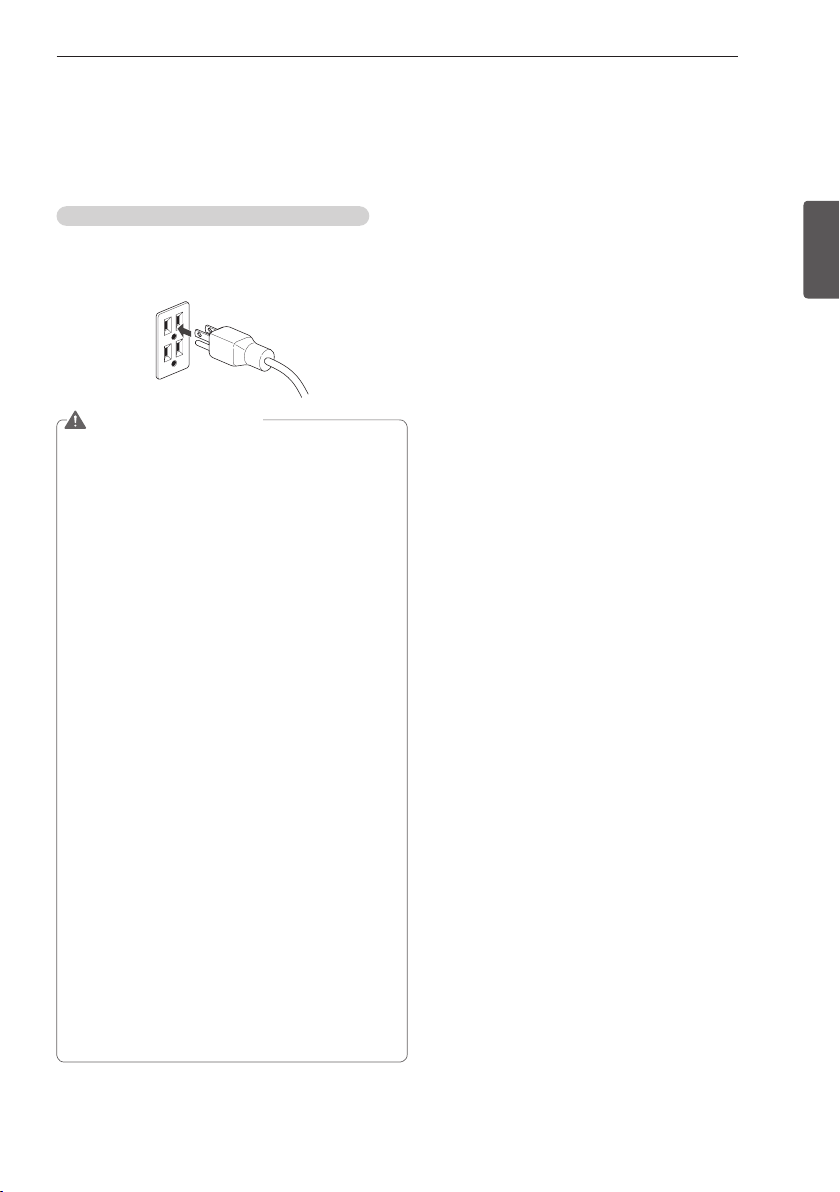
17
ESPAÑOL
INSTRUCCIONES PARA LA INSTALACIÓN
Enchufado del cable de alimentación y
conexión a tierra
Asegúrese de conectar la lavadora a tierra para
evitar un cortocircuito o una descarga eléctrica al
enchufarla.
Uso de una toma de corriente de 3 clavijas
Enchufe la toma de corriente sin conexión a tierra
adicional.
ADVERTENCIA
y
La toma de corriente debe estar dentro de un área
mínima 60 pulgadas (de 1,5 m) a cualquiera de los
lados de la lavadora.
y
El electrodoméstico y la toma de corriente deben
estar colocados de forma tal que se pueda acceder
al enchufe fácilmente.
y
No sobrecargar la toma de corriente con más de
un electrodoméstico.
y
La toma de corriente deberá estar conectada a tie-
rra de acuerdo con los códigos y las regulaciones
de cableado actuales.
y
Se recomienda utilizar un fusible de demora de
tiempo o disyuntor.
y
Es responsabilidad y obligación personal del
dueño del producto pedir a un electricista califi-
cado que instale la toma de corriente adecuada.
y
No use un cable o enchufe de alimentación gastado
o dañado. Reemplace o repárelo de inmediato.
No
hacerlo puede resultar en una avería, incendio,
descarga eléctrica o incluso la muerte.
y
No modifique el cable de alimentación y tenga
cuidado de no dañarlo al instalar o mover la lava-
dora.
No hacerlo puede resultar en una avería,
incendio, descarga eléctrica o incluso la muerte.
y
Asegúrese de que la lavadora esté conectada a
tierra.
y
Conecte la lavadora a una toma de corriente con
descarga a tierra que se adecúe a las especificacio-
nes antes de su uso.
No hacerlo puede resultar
en un incendio, descarga eléctrica o avería.
y
No use un adaptador o prolongador.
La lavadora
debería estar siempre conectada a un enchufe
individual con un índice de voltaje equivalente
al que figura en su etiqueta de características
técnicas. No hacerlo puede resultar en un incen-
dio, descarga eléctrica o falla.
y
No dañe ni corte la clavija a tierra del cable de
alimentación.
Hacerlo podría causar la avería del
producto, descarga eléctrica, incendio o incluso
la muerte.
Prueba de funcionamiento
Compruebe si la máquina está instalada adecua-
damente y haga un ciclo de prueba.
1 Cargue la lavadora con 6 libras de ropa sucia.
2 Presione el botón "Power".
3 Presione el botón "Power".
4 Presione el botón Start/Pause.
- El ciclo de lavado comienza.
5 Compruebe que se suministre agua, que la
lavadora no se sacuda ni vibre de manera
excesiva, y que desagote bien durante el ciclo
de centrifugado.
- Si hay una pérdida de agua durante el sumi-
nistro de agua, consulte la página 14, Co-
nexión de los conductos de agua, para conec-
tarlos adecuadamente.
- Si la lavadora de mece o sacude y vibra de
manera excesiva, consulte la página 16,
Nivelación de la lavadora, para volver a nive-
larla.
- Si no funciona el desagüe, consulte la pági-
na 15, Conexión del conducto de desagüe,
para instalarlo adecuadamente.

18
PREPARACIÓN
PREPARACIÓN
Clasificación de las cargas de lavado
Precauciones para el cuidado de la prendas antes del ciclo de lavado
Lea y siga los siguientes pasos para evitar que las prendas se encojan o dañen.
u Compruebe que todos los bolsillos están
vacíos.
- Objetos como clips, cerillas, bolígrafos,
monedas y llaves pueden dañar tanto la
lavadora como las prendas.
u Cierre cremalleras, broches y cordones para
evitar enganches o enredos en otras prendas.
u Haga un tratamiento previo a las áreas muy
manchadas antes de lavar las prendas.
- Hacerlo producirá un resultado limpio y libre de
manchas.
u Mezcle prendas grandes y pequeñas en la
misma carga. Cargue primero las prendas
grandes.
u Las prendas grandes no deben ocupar más de
la mitad de la carga total de la colada.
u La lavadora se puede cargar completamente,
pero el tambor no debe estar abarrotado con
prendas.
- La puerta de la lavadora se debería cerrar
con facilidad.
u No lave una sola prenda, excepto prendas
abultadas, como por ejemplo frazadas.
Asegúrese de lavar la ropa en tipos de cargas
similares.
- Lavar una sola prenda pequeña podría
causar que la tina se desequilibre, causando
vibraciones y ruido.
u No lave prendas a prueba de agua.
- Esto podría causar una vibración anormal, o
hacer que la carga rebote, lo que podría
dañar la tina.
u Compruebe que no haya objetos externos en el
sello de la puerta y tenga cuidado de que no
queden prendas atrapadas allí.
- Los objetos externos en el sello de la puerta
podrían manchar la ropa, y si queda alguna
prenda atrapada en el sello de la puerta, se
podría producir una pérdida de agua.
u Lave la ropa interior o las prendas pequeñas y
livianas en una red de lavandería.
- Las prendas pequeñas y livianas podrían
quedar atrapadas en el sello de la puerta, y el
gancho de un sostén podría dañar otras
prendas o incluso la tina.
u Cepille las prendas para quitarles la tierra, el
polvo y los cabellos antes de lavarlas.
- La ropa sucia podría no quedar limpia si hay
tierra o arena en las prendas, o las prendas
podrían dañarse debido al roce de las
partículas contra las telas trasparentes.
u Lave las frazadas de manera individual.
- Lavar más de una frazada por vez podría
causar un mal lavado debido a un enredo o
carga desequilibrada.
u Siempre separe las prendas según sus colores
y lávelas por separado para evitar que las
prendas destiñan y manchen otras prendas.
- Las prendas podrían dañarse o mancharse
porque los tintes de las prendas destiñen, o a
causa de la transferencia de objetos externos
que se transfieren de una prenda a otra.
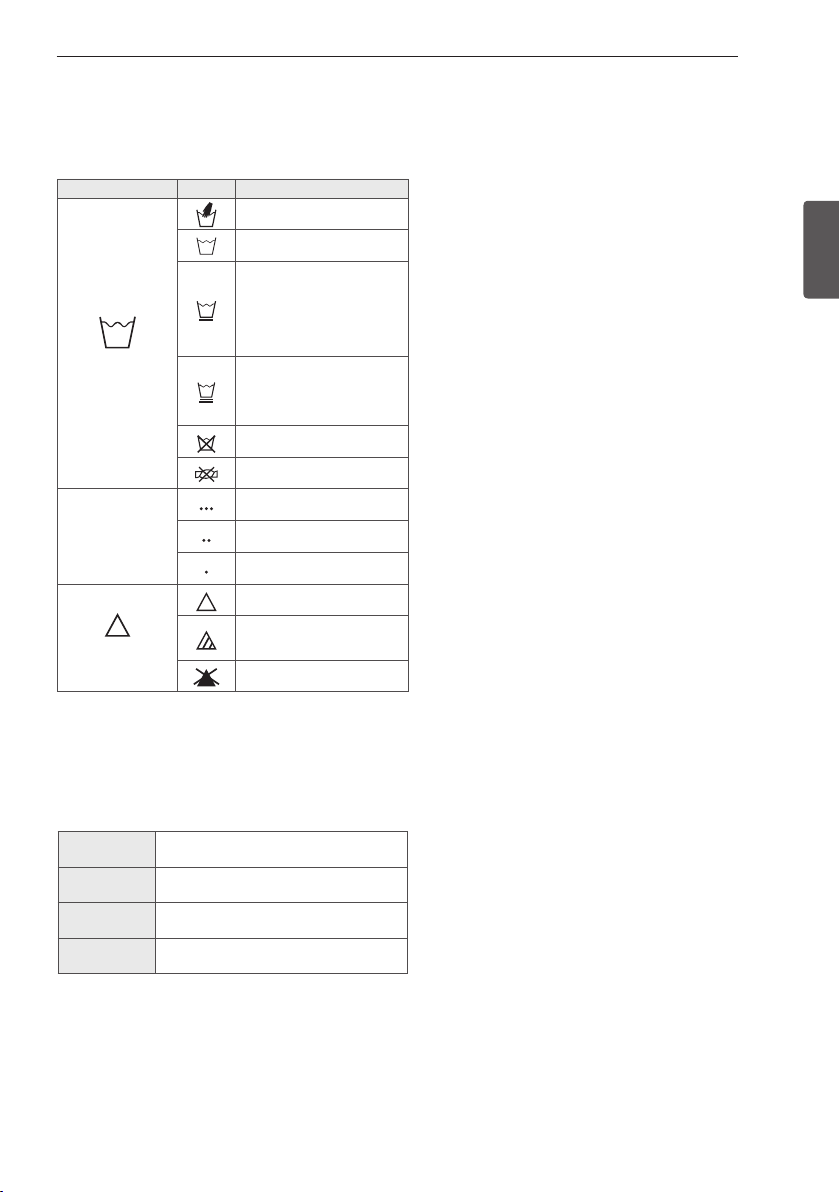
19
ESPAÑOL
PREPARACIÓN
Categoría Etiqueta Instrucciones
Lavado
Lavar a mano
Lavar a máquina, ciclo
normal
Usar el ajuste de la
lavadora para prendas de
planchado permanente/
antiarrugas (que tiene
un descanso o rocío frío
antes del centrifugado
reducido)
Usar ajuste de la lavadora
para ciclo suave/prendas
delicadas (agitación lenta
y/o menor tiempo de
lavado).
No lavar
No escurrir
Temperatura del
agua
Caliente
Tibia
Fría/Fresca
Blanqueado
Cualquier blanqueador
(cuando sea necesario)
Solo blanqueadores
sin cloro (cuando sea
necesario)
No blanquear
Colores
Prendas blancas / colores claros /
colores oscuros
Suciedad
Muy sucias / normal / no muy
sucias
Material
Prendas delicadas / cuidado fácil /
algodones resistentes
Pelusa
Prendas productoras de pelusa /
prendas recolectoras de pelusa
Etiquetas de cuidado de las prendas
La mayoría de las etiquetas de las prendas
incluyen etiquetas con instrucciones sobre sus
cuidados específicos.
Clasificación de la ropa sucia
Se recomienda clasificar y separar la ropa sucia
en cargas similares que se puedan lavar en el
mismo ciclo.
Consulte la siguiente tabla para clasificar y
separar la ropa
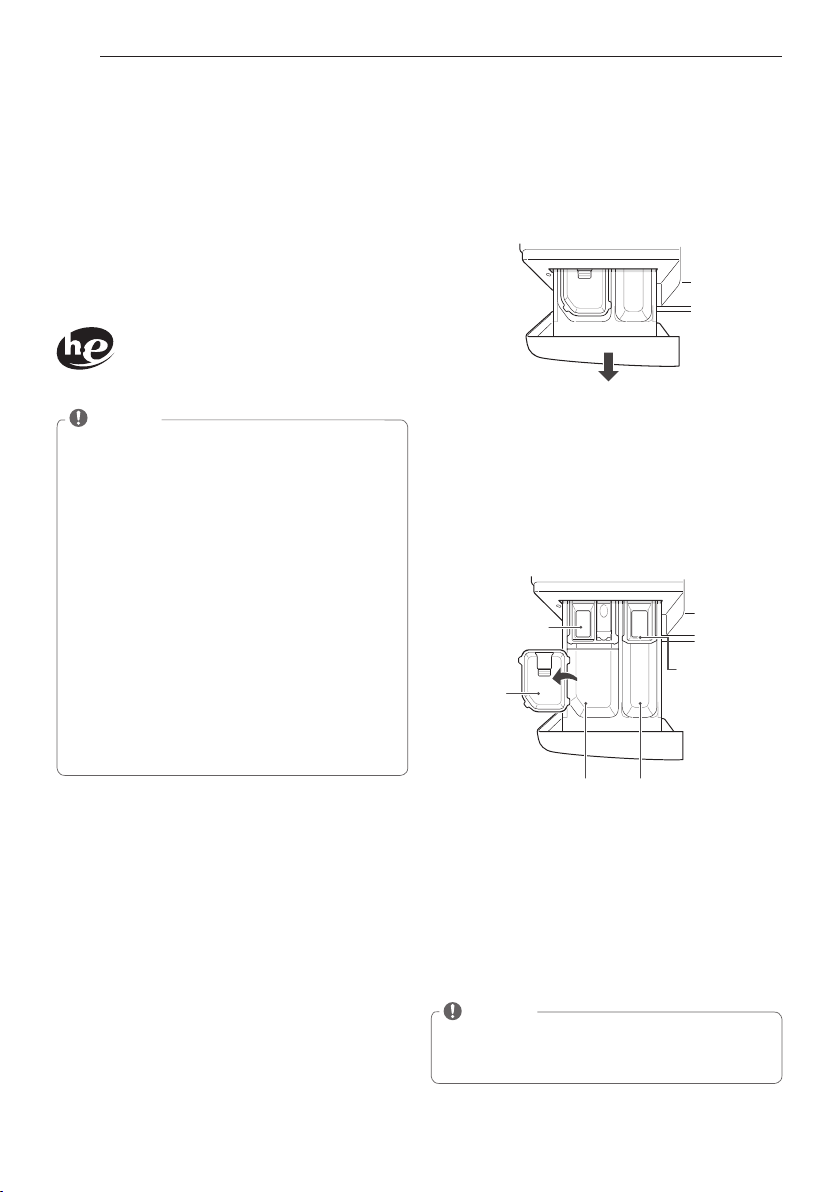
20
PREPARACIÓN
Cargando el dispensador
La gaveta dispensadora de detergente de la
lavadora tiene un compartimiento dispensador
para cada tipo de detergente. Agregue cada
detergente a su compartimiento correspondiente.
1 Tire de la gaveta dispensadora de detergente
para sacarla.
2 Agregue cada detergente a su compartimiento
correspondiente.
- Si usa un detergente líquido, compruebe que
el recipiente para detergente líquido esté en
su lugar.
- Si usa un detergente en polvo, retire el
recipiente para detergente líquido y coloque
el polvo en el compartimiento del detergente
de lavado principal.
Compartimiento
para blanqueador
líquido con cloro
Recipiente
para el
detergente
líquido
Compartimiento
del detergente
de lavado
principal
Compartimiento
para detergente
de prelavado
Compartimiento
para el
suavizante de
telas líquido
3 Cierre con cuidado la gaveta dispensadora de
detergente.
- Cerrar la gaveta dispensadora de detergente
de un golpe puede causar que el detergente
se desborde y pase a otro compartimiento, o
se vierta en la tina antes de lo programado.
NOTA
y
Es normal que quede una pequeña cantidad
de agua en los compartimientos del
dispensador al final de cada ciclo.
Uso de detergente/suavizante para
telas
Detergente recomendado
Asegúrese de usar un detergente de alta
eficiencia (HE, por sus siglas en inglés) para
lavadoras de carga frontal. Los detergentes HE se
disuelven de manera más eficiente y producen
menos espuma para garantizar un lavado y
enjuague eficiente. Use la cantidad correcta de
detergente según se indica en la etiqueta del
envase del detergente.
Diseñada especialmente para utilizar
sólo detergentes HE (alta eficiencia).
NOTA
y
Solo use detergentes HE, puesto que usar un
detergente regular puede producir un exceso
de espuma.
y
Los detergentes de HE generan menos
espuma y se disuelven de manera más
eficiente para mejorar el rendimiento del
lavado y del enjuague, además de ayudar a
mantener limpio el interior de la lavadora.
y
Use menos detergente si el agua es blanda.
y
Limpie inmediatamente cualquier derrame,
dado que los líquidos podrían dañar el
acabado y el panel de control de la lavadora.
y
Usar demasiado detergente puede causar
una acumulación en la tina, causando un
desempeño insatisfactorio y avería de la
máquina.
y
Si usa un detergente que no se disuelve con
facilidad o un detergente de alta viscosidad,
dejará un residuo en la tina, que podría no
enjuagarse bien.
21
ESPAÑOL
PREPARACIÓN
Compartimiento para blanqueador (agua lavandina / lejía / cloro / agua de Javel)
Este compartimiento contiene el blanqueador
de cloro líquido, que se dispensará de forma
automática en el momento adecuado durante el
ciclo de lavado.
NOTA
y
No agregue blanqueador con protector
de color líquido o en polvo a este
compartimiento.
y
Al agregar el blanqueador, respete siempre
las recomendaciones del fabricante. No
exceda la línea de llenado máximo. Usar
demasiado blanqueador puede dañar los
tejidos.
y
Nunca vierta el blanqueador de cloro líquido
sin diluir directamente en la carga o dentro
del tambor. Se pueden producir daños en el
tejido.
Compartimiento para suavizante
Este compartimiento contiene el suavizante
líquido, que se dispensará de forma automática
durante el ciclo de enjuague final.
NOTA
y
Al agregar el suavizante, respete siempre
las recomendaciones del fabricante. No
exceda la línea de llenado máximo. El uso
de demasiado suavizante puede manchar las
prendas.
y
Diluya el suavizante concentrado con agua
templada. No exceda la línea de llenado
máximo.
y
Nunca vierta el suavizante directamente en
la carga o dentro del tambor.
Compartimiento para detergente de prelavado
Agregue detergente líquido o en polvo a este
compartimiento cuando utilice la opción de
prelavado. Siempre utilice un detergente de alta
eficiencia (HE) con su lavadora.
NOTA
y
Si usa un detergente líquido para el lavado
principal, debe usar el accesorio recipiente
para detergentes líquidos en el dispensador
para lavado principal al usar la opción de
prelavado, para evitar que el detergente
líquido de lavado principal se dispense
inmediatamente.
y
Agregue la mitad del detergente
recomendado para el lavado principal para la
opción de prelavado. Por ejemplo, si el ciclo
de lavado principal requiere una medida
de detergente, agregue 1/2 medida para la
opción de prelavado.
Compartimiento para detergente del lavado principal
Este compartimiento contiene el detergente de
lavado para el ciclo de lavado principal, que se
agrega a la carga al principio del ciclo. Siempre
utilice un detergente de alta eficiencia (HE) con
su lavadora.
Al agregar el detergente, nunca exceda las
recomendaciones del fabricante. Si usa
demasiado detergente, puede suceder que en
lugar de diluirse se acumule en la ropa y en la
lavadora. Se puede usar tanto detergente líquido
como en polvo.
NOTA
y
Se puede agregar blanqueador líquido
o en polvo con protector de color al
compartimiento de lavado principal con un
detergente del mismo tipo.
y
Cuando use detergente líquido, asegúrese de
que el recipiente para el detergente líquido
y el inserto están en su sitio. No exceda la
línea de llenado máximo.
y
Cuando use detergente en polvo, retire el
recipiente e inserto para detergente líquido
del compartimiento. El detergente en polvo
no se dispensará si está puesto el recipiente
para detergente líquido.
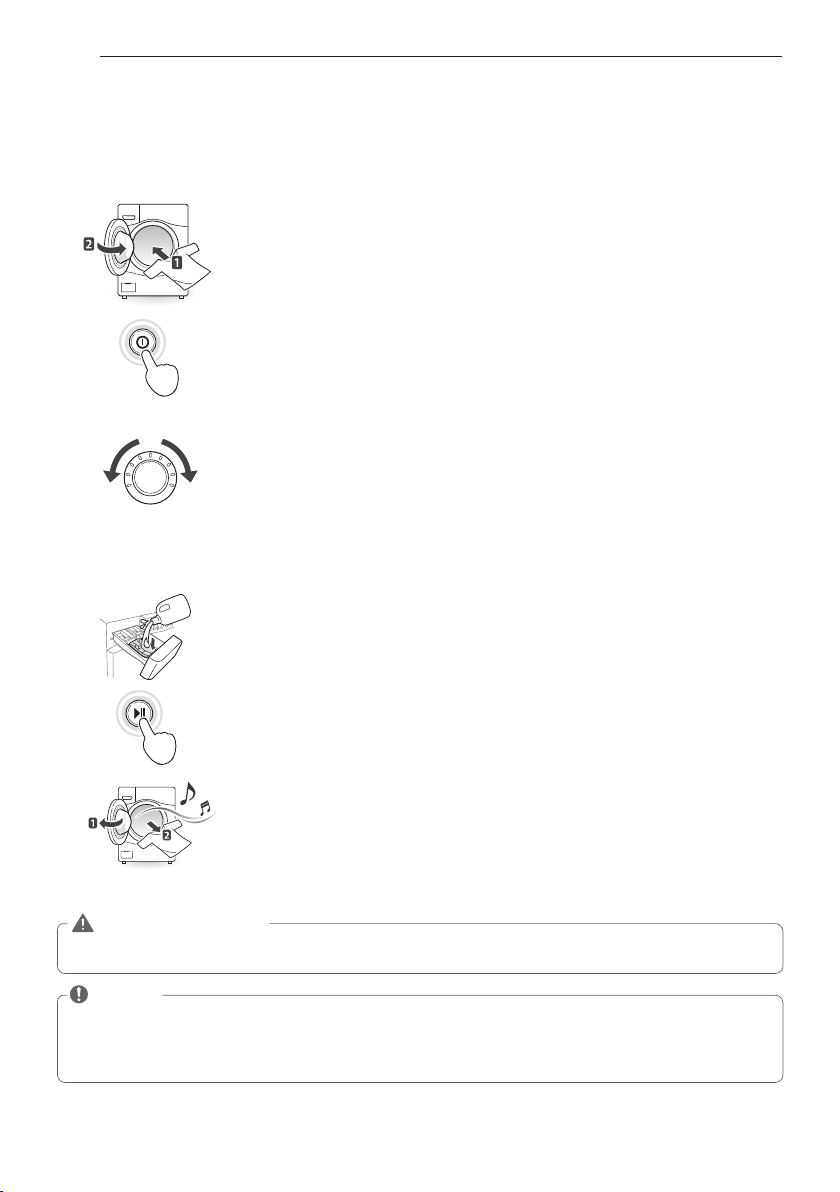
22
USO DE LA LAVADORA
USO DE LA LAVADORA
Funcionamiento básico
Cargue la ropa sucia en la lavadora y cierre la puerta.
1
2
3
4
5
6
Presione el botón "Power".
- Las luces alrededor de la perilla del selector se iluminarán y se emitirá un aviso
sonoro.
Gire la perilla del selector de ciclo para seleccionar el ciclo que desee.
- Los ajustes óptimos predeterminados se configuran automáticamente según
el ciclo de lavado. Consulte la página 23, Guía de ciclos, para obtener más
detalles sobre los ajustes predeterminados de cada ciclo.
- Consulte la página 24, Ciclo principal, para obtener detalles sobre los ciclos de
lavado.
- Para cambiar los ajustes, presione los botones modificadores del ciclo y
seleccione los ajustes deseados. Consulte la página 25,
Modificación de los
ajustes antes del ciclo
, para obtener más detalles sobre cómo modificar los
ajustes del ciclo.
- Pase al paso 4 para usar las configuraciones predeterminadas sin modificarlas.
Agregue la cantidad apropiada de detergente y productos adicionales
(blanqueador, suavizante) a la gaveta dispensadora de detergente.
- Consulte la página 20, Uso de detergente/suavizante para telas, para obtener
más detalles sobre el uso de detergentes.Pulse el botón Strat/Pause.
Presione el botón Start/Pause.
- La lavadora comenzará a funcionar.
Cuando suene la melodía, el ciclo de lavado habrá terminado.
- Cuando termine el ciclo de lavado, se destrabará la puerta. Abra la puerta y
retire la ropa lavada de inmediato.
- Asegúrese de revisar alrededor del sello de la puerta al sacar la carga lista. Es
posible que alguna prenda pequeña haya quedado atrapada en el sello de la
puerta.
NOTA
y
La lavadora de carga frontal hace girar la ropa sucia de manera que tal que le permita usar menos
agua y aún saturar por completo su ropa. Es normal no poder ver agua durante el ciclo de lavado.
y
Si la temperatura o el nivel del agua dentro de la lavadora es demasiado alto, la puerta se traba y no
puede abrirse. Para abrir la puerta durante el lavado, utilice la función Rinse + Spin.
ADVERTENCIA
y
A fin de reducir el riesgo de incendio, descargas eléctricas o lesiones personales,
lea las
INSTRUCCIONES IMPORTANTES DE SEGURIDAD antes de poner en funcionamiento este electrodoméstico.
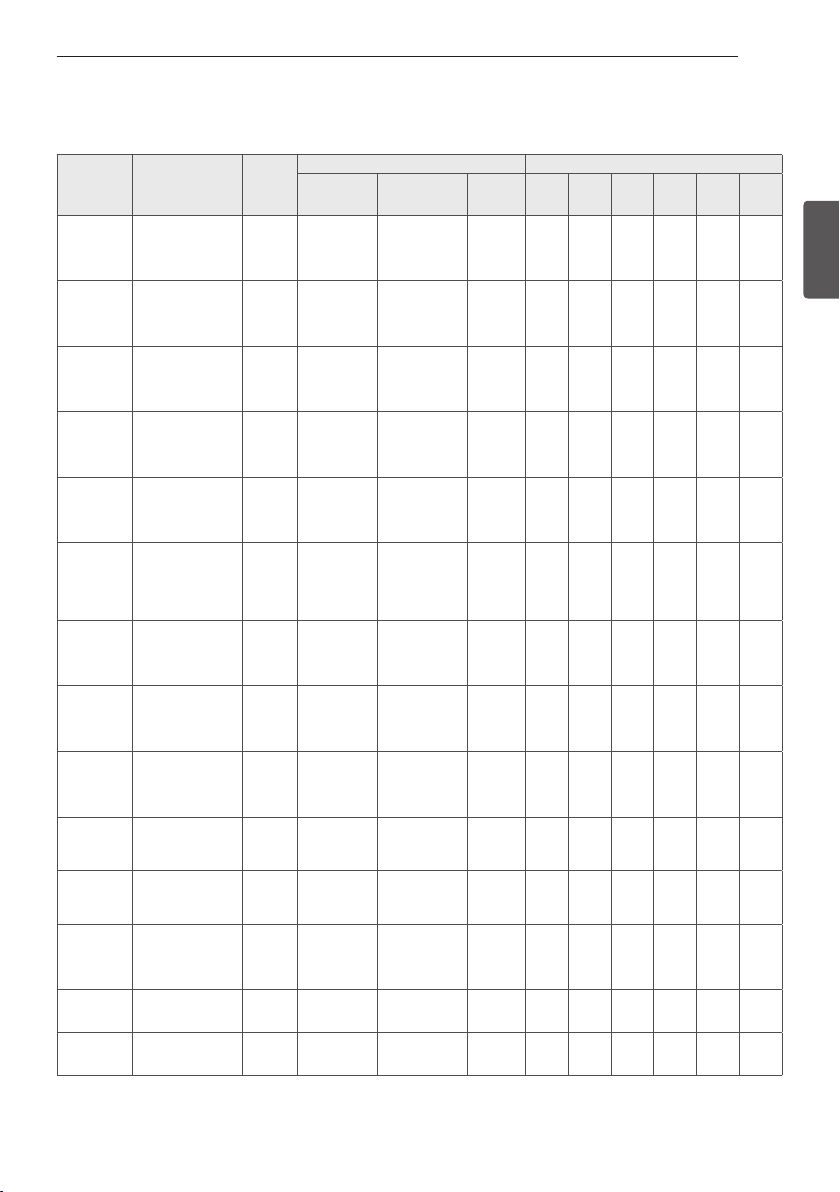
23
ESPAÑOL
USO DE LA LAVADORA
Guía de ciclos
La siguiente guía de ciclos muestra las opciones disponibles y los tipos de tejidos recomendados para cada ciclo.
●
=Opción disponible
- La duración del ciclo depende del tipo y de la cantidad de la carga y del detergente, presión del agua y opciones
adicionales elegidas.
- Si se seleccionó la opción Turbo Wash™, no puede seleccionar “Sin Centrifugado” en la opción de Velocidad de
Centrifugado.
(Si no se seleccionó la opción Turbo Wash™, puede seleccionar “Sin Centrifugado” en la opción de Velocidad de
Centrifugado.)
CICLO TIPO DE TEJIDO
TIEMPO
MOSTRADO
(MIN)
AJUSTES DEL CICLO (
=PREDETERMINADOS)
OPCIONES ADICIONALES
TEMPERATURA
DE LAVADO
VELOCIDAD DE
CENTRIFUGADO
NIVEL DE
SUCIEDAD
VAPOR
Cold
Wash™
Delay Wash
(lavado
demorado)
Extra Rinse
(enjuague
extra)
PRE-
LAVADO
Turbo
Wash™
Allergiene™
Algodón, ropa interior,
fundas de almohada,
frazadas, ropa de bebé
88 ~ 132
-
EXTRA ALTA
ALTA
MEDIANA
BAJA
SIN CENTRIFUGADO
-
Sanitary
Ropa interior, ropa de
trabajo, pañales, etc.
muy sucios
81 ~ 112
EXTRA
CALIENTE
EXTRA ALTA
ALTA
MEDIANA
BAJA
SIN CENTRIFUGADO
ALTO
NORMAL
BAJO
Bright
Whites™
Prendas blancas
52 ~ 79
CALIENTE
TIBIA
FRÍA
FRÍA COMO SALE
DE LA CANILLA
EXTRA ALTA
ALTA
MEDIANA
BAJA
SIN CENTRIFUGADO
ALTO
NORMAL
BAJO
Bulky/Large
(bultos/
prendas
grandes)
Prendas grandes como
cobertores y edredones
45 ~ 68
CALIENTE
TIBIA
FRÍA
FRÍA COMO SALE
DE LA CANILLA
MEDIANA
BAJA
SIN CENTRIFUGADO
ALTO
NORMAL
BAJO
Heavy Duty
(Pesado)
Prendas de algodón
muy sucias
60 - 117
CALIENTE
TIBIA
FRÍA
FRÍA COMO SALE
DE LA CANILLA
EXTRA ALTA
ALTA
MEDIANA
BAJA
SIN CENTRIFUGADO
ALTO
NORMAL
BAJO
Cotton/
Normal
(algodón/
normal)
Algodón, lino, toallas,
camisetas, frazadas,
jeans, cargas mixtas
27 - 99
EXTRA CALIENTE
CALIENTE
TIBIA
FRÍA
FRÍA COMO SALE
DE LA CANILLA
EXTRA ALTA
ALTA
MEDIANA
BAJA
ALTO
NORMAL
BAJO
Jumbo Wash
(lavado de
prendas
de gran
tamaño)
Colchas
45 ~ 68
CALIENTE
TIBIA
FRÍA
FRÍA COMO SALE
DE LA CANILLA
ALTA
MEDIANA
BAJA
SIN CENTRIFUGADO
ALTO
NORMAL
BAJO
Towels
(Toallas)
Toallas
39 - 75
CALIENTE
TIBIA
FRÍA
FRÍA COMO SALE
DE LA CANILLA
EXTRA ALTA
ALTA
MEDIANA
BAJA
SIN CENTRIFUGADO
ALTO
NORMAL
BAJO
Perm. Press
(planchado
permanente)
Camisas/pantalones de
vestir, ropa antiarrugas,
ropa mezcla de algodón
y poliéster, manteles
29 ~ 56
CALIENTE
TIBIA
FRÍA
FRÍA COMO SALE
DE LA CANILLA
ALTA
MEDIANA
BAJA
ALTO
NORMAL
BAJO
Hand Wash/
Wool(lavado
a mano/lana)
Prendas con la etiqueta
“lavar a mano”
44 ~ 55
TIBIA
FRÍA
FRÍA COMO SALE
DE LA CANILLA
BAJA
SIN CENTRIFUGADO
NORMAL
BAJO
Delicates
(ropa
delicada)
Blusas de vestir y
camisas de etiqueta,
nylon, prendas con
encajes o muy finas
30 ~ 53
TIBIA
FRÍA
FRÍA COMO SALE
DE LA CANILLA
MEDIANA
BAJA
SIN CENTRIFUGADO
ALTO
NORMAL
BAJO
Speed Wash
(lavado
rápido)
Ropa con poca suciedad
y cargas pequeñas
7 ~ 25
CALIENTE
TIBIA
FRÍA
FRÍA COMO SALE
DE LA CANILLA
EXTRA ALTA
ALTA
MEDIANA
BAJA
SIN CENTRIFUGADO
ALTO
NORMAL
BAJO
Small Load
(carga
pequeña)
Prendas con nivel
normal de suciedad y
cargas pequeñas.
45
TIBIA
ALTA
NORMAL
Tub Clean
(limpieza de
la tina)
Este ciclo está diseñado
para quitar el olor a
moho o a humedad.
89
24
USO DE LA LAVADORA
Prendas muy sucias,
Heavy Duty
Este ciclo es para lavar prendas muy sucias, con
una rotación más potente de la tina.
Edredones,
Jumbo Wash
Este ciclo es para lavar edredones tamaño king o queen.
Prendas sin arrugas,
Perm.Press
Este ciclo es para lavar prendas antiarrugas o
manteles para minimizar la cantidad de arrugas.
Prendas trasparentes,
Delicates
Este ciclo es para lavar lencería o ropa trasparente y
de encaje que podría dañarse con facilidad.
Para toallas,
Towels
Este ciclo es para lavar toallas.
Para pocas prendas,
Small Load
El ciclo predeterminado es Small Load, para
las cargas pequeñas con suciedad normal. Este
ciclo también se puede utilizar para los ciclos
descargables (ver página 31).
Prendas con la etiqueta “lavar a mano”,
Hand Wash/Wool
Este ciclo es para lavar prendas de lana que
podrían encoger o prendas de lavado a mano
que requieren un cuidado delicado. Solo lave
prendas de lana que digan en la etiqueta “lavar a
máquina” o “lavar a mano”.
NOTA
y
El peso de la carga debe ser menor de 8 libras (3,6
kg) para evitar daños a las prendas.
y
Use solamente un detergente natural o apto para
el uso con prendas de lana que no sea nocivo
para las prendas y cargue la mitad de la cantidad
normal de detergente.
y
El ciclo Hand Wash/Wool usa un ángulo suave de
rotación de centrifugado y hace el centrifugado a
baja velocidad para lograr el mejor cuidado de la
prenda.
Lavado rápido,
Speed Wash
Utilice el ciclo Speed Wash para lavar rápidamente
prendas no muy sucias y cargas pequeñas. Para
una alta eficacia de lavado y enjuague, lave cargas
pequeñas de 2 o 3 prendas con poca suciedad.
NOTA
y
Use solo un poco de detergente para este ciclo. Si
quiere más enjuague, puede agregar un enjuague
extra usando el botón de la opción Extra Rinse.
Ciclo principal
Puede lavar mejor sus prendas eligiendo el ciclo
de lavado que mejor se adecúe al tipo de prendas
que va a lavar. Gire la perilla del selector de ciclo
para seleccionar el ciclo que desee. Cuando elige
un ciclo de lavado, se encenderá la luz del ciclo
de lavado correspondiente. Consulte la página 22,
Funcionamiento básico
, para obtener más detalles
sobre los métodos de operación.
Para reducir los alérgenos en la ropa sucia,
Allergiene™
Este ciclo es un ciclo potente de lavado con agua
de alta temperatura diseñado específicamente
para reducir ciertos alérgenos.
NOTA
y
Seleccionar el ciclo ALLERGIENE™ incorpora
automáticamente vapor al ciclo de lavado.
y
El ciclo Allergiene™ puede reducir
significativamente los alérgenos en la ropa
de cama y en su ropa.
y
El ciclo Allergiene™ ayuda a reducir el polvo
y las poblaciones de ácaros y a reducir los
alérgenos.
y
Debido al mayor consumo de energía y
el uso de temperaturas más altas, el ciclo
Allergiene™ no está recomendado para lana,
seda, cuero, ni ninguna otra prenda delicada
o sensible a la temperatura.
Para reducir las bacterias en su ropa sucia,
Sanitary
Este ciclo de lavado reduce el 99,9% de las bacterias
que hay en la ropa sucia usando temperaturas altas.
Protocolo P172
Rendimiento de sanitización de lavadoras
residenciales y comerciales de tamaño familiar
NOTA
y
Este ciclo ha sido certificado por NSF utilizando el
detergente en polvo HE de marca Tide.
Para prendas blancas,
Bright Whites™
Este ciclo es solo para lavar prendas blancas.
Frazadas o prendas abultadas,
Bulky/Large
Este ciclo es para lavar frazadas o prendas abultadas.
Prendas normales,
Cotton/Normal
Utilice este ciclo para lavar todas las prendas
normales, excepto las que son de materiales
delicados como lana o seda.
NOTA
y
Si presiona el botón Power y el botón Start/
Pause sin elegir otro ciclo, la lavadora inicia el
ciclo Cotton/Normal.
25
ESPAÑOL
USO DE LA LAVADORA
Botones modificadores de ciclo
Cada ciclo se ha diseñado con los ajustes
óptimos de cuidado de las prendas para ese ciclo
predeterminados automáticamente. También
puede personalizar los ajustes utilizando los
botones modificadores de ciclo. Presione el
botón modificador de ciclo deseado para ver y
seleccionar otros ajustes.
La lavadora ajustará de forma automática el nivel
de agua para el tipo y tamaño de la carga que
lavar para obtener los mejores resultados y la
máxima eficiencia. Es posible que parezca que
no hay agua dentro del tambor en algunos ciclos,
pero esto es normal.
NOTA
y
Para proteger sus prendas, no todas las
temperaturas de lavado/enjuague, velocidades
de centrifugado, niveles de suciedad, u opciones
están disponibles en todos los ciclos. Consulte la
Guía de Ciclos para obtener más detalles.
Ajuste de la temperatura del agua, Wash Temp.
La temperatura óptima del agua está establecida
automáticamente para cada ciclo. Para cambiar el
ajuste de temperatura del agua de un ciclo, siga
las instrucciones que aparecen a continuación.
Recuerde establecer la temperatura apropiada,
según se especifica en la etiqueta de cuidado del
tejido que hay en la prenda.
1 Presione el botón Power y gire la perilla de
selección de ciclo para elegir el ciclo deseado.
2 Presione el botón Wash Temp repetidamente
para seleccionar la temperatura del agua
deseada.
- Al presionar el botón, se encenderá una luz
indicadora encima de la selección
correspondiente.
3 Ahora puede modificar otros ajustes del ciclo
y agregar opciones (consulte las páginas 25-
28), o pasar al paso 4 para comenzar el ciclo.
4 Presione el botón Start/Pause.
NOTA
y
Los enjuagues fríos usan menos energía.
y
Su lavadora tiene un elemento de
calentamiento para aumentar la temperatura
del agua caliente para el ajuste Extra Hot.
Esto brinda un mejor rendimiento de lavado
con un ajuste normal del calentador de agua.
y
Seleccione la temperatura del agua
apropiada para el tipo de carga que va a
lavar. Para obtener los mejores resultados,
siga las instrucciones de las etiquetas de
cuidado de las prendas.
Ajuste de la velocidad de centrifugado,
Spin Speed
Las velocidades de centrifugado más altas extraen más
agua de la ropa, lo que reduce el tiempo de secado
y ahorran energía. Algunas telas, como las prendas
delicadas, requieren una velocidad de centrifugado más
lenta. Para proteger su ropa, no todas las velocidades de
centrifugado están disponibles para todos los ciclos. Las
velocidades óptimas de centrifugado de cada ciclo se han
establecido automáticamente. Para cambiar la velocidad
de centrifugado de un ciclo, siga las instrucciones que
aparecen a continuación.
1 Presione el botón Power y gire la perilla de
selección de ciclo para elegir el ciclo deseado.
2 Presione el botón Spin Speed repetidamente para
seleccionar la velocidad de centrifugado deseada.
- Al presionar el botón, se encenderá una
luz indicadora encima de la selección
correspondiente.
3 Ahora puede modificar otros ajustes del ciclo y
agregar opciones (consulte las páginas 25-28), o
pasar al paso 4 para comenzar el ciclo.
4 Presione el botón Start/Pause.
NOTA
y
El botón Spin Speed también activa el ciclo Drain &
Spin para desagotar la tina y centrifugar las prendas;
por ejemplo, si quiere retirar la ropa antes de que haya
terminado el ciclo. Para usar Drain & Spin, presione
el botón Power, luego presione el botón Spin Speed
repetidamente para seleccionar una velocidad de
centrifugado. Presione el botón Start/Pause para comenzar.
Establecer el nivel de suciedad de la ropa, Soil Level
Puede lavar mejor su ropa sucia estableciendo el nivel de
suciedad adecuado en la lavadora. El nivel de suciedad
de cada ciclo se ha establecido automáticamente.
Para cambiar el nivel de suciedad de un ciclo, siga las
instrucciones que aparecen a continuación.
1 Presione el botón Power y gire la perilla de
selección de ciclo para elegir el ciclo deseado.
2 Presione el botón Soil Level repetidamente
para seleccionar el nivel de suciedad deseado.
- Al presionar el botón, se encenderá una
luz indicadora encima de la selección
correspondiente.
3 Ahora puede modificar otros ajustes del ciclo
y agregar opciones (consulte las páginas 25-
28), o pasar al paso 4 para comenzar el ciclo.
4 Presione el botón Start/Pause.
NOTA
y
Las cargas con bajo nivel de suciedad pueden
llevar menos tiempo y las cargas con alto nivel
de suciedad pueden agregar tiempo al ciclo.
26
USO DE LA LAVADORA
Establecer opciones antes del ciclo
Puede seleccionar y agregar las funciones opcionales
deseadas antes de encender la lavadora.
Ajuste de la melodía y los sonidos de los
botones, Signal
Cuando termina el ciclo de lavado, suena una melodía
en la lavadora. Los botones hacen un sonido cada vez
que se presiona un botón. El volumen de esta melodía
y los sonidos de los botones se puede cambiar o se
pueden apagar si así lo desea.
1 Presione el botón "Power".
2 Gire la perilla del selector de ciclo para seleccionar
el ciclo que desee.
3 Presione el botón Signal para ajustar la melodía y
los sonidos de los botones como desee.
4 Ahora puede modificar los ajustes del ciclo y
agregar opciones (consulte las páginas 25-28), o
pasar al paso 4 para comenzar el ciclo.
5 Presione el botón Start/Pause.
Prelavado, Prewash
Prelavar durante 15 minutos cuando la ropa está
cubierta de tierra o polvo. Esta función es adecuada
para prendas con alto nivel de suciedad.
1 Presione el botón Power y gire la perilla de
selección de ciclo para elegir el ciclo deseado.
2 Presione el botón Prewash.
- Se encenderá la luz indicadora.
3 Ahora puede modificar los ajustes del ciclo y
agregar opciones (consulte las páginas 25-28), o
pasar al paso 4 para comenzar el ciclo.
4 Presione el botón Start/Pause.
Solo para enjuagar, desagotar y centrifugar,
Rinse+Spin
Utilice este ciclo para enjuagar el detergente de
la carga.
1 Presione el botón Power y gire la perilla de
selección de ciclo para elegir el ciclo deseado.
2 Presione el botón Rinse + Spin.
3 Presione el botón Spin Speed repetidamente
para seleccionar la velocidad de centrifugado.
- Se encenderá la luz indicadora para la
velocidad de centrifugado seleccionada.
4 Presione el botón Start/Pause.
Iluminación del tambor, Drum Light
El tambor está equipado con una luz LED blanca
que se ilumina al encender la lavadora. Esta luz
se apaga automáticamente cuando se cierra
la puerta y empieza el ciclo. Para encender la
luz durante un ciclo, siga las instrucciones que
aparecen a continuación.
1 Mantenga presionado el botón Extra Rinse/
Drum Light durante 3 segundos durante el
ciclo de lavado.
- Se encenderá la luz del tambor y luego se
apagará automáticamente después de 4
minutos.
- Es normal que la ropa y las juntas se vean
amarillas bajo la luz LED.
Secado de las prendas para evitar arrugas,
Fresh Care
Utilice esta función cuando no puede quitar la
ropa de la lavadora tan pronto como termine el
ciclo de lavado.
1 Mantenga presionado el botón Steam/Fresh
Care durante 3 segundos antes del ciclo de
lavado.
- Se encenderá la luz indicadora de Fresh Care.
NOTA
y
Esta función hace girar la ropa
periódicamente durante hasta 19 horas para
evitar arrugas. Si presiona el botón START/
PAUSE o Power, puede descargar su ropa en
cualquier momento.
Agregado de un ciclo de enjuague adicional,
Extra Rinse
Puede agregar un ciclo de enjuague adicional al
ciclo de enjuague predeterminado.
1 Presione el botón Power y gire la perilla de
selección de ciclo para elegir el ciclo deseado.
2 Presione el botón Extra Rinse.
- Se encenderá la luz indicadora de Extra
Rinse.
3 Ahora puede modificar los ajustes del ciclo y
agregar opciones (consulte las páginas 25-28),
o pasar al paso 4 para comenzar el ciclo.
4 Presione el botón Start/Pause.
27
ESPAÑOL
USO DE LA LAVADORA
Predeterminación del horario de inicio del
ciclo, Delay Wash
Puede retrasar el horario de comienzo del ciclo.
1 Presione el botón Power y gire la perilla de
selección de ciclo para elegir el ciclo deseado.
2 Modifique los ajustes del ciclo y agregue otras
opciones (consulte páginas 25-28), si así lo
desea.
3 Presione el botón Delay Wash repetidamente
para seleccionar el horario de comienzo
deseado.
- Se encenderá la luz indicadora de Delay
Wash.
- El horario de inicio aparecerá en el panel de
visualización.
- Cada presión del botón aumenta una hora al
tiempo de demora, así hasta 19 horas.
4 Presione el botón Start/Pause.
Alta temperatura, Steam
Agregar la opción de vapor (Steam) a estos ciclos
ayuda a mejorar el rendimiento del lavado.
Al usar vapor caliente, los tejidos obtienen
los beneficios de limpieza de un súper lavado
caliente.
1 Presione el botón Power y gire la perilla de
selección de ciclo para elegir el ciclo deseado.
2 Presione el botón Steam. La lavadora ajustará
automáticamente el los ajustes del ciclo.
3 Establezca cualquier otra opción que desee.
4 Presione el botón Start/Pause.
ADVERTENCIA
y
No toque la puerta durante los ciclos de vapor.
La superficie de la puerta puede ponerse muy
caliente. Permita que se abra la traba de la
puerta antes de abrirla.
y
No intente anular o superar el mecanismo de
traba de la puerta ni meter las manos en la
lavadora durante un ciclo de vapor.
El vapor
puede causar quemaduras graves.
NOTA
y
La función de vapor no se puede usar en
todos los ciclos.
y
Es posible que el vapor no sea claramente
visible durante los ciclos de vapor. Esto es
normal. Demasiado vapor podría dañar la
ropa.
y
No agregue vapor a los ciclos al lavar
prendar delicadas de materiales como lana o
seda, o prendas que no destiñen.
Ahorro de energía, Cold Wash™
Agregar la función Cold Wash™ reduce el
consumo de energía y proporciona el mismo
rendimiento de lavado que un lavado con agua
tibia.
Al usar 6 movimientos de lavado distintos (girar,
rodar, en etapas, fregado, balanceo y filtrado), las
prendas obtienen los beneficios de limpieza sin
el consumo de energía.
1 Presione el botón Power y gire la perilla de
selección de ciclo para elegir el ciclo deseado.
2 Presione el botón Cold Wash. La lavadora
ajustará automáticamente el los ajustes del
ciclo.
3 Establezca cualquier otra opción que desee.
4 Presione el botón Start/Pause.
NOTA
y
Cuando elige la opción Cold Wash™, el
tiempo de lavado aumentará hasta 10
minutos.
y
Para una alta eficiencia de lavado, utilice esta
opción con menos de 8 libras de ropa sucia.
Ahorro de tiempo, Turbo Wash™
Agregar la opción Turbo Wash a un ciclo normal
reduce el tiempo del ciclo y brinda el mismo
rendimiento de lavado. La opción utiliza las
características de Rociador Doble y Optimización
de la lavadora para ahorrar tiempo sin sacrificar
rendimiento.
1 Presione el botón Power y gire la perilla de
selección de ciclo para elegir el ciclo deseado.
2 Presione el botón Turbo Wash. La lavadora
ajustará automáticamente el los ajustes del
ciclo.
3 Establezca cualquier otra opción que desee.
4 Presione el botón Start/Pause.
NOTA
y
La opción de Turbo Wash no se puede usar
en todos los ciclos.
y
Turbo Wash está disponible al principio de
los ciclos Cotton/Normal y Perm. Presione
ciclos.
y
Mantenga presionado el botón Turbo Wash
para cambiar los ajustes predeterminados.
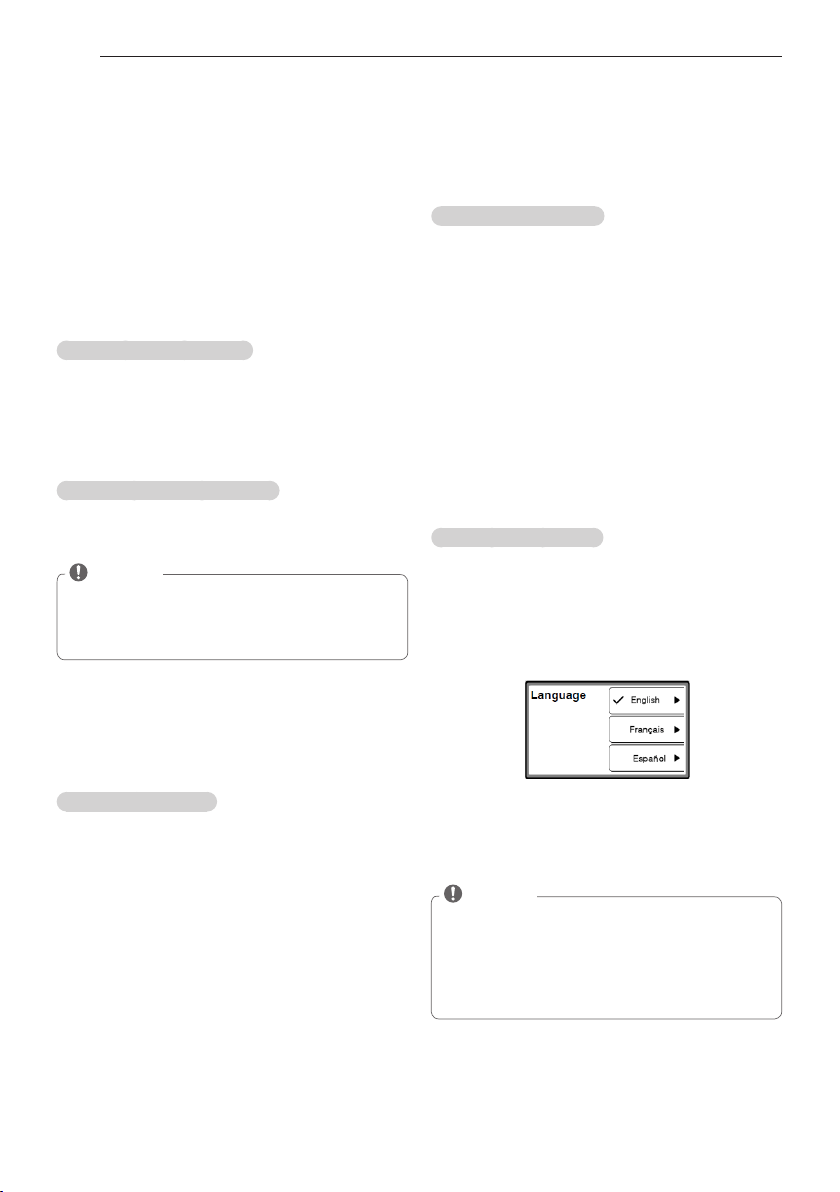
28
USO DE LA LAVADORA
Establecer opciones durante el ciclo
Puede agregar opciones deseadas durante el
ciclo de lavado.
Función de bloqueo de botones, Child Lock
Puede bloquear los controles para evitar que los
niños u otras personas cambien los ciclos o usen
la máquina. Esto puede resultar útil para limpiar
el área del panel de control y la botonera. Una
vez activado Child Lock, es necesario desactivarlo
antes de que se pueda usar cualquiera de los
controles, excepto el botón POWER.
Para ACTIVAR Child Lock
Mantenga presionado el botón Rinse + Spin
durante 3 segundos durante el ciclo de lavado.
- Cuando Child Lock se active, aparecerá un
mensaje de Child Lock y el tiempo restante de
lavado, de a uno, en el panel de visualización
de la lavadora.
Para DESACTIVAR Child Lock
(Cuando Child Lock está activado).
Mantenga presionado el botón Rinse + Spin
durante 3 segundos durante el ciclo de lavado.
NOTA
y
CHILD LOCK queda activado después del
final del ciclo. Si quiere desactivar esta
función, mantenga presionado el botón
RINSE + SPIN durante 3 segundos.
Guardado de un ciclo de lavado
personalizado, Pgm Save
Puede guardar una combinación especial de
configuraciones que utiliza con frecuencia.
Para guardar un ciclo
1 Presione el botón Power y gire la perilla de
selección de ciclo para elegir el ciclo deseado.
2 Modifique los ajustes del ciclo y agregue otras
opciones (consulte páginas 25-28), si así lo
desea.
3 Presione el botón Start/Pause para iniciar el
ciclo.
4 Mantenga presionado el botón Custom PGM
durante 3 segundos durante el ciclo de lavado.
- Se ha guardad el ciclo con sus ajustes y
opciones preferenciales.
Selección de su ciclo personalizado,
Custom Pgm
Puede recuperar el ciclo de lavado personalizado
que había guardado anteriormente.
Para recuperar un ciclo
1 Presione el botón Power y luego presione el
botón Custom PGM.
2 Presione el botón Start/Pause.
Botón de configuración del idioma,
Language
Esta opción le permite cambiar el idioma que
aparece en la pantalla. Una vez establecido, la
configuración del idioma quedará seleccionada
incluso después de haber apagado la lavadora.
Las opciones de idioma de visualización son
inglés, francés y español; inglés es el idioma
predeterminado.
Para cambiar el idioma
1 Presione el botón Power para prender la
lavadora.
2 Mantenga presionado el botón Prewash
durante 3 segundos, hasta que aparezca
la siguiente pantalla en la pantalla de
visualización.
3 Cuando aparezca la pantalla, se muestra inglés
como el idioma predeterminado. Presione el
botón Rinse+Spin para seleccionar Francais
(Francés). Presione el botón Extra Rinse para
seleccionar Espanol (Español).
NOTA
y
Si no presiona ningún botón ni elige otro
idioma durante 3 segundos después de
haber abierto la opción de configuración de
idioma, la función de selección de idioma
aplicará la selección de idioma existente y se
cerrará.
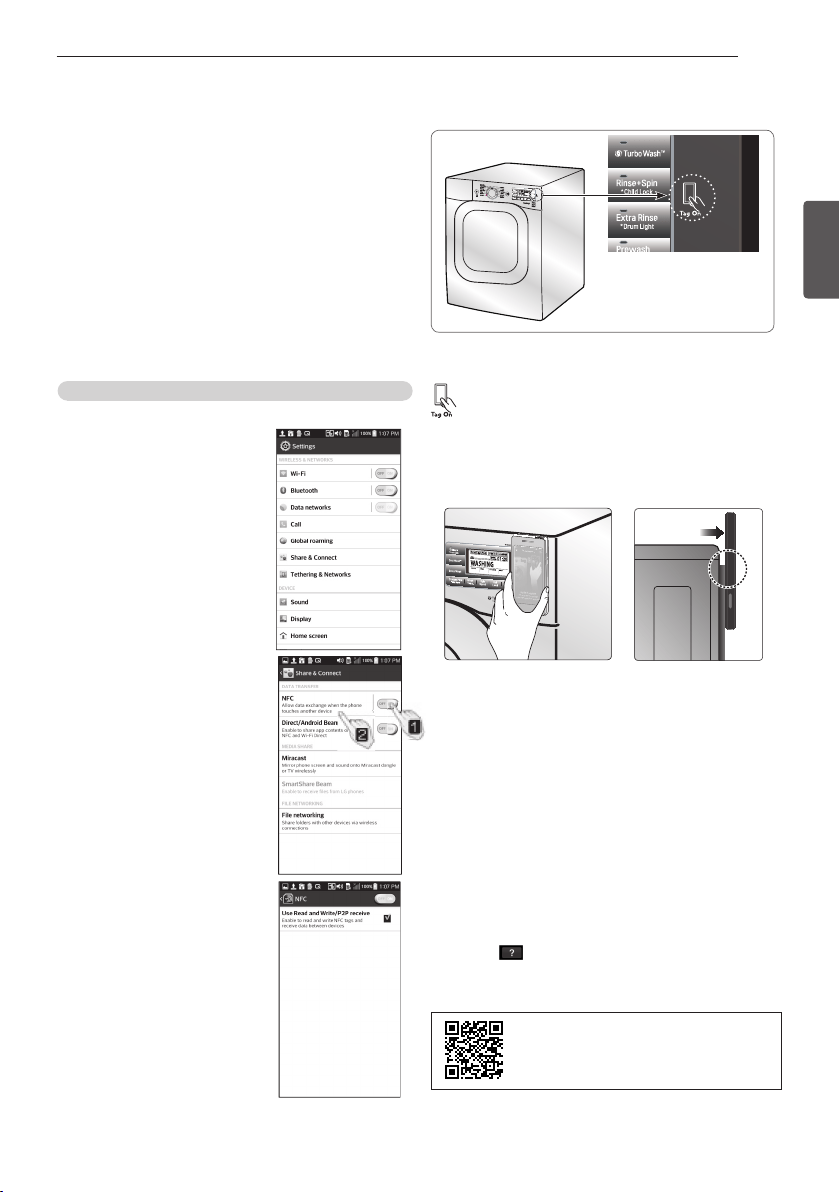
29
ESPAÑOL
USO DE LA LAVADORA
Antes de utilizar la función Tag On
- La función Tag On le permite usar convenientemente las
características LG Smart Diagnosis™ (diagnóstico
inteligente de LG) y Cycle Download (descarga del ciclo)
para comunicarse con su electrodoméstico desde su propio
teléfono inteligente. Para utilizar la función Tag On:
1 Descargue la Aplicación LG Smart Laundry&DW a su
teléfono inteligente.
2 Encienda la función NFC (Near Field Communication;
comunicación con los alrededores) en su teléfono
inteligente.
Se puede usar la función Tag On con la mayoría de teléfonos
inteligentes que están equipados con la función NFC y tiene
el sistema operativo (OS) Android.
Encendido de la función NFC en el teléfono inteligente
1 Ingrese al menú
“Settings”
(Configuraciones) del
teléfono inteligente y
seleccione “Share &
Connect” (Compartir y
Conectar) bajo el menú
“WIRELESS &
NETWORKS” (Inalámbrico
y redes).
2 Ponga “NFC” y “Direct
Android Beam” en ON
(activado) y elija “NFC” .
3 Marque la opción "Use
Read and Write/P2P
receive" (Usar Leer y
Escribir/Recepción P2P).
Dependiendo del fabricante
del teléfono inteligente y
de la versión de OS de
Android, es posible que el
proceso de activación del
NFC sea diferente.
Consulte el manual de su teléfono inteligente
para obtener más detalles.
El ícono de Tag On
Posición de Tag On
Tag On: Busque el ícono de Tag On al lado de
la pantalla LCD en el panel de control. Aquí es
donde debe ubicar su teléfono inteligente al usar
la función Tag On con las funciones LG Smart
Diagnosis™ y Cycle Download de la Aplicación
LG Smart Laundry&DW.
Cuando utilice la función Tag On, coloque su teléfono
inteligente de manera que la antena de NFC en la
parte trasera del teléfono sea igual a la posición del
ícono de Tag On en el electrodoméstico. Si no conoce
la posición de su antena NFC, mueva su teléfono
inteligente suavemente haciendo un movimiento
circular hasta que la aplicación verifique la conexión.
Debido a las características de NFC, si la distancia de
transmisión es mucha, o si hay una pegatina metálica
o el teléfono tiene una carcasa gruesa, la transmisión
no será buena. En algunos casos, los teléfonos
equipados con NFC pueden no ser capaces de
transmitir con éxito.
Presione [ ] en la Aplicación LG Smart
Laundry&DW para una guía más detallada sobre
cómo usar la función Tag On.
Lea este código QR con su teléfono
inteligente para acceder rápidamente a
la Aplicación LG Smart Laundry&DW y
descargarla.
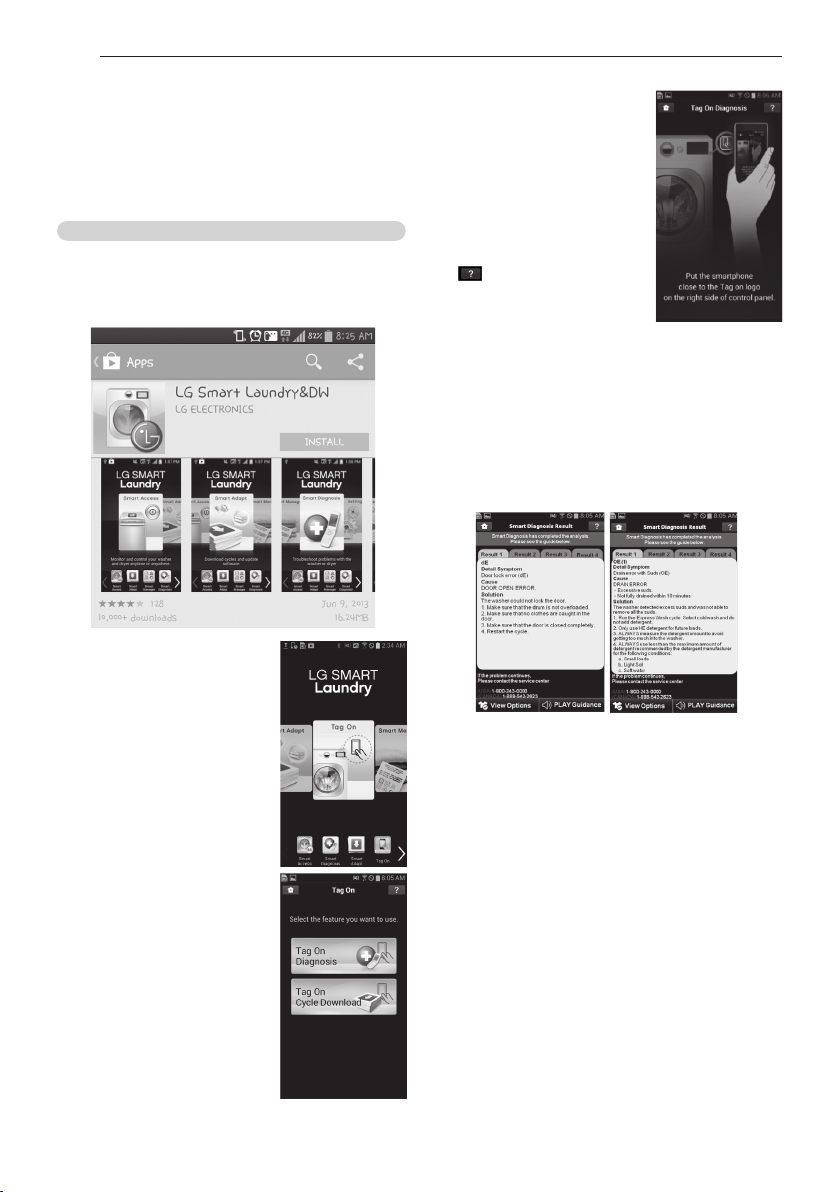
30
USO DE LA LAVADORA
Tag On
Descargue e instale la aplicación LG Smart
Laundry&DW en un teléfono inteligente
equipado con NFC. La aplicación incluye una
función de autodiagnóstico de Tag On y una
función de descarga del ciclo de Tag On.
Autodiagnóstico de Tag On usando la aplicación LG Smart Laundry&DW
1 Instale la aplicación “LG Smart Laundry&DW”
en un teléfono inteligente equipado con NFC.
- Instale la aplicación desde la tienda Play y
córrala.
2 Seleccione Tag On.
Puede usar la tarjeta de
Inicio y los íconos en la
parte inferior de la pantalla.
3 Seleccione Tag On
Diagnosis (diagnóstico de
Tag On).
4 Toque el logo de Tag On.
- Cuando aparezca una
pantalla de Tag On (vea a
la derecha), toque el ícono
de Tag On de su teléfono
inteligente del lado
derecho del panel de
control de la lavadora.
- Si no lo reconoce, toque
en la parte superior
derecha de la pantalla de
Tag On en su aplicación
LG Smart Laundry/DW
para ver una guía detallada.
(Esto puede ocurrir a causa de
las diferentes posiciones de la antena de NFC
en cada teléfono)
5 Revise el diagnóstico, resultados y soluciones.
- Muestra los resultados del diagnóstico en los
dos últimos ciclos utilizados.
※ Las imágenes son solo para referencia. Es
posible que se actualiza la aplicación LG Smart
Laundry&DW.

31
ESPAÑOL
USO DE LA LAVADORA
Descarga de ciclos de Tag On usando la aplicación LG Smart Laundry&DW
NOTA
y
La función Tag On Cycle Download le
permite usar su teléfono inteligente para
descargar un ciclo nuevo a su lavadora,
reemplazando el ciclo Small Load (carga
pequeña). Siempre puede volver a descargar
el ciclo Small Load, si así lo desea.
1 Instale la aplicación “LG Smart Laundry&DW”
en un teléfono inteligente equipado con NFC.
- Instale la aplicación desde la tienda Play y
córrala.
2 Seleccione Tag On.
Puede usar la tarjeta de
Inicio y los íconos en la
parte inferior de la pantalla.
3 Seleccione Tag On Cycles
Download.
4 Toque el logo de Tag On.
- Cuando aparezca una pantalla
de Tag On (vea a la derecha),
toque el ícono de Tag On de su
teléfono inteligente del lado
derecho del panel de control de
la lavadora.
- Si no lo reconoce, toque en
la parte superior derecha de la
pantalla de Tag On en su
aplicación LG Smart Laundry/
DW para ver una guía detallada.
(Esto puede ocurrir a causa de
las diferentes posiciones de la
antena de NFC en cada
teléfono).
5 Seleccione un ciclo a descargar.
- También puede revisar los
ciclos existentes ya
descargados.
6 Toque el logo de Tag On.
- Cuando aparezca una pantalla
de Tag On (vea a la derecha),
toque el ícono de Tag On de su
teléfono inteligente del lado
derecho del panel de control de
la lavadora.
- Si no lo reconoce, toque
en la parte superior derecha de
la pantalla de Tag On en su
aplicación LG Smart Laundry/
DW para ver una guía
detallada.
(Esto puede ocurrir a causa de
las diferentes posiciones de la
antena de NFC en cada
teléfono).
7 ¡El nuevo ciclo ha sido descargado exitosamente!
- Compruebe que el nuevo ciclo se haya descargado
girando la perilla de selección de ciclo hasta “Small
Load (Download cycle)”.
※ Las imágenes son solo para referencia. Es
posible que se actualiza la aplicación LG Smart
Laundry&DW.
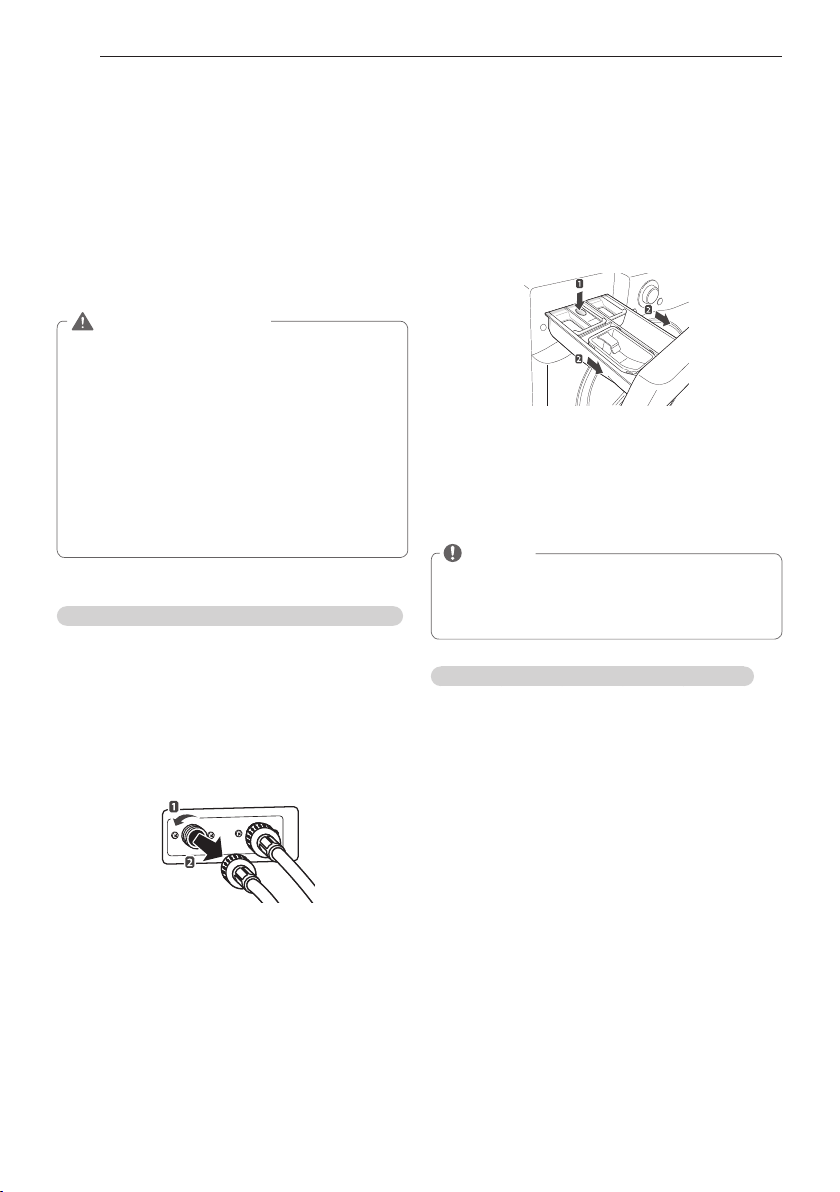
32
MANTENIMIENTO
Cuidado
Cuidados después del lavado
Luego de que finalice el ciclo, limpie la puerta y
el interior del sello de la puerta para eliminar la
humedad. Deje la puerta abierta para que se seque el
interior de la tina de la lavadora. Limpie el cuerpo de la
lavadora con un trapo seco para quitar la humedad.
ADVERTENCIA
y
Desenchufe la lavadora antes de proceder a su
limpieza para evitar el riesgo de posibles descargas
eléctricas. Si no se cumple con esta advertencia
se podrán producir lesiones graves, incendios,
descargas eléctricas o muerte.
y
Nunca utilice productos químicos fuertes, limpiadores
abrasivos o disolventes para limpiar la lavadora.
Dañarán el acabado.
y
No utilice sustancias volátiles (benceno, disolvente
de pintura, alcohol, acetona, etc.) ni detergentes
con componentes químicos fuertes cuando limpie la
lavadora. Hacerlo puede causar decoloración o daños
a la máquina, o podría causar un incendio.
Cuidados en climas fríos
Almacenamiento de la lavadora durante un período de tiempo extenso
Siga estas instrucciones para evitar daños al
guardar la lavadora durante un período de tiempo
extenso en climas fríos, en donde podría verse
expuesta a temperaturas de congelamiento.
1 Cierre las llaves conectadas a los conductos de
agua.
2 Desatornille los conductos de agua de la parte
trasera de la lavadora.
3 Vacíe el agua que pueda haber quedado en los
conductos de agua.
4 Presione el botón "Power".
5 Abra la puerta y agregue un galón (3,8 L)
de anticongelante no tóxico para vehículos
recreativos (RV, por sus siglas en inglés) a la tina
vacía de la lavadora. Cierre la puerta.
6 Presione el botón Spin Speed para seleccionar
draining and spinning (desagote y centrifugado).
7 Presione el botón Start/Pause.
- Desagote el agua de la lavadora durante 1
MANTENIMIENTO
minuto. No todo el anticongelante para RV se
expulsará.
8 Presione el botón Power para apagar la lavadora y
desenchúfela.
9 Seque el interior de la tina de la lavadora con un
trapo suave, y cierre la puerta.
10 Presione fuerte el botón disengage (desconectar)
y tire para sacar la gaveta dispensadora de
detergente.
11 Drene el agua de la gaveta dispensadora de
detergente y seque todos los compartimientos.
12 Almacene la lavadora en posición vertical.
NOTA
y
Para quitar el anticongelante después de
almacenar la lavadora, agregue detergente
al dispensador y haga funcionar un ciclo. No
cargue ropa sucia en este momento.
Cuando el conducto de agua está congelado
1 Cierre las llaves conectadas a los conductos de
agua.
2 Vierta agua caliente en las llaves congeladas
para descongelar los conductos de agua y
sacarlos.
3 Sumerja los conductos de agua en agua
caliente para que se descongelen.
4 Vuelva a conectar los conductos de agua con
las entradas de agua de la lavadora y con las
llaves.
- Consulte la página 14, Conexión de los
conductos de agua, para obtener más
detalles.
5 Abra las llaves.
6 Presione el botón Power.
7 Presione el botón Spin Speed.
8 Presione el botón Start/Pause.
- Asegúrese de que se llene de agua de la
manera apropiada.
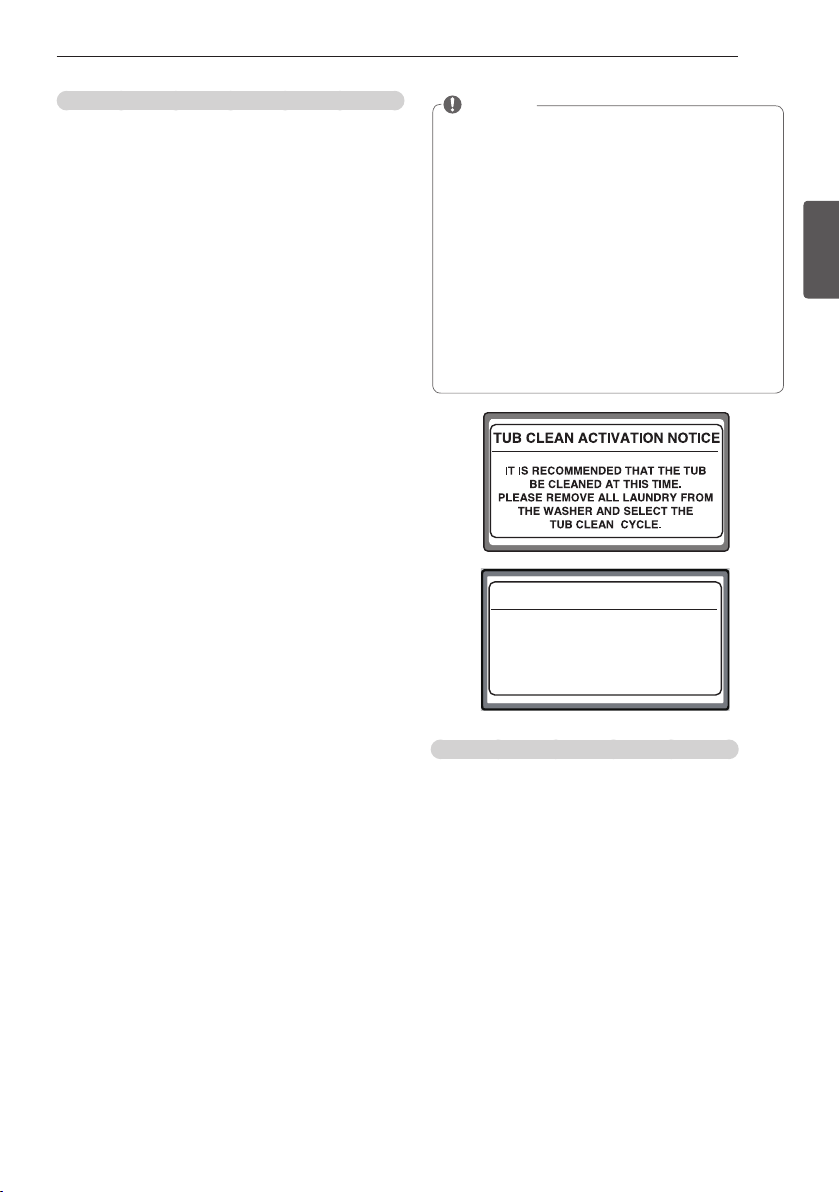
33
ESPAÑOL
MANTENIMIENTO
Cuando el conducto de desagüe está congelado
1 Vierta agua caliente en la tina de la lavadora y
cierre la puerta.
- Déjelo durante 10 minutos.
2 Presione el botón Power después de 10
minutos.
3 Presione el botón Spin Speed para comenzar
con el ciclo draining and spinning (desagote y
centrifugado).
4 Presione el botón Start/Pause.
- Compruebe que el agua se desagote.
Limpieza
Limpie periódicamente la lavadora para ayudar
a mantener su rendimiento y minimizar el riesgo
de avería.
Limpieza del tambor, Tub Clean
La instalación o uso inadecuado de la lavadora
en un espacio húmedo durante un período de
tiempo extendido podría potencialmente resultar
en una acumulación de residuo de detergente
en la lavadora, lo que podría producir olor a
moho o humedad. Si limpia la tina de la lavadora
regularmente de manera mensual utilizando
Tub Clean, minimizará la posibilidad de que se
acumule residuo de detergente y de que aparezca
olor a moho o a humedad.
1 Agregue limpiador para tinas o removedor de
sarro a la gaveta dispensadora de detergente.
- No sobrepase la línea de límite máximo
de detergente al agregarlo. Es posible que
quede detergente en la tina de la lavadora
luego de limpiarla.
-
Cuando use blanqueador líquido con cloro,
cárguelo en el compartimiento específico para
blanqueador líquido con cloro.
-
Cuando use limpiador en polvo, retire el
recipiente para detergente líquido y agregue el
limpiador en el compartimiento para detergente
principal.
-
Cuando use pastillas de limpieza, colóquelas
directamente en la tina de la lavadora. (No
coloque el limpiador en pastilla en la gaveta).
2 Presione el botón "Power".
3 Gire la perilla de selección de ciclo hasta Tub
Clean.
- Aparece un mensaje de t cL en la pantalla.
- Se enciende la luz indicadora de Tub Clean.
4 Presione el botón Start/Pause.
NOTA
y
Nunca cargue ropa sucia al usar Tub Clean.
Las prendas podrían dañarse. Asegúrese de
limpiar la tina de la lavadora cuando está
vacía.
y
Deje la puerta abierta luego de terminar de
lavar ropa para mantener la tina limpia.
y
El ciclo Tub Clean debe repetirse de manera
mensual.
y
Si nota olor a moho o humedad, haga
funcionar Tub Clean una vez a la semana
durante 3 semanas consecutivas.
y
Asegure la puerta de manera segura y
conveniente dejándola levemente abierta
con el émbolo magnético para la puerta.
Esto promoverá la circulación del aire y
ayudará a la máquina a secarse.
NOTA PARA ACTIVAR LAVAR DE TONEL
PARA LIMPIAR EL TAMBOR, POR FAVOR,
SELECCIONE EL PROGRAMA TUB
CLEAN (LIMPIEZA DE TAMBOR).
UNA VEZ TERMINADA LA COLADA, RETÍRELA
Y SELECCIONE EL PROGRAMA TUB CLEAN
(LIMPIEZA DE TAMBOR)
Alerta automática para limpiar la lavadora
Cuando la lavadora está encendida y el mensaje
de t cL parpadea, significa que la tina necesita
limpieza. Utilice Tub Clean para limpiar la tina de
la lavadora. La alerta automática de limpieza para
la tina de la lavadora depende de la frecuencia
de uso; sin embargo, normalmente el mensaje
parpadeará cada 1 o 2 meses.
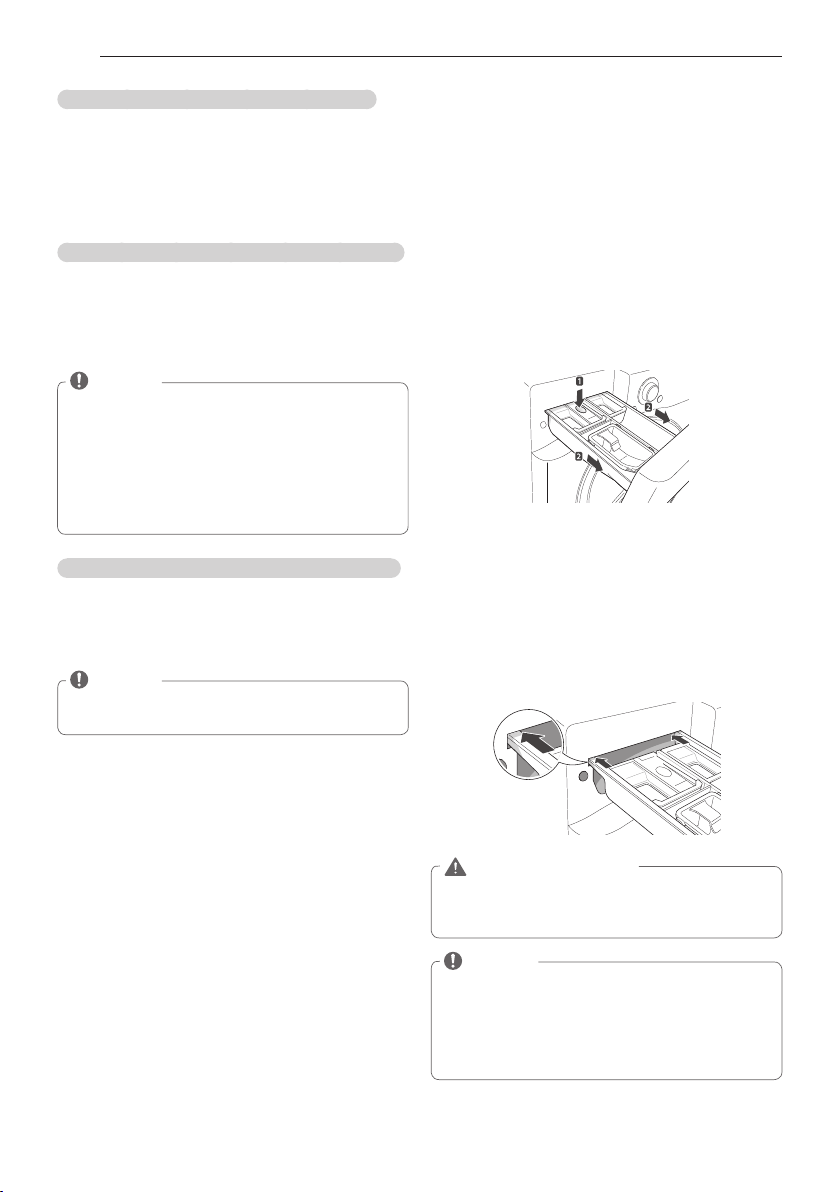
34
MANTENIMIENTO
Eliminación de la acumulación de minerales
Si vive en una zona donde el agua es dura, se
pueden formar depósitos de minerales en los
componentes internos de la lavadora. Tenga
el cuidado de limpiar periódicamente las
acumulaciones de minerales en los componentes
internos para extender la vida útil de la lavadora.
Eliminación de acumulaciones de minerales en la tina de la lavadora
Compruebe que el desincrustador sea apto para
limpiar la tina de la lavadora antes de usarlo, y
luego haga funcionar el ciclo Tub Clean. Consulte
la página 30, Tub Clean, para obtener detalles
sobre Tub Clean.
NOTA
y
En áreas con agua dura, se recomienda un
ablandador de agua.
y
Asegúrese de haber retirado todas las
prendas de la tina de la lavadora antes de
limpiarla. Limpiar la tina de la lavadora junto
con sus prendas puede tener como resultado
la contaminación de las prendas o daños a
las mismas.
Eliminación de acumulaciones de sarro en acero inoxidable
Limpie las acumulaciones de sarro u otras
manchas en acero inoxidable usando un trapo
suave sumergido en limpiador para acero
inoxidable.
NOTA
y
No utilice nunca lana metálica ni limpiadores
abrasivos. Hacerlo podría dañar la lavadora.
Limpieza de la gaveta dispensadora de
detergente
Dejar detergente en la gaveta dispensadora de
detergente durante un período de tiempo extenso
o usar la lavadora durante mucho tiempo, puede
causar la acumulación de incrustaciones en la
gaveta dispensadora de detergente. Tire de la
gaveta dispensadora de detergente y límpiela
una vez a la semana.
1 Tire de la gaveta dispensadora de detergente
para sacarla.
2 Presione fuerte el botón disengage
(desconectar) y tire para sacar la gaveta
dispensadora de detergente.
3 Retire los insertos de la gaveta.
4 Límpielos con agua tibia.
- Utilice un trapo o cepillo suave para limpiar y
eliminar residuos.
5 Quite la humedad con una toalla o trapo seco
después de la limpieza.
6 Vuelva a colocar la gaveta dispensadora de
detergente en su lugar.
ADVERTENCIA
y
No rocíe el interior de la lavadora con agua.
Hacerlo podría causar una descarga eléctrica o
provocar un incendio.
NOTA
y
Solo use agua para limpiar la gaveta
dispensadora de detergente. Asegúrese de
usar Rinse+Spin para enjuagar la tina de la
lavadora antes del siguiente ciclo de lavado
después de usar un detergente limpiador para
limpiar la tina de la lavadora.
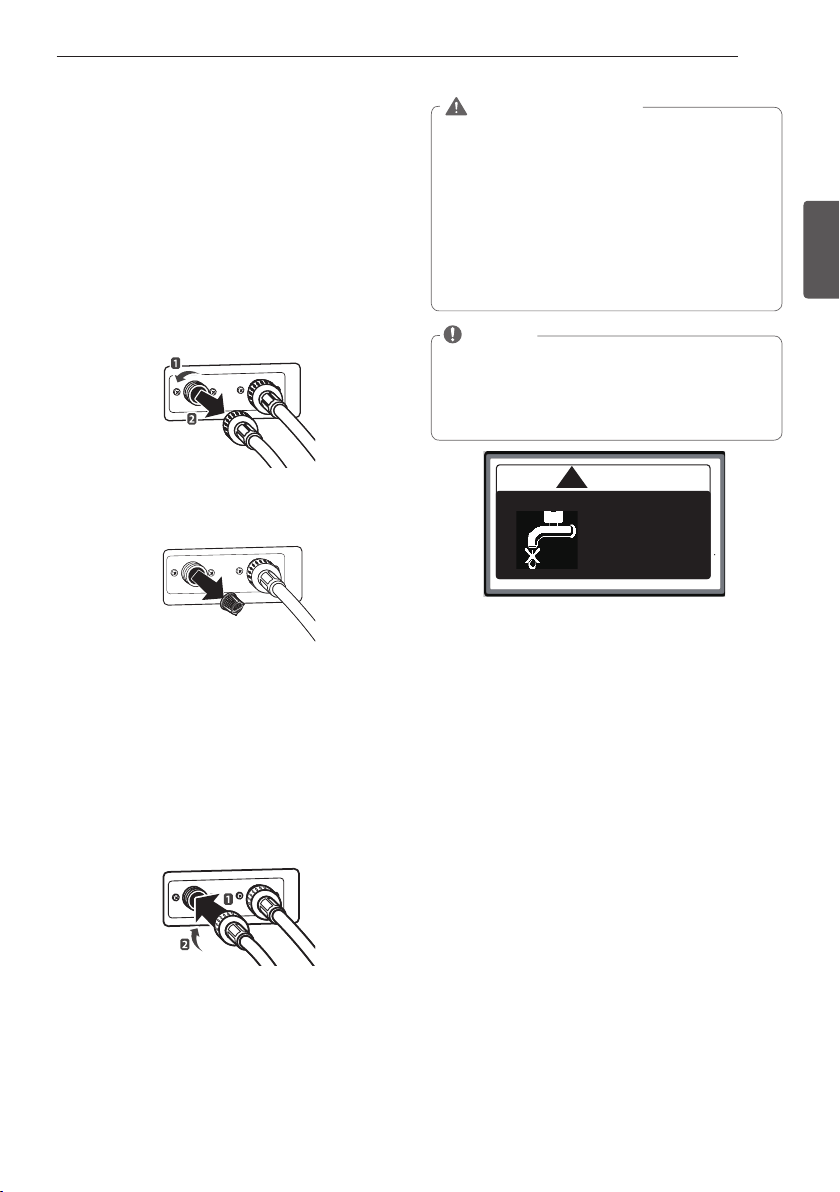
35
ESPAÑOL
MANTENIMIENTO
ADVERTENCIA
y
Desenchufe el cable de alimentación y cierre
las llaves antes de limpiar. No hacerlo podría
causar una descarga eléctrica.
y
No utilice la lavadora sin los filtros de entrada.
Si usa la lavadora sin los filtros de entrada,
causará pérdidas y avería.
y
Si usa la lavadora en un área con agua dura,
es posible que el filtro de entrada se tape a
causa de una acumulación de sarro. Contacte
a su centro de servicio al cliente de LG más
cercano si el filtro no está limpio o no está.
NOTA
y
Parpadeará un mensaje de IE en la pantalla
cuando la presión de agua en la gaveta
de detergente sea débil o cuando un filtro
de entrada de agua esté tapado con tierra.
Limpie el filtro de entrada.
!
ERROR
No water supply.
Check tap & hose.
Limpieza de los filtros de entrada de agua
Limpie los filtros de entrada de agua
periódicamente para evitar que se tapen. Tenga el
especial cuidado de limpiar los filtros de entrada
de agua en áreas en las que se utilice agua dura.
Es posible que no se suministre agua si hay algún
objeto externo, como por ejemplo óxido, arena o
piedras, en los filtros de entrada de agua.
1 Presione el botón Power para apagar la
lavadora y desenchúfela.
2 Cierre las llaves conectadas a las entradas de
agua.
3 Quite las entradas de agua.
4 Tire del filtro de entrada de agua para sacarlo.
Filtro de entrada
5 Quite los objetos externos que se encuentren
en la entrada del filtro de agua.
- Remoje los filtros de entrada de agua en
vinagre blanco o en un removedor de sarro,
o utilice un cepillo de dientes para quitar los
objetos externos, y luego enjuague bien.
6 Presione para colocar los filtros de entrada de
agua de vuelta en su lugar.
7 Vuelva a conectar los conductos de agua a la
lavadora.
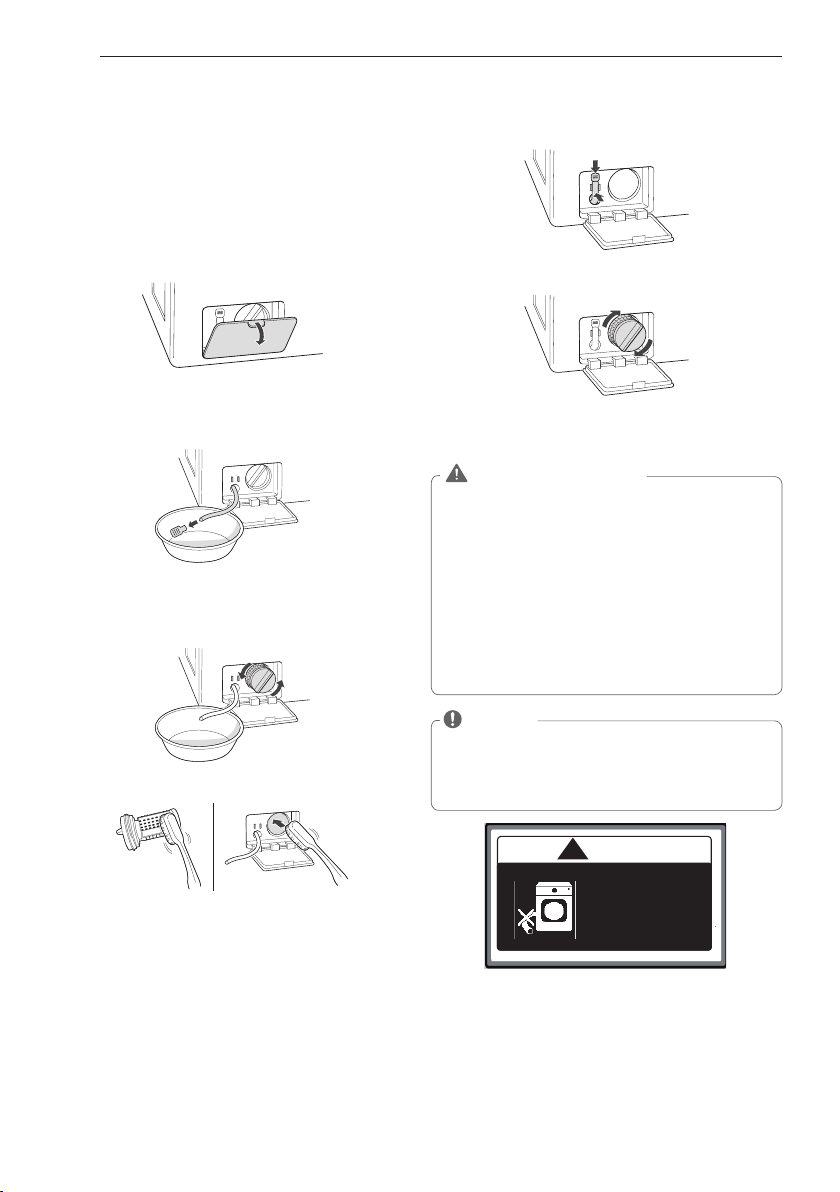
36
MANTENIMIENTO
Limpieza del filtro de la bomba de desagüe
Si el filtro de la bomba de desagüe está tapado, la
lavadora no desagotará. Limpie periódicamente
el filtro de desagüe para evitar que se tape con
objetos externos.
1 Presione el botón Power para apagar la
lavadora y desenchúfela.
2 Abra la cubierta del filtro de la bomba de
desagüe.
3 Quite la manguera de desagüe y retire el tapón
de la manguera de desagüe para desagotar el
agua restante.
4 Haga girar el filtro de la bomba en el sentido
contrario al de las agujas del reloj para
retirarlo.
5 Limpie el filtro y la apertura de la bomba.
6 Vuelva a poner el tapón en la manguera de
desagüe y vuelva a conectar la manguera de
desagüe.
7 inserte el filtro de la bomba de desagüe.
8 Cierre la cubierta del filtro de la bomba de
desagüe.
ADVERTENCIA
y
Desenchufe el cable de alimentación antes de
hacer la limpieza. No hacerlo podría causar
una descarga eléctrica.
y
Abrir el filtro de desagüe causará que se
desborde el agua si queda agua en la tina de
la lavadora. Asegúrese de comprobar si se
ha desagotado completamente el agua o no
antes de abrir el filtro de desagüe.
y
Si usa la lavadora con el filtro de desagüe
mal puesto luego de su limpieza, o si usa la
lavadora sin el filtro, puede causar pérdidas
o avería de la lavadora.
NOTA
y
Uando el filtro de la bomba de desagüe esté
tapado con tierra, parpadeará un mensaje
de OE en la pantalla. Limpie el filtro de la
bomba de desagüe.
!
ERROR
Not draining.
Check the drain
hose & filter.
37
ESPAÑOL
MANTENIMIENTO
Limpieza del sello de la puerta
Limpie el sello de la puerta una vez al mes para
evitar la acumulación de tierra en el sello de la
puerta.
1 Use guantes de goma y gafas protectoras.
2 Diluya 3/4 de taza (177 ml) de blanqueador
líquido con cloro en 1 galón (3,8 L) de agua.
3 Moje una esponja o trapo suave en esta
solución diluida y páselo todo por alrededor
del sello de la puerta.
4 Quite la humedad con una toalla o trapo seco
después de la limpieza.
5 Deje la puerta abierta para permitir que el
sello de la puerta se seque por completo.
PRECAUCIÓN
y
Limpiar el sello de la puerta con blanqueador
sin diluir puede causar una avería del sello
de la puerta y de las piezas de la lavadora.
Debe agregarle agua al blanqueador antes
de usarlo.
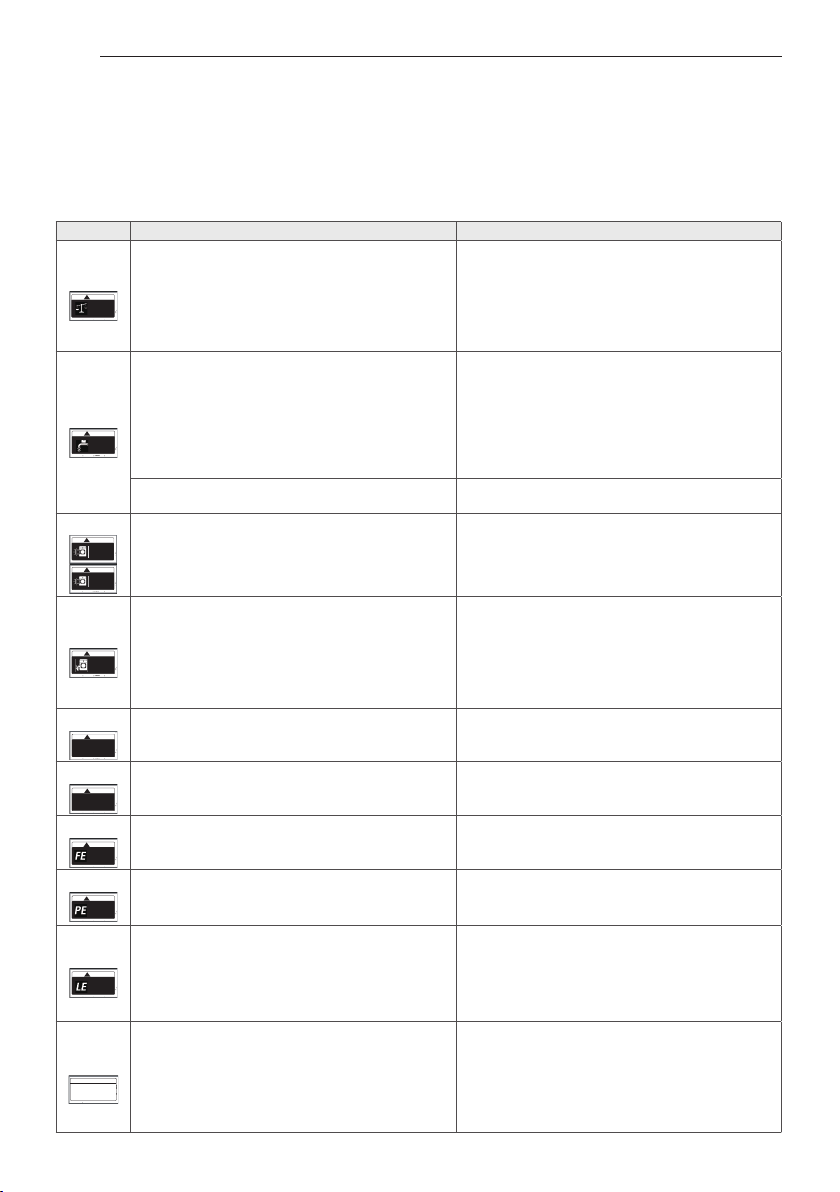
38
SOLUCIÓN DE PROBLEMAS
SOLUCIÓN DE PROBLEMAS
Revisión de mensajes de error
Si aparece el siguiente mensaje en la pantalla, revise las siguientes posibles causas y tome la acción
correctiva apropiada.
Mensaje
Causas posibles Soluciones
UE
Load is out of balance.
Rearrange wash load.
!
ERROR
No hay suficiente ropa en la lavadora.
y
¿Sus prendas se acumularon en una sola área, o la carga es
demasiado pequeña?
y
¿Lavó un peluche, una alfombra o una prenda tejida?
y
¿Lavó dos frazadas distintas juntas?
y
Acomode las prendas de otra manera para ayudar a distribuir y
equilibrar la carga.
y
Es posible que los peluches o alfombras se desequilibren durante
el centrifugado y por ende la lavadora puede no desagotar.
Acomode las prendas tejidas de otra manera para ayudar a
equilibrar las cargas y vuelva a desagotar.
y
Coloque una sola frazada por lavado.
IE
!
ERROR
No water supply.
Check tap & hose.
No se está suministrando agua o la presión del agua es baja
y
¿Está cerrada la llave?
y
¿Está detenido el suministro de agua o la está congelada la llave?
y
¿La presión del agua es baja o hay algún filtro de entrada tapado?
y
¿El conducto de agua está bien conectado a la entrada de agua fría?
y
¿El conducto de agua está pinzado o doblado?
y
Abra las llaves.
y
Si la llave está congelada, descongélela usando agua tibia.
y
Si el filtro de entrada está tapado, límpielo. (Consulte la página 35)
y
Conecte el conducto de agua adecuadamente a la entrada de agua
fría. (Consulte la página 14)
y
Compruebe que los conductos de agua no estén pinzados ni
doblados. Compruebe especialmente que los conductos de agua
no estén retorcidos o pinzados por otros objetos.
El conducto de agua tiene una pérdida en la conexión
y
¿Los conductos de agua están bien conectados a las llaves?
y
Conecte los conductos de agua adecuadamente a las llaves.
(Consulte la página 14)
dE
!
ERROR
[dE2]
The door is open.
Please close the
door
completely.
!
ERROR
[dE1]
The door is open.
Please close the door
completely.
La tina no gira
• ¿La puerta está asegurada?
y
Cierre y asegure la puerta. Si el mensaje sigue apareciendo,
desenchufe la lavadora y contacte a su centro de servicios de LG
más cercano.
OE
!
ERROR
Not draining.
Check the drain
hose & filter.
La lavadora desagota lentamente o no desagota.
y
¿La manguera de desagüe está instalada a más de 3 1/4 pies (1 m)
más allá del final del soporte tipo codo?
y
¿La manguera de desagüe está pinzada o tapada por dentro?
y
¿La manguera de desagüe está congelada?
y
¿La manguera de desagüe está tapada con objetos externos?
y
Baje la manguera de desagüe a una extensión dentro de los 3 pies por
debajo del final del soporte tipo codo.
y
Coloque la manguera de desagüe sobre una superficie plana para
evitar que se doble.
y
Si las mangueras de desagüe están congeladas, descongélelas en
agua tibia.
y
Abra la tapa del tapón de la bomba de desagüe y quite la tierra.
PF
!
ERROR
PF
The washer
experienced a power
failure. Restart the
cycle.
Ha ocurrido un corte del suministro eléctrico.
y
Presione el botón Power para apagar la lavadora y vuelva a
presionarlo para encenderla.
tE
!
ERROR
See owner’s manual…
tE
Error de control.
y
Desenchufe el cable de alimentación y contacte a su centro de
servicios de LG más cercano.
FE
!
ERROR
See owner’s manual…
El suministro de agua no se detiene
y
¿El suministro de agua y el desagüe se repiten de a uno?
y
Desenchufe el cable de alimentación y contacte a su centro de
servicios de LG más cercano.
PE
!
ERROR
See owner’s manual…
El nivel de agua no está controlado
y
¿El nivel de agua es demasiado bajo o alto en comparación con el
tamaño de la carga?
y
El sensor de nivel de agua no funciona correctamente.
y
Desenchufe el cable de alimentación y contacte a su centro de
servicios de LG más cercano.
LE
!
ERROR
See owner’s manual…
La tina no gira
y
¿La lavadora está sobrecargada?
y
Acomode el tamaño de la carga y reinicie la lavadora.
y
Si la carga es grande, es posible que la tina no gire debido a
que el motor se sobrecalentó. Permita que la lavadora quede en
reposo un rato y reinicie el ciclo. Si aparece el mismo mensaje de
error, desenchufe el cable de alimentación y contacte a su centro
de servicios de LG más cercano.
tc L
NOTA PARA ACTIVAR LAVAR DE TONEL
PARA LIMPIAR EL TAMBOR, POR FAVOR,
SELECCIONE EL PROGRAMA TUB
CLEAN (LIMPIEZA DE TAMBOR).
UNA VEZ TERMINADA LA COLADA, RETÍRELA
Y SELECCIONE EL PROGRAMA TUB CLEAN
(LIMPIEZA DE TAMBOR)
y
Para limpiar el tambor, seleccione el ciclo de limpieza del tambor.
y
Por favor vacíe la tina, inserte blanqueador en el dispensador de
detergente y seleccione el ciclo Tub Clean.
y
Si quiere saltearse el ciclo Tub Clean, gire la perilla de selección
de ciclo o presione los botones de opción para seleccionar un
ciclo. El mensaje seguirá reapareciendo hasta haber completado
algunos ciclos de lavado, después de lo cual desaparecerá hasta la
próxima vez en que está programado que se debe limpiar la tina.
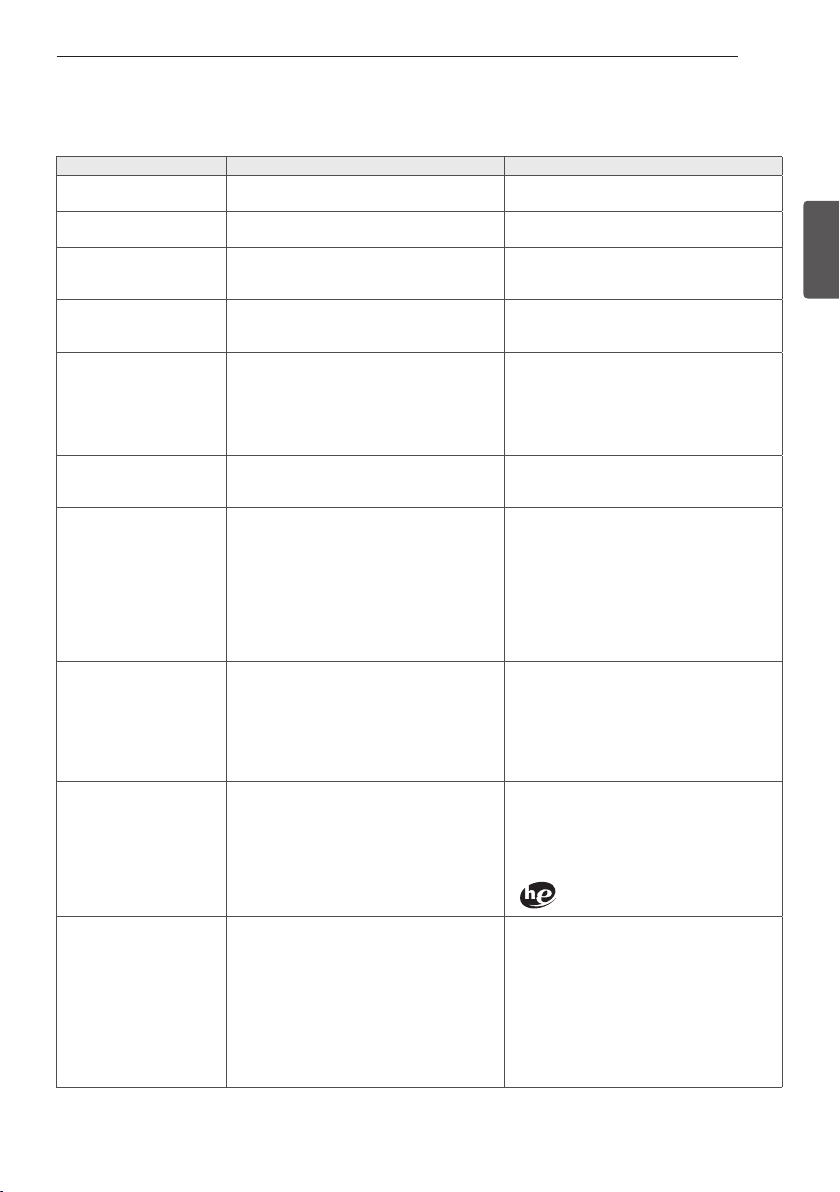
39
ESPAÑOL
SOLUCIÓN DE PROBLEMAS
Antes de solicitar asistencia técnica
Compruebe lo siguiente antes de solicitar asistencia técnica.
Problema Causas posibles Soluciones
Sonido tipo clic
y
¿Escucha un sonido cuando cierra o traba y
destraba la puerta?
y
Este sonido es normal y ocurre cuando la
puerta se cierra, traba o destraba.
Sonido tipo rociado o
sibilante
y
¿Se está rociando agua en la tina?
y
Este sonido es normal, dado que se rocía y
circula agua durante el ciclo.
Zumbido o sonido
chorreante
y
¿La lavadora está desagotando el agua?
y
Este sonido es norma, dado que la bomba
de desagüe desagota el agua de la lavadora
después del ciclo.
Sonido de salpicadura
y
¿La lavadora está lavando una carga de
ropa sucia?
y
Este sonido es normal, dado que la carga
se mueve hacia arriba y abajo durante los
ciclos de lavado y enjuague.
Ruido metálico y de
traqueteo
y
¿Hay algún objeto externo, como por
ejemplo llaves, monedas o alfileres de
gancho, en la tina o en el filtro de desagüe?
y
Revise para ver si hay algún objeto externo
en la tina y el filtro de desagüe después de
detener el ciclo.
y
Desenchufe el cable de alimentación y
contacte a su centro de servicios de LG más
cercano si el ruido persiste.
Sonido de golpes
y
¿La lavadora está sobrecargada?
y
¿La carga está desbalanceada?
y
Este sonido es normal y ocurre cuando la
carga está desbalanceada. Detenga el ciclo
y acomode la carga para balancearla.
Ruido de vibración
y
¿Quitó los pernos de transporte?
y
¿La carga está bien distribuida en la tina?
y
¿La lavadora está nivelada?
y
¿La lavadora está instalada sobre una
superficie sólida y plana?
y
Consulte la página 13, Desempaquetado y
retirado de los pernos de transporte, para
retirar los pernos de transporte.
y
Detenga el ciclo y acomode la carga para
balancearla.
y
Consulte la página 16, Nivelado de la
lavadora, para nivelar la lavadora.
y
Compruebe si el piso es sólido y está a
nivel.
Pérdida de agua alrededor
de la lavadora
y
¿El agua pierde de una llave o conducto de
agua?
y
¿Hay alguna tubería o manguera de
desagüe tapada?
y
Revise las llaves o conductos de agua.
- Si los conductos de agua están flojos,
consulte la página 14, Conexión de los
conductos de agua, para conectarlos
adecuadamente.
y
Destape la tubería o manguera de desagüe.
Contacte al plomero de ser necesario.
Exceso de espuma o no
enjuagó
y
¿Usó más que la cantidad recomendada de
detergente?
y
¿El nivel de suciedad es más alto que el
tamaño de la carga?
y
Utilice la cantidad de detergente
recomendada para la carga.
y
Si el nivel de suciedad es bajo, reduzca
la cantidad de detergente a menos que el
nivel recomendado.
Utilice sólo detergentes con el logotipo
de alta eficiencia (HE).
Manchas
y
¿Agregó detergente directamente a la tina?
y
¿Retiró la carga inmediatamente después
de que terminara?
y
¿Clasificó y lavó las ropas por color y nivel
de suciedad?
y
Asegúrese de cargar detergente en la
gaveta dispensadora de detergente.
y
Retire la carga inmediatamente después de
que termine.
y
Clasifique y separe los colores oscuros de
los claros o blancos, y las prendas con alto
nivel de suciedad de las prendas con bajo
nivel de suciedad. Consulte la página 19,
Clasificación de la ropa sucia, para obtener
detalles
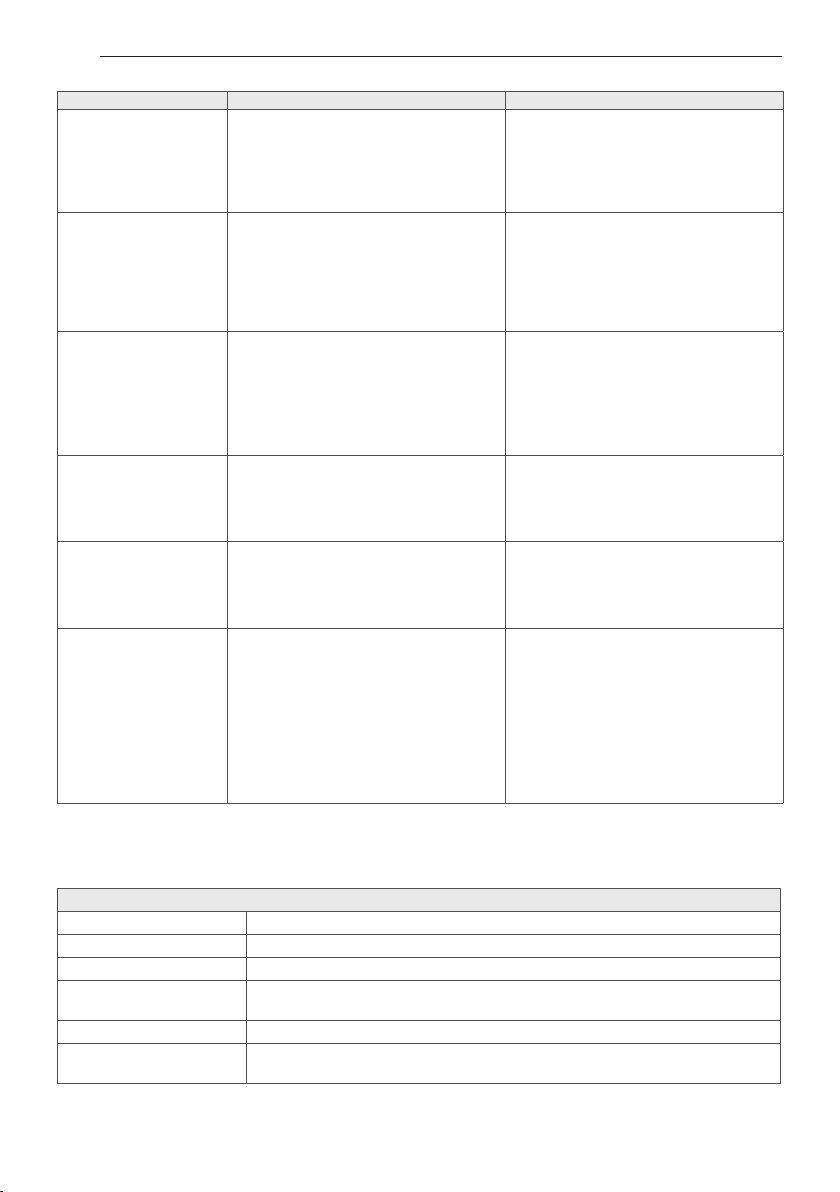
40
ESPECIFICACIONES
ESPECIFICACIONES
Modelo WM8500H*A
Descripción
Lavadora de carga frontal
Requisitos eléctricos
120 V de CA @ 60 Hz.
Presión máxima del agua
20–120 psi (138–827 kPa)
Dimensiones
73,7 cm (ancho) X 81,4 cm (largo) X 103,5 cm (alto), 146 cm (S. con la puerta abierta)
29” (ancho) X 32”(largo) X 40 ¾” (alto), 57 ½” (S. con la puerta abierta)
Peso neto
225 lb (102 kg)
Velocidad máxima de
centrifugado
1,300 RPM
Problema Causas posibles Soluciones
Arrugas
y
¿Retiró la carga inmediatamente después
de que terminara?
y
¿Sobrecargó la tina?
y
¿Invirtió las entradas de agua fría y caliente?
y
Retire la carga inmediatamente después de
que termine.
y
No sobrecargue la tina.
y
El enjuague con agua caliente puede causar
que las prendas se arruguen. Revise las
conexiones de las mangueras de entrada.
La alimentación no está
encendida
y
¿El cable de alimentación está bien
enchufado?
y
¿Se fundió un fusible, saltó un disyuntor o
hubo un corte de energía en la casa?
y
Asegúrese de que el enchufe está asegurado
en una toma de corriente de 120 V (60 Hz) de 3
clavijas conectada a tierra.
y
Reinicie el disyuntor o sustituya el fusible.
No aumente la capacidad del fusible. Si el
problema es una sobrecarga del circuito, haga
que lo solucione un electricista cualificado.
La puerta no se abre cuando
el ciclo se pausa o termina
y
¿La temperatura de la tina es demasiado
alta?
y
¿El nivel de agua en la tina es demasiado
alto?
y
La lavadora tiene una traba de seguridad
integrada a la puerta para evitar quemaduras.
Deje la puerta cerrada y espere hasta que el
ícono de traba de la puerta haya desaparecido
de la pantalla.
y
Permita que la lavadora complete el ciclo
programado, o presione el botón Spin.
El ciclo de lavado tarda más
de lo normal
y
¿La lavadora está sobrecargada? ¿Hay
alguna otra opción agregada al ciclo de
lavado?
y
Esto es normal. La lavadora ajusta de
forma automática el tiempo del ciclo en
función de la cantidad de ropa para lavar,
la presión del agua, temperatura del agua y
demás condiciones de funcionamiento.
El interior de la tina huele a
moho o a humedad
y
¿Ha utilizado el detergente incorrecto?
y
¿Limpió la tina periódicamente?
y
Solo debe usar el detergente de alta
eficiencia (HE) recomendado para una
lavadora de carga frontal.
y
Consulte la página 33, limpie el interior y
exterior de la lavadora periódicamente.
Ruido estrepitoso cuando
la lavadora se llena de agua
(golpe de ariete)
y
La fontanería del hogar se mueve o flexiona
cuando las válvulas de agua de la lavadora
se apagan.
y
La presión del suministro de agua del hogar
es muy alto.
y
El golpe de ariete no es causado por un
defecto en la lavadora. Instale supresores
de golpe de ariete entre la manguera
de llenado y la lavadora para obtener
los mejores resultados (se compran por
separado en ferreterías o tiendas de
artículos del hogar).
y
Ajuste el regulador de suministro de agua a
una presión inferior o comuníquese con un
plomero para instalar un regulador.
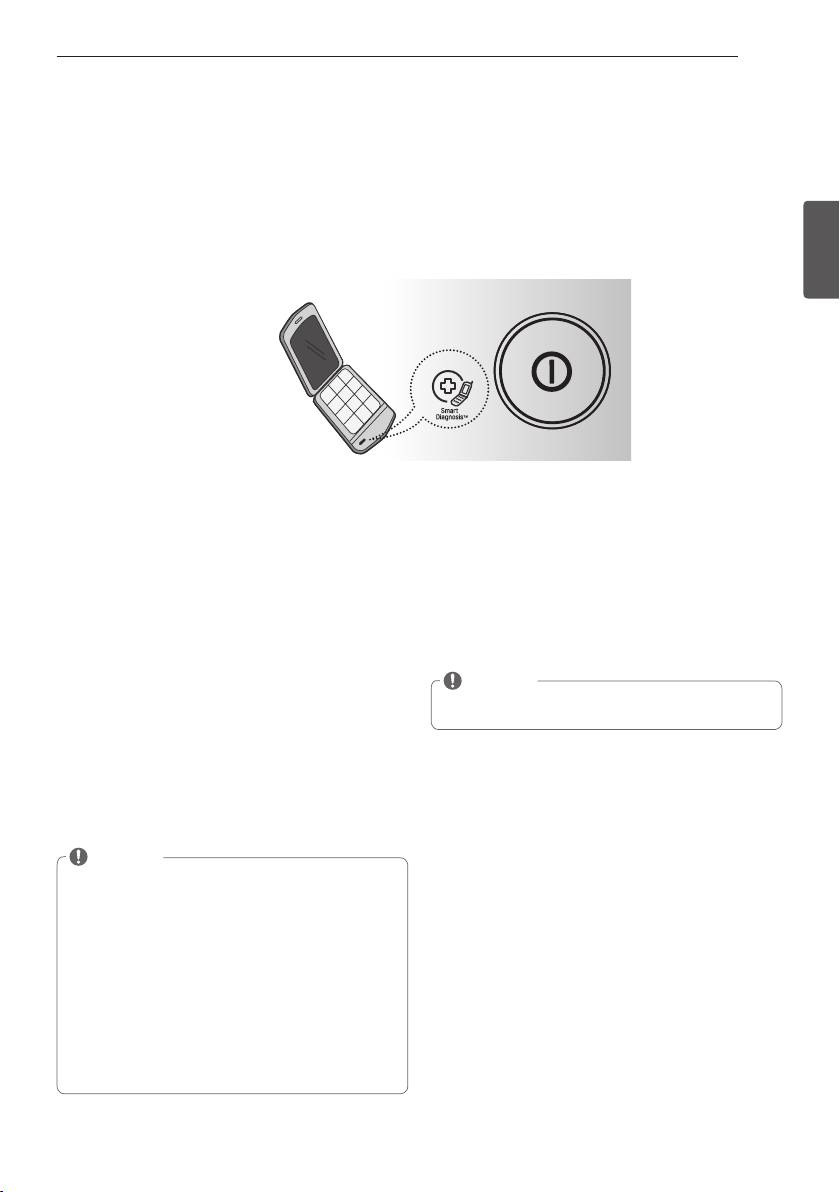
41
ESPAÑOL
UTILIZACIÓN DEL Smart Diagnosis™
Si tuviera algún problema con su lavadora, la misma posee la capacidad de transmitir datos a un
teléfono inteligente utilizando la aplicación Smart Laundry de LG o mediante el teléfono al Centro de
atención telefónica de LG. Smart Diagnosis™ no puede ser activado a menos que su lavadora esté
encendida pulsando el botón de ALIMENTACIÓN(POWER). Si su lavadora no puede encenderse,
tendrá que localizar y lavadora los problemas sin utilizar Smart Diagnosis™.
Diagnóstico sonoro
Smart Diagnosis™ utilizando su teléfo-
no inteligente
1. Descargue la aplicación Smart Laundry de LG en
su teléfono inteligente.
2. Abra la aplicación Smart Laundry de LG en su
teléfono inteligente. Presione el botón flecha hacia
la derecha para avanzar a la siguiente pantalla.
3. Presione el botón Grabación del teléfono
inteligente y mantenga la boquilla del teléfono
inteligente junto al logotipo de Smart Diagnosis™
de la lavadora.
4. Con el teléfono en su sitio, pulse y mantenga
pulsado el botón de Control De La Wash Temp
durante tres segundos.
5. Mantenga el teléfono en el sitio hasta que la
transmisión del tono haya terminado. Esto toma
unos 6 segundos y la pantalla mostrará la cuenta
regresiva de tiempo.
6. Al finalizar la grabación, vea el resultado del
diagnóstico presionando el botón Siguiente del
teléfono.
NOTA
y
Smart Diagnosis™(Diagnóstico Inteligente) es
una función de resolución de problemas diseña-
da para asistir, no reemplazar, al método tradi-
cional de resolución de problemas a través de
llamadas de servicio técnico. La efectividad de
esta función depende de diversos factores, entre
los cuales se incluyen, la recepción del teléfono
celular utilizado para la transmisión, cualquier
ruido externo que pueda presentarse durante la
transmisión, y la acústica de la habitación don-
de está ubicada la lavadora. Por lo tanto, LG no
garantiza que Smart Diagnosis™ resuelva con
precisión cualquier cuestión dada.
Smart Diagnosis™ a través del Centro
de atención telefónica
1. Llame al Centro de atención telefónica de LG
Electronics al teléfono: (LG EE.UU.) 1-800-243-
0000(LG Canadá) 1-888-542-2623.
2. Cuando se lo indique el agente del Centro de
atención telefónica, mantenga el micrófono de su
teléfono sobre el logotipo Smart Diagnosis™ del
equipo. Sostenga el teléfono a no más de una
pulgada o 2.5 cm (pero sin tocar) el equipo.
NOTA
y
No toque ningún otro botón ni icono de la
pantalla.
3. Pulse y mantenga pulsado el botón de Control De
La Wash Temp durante tres segundos.
4. Mantenga el teléfono en el sitio hasta que la
transmisión del tono haya terminado. Esto toma
unos 6 segundos y la pantalla mostrará la cuenta
regresiva de tiempo.
5. Una vez que la cuenta regresiva haya finalizado y
los tonos se hayan detenido, reanude la conversa-
ción con el agente del Centro de atención telefóni-
ca, que será capaz de ayudarle en la utilización de
la información transmitida para su análisis.
UTILIZACIÓN DEL Smart Diagnosis™
42
GARANTÍA
ESTA GARANTÍA LIMITADA NO CUBRE:
1. Desplazamientos de servicio para el envío, recogida o
instalación del producto o para dar instrucciones sobre la
utilización del producto.
2. Sustitución de los fusibles de la vivienda o puesta en
funcionamiento de los disyuntores, corrección de la
instalación eléctrica de la casa o fontanería, o corrección de
la instalación del producto.
3. Daños o fallos causados por tubos de agua con fugas o
roturas, tubos de agua congelados, tubos de desagüe
atascados, suministro de agua inadecuado o con
interrupciones o suministro de aire inadecuado.
4. Daños al producto causados por accidentes, pestes e
insectos, rayos, viento, fuego, inundaciones o causas de
fuerza mayor.
5. Daños o fallos resultantes de un uso inadecuado, abusos,
instalación, reparaciones o mantenimiento incorrectos. Las
reparaciones incorrectas incluyen la utilización de piezas
no aprobadas o especificadas por LG.
6. Daños o fallos causados por la modificación u alteración
no autorizada del producto.
7. Daños o fallos causados por la corriente eléctrica, tensión
o códigos de fontanería incorrectos.
8. Daños cosméticos, incluidos arañazos, abolladuras u otros
daños en el acabado del producto, a menos que los daños
sean resultado de defectos de materiales o mano de obra y
se informe a LG en un plazo de siete (7) días calendarios a
partir de la fecha de entrega.
9. Daños o falta de elementos en cualquier producto de
exposición, caja abierta, de descuento o reacondicionado.
10. Productos en los que se haya borrado, desdibujado o
cambiado el número de serie original de fábrica.
11. Reparaciones cuando se esté dando al producto una
utilización diferente del uso doméstico normal (por
ejemplo, alquiler, uso comercial, oficinas e instalaciones
recreativas) o contraria a las instrucciones del manual del
propietario del producto.
12. La retirada y nueva instalación del producto si se ha
instalado en una ubicación inaccesible.
CÓMO SE PRESTA EL SERVICIO: Servicio a domicilio
El servicio a domicilio se prestará, según esté disponible, durante el período de garantía según la disponibilidad del personal de
servicio técnico en EE.UU. Para recibir servicio a domicilio el producto deberá estar accesible y sin obstrucciones para el personal de
servicio. Si no se puede prestar el servicio de reparación a domicilio, puede ser necesario retirar, reparar y devolver el producto. Si
no está disponible el servicio a domicilio, LG podrá decidir si facilitará transporte para el producto a y desde cualquier servicio técnico
de LG, según su elección.
ESTA GARANTÍA EXCLUYE CUALQUIER OTRA GARANTÍA, EXPRESA O IMPLÍCITA, INCLUYENDO Y SIN LIMITACIÓN A
CUALQUIER GARANTÍA DE COMERCIABILIDAD O ADECUACIÓN A UN FIN PARTICULAR. EN EL GRADO EN QUE CUALQUIER
GARANTÍA IMPLÍCITA SEA REQUERIDA POR LEY, ESTA GARANTÍA SE LIMITARÁ EN SU DURACIÓN AL PERIODO INDICADO
ANTERIORMENTE. LA REPARACIÓN O SUSTITUCIÓN
BAJO ESTA GARANTÍA ES LA ÚNICA SOLUCIÓN PARA EL CLIENTE. NI EL FABRICANTE, NI SUS DISTRIBUIDORES EN
EE.UU. SERÁN RESPONSABLES DE CUALQUIER DAÑO INCIDENTAL, CONSECUENCIAL, INDIRECTO, ESPECIAL O PUNITIVO
DE CUALQUIER TIPO, INCLUIDAS SIN LIMITACIÓN, PÉRDIDAS DE INGRESOS O BENEFICIOS, O CUALQUIER OTRO DAÑO
BASADOS EN CONTRATOS, RESPONSABILIDADES EXTRACONTRACTUALES O DE OTRO TIPO.
INCLUYENDO Y SIN LIMITACIÓN A, PERMITEN LA EXCLUSIÓN O LIMITACIÓN DE LOS DAÑOS INCIDENTALES O
CONSECUENCIALES O LAS LIMITACIONES SOBRE LA DURACIÓN DE UNA GARANTÍA IMPLÍCITA, POR LO QUE PUEDEN
NO SER APLICABLES A SU CASO LAS CITADAS EXCLUSIONES. ESTA GARANTÍA LE CONFIERE DERECHOS LEGALES
ESPECÍFICOS Y TAMBIÉN PUEDE TENER OTROS DERECHOS QUE VARÍAN DE UNOS ESTADOS A OTROS.
CÓMO OBTENER SERVICIO DE GARANTÍA E INFORMACIÓN ADICIONAL:
Llame al número 1-800-243-0000 o visite nuestro sitio web en www.lg.com.
Si desea ponerse en contacto por correo: Centro de información al cliente LG (ATT: CIC)
201 James Record Road, Huntsville, AL 35824
COBERTURA DE LA GARANTÍA:
LG Electronics U.S.A., Inc. (“LG”) garantiza su lavadora LG (“producto”) contra cualquier defecto en materiales o mano de obra bajo un uso doméstico
normal, durante el periodo de garantía indicado más adelante, y LG podrá reparar o sustituir el producto, bajo su exclusivo criterio. Esta garantía
limitada tiene validez sólo para el comprador minorista original del producto, no puede cederse o transferirse a cualquier comprador o usuario
posterior, y se aplica sólo cuando el producto se haya adquirido a través de un distribuidor LG autorizado y se haya utilizado en Estado Unidos (“EE.
UU.”), incluidos los Territorios de EE.UU.
Nota: Los productos de sustitución o piezas de reparación pueden ser nuevos o remanufacturados en fábrica y tendrán garantía para el
tiempo restante del período original de garantía o noventa (90) días, el que sea más largo. Guarde la factura o el justificante de compra
como prueba de la fecha de compra para la garantía (se le podría pedir que envíe una copia a LG o un representante autorizado).
PERIODO DE GARANTÍA:
GARANTÍA LIMITADA PARA LAVADORA LG (EE.UU.)
Periodo
Un (1) año a partir de la fecha de
compra original:
Diez (10) años a partir de la fecha de
compra original:
Toda la vida útil desde la fecha de
compra original:
Alcance de la garantía
Cualquier pieza interna/funcional Motor del tambor
(estator, rotor y sensor Hall)
Tambor de acero inoxidable
Observación
LG suministrará las piezas y la
mano de obra para la reparación o
sustituirá las piezas defectuosas.
Sólo piezas. El cliente será responsable de la mano de obra o la
reparación a domicilio para la sustitución de las piezas defectuosas.

43
ESPAÑOL
MEMO
This product qualifies for ENERGY STAR in the
“factory default (Home Use)” setting.
Changing the factory default settings or enabling other
features may increase power consumption that could
exceed the limits necessary to quality for ENERGY STAR.
1-800-243-0000
1-888-542-2623
USA
CANADA
Register your product Online!
LG Customer Information Center
www.lg.com