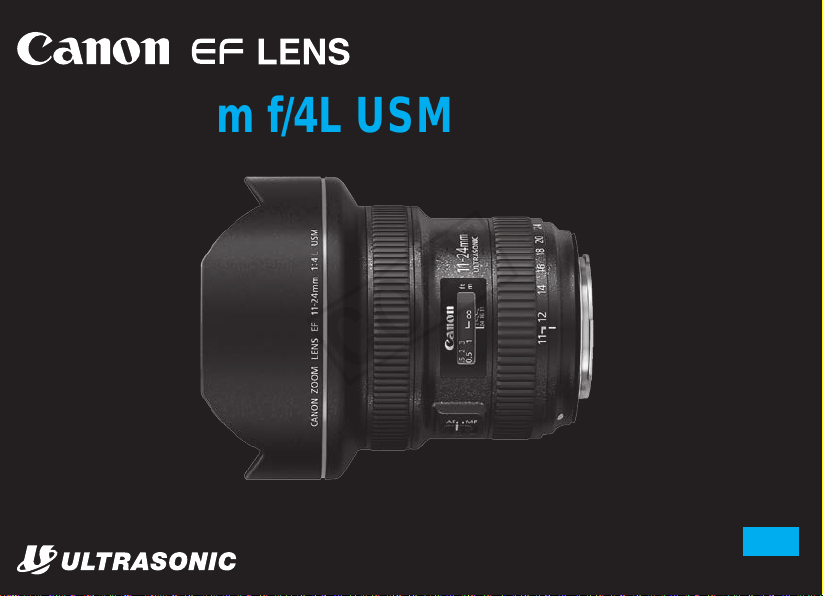
EF11-24mm f/4L USM
Instructions
ENG
COPY

ENG-1
Thank you for purchasing a Canon product.
Canon’s EF11-24mm f/4L USM is a high-
performance ultra-wide angle zoom lens, for use
with EOS cameras.
● “USM” stands for Ultrasonic Motor.
Features
1. Use of super UD lens elements, UD lens
elements, and two types of aspherical lens
elements giving superior denition.
2. SWC (Subwavelength Structure Coating)
and ASC (Air Sphere Coating) are utilized to
signicantly reduce occurrences of are and
ghost created by quite large incident angles of
light.
3. Using a uorine coating on the foremost and
rearmost lens surfaces allows adhered dirt to be
removed more easily than before.
4. Ultrasonic motor (USM) for fast, quiet autofocus.
5. Manual focusing is available after the subject
comes into focus in autofocus mode (ONE
SHOT AF).
6. Circular aperture for producing beautiful
softfocus images.
7. Tight seal structure provides excellent dustproof
and drip-proof performance. However, it is
unable to provide complete protection from dust
and moisture.
COPY

ENG-2
Safety Precautions
Safety Precautions
● Do not look at the sun or a bright light source
through the lens or camera. Doing so could result in
loss of vision. Looking at the sun directly through the
lens is especially hazardous.
● Whether it is attached to the camera or not, do not
leave the lens under the sun without the lens cap
attached. This is to prevent the lens from concentrating
the sun’s rays, which could cause a re.
● The EF11-24mm f/4L USM features a large diameter
front lens element. Please be careful because this
large front section will extend past the bottom of some
cameras.
Conventions used in this instruction
Warning to prevent lens or camera malfunction
or damage.
Supplementary notes on using the lens and
taking pictures.
Handling Cautions
● If the lens is taken from a cold environment into a
warm one, condensation may develop on the lens
surface and internal parts. To prevent condensation
in this case, rst put the lens into an airtight plastic bag
before taking it from a cold to warm environment. Then
take out the lens after it has warmed gradually. Do the
same when taking the lens from a warm environment
into a cold one.
● Do not leave the lens in excessive heat such as in a car
in direct sunlight. High temperatures can cause the
lens to malfunction.
Usage Precautions
● When using this lens, please check the Canon website
for the latest camera rmware. If the camera’s rmware
is not the latest version, be sure to update to the latest
rmware.
● For details on updating rmware, please check the
Canon website.
COPY

ENG-3
Precautions for Shooting
● If dirt or dust adheres to the surface of the front lens element, it can easily appear in images due to the
lens’s short focal length. In order to avoid this, please remove dirt or dust from the surface of the front lens
element by using a commercially available air dust blower.
● Since this lens has a wide angle of view, light from bright light sources, such as the sun, can easily enter
the image area. Please do not look at bright light sources using the camera’s viewnder.
● Similarly, are and ghost will occur when bright light sources appear in the image area, depending on
shooting conditions. In order to prevent are and ghost, we suggest shooting places such as shaded are
as so that bright light does not enter the lens.
COPY

ENG-4
This device complies with Part
15 of the FCC Rules.
Operation is subject to the following two conditions: (1) This
device may not cause harmful interference, and (2) this
device must accept any interference received, including
interference that may cause undesired operation.
Do not make any changes or modications to the equipment
unless otherwise specied in the instructions. If such
changes or modications should be made, you could be
required to stop operation of the equipment.
This equipment has been tested and found to comply with
the limits for a class B digital device, pursuant to part 15
of the FCC Rules. These limits are designed to provide
reasonable protection against harmful interference in a
residential installation. This equipment generates, uses and
can radiate radio frequency energy and, if not installed and
used in accordance with the instructions, may cause harmful
interference to radio communications.
However, there is no guarantee that interference will not
occur in a particular installation. If this equipment does
cause harmful interference to radio or television reception,
which can be determined by turning the equipment off and
on, the user is encouraged to try to correct the interference
by one or more of the following measures:
• Reorient or relocate the receiving antenna.
• Increase the separation between the equipment and
receiver.
• Connect the equipment into an outlet on a circuit different
from that to which the receiver is connected.
• Consult the dealer or an experienced radio/TV technician
for help.
Safety Precautions
CAN ICES-3 (B) / NMB-3 (B)
COPY
ENG-5
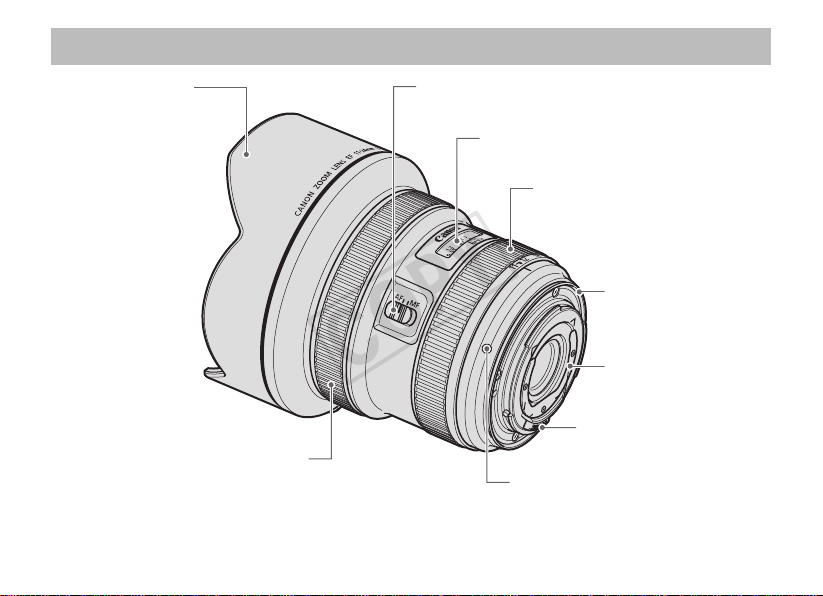
Nomenclature
● For detailed information, reference page numbers are provided in parentheses (→ **).
Focus mode switch (→ 7)
Distance scale (→ 8)
Zoom ring (→ 7)
Rubber ring (→ 6)
Gelatin filter holder (→ 9)
Contacts (→ 6)
Lens mount index (→ 6)
Focusing ring (→ 7)
Built-in lens hood
COPY
ENG-6
1. Mounting and Detaching the Lens
See your camera’s instructions for details on
mounting and detaching the lens.
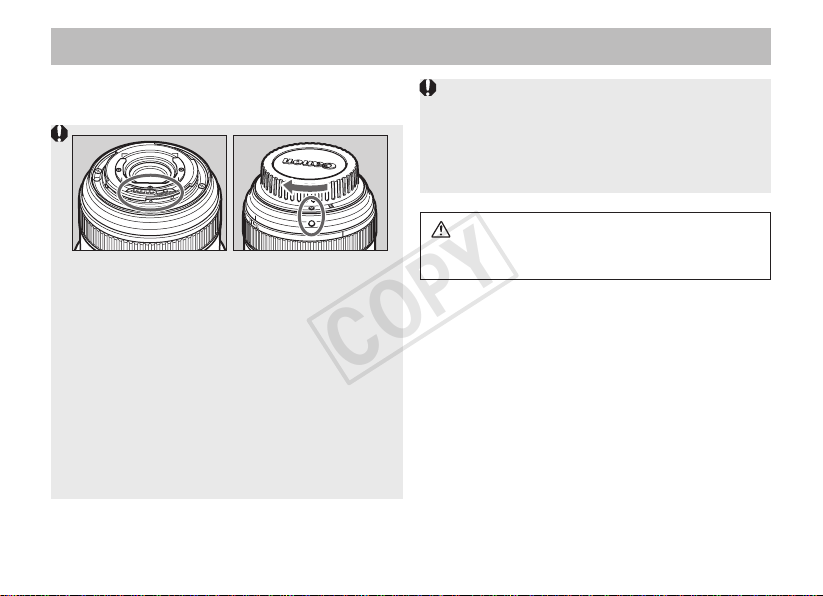
The lens mount has a rubber ring for enhanced
dust- and water-resistance. The rubber ring may
cause slight abrasions around the camera’s lens
mount, but this will not cause any problems. If the
rubber ring becomes worn, it is replaceable by a
Canon Service Center at cost.
● After detaching the lens, place the lens with
the rear end up to prevent the lens surface and
contacts from getting scratched.
● If the contacts get soiled, scratched, or have
ngerprints on them, corrosion or faulty
connections can result. The camera and lens
may not operate properly.
● If the contacts get soiled or have ngerprints on
them, clean them with a soft cloth.
● If you remove the lens, cover it with the dust
cap. To attach it properly, align the lens mount
index and the index of the dust cap as shown
in the diagram, and turn clockwise. To remove it,
reverse the order.
Please be careful when laying the lens
sideways. The lens may roll and fall, resulting
in injury.
COPY
ENG-7
2.
Setting the Focus Mode
3.
Zooming
After autofocusing in ONE SHOT AF mode, focus
manually by pressing the shutter button halfway
and turning the focusing ring. (Full-time manual
focus)
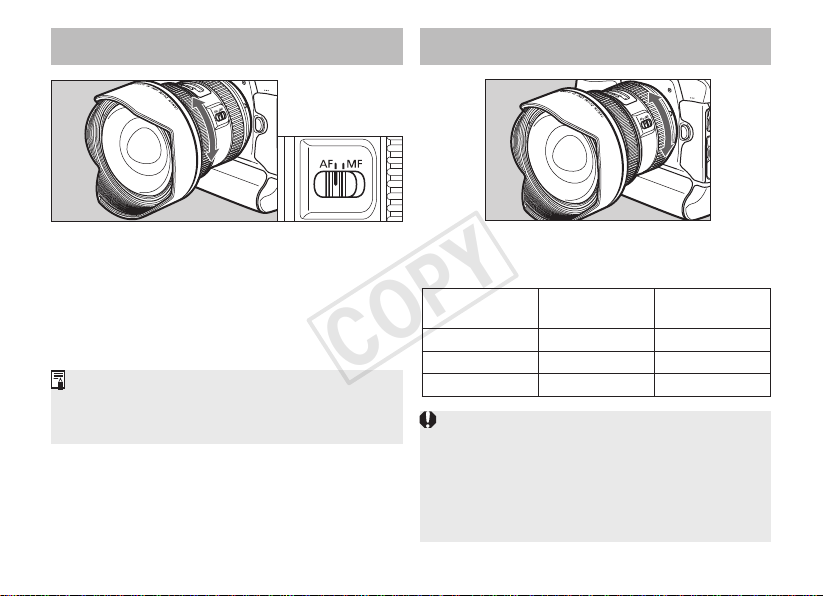
To shoot in autofocus (AF) mode, set the focus
mode switch to AF.
To shoot in manual focus (MF) mode, set the
focus mode switch to MF, and focus by turning
the focusing ring.
The focusing ring always works, regardless of
the focus mode.
To zoom, rotate the zoom ring.
Also, the minimum focusing distance of the lens
changes depending on focal length.
Focal Length
(mm)
Min. Focusing
Distance (m/ft)
Magnication (×)
11 0.32 / 1.05 0.06
16 0.29 / 0.95 0.10
24 0.28 / 0.92 0.16
● Be sure to nish zooming before focusing.
Zooming after focusing can affect the focus.
● Zooming in causes the front lens assembly to
extend along the lens’s optical axis. This adds
to the weight of the lens assembly, so pointing
it up or down when zooming in may increase or
decrease the torque felt in the zoom ring.
COPY
ENG-8
4.
InnityCompensation
Mark
For accurate manual focusing of subjects at innity,
look through the viewnder or look at the magnied
image* on the LCD screen while rotating the
focusing ring.
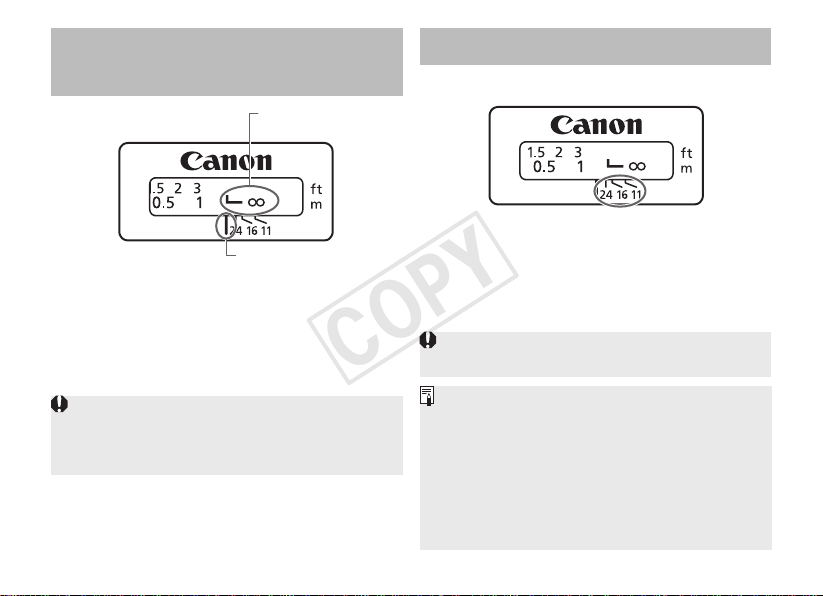
To compensate for shifting of the innity focus
point that results from changes in temperature,
there is a margin at the innity (∞) position.
The innity position at normal temperature is the
point at which the vertical line of the distance
scale L mark is aligned with the distance index.
Distance index
Innity compensation
mark
* For cameras with Live View shooting capability.
5. Infrared Index
● The infrared index position is based on a
wavelength of 800 nm.
● The compensation amount differs depending on
the focal length. Use the indicated focal length
as a guide when setting the compensation
amount.
● Be sure to observe the manufacturer’s
instructions when using infrared lm.
● Use a red lter when you take the picture.
Some EOS cameras cannot use infrared lm. See
the instructions for your EOS camera.
The infrared index corrects the focus setting
when using monochrome infrared lm. Focus on
the subject manually, then adjust the distance
setting by moving the focusing ring to the
corresponding infrared index mark.
COPY
ENG-9
6. Lens Cap
The lens cap can be attached by pinching the
lock knobs and vertically aligning the lens cap
with the lens hood as shown in the diagram.
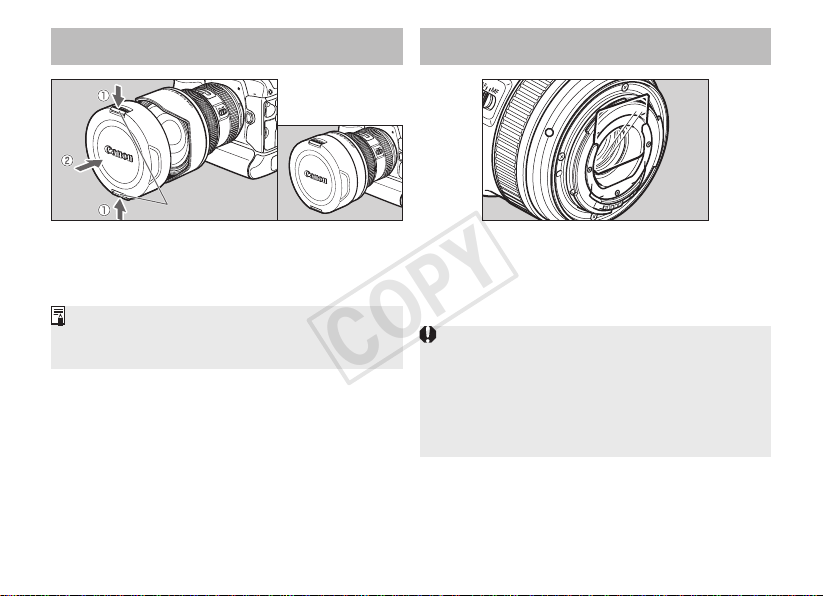
There is a gelatin filter holder at the rear of the
lens. Cut the gelatin filter to fit within the white
frames. Then insert the gelatin filter into the filter
holder.
7. Filter (Sold separately)
The recessed sections of the lens hood that the
cap locks on to are located at the front inside edge
of the top and bottom petals.
Lock knobs
The lens’s rear lens group moves back toward the
rear of the lens (camera side) the most when the
lens is set to the wide end. Therefore, in order to
prevent the rear lens element from making contact
with a lter (when installed), we recommend using
a lter only if the zoom ring is not set to the wide
end.
COPY
ENG-10
8. Extension Tubes
(Sold separately)
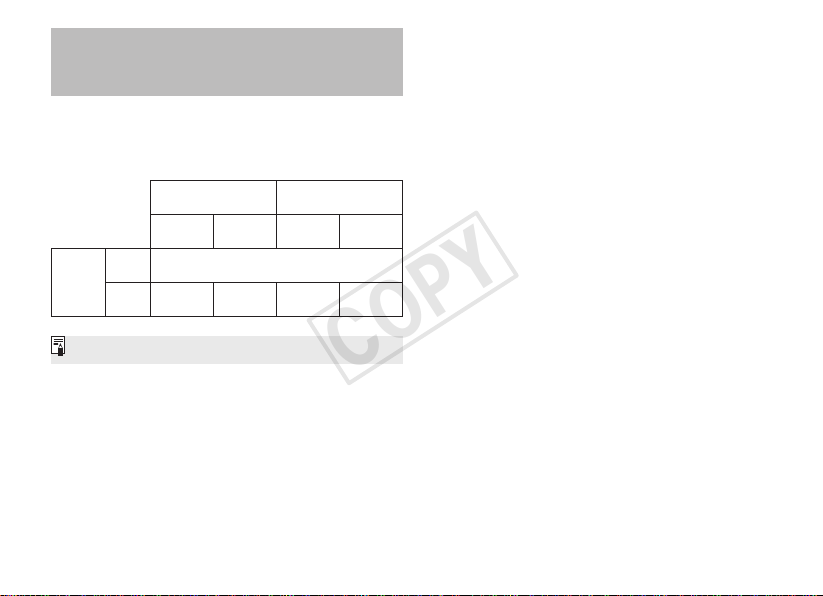
You can attach extension tube EF12 II for
magnified shots. The shooting distance and
magnification are shown below.
MF mode is recommended for accurate focusing.
Focusing Distance
Range (mm)
Magnication (×)
Close
distance
Long
distance
Close
distance
Long
distance
EF12 II
11mm Incompatible
24mm 188 203 0.73 0.53
COPY
ENG-11
Specications
● The lens length is measured from the mount surface to the front end of the hood. Add 23.5 mm
when including the lens cap and dust cap.
● The size and weight listed are for the lens only, except as indicated.
● The EF1.4X II, III/EF2X II, III extender and 250D/500D close-up lenses cannot be used with this
lens.
● Aperture settings are specied on the camera.
● All data listed is measured according to Canon standards.
● Product specications and appearance are subject to change without notice.
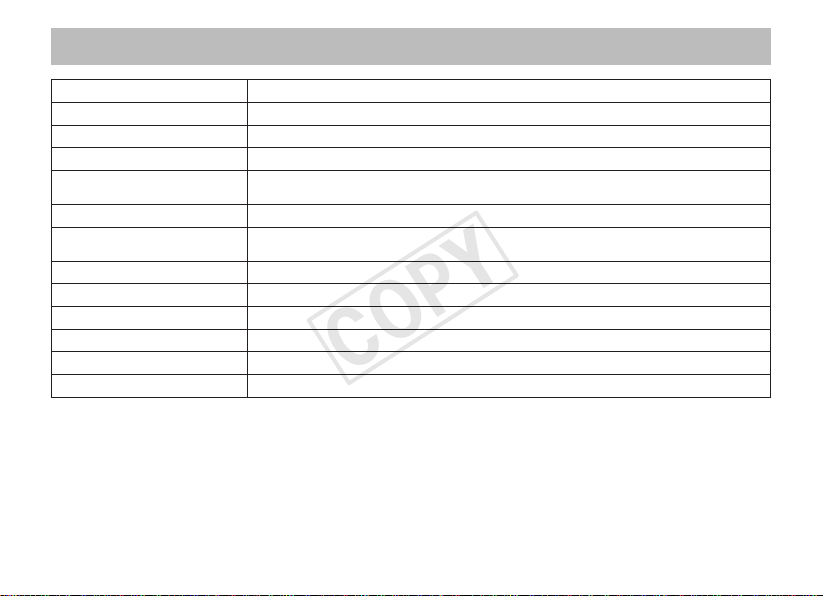
Focal Length/Aperture 11-24mm f/4
Lens Construction 11 groups, 16 elements
Minimum Aperture f/22
Angle of View Diagonal: 126°05′ - 84°, Vertical: 95° - 53°, Horizontal: 117°10′ - 74°
Min. Focusing Distance
0.28 m/0.92 ft. (at 24 mm)
0.32 m/1.05 ft. (at 11 mm)
Max. Magnification 0.16x (at 24 mm)
Field of View
Approx. 196 x 307 mm/7.72 x 12.09 inch (at 0.32 m/1.05 ft.) -
74 x 112 mm/2.91 x 4.41 inch (at 0.28 m/0.92 ft.)
Filter Gelatin lter holder (located at the rear of the lens)
Max. Diameter and Length 108.0 x 132.0 mm/4.25 x 5.20 inch
Weight Approx. 1180 g/41.6 oz
Hood
Built-in
Lens Cap Lens Cap 11-24
Case LP1424
COPY

CT1-8600-000 0814Ni © CANON INC. 2014
COPY