
User guide
SmartTags
NT3/SmartTagsST25a

Contents
Introduction...................................................................................3
What are SmartTags?........................................................................ 3
Getting started..............................................................................4
Turning on the NFC function............................................................ 4
NFC detection area........................................................................... 4
Smart Connect.................................................................................. 4
Using SmartTags........................................................................... 5
Configuring SmartTags..................................................................... 5
Editing SmartTags............................................................................. 5
Legal information.......................................................................... 7
Declaration of Conformity forNT3.....................................................7
Industry Canada Statement..............................................................7
2
Introduction
What are SmartTags?
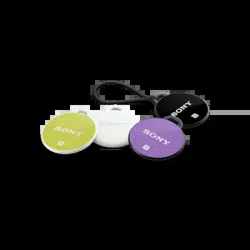
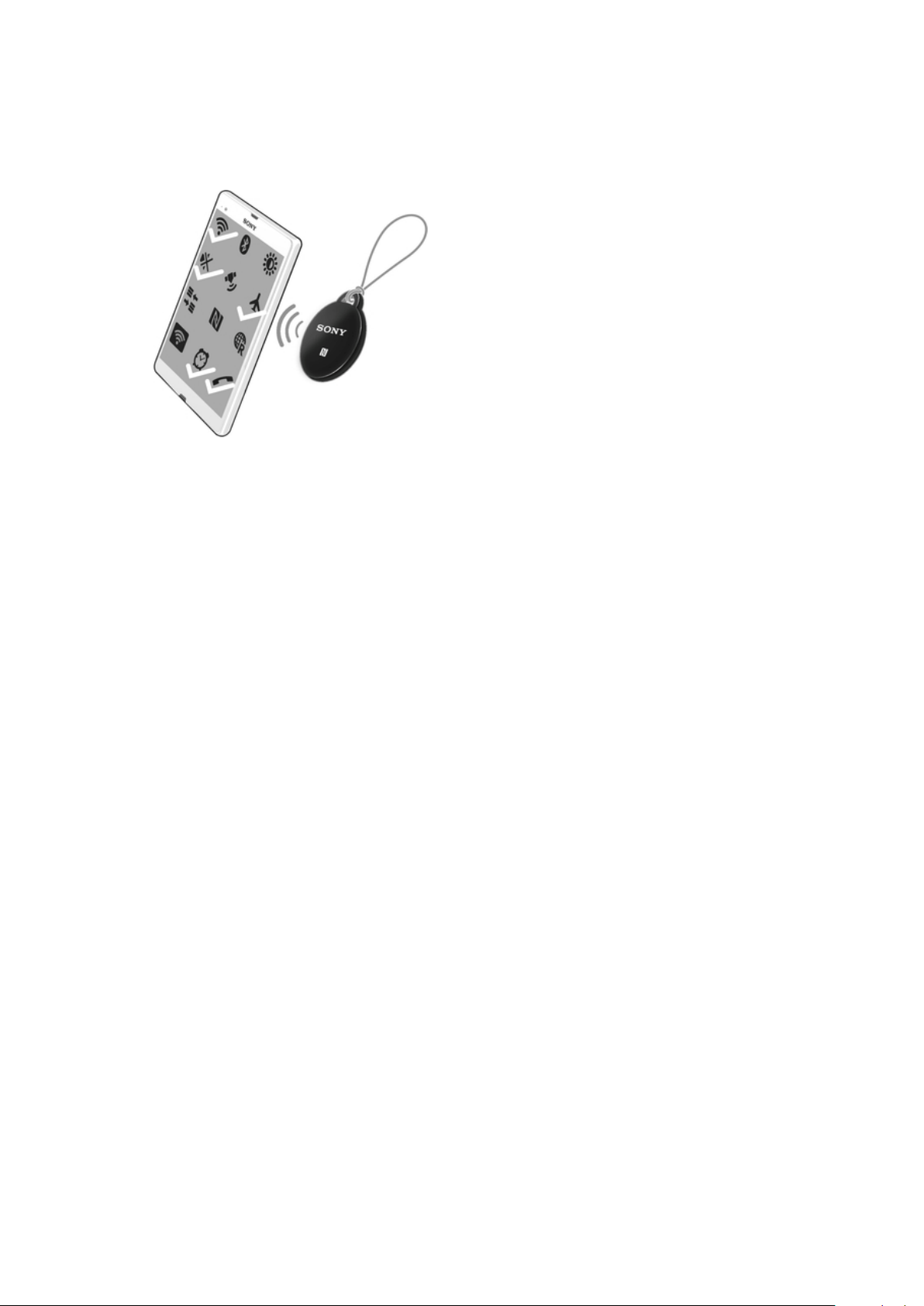
SmartTags use your device's NFC capabilities to trigger instant actions. For
example, they can activate multiple settings on your device, launch an application,
turn on the Wi-Fi® function on your device, or link to a web page. You can also use
a SmartTag as a personal business card.
SmartTags also oer pre-set scenarios designed to get you started quickly. For
example, if you're going to sleep, one tap of a SmartTag can launch your Alarm
application, set your phone to silent, and turn o all the applications that you don't
need, such as Wi-Fi®, Bluetooth® and GPS.
3
This is an internet version of this publication. © Print only for private use.
Getting started
Turning on the NFC function
To get started, you must first turn on the NFC function in your device so that NFC
tags can be recognised.
To turn on the NFC function
1 From your Home screen, tap .
2 Find and tap Settings > More....
3 Mark the NFC checkbox.
NFC detection area
The location of the NFC detection area in a device can vary depending on the
device. You can swipe an NFC tag against the back of your device to detect where
the NFC detector is located. For more information, refer to the User guide of your
device.
Smart Connect
You need the Smart Connect application to be able to read and configure your
SmartTags. The application comes pre-installed on all Xperia™ devices.
If Smart Connect is not installed on your device, you are automatically routed to
Google Play™ to download the application when you touch the tag to your device.
You can also download Smart Connect at any time using the Google Play™
application on your device.
Network connection is needed to download Smart Connect application.
4
This is an internet version of this publication. © Print only for private use.
Using SmartTags
Configuring SmartTags
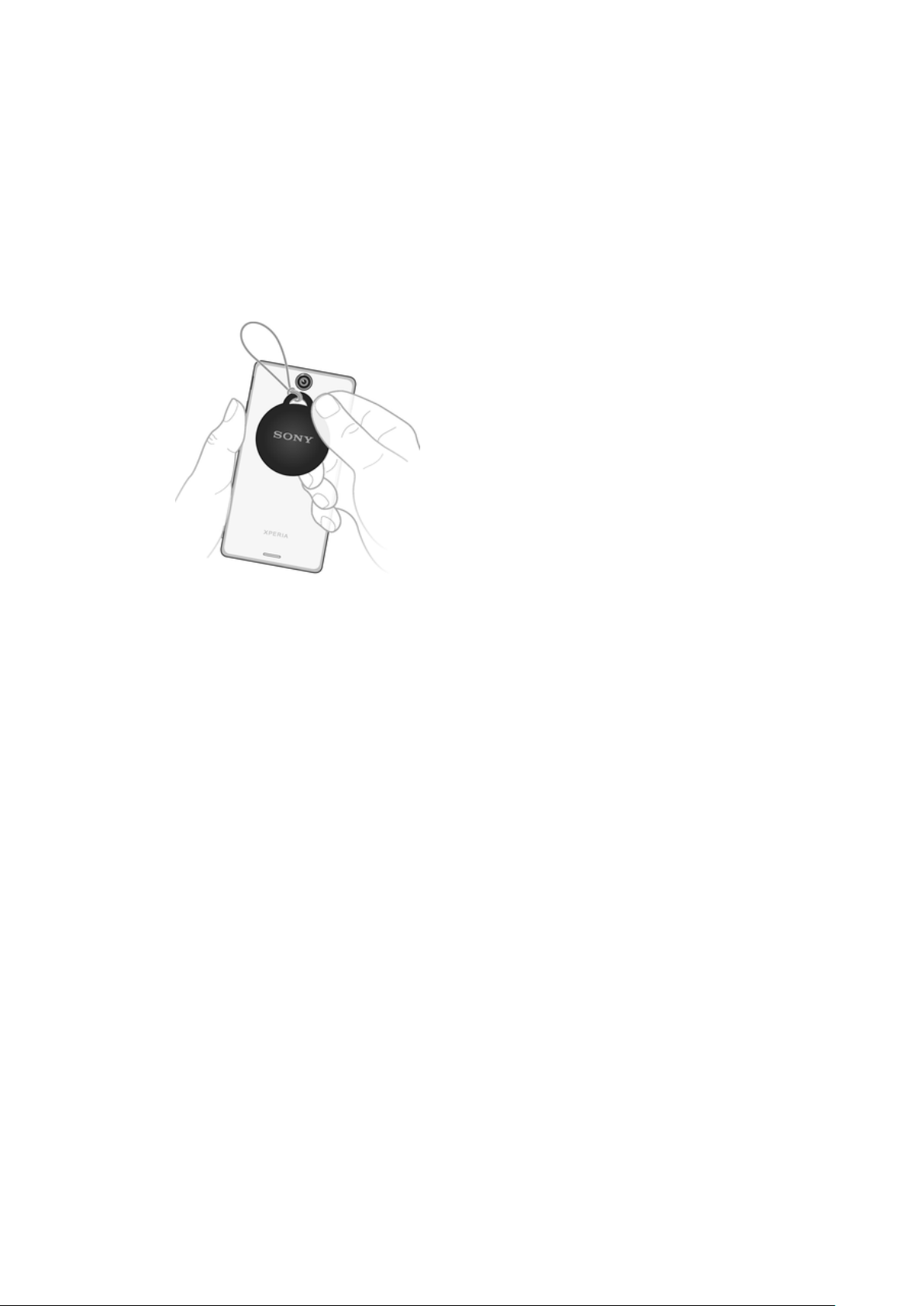
When you scan a non-configured tag, a guide opens to help configure the tag the
first time you scan it. Other tags can come pre-configured with certain information
or settings. For example, a tag may be pre-configured to open a web link with
information about a certain product or service. Or it can be set to launch certain
functions on your device.
To configure a SmartTag for the first time
1 Unlock the screen.
2 Place your device close to the SmartTag so that the device's NFC detection
area touches the tag. Your device vibrates and a dialogue box opens.
3 Select Create new event and follow the instructions to add your desired
actions.
4 Edit the Event name field and tap Finish to complete the event.
5 Tap Accept in the pop-up dialogue box. Your tag is now saved in the Smart
Connect event list as a SmartTag.
Editing SmartTags
The first time you configure a tag, a guide opens to help you through the steps.
After that, you can edit your tags using the Smart Connect application.
After you create an event on a tag, only you can edit the event, but anyone with an
NFC-enabled device can read the tag. You can allow others to edit one of your
SmartTags by removing the tag from your device list in the Smart Connect
application.
To edit a SmartTag
1 From your device's main application screen, find and tap Smart Connect.
2 Find and tap Events.
3 Tap the event that you want to edit.
To delete an event from the event list
1 From your device's main application screen, find and tap Smart Connect.
2 Find and tap Events.
3 Tap the event that you want to delete.
4 Tap Delete.
5
This is an internet version of this publication. © Print only for private use.

To delete a SmartTag from the device list
1 From your device's main application screen, find and tap Smart Connect.
2 Find and tap Devices.
3 Tap the tag that you want to delete.
4 Tap Delete device.
6
This is an internet version of this publication. © Print only for private use.
Legal information
SmarttagsNT3
This User guide is published by Sony Mobile Communications AB or its local aliated company, without any
warranty. Improvements and changes to this User guide necessitated by typographical errors, inaccuracies
of current information, or improvements to programs and/or equipment, may be made by Sony Mobile
Communications AB at any time and without notice. Such changes will, however, be incorporated into new
editions of this User guide.
All rights reserved.
©Sony Mobile Communications AB, 2013
Publication number: 1277-6036.2
All product and company names mentioned herein are the trademarks or registered trademarks of their
respective owners. Any rights not expressly granted herein are reserved. All other trademarks are property
of their respective owners.
Visit
www.sonymobile.com
for more information.
All illustrations are for illustration only and may not accurately depict the actual accessory.
Declaration of Conformity forNT3
We, Sony Mobile Communications AB of
Nya Vattentornet
SE-221 88 Lund, Sweden
declare under our sole responsibility that our product
Sony type AI-1400
and in combination with our accessories, to which this declaration relates is in
conformity with the appropriate standards EN 301 489-7:V1.3.1, EN 301
489-3:V1.4.1 following the provisions of, Radio Equipment and Telecommunication
Terminal Equipment directive 1999/5/EC.
Lund, June 2013
Anders Grynge
Director, Head of Global Type Approval
We fulfil the requirements of the R&TTE Directive (1999/5/EC).
FCC Statement
This device complies with Part 15 of the FCC rules. Operation is subject to the following two conditions: (1)
This device may not cause harmful interference, and (2) This device must accept any interference received,
including interference that may cause undesired operation.
Any change or modification not expressly approved by Sony may void the user's authority to operate the
equipment.
This equipment has been tested and found to comply with the limits for a Class B digital device, pursuant to
Part 15 of the FCC Rules. These limits are designed to provide reasonable protection against harmful
interference in a residential installation. This equipment generates, uses and can radiate radio frequency
energy and, if not installed and used in accordance with the instructions, may cause harmful interference to
radio communications. However, there is no guarantee that interference will not occur in a particular
installation.
If this equipment does cause harmful interference to radio or television reception, which can be determined
by turning the equipment o and on, the user is encouraged to try to correct the interference by one or
more of the following measures:
• Reorient or relocate the receiving antenna.
• Increase the separation between the equipment and receiver.
• Connect the equipment into an outlet on a circuit dierent from that to which the receiver is connected.
• Consult the dealer or an experienced radio/TV technician for help.
Industry Canada Statement
This device complies with RSS-210 of Industry Canada.
7
This is an internet version of this publication. © Print only for private use.

Operation is subject to the following two conditions: (1) this device may not cause
interference, and (2) this device must accept any interference, including
interference that may cause undesired operation of the device.
This Class B digital apparatus complies with Canadian ICES-003.
The device for operation in the band 5150-5250 MHz is only for indoor use to
reduce the potential for harmful interference to co-channel mobile satellite
systems. The maximum antenna gain permitted for devices in the bands
5250-5350 MHz and 5470-5725 MHz shall comply with the e.i.r.p. limit; and the
maximum antenna gain permitted for devices in the band 5725-5825 MHz shall
comply with the e.i.r.p. limits specified for point-to-point and non point-to-point
operation as appropriate. Users should also be advised that high-power radars are
allocated as primary users (i.e. priority users) of the bands 5250-5350 MHz and
5650-5850 MHz and that these radars could cause interference and/or damage to
LE-LAN devices.
Avis d’industrie Canada
Le présent appareil est conforme aux CNR d'Industrie Canada applicables aux
appareils radio exempts de licence.
L'exploitation est autorisée aux deux conditions suivantes: (1) l'appareil ne doit pas
produire de brouillage, et, and (2) l'utilisateur de l'appareil doit accepter tout
brouillage radioélectrique subi, même si le brouillage est susceptible d'en
compromettre le fonctionnement.
Cet appareil numérique de la classe B est conforme à la norme NMB-003 du
Canada.
Les dispositifs fonctionnant dans la bande 5150-5250 MHz sont réservés
uniquement pour une utilisation à l’intérieur afin de réduire les risques de
brouillage préjudiciable aux systèmes de satellites mobiles utilisant les mêmes
canaux. Le gain maximal d’antenne permis pour les dispositifs utilisant les bandes
5250-5350 MHz et 5470-5725 MHz doit se conformer à la limite de p.i.r.e. Le gain
maximal d’antenne permis (pour les dispositifs utilisant la bande 5725-5825 MHz)
doit se conformer à la limite de p.i.r.e. spécifiée pour l’exploitation point à point et
non point à point, selon le cas. De plus, les utilisateurs devraient aussi être avisés
que les utilisateurs de radars de haute puissance sont désignés utilisateurs
principaux (c.-à-d., qu’ils ont la priorité) pour les bandes 5 250-5 350 MHz et 5
650-5 850 MHz et que ces radars pourraient causer du brouillage et/ou des
dommages aux dispositifs LAN-EL.
8
This is an internet version of this publication. © Print only for private use.