1
y
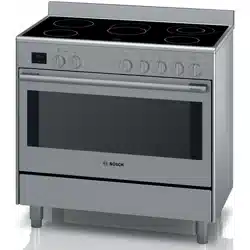
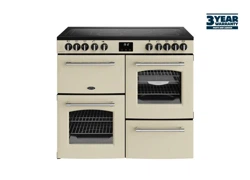
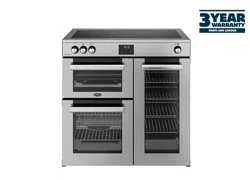
BCE1020SS 100 cm
/
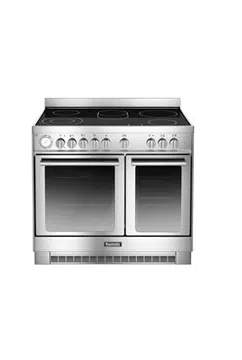
BCE920SS 90 cm Twin
cavity electric slot-in
cooker
User Manual for your Baumatic
BCE1020SS 100 cm
BCE920SS 90 cm
Twin cavity electric slot-in
cooker with ceramic top
NOTE: This User Instruction Manual contains important
information, including safety & installation points, which will
enable you to get the most out of your appliance. Please keep it
in a safe place so that it is easily available for future reference; for
you or any person not familiar with the operation of the appliance.
GS 01/07/10
2

3
Contents
Environmental note 4
Important safety information 5 – 9
Specifications 9 – 13
Dimensions 9
Specifications 9 - 10
Electrical details 10
Control panel 11 –12
Hob surface layout 12 -13
Oven timer 13
Setting and using the oven programmer/timer 13 -16
Setting the time of day 13
Setting the minute minder function 14
Setting the duration function 14
Setting the end cook function 14 –15
Setting the start and end time function 15
Returning to manual operation mode 15
The buzzer 15
Changing or cancelling a programmed function 16
Selecting a cooking function and temperature 16 -20
Using the main oven 16 –17
Cooking functions 17
Using the secondary oven 18 -19
Cooking guidelines 19 -20
Warnings 20
Using the hob top 20 -23
Before first use 20
Using the hob top zones 21
Hob guidelines 22 –23
Cooking tips 23 -27
Cleaning and maintenance 28 -32
Cleaning the ceramic hob top 29
After each use 29
Cleaning table 29
Replacing the oven bulb 30 –31
Removing the oven door for cleaning 31
Removing the inner door glass for cleaning 31 -32
Installation 32 -36
Positioning 32 –34
Securing the back-guard 34
Fitting the safety chain and hook 34 -35
Electrical connection 35 -36
Connecting the main supply cable 36
My appliance isn’t working correctly 37 -39
Contact details 40
Environmental note
4
o The packaging materials that Baumatic uses are environmentally
friendly and can be recycled.
o Please discard all packaging material with due regard for the
environment.

Important safety information
Your safety is of the utmost importance to Baumatic.
Please make sure that you read this instruction booklet
before attempting to install or use the appliance. If you
are unsure of any of the information contained in this
booklet, please contact the Baumatic Advice Line.
General Information
o This appliance is designed for domestic household use and for
the cooking of domestic foodstuffs.
o IMPORTANT: The adjacent furniture and all materials used in
the installation must be able to withstand a minimum
temperature of 85°C above the ambient temperature of the
room it is located in, whilst in use.
o Certain types of vinyl or laminate kitchen furniture are
particularly prone to heat damage or discolouration at
temperatures below the guidelines given above.
o Any damage caused by the appliance being installed in
contravention of this temperature limit, or by placing adjacent
cabinet materials closer than 25 mm to the appliance, will be
the liability of the owner.
o IMPORTANT: Baumatic Ltd. DO NOT recommend that this
appliance is installed on any type of marine vessel.
o The use of this appliance for any other purpose or in any other
environment without the express agreement of Baumatic Ltd.
will invalidate any warranty or liability claim.
o Your new appliance is guaranteed against electrical or
mechanical defects, subject to certain exclusions that are noted
in Baumatic’s Conditions Of Guarantee. The foregoing does not
affect your statutory rights.
o Repairs may only be carried out by Baumatic service
engineers or their authorised service agents.
5

6
Warning and safety instructions
o This appliance complies with all current European safety
legislation. Baumatic do wish to emphasise that this compliance
does not remove the fact that the appliance surfaces will
become hot during use and retain heat after operation.
Child Safety
o Baumatic strongly recommend that babies and young children
are prevented from being near to the appliance and not allowed
to touch the appliance at any time. During and after use, all
surfaces will become hot.
o If it is necessary for younger family members to be in the
kitchen, please ensure that they are kept under close supervision
at all times.
General Safety
Make sure that you understand the controls before using the
appliance.
Check that all of the controls on the appliance are turned off
after use.
Always stand back when opening the oven door, this will allow
heat to disperse.
Take care when removing items from the oven, as the contents
may be hot.
Always keep the oven doors closed when the oven is not in use.
Always follow the basic principles of food handling and hygiene;
this will prevent the possibility of bacterial growth.
Always keep ventilation slots clear of obstructions.
Keep fingers away from the hinge areas when closing the door,
otherwise you may trap them.
Oven gloves should be used when placing food in the oven cavity
and when removing it. Care should be taken to avoid direct
contact with any of the elements in the appliance.
o DO NOT LEAVE THE APPLIANCE UNATTENDED WHILST IN
USE.

7
o Do not place heavy objects on the oven door or lean on the
oven door when it is open, as this can cause damage to the oven
door hinges. Nobody should be allowed to sit or stand on any
part of the cooker.
o Do not store chemicals, food stuffs, pressurised containers in or
on the cooker or in cabinets immediately above or next to the
cooker.
o Do not heat up unopened food containers, as pressure can build
up which may cause the container to burst.
o Do not place flammable or plastic items on or near the hob
burners, these types of materials should also not be placed in
the oven or the compartment below the oven.
o Do not leave heated oil or fat unattended, as this is a fire risk.
You should not fill a deep fat frying pan more than one third full
of fat or oil; you should also not use a lid.
o Do not allow fat or oil to build up in the oven trays, grill pan or
oven base.
o Do not place pans or baking trays directly on the base of the
oven cavity, or line it with aluminium foil.
o Do not grill food containing fat without using the grill trivet. The
grill trivet should never be covered with aluminium foil.
o Do not place hot enamel parts in water, leave them to cool first.
o Do not allow vinegar, coffee, milk, saltwater, lemon, tomato
juice or any liquid with high sugar content to remain in contact
with the enamel parts of the appliance. Spillages should be
wiped up immediately.
o Do not allow electrical fittings or cables to come into contact
with areas on the appliance that get hot.
o Do not use the appliance to heat the room it is located in or to
dry clothing. No clothing should be placed over or near to the
hob burners or oven door.
o Do not install the appliance next to curtains or soft furnishings.
o Do not attempt to lift or move cooking appliances by using the
oven door or handle, as this may cause damage to the appliance
or result in injury to the person lifting the appliance.
Cleaning
o Cleaning of the oven should be carried out on a regular basis.
o Great care should be taken whilst using this appliance and when
following the cleaning procedure.
o IMPORTANT: The appliance must be disconnected from the
mains before following the cleaning procedure.
o IMPORTANT: Care must be taken when cleaning between
the door glasses, and inside the inner frame as some of
the edges maybe sharp due to the manufacturing process.
Installation
This appliance must be correctly installed by a
suitably qualified person, strictly in accordance
with the manufacturer’s instructions. Please see
the specific section of this booklet that refers to
installation.
o Baumatic Ltd. declines any responsibility for injury or
damage, to person or property, as a result of improper
use or installation of this appliance.
o Heat, steam and moisture will be created during use of the
appliance, take care to avoid injury and ensure that the room is
adequately ventilated. If the appliance is going to be used for
prolonged periods of time, then additional ventilation may be
required.
o Please consult with your qualified installer if you are in any doubt
about the amount of ventilation that you will require.
Declaration of conformity
This appliance complies with the following European Directives:
2006/95/EC regarding “low voltage”
2004/108/EC regarding “electromagnetic disturbances”
-89/109/EEC regarding “materials in contact with food”.
8
o The above directives comply with 93/68/EEC regarding CE
marking.
o The manufacturer declares that the oven is built using certified
materials and requires the appliance to be installed in
accordance with the standards currently in force. This appliance
must be used by a trained person for domestic purposes only.
Specifications
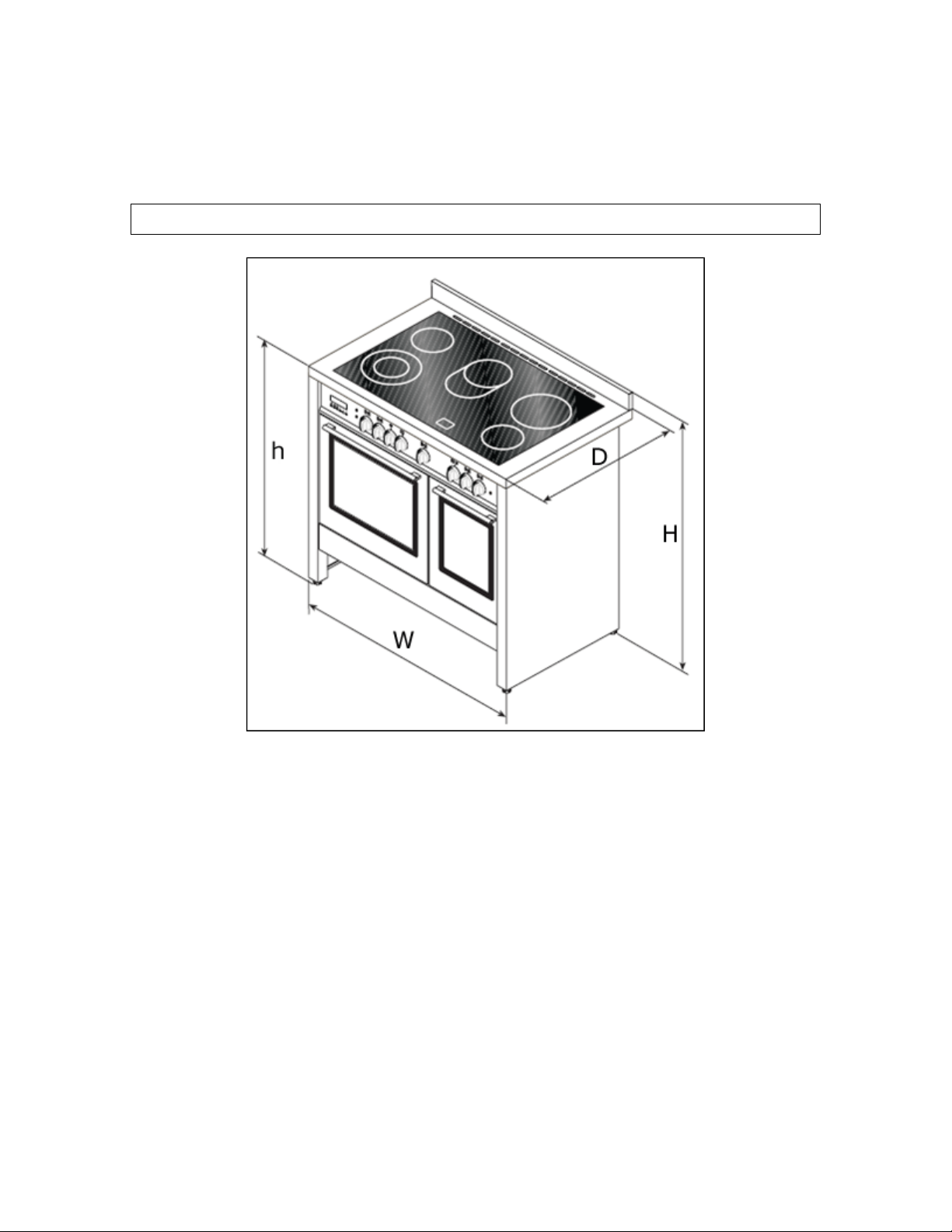
Product dimensions:
BCE1020SS
H = Height: 910 mm
h = Height: 900 mm
W = Width: 1000 mm
D = Depth: 600 mm
BCE920SS
H = Height: 920 mm
h = Height: 870 mm
W = Width: 900 mm
D = Depth: 600 mm
Product specifications:
o 5 zone ceramic hob:
o 2 x 1.20 kW hyper-speed zone (Ø 140 mm)
o 2.10 kW hyper-speed zone (Ø 210 mm)
o 0.70 / 2.20 kW double hyper-speed zone (Ø 140 / 210 mm)
o 0.70 / 2.20 kW double hyper-speed (Ø 190 / 285 mm)
9

10
o Energy efficiency class: A/A
o LED full programmer
o Cooling fan
o Oven lights
o Thermostatically controlled grill (main oven)
o Fixed grill (secondary oven)
o Double-glazed removable “cool touch” doors
o Removable full inner glasses
o Wipe Clean enamelled cavities
o Adjustable feet
Left oven: Multifunction oven
o 6 functions
o Net oven capacity: 50 litres
o Gross oven capacity: 64 litres
Right oven: Static oven with grill
o 3 functions
o Net oven capacity: 35 litres
o Gross oven capacity: 43.5 litres
Standard accessories:
o WipeClean enamelled baking tray with handle
o WipeClean enamelled baking tray
o 3 x Safety shelves
o Removable side racks
o Trivet
o Ceramic hob scraper
Optional extra:
o BPS2 Pizza Stone
Electrical details
Rated Voltage: 220 - 240 Vac 50 Hz
Supply Connection: 32 A (double pole switched fused
outlet with 3mm contact gap)
Max Rated Inputs: 12.10 kW
Mains Supply Lead: 3 core x 1.5 mm² (not supplied)
Oven Light Bulb: E14 15 W/300°C screw type pigmy
For future reference please record the following information which can
be found on the rating plate and the date of purchase which can be
found on your sales invoice. The main rating plate for your oven can
be located at the back of the cooker. A smaller rating plate which
quotes the serial and model numbers can be found on the inner cavity
of the oven or grill door.
Model Number ……………………………….
Serial Number ……………………………….
Date of Purchase ……………………………….
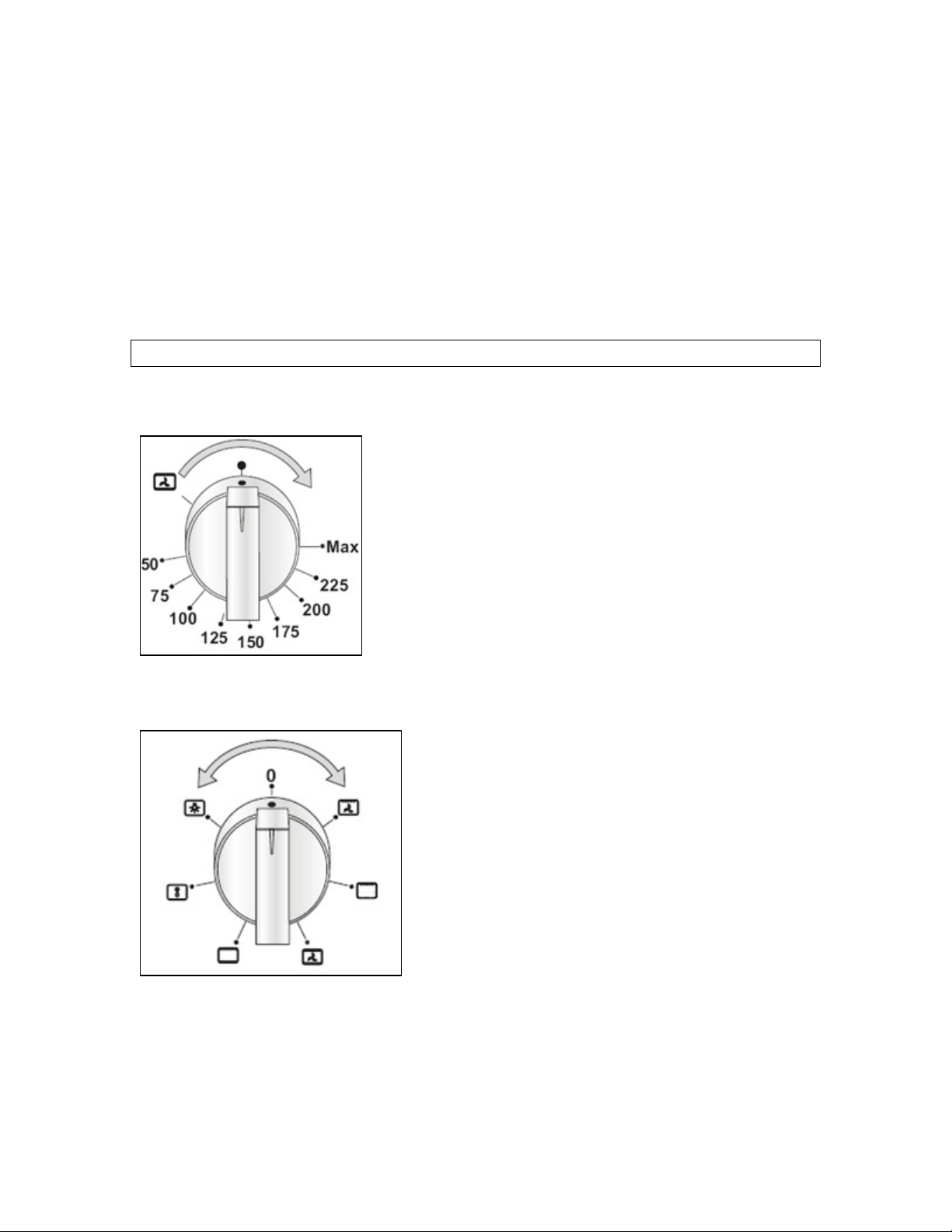
Control Panel
Thermostat control knob (main oven)
o Use this control knob to control the
temperature in the oven.
Oven function control knob
o Use this control knob to select a
function for the main oven.
11
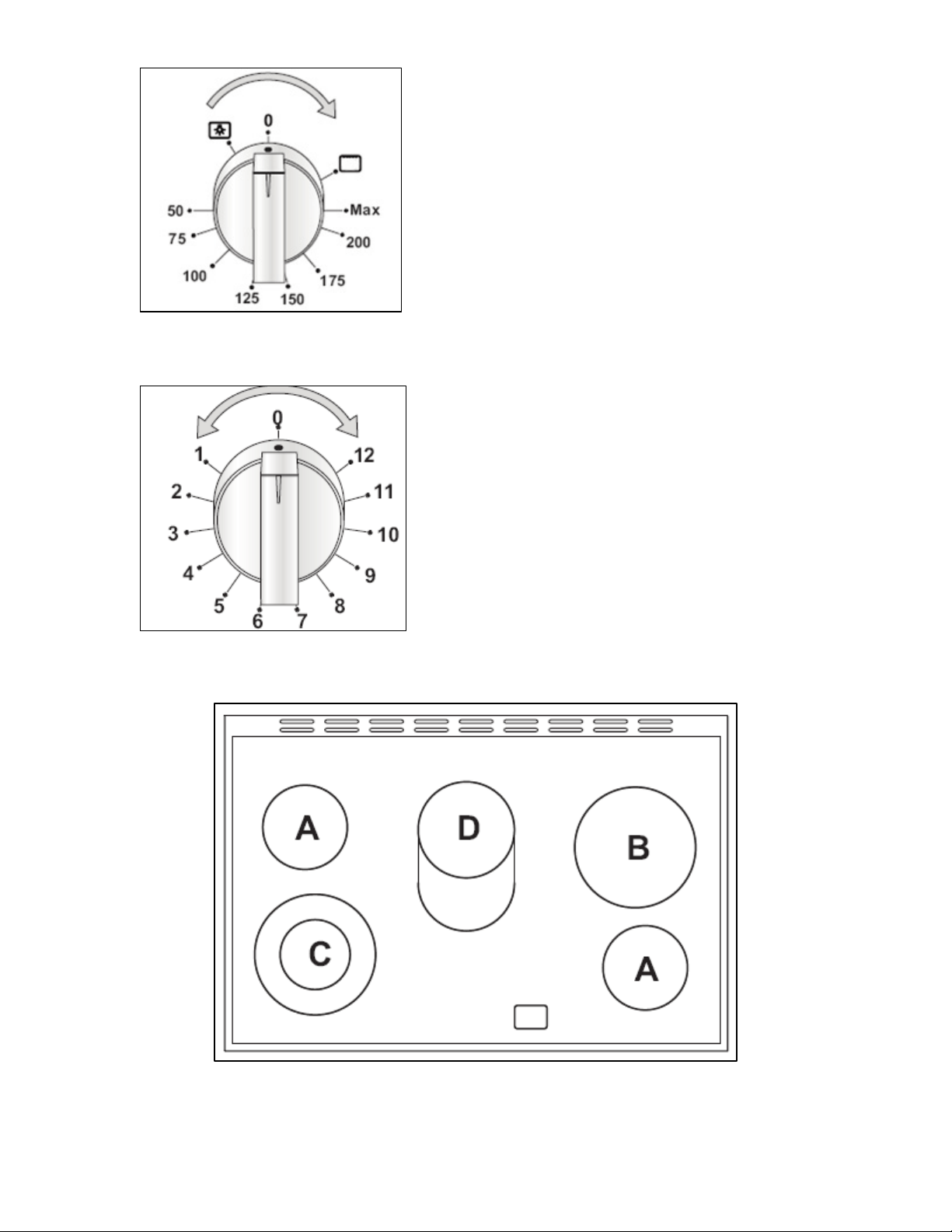
Thermostat control knob (secondary oven)
o Rotate this control knob to the grill
symbol to select the grill oven
function.
o Turn the control knob to the light
icon to switch on the oven light and
start the conventional oven
function. You can then proceed to
set the oven temperature.
Cooking zone thermostat control knob
o Use this control knob to control the
power level of the chosen burner.
Hob surface layout
12
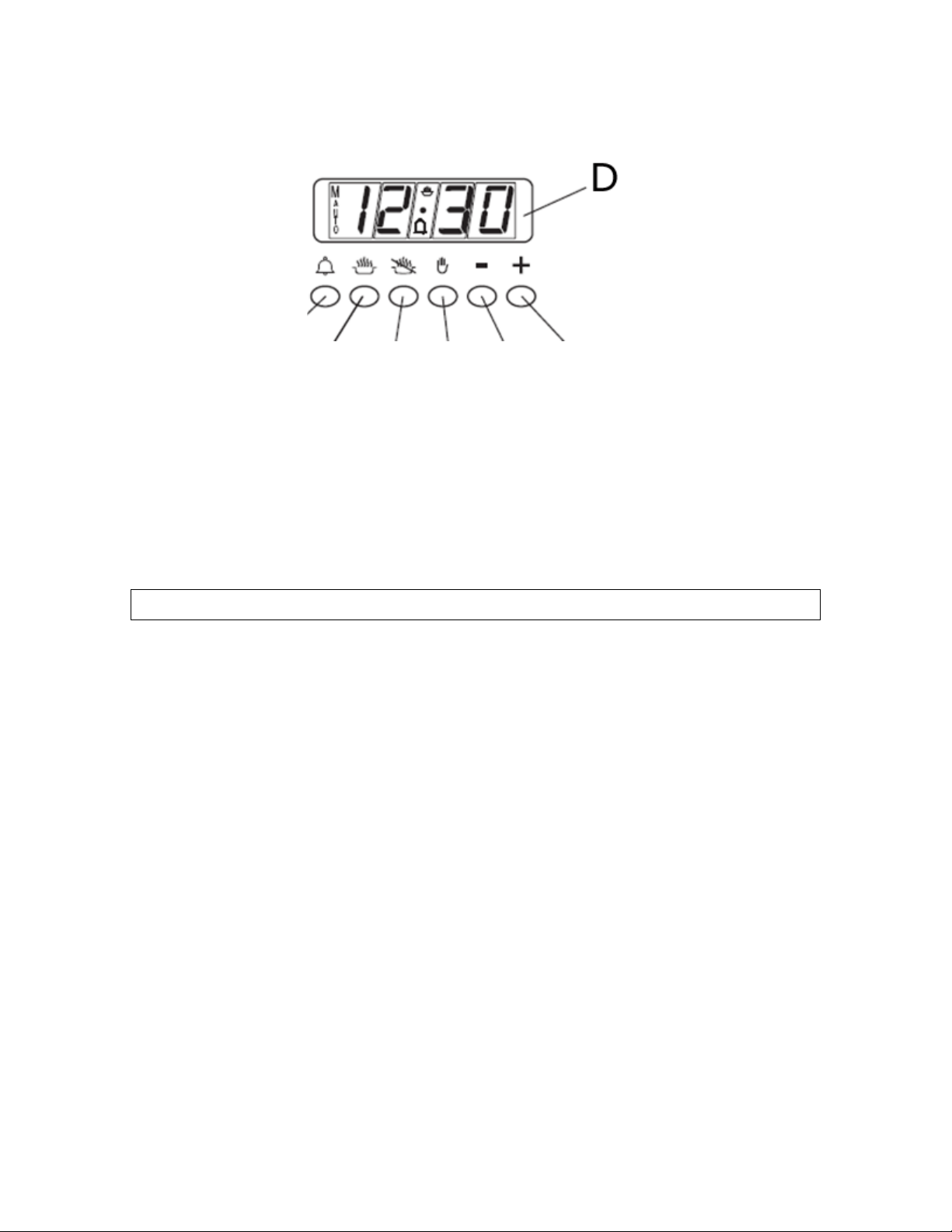
A) 1.20 kW hyper-speed zone (Ø 140 mm)
B) 2.10 kW hyper-speed zone (Ø 210 mm)
C) 0.70 / 2.20 kW double hyper-speed zone (Ø 140 / 210 mm)
D) 0.70 / 2.20 kW double hyper-speed zone (Ø 190 / 285 mm)
Oven timer
1
2
3
4
5
6
1) Minute minder button
2) Cooking time selection button
3) End of cooking time selection button
4) Manual operation mode button
5) Timer minus button
6) Timer plus button
D = Digital display
Setting and using the oven programmer/timer
Setting the time of day
After switching on your oven for the first time you should also
set the time of day.
o After connecting the appliance to the electricity supply, or after a
power cut, “AUTO” and “0.00” will flash simultaneously on the
digital display.
o Press the cooking time selection button (2) and the end of
cooking time selection button (3) simultaneously.
o Set the current time using the timer minus (5) and timer plus
(6) buttons. Once the desired time has been chosen, the “AUTO”
symbol will turn off and the cooking time selection icon (2) will
turn on. This indicates the oven is in manual operation mode.
13

14
Setting the minute minder function (main and secondary oven)
You are able to set the minute minder at any time, regardless
of whether an oven function has been selected. You can set a
period of time using the minute minder function and an alarm
will sound when this period of time has elapsed.
o Press the minute minder button (1) to set a countdown time.
o Use the timer minus (5) and timer plus (6) buttons to set the
required length of time. You can programme any time between
0.01 min – 0.59 min.
o The minute minder symbol (1) will turn on and the countdown
will begin automatically after a time is set.
o At the end of the set time, a buzzer will sound and the minute
minder icon will go off.
o Important: The oven will continue to heat once the alarm has
been silenced. If you have finished cooking, then you should turn
the thermostat control knob to 0.
Setting the duration cooking function
This function will allow you to set a countdown time similar to
the minute minder function. However the oven will no longer
continue to heat, once the countdown period has elapsed.
o Press the cooking time selection button (2) and use the timer
minus (5) and timer plus (6) buttons to set the length of
cooking time you require. You can set a time between 0.01 min
– 23.59 min.
o The “AUTO” and cooking symbols will turn on and remain lit for
the time the function is operating.
o At the end of the set time, the cooking time selection icon (2)
will turn off and the “AUTO” symbol will flash. A buzzer will
sound to indicate the end of the cooking time.
Setting the end cook function
This function is similar to the duration function, however
instead of selecting a period of time that you wish the oven to
switch off after. You select the time of day that you wish the
oven to switch off at.

15
o Press the end of cooking time selection button (3) and use the
timer minus (5) and timer plus (6) buttons to set the time of
day you wish the function to switch off. You can set a time of
day between 0:01 – 23:59 hrs.
o The “AUTO” and cooking symbols will turn on and stay on while
the function is in progress.
o When the programmed time of day is reached, the cooking time
selection icon (2) will turn off and the “AUTO” symbol will flash.
A buzzer will also sound to indicate the end of cooking time.
Setting the start and end time function
This function will allow you to set a time in the future that the
oven switches on at and a time that the oven will switch off at.
o First programme a cooking time using the steps outlined in
the ‘Setting the duration cooking function’ section above.
Both the “AUTO” and cooking time selection symbol (2) will
turn on.
o Then programme an end of cooking time using the steps
outlined in the ‘Setting the end cook function’ section above.
The cooking time selection symbol (2) will turn off.
o The cooking time selection symbol (2) will turn on again at
the desired oven start time. At the end of the cooking time,
the symbol will turn off and the “AUTO” icon will flash. A
buzzer will also sound to indicate the set time has been
reached.
Returning to manual operation mode
o You can only return to the manual operation mode when any
automatic timer function has finished or been cancelled.
o To return to manual operation mode, press the manual operation
mode button (4). The “AUTO” icon will disappear and the
cooking symbol (2) will turn on.
The buzzer
o The buzzer will go off at the end of a programme or at the end of
the minute minder function. The alarm will last approximately
seven minutes before automatically turning off.
o The buzzer can be stopped by pressing any of the function
buttons.
Changing or cancelling a programmed function
o An automatic function programming error will occur if the time
shown on the clock is between the cooking start time and the
cooking end time. This error will be signalled immediately by a
buzzer and the “AUTO” symbol will flash.
o A setting error can be corrected by altering the duration or end
of cooking time.
o Any programme that has been set can be corrected at any time
by pressing the corresponding programming button and the
timer plus (6) and timer minus (5) buttons.
o To cancel a programme, change the time set to “0.00”. If a
programmed time is cancelled, the end of cooking function is
cancelled too and visa versa.
o The oven will turn off automatically and the “AUTO” symbol will
flash. Press the manual operation mode button (4) to return to
manual operation mode.
The time of day cannot be corrected when an automatic timer
function is in progress.
Selecting a cooking function and temperature
After your appliance is connected to your mains supply for the
first time, the numbers on the timer display will flash. Before
you select a cooking function you should set the time of day
(see above section for how to do this).
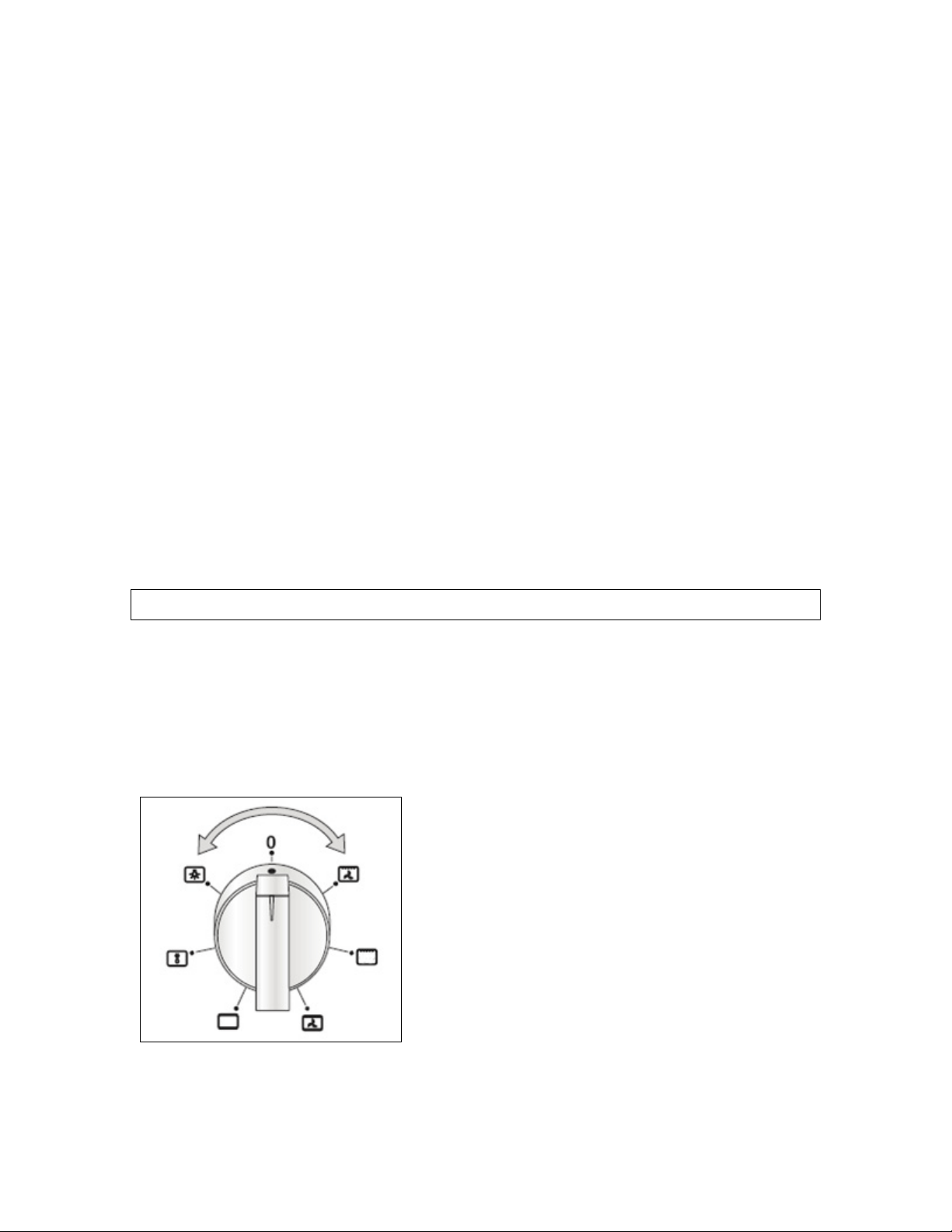
Using the main oven
You can rotate this dial in either direction
to select an oven function for the main
oven.
16
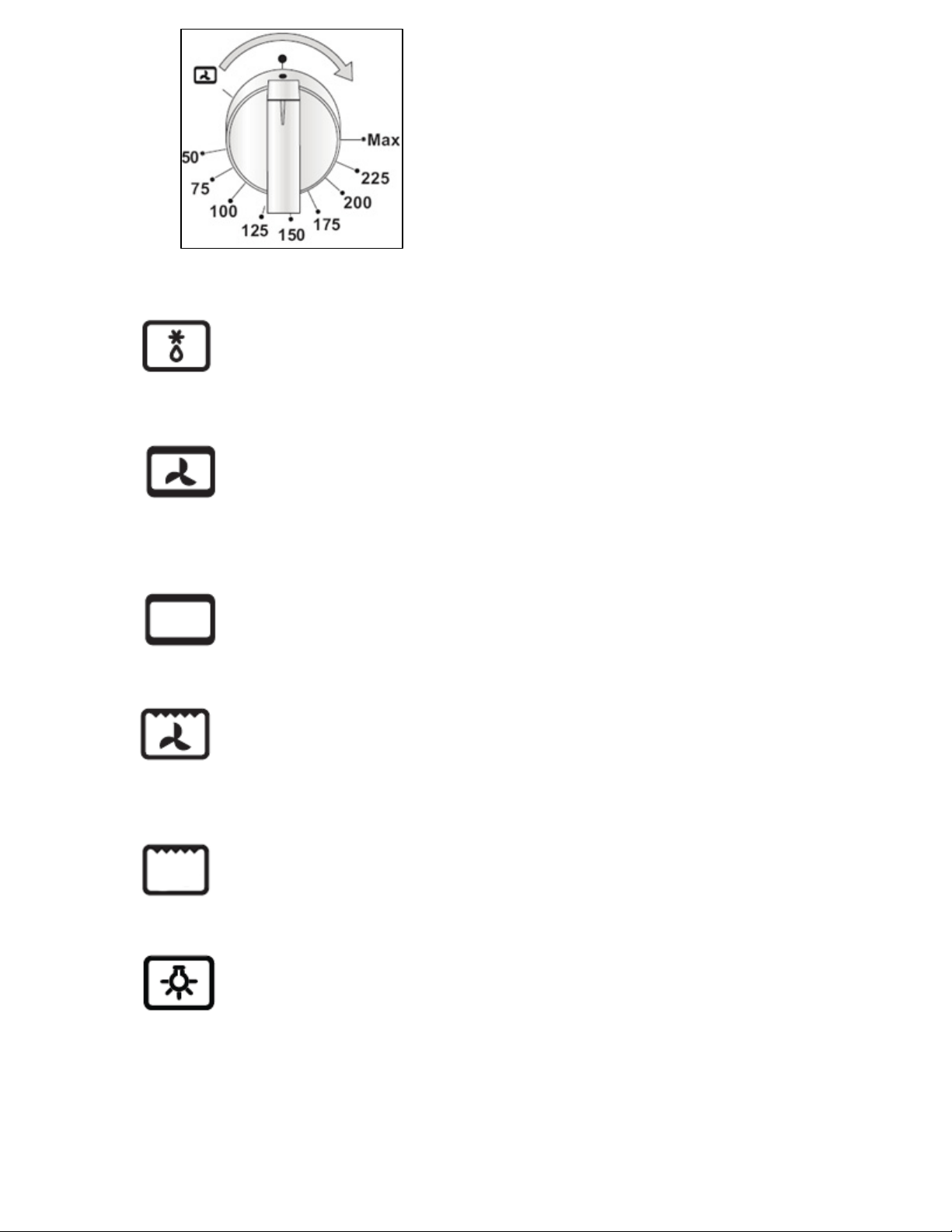
The oven temperature control knob
should be turned clockwise to select the
oven temperature.
There are six cooking functions available on your appliance:
DEFROST MODE: The fan runs without heat to reduce the
defrosting time of frozen foods. The time required to defrost
the food will depend on the room temperature, the quantity
and type of food. Always check food packaging for the defrosting
instructions.
FAN OVEN: This method of cooking uses the top and
bottom heating elements with the fan. This results in the
heat being evenly distributed in the cavity to cook food
simultaneously on different shelves and also prevents the transmission
of smells and tastes from one dish to another.
CONVENTIONAL OVEN: This method of cooking provides
traditional cooking, with heat from the top and lower
elements. This function is suitable for roasting and baking on
one shelf only.
17
GRILL WITH FAN: This cooking method uses the top
element in conjunction with the fan, to help give a fast
circulation of heat. Suitable where quick browning is required
and “sealing” the juices in, such as with steaks, hamburgers, some
vegetables etc.
CENTRE GRILL: This cooking method is normal grilling,
utilising the inner part only of the top element, which directs
heat downwards onto the food. Suitable for grilling small
portions of bacon, toast, meat etc
LIGHT CONTROL: Turn the control knob to this icon to turn
the oven light on and off.
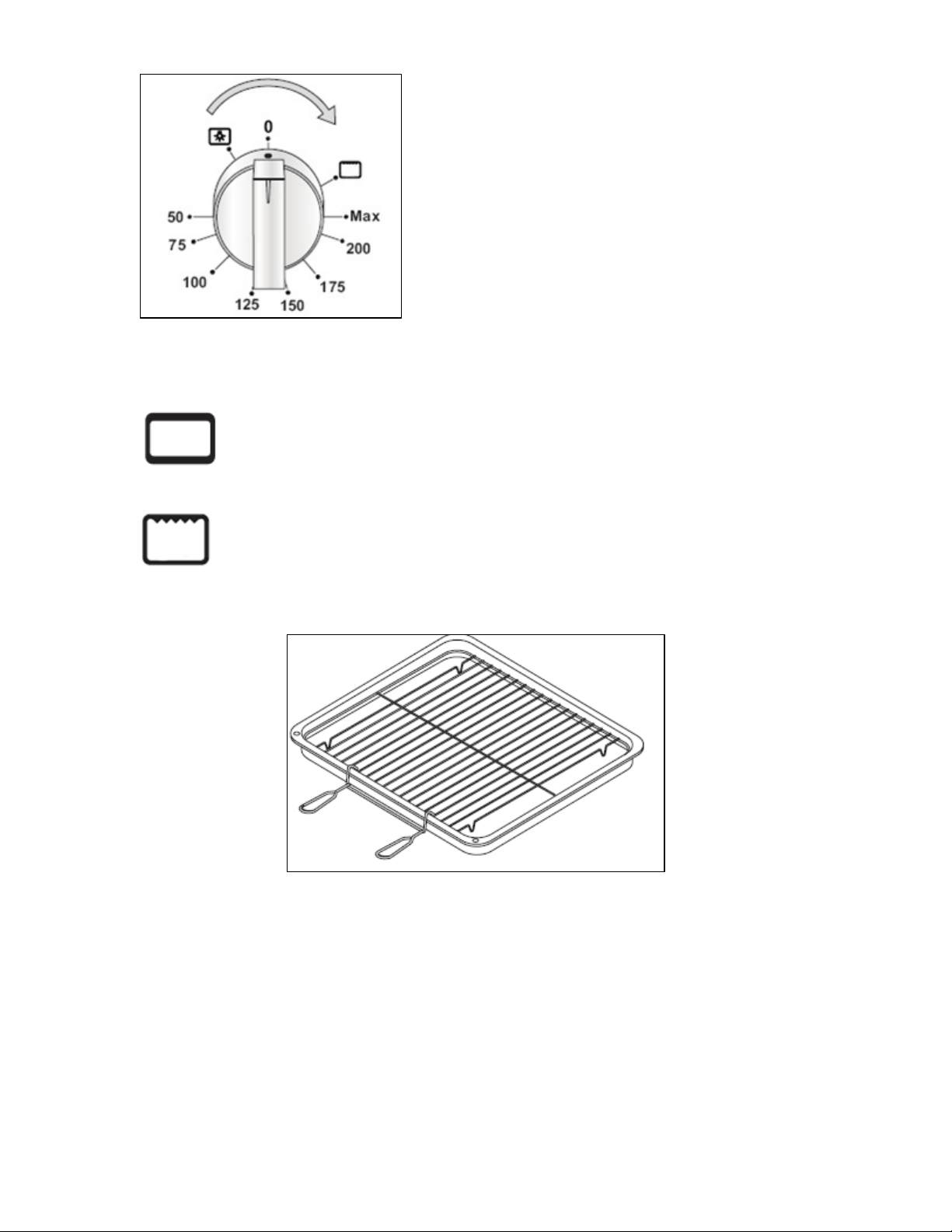
Using the secondary oven
o The control knob should be turned
clockwise and used to select the
fixed grill function.
o Turn the control dial to the light
icon to switch on the oven light and
start the conventional oven
function. You can then proceed to
set a temperature for the oven.
IMPORTANT: The grill door must be closed when using the grill
function.
CONVENTIONAL OVEN: This method of cooking provides
traditional cooking, with heat from the top and lower
elements. This function is suitable for roasting and baking on
one shelf only.
FULL GRILL: This method of cooking utilises the inner and
outer parts of the top element, which directs heat
downwards onto the food. This function is suitable for grilling
medium or large portions of sausages, bacon, steaks, fish etc.
REMEMBER: When using any of the grill functions, it is
important to place a drip pan at the base of the oven cavity to
collect any juices which may drip down (see image below).
18
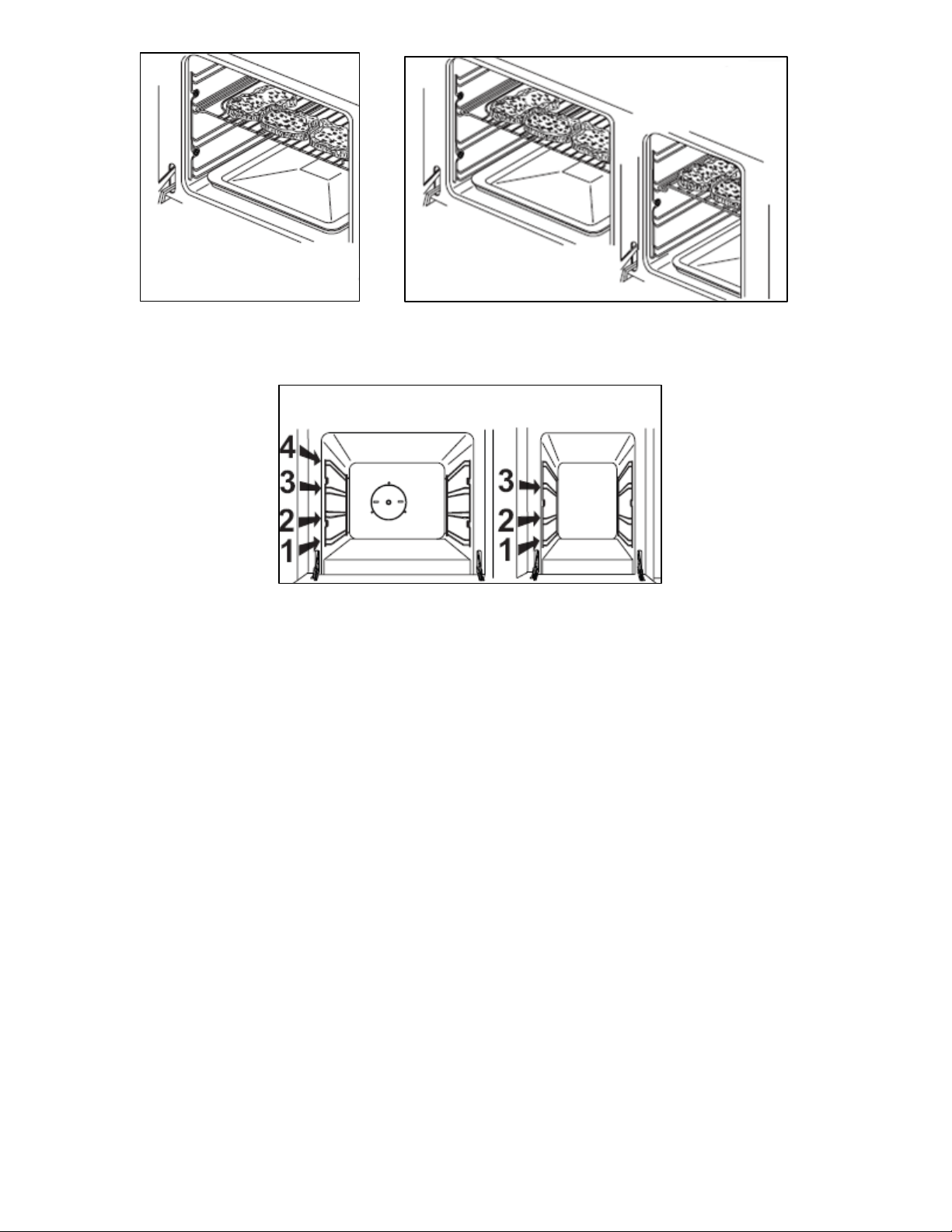
The oven walls of the two cavities are fitted with various guide bars on
which you can place an oven shelf or a drip tray (see image below).
Cooking guidelines
o Please refer to the information given on food packaging for
guidance on cooking temperatures and times. Once familiar with
the performance of your appliance, temperatures and times can
be varied to suit personal preference.
o Make sure that frozen foods are thoroughly thawed before
cooking, unless the instructions on the food packaging advise
that you can “cook from frozen”.
o You should pre-heat the oven and not place food inside of it until
the oven is properly heated. You can choose not to pre-heat
when using the fan oven; however you should extend the
cooking time given on the food packaging by approximately ten
minutes.
o Before cooking, check that any unused accessories are removed
from the oven.
o Place cooking trays in the centre of the oven and leave gaps
between the trays to allow air to circulate.
19

o Try to open the door as little as possible to view the dishes.
o The oven light will remain on during cooking.
Warnings
o Keep the oven door closed when using any of the oven functions
or the grill cavity.
o Do not use aluminium foil to cover the enamelled baking tray or
heat items wrapped in aluminium foil under the grill. The high
reflectivity of the foil could potentially damage the grill element.
o You should never line the base of your oven with aluminium foil.
o During cooking, never place pans or cookware directly onto the
bottom of the oven. They should always be placed on the shelves
provided.
o The grill heating element becomes extremely hot during
operation, avoid touching it inadvertently when handling the
food which you are grilling.
o Important: Be careful when opening the door, to avoid contact
with hot parts and steam.
o IMPORTANT: In case of fire, switch off the electricity supply to
the appliance. NEVER pour water onto burning oil.
Using the hob top
Before first use
IMPORTANT: You should clean the hob surface (see
“Cleaning and maintenance” section).
o You should switch on one cooking zone at a time, for 5 minutes
at the maximum setting. This will help to eliminate any new
smell that exists and evaporate any humidity that has formed on
the heating elements during transit.
o Do not burn off more than one zone at once.
o You must place a saucepan filled half full with cold water on
each zone as you burn it off.
20
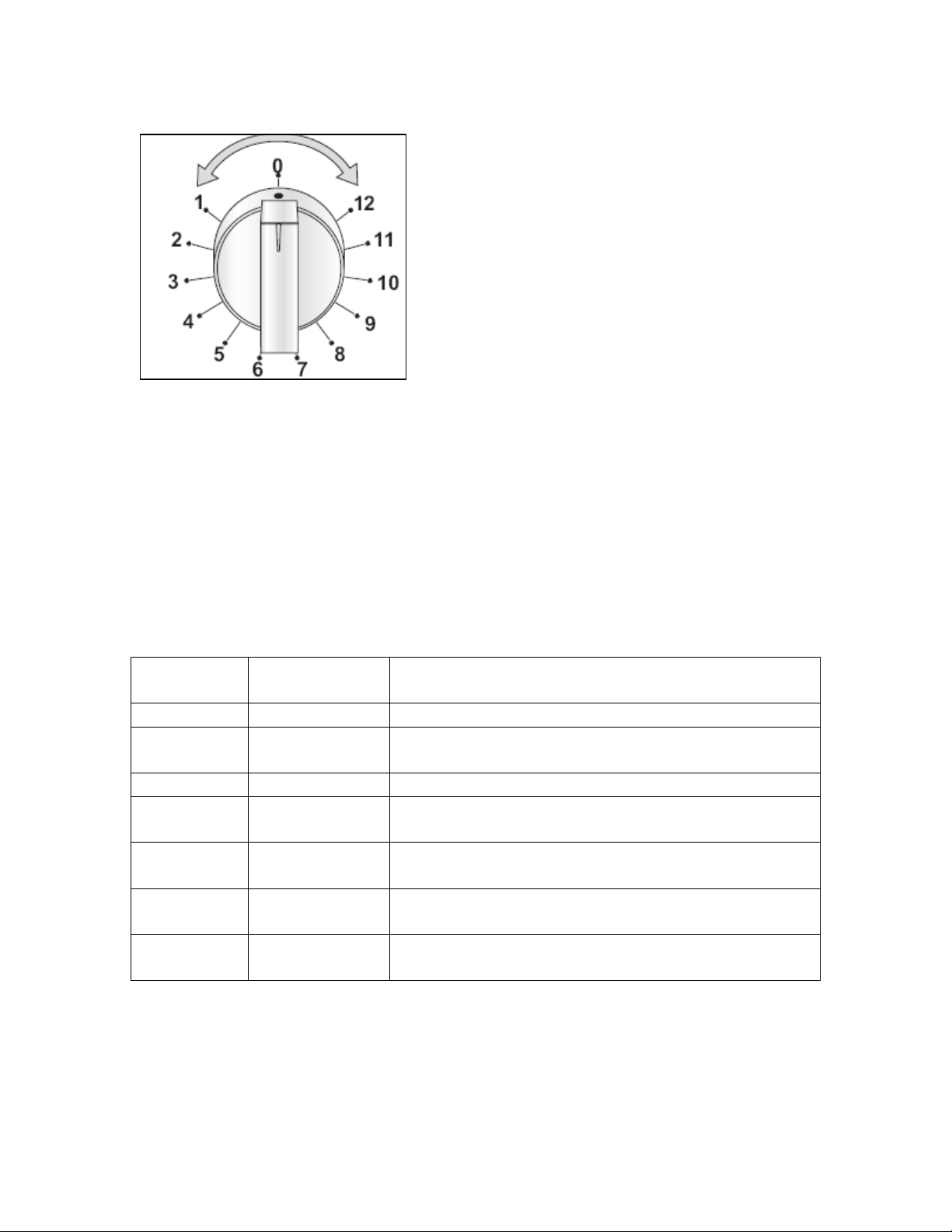
Using the hob top zones
o Each zone on the ceramic hob top is controlled by a control
knob.
o To activate a zone, position the
control knob between 1 – 12.
o You should select a control knob
position that is suitable for the
particular cooking that you are
carrying out.
o If you rotate the control dial anti-
clockwise, only the inner section of
the double burners will switch on.
o If you set the power level by turning the dial clockwise, both the
inner and outer sections of the double zones will switch on and
the power level will higher.
o When you have finished cooking on a particular zone, it is
important to make sure that the control knob is turned back to 0
(the off position).
o For a general guide for cooking with the different power levels
please see the table below.
Power
level
Heat
intensity
Possible cooking process
0 Off
1-2 Low To dissolve butter, chocolate etc. To heat
small amounts of liquid.
3-4 Moderate To heat greater quantities of liquid.
5-6 Slow Thawing frozen food and preparing stews,
boiling or simmering.
7-8 Medium Bringing foods to boiling point. For delicate
roasts and fish.
9-10 Strong For roasts, chops and steaks. For large
amounts of boiled meat.
11-12 Hot Bringing large amounts of water to the boil.
Frying.
21
Hob guidelines
o The first few times the hob top is used, it may give off an acrid,
burning smell. This smell will disappear completely with repeated
use.
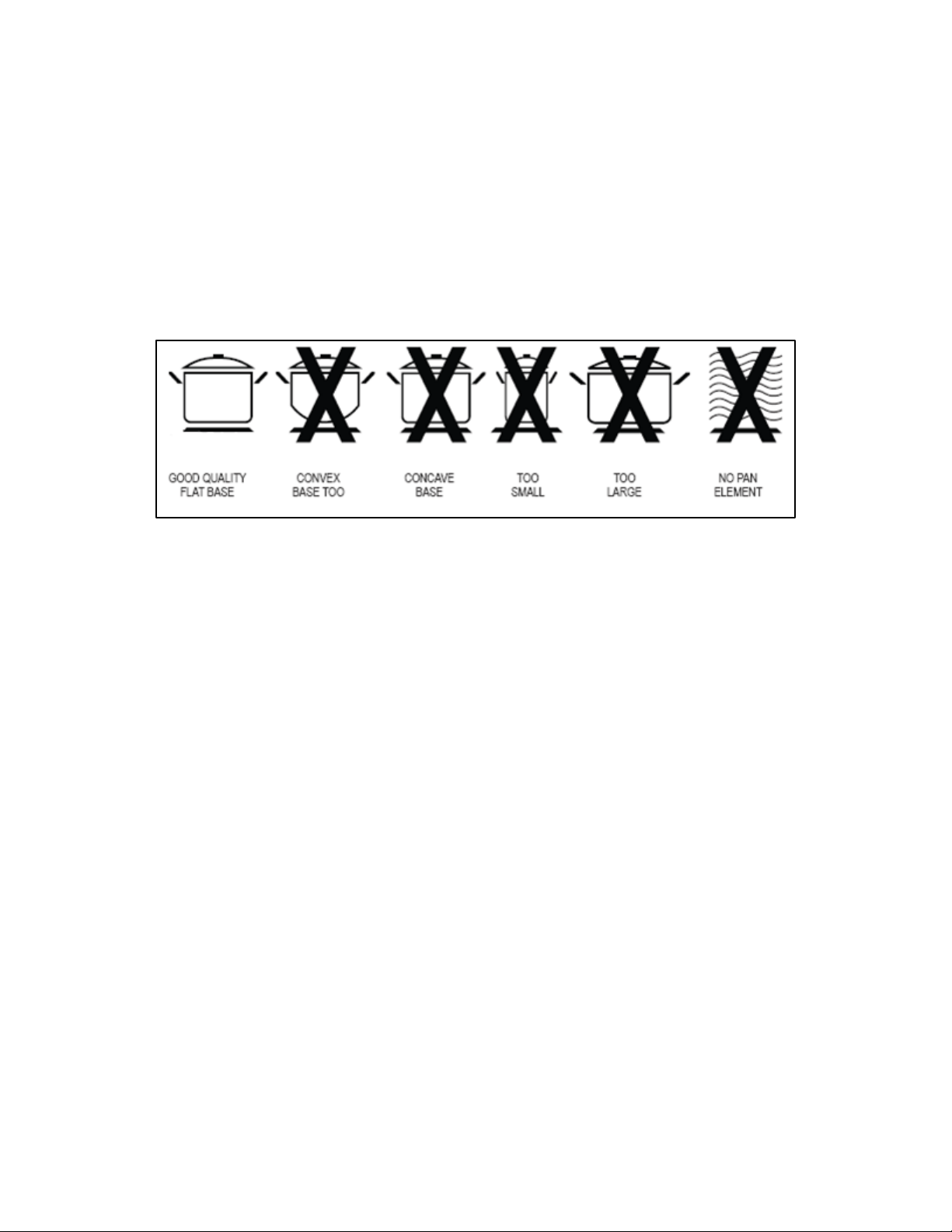
o The worktop is fitted with cooking areas of different diameter
and power.
o The positions where the heat will radiate from are clearly marked
on the hob top. The saucepans must be positioned exactly on
these zones for efficient heating to occur. Pans should have the
same diameter as the cooking zone that they are being used on.
o You should not use saucepans with rough bottoms, as this can
scratch the surface.
o Before use, make sure that the bottoms of the saucepans are
clean and dry.
o When cold, the bottom of the pans should be slightly concave, as
they expand when hot and lie flat on the surface of the hob. This
will allow the heat to transfer more easily.
o The best thickness for the bottom of the pans is 2 – 3 mm of
enameled steel and 4 – 6 mm for stainless steel with sandwich
type bottoms.
o If these rules are not followed, then there will be a great loss of
heat and energy. Heat not absorbed by the saucepan, will spread
to the hob, frame and surrounding cabinets.
o Preferably cover pans with a lid to permit cooking at a lower
heat.
o Always cook vegetables and potatoes, etc. in as little water as
possible to reduce cooking times.
22
o For a faster heat up of a zone, you can turn the control knob to
12. Then when the contents of the saucepan are boiling, you
may turn the control knob to a lower setting.
23
o Food or liquid that has a high sugar content may damage the
hob top if it comes into contact with the hob surface. Any
spillages should be wiped up immediately, however this may not
prevent the hob surface from becoming damaged.
o IMPORTANT: The hob surface is tough; however it is not
unbreakable and can be damaged. Especially if pointed or hard
objects are allowed to fall on it with some force.
o DO NOT USE THE HOB IF THE SURFACE BECOMES BROKEN
OR CRACKED. YOU SHOULD CONTACT THE BAUMATIC
SERVICE DEPARTMENT IMMEDIATELY.
Cooking tips
Cooking table for main oven
Multifunction oven:
Traditional oven Combined oven (fan
ventilated)
Foods
Weight
(kg)
Shelf
position
from
bottom
Temperature
(°C)
Cooking
/
baking
time
(mins)
Temperature
(°C)
Cooking
/
Baking
time
(mins)
Meat loafs
Roasted
veal
1 1-2 200-225 100-120 190 100-120
Roasted
beef
1 1-2 200-225 40-50 190 40-50
Roasted
pork
1 1-2 200-225 100-120 190 100-200
Roasted
lamb
1 1-2 200-225 100-120 190 100-120
Game
Roast hare 1 1-2 225-MAX 50-60 225-MAX 50
Roast
pheasant
1 1-2 225-MAX 60-70 225-MAX 60
Roast
partridge
1 1-2 225-MAX 50-60 225-MAX 50
Poultry
Roasted
chicken
1-2 1-2 200-225 80-90 190 70-80
Roasted
turkey
1-2 1-2 200-225 100-120 190 90-110
Roasted
duckling
2-3 1-2 200-225 90-110 190 80-100
Fish
Roasted
whole fish
1 2 200 30-35 170-190 25-30
Sea bass 1 2 175 20-25 160-170 15-20
Baked pasta
Lasagne 2.5 2 210-225 60-75 225-MAX 30-40
24
Cannelloni 2.5 2 210-225 60-75 225-MAX 30-40
Pizza 1 2 225-MAX 25-30 225-MAX 20-25
Bread 1 2 225-MAX 20-25 220 20
Patisserie
Biscuits in
general
2 190 15 170-190 15
Shortcrust
pastry
2 200 20 190-200 20
Victoria
sponge
2 200 40-45 190-200 40-45
Cakes / Flans
Angel cake
/ sponge
0.8 2 190 52 170-190 45
Fruit cake 0.8 2 200 65 190-200 65
Chocolate
cake
0.8 2 200 45 190-200 45
The information given in this table is approximate and may
vary according to individual needs.
Grilling in main oven
Traditional oven Combined oven (fan
ventilated)
Cooking /
Baking
time
(mins)
Cooking /
Baking time
(mins)
Foods
Weight
(kg)
Shelf
position
from
bottom
Temperature
(°C)
1
st
Side
2
nd
Side
Temperature
(°C)
1
st
Side
2
nd
Side
Meat
T-bone
steak
0.50 3 225-MAX 15 15 200 10 10
Steak 0.15 3 225-MAX 5 5 200 5 5
Chicken
(cut in
half)
1 2-3 225-MAX 25 25 200 18 18
Fish
Trout 0.42 3 225-MAX 18 18 200 10 10
Sea
bass
0.40 3 225-MAX 15 15 200 10-
12
10-12
Sole 0.20 3 225-MAX 10 10 200 8-9 8-9
Bread
Toast 3-4 225-MAX 2-3 2-3 200 2-3 2-3
The information in this table is approximate and may vary
according to individual needs.
25
Cooking table for the secondary oven
Conventional oven:
Foods Weight
(kg)
Shelf position
from bottom
Temperature
(°C)
Cooking /
Baking time
(mins)
Meat loafs
Roasted veal 1 1 220 80
Roasted beef 1 1 200-225 40-50
Roasted pork 1 1 220 80
Roasted lamb 1 1 200-225 100-120
Game
Roast hare 1 1-2 225-MAX 50-60
Roast pheasant 1 1-2 225-MAX 60-70
Roast partridge 1 1-2 225-MAX 50-60
Poultry
Roasted
chicken
1 1-2 200-225 80-90
Roasted turkey 1 1-2 200-225 100-120
Roasted
duckling
1 1-2 200-225 90-110
Fish
Roasted whole
fish
1 1-2 200 30-35
Sea bass 1 1-2 175 20-25
Baked pasta
Lasagne 2.5 1-2 210-225 60-75
Cannelloni 2.5 1-2 210-225 60-75
Pizza 1 2 MAX 20-22
Bread 1 2 MAX 20-25
Patisserie
Biscuits in
general
2 190 20
Shortcrust
pastry
2 200 20
Victoria sponge 2 200 40-45
Cakes / Flans
Angel cake /
sponge
0.8 1 190 50
Fruit cake 0.8 1-2 200 65
Chocolate cake 0.8 1-2 200 45
The information in this table is approximate and may vary
according to individual needs.
Grilling in secondary oven:
Cooking / Baking
time
(mins)
Foods Weight
(kg)
Shelf position from
bottom
1
st
Side 2
nd
Side
Meat
T-bone steak 0.50 3 12 12
Steak 0.15 3 5 5
Chicken (cut in 1 2-3 25 25

26
half)
Fish
Trout 0.42 3 10 10
Sole 0.20 3 10 10
Bread
Toast 3 3 3
The information in this table is approximate and may vary
according to individual needs.
Cooking tips for cakes and bread
o Heat the oven for at least 15 minutes before you start cooking
bread or cakes.
o Do not open the door during baking because the cold air will stop
the yeast from rising.
o When the cake is cooked turn the oven off and leave it in for
about 10 minutes.
o Do not use the enamelled baking tray or drip pan to cook cakes
in.
o To test if a cake is cooked, about 5 minutes before the end of
cooking time, put a cake tester or skewer in the highest part of
the cake. If it comes out clean, the cake is cooked.
o If the cake sinks, next time use less liquid or lower the
temperature by 10°C.
o If the cake is too dry, make some tiny holes with a toothpick and
pour some drops of fruit juice or spirits on it. The next time,
increase the temperature by 10°C and set a shorter cooking
time.
o If the cake is too dark on top next time put the cake on a lower
shelf and cook it at a lower temperature for longer.
o If the top of the cake is burnt, cut off the burnt layer and cover
with sugar or decorate with cream, jam and confectioner’s
cream.
o If the cake is too dark underneath next time place it on a higher
shelf and cook it at a lower temperature.
o If the cake or bread is cooked nicely outside but is still uncooked
inside, next time use less liquid and cook at a lower temperature
for longer.

27
o If the cake will not come out of the tin, slide a knife around the
edges, place a damp cloth over the cake and turn the tin upside
down. Next time, grease the tin well and sprinkle with flour or
bread crumbs.
o If the biscuits will not come away from the baking tray, put the
tray back in the oven for a while and lift the biscuits up before
they cool. The next time use a sheet of baking parchment to
prevent this happening again.
Cooking tips for meat
o If, when cooking meat, the time needed is more than 40
minutes, turn the oven off 10 minutes before the end of cooking
time to exploit the residual heat and save energy.
o Your roast will be juicer if cooked in a closed pan. It will be
crispier if cooked without a lid.
o Normally white meat, poultry and fish need medium
temperatures (less than 200°C).
o To cook “rare” red meats, high temperatures (over 200°C) and
short cooking times are needed.
o For a tasty roast, lard and spice the meat.
o If your roast is tough, next time leave the meat to ripen longer.
o If your roast is too dark on top or underneath, next time put it
on a higher or lower shelf, lower the temperature and cook for
longer.
o If your roast is undercooked, cut it in slices and arrange the
slices on a baking tray with gravy and finish cooking it.

Cleaning and maintenance
Cleaning operations must only be carried out
when the oven is cool.
The appliance should be disconnected from your
mains supply before commencing any cleaning
process.
o The oven should be thoroughly cleaned before it is operated for
the first time and after each use. This will avoid residual food
stuffs becoming baked on the oven cavity. After residues have
been baked on several times, they are far more difficult to
remove.
o Never clean the oven surfaces by steam cleaning.
o The oven cavity should only be cleaned with warm soapy water,
using either a sponge or soft cloth. No abrasive cleaners should
be used.
o Any stains that may appear on the bottom of the oven will have
originated from food splashes or spilt food, these splashes occur
during the cooking process. These could possibly be a result of
the food being cooked at an excessively high temperature or
being placed in cookware that is too small.
o You should select a cooking temperature that is appropriate for
the food that you are cooking. You should also ensure that the
food is placed in an adequately sized dish and that you use the
enamelled baking tray where appropriate.
o Outer parts of the oven should only be cleaned with warm soapy
water, using either a sponge or soft cloth. No abrasive cleaners
should be used.
o We would recommend that an appropriate stainless steel cleaner
and polish is regularly used on the stainless steel surfaces of this
appliance.
o If you use any form of oven cleaner on your appliance, then you
must check with the manufacturer of the cleaner that it is
suitable for use on your appliance.
o Any damage that is caused to the appliance by a cleaning
product will not be fixed by Baumatic free of charge, even
if the appliance is within the guarantee period.
28
Cleaning the ceramic hob top
Any residues that are left on the hob top surface from cleaning
agents will damage it. You should remove any residues with
water and a little washing up liquid.
Abrasive cleaners or sharp objects will damage the hob surface;
you should clean it using water and a little washing up liquid.
Although it is easier to clean some deposits whilst the hob
surface is still warm. You should take care not to burn yourself if
cleaning the hob surface when it is still warm.
After each use
o Wipe the appliance over with a damp cloth and a little washing
up liquid.
o Dry the appliance by rubbing the surface with a clean cloth.
Cleaning table
Type of deposit Remove
immediately?
Remove
when the
appliance
has cooled
down?
What should I
use to remove
the deposit?
Sugar or
food/liquid
containing sugar
Yes No Ceramic hob
scraper
Tin foil or plastic Yes No Ceramic hob
scraper
Fat splashes No Yes Ceramic hob
cleaner
Metallic
discolourations
No Yes Ceramic hob
cleaner
Water splashes or
water rings
No Yes Ceramic hob
cleaner
29
Replacing the oven bulb
IMPORTANT: The oven must be disconnected from
your mains supply before you attempt to either
remove or replace the oven bulb.
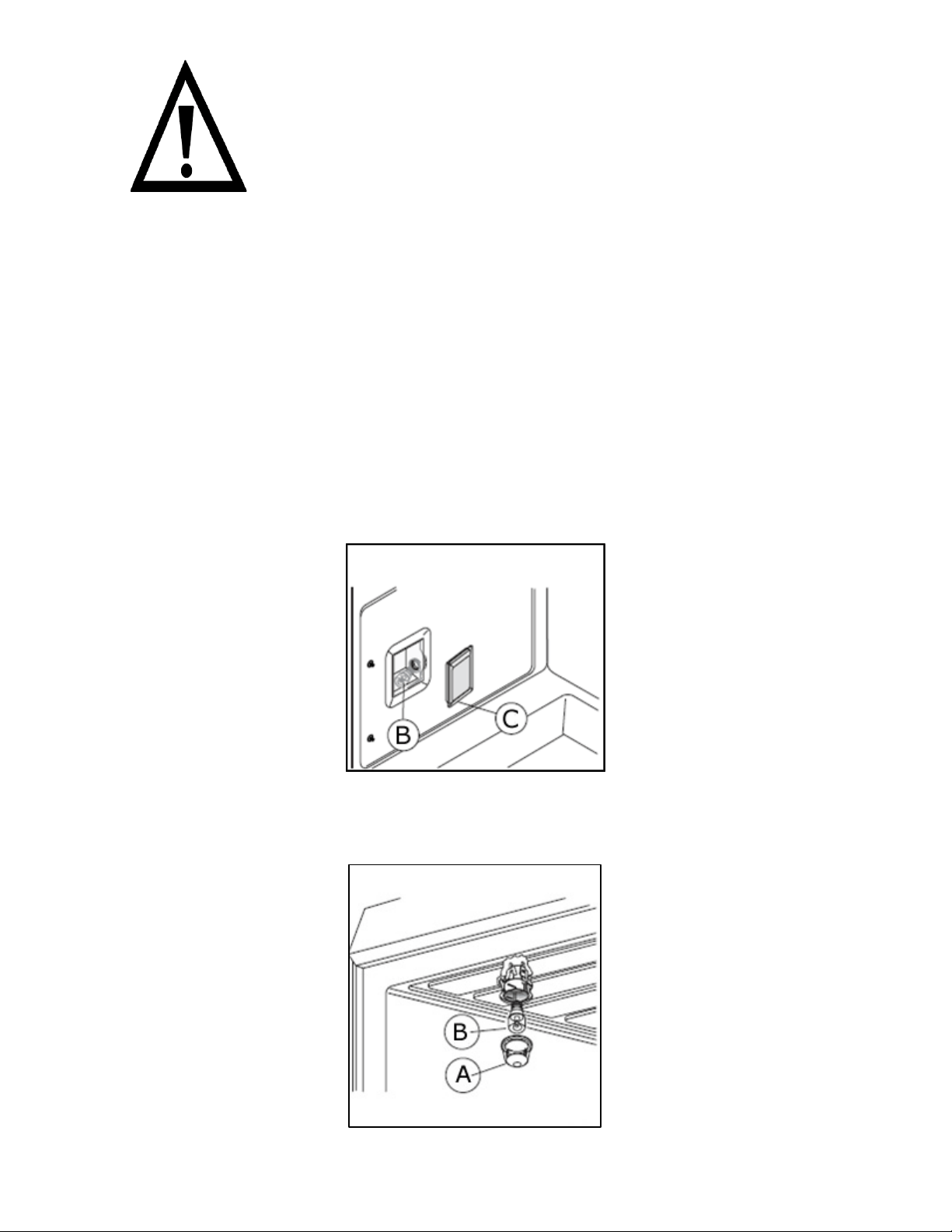
o Draw out the side guide rails in order to provide access to the
bulb.
Flat lamps
o Remove the glass protection cap (C) from the bulb socket by
lifting it with a screwdriver placed between the cap and the oven
wall.
o Replace the bulb (B) with a 15 W/300°C, screw type pigmy.
o Do not use any other type of bulb.
o Screw the lamp cover back into its original position.
Round lamps
30
o Turn the glass protection cap (A) anti-clockwise and change the
lamp (B).
o Refit the cap by screwing it back in a clockwise direction
Removing the oven door for cleaning
o The oven door can be removed to give easier access to the oven
when cleaning.
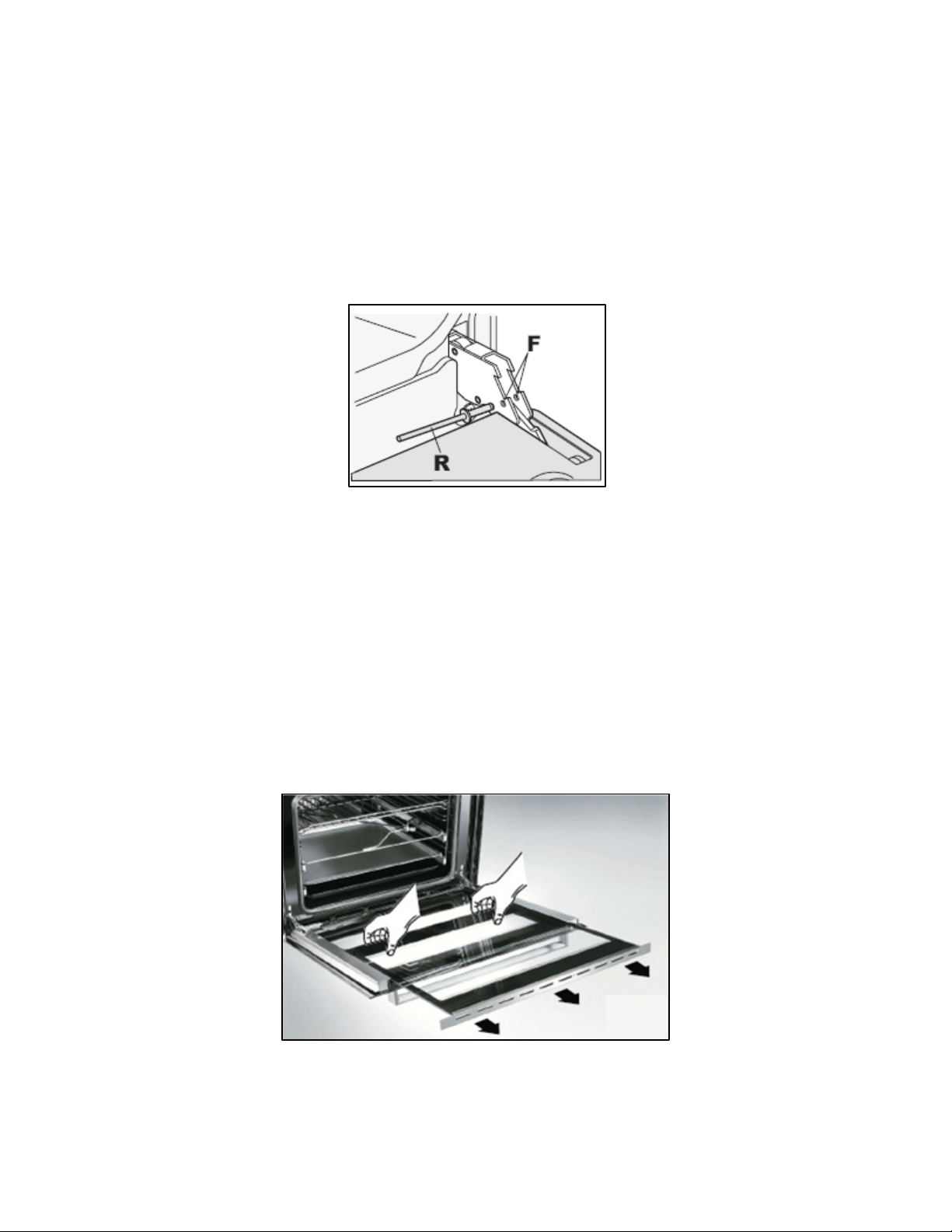
o Open the oven door and insert a rivet or nail (R) in the hole (F)
of the hinge (see image below).
o Partially close the door, forcing it upwards at the same time to
free the stop tooth and hinge sector.
o Once the hinge is free, pull the door forwards tilting it slightly
upwards to free the sector.
o To reassemble, proceed in the reverse order, playing attention to
the correct position of the sectors.
Removing the inner door glass for cleaning
Ensure the top cavity is cold before cleaning.
o Simply open the oven door and remove the support securing the
glass. The glass will then slide out easily.
31
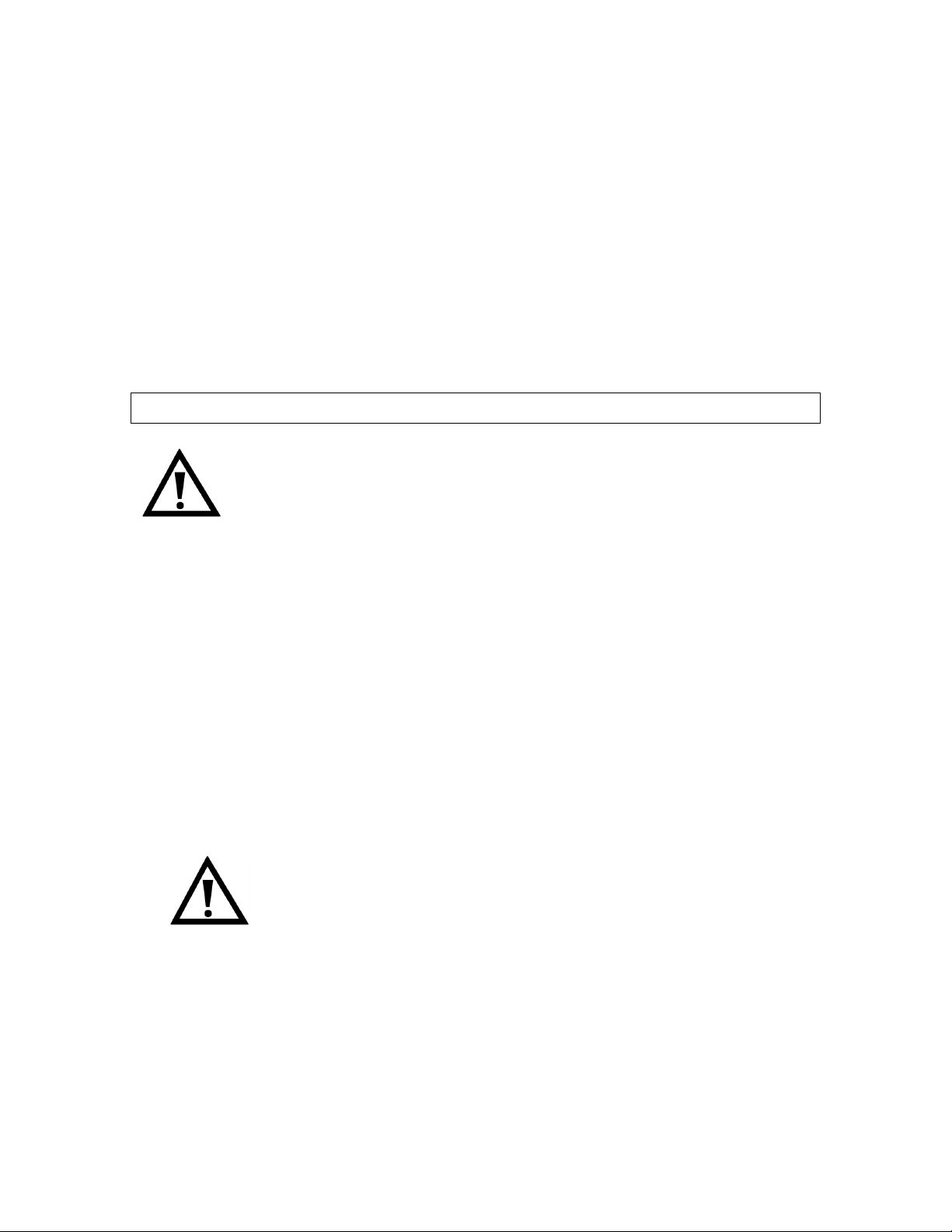
o To replace the glass, follow the first step in reverse.
WARNING: This procedure can be carried out with the door
fitted on the appliance but pay attention that when the glass is
pulled upwards, the force of the hinges can close the door
roughly.
o IMPORTANT: You should make sure that the door is supported
at all times and that you place the door on some padded
material whilst cleaning it.
o The oven door and door glass should only be cleaned using a
damp cloth and a small amount of detergent. The cloth MUST
NOT have come into contact with any form of cleaning product
or chemical previously.
Installation
The installation must be carried out by a suitably
qualified person, in accordance with the current
version of the following.
o UK Regulations and Safety Standards or their European
Norm Replacements.
o Building Regulations (issued by the Department of the
Environment).
o Building Standards (issued by the Scottish Development
Department).
o IEE Wiring Regulations.
o Electricity At Work Regulations.
o Gas Safety (Installation and Use) (Amendment)
Regulations.
Positioning
The adjacent furniture and all materials used in the
installation must be able to withstand a minimum
temperature of 85°C above the ambient
temperature of the room it is located in, whilst in
use.
o Your appliance is heavy, so you should be careful when moving
or positioning it.
o Do not try to move the cooker by pulling on either the door,
handle or control panel.
32
o It can also be used as freestanding, with a cabinet to one side, in
a corner setting or with its back to a wall.
o IMPORTANT: It should not be installed at the end of a run of
cabinets, if there is a cabinet at immediate right angles to the
cooker door.
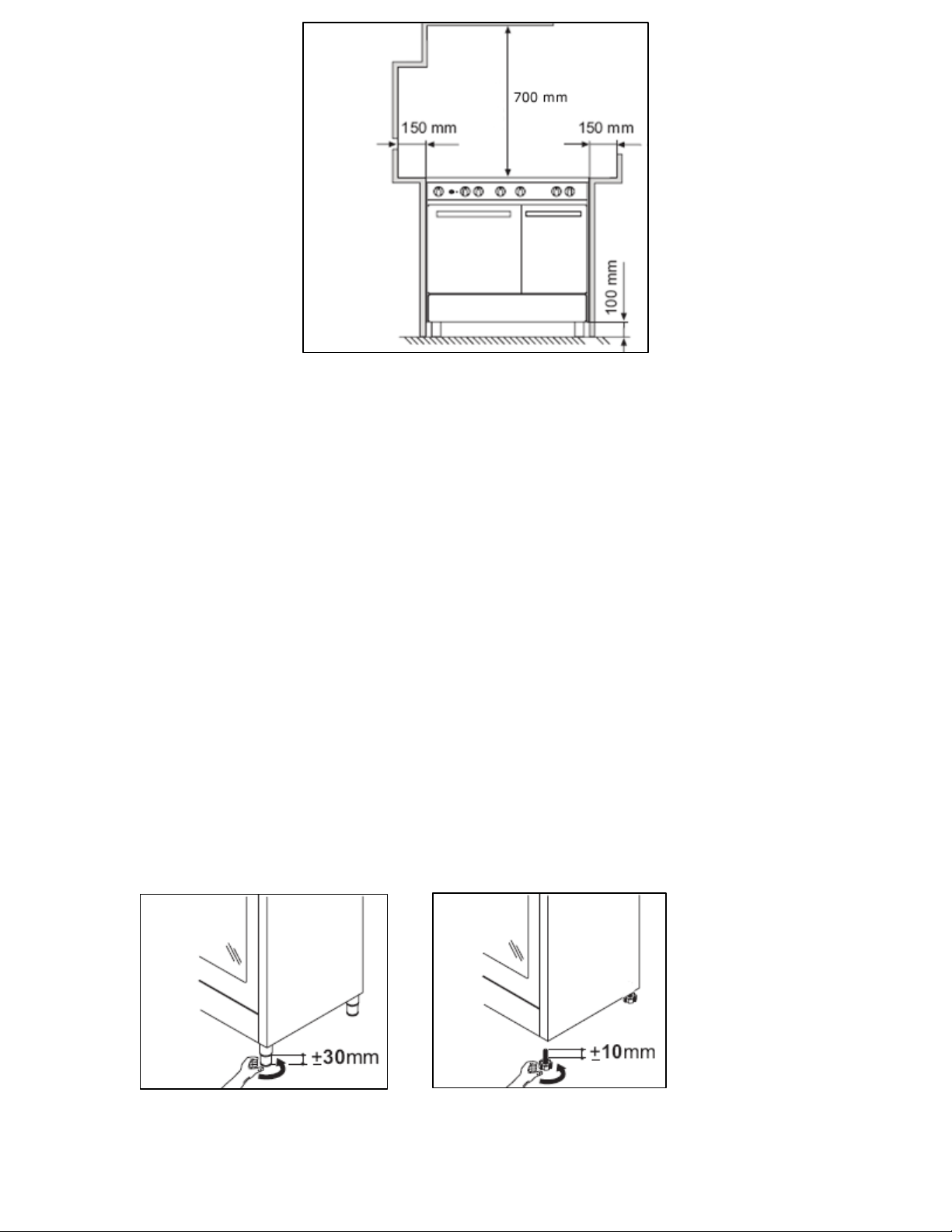
o The wall behind the cooker and 450 mm above and across the
width of the cooker should be an incombustible material and
preferably an easy clean surface, such as ceramic tiles.
o Any overhanging surface or cooker hood should be at least 700
mm above the highest point on the hob top (including the
burners).
o Baumatic do not recommend that the cooker is positioned below
wall cupboards, as the heat and steam from the appliance and
what is being cooked, may damage the cupboard and its
contents.
o The cooker may be located in a kitchen, or a bedroom, but not in
a room containing a bath or shower. The cooker must not be
installed in a bedroom of less than 20m³ in size.
33
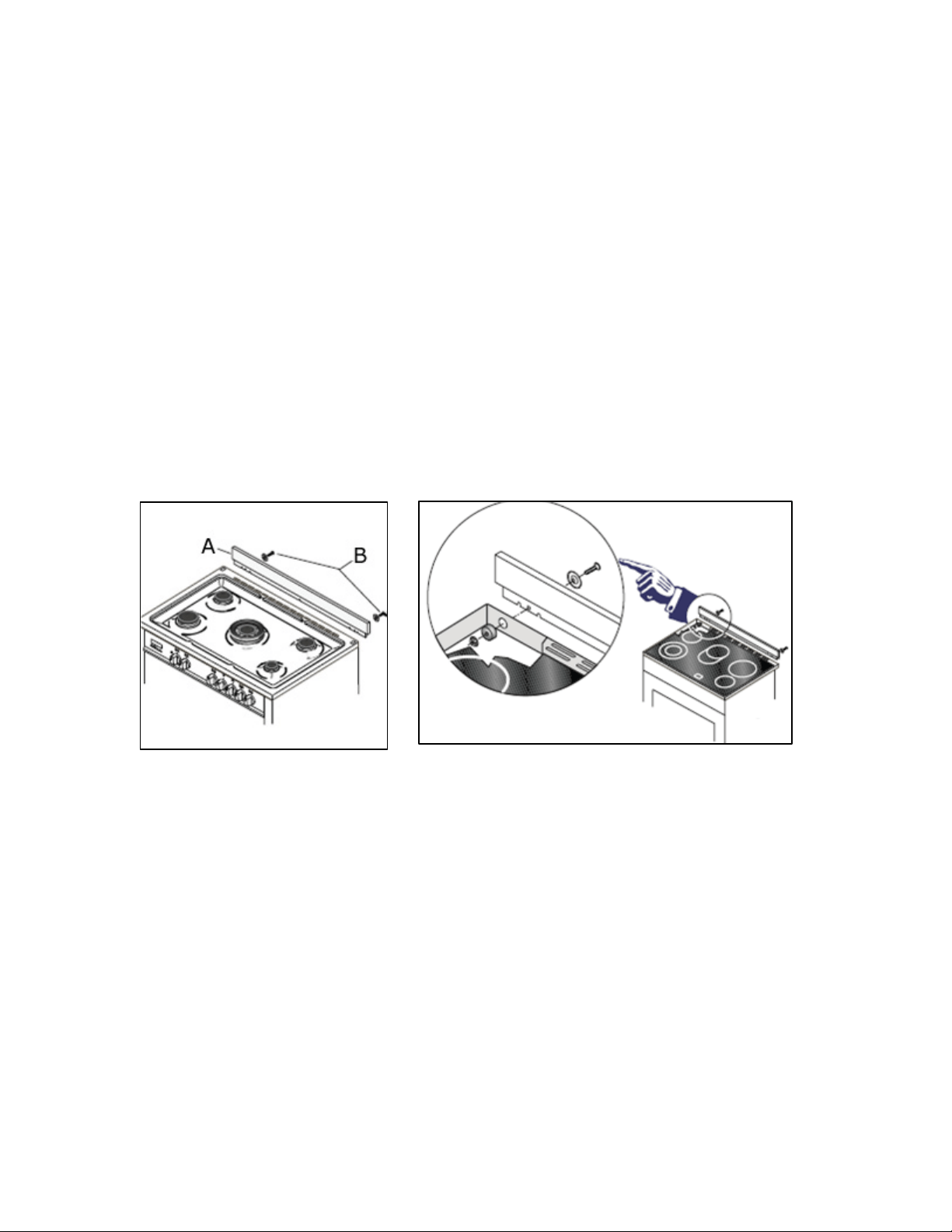
o The cooker is fitted with four legs that can be adjusted to match
the height of your kitchen cabinets.
o If the cooker is not level or is unstable due to an uneven floor
surface, use the adjustable feet to alter each corner until the
cooker is level.
o To assemble them it is necessary to raise the cooker and to
screw the four legs into position, on each corner of the base of
the appliance.
o IMPORTANT: They must be screwed clockwise into position and
not just slotted into the holes on each corner. You must screw
them through the brackets that are also provided.
Securing the back-guard
o In order to attach the back-guard (A) to the appliance, you need
to loosen the screws (B) positioned on the back of the hob (see
image below).
o Fix the back-guard into place by screwing the screws back into
the hob with the back-guard placed in between.
Fitting the safety chain and hook
o To prevent the cooker from tipping forward, two lengths of chain
MUST BE fixed to the back of the oven which should be secured
to the hook provided at all times.
o The hook should be secured to the wall at the back of the
cooker. The chains should always be attached to the upper hook
when the cooker is in position against the wall.
o Attach the chain to the lower hook if the cooker is installed with
a hose assembly so that there is no strain on the hose when the
cooker is pulled forward for cleaning or maintenance.
34
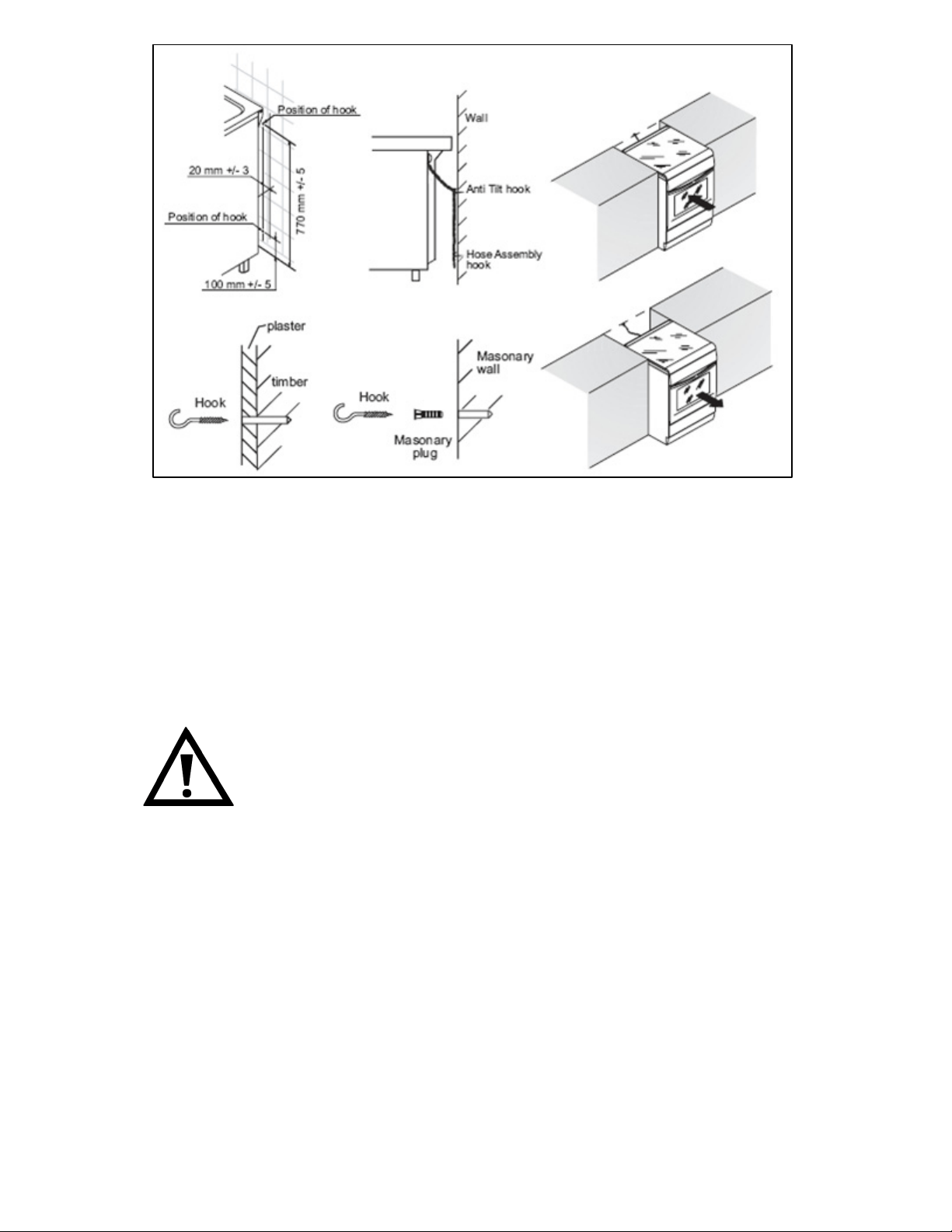
o Fix the upper hook into the wall immediately behind and to the
left hand side about 770 mm from the floor.
o Secure the chain to the hook before using or cleaning the oven.
o To prevent strain on the flexible hose assembly, a lower chain
and hook can be fixed approximately 100 mm up from the floor.
Electrical connection
This appliance must be installed by a qualified
person in accordance with the latest edition of the
I.E.E. Regulations and in compliance with Baumatic’s
instructions.
Before connecting the appliance, make sure that the supply voltage
marked on the rating plate corresponds with your mains supply
voltage.
WARNING: THIS APPLIANCE MUST BE EARTHED.
o This appliance must be wired into a 32 A double pole switched
fused spur outlet, having 3 mm contact separation and placed in
an easily accessible position adjacent to the appliance. It should
not be located above the appliance and no more than 1.25m
away from it.
35
o The spur outlet must still be accessible even when your oven is
located in its operating position.
o Cable type: H05 RRF 3 core x 1.5 mm²
Connecting the mains supply cable
IMPORTANT
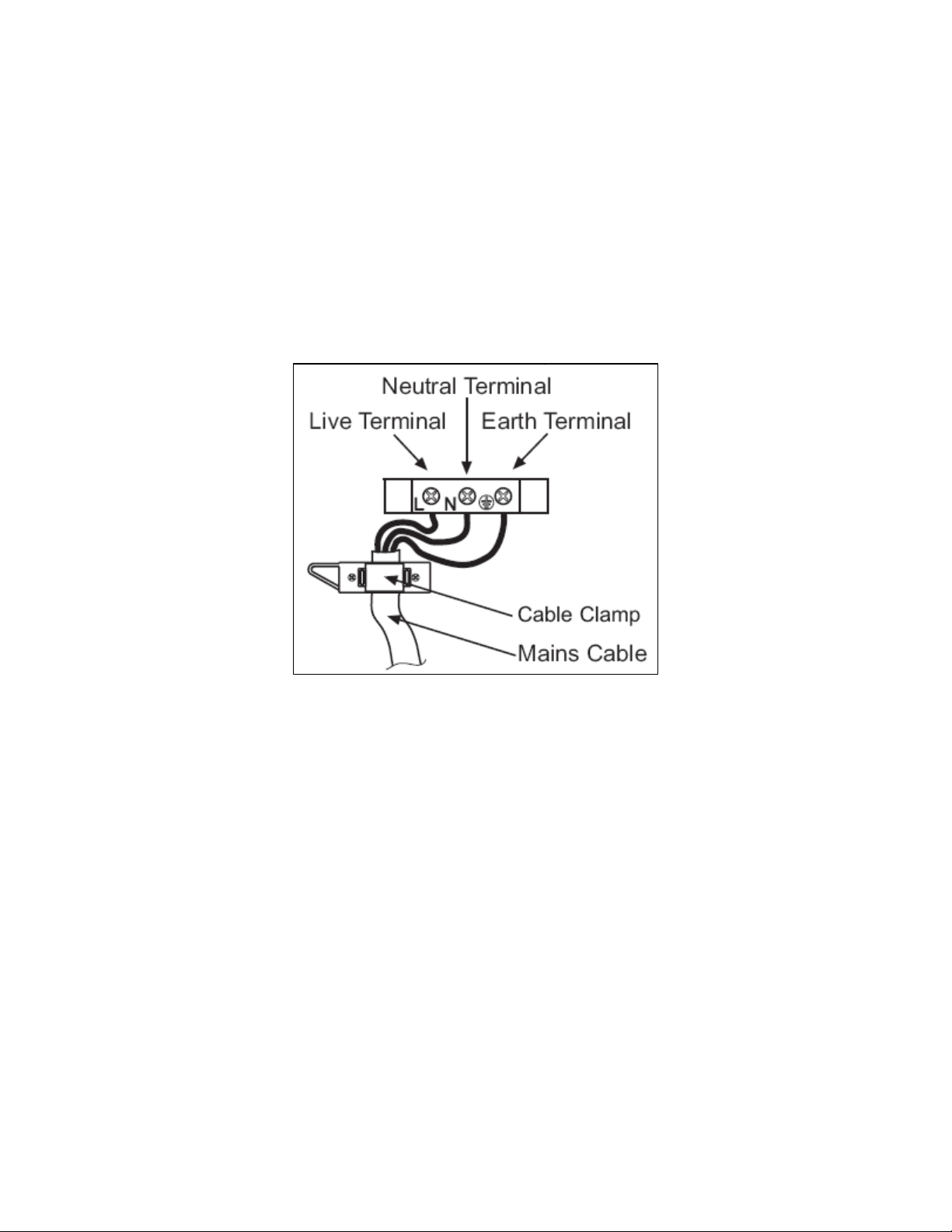
The wires in the mains lead are coloured in accordance with the
following code:
GREEN AND YELLOW EARTH
BLUE NEUTRAL
BROWN LIVE
o Connect to the mains terminal block as shown in the image
above. It is accessed by removing the cooker back panel.
o The power cable must be laid so that no parts of it ever reach a
temperature of 75°C.
o For connecting do not use adapters or shunts as they could
cause false contacts resulting in hazardous overheating.
o When connecting directly to the mains, install a multi-polar
switch that can withstand the appliance load, with a minimum
opening between the contacts of 3 mm.
36

37
My appliance isn’t working correctly
o The oven isn’t coming on.
* Check that the oven is in manual operation mode.
* Check that you have selected a cooking function and a cooking
temperature.
o There appears to be no power to the oven and grill.
* Check that the appliance has been connected to the electrical
mains supply correctly.
* Check that the mains fuses are in working order.
* Check that the operating instructions for setting the time of day
and putting the appliance into manual operation mode have been
followed.
o The grill function works but the main oven does not.
* Check that you have used the correct control knob to switch on
the oven.
o The grill and top oven element is not working, or cuts out
for long periods of time during use.
* Allow the oven to cool for approximately 2 hours. Once cool,
check whether the appliance is again working properly.
o My food is not cooking properly
* Ensure that you are selecting the correct temperature and the
correct cooking function for the food that you are cooking. It
may be appropriate to adjust your cooking temperature by plus
or minus 10°C, to achieve the best cooking results.
o My food is not cooking evenly
* Check that the oven has been installed correctly and is level.
* Check that the correct temperatures and shelf positions are
being used.

38
o The oven light is not working
* Refer the “Replacing the oven bulb” section.
o I am getting condensation in my oven
* Steam and condensation is a natural by product of cooking any
food with high water content, such as frozen food, chicken etc.
* You may get condensation in the oven cavity and forming
between the oven door glasses. This is not necessarily a sign
that the oven is not working correctly.
* Do not leave food in the oven to cool after it has been cooked
and the oven has been switched off.
* Use a covered container, where practical, when cooking to
reduce the amount of condensation that forms.
* Steam and condensation may appear from the vent at the rear
of the appliance when cooking food with high water content. This
is normal and any excess should be wiped away.

IMPORTANT: If your appliance appears not to be
operating correctly, then you should disconnect it
from your mains supply and then contact
Baumatic Customer Care on telephone number
(0118) 933 6911.
DO NOT ATTEMPT TO REPAIR THE APPLIANCE
YOURSELF.
Please note that if an engineer is asked to attend whilst the product is
under guarantee and finds that the problem is not the result of an
appliance fault, then you may be liable for the cost of the call out
charge.
The appliance must be accessible for the engineer to perform
any necessary repair. If your appliance is installed in such a
way that an engineer is concerned that damage will be caused
to the appliance or your kitchen, then he will not complete a
repair.
This includes situations where appliances have been tiled in,
sealed in with sealant, have wooden obstructions placed in
front of the appliance, like plinths. Or any installation other
than the one specified by Baumatic Ltd. has been completed.
Please refer to the conditions of guarantee that appear on the
warranty card that you receive with the appliance.
IMPORTANT: Baumatic Ltd. operates a policy of continuous
improvement and reserves the right to adjust and modify its
products without prior notification.
39

United Kingdom
Baumatic Ltd
Baumatic Buildings,
6 Bennet Road,
Reading, Berkshire
RG2 0QX
United Kingdom
Sales Telephone
(0118) 933 6900
Sales Fax
(0118) 931 0035
Customer Care Telephone
(0118) 933 6911
Customer Care Fax
(0118) 986 9124
Spares Telephone
(01235) 437244
Advice Line Telephone
(0118) 933 6933
E-mail:
customercare@baumatic.co.uk
spares@baumatic.co.uk
Website:
www.baumatic.co.uk
Republic of Ireland
Service Telephone
1-890 812 724
Spares Telephone
091 756 771
Czech Republic
Baumatic CR spol s.r.o.
Průmyslová zóna Sever 696
460 11 Liberec 11
Czech Republic
+420 483 577 200
www.baumatic.cz
Slovakia
Baumatic Slovakia, s.r.o.
Galvániho 7/D
Slovakia
+421 255 640 618
Germany
Baumatic Gmbh
Lilienthalstrasse 1
320 52 Herford
Deutschland
+49 5221 694 99-0
www.baumatic.de
Italy
Baumatic Italia S.R.L.
Via Galvani N.3
35011 Campodarsego (PD)
+3904 9920 2297
www.baumatic.it
Holland
Baumatic Benelux B.V.
Grindzuigerstraat 22
1333 MS ALMERE
Nederland
+3136 549 1555
www.baumatic.nl
40

41

42

43

44