Use and Care Guide
Dishwasher
GE Appliances
To obtain a Spanish language
version of this book, call
GE Answer Center
®
800.626.2000
consumer information service.
Para obtener la versi
´
on en
espa
~
nol de este manual,
llame a
GE Answer Center,
®
servicio de informaci
´
on
para el consumidor,
tel
´
efono 800.626.2000.
Safety Instructions.........................3
Operating Instructions, Tips
China, Crystal, Sterling ...............................10
Cycle Features ............................................4, 5
Cycle Selection Chart ....................................5
Detergent Guide .............................................7
Dispenser Cups...............................................7
Drying Options............................................4, 5
Features........................................................4, 5
Loading.........................................................8, 9
Operating Instructions..............................4, 5
Rinse Agent......................................................6
Water Temperature .......................................6
Care and Cleaning
Air Gap............................................................11
Winter Storage.............................................11
Problem Solver.......................13–15
More questions ?…call
GE Answer Center® 800.626.2000
Preparation
Front Panel Change.....................................12
Consumer Services...................19
Appliance Registration..................................2
Important Phone Numbers........................19
Model and Serial Numbers ..........................2
Repair Service...............................................18
Warranty ........................................Back Cover
Models: GSD700 GSD730
2
• HOT WATER—Your dishwasher
needs hot water for best results. Water
entering the dishwasher should be at
least 120°F. but your dishwasher
performs BETTER with HIGHER
water temperatures not to exceed 150°F.
• WATER HARDNESS—The hardness
of the water plays an important part in
how well your dishwasher cleans. In
areas where water is very hard (12 grains
or more), it may be necessary to install
a water softener. If you do not know the
hardness of your water supply, contact
your local water department.
• DETERGENTS—Only use detergents
labeled for use in automatic dishwashers.
Never use laundry detergents or
liquid soaps…that will cause oversudsing
and leaks. The amount of detergent you
use depends on the water hardness and the
amount of soil on your dishes. In most
cases, detergent amounts should be
increased for hard water and heavy soil.
• RINSE AGENT—should always be used:
— to reduce water spotting.
— to improve drying.
Always check and refill the rinse agent
when necessary.
• FOR BEST RESULTS—The cycles
and the options you choose have an
effect on the results you get. The
following are examples. (Please, see the
Operating Instructions, Tips for more
information.)
• WASH HEAT BOOST OPTION—
—
use with heavily soiled loads.
— extends cycle to heat water for best
washing and drying.
• POTS PANS CYCLE—
— use with dried or baked-on heavily
soiled loads.
• HEATED DRY OPTION—
—
assures faster drying.
— be sure to use a rinse agent.
Before using your dishwasher,
read this guide carefully.
It is intended to help you operate and
maintain your new dishwasher properly.
Keep it handy for answers to your questions.
If you don’t understand something or need more help, call:
GE Answer Center
®
800.626.2000
24 hours a day, 7 days a week.
If you received a
damaged dishwasher…
Immediately contact the dealer (or
builder) that sold you the dishwasher.
Save time and money.
Before you request service…
Check the Problem Solver in the back of this guide. It lists
causes of minor operating problems that you can correct
yourself.
Write down the model
and serial numbers.
You’ll find them on a label fastened to the
tub wall just inside the dishwasher door.
These numbers are also on the Consumer Product
Ownership Registration Card that came with your
dishwasher. Before sending in this card, please write
these numbers here:
Model Number
Serial Number
Use these numbers in any correspondence or service calls
concerning your dishwasher.
We’ll be there…
No matter what major appliance you buy from us, you
always get more than a quality product. You receive the
added assurance that, should you ever need our help, we’ll
be there.
We ask that you please be sure to read all the Important
Safety Instructions before operating your new appliance
to insure your safety.
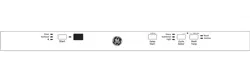
Potscrubber 1125
Cycles
Options
WATER
SAVER
POT-
SCRUBBER
NORMAL
WASH
RINSE
& HOLD
HEATED
DRY
ENERGY
SAVER
WASH HEAT
BOOST
( NO HEAT BOOST)
RINSING
OFF
START
WASHING
DELAYED
START
Quiet Power
2
4
6
H
O
U
R
D
E
L
A
Y
S
DRYING
@
@
À
À
@
@
À
À
@
@
À
À
@
@
À
À
@
@
À
À
@
@
À
À
@
@
À
À
@@
@@
@@
ÀÀ
ÀÀ
ÀÀ
@@
@@
@@
ÀÀ
ÀÀ
ÀÀ
@@
@@
@@
ÀÀ
ÀÀ
ÀÀ
@@
@@
@@
ÀÀ
ÀÀ
ÀÀ
@@
@@
@@
ÀÀ
ÀÀ
ÀÀ
@@
@@
@@
ÀÀ
ÀÀ
ÀÀ
@@
@@
@@
ÀÀ
ÀÀ
ÀÀ
@
@
@
À
À
À
@
@
@
À
À
À
@
@
@
À
À
À
@
@
@
À
À
À
@
@
@
À
À
À
@
@
@
À
À
À
@
@
@
À
À
À
@@
@@
ÀÀ
ÀÀ
@@
@@
ÀÀ
ÀÀ
@@
@@
ÀÀ
ÀÀ
@@
@@
ÀÀ
ÀÀ
@@
@@
ÀÀ
ÀÀ
@@
@@
ÀÀ
ÀÀ
@@
@@
ÀÀ
ÀÀ
@@
@@
@@
ÀÀ
ÀÀ
ÀÀ
@@
@@
@@
ÀÀ
ÀÀ
ÀÀ
@@
@@
@@
ÀÀ
ÀÀ
ÀÀ
@@
@@
@@
ÀÀ
ÀÀ
ÀÀ
@@
@@
@@
ÀÀ
ÀÀ
ÀÀ
@@
@@
@@
ÀÀ
ÀÀ
ÀÀ
@@
@@
@@
ÀÀ
ÀÀ
ÀÀ
@@
@@
ÀÀ
ÀÀ
@@
@@
ÀÀ
ÀÀ
@@
@@
ÀÀ
ÀÀ
@@
@@
ÀÀ
ÀÀ
@@
@@
ÀÀ
ÀÀ
@@
@@
ÀÀ
ÀÀ
@@
@@
ÀÀ
ÀÀ
A note to consumer—
We’d like to thank you and congratulate you for making the wise decision in purchasing your dishwasher.
This User Guide is designed to be kept near your dishwasher at all times for quick and easy reference. Features
may vary on some dishwasher models. Please read the following tips to insure your dishwasher is operating at its
best performance.
We care about you and your appliance and we want your dishwasher to do its job for you.
IMPORTANT SAFETY INSTRUCTIONS
Read all instructions before using this appliance.
WARNING—When using this
appliance, always exercise basic safety
precautions, including the following:
• Use this appliance only for its
intended purpose, as you will find described in
this Use and Care Guide.
• This dishwasher must be properly installed and
located in accordance with the Installation
Instructions before it is used. If you did not receive
an Installation Instructions sheet with your
dishwasher, you can obtain one by calling, toll
free, the GE Answer Center,
®
800.626.2000.
—Connect to a properly rated, protected and sized
power supply circuit to avoid electrical overload.
—This appliance must be connected to a grounded
metal, permanent wiring system; or an equipment-
grounding conductor must be run with the circuit
conductors and connected to the equipment-
grounding terminal or lead of the appliance.
WARNING—The improper
connection of the equipment-grounding
conductor can result in a risk of electric
shock. Check with a qualified
electrician or service representative if you are in
doubt whether the appliance is properly grounded.
• Do not store or use combustible materials,
gasoline or other flammable vapors and liquids
in the vicinity of this or any other appliance.
• Use only powder or liquid detergents or wetting
agents recommended for use in a dishwasher.
• Do not wash plastic items unless marked
‘‘dishwasher safe’’ or the equivalent. For plastic
items not so marked, check the manufacturer’s
recommendations.
• Load light plastic items so they will not
become dislodged and drop to the bottom of
the dishwasher—they might come into contact
with the heating element and be damaged.
To minimize the possibility of injury.
• When loading items to be washed:
A. Locate sharp items so that they are not likely
to damage the door seal, and
B. Load sharp knives with the handles up to
reduce the risk of cut-type injuries.
• Do not tamper with controls.
• Do not touch the heating element during or
immediately after use.
• Do not operate your dishwasher unless all enclosure
panels are properly in place.
• Do not abuse, sit on, or stand on the door or dish
rack of the dishwasher.
• Close supervision is necessary if this appliance
is used by or near children. Do not allow children
to play inside, on or with this appliance or any
discarded appliance. Dispose of discarded
appliances and shipping or packing material
properly. Before discarding a dishwasher, remove
the door of the washing compartment.
• Keep all washing detergents and wetting agents
out of the reach of children, preferably in a locked
cabinet. Observe all warnings on container labels
to avoid personal injury.
• To minimize the possibility of electric shock,
disconnect this appliance from the power supply
before attempting any maintenance. NOTE:
Turning the control dial to the OFF position
does not disconnect the appliance from the
power supply. We recommend having a qualified
technician service your appliance.
• Do not attempt to repair or replace any part
of your dishwasher unless it is specifically
recommended in this guide. All other servicing
should be referred to a qualified technician.
WARNING—HYDROGEN GAS
is produced by the chemical action
within your water heater. It can
accumulate in the water heater and/or
water pipes if hot water has not been used for a
period of two weeks or longer. HYDROGEN GAS
IS EXPLOSIVE. To prevent the possibility of
damage or injury, if you have not used hot water
for two weeks or more, or moved into a residence
in which the hot water system may not have been
used for some time, turn on all hot water faucets
and allow them to run for several minutes before
using any electrical appliance which is connected
to the hot water system. This will allow any
hydrogen gas to escape. Also, since the gas is
flammable, do not smoke or use an open flame
or appliance during this process.
SAVE THESE
INSTRUCTIONS
3
Important Safety Instructions
HOW TO OPERATE YOUR DISHWASHER
Your dishwasher is designed to give maximum
performance on loads with normal and heavy soils.
You may find that many of your dishes have lighter
soils than normal; if this is the case you can save
water and energy by selecting a cycle other than
NORMAL WASH.
If dishwasher drains into a food waste disposal,
operate the disposal until it is empty before starting
dishwasher.
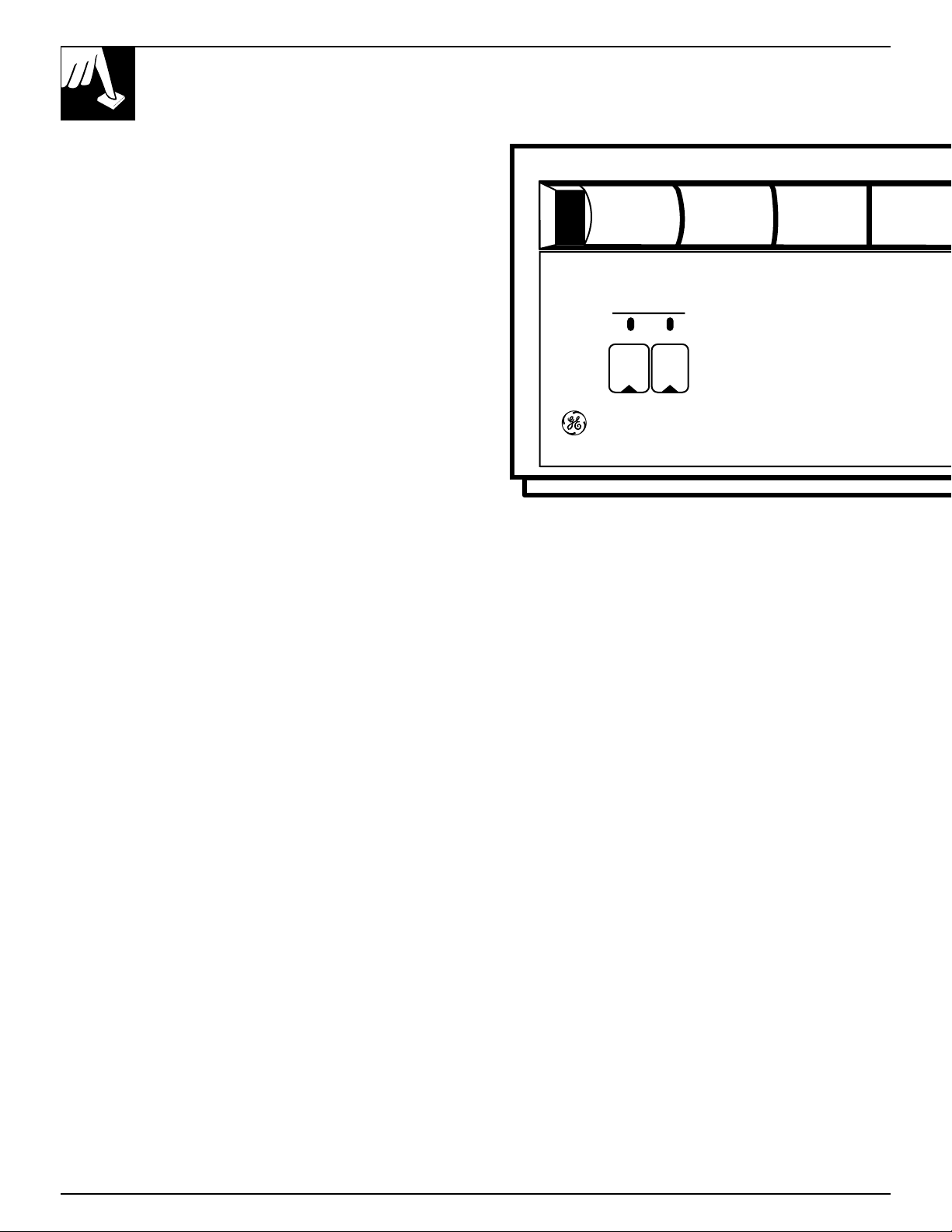
NOTE: The lights over the Cycle pads come ON to
indicate the cycle that has been selected. Press pad
firmly until the light comes on. These Cycle Indicator
lights remain on while the door is latched.
If dishwasher drains into a food waste disposal,
operate the disposal until it is empty before starting
dishwasher.
Step 1. Load your dishwasher. (See Loading section.)
Step 2.
Make sure the Cycle Indicator Dial is at
the OFF position and the door is unlatched. Add
detergent to the detergent dispenser. (See Detergent
Guide.) Use a rinse aid agent to help prevent
spotting. (See How to Use a Rinse Agent section.)
Step 3.
Latch the door.
Step 4.
Select desired wash cycle.
• POTSCRUBBER—For items such as pots, pans
and casseroles with dried-on or baked-on soils.
Everyday dishes may be included. This cycle will
get heavily soiled dishes cleaner than the normal
cycle. It will not remove burned-on foods.
• NORMAL WASH—For most loads of everyday
dishes, glasses and cookware with medium soils.
Designed to yield high performance on normal soils.
Step 5. Select the desired Energy Options.
• HEATED DRY ON—Turns the drying heater on
for faster drying.
• HEATED DRY OFF—Shuts off the heating unit,
thus saving energy. Dishes air-dry naturally. It takes
longer but saves energy. You can open the door after
the motor stops to speed drying. Excellent for
overnight drying.
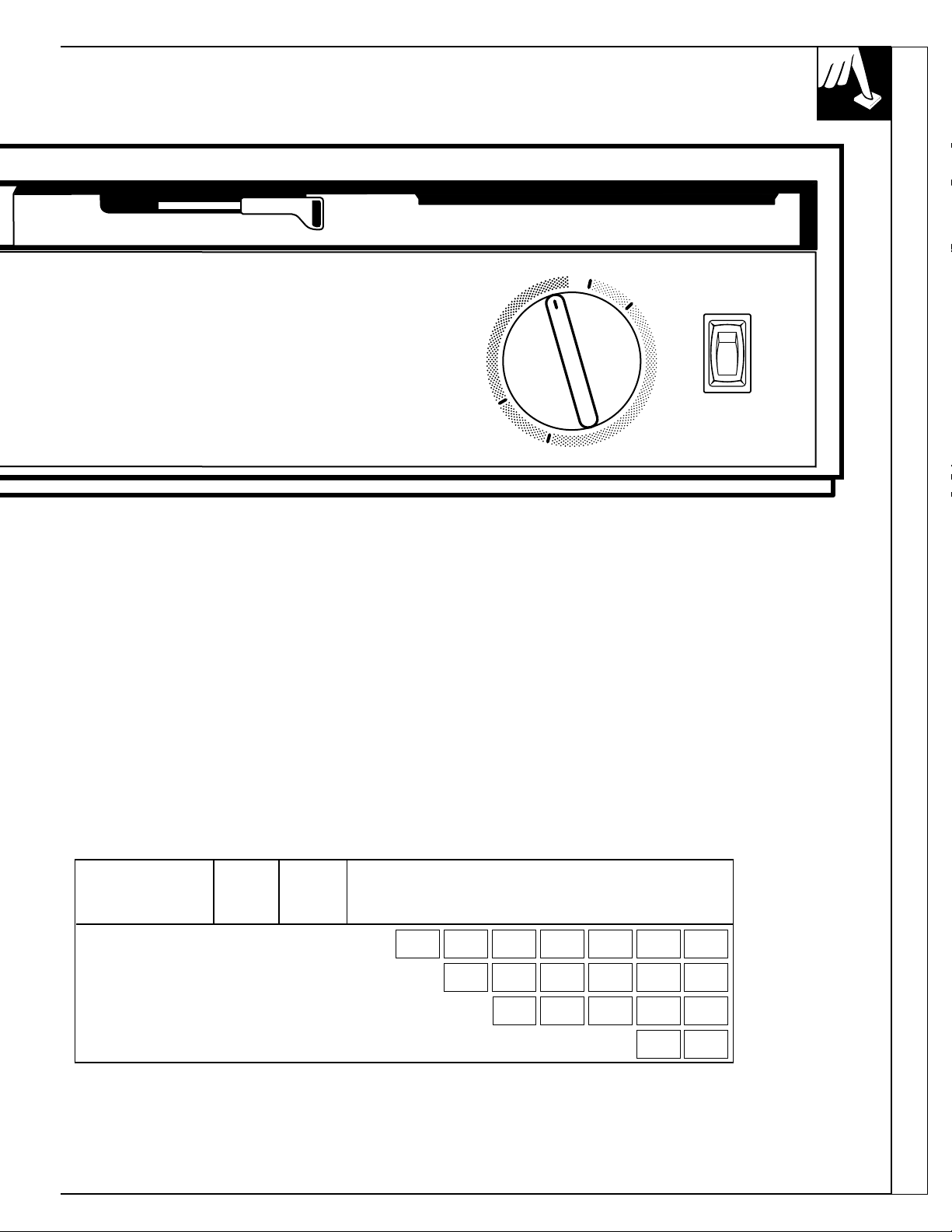
Step 6. Turn the Cycle Indicator Dial to START.
• Turning the dial to START will begin the cycle
immediately. To obtain the benefits of a complete
cycle, be careful that you do not turn the dial any
farther than is necessary to start the dishwasher.
There is a time delay between start-up and water
fill so you will not hear any wash action right away.
Dial Cycles
The SHORT WASH cycle allows you to quickly
wash loads of everyday dishes with medium soils
that have not dried on, such as loads consisting mostly
of glasses.
a. Select the NORMAL WASH cycle and any
drying option if desired.
b. Be sure the door is unlatched.
c. Slowly turn the Cycle Indicator Dial to
SHORT WASH.
d. Latch the door to start the cycle.
Features and appearance may vary slightly.
NORMAL
WASH
CYCLES
POT-
SCRUBBER
4
Operating Instructions
Dial Cycles (continued)
The RINSE & HOLD cycle is for rinsing partial loads
which will be washed later. Do not use detergent.
a. Make sure HEATED DRY OFF is selected.
b. Be sure the door is unlatched.
c. Slowly turn the Cycle Indicator Dial to
RINSE & HOLD.
d. Latch the door to start the cycle.
The PLATE WARMER cycle is for warming clean
dishes and serving plates for the serving of hot foods.
The cycle will take approximately 30 minutes if selected.
a. Load clean plates and dishes to be warmed.
b. Select HEATED DRY ON.
c. Be sure the door is unlatched.
d. Slowly turn the Cycle Indicator Dial to
PLATE WARMER.
e. Latch the door to start the cycle.
Wash Cycles
POTSCRUBBER
NORMAL WASH
SHORT WASH
RINSE & HOLD
Water Use
Gallons
(approx.)
10.6
9.1
7.4
3.0
Wash Cycle
Time
Minutes
(approx.)
62
62
53
12
Rinse Rinse
Rinse
Rinse
Main
Wash
Rinse Rinse
Cycle Sequence
Rinse
Main
Wash
Rinse Rinse
Rinse
Rinse
Drying Options:
HEATED DRY ON. Available on all wash cycles except RINSE & HOLD. Add 34 minutes to wash cycle time.
HEATED DRY OFF. Drying heater is turned off. Dishes dry naturally.
Main
Wash
Rinse
Rinse
Rinse Rinse
Rinse Rinse
Cycle Selection Chart
5
HEATED
DRY OFF
HEATED
DRY ON
RINSE & HOLD
PLATE
WARMER
START
SHORT
WASH
OFF
(PRESS
HEATED DRY)
The rinse agent makes water flow off dishes
quicker than usual. This lessens water spotting
and makes drying faster, too.
For best dishwashing performance, use of a rinse
agent such as JET-DRY brand is recommended.
Rinse agents come in either liquid or solid form.
Your dishwasher uses the liquid form.
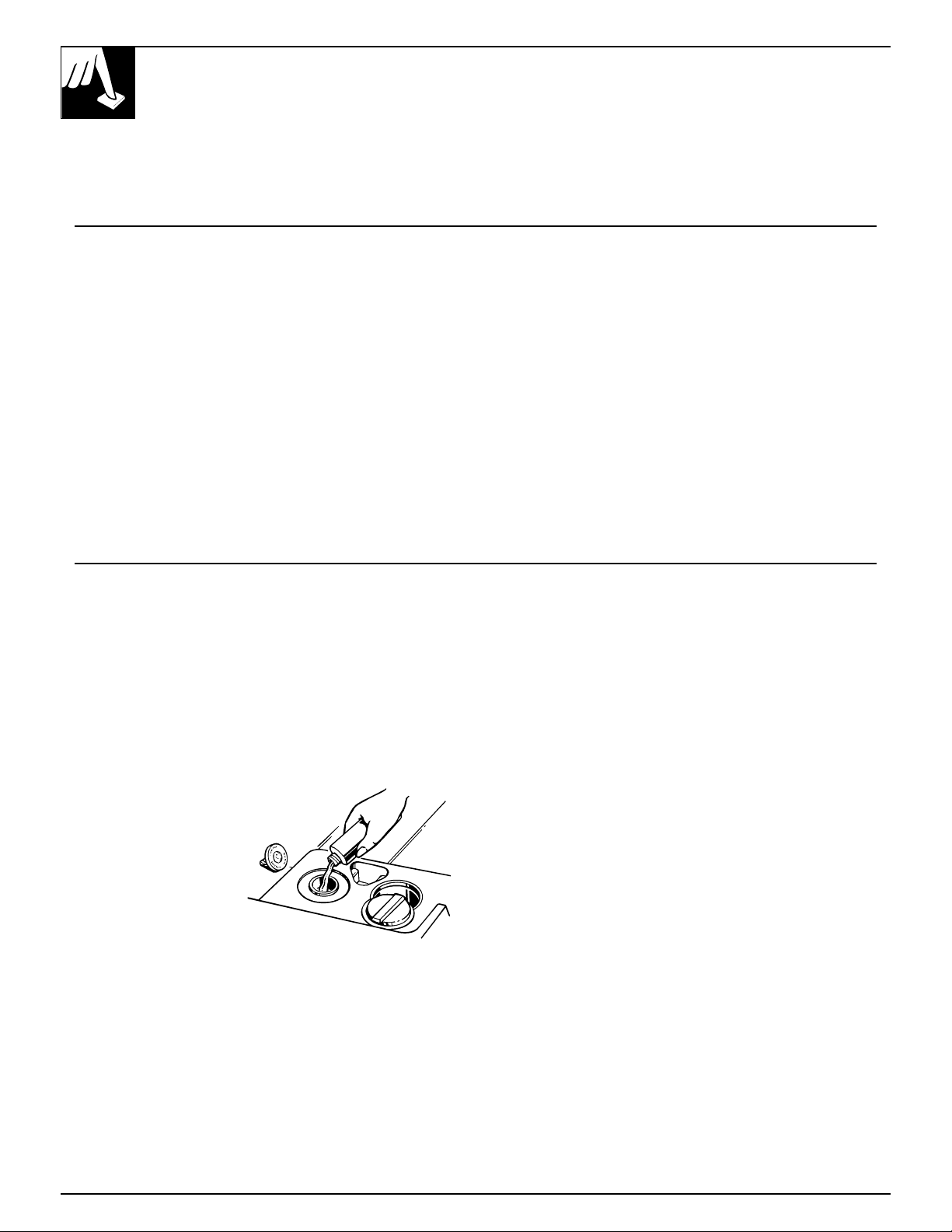
How to fill the rinse agent dispenser.
Unscrew the cap.
Add liquid rinse agent
until it just reaches the
bottom of lip inside the
dispenser opening.
Replace cap. The
dispenser automatically
releases rinse agent into
final rinse water.
You may check to see if you need to add rinse agent by
removing the fill cap and looking into the container.
You may also check the rinse agent, on some models,
by pressing the clear center of the fill cap 2 or 3 times.
If rinse agent is drawn into the center of the fill cap,
you have enough. If the center area remains clear add
rinse agent.
Your dishwasher’s rinse agent container holds
approximately 4
1
⁄
2
ounces. This should last about
3 months. Fill as needed.
If you accidentally spill: Wipe up the rinse
agent with a damp cloth. Don’t leave the spill in the
dishwasher. It can keep your detergent from working.
If you can’t find any rinse agent, write:
BENCKISER CONSUMER PRODUCTS, INC.
(‘‘JET-DRY’’)
Corporate Centre 1
55 Federal Road
P.O. Box 1991
Danbury, CT 06813-1991
To get dishes clean and dry, you need hot water. For good washing and drying,
the entering water must be at least 120
°
F. To prevent dish damage, inlet water should not exceed 150
°
F.
Good Dishwashing Starts with HOT Water
How to Use a Rinse Agent
6
How to Test Water Temperature
Check your water temperature with a candy or meat
thermometer. Turn on the hot water faucet nearest
the dishwasher. Put the thermometer in a glass and
let the water run continuously into the glass until the
temperature stops rising. If the water temperature is
below 120°F., adjust your water heater.
Helpful hints: If outside temperatures are unusually
low, or if your water travels a long distance from water
heater to dishwasher, you may need to set your water
heater’s thermostat up. If you have not used hot water
for some time, the water in the pipes will be cold. Turn
on the hot water faucet at the sink and allow it to run
until the water is hot. Then start the dishwasher. If
you’ve recently done laundry or run hot water for
showers, give your water heater time to recover before
operating the dishwasher.
To improve washability if the water is less than
120°F. and you cannot adjust your water heater:
Select a longer cycle and fill both detergent cups at
least half-full with detergent.
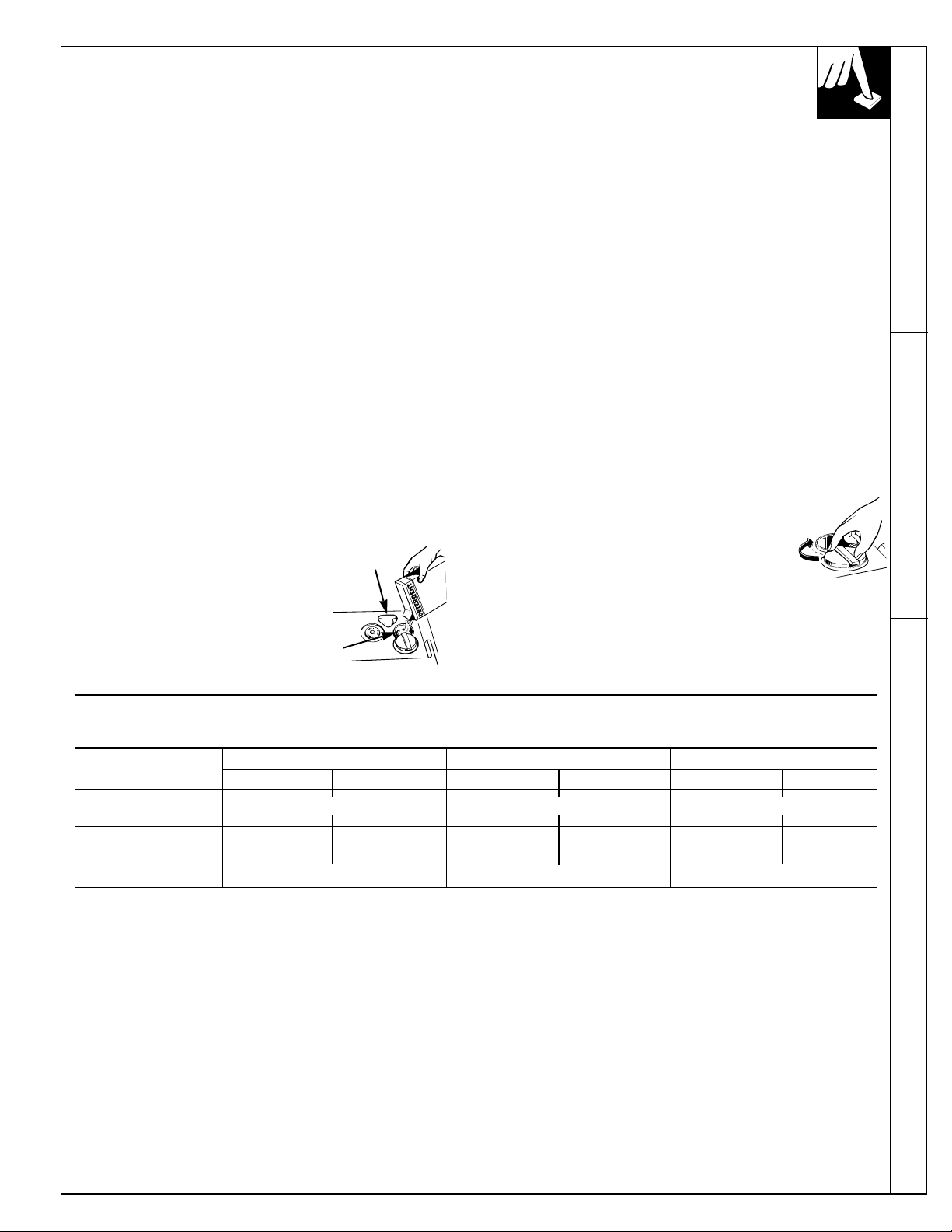
SOFT WATER (0-3 grains hardness) MEDIUM WATER (3-7 grains) HARD WATER (7-12 grains*)
CYCLES Main Cup Open Cup Main Cup Open Cup Main Cup‡ Open Cup‡
POTSCRUBBER Half Full Half Full Completely Half Full Completely Completely
NORMAL WASH Full Full Full
SHORT WASH Half Full None Half Full None Completely None
Full
RINSE & HOLD Use no detergent Use no detergent Use no detergent
*12 grains and up is extremely hard water. A water softener is recommended. Without it, lime ‡Filled Main Cup holds 3 tablespoons;
can build up in the water valve. The water valve may stick while open and cause flooding. filled Open Cup holds 2 tablespoons.
You’ll find two detergent dispensers on the inside
door of your dishwasher. Two, because
some cycles use two washes.
See ‘‘Detergent Usage Guide’’below.
(Be sure the CYCLE INDICATOR
DIAL is at OFF position before
adding detergent. Otherwise,
the detergent
cup will not
close and latch properly.)
Close the main cup.
NOTE: To open detergent cup after it has
been closed, unlatch the door and rotate the
Cycle Indicator Dial a full turn to the OFF
position. When the closed cup contains
soap it is best that the door be in a partially
open position before rotating the Cycle
Indicator Dial. This will help reduce the amount of
detergent and rinse aid agent spillage into the tub.
Detergent Usage Guide (powder or liquid)
+
+ +
Open
Cup
Main
Cup
Grasp handle,
rotate and
close tightly
Use only powder or liquid detergent specifically
made
for use in dishwashers. Other types will cause
oversudsing.
How much detergent should you use? That depends.
Is your water ‘‘hard’’ or ‘‘soft’’? With hard water, you
need extra detergent to get dishes clean. With soft water,
you need less detergent.
Your water department can tell you how hard your
water is. So can your county extension agent or your
area’s water softener company. Just call and ask them
how many ‘‘grains’’ of hardness there are in your water.
Too much detergent with soft water not only wastes
money, it can be harmful. It can cause a permanent
cloudiness of glassware, called ‘‘etching.’’ An outside
layer of glass is etched away! Of course, this takes some
time. But why take a chance when it’s easy to find out the
hardness of your water.
Keep your detergent fresh and dry. Under the sink
isn’t a good place to store detergent because there is
too much moisture. Don’t put
powder detergent into
the dispenser until you’re ready to wash dishes, either.
(It won’t be fresh OR dry.)
If your powder detergent gets old or lumpy, throw it
away. Old detergent often won’t dissolve. If you use a
liquid dishwasher detergent, these precautions are not
necessary because liquid detergents don’t ‘‘lump’’ as
they age or come in contact with moisture.
How to Choose and Use the Right Detergent
How to Prepare the Dishes for Washing
If this is your first dishwasher, or if you’re
replacing a much older model, you may wonder
how much preparation your dishes need. Actually
very little. Scrape off bones, seeds, skins, toothpicks
and other hard solids. Remove excessive quantities
of oil or grease.
NOTE: You may also want to consider removing
foods such as mustard, mayonnaise, vinegar, lemon
juice and other foods that can cause discoloration of
stainless steel if allowed to remain on dishes for a long
period of time.
The POTSCRUBBER cycle can wash heavily soiled
dishes and remove dried-on and baked-on soils from
pots, pans and casseroles. Items with burned-on
soils need extra preparation.
Detergent Dispensers
7
Hot Water Rinse Agents Detergents Dish Preparation
8
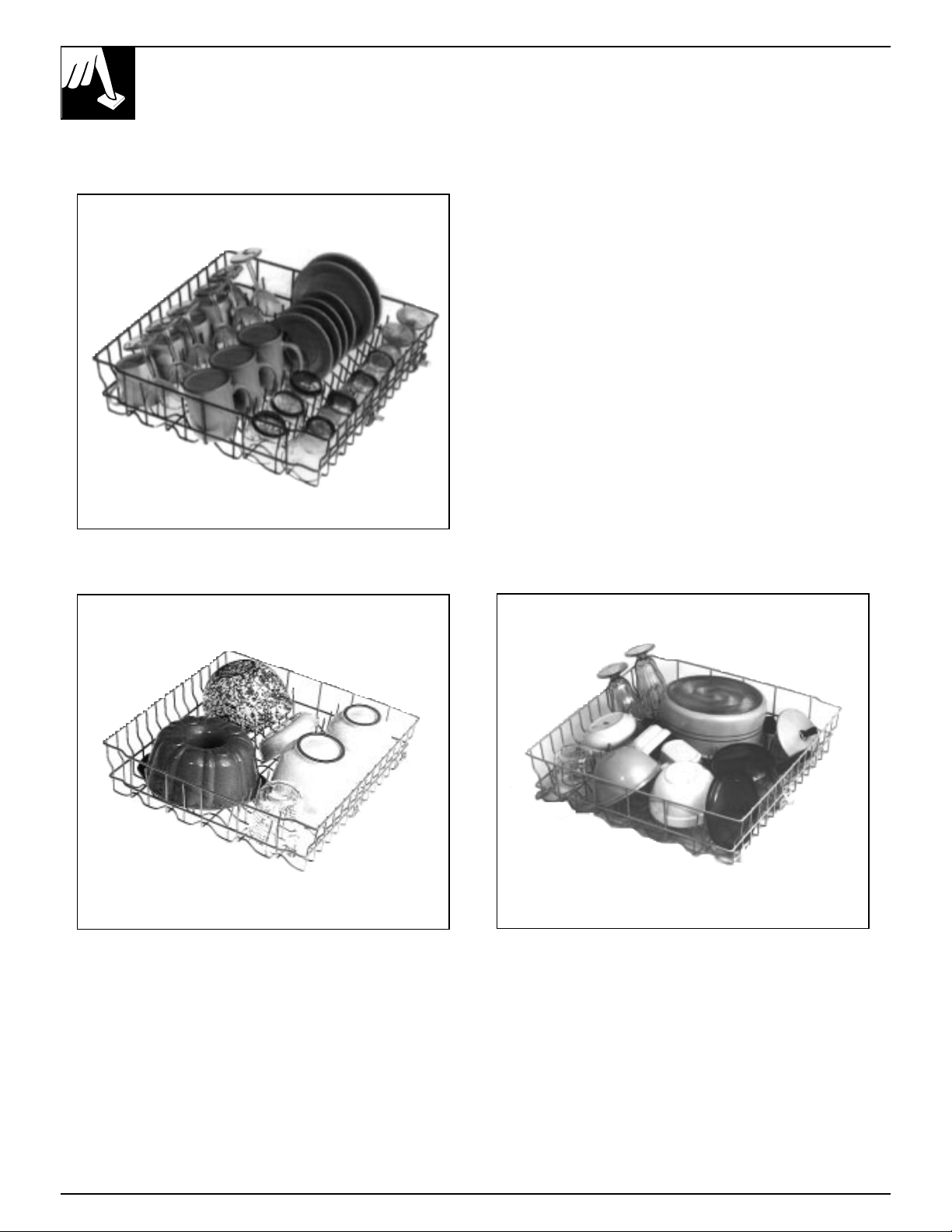
The upper rack is best for glasses, cups and
saucers. Cups and glasses fit best along the sides.
This is also the place for dishwasher-safe plastics.
Make sure small plastic items are lodged in tightly so
they can’t fall onto the heating unit. Arrange stemware
so that it cannot move easily. Don’t let the glasses
touch each other.
HOW TO LOAD YOUR DISHWASHER
NOTE: Do not load large platters or trays in front right corner of lower
rack. They may prevent detergent from circulating in the wash cycle.
The upper rack is handy for all kinds of odd shapes. Sauce pans, mixing bowls and other items should be placed
face down. When loading dishwasher safe plastics make sure each plastic item is secured over two fingers. This
will insure good washing results.
Loading Your Dishwasher
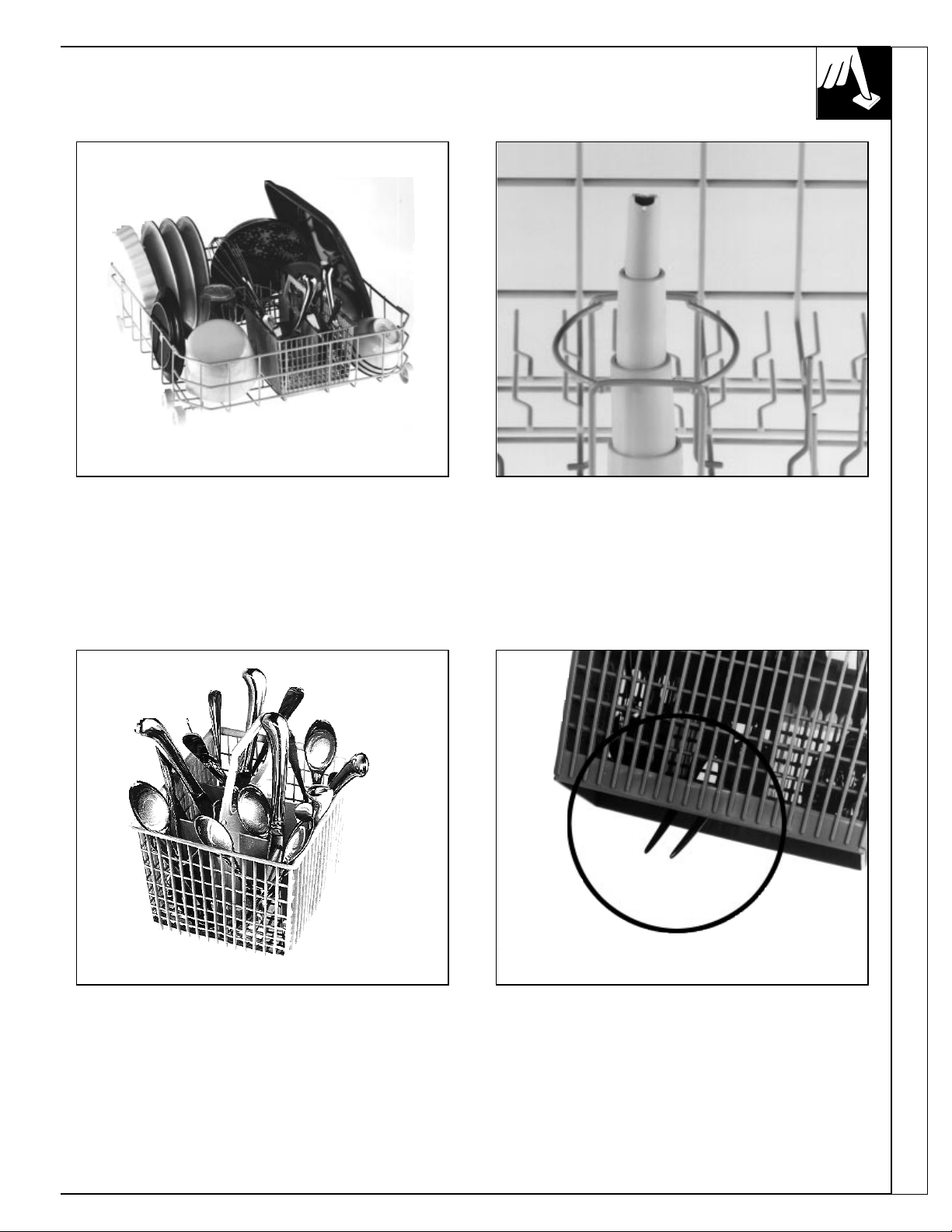
The lower rack is best used for plates, saucers, and
cookware. Large items such as broiler pans and racks
should go in the lower rack along the edge. Load
platters, pots and bowls along the sides, in corners,
or in the back. For best washing results, all items
should be positioned with the soiled side of the dish
facing the center of the rack.
Put flatware in the removable basket with fork and knife
handles up to protect your hands. Place spoons in the
basket with handles down. Mix knives, forks and
spoons so they don’t nest together. Distribute evenly.
Small plastic items, such as measuring spoons and
lids from small containers are not recommended for
automatic dishwashing. If placed in dishwasher, they
should go in bottom of silverware basket with
silverware on top.
Keep center area clear in the lower rack.
The wash tower rises through the center of the lower
rack during the wash and rinse portions of the cycle.
Don’t block it or load tall things next to it. Also, be
careful not to let a portion of an item such as a pot or
dish handle extend through the bottom rack. This could
block the wash arm and cause poor washing results.
Precaution!
Take out anything that may fall or extend through the
bottom of the basket.
Don’t let any
item extend
through bottom
9
10
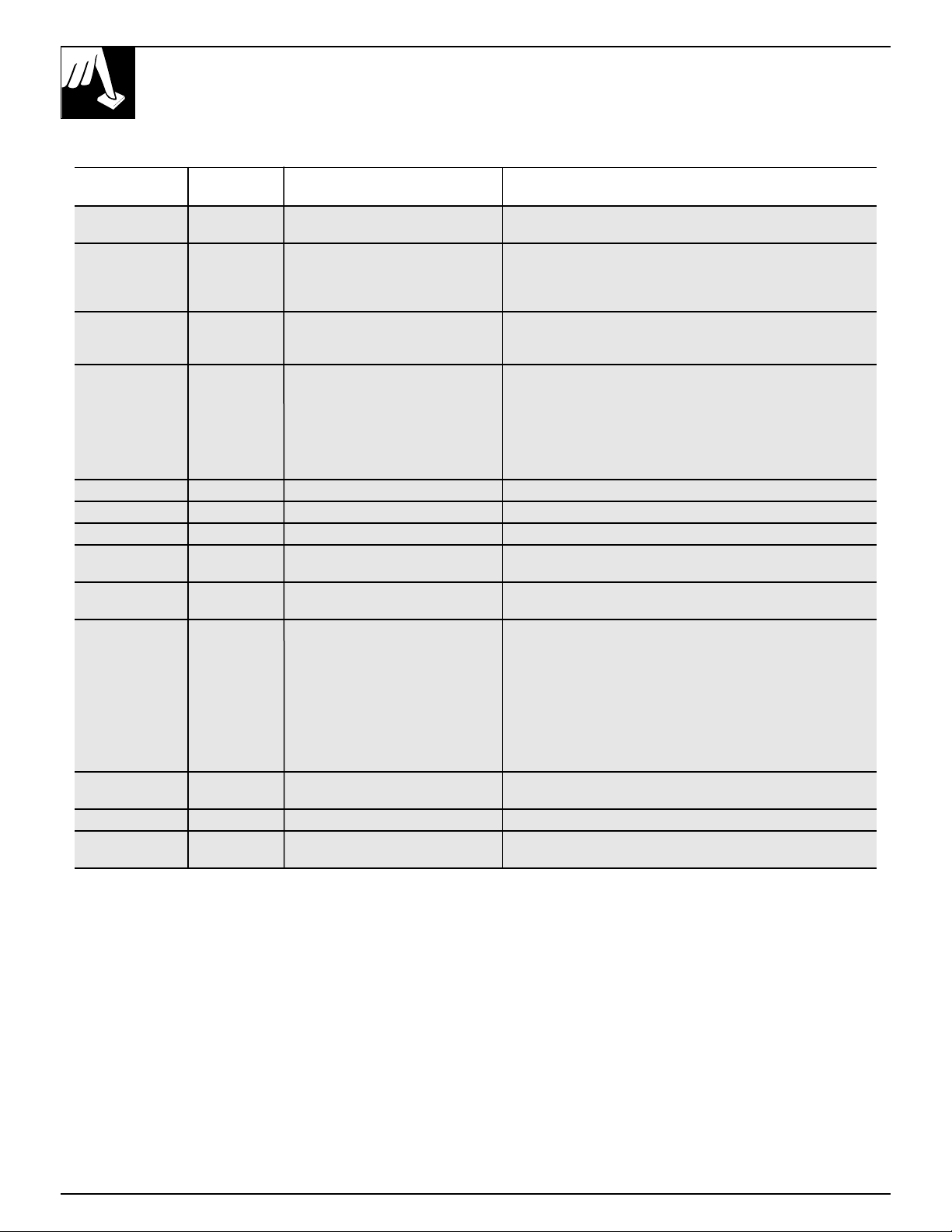
WHAT YOU CAN USUALLY WASH SAFELY
IN YOUR DISHWASHER
Usually
Material Safe Exceptions (not safe) Special Instructions
Aluminum YES Some colored anodized Some darkening or spotting possible. Remove by
aluminum can fade. scouring with soap-filled steel wool pads.
China/ YES Antique, metal-trimmed, If in doubt, check with the manufacturer. Or test wash
Stoneware hand-painted or over-the-glaze one piece daily for at least a month. Compare with the
patterns fade. Gold leaf rest of the set.
will discolor.
Crystal YES Antique, metal-trimmed or Load securely to prevent movement. Check your
hand-painted patterns fade. manufacturer’s instructions for your crystal.
Gold leaf will discolor.
Non-dishwasher
NO Do not wash in dishwasher. Damage to dishwasher
items—such and discoloration or staining of dishwasher may result.
as electronic
air cleaner
filters, furnace
filters, paint
brushes, etc.
Glass YES
Iron NO Iron will rust.
Pewter NO Pewter tarnishes.
Plastics YES If it doesn’t say DISHWASHER SAFE, test one piece in
the top rack before dishwashing an entire set.
Stainless steel YES Rinse if not washing immediately. Salty or acidic foods
can stain if left on.
Sterling silver YES Don’t put in same silverware Rinse if not washing immediately. Salty or acidic foods can
and silver plate basket with stainless steel. stain if left on. Dry detergent can cause difficult-to-remove
Contact between metals can black spots. Place in back section of silverware basket to
damage silver. avoid exposure to detergent from the detergent cup.
Don’t wash copper utensils in
the same load. Silver may get a
brown film.
Adhesive used to attach some
hollow-handle knives can loosen.
Non-stick YES After washing, wipe the non-stick coating area with
coatings vegetable oil to keep it from losing its non-stick quality.
Tin NO Tin can rust.
Wood NO Wood can warp, crack or lose
its finish with any type of washing.
Add dishes any time during the RINSE & HOLD
cycle. With other wash cycles, you can add dishes
at any time BEFORE the main detergent wash portion
of the cycle.
However, opening the door during any cycle
lessens cleaning power. So try to load everything
at the beginning.
Here’s how to add a forgotten dish:
1. Push the door latch to the left. Washing will stop.
2. Wait a few seconds until the water calms. Then
open the door. WARNING: Hot vapor may rise
from opened door.
3. Add dishes you’ve forgotten.
4. Close the door and push the latch to the far right.
When the door is locked, washing will continue.
Forget a dish? Here’s when you can add it.
11
CARE AND CLEANING
USER MAINTENANCE INSTRUCTIONS
Clean the control panel with a lightly dampened
cloth. Dry thoroughly. Do not use abrasives or
sharp objects on the panel. They can damage it.
Clean the outside with a good appliance polish
wax. The outside cabinet finish is durable, but it
can scratch. So use no scouring pads, or harsh or
gritty cleaners.
Appliance Polish Wax & Cleaner (Cat. No.
WR97X0216) is available from GE Service and
Parts Centers.
The inside usually takes care of itself. If it should
ever need cleaning, use a mild cleansing powder.
Scouring pads and harsh cleaners can mar the finish.
What is Dishwasher Safe Care and Cleaning
Not Using Your Dishwasher in Winter? Protect Against Freezing.
If your dishwasher is left in an
unheated place during the winter,
ask a service technician to:
• Cut off electrical power to the
dishwasher. Remove fuses or trip
circuit breaker.
• Turn off the water supply.
• Disconnect the water inlet line
from the water valve.
• Drain water from the inlet line
and water valve. (Use a pan to
catch the water.)
• Reconnect the water inlet line to
the water valve.
• Remove the plastic pump cover
in the tub bottom and use a
sponge to soak up water in
the rubber boot.
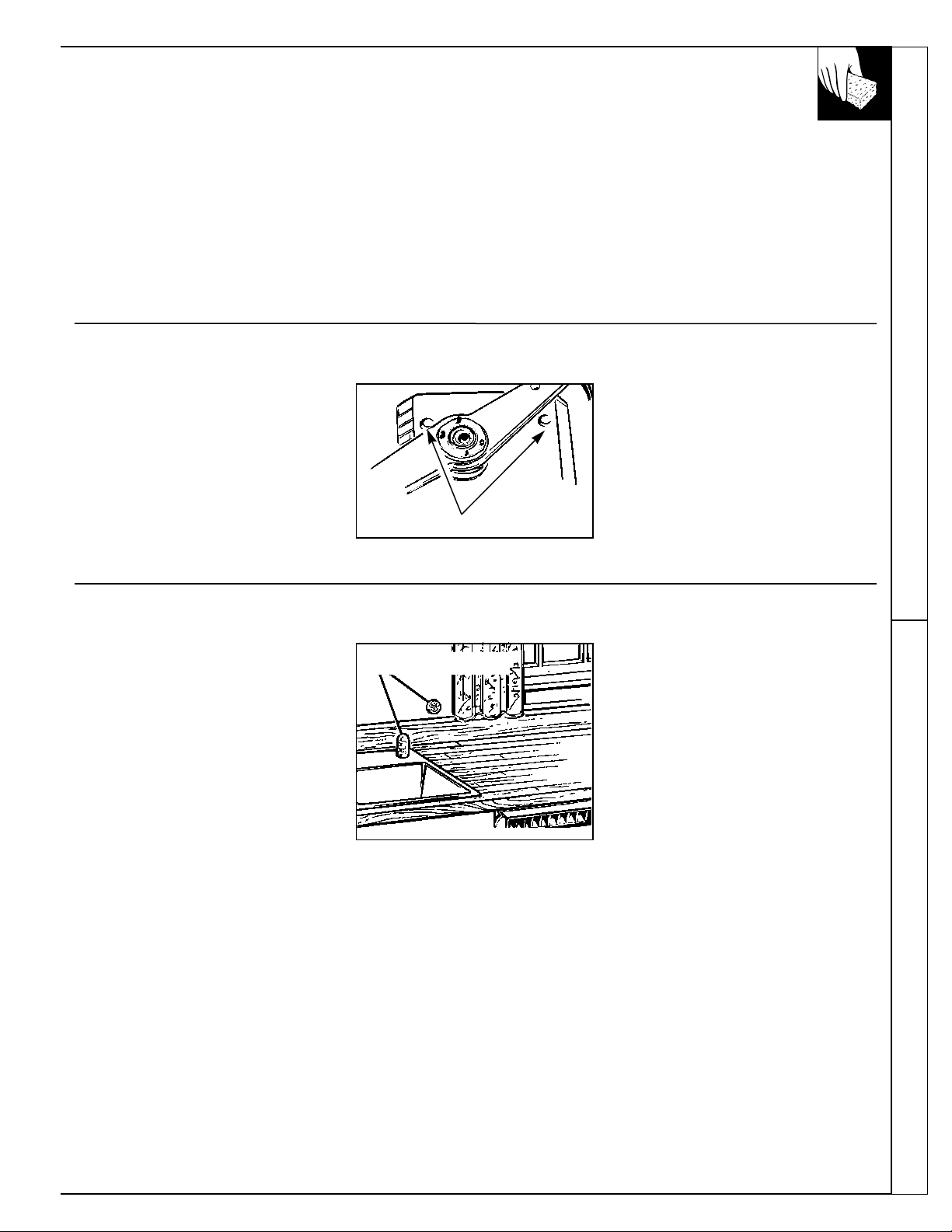
Built-in Dishwashers Often Use an Air Gap. Keep It Clean.
An air gap is a plumbing device.
It protects your dishwasher against
water backing up into it if a drain
clogs. The air gap is not a part of
the dishwasher. And you may not
even have one. Not all plumbing
codes require air gaps.
Check the air gap any time your
dishwasher isn’t draining well.
If you have an air gap, check it at
least once a month. IT IS NOT
PART OF YOUR DISHWASHER.
IT IS NOT COVERED IN YOUR
WARRANTY.
The air gap is easy to clean.
With most types, first turn off the
dishwasher, then lift off the chrome
cover. Then unscrew the plastic cap
and check for any buildup of grit.
A toothpick makes cleaning easy.
Two Types of Air Gaps
Pump Cover Screws
HOW TO CHANGE COLOR PANELS
If you are redecorating, you can change your dishwasher’s front panel to
match or blend with your new colors by flipping it over. Each side of each
panel is a different color. You may also paint a panel with a color of your
own choice.
How to Change the Door Panel
1. Take out trim screws on either side of the
dishwasher door. Remove the side trim.
2. Slide the door panel out.
(Careful—edges may be sharp.)
3. Turn the door panel around and put the color you
want in front.
4. Replace the door panel, side trim and screws.
NOTE: Do not operate
dishwasher while changing
panels or when lower access
panel is removed.
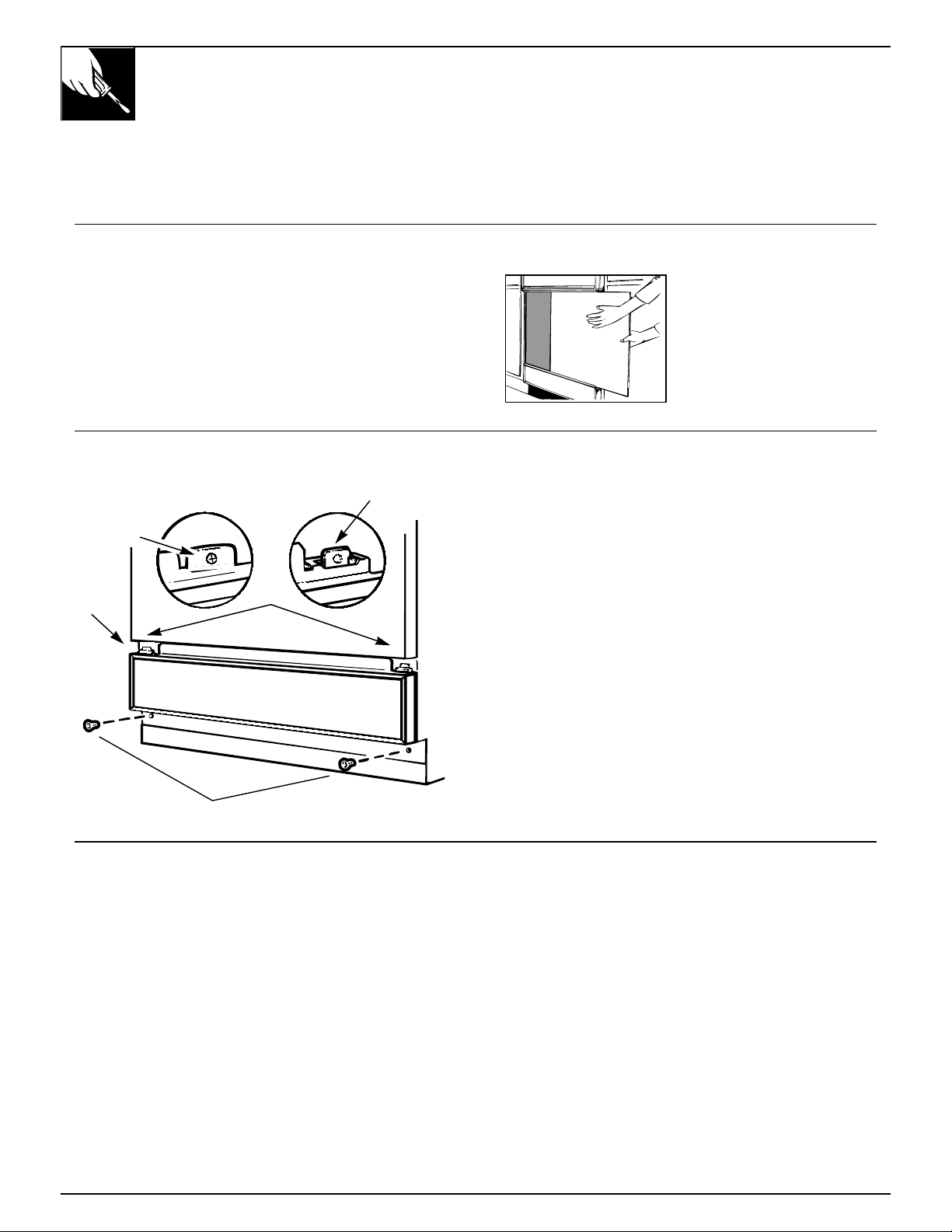
How to Change the Lower Panel
1. Remove the bottom panel attachment screws.
2. On models without top mounting screws, remove
the entire access assembly by rotating the bottom
out and lifting it up and over the retaining tabs.
3. On models with top mounting screws, remove
the screws.
4. Take out the top trim screws and remove the
top trim.
5. Slide the color panel(s) up and out and put the
color you want in front.
6. Replace the top trim and screws.
7. Replace the entire access assembly by reversing
the steps.
Bottom Panel Attachment Screws
Top
Trim
Top
Mounting
Screw
Retaining
Tab
or
12
Wood Panel Trim Kits
Color Panels
Ordering Information
Wood panel trim kits contain trim
and instructions for adding a
decorative wood door panel and
lower access panel to match kitchen
cabinets. You supply the wood
panels which should be no thicker
than 1/4″.
Specify the kit number when
ordering:
GPF40BC (Chrome Trim & Screws)
GPF40BK (Black Trim)
GPF40WD (White Trim)
GPF40AD (Almond)
(Available for model GSD700 only.)
If you have redecorated and the color
panels in your dishwasher do not
blend with your new color scheme you
may order an additional color panel.
Specify the color panel number when
ordering:
GPF24 White/Almond
GPF26 Harvest/Black
GPF27 Black/White
Color panels and wood panel trim
kits are available at an extra cost by
calling, toll-free, 800-626-2002. Your
order will be sent directly to your
home. Visa, MasterCard and Discover
cards are accepted.
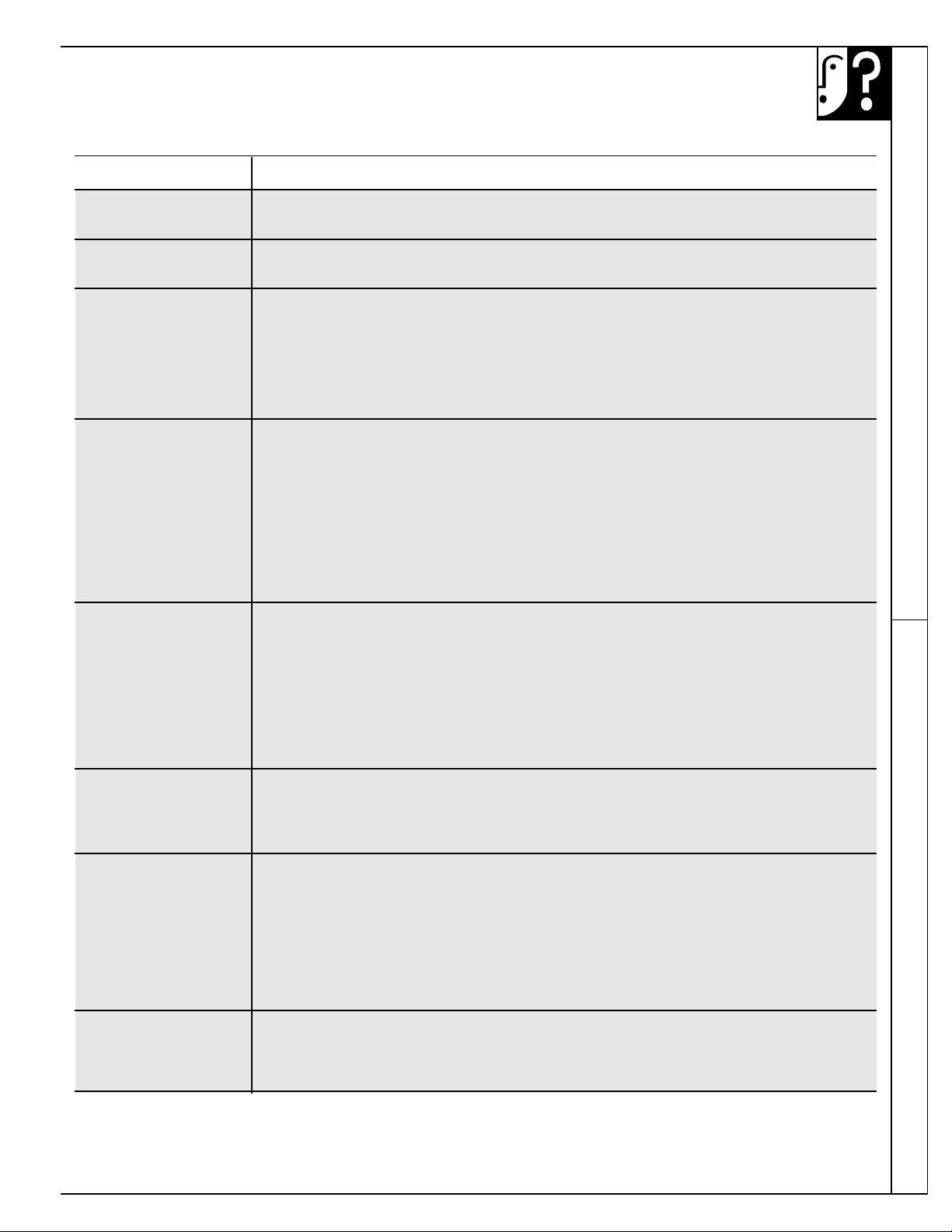
PROBLEM POSSIBLE CAUSE
DISHWASHER A fuse in your home may be blown, or the circuit breaker tripped. Replace fuse or
WON’T RUN reset circuit breaker. Remove any other appliances from the circuit.
UNUSUAL NOISE Utensils may not be secure on rack pins, or something small may have dropped from the
rack. Water is causing utensils to rattle. Make sure everything is secured in dishwasher.
DISHES DON’T DRY
Make sure inlet water temperature is correct. (See How to Test Water Temperature section.)
Unload the bottom rack first. Water from dishes in the top rack may be spilling into
the bottom rack.
Check for improper loading. Dishes shouldn’t nest together. Avoid overloading.
Check the rinse agent dispenser to see that it’s not empty.
UNCLEAN DISHES Check inlet water temperature. It should be at least 120°F. (To test, see How to Test
AND FLATWARE Water Temperature section.)
Water pressure may be temporarily low. Turn on a faucet. Is water coming out slower
than usual? If so, wait until pressure is normal before using your dishwasher.
Plugged air gap. (See Care and Cleaning section.)
Improper rack loading. (See Loading section.)
Choose another cycle to give you longer washing time.
DETERGENT LEFT Water may not be reaching the detergent cups. Move dishes that may be blocking
IN DISPENSER CUPS detergent cup.
The dispenser cover may not be opening or may be blocked by improperly loaded
items. If you used a powder detergent, open the cup and remove any caked-on
detergent. If the cup still doesn’t open automatically, call for service.
Detergent may be old. If the powder detergent is hard or caked in the box, throw it away.
The detergent may not be working well. Try another brand.
DETERGENT CUP Cycle Indicator Dial must be in the OFF position for cup lid to close and latch properly.
LID WON’T LATCH If you unlatch the door and open it to dry your dishes, the Cycle Indicator Dial does not
AFTER ADDING advance by itself.
DETERGENT
YELLOW OR Tea or coffee can stain cups. Remove the stain by hand, using a solution of 1/2 cup
BROWN FILM bleach and 3 cups warm water.
An overall yellow or brown film on dishes or glassware can be caused by iron
deposits in water. A special filter in the water supply line is the only way to correct
this problem. Your water softener company can tell you about the filter.
Yellow film on sterling silver results when you wash copper utensils in the same load.
Silver polish will usually remove this stain.
CYCLE INDICATOR This is normal. Unlatch the door to turn off the Cycle Indicator lights.
LIGHTS STAY ON
WHEN CYCLE IS
COMPLETED
(continued next page)
13
QUESTIONS?
USE THIS PROBLEM SOLVER
13
Color Panels The Problem Solver
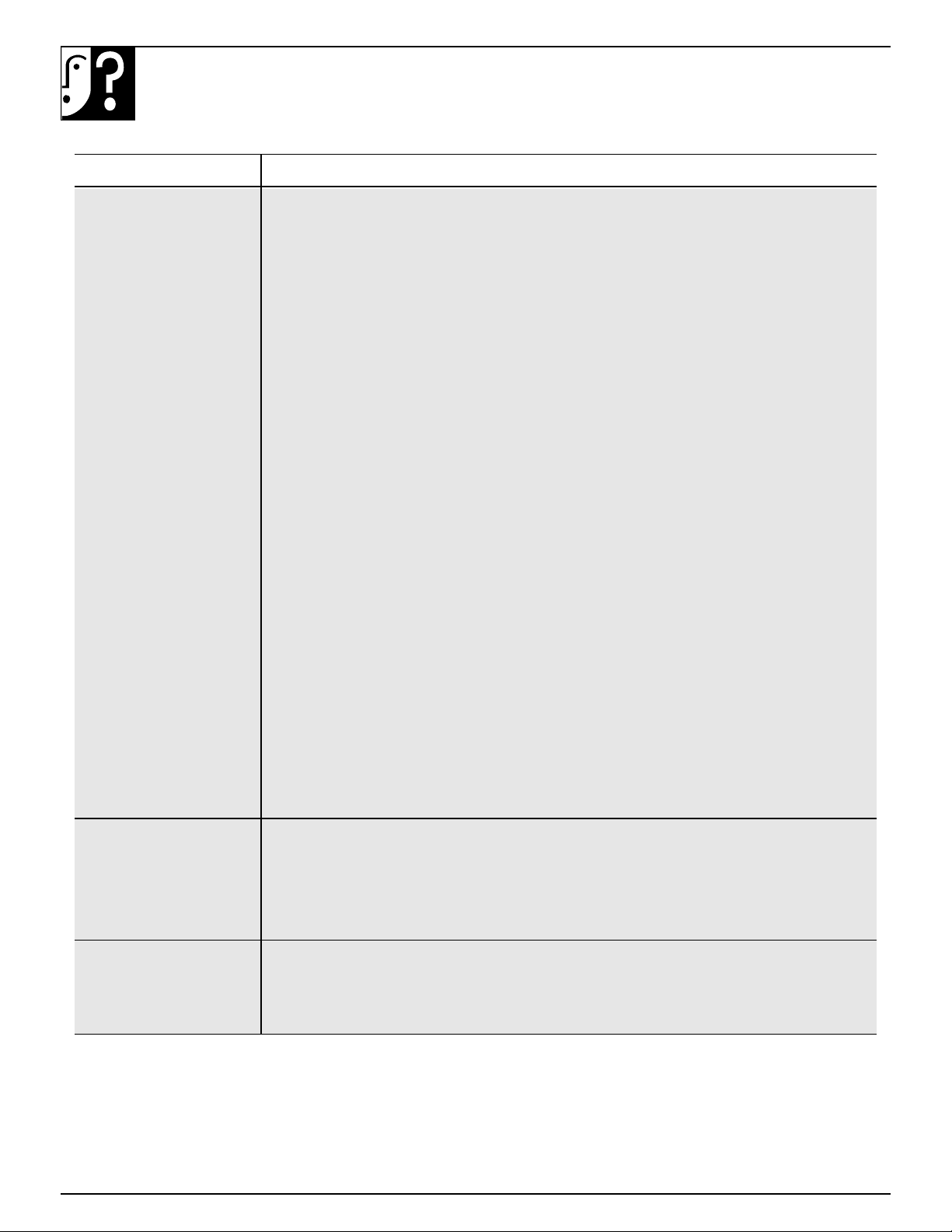
PROBLEM POSSIBLE CAUSE
Spotting can be caused by all these things:
• Extremely hard water. (See How to Choose and Use Detergent section.)
• Low inlet water temperature. (See How to Test Water Temperature section.)
• Overloading the dishwasher.
• Improper loading. (See Loading section.)
• Old or damp powder detergent.
• Phosphate level in detergent too low. (See How to Choose and Use
Detergent section.)
• Rinse agent dispenser empty. (See How to Use a Rinse Agent section.)
• Too little detergent. (See How to Choose and Use Detergent section.)
Local water conditions and personal preferences vary. Try several brands of
detergents to find one that gives the best results for you. A liquid dishwasher
detergent may help reduce filming.
To remove stubborn spots and film from glassware:
1. Remove all metal utensils from the dishwasher.
2. Do not add detergent.
3. Select POTSCRUBBER cycle.
4. Start the dishwasher and allow to run for 18 to 22 minutes. The dishwasher will
now be in the main wash.
5. Then open the door and pour 2 cups (500 ml) of white vinegar into the bottom of
the dishwasher.
6. Close the door and allow to complete the cycle.
If vinegar rinse doesn’t work: Repeat as above, except use 1/4 cup (60 ml) of citric
acid crystals instead of vinegar. (Most drugstores carry citric acid crystals. If yours
doesn’t, call GE Factory Service.)
Using a vinegar or citric acid crystal rinse more than twice a month? Consider a home
water softener.
CLOUDINESS ON If vinegar or citric acid crystal rinse doesn’t work, the cloudiness is “etching.”
GLASSWARE The film cannot be removed.
It can be prevented: Use less detergent if you have soft water. Wash glassware in
the shortest cycle that will get them clean.
Water temperature entering dishwasher exceeds 150°F.
CHIPPING OF CHINA Rough handling can cause chipping. Load with care. Make sure glassware and china
are secure and can’t jar loose. (See Loading section.) Make sure tall glasses and
stemware will clear the top of the tub when you push the rack into the dishwasher.
Always use the top rack for delicate items.
14
THE PROBLEM SOLVER
(continued)
SPOTS AND
FILMING ON
GLASSES AND
FLATWARE
PROBLEM POSSIBLE CAUSE
BLACK OR GRAY Aluminum utensils often leave marks when they rub against dishes. Remove marks
MARKS ON DISHES with a mild abrasive cleanser.
SMALL AMOUNT OF Water around the outlet on the tub bottom at the back of the tub is normal. It is clean
WATER STANDING water. It’s there to keep the water seal lubricated.
IN THE BOTTOM
OF THE TUB
WATER WON’T PUMP If the entire bottom of the tub has water, you may have a drain problem. Clean the air
OUT OF THE TUB gap, if you have one. (See Care and Cleaning section.)
Check the kitchen sink. Is it draining well? You may need a plumber.
If dishwasher drains into disposer, run disposer to clear. Be sure disposer is not
clogged.
SUDS IN THE TUB Sudsing detergents are not meant for dishwashers. USE ONLY AUTOMATIC
DISHWASHER DETERGENTS TO AVOID SUDSING.
To remove suds from the tub: Open the dishwasher. Let suds evaporate. Add
1 gallon of cold water to the tub. Close and latch the dishwasher. Pump out water
by slowly turning the control dial until a drain period is reached.
Repeat if necessary.
DISHWASHER Suds can cause unit to overflow. That’s why it’s so important to use a detergent that’s
LEAKS designed for automatic dishwashers.
Spilling the rinse agent can cause foam during washing. This can lead to overflowing.
Wipe up accidental spill of rinse agent with a damp cloth.
MOTOR HUMS Dishwasher has not been used on a regular basis.
If you do not use your dishwasher often, set it to fill and pump out once every week.
This will help keep the seal moist, and the garbage disposer clear.
STAINING OF Some detergents contain colorant (pigment or dyes) that will discolor the tub
TUB INTERIOR interior with extended use. Check the detergent cup for signs of any discoloration.
If cup is discolored, change to detergent without any colorant.
SOUNDS YOU You’ll hear occasional clicking sounds. These are normal.
WILL HEAR
• Soft food disposal shredding action.
• Drain valve opening to pump water out.
• Timer control as cycle progresses.
• Detergent cup opening.
During the drying period:
• The motor stops.
VAPOR AT Water vapor comes through the vent by the door latch during drying and when
THE VENT water is being pumped out.
If you need more help…call, toll free:
GE Answer Center
®
800.626.2000
consumer information service
15
The Problem Solver

16
NOTES

17
NOTES

18
IF YOU NEED SERVICE...
To obtain service, see the Consumer Services page.
We’re proud of our service and want you to be
pleased. If for some reason you are not happy with the
service you receive, here are three steps to follow for
further help.
FIRST, contact the people who serviced your
appliance. Explain why you are not pleased. In most
cases, this will solve the problem.
NEXT, if you are still not pleased, write all the
details—including your phone number—to:
Manager, Consumer Relations
GE Appliances
Appliance Park
Louisville, KY 40225
FINALLY, if your problem is still not resolved, write:
Major Appliance Consumer Action Program
20 North Wacker Drive
Chicago, IL 60606
We’ll Be There
With the purchase of your new GE appliance, receive the assurance that if you ever need
information or assistance from GE, we’ll be there. All you have to do is call—toll-free!
Parts and Accessories
800-626-2002
Individuals qualified to service their own appliances
can have parts or accessories sent directly to their home.
The GE parts system provides access to over 47,000
parts…and all GE Genuine Renewal Parts are fully
warranted. VISA, MasterCard and Discover cards
are accepted.
User maintenance instructions contained in this booklet
cover procedures intended to be performed by any user.
Other servicing generally should be referred to qualified
service personnel. Caution must be exercised, since
improper servicing may cause unsafe operation.
Consumer Services
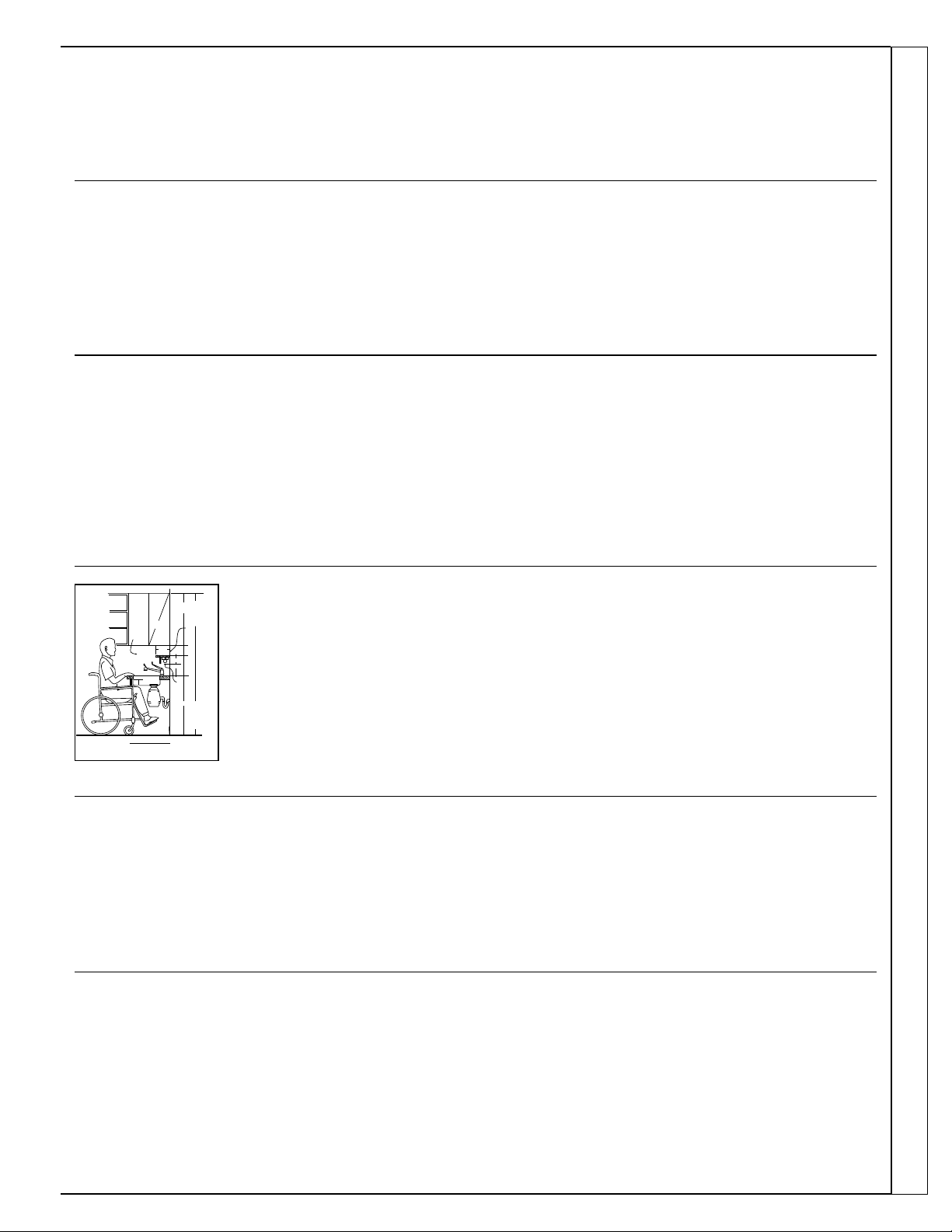
Upon request, GE will provide
Braille controls for a variety of GE
appliances, and a brochure to
assist in planning a barrier-free
kitchen for persons with limited
mobility. To obtain these items,
free of charge, call 800.626.2000.
Consumers with impaired hearing or speech who have
access to a TDD or a conventional teletypewriter may
call 800-TDD-GEAC (800-833-4322) to request
information or service.
In-Home Repair Service
800-GE-CARES (800-432-2737)
A GE consumer service professional will provide expert repair service,
scheduled at a time that’s convenient for you. Many GE Consumer Service
company-operated locations offer you service today or tomorrow, or at your
convenience (7:00 a.m. to 7:00 p.m. weekdays, 9:00 a.m. to 2:00 p.m. Saturdays).
Our factory-trained technicians know your appliance inside and out—so most
repairs can be handled in just one visit.
Service Contracts
800-626-2224
You can have the secure feeling that GE Consumer Service will still be there
after your warranty expires. Purchase a GE contract while your warranty is still
in effect and you’ll receive a substantial discount. With a multiple-year contract,
you’re assured of future service at today’s prices.
For Customers With Special Needs…
800.626.2000
SINGLE CONTROL
FAUCET
TBXTOLITE
ON WALL
6’ 10"
5"
8"
6"
5"
7"
1’ 0"
R SHALLOW DEPTH SINKS (6") WITH REAR DRAIN.
SINK SHOULD ALSO BE UNDERCOATED
2’ 10"
3’
1/8
"
SCALE 1’
=
1"
SECTION A-A
FLUORESCENT
FIXTURE
THIS LIGHT CAN
BE INSTALLED
IN BOTTOM OF
WALL CABINETS
2’ 6"
GE Answer Center®
800.626.2000
Whatever your question about any GE major appliance, GE Answer Center®
information service is available to help. Your call—and your question—will be
answered promptly and courteously. And you can call any time. GE Answer
Center® service is open 24 hours a day, 7 days a week.
WHAT IS COVERED
FULL ONE-YEAR WARRANTY
For one year from date of original
purchase, we will provide, free of
charge, parts and service labor in
your home to repair or replace
any
part of the dishwasher
that fails
because of a manufacturing defect.
FULL TEN-YEAR WARRANTY
For ten years from date of original
purchase, we will provide, free of
charge, parts and service labor in
your home to repair or replace
the
tub or door liner
if it fails to contain
water because of a manufacturing
defect such as cracking, chipping,
peeling or rusting.
WHAT IS NOT COVERED
• Service trips to your home to teach
you how to use the product.
Read your Use and Care material.
If you then have any questions
about operating the product, please
contact your dealer or our
Consumer Affairs office at the
address below, or call, toll free:
GE Answer Center
®
800.626.2000
consumer information service
• Improper installation.
If you have an installation problem,
contact your dealer or installer.
You are responsible for providing
adequate electrical, plumbing and
other connecting facilities.
• Replacement of house fuses or
resetting of circuit breakers.
• Cleaning or servicing of air gap
device in drain line.
• Failure of the product if it is used
for other than its intended purpose
or used commercially.
• Damage to product caused by
accident, fire, floods or acts of God.
WARRANTOR IS
NOT
RESPONSIBLE FOR
CONSEQUENTIAL DAMAGES.
Some states do not allow the exclusion or limitation of incidental or consequential damages, so the above limitation or exclusion
may not apply to you. This warranty gives you specific legal rights, and you may also have other rights which vary from state to state.
To know what your legal rights are in your state, consult your local or state consumer affairs office or your state’s Attorney General.
Warrantor: General Electric Company
If further help is needed concerning this warranty, write:
Manager—Consumer Affairs, GE Appliances, Louisville, KY 40225
GSD700
GSD730
Printed in Louisville, KY
Part No. 165D4700P068
Pub No. 49-5725
10-95 CG
This book is printed on recycled paper.
*******************************
This warranty is extended to
the original purchaser and any
succeeding owner for products
purchased for ordinary home use
in the 48 mainland states, Hawaii
and Washington, D.C. In Alaska the
warranty is the same except that it
is LIMITED because you must pay
to ship the product to the service
shop or for the service technician’s
travel costs to your home.
All warranty service will be
provided by our Factory Service
Centers or by our authorized
Customer Care
®
servicers during
normal working hours.
Should your appliance need
service, during warranty period or
beyond, call 800-GE-CARES
(800-432-2737).
YOUR GE AUTOMATIC DISHWASHER
WARRANTY
Staple sales slip or cancelled check
here. Proof of original purchase date
is needed to obtain service
under warranty.